TW202435914A - Formulations of human anti-rankl antibodies, and methods of using the same - Google Patents
Formulations of human anti-rankl antibodies, and methods of using the same Download PDFInfo
- Publication number
- TW202435914A TW202435914A TW113118589A TW113118589A TW202435914A TW 202435914 A TW202435914 A TW 202435914A TW 113118589 A TW113118589 A TW 113118589A TW 113118589 A TW113118589 A TW 113118589A TW 202435914 A TW202435914 A TW 202435914A
- Authority
- TW
- Taiwan
- Prior art keywords
- pharmaceutical formulation
- formulation
- cdata
- antibody
- acetate
- Prior art date
Links
- 238000000034 method Methods 0.000 title claims abstract description 88
- 241000282414 Homo sapiens Species 0.000 title claims abstract description 86
- 239000000203 mixture Substances 0.000 title abstract description 521
- 238000009472 formulation Methods 0.000 title abstract description 492
- 150000001413 amino acids Chemical class 0.000 claims abstract description 209
- 239000008194 pharmaceutical composition Substances 0.000 claims abstract description 139
- 239000000872 buffer Substances 0.000 claims abstract description 112
- 239000011521 glass Substances 0.000 claims abstract description 11
- QTBSBXVTEAMEQO-UHFFFAOYSA-M Acetate Chemical group CC([O-])=O QTBSBXVTEAMEQO-UHFFFAOYSA-M 0.000 claims description 293
- FBPFZTCFMRRESA-FSIIMWSLSA-N D-Glucitol Natural products OC[C@H](O)[C@H](O)[C@@H](O)[C@H](O)CO FBPFZTCFMRRESA-FSIIMWSLSA-N 0.000 claims description 289
- FBPFZTCFMRRESA-JGWLITMVSA-N D-glucitol Chemical compound OC[C@H](O)[C@@H](O)[C@H](O)[C@H](O)CO FBPFZTCFMRRESA-JGWLITMVSA-N 0.000 claims description 288
- 239000000600 sorbitol Substances 0.000 claims description 288
- 235000010356 sorbitol Nutrition 0.000 claims description 288
- 229940024606 amino acid Drugs 0.000 claims description 230
- 229920001213 Polysorbate 20 Polymers 0.000 claims description 175
- 239000000256 polyoxyethylene sorbitan monolaurate Substances 0.000 claims description 175
- 235000010486 polyoxyethylene sorbitan monolaurate Nutrition 0.000 claims description 175
- 229940068977 polysorbate 20 Drugs 0.000 claims description 175
- COLNVLDHVKWLRT-QMMMGPOBSA-N L-phenylalanine Chemical compound OC(=O)[C@@H](N)CC1=CC=CC=C1 COLNVLDHVKWLRT-QMMMGPOBSA-N 0.000 claims description 143
- 229960005190 phenylalanine Drugs 0.000 claims description 134
- COLNVLDHVKWLRT-UHFFFAOYSA-N phenylalanine Natural products OC(=O)C(N)CC1=CC=CC=C1 COLNVLDHVKWLRT-UHFFFAOYSA-N 0.000 claims description 125
- 239000000427 antigen Substances 0.000 claims description 86
- 108091007433 antigens Proteins 0.000 claims description 86
- 102000036639 antigens Human genes 0.000 claims description 86
- 238000003860 storage Methods 0.000 claims description 63
- 239000000243 solution Substances 0.000 claims description 50
- -1 aromatic amino acids Chemical class 0.000 claims description 37
- 239000004094 surface-active agent Substances 0.000 claims description 32
- QIVBCDIJIAJPQS-VIFPVBQESA-N L-tryptophane Chemical compound C1=CC=C2C(C[C@H](N)C(O)=O)=CNC2=C1 QIVBCDIJIAJPQS-VIFPVBQESA-N 0.000 claims description 30
- 238000011282 treatment Methods 0.000 claims description 30
- 210000000988 bone and bone Anatomy 0.000 claims description 29
- 229960004799 tryptophan Drugs 0.000 claims description 25
- 206010017076 Fracture Diseases 0.000 claims description 24
- 208000010392 Bone Fractures Diseases 0.000 claims description 23
- 238000002360 preparation method Methods 0.000 claims description 23
- QIVBCDIJIAJPQS-UHFFFAOYSA-N Tryptophan Natural products C1=CC=C2C(CC(N)C(O)=O)=CNC2=C1 QIVBCDIJIAJPQS-UHFFFAOYSA-N 0.000 claims description 21
- 239000003446 ligand Substances 0.000 claims description 21
- 108010057466 NF-kappa B Proteins 0.000 claims description 20
- 102000003945 NF-kappa B Human genes 0.000 claims description 20
- 108091006084 receptor activators Proteins 0.000 claims description 20
- PEDCQBHIVMGVHV-UHFFFAOYSA-N Glycerine Chemical compound OCC(O)CO PEDCQBHIVMGVHV-UHFFFAOYSA-N 0.000 claims description 18
- 125000000217 alkyl group Chemical group 0.000 claims description 18
- 208000001132 Osteoporosis Diseases 0.000 claims description 17
- 206010006187 Breast cancer Diseases 0.000 claims description 16
- 208000026310 Breast neoplasm Diseases 0.000 claims description 15
- 206010028980 Neoplasm Diseases 0.000 claims description 15
- 239000003814 drug Substances 0.000 claims description 14
- 238000002560 therapeutic procedure Methods 0.000 claims description 14
- 229940071643 prefilled syringe Drugs 0.000 claims description 13
- 208000002966 Giant Cell Tumor of Bone Diseases 0.000 claims description 12
- SIKJAQJRHWYJAI-UHFFFAOYSA-N Indole Chemical compound C1=CC=C2NC=CC2=C1 SIKJAQJRHWYJAI-UHFFFAOYSA-N 0.000 claims description 12
- 201000011143 bone giant cell tumor Diseases 0.000 claims description 12
- 208000037147 Hypercalcaemia Diseases 0.000 claims description 11
- ZDXPYRJPNDTMRX-VKHMYHEASA-N L-glutamine Chemical compound OC(=O)[C@@H](N)CCC(N)=O ZDXPYRJPNDTMRX-VKHMYHEASA-N 0.000 claims description 11
- 239000007864 aqueous solution Substances 0.000 claims description 11
- ZDXPYRJPNDTMRX-UHFFFAOYSA-N glutamine Natural products OC(=O)C(N)CCC(N)=O ZDXPYRJPNDTMRX-UHFFFAOYSA-N 0.000 claims description 11
- 230000000148 hypercalcaemia Effects 0.000 claims description 11
- 208000030915 hypercalcemia disease Diseases 0.000 claims description 11
- 239000000126 substance Substances 0.000 claims description 11
- OYPRJOBELJOOCE-UHFFFAOYSA-N Calcium Chemical compound [Ca] OYPRJOBELJOOCE-UHFFFAOYSA-N 0.000 claims description 9
- 206010027452 Metastases to bone Diseases 0.000 claims description 9
- 239000011575 calcium Substances 0.000 claims description 9
- 229910052791 calcium Inorganic materials 0.000 claims description 9
- 239000003795 chemical substances by application Substances 0.000 claims description 9
- 239000008351 acetate buffer Substances 0.000 claims description 8
- 238000004519 manufacturing process Methods 0.000 claims description 8
- 230000003204 osmotic effect Effects 0.000 claims description 8
- 229930003316 Vitamin D Natural products 0.000 claims description 7
- QYSXJUFSXHHAJI-XFEUOLMDSA-N Vitamin D3 Natural products C1(/[C@@H]2CC[C@@H]([C@]2(CCC1)C)[C@H](C)CCCC(C)C)=C/C=C1\C[C@@H](O)CCC1=C QYSXJUFSXHHAJI-XFEUOLMDSA-N 0.000 claims description 7
- 229910052799 carbon Inorganic materials 0.000 claims description 7
- 125000001997 phenyl group Chemical group [H]C1=C([H])C([H])=C(*)C([H])=C1[H] 0.000 claims description 7
- 238000001195 ultra high performance liquid chromatography Methods 0.000 claims description 7
- 235000019166 vitamin D Nutrition 0.000 claims description 7
- 239000011710 vitamin D Substances 0.000 claims description 7
- 229940046008 vitamin d Drugs 0.000 claims description 7
- HDTRYLNUVZCQOY-UHFFFAOYSA-N α-D-glucopyranosyl-α-D-glucopyranoside Natural products OC1C(O)C(O)C(CO)OC1OC1C(O)C(O)C(O)C(CO)O1 HDTRYLNUVZCQOY-UHFFFAOYSA-N 0.000 claims description 6
- 229940122815 Aromatase inhibitor Drugs 0.000 claims description 6
- FBPFZTCFMRRESA-KVTDHHQDSA-N D-Mannitol Chemical compound OC[C@@H](O)[C@@H](O)[C@H](O)[C@H](O)CO FBPFZTCFMRRESA-KVTDHHQDSA-N 0.000 claims description 6
- 229930195725 Mannitol Natural products 0.000 claims description 6
- 208000034578 Multiple myelomas Diseases 0.000 claims description 6
- 206010035226 Plasma cell myeloma Diseases 0.000 claims description 6
- HDTRYLNUVZCQOY-WSWWMNSNSA-N Trehalose Natural products O[C@@H]1[C@@H](O)[C@@H](O)[C@@H](CO)O[C@@H]1O[C@@H]1[C@H](O)[C@@H](O)[C@@H](O)[C@@H](CO)O1 HDTRYLNUVZCQOY-WSWWMNSNSA-N 0.000 claims description 6
- 239000002671 adjuvant Substances 0.000 claims description 6
- HDTRYLNUVZCQOY-LIZSDCNHSA-N alpha,alpha-trehalose Chemical compound O[C@@H]1[C@@H](O)[C@H](O)[C@@H](CO)O[C@@H]1O[C@@H]1[C@H](O)[C@@H](O)[C@H](O)[C@@H](CO)O1 HDTRYLNUVZCQOY-LIZSDCNHSA-N 0.000 claims description 6
- 238000009167 androgen deprivation therapy Methods 0.000 claims description 6
- 239000003886 aromatase inhibitor Substances 0.000 claims description 6
- PZOUSPYUWWUPPK-UHFFFAOYSA-N indole Natural products CC1=CC=CC2=C1C=CN2 PZOUSPYUWWUPPK-UHFFFAOYSA-N 0.000 claims description 6
- RKJUIXBNRJVNHR-UHFFFAOYSA-N indolenine Natural products C1=CC=C2CC=NC2=C1 RKJUIXBNRJVNHR-UHFFFAOYSA-N 0.000 claims description 6
- 230000003211 malignant effect Effects 0.000 claims description 6
- 239000000594 mannitol Substances 0.000 claims description 6
- 235000010355 mannitol Nutrition 0.000 claims description 6
- 208000010658 metastatic prostate carcinoma Diseases 0.000 claims description 6
- 230000000683 nonmetastatic effect Effects 0.000 claims description 6
- 150000003710 vitamin D derivatives Chemical class 0.000 claims description 6
- FWMNVWWHGCHHJJ-SKKKGAJSSA-N 4-amino-1-[(2r)-6-amino-2-[[(2r)-2-[[(2r)-2-[[(2r)-2-amino-3-phenylpropanoyl]amino]-3-phenylpropanoyl]amino]-4-methylpentanoyl]amino]hexanoyl]piperidine-4-carboxylic acid Chemical compound C([C@H](C(=O)N[C@H](CC(C)C)C(=O)N[C@H](CCCCN)C(=O)N1CCC(N)(CC1)C(O)=O)NC(=O)[C@H](N)CC=1C=CC=CC=1)C1=CC=CC=C1 FWMNVWWHGCHHJJ-SKKKGAJSSA-N 0.000 claims description 5
- 229940122361 Bisphosphonate Drugs 0.000 claims description 5
- CZMRCDWAGMRECN-UGDNZRGBSA-N Sucrose Chemical compound O[C@H]1[C@H](O)[C@@H](CO)O[C@@]1(CO)O[C@@H]1[C@H](O)[C@@H](O)[C@H](O)[C@@H](CO)O1 CZMRCDWAGMRECN-UGDNZRGBSA-N 0.000 claims description 5
- 229930006000 Sucrose Natural products 0.000 claims description 5
- 150000004663 bisphosphonates Chemical class 0.000 claims description 5
- 238000002271 resection Methods 0.000 claims description 5
- 239000005720 sucrose Substances 0.000 claims description 5
- OKTJSMMVPCPJKN-UHFFFAOYSA-N Carbon Chemical compound [C] OKTJSMMVPCPJKN-UHFFFAOYSA-N 0.000 claims description 4
- 229940079593 drug Drugs 0.000 claims description 4
- WHUUTDBJXJRKMK-VKHMYHEASA-N L-glutamic acid Chemical compound OC(=O)[C@@H](N)CCC(O)=O WHUUTDBJXJRKMK-VKHMYHEASA-N 0.000 claims description 2
- 229930195712 glutamate Natural products 0.000 claims description 2
- 125000001041 indolyl group Chemical group 0.000 claims 1
- 230000002776 aggregation Effects 0.000 abstract description 143
- 238000004220 aggregation Methods 0.000 abstract description 143
- 229960001251 denosumab Drugs 0.000 abstract description 140
- 239000003112 inhibitor Substances 0.000 abstract description 106
- 201000010099 disease Diseases 0.000 abstract description 7
- 208000037265 diseases, disorders, signs and symptoms Diseases 0.000 abstract description 7
- 235000001014 amino acid Nutrition 0.000 description 224
- 239000004475 Arginine Substances 0.000 description 122
- 229960003121 arginine Drugs 0.000 description 122
- ODKSFYDXXFIFQN-UHFFFAOYSA-N arginine Natural products OC(=O)C(N)CCCNC(N)=N ODKSFYDXXFIFQN-UHFFFAOYSA-N 0.000 description 118
- 235000009697 arginine Nutrition 0.000 description 118
- ODKSFYDXXFIFQN-BYPYZUCNSA-P L-argininium(2+) Chemical compound NC(=[NH2+])NCCC[C@H]([NH3+])C(O)=O ODKSFYDXXFIFQN-BYPYZUCNSA-P 0.000 description 117
- 235000008729 phenylalanine Nutrition 0.000 description 110
- 125000003275 alpha amino acid group Chemical group 0.000 description 65
- ODKSFYDXXFIFQN-BYPYZUCNSA-N L-arginine Chemical compound OC(=O)[C@@H](N)CCCN=C(N)N ODKSFYDXXFIFQN-BYPYZUCNSA-N 0.000 description 64
- 108090000623 proteins and genes Proteins 0.000 description 59
- 102000004169 proteins and genes Human genes 0.000 description 59
- 235000018102 proteins Nutrition 0.000 description 58
- 230000015572 biosynthetic process Effects 0.000 description 55
- 229960003589 arginine hydrochloride Drugs 0.000 description 50
- 238000001914 filtration Methods 0.000 description 47
- 230000003993 interaction Effects 0.000 description 38
- 239000000047 product Substances 0.000 description 31
- 230000002209 hydrophobic effect Effects 0.000 description 29
- 102000014128 RANK Ligand Human genes 0.000 description 24
- 108010025832 RANK Ligand Proteins 0.000 description 24
- 239000000546 pharmaceutical excipient Substances 0.000 description 24
- 102100035360 Cerebellar degeneration-related antigen 1 Human genes 0.000 description 23
- KWTQSFXGGICVPE-UHFFFAOYSA-N 2-amino-5-(diaminomethylideneamino)pentanoic acid;hydron;chloride Chemical compound Cl.OC(=O)C(N)CCCN=C(N)N KWTQSFXGGICVPE-UHFFFAOYSA-N 0.000 description 22
- 230000006870 function Effects 0.000 description 22
- 230000000694 effects Effects 0.000 description 21
- 239000012634 fragment Substances 0.000 description 19
- 230000005764 inhibitory process Effects 0.000 description 19
- 108010016626 Dipeptides Proteins 0.000 description 18
- 108020003175 receptors Proteins 0.000 description 18
- 102000005962 receptors Human genes 0.000 description 18
- 239000000463 material Substances 0.000 description 17
- 239000000539 dimer Substances 0.000 description 16
- ROHFNLRQFUQHCH-YFKPBYRVSA-N L-leucine Chemical compound CC(C)C[C@H](N)C(O)=O ROHFNLRQFUQHCH-YFKPBYRVSA-N 0.000 description 15
- HEMHJVSKTPXQMS-UHFFFAOYSA-M Sodium hydroxide Chemical compound [OH-].[Na+] HEMHJVSKTPXQMS-UHFFFAOYSA-M 0.000 description 15
- 101710117290 Aldo-keto reductase family 1 member C4 Proteins 0.000 description 14
- 239000013020 final formulation Substances 0.000 description 13
- 229930064664 L-arginine Natural products 0.000 description 12
- 235000014852 L-arginine Nutrition 0.000 description 12
- KZSNJWFQEVHDMF-BYPYZUCNSA-N L-valine Chemical compound CC(C)[C@H](N)C(O)=O KZSNJWFQEVHDMF-BYPYZUCNSA-N 0.000 description 12
- 102000039446 nucleic acids Human genes 0.000 description 12
- 108020004707 nucleic acids Proteins 0.000 description 12
- 150000007523 nucleic acids Chemical class 0.000 description 12
- 230000009467 reduction Effects 0.000 description 12
- 235000004554 glutamine Nutrition 0.000 description 11
- 229960003136 leucine Drugs 0.000 description 11
- 102000040430 polynucleotide Human genes 0.000 description 11
- 108091033319 polynucleotide Proteins 0.000 description 11
- 239000002157 polynucleotide Substances 0.000 description 11
- 229920000136 polysorbate Polymers 0.000 description 11
- 229950008882 polysorbate Drugs 0.000 description 11
- 108090000765 processed proteins & peptides Proteins 0.000 description 11
- DHMQDGOQFOQNFH-UHFFFAOYSA-N Glycine Chemical compound NCC(O)=O DHMQDGOQFOQNFH-UHFFFAOYSA-N 0.000 description 10
- HNDVDQJCIGZPNO-YFKPBYRVSA-N L-histidine Chemical compound OC(=O)[C@@H](N)CC1=CN=CN1 HNDVDQJCIGZPNO-YFKPBYRVSA-N 0.000 description 10
- AGPKZVBTJJNPAG-WHFBIAKZSA-N L-isoleucine Chemical compound CC[C@H](C)[C@H](N)C(O)=O AGPKZVBTJJNPAG-WHFBIAKZSA-N 0.000 description 10
- 238000000502 dialysis Methods 0.000 description 10
- 230000007717 exclusion Effects 0.000 description 10
- HNDVDQJCIGZPNO-UHFFFAOYSA-N histidine Natural products OC(=O)C(N)CC1=CN=CN1 HNDVDQJCIGZPNO-UHFFFAOYSA-N 0.000 description 10
- 229960002885 histidine Drugs 0.000 description 10
- 235000014304 histidine Nutrition 0.000 description 10
- 229960000310 isoleucine Drugs 0.000 description 10
- 239000008181 tonicity modifier Substances 0.000 description 10
- 101100112922 Candida albicans CDR3 gene Proteins 0.000 description 9
- 102100035361 Cerebellar degeneration-related protein 2 Human genes 0.000 description 9
- 101000737793 Homo sapiens Cerebellar degeneration-related antigen 1 Proteins 0.000 description 9
- 101000737796 Homo sapiens Cerebellar degeneration-related protein 2 Proteins 0.000 description 9
- SNEIUMQYRCDYCH-LURJTMIESA-N N(alpha)-acetyl-L-arginine Chemical compound CC(=O)N[C@H](C(O)=O)CCCNC(N)=N SNEIUMQYRCDYCH-LURJTMIESA-N 0.000 description 9
- 230000007423 decrease Effects 0.000 description 9
- 230000000087 stabilizing effect Effects 0.000 description 9
- KDXKERNSBIXSRK-YFKPBYRVSA-N L-lysine Chemical compound NCCCC[C@H](N)C(O)=O KDXKERNSBIXSRK-YFKPBYRVSA-N 0.000 description 8
- ROHFNLRQFUQHCH-UHFFFAOYSA-N Leucine Natural products CC(C)CC(N)C(O)=O ROHFNLRQFUQHCH-UHFFFAOYSA-N 0.000 description 8
- KDXKERNSBIXSRK-UHFFFAOYSA-N Lysine Natural products NCCCCC(N)C(O)=O KDXKERNSBIXSRK-UHFFFAOYSA-N 0.000 description 8
- 239000004472 Lysine Substances 0.000 description 8
- 108010038807 Oligopeptides Proteins 0.000 description 8
- 102000015636 Oligopeptides Human genes 0.000 description 8
- 229940014553 denosumab 70 mg/ml Drugs 0.000 description 8
- 238000010790 dilution Methods 0.000 description 8
- 239000012895 dilution Substances 0.000 description 8
- IXCSERBJSXMMFS-UHFFFAOYSA-N hcl hcl Chemical class Cl.Cl IXCSERBJSXMMFS-UHFFFAOYSA-N 0.000 description 8
- 229960003646 lysine Drugs 0.000 description 8
- 235000018977 lysine Nutrition 0.000 description 8
- 230000002265 prevention Effects 0.000 description 8
- 150000003839 salts Chemical group 0.000 description 8
- 229960004295 valine Drugs 0.000 description 8
- 125000002435 L-phenylalanyl group Chemical group O=C([*])[C@](N([H])[H])([H])C([H])([H])C1=C([H])C([H])=C([H])C([H])=C1[H] 0.000 description 7
- 239000013011 aqueous formulation Substances 0.000 description 7
- 150000002500 ions Chemical class 0.000 description 7
- 239000013627 low molecular weight specie Substances 0.000 description 7
- 239000002773 nucleotide Substances 0.000 description 7
- 125000003729 nucleotide group Chemical group 0.000 description 7
- 239000000244 polyoxyethylene sorbitan monooleate Substances 0.000 description 7
- 235000010482 polyoxyethylene sorbitan monooleate Nutrition 0.000 description 7
- 229920000053 polysorbate 80 Polymers 0.000 description 7
- 229940068968 polysorbate 80 Drugs 0.000 description 7
- 230000002829 reductive effect Effects 0.000 description 7
- 238000012360 testing method Methods 0.000 description 7
- 229940124597 therapeutic agent Drugs 0.000 description 7
- 230000001225 therapeutic effect Effects 0.000 description 7
- VEXZGXHMUGYJMC-UHFFFAOYSA-N Hydrochloric acid Chemical compound Cl VEXZGXHMUGYJMC-UHFFFAOYSA-N 0.000 description 6
- 108010021625 Immunoglobulin Fragments Proteins 0.000 description 6
- 102000008394 Immunoglobulin Fragments Human genes 0.000 description 6
- SECXISVLQFMRJM-UHFFFAOYSA-N N-Methylpyrrolidone Chemical compound CN1CCCC1=O SECXISVLQFMRJM-UHFFFAOYSA-N 0.000 description 6
- 239000002202 Polyethylene glycol Substances 0.000 description 6
- 210000001015 abdomen Anatomy 0.000 description 6
- 229960000106 biosimilars Drugs 0.000 description 6
- 230000002401 inhibitory effect Effects 0.000 description 6
- AGPKZVBTJJNPAG-UHFFFAOYSA-N isoleucine Natural products CCC(C)C(N)C(O)=O AGPKZVBTJJNPAG-UHFFFAOYSA-N 0.000 description 6
- 229920001223 polyethylene glycol Polymers 0.000 description 6
- 239000003381 stabilizer Substances 0.000 description 6
- 210000000689 upper leg Anatomy 0.000 description 6
- QDGAVODICPCDMU-UHFFFAOYSA-N 2-amino-3-[3-[bis(2-chloroethyl)amino]phenyl]propanoic acid Chemical compound OC(=O)C(N)CC1=CC=CC(N(CCCl)CCCl)=C1 QDGAVODICPCDMU-UHFFFAOYSA-N 0.000 description 5
- 206010065687 Bone loss Diseases 0.000 description 5
- ONIBWKKTOPOVIA-BYPYZUCNSA-N L-Proline Chemical compound OC(=O)[C@@H]1CCCN1 ONIBWKKTOPOVIA-BYPYZUCNSA-N 0.000 description 5
- 206010060862 Prostate cancer Diseases 0.000 description 5
- 208000000236 Prostatic Neoplasms Diseases 0.000 description 5
- KZSNJWFQEVHDMF-UHFFFAOYSA-N Valine Natural products CC(C)C(N)C(O)=O KZSNJWFQEVHDMF-UHFFFAOYSA-N 0.000 description 5
- WHGYBXFWUBPSRW-FOUAGVGXSA-N beta-cyclodextrin Chemical compound OC[C@H]([C@H]([C@@H]([C@H]1O)O)O[C@H]2O[C@@H]([C@@H](O[C@H]3O[C@H](CO)[C@H]([C@@H]([C@H]3O)O)O[C@H]3O[C@H](CO)[C@H]([C@@H]([C@H]3O)O)O[C@H]3O[C@H](CO)[C@H]([C@@H]([C@H]3O)O)O[C@H]3O[C@H](CO)[C@H]([C@@H]([C@H]3O)O)O3)[C@H](O)[C@H]2O)CO)O[C@@H]1O[C@H]1[C@H](O)[C@@H](O)[C@@H]3O[C@@H]1CO WHGYBXFWUBPSRW-FOUAGVGXSA-N 0.000 description 5
- 229960004853 betadex Drugs 0.000 description 5
- 239000007853 buffer solution Substances 0.000 description 5
- 238000003508 chemical denaturation Methods 0.000 description 5
- 150000001875 compounds Chemical class 0.000 description 5
- 239000003398 denaturant Substances 0.000 description 5
- 238000002474 experimental method Methods 0.000 description 5
- 239000012458 free base Substances 0.000 description 5
- 229910052739 hydrogen Inorganic materials 0.000 description 5
- 238000002347 injection Methods 0.000 description 5
- 239000007924 injection Substances 0.000 description 5
- 229920001993 poloxamer 188 Polymers 0.000 description 5
- 229960002429 proline Drugs 0.000 description 5
- 230000035882 stress Effects 0.000 description 5
- 238000007920 subcutaneous administration Methods 0.000 description 5
- 239000004474 valine Substances 0.000 description 5
- PQBHGSGQZSOLIR-RYUDHWBXSA-N Arg-Phe Chemical compound NC(N)=NCCC[C@H](N)C(=O)N[C@H](C(O)=O)CC1=CC=CC=C1 PQBHGSGQZSOLIR-RYUDHWBXSA-N 0.000 description 4
- 208000006386 Bone Resorption Diseases 0.000 description 4
- 229920000858 Cyclodextrin Polymers 0.000 description 4
- 101000830603 Homo sapiens Tumor necrosis factor ligand superfamily member 11 Proteins 0.000 description 4
- 229940076838 Immune checkpoint inhibitor Drugs 0.000 description 4
- 102000037984 Inhibitory immune checkpoint proteins Human genes 0.000 description 4
- 108091008026 Inhibitory immune checkpoint proteins Proteins 0.000 description 4
- 229930182844 L-isoleucine Natural products 0.000 description 4
- ONIBWKKTOPOVIA-UHFFFAOYSA-N Proline Natural products OC(=O)C1CCCN1 ONIBWKKTOPOVIA-UHFFFAOYSA-N 0.000 description 4
- 229940022663 acetate Drugs 0.000 description 4
- 125000003118 aryl group Chemical group 0.000 description 4
- 230000024279 bone resorption Effects 0.000 description 4
- 201000011510 cancer Diseases 0.000 description 4
- 230000000295 complement effect Effects 0.000 description 4
- 239000012141 concentrate Substances 0.000 description 4
- DDRJAANPRJIHGJ-UHFFFAOYSA-N creatinine Chemical compound CN1CC(=O)NC1=N DDRJAANPRJIHGJ-UHFFFAOYSA-N 0.000 description 4
- 229910052805 deuterium Inorganic materials 0.000 description 4
- 125000000404 glutamine group Chemical group N[C@@H](CCC(N)=O)C(=O)* 0.000 description 4
- 235000011187 glycerol Nutrition 0.000 description 4
- 239000013628 high molecular weight specie Substances 0.000 description 4
- 102000053529 human TNFSF11 Human genes 0.000 description 4
- 239000012274 immune-checkpoint protein inhibitor Substances 0.000 description 4
- 230000006872 improvement Effects 0.000 description 4
- RLSSMJSEOOYNOY-UHFFFAOYSA-N m-cresol Chemical compound CC1=CC=CC(O)=C1 RLSSMJSEOOYNOY-UHFFFAOYSA-N 0.000 description 4
- 239000003550 marker Substances 0.000 description 4
- 230000010534 mechanism of action Effects 0.000 description 4
- 239000003607 modifier Substances 0.000 description 4
- 229920001983 poloxamer Polymers 0.000 description 4
- 239000003755 preservative agent Substances 0.000 description 4
- 230000008569 process Effects 0.000 description 4
- 210000002966 serum Anatomy 0.000 description 4
- 235000002639 sodium chloride Nutrition 0.000 description 4
- 206010041569 spinal fracture Diseases 0.000 description 4
- 239000011550 stock solution Substances 0.000 description 4
- 235000000346 sugar Nutrition 0.000 description 4
- 150000008163 sugars Chemical class 0.000 description 4
- XLYOFNOQVPJJNP-UHFFFAOYSA-N water Chemical compound O XLYOFNOQVPJJNP-UHFFFAOYSA-N 0.000 description 4
- WVDDGKGOMKODPV-UHFFFAOYSA-N Benzyl alcohol Chemical compound OCC1=CC=CC=C1 WVDDGKGOMKODPV-UHFFFAOYSA-N 0.000 description 3
- 102100039498 Cytotoxic T-lymphocyte protein 4 Human genes 0.000 description 3
- YZCKVEUIGOORGS-OUBTZVSYSA-N Deuterium Chemical group [2H] YZCKVEUIGOORGS-OUBTZVSYSA-N 0.000 description 3
- 239000004471 Glycine Substances 0.000 description 3
- 101000889276 Homo sapiens Cytotoxic T-lymphocyte protein 4 Proteins 0.000 description 3
- 108060003951 Immunoglobulin Proteins 0.000 description 3
- 239000004395 L-leucine Substances 0.000 description 3
- 235000019454 L-leucine Nutrition 0.000 description 3
- BVHLGVCQOALMSV-JEDNCBNOSA-N L-lysine hydrochloride Chemical compound Cl.NCCCC[C@H](N)C(O)=O BVHLGVCQOALMSV-JEDNCBNOSA-N 0.000 description 3
- 206010058467 Lung neoplasm malignant Diseases 0.000 description 3
- 241000124008 Mammalia Species 0.000 description 3
- VEYYWZRYIYDQJM-ZETCQYMHSA-N N(2)-acetyl-L-lysine Chemical compound CC(=O)N[C@H](C([O-])=O)CCCC[NH3+] VEYYWZRYIYDQJM-ZETCQYMHSA-N 0.000 description 3
- 102100040678 Programmed cell death protein 1 Human genes 0.000 description 3
- 101710089372 Programmed cell death protein 1 Proteins 0.000 description 3
- DNIAPMSPPWPWGF-UHFFFAOYSA-N Propylene glycol Chemical compound CC(O)CO DNIAPMSPPWPWGF-UHFFFAOYSA-N 0.000 description 3
- 229920004890 Triton X-100 Polymers 0.000 description 3
- 125000001931 aliphatic group Chemical group 0.000 description 3
- 125000000539 amino acid group Chemical group 0.000 description 3
- 125000000637 arginyl group Chemical group N[C@@H](CCCNC(N)=N)C(=O)* 0.000 description 3
- 230000008901 benefit Effects 0.000 description 3
- 230000001588 bifunctional effect Effects 0.000 description 3
- 210000004027 cell Anatomy 0.000 description 3
- 230000003247 decreasing effect Effects 0.000 description 3
- 230000001419 dependent effect Effects 0.000 description 3
- 239000002552 dosage form Substances 0.000 description 3
- 229960002743 glutamine Drugs 0.000 description 3
- 230000036541 health Effects 0.000 description 3
- 125000000623 heterocyclic group Chemical group 0.000 description 3
- 239000001257 hydrogen Substances 0.000 description 3
- 125000001165 hydrophobic group Chemical group 0.000 description 3
- RAXXELZNTBOGNW-UHFFFAOYSA-N imidazole Natural products C1=CNC=N1 RAXXELZNTBOGNW-UHFFFAOYSA-N 0.000 description 3
- 102000018358 immunoglobulin Human genes 0.000 description 3
- 238000010348 incorporation Methods 0.000 description 3
- 229960005386 ipilimumab Drugs 0.000 description 3
- 239000007788 liquid Substances 0.000 description 3
- 201000005202 lung cancer Diseases 0.000 description 3
- 208000020816 lung neoplasm Diseases 0.000 description 3
- 230000036210 malignancy Effects 0.000 description 3
- 230000007246 mechanism Effects 0.000 description 3
- 229960003301 nivolumab Drugs 0.000 description 3
- 208000002154 non-small cell lung carcinoma Diseases 0.000 description 3
- 238000010979 pH adjustment Methods 0.000 description 3
- 102000004196 processed proteins & peptides Human genes 0.000 description 3
- 229940092597 prolia Drugs 0.000 description 3
- 230000004845 protein aggregation Effects 0.000 description 3
- 239000002904 solvent Substances 0.000 description 3
- 241000894007 species Species 0.000 description 3
- 238000010254 subcutaneous injection Methods 0.000 description 3
- 239000007929 subcutaneous injection Substances 0.000 description 3
- 208000029729 tumor suppressor gene on chromosome 11 Diseases 0.000 description 3
- 238000000108 ultra-filtration Methods 0.000 description 3
- ZAIZDXVMSSDZFA-QRPNPIFTSA-N (2s)-2-amino-3-phenylpropanoic acid;hydrochloride Chemical compound Cl.OC(=O)[C@@H](N)CC1=CC=CC=C1 ZAIZDXVMSSDZFA-QRPNPIFTSA-N 0.000 description 2
- 125000005913 (C3-C6) cycloalkyl group Chemical group 0.000 description 2
- QTBSBXVTEAMEQO-UHFFFAOYSA-N Acetic acid Natural products CC(O)=O QTBSBXVTEAMEQO-UHFFFAOYSA-N 0.000 description 2
- 102100029822 B- and T-lymphocyte attenuator Human genes 0.000 description 2
- 108010074708 B7-H1 Antigen Proteins 0.000 description 2
- 206010055113 Breast cancer metastatic Diseases 0.000 description 2
- 102100038078 CD276 antigen Human genes 0.000 description 2
- 101710185679 CD276 antigen Proteins 0.000 description 2
- VTYYLEPIZMXCLO-UHFFFAOYSA-L Calcium carbonate Chemical compound [Ca+2].[O-]C([O-])=O VTYYLEPIZMXCLO-UHFFFAOYSA-L 0.000 description 2
- 241000282836 Camelus dromedarius Species 0.000 description 2
- 241000283707 Capra Species 0.000 description 2
- VEXZGXHMUGYJMC-UHFFFAOYSA-M Chloride anion Chemical compound [Cl-] VEXZGXHMUGYJMC-UHFFFAOYSA-M 0.000 description 2
- 241000699800 Cricetinae Species 0.000 description 2
- 241000283073 Equus caballus Species 0.000 description 2
- 241000287828 Gallus gallus Species 0.000 description 2
- 102100034458 Hepatitis A virus cellular receptor 2 Human genes 0.000 description 2
- 101000864344 Homo sapiens B- and T-lymphocyte attenuator Proteins 0.000 description 2
- 101001068133 Homo sapiens Hepatitis A virus cellular receptor 2 Proteins 0.000 description 2
- 101001137987 Homo sapiens Lymphocyte activation gene 3 protein Proteins 0.000 description 2
- 101000827703 Homo sapiens Polyphosphoinositide phosphatase Proteins 0.000 description 2
- 101000955999 Homo sapiens V-set domain-containing T-cell activation inhibitor 1 Proteins 0.000 description 2
- 108010054477 Immunoglobulin Fab Fragments Proteins 0.000 description 2
- 102000001706 Immunoglobulin Fab Fragments Human genes 0.000 description 2
- 108010067060 Immunoglobulin Variable Region Proteins 0.000 description 2
- 102000017727 Immunoglobulin Variable Region Human genes 0.000 description 2
- QNAYBMKLOCPYGJ-REOHCLBHSA-N L-alanine Chemical compound C[C@H](N)C(O)=O QNAYBMKLOCPYGJ-REOHCLBHSA-N 0.000 description 2
- 150000008575 L-amino acids Chemical class 0.000 description 2
- CKLJMWTZIZZHCS-REOHCLBHSA-N L-aspartic acid Chemical compound OC(=O)[C@@H](N)CC(O)=O CKLJMWTZIZZHCS-REOHCLBHSA-N 0.000 description 2
- OUYCCCASQSFEME-QMMMGPOBSA-N L-tyrosine Chemical compound OC(=O)[C@@H](N)CC1=CC=C(O)C=C1 OUYCCCASQSFEME-QMMMGPOBSA-N 0.000 description 2
- 102000017578 LAG3 Human genes 0.000 description 2
- 101100407308 Mus musculus Pdcd1lg2 gene Proteins 0.000 description 2
- LRHPLDYGYMQRHN-UHFFFAOYSA-N N-Butanol Chemical compound CCCCO LRHPLDYGYMQRHN-UHFFFAOYSA-N 0.000 description 2
- 241000283973 Oryctolagus cuniculus Species 0.000 description 2
- 206010033128 Ovarian cancer Diseases 0.000 description 2
- 206010061535 Ovarian neoplasm Diseases 0.000 description 2
- 108090000526 Papain Proteins 0.000 description 2
- 102000057297 Pepsin A Human genes 0.000 description 2
- 108090000284 Pepsin A Proteins 0.000 description 2
- ISWSIDIOOBJBQZ-UHFFFAOYSA-N Phenol Chemical compound OC1=CC=CC=C1 ISWSIDIOOBJBQZ-UHFFFAOYSA-N 0.000 description 2
- GLUUGHFHXGJENI-UHFFFAOYSA-N Piperazine Chemical compound C1CNCCN1 GLUUGHFHXGJENI-UHFFFAOYSA-N 0.000 description 2
- DLRVVLDZNNYCBX-UHFFFAOYSA-N Polydextrose Polymers OC1C(O)C(O)C(CO)OC1OCC1C(O)C(O)C(O)C(O)O1 DLRVVLDZNNYCBX-UHFFFAOYSA-N 0.000 description 2
- 229920002562 Polyethylene Glycol 3350 Polymers 0.000 description 2
- 102100023591 Polyphosphoinositide phosphatase Human genes 0.000 description 2
- 229920001214 Polysorbate 60 Polymers 0.000 description 2
- WCUXLLCKKVVCTQ-UHFFFAOYSA-M Potassium chloride Chemical compound [Cl-].[K+] WCUXLLCKKVVCTQ-UHFFFAOYSA-M 0.000 description 2
- 108700030875 Programmed Cell Death 1 Ligand 2 Proteins 0.000 description 2
- 102100024216 Programmed cell death 1 ligand 1 Human genes 0.000 description 2
- 102100024213 Programmed cell death 1 ligand 2 Human genes 0.000 description 2
- 239000004365 Protease Substances 0.000 description 2
- JUJWROOIHBZHMG-UHFFFAOYSA-N Pyridine Chemical compound C1=CC=NC=C1 JUJWROOIHBZHMG-UHFFFAOYSA-N 0.000 description 2
- KAESVJOAVNADME-UHFFFAOYSA-N Pyrrole Chemical compound C=1C=CNC=1 KAESVJOAVNADME-UHFFFAOYSA-N 0.000 description 2
- 208000006265 Renal cell carcinoma Diseases 0.000 description 2
- 102000008115 Signaling Lymphocytic Activation Molecule Family Member 1 Human genes 0.000 description 2
- 108010074687 Signaling Lymphocytic Activation Molecule Family Member 1 Proteins 0.000 description 2
- FAPWRFPIFSIZLT-UHFFFAOYSA-M Sodium chloride Chemical compound [Na+].[Cl-] FAPWRFPIFSIZLT-UHFFFAOYSA-M 0.000 description 2
- 206010041549 Spinal cord compression Diseases 0.000 description 2
- 208000005250 Spontaneous Fractures Diseases 0.000 description 2
- 239000013504 Triton X-100 Substances 0.000 description 2
- XSQUKJJJFZCRTK-UHFFFAOYSA-N Urea Chemical compound NC(N)=O XSQUKJJJFZCRTK-UHFFFAOYSA-N 0.000 description 2
- 102100038929 V-set domain-containing T-cell activation inhibitor 1 Human genes 0.000 description 2
- 230000002378 acidificating effect Effects 0.000 description 2
- 239000013543 active substance Substances 0.000 description 2
- 235000004279 alanine Nutrition 0.000 description 2
- 229960003767 alanine Drugs 0.000 description 2
- 125000002877 alkyl aryl group Chemical group 0.000 description 2
- 238000004458 analytical method Methods 0.000 description 2
- 235000003704 aspartic acid Nutrition 0.000 description 2
- 229960005261 aspartic acid Drugs 0.000 description 2
- 229960003852 atezolizumab Drugs 0.000 description 2
- 229950002916 avelumab Drugs 0.000 description 2
- OQFSQFPPLPISGP-UHFFFAOYSA-N beta-carboxyaspartic acid Natural products OC(=O)C(N)C(C(O)=O)C(O)=O OQFSQFPPLPISGP-UHFFFAOYSA-N 0.000 description 2
- 229960000074 biopharmaceutical Drugs 0.000 description 2
- 230000037182 bone density Effects 0.000 description 2
- 230000008416 bone turnover Effects 0.000 description 2
- 125000002579 carboxylato group Chemical group [O-]C(*)=O 0.000 description 2
- YCIMNLLNPGFGHC-UHFFFAOYSA-N catechol Chemical compound OC1=CC=CC=C1O YCIMNLLNPGFGHC-UHFFFAOYSA-N 0.000 description 2
- 238000005119 centrifugation Methods 0.000 description 2
- 238000006243 chemical reaction Methods 0.000 description 2
- 238000002512 chemotherapy Methods 0.000 description 2
- 230000001054 cortical effect Effects 0.000 description 2
- 229940109239 creatinine Drugs 0.000 description 2
- 125000000753 cycloalkyl group Chemical group 0.000 description 2
- 229940097362 cyclodextrins Drugs 0.000 description 2
- 235000014113 dietary fatty acids Nutrition 0.000 description 2
- HQPMKSGTIOYHJT-UHFFFAOYSA-N ethane-1,2-diol;propane-1,2-diol Chemical compound OCCO.CC(O)CO HQPMKSGTIOYHJT-UHFFFAOYSA-N 0.000 description 2
- 238000011156 evaluation Methods 0.000 description 2
- 239000000194 fatty acid Substances 0.000 description 2
- 229930195729 fatty acid Natural products 0.000 description 2
- 210000002436 femur neck Anatomy 0.000 description 2
- 239000013022 formulation composition Substances 0.000 description 2
- 238000013467 fragmentation Methods 0.000 description 2
- 238000006062 fragmentation reaction Methods 0.000 description 2
- 108020001507 fusion proteins Proteins 0.000 description 2
- 102000037865 fusion proteins Human genes 0.000 description 2
- 229960000789 guanidine hydrochloride Drugs 0.000 description 2
- PJJJBBJSCAKJQF-UHFFFAOYSA-N guanidinium chloride Chemical compound [Cl-].NC(N)=[NH2+] PJJJBBJSCAKJQF-UHFFFAOYSA-N 0.000 description 2
- 125000001072 heteroaryl group Chemical group 0.000 description 2
- 150000003840 hydrochlorides Chemical class 0.000 description 2
- 229940027941 immunoglobulin g Drugs 0.000 description 2
- 238000001990 intravenous administration Methods 0.000 description 2
- 238000002372 labelling Methods 0.000 description 2
- 210000004705 lumbosacral region Anatomy 0.000 description 2
- 230000014759 maintenance of location Effects 0.000 description 2
- 238000004949 mass spectrometry Methods 0.000 description 2
- 230000001394 metastastic effect Effects 0.000 description 2
- 206010061289 metastatic neoplasm Diseases 0.000 description 2
- 230000007935 neutral effect Effects 0.000 description 2
- 229910052757 nitrogen Inorganic materials 0.000 description 2
- 238000011275 oncology therapy Methods 0.000 description 2
- 229940055729 papain Drugs 0.000 description 2
- 235000019834 papain Nutrition 0.000 description 2
- 238000007911 parenteral administration Methods 0.000 description 2
- 230000037361 pathway Effects 0.000 description 2
- 229960002621 pembrolizumab Drugs 0.000 description 2
- AQIXEPGDORPWBJ-UHFFFAOYSA-N pentan-3-ol Chemical compound CCC(O)CC AQIXEPGDORPWBJ-UHFFFAOYSA-N 0.000 description 2
- 229940111202 pepsin Drugs 0.000 description 2
- 229920000570 polyether Polymers 0.000 description 2
- 229920005862 polyol Polymers 0.000 description 2
- 150000003077 polyols Chemical class 0.000 description 2
- 125000002924 primary amino group Chemical group [H]N([H])* 0.000 description 2
- 239000012460 protein solution Substances 0.000 description 2
- 238000001959 radiotherapy Methods 0.000 description 2
- 230000000306 recurrent effect Effects 0.000 description 2
- 208000015347 renal cell adenocarcinoma Diseases 0.000 description 2
- HFHDHCJBZVLPGP-UHFFFAOYSA-N schardinger α-dextrin Chemical compound O1C(C(C2O)O)C(CO)OC2OC(C(C2O)O)C(CO)OC2OC(C(C2O)O)C(CO)OC2OC(C(O)C2O)C(CO)OC2OC(C(C2O)O)C(CO)OC2OC2C(O)C(O)C1OC2CO HFHDHCJBZVLPGP-UHFFFAOYSA-N 0.000 description 2
- 238000004088 simulation Methods 0.000 description 2
- 238000001542 size-exclusion chromatography Methods 0.000 description 2
- 159000000000 sodium salts Chemical class 0.000 description 2
- 230000006641 stabilisation Effects 0.000 description 2
- 238000011105 stabilization Methods 0.000 description 2
- KDYFGRWQOYBRFD-UHFFFAOYSA-L succinate(2-) Chemical compound [O-]C(=O)CCC([O-])=O KDYFGRWQOYBRFD-UHFFFAOYSA-L 0.000 description 2
- 238000001356 surgical procedure Methods 0.000 description 2
- 238000004448 titration Methods 0.000 description 2
- LWIHDJKSTIGBAC-UHFFFAOYSA-K tripotassium phosphate Chemical compound [K+].[K+].[K+].[O-]P([O-])([O-])=O LWIHDJKSTIGBAC-UHFFFAOYSA-K 0.000 description 2
- OUYCCCASQSFEME-UHFFFAOYSA-N tyrosine Natural products OC(=O)C(N)CC1=CC=C(O)C=C1 OUYCCCASQSFEME-UHFFFAOYSA-N 0.000 description 2
- 229960004441 tyrosine Drugs 0.000 description 2
- 210000002700 urine Anatomy 0.000 description 2
- NQPDZGIKBAWPEJ-UHFFFAOYSA-N valeric acid Chemical compound CCCCC(O)=O NQPDZGIKBAWPEJ-UHFFFAOYSA-N 0.000 description 2
- 239000008215 water for injection Substances 0.000 description 2
- 229940014556 xgeva Drugs 0.000 description 2
- CLUOUYPICNCYNF-IPIKRLCPSA-N (2s)-2-amino-5-(diaminomethylideneamino)pentanoic acid;(2s)-2-amino-3-phenylpropanoic acid Chemical compound OC(=O)[C@@H](N)CCCNC(N)=N.OC(=O)[C@@H](N)CC1=CC=CC=C1 CLUOUYPICNCYNF-IPIKRLCPSA-N 0.000 description 1
- CYDQOEWLBCCFJZ-UHFFFAOYSA-N 4-(4-fluorophenyl)oxane-4-carboxylic acid Chemical compound C=1C=C(F)C=CC=1C1(C(=O)O)CCOCC1 CYDQOEWLBCCFJZ-UHFFFAOYSA-N 0.000 description 1
- GUBGYTABKSRVRQ-XLOQQCSPSA-N Alpha-Lactose Chemical compound O[C@@H]1[C@@H](O)[C@@H](O)[C@@H](CO)O[C@H]1O[C@@H]1[C@@H](CO)O[C@H](O)[C@H](O)[C@H]1O GUBGYTABKSRVRQ-XLOQQCSPSA-N 0.000 description 1
- 208000008884 Aneurysmal Bone Cysts Diseases 0.000 description 1
- OMLWNBVRVJYMBQ-YUMQZZPRSA-N Arg-Arg Chemical compound NC(N)=NCCC[C@H](N)C(=O)N[C@@H](CCCN=C(N)N)C(O)=O OMLWNBVRVJYMBQ-YUMQZZPRSA-N 0.000 description 1
- 206010005003 Bladder cancer Diseases 0.000 description 1
- 101800001415 Bri23 peptide Proteins 0.000 description 1
- 101800000655 C-terminal peptide Proteins 0.000 description 1
- 102400000107 C-terminal peptide Human genes 0.000 description 1
- 239000012275 CTLA-4 inhibitor Substances 0.000 description 1
- 229940045513 CTLA4 antagonist Drugs 0.000 description 1
- UXVMQQNJUSDDNG-UHFFFAOYSA-L Calcium chloride Chemical compound [Cl-].[Cl-].[Ca+2] UXVMQQNJUSDDNG-UHFFFAOYSA-L 0.000 description 1
- 206010008342 Cervix carcinoma Diseases 0.000 description 1
- KRKNYBCHXYNGOX-UHFFFAOYSA-K Citrate Chemical compound [O-]C(=O)CC(O)(CC([O-])=O)C([O-])=O KRKNYBCHXYNGOX-UHFFFAOYSA-K 0.000 description 1
- 108010047041 Complementarity Determining Regions Proteins 0.000 description 1
- 241000699802 Cricetulus griseus Species 0.000 description 1
- 150000008574 D-amino acids Chemical class 0.000 description 1
- 206010061819 Disease recurrence Diseases 0.000 description 1
- QXNVGIXVLWOKEQ-UHFFFAOYSA-N Disodium Chemical class [Na][Na] QXNVGIXVLWOKEQ-UHFFFAOYSA-N 0.000 description 1
- 102000004190 Enzymes Human genes 0.000 description 1
- 108090000790 Enzymes Proteins 0.000 description 1
- 208000000461 Esophageal Neoplasms Diseases 0.000 description 1
- 206010017993 Gastrointestinal neoplasms Diseases 0.000 description 1
- 208000007569 Giant Cell Tumors Diseases 0.000 description 1
- WQZGKKKJIJFFOK-GASJEMHNSA-N Glucose Natural products OC[C@H]1OC(O)[C@H](O)[C@@H](O)[C@@H]1O WQZGKKKJIJFFOK-GASJEMHNSA-N 0.000 description 1
- AEMRFAOFKBGASW-UHFFFAOYSA-N Glycolic acid Chemical class OCC(O)=O AEMRFAOFKBGASW-UHFFFAOYSA-N 0.000 description 1
- 208000017604 Hodgkin disease Diseases 0.000 description 1
- 208000010747 Hodgkins lymphoma Diseases 0.000 description 1
- 101000690301 Homo sapiens Aldo-keto reductase family 1 member C4 Proteins 0.000 description 1
- 101001116548 Homo sapiens Protein CBFA2T1 Proteins 0.000 description 1
- 101001012157 Homo sapiens Receptor tyrosine-protein kinase erbB-2 Proteins 0.000 description 1
- 101000798130 Homo sapiens Tumor necrosis factor receptor superfamily member 11B Proteins 0.000 description 1
- 206010020850 Hyperthyroidism Diseases 0.000 description 1
- 208000013038 Hypocalcemia Diseases 0.000 description 1
- 102000037982 Immune checkpoint proteins Human genes 0.000 description 1
- 108091008036 Immune checkpoint proteins Proteins 0.000 description 1
- 102000018071 Immunoglobulin Fc Fragments Human genes 0.000 description 1
- 108010091135 Immunoglobulin Fc Fragments Proteins 0.000 description 1
- 108700005091 Immunoglobulin Genes Proteins 0.000 description 1
- 208000008839 Kidney Neoplasms Diseases 0.000 description 1
- 229930182821 L-proline Natural products 0.000 description 1
- GUBGYTABKSRVRQ-QKKXKWKRSA-N Lactose Natural products OC[C@H]1O[C@@H](O[C@H]2[C@H](O)[C@@H](O)C(O)O[C@@H]2CO)[C@H](O)[C@@H](O)[C@H]1O GUBGYTABKSRVRQ-QKKXKWKRSA-N 0.000 description 1
- 206010025323 Lymphomas Diseases 0.000 description 1
- FYYHWMGAXLPEAU-UHFFFAOYSA-N Magnesium Chemical compound [Mg] FYYHWMGAXLPEAU-UHFFFAOYSA-N 0.000 description 1
- 208000029725 Metabolic bone disease Diseases 0.000 description 1
- 241001465754 Metazoa Species 0.000 description 1
- 241000699666 Mus <mouse, genus> Species 0.000 description 1
- 201000003793 Myelodysplastic syndrome Diseases 0.000 description 1
- 125000003047 N-acetyl group Chemical group 0.000 description 1
- LOJFGJZQOKTUBR-XAQOOIOESA-N NC(N)=NCCC[C@@H](C(O)=O)NC(=O)CNC(=O)CNC(=O)[C@H](CC(O)=O)NC(=O)[C@@H](NC(=O)[C@@H](NC(=O)[C@H](CCCCN)NC(=O)[C@@H](N)CCC(O)=O)C)CC1=CN=CN1 Chemical compound NC(N)=NCCC[C@@H](C(O)=O)NC(=O)CNC(=O)CNC(=O)[C@H](CC(O)=O)NC(=O)[C@@H](NC(=O)[C@@H](NC(=O)[C@H](CCCCN)NC(=O)[C@@H](N)CCC(O)=O)C)CC1=CN=CN1 LOJFGJZQOKTUBR-XAQOOIOESA-N 0.000 description 1
- 206010030155 Oesophageal carcinoma Diseases 0.000 description 1
- 208000010191 Osteitis Deformans Diseases 0.000 description 1
- 206010031252 Osteomyelitis Diseases 0.000 description 1
- 206010031264 Osteonecrosis Diseases 0.000 description 1
- 206010049088 Osteopenia Diseases 0.000 description 1
- 239000012270 PD-1 inhibitor Substances 0.000 description 1
- 239000012668 PD-1-inhibitor Substances 0.000 description 1
- 239000012271 PD-L1 inhibitor Substances 0.000 description 1
- 229910019142 PO4 Inorganic materials 0.000 description 1
- 208000027868 Paget disease Diseases 0.000 description 1
- 206010034156 Pathological fracture Diseases 0.000 description 1
- 229920001100 Polydextrose Polymers 0.000 description 1
- ZLMJMSJWJFRBEC-UHFFFAOYSA-N Potassium Chemical compound [K] ZLMJMSJWJFRBEC-UHFFFAOYSA-N 0.000 description 1
- XBDQKXXYIPTUBI-UHFFFAOYSA-M Propionate Chemical compound CCC([O-])=O XBDQKXXYIPTUBI-UHFFFAOYSA-M 0.000 description 1
- 108010029485 Protein Isoforms Proteins 0.000 description 1
- 102000001708 Protein Isoforms Human genes 0.000 description 1
- 241000700159 Rattus Species 0.000 description 1
- 102100030086 Receptor tyrosine-protein kinase erbB-2 Human genes 0.000 description 1
- 102000007056 Recombinant Fusion Proteins Human genes 0.000 description 1
- 108010008281 Recombinant Fusion Proteins Proteins 0.000 description 1
- 208000015634 Rectal Neoplasms Diseases 0.000 description 1
- 206010038389 Renal cancer Diseases 0.000 description 1
- UIIMBOGNXHQVGW-DEQYMQKBSA-M Sodium bicarbonate-14C Chemical compound [Na+].O[14C]([O-])=O UIIMBOGNXHQVGW-DEQYMQKBSA-M 0.000 description 1
- 241000282898 Sus scrofa Species 0.000 description 1
- 208000024770 Thyroid neoplasm Diseases 0.000 description 1
- 239000007983 Tris buffer Substances 0.000 description 1
- 208000007097 Urinary Bladder Neoplasms Diseases 0.000 description 1
- 208000006105 Uterine Cervical Neoplasms Diseases 0.000 description 1
- TVXBFESIOXBWNM-UHFFFAOYSA-N Xylitol Natural products OCCC(O)C(O)C(O)CCO TVXBFESIOXBWNM-UHFFFAOYSA-N 0.000 description 1
- VJMAITQRABEEKP-UHFFFAOYSA-N [6-(phenylmethoxymethyl)-1,4-dioxan-2-yl]methyl acetate Chemical compound O1C(COC(=O)C)COCC1COCC1=CC=CC=C1 VJMAITQRABEEKP-UHFFFAOYSA-N 0.000 description 1
- 150000001242 acetic acid derivatives Chemical class 0.000 description 1
- 125000000218 acetic acid group Chemical group C(C)(=O)* 0.000 description 1
- 239000002253 acid Substances 0.000 description 1
- 150000007513 acids Chemical class 0.000 description 1
- 239000000654 additive Substances 0.000 description 1
- 239000012556 adjustment buffer Substances 0.000 description 1
- 238000009098 adjuvant therapy Methods 0.000 description 1
- 230000002411 adverse Effects 0.000 description 1
- 150000001408 amides Chemical class 0.000 description 1
- 150000001412 amines Chemical class 0.000 description 1
- 125000003277 amino group Chemical group 0.000 description 1
- 150000003863 ammonium salts Chemical class 0.000 description 1
- 238000012443 analytical study Methods 0.000 description 1
- 230000000890 antigenic effect Effects 0.000 description 1
- 239000003125 aqueous solvent Substances 0.000 description 1
- 150000001483 arginine derivatives Chemical class 0.000 description 1
- 230000001363 autoimmune Effects 0.000 description 1
- 230000001580 bacterial effect Effects 0.000 description 1
- 239000002585 base Substances 0.000 description 1
- 230000009286 beneficial effect Effects 0.000 description 1
- 229960000686 benzalkonium chloride Drugs 0.000 description 1
- 235000019445 benzyl alcohol Nutrition 0.000 description 1
- CADWTSSKOVRVJC-UHFFFAOYSA-N benzyl(dimethyl)azanium;chloride Chemical compound [Cl-].C[NH+](C)CC1=CC=CC=C1 CADWTSSKOVRVJC-UHFFFAOYSA-N 0.000 description 1
- WQZGKKKJIJFFOK-VFUOTHLCSA-N beta-D-glucose Chemical compound OC[C@H]1O[C@@H](O)[C@H](O)[C@@H](O)[C@@H]1O WQZGKKKJIJFFOK-VFUOTHLCSA-N 0.000 description 1
- 230000033228 biological regulation Effects 0.000 description 1
- 210000004369 blood Anatomy 0.000 description 1
- 239000008280 blood Substances 0.000 description 1
- 230000037237 body shape Effects 0.000 description 1
- 210000000481 breast Anatomy 0.000 description 1
- 239000004067 bulking agent Substances 0.000 description 1
- 150000004648 butanoic acid derivatives Chemical class 0.000 description 1
- 229910000019 calcium carbonate Inorganic materials 0.000 description 1
- 235000010216 calcium carbonate Nutrition 0.000 description 1
- 239000001110 calcium chloride Substances 0.000 description 1
- 229910001628 calcium chloride Inorganic materials 0.000 description 1
- 235000011148 calcium chloride Nutrition 0.000 description 1
- 239000004202 carbamide Substances 0.000 description 1
- 230000015556 catabolic process Effects 0.000 description 1
- 201000010881 cervical cancer Diseases 0.000 description 1
- 230000008859 change Effects 0.000 description 1
- 239000003153 chemical reaction reagent Substances 0.000 description 1
- 150000001805 chlorine compounds Chemical class 0.000 description 1
- 230000007012 clinical effect Effects 0.000 description 1
- 108010049937 collagen type I trimeric cross-linked peptide Proteins 0.000 description 1
- 239000008139 complexing agent Substances 0.000 description 1
- 238000010276 construction Methods 0.000 description 1
- 229940125368 controlled substance Drugs 0.000 description 1
- 239000000599 controlled substance Substances 0.000 description 1
- HPXRVTGHNJAIIH-UHFFFAOYSA-N cyclohexanol Chemical compound OC1CCCCC1 HPXRVTGHNJAIIH-UHFFFAOYSA-N 0.000 description 1
- 238000006731 degradation reaction Methods 0.000 description 1
- 230000018044 dehydration Effects 0.000 description 1
- 238000006297 dehydration reaction Methods 0.000 description 1
- 238000004925 denaturation Methods 0.000 description 1
- 230000036425 denaturation Effects 0.000 description 1
- 238000013461 design Methods 0.000 description 1
- 230000000368 destabilizing effect Effects 0.000 description 1
- 238000007865 diluting Methods 0.000 description 1
- 150000002016 disaccharides Chemical class 0.000 description 1
- 239000012153 distilled water Substances 0.000 description 1
- 238000010889 donnan-equilibrium Methods 0.000 description 1
- 229950009791 durvalumab Drugs 0.000 description 1
- 229940056913 eftilagimod alfa Drugs 0.000 description 1
- 229940088598 enzyme Drugs 0.000 description 1
- 201000004101 esophageal cancer Diseases 0.000 description 1
- 230000005284 excitation Effects 0.000 description 1
- 238000011049 filling Methods 0.000 description 1
- 239000012467 final product Substances 0.000 description 1
- 229940085942 formulation r Drugs 0.000 description 1
- 230000008014 freezing Effects 0.000 description 1
- 238000007710 freezing Methods 0.000 description 1
- 230000004927 fusion Effects 0.000 description 1
- 239000008103 glucose Substances 0.000 description 1
- 229960002449 glycine Drugs 0.000 description 1
- 229910001385 heavy metal Inorganic materials 0.000 description 1
- 108091008039 hormone receptors Proteins 0.000 description 1
- 208000018821 hormone-resistant prostate carcinoma Diseases 0.000 description 1
- 102000054751 human RUNX1T1 Human genes 0.000 description 1
- 102000052781 human TNFRSF11B Human genes 0.000 description 1
- 230000005661 hydrophobic surface Effects 0.000 description 1
- 230000000705 hypocalcaemia Effects 0.000 description 1
- 230000002519 immonomodulatory effect Effects 0.000 description 1
- 230000001900 immune effect Effects 0.000 description 1
- 230000036737 immune function Effects 0.000 description 1
- 230000028993 immune response Effects 0.000 description 1
- 210000000987 immune system Anatomy 0.000 description 1
- 230000005847 immunogenicity Effects 0.000 description 1
- 238000009169 immunotherapy Methods 0.000 description 1
- 230000004968 inflammatory condition Effects 0.000 description 1
- 238000003780 insertion Methods 0.000 description 1
- 230000037431 insertion Effects 0.000 description 1
- 230000009878 intermolecular interaction Effects 0.000 description 1
- 238000007918 intramuscular administration Methods 0.000 description 1
- 238000007912 intraperitoneal administration Methods 0.000 description 1
- 230000002427 irreversible effect Effects 0.000 description 1
- 239000000644 isotonic solution Substances 0.000 description 1
- 201000010982 kidney cancer Diseases 0.000 description 1
- 239000008101 lactose Substances 0.000 description 1
- 201000007270 liver cancer Diseases 0.000 description 1
- 208000014018 liver neoplasm Diseases 0.000 description 1
- 229960005337 lysine hydrochloride Drugs 0.000 description 1
- 239000011777 magnesium Substances 0.000 description 1
- 229910052749 magnesium Inorganic materials 0.000 description 1
- 238000012423 maintenance Methods 0.000 description 1
- 208000027202 mammary Paget disease Diseases 0.000 description 1
- 230000001404 mediated effect Effects 0.000 description 1
- 201000001441 melanoma Diseases 0.000 description 1
- 239000012528 membrane Substances 0.000 description 1
- HEBKCHPVOIAQTA-UHFFFAOYSA-N meso ribitol Natural products OCC(O)C(O)C(O)CO HEBKCHPVOIAQTA-UHFFFAOYSA-N 0.000 description 1
- 239000004292 methyl p-hydroxybenzoate Substances 0.000 description 1
- 235000010270 methyl p-hydroxybenzoate Nutrition 0.000 description 1
- IZXGZAJMDLJLMF-UHFFFAOYSA-N methylaminomethanol Chemical compound CNCO IZXGZAJMDLJLMF-UHFFFAOYSA-N 0.000 description 1
- LXCFILQKKLGQFO-UHFFFAOYSA-N methylparaben Chemical compound COC(=O)C1=CC=C(O)C=C1 LXCFILQKKLGQFO-UHFFFAOYSA-N 0.000 description 1
- 229960002216 methylparaben Drugs 0.000 description 1
- 230000000116 mitigating effect Effects 0.000 description 1
- 238000002156 mixing Methods 0.000 description 1
- 238000000329 molecular dynamics simulation Methods 0.000 description 1
- 238000000302 molecular modelling Methods 0.000 description 1
- 230000035772 mutation Effects 0.000 description 1
- 125000004433 nitrogen atom Chemical group N* 0.000 description 1
- 239000002736 nonionic surfactant Substances 0.000 description 1
- 230000006911 nucleation Effects 0.000 description 1
- 238000010899 nucleation Methods 0.000 description 1
- WWZKQHOCKIZLMA-UHFFFAOYSA-M octanoate Chemical compound CCCCCCCC([O-])=O WWZKQHOCKIZLMA-UHFFFAOYSA-M 0.000 description 1
- 125000002347 octyl group Chemical group [H]C([*])([H])C([H])([H])C([H])([H])C([H])([H])C([H])([H])C([H])([H])C([H])([H])C([H])([H])[H] 0.000 description 1
- 238000006384 oligomerization reaction Methods 0.000 description 1
- 210000000963 osteoblast Anatomy 0.000 description 1
- 210000001672 ovary Anatomy 0.000 description 1
- 230000003647 oxidation Effects 0.000 description 1
- 238000007254 oxidation reaction Methods 0.000 description 1
- 239000006174 pH buffer Substances 0.000 description 1
- 239000002245 particle Substances 0.000 description 1
- 229940121655 pd-1 inhibitor Drugs 0.000 description 1
- 229940121656 pd-l1 inhibitor Drugs 0.000 description 1
- 230000002572 peristaltic effect Effects 0.000 description 1
- 230000000505 pernicious effect Effects 0.000 description 1
- 230000003285 pharmacodynamic effect Effects 0.000 description 1
- 150000002989 phenols Chemical class 0.000 description 1
- NBIIXXVUZAFLBC-UHFFFAOYSA-K phosphate Chemical compound [O-]P([O-])([O-])=O NBIIXXVUZAFLBC-UHFFFAOYSA-K 0.000 description 1
- 239000010452 phosphate Substances 0.000 description 1
- 238000011518 platinum-based chemotherapy Methods 0.000 description 1
- 239000001259 polydextrose Substances 0.000 description 1
- 229940035035 polydextrose Drugs 0.000 description 1
- 235000013856 polydextrose Nutrition 0.000 description 1
- 229920000642 polymer Polymers 0.000 description 1
- 229920001184 polypeptide Polymers 0.000 description 1
- 230000008092 positive effect Effects 0.000 description 1
- 239000011591 potassium Substances 0.000 description 1
- 229910052700 potassium Inorganic materials 0.000 description 1
- 239000001103 potassium chloride Substances 0.000 description 1
- 235000011164 potassium chloride Nutrition 0.000 description 1
- 229910000160 potassium phosphate Inorganic materials 0.000 description 1
- 235000011009 potassium phosphates Nutrition 0.000 description 1
- 159000000001 potassium salts Chemical class 0.000 description 1
- 238000001556 precipitation Methods 0.000 description 1
- 230000002335 preservative effect Effects 0.000 description 1
- 230000003449 preventive effect Effects 0.000 description 1
- 238000012545 processing Methods 0.000 description 1
- 230000000750 progressive effect Effects 0.000 description 1
- 239000004405 propyl p-hydroxybenzoate Substances 0.000 description 1
- 235000010232 propyl p-hydroxybenzoate Nutrition 0.000 description 1
- 235000013772 propylene glycol Nutrition 0.000 description 1
- QELSKZZBTMNZEB-UHFFFAOYSA-N propylparaben Chemical compound CCCOC(=O)C1=CC=C(O)C=C1 QELSKZZBTMNZEB-UHFFFAOYSA-N 0.000 description 1
- 230000001681 protective effect Effects 0.000 description 1
- 230000006916 protein interaction Effects 0.000 description 1
- 230000029983 protein stabilization Effects 0.000 description 1
- 230000006432 protein unfolding Effects 0.000 description 1
- 230000005180 public health Effects 0.000 description 1
- 238000000746 purification Methods 0.000 description 1
- UMJSCPRVCHMLSP-UHFFFAOYSA-N pyridine Natural products COC1=CC=CN=C1 UMJSCPRVCHMLSP-UHFFFAOYSA-N 0.000 description 1
- 206010038038 rectal cancer Diseases 0.000 description 1
- 201000001275 rectum cancer Diseases 0.000 description 1
- 238000005057 refrigeration Methods 0.000 description 1
- 230000002441 reversible effect Effects 0.000 description 1
- 206010039073 rheumatoid arthritis Diseases 0.000 description 1
- 230000035945 sensitivity Effects 0.000 description 1
- 238000007493 shaping process Methods 0.000 description 1
- 230000019491 signal transduction Effects 0.000 description 1
- 239000011780 sodium chloride Substances 0.000 description 1
- 239000001540 sodium lactate Substances 0.000 description 1
- 235000011088 sodium lactate Nutrition 0.000 description 1
- 229940005581 sodium lactate Drugs 0.000 description 1
- 239000001488 sodium phosphate Substances 0.000 description 1
- 229910000162 sodium phosphate Inorganic materials 0.000 description 1
- 235000011008 sodium phosphates Nutrition 0.000 description 1
- 238000013097 stability assessment Methods 0.000 description 1
- SFVFIFLLYFPGHH-UHFFFAOYSA-M stearalkonium chloride Chemical compound [Cl-].CCCCCCCCCCCCCCCCCC[N+](C)(C)CC1=CC=CC=C1 SFVFIFLLYFPGHH-UHFFFAOYSA-M 0.000 description 1
- 239000008223 sterile water Substances 0.000 description 1
- 238000003756 stirring Methods 0.000 description 1
- 125000001424 substituent group Chemical group 0.000 description 1
- 238000006467 substitution reaction Methods 0.000 description 1
- 150000003890 succinate salts Chemical class 0.000 description 1
- 150000005846 sugar alcohols Chemical class 0.000 description 1
- 230000004083 survival effect Effects 0.000 description 1
- 208000024891 symptom Diseases 0.000 description 1
- 238000010257 thawing Methods 0.000 description 1
- 230000008646 thermal stress Effects 0.000 description 1
- 201000002510 thyroid cancer Diseases 0.000 description 1
- 238000011200 topical administration Methods 0.000 description 1
- 230000001988 toxicity Effects 0.000 description 1
- 231100000419 toxicity Toxicity 0.000 description 1
- 230000007704 transition Effects 0.000 description 1
- 229950007217 tremelimumab Drugs 0.000 description 1
- 239000013638 trimer Substances 0.000 description 1
- LENZDBCJOHFCAS-UHFFFAOYSA-N tris Chemical compound OCC(N)(CO)CO LENZDBCJOHFCAS-UHFFFAOYSA-N 0.000 description 1
- RYFMWSXOAZQYPI-UHFFFAOYSA-K trisodium phosphate Chemical compound [Na+].[Na+].[Na+].[O-]P([O-])([O-])=O RYFMWSXOAZQYPI-UHFFFAOYSA-K 0.000 description 1
- 208000025421 tumor of uterus Diseases 0.000 description 1
- 201000005112 urinary bladder cancer Diseases 0.000 description 1
- 206010046766 uterine cancer Diseases 0.000 description 1
- 229940005605 valeric acid Drugs 0.000 description 1
- 239000000811 xylitol Substances 0.000 description 1
- HEBKCHPVOIAQTA-SCDXWVJYSA-N xylitol Chemical compound OC[C@H](O)[C@@H](O)[C@H](O)CO HEBKCHPVOIAQTA-SCDXWVJYSA-N 0.000 description 1
- 235000010447 xylitol Nutrition 0.000 description 1
- 229960002675 xylitol Drugs 0.000 description 1
Classifications
-
- C—CHEMISTRY; METALLURGY
- C07—ORGANIC CHEMISTRY
- C07K—PEPTIDES
- C07K16/00—Immunoglobulins [IGs], e.g. monoclonal or polyclonal antibodies
- C07K16/18—Immunoglobulins [IGs], e.g. monoclonal or polyclonal antibodies against material from animals or humans
- C07K16/28—Immunoglobulins [IGs], e.g. monoclonal or polyclonal antibodies against material from animals or humans against receptors, cell surface antigens or cell surface determinants
- C07K16/2875—Immunoglobulins [IGs], e.g. monoclonal or polyclonal antibodies against material from animals or humans against receptors, cell surface antigens or cell surface determinants against the NGF/TNF superfamily, e.g. CD70, CD95L, CD153, CD154
-
- A—HUMAN NECESSITIES
- A61—MEDICAL OR VETERINARY SCIENCE; HYGIENE
- A61K—PREPARATIONS FOR MEDICAL, DENTAL OR TOILETRY PURPOSES
- A61K39/00—Medicinal preparations containing antigens or antibodies
- A61K39/395—Antibodies; Immunoglobulins; Immune serum, e.g. antilymphocytic serum
- A61K39/39591—Stabilisation, fragmentation
-
- A—HUMAN NECESSITIES
- A61—MEDICAL OR VETERINARY SCIENCE; HYGIENE
- A61K—PREPARATIONS FOR MEDICAL, DENTAL OR TOILETRY PURPOSES
- A61K47/00—Medicinal preparations characterised by the non-active ingredients used, e.g. carriers or inert additives; Targeting or modifying agents chemically bound to the active ingredient
- A61K47/06—Organic compounds, e.g. natural or synthetic hydrocarbons, polyolefins, mineral oil, petrolatum or ozokerite
- A61K47/08—Organic compounds, e.g. natural or synthetic hydrocarbons, polyolefins, mineral oil, petrolatum or ozokerite containing oxygen, e.g. ethers, acetals, ketones, quinones, aldehydes, peroxides
- A61K47/12—Carboxylic acids; Salts or anhydrides thereof
-
- A—HUMAN NECESSITIES
- A61—MEDICAL OR VETERINARY SCIENCE; HYGIENE
- A61K—PREPARATIONS FOR MEDICAL, DENTAL OR TOILETRY PURPOSES
- A61K47/00—Medicinal preparations characterised by the non-active ingredients used, e.g. carriers or inert additives; Targeting or modifying agents chemically bound to the active ingredient
- A61K47/06—Organic compounds, e.g. natural or synthetic hydrocarbons, polyolefins, mineral oil, petrolatum or ozokerite
- A61K47/16—Organic compounds, e.g. natural or synthetic hydrocarbons, polyolefins, mineral oil, petrolatum or ozokerite containing nitrogen, e.g. nitro-, nitroso-, azo-compounds, nitriles, cyanates
- A61K47/18—Amines; Amides; Ureas; Quaternary ammonium compounds; Amino acids; Oligopeptides having up to five amino acids
- A61K47/183—Amino acids, e.g. glycine, EDTA or aspartame
-
- A—HUMAN NECESSITIES
- A61—MEDICAL OR VETERINARY SCIENCE; HYGIENE
- A61K—PREPARATIONS FOR MEDICAL, DENTAL OR TOILETRY PURPOSES
- A61K47/00—Medicinal preparations characterised by the non-active ingredients used, e.g. carriers or inert additives; Targeting or modifying agents chemically bound to the active ingredient
- A61K47/06—Organic compounds, e.g. natural or synthetic hydrocarbons, polyolefins, mineral oil, petrolatum or ozokerite
- A61K47/22—Heterocyclic compounds, e.g. ascorbic acid, tocopherol or pyrrolidones
-
- A—HUMAN NECESSITIES
- A61—MEDICAL OR VETERINARY SCIENCE; HYGIENE
- A61K—PREPARATIONS FOR MEDICAL, DENTAL OR TOILETRY PURPOSES
- A61K47/00—Medicinal preparations characterised by the non-active ingredients used, e.g. carriers or inert additives; Targeting or modifying agents chemically bound to the active ingredient
- A61K47/06—Organic compounds, e.g. natural or synthetic hydrocarbons, polyolefins, mineral oil, petrolatum or ozokerite
- A61K47/26—Carbohydrates, e.g. sugar alcohols, amino sugars, nucleic acids, mono-, di- or oligo-saccharides; Derivatives thereof, e.g. polysorbates, sorbitan fatty acid esters or glycyrrhizin
-
- A—HUMAN NECESSITIES
- A61—MEDICAL OR VETERINARY SCIENCE; HYGIENE
- A61K—PREPARATIONS FOR MEDICAL, DENTAL OR TOILETRY PURPOSES
- A61K9/00—Medicinal preparations characterised by special physical form
- A61K9/08—Solutions
-
- A—HUMAN NECESSITIES
- A61—MEDICAL OR VETERINARY SCIENCE; HYGIENE
- A61P—SPECIFIC THERAPEUTIC ACTIVITY OF CHEMICAL COMPOUNDS OR MEDICINAL PREPARATIONS
- A61P11/00—Drugs for disorders of the respiratory system
-
- A—HUMAN NECESSITIES
- A61—MEDICAL OR VETERINARY SCIENCE; HYGIENE
- A61P—SPECIFIC THERAPEUTIC ACTIVITY OF CHEMICAL COMPOUNDS OR MEDICINAL PREPARATIONS
- A61P13/00—Drugs for disorders of the urinary system
- A61P13/08—Drugs for disorders of the urinary system of the prostate
-
- A—HUMAN NECESSITIES
- A61—MEDICAL OR VETERINARY SCIENCE; HYGIENE
- A61P—SPECIFIC THERAPEUTIC ACTIVITY OF CHEMICAL COMPOUNDS OR MEDICINAL PREPARATIONS
- A61P13/00—Drugs for disorders of the urinary system
- A61P13/12—Drugs for disorders of the urinary system of the kidneys
-
- A—HUMAN NECESSITIES
- A61—MEDICAL OR VETERINARY SCIENCE; HYGIENE
- A61P—SPECIFIC THERAPEUTIC ACTIVITY OF CHEMICAL COMPOUNDS OR MEDICINAL PREPARATIONS
- A61P15/00—Drugs for genital or sexual disorders; Contraceptives
- A61P15/14—Drugs for genital or sexual disorders; Contraceptives for lactation disorders, e.g. galactorrhoea
-
- A—HUMAN NECESSITIES
- A61—MEDICAL OR VETERINARY SCIENCE; HYGIENE
- A61P—SPECIFIC THERAPEUTIC ACTIVITY OF CHEMICAL COMPOUNDS OR MEDICINAL PREPARATIONS
- A61P19/00—Drugs for skeletal disorders
- A61P19/08—Drugs for skeletal disorders for bone diseases, e.g. rachitism, Paget's disease
-
- A—HUMAN NECESSITIES
- A61—MEDICAL OR VETERINARY SCIENCE; HYGIENE
- A61P—SPECIFIC THERAPEUTIC ACTIVITY OF CHEMICAL COMPOUNDS OR MEDICINAL PREPARATIONS
- A61P19/00—Drugs for skeletal disorders
- A61P19/08—Drugs for skeletal disorders for bone diseases, e.g. rachitism, Paget's disease
- A61P19/10—Drugs for skeletal disorders for bone diseases, e.g. rachitism, Paget's disease for osteoporosis
-
- A—HUMAN NECESSITIES
- A61—MEDICAL OR VETERINARY SCIENCE; HYGIENE
- A61P—SPECIFIC THERAPEUTIC ACTIVITY OF CHEMICAL COMPOUNDS OR MEDICINAL PREPARATIONS
- A61P3/00—Drugs for disorders of the metabolism
- A61P3/12—Drugs for disorders of the metabolism for electrolyte homeostasis
- A61P3/14—Drugs for disorders of the metabolism for electrolyte homeostasis for calcium homeostasis
-
- A—HUMAN NECESSITIES
- A61—MEDICAL OR VETERINARY SCIENCE; HYGIENE
- A61P—SPECIFIC THERAPEUTIC ACTIVITY OF CHEMICAL COMPOUNDS OR MEDICINAL PREPARATIONS
- A61P35/00—Antineoplastic agents
-
- A—HUMAN NECESSITIES
- A61—MEDICAL OR VETERINARY SCIENCE; HYGIENE
- A61P—SPECIFIC THERAPEUTIC ACTIVITY OF CHEMICAL COMPOUNDS OR MEDICINAL PREPARATIONS
- A61P35/00—Antineoplastic agents
- A61P35/04—Antineoplastic agents specific for metastasis
-
- A—HUMAN NECESSITIES
- A61—MEDICAL OR VETERINARY SCIENCE; HYGIENE
- A61K—PREPARATIONS FOR MEDICAL, DENTAL OR TOILETRY PURPOSES
- A61K39/00—Medicinal preparations containing antigens or antibodies
- A61K2039/505—Medicinal preparations containing antigens or antibodies comprising antibodies
-
- C—CHEMISTRY; METALLURGY
- C07—ORGANIC CHEMISTRY
- C07K—PEPTIDES
- C07K2317/00—Immunoglobulins specific features
- C07K2317/20—Immunoglobulins specific features characterized by taxonomic origin
- C07K2317/21—Immunoglobulins specific features characterized by taxonomic origin from primates, e.g. man
-
- C—CHEMISTRY; METALLURGY
- C07—ORGANIC CHEMISTRY
- C07K—PEPTIDES
- C07K2317/00—Immunoglobulins specific features
- C07K2317/50—Immunoglobulins specific features characterized by immunoglobulin fragments
- C07K2317/52—Constant or Fc region; Isotype
-
- C—CHEMISTRY; METALLURGY
- C07—ORGANIC CHEMISTRY
- C07K—PEPTIDES
- C07K2317/00—Immunoglobulins specific features
- C07K2317/50—Immunoglobulins specific features characterized by immunoglobulin fragments
- C07K2317/55—Fab or Fab'
-
- C—CHEMISTRY; METALLURGY
- C07—ORGANIC CHEMISTRY
- C07K—PEPTIDES
- C07K2317/00—Immunoglobulins specific features
- C07K2317/50—Immunoglobulins specific features characterized by immunoglobulin fragments
- C07K2317/56—Immunoglobulins specific features characterized by immunoglobulin fragments variable (Fv) region, i.e. VH and/or VL
-
- C—CHEMISTRY; METALLURGY
- C07—ORGANIC CHEMISTRY
- C07K—PEPTIDES
- C07K2317/00—Immunoglobulins specific features
- C07K2317/50—Immunoglobulins specific features characterized by immunoglobulin fragments
- C07K2317/56—Immunoglobulins specific features characterized by immunoglobulin fragments variable (Fv) region, i.e. VH and/or VL
- C07K2317/565—Complementarity determining region [CDR]
-
- C—CHEMISTRY; METALLURGY
- C07—ORGANIC CHEMISTRY
- C07K—PEPTIDES
- C07K2317/00—Immunoglobulins specific features
- C07K2317/70—Immunoglobulins specific features characterized by effect upon binding to a cell or to an antigen
- C07K2317/76—Antagonist effect on antigen, e.g. neutralization or inhibition of binding
-
- C—CHEMISTRY; METALLURGY
- C07—ORGANIC CHEMISTRY
- C07K—PEPTIDES
- C07K2317/00—Immunoglobulins specific features
- C07K2317/90—Immunoglobulins specific features characterized by (pharmaco)kinetic aspects or by stability of the immunoglobulin
- C07K2317/94—Stability, e.g. half-life, pH, temperature or enzyme-resistance
Landscapes
- Health & Medical Sciences (AREA)
- Chemical & Material Sciences (AREA)
- Life Sciences & Earth Sciences (AREA)
- Medicinal Chemistry (AREA)
- General Health & Medical Sciences (AREA)
- Organic Chemistry (AREA)
- Animal Behavior & Ethology (AREA)
- Public Health (AREA)
- Pharmacology & Pharmacy (AREA)
- Veterinary Medicine (AREA)
- General Chemical & Material Sciences (AREA)
- Chemical Kinetics & Catalysis (AREA)
- Engineering & Computer Science (AREA)
- Nuclear Medicine, Radiotherapy & Molecular Imaging (AREA)
- Bioinformatics & Cheminformatics (AREA)
- Immunology (AREA)
- Physical Education & Sports Medicine (AREA)
- Rheumatology (AREA)
- Epidemiology (AREA)
- Orthopedic Medicine & Surgery (AREA)
- Proteomics, Peptides & Aminoacids (AREA)
- Molecular Biology (AREA)
- Biochemistry (AREA)
- Genetics & Genomics (AREA)
- Biophysics (AREA)
- Endocrinology (AREA)
- Oil, Petroleum & Natural Gas (AREA)
- Mycology (AREA)
- Microbiology (AREA)
- Urology & Nephrology (AREA)
- Oncology (AREA)
- Hematology (AREA)
- Obesity (AREA)
- Diabetes (AREA)
- Pulmonology (AREA)
- Gynecology & Obstetrics (AREA)
- Pregnancy & Childbirth (AREA)
- Reproductive Health (AREA)
- Medicines Containing Antibodies Or Antigens For Use As Internal Diagnostic Agents (AREA)
- Medicinal Preparation (AREA)
Abstract
Description
本發明係關於人類抗RANKL單株抗體,包括地諾單抗(denosumab)之高濃度水性調配物及其生物類似物。The present invention relates to human anti-RANKL monoclonal antibodies, including high-concentration aqueous formulations of denosumab and biosimilars thereof.
地諾單抗可呈60 mg/mL及70 mg/mL強度之溶液形式購自市面。Denosumab is commercially available as a solution in 60 mg/mL and 70 mg/mL strengths.
蛋白質調配物濃度增加可引起穩定性問題,例如會導致形成高分子量物質(HMWS)之聚集。在一些蛋白質調配物中,可能特別關注HMWS,尤其是保留單體對應物之大部分天然構型的彼等HMWS。聚集亦可能影響治療蛋白質之皮下生體可用率及藥物動力學性質。Increased concentrations of protein formulations can cause stability issues, such as aggregation leading to the formation of high molecular weight species (HMWS). In some protein formulations, HMWS may be of particular concern, especially those that retain much of the native configuration of their monomeric counterparts. Aggregation may also affect the subcutaneous bioavailability and pharmacokinetic properties of therapeutic proteins.
填充及加工操作以及投與可涉及使蛋白質溶液流過活塞泵、蠕動泵或注射針之步驟。此種過程可能賦予剪切應力及機械應力,由此可能致使蛋白質變性且造成聚集。在蛋白質溶液較濃時,此現象可能加重。Filling and processing operations and administration may involve the step of passing the protein solution through a piston pump, peristaltic pump or syringe needle. Such a process may impart shear stress and mechanical stress, which may denature the protein and cause aggregation. This phenomenon may be aggravated when the protein solution is more concentrated.
根據本發明提供之揭示內容首次證明向包含高濃度抗RANKL抗體之水溶液中添加胺基酸聚集抑制劑可減少一定時間內形成的抗體聚集物的量以及減緩此種聚集物之形成速率。本揭示內容亦提供pH值對抗RANKL抗體之濃水溶液中的聚集物形成的影響,其中當該水溶液之pH值處於約5.0至低於5.2之範圍內時,觀測到聚集物形成減少。本文中所提供之揭示內容更提議藉由胺基酸聚集抑制劑與抗RANKL抗體之間的相互作用來穩定該抗體。不受任何特定理論束縛,設想胺基酸聚集抑制劑與抗RANKL抗體之間的疏水性相互作用以及其他類型分子間相互作用對濃抗體溶液具有穩定作用。因此,本發明之揭示內容係關於包含高濃度之抗RANKL抗體之穩定水性醫藥調配物,該等調配物包含低量(例如,少於約2%)聚集物。The disclosure provided according to the present invention demonstrates for the first time that the addition of an amino acid aggregation inhibitor to an aqueous solution containing a high concentration of an anti-RANKL antibody can reduce the amount of antibody aggregates formed over a period of time and slow the rate of formation of such aggregates. The disclosure also provides the effect of pH on aggregate formation in concentrated aqueous solutions of anti-RANKL antibodies, wherein when the pH of the aqueous solution is in the range of about 5.0 to less than 5.2, a reduction in aggregate formation is observed. The disclosure provided herein further suggests stabilizing the antibody by an interaction between an amino acid aggregation inhibitor and an anti-RANKL antibody. Without being bound by any particular theory, it is envisioned that hydrophobic interactions between an amino acid aggregation inhibitor and an anti-RANKL antibody and other types of intermolecular interactions have a stabilizing effect on concentrated antibody solutions. Thus, the present disclosure relates to stable aqueous pharmaceutical formulations comprising high concentrations of anti-RANKL antibodies that contain low amounts (e.g., less than about 2%) of aggregates.
因此,本揭示內容之一個態樣為一種水性醫藥調配物,其包含濃度高於70 mg/mL之人類抗人類核因子κ-B受體活化因子配位體(抗RANKL)單株抗體或其抗原結合部分且具有處於約5.0至低於5.2之範圍內的pH值。Thus, one aspect of the present disclosure is an aqueous pharmaceutical formulation comprising a human anti-human nuclear factor kappa-B receptor activator ligand (anti-RANKL) monoclonal antibody or an antigen-binding portion thereof at a concentration greater than 70 mg/mL and having a pH in the range of about 5.0 to less than 5.2.
本揭示內容之另一態樣為一種水性醫藥調配物,其包含人類抗人類核因子κ-B受體活化因子配位體(抗RANKL)單株抗體或其抗原結合部分與胺基酸聚集抑制劑之混合物。在例示性態樣中,該胺基酸聚集抑制劑包含有包含帶電側鏈之胺基酸、芳香族胺基酸或疏水性胺基酸。在例示性情況下,該包含帶電側鏈之胺基酸為包含帶正電側鏈之胺基酸,舉例而言,諸如精胺酸及離胺酸。在例示性態樣中,該芳香族胺基酸包含苯基或吲哚。視情況,該芳香族胺基酸更包含處於α碳與苯基或吲哚之間的C 1-C 6烷基鏈。胺基酸,包括例如苯丙胺酸及色胺酸,為例示性胺基酸聚集抑制劑。在例示性情況下,該胺基酸聚集抑制劑為在凱特-杜立特疏水性標度(Kyte and Doolittle hydrophobicity scale)上具有超過約2.5之評分的疏水性胺基酸。視情況,該疏水性胺基酸為纈胺酸、白胺酸或異白胺酸。設想如本文中所描述之其他胺基酸聚集抑制劑。 Another aspect of the present disclosure is an aqueous pharmaceutical formulation comprising a mixture of a human anti-human nuclear factor kappa-B receptor activator ligand (anti-RANKL) monoclonal antibody or its antigen binding portion and an amino acid aggregation inhibitor. In an exemplary aspect, the amino acid aggregation inhibitor comprises an amino acid comprising a charged side chain, an aromatic amino acid, or a hydrophobic amino acid. In an exemplary case, the amino acid comprising a charged side chain is an amino acid comprising a positively charged side chain, for example, arginine and lysine. In an exemplary aspect, the aromatic amino acid comprises a phenyl or indole. Optionally, the aromatic amino acid further comprises a C 1 -C 6 alkyl chain between the α carbon and the phenyl or indole. Amino acids, including, for example, phenylalanine and tryptophan, are exemplary amino acid aggregation inhibitors. In exemplary cases, the amino acid aggregation inhibitor is a hydrophobic amino acid having a score of more than about 2.5 on the Kyte and Doolittle hydrophobicity scale. Optionally, the hydrophobic amino acid is valine, leucine, or isoleucine. Other amino acid aggregation inhibitors as described herein are contemplated.
在例示性情況下,該水性醫藥調配物更包含張力改良劑、界面活性劑、緩衝劑或其任何組合。In exemplary embodiments, the aqueous pharmaceutical formulation further comprises a tonicity modifier, a surfactant, a buffer or any combination thereof.
本揭示內容之另一態樣為供儲存或使用之調配物的呈現形式,例如,處於單次使用小瓶、單次使用注射器或者玻璃、玻璃內襯或玻璃塗覆容器中。本揭示內容之例示性態樣為包含本文中所描述之任何水性醫藥調配物的容器,視情況為小瓶、預填充注射器(PFS)或玻璃容器。在例示性情況下,該容器包含約1 mL或更少(例如約0.5 mL)之該水性醫藥調配物。Another aspect of the disclosure is a presentation of the formulation for storage or use, for example, in a single-use vial, a single-use syringe, or a glass, glass-lined, or glass-coated container. An exemplary aspect of the disclosure is a container containing any aqueous pharmaceutical formulation described herein, as the case may be, a vial, a pre-filled syringe (PFS), or a glass container. In an exemplary case, the container contains about 1 mL or less (e.g., about 0.5 mL) of the aqueous pharmaceutical formulation.
本揭示內容之另一態樣提供製造包含人類抗人類核因子κ-B受體活化因子配位體(抗RANKL)單株抗體或其抗原結合部分之穩定水性醫藥調配物的方法,其包括將該抗RANKL單株抗體或其抗原結合部分以高於70 mg/mL之濃度與胺基酸聚集抑制劑、緩衝劑、界面活性劑及視情況存在之張力改良劑組合。本揭示內容之態樣包括根據本文中所描述之製造穩定水性醫藥調配物之方法中的任一種製造的穩定水性醫藥調配物。Another aspect of the present disclosure provides a method for producing a stable aqueous pharmaceutical formulation comprising a human anti-human nuclear factor kappa-B receptor activator ligand (anti-RANKL) monoclonal antibody or an antigen binding portion thereof, comprising combining the anti-RANKL monoclonal antibody or an antigen binding portion thereof at a concentration greater than 70 mg/mL with an amino acid aggregation inhibitor, a buffer, a surfactant, and optionally a tonicity modifier. Aspects of the present disclosure include a stable aqueous pharmaceutical formulation produced according to any of the methods for producing a stable aqueous pharmaceutical formulation described herein.
本揭示內容之另一態樣提供使用如本文中所描述之調配物來預防或治療對人類抗RANKL單株抗體或其抗原結合部分有反應之疾病的方法。在例示性態樣中,該使用涵蓋對個體進行治療性治療,該治療性治療涵蓋在個體中治療或預防骨骼相關事件(SRE)、治療或預防骨巨細胞瘤、治療或預防惡性高鈣血症、治療或預防骨質疏鬆症或者增加骨質量。舉例而言,該治療性治療涵蓋(a)治療或預防存在實體腫瘤骨轉移之個體的SRE;(b)治療或預防患有不可切除或手術切除有可能引起嚴重發病之骨巨細胞瘤的成年或骨骼成熟青少年個體的SRE;(c)治療個體之雙膦酸鹽療法難治性惡性高鈣血症;(d)治療或預防患有多發性骨髓瘤或實體腫瘤骨轉移之個體的SRE;(e)治療處於高骨折風險下之絕經後女性的骨質疏鬆症;(f)使因乳癌而接受輔助芳香酶抑制劑療法之處於高骨折風險下之女性的骨質量增加之治療;(g)使因非轉移性前列腺癌而接受雄性素剝奪療法之處於高骨折風險下之男性的骨質量增加之治療;(h)使處於高骨折風險下之患有骨質疏鬆症之男性的骨質量增加之治療;(i)利用鈣或維生素D之療法。Another aspect of the disclosure provides a method of using the formulations as described herein to prevent or treat a disease responsive to a human anti-RANKL monoclonal antibody or an antigen-binding portion thereof. In an exemplary aspect, the use encompasses therapeutic treatment of an individual, the therapeutic treatment encompassing treatment or prevention of a skeletal-related event (SRE), treatment or prevention of giant cell tumor of bone, treatment or prevention of malignant hypercalcemia, treatment or prevention of osteoporosis, or increase in bone mass in an individual. For example, such therapeutic treatments include (a) the treatment or prevention of SREs in individuals with bone metastases from solid tumors; (b) the treatment or prevention of SREs in adults or skeletally mature adolescents with giant cell tumors of the bone that are unresectable or that are at risk of severe morbidity if surgically removed; (c) the treatment of malignant hypercalcemia in individuals that is refractory to bisphosphonate therapy; (d) the treatment or prevention of SREs in individuals with multiple myeloma or bone metastases from solid tumors; (e) the treatment of Osteoporosis in postmenopausal women at high risk of fracture; (f) treatment to increase bone mass in women at high risk of fracture receiving adjuvant aromatase inhibitor therapy for breast cancer; (g) treatment to increase bone mass in men at high risk of fracture receiving androgen deprivation therapy for non-metastatic prostate cancer; (h) treatment to increase bone mass in men with osteoporosis at high risk of fracture; (i) treatment using calcium or vitamin D.
本揭示內容之其他態樣包括一種預防有需要之患者的骨骼相關事件(SRE)的方法、一種治療有需要之患者的骨巨細胞瘤的方法、一種治療有需要之患者的惡性高鈣血症的方法、一種治療有需要之患者的骨質疏鬆症的方法及一種增加有需要之患者的骨質量的方法。該等方法包括向該患者投與有效量之本文中所描述之調配物中之任一種。在例示性情況下,該調配物係經皮下遞送至該患者。Other aspects of the disclosure include a method of preventing a skeletal-related event (SRE) in a patient in need thereof, a method of treating giant cell tumor of bone in a patient in need thereof, a method of treating malignant hypercalcemia in a patient in need thereof, a method of treating osteoporosis in a patient in need thereof, and a method of increasing bone mass in a patient in need thereof. The methods comprise administering to the patient an effective amount of any of the formulations described herein. In exemplary instances, the formulation is delivered subcutaneously to the patient.
本揭示內容之另一態樣提供地諾單抗或另一人類抗RANKL單株抗體或其抗原結合部分用於製造如本文中所描述之用以治療需要人類抗RANKL單株抗體之患者的藥物的用途。Another aspect of the disclosure provides the use of denosumab or another human anti-RANKL monoclonal antibody or an antigen-binding portion thereof for the manufacture of a medicament as described herein for treating a patient in need of a human anti-RANKL monoclonal antibody.
本揭示內容之另一態樣為一種套組,其包括本文中所描述之組成物或製品,以及包裝插頁、包裝標籤、說明書或者指導或揭示本文中所揭示之任何方法或實施例的其他標記。Another aspect of the present disclosure is a kit comprising the compositions or articles described herein, and a package insert, a package label, instructions, or other markings that direct or disclose any method or embodiment disclosed herein.
本揭示內容之另一態樣為一種改良包括濃度高於70 mg/mL之人類抗人類核因子κ-B受體活化因子配位體(抗RANKL)單株抗體或其抗原結合部分之水性醫藥調配物之穩定性的方法,該方法包括製備pH值處於約5.0至低於5.2之範圍內的包括該人類抗人類核因子κ-B受體活化因子配位體(抗RANKL)單株抗體或其抗原結合部分之水性醫藥調配物的步驟,其中與不在約5.0至低於5.2範圍內之pH值下的等效水性醫藥調配物相比,該水性醫藥調配物在約5.0至低於5.2範圍內之pH值下顯示改良之穩定性。Another aspect of the present disclosure is a method for improving the stability of an aqueous pharmaceutical formulation comprising a human anti-human nuclear factor κ-B receptor activator ligand (anti-RANKL) monoclonal antibody or an antigen-binding portion thereof at a concentration greater than 70 mg/mL, the method comprising the step of preparing an aqueous pharmaceutical formulation comprising the human anti-human nuclear factor κ-B receptor activator ligand (anti-RANKL) monoclonal antibody or an antigen-binding portion thereof at a pH in the range of about 5.0 to less than 5.2, wherein the aqueous pharmaceutical formulation exhibits improved stability at a pH in the range of about 5.0 to less than 5.2 as compared to an equivalent aqueous pharmaceutical formulation not at a pH in the range of about 5.0 to less than 5.2.
本揭示內容之另一態樣為一種改良包括人類抗人類核因子κ-B受體活化因子配位體(抗RANKL)單株抗體或其抗原結合部分之水性醫藥調配物之穩定性的方法,該方法包括製備包含該人類抗人類核因子κ-B受體活化因子配位體(抗RANKL)單株抗體或其抗原結合部分與胺基酸聚集抑制劑之混合物的水性醫藥調配物的步驟,其中與不含該胺基酸聚集抑制劑之等效水性醫藥調配物相比,該水性醫藥調配物在存在該胺基酸聚集抑制劑之情況下顯示改良之穩定性。Another aspect of the present disclosure is a method for improving the stability of an aqueous pharmaceutical formulation comprising a human anti-human nuclear factor κ-B receptor activator ligand (anti-RANKL) monoclonal antibody or its antigen-binding portion, the method comprising the step of preparing an aqueous pharmaceutical formulation comprising a mixture of the human anti-human nuclear factor κ-B receptor activator ligand (anti-RANKL) monoclonal antibody or its antigen-binding portion and an amino acid aggregation inhibitor, wherein the aqueous pharmaceutical formulation exhibits improved stability in the presence of the amino acid aggregation inhibitor compared to an equivalent aqueous pharmaceutical formulation not containing the amino acid aggregation inhibitor.
本揭示內容之另一態樣為一種降低地諾單抗或另一人類抗RANKL單株抗體之溶液中的HMWS聚集物水準的方法。Another aspect of the present disclosure is a method of reducing the level of HMWS aggregates in a solution of denosumab or another human anti-RANKL monoclonal antibody.
根據以下詳細描述之綜述,結合附圖,其他態樣及優勢對熟習此項技術者將顯而易知。儘管該等組成物、製品及方法容許各種形式之實施例,但在理解本揭示內容為說明性的而非意欲本發明受限於本文中所描述之特定實施例的情況下,以下描述包括諸多特定實施例。關於本文中所描述之組成物、製品及方法,設想視情況存在之特徵,包括但不限於組分、其組成範圍、取代基、條件及步驟係選自本文中所提供之各種態樣、實施例及實例。Other aspects and advantages will become apparent to those skilled in the art from the following detailed description, in conjunction with the accompanying drawings. Although the compositions, articles, and methods allow for various forms of embodiments, the following description includes many specific embodiments with the understanding that the present disclosure is illustrative and not intended to limit the invention to the specific embodiments described herein. With respect to the compositions, articles, and methods described herein, it is contemplated that the features present as appropriate, including but not limited to components, their composition ranges, substituents, conditions, and steps are selected from the various aspects, embodiments, and examples provided herein.
對相關申請案之交叉引用Cross-references to related applications
本文根據35 U.S.C.§119 (e)主張2017年4月28日申請之美國臨時專利申請案第62/492,056號之權益,,且其揭示內容在此以引用之方式併入本文中。 以引用之方式併入以電子形式提交之材料 This article claims the benefit of U.S. Provisional Patent Application No. 62/492,056, filed April 28, 2017, pursuant to 35 U.S.C. §119(e), and the disclosure of which is hereby incorporated by reference. Incorporation by Reference of Materials Submitted in Electronic Form
以引用之方式整體併入電腦可讀核苷酸/胺基酸序列表,該序列表係與本文同時提交並且標識如下:名為「51689A_Seqlisting.txt」之49千位元組ASCII (本文)檔案;於2018年4月20日創建。The computer-readable nucleotide/amino acid sequence listing is incorporated by reference in its entirety and is filed concurrently with this article and is identified as follows: 49-kilobyte ASCII (this article) file named "51689A_Seqlisting.txt"; created on April 20, 2018.
將會需要提供地諾單抗及其他人類抗RANKL抗體及其抗原結合部分之與稀溶液同樣穩定或比稀溶液更穩定之較濃水溶液。較濃溶液可提供患者便利性,例如藉由允許投與較小體積,諸如1 mL注射液來遞送120 mg活性劑(諸如地諾單抗),而非較稀活性調配物之1.7 mL或2 mL注射液。此外,將允許甚至更小體積之注射溶液來遞送較低劑量之活性劑,例如0.5 mL 120 mg/mL濃度地諾單抗來遞送60 mg劑量。亦將需要提供地諾單抗及其他人類抗RANKL抗體及其抗原結合部分之比先前已知溶液更穩定之水溶液。該穩定濃調配物亦將具有其他益處,諸如允許處理及運輸更小體積之產品,以及允許更久之產品儲架壽命。It would be desirable to provide more concentrated aqueous solutions of denosumab and other human anti-RANKL antibodies and antigen-binding portions thereof that are as stable as or more stable than dilute solutions. More concentrated solutions could provide patient convenience, for example by allowing administration of smaller volumes, such as 1 mL injection to deliver 120 mg of active agent (such as denosumab), rather than 1.7 mL or 2 mL injection of a more dilute active formulation. Furthermore, it would allow even smaller volumes of injection solution to deliver lower doses of active agent, such as 0.5 mL of 120 mg/mL concentration denosumab to deliver a 60 mg dose. It would also be desirable to provide more stable aqueous solutions of denosumab and other human anti-RANKL antibodies and antigen-binding portions thereof than previously known solutions. The stable concentrated formulation will also have other benefits, such as allowing smaller volumes of product to be handled and shipped, and allowing for longer product shelf life.
生物產品中之聚集物可在來源、大小及類型方面不同。特別關注可能影響生物產品之效力或安全性的聚集物,例如可增強免疫反應及造成不利臨床影響之聚集物。可能特別關注高分子量聚集物,又名高分子量物質(HMWS),尤其是保留單體對應物之大部分天然構型的彼等高分子量聚集物。聚集亦可能影響治療蛋白質之皮下生體可用率及藥物動力學性質。Aggregates in biologics can vary in origin, size, and type. Of particular concern are aggregates that may affect the efficacy or safety of biologics, such as aggregates that may enhance immune responses and cause adverse clinical effects. Of particular concern may be high molecular weight aggregates, also known as high molecular weight species (HMWS), especially those that retain much of the native configuration of their monomeric counterparts. Aggregation may also affect subcutaneous bioavailability and pharmacokinetic properties of therapeutic proteins.
聚集物形成可能有各種誘因。一般而言,蛋白質聚集導致構型不穩定性(此為蛋白質結構變化之結果)及膠體不穩定性(受分子間力控制)。在需要臨界成核事件來誘導沈澱之情況下,蛋白質聚集動力學之特徵在於包括時滯階段。Aggregate formation can be induced by a variety of factors. In general, protein aggregation results from conformational instability (which is a consequence of changes in protein structure) and colloidal instability (which is governed by intermolecular forces). In cases where a critical nucleation event is required to induce precipitation, protein aggregation kinetics are characterized by the inclusion of a hysteresis phase.
由於構型不穩定性所致之聚集包括解摺疊及締合步驟。蛋白質分子解摺疊曝露疏水性胺基酸殘基。解摺疊分子之疏水性殘基隨後可經歷締合,由此導致聚集(例如,呈二聚物、三聚物、其他多聚物及高級聚集物形式)。此種締合具有濃度依賴性。水性溶劑中之蛋白質濃度增加一般會增加聚集,包括熱誘導之聚集的速率及程度。因而,溶液中影響蛋白質解摺疊之自由能的添加劑可能影響構型穩定性。Aggregation due to conformational instability includes unfolding and association steps. Protein molecules unfold to expose hydrophobic amino acid residues. The hydrophobic residues of the unfolded molecules can then undergo association, thereby leading to aggregation (e.g., in the form of dimers, trimers, other polymers and higher-order aggregates). This association is concentration-dependent. An increase in protein concentration in an aqueous solvent generally increases the rate and extent of aggregation, including heat-induced aggregation. Therefore, additives in solution that affect the free energy of protein unfolding may affect conformational stability.
膠體不穩定性經由蛋白質-蛋白質分子內締合力而產生聚集物。此種力可受一或多種因素影響,包括離子強度、溶液pH值及緩衝劑類型。Colloidal instability results in aggregates through protein-protein intramolecular forces. These forces can be influenced by one or more factors, including ionic strength, solution pH, and buffer type.
地諾單抗可呈60 mg/mL及70 mg/mL強度之溶液形式購自市面。試圖使用相同賦形劑來調配較高濃度地諾單抗溶液顯示該較高濃度經由HMWS之伴隨及成比例增加而影響產品之穩定性。舉例而言,120 mg/mL地諾單抗濃度具有比70 mg/mL地諾單抗高出70%之濃度,並且是60 mg/mL濃度之雙倍。Denosumab is commercially available as a solution at 60 mg/mL and 70 mg/mL strengths. Attempts to formulate higher concentrations of denosumab solutions using the same excipient have shown that the higher concentrations affect the stability of the product via a concomitant and proportional increase in HMWS. For example, a 120 mg/mL denosumab concentration has a 70% higher concentration than a 70 mg/mL denosumab and is twice the concentration of a 60 mg/mL concentration.
因此,根據本發明之穩定水性調配物將在比先前已知的調配物更大的程度上抵抗聚集物形成。本發明之一個態樣為以5.0至小於5.2之pH值為特徵的穩定水性調配物。本發明之另一非排他性態樣為包括胺基酸聚集抑制劑之穩定水性調配物。亦提供相關劑量呈現形式(例如呈單次使用小瓶、注射器及玻璃容器形式)及相關治療方法。另外提供製造穩定水性醫藥調配物之方法。Thus, the stable aqueous formulations according to the present invention will resist aggregate formation to a greater extent than previously known formulations. One aspect of the present invention is a stable aqueous formulation characterized by a pH value of 5.0 to less than 5.2. Another non-exclusive aspect of the present invention is a stable aqueous formulation comprising an amino acid aggregation inhibitor. Related dosage presentation forms (e.g., in the form of single-use vials, syringes, and glass containers) and related treatment methods are also provided. In addition, a method for manufacturing a stable aqueous pharmaceutical formulation is provided.
如以下所描述,pH值及胺基酸聚集抑制劑(例如,精胺酸、精胺酸-精胺酸二肽、精胺酸-苯丙胺酸二肽)為已證明可降低地諾單抗在120 mg/mL下之HMWS水準及HMWS形成速率的兩種途徑。HMWS可描述為不可逆(例如共價)或可逆(例如非共價自締合相互作用)之分子間蛋白質相互作用。對於可能導致黏度及HMWS增加之蛋白質自締合反應,存在四種廣泛接受之原因:疏水性相互作用、帶電相互作用、極性相互作用及偶極子相互作用。調配物pH值與精胺酸(在中性至酸性pH值下高度帶電之鹼性胺基酸)可干擾帶電蛋白質分子間力。不意欲受任何特定理論束縛,可設想地諾單抗在120 mg/mL下之HMWS形成係基於蛋白質電荷,且此等配方變化正在破壞HMWS形成機制所涉及之電荷力。此外不意欲受任何特定理論束縛,可設想HMWS形成中亦可能存在疏水性蛋白質自締合相互作用,因為精胺酸在側鏈中含有短脂族烴鏈。此脂族鏈可能破壞蛋白質之間的疏水性相互作用。調配物中包括苯丙胺酸以額外降低HMWS水準進一步支持此構想。不受任何特定理論束縛,精胺酸以不同於苯丙胺酸之方式使抗RANKL抗體穩定,使得若精胺酸經由疏水性相互作用與抗體相互作用,則精胺酸可以一或多種其他方式與該抗體相互作用。As described below, pH and amino acid aggregation inhibitors (e.g., arginine, arginine-arginine dipeptide, arginine-phenylalanine dipeptide) are two pathways that have been shown to reduce HMWS levels and HMWS formation rates for denosumab at 120 mg/mL. HMWS can be described as irreversible (e.g., covalent) or reversible (e.g., non-covalent self-association interactions) intermolecular protein interactions. There are four widely accepted causes for protein self-association reactions that may lead to increased viscosity and HMWS: hydrophobic interactions, charged interactions, polar interactions, and dipole interactions. Formulation pH and arginine (a basic amino acid that is highly charged at neutral to acidic pH) can interfere with the intermolecular forces of charged proteins. Without intending to be bound by any particular theory, it is conceivable that HMWS formation by denosumab at 120 mg/mL is based on protein charge and that these formulation changes are disrupting the charge forces involved in the HMWS formation mechanism. Also without intending to be bound by any particular theory, it is conceivable that hydrophobic protein self-association interactions may also be present in HMWS formation because arginine contains a short aliphatic hydrocarbon chain in the side chain. This aliphatic chain may disrupt hydrophobic interactions between proteins. Including phenylalanine in the formulation to additionally reduce HMWS levels further supports this concept. Without being bound by any particular theory, arginine stabilizes the anti-RANKL antibody in a different manner than phenylalanine, such that if arginine interacts with the antibody via hydrophobic interactions, arginine may interact with the antibody in one or more other ways.
當與精胺酸相比時,可能對降低HMWS水準及形成速率具有可能正面影響之其他賦形劑可在中性至酸性pH值下具有類似的帶正電基團,及/或在性質上與苯丙胺酸類似,可為疏水性的。此等賦形劑之實例可包括離胺酸、N-乙醯基精胺酸、N-乙醯基離胺酸、酪胺酸、色胺酸及白胺酸。Other excipients that may have a possible positive effect on reducing HMWS levels and formation rates when compared to arginine may have similar positively charged groups at neutral to acidic pH values and/or may be similar in nature to phenylalanine and may be hydrophobic. Examples of such excipients may include lysine, N-acetylarginine, N-acetyllysine, tyrosine, tryptophan, and leucine.
除非另有說明,否則設想該等調配物、劑量呈現形式及方法包括有包括以下進一步描述之其他視情況存在之要素、特徵及步驟(包括圖中所示之彼等)中之一或多個的任何組合的實施例。Unless otherwise stated, it is contemplated that the formulations, dosage presentations, and methods include embodiments that include any combination of one or more of the additional, optionally existing, elements, features, and steps further described below, including those shown in the figures.
在禁止對人體實施之方法獲得專利的管轄權方面,向人類個體「投與」組成物之含義應侷限於規定人類個體將藉由任何技術(例如經口、吸入、局部投與、注射、插入等)自我投與之管制物質。意欲最廣泛之合理解釋與界定可獲得專利之標的物的法律或法規一致。在不禁止對人體實施之方法獲得專利的管轄權方面,「投與」組成物包括對人體實施之方法與上述活動二者。In jurisdictions that prohibit patents on methods performed on the human body, the meaning of "administering" a composition to a human subject shall be limited to providing that the human subject will self-administer the controlled substance by any technique (e.g., oral, inhalation, topical administration, injection, insertion, etc.). The broadest reasonable interpretation is intended to be consistent with the law or regulation defining patentable subject matter. In jurisdictions that do not prohibit patents on methods performed on the human body, "administering" a composition includes both methods performed on the human body and the above activities.
如本文中所使用,術語「包含」指示除規定物以外亦可能包括其他試劑、要素、步驟或特徵。As used herein, the term "comprising" indicates that other reagents, elements, steps or features may be included in addition to the specified ones.
應理解,貫穿本說明書提供之每個最大數值限制包括與每個對應較低數值限制形成之範圍作為替代態樣,如同明確書寫此種範圍。貫穿本說明書提供之每個最小數值限制將包括與每個較高數值限制形成之範圍作為替代態樣,如同明確書寫此種範圍。貫穿本說明書提供之每個數值範圍將包括屬於此種較寬數值範圍內之每個較窄數值範圍,如同本文中明確書寫所有此種較窄數值範圍。本文中所揭示之幅度及值應理解為包括揭示所敍述之值及對應準確數值,例如,描述為「約10 mM」之值應理解為包括「10 mM」作為替代揭示內容。It should be understood that each maximum numerical limit provided throughout this specification includes the range formed with each corresponding lower numerical limit as an alternative, as if such a range was expressly written. Each minimum numerical limit provided throughout this specification will include the range formed with each higher numerical limit as an alternative, as if such a range was expressly written. Each numerical range provided throughout this specification will include each narrower numerical range within such wider numerical range, as if all such narrower numerical ranges were expressly written herein. The ranges and values disclosed herein should be understood to include the disclosed stated values and the corresponding exact numerical values, for example, a value described as "about 10 mM" should be understood to include "10 mM" as an alternative disclosure.
如本文中所使用之術語「治療有效量」係指足以治療、改善或預防所鑑定之疾病或病狀,或者展現可偵測之治療、預防或抑制效果的化合物量。該效果可藉由例如臨床病狀之改良或症狀之減少加以偵測。個體之精確有效量將視該個體之體重、體型及健康狀況、病狀之性質及程度以及選擇投與之治療劑或治療劑組合而定。在藥物已經美國食品與藥物管理局(FDA)批准之情況下,「治療有效量」係指經FDA或其境外代理機構批准用於治療所鑑定之疾病或病狀的劑量。As used herein, the term "therapeutically effective amount" refers to an amount of a compound sufficient to treat, ameliorate or prevent an identified disease or condition, or to exhibit a detectable therapeutic, preventive or inhibitory effect. The effect can be detected, for example, by an improvement in clinical conditions or a reduction in symptoms. The exact effective amount for an individual will depend on the individual's weight, body shape and health, the nature and extent of the condition, and the therapeutic agent or combination of therapeutic agents selected for administration. In the case of a drug that has been approved by the U.S. Food and Drug Administration (FDA), a "therapeutically effective amount" refers to an amount approved by the FDA or its overseas agents for the treatment of an identified disease or condition.
本發明提供經穩定之(或穩定)水性醫藥調配物,如儲存後聚集物之量減少及/或聚集物形成速率降低所顯示。如本文中所描述,此種調配物之穩定性係由在各種時段內及在各種溫度下儲存後HMWS之量減少及/或HMWS形成速率降低來證明。一般而言,較高穩定性調配物與較高儲存溫度下相對於較低溫度下存在較低量之HMWS、較低HMWS形成速率及/或較高抗體主峰相關。如本文中所使用,術語「高分子量物質」或「HMWS」係指調配物之抗體之高級聚集物以及調配物之抗體之低級聚集物。低級聚集物包括例如二聚物。可藉由諸多技術來量測或監測聚集物量及形成速率,諸如SE-UHPLC。在一些情況下,抗體之SE-UHPLC層析圖顯示處於約5.8分鐘處表示水性醫藥調配物之HMWS之量的峰、處於約6.7分鐘處表示二聚物之峰及處於約8.0分鐘處表示抗體之完整未聚集形式之量的峰。相對於4℃儲存,37℃儲存允許穩定性分析加速,從而可在相對於4℃儲存時段較短之時段內測定特定調配物之穩定性。舉例而言,在37℃下儲存1個月、2個月或3個月可指示或預示在4℃下儲存36個月。The present invention provides stabilized (or stable) aqueous pharmaceutical formulations, as shown by a decrease in the amount of aggregates and/or a decrease in the rate of aggregate formation after storage. As described herein, the stability of such formulations is demonstrated by a decrease in the amount of HMWS and/or a decrease in the rate of HMWS formation after storage over various time periods and at various temperatures. In general, higher stability formulations are associated with the presence of lower amounts of HMWS, lower HMWS formation rates, and/or higher antibody main peaks at higher storage temperatures relative to lower temperatures. As used herein, the term "high molecular weight substance" or "HMWS" refers to higher-order aggregates of antibodies of the formulation and lower-order aggregates of antibodies of the formulation. Lower-order aggregates include, for example, dimers. The amount of aggregates and the rate of formation can be measured or monitored by a number of techniques, such as SE-UHPLC. In some cases, a SE-UHPLC chromatogram of an antibody shows a peak at about 5.8 minutes representing the amount of HMWS of an aqueous pharmaceutical formulation, a peak at about 6.7 minutes representing dimers, and a peak at about 8.0 minutes representing the amount of the intact, unaggregated form of the antibody. Storage at 37°C allows for accelerated stability analysis relative to storage at 4°C, so that the stability of a particular formulation can be determined in a shorter period of time relative to the storage period at 4°C. For example, storage at 37°C for 1 month, 2 months, or 3 months can be indicative or predictive of storage at 4°C for 36 months.
在一種類型之實施例中,與由作為賦形劑之10 mM乙酸鹽、5% (w/v)山梨糖醇、0.01% (w/v)聚山梨糖醇酯20組成且具有溶液pH值5.2之等濃度對照調配物相比,如本文中所描述之穩定調配物在37℃下儲存3個月後將顯示降低之HMWS程度及形成速率。In one type of embodiment, a stable formulation as described herein will show reduced levels and rates of HMWS formation after storage at 37°C for 3 months compared to an isoconcentrated control formulation consisting of 10 mM acetate, 5% (w/v) sorbitol, 0.01% (w/v) polysorbate 20 as excipients and having a solution pH of 5.2.
在另一類型之實施例中,與不含胺基酸聚集抑制劑之等效對照調配物相比,如本文中所描述且包括胺基酸聚集抑制劑之經穩定之調配物在37℃下儲存1個月後將顯示降低之HWMS形成程度。舉例而言,與對照調配物相比,在37℃下儲存1個月後,形成程度可降低至使得藉由SE-UPHLC獲得之HMWS之量%降低至少約0.1%或約0.2%或約0.3%、或約0.4%、或約0.5%、或約0.6%、或約0.7%,例如在約0.1%至約2%或約0.1%至約1%之範圍內。In another type of embodiment, a stabilized formulation as described herein and including an amino acid aggregation inhibitor will show reduced HWMS formation after storage for 1 month at 37° C. compared to an equivalent control formulation without the amino acid aggregation inhibitor. For example, the formation can be reduced such that the amount % of HMWS obtained by SE-UPHLC is reduced by at least about 0.1% or about 0.2% or about 0.3%, or about 0.4%, or about 0.5%, or about 0.6%, or about 0.7%, such as in the range of about 0.1% to about 2% or about 0.1% to about 1%, compared to the control formulation after storage for 1 month at 37° C.
在另一類型之實施例中,如本文中所描述之經穩定之調配物在37℃下儲存1個月後將具有較低量之HMWS (藉由SE-UHPLC)。舉例而言,HMWS之量可不超過2%或低於2%、或者不超過1.9%或低於1.9%、或者不超過1.8%或低於1.8%、或者不超過1.7%或低於1.7%、或者不超過1.6%或低於1.6%、或者不超過1.5%或低於1.5%、或者不超過1.4%或低於1.4%、或者不超過1.3%或低於1.3%、或者不超過1.2%或低於1.2%,例如在約0.01%至約2%、或約0.01%至約1.9%、或約0.01%至約1.8%、或約0.01%至約1.7%、或約0.01%至約1.6%、或約0.01%至約1.5%、或約0.01%至約1.4%、或約0.01%至約1.3%、或約0.01%至約1.2%之範圍內。在另一類型之實施例中,在37℃下儲存1個月後藉由SE-UHPLC獲得之HMWS之量可超過2%,例如超過2%且至多3%,而由胺基酸聚集抑制劑提供之降低之聚集速率將允許適合之產品儲架壽命,例如至多三年或至多兩年。In another type of embodiment, a stabilized formulation as described herein will have a lower amount of HMWS (by SE-UHPLC) after storage at 37° C. for 1 month. For example, the amount of HMWS may be no more than 2% or less, or no more than 1.9% or less, or no more than 1.8% or less, or no more than 1.7% or less, or no more than 1.6% or less, or no more than 1.5% or less, or no more than 1.4% or less, or no more than 1.3% or less, or no more than 1.3% or less, or no more than 1.4% or less, or no more than 1.5% or less, or no more than 1.6% or less, or no more than 1.7% or less, or no more than 1.6% or less, or no more than 1.5% or less, or no more than 1.6% or less, or no more than 1.5% or less, or no more than 1.6% or less, or no more than 1.7% or less, or no more than 1.6% or less, or no more than 1.6% or less, or no more than 1.5% or less, or no more than 1.5% or less, or no more than 1.6 ... No more than 1.2% or less than 1.2%, for example, about 0.01% to about 2%, or about 0.01% to about 1.9%, or about 0.01% to about 1.8%, or about 0.01% to about 1.7%, or about 0.01% to about 1.6%, or about 0.01% to about 1.5%, or about 0.01% to about 1.4%, or about 0.01% to about 1.3%, or about 0.01% to about 1.2%. In another type of embodiment, the amount of HMWS obtained by SE-UHPLC after storage at 37°C for 1 month may exceed 2%, for example, more than 2% and up to 3%, and the reduced aggregation rate provided by the amino acid aggregation inhibitor will allow a suitable product shelf life, for example, up to three years or up to two years.
在另一類型之實施例中,如本文中所描述之經穩定之調配物在37℃下儲存3個月後將具有較低量之HMWS (藉由SE-UHPLC)。舉例而言,HMWS之量可不超過2%或低於2%、或者不超過1.9%或低於1.9%、或者不超過1.8%或低於1.8%、或者不超過1.7%或低於1.7%、或者不超過1.6%或低於1.6%、或者不超過1.5%或低於1.5%、或者不超過1.4%或低於1.4%、或者不超過1.3%或低於1.3%、或者不超過1.2%或低於1.2%,例如在約0.01%至約2%、或約0.01%至約1.9%、或約0.01%至約1.8%、或約0.01%至約1.7%、或約0.01%至約1.6%、或約0.01%至約1.5%、或約0.01%至約1.4%、或約0.01%至約1.3%、或約0.01%至約1.2%之範圍內。In another type of embodiment, a stabilized formulation as described herein will have a lower amount of HMWS (by SE-UHPLC) after storage at 37°C for 3 months. For example, the amount of HMWS may be no more than 2% or less, or no more than 1.9% or less, or no more than 1.8% or less, or no more than 1.7% or less, or no more than 1.6% or less, or no more than 1.5% or less, or no more than 1.4% or less, or no more than 1.3% or less, or no more than 1.3% or less, or no more than 1.5% or less, or no more than 1.6% or less, or no more than 1.7% or less, or no more than 1.7% or less, or no more than 1.6% or less, or no more than 1.5% or less, or no more than 1.4% or less, or no more than 1.4% or less, or no more than 1.5% or less, or no more than 1.6% or less, or no more than 1.6% or less, or no more than 1.5 ... No more than 1.2% or less than 1.2%, for example, in the range of about 0.01% to about 2%, or about 0.01% to about 1.9%, or about 0.01% to about 1.8%, or about 0.01% to about 1.7%, or about 0.01% to about 1.6%, or about 0.01% to about 1.5%, or about 0.01% to about 1.4%, or about 0.01% to about 1.3%, or about 0.01% to about 1.2%.
在另一類型之實施例中,如本文中所描述之經穩定之調配物在4℃下儲存36個月後將具有較低量之HMWS (藉由SE-UHPLC)。舉例而言,HMWS之量可不超過2%或低於2%、或者不超過1.9%或低於1.9%、或者不超過1.8%或低於1.8%、或者不超過1.7%或低於1.7%、或者不超過1.6%或低於1.6%、或者不超過1.5%或低於1.5%、或者不超過1.4%或低於1.4%、或者不超過1.3%或低於1.3%、或者不超過1.2%或低於1.2%,例如在約0.01%至約2%、或約0.01%至約1.9%、或約0.01%至約1.8%、或約0.01%至約1.7%、或約0.01%至約1.6%、或約0.01%至約1.5%、或約0.01%至約1.4%、或約0.01%至約1.3%、或約0.01%至約1.2%之範圍內。In another type of embodiment, a stabilized formulation as described herein will have a lower amount of HMWS (by SE-UHPLC) after storage at 4°C for 36 months. For example, the amount of HMWS may be no more than 2% or less, or no more than 1.9% or less, or no more than 1.8% or less, or no more than 1.7% or less, or no more than 1.6% or less, or no more than 1.5% or less, or no more than 1.4% or less, or no more than 1.3% or less, or no more than 1.3% or less, or no more than 1.4% or less, or no more than 1.5% or less, or no more than 1.6% or less, or no more than 1.7% or less, or no more than 1.6% or less, or no more than 1.5% or less, or no more than 1.6% or less, or no more than 1.5% or less, or no more than 1.6% or less, or no more than 1.7% or less, or no more than 1.6% or less, or no more than 1.6% or less, or no more than 1.5% or less, or no more than 1.5% or less, or no more than 1.6 ... No more than 1.2% or less than 1.2%, for example, in the range of about 0.01% to about 2%, or about 0.01% to about 1.9%, or about 0.01% to about 1.8%, or about 0.01% to about 1.7%, or about 0.01% to about 1.6%, or about 0.01% to about 1.5%, or about 0.01% to about 1.4%, or about 0.01% to about 1.3%, or about 0.01% to about 1.2%.
在另一類型之實施例中,如本文中所描述之經穩定之調配物在37℃下儲存1個月後將具有較高量之地諾單抗或其他抗體(或其抗原結合部分)主峰(藉由SE-UHPLC)。舉例而言,主峰之量可為至少95%或超過95%、或者至少96%或超過96%、或者至少97%或超過97%、或者至少97.5%或超過97.5%、或者至少98%或超過98%、或者至少98.1%或超過98.1%、或者至少98.2%或超過98.2%、或者至少98.3%或超過98.3%、或者至少98.4%或超過98.4%、或者至少98.5%或超過98.5%、或者至少98.6%或超過98.6%,例如在約95%至約99.9%、或約96%至約99.9%、或約97%至約99.9%、或約97.5%至約99.9%、或約98%至約99.9%、或約98.1%至約99.9%、或約98.2%至約99.9%、或約98.3%至約99.9%、或約98.4%至約99.9%、或約98.5%至約99.9%、或約98.6%至約99.9%之範圍內。In another type of embodiment, the stabilized formulation as described herein will have a higher amount of a main peak of denoxumab or other antibody (or antigen-binding portion thereof) after storage at 37° C. for 1 month (by SE-UHPLC). For example, the amount of the main peak may be at least 95% or more, or at least 96% or more, or at least 97% or more, or at least 97.5% or more, or at least 97.5% or more, or at least 98% or more, or at least 98.1% or more, or at least 98.2% or more, or at least 98.3% or more, or at least 98.4% or more, or at least 98.5% or more, or at least 98.6% or more, such as about 95% to about 99.9%, or about 96% to about 99.9%, or about 97% to about 99.9%, or about 97.5% to about 99.9%, or about 98% to about 99.9%, or about 98.1% to about 99.9%, or about 98.2% to about 99.9%, or about 98.3% to about 99.9%, or about 98.4% to about 99.9%, or about 98.5% to about 99.9%, or about 98.6% to about 99.9%.
在另一類型之實施例中,如本文中所描述之經穩定之調配物在37℃下儲存3個月後將具有較高量之地諾單抗或其他抗體(或其抗原結合部分)主峰(藉由SE-UHPLC)。舉例而言,主峰之量可為至少95%或超過95%、或者至少96%或超過96%、或者至少97%或超過97%、或者至少97.5%或超過97.5%、或者至少98%或超過98%、或者至少98.1%或超過98.1%、或者至少98.2%或超過98.2%、或者至少98.3%或超過98.3%、或者至少98.4%或超過98.4%、或者至少98.5%或超過98.5%、或者至少98.6%或超過98.6%,例如在約95%至約99.9%、或約96%至約99.9%、或約97%至約99.9%、或約97.5%至約99.9%、或約98%至約99.9%、或約98.1%至約99.9%、或約98.2%至約99.9%、或約98.3%至約99.9%、或約98.4%至約99.9%、或約98.5%至約99.9%、或約98.6%至約99.9%之範圍內。In another type of embodiment, the stabilized formulation as described herein will have a higher amount of a main peak of denoxumab or other antibody (or antigen-binding portion thereof) after storage at 37°C for 3 months (by SE-UHPLC). For example, the amount of the main peak may be at least 95% or more, or at least 96% or more, or at least 97% or more, or at least 97.5% or more, or at least 97.5%, or at least 98% or more, or at least 98.1% or more, or at least 98.2% or more, or at least 98.3% or more, or at least 98.4% or more, or at least 98.5% or more, or at least 98.6% or more, such as about 95% to about 99.9%, or about 96% to about 99.9%, or about 97% to about 99.9%, or about 97.5% to about 99.9%, or about 98% to about 99.9%, or about 98.1% to about 99.9%, or about 98.2% to about 99.9%, or about 98.3% to about 99.9%, or about 98.4% to about 99.9%, or about 98.5% to about 99.9%, or about 98.6% to about 99.9%.
在另一類型之實施例中,如本文中所描述之經穩定之調配物在4℃下儲存36個月後將具有較高量之地諾單抗或其他抗體(或其抗原結合部分)主峰(藉由SE-UHPLC)。舉例而言,主峰之量可為至少95%或超過95%、或者至少96%或超過96%、或者至少97%或超過97%、或者至少97.5%或超過97.5%、或者至少98%或超過98%、或者至少98.1%或超過98.1%、或者至少98.2%或超過98.2%、或者至少98.3%或超過98.3%、或者至少98.4%或超過98.4%、或者至少98.5%或超過98.5%、或者至少98.6%或超過98.6%,例如在約95%至約99.9%、或約96%至約99.9%、或約97%至約99.9%、或約97.5%至約99.9%、或約98%至約99.9%、或約98.1%至約99.9%、或約98.2%至約99.9%、或約98.3%至約99.9%、或約98.4%至約99.9%、或約98.5%至約99.9%、或約98.6%至約99.9%之範圍內。In another type of embodiment, the stabilized formulations as described herein will have a higher amount of a main peak of denoxumab or other antibody (or antigen-binding portion thereof) (by SE-UHPLC) after storage at 4°C for 36 months. For example, the amount of the main peak may be at least 95% or more, or at least 96% or more, or at least 97% or more, or at least 97.5% or more, or at least 97.5%, or at least 98% or more, or at least 98.1% or more, or at least 98.2% or more, or at least 98.3% or more, or at least 98.4% or more, or at least 98.5% or more, or at least 98.6% or more, such as about 95% to about 99.9%, or about 96% to about 99.9%, or about 97% to about 99.9%, or about 97.5% to about 99.9%, or about 98% to about 99.9%, or about 98.1% to about 99.9%, or about 98.2% to about 99.9%, or about 98.3% to about 99.9%, or about 98.4% to about 99.9%, or about 98.5% to about 99.9%, or about 98.6% to about 99.9%.
在其他實施例中,設想經穩定之調配物在根據以上所描述之規定進行儲存後將具有較低量之HMWS及較高量之主峰。In other embodiments, it is contemplated that the stabilized formulation will have lower amounts of HMWS and higher amounts of Main Peak after storage according to the specifications described above.
在例示性態樣中,水性醫藥調配物在儲存後包含不超過約4%高分子量物質(HMWS)及/或包含超過約96%之抗體主峰,如藉由SE-UHPLC所量測。在例示性態樣中,水性醫藥調配物在儲存後包含不超過約3%高分子量物質(HMWS)及/或包含超過約97%之抗體主峰,如藉由SE-UHPLC所量測。在例示性態樣中,水性醫藥調配物在儲存後包含少於約2% HMWS及/或超過約98%之抗體主峰,如藉由SE-UHPLC所量測。在例示性態樣中,儲存係在約2℃至約8℃(例如,約2℃、約3℃、約4℃、約5℃、約6℃、約7℃、約8℃)之溫度下持續至少12個月、24個月或36個月(例如,至少或約12個月、至少或約16個月、至少或約20個月、至少或約24個月、至少或約28個月、至少或約32個月、至少或約36個月,視情況更久)。在例示性態樣中,儲存係在約20℃至約30℃(例如,約21℃至約30℃、約22℃至約30℃、約23℃至約30℃、約24℃至約30℃、約25℃至約30℃、約26℃至約30℃、約27℃至約30℃、約28℃至約30℃、約28℃至約30℃、約20℃至約29℃、約20℃至約28℃、約20℃至約27℃、約20℃至約26℃、約20℃至約25℃、約20℃至約24℃、約20℃至約23℃、約20℃至約22℃)下持續約1個月(例如,約26天、約27天、約28天、約29天、約30天、約31天、約32天、約33天、約34天、約35天、約36天)。在例示性態樣中,該儲存包括第一儲存後進行第二儲存,並且該第一儲存為在約2℃至約8℃下持續至少12個月、24個月或36個月,且該第二儲存為在約20℃至約30℃下持續約1個月。在例示性情況下,該水性醫藥調配物包含不超過2% HMWS或少於2% HMWS、或者不超過1.9% HMWS或少於1.9% HMWS、或者不超過1.8% HMWS或少於1.8% HMWS、或者不超過1.7% HMWS或少於1.7% HMWS、或者不超過1.6% HMWS或少於1.6% HMWS、或者不超過1.5% HMWS或少於1.5% HMWS、或者不超過1.4% HMWS或少於1.4% HMWS、或者不超過1.3% HMWS或少於1.3% HMWS、或者不超過1.2% HMWS或少於1.2% HMWS,例如,視情況在約0.01%至約2% HMWS、或約0.01%至約1.9% HMWS、或約0.01%至約1.8% HMWS、或約0.01%至約1.7% HMWS、或約0.01%至約1.6% HMWS、或約0.01%至約1.5% HMWS、或約0.01%至約1.4% HMWS、或約0.01%至約1.3% HMWS、或約0.01%至約1.2% HMWS之範圍內,如藉由SE-UHPLC所量測。在替代或額外態樣中,該水性醫藥調配物包含超過98%之抗體主峰、或者至少95%抗體主峰或超過95%抗體主峰、或者至少96%抗體主峰或超過96%抗體主峰、或者至少97%抗體主峰或超過97%抗體主峰、或者至少97.5%抗體主峰或超過97.5%抗體主峰、或者至少98%抗體主峰或超過98%抗體主峰、或者至少98.1%抗體主峰或超過98.1%抗體主峰、或者至少98.2%抗體主峰或超過98.2%抗體主峰、或者至少98.3%抗體主峰或超過98.3%抗體主峰、或者至少98.4%抗體主峰或超過98.4%抗體主峰、或者至少98.5%抗體主峰或超過98.5%抗體主峰、或者至少98.6%抗體主峰或超過98.6%抗體主峰,例如視情況在約95%至約99.9%抗體主峰、或約96%至約99.9%抗體主峰、或約97%至約99.9%抗體主峰、或約97.5%至約99.9%抗體主峰、或約98%至約99.9%抗體主峰、或約98.1%至約99.9%抗體主峰、或約98.2%至約99.9%抗體主峰、或約98.3%至約99.9%抗體主峰、或約98.4%至約99.9%抗體主峰、或約98.5%至約99.9%抗體主峰、或約98.6%至約99.9%抗體主峰之範圍內,如藉由SE-UHPLC所量測。In an exemplary embodiment, the aqueous pharmaceutical formulation contains no more than about 4% high molecular weight substances (HMWS) and/or contains more than about 96% of the main peak of the antibody after storage, as measured by SE-UHPLC. In an exemplary embodiment, the aqueous pharmaceutical formulation contains no more than about 3% high molecular weight substances (HMWS) and/or contains more than about 97% of the main peak of the antibody after storage, as measured by SE-UHPLC. In an exemplary embodiment, the aqueous pharmaceutical formulation contains less than about 2% HMWS and/or more than about 98% of the main peak of the antibody after storage, as measured by SE-UHPLC. In exemplary aspects, storage is at a temperature of about 2°C to about 8°C (e.g., about 2°C, about 3°C, about 4°C, about 5°C, about 6°C, about 7°C, about 8°C) for at least 12 months, 24 months, or 36 months (e.g., at least or about 12 months, at least or about 16 months, at least or about 20 months, at least or about 24 months, at least or about 28 months, at least or about 32 months, at least or about 36 months, whichever is longer). In an exemplary aspect, storage is at about 20°C to about 30°C (e.g., about 21°C to about 30°C, about 22°C to about 30°C, about 23°C to about 30°C, about 24°C to about 30°C, about 25°C to about 30°C, about 26°C to about 30°C, about 27°C to about 30°C, about 28°C to about 30°C, about 28°C to about 30°C, about 20°C to about 29°C, about 20°C to about The storage may be carried out at about 20°C to about 28°C, about 20°C to about 27°C, about 20°C to about 26°C, about 20°C to about 25°C, about 20°C to about 24°C, about 20°C to about 23°C, about 20°C to about 22°C) for about 1 month (e.g., about 26 days, about 27 days, about 28 days, about 29 days, about 30 days, about 31 days, about 32 days, about 33 days, about 34 days, about 35 days, about 36 days). In an exemplary aspect, the storage includes a first storage followed by a second storage, and the first storage is carried out at about 2°C to about 8°C for at least 12 months, 24 months or 36 months, and the second storage is carried out at about 20°C to about 30°C for about 1 month. In exemplary cases, the aqueous pharmaceutical formulation comprises no more than 2% HMWS or less, or no more than 1.9% HMWS or less, or no more than 1.8% HMWS or less, or no more than 1.7% HMWS or less, or no more than 1.6% HMWS or less, or no more than 1.5% HMWS or less, or no more than 1.4% HMWS or less, or no more than 1.3% HMWS or less, or no more than 1.2% HMWS or less, for example, from about 0.01% to about 2%, as appropriate. 0.01% to about 1.9% HMWS, or about 0.01% to about 1.8% HMWS, or about 0.01% to about 1.7% HMWS, or about 0.01% to about 1.6% HMWS, or about 0.01% to about 1.5% HMWS, or about 0.01% to about 1.4% HMWS, or about 0.01% to about 1.3% HMWS, or about 0.01% to about 1.2% HMWS, as measured by SE-UHPLC. In an alternative or additional aspect, the aqueous pharmaceutical formulation comprises more than 98% of the antibody main peak, or at least 95% of the antibody main peak or more than 95% of the antibody main peak, or at least 96% of the antibody main peak or more than 96% of the antibody main peak, or at least 97% of the antibody main peak or more than 97% of the antibody main peak, or at least 97.5% of the antibody main peak or more than 97.5% of the antibody main peak, or at least 98% of the antibody main peak or more than 98% of the antibody main peak, or at least 98.1% of the antibody main peak or more than 98.1% of the antibody main peak, or at least 98.2% of the antibody main peak or more than 98.2% of the antibody main peak, or at least 98.3% of the antibody main peak or more than 98.3% of the antibody main peak, or at least 98.4% of the antibody main peak or more than 98.4% of the antibody main peak, or at least 98.5% of the antibody main peak or more than 98.5% of the antibody main peak, or at least 98.6% of the antibody main peak or more than 98.7% of the antibody main peak, or at least 98.7% of the antibody main peak or more than 98.8% of the antibody main peak, or at least 98.9% of the antibody main peak or more than 98.9% of the antibody main peak, or at least 98.1% of the antibody main peak or more than 98.1% of the antibody main peak, or at least 98.2% of the antibody main peak or more than 98.2% of the antibody main peak, or at least 98.3% of the antibody main peak or more than 98.3% of the antibody main peak, or at least 98.4% of the antibody main peak or more than 98.4% of the antibody main peak, or at least 98.5% of More than 98.5% of the antibody main peak, or at least 98.6% of the antibody main peak or more than 98.6% of the antibody main peak, such as about 95% to about 99.9% of the antibody main peak, or about 96% to about 99.9% of the antibody main peak, or about 97% to about 99.9% of the antibody main peak, or about 97.5% to about 99.9% of the antibody main peak, or about 98% to about 99.9% of the antibody main peak, or In the range of about 98.1% to about 99.9% of the antibody main peak, or about 98.2% to about 99.9% of the antibody main peak, or about 98.3% to about 99.9% of the antibody main peak, or about 98.4% to about 99.9% of the antibody main peak, or about 98.5% to about 99.9% of the antibody main peak, or about 98.6% to about 99.9% of the antibody main peak, as measured by SE-UHPLC.
如本文中所使用,術語「抗體」係指具有習知免疫球蛋白形式、包含重鏈及輕鏈且包含可變區及恆定區之蛋白質。舉例而言,抗體可為IgG,其為具有兩對一致多肽鏈之「Y形」結構,每一對具有一個「輕」鏈(典型地具有約25 kDa之分子量)及一個「重」鏈(典型地具有約50-70 kDa之分子量)。抗體具有可變區及恆定區。在IgG形式中,可變區一般為約100-110個或更多個胺基酸,包含三個互補性決定區(CDR),主要負責抗原識別,並且實質上與結合不同抗原的其他抗體不同。參見例如Janeway等人, 「Structure of the Antibody Molecule and the Immunoglobulin Genes」, Immunobiology: The Immune System in Health and Disease, 第4版. Elsevier Science Ltd./Garland Publishing, (1999)。As used herein, the term "antibody" refers to a protein having the known immunoglobulin form, comprising heavy and light chains, and comprising variable and constant regions. For example, an antibody may be an IgG, which is a "Y-shaped" structure having two pairs of identical polypeptide chains, each pair having one "light" chain (typically having a molecular weight of about 25 kDa) and one "heavy" chain (typically having a molecular weight of about 50-70 kDa). An antibody has a variable region and a constant region. In the IgG form, the variable region is generally about 100-110 amino acids or more, comprising three complementary determining regions (CDRs), which are primarily responsible for antigen recognition, and are substantially different from other antibodies that bind to different antigens. See, for example, Janeway et al., "Structure of the Antibody Molecule and the Immunoglobulin Genes", Immunobiology: The Immune System in Health and Disease, 4th ed. Elsevier Science Ltd./Garland Publishing, (1999).
簡而言之,在抗體框架中,CDR嵌埋於重鏈及輕鏈可變區中之構架內,其中,其組成主要負責抗原結合及識別之區域。可變區包含至少三個重鏈CDR或輕鏈CDR (Kabat等人, 1991, Sequences of Proteins of Immunological Interest, Public Health Service N.I.H., Bethesda, Md;亦參見Chothia及Lesk, 1987, J. Mol. Biol. 196:901-917;Chothia等人, 1989, Nature 342: 877-883),處於構架區(由Kabat等人, 1991命名為構架區1至4,亦即FR1、FR2、FR3及FR4;亦參見Chothia及Lesk, 1987)內。Briefly, in the antibody framework, the CDRs are embedded in the framework of the heavy and light chain variable regions, where they constitute the regions primarily responsible for antigen binding and recognition. The variable region comprises at least three heavy chain CDRs or light chain CDRs (Kabat et al., 1991, Sequences of Proteins of Immunological Interest, Public Health Service N.I.H., Bethesda, Md; see also Chothia and Lesk, 1987, J. Mol. Biol. 196:901-917; Chothia et al., 1989, Nature 342: 877-883), located in the framework regions (named framework regions 1 to 4, i.e., FR1, FR2, FR3, and FR4, by Kabat et al., 1991; see also Chothia and Lesk, 1987).
人類輕鏈分類為κ輕鏈及λ輕鏈。重鏈分類為μ、δ、γ、α或ε,且抗體同型分別定義為IgM、IgD、IgG、IgA及IgE。IgG具有若干子類,包括但不限於IgG1、IgG2、IgG3及IgG4。IgM具有諸多子類,包括但不限於IgM1及IgM2。本發明之實施例包括所有此種抗體類別或同型。輕鏈恆定區可為例如κ型或λ型輕鏈恆定區,例如人類κ型或λ型輕鏈恆定區。重鏈恆定區可為例如α型、δ型、ε型、γ型或μ型重鏈恆定區,例如人類α型、δ型、ε型、γ型或μ型重鏈恆定區。因此,在例示性實施例中,該抗體為同型IgA、IgD、IgE、IgG或IgM之抗體,包括IgG1、IgG2、IgG3或IgG4中之任一種。在例示性態樣中,該抗RANKL抗體為IgG1、IgG2或IgG4抗體。Human light chains are classified as κ light chains and λ light chains. Heavy chains are classified as μ, δ, γ, α or ε, and antibody isotypes are defined as IgM, IgD, IgG, IgA and IgE, respectively. IgG has several subclasses, including but not limited to IgG1, IgG2, IgG3 and IgG4. IgM has many subclasses, including but not limited to IgM1 and IgM2. Embodiments of the present invention include all such antibody classes or isotypes. The light chain constant region may be, for example, a κ-type or λ-type light chain constant region, such as a human κ-type or λ-type light chain constant region. The heavy chain constant region may be, for example, an α-type, δ-type, ε-type, γ-type or μ-type heavy chain constant region, such as a human α-type, δ-type, ε-type, γ-type or μ-type heavy chain constant region. Therefore, in exemplary embodiments, the antibody is an antibody of isotype IgA, IgD, IgE, IgG or IgM, including any of IgG1, IgG2, IgG3 or IgG4. In exemplary aspects, the anti-RANKL antibody is an IgG1, IgG2 or IgG4 antibody.
在各種態樣中,該抗體可為單株抗體或多株抗體。在一些態樣中,該抗體包含實質上與由哺乳動物,例如小鼠、大鼠、兔、山羊、馬、雞、倉鼠、豬、人類及其類似哺乳動物產生之天然存在抗體類似的序列。就此而言,抗體可視為哺乳動物抗體,例如小鼠抗體、大鼠抗體、兔抗體、山羊抗體、馬抗體、雞抗體、倉鼠抗體、豬抗體、人類抗體及其類似抗體。在某些態樣中,抗RANKL抗體為單株人類抗體。在某些態樣中,重組蛋白質為嵌合抗體或人類化抗體。術語「嵌合抗體」在本文中用於指含有來自一個物種之恆定域及來自第二物種之可變域,或更一般而言,含有來自至少兩個物種之胺基酸序列區段的抗體。術語「人類化」在關於抗體使用時係指至少具有經工程改造以具有比原始來源抗體更類似於真人類抗體之結構及免疫學功能的非人類來源CDR區的抗體。舉例而言,人類化可包括將來自非人類抗體,諸如小鼠抗體之CDR移植至人類抗體中。人類化亦可包括選擇胺基酸取代以使非人類序列看起來更類似人類序列。In various aspects, the antibody can be a single antibody or multiple antibodies. In some aspects, the antibody comprises a sequence substantially similar to a naturally occurring antibody produced by a mammal, such as a mouse, rat, rabbit, goat, horse, chicken, hamster, pig, human, and similar mammals. In this regard, the antibody can be considered a mammal antibody, such as a mouse antibody, a rat antibody, a rabbit antibody, a goat antibody, a horse antibody, a chicken antibody, a hamster antibody, a pig antibody, a human antibody, and similar antibodies. In some aspects, the anti-RANKL antibody is a single human antibody. In some aspects, the recombinant protein is a chimeric antibody or a humanized antibody. The term "chimeric antibody" is used herein to refer to antibodies containing constant domains from one species and variable domains from a second species, or more generally, containing amino acid sequence segments from at least two species. The term "humanized" when used in relation to antibodies refers to antibodies having at least a non-human CDR region that has been engineered to have a structure and immunological function that is more similar to a real human antibody than the original source antibody. For example, humanization may include transplanting CDRs from non-human antibodies, such as mouse antibodies, into human antibodies. Humanization may also include selecting amino acid substitutions to make non-human sequences look more like human sequences.
在各種態樣中,抗體被酶,諸如木瓜蛋白酶及胃蛋白酶割裂成片段。木瓜蛋白酶割裂抗體而產生兩個Fab片段及單一Fc片段。胃蛋白酶割裂抗體從而產生F(ab') 2片段及pFc'片段。在例示性態樣中,水性醫藥調配物包含保留至少一個抗原(RANKL)結合位點之抗體片段,例如Fab、Fc、F(ab') 2或pFc'。關於本發明之水性醫藥調配物及方法,抗體可能缺乏抗體之某些部分,並且可能為結合至RANKL之抗體片段。在例示性態樣中,抗體片段為抗RANKL抗體之抗原結合部分。 In various aspects, the antibody is cleaved into fragments by enzymes such as papain and pepsin. Papain cleaves the antibody to produce two Fab fragments and a single Fc fragment. Pepsin cleaves the antibody to produce a F(ab') 2 fragment and a pFc' fragment. In exemplary aspects, the aqueous pharmaceutical formulation comprises an antibody fragment that retains at least one antigen (RANKL) binding site, such as Fab, Fc, F(ab') 2 or pFc'. Regarding the aqueous pharmaceutical formulations and methods of the present invention, the antibody may lack certain portions of the antibody and may be an antibody fragment that binds to RANKL. In exemplary aspects, the antibody fragment is the antigen binding portion of an anti-RANKL antibody.
抗體蛋白產物可為基於保留完全抗原結合能力之抗體片段,例如scFv、Fab及VHH/VH的抗原結合形式。保留其完整抗原結合位點之最小抗原結合片段為Fv片段,後者完全由可變(V)區組成。使用可溶性可撓性胺基酸肽連接子將V區連接至scFv片段(可變單鏈片段)以使該分子穩定,或將恆定(C)域添加至V區以產生Fab片段[抗原結合片段]。scFv與Fab皆為廣泛使用之片段,二者皆可在宿主,例如原核宿主中容易地產生。其他抗體蛋白產物包括經二硫鍵穩定之scFv (ds-scFv)、單鏈Fab (scFab)以及二聚及多聚抗體形式,如雙功能抗體、三功能抗體及四功能抗體,或包含由與寡聚結構域連接之scFv組成的不同形式的迷你抗體(miniAb)。最小片段為駱駝重鏈Ab以及單結構域Ab (sdAb)之VHH/VH。最常用於建造新穎抗體形式之構建嵌段為單鏈可變(V)域抗體片段(scFv),其包含由具有約15個胺基酸殘基之肽連接子連接的來自重鏈及輕鏈之V域(VH域及VL域)。肽抗體或肽-Fc融合物為另一抗體蛋白產物。肽抗體之結構由移植至Fc結構域上之生物學活性肽組成。此項技術中已充分描述了肽抗體。參見例如Shimamoto等人, mAbs 4(5): 586-591 (2012)。The antibody protein product can be based on antibody fragments that retain full antigen binding ability, such as scFv, Fab, and antigen binding forms of VHH/VH. The smallest antigen binding fragment that retains its complete antigen binding site is the Fv fragment, which consists entirely of the variable (V) region. The V region is linked to the scFv fragment (variable single chain fragment) using a soluble flexible amino acid peptide linker to stabilize the molecule, or the constant (C) domain is added to the V region to produce a Fab fragment [antigen binding fragment]. Both scFv and Fab are widely used fragments, and both can be easily produced in a host, such as a prokaryotic host. Other antibody protein products include disulfide-stabilized scFv (ds-scFv), single-chain Fab (scFab), and dimeric and multimeric antibody formats such as bi-, tri- and tetra-functional antibodies, or mini-antibodies (miniAbs) consisting of different forms of scFv linked to oligomerization domains. The smallest fragments are camel heavy chain Abs and VHH/VH of single domain Abs (sdAbs). The most commonly used building block for the construction of novel antibody formats is a single-chain variable (V) domain antibody fragment (scFv), which contains V domains (VH domain and VL domain) from the heavy and light chains connected by a peptide linker with about 15 amino acid residues. Peptide antibodies or peptide-Fc fusions are another antibody protein product. The structure of a peptide antibody consists of a biologically active peptide grafted onto an Fc domain. Peptide antibodies have been well described in the art. See, for example, Shimamoto et al., mAbs 4(5): 586-591 (2012).
其他抗體蛋白產物包括單鏈抗體(SCA)、雙功能抗體、三功能抗體、四功能抗體、雙特異性或三特異性抗體及其類似抗體。雙特異性抗體可分成五個主要類別:BsIgG、附加IgG、BsAb片段、雙特異性融合蛋白及BsAb綴合物。參見例如Spiess等人, Molecular Immunology 67(2) Part A: 97-106 (2015)。Other antibody protein products include single chain antibodies (SCA), bifunctional antibodies, trifunctional antibodies, tetrafunctional antibodies, bispecific or trispecific antibodies and their analogs. Bispecific antibodies can be divided into five major categories: BsIgG, attached IgG, BsAb fragments, bispecific fusion proteins and BsAb conjugates. See, for example, Spiess et al., Molecular Immunology 67(2) Part A: 97-106 (2015).
在例示性態樣中,抗RANKL抗體或其抗原結合部分包含此等抗體蛋白產物(例如,scFv、Fab VHH/VH、Fv片段、ds-scFv、scFab、二聚抗體、多聚抗體(例如,雙功能抗體、三功能抗體、四功能抗體)、迷你抗體、駱駝重鏈抗體之肽抗體VHH/VH、sdAb、雙功能抗體、三功能抗體、四功能抗體、雙特異性或三特異性抗體、BsIgG、附加IgG、BsAb片段、雙特異性融合蛋白及BsAb綴合物)、基本上由其組成或由其組成。In exemplary aspects, the anti-RANKL antibody or antigen-binding portion thereof comprises, consists essentially of, or consists of such antibody protein products (e.g., scFv, Fab VHH/VH, Fv fragment, ds-scFv, scFab, dimeric antibodies, multimeric antibodies (e.g., bifunctional antibodies, trifunctional antibodies, tetrafunctional antibodies), miniantibodies, peptide antibodies VHH/VH of camel heavy chain antibodies, sdAb, bifunctional antibodies, trifunctional antibodies, tetrafunctional antibodies, bispecific or trispecific antibodies, BsIgG, additional IgG, BsAb fragments, bispecific fusion proteins, and BsAb conjugates).
在例示性態樣中,抗RANKL抗體或其抗原結合部分包含呈單體形式或者聚合、寡聚或多聚形式之抗體蛋白產物、基本上由其組成或由其組成。在抗體包含兩個或更多個獨特抗原結合區片段的某些實施例中,該抗體被視為雙特異性、三特異性或多特異性的,或者二價、三價或多價的,視該抗體所識別並結合之獨特抗原決定基的數目而定。In exemplary aspects, the anti-RANKL antibody or antigen-binding portion thereof comprises, consists essentially of, or consists of an antibody protein product in monomeric form or in polymeric, oligomeric or multimeric form. In certain embodiments where the antibody comprises two or more unique antigen-binding region fragments, the antibody is considered bispecific, trispecific, or multispecific, or bivalent, trivalent, or multivalent, depending on the number of unique antigenic determinants recognized and bound by the antibody.
用於該調配物中之人類抗人類核因子κ-B受體活化因子配位體(抗RANKL)抗體或其抗原結合部分為特異性結合人類RANKL蛋白或人類骨保護素(OPGL)蛋白或其片段並且抑制或中和RANKL或OPGL蛋白之活性及/或抑制RANK/RANKL信號轉導途徑的抗體或其抗原結合部分,且在本文中稱為人類抗RANKL單株抗體或其抗原結合部分。舉例而言,本文中所描述之調配物可包含特異性結合人類RANKL (SEQ ID NO: 12)或其部分之胺基酸序列的人類抗RANKL單株抗體。人類RANKL蛋白為由SEQ ID NO: 11之聚核苷酸序列編碼的跨膜或可溶性蛋白,已知其對於蝕骨細胞之形成、功能及存活而言為必需的。舉例而言,人類抗RANKL抗體抑制RANKL與其受體RANK之相互作用。The human anti-human nuclear factor kappa-B receptor activator ligand (anti-RANKL) antibody or its antigen binding portion used in the formulation is an antibody or its antigen binding portion that specifically binds to human RANKL protein or human osteoprotegerin (OPGL) protein or a fragment thereof and inhibits or neutralizes the activity of RANKL or OPGL protein and/or inhibits the RANK/RANKL signal transduction pathway, and is referred to herein as a human anti-RANKL monoclonal antibody or its antigen binding portion. For example, the formulation described herein may include a human anti-RANKL monoclonal antibody that specifically binds to the amino acid sequence of human RANKL (SEQ ID NO: 12) or a portion thereof. The human RANKL protein is a transmembrane or soluble protein encoded by the polynucleotide sequence of SEQ ID NO: 11, which is known to be essential for the formation, function and survival of osteoblasts. For example, human anti-RANKL antibodies inhibit the interaction of RANKL with its receptor RANK.
人類抗RANKL單株抗體之實例為地諾單抗,其作為Xgeva®及Prolia®以市售形式出售。Xgeva®為處於單次使用小瓶中之120 mg劑量地諾單抗調配物之1.7 mL溶液(70 mg/mL),其含有120 mg地諾單抗、乙酸鹽(18 mM)、山梨糖醇(4.6%)、注射用水(USP)及達至pH 5.2之氫氧化鈉。Prolia®可作為60 mg劑量地諾單抗調配物之1 mL溶液(60 mg/mL)獲得。Prolia®之各1 mL單次使用預填充注射器含有60 mg地諾單抗(60 mg/mL溶液)、4.7%山梨糖醇、17 mM乙酸鹽、0.01%聚山梨糖醇酯20、注射用水(USP)及達至pH 5.2之氫氧化鈉。特定言之,設想如本文中所描述且包括地諾單抗或其部分之調配物。地諾單抗為結合至人類RANKL之完全人類IgG2單株抗體。地諾單抗具有147 kDa之近似分子量且表現於中國倉鼠卵巢(CHO)細胞株中。地諾單抗可變輕鏈(LC)及可變重鏈(HC)之胺基酸序列分別示於SEQ ID NO: 1及2中,且全長LC及HC分別示為SEQ ID NO: 3及4。在一些態樣中,包含編碼SEQ ID NO: 1 (地諾單抗可變LC)之胺基酸序列之核苷酸序列的核酸為SEQ ID NO: 19之核酸。在一些態樣中,包含編碼SEQ ID NO: 2 (地諾單抗可變HC)之胺基酸序列之核苷酸序列的核酸為SEQ ID NO: 20之核酸。在一些態樣中,包含編碼SEQ ID NO: 3 (全長地諾單抗LC)之胺基酸序列之核苷酸序列的核酸為SEQ ID NO: 21之核酸。在一些態樣中,包含編碼SEQ ID NO: 4 (全長地諾單抗HC)之胺基酸序列之核苷酸序列的核酸為SEQ ID NO: 23之核酸。表示為全長LC之胺基酸21-235的成熟形式LC示為SEQ ID NO: 13,而表示為全長HC之胺基酸20-467的成熟形式HC示為SEQ ID NO: 14。在一些態樣中,包含編碼SEQ ID NO: 13 (成熟形式LC)之胺基酸序列之核苷酸序列的核酸為SEQ ID NO: 22之核酸。在一些態樣中,包含編碼SEQ ID NO: 14 (成熟形式HC)之胺基酸序列之核苷酸序列的核酸為SEQ ID NO: 24之核酸。另外,地諾單抗LC CDR示為SEQ ID NO: 5 (LC CDR1)、SEQ ID NO: 6 (LC CDR2)及SEQ ID NO: 7 (LC CDR3)。地諾單抗HC CDR示為SEQ ID NO: 8 (HC CDR1)、SEQ ID NO: 9 (HC CDR2)及SEQ ID NO: 10 (HC CDR3)。國際專利申請案第WO 03/002713號及美國專利第7,364,736號中已描述並主張了地諾單抗,二者之揭示內容係以引用之方式整體併入本文中。An example of a human anti-RANKL monoclonal antibody is denosumab, which is marketed as Xgeva® and Prolia®. Xgeva® is a 120 mg dose of denosumab formulation in 1.7 mL of solution (70 mg/mL) in a single-use vial, which contains 120 mg denosumab, acetate (18 mM), sorbitol (4.6%), water for injection (USP), and sodium hydroxide to pH 5.2. Prolia® is available as a 1 mL solution (60 mg/mL) of a 60 mg dose of denosumab formulation. Each 1 mL single-use prefilled syringe of Prolia® contains 60 mg of denosumab (60 mg/mL solution), 4.7% sorbitol, 17 mM acetate, 0.01% polysorbate 20, water for injection (USP), and sodium hydroxide to pH 5.2. In particular, formulations as described herein and including denosumab or a portion thereof are contemplated. Denosumab is a fully human IgG2 monoclonal antibody that binds to human RANKL. Denosumab has an approximate molecular weight of 147 kDa and is expressed in a Chinese hamster ovary (CHO) cell line. The amino acid sequences of the denosumab variable light chain (LC) and variable heavy chain (HC) are shown in SEQ ID NOs: 1 and 2, respectively, and the full-length LC and HC are shown as SEQ ID NOs: 3 and 4, respectively. In some aspects, the nucleic acid comprising a nucleotide sequence encoding the amino acid sequence of SEQ ID NO: 1 (denosumab variable LC) is the nucleic acid of SEQ ID NO: 19. In some aspects, the nucleic acid comprising a nucleotide sequence encoding the amino acid sequence of SEQ ID NO: 2 (denosumab variable HC) is the nucleic acid of SEQ ID NO: 20. In some aspects, the nucleic acid comprising a nucleotide sequence encoding the amino acid sequence of SEQ ID NO: 3 (full-length denosumab LC) is the nucleic acid of SEQ ID NO: 21. In some aspects, the nucleic acid comprising a nucleotide sequence encoding the amino acid sequence of SEQ ID NO: 4 (full-length denosumab HC) is the nucleic acid of SEQ ID NO: 23. The mature form LC, which represents amino acids 21-235 of the full-length LC, is shown as SEQ ID NO: 13, and the mature form HC, which represents amino acids 20-467 of the full-length HC, is shown as SEQ ID NO: 14. In some aspects, the nucleic acid comprising a nucleotide sequence encoding the amino acid sequence of SEQ ID NO: 13 (mature form LC) is a nucleic acid of SEQ ID NO: 22. In some aspects, the nucleic acid comprising a nucleotide sequence encoding the amino acid sequence of SEQ ID NO: 14 (mature form HC) is a nucleic acid of SEQ ID NO: 24. In addition, the denosumab LC CDRs are shown as SEQ ID NO: 5 (LC CDR1), SEQ ID NO: 6 (LC CDR2), and SEQ ID NO: 7 (LC CDR3). The denosumab HC CDRs are shown as SEQ ID NO: 8 (HC CDR1), SEQ ID NO: 9 (HC CDR2), and SEQ ID NO: 10 (HC CDR3). Denosumab is described and claimed in International Patent Application No. WO 03/002713 and U.S. Patent No. 7,364,736, the disclosures of which are incorporated herein by reference in their entirety.
如本文中所使用,術語「地諾單抗」包括地諾單抗之生物類似物。如本文中所使用,(經批准之參考產品/生物藥物,諸如蛋白質治療劑、抗體等之)「生物類似物」係指基於來源於以下研究之資料與參考產品類似之生物產品:(a)顯示生物產品高度類似於參考產品但在臨床無活性組分方面存在微小差異的分析研究;(b)動物研究(包括毒性之評定);及/或(c)足以在參考產品經許可且意欲使用並且生物產品正尋求許可之一或多種適當使用條件下顯示安全性、純度及效能之臨床研究(包括免疫原性及藥物動力學性質或藥效學性質之評定)。在一個實施例中,生物類似生物產品及參考產品在提議標籤中規定、推薦或建議之使用條件下利用相同的作用機制,但僅在已知參考產品之作用機制的程度上。在一個實施例中,提議用於生物產品之標籤中規定、推薦或建議之使用條件先前已批准用於參考產品。在一個實施例中,生物產品之投與途徑、劑型及/或強度與參考產品相同。在一個實施例中,製造、加工、包裝或容納生物產品之機構滿足確保生物產品繼續安全、純並且有效的設計標準。參考產品可能在美國、歐洲或日本中之至少一者內經批准。生物類似物可為例如與市售抗體具有相同主要胺基酸序列但可能在不同的細胞類型中或藉由不同的產生、純化或調配方法製造的抗體。As used herein, the term "denosumab" includes biosimilars of denosumab. As used herein, a "biosimilar" (of an approved reference product/biological drug, such as a protein therapeutic, antibody, etc.) refers to a biological product that is similar to the reference product based on data from the following studies: (a) analytical studies showing that the biological product is highly similar to the reference product but has minor differences in clinically inactive components; (b) animal studies (including assessments of toxicity); and/or (c) clinical studies (including assessments of immunogenicity and pharmacokinetic or pharmacodynamic properties) sufficient to demonstrate safety, purity, and efficacy under one or more of the appropriate conditions of use for which the reference product is licensed and intended and for which the biological product is seeking approval. In one embodiment, the biosimilar biological product and the reference product utilize the same mechanism of action under the conditions of use specified, recommended, or suggested in the proposed labeling, but only to the extent that the mechanism of action of the reference product is known. In one embodiment, the conditions of use specified, recommended, or suggested in the labeling proposed for the biological product have been previously approved for the reference product. In one embodiment, the route of administration, dosage form, and/or strength of the biological product is the same as the reference product. In one embodiment, the facility that manufactures, processes, packages, or contains the biological product meets design standards that ensure that the biological product continues to be safe, pure, and effective. The reference product may be approved in at least one of the United States, Europe, or Japan. A biosimilar may be, for example, an antibody that has the same primary amino acid sequence as a commercially available antibody but may be produced in a different cell type or by a different production, purification or formulation method.
該等調配物可包含有包含SEQ ID NO: 1-4、13、14之胺基酸序列中之至少一個或其部分的人類抗RANKL抗體。該等調配物可包含有包含如SEQ ID NO: 5、SEQ ID NO: 6、SEQ ID NO: 7、SEQ ID NO: 8、SEQ ID NO: 9或SEQ ID NO: 10中所示之CDR胺基酸序列中的至少一個、或如SEQ ID NO: 5、SEQ ID NO: 6、SEQ ID NO: 7、SEQ ID NO: 8、SEQ ID NO: 9或SEQ ID NO: 10中所示之CDR胺基酸序列中的至少兩個、或如SEQ ID NO: 5、SEQ ID NO: 6、SEQ ID NO: 7、SEQ ID NO: 8、SEQ ID NO: 9或SEQ ID NO: 10中所示之CDR胺基酸序列中的至少三個、或如SEQ ID NO: 5、SEQ ID NO: 6、SEQ ID NO: 7、SEQ ID NO: 8、SEQ ID NO: 9或SEQ ID NO: 10中所示之CDR胺基酸序列中的至少四個、或如SEQ ID NO: 5、SEQ ID NO: 6、SEQ ID NO: 7、SEQ ID NO: 8、SEQ ID NO: 9或SEQ ID NO: 10中所示之CDR胺基酸序列中的至少五個、或如SEQ ID NO: 5、SEQ ID NO: 6、SEQ ID NO: 7、SEQ ID NO: 8、SEQ ID NO: 9或SEQ ID NO: 10中所示之CDR胺基酸序列中的至少六個的人類抗RANKL抗體。The formulations may comprise a human anti-RANKL antibody comprising at least one of the amino acid sequences of SEQ ID NOs: 1-4, 13, 14 or a portion thereof. The formulations may comprise at least one of the CDR amino acid sequences shown in SEQ ID NO: 5, SEQ ID NO: 6, SEQ ID NO: 7, SEQ ID NO: 8, SEQ ID NO: 9 or SEQ ID NO: 10, or at least two of the CDR amino acid sequences shown in SEQ ID NO: 5, SEQ ID NO: 6, SEQ ID NO: 7, SEQ ID NO: 8, SEQ ID NO: 9 or SEQ ID NO: 10, or at least three of the CDR amino acid sequences shown in SEQ ID NO: 5, SEQ ID NO: 6, SEQ ID NO: 7, SEQ ID NO: 8, SEQ ID NO: 9 or SEQ ID NO: 10, or at least four of the CDR amino acid sequences shown in SEQ ID NO: 5, SEQ ID NO: 6, SEQ ID NO: 7, SEQ ID NO: 8, SEQ ID NO: 9 or SEQ ID NO: 10, or at least three of the CDR amino acid sequences shown in SEQ ID NO: 5, SEQ ID NO: 6, SEQ ID NO: 7, SEQ ID NO: 8, SEQ ID NO: 9 or SEQ ID NO: 10, or at least four of the CDR amino acid sequences shown in SEQ ID NO: 5. A human anti-RANKL antibody comprising at least five of the CDR amino acid sequences shown in SEQ ID NO: 6, SEQ ID NO: 7, SEQ ID NO: 8, SEQ ID NO: 9 or SEQ ID NO: 10, or at least six of the CDR amino acid sequences shown in SEQ ID NO: 5, SEQ ID NO: 6, SEQ ID NO: 7, SEQ ID NO: 8, SEQ ID NO: 9 or SEQ ID NO: 10.
該等調配物可包含有包含至少一個與SEQ ID NO: 1-4、13及14中之任一者具有至少80%一致性且抑制RANKL與其受體RANK之間的相互作用的胺基酸序列的人類抗RANKL抗體,或包含至少一個與SEQ ID NO: 1-4、13及14中之任一者具有至少85%一致性且抑制RANKL與其受體RANK之間的相互作用的胺基酸序列的人類抗RANKL抗體,或包含至少一個與SEQ ID NO: 1-4、13及14中之任一者具有至少90%一致性且抑制RANKL與其受體RANK之間的相互作用的胺基酸序列的人類抗RANKL抗體,或包含至少一個與SEQ ID NO: 1-4、13及14中之任一者具有至少91%一致性且抑制RANKL與其受體RANK之間的相互作用的胺基酸序列的人類抗RANKL抗體,或包含至少一個與SEQ ID NO: 1-4、13及14中之任一者具有至少92%一致性且抑制RANKL與其受體RANK之間的相互作用的胺基酸序列的人類抗RANKL抗體,或包含至少一個與SEQ ID NO: 1-4、13及14中之任一者具有至少93%一致性且抑制RANKL與其受體RANK之間的相互作用的胺基酸序列的人類抗RANKL抗體,或包含至少一個與SEQ ID NO: 1-4、13及14中之任一者具有至少94%一致性且抑制RANKL與其受體RANK之間的相互作用的胺基酸序列的人類抗RANKL抗體,或包含至少一個與SEQ ID NO: 1-4、13及14中之任一者具有至少95%一致性且抑制RANKL與其受體RANK之間的相互作用的胺基酸序列的人類抗RANKL抗體,或包含至少一個與SEQ ID NO: 1-4、13及14中之任一者具有至少96%一致性且抑制RANKL與其受體RANK之間的相互作用的胺基酸序列的人類抗RANKL抗體,或包含至少一個與SEQ ID NO: 1-4、13及14中之任一者具有至少97%一致性且抑制RANKL與其受體RANK之間的相互作用的胺基酸序列的人類抗RANKL抗體,或包含至少一個與SEQ ID NO: 1-4、13及14中之任一者具有至少98%一致性且抑制RANKL與其受體RANK之間的相互作用的胺基酸序列的人類抗RANKL抗體,或包含至少一個與SEQ ID NO: 1-4、13及14中之任一者具有至少99%一致性且抑制RANKL與其受體RANK之間的相互作用的胺基酸序列的人類抗RANKL抗體。The formulations may comprise a human anti-RANKL antibody comprising at least one amino acid sequence that is at least 80% identical to any one of SEQ ID NOs: 1-4, 13 and 14 and that inhibits the interaction between RANKL and its receptor RANK, or a human anti-RANKL antibody comprising at least one amino acid sequence that is at least 85% identical to any one of SEQ ID NOs: 1-4, 13 and 14 and that inhibits the interaction between RANKL and its receptor RANK, or a human anti-RANKL antibody comprising at least one amino acid sequence that is at least 90% identical to any one of SEQ ID NOs: 1-4, 13 and 14 and that inhibits the interaction between RANKL and its receptor RANK, or a human anti-RANKL antibody comprising at least one amino acid sequence that is at least 90% identical to any one of SEQ ID NOs: 1-4, 13 and 14 and that inhibits the interaction between RANKL and its receptor RANK, 1-4, 13 and 14 and inhibit the interaction between RANKL and its receptor RANK, or a human anti-RANKL antibody comprising at least one amino acid sequence having at least 92% identity to any one of SEQ ID NOs: 1-4, 13 and 14 and inhibiting the interaction between RANKL and its receptor RANK, or a human anti-RANKL antibody comprising at least one amino acid sequence having at least 93% identity to any one of SEQ ID NOs: 1-4, 13 and 14 and inhibiting the interaction between RANKL and its receptor RANK, or a human anti-RANKL antibody comprising at least one amino acid sequence having at least 94% identity to any one of SEQ ID NOs: 1-4, 13 and 14 and inhibiting the interaction between RANKL and its receptor RANK, or a human anti-RANKL antibody comprising at least one amino acid sequence having at least 95% identity to any one of SEQ ID NOs: 1-4, 13 and 14 and inhibiting the interaction between RANKL and its receptor RANK, or a human anti-RANKL antibody comprising at least one amino acid sequence having at least 96% identity to any one of SEQ ID NOs: 1-4, 13 and 14 and inhibiting the interaction between RANKL and its receptor RANK, 1-4, 13 and 14 and has at least 95% identity to any one of SEQ ID NOs: 1-4, 13 and 14 and inhibits the interaction between RANKL and its receptor RANK, or a human anti-RANKL antibody comprising at least one amino acid sequence having at least 96% identity to any one of SEQ ID NOs: 1-4, 13 and 14 and inhibits the interaction between RANKL and its receptor RANK, or a human anti-RANKL antibody comprising at least one amino acid sequence having at least 97% identity to any one of SEQ ID NOs: 1-4, 13 and 14 and inhibits the interaction between RANKL and its receptor RANK, or a human anti-RANKL antibody comprising at least one amino acid sequence having at least 98% identity to any one of SEQ ID NOs: 1-4, 13 and 14 and inhibits the interaction between RANKL and its receptor RANK, or a human anti-RANKL antibody comprising at least one amino acid sequence having at least 98% identity to any one of SEQ ID NOs: 1-4, 13 and 14 and inhibits the interaction between RANKL and its receptor RANK, or a human anti-RANKL antibody comprising at least one amino acid sequence having at least 96% identity to any one of SEQ ID NOs: 1-4, 13 and 14 and inhibits the interaction between RANKL and its receptor RANK Any one of 1-4, 13 and 14 is a human anti-RANKL antibody having an amino acid sequence that is at least 99% identical and inhibits the interaction between RANKL and its receptor RANK.
在例示性實施例中,該水性醫藥調配物包含抗RANKL抗體或其抗原結合部分,包括抗體蛋白產物,如本文中所描述。在例示性態樣中,該抗RANKL抗體或其抗原結合部分包含輕鏈可變域,該輕鏈可變域包含有包含SEQ ID NO: 5中所示之胺基酸序列的輕鏈CDR1序列。在替代或額外情況下,該抗RANKL抗體或其抗原結合部分包含輕鏈可變域,該輕鏈可變域包含有包含SEQ ID NO: 6中所示之胺基酸序列的輕鏈CDR2序列。在替代或額外態樣中,該抗RANKL抗體或其抗原結合部分包含重鏈可變域,該重鏈可變域包含有包含SEQ ID NO: 10中所示之胺基酸序列的重鏈CDR3序列。在一些情況下,該抗RANKL抗體或其抗原結合部分包含SEQ ID NO: 5、SEQ ID NO: 6及SEQ ID NO: 10。在例示性態樣中,該抗RANKL抗體或其抗原結合部分包含(i)包含有包含SEQ ID NO:7中所示之胺基酸序列的輕鏈CDR3序列的輕鏈可變域;(ii)包含有包含SEQ ID NO: 8、視情況SEQ ID NO: 27中所示之胺基酸序列的重鏈CDR1序列的重鏈可變域;(iii)包含有包含SEQ ID NO: 9中所示之胺基酸序列的重鏈CDR2序列的重鏈可變域;或(iv)其任何組合。在一些態樣中,該抗RANKL抗體或其抗原結合部分包含(A)包含有包含SEQ ID NO: 5之胺基酸序列的輕鏈CDR1的輕鏈可變域、包含有包含SEQ ID NO: 6之胺基酸序列的輕鏈CDR2的輕鏈可變域及包含有包含SEQ ID NO: 7之胺基酸序列的輕鏈CDR3的輕鏈可變域;及(B)包含有包含SEQ ID NO: 8 (視情況SEQ ID N: 27)之胺基酸序列的重鏈CDR1的重鏈可變域、包含有包含SEQ ID NO: 9之胺基酸序列的重鏈CDR2的重鏈可變域及包含有包含SEQ ID NO: 10之胺基酸序列的重鏈CDR3的重鏈可變域。在例示性態樣中,該抗RANKL抗體或其抗原結合部分包含:(A)輕鏈可變域,該輕鏈可變域係選自由以下組成之群:(i)包含與SEQ ID NO: 1具有至少80% (例如,至少85%、至少90%、至少91%、至少92%、至少93%、至少94%、至少95%、至少96%、至少97%、至少98%、至少99%)一致性之胺基酸序列的輕鏈可變域;(ii)包含由包含SEQ ID NO: 19之聚核苷酸序列編碼之胺基酸序列的輕鏈可變域;及(iii)包含由在嚴格條件下與由SEQ ID NO: 19組成之聚核苷酸之互補序列雜交的聚核苷酸編碼之胺基酸序列的輕鏈可變域;或(B)重鏈可變域,該重鏈可變域係選自由以下組成之群:(i)包含與SEQ ID NO: 2具有至少80% (例如,至少85%、至少90%、至少91%、至少92%、至少93%、至少94%、至少95%、至少96%、至少97%、至少98%、至少99%)一致性之胺基酸序列的重鏈可變域;(ii)包含由包含SEQ ID NO: 20之聚核苷酸序列編碼之胺基酸序列的重鏈可變域;及(iii)包含由在嚴格條件下與由SEQ ID NO: 20組成之聚核苷酸之互補序列雜交的聚核苷酸編碼之胺基酸序列的重鏈可變域;或(C) (A)之輕鏈可變域及(B)之重鏈可變域。在例示性態樣中,該抗RANKL抗體為完全人類抗體、人類化抗體或嵌合抗體。在例示性情況下,該抗原結合部分為Fab、Fab'、F(ab')2或單鏈Fv。在例示性態樣中,該抗RANKL抗體為IgG 1、IgG 2或IgG 4抗體,視情況,其中該抗RANKL抗體包含SEQ ID NO: 15之序列。在一些態樣中,該抗RANKL抗體包含SEQ ID NO: 16、SEQ ID NO: 17或SEQ ID NO: 18之序列。在例示性態樣中,該抗RANKL抗體或其抗原結合部分包含:(A)輕鏈,該輕鏈係選自由以下組成之群:(i)包含與SEQ ID NO: 3或SEQ ID NO: 13具有至少80% (例如,至少85%、至少90%、至少91%、至少92%、至少93%、至少94%、至少95%、至少96%、至少97%、至少98%、至少99%)一致性之胺基酸序列的輕鏈;(ii)包含由SEQ ID NO: 21或23之聚核苷酸序列編碼之胺基酸序列的輕鏈;及(iii)包含由在嚴格條件下與由SEQ ID NO: 21或23組成之聚核苷酸之互補序列雜交的聚核苷酸編碼之胺基酸序列的輕鏈;或(B)重鏈,該重鏈係選自由以下組成之群:(i)包含與SEQ ID NO: 4或SEQ ID NO: 14具有至少80% (例如,至少85%、至少90%、至少91%、至少92%、至少93%、至少94%、至少95%、至少96%、至少97%、至少98%、至少99%)一致性之胺基酸序列的重鏈;(ii)包含由SEQ ID NO: 22或24之聚核苷酸序列編碼之胺基酸序列的重鏈;及(iii)包含由在嚴格條件下與由SEQ ID NO: 22或24組成之聚核苷酸之互補序列雜交的聚核苷酸編碼之胺基酸序列的重鏈;或(C) (A)之輕鏈可變域及(B)之重鏈可變域。 In an exemplary embodiment, the aqueous pharmaceutical formulation comprises an anti-RANKL antibody or an antigen binding portion thereof, including an antibody protein product, as described herein. In an exemplary aspect, the anti-RANKL antibody or its antigen binding portion comprises a light chain variable domain, the light chain variable domain comprising a light chain CDR1 sequence comprising the amino acid sequence shown in SEQ ID NO: 5. In an alternative or additional situation, the anti-RANKL antibody or its antigen binding portion comprises a light chain variable domain, the light chain variable domain comprising a light chain CDR2 sequence comprising the amino acid sequence shown in SEQ ID NO: 6. In an alternative or additional aspect, the anti-RANKL antibody or its antigen binding portion comprises a heavy chain variable domain, the heavy chain variable domain comprising a heavy chain CDR3 sequence comprising the amino acid sequence shown in SEQ ID NO: 10. In some cases, the anti-RANKL antibody or an antigen-binding portion thereof comprises SEQ ID NO: 5, SEQ ID NO: 6, and SEQ ID NO: 10. In exemplary aspects, the anti-RANKL antibody or an antigen-binding portion thereof comprises (i) a light chain variable domain comprising a light chain CDR3 sequence comprising the amino acid sequence shown in SEQ ID NO: 7; (ii) a heavy chain variable domain comprising a heavy chain CDR1 sequence comprising the amino acid sequence shown in SEQ ID NO: 8, optionally SEQ ID NO: 27; (iii) a heavy chain variable domain comprising a heavy chain CDR2 sequence comprising the amino acid sequence shown in SEQ ID NO: 9; or (iv) any combination thereof. In some embodiments, the anti-RANKL antibody or its antigen-binding portion comprises (A) a light chain variable domain comprising a light chain CDR1 comprising the amino acid sequence of SEQ ID NO: 5, a light chain variable domain comprising a light chain CDR2 comprising the amino acid sequence of SEQ ID NO: 6, and a light chain variable domain comprising a light chain CDR3 comprising the amino acid sequence of SEQ ID NO: 7; and (B) a heavy chain variable domain comprising a heavy chain CDR1 comprising the amino acid sequence of SEQ ID NO: 8 (optionally SEQ ID N: 27), a heavy chain variable domain comprising a heavy chain CDR2 comprising the amino acid sequence of SEQ ID NO: 9, and a heavy chain variable domain comprising a heavy chain CDR3 comprising the amino acid sequence of SEQ ID NO: 10. In exemplary aspects, the anti-RANKL antibody or antigen-binding portion thereof comprises: (A) a light chain variable domain selected from the group consisting of: (i) a light chain variable domain comprising an amino acid sequence that is at least 80% (e.g., at least 85%, at least 90%, at least 91%, at least 92%, at least 93%, at least 94%, at least 95%, at least 96%, at least 97%, at least 98%, at least 99%) identical to SEQ ID NO: 1; (ii) a light chain variable domain comprising an amino acid sequence encoded by a polynucleotide sequence comprising SEQ ID NO: 19; and (iii) a light chain variable domain comprising an amino acid sequence that is identical to SEQ ID NO: 20 under strict conditions. or (B) a heavy chain variable domain selected from the group consisting of: (i) a heavy chain variable domain comprising an amino acid sequence that is at least 80% (e.g., at least 85%, at least 90%, at least 91%, at least 92%, at least 93%, at least 94%, at least 95%, at least 96%, at least 97%, at least 98%, at least 99%) identical to SEQ ID NO: 2; (ii) a heavy chain variable domain comprising an amino acid sequence encoded by a polynucleotide sequence comprising SEQ ID NO: 20; and (iii) a heavy chain variable domain comprising an amino acid sequence encoded by a polynucleotide that hybridizes under strict conditions with a complementary sequence of a polynucleotide consisting of SEQ ID NO: 20; or (C) (A) light chain variable domain and (B) heavy chain variable domain. In exemplary aspects, the anti-RANKL antibody is a fully human antibody, a humanized antibody or a chimeric antibody. In exemplary cases, the antigen binding portion is Fab, Fab', F(ab')2 or a single chain Fv. In exemplary aspects, the anti-RANKL antibody is an IgG1 , IgG2 or IgG4 antibody, as the case may be, wherein the anti-RANKL antibody comprises the sequence of SEQ ID NO: 15. In some aspects, the anti-RANKL antibody comprises the sequence of SEQ ID NO: 16, SEQ ID NO: 17 or SEQ ID NO: 18. In exemplary aspects, the anti-RANKL antibody or antigen-binding portion thereof comprises: (A) a light chain selected from the group consisting of: (i) a light chain comprising an amino acid sequence having at least 80% (e.g., at least 85%, at least 90%, at least 91%, at least 92%, at least 93%, at least 94%, at least 95%, at least 96%, at least 97%, at least 98%, at least 99%) identity to SEQ ID NO: 3 or SEQ ID NO: 13; (ii) a light chain comprising an amino acid sequence encoded by a polynucleotide sequence of SEQ ID NO: 21 or 23; and (iii) a light chain comprising an amino acid sequence encoded by a polynucleotide hybridized under strict conditions to a complementary sequence of a polynucleotide consisting of SEQ ID NO: 21 or 23; or (B) a heavy chain selected from the group consisting of: (i) a light chain comprising an amino acid sequence having at least 80% (e.g., at least 85%, at least 90%, at least 91%, at least 92%, at least 93%, at least 94%, at least 95%, at least 96%, at least 97%, at least 98%, at least 99%) identity to SEQ ID NO: 3 or SEQ ID NO: 13; NO: 4 or SEQ ID NO: 14 having at least 80% (e.g., at least 85%, at least 90%, at least 91%, at least 92%, at least 93%, at least 94%, at least 95%, at least 96%, at least 97%, at least 98%, at least 99%) identity; (ii) a heavy chain comprising an amino acid sequence encoded by a polynucleotide sequence of SEQ ID NO: 22 or 24; and (iii) a heavy chain comprising an amino acid sequence encoded by a polynucleotide hybridized under strict conditions with a complementary sequence of a polynucleotide consisting of SEQ ID NO: 22 or 24; or (C) the light chain variable domain of (A) and the heavy chain variable domain of (B).
該水性調配物中之地諾單抗或其他人類抗RANKL抗體或其抗原結合部分之濃度一般可處於任何適用範圍內,例如約0.1至約200 mg/mL。隨著濃度增加,黏度增加,此可能妨礙該調配物加工成無菌劑量呈現形式以供用於醫藥用途。The concentration of denosumab or other human anti-RANKL antibody or antigen-binding portion thereof in the aqueous formulation can generally be in any suitable range, for example, about 0.1 to about 200 mg/mL. As the concentration increases, the viscosity increases, which may prevent the formulation from being processed into a sterile dosage form for medical use.
在一個態樣中,藉由胺基酸聚集抑制劑改良調配物之穩定性可存在於地諾單抗或其他人類抗RANKL抗體或其抗原結合部分之任何濃度下,包括約10 mg/mL至約200 mg/mL、或約15 mg/mL至約150 mg/mL、或約30 mg/mL至約200 mg/mL、或約60 mg/mL至約200 mg/mL、或約60 mg/mL至約180 mg/mL、或約60 mg/mL至約160 mg/mL、或約60 mg/mL至約150 mg/mL、或約60 mg/mL至約140 mg/mL、或約60 mg/mL至約130 mg/mL、或約60 mg/mL至約120 mg/mL、或約60 mg/mL至約110 mg/mL、或約60 mg/mL至約100 mg/mL、或約60 mg/mL至約90 mg/mL、或約60 mg/mL至約80 mg/mL、或約60 mg/mL至約70 mg/mL、或約70 mg/mL至約200 mg/mL、或約70 mg/mL至約180 mg/mL、或約70 mg/mL至約160 mg/mL、或約70 mg/mL至約150 mg/mL、或約70 mg/mL至約140 mg/mL、或約70 mg/mL至約130 mg/mL、或約70 mg/mL至約120 mg/mL、或約70 mg/mL至約110 mg/mL、或約70 mg/mL至約100 mg/mL、或約70 mg/mL至約90 mg/mL、或約70 mg/mL至約80 mg/mL,例如120 mg/mL。In one aspect, the improved stability of the formulation by the amino acid aggregation inhibitor can be present at any concentration of denosumab or other human anti-RANKL antibody or antigen-binding portion thereof, including about 10 mg/mL to about 200 mg/mL, or about 15 mg/mL to about 150 mg/mL, or about 30 mg/mL to about 200 mg/mL, or about 60 mg/mL to about 200 mg/mL, or about 60 mg/mL to about 180 mg/mL, or about 60 mg/mL to about 160 mg/mL, or about 60 mg/mL to about 150 mg/mL, or about 60 mg/mL to about 140 mg/mL, or about 60 mg/mL to about 130 mg/mL, or about 60 mg/mL to about 120 mg/mL, or about 60 mg/mL to about 110 mg/mL, or about 60 mg/mL to about 100 100 mg/mL, or about 60 mg/mL to about 90 mg/mL, or about 60 mg/mL to about 80 mg/mL, or about 60 mg/mL to about 70 mg/mL, or about 70 mg/mL to about 200 mg/mL, or about 70 mg/mL to about 180 mg/mL, or about 70 mg/mL to about 160 mg/mL, or about 70 mg/mL to about 150 mg/mL, or about 70 mg/mL to about 140 mg/mL, or about 70 mg/mL to about 130 mg/mL, or about 70 mg/mL to about 120 mg/mL, or about 70 mg/mL to about 110 mg/mL, or about 70 mg/mL to about 100 mg/mL, or about 70 mg/mL to about 90 mg/mL, or about 70 mg/mL to about 80 mg/mL, for example, 120 mg/mL.
在另一態樣中,對於具有約5.0至低於5.2之pH值的調配物,設想地諾單抗或其他人類抗RANKL抗體或其抗原結合部分之濃度包括超過70 mg/mL、或至少71 mg/mL、或至少約75 mg/mL、或至少約80 mg/mL、或至少約85 mg/mL、或至少約90 mg/mL、或至少約95 mg/mL、或至少約100 mg/mL、或至少約105 mg/mL、或至少約110 mg/mL、或至少約115 mg/mL、或至少約120 mg/mL且至多約200 mg/mL之範圍。舉例而言,設想範圍包括71 mg/mL至約200 mg/mL、或約75 mg/mL至約200 mg/mL、或約75 mg/mL至約180 mg/mL、或約75 mg/mL至約160 mg/mL、或約75 mg/mL至約150 mg/mL、或約75 mg/mL至約140 mg/mL、或約75 mg/mL至約130 mg/mL、或約75 mg/mL至約120 mg/mL、或約75 mg/mL至約110 mg/mL、或約75 mg/mL至約100 mg/mL、或約75 mg/mL至約90 mg/mL、或約120 mg/mL至約200 mg/mL、或約120 mg/mL至約180 mg/mL、或約120 mg/mL至約160 mg/mL、或約120 mg/mL至約140 mg/mL,例如120 mg/mL。In another aspect, for formulations having a pH of about 5.0 to below 5.2, it is contemplated that the concentration of denosumab or other human anti-RANKL antibody or antigen-binding portion thereof includes a range of greater than 70 mg/mL, or at least 71 mg/mL, or at least about 75 mg/mL, or at least about 80 mg/mL, or at least about 85 mg/mL, or at least about 90 mg/mL, or at least about 95 mg/mL, or at least about 100 mg/mL, or at least about 105 mg/mL, or at least about 110 mg/mL, or at least about 115 mg/mL, or at least about 120 mg/mL and up to about 200 mg/mL. For example, contemplated ranges include 71 mg/mL to about 200 mg/mL, or about 75 mg/mL to about 200 mg/mL, or about 75 mg/mL to about 180 mg/mL, or about 75 mg/mL to about 160 mg/mL, or about 75 mg/mL to about 150 mg/mL, or about 75 mg/mL to about 140 mg/mL, or about 75 mg/mL to about 130 mg/mL, or about 75 mg/mL to about 120 mg/mL, or about 75 mg/mL to about 110 mg/mL, or about 75 mg/mL to about 100 mg/mL, or about 75 mg/mL to about 90 mg/mL, or about 120 mg/mL to about 200 mg/mL, or about 120 mg/mL to about 180 mg/mL, or about 120 mg/mL to about 160 mg/mL, or about 120 From about 100 mg/mL to about 140 mg/mL, for example 120 mg/mL.
在例示性態樣中,該水性醫藥調配物包含濃度高於70 mg/mL,例如高於80 mg/mL、高於90 mg/mL、高於100 mg/mL、高於125 mg/mL、高於150 mg/mL、高於175 mg/mL、高於200 mg/mL、高於225 mg/mL、高於250 mg/mL、高於275 mg/mL之該抗體或其抗原結合部分。在例示性態樣中,該水性醫藥調配物包含濃度低於約300 mg/mL,例如低於約275 mg/mL、低於約250 mg/mL、低於約225 mg/mL、低於約200 mg/mL、低於約175 mg/mL或低於約150 mg/mL之該抗體或其抗原結合部分。在例示性態樣中,該調配物中之抗體或其抗原結合部分之濃度處於約10 mg/mL至約300 mg/mL之範圍內,例如約25 mg/mL至約300 mg/mL、約50 mg/mL至約300 mg/mL、約75 mg/mL至約300 mg/mL、約125 mg/mL至約300 mg/mL、約150 mg/mL至約300 mg/mL、約175 mg/mL至約300 mg/mL、約200 mg/mL至約300 mg/mL、約225 mg/mL至約300 mg/mL、約250 mg/mL至約300 mg/mL、約275 mg/mL至約300 mg/mL、約10 mg/mL至約275 mg/mL、約10 mg/mL至約250 mg/mL、約10 mg/mL至約225 mg/mL、約10 mg/mL至約200 mg/mL、約10 mg/mL至約175 mg/mL、約10 mg/mL至約150 mg/mL、約10 mg/mL至約125 mg/mL、約10 mg/mL至約100 mg/mL、約10 mg/mL至約75 mg/mL、約10 mg/mL至約50 mg/mL或約10 mg/mL至約25 mg/mL。在例示性態樣中,該水性醫藥調配物包含濃度處於高於70 mg/mL至約300 mg/mL之範圍內,例如高於80 mg/mL至約300 mg/mL、高於90 mg/mL至約300 mg/mL、高於100 mg/mL至約300 mg/mL、高於125 mg/mL至約300 mg/mL、高於150 mg/mL至約300 mg/mL、高於175 mg/mL至約300 mg/mL、高於200 mg/mL至約300 mg/mL、高於70 mg/mL至約275 mg/mL、高於約70 mg/mL至約250 mg/mL、高於約70 mg/mL至約225 mg/mL、高於約70 mg/mL至約200 mg/mL、高於約70 mg/mL至約175 mg/mL、高於約70 mg/mL至約150 mg/mL、高於約70 mg/mL至約125 mg/mL、高於約70 mg/mL至約100 mg/mL之該抗體或其抗原結合部分。在例示性態樣中,該水性醫藥調配物包含濃度處於約100至約140 mg/mL之範圍內,例如約110 mg/mL、約120 mg/mL、約130 mg/mL之該抗體或其抗原結合部分。在一個態樣中,該水性醫藥調配物包含濃度為約120 mg/mL ± 12 mg/mL,例如約108 mg/mL至約132 mg/mL、約115 mg/mL至約125 mg/mL、約116 mg/mL、約117 mg/mL、約118 mg/mL、約119 mg/mL、約120 mg/mL、約121 mg/mL、約122 mg/mL、約123 mg/mL、約124 mg/mL之該抗體或其抗原結合部分。In exemplary aspects, the aqueous pharmaceutical formulation comprises the antibody or its antigen-binding portion thereof at a concentration of greater than 70 mg/mL, e.g., greater than 80 mg/mL, greater than 90 mg/mL, greater than 100 mg/mL, greater than 125 mg/mL, greater than 150 mg/mL, greater than 175 mg/mL, greater than 200 mg/mL, greater than 225 mg/mL, greater than 250 mg/mL, greater than 275 mg/mL. In exemplary aspects, the aqueous pharmaceutical formulation comprises the antibody or its antigen-binding portion thereof at a concentration of less than about 300 mg/mL, e.g., less than about 275 mg/mL, less than about 250 mg/mL, less than about 225 mg/mL, less than about 200 mg/mL, less than about 175 mg/mL, or less than about 150 mg/mL. In exemplary aspects, the concentration of the antibody or antigen-binding portion thereof in the formulation is in the range of about 10 mg/mL to about 300 mg/mL, e.g., about 25 mg/mL to about 300 mg/mL, about 50 mg/mL to about 300 mg/mL, about 75 mg/mL to about 300 mg/mL, about 125 mg/mL to about 300 mg/mL, about 150 mg/mL to about 300 mg/mL, about 175 mg/mL to about 300 mg/mL, about 200 mg/mL to about 300 mg/mL, about 225 mg/mL to about 300 mg/mL, about 250 mg/mL to about 300 mg/mL, about 275 mg/mL to about 300 mg/mL, about 10 mg/mL to about 275 mg/mL, about 10 mg/mL to about 250 mg/mL, about 10 mg/mL to about 225 In some embodiments, the present invention provides an amount of about 10 mg/mL to about 200 mg/mL, about 10 mg/mL to about 175 mg/mL, about 10 mg/mL to about 150 mg/mL, about 10 mg/mL to about 125 mg/mL, about 10 mg/mL to about 100 mg/mL, about 10 mg/mL to about 75 mg/mL, about 10 mg/mL to about 50 mg/mL, or about 10 mg/mL to about 25 mg/mL. In exemplary aspects, the aqueous pharmaceutical formulation comprises a concentration in the range of greater than 70 mg/mL to about 300 mg/mL, e.g., greater than 80 mg/mL to about 300 mg/mL, greater than 90 mg/mL to about 300 mg/mL, greater than 100 mg/mL to about 300 mg/mL, greater than 125 mg/mL to about 300 mg/mL, greater than 150 mg/mL to about 300 mg/mL, greater than 175 mg/mL to about 300 mg/mL, greater than 200 mg/mL to about 300 mg/mL, greater than 70 mg/mL to about 275 mg/mL, greater than about 70 mg/mL to about 250 mg/mL, greater than about 70 mg/mL to about 225 mg/mL, greater than about 70 mg/mL to about 200 mg/mL, greater than about 70 mg/mL to about 175 In some embodiments, the aqueous pharmaceutical formulation comprises an antibody or antigen-binding portion thereof at a concentration of about 100 to about 140 mg/mL, such as about 110 mg/mL, about 120 mg/mL, about 130 mg/mL, or about 140 mg/mL. In one aspect, the aqueous pharmaceutical formulation comprises the antibody, or antigen-binding portion thereof, at a concentration of about 120 mg/mL ± 12 mg/mL, e.g., about 108 mg/mL to about 132 mg/mL, about 115 mg/mL to about 125 mg/mL, about 116 mg/mL, about 117 mg/mL, about 118 mg/mL, about 119 mg/mL, about 120 mg/mL, about 121 mg/mL, about 122 mg/mL, about 123 mg/mL, about 124 mg/mL.
可根據國際專利公開案WO 2003002713 A2中所提供之描述來製備地諾單抗及其他人類抗RANKL單株抗體及其抗原結合部分。Denosumab and other human anti-RANKL monoclonal antibodies and antigen-binding portions thereof can be prepared according to the description provided in International Patent Publication No. WO 2003002713 A2.
以下所描述之對高濃度地諾單抗溶液(例如120 mg/mL)之調配研究顯示在pH 5以下且尤其在更低pH值(例如pH 4.5)下,HMWS形成(速率及程度)大大增加。已證明隨著pH值增加,二聚物之形成增加。平衡該兩種作用,設想本文中所描述之調配物將具有處於約5.0至低於5.2、或約5.0至約5.19、或約5.0至約5.15、或約5.0至約5.10範圍內,例如約5.0、約5.05、約5.1或約5.15之pH值。The formulation studies described below for high concentration denosumab solutions (e.g., 120 mg/mL) show that HMWS formation (rate and extent) is greatly increased below pH 5, and especially at lower pH values (e.g., pH 4.5). It has been demonstrated that dimer formation increases with increasing pH. Balancing these two effects, it is envisioned that the formulations described herein will have a pH in the range of about 5.0 to less than 5.2, or about 5.0 to about 5.19, or about 5.0 to about 5.15, or about 5.0 to about 5.10, e.g., about 5.0, about 5.05, about 5.1, or about 5.15.
本文中所描述之研究亦顯示藉由包括胺基酸聚集抑制劑使得有可能獲得獨立之穩定及減聚集作用。因此,設想當包括胺基酸聚集抑制劑時,調配物pH值可處於約4.9至約5.4、或約5.0至約5.4、或約5.0至約5.2、或約5.0至低於5.2、或約5.0至5.19、或約5.0至約5.15、或約5.0至約5.10之範圍內,例如約5.0、約5.05、約5.1或約5.15、或約5.2。The studies described herein also show that it is possible to obtain independent stabilization and aggregation reduction effects by including an amino acid aggregation inhibitor. Thus, it is contemplated that when an amino acid aggregation inhibitor is included, the formulation pH may be in the range of about 4.9 to about 5.4, or about 5.0 to about 5.4, or about 5.0 to about 5.2, or about 5.0 to less than 5.2, or about 5.0 to 5.19, or about 5.0 to about 5.15, or about 5.0 to about 5.10, for example, about 5.0, about 5.05, about 5.1 or about 5.15, or about 5.2.
該水性調配物可經緩衝。當使用時,緩衝劑可為有機緩衝劑。緩衝系統在25℃下可例如以約pH 4至5.5或4.5至5.5或4.5至5為中心。舉例而言,該緩衝系統在25℃下可具有處於pH 5.0-5.2之一個pH值單位內的pKa。一種此種緩衝系統為在25℃下具有約4.75之pKa的乙酸/乙酸鹽。另一此種緩衝系統為在25℃下具有約4.27之pKa的麩胺酸/麩胺酸鹽。所設想之其他替代緩衝系統包括基於離子,包括琥珀酸鹽(在25℃下pKa 4.21)、丙酸鹽(在25℃下pKa 4.87)、蘋果酸鹽(在25℃下pKa 5.13)、吡啶(在25℃下pKa 5.23)及哌嗪(在25℃下pKa 5.33)之系統。設想緩衝劑可提供為鈉鹽(或二鈉鹽,視情況而定)或在替代方案中作為鉀、鎂或銨鹽。舉例而言,緩衝劑可基於乙酸鹽、檸檬酸鹽、琥珀酸鹽、磷酸鹽及羥甲基胺基甲烷(Tris)。尤其設想基於乙酸鹽、麩胺酸鹽及琥珀酸鹽,例如乙酸鹽或麩胺酸鹽之緩衝劑。The aqueous formulation may be buffered. When used, the buffer may be an organic buffer. The buffer system may be centered, for example, around pH 4 to 5.5, or 4.5 to 5.5, or 4.5 to 5 at 25°C. For example, the buffer system may have a pKa within one pH unit of pH 5.0-5.2 at 25°C. One such buffer system is acetic acid/acetate having a pKa of about 4.75 at 25°C. Another such buffer system is glutamine/glutamine salt having a pKa of about 4.27 at 25°C. Other alternative buffer systems contemplated include those based on ions, including succinate (pKa 4.21 at 25°C), propionate (pKa 4.87 at 25°C), appletate (pKa 5.13 at 25°C), pyridine (pKa 5.23 at 25°C), and piperazine (pKa 5.33 at 25°C). It is contemplated that the buffer may be provided as a sodium salt (or disodium salt, as appropriate) or in the alternative as a potassium, magnesium, or ammonium salt. For example, the buffer may be based on acetate, citrate, succinate, phosphate, and hydroxymethylaminomethane (Tris). Buffers based on acetates, glutamines and succinates, such as acetate or glutamine, are particularly contemplated.
在具有乙酸鹽或麩胺酸鹽緩衝劑但在其他方面等同之120 mg/mL地諾單抗調配物中藉由粒徑篩析超高效液相層析(SE-UHPLC)比較之HMWS形成顯示當對在37℃下儲存四週進行評估時,緩衝劑類型之間不存在差異。Comparison of HMWS formation by size-selective ultra-high performance liquid chromatography (SE-UHPLC) in 120 mg/mL denosumab formulations with acetate or glutamine buffer but otherwise identical showed no differences between buffer types when evaluated for four weeks of storage at 37°C.
當使用時,將以足以在儲存條件下在產品儲架壽命(例如4℃下3年、或25℃下1個月、或25℃下2週、或25℃下7天)內維持該調配物之所選pH值的量包括緩衝劑。緩衝劑濃度可處於約2 mM至約40 mM、或約5 mM至約20 mM、或約10 mM至約25 mM、或約15 mM至約25 mM之範圍內,例如10 mM、或15 mM、或18 mM、或25 mM。舉例而言,與抗RANKL單株抗體(例如地諾單抗)及苯丙胺酸一起使用之乙酸鹽緩衝劑可處於約2 mM至約30 mM、或約16 mM至約41 mM、或約25 mM至約39 mM、或約30 mM至約34 mM之範圍內。換言之,用於濃縮該抗體至高於70 mg/mL (例如120 mg/mL)之濃度的滲濾緩衝劑可處於5 mM至約30 mM或約15 mM至約25 mM之範圍內或約20 mM。亦設想提供一種自緩衝之經胺基酸穩定之調配物。在例示性態樣中,以足以在儲存條件下在產品儲架壽命(例如在約2℃至約8℃下36個月,視情況,隨後在約20℃至約30℃下約1個月)內維持該調配物之所選pH值的量包括緩衝劑。When used, the buffer will be included in an amount sufficient to maintain the selected pH of the formulation under storage conditions over the shelf life of the product (e.g., 3 years at 4°C, or 1 month at 25°C, or 2 weeks at 25°C, or 7 days at 25°C). The buffer concentration may be in the range of about 2 mM to about 40 mM, or about 5 mM to about 20 mM, or about 10 mM to about 25 mM, or about 15 mM to about 25 mM, such as 10 mM, or 15 mM, or 18 mM, or 25 mM. For example, an acetate buffer used with an anti-RANKL monoclonal antibody (e.g., denosumab) and phenylalanine may be in the range of about 2 mM to about 30 mM, or about 16 mM to about 41 mM, or about 25 mM to about 39 mM, or about 30 mM to about 34 mM. In other words, the filtration buffer used to concentrate the antibody to a concentration of greater than 70 mg/mL (e.g., 120 mg/mL) may be in the range of 5 mM to about 30 mM, or about 15 mM to about 25 mM, or about 20 mM. It is also contemplated to provide a self-buffered amino acid-stabilized formulation. In exemplary aspects, the buffer is included in an amount sufficient to maintain the selected pH of the formulation under storage conditions over the shelf life of the product (e.g., 36 months at about 2°C to about 8°C, optionally followed by about 1 month at about 20°C to about 30°C).
在一些態樣中,該水性醫藥調配物包含緩衝劑,且視情況,該緩衝劑在25℃下以約pH 4.0至約pH 5.5之範圍為中心。在一些態樣中,該緩衝劑在25℃下具有在pH 5.0-5.2之一個pH值單位內的pKa。在某些態樣中,該水性醫藥調配物包含約5 mM至約60 mM緩衝劑、約5 mM至約50 mM緩衝劑、或約9 mM至約45 mM緩衝劑(例如,約15 mM至約30 mM緩衝劑,例如,約20 mM、約25 mM緩衝劑)。在例示性態樣中,該緩衝劑為乙酸鹽或麩胺酸鹽。In some aspects, the aqueous pharmaceutical formulation comprises a buffer, and optionally, the buffer is centered at a range of about pH 4.0 to about pH 5.5 at 25° C. In some aspects, the buffer has a pKa within one pH unit of pH 5.0-5.2 at 25° C. In certain aspects, the aqueous pharmaceutical formulation comprises about 5 mM to about 60 mM buffer, about 5 mM to about 50 mM buffer, or about 9 mM to about 45 mM buffer (e.g., about 15 mM to about 30 mM buffer, e.g., about 20 mM, about 25 mM buffer). In exemplary aspects, the buffer is acetate or glutamate.
該調配物亦可包括一或多種針對蛋白質聚集之穩定劑及其他調配物賦形劑。設想此種穩定劑及賦形劑包括但不限於胺基酸聚集抑制劑、張力改良劑、界面活性劑、增溶劑(例如N-甲基-2-吡咯啶酮)、PEG綴合劑及環糊精(例如Captisol®)。The formulation may also include one or more stabilizers against protein aggregation and other formulation excipients. It is contemplated that such stabilizers and excipients include, but are not limited to, amino acid aggregation inhibitors, tonicity improvers, surfactants, solubilizers (e.g., N-methyl-2-pyrrolidone), PEG complexing agents, and cyclodextrins (e.g., Captisol®).
術語「胺基酸聚集抑制劑」係指胺基酸或胺基酸之組合(例如混合物,或二肽,或具有2至10個殘基之寡肽),其中任何指定胺基酸均呈其游離鹼形式或呈其鹽形式(例如精胺酸鹽酸鹽)或胺基酸類似物存在,並且減少HMWS或抑制HMWS形成。設想包括鈉鹽、鉀鹽及鹽酸鹽之鹽。另外,設想精胺酸鹽與鹽酸鹽、麩胺酸鹽、丁酸鹽及乙醇酸鹽。在使用胺基酸之組合時,該等胺基酸可全部呈其游離鹼形式存在,可全部呈其鹽形式存在,或可能一部分呈其游離鹼形式存在而其他呈其鹽形式存在。除二肽及寡肽以外或作為二肽及寡肽之替代物,可使用一或多種胺基酸之混合物,例如精胺酸與苯丙胺酸之混合物。在替代實施例中,該水性醫藥調配物中存在僅一種類型之胺基酸聚集抑制劑。在例示性態樣中,該調配物中存在僅一種胺基酸,例如,存在僅L-精胺酸或僅L-苯丙胺酸。The term "amino acid aggregation inhibitor" refers to an amino acid or a combination of amino acids (e.g., a mixture, or a dipeptide, or an oligopeptide having 2 to 10 residues), wherein any given amino acid is present in its free base form or in its salt form (e.g., arginine hydrochloride) or an amino acid analog, and reduces HMWS or inhibits HMWS formation. Salts including sodium salts, potassium salts, and hydrochlorides are contemplated. In addition, arginine salts and hydrochlorides, glutamine salts, butyrate salts, and glycolate salts are contemplated. When a combination of amino acids is used, the amino acids may all be present in their free base form, may all be present in their salt form, or may be present in part in their free base form and others in their salt form. In addition to or as an alternative to dipeptides and oligopeptides, a mixture of one or more amino acids can be used, such as a mixture of arginine and phenylalanine. In an alternative embodiment, only one type of amino acid aggregation inhibitor is present in the aqueous pharmaceutical formulation. In an exemplary aspect, only one amino acid is present in the formulation, for example, only L-arginine or only L-phenylalanine is present.
設想使用一或多種帶有帶電側鏈之胺基酸,例如精胺酸、離胺酸、組胺酸、天冬胺酸及麩胺酸中之一或多種。胺基酸可選自鹼性胺基酸,例如精胺酸、離胺酸、組胺酸或其組合。尤其設想精胺酸。本發明之方法或調配物中可使用特定胺基酸之任何立體異構體(亦即,L、D或DL異構體)或此等立體異構體之組合,只要該特定胺基酸呈其游離鹼形式或其鹽形式存在即可。尤其設想L-立體異構體,例如L-精胺酸。視情況,該胺基酸為具有帶正電側鏈之胺基酸,例如精胺酸。It is contemplated that one or more amino acids with charged side chains are used, such as one or more of arginine, lysine, histidine, aspartic acid, and glutamine. The amino acid may be selected from alkaline amino acids, such as arginine, lysine, histidine, or a combination thereof. Arginine is particularly contemplated. Any stereoisomer (i.e., L, D, or DL isomer) or a combination of such stereoisomers of a particular amino acid may be used in the methods or formulations of the present invention, as long as the particular amino acid is present in its free base form or in its salt form. L-stereoisomers are particularly contemplated, such as L-arginine. Optionally, the amino acid is an amino acid with a positively charged side chain, such as arginine.
在另一態樣中,設想使用一或多種在其側鏈中具有芳香族環之胺基酸,例如苯丙胺酸、酪胺酸、色胺酸或其組合。尤其設想苯丙胺酸。In another aspect, one or more amino acids having an aromatic ring in their side chains are contemplated for use, such as phenylalanine, tyrosine, tryptophan, or a combination thereof. Phenylalanine is particularly contemplated.
在另一態樣中,設想使用一或多種疏水性胺基酸,例如丙胺酸、異白胺酸、白胺酸、苯丙胺酸、纈胺酸、脯胺酸或甘胺酸。In another aspect, the use of one or more hydrophobic amino acids is contemplated, such as alanine, isoleucine, leucine, phenylalanine, valine, proline, or glycine.
在另一態樣中,設想使用一或多種脂族疏水性胺基酸,例如丙胺酸、異白胺酸、白胺酸或纈胺酸。尤其設想白胺酸。In another aspect, one or more aliphatic hydrophobic amino acids are contemplated for use, such as alanine, isoleucine, leucine, or valine. Leucine is particularly contemplated.
本發明之方法或調配物中亦可使用顯示聚集減少或抑制效果的胺基酸類似物。術語「胺基酸類似物」係指天然存在胺基酸之衍生物。所設想之類似物包括例如胺基衍生物及N-單乙基衍生物及n-乙醯基衍生物。其他設想類似物包括二肽或具有2至10個殘基之寡肽,例如精胺酸-精胺酸及苯丙胺酸-精胺酸。在一個類型之實施例中,設想n-乙醯基精胺酸及n-乙醯基離胺酸不會單獨使用,而是可與另一胺基酸聚集抑制劑組合使用。如同胺基酸,胺基酸類似物呈其游離鹼形式或其鹽形式用於本發明之方法或調配物中。Amino acid analogs that show aggregation reduction or inhibition effects may also be used in the methods or formulations of the present invention. The term "amino acid analog" refers to derivatives of naturally occurring amino acids. Contemplated analogs include, for example, amino derivatives and N-monoethyl derivatives and n-acetyl derivatives. Other contemplated analogs include dipeptides or oligopeptides with 2 to 10 residues, such as arginine-arginine and phenylalanine-arginine. In one type of embodiment, it is contemplated that n-acetylarginine and n-acetyl lysine will not be used alone, but may be used in combination with another amino acid aggregation inhibitor. Like amino acids, amino acid analogs are used in the methods or formulations of the present invention in their free base form or their salt form.
本發明之方法或調配物中所使用之胺基酸聚集抑制劑保護治療活性蛋白質免受各種應力影響,從而增加或/及維持蛋白質或蛋白質或含蛋白質之調配物在蛋白質壽命期間(儲存前及儲存期間、使用前)的穩定性。在本文中,術語「應力」包括但不限於來自任何來源,例如運輸之熱、冷凍、pH值、光、攪拌、氧化、脫水、表面、剪切、冷凍/解凍、壓力、重金屬、酚類化合物、變性劑等。尤其設想熱應力。術語應力涵蓋調節(亦即,降低、維持或增加)蛋白質或含蛋白質之調配物的穩定性的任何因素。利用添加胺基酸聚集抑制劑來增加及/或維持穩定性以濃度依賴性方式發生。亦即,當本發明之蛋白質或蛋白質或含蛋白質之調配物在正常情況下正常地在不存在胺基酸聚集抑制劑之情況下展現聚集物形成時,增加胺基酸聚集抑制劑之濃度增加及/或維持該蛋白質或含該蛋白質之調配物的穩定性。如以下實例中所示,調配物中包括胺基酸聚集抑制劑亦可減少已形成之HMWS的量。舉例而言,此種胺基酸聚集抑制劑包括精胺酸及精胺酸-苯丙胺酸二肽。依據本文中之揭示內容,對於地諾單抗或感興趣之任何特定人類抗RANKL單株抗體,可容易地確定用於本發明方法或調配物中以減少聚集物形成,從而增加蛋白質之整個壽命期間的蛋白質穩定性且因而增加調配物穩定性之特定胺基酸聚集抑制劑的量的確定。The amino acid aggregation inhibitors used in the methods or formulations of the present invention protect therapeutically active proteins from various stresses, thereby increasing and/or maintaining the stability of the protein or the protein or the formulation containing the protein during the life of the protein (before and during storage, before use). In this article, the term "stress" includes but is not limited to any source, such as heat of transportation, refrigeration, pH, light, stirring, oxidation, dehydration, surface, shear, freezing/thawing, pressure, heavy metals, phenolic compounds, denaturants, etc. Thermal stress is particularly contemplated. The term stress covers any factor that regulates (that is, reduces, maintains or increases) the stability of a protein or a formulation containing a protein. The addition of an amino acid aggregation inhibitor is utilized to increase and/or maintain stability in a concentration-dependent manner. That is, when the protein of the present invention or a protein or a formulation containing the protein normally exhibits aggregate formation in the absence of an amino acid aggregation inhibitor, increasing the concentration of the amino acid aggregation inhibitor increases and/or maintains the stability of the protein or the formulation containing the protein. As shown in the following examples, including an amino acid aggregation inhibitor in the formulation can also reduce the amount of HMWS that has been formed. For example, such an amino acid aggregation inhibitor includes arginine and arginine-phenylalanine dipeptide. Based on the disclosure herein, for denosumab, or any particular human anti-RANKL monoclonal antibody of interest, the determination of the amount of a specific amino acid aggregation inhibitor for use in the methods or formulations of the invention to reduce aggregate formation, thereby increasing protein stability throughout the life of the protein and thereby increasing formulation stability can be readily determined.
調配物中存在胺基酸聚集抑制劑已顯示可減少二聚物之量及其動態形成速率。舉例而言,在37℃下1個月之後,當與具有pH 5.2之不含精胺酸之類似調配物相比時,具有pH 5.2之地諾單抗調配物中包括濃度75 mM之精胺酸使二聚物之量及其動態形成速率分別降低大約0.3%及25%。相比之下,發現藉由包括精胺酸未能使並非人類抗RANKL單株抗體之單株抗體穩定,而是替代地造成HMWS增加。因此,本發明之另一方法為藉由添加胺基酸聚集抑制劑,例如精胺酸或苯丙胺酸來減少地諾單抗或另一人類抗RANKL單株抗體之調配物中的HMWS的方法。The presence of an amino acid aggregation inhibitor in the formulation has been shown to reduce the amount of dimers and their kinetic rate of formation. For example, after 1 month at 37°C, the inclusion of arginine at a concentration of 75 mM in a denosumab formulation with pH 5.2 reduced the amount of dimers and their kinetic rate of formation by approximately 0.3% and 25%, respectively, when compared to a similar formulation with pH 5.2 without arginine. In contrast, it was found that the inclusion of arginine failed to stabilize monoclonal antibodies that were not human anti-RANKL monoclonal antibodies, but instead caused an increase in HMWS. Therefore, another method of the invention is a method of reducing HMWS in a formulation of denosumab or another human anti-RANKL monoclonal antibody by adding an amino acid aggregation inhibitor, such as arginine or phenylalanine.
因此,在例示性實施例中,該水性醫藥調配物包含胺基酸聚集抑制劑,後者視情況為胺基酸。在例示性態樣中,該胺基酸為L-立體異構體胺基酸(L-胺基酸),但設想D-立體異構體胺基酸(D-胺基酸)。在一些態樣中,該胺基酸聚集抑制劑包含有包含帶電側鏈之胺基酸,在本文中亦稱為「帶電胺基酸」。術語「帶電胺基酸」係指包含在具有生理學pH值之水溶液中帶負電(亦即,去質子化)或帶正電(亦即,質子化)之側鏈的胺基酸。舉例而言,帶負電胺基酸包括例如天冬胺酸及麩胺酸,而帶正電胺基酸包括例如精胺酸、離胺酸及組胺酸。帶電胺基酸包括20個編碼胺基酸中之帶電胺基酸,以及非典型或非天然存在或非編碼胺基酸。因此,在例示性態樣中,胺基酸聚集抑制劑為包含帶正電側鏈之胺基酸。在例示性情況下,該包含帶正電側鏈之胺基酸包含式I或式II之側鏈結構: [式I] 其中n為1至7,其中R 1及R 2中之每一者係獨立地選自由以下組成之群:H、C 1-C 18烷基、(C 1-C 18烷基)OH、(C 1-C 18烷基)NH 2、NH、NH 2(C 1-C 18烷基)SH、(C 0-C 4烷基)(C 3-C 6)環烷基、(C 0-C 4烷基)(C 2-C 5雜環)、(C 0-C 4烷基)(C 6-C 10芳基)R 7及(C 1-C 4烷基)(C 3-C 9雜芳基),其中R 7為H或OH,其中視情況R 1及R 2之一為游離胺基(-NH 3 +); [式II] 其中m為1至7,其中R 3及R 4中之每一者係獨立地選自由以下組成之群組A:H、C 1-C 18烷基、(C 1-C 18烷基)OH、(C 1-C 18烷基)NH 2、(C 1-C 18烷基)SH、(C 0-C 4烷基)(C 3-C 6)環烷基、(C 0-C 4烷基)(C 2-C 5雜環)、(C 0-C 4烷基)(C 6-C 10芳基)R 8及(C 1-C 4烷基)(C 3-C 9雜芳基),其中R 8為H或OH,其中R 5視情況存在並且當存在時係選自群組A,視情況,其中R 3及R 4及R 5中之每一者為H。 Therefore, in an exemplary embodiment, the aqueous pharmaceutical formulation comprises an amino acid aggregation inhibitor, which is optionally an amino acid. In an exemplary embodiment, the amino acid is an L-stereoisomer amino acid (L-amino acid), but D-stereoisomer amino acids (D-amino acids) are contemplated. In some embodiments, the amino acid aggregation inhibitor comprises an amino acid comprising a charged side chain, also referred to herein as a "charged amino acid". The term "charged amino acid" refers to an amino acid comprising a side chain that is negatively charged (i.e., deprotonated) or positively charged (i.e., protonated) in an aqueous solution having a physiological pH value. For example, negatively charged amino acids include, for example, aspartic acid and glutamine, and positively charged amino acids include, for example, arginine, lysine, and histidine. Charged amino acids include charged amino acids in the 20 coded amino acids, as well as atypical or non-naturally occurring or non-coded amino acids. Therefore, in an exemplary aspect, the amino acid aggregation inhibitor is an amino acid comprising a positively charged side chain. In an exemplary case, the amino acid comprising a positively charged side chain comprises a side chain structure of Formula I or Formula II: [Formula I] wherein n is 1 to 7, wherein each of R1 and R2 is independently selected from the group consisting of H, C1 - C18 alkyl, ( C1 - C18 alkyl)OH, ( C1 - C18 alkyl) NH2 , NH, NH2 ( C1 - C18 alkyl)SH, ( C0 - C4 alkyl)( C3 - C6 )cycloalkyl, ( C0 - C4 alkyl)( C2 - C5 heterocyclic), ( C0 - C4 alkyl)( C6 - C10 aryl) R7 and ( C1 - C4 alkyl)( C3 - C9 heteroaryl), wherein R7 is H or OH, wherein optionally one of R1 and R2 is a free amino group ( -NH3 + ); [Formula II] wherein m is 1 to 7, wherein each of R 3 and R 4 is independently selected from Group A consisting of H, C 1 -C 18 alkyl, (C 1 -C 18 alkyl) OH, (C 1 -C 18 alkyl) NH 2 , (C 1 -C 18 alkyl) SH, (C 0 -C 4 alkyl)(C 3 -C 6 ) cycloalkyl, (C 0 -C 4 alkyl)(C 2 -C 5 heterocyclic), (C 0 -C 4 alkyl)(C 6 -C 10 aryl) R 8 and (C 1 -C 4 alkyl)(C 3 -C 9 heteroaryl), wherein R 8 is H or OH, wherein R 5 is optionally present and when present is selected from Group A, optionally, wherein each of R 3 and R 4 and R 5 is H.
在例示性態樣中,該包含帶正電側鏈之胺基酸包含式I之側鏈結構,且n處於2至4之範圍內。在替代或額外態樣中,R 1為NH或NH 2。在例示性態樣中,R 2為NH 2或NH 3 +。在例示性情況下,該包含帶正電側鏈之胺基酸為精胺酸。在例示性態樣中,該包含帶正電側鏈之胺基酸包含式II之側鏈結構,且m處於3至5之範圍內。在一些態樣中,R 3及R 4各自為H。在某些情況下,R 5存在且視情況為H。在一些情況下,該包含帶正電側鏈之胺基酸為離胺酸。在一些態樣中,該包含帶正電側鏈之胺基酸呈鹽,視情況呈鹽酸(HCl)鹽形式存在於調配物中。因此,在例示性態樣中,該水性醫藥組成物包含L-精胺酸鹽酸鹽或L-離胺酸鹽酸鹽。 In exemplary embodiments, the amino acid comprising a positively charged side chain comprises a side chain structure of Formula I, and n is in the range of 2 to 4. In alternative or additional embodiments, R 1 is NH or NH 2. In exemplary embodiments, R 2 is NH 2 or NH 3 + . In exemplary embodiments, the amino acid comprising a positively charged side chain is arginine. In exemplary embodiments, the amino acid comprising a positively charged side chain comprises a side chain structure of Formula II, and m is in the range of 3 to 5. In some embodiments, R 3 and R 4 are each H. In some instances, R 5 is present and optionally H. In some instances, the amino acid comprising a positively charged side chain is lysine. In some embodiments, the amino acid containing a positively charged side chain is present in the formulation as a salt, optionally in the form of a hydrochloric acid (HCl) salt. Thus, in an exemplary embodiment, the aqueous pharmaceutical composition comprises L-arginine hydrochloride or L-lysine hydrochloride.
在例示性態樣中,該胺基酸聚集抑制劑為芳香族胺基酸。在一些情況下,該芳香族胺基酸包含苯基或吲哚。在例示性態樣中,該芳香族胺基酸包含處於α碳與苯基或吲哚之間的C 1-C 6烷基鏈(例如,C 1-C 3烷基鏈)。在例示性情況下,該芳香族胺基酸為L-苯丙胺酸。在其他情況下,該芳香族胺基酸為L-色胺酸。 In an exemplary embodiment, the amino acid aggregation inhibitor is an aromatic amino acid. In some cases, the aromatic amino acid comprises a phenyl or indole. In an exemplary embodiment, the aromatic amino acid comprises a C 1 -C 6 alkyl chain (e.g., a C 1 -C 3 alkyl chain) between the α carbon and the phenyl or indole. In an exemplary embodiment, the aromatic amino acid is L-phenylalanine. In other cases, the aromatic amino acid is L-tryptophan.
在例示性態樣中,該胺基酸聚集抑制劑為疏水性胺基酸。可根據此項技術中已知的疏水性標度中之任一種對疏水性進行量測或評分。一般而言,評分之正值愈大,則胺基酸之疏水性愈強。在一些情況下,在凱特-杜立特疏水性標度(Kyte and Doolittle hydrophobicity scale) (Kyte J, Doolittle RF (1982年5月). 「A simple method for displaying the hydropathic character of a protein」. J. Mol. Biol. 157(1): 105-32)上對疏水性進行評分。在一些態樣中,該疏水性胺基酸在凱特-杜立特疏水性標度上具有超過約2.5之評分。在某些態樣中,該疏水性胺基酸包含有包含分支鏈或直鏈C 2-C 12烷基或者C 4-C 8環烷基、包含氮雜原子之C 4-C 8雜環的側鏈,視情況,其中該雜環為咪唑、吡咯或吲哚。出於本文中之目的,術語「環烷基」涵蓋任何碳環,包括碳雙環或三環。 In exemplary aspects, the amino acid aggregation inhibitor is a hydrophobic amino acid. Hydrophobicity can be measured or scored according to any of the hydrophobicity scales known in the art. Generally speaking, the greater the positive value of the score, the stronger the hydrophobicity of the amino acid. In some cases, hydrophobicity is scored on the Kyte and Doolittle hydrophobicity scale (Kyte J, Doolittle RF (May 1982). "A simple method for displaying the hydropathic character of a protein". J. Mol. Biol. 157 (1): 105-32). In some aspects, the hydrophobic amino acid has a score of more than about 2.5 on the Kyte and Doolittle hydrophobicity scale. In some aspects, the hydrophobic amino acid comprises a side chain comprising a branched or linear C 2 -C 12 alkyl or C 4 -C 8 cycloalkyl, a C 4 -C 8 heterocyclic ring containing a nitrogen atom, where the heterocyclic ring is imidazole, pyrrole or indole. For the purposes of this article, the term "cycloalkyl" encompasses any carbon ring, including carbon bicyclic or tricyclic rings.
在例示性態樣中,該疏水性胺基酸包含C 3至C 8烷基,視情況,該疏水性胺基酸包含分支鏈C 3烷基或分支鏈C 4烷基。在某些態樣中,該疏水性胺基酸為L-纈胺酸、L-白胺酸或L-異白胺酸。 In an exemplary embodiment, the hydrophobic amino acid comprises a C3 to C8 alkyl group, and optionally, the hydrophobic amino acid comprises a branched chain C3 alkyl group or a branched chain C4 alkyl group. In certain embodiments, the hydrophobic amino acid is L-valine, L-leucine or L-isoleucine.
該胺基酸聚集抑制劑係以可有效提供增加之穩定性的量使用,並且可以處於約10 mM至約200 mM範圍內,例如處於約30 mM至約120 mM或約38 mM至約150 mM或約38 mM至約113 mM或約38 mM至約75 mM範圍內,例如約10 mM、約38 mM、約75 mM、約113 mM或約150 mM之濃度使用。在例示性態樣中,該水性醫藥調配物包含約5 mM至約300 mM胺基酸聚集抑制劑,視情況約25 mM至約90 mM胺基酸聚集抑制劑。在一些態樣中,當該胺基酸聚集抑制劑為包含帶正電側鏈之胺基酸,視情況為L-精胺酸時,水性醫藥調配物包含約5 mM至約150 mM (例如,約10 mM至約150 mM、約15 mM至約150 mM、約20 mM至約150 mM、約25 mM至約150 mM、約5 mM至約140 mM、約5 mM至約130 mM、約5 mM至約120 mM、約5 mM至約110 mM、約5 mM至約100 mM、約5 mM至約90 mM)胺基酸聚集抑制劑。在一些態樣中,當該胺基酸聚集抑制劑為包含帶正電側鏈之胺基酸,視情況為L-精胺酸時,該水性醫藥調配物包含約30 mM至約80 mM (例如,約35 mM、約40 mM、約45 mM、約50 mM、約55 mM、約60 mM、約65 mM、約70 mM、約75 mM)胺基酸聚集抑制劑。The amino acid aggregation inhibitor is used in an amount effective to provide increased stability, and can be in a range of about 10 mM to about 200 mM, such as about 30 mM to about 120 mM, or about 38 mM to about 150 mM, or about 38 mM to about 113 mM, or about 38 mM to about 75 mM, such as about 10 mM, about 38 mM, about 75 mM, about 113 mM, or about 150 mM. In an exemplary embodiment, the aqueous pharmaceutical formulation comprises about 5 mM to about 300 mM amino acid aggregation inhibitor, optionally about 25 mM to about 90 mM amino acid aggregation inhibitor. In some aspects, when the amino acid aggregation inhibitor is an amino acid comprising a positively charged side chain, optionally L-arginine, the aqueous pharmaceutical formulation comprises about 5 mM to about 150 mM (e.g., about 10 mM to about 150 mM, about 15 mM to about 150 mM, about 20 mM to about 150 mM, about 25 mM to about 150 mM, about 5 mM to about 140 mM, about 5 mM to about 130 mM, about 5 mM to about 120 mM, about 5 mM to about 110 mM, about 5 mM to about 100 mM, about 5 mM to about 90 mM) of the amino acid aggregation inhibitor. In some aspects, when the amino acid aggregation inhibitor is an amino acid comprising a positively charged side chain, optionally L-arginine, the aqueous pharmaceutical formulation contains about 30 mM to about 80 mM (e.g., about 35 mM, about 40 mM, about 45 mM, about 50 mM, about 55 mM, about 60 mM, about 65 mM, about 70 mM, about 75 mM) of the amino acid aggregation inhibitor.
在一些態樣中,當該胺基酸聚集抑制劑為芳香族胺基酸,視情況為L-苯丙胺酸時,該水性醫藥調配物包含約5 mM至約180 mM (例如,約10 mM至約180 mM、約15 mM至約180 mM、約20 mM至約180 mM、約25 mM至約180 mM、約5 mM至約170 mM、約5 mM至約170 mM、約5 mM至約160 mM、約5 mM至約150 mM、約5 mM至約140 mM、約5 mM至約130 mM、約5mM至約120 mM、約5 mM至約110 mM)胺基酸聚集抑制劑。在例示性情況下,當該胺基酸聚集抑制劑為芳香族胺基酸,視情況為L-苯丙胺酸時,該水性醫藥調配物包含約5 mM至約100 mM (例如,約10 mM、約15 mM、約20 mM、約25 mM、約30 mM、約35 mM、約40 mM、約45 mM、約50 mM、約55 mM、約60 mM、約65 mM、約70 mM、約75 mM、約80 mM、約85 mM、約90 mM、約95 mM)胺基酸聚集抑制劑,視情況約20 mM至約50 mM胺基酸聚集抑制劑。In some aspects, when the amino acid aggregation inhibitor is an aromatic amino acid, optionally L-phenylalanine, the aqueous pharmaceutical formulation comprises about 5 mM to about 180 mM (e.g., about 10 mM to about 180 mM, about 15 mM to about 180 mM, about 20 mM to about 180 mM, about 25 mM to about 180 mM, about 5 mM to about 170 mM, about 5 mM to about 170 mM, about 5 mM to about 160 mM, about 5 mM to about 150 mM, about 5 mM to about 140 mM, about 5 mM to about 130 mM, about 5 mM to about 120 mM, about 5 mM to about 110 mM) of the amino acid aggregation inhibitor. In exemplary cases, when the amino acid aggregation inhibitor is an aromatic amino acid, optionally L-phenylalanine, the aqueous pharmaceutical formulation contains about 5 mM to about 100 mM (e.g., about 10 mM, about 15 mM, about 20 mM, about 25 mM, about 30 mM, about 35 mM, about 40 mM, about 45 mM, about 50 mM, about 55 mM, about 60 mM, about 65 mM, about 70 mM, about 75 mM, about 80 mM, about 85 mM, about 90 mM, about 95 mM) of the amino acid aggregation inhibitor, optionally about 20 mM to about 50 mM of the amino acid aggregation inhibitor.
視情況,當該胺基酸聚集抑制劑為疏水性胺基酸,視情況為L-纈胺酸、L-異白胺酸或L-白胺酸時,該水性醫藥調配物包含約5 mM至約300 mM胺基酸聚集抑制劑。視情況,當該胺基酸聚集抑制劑為疏水性胺基酸,視情況為L-纈胺酸、L-異白胺酸或L-白胺酸時,該水性醫藥調配物包含約5 mM至約200 mM (例如,約10 mM至約200 mM、約20 mM至約200 mM、約30 mM至約200 mM、約40 mM至約200 mM、約50 mM至約200 mM、約60 mM至約200 mM、約70 mM至約200 mM、約80 mM至約200 mM、約90 mM至約200 mM、約100 mM至約200 mM、約5 mM至約290 mM、約5 mM至約280 mM、約5 mM至約270 mM、約5 mM至約260 mM、約5 mM至約250 mM、約5 mM至約240 mM、約5 mM至約230 mM、約5 mM至約220 mM、約5 mM至約210 mM)胺基酸聚集抑制劑,視情況約20 mM至約50 mM胺基酸聚集抑制劑。在例示性態樣中,該水性醫藥組成物包含:約30 mM至約80 mM L-精胺酸鹽酸鹽;約20 mM至約50 mM L-苯丙胺酸;約20 mM至約50 mM L-色胺酸;約30 mM至約80 mM L-離胺酸鹽酸鹽;約20 mM至約50 mM L-白胺酸;約20 mM至約50 mM L-異白胺酸;約20 mM至約50 mM L-纈胺酸;或其任何組合。Optionally, when the amino acid aggregation inhibitor is a hydrophobic amino acid, optionally L-valine, L-isoleucine or L-leucine, the aqueous pharmaceutical formulation contains about 5 mM to about 300 mM of the amino acid aggregation inhibitor. Optionally, when the amino acid aggregation inhibitor is a hydrophobic amino acid, optionally L-valine, L-isoleucine or L-leucine, the aqueous pharmaceutical formulation comprises about 5 mM to about 200 mM (e.g., about 10 mM to about 200 mM, about 20 mM to about 200 mM, about 30 mM to about 200 mM, about 40 mM to about 200 mM, about 50 mM to about 200 mM, about 60 mM to about 200 mM, about 70 mM to about 200 mM, about 80 mM to about 200 mM, about 90 mM to about 200 mM, about 100 mM to about 200 mM, about 5 mM to about 290 mM, about 5 mM to about 280 mM, about 5 mM to about 270 mM). mM, about 5 mM to about 260 mM, about 5 mM to about 250 mM, about 5 mM to about 240 mM, about 5 mM to about 230 mM, about 5 mM to about 220 mM, about 5 mM to about 210 mM) amino acid aggregation inhibitor, optionally about 20 mM to about 50 mM amino acid aggregation inhibitor. In an exemplary embodiment, the aqueous pharmaceutical composition comprises: about 30 mM to about 80 mM L-arginine hydrochloride; about 20 mM to about 50 mM L-phenylalanine; about 20 mM to about 50 mM L-tryptophan; about 30 mM to about 80 mM L-lysine hydrochloride; about 20 mM to about 50 mM L-leucine; about 20 mM to about 50 mM L-isoleucine; about 20 mM to about 50 mM L-valine; or any combination thereof.
在例示性態樣中,該胺基酸聚集抑制劑之濃度為與該抗體之莫耳比。在一些態樣中,當該胺基酸聚集抑制劑為芳香族胺基酸,視情況為L-苯丙胺酸時,該胺基酸聚集抑制劑與該抗RANKL抗體之莫耳比為約10:約200 (例如,約25:約150、約50:約100)。視情況,該莫耳比為約20:約90。在例示性態樣中,當該胺基酸聚集抑制劑為包含帶正電側鏈之胺基酸,視情況為L-精胺酸時,該胺基酸聚集抑制劑與該抗RANKL抗體之莫耳比為約20:300。視情況,該莫耳比為約45:約180。In exemplary aspects, the concentration of the amino acid aggregation inhibitor is a molar ratio to the antibody. In some aspects, when the amino acid aggregation inhibitor is an aromatic amino acid, optionally L-phenylalanine, the molar ratio of the amino acid aggregation inhibitor to the anti-RANKL antibody is about 10: about 200 (e.g., about 25: about 150, about 50: about 100). Optionally, the molar ratio is about 20: about 90. In exemplary aspects, when the amino acid aggregation inhibitor is an amino acid comprising a positively charged side chain, optionally L-arginine, the molar ratio of the amino acid aggregation inhibitor to the anti-RANKL antibody is about 20: 300. Optionally, the molar ratio is about 45: about 180.
界面活性劑為兩性(具有極性頭部及疏水性尾部)界面活性劑。界面活性劑優先積聚在界面處,從而減小界面張力。該調配物中可視情況包括界面活性劑。使用界面活性劑亦可能有助於緩解大蛋白質粒子之形成。The surfactant is an amphiphilic (having a polar head and a hydrophobic tail) surfactant. The surfactant preferentially accumulates at the interface, thereby reducing interfacial tension. The formulation may optionally include a surfactant. The use of a surfactant may also help to mitigate the formation of large protein particles.
在一種類型之實施例中,該界面活性劑可為非離子界面活性劑。實例包括聚氧乙烯去水山梨糖醇脂肪酸酯(例如聚山梨糖醇酯20、聚山梨糖醇酯80);烷基芳基聚醚,例如氧乙基化烷基酚(例如Triton™ X-100);泊洛沙姆(例如Pluronics®,例如Pluronic® F68)及上述一類界面活性劑或諸類界面活性劑內之任一者的組合。尤其設想聚山梨糖醇酯20及聚山梨糖醇酯80。In one type of embodiment, the surfactant can be a non-ionic surfactant. Examples include polyoxyethylene sorbitan fatty acid esters (e.g., polysorbate 20, polysorbate 80); alkyl aryl polyethers, such as oxyethylated alkylphenols (e.g., Triton™ X-100); poloxamers (e.g., Pluronics®, such as Pluronic® F68), and combinations of any of the above classes of surfactants. Polysorbate 20 and polysorbate 80 are particularly contemplated.
界面活性劑濃度處於約0.004% (w/v)至約0.1% (w/v)之範圍內(例如,對於聚山梨糖醇酯20或聚山梨糖醇酯80)為適合的,例如約0.004%至約0.05%或約0.004%至約0.02%或約0.01%。在例示性態樣中,該調配物包含至少約0.004 (w/v)%界面活性劑且視情況少於約0.15 (w/v)%。在例示性態樣中,該調配物中存在約0.005 (w/v)%至約0.015 (w/v)%界面活性劑,視情況約0.005 (w/v)%、約0.006 (w/v)%、約0.007 (w/v)%、約0.008 (w/v)%、約0.009 (w/v)%、約0.010 (w/v)%、約0.011 (w/v)%、約0.012 (w/v)%、約0.013 (w/v)%或約0.014 (w/v)%。The surfactant concentration is suitable in the range of about 0.004% (w/v) to about 0.1% (w/v) (e.g., for polysorbate 20 or polysorbate 80), such as about 0.004% to about 0.05% or about 0.004% to about 0.02% or about 0.01%. In exemplary aspects, the formulation comprises at least about 0.004 (w/v)% surfactant and optionally less than about 0.15 (w/v)%. In exemplary aspects, the surfactant is present in the formulation at about 0.005 (w/v)% to about 0.015 (w/v)%, optionally about 0.005 (w/v)%, about 0.006 (w/v)%, about 0.007 (w/v)%, about 0.008 (w/v)%, about 0.009 (w/v)%, about 0.010 (w/v)%, about 0.011 (w/v)%, about 0.012 (w/v)%, about 0.013 (w/v)% or about 0.014 (w/v)%.
經穩定之水性調配物可適合於藉由任何可接受之途徑,包括非經腸且特定言之經皮下投與。舉例而言,皮下投與可投與上臂、大腿或腹部。其他途徑包括例如靜脈內、皮內、肌肉內、腹膜內、結節內及脾內。皮下途徑較佳。The stable aqueous formulation may be suitable for administration by any acceptable route, including parenteral and, in particular, subcutaneous administration. For example, subcutaneous administration may be administered into the upper arm, thigh, or abdomen. Other routes include, for example, intravenous, intradermal, intramuscular, intraperitoneal, intranodal, and intrasplenic. The subcutaneous route is preferred.
若該溶液呈意欲投與個體之形式,則可使其與預定投與部位等滲透壓。舉例而言,滲透壓度可處於約270至約350 mOsm/kG或約285至約345 mOsm/kG或約300至約315 mOsm/kG之範圍內。舉例而言,若該溶液呈意欲用於經腸胃外投與之形式,則可使其與血液等滲透壓(約300 mOsm/kG滲透壓度)。在例示性態樣中,該水性醫藥調配物具有處於約200 mOsm/kg至約500 mOsm/kg或約225 mOsm/kg至約400 mOsm/kg或約250 mOsm/kg至約350 mOsm/kg之範圍內的滲透壓度。If the solution is in a form intended for administration to a subject, it can be made iso-osmotic with the intended site of administration. For example, the osmotic pressure can be in the range of about 270 to about 350 mOsm/kG, or about 285 to about 345 mOsm/kG, or about 300 to about 315 mOsm/kG. For example, if the solution is in a form intended for parenteral administration, it can be made iso-osmotic with blood (about 300 mOsm/kG osmotic pressure). In exemplary aspects, the aqueous pharmaceutical formulation has an osmotic pressure in the range of about 200 mOsm/kg to about 500 mOsm/kg, or about 225 mOsm/kg to about 400 mOsm/kg, or about 250 mOsm/kg to about 350 mOsm/kg.
在例示性態樣中,該水性醫藥調配物具有處於約500 µS/cm至約5500 µS/cm範圍內之傳導率,視情況,其中該傳導率在該調配物包含有包含帶正電側鏈之胺基酸時處於約2500 µS/cm至約5500 µS/cm之範圍內,或在該調配物包含芳香族胺基酸或缺乏胺基酸聚集抑制劑時處於約500 µS/cm至約2000 µS/cm之範圍內。如前述申請專利範圍中任一項之水性醫藥調配物,其在5℃下具有不超過約6 cP之黏度,視情況,其中該黏度為約4.5 cP至約5.5 cP。在某些態樣中,該水性醫藥調配物在25℃下具有小於約13 cP,視情況為約2.0 cP至約10 cP,視情況為約2.5 cP至約4 cP之黏度。In an exemplary embodiment, the aqueous pharmaceutical formulation has a conductivity in the range of about 500 μS/cm to about 5500 μS/cm, optionally, wherein the conductivity is in the range of about 2500 μS/cm to about 5500 μS/cm when the formulation contains an amino acid with a positively charged side chain, or in the range of about 500 μS/cm to about 2000 μS/cm when the formulation contains an aromatic amino acid or lacks an amino acid aggregation inhibitor. The aqueous pharmaceutical formulation of any of the aforementioned patent applications has a viscosity of no more than about 6 cP at 5°C, optionally, wherein the viscosity is about 4.5 cP to about 5.5 cP. In certain aspects, the aqueous pharmaceutical formulation has a viscosity of less than about 13 cP, preferably about 2.0 cP to about 10 cP, preferably about 2.5 cP to about 4 cP at 25°C.
張力改良劑或張力調節劑在此項技術中為已知的,並且包括諸如鹽(例如,氯化鈉、氯化鉀、氯化鈣、磷酸鈉、磷酸鉀、碳酸氫鈉、碳酸鈣、乳酸鈉)、糖(例如,聚葡萄糖、葡萄糖、乳糖、海藻糖)及糖醇(例如,甘露糖醇、山梨糖醇、木糖醇、甘油、丙二醇)之化合物。在某些態樣中,該張力改良劑係選自由以下組成之群:山梨糖醇、甘露糖醇、蔗糖、海藻糖、甘油及其組合。在例示性情況下,該張力改良劑為山梨糖醇。山梨糖醇可例如以處於0.1% (w/v)至5% (w/v)或1.2% (w/v)至5% (w/v)之範圍內,例如3.6% (w/v)、4.6% (w/v)或4.7% (w/v)之濃度使用。視情況,該調配物包含約1.0 (w/w)%至約5.0 (w/w)%張力改良劑。舉例而言,該調配物包含約2.0 (w/w)%至約5.0 (w/w)%山梨糖醇或約3.5 (w/w)%至約5.0 (w/w)%山梨糖醇或約4.0% (w/w)至約5.0 (w/w)%山梨糖醇。在一些態樣中,該調配物不包含任何山梨糖醇或不含山梨糖醇。在例示性態樣中,該調配物不包含任何張力改良劑。Tonicity modifiers or tonicity modifiers are known in the art and include compounds such as salts (e.g., sodium chloride, potassium chloride, calcium chloride, sodium phosphate, potassium phosphate, sodium bicarbonate, calcium carbonate, sodium lactate), sugars (e.g., polydextrose, glucose, lactose, trehalose), and sugar alcohols (e.g., mannitol, sorbitol, xylitol, glycerol, propylene glycol). In certain aspects, the tonicity modifier is selected from the group consisting of sorbitol, mannitol, sucrose, trehalose, glycerol, and combinations thereof. In exemplary embodiments, the tonicity modifier is sorbitol. Sorbitol can be used, for example, in a range of 0.1% (w/v) to 5% (w/v) or 1.2% (w/v) to 5% (w/v), such as 3.6% (w/v), 4.6% (w/v) or 4.7% (w/v). Optionally, the formulation comprises about 1.0 (w/w)% to about 5.0 (w/w)% tonicity modifier. For example, the formulation comprises about 2.0 (w/w)% to about 5.0 (w/w)% sorbitol or about 3.5 (w/w)% to about 5.0 (w/w)% sorbitol or about 4.0% (w/w) to about 5.0 (w/w)% sorbitol. In some aspects, the formulation does not contain any sorbitol or does not contain sorbitol. In an exemplary aspect, the formulation does not include any tonicity modifier.
此項技術中已知的其他賦形劑可用於該調配物中,只要其不會對穩定性造成負面影響即可。可使用糖及聚醇保護蛋白質免於聚集,包括提供冷凍/解凍穩定性。此種化合物包括山梨糖醇、甘露糖醇、甘油、赤蘚醇、辛酸鹽、色胺酸鹽、肌胺酸鹽及甘胺酸。亦可使用供製備凍乾製劑用之穩定劑,例如穩定之糖,例如二糖,諸如海藻糖及蔗糖。凍乾製劑亦可包括增積劑,如此項技術中已知的。此項技術中已知的用於蛋白質穩定之其他賦形劑包括增溶劑(例如N-甲基-2-吡咯啶酮)、聚乙二醇(PEG)及環糊精(例如Captisol®)。醫藥學上可接受之酸及鹼可用於調節溶液pH值,例如氫氧化鈉。Other excipients known in the art may be used in the formulation as long as they do not negatively affect stability. Sugars and polyols may be used to protect proteins from aggregation, including providing freeze/thaw stability. Such compounds include sorbitol, mannitol, glycerol, erythroresterol, caprylate, tryptophan salts, sarcosinates, and glycine. Stabilizers used in the preparation of lyophilized preparations may also be used, such as stable sugars, e.g., disaccharides, such as trehalose and sucrose. Lyophilized preparations may also include bulking agents, as known in the art. Other excipients known in the art for protein stabilization include solubilizing agents (e.g., N-methyl-2-pyrrolidone), polyethylene glycol (PEG), and cyclodextrins (e.g., Captisol®). Pharmaceutically acceptable acids and bases can be used to adjust the pH of the solution, such as sodium hydroxide.
對於非經腸投與,該調配物可呈包含地諾單抗或另一人類抗RANKL單株抗體、含或不含其他治療劑、處於醫藥學上可接受之媒劑中的無熱原質非經腸可接受之無菌水溶液形式。在某些實施例中,供非經腸注射用之媒劑為無菌蒸餾水,其中該地諾單抗或另一人類抗RANKL單株抗體(有或無至少一種額外治療劑)調配為無菌等滲透壓溶液。該調配物將含有醫藥學上可接受之賦形劑,例如USP (美國藥典)級賦形劑。For parenteral administration, the formulation may be in the form of a pyrogen-free parenterally acceptable sterile aqueous solution comprising denosumab or another human anti-RANKL monoclonal antibody, with or without other therapeutic agents, in a pharmaceutically acceptable vehicle. In certain embodiments, the vehicle for parenteral injection is sterile distilled water, wherein the denosumab or another human anti-RANKL monoclonal antibody (with or without at least one additional therapeutic agent) is formulated as a sterile isotonic solution. The formulation will contain a pharmaceutically acceptable excipient, such as a USP (United States Pharmacopeia) grade excipient.
「防腐劑」為可包括在醫藥調配物中以減少其中之細菌作用,例如因而有助於製造多用途調配物之化合物。防腐劑之實例包括八癸基二甲基苯甲基氯化銨、六甲氯銨、苯紮氯銨(烷基苯甲基二甲基氯化銨混合物,其中烷基為長鏈化合物)及氯化本索寧。其他類型之防腐劑包括芳香族醇,包括苯酚、丁醇及苯甲醇;對羥基苯甲酸烷基酯,包括對羥基苯甲酸甲酯及對羥基苯甲酸丙酯;兒茶酚、間甲酚、環己醇、3-戊醇及間甲酚。在替代方案中,該調配物可不含防腐劑。舉例而言,該調配物當呈單次使用劑型存在時可不含防腐劑。A "preservative" is a compound that may be included in a pharmaceutical formulation to reduce bacterial action therein, for example, thereby facilitating the manufacture of a multi-use formulation. Examples of preservatives include octadecyldimethylbenzylammonium chloride, hexamethylammonium chloride, benzalkonium chloride (a mixture of alkylbenzyldimethylammonium chlorides in which the alkyl groups are long-chain compounds), and benzathonine chloride. Other types of preservatives include aromatic alcohols, including phenol, butyl alcohol, and benzyl alcohol; alkyl parahydroxybenzoates, including methyl parahydroxybenzoate and propyl parahydroxybenzoate; catechol, m-cresol, cyclohexanol, 3-pentanol, and m-cresol. In the alternative, the formulation may be preservative-free. For example, the formulation may be preservative-free when it is in a single-use dosage form.
儘管本文中已描述該調配物之水溶液形式,但亦可隨後凍乾該穩定調配物以製備凍乾劑。因此,除非上下文另外規定,否則設想提及調配物及其使用方法包括由該穩定水溶液獲得之凍乾劑。Although the formulations are described herein in aqueous solution form, the stable formulation may be subsequently lyophilized to prepare a lyophilized solution. Therefore, unless the context requires otherwise, references to the formulations and methods of use thereof are contemplated to include lyophilized solutions obtained from the stable aqueous solutions.
用於活體內投與之醫藥調配物典型地為無菌的。在某些實施例中,此可藉由通過無菌過濾膜進行過濾來實現。在某些實施例中,一般將非經腸組成物置於具有無菌接取口之容器,例如靜脈內溶液袋,或具有可藉由皮下注射針刺穿之塞子的小瓶,或預填充注射器中。在某些實施例中,該調配物可呈即用形式或呈在投與前進行復原或加以稀釋之形式(例如凍乾)儲存。Pharmaceutical formulations for intra-vivo administration are typically sterile. In certain embodiments, this can be achieved by filtering through a sterile filter membrane. In certain embodiments, parenteral compositions are generally placed in a container with a sterile access port, such as an intravenous solution bag, or a vial with a stopper pierceable by a hypodermic needle, or a pre-filled syringe. In certain embodiments, the formulation can be stored in a ready-to-use form or in a form that is reconstituted or diluted prior to administration (e.g., lyophilized).
在某些實施例中,本發明針對用於產生單次劑量投與單位之套組。在某些實施例中,該等套組可各自含有具有由本文中所描述之溶液調配物製成的地諾單抗或其他人類抗RANKL單株抗體乾製劑的第一容器及具有無菌水或水溶液之第二容器。在本發明之某些實施例中,包括含有單腔室及多腔室預填充注射器(例如液體注射器及凍乾劑注射器)之套組。In certain embodiments, the present invention is directed to kits for producing a single dose administration unit. In certain embodiments, the kits may each contain a first container having a denosumab or other human anti-RANKL monoclonal antibody dry preparation made from a solution formulation described herein and a second container having sterile water or an aqueous solution. In certain embodiments of the present invention, kits containing single-chamber and multi-chamber pre-filled syringes (e.g., liquid syringes and lyophilizer syringes) are included.
本文中所描述之穩定調配物可與一或多種其他治療劑,例如鈣及維生素D化合物一起使用。本文中所描述之穩定調配物可投與接受利用額外治療劑之療法的患者,或本文中所描述之穩定調配物可與額外治療劑共同投與。The stable formulations described herein can be used with one or more other therapeutic agents, such as calcium and vitamin D compounds. The stable formulations described herein can be administered to a patient receiving a therapy utilizing an additional therapeutic agent, or the stable formulations described herein can be co-administered with an additional therapeutic agent.
穩定調配物在本文中所描述之其態樣及實施例中之任一者中均可用於預防或治療任何對地諾單抗或另一人類抗RANKL單株抗體或其抗原結合部分有反應之疾病。此種用途及相關方法包括但不限於以下所描述之態樣及實施例。The stable formulations in any of the aspects and embodiments described herein can be used to prevent or treat any disease responsive to denosumab or another human anti-RANKL monoclonal antibody or an antigen-binding portion thereof. Such uses and related methods include but are not limited to the aspects and embodiments described below.
在一個態樣中,該調配物可用於預防有需要之患者的骨骼相關事件(SRE),包括投與有效量之本文中所描述之穩定調配物。舉例而言,該SRE可選自由以下組成之群:病理性骨折、針對骨之放射療法、針對骨之手術及脊髓壓迫。該患者可患有實體腫瘤骨轉移。舉例而言,該實體腫瘤可為乳癌、前列腺癌、肺癌、非小細胞肺癌及腎細胞癌中之一或多種。該調配物之量可有效減少骨更新標記物尿肌酐修正N-末端端肽(uNTx/Cr),視情況減少至少80%。該患者可為多發性骨髓瘤患者。In one aspect, the formulation can be used to prevent skeletal related events (SREs) in patients in need thereof, comprising administering an effective amount of a stable formulation described herein. For example, the SRE can be selected from the group consisting of pathological fractures, radiation therapy to bone, surgery to bone, and spinal cord compression. The patient may have bone metastases from a solid tumor. For example, the solid tumor may be one or more of breast cancer, prostate cancer, lung cancer, non-small cell lung cancer, and renal cell cancer. The amount of the formulation can effectively reduce the bone turnover marker urine creatinine corrected N-terminal telopeptide (uNTx/Cr), optionally by at least 80%. The patient may be a patient with multiple myeloma.
在另一態樣中,該調配物可用於治療骨巨細胞瘤患者,包括投與有效量之本文中所描述之穩定調配物。在一種類型之實施例中,該患者患有復發性、不可切除性或手術切除有可能引起嚴重發病之骨巨細胞瘤。舉例而言,該患者可為成人或骨骼成熟之青少年。In another aspect, the formulation can be used to treat a patient with giant cell tumor of bone, comprising administering an effective amount of a stable formulation described herein. In one type of embodiment, the patient has a giant cell tumor of bone that is recurrent, unresectable, or where surgical resection is likely to cause severe disease. For example, the patient can be an adult or a skeletally mature adolescent.
在另一態樣中,該調配物可用於治療骨惡性高鈣血症患者,包括投與有效量之本文中所描述之穩定調配物。在一個態樣中,該惡性病為雙膦酸鹽療法難治性的。該方法或用途可包括投與可有效減少該患者之血清鈣或將其維持在低於或等於約11.5 mg/dL之水準的量的該調配物。In another aspect, the formulation can be used to treat a patient with bone malignancy hypercalcemia, comprising administering an effective amount of a stable formulation described herein. In one aspect, the malignancy is refractory to bisphosphonate therapy. The method or use may include administering an amount of the formulation effective to reduce the patient's serum calcium or maintain it at a level less than or equal to about 11.5 mg/dL.
在另一態樣中,該調配物可用於治療有需要之患者的骨質疏鬆症,包括投與有效量之本文中所描述之穩定調配物。舉例而言,該患者可為處於高骨折風險下之絕經後女性。在另一類型之實施例中,該患者可為處於高骨折風險下之男性。In another aspect, the formulation can be used to treat osteoporosis in a patient in need thereof, comprising administering an effective amount of a stable formulation described herein. For example, the patient can be a postmenopausal woman at high risk of fracture. In another type of embodiment, the patient can be a male at high risk of fracture.
在另一態樣中,該調配物用於增加有需要之患者的骨質量,包括投與有效量之本文中所描述之穩定調配物。舉例而言,所投與之調配物之量可為有效降低新的脊椎骨折及/或非脊椎骨折之發生率的量。在另一類型之實施例中,所投與之調配物之量可為有效減少骨吸收之量。在另一類型之實施例中,該調配物之量可為有效增加該患者之選自腰椎、全髖及股骨頸之至少一個區域中之骨密度的量。在另一類型之實施例中,該調配物之量可為有效增加該患者之皮質骨及/或鬆質骨中之骨質量的量。在另一類型之實施例中,該調配物之量可為有效減少骨吸收標記物血清1型C-端肽(CTX)的量。有需要之患者可視情況患有骨質疏鬆症。在另一類型之實施例中,該有需要之患者可為因乳癌而接受輔助芳香酶抑制劑療法之處於高骨折風險下之女性。在另一類型之實施例中,該有需要之患者可為因非轉移性前列腺癌而接受雄性素剝奪療法之處於高骨折風險下之男性。在另一類型之實施例中,該有需要之患者可為處於高骨折風險下之患有骨質疏鬆症之男性。In another aspect, the formulation is used to increase the bone mass of patients in need, including the stable formulation described herein administered in an effective amount. For example, the amount of the formulation administered can be an amount that effectively reduces the incidence of new vertebral fractures and/or non-vertebral fractures. In another type of embodiment, the amount of the formulation administered can be an amount that effectively reduces bone resorption. In another type of embodiment, the amount of the formulation can be an amount that effectively increases the bone density of at least one region selected from the lumbar spine, total hip and femoral neck of the patient. In another type of embodiment, the amount of the formulation can be an amount that effectively increases the bone mass in the cortical bone and/or cancellous bone of the patient. In another type of embodiment, the amount of the formulation can be an amount that effectively reduces the bone resorption marker serum type 1 C-terminal peptide (CTX). The patient in need may suffer from osteoporosis, depending on the situation. In another type of embodiment, the patient in need may be a female at high risk of fracture who is receiving adjuvant aromatase inhibitor therapy for breast cancer. In another type of embodiment, the patient in need may be a male at high risk of fracture who is receiving androgen deprivation therapy for non-metastatic prostate cancer. In another type of embodiment, the patient in need may be a male with osteoporosis at high risk of fracture.
在另一態樣中,該調配物可作為輔助療法用於接受輔助/新輔助癌症療法之處於高疾病復發風險下之患有早期乳癌之絕經後女性。In another aspect, the formulation can be used as adjuvant therapy in postmenopausal women with early breast cancer who are at high risk for disease recurrence and are receiving adjuvant/neoadjuvant cancer therapy.
在另一態樣中,該調配物可與基於鉑之化學療法組合用作患有轉移性非小細胞肺癌之患者的第一線治療。In another aspect, the formulation can be used in combination with platinum-based chemotherapy as a first-line treatment for patients with metastatic non-small cell lung cancer.
在另一態樣中,該調配物可用於治療特發性喉下狹窄(ISS)。In another aspect, the formulation can be used to treat idiopathic infralaryngostenosis (ISS).
在另一態樣中,該調配物可用於BRCA-1突變健康女性之乳癌及卵巢癌預防。In another aspect, the formulation can be used for the prevention of breast and ovarian cancer in healthy women with BRCA-1 mutations.
視情況,該調配物可與免疫檢查點抑制劑組合使用。視情況,該免疫檢查點抑制劑對在免疫檢查點途徑中發揮功能之蛋白質具有特異性,例如CTLA4、LAG3、PD-1、PD-L1、PD-L2、B7-H3、B7H4、BTLA、SLAM、2B4、CD160、KLRG-1或TIM3。視情況,該免疫檢查點抑制劑為對CTLA4、LAG3、PD-1、PD-L1、PD-L2、B7-H3、B7H4、BTLA、SLAM、2B4、CD160、KLRG-1或TIM3具有特異性之抗體、其抗原結合片段或抗體蛋白產物。此種免疫檢查點抑制劑包括但不限於:阿替珠單抗(atezolizumab)、阿維魯單抗(avelumab)、伊匹單抗(ipilimumab)、曲美目單抗(tremelimumab)、BMS-936558、MK3475、CT-011、AM-224、MDX-1105、IMP321、MGA271。PD-1抑制劑包括例如噴羅珠單抗(pembrolizumab)及尼沃魯單抗(nivolumab)。PD-L1抑制劑包括例如阿替珠單抗、阿維魯單抗及度伐魯單抗(durvalumab)。CTLA4包括例如伊匹單抗。在另一態樣中,該調配物可視情況與PD-1抗體(例如,尼沃魯單抗、噴羅珠單抗)組合用於治療存在骨轉移之黑色素瘤患者。在另一態樣中,該調配物可視情況與CTLA4抑制劑,諸如伊匹單抗組合用於治療乳癌患者。 Optionally, the formulation may be used in combination with an immune checkpoint inhibitor. Optionally, the immune checkpoint inhibitor is specific for a protein that functions in an immune checkpoint pathway, such as CTLA4, LAG3, PD-1, PD-L1, PD-L2, B7-H3, B7H4, BTLA, SLAM, 2B4, CD160, KLRG-1, or TIM3. Optionally, the immune checkpoint inhibitor is an antibody, an antigen-binding fragment thereof, or an antibody protein product specific for CTLA4, LAG3, PD-1, PD-L1, PD-L2, B7-H3, B7H4, BTLA, SLAM, 2B4, CD160, KLRG-1, or TIM3. Such immune checkpoint inhibitors include, but are not limited to, atezolizumab, avelumab, ipilimumab, tremelimumab, BMS-936558, MK3475, CT-011, AM-224, MDX-1105, IMP321, MGA271. PD-1 inhibitors include, for example, pembrolizumab and nivolumab. PD-L1 inhibitors include, for example, atezolizumab, avelumab, and durvalumab. CTLA4 includes, for example, ipilimumab. In another embodiment, the formulation can be used in combination with a PD-1 antibody (e.g., nivolumab, penrocitumab) to treat melanoma patients with bone metastases. In another embodiment, the formulation can be used in combination with a CTLA4 inhibitor, such as ipilimumab, to treat breast cancer patients.
在另一態樣中,該調配物可用於治療富巨細胞腫瘤,例如副甲狀腺機能亢進症或繼發性動脈瘤性骨囊腫。In another aspect, the formulation can be used to treat giant cell-rich tumors, such as hyperthyroidism or secondary aneurysmal bone cysts.
在另一態樣中,該調配物可用於治療漸進性轉移性性去勢療法抗性前列腺癌(mCRPC)。在另一態樣中,該調配物可用於治療性去勢療法敏感性前列腺癌。在另一態樣中,該調配物可用於治療激素抗性前列腺癌。In another aspect, the formulation can be used to treat progressive metastatic castration-resistant prostate cancer (mCRPC). In another aspect, the formulation can be used to treat castration-sensitive prostate cancer. In another aspect, the formulation can be used to treat hormone-resistant prostate cancer.
在另一態樣中,該調配物可用於治療轉移性乳癌(mBC)。在另一態樣中,該調配物可用於治療手術前乳癌。在另一態樣中,該調配物可用於治療早期乳癌。在其他態樣中,該調配物可用於治療激素受體陰性RANK陽性或RANK陰性原發性乳癌。在另一態樣中,該調配物可用於治療絕經後HER2陰性乳癌。In another aspect, the formulation can be used to treat metastatic breast cancer (mBC). In another aspect, the formulation can be used to treat preoperative breast cancer. In another aspect, the formulation can be used to treat early breast cancer. In other aspects, the formulation can be used to treat hormone receptor negative RANK positive or RANK negative primary breast cancer. In another aspect, the formulation can be used to treat postmenopausal HER2 negative breast cancer.
在另一態樣中,該調配物可用於治療例如老年患者之骨髓發育不良症候群。In another aspect, the formulation can be used to treat myelodysplastic syndrome, for example in elderly patients.
在另一態樣中,該調配物可用於治療癌症治療誘導之骨損失(CTIBL)。In another aspect, the formulation can be used to treat cancer therapy induced bone loss (CTIBL).
在另一態樣中,該調配物可用於治療子宮頸之子宮腫瘤。In another aspect, the formulation can be used to treat cervical uterine tumors.
在另一態樣中,該調配物可用於在進行或未進行免疫療法之患者中誘導免疫調節作用。In another aspect, the formulations can be used to induce immunomodulatory effects in patients undergoing or not undergoing immunotherapy.
在另一態樣中,該調配物可用於預防或治療與骨質疏鬆症、柏哲德氏病(Paget's disease)、骨髓炎、高鈣血症、骨量減少、骨壞死及類風濕性關節炎相關之骨損失。在另一態樣中,該調配物可用於預防或治療伴隨骨損失之炎症性病狀。在另一態樣中,該調配物可用於預防或治療伴隨骨損失之自體免疫性病狀。在另一態樣中,該調配物可用於預防或治療與癌症(包括乳癌、前列腺癌、甲狀腺癌、腎臟癌、肺癌、食道癌、直腸癌、膀胱癌、子宮頸癌、卵巢癌、肝臟癌及胃腸癌)、多發性骨髓瘤、淋巴瘤及霍奇金氏病(Hodgkin's Disease)相關之骨損失。In another aspect, the formulation can be used to prevent or treat bone loss associated with osteoporosis, Paget's disease, osteomyelitis, hypercalcemia, osteopenia, osteonecrosis, and rheumatoid arthritis. In another aspect, the formulation can be used to prevent or treat inflammatory conditions associated with bone loss. In another aspect, the formulation can be used to prevent or treat autoimmune conditions associated with bone loss. In another aspect, the formulation can be used to prevent or treat bone loss associated with cancer (including breast cancer, prostate cancer, thyroid cancer, kidney cancer, lung cancer, esophageal cancer, rectal cancer, bladder cancer, cervical cancer, ovarian cancer, liver cancer and gastrointestinal cancer), multiple myeloma, lymphoma and Hodgkin's Disease.
該調配物可按任何適合之時程投與。在一個實施例中,該投與係按每四週一次之時程。視情況,該投與可包括在療法之第一個月的第8天及第15天投與。在另一類型之實施例中,該投與可按每六個月一次之方案。舉例而言,設想每六個月一次之方案用於骨質疏鬆症及增加骨質量。其他設想維持劑量為每3週、每3個月及每6週。The formulation may be administered on any suitable schedule. In one embodiment, the administration is on a schedule of once every four weeks. Optionally, the administration may include administration on the 8th and 15th days of the first month of therapy. In another type of embodiment, the administration may be on a schedule of once every six months. For example, a schedule of once every six months is contemplated for osteoporosis and increasing bone mass. Other contemplated maintenance doses are every 3 weeks, every 3 months, and every 6 weeks.
在一些態樣中,該水性醫藥調配物用於治療患有多發性骨髓瘤或實體腫瘤骨轉移的患者。在某些態樣中,該調配物係以每4週約120 mg之劑量呈皮下注射形式投與上臂、大腿或腹部。In some embodiments, the aqueous pharmaceutical formulation is used to treat patients with multiple myeloma or bone metastases from solid tumors. In certain embodiments, the formulation is administered as a subcutaneous injection into the upper arm, thigh, or abdomen at a dose of about 120 mg every 4 weeks.
在一些態樣中,該水性醫藥調配物用於治療患有骨巨細胞瘤之患者。在某些態樣中,該調配物係以每4週約120 mg之劑量投與,其中在療法之第一個月的第8天及第15天投與額外120 mg劑量。在一些態樣中,該調配物係經皮下投與患者之上臂、大腿或腹部。在一些情況下,向該患者投與鈣及維生素D以治療或預防低鈣血症。In some aspects, the aqueous pharmaceutical formulation is used to treat a patient with giant cell tumor of bone. In some aspects, the formulation is administered in a dose of about 120 mg every 4 weeks, with an additional 120 mg dose administered on the 8th and 15th days of the first month of treatment. In some aspects, the formulation is administered subcutaneously to the patient's upper arm, thigh, or abdomen. In some cases, calcium and vitamin D are administered to the patient to treat or prevent hypocalcemia.
在一些態樣中,該水性醫藥調配物用於治療患有惡性高鈣血症之患者。在某些態樣中,該調配物係以每4週約120 mg之劑量投與,其中在療法之第一個月的第8天及第15天投與額外120 mg劑量。在一些態樣中,該調配物係經皮下投與上臂、大腿或腹部。In some embodiments, the aqueous pharmaceutical formulation is used to treat patients with pernicious hypercalcemia. In some embodiments, the formulation is administered in a dose of about 120 mg every 4 weeks, with an additional 120 mg dose administered on days 8 and 15 of the first month of treatment. In some embodiments, the formulation is administered subcutaneously in the upper arm, thigh, or abdomen.
在一些態樣中,該水性醫藥調配物用於治療處於高骨折風險下之患有骨質疏鬆症之絕經後女性,或者用於增加因非轉移性前列腺癌而接受雄性素剝奪療法之處於高骨折風險下之男性或因乳癌而接受輔助芳香酶抑制劑療法之處於高骨折風險下之女性的骨質量。在一些態樣中,該水性醫藥調配物係由保健專業人士且以每6個月60 mg之劑量呈皮下注射形式投與上臂、大腿或腹部。在一些態樣中,亦指導該患者服用每日1000 mg鈣及每日至少400 IU維生素D。In some embodiments, the aqueous pharmaceutical formulation is used to treat postmenopausal women with osteoporosis at high risk of fracture, or to increase bone mass in men at high risk of fracture who are receiving androgen deprivation therapy for non-metastatic prostate cancer or women at high risk of fracture who are receiving adjuvant aromatase inhibitor therapy for breast cancer. In some embodiments, the aqueous pharmaceutical formulation is administered by a health care professional as a subcutaneous injection into the upper arm, thigh, or abdomen at a dose of 60 mg every 6 months. In some embodiments, the patient is also instructed to take 1000 mg of calcium per day and at least 400 IU of vitamin D per day.
根據本發明之一種類型調配物將含有地諾單抗、乙酸鹽及精胺酸。該精胺酸視情況為L-精胺酸。該精胺酸視情況為L-精胺酸鹽酸鹽。該調配物可視情況包括山梨糖醇。該調配物可視情況包括聚山梨糖醇酯。該聚山梨糖醇酯可視情況為聚山梨糖醇酯20。pH值可視情況為約5.0至約5.2或低於5.2。One type of formulation according to the invention will contain denosumab, acetate, and arginine. The arginine is optionally L-arginine. The arginine is optionally L-arginine hydrochloride. The formulation may optionally include sorbitol. The formulation may optionally include polysorbate. The polysorbate may optionally be polysorbate 20. The pH may optionally be about 5.0 to about 5.2 or less than 5.2.
根據本發明之另一類型之調配物將含有地諾單抗、乙酸鹽及苯丙胺酸。該調配物可視情況包括山梨糖醇。該調配物可視情況包括聚山梨糖醇酯。該聚山梨糖醇酯可視情況為聚山梨糖醇酯20。pH值可視情況為約5.0至約5.2或低於5.2。舉例而言,該調配物可包括濃度為約108 mg/mL至約132 mg/mL之地諾單抗、約28.8 mM至約35.2 mM乙酸鹽、33.3 mM至約40.7 mM苯丙胺酸、3.51% (w/v)至約4.29% (w/v)山梨糖醇及約0.009% (w/v)至約0.011% (w/v)聚山梨糖醇酯20,處於pH 5.1下,且可視情況包括在視情況含有約1 mL或少於約1 mL (例如,約0.5 mL)調配物之PFS中。舉例而言,該調配物可包括濃度為120 mg/mL之地諾單抗、32 mM乙酸鹽、37 mM苯丙胺酸、3.9% (w/v)山梨糖醇及0.01% (w/v)聚山梨糖醇酯20,處於pH 5.1下,且可視情況包括在視情況含有約1 mL或少於約1 mL (例如,約0.5 mL)調配物之PFS中。可藉由使用含有20 mM乙酸鹽、4.2% (w/v)山梨糖醇及40 mM苯丙胺酸之滲濾緩衝液pH 4.7來濃縮地諾單抗而製造該調配物。 Another type of formulation according to the present invention will contain denosumab, acetate and phenylalanine. The formulation may optionally include sorbitol. The formulation may optionally include polysorbate. The polysorbate may optionally be polysorbate 20. The pH may optionally be about 5.0 to about 5.2 or below 5.2. For example, the formulation can include denosumab at a concentration of about 108 mg/mL to about 132 mg/mL, about 28.8 mM to about 35.2 mM acetate, 33.3 mM to about 40.7 mM phenylalanine, 3.51% (w/v) to about 4.29% (w/v) sorbitol, and about 0.009% (w/v) to about 0.011% (w/v) polysorbate 20, at pH 5.1, and can be optionally included in a PFS containing about 1 mL or less than about 1 mL (e.g., about 0.5 mL) of the formulation, as appropriate. For example, the formulation may include denosumab at a concentration of 120 mg/mL, 32 mM acetate, 37 mM phenylalanine, 3.9% (w/v) sorbitol, and 0.01% (w/v) polysorbate 20 at pH 5.1, and may optionally be included in a PFS containing about 1 mL or less than about 1 mL (e.g., about 0.5 mL) of the formulation. The formulation may be made by concentrating denosumab using a filtration buffer containing 20 mM acetate, 4.2% (w/v) sorbitol, and 40 mM phenylalanine at pH 4.7.
根據本發明之另一類型之調配物將含有地諾單抗、麩胺酸鹽及精胺酸。該精胺酸視情況為L-精胺酸。該精胺酸視情況為L-精胺酸鹽酸鹽。該調配物可視情況包括山梨糖醇。該調配物可視情況包括聚山梨糖醇酯。該聚山梨糖醇酯可視情況為聚山梨糖醇酯20。pH值可視情況為約5.0至約5.2或低於5.2。Another type of formulation according to the present invention will contain denosumab, glutamine and arginine. The arginine is optionally L-arginine. The arginine is optionally L-arginine hydrochloride. The formulation may optionally include sorbitol. The formulation may optionally include polysorbate. The polysorbate may optionally be polysorbate 20. The pH may optionally be about 5.0 to about 5.2 or below 5.2.
根據本發明之另一類型之調配物將含有地諾單抗、乙酸鹽、精胺酸及苯丙胺酸。該調配物可視情況包括山梨糖醇。該調配物可視情況包括聚山梨糖醇酯。該聚山梨糖醇酯可視情況為聚山梨糖醇酯20。pH值可視情況為約5.0至約5.2或低於5.2。Another type of formulation according to the present invention will contain denosumab, acetate, arginine and phenylalanine. The formulation may optionally include sorbitol. The formulation may optionally include polysorbate. The polysorbate may optionally be polysorbate 20. The pH may optionally be about 5.0 to about 5.2 or below 5.2.
根據本發明之另一類型之調配物將含有地諾單抗、麩胺酸鹽、精胺酸及苯丙胺酸。該精胺酸視情況為L-精胺酸。該精胺酸視情況為L-精胺酸鹽酸鹽。該調配物可視情況包括山梨糖醇。該調配物可視情況包括聚山梨糖醇酯。該聚山梨糖醇酯可視情況為聚山梨糖醇酯20。pH值可視情況為約5.0至約5.2或低於5.2。Another type of formulation according to the present invention will contain denosumab, glutamine, arginine and phenylalanine. The arginine is optionally L-arginine. The arginine is optionally L-arginine hydrochloride. The formulation may optionally include sorbitol. The formulation may optionally include polysorbate. The polysorbate may optionally be polysorbate 20. The pH may optionally be about 5.0 to about 5.2 or below 5.2.
可藉由任何適合之方法來製造根據本發明之調配物。在一種類型之方法中,可製備濃度低於70 mg/mL之含有抗RANKL單株抗體(例如地諾單抗)之溶液,可向該溶液中添加適量的本文中所描述之胺基酸聚集抑制劑,隨後可將該溶液濃縮至高於本文中所描述之70 mg/mL的量,例如120 mg/mL。視情況,可首先過度濃縮該溶液,亦即,達至抗RANKL單株抗體(例如地諾單抗)之濃度高於最終目標濃度,隨後可例如用pH值調節緩衝溶液將該過度濃縮之溶液稀釋至最終目標濃度及pH值。舉例而言,過度濃縮可獲得處於130 mg/mL至300 mg/mL或180 mg/mL至300 mg/mL之範圍內的抗RANKL單株抗體(例如地諾單抗)之量。濃縮之前的地諾單抗初始濃度不受特定限制,並且可為例如約1 mg/mL、或約2 mg/mL、或約5 mg/mL、或約8 mg/mL、或約10 mg/mL、或約20 mg/mL、或約30 mg/mL、或約40 mg/mL、或約50 mg/mL、或約60 mg/mL、或約70 mg/mL,或處於由任何此種濃度包夾之範圍內,例如約1 mg/mL至約70 mg/mL或約1 mg/mL至約10 mg/mL。The formulations according to the present invention may be made by any suitable method. In one type of method, a solution containing an anti-RANKL monoclonal antibody (e.g., denosumab) at a concentration of less than 70 mg/mL may be prepared, to which an appropriate amount of an amino acid aggregation inhibitor described herein may be added, and the solution may then be concentrated to an amount greater than 70 mg/mL described herein, e.g., 120 mg/mL. Optionally, the solution may first be overconcentrated, i.e., to a concentration of the anti-RANKL monoclonal antibody (e.g., denosumab) greater than the final target concentration, and the overconcentrated solution may then be diluted to the final target concentration and pH, e.g., with a pH adjustment buffer solution. For example, overconcentration can obtain an amount of anti-RANKL monoclonal antibody (e.g., denosumab) in the range of 130 mg/mL to 300 mg/mL or 180 mg/mL to 300 mg/mL. The initial concentration of denosumab before concentration is not particularly limited, and can be, for example, about 1 mg/mL, or about 2 mg/mL, or about 5 mg/mL, or about 8 mg/mL, or about 10 mg/mL, or about 20 mg/mL, or about 30 mg/mL, or about 40 mg/mL, or about 50 mg/mL, or about 60 mg/mL, or about 70 mg/mL, or in a range comprised of any such concentrations, such as about 1 mg/mL to about 70 mg/mL or about 1 mg/mL to about 10 mg/mL.
可藉由任何適合之方法對該調配物進行濃縮。在一個態樣中,該濃縮方法可包括離心。在另一態樣中,該濃縮方法可包括超濾。The formulation may be concentrated by any suitable method. In one aspect, the concentration method may include centrifugation. In another aspect, the concentration method may include ultrafiltration.
可藉由任何適合之方法將該胺基酸聚集抑制劑引入至該調配物中。舉例而言,可經由簡單添加(摻加)至該調配物中,例如,如以下實例中所描述而將該胺基酸聚集抑制劑引入至該調配物中。在另一方法中,可經由相對於含有該胺基酸聚集抑制劑之緩衝溶液進行滲濾,例如,如以下實例中所描述而將該胺基酸聚集抑制劑引入至該調配物中。可在將該抗RANKL單株抗體濃縮至70 mg/mL以上之前或之後將該胺基酸聚集抑制劑引入至該調配物中。如以下實例中所示,在濃縮之前將該胺基酸聚集抑制劑添加至該溶液為有益的,因為其可抑制濃縮過程中的聚集。The amino acid aggregation inhibitor can be introduced into the formulation by any suitable method. For example, it can be introduced into the formulation by simple addition (mixing), for example, as described in the following examples, the amino acid aggregation inhibitor is introduced into the formulation. In another method, it can be filtered relative to a buffer solution containing the amino acid aggregation inhibitor, for example, as described in the following examples, the amino acid aggregation inhibitor is introduced into the formulation. The amino acid aggregation inhibitor can be introduced into the formulation before or after the anti-RANKL monoclonal antibody is concentrated to more than 70 mg/mL. As shown in the following examples, it is beneficial to add the amino acid aggregation inhibitor to the solution before concentration because it can suppress aggregation during the concentration process.
因此,本公開提供製造包含人類抗人類核因子κ-B受體活化因子配位體(抗RANKL)單株抗體或其抗原結合部分之穩定水性醫藥調配物的方法。在例示性情況下,該方法包括組合濃度高於70 mg/mL之該抗RANKL單株抗體或其抗原結合部分與胺基酸聚集抑制劑、緩衝劑、界面活性劑及視情況選用之張力改良劑。該抗體或抗原結合部分可為本文中所描述之彼等中的任一者,且該抗體或其抗原結合部分之濃度可能與本文中之教示內容一致。該胺基酸聚集抑制劑可為本文中所描述之彼等中的任一者。舉例而言,該胺基酸聚集抑制劑可為帶正電胺基酸、芳香族胺基酸或疏水性胺基酸。該胺基酸聚集抑制劑可與如本文中所描述之抗體成莫耳比。聚集抑制劑、界面活性劑、張力改良劑及緩衝劑之量及選擇如以上所描述。本發明亦提供藉由本文中所描述之製造方法製造的調配物。Therefore, the present disclosure provides a method for producing a stable aqueous pharmaceutical formulation comprising a human anti-human nuclear factor κ-B receptor activator ligand (anti-RANKL) monoclonal antibody or its antigen binding portion. In an exemplary case, the method includes combining the anti-RANKL monoclonal antibody or its antigen binding portion at a concentration higher than 70 mg/mL with an amino acid aggregation inhibitor, a buffer, a surfactant, and a tension modifier selected as appropriate. The antibody or antigen binding portion may be any of those described herein, and the concentration of the antibody or its antigen binding portion may be consistent with the teachings herein. The amino acid aggregation inhibitor may be any of those described herein. For example, the amino acid aggregation inhibitor may be a positively charged amino acid, an aromatic amino acid, or a hydrophobic amino acid. The amino acid aggregation inhibitor can be in a molar ratio with the antibody as described herein. The amount and selection of the aggregation inhibitor, surfactant, tonicity modifier and buffer are as described above. The present invention also provides a formulation produced by the production method described herein.
根據本文中之揭示內容的調配物可包括對本文中所描述之抗RANKL單株抗體(例如地諾單抗)之高濃度溶液,例如濃度高於70 mg/mL或120 mg/mL之溶液進行pH值調節。在另一態樣中,可藉由對抗RANKL單株抗體(例如地諾單抗)之低濃度溶液進行pH值調節,隨後將該溶液濃縮至所要較高最終濃度來製備該調配物。適合之pH值調節劑為此項技術中已知的。 實施例 The formulations according to the disclosure herein may include pH adjustment of a high concentration solution of an anti-RANKL monoclonal antibody (e.g., denosumab) described herein, e.g., a solution having a concentration greater than 70 mg/mL or 120 mg/mL. In another aspect, the formulation may be prepared by pH adjustment of a low concentration solution of an anti-RANKL monoclonal antibody (e.g., denosumab) followed by concentrating the solution to the desired higher final concentration. Suitable pH adjusters are known in the art. EXAMPLES
以下為特定設想實施例之清單: 1.一種水性醫藥調配物,其包含濃度超過70 mg/mL之人類抗人類核因子κ-B受體活化因子配位體(抗RANKL)單株抗體或其抗原結合部分且具有處於約5.0至低於5.2之範圍內的pH值。 2.如實施例1之調配物,其具有處於約5.0至5.19、或約5.0至約5.15、或約5.0至約5.1之範圍內的pH值。 3.如實施例2之調配物,其具有約5.1之pH值。 4.如實施例1至實施例3中任一者之調配物,其進一步包含胺基酸聚集抑制劑。 5.一種水性醫藥調配物,其包含人類抗人類核因子κ-B受體活化因子配位體(抗RANKL)單株抗體或其抗原結合部分與胺基酸聚集抑制劑之混合物。 6.如實施例5之調配物,其具有處於約5.0至約5.4、或約5.0至約5.2、或約5.0至低於5.2、或約5.0至5.19、或約5.0至約5.15、或約5.0至約5.1之範圍內的pH值。 7.如實施例6之調配物,其具有約5.1之pH值。 8.如前述實施例中任一者之調配物,其進一步包含pH值緩衝劑。 9.如實施例5至實施例8中任一者之調配物,其中該抗體或其抗原結合部分之濃度處於約10 mg/mL至約200 mg/mL之範圍內。 10.如前述實施例中任一者之調配物,其中該抗體或其抗原結合部分之濃度處於高於70 mg/mL至約200 mg/mL之範圍內。 11.如實施例10之調配物,其中該抗體或其抗原結合部分之濃度處於約100至約140 mg/mL之範圍內。 12.如實施例11之調配物,其中該抗體或其抗原結合部分之濃度為約120 mg/mL。 13.如前述實施例中任一者之調配物,其中該抗體為地諾單抗或其生物類似物。 14.如實施例13之調配物,其中該抗體為地諾單抗。 15.如前述實施例中任一者之調配物,其中該胺基酸聚集抑制劑係選自一或多種胺基酸、其二肽或具有2至10個殘基之寡肽。 16.如實施例15之調配物,其中該胺基酸聚集抑制劑包括至少兩種胺基酸之混合物。 17.如實施例16之調配物,其中該胺基酸包括精胺酸及苯丙胺酸。 18.如前述實施例中任一者之調配物,其中該胺基酸聚集抑制劑係選自一或多種疏水性胺基酸、其二肽或具有2至10個殘基且含有一或多個疏水性胺基酸之寡肽。 19.如前述實施例中任一者之調配物,其中該胺基酸聚集抑制劑係選自一或多種帶有帶電側鏈之胺基酸、其二肽或具有2至10個殘基且含有一或多個帶有帶電側鏈之胺基酸的寡肽。 20.如前述實施例中任一者之調配物,其中該胺基酸聚集抑制劑係選自一或多種鹼性胺基酸、其二肽或具有2至10個殘基且含有一或多個鹼性胺基酸之寡肽。 21.如前述實施例中任一者之調配物,其中該胺基酸聚集抑制劑係選自一或多種二肽。 22.如前述實施例中任一者之調配物,其中該胺基酸聚集抑制劑係選自一或多種具有2至10個胺基酸殘基之寡肽。 23.如前述實施例中任一者之調配物,其中該胺基酸聚集抑制劑包含精胺酸殘基,或該胺基酸聚集抑制劑包含精胺酸。 24.如前述實施例中任一者之調配物,其中該胺基酸聚集抑制劑包含精胺酸-苯丙胺酸二肽。 25.如前述實施例中任一者之調配物,其中該胺基酸聚集抑制劑係以處於約10 mM至約200 mM之範圍內的濃度存在於該調配物中。 26.如前述實施例中任一者之調配物,其進一步包含界面活性劑。 27.如實施例26之調配物,其中該界面活性劑係選自由以下組成之群:聚氧乙烯去水山梨糖醇脂肪酸酯(例如聚山梨糖醇酯20、聚山梨糖醇酯80),或者一或多種烷基芳基聚醚,例如氧乙基化烷基酚(例如Triton® X-100),或者一或多種泊洛沙姆(例如Pluronics®,例如Pluronic® F68)及其組合。 28.如實施例26或實施例27之調配物,其中該界面活性劑係以處於約0.004% (w/v)至約0.1% (w/v)之範圍內的濃度存在。 29. 如實施例28之調配物,其中該界面活性劑係以約0.01% (w/v)之濃度存在。 30.如前述實施例中任一者之調配物,其進一步包含緩衝劑。 31.如實施例30之調配物,其中該緩衝劑在25℃下以約pH 4至約pH 5.5之範圍為中心。 32.如實施例30或實施例31之調配物,其中該緩衝劑在25℃下具有處於pH 5.0-5.2之一個pH值單位內的pKa。 33.如實施例30至實施例32中任一者之調配物,其中該緩衝劑包含乙酸鹽。 34.如實施例30至實施例32中任一者之調配物,其中該緩衝劑包含麩胺酸鹽。 35.如前述實施例中任一者之調配物,其進一步包含張力改良劑。 36.如實施例35之調配物,其中該張力改良劑係選自山梨糖醇、甘露糖醇、蔗糖、海藻糖、甘油及其組合中之一或多者。 37.如實施例36之調配物,其中該張力改良劑包含山梨糖醇。 38.如前述實施例中任一者之調配物,其進一步包含一或多種選自糖、聚醇、增溶劑(例如N-甲基-2-吡咯啶酮)、疏水性穩定劑(例如脯胺酸)、聚乙二醇、環糊精及其組合之其他賦形劑。 39.如前述實施例中任一者之調配物,依據SE-UHPLC,其在37℃下儲存三個月後包含少於2%之該人類抗RANKL單株抗體之高分子量物質。 40.如前述實施例中任一者之調配物,依據SE-UHPLC,其在4℃下儲存36個月後包含少於2%之該人類抗RANKL單株抗體之高分子量物質。 41.如前述實施例中任一者之調配物,依據SE-UHPLC,其在37℃下儲存三個月後包含至少98%之抗體主峰。 42.如前述實施例中任一者之調配物,依據SE-UHPLC,其在4℃下儲存36個月後包含至少98%之抗體主峰。 43.如前述實施例中任一者之調配物,其包含地諾單抗;胺基酸聚集抑制劑,該胺基酸聚集抑制劑係選自精胺酸、其二肽或具有2至10個殘基且包含精胺酸之寡聚物中的一或多者;乙酸鹽緩衝劑;山梨糖醇;及界面活性劑;且具有處於約5.0至低於5.2之範圍內的pH值。 44.如實施例43之調配物,其中該胺基酸聚集抑制劑係選自精胺酸、精胺酸-精胺酸或精胺酸-苯丙胺酸。 45.如實施例43之調配物,其中該胺基酸聚集抑制劑包含精胺酸與苯丙胺酸之混合物。 46.如實施例43至實施例45中任一者之調配物,其中該乙酸鹽緩衝劑係以約5 mM至約25 mM之範圍存在。 47.如實施例43至實施例46中任一者之調配物,其中該山梨糖醇係以0.1% (w/v)至5 % (w/v)之範圍存在。 48.如實施例43至實施例47中任一者之調配物,其中該界面活性劑係選自聚山梨糖醇酯20及聚山梨糖醇酯80中之一或多者。 49.如實施例43至實施例48中任一者之調配物,其中該pH值處於約5.0至約5.15之範圍內。 50.如實施例49之調配物,其中該pH值為約5.10。 51.如前述實施例中任一者之調配物,其中該調配物適於皮下注射。 52.如前述實施例中任一者之調配物,其中該調配物無菌且不含防腐劑。 53.如前述實施例中任一者之調配物,其中該人類抗RANKL單株抗體或其抗原結合部分包含(1)包含SEQ ID NO: 2之重鏈可變區及包含SEQ ID NO: 1之輕鏈可變區;或(2)分別包含SEQ ID NO: 8、9及10之重鏈CDR1、CDR2及CDR3區,以及分別包含SEQ ID NO: 5、6及7之輕鏈CDR1、CDR2及CDR3區。 54.如前述實施例中任一者之調配物,其中該人類抗RANKL單株抗體或其抗原結合部分為抗體。 55.如實施例1至53中任一者之調配物,其中該人類抗RANKL單株抗體或其抗原結合部分為抗原結合部分。 56.一種小瓶、預填充注射器或玻璃容器,其含有如實施例1至實施例55中任一者之調配物。 57.如實施例56之小瓶、預填充注射器或玻璃容器,其含有約1 mL或更少之該調配物。 58.一種預防有需要之患者的骨骼相關事件(SRE)的方法,其包括投與有效量之如實施例1至實施例55中任一者之調配物。 59.如實施例58之方法,其中該SRE係選自由以下組成之群:病理性骨折、針對骨之放射療法、針對骨之手術及脊髓壓迫。 60.如實施例58或實施例59之方法,其中該患者患有實體腫瘤骨轉移。 61.如實施例60之方法,其中該實體腫瘤係選自乳癌、前列腺癌、肺癌、非小細胞肺癌及腎細胞癌。 62.如實施例58或實施例59之方法,其中該患者患有多發性骨髓瘤。 63.如實施例58至實施例62中任一者之方法,其包括投與可有效減少骨更新標記物尿肌酸酐修正N-末端端肽(uNTx/Cr),視情況減少至少80%之量的該調配物。 64.一種治療有需要之患者的骨巨細胞瘤的方法,其包括投與有效量之如實施例1至實施例55中任一者之調配物。 65.如實施例64之方法,其中該患者患有復發性、不可切除性或手術切除有可能引起嚴重發病之骨巨細胞瘤。 66.一種治療有需要之患者的惡性高鈣血症的方法,其包括投與有效量之如實施例1至實施例55中任一者之調配物。 67.如實施例66之方法,其中該惡性病為雙膦酸鹽療法難治性的。 68.如實施例66或實施例67之方法,其包括投與可有效減少該患者之血清鈣或將其維持在低於或等於約11.5 mg/dL之水準的量的該調配物。 69.如實施例58至實施例68中任一者之方法,其中該調配物包含濃度為約120 mg/mL之該人類抗RANKL抗體。 70.如實施例58至實施例69中任一者之方法,其包括按每四週一次之時程投與該調配物。 71.如實施例58至實施例70中任一者之方法,其包括在療法之第一個月之第8天及第15天投與該調配物。 72.一種治療有需要之患者的骨質疏鬆症的方法,其包括投與有效量之如實施例1至實施例55中任一者之調配物。 73.如實施例72之方法,其中該患者為處於高骨折風險下之絕經後女性。 74.如實施例72之方法,其中該患者為處於高骨折風險下之男性。 75.一種增加有需要之患者的骨質量的方法,其包括投與有效量之如實施例1至實施例55中任一者之調配物。 76.如實施例75之方法,其中該患者患有骨質疏鬆症。 77.如實施例75之方法,其中該患者為因乳癌而接受輔助芳香酶抑制劑療法之處於高骨折風險下之女性。 78.如實施例75之方法,其中該患者為因非轉移性前列腺癌而接受雄性素剝奪療法之處於高骨折風險下之男性。 79.如實施例75至實施例78中任一者之方法,其包括投與可有效降低新的脊椎骨折及/或非脊椎骨折之發生率之量的該調配物。 80.如實施例75至實施例79中任一者之方法,其包括投與可有效減少骨吸收之量的該調配物。 81.如實施例75至實施例80中任一者之方法,其包括投與可有效增加該患者之選自腰椎、全髖及股骨頸之至少一個區域中之骨密度之量的該調配物。 82.如實施例75至實施例81中任一者之方法,其包括投與可有效增加該患者之皮質骨及/或鬆質骨中之骨質量之量的該調配物。 83.如實施例75至實施例82中任一者之方法,其包括投與可有效減少骨吸收標記物血清1型C-端肽(CTX)之量的該調配物。 84.如實施例75至實施例83中任一者之方法,其包括按每六個月一次之時程投與該調配物。 85.如實施例58至實施例84中任一者之方法,其包括以1 mL或更小之體積投與該調配物。。 86.如實施例58至實施例85中任一者之方法,其包括經皮下投與該調配物。 87.如實施例86之方法,其包括將該調配物皮下投與至上臂、大腿或腹部。。 88.如實施例58至實施例87中任一者之方法,其中該患者接受鈣及維生素D之一或二者。 89.一種改良包含濃度超過70 mg/mL之人類抗人類核因子κ-B受體活化因子配位體(抗RANKL)單株抗體或其抗原結合部分之水性醫藥調配物之穩定性的方法,其包括: 製備pH值處於約5.0至低於5.2範圍內之包含該人類抗人類核因子κ-B受體活化因子配位體(抗RANKL)單株抗體或其抗原結合部分之該水性醫藥調配物; 其中與不在約5.0至低於5.2範圍內之pH值下的等效水性醫藥調配物相比,該水性醫藥調配物在約5.0至低於5.2範圍內之pH值下顯示改良之穩定性。 90.一種改良包含人類抗人類核因子κ-B受體活化因子配位體(抗RANKL)單株抗體或其抗原結合部分之水性醫藥調配物之穩定性的方法,其包括: 製備包含該人類抗人類核因子κ-B受體活化因子配位體(抗RANKL)單株抗體或其抗原結合部分與胺基酸聚集抑制劑之混合物的該水性醫藥調配物; 其中與不含該胺基酸聚集抑制劑之等效水性醫藥調配物相比,該水性醫藥調配物在存在該胺基酸聚集抑制劑之情況下顯示改良之穩定性。 實例 The following is a list of specific contemplated embodiments: 1. An aqueous pharmaceutical formulation comprising a human anti-human nuclear factor kappa-B receptor activator ligand (anti-RANKL) monoclonal antibody or an antigen binding portion thereof at a concentration of more than 70 mg/mL and having a pH in the range of about 5.0 to less than 5.2. 2. The formulation of Example 1 having a pH in the range of about 5.0 to 5.19, or about 5.0 to about 5.15, or about 5.0 to about 5.1. 3. The formulation of Example 2 having a pH of about 5.1. 4. The formulation of any one of Examples 1 to 3, further comprising an amino acid aggregation inhibitor. 5. An aqueous pharmaceutical formulation comprising a mixture of a human anti-human nuclear factor kappa-B receptor activator ligand (anti-RANKL) monoclonal antibody or an antigen binding portion thereof and an amino acid aggregation inhibitor. 6. The formulation of Example 5, having a pH in the range of about 5.0 to about 5.4, or about 5.0 to about 5.2, or about 5.0 to less than 5.2, or about 5.0 to 5.19, or about 5.0 to about 5.15, or about 5.0 to about 5.1. 7. The formulation of Example 6, having a pH of about 5.1. 8. The formulation of any of the preceding embodiments, further comprising a pH buffer. 9. The formulation of any one of Examples 5 to 8, wherein the concentration of the antibody, or its antigen-binding portion, is in the range of about 10 mg/mL to about 200 mg/mL. 10. The formulation of any of the preceding Examples, wherein the concentration of the antibody, or its antigen-binding portion, is in the range of greater than 70 mg/mL to about 200 mg/mL. 11. The formulation of Example 10, wherein the concentration of the antibody, or its antigen-binding portion, is in the range of about 100 to about 140 mg/mL. 12. The formulation of Example 11, wherein the concentration of the antibody, or its antigen-binding portion, is about 120 mg/mL. 13. The formulation of any of the preceding Examples, wherein the antibody is denosumab or a biosimilar thereof. 14. The formulation of embodiment 13, wherein the antibody is denosumab. 15. The formulation of any of the preceding embodiments, wherein the amino acid aggregation inhibitor is selected from one or more amino acids, dipeptides thereof, or oligopeptides having 2 to 10 residues. 16. The formulation of embodiment 15, wherein the amino acid aggregation inhibitor comprises a mixture of at least two amino acids. 17. The formulation of embodiment 16, wherein the amino acids comprise arginine and phenylalanine. 18. The formulation of any of the preceding embodiments, wherein the amino acid aggregation inhibitor is selected from one or more hydrophobic amino acids, dipeptides thereof, or oligopeptides having 2 to 10 residues and containing one or more hydrophobic amino acids. 19. The formulation of any of the preceding embodiments, wherein the amino acid aggregation inhibitor is selected from one or more amino acids with charged side chains, dipeptides thereof, or oligopeptides having 2 to 10 residues and containing one or more amino acids with charged side chains. 20. The formulation of any of the preceding embodiments, wherein the amino acid aggregation inhibitor is selected from one or more basic amino acids, dipeptides thereof, or oligopeptides having 2 to 10 residues and containing one or more basic amino acids. 21. The formulation of any of the preceding embodiments, wherein the amino acid aggregation inhibitor is selected from one or more dipeptides. 22. The formulation of any of the preceding embodiments, wherein the amino acid aggregation inhibitor is selected from one or more oligopeptides having 2 to 10 amino acid residues. 23. The formulation of any of the preceding embodiments, wherein the amino acid aggregation inhibitor comprises an arginine residue, or the amino acid aggregation inhibitor comprises arginine. 24. The formulation of any of the preceding embodiments, wherein the amino acid aggregation inhibitor comprises an arginine-phenylalanine dipeptide. 25. The formulation of any of the preceding embodiments, wherein the amino acid aggregation inhibitor is present in the formulation at a concentration ranging from about 10 mM to about 200 mM. 26. The formulation of any of the preceding embodiments, further comprising a surfactant. 27. The formulation of Example 26, wherein the surfactant is selected from the group consisting of polyoxyethylene sorbitan fatty acid esters (e.g., polysorbate 20, polysorbate 80), or one or more alkyl aryl polyethers, such as oxyethylated alkylphenols (e.g., Triton® X-100), or one or more poloxamers (e.g., Pluronics®, e.g., Pluronic® F68), and combinations thereof. 28. The formulation of Example 26 or Example 27, wherein the surfactant is present at a concentration ranging from about 0.004% (w/v) to about 0.1% (w/v). 29. The formulation of Example 28, wherein the surfactant is present at a concentration of about 0.01% (w/v). 30. The formulation of any of the preceding embodiments, further comprising a buffer. 31. The formulation of embodiment 30, wherein the buffer is centered in the range of about pH 4 to about pH 5.5 at 25°C. 32. The formulation of embodiment 30 or embodiment 31, wherein the buffer has a pKa within one pH unit of pH 5.0-5.2 at 25°C. 33. The formulation of any of embodiments 30-32, wherein the buffer comprises acetate. 34. The formulation of any of embodiments 30-32, wherein the buffer comprises glutamine. 35. The formulation of any of the preceding embodiments, further comprising a tonicity improving agent. 36. The formulation of embodiment 35, wherein the tonicity improving agent is one or more selected from sorbitol, mannitol, sucrose, trehalose, glycerol, and combinations thereof. 37. The formulation of embodiment 36, wherein the tonicity improving agent comprises sorbitol. 38. The formulation of any of the preceding embodiments, further comprising one or more other shaping agents selected from sugars, polyols, solubilizers (e.g., N-methyl-2-pyrrolidone), hydrophobic stabilizers (e.g., proline), polyethylene glycol, cyclodextrin, and combinations thereof. 39. The formulation of any of the preceding embodiments, comprising less than 2% of high molecular weight species of the human anti-RANKL monoclonal antibody after storage for three months at 37°C according to SE-UHPLC. 40. The formulation of any of the preceding embodiments, comprising less than 2% of high molecular weight species of the human anti-RANKL monoclonal antibody after storage for 36 months at 4°C according to SE-UHPLC. 41. The formulation of any of the preceding embodiments, comprising at least 98% of the main peak of the antibody after storage for three months at 37°C according to SE-UHPLC. 42. The formulation of any of the preceding embodiments, comprising at least 98% of the main peak of the antibody after storage for 36 months at 4°C according to SE-UHPLC. 43. The formulation of any of the preceding embodiments, comprising denosumab; an amino acid aggregation inhibitor selected from one or more of arginine, a dipeptide thereof, or an oligomer having 2 to 10 residues and comprising arginine; an acetate buffer; sorbitol; and a surfactant; and having a pH in the range of about 5.0 to less than 5.2. 44. The formulation of embodiment 43, wherein the amino acid aggregation inhibitor is selected from arginine, arginine-arginine, or arginine-phenylalanine. 45. The formulation of embodiment 43, wherein the amino acid aggregation inhibitor comprises a mixture of arginine and phenylalanine. 46. The formulation of any one of Examples 43 to 45, wherein the acetate buffer is present in a range of about 5 mM to about 25 mM. 47. The formulation of any one of Examples 43 to 46, wherein the sorbitol is present in a range of 0.1% (w/v) to 5% (w/v). 48. The formulation of any one of Examples 43 to 47, wherein the surfactant is selected from one or more of polysorbate 20 and polysorbate 80. 49. The formulation of any one of Examples 43 to 48, wherein the pH is in a range of about 5.0 to about 5.15. 50. The formulation of Example 49, wherein the pH is about 5.10. 51. The formulation of any of the preceding embodiments, wherein the formulation is suitable for subcutaneous injection. 52. The formulation of any of the preceding embodiments, wherein the formulation is sterile and does not contain preservatives. 53. The formulation of any of the preceding embodiments, wherein the human anti-RANKL monoclonal antibody or antigen-binding portion thereof comprises (1) a heavy chain variable region comprising SEQ ID NO: 2 and a light chain variable region comprising SEQ ID NO: 1; or (2) heavy chain CDR1, CDR2 and CDR3 regions comprising SEQ ID NOs: 8, 9 and 10, respectively, and light chain CDR1, CDR2 and CDR3 regions comprising SEQ ID NOs: 5, 6 and 7, respectively. 54. The formulation of any of the preceding embodiments, wherein the human anti-RANKL monoclonal antibody or antigen-binding portion thereof is an antibody. 55. The formulation of any one of Examples 1 to 53, wherein the human anti-RANKL monoclonal antibody or its antigen binding portion is an antigen binding portion. 56. A vial, prefilled syringe or glass container containing the formulation of any one of Examples 1 to 55. 57. The vial, prefilled syringe or glass container of Example 56, containing about 1 mL or less of the formulation. 58. A method for preventing a skeletal-related event (SRE) in a patient in need thereof, comprising administering an effective amount of the formulation of any one of Examples 1 to 55. 59. The method of Example 58, wherein the SRE is selected from the group consisting of pathological fracture, radiation therapy to bone, surgery to bone and spinal cord compression. 60. The method of Example 58 or Example 59, wherein the patient has bone metastases from a solid tumor. 61. The method of Example 60, wherein the solid tumor is selected from breast cancer, prostate cancer, lung cancer, non-small cell lung cancer and renal cell cancer. 62. The method of Example 58 or Example 59, wherein the patient has multiple myeloma. 63. The method of any one of Examples 58 to 62, comprising administering an amount of the formulation effective to reduce the bone turnover marker urine creatinine corrected N-terminal telopeptide (uNTx/Cr), optionally by at least 80%. 64. A method for treating giant cell tumor of bone in a patient in need thereof, comprising administering an effective amount of the formulation of any one of Examples 1 to 55. 65. The method of Example 64, wherein the patient has a giant cell tumor of bone that is recurrent, unresectable, or where surgical resection is likely to cause severe morbidity. 66. A method of treating malignant hypercalcemia in a patient in need thereof, comprising administering an effective amount of a formulation of any one of Examples 1 to 55. 67. The method of Example 66, wherein the malignancy is refractory to bisphosphonate therapy. 68. The method of Example 66 or Example 67, comprising administering an amount of the formulation effective to reduce the patient's serum calcium or maintain it at a level less than or equal to about 11.5 mg/dL. 69. The method of any one of Examples 58 to 68, wherein the formulation comprises the human anti-RANKL antibody at a concentration of about 120 mg/mL. 70. The method of any one of Examples 58 to 69, comprising administering the formulation on a schedule of once every four weeks. 71. The method of any one of Examples 58 to 70, comprising administering the formulation on Days 8 and 15 of the first month of treatment. 72. A method for treating osteoporosis in a patient in need thereof, comprising administering an effective amount of the formulation of any one of Examples 1 to 55. 73. The method of Example 72, wherein the patient is a postmenopausal woman at high risk for fracture. 74. The method of Example 72, wherein the patient is a male at high risk for fracture. 75. A method of increasing bone mass in a patient in need thereof, comprising administering an effective amount of a formulation of any one of Examples 1 to 55. 76. The method of Example 75, wherein the patient suffers from osteoporosis. 77. The method of Example 75, wherein the patient is a female at high risk for fracture receiving adjunctive aromatase inhibitor therapy for breast cancer. 78. The method of Example 75, wherein the patient is a male at high risk for fracture receiving androgen deprivation therapy for non-metastatic prostate cancer. 79. The method of any one of Examples 75 to 78, comprising administering an amount of the formulation effective to reduce the incidence of new vertebral fractures and/or non-vertebral fractures. 80. The method of any one of Examples 75 to 79, comprising administering an amount of the formulation effective to reduce bone resorption. 81. The method of any one of Examples 75 to 80, comprising administering an amount of the formulation effective to increase bone density in at least one region of the patient selected from the group consisting of the lumbar spine, total hip, and femoral neck. 82. The method of any one of Examples 75 to 81, comprising administering an amount of the formulation effective to increase bone mass in cortical bone and/or cancellous bone of the patient. 83. The method of any one of Examples 75 to 82, comprising administering an amount of the formulation effective to reduce the bone resorption marker serum C-telopeptide type 1 (CTX). 84. The method of any one of Examples 75 to 83, comprising administering the formulation on a schedule of once every six months. 85. The method of any one of Examples 58 to 84, comprising administering the formulation in a volume of 1 mL or less. 86. The method of any one of Examples 58 to 85, comprising administering the formulation subcutaneously. 87. The method of Example 86, comprising administering the formulation subcutaneously to the upper arm, thigh, or abdomen. 88. The method of any one of Examples 58 to 87, wherein the patient receives one or both of calcium and vitamin D. 89. A method for improving the stability of an aqueous pharmaceutical formulation comprising a human anti-human nuclear factor κ-B receptor activator ligand (anti-RANKL) monoclonal antibody or its antigen-binding portion at a concentration greater than 70 mg/mL, comprising: preparing the aqueous pharmaceutical formulation comprising the human anti-human nuclear factor κ-B receptor activator ligand (anti-RANKL) monoclonal antibody or its antigen-binding portion at a pH in the range of about 5.0 to less than 5.2; wherein the aqueous pharmaceutical formulation exhibits improved stability at a pH in the range of about 5.0 to less than 5.2 as compared to an equivalent aqueous pharmaceutical formulation at a pH not in the range of about 5.0 to less than 5.2. 90. A method for improving the stability of an aqueous pharmaceutical formulation comprising a human anti-human nuclear factor κ-B receptor activator ligand (anti-RANKL) monoclonal antibody or its antigen binding portion, comprising: preparing the aqueous pharmaceutical formulation comprising a mixture of the human anti-human nuclear factor κ-B receptor activator ligand (anti-RANKL) monoclonal antibody or its antigen binding portion and an amino acid aggregation inhibitor; wherein the aqueous pharmaceutical formulation shows improved stability in the presence of the amino acid aggregation inhibitor compared to an equivalent aqueous pharmaceutical formulation not containing the amino acid aggregation inhibitor. Example
提供以下實例用於說明而不意欲限制本發明之範疇。貫穿本文中所提供之實例,使用以下縮寫:DF,滲濾;PS20,聚山梨糖醇酯20;HCl,鹽酸鹽;UF/DF,超濾/滲濾;F#,調配物編號;HMWS,高分子量物質;SE-UHPLC,粒徑排阻超高效液相層析。另外,貫穿此等實例,提供了用於製造包含地諾單抗之最終調配物的DF緩衝液或透析緩衝液的組成以及最終調配物之組分之估計濃度。儲存並且隨後分析穩定性之最終調配物的某些組分的最終濃度可與DF或透析緩衝液之濃度不同,視存在或不存在相對離子(例如鹽酸鹽)而定。不存在相對離子時,調配物具有低離子強度。在此種情況下,乙酸鹽與地諾單抗共濃縮,使得最終調配物包含相對於DF或透析緩衝液之濃度而言較高之乙酸鹽濃度。舉例而言,當DF緩衝液或最終調配物皆不包含相對離子(例如鹽酸鹽)且因而具有低離子強度時,使用包含10 mM乙酸鹽之DF緩衝液導致最終地諾單抗(120 mg/mL)調配物(pH 5.1)中存在約23 mM乙酸鹽。類似地,不存在相對離子(例如鹽酸鹽)時,包含20 mM乙酸鹽之DF緩衝液導致最終地諾單抗(120 mg/mL)調配物(pH 5.1)中存在約32 mM乙酸鹽。當存在相對離子(例如精胺酸鹽酸鹽之鹽酸鹽)時,乙酸鹽不與地諾單抗共濃縮,且因此DF緩衝液之乙酸鹽濃度及最終組成物之乙酸鹽濃度一般相等。另外,賦形劑可受到體積排阻,或可受到非特異性相互作用影響。舉例而言,在120 mg/mL地諾單抗調配物中,苯丙胺酸及山梨糖醇濃度比DF緩衝液中所指示之濃度低大約7%至10%,並且精胺酸濃度低大約10%至15%。根據上文,貫穿以下實例,在考慮以上所描述之賦形劑排阻及乙酸鹽共濃縮效應之情況下,提供了最終調配物之組分的濃度。 實例1 The following examples are provided for illustration and are not intended to limit the scope of the present invention. Throughout the examples provided herein, the following abbreviations are used: DF, filtration; PS20, polysorbate 20; HCl, hydrochloride; UF/DF, ultrafiltration/filtration; F#, formulation number; HMWS, high molecular weight substance; SE-UHPLC, size exclusion ultra-high performance liquid chromatography. In addition, throughout these examples, the composition of the DF buffer or dialysis buffer used to make the final formulation containing denosumab and the estimated concentrations of the components of the final formulation are provided. The final concentration of certain components of the final formulation that is stored and subsequently analyzed for stability may be different from that of the DF or dialysis buffer, depending on the presence or absence of counter ions (e.g., hydrochloride). In the absence of counter ions, the formulation has a low ionic strength. In this case, acetate is co-concentrated with denosumab, such that the final formulation comprises a higher acetate concentration relative to that of the DF or dialysis buffer. For example, when neither the DF buffer nor the final formulation contains a counter ion (e.g., hydrochloride) and thus has a low ionic strength, the use of a DF buffer containing 10 mM acetate results in the presence of approximately 23 mM acetate in the final denosumab (120 mg/mL) formulation (pH 5.1). Similarly, in the absence of a counter ion (e.g., hydrochloride), a DF buffer containing 20 mM acetate results in the presence of approximately 32 mM acetate in the final denosumab (120 mg/mL) formulation (pH 5.1). Acetate does not co-concentrate with denosumab in the presence of counter ions (e.g., arginine hydrochloride), and therefore the acetate concentration of the DF buffer and the acetate concentration of the final composition are generally equivalent. Additionally, excipients may be subject to volume exclusion or may be affected by non-specific interactions. For example, in a 120 mg/mL denosumab formulation, phenylalanine and sorbitol concentrations were approximately 7% to 10% lower than indicated in DF buffer, and arginine concentrations were approximately 10% to 15% lower. Based on the above, throughout the following examples, the concentrations of the components of the final formulation are provided taking into account the excipient exclusion and acetate co-concentration effects described above. Example 1
初步評估十二種調配物減少高濃度液體地諾單抗調配物(120 mg/mL)中HMWS之量(%)及其隨時間之形成的作用。調配物替代方案包括緩衝劑類型、穩定劑及溶液pH值方面之變化。以下表1中描述測試調配物A至L。所有列出之緩衝液值均關於滲濾抗體所針對之緩衝液濃度。緩衝液交換後向該溶液中添加各賦形劑及界面活性劑,達至該表中所指示之水準。儘管未量測本發明調配物中之乙酸鹽濃度,但針對10 mM乙酸鹽滲濾之120 mg/mL地諾單抗調配物與山梨糖醇具有介於25 mM與35 mM乙酸鹽之間的近似最終乙酸鹽值。Twelve formulations were initially evaluated for their ability to reduce the amount (%) of HMWS in a high concentration liquid denosumab formulation (120 mg/mL) and its formation over time. Formulation alternatives included changes in buffer type, stabilizer, and solution pH. Test formulations A to L are described in Table 1 below. All buffer values listed are relative to the buffer concentration against which the antibody was filtered. Excipients and surfactants were added to the solution after buffer exchange to the levels indicated in the table. Although the acetate concentration in the formulations of the invention was not measured, the 120 mg/mL denosumab formulation filtered against 10 mM acetate with sorbitol had an approximate final acetate value between 25 mM and 35 mM acetate.
將含地諾單抗70 mg/mL之乙酸鹽(pH 5.2)中相對於10 mM乙酸鹽(pH 5.2)進行UF/DF,並且濃縮物160 mg/mL。在10 mM乙酸鹽pH 5.2中製備由以下組成之儲備溶液: 35%山梨糖醇 1%聚山梨糖醇酯20 1%聚山梨糖醇酯80 30% Pluronic® F-68 3% Triton™ X-100 250 mM L-精胺酸鹽酸鹽 250 mM N-乙醯基精胺酸(NAR) 250 mM N-乙醯基離胺酸(NAK) 250 mM脯胺酸 250 mM聚乙二醇(PEG) 3350 250 mM Captisol®環糊精 UF/DF was performed with denosumab 70 mg/mL in acetate (pH 5.2) relative to 10 mM acetate (pH 5.2) and the concentrate was 160 mg/mL. Prepare a stock solution in 10 mM acetate pH 5.2 consisting of: 35% sorbitol 1% polysorbate 20 1% polysorbate 80 30% Pluronic® F-68 3% Triton™ X-100 250 mM L-arginine hydrochloride 250 mM N-acetylarginine (NAR) 250 mM N-acetyllysine (NAK) 250 mM proline 250 mM polyethylene glycol (PEG) 3350 250 mM Captisol® cyclodextrin
為了獲得調配物A至J,使用10 mM乙酸鹽pH 5.2將用10 mM乙酸鹽pH 5.2製備之160 mg/mL物質稀釋至120 mg/mL,繼而添加對應的山梨糖醇、賦形劑及/或界面活性劑儲備溶液達至表1中所列出之目標最終濃度。為了獲得調配物K及L,藉由離心對來自160 mg/mL物質的兩份獨立等分試樣,分別為自緩衝調配物及麩胺酸鹽調配物,進行額外緩衝液交換。隨後使用相應的緩衝液將調配物K及L之物質稀釋至120 mg/mL,繼而添加對應的山梨糖醇及聚山梨糖醇酯20儲備溶液,達至表1中之調配物表中所列出之目標最終濃度。
表 1
圖1顯示在37℃下藉由SE-UHPLC監測之HMWS百分比隨調配物及時間而變化。由大約10 mM麩胺酸鹽緩衝液、10 mM L-精胺酸鹽酸鹽、2.4% (w/v)作為張力改良劑之山梨糖醇、0.01% (w/v)作為界面活性劑之聚山梨糖醇酯20組成且處於5.0之pH值下的調配物L顯示在37℃下HMWS之起始量減少(表明已形成之聚集物存在一定程度之減少)與HMWS動態形成減少。 實例 2 Figure 1 shows the percentage of HMWS as a function of formulation and time as monitored by SE-UHPLC at 37°C. Formulation L, composed of approximately 10 mM glutamine buffer, 10 mM L-arginine hydrochloride, 2.4% (w/v) sorbitol as a tonicity modifier, 0.01% (w/v) polysorbate 20 as a surfactant, and at a pH of 5.0, shows a decrease in the initial amount of HMWS at 37°C (indicating a certain reduction in the aggregates that have formed) and a decrease in the dynamic formation of HMWS. Example 2
在37℃之溫度下評估10 mM乙酸鹽、75 mM L-精胺酸、2.4% (w/v)山梨糖醇、0.01% (w/v)聚山梨糖醇酯20賦形劑調配物及10 mM乙酸鹽、5% (w/v)山梨糖醇、0.01% (w/v)聚山梨糖醇酯20賦形劑調配物(各自含高濃度(120 mg/mL)地諾單抗)達1個月顯示pH值及胺基酸聚集抑制劑對HMWS形成速率及程度的影響。以下表2中描述所測試之調配物。所有列出之緩衝液及賦形劑值均關於滲濾抗體所針對之緩衝液及賦形劑濃度。The 10 mM acetate, 75 mM L-arginine, 2.4% (w/v) sorbitol, 0.01% (w/v) polysorbate 20 excipient formulations and the 10 mM acetate, 5% (w/v) sorbitol, 0.01% (w/v) polysorbate 20 excipient formulations (each containing high concentration (120 mg/mL) of denosumab) were evaluated at 37°C for 1 month to show the effects of pH and amino acid aggregation inhibitors on the rate and extent of HMWS formation. The formulations tested are described in Table 2 below. All buffer and excipient values listed are relative to the buffer and excipient concentrations against which the antibodies were filtered.
為了製備測試樣品M至Q,將含地諾單抗70 mg/mL之乙酸鹽pH 5.2的3 mL等分試樣針對500 mL以下所描述之DF緩衝液進行透析,其中進行總計3次緩衝液更換以達成先前調配物之100萬倍稀釋,從而確保完全緩衝液交換。隨後使用離心機-濃縮器對材料進行過度濃縮,繼而稀釋至120 mg/mL,並且添加聚山梨糖醇酯20達至0.01%之最終濃度。
表 2
圖2顯示在37℃下藉由SE-UHPLC監測之HMWS百分比隨調配物及時間而變化。圖3顯示在37℃下儲存1個月後粒徑排阻層析圖隨調配物而變化。Figure 2 shows the variation of HMWS percentage by SE-UHPLC at 37°C as a function of formulation and time. Figure 3 shows the variation of size exclusion chromatography after storage at 37°C for 1 month as a function of formulation.
隨著溶液pH值降低,大聚集物之形成增加。在低於4.8且尤其4.5之pH值下,大聚集物為主要HWMS,其中對於測試調配物而言在pH 4.5下顯著增加。如圖3中所示,調配物P及Q具有最低量之高級HWMS (滯留時間約6分鐘),繼而為具有降低之pH值的相應調配物O、N及M。As the solution pH decreases, the formation of large aggregates increases. At pH values below 4.8 and especially 4.5, large aggregates are the main HWMS, with a significant increase at pH 4.5 for the tested formulations. As shown in Figure 3, formulations P and Q have the lowest amount of high-grade HWMS (retention time of about 6 minutes), followed by corresponding formulations O, N and M with decreasing pH values.
然而,在pH值增加時,一般引起二聚物增加。如圖3中所示,調配物N具有最低量之二聚物(滯留時間約6.8分鐘),繼而為調配物M、O、P及Q。However, as the pH value increases, it generally causes an increase in dimers. As shown in Figure 3, Formulation N has the lowest amount of dimers (retention time of about 6.8 minutes), followed by Formulations M, O, P, and Q.
在37℃下1個月之後,調配物O中存在濃度為75 mM之精胺酸在與具有相同pH值但不含精胺酸之調配物P相比時引起二聚物之量及其動態形成速率分別降低大約0.3%及25%。 實例 3 After 1 month at 37°C, the presence of arginine at a concentration of 75 mM in Formulation O caused a decrease in the amount of dimer and its kinetic rate of formation by approximately 0.3% and 25%, respectively, compared to Formulation P having the same pH but without arginine. Example 3
此實例顯示pH值對高濃度地諾單抗調配物之影響。This example shows the effect of pH on a high concentration denosumab formulation.
地諾單抗(濃度為120 mg/mL)與乙酸鹽、山梨糖醇及聚山梨糖醇酯20 (PS20)一起在有或無胺基酸聚集抑制劑之情況下調配為三個不同的pH值:4.8、5.1及5.4。在此研究中,該胺基酸聚集抑制劑為L-精胺酸鹽酸鹽。所有調配物均藉由交換含有較低濃度之地諾單抗之初始溶液的緩衝液,繼而過度濃縮該地諾單抗材料,隨後用所要量之緩衝液、賦形劑及界面活性劑稀釋該地諾單抗材料來製造。簡而言之,將含地諾單抗70 mg/mL之乙酸鹽pH 5.2 (初始材料)的等分試樣針對如表3A中所描述之DF緩衝液進行透析,其中進行總計3次緩衝液更換以達成初始材料之100萬倍稀釋,從而確保完全緩衝液交換。隨後使用離心機-濃縮器將經緩衝液交換之地諾單抗材料濃縮至高於120 mg/mL之地諾單抗濃度,並且隨後稀釋經濃縮之材料以達成120 mg/mL地諾單抗之濃度。添加PS20達至0.01%之最終濃度。Denosumab (at a concentration of 120 mg/mL) was formulated with acetate, sorbitol, and polysorbate 20 (PS20) at three different pH values: 4.8, 5.1, and 5.4, in the presence or absence of an amino acid aggregation inhibitor. In this study, the amino acid aggregation inhibitor was L-arginine hydrochloride. All formulations were made by exchanging the buffer containing an initial solution of denosumab at a lower concentration, followed by overconcentrating the denosumab material, and subsequently diluting the denosumab material with the desired amount of buffer, excipient, and surfactant. Briefly, an aliquot of denosumab 70 mg/mL in acetate pH 5.2 (initial material) was dialyzed against DF buffer as described in Table 3A, with a total of 3 buffer changes to achieve a 1 million-fold dilution of the initial material to ensure complete buffer exchange. The buffer-exchanged denosumab material was then concentrated to a denosumab concentration of greater than 120 mg/mL using a centrifuge-concentrator, and the concentrated material was then diluted to achieve a concentration of 120 mg/mL denosumab. PS20 was added to a final concentration of 0.01%.
基於高濃度蛋白質之電荷狀態而認為其有助於溶液pH值。增加調配物1之乙酸鹽濃度以達成目標最終pH值,且使調配物2及3之乙酸鹽濃度與調配物1之乙酸鹽濃度相匹配。調配物4至6之乙酸鹽濃度需要甚至更高量之乙酸鹽以便匹配調配物1至3之最終乙酸鹽濃度,此係由於乙酸鹽在鹽酸鹽存在下未能共濃縮。調配物7充當對照物以確保調配物4至6中增加之乙酸鹽濃度不會妨礙精胺酸鹽酸鹽調配物中之蛋白質穩定性。Based on the charge state of the protein at high concentration, it is believed to contribute to the solution pH. The acetate concentration of Formulation 1 was increased to achieve the target final pH, and the acetate concentrations of Formulations 2 and 3 were matched to that of Formulation 1. The acetate concentrations of Formulations 4 to 6 required even higher amounts of acetate in order to match the final acetate concentrations of Formulations 1 to 3 due to the failure of acetate to co-concentrate in the presence of hydrochloride. Formulation 7 served as a control to ensure that the increased acetate concentrations in Formulations 4 to 6 did not interfere with protein stability in the arginine hydrochloride formulations.
表3A中描述此研究中製造並測試之不同的地諾單抗調配物。
表 3A
將各調配物之樣品以1 mL之填充體積填充至容器中,並且儲存在37℃之溫度下達4週。使用SE-UHPLC來評定聚集抑制及一定時間內針對聚集抑制之穩定性(如基於HMWS及二聚物之形成)。在初始條件下以及在儲存時段期間及之後比較此等調配物之聚集抑制概況。Samples of each formulation were filled into containers with a fill volume of 1 mL and stored at 37°C for 4 weeks. Aggregation inhibition and stability against aggregation inhibition over time (e.g. based on the formation of HMWS and dimers) were assessed using SE-UHPLC. The aggregation inhibition profiles of these formulations were compared under initial conditions and during and after the storage period.
在37℃下藉由SE-UHPLC監測HMWS百分比隨調配物及時間之變化。圖4表示調配物1至7之HMWS百分比隨時間而變化之圖,且表3B提供該圖之資料點。
表 3B
圖5顯示各調配物在37℃下儲存1個月後之粒徑排阻層析圖。不含精胺酸之調配物示於左圖中,而含精胺酸之調配物示於右圖中。Figure 5 shows the size exclusion chromatography of each formulation after storage at 37°C for 1 month. The formulation without arginine is shown in the left figure, and the formulation containing arginine is shown in the right figure.
如圖4中所示,含精胺酸之調配物的效能優於不含精胺酸鹽酸鹽之對照調配物,且pH 5.1調配物之效能優於pH 4.8及pH 5.4之相應調配物。對於不含精胺酸鹽酸鹽之調配物1至3,在溶液pH值增至5.4時,二聚物增加(圖5A)。對於含有精胺酸鹽酸鹽之調配物4至6,在溶液pH值降至4.8時,較大聚集物之形成增加,以及在溶液pH值增至5.4時,二聚物增加(圖5B)。與不存在精胺酸鹽酸鹽之調配物2相比,在溶液pH值為5.1時,存在精胺酸鹽酸鹽之調配物6具有最低量之總HMWS。另外,調配物7性質顯示乙酸鹽緩衝液濃度自10 mM增至40 mM對HMWS形成具有相對較小之影響。 實例 4 As shown in FIG4 , the potency of the formulations containing arginine was superior to the control formulations without arginine hydrochloride, and the potency of the pH 5.1 formulation was superior to the corresponding formulations at pH 4.8 and pH 5.4. For formulations 1 to 3 without arginine hydrochloride, dimers increased when the solution pH increased to 5.4 ( FIG5A ). For formulations 4 to 6 containing arginine hydrochloride, the formation of larger aggregates increased when the solution pH decreased to 4.8, and dimers increased when the solution pH increased to 5.4 ( FIG5B ). Compared with formulation 2 without arginine hydrochloride, formulation 6 with arginine hydrochloride had the lowest amount of total HMWS at a solution pH of 5.1. In addition, the properties of Formulation 7 showed that increasing the acetate buffer concentration from 10 mM to 40 mM had a relatively small effect on HMWS formation.
此實例顯示包含不同地諾單抗濃度之不同地諾單抗調配物的pH值與HMWS形成之間的關係。This example shows the relationship between pH and HMWS formation for different denosumab formulations comprising different denosumab concentrations.
評估15 mg/mL至150 mg/mL之地諾單抗蛋白濃度以便評定不同的蛋白質濃度下及75 mM精胺酸鹽酸鹽濃度下之HMWS形成的pH敏感度。在各測試蛋白質濃度(15、60、120及150 mg/mL)下評估兩種pH值,亦即,pH 4.8及5.1。Denomab protein concentrations ranging from 15 mg/mL to 150 mg/mL were evaluated in order to assess the pH sensitivity of HMWS formation at different protein concentrations and at 75 mM arginine hydrochloride concentration. Two pH values, i.e., pH 4.8 and 5.1, were evaluated at each test protein concentration (15, 60, 120, and 150 mg/mL).
此研究中評估總計8種調配物(調配物8至15;描述於表4A中)。為了製備此等調配物,將含地諾單抗70 mg/mL之乙酸鹽pH 5.2的兩份等分試樣相對於表4A中所描述之相應DF緩衝液進行透析。第1號與第2號透析方案進行了總計3次緩衝液更換以達成先前調配物之100萬倍稀釋,從而確保完全緩衝液交換。對於調配物8、9、12及13,在透析後,移出表4A中所描述之各透析方案第1號及第2號之等分試樣以製備稀釋步驟。隨後使用離心機-濃縮器過度濃縮其餘材料,繼而稀釋至表4A中所列出之對應地諾單抗濃度並且添加PS20達至0.01%之最終濃度。
表 4A
將該等調配物以1 mL之填充體積填充至容器中,並且儲存在37℃之溫度下達1個月。使用SE-UHPLC來評定聚集抑制及一定時間內針對聚集抑制之穩定性(如基於HMWS及二聚物之形成)。在初始條件下以及在儲存時段期間及之後比較此等調配物之聚集抑制概況。The formulations were filled into containers with a fill volume of 1 mL and stored at 37°C for up to 1 month. Aggregation inhibition and stability against aggregation inhibition over time (e.g. based on the formation of HMWS and dimers) were assessed using SE-UHPLC. The aggregation inhibition profiles of these formulations were compared under initial conditions and during and after the storage period.
圖6表示各調配物在37℃下藉由SE-UHPLC監測之HMWS百分比隨儲存時間而變化之圖,且表4B提供該圖之資料點。
表 4B
圖7A及圖7B顯示在37℃下儲存1個月後粒徑排阻層析圖隨調配物而變化。如圖6中所示,%HMWS隨蛋白質濃度增加而增加。pH 4.8之調配物8至11與pH 5.1之對應調配物(調配物12至15)相比一致具有較高水準之HMWS。pH 4.8下之% HMWS增加係由於圖7A (上)中所示之約5.75分鐘時之大聚集物峰所致。儘管溶液pH 5.1之% HMWS隨蛋白質濃度增加而具有增加之二聚物,但總HMWS低於溶液pH 4.8之對應蛋白質濃度(圖7B (下))。Figures 7A and 7B show the size exclusion chromatograms as a function of formulation after storage at 37°C for 1 month. As shown in Figure 6, %HMWS increased with increasing protein concentration. Formulations 8 to 11 at pH 4.8 consistently had higher levels of HMWS compared to the corresponding formulations at pH 5.1 (Formulations 12 to 15). The increase in %HMWS at pH 4.8 was due to the large aggregate peak at approximately 5.75 minutes shown in Figure 7A (top). Although the %HMWS of the solution pH 5.1 had increased dimers with increasing protein concentration, the total HMWS was lower than the corresponding protein concentration of the solution pH 4.8 (Figure 7B (bottom)).
pH 5.1相對於pH 4.8之HMWS水準差異隨地諾單抗濃度增加而變大,其中地諾單抗濃度愈高,該差異愈大。 實例 5 The difference in HMWS levels at pH 5.1 versus pH 4.8 increased with increasing denosumab concentration, with the difference increasing at higher denosumab concentrations. Example 5
評估含各種濃度之精胺酸、NAR及由精胺酸-精胺酸(Arg-Arg)及精胺酸-苯丙胺酸(Arg-Phe)組成之兩種二肽的調配物對具有120 mg/mL之地諾單抗濃度的溶液的穩定作用。Formulations containing various concentrations of arginine, NAR, and two dipeptides composed of arginine-arginine (Arg-Arg) and arginine-phenylalanine (Arg-Phe) were evaluated for their stabilizing effects on a solution having a denosumab concentration of 120 mg/mL.
以下表5中描述所測試之調配物。所有列出之乙酸鹽及賦形劑(二肽除外)值均關於滲濾抗體所針對之緩衝液及賦形劑濃度。緩衝液交換後向該溶液中添加各二肽,達至該表中所指示之水準。藉由針對以下列出之DF緩衝液進行UF/DF來獲得調配物R至X。藉由在單一庫中共同針對含有10 mM乙酸鹽、3.6%山梨糖醇之DF緩衝液pH 4.0進行UF/DF來獲得調配物Y及Z。UF/DF後,將調配物Y及Z之庫分成2個,隨後摻加來自含有3.6%山梨糖醇之1 M儲備溶液pH 5.1之Arg-Arg或Arg-Phe二肽。向各調配物中添加聚山梨糖醇酯20,最終目標濃度為0.01%。在不存在精胺酸之情況下進行乙酸鹽共濃縮,使得調配物S至X中之最終乙酸鹽濃度為約25 mM。濃縮過程中優先排阻山梨糖醇,使得自初始濃度降低約7%至8% (w/v)。The formulations tested are described in Table 5 below. All acetate and excipient (except dipeptide) values listed are with respect to the buffer and excipient concentrations against which the antibodies were filtered. Each dipeptide was added to the solution after buffer exchange to the levels indicated in the table. Formulations R to X were obtained by UF/DF against the DF buffers listed below. Formulations Y and Z were obtained by UF/DF against DF buffer pH 4.0 containing 10 mM acetate, 3.6% sorbitol together in a single pool. After UF/DF, the pools of formulations Y and Z were split into 2 and subsequently spiked with Arg-Arg or Arg-Phe dipeptides from a 1 M stock solution pH 5.1 containing 3.6% sorbitol. Polysorbate 20 was added to each formulation to a final target concentration of 0.01%. Acetate co-concentration was performed in the absence of arginine, resulting in a final acetate concentration of approximately 25 mM in formulations S to X. Sorbitol was preferentially excluded during concentration, resulting in a reduction of approximately 7% to 8% (w/v) from the initial concentration.
將該等調配物以1.0 mL之填充體積填充至容器中。將該等調配物儲存在2℃至8℃之溫度下達12個月且在25℃、30℃及37℃下達3個月。使用SE-UHPLC來評定穩定性(基於HMWS形成)。將此等二肽調配物在37℃下一個月之後的穩定性與37℃下之精胺酸鹽酸鹽調配物相比較,如圖8中所示。
表 5
圖8顯示在37℃下藉由SE-UHPLC監測之HMWS百分比隨調配物及時間而變化。結果顯示胺基酸聚集抑制劑抑制HMWS之形成。舉例而言,精胺酸-苯丙胺酸二肽顯示顯著改良,使得HMWS與其他調配物相比減少約0.3%。最低至最高HMWS之等級順序為Z<<V<Y≈T≈W≈X≈U<S<R。如圖中可見,與缺乏精胺酸及缺乏含精胺酸之二肽的對照調配物(調配物R)相比,含精胺酸-精胺酸(Arg-Arg) (調配物Y)及精胺酸-苯丙胺酸(Arg-Phe) (調配物Z)二肽之調配物減少HMWS形成。調配物Z含有最少量之HMWS,優於調配物Y。 實例 6 Figure 8 shows the percentage of HMWS monitored by SE-UHPLC at 37°C as a function of formulation and time. The results show that amino acid aggregation inhibitors inhibit the formation of HMWS. For example, arginine-phenylalanine dipeptide showed significant improvement, resulting in a reduction of HMWS by approximately 0.3% compared to other formulations. The ranking order from lowest to highest HMWS is Z<<V<Y≈T≈W≈X≈U<S<R. As can be seen in the figure, formulations containing arginine-arginine (Arg-Arg) (formulation Y) and arginine-phenylalanine (Arg-Phe) (formulation Z) dipeptides reduce HMWS formation compared to a control formulation lacking arginine and lacking an arginine-containing dipeptide (formulation R). Formulation Z contains the least amount of HMWS, which is superior to formulation Y. Example 6
此實例顯示對地諾單抗之聚集抑制及穩定性隨精胺酸及苯丙胺酸之不同濃度以及精胺酸與苯丙胺酸之相應混合物而變化。This example shows that the aggregation inhibition and stability of denosumab vary with different concentrations of arginine and phenylalanine, as well as with corresponding mixtures of arginine and phenylalanine.
如以上所描述,鑑定精胺酸鹽酸鹽(HCl)及精胺酸鹽酸鹽-苯丙胺酸二肽可減少地諾單抗之初始起始水準及HMWS形成速率。在此研究中,評估含有諸多濃度之精胺酸鹽酸鹽、諸多濃度之苯丙胺酸及精胺酸鹽酸鹽與苯丙胺酸之組合的調配物對含有地諾單抗120 mg/mL之溶液的穩定作用。As described above, arginine hydrochloride (HCl) and arginine hydrochloride-phenylalanine dipeptide were identified to reduce the initial onset level and HMWS formation rate of denosumab. In this study, formulations containing various concentrations of arginine hydrochloride, various concentrations of phenylalanine, and combinations of arginine hydrochloride and phenylalanine were evaluated for their stabilizing effects on solutions containing denosumab 120 mg/mL.
以下表6A中描述測試調配物(調配物16至20)。為了製備此等調配物,將含地諾單抗70 mg/mL之乙酸鹽pH 5.2的等分試樣針對如表6A中所描述之DF緩衝液進行透析,其中進行總計3次緩衝液更換以達成先前調配物之100萬倍稀釋,從而確保完全緩衝液交換。隨後使用離心機-濃縮器對材料進行過度濃縮,繼而稀釋至120 mg/mL,並且添加聚山梨糖醇酯20達至0.01%之最終濃度。調配物16被視為對照調配物。
表 6A
將該等調配物以1.0 mL之填充體積填充至容器中。將該等調配物儲存在37℃之溫度下達1個月。使用SE-UHPLC來評定聚集抑制及一定時間內針對聚集抑制之穩定性(如基於HMWS及二聚物之形成)。在初始條件下以及在儲存時段期間及之後比較此等調配物之聚集抑制概況。The formulations were filled into containers with a fill volume of 1.0 mL. The formulations were stored at 37°C for up to 1 month. Aggregation inhibition and stability against aggregation inhibition over time (e.g. based on the formation of HMWS and dimers) were assessed using SE-UHPLC. The aggregation inhibition profiles of these formulations were compared under initial conditions and during and after the storage period.
圖9顯示在37℃下藉由SE-UHPLC監測之HMWS百分比隨調配物及時間而變化。圖10顯示在37℃下儲存1個月後粒徑排阻層析圖隨調配物而變化。以下表6B顯示在37℃下藉由SE-UHPLC監測之HMWS百分比隨調配物及時間而變化。
表 6B
所有包含胺基酸聚集抑制劑精胺酸或苯丙胺酸(調配物17至20)之調配物均優於缺乏任何胺基酸聚集抑制劑之山梨糖醇對照調配物(調配物16)。當與對照調配物及精胺酸鹽酸鹽調配物(分別為調配物16及17)相比時,所有含苯丙胺酸之調配物(調配物18、19及20)類似地含有低水準之HMWS (圖9)。如圖9中所示,含精胺酸鹽酸鹽及苯丙胺酸之調配物(調配物17至19)的HMWS形成速率類似。包含38 mM精胺酸與38 mM苯丙胺酸之組合調配物(總計76 nM,調配物20)顯示比75 mM精胺酸調配物(調配物17)更佳(圖9),但不比75 mM苯丙胺酸調配物(調配物19)更佳(圖9)之穩定性。 實例 7 All formulations containing the amino acid aggregation inhibitors arginine or phenylalanine (formulations 17 to 20) were superior to the sorbitol control formulation lacking any amino acid aggregation inhibitor (formulation 16). When compared to the control formulation and arginine hydrochloride formulations (formulations 16 and 17, respectively), all formulations containing phenylalanine (formulations 18, 19 and 20) similarly contained low levels of HMWS (Figure 9). As shown in Figure 9, the HMWS formation rates of the formulations containing arginine hydrochloride and phenylalanine (formulations 17 to 19) were similar. The combination formulation containing 38 mM arginine and 38 mM phenylalanine (76 nM total, Formulation 20) showed better stability than the 75 mM arginine formulation (Formulation 17) (Figure 9), but not better than the 75 mM phenylalanine formulation (Formulation 19) (Figure 9). Example 7
此實例顯示對地諾單抗之聚集抑制及穩定性隨不同的苯丙胺酸濃度而變化。This example shows that the aggregation inhibition and stability of denosumab vary with different phenylalanine concentrations.
在先前研究中,鑑定精胺酸鹽酸鹽及精胺酸鹽酸鹽-苯丙胺酸二肽可降低地諾單抗之初始起始水準及HMWS形成速率。評估含有精胺酸鹽酸鹽、各種濃度之苯丙胺酸及精胺酸鹽酸鹽與苯丙胺酸之組合的調配物對含有地諾單抗120 mg/mL之溶液的穩定作用。In previous studies, arginine hydrochloride and arginine hydrochloride-phenylalanine dipeptide were identified as reducing the initial onset level and HMWS formation rate of denosumab. Formulations containing arginine hydrochloride, various concentrations of phenylalanine, and combinations of arginine hydrochloride and phenylalanine were evaluated for their stabilizing effects on solutions containing denosumab 120 mg/mL.
以下表7A中描述所測試之調配物。為了製備測試樣品A至E,將含地諾單抗70 mg/mL之乙酸鹽pH 5.2的等分試樣針對以下所描述之DF緩衝液進行透析,其中進行總計3次緩衝液更換以達成先前調配物之100萬倍稀釋,從而確保完全緩衝液交換。隨後使用離心機-濃縮器將材料過度濃縮至大約130 mg/mL至150 mg/mL,繼而稀釋至120 mg/mL並且添加聚山梨糖醇酯20達至0.01%之最終濃度。調配物A被視為對照調配物。The formulations tested are described in Table 7A below. To prepare test samples A to E, aliquots containing 70 mg/mL of denosumab in acetate pH 5.2 were dialyzed against the DF buffer described below, with a total of 3 buffer changes to achieve a 1 million-fold dilution of the previous formulation to ensure complete buffer exchange. The material was then superconcentrated to approximately 130 mg/mL to 150 mg/mL using a centrifuge-concentrator, followed by dilution to 120 mg/mL and addition of polysorbate 20 to a final concentration of 0.01%. Formulation A was considered a control formulation.
將該等調配物以1.0 mL之填充體積填充至容器中。將該等調配物儲存在37℃之溫度下達1個月。使用SE-UHPLC來評定穩定性(基於HMWS形成)。將此等調配物在37℃下一個月之後的穩定性概況與37℃下之山梨糖醇及精胺酸鹽酸鹽/山梨糖醇調配物相比較,如圖11A中所示。The formulations were filled into containers with a fill volume of 1.0 mL. The formulations were stored at a temperature of 37°C for up to 1 month. SE-UHPLC was used to assess the stability (based on HMWS formation). The stability profiles of these formulations after one month at 37°C were compared with sorbitol and arginine hydrochloride/sorbitol formulations at 37°C, as shown in Figure 11A.
為了製備測試樣品F至K,將含地諾單抗70 mg/mL之乙酸鹽pH 5.2的等分試樣針對以下所描述之DF緩衝液超濾/滲濾(UF/DF)總計12倍滲濾體積,以確保完全緩衝液交換。隨後使用超濾將材料過度濃縮至大約200 mg/mL,繼而稀釋至120 mg/mL並且添加聚山梨糖醇酯20達至0.01%之最終濃度。此等調配物中之乙酸鹽濃度為20 mM。調配物F被視為對照調配物。所有列出之乙酸鹽及賦形劑值均關於透析抗體所針對之乙酸鹽及賦形劑濃度。To prepare test samples F to K, aliquots containing denosumab 70 mg/mL in acetate pH 5.2 were ultrafiltered/diafiltered (UF/DF) against the DF buffer described below for a total of 12 volumes to ensure complete buffer exchange. The material was then superconcentrated using ultrafiltration to approximately 200 mg/mL, then diluted to 120 mg/mL and polysorbate 20 was added to a final concentration of 0.01%. The acetate concentration in these formulations was 20 mM. Formulation F was considered a control formulation. All acetate and excipient values listed refer to the acetate and excipient concentrations against which the antibody was dialyzed.
將該等調配物以1.0 mL之填充體積填充至容器中。將該等調配物儲存在40℃之溫度下達1個月。使用SE-UHPLC來評定穩定性(基於HMWS形成)。將此等調配物在40℃下一個月之後的穩定性概況與40℃下之山梨糖醇及精胺酸鹽酸鹽/山梨糖醇調配物相比較,如圖11B中所示。
表 7A
圖11A及表7B顯示在37℃下藉由SE-UHPLC監測之HMWS百分比隨調配物及時間而變化。圖11B及表7C顯示在40℃下藉由SE-UHPLC監測之HMWS百分比隨調配物及時間而變化。圖12A及圖12B分別顯示在37℃及40℃下儲存1個月後粒徑排阻層析圖隨調配物而變化。
表 7B
當與山梨糖醇及精胺酸鹽酸鹽/山梨糖醇調配物(分別為調配物A及B)相比時,所有苯丙胺酸調配物(調配物C、D、E、G至K)均含有較低水準之HMWS。當與精胺酸/山梨糖醇調配物(調配物B)相比時,精胺酸鹽酸鹽與苯丙胺酸組合調配物具有類似穩定性。所有調配物均優於山梨糖醇對照調配物(調配物A及F)。 實例 8 All phenylalanine formulations (Formulations C, D, E, G to K) contained lower levels of HMWS when compared to sorbitol and arginine hydrochloride/sorbitol formulations (Formulations A and B, respectively). Arginine hydrochloride and phenylalanine combination formulations had similar stability when compared to the arginine/sorbitol formulation (Formulation B). All formulations were superior to the sorbitol control formulations (Formulations A and F). Example 8
此實例顯示對不同的胺基酸聚集抑制劑之評估。This example shows the evaluation of different amino acid aggregation inhibitors.
藉由製備八種含疏水性、芳香族或極性/帶電胺基酸之調配物來對不同的胺基酸聚集抑制劑進行評估,以確定其對減少高濃度液體地諾單抗調配物(120 mg/mL)中之HMWS之量(%)及一定時間內之HMWS形成的影響。相對於不含任何胺基酸聚集抑制劑及因等滲透壓性而存在之較高量山梨糖醇的對照調配物(調配物26),該調配物包括八種L-胺基酸之一及少量山梨糖醇。Different amino acid aggregation inhibitors were evaluated by preparing eight formulations containing hydrophobic, aromatic or polar/charged amino acids to determine their effects on reducing the amount (%) of HMWS and HMWS formation over time in a high concentration liquid denosumab formulation (120 mg/mL). The formulations included one of the eight L-amino acids and a small amount of sorbitol relative to a control formulation (Formulation 26) without any amino acid aggregation inhibitor and with a higher amount of sorbitol present due to isotonicity.
將所測試之胺基酸聚集抑制劑分組至三個群組(第I組至第III組)之一中,並且含有如下量之胺基酸聚集抑制劑: I. 芳香族胺基酸: (a) 38 mM苯丙胺酸(調配物27); (b) 38 mM色胺酸(調配物28); II. 極性/帶電胺基酸: (a) 75 mM精胺酸鹽酸鹽(調配物29); (b) 75 mM離胺酸(調配物30); (c) 75 mM組胺酸(調配物31); III. 疏水性胺基酸: (a) 38 mM白胺酸(調配物32); (b) 38 mM異白胺酸(調配物33); (c) 38 mM纈胺酸(調配物34)。 The tested amino acid aggregation inhibitors were divided into one of three groups (Groups I to III) and contained the following amounts of amino acid aggregation inhibitors: I. Aromatic amino acids: (a) 38 mM phenylalanine (Formulation 27); (b) 38 mM tryptophan (Formulation 28); II. Polar/charged amino acids: (a) 75 mM arginine hydrochloride (Formulation 29); (b) 75 mM lysine (Formulation 30); (c) 75 mM histidine (Formulation 31); III. Hydrophobic amino acids: (a) 38 mM leucine (Formulation 32); (b) 38 mM isoleucine (Formulation 33); (c) 38 mM valine (Formulation 34).
為了製備調配物26至34,將含地諾單抗70 mg/mL之乙酸鹽pH 5.2的等分試樣針對如表8A中所描述之DF緩衝液進行透析,其中進行總計3次緩衝液更換以達成先前調配物之100萬倍稀釋,從而確保完全緩衝液交換。組胺酸調配物F之透析使用起始pH值為4.0之緩衝液,且預計pH值在由於杜南效應(Donnan effect)引起之蛋白質濃縮及乙酸鹽共濃縮後將變至目標pH值5.1。然而,在蛋白質濃縮至120 mg/mL之後,pH值未變至目標pH值5.1,而是保持在pH 4.0。為了使組胺酸調配物之pH值達至pH 5.1,需要用稀(0.1 N) NaOH進行滴定。使用離心機-濃縮器單元對其餘調配物進行過度濃縮,繼而稀釋至124-128 mg/mL並且添加聚山梨糖醇酯20達至0.01 % (w/v)之最終濃度。
表 8A
將該等調配物以1.0 mL之填充體積填充至容器中。將該等調配物儲存在37℃之溫度下達4週。使用SE-UHPLC來評定聚集抑制及一定時間內針對聚集抑制之穩定性(如基於HMWS及二聚物之形成)。在初始條件下以及在儲存時段期間及之後比較此等調配物之聚集抑制概況。The formulations were filled into containers with a fill volume of 1.0 mL. The formulations were stored at 37°C for 4 weeks. Aggregation inhibition and stability against aggregation inhibition over time (e.g. based on the formation of HMWS and dimers) were assessed using SE-UHPLC. The aggregation inhibition profiles of these formulations were compared under initial conditions and during and after the storage period.
圖13至圖15表示各調配物在37℃下藉由SE-UHPLC監測之HMWS百分比隨儲存時間而變化之圖,且表8B提供諸圖之資料點。圖16至圖18顯示表8A中所列出之調配物在37℃下儲存1個月後的層析重疊圖。圖13及圖16係關於包含芳香族胺基酸之調配物,圖14及圖17係關於包含極性/帶電胺基酸之調配物,且圖15及圖18係關於包含疏水性胺基酸之調配物。 表 8B Figures 13 to 15 show graphs of the percentage of HMWS of each formulation as a function of storage time as monitored by SE-UHPLC at 37°C, and Table 8B provides the data points for the graphs. Figures 16 to 18 show chromatographic overlays of the formulations listed in Table 8A after storage at 37°C for 1 month. Figures 13 and 16 are for formulations containing aromatic amino acids, Figures 14 and 17 are for formulations containing polar/charged amino acids, and Figures 15 and 18 are for formulations containing hydrophobic amino acids. Table 8B
如圖13至圖15中所示,相對於乙酸鹽/山梨糖醇調配物(調配物26),所有含有胺基酸聚集抑制劑之調配物(調配物27至34)均在穩定性方面顯示一定程度之改良。含有芳香族胺基酸之調配物(調配物27及28)顯示最大程度之%HMWS減少。相對於對照物(調配物26),含有苯丙胺酸之調配物(調配物27)亦顯示HMWS大大減少,且含有色胺酸之調配物顯示最大程度之減少。與具有胺基酸穩定劑之其他調配物(圖16及圖18)相比,含有極性/帶電胺基酸之地諾單抗調配物(調配物29至31)一般顯示較大量之高級聚集物(圖17),並且當與乙酸鹽/山梨糖醇調配物(調配物26)相比時,此特定組胺酸調配物總體上顯示較大量之HWMS (圖14)。組胺酸調配物之結果可能因透析過程、在pH 4.0下耗費較久持續時間以及用稀NaOH滴定該調配物而存在偏差。含有疏水性胺基酸之調配物(調配物32至34)均顯示HMWS形成之一致改良。 實例 9 As shown in Figures 13 to 15, all formulations containing amino acid aggregation inhibitors (Formulations 27 to 34) showed some degree of improvement in stability relative to the acetate/sorbitol formulation (Formulation 26). The formulations containing aromatic amino acids (Formulations 27 and 28) showed the greatest reduction in %HMWS. The formulation containing phenylalanine (Formulation 27) also showed a significant reduction in HMWS relative to the control (Formulation 26), and the formulation containing tryptophan showed the greatest reduction. Denomab formulations containing polar/charged amino acids (Formulations 29 to 31) generally showed greater amounts of higher order aggregates (Figure 17) compared to other formulations with amino acid stabilizers (Figures 16 and 18), and this particular histidine formulation showed greater amounts of HWMS overall when compared to the acetate/sorbitol formulation (Formulation 26) (Figure 14). The results for the histidine formulations may be biased by the dialysis process, longer durations at pH 4.0, and titration of the formulations with dilute NaOH. Formulations containing hydrophobic amino acids (Formulations 32 to 34) all showed consistent improvements in HMWS formation. Example 9
此實例顯示精胺酸及苯丙胺酸在穩定地諾單抗方面之可能作用機制。氫氘交換質譜(HDX-MS)為一種用於表徵蛋白質-蛋白質/配位體/賦形劑相互作用的靈敏又穩定的技術。該方法偵測骨架醯胺氫鍵中由於與賦形劑相互作用所致的變化。This example shows the possible mechanism of action of arginine and phenylalanine in stabilizing denosumab. Hydrogen deuterium exchange mass spectrometry (HDX-MS) is a sensitive and robust technique for characterizing protein-protein/ligand/modifier interactions. The method detects changes in backbone amide hydrogen bonds due to interactions with modifiers.
利用含地諾單抗(3 mg/mL濃度)之10 mM乙酸鹽緩衝液(pH 5.2) (「A52」)在L-精胺酸(調配物35)、L-苯丙胺酸(調配物36)或L-甘胺酸(調配物37)存在下進行氫氘交換質譜(HDX-MS),並且與缺乏任何胺基酸聚集抑制劑之地諾單抗調配物(調配物38)相比較。在4℃(利用75 mM濃度之L-精胺酸、L-苯丙胺酸或L-甘胺酸)及37℃(利用150 mM濃度之L-精胺酸、L-苯丙胺酸或L-甘胺酸)下進行實驗。在分析超過530種肽之後,鑑定出少量具有顯著構型變化之區域。圖19至圖30中俘獲了來自此等區域之數種代表性肽。Deuterium exchange mass spectrometry (HDX-MS) was performed using denosumab (3 mg/mL concentration) in 10 mM acetate buffer (pH 5.2) ("A52") in the presence of L-arginine (Formulation 35), L-phenylalanine (Formulation 36), or L-glycine (Formulation 37) and compared to a denosumab formulation lacking any amino acid aggregation inhibitor (Formulation 38). Experiments were performed at 4°C (using 75 mM concentration of L-arginine, L-phenylalanine, or L-glycine) and 37°C (using 150 mM concentration of L-arginine, L-phenylalanine, or L-glycine). After analyzing more than 530 peptides, a small number of regions with significant conformational changes were identified. Several representative peptides from these regions were captured in Figures 19 to 30.
圖19至圖24為調配物35至38中之每一者的輕鏈胺基酸28-33 (圖19)、輕鏈胺基酸108-116 (圖20)、輕鏈胺基酸125-132 (圖21)、重鏈胺基酸47-59 (圖22)、重鏈胺基酸243-253 (圖23)及重鏈胺基酸392-399 (圖24)在4℃下之氘併入%隨時間(log(s))而變化的圖。Figures 19 to 24 are graphs of the % deuterium incorporation as a function of time (log (s)) at 4°C for light chain amino acids 28-33 (Figure 19), light chain amino acids 108-116 (Figure 20), light chain amino acids 125-132 (Figure 21), heavy chain amino acids 47-59 (Figure 22), heavy chain amino acids 243-253 (Figure 23), and heavy chain amino acids 392-399 (Figure 24) of each of Formulations 35 to 38.
圖25至圖30為調配物35至38中之每一者的輕鏈胺基酸28-33 (圖25)、輕鏈胺基酸108-117 (圖26)、輕鏈胺基酸124-131 (圖27)、重鏈胺基酸47-59 (圖28)、重鏈胺基酸242-253 (圖29)及重鏈胺基酸392-399 (圖30)在37℃下之氘併入%隨時間(log(s))而變化的圖。Figures 25 to 30 are graphs of the % deuterium incorporation as a function of time (log (s)) at 37°C for light chain amino acids 28-33 (Figure 25), light chain amino acids 108-117 (Figure 26), light chain amino acids 124-131 (Figure 27), heavy chain amino acids 47-59 (Figure 28), heavy chain amino acids 242-253 (Figure 29), and heavy chain amino acids 392-399 (Figure 30) of each of Formulations 35 to 38.
此等資料支持Arg及Gly對地諾單抗具有類似的相互作用效應,但Arg對地諾單抗具有稍強HDX足跡(構型變化):在Fab LC 28-33區中具有強穩定作用;在Fab LC 108-132及HC 47-59、Fc CH3 HC 392-399區中具有微弱穩定作用;及在Fc CH2 243-253區中具有微弱去穩定作用。不意欲受任何特定理論束縛,設想精胺酸鹽酸鹽效應係由於來自地諾單抗表面及弱表面相互作用之組合優先排阻,而甘胺酸藉由優先排阻起作用。These data support that Arg and Gly have similar interaction effects on denosumab, but Arg has a slightly stronger HDX footprint (conformational change) on denosumab: strong stabilizing effect in Fab LC 28-33 region; weak stabilizing effect in Fab LC 108-132 and HC 47-59, Fc CH3 HC 392-399 region; and weak destabilizing effect in Fc CH2 243-253 region. Without intending to be bound by any particular theory, it is hypothesized that the arginine hydrochloride effect is due to a combination of preferential exclusion from the denosumab surface and weak surface interactions, while glycine acts by preferential exclusion.
然而,苯丙胺酸未對地諾單抗顯示顯著結構擾動。不意欲受任何特定理論束縛,設想苯丙胺酸穩定效應可藉由一或多種以下機制來達成:側鏈相互作用,因為對肽骨架不存在作用(無HDX足跡);及/或不影響骨架氫鍵網狀結構之與精胺酸/離胺酸側鏈之陽離子-π相互作用。 實例 10 However, phenylalanine did not show significant structural perturbations to denosumab. Without intending to be bound by any particular theory, it is envisioned that the stabilizing effect of phenylalanine may be achieved through one or more of the following mechanisms: side chain interactions, since there is no effect on the peptide backbone (no HDX footprint); and/or cation-π interactions with arginine/lysine side chains that do not affect the backbone hydrogen bond network. Example 10
此實例顯示苯丙胺酸穩定地諾單抗之可能作用機制。This example shows the possible mechanism of action of denosumab stabilized by phenylalanine.
為了研究Phe對地諾單抗之特定作用,進行分子動力學模擬。特定言之,在模擬盒中使地諾單抗之Fab結構域與過量Phe形成溶劑合物,並且進行兩次10 ns模擬。總而言之,選擇與Fab結合持續超過90%之時間的Phe殘基進行進一步分析。鑑定了九個此種案例。在9個長時間滯留觀測值中的5個中,Phe殘基結合至VH/VL界面(可變重鏈/可變輕鏈)區及CH/CL (恆定重鏈/恆定輕鏈)區。在一個實例中,據信Phe側鏈在VH/VL界面處與疏水性殘基(例如,重鏈之V93、Y95及W112,以及輕鏈之A44及P45)之側鏈相互作用。在另一實例中,據信Phe之側鏈環在CH1與CL之界面處與殘基(例如,輕鏈之T165,以及重鏈之G171、V172及T174)之NH3+及COO(-)基團相互作用。不意欲受任何特定理論束縛,此觀測結果產生以下觀念:Phe在緩解地諾單抗聚集方面之特定作用係由於苯基與形成重恆定1 (Hc)鏈與輕恆定(Lc)鏈之界面的疏水性殘基(例如,輕鏈CDR1之R30、G31、R32及Y33、輕鏈CDR2之A52以及重鏈CDR3之M106)的相互作用。假設此相互作用以來自Phe賦形劑之NH3(+)及COO(-)基團之相對更帶電(因此具親水性)表面置換先前疏水性表面。 實例 11 To investigate the specific effects of Phe on denosumab, molecular dynamics simulations were performed. Specifically, the Fab domain of denosumab was solvated with excess Phe in a simulation box and two 10 ns simulations were performed. In general, Phe residues that were bound to the Fab for more than 90% of the time were selected for further analysis. Nine such cases were identified. In 5 of the 9 long-retention observations, the Phe residue was bound to the VH/VL interface (variable heavy chain/variable light chain) region and the CH/CL (constant heavy chain/constant light chain) region. In one example, it is believed that the Phe side chain interacts with the side chains of hydrophobic residues (e.g., V93, Y95 and W112 of the heavy chain, and A44 and P45 of the light chain) at the VH/VL interface. In another example, it is believed that the side chain ring of Phe interacts with the NH3+ and COO(-) groups of the residues (e.g., T165 of the light chain, and G171, V172 and T174 of the heavy chain) at the interface of CH1 and CL. Without intending to be bound by any particular theory, this observation leads to the concept that the specific effect of Phe in mitigating denosumab aggregation is due to the interaction of the phenyl group with the hydrophobic residues that form the interface between the heavy chain 1 (Hc) and the light chain (Lc) (e.g., R30, G31, R32, and Y33 of the light chain CDR1, A52 of the light chain CDR2, and M106 of the heavy chain CDR3). It is hypothesized that this interaction replaces the previously hydrophobic surface with a relatively more charged (and therefore hydrophilic) surface from the NH3(+) and COO(-) groups of the Phe modifier. Example 11
對多種抗RANKL抗體構築體(同型IgG1、IgG2及IgG4)進行穩定性評定。如以上所描述,當與地諾單抗(其為IgG2免疫球蛋白)之乙酸鹽/山梨糖醇對照調配物相比時,精胺酸鹽酸鹽與苯丙胺酸均減少起始HMWS及一定時間內之HWMS水準。進行此評定以比較Arg-HCl及Phe減少含有不同抗RANKL抗體構築體之調配物中的HMWS的可能性。此研究中所測試之IgG1及IgG4構築體在與地諾單抗相比時含有相同的互補性決定區(CDR),但含有不同的恆定域框架。此研究中所測試之不同的IgG2構築體相對於地諾單抗具有不同的CDR,但含有相同的恆定域框架。Stability assessments were performed on a variety of anti-RANKL antibody constructs (isotype IgG1, IgG2, and IgG4). As described above, both arginine hydrochloride and phenylalanine reduced initial HMWS and HWMS levels over time when compared to an acetate/sorbitol control formulation of denosumab, which is an IgG2 immunoglobulin. This assessment was performed to compare the potential of Arg-HCl and Phe to reduce HMWS in formulations containing different anti-RANKL antibody constructs. The IgG1 and IgG4 constructs tested in this study contained the same complementarity determining regions (CDRs) when compared to denosumab, but contained different invariant domain frameworks. The different IgG2 constructs tested in this study had different CDRs relative to denosumab, but contained the same invariant domain framework.
對各測試抗體構築體進行純化,並且使用離心機濃縮自8 mg/mL濃縮至70 mg/mL。將各經濃縮之體積分成三個等分試樣,隨後針對以山梨糖醇、山梨糖醇/苯丙胺酸及山梨糖醇/精胺酸鹽酸鹽調配之乙酸鹽緩衝液進行透析,以製備如表9中所描述之調配物39至47。利用離心機濃縮將透析後樣品過度濃縮至高於120 mg/mL。用相應的緩衝液將抗體蛋白質稀釋至120 mg/mL。
表 9
將該等調配物以1.0 mL之填充體積填充至玻璃小瓶容器中。將該等調配物儲存在37℃之溫度下達1個月。使用SE-UHPLC來評定聚集抑制及一定時間內針對聚集抑制之穩定性(如基於HMWS之形成)。在初始條件下及在儲存時段之後比較此等調配物之聚集抑制概況。儲存之後比較該免疫球蛋白類別內之此等調配物的穩定性。The formulations were filled into glass vial containers with a fill volume of 1.0 mL. The formulations were stored at 37°C for up to 1 month. Aggregation inhibition and stability against aggregation inhibition over time (e.g. based on HMWS formation) were assessed using SE-UHPLC. The aggregation inhibition profiles of the formulations were compared under initial conditions and after the storage period. The stability of the formulations within the immunoglobulin class was compared after storage.
圖31、圖33及圖35 (及以下相關表10、表12及表14)顯示在37℃下在免疫球蛋白G (分別為IgG1、IgG2及IgG4)之情況下藉由SE-UHPLC監測之HMWS百分比隨調配物及時間而變化。圖32、圖34及圖36 (及以下相關表11、表13及表15)顯示在37℃下在免疫球蛋白G (分別為IgG1、IgG2及IgG4)之情況下藉由SE-UHPLC監測之低分子量物質(LMWS,例如蛋白質片段)百分比隨調配物及時間而變化。圖37、圖38及圖39顯示在37℃下儲存t=4w後粒徑排阻層析圖重疊圖隨調配物而變化。
表 10 :在 37℃ 下歷經 4 週之 %HMW 、 IgG1 (A 、 B 、 C) 比較
如圖31及圖32中所示,具有與先前地諾單抗樣品類似之CDR區的IgG1分子顯示當與乙酸鹽/山梨糖醇對照調配物相比時,在添加苯丙胺酸之情況下HMWS減少大約0.2%。具有不同的CDR且如圖33及圖34中所描繪之IgG2樣品顯示當與對照乙酸鹽/山梨糖醇調配物相比時,乙酸鹽/苯丙胺酸/山梨糖醇調配物中之HMWS有所增加。如圖35及圖36中所示,對於IgG4樣品類型,乙酸鹽/山梨糖醇及乙酸鹽/苯丙胺酸/山梨糖醇調配物具有類似的穩定性,其中乙酸鹽/山梨糖醇/精胺酸具有較高HMWS形成。在所有利用IgG1、IgG2及IgG4樣品類型之案例中,含乙酸鹽/山梨糖醇/精胺酸之調配物顯示當與乙酸鹽/山梨糖醇(對照物)及乙酸鹽/苯丙胺酸/山梨糖醇調配物相比時,HMWS降解有所增加。As shown in Figures 31 and 32, IgG1 molecules with CDR regions similar to previous denosumab samples showed a decrease of approximately 0.2% in HMWS with the addition of phenylalanine when compared to the acetate/sorbitol control formulation. IgG2 samples with different CDRs and as depicted in Figures 33 and 34 showed an increase in HMWS in the acetate/phenylalanine/sorbitol formulation when compared to the control acetate/sorbitol formulation. As shown in Figures 35 and 36, for IgG4 sample types, acetate/sorbitol and acetate/phenylalanine/sorbitol formulations had similar stabilities, with acetate/sorbitol/arginine having higher HMWS formation. In all cases utilizing IgG1, IgG2, and IgG4 sample types, formulations containing acetate/sorbitol/arginine showed increased HMWS degradation when compared to acetate/sorbitol (control) and acetate/phenylalanine/sorbitol formulations.
由於如圖37及圖38中所描繪之乙酸鹽/精胺酸/山梨糖醇調配物中的蛋白質片段大大增加,故圖32、圖34及圖36中顯示片段與抗體同功型之間的關係。文獻中已顯示單株抗體片段介導之聚集可能由在37℃下儲存抗體而產生[Perico N.等人, J.Pharm.Sci. (2009) 98, 第3031頁至第3042頁]。此機制在此評估中為有可能的,因為乙酸鹽/精胺酸/山梨糖醇調配物中之片段最大。乙酸鹽/苯丙胺酸/山梨糖醇調配物中之片段較少,從而可能產生較少HMWS物質。IgG4樣品類型未加速片段化或聚集。Since protein fragments were greatly increased in the acetate/arginine/sorbitol formulation as depicted in Figures 37 and 38, the relationship between fragments and antibody isotypes is shown in Figures 32, 34 and 36. It has been shown in the literature that monoclonal antibody fragment-mediated aggregation may result from storage of antibodies at 37°C [Perico N. et al., J. Pharm. Sci. (2009) 98, pp. 3031-3042]. This mechanism is possible in this evaluation because the fragments in the acetate/arginine/sorbitol formulation are the largest. There are fewer fragments in the acetate/phenylalanine/sorbitol formulation, which may produce less HMWS material. The IgG4 sample type did not accelerate fragmentation or aggregation.
根據此研究中收集之資料以及先前資料,亦即利用地諾單抗收集之分子模型化資料,可確定CDR之胺基酸序列與苯丙胺酸減少HMWS之相對效應之間的強相關性。在具有一致CDR胺基酸之地諾單抗(IgG2)及IgG1變異體中觀測到HMW物質減少,但在具有不同的CDR結構域的IgG2變異體中未觀測到HMWS減少。將發現CDR結構域內所含有之胺基酸序列易受與苯丙胺酸之相互作用及隨後聚集抑制影響。當與地諾單抗相比時,IgG4分子亦具有一致的CDR區,但在研究過程中在聚集方面偵測到極小變化。IgG4分子與IgG1及IgG2型式的不同之處主要在於其鉸鏈胺基酸長度及其功能活性結構。因為IgG1及IgG2抗體同功型具有典型地描述為「Y」形之延伸結構,但IgG4 Fab CH1結構域與CH2結構域相互作用,從而形成更緊湊之結構[Aalberse R.C.等人, Immunology (2002), 105, 第9頁至第19頁]。此緊湊結構可抑制IgG1及IgG2形態下通常見到之片段化及聚集反應。 實例 12 Based on the data collected in this study and previous data, namely molecular modeling data collected using denosumab, a strong correlation between the amino acid sequence of the CDR and the relative effect of phenylalanine in reducing HMWS could be determined. A reduction in HMW species was observed in denosumab (IgG2) and IgG1 variants with consistent CDR amino acids, but no reduction in HMWS was observed in IgG2 variants with different CDR domains. The amino acid sequences contained within the CDR domains were found to be susceptible to interaction with phenylalanine and subsequent inhibition of aggregation. When compared to denosumab, IgG4 molecules also have consistent CDR regions, but minimal changes in aggregation were detected during the study. The IgG4 molecule differs from the IgG1 and IgG2 forms primarily in the length of its hinge amino acids and its functionally active structure. While the IgG1 and IgG2 antibody isoforms have an extended structure typically described as a "Y" shape, the IgG4 Fab CH1 domain interacts with the CH2 domain to form a more compact structure [Aalberse RC et al., Immunology (2002), 105, pp. 9-19]. This compact structure inhibits the fragmentation and aggregation reactions commonly seen in the IgG1 and IgG2 forms. Example 12
進行研究以監測如以下及結合表16所描述加以調配之地諾單抗(調配物51至55)的穩定性。用於產生120 mg/Ml地諾單抗濃度之Ph 5.1最終調配物的滲濾緩衝液在乙酸鹽濃度及起始pH值方面不同。另外,調節山梨糖醇水準以維持最終產品之等滲透壓性(約300 mOsm/Kg)。将地諾單抗70 mg/mL針對各緩衝液滲濾不超過7倍滲濾體積,隨後超濾至約180 gm/mL,並且用滲濾緩衝液及聚山梨糖醇酯稀釋至120 mg/mL地諾單抗濃度及0.01%聚山梨糖醇酯20。在37℃下儲存之後使用SE-UHPLC評定穩定性,並且顯示此等調配物中之地諾單抗穩定性高度類似。隨著初始乙酸鹽濃度增加,初始HMW物質稍微減少。相比之下,含較低水準之乙酸鹽的調配物中的聚集速率稍微升高。
表 16
實例報導精胺酸在三個不同的pH值下對地諾單抗化學變性穩定性之影響的研究結果:4.5、4.8及5 (或5.2)。The example reports the results of a study on the effect of arginine on the chemical denaturation stability of denosumab at three different pH values: 4.5, 4.8 and 5 (or 5.2).
使用具有螢光偵測器之Unchained Labs儀器HUNK進行所有化學變性實驗。激發波長為280 nm,並且記錄300與500 nm之間的發射掃描。對於各變性實驗,將蛋白質、緩衝液及變性劑(鹽酸胍)分配至36個孔中,變性劑濃度呈線性增加,從而獲得針對各條件之36點曲線。使用由儀器製造商(Unchained Labs)提供之曲線擬合軟體來擬合資料點。使用兩態模型,因為已證明僅存在單一過渡(天然↔變性)。使用含0-6 M脲之10 mM乙酸鹽5.0% w/v山梨糖醇進行實驗,並且滴定至所需pH 4.5、4.8或5 (5.2)。在所有實驗中,地諾單抗蛋白之濃度為7 mg/mL。All chemical denaturation experiments were performed using an Unchained Labs instrument HUNK with a fluorescent detector. The excitation wavelength was 280 nm and emission scans were recorded between 300 and 500 nm. For each denaturation experiment, protein, buffer and denaturant (guanidine hydrochloride) were dispensed into 36 wells and the denaturant concentration was increased linearly, resulting in a 36-point curve for each condition. The data points were fit using curve fitting software provided by the instrument manufacturer (Unchained Labs). A two-state model was used because it has been demonstrated that only a single transition (native ↔ denatured) exists. Experiments were performed using 0-6 M urea in 10 mM acetate 5.0% w/v sorbitol and titrated to the desired pH 4.5, 4.8, or 5 (5.2). In all experiments, the denosumab protein concentration was 7 mg/mL.
圖40顯示地諾單抗在不存在精胺酸之情況下在pH 4.5、4.8及5.0下之等溫化學變性曲線。在不存在精胺酸之情況下,三種測試pH值條件下之50%解摺疊所需之化學變性劑之C 1/2類似。 Figure 40 shows the isothermal chemical denaturation curves of denosumab at pH 4.5, 4.8 and 5.0 in the absence of arginine. In the absence of arginine, the C 1/2 of the chemical denaturant required for 50% unfolding at the three tested pH conditions is similar.
圖41顯示地諾單抗在存在75 mM精胺酸鹽酸鹽之情況下在pH 4.5、4.8及5.2下之等溫化學變性曲線。當與pH 4.8及4.5相比時,在pH 5.2下,化學變性穩定性顯著增加。相對於較低pH值,在pH 5.2下,1 M變性劑鹽酸胍使C 1/2增加。因而,精胺酸之保護特性令人驚訝且高度依賴於pH值。 實例 14 Figure 41 shows the isothermal chemical denaturation curves of denosumab in the presence of 75 mM arginine hydrochloride at pH 4.5, 4.8 and 5.2. The chemical denaturation stability was significantly increased at pH 5.2 when compared to pH 4.8 and 4.5. 1 M denaturant guanidine hydrochloride increased C 1/2 at pH 5.2 relative to lower pH values. Thus, the protective properties of arginine are surprising and highly dependent on pH. Example 14
以下實例提供精胺酸及苯丙胺酸對注射器中之高濃度地諾單抗調配物在一定時間內之穩定性的影響的研究結果。The following example provides the results of a study on the effects of arginine and phenylalanine on the stability of a high concentration denosumab formulation in a syringe over time.
在先前研究中,鑑定精胺酸鹽酸鹽及苯丙胺酸可降低地諾單抗之初始起始水準及HMWS形成速率。在此研究中,評估含有精胺酸鹽酸鹽、苯丙胺酸及精胺酸鹽酸鹽與苯丙胺酸之組合的調配物對含有地諾單抗120 mg/mL之溶液的穩定作用,並且在兩個不同的溫度下儲存於注射器中達三個月。In previous studies, arginine hydrochloride and phenylalanine were identified as reducing the initial onset level and HMWS formation rate of denosumab. In this study, formulations containing arginine hydrochloride, phenylalanine, and a combination of arginine hydrochloride and phenylalanine were evaluated for their stabilization effects on solutions containing denosumab 120 mg/mL and stored in syringes at two different temperatures for three months.
以下表17中描述所測試之調配物。為了製備調配物56至59,將含地諾單抗70 mg/mL之乙酸鹽pH 5.2針對以下所描述之滲濾(DF)緩衝液滲濾8倍滲濾體積,以確保完全緩衝液交換。隨後將材料超濾至高於180 mg/mL,繼而稀釋至120 mg/mL並且添加聚山梨糖醇酯20達至0.01%之最終濃度。調配物56被視為對照調配物。所列出之乙酸鹽、精胺酸鹽酸鹽及苯丙胺酸值係針對DF緩衝液,並且當不存在其他相對離子時,在考慮賦形劑排阻及乙酸鹽共濃縮之情況下提供120 mg/mL地諾單抗之最終組成物中的估計水準。使用Paar模組化緊湊型流變儀以高達1000 s
-1(秒之倒數)之剪切速率量測5℃及25℃下之黏度。將該等調配物以1.0 mL之填充體積填充至玻璃預填充注射器(PFS)中。將注射器平行組分別儲存在25℃之溫度下歷經3個月及在37℃下歷經2個月。使用SE-UHPLC來評定穩定性(如基於HMWS形成)。
表 17
圖42及圖43分別顯示在25℃下歷經3個月及在37℃下歷經2個月藉由SE-UHPLC監測之HMWS百分比隨調配物及時間而變化。Figures 42 and 43 show the variation of HMWS percentage as a function of formulation and time as monitored by SE-UHPLC at 25°C over 3 months and at 37°C over 2 months, respectively.
表18至表21以表格形式顯示該等資料以及HMWS相對於初始HMWS水準之增加。
表 18 :在 25 ℃下在 12 週內之 %HMWS 水準
此實例顯示添加精胺酸、苯丙胺酸及其組合各自降低高濃度地諾單抗調配物中之初始HMWS (t=0)之水準。在25℃下,與對照調配物56相比,苯丙胺酸調配物59中之HMWS增加有所減少。在37℃下,與對照山梨糖醇調配物56相比,調配物57及59具有減少之HMWS形成。相對於其他調配物,含有精胺酸鹽酸鹽與苯丙胺酸之調配物在37℃下以較高速率形成HMWS,表明此等賦形劑之組合在此種較高溫度下使此調配物中之地諾單抗不穩定。This example shows that the addition of arginine, phenylalanine, and combinations thereof each reduce the level of initial HMWS (t=0) in a high concentration denosumab formulation. At 25°C, the increase in HMWS in phenylalanine formulation 59 was reduced compared to control formulation 56. At 37°C, formulations 57 and 59 had reduced HMWS formation compared to control sorbitol formulation 56. The formulations containing arginine hydrochloride and phenylalanine formed HMWS at a higher rate at 37°C relative to the other formulations, suggesting that the combination of these excipients destabilizes denosumab in this formulation at this higher temperature.
提供以上描述僅為了清楚理解,而不應理解為無必要之限制,因為本發明範疇內之修改方案對一般熟習此項技術者為顯而易知的。The above description is provided for clearness of understanding only and no unnecessary limitations should be understood as modifications within the scope of the invention will be obvious to those skilled in the art.
貫穿本說明書及以下申請專利範圍,除非上下文另有要求,否則字組「包含」及變化形式應理解為隱含包括所陳述之整數或步驟或者整數或步驟群組,而不是排除任何其他整數或步驟或者整數或步驟群組。Throughout this specification and the claims below, unless the context otherwise requires, the word "comprises" and variations thereof shall be understood to imply the inclusion of recited integers or steps or groups of integers or steps but not the exclusion of any other integers or steps or groups of integers or steps.
貫穿本說明書,在組成物描述為包括組分或材料時,除非另外描述,否則設想該等組成物亦可基本上由或由所敍述之組分或材料的任何組合組成。同樣,在方法描述為包括特定步驟時,除非另外描述,否則設想該等方法亦可基本上由或由所敍述之步驟的任何組合組成。本文中說明性地揭示之本發明可在不存在本文中未明確揭示之任何要素或步驟的情況下適當地實踐。Throughout this specification, when compositions are described as comprising components or materials, unless otherwise described, it is contemplated that such compositions may also consist essentially of or consist of any combination of the recited components or materials. Similarly, when methods are described as comprising specific steps, unless otherwise described, it is contemplated that such methods may also consist essentially of or consist of any combination of the recited steps. The present invention illustratively disclosed herein may suitably be practiced in the absence of any element or step not expressly disclosed herein.
本文中所揭示之方法及其個別步驟之實踐可人工及/或在電子設備輔助或由其提供之自動化下進行。雖然已參考特定實施例描述了諸多方法,但熟習此項技術者應容易瞭解到,可使用執行與該等方法相關之動作的其他方式。舉例而言,除非另外描述,否則可在不背離該方法之範疇或精神的情況下改變各步驟之順序。另外,一些個別步驟可組合、省略或進一步再分成其他步驟。The methods disclosed herein and their individual steps may be practiced manually and/or with the assistance of or automation provided by electronic equipment. Although many methods have been described with reference to specific embodiments, those skilled in the art will readily appreciate that other ways of performing the actions associated with the methods may be used. For example, unless otherwise described, the order of the steps may be changed without departing from the scope or spirit of the method. In addition, some individual steps may be combined, omitted, or further subdivided into other steps.
本文中所引用之所有專利、出版物及參考文獻係以引用之方式全部併入本文中。在本發明與所併入之專利、出版物及參考文獻矛盾之情況下,應以本發明為主。All patents, publications, and references cited herein are incorporated herein by reference in their entirety. In the event of any conflict between the present invention and any of the incorporated patents, publications, and references, the present invention shall prevail.
圖1、圖2及圖8顯示各種高濃度地諾單抗調配物在37℃下藉由SE-UHPLC監測之HMWS百分比隨調配物及時間而變化。圖1之圖例與具有表1中所示之縮寫的調配物一致。圖8之圖例與表5中所示之字母一致。Figures 1, 2 and 8 show the percentage of HMWS of various high concentration denosumab formulations monitored by SE-UHPLC at 37°C as a function of formulation and time. The legend of Figure 1 is consistent with the formulations with the abbreviations shown in Table 1. The legend of Figure 8 is consistent with the letters shown in Table 5.
圖3顯示各種高濃度地諾單抗調配物在37℃下儲存1個月後之粒徑排阻層析圖。圖3之圖例與具有表2中所示之縮寫的調配物一致。Figure 3 shows size exclusion chromatograms of various high concentration denosumab formulations after storage for 1 month at 37°C. The legend for Figure 3 is consistent with the formulations with the abbreviations shown in Table 2.
圖4為具有表3A中所示之對應調配物編號之各調配物的藉由SE-UHPLC監測之% HMWS隨時間而變化的圖。FIG. 4 is a graph of % HMWS monitored by SE-UHPLC over time for each formulation having the corresponding formulation number shown in Table 3A.
圖5A及圖5B為表3A中所列出之調配物的粒徑排阻層析圖。圖5A及圖5B各自之圖例與表3B中所提及之調配物名稱一致。Figures 5A and 5B are size exclusion chromatography images of the formulations listed in Table 3A. The legends of Figures 5A and 5B are consistent with the formulation names mentioned in Table 3B.
圖6為具有表4A中所示之對應調配物編號之各調配物在37℃下藉由SE-UHPLC監測之% HMWS隨儲存時間而變化的圖。FIG. 6 is a graph showing the % HMWS as a function of storage time as monitored by SE-UHPLC at 37° C. for each formulation having the corresponding formulation number shown in Table 4A.
圖7A顯示具有表4A中所列出之地諾單抗濃度的調配物在pH 4.8下的粒徑排阻層析圖。Figure 7A shows size exclusion chromatograms at pH 4.8 of formulations having the denosumab concentrations listed in Table 4A.
圖7B顯示具有表4A中所列出之地諾單抗濃度的調配物在pH 5.1下的粒徑排阻層析圖。Figure 7B shows size exclusion chromatograms at pH 5.1 of formulations having the denosumab concentrations listed in Table 4A.
圖9為具有表6B中所示之對應調配物編號之各調配物在37℃下藉由SE-UHPLC監測之% HMWS隨儲存時間而變化的圖。FIG. 9 is a graph showing the % HMWS as a function of storage time at 37° C. for each formulation having the corresponding formulation number shown in Table 6B as monitored by SE-UHPLC.
圖10顯示具有表6B中所指示之名稱的調配物在37℃下儲存1個月後粒徑排阻層析圖隨調配物而變化。FIG. 10 shows the size exclusion chromatograms of the formulations having the names indicated in Table 6B after storage at 37° C. for 1 month as a function of the formulation.
圖11A為具有表7B中所指示之字母的調配物在37℃下藉由SE-UHPLC監測之HMWS百分比隨時間而變化的圖。Figure 11A is a graph of the percentage of HMWS as a function of time for the formulations having letters indicated in Table 7B as monitored by SE-UHPLC at 37°C.
圖11B為具有表7C中所指示之字母的調配物在40℃下藉由SE-UHPLC監測之HMWS百分比隨時間而變化的圖。Figure 11B is a graph of the percentage of HMWS as a function of time for the formulations having letters indicated in Table 7C as monitored by SE-UHPLC at 40°C.
圖12A顯示表7B之調配物的粒徑排阻層析圖。FIG12A shows the size exclusion chromatography of the formulations in Table 7B.
圖12B顯示表7C之調配物的粒徑排阻層析圖。FIG12B shows the size exclusion chromatography of the formulations in Table 7C.
圖13、圖14及圖15為具有表8A中所示之對應調配物字母的各調配物在37℃下藉由SE-UHPLC監測之HMWS百分比隨儲存時間而變化的圖。圖16、圖17及圖18為表8A中所列出之調配物在37℃下儲存1個月後的層析重疊圖。圖13及圖16係關於包含芳香族胺基酸之調配物,圖14及圖17係關於包含極性/帶電胺基酸之調配物,且圖15及圖18係關於包含疏水性胺基酸之調配物。Figures 13, 14 and 15 are graphs of the percentage of HMWS as a function of storage time at 37°C as monitored by SE-UHPLC for each formulation with the corresponding formulation letter shown in Table 8A. Figures 16, 17 and 18 are chromatographic overlays of the formulations listed in Table 8A after storage at 37°C for 1 month. Figures 13 and 16 are for formulations containing aromatic amino acids, Figures 14 and 17 are for formulations containing polar/charged amino acids, and Figures 15 and 18 are for formulations containing hydrophobic amino acids.
圖19至圖24為調配物35至38中之每一者的輕鏈胺基酸28-33 (圖19)、輕鏈胺基酸108-116 (圖20)、輕鏈胺基酸125-132 (圖21)、重鏈胺基酸47-59 (圖22)、重鏈胺基酸243-253 (圖23)及重鏈胺基酸392-399 (圖24)在4℃下之氘併入%隨時間(log(s))而變化的圖。Figures 19 to 24 are graphs of the % deuterium incorporation as a function of time (log (s)) at 4°C for light chain amino acids 28-33 (Figure 19), light chain amino acids 108-116 (Figure 20), light chain amino acids 125-132 (Figure 21), heavy chain amino acids 47-59 (Figure 22), heavy chain amino acids 243-253 (Figure 23), and heavy chain amino acids 392-399 (Figure 24) of each of Formulations 35 to 38.
圖25至圖30為調配物35至38中之每一者的輕鏈胺基酸28-33 (圖25)、輕鏈胺基酸108-117 (圖26)、輕鏈胺基酸124-131 (圖27)、重鏈胺基酸47-59 (圖28)、重鏈胺基酸242-253 (圖29)及重鏈胺基酸392-399 (圖30)在37℃下之氘併入%隨時間(log(s))而變化的圖。Figures 25 to 30 are graphs of the % deuterium incorporation as a function of time (log (s)) at 37°C for light chain amino acids 28-33 (Figure 25), light chain amino acids 108-117 (Figure 26), light chain amino acids 124-131 (Figure 27), heavy chain amino acids 47-59 (Figure 28), heavy chain amino acids 242-253 (Figure 29), and heavy chain amino acids 392-399 (Figure 30) of each of Formulations 35 to 38.
圖31為具有表10中所指示之調配物名稱的調配物在37℃下藉由SE-UHPLC監測之HMWS百分比隨調配物及時間而變化的圖。31 is a graph of the percentage of HMWS as a function of formulation and time as monitored by SE-UHPLC at 37° C. for formulations having the formulation names indicated in Table 10.
圖32為具有表11中所指示之調配物名稱的調配物在37℃下如藉由SE-UHPLC監測之LMWS百分比隨調配物及時間而變化的圖。32 is a graph of the percentage of LMWS as a function of formulation and time at 37° C. as monitored by SE-UHPLC for formulations having the formulation names indicated in Table 11.
圖33為具有表12中所指示之調配物名稱的調配物在37℃下藉由SE-UHPLC監測之HMWS百分比隨調配物及時間而變化的圖。33 is a graph of the percentage of HMWS as a function of formulation and time as monitored by SE-UHPLC at 37° C. for formulations having the formulation names indicated in Table 12.
圖34為具有表13中所指示之調配物名稱的調配物在37℃下如藉由SE-UHPLC監測之LMWS百分比隨調配物及時間而變化的圖。34 is a graph of the percentage of LMWS as a function of formulation and time at 37° C. as monitored by SE-UHPLC for formulations having the formulation names indicated in Table 13.
圖35為具有表14中所指示之調配物名稱的調配物在37℃下藉由SE-UHPLC監測之HMWS百分比隨調配物及時間而變化的圖。35 is a graph of the percentage of HMWS as a function of formulation and time as monitored by SE-UHPLC at 37° C. for formulations having the formulation names indicated in Table 14.
圖36為具有表15中所指示之調配物名稱的調配物在37℃下如藉由SE-UHPLC監測之LMWS百分比隨調配物及時間而變化的圖。36 is a graph of the percentage of LMWS as a function of formulation and time at 37° C. as monitored by SE-UHPLC for formulations having the formulation names indicated in Table 15.
圖37為具有表10中所指示之調配物名稱的各調配物的粒徑排阻層析圖重疊圖。FIG. 37 is an overlay of size exclusion chromatography plots of formulations having formulation names indicated in Table 10.
圖38為具有表12中所指示之調配物名稱的各調配物的粒徑排阻層析圖重疊圖。FIG. 38 is an overlay of size exclusion chromatography plots of formulations having formulation names indicated in Table 12.
圖39為具有表14中所指示之調配物名稱的各調配物的粒徑排阻層析圖重疊圖。FIG. 39 is an overlay of size exclusion chromatography plots of formulations having formulation names indicated in Table 14.
圖40A及圖40B為含有地諾單抗在不存在精胺酸時在pH 4.5、pH 4.8及pH 5.0下之等溫化學變性曲線的圖。圖40A為變性地諾單抗分數隨變性劑濃度而變化之圖。圖40B為標繪dF/d[變性劑]隨變性劑濃度而變化之圖。Figures 40A and 40B are graphs containing isothermal chemical denaturation curves of denosumab in the absence of arginine at pH 4.5, pH 4.8, and pH 5.0. Figure 40A is a graph of the fraction of denatured denosumab as a function of denaturant concentration. Figure 40B is a graph plotting dF/d[denaturant] as a function of denaturant concentration.
圖41A及圖41B為含有地諾單抗在存在75 mM精胺酸鹽酸鹽時在pH 4.5、pH 4.8及pH 5.2下之等溫化學變性曲線的圖。圖41A為變性地諾單抗分數隨變性劑濃度而變化之圖。圖41B為標繪dF/d[變性劑]隨變性劑濃度而變化之圖。Figures 41A and 41B are graphs containing isothermal chemical denaturation curves of denosumab in the presence of 75 mM arginine hydrochloride at pH 4.5, pH 4.8, and pH 5.2. Figure 41A is a graph of the fraction of denatured denosumab as a function of denaturant concentration. Figure 41B is a graph plotting dF/d[denaturant] as a function of denaturant concentration.
圖42及圖43分別為具有表17中之調配物名稱的調配物在25℃下歷經3個月及在37℃下歷經2個月時藉由SE-UHPLC監測之HMWS百分比隨時間而變化的圖。42 and 43 are graphs showing changes in percentage of HMWS over time for formulations having the formulation names in Table 17 monitored by SE-UHPLC at 25° C. for 3 months and at 37° C. for 2 months, respectively.
<![CDATA[<110> 美商安進公司(AMGEN INC.)]]>
<![CDATA[<12]]>0> 人類抗RANKL抗體之調配物及其使用方法]]>
<br/>
<br/><![CDATA[<130> 01017/51689A]]>
<br/>
<br/><![CDATA[<140> ]]>
<br/><![CDATA[<141> ]]>
<br/>
<br/><![CDATA[<150> US 62/492、056]]>
<br/><![CDATA[<151> 2017-04-28]]>
<br/>
<br/><![CDATA[<160> 27 ]]>
<br/>
<br/><![CDATA[<170> PatentIn第3.5版]]>
<br/>
<br/><![CDATA[<210> 1]]>
<br/><![CDATA[<211> 108]]>
<br/><![CDATA[<212> PRT]]>
<br/><![CDATA[<213> 智人]]>
<br/>
<br/>
<br/><![CDATA[<220>]]>
<br/><![CDATA[<221> MISC_FEATURE]]>
<br/><![CDATA[<223> 地諾單抗可變輕鏈]]>
<br/>
<br/><![CDATA[<400> 1]]>
<br/>
<br/><![CDATA[Glu Ile Val Leu Thr Gln Ser Pro Gly Thr Leu Ser Leu Ser Pro Gly
1 5 10 15
Glu Arg Ala Thr Leu Ser Cys Arg Ala Ser Gln Ser Val Arg Gly Arg
20 25 30
Tyr Leu Ala Trp Tyr Gln Gln Lys Pro Gly Gln Ala Pro Arg Leu Leu
35 40 45
Ile Tyr Gly Ala Ser Ser Arg Ala Thr Gly Ile Pro Asp Arg Phe Ser
50 55 60
Gly Ser Gly Ser Gly Thr Asp Phe Thr Leu Thr Ile Ser Arg Leu Glu
65 70 75 80
Pro Glu Asp Phe Ala Val Phe Tyr Cys Gln Gln Tyr Gly Ser Ser Pro
85 90 95
Arg Thr Phe Gly Gln Gly Thr Lys Val Glu Ile Lys
100 105
<![CDATA[<210> 2]]>
<![CDATA[<211> 122]]>
<![CDATA[<212> PRT]]>
<![CDATA[<213> 智人]]>
<![CDATA[<220>]]>
<![CDATA[<221> MISC_FEATURE]]>
<![CDATA[<223> 地諾單抗可變重鏈]]>
<![CDATA[<400> 2]]>
Glu Val Gln Leu Leu Glu Ser Gly Gly Gly Leu Val Gln Pro Gly Gly
1 5 10 15
Ser Leu Arg Leu Ser Cys Ala Ala Ser Gly Phe Thr Phe Ser Ser Tyr
20 25 30
Ala Met Ser Trp Val Arg Gln Ala Pro Gly Lys Gly Leu Glu Trp Val
35 40 45
Ser Gly Ile Thr Gly Ser Gly Gly Ser Thr Tyr Tyr Ala Asp Ser Val
50 55 60
Lys Gly Arg Phe Thr Ile Ser Arg Asp Asn Ser Lys Asn Thr Leu Tyr
65 70 75 80
Leu Gln Met Asn Ser Leu Arg Ala Glu Asp Thr Ala Val Tyr Tyr Cys
85 90 95
Ala Lys Asp Pro Gly Thr Thr Val Ile Met Ser Trp Phe Asp Pro Trp
100 105 110
Gly Gln Gly Thr Leu Val Thr Val Ser Ser
115 120
<![CDATA[<210> 3]]>
<![CDATA[<211> 235]]>
<![CDATA[<212> PRT]]>
<![CDATA[<213> 智人]]>
<![CDATA[<220>]]>
<![CDATA[<221> MISC_FEATURE]]>
<![CDATA[<223> 地諾單抗全長輕鏈]]>
<![CDATA[<400> 3]]>
Met Glu Thr Pro Ala Gln Leu Leu Phe Leu Leu Leu Leu Trp Leu Pro
1 5 10 15
Asp Thr Thr Gly Glu Ile Val Leu Thr Gln Ser Pro Gly Thr Leu Ser
20 25 30
Leu Ser Pro Gly Glu Arg Ala Thr Leu Ser Cys Arg Ala Ser Gln Ser
35 40 45
Val Arg Gly Arg Tyr Leu Ala Trp Tyr Gln Gln Lys Pro Gly Gln Ala
50 55 60
Pro Arg Leu Leu Ile Tyr Gly Ala Ser Ser Arg Ala Thr Gly Ile Pro
65 70 75 80
Asp Arg Phe Ser Gly Ser Gly Ser Gly Thr Asp Phe Thr Leu Thr Ile
85 90 95
Ser Arg Leu Glu Pro Glu Asp Phe Ala Val Phe Tyr Cys Gln Gln Tyr
100 105 110
Gly Ser Ser Pro Arg Thr Phe Gly Gln Gly Thr Lys Val Glu Ile Lys
115 120 125
Arg Thr Val Ala Ala Pro Ser Val Phe Ile Phe Pro Pro Ser Asp Glu
130 135 140
Gln Leu Lys Ser Gly Thr Ala Ser Val Val Cys Leu Leu Asn Asn Phe
145 150 155 160
Tyr Pro Arg Glu Ala Lys Val Gln Trp Lys Val Asp Asn Ala Leu Gln
165 170 175
Ser Gly Asn Ser Gln Glu Ser Val Thr Glu Gln Asp Ser Lys Asp Ser
180 185 190
Thr Tyr Ser Leu Ser Ser Thr Leu Thr Leu Ser Lys Ala Asp Tyr Glu
195 200 205
Lys His Lys Val Tyr Ala Cys Glu Val Thr His Gln Gly Leu Ser Ser
210 215 220
Pro Val Thr Lys Ser Phe Asn Arg Gly Glu Cys
225 230 235
<![CDATA[<210> 4]]>
<![CDATA[<211> 467]]>
<![CDATA[<212> PRT]]>
<![CDATA[<213> 智人]]>
<![CDATA[<220>]]>
<![CDATA[<22]]>1> MISC_FEATURE]]>
<br/><![CDATA[<223> 地諾單抗全長重鏈]]>
<br/>
<br/><![CDATA[<400> 4]]>
<br/>
<br/><![CDATA[Met Glu Phe Gly Leu Ser Trp Leu Phe Leu Val Ala Ile Leu Lys Gly
1 5 10 15
Val Gln Cys Glu Val Gln Leu Leu Glu Ser Gly Gly Gly Leu Val Gln
20 25 30
Pro Gly Gly Ser Leu Arg Leu Ser Cys Ala Ala Ser Gly Phe Thr Phe
35 40 45
Ser Ser Tyr Ala Met Ser Trp Val Arg Gln Ala Pro Gly Lys Gly Leu
50 55 60
Glu Trp Val Ser Gly Ile Thr Gly Ser Gly Gly Ser Thr Tyr Tyr Ala
65 70 75 80
Asp Ser Val Lys Gly Arg Phe Thr Ile Ser Arg Asp Asn Ser Lys Asn
85 90 95
Thr Leu Tyr Leu Gln Met Asn Ser Leu Arg Ala Glu Asp Thr Ala Val
100 105 110
Tyr Tyr Cys Ala Lys Asp Pro Gly Thr Thr Val Ile Met Ser Trp Phe
115 120 125
Asp Pro Trp Gly Gln Gly Thr Leu Val Thr Val Ser Ser Ala Ser Thr
130 135 140
Lys Gly Pro Ser Val Phe Pro Leu Ala Pro Cys Ser Arg Ser Thr Ser
145 150 155 160
Glu Ser Thr Ala Ala Leu Gly Cys Leu Val Lys Asp Tyr Phe Pro Glu
165 170 175
Pro Val Thr Val Ser Trp Asn Ser Gly Ala Leu Thr Ser Gly Val His
180 185 190
Thr Phe Pro Ala Val Leu Gln Ser Ser Gly Leu Tyr Ser Leu Ser Ser
195 200 205
Val Val Thr Val Pro Ser Ser Asn Phe Gly Thr Gln Thr Tyr Thr Cys
210 215 220
Asn Val Asp His Lys Pro Ser Asn Thr Lys Val Asp Lys Thr Val Glu
225 230 235 240
Arg Lys Cys Cys Val Glu Cys Pro Pro Cys Pro Ala Pro Pro Val Ala
245 250 255
Gly Pro Ser Val Phe Leu Phe Pro Pro Lys Pro Lys Asp Thr Leu Met
260 265 270
Ile Ser Arg Thr Pro Glu Val Thr Cys Val Val Val Asp Val Ser His
275 280 285
Glu Asp Pro Glu Val Gln Phe Asn Trp Tyr Val Asp Gly Val Glu Val
290 295 300
His Asn Ala Lys Thr Lys Pro Arg Glu Glu Gln Phe Asn Ser Thr Phe
305 310 315 320
Arg Val Val Ser Val Leu Thr Val Val His Gln Asp Trp Leu Asn Gly
325 330 335
Lys Glu Tyr Lys Cys Lys Val Ser Asn Lys Gly Leu Pro Ala Pro Ile
340 345 350
Glu Lys Thr Ile Ser Lys Thr Lys Gly Gln Pro Arg Glu Pro Gln Val
355 360 365
Tyr Thr Leu Pro Pro Ser Arg Glu Glu Met Thr Lys Asn Gln Val Ser
370 375 380
Leu Thr Cys Leu Val Lys Gly Phe Tyr Pro Ser Asp Ile Ala Val Glu
385 390 395 400
Trp Glu Ser Asn Gly Gln Pro Glu Asn Asn Tyr Lys Thr Thr Pro Pro
405 410 415
Met Leu Asp Ser Asp Gly Ser Phe Phe Leu Tyr Ser Lys Leu Thr Val
420 425 430
Asp Lys Ser Arg Trp Gln Gln Gly Asn Val Phe Ser Cys Ser Val Met
435 440 445
His Glu Ala Leu His Asn His Tyr Thr Gln Lys Ser Leu Ser Leu Ser
450 455 460
Pro Gly Lys
465
<![CDATA[<210> 5]]>
<![CDATA[<211> 12]]>
<![CDATA[<212> PRT]]>
<![CDATA[<213> 智人]]>
<![CDATA[<220>]]>
<![CDATA[<221> MISC_FEATURE]]>
<![CDATA[<223> 輕鏈 CDR 1]]>
<![CDATA[<400> 5]]>
Arg Ala Ser Gln Ser Val Arg Gly Arg Tyr Leu Ala
1 5 10
<![CDATA[<210> 6]]>
<![CDATA[<211> 7]]>
<![CDATA[<212> PRT]]>
<![CDATA[<213> 智人]]>
<![CDATA[<220>]]>
<![CDATA[<221> MISC_FEATURE]]>
<![CDATA[<223> 輕鏈 CDR 2]]>
<![CDATA[<400> 6]]>
Gly Ala Ser Ser Arg Ala Thr
1 5
<![CDATA[<210> 7]]>
<![CDATA[<211> 9]]>
<![CDATA[<212> PRT]]>
<![CDATA[<213> 智人]]>
<![CDATA[<220>]]>
<![CDATA[<221> MISC_FEATURE]]>
<![CDATA[<223> 輕鏈 CDR 3]]>
<![CDATA[<400> 7]]>
Gln Gln Tyr Gly Ser Ser Pro Arg Thr
1 5
<![CDATA[<210> 8]]>
<![CDATA[<211> 5]]>
<![CDATA[<212> PRT]]>
<![CDATA[<213> 智人]]>
<![CDATA[<220>]]>
<![CDATA[<221> MISC_FEATURE]]>
<![CDATA[<223> 重鏈 CDR 1]]>
<![CDATA[<400> 8]]>
Ser Tyr Ala Met Ser
1 5
<![CDATA[<210> 9]]>
<![CDATA[<211> 17]]>
<![CDATA[<212> PRT]]>
<![CDATA[<213> 智人]]>
<![CDATA[<220>]]>
<![CDATA[<221> MISC_FEATURE]]>
<![CDATA[<223> 重鏈 CDR 2]]>
<![CDATA[<400> 9]]>
Gly Ile Thr Gly Ser Gly Gly Ser Thr Tyr Tyr Ala Asp Ser Val Lys
1 5 10 15
Gly
<![CDATA[<210> 10]]>
<![CDATA[<211> 13]]>
<![CDATA[<212> PRT]]>
<![CDATA[<213> 智人]]>
<![CDATA[<220>]]>
<![CDATA[<221> MISC_FEATURE]]>
<![CDATA[<223> 重鏈 CDR 3]]>
<![CDATA[<400> 10]]>
Asp Pro Gly Thr Thr Val Ile Met Ser Trp Phe Asp Pro
1 5 10
<![CDATA[<210> 11]]>
<![CDATA[<211> 2141]]>
<![CDATA[<212> DNA]]>
<![CDATA[<213> 智人]]>
<![CDATA[<400> 11]]>
ggccaaagcc gggctccaag tcggcgcccc acgtcgaggc tccgccgcag cctccggagt 60
tggccgcaga caagaagggg agggagcggg agagggagga gagctccgaa gcgagagggc 120
cgagcgccat gcgccgcgcc agcagagact acaccaagta cctgcgtggc tcggaggaga 180
tgggcggcgg ccccggagcc ccgcacgagg gccccctgca cgccccgccg ccgcctgcgc 240
cgcaccagcc ccccgccgcc tcccgctcca tgttcgtggc cctcctgggg ctggggctgg 300
gccaggttgt ctgcagcgtc gccctgttct tctatttcag agcgcagatg gatcctaata 360
gaatatcaga agatggcact cactgcattt atagaatttt gagactccat gaaaatgcag 420
attttcaaga cacaactctg gagagtcaag atacaaaatt aatacctgat tcatgtagga 480
gaattaaaca ggcctttcaa ggagctgtgc aaaaggaatt acaacatatc gttggatcac 540
agcacatcag agcagagaaa gcgatggtgg atggctcatg gttagatctg gccaagagga 600
gcaagcttga agctcagcct tttgctcatc tcactattaa tgccaccgac atcccatctg 660
gttcccataa agtgagtctg tcctcttggt accatgatcg gggttgggcc aagatctcca 720
acatgacttt tagcaatgga aaactaatag ttaatcagga tggcttttat tacctgtatg 780
ccaacatttg ctttcgacat catgaaactt caggagacct agctacagag tatcttcaac 840
taatggtgta cgtcactaaa accagcatca aaatcccaag ttctcatacc ctgatgaaag 900
gaggaagcac caagtattgg tcagggaatt ctgaattcca tttttattcc ataaacgttg 960
gtggattttt taagttacgg tctggagagg aaatcagcat cgaggtctcc aacccctcct 1020
tactggatcc ggatcaggat gcaacatact ttggggcttt taaagttcga gatatagatt 1080
gagccccagt ttttggagtg ttatgtattt cctggatgtt tggaaacatt ttttaaaaca 1140
agccaagaaa gatgtatata ggtgtgtgag actactaaga ggcatggccc caacggtaca 1200
cgactcagta tccatgctct tgaccttgta gagaacacgc gtatttacct gccagtggga 1260
gatgttagac tcatggtgtg ttacacaatg gtttttaaat tttgtaatga attcctagaa 1320
ttaaaccaga ttggagcaat tacgggttga ccttatgaga aactgcatgt gggctatggg 1380
aggggttggt ccctggtcat gtgccccttc gcagctgaag tggagagggt gtcatctagc 1440
gcaattgaag gatcatctga aggggcaaat tcttttgaat tgttacatca tgctggaacc 1500
tgcaaaaaat actttttcta atgaggagag aaaatatatg tatttttata taatatctaa 1560
agttatattt cagatgtaat gttttctttg caaagtattg taaattatat ttgtgctata 1620
acagacatat ttaactggtg cactttgtaa attccctggg gaaaacttgc agctaaggag 1680
gggaaaaaaa tgttgtttcc taatatcaaa tgcagtatat ttcttcgttc tttttaagtt 1740
aatagatttt ttcagacttg tcaagcctgt gcaaaaaaat taaaatggat gccttgaata 1800
ataagcagga tgttggccac caggtgcctt tcaaatttag aaactaattg actttagaaa 1860
gctgacattg ccaaaaagga tacataatgg gccactgaaa tttgtcaaga gtagttatat 1920
aattgttgaa caggtgtttt tccacaagtg ccgcaaattg tacctttttt tttttttcaa 1980
aatagaaaag ttattagtgg tttatcagca aaaaagtcca attttaattt agtaaatgtt 2040
attttatact gtacaataaa aacattgcct ttgaatgtta attttttggt acaaaaataa 2100
atttatatga aaaaaaaaaa aaaaaaaaaa aaaaaaaaaa a 2141
<![CDATA[<210> 12]]>
<![CDATA[<211> 317]]>
<![CDATA[<212> PRT]]>
<![CDATA[<213> 智人]]>
<![CDATA[<400> 12]]>
Met Arg Arg Ala Ser Arg Asp Tyr Thr Lys Tyr Leu Arg Gly Ser Glu
1 5 10 15
Glu Met Gly Gly Gly Pro Gly Ala Pro His Glu Gly Pro Leu His Ala
20 25 30
Pro Pro Pro Pro Ala Pro His Gln Pro Pro Ala Ala Ser Arg Ser Met
35 40 45
Phe Val Ala Leu Leu Gly Leu Gly Leu Gly Gln Val Val Cys Ser Val
50 55 60
Ala Leu Phe Phe Tyr Phe Arg Ala Gln Met Asp Pro Asn Arg Ile Ser
65 70 75 80
Glu Asp Gly Thr His Cys Ile Tyr Arg Ile Leu Arg Leu His Glu Asn
85 90 95
Ala Asp Phe Gln Asp Thr Thr Leu Glu Ser Gln Asp Thr Lys Leu Ile
100 105 110
Pro Asp Ser Cys Arg Arg Ile Lys Gln Ala Phe Gln Gly Ala Val Gln
115 120 125
Lys Glu Leu Gln His Ile Val Gly Ser Gln His Ile Arg Ala Glu Lys
130 135 140
Ala Met Val Asp Gly Ser Trp Leu Asp Leu Ala Lys Arg Ser Lys Leu
145 150 155 160
Glu Ala Gln Pro Phe Ala His Leu Thr Ile Asn Ala Thr Asp Ile Pro
165 170 175
Ser Gly Ser His Lys Val Ser Leu Ser Ser Trp Tyr His Asp Arg Gly
180 185 190
Trp Ala Lys Ile Ser Asn Met Thr Phe Ser Asn Gly Lys Leu Ile Val
195 200 205
Asn Gln Asp Gly Phe Tyr Tyr Leu Tyr Ala Asn Ile Cys Phe Arg His
210 215 220
His Glu Thr Ser Gly Asp Leu Ala Thr Glu Tyr Leu Gln Leu Met Val
225 230 235 240
Tyr Val Thr Lys Thr Ser Ile Lys Ile Pro Ser Ser His Thr Leu Met
245 250 255
Lys Gly Gly Ser Thr Lys Tyr Trp Ser Gly Asn Ser Glu Phe His Phe
260 265 270
Tyr Ser Ile Asn Val Gly Gly Phe Phe Lys Leu Arg Ser Gly Glu Glu
275 280 285
Ile Ser Ile Glu Val Ser Asn Pro Ser Leu Leu Asp Pro Asp Gln Asp
290 295 300
Ala Thr Tyr Phe Gly Ala Phe Lys Val Arg Asp Ile Asp
305 310 315
<![CDATA[<210> 13]]>
<![CDATA[<211> 215]]>
<![CDATA[<212> PRT]]>
<![CDATA[<213> 人工序列]]>
<![CDATA[<220>]]>
<![CDATA[<223> 合成多肽]]>
<![CDATA[<400> 13]]>
Glu Ile Val Leu Thr Gln Ser Pro Gly Thr Leu Ser Leu Ser Pro Gly
1 5 10 15
Glu Arg Ala Thr Leu Ser Cys Arg Ala Ser Gln Ser Val Arg Gly Arg
20 25 30
Tyr Leu Ala Trp Tyr Gln Gln Lys Pro Gly Gln Ala Pro Arg Leu Leu
35 40 45
Ile Tyr Gly Ala Ser Ser Arg Ala Thr Gly Ile Pro Asp Arg Phe Ser
50 55 60
Gly Ser Gly Ser Gly Thr Asp Phe Thr Leu Thr Ile Ser Arg Leu Glu
65 70 75 80
Pro Glu Asp Phe Ala Val Phe Tyr Cys Gln Gln Tyr Gly Ser Ser Pro
85 90 95
Arg Thr Phe Gly Gln Gly Thr Lys Val Glu Ile Lys Arg Thr Val Ala
100 105 110
Ala Pro Ser Val Phe Ile Phe Pro Pro Ser Asp Glu Gln Leu Lys Ser
115 120 125
Gly Thr Ala Ser Val Val Cys Leu Leu Asn Asn Phe Tyr Pro Arg Glu
130 135 140
Ala Lys Val Gln Trp Lys Val Asp Asn Ala Leu Gln Ser Gly Asn Ser
145 150 155 160
Gln Glu Ser Val Thr Glu Gln Asp Ser Lys Asp Ser Thr Tyr Ser Leu
165 170 175
Ser Ser Thr Leu Thr Leu Ser Lys Ala Asp Tyr Glu Lys His Lys Val
180 185 190
Tyr Ala Cys Glu Val Thr His Gln Gly Leu Ser Ser Pro Val Thr Lys
195 200 205
Ser Phe Asn Arg Gly Glu Cys
210 215
<![CDATA[<210> 14]]>
<![CDATA[<211> 448]]>
<![CDATA[<212> PRT]]>
<![CDATA[<213> 人工序列]]>
<![CDATA[<220>]]>
<![CDATA[<223> 合成多肽]]>
<![CDATA[<400> 14]]>
Glu Val Gln Leu Leu Glu Ser Gly Gly Gly Leu Val Gln Pro Gly Gly
1 5 10 15
Ser Leu Arg Leu Ser Cys Ala Ala Ser Gly Phe Thr Phe Ser Ser Tyr
20 25 30
Ala Met Ser Trp Val Arg Gln Ala Pro Gly Lys Gly Leu Glu Trp Val
35 40 45
Ser Gly Ile Thr Gly Ser Gly Gly Ser Thr Tyr Tyr Ala Asp Ser Val
50 55 60
Lys Gly Arg Phe Thr Ile Ser Arg Asp Asn Ser Lys Asn Thr Leu Tyr
65 70 75 80
Leu Gln Met Asn Ser Leu Arg Ala Glu Asp Thr Ala Val Tyr Tyr Cys
85 90 95
Ala Lys Asp Pro Gly Thr Thr Val Ile Met Ser Trp Phe Asp Pro Trp
100 105 110
Gly Gln Gly Thr Leu Val Thr Val Ser Ser Ala Ser Thr Lys Gly Pro
115 120 125
Ser Val Phe Pro Leu Ala Pro Cys Ser Arg Ser Thr Ser Glu Ser Thr
130 135 140
Ala Ala Leu Gly Cys Leu Val Lys Asp Tyr Phe Pro Glu Pro Val Thr
145 150 155 160
Val Ser Trp Asn Ser Gly Ala Leu Thr Ser Gly Val His Thr Phe Pro
165 170 175
Ala Val Leu Gln Ser Ser Gly Leu Tyr Ser Leu Ser Ser Val Val Thr
180 185 190
Val Pro Ser Ser Asn Phe Gly Thr Gln Thr Tyr Thr Cys Asn Val Asp
195 200 205
His Lys Pro Ser Asn Thr Lys Val Asp Lys Thr Val Glu Arg Lys Cys
210 215 220
Cys Val Glu Cys Pro Pro Cys Pro Ala Pro Pro Val Ala Gly Pro Ser
225 230 235 240
Val Phe Leu Phe Pro Pro Lys Pro Lys Asp Thr Leu Met Ile Ser Arg
245 250 255
Thr Pro Glu Val Thr Cys Val Val Val Asp Val Ser His Glu Asp Pro
260 265 270
Glu Val Gln Phe Asn Trp Tyr Val Asp Gly Val Glu Val His Asn Ala
275 280 285
Lys Thr Lys Pro Arg Glu Glu Gln Phe Asn Ser Thr Phe Arg Val Val
290 295 300
Ser Val Leu Thr Val Val His Gln Asp Trp Leu Asn Gly Lys Glu Tyr
305 310 315 320
Lys Cys Lys Val Ser Asn Lys Gly Leu Pro Ala Pro Ile Glu Lys Thr
325 330 335
Ile Ser Lys Thr Lys Gly Gln Pro Arg Glu Pro Gln Val Tyr Thr Leu
340 345 350
Pro Pro Ser Arg Glu Glu Met Thr Lys Asn Gln Val Ser Leu Thr Cys
355 360 365
Leu Val Lys Gly Phe Tyr Pro Ser Asp Ile Ala Val Glu Trp Glu Ser
370 375 380
Asn Gly Gln Pro Glu Asn Asn Tyr Lys Thr Thr Pro Pro Met Leu Asp
385 390 395 400
Ser Asp Gly Ser Phe Phe Leu Tyr Ser Lys Leu Thr Val Asp Lys Ser
405 410 415
Arg Trp Gln Gln Gly Asn Val Phe Ser Cys Ser Val Met His Glu Ala
420 425 430
Leu His Asn His Tyr Thr Gln Lys Ser Leu Ser Leu Ser Pro Gly Lys
435 440 445
<![CDATA[<210> 15]]>
<![CDATA[<211> 330]]>
<![CDATA[<212> PRT]]>
<![CDATA[<213> 人]]>工序列
<![CDATA[<220>]]>
<![CDATA[<223> 合成多肽]]>
<![CDATA[<220>]]>
<![CDATA[<221> misc_feature]]>
<![CDATA[<222> (14)..(14)]]>
<![CDATA[<223> Xaa為Cys或Ser]]>
<![CDATA[<220>]]>
<![CDATA[<221> misc_feature]]>
<![CDATA[<222> (16)..(16)]]>
<![CDATA[<223> Xaa為Arg或Lys]]>
<![CDATA[<220>]]>
<![CDATA[<221> misc_feature]]>
<![CDATA[<222> (20)..(20)]]>
<![CDATA[<223> Xaa為Glu或Gly]]>
<![CDATA[<220>]]>
<![CDATA[<221> misc_feature]]>
<![CDATA[<222> (21)..(21)]]>
<![CDATA[<223> Xaa為Ser或Gly]]>
<![CDATA[<220>]]>
<![CDATA[<221> misc_feature]]>
<![CDATA[<222> (75)..(75)]]>
<![CDATA[<223> Xaa為Ser或Asn]]>
<![CDATA[<220>]]>
<![CDATA[<221> misc_feature]]>
<![CDATA[<222> (76)..(76)]]>
<![CDATA[<223> Xaa為Leu或Phe]]>
<![CDATA[<220>]]>
<![CDATA[<221> misc_feature]]>
<![CDATA[<222> (79)..(79)]]>
<![CDATA[<223> Xaa為Lys或Gln]]>
<![CDATA[<220>]]>
<![CDATA[<221> misc_feature]]>
<![CDATA[<222> (82)..(82)]]>
<![CDATA[<223> Xaa為Thr或Ile]]>
<![CDATA[<220>]]>
<![CDATA[<221> misc_feature]]>
<![CDATA[<222> (86)..(86)]]>
<![CDATA[<223> Xaa為Asp或Asn]]>
<![CDATA[<220>]]>
<![CDATA[<221> misc_feature]]>
<![CDATA[<222> (97)..(97)]]>
<![CDATA[<223> Xaa為Arg、Thr、或Lys]]>
<![CDATA[<220>]]>
<![CDATA[<221> misc_feature]]>
<![CDATA[<222> (100)..(100)]]>
<![CDATA[<223> Xaa為Ser、Arg、或Pro]]>
<![CDATA[<220>]]>
<![CDATA[<221> misc_feature]]>
<![CDATA[<222> (102)..(102)]]>
<![CDATA[<223> Xaa為Tyr、Cys、或Ser]]>
<![CDATA[<220>]]>
<![CDATA[<221> misc_feature]]>
<![CDATA[<222> (103)..(103)]]>
<![CDATA[<223> Xaa為Gly或Cys]]>
<![CDATA[<220>]]>
<![CDATA[<221> misc_feature]]>
<![CDATA[<222> (104)..(104)]]>
<![CDATA[<223> Xaa為不存在或Asp]]>
<![CDATA[<220>]]>
<![CDATA[<221> misc_feature]]>
<![CDATA[<222> (105)..(105)]]>
<![CDATA[<223> Xaa為不存在或Lys]]>
<![CDATA[<220>]]>
<![CDATA[<221> misc_feature]]>
<![CDATA[<222> (106)..(106)]]>
<![CDATA[<223> Xaa為不存在或Thr]]>
<![CDATA[<220>]]>
<![CDATA[<221> misc_feature]]>
<![CDATA[<222> (107)..(107)]]>
<![CDATA[<223> Xaa為Pro、Val或His]]>
<![CDATA[<220>]]>
<![CDATA[<221> misc_feature]]>
<![CDATA[<222> (108)..(108)]]>
<![CDATA[<223> Xaa為Pro、Glu、或Thr]]>
<![CDATA[<220>]]>
<![CDATA[<221> misc_feature]]>
<![CDATA[<222> (111)..(111)]]>
<![CDATA[<223> Xaa為Ser或Pro]]>
<![CDATA[<220>]]>
<![CDATA[<221> misc_feature]]>
<![CDATA[<222> ]]> (116)..(116)
<![CDATA[<223> Xaa為Glu或Pro]]>
<![CDATA[<220>]]>
<![CDATA[<221> misc_feature]]>
<![CDATA[<222> (117)..(117)]]>
<![CDATA[<223> Xa]]>a為Phe、Val、或Leu
<![CDATA[<220>]]>
<![CDATA[<221> misc_feature]]>
<![CDATA[<222> (118)..(118)]]>
<![CDATA[<223> Xaa為Leu或Ala]]>
<![CDATA[<220>]]>
<![CDATA[<221> misc_feature]]>
<![CDATA[<222> (120)..(120)]]>
<![CDATA[<223> Xaa為不存在或Gly]]>
<![CDATA[<220>]]>
<![CDATA[<221> misc_feature]]>
<![CDATA[<222> (151)..(151)]]>
<![CDATA[<223> Xaa為Gln或His]]>
<![CDATA[<220>]]>
<![CDATA[<221> misc_feature]]>
<![CDATA[<222> (157)..(157)]]>
<![CDATA[<223> Xaa為Gln或Lys]]>
<![CDATA[<220>]]>
<![CDATA[<221> misc_feature]]>
<![CDATA[<222> (179)..(179)]]>
<![CDATA[<223> Xaa為Phe或Tyr]]>
<![CDATA[<220>]]>
<![CDATA[<221> misc_feature]]>
<![CDATA[<222> (183)..(183)]]>
<![CDATA[<223> Xaa為Tyr或Phe]]>
<![CDATA[<220>]]>
<![CDATA[<221> misc_feature]]>
<![CDATA[<222> (192)..(192)]]>
<![CDATA[<223> Xaa為Leu或Val]]>
<![CDATA[<220>]]>
<![CDATA[<221> misc_feature]]>
<![CDATA[<222> (210)..(210)]]>
<![CDATA[<223> Xaa為Gly或Ala]]>
<![CDATA[<220>]]>
<![CDATA[<221> misc_feature]]>
<![CDATA[<222> (213)..(213)]]>
<![CDATA[<223> Xaa為Ser或Ala]]>
<![CDATA[<220>]]>
<![CDATA[<221> misc_feature]]>
<![CDATA[<222> (214)..(214)]]>
<![CDATA[<223>]]> Xaa為Ser或Pro
<![CDATA[<220>]]>
<![CDATA[<221> misc_feature]]>
<![CDATA[<222> (222)..(222)]]>
<![CDATA[<223> Xaa為Ala或Thr]]>
<![CDATA[<220>]]>
<![CDATA[<221> misc_feature]]>
<![CDATA[<222> (238)..(238)]]>
<![CDATA[<223> Xaa為Gln或Arg]]>
<![CDATA[<220>]]>
<![CDATA[<221> misc_feature]]>
<![CDATA[<222> (239)..(239)]]>
<![CDATA[<223> Xaa為Glu或Asp]]>
<![CDATA[<220>]]>
<![CDATA[<221> misc_feature]]>
<![CDATA[<222> (241)..(241)]]>
<![CDATA[<223> Xaa為Met或Leu]]>
<![CDATA[<220>]]>
<![CDATA[<221> misc_feature]]>
<![CDATA[<222> (280)..(280)]]>
<![CDATA[<223> Xaa為Val或Met]]>
<![CDATA[<220>]]>
<![CDATA[<221> misc_feature]]>
<![CDATA[<222> (292)..(292)]]>
<![CDATA[<223> Xaa為Arg或Lys]]>
<![CDATA[<220>]]>
<![CDATA[<221> misc_feature]]>
<![CDATA[<222> (302)..(302)]]>
<![CDATA[<223> Xaa為Glu或Gln]]>
<![CDATA[<220>]]>
<![CDATA[<221> misc_feature]]>
<![CDATA[<222> (328)..(328)]]>
<![CDATA[<223> Xaa為Leu或Pro]]>
<![CDATA[<400> 15]]>
Ala Ser Thr Lys Gly Pro Ser Val Phe Pro Leu Ala Pro Xaa Ser Xaa
1 5 10 15
Ser Thr Ser Xaa Xaa Thr Ala Ala Leu Gly Cys Leu Val Lys Asp Tyr
20 25 30
Phe Pro Glu Pro Val Thr Val Ser Trp Asn Ser Gly Ala Leu Thr Ser
35 40 45
Gly Val His Thr Phe Pro Ala Val Leu Gln Ser Ser Gly Leu Tyr Ser
50 55 60
Leu Ser Ser Val Val Thr Val Pro Ser Ser Xaa Xaa Gly Thr Xaa Thr
65 70 75 80
Tyr Xaa Cys Asn Val Xaa His Lys Pro Ser Asn Thr Lys Val Asp Lys
85 90 95
Xaa Val Glu Xaa Lys Xaa Xaa Xaa Xaa Xaa Xaa Xaa Cys Pro Xaa Cys
100 105 110
Pro Ala Pro Xaa Xaa Xaa Gly Xaa Pro Ser Val Phe Leu Phe Pro Pro
115 120 125
Lys Pro Lys Asp Thr Leu Met Ile Ser Arg Thr Pro Glu Val Thr Cys
130 135 140
Val Val Val Asp Val Ser Xaa Glu Asp Pro Glu Val Xaa Phe Asn Trp
145 150 155 160
Tyr Val Asp Gly Val Glu Val His Asn Ala Lys Thr Lys Pro Arg Glu
165 170 175
Glu Gln Xaa Asn Ser Thr Xaa Arg Val Val Ser Val Leu Thr Val Xaa
180 185 190
His Gln Asp Trp Leu Asn Gly Lys Glu Tyr Lys Cys Lys Val Ser Asn
195 200 205
Lys Xaa Leu Pro Xaa Xaa Ile Glu Lys Thr Ile Ser Lys Xaa Lys Gly
210 215 220
Gln Pro Arg Glu Pro Gln Val Tyr Thr Leu Pro Pro Ser Xaa Xaa Glu
225 230 235 240
Xaa Thr Lys Asn Gln Val Ser Leu Thr Cys Leu Val Lys Gly Phe Tyr
245 250 255
Pro Ser Asp Ile Ala Val Glu Trp Glu Ser Asn Gly Gln Pro Glu Asn
260 265 270
Asn Tyr Lys Thr Thr Pro Pro Xaa Leu Asp Ser Asp Gly Ser Phe Phe
275 280 285
Leu Tyr Ser Xaa Leu Thr Val Asp Lys Ser Arg Trp Gln Xaa Gly Asn
290 295 300
Val Phe Ser Cys Ser Val Met His Glu Ala Leu His Asn His Tyr Thr
305 310 315 320
Gln Lys Ser Leu Ser Leu Ser Xaa Gly Lys
325 330
<![CDATA[<210> 16]]>
<![CDATA[<211> 326]]>
<![CDATA[<212> PRT]]>
<![CDATA[<213> 人工序列]]>
<![CDATA[<220>]]>
<![CDATA[<223> 合成多肽]]>
<![CDATA[<220>]]>
<![CDATA[<221> MISC_FEATURE]]>
<![CDATA[<223> IgG2恆定重鏈]]>
<![CDATA[<400> 16]]>
Ala Ser Thr Lys Gly Pro Ser Val Phe Pro Leu Ala Pro Cys Ser Arg
1 5 10 15
Ser Thr Ser Glu Ser Thr Ala Ala Leu Gly Cys Leu Val Lys Asp Tyr
20 25 30
Phe Pro Glu Pro Val Thr Val Ser Trp Asn Ser Gly Ala Leu Thr Ser
35 40 45
Gly Val His Thr Phe Pro Ala Val Leu Gln Ser Ser Gly Leu Tyr Ser
50 55 60
Leu Ser Ser Val Val Thr Val Pro Ser Ser Asn Phe Gly Thr Gln Thr
65 70 75 80
Tyr Thr Cys Asn Val Asp His Lys Pro Ser Asn Thr Lys Val Asp Lys
85 90 95
Thr Val Glu Arg Lys Cys Cys Val Glu Cys Pro Pro Cys Pro Ala Pro
100 105 110
Pro Val Ala Gly Pro Ser Val Phe Leu Phe Pro Pro Lys Pro Lys Asp
115 120 125
Thr Leu Met Ile Ser Arg Thr Pro Glu Val Thr Cys Val Val Val Asp
130 135 140
Val Ser His Glu Asp Pro Glu Val Gln Phe Asn Trp Tyr Val Asp Gly
145 150 155 160
Val Glu Val His Asn Ala Lys Thr Lys Pro Arg Glu Glu Gln Phe Asn
165 170 175
Ser Thr Phe Arg Val Val Ser Val Leu Thr Val Val His Gln Asp Trp
180 185 190
Leu Asn Gly Lys Glu Tyr Lys Cys Lys Val Ser Asn Lys Gly Leu Pro
195 200 205
Ala Pro Ile Glu Lys Thr Ile Ser Lys Thr Lys Gly Gln Pro Arg Glu
210 215 220
Pro Gln Val Tyr Thr Leu Pro Pro Ser Arg Glu Glu Met Thr Lys Asn
225 230 235 240
Gln Val Ser Leu Thr Cys Leu Val Lys Gly Phe Tyr Pro Ser Asp Ile
245 250 255
Ala Val Glu Trp Glu Ser Asn Gly Gln Pro Glu Asn Asn Tyr Lys Thr
260 265 270
Thr Pro Pro Met Leu Asp Ser Asp Gly Ser Phe Phe Leu Tyr Ser Lys
275 280 285
Leu Thr Val Asp Lys Ser Arg Trp Gln Gln Gly Asn Val Phe Ser Cys
290 295 300
Ser Val Met His Glu Ala Leu His Asn His Tyr Thr Gln Lys Ser Leu
305 310 315 320
Ser Leu Ser Pro Gly Lys
325
<![CDATA[<210> 17]]>
<![CDATA[<211> 330]]>
<![CDATA[<212> PRT]]>
<![CDATA[<213> 人工序列]]>
<![CDATA[<220>]]>
<![CDATA[<223> 合成多肽]]>
<![CDATA[<220>]]>
<![CDATA[<221> MISC_FEATURE]]>
<![CDATA[<223> IgG1恆定重鏈]]>
<![CDATA[<400> 17]]>
Ala Ser Thr Lys Gly Pro Ser Val Phe Pro Leu Ala Pro Ser Ser Lys
1 5 10 15
Ser Thr Ser Gly Gly Thr Ala Ala Leu Gly Cys Leu Val Lys Asp Tyr
20 25 30
Phe Pro Glu Pro Val Thr Val Ser Trp Asn Ser Gly Ala Leu Thr Ser
35 40 45
Gly Val His Thr Phe Pro Ala Val Leu Gln Ser Ser Gly Leu Tyr Ser
50 55 60
Leu Ser Ser Val Val Thr Val Pro Ser Ser Ser Leu Gly Thr Gln Thr
65 70 75 80
Tyr Ile Cys Asn Val Asn His Lys Pro Ser Asn Thr Lys Val Asp Lys
85 90 95
Lys Val Glu Pro Lys Ser Cys Asp Lys Thr His Thr Cys Pro Pro Cys
100 105 110
Pro Ala Pro Glu Leu Leu Gly Gly Pro Ser Val Phe Leu Phe Pro Pro
115 120 125
Lys Pro Lys Asp Thr Leu Met Ile Ser Arg Thr Pro Glu Val Thr Cys
130 135 140
Val Val Val Asp Val Ser His Glu Asp Pro Glu Val Lys Phe Asn Trp
145 150 155 160
Tyr Val Asp Gly Val Glu Val His Asn Ala Lys Thr Lys Pro Arg Glu
165 170 175
Glu Gln Tyr Asn Ser Thr Tyr Arg Val Val Ser Val Leu Thr Val Leu
180 185 190
His Gln Asp Trp Leu Asn Gly Lys Glu Tyr Lys Cys Lys Val Ser Asn
195 200 205
Lys Ala Leu Pro Ala Pro Ile Glu Lys Thr Ile Ser Lys Ala Lys Gly
210 215 220
Gln Pro Arg Glu Pro Gln Val Tyr Thr Leu Pro Pro Ser Arg Asp Glu
225 230 235 240
Leu Thr Lys Asn Gln Val Ser Leu Thr Cys Leu Val Lys Gly Phe Tyr
245 250 255
Pro Ser Asp Ile Ala Val Glu Trp Glu Ser Asn Gly Gln Pro Glu Asn
260 265 270
Asn Tyr Lys Thr Thr Pro Pro Val Leu Asp Ser Asp Gly Ser Phe Phe
275 280 285
Leu Tyr Ser Lys Leu Thr Val Asp Lys Ser Arg Trp Gln Gln Gly Asn
290 295 300
Val Phe Ser Cys Ser Val Met His Glu Ala Leu His Asn His Tyr Thr
305 310 315 320
Gln Lys Ser Leu Ser Leu Ser Pro Gly Lys
325 330
<![CDATA[<210> 18]]>
<![CDATA[<211> 327]]>
<![CDATA[<212> PRT]]>
<![CDATA[<213> 人工序列]]>
<![CDATA[<220>]]>
<![CDATA[<223> 合成多肽]]>
<![CDATA[<220>]]>
<![CDATA[<221> MISC_FEATURE]]>
<![CDATA[<223> IgG4恆定重鏈]]>
<![CDATA[<400> 18]]>
Ala Ser Thr Lys Gly Pro Ser Val Phe Pro Leu Ala Pro Cys Ser Arg
1 5 10 15
Ser Thr Ser Glu Ser Thr Ala Ala Leu Gly Cys Leu Val Lys Asp Tyr
20 25 30
Phe Pro Glu Pro Val Thr Val Ser Trp Asn Ser Gly Ala Leu Thr Ser
35 40 45
Gly Val His Thr Phe Pro Ala Val Leu Gln Ser Ser Gly Leu Tyr Ser
50 55 60
Leu Ser Ser Val Val Thr Val Pro Ser Ser Ser Leu Gly Thr Lys Thr
65 70 75 80
Tyr Thr Cys Asn Val Asp His Lys Pro Ser Asn Thr Lys Val Asp Lys
85 90 95
Arg Val Glu Ser Lys Tyr Gly Pro Pro Cys Pro Ser Cys Pro Ala Pro
100 105 110
Glu Phe Leu Gly Gly Pro Ser Val Phe Leu Phe Pro Pro Lys Pro Lys
115 120 125
Asp Thr Leu Met Ile Ser Arg Thr Pro Glu Val Thr Cys Val Val Val
130 135 140
Asp Val Ser Gln Glu Asp Pro Glu Val Gln Phe Asn Trp Tyr Val Asp
145 150 155 160
Gly Val Glu Val His Asn Ala Lys Thr Lys Pro Arg Glu Glu Gln Phe
165 170 175
Asn Ser Thr Tyr Arg Val Val Ser Val Leu Thr Val Leu His Gln Asp
180 185 190
Trp Leu Asn Gly Lys Glu Tyr Lys Cys Lys Val Ser Asn Lys Gly Leu
195 200 205
Pro Ser Ser Ile Glu Lys Thr Ile Ser Lys Ala Lys Gly Gln Pro Arg
210 215 220
Glu Pro Gln Val Tyr Thr Leu Pro Pro Ser Gln Glu Glu Met Thr Lys
225 230 235 240
Asn Gln Val Ser Leu Thr Cys Leu Val Lys Gly Phe Tyr Pro Ser Asp
245 250 255
Ile Ala Val Glu Trp Glu Ser Asn Gly Gln Pro Glu Asn Asn Tyr Lys
260 265 270
Thr Thr Pro Pro Val Leu Asp Ser Asp Gly Ser Phe Phe Leu Tyr Ser
275 280 285
Arg Leu Thr Val Asp Lys Ser Arg Trp Gln Glu Gly Asn Val Phe Ser
290 295 300
Cys Ser Val Met His Glu Ala Leu His Asn His Tyr Thr Gln Lys Ser
305 310 315 320
Leu Ser Leu Ser Leu Gly Lys
325
<![CDATA[<210> 19]]>
<![CDATA[<211> 324]]>
<![CDATA[<212> DNA]]>
<![CDATA[<213> 人工序列]]>
<![CDATA[<220>]]>
<![CDATA[<223> 合成聚核苷酸]]>
<![CDATA[<220>]]>
<![CDATA[<221> misc_feature]]>
<![CDATA[<223> 可變輕鏈]]>
<![CDATA[<400> 19]]>
gaaattgtgt tgacgcagtc tccaggcacc ctgtctttgt ctccagggga aagagccacc 60
ctctcctgta gggccagtca gagtgttcgc ggcaggtact tagcctggta ccagcagaaa 120
cctggccagg ctcccaggct cctcatctat ggtgcatcca gcagggccac tggcatccca 180
gacaggttca gtggcagtgg gtctgggaca gacttcactc tcaccatcag cagactggag 240
cctgaagatt ttgcagtgtt ttactgtcag cagtatggta gttcacctcg gacgttcggc 300
caagggacca aggtggaaat caaa 324
<![CDATA[<210> 20]]>
<![CDATA[<211> 366]]>
<![CDATA[<212> DNA]]>
<![CDATA[<213> 人工序列]]>
<![CDATA[<220>]]>
<![CDATA[<223> 合成聚核苷酸]]>
<![CDATA[<220>]]>
<![CDATA[<221]]>> misc_feature]]>
<br/><![CDATA[<223> 可變重鏈]]>
<br/>
<br/><![CDATA[<400> 20]]>
<br/><![CDATA[gaggtgcagc tgttggagtc tgggggaggc ttggtacagc ctggggggtc cctgagactc 60
tcctgtgcag cctctggatt cacctttagc agctatgcca tgagctgggt ccgccaggct 120
ccagggaagg ggctggagtg ggtctcaggt attactggga gtggtggtag tacatactac 180
gcagactccg tgaagggccg gttcaccatc tccagagaca attccaagaa cacgctgtat 240
ctgcaaatga acagcctgag agccgaggac acggccgtat attactgtgc gaaagatcca 300
gggactacgg tgattatgag ttggttcgac ccctggggcc agggaaccct ggtcaccgtc 360
tcctca 366
<![CDATA[<210> 21]]>
<![CDATA[<211> 705]]>
<![CDATA[<212> DNA]]>
<![CDATA[<213> 人工序列]]>
<![CDATA[<220>]]>
<![CDATA[<223> 合成聚核苷酸]]>
<![CDATA[<220>]]>
<![CDATA[<221> misc_feature]]>
<![CDATA[<223> 全長輕鏈]]>
<![CDATA[<400> 21]]>
atggaaaccc cagcgcagct tctcttcctc ctgctactct ggctcccaga taccaccgga 60
gaaattgtgt tgacgcagtc tccaggcacc ctgtctttgt ctccagggga aagagccacc 120
ctctcctgta gggccagtca gagtgttcgc ggcaggtact tagcctggta ccagcagaaa 180
cctggccagg ctcccaggct cctcatctat ggtgcatcca gcagggccac tggcatccca 240
gacaggttca gtggcagtgg gtctgggaca gacttcactc tcaccatcag cagactggag 300
cctgaagatt ttgcagtgtt ttactgtcag cagtatggta gttcacctcg gacgttcggc 360
caagggacca aggtggaaat caaacgaact gtggctgcac catctgtctt catcttcccg 420
ccatctgatg agcagttgaa atctggaact gcctctgttg tgtgcctgct gaataacttc 480
tatcccagag aggccaaagt acagtggaag gtggataacg ccctccaatc gggtaactcc 540
caggagagtg tcacagagca ggacagcaag gacagcacct acagcctcag cagcaccctg 600
acgctgagca aagcagacta cgagaaacac aaagtctacg cctgcgaagt cacccatcag 660
ggcctgagct cgcccgtcac aaagagcttc aacaggggag agtgt 705
<![CDATA[<210> 22]]>
<![CDATA[<211> 1401]]>
<![CDATA[<212> DNA]]>
<![CDATA[<213> 人工序列]]>
<![CDATA[<220>]]>
<![CDATA[<223> 合成聚核苷酸]]>
<![CDATA[<220>]]>
<![CDATA[<221> misc_feature]]>
<![CDATA[<223> 全長重鏈]]>
<![CDATA[<400> 22]]>
atggagtttg ggctgagctg gctttttctt gtggctattt taaaaggtgt ccagtgtgag 60
gtgcagctgt tggagtctgg gggaggcttg gtacagcctg gggggtccct gagactctcc 120
tgtgcagcct ctggattcac ctttagcagc tatgccatga gctgggtccg ccaggctcca 180
gggaaggggc tggagtgggt ctcaggtatt actgggagtg gtggtagtac atactacgca 240
gactccgtga agggccggtt caccatctcc agagacaatt ccaagaacac gctgtatctg 300
caaatgaaca gcctgagagc cgaggacacg gccgtatatt actgtgcgaa agatccaggg 360
actacggtga ttatgagttg gttcgacccc tggggccagg gaaccctggt caccgtctcc 420
tcagcctcca ccaagggccc atcggtcttc cccctggcgc cctgctccag gagcacctcc 480
gagagcacag cggccctggg ctgcctggtc aaggactact tccccgaacc ggtgacggtg 540
tcgtggaact caggcgctct gaccagcggc gtgcacacct tcccagctgt cctacagtcc 600
tcaggactct actccctcag cagcgtggtg accgtgccct ccagcaactt cggcacccag 660
acctacacct gcaacgtaga tcacaagccc agcaacacca aggtggacaa gacagttgag 720
cgcaaatgtt gtgtcgagtg cccaccgtgc ccagcaccac ctgtggcagg accgtcagtc 780
ttcctcttcc ccccaaaacc caaggacacc ctcatgatct cccggacccc tgaggtcacg 840
tgcgtggtgg tggacgtgag ccacgaagac cccgaggtcc agttcaactg gtacgtggac 900
ggcgtggagg tgcataatgc caagacaaag ccacgggagg agcagttcaa cagcacgttc 960
cgtgtggtca gcgtcctcac cgttgtgcac caggactggc tgaacggcaa ggagtacaag 1020
tgcaaggtct ccaacaaagg cctcccagcc cccatcgaga aaaccatctc caaaaccaaa 1080
gggcagcccc gagaaccaca ggtgtacacc ctgcccccat cccgggagga gatgaccaag 1140
aaccaggtca gcctgacctg cctggtcaaa ggcttctacc ccagcgacat cgccgtggag 1200
tgggagagca atgggcagcc ggagaacaac tacaagacca cacctcccat gctggactcc 1260
gacggctcct tcttcctcta cagcaagctc accgtggaca agagcaggtg gcagcagggg 1320
aacgtcttct catgctccgt gatgcatgag gctctgcaca accactacac gcagaagagc 1380
ctctccctgt ctccgggtaa a 1401
<![CDATA[<210> 23]]>
<![CDATA[<211> 645]]>
<![CDATA[<212> DNA]]>
<![CDATA[<213> 人工序列]]>
<![CDATA[<220>]]>
<![CDATA[<223> 合成聚核苷酸]]>
<![CDATA[<220>]]>
<![CDATA[<221> misc_feature]]>
<![CDATA[<223> 成熟輕鏈]]>
<![CDATA[<400> 23]]>
gaaattgtgt tgacgcagtc tccaggcacc ctgtctttgt ctccagggga aagagccacc 60
ctctcctgta gggccagtca gagtgttcgc ggcaggtact tagcctggta ccagcagaaa 120
cctggccagg ctcccaggct cctcatctat ggtgcatcca gcagggccac tggcatccca 180
gacaggttca gtggcagtgg gtctgggaca gacttcactc tcaccatcag cagactggag 240
cctgaagatt ttgcagtgtt ttactgtcag cagtatggta gttcacctcg gacgttcggc 300
caagggacca aggtggaaat caaacgaact gtggctgcac catctgtctt catcttcccg 360
ccatctgatg agcagttgaa atctggaact gcctctgttg tgtgcctgct gaataacttc 420
tatcccagag aggccaaagt acagtggaag gtggataacg ccctccaatc gggtaactcc 480
caggagagtg tcacagagca ggacagcaag gacagcacct acagcctcag cagcaccctg 540
acgctgagca aagcagacta cgagaaacac aaagtctacg cctgcgaagt cacccatcag 600
ggcctgagct cgcccgtcac aaagagcttc aacaggggag agtgt 645
<![CDATA[<210> 24]]>
<![CDATA[<211> 1344]]>
<![CDATA[<212> DNA]]>
<![CDATA[<213> 人工序列]]>
<![CDATA[<220>]]>
<![CDATA[<223> 合成聚核苷酸]]>
<![CDATA[<220>]]>
<![CDATA[<221> misc_feature]]>
<![CDATA[<223> 成熟重鏈]]>
<![CDATA[<400> 24]]>
gaggtgcagc tgttggagtc tgggggaggc ttggtacagc ctggggggtc cctgagactc 60
tcctgtgcag cctctggatt cacctttagc agctatgcca tgagctgggt ccgccaggct 120
ccagggaagg ggctggagtg ggtctcaggt attactggga gtggtggtag tacatactac 180
gcagactccg tgaagggccg gttcaccatc tccagagaca attccaagaa cacgctgtat 240
ctgcaaatga acagcctgag agccgaggac acggccgtat attactgtgc gaaagatcca 300
gggactacgg tgattatgag ttggttcgac ccctggggcc agggaaccct ggtcaccgtc 360
tcctcagcct ccaccaaggg cccatcggtc ttccccctgg cgccctgctc caggagcacc 420
tccgagagca cagcggccct gggctgcctg gtcaaggact acttccccga accggtgacg 480
gtgtcgtgga actcaggcgc tctgaccagc ggcgtgcaca ccttcccagc tgtcctacag 540
tcctcaggac tctactccct cagcagcgtg gtgaccgtgc cctccagcaa cttcggcacc 600
cagacctaca cctgcaacgt agatcacaag cccagcaaca ccaaggtgga caagacagtt 660
gagcgcaaat gttgtgtcga gtgcccaccg tgcccagcac cacctgtggc aggaccgtca 720
gtcttcctct tccccccaaa acccaaggac accctcatga tctcccggac ccctgaggtc 780
acgtgcgtgg tggtggacgt gagccacgaa gaccccgagg tccagttcaa ctggtacgtg 840
gacggcgtgg aggtgcataa tgccaagaca aagccacggg aggagcagtt caacagcacg 900
ttccgtgtgg tcagcgtcct caccgttgtg caccaggact ggctgaacgg caaggagtac 960
aagtgcaagg tctccaacaa aggcctccca gcccccatcg agaaaaccat ctccaaaacc 1020
aaagggcagc cccgagaacc acaggtgtac accctgcccc catcccggga ggagatgacc 1080
aagaaccagg tcagcctgac ctgcctggtc aaaggcttct accccagcga catcgccgtg 1140
gagtgggaga gcaatgggca gccggagaac aactacaaga ccacacctcc catgctggac 1200
tccgacggct ccttcttcct ctacagcaag ctcaccgtgg acaagagcag gtggcagcag 1260
gggaacgtct tctcatgctc cgtgatgcat gaggctctgc acaaccacta cacgcagaag 1320
agcctctccc tgtctccggg taaa 1344
<![CDATA[<210> 25]]>
<![CDATA[<211> 20]]>
<![CDATA[<212> PRT]]>
<![CDATA[<213> 人工序列]]>
<![CDATA[<220>]]>
<![CDATA[<223> 合成多肽]]>
<![CDATA[<220>]]>
<![CDATA[<221> MISC_FEATURE]]>
<![CDATA[<223> SEQ 3之全長輕鏈之信號肽]]>
<![CDATA[<400> 25]]>
Met Glu Thr Pro Ala Gln Leu Leu Phe Leu Leu Leu Leu Trp Leu Pro
1 5 10 15
Asp Thr Thr Gly
20
<![CDATA[<210> 26]]>
<![CDATA[<211> 19]]>
<![CDATA[<212> PRT]]>
<![CDATA[<213> 人工序列]]>
<![CDATA[<220>]]>
<![CDATA[<223> 合成多肽]]>
<![CDATA[<220>]]>
<![CDATA[<221> MISC_FEATURE]]>
<![CDATA[<223> SEQ 4之全長重鏈之信號肽]]>
<![CDATA[<400> 26]]>
Met Glu Phe Gly Leu Ser Trp Leu Phe Leu Val Ala Ile Leu Lys Gly
1 5 10 15
Val Gln Cys
<![CDATA[<210> 27]]>
<![CDATA[<211> 10]]>
<![CDATA[<212> PRT]]>
<![CDATA[<213> 人工序列]]>
<![CDATA[<220>]]>
<![CDATA[<223> 合成多肽]]>
<![CDATA[<400> 27]]>
Gly Phe Thr Phe Ser Ser Tyr Ala Met Ser
1 5 10
<![CDATA[<110> AMGEN INC.]]> <![CDATA[<12]]>0> HUMAN ANTI-RANKL ANTIBODY FORMULATIONS AND METHODS OF USE THEREOF]]> <br/> <br/><![CDATA[<130>01017/51689A]]> <br/> <br/><![CDATA[<140>]]><br/><![CDATA[<141>]]> <br/> <br/><![CDATA[<150> US 62/492, 056]]><br/><![CDATA[<151>2017-04-28]]> <br/> <br/><![CDATA[<160> 27 ]]> <br/> <br/><![CDATA[<170> PatentIn version 3.5]]>>108]]><br/><![CDATA[<212>PRT]]><br/><![CDATA[<213> Homo sapiens]]>lt;221>MISC_FEATURE]]> 40 55 60 Gly Ser Gly Ser Gly Thr Asp Phe Thr Leu 50 60 70 80 90 100 0 0 0 0 0 0 0 0 0 0 0 0 0 0 0 0 0 0 0 0 0 0 0 0 0 0 0 0 0 0 0 0 0 0 0 0 0 0 0 0 0 0 0 0 0 0 0 0 0 0 0 0 0 0 0 0 0 0 0 0 0 0 0 0 0 0 0 0 Thr Ile Ser Arg Leu Glu 65 70 75 80 Pro Glu Asp Phe Ala Val Phe Tyr Cys Gln Gln Tyr Gly Ser Ser Pro 85 90 95 Arg Thr Phe Gly Gln Gly Thr Lys Val Glu Ile Lys 100 105 <![CDATA[<210> 2]]> <![CDATA[<211> 122]]> <![CDATA[<212> PRT]]> <![CDATA[<213> Homo sapiens ]]> <![CDATA[<220>]]> <![CDATA[<221> MISC_FEATURE]]> <![CDATA[<223> Denosumab Variable Heavy Chain ]]> <![CDATA[<400> 2]]> Glu Val Gln Leu Leu Gly Gly 55 60 Lys Gly Arg Phe Thr Ile Ser Arg Asp Asn Ser Lys Asn Thr Leu Tyr 65 70 75 80 Leu Gln Met Asn Ser Leu Arg Ala Glu Asp Thr Ala Val Tyr Tyr Cys 85 90 95 Ala Lys Asp Pro Gly Thr Thr Val Ile Met Ser Trp Phe Asp Pro Trp 100 105 110 Gly Gln Gly Thr Leu Val Thr Val Ser Ser 115 120 <![CDATA[<210> 3]]> <![CDATA[<211> 235]]> <![CDATA[<212> PRT]]> <![CDATA[<213> Homo sapiens ]]> <![CDATA[<220>]]> <![CDATA[<221> MISC_FEATURE]]> <![CDATA[<223> Denosumab full length light chain]]> <![CDATA[<400> 3]]> Met Glu Thr Pro Ala Gln Leu Leu Phe Leu Leu Leu Leu Trp Leu Pro 1 5 10 15 Asp Thr Thr Gly Glu Ile Val Leu Thr Gln Ser Pro Gly Thr Leu Ser 20 25 30 Leu Ser Pro Gly Glu Arg Ala Thr Leu Ser Cys Arg Ala Ser Gln Ser 35 40 45 Val Arg Gly Arg Tyr Leu Ala Trp Tyr Gln Gln Lys Pro Gly Gln Ala 50 55 60 Pro Arg Leu Leu Ile Tyr Gly Ala Ser Ser Arg Ala Thr Gly Ile Pro 65 70 75 80 Asp Arg Phe Ser Gly Ser Gly Ser Gly Thr Asp Phe Thr Leu Thr Ile 85 90 95 Ser Arg Leu Glu Pro Glu Asp Phe Ala Val Phe Tyr Cys Gln Gln Tyr 100 105 110 Gly Ser Ser Pro Arg Thr Phe Gly Gln Gly Thr Lys Val Glu Ile Lys 115 120 125 Arg Thr Val Ala Ala Pro Ser Val Phe Ile Phe Pro Pro Ser Asp Glu 130 135 140 Gln Leu Lys Ser Gly Thr Ala Ser Val Val Cys Leu Leu Asn Asn Phe 145 150 155 160 Tyr Pro Arg Glu Ala Lys Val Gln Trp Lys Val Asp Asn Ala Leu Gln 165 170 175 Ser Gly Asn Ser Gln Glu Ser Val Thr Glu Gln Asp Ser Lys Asp Ser 180 185 190 Thr Tyr Ser Leu Ser Ser Thr Leu Thr Leu Ser Lys Ala Asp Tyr Glu 195 200 205 Lys His Lys Val Tyr Ala Cys Glu Val Thr His Gln Gly Leu Ser Ser 210 215 220 Pro Val Thr Lys Ser Phe Asn Arg Gly Glu Cys 225 230 235 <![CDATA[<210> 4]]> <![CDATA[<211> 467]]> <![CDATA[<212> PRT]]> <![CDATA[<213> Homo sapiens ]]> <![CDATA[<220>]]> <![CDATA[<22]]>1> MISC_FEATURE]]><br/><![CDATA[<223> Denosumab full length heavy chain]]> <br/> <br/><![CDATA[<400>4]]> <br/> <br/> <br/><![CDATA[Met Glu Phe Gly Leu Ser Trp Leu Phe Leu Val Ala Ile Leu Lys Gly 1 5 10 15 Val Gln Cys Glu Val Gln Leu Leu Glu Ser Gly Gly Gly Leu Val Gln 20 25 30 Pro Gly Gly Ser Leu Arg Leu Ser Cys Ala Ala Ser Gly Phe Thr Phe 35 40 45 Ser Ser Tyr Ala Met Ser Trp Val Arg Gln Ala Pro Gly Lys Gly Leu 50 55 60 Glu Trp Val Ser Gly Ile Thr Gly Ser Gly Gly Ser Thr Tyr Tyr Ala 65 70 75 80 Asp Ser Val Lys Gly Arg Phe Thr Ile Ser Arg Asp Asn Ser Lys Asn 85 90 95 Thr Leu Tyr Leu Gln Met Asn Ser Leu Arg Ala Glu Asp Thr Ala Val 100 105 110 Tyr Tyr Cys Ala Lys Asp Pro Gly Thr Thr Val Ile Met Ser Trp Phe 115 120 125 Asp Pro Trp Gly Gln Gly Thr Leu Val Thr Val Ser Ser Ala Ser Thr 130 135 140 Lys Gly Pro Ser Val Phe Pro Leu Ala Pro Cys Ser Arg Ser Thr Ser 145 150 155 160 Glu Ser Thr Ala Ala Leu Gly Cys Leu Val Lys Asp Tyr Phe Glu 165 170 175 Pro Val Thr Val Ser Trp Asn Ser Gly Ala Leu Thr Ser Gly Val His 180 185 190 Thr Phe Pro Ala Val Leu Gln Ser Ser Gly Leu Tyr Ser Leu Ser Ser 195 200 205 Val Val Thr Val Pro Ser Ser Asn Phe Gly Thr Gln Thr Tyr Thr Cys 210 215 220 Asn Val Asp His Lys Pro Ser Asn Thr Lys Val Asp Lys Thr Val Glu 225 230 235 240 Arg Lys Cys Cys Val Glu Cys Pro Pro Cys Pro Ala Pro Pro Val Ala 245 250 255 Gly Pro Ser Val Phe Leu Phe Pro Pro Lys Pro Lys Asp Thr Leu Met 260 265 270 Ile Ser Arg Thr Pro Glu Val Thr Cys Val Val Val Asp Val Ser His 275 280 285 Glu Asp Pro Glu Val Gln Phe Asn Trp Tyr Val Asp Gly Val Glu Val 290 295 300 His Asn Ala Lys Thr Lys Pro Arg Glu Glu Gln Phe Asn Ser Thr Phe 305 310 315 320 Arg Val Val Ser Val Leu Thr Val Val His Gln Asp Trp Leu Asn Gly 325 330 335 Lys Glu Tyr Lys Cys Lys Val Ser Asn Lys Gly Leu Pro Ala Pro Ile 340 345 350 Glu Lys Thr Ile Ser Lys Thr Lys Gly Gln Pro Arg Glu Pro Gln Val 355 360 365 Tyr Thr Leu Pro Pro Ser Arg Glu Glu Met Thr Lys Asn Gln Val Ser 370 375 380 Leu Thr Cys Leu Val Lys Gly Phe Tyr Pro Ser Asp Ile Ala Val Glu 385 390 395 400 Trp Glu Ser Asn Gly Gln Pro Glu Asn Asn Tyr Lys Thr Thr Pro Pro 405 410 415 Met Leu Asp Ser Asp Gly Ser Phe Phe Leu Tyr Ser Lys Leu Thr Val 420 425 430 Asp Lys Ser Arg Trp Gln Gln Gly Asn Val Phe Ser Cys Ser Val Met 435 440 445 His Glu Ala Leu His Asn His Tyr Thr Gln Lys Ser Leu Ser Leu Ser 450 455 460 Pro Gly Lys 465 <![CDATA[<210> 5]]> <![CDATA[<211> 12]]> <![CDATA[<212> PRT]]> <![CDATA[<213> Homo sapiens]]> <![CDATA[<220>]]> <![CDATA[<221> MISC_FEATURE]]> <![CDATA[<223> light chain CDR 1]]> <![CDATA[<400> 5]]> Arg Ala Ser Gln Ser Val Arg Gly Arg Tyr Leu Ala 1 5 10 <![CDATA[<210> 6]]> <![CDATA[<211> 7]]> <![CDATA[<212> PRT]]> <![CDATA[<213> Homo sapiens]]> <![CDATA[<220>]]> <! [CDATA[<221> MISC_FEATURE]]> <![CDATA[<223> Light chain CDR 2]]> <![CDATA[<400> 6]]> Gly Ala Ser Ser Arg Ala Thr 1 5 <![CDATA[<210> 7]]> <![CDATA[<211> 9]]> <![CDATA[<212> PRT]]> <![CDATA[<213> Homo sapiens]]> <![CDATA[<220>]]> <![CDATA[<221> MISC_FEATURE]]> <![CDATA[<223> Light chain CDR 3]]> <![CDATA[<400> 7]]> Gln Gln Tyr Ser Gly Ser Pro Arg Thr 1 5 <![CDATA[<210> 8]]> <![CDATA[<211> 5]]> <![CDATA[<212> PRT]]> <![CDATA[<213> Homo sapiens]]> <![CDATA[<220>]]> <![CDATA[<221> MISC_FEATURE]]> <![CDATA[<223> Heavy chain CDR 1]]> <![CDATA[<400> 8]]> Ser Tyr Ala Met Ser 1 5 <![CDATA[<210> 9]]> <![CDATA[<211> 17]]> <![CDATA[<212> PRT]]> <![CDATA[<213> Homo sapiens]]> <![CDATA[<220>]]> <![CDATA[<221> MISC_FEATURE] ]> <![CDATA[<223> Heavy chain CDR 2]]> <![CDATA[<400> 9]]> Gly Ile Thr Gly Ser Gly Gly Ser Thr Tyr Tyr Ala Asp Ser Val Lys 1 5 10 15 Gly <![CDATA[<210> 10]]> <![CDATA[<211> 13]]> <![CDATA[<212> PRT]]> <![CDATA[<213> Homo sapiens]]> <![CDATA[<220>]]> <![CDATA[<221> MISC_FEATURE]]> <![CDATA[<223> Heavy chain CDR 3]]> <![CDATA[<400> 10]]> Asp Pro Gly Thr Val Ile Met Ser Trp Phe As p Pro 1 5 10 <![CDATA[<210> 11]]> <![CDATA[<211> 2141]]> <![CDATA[<212> DNA]]> <![CDATA[<213> Homo sapiens]]> <![CDATA[<400> 11]]> ggccaaagcc gggctccaag tcggcgcccc acgtcgaggc tccgccgcag cctccggagt 60 tggccgcaga caagaagggg agggagcggg agagggagga gagctccgaa gcgagagggc 120 cgagcgccat gcgccgcgcc agcagagact accaagta cctgcgtggc tcggaggaga 180 tgggcggcgg ccccggagcc ccgcacgagg gccccctgca cgccccgccg ccgcctgcgc 240 cgcaccagcc ccccgccgcc tcccgctcca tgttcgtggc cctcctgggg ctggggctgg 300 gccaggttgt ctgcagcgtc gccctgttct tctatttcag agcgcagat ggatcctaata 360 gaatatcaga agatggcact cactgcattt atagaatttt gagactccat gaaaatgcag 420 attttcaaga cacaactctg gagagtcaag atacaaaatt aatacctgat tcatgtagga 480 gaattaaaca ggcctttcaa ggagctgtgc aaaaggaatt acaacatatc gttggatcac 540 a gcacatcag agcagagaaa gcgatggtgg atggctcatg gttagatctg gccaagagga 600 gcaagcttga agctcagcct tttgctcatc tcactattaa tgccaccgac atcccatctg 660 gttcccataa agtgagtctg tcctcttggt accatgatcg gggttgggcc aagatct cca 720 acatgacttt tagcaatgga aaactaatag ttaatcagga tggcttttat tacctgtatg 780 ccaacatttg ctttcgacat catgaaactt caggagacct agctacagag tatcttcaac 840 taatggtgta cgtcactaaa accagcatca aaatcccaag ttctcatacc ctgatga aag 900 gaggaagcac caagtattgg tcagggaatt ctgaattcca tttttattcc ataaacgttg 960 gtggattttt taagttacgg tctggagagg aaatcagcat cgaggtctcc aacccctcct 1020 tactggatcc ggatcaggat gcaacatact ttggggcttt taaagttcga gatatagatt 1080 gagccccagt ttttggagtg ttatgtattt cctggatgtt tggaaacatt ttttaaaaca 1140 agccaagaaa gatgtatata ggtgtgtgag actactaaga ggcatggccc caacggtaca 1200 cgactcagta tccatgctct tgaccttgta gaga acacgc gtatttacct gccagtggga 1260 gatgttagac tcatggtgtg ttacacaatg gtttttaaat tttgtaatga attcctagaa 1320 ttaaaccaga ttggagcaat tacgggttga ccttatgaga aactgcatgt gggctatggg 1380 aggggttggt ccctggtcat gtgccccttc gcagctgaag tggagagggt gtcatctagc 1440 gcaattgaag gatcatctga aggggcaaat tcttttgaat tgttacatca tgctggaacc 1500 tgcaaaaaat actttttcta atgaggagag aaaatatatg tatttttata taatatctaa 1560 agttatattt cagatgtaat gttttctttg caaagtattg taaattatat ttgtgctata 1620 acagacatat ttaactggtg cactttgtaa attccctggg gaaaacttgc agctaaggag 1680 gggaaaaaaa tgttgtttcc taatatcaaa tgcagtatat ttcttcgttc tttttaagtt 1740 aatagatttt ttcagacttg tcaagcctgt gcaaaaaaat taaaatggat gccttgaata 1800 ataagcagga tgttggccac caggtgcctt tcaaatttag aaactaattg actttagaaa 1860 gctgacattg ccaaaaagga tacataatgg g ccactgaaa tttgtcaaga gtagttatat 1920 aattgttgaa caggtgtttt tccacaagtg ccgcaaattg tacctttttt tttttttcaa 1980 aatagaaaag ttattagtgg tttatcagca aaaaagtcca attttaattt agtaaatgtt 2040 att ttatact gtacaataaa aacattgcct ttgaatgtta attttttggt acaaaaataa 2100 atttatatga aaaaaaaaaa aaaaaaaaaa aaaaaaaaaa a 2141 <![CDATA[<210> 12]]> <![CDATA[<211> 317]]> <![CDATA[<2 12> PRT]]> <![CDATA[<213> Homo sapiens]]> <![CDATA[<400> 12]]> Met Arg Arg Ala Ser Arg Asp Tyr Thr Lys Tyr Leu Arg Gly Ser Glu 1 5 10 15 Glu Met Gly Gly Gly Pro Gly Ala Pro His Glu Gly Pro Leu His Ala 20 25 30 Pro Pro Pro Pro Ala Pro His Gln Pro Pro Ala Ala Ser Arg Ser Met 35 40 45 Phe Val Ala Leu Leu Gly Leu Gly Leu Gly Gln Val Val Cys Ser Val 50 55 60 Ala Leu Phe Phe Tyr Phe Arg Ala Gln Met Asp Pro Asn Arg Ile Ser 65 70 75 80 Glu Asp Gly Thr His Cys Ile Tyr Arg Ile Leu Arg Leu His Glu As n 85 90 95 Ala Asp Phe Gln Asp Thr Thr Leu Glu Ser Gln Asp Thr Lys Leu Ile 100 105 110 Pro Asp Ser Cys Arg Arg Ile Lys Gln Ala Phe Gln Gly Ala Val Gln 115 120 125 Lys Glu Leu Gln His Ile Val Gly Ser Gln His Ile Arg Ala Glu Lys 130 135 140 Ala Met Val Asp Gly Ser Trp Leu Asp Leu Ala Lys Arg Ser Lys Leu 145 150 155 160 Glu Ala Gln Pro Phe Ala His Leu Thr Ile Asn Ala Thr Asp Ile Pro 165 170 175 Ser Gly Ser His Lys Val Leu Ser Ser Trp Tyr His Asp Arg Gly 180 185 190 Trp Ala Lys Ile Ser Asn Met Thr Phe Ser Asn Gly Lys Leu Ile Val 195 200 205 Asn Gln Asp Gly Phe Tyr Tyr Leu Tyr Ala Asn Ile Cys Phe Arg His 210 215 220 His Glu Thr Ser Gly Asp Leu Ala Thr Glu Tyr Leu Gln Leu Met Val 225 230 235 240 Tyr Val Thr Lys Thr Ser Ile Lys Ile Pro Ser Ser His Thr Leu Met 245 250 255 Lys Gly Gly Ser Thr Lys Tyr Trp Ser Gly Asn Ser Glu Phe His Phe 260 265 270 Tyr Ser Ile Asn Val Gly Gly Phe Phe Lys Leu Arg Ser G ly Glu Glu 275 280 285 Ile Ser Ile Glu Val Ser Asn Pro Ser Leu Leu Asp Pro Asp Gln Asp 290 295 300 Ala Thr Tyr Phe Gly Ala Phe Lys Val Arg Asp Ile Asp 305 310 315 <![CDATA[<210> 13]]> <![CDATA[<211> 215]]> <![CDATA[<212> PRT]]> <![CDATA[<213> Artificial sequence]]> <![CDATA[<220>]]> <![CDATA[<223> Synthetic peptide]]> <![CDATA[<400> 13]]> Glu Ile Val Leu Thr Gln Ser Pro Gly Thr Leu Ser Leu Ser Pro Gly 1 5 10 15 Glu Arg Ala Thr Leu Ser Cys Arg Ala Ser Gln Ser Val Arg Gly Arg 20 25 30 Tyr Leu Ala Trp Tyr Gln Gln Lys Pro Gly Gln Ala Pro Arg Leu Leu 35 40 45 Ile Tyr Gly Ala Ser Ser Arg Ala Thr Gly Ile Pro Asp Arg Phe Ser 50 55 60 Gly Ser Gly Ser Gly Thr Asp Phe Thr Leu Thr Ile Ser Arg Leu Glu 65 70 75 80 Pro Glu Asp Phe Ala Val Phe Tyr Cys Gln Gln Tyr Gly Ser Ser Pro 85 90 95 Arg Thr Phe Gly Gln Gly Thr Lys Val Glu Ile Lys Arg Thr Val Ala 100 105 110 Ala Pro Ser Val Phe Ile Phe Pro Pro Ser Asp Glu Gln Leu Lys Ser 115 120 125 Gly Thr Ala Ser Val Val Cys Leu Leu Asn Asn Phe Tyr Pro Arg Glu 130 135 140 Ala Lys Val Gln Trp Lys Val Asp Asn Ala Leu Gln Ser Gly Asn Ser 145 150 155 160 Gln Glu Ser Val Thr Glu Gln Asp Ser Lys Asp Ser Thr Tyr Ser Leu 165 170 175 Ser Ser Thr Leu Thr Leu Ser Lys Ala Asp Tyr Glu Lys His Lys Val 180 185 190 Tyr Ala Cys Glu Val Thr His Gln Gly Leu Ser Ser Pro Val Thr Lys 195 200 205 Ser Phe Asn Arg Gly Glu Cys 210 5 <![CDATA[<210> 14]]> <![CDATA[<211> 448]]> <![CDATA[<212> PRT]]> <![CDATA[<213> artificial sequence]]> <![CDATA[<220>]]> <![CDATA[<223> synthetic peptide]]> <![ CDATA[<400> 14]]> Glu Val Gln Leu Leu Glu Ser Gly Gly Gly Leu Val Gln Pro Gly Gly 1 5 10 15 Ser Leu Arg Leu Ser Cys Ala Ala Ser Gly Phe Thr Phe Ser Ser Tyr 20 25 30 Ala Met Ser Trp Val Arg Gln Ala Pro Gly Lys Gly Leu Glu Trp Val 35 40 45 Ser Gly Ile Thr Gly Ser Gly Gly Ser Thr Tyr Tyr Ala Asp Ser Val 50 55 60 Lys Gly Arg Phe Thr Ile Ser Arg Asp Asn Ser Lys Asn Thr Leu Tyr 65 70 75 80 Leu Gln Met Asn Ser Leu Arg Ala Glu Asp Thr Ala Val Tyr Tyr Cys 85 90 95 Ala Lys Asp Pro Gly Thr Thr Val Ile Met Ser Trp Phe Asp Pro Trp 100 105 110 Gly Gln Gly Thr Leu Val Thr Val Ser Ser Ala Ser Thr Lys Gly Pro 115 120 125 Ser Val Phe Pro Leu Ala Pro Cys Ser Arg Ser Thr Ser Glu Ser Thr 130 135 140 Ala Ala Leu Gly Cys Leu Val Lys Asp Tyr Phe Pro Glu Pro Val Thr 145 150 155 160 Val Ser Trp Asn Ser Gly Ala Leu Thr Ser Gly Val His Thr Phe Pro 165 170 175 Ala Val Leu Gln Ser Ser Gly Leu Tyr Ser Leu Ser Ser Ser Val Val Thr 180 185 190 Val Pro Ser Ser Asn Phe Gly Thr Gln Thr Tyr Thr Cys Asn Val Asp 195 200 205 His Lys Pro Ser Asn Thr Lys Val Asp Lys Thr Val Glu Arg Lys Cys 210 215 220 Cys Val Glu Cys Pro Pro Cys Pro Ala Pro Pro Val Ala Gly Pro Ser 225 230 235 240 Val Phe Leu Phe Pro Pro Lys Pro Lys Asp Thr Leu Met Ile Ser Arg 245 250 255 Thr Pro Glu Val Thr Cys Val Val Val Asp Val Ser His Glu Asp Pro 260 265 270 Glu Val Gln Phe Asn Trp Tyr Val Asp Gly Val Glu Val His Asn Ala 275 280 285 Lys Thr Lys Pro Arg Glu Glu Gln Phe Asn Ser Thr Phe Arg Val Val 290 295 300 Ser Val Leu Thr Val Val His Gln Asp Trp Leu Asn Gly Lys Glu Tyr 305 310 315 320 Lys Cys Lys Val Ser Asn Lys Gly Leu Pro Ala Pro Ile Glu Lys Thr 325 330 335 Ile Ser Lys Thr Lys Gly Gln Pro Arg Glu Pro Gln Val Tyr Thr Leu 340 345 350 Pro Pro Ser Arg Glu Glu Met Thr Lys Asn Gln Val Ser Leu Thr Cys 355 360 365 Leu Val Lys Gly Phe Tyr Pro Ser Asp Ile Ala Val Glu Trp Glu Ser 370 375 380 Asn Gly Gln Pro Glu Asn Asn Tyr Lys Thr Thr Pro Pro Met Leu Asp 385 390 395 400 Ser Asp Gly Ser Phe Phe Leu Tyr Ser Lys Leu Thr Val Asp Lys Ser 405 410 415 Arg Trp Gln Gln Gly Asn Val Phe Ser Cys Ser Val Met His Glu Ala 420 425 430 Leu His Asn His Tyr Thr Gln Lys Ser Leu Ser Leu Ser Pro Gly Lys 435 440 445 <![CDATA[<210> 15]]> <![CDATA[<211> 330]]> <![CDATA[<212> PRT]]> <![CDATA[<213> People]]> <![CDATA[<220>]]> <![CDATA[<223> Synthetic Peptide]]> <![CDATA[<220>]]> <![CDATA[<221> misc_feature]]> <![CDATA[<222> (14)..(14)]]> <![CDATA[<223> Xaa is Cys or Ser]]> <![CDATA[<220>]]> <![CDATA [<221> misc_feature]]> <![CDATA[<222> (16)..(16)]]> <![CDATA[<223> Xaa is Arg or Lys]]> <![CDATA[<220 >]]> <![CDATA[<221> misc_feature]]> <![CDATA[<222> (20)..(20)]]> <![CDATA[<223> Xaa is Glu or Gly]] > <![CDATA[<220>]]> <![CDATA[<221> misc_feature]]> <![CDATA[<222> (21)..(21)]]> <![CDATA[<223> Xaa is Ser or Gly]]> <![CDATA[<220>]]> <![CDATA [<221> misc_feature]]> <![CDATA[<222> (75)..(75)]]> <![CDATA[<223> Xaa is Ser or Asn]]> <![CDATA[<220 >]]> <![CDATA[<221> misc_feature]]> <![CDATA[<222> (76)..(76)]]> <![CDATA[<223> Xaa is Leu or Phe]] > <![CDATA[<220>]]> <![CDATA[<221> misc_feature]]> <![CDATA[<222> (79)..(79)]]> <![CDATA[<223> Xaa is Lys or Gln]]> <![CDATA[<220>]]> <![CDATA [<221> misc_feature]]> <![CDATA[<222> (82)..(82)]]> <![CDATA[<223> Xaa is Thr or Ile]]> <![CDATA[<220 >]]> <![CDATA[<221> misc_feature]]> <![CDATA[<222> (86)..(86)]]> <![CDATA[<223> Xaa is Asp or Asn]] > <![CDATA[<220>]]> <![CDATA[<221> misc_feature]]> <![CDATA[<222> (97)..(97)]]> <![CDATA[<223> Xaa is Arg, Thr, or Lys]]> <![CDATA[<220>]]> < ![CDATA[<221> misc_feature]]> <![CDATA[<222> (100)..(100)]]> <![CDATA[<223> Xaa is Ser, Arg, or Pro]]> < ![CDATA[<220>]]> <![CDATA[<221> misc_feature]]> <![CDATA[<222> (102)..(102)]]> <![CDATA[<223> Xaa is Tyr, Cys, or Ser]]> <![CDATA[<220>]]> <![CDATA[<221> misc_feature]]> <![CDATA[<222> (103)..(103)]]> <![CDATA[<223> Xaa is Gly or Cys]]> <![ CDATA[<220>]]> <![CDATA[<221> misc_feature]]> <![CDATA[<222> (104)..(104)]]> <![CDATA[<223> Xaa is not Exists or Asp]]> <![CDATA[<220>]]> <![CDATA[<221> misc_feature]]> <![CDATA[<222> (105)..(105)]]> <! [CDATA[<223> Xaa does not exist or is Lys]]> <![CDATA[<220>]]> <![CDATA[<221> misc_feature]]> <![CDATA[<222> (106)..(106)]]> <![CDATA[<223> Xaa does not exist or Thr]]> <! [CDATA[<220>]]> <![CDATA[<221> misc_feature]]> <![CDATA[<222> (107)..(107)]]> <![CDATA[<223> Xaa is Pro, Val, or His]]> <![CDATA[<220>]]> <![CDATA[<221> misc_feature]]> <![CDATA[<222> (108)..(108)]]> <![CDATA[<223> Xaa is Pro, Glu, or Thr]]> <![CDATA[<220>]]> <![CDATA[<221> misc_feature]]> <![CDATA[<222> (111)..(111)]]> <![CDATA[<223> Xaa is Ser or Pro]]> <![ CDATA[<220>]]> <![CDATA[<221> misc_feature]]> <![CDATA[<222> ]]> (116)..(116) <![CDATA[<223> Xaa is Glu Or Pro]]> <![CDATA[<220>]]> <![CDATA[<221> misc_feature]]> <![CDATA[<222> (117)..(117)]]> <![ CDATA[<223> Xa]]>a is Phe, Val, or Leu <![CDATA[<220>]]> <![CDATA[<221> misc_feature]]> <![CDATA[<222> (118)..(118)]]> <![CDATA[<223> Xaa is Leu or Ala]]> <![ CDATA[<220>]]> <![CDATA[<221> misc_feature]]> <![CDATA[<222> (120)..(120)]]> <![CDATA[<223> Xaa is not exists or Gly]]> <![CDATA[<220>]]> <![CDATA[<221> misc_feature]]> <![CDATA[<222> (151)..(151)]]> <! [CDATA[<223> Xaa is Gln or His]]> <![CDATA[<220>]]> <![CDATA[<221> misc_feature]]> <![CDATA[<222> (157)..(157)]]> <![CDATA[<223> Xaa is Gln or Lys]]> <![ CDATA[<220>]]> <![CDATA[<221> misc_feature]]> <![CDATA[<222> (179)..(179)]]> <![CDATA[<223> Xaa is Phe or Tyr]]> <![CDATA[<220>]]> <![CDATA[<221> misc_feature]]> <![CDATA[<222> (183)..(183)]]> <![ CDATA[<223> Xaa is Tyr or Phe]]> <![CDATA[<220>]]> <![CDATA[<221> misc_feature]]> <![CDATA[<222> (192)..(192)]]> <![CDATA[<223> Xaa is Leu or Val]]> <![CDATA[<220>]]> <![CDATA[<221> misc_feature]]> <![CDATA[<222> (210)..(210)]]> <![CDATA[<223> Xaa is Gly or Ala]]> <![CDATA[<220>]]> <![CDATA[<221> misc_feature]]> <![CDATA[<222> (213) ..(213)]]> <![CDATA[<223> Xaa is Ser or Ala]]> <![CDATA[<220>]]> <![CDATA[<221> misc_feature]]> <![CDATA[<222> (214)..(214)]]> <![CDATA[<223> ]]> Xaa is Ser or Pro <![CDATA[<220>]]> <![CDATA[<221> misc_feature]]> <![CDATA[<222> (222)..(222)]]> <![CDATA[<223> Xaa is Ala or Thr]]> <![CDATA[<220>]]> <![CDATA[<221> misc_feature]]> <![CDATA[<222> (238) ..(238)]]> <![CDATA[<223> Xaa is Gln or Arg]]> <![CDATA[<220>]]> <![CDATA[<221> misc_feature]]> <![CDATA[<222> (239)..(239)]]> <![CDATA[<223> Xaa is Glu or Asp]]> <![CDATA[<220>]]> <![CDATA[<221> misc_feature]]> <![CDATA[<222> (241)..(241)]]> <![CDATA[<223> Xaa is Met or Leu]]> <![CDATA[<220>]]> <![CDATA[<221> misc_feature]]> <![CDATA[<222> (280) ..(280)]]> <![CDATA[<223> Xaa is Val or Met]]> <![CDATA[<220>]]> <![CDATA[<221> misc_feature]]> <![CDATA[<222> (292)..(292)]]> <![CDATA[<223> Xaa is Arg or Lys]]> <![CDATA[<220>]]> <![CDATA[<221> misc_feature]]> <![CDATA[<222> (302)..(302)]]> <![CDATA[<223> Xaa is Glu or Gln]]> <![CDATA[<220>]]> <![CDATA[<221> misc_feature]]> <![CDATA[<222> (328) ..(328)]]> <![CDATA[<223> Xaa is Leu or Pro]]> <![CDATA[<400> 15]]> Ala Ser Thr Lys Gly Pro Ser Val Phe Pro Leu Ala Pro Xaa Ser Xaa 1 5 10 15 Ser Thr Ser Xaa Xaa Thr Ala Ala Leu Gly Cys Leu Val Lys Asp Tyr 20 25 30 Phe Pro Glu Pro Val Thr Val Ser Trp Asn Ser Gly Ala Leu Thr Ser 35 40 45 Gly Val His Thr Phe Pro Ala Val Leu Gln Ser Ser Gly Leu Tyr Ser 50 55 60 Leu Ser Ser Val Val Thr Val Pro Ser Ser Xaa Xaa Gly Thr Xaa Thr 65 70 75 80 Tyr Xaa Cys Asn Val Xaa His Lys Pro Ser Asn Thr Lys Val Asp Lys 85 90 95 Xaa Val Glu Xaa Lys Xaa Xaa Xaa Xaa Xaa Xaa Xaa Cys Pro Xaa Cys 100 105 110 Pro Ala Pro 140 Val Val Val Asp Val Ser Xaa Glu Asp Pro Glu Val Xaa Asn Ser Thr Xaa Arg Val Val 165 170 175 Glu Gln Xaa Asn Ser Thr Xaa Arg Val Val Ser Val Leu Thr Val Xaa 180 185 190 His Gln Asp Trp Leu Asn Gly Lys Glu Tyr Lys Cys Lys Val Ser Asn 195 200 205 Lys Xaa Leu Pro Xaa Xaa Ile Glu Lys Thr Ile Ser Lys Xaa Lys Gly 210 215 220 Gln Pro Arg Glu Pro Gln Val Tyr Thr Leu Pro Pro Ser Xaa Xaa Glu 225 230 235 240 Xaa Leu Asp Ser Asp Gly Ser Phe Phe 275 280 285 Leu Tyr Ser Xaa Leu Thr Val Asp Lys Ser Arg Trp Gln Xaa Gly Asn 290 295 300 Val Phe Ser Cys Ser Val Met His Glu Ala Leu His Asn His Tyr Thr 305 310 315 320 Gln Lys Ser Leu Ser Leu Ser Xaa Gly Lys 325 330 <![CDATA[<210> 16]]> <![CDATA[<211> 326]]> <![CDATA[<212> PRT]]> <![CDATA[<213> Artificial sequence]] > <![CDATA[<220>]]> <![CDATA[<223> Synthetic Peptides]]> <![CDATA[<220>]]> <![CDATA[<221> MISC_FEATURE]]> <![CDATA[<223> IgG2 constant heavy chain]]> <![CDATA[<400> 16]]> Ala Ser Thr Lys Gly Pro Ser Val Phe Pro Leu Ala Pro Cys Ser Arg 1 5 10 15 Ser Thr Ser Glu Ser Thr Ala Ala Leu Gly Cys Leu Val Lys Asp Tyr 20 25 30 Phe Pro Glu Pro Val Thr Val Ser Trp Asn Ser Gly Ala Leu Thr Ser 35 40 45 Gly Val His Thr Phe Pro Ala Val Leu Gln Ser Ser Gly Leu Tyr Ser 50 55 60 Leu Ser Ser Val Val Thr Val Pro Ser Ser Asn Phe Gly Thr Gln Thr 65 70 75 80 Tyr Thr Cys Asn Val Asp His Lys Pro Ser Asn Thr Lys Val Asp Lys 85 90 95 Thr Val Glu Arg Lys Cys Cys Val Glu Cys Pro Pro Cys Pro Ala Pro 100 105 110 Pro Val Ala Gly Pro Ser Val Phe Leu Phe Pro Pro Pro Lys Pro Lys Asp 115 120 125 Thr Leu Met Ile Ser Arg Thr Pro Glu Val Thr Cys Val Val Val Asp 130 135 140 Val Ser His Glu Asp Pro Glu Val Gln Phe Asn Trp Tyr Val Asp Gly 145 150 155 160 Val Glu Val His Asn Ala Lys Thr Lys Pro Arg Glu Glu Gln Phe Asn 165 170 175 Ser Thr Phe Arg Val Val Ser Val Leu Thr Val Val His Gln Asp Trp 180 185 190 Leu Asn Gly Lys Glu Tyr Lys Cys Lys Val Ser Asn Lys Gly Leu Pro 195 200 205 Ala Pro Ile Glu Lys Thr Ile Ser Lys Thr Lys Gly Gln Pro Arg Glu 210 215 220 Pro Gln Val Tyr Thr Leu Pro Pro Ser Arg Glu Glu Met Thr Lys Asn 225 230 235 240 Gln Val Ser Leu Thr Cys Leu Val Lys Gly Phe Tyr Pro Ser Asp Ile 245 250 255 Ala Val Glu Trp Glu Ser Asn Gly Gln Pro Glu Asn Asn Tyr Lys Thr 260 265 270 Thr Pro Pro Met Leu Asp Ser Asp Gly Ser Phe Phe Leu Tyr Ser Lys 275 280 285 Leu Thr Val Asp Lys Ser Arg Trp Gln Gln Gly Asn Val Phe Ser Cys 290 295 300 Ser Val Met His Glu Ala Leu His Asn His Tyr Thr Gln Lys Ser Leu 305 310 315 320 Ser Leu Ser Pro Gly Lys 325 ]> <![CDATA[<211> 330]]> <![CDATA[<212> PRT]]> <![CDATA[<213> Artificial sequence]]> <![CDATA[<220>]]> <![CDATA[<223> Synthetic Peptides]]> <![CDATA[<220>]]> <![CDATA[<221> MISC_FEATURE]]> <![CDATA[<223> IgG1 constant heavy chain]]> <![CDATA[<400> 17]]> Ala Ser Thr Lys Gly Pro Ser Val Phe Pro Leu Ala Pro Ser Ser Lys 1 5 10 15 Ser Thr Ser Gly Gly Thr Ala Ala Leu Gly Cys Leu Val Lys Asp Tyr 20 25 30 Phe Pro Glu Pro Val Thr Val Ser Trp Asn Ser Gly Ala Leu Thr Ser 35 40 45 Gly Val His Thr Phe Pro Ala Val Leu Gln Ser Ser Gly Leu Tyr Ser 50 55 60 Leu Ser Ser Val Val Thr Val Pro Ser Ser Ser Leu Gly Thr Gln Thr 65 70 75 80 Tyr Ile Cys Asn Val Asn His Lys Pro Ser Asn Thr Lys Val Asp Lys 85 90 95 Lys Val Glu Pro Lys Ser Cys Asp Lys Thr His Thr Cys Pro Pro Cys 100 105 110 Pro Ala Pro Glu Leu Leu Gly Gly Pro Ser Val Phe Leu Phe Pro Pro 115 120 125 Lys Pro Lys Asp Thr Leu Met Ile Ser Arg Thr Pro Glu Val Thr Cys 130 135 140 Val Val Val Asp Val Ser His Glu Asp Pro Glu Val Lys Phe Asn Trp 145 150 155 160 Tyr Val Asp Gly Val Glu Val His Asn Ala Lys Thr Lys Pro Arg Glu 165 170 175 Glu Gln Tyr Asn Ser Thr Tyr Arg Val Val Ser Val Leu Thr Val Leu 180 185 190 His Gln Asp Trp Leu Asn Gly Lys Glu Tyr Lys Cys Lys Val Ser Asn 195 200 205 Lys Ala Leu Pro Ala Pro Ile Glu Lys Thr Ile Ser Lys Ala Lys Gly 210 215 220 Gln Pro Arg Glu Pro Gln Val Tyr Thr Leu Pro Pro Ser Arg Asp Glu 225 230 235 240 Leu Thr Lys Asn Gln Val Ser Leu Thr Cys Leu Val Lys Gly Phe Tyr 245 250 255 Pro Ser Asp Ile Ala Val Glu Trp Glu Ser Asn Gly Gln Pro Glu Asn 260 265 270 Asn Tyr Lys Thr Thr Pro Pro Val Leu Asp Ser Asp Gly Ser Phe Phe 275 280 285 Leu Tyr Ser Lys Leu Thr Val Asp Lys Ser Arg Trp Gln Gln Gly Asn 290 295 300 Val Phe Ser Cys Ser Val Met His Glu Ala Leu His Asn His Tyr Thr 305 310 315 320 Gln Lys Ser Leu Ser Leu Ser Pro Gly Lys 325 330 CDATA[<211> 327]]> <![CDATA[<212> PRT]]> <![CDATA[<213> Artificial sequence]]> <![CDATA[<220>]]> <![CDATA[ <223> Synthetic Peptides]]> <![CDATA[<220>]]> <![CDATA[<221> MISC_FEATURE]]> <![CDATA[<223> IgG4 Constant Heavy Chain]]> <![ CDATA[<400> 18]]> Ala Ser Thr Lys Gly Pro Ser Val Phe Pro Leu Ala Pro Cys Ser Arg 1 5 10 15 Ser Thr Ser Glu Ser Thr Ala Ala Leu Gly Cys Leu Val Lys Asp Tyr 20 25 30 Phe Pro Glu Pro Val Thr Val Ser Trp Asn Ser Gly Ala Leu Thr Ser 35 40 45 Gly Val His Thr Phe Pro Ala Val Leu Gln Ser Ser Gly Leu Tyr Ser 50 55 60 Leu Ser Ser Val Val Thr Val Pro Ser Ser Ser Leu Gly Thr Lys Thr 65 70 75 80 Tyr Thr Cys Asn Val Asp His Lys Pro Ser Asn Thr Lys Val Asp Lys 85 90 95 Arg Val Glu Ser Lys Tyr Gly Pro Pro Cys Pro Ser Cys Pro Ala Pro 100 105 110 Glu Phe Leu Gly Gly Pro Ser Val Phe Leu Phe Pro Pro Lys Pro Lys 115 120 125 Asp Thr Leu Met Ile Ser Arg Thr Pro Glu Val Thr Cys Val Val Val 130 135 140 Asp Val Ser Gln Glu Asp Pro Glu Val Gln Phe Asn Trp Tyr Val Asp 145 150 155 160 Gly Val Glu Val His Asn Ala Lys Thr Lys Pro Arg Glu Glu Gln Phe 165 170 175 Asn Ser Thr Tyr Arg Val Val Ser Val Leu Thr Val Leu His Gln Asp 180 185 190 Trp Leu Asn Gly Lys Glu Tyr Lys Cys Lys Val Ser Asn Lys Gly Leu 195 200 205 Pro Ser Ser Ile Glu Lys Thr Ile Ser Lys Ala Lys Gly Gln Pro Arg 210 215 220 Glu Pro Gln Val Tyr Thr Leu Pro Pro Ser Gln Glu Glu Met Thr Lys 225 230 235 240 Asn Gln Val Ser Leu Thr Cys Leu Val Lys Gly Phe Tyr Pro Ser Asp 245 250 255 Ile Ala Val Glu Trp Glu Ser Asn Gly Gln Pro Glu Asn Asn Tyr Lys 260 265 270 Thr Thr Pro Pro Val Leu Asp Ser Asp Gly Ser Phe Phe Leu Tyr Ser 275 280 285 Arg Leu Thr Val Asp Lys Ser Arg Trp Gln Glu Gly Asn Val Phe Ser 290 295 300 Cys Ser Val Met His Glu Ala Leu His Asn His Tyr Thr Gln Lys Ser 305 310 315 320 Leu Ser Leu Ser Leu Gly Lys 325 <![CDATA[<210> 19]]> <![CDATA[<211> 324]]> < ![CDATA[<212> DNA]]> <![CDATA[<213> Artificial sequences]]> <![CDATA[<220>]]> <![CDATA[<223> Synthetic polynucleotides]] > <![CDATA[<220>]]> <![CDATA[<221> misc_feature]]> <![CDATA[<223> Variable Lightweight Chain]]> <![CDATA[<400> 19]] > gaaattgtgt tgacgcagtc tccaggcacc ctgtctttgt ctccagggga aagagccacc 60 ctctcctgta gggccagtca gagtgttcgc ggcaggtact tagcctggta ccagcagaaa 120 cctggccagg ctcccaggct cctcatctat ggtgcatcca gcagggccac tggcatccca 180 gacaggttca gtggcagtgg gtctgggaca gacttcactc tcaccatcag cagactggag 240 cctgaagatt ttgcagtgtt ttactgtcag cagtatggta gttcacctcg gacgttcggc 300 caagggacca aggtggaaat caaa 324 <![CDATA[<210> 20]]> <! [CDATA[<211> 366]]> <![CDATA[<212> DNA]]> <![CDATA[<213> Artificial sequences]]> <![CDATA[<220>]]> <![CDATA[<223> Synthetic polynucleotides] ]> <![CDATA[<220>]]> <![CDATA[<221]]>> misc_feature]]><br/><![CDATA[<223> Variable relinks]]> ; <br/> <br/><![CDATA[<400>20]]> <br/><![CDATA[gaggtgcagc tgttggagtc tgggggaggc ttggtacagc ctggggggtc cctgagactc 60 tcctgtgcag cctctggatt cacctttagc agctatgcca a cggccgtat attactgtgc gaaagatcca 300 gggactacgg tgattatgag ttggttcgac ccctggggcc agggaaccct ggtcaccgtc 360 tcctca 366 <![CDATA[<210> 21]]> <![CDATA[ <211> 705]]> <![CDATA[<212> DNA]]> <![CDATA[<213> Artificial sequences]]> <![CDATA[<220>]]> <![CDATA[<223> Synthetic polynucleotides]]> <![CDATA[<220>]] > <![CDATA[<221> misc_feature]]> <![CDATA[<223> Full length light chain]]> <![CDATA[<400> 21]]> atggaaaccc cagcgcagct tctcttcctc ctgctactct ggctcccaga taccaccgga 60 gaaattgtgt tgacgcagtc tccaggcacc ctgtctttgt ctccaggga aagagccacc 120 ctctcctgta gggccagtca gagtgttcgc ggcaggtact tagcctggta ccagcagaaa 180 cctggccagg ctcccaggct cctcatctat ggtgcatcca gcagggccac tggcatccca 240 gacaggttca gtggcagtgg gtctgggaca gacttcactc tcaccatcag cagactggag 300 cctgaagatt ttgcagtgtt ttactgtcag cagtatggta gttcacctcg g acgttcggc 360 caagggacca aggtggaaat caaacgaact gtggctgcac catctgtctt catcttcccg 420 ccatctgatg agcagttgaa atctggaact gcctctgttg tgtgcctgct gaataacttc 480 tatcccag aggccaaagt acagtggaag gtggataacg ccctccaatc gggtaactcc 540 caggagagtg tcacagagca ggacagcaag gacagcacct acagcctcag cagcaccctg 600 acgctgagca aagcagacta cgagaaacac aaagtctacg cctgcgaagt cacccatcag 660 ggcctgagct cgcccgtcac aaagagcttc aacaggggag agtgt 705 <![CDATA[<210> 22]]> <![CDATA[<211> 1401]]> <![CDATA[ <212> DNA]]> <![CDATA[<213> Artificial sequences]]> <![CDATA[<220>]]> <![CDATA[<223> Synthetic polynucleotides]]> <![ CDATA[<220>]]> <![CDATA[<221> misc_feature]]> <![CDATA[<223> full-length heavy chain]]> <![CDATA[<400> 22]]> atggagtttg ggctgagctg gctttttctt gtggctattt taaaaggtgt ccagtgtgag 60 gtgcagctgt tggagtctgg gggaggct tg gtacagcctg gggggtccct gagactctcc 120 tgtgcagcct ctggattcac ctttagcagc tatgccatga gctgggtccg ccaggctcca 180 gggaaggggc tggagtgggt ctcaggtatt actgggagtg gtggtagtac atactacgca 240 gactccgtga agggccggtt caccatctcc agagacaatt ccaagaacac gctgtatctg 300 caaatgaaca gcctgagagc cgaggacacg gccgtatatt actgtgcgaa agatccaggg 360 actacggtga ttatgagttg gttcgacccc tggggccagg gaaccctggt caccgtctcc 420 tcagcctcca ccaagggccc atc ggtcttc cccctggcgc cctgctccag gagcacctcc 480 gagagcacag cggccctggg ctgcctggtc aaggactact tccccgaacc ggtgacggtg 540 tcgtggaact caggcgctct gaccagcggc gtgcacacct tcccagctgt cctacagtcc 600 tcaggact ctactccctcag cagcgtggtg accgtgccct ccagcaactt cggcacccag 660 acctacacct gcaacgtaga tcacaagccc agcaacacca aggtggacaa gacagttgag 720 cgcaaatgtt gtgtcgagtg cccaccgtgc ccagcaccac ctgtggcagg accgtcagtc 78 0 ttcctcttcc ccccaaaacc caaggacacc ctcatgatct cccggacccc tgaggtcacg 840 tgcgtggtgg tggacgtgag ccacgaagac cccgaggtcc agttcaactg gtacgtggac 900 ggcgtggagg tgcataatgc caagacaaag ccacgggagg agcagtt caa cagcacgttc 960 cgtgtggtca gcgtcctcac cgttgtgcac caggactggc tgaacggcaa ggagtacaag 1020 tgcaaggtct ccaacaaagg cctcccagcc cccatcgaga aaaccatctc caaaaccaaa 1080 gggcagcccc gagaaccaca ggtgtacacc ctgcccccat cccgggagg a gatgaccaag 1140 aaccaggtca gcctgacctg cctggtcaaa ggcttctacc ccagcgacat cgccgtggag 1200 tgggagca atgggcagcc ggagaacaac tacaagacca cacctcccat gctggactcc 1260 gacggctcct tcttcctcta cagcaagctc accgtggac a agagcaggtg gcagcagggg 1320 aacgtcttct catgctccgt gatgcatgag gctctgcaca accactacac gcagaagagc 1380 ctctccctgt ctccgggtaa a 1401 <![CDATA[<210> 23]]> <![CDATA[<211> 645]]> <![CDATA[<212> DNA]]> < ![CDATA[<213> Artificial sequences]]> <![CDATA[<220>]]> <![CDATA[<223> Synthetic polynucleotides]]> <![CDATA[<220>]]> <![CDATA[<221> misc_feature]]> <![CDATA[<223> Mature light chain]]> <![CDATA[<400> 23]]> gaaattgtgt tgacgcagtc tccaggcacc ctgtctttgt ctccagggga aagagccacc 60 ctctcctgta gggccagtca gagtgttcgc ggcaggtact tagcctggta ccagcagaaa 120 cctggccagg ctcccaggct cctcatctat ggtgcatcca gcagggccac tggcatccca 1 80 gacaggttca gtggcagtgg gtctgggaca gacttcactc tcaccatcag cagactggag 240 cctgaagatt ttgcagtgtt ttactgtcag cagtatggta gttcacctcg gacgttcggc 300 caagggacca aggtggaaat caaacgaact gtggctgcac catctgtctt catcttcccg 360 ccatctgatg agcagttgaa atctggaact gcctctgttg tgtgcctgct gaataacttc 420 tatcccagag aggccaaagt acagtggaag gtggataacg ccctccaatc gggtaactcc 480 caggagagtg tcacagagca ggacagcaag gacagcacct acagcctcag cag caccctg 540 acgctgagca aagcagacta cgagaaacac aaagtctacg cctgcgaagt cacccatcag 600 ggcctgagct cgcccgtcac aaagagcttc aacaggggag agtgt 645 <![CDATA[<210> 24]]> <![CDATA [<211> 1344]]> <![CDATA[<212> DNA]]> <![CDATA[<213> Artificial sequences]]> <![CDATA[<220>]]> <![CDATA[<223> Synthetic polynucleotides] ]> <![CDATA[<220>]]> <![CDATA[<221> misc_feature]]> <![CDATA[<223> Mature relink]]> <![CDATA[<400> 24]] > gaggtgcagc tgttggagtc tgggggaggc ttggtacagc ctggggggtc cctgagactc 60 tcctgtgcag cctctggatt cacctttagc agctatgcca tgagctgggt ccgccaggct 120 ccagggaagg ggctggagtg ggtctcaggt attactggga gtggtggtag tacatactac 180 gcagactccg tgaagggccg gttcaccatc tccagagaca attccaagaa cacgctgtat 240 ctgcaaatga acagcctgag agccgaggac acggccgtat attactgtgc gaaagatcca 300 gggactacgg tgattatgag tt ggttcgac ccctggggcc agggaaccct ggtcaccgtc 360 tcctcagcct ccaccaaggg cccatcggtc ttccccctgg cgccctgctc caggagcacc 420 tccgagagca cagcggcct gggctgcctg gtcaaggact acttccccga accggtgacg 480 gtgtcgtgg a actcaggcgc tctgaccagc ggcgtgcaca ccttcccagc tgtcctacag 540 tcctcaggac tctactccct cagcagcgtg gtgaccgtgc cctccagcaa cttcggcacc 600 cagacctaca cctgcaacgt agatcacaag cccagcaaca ccaaggtgga caagacagtt 66 0 gagcgcaaat gttgtgtcga gtgcccaccg tgcccagcac cacctgtggc aggaccgtca 720 gtcttcctct tccccccaa acccaaggac accctcatga tctcccggac ccctgaggtc 780 acgtgcgtgg tggtggacgt gagccacgaa gaccccgagg tcc agttcaa ctggtacgtg 840 gacggcgtgg aggtgcataa tgccaagaca aagccacggg aggagcagtt caacagcacg 900 ttccgtgtgg tcagcgtcct caccgttgtg caccaggact ggctgaacgg caaggagtac 960 aagtgcaagg tctccaacaa aggcctccca gcccccatcg agaaaaccat ctccaaaacc 1020 aaagggcagc cccgagaacc acaggtgtac accctgcccc catcccggga ggagatgacc 1080 aagaaccagg tcagcctgac ctgcctggtc aaaggcttct accccagcga catcgccgtg 1140 gagtgggaga gcaatgggca gccggagaac aactacaaga cc acacctcc catgctggac [CD] ATA[<210> 25]]> <![CDATA[<211> 20]]> <![CDATA[<212 > PRT]]> <![CDATA[<213> artificial sequence]]> <![CDATA[<220>]]> <![CDATA[<223> synthetic peptide]]> <![CDATA[<220> ]]> <![CDATA[<221> MISC_FEATURE]]> <![CDATA[<223> Signal peptide of the full length light chain of SEQ 3]]> <![CDATA[<400> 25]]> Met Glu Thr Pro Ala Gln Leu Leu Phe Leu Leu Leu Leu Trp Leu Pro 1 5 10 15 Asp Thr Thr Gly 20 <![CDATA[<210> 26]]> <![CDATA[<211> 19]]> <![CDATA[<212> PRT]]> <![ CDATA[<213> Artificial sequences]]> <![CDATA[<220>]]> <![CDATA[<223> Synthetic peptides]]> <![CDATA[<220>]]> <![CDATA[ <221> MISC_FEATURE]]> <![CDATA[<223> Signal peptide of the full-length heavy chain of SEQ 4]]> <![CDATA[<400> 26]]> Met Glu Phe Gly Leu Ser Trp Leu Phe Leu Val Ala Ile Leu Lys Gly 1 5 10 15 Val Gln Cys <![CDATA[<210> 27]]> <![CDATA[<211> 10]]> <![CDATA[<212> PRT]]> <![CDATA[<213> Artificial Sequence]]> <![CDATA[<220>]]> <![CDATA[<223> Synthetic Peptide]]> <![CDATA[<400> 27]]> Gly Phe Thr Phe Ser Ser Tyr Ala Met Ser 1 5 10
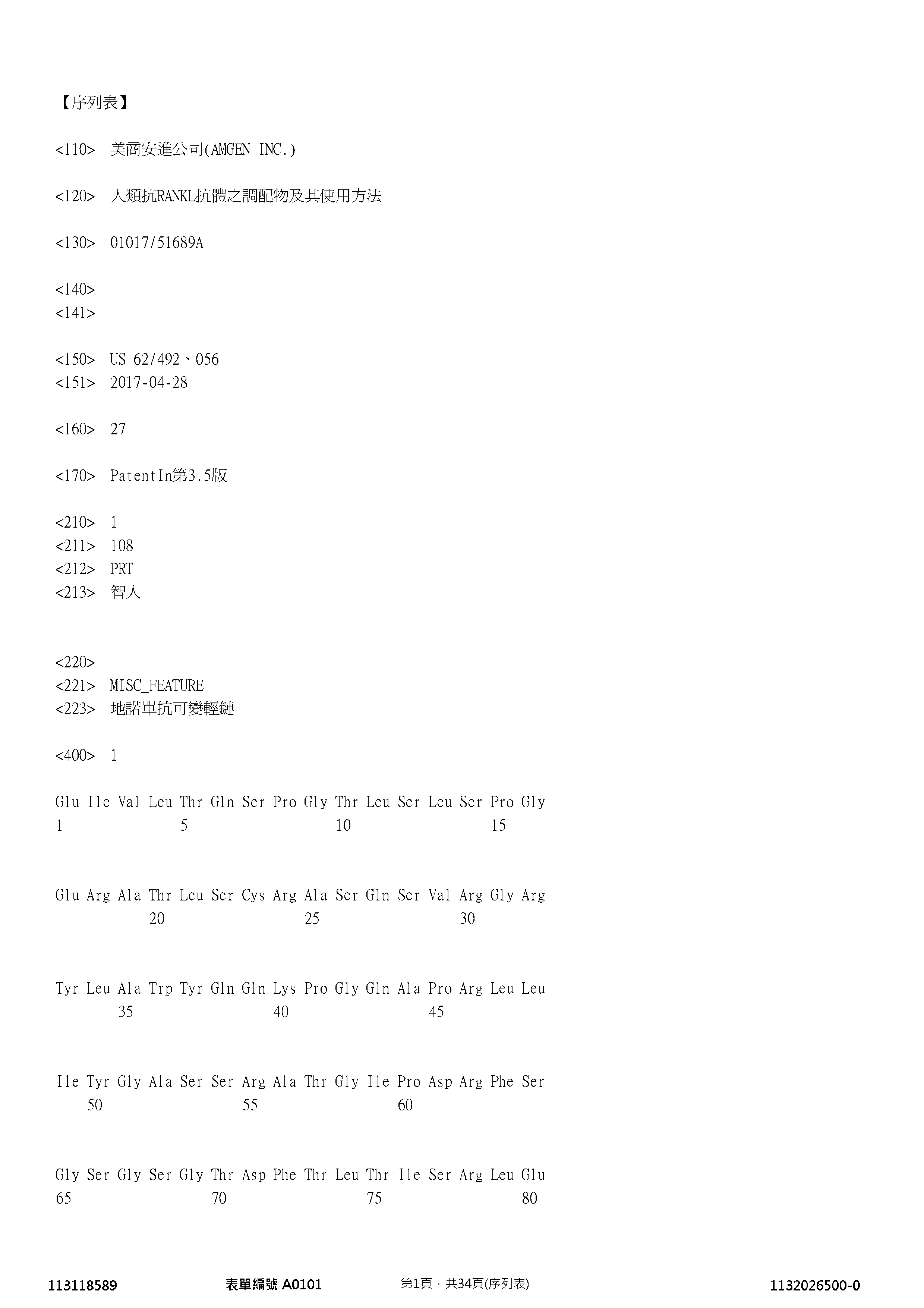

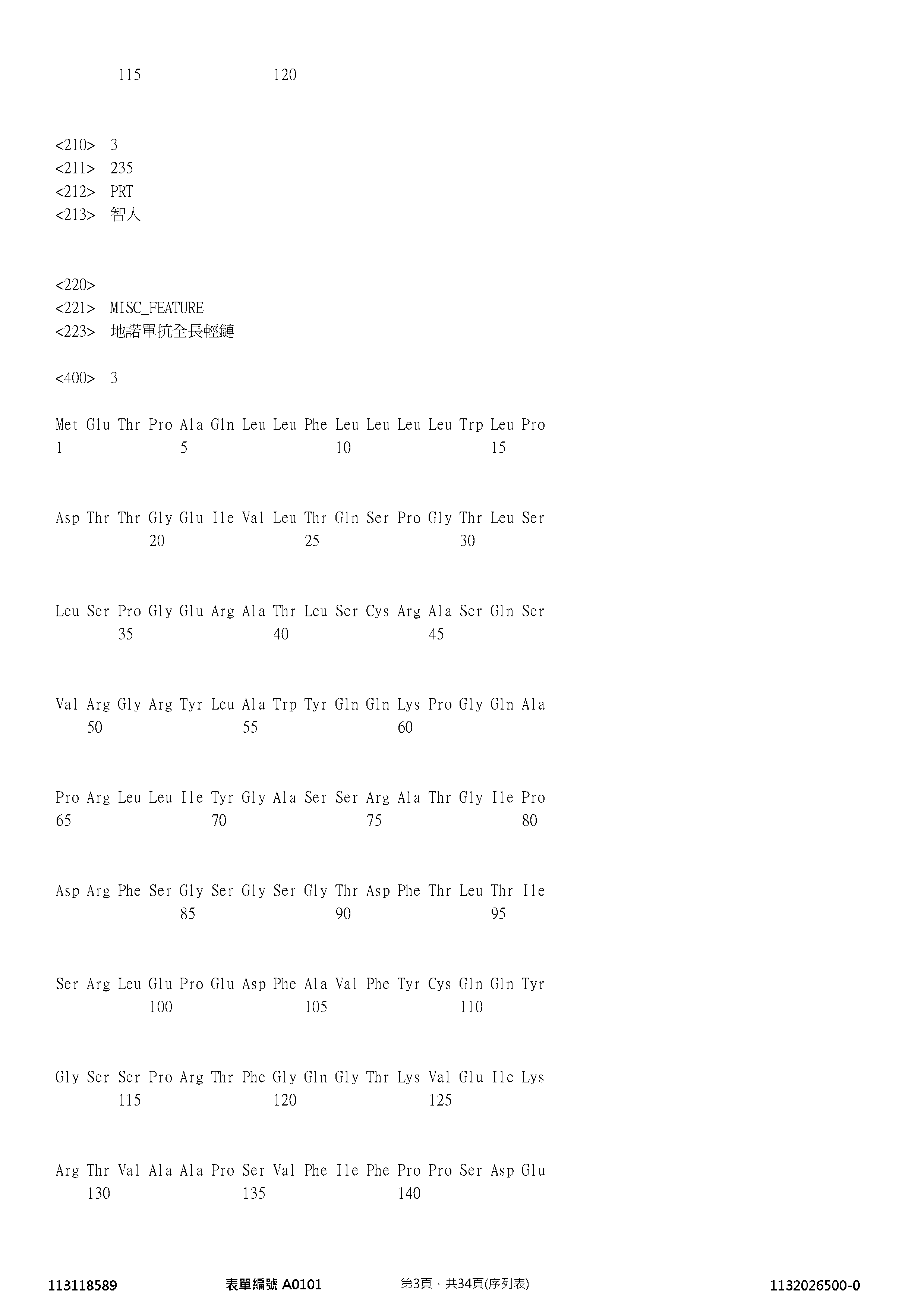

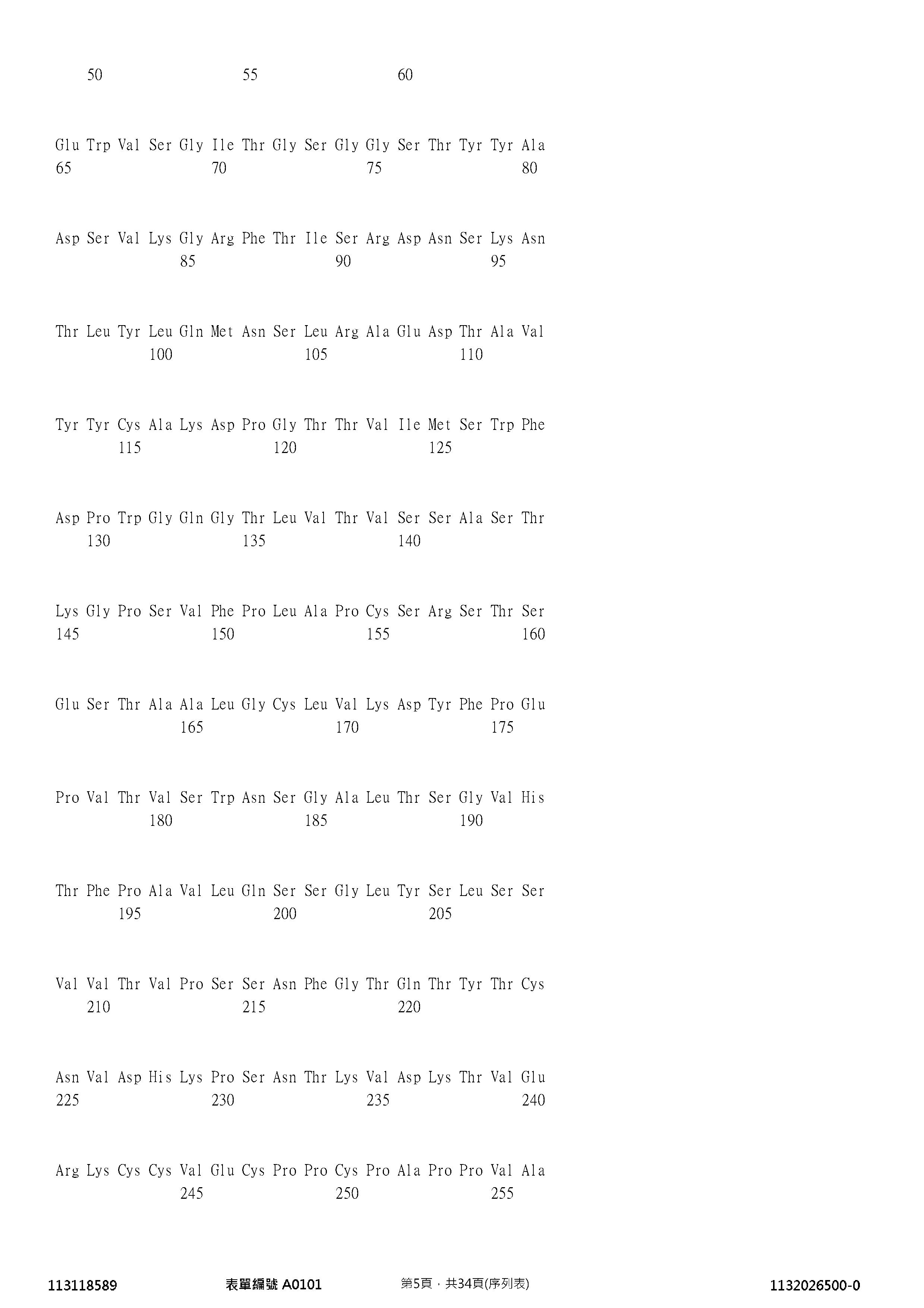


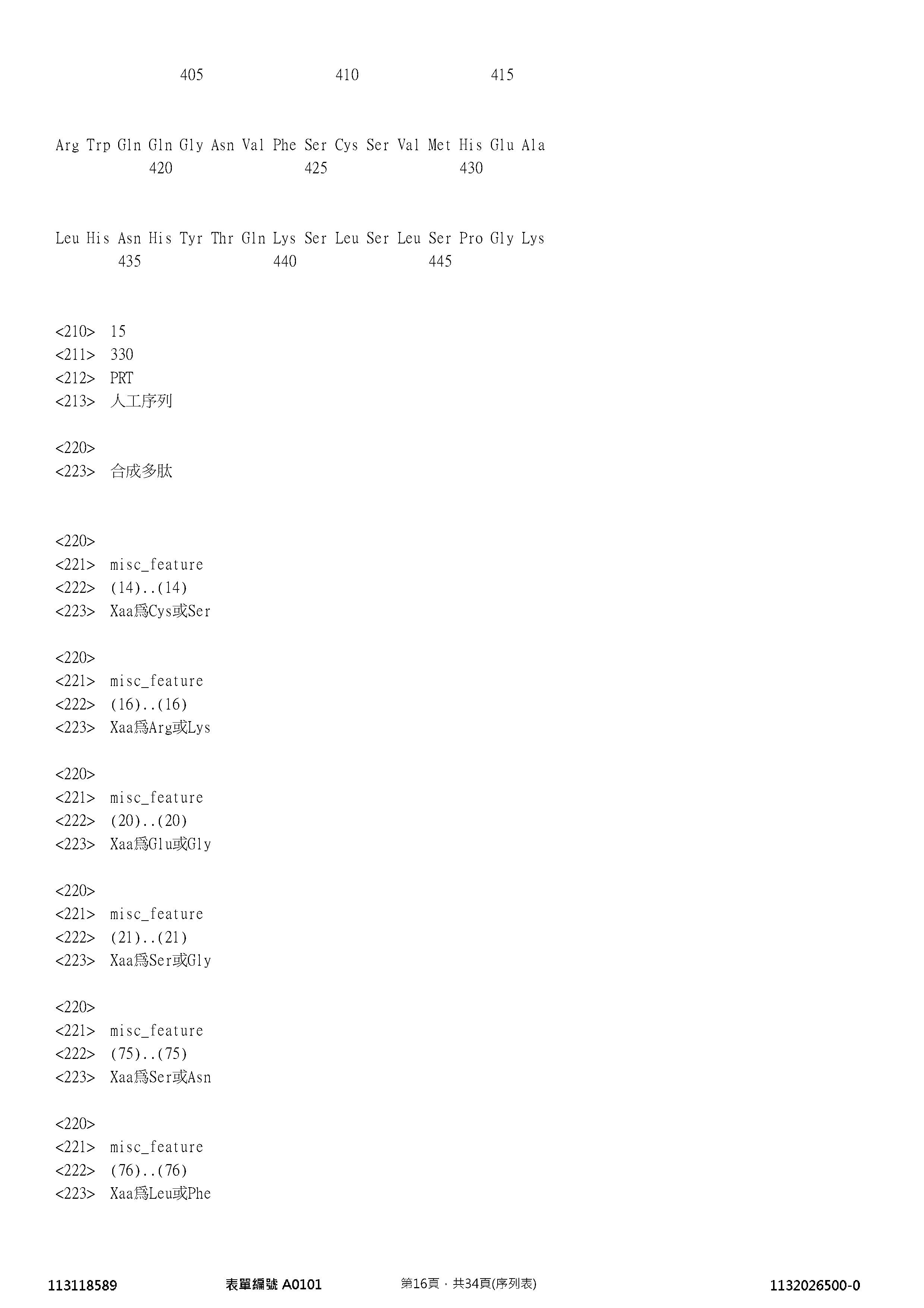


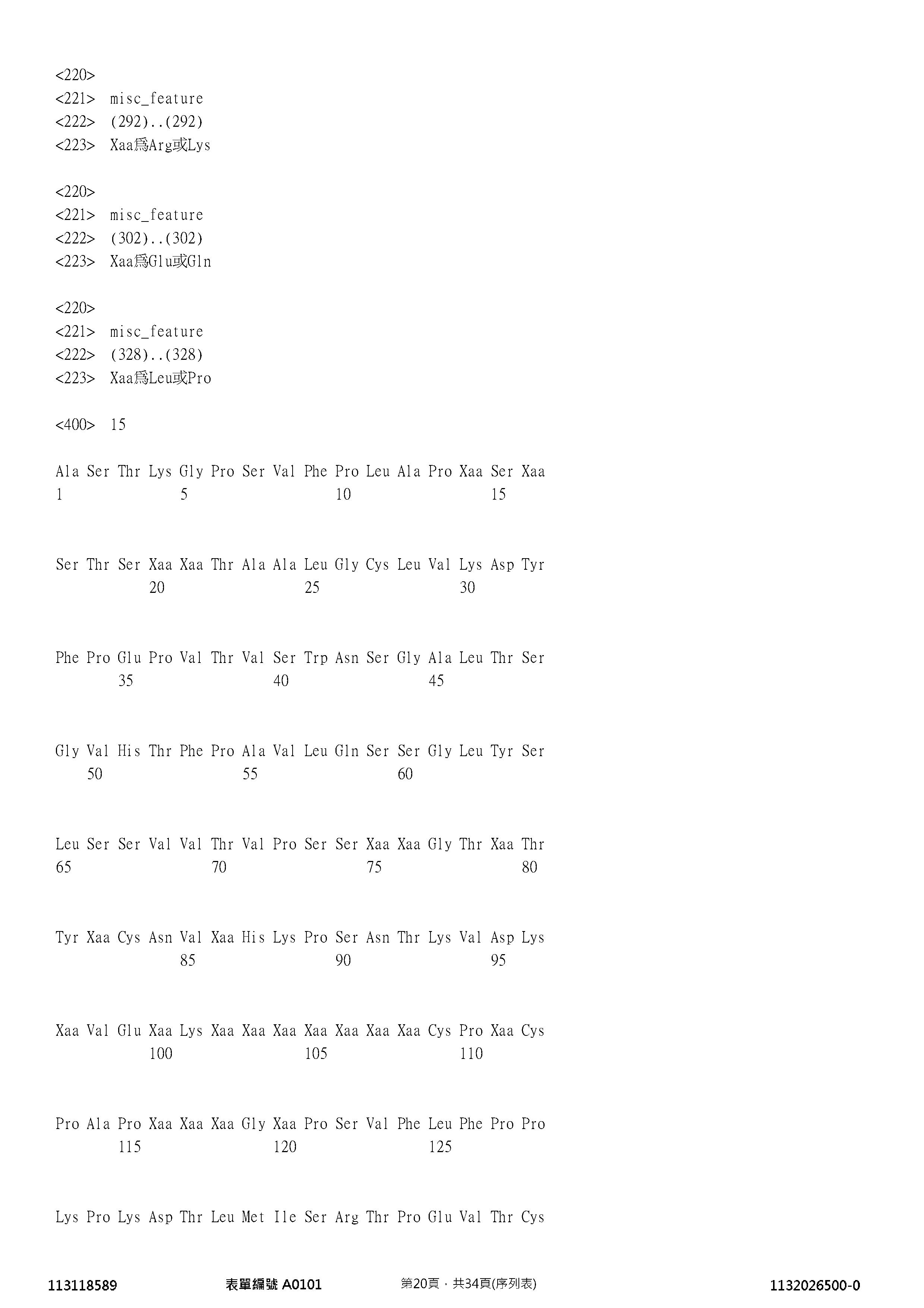
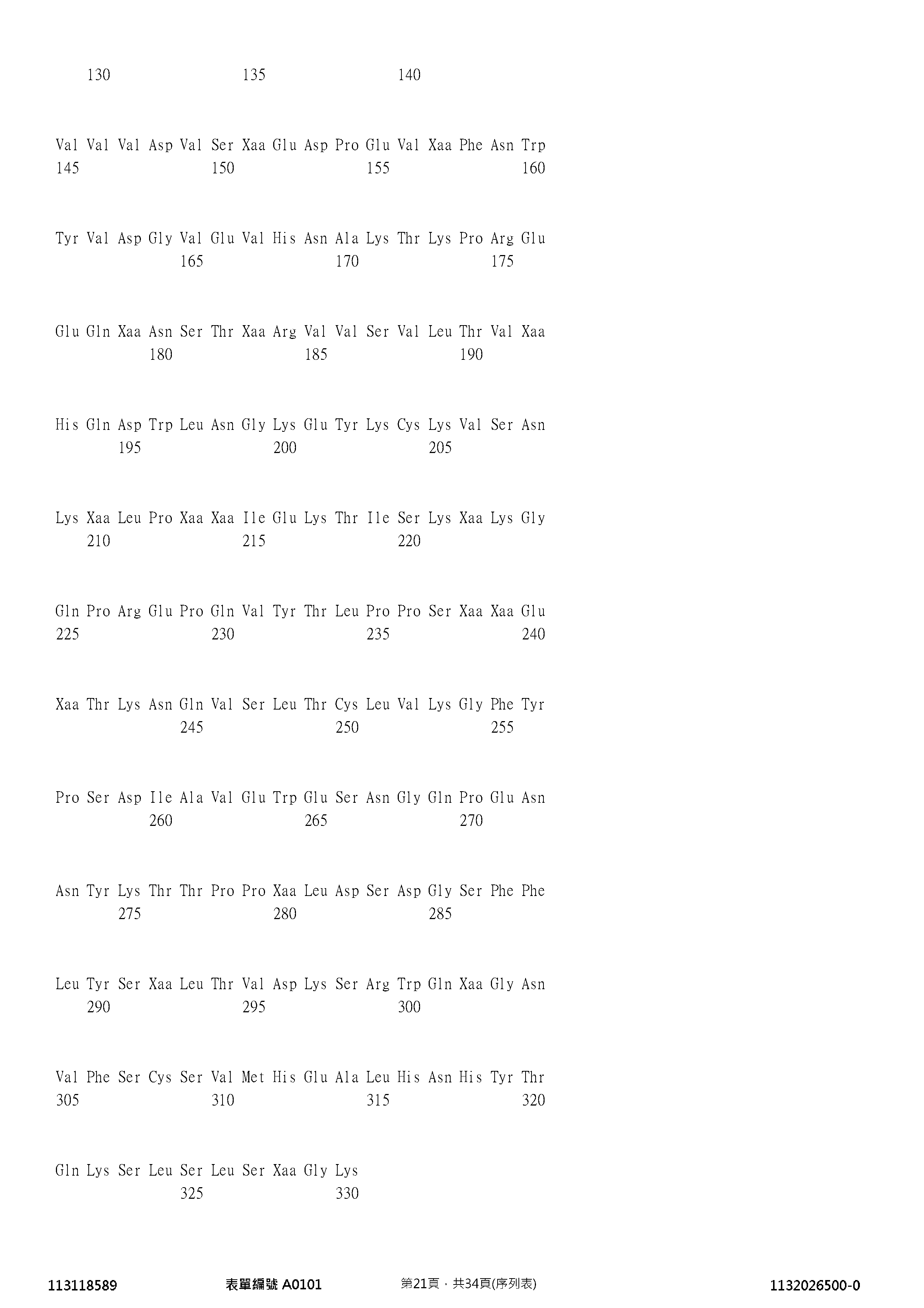


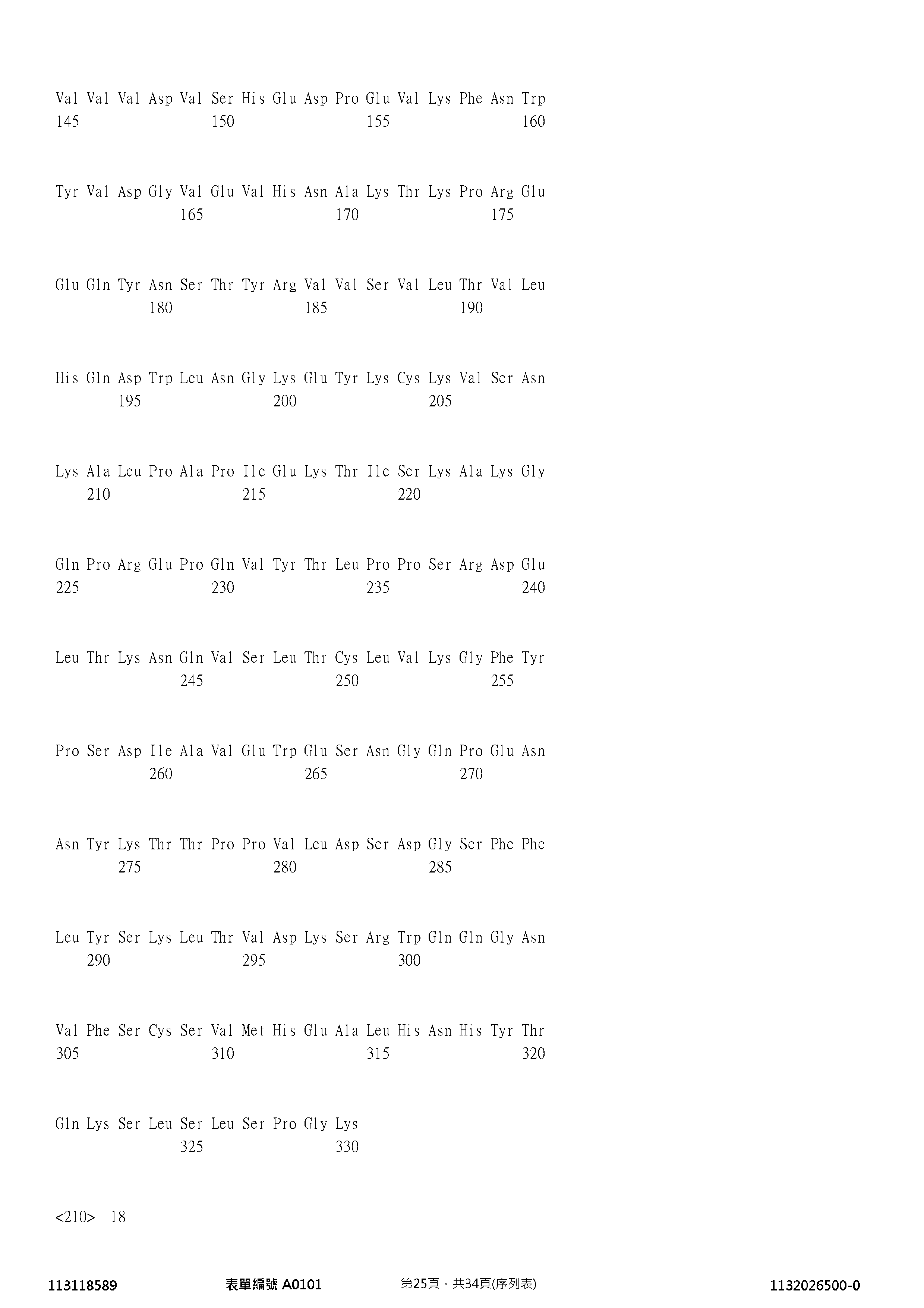
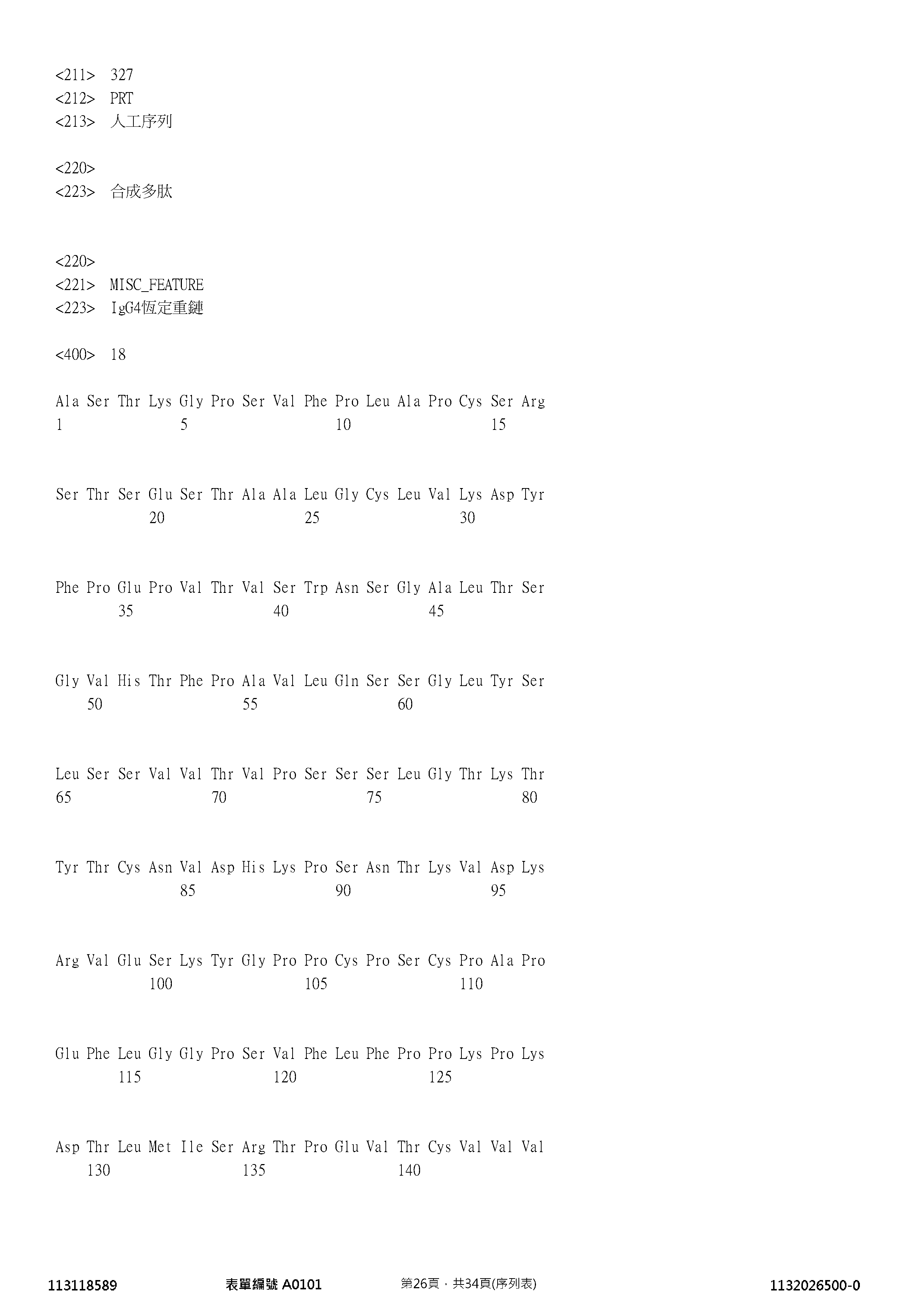


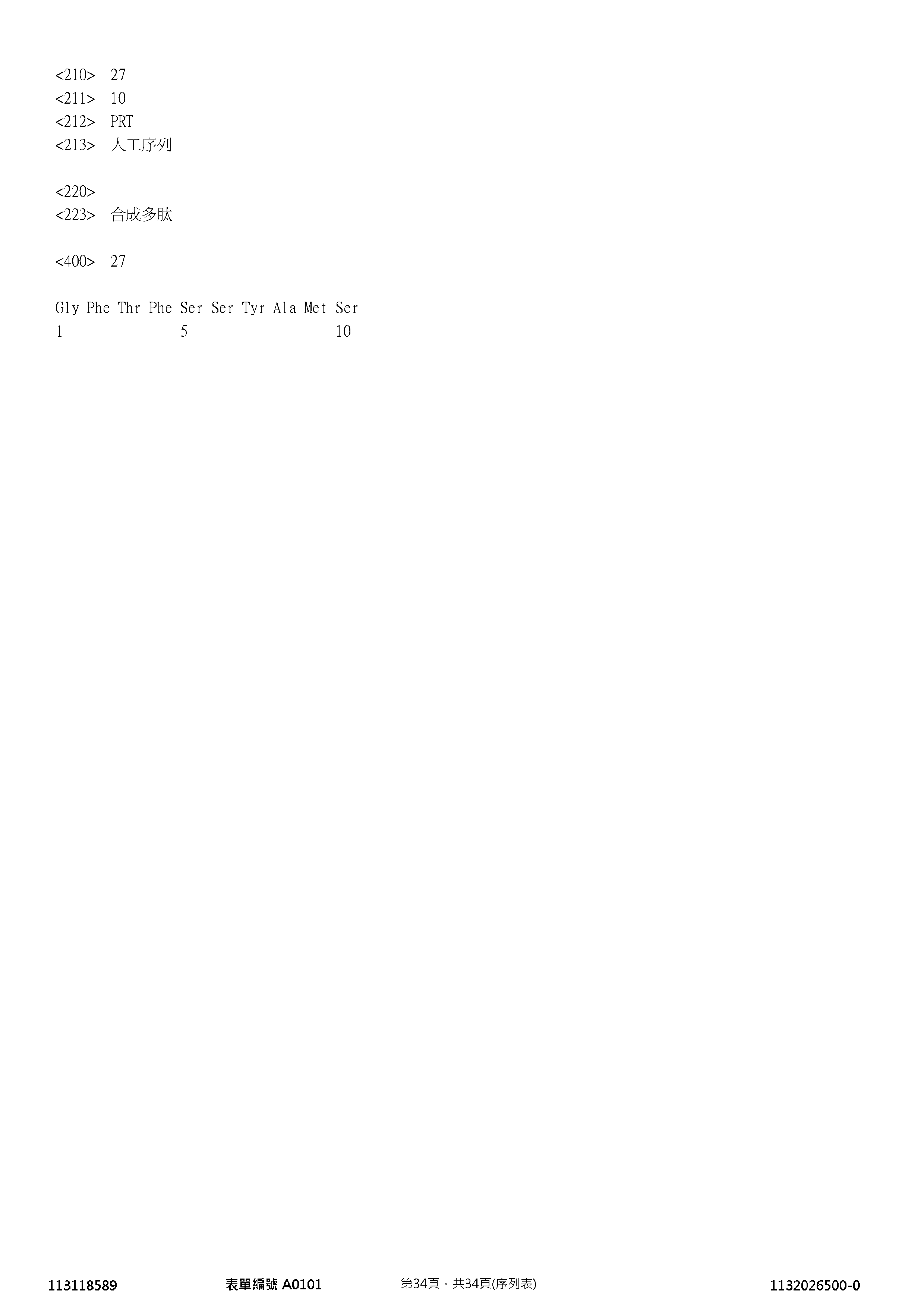
Claims (68)
Applications Claiming Priority (2)
| Application Number | Priority Date | Filing Date | Title |
|---|---|---|---|
| US201762492056P | 2017-04-28 | 2017-04-28 | |
| US62/492,056 | 2017-04-28 |
Publications (2)
| Publication Number | Publication Date |
|---|---|
| TW202435914A true TW202435914A (en) | 2024-09-16 |
| TWI903512B TWI903512B (en) | 2025-11-01 |
Family
ID=62165668
Family Applications (2)
| Application Number | Title | Priority Date | Filing Date |
|---|---|---|---|
| TW113118589A TWI903512B (en) | 2017-04-28 | 2018-04-27 | Formulations of human anti-rankl antibodies, and methods of using the same |
| TW107114370A TWI839331B (en) | 2017-04-28 | 2018-04-27 | Formulations of human anti-rankl antibodies, and methods of using the same |
Family Applications After (1)
| Application Number | Title | Priority Date | Filing Date |
|---|---|---|---|
| TW107114370A TWI839331B (en) | 2017-04-28 | 2018-04-27 | Formulations of human anti-rankl antibodies, and methods of using the same |
Country Status (37)
| Country | Link |
|---|---|
| US (3) | US11192952B2 (en) |
| EP (3) | EP3615066B1 (en) |
| JP (4) | JP7190822B2 (en) |
| KR (2) | KR102681171B1 (en) |
| CN (2) | CN110621342B (en) |
| AR (1) | AR111497A1 (en) |
| AU (2) | AU2018260750B2 (en) |
| BR (1) | BR112019022188A2 (en) |
| CA (1) | CA3054165A1 (en) |
| CL (3) | CL2019003032A1 (en) |
| CO (1) | CO2019011463A2 (en) |
| CR (2) | CR20250034A (en) |
| DK (2) | DK3615066T5 (en) |
| EA (1) | EA201992570A1 (en) |
| ES (2) | ES2973572T3 (en) |
| FI (2) | FI3615066T3 (en) |
| HR (2) | HRP20241604T1 (en) |
| HU (2) | HUE065544T2 (en) |
| IL (2) | IL293127B2 (en) |
| JO (1) | JOP20190255A1 (en) |
| LT (2) | LT4190355T (en) |
| MA (2) | MA62173B1 (en) |
| MX (1) | MX2023013460A (en) |
| MY (1) | MY202479A (en) |
| PE (2) | PE20251534A1 (en) |
| PH (1) | PH12019502444A1 (en) |
| PL (2) | PL4190355T3 (en) |
| PT (2) | PT3615066T (en) |
| RS (2) | RS66284B1 (en) |
| SG (1) | SG11201909998TA (en) |
| SI (2) | SI3615066T1 (en) |
| SM (2) | SMT202400095T1 (en) |
| TN (2) | TN2019000297A1 (en) |
| TW (2) | TWI903512B (en) |
| UY (2) | UY37707A (en) |
| WO (1) | WO2018200918A1 (en) |
| ZA (1) | ZA202205141B (en) |
Families Citing this family (17)
| Publication number | Priority date | Publication date | Assignee | Title |
|---|---|---|---|---|
| US12257343B2 (en) | 2017-04-28 | 2025-03-25 | Amgen Inc. | Excipients to reduce the viscosity of antibody formulations and formulation compositions |
| JOP20190255A1 (en) | 2017-04-28 | 2019-10-27 | Amgen Inc | Human RANKL antibody formulas, and methods for their use |
| AU2019378544A1 (en) * | 2018-11-16 | 2021-06-10 | Samsung Bioepis Co., Ltd. | Stable liquid composition comprising protein |
| CN109374779A (en) * | 2018-12-17 | 2019-02-22 | 杭州奕安济世生物药业有限公司 | A kind of rapid detection method of cane sugar content |
| KR102735988B1 (en) | 2019-02-18 | 2024-12-03 | 일라이 릴리 앤드 캄파니 | therapeutic antibody preparations |
| AU2020347729C1 (en) * | 2019-09-19 | 2025-12-18 | Innovent Biologics (Suzhou) Co., Ltd. | Method for preventing or treating cholesterol-related diseases by using anti-PCSK9 antibody |
| CN111704670B (en) * | 2020-08-18 | 2020-11-03 | 迈威(上海)生物科技股份有限公司 | Disulfide bond isomer of recombinant anti-RANKL antibody IgG2 type and purification method thereof |
| EP4243931A4 (en) * | 2020-11-11 | 2025-01-01 | HAN, Hq | BIFUNCTIONAL ANTAGONISTS OF ACTIVIN/TGF-BETA AND RANKL AND THEIR USES |
| CA3218542A1 (en) * | 2021-05-12 | 2022-11-17 | Hua Ying | Antigen binding molecule specifically binding to rankl and ngf, and medical use thereof |
| EP4384217A1 (en) | 2021-08-12 | 2024-06-19 | Amgen Inc. | Antibody formulations |
| US20250297020A1 (en) * | 2021-11-23 | 2025-09-25 | Adalta Limited | Rank-l binding molecules |
| WO2023179791A1 (en) * | 2022-03-24 | 2023-09-28 | Angitia Biomedicines Limited | Treatment of musculoskeletal disorders |
| EP4590707A1 (en) | 2022-09-23 | 2025-07-30 | The University of North Carolina at Chapel Hill | Methods and compositions for the treatment of melanoma |
| JP2025539096A (en) * | 2022-11-16 | 2025-12-03 | 蘇州盛迪業生物医薬有限公司 | Pharmaceutical compositions containing anti-RANKL-NGF bispecific antibodies |
| WO2024184280A1 (en) * | 2023-03-03 | 2024-09-12 | Alvotech Hf | Denosumab formulation |
| WO2025036493A1 (en) * | 2023-08-17 | 2025-02-20 | Sinomab Bioscience Limited | Antibodies targeting rankl and sclerostin and uses thereof |
| WO2025116648A1 (en) * | 2023-12-01 | 2025-06-05 | 삼성바이오에피스 주식회사 | STABLE BUFFER-FREE LIQUID FORMULATION OF ANTI-IL-4Rα ANTIBODY |
Family Cites Families (22)
| Publication number | Priority date | Publication date | Assignee | Title |
|---|---|---|---|---|
| CN103232539B (en) | 2001-06-26 | 2015-06-03 | 安姆根弗里蒙特公司 | Antibodies to opgl |
| AR056806A1 (en) | 2005-11-14 | 2007-10-24 | Amgen Inc | RANKL- PTH / PTHRP ANTIBODY CHEMICAL MOLECULES |
| US20080213282A1 (en) * | 2006-12-21 | 2008-09-04 | Jaby Jacob | Formulations |
| WO2009002521A2 (en) | 2007-06-25 | 2008-12-31 | Amgen Inc. | Compositions of specific binding agents to hepatocyte growth factor |
| CA2714006A1 (en) | 2008-02-07 | 2009-08-13 | Amgen Inc. | Stabilized protein compositions |
| AR073072A1 (en) | 2008-08-19 | 2010-10-13 | Regeneron Pharma | HUMAN ANTIBODIES FOR THE BINDING OF THE HUMAN NF-KB RECEIVER ACTIVATOR (RANKL) |
| CN102209554A (en) | 2008-09-10 | 2011-10-05 | 弗·哈夫曼-拉罗切有限公司 | Compositions and methods for preventing oxidative degradation of proteins |
| US9265834B2 (en) | 2009-03-05 | 2016-02-23 | Ablynx N.V. | Stable formulations of polypeptides and uses thereof |
| WO2010106812A1 (en) | 2009-03-19 | 2010-09-23 | Chugai Seiyaku Kabushiki Kaisha | Pharmaceutical formulation containing improved antibody molecules |
| CN102946858B (en) | 2010-05-10 | 2015-09-30 | 英塔斯制药有限公司 | The liquid preparation of the polypeptide containing immunoglobulin Fc |
| EP2433644A1 (en) | 2010-09-22 | 2012-03-28 | IMBA-Institut für Molekulare Biotechnologie GmbH | Breast cancer therapeutics |
| EP2694708A4 (en) | 2011-04-07 | 2014-10-01 | Glaxosmithkline Llc | FORMULATIONS WITH REDUCED VISCOSITY |
| JP6176849B2 (en) | 2011-07-19 | 2017-08-09 | 中外製薬株式会社 | A stable protein-containing preparation containing arginine amide or a similar compound |
| CA2951856A1 (en) | 2011-10-28 | 2013-05-02 | Integritybio Inc. | Protein formulations containing amino acids |
| TWI679019B (en) | 2013-04-29 | 2019-12-11 | 法商賽諾菲公司 | Anti-il-4/anti-il-13 bispecific antibody formulations |
| CN103965357B (en) | 2013-12-31 | 2016-08-17 | 嘉和生物药业有限公司 | A kind of anti-human RANKL antibody |
| WO2015121318A1 (en) | 2014-02-12 | 2015-08-20 | Sanofi | Anti-il-4/anti-il-13 bispecific antibody/polyglutamate formulations |
| WO2015134406A1 (en) * | 2014-03-03 | 2015-09-11 | La Jolla Biologics, Inc. | Stable aqueous recombinant protein formulations |
| ES2974895T3 (en) | 2014-05-07 | 2024-07-02 | Takeda Pharmaceuticals Co | Liquid formulation comprising a GM-CSF neutralizing compound |
| EP3240571A4 (en) | 2014-12-31 | 2018-06-13 | NovelMed Therapeutics, Inc. | Formulation of aglycosylated therapeutic antibodies |
| WO2016162819A1 (en) | 2015-04-07 | 2016-10-13 | Lupin Limited | Stable aqueous pharmaceutical composition of anti-tnf alpha antibody |
| JOP20190255A1 (en) | 2017-04-28 | 2019-10-27 | Amgen Inc | Human RANKL antibody formulas, and methods for their use |
-
2017
- 2017-06-16 JO JOP/2019/0255A patent/JOP20190255A1/en unknown
-
2018
- 2018-04-27 JP JP2018086261A patent/JP7190822B2/en active Active
- 2018-04-27 MA MA62173A patent/MA62173B1/en unknown
- 2018-04-27 SI SI201831067T patent/SI3615066T1/en unknown
- 2018-04-27 PE PE2024002513A patent/PE20251534A1/en unknown
- 2018-04-27 SM SM20240095T patent/SMT202400095T1/en unknown
- 2018-04-27 TN TNP/2019/000297A patent/TN2019000297A1/en unknown
- 2018-04-27 FI FIEP18724690.5T patent/FI3615066T3/en active
- 2018-04-27 ES ES18724690T patent/ES2973572T3/en active Active
- 2018-04-27 TN TNP/2021/000055A patent/TN2021000055A1/en unknown
- 2018-04-27 TW TW113118589A patent/TWI903512B/en active
- 2018-04-27 TW TW107114370A patent/TWI839331B/en active
- 2018-04-27 HU HUE18724690A patent/HUE065544T2/en unknown
- 2018-04-27 SI SI201831178T patent/SI4190355T1/en unknown
- 2018-04-27 PL PL22206709.2T patent/PL4190355T3/en unknown
- 2018-04-27 PL PL18724690.5T patent/PL3615066T3/en unknown
- 2018-04-27 BR BR112019022188-3A patent/BR112019022188A2/en unknown
- 2018-04-27 AR ARP180101105A patent/AR111497A1/en not_active Application Discontinuation
- 2018-04-27 LT LTEP22206709.2T patent/LT4190355T/en unknown
- 2018-04-27 WO PCT/US2018/029728 patent/WO2018200918A1/en not_active Ceased
- 2018-04-27 AU AU2018260750A patent/AU2018260750B2/en active Active
- 2018-04-27 HU HUE22206709A patent/HUE069382T2/en unknown
- 2018-04-27 ES ES22206709T patent/ES2997833T3/en active Active
- 2018-04-27 SG SG11201909998T patent/SG11201909998TA/en unknown
- 2018-04-27 PT PT187246905T patent/PT3615066T/en unknown
- 2018-04-27 EP EP18724690.5A patent/EP3615066B1/en active Active
- 2018-04-27 FI FIEP22206709.2T patent/FI4190355T3/en active
- 2018-04-27 PE PE2019002120A patent/PE20200343A1/en unknown
- 2018-04-27 IL IL293127A patent/IL293127B2/en unknown
- 2018-04-27 DK DK18724690.5T patent/DK3615066T5/en active
- 2018-04-27 RS RS20241343A patent/RS66284B1/en unknown
- 2018-04-27 CN CN201880028012.1A patent/CN110621342B/en active Active
- 2018-04-27 RS RS20240313A patent/RS65299B1/en unknown
- 2018-04-27 DK DK22206709.2T patent/DK4190355T3/en active
- 2018-04-27 CR CR20250034A patent/CR20250034A/en unknown
- 2018-04-27 CN CN202411089892.7A patent/CN118987200A/en active Pending
- 2018-04-27 KR KR1020197034225A patent/KR102681171B1/en active Active
- 2018-04-27 EP EP22206709.2A patent/EP4190355B1/en active Active
- 2018-04-27 CR CR20190538A patent/CR20190538A/en unknown
- 2018-04-27 LT LTEPPCT/US2018/029728T patent/LT3615066T/en unknown
- 2018-04-27 PT PT222067092T patent/PT4190355T/en unknown
- 2018-04-27 HR HRP20241604TT patent/HRP20241604T1/en unknown
- 2018-04-27 EA EA201992570A patent/EA201992570A1/en unknown
- 2018-04-27 CA CA3054165A patent/CA3054165A1/en not_active Abandoned
- 2018-04-27 SM SM20240491T patent/SMT202400491T1/en unknown
- 2018-04-27 UY UY0001037707A patent/UY37707A/en active IP Right Grant
- 2018-04-27 HR HRP20240167TT patent/HRP20240167T1/en unknown
- 2018-04-27 MA MA48462A patent/MA48462B1/en unknown
- 2018-04-27 UY UY0001040974A patent/UY40974A/en unknown
- 2018-04-27 KR KR1020247021825A patent/KR20240110083A/en active Pending
- 2018-04-27 EP EP24194699.5A patent/EP4477667A3/en active Pending
- 2018-04-27 MY MYPI2019006326A patent/MY202479A/en unknown
- 2018-04-27 US US16/608,375 patent/US11192952B2/en active Active
-
2019
- 2019-08-14 IL IL268704A patent/IL268704B/en unknown
- 2019-10-16 CO CO2019011463A patent/CO2019011463A2/en unknown
- 2019-10-21 MX MX2023013460A patent/MX2023013460A/en unknown
- 2019-10-23 CL CL2019003032A patent/CL2019003032A1/en unknown
- 2019-10-28 PH PH12019502444A patent/PH12019502444A1/en unknown
-
2020
- 2020-07-31 CL CL2020002012A patent/CL2020002012A1/en unknown
-
2021
- 2021-11-18 US US17/529,794 patent/US11873343B2/en active Active
-
2022
- 2022-01-14 JP JP2022004150A patent/JP7356525B2/en active Active
- 2022-05-10 ZA ZA2022/05141A patent/ZA202205141B/en unknown
-
2023
- 2023-08-10 JP JP2023130715A patent/JP2023166396A/en active Pending
- 2023-08-24 CL CL2023002505A patent/CL2023002505A1/en unknown
- 2023-12-11 US US18/535,068 patent/US20250326853A1/en active Pending
-
2025
- 2025-02-17 JP JP2025023142A patent/JP2025093923A/en active Pending
- 2025-07-15 AU AU2025205470A patent/AU2025205470A1/en active Pending
Also Published As
Similar Documents
| Publication | Publication Date | Title |
|---|---|---|
| TWI903512B (en) | Formulations of human anti-rankl antibodies, and methods of using the same | |
| US20240052036A1 (en) | Formulations of anti-lag3 antibodies and co-formulations of anti-lag3 antibodies and anti-pd-1 antibodies | |
| ES2675735T3 (en) | OPGL antibodies | |
| AU2025226754A1 (en) | Co-formulations of anti-LAG3 antibodies and anti-PD-1 antibodies | |
| KR20180118746A (en) | Non-antagonistic antibodies directed against the alpha chain of the IL7 receptor extracellular domain and their use in the treatment of cancer. | |
| KR20220044286A (en) | Formulations comprising anti-PD-1/HER2 bispecific antibodies, methods for their preparation and uses | |
| RU2822192C2 (en) | Combined formulations of anti-lag3 antibody and anti-pd-1 antibody | |
| HK40119362A (en) | Formulations of human anti-rankl antibodies, and methods of using the same | |
| HK40017180A (en) | Formulations of human anti-rankl antibodies, and methods of using the same | |
| HK40092695B (en) | Formulations of human anti-rankl antibodies, and methods of using the same | |
| AU2015264940B2 (en) | Antibodies to OPGL | |
| HK40017180B (en) | Formulations of human anti-rankl antibodies, and methods of using the same |