TW201800410A - Crystalline solid form of BET inhibitor - Google Patents
Crystalline solid form of BET inhibitor Download PDFInfo
- Publication number
- TW201800410A TW201800410A TW106120412A TW106120412A TW201800410A TW 201800410 A TW201800410 A TW 201800410A TW 106120412 A TW106120412 A TW 106120412A TW 106120412 A TW106120412 A TW 106120412A TW 201800410 A TW201800410 A TW 201800410A
- Authority
- TW
- Taiwan
- Prior art keywords
- compound
- cancer
- solution
- temperature
- solid form
- Prior art date
Links
- USKATANFZLVCNA-UHFFFAOYSA-N CC(C)(C(N(C)c1c2)=O)Oc1c(B(O)O)cc2S(C)(=O)=O Chemical compound CC(C)(C(N(C)c1c2)=O)Oc1c(B(O)O)cc2S(C)(=O)=O USKATANFZLVCNA-UHFFFAOYSA-N 0.000 description 1
- VZSAMEOETVNDQH-UHFFFAOYSA-N CC(C)(C(N(C)c1cc(S(C)(=O)=O)c2)=O)Oc1c2C(c1c2[nH]cc1)=CN(C)C2=O Chemical compound CC(C)(C(N(C)c1cc(S(C)(=O)=O)c2)=O)Oc1c2C(c1c2[nH]cc1)=CN(C)C2=O VZSAMEOETVNDQH-UHFFFAOYSA-N 0.000 description 1
- RFJGMFDKUZASJB-UHFFFAOYSA-N CC(C)(C(Nc1cc(S(C)(=O)=O)c2)=O)Oc1c2Br Chemical compound CC(C)(C(Nc1cc(S(C)(=O)=O)c2)=O)Oc1c2Br RFJGMFDKUZASJB-UHFFFAOYSA-N 0.000 description 1
- 0 COc(c1c2cc[n]1*)ncc2Br Chemical compound COc(c1c2cc[n]1*)ncc2Br 0.000 description 1
Classifications
-
- C—CHEMISTRY; METALLURGY
- C07—ORGANIC CHEMISTRY
- C07D—HETEROCYCLIC COMPOUNDS
- C07D471/00—Heterocyclic compounds containing nitrogen atoms as the only ring hetero atoms in the condensed system, at least one ring being a six-membered ring with one nitrogen atom, not provided for by groups C07D451/00 - C07D463/00
- C07D471/02—Heterocyclic compounds containing nitrogen atoms as the only ring hetero atoms in the condensed system, at least one ring being a six-membered ring with one nitrogen atom, not provided for by groups C07D451/00 - C07D463/00 in which the condensed system contains two hetero rings
- C07D471/04—Ortho-condensed systems
-
- A—HUMAN NECESSITIES
- A61—MEDICAL OR VETERINARY SCIENCE; HYGIENE
- A61K—PREPARATIONS FOR MEDICAL, DENTAL OR TOILETRY PURPOSES
- A61K31/00—Medicinal preparations containing organic active ingredients
- A61K31/33—Heterocyclic compounds
- A61K31/395—Heterocyclic compounds having nitrogen as a ring hetero atom, e.g. guanethidine or rifamycins
- A61K31/535—Heterocyclic compounds having nitrogen as a ring hetero atom, e.g. guanethidine or rifamycins having six-membered rings with at least one nitrogen and one oxygen as the ring hetero atoms, e.g. 1,2-oxazines
- A61K31/5375—1,4-Oxazines, e.g. morpholine
- A61K31/538—1,4-Oxazines, e.g. morpholine ortho- or peri-condensed with carbocyclic ring systems
-
- A—HUMAN NECESSITIES
- A01—AGRICULTURE; FORESTRY; ANIMAL HUSBANDRY; HUNTING; TRAPPING; FISHING
- A01M—CATCHING, TRAPPING OR SCARING OF ANIMALS; APPARATUS FOR THE DESTRUCTION OF NOXIOUS ANIMALS OR NOXIOUS PLANTS
- A01M31/00—Hunting appliances
- A01M31/06—Decoys
-
- A—HUMAN NECESSITIES
- A61—MEDICAL OR VETERINARY SCIENCE; HYGIENE
- A61P—SPECIFIC THERAPEUTIC ACTIVITY OF CHEMICAL COMPOUNDS OR MEDICINAL PREPARATIONS
- A61P1/00—Drugs for disorders of the alimentary tract or the digestive system
-
- A—HUMAN NECESSITIES
- A61—MEDICAL OR VETERINARY SCIENCE; HYGIENE
- A61P—SPECIFIC THERAPEUTIC ACTIVITY OF CHEMICAL COMPOUNDS OR MEDICINAL PREPARATIONS
- A61P1/00—Drugs for disorders of the alimentary tract or the digestive system
- A61P1/16—Drugs for disorders of the alimentary tract or the digestive system for liver or gallbladder disorders, e.g. hepatoprotective agents, cholagogues, litholytics
-
- A—HUMAN NECESSITIES
- A61—MEDICAL OR VETERINARY SCIENCE; HYGIENE
- A61P—SPECIFIC THERAPEUTIC ACTIVITY OF CHEMICAL COMPOUNDS OR MEDICINAL PREPARATIONS
- A61P11/00—Drugs for disorders of the respiratory system
-
- A—HUMAN NECESSITIES
- A61—MEDICAL OR VETERINARY SCIENCE; HYGIENE
- A61P—SPECIFIC THERAPEUTIC ACTIVITY OF CHEMICAL COMPOUNDS OR MEDICINAL PREPARATIONS
- A61P11/00—Drugs for disorders of the respiratory system
- A61P11/02—Nasal agents, e.g. decongestants
-
- A—HUMAN NECESSITIES
- A61—MEDICAL OR VETERINARY SCIENCE; HYGIENE
- A61P—SPECIFIC THERAPEUTIC ACTIVITY OF CHEMICAL COMPOUNDS OR MEDICINAL PREPARATIONS
- A61P11/00—Drugs for disorders of the respiratory system
- A61P11/06—Antiasthmatics
-
- A—HUMAN NECESSITIES
- A61—MEDICAL OR VETERINARY SCIENCE; HYGIENE
- A61P—SPECIFIC THERAPEUTIC ACTIVITY OF CHEMICAL COMPOUNDS OR MEDICINAL PREPARATIONS
- A61P17/00—Drugs for dermatological disorders
-
- A—HUMAN NECESSITIES
- A61—MEDICAL OR VETERINARY SCIENCE; HYGIENE
- A61P—SPECIFIC THERAPEUTIC ACTIVITY OF CHEMICAL COMPOUNDS OR MEDICINAL PREPARATIONS
- A61P17/00—Drugs for dermatological disorders
- A61P17/06—Antipsoriatics
-
- A—HUMAN NECESSITIES
- A61—MEDICAL OR VETERINARY SCIENCE; HYGIENE
- A61P—SPECIFIC THERAPEUTIC ACTIVITY OF CHEMICAL COMPOUNDS OR MEDICINAL PREPARATIONS
- A61P19/00—Drugs for skeletal disorders
- A61P19/02—Drugs for skeletal disorders for joint disorders, e.g. arthritis, arthrosis
-
- A—HUMAN NECESSITIES
- A61—MEDICAL OR VETERINARY SCIENCE; HYGIENE
- A61P—SPECIFIC THERAPEUTIC ACTIVITY OF CHEMICAL COMPOUNDS OR MEDICINAL PREPARATIONS
- A61P21/00—Drugs for disorders of the muscular or neuromuscular system
-
- A—HUMAN NECESSITIES
- A61—MEDICAL OR VETERINARY SCIENCE; HYGIENE
- A61P—SPECIFIC THERAPEUTIC ACTIVITY OF CHEMICAL COMPOUNDS OR MEDICINAL PREPARATIONS
- A61P21/00—Drugs for disorders of the muscular or neuromuscular system
- A61P21/04—Drugs for disorders of the muscular or neuromuscular system for myasthenia gravis
-
- A—HUMAN NECESSITIES
- A61—MEDICAL OR VETERINARY SCIENCE; HYGIENE
- A61P—SPECIFIC THERAPEUTIC ACTIVITY OF CHEMICAL COMPOUNDS OR MEDICINAL PREPARATIONS
- A61P25/00—Drugs for disorders of the nervous system
-
- A—HUMAN NECESSITIES
- A61—MEDICAL OR VETERINARY SCIENCE; HYGIENE
- A61P—SPECIFIC THERAPEUTIC ACTIVITY OF CHEMICAL COMPOUNDS OR MEDICINAL PREPARATIONS
- A61P25/00—Drugs for disorders of the nervous system
- A61P25/28—Drugs for disorders of the nervous system for treating neurodegenerative disorders of the central nervous system, e.g. nootropic agents, cognition enhancers, drugs for treating Alzheimer's disease or other forms of dementia
-
- A—HUMAN NECESSITIES
- A61—MEDICAL OR VETERINARY SCIENCE; HYGIENE
- A61P—SPECIFIC THERAPEUTIC ACTIVITY OF CHEMICAL COMPOUNDS OR MEDICINAL PREPARATIONS
- A61P29/00—Non-central analgesic, antipyretic or antiinflammatory agents, e.g. antirheumatic agents; Non-steroidal antiinflammatory drugs [NSAID]
-
- A—HUMAN NECESSITIES
- A61—MEDICAL OR VETERINARY SCIENCE; HYGIENE
- A61P—SPECIFIC THERAPEUTIC ACTIVITY OF CHEMICAL COMPOUNDS OR MEDICINAL PREPARATIONS
- A61P3/00—Drugs for disorders of the metabolism
- A61P3/08—Drugs for disorders of the metabolism for glucose homeostasis
- A61P3/10—Drugs for disorders of the metabolism for glucose homeostasis for hyperglycaemia, e.g. antidiabetics
-
- A—HUMAN NECESSITIES
- A61—MEDICAL OR VETERINARY SCIENCE; HYGIENE
- A61P—SPECIFIC THERAPEUTIC ACTIVITY OF CHEMICAL COMPOUNDS OR MEDICINAL PREPARATIONS
- A61P31/00—Antiinfectives, i.e. antibiotics, antiseptics, chemotherapeutics
-
- A—HUMAN NECESSITIES
- A61—MEDICAL OR VETERINARY SCIENCE; HYGIENE
- A61P—SPECIFIC THERAPEUTIC ACTIVITY OF CHEMICAL COMPOUNDS OR MEDICINAL PREPARATIONS
- A61P31/00—Antiinfectives, i.e. antibiotics, antiseptics, chemotherapeutics
- A61P31/04—Antibacterial agents
-
- A—HUMAN NECESSITIES
- A61—MEDICAL OR VETERINARY SCIENCE; HYGIENE
- A61P—SPECIFIC THERAPEUTIC ACTIVITY OF CHEMICAL COMPOUNDS OR MEDICINAL PREPARATIONS
- A61P31/00—Antiinfectives, i.e. antibiotics, antiseptics, chemotherapeutics
- A61P31/12—Antivirals
-
- A—HUMAN NECESSITIES
- A61—MEDICAL OR VETERINARY SCIENCE; HYGIENE
- A61P—SPECIFIC THERAPEUTIC ACTIVITY OF CHEMICAL COMPOUNDS OR MEDICINAL PREPARATIONS
- A61P31/00—Antiinfectives, i.e. antibiotics, antiseptics, chemotherapeutics
- A61P31/12—Antivirals
- A61P31/14—Antivirals for RNA viruses
-
- A—HUMAN NECESSITIES
- A61—MEDICAL OR VETERINARY SCIENCE; HYGIENE
- A61P—SPECIFIC THERAPEUTIC ACTIVITY OF CHEMICAL COMPOUNDS OR MEDICINAL PREPARATIONS
- A61P31/00—Antiinfectives, i.e. antibiotics, antiseptics, chemotherapeutics
- A61P31/12—Antivirals
- A61P31/14—Antivirals for RNA viruses
- A61P31/18—Antivirals for RNA viruses for HIV
-
- A—HUMAN NECESSITIES
- A61—MEDICAL OR VETERINARY SCIENCE; HYGIENE
- A61P—SPECIFIC THERAPEUTIC ACTIVITY OF CHEMICAL COMPOUNDS OR MEDICINAL PREPARATIONS
- A61P31/00—Antiinfectives, i.e. antibiotics, antiseptics, chemotherapeutics
- A61P31/12—Antivirals
- A61P31/20—Antivirals for DNA viruses
-
- A—HUMAN NECESSITIES
- A61—MEDICAL OR VETERINARY SCIENCE; HYGIENE
- A61P—SPECIFIC THERAPEUTIC ACTIVITY OF CHEMICAL COMPOUNDS OR MEDICINAL PREPARATIONS
- A61P31/00—Antiinfectives, i.e. antibiotics, antiseptics, chemotherapeutics
- A61P31/12—Antivirals
- A61P31/20—Antivirals for DNA viruses
- A61P31/22—Antivirals for DNA viruses for herpes viruses
-
- A—HUMAN NECESSITIES
- A61—MEDICAL OR VETERINARY SCIENCE; HYGIENE
- A61P—SPECIFIC THERAPEUTIC ACTIVITY OF CHEMICAL COMPOUNDS OR MEDICINAL PREPARATIONS
- A61P35/00—Antineoplastic agents
-
- A—HUMAN NECESSITIES
- A61—MEDICAL OR VETERINARY SCIENCE; HYGIENE
- A61P—SPECIFIC THERAPEUTIC ACTIVITY OF CHEMICAL COMPOUNDS OR MEDICINAL PREPARATIONS
- A61P35/00—Antineoplastic agents
- A61P35/02—Antineoplastic agents specific for leukemia
-
- A—HUMAN NECESSITIES
- A61—MEDICAL OR VETERINARY SCIENCE; HYGIENE
- A61P—SPECIFIC THERAPEUTIC ACTIVITY OF CHEMICAL COMPOUNDS OR MEDICINAL PREPARATIONS
- A61P37/00—Drugs for immunological or allergic disorders
- A61P37/02—Immunomodulators
-
- A—HUMAN NECESSITIES
- A61—MEDICAL OR VETERINARY SCIENCE; HYGIENE
- A61P—SPECIFIC THERAPEUTIC ACTIVITY OF CHEMICAL COMPOUNDS OR MEDICINAL PREPARATIONS
- A61P37/00—Drugs for immunological or allergic disorders
- A61P37/02—Immunomodulators
- A61P37/06—Immunosuppressants, e.g. drugs for graft rejection
-
- A—HUMAN NECESSITIES
- A61—MEDICAL OR VETERINARY SCIENCE; HYGIENE
- A61P—SPECIFIC THERAPEUTIC ACTIVITY OF CHEMICAL COMPOUNDS OR MEDICINAL PREPARATIONS
- A61P37/00—Drugs for immunological or allergic disorders
- A61P37/08—Antiallergic agents
-
- A—HUMAN NECESSITIES
- A61—MEDICAL OR VETERINARY SCIENCE; HYGIENE
- A61P—SPECIFIC THERAPEUTIC ACTIVITY OF CHEMICAL COMPOUNDS OR MEDICINAL PREPARATIONS
- A61P43/00—Drugs for specific purposes, not provided for in groups A61P1/00-A61P41/00
-
- A—HUMAN NECESSITIES
- A61—MEDICAL OR VETERINARY SCIENCE; HYGIENE
- A61P—SPECIFIC THERAPEUTIC ACTIVITY OF CHEMICAL COMPOUNDS OR MEDICINAL PREPARATIONS
- A61P7/00—Drugs for disorders of the blood or the extracellular fluid
-
- C—CHEMISTRY; METALLURGY
- C07—ORGANIC CHEMISTRY
- C07D—HETEROCYCLIC COMPOUNDS
- C07D471/00—Heterocyclic compounds containing nitrogen atoms as the only ring hetero atoms in the condensed system, at least one ring being a six-membered ring with one nitrogen atom, not provided for by groups C07D451/00 - C07D463/00
- C07D471/02—Heterocyclic compounds containing nitrogen atoms as the only ring hetero atoms in the condensed system, at least one ring being a six-membered ring with one nitrogen atom, not provided for by groups C07D451/00 - C07D463/00 in which the condensed system contains two hetero rings
-
- C—CHEMISTRY; METALLURGY
- C07—ORGANIC CHEMISTRY
- C07F—ACYCLIC, CARBOCYCLIC OR HETEROCYCLIC COMPOUNDS CONTAINING ELEMENTS OTHER THAN CARBON, HYDROGEN, HALOGEN, OXYGEN, NITROGEN, SULFUR, SELENIUM OR TELLURIUM
- C07F5/00—Compounds containing elements of Groups 3 or 13 of the Periodic Table
- C07F5/02—Boron compounds
- C07F5/025—Boronic and borinic acid compounds
-
- C—CHEMISTRY; METALLURGY
- C07—ORGANIC CHEMISTRY
- C07B—GENERAL METHODS OF ORGANIC CHEMISTRY; APPARATUS THEREFOR
- C07B2200/00—Indexing scheme relating to specific properties of organic compounds
- C07B2200/13—Crystalline forms, e.g. polymorphs
Landscapes
- Health & Medical Sciences (AREA)
- Life Sciences & Earth Sciences (AREA)
- Chemical & Material Sciences (AREA)
- Organic Chemistry (AREA)
- Medicinal Chemistry (AREA)
- Pharmacology & Pharmacy (AREA)
- Animal Behavior & Ethology (AREA)
- General Health & Medical Sciences (AREA)
- Public Health (AREA)
- Veterinary Medicine (AREA)
- Chemical Kinetics & Catalysis (AREA)
- General Chemical & Material Sciences (AREA)
- Nuclear Medicine, Radiotherapy & Molecular Imaging (AREA)
- Engineering & Computer Science (AREA)
- Bioinformatics & Cheminformatics (AREA)
- Virology (AREA)
- Oncology (AREA)
- Immunology (AREA)
- Communicable Diseases (AREA)
- Molecular Biology (AREA)
- Pulmonology (AREA)
- Diabetes (AREA)
- Neurology (AREA)
- Hematology (AREA)
- Rheumatology (AREA)
- Physical Education & Sports Medicine (AREA)
- Orthopedic Medicine & Surgery (AREA)
- Biotechnology (AREA)
- Neurosurgery (AREA)
- Biomedical Technology (AREA)
- Dermatology (AREA)
- Epidemiology (AREA)
- Pain & Pain Management (AREA)
- Transplantation (AREA)
- AIDS & HIV (AREA)
- Tropical Medicine & Parasitology (AREA)
- Gastroenterology & Hepatology (AREA)
- Emergency Medicine (AREA)
- Endocrinology (AREA)
- Obesity (AREA)
Abstract
本申請係關於諸如BRD2、BRD3、BRD4及BRD-t之BET蛋白抑制劑之結晶固體形式,包括其製備方法及用於其製備之中間物,其中該化合物適用於治療諸如癌症之疾病。The present application relates to crystalline solid forms of BET protein inhibitors such as BRD2, BRD3, BRD4 and BRD-t, including methods for their preparation and intermediates used in their preparation, where the compound is suitable for the treatment of diseases such as cancer.
Description
本申請係關於2,2,4-三甲基-8-(6-甲基-7-側氧基-6,7-二氫-1H-吡咯并[2,3-c]吡啶-4-基)-6-(甲磺醯基)-2H-苯并[b][1,4]噁嗪-3(4H)-酮之結晶固體形式,其為諸如BRD2、BRD3、BRD4及BRD-t之BET蛋白抑制劑,包括其製備方法及用於其製備之中間物,其中該化合物適用於治療諸如癌症之疾病。 This application relates to 2,2,4-trimethyl-8- (6-methyl-7- pendantoxy-6,7-dihydro-1H-pyrrolo [2,3-c] pyridine-4- ) -6- (methanesulfonyl) -2H-benzo [b] [1,4] oxazin-3 (4H) -one in a crystalline solid form such as BRD2, BRD3, BRD4 and BRD-t A BET protein inhibitor, including a method for preparing the same and an intermediate used for the preparation thereof, wherein the compound is suitable for treating a disease such as cancer.
真核生物之基因體在細胞核中高度有序。DNA藉由在組蛋白之核周圍纏繞形成核小體而封裝於染色質中。該等核小體藉由聚集及摺疊進一步壓縮而形成高度緊密之染色質結構。可能存在各種不同之緊密狀態,且此結構之緊密性在細胞週期期間發生變化,在細胞分裂過程期間最緊致。染色質結構在藉由調節蛋白接近DNA來調節基因轉錄方面具有重要作用。染色質結構藉由一系列轉譯後修飾為組蛋白來控制,主要在延伸於核心核小體結構上方之組蛋白H3及H4之尾部中。該等可逆修飾包括乙醯化、甲基化、磷酸化、泛素化及SUMO化。該等表觀遺傳標記由修飾組蛋白尾部中之特異性殘基之特異性酶來寫入及擦除,由此形成表觀遺傳編碼。其他核蛋白結合至該等標記且經由調節染色質結構及基因轉錄來實現由此資訊規定之輸出。愈來愈多之證據將遺傳變化與編碼表觀遺傳修飾物及調節劑之基因聯繫在一起,在諸如神經退化性病症、代謝性疾病、發炎及癌症之疾病中產生異常組蛋白標記。 Eukaryotic genomes are highly ordered in the nucleus. DNA is encapsulated in chromatin by winding around the nucleus of a histone to form nucleosomes. These nucleosomes are further compressed by aggregation and folding to form a highly compact chromatin structure. There may be various tight states, and the tightness of this structure changes during the cell cycle, most tightly during the cell division process. Chromatin structure plays an important role in regulating gene transcription by regulating protein access to DNA. Chromatin structure is controlled by a series of post-translational modifications into histones, mainly in the tails of histones H3 and H4, which extend above the core nucleosome structure. These reversible modifications include acetylation, methylation, phosphorylation, ubiquitination, and SUMOylation. These epigenetic markers are written and erased by specific enzymes that modify specific residues in the tail of histones, thereby forming epigenetic codes. Other nucleoproteins bind to these markers and achieve the output specified by this information by regulating chromatin structure and gene transcription. Increasing evidence is linking genetic changes to genes encoding epigenetic modifiers and regulators to produce abnormal histone markers in diseases such as neurodegenerative disorders, metabolic diseases, inflammation and cancer.
組蛋白乙醯化通常與基因轉錄活化相關,因為修飾使DNA與組蛋白之間之相互作用減弱,從而允許藉由轉錄機制更多地接近DNA。特異性蛋白結合至組蛋白中之乙醯化離胺酸殘基來「讀取」表觀遺傳編碼。稱為布羅莫結構域(bromodomain)之高度保守蛋白模組結合至組蛋白及其他蛋白上之乙醯化離胺酸殘基。人類基因體中具有60種以上含有布羅莫結構域之蛋白。 Histone ethylation is often associated with gene transcription activation, because the modification weakens the interaction between DNA and histones, allowing more access to DNA through transcriptional mechanisms. Specific proteins bind to acetylated lysine residues in histones to "read" the epigenetic code. A highly conserved protein module, called the bromodomain, binds to acetylated lysine residues on histones and other proteins. The human genome contains more than 60 proteins that contain the Bromo domain.
含有布羅莫結構域之蛋白的BET(布羅莫結構域及外末端)家族包含4種蛋白(BRD2、BRD3、BRD4及BRD-t),該4種蛋白共有含有能夠結合至組蛋白及其他蛋白之乙醯化離胺酸殘基之串聯N末端布羅莫結構域的保守結構組織。BRD2、BRD3及BRD4泛表現,而BRDt侷限於生殖細胞。BRD蛋白在調節基因轉錄及控制細胞生長中具有必需、但並非重疊之作用。BET蛋白與包括介體,PAFc及超級延伸複合物之大蛋白複合物相關,該等複合物調節基因轉錄之多個態樣。BRD2及BRD4蛋白已展示在有絲分裂期間保留在與染色體之複合物中且被需要用於促使引發細胞週期之重要基因(包括週期蛋白D及c-Myc)的轉錄(Mochizuki J Biol.Chem.2008 283:90 40-9048)。BRD4為將蛋白轉譯延伸因子B複合物募集至誘導基因啟動子所必需,從而導致RNA聚合酶II磷酸化且刺激有效基因轉錄及延伸(Jang等人.Mol.Cell 2005 19:523-534)。在一些情形下,BRD4之激酶活性可直接磷酸化及活化RNA聚合酶II(Devaiah等人,PNAS 2012 109:6927-6932)。缺少BRD4之細胞展示細胞週期之進展受損。BRD2及BRD3據報導與沿主動轉錄基因之組蛋白相關,且可能涉及促進轉錄延伸(Leroy等人,Mol.Cell.200 8 30:51-60)。除乙醯化組蛋白以外,已展示BET蛋白選擇性地結合至乙醯化轉錄因子,包括NF-kB及GATA1之RelA子單元,由此直接調節該等蛋白之轉錄活性從而控制在發炎及造血分化中涉及之基因的表達(Huang等人, Mol.Cell.Biol.2009 29:1375-1387;Lamonica Proc.Nat.Acad.Sci.2011 108:E159-168)。 The Bromo domain-containing BET (bromo domain and outer terminus) family contains four proteins (BRD2, BRD3, BRD4, and BRD-t). These four proteins share the ability to bind to histones and others Conserved structural organization of tandem N-terminal Bromo domains of acetylated lysine residues of proteins. BRD2, BRD3 and BRD4 are ubiquitous, while BRDt is restricted to germ cells. BRD proteins play an essential, but not overlapping, role in regulating gene transcription and controlling cell growth. BET proteins are associated with large protein complexes including mediators, PAFc, and super-extension complexes that regulate multiple aspects of gene transcription. BRD2 and BRD4 proteins have been shown to remain in complexes with chromosomes during mitosis and are required to promote transcription of important genes (including cyclin D and c-Myc) that trigger the cell cycle (Mochizuki J Biol. Chem. 2008 283 : 90 40-9048). BRD4 is necessary to recruit protein translation elongation factor B complexes to inducible gene promoters, resulting in phosphorylation of RNA polymerase II and stimulating efficient gene transcription and extension (Jang et al. Mol. Cell 2005 19: 523-534). In some cases, the kinase activity of BRD4 can directly phosphorylate and activate RNA polymerase II (Devaiah et al., PNAS 2012 109: 6927-6932). Cells lacking BRD4 show impaired cell cycle progression. BRD2 and BRD3 have been reported to be associated with histones along active transcription genes, and may be involved in promoting transcriptional extension (Leroy et al., Mol. Cell. 200 8 30: 51-60). In addition to acetylated histones, BET proteins have been shown to selectively bind to acetylated transcription factors, including the RelA subunit of NF-kB and GATA1, thereby directly regulating the transcriptional activity of these proteins to control inflammation and hematopoiesis Expression of genes involved in differentiation (Huang et al., Mol. Cell. Biol. 2009 29: 1375-1387; Lamonica Proc. Nat. Acad. Sci. 2011 108: E159-168).
發現涉及具有BRD3或BRD4之NUT(睾丸中之核蛋白)的用以形成新穎融合致癌基因BRD-NUT之復發性移位係高度惡性形式之上皮贅瘤形成(French等人,Cancer Research 2003 63:304-307;French等人,Journal of Clinical Oncology 2004 22:4135-4139)。選擇性地切除此致癌基因恢復正常之細胞分化且逆轉致瘤表型(Filippakopoulos等人,Nature 2010 468:1068-1073)。遺傳性敲除BRD2、BRD3及BRD4已展示損害多種血液及實性腫瘤細胞之生長及活力(Zuber等人,Nature 2011 478:524-528;Delmore等人,Cell 2011 146:904-917)。除了在癌症中之作用以外,BET蛋白調節對細菌攻毒之發炎反應,且BRD2亞等位基因小鼠模型展示劇烈降低之發炎性細胞激素水準且防止肥胖誘發之糖尿病(Wang等人Biochem J.2009 425:71-83;Belkina等人.J.Immunol 2013)。另外,一些病毒利用該等BET蛋白將其基因體連接至宿主細胞染色質,作為病毒複製過程之部分或利用BET蛋白來促進病毒基因轉錄及抑制(You等人,Cell 2004 117:349-60;Zhu等人,Cell Reports 2012 2:807-816)。 A highly malignant form of epithelial neoplasia was found involving recurrent translocation of NUTs (nucleoproteins in the testis) with BRD3 or BRD4 to form a novel fusion oncogene BRD-NUT (French et al. Cancer Research 2003 63: 304-307; French et al. Journal of Clinical Oncology 2004 22: 4135-4139). Selective excision of this oncogene restores normal cell differentiation and reverses the tumorigenic phenotype (Filippakopoulos et al., Nature 2010 468: 1068-1073). Genetic knockouts BRD2, BRD3, and BRD4 have been shown to impair the growth and viability of a variety of blood and solid tumor cells (Zuber et al., Nature 2011 478: 524-528; Delmore et al., Cell 2011 146: 904-917). In addition to its role in cancer, the BET protein regulates the inflammatory response to bacterial challenge, and the BRD2 suballele mouse model exhibits drastically reduced levels of inflammatory cytokines and prevents obesity-induced diabetes (Wang et al. Biochem J. 2009 425: 71-83; Belkina et al. J. Immunol 2013). In addition, some viruses use these BET proteins to link their genomes to host cell chromatin as part of the viral replication process or use BET proteins to promote viral gene transcription and suppression (You et al., Cell 2004 117: 349-60; Zhu et al., Cell Reports 2012 2: 807-816).
BET蛋白之抑制劑目前正在研發中。例示性之BET蛋白抑制劑例如揭示於美國專利申請公開案No.2014/0275030、2015/0011540、2015/0148375、2015/0148342、2015/0148372、2015/0175604及2016/007572中。特定而言,BET-抑制化合物2,2,4-三甲基-8-(6-甲基-7-側氧基-6,7-二氫-1H-吡咯并[2,3-c]吡啶-4-基)-6-(甲磺醯基)-2H-苯并[b][1,4]噁嗪-3(4H)-酮描述於US 2015/0307493中。為研發藥物,通常有利的係採用就其製備、純化、再生性、穩定性、生物可用性及其他特徵而言具有有利特性之形式的藥物。 因此,本文提供之固體結晶形式之化合物有助於滿足研發用於治療疾病之BET抑制劑的持續需要。 Inhibitors of BET protein are currently under development. Exemplary BET protein inhibitors are disclosed, for example, in U.S. Patent Application Publication Nos. 2014/0275030, 2015/0011540, 2015/0148375, 2015/0148342, 2015/0148372, 2015/0175604, and 2016/007572. Specifically, the BET-inhibiting compound 2,2,4-trimethyl-8- (6-methyl-7- pendantoxy-6,7-dihydro-1H-pyrrolo [2,3-c] Pyridin-4-yl) -6- (methylsulfonyl) -2H-benzo [b] [1,4] oxazin-3 (4H) -one is described in US 2015/0307493. For the development of drugs, it is generally advantageous to use drugs in a form that has advantageous properties in terms of their preparation, purification, regenerability, stability, bioavailability, and other characteristics. Therefore, the compounds provided herein in solid crystalline form help to meet the continuing need to develop BET inhibitors for the treatment of diseases.
本申請尤其提供BET蛋白抑制劑之結晶固體形式,其中該抑制劑為2,2,4-三甲基-8-(6-甲基-7-側氧基-6,7-二氫-1H-吡咯并[2,3-c]吡啶-4-基)-6-(甲磺醯基)-2H-苯并[b][1,4]噁嗪-3(4H)-酮。 In particular, the present application provides a crystalline solid form of a BET protein inhibitor, wherein the inhibitor is 2,2,4-trimethyl-8- (6-methyl-7- pendantoxy-6,7-dihydro-1H -Pyrrolo [2,3-c] pyridin-4-yl) -6- (methanesulfonyl) -2H-benzo [b] [1,4] oxazin-3 (4H) -one.
本申請亦提供醫藥組合物,其包含2,2,4-三甲基-8-(6-甲基-7-側氧基-6,7-二氫-1H-吡咯并[2,3-c]吡啶-4-基)-6-(甲磺醯基)-2H-苯并[b][1,4]噁嗪-3(4H)-酮之結晶固體形式及至少一種醫藥學上可接受之載劑。 The application also provides a pharmaceutical composition comprising 2,2,4-trimethyl-8- (6-methyl-7- pendantoxy-6,7-dihydro-1H-pyrrolo [2,3- c) Pyridin-4-yl) -6- (methanesulfonyl) -2H-benzo [b] [1,4] oxazine-3 (4H) -one in crystalline solid form and at least one pharmaceutically acceptable Accepted vehicle.
本申請亦提供使用2,2,4-三甲基-8-(6-甲基-7-側氧基-6,7-二氫-1H-吡咯并[2,3-c]吡啶-4-基)-6-(甲磺醯基)-2H-苯并[b][1,4]噁嗪-3(4H)-酮之結晶固體形式治療與BET蛋白活性相關之疾病及病症之方法。 This application also provides the use of 2,2,4-trimethyl-8- (6-methyl-7- pendantoxy-6,7-dihydro-1H-pyrrolo [2,3-c] pyridine-4 -Methyl-6- (methylsulfonyl) -2H-benzo [b] [1,4] oxazin-3 (4H) -one crystalline solid form method for treating diseases and conditions related to BET protein activity .
此外,本申請提供製備2,2,4-三甲基-8-(6-甲基-7-側氧基-6,7-二氫-1H-吡咯并[2,3-c]吡啶-4-基)-6-(甲磺醯基)-2H-苯并[b][1,4]噁嗪-3(4H)-酮及其結晶固體形式之方法。 In addition, the application provides the preparation of 2,2,4-trimethyl-8- (6-methyl-7- pendantoxy-6,7-dihydro-1H-pyrrolo [2,3-c] pyridine- Method for 4-yl) -6- (methanesulfonyl) -2H-benzo [b] [1,4] oxazin-3 (4H) -one and its crystalline solid form.
此外,本申請提供適用於合成2,2,4-三甲基-8-(6-甲基-7-側氧基-6,7-二氫-1H-吡咯并[2,3-c]吡啶-4-基)-6-(甲磺醯基)-2H-苯并[b][1,4]噁嗪-3(4H)-酮之中間化合物及其製備方法。 In addition, this application provides suitable for the synthesis of 2,2,4-trimethyl-8- (6-methyl-7- pendantoxy-6,7-dihydro-1H-pyrrolo [2,3-c] Pyridin-4-yl) -6- (methanesulfonyl) -2H-benzo [b] [1,4] oxazin-3 (4H) -one intermediate compound and preparation method thereof.
下文實施方式中陳述一或多個實施例之詳情。其他特徵、目標及優勢將由實施方式及申請專利範圍顯而易見。 Details of one or more examples are set forth in the following embodiments. Other features, objectives, and advantages will be apparent from the implementation and scope of patent applications.
圖1為I形式化合物1之X光粉末繞射(XRPD)圖案。 Figure 1 shows the X-ray powder diffraction (XRPD) pattern of Compound 1 in Form I.
圖2為I形式化合物1之差示掃描熱量測定(DSC)溫譜圖。 FIG. 2 is a differential scanning calorimetry (DSC) thermogram of Compound 1 in Form I. FIG.
圖3為I形式化合物1之熱重分析(TGA)溫譜圖。 Figure 3 is a thermogravimetric (TGA) thermogram of Compound 1 in Form I.
圖4為II形式化合物1之XRPD圖案。 Figure 4 is an XRPD pattern of Compound 1 in Form II.
圖5為II形式化合物1之DSC溫譜圖。 Figure 5 is a DSC thermogram of Compound 1 in Form II.
圖6為II形式化合物1之TGA溫譜圖。 Figure 6 is a TGA thermogram of Compound 1 in Form II.
圖7為Ia形式化合物1之XRPD圖案。 FIG. 7 is an XRPD pattern of Compound 1 in Form Ia.
圖8為III形式化合物1之XRPD圖案。 FIG. 8 is an XRPD pattern of Compound 1 in Form III.
圖9為IV形式化合物1之XRPD圖案。 Figure 9 is an XRPD pattern of Compound 1 in Form IV.
圖10為V形式化合物1之XRPD圖案。 FIG. 10 is an XRPD pattern of Compound 1 in V form.
圖11為Va形式化合物1之XRPD圖案。 FIG. 11 is an XRPD pattern of Compound 1 in Va form.
圖12為VI形式化合物1之XRPD圖案。 FIG. 12 is an XRPD pattern of Compound 1 in Form VI.
圖13為VII形式化合物1之XRPD圖案。 FIG. 13 is an XRPD pattern of compound VII form VII.
圖14為VIII形式化合物1之XRPD圖案。 FIG. 14 is an XRPD pattern of Compound 1 in Form VIII.
圖15為IX形式化合物1之XRPD圖案。 Figure 15 is an XRPD pattern of Compound 1 in Form IX.
圖16為X形式化合物1之XRPD圖案。 FIG. 16 is an XRPD pattern of the X-form compound 1. FIG.
圖17為XI形式化合物1之XRPD圖案。 FIG. 17 is an XRPD pattern of Compound 1 in Form XI.
圖18為XII形式化合物1之XRPD圖案。 FIG. 18 is an XRPD pattern of Compound 1 in XII form.
圖19為XIII形式化合物1之XRPD圖案。 FIG. 19 is an XRPD pattern of Compound 1 in XIII form.
圖20為XIV形式化合物1之XRPD圖案。 Figure 20 is an XRPD pattern of compound 1 in XIV form.
圖21為XV形式化合物1之XRPD圖案。 Figure 21 is an XRPD pattern of Compound 1 in XV form.
本申請尤其提供BET蛋白抑制劑之結晶固體形式,其中該抑制劑為2,2,4-三甲基-8-(6-甲基-7-側氧基-6,7-二氫-1H-吡咯并[2,3-c]吡啶-4-基)-6-(甲磺醯基)-2H-苯并[b][1,4]噁嗪-3(4H)-酮(參見下文),本文中稱為「化合物1」:

通常,相同物質之不同結晶形式關於例如吸濕性、溶解度、穩定性及其類似方面具有不同之總體特性。具有高熔點之形式常具有良好之熱力學穩定性,其有利於延長含有固體形式之藥物調配物之儲放時限。具有較低熔點之形式常在熱力學上較不穩定,但有利之處在於其具有增加之水溶性,轉變為增加之藥物生物可用性。吸濕性較弱之形式有利於其對熱及濕度之穩定性且在長期儲存期間抵抗降解。無水形式常為有利的,因為其無需考慮由於溶劑或水含量變化引起之重量或組成變化即可持續製備。另一方面,水合或溶劑合形式之有利之處可在於其較不可能具有吸濕性且在儲存條件下對濕度可展示改良之穩定性。 Generally, different crystalline forms of the same substance have different overall characteristics with respect to, for example, hygroscopicity, solubility, stability, and the like. Forms with a high melting point often have good thermodynamic stability, which is conducive to extending the shelf life of pharmaceutical formulations containing solid forms. Forms with lower melting points are often more thermodynamically unstable, but are advantageous in that they have increased water solubility, which translates into increased drug bioavailability. The less hygroscopic form facilitates its stability to heat and humidity and resists degradation during long-term storage. Anhydrous forms are often advantageous because they can be prepared without taking into account changes in weight or composition due to changes in solvent or water content. On the other hand, hydrated or solvated forms may be advantageous in that they are less likely to be hygroscopic and may exhibit improved stability to humidity under storage conditions.
本發明之結晶固體形式可包括溶劑,諸如水(例如,水合形式)或實質上不含水及溶劑(例如,形成無水物)。在一些實施例中,結晶固體形式為無水物。在其他實施例中,結晶固體形式係水合的。 The crystalline solid form of the present invention may include a solvent such as water (e.g., a hydrated form) or be substantially free of water and a solvent (e.g., to form an anhydrate). In some embodiments, the crystalline solid form is anhydrate. In other embodiments, the crystalline solid form is hydrated.
化合物1可呈稱為形式I之固體結晶形式獲得,其在下文及實例中進行描述。實驗資料表明形式I為無水物。形式I之特徵在於其XRPD圖案及其他固態特徵。在一些實施例中,形式I就2θ而言具有約12.7度之特徵XRPD峰。在一些實施例中,形式I就2θ而言具有一或多個選自約8.7、約9.8及約12.7度之特徵XRPD峰。在一些實施例中,形式I就2θ而言具有一或多個選自約8.7、約9.8、約12.7、約21.4及約23.3度之特徵XRPD峰。 Compound 1 is available in a solid crystalline form known as Form I, which is described below and in the Examples. Experimental data indicate that Form I is anhydrous. Form I is characterized by its XRPD pattern and other solid-state features. In some embodiments, Form I has a characteristic XRPD peak of about 12.7 degrees in terms of 2θ. In some embodiments, Form I has one or more characteristic XRPD peaks selected from about 8.7, about 9.8, and about 12.7 degrees in terms of 2Θ. In some embodiments, Form I has one or more characteristic XRPD peaks for 2θ selected from about 8.7, about 9.8, about 12.7, about 21.4, and about 23.3 degrees.
在一些實施例中,形式I就2θ而言具有兩個或兩個以上選自約8.7、約9.8、約12.7、約21.4及約23.3度之特徵XRPD峰。 In some embodiments, Form I has two or more characteristic XRPD peaks for 2θ selected from about 8.7, about 9.8, about 12.7, about 21.4, and about 23.3 degrees.
在一些實施例中,形式I就2θ而言具有兩個或兩個以上選自約8.7、約9.8、約11.6、約12.7、約14.7、約15.7、約20.0、約21.4、約23.3及約27.1度之特徵XRPD峰。 In some embodiments, Form I has two or more in terms of 2θ selected from about 8.7, about 9.8, about 11.6, about 12.7, about 14.7, about 15.7, about 20.0, about 21.4, about 23.3, and about 27.1 The characteristic XRPD peak.
在一些實施例中,形式I就2θ而言具有三個或三個以上選自約8.7、約9.8、約11.6、約12.7、約14.7、約15.7、約20.0、約21.4、約23.3及約27.1度之特徵XRPD峰。 In some embodiments, Form I has three or more in terms of 2θ selected from about 8.7, about 9.8, about 11.6, about 12.7, about 14.7, about 15.7, about 20.0, about 21.4, about 23.3, and about 27.1 The characteristic XRPD peak.
在一些實施例中,形式I就2θ而言具有四個或四個以上選自約8.7、約9.8、約11.6、約12.7、約14.7、約15.7、約20.0、約21.4、約23.3及約27.1度之特徵XRPD峰。 In some embodiments, Form I has four or more in terms of 2θ selected from about 8.7, about 9.8, about 11.6, about 12.7, about 14.7, about 15.7, about 20.0, about 21.4, about 23.3, and about 27.1 The characteristic XRPD peak.
在一些實施例中,形式I具有實質上如圖1中所示之XRPD圖案。 In some embodiments, Form I has an XRPD pattern substantially as shown in FIG. 1.
在一些實施例中,形式I具有以約266℃溫度下之吸熱峰為特徵之DSC溫譜圖。在一些實施例中,形式I具有實質上如圖2中所示之DSC溫譜圖。 In some embodiments, Form I has a DSC thermogram characterized by an endothermic peak at a temperature of about 266 ° C. In some embodiments, Form I has a DSC thermogram substantially as shown in FIG. 2.
在一些實施例中,形式I具有實質上如圖3中所示之TGA溫譜圖。 In some embodiments, Form I has a TGA thermogram substantially as shown in FIG. 3.
形式I通常可藉由自包含化合物1及溶劑之溶液沈澱形式I來製備。在一些實施例中,溶劑包含甲醇、丙酮、正庚烷或其混合物。例如,形式1可藉由自包含化合物I及丙酮之溶液沈澱形式I來製備。形式I之製備可包括添加化合物1至化合物1在丙酮中之飽和溶液中且將所得溶液在約25℃下攪拌約3天。 Form I can generally be prepared by precipitating Form I from a solution containing Compound 1 and a solvent. In some embodiments, the solvent comprises methanol, acetone, n-heptane, or a mixture thereof. For example, Form 1 can be prepared by precipitating Form I from a solution containing Compound I and acetone. Preparation of Form I may include adding Compound 1 to a saturated solution of Compound 1 in acetone and stirring the resulting solution at about 25 ° C for about 3 days.
在一些實施例中,藉由(1)降低化合物1之溶液(例如,高溫下之化合物1的溶液)的溫度、(2)濃縮化合物1之溶液、(3)向化合物1之溶液中 添加反溶劑或其任意組合來進行形式I之沈澱。在一些實施例中,藉由向化合物1之溶液中添加反溶劑來進行沈澱,其中該化合物1之溶液包含質子性溶劑及非質子性溶劑。在一些實施例中,質子性溶劑為甲醇,非質子性溶劑為丙酮,且反溶劑為正庚烷。在一些實施例中,藉由向化合物1之溶液中添加正庚烷來進行形式I之沈澱,其中該化合物1之溶液包含甲醇及丙酮。 In some embodiments, by (1) lowering the temperature of a solution of compound 1 (e.g., a solution of compound 1 at high temperature), (2) concentrating a solution of compound 1, and (3) adding a solution of compound 1 An antisolvent or any combination thereof is added to effect precipitation of Form I. In some embodiments, precipitation is performed by adding an antisolvent to a solution of Compound 1, wherein the solution of Compound 1 comprises a protic solvent and an aprotic solvent. In some embodiments, the protic solvent is methanol, the aprotic solvent is acetone, and the anti-solvent is n-heptane. In some embodiments, precipitation of Form I is performed by adding n-heptane to a solution of Compound 1, wherein the solution of Compound 1 comprises methanol and acetone.
在一些實施例中,製備形式I包括:(ia)將化合物1之溶液加熱至約50℃至約60℃之溫度;(iia)在約50℃至約60℃之溫度下減小化合物1之溶液的體積以形成體積減小之化合物1之溶液;(iiia)向體積減小之化合物1之溶液中添加反溶劑,同時將溫度維持在約55℃至約65℃以形成化合物1之熱溶液;及(iva)將化合物1之熱溶液冷卻至約15℃至約30℃之溫度以沈澱形式I。 In some embodiments, preparing form I includes: (ia) heating a solution of compound 1 to a temperature of about 50 ° C to about 60 ° C; (iia) reducing the amount of compound 1 at a temperature of about 50 ° C to about 60 ° C The volume of the solution to form a solution of Compound 1 with a reduced volume; (iiia) adding an antisolvent to the solution of Compound 1 with a reduced volume while maintaining the temperature at about 55 ° C to about 65 ° C to form a hot solution of Compound 1 And (iva) cooling the hot solution of Compound 1 to a temperature of about 15 ° C to about 30 ° C to precipitate Form I.
在一些實施例中,製備形式I包括:(ib)將化合物1之溶液加熱至約50℃至約60℃之溫度,其中該溶液包含甲醇及丙酮作為溶劑;(iib)在約50℃至約60℃之溫度下減小化合物1之溶液的體積以形成體積減小之化合物1之溶液;(iiib)向體積減小之化合物1之溶液中添加正庚烷,同時將溫度維持在約55℃至約65℃以形成化合物1之熱溶液;及(ivb)將化合物1之熱溶液冷卻至約15℃至約30℃之溫度以沈澱形式I。 In some embodiments, preparing Form I includes: (ib) heating a solution of Compound 1 to a temperature of about 50 ° C to about 60 ° C, wherein the solution comprises methanol and acetone as solvents; (iib) at about 50 ° C to about Reduce the volume of the compound 1 solution at a temperature of 60 ° C to form a reduced volume compound 1 solution; (iiib) add n-heptane to the reduced volume compound 1 solution while maintaining the temperature at about 55 ° C To about 65 ° C to form a hot solution of Compound 1; and (ivb) cooling the hot solution of Compound 1 to a temperature of about 15 ° C to about 30 ° C to precipitate Form I.
化合物1亦可呈稱為形式II之結晶形式獲得,其在下文及實例中進行描述。實驗資料表明形式II為無水物。形式II之特徵在於其XRPD圖案及其他固態特徵。在一些實施例中,形式II就2θ而言具有約17.0度之特 徵XRPD峰。在一些實施例中,形式II就2θ而言具有一或多個選自約17.0及約19.3度之特徵XRPD峰。在一些實施例中,形式II就2θ而言具有一或多個選自約16.2、約17.0及約19.3度之特徵XRPD峰。 Compound 1 can also be obtained in a crystalline form known as Form II, which is described below and in the Examples. Experimental data indicate that Form II is anhydrous. Form II is characterized by its XRPD pattern and other solid state features. In some embodiments, Form II has a characteristic of about 17.0 degrees in terms of 2θ. Sign XRPD peak. In some embodiments, Form II has one or more characteristic XRPD peaks selected from about 17.0 and about 19.3 degrees in terms of 2θ. In some embodiments, Form II has one or more characteristic XRPD peaks selected from about 16.2, about 17.0, and about 19.3 degrees in terms of 2Θ.
在一些實施例中,形式II就2θ而言具有兩個或兩個以上選自約6.7、約9.5、約10.5、約14.8、約16.2、約17.0、約18.8及約19.3度之特徵XRPD峰。 In some embodiments, Form II has two or more characteristic XRPD peaks for 2θ selected from about 6.7, about 9.5, about 10.5, about 14.8, about 16.2, about 17.0, about 18.8, and about 19.3 degrees.
在一些實施例中,形式II就2θ而言具有三個或三個以上選自約6.7、約9.5、約10.5、約14.8、約16.2、約17.0、約18.8及約19.3度之特徵XRPD峰。 In some embodiments, Form II has two or more characteristic XRPD peaks selected from about 6.7, about 9.5, about 10.5, about 14.8, about 16.2, about 17.0, about 18.8, and about 19.3 degrees in terms of 2Θ.
在一些實施例中,形式II就2θ而言具有四個或四個以上選自約6.7、約9.5、約10.5、約14.8、約16.2、約17.0、約18.8及約19.3度之特徵XRPD峰。 In some embodiments, Form II has two or more characteristic XRPD peaks for 2θ selected from about 6.7, about 9.5, about 10.5, about 14.8, about 16.2, about 17.0, about 18.8, and about 19.3 degrees.
在一些實施例中,形式II具有實質上如圖4中所示之XRPD圖案。 In some embodiments, Form II has an XRPD pattern substantially as shown in FIG. 4.
在一些實施例中,形式II具有以約268℃溫度下之吸熱峰為特徵之DSC溫譜圖。在一些實施例中,形式II具有實質上如圖5中所示之DSC溫譜圖。 In some embodiments, Form II has a DSC thermogram characterized by an endothermic peak at a temperature of about 268 ° C. In some embodiments, Form II has a DSC thermogram substantially as shown in FIG. 5.
在一些實施例中,形式II具有實質上如圖6中所示之TGA溫譜圖。 In some embodiments, Form II has a TGA thermogram substantially as shown in FIG. 6.
形式II通常可藉由自包含化合物I及溶劑之溶液沈澱形式II來製備。在一些實施例中,溶劑包含四氫呋喃(THF)、丙酮、正庚烷或其混合物。在一些實施例中,藉由(1)降低化合物1之溶液之溫度、(2)濃縮化合物1之溶液、(3)向化合物1之溶液中添加反溶劑或其任意組合來進行形式II之沈澱。在一些實施例中,藉由向化合物1之溶液中添加反溶劑來進行形式II之沈澱,其中該溶液包含醚溶劑及非質子性溶劑。在一些實施例中,醚溶 劑為THF、非質子性溶劑為丙酮且反溶劑為正庚烷。在一些實施例中,藉由向化合物1之溶液中添加正庚烷來進行形式II之沈澱,其中該化合物1之溶液包含THF及丙酮。 Form II can generally be prepared by precipitating Form II from a solution containing Compound I and a solvent. In some embodiments, the solvent comprises tetrahydrofuran (THF), acetone, n-heptane, or a mixture thereof. In some embodiments, precipitation of Form II is performed by (1) lowering the temperature of the solution of Compound 1, (2) concentrating the solution of Compound 1, and (3) adding an antisolvent or any combination thereof to the solution of Compound 1 . In some embodiments, precipitation of Form II is performed by adding an antisolvent to a solution of Compound 1, wherein the solution comprises an ether solvent and an aprotic solvent. In some embodiments, the ether is soluble The agent was THF, the aprotic solvent was acetone, and the anti-solvent was n-heptane. In some embodiments, precipitation of Form II is performed by adding n-heptane to a solution of compound 1, wherein the solution of compound 1 comprises THF and acetone.
在一些實施例中,製備形式II包括:(ic)將化合物1之溶液加熱至約50℃至約60℃之溫度;(iic)在約50℃至約60℃之溫度下減小化合物1之溶液的體積以形成體積減小之化合物1之溶液;(iiic)向體積減小之化合物1之溶液中添加反溶劑,同時將溫度維持在約55℃至約65℃下以形成化合物1之熱溶液;及(ivc)將化合物1之熱溶液冷卻至約15℃至約30℃之溫度以沈澱形式II。 In some embodiments, preparing Form II includes: (ic) heating a solution of Compound 1 to a temperature of about 50 ° C to about 60 ° C; (iic) reducing the amount of Compound 1 at a temperature of about 50 ° C to about 60 ° C The volume of the solution to form a solution of Compound 1 with a reduced volume; (iiic) adding an antisolvent to the solution of Compound 1 with a reduced volume while maintaining the temperature at about 55 ° C to about 65 ° C to form the heat of Compound 1 Solution; and (ivc) cooling the hot solution of Compound 1 to a temperature of about 15 ° C to about 30 ° C to precipitate Form II.
在一些實施例中,製備形式II包括:(id)將化合物1之溶液加熱至約50℃至約60℃之溫度,其中該溶液包含THF及丙酮作為溶劑;(iid)在約50℃至約60℃之溫度下減小化合物1之溶液的體積以形成體積減小之化合物1之溶液;(iiid)向體積減小之化合物1之溶液中添加正庚烷,同時將溫度維持在約55℃至約65℃下以形成化合物1之熱溶液;及(ivd)將化合物1之熱溶液冷卻至約15℃至約30℃之溫度以沈澱形式II。 In some embodiments, the preparation of Form II comprises: (id) heating a solution of Compound 1 to a temperature of about 50 ° C to about 60 ° C, wherein the solution comprises THF and acetone as solvents; (iid) at about 50 ° C to about Reduce the volume of the compound 1 solution at a temperature of 60 ° C to form a reduced volume compound 1 solution; (iiid) add n-heptane to the reduced volume compound 1 solution while maintaining the temperature at about 55 ° C To about 65 ° C to form a hot solution of Compound 1; and (ivd) cooling the hot solution of Compound 1 to a temperature of about 15 ° C to about 30 ° C to precipitate Form II.
化合物1亦可呈稱為形式Ia、III、IV、V、Va、VI、VII、VIII、IX、X、XI、XII、XIII、XIV及XV之固體結晶形式獲得,其在下文及實例中進行描述。形式Ia、III、IV、V、Va、VI、VII、VIII、IX、X、XI、XII、XIII、XIV及XV之特徵在於其XRPD圖案及其他固態特徵。 Compound 1 can also be obtained in solid crystalline forms known as Forms Ia, III, IV, V, Va, VI, VII, VIII, IX, X, XI, XII, XIII, XIV, and XV, which are performed below and in the Examples description. Forms Ia, III, IV, V, Va, VI, VII, VIII, IX, X, XI, XII, XIII, XIV, and XV are characterized by their XRPD patterns and other solid-state features.
在一些實施例中,形式Ia就2θ而言具有一或多個選自約8.8、約10.0、約11.7、約12.8及約13.5度之特徵XRPD峰。在一些實施例中,形 式Ia就2θ而言具有一或多個選自約8.8、約10.0、約11.7、約12.8、約13.5、約20.0、約21.5、約22.6及約23.3度之特徵XRPD峰。在一些實施例中,形式Ia具有實質上如圖7中所示之XRPD圖案。 In some embodiments, Form Ia has, in terms of 2θ, one or more characteristic XRPD peaks selected from about 8.8, about 10.0, about 11.7, about 12.8, and about 13.5 degrees. In some embodiments, the shape Formula Ia has, in terms of 2θ, one or more characteristic XRPD peaks selected from about 8.8, about 10.0, about 11.7, about 12.8, about 13.5, about 20.0, about 21.5, about 22.6, and about 23.3 degrees. In some embodiments, Form Ia has an XRPD pattern substantially as shown in FIG. 7.
在一些實施例中,形式III就2θ而言具有一或多個選自約7.8、約12.4、約13.1、約15.2及約15.5度之特徵XRPD峰。在一些實施例中,形式III就2θ而言具有一或多個選自約7.8、約12.4、約13.1、約15.2、約15.5、約16.9、約17.5及約20.3度之特徵XRPD峰。在一些實施例中,形式III具有實質上如圖8中所示之XRPD圖案。 In some embodiments, Form III has 2 or more characteristic XRPD peaks selected from about 7.8, about 12.4, about 13.1, about 15.2, and about 15.5 degrees in terms of 2Θ. In some embodiments, Form III has one or more characteristic XRPD peaks for 2θ selected from about 7.8, about 12.4, about 13.1, about 15.2, about 15.5, about 16.9, about 17.5, and about 20.3 degrees. In some embodiments, Form III has an XRPD pattern substantially as shown in FIG. 8.
在一些實施例中,形式IV就2θ而言具有一或多個選自約11.2、約16.3、約18.7及約22.1度之特徵XRPD峰。在一些實施例中,形式IV具有實質上如圖9中所示之XRPD圖案。 In some embodiments, Form IV has one or more characteristic XRPD peaks selected from about 11.2, about 16.3, about 18.7, and about 22.1 degrees in terms of 2Θ. In some embodiments, Form IV has an XRPD pattern substantially as shown in FIG. 9.
在一些實施例中,形式V就2θ而言具有一或多個選自約8.2、約8.5、約14.1、約16.3及約17.1度之特徵XRPD峰。在一些實施例中,形式V就2θ而言具有一或多個選自約8.2、約8.5、約14.1、約16.3、約17.1、約18.9、約19.8、約21.8及約22.7度之特徵XRPD峰。在一些實施例中,形式V具有實質上如圖10中所示之XRPD圖案。 In some embodiments, Form V has one or more characteristic XRPD peaks selected from about 8.2, about 8.5, about 14.1, about 16.3, and about 17.1 degrees in terms of 2Θ. In some embodiments, Form V has one or more characteristic XRPD peaks for 2θ selected from about 8.2, about 8.5, about 14.1, about 16.3, about 17.1, about 18.9, about 19.8, about 21.8, and about 22.7 degrees . In some embodiments, Form V has an XRPD pattern substantially as shown in FIG. 10.
在一些實施例中,形式Va就2θ而言具有一或多個選自約8.7、約16.5、約17.3、約19.9及約21.6度之特徵XRPD峰。在一些實施例中,形式Va具有實質上如圖11中所示之XRPD圖案。在一些實施例中,形式Va具有以約133℃溫度下之吸熱峰、約267℃溫度下之吸熱峰或其組合為特徵之DSC溫譜圖。 In some embodiments, Form Va has, in terms of 2θ, one or more characteristic XRPD peaks selected from about 8.7, about 16.5, about 17.3, about 19.9, and about 21.6 degrees. In some embodiments, Form Va has an XRPD pattern substantially as shown in FIG. 11. In some embodiments, Form Va has a DSC thermogram characterized by an endothermic peak at a temperature of about 133 ° C, an endothermic peak at a temperature of about 267 ° C, or a combination thereof.
在一些實施例中,形式VI就2θ而言具有一或多個選自約8.5、約9.6、約11.4及約12.1度之特徵XRPD峰。在一些實施例中,形式VI就2θ而言具有一或多個選自約8.5、約9.6、約11.4、約12.1、約13.5、約14.5、 約15.2、約17.1、約17.7、約18.1、約19.2及約20.7度之特徵XRPD峰。在一些實施例中,形式VI具有實質上如圖12中所示之XRPD圖案。 In some embodiments, Form VI has one or more characteristic XRPD peaks selected from about 8.5, about 9.6, about 11.4, and about 12.1 degrees in terms of 2Θ. In some embodiments, Form VI has one or more with respect to 2θ selected from the group consisting of about 8.5, about 9.6, about 11.4, about 12.1, about 13.5, about 14.5, Characteristic XRPD peaks of about 15.2, about 17.1, about 17.7, about 18.1, about 19.2, and about 20.7 degrees. In some embodiments, Form VI has an XRPD pattern substantially as shown in FIG. 12.
在一些實施例中,形式VII就2θ而言具有一或多個選自約9.9、約12.2、約14.8及約15.7度之特徵XRPD峰。在一些實施例中,形式VII就2θ而言具有一或多個選自約9.9、約12.2、約14.8、約15.7、約17.0、約17.5及約18.8度之特徵XRPD峰。在一些實施例中,形式VII具有實質上如圖13中所示之XRPD圖案。在一些實施例中,形式VII具有以約126℃溫度下之吸熱峰、約256℃溫度下之吸熱峰、約260℃溫度下之放熱峰、約267℃溫度下之吸熱峰或其組合為特徵之DSC溫譜圖。 In some embodiments, Form VII has, in terms of 2Θ, one or more characteristic XRPD peaks selected from about 9.9, about 12.2, about 14.8, and about 15.7 degrees. In some embodiments, Form VII has, in terms of 2Θ, one or more characteristic XRPD peaks selected from about 9.9, about 12.2, about 14.8, about 15.7, about 17.0, about 17.5, and about 18.8 degrees. In some embodiments, Form VII has an XRPD pattern substantially as shown in FIG. 13. In some embodiments, Form VII is characterized by an endothermic peak at a temperature of about 126 ° C, an endothermic peak at a temperature of about 256 ° C, an exothermic peak at a temperature of about 260 ° C, an endothermic peak at a temperature of about 267 ° C, or a combination thereof DSC thermogram.
在一些實施例中,形式VIII就2θ而言具有一或多個選自約8.1、約8.5、約16.2及約17.0度之特徵XRPD峰。在一些實施例中,形式VIII就2θ而言具有一或多個選自約8.1、約8.5、約16.2、約16.6、約17.0、約17.5、約18.0、約18.9、約19.6及約20.1度之特徵XRPD峰。在一些實施例中,形式VIII具有實質上如圖14中所示之XRPD圖案。在一些實施例中,形式VIII具有以約145℃溫度下之吸熱峰、約265℃溫度下之吸熱峰或其組合為特徵之DSC溫譜圖。 In some embodiments, Form VIII has, in terms of 2Θ, one or more characteristic XRPD peaks selected from about 8.1, about 8.5, about 16.2, and about 17.0 degrees. In some embodiments, Form VIII with respect to 2θ has one or more selected from about 8.1, about 8.5, about 16.2, about 16.6, about 17.0, about 17.5, about 18.0, about 18.9, about 19.6, and about 20.1 degrees Feature XRPD peak. In some embodiments, Form VIII has an XRPD pattern substantially as shown in FIG. 14. In some embodiments, Form VIII has a DSC thermogram characterized by an endothermic peak at a temperature of about 145 ° C, an endothermic peak at a temperature of about 265 ° C, or a combination thereof.
在一些實施例中,形式IX就2θ而言具有一或多個選自約8.6、約9.1、約11.4、約13.4及約15.2度之特徵XRPD峰。在一些實施例中,形式IX就2θ而言具有一或多個選自約8.6、約9.1、約11.4、約13.4、約15.2、約18.2、約22.1、約22.8及約23.9度之特徵XRPD峰。在一些實施例中,形式IX具有實質上如圖15中所示之XRPD圖案。 In some embodiments, Form IX has, in terms of 2θ, one or more characteristic XRPD peaks selected from about 8.6, about 9.1, about 11.4, about 13.4, and about 15.2 degrees. In some embodiments, Form IX has one or more characteristic XRPD peaks for 2θ selected from about 8.6, about 9.1, about 11.4, about 13.4, about 15.2, about 18.2, about 22.1, about 22.8, and about 23.9 degrees . In some embodiments, Form IX has an XRPD pattern substantially as shown in FIG. 15.
在一些實施例中,形式X就2θ而言具有一或多個選自約14.9、約15.3、約15.8及約17.0度之特徵XRPD峰。在一些實施例中,形式X就2θ而言具有一或多個選自約14.9、約15.3、約15.8、約17.0、約17.7、約 18.3及約19.7度之特徵XRPD峰。在一些實施例中,形式X具有實質上如圖16中所示之XRPD圖案。在一些實施例中,形式X具有以約121℃溫度下之吸熱峰、約267℃溫度下之吸熱峰或其組合為特徵之DSC溫譜圖。 In some embodiments, Form X has, in terms of 2θ, one or more characteristic XRPD peaks selected from about 14.9, about 15.3, about 15.8, and about 17.0 degrees. In some embodiments, Form X has, in terms of 2θ, one or more selected from about 14.9, about 15.3, about 15.8, about 17.0, about 17.7, about Characteristic XRPD peaks at 18.3 and approximately 19.7 degrees. In some embodiments, Form X has an XRPD pattern substantially as shown in FIG. 16. In some embodiments, Form X has a DSC thermogram characterized by an endothermic peak at a temperature of about 121 ° C, an endothermic peak at a temperature of about 267 ° C, or a combination thereof.
在一些實施例中,形式XI就2θ而言具有一或多個選自約8.9、約12.8、約18.0、約21.5、約22.6及約23.3度之特徵XRPD峰。在一些實施例中,形式XI具有實質上如圖17中所示之XRPD圖案。 In some embodiments, Form XI has, in terms of 2θ, one or more characteristic XRPD peaks selected from about 8.9, about 12.8, about 18.0, about 21.5, about 22.6, and about 23.3 degrees. In some embodiments, Form XI has an XRPD pattern substantially as shown in FIG. 17.
在一些實施例中,形式XII就2θ而言具有一或多個選自約5.6、約11.7、約13.8及約14.5度之特徵XRPD峰。在一些實施例中,形式XII就2θ而言具有一或多個選自約5.6、約11.7、約13.8、約14.5、約16.9、約17.7及約18.7度之特徵XRPD峰。在一些實施例中,形式XII就2θ而言具有一或多個選自約5.6、約11.7、約13.8、約14.5、約16.9、約17.7、約18.7、約23.5、約24.6、約34.3、約44.2及44.6度之特徵XRPD峰。在一些實施例中,形式XII具有實質上如圖18中所示之XRPD圖案。在一些實施例中,形式XII具有以約264℃溫度下之吸熱峰為特徵之DSC溫譜圖。 In some embodiments, Form XII has, in terms of 2θ, one or more characteristic XRPD peaks selected from about 5.6, about 11.7, about 13.8, and about 14.5 degrees. In some embodiments, Form XII has, in terms of 2Θ, one or more characteristic XRPD peaks selected from about 5.6, about 11.7, about 13.8, about 14.5, about 16.9, about 17.7, and about 18.7 degrees. In some embodiments, Form XII has, in terms of 2θ, one or more selected from about 5.6, about 11.7, about 13.8, about 14.5, about 16.9, about 17.7, about 18.7, about 23.5, about 24.6, about 34.3, about 34.3 Characteristic XRPD peaks at 44.2 and 44.6 degrees. In some embodiments, Form XII has an XRPD pattern substantially as shown in FIG. 18. In some embodiments, Form XII has a DSC thermogram characterized by an endothermic peak at a temperature of about 264 ° C.
在一些實施例中,形式XIII就2θ而言具有一或多個選自約5.7、約8.6、約9.8及約11.8度之特徵XRPD峰。在一些實施例中,形式XIII就2θ而言具有一或多個選自約5.7、約8.6、約9.8、約11.8、約12.6、約13.4、約14.1、約14.8、約16.6及約19.1度之特徵XRPD峰。在一些實施例中,形式XIII具有實質上如圖19中所示之XRPD圖案。在一些實施例中,形式XIII具有以267℃溫度下之吸熱峰為特徵之DSC溫譜圖。 In some embodiments, Form XIII has, in terms of 2Θ, one or more characteristic XRPD peaks selected from about 5.7, about 8.6, about 9.8, and about 11.8 degrees. In some embodiments, Form XIII has, in terms of 2θ, one or more selected from about 5.7, about 8.6, about 9.8, about 11.8, about 12.6, about 13.4, about 14.1, about 14.8, about 16.6, and about 19.1 degrees. Feature XRPD peak. In some embodiments, Form XIII has an XRPD pattern substantially as shown in FIG. 19. In some embodiments, Form XIII has a DSC thermogram characterized by an endothermic peak at a temperature of 267 ° C.
在一些實施例中,形式XIV就2θ而言具有一或多個選自約4.0、約11.2、約11.9、約14.1、約14.8及約15.9度之特徵XRPD峰。在一些實施例中,形式XIV具有實質上如圖20中所示之XRPD圖案。在一些實施例中,形式XIV具有以267℃溫度下之吸熱峰為特徵之DSC溫譜圖。 In some embodiments, Form XIV has, in terms of 2Θ, one or more characteristic XRPD peaks selected from about 4.0, about 11.2, about 11.9, about 14.1, about 14.8, and about 15.9 degrees. In some embodiments, Form XIV has an XRPD pattern substantially as shown in FIG. 20. In some embodiments, Form XIV has a DSC thermogram characterized by an endothermic peak at a temperature of 267 ° C.
在一些實施例中,形式XV就2θ而言具有一或多個選自約7.4、約9.6、約12.4、約13.4及約15.5度之特徵XRPD峰。在一些實施例中,形式XV就2θ而言具有一或多個選自約7.4、約9.6、約12.4、約13.4、約15.5、約16.9、約17.7、約19.0、約19.5、約20.6及約22.5度之特徵XRPD峰。在一些實施例中,形式XV具有實質上如圖21中所示之XRPD圖案。在一些實施例中,形式XV具有以約85℃溫度下之吸熱峰、約172℃溫度下之吸熱峰、約192℃溫度下之放熱峰、約268℃溫度下之吸熱峰或其組合為特徵之DSC溫譜圖。 In some embodiments, Form XV has, in terms of 2θ, one or more characteristic XRPD peaks selected from about 7.4, about 9.6, about 12.4, about 13.4, and about 15.5 degrees. In some embodiments, Form XV has one or more selected from about 7.4, about 9.6, about 12.4, about 13.4, about 15.5, about 16.9, about 17.7, about 19.0, about 19.5, about 20.6, and about 2θ in terms of 2θ. Characteristic XRPD peak at 22.5 degrees. In some embodiments, Form XV has an XRPD pattern substantially as shown in FIG. 21. In some embodiments, Form XV is characterized by an endothermic peak at a temperature of about 85 ° C, an endothermic peak at a temperature of about 172 ° C, an exothermic peak at a temperature of about 192 ° C, an endothermic peak at a temperature of about 268 ° C, or a combination thereof DSC thermogram.
如本文所用,片語「固體形式」係指本文提供之非晶形狀態或結晶狀態(「結晶形式」或「結晶固體」或「結晶固體形式」)之化合物,其中本文提供之呈結晶狀態之化合物可視情況在晶格內包括溶劑或水,例如用以形成溶劑合或水合結晶形式。如本文所用,術語「水合」欲係指晶格中包括水分子之結晶形式。「水合」結晶形式之實例包括半水合物、單水合物、二水合物及其類似物。其他水合形式,諸如通道水合物及其類似物,亦包括在該術語之含義內。 As used herein, the phrase "solid form" refers to a compound in an amorphous or crystalline state ("crystalline form" or "crystalline solid" or "crystalline solid form") provided herein, wherein the compound provided herein is in a crystalline state Optionally, a solvent or water is included in the crystal lattice, for example, to form a solvated or hydrated crystalline form. As used herein, the term "hydrated" is intended to mean a crystalline form that includes water molecules in a crystal lattice. Examples of "hydrated" crystalline forms include hemihydrate, monohydrate, dihydrate, and the like. Other hydrated forms, such as channel hydrates and the like, are also included within the meaning of the term.
本文提供之化合物(例如,化合物1)之不同結晶形式由X光粉末繞射(XRPD)、差示掃描熱量測定(DSC)及/或熱重分析(TGA)來表徵。反射(峰)之X光粉末繞射(XRPD)圖案通常認為係特定結晶形式之指紋。熟知XRPD峰值相對強度可尤其視樣品製備技術、晶體尺寸分佈、使用之各種過濾器、樣品安裝程序及採用之特定儀器而廣泛變化。在一些情形下,視儀器之類型或設定(例如,是否使用Ni過濾器)而定,可觀測到新的峰或現有的峰可能消失。如本文所用,術語「峰」或「特徵峰」係指具有最大峰高度/強度之至少約3%之相對高度/強度的反射。另外,儀器變化及其他因數可影響2θ值。因此,諸如本文中報導之彼等峰賦值可在±約0.2°(2θ)內變化,且如 XRPD之上下文中所用之術語「實質上」或「約」在本文中欲係指上文提及之變化。 The different crystalline forms of the compounds (eg, Compound 1) provided herein are characterized by X-ray powder diffraction (XRPD), differential scanning calorimetry (DSC), and / or thermogravimetric analysis (TGA). Reflected (peak) X-ray powder diffraction (XRPD) patterns are generally considered to be fingerprints in a particular crystalline form. Familiar XRPD peak relative intensities can vary widely, especially depending on sample preparation techniques, crystal size distribution, various filters used, sample installation procedures, and specific instruments used. In some cases, depending on the type or setting of the instrument (eg, whether a Ni filter is used), it can be observed that new or existing peaks may disappear. As used herein, the term "peak" or "characteristic peak" refers to a reflection having a relative height / intensity of at least about 3% of the maximum peak height / intensity. In addition, instrument variations and other factors can affect 2θ values. Therefore, the peak assignments such as those reported in this article can vary within ± about 0.2 ° (2θ), and as The term "substantially" or "about" as used in the context of XRPD is intended to refer to the variations mentioned above.
同樣地,與DSC、TGA或其他熱實驗相關之溫度讀數視儀器、特定設定、樣品製備等而可在約±3℃內變化。因此,本文中報導之具有「實質上」如任一圖中所示之DSC溫譜圖的結晶形式應理解為適應此變化。 Similarly, temperature readings related to DSC, TGA, or other thermal experiments can vary within approximately ± 3 ° C depending on the instrument, specific settings, sample preparation, etc. Therefore, the crystalline form reported in this article with a "substantially" DSC thermogram as shown in any figure should be understood as adapting to this change.
術語「結晶形式」欲係指結晶物質之某種晶格構型。相同物質之不同結晶形式通常具有不同晶格(例如,單位晶胞),通常具有歸因於其不同晶格之不同物理特性,且在一些情形下具有不同之水或溶劑含量。不同晶格可藉由固態表徵方法來識別,諸如藉由X光粉末繞射(XRPD)。其他表徵方法,諸如差示掃描熱量測定(DSC)、熱重分析(TGA)、動態氣相吸附(DVS)及其類似方法,進一步有助於識別結晶形式以及有助於確定穩定性及溶劑/水含量。 The term "crystalline form" is intended to refer to a certain lattice configuration of the crystalline material. Different crystalline forms of the same substance often have different lattices (e.g., unit cells), often have different physical properties due to their different lattices, and in some cases have different water or solvent contents. Different lattices can be identified by solid-state characterization methods, such as by X-ray powder diffraction (XRPD). Other characterization methods, such as differential scanning calorimetry (DSC), thermogravimetric analysis (TGA), dynamic gas phase adsorption (DVS), and similar methods, further help identify crystalline forms and help determine stability and solvent / Water content.
特定物質(諸如化合物1)之不同結晶形式可包括該物質之無水形式及該物質之溶劑合/水合形式,其中無水形式及溶劑合/水合形式各自藉由不同之XRPD圖案或其他固態表徵方法來彼此區別,由此表示不同晶格。在一些情形下,單個結晶形式(例如,由獨特之XRPD圖案識別)可具有可變之水或溶劑含量,其中晶格實質上保持不變(如同XRPD圖案),儘管關於水及/或溶劑之組成發生變化。 Different crystalline forms of a particular substance (such as Compound 1) may include the anhydrous form of the substance and the solvated / hydrated form of the substance, where the anhydrous form and the solvated / hydrated form are each obtained by different XRPD patterns or other solid state characterization methods They are different from each other, thereby representing different lattices. In some cases, a single crystalline form (e.g., identified by a unique XRPD pattern) may have a variable water or solvent content in which the crystal lattice remains substantially unchanged (as in the XRPD pattern), although with respect to water and / or solvents Composition changes.
在一些實施例中,本申請之化合物(或其水合物及溶劑合物)分批製備,稱為批料、樣品或製劑。該等批料、樣品或製劑可包括本文提供之呈本文所述任意結晶或非結晶形式之化合物,包括水合及非水合形式及其混合物。 In some embodiments, the compounds (or hydrates and solvates thereof) of this application are prepared in batches, referred to as batches, samples, or formulations. Such batches, samples or formulations may include compounds provided herein in any of the crystalline or non-crystalline forms described herein, including hydrated and non-hydrated forms and mixtures thereof.
本文揭示之化合物可包括其中出現之原子之所有同位素。同位素包括具有相同原子數但具有不同質量數之彼等原子。例如,氫之同位素包括氚及氘。 The compounds disclosed herein may include all isotopes of the atoms present therein. Isotopes include their atoms having the same atomic number but different mass numbers. For example, isotopes of hydrogen include tritium and deuterium.
在一些實施例中,實質上分離本文提供之化合物(例如,化合物1)或其鹽或其結晶形式。術語「實質上分離」意謂化合物或鹽至少部分地或實質上自發現或偵測其之環境中分離。部分分離可包括例如富集本文提供之化合物、鹽或結晶形式之組合物。實質上分離可包括含有至少約50重量%、至少約60重量%、至少約70重量%、至少約80重量%、至少約90重量%、至少約95重量%、至少約97重量%或至少約99重量%之本文提供之化合物、鹽或結晶形式的組合物。 In some embodiments, a compound (eg, Compound 1) or a salt thereof or a crystalline form thereof provided herein is substantially isolated. The term "substantially isolated" means that a compound or salt is at least partially or substantially separated from the environment in which it is found or detected. Partial separation may include, for example, enrichment of a compound, salt or crystalline form of the composition provided herein. Substantial separation may include containing at least about 50% by weight, at least about 60% by weight, at least about 70% by weight, at least about 80% by weight, at least about 90% by weight, at least about 95% by weight, at least about 97% by weight, or at least about 99% by weight of a composition provided herein as a compound, salt or crystal.
片語「醫藥學上可接受」在本文中用於係指在合理醫學判斷範疇內、適用於與人類及動物之組織接觸而無過度毒性、刺激、過敏反應或其他問題或併發症、相應具有合理之益處/風險比之彼等化合物、材料、組合物及/或劑型。 The phrase `` pharmaceutically acceptable '' is used herein to mean within the scope of sound medical judgment and suitable for contact with human and animal tissues without excessive toxicity, irritation, allergic reactions or other problems or complications, correspondingly having Reasonable benefit / risk ratios for their compounds, materials, compositions and / or dosage forms.
本申請進一步提供一種製備化合物1之方法,其中該方法可適合擴大規模。一種製備化合物1之方法在US 2015/0307493中描述,其全文以引用之方式併入本文中。與US 2015/0307493中所述之方法相比,本文提供之方法具有某些優勢使其適合擴大規模。例如,本文提供之方法使用較少之有害試劑,同時提供高產率及高品質之產物。此外,本文提供之方法可就地產生化合物7(參見下文)而無需分離化合物7,此在大規模下提供更佳之效率。 The present application further provides a method for preparing compound 1, wherein the method can be suitable for scale-up. One method for preparing Compound 1 is described in US 2015/0307493, which is incorporated herein by reference in its entirety. Compared to the method described in US 2015/0307493, the method provided herein has certain advantages that make it suitable for scaling up. For example, the methods provided herein use fewer harmful reagents while providing high yields and high quality products. In addition, the methods provided herein can produce Compound 7 in situ (see below) without the need to isolate Compound 7, which provides better efficiency on a large scale.
在一些實施例中,製備化合物1之方法包括使化合物8:

在一些實施例中,B1為鹼金屬氫氧化物鹼,諸如氫氧化鈉。化合物8與B1之反應可在溶劑中進行。在一些實施例中,溶劑包含醚溶劑,諸如1,4-二噁烷。醚溶劑(諸如1,4-二噁烷)可提供高產率及良好品質之化合物1。在一些實施例中,化合物8與B1之反應在高溫下進行,例如在約50℃至約85℃(例如,約60℃至約80℃或約65℃至約75℃)之溫度下。在一些實施例中,溫度為約70℃。在一些實施例中,提供相對於化合物8之量莫耳過量之B1。在一些實施例中,基於1當量之化合物8,使用約3至約4或約3.5當量之B1。 In some embodiments, B1 is an alkali metal hydroxide base, such as sodium hydroxide. The reaction between compound 8 and B1 can be carried out in a solvent. In some embodiments, the solvent comprises an ethereal solvent, such as 1,4-dioxane. Ether solvents such as 1,4-dioxane can provide Compound 1 in high yields and good quality. In some embodiments, the reaction of Compound 8 with B1 is performed at an elevated temperature, such as at a temperature of about 50 ° C to about 85 ° C (eg, about 60 ° C to about 80 ° C or about 65 ° C to about 75 ° C). In some embodiments, the temperature is about 70 ° C. In some embodiments, a molar excess of Bl relative to Compound 8 is provided. In some embodiments, based on 1 equivalent of compound 8, about 3 to about 4 or about 3.5 equivalents of B1 are used.
在一些實施例中,該方法進一步包括使化合物7:


在一些實施例中,P2為過渡金屬催化劑,諸如鈀催化劑。鈀催化劑之實例包括[1,1'-雙(二苯基膦基)二茂鐵]二氯鈀(II)(Pd(dppf)Cl2,例如Pd(dppf)Cl2-CH2Cl2)、二氯(雙{二第三丁基[4-(二甲胺基)苯基]-磷烷基})鈀(Pd-132)、Pd(PPh3)4及肆(三(鄰甲苯基)膦)鈀(0)。在一些實施例中,P2為Pd(dppf)Cl2。在一些實施例中,B2為鹼金屬碳酸氫鹽鹼,諸如碳酸氫鈉。在一些實施例中,B2為鹼金屬碳酸鹽鹼,諸如K2CO3。化合物7與化合物9之反應可在溶劑中進行。在一些實施例中,溶劑包含質子性溶劑、醚溶劑或其混合物。在一些實施例中,溶劑包含水、1,4-二噁烷或其混合物。在一些實施例中,化合物7與化合物9之反應在高溫下進行,例如在約80℃至約100℃(例如,約85℃至約95℃)之溫度下。在一些實施例中,溫度為約90℃。在一些實施例中,基於1當量之化合物7或化合物6(其具有下文所示之結構)使用約1當量之化合物9。在一些實施例中,提供充足催化量之P2。例如,基於1當量之化合物7使用約0.01至約0.05或約0.03當量之P2。在一些實施例中,提供相對於化合物9之量而言莫耳過量之B2。在一些實施例中,基於1當量之化合物9使用約2至約3或約2.5當量之B2。 In some embodiments, P2 is a transition metal catalyst, such as a palladium catalyst. Examples of palladium catalysts include [1,1'-bis (diphenylphosphino) ferrocene] dichloropalladium (II) (Pd (dppf) Cl 2 , such as Pd (dppf) Cl 2 -CH 2 Cl 2 ) , Dichloro (bis {di-third butyl [4- (dimethylamino) phenyl] -phosphoalkyl}) palladium (Pd-132), Pd (PPh 3 ) 4 and (tri (o-tolyl) ) Phosphine) Palladium (0). In some embodiments, P2 is Pd (dppf) Cl 2 . In some embodiments, B2 is an alkali metal bicarbonate base, such as sodium bicarbonate. In some embodiments, B2 is an alkali metal carbonate base, such as K 2 CO 3 . The reaction between the compound 7 and the compound 9 can be performed in a solvent. In some embodiments, the solvent comprises a protic solvent, an ether solvent, or a mixture thereof. In some embodiments, the solvent comprises water, 1,4-dioxane, or a mixture thereof. In some embodiments, the reaction of Compound 7 with Compound 9 is performed at an elevated temperature, such as at a temperature of about 80 ° C to about 100 ° C (eg, about 85 ° C to about 95 ° C). In some embodiments, the temperature is about 90 ° C. In some embodiments, about 1 equivalent of compound 9 is used based on 1 equivalent of compound 7 or compound 6 (which has the structure shown below). In some embodiments, a sufficient catalytic amount of P2 is provided. For example, based on 1 equivalent of compound 7, about 0.01 to about 0.05 or about 0.03 equivalents of P2 are used. In some embodiments, a molar excess of B2 relative to the amount of Compound 9 is provided. In some embodiments, about 2 to about 3 or about 2.5 equivalents of B2 are used based on 1 equivalent of compound 9.
在一些實施例中,該方法進一步包括使化合物6:

在一些實施例中,P3為過渡金屬催化劑,諸如鈀催化劑。鈀催化劑之實例包括[1,1'-雙(二苯基膦基)二茂鐵]二氯鈀(II)(Pd(dppf)Cl2,例如Pd(dppf)Cl2-CH2Cl2)、二氯(雙{二第三丁基[4-(二甲胺基)苯基]-磷烷基})鈀 (Pd-132)、Pd(PPh3)4及肆(三(鄰甲苯基)膦)鈀(0)。在一些實施例中,P3為Pd(dppf)Cl2。在一些實施例中,B3為鹼金屬乙酸鹽鹼,諸如乙酸鉀。化合物6與4,4,4',4',5,5,5',5'-八甲基-2,2'-雙(1,3,2-二氧硼戊烷)之反應可在溶劑中進行。在一些實施例中,溶劑包含醚溶劑,諸如1,4-二噁烷。在一些實施例中,化合物6與4,4,4',4',5,5,5',5'-八甲基-2,2'-雙(1,3,2-二氧硼戊烷)之反應在高溫下進行,例如在約70℃至約90℃(例如,75℃至約85℃)之溫度下。在一些實施例中,溫度為約80℃。在一些實施例中,提供相對於化合物6之量而言莫耳過量之試劑4,4,4',4',5,5,5',5'-八甲基-2,2'-雙(1,3,2-二氧硼戊烷)。在一些實施例中,基於1當量之化合物6使用約2至約2.5當量之4,4,4',4',5,5,5',5'-八甲基-2,2'-雙(1,3,2-二氧硼戊烷)。在一些實施例中,提供相對於化合物6之量而言莫耳過量之B3。在一些實施例中,基於1當量之化合物6使用約3至約3.5當量之B3。在一些實施例中,提供充足催化量之P3。在一些實施例中,基於1當量之化合物6使用約0.01至約0.05或約0.03當量之P3。 In some embodiments, P3 is a transition metal catalyst, such as a palladium catalyst. Examples of palladium catalysts include [1,1'-bis (diphenylphosphino) ferrocene] dichloropalladium (II) (Pd (dppf) Cl 2 , such as Pd (dppf) Cl 2 -CH 2 Cl 2 ) , Dichloro (bis {di-third butyl [4- (dimethylamino) phenyl] -phosphoalkyl}) palladium (Pd-132), Pd (PPh 3 ) 4 and (tri (o-tolyl) ) Phosphine) Palladium (0). In some embodiments, P3 is Pd (dppf) Cl 2 . In some embodiments, B3 is an alkali metal acetate base, such as potassium acetate. The reaction of compound 6 with 4,4,4 ', 4', 5,5,5 ', 5'-octamethyl-2,2'-bis (1,3,2-dioxoborane) In a solvent. In some embodiments, the solvent comprises an ethereal solvent, such as 1,4-dioxane. In some embodiments, compounds 6 and 4,4,4 ', 4', 5,5,5 ', 5'-octamethyl-2,2'-bis (1,3,2-dioxoboropentane The alkane) reaction is performed at a high temperature, for example, at a temperature of about 70 ° C to about 90 ° C (eg, 75 ° C to about 85 ° C). In some embodiments, the temperature is about 80 ° C. In some embodiments, a molar excess of reagent 4,4,4 ', 4', 5,5,5 ', 5'-octamethyl-2,2'-bis relative to the amount of compound 6 is provided (1,3,2-dioxoborane). In some embodiments, from about 2 to about 2.5 equivalents of 4,4,4 ', 4', 5,5,5 ', 5'-octamethyl-2,2'-bis (1,3,2-dioxoborane). In some embodiments, a molar excess of B3 relative to the amount of Compound 6 is provided. In some embodiments, about 3 to about 3.5 equivalents of B3 are used based on 1 equivalent of compound 6. In some embodiments, a sufficient catalytic amount of P3 is provided. In some embodiments, about 0.01 to about 0.05 or about 0.03 equivalents of P3 are used based on 1 equivalent of compound 6.
在一些實施例中,反應形成化合物7且隨後接著形成化合物8在同一反應容器中進行,不經分離化合物7。當在同一反應容器中進行形成化合物7且隨後形成化合物8之反應(不經分離化合物7)時,可不添加P2,由化合物7及9來形成化合物8,例如藉由在同一反應容器中使用P3(過渡金屬催化劑)來形成化合物7。或者,由化合物6產生化合物8之偶合反應可分兩個單獨步驟進行,其中分離化合物7且在反應中採用P2以由化合物7產生化合物8。 In some embodiments, the reaction to form compound 7 and subsequent formation of compound 8 is performed in the same reaction vessel without isolation of compound 7. When the reaction of forming compound 7 and then forming compound 8 is performed in the same reaction vessel (without isolating compound 7), compound 8 can be formed from compounds 7 and 9 without adding P2, for example, by using P3 in the same reaction vessel (Transition metal catalyst) to form compound 7. Alternatively, the coupling reaction from compound 6 to compound 8 can be performed in two separate steps, wherein compound 7 is isolated and P2 is used in the reaction to produce compound 8 from compound 7.
或者,可藉由以下方法來製備化合物8,該方法包括使化合物6與化合物15:

在一些實施例中,P4為過渡金屬催化劑,諸如鈀催化劑。鈀催化劑之實例包括4-(二第三丁基膦基)-N,N-二甲基苯胺-二氯鈀(2:1)、Pd(dppf)Cl2(例如,Pd(dppf)Cl2-CH2Cl2)、二氯(雙{二第三丁基[4-(二甲胺基)苯基]-磷烷基})鈀(Pd-132)、Pd(PPh3)4及肆(三(鄰甲苯基)膦)鈀(0)。在一些實施例中,P4為4-(二第三丁基膦基)-N,N-二甲基苯胺-二氯鈀(2:1)。在一些實施例中,P4為Pd(dppf)Cl2(例如,Pd(dppf)Cl2-CH2Cl2)。在一些實施例中,B4為鹼,諸如氟化銫。在另一實施例中,B4為鹼金屬碳酸鹽,諸如K2CO3。化合物6與化合物15之反應可在溶劑中進行。在一些實施例中,溶劑包含質子性溶劑、醚溶劑或其混合物。在一些實施例中,反應在包含1,4-二噁烷、水或其混合物之溶劑中進行。在一些實施例中,化合物6與化合物15之反應在高溫(例如,高於室溫)下進行,諸如在大約回流溫度下。在一些實施例中,基於1當量之化合物6使用約1當量之化合物15。在一些實施例中,提供相對於化合物6而言莫耳過量之B4。在一些實施例中,基於1當量之化合物6使用約3至約4或約3.5當量之B4。通常提供充足催化量之P4。在一些實施例中,基於1當量之化合物6使用約0.01至約0.1或約0.05當量之P4。 In some embodiments, P4 is a transition metal catalyst, such as a palladium catalyst. Examples of palladium catalysts include 4- (di-third-butylphosphino) -N, N -dimethylaniline-dichloropalladium (2: 1), Pd (dppf) Cl 2 (for example, Pd (dppf) Cl 2 -CH 2 Cl 2 ), dichloro (bis {di-third butyl [4- (dimethylamino) phenyl] -phosphoalkyl}) palladium (Pd-132), Pd (PPh 3 ) 4 and (Tris (o-tolyl) phosphine) palladium (0). In some embodiments, P4 is 4- (di-tert-butylphosphino) -N, N -dimethylaniline-dichloropalladium (2: 1). In some embodiments, P4 is Pd (dppf) Cl 2 (eg, Pd (dppf) Cl 2 -CH 2 Cl 2 ). In some embodiments, B4 is a base, such as cesium fluoride. In another embodiment, B4 is an alkali metal carbonate, such as K 2 CO 3. The reaction of the compound 6 and the compound 15 can be performed in a solvent. In some embodiments, the solvent comprises a protic solvent, an ether solvent, or a mixture thereof. In some embodiments, the reaction is performed in a solvent comprising 1,4-dioxane, water, or a mixture thereof. In some embodiments, the reaction of compound 6 with compound 15 is performed at an elevated temperature (eg, above room temperature), such as at about reflux temperature. In some embodiments, about 1 equivalent of compound 15 is used based on 1 equivalent of compound 6. In some embodiments, a molar excess of B4 relative to Compound 6 is provided. In some embodiments, about 3 to about 4 or about 3.5 equivalents of B4 are used based on 1 equivalent of compound 6. A sufficient catalytic amount of P4 is usually provided. In some embodiments, about 0.01 to about 0.1 or about 0.05 equivalents of P4 are used based on 1 equivalent of compound 6.
在一些實施例中,化合物15可由以下方法來製備,該方法包括使化合物9與4,4,4',4',5,5,5',5'-八甲基-2,2'-雙(1,3,2-二氧硼戊烷)在P8及B8存在下反應,其中P8為過渡金屬催化劑且B8為鹼。 In some embodiments, compound 15 can be prepared by a method comprising combining compound 9 with 4,4,4 ', 4', 5,5,5 ', 5'-octamethyl-2,2'- Bis (1,3,2-dioxoborane) is reacted in the presence of P8 and B8, where P8 is a transition metal catalyst and B8 is a base.
在一些實施例中,P8為過渡金屬催化劑,諸如鈀催化劑。鈀催化劑之實例包括參(二亞苄基丙酮)二鈀(0)(Pd2(dba)3、4-(二第三丁基膦基)-N,N-二甲基苯胺-二氯鈀(2:1)、Pd(dppf)Cl2(例如,Pd(dppf)Cl2-CH2Cl2)、二氯(雙{二第三丁基[4-(二甲胺基)苯基]-磷烷基})鈀(Pd-132)、Pd(PPh3)4及肆(三(鄰甲苯基)膦)鈀(0)。在一些實施例中,P8為參(二亞苄基丙酮)二鈀(0)(Pd2(dba)3(例如,其中可添加二環己基(2',4',6'-三異丙基聯苯-2-基)膦(Xphos)作為配位體)。在一些實施例中,B8為鹼金屬乙酸鹽鹼,諸如乙酸鉀。化合物9與4,4,4',4',5,5,5',5'-八甲基-2,2'-雙(1,3,2-二氧硼戊烷)之反應可在溶劑中進行。在一些實施例中,溶劑包含醚溶劑,諸如1,4-二噁烷。在一些實施例中,化合物9與4,4,4',4',5,5,5',5'-八甲基-2,2'-雙(1,3,2-二氧硼戊烷)之反應在約75℃至約95℃之溫度下進行。在一些實施例中,溫度為約80℃至約90℃或約80℃至約85℃。在一些實施例中,基於1當量之化合物9使用約2當量之4,4,4',4',5,5,5',5'-八甲基-2,2'-雙(1,3,2-二氧硼戊烷)。在一些實施例中,提供相對於化合物9而言莫耳過量之B8。在一些實施例中,基於1當量之化合物9使用約2至約3當量之B8。通常提供充足催化量之P8。在一些實施例中,基於1當量之化合物9使用約0.01至約0.1或約0.025當量之P8。 In some embodiments, P8 is a transition metal catalyst, such as a palladium catalyst. Examples of palladium catalysts include para (dibenzylideneacetone) dipalladium (0) (Pd 2 (dba) 3 , 4- (di-third-butylphosphino) -N, N -dimethylaniline-dichloropalladium (2: 1), Pd (dppf) Cl 2 (for example, Pd (dppf) Cl 2 -CH 2 Cl 2 ), dichloro (bis {di-third-butyl [4- (dimethylamino) phenyl)] -Phosphoalkyl}) palladium (Pd-132), Pd (PPh 3 ) 4 and (tri (o-tolyl) phosphine) palladium (0). In some embodiments, P8 is ginsyl (dibenzylideneacetone) ) Dipalladium (0) (Pd 2 (dba) 3 (for example, where dicyclohexyl (2 ', 4', 6'-triisopropylbiphenyl-2-yl) phosphine (Xphos) can be added as a coordination In some embodiments, B8 is an alkali metal acetate base, such as potassium acetate. Compounds 9 and 4,4,4 ', 4', 5,5,5 ', 5'-octamethyl-2, The 2'-bis (1,3,2-dioxoborane) reaction may be performed in a solvent. In some embodiments, the solvent comprises an ether solvent, such as 1,4-dioxane. In some embodiments , The reaction of compound 9 with 4,4,4 ', 4', 5,5,5 ', 5'-octamethyl-2,2'-bis (1,3,2-dioxoborane) It is performed at a temperature of about 75 ° C to about 95 ° C. In some embodiments, the temperature is about 80 ° C to about 90 ° C or about 80 ° C to about 85 ° C. In some embodiments, based on 1 equivalent of compound 9 uses approximately 2 equivalents of 4,4,4 ', 4', 5,5,5 ', 5'-octamethyl-2,2'-bis (1,3,2-dioxyboron Pentane). In some embodiments, a molar excess of B8 relative to compound 9 is provided. In some embodiments, about 2 to about 3 equivalents of B8 are used based on 1 equivalent of compound 9. Generally sufficient catalytic amounts are provided P8. In some embodiments, about 0.01 to about 0.1 or about 0.025 equivalents of P8 are used based on 1 equivalent of compound 9.
在一些實施例中,化合物6可根據US2015/0307493中之程序來製備,其以全文引用之方式併入本文中。 In some embodiments, compound 6 can be prepared according to the procedures in US2015 / 0307493, which is incorporated herein by reference in its entirety.
在一些實施例中,化合物6由以下方法來製備,該方法包括使化合物5:

在一些實施例中,化合物5由以下方法來製備,該方法包括使化合物4:

在一些實施例中,化合物4由以下方法來製備,該方法包括使化合物3:

在一些實施例中,化合物3由以下方法來製備,該方法包括使化合物2:

在一些實施例中,化合物2由以下方法來製備,該方法包括使化合物1a:

在一些實施例中,化合物9可根據US2015/0307493及WO2013/097601中之程序來製備,其各自以全文引用之方式併入本文中。 In some embodiments, compound 9 can be prepared according to procedures in US2015 / 0307493 and WO2013 / 097601, each of which is incorporated herein by reference in its entirety.
在一些實施例中,化合物9由以下方法來製備,該方法包括使化合物14:

在一些實施例中,化合物14由以下方法來製備,該方法包括使化合物13:

在一些實施例中,化合物13由以下方法來製備,該方法包括使化合物12:

在一些實施例中,化合物12由以下方法來製備,該方法包括使化合物11:

在一些實施例中,化合物11由以下方法來製備,該方法包括使化合物10:

在一些實施例中,製備化合物6之方法包括:(i)使化合物1a與硝酸及乙酸反應以形成化合物2;(ii)使化合物2與N-溴代丁二醯亞胺(NBS)反應以形成化合物3;(iii)使化合物3與還原劑反應以形成化合物4;(iv)使化合物4與2-溴-2-甲基丙醯溴及B6反應以形成化合物5;及(v)使化合物5與甲基化劑及B5反應以形成化合物6。 In some embodiments, the method of preparing compound 6 includes: (i) reacting compound 1a with nitric acid and acetic acid to form compound 2; (ii) reacting compound 2 with N-bromosuccinimide (NBS) to Forming compound 3; (iii) reacting compound 3 with a reducing agent to form compound 4; (iv) reacting compound 4 with 2-bromo-2-methylpropimidine bromide and B6 to form compound 5; and (v) reacting Compound 5 reacts with methylating agent and B5 to form compound 6.
在一些實施例中,製備化合物9之方法包括:(i)使化合物10與1,1-二乙氧基-N,N-二甲基甲胺及B7反應以形成化合物11;(ii)使化合物11與鐵(Fe)及乙酸(HOAc)反應以形成化合物12;(iii)使化合物12與對甲苯磺醯氯(p-TsCl)及氫化鈉(NaH)反應以形成化合物13;(iv)使化合物13與酸反應以形成化合物14;及(v)使化合物14與碘甲烷及氫化鈉反應以形成化合物9。 In some embodiments, the method of preparing compound 9 includes: (i) reacting compound 10 with 1,1-diethoxy-N, N-dimethylmethylamine and B7 to form compound 11; (ii) using Compound 11 reacts with iron (Fe) and acetic acid (HOAc) to form Compound 12; (iii) reacts Compound 12 with p-toluenesulfonyl chloride (p-TsCl) and sodium hydride (NaH) to form Compound 13; (iv) Reacting compound 13 with an acid to form compound 14; and (v) reacting compound 14 with methyl iodide and sodium hydride to form compound 9.
在一些實施例中,製備化合物1或其鹽之方法包括:(i)使化合物6與4,4,4',4',5,5,5',5'-八甲基-2,2'-雙(1,3,2-二氧硼戊烷)在P3及B3存在下反應以形成化合物7;(ii)使化合物7與化合物9在P2及B2存在下反應以形成化合物8;及(iii)使化合物8與B1反應以形成化合物1或其鹽。 In some embodiments, a method for preparing compound 1 or a salt thereof includes: (i) combining compound 6 with 4,4,4 ', 4', 5,5,5 ', 5'-octamethyl-2,2 '-Bis (1,3,2-dioxoborane) is reacted in the presence of P3 and B3 to form compound 7; (ii) compound 7 is reacted with compound 9 in the presence of P2 and B2 to form compound 8; and (iii) reacting compound 8 with B1 to form compound 1 or a salt thereof.
在一些實施例中,製備化合物1或其鹽之方法包括:(i)使化合物6與化合物15在P4及B4存在下反應以形成化合物8;及(ii)使化合物8與B1反應以形成化合物1或其鹽。 In some embodiments, a method of preparing compound 1 or a salt thereof includes: (i) reacting compound 6 with compound 15 in the presence of P4 and B4 to form compound 8; and (ii) reacting compound 8 with B1 to form compound 1 or its salt.
在一些實施例中,製備化合物1或其鹽之方法包括:(i)使化合物9與4,4,4',4',5,5,5',5'-八甲基-2,2'-雙(1,3,2-二氧硼戊烷)在P8及B8存在下反應以形成化合物15;(ii)使化合物6與化合物15在P4及B4存在下反應以形成化合物8;及(iii)使化合物8與B1反應以形成化合物1或其鹽。 In some embodiments, a method for preparing compound 1 or a salt thereof includes: (i) combining compound 9 with 4,4,4 ', 4', 5,5,5 ', 5'-octamethyl-2,2 '-Bis (1,3,2-dioxoborane) is reacted in the presence of P8 and B8 to form compound 15; (ii) compound 6 is reacted with compound 15 in the presence of P4 and B4 to form compound 8; and (iii) reacting compound 8 with B1 to form compound 1 or a salt thereof.
在一些實施例中,製備化合物1之方法包括:(i)使化合物1a與硝酸及乙酸反應以形成化合物2;(ii)使化合物2與N-溴代丁二醯亞胺(NBS)反應以形成化合物3; (iii)使化合物3與還原劑反應以形成化合物4;(iv)使化合物4與2-溴-2-甲基丙醯溴及B6反應以形成化合物5;(v)使化合物5與甲基化劑及B5反應以形成化合物6;(vi)使化合物6與4,4,4',4',5,5,5',5'-八甲基-2,2'-雙(1,3,2-二氧硼戊烷)在P3及B3存在下反應以形成化合物7;(vii)使化合物7與化合物9在P2及B2存在下反應以形成化合物8;及(viii)使化合物8與B1反應以形成化合物1。 In some embodiments, the method for preparing compound 1 includes: (i) reacting compound 1a with nitric acid and acetic acid to form compound 2; (ii) reacting compound 2 with N-bromosuccinimide (NBS) to Forming compound 3; (iii) reacting compound 3 with a reducing agent to form compound 4; (iv) reacting compound 4 with 2-bromo-2-methylpropanthium bromide and B6 to form compound 5; (v) reacting compound 5 with methyl Reactant and B5 react to form compound 6; (vi) Compound 6 is reacted with 4,4,4 ', 4', 5,5,5 ', 5'-octamethyl-2,2'-bis (1, (3,2-dioxoborpentane) is reacted in the presence of P3 and B3 to form compound 7; (vii) compound 7 is reacted with compound 9 in the presence of P2 and B2 to form compound 8; and (viii) compound 8 is reacted Reacts with B1 to form compound 1.
在一些實施例中,製備化合物1之方法包括:(i)使化合物1a與硝酸及乙酸反應以形成化合物2;(ii)使化合物2與N-溴代丁二醯亞胺(NBS)反應以形成化合物3;(iii)使化合物3與還原劑反應以形成化合物4;(iv)使化合物4與2-溴-2-甲基丙醯溴及B6反應以形成化合物5;(v)使化合物5與甲基化劑及B5反應以形成化合物6;(vi)使化合物6與化合物15在P4及B4存在下反應以形成化合物8;及(vii)使化合物8與B1反應以形成化合物1。 In some embodiments, the method for preparing compound 1 includes: (i) reacting compound 1a with nitric acid and acetic acid to form compound 2; (ii) reacting compound 2 with N-bromosuccinimide (NBS) to Forming compound 3; (iii) reacting compound 3 with a reducing agent to form compound 4; (iv) reacting compound 4 with 2-bromo-2-methylpropylhydrazone and B6 to form compound 5; (v) reacting compound 5 reacts with methylating agent and B5 to form compound 6; (vi) reacts compound 6 with compound 15 in the presence of P4 and B4 to form compound 8; and (vii) reacts compound 8 with B1 to form compound 1.
在一些實施例中,製備化合物1之方法包括:(i)使化合物10與1,1-二乙氧基-N,N-二甲基甲胺及B7反應以形成化合物11;(ii)使化合物11與鐵(Fe)及乙酸(HOAc)反應以形成化合物12;(iii)使化合物12與對甲苯磺醯氯(p-TsCl)及氫化鈉(NaH)反應以形成化合物13;(iv)使化合物13與酸反應以形成化合物14;(v)使化合物14與碘甲烷及氫化鈉反應以形成化合物9;(vi)使化合物7與化合物9在P2及B2存在下反應以形成化合物8;及(vii)使化合物8與B1反應以形成化合物1。 In some embodiments, the method of preparing compound 1 includes: (i) reacting compound 10 with 1,1-diethoxy-N, N-dimethylmethylamine and B7 to form compound 11; (ii) reacting Compound 11 reacts with iron (Fe) and acetic acid (HOAc) to form Compound 12; (iii) reacts Compound 12 with p-toluenesulfonyl chloride (p-TsCl) and sodium hydride (NaH) to form Compound 13; (iv) Reacting compound 13 with an acid to form compound 14; (v) reacting compound 14 with methyl iodide and sodium hydride to form compound 9; (vi) reacting compound 7 with compound 9 in the presence of P2 and B2 to form compound 8; And (vii) reacting compound 8 with B1 to form compound 1.
在一些實施例中,製備化合物1之方法包括:(i)使化合物10與1,1-二乙氧基-N,N-二甲基甲胺及B7反應以形成化合物11;(ii)使化合物11與鐵(Fe)及乙酸(HOAc)反應以形成化合物12;(iii)使化合物12與對甲苯磺醯氯(p-TsCl)及氫化鈉(NaH)反應以形成化合物13;(iv)使化合物13與酸反應以形成化合物14;(v)使化合物14與碘甲烷及氫化鈉反應以形成化合物9;(vi)使化合物9與4,4,4',4',5,5,5',5'-八甲基-2,2'-雙(1,3,2-二氧硼戊烷)在P8及B8存在下反應以形成化合物15;(vii)使化合物6與化合物15在P4及B4存在下反應以形成化合物8;及(viii)使化合物8與B1反應以形成化合物1。 In some embodiments, the method of preparing compound 1 includes: (i) reacting compound 10 with 1,1-diethoxy-N, N-dimethylmethylamine and B7 to form compound 11; (ii) reacting Compound 11 reacts with iron (Fe) and acetic acid (HOAc) to form Compound 12; (iii) reacts Compound 12 with p-toluenesulfonyl chloride (p-TsCl) and sodium hydride (NaH) to form Compound 13; (iv) Reacting compound 13 with an acid to form compound 14; (v) reacting compound 14 with methyl iodide and sodium hydride to form compound 9; (vi) reacting compound 9 with 4,4,4 ', 4', 5,5, 5 ', 5'-octamethyl-2,2'-bis (1,3,2-dioxoborane) reacts in the presence of P8 and B8 to form compound 15; (vii) compound 6 and compound 15 Reacted in the presence of P4 and B4 to form compound 8; and (viii) reacted compound 8 with B1 to form compound 1.
在一些實施例中,本文中提供一種化合物,其為

在一些實施例中,本文中提供為一種使化合物6與4,4,4',4',5,5,5',5'-八甲基-2,2'-雙(1,3,2-二氧硼戊烷)在P3及B3存在下反應以形成化合物7之方法。 In some embodiments, provided herein is a compound 6 and 4,4,4 ', 4', 5,5,5 ', 5'-octamethyl-2,2'-bis (1,3, 2-dioxoborpentane) is a method of reacting in the presence of P3 and B3 to form compound 7.
應瞭解,清楚起見在單獨實施例上下文中描述的本發明之某些特徵亦可在單一實施例中組合提供(儘管該等實施例欲如同以多種獨立形式書 寫般組合)。相反,簡便起見在單一實施例上下文中描述的本發明之各種特徵亦可單獨或以任何合適子組合來提供。 It should be understood that certain features of the invention, which are, for clarity, described in the context of separate embodiments, may also be provided in combination in a single embodiment (although such embodiments are intended to be written in multiple independent forms Write-like combination). Conversely, various features of the invention, which are, for simplicity, described in the context of a single embodiment, may also be provided individually or in any suitable subcombination.
在一些實施例中,如本文中所述在高溫下之化合物1之溶液係指在高於室溫之溫度下的溶液。例如,在高溫下之化合物1之溶液將具有高於約室溫之溫度,例如高於約20℃、高於約30℃、高於約40℃、高於約50℃、高於約60℃、高於約70℃、高於約80℃、高於約90℃或高於約100℃。 In some embodiments, a solution of Compound 1 at elevated temperatures as described herein refers to a solution at a temperature above room temperature. For example, a solution of Compound 1 at a high temperature will have a temperature above about room temperature, such as above about 20 ° C, above about 30 ° C, above about 40 ° C, above about 50 ° C, above 60 ° C Above 70 ° C, above 80 ° C, above 90 ° C or above 100 ° C.
在一些實施例中,如本文中所述之濃縮溶液係指藉由使溶劑蒸發、藉由加熱溶液、藉由使溶液經受減壓或其任意組合來減小其體積之溶液。 In some embodiments, a concentrated solution as described herein refers to a solution that reduces its volume by evaporating the solvent, by heating the solution, by subjecting the solution to reduced pressure, or any combination thereof.
如本文所用,單獨或與其他術語組合採用之片語「鹼金屬碳酸氫鹽鹼」係指具有式M(HCO3)之鹼,其中M係指鹼金屬(例如鋰、鈉或鉀)。鹼金屬碳酸氫鹽鹼之實例包括(但不限於)碳酸氫鋰、碳酸氫鈉及碳酸氫鉀。 As used herein, the phrase "alkali metal bicarbonate base" used alone or in combination with other terms refers to a base having the formula M (HCO 3 ), where M refers to an alkali metal (such as lithium, sodium, or potassium). Examples of alkali metal bicarbonate bases include, but are not limited to, lithium bicarbonate, sodium bicarbonate, and potassium bicarbonate.
如本文所用,單獨或與其他術語組合採用之片語「鹼金屬碳酸鹽鹼」係指具有式M2CO3之鹼,其中M係指鹼金屬(例如鋰、鈉或鉀)。鹼金屬碳酸鹽鹼之實例包括(但不限於)碳酸鋰、碳酸鈉及碳酸鉀。 As used herein, the phrase "alkali metal carbonate base" used alone or in combination with other terms refers to a base having the formula M 2 CO 3 , where M refers to an alkali metal (eg, lithium, sodium, or potassium). Examples of alkali metal carbonate bases include, but are not limited to, lithium carbonate, sodium carbonate, and potassium carbonate.
如本文所用,單獨或與其他術語組合採用之片語「鹼金屬氫氧化物鹼」係指具有式MOH之鹼,其中M係指鹼金屬(例如鋰、鈉或鉀)。鹼金屬氫氧化物鹼之實例包括(但不限於)氫氧化鋰、氫氧化鈉及氫氧化鉀。 As used herein, the phrase "alkali metal hydroxide base", alone or in combination with other terms, refers to a base having the formula MOH, where M refers to an alkali metal (eg, lithium, sodium, or potassium). Examples of the alkali metal hydroxide base include, but are not limited to, lithium hydroxide, sodium hydroxide, and potassium hydroxide.
如本文所用,單獨或與其他術語組合採用之片語「鹼金屬乙酸鹽鹼」係指具有式M(OC(O)CH3)之鹼,其中M係指鹼金屬(例如鋰、鈉或鉀)。鹼金屬乙酸鹽鹼之實例包括(但不限於)乙酸鋰、乙酸鈉及乙酸鉀。 As used herein, the phrase "alkali metal acetate base", alone or in combination with other terms, refers to a base having the formula M (OC (O) CH 3 ), where M refers to an alkali metal (such as lithium, sodium, or potassium ). Examples of alkali metal acetate bases include, but are not limited to, lithium acetate, sodium acetate, and potassium acetate.
如本文所用,片語「過渡金屬催化劑」係指適合催化碳碳偶合反應之金屬催化劑(例如,鈀或鎳催化劑)。過渡金屬催化劑之實例包括(但不限於)PdCl2(PPh3)2、Pd(PPh3)4、二氯(雙{二第三丁基[4-(二甲胺基)苯基]-磷烷 基})鈀(Pd-132)、NiCl2(dppf)及NiCl2(dppp),其中(dppf)係指1,1'-雙(二苯基膦基)二茂鐵且(dppp)係指1,3-雙(二苯基膦基)丙烷。 As used herein, the phrase "transition metal catalyst" refers to a metal catalyst (eg, a palladium or nickel catalyst) suitable for catalyzing a carbon-carbon coupling reaction. Examples of transition metal catalysts include, but are not limited to, PdCl 2 (PPh 3 ) 2 , Pd (PPh 3 ) 4 , dichloro (bis {di-third-butyl [4- (dimethylamino) phenyl) -phosphorus Alkyl}) Palladium (Pd-132), NiCl 2 (dppf), and NiCl 2 (dppp), where (dppf) refers to 1,1'-bis (diphenylphosphino) ferrocene and (dppp) Refers to 1,3-bis (diphenylphosphino) propane.
鈀催化劑之實例包括(但不限於)PdCl2(PPh3)2、Pd(PPh3)4、二氯(雙{二第三丁基[4-(二甲胺基)苯基]-磷烷基})鈀(Pd-132)、鈀碳、PdCl2、Pd(OAc)2、PdCl2(MeCN)2、參(二亞苄基丙酮)二鈀(0)(Pd2(dba)3、4-(二第三丁基膦基)-N,N-二甲基苯胺-二氯鈀(2:1)、Pd(dppf)Cl2(例如,Pd(dppf)Cl2-CH2Cl2)及肆(三(鄰甲苯基)膦)鈀(0)。 Examples of palladium catalysts include, but are not limited to, PdCl 2 (PPh 3 ) 2 , Pd (PPh 3 ) 4 , dichloro (bis {di-third-butyl [4- (dimethylamino) phenyl) -phosphane )) Palladium (Pd-132), palladium on carbon, PdCl 2 , Pd (OAc) 2 , PdCl 2 (MeCN) 2 , ginseng (dibenzylideneacetone) dipalladium (0) (Pd 2 (dba) 3 , 4- (Di-tert-butylphosphino) -N, N -dimethylaniline-dichloropalladium (2: 1), Pd (dppf) Cl 2 (for example, Pd (dppf) Cl 2 -CH 2 Cl 2 ) And (tri (o-tolyl) phosphine) palladium (0).
如本文所用,如此項技術中已知使用術語「反應」且通常係指以某種方式將化學試劑結合在一起使其能夠在分子水準上相互作用從而實現化學或物理轉型。在一些實施例中,反應涉及兩種試劑,其中相對於第一種試劑而言使用一或多當量之第二種試劑。本文中所述方法之反應步驟可在適合製備確定產物之條件下進行一段時間。 As used herein, the use of the term "reaction" is known in such technology and generally refers to the binding of chemical agents together in a manner that enables them to interact at a molecular level to effect a chemical or physical transformation. In some embodiments, the reaction involves two reagents, wherein one or more equivalents of the second reagent are used relative to the first reagent. The reaction steps of the methods described herein can be performed for a period of time under conditions suitable for the preparation of a defined product.
在一些實施例中,如本文中所述之反溶劑係指化合物1在溶液中相對於另一種溶劑或溶劑混合物而言較不可溶之溶劑。例如,反溶劑可包括(但不限於)苯、環己烷、戊烷、己烷、庚烷(例如,正庚烷)、甲苯、環庚烷、甲基環己烷、庚烷、乙基苯、間、鄰或對-二甲苯、辛烷、茚滿、壬烷或萘。 In some embodiments, an anti-solvent as described herein refers to a solvent in which Compound 1 is less soluble in solution than another solvent or solvent mixture. For example, anti-solvents may include, but are not limited to, benzene, cyclohexane, pentane, hexane, heptane (e.g., n-heptane), toluene, cycloheptane, methylcyclohexane, heptane, ethyl Benzene, m-, o- or p-xylene, octane, indane, nonane or naphthalene.
本文所述方法之反應可在熟習有機合成技術者可易於選擇之合適溶劑中進行。合適溶劑在進行反應之溫度下,例如在溶劑凍結溫度至溶劑沸騰溫度範圍內之溫度下可實質上與起始材料(反應物)、中間物或產物不反應。給定之反應可在一種溶劑或一種以上溶劑之混合物中進行。視特定反應步驟而定,可為特定反應步驟選擇合適之溶劑。在一些實施例中,可在不存在溶劑之情形下進行反應,諸如當試劑中之至少一者為液體或氣體時。 The reactions of the methods described herein can be performed in suitable solvents that can be easily selected by those skilled in the art of organic synthesis. A suitable solvent can be substantially non-reactive with the starting materials (reactants), intermediates, or products at the temperature at which the reaction is performed, for example, at a temperature ranging from the freezing temperature of the solvent to the boiling temperature of the solvent. A given reaction may be performed in one solvent or a mixture of more than one solvent. Depending on the specific reaction step, a suitable solvent can be selected for the specific reaction step. In some embodiments, the reaction can be performed in the absence of a solvent, such as when at least one of the reagents is a liquid or a gas.
合適溶劑可包括鹵化溶劑,諸如四氯化碳、溴二氯甲烷、二溴氯甲烷、溴仿、氯仿、溴氯甲烷、二溴甲烷、氯丁烷、二氯甲烷、四氯乙烯、三氯乙烯、1,1,1-三氯乙烷、1,1,2-三氯乙烷、1,1-二氯乙烷、2-氯丙烷、÷,÷,÷-三氟甲苯、1,2-二氯乙烷、1,2-二溴乙烷、六氟苯、1,2,4-三氯苯、1,2-二氯苯、氯苯、氟苯、其混合物及其類似物。 Suitable solvents may include halogenated solvents such as carbon tetrachloride, bromochloromethane, dibromochloromethane, bromoform, chloroform, bromochloromethane, dibromomethane, chlorobutane, dichloromethane, tetrachloroethylene, trichloroethylene , 1,1,1-trichloroethane, 1,1,2-trichloroethane, 1,1-dichloroethane, 2-chloropropane, ÷, ÷, ÷ -trifluorotoluene, 1,2 -Dichloroethane, 1,2-dibromoethane, hexafluorobenzene, 1,2,4-trichlorobenzene, 1,2-dichlorobenzene, chlorobenzene, fluorobenzene, mixtures thereof and the like.
合適之醚溶劑包括:二甲氧基甲烷、四氫呋喃、1,3-二噁烷、1,4-二噁烷、呋喃、四氫呋喃(THF)、乙醚、乙二醇二甲醚、乙二醇二乙醚、二乙二醇二甲醚(二甘二甲醚)、二乙二醇二乙醚、三乙二醇二甲醚、苯甲醚、第三丁基甲醚、其混合物及其類似物。 Suitable ether solvents include: dimethoxymethane, tetrahydrofuran, 1,3-dioxane, 1,4-dioxane, furan, tetrahydrofuran (THF), ether, ethylene glycol dimethyl ether, and ethylene glycol diethylene glycol. Ether, diethylene glycol dimethyl ether (diglyme), diethylene glycol diethyl ether, triethylene glycol dimethyl ether, anisole, tertiary butyl methyl ether, mixtures thereof, and the like.
例如且不受限制,合適之質子性溶劑可包括水、甲醇、乙醇、2-硝基乙醇、2-氟乙醇、2,2,2-三氟乙醇、乙二醇、1-丙醇、2-丙醇、2-甲氧基乙醇、1-丁醇、2-丁醇、異丁醇、第三丁醇、2-乙氧基乙醇、二乙二醇、1-、2-或3-戊醇、新戊醇、第三戊醇、二乙二醇單甲醚、二乙二醇單乙醚、環己醇、苄醇、苯酚或甘油。 For example and without limitation, suitable protic solvents may include water, methanol, ethanol, 2-nitroethanol, 2-fluoroethanol, 2,2,2-trifluoroethanol, ethylene glycol, 1-propanol, 2 -Propanol, 2-methoxyethanol, 1-butanol, 2-butanol, isobutanol, tertiary butanol, 2-ethoxyethanol, diethylene glycol, 1-, 2-, or 3- Amyl alcohol, neopentyl alcohol, tertiary amyl alcohol, diethylene glycol monomethyl ether, diethylene glycol monoethyl ether, cyclohexanol, benzyl alcohol, phenol or glycerol.
例如且不受限制,合適之非質子性溶劑可包括N,N-二甲基甲醯胺(DMF)、N,N-二甲基乙醯胺(DMA)、1,3-二甲基-3,4,5,6-四氫-2(1H)-嘧啶酮(DMPU)、1,3-二甲基-2-咪唑啶酮(DMI)、N-甲基吡咯啶酮(NMP)、甲醯胺、N-甲基乙醯胺、N-甲基甲醯胺、乙腈、二甲亞碸、丙腈、甲酸乙酯、乙酸甲酯、六氯丙酮、丙酮、乙基甲基酮、乙酸乙酯、環丁碸、N,N-二甲基丙醯胺、四甲基脲、硝基甲烷、硝基苯或六甲基磷醯胺。 For example and without limitation, suitable aprotic solvents may include N, N-dimethylformamide (DMF), N, N-dimethylacetamide (DMA), 1,3-dimethyl- 3,4,5,6-tetrahydro-2 (1H) -pyrimidone (DMPU), 1,3-dimethyl-2-imidazolidinone (DMI), N-methylpyrrolidone (NMP), Formamidine, N-methylacetamide, N-methylformamide, acetonitrile, dimethylmethylene, propionitrile, ethyl formate, methyl acetate, hexachloroacetone, acetone, ethyl methyl ketone, Ethyl acetate, cyclobutane, N, N-dimethylpropanamide, tetramethylurea, nitromethane, nitrobenzene, or hexamethylphosphamide.
合適之烴溶劑包括苯、環己烷、戊烷、己烷、甲苯、環庚烷、甲基環己烷、庚烷、乙基苯、間、鄰、或對-二甲苯、辛烷、茚滿、壬烷或萘。 Suitable hydrocarbon solvents include benzene, cyclohexane, pentane, hexane, toluene, cycloheptane, methylcyclohexane, heptane, ethylbenzene, m-, o-, or p-xylene, octane, indene Full, nonane or naphthalene.
本文所述方法之反應可在空氣中或在惰性氣氛下進行。含有實質上與空氣反應之試劑或產物之反應通常可使用熟習此項技術者熟知之空氣敏感性合成技術來進行。 The reactions of the methods described herein can be carried out in air or under an inert atmosphere. Reactions containing reagents or products that substantially react with air can generally be performed using air-sensitive synthesis techniques well known to those skilled in the art.
如本文所用之表述「周圍溫度」及「室溫」在此項技術中理解且通常係指約為進行反應之室溫的溫度,例如反應溫度,例如約20℃至約30℃之溫度。 The expressions "ambient temperature" and "room temperature" as used herein are understood in the art and generally refer to a temperature of about room temperature at which the reaction is performed, such as a reaction temperature, such as a temperature of about 20 ° C to about 30 ° C.
化合物1或其鹽為BET蛋白抑制劑及因此適用於治療與BET蛋白活性相關之疾病及病症。對於本文中所述之用途而言,可使用任何形式之化合物1,包括本文所述之任何實施例。 Compound 1 or a salt thereof is a BET protein inhibitor and is therefore suitable for treating diseases and conditions associated with BET protein activity. For the uses described herein, Compound 1 can be used in any form, including any of the examples described herein.
化合物1可抑制BET蛋白BRD2、BRD3、BRD4及BRD-t中之一或多者。在一些實施例中,化合物1選擇性地抑制一或多種BET蛋白而不抑制其他蛋白。「選擇性」意謂化合物與諸如另一種BET蛋白之參考物相比分別以較大之親和力或效能結合或抑制BET蛋白。例如,化合物對BRD2之選擇性可超過BRD3、BRD4及BRD-t,對BRD3之選擇性可超過BRD2、BRD4及BRD-t,對BRD4之選擇性可超過BRD2、BRD3及BRD-t或對BRD-t之選擇性可超過BRD2、BRD3及BRD4。在一些實施例中,化合物抑制兩種或兩種以上BET蛋白或所有BET蛋白。一般而言,選擇性可為至少約5倍、至少約10倍、至少約20倍、至少約50倍、至少約100倍、至少約200倍、至少約500倍或至少約1000倍。 Compound 1 can inhibit one or more of the BET proteins BRD2, BRD3, BRD4, and BRD-t. In some embodiments, Compound 1 selectively inhibits one or more BET proteins without inhibiting other proteins. "Selectivity" means that a compound binds or inhibits a BET protein with a greater affinity or potency, respectively, than a reference such as another BET protein. For example, the selectivity of a compound for BRD2 can exceed that of BRD3, BRD4, and BRD-t, the selectivity for BRD3 can exceed that of BRD2, BRD4, and BRD-t, and the selectivity for BRD4 can exceed that of BRD2, BRD3, and BRD-t or for BRD The selectivity of -t can exceed BRD2, BRD3 and BRD4. In some embodiments, the compound inhibits two or more BET proteins or all BET proteins. In general, the selectivity can be at least about 5 times, at least about 10 times, at least about 20 times, at least about 50 times, at least about 100 times, at least about 200 times, at least about 500 times, or at least about 1000 times.
因此,化合物1適用於治療BET蛋白介導之病症。術語「BET蛋白介導之病症」或「BET-介導之病症」係指其中一或多種BET蛋白,諸如BRD2、BRD3、BRD4及/或BRD-t或其突變體起作用或疾病或病況與一或多種BET蛋白之表現或活性相關之任何病症、疾病或病況。作為BET蛋 白抑制劑之化合物1因此可用於治療或減輕已知BET蛋白,諸如BRD2、BRD3、BRD4及/或BRD-t或其突變體在其中起作用之疾病及病況的嚴重性。 Therefore, Compound 1 is suitable for treating BET protein-mediated disorders. The term "BET protein-mediated disorder" or "BET-mediated disorder" refers to one or more of the BET proteins, such as BRD2, BRD3, BRD4, and / or BRD-t or a mutant thereof, or a disease or condition associated with it Any disorder, disease, or condition related to the performance or activity of one or more BET proteins. As a BET egg White inhibitor compound 1 is therefore useful for treating or reducing the severity of diseases and conditions in which known BET proteins, such as BRD2, BRD3, BRD4, and / or BRD-t or their mutants, play a role.
使用化合物1可治療之疾病及病況包括(但不限於)癌症及其他增殖性病症、自體免疫疾病、慢性發炎性疾病、急性發炎性疾病、敗血症及病毒感染。該等疾病可藉由向需要治療之個體(例如,患者)投與治療有效量或劑量之化合物1或其任意實施例或其醫藥組合物來治療。本揭示案亦提供一種固體形式之化合物1或其任意實施例或包含該固體形式之醫藥組合物,其用於治療BET介導之疾病或病症。亦提供固體形式之化合物1或其任意實施例或包含該固體形式之醫藥組合物的用途,其用於製造用以治療BET介導之疾病或病症的藥物。 Diseases and conditions that can be treated with Compound 1 include, but are not limited to, cancer and other proliferative disorders, autoimmune diseases, chronic inflammatory diseases, acute inflammatory diseases, sepsis, and viral infections. These diseases can be treated by administering a therapeutically effective amount or dose of Compound 1 or any embodiment thereof or a pharmaceutical composition to an individual in need of treatment (eg, a patient). This disclosure also provides a solid form of Compound 1 or any embodiment thereof or a pharmaceutical composition comprising the solid form for use in treating a BET-mediated disease or condition. Also provided is Compound 1 in solid form, or any of its embodiments, or a pharmaceutical composition comprising the solid form for use in the manufacture of a medicament for the treatment of a BET-mediated disease or condition.
可由化合物1治療之疾病包括癌症。癌症可包括(但不限於)腎上腺癌、腺泡細胞癌、聽神經瘤、肢端小痣性黑色素瘤、汗腺頂端汗腺瘤、急性嗜酸性粒細胞性白血病、急性類紅血球性白血病、急性淋巴母細胞性白血病、急性巨核細胞性白血病、急性單核細胞性白血病、急性前髓細胞性白血病、腺癌、腺樣囊性癌、腺瘤、牙源性腺瘤樣腫瘤、腺鱗癌、脂肪組識贅瘤、腎上腺皮質癌、成人T-細胞性白血病/淋巴瘤、侵襲性NK-細胞性白血病、AIDS-相關淋巴瘤、腺泡狀橫紋肌肉瘤、軟組織腺泡狀肉瘤、成釉細胞纖維瘤、間變性大細胞淋巴瘤、間變性甲狀腺癌、血管免疫母細胞性T細胞淋巴瘤、血管肌脂瘤、血管肉瘤、星狀細胞瘤、非典型畸胎橫紋細胞瘤、B細胞慢性淋巴細胞性白血病、B細胞幼淋巴細胞性白血病、B細胞淋巴瘤、基底細胞癌、膽管癌、膀胱癌、胚細胞瘤、骨癌、布倫納氏瘤(Brenner tumor)、布朗氏瘤(Brown tumor)、伯基特氏淋巴瘤(Burkitt's lymphoma)、乳癌、腦癌、腺癌、原位腺癌、癌性肉瘤、軟骨腫瘤、齒堊 質瘤、髓樣肉瘤、軟骨瘤、脊索瘤、絨毛膜癌、脈絡叢乳頭狀瘤、腎臟之明亮細胞肉瘤、顱咽管瘤、皮膚T細胞淋巴瘤、子宮頸癌、結腸直腸癌、德戈斯病(Degos disease)、促結締組織增生型小圓細胞腫瘤、彌漫性大B細胞淋巴瘤、胚胎發育不良性神經上皮腫瘤、無性細胞瘤、胚胎性癌、內分泌腺贅瘤、內胚層竇瘤、腸病相關T細胞淋巴瘤、食道癌、寄生胎、纖維瘤、纖維肉瘤、濾泡性淋巴瘤、濾泡性甲狀腺癌、神經節瘤、胃腸道癌、生殖細胞腫瘤、妊娠性絨毛膜癌、巨細胞纖維母細胞瘤、骨巨細胞腫瘤、神經膠質腫瘤、多形性膠質母細胞瘤、神經膠質瘤、腦膠質瘤病、升糖素瘤、性腺胚瘤、顆粒細胞瘤、半陰陽胚細胞瘤、膽囊癌、胃癌、毛細胞性白血病、血管母細胞瘤、頭頸癌、血管外皮細胞瘤、惡性血液病、肝胚細胞瘤、肝脾性T細胞淋巴瘤、霍奇金氏淋巴瘤(Hodgkin's lymphoma)、非霍奇金氏淋巴瘤(non-Hodgkin's lymphoma)、侵襲性小葉癌、腸癌、腎癌、喉癌(laryngeal cancer)、惡性雀斑樣痣、致命性中線癌、白血病、萊迪希細胞瘤(leydig cell tumor)、脂肪肉瘤、肺癌、淋巴管瘤、淋巴管肉瘤、淋巴上皮瘤、淋巴瘤、急性淋巴細胞性白血病、急性骨髓性白血病、慢性淋巴細胞性白血病、肝癌、小細胞肺癌、非小細胞肺癌、MALT淋巴瘤、惡性纖維組織細胞瘤、惡性周圍神經鞘瘤、惡性蠑螈瘤、套細胞淋巴瘤、邊緣區B細胞淋巴瘤、肥大細胞性白血病、縱隔生殖細胞瘤、乳腺髓質癌、甲狀腺髓質癌、神經管胚細胞瘤、黑素瘤、腦脊髓膜瘤、梅克爾細胞癌(merkel cell cancer)、間皮瘤、轉移性尿路上皮癌、苗勒管混合瘤(mixed Mullerian tumor)、黏液性腫瘤、多發性骨髓瘤、肌肉組織贅瘤、蕈樣肉芽腫、黏液樣脂肪肉瘤、黏液瘤、黏液肉瘤、鼻咽癌、神經鞘瘤、神經胚細胞瘤、神經纖維瘤、神經瘤、結節性黑素瘤、眼癌、少突星狀細胞瘤、少突神經膠質瘤、嗜酸性腺瘤、視神經鞘腦脊髓膜瘤、視神經腫瘤、口腔癌、骨肉瘤、卵巢癌、 肺上溝瘤(Pancoast tumor)、乳頭狀甲狀腺癌、副神經節瘤、松果體母細胞瘤、松果體細胞瘤、垂體細胞瘤、垂體腺瘤、垂體腫瘤、漿細胞瘤、多胚胎瘤、前體T-淋巴母細胞淋巴瘤、原發性中樞神經系統淋巴瘤、原發性滲出性淋巴瘤、原發性腹膜癌、前列腺癌、胰腺癌、咽喉癌(pharyngeal cancer)、腹膜假性黏液瘤、腎細胞癌、腎髓質癌、視網膜母細胞瘤、橫紋肌瘤、橫紋肌肉瘤、里希特轉型(Richter's transformation)、直腸癌、肉瘤、施旺細胞瘤病(Schwannomatosis)、精原細胞瘤、支持細胞瘤(Sertoli cell tumor)、性腺間質腫瘤、印戒細胞癌(signet ring cell carcinoma)、皮膚癌、小藍圓細胞腫瘤、小細胞腺癌、軟組織肉瘤、體抑素瘤、煤煙疣、脊髓腫瘤、脾邊緣區淋巴瘤、鱗狀細胞癌、滑膜肉瘤、紮萊氏病(Sezary's disease)、小腸癌、鱗狀細胞癌、胃癌、T細胞淋巴瘤、睾丸癌、卵泡膜細胞瘤、甲狀腺癌、移行細胞癌、喉癌(throat cancer)、臍尿管癌、泌尿生殖癌、尿路上皮癌、葡萄膜黑素瘤、子宮癌、疣狀癌、視路神經膠質瘤、外陰癌、陰道癌、華氏巨球蛋白血症(Waldenstrom's macroglobulinemia)、沃爾信氏腫瘤(Warthin's tumor)及威爾姆氏腫瘤(Wilms' tumor)。在一些實施例中,癌症可為腺癌、成人T細胞性白血病/淋巴瘤、膀胱癌、胚細胞瘤、骨癌、乳癌、腦癌、腺癌、髓樣肉瘤、宮頸癌、結腸直腸癌、食道癌、胃腸癌、多形性膠質母細胞瘤、神經膠質瘤、膽囊癌、胃癌、頭頸癌、霍奇金氏淋巴瘤、非霍奇金氏淋巴瘤、腸癌、腎癌、喉癌、白血病、肺癌、淋巴瘤、肝癌、小細胞肺癌、非小細胞肺癌、間皮瘤、多發性骨髓瘤、急性骨髓性白血病(AML)、彌漫性大B細胞淋巴瘤(DLBCL)、眼癌、視神經腫瘤、口腔癌、卵巢癌、垂體腫瘤、原發性中樞神經系統淋巴瘤、前列腺癌、胰腺癌、咽喉癌、腎細胞癌、直腸癌、肉瘤、皮膚癌、脊髓腫瘤、小腸癌、胃癌、T細胞淋巴瘤、睾丸癌、 甲狀腺癌、喉癌、泌尿生殖癌、尿路上皮癌、子宮癌、陰道癌或威爾姆氏腫瘤。 Diseases treatable by Compound 1 include cancer. Cancers can include, but are not limited to, adrenal cancer, acinar cell carcinoma, acoustic neuroma, acrolitic melanoma, sweat apical sweat adenoma, acute eosinophilic leukemia, acute erythrocytic leukemia, acute lymphoblast Leukemia, acute megakaryocytic leukemia, acute monocyte leukemia, acute promyelocytic leukemia, adenocarcinoma, adenoid cystic carcinoma, adenoma, dental adenoma-like tumor, adenosquamous carcinoma, adipose tissue Tumor, adrenocortical carcinoma, adult T-cell leukemia / lymphoma, invasive NK-cell leukemia, AIDS-related lymphoma, acinar rhabdomyosarcoma, soft tissue acinar sarcoma, ameloblastic fibroma, anaplastic Large-cell lymphoma, anaplastic thyroid cancer, hemangioblastoma T-cell lymphoma, angiosarcoma, hemangiosarcoma, stellate cell tumor, atypical teratoma rhabdocytoma, B-cell chronic lymphocytic leukemia, B-cell prolymphocytic leukemia, B-cell lymphoma, basal cell carcinoma, bile duct cancer, bladder cancer, blastoma, bone cancer, Brenner tumor ), Brown tumor, Burkitt's lymphoma, breast cancer, brain cancer, adenocarcinoma, adenocarcinoma in situ, cancerous sarcoma, cartilage tumor, tooth chalk Plasmoma, myeloid sarcoma, chondroma, chordoma, choriocarcinoma, choroid plexus papilloma, bright cell sarcoma of the kidney, craniopharyngioma, skin T-cell lymphoma, cervical cancer, colorectal cancer, Dege Degos disease, connective tissue proliferative small round cell tumor, diffuse large B-cell lymphoma, embryonic dysplastic neuroepithelial tumor, asexual cell tumor, embryonic cancer, endocrine adenoma, endoderm sinus Tumor, bowel disease-associated T-cell lymphoma, esophageal cancer, parasitic fetus, fibroid, fibrosarcoma, follicular lymphoma, follicular thyroid cancer, ganglionoma, gastrointestinal cancer, germ cell tumor, pregnancy chorion Cancer, giant cell fibroblastoma, giant bone cell tumor, glioma, glioblastoma multiforme, glioma, glioma disease, glucagonoma, gonadal blastoma, granulosa cell tumor, hemi-yin and yang Germ cell tumor, gallbladder cancer, gastric cancer, hairy cell leukemia, hemangioblastoma, head and neck cancer, hemangiopericytoma, hematological malignancies, hepatoblastoma, hepatosplenic T cell lymphoma, Hodgkin's Lymphoma (Hodgkin's lymphoma), non-Hodgkin's lymphoma, invasive lobular cancer, bowel cancer, kidney cancer, laryngeal cancer, malignant freckles nevus, fatal midline cancer, Leukemia, leydig cell tumor, liposarcoma, lung cancer, lymphangioma, lymphangiosarcoma, lymphoepithelial tumor, lymphoma, acute lymphocytic leukemia, acute myeloid leukemia, chronic lymphocytic leukemia, Liver cancer, small cell lung cancer, non-small cell lung cancer, MALT lymphoma, malignant fibrous histiocytoma, malignant peripheral schwannoma, malignant tumor, mantle cell lymphoma, marginal zone B cell lymphoma, mast cell leukemia, mediastinum Germ cell tumor, breast medullary carcinoma, medullary thyroid carcinoma, neural tuberblastoma, melanoma, cerebral spinal meningioma, merkel cell cancer, mesothelioma, metastatic urothelial carcinoma, Mixed Mullerian tumor, mucinous tumor, multiple myeloma, muscle tissue neoplasm, mycosis fungoides, myxoid liposarcoma, myxoma, mucus Tumor, nasopharyngeal carcinoma, schwannomas, neuroblastoma, neurofibromas, neuromas, nodular melanoma, eye cancer, oligodendroglioma, oligodendroglioma, eosinophilic adenoma, optic nerve Sheath meningiomas, optic nerve tumors, oral cancer, osteosarcoma, ovarian cancer, Pancoast tumor, papillary thyroid cancer, paraganglioma, pineoblastoma, pineal cell tumor, pituitary cell tumor, pituitary adenoma, pituitary tumor, plasmacytoma, multiple embryo tumor, Precursor T-lymphoblastic lymphoma, primary central nervous system lymphoma, primary exudative lymphoma, primary peritoneal cancer, prostate cancer, pancreatic cancer, pharyngeal cancer, peritoneal pseudomucus Tumor, renal cell carcinoma, renal medullary carcinoma, retinoblastoma, rhabdomyosarcoma, rhabdomyosarcoma, Richter's transformation, rectal cancer, sarcoma, Schwannomatosis, seminoma, Sertoli cell tumor, gonadal stromal tumor, signet ring cell carcinoma, skin cancer, small blue round cell tumor, small cell adenocarcinoma, soft tissue sarcoma, somatostatinoma, soot wart, Spinal tumors, spleen marginal lymphoma, squamous cell carcinoma, synovial sarcoma, Sezary's disease, small bowel cancer, squamous cell carcinoma, gastric cancer, T cell lymphoma, testicular cancer, follicular membrane Cell tumor, thyroid cancer, transitional cell cancer, throat cancer, umbilical cancer, urogenital cancer, urothelial cancer, uveal melanoma, uterine cancer, wart cancer, optic glioma, Vulvar cancer, vaginal cancer, Waldenstrom's macroglobulinemia, Warthin's tumor, and Wilms' tumor. In some embodiments, the cancer may be adenocarcinoma, adult T-cell leukemia / lymphoma, bladder cancer, blastoblastoma, bone cancer, breast cancer, brain cancer, adenocarcinoma, myeloid sarcoma, cervical cancer, colorectal cancer, Esophagus cancer, gastrointestinal cancer, glioblastoma multiforme, glioma, gallbladder cancer, gastric cancer, head and neck cancer, Hodgkin's lymphoma, non-Hodgkin's lymphoma, bowel cancer, kidney cancer, laryngeal cancer, Leukemia, lung cancer, lymphoma, liver cancer, small cell lung cancer, non-small cell lung cancer, mesothelioma, multiple myeloma, acute myeloid leukemia (AML), diffuse large B-cell lymphoma (DLBCL), eye cancer, optic nerve Cancer, oral cancer, ovarian cancer, pituitary tumor, primary central nervous system lymphoma, prostate cancer, pancreatic cancer, throat cancer, renal cell cancer, rectal cancer, sarcoma, skin cancer, spinal tumor, small intestine cancer, stomach cancer, T Cell lymphoma, testicular cancer, Thyroid cancer, laryngeal cancer, urogenital cancer, urothelial cancer, uterine cancer, vaginal cancer or Wilm's tumor.
在一些實施例中,癌症為血液癌症。 In some embodiments, the cancer is a blood cancer.
在一些實施例中,癌症為多發性骨髓瘤、急性骨髓性白血病(AML)或彌漫性大B細胞淋巴瘤(DLBCL)。 In some embodiments, the cancer is multiple myeloma, acute myeloid leukemia (AML), or diffuse large B-cell lymphoma (DLBCL).
可使用化合物1治療之疾病亦包括MYC依賴性癌症,其中癌症與myc RNA表現或MYC蛋白表現中之至少一者相關。可藉由確定癌性組織或細胞中之myc RNA表現或MYC蛋白表現來識別用於該種治療之患者。 Diseases that can be treated with Compound 1 also include MYC-dependent cancers, where the cancer is associated with at least one of myc RNA expression or MYC protein expression. Patients for such treatment can be identified by determining myc RNA expression or MYC protein expression in cancerous tissues or cells.
可由化合物1治療之疾病亦包括非癌性增殖性病症。可治療之增殖性病症之實例包括(但不限於)良性軟組識腫瘤、骨腫瘤、腦及脊髓腫瘤、眼瞼及眼眶腫瘤、肉芽腫、脂肪瘤、腦脊髓膜瘤、多發性內分泌瘤病、鼻息肉、垂體腫瘤、促乳素瘤、假腦瘤、脂溢性角化病、胃息肉、甲狀腺結節、胰腺囊性瘤、血管瘤、聲帶小結、息肉及囊腫、卡斯特曼病(Castleman disease)、慢性藏毛病、皮膚纖維瘤、毛髮囊腫、化膿性肉芽腫及青少年息肉症候群。 Diseases treatable by Compound 1 also include non-cancerous proliferative disorders. Examples of treatable proliferative disorders include, but are not limited to, benign soft tumors, bone tumors, brain and spinal tumors, eyelid and orbital tumors, granulomas, lipomas, cerebral spinal meningioma, multiple endocrine neoplasia, Nasal polyps, pituitary tumors, prolactinoma, pseudobrain tumors, seborrheic keratosis, gastric polyps, thyroid nodules, pancreatic cystomas, hemangiomas, vocal nodules, polyps and cysts, Castleman's disease (Castleman disease) disease), chronic Tibetan disease, cutaneous fibromas, hair cysts, suppurative granuloma, and adolescent polyp syndrome.
可由化合物1治療之疾病及病況亦包括慢性自體免疫及發炎性病況。可治療之自體免疫及發炎性病況之實例包括移植器官之急性、超急性或慢性排斥反應、急性痛風、急性發炎反應(諸如急性呼吸窘迫症候群及缺血/再灌注損傷)、阿狄森氏病(Addison's disease)、無γ球蛋白血症、過敏性鼻炎、過敏、禿頭症、阿茲海默氏病(Alzheimer's disease)、闌尾炎、動脈粥樣硬化、氣喘、骨關節炎、青少年關節炎、牛皮癬關節炎、類風濕性關節炎、異位性皮炎、自體免疫性禿頭症、自體免疫溶血性及血小板減少性狀態、自體免疫性低腦垂腺功能症、自體免疫性多內分泌腺病、白塞氏病 (Behcet's disease)、大皰性皮膚病、膽囊炎、慢性特發性血小板減少性紫癜、慢性阻塞性肺病(COPD)、肝硬化、退化性關節病、抑鬱症、皮炎、皮肌炎、濕疹、腸炎、腦炎、胃炎、絲球體腎炎、巨細胞動脈炎、古德帕斯徹氏症候群(Goodpasture's syndrome)、格-巴二氏症候群(Guillain-Barre syndrome)、齒齦炎、格雷氏病(Graves' disease)、橋本甲狀腺炎(Hashimoto's thyroiditis)、肝炎、垂體炎、發炎性腸病(克羅恩氏病(Crohn's disease)及潰瘍性結腸炎)、發炎性盆腔疾病、大腸急躁症、川崎病(Kawasaki disease)、LPS誘發之內毒素休克、腦膜炎、多發性硬化症、心肌炎、重症肌無力、蕈樣肉芽腫、肌炎、腎炎、骨髓炎、胰腺炎、帕金森氏病(Parkinson's disease)、心包炎、惡性貧血、肺炎、原發性膽道硬化性膽管炎、結節性多動脈炎、牛皮癬、視網膜炎、鞏膜炎、硬皮病(scleracierma)、硬皮病(scleroderma)、竇炎、修格連氏病(Sjogren's disease)、敗血症、敗血性休克、曬傷、全身性紅斑狼瘡、組織移植排斥反應、甲狀腺炎、I型糖尿病、高安動脈炎(Takayasu's arteritis)、尿道炎、葡萄膜炎、血管炎、包括巨細胞動脈炎之血管炎、伴有器官受損之血管炎(諸如絲球體腎炎)、白癜風、華氏巨球蛋白血症(Waldenstrom macroglobulinemia)及韋格納肉芽腫病(Wegener's granulomatosis)。 Diseases and conditions treatable by Compound 1 also include chronic autoimmune and inflammatory conditions. Examples of treatable autoimmune and inflammatory conditions include acute, ultra-acute or chronic rejection of transplanted organs, acute gout, acute inflammatory reactions (such as acute respiratory distress syndrome and ischemia / reperfusion injury), Addison's Addison's disease, gamma-globulinemia, allergic rhinitis, allergies, alopecia, Alzheimer's disease, appendicitis, atherosclerosis, asthma, osteoarthritis, juvenile arthritis, Psoriasis arthritis, rheumatoid arthritis, atopic dermatitis, autoimmune alopecia, autoimmune hemolytic and thrombocytopenic status, autoimmune hypohypophysis, autoimmune polyendocrine Adenopathies, Behcet's disease (Behcet's disease), bullous dermatosis, cholecystitis, chronic idiopathic thrombocytopenic purpura, chronic obstructive pulmonary disease (COPD), cirrhosis, degenerative joint disease, depression, dermatitis, dermatomyositis, eczema , Enteritis, encephalitis, gastritis, filamentous nephritis, giant cell arteritis, Goodpasture's syndrome, Guillain-Barre syndrome, gingivitis, Graves' disease 'disease), Hashimoto's thyroiditis, hepatitis, pituitary inflammation, inflammatory bowel disease (Crohn's disease and ulcerative colitis), inflammatory pelvic disease, irritable bowel disease, Kawasaki disease ( Kawasaki disease), LPS-induced endotoxin shock, meningitis, multiple sclerosis, myocarditis, myasthenia gravis, mycosis fungoides, myositis, nephritis, osteomyelitis, pancreatitis, Parkinson's disease, Parkinson's disease, Pericarditis, malignant anemia, pneumonia, primary biliary sclerosing cholangitis, nodular polyarteritis, psoriasis, retinitis, scleritis, scleracierma, scleroderm a), sinusitis, Sjogren's disease, sepsis, septic shock, sunburn, systemic lupus erythematosus, tissue transplant rejection, thyroiditis, type I diabetes, Takayasu's arteritis, Urethritis, uveitis, vasculitis, vasculitis including giant cell arteritis, vasculitis with organ damage (such as filamentous nephritis), vitiligo, Waldenstrom macroglobulinemia, and Wegener's granulation Swollen disease (Wegener's granulomatosis).
可由化合物1治療之疾病及病況亦包括涉及對細菌、病毒、真菌、寄生蟲或其毒素之感染的發炎反應之疾病及病況,諸如敗血症、敗血症候群、敗血性休克、內毒素血症、全身性發炎反應症候群(SIRS)、多器官功能障礙症候群、中毒休克症候群、急性肺損傷、ARDS(成人呼吸窘迫症候群)、急性腎衰竭、暴發性肝炎、燒傷、急性胰腺炎、術後症候群、類肉瘤病、赫氏反應(Herxheimer reaction)、腦炎、脊髓炎、腦膜炎、瘧疾、與病毒感染相關之SIRS,諸如流感、帶狀皰疹、單純性皰疹及冠狀病毒。 Diseases and conditions that can be treated with Compound 1 also include diseases and conditions that involve an inflammatory response to infection by bacteria, viruses, fungi, parasites or their toxins, such as sepsis, sepsis, septic shock, endotoxemia, systemic Sexual Inflammatory Response Syndrome (SIRS), Multiple Organ Dysfunction Syndrome, Poison Shock Syndrome, Acute Lung Injury, ARDS (Adult Respiratory Distress Syndrome), Acute Renal Failure, Fulminant Hepatitis, Burns, Acute Pancreatitis, Postoperative Syndrome, Sarcoma Disease, Herxheimer reaction, encephalitis, myelitis, meningitis, malaria, SIRS associated with viral infections, such as influenza, shingles, herpes simplex and coronavirus.
可由化合物1治療之其他疾病包括病毒感染。可治療之病毒感染之實例包括艾普斯坦-巴爾病毒(Epstein-Barr virus)、B型肝炎病毒、C型肝炎病毒、皰疹病毒、人類免疫缺乏病毒、人類乳頭狀瘤病毒、腺病毒、痘病毒及其他基於游離基因體之DNA病毒。因此,化合物1可用於治療諸如以下之疾病及病況:單純性皰疹感染及再生、感冒瘡、帶狀皰疹感染及再生、水痘、帶狀皰疹、人類乳頭狀瘤病毒、宮頸贅瘤、腺病毒感染(包括急性呼吸道疾病)及痘病毒感染(諸如牛痘及天花)及非洲豬瘟病毒。在一些實施例中,化合物1可用於治療皮膚或宮頸上皮之人類乳頭狀瘤病毒感染。 Other diseases treatable by Compound 1 include viral infections. Examples of treatable viral infections include Epstein-Barr virus, hepatitis B virus, hepatitis C virus, herpes virus, human immunodeficiency virus, human papilloma virus, adenovirus, pox Viruses and other episomal-based DNA viruses. Therefore, Compound 1 is useful for treating diseases and conditions such as herpes simplex infection and regeneration, cold sores, shingles infection and regeneration, chickenpox, shingles, human papilloma virus, cervical neoplasm, Adenovirus infections (including acute respiratory diseases) and poxvirus infections (such as vaccinia and smallpox) and African swine fever virus. In some embodiments, Compound 1 is useful for treating human papillomavirus infections of the skin or cervical epithelium.
可由化合物1治療之疾病及病況亦包括與缺血-再灌注損傷相關之病況。該等病況之實例包括(但不限於)諸如以下之病況:心肌梗塞、腦血管缺血(中風)、急性冠狀動脈症候群、腎再灌注損傷、器官移植、冠狀動脈繞道移植、心肺繞道程序及肺、腎、肝、胃腸或外周肢體栓塞。 Diseases and conditions treatable by Compound 1 also include conditions associated with ischemia-reperfusion injury. Examples of such conditions include, but are not limited to, conditions such as myocardial infarction, cerebrovascular ischemia (stroke), acute coronary syndromes, renal reperfusion injury, organ transplantation, coronary artery bypass grafting, cardiopulmonary bypass procedures, and lungs , Kidney, liver, gastrointestinal or peripheral limb embolism.
化合物1亦適用於經由調節APO-A1治療脂質代謝病症,諸如高膽固醇血症、動脈粥樣硬化及阿茲海默氏病。 Compound 1 is also suitable for treating lipid metabolism disorders such as hypercholesterolemia, atherosclerosis, and Alzheimer's disease by modulating APO-A1.
化合物1亦適用於治療纖維變性病況,諸如特發性肺纖維化、腎纖維化、術後狹窄、瘢痕瘤形成、硬皮病及心肌纖維化。 Compound 1 is also suitable for treating fibrotic conditions such as idiopathic pulmonary fibrosis, renal fibrosis, postoperative stenosis, keloid formation, scleroderma, and myocardial fibrosis.
化合物1亦可用於治療眼科適應症,諸如乾眼症。 Compound 1 is also useful in the treatment of ophthalmic indications, such as dry eye.
化合物1亦可用於治療心臟病,諸如心臟衰竭。 Compound 1 is also useful in treating heart disease, such as heart failure.
如本文所用,術語「接觸」係指將活體外系統或活體內系統中之指定部分放在一起。例如,「使BET蛋白與化合物1(例如,固體形式之化合物1,諸如結晶固體形式)接觸」包括向具有BET蛋白之個體或患者(諸如人類)投與化合物1以及例如將本文提供之固體形式之化合物引入含有含BET蛋白之細胞或純化製劑之樣品中。 As used herein, the term "contact" refers to bringing together specified parts of an in vitro system or an in vivo system. For example, "contacting a BET protein with Compound 1 (e.g., Compound 1 in solid form, such as a crystalline solid form)" includes administering Compound 1 to an individual or patient (such as a human) with BET Protein and, for example, the solid form provided herein The compound is introduced into a sample containing cells containing BET protein or a purified preparation.
如本文所用,可互換使用之術語「個體」或「患者」係指任何動物,包括哺乳動物,較佳為小鼠、大鼠、其他囓齒動物、兔、狗、貓、豬、牛、綿羊、馬或靈長類動物,且最佳為人類。 As used herein, the terms "individual" or "patient" are used interchangeably to refer to any animal, including mammals, preferably mice, rats, other rodents, rabbits, dogs, cats, pigs, cattle, sheep, Horse or primate, and preferably human.
如本文所用,片語「治療有效量」係指引發研究者、獸醫、醫師或其他臨床醫生在組織、系統、動物、個體或人類中所尋求之生物學或醫學反應的活性化合物或醫藥劑的量。 As used herein, the phrase "therapeutically effective amount" refers to an active compound or pharmaceutical agent that elicits a biological or medical response sought by a researcher, veterinarian, physician, or other clinician in a tissue, system, animal, individual, or human the amount.
如本文所用,術語「治療(treating)」或「治療(treatment)」係指抑制疾病;例如在經歷或展現疾病、病況或病症之病理或症狀之個體中抑制疾病、病況或病症(亦即,阻止病理及/或症狀進一步發展)或緩解疾病;例如在經歷或展現疾病、病況或病症之病理或症狀之個體中緩解疾病、病況或病症(亦即,使病理及/或症狀發生逆轉),諸如減小疾病之嚴重性。 As used herein, the term "treating" or "treatment" refers to inhibiting a disease; for example, inhibiting a disease, condition, or disorder in an individual experiencing or exhibiting a pathology or symptom of the disease, condition, or disorder (i.e., Preventing further development of pathology and / or symptoms) or alleviating a disease; for example, alleviating a disease, condition, or disorder (i.e., reversing a pathology and / or symptom) in an individual experiencing or exhibiting the pathology or symptoms of a disease, condition, or disorder, Such as reducing the severity of the disease.
如本文所用,術語「預防(preventing)」或「預防(prevention)」係指預防疾病;例如在可能存在疾病、病況或病症傾向但尚未經歷或展現疾病之病理或症狀的個體中預防疾病、病況或病症。 As used herein, the term "preventing" or "prevention" refers to preventing a disease; for example, preventing a disease, condition in an individual who may have a disease, condition, or predisposition to a disease but has not experienced or exhibited the pathology or symptoms of the disease. Or illness.
化合物1可用於組合治療中,其中化合物1結合諸如投與一或多種其他治療劑之其他治療一起投與。其他治療劑通常為正常用於治療待治療之特定病況的彼等治療劑。其他治療劑可包括例如用於治療BET蛋白相關疾病、病症或病況之化療劑、消炎劑、類固醇、免疫抑制劑以及Bcr-Abl、Flt-3、RAF、FAK及JAK激酶抑制劑。該一或多種其他醫藥劑可同時或相繼投與至患者。 Compound 1 may be used in combination therapy, where Compound 1 is administered in conjunction with other treatments such as administration of one or more other therapeutic agents. Other therapeutic agents are generally their therapeutic agents that are normally used to treat a particular condition to be treated. Other therapeutic agents may include, for example, chemotherapeutic agents, anti-inflammatory agents, steroids, immunosuppressants, and Bcr-Abl, Flt-3, RAF, FAK, and JAK kinase inhibitors for the treatment of BET protein-related diseases, disorders, or conditions. The one or more other pharmaceutical agents can be administered to the patient simultaneously or sequentially.
在一些實施例中,化合物1可與靶向表觀遺傳調節因子之治療劑組合使用。表觀遺傳調節因子之實例包括組蛋白離胺酸甲基轉移酶、組蛋白精胺酸甲基轉移酶、組蛋白去甲基酶、組蛋白去乙醯酶、組蛋白乙醯酶 及DNA甲基轉移酶。組蛋白去乙醯酶抑制劑包括例如伏立諾他(vorinostat)。 In some embodiments, Compound 1 can be used in combination with a therapeutic agent that targets epigenetic regulators. Examples of epigenetic regulatory factors include histone lysine methyltransferase, histone arginine methyltransferase, histone demethylase, histone deacetylase, histone acetamase And DNA methyltransferase. Histone deacetylase inhibitors include, for example, vorinostat.
對於治療癌症及其他增殖性疾病而言,化合物1可與化療劑或其他抗增殖劑組合使用。化合物1亦可與醫學療法組合使用,諸如手術或放射治療,例如γ輻射、中子束放射治療、電子束放射治療、質子治療、近接治療及全身放射性同位素。合適化療劑之實例包括以下中之任一者:阿巴瑞克(abarelix)、阿地白介素(aldesleukin)、阿倫單抗(alemtuzumab)、阿利維A酸(alitretinoin)、別嘌呤醇(allopurinol)、六甲蜜胺(altretamine)、阿那曲唑(anastrozole)、三氧化二砷、天門冬醯胺酶(asparaginase)、阿紮胞苷(azacitidine)、貝伐珠單抗(bevacizumab)、蓓薩羅丁(bexarotene)、博萊黴素(bleomycin)、硼替佐米(bortezombi)、硼替佐米(bortezomib)、靜脈用白消安(busulfan intravenous)、口服用白消安(busulfan oral)、卡普睾酮(calusterone)、卡培他濱(capecitabine)、卡鉑(carboplatin)、卡莫司汀(carmustine)、西妥昔單抗(cetuximab)、苯丁酸氮芥(chlorambucil)、順鉑(cisplatin)、克拉屈濱(cladribine)、克羅拉濱(clofarabine)、環磷醯胺、阿糖胞苷(cytarabine)、達卡巴嗪(dacarbazine)、放線菌素D(dactinomycin)、達肝素鈉、達沙替尼(dasatinib)、道諾黴素(daunorubicin)、地西他濱(decitabine)、地尼白介素(denileukin)、地尼白介素(denileukin diftitox)、右雷佐生(dexrazoxane)、多烯紫杉醇(docetaxel)、阿黴素(doxorubicin)、屈他雄酮丙酸酯(dromostanolone propionate)、依庫珠單抗(eculizumab)、表柔比星(epirubicin)、埃羅替尼(erlotinib)、雌莫司汀(estramustine)、磷酸依託泊苷(etoposide phosphate)、依託泊苷(etoposide)、依西美坦(exemestane)、檸檬酸芬太尼(fentanyl citrate)、非格司亭(filgrastim)、氟尿苷(floxuridine)、氟達拉濱(fludarabine)、氟尿嘧啶、氟維司群(fulvestrant)、吉非替尼(gefitinib)、吉西他濱(gemcitabine)、吉妥珠單抗奧唑米星 (gemtuzumab ozogamicin)、乙酸戈舍瑞林(goserelin acetate)、乙酸組氨瑞林(histrelin acetate)、替伊莫單抗(ibritumomab tiuxetan)、黃膽素(idarubicin)、異環磷醯胺(ifosfamide)、甲磺酸伊馬替尼(imatinib mesylate)、干擾素α2a、伊立替康(irinotecan)、二甲苯磺酸拉帕替尼(lapatinib ditosylate)、來那度胺(lenalidomide)、來曲唑(letrozole)、甲醯四氫葉酸(leucovorin)、乙酸亮丙瑞林(leuprolide acetate)、左旋咪唑(levamisole)、洛莫司汀(lomustine)、氮芥(meclorethamine)、乙酸甲地孕酮(megestrol acetate)、美法侖(melphalan)、巰嘌呤(mercaptopurine)、甲胺喋呤(methotrexate)、甲氧沙林(methoxsalen)、絲裂黴素C、米托坦(mitotane)、米托蒽醌(mitoxantrone)、苯丙酸諾龍(nandrolone phenpropionate)、奈拉濱(nelarabine)、諾非單抗(nofetumomab)、奧賽力鉑(oxaliplatin)、太平洋紫杉醇、帕米膦酸鹽(pamidronate)、帕尼單抗(panitumumab)、培門冬酶(pegaspargase)、培非格司亭(pegfilgrastim)、培美曲塞二鈉(pemetrexed disodium)、噴司他丁(pentostatin)、哌泊溴烷(pipobroman)、普卡黴素(plicamycin)、丙卡巴肼(Procarbazine)、奎納克林(quinacrine)、拉布立酶(rasburicase)、利妥昔單抗(rituximab)、魯索利替尼(ruxolitinib)、索拉非尼(sorafenib)、鏈脲佐菌素(streptozocin)、舒尼替尼(sunitinib)、順丁烯二酸舒尼替尼(sunitinib maleate)、他莫昔芬(tamoxifen)、替莫唑胺(temozolomide)、替尼泊苷(teniposide)、睾內酯酮(testolactone)、沙利度胺(thalidomide)、硫鳥嘌呤(thioguanine)、噻替哌(thiotepa)、拓撲替康(topotecan)、托瑞米芬(toremifene)、托西莫單抗(tositumomab)、曲妥珠單抗(trastuzumab)、維甲酸(tretinoin)、烏拉莫司汀(uracil mustard)、戊柔比星(valrubicin)、長春鹼(vinblastine)、長春新鹼(vincristine)、長春瑞濱(vinorelbine)、伏立諾他及唑來膦酸鹽(zoledronate)。 For the treatment of cancer and other proliferative diseases, Compound 1 can be used in combination with chemotherapeutic agents or other anti-proliferative agents. Compound 1 can also be used in combination with medical therapies, such as surgery or radiation therapy, such as gamma radiation, neutron beam radiation therapy, electron beam radiation therapy, proton therapy, brachytherapy, and systemic radioisotopes. Examples of suitable chemotherapeutic agents include any of the following: abarrelix, aldesleukin, alemtuzumab, alitretinoin, allopurinol , Altretamine, anastrozole, arsenic trioxide, asparaginase, azacitidine, bevacizumab, bexarotene Bleomycin, bortezombi, bortezomib, intravenous busulfan, oral busulfan oral, calusterone, Capecitabine, carboplatin, carmustine, cetuximab, chlorambucil, cisplatin, cladribine (cladribine), clofarabine, cyclophosphamide, cytarabine, dacarbazine, actinomycin D (dactinomycin), daparin sodium, dasatinib, Daunorubicin, Decitabine, Diben (Denileukin), denileukin diftitox, dexrazoxane, docetaxel, doxorubicin, dromostanolone propionate, eculizumab Anti (eculizumab), epirubicin, erlotinib, estramustine, etoposide phosphate, etoposide, exemestane ( exemestane, fentanyl citrate, filgrastim, floxuridine, fludarabine, fluorouracil, fulvestrant, gefitinib (gefitinib), gemcitabine, gemtozumab, oxazomisin (gemtuzumab ozogamicin), goserelin acetate, histrelin acetate, ibritumomab tiuxetan, idarubicin, ifosfamide , Imatinib mesylate, interferon α2a, irinotecan, lapatinib ditosylate, lenalidomide, letrozole , Leucovorin, leuprolide acetate, levamisole, lomustine, meclorethamine, megestrol acetate, Melphalan, mercaptopurine, methotrexate, methoxsalen, mitomycin C, mitotane, mitoxantrone, Nandrolone phenpropionate, nelarabine, nofetumomab, oxaliplatin, paclitaxel, pamidronate, panitumumab ), Pegaspargase, pefipargase Pegfilgrastim, pemetrexed disodium, pentostatin, pipobroman, plicamycin, procarbazine, quina Quinacrine, rasburicase, rituximab, ruxolitinib, sorafenib, streptozocin, succinate Sunitinib, sunitinib maleate, tamoxifen, temozolomide, teniposide, testolactone, Thalidomide, thioguanine, thiotepa, topotecan, toremifene, tositumomab, trastuzumab Anti (trastuzumab), retinoic acid (tretinoin), uracil mustard, valrubicin, vinblastine, vincristine, vinorelbine, vorinolide Norta and zoledronate.
對於治療癌症及其他增殖性疾病而言,化合物1可與魯索利替尼組合使用。 For the treatment of cancer and other proliferative diseases, Compound 1 can be used in combination with rusolitinib.
化合物1可與一或多種免疫檢查點抑制劑組合使用。例示性免疫檢查點抑制劑包括對抗諸如CD27、CD28、CD40、CD122、CD96、CD73、CD47、OX40、GITR、CSF1R、JAK、PI3K δ、PI3K γ、TAM、精胺酸酶、CD137(亦稱為4-1BB)、ICOS、A2AR、B7-H3、B7-H4、BTLA、CTLA-4、LAG3、TIM3、VISTA、PD-1、PD-L1及PD-L2之免疫檢查點分子的抑制劑。在一些實施例中,免疫檢查點分子為選自CD27、CD28、CD40、ICOS、OX40、GITR及CD137之刺激性檢查點分子。在一些實施例中,免疫檢查點分子為選自A2AR、B7-H3、B7-H4、BTLA、CTLA-4、IDO、KIR、LAG3、PD-1、TIM3及VISTA之抑制性檢查點分子。在一些實施例中,本文提供之化合物可與一或多種選自KIR抑制劑、TIGIT抑制劑、LAIR1抑制劑、CD160抑制劑、2B4抑制劑及TGFRβ抑制劑之藥劑組合使用。 Compound 1 can be used in combination with one or more immune checkpoint inhibitors. Exemplary immune checkpoint inhibitors include drugs such as CD27, CD28, CD40, CD122, CD96, CD73, CD47, OX40, GITR, CSF1R, JAK, PI3K δ, PI3K γ, TAM, Arginase, CD137 (also known as 4-1BB), ICOS, A2AR, B7-H3, B7-H4, BTLA, CTLA-4, LAG3, TIM3, VISTA, PD-1, PD-L1 and PD-L2 are inhibitors of immune checkpoint molecules. In some embodiments, the immune checkpoint molecule is an irritating checkpoint molecule selected from the group consisting of CD27, CD28, CD40, ICOS, OX40, GITR, and CD137. In some embodiments, the immune checkpoint molecule is an inhibitory checkpoint molecule selected from the group consisting of A2AR, B7-H3, B7-H4, BTLA, CTLA-4, IDO, KIR, LAG3, PD-1, TIM3, and VISTA. In some embodiments, the compounds provided herein can be used in combination with one or more agents selected from the group consisting of KIR inhibitors, TIGIT inhibitors, LAIR1 inhibitors, CD160 inhibitors, 2B4 inhibitors and TGFRβ inhibitors.
在一些實施例中,免疫檢查點分子之抑制劑為抗-PD1抗體、抗-PD-L1抗體或抗-CTLA-4抗體。 In some embodiments, the inhibitor of the immune checkpoint molecule is an anti-PD1 antibody, an anti-PD-L1 antibody, or an anti-CTLA-4 antibody.
在一些實施例中,免疫檢查點分子之抑制劑為PD-1之抑制劑,例如抗-PD-1單株抗體。在一些實施例中,抗-PD-1單株抗體為納武單抗(nivolumab)、派姆單抗(pembrolizumab)(亦稱為MK-3475)、匹地利單抗(pidilizumab)、SHR-1210、PDR001或AMP-224。在一些實施例中,抗-PD-1單株抗體為納武單抗或派姆單抗。在一些實施例中,抗-PD1抗體為派姆單抗。 In some embodiments, the inhibitor of the immune checkpoint molecule is an inhibitor of PD-1, such as an anti-PD-1 monoclonal antibody. In some embodiments, the anti-PD-1 monoclonal antibody is nivolumab, pembrolizumab (also known as MK-3475), pidilizumab, SHR-1210 , PDR001, or AMP-224. In some embodiments, the anti-PD-1 monoclonal antibody is nivolumab or paimumab. In some embodiments, the anti-PD1 antibody is paimumab.
在一些實施例中,免疫檢查點分子之抑制劑為PD-L1之抑制劑,例如抗-PD-L1單株抗體。在一些實施例中,抗-PD-L1單株抗體為 BMS-935559、MEDI4736、MPDL3280A(亦稱為RG7446)或MSB0010718C。在一些實施例中,抗-PD-L1單株抗體為MPDL3280A或MEDI4736。 In some embodiments, the inhibitor of the immune checkpoint molecule is an inhibitor of PD-L1, such as an anti-PD-L1 monoclonal antibody. In some embodiments, the anti-PD-L1 monoclonal antibody is BMS-935559, MEDI4736, MPDL3280A (also known as RG7446) or MSB0010718C. In some embodiments, the anti-PD-L1 monoclonal antibody is MPDL3280A or MEDI4736.
在一些實施例中,免疫檢查點分子之抑制劑為CTLA-4之抑制劑,例如抗-CTLA-4抗體。在一些實施例中,抗-CTLA-4抗體為伊匹單抗(ipilimumab)。 In some embodiments, the inhibitor of the immune checkpoint molecule is an inhibitor of CTLA-4, such as an anti-CTLA-4 antibody. In some embodiments, the anti-CTLA-4 antibody is ipilimumab.
在一些實施例中,免疫檢查點分子之抑制劑為LAG3之抑制劑,例如抗-LAG3抗體。在一些實施例中,抗-LAG3抗體為BMS-986016或LAG525。 In some embodiments, the inhibitor of the immune checkpoint molecule is an inhibitor of LAG3, such as an anti-LAG3 antibody. In some embodiments, the anti-LAG3 antibody is BMS-986016 or LAG525.
在一些實施例中,免疫檢查點分子之抑制劑為GITR之抑制劑,例如抗-GITR抗體。在一些實施例中,抗-GITR抗體為TRX518或MK-4166。 In some embodiments, the inhibitor of an immune checkpoint molecule is an inhibitor of GITR, such as an anti-GITR antibody. In some embodiments, the anti-GITR antibody is TRX518 or MK-4166.
在一些實施例中,免疫檢查點分子之抑制劑為OX40之抑制劑,例如抗-OX40抗體或OX40L融合蛋白。在一些實施例中,抗-OX40抗體為MEDI0562。在一些實施例中,OX40L融合蛋白為MEDI6383。 In some embodiments, the inhibitor of the immune checkpoint molecule is an inhibitor of OX40, such as an anti-OX40 antibody or an OX40L fusion protein. In some embodiments, the anti-OX40 antibody is MEDI0562. In some embodiments, the OX40L fusion protein is MEDI6383.
化合物1可與一或多種藥劑組合用於治療諸如癌症之疾病。在一些實施例中,藥劑為烷基化劑、蛋白酶體抑制劑、皮質類固醇或免疫調節劑。烷基化劑之實例包括環磷醯胺(CY)、美法侖(MEL)及苯達莫司汀(bendamustine)。在一些實施例中,蛋白酶體抑制劑為卡非佐米(carfilzomib)。在一些實施例中,皮質類固醇為地塞米松(dexamethasone)(DEX)。在一些實施例中,免疫調節劑為來那度胺(LEN)或泊馬度胺(pomalidomide)(POM)。 Compound 1 can be used in combination with one or more agents to treat diseases such as cancer. In some embodiments, the agent is an alkylating agent, a proteasome inhibitor, a corticosteroid, or an immunomodulator. Examples of alkylating agents include cyclophosphamide (CY), melphalan (MEL), and bendamustine. In some embodiments, the proteasome inhibitor is carfilzomib. In some embodiments, the corticosteroid is dexamethasone (DEX). In some embodiments, the immunomodulator is lenalidomide (LEN) or pomalidomide (POM).
對於治療自體免疫或發炎性病況而言,化合物1可與皮質類固醇組合投與,諸如曲安西龍(triamcinolone)、地塞米松、氟新諾龍(fluocinolone)、可的松(cortisone)、甲潑尼龍(prednisolone)或氟米龍(flumetholone)。 For the treatment of autoimmune or inflammatory conditions, Compound 1 can be administered in combination with corticosteroids such as triamcinolone, dexamethasone, fluocinolone, cortisone, a Prednisolone or flumetholone.
對於治療自體免疫或發炎性病況而言,化合物1可與免疫抑制劑組合投與,諸如丙酮氟欣諾隆(fluocinolone acetonide)(Retisert®)、利美索龍(rimexolone)(AL-2178、Vexol、Alcon)或環孢素(cyclosporine)(Restasis®)。 For the treatment of autoimmune or inflammatory conditions, Compound 1 can be administered in combination with immunosuppressants such as fluocinolone acetonide (Retisert®), rimexolone (AL-2178, Vexol, Alcon) or cyclosporine (Restasis®).
對於治療自體免疫或發炎性病況而言,化合物1可與一或多種選自以下之其他藥劑組合投與:DehydrexTM(Holles Labs)、Civamide(Opko)、玻糖醛酸鈉(Visimed,Lantibio/TRB Chemedia)、環孢素(ST-603,Sirion Therapeutics)、ARG101(T)(睾固酮,Argentis)、AGR1012(P)(Argentis)、依卡倍特鈉(ecabet sodium)(Senju-Ista)、吉法酯(gefarnate)(Santen)、15-(s)-羥基二十碳四烯酸(15(S)-HETE)、西維美林(cevilemine)、去氧羥四環素(ALTY-0501,Alacrity)、米諾四環素(minocycline)、iDestrinTM(NP50301,Nascent Pharmaceuticals)、環孢素A(Nova22007,Novagali)、氧四環素(oxytetracycline)(Duramycin,MOLI1901,Lantibio)、CF101(2S,3S,4R,5R)-3,4-二羥基-5-[6-[(3-碘苯基)甲胺基]嘌呤-9-基]-N-甲基-氧雜環戊烷-2-胺甲醯基,Can-Fite Biopharma)、伏環孢素(voclosporin)(LX212或LX214,Lux Biosciences)、ARG103(Agentis)、RX-10045(合成性消退素類似物,Resolvyx)、DYN15(Dyanmis Therapeutics)、利格列酮(rivoglitazone)(DE011,Daiichi Sanko)、TB4(RegeneRx)、OPH-01(Ophtalmis Monaco)、PCS101(Pericor Science)、REV1-31(Evolutec)、Lacritin(Senju)、瑞巴派特(rebamipide)(Otsuka-Novartis)、OT-551(Othera)、PAI-2(University of Pennsylvania and Temple University)、毛果芸香鹼(pilocarpine)、他克莫司(tacrolimus)、吡美莫司(pimecrolimus)(AMS981,Novartis)、依碳氯替潑諾(loteprednol etabonate)、利妥昔單抗、地誇磷索四鈉(diquafosol tetrasodium)(INS365,Inspire)、KLS-0611(Kissei Pharmaceuticals)、脫氫表雄酮(dehydroepiandrosterone)、阿那白滯素(anakinra)、依法利珠單抗(efalizumab)、 黴酚酸鈉(mycophenolate sodium)、依那西普(etanercept)(Embrel®)、羥氯喹(hydroxychloroquine)、NGX267(TorreyPines Therapeutics)或沙利度胺。 For the treatment of autoimmune or inflammatory conditions, Compound 1 may be administered in combination with one or more other agents selected from the group consisting of Dehydrex ™ (Holles Labs), Civamide (Opko), and sodium hyaluronate (Visimed, Lantibio / TRB Chemedia), Cyclosporine (ST-603, Sirion Therapeutics), ARG101 (T) (Testosterone, Argentis), AGR1012 (P) (Argentis), Ecabet Sodium (Senju-Ista ), Gefarnate (Santen), 15- (s) -hydroxy eicosatraenoic acid (15 (S) -HETE), cevilemine, deoxyhydroxycycline (ALTY-0501 , Alacrity), minocycline, iDestrin TM (NP50301, Nascent Pharmaceuticals), cyclosporine A (Nova22007, Novagali), oxytetracycline (Duramycin, MOLI1901, Lantibio), CF101 (2S, 3S, 4R , 5R) -3,4-dihydroxy-5- [6-[(3-iodophenyl) methylamino] purine-9-yl] -N-methyl-oxetan-2-aminemethyl Amyl, Can-Fite Biopharma), voclosporin (LX212 or LX214, Lux Biosciences), ARG103 (Agentis), RX-10045 (Synthetic Abscess Analog, Resolvyx), DYN15 (Dyanmis Therapeutics), Ligli (rivoglitazone) (DE011, Daiichi Sanko), TB4 (RegeneRx), OPH-01 (Ophtalmis Monaco), PCS101 (Pericor Science), REV1-31 (Evolutec), Lacritin (Senju), Rebamipide (Otsuka -Novartis), OT-551 (Othera), PAI-2 (University of Pennsylvania and Temple University), pilocarpine, tacrolimus, pimecrolimus (AMS981, Novartis), Ethanol Loteprednol etabonate, rituximab, diquafosol tetrasodium (INS365, Inspire), KLS-0611 (Kissei Pharmaceuticals), dehydroepiandrosterone, Azerbaijan Anakinra, efalizumab, mycophenolate sodium, etanercept (Embrel®), hydroxychloroquine, NGX267 (TorreyPines Therapeutics) or Thalidomide.
在一些實施例中,化合物1可與一或多種選自以下之其他藥劑組合投與:抗生素、抗病毒劑、抗真菌劑、麻醉劑、消炎劑(包括類固醇及非類固醇消炎劑)及抗過敏劑。合適藥物之實例包括胺基糖苷類,諸如阿米卡星(amikacin)、慶大黴素(gentamycin)、妥布黴素(tobramycin)、鏈黴素(streptomycin)、奈替黴素(netilmycin)及卡那黴素(kanamycin);氟喹諾酮類,諸如環丙沙星(ciprofloxacin)、諾氟沙星(norfloxacin)、氧氟沙星(ofloxacin)、曲伐沙星(trovafloxacin)、洛美沙星(lomefloxacin)、左氧氟沙星(levofloxacin)及依諾沙星(enoxacin);萘啶;磺醯胺;多黏菌素;氯黴素(chloramphenicol);新黴素(neomycin);巴龍黴素(paramomycin);多黏菌素E甲磺酸鹽(colistimethate);桿菌肽(bacitracin);萬古黴素(vancomycin);四環素(tetracycline);利福平(rifampin)及其衍生物(「利福平類」);環絲胺酸(cycloserine);β-內醯胺;頭孢菌素;兩性黴素;氟康唑(fluconazole);氟胞嘧啶(flucytosine);那他黴素(natamycin);咪康唑(miconazole);酮康唑(ketoconazole);皮質類固醇;雙氯芬酸(diclofenac);氟比洛芬(flurbiprofen);酮洛酸(ketorolac);舒洛芬(suprofen);色甘酸(cromolyn);洛度沙胺(lodoxamide);左卡巴斯汀(levocabastin);萘甲唑啉(naphazoline);安他唑啉(antazoline);非尼拉敏(pheniramine);或氮雜內酯類抗生素(azalide antibiotic)。 In some embodiments, Compound 1 may be administered in combination with one or more other agents selected from the group consisting of antibiotics, antivirals, antifungals, anesthetics, anti-inflammatory agents (including steroids and non-steroidal anti-inflammatory agents), and anti-allergic agents. . Examples of suitable drugs include aminoglycosides such as amikacin, gentamycin, tobramycin, streptomycin, netilmycin, and Kanamycin; fluoroquinolones, such as ciprofloxacin, norfloxacin, ofloxacin, trovafloxacin, lomefloxacin ), Levofloxacin and enoxacin; naphthyridine; sulfonamide; polymyxin; chloramphenicol; neomycin; paramomycin; multiple Colistin E colistimethate; bacitracin; vancomycin; tetracycline; rifampin and its derivatives ("rifampin"); ring Cycloserine; β-lactam; cephalosporin; amphotericin; fluconazole; flucytosine; natamycin; miconazole; Ketoconazole; corticosteroids; diclofenac; flurbiprofen Ketorolac; suprofen; cromolyn; lodoxamide; levocabastin; naphazoline; antazoline; Pheniramine; or azalide antibiotics.
所提供之化合物亦可與其中一或多者組合之藥劑的其他實例包括:用於治療阿茲海默氏病之藥劑,諸如多奈哌齊(donepezil)及卡巴拉汀(rivastigmine);用於治療帕金森病(Parkinson's Disease)之藥劑,諸如L-DOPA/碳度巴(carbidopa)、恩他卡朋(entacapone)、羅匹尼羅(ropinirole)、普拉克索 (pramipexole)、溴隱亭(bromocriptine)、培高利特(pergolide)、苯海索(trihexyphenidyl)及金剛烷胺(amantadine);用於治療多發性硬化症(MS)之藥劑,諸如β干擾素(例如,Avonex®及Rebif®)、乙酸格拉替雷(glatiramer acetate)及米托蒽醌;用於治療氣喘之藥劑,諸如沙丁胺醇(albuterol)及孟魯司特(montelukast);用於治療精神分裂症之藥劑,諸如再普樂(zyprexa)、利培酮(risperdal)、思瑞康(seroquel)及氟哌啶醇(haloperidol);消炎劑,諸如皮質類固醇,,諸如地塞米松或強的松(prednisone)、TNF阻斷劑、IL-1 RA、硫唑嘌呤(azathioprine)、環磷醯胺及柳氮磺吡啶(sulfasalazine);免疫調節劑,包括免疫抑制劑,諸如環孢素、他克莫司、雷帕黴素(rapamycin)、黴酚酸酯(mycophenolate mofetil)、干擾素、皮質類固醇、環磷醯胺、硫唑嘌呤及柳氮磺吡啶;神經營養因子,諸如乙醯膽鹼酯酶抑制劑、MAO抑制劑、干擾素、抗驚厥劑、離子通道阻斷劑、利魯唑(riluzole)或抗帕金森病劑(anti-Parkinson's agent);用於治療心血管疾病之藥劑,諸如β-阻斷劑、ACE抑制劑、利尿劑、硝酸鹽、鈣通道阻斷劑或抑制素;用於治療肝病之藥劑,諸如皮質類固醇、消膽胺(cholestyramine)、干擾素及抗病毒劑;用於治療血液病症之藥劑,諸如皮質類固醇、抗白血病劑或生長因子;或用於治療免疫缺乏病症之藥劑,諸如γ球蛋白。 Other examples of agents that the provided compounds can also be combined with one or more of them include: agents for treating Alzheimer's disease, such as donepezil and rivastigmine; for treating Parkinson's Parkinson's Disease drugs, such as L-DOPA / carbidopa, entacapone, ropinirole, pramipexole (pramipexole), bromocriptine, pergolide, trihexyphenidyl, and amantadine; agents for the treatment of multiple sclerosis (MS), such as beta interferon ( For example, Avonex® and Rebif®), glatiramer acetate and mitoxantrone; medicaments for the treatment of asthma, such as albuterol and montelukast; for the treatment of schizophrenia Agents such as zyprexa, risperdal, seroquel, and haloperidol; anti-inflammatory agents, such as corticosteroids, such as dexamethasone or prednisone ( prednisone), TNF blocker, IL-1 RA, azathioprine, cyclophosphamide and sulfasalazine; immunomodulators, including immunosuppressants such as cyclosporine, tacrolimus Division, rapamycin, mycophenolate mofetil, interferon, corticosteroids, cyclophosphamide, azathioprine, and sulfasalazine; neurotrophic factors such as acetamylcholinesterase Inhibitor, MAO inhibitor, interferon, anticonvulsant , Ion channel blockers, riluzole or anti-Parkinson's agent; agents for the treatment of cardiovascular diseases, such as beta-blockers, ACE inhibitors, diuretics, nitric acid Salts, calcium channel blockers or inhibins; agents for treating liver diseases, such as corticosteroids, cholestyramine, interferons, and antiviral agents; agents for treating blood disorders, such as corticosteroids, anti-leukemia Agents or growth factors; or agents for treating immunodeficiency disorders, such as gamma globulin.
在一些實施例中,化合物1與以下各物組合投與:JAK激酶抑制劑(例如,魯索利替尼、托法替尼(tofacitinib)、巴瑞克替尼(baricitinib)、CYT387、GLPG0634、來他替尼(lestaurtinib)、帕克替尼(pacritinib)、TG101348或JAK1-選擇性抑制劑)、Pim激酶抑制劑(包括PIM1、PIM2及PIM3中一或多者之抑制劑)、PI3激酶抑制劑(包括PI3K-δ選擇性及廣效PI3K抑制劑)、MEK抑制劑、週期蛋白依賴性激酶抑制劑、b-RAF抑制劑、mTOR抑制劑、蛋白酶體抑制劑(例如,硼替佐米、卡非佐米)、HDAC-抑制劑(例如,帕比司 他(panobinostat)、伏立諾他)、DNA甲基轉移酶抑制劑、地塞米松、美法侖或免疫調節劑(例如,來那度胺(lenolidomide)、泊馬度胺)。 In some embodiments, Compound 1 is administered in combination with: a JAK kinase inhibitor (e.g., rusolitinib, tofacitinib, baricitinib, CYT387, GLPG0634, Lestaurtinib, pacritinib, TG101348 or JAK1-selective inhibitors), Pim kinase inhibitors (including inhibitors of one or more of PIM1, PIM2 and PIM3), PI3 kinase inhibitors (Including PI3K-δ selective and broad-acting PI3K inhibitors), MEK inhibitors, cyclin dependent kinase inhibitors, b-RAF inhibitors, mTOR inhibitors, proteasome inhibitors (e.g., bortezomib, carfil Zomi), HDAC-inhibitors (e.g., Pabis He (panobinostat, vorinostat), a DNA methyltransferase inhibitor, dexamethasone, melphalan, or an immunomodulator (eg, lenolidomide, pomalidomide).
當用作藥物時,化合物1(例如,固體形式之化合物1,諸如結晶固體形式)可作為醫藥組合物投與。該等組合物可由醫藥學技術中熟知之方式來製備,且可視需要局部或全身治療及待治療之區域而由各種途徑來投與。 When used as a medicament, Compound 1 (eg, Compound 1 in solid form, such as a crystalline solid form) can be administered as a pharmaceutical composition. These compositions can be prepared in a manner well known in the pharmaceutical arts and can be administered by various routes depending on the need for local or systemic treatment and the area to be treated.
投藥可為局部的(包括經皮、表皮、眼睛及投與至包括鼻內、陰道及直腸傳遞之黏膜)、經肺(例如,藉由吸入或吹入粉末或氣霧劑,包括藉由噴霧器;氣管內或鼻內)、經口或非經腸。非經腸投藥包括靜脈內、動脈內、皮下、腹膜內、肌肉內或注射或輸注;或顱內,例如囊內或腦室內投藥。非經腸投藥可呈單次劑量形式或例如可藉由連續灌注泵。用於局部投藥之醫藥組合物及調配物可包括經皮貼片、軟膏、洗劑、乳霜、凝膠、滴劑、栓劑、噴霧、液體及粉末。習知之醫藥學載劑、含水之粉末或油狀基質、增稠劑及其類似物可為必要或需要的。 Administration can be local (including transdermal, epidermal, ocular and mucosal administration including intranasal, vaginal and rectal delivery), transpulmonary (e.g., by inhalation or insufflation of powder or aerosol, including by sprayer ; Intratracheal or intranasal), oral or parenteral. Parenteral administration includes intravenous, intraarterial, subcutaneous, intraperitoneal, intramuscular or injection or infusion; or intracranial, such as intrasaccular or intraventricular administration. Parenteral administration can be in the form of a single dose or, for example, by a continuous infusion pump. Pharmaceutical compositions and formulations for topical administration may include transdermal patches, ointments, lotions, creams, gels, drops, suppositories, sprays, liquids and powders. Conventional pharmaceutical carriers, aqueous powder or oily bases, thickeners and the like may be necessary or required.
本申請亦包括含有化合物1或其醫藥學上可接受之鹽作為活性成分與一或多種醫藥學上可接受之載劑(賦形劑)組合之醫藥組合物。在一些實施例中,組合物適用於局部投藥。在製備本文所述之組合物中,通常將活性成分與賦形劑混合、由賦形劑稀釋或封閉於例如呈膠囊、藥囊、紙或其他容器形式之該種載劑中。當賦形劑充當稀釋劑時,其可為固體、半固體或液體材料,其充當活性成分之媒劑、載劑或介質。因此,該等組合物可呈錠劑、藥丸、散劑、含片、藥囊、扁囊劑、酏劑、懸浮液、乳液、溶液、糖漿、氣霧劑(呈固體形式或在液體介質中)、含有例如多達10重量%活性 化合物之軟膏、軟及硬明膠膠囊、栓劑、無菌可注射溶液及無菌封裝散劑之形式。 This application also includes pharmaceutical compositions containing Compound 1 or a pharmaceutically acceptable salt thereof as an active ingredient in combination with one or more pharmaceutically acceptable carriers (excipients). In some embodiments, the composition is suitable for topical administration. In preparing the compositions described herein, the active ingredient is generally mixed with, diluted with, or enclosed in an excipient in such a carrier as a capsule, sachet, paper, or other container. When an excipient acts as a diluent, it may be a solid, semi-solid or liquid material, which acts as a vehicle, carrier or medium for the active ingredient. Therefore, these compositions can be in the form of tablets, pills, powders, lozenges, sachets, cachets, elixirs, suspensions, emulsions, solutions, syrups, aerosols (in solid form or in a liquid medium) Contains, for example, up to 10% by weight of activity Compounds are in the form of ointments, soft and hard gelatin capsules, suppositories, sterile injectable solutions and sterile encapsulated powders.
在製備調配物中,化合物1可經研磨以提供適當粒度,之後與其他成分組合。若化合物1實質上不可溶,則可將其研磨至小於200目之粒度。若化合物1實質上具水溶性,則可藉由研磨調整粒度以在調配物中提供實質上均勻之分佈,例如約40目。 In preparing the formulation, Compound 1 may be milled to provide the appropriate particle size and then combined with other ingredients. If Compound 1 is substantially insoluble, it can be ground to a particle size of less than 200 mesh. If Compound 1 is substantially water-soluble, the particle size can be adjusted by milling to provide a substantially uniform distribution in the formulation, such as about 40 mesh.
化合物1可使用諸如濕式研磨之已知研磨程序來研磨以獲得適合錠劑形成及其他調配類型之粒度。經精細分開(奈米顆粒)之化合物1製劑可藉由此項技術中已知之方法來製備,例如參見國際申請案第WO 2002/000196號。 Compound 1 can be milled using known milling procedures such as wet milling to obtain a particle size suitable for tablet formation and other formulation types. The finely divided (nanoparticles) formulations of Compound 1 can be prepared by methods known in the art, see, for example, International Application No. WO 2002/000196.
合適賦形劑之一些實例包括乳糖、右旋糖、蔗糖、山梨糖醇、甘露糖醇、澱粉、阿拉伯膠、磷酸鈣、海藻酸鹽、黃蓍膠、明膠、矽酸鈣、微晶纖維素、聚乙烯吡咯啶酮、纖維素、水、糖漿及甲基纖維素。調配物另外可包括:潤滑劑,諸如滑石、硬脂酸鎂及礦物油;濕潤劑;乳化劑及懸浮劑;防腐劑,諸如羥基苯甲酸甲酯及羥基苯甲酸丙酯;甜味劑及調味劑。本文中提供之組合物可經調配以在藉由採用此項技術中已知之程序向患者投藥後提供快速、持續或延遲釋放活性成分。 Some examples of suitable excipients include lactose, dextrose, sucrose, sorbitol, mannitol, starch, acacia, calcium phosphate, alginate, tragacanth, gelatin, calcium silicate, microcrystalline cellulose , Polyvinylpyrrolidone, cellulose, water, syrup and methyl cellulose. Formulations may additionally include: lubricants such as talc, magnesium stearate and mineral oil; wetting agents; emulsifiers and suspending agents; preservatives such as methyl hydroxybenzoate and propyl hydroxybenzoate; sweeteners and flavorings Agent. The compositions provided herein can be formulated to provide fast, sustained, or delayed release of the active ingredient after administration to a patient by employing procedures known in the art.
組合物可經調配為含有所需量活性成分之單位劑型。術語「單位劑型」係指適合作為用於人類受檢者及其他哺乳動物之單一劑量的物理離散單元,每一單元含有預定量之經計算產生所需治療作用之活性材料以及合適之醫藥賦形劑。 The composition can be formulated in a unit dosage form containing the required amount of active ingredient. The term "unit dosage form" means a physically discrete unit suitable as a single dose for use in human subjects and other mammals, each unit containing a predetermined amount of active material calculated to produce the desired therapeutic effect and suitable pharmaceutical excipients Agent.
活性化合物可在廣泛劑量範圍內有效且通常投與醫藥學有效量。然而應瞭解,實際投與化合物之量通常將由醫師根據相關情況來確定,包 括待治療之病況、選擇之投藥途徑、實際投與之化合物、個別患者之年齡、體重及反應、患者症狀之嚴重性及其類似因素。 The active compound is effective over a wide dosage range and is usually administered in a pharmaceutically effective amount. It should be understood, however, that the actual amount of compound administered will usually be determined by the physician based on the circumstances, including Including the condition to be treated, the route of administration chosen, the compound actually administered, the age, weight and response of the individual patient, the severity of the patient's symptoms, and similar factors.
對於製備諸如錠劑之固體組合物而言,將主要活性成分與醫藥學賦形劑混合以形成含有本文所提供化合物之均質混合物的固體預調配組合物。當提及該等預調配組合物為均質時,活性成分通常均勻分散於組合物中以便組合物可易於再分為同等有效之單位劑型,諸如錠劑、藥丸及膠囊。此固體預調配物隨後再分為上文所述類型之單位劑型。 For preparing solid compositions such as lozenges, the main active ingredient is mixed with pharmaceutical excipients to form a solid pre-formulated composition containing a homogeneous mixture of the compounds provided herein. When referring to such pre-formulated compositions being homogeneous, the active ingredients are usually uniformly dispersed in the composition so that the composition can be easily subdivided into equally effective unit dosage forms such as lozenges, pills, and capsules. This solid preformulation is then subdivided into unit dosage forms of the type described above.
本文所述之錠劑或藥丸可經塗佈或另外經混配以提供具有延長作用優勢之劑型。例如,錠劑或藥丸可包含內部劑量及外部劑量組分,後者為位於前者上之包膜形式。該兩種組分可由腸衣分開,腸衣用以對抗在胃中崩解且允許內部組分完整地進入十二指腸中或延遲釋放。各種材料可用於該等腸衣或塗層,該等材料包括多種聚合酸及聚合酸與諸如蟲膠、鯨蠟醇及乙酸纖維素之材料的混合物。 The troches or pills described herein can be coated or otherwise compounded to provide a dosage form with the advantage of prolonged action. For example, lozenges or pills may contain internal and external dose components, the latter in the form of an envelope on the former. The two components can be separated by an enteric coating, which serves to combat disintegration in the stomach and allows the internal components to enter the duodenum intact or to delay release. A variety of materials can be used for such casings or coatings, including a variety of polymeric acids and mixtures of polymeric acids with materials such as shellac, cetyl alcohol, and cellulose acetate.
本文提供之化合物1及組合物可在其中合併以供經口或藉由注射投藥之液體形式包括水溶液、適當調味之糖漿、水性或油性懸浮液及具有諸如棉籽油、芝麻油、椰子油或花生油之食用油以及酏劑與類似醫藥學媒劑的調味乳液。 Compounds 1 and compositions provided herein can be incorporated in liquid forms for oral or administration by injection, including aqueous solutions, suitably flavored syrups, aqueous or oily suspensions, and those having materials such as cottonseed oil, sesame oil, coconut oil, or peanut oil. Edible oils and flavours of tinctures and similar pharmaceutical vehicles.
用於吸入或吹入之組合物包括在醫藥學上可接受之水性或有機溶劑或其混合物中之溶液及懸浮液,以及粉末。液體或固體組合物可含有如上文所述之合適的醫藥學上可接受之賦形劑。在一些實施例中,組合物藉由經口或鼻呼吸道途徑投與以達成局部或全身性作用。組合物可藉由使用惰性氣體霧化。霧化溶液可直接自霧化裝置呼吸或可將霧化裝置連接至面罩帷或間歇性正壓呼吸機。可自以適當方式傳遞調配物之裝置經口或經鼻投與溶液、懸浮液或粉末組合物。 Compositions for inhalation or insufflation include solutions and suspensions in pharmaceutically acceptable aqueous or organic solvents or mixtures thereof, and powders. Liquid or solid compositions may contain suitable pharmaceutically acceptable excipients as described above. In some embodiments, the composition is administered via an oral or nasal airway route to achieve a local or systemic effect. The composition can be atomized by using an inert gas. The nebulizing solution can be breathed directly from the nebulizing device or the nebulizing device can be connected to a mask curtain or intermittent positive pressure ventilator. Solutions, suspensions or powder compositions can be administered orally or nasally from a device that delivers the formulation in an appropriate manner.
局部調配物可含有一或多種習知載劑。在一些實施例中,軟膏可含有水及一或多種例如選自液體石蠟、聚氧乙烯烷基醚、丙二醇、白凡士林及其類似物之疏水性載劑。乳霜之載劑組合物可基於水與甘油及一或多種其他組分(例如甘油單硬脂酸酯、PEG-甘油單硬脂酸及鯨蠟硬脂醇)之組合。凝膠可使用異丙醇及水適當地與諸如甘油、羥乙基纖維素及其類似物之其他組分組合來調配。局部調配物可適當地封裝於例如100g之管中,其視情況附有用於治療選定適應症(例如牛皮癬或其他皮膚病)之說明。 The topical formulation may contain one or more conventional carriers. In some embodiments, the ointment may contain water and one or more hydrophobic carriers selected from, for example, liquid paraffin, polyoxyethylene alkyl ether, propylene glycol, white petrolatum, and the like. Cream carrier compositions can be based on a combination of water with glycerol and one or more other components such as glycerol monostearate, PEG-glycerol monostearate, and cetylstearyl alcohol. The gel can be formulated using isopropanol and water as appropriate in combination with other components such as glycerol, hydroxyethyl cellulose, and the like. The topical formulation may be suitably packaged in, for example, a 100 g tube with instructions for treating a selected indication, such as psoriasis or other skin diseases, as appropriate.
投與患者之化合物或組合物之量將視投與物、投藥目的(諸如預防或治療)、患者狀態、投藥方式及其類似因素而變化。在治療應用中,可向已患病患者投與足以治癒或至少部分阻止疾病症狀及其併發症之量的組合物。有效劑量將取決於所治療之疾病病況以及由臨床醫師視諸如疾病嚴重性、患者年齡、體重及一般狀況及其類似因素來判斷。 The amount of compound or composition to be administered to a patient will vary depending on the administration, the purpose of administration (such as prevention or treatment), the state of the patient, the mode of administration, and similar factors. In therapeutic applications, the patient may be administered a composition in an amount sufficient to cure or at least partially prevent the symptoms of the disease and its complications. The effective dose will depend on the condition of the disease being treated and will be determined by the clinician depending on factors such as the severity of the disease, the age, weight and general condition of the patient and similar factors.
投與至患者之組合物可為上述醫藥組合物之形式。該等組合物可藉由習知殺菌技術來殺菌或可經無菌過濾。水溶液可經封裝以供原樣使用或經凍乾,該凍乾製劑在投藥之前與無菌水性載劑組合。化合物製劑之pH通常將在3與11之間,更佳為5至9且最佳為7至8。應瞭解,使用某些上述賦形劑、載劑或穩定劑將導致形成醫藥鹽。 The composition to be administered to a patient may be in the form of the aforementioned pharmaceutical composition. These compositions can be sterilized by conventional sterilization techniques or can be sterile filtered. The aqueous solution may be packaged for use as is or lyophilized, and the lyophilized formulation is combined with a sterile aqueous vehicle before administration. The pH of the compound formulation will usually be between 3 and 11, more preferably 5 to 9 and most preferably 7 to 8. It should be understood that the use of certain of the aforementioned excipients, vehicles or stabilizers will lead to the formation of pharmaceutical salts.
化合物1之治療劑量可根據例如進行治療之特定用途、化合物之投與方式、患者之健康及病況以及處方醫師之判斷而變化。本文所提供化合物在醫藥組合物中之比例或濃度可視多種因素而變化,包括劑量、化學特徵(例如疏水性)及投藥途徑。劑量可能取決於以下變數,諸如疾病或病症之類型及進展程度、特定患者之總體健康狀態、所選化合物之相對生物功效、賦形劑之調配物及其投藥途徑。有效劑量可由源自活體外或動物模型測試系統之劑量-反應曲線來外推。 The therapeutic dose of Compound 1 may vary depending on, for example, the particular use for which the treatment is to be performed, the manner in which the compound is to be administered, the patient's health and condition, and the judgment of the prescribing physician. The ratio or concentration of a compound provided herein in a pharmaceutical composition can vary depending on a number of factors, including dosage, chemical characteristics (eg, hydrophobicity), and route of administration. The dosage may depend on variables such as the type and extent of the disease or condition, the general health of the particular patient, the relative biological efficacy of the selected compound, the formulation of the excipient, and the route of administration. Effective doses can be extrapolated from dose-response curves derived from in vitro or animal model test systems.
本文提供之組合物可進一步包括一或多種其他醫藥劑,諸如化療劑、類固醇、消炎化合物或免疫抑制劑,其實例在上文中列舉。 The compositions provided herein may further include one or more other pharmaceutical agents, such as chemotherapeutic agents, steroids, anti-inflammatory compounds, or immunosuppressive agents, examples of which are listed above.
將藉由特定實例來更詳細地描述本發明。提供以下實例用於說明性目的,且不欲以任何方式限制本發明。熟習此項技術者將易於意識到各種非關鍵參數,該等參數可變化或修改以產生基本上相同之結果。如下文所述,發現實例之化合物為一或多種BET蛋白之抑制劑。 The present invention will be described in more detail by specific examples. The following examples are provided for illustrative purposes and are not intended to limit the invention in any way. Those skilled in the art will readily recognize a variety of non-critical parameters that can be changed or modified to produce substantially the same results. As described below, the compounds of the Examples were found to be inhibitors of one or more BET proteins.
根據流程1進行中間物化合物5之合成。 Synthesis of intermediate compound 5 was performed according to Scheme 1.

在室溫下經一分鐘向4-(甲磺醯基)-苯酚(化合物1a,10g,58.1mmol)在乙酸(HOAc,91mL)中之攪拌溶液中添加硝酸(69%,4.2mL,70mmol,1.2當量)。將反應加熱至70℃,此時觀測到放熱。將反應混合物在75-80℃下攪拌三小時。添加硝酸(69%,0.3mL,5.0mmol,0.086當量)且將混合物再攪拌一小時。將反應混合物冷卻至15℃且添加水(230mL)。攪 拌30分鐘後,藉由過濾收集所得固體,以水(2×45mL)沖洗且在真空下在45℃下乾燥5小時以產生粗的所需產物,4-(甲磺醯基)-2-硝基苯酚(化合物2,11.0g)。隨後在55℃下將粗的化合物2溶解於四氫呋喃(THF,110mL)中且緩慢添加溫水(45℃,275mL)。將溶液逐漸冷卻至室溫且在室溫下攪拌隔夜,之後進一步冷卻至9℃且在9℃下攪拌一小時。藉由過濾收集固體且在真空下在50℃下乾燥隔夜以產生黃色粉末狀之4-(甲磺醯基)-2-硝基苯酚(化合物2,10.15g,12.6g理論值,80.6%產率)。化合物2:C7H8NO4S(M+H)+之LCMS計算值:218.0,實驗值:218.1;1H NMR(300MHz,DMSO-d6)δ 12.20(br s,1H),8.34(d,J=2.4Hz,1H),8.00(dd,J=8.8Hz,J=2.4Hz,1 H),7.30(d,J=8.8Hz,1H),3.22(s,3H)ppm。 To a stirred solution of 4- (methanesulfonyl) -phenol (compound 1a, 10 g, 58.1 mmol) in acetic acid (HOAc, 91 mL) was added nitric acid (69%, 4.2 mL, 70 mmol, 1.2 equivalents). The reaction was heated to 70 ° C, at which time an exotherm was observed. The reaction mixture was stirred at 75-80 ° C for three hours. Nitric acid (69%, 0.3 mL, 5.0 mmol, 0.086 equivalent) was added and the mixture was stirred for another hour. The reaction mixture was cooled to 15 ° C and water (230 mL) was added. After stirring for 30 minutes, the resulting solid was collected by filtration, rinsed with water (2 × 45 mL) and dried under vacuum at 45 ° C. for 5 hours to give the crude desired product, 4- (methylsulfonyl) -2- Nitrophenol (Compound 2, 11.0 g). The crude compound 2 was then dissolved in tetrahydrofuran (THF, 110 mL) at 55 ° C and warm water (45 ° C, 275 mL) was slowly added. The solution was gradually cooled to room temperature and stirred at room temperature overnight, and then further cooled to 9 ° C and stirred at 9 ° C for one hour. The solid was collected by filtration and dried under vacuum at 50 ° C overnight to produce 4- (methylsulfonyl) -2-nitrophenol (compound 2, 10.15 g, 12.6 g, theoretical value, 80.6% yield) as a yellow powder. rate). Compound 2: LCMS calculated for C 7 H 8 NO 4 S (M + H) + : 218.0, experimental value: 218.1; 1 H NMR (300 MHz, DMSO-d 6 ) δ 12.20 (br s, 1H), 8.34 ( d, J = 2.4Hz, 1H), 8.00 (dd, J = 8.8Hz, J = 2.4Hz, 1 H), 7.30 (d, J = 8.8Hz, 1H), 3.22 (s, 3H) ppm.
在0℃下向4-(甲磺醯基)-2-硝基-苯酚(化合物2,825g,3.8莫耳)在DMF(5.9L)中之溶液中添加N-溴代丁二醯亞胺(NBS,680g,3.82莫耳,1.0當量)。10分鐘後移除冷卻浴且將反應混合物在室溫下攪拌兩小時。當LCMS指示反應完成時,添加水(5.9L)且混合物在室溫下攪拌一小時。將固體過濾、以水(3×2.5L)洗滌且在真空下在45℃下乾燥隔夜以產生黃色粉末狀之2-溴-4-(甲磺醯基)-6-硝基苯酚(化合物3,1085g,1131.1g理論值,95.9%產率),其不經進一步純化即用於後續反應中。化合物3:C7H6BrNO5S(M-H)-之LCMS計算值:293.9,實驗值:294.0;1H NMR(300MHz,DMSO-d6)δ 8.33(d,J=2.0Hz,1 H),8.31(d,J=2.0Hz,1H),3.27(s,3H)ppm。 To a solution of 4- (methanesulfonyl) -2-nitro-phenol (compound 2,825 g, 3.8 moles) in DMF (5.9 L) at 0 ° C was added N -bromosuccinimide. (NBS, 680 g, 3.82 moles, 1.0 equivalent). After 10 minutes, the cooling bath was removed and the reaction mixture was stirred at room temperature for two hours. When LCMS indicated that the reaction was complete, water (5.9 L) was added and the mixture was stirred at room temperature for one hour. The solid was filtered, washed with water (3 × 2.5 L) and dried under vacuum at 45 ° C. overnight to give 2-bromo-4- (methanesulfonyl) -6-nitrophenol (compound 3 as a yellow powder) , 1085 g, 1131.1 g, theoretical value, 95.9% yield), which was used in subsequent reactions without further purification. Compound 3: C 7 H 6 BrNO 5 S (MH) - The LCMS calculated: 293.9, found: 294.0; 1 H NMR (300MHz , DMSO-d 6) δ 8.33 (d, J = 2.0Hz, 1 H) , 8.31 (d, J = 2.0 Hz, 1H), 3.27 (s, 3H) ppm.
經一小時向2-溴-4-(甲磺醯基)-6-硝基苯酚(化合物3,1037g,3.5莫耳)及低亞硫酸鈉(Na2S2O4,85%技術等級,3.15kg,15.4莫耳,4.4當量)在四氫呋喃(THF,10L)與水(10L)之1:1混合物中之溶液中逐份添加碳酸氫 鈉(NaHCO3,2.6kg,30.95莫耳,8.8當量)。將所得反應混合物在室溫下攪拌兩小時。當LCMS指示反應完成時,以乙酸乙酯(EtOAc,2×10L)萃取反應混合物。在減壓下濃縮經合併之有機層。將殘餘物溶解於乙酸乙酯(EtOAc,13L)中且藉由過濾移除不溶性材料。在減壓下蒸發濾液以產生粗的米色粉末狀之2-胺基-6-溴-4-(甲磺醯基)苯酚(化合物4,736.5g,931.4g理論值,79%產率),其不經進一步純化即用於後續反應中。化合物4:C7H8BrNO3S(M+H)+之LCMS計算值:265.9,實驗值:266.1;1H NMR(300MHz,DMSO-d6)δ 7.15(d,J=2.4Hz,1 H),7.10(d,J=2.4Hz,1H),6.8(br s,2H),3.4(br s,1H),3.09(s,3H)ppm。 2-Bromo-4- (methanesulfonyl) -6-nitrophenol (compound 3, 1037 g, 3.5 mol) and sodium hyposulfite (Na 2 S 2 O 4 , 85% technical grade, 3.15 kg over one hour) , 15.4 mole, 4.4 equiv.) in (1 THF, 10L) and water (10L) of tetrahydrofuran: Sodium bicarbonate (NaHCO 3, 2.6kg, 30.95 mole, 8.8 eq.) in a mixture of solution added portionwise. The resulting reaction mixture was stirred at room temperature for two hours. When LCMS indicated that the reaction was complete, the reaction mixture was extracted with ethyl acetate (EtOAc, 2 x 10 L). The combined organic layers were concentrated under reduced pressure. The residue was dissolved in ethyl acetate (EtOAc, 13 L) and the insoluble material was removed by filtration. The filtrate was evaporated under reduced pressure to give 2-amino-6-bromo-4- (methanesulfonyl) phenol as a crude beige powder (compound 4, 736.5 g, 931.4 g, theoretical value, 79% yield), which was not It was used in subsequent reactions after further purification. Compound 4: LCMS calculated for C 7 H 8 BrNO 3 S (M + H) + : 265.9, experimental value: 266.1; 1 H NMR (300 MHz, DMSO-d 6 ) δ 7.15 (d, J = 2.4 Hz, 1 H), 7.10 (d, J = 2.4Hz, 1H), 6.8 (br s, 2H), 3.4 (br s, 1H), 3.09 (s, 3H) ppm.
在室溫下向2-胺基-6-溴-4-(甲磺醯基)苯酚(化合物4,391g,1.47莫耳)在乙腈(8L)中之溶液中添加碳酸鉀(K2CO3,842g,6.1莫耳,4.15當量)在水(2.8L)中之溶液。隨後在室溫下經20分鐘向反應混合物中添加2-溴-2-甲基丙醯溴(466mL,864g,3.76莫耳,2.56當量)且將所得反應混合物在室溫下攪拌隔夜。當LCMS指示已形成相應開環中間物時,將反應混合物加熱至75℃歷時6小時。在減壓下將反應混合物濃縮至一半體積。添加水(4L)及1N鹽酸水溶液(HCl,2.24L)且將混合物攪拌15分鐘。藉由過濾收集固體,以水(1.2L)洗滌且在真空下在50℃下乾燥隔夜以產生粗的所需產物(化合物5,404g)。隨後在室溫下將粗產物以庚烷與MTBE之5:1混合物(1.2L)濕磨三小時。藉由過濾收集固體,以庚烷(1L)洗滌且在真空下乾燥以產生黃色至棕色粉末狀之8-溴-2,2-二甲基-6-(甲磺醯基)-2H-苯并[b][1,4]噁嗪-3(4H)-酮(化合物5,401g,491.3g理論值,81.6%產率,98%純度)。化合物5:C11H12BrNO4S(M+H)+之LCMS計算值:334.0,實驗值:333.9; 1H NMR(300MHz,DMSO-d6)δ 11.10(s,1H),7.74(d,J=2.0Hz,1 H),7.38(d,J=2.0Hz,1H),3.22(s,3H),1.46(s,6 H)ppm。 To a solution of 2-amino-6-bromo-4- (methanesulfonyl) phenol (compound 4,391 g, 1.47 moles) in acetonitrile (8L) at room temperature was added potassium carbonate (K 2 CO 3 , 842 g, 6.1 moles, 4.15 equivalents) in water (2.8 L). To the reaction mixture was then added 2-bromo-2-methylpropamidine bromide (466 mL, 864 g, 3.76 moles, 2.56 equivalents) at room temperature over 20 minutes and the resulting reaction mixture was stirred at room temperature overnight. When LCMS indicated that the corresponding ring-opening intermediate had formed, the reaction mixture was heated to 75 ° C for 6 hours. The reaction mixture was concentrated to half the volume under reduced pressure. Water (4 L) and a 1 N aqueous hydrochloric acid solution (HCl, 2.24 L) were added and the mixture was stirred for 15 minutes. The solid was collected by filtration, washed with water (1.2 L) and dried under vacuum at 50 ° C. overnight to give the crude desired product (compound 5, 404 g). The crude product was then wet-milled with a 5: 1 mixture of heptane and MTBE (1.2 L) at room temperature for three hours. The solid was collected by filtration, washed with heptane (1 L) and dried under vacuum to give 8-bromo-2,2-dimethyl-6- (methanesulfonyl) -2 H -as a yellow to brown powder- Benzo [b] [1,4] oxazin-3 (4H) -one (compound 5, 401 g, 491.3 g, theoretical value, 81.6% yield, 98% purity). Compound 5: Calculated by LCMS for C 11 H 12 BrNO 4 S (M + H) + : 334.0, experimental value: 333.9; 1 H NMR (300 MHz, DMSO-d 6 ) δ 11.10 (s, 1H), 7.74 (d , J = 2.0Hz, 1 H), 7.38 (d, J = 2.0Hz, 1H), 3.22 (s, 3H), 1.46 (s, 6 H) ppm.
200L玻璃反應器裝配有頂置式攪拌器、熱電偶、加料漏斗及氮氣入口且以氮氣淨化該裝置。將DMF(30.0L)及8-溴-2,2-二甲基-6-(甲磺醯基)-2H-苯并[b][1,4]噁嗪-3(4H)-酮(化合物5,3000g,8.98莫耳)饋入反應器中且在周圍溫度下攪拌混合物直至獲得溶液。隨後將碳酸鉀(K2CO3,1371g,9.92莫耳,1.11當量)及碘甲烷(MeI,1536g,0.67L,10.83莫耳,1.21當量)饋入反應器中,同時將內部溫度維持在約17℃。將所得反應混合物攪拌約4小時,直至HPLC指示甲基化反應完成。向反應器中饋入飲用水(60.0L),同時將內部溫度維持在約19℃且將混合物在周圍溫度下攪拌約2.5小時。藉由過濾收集固體且將潮濕濾餅以飲用水(30.0L)洗滌並風乾約15.5小時,繼而在真空下在約45℃下乾燥以產生粗的灰白色至黃色粉末狀之8-溴-2,2,4-三甲基-6-(甲磺醯基)-2H-苯并[b][1,4]噁嗪-3(4H)-酮(化合物6,2834g,3127g理論值,90.6%產率),其不經進一步純化即用於後續反應中。化合物6:1H NMR(400MHz,DMSO-d6)δ 7.83(d,J=1.9Hz,1H),7.59(d,J=1.9Hz,1H),3.37(s,3H),3.3.1(d,J=3.4Hz,3H),1.49(s,6H)ppm;13C NMR(101MHz,DMSO-d6)δ 167.47(s),144.14(s),136.03(s),131.46(s),126.07(s),113.71(s),111.25(s),79.80(s),43.98(s),29.42(s),24.28(s)ppm。 The 200L glass reactor was equipped with an overhead stirrer, a thermocouple, a feed funnel, and a nitrogen inlet and the device was purged with nitrogen. DMF (30.0L) and 8-bromo-2,2-dimethyl-6- (methanesulfonyl) -2 H -benzo [ b ] [1,4] oxazine-3 (4 H )- Ketone (compound 5, 3000 g, 8.98 mol) was fed into the reactor and the mixture was stirred at ambient temperature until a solution was obtained. Potassium carbonate (K 2 CO 3 , 1371 g, 9.92 moles, 1.11 equivalents) and methyl iodide (MeI, 1536 g, 0.67L, 10.83 moles, 1.21 equivalents) were then fed into the reactor while maintaining the internal temperature at about 17 ° C. The resulting reaction mixture was stirred for about 4 hours until HPLC indicated that the methylation reaction was complete. The reactor was fed with drinking water (60.0 L) while maintaining the internal temperature at about 19 ° C and the mixture was stirred at ambient temperature for about 2.5 hours. The solid was collected by filtration and the moist filter cake was washed with drinking water (30.0 L) and air-dried for about 15.5 hours, then dried under vacuum at about 45 ° C to produce 8-bromo-2 as a crude off-white to yellow powder, 2,4-trimethyl-6- (methanesulfonyl) -2 H -benzo [ b ] [1,4] oxazin-3 (4 H ) -one (compound 6, 2834g, 3127g theoretical value, 90.6% yield), which was used in subsequent reactions without further purification. Compound 6: 1 H NMR (400 MHz, DMSO-d 6 ) δ 7.83 (d, J = 1.9 Hz, 1H), 7.59 (d, J = 1.9 Hz, 1H), 3.37 (s, 3H), 3.3.1 ( d, J = 3.4Hz, 3H), 1.49 (s, 6H) ppm; 13 C NMR (101MHz, DMSO-d 6 ) δ 167.47 (s), 144.14 (s), 136.03 (s), 131.46 (s), 126.07 (s), 113.71 (s), 111.25 (s), 79.80 (s), 43.98 (s), 29.42 (s), 24.28 (s) ppm.
根據流程2進行中間物化合物9之合成。 Synthesis of intermediate compound 9 was performed according to Scheme 2.
流程2

向5-溴-2-甲氧基-4-甲基-3-硝基吡啶(化合物10,508g,2.057莫耳)在DMF(5.0L)中之溶液中添加甲醇(300mL)中之甲醇鋰(11.5g,0.303莫耳,0.147當量)。將反應混合物加熱至90℃且經10分鐘添加1,1-二甲氧基-N,N-二甲基甲胺(2180mL,8.0當量)。將反應混合物在90-95℃下攪拌隔夜。當LCMS指示反應完成時,將反應混合物冷卻至5℃且自加料漏斗添加冰冷水(12.2L)。將混合物在冷卻浴中攪拌一小時且藉由過濾收集沈澱之固體。將固體以冰冷水(2L)洗滌、歷時兩小時吸乾、隨後在真空下在40℃下乾燥隔夜以產生粗的紅色固體狀之(E)-2-(5-溴-2-甲氧基-3-硝基吡啶-4-基)-N,N-二甲基乙胺(化合物11,506g,619.2g理論值,81.7%產率),其不經進一步純化即用於後續反應中。化合物11:1H NMR(300MHz,DMSO-d6)δ 8.22(s,1H),7.03(d,J=3.5Hz,1 H),4.79(d,J=3.5Hz,1H),3.86(s,3H),2.89(s,6H)ppm。 To a solution of 5-bromo-2-methoxy-4-methyl-3-nitropyridine (compound 10,508 g, 2.057 mole) in DMF (5.0 L) was added lithium methoxide in methanol (300 mL) (11.5 g, 0.303 mole, 0.147 equivalent). The reaction mixture was heated to 90 ° C and 1,1-dimethoxy- N, N -dimethylmethylamine (2180 mL, 8.0 equivalents) was added over 10 minutes. The reaction mixture was stirred at 90-95 ° C overnight. When LCMS indicated that the reaction was complete, the reaction mixture was cooled to 5 ° C and ice cold water (12.2 L) was added from the addition funnel. The mixture was stirred in the cooling bath for one hour and the precipitated solid was collected by filtration. The solid was washed with ice-cold water (2L), blotted dry for two hours, and then dried under vacuum at 40 ° C overnight to give ( E ) -2- (5-bromo-2-methoxy) as a crude red solid. 3-nitropyridin-4-yl) -N, N-dimethylethylamine (compound 11,506 g, 619.2 g, theoretical value, 81.7% yield), which was used in subsequent reactions without further purification. Compound 11: 1 H NMR (300MHz, DMSO-d 6 ) δ 8.22 (s, 1H), 7.03 (d, J = 3.5Hz, 1 H), 4.79 (d, J = 3.5Hz, 1H), 3.86 (s 3H), 2.89 (s, 6H) ppm.
向(E)-2-(5-溴-2-甲氧基-3-硝基吡啶-4-基)-N,N-二甲基乙胺(化合物11,587g,1.95莫耳)在四氫呋喃(THF,5.25L)中之溶液中相繼添加鐵粉(Fe,1085g,19.5莫耳,10當量)及乙酸(HOAc,4380mL,4595g,76.5莫耳,39.3當量)。將反應混合物加熱至40℃,導致經一小時緩慢且穩定放熱至77℃。在75℃下再攪拌兩小時後,LCMS指示反應完成。將反應混合物冷卻至50℃,以乙酸乙酯(EtOAc,4L)稀釋且在室溫下攪拌隔夜。藉由經矽藻土過濾移除固體,將其以乙酸乙酯(EtOAc,6L)進行沖洗。在減壓下濃縮合併之濾液。將殘餘物溶解於乙酸乙酯(EtOAc,16L)中且以碳酸鈉(Na2CO3,900g)在水(12L)中之溶液及以飽和鹽水(2L)洗滌溶液。以乙酸乙酯(EtOAc,4L)萃取經合併之含水層。在減壓下蒸發經合併之有機層。添加庚烷(4L)且在減壓下移除溶劑以定量地產生粗的深色固體狀之4-溴-7-甲氧基-1H-吡咯并[2,3-c]吡啶(化合物12,450g),其不經進一步純化即用於後續反應中。化合物12:C8H7BrN2O(M+H)+之LCMS計算值:227.0,實驗值:227.1;1H NMR(300MHz,DMSO-d6)δ 7.73(s,1H),7.53(d,J=3.0Hz,1 H),6.40(d,J=3.0Hz,1H),3.99(s,3H)ppm。 ( E ) -2- (5-Bromo-2-methoxy-3-nitropyridin-4-yl) -N, N-dimethylethylamine (compound 11,587 g, 1.95 mole) in tetrahydrofuran To the solution in (THF, 5.25 L) was added iron powder (Fe, 1085 g, 19.5 mol, 10 eq) and acetic acid (HOAc, 4380 mL, 4595 g, 76.5 mol, 39.3 eq) successively. The reaction mixture was heated to 40 ° C, resulting in a slow and stable exotherm to 77 ° C over an hour. After stirring for another two hours at 75 ° C, LCMS indicated that the reaction was complete. The reaction mixture was cooled to 50 ° C, diluted with ethyl acetate (EtOAc, 4L) and stirred at room temperature overnight. The solid was removed by filtration through celite and it was rinsed with ethyl acetate (EtOAc, 6L). The combined filtrate was concentrated under reduced pressure. The residue was dissolved in ethyl acetate (EtOAc, 16 L) and the solution was washed with a solution of sodium carbonate (Na 2 CO 3 , 900 g) in water (12 L) and saturated brine (2 L). The combined aqueous layers were extracted with ethyl acetate (EtOAc, 4L). The combined organic layers were evaporated under reduced pressure. Heptane (4L) was added and the solvent was removed under reduced pressure to quantitatively produce 4-bromo-7-methoxy- 1H -pyrrolo [2,3- c ] pyridine (compound as a dark solid 12,450 g), which was used in subsequent reactions without further purification. Compound 12: LCMS calculated for C 8 H 7 BrN 2 O (M + H) + : 227.0, experimental value: 227.1; 1 H NMR (300 MHz, DMSO-d 6 ) δ 7.73 (s, 1H), 7.53 (d , J = 3.0Hz, 1 H), 6.40 (d, J = 3.0Hz, 1H), 3.99 (s, 3H) ppm.
經15分鐘向粗的4-溴-7-甲氧基-1H-吡咯并[2,3-c]吡啶(化合物12,450g,1.95莫耳)在DMF(4.5L)中之溶液中逐份添加氫化鈉在礦物油中之60%分散液(NaH,120g,3莫耳,1.5當量)。反應混合物之溫度達到38℃。將反應混合物攪拌10分鐘,之後冷卻至20℃。全部一次性添加對甲苯磺醯氯(p-TsCl,562g,2.95莫耳,1.5當量)且將混合物在室溫下攪拌兩小時。當LCMS指示反應完成時,添加水(9L)。藉由過濾收集固體、以水(2.5L)沖洗,隨後溶解於乙酸乙酯(EtOAc,5L)中。以水(3L)洗滌溶液。以乙酸乙酯(EtOAc,3L)反萃取含水層。將經合併之有機層在減壓下濃縮以定量地產 生粗的深色固體狀之4-溴-7-甲氧基-1-甲苯磺醯基-1H-吡咯并[2,3-c]吡啶(化合物13,801g),其不經進一步純化即用於後續反應中。化合物13:C15H13BrN2O3S(M+H)+之LCMS計算值:381.0;實驗值:381.0;1H NMR(300MHz,DMSO-d6)δ 8.15(d,J=3.8Hz,1H),7.97(s,1 H),7.83(d,J=8.5Hz,2H),7.43(d,J=8.5Hz,2H),6.78(d,J=3.8Hz,1H),3.80(s,3H),2.36(s,3H)ppm。 A solution of crude 4-bromo-7-methoxy-1 H -pyrrolo [2,3-c] pyridine (compound 12, 450 g, 1.95 mole) in DMF (4.5 L) was removed over 15 minutes. A 60% dispersion of sodium hydride in mineral oil (NaH, 120 g, 3 moles, 1.5 equivalents) was added in portions. The temperature of the reaction mixture reached 38 ° C. The reaction mixture was stirred for 10 minutes and then cooled to 20 ° C. All p-toluenesulfonyl chloride ( p- TsCl, 562 g, 2.95 moles, 1.5 equivalents) was added all at once and the mixture was stirred at room temperature for two hours. When LCMS indicated that the reaction was complete, water (9 L) was added. The solid was collected by filtration, rinsed with water (2.5 L), and then dissolved in ethyl acetate (EtOAc, 5 L). The solution was washed with water (3L). The aqueous layer was back extracted with ethyl acetate (EtOAc, 3L). The combined organic layers were concentrated under reduced pressure to quantitatively produce 4-bromo-7-methoxy-1-toluenesulfonyl- 1H -pyrrolo [2,3- c ] Pyridine (compound 13, 801 g), which was used in subsequent reactions without further purification. Compound 13: Calculated by LCMS for C 15 H 13 BrN 2 O 3 S (M + H) + : 381.0; Experimental value: 381.0; 1 H NMR (300 MHz, DMSO-d 6 ) δ 8.15 (d, J = 3.8 Hz , 1H), 7.97 (s, 1 H), 7.83 (d, J = 8.5Hz, 2H), 7.43 (d, J = 8.5Hz, 2H), 6.78 (d, J = 3.8Hz, 1H), 3.80 ( s, 3H), 2.36 (s, 3H) ppm.
將粗的4-溴-7-甲氧基-1-甲苯磺醯基-1H-吡咯并[2,3-c]吡啶(化合物13,801g,1.95莫耳)溶解於4M HCl在1,4-二噁烷(5.6L,22.4莫耳,11.5當量)中之溶液中且在40-45℃下攪拌12小時。在減壓下濃縮反應混合物且將殘餘物懸浮於乙醚(Et2O,1.5L)中。過濾固體且相繼以乙醚(Et2O,0.5L)及庚烷(1L)洗滌,之後在真空下在40℃下乾燥隔夜以產生粗的黃色粉末狀之4-溴-1-甲苯磺醯基-1H-吡咯并[2,3-c]吡啶-7-醇(化合物14,648g,716g理論值,90.5%產率,經三個步驟),其不經進一步純化即用於後續反應中。化合物14:C14H11BrN2O3S(M+H)+之LCMS計算值:367.0,實驗值:366.9;1H NMR(300MHz,DMSO-d6)δ 11.46(s,1H),8.01(d,J=3.5Hz,1H),7.92(d,J=8.2Hz,2H),7.38(d,J=8.2Hz,2H),7.33(s,1 H),6.57(d,J=3.5Hz,1H),2.36(s,3H)ppm。 Crude 4-bromo-7-methoxy-1-toluenesulfonyl- 1H -pyrrolo [2,3- c ] pyridine (compound 13,801 g, 1.95 moles) was dissolved in 4M HCl at 1, 4-Dioxane (5.6L, 22.4 moles, 11.5 eq.) In solution and stirred at 40-45 ° C for 12 hours. The reaction mixture was concentrated under reduced pressure and the residue was suspended in diethyl ether (Et 2 O, 1.5 L). The solid was filtered and washed successively with diethyl ether (Et 2 O, 0.5 L) and heptane (1 L), and then dried under vacuum at 40 ° C. overnight to give 4-bromo-1-toluenesulfonyl as a crude yellow powder. -1 H -pyrrolo [2,3- c ] pyridin-7-ol (compound 14,648g, 716g, theoretical value, 90.5% yield, three steps), which was used in subsequent reactions without further purification . Compound 14: Calculated by LCMS of C 14 H 11 BrN 2 O 3 S (M + H) + : 367.0, Experimental value: 366.9; 1 H NMR (300 MHz, DMSO-d 6 ) δ 11.46 (s, 1H), 8.01 (d, J = 3.5Hz, 1H), 7.92 (d, J = 8.2Hz, 2H), 7.38 (d, J = 8.2Hz, 2H), 7.33 (s, 1 H), 6.57 (d, J = 3.5 Hz, 1H), 2.36 (s, 3H) ppm.
經15分鐘向4-溴-1-甲苯磺醯基-1H-吡咯并-[2,3-c]吡啶-7-醇(化合物14,1000g,2.72莫耳)在DMF(5L)中之溶液中逐份添加氫化鈉在礦物油中之60%分散液(NaH,132g,3.3莫耳,1.2當量)。反應混合物之溫度達到39℃。攪拌30分鐘後,將反應混合物冷卻至20℃。添加碘甲烷(MeI, 205mL,467g,3.3莫耳,1.2當量)且將反應混合物在室溫下攪拌2.5小時。當LCMS指示反應完成時,添加水(13L)且將反應混合物攪拌30分鐘。過濾固體且相繼以水(2.5L)及庚烷(4L)洗滌。隨後將固體溶解於二氯甲烷(DCM,9L)中且將溶液轉移至分液漏斗中。移除殘餘水(約200mL)。將二氯甲烷溶液以硫酸鈉(Na2SO4,200g)、矽膠(SiO2,170g)及活性炭(20g)之混合物處理一小時。藉由經矽藻土(750g)墊過濾移除固體且以二氯甲烷(DCM,3L)洗滌矽藻土墊。向經合併之濾液中添加甲苯(1.2L)。在減壓下移除二氯甲烷。藉由過濾收集甲苯中之所得固體,相繼以甲苯(1.2L)及庚烷(1.2L)洗滌且在真空下在40℃下乾燥2小時以產生粗的4-溴-6-甲基-1-甲苯磺醯基-1,6-二氫-7H-吡咯并[2,3-c]吡啶-7-酮(化合物9,728g,1036.9g理論值,70.2%產率,99.3%純度),其不經進一步純化即用於後續反應中。化合物9:C15H13BrN2O3S(M+H)+之LCMS計算值:381.0,實驗值:381.0;1H NMR(300MHz,DMSO-d6)δ 8.03(m,1 H),7.93(m,2H),7.78(s,1H),7.41(m,2 H),6.58(m,1H),3.37(s,3H),2.36(s,3H)ppm。 To 4-bromo-1-toluenesulfonyl-1 H -pyrrolo- [2,3- c ] pyridin-7-ol (compound 14, 1000 g, 2.72 moles) in DMF (5L) over 15 minutes To the solution was added a 60% dispersion of sodium hydride in mineral oil (NaH, 132 g, 3.3 moles, 1.2 equivalents) in portions. The temperature of the reaction mixture reached 39 ° C. After stirring for 30 minutes, the reaction mixture was cooled to 20 ° C. Methyl iodide (MeI, 205 mL, 467 g, 3.3 moles, 1.2 equivalents) was added and the reaction mixture was stirred at room temperature for 2.5 hours. When LCMS indicated that the reaction was complete, water (13 L) was added and the reaction mixture was stirred for 30 minutes. The solid was filtered and washed successively with water (2.5 L) and heptane (4 L). The solid was then dissolved in dichloromethane (DCM, 9L) and the solution was transferred to a separatory funnel. The residual water (about 200 mL) was removed. The dichloromethane solution was treated with a mixture of sodium sulfate (Na 2 SO 4 , 200 g), silica gel (SiO 2 , 170 g), and activated carbon (20 g) for one hour. The solids were removed by filtration through a pad of diatomaceous earth (750 g) and the pad of diatomaceous earth was washed with dichloromethane (DCM, 3L). To the combined filtrate was added toluene (1.2 L). The dichloromethane was removed under reduced pressure. The resulting solid in toluene was collected by filtration, washed successively with toluene (1.2 L) and heptane (1.2 L) and dried under vacuum at 40 ° C for 2 hours to give crude 4-bromo-6-methyl-1 -Toluenesulfonyl-1,6-dihydro-7 H -pyrrolo [2,3- c ] pyridin-7-one (compound 9,728 g, 1036.9 g theoretical value, 70.2% yield, 99.3% purity) , Which was used in subsequent reactions without further purification. Compound 9: LCMS calculated for C 15 H 13 BrN 2 O 3 S (M + H) + : 381.0, experimental value: 381.0; 1 H NMR (300 MHz, DMSO-d 6 ) δ 8.03 (m, 1 H), 7.93 (m, 2H), 7.78 (s, 1H), 7.41 (m, 2 H), 6.58 (m, 1H), 3.37 (s, 3H), 2.36 (s, 3H) ppm.
根據流程3進行化合物1之合成。 Synthesis of Compound 1 was performed according to Scheme 3.
流程3

100L玻璃反應器裝配有頂置式攪拌器、熱電偶、加料漏斗及氮氣入口且22L玻璃反應器裝配有頂置式攪拌器、冷凝器、熱電偶、加料漏斗及氮氣入口,且每個裝置經氮氣淨化。向100L反應器中饋入1,4-二噁烷(15.8L)、8-溴-2,2,4-三甲基-6-(甲磺醯基)-2H-苯并[b][1,4]噁嗪-3(4H)-酮(化合物6,1008g,2.90莫耳,1.05當量)、雙(頻哪醇基)二硼(1472g,5.80莫耳,2.11當量)及乙酸鉀(KOAc,854g,8.70莫耳,3.16當量)。使氮氣鼓泡穿過反應混合物歷時22分鐘且饋入Pd(dppf)Cl2-CH2Cl2(60.08g,0.07莫耳,0.03當量)並以1,4-二噁烷(0.5L)沖洗至100L反應器中。再次使氮氣鼓泡穿過反應混合物歷時22分鐘。將所得反應混合物加熱至輕微回流(約81℃)且在回流下攪拌約19小時,直至HPLC指示第一次偶合反應完成。隨後將反應混合物冷卻至約28℃。單獨地,藉由將碳酸氫鈉(NaHCO3,578g,6.89莫耳,2.50當量)與飲用水(8.3L)充分混合直至獲得溶液且隨後使氮氣鼓泡 穿過該溶液歷時約34分鐘來製備經脫氣之碳酸氫鈉水溶液。在周圍溫度下,將經脫氣之碳酸氫鈉水溶液及4-溴-6-甲基-1-甲苯磺醯基-1H-吡咯并[2,3-c]吡啶-7(6H)-酮(化合物9,1050g,2.75莫耳)相繼饋入100L之反應器中。將100L反應器中之所得反應混合物加熱至輕微回流(約89℃)且在回流下攪拌約2.5小時直至HPLC指示第二次偶合反應完成。將反應混合物冷卻至約29℃,之後饋入飲用水(26.3L)及乙酸乙酯(EtOAc,39.4L)。將混合物在周圍溫度下攪拌約19分鐘,之後經矽藻土(1050g)床過濾。以乙酸乙酯(EtOAc,4.2L)洗滌濾餅。將濾液及洗滌溶液再饋入100L反應器中,分離各相且使有機相保持在反應器中。單獨地,藉由將亞硫酸氫鈉(17,052g)與飲用水(41.0L)充分混合來製備亞硫酸氫鈉水溶液。將約三分之一之亞硫酸氫鈉水溶液(15.6L)饋入100L反應器中之有機溶液中且將所得混合物加熱至約50℃並在約54℃下攪拌約1小時。將混合物冷卻至約39℃且經如前相同之矽藻土墊過濾,並以乙酸乙酯(4.2L)洗滌濾餅。將經合併之濾液及洗滌溶液再饋入100L反應器中,分離各相且使有機相保持在反應器中。將約三分之一之亞硫酸氫鈉水溶液(15.6L)饋入100L反應器中之有機溶液中且將所得混合物加熱至約50℃並在約52℃下攪拌約1小時。將反應混合物冷卻至約40℃,分離各相且使有機相保持在反應器中。將剩餘之亞硫酸氫鈉水溶液(15.6L)饋入100L反應器中之有機溶液中且將所得混合物加熱至約50℃並在約50℃下攪拌約1小時。將混合物冷卻至約40℃,分離各相且使有機相保持在反應器中。相繼以飲用水(10.5L)及單獨由2100g氯化鈉及10.5L飲用水製備之氯化鈉水溶液洗滌有機相。在減壓下在約42℃下將有機相濃縮至剩餘11L之目標體積(饋入之每千克化合物9為10-12L)。將殘餘物轉移至22L反應器中。將有機相在減壓下在約52℃下進一步濃縮至剩餘5L之目標體積(饋入之每千克化合物9為5-6L)。將殘餘物冷卻至約24℃且在約19℃下 攪拌約11.5小時。藉由過濾收集固體且將濾餅以正庚烷(4.2L)洗滌並風乾約4小時,繼而在真空下在約15-17℃下進一步乾燥以產生粗的黃色至棕色粉末狀之2,2,4-三甲基-8-(6-甲基-7-側氧基-1-甲苯磺醯基-6,7-二氫-1H-吡咯并[2,3-c]吡啶-4-基)-6-(甲磺醯基)-2H-苯并[b][1,4]噁嗪-3(4H)-酮(化合物8,1232g,1566.5g理論值,78.6%產率),將其與由相同程序產生之其他批次粗化合物8組合以如下所述進一步純化。 100L glass reactor is equipped with overhead stirrer, thermocouple, feed funnel and nitrogen inlet and 22L glass reactor is equipped with overhead stirrer, condenser, thermocouple, feed funnel and nitrogen inlet, and each device is purified by nitrogen . Feed a 100L reactor with 1,4-dioxane (15.8L), 8-bromo-2,2,4-trimethyl-6- (methylsulfonyl) -2 H -benzo [ b ] [1,4] oxazin-3 (4 H ) -one (compound 6, 1008 g, 2.90 moles, 1.05 equivalents), bis (pinacol) diboron (1472 g, 5.80 moles, 2.11 equivalents), and acetic acid Potassium (KOAc, 854 g, 8.70 moles, 3.16 equivalents). Nitrogen was bubbled through the reaction mixture for 22 minutes and fed with Pd (dppf) Cl 2 -CH 2 Cl 2 (60.08 g, 0.07 moles, 0.03 equivalents) and flushed with 1,4-dioxane (0.5 L) Into a 100L reactor. Nitrogen was bubbled through the reaction mixture again for 22 minutes. The resulting reaction mixture was heated to a slight reflux (about 81 ° C) and stirred at reflux for about 19 hours until HPLC indicated the completion of the first coupling reaction. The reaction mixture was then cooled to about 28 ° C. Separately, by sodium bicarbonate (NaHCO 3, 578g, 6.89 mole, 2.50 eq.) And drinking water (8.3L) and the solution was mixed well until about 34 minutes the solution was prepared by bubbling nitrogen through and then over Degassed aqueous sodium bicarbonate solution. At ambient temperature, deaerated aqueous sodium bicarbonate solution and 4-bromo-6-methyl-1-toluenesulfonyl- 1H -pyrrolo [2,3- c ] pyridine-7 ( 6H ) -Ketones (compound 9, 1050 g, 2.75 moles) were successively fed into a 100 L reactor. The resulting reaction mixture in a 100 L reactor was heated to a slight reflux (about 89 ° C) and stirred at reflux for about 2.5 hours until HPLC indicated the completion of the second coupling reaction. The reaction mixture was cooled to about 29 ° C and then fed with drinking water (26.3L) and ethyl acetate (EtOAc, 39.4L). The mixture was stirred at ambient temperature for about 19 minutes, after which it was filtered through a bed of diatomaceous earth (1050 g). The filter cake was washed with ethyl acetate (EtOAc, 4.2 L). The filtrate and washing solution were fed into a 100 L reactor again, the phases were separated and the organic phase was kept in the reactor. Separately, an aqueous sodium bisulfite solution was prepared by thoroughly mixing sodium bisulfite (17,052 g) with drinking water (41.0 L). About one third of the aqueous sodium bisulfite solution (15.6 L) was fed into the organic solution in a 100 L reactor and the resulting mixture was heated to about 50 ° C and stirred at about 54 ° C for about 1 hour. The mixture was cooled to about 39 ° C and filtered through the same celite pad as before, and the filter cake was washed with ethyl acetate (4.2 L). The combined filtrate and washing solution were fed into a 100 L reactor again, the phases were separated and the organic phase was kept in the reactor. About one third of the aqueous sodium bisulfite solution (15.6 L) was fed into the organic solution in a 100 L reactor and the resulting mixture was heated to about 50 ° C and stirred at about 52 ° C for about 1 hour. The reaction mixture was cooled to about 40 ° C, the phases were separated and the organic phase was kept in the reactor. The remaining aqueous sodium bisulfite solution (15.6L) was fed into an organic solution in a 100L reactor and the resulting mixture was heated to about 50 ° C and stirred at about 50 ° C for about 1 hour. The mixture was cooled to about 40 ° C, the phases were separated and the organic phase was kept in the reactor. The organic phase was washed successively with drinking water (10.5L) and an aqueous sodium chloride solution prepared separately from 2100g of sodium chloride and 10.5L of drinking water. The organic phase was concentrated under reduced pressure at about 42 ° C to a target volume of 11 L remaining (10-12 L per kg of compound 9 fed). The residue was transferred to a 22 L reactor. The organic phase was further concentrated under reduced pressure at about 52 ° C. to a target volume of 5 L remaining (5-6 L per kg of compound 9 fed). The residue was cooled to about 24 ° C and stirred at about 19 ° C for about 11.5 hours. The solid was collected by filtration and the filter cake was washed with n-heptane (4.2 L) and air-dried for about 4 hours, followed by further drying under vacuum at about 15-17 ° C to produce a crude yellow to brown powder of 2,2 , 4-trimethyl-8- (6-methyl-7-oxo-1-toluenesulfonyl-6,7-dihydro-1 H -pyrrolo [2,3- c ] pyridine-4 -Yl) -6- (methanesulfonyl) -2 H -benzo [b] [1,4] oxazin-3 (4 H ) -one (compound 8, 1232 g, 1566.5 g, theoretical value, 78.6% yield Ratio), which was combined with other batches of crude compound 8 produced by the same procedure for further purification as described below.
100L玻璃反應器裝配有頂置式攪拌器、冷凝器、熱電偶、加料漏斗及氮氣入口且以氮氣淨化該裝置。向反應器中饋入二氯甲烷(34L)及粗的2,2,4-三甲基-8-(6-甲基-7-側氧基-1-甲苯磺醯基-6,7-二氫-1H-吡咯并[2,3-c]吡啶-4-基)-6-(甲磺醯基)-2H-苯并[b][1,4]噁嗪-3(4H)-酮(化合物8,3400g)且將混合物在約17℃下攪拌直至獲得溶液。向所得溶液中饋入Si-硫醇(850g)且將混合物加熱至約31℃並在31℃下攪拌約2.5小時。隨後將混合物冷卻至約20℃,之後過濾。以二氯甲烷(14L)洗滌濾餅且將經合併之濾液及洗滌溶液在真空下在約32℃下濃縮以產生經純化之黃色至棕色粉末狀之2,2,4-三甲基-8-(6-甲基-7-側氧基-1-甲苯磺醯基-6,7-二氫-1H-吡咯并[2,3-c]吡啶-4-基)-6-(甲磺醯基)-2H-苯并[b][1,4]噁嗪-3(4H)-酮(化合物8,3728g),其具有一些有機溶劑且不經進一步乾燥直接用於後續反應中。化合物8:1H NMR(400MHz,DMSO-d6)δ 7.99(dd,J=5.9,2.3Hz,3H),7.65(d,J=2.0Hz,1H),7.59(d,J=2.0Hz,1H),7.56(s,1H),7.44(d,J=8.2Hz,2H),6.46(d,J=3.5Hz,1H),3.48(s,3H),3.42(s,3H),3.30(s,3H),2.39(s,3H),1.38(s,6H)ppm;13C NMR(101MHz,DMSO-d6)δ 167.50(s),152.60(s),145.55(s),144.64(s),136.22(s),135.96(s),134.83(s),131.27(s),130.86(s),130.07(s),128.88(s),125.37(s),124.56(s),121.93(s),113.72(s),108.32(s),106.83(s),79.01(s),60.21(s),44.17(s),36.95(s),29.46(s),24.28(s),21.59(s),21.22(s),14.55(s)ppm。 The 100L glass reactor was equipped with an overhead stirrer, condenser, thermocouple, addition funnel, and nitrogen inlet and the device was purged with nitrogen. Feed the reactor with dichloromethane (34L) and crude 2,2,4-trimethyl-8- (6-methyl-7- pendantoxy-1-toluenesulfonyl-6,7- Dihydro-1 H -pyrrolo [2,3- c ] pyridin-4-yl) -6- (methanesulfonyl) -2 H -benzo [ b ] [1,4] oxazine-3 (4 H ) -ketone (compound 8, 3400 g) and the mixture was stirred at about 17 ° C until a solution was obtained. To the resulting solution was fed Si-thiol (850 g) and the mixture was heated to about 31 ° C and stirred at 31 ° C for about 2.5 hours. The mixture was then cooled to about 20 ° C and then filtered. The filter cake was washed with dichloromethane (14L) and the combined filtrate and washing solution were concentrated under vacuum at about 32 ° C to yield purified 2,2,4-trimethyl-8 as a yellow to brown powder. -(6-methyl-7-oxo-1-toluenesulfonyl-6,7-dihydro-1 H -pyrrolo [2,3- c ] pyridin-4-yl) -6- (formaldehyde sulfo acyl) -2 H - benzo [b] [1,4] oxazin -3 (4 H) - one (compound 8,3728g), with some organic solvents used in the subsequent reaction without further drying in. Compound 8: 1 H NMR (400 MHz, DMSO-d 6 ) δ 7.99 (dd, J = 5.9, 2.3 Hz, 3H), 7.65 (d, J = 2.0 Hz, 1H), 7.59 (d, J = 2.0 Hz, 1H), 7.56 (s, 1H), 7.44 (d, J = 8.2Hz, 2H), 6.46 (d, J = 3.5Hz, 1H), 3.48 (s, 3H), 3.42 (s, 3H), 3.30 ( s, 3H), 2.39 (s, 3H), 1.38 (s, 6H) ppm; 13 C NMR (101MHz, DMSO-d 6 ) δ 167.50 (s), 152.60 (s), 145.55 (s), 144.64 (s ), 136.22 (s), 135.96 (s), 134.83 (s), 131.27 (s), 130.86 (s), 130.07 (s), 128.88 (s), 125.37 (s), 124.56 (s), 121.93 (s) ), 113.72 (s), 108.32 (s), 106.83 (s), 79.01 (s), 60.21 (s), 44.17 (s), 36.95 (s), 29.46 (s), 24.28 (s), 21.59 (s ), 21.22 (s), 14.55 (s) ppm.
50L玻璃反應器裝配有頂置式攪拌器、蒸餾裝置、熱電偶、加料漏斗及氮氣入口且以氮氣淨化該裝置。伴隨攪拌將1,4-二噁烷(10.2L)及2,2,4-三甲基-8-(6-甲基-7-側氧基-1-甲苯磺醯基-6,7-二氫-1H-吡咯并[2,3-c]吡啶-4-基)-6-(甲磺醯基)-2H-苯并[b][1,4]噁嗪-3(4H)-酮(化合物8,3724g,來自前一步驟且具有溶劑,3400g乾基,5.97莫耳)饋入反應器中且將反應混合物加熱至約62℃。單獨地,藉由充分混合氫氧化鈉(NaOH,860g,21.49莫耳,3.60當量)及飲用水(21.5L)來製備氫氧化鈉水溶液。經約26分鐘將氫氧化鈉水溶液饋入反應器中,同時將內部溫度維持在低於70℃。將反應混合物加熱至約84℃且在約84℃下攪拌約2.5小時,直至HPLC指示去保護反應完成。將反應混合物在減壓下在約70℃下蒸餾至剩餘17L之目標體積(饋入之每千克化合物8為5L)。饋入飲用水(13.6L)且在減壓下在約76℃下繼續蒸餾直至再收集7L(饋入之每千克化合物8為2L)。將剩餘混合物冷卻至約25℃且在約18℃下攪拌約11小時。藉由過濾收集固體且以水(34L)洗滌濾餅並在過濾器上乾燥約1小時,繼而風乾約5天以產生粗的2,2,4-三甲基-8-(6-甲基-7-側氧基-6,7-二氫-1H-吡咯并[2,3-c]吡啶-4-基)-6-(甲磺醯基)-2H-苯并[b][1,4]噁嗪-3(4H)-酮(化合物1,1728g,2480g理論值,69.7%產率),將其根據下文所述之程序純化。 The 50L glass reactor was equipped with an overhead stirrer, a distillation device, a thermocouple, a charging funnel, and a nitrogen inlet and the device was purged with nitrogen. With stirring, 1,4-dioxane (10.2L) and 2,2,4-trimethyl-8- (6-methyl-7- pendantoxy-1-toluenesulfonyl-6,7- Dihydro-1 H -pyrrolo [2,3- c ] pyridin-4-yl) -6- (methanesulfonyl) -2 H -benzo [ b ] [1,4] oxazine-3 (4 H ) -Ketone (compound 8, 3724 g, from the previous step and with solvent, 3400 g dry basis, 5.97 moles) was fed into the reactor and the reaction mixture was heated to about 62 ° C. Separately, an aqueous sodium hydroxide solution was prepared by thoroughly mixing sodium hydroxide (NaOH, 860 g, 21.49 moles, 3.60 equivalents) and drinking water (21.5 L). An aqueous sodium hydroxide solution was fed into the reactor over about 26 minutes while maintaining the internal temperature below 70 ° C. The reaction mixture was heated to about 84 ° C and stirred at about 84 ° C for about 2.5 hours until HPLC indicated that the deprotection reaction was complete. The reaction mixture was distilled under reduced pressure at about 70 ° C. to a target volume of 17 L remaining (5 L per kg of compound 8 fed). Drinking water (13.6 L) was fed and distillation was continued at about 76 ° C under reduced pressure until another 7 L was collected (2 L per kg of compound 8 fed). The remaining mixture was cooled to about 25 ° C and stirred at about 18 ° C for about 11 hours. The solid was collected by filtration and the filter cake was washed with water (34 L) and dried on the filter for about 1 hour and then air-dried for about 5 days to produce crude 2,2,4-trimethyl-8- (6-methyl -7- pendantoxy-6,7-dihydro-1 H -pyrrolo [2,3- c ] pyridin-4-yl) -6- (methylsulfonyl) -2 H -benzo [ b ] [1,4] oxazin-3 ( 4H ) -one (compound 1, 1728 g, 2480 g, theoretical value, 69.7% yield), which was purified according to the procedure described below.
50L玻璃反應器裝配有頂置式攪拌器、熱電偶及氮氣入口且以氮氣淨化該裝置。伴隨攪拌將乙腈(17.2L)及粗的2,2,4-三甲基-8-(6-甲基-7-側氧基-6,7-二氫-1H-吡咯并[2,3-c]吡啶-4-基)-6-(甲磺醯基)-2H-苯并[b][1,4]噁嗪-3(4H)-酮(粗化合物1,1726g,4.25莫耳)饋入反應器中。將所得混合物加熱至約72℃且在70-75℃下攪拌約1.5小時。隨後將混合物冷卻至約25℃ 且在周圍溫度下攪拌約1小時。藉由過濾收集固體且以乙腈(9L)洗滌濾餅,之後再與乙腈(17L)一起饋入反應器中。將混合物加熱至約39℃且在約39℃下攪拌約1.5小時。將混合物冷卻至約17℃且在17℃下攪拌約15小時。藉由過濾收集固體且以二氯甲烷(9L)洗滌濾餅。將產物在過濾器上乾燥約2小時,繼而風乾約1天以產生經純化之2,2,4-三甲基-8-(6-甲基-7-側氧基-6,7-二氫-1H-吡咯并[2,3-c]吡啶-4-基)-6-(甲磺醯基)-2H-苯并[b][1,4]噁嗪-3(4H)-酮(化合物1,1458g,1726g理論值,84.5%產率),根據下文所述程序使其再結晶以產生所需之結晶形式。 A 50L glass reactor was equipped with an overhead stirrer, a thermocouple, and a nitrogen inlet and the device was purged with nitrogen. Acetonitrile (17.2L) and crude 2,2,4-trimethyl-8- (6-methyl-7- pendantoxy-6,7-dihydro-1 H -pyrrolo [2, 3- c] pyridin-4-yl) -6- (methanesulfonamide acyl) -2 H - benzo [b] [1,4] oxazin -3 (4 H) - one (crude compound 1,1726g, 4.25 moles) into the reactor. The resulting mixture was heated to about 72 ° C and stirred at 70-75 ° C for about 1.5 hours. The mixture was then cooled to about 25 ° C and stirred at ambient temperature for about 1 hour. The solid was collected by filtration and the filter cake was washed with acetonitrile (9L) before being fed into the reactor with acetonitrile (17L). The mixture was heated to about 39 ° C and stirred at about 39 ° C for about 1.5 hours. The mixture was cooled to about 17 ° C and stirred at 17 ° C for about 15 hours. The solid was collected by filtration and the filter cake was washed with dichloromethane (9 L). The product was dried on the filter for about 2 hours and then air-dried for about 1 day to produce purified 2,2,4-trimethyl-8- (6-methyl-7- pendantoxy-6,7-di Hydrogen-1 H -pyrrolo [2,3- c ] pyridin-4-yl) -6- (methanesulfonyl) -2 H -benzo [ b ] [1,4] oxazine-3 (4 H ) -Ketone (compound 1, 1458 g, 1726 g theoretical, 84.5% yield) and recrystallized according to the procedure described below to produce the desired crystalline form.
100L玻璃反應器裝配有頂置式攪拌器、熱電偶、加料漏斗及氮氣入口且50L玻璃反應器裝配有頂置式攪拌器、冷凝器、熱電偶、加料漏斗及氮氣入口且以氮氣淨化每種裝置。伴隨攪拌相繼向100L反應器中饋入甲醇(18.9L)、化合物1(1454g)及丙酮(18.9L)。將所得混合物加熱至約57℃且在約57℃下攪拌約1.25小時直至獲得透明溶液。將混合物經串聯過濾器轉移至清潔之50L反應器中。將100L反應器及過濾器以穿過過濾器之甲醇(2.9L)沖洗至50L反應器中。將50L反應器中之混合物加熱至約52℃且在約56℃下攪拌約7分鐘直至獲得透明溶液。隨後將反應器中之溶液在減壓下在約58℃下濃縮至剩餘38L之目標體積。將經過濾之正庚烷(37.7L)逐份添加至反應器中,同時將內部溫度維持在低於60℃。減壓下之蒸餾在約59℃下繼續至剩餘22L之目標體積。將剩餘混合物冷卻至約24℃且在約17℃下攪拌約6.75小時。藉由過濾收集固體且以經過濾之正庚烷(7.3L)洗滌濾餅並在過濾器上乾燥約1小時繼而在真空下在60-65℃下乾燥以產生白色至灰白色結晶(形式I)粉末狀之2,2,4-三甲基-8-(6-甲基-7-側氧基-6,7-二氫 -1H-吡咯并[2,3-c]吡啶-4-基)-6-(甲磺醯基)-2H-苯并[b][1,4]噁嗪-3(4H)-酮(化合物1,1404g,1454g理論值,96.6%)。化合物1:熔點266.4℃;1H NMR(400MHz,DMSO-d6)δ 12.13(s,1H),7.67(d,J=1.9Hz,1H),7.62(d,J=1.9Hz,1H),7.33(s,2H),6.19(s,1H),3.59(s,3H),3.43(s,3H),3.31(s,3H),1.41(s,6H)ppm;13C NMR(101MHz,DMSO-d6)δ 167.66(s),154.57(s),144.55(s),134.74(s),130.96(s),130.33(s),129.68(s),127.40(s),126.96(s),124.39(s),123.53(s),113.15(s),109.35(s),103.07(s),78.80(s),44.22(s),36.15(s),29.46(s),24.26(s)ppm。 A 100L glass reactor was equipped with an overhead stirrer, thermocouple, addition funnel, and nitrogen inlet and a 50L glass reactor was equipped with an overhead stirrer, condenser, thermocouple, addition funnel, and nitrogen inlet and each device was purged with nitrogen. With stirring, methanol (18.9L), compound 1 (1454g), and acetone (18.9L) were successively fed into the 100L reactor. The resulting mixture was heated to about 57 ° C and stirred at about 57 ° C for about 1.25 hours until a clear solution was obtained. The mixture was transferred through a tandem filter to a clean 50 L reactor. The 100 L reactor and filter were flushed into the 50 L reactor with methanol (2.9 L) passing through the filter. The mixture in a 50 L reactor was heated to about 52 ° C and stirred at about 56 ° C for about 7 minutes until a clear solution was obtained. The solution in the reactor was then concentrated under reduced pressure at about 58 ° C to a target volume of 38 L remaining. Filtered n-heptane (37.7 L) was added to the reactor in portions while maintaining the internal temperature below 60 ° C. Distillation under reduced pressure was continued at about 59 ° C to a target volume of 22 L remaining. The remaining mixture was cooled to about 24 ° C and stirred at about 17 ° C for about 6.75 hours. The solid was collected by filtration and the filter cake was washed with filtered n-heptane (7.3 L) and dried on the filter for about 1 hour and then dried under vacuum at 60-65 ° C to produce white to off-white crystals (Form I) 2,2,4-trimethyl-8- (6-methyl-7- pendantoxy-6,7-dihydro-1 H -pyrrolo [2,3- c ] pyridine-4- yl) -6- (methanesulfonamide acyl) -2 H - benzo [b] [1,4] oxazin -3 (4 H) - one (compound 1,1404g, 1454g of theory, 96.6%). Compound 1: melting point 266.4 ° C; 1 H NMR (400MHz, DMSO-d 6 ) δ 12.13 (s, 1H), 7.67 (d, J = 1.9Hz, 1H), 7.62 (d, J = 1.9Hz, 1H), 7.33 (s, 2H), 6.19 (s, 1H), 3.59 (s, 3H), 3.43 (s, 3H), 3.31 (s, 3H), 1.41 (s, 6H) ppm; 13 C NMR (101MHz, DMSO -d 6 ) δ 167.66 (s), 154.57 (s), 144.55 (s), 134.74 (s), 130.96 (s), 130.33 (s), 129.68 (s), 127.40 (s), 126.96 (s), 124.39 (s), 123.53 (s), 113.15 (s), 109.35 (s), 103.07 (s), 78.80 (s), 44.22 (s), 36.15 (s), 29.46 (s), 24.26 (s) ppm .
使用如上文類似之程序在四氫呋喃(THF)、丙酮及正庚烷之混合物中進行再結晶產生形式II之結晶化合物1藥物物質。形式I及形式II兩者在DSC上均具有極尖銳之熔融吸熱峰,且該兩種形式之熔融峰溫相差約一度:形式I為266.4℃且形式II為267.5℃。形式I與形式II具有極為不同之XRD圖案,但兩者在水性懸浮液中均為穩定的。研究表明形式I係在MeOH及丙酮中最穩定之形式,而形式II在IPA中更為穩定。在甲醇、丙酮及正庚烷之混合物中,形式I與形式II可視諸如溶劑比、溫度及時間之條件而彼此互換。形式I及形式II之結晶化合物1在有機溶劑及水中具有類似之溶解性。 Recrystallization from a mixture of tetrahydrofuran (THF), acetone, and n-heptane using a similar procedure as above yields the crystalline Compound 1 drug substance of Form II. Both Form I and Form II have extremely sharp melting endothermic peaks on DSC, and the melting peak temperatures of the two forms differ by about one degree: Form I is 266.4 ° C and Form II is 267.5 ° C. Form I and Form II have extremely different XRD patterns, but both are stable in aqueous suspensions. Studies have shown that Form I is the most stable form in MeOH and acetone, while Form II is more stable in IPA. In a mixture of methanol, acetone, and n-heptane, Form I and Form II may be interchanged with each other depending on conditions such as solvent ratio, temperature, and time. Crystalline Compound 1 of Form I and Form II has similar solubility in organic solvents and water.
亦可藉由添加約30mg化合物1至約2mL之化合物1在丙酮中之飽和或混濁溶液,繼而在25±1℃下攪拌3天來獲得形式I。 Form I can also be obtained by adding about 30 mg of compound 1 to about 2 mL of a saturated or turbid solution of compound 1 in acetone, followed by stirring at 25 ± 1 ° C for 3 days.
根據流程4進行化合物8之替代性合成。 Alternative synthesis of compound 8 was performed according to Scheme 4.
流程4

500-mL三頸圓底燒瓶裝配有冷凝器及氮氣入口,其由連接至礦物油起泡器之T管組件組成。向燒瓶中饋入4-溴-6-甲基-1-[(4-甲基苯基)磺醯基]-1,6-二氫-7H-吡咯并[2,3-c]吡啶-7-酮(化合物9,10.0g,26.2mmol)、4,4,4',4',5,5,5',5'-八甲基-2,2'-雙(1,3,2-二氧硼戊烷)(13g,52mmol,2.0當量)、二環己基(2',4',6'-三異丙基聯苯-2-基)膦(Xphos,1.2g,2.6mmol,0.1當量)、乙酸鉀(5.66g,57.7mmol,2.2當量)及1,4-二噁烷(110mL)。將混合物以氮氣脫氣5min,之後向混合物中添加參(二亞苄基丙酮)二鈀(0)(Pd2(dba)3,600mg,0.656mmol,0.025當量)且繼續氮氣脫氣1-2min。隨後將反應混合物加熱至80℃且在80-86℃下攪拌19h。當HPLC指示反應完成時,將反應混合物冷卻至室溫。添加2-甲氧基-2-甲基丙烷(MTBE,50mL)及矽膠(SiO2,8g)且將混合物在室溫下攪拌30min。將混合物經矽膠墊過濾且以MTBE洗滌矽膠墊。將經合併之濾液在減壓下濃縮且藉由急驟管柱(矽膠,在己烷中0-80% EtOAc之梯度)純化殘餘物以產生棕色至紅色油狀物之6-甲基-4-(4,4,5,5-四甲基-1,3,2-二氧硼戊烷-2-基)-1-甲苯磺醯基-1H-吡咯并[2,3-c]吡啶-7(6H)-酮(化合物15,9.5g,11.22g理論值,84.7%),其經在真空下在室溫下靜置而固化。化合物15:C21H25BN2O5S(M+H)+之LCMS計算值,(2M+Na)+:m/z 429.3,879.3;實驗值:429.1,879.3。 A 500-mL three-necked round bottom flask was equipped with a condenser and a nitrogen inlet, which consisted of a T-tube assembly connected to a mineral oil bubbler. Feed the flask with 4-bromo-6-methyl-1-[(4-methylphenyl) sulfonamido] -1,6-dihydro-7 H -pyrrolo [2,3- c ] pyridine -7-one (compound 9, 10.0 g, 26.2 mmol), 4,4,4 ', 4', 5,5,5 ', 5'-octamethyl-2,2'-bis (1,3, 2-dioxoborpentane) (13 g, 52 mmol, 2.0 equivalents), dicyclohexyl (2 ', 4', 6'-triisopropylbiphenyl-2-yl) phosphine (Xphos, 1.2 g, 2.6 mmol , 0.1 equivalent), potassium acetate (5.66 g, 57.7 mmol, 2.2 equivalent), and 1,4-dioxane (110 mL). The mixture was degassed with nitrogen for 5 min, after which gins (dibenzylideneacetone) dipalladium (0) (Pd 2 (dba) 3 , 600 mg, 0.656 mmol, 0.025 equivalent) was added to the mixture and the nitrogen was degassed for 1-2 min . The reaction mixture was then heated to 80 ° C and stirred at 80-86 ° C for 19 h. When HPLC indicated that the reaction was complete, the reaction mixture was cooled to room temperature. Add 2-methoxy-2-methylpropane (MTBE, 50 mL) and silicone (SiO 2 , 8 g) and stir the mixture at room temperature for 30 min. The mixture was filtered through a silicone pad and the silicone pad was washed with MTBE. The combined filtrates were concentrated under reduced pressure and the residue was purified by a flash column (silica gel, gradient of 0-80% EtOAc in hexanes) to give 6-methyl-4- as a brown to red oil (4,4,5,5-tetramethyl-1,3,2-dioxoropentan-2-yl) -1-toluenesulfanyl-1 H -pyrrolo [2,3- c ] pyridine -7 (6 H) - one (compound 15,9.5g, 11.22g of theory, 84.7%), which was allowed to stand at room temperature under vacuum and cured. Compound 15: Calculated by LCMS for C 21 H 25 BN 2 O 5 S (M + H) + , (2M + Na) + : m / z 429.3, 879.3; experimental value: 429.1, 879.3.
在周圍溫度下,以氟化銫(CsF,33.9g,223mmol,3.46當量)及4-(二第三丁基膦基)-N,N-二甲基苯胺-二氯鈀(2:1)(2.0g,2.8mmol,0.043當量)處理8-溴-2,2,4-三甲基-6-(甲磺醯基)-2H-1,4-苯并噁嗪-3(4H)-酮(化合物6,22.4g,64.5mmol)及6-甲基-4-(4,4,5,5-四甲基-1,3,2-二氧硼戊烷-2-基)-1-甲苯磺醯基-1H-吡咯并[2,3-c]吡啶-7(6H)-酮(化合物15,29.0g,67.7mmol,1.05當量)在1,4-二噁烷(350mL)及水(80mL)中之溶液。隨後使所得反應混合物脫氣三次且每次均填充穩定之氮氣流。隨後將反應混合物加熱至回流歷時2-3小時。一旦HPLC展示偶合反應完成,則將反應混合物逐漸冷卻至30℃,之後添加水(300mL)及2-甲氧基-2-甲基丙烷(MTBE,300mL)。隨後將混合物在周圍溫度下攪拌15min,之後分離兩層。以甲氧基-2-甲基丙烷(MTBE,100mL)萃取含水層。將經合併之萃取物以低亞硫酸鈉(40g)在水(200mL)中之溶液處理且將所得混合物在周圍溫度下攪拌2小時。藉由過濾收集固體,以水洗滌且在真空爐中乾燥隔夜以產生第一批所需產物2,2,4-三甲基-8-(6-甲基-7-側氧基-1-甲苯磺醯基-6,7-二氫-1H-吡咯并[2,3-c]吡啶-4-基)-6-(甲磺醯基)-2H-苯并[b][1,4]噁嗪-3(4H)-酮(化合物8,20.0g,36.74g理論值,54.4%產率),其呈灰白色至黃色粉末狀,不經進一步純化即直接用於後續反應中。 At ambient temperature, cesium fluoride (CsF, 33.9 g, 223 mmol, 3.46 equivalents) and 4- (di-tert-butylphosphino) -N, N -dimethylaniline-dichloropalladium (2: 1) (2.0 g, 2.8 mmol, 0.043 eq) treated 8-bromo-2,2,4-trimethyl-6- (methanesulfonyl) -2 H -1,4-benzoxazine-3 (4 H ) -Ketone (compound 6, 22.4 g, 64.5 mmol) and 6-methyl-4- (4,4,5,5-tetramethyl-1,3,2-dioxoborolan-2-yl) -1- toluene sulfonic acyl -1 H - pyrrolo [2,3- c] pyridin -7 (6 H) - one (compound 15,29.0g, 67.7mmol, 1.05 eq.) in 1,4-dioxane (350 mL) and water (80 mL). The resulting reaction mixture was then degassed three times and each time filled with a steady stream of nitrogen. The reaction mixture was then heated to reflux for 2-3 hours. Once the HPLC showed that the coupling reaction was complete, the reaction mixture was gradually cooled to 30 ° C, after which water (300 mL) and 2-methoxy-2-methylpropane (MTBE, 300 mL) were added. The mixture was then stirred at ambient temperature for 15 min, after which the two layers were separated. The aqueous layer was extracted with methoxy-2-methylpropane (MTBE, 100 mL). The combined extracts were treated with a solution of sodium hyposulfite (40 g) in water (200 mL) and the resulting mixture was stirred at ambient temperature for 2 hours. The solid was collected by filtration, washed with water and dried overnight in a vacuum oven to produce the first desired product 2,2,4-trimethyl-8- (6-methyl-7- pendant oxy-1- Tosylsulfonyl-6,7-dihydro-1 H -pyrrolo [2,3- c ] pyridin-4-yl) -6- (methylsulfonyl) -2 H -benzo [ b ] [1 , 4] oxazin-3 ( 4H ) -one (compound 8, 20.0g, 36.74g, theoretical value, 54.4% yield), which was off-white to yellow powder, and was used directly in subsequent reactions without further purification. .
分離兩層濾液,且將有機層經MgSO4干擾且在減壓下濃縮。隨後藉由管柱層析(SiO2,以己烷中40-100%之EtOAc梯度溶離)純化殘餘物以產生第二批所需化合物2,2,4-三甲基-8-(6-甲基-7-側氧基-1-甲苯磺醯基-6,7-二氫-1H-吡咯并[2,3-c]吡啶-4-基)-6-(甲磺醯基)-2H-苯并[b][1,4]噁嗪-3(4H)-酮(化合物8,13.8g,36.74g理論值,37.5產率;總計33.8g,91.9產率), 其呈粉紅色油狀,在室溫下在真空下固化且不經進一步純化即直接用於後續反應中。 The filtrate layers were separated, and the organic layer was dried over MgSO 4 and concentrated under reduced pressure interference. Followed by column chromatography (SiO 2, EtOAc in hexanes gradient eluting 40-100% of) the residue was purified to yield a second batch of the desired compound 2,2,4-trimethyl-8- (6 Methyl-7-oxo-1-toluenesulfonyl-6,7-dihydro- 1H -pyrrolo [2,3- c ] pyridin-4-yl) -6- (methylsulfonyl) -2 H - benzo [b] [1,4] oxazin -3 (4 H) - one (compound 8,13.8g, 36.74g of theory, yield 37.5; Total 33.8g, 91.9 yield), which It was a pink oil, solidified under vacuum at room temperature and used directly in subsequent reactions without further purification.
已發現由此替代合成方法產生之各批化合物8與由流程3中所述之初始合成產生之材料相同。隨後根據流程3中所述之相同程序將此材料轉化為化合物1。 It has been found that batches of compound 8 produced by this alternative synthesis method are the same as those produced by the initial synthesis described in Scheme 3. This material was then converted to compound 1 according to the same procedure described in Scheme 3.
形式I及形式II之化合物1由XRPD來表徵。由Bruker D2 PHASER X光粉末繞射儀器獲得XRPD。XRPD之通用實驗程序為:(1)藉由Kβ濾波器及LYNXEYETM偵測器,在1.054056Å下來自銅之X光輻射;(2)在30kV,10mA下之X光粉末;及(3)將樣品粉末分散於零背景樣品架上。XRPD之通用量測條件為:起始角度5度;終止角度30度;採樣0.015度;且掃描速度2度/分鐘。 Compound 1 of Form I and Form II is characterized by XRPD. XRPD was obtained from a Bruker D2 PHASER X-ray powder diffraction instrument. The general experimental procedures for XRPD are: (1) X-ray radiation from copper at 1.054056Å by K β filter and LYNXEYE TM detector; (2) X-ray powder at 30kV, 10mA; and (3) ) Disperse the sample powder on the zero background sample holder. The general measurement conditions of XRPD are: starting angle 5 degrees; ending angle 30 degrees; sampling 0.015 degrees; and scanning speed 2 degrees / minute.
形式I之XRPD圖案展示於圖1中且在表1中提供XRPD資料。 The XRPD pattern of Form I is shown in Figure 1 and the XRPD information is provided in Table 1.


形式II之化合物1的XRPD圖案展示於圖4中且在表2中提供XRPD資料。 The XRPD pattern of Compound 1 of Form II is shown in Figure 4 and the XRPD data is provided in Table 2.


由DSC表徵形式I及形式II之化合物1。由具有自動採樣器之TA儀器差示掃描熱量測定,型號Q2000獲得DSC。DSC儀器之條件如下:25-300℃,以10℃/min;Tzero鋁樣品盤及蓋;且氮氣流速為50mL/min。 Compound 1 in Form I and Form II was characterized by DSC. Differential scanning calorimetry by TA instrument with automatic sampler, model Q2000 obtained DSC. The conditions of the DSC instrument are as follows: 25-300 ° C, at 10 ° C / min; Tzero aluminum sample pan and cover; and nitrogen flow rate is 50mL / min.
形式I之DSC溫譜圖展示於圖2中。形式I之DSC溫譜圖表明在264.7℃之起始溫度下之主要吸熱事件,峰溫為266.4℃,咸信此時化合物熔融/分解。 The DSC thermogram of Form I is shown in FIG. 2. The DSC thermogram of Form I indicates the main endothermic event at an initial temperature of 264.7 ° C, with a peak temperature of 266.4 ° C. It is believed that the compound melts / decomposes at this time.
形式II之DSC溫譜圖展示於圖5中。形式II之DSC溫譜圖表明在266.7℃之起始溫度下之主要吸熱事件,峰溫為267.5℃,咸信此時化合物熔融/分解。 The DSC thermogram of Form II is shown in FIG. 5. The DSC thermogram of Form II indicates the main endothermic event at an initial temperature of 266.7 ° C, with a peak temperature of 267.5 ° C, at which point the compound melts / decomposes.
由TGA表徵形式I及形式II之化合物1。由PerkinElmer熱重分析儀型號Pyris 1獲得TGA。TGA之通用實驗條件為:以10℃/min自25℃斜升至350℃;氮氣淨化氣體流速為60mL/min;陶瓷坩堝樣品架。 Compound 1 of Form I and Form II is characterized by TGA. The TGA was obtained from a PerkinElmer thermogravimetric analyzer model Pyris 1. The general experimental conditions of TGA are: ramp up from 25 ° C to 350 ° C at 10 ° C / min; nitrogen purge gas flow rate is 60mL / min; ceramic crucible sample rack.
形式I之TGA溫譜圖展示於圖3中。在高達150℃下觀測到約0.4%之重量損失,且咸信與水分或殘餘溶劑之損失相關。在250℃以上觀測到顯著重量損失且咸信與化合物分解相關。 The TGA thermogram of Form I is shown in Figure 3. A weight loss of about 0.4% was observed at up to 150 ° C, and saltiness was related to the loss of moisture or residual solvents. Significant weight loss was observed above 250 ° C and saltiness was related to compound decomposition.
形式II之TGA溫譜圖展示於圖6中。在250℃以上觀測到顯著重量損失且咸信與化合物分解相關。 The TGA thermogram of Form II is shown in FIG. 6. Significant weight loss was observed above 250 ° C and saltiness was related to compound decomposition.
根據下文表3中之程序製備形式Ia、III、IV、V、Va、VI、VII、VIII、IX、X、XI、XII、XIII、XIV及XV及非晶形之化合物1。由XRPD(參見實例6)、DSC(參見實例7)及TGA(參見實例8)對該等形式進行分析。 Forms Ia, III, IV, V, Va, VI, VII, VIII, IX, X, XI, XII, XIII, XIV, and XV and amorphous Compound 1 were prepared according to the procedures in Table 3 below. These forms were analyzed by XRPD (see Example 6), DSC (see Example 7), and TGA (see Example 8).


對實例5之各種形式進行XRPD研究。由Rigaku MiniFlex X光粉末繞射儀(XRPD)獲得X光粉末繞射(XRPD)。XRPD之通用實驗程序為:(1)藉由Kβ濾波器,在1.054056Å下來自銅之X光輻射;(2)在30KV,15mA下之X光粉末;及(3)將樣品粉末分散於零背景樣品架上。XRPD之通用量 測條件為:起始角度3度;終止角度45度;採樣0.02度;且掃描速度2度/分鐘。 XRPD studies were performed on various forms of Example 5. X-ray powder diffraction (XRPD) was obtained from a Rigaku MiniFlex X-ray powder diffraction (XRPD). The general experimental procedure of XRPD is: (1) X-ray radiation from copper at 1.054056 Å through K β filter; (2) X-ray powder at 30KV, 15mA; and (3) disperse the sample powder in Zero background sample rack. The general measurement conditions of XRPD are: the starting angle is 3 degrees; the ending angle is 45 degrees; the sampling is 0.02 degrees; and the scanning speed is 2 degrees / minute.
圖7-21分別為形式Ia、III、IV、V、Va、VI、VII、VIII、IX、X、XI、XII、XIII、XIV及XV之XRPD圖案。表4-18分別為形式Ia、III、IV、V、Va、VI、VII、VIII、IX、X、XI、XII、XIII、XIV及XV之峰列表。使用XRPD分析來自實例6之非晶形固體且確定為非晶形。 Figures 7-21 are XRPD patterns of forms Ia, III, IV, V, Va, VI, VII, VIII, IX, X, XI, XII, XIII, XIV, and XV, respectively. Table 4-18 is a list of peaks of forms Ia, III, IV, V, Va, VI, VII, VIII, IX, X, XI, XII, XIII, XIV and XV. The amorphous solid from Example 6 was analyzed using XRPD and was determined to be amorphous.


表7. 形式V


表10. 形式VII
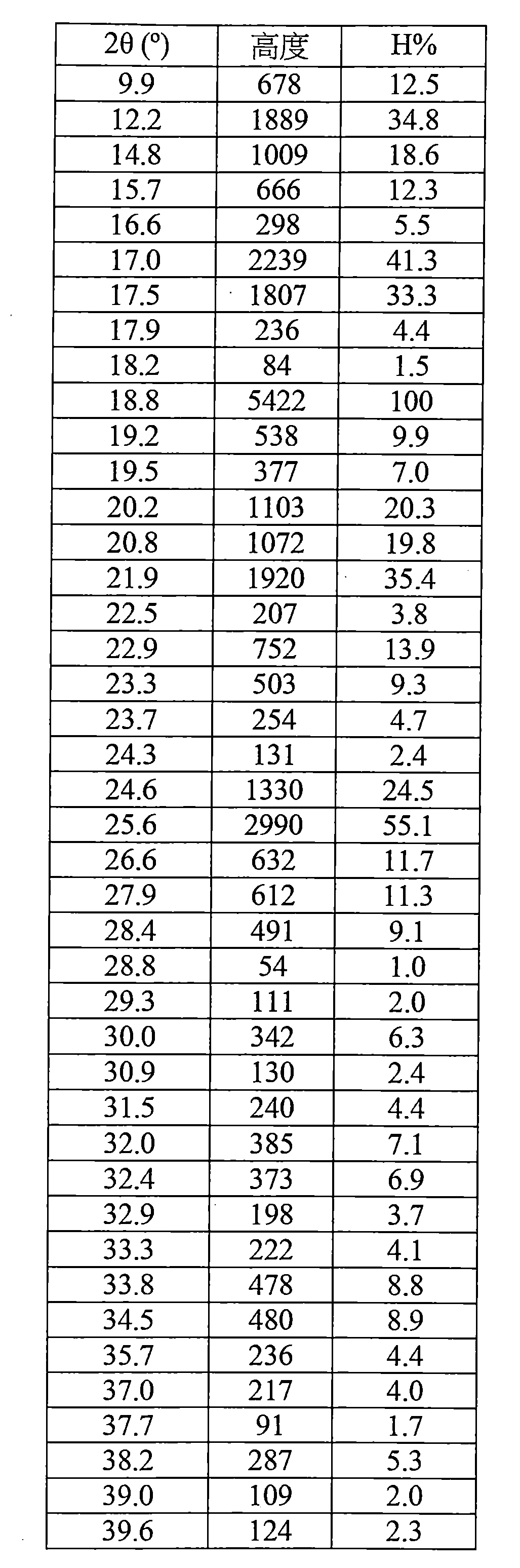


表14. 形式XI


對形式Va、VII、VIII、X、XII、XIII、XIV及XV進行DSC研究。由具有自動採樣器之TA儀器差示掃描熱量測定,型號Q200獲得DSC。DSC儀器之條件如下:30-300℃,以10℃/min;Tzero鋁樣品盤及蓋;且氮氣流速為50mL/min。 DSC studies were performed on forms Va, VII, VIII, X, XII, XIII, XIV and XV. Differential scanning calorimetry of TA instrument with automatic sampler, model Q200 obtained DSC. The conditions of the DSC instrument are as follows: 30-300 ° C, at 10 ° C / min; Tzero aluminum sample pan and cover; and nitrogen flow rate is 50mL / min.
在形式Va、VII、VIII、X、XIII及XV上進行TGA研究。由TA儀器熱重分析儀型號Q500獲得TGA。TGA之通用實驗條件為:以20℃/min 自20℃斜升至600℃;氮氣淨化氣體流速為40mL/min;繼而為剩餘之淨化流;樣品淨化流速為60mL/min;鉑樣品盤。 TGA studies were performed on forms Va, VII, VIII, X, XIII, and XV. TGA was obtained from TA Instrument Thermogravimetric Model Q500. The general experimental conditions of TGA are: at 20 ℃ / min Inclined from 20 ° C to 600 ° C; nitrogen purge gas flow rate is 40mL / min; then the remaining purification flow; sample purification flow rate is 60mL / min; platinum sample tray.
下表19展示DSC及TGA之結果。 Table 19 below shows the results of DSC and TGA.
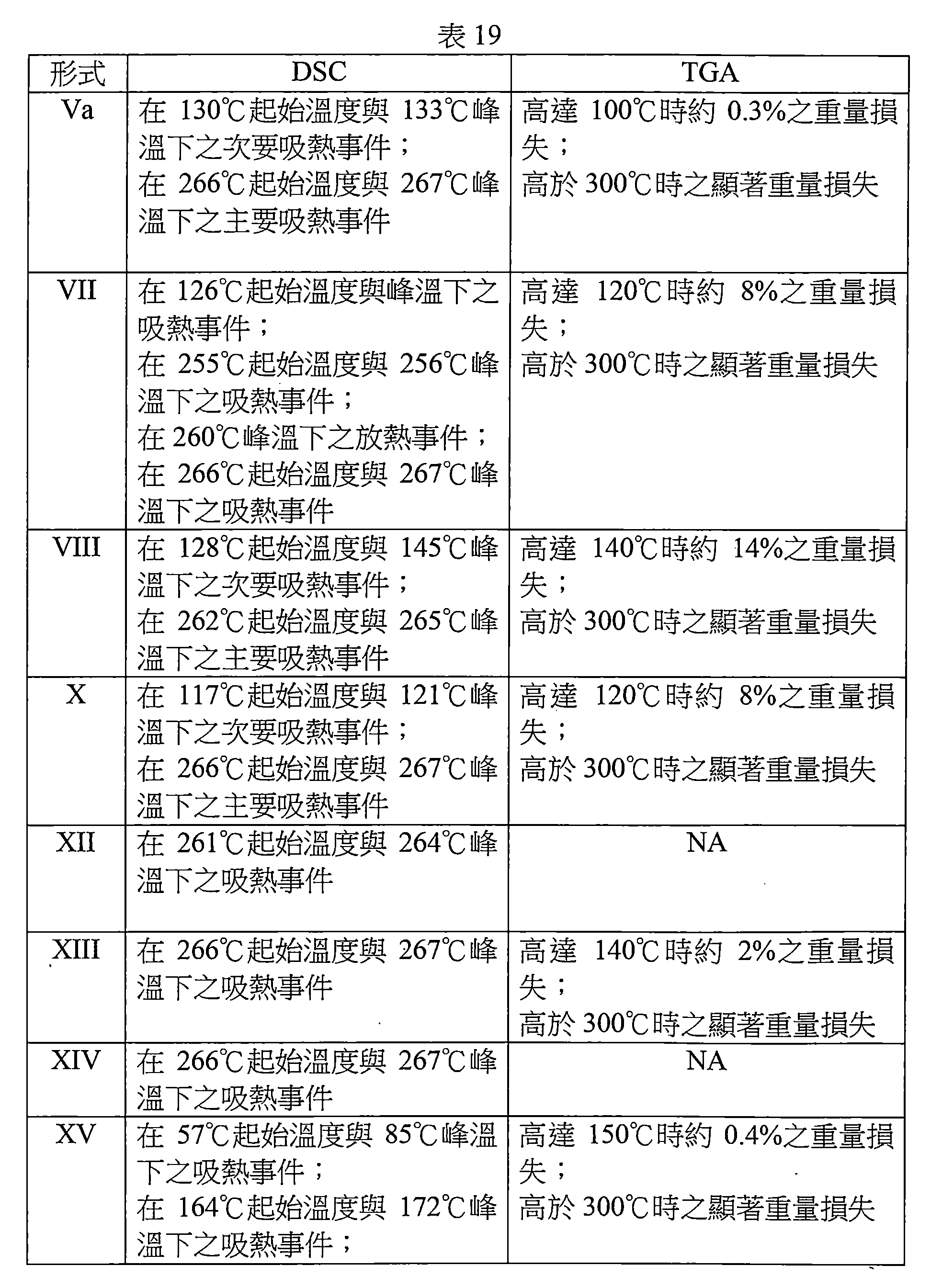

除本文所述彼等以外,熟習此項技術者由上文描述將顯而易見本發明之各種修改。該等修改亦欲在隨附申請專利範圍之範疇內。本申請中引用之每一參考文獻,包括所有專利、專利申請及公開案,均以全文引用之方式併入本文中。 In addition to those described herein, various modifications of the invention will be apparent to those skilled in the art from the foregoing description. Such modifications are also intended to be within the scope of the accompanying patent application. Each reference cited in this application, including all patents, patent applications, and publications, is incorporated herein by reference in its entirety.
Claims (53)


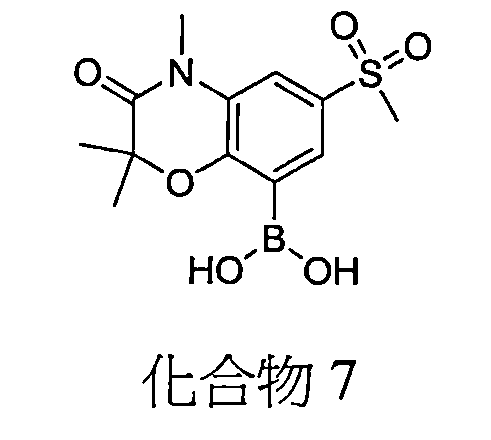


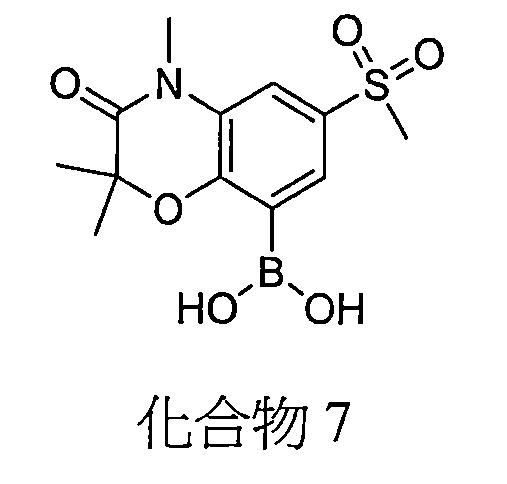

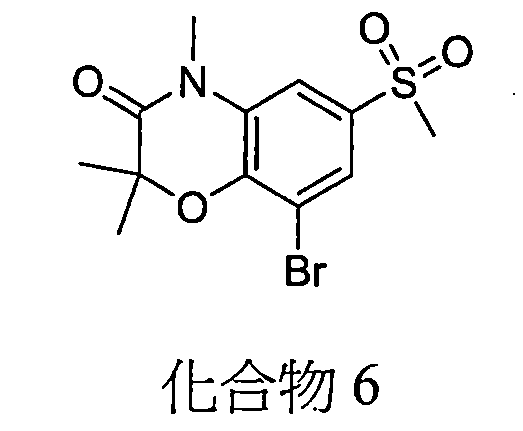


Applications Claiming Priority (4)
| Application Number | Priority Date | Filing Date | Title |
|---|---|---|---|
| US201662352220P | 2016-06-20 | 2016-06-20 | |
| US62/352,220 | 2016-06-20 | ||
| US201662397575P | 2016-09-21 | 2016-09-21 | |
| US62/397,575 | 2016-09-21 |
Publications (2)
| Publication Number | Publication Date |
|---|---|
| TW201800410A true TW201800410A (en) | 2018-01-01 |
| TWI786050B TWI786050B (en) | 2022-12-11 |
Family
ID=59258384
Family Applications (3)
| Application Number | Title | Priority Date | Filing Date |
|---|---|---|---|
| TW113101597A TWI854936B (en) | 2016-06-20 | 2017-06-19 | Crystalline solid forms of a bet inhibitor |
| TW111147670A TWI830533B (en) | 2016-06-20 | 2017-06-19 | Crystalline solid forms of a bet inhibitor |
| TW106120412A TWI786050B (en) | 2016-06-20 | 2017-06-19 | Crystalline solid forms of a bet inhibitor |
Family Applications Before (2)
| Application Number | Title | Priority Date | Filing Date |
|---|---|---|---|
| TW113101597A TWI854936B (en) | 2016-06-20 | 2017-06-19 | Crystalline solid forms of a bet inhibitor |
| TW111147670A TWI830533B (en) | 2016-06-20 | 2017-06-19 | Crystalline solid forms of a bet inhibitor |
Country Status (33)
| Country | Link |
|---|---|
| US (6) | US10189832B2 (en) |
| EP (2) | EP3472157B1 (en) |
| JP (6) | JP7096170B2 (en) |
| KR (4) | KR102888132B1 (en) |
| CN (3) | CN109715625B (en) |
| AU (3) | AU2017281286B2 (en) |
| CA (3) | CA3220975A1 (en) |
| CL (3) | CL2018003702A1 (en) |
| CO (1) | CO2018014339A2 (en) |
| CR (2) | CR20190027A (en) |
| CY (1) | CY1126092T1 (en) |
| DK (1) | DK3472157T3 (en) |
| EC (1) | ECSP19001982A (en) |
| ES (1) | ES2945063T3 (en) |
| FI (1) | FI3472157T3 (en) |
| HR (1) | HRP20230466T1 (en) |
| HU (1) | HUE062234T2 (en) |
| IL (3) | IL302528A (en) |
| LT (1) | LT3472157T (en) |
| MD (1) | MD3472157T2 (en) |
| MX (3) | MX389145B (en) |
| MY (2) | MY198892A (en) |
| PE (2) | PE20190623A1 (en) |
| PH (3) | PH12021551887A1 (en) |
| PL (1) | PL3472157T3 (en) |
| PT (1) | PT3472157T (en) |
| RS (1) | RS64274B1 (en) |
| SG (2) | SG11201811416VA (en) |
| SI (1) | SI3472157T1 (en) |
| SM (1) | SMT202300155T1 (en) |
| TW (3) | TWI854936B (en) |
| UA (2) | UA124106C2 (en) |
| WO (1) | WO2017222977A1 (en) |
Families Citing this family (24)
| Publication number | Priority date | Publication date | Assignee | Title |
|---|---|---|---|---|
| EP3581576B1 (en) | 2013-03-15 | 2022-01-26 | Incyte Holdings Corporation | Tricyclic heterocycles as bet protein inhibitors for use in the treatment of a proliferative disease in combination with a janus kinase inhibitor |
| WO2015095492A1 (en) | 2013-12-19 | 2015-06-25 | Incyte Corporation | Tricyclic heterocycles as bet protein inhibitors |
| NZ763740A (en) | 2014-04-23 | 2023-06-30 | Incyte Holdings Corp | 1h-pyrrolo[2,3-c]pyridin-7(6h)-ones and pyrazolo[3,4-c]pyridin-7(6h)-ones as inhibitors of bet proteins |
| ES2855225T3 (en) | 2014-09-15 | 2021-09-23 | Incyte Corp | Tricyclic heterocycles for use as BET protein inhibitors |
| TW201722966A (en) | 2015-10-29 | 2017-07-01 | 英塞特公司 | Amorphous solid form of a BET protein inhibitor |
| MD3472157T2 (en) * | 2016-06-20 | 2023-10-31 | Incyte Corp | Crystalline solid forms of a BET inhibitor |
| TWI882964B (en) * | 2018-09-13 | 2025-05-11 | 大陸商恒翼生物醫藥(上海)股份有限公司 | Method of manufacturing a solid form of a bet bromodomain inhibitor |
| WO2021217117A1 (en) * | 2020-04-24 | 2021-10-28 | Memorial Sloan Kettering Cancer Center | Targeted therapy for the treatment & prevention of life-threatening complications of infection |
| EP4161528B1 (en) * | 2020-06-03 | 2025-11-05 | Incyte Corporation | Combination of ruxolitinib with incb057643 for use in the treatment of myeloproliferative neoplasms |
| US11833155B2 (en) | 2020-06-03 | 2023-12-05 | Incyte Corporation | Combination therapy for treatment of myeloproliferative neoplasms |
| CN112137961A (en) * | 2020-09-30 | 2020-12-29 | 严鹏科 | Rapamycin composition and preparation method thereof |
| JP2024500975A (en) * | 2020-12-23 | 2024-01-10 | カスケード プロドラッグ インコーポレイテッド | Combination therapy with vinca alkaloid N-oxide and immune checkpoint inhibitors |
| TW202508595A (en) | 2023-05-04 | 2025-03-01 | 美商銳新醫藥公司 | Combination therapy for a ras related disease or disorder |
| US20250049810A1 (en) | 2023-08-07 | 2025-02-13 | Revolution Medicines, Inc. | Methods of treating a ras protein-related disease or disorder |
| WO2025080946A2 (en) | 2023-10-12 | 2025-04-17 | Revolution Medicines, Inc. | Ras inhibitors |
| WO2025171296A1 (en) | 2024-02-09 | 2025-08-14 | Revolution Medicines, Inc. | Ras inhibitors |
| WO2025240847A1 (en) | 2024-05-17 | 2025-11-20 | Revolution Medicines, Inc. | Ras inhibitors |
| WO2025255438A1 (en) | 2024-06-07 | 2025-12-11 | Revolution Medicines, Inc. | Methods of treating a ras protein-related disease or disorder |
| WO2025265060A1 (en) | 2024-06-21 | 2025-12-26 | Revolution Medicines, Inc. | Therapeutic compositions and methods for managing treatment-related effects |
| WO2026006747A1 (en) | 2024-06-28 | 2026-01-02 | Revolution Medicines, Inc. | Ras inhibitors |
| WO2026015801A1 (en) | 2024-07-12 | 2026-01-15 | Revolution Medicines, Inc. | Methods of treating a ras related disease or disorder |
| WO2026015796A1 (en) | 2024-07-12 | 2026-01-15 | Revolution Medicines, Inc. | Methods of treating a ras related disease or disorder |
| WO2026015825A1 (en) | 2024-07-12 | 2026-01-15 | Revolution Medicines, Inc. | Use of ras inhibitor for treating pancreatic cancer |
| WO2026015790A1 (en) | 2024-07-12 | 2026-01-15 | Revolution Medicines, Inc. | Methods of treating a ras related disease or disorder |
Family Cites Families (167)
| Publication number | Priority date | Publication date | Assignee | Title |
|---|---|---|---|---|
| JPS59170313A (en) | 1983-03-14 | 1984-09-26 | Kurimoto Iron Works Ltd | Screen gate |
| JPS6085739U (en) | 1983-11-18 | 1985-06-13 | クラリオン株式会社 | Pinch roller device in tape recorder |
| JPS6243003U (en) | 1985-09-05 | 1987-03-14 | ||
| JPH0314566A (en) | 1989-06-09 | 1991-01-23 | Sankyo Co Ltd | Benzimidazole derivative |
| US5244912A (en) | 1991-03-28 | 1993-09-14 | Eli Lilly And Company | 6-heterocyclic-4-amino-1,3,4,5-tetrahydrobenz(cd)indoles and pharmaceutical use thereof |
| FR2710915B1 (en) | 1993-10-04 | 1995-11-24 | Synthelabo | Piperidine derivatives, their preparation and their therapeutic use. |
| GB9410469D0 (en) | 1994-05-25 | 1994-07-13 | Erba Farmitalia | Imidazolylalkyl derivatives of imidazo (5,1-c) (1,4) benzoxazin-1-one and process for their preparation |
| FR2731708B1 (en) | 1995-03-13 | 1997-04-30 | Synthelabo | PIPERIDINE DERIVATIVES, THEIR PREPARATION PROCESS AND THEIR THERAPEUTIC APPLICATION |
| FR2747678B1 (en) | 1996-04-22 | 1998-05-22 | Synthelabo | COMPOUNDS DERIVED FROM IMIDAZOBENZOXAZINE, PROCESSES FOR THEIR PREPARATION AND THERAPEUTIC USES |
| US6287693B1 (en) | 1998-02-25 | 2001-09-11 | John Claude Savoir | Stable shaped particles of crystalline organic compounds |
| ATE312608T1 (en) | 2000-04-21 | 2005-12-15 | Pharmacia & Upjohn Co Llc | CABERGOLINE FOR THE TREATMENT OF FIBROMYALGIA AND CHRONIC FATIGUE SYNDROME |
| KR100786927B1 (en) | 2000-06-28 | 2007-12-17 | 스미스클라인비이참피이엘시이 | Wet Grinding Method |
| FR2816619B1 (en) | 2000-11-15 | 2003-01-31 | Sanofi Synthelabo | BENZIMIDAZOLE DERIVATIVES, THEIR PREPARATION AND THEIR THERAPEUTIC APPLICATION |
| JP2004505975A (en) | 2000-08-08 | 2004-02-26 | サノフィ−サンテラボ | Benzimidazole derivatives, their production and therapeutic use |
| US6919334B2 (en) | 2002-09-12 | 2005-07-19 | Wyeth | Antidepressant azaheterocyclymethyl derivatives of 4,5-dihydroimidazo[1,4,5-de][1,4]benzoxazine |
| AU2003293006A1 (en) | 2002-11-22 | 2004-06-18 | Japan Tobacco Inc. | Fused bicyclic nitrogen-containing heterocycles |
| EP1462103A1 (en) | 2003-03-25 | 2004-09-29 | Faust Pharmaceuticals | NO donors, combination products and uses as modulators of neurotransmitter release |
| KR20060129023A (en) | 2004-02-23 | 2006-12-14 | 다이닛본 스미토모 세이야꾸 가부시끼가이샤 | Novel heterocyclic compounds |
| CA2562244A1 (en) | 2004-04-07 | 2005-10-27 | Takeda Pharmaceutical Company Limited | Cyclic compounds |
| US7713954B2 (en) | 2004-09-30 | 2010-05-11 | Roche Palo Alto Llc | Compositions and methods for treating cognitive disorders |
| DE102005011058A1 (en) | 2005-03-10 | 2006-09-14 | Merck Patent Gmbh | Substituted tetrahydro-pyrrolo-quinoline derivatives |
| WO2006124874A2 (en) | 2005-05-12 | 2006-11-23 | Kalypsys, Inc. | Inhibitors of b-raf kinase |
| WO2006129623A1 (en) | 2005-05-30 | 2006-12-07 | Mitsubishi Tanabe Pharma Corporation | Thienotriazolodiazepine compound and a medicinal use thereof |
| AU2006279034A1 (en) | 2005-08-05 | 2007-02-15 | Astrazeneca Ab | Tricyclic benzimidazoles and their use as metabotropic glutamate receptor modulators |
| US8975259B2 (en) | 2007-04-27 | 2015-03-10 | University Of Rochester | Compositions and methods for inhibiting G protein signaling |
| US9603848B2 (en) | 2007-06-08 | 2017-03-28 | Senomyx, Inc. | Modulation of chemosensory receptors and ligands associated therewith |
| US8633186B2 (en) | 2007-06-08 | 2014-01-21 | Senomyx Inc. | Modulation of chemosensory receptors and ligands associated therewith |
| US7928111B2 (en) | 2007-06-08 | 2011-04-19 | Senomyx, Inc. | Compounds including substituted thienopyrimidinone derivatives as ligands for modulating chemosensory receptors |
| WO2009020559A2 (en) | 2007-08-03 | 2009-02-12 | The J. David Gladstone Institutes | Agents that inhibit p-tefb interactions and methods of use thereof |
| JP5478262B2 (en) | 2007-12-28 | 2014-04-23 | 田辺三菱製薬株式会社 | Anticancer drug |
| DE102008052618A1 (en) | 2008-10-21 | 2010-04-22 | Henkel Ag & Co. Kgaa | Tricyclic aldehydes and C, H-acidic compounds |
| US8669249B2 (en) | 2009-03-27 | 2014-03-11 | Takeda Pharmaceutical Company Limited | Poly (ADP-ribose) polymerase (PARP) inhibitors |
| TW201103941A (en) | 2009-06-10 | 2011-02-01 | Janssen Pharmaceutica Nv | Benzimidazole derivatives useful as TRPM8 channel modulators |
| TW201105681A (en) | 2009-06-10 | 2011-02-16 | Janssen Pharmaceutica Nv | Benzimidazole derivatives useful as TRPM8 channel modulators |
| WO2011024987A1 (en) | 2009-08-31 | 2011-03-03 | 塩野義製薬株式会社 | Aromatic fused heterocyclic derivative and pharmaceutical composition containing same |
| GB0919431D0 (en) | 2009-11-05 | 2009-12-23 | Glaxosmithkline Llc | Novel compounds |
| GB0919426D0 (en) | 2009-11-05 | 2009-12-23 | Glaxosmithkline Llc | Novel compounds |
| GB0919432D0 (en) | 2009-11-05 | 2009-12-23 | Glaxosmithkline Llc | Use |
| ES2564318T3 (en) | 2009-11-05 | 2016-03-21 | Glaxosmithkline Llc | Benzodiazepine Bromodomain Inhibitor |
| WO2011054851A1 (en) | 2009-11-05 | 2011-05-12 | Glaxosmithkline Llc | Novel process |
| KR101424989B1 (en) | 2009-11-05 | 2014-07-31 | 글락소스미스클라인 엘엘씨 | Benzodiazepine bromodomain inhibitor |
| GB0919434D0 (en) | 2009-11-05 | 2009-12-23 | Glaxosmithkline Llc | Novel compounds |
| GB0919423D0 (en) | 2009-11-05 | 2009-12-23 | Glaxosmithkline Llc | Novel compounds |
| BR112012026641A2 (en) | 2010-04-23 | 2016-07-12 | Kineta Inc | antiviral compounds |
| CA2799403C (en) | 2010-05-14 | 2020-01-21 | Dana-Farber Cancer Institute, Inc. | Compositions and methods for treating leukemia |
| CA2799373A1 (en) | 2010-05-14 | 2011-11-17 | Dana-Farber Cancer Institute, Inc. | Compositions and methods for modulating metabolism |
| CA2799420C (en) | 2010-05-14 | 2018-10-02 | Dana-Farber Cancer Institute, Inc. | Compositions and methods for treating neoplasia, inflammatory disease and other disorders |
| US9301962B2 (en) | 2010-05-14 | 2016-04-05 | Baylor College Of Medicine | Male contraceptive compositions and methods of use |
| WO2011161031A1 (en) | 2010-06-22 | 2011-12-29 | Glaxosmithkline Llc | Benzotriazolodiazepine compounds inhibitors of bromodomains |
| US9249161B2 (en) | 2010-12-02 | 2016-02-02 | Constellation Pharmaceuticals, Inc. | Bromodomain inhibitors and uses thereof |
| AR084070A1 (en) | 2010-12-02 | 2013-04-17 | Constellation Pharmaceuticals Inc | BROMODOMINIUM INHIBITORS AND USES OF THE SAME |
| CA2825028A1 (en) | 2011-02-09 | 2012-08-16 | F. Hoffman-La Roche Ag | Heterocyclic compounds as pi3 kinase inhibitors |
| CN103547152A (en) | 2011-02-23 | 2014-01-29 | 西奈山伊坎医学院 | Inhibitors of bromodomains as modulators of gene expression |
| WO2012126901A1 (en) | 2011-03-21 | 2012-09-27 | F. Hoffmann-La Roche Ag | Benzoxazepin compounds selective for pi3k p110 delta and methods of use |
| GB201106799D0 (en) | 2011-04-21 | 2011-06-01 | Glaxosmithkline Llc | Novel compounds |
| GB201106750D0 (en) | 2011-04-21 | 2011-06-01 | Glaxosmithkline Llc | Novel compounds |
| GB201106743D0 (en) | 2011-04-21 | 2011-06-01 | Glaxosmithkline Llc | Novel compounds |
| GB201107325D0 (en) | 2011-05-04 | 2011-06-15 | Glaxosmithkline Llc | Novel compounds |
| US9422292B2 (en) | 2011-05-04 | 2016-08-23 | Constellation Pharmaceuticals, Inc. | Bromodomain inhibitors and uses thereof |
| US9328117B2 (en) | 2011-06-17 | 2016-05-03 | Constellation Pharmaceuticals, Inc. | Bromodomain inhibitors and uses thereof |
| EP2723338A2 (en) | 2011-06-24 | 2014-04-30 | The Trustees of Stevens Institute of Technology | Selective inhibitors of histone deacetylase isoform 6 and methods thereof |
| JP2013010719A (en) | 2011-06-30 | 2013-01-17 | Dainippon Sumitomo Pharma Co Ltd | Benzimidazolone and oxindole derivative, and pharmaceutical application of them |
| CA2843643A1 (en) | 2011-07-29 | 2013-02-07 | The Children's Hospital Of Philadelphia | Compositions and methods for the treatment of hiv |
| GB201114103D0 (en) | 2011-08-17 | 2011-09-28 | Glaxosmithkline Llc | Novel compounds |
| WO2013027168A1 (en) | 2011-08-22 | 2013-02-28 | Pfizer Inc. | Novel heterocyclic compounds as bromodomain inhibitors |
| WO2013033268A2 (en) | 2011-08-29 | 2013-03-07 | Coferon, Inc. | Bivalent bromodomain ligands, and methods of using same |
| WO2013033269A1 (en) | 2011-08-29 | 2013-03-07 | Coferon, Inc. | Bioorthogonal monomers capable of dimerizing and targeting bromodomains and methods of using same |
| LT2751083T (en) | 2011-08-31 | 2018-03-26 | Otsuka Pharmaceutical Co., Ltd. | QUINOLON COMPOUND |
| DE102011082013A1 (en) | 2011-09-01 | 2013-03-07 | Bayer Pharma AG | 6H-thieno [3,2-f] [1,2,4] triazolo [4,3-a] [1,4] diazepines |
| US9012642B2 (en) | 2011-09-22 | 2015-04-21 | Viiv Healthcare Uk Limited | Pyrrolopyridinone compounds and methods for treating HIV |
| WO2013044511A1 (en) | 2011-09-30 | 2013-04-04 | 沈阳蓝桑医药生物技术研发有限公司 | Pharmaceutical composition containing riligustilide and use thereof |
| WO2013060636A1 (en) | 2011-10-25 | 2013-05-02 | Sanofi | 6-(4-hydroxy-phenyl)-1h-pyrazolo[3,4-b]pyridine-4-carboxylic acid amide derivatives as kinase inhibitors |
| ES2745471T3 (en) | 2011-11-01 | 2020-03-02 | Resverlogix Corp | Oral immediate-release formulations for substituted quinazolinones |
| WO2013097052A1 (en) | 2011-12-30 | 2013-07-04 | Abbott Laboratories | Bromodomain inhibitors |
| EP2830629A4 (en) | 2012-03-28 | 2016-01-20 | Icahn School Of Medicine Mount Sinai | COMPOSITIONS AND METHODS FOR REACTING LATENT IMMUNODEFICIENCY VIRUS |
| US20130281396A1 (en) | 2012-04-19 | 2013-10-24 | Rvx Therapeutics Inc. | Treatment of diseases by epigenetic regulation |
| US20130281397A1 (en) | 2012-04-19 | 2013-10-24 | Rvx Therapeutics Inc. | Treatment of diseases by epigenetic regulation |
| US20130281399A1 (en) | 2012-04-19 | 2013-10-24 | Rvx Therapeutics Inc. | Treatment of diseases by epigenetic regulation |
| US20130281398A1 (en) | 2012-04-19 | 2013-10-24 | Rvx Therapeutics Inc. | Treatment of diseases by epigenetic regulation |
| CN104334526A (en) | 2012-04-20 | 2015-02-04 | 艾伯维公司 | Isoindolone derivatives |
| WO2013184878A1 (en) | 2012-06-06 | 2013-12-12 | Constellation Pharmaceuticals, Inc. | Benzo [b] isoxazoloazepine bromodomain inhibitors and uses thereof |
| TWI602820B (en) | 2012-06-06 | 2017-10-21 | 星宿藥物公司 | Bromodomain inhibitors and uses thereof |
| BR112014031068A2 (en) | 2012-06-12 | 2017-06-27 | Abbvie Inc | pyridinone and pyridazinone derivatives |
| IN2014DN11269A (en) | 2012-06-25 | 2015-10-09 | Oncoethix Sa | |
| WO2014015175A1 (en) | 2012-07-18 | 2014-01-23 | Massachusetts Institute Of Technology | Compositions and methods for modulating brd4 bioactivity |
| EP2884983B1 (en) | 2012-08-16 | 2017-10-04 | GlaxoSmithKline LLC | Benzodiazepines for treating small cell lung cancer |
| ES2628005T3 (en) | 2012-08-16 | 2017-08-01 | Bayer Pharma Aktiengesellschaft | 2,3-Benzodiazepines |
| JP6276277B2 (en) | 2012-09-28 | 2018-02-07 | バイエル ファーマ アクチエンゲゼルシャフト | BET protein inhibitory 5-aryltriazoloazepines |
| HK1211209A1 (en) | 2012-09-28 | 2016-05-20 | Oncoethix Gmbh | Pharmaceutical formulation containing thienotriazolodiazepine compounds |
| AP2015008433A0 (en) | 2012-11-09 | 2015-05-31 | Jacobus Pahrmaceutical Company Inc | Heteroaryl derivatives and uses thereof |
| US9422290B2 (en) | 2012-11-13 | 2016-08-23 | Boehringer Ingelheim International Gmbh | Triazolopyridazine |
| US9663533B2 (en) | 2012-11-14 | 2017-05-30 | Glaxosmithkline Llc | Thieno[3,2-C]pyridin-4(5H)-ones as BET inhibitors |
| US9073878B2 (en) | 2012-11-21 | 2015-07-07 | Zenith Epigenetics Corp. | Cyclic amines as bromodomain inhibitors |
| US9765039B2 (en) | 2012-11-21 | 2017-09-19 | Zenith Epigenetics Ltd. | Biaryl derivatives as bromodomain inhibitors |
| CA2895404A1 (en) | 2012-12-20 | 2014-06-26 | Bayer Pharma Aktiengesellschaft | Bet-protein-inhibiting dihydropyridopyrazinones |
| CN104995190A (en) | 2012-12-20 | 2015-10-21 | 拜耳医药股份有限公司 | Bet-protein-inhibiting dihydroquinoxalinones |
| EP2935253B1 (en) | 2012-12-21 | 2018-08-01 | Zenith Epigenetics Ltd. | Novel heterocyclic compounds as bromodomain inhibitors |
| WO2014128655A1 (en) | 2013-02-25 | 2014-08-28 | Aurigene Discovery Technologies Limited | Substituted imidazo[4,5-c]quinoline derivatives as bromodomain inhibitors |
| US10053454B2 (en) | 2013-02-27 | 2018-08-21 | Bristol-Myers Squibb Company | Carbazole compounds useful as bromodomain inhibitors |
| US9492460B2 (en) | 2013-02-27 | 2016-11-15 | Bristol-Myers Squibb Company | Carbazole compounds useful as bromodomain inhibitors |
| US9675697B2 (en) | 2013-03-11 | 2017-06-13 | The Regents Of The University Of Michigan | BET bromodomain inhibitors and therapeutic methods using the same |
| JP2016512524A (en) | 2013-03-11 | 2016-04-28 | アッヴィ・インコーポレイテッド | Bromodomain inhibitor |
| EP2970285B1 (en) | 2013-03-11 | 2019-04-17 | AbbVie Inc. | Fused tetracyclic bromodomain inhibitors |
| AR095266A1 (en) | 2013-03-12 | 2015-09-30 | Abbvie Inc | TETRACICLIC BROMODOMINES INHIBITORS |
| RU2015143191A (en) | 2013-03-12 | 2017-04-18 | Эббви Инк. | DYHYDROPYRROLOPYRIDINE BROMODOMENE INHIBITORS |
| JP2016512542A (en) | 2013-03-12 | 2016-04-28 | アッヴィ・インコーポレイテッド | Pyrrolamide inhibitor |
| AU2014230816B9 (en) | 2013-03-14 | 2016-12-15 | Glaxosmithkline Intellectual Property (No.2) Limited | Furopyridines as bromodomain inhibitors |
| US9637456B2 (en) | 2013-03-14 | 2017-05-02 | Glaxosmithkline Intellectual Property (No. 2) Limited | 2,3-disubstituted 1-acyl-4-amino-1,2,3,4-tetrahydroquinoline derivatives and their use as bromodomain inhibitors |
| US9714946B2 (en) | 2013-03-14 | 2017-07-25 | Dana-Farber Cancer Institute, Inc. | Bromodomain binding reagents and uses thereof |
| WO2014159837A1 (en) | 2013-03-14 | 2014-10-02 | Convergene Llc | Methods and compositions for inhibition of bromodomain-containing proteins |
| EP3581576B1 (en) | 2013-03-15 | 2022-01-26 | Incyte Holdings Corporation | Tricyclic heterocycles as bet protein inhibitors for use in the treatment of a proliferative disease in combination with a janus kinase inhibitor |
| DK2970265T3 (en) | 2013-03-15 | 2018-10-01 | Plexxikon Inc | HETEROCYCLIC COMPOUNDS AND APPLICATIONS THEREOF |
| JP2016519660A (en) | 2013-03-15 | 2016-07-07 | エピジェネティクス・インコーポレイテッド | Oxazolo [5,4-c] quinolin-2-one compounds as bromodomain inhibitors |
| WO2014154762A1 (en) | 2013-03-27 | 2014-10-02 | Boehringer Ingelheim International Gmbh | Dihydroquinazolinone analogues as brd4 inhibitors |
| US9102684B2 (en) | 2013-03-27 | 2015-08-11 | Boehringer Ingelheim International Gmbh | Indolinone analogues |
| TWI530499B (en) | 2013-03-28 | 2016-04-21 | 吉李德科學股份有限公司 | Benzimidazolone derivatives as bromodomain inhibitors |
| WO2014170350A1 (en) | 2013-04-17 | 2014-10-23 | Albert Ludwigs Universität Freiburg | Compounds for use as bromodomain inhibitors |
| EP2989096B1 (en) | 2013-04-26 | 2019-04-10 | BeiGene, Ltd. | Substituted 5-(3,5-dimethylisoxazol-4-yl)indoline-2-ones |
| TWI527811B (en) | 2013-05-09 | 2016-04-01 | 吉李德科學股份有限公司 | Benzimidazole derivatives as bromodomain inhibitors |
| US8975417B2 (en) | 2013-05-27 | 2015-03-10 | Novartis Ag | Pyrazolopyrrolidine derivatives and their use in the treatment of disease |
| EA029312B1 (en) | 2013-05-27 | 2018-03-30 | Новартис Аг | Imidazopyrrolidinone derivatives and their use in the treatment of diseases |
| PL3004108T3 (en) | 2013-05-28 | 2018-03-30 | Novartis Ag | Pyrazolo-pyrrolidin-4-one derivatives as bet inhibitors and their use in the treatment of disease |
| ES2650562T3 (en) | 2013-05-28 | 2018-01-19 | Novartis Ag | Derivatives of pyrazolo-pyrrolidin-4-one and its use in the treatment of diseases |
| ITMI20130991A1 (en) | 2013-06-17 | 2014-12-18 | Industrie De Nora Spa | CURRENT MEASUREMENT SYSTEM PRESENT IN ELECTRODES IN INTERCONNECTED ELECTROLYTIC CELLS. |
| JP2016521722A (en) | 2013-06-17 | 2016-07-25 | バイエル ファーマ アクチエンゲゼルシャフト | Substituted phenyl-2,3-benzodiazepine |
| EP3010918B1 (en) | 2013-06-21 | 2018-08-15 | Zenith Epigenetics Ltd. | Novel substituted bicyclic compounds as bromodomain inhibitors |
| SI3010503T1 (en) | 2013-06-21 | 2020-07-31 | Zenith Epigenetics Ltd. | Novel bicyclic bromodomain inhibitors |
| AR096758A1 (en) * | 2013-06-28 | 2016-02-03 | Abbvie Inc | BROMODOMINIUM CRYSTAL INHIBITORS |
| HK1223364A1 (en) | 2013-06-28 | 2017-07-28 | Abbvie Inc. | Bromodomain inhibitors |
| WO2015006193A1 (en) | 2013-07-08 | 2015-01-15 | Incyte Corporation | Tricyclic heterocycles as bet protein inhibitors |
| BR112015033042B1 (en) | 2013-07-16 | 2020-10-13 | Basf Se | azine compound, processes for the preparation of azine compound, agrochemical composition, process for the preparation of agrochemical compositions, method for controlling vegetation and use of the azine compound |
| JP2016531113A (en) | 2013-07-25 | 2016-10-06 | ダナ−ファーバー キャンサー インスティテュート, インコーポレイテッド | Inhibitors of transcription factors and uses thereof |
| KR101672096B1 (en) | 2013-09-30 | 2016-11-02 | 주식회사 엘지화학 | Heterocyclic compound and organic light emitting device comprising the same |
| SG11201602996RA (en) | 2013-10-18 | 2016-05-30 | Celgene Quanticel Res Inc | Bromodomain inhibitors |
| WO2015081189A1 (en) | 2013-11-26 | 2015-06-04 | Incyte Corporation | Bicyclic heterocycles as bet protein inhibitors |
| US9399640B2 (en) | 2013-11-26 | 2016-07-26 | Incyte Corporation | Substituted pyrrolo[2,3-c]pyridines and pyrazolo[3,4-c]pyridines as BET protein inhibitors |
| US20150148372A1 (en) | 2013-11-26 | 2015-05-28 | Incyte Corporation | Bicyclic heterocycles as bet protein inhibitors |
| EP3089970B1 (en) | 2013-12-09 | 2018-10-17 | AbbVie Inc. | Dihydropyridinone and dihydropyridazinone derivatives useful as bromodomain inhibitors |
| WO2015095492A1 (en) | 2013-12-19 | 2015-06-25 | Incyte Corporation | Tricyclic heterocycles as bet protein inhibitors |
| WO2015095445A1 (en) | 2013-12-20 | 2015-06-25 | Merck Sharp & Dohme Corp. | Thiazole-substituted aminoheteroaryls as spleen tyrosine kinase inhibitors |
| UA117165C2 (en) | 2014-01-09 | 2018-06-25 | Оріон Корпорейшн | Bicyclic heterocyclic derivatives as bromodomain inhibitors |
| AU2015222887B2 (en) | 2014-02-28 | 2019-06-27 | The Regents Of The University Of Michigan | 9H-pyrimido[4,5-b]indoles and related analogs as BET bromodomain inhibitors |
| CR20160545A (en) | 2014-04-23 | 2017-03-31 | Basf Se | DIAMINOTRIAZINE COMPOUNDS AS HERBICIDES |
| NZ763740A (en) | 2014-04-23 | 2023-06-30 | Incyte Holdings Corp | 1h-pyrrolo[2,3-c]pyridin-7(6h)-ones and pyrazolo[3,4-c]pyridin-7(6h)-ones as inhibitors of bet proteins |
| SI3134386T1 (en) | 2014-04-23 | 2020-10-30 | Takeda Pharmaceutical Company Limited | Isoindolin-1-one derivatives as cholinergic muscarinic M1 receptor positive allosteric modulatory activity for the treatment of Alzheimer's disease |
| EP3137085A4 (en) | 2014-05-02 | 2017-12-27 | Oncoethix GmbH | Method of treating acute myeloid leukemia and/or acute lymphoblastic leukemia using thienotriazolodiazepine compounds |
| EP3137086A4 (en) | 2014-05-02 | 2017-12-27 | Oncoethix GmbH | Method of treating resistant non-hodgkin lymphoma, medulloblastoma, and/or alk+non-small cell lung cancer using thienotriazolodiazepine compounds |
| WO2015169953A1 (en) | 2014-05-08 | 2015-11-12 | Oncoethix Gmbh | Method of treating glioma using thienotriazolodiazepine compounds |
| AU2015257658A1 (en) | 2014-05-08 | 2016-11-10 | Oncoethix Gmbh | Method of treating triple-negative breast cancer using thienotriazolodiazepine compounds |
| US10065951B2 (en) | 2014-05-30 | 2018-09-04 | Icahn School Of Medicine At Mount Sinai | Small molecule transcription modulators of bromodomains |
| ES2725928T3 (en) | 2014-06-20 | 2019-09-30 | Constellation Pharmaceuticals Inc | Crystal forms of 2 - ((4S) -6- (4-chlorophenyl) -1-methyl-4H-benzo [c] isoxazolo [4,5-e] azepin-4-yl) acetamide |
| US9861077B2 (en) | 2014-07-11 | 2018-01-09 | Jaan Aked-Hurditch | Leash accessory |
| ES2855225T3 (en) | 2014-09-15 | 2021-09-23 | Incyte Corp | Tricyclic heterocycles for use as BET protein inhibitors |
| LT3209656T (en) | 2014-10-24 | 2020-07-27 | Bristol-Myers Squibb Company | Indole carboxamides compounds useful as kinase inhibitors |
| MA40943A (en) | 2014-11-10 | 2017-09-19 | Constellation Pharmaceuticals Inc | SUBSTITUTED PYRROLOPYRIDINES USED AS BROMODOMA INHIBITORS |
| EP3253756B1 (en) | 2015-02-03 | 2021-09-22 | Trillium Therapeutics Inc. | Fluorinated imidazo[4,5-c]quinoline derivatives as inhibitors of bromodomain containing proteins |
| WO2016186453A1 (en) | 2015-05-20 | 2016-11-24 | Kainos Medicine, Inc. | Quinoline derivatives as bromodomain inhibitors |
| WO2016194806A1 (en) | 2015-05-29 | 2016-12-08 | 塩野義製薬株式会社 | Nitrogen-containing tricyclic derivative having hiv replication inhibitory activity |
| CN105039258B (en) | 2015-07-03 | 2018-04-17 | 北京大学 | Method and composition by non-neuronal cell reprogramming for neuron cell |
| TW201722966A (en) | 2015-10-29 | 2017-07-01 | 英塞特公司 | Amorphous solid form of a BET protein inhibitor |
| CN105254635A (en) | 2015-10-30 | 2016-01-20 | 中国药科大学 | Imidazo pyrazine compound, medicine composition of imidazo pyrazine compound and purpose of imidazo pyrazine compound |
| US20170127985A1 (en) | 2015-11-11 | 2017-05-11 | Medtronic Minimed, Inc. | Sensor set |
| US20190263799A1 (en) | 2015-12-14 | 2019-08-29 | Zenith Epigenetics Ltd. | 1h-imidazo[4,5-b]pyridinyl and 2-oxo-2,3-dihydro-1h-imidazo[4,5-b]pyridinyl heterocyclic bet bromodomain inhibitors |
| WO2017127930A1 (en) | 2016-01-28 | 2017-08-03 | Neomed Institute | Substituted [1,2,4]triazolo[4,3-a]pyridines, their preparation and their use as pharmaceuticals |
| EP3412669A4 (en) | 2016-02-05 | 2019-09-04 | Chia Tai Tianqing Pharmaceutical Group Co.,Ltd | Tricyclic compound for bromodomain-containing protein inhibitor and preparation, pharmaceutical composition, and application thereof |
| MD3472157T2 (en) | 2016-06-20 | 2023-10-31 | Incyte Corp | Crystalline solid forms of a BET inhibitor |
| CN108069958A (en) | 2016-11-10 | 2018-05-25 | 凯惠科技发展(上海)有限公司 | A kind of nitrogen-containing hetero cyclics, its preparation method, pharmaceutical composition and application |
-
2017
- 2017-06-19 MD MDE20190507T patent/MD3472157T2/en unknown
- 2017-06-19 CA CA3220975A patent/CA3220975A1/en active Pending
- 2017-06-19 PL PL17734590.7T patent/PL3472157T3/en unknown
- 2017-06-19 KR KR1020247006758A patent/KR102888132B1/en active Active
- 2017-06-19 SI SI201731358T patent/SI3472157T1/en unknown
- 2017-06-19 US US15/626,539 patent/US10189832B2/en active Active
- 2017-06-19 TW TW113101597A patent/TWI854936B/en active
- 2017-06-19 CN CN201780038099.6A patent/CN109715625B/en active Active
- 2017-06-19 UA UAA201900524A patent/UA124106C2/en unknown
- 2017-06-19 PH PH1/2021/551887A patent/PH12021551887A1/en unknown
- 2017-06-19 SG SG11201811416VA patent/SG11201811416VA/en unknown
- 2017-06-19 TW TW111147670A patent/TWI830533B/en active
- 2017-06-19 CR CR20190027A patent/CR20190027A/en unknown
- 2017-06-19 LT LTEPPCT/US2017/038121T patent/LT3472157T/en unknown
- 2017-06-19 AU AU2017281286A patent/AU2017281286B2/en active Active
- 2017-06-19 CA CA3220957A patent/CA3220957A1/en active Pending
- 2017-06-19 DK DK17734590.7T patent/DK3472157T3/en active
- 2017-06-19 FI FIEP17734590.7T patent/FI3472157T3/en active
- 2017-06-19 PE PE2018003269A patent/PE20190623A1/en unknown
- 2017-06-19 IL IL302528A patent/IL302528A/en unknown
- 2017-06-19 RS RS20230430A patent/RS64274B1/en unknown
- 2017-06-19 HU HUE17734590A patent/HUE062234T2/en unknown
- 2017-06-19 KR KR1020227036514A patent/KR102643344B1/en active Active
- 2017-06-19 WO PCT/US2017/038121 patent/WO2017222977A1/en not_active Ceased
- 2017-06-19 ES ES17734590T patent/ES2945063T3/en active Active
- 2017-06-19 KR KR1020257037981A patent/KR20250163425A/en active Pending
- 2017-06-19 UA UAA202008134A patent/UA125476C2/en unknown
- 2017-06-19 CN CN202111443358.8A patent/CN114366748A/en active Pending
- 2017-06-19 MY MYPI2018002677A patent/MY198892A/en unknown
- 2017-06-19 TW TW106120412A patent/TWI786050B/en active
- 2017-06-19 HR HRP20230466TT patent/HRP20230466T1/en unknown
- 2017-06-19 SG SG10201912398PA patent/SG10201912398PA/en unknown
- 2017-06-19 CR CR20220651A patent/CR20220651A/en unknown
- 2017-06-19 EP EP17734590.7A patent/EP3472157B1/en active Active
- 2017-06-19 CN CN202111446313.6A patent/CN114369091A/en active Pending
- 2017-06-19 PH PH1/2021/551886A patent/PH12021551886A1/en unknown
- 2017-06-19 PE PE2023002468A patent/PE20240236A1/en unknown
- 2017-06-19 CA CA3028689A patent/CA3028689A1/en active Pending
- 2017-06-19 JP JP2018566525A patent/JP7096170B2/en active Active
- 2017-06-19 MX MX2018016281A patent/MX389145B/en unknown
- 2017-06-19 KR KR1020197001805A patent/KR102460046B1/en active Active
- 2017-06-19 MY MYPI2023005532A patent/MY209750A/en unknown
- 2017-06-19 PT PT177345907T patent/PT3472157T/en unknown
- 2017-06-19 EP EP23160938.9A patent/EP4234554A3/en active Pending
- 2017-06-19 SM SM20230155T patent/SMT202300155T1/en unknown
- 2017-06-19 IL IL263824A patent/IL263824B2/en unknown
-
2018
- 2018-12-07 US US16/213,202 patent/US10626114B2/en active Active
- 2018-12-19 MX MX2023009524A patent/MX2023009524A/en unknown
- 2018-12-19 CL CL2018003702A patent/CL2018003702A1/en unknown
- 2018-12-19 MX MX2021009776A patent/MX2021009776A/en unknown
- 2018-12-20 PH PH12018502709A patent/PH12018502709A1/en unknown
- 2018-12-28 CO CONC2018/0014339A patent/CO2018014339A2/en unknown
-
2019
- 2019-01-10 EC ECSENADI20191982A patent/ECSP19001982A/en unknown
-
2020
- 2020-02-19 CL CL2020000408A patent/CL2020000408A1/en unknown
- 2020-02-19 CL CL2020000407A patent/CL2020000407A1/en unknown
- 2020-03-24 US US16/828,031 patent/US11091480B2/en active Active
- 2020-12-18 US US17/127,351 patent/US11377446B2/en active Active
-
2021
- 2021-08-09 AU AU2021215112A patent/AU2021215112B2/en active Active
- 2021-08-17 IL IL285686A patent/IL285686B/en unknown
-
2022
- 2022-03-29 JP JP2022053417A patent/JP7375082B2/en active Active
- 2022-06-02 US US17/830,494 patent/US12030882B2/en active Active
- 2022-07-01 JP JP2022107131A patent/JP7588622B2/en active Active
-
2023
- 2023-06-15 CY CY20231100282T patent/CY1126092T1/en unknown
- 2023-09-11 AU AU2023229471A patent/AU2023229471B2/en active Active
- 2023-10-25 JP JP2023183248A patent/JP7789735B2/en active Active
-
2024
- 2024-05-28 US US18/675,780 patent/US12459943B2/en active Active
- 2024-06-03 JP JP2024089725A patent/JP7727794B2/en active Active
-
2025
- 2025-07-31 JP JP2025128117A patent/JP2025176008A/en active Pending
Also Published As
Similar Documents
| Publication | Publication Date | Title |
|---|---|---|
| JP7727794B2 (en) | Crystalline solid forms of BET inhibitors | |
| HK40099391A (en) | Crystalline solid forms of a bet inhibitor | |
| EA043645B1 (en) | CRYSTALINE SOLID FORMS OF BET INHIBITOR | |
| BR122024012313B1 (en) | SOLID CRYSTALLINE FORMS OF A BET INHIBITOR, PHARMACEUTICAL COMPOSITION AND USES THEREOF | |
| EA045891B1 (en) | CRYSTALINE SOLID FORMS OF BET INHIBITOR | |
| HK40006034A (en) | Crystalline solid forms of a bet inhibitor | |
| HK40006034B (en) | Crystalline solid forms of a bet inhibitor | |
| BR112018076486B1 (en) | SOLID CRYSTALLINE FORMS OF A BET INHIBITOR, THEIR PREPARATION PROCESS, PHARMACEUTICAL COMPOSITION AND USES THEREOF |