RU2630664C2 - Theophylline antibodies and methods for their application - Google Patents
Theophylline antibodies and methods for their application Download PDFInfo
- Publication number
- RU2630664C2 RU2630664C2 RU2015102068A RU2015102068A RU2630664C2 RU 2630664 C2 RU2630664 C2 RU 2630664C2 RU 2015102068 A RU2015102068 A RU 2015102068A RU 2015102068 A RU2015102068 A RU 2015102068A RU 2630664 C2 RU2630664 C2 RU 2630664C2
- Authority
- RU
- Russia
- Prior art keywords
- antibody
- amino acid
- theophylline
- seq
- hvr
- Prior art date
Links
- ZFXYFBGIUFBOJW-UHFFFAOYSA-N theophylline Chemical compound O=C1N(C)C(=O)N(C)C2=C1NC=N2 ZFXYFBGIUFBOJW-UHFFFAOYSA-N 0.000 title claims abstract description 242
- 229960000278 theophylline Drugs 0.000 title claims abstract description 162
- 238000000034 method Methods 0.000 title description 53
- 230000027455 binding Effects 0.000 claims abstract description 90
- 239000012634 fragment Substances 0.000 claims abstract description 33
- 125000003275 alpha amino acid group Chemical group 0.000 claims description 151
- 125000000539 amino acid group Chemical group 0.000 claims description 29
- 108091007491 NSP3 Papain-like protease domains Proteins 0.000 claims description 25
- NFGXHKASABOEEW-UHFFFAOYSA-N 1-methylethyl 11-methoxy-3,7,11-trimethyl-2,4-dodecadienoate Chemical compound COC(C)(C)CCCC(C)CC=CC(C)=CC(=O)OC(C)C NFGXHKASABOEEW-UHFFFAOYSA-N 0.000 claims description 15
- 102000008394 Immunoglobulin Fragments Human genes 0.000 claims description 13
- 108010021625 Immunoglobulin Fragments Proteins 0.000 claims description 13
- 239000004475 Arginine Substances 0.000 claims description 6
- ROHFNLRQFUQHCH-UHFFFAOYSA-N Leucine Natural products CC(C)CC(N)C(O)=O ROHFNLRQFUQHCH-UHFFFAOYSA-N 0.000 claims description 6
- ODKSFYDXXFIFQN-UHFFFAOYSA-N arginine Natural products OC(=O)C(N)CCCNC(N)=N ODKSFYDXXFIFQN-UHFFFAOYSA-N 0.000 claims description 6
- ROHFNLRQFUQHCH-YFKPBYRVSA-N L-leucine Chemical compound CC(C)C[C@H](N)C(O)=O ROHFNLRQFUQHCH-YFKPBYRVSA-N 0.000 claims description 5
- 101100454807 Caenorhabditis elegans lgg-1 gene Proteins 0.000 claims description 2
- 230000000694 effects Effects 0.000 abstract description 9
- 239000000126 substance Substances 0.000 abstract description 3
- 210000004027 cell Anatomy 0.000 description 60
- 239000000427 antigen Substances 0.000 description 45
- 108090000623 proteins and genes Proteins 0.000 description 45
- 108091007433 antigens Proteins 0.000 description 44
- 102000036639 antigens Human genes 0.000 description 44
- 238000006467 substitution reaction Methods 0.000 description 36
- 235000018102 proteins Nutrition 0.000 description 34
- 102000004169 proteins and genes Human genes 0.000 description 34
- 102000018071 Immunoglobulin Fc Fragments Human genes 0.000 description 32
- 108010091135 Immunoglobulin Fc Fragments Proteins 0.000 description 32
- 239000000203 mixture Substances 0.000 description 28
- 150000007523 nucleic acids Chemical class 0.000 description 27
- 108020004707 nucleic acids Proteins 0.000 description 26
- 102000039446 nucleic acids Human genes 0.000 description 26
- 239000013598 vector Substances 0.000 description 21
- 235000001014 amino acid Nutrition 0.000 description 20
- 230000014509 gene expression Effects 0.000 description 19
- 108090000765 processed proteins & peptides Proteins 0.000 description 19
- 208000037265 diseases, disorders, signs and symptoms Diseases 0.000 description 18
- 238000002360 preparation method Methods 0.000 description 17
- 102000004196 processed proteins & peptides Human genes 0.000 description 17
- 108060003951 Immunoglobulin Proteins 0.000 description 16
- 241000699666 Mus <mouse, genus> Species 0.000 description 16
- 239000003814 drug Substances 0.000 description 16
- 102000018358 immunoglobulin Human genes 0.000 description 16
- 229920001184 polypeptide Polymers 0.000 description 16
- 238000003780 insertion Methods 0.000 description 15
- 230000037431 insertion Effects 0.000 description 15
- 229940024606 amino acid Drugs 0.000 description 14
- 150000001413 amino acids Chemical class 0.000 description 14
- 239000000562 conjugate Substances 0.000 description 14
- 201000010099 disease Diseases 0.000 description 14
- 230000004048 modification Effects 0.000 description 14
- 238000012986 modification Methods 0.000 description 14
- 230000010056 antibody-dependent cellular cytotoxicity Effects 0.000 description 13
- 230000004071 biological effect Effects 0.000 description 13
- -1 digoxygenin Chemical compound 0.000 description 13
- 239000000243 solution Substances 0.000 description 13
- 150000001875 compounds Chemical class 0.000 description 12
- 238000012217 deletion Methods 0.000 description 12
- 230000037430 deletion Effects 0.000 description 12
- 229940127121 immunoconjugate Drugs 0.000 description 12
- 230000002285 radioactive effect Effects 0.000 description 12
- 230000006870 function Effects 0.000 description 11
- 230000035772 mutation Effects 0.000 description 11
- 230000015572 biosynthetic process Effects 0.000 description 10
- 230000004540 complement-dependent cytotoxicity Effects 0.000 description 10
- 238000010494 dissociation reaction Methods 0.000 description 10
- 230000005593 dissociations Effects 0.000 description 10
- 239000000047 product Substances 0.000 description 10
- 108091032973 (ribonucleotides)n+m Proteins 0.000 description 9
- 108020004414 DNA Proteins 0.000 description 9
- 239000003795 chemical substances by application Substances 0.000 description 9
- 229940127089 cytotoxic agent Drugs 0.000 description 9
- 238000005516 engineering process Methods 0.000 description 9
- 239000008194 pharmaceutical composition Substances 0.000 description 9
- 241000588724 Escherichia coli Species 0.000 description 8
- 239000002299 complementary DNA Substances 0.000 description 8
- LOKCTEFSRHRXRJ-UHFFFAOYSA-I dipotassium trisodium dihydrogen phosphate hydrogen phosphate dichloride Chemical compound P(=O)(O)(O)[O-].[K+].P(=O)(O)([O-])[O-].[Na+].[Na+].[Cl-].[K+].[Cl-].[Na+] LOKCTEFSRHRXRJ-UHFFFAOYSA-I 0.000 description 8
- 230000001965 increasing effect Effects 0.000 description 8
- 238000004519 manufacturing process Methods 0.000 description 8
- 239000002953 phosphate buffered saline Substances 0.000 description 8
- 239000013612 plasmid Substances 0.000 description 8
- 238000002965 ELISA Methods 0.000 description 7
- 150000001720 carbohydrates Chemical class 0.000 description 7
- 239000002254 cytotoxic agent Substances 0.000 description 7
- 239000003937 drug carrier Substances 0.000 description 7
- 239000012636 effector Substances 0.000 description 7
- 230000013595 glycosylation Effects 0.000 description 7
- 238000006206 glycosylation reaction Methods 0.000 description 7
- 210000004408 hybridoma Anatomy 0.000 description 7
- 238000001727 in vivo Methods 0.000 description 7
- 210000004962 mammalian cell Anatomy 0.000 description 7
- 150000002482 oligosaccharides Chemical class 0.000 description 7
- 230000002265 prevention Effects 0.000 description 7
- 229940124597 therapeutic agent Drugs 0.000 description 7
- 108700012359 toxins Proteins 0.000 description 7
- YBJHBAHKTGYVGT-ZKWXMUAHSA-N (+)-Biotin Chemical compound N1C(=O)N[C@@H]2[C@H](CCCCC(=O)O)SC[C@@H]21 YBJHBAHKTGYVGT-ZKWXMUAHSA-N 0.000 description 6
- AOJJSUZBOXZQNB-TZSSRYMLSA-N Doxorubicin Chemical compound O([C@H]1C[C@@](O)(CC=2C(O)=C3C(=O)C=4C=CC=C(C=4C(=O)C3=C(O)C=21)OC)C(=O)CO)[C@H]1C[C@H](N)[C@H](O)[C@H](C)O1 AOJJSUZBOXZQNB-TZSSRYMLSA-N 0.000 description 6
- KDXKERNSBIXSRK-UHFFFAOYSA-N Lysine Natural products NCCCCC(N)C(O)=O KDXKERNSBIXSRK-UHFFFAOYSA-N 0.000 description 6
- 239000002202 Polyethylene glycol Substances 0.000 description 6
- DNIAPMSPPWPWGF-UHFFFAOYSA-N Propylene glycol Chemical compound CC(O)CO DNIAPMSPPWPWGF-UHFFFAOYSA-N 0.000 description 6
- 108010076504 Protein Sorting Signals Proteins 0.000 description 6
- FAPWRFPIFSIZLT-UHFFFAOYSA-M Sodium chloride Chemical compound [Na+].[Cl-] FAPWRFPIFSIZLT-UHFFFAOYSA-M 0.000 description 6
- 238000010367 cloning Methods 0.000 description 6
- 231100000599 cytotoxic agent Toxicity 0.000 description 6
- 210000004602 germ cell Anatomy 0.000 description 6
- 238000002955 isolation Methods 0.000 description 6
- 229920001542 oligosaccharide Polymers 0.000 description 6
- 230000001575 pathological effect Effects 0.000 description 6
- 229920001223 polyethylene glycol Polymers 0.000 description 6
- 230000004481 post-translational protein modification Effects 0.000 description 6
- 239000006228 supernatant Substances 0.000 description 6
- 238000002198 surface plasmon resonance spectroscopy Methods 0.000 description 6
- 238000012360 testing method Methods 0.000 description 6
- 239000003053 toxin Substances 0.000 description 6
- 231100000765 toxin Toxicity 0.000 description 6
- SHZGCJCMOBCMKK-UHFFFAOYSA-N D-mannomethylose Natural products CC1OC(O)C(O)C(O)C1O SHZGCJCMOBCMKK-UHFFFAOYSA-N 0.000 description 5
- 241000196324 Embryophyta Species 0.000 description 5
- 102000004190 Enzymes Human genes 0.000 description 5
- 108090000790 Enzymes Proteins 0.000 description 5
- PNNNRSAQSRJVSB-SLPGGIOYSA-N Fucose Natural products C[C@H](O)[C@@H](O)[C@H](O)[C@H](O)C=O PNNNRSAQSRJVSB-SLPGGIOYSA-N 0.000 description 5
- DHMQDGOQFOQNFH-UHFFFAOYSA-N Glycine Chemical compound NCC(O)=O DHMQDGOQFOQNFH-UHFFFAOYSA-N 0.000 description 5
- SHZGCJCMOBCMKK-DHVFOXMCSA-N L-fucopyranose Chemical compound C[C@@H]1OC(O)[C@@H](O)[C@H](O)[C@@H]1O SHZGCJCMOBCMKK-DHVFOXMCSA-N 0.000 description 5
- KDXKERNSBIXSRK-YFKPBYRVSA-N L-lysine Chemical compound NCCCC[C@H](N)C(O)=O KDXKERNSBIXSRK-YFKPBYRVSA-N 0.000 description 5
- 206010028980 Neoplasm Diseases 0.000 description 5
- 108091028043 Nucleic acid sequence Proteins 0.000 description 5
- 239000002246 antineoplastic agent Substances 0.000 description 5
- 201000011510 cancer Diseases 0.000 description 5
- 235000014633 carbohydrates Nutrition 0.000 description 5
- 230000008859 change Effects 0.000 description 5
- 235000018417 cysteine Nutrition 0.000 description 5
- XUJNEKJLAYXESH-UHFFFAOYSA-N cysteine Natural products SCC(N)C(O)=O XUJNEKJLAYXESH-UHFFFAOYSA-N 0.000 description 5
- 238000001514 detection method Methods 0.000 description 5
- 229940079593 drug Drugs 0.000 description 5
- 229940088598 enzyme Drugs 0.000 description 5
- 230000006872 improvement Effects 0.000 description 5
- 210000003292 kidney cell Anatomy 0.000 description 5
- 239000000463 material Substances 0.000 description 5
- 235000004252 protein component Nutrition 0.000 description 5
- 230000001225 therapeutic effect Effects 0.000 description 5
- 238000002560 therapeutic procedure Methods 0.000 description 5
- 241000282693 Cercopithecidae Species 0.000 description 4
- 108091035707 Consensus sequence Proteins 0.000 description 4
- 241000701024 Human betaherpesvirus 5 Species 0.000 description 4
- 102100026120 IgG receptor FcRn large subunit p51 Human genes 0.000 description 4
- 101710177940 IgG receptor FcRn large subunit p51 Proteins 0.000 description 4
- 239000004472 Lysine Substances 0.000 description 4
- 241001465754 Metazoa Species 0.000 description 4
- OVRNDRQMDRJTHS-UHFFFAOYSA-N N-acelyl-D-glucosamine Natural products CC(=O)NC1C(O)OC(CO)C(O)C1O OVRNDRQMDRJTHS-UHFFFAOYSA-N 0.000 description 4
- MBLBDJOUHNCFQT-LXGUWJNJSA-N N-acetylglucosamine Natural products CC(=O)N[C@@H](C=O)[C@@H](O)[C@H](O)[C@H](O)CO MBLBDJOUHNCFQT-LXGUWJNJSA-N 0.000 description 4
- 229920001213 Polysorbate 20 Polymers 0.000 description 4
- 239000004480 active ingredient Substances 0.000 description 4
- 239000000872 buffer Substances 0.000 description 4
- 239000012228 culture supernatant Substances 0.000 description 4
- 125000000151 cysteine group Chemical group N[C@@H](CS)C(=O)* 0.000 description 4
- 238000003745 diagnosis Methods 0.000 description 4
- 208000035475 disorder Diseases 0.000 description 4
- 239000003623 enhancer Substances 0.000 description 4
- 230000001900 immune effect Effects 0.000 description 4
- 230000005847 immunogenicity Effects 0.000 description 4
- 229940072221 immunoglobulins Drugs 0.000 description 4
- 238000000338 in vitro Methods 0.000 description 4
- 239000003094 microcapsule Substances 0.000 description 4
- 229920000642 polymer Polymers 0.000 description 4
- 239000000256 polyoxyethylene sorbitan monolaurate Substances 0.000 description 4
- 235000010486 polyoxyethylene sorbitan monolaurate Nutrition 0.000 description 4
- 238000000746 purification Methods 0.000 description 4
- 230000009467 reduction Effects 0.000 description 4
- 230000002829 reductive effect Effects 0.000 description 4
- 230000002441 reversible effect Effects 0.000 description 4
- 238000012552 review Methods 0.000 description 4
- 238000012216 screening Methods 0.000 description 4
- 238000001542 size-exclusion chromatography Methods 0.000 description 4
- 238000001890 transfection Methods 0.000 description 4
- 238000005406 washing Methods 0.000 description 4
- XLYOFNOQVPJJNP-UHFFFAOYSA-N water Substances O XLYOFNOQVPJJNP-UHFFFAOYSA-N 0.000 description 4
- 241000894006 Bacteria Species 0.000 description 3
- WVDDGKGOMKODPV-UHFFFAOYSA-N Benzyl alcohol Chemical compound OCC1=CC=CC=C1 WVDDGKGOMKODPV-UHFFFAOYSA-N 0.000 description 3
- 241000699800 Cricetinae Species 0.000 description 3
- WQZGKKKJIJFFOK-QTVWNMPRSA-N D-mannopyranose Chemical compound OC[C@H]1OC(O)[C@@H](O)[C@@H](O)[C@@H]1O WQZGKKKJIJFFOK-QTVWNMPRSA-N 0.000 description 3
- LFQSCWFLJHTTHZ-UHFFFAOYSA-N Ethanol Chemical compound CCO LFQSCWFLJHTTHZ-UHFFFAOYSA-N 0.000 description 3
- LYCAIKOWRPUZTN-UHFFFAOYSA-N Ethylene glycol Chemical compound OCCO LYCAIKOWRPUZTN-UHFFFAOYSA-N 0.000 description 3
- PEDCQBHIVMGVHV-UHFFFAOYSA-N Glycerine Chemical compound OCC(O)CO PEDCQBHIVMGVHV-UHFFFAOYSA-N 0.000 description 3
- 102000003886 Glycoproteins Human genes 0.000 description 3
- 108090000288 Glycoproteins Proteins 0.000 description 3
- 108010001336 Horseradish Peroxidase Proteins 0.000 description 3
- 108010054477 Immunoglobulin Fab Fragments Proteins 0.000 description 3
- 102000001706 Immunoglobulin Fab Fragments Human genes 0.000 description 3
- DCXYFEDJOCDNAF-REOHCLBHSA-N L-asparagine Chemical compound OC(=O)[C@@H](N)CC(N)=O DCXYFEDJOCDNAF-REOHCLBHSA-N 0.000 description 3
- 241000124008 Mammalia Species 0.000 description 3
- OVRNDRQMDRJTHS-RTRLPJTCSA-N N-acetyl-D-glucosamine Chemical compound CC(=O)N[C@H]1C(O)O[C@H](CO)[C@@H](O)[C@@H]1O OVRNDRQMDRJTHS-RTRLPJTCSA-N 0.000 description 3
- 108010039491 Ricin Proteins 0.000 description 3
- 239000002253 acid Substances 0.000 description 3
- 230000001580 bacterial effect Effects 0.000 description 3
- 229960002685 biotin Drugs 0.000 description 3
- 235000020958 biotin Nutrition 0.000 description 3
- 239000011616 biotin Substances 0.000 description 3
- 210000004899 c-terminal region Anatomy 0.000 description 3
- 239000002738 chelating agent Substances 0.000 description 3
- 239000003153 chemical reaction reagent Substances 0.000 description 3
- KRKNYBCHXYNGOX-UHFFFAOYSA-N citric acid Chemical compound OC(=O)CC(O)(C(O)=O)CC(O)=O KRKNYBCHXYNGOX-UHFFFAOYSA-N 0.000 description 3
- 230000009137 competitive binding Effects 0.000 description 3
- 230000000295 complement effect Effects 0.000 description 3
- 238000004590 computer program Methods 0.000 description 3
- 229920001577 copolymer Polymers 0.000 description 3
- 230000003247 decreasing effect Effects 0.000 description 3
- 210000003527 eukaryotic cell Anatomy 0.000 description 3
- 239000013604 expression vector Substances 0.000 description 3
- GNBHRKFJIUUOQI-UHFFFAOYSA-N fluorescein Chemical compound O1C(=O)C2=CC=CC=C2C21C1=CC=C(O)C=C1OC1=CC(O)=CC=C21 GNBHRKFJIUUOQI-UHFFFAOYSA-N 0.000 description 3
- 230000002538 fungal effect Effects 0.000 description 3
- 239000000499 gel Substances 0.000 description 3
- 230000012010 growth Effects 0.000 description 3
- 230000036541 health Effects 0.000 description 3
- 238000004128 high performance liquid chromatography Methods 0.000 description 3
- HNDVDQJCIGZPNO-UHFFFAOYSA-N histidine Natural products OC(=O)C(N)CC1=CN=CN1 HNDVDQJCIGZPNO-UHFFFAOYSA-N 0.000 description 3
- 238000002347 injection Methods 0.000 description 3
- 239000007924 injection Substances 0.000 description 3
- 230000003993 interaction Effects 0.000 description 3
- 238000001990 intravenous administration Methods 0.000 description 3
- 210000000822 natural killer cell Anatomy 0.000 description 3
- 230000007935 neutral effect Effects 0.000 description 3
- 230000005180 public health Effects 0.000 description 3
- 238000003127 radioimmunoassay Methods 0.000 description 3
- 238000010188 recombinant method Methods 0.000 description 3
- 239000011780 sodium chloride Substances 0.000 description 3
- 230000009870 specific binding Effects 0.000 description 3
- JJAHTWIKCUJRDK-UHFFFAOYSA-N succinimidyl 4-(N-maleimidomethyl)cyclohexane-1-carboxylate Chemical compound C1CC(CN2C(C=CC2=O)=O)CCC1C(=O)ON1C(=O)CCC1=O JJAHTWIKCUJRDK-UHFFFAOYSA-N 0.000 description 3
- JWDFQMWEFLOOED-UHFFFAOYSA-N (2,5-dioxopyrrolidin-1-yl) 3-(pyridin-2-yldisulfanyl)propanoate Chemical compound O=C1CCC(=O)N1OC(=O)CCSSC1=CC=CC=N1 JWDFQMWEFLOOED-UHFFFAOYSA-N 0.000 description 2
- MTCFGRXMJLQNBG-REOHCLBHSA-N (2S)-2-Amino-3-hydroxypropansäure Chemical compound OC[C@H](N)C(O)=O MTCFGRXMJLQNBG-REOHCLBHSA-N 0.000 description 2
- AZQWKYJCGOJGHM-UHFFFAOYSA-N 1,4-benzoquinone Chemical compound O=C1C=CC(=O)C=C1 AZQWKYJCGOJGHM-UHFFFAOYSA-N 0.000 description 2
- HZAXFHJVJLSVMW-UHFFFAOYSA-N 2-Aminoethan-1-ol Chemical compound NCCO HZAXFHJVJLSVMW-UHFFFAOYSA-N 0.000 description 2
- VPFUWHKTPYPNGT-UHFFFAOYSA-N 3-(3,4-dihydroxyphenyl)-1-(5-hydroxy-2,2-dimethylchromen-6-yl)propan-1-one Chemical compound OC1=C2C=CC(C)(C)OC2=CC=C1C(=O)CCC1=CC=C(O)C(O)=C1 VPFUWHKTPYPNGT-UHFFFAOYSA-N 0.000 description 2
- FPQQSJJWHUJYPU-UHFFFAOYSA-N 3-(dimethylamino)propyliminomethylidene-ethylazanium;chloride Chemical compound Cl.CCN=C=NCCCN(C)C FPQQSJJWHUJYPU-UHFFFAOYSA-N 0.000 description 2
- ALYNCZNDIQEVRV-UHFFFAOYSA-N 4-aminobenzoic acid Chemical compound NC1=CC=C(C(O)=O)C=C1 ALYNCZNDIQEVRV-UHFFFAOYSA-N 0.000 description 2
- STQGQHZAVUOBTE-UHFFFAOYSA-N 7-Cyan-hept-2t-en-4,6-diinsaeure Natural products C1=2C(O)=C3C(=O)C=4C(OC)=CC=CC=4C(=O)C3=C(O)C=2CC(O)(C(C)=O)CC1OC1CC(N)C(O)C(C)O1 STQGQHZAVUOBTE-UHFFFAOYSA-N 0.000 description 2
- PAYRUJLWNCNPSJ-UHFFFAOYSA-N Aniline Chemical compound NC1=CC=CC=C1 PAYRUJLWNCNPSJ-UHFFFAOYSA-N 0.000 description 2
- CIWBSHSKHKDKBQ-JLAZNSOCSA-N Ascorbic acid Chemical compound OC[C@H](O)[C@H]1OC(=O)C(O)=C1O CIWBSHSKHKDKBQ-JLAZNSOCSA-N 0.000 description 2
- 241000282472 Canis lupus familiaris Species 0.000 description 2
- 108010047041 Complementarity Determining Regions Proteins 0.000 description 2
- 229920002307 Dextran Polymers 0.000 description 2
- 108010087819 Fc receptors Proteins 0.000 description 2
- 102000009109 Fc receptors Human genes 0.000 description 2
- ZHNUHDYFZUAESO-UHFFFAOYSA-N Formamide Chemical compound NC=O ZHNUHDYFZUAESO-UHFFFAOYSA-N 0.000 description 2
- 108010010803 Gelatin Proteins 0.000 description 2
- WQZGKKKJIJFFOK-GASJEMHNSA-N Glucose Natural products OC[C@H]1OC(O)[C@H](O)[C@@H](O)[C@@H]1O WQZGKKKJIJFFOK-GASJEMHNSA-N 0.000 description 2
- 239000004471 Glycine Substances 0.000 description 2
- 241000238631 Hexapoda Species 0.000 description 2
- RPTUSVTUFVMDQK-UHFFFAOYSA-N Hidralazin Chemical compound C1=CC=C2C(NN)=NN=CC2=C1 RPTUSVTUFVMDQK-UHFFFAOYSA-N 0.000 description 2
- 241000282412 Homo Species 0.000 description 2
- 241000701044 Human gammaherpesvirus 4 Species 0.000 description 2
- MHAJPDPJQMAIIY-UHFFFAOYSA-N Hydrogen peroxide Chemical compound OO MHAJPDPJQMAIIY-UHFFFAOYSA-N 0.000 description 2
- 108010073807 IgG Receptors Proteins 0.000 description 2
- XEEYBQQBJWHFJM-UHFFFAOYSA-N Iron Chemical compound [Fe] XEEYBQQBJWHFJM-UHFFFAOYSA-N 0.000 description 2
- ZDXPYRJPNDTMRX-VKHMYHEASA-N L-glutamine Chemical compound OC(=O)[C@@H](N)CCC(N)=O ZDXPYRJPNDTMRX-VKHMYHEASA-N 0.000 description 2
- FBOZXECLQNJBKD-ZDUSSCGKSA-N L-methotrexate Chemical compound C=1N=C2N=C(N)N=C(N)C2=NC=1CN(C)C1=CC=C(C(=O)N[C@@H](CCC(O)=O)C(O)=O)C=C1 FBOZXECLQNJBKD-ZDUSSCGKSA-N 0.000 description 2
- 102100029185 Low affinity immunoglobulin gamma Fc region receptor III-B Human genes 0.000 description 2
- 241001553014 Myrsine salicina Species 0.000 description 2
- NWIBSHFKIJFRCO-WUDYKRTCSA-N Mytomycin Chemical compound C1N2C(C(C(C)=C(N)C3=O)=O)=C3[C@@H](COC(N)=O)[C@@]2(OC)[C@@H]2[C@H]1N2 NWIBSHFKIJFRCO-WUDYKRTCSA-N 0.000 description 2
- 238000005481 NMR spectroscopy Methods 0.000 description 2
- 241000283973 Oryctolagus cuniculus Species 0.000 description 2
- ISWSIDIOOBJBQZ-UHFFFAOYSA-N Phenol Natural products OC1=CC=CC=C1 ISWSIDIOOBJBQZ-UHFFFAOYSA-N 0.000 description 2
- 239000004372 Polyvinyl alcohol Substances 0.000 description 2
- NBBJYMSMWIIQGU-UHFFFAOYSA-N Propionic aldehyde Chemical compound CCC=O NBBJYMSMWIIQGU-UHFFFAOYSA-N 0.000 description 2
- 241000700159 Rattus Species 0.000 description 2
- 240000004808 Saccharomyces cerevisiae Species 0.000 description 2
- 108010003723 Single-Domain Antibodies Proteins 0.000 description 2
- CDBYLPFSWZWCQE-UHFFFAOYSA-L Sodium Carbonate Chemical compound [Na+].[Na+].[O-]C([O-])=O CDBYLPFSWZWCQE-UHFFFAOYSA-L 0.000 description 2
- 241000251539 Vertebrata <Metazoa> Species 0.000 description 2
- 238000002835 absorbance Methods 0.000 description 2
- 235000004279 alanine Nutrition 0.000 description 2
- 238000012867 alanine scanning Methods 0.000 description 2
- WQZGKKKJIJFFOK-PHYPRBDBSA-N alpha-D-galactose Chemical compound OC[C@H]1O[C@H](O)[C@H](O)[C@@H](O)[C@H]1O WQZGKKKJIJFFOK-PHYPRBDBSA-N 0.000 description 2
- 230000003321 amplification Effects 0.000 description 2
- 238000004458 analytical method Methods 0.000 description 2
- 239000000611 antibody drug conjugate Substances 0.000 description 2
- 229940049595 antibody-drug conjugate Drugs 0.000 description 2
- 239000008228 bacteriostatic water for injection Substances 0.000 description 2
- UCMIRNVEIXFBKS-UHFFFAOYSA-N beta-alanine Chemical compound NCCC(O)=O UCMIRNVEIXFBKS-UHFFFAOYSA-N 0.000 description 2
- 230000001588 bifunctional effect Effects 0.000 description 2
- 210000004369 blood Anatomy 0.000 description 2
- 239000008280 blood Substances 0.000 description 2
- 125000003178 carboxy group Chemical group [H]OC(*)=O 0.000 description 2
- 238000012512 characterization method Methods 0.000 description 2
- 238000006243 chemical reaction Methods 0.000 description 2
- 210000000349 chromosome Anatomy 0.000 description 2
- 238000002648 combination therapy Methods 0.000 description 2
- 238000012875 competitive assay Methods 0.000 description 2
- 238000011109 contamination Methods 0.000 description 2
- 238000004132 cross linking Methods 0.000 description 2
- 239000003431 cross linking reagent Substances 0.000 description 2
- 238000012258 culturing Methods 0.000 description 2
- 231100000433 cytotoxic Toxicity 0.000 description 2
- 230000001472 cytotoxic effect Effects 0.000 description 2
- 238000002784 cytotoxicity assay Methods 0.000 description 2
- 231100000263 cytotoxicity test Toxicity 0.000 description 2
- 230000006378 damage Effects 0.000 description 2
- STQGQHZAVUOBTE-VGBVRHCVSA-N daunorubicin Chemical compound O([C@H]1C[C@@](O)(CC=2C(O)=C3C(=O)C=4C=CC=C(C=4C(=O)C3=C(O)C=21)OC)C(C)=O)[C@H]1C[C@H](N)[C@H](O)[C@H](C)O1 STQGQHZAVUOBTE-VGBVRHCVSA-N 0.000 description 2
- 229960004679 doxorubicin Drugs 0.000 description 2
- 238000002474 experimental method Methods 0.000 description 2
- 238000001914 filtration Methods 0.000 description 2
- BTCSSZJGUNDROE-UHFFFAOYSA-N gamma-aminobutyric acid Chemical compound NCCCC(O)=O BTCSSZJGUNDROE-UHFFFAOYSA-N 0.000 description 2
- 229920000159 gelatin Polymers 0.000 description 2
- 235000019322 gelatine Nutrition 0.000 description 2
- 235000011852 gelatine desserts Nutrition 0.000 description 2
- 229920001519 homopolymer Polymers 0.000 description 2
- 229910052739 hydrogen Inorganic materials 0.000 description 2
- 238000011534 incubation Methods 0.000 description 2
- 239000004615 ingredient Substances 0.000 description 2
- 239000003112 inhibitor Substances 0.000 description 2
- 230000002401 inhibitory effect Effects 0.000 description 2
- 238000011835 investigation Methods 0.000 description 2
- 238000001155 isoelectric focusing Methods 0.000 description 2
- 210000003734 kidney Anatomy 0.000 description 2
- 210000005229 liver cell Anatomy 0.000 description 2
- 238000011068 loading method Methods 0.000 description 2
- 239000003550 marker Substances 0.000 description 2
- 230000001404 mediated effect Effects 0.000 description 2
- 229960000485 methotrexate Drugs 0.000 description 2
- 125000002496 methyl group Chemical group [H]C([H])([H])* 0.000 description 2
- 238000002703 mutagenesis Methods 0.000 description 2
- 231100000350 mutagenesis Toxicity 0.000 description 2
- 239000002105 nanoparticle Substances 0.000 description 2
- 231100000252 nontoxic Toxicity 0.000 description 2
- 230000003000 nontoxic effect Effects 0.000 description 2
- 238000003199 nucleic acid amplification method Methods 0.000 description 2
- 239000002773 nucleotide Substances 0.000 description 2
- 125000003729 nucleotide group Chemical group 0.000 description 2
- 210000001672 ovary Anatomy 0.000 description 2
- AQIXEPGDORPWBJ-UHFFFAOYSA-N pentan-3-ol Chemical compound CCC(O)CC AQIXEPGDORPWBJ-UHFFFAOYSA-N 0.000 description 2
- 210000003819 peripheral blood mononuclear cell Anatomy 0.000 description 2
- 238000002823 phage display Methods 0.000 description 2
- 230000008488 polyadenylation Effects 0.000 description 2
- 229940068977 polysorbate 20 Drugs 0.000 description 2
- 229920002451 polyvinyl alcohol Polymers 0.000 description 2
- 239000003755 preservative agent Substances 0.000 description 2
- 125000002924 primary amino group Chemical group [H]N([H])* 0.000 description 2
- 210000001236 prokaryotic cell Anatomy 0.000 description 2
- QELSKZZBTMNZEB-UHFFFAOYSA-N propylparaben Chemical compound CCCOC(=O)C1=CC=C(O)C=C1 QELSKZZBTMNZEB-UHFFFAOYSA-N 0.000 description 2
- 238000004445 quantitative analysis Methods 0.000 description 2
- 230000005855 radiation Effects 0.000 description 2
- 230000008707 rearrangement Effects 0.000 description 2
- 108020003175 receptors Proteins 0.000 description 2
- 102000005962 receptors Human genes 0.000 description 2
- 230000010076 replication Effects 0.000 description 2
- GHMLBKRAJCXXBS-UHFFFAOYSA-N resorcinol Chemical compound OC1=CC=CC(O)=C1 GHMLBKRAJCXXBS-UHFFFAOYSA-N 0.000 description 2
- 238000013207 serial dilution Methods 0.000 description 2
- 239000011734 sodium Substances 0.000 description 2
- 241000894007 species Species 0.000 description 2
- 239000000725 suspension Substances 0.000 description 2
- 208000024891 symptom Diseases 0.000 description 2
- 125000003396 thiol group Chemical group [H]S* 0.000 description 2
- 230000009261 transgenic effect Effects 0.000 description 2
- 238000003146 transient transfection Methods 0.000 description 2
- ZIBGPFATKBEMQZ-UHFFFAOYSA-N triethylene glycol Chemical compound OCCOCCOCCO ZIBGPFATKBEMQZ-UHFFFAOYSA-N 0.000 description 2
- 229920003169 water-soluble polymer Polymers 0.000 description 2
- HDTRYLNUVZCQOY-UHFFFAOYSA-N α-D-glucopyranosyl-α-D-glucopyranoside Natural products OC1C(O)C(O)C(CO)OC1OC1C(O)C(O)C(O)C(CO)O1 HDTRYLNUVZCQOY-UHFFFAOYSA-N 0.000 description 1
- PFTAWBLQPZVEMU-DZGCQCFKSA-N (+)-catechin Chemical compound C1([C@H]2OC3=CC(O)=CC(O)=C3C[C@@H]2O)=CC=C(O)C(O)=C1 PFTAWBLQPZVEMU-DZGCQCFKSA-N 0.000 description 1
- OGNSCSPNOLGXSM-UHFFFAOYSA-N (+/-)-DABA Natural products NCCC(N)C(O)=O OGNSCSPNOLGXSM-UHFFFAOYSA-N 0.000 description 1
- JKHVDAUOODACDU-UHFFFAOYSA-N (2,5-dioxopyrrolidin-1-yl) 3-(2,5-dioxopyrrol-1-yl)propanoate Chemical compound O=C1CCC(=O)N1OC(=O)CCN1C(=O)C=CC1=O JKHVDAUOODACDU-UHFFFAOYSA-N 0.000 description 1
- PVGATNRYUYNBHO-UHFFFAOYSA-N (2,5-dioxopyrrolidin-1-yl) 4-(2,5-dioxopyrrol-1-yl)butanoate Chemical compound O=C1CCC(=O)N1OC(=O)CCCN1C(=O)C=CC1=O PVGATNRYUYNBHO-UHFFFAOYSA-N 0.000 description 1
- BQWBEDSJTMWJAE-UHFFFAOYSA-N (2,5-dioxopyrrolidin-1-yl) 4-[(2-iodoacetyl)amino]benzoate Chemical compound C1=CC(NC(=O)CI)=CC=C1C(=O)ON1C(=O)CCC1=O BQWBEDSJTMWJAE-UHFFFAOYSA-N 0.000 description 1
- PMJWDPGOWBRILU-UHFFFAOYSA-N (2,5-dioxopyrrolidin-1-yl) 4-[4-(2,5-dioxopyrrol-1-yl)phenyl]butanoate Chemical compound O=C1CCC(=O)N1OC(=O)CCCC(C=C1)=CC=C1N1C(=O)C=CC1=O PMJWDPGOWBRILU-UHFFFAOYSA-N 0.000 description 1
- VLARLSIGSPVYHX-UHFFFAOYSA-N (2,5-dioxopyrrolidin-1-yl) 6-(2,5-dioxopyrrol-1-yl)hexanoate Chemical compound O=C1CCC(=O)N1OC(=O)CCCCCN1C(=O)C=CC1=O VLARLSIGSPVYHX-UHFFFAOYSA-N 0.000 description 1
- WCMOHMXWOOBVMZ-UHFFFAOYSA-N (2,5-dioxopyrrolidin-1-yl) 6-[3-(2,5-dioxopyrrol-1-yl)propanoylamino]hexanoate Chemical compound O=C1CCC(=O)N1OC(=O)CCCCCNC(=O)CCN1C(=O)C=CC1=O WCMOHMXWOOBVMZ-UHFFFAOYSA-N 0.000 description 1
- IHVODYOQUSEYJJ-UHFFFAOYSA-N (2,5-dioxopyrrolidin-1-yl) 6-[[4-[(2,5-dioxopyrrol-1-yl)methyl]cyclohexanecarbonyl]amino]hexanoate Chemical compound O=C1CCC(=O)N1OC(=O)CCCCCNC(=O)C(CC1)CCC1CN1C(=O)C=CC1=O IHVODYOQUSEYJJ-UHFFFAOYSA-N 0.000 description 1
- MFRNYXJJRJQHNW-DEMKXPNLSA-N (2s)-2-[[(2r,3r)-3-methoxy-3-[(2s)-1-[(3r,4s,5s)-3-methoxy-5-methyl-4-[methyl-[(2s)-3-methyl-2-[[(2s)-3-methyl-2-(methylamino)butanoyl]amino]butanoyl]amino]heptanoyl]pyrrolidin-2-yl]-2-methylpropanoyl]amino]-3-phenylpropanoic acid Chemical compound CN[C@@H](C(C)C)C(=O)N[C@@H](C(C)C)C(=O)N(C)[C@@H]([C@@H](C)CC)[C@H](OC)CC(=O)N1CCC[C@H]1[C@H](OC)[C@@H](C)C(=O)N[C@H](C(O)=O)CC1=CC=CC=C1 MFRNYXJJRJQHNW-DEMKXPNLSA-N 0.000 description 1
- IEUUDEWWMRQUDS-UHFFFAOYSA-N (6-azaniumylidene-1,6-dimethoxyhexylidene)azanium;dichloride Chemical compound Cl.Cl.COC(=N)CCCCC(=N)OC IEUUDEWWMRQUDS-UHFFFAOYSA-N 0.000 description 1
- WNXJIVFYUVYPPR-UHFFFAOYSA-N 1,3-dioxolane Chemical compound C1COCO1 WNXJIVFYUVYPPR-UHFFFAOYSA-N 0.000 description 1
- HNSDLXPSAYFUHK-UHFFFAOYSA-N 1,4-bis(2-ethylhexyl) sulfosuccinate Chemical compound CCCCC(CC)COC(=O)CC(S(O)(=O)=O)C(=O)OCC(CC)CCCC HNSDLXPSAYFUHK-UHFFFAOYSA-N 0.000 description 1
- DIYPCWKHSODVAP-UHFFFAOYSA-N 1-[3-(2,5-dioxopyrrol-1-yl)benzoyl]oxy-2,5-dioxopyrrolidine-3-sulfonic acid Chemical compound O=C1C(S(=O)(=O)O)CC(=O)N1OC(=O)C1=CC=CC(N2C(C=CC2=O)=O)=C1 DIYPCWKHSODVAP-UHFFFAOYSA-N 0.000 description 1
- CULQNACJHGHAER-UHFFFAOYSA-N 1-[4-[(2-iodoacetyl)amino]benzoyl]oxy-2,5-dioxopyrrolidine-3-sulfonic acid Chemical compound O=C1C(S(=O)(=O)O)CC(=O)N1OC(=O)C1=CC=C(NC(=O)CI)C=C1 CULQNACJHGHAER-UHFFFAOYSA-N 0.000 description 1
- PNDPGZBMCMUPRI-HVTJNCQCSA-N 10043-66-0 Chemical compound [131I][131I] PNDPGZBMCMUPRI-HVTJNCQCSA-N 0.000 description 1
- 108020004463 18S ribosomal RNA Proteins 0.000 description 1
- KGLPWQKSKUVKMJ-UHFFFAOYSA-N 2,3-dihydrophthalazine-1,4-dione Chemical class C1=CC=C2C(=O)NNC(=O)C2=C1 KGLPWQKSKUVKMJ-UHFFFAOYSA-N 0.000 description 1
- UFBJCMHMOXMLKC-UHFFFAOYSA-N 2,4-dinitrophenol Chemical compound OC1=CC=C([N+]([O-])=O)C=C1[N+]([O-])=O UFBJCMHMOXMLKC-UHFFFAOYSA-N 0.000 description 1
- FZDFGHZZPBUTGP-UHFFFAOYSA-N 2-[[2-[bis(carboxymethyl)amino]-3-(4-isothiocyanatophenyl)propyl]-[2-[bis(carboxymethyl)amino]propyl]amino]acetic acid Chemical compound OC(=O)CN(CC(O)=O)C(C)CN(CC(O)=O)CC(N(CC(O)=O)CC(O)=O)CC1=CC=C(N=C=S)C=C1 FZDFGHZZPBUTGP-UHFFFAOYSA-N 0.000 description 1
- FBUTXZSKZCQABC-UHFFFAOYSA-N 2-amino-1-methyl-7h-purine-6-thione Chemical compound S=C1N(C)C(N)=NC2=C1NC=N2 FBUTXZSKZCQABC-UHFFFAOYSA-N 0.000 description 1
- AXAVXPMQTGXXJZ-UHFFFAOYSA-N 2-aminoacetic acid;2-amino-2-(hydroxymethyl)propane-1,3-diol Chemical compound NCC(O)=O.OCC(N)(CO)CO AXAVXPMQTGXXJZ-UHFFFAOYSA-N 0.000 description 1
- JHZRQBKLEHQTKF-UHFFFAOYSA-N 2-methyloxirane;prop-1-ene Chemical compound CC=C.CC1CO1 JHZRQBKLEHQTKF-UHFFFAOYSA-N 0.000 description 1
- 108020005096 28S Ribosomal RNA Proteins 0.000 description 1
- NDMPLJNOPCLANR-UHFFFAOYSA-N 3,4-dihydroxy-15-(4-hydroxy-18-methoxycarbonyl-5,18-seco-ibogamin-18-yl)-16-methoxy-1-methyl-6,7-didehydro-aspidospermidine-3-carboxylic acid methyl ester Natural products C1C(CC)(O)CC(CC2(C(=O)OC)C=3C(=CC4=C(C56C(C(C(O)C7(CC)C=CCN(C67)CC5)(O)C(=O)OC)N4C)C=3)OC)CN1CCC1=C2NC2=CC=CC=C12 NDMPLJNOPCLANR-UHFFFAOYSA-N 0.000 description 1
- XUQZKSCQPMNDEY-UHFFFAOYSA-N 3-[2-[2-(2-aminoethoxy)ethoxy]ethoxy]propanoic acid Chemical compound NCCOCCOCCOCCC(O)=O XUQZKSCQPMNDEY-UHFFFAOYSA-N 0.000 description 1
- XFDUHJPVQKIXHO-UHFFFAOYSA-N 3-aminobenzoic acid Chemical compound NC1=CC=CC(C(O)=O)=C1 XFDUHJPVQKIXHO-UHFFFAOYSA-N 0.000 description 1
- SLXKOJJOQWFEFD-UHFFFAOYSA-N 6-aminohexanoic acid Chemical compound NCCCCCC(O)=O SLXKOJJOQWFEFD-UHFFFAOYSA-N 0.000 description 1
- CJIJXIFQYOPWTF-UHFFFAOYSA-N 7-hydroxycoumarin Natural products O1C(=O)C=CC2=CC(O)=CC=C21 CJIJXIFQYOPWTF-UHFFFAOYSA-N 0.000 description 1
- 108010088751 Albumins Proteins 0.000 description 1
- 102000009027 Albumins Human genes 0.000 description 1
- 102000002260 Alkaline Phosphatase Human genes 0.000 description 1
- 108020004774 Alkaline Phosphatase Proteins 0.000 description 1
- 102100021266 Alpha-(1,6)-fucosyltransferase Human genes 0.000 description 1
- QGZKDVFQNNGYKY-OUBTZVSYSA-N Ammonia-15N Chemical compound [15NH3] QGZKDVFQNNGYKY-OUBTZVSYSA-N 0.000 description 1
- DCXYFEDJOCDNAF-UHFFFAOYSA-N Asparagine Natural products OC(=O)C(N)CC(N)=O DCXYFEDJOCDNAF-UHFFFAOYSA-N 0.000 description 1
- 108090001008 Avidin Proteins 0.000 description 1
- 108091008875 B cell receptors Proteins 0.000 description 1
- 108090000363 Bacterial Luciferases Proteins 0.000 description 1
- 241000283690 Bos taurus Species 0.000 description 1
- 108091003079 Bovine Serum Albumin Proteins 0.000 description 1
- 206010006187 Breast cancer Diseases 0.000 description 1
- 208000026310 Breast neoplasm Diseases 0.000 description 1
- 101710158575 Cap-specific mRNA (nucleoside-2'-O-)-methyltransferase Proteins 0.000 description 1
- OKTJSMMVPCPJKN-UHFFFAOYSA-N Carbon Chemical group [C] OKTJSMMVPCPJKN-UHFFFAOYSA-N 0.000 description 1
- OKTJSMMVPCPJKN-OUBTZVSYSA-N Carbon-13 Chemical compound [13C] OKTJSMMVPCPJKN-OUBTZVSYSA-N 0.000 description 1
- OKTJSMMVPCPJKN-NJFSPNSNSA-N Carbon-14 Chemical compound [14C] OKTJSMMVPCPJKN-NJFSPNSNSA-N 0.000 description 1
- 229920002134 Carboxymethyl cellulose Polymers 0.000 description 1
- 108010001857 Cell Surface Receptors Proteins 0.000 description 1
- 102000000844 Cell Surface Receptors Human genes 0.000 description 1
- 241000282552 Chlorocebus aethiops Species 0.000 description 1
- 102000011413 Chondroitinases and Chondroitin Lyases Human genes 0.000 description 1
- 108010023736 Chondroitinases and Chondroitin Lyases Proteins 0.000 description 1
- VYZAMTAEIAYCRO-UHFFFAOYSA-N Chromium Chemical compound [Cr] VYZAMTAEIAYCRO-UHFFFAOYSA-N 0.000 description 1
- KRKNYBCHXYNGOX-UHFFFAOYSA-K Citrate Chemical compound [O-]C(=O)CC(O)(CC([O-])=O)C([O-])=O KRKNYBCHXYNGOX-UHFFFAOYSA-K 0.000 description 1
- 108020004705 Codon Proteins 0.000 description 1
- 108700010070 Codon Usage Proteins 0.000 description 1
- 241000699802 Cricetulus griseus Species 0.000 description 1
- 108700032819 Croton tiglium crotin II Proteins 0.000 description 1
- FBPFZTCFMRRESA-FSIIMWSLSA-N D-Glucitol Natural products OC[C@H](O)[C@H](O)[C@@H](O)[C@H](O)CO FBPFZTCFMRRESA-FSIIMWSLSA-N 0.000 description 1
- IGXWBGJHJZYPQS-SSDOTTSWSA-N D-Luciferin Chemical compound OC(=O)[C@H]1CSC(C=2SC3=CC=C(O)C=C3N=2)=N1 IGXWBGJHJZYPQS-SSDOTTSWSA-N 0.000 description 1
- FBPFZTCFMRRESA-KVTDHHQDSA-N D-Mannitol Chemical compound OC[C@@H](O)[C@@H](O)[C@H](O)[C@H](O)CO FBPFZTCFMRRESA-KVTDHHQDSA-N 0.000 description 1
- FBPFZTCFMRRESA-JGWLITMVSA-N D-glucitol Chemical compound OC[C@H](O)[C@@H](O)[C@H](O)[C@H](O)CO FBPFZTCFMRRESA-JGWLITMVSA-N 0.000 description 1
- 238000012270 DNA recombination Methods 0.000 description 1
- 238000001712 DNA sequencing Methods 0.000 description 1
- WEAHRLBPCANXCN-UHFFFAOYSA-N Daunomycin Natural products CCC1(O)CC(OC2CC(N)C(O)C(C)O2)c3cc4C(=O)c5c(OC)cccc5C(=O)c4c(O)c3C1 WEAHRLBPCANXCN-UHFFFAOYSA-N 0.000 description 1
- CYCGRDQQIOGCKX-UHFFFAOYSA-N Dehydro-luciferin Natural products OC(=O)C1=CSC(C=2SC3=CC(O)=CC=C3N=2)=N1 CYCGRDQQIOGCKX-UHFFFAOYSA-N 0.000 description 1
- 239000004375 Dextrin Substances 0.000 description 1
- 229920001353 Dextrin Polymers 0.000 description 1
- SHIBSTMRCDJXLN-UHFFFAOYSA-N Digoxigenin Natural products C1CC(C2C(C3(C)CCC(O)CC3CC2)CC2O)(O)C2(C)C1C1=CC(=O)OC1 SHIBSTMRCDJXLN-UHFFFAOYSA-N 0.000 description 1
- 102100024746 Dihydrofolate reductase Human genes 0.000 description 1
- BWGNESOTFCXPMA-UHFFFAOYSA-N Dihydrogen disulfide Chemical compound SS BWGNESOTFCXPMA-UHFFFAOYSA-N 0.000 description 1
- 108090000204 Dipeptidase 1 Proteins 0.000 description 1
- 108010053187 Diphtheria Toxin Proteins 0.000 description 1
- 102000016607 Diphtheria Toxin Human genes 0.000 description 1
- 101800000585 Diphtheria toxin fragment A Proteins 0.000 description 1
- KCXVZYZYPLLWCC-UHFFFAOYSA-N EDTA Chemical compound OC(=O)CN(CC(O)=O)CCN(CC(O)=O)CC(O)=O KCXVZYZYPLLWCC-UHFFFAOYSA-N 0.000 description 1
- YQYJSBFKSSDGFO-UHFFFAOYSA-N Epihygromycin Natural products OC1C(O)C(C(=O)C)OC1OC(C(=C1)O)=CC=C1C=C(C)C(=O)NC1C(O)C(O)C2OCOC2C1O YQYJSBFKSSDGFO-UHFFFAOYSA-N 0.000 description 1
- 241000283086 Equidae Species 0.000 description 1
- 101710082714 Exotoxin A Proteins 0.000 description 1
- 241000282326 Felis catus Species 0.000 description 1
- 108090000331 Firefly luciferases Proteins 0.000 description 1
- BJGNCJDXODQBOB-UHFFFAOYSA-N Fivefly Luciferin Natural products OC(=O)C1CSC(C=2SC3=CC(O)=CC=C3N=2)=N1 BJGNCJDXODQBOB-UHFFFAOYSA-N 0.000 description 1
- PXGOKWXKJXAPGV-UHFFFAOYSA-N Fluorine Chemical compound FF PXGOKWXKJXAPGV-UHFFFAOYSA-N 0.000 description 1
- 241000233866 Fungi Species 0.000 description 1
- 229910052688 Gadolinium Inorganic materials 0.000 description 1
- 108700004714 Gelonium multiflorum GEL Proteins 0.000 description 1
- 108010073178 Glucan 1,4-alpha-Glucosidase Proteins 0.000 description 1
- 102100022624 Glucoamylase Human genes 0.000 description 1
- 239000004366 Glucose oxidase Substances 0.000 description 1
- 108010015776 Glucose oxidase Proteins 0.000 description 1
- SXRSQZLOMIGNAQ-UHFFFAOYSA-N Glutaraldehyde Chemical compound O=CCCCC=O SXRSQZLOMIGNAQ-UHFFFAOYSA-N 0.000 description 1
- 101000819490 Homo sapiens Alpha-(1,6)-fucosyltransferase Proteins 0.000 description 1
- 101000878605 Homo sapiens Low affinity immunoglobulin epsilon Fc receptor Proteins 0.000 description 1
- 108010003272 Hyaluronate lyase Proteins 0.000 description 1
- 102000009066 Hyaluronoglucosaminidase Human genes 0.000 description 1
- DGAQECJNVWCQMB-PUAWFVPOSA-M Ilexoside XXIX Chemical compound C[C@@H]1CC[C@@]2(CC[C@@]3(C(=CC[C@H]4[C@]3(CC[C@@H]5[C@@]4(CC[C@@H](C5(C)C)OS(=O)(=O)[O-])C)C)[C@@H]2[C@]1(C)O)C)C(=O)O[C@H]6[C@@H]([C@H]([C@@H]([C@H](O6)CO)O)O)O.[Na+] DGAQECJNVWCQMB-PUAWFVPOSA-M 0.000 description 1
- 108010058683 Immobilized Proteins Proteins 0.000 description 1
- 102000006496 Immunoglobulin Heavy Chains Human genes 0.000 description 1
- 108010019476 Immunoglobulin Heavy Chains Proteins 0.000 description 1
- 108010067060 Immunoglobulin Variable Region Proteins 0.000 description 1
- 102000017727 Immunoglobulin Variable Region Human genes 0.000 description 1
- ZCYVEMRRCGMTRW-AHCXROLUSA-N Iodine-123 Chemical compound [123I] ZCYVEMRRCGMTRW-AHCXROLUSA-N 0.000 description 1
- QNAYBMKLOCPYGJ-REOHCLBHSA-N L-alanine Chemical compound C[C@H](N)C(O)=O QNAYBMKLOCPYGJ-REOHCLBHSA-N 0.000 description 1
- ODKSFYDXXFIFQN-BYPYZUCNSA-P L-argininium(2+) Chemical compound NC(=[NH2+])NCCC[C@H]([NH3+])C(O)=O ODKSFYDXXFIFQN-BYPYZUCNSA-P 0.000 description 1
- HNDVDQJCIGZPNO-YFKPBYRVSA-N L-histidine Chemical compound OC(=O)[C@@H](N)CC1=CN=CN1 HNDVDQJCIGZPNO-YFKPBYRVSA-N 0.000 description 1
- AGPKZVBTJJNPAG-WHFBIAKZSA-N L-isoleucine Chemical compound CC[C@H](C)[C@H](N)C(O)=O AGPKZVBTJJNPAG-WHFBIAKZSA-N 0.000 description 1
- FFEARJCKVFRZRR-BYPYZUCNSA-N L-methionine Chemical compound CSCC[C@H](N)C(O)=O FFEARJCKVFRZRR-BYPYZUCNSA-N 0.000 description 1
- LRQKBLKVPFOOQJ-YFKPBYRVSA-N L-norleucine Chemical compound CCCC[C@H]([NH3+])C([O-])=O LRQKBLKVPFOOQJ-YFKPBYRVSA-N 0.000 description 1
- OUYCCCASQSFEME-QMMMGPOBSA-N L-tyrosine Chemical compound OC(=O)[C@@H](N)CC1=CC=C(O)C=C1 OUYCCCASQSFEME-QMMMGPOBSA-N 0.000 description 1
- 108010023244 Lactoperoxidase Proteins 0.000 description 1
- 102000045576 Lactoperoxidases Human genes 0.000 description 1
- 102100038007 Low affinity immunoglobulin epsilon Fc receptor Human genes 0.000 description 1
- 108060001084 Luciferase Proteins 0.000 description 1
- 239000005089 Luciferase Substances 0.000 description 1
- DDWFXDSYGUXRAY-UHFFFAOYSA-N Luciferin Natural products CCc1c(C)c(CC2NC(=O)C(=C2C=C)C)[nH]c1Cc3[nH]c4C(=C5/NC(CC(=O)O)C(C)C5CC(=O)O)CC(=O)c4c3C DDWFXDSYGUXRAY-UHFFFAOYSA-N 0.000 description 1
- 239000006142 Luria-Bertani Agar Substances 0.000 description 1
- 239000012515 MabSelect SuRe Substances 0.000 description 1
- 239000004907 Macro-emulsion Substances 0.000 description 1
- 102100027998 Macrophage metalloelastase Human genes 0.000 description 1
- 101710187853 Macrophage metalloelastase Proteins 0.000 description 1
- PWHULOQIROXLJO-UHFFFAOYSA-N Manganese Chemical compound [Mn] PWHULOQIROXLJO-UHFFFAOYSA-N 0.000 description 1
- 229930195725 Mannitol Natural products 0.000 description 1
- 102100030412 Matrix metalloproteinase-9 Human genes 0.000 description 1
- 108010015302 Matrix metalloproteinase-9 Proteins 0.000 description 1
- 206010027476 Metastases Diseases 0.000 description 1
- VVQNEPGJFQJSBK-UHFFFAOYSA-N Methyl methacrylate Chemical compound COC(=O)C(C)=C VVQNEPGJFQJSBK-UHFFFAOYSA-N 0.000 description 1
- 244000302512 Momordica charantia Species 0.000 description 1
- 235000009811 Momordica charantia Nutrition 0.000 description 1
- 102000016943 Muramidase Human genes 0.000 description 1
- 108010014251 Muramidase Proteins 0.000 description 1
- 241001529936 Murinae Species 0.000 description 1
- 241000699670 Mus sp. Species 0.000 description 1
- 108010062010 N-Acetylmuramoyl-L-alanine Amidase Proteins 0.000 description 1
- NQTADLQHYWFPDB-UHFFFAOYSA-N N-Hydroxysuccinimide Chemical compound ON1C(=O)CCC1=O NQTADLQHYWFPDB-UHFFFAOYSA-N 0.000 description 1
- WHNWPMSKXPGLAX-UHFFFAOYSA-N N-Vinyl-2-pyrrolidone Chemical compound C=CN1CCCC1=O WHNWPMSKXPGLAX-UHFFFAOYSA-N 0.000 description 1
- OVRNDRQMDRJTHS-FMDGEEDCSA-N N-acetyl-beta-D-glucosamine Chemical compound CC(=O)N[C@H]1[C@H](O)O[C@H](CO)[C@@H](O)[C@@H]1O OVRNDRQMDRJTHS-FMDGEEDCSA-N 0.000 description 1
- ZDZOTLJHXYCWBA-VCVYQWHSSA-N N-debenzoyl-N-(tert-butoxycarbonyl)-10-deacetyltaxol Chemical compound O([C@H]1[C@H]2[C@@](C([C@H](O)C3=C(C)[C@@H](OC(=O)[C@H](O)[C@@H](NC(=O)OC(C)(C)C)C=4C=CC=CC=4)C[C@]1(O)C3(C)C)=O)(C)[C@@H](O)C[C@H]1OC[C@]12OC(=O)C)C(=O)C1=CC=CC=C1 ZDZOTLJHXYCWBA-VCVYQWHSSA-N 0.000 description 1
- 241000238413 Octopus Species 0.000 description 1
- 108020005187 Oligonucleotide Probes Proteins 0.000 description 1
- 239000012570 Opti-MEM I medium Substances 0.000 description 1
- 108090000854 Oxidoreductases Proteins 0.000 description 1
- 102000004316 Oxidoreductases Human genes 0.000 description 1
- 229910019142 PO4 Inorganic materials 0.000 description 1
- 229930012538 Paclitaxel Natural products 0.000 description 1
- 241000609499 Palicourea Species 0.000 description 1
- TYMABNNERDVXID-DLYFRVTGSA-N Panipenem Chemical compound C([C@@H]1[C@H](C(N1C=1C(O)=O)=O)[C@H](O)C)C=1S[C@H]1CCN(C(C)=N)C1 TYMABNNERDVXID-DLYFRVTGSA-N 0.000 description 1
- 241001494479 Pecora Species 0.000 description 1
- 108091005804 Peptidases Proteins 0.000 description 1
- 102000035195 Peptidases Human genes 0.000 description 1
- 206010057249 Phagocytosis Diseases 0.000 description 1
- 206010035226 Plasma cell myeloma Diseases 0.000 description 1
- 229920003171 Poly (ethylene oxide) Polymers 0.000 description 1
- 241000288906 Primates Species 0.000 description 1
- 241000589517 Pseudomonas aeruginosa Species 0.000 description 1
- 108010019653 Pwo polymerase Proteins 0.000 description 1
- 239000013614 RNA sample Substances 0.000 description 1
- 241000700157 Rattus norvegicus Species 0.000 description 1
- 108020004511 Recombinant DNA Proteins 0.000 description 1
- 108020005091 Replication Origin Proteins 0.000 description 1
- 241000283984 Rodentia Species 0.000 description 1
- 229920002684 Sepharose Polymers 0.000 description 1
- 238000012300 Sequence Analysis Methods 0.000 description 1
- MTCFGRXMJLQNBG-UHFFFAOYSA-N Serine Natural products OCC(N)C(O)=O MTCFGRXMJLQNBG-UHFFFAOYSA-N 0.000 description 1
- 108010071390 Serum Albumin Proteins 0.000 description 1
- 102000007562 Serum Albumin Human genes 0.000 description 1
- VMHLLURERBWHNL-UHFFFAOYSA-M Sodium acetate Chemical compound [Na+].CC([O-])=O VMHLLURERBWHNL-UHFFFAOYSA-M 0.000 description 1
- DBMJMQXJHONAFJ-UHFFFAOYSA-M Sodium laurylsulphate Chemical compound [Na+].CCCCCCCCCCCCOS([O-])(=O)=O DBMJMQXJHONAFJ-UHFFFAOYSA-M 0.000 description 1
- 241000256251 Spodoptera frugiperda Species 0.000 description 1
- 108010090804 Streptavidin Proteins 0.000 description 1
- 229930006000 Sucrose Natural products 0.000 description 1
- CZMRCDWAGMRECN-UGDNZRGBSA-N Sucrose Chemical compound O[C@H]1[C@H](O)[C@@H](CO)O[C@@]1(CO)O[C@@H]1[C@H](O)[C@@H](O)[C@H](O)[C@@H](CO)O1 CZMRCDWAGMRECN-UGDNZRGBSA-N 0.000 description 1
- 201000009594 Systemic Scleroderma Diseases 0.000 description 1
- 206010042953 Systemic sclerosis Diseases 0.000 description 1
- 229940123237 Taxane Drugs 0.000 description 1
- HDTRYLNUVZCQOY-WSWWMNSNSA-N Trehalose Natural products O[C@@H]1[C@@H](O)[C@@H](O)[C@@H](CO)O[C@@H]1O[C@@H]1[C@H](O)[C@@H](O)[C@@H](O)[C@@H](CO)O1 HDTRYLNUVZCQOY-WSWWMNSNSA-N 0.000 description 1
- 239000007983 Tris buffer Substances 0.000 description 1
- 108010092464 Urate Oxidase Proteins 0.000 description 1
- 102000005789 Vascular Endothelial Growth Factors Human genes 0.000 description 1
- 108010019530 Vascular Endothelial Growth Factors Proteins 0.000 description 1
- 240000001866 Vernicia fordii Species 0.000 description 1
- JXLYSJRDGCGARV-WWYNWVTFSA-N Vinblastine Natural products O=C(O[C@H]1[C@](O)(C(=O)OC)[C@@H]2N(C)c3c(cc(c(OC)c3)[C@]3(C(=O)OC)c4[nH]c5c(c4CCN4C[C@](O)(CC)C[C@H](C3)C4)cccc5)[C@@]32[C@H]2[C@@]1(CC)C=CCN2CC3)C JXLYSJRDGCGARV-WWYNWVTFSA-N 0.000 description 1
- 229940122803 Vinca alkaloid Drugs 0.000 description 1
- 108010093894 Xanthine oxidase Proteins 0.000 description 1
- 102100033220 Xanthine oxidase Human genes 0.000 description 1
- IEDXPSOJFSVCKU-HOKPPMCLSA-N [4-[[(2S)-5-(carbamoylamino)-2-[[(2S)-2-[6-(2,5-dioxopyrrolidin-1-yl)hexanoylamino]-3-methylbutanoyl]amino]pentanoyl]amino]phenyl]methyl N-[(2S)-1-[[(2S)-1-[[(3R,4S,5S)-1-[(2S)-2-[(1R,2R)-3-[[(1S,2R)-1-hydroxy-1-phenylpropan-2-yl]amino]-1-methoxy-2-methyl-3-oxopropyl]pyrrolidin-1-yl]-3-methoxy-5-methyl-1-oxoheptan-4-yl]-methylamino]-3-methyl-1-oxobutan-2-yl]amino]-3-methyl-1-oxobutan-2-yl]-N-methylcarbamate Chemical compound CC[C@H](C)[C@@H]([C@@H](CC(=O)N1CCC[C@H]1[C@H](OC)[C@@H](C)C(=O)N[C@H](C)[C@@H](O)c1ccccc1)OC)N(C)C(=O)[C@@H](NC(=O)[C@H](C(C)C)N(C)C(=O)OCc1ccc(NC(=O)[C@H](CCCNC(N)=O)NC(=O)[C@@H](NC(=O)CCCCCN2C(=O)CCC2=O)C(C)C)cc1)C(C)C IEDXPSOJFSVCKU-HOKPPMCLSA-N 0.000 description 1
- 238000010521 absorption reaction Methods 0.000 description 1
- 239000008351 acetate buffer Substances 0.000 description 1
- 230000002378 acidificating effect Effects 0.000 description 1
- 230000009471 action Effects 0.000 description 1
- 230000004913 activation Effects 0.000 description 1
- 239000013543 active substance Substances 0.000 description 1
- 239000002671 adjuvant Substances 0.000 description 1
- 229940009456 adriamycin Drugs 0.000 description 1
- 230000002411 adverse Effects 0.000 description 1
- 238000001042 affinity chromatography Methods 0.000 description 1
- 239000011543 agarose gel Substances 0.000 description 1
- 238000000246 agarose gel electrophoresis Methods 0.000 description 1
- 125000003295 alanine group Chemical group N[C@@H](C)C(=O)* 0.000 description 1
- 150000001299 aldehydes Chemical class 0.000 description 1
- 125000000217 alkyl group Chemical group 0.000 description 1
- HDTRYLNUVZCQOY-LIZSDCNHSA-N alpha,alpha-trehalose Chemical compound O[C@@H]1[C@@H](O)[C@H](O)[C@@H](CO)O[C@@H]1O[C@@H]1[C@H](O)[C@@H](O)[C@H](O)[C@@H](CO)O1 HDTRYLNUVZCQOY-LIZSDCNHSA-N 0.000 description 1
- 108010001818 alpha-sarcin Proteins 0.000 description 1
- 125000003277 amino group Chemical group 0.000 description 1
- 229960004050 aminobenzoic acid Drugs 0.000 description 1
- 229960002684 aminocaproic acid Drugs 0.000 description 1
- 229960000723 ampicillin Drugs 0.000 description 1
- AVKUERGKIZMTKX-NJBDSQKTSA-N ampicillin Chemical compound C1([C@@H](N)C(=O)N[C@H]2[C@H]3SC([C@@H](N3C2=O)C(O)=O)(C)C)=CC=CC=C1 AVKUERGKIZMTKX-NJBDSQKTSA-N 0.000 description 1
- 238000010171 animal model Methods 0.000 description 1
- 229940045799 anthracyclines and related substance Drugs 0.000 description 1
- RWZYAGGXGHYGMB-UHFFFAOYSA-N anthranilic acid Chemical compound NC1=CC=CC=C1C(O)=O RWZYAGGXGHYGMB-UHFFFAOYSA-N 0.000 description 1
- 239000003242 anti bacterial agent Substances 0.000 description 1
- 230000000259 anti-tumor effect Effects 0.000 description 1
- 229940088710 antibiotic agent Drugs 0.000 description 1
- 229940125644 antibody drug Drugs 0.000 description 1
- 238000010913 antigen-directed enzyme pro-drug therapy Methods 0.000 description 1
- 239000003963 antioxidant agent Substances 0.000 description 1
- 235000006708 antioxidants Nutrition 0.000 description 1
- 239000007864 aqueous solution Substances 0.000 description 1
- 125000003118 aryl group Chemical group 0.000 description 1
- 235000010323 ascorbic acid Nutrition 0.000 description 1
- 229960005070 ascorbic acid Drugs 0.000 description 1
- 239000011668 ascorbic acid Substances 0.000 description 1
- 235000009582 asparagine Nutrition 0.000 description 1
- 229960001230 asparagine Drugs 0.000 description 1
- 125000000613 asparagine group Chemical group N[C@@H](CC(N)=O)C(=O)* 0.000 description 1
- 238000003556 assay Methods 0.000 description 1
- 108010044540 auristatin Proteins 0.000 description 1
- OHDRQQURAXLVGJ-HLVWOLMTSA-N azane;(2e)-3-ethyl-2-[(e)-(3-ethyl-6-sulfo-1,3-benzothiazol-2-ylidene)hydrazinylidene]-1,3-benzothiazole-6-sulfonic acid Chemical compound [NH4+].[NH4+].S/1C2=CC(S([O-])(=O)=O)=CC=C2N(CC)C\1=N/N=C1/SC2=CC(S([O-])(=O)=O)=CC=C2N1CC OHDRQQURAXLVGJ-HLVWOLMTSA-N 0.000 description 1
- 210000003719 b-lymphocyte Anatomy 0.000 description 1
- 230000008901 benefit Effects 0.000 description 1
- 229960000686 benzalkonium chloride Drugs 0.000 description 1
- 229960001950 benzethonium chloride Drugs 0.000 description 1
- UREZNYTWGJKWBI-UHFFFAOYSA-M benzethonium chloride Chemical compound [Cl-].C1=CC(C(C)(C)CC(C)(C)C)=CC=C1OCCOCC[N+](C)(C)CC1=CC=CC=C1 UREZNYTWGJKWBI-UHFFFAOYSA-M 0.000 description 1
- WPYMKLBDIGXBTP-UHFFFAOYSA-N benzoic acid Chemical compound OC(=O)C1=CC=CC=C1 WPYMKLBDIGXBTP-UHFFFAOYSA-N 0.000 description 1
- 235000019445 benzyl alcohol Nutrition 0.000 description 1
- CADWTSSKOVRVJC-UHFFFAOYSA-N benzyl(dimethyl)azanium;chloride Chemical compound [Cl-].C[NH+](C)CC1=CC=CC=C1 CADWTSSKOVRVJC-UHFFFAOYSA-N 0.000 description 1
- WQZGKKKJIJFFOK-VFUOTHLCSA-N beta-D-glucose Chemical compound OC[C@H]1O[C@@H](O)[C@H](O)[C@@H](O)[C@@H]1O WQZGKKKJIJFFOK-VFUOTHLCSA-N 0.000 description 1
- SQVRNKJHWKZAKO-UHFFFAOYSA-N beta-N-Acetyl-D-neuraminic acid Natural products CC(=O)NC1C(O)CC(O)(C(O)=O)OC1C(O)C(O)CO SQVRNKJHWKZAKO-UHFFFAOYSA-N 0.000 description 1
- 229940000635 beta-alanine Drugs 0.000 description 1
- 230000008033 biological extinction Effects 0.000 description 1
- HUTDDBSSHVOYJR-UHFFFAOYSA-H bis[(2-oxo-1,3,2$l^{5},4$l^{2}-dioxaphosphaplumbetan-2-yl)oxy]lead Chemical compound [Pb+2].[Pb+2].[Pb+2].[O-]P([O-])([O-])=O.[O-]P([O-])([O-])=O HUTDDBSSHVOYJR-UHFFFAOYSA-H 0.000 description 1
- 229940098773 bovine serum albumin Drugs 0.000 description 1
- LRHPLDYGYMQRHN-UHFFFAOYSA-N butyl alcohol Substances CCCCO LRHPLDYGYMQRHN-UHFFFAOYSA-N 0.000 description 1
- 125000000484 butyl group Chemical group [H]C([*])([H])C([H])([H])C([H])([H])C([H])([H])[H] 0.000 description 1
- ZTQSAGDEMFDKMZ-UHFFFAOYSA-N butyric aldehyde Natural products CCCC=O ZTQSAGDEMFDKMZ-UHFFFAOYSA-N 0.000 description 1
- HXCHCVDVKSCDHU-LULTVBGHSA-N calicheamicin Chemical compound C1[C@H](OC)[C@@H](NCC)CO[C@H]1O[C@H]1[C@H](O[C@@H]2C\3=C(NC(=O)OC)C(=O)C[C@](C/3=C/CSSSC)(O)C#C\C=C/C#C2)O[C@H](C)[C@@H](NO[C@@H]2O[C@H](C)[C@@H](SC(=O)C=3C(=C(OC)C(O[C@H]4[C@@H]([C@H](OC)[C@@H](O)[C@H](C)O4)O)=C(I)C=3C)OC)[C@@H](O)C2)[C@@H]1O HXCHCVDVKSCDHU-LULTVBGHSA-N 0.000 description 1
- 229930195731 calicheamicin Natural products 0.000 description 1
- 125000001314 canonical amino-acid group Chemical group 0.000 description 1
- 238000005251 capillar electrophoresis Methods 0.000 description 1
- 229910002091 carbon monoxide Inorganic materials 0.000 description 1
- 239000002041 carbon nanotube Substances 0.000 description 1
- 229910021393 carbon nanotube Inorganic materials 0.000 description 1
- 239000001768 carboxy methyl cellulose Substances 0.000 description 1
- 235000010948 carboxy methyl cellulose Nutrition 0.000 description 1
- 239000008112 carboxymethyl-cellulose Substances 0.000 description 1
- 230000015556 catabolic process Effects 0.000 description 1
- ADRVNXBAWSRFAJ-UHFFFAOYSA-N catechin Natural products OC1Cc2cc(O)cc(O)c2OC1c3ccc(O)c(O)c3 ADRVNXBAWSRFAJ-UHFFFAOYSA-N 0.000 description 1
- 235000005487 catechin Nutrition 0.000 description 1
- 238000004113 cell culture Methods 0.000 description 1
- 230000030833 cell death Effects 0.000 description 1
- 230000003915 cell function Effects 0.000 description 1
- 238000005119 centrifugation Methods 0.000 description 1
- 208000019065 cervical carcinoma Diseases 0.000 description 1
- 239000003638 chemical reducing agent Substances 0.000 description 1
- 229940044683 chemotherapy drug Drugs 0.000 description 1
- 210000004978 chinese hamster ovary cell Anatomy 0.000 description 1
- JCKYGMPEJWAADB-UHFFFAOYSA-N chlorambucil Chemical compound OC(=O)CCCC1=CC=C(N(CCCl)CCCl)C=C1 JCKYGMPEJWAADB-UHFFFAOYSA-N 0.000 description 1
- 229960004630 chlorambucil Drugs 0.000 description 1
- 238000004587 chromatography analysis Methods 0.000 description 1
- 229950001002 cianidanol Drugs 0.000 description 1
- 239000007979 citrate buffer Substances 0.000 description 1
- 230000004186 co-expression Effects 0.000 description 1
- 238000005354 coacervation Methods 0.000 description 1
- 230000002860 competitive effect Effects 0.000 description 1
- 230000024203 complement activation Effects 0.000 description 1
- 230000001268 conjugating effect Effects 0.000 description 1
- 239000013068 control sample Substances 0.000 description 1
- 238000007796 conventional method Methods 0.000 description 1
- 239000013078 crystal Substances 0.000 description 1
- HPXRVTGHNJAIIH-UHFFFAOYSA-N cyclohexanol Chemical compound OC1CCCCC1 HPXRVTGHNJAIIH-UHFFFAOYSA-N 0.000 description 1
- 230000009089 cytolysis Effects 0.000 description 1
- 230000003013 cytotoxicity Effects 0.000 description 1
- 231100000135 cytotoxicity Toxicity 0.000 description 1
- 229960000975 daunorubicin Drugs 0.000 description 1
- 230000034994 death Effects 0.000 description 1
- 230000006735 deficit Effects 0.000 description 1
- 238000006731 degradation reaction Methods 0.000 description 1
- 239000003405 delayed action preparation Substances 0.000 description 1
- 238000011161 development Methods 0.000 description 1
- 230000018109 developmental process Effects 0.000 description 1
- 235000019425 dextrin Nutrition 0.000 description 1
- 229940039227 diagnostic agent Drugs 0.000 description 1
- 239000000032 diagnostic agent Substances 0.000 description 1
- 238000002405 diagnostic procedure Methods 0.000 description 1
- 229910003460 diamond Inorganic materials 0.000 description 1
- 239000010432 diamond Substances 0.000 description 1
- QONQRTHLHBTMGP-UHFFFAOYSA-N digitoxigenin Natural products CC12CCC(C3(CCC(O)CC3CC3)C)C3C11OC1CC2C1=CC(=O)OC1 QONQRTHLHBTMGP-UHFFFAOYSA-N 0.000 description 1
- SHIBSTMRCDJXLN-KCZCNTNESA-N digoxigenin Chemical compound C1([C@@H]2[C@@]3([C@@](CC2)(O)[C@H]2[C@@H]([C@@]4(C)CC[C@H](O)C[C@H]4CC2)C[C@H]3O)C)=CC(=O)OC1 SHIBSTMRCDJXLN-KCZCNTNESA-N 0.000 description 1
- 108020001096 dihydrofolate reductase Proteins 0.000 description 1
- 125000005442 diisocyanate group Chemical group 0.000 description 1
- 239000000539 dimer Substances 0.000 description 1
- 150000002016 disaccharides Chemical class 0.000 description 1
- 239000002270 dispersing agent Substances 0.000 description 1
- ZWIBGKZDAWNIFC-UHFFFAOYSA-N disuccinimidyl suberate Chemical compound O=C1CCC(=O)N1OC(=O)CCCCCCC(=O)ON1C(=O)CCC1=O ZWIBGKZDAWNIFC-UHFFFAOYSA-N 0.000 description 1
- VHJLVAABSRFDPM-QWWZWVQMSA-N dithiothreitol Chemical compound SC[C@@H](O)[C@H](O)CS VHJLVAABSRFDPM-QWWZWVQMSA-N 0.000 description 1
- 229960003668 docetaxel Drugs 0.000 description 1
- AMRJKAQTDDKMCE-UHFFFAOYSA-N dolastatin Chemical compound CC(C)C(N(C)C)C(=O)NC(C(C)C)C(=O)N(C)C(C(C)C)C(OC)CC(=O)N1CCCC1C(OC)C(C)C(=O)NC(C=1SC=CN=1)CC1=CC=CC=C1 AMRJKAQTDDKMCE-UHFFFAOYSA-N 0.000 description 1
- 229930188854 dolastatin Natural products 0.000 description 1
- 238000012377 drug delivery Methods 0.000 description 1
- 230000009977 dual effect Effects 0.000 description 1
- 230000008030 elimination Effects 0.000 description 1
- 238000003379 elimination reaction Methods 0.000 description 1
- 238000010828 elution Methods 0.000 description 1
- 210000002308 embryonic cell Anatomy 0.000 description 1
- 108010028531 enomycin Proteins 0.000 description 1
- 238000006911 enzymatic reaction Methods 0.000 description 1
- 238000011067 equilibration Methods 0.000 description 1
- 239000006167 equilibration buffer Substances 0.000 description 1
- 150000002148 esters Chemical class 0.000 description 1
- VJJPUSNTGOMMGY-MRVIYFEKSA-N etoposide Chemical compound COC1=C(O)C(OC)=CC([C@@H]2C3=CC=4OCOC=4C=C3[C@@H](O[C@H]3[C@@H]([C@@H](O)[C@@H]4O[C@H](C)OC[C@H]4O3)O)[C@@H]3[C@@H]2C(OC3)=O)=C1 VJJPUSNTGOMMGY-MRVIYFEKSA-N 0.000 description 1
- 229960005420 etoposide Drugs 0.000 description 1
- 230000005284 excitation Effects 0.000 description 1
- 239000013613 expression plasmid Substances 0.000 description 1
- 210000003754 fetus Anatomy 0.000 description 1
- 238000000684 flow cytometry Methods 0.000 description 1
- 229960002143 fluorescein Drugs 0.000 description 1
- 125000001153 fluoro group Chemical group F* 0.000 description 1
- 238000009472 formulation Methods 0.000 description 1
- 239000012737 fresh medium Substances 0.000 description 1
- 230000033581 fucosylation Effects 0.000 description 1
- UIWYJDYFSGRHKR-UHFFFAOYSA-N gadolinium atom Chemical compound [Gd] UIWYJDYFSGRHKR-UHFFFAOYSA-N 0.000 description 1
- 229930182830 galactose Natural products 0.000 description 1
- 229960003692 gamma aminobutyric acid Drugs 0.000 description 1
- 239000008273 gelatin Substances 0.000 description 1
- 239000007903 gelatin capsule Substances 0.000 description 1
- 238000002523 gelfiltration Methods 0.000 description 1
- 230000002068 genetic effect Effects 0.000 description 1
- 239000011521 glass Substances 0.000 description 1
- 239000008103 glucose Substances 0.000 description 1
- 229940116332 glucose oxidase Drugs 0.000 description 1
- 235000019420 glucose oxidase Nutrition 0.000 description 1
- ZDXPYRJPNDTMRX-UHFFFAOYSA-N glutamine Natural products OC(=O)C(N)CCC(N)=O ZDXPYRJPNDTMRX-UHFFFAOYSA-N 0.000 description 1
- 239000001963 growth medium Substances 0.000 description 1
- 229940093915 gynecological organic acid Drugs 0.000 description 1
- BCQZXOMGPXTTIC-UHFFFAOYSA-N halothane Chemical compound FC(F)(F)C(Cl)Br BCQZXOMGPXTTIC-UHFFFAOYSA-N 0.000 description 1
- 229960003132 halothane Drugs 0.000 description 1
- 210000003958 hematopoietic stem cell Anatomy 0.000 description 1
- 125000000623 heterocyclic group Chemical group 0.000 description 1
- 210000005260 human cell Anatomy 0.000 description 1
- 229960002773 hyaluronidase Drugs 0.000 description 1
- 229960002474 hydralazine Drugs 0.000 description 1
- 239000001257 hydrogen Substances 0.000 description 1
- 229920001477 hydrophilic polymer Polymers 0.000 description 1
- 230000002209 hydrophobic effect Effects 0.000 description 1
- 229920001600 hydrophobic polymer Polymers 0.000 description 1
- 229920003063 hydroxymethyl cellulose Polymers 0.000 description 1
- 229940031574 hydroxymethyl cellulose Drugs 0.000 description 1
- 229940044700 hylenex Drugs 0.000 description 1
- 150000002463 imidates Chemical class 0.000 description 1
- 230000028993 immune response Effects 0.000 description 1
- 230000002637 immunotoxin Effects 0.000 description 1
- 229940051026 immunotoxin Drugs 0.000 description 1
- 239000002596 immunotoxin Substances 0.000 description 1
- 231100000608 immunotoxin Toxicity 0.000 description 1
- APFVFJFRJDLVQX-AHCXROLUSA-N indium-111 Chemical compound [111In] APFVFJFRJDLVQX-AHCXROLUSA-N 0.000 description 1
- 229940055742 indium-111 Drugs 0.000 description 1
- 230000001939 inductive effect Effects 0.000 description 1
- 230000036512 infertility Effects 0.000 description 1
- 238000001802 infusion Methods 0.000 description 1
- 239000000138 intercalating agent Substances 0.000 description 1
- 238000001361 intraarterial administration Methods 0.000 description 1
- 238000007917 intracranial administration Methods 0.000 description 1
- 238000007918 intramuscular administration Methods 0.000 description 1
- 238000007912 intraperitoneal administration Methods 0.000 description 1
- 238000010253 intravenous injection Methods 0.000 description 1
- 238000004255 ion exchange chromatography Methods 0.000 description 1
- 229910052742 iron Inorganic materials 0.000 description 1
- 229930027917 kanamycin Natural products 0.000 description 1
- SBUJHOSQTJFQJX-NOAMYHISSA-N kanamycin Chemical compound O[C@@H]1[C@@H](O)[C@H](O)[C@@H](CN)O[C@@H]1O[C@H]1[C@H](O)[C@@H](O[C@@H]2[C@@H]([C@@H](N)[C@H](O)[C@@H](CO)O2)O)[C@H](N)C[C@@H]1N SBUJHOSQTJFQJX-NOAMYHISSA-N 0.000 description 1
- 229960000318 kanamycin Drugs 0.000 description 1
- 229930182823 kanamycin A Natural products 0.000 description 1
- 229940057428 lactoperoxidase Drugs 0.000 description 1
- 229950005692 larotaxel Drugs 0.000 description 1
- SEFGUGYLLVNFIJ-QDRLFVHASA-N larotaxel dihydrate Chemical compound O.O.O([C@@H]1[C@@]2(C[C@@H](C(C)=C(C2(C)C)[C@H](C([C@@]23[C@H]1[C@@]1(CO[C@@H]1C[C@@H]2C3)OC(C)=O)=O)OC(=O)C)OC(=O)[C@H](O)[C@@H](NC(=O)OC(C)(C)C)C=1C=CC=CC=1)O)C(=O)C1=CC=CC=C1 SEFGUGYLLVNFIJ-QDRLFVHASA-N 0.000 description 1
- 239000003446 ligand Substances 0.000 description 1
- 150000002632 lipids Chemical class 0.000 description 1
- 239000002502 liposome Substances 0.000 description 1
- 210000005265 lung cell Anatomy 0.000 description 1
- 210000004698 lymphocyte Anatomy 0.000 description 1
- 229960003646 lysine Drugs 0.000 description 1
- 125000003588 lysine group Chemical group [H]N([H])C([H])([H])C([H])([H])C([H])([H])C([H])([H])C([H])(N([H])[H])C(*)=O 0.000 description 1
- 239000012139 lysis buffer Substances 0.000 description 1
- 239000004325 lysozyme Substances 0.000 description 1
- 229960000274 lysozyme Drugs 0.000 description 1
- 235000010335 lysozyme Nutrition 0.000 description 1
- 238000002595 magnetic resonance imaging Methods 0.000 description 1
- 125000005439 maleimidyl group Chemical group C1(C=CC(N1*)=O)=O 0.000 description 1
- 229910052748 manganese Inorganic materials 0.000 description 1
- 239000011572 manganese Substances 0.000 description 1
- 239000000594 mannitol Substances 0.000 description 1
- 235000010355 mannitol Nutrition 0.000 description 1
- 230000008774 maternal effect Effects 0.000 description 1
- 239000011159 matrix material Substances 0.000 description 1
- 238000001840 matrix-assisted laser desorption--ionisation time-of-flight mass spectrometry Methods 0.000 description 1
- 230000035800 maturation Effects 0.000 description 1
- 238000005259 measurement Methods 0.000 description 1
- 239000002609 medium Substances 0.000 description 1
- SGDBTWWWUNNDEQ-LBPRGKRZSA-N melphalan Chemical compound OC(=O)[C@@H](N)CC1=CC=C(N(CCCl)CCCl)C=C1 SGDBTWWWUNNDEQ-LBPRGKRZSA-N 0.000 description 1
- 229960001924 melphalan Drugs 0.000 description 1
- 239000012528 membrane Substances 0.000 description 1
- 229910052751 metal Inorganic materials 0.000 description 1
- 239000002184 metal Substances 0.000 description 1
- 150000002739 metals Chemical class 0.000 description 1
- 230000009401 metastasis Effects 0.000 description 1
- 229930182817 methionine Natural products 0.000 description 1
- 125000001360 methionine group Chemical group N[C@@H](CCSC)C(=O)* 0.000 description 1
- 239000004292 methyl p-hydroxybenzoate Substances 0.000 description 1
- 235000010270 methyl p-hydroxybenzoate Nutrition 0.000 description 1
- 229960002216 methylparaben Drugs 0.000 description 1
- 239000004530 micro-emulsion Substances 0.000 description 1
- 244000005700 microbiome Species 0.000 description 1
- 108010029942 microperoxidase Proteins 0.000 description 1
- 239000004005 microsphere Substances 0.000 description 1
- 229960004857 mitomycin Drugs 0.000 description 1
- 238000002156 mixing Methods 0.000 description 1
- 230000004001 molecular interaction Effects 0.000 description 1
- 210000001616 monocyte Anatomy 0.000 description 1
- 150000002772 monosaccharides Chemical class 0.000 description 1
- 201000000050 myeloid neoplasm Diseases 0.000 description 1
- 229950006780 n-acetylglucosamine Drugs 0.000 description 1
- 239000002088 nanocapsule Substances 0.000 description 1
- 239000002736 nonionic surfactant Substances 0.000 description 1
- 230000001293 nucleolytic effect Effects 0.000 description 1
- 239000002751 oligonucleotide probe Substances 0.000 description 1
- 230000003287 optical effect Effects 0.000 description 1
- 238000005457 optimization Methods 0.000 description 1
- 150000007524 organic acids Chemical class 0.000 description 1
- 235000005985 organic acids Nutrition 0.000 description 1
- BWKDAMBGCPRVPI-ZQRPHVBESA-N ortataxel Chemical compound O([C@@H]1[C@]23OC(=O)O[C@H]2[C@@H](C(=C([C@@H](OC(C)=O)C(=O)[C@]2(C)[C@@H](O)C[C@H]4OC[C@]4([C@H]21)OC(C)=O)C3(C)C)C)OC(=O)[C@H](O)[C@@H](NC(=O)OC(C)(C)C)CC(C)C)C(=O)C1=CC=CC=C1 BWKDAMBGCPRVPI-ZQRPHVBESA-N 0.000 description 1
- 229950001094 ortataxel Drugs 0.000 description 1
- LXCFILQKKLGQFO-UHFFFAOYSA-N p-hydroxybenzoic acid methyl ester Natural products COC(=O)C1=CC=C(O)C=C1 LXCFILQKKLGQFO-UHFFFAOYSA-N 0.000 description 1
- 229960001592 paclitaxel Drugs 0.000 description 1
- 238000007911 parenteral administration Methods 0.000 description 1
- 239000002245 particle Substances 0.000 description 1
- 230000037361 pathway Effects 0.000 description 1
- 238000010647 peptide synthesis reaction Methods 0.000 description 1
- 230000008782 phagocytosis Effects 0.000 description 1
- 239000000546 pharmaceutical excipient Substances 0.000 description 1
- 108010076042 phenomycin Proteins 0.000 description 1
- NBIIXXVUZAFLBC-UHFFFAOYSA-K phosphate Chemical compound [O-]P([O-])([O-])=O NBIIXXVUZAFLBC-UHFFFAOYSA-K 0.000 description 1
- 239000010452 phosphate Substances 0.000 description 1
- 239000013600 plasmid vector Substances 0.000 description 1
- 229920003023 plastic Polymers 0.000 description 1
- 239000004033 plastic Substances 0.000 description 1
- 229920001308 poly(aminoacid) Polymers 0.000 description 1
- 238000002264 polyacrylamide gel electrophoresis Methods 0.000 description 1
- 108010054442 polyalanine Proteins 0.000 description 1
- 238000006116 polymerization reaction Methods 0.000 description 1
- 229920005862 polyol Polymers 0.000 description 1
- 150000003077 polyols Chemical class 0.000 description 1
- 229920000036 polyvinylpyrrolidone Polymers 0.000 description 1
- 239000001267 polyvinylpyrrolidone Substances 0.000 description 1
- 235000013855 polyvinylpyrrolidone Nutrition 0.000 description 1
- 230000002335 preservative effect Effects 0.000 description 1
- 238000012545 processing Methods 0.000 description 1
- 230000000069 prophylactic effect Effects 0.000 description 1
- 235000010232 propyl p-hydroxybenzoate Nutrition 0.000 description 1
- 239000004405 propyl p-hydroxybenzoate Substances 0.000 description 1
- 229960003415 propylparaben Drugs 0.000 description 1
- 235000019833 protease Nutrition 0.000 description 1
- 238000000159 protein binding assay Methods 0.000 description 1
- 231100000654 protein toxin Toxicity 0.000 description 1
- 230000006337 proteolytic cleavage Effects 0.000 description 1
- 239000012264 purified product Substances 0.000 description 1
- 238000011002 quantification Methods 0.000 description 1
- 238000012207 quantitative assay Methods 0.000 description 1
- 238000010791 quenching Methods 0.000 description 1
- 230000000171 quenching effect Effects 0.000 description 1
- 150000003254 radicals Chemical class 0.000 description 1
- 238000007420 radioactive assay Methods 0.000 description 1
- 238000001959 radiotherapy Methods 0.000 description 1
- 229920005604 random copolymer Polymers 0.000 description 1
- 229910052761 rare earth metal Inorganic materials 0.000 description 1
- 150000002910 rare earth metals Chemical class 0.000 description 1
- 102000027426 receptor tyrosine kinases Human genes 0.000 description 1
- 108091008598 receptor tyrosine kinases Proteins 0.000 description 1
- 230000004044 response Effects 0.000 description 1
- 108091008146 restriction endonucleases Proteins 0.000 description 1
- 238000004007 reversed phase HPLC Methods 0.000 description 1
- PYWVYCXTNDRMGF-UHFFFAOYSA-N rhodamine B Chemical compound [Cl-].C=12C=CC(=[N+](CC)CC)C=C2OC2=CC(N(CC)CC)=CC=C2C=1C1=CC=CC=C1C(O)=O PYWVYCXTNDRMGF-UHFFFAOYSA-N 0.000 description 1
- 102200057358 rs11591147 Human genes 0.000 description 1
- 102200151154 rs386834188 Human genes 0.000 description 1
- 150000003839 salts Chemical class 0.000 description 1
- 239000000523 sample Substances 0.000 description 1
- 230000035945 sensitivity Effects 0.000 description 1
- 238000002864 sequence alignment Methods 0.000 description 1
- 238000012163 sequencing technique Methods 0.000 description 1
- 210000000717 sertoli cell Anatomy 0.000 description 1
- 210000002966 serum Anatomy 0.000 description 1
- SQVRNKJHWKZAKO-OQPLDHBCSA-N sialic acid Chemical compound CC(=O)N[C@@H]1[C@@H](O)C[C@@](O)(C(O)=O)OC1[C@H](O)[C@H](O)CO SQVRNKJHWKZAKO-OQPLDHBCSA-N 0.000 description 1
- 238000002741 site-directed mutagenesis Methods 0.000 description 1
- 229910052708 sodium Inorganic materials 0.000 description 1
- 239000001632 sodium acetate Substances 0.000 description 1
- 235000017281 sodium acetate Nutrition 0.000 description 1
- 229910000029 sodium carbonate Inorganic materials 0.000 description 1
- 239000001509 sodium citrate Substances 0.000 description 1
- NLJMYIDDQXHKNR-UHFFFAOYSA-K sodium citrate Chemical compound O.O.[Na+].[Na+].[Na+].[O-]C(=O)CC(O)(CC([O-])=O)C([O-])=O NLJMYIDDQXHKNR-UHFFFAOYSA-K 0.000 description 1
- 238000002415 sodium dodecyl sulfate polyacrylamide gel electrophoresis Methods 0.000 description 1
- MKNJJMHQBYVHRS-UHFFFAOYSA-M sodium;1-[11-(2,5-dioxopyrrol-1-yl)undecanoyloxy]-2,5-dioxopyrrolidine-3-sulfonate Chemical compound [Na+].O=C1C(S(=O)(=O)[O-])CC(=O)N1OC(=O)CCCCCCCCCCN1C(=O)C=CC1=O MKNJJMHQBYVHRS-UHFFFAOYSA-M 0.000 description 1
- ULARYIUTHAWJMU-UHFFFAOYSA-M sodium;1-[4-(2,5-dioxopyrrol-1-yl)butanoyloxy]-2,5-dioxopyrrolidine-3-sulfonate Chemical compound [Na+].O=C1C(S(=O)(=O)[O-])CC(=O)N1OC(=O)CCCN1C(=O)C=CC1=O ULARYIUTHAWJMU-UHFFFAOYSA-M 0.000 description 1
- VUFNRPJNRFOTGK-UHFFFAOYSA-M sodium;1-[4-[(2,5-dioxopyrrol-1-yl)methyl]cyclohexanecarbonyl]oxy-2,5-dioxopyrrolidine-3-sulfonate Chemical compound [Na+].O=C1C(S(=O)(=O)[O-])CC(=O)N1OC(=O)C1CCC(CN2C(C=CC2=O)=O)CC1 VUFNRPJNRFOTGK-UHFFFAOYSA-M 0.000 description 1
- MIDXXTLMKGZDPV-UHFFFAOYSA-M sodium;1-[6-(2,5-dioxopyrrol-1-yl)hexanoyloxy]-2,5-dioxopyrrolidine-3-sulfonate Chemical compound [Na+].O=C1C(S(=O)(=O)[O-])CC(=O)N1OC(=O)CCCCCN1C(=O)C=CC1=O MIDXXTLMKGZDPV-UHFFFAOYSA-M 0.000 description 1
- 239000007787 solid Substances 0.000 description 1
- 230000003381 solubilizing effect Effects 0.000 description 1
- 239000002904 solvent Substances 0.000 description 1
- 230000000392 somatic effect Effects 0.000 description 1
- 239000000600 sorbitol Substances 0.000 description 1
- 239000003381 stabilizer Substances 0.000 description 1
- 230000000087 stabilizing effect Effects 0.000 description 1
- 238000010186 staining Methods 0.000 description 1
- 238000010561 standard procedure Methods 0.000 description 1
- 239000007858 starting material Substances 0.000 description 1
- SFVFIFLLYFPGHH-UHFFFAOYSA-M stearalkonium chloride Chemical compound [Cl-].CCCCCCCCCCCCCCCCCC[N+](C)(C)CC1=CC=CC=C1 SFVFIFLLYFPGHH-UHFFFAOYSA-M 0.000 description 1
- 238000003756 stirring Methods 0.000 description 1
- 238000007920 subcutaneous administration Methods 0.000 description 1
- 238000010254 subcutaneous injection Methods 0.000 description 1
- 239000007929 subcutaneous injection Substances 0.000 description 1
- 239000000758 substrate Substances 0.000 description 1
- 239000005720 sucrose Substances 0.000 description 1
- 230000001629 suppression Effects 0.000 description 1
- 239000004094 surface-active agent Substances 0.000 description 1
- 238000013268 sustained release Methods 0.000 description 1
- 239000012730 sustained-release form Substances 0.000 description 1
- 238000001308 synthesis method Methods 0.000 description 1
- DKPFODGZWDEEBT-QFIAKTPHSA-N taxane Chemical class C([C@]1(C)CCC[C@@H](C)[C@H]1C1)C[C@H]2[C@H](C)CC[C@@H]1C2(C)C DKPFODGZWDEEBT-QFIAKTPHSA-N 0.000 description 1
- RCINICONZNJXQF-MZXODVADSA-N taxol Chemical compound O([C@@H]1[C@@]2(C[C@@H](C(C)=C(C2(C)C)[C@H](C([C@]2(C)[C@@H](O)C[C@H]3OC[C@]3([C@H]21)OC(C)=O)=O)OC(=O)C)OC(=O)[C@H](O)[C@@H](NC(=O)C=1C=CC=CC=1)C=1C=CC=CC=1)O)C(=O)C1=CC=CC=C1 RCINICONZNJXQF-MZXODVADSA-N 0.000 description 1
- CNHYKKNIIGEXAY-UHFFFAOYSA-N thiolan-2-imine Chemical compound N=C1CCCS1 CNHYKKNIIGEXAY-UHFFFAOYSA-N 0.000 description 1
- RUELTTOHQODFPA-UHFFFAOYSA-N toluene 2,6-diisocyanate Chemical compound CC1=C(N=C=O)C=CC=C1N=C=O RUELTTOHQODFPA-UHFFFAOYSA-N 0.000 description 1
- 231100000331 toxic Toxicity 0.000 description 1
- 230000002588 toxic effect Effects 0.000 description 1
- 238000013518 transcription Methods 0.000 description 1
- 230000035897 transcription Effects 0.000 description 1
- 230000002103 transcriptional effect Effects 0.000 description 1
- 239000012096 transfection reagent Substances 0.000 description 1
- 238000012546 transfer Methods 0.000 description 1
- 230000010474 transient expression Effects 0.000 description 1
- LZAJKCZTKKKZNT-PMNGPLLRSA-N trichothecene Chemical compound C12([C@@]3(CC[C@H]2OC2C=C(CCC23C)C)C)CO1 LZAJKCZTKKKZNT-PMNGPLLRSA-N 0.000 description 1
- 229930013292 trichothecene Natural products 0.000 description 1
- LENZDBCJOHFCAS-UHFFFAOYSA-N tris Chemical compound OCC(N)(CO)CO LENZDBCJOHFCAS-UHFFFAOYSA-N 0.000 description 1
- 210000004881 tumor cell Anatomy 0.000 description 1
- ORHBXUUXSCNDEV-UHFFFAOYSA-N umbelliferone Chemical compound C1=CC(=O)OC2=CC(O)=CC=C21 ORHBXUUXSCNDEV-UHFFFAOYSA-N 0.000 description 1
- HFTAFOQKODTIJY-UHFFFAOYSA-N umbelliferone Natural products Cc1cc2C=CC(=O)Oc2cc1OCC=CC(C)(C)O HFTAFOQKODTIJY-UHFFFAOYSA-N 0.000 description 1
- 241000701447 unidentified baculovirus Species 0.000 description 1
- 241001515965 unidentified phage Species 0.000 description 1
- 229960003048 vinblastine Drugs 0.000 description 1
- JXLYSJRDGCGARV-XQKSVPLYSA-N vincaleukoblastine Chemical compound C([C@@H](C[C@]1(C(=O)OC)C=2C(=CC3=C([C@]45[C@H]([C@@]([C@H](OC(C)=O)[C@]6(CC)C=CCN([C@H]56)CC4)(O)C(=O)OC)N3C)C=2)OC)C[C@@](C2)(O)CC)N2CCC2=C1NC1=CC=CC=C21 JXLYSJRDGCGARV-XQKSVPLYSA-N 0.000 description 1
- 229960004528 vincristine Drugs 0.000 description 1
- OGWKCGZFUXNPDA-XQKSVPLYSA-N vincristine Chemical compound C([N@]1C[C@@H](C[C@]2(C(=O)OC)C=3C(=CC4=C([C@]56[C@H]([C@@]([C@H](OC(C)=O)[C@]7(CC)C=CCN([C@H]67)CC5)(O)C(=O)OC)N4C=O)C=3)OC)C[C@@](C1)(O)CC)CC1=C2NC2=CC=CC=C12 OGWKCGZFUXNPDA-XQKSVPLYSA-N 0.000 description 1
- OGWKCGZFUXNPDA-UHFFFAOYSA-N vincristine Natural products C1C(CC)(O)CC(CC2(C(=O)OC)C=3C(=CC4=C(C56C(C(C(OC(C)=O)C7(CC)C=CCN(C67)CC5)(O)C(=O)OC)N4C=O)C=3)OC)CN1CCC1=C2NC2=CC=CC=C12 OGWKCGZFUXNPDA-UHFFFAOYSA-N 0.000 description 1
- 229960004355 vindesine Drugs 0.000 description 1
- UGGWPQSBPIFKDZ-KOTLKJBCSA-N vindesine Chemical compound C([C@@H](C[C@]1(C(=O)OC)C=2C(=CC3=C([C@]45[C@H]([C@@]([C@H](O)[C@]6(CC)C=CCN([C@H]56)CC4)(O)C(N)=O)N3C)C=2)OC)C[C@@](C2)(O)CC)N2CCC2=C1N=C1[C]2C=CC=C1 UGGWPQSBPIFKDZ-KOTLKJBCSA-N 0.000 description 1
- 229920002554 vinyl polymer Polymers 0.000 description 1
- XLYOFNOQVPJJNP-OUBTZVSYSA-N water-17o Chemical compound [17OH2] XLYOFNOQVPJJNP-OUBTZVSYSA-N 0.000 description 1
- 238000005303 weighing Methods 0.000 description 1
- 238000001262 western blot Methods 0.000 description 1
- DGVVWUTYPXICAM-UHFFFAOYSA-N β‐Mercaptoethanol Chemical compound OCCS DGVVWUTYPXICAM-UHFFFAOYSA-N 0.000 description 1
Images


Classifications
-
- C—CHEMISTRY; METALLURGY
- C07—ORGANIC CHEMISTRY
- C07K—PEPTIDES
- C07K16/00—Immunoglobulins [IGs], e.g. monoclonal or polyclonal antibodies
- C07K16/44—Immunoglobulins [IGs], e.g. monoclonal or polyclonal antibodies against material not provided for elsewhere, e.g. haptens, metals, DNA, RNA, amino acids
-
- A—HUMAN NECESSITIES
- A61—MEDICAL OR VETERINARY SCIENCE; HYGIENE
- A61K—PREPARATIONS FOR MEDICAL, DENTAL OR TOILETRY PURPOSES
- A61K31/00—Medicinal preparations containing organic active ingredients
- A61K31/33—Heterocyclic compounds
- A61K31/395—Heterocyclic compounds having nitrogen as a ring hetero atom, e.g. guanethidine or rifamycins
- A61K31/495—Heterocyclic compounds having nitrogen as a ring hetero atom, e.g. guanethidine or rifamycins having six-membered rings with two or more nitrogen atoms as the only ring heteroatoms, e.g. piperazine or tetrazines
- A61K31/505—Pyrimidines; Hydrogenated pyrimidines, e.g. trimethoprim
- A61K31/519—Pyrimidines; Hydrogenated pyrimidines, e.g. trimethoprim ortho- or peri-condensed with heterocyclic rings
- A61K31/52—Purines, e.g. adenine
- A61K31/522—Purines, e.g. adenine having oxo groups directly attached to the heterocyclic ring, e.g. hypoxanthine, guanine, acyclovir
-
- A—HUMAN NECESSITIES
- A61—MEDICAL OR VETERINARY SCIENCE; HYGIENE
- A61K—PREPARATIONS FOR MEDICAL, DENTAL OR TOILETRY PURPOSES
- A61K47/00—Medicinal preparations characterised by the non-active ingredients used, e.g. carriers or inert additives; Targeting or modifying agents chemically bound to the active ingredient
- A61K47/50—Medicinal preparations characterised by the non-active ingredients used, e.g. carriers or inert additives; Targeting or modifying agents chemically bound to the active ingredient the non-active ingredient being chemically bound to the active ingredient, e.g. polymer-drug conjugates
- A61K47/51—Medicinal preparations characterised by the non-active ingredients used, e.g. carriers or inert additives; Targeting or modifying agents chemically bound to the active ingredient the non-active ingredient being chemically bound to the active ingredient, e.g. polymer-drug conjugates the non-active ingredient being a modifying agent
- A61K47/68—Medicinal preparations characterised by the non-active ingredients used, e.g. carriers or inert additives; Targeting or modifying agents chemically bound to the active ingredient the non-active ingredient being chemically bound to the active ingredient, e.g. polymer-drug conjugates the non-active ingredient being a modifying agent the modifying agent being an antibody, an immunoglobulin or a fragment thereof, e.g. an Fc-fragment
- A61K47/6801—Drug-antibody or immunoglobulin conjugates defined by the pharmacologically or therapeutically active agent
- A61K47/6803—Drugs conjugated to an antibody or immunoglobulin, e.g. cisplatin-antibody conjugates
-
- A—HUMAN NECESSITIES
- A61—MEDICAL OR VETERINARY SCIENCE; HYGIENE
- A61P—SPECIFIC THERAPEUTIC ACTIVITY OF CHEMICAL COMPOUNDS OR MEDICINAL PREPARATIONS
- A61P43/00—Drugs for specific purposes, not provided for in groups A61P1/00-A61P41/00
-
- A—HUMAN NECESSITIES
- A61—MEDICAL OR VETERINARY SCIENCE; HYGIENE
- A61K—PREPARATIONS FOR MEDICAL, DENTAL OR TOILETRY PURPOSES
- A61K39/00—Medicinal preparations containing antigens or antibodies
- A61K2039/505—Medicinal preparations containing antigens or antibodies comprising antibodies
-
- C—CHEMISTRY; METALLURGY
- C07—ORGANIC CHEMISTRY
- C07K—PEPTIDES
- C07K2317/00—Immunoglobulins specific features
- C07K2317/20—Immunoglobulins specific features characterized by taxonomic origin
- C07K2317/24—Immunoglobulins specific features characterized by taxonomic origin containing regions, domains or residues from different species, e.g. chimeric, humanized or veneered
-
- C—CHEMISTRY; METALLURGY
- C07—ORGANIC CHEMISTRY
- C07K—PEPTIDES
- C07K2317/00—Immunoglobulins specific features
- C07K2317/30—Immunoglobulins specific features characterized by aspects of specificity or valency
- C07K2317/31—Immunoglobulins specific features characterized by aspects of specificity or valency multispecific
-
- C—CHEMISTRY; METALLURGY
- C07—ORGANIC CHEMISTRY
- C07K—PEPTIDES
- C07K2317/00—Immunoglobulins specific features
- C07K2317/50—Immunoglobulins specific features characterized by immunoglobulin fragments
- C07K2317/56—Immunoglobulins specific features characterized by immunoglobulin fragments variable (Fv) region, i.e. VH and/or VL
-
- C—CHEMISTRY; METALLURGY
- C07—ORGANIC CHEMISTRY
- C07K—PEPTIDES
- C07K2317/00—Immunoglobulins specific features
- C07K2317/90—Immunoglobulins specific features characterized by (pharmaco)kinetic aspects or by stability of the immunoglobulin
- C07K2317/92—Affinity (KD), association rate (Ka), dissociation rate (Kd) or EC50 value
Landscapes
- Health & Medical Sciences (AREA)
- Chemical & Material Sciences (AREA)
- Bioinformatics & Cheminformatics (AREA)
- Engineering & Computer Science (AREA)
- General Health & Medical Sciences (AREA)
- Life Sciences & Earth Sciences (AREA)
- Medicinal Chemistry (AREA)
- Organic Chemistry (AREA)
- Immunology (AREA)
- Animal Behavior & Ethology (AREA)
- Veterinary Medicine (AREA)
- Public Health (AREA)
- Pharmacology & Pharmacy (AREA)
- Epidemiology (AREA)
- Proteomics, Peptides & Aminoacids (AREA)
- Biophysics (AREA)
- Molecular Biology (AREA)
- Genetics & Genomics (AREA)
- Biochemistry (AREA)
- Chemical Kinetics & Catalysis (AREA)
- General Chemical & Material Sciences (AREA)
- Nuclear Medicine, Radiotherapy & Molecular Imaging (AREA)
- Peptides Or Proteins (AREA)
- Medicines Containing Antibodies Or Antigens For Use As Internal Diagnostic Agents (AREA)
- Preparation Of Compounds By Using Micro-Organisms (AREA)
Abstract
Description
ОБЛАСТЬ ТЕХНИКИFIELD OF TECHNOLOGY
Изобретение относится к антителам к теофиллину и способам их применения.The invention relates to antibodies to theophylline and methods for their use.
ПРЕДШЕСТВУЮЩИЙ УРОВЕНЬ ТЕХНИКИBACKGROUND OF THE INVENTION
Антитела, связывающие гаптены, можно применять в терапевтических и диагностических целях в качестве компонентов, осуществляющих захват. Например, связанные с гаптенами группировки, такие как флуорофоры, хелатирующие реагенты, пептиды, нуклеиновые кислоты, белки, липиды, наночастицы и многие другие агенты, могут вступать в реакцию со связывающими гаптены антителами и производными антител. Это позволяет эффективно детектировать такой "груз", а также осуществлять захват, аккумуляцию в необходимых участках, поперечное сшивание и другие опосредованные антителами действия. Поскольку характеристики и состав гаптенов могут влиять на состав и "поведение" связанных с гаптенами группировок (в т.ч. на размер, активность, биофизические свойства, фармакокинетику, биологическое действие и т.д.), создание разнообразных связывающих гаптены группировок является очень актуальным. Следовательно, для получения оптимизированных конъюгатов гаптенов можно соединить выбранный гаптен и заданный "груз". Затем указанные конъюгаты можно скомбинировать со связывающими гаптен группировками, обладающими оптимальными свойствами, с получением оптимальных комплексов антитело-гаптен-"груз". Также необходимы гуманизированные связывающие гаптен группировки, например, производные антитела. Это позволит существенно снизить риск нежелательных явлений, таких как иммуногенность, при применении в терапевтических целях.Haptens binding antibodies can be used for therapeutic and diagnostic purposes as capture components. For example, hapten-related moieties, such as fluorophores, chelating agents, peptides, nucleic acids, proteins, lipids, nanoparticles, and many other agents, can react with haptens-binding antibodies and antibody derivatives. This allows you to effectively detect such a "load", as well as to capture, accumulate in the necessary areas, cross-linking and other antibody-mediated actions. Since the characteristics and composition of haptens can affect the composition and "behavior" of groups associated with haptens (including the size, activity, biophysical properties, pharmacokinetics, biological effects, etc.), the creation of a variety of hapten-binding groups is very relevant . Therefore, to obtain optimized hapten conjugates, the selected hapten and a predetermined “load” can be combined. Then, these conjugates can be combined with hapten-binding moieties having optimal properties to obtain optimal antibody-hapten-load complexes. Humanized hapten binding groups, for example, antibody derivatives, are also required. This will significantly reduce the risk of adverse events, such as immunogenicity, when used for therapeutic purposes.
WO 2010/119704 описывает антитела, специфически связывающиеся с бета олигомерами и их применение. US 4855226 описывает новый конкурентный метод определения теофиллина и реагент для него. WO 2010/045388 описывает применение белков, связывающих ММР-9 и ММР-12, для лечения и предупреждения системного склероза. US 6881536 описывает электрохемилюминесцентный метод определения, основанный на использовании частиц.WO 2010/119704 describes antibodies specifically binding to beta oligomers and their use. US 4,855,226 describes a new competitive method for determining theophylline and a reagent for it. WO 2010/045388 describes the use of proteins that bind MMP-9 and MMP-12 for the treatment and prevention of systemic sclerosis. US 6881536 describes an electrochemiluminescent determination method based on the use of particles.
СУЩНОСТЬ ИЗОБРЕТЕНИЯSUMMARY OF THE INVENTION
В изобретении предложены антитела к теофиллину и способы их применения.The invention provides antibodies to theophylline and methods for their use.
Одним объектом в данном описании является гуманизированное антитело к теофиллину, где антитело содержит (а) гипервариабельный участок тяжелой цепи HVR-H3, содержащий аминокислотную последовательность SEQ ID NO: 11, (б) гипервариабельный участок легкой цепи HVR-L3, содержащий аминокислотную последовательность SEQ ID NO: 15 и (в) HVR-H2, содержащий аминокислотную последовательность SEQ ID NO: 10.One object in this description is a humanized anti-theophylline antibody, where the antibody contains (a) a hypervariable region of the HVR-H3 heavy chain containing the amino acid sequence of SEQ ID NO: 11, (b) a hypervariable region of the light chain HVR-L3 containing the amino acid sequence of SEQ ID NO: 15 and (c) HVR-H2 containing the amino acid sequence of SEQ ID NO: 10.
В одном воплощении антитело характеризуется константой диссоциации при связывании с человеческим теофиллином (аффинностью) 10-12 моль/л или менее.In one embodiment, the antibody is characterized by a dissociation constant upon binding to human theophylline (affinity) of 10 -12 mol / L or less.
В одном воплощении антитело также содержит (a) HVR-H1, содержащий аминокислотную последовательность SEQ ID NO: 09, (б) HVR-H2, содержащий аминокислотную последовательность SEQ ID NO: 10 и (в) HVR-H3, содержащий аминокислотную последовательность SEQ ID NO: 11.In one embodiment, the antibody also contains (a) HVR-H1 containing the amino acid sequence of SEQ ID NO: 09, (b) HVR-H2 containing the amino acid sequence of SEQ ID NO: 10, and (c) HVR-H3 containing the amino acid sequence of SEQ ID NO: 11.
В одном воплощении антитело также содержит (a) HVR-L1, содержащий аминокислотную последовательность SEQ ID NO: 13, (б) HVR-L2, содержащий аминокислотную последовательность SEQ ID NO: 14 и (в) HVR-L3, содержащий аминокислотную последовательность SEQ ID NO: 15.In one embodiment, the antibody also contains (a) HVR-L1 containing the amino acid sequence of SEQ ID NO: 13, (b) HVR-L2 containing the amino acid sequence of SEQ ID NO: 14 and (c) HVR-L3 containing the amino acid sequence of SEQ ID NO: 15.
В одном воплощении антитело представляет собой гуманизированное антитело и содержит в положении 71 вариабельного домена тяжелой цепи аминокислотный остаток аргинин (нумерация по Кабату).In one embodiment, the antibody is a humanized antibody and contains, at position 71 of the heavy chain variable domain, the amino acid residue arginine (Kabat numbering).
В одном воплощении антитело представляет собой гуманизированное антитело и содержит в положении 46 вариабельного домена легкой цепи аминокислотный остаток лейцин (нумерация по Кабату).In one embodiment, the antibody is a humanized antibody and contains at position 46 of the light chain variable domain the amino acid residue leucine (Kabat numbering).
В одном воплощении антитело представляет собой гуманизированное антитело и содержит в положении 71 вариабельного домена тяжелой цепи аминокислотный остаток аргинин (нумерация по Кабату) и в положении 46 вариабельного домена легкой цепи аминокислотный остаток лейцин (нумерация по Кабату).In one embodiment, the antibody is a humanized antibody and contains at the 71 position of the heavy chain variable domain the arginine amino acid residue (Kabat numbering) and at 46 position of the light chain variable domain the Leucine amino acid residue (Kabat numbering).
В одном воплощении антитело содержит (а) последовательность вариабельного домена тяжелой цепи VH, идентичную по меньшей мере на 95% аминокислотной последовательности SEQ ID NO: 12; (б) последовательность вариабельного домена легкой цепи VL, идентичную по меньшей мере на 95% аминокислотной последовательности SEQ ID NO: 16; или (в) последовательность VH как в (а) и последовательность VL как в (б), где аминокислотный остаток в положении 71 вариабельного домена тяжелой цепи (нумерация по Кабату) представляет собой аргинин, а аминокислотный остаток в положении 46 вариабельного домена легкой цепи (нумерация по Кабату) представляет собой лейцин.In one embodiment, the antibody comprises (a) a VH heavy chain variable domain sequence identical to at least 95% of the amino acid sequence of SEQ ID NO: 12; (b) the sequence of the variable domain of the light chain VL, identical to at least 95% of the amino acid sequence of SEQ ID NO: 16; or (c) the VH sequence as in (a) and the VL sequence as in (b), where the amino acid residue at position 71 of the heavy chain variable domain (Kabat numbering) is arginine and the amino acid residue at position 46 of the light chain variable domain ( Kabat numbering) is leucine.
В одном воплощении антитело содержит VH с последовательностью SEQ ID NO: 12.In one embodiment, the antibody contains VH with the sequence of SEQ ID NO: 12.
В одном воплощении антитело содержит VL с последовательностью SEQ ID NO: 16.In one embodiment, the antibody contains a VL with the sequence of SEQ ID NO: 16.
Одним объектом в данном описании является антитело, содержащее VH с последовательностью SEQ ID NO: 12 и VL с последовательностью SEQ ID NO: 16.One object in this description is an antibody containing VH with the sequence of SEQ ID NO: 12 and VL with the sequence of SEQ ID NO: 16.
В одном воплощении антитело представляет собой полноразмерное антитело lgG1 или полноразмерное антитело lgG4.In one embodiment, the antibody is a full-length IgG1 antibody or a full-length IgG4 antibody.
В одном воплощении антитело представляет моноклональное антитело.In one embodiment, the antibody is a monoclonal antibody.
В одном воплощении антитело представляет фрагмент антитела, связывающий теофиллин.In one embodiment, the antibody is an antibody fragment that binds theophylline.
Одним объектом данного описания является фармацевтическая композиция, содержащая антитело, описанное в данном документе, и фармацевтически приемлемый носитель.One object of this description is a pharmaceutical composition comprising the antibody described herein and a pharmaceutically acceptable carrier.
Одним объектом данного описания является антитело, описанное в данном документе, для применения в качестве лекарственного препарата.One object of this description is the antibody described herein for use as a medicine.
Одним объектом данного описания является применение антитела, описанного в данном документе, для изготовления лекарственного препарата.One object of this description is the use of the antibodies described herein for the manufacture of a medicament.
КРАТКОЕ ОПИСАНИЕ ГРАФИЧЕСКИХ МАТЕРИАЛОВBRIEF DESCRIPTION OF GRAPHIC MATERIALS
Фиг. 1. Экспрессия химерных и гуманизированных антител, связывающих теофиллин: результаты электрофореза в полиакриламидном геле в присутствии додецил-сульфата натрия (ДСН-ПАГ) в восстанавливающих условиях демонстрируют состав и гомогенность химерного (средняя дорожка) и гуманизированного (правая дорожка) антител после очистки с использованием белка А и эксклюзионной хроматографии. Левая дорожка - маркер молекулярного веса. Тяжелой Н-цепи (верхняя полоса на уровне 50 кДа) и легкой L-цепи (нижняя полоса на уровне 25 кДа) определяются в виде одиночных полос, дополнительных белковых загрязнений не наблюдается.FIG. 1. Expression of chimeric and humanized theophylline-binding antibodies: results of polyacrylamide gel electrophoresis in the presence of sodium dodecyl sulfate (SDS-PAG) under reducing conditions demonstrate the composition and homogeneity of the chimeric (middle track) and humanized (right track) antibodies after purification using Protein A and size exclusion chromatography. The left lane is a molecular weight marker. The heavy H-chain (upper band at the level of 50 kDa) and the light L-chain (lower band at the level of 25 kDa) are defined as single bands, no additional protein contamination is observed.
Фиг. 2. Иммуноферментный анализ (ИФА) демонстрирует специфичное и эффективное связывание антитела с иммобилизованным теофиллином.FIG. 2. Enzyme-linked immunosorbent assay (ELISA) demonstrates the specific and effective binding of antibodies to immobilized theophylline.
Фиг. 3. Профиль связывания антител, связывающих теофиллин, при исследовании методом SPR (от англ. surface plasmon resonance, поверхностный плазмонный резонанс).FIG. 3. The binding profile of theophylline-binding antibodies when tested by the SPR method (from English surface plasmon resonance, surface plasmon resonance).
Фиг. 4. а) Состав, структура и молекулярный вес Теофиллина-Cys-Су5; б) эксклюзионная хроматография демонстрирует чистоту и гомогенность очищенных вариантов антител, связывающих теофиллин; пик №2 соответствует очищенному продукту, отсутствие пика №1 указывает на отсутствие агрегатов в препаратах; в) образование ковалентных комплексов между антителами, связывающими теофиллин, и Теофиллином-Cys-Су5 по результатам ДСН-ПАГ в невосстанавливающих (левые дорожки) и восстанавливающих (правые дорожки) условиях; Су5 оказывается связанным с Н-цепью в невосстанавливающих условиях только в образцах, содержащих Теофиллин-Cys-Су5 и антитело с мутацией, вводящей цистеин, эти ковалентные конъюгаты распадаются при восстановлении (правые дорожки). Дорожки: 1 - маркер молекулярного веса; 2-4 - невосстанавливающие условия: 2 - антитело к теофиллину (без мутации, вводящей cys) + Теофиллин-Cys-Су5 (комплекс); 3 - cys_55-антитело к теофиллину + Теофиллин-Cys-Су5 (конъюгат); 4 - cys_54-антитело к теофиллину + Теофиллин-Cys-Су5 (конъюгат); 5-7 - восстанавливающие условия: 5 - антитело к теофиллину (без мутации, вводящей cys) + Теофиллин-Cys-Су5 (комплекс); 6 - cys_55-антитело к теофиллину + Теофиллин-Cys-Су5 (конъюгат); 7 - cys_54-антитело к теофиллину + Теофиллин-Cys-Су5 (конъюгат).FIG. 4. a) Composition, structure and molecular weight of Theophylline-Cys-Cy5; b) size exclusion chromatography demonstrates the purity and homogeneity of the purified variants of theophylline-binding antibodies; peak No. 2 corresponds to a purified product, the absence of peak No. 1 indicates the absence of aggregates in the preparations; c) the formation of covalent complexes between theophylline-binding antibodies and Theophylline-Cys-Cy5 according to the results of SDS-PAG under non-reducing (left tracks) and reducing (right tracks) conditions; Cy5 is bound to the H chain under non-reducing conditions only in samples containing Theophylline-Cys-Cy5 and an antibody with a cysteine-introducing mutation, these covalent conjugates break down upon reduction (right lanes). Lanes: 1 - molecular weight marker; 2-4 - non-reducing conditions: 2 - an antibody to theophylline (without mutation introducing cys) + Theophylline-Cys-Su5 (complex); 3 - cys_55 antibody to theophylline + Theophylline-Cys-Cy5 (conjugate); 4 - cys_54 antibody to theophylline + Theophylline-Cys-Cy5 (conjugate); 5-7 - reducing conditions: 5 - an antibody to theophylline (without mutation introducing cys) + Theophylline-Cys-Cy5 (complex); 6 - cys_55 antibody to theophylline + Theophylline-Cys-Cy5 (conjugate); 7 - cys_54-antibody to theophylline + Theophylline-Cys-Cy5 (conjugate).
Фиг. 5. Аффинность антитела, связывающего теофиллин, оценивали методом поверхностного плазмонного резонанса в экспериментах на биосенсоре BIAcore. Fab-фрагменты антитела иммобилизовали на поверхности чипа при помощи захватывающего антитела анти-huFab и затем приводили в контакт с "грузом", соединенным с молекулой теофиллина (Тео-пептидом). Формировались комлексы 1:1 (Fab:теофиллин-"груз"). Наблюдалось быстрое связывание (высокая скорость ассоциации), при этом диссоциация не регистрировалась, т.е. значимого высвобождения связанного антигена не наблюдалось.FIG. 5. The affinity of theophylline-binding antibodies was evaluated by surface plasmon resonance in experiments on the BIAcore biosensor. Fab fragments of the antibody were immobilized on the surface of the chip using an anti-huFab capture antibody and then brought into contact with a “load” connected to the theophylline molecule (Theo peptide). Complexes 1: 1 were formed (Fab: theophylline - “cargo”). Fast binding was observed (high rate of association), while dissociation was not recorded, i.e. no significant release of bound antigen was observed.
СВЕДЕНИЯ, ПОДТВЕРЖДАЮЩИЕ ВОЗМОЖНОСТЬ ОСУЩЕСТВЛЕНИЯ ИЗОБРЕТЕНИЯDETAILED DESCRIPTION OF THE EMBODIMENTS OF THE INVENTION
I. ОпределенияI. Definitions
"Акцепторные каркасные участки человеческого происхождения" в данном описании представляют собой каркасные участки, содержащие аминокислотную последовательность каркасных участков вариабельного домена легкой цепи (VL) или каркасных участков вариабельного домена тяжелой цепи (VH), полученные на основе каркасных участков иммуноглобулина человека или консенсусных последовательностей каркасных участков человеческого происхождения, как описано ниже. Акцепторные каркасные участки, "полученные на основе" каркасных участков иммуноглобулина человека или консенсусных последовательностей каркасных участков человеческого происхождения, могут содержать ту же аминокислотную последовательность или могут иметь измененную аминокислотную последовательность. В некоторых воплощениях число аминокислотных замен равно 10 или менее, 9 или менее, 8 или менее, 7 или менее, 6 или менее, 5 или менее, 4 или менее, 3 или менее или 2 или менее. В некоторых воплощениях последовательность человеческих акцепторных каркасных участков VL идентична последовательности каркасных участков VL иммуноглобулина человека или консенсусной последовательности каркасных участков человеческого происхождения."Acceptor framework regions of human origin" in this specification are framework regions containing the amino acid sequence of framework regions of the light chain variable domain (VL) or framework regions of the heavy chain variable domain (VH) derived from framework regions of human immunoglobulin or consensus sequences of framework regions human origin as described below. Acceptor framework regions “derived from” human immunoglobulin framework regions or consensus sequences of framework regions of human origin may contain the same amino acid sequence or may have an altered amino acid sequence. In some embodiments, the number of amino acid substitutions is 10 or less, 9 or less, 8 or less, 7 or less, 6 or less, 5 or less, 4 or less, 3 or less or 2 or less. In some embodiments, the sequence of human VL acceptor framework regions is identical to the sequence of human immunoglobulin VL framework regions or a consensus sequence of human origin framework regions.
"Аффинность" обозначает суммарную силу всех нековалентных взаимодействий между одним сайтом связывания молекулы (например, антитела) и ее партнером по связыванию (например, антигеном). Если не указано иначе, термин "аффинность связывания" в данном документе обозначает собственную аффинность связывания, которая отражает взаимодействие между членами связывающейся пары (например, антителом и антигеном) при соотношении 1:1. Аффинность молекулы X к своему партнеру Y обычно характеризуют константой диссоциации (Kd). Аффинность определяют общепринятыми способами, известными в данной области техники, включая описанные в данном документе. Некоторые типовые и приведенные в качестве примеров воплощения для измерения аффинности связывания описаны ниже."Affinity" refers to the total strength of all non-covalent interactions between one binding site of a molecule (eg, an antibody) and its binding partner (eg, antigen). Unless otherwise specified, the term "binding affinity" in this document refers to its own binding affinity, which reflects the interaction between members of a binding pair (eg, antibody and antigen) at a ratio of 1: 1. The affinity of molecule X to its partner Y is usually characterized by a dissociation constant (Kd). Affinity is determined by conventional methods known in the art, including those described herein. Some exemplary and exemplary embodiments for measuring binding affinity are described below.
Антитело, "подвергнутое аффинному созреванию", обозначает антитело с одной или несколькими модификациями в одном или нескольких гипервариабельных участках (HVR, от англ. hypervariable regions), по сравнению с материнским антителом, не имеющим таких модификаций, указанные модификации повышают аффинность антитела к антигену.An affinity-matched antibody refers to an antibody with one or more modifications in one or more hypervariable regions (HVR, from hypervariable regions), compared with a parent antibody without such modifications, these modifications increase the affinity of the antibody for antigen.
Термины "антитело к теофиллину" и "антитело, связывающее теофиллин" обозначают антитело, способное связывать теофиллин с аффинностью, достаточной для применения антитела в качестве диагностического и/или терапевтического агента, избирательно взаимодействующего с теофиллином. В одном воплощении связывание антитела к теофиллину с неспецифическим белком, отличным от теофиллина, составляет менее 10% от связывания антитела с теофиллином, например, при определении с помощью радиоиммунологического анализа (РИА). В некоторых воплощениях константа диссоциации (Kd) антитела, связывающегося с теофиллином, составляет ≤1 мкМ, ≤100 нМ, ≤10 нМ, ≤1 нМ, ≤0,1 нМ, ≤0,01 нМ или ≤0,001 нМ (например, 10-8 М или менее, например, от 10-8 М до 10-13 М, например, от 10-9 М до 10-13 М).The terms "theophylline antibody" and "theophylline binding antibody" mean an antibody capable of binding theophylline with an affinity sufficient to use the antibody as a diagnostic and / or therapeutic agent that selectively interacts with theophylline. In one embodiment, the binding of an anti-theophylline antibody to a non-specific protein other than theophylline is less than 10% of the binding of an antibody to theophylline, for example, as determined by radioimmunoassay (RIA). In some embodiments, the dissociation constant (Kd) of an antibody binding to theophylline is 1 1 μM, 100 100 nM, 10 10 nM, 1 1 nM, 0 0.1 nM, 0 0.01 nM, or 0 0.001 nM (e.g. 10 -8 M or less, for example, from 10 -8 M to 10 -13 M, for example, from 10 -9 M to 10 -13 M).
Термин "антитело" в данном документе используется в широком смысле и охватывает антитела с различной структурой, включая моноклональные антитела, поликлональные антитела, мультиспецифические антитела (например, биспецифические антитела) и фрагменты антител, при условии, что они проявляют желаемую антигенсвязывающую активность, но не ограничивается ими.The term “antibody” is used herein in a broad sense and encompasses antibodies of various structures, including monoclonal antibodies, polyclonal antibodies, multispecific antibodies (eg, bispecific antibodies) and antibody fragments, provided that they exhibit the desired antigen binding activity, but are not limited to by them.
"Фрагмент антитела" обозначает молекулу, отличную от интактного антитела, содержащую часть интактного антитела, связывающую антиген, с которым связывается интактное антитело. Примеры фрагментов антитела включают Fv, Fab, Fab', Fab'-SH, F(ab')2, диатела, линейные антитела, молекулы одноцепочечных антител (например, scFv) и мультиспецифические антитела, образованные из фрагментов антител, но не ограничиваются ими."Antibody fragment" means a molecule other than an intact antibody containing a portion of the intact antibody that binds the antigen to which the intact antibody binds. Examples of antibody fragments include, but are not limited to, Fv, Fab, Fab ', Fab'-SH, F (ab') 2 , diabodies, linear antibodies, single chain antibody molecules (e.g., scFv), and multispecific antibodies derived from antibody fragments.
"Антитело, связывающееся с тем же эпитопом", что и референтное антитело, обозначает антитело, блокирующее связывание референтного антитела с его антигеном в тестах конкурентного связывания на 50% или более, и наоборот, референтное антитело блокирует связывание антитела с его антигеном в тестах конкурентного связывания на 50% или более. Примеры тестов конкурентного связывания приводятся ниже.An “antibody that binds to the same epitope” as a reference antibody refers to an antibody that blocks the binding of a reference antibody to its antigen in competitive binding tests of 50% or more, and vice versa, a reference antibody blocks the binding of an antibody to its antigen in competitive
Термин "химерное" антитело обозначает антитело, в котором часть тяжелой и/или легкой цепи происходит от конкретного источника или биологического вида, тогда как оставшаяся часть тяжелой и/или легкой цепи происходит от другого источника или биологического вида.The term "chimeric" antibody refers to an antibody in which part of the heavy and / or light chain comes from a particular source or biological species, while the remaining part of the heavy and / or light chain comes from another source or biological species.
"Класс" антитела обозначает тип константного домена или константной области его тяжелой цепи. У человека существует пять основных классов антител: IgA, IgD, IgE, IgG и IgM, и некоторые из них могут быть подразделены на подклассы, например, lgG1, lgG2, lgG3, lgG4, lgA1 и lgA2. Константные домены тяжелой цепи, соответствующие различным классам иммуноглобулинов, обозначаются α, δ, ε, γ и μ, соответственно.An “class” of antibody refers to the type of constant domain or constant region of its heavy chain. In humans, there are five main classes of antibodies: IgA, IgD, IgE, IgG and IgM, and some of them can be subclassed, for example, IgG1, IgG2, IgG3, IgG4, IgA1 and IgA2. The heavy chain constant domains corresponding to different classes of immunoglobulins are denoted by α, δ, ε, γ and μ, respectively.
Термин "цитотоксический агент" в данном документе обозначает вещество, подавляющее или предотвращающее осуществление клеточной функции и/или вызывающее гибель или разрушение клетки. Цитотоксические агенты включают радиоактивные изотопы (например, At211, I131, I125, Y90, Re186, Re188, Sm153, Bi212, P32, Pb212 и радиоактивные изотопы Lu); химиотерапевтические агенты или лекарства (например, метотрексат, адриамицин, алкалоиды барвинка (винкристин, винбластин, этопозид), доксорубицин, мелфалан, митомицин С, хлорамбуцил, даунорубицин или другие интеркалирующие агенты); агенты, ингибирующие рост; ферменты и их фрагменты, такие как нуклеолитические ферменты; антибиотики; токсины, такие как низкомолекулярные токсины или энзиматически активные токсины бактериального, грибкового, растительного или животного происхождения, включая фрагменты и/или их варианты; и различные противоопухолевые или противораковые агенты, описанные ниже, но не ограничиваются ими.The term "cytotoxic agent" as used herein refers to a substance that inhibits or prevents the implementation of cellular function and / or causes cell death or destruction. Cytotoxic agents include radioactive isotopes (for example, At 211 , I 131 , I 125 , Y 90 , Re 186 , Re 188 , Sm 153 , Bi 212 , P 32 , Pb 212 and Lu radioactive isotopes); chemotherapeutic agents or drugs (e.g. methotrexate, adriamycin, vinca alkaloids (vincristine, vinblastine, etoposide), doxorubicin, melphalan, mitomycin C, chlorambucil, daunorubicin or other intercalating agents); growth inhibitory agents; enzymes and fragments thereof, such as nucleolytic enzymes; antibiotics toxins, such as low molecular weight toxins or enzymatically active toxins of bacterial, fungal, plant or animal origin, including fragments and / or variants thereof; and various antitumor or anticancer agents described below, but not limited to.
"Эффекторные функции" обозначают такие формы биологической активности, приписываемые Fc-фрагменту антитела, которые варьируются в зависимости от класса антител. Примеры эффекторных функций антител включают: связывание C1q и комплемент-зависимую цитотоксичность (CDC, от англ. complement dependent cytotoxicity); связывание Fc рецептора; антитело-зависимую клеточно-опосредованную цитотоксичность (ADCC, от англ. antibody-dependent cell-mediated cytotoxicity); фагоцитоз; снижение экспрессии рецепторов клеточной поверхности (например, В-клеточного рецептора) и активацию В-клеток.“Effector functions” means those forms of biological activity attributed to the Fc fragment of an antibody that vary depending on the class of antibodies. Examples of antibody effector functions include: C1q binding and complement dependent cytotoxicity (CDC, complement dependent cytotoxicity); Fc receptor binding; antibody-dependent cell-mediated cytotoxicity (ADCC, from English antibody-dependent cell-mediated cytotoxicity); phagocytosis; decreased expression of cell surface receptors (e.g., B cell receptor); and activation of B cells.
"Эффективное количество" агента, например, в фармацевтической композиции, обозначает количество, позволяющее достичь желаемый терапевтический или профилактический результат в необходимых дозировках и за необходимый период времени.An “effective amount” of an agent, for example, in a pharmaceutical composition, refers to an amount that achieves the desired therapeutic or prophylactic result in the required dosages and over the required period of time.
Термин "Fc фрагмент" в данном описании обозначает С-концевой участок тяжелой цепи иммуноглобулина, содержащий по меньшей мере часть константного участка. Термин включает Fc фрагменты с нативной последовательностью и варианты Fc фрагментов. В одном воплощении Fc фрагмент тяжелой цепи IgG человека простирается от Cys226 или от Рго230 до карбокси-конца тяжелой цепи. При этом С-концевой лизин (Lys447) Fc фрагмента может присутствовать или отсутствовать. Если не указано иначе, нумерация аминокислотных остатков Fc фрагмента или константного участка соответствует системе нумерации EU, также носящей название «EU index», согласно описанию Kabat, Е.А. et al., Sequences of Proteins of Immunological Interest, 5th ed., Public Health Service, National Institutes of Health, Bethesda, MD (1991), NIH Publication 91-3242.The term “Fc fragment” as used herein refers to the C-terminal portion of an immunoglobulin heavy chain containing at least a portion of a constant region. The term includes native sequence Fc fragments and variants of Fc fragments. In one embodiment, the Fc fragment of the human IgG heavy chain extends from Cys226 or from Prgo230 to the carboxy terminus of the heavy chain. In this case, the C-terminal lysine (Lys447) of the Fc fragment may be present or absent. Unless otherwise indicated, the numbering of the amino acid residues of the Fc fragment or constant region corresponds to the EU numbering system, also called “EU index”, as described by Kabat, E.A. et al., Sequences of Proteins of Immunological Interest, 5th ed., Public Health Service, National Institutes of Health, Bethesda, MD (1991), NIH Publication 91-3242.
"Каркасные участки" или "FR" (от.англ. "framework regions") обозначают остатки вариабельного домена, отличные от остатков гипервариабельных участков (HVR, от англ. hypervariable regions). FR вариабельного домена, как правило, состоит из 4 доменов: FR1, FR2, FR3 и FR4. Соответственно, последовательности HVR и FR в составе VH (или VL), как правило, располагаются в следующей последовательности: FR1-H1(L1)-FR2-H2(L2)-FR3-H3(L3)-FR4."Frame sections" or "FR" (from the English. "Framework regions") denote the remains of the variable domain, different from the remnants of the hypervariable sections (HVR, from the English. Hypervariable regions). The variable domain FR typically consists of 4 domains: FR1, FR2, FR3 and FR4. Accordingly, the HVR and FR sequences of VH (or VL) are typically arranged in the following sequence: FR1-H1 (L1) -FR2-H2 (L2) -FR3-H3 (L3) -FR4.
Термины "полноразмерное антитело", "интактное антитело" и "полное антитело" в данном описании используются взаимозаменяемо и обозначают антитело, имеющее структуру по существу схожую со структурой нативного антитела, или имеющее тяжелые цепи, содержащие Fc фрагмент, согласно данному описанию.The terms “full length antibody”, “intact antibody” and “full antibody” are used interchangeably herein to mean an antibody having a structure substantially similar to that of a native antibody, or having heavy chains containing an Fc fragment, as described herein.
Термины "клетка-хозяин", "линия клеток-хозяев" и "культура клеток-хозяев" используются взаимозаменяемо и обозначают клетки, в которые была внедрена экзогенная нуклеиновая кислота, включая потомство таких клеток. Клетки-хозяева включают "трансформанты" и "трансформированные клетки", включающие первично трансформированные клетки и их потомков, независимо от числа пассажей. Потомство может быть не полностью идентично родительской клетке по содержанию нуклеиновой кислоты, но может иметь мутации. Сюда также включаются мутантные потомки, проявляющие при скрининге или отборе такие же функции или биологическую активность, как и исходные трансформированные клетки.The terms “host cell”, “host cell line” and “host cell culture” are used interchangeably to refer to cells into which exogenous nucleic acid has been introduced, including the progeny of such cells. Host cells include “transformants” and “transformed cells,” including primarily transformed cells and their descendants, regardless of the number of passages. The offspring may not be completely identical to the parent cell in terms of nucleic acid content, but may have mutations. This also includes mutant descendants that exhibit the same functions or biological activity during screening or selection as the original transformed cells.
"Человеческое антитело" представляет собой антитело, имеющее аминокислотную последовательность, которая соответствует последовательности антитела, продуцируемого в организме или в клетках человека, или полученного из источника, не относящегося к человеку, но задействующего репертуар антител человека или иные последовательности, кодирующие антитела человека. Данное определение человеческого антитела в частности исключает гуманизированные антитела, содержащие антигенсвязывающие остатки, не являющиеся человеческими.A “human antibody” is an antibody having an amino acid sequence that corresponds to the sequence of an antibody produced in the body or in human cells, or obtained from a source other than human, but utilizing a repertoire of human antibodies or other sequences encoding human antibodies. This definition of a human antibody specifically excludes humanized antibodies containing non-human antigen binding residues.
"Консенсусные каркасные участки человеческого происхождения" это каркасные участки, представляющие наиболее часто встречающиеся аминокислотные остатки в наборе последовательностей каркасных участков VL или VH иммуноглобулинов человека. Как правило, последовательности VL или VH иммуноглобулинов человека выбирают из подгруппы последовательностей вариабельных доменов. Как правило, подгруппа последовательностей представляет собой подгруппу согласно описанию Kabat, Е.А. et al., Sequences of Proteins of Immunological Interest, 5th ed., Bethesda MD (1991), NIH Publication 91-3242, Vols. 1-3. В одном воплощении подгруппой для VL является подгруппа каппа I, согласно Kabat et al., см. выше. В одном воплощении подгруппой для VH является подгруппа III, согласно Kabat et al., см. выше."Consensus framework regions of human origin" are framework regions representing the most common amino acid residues in the sequence set of framework regions of human immunoglobulins VL or VH. Typically, human immunoglobulin VL or VH sequences are selected from a subgroup of variable domain sequences. Typically, a subgroup of sequences is a subgroup as described by Kabat, E.A. et al., Sequences of Proteins of Immunological Interest, 5th ed., Bethesda MD (1991), NIH Publication 91-3242, Vols. 1-3. In one embodiment, the subgroup for VL is the Kappa I subgroup, according to Kabat et al., Supra. In one embodiment, the subgroup for VH is subgroup III, according to Kabat et al., See above.
"Гуманизированное" антитело обозначает химерное антитело, содержащее аминокислотные остатки гипервариабельных участков, не являющихся человеческими, и аминокислотные остатки каркасных участков человеческого происхождения. В определенных воплощениях гуманизированное антитело содержит по существу все из по меньшей мере одного, а обычно двух вариабельных доменов, в которых все или по существу все HVR (например, CDR, от англ. complementarity determining regions) соответствуют участкам антитела, не являющегося человеческим, и все или по существу все FR соответствуют участкам человеческого антитела. Гуманизированное антитело может содержать по меньшей мере часть константного участка антитела, полученного из антитела человека. "Гуманизированная форма" антитела, например, антитела не являющегося человеческим, обозначает антитело, прошедшее гуманизацию.A “humanized" antibody refers to a chimeric antibody containing amino acid residues of non-human hypervariable regions and amino acid residues of framework regions of human origin. In certain embodiments, a humanized antibody comprises essentially all of at least one, and usually two, variable domains in which all or substantially all of the HVRs (e.g., CDRs, from complementarity determining regions) correspond to regions of a non-human antibody, and all or essentially all FRs correspond to regions of a human antibody. A humanized antibody may comprise at least a portion of a constant region of an antibody derived from a human antibody. A “humanized form" of an antibody, for example, a non-human antibody, means an antibody that has undergone humanization.
Термин "гипервариабельный участок" или "HVR" в данном описании обозначает каждый из участков вариабельного домена антитела, имеющих гипервариабельную последовательность и/или формирующих петли определенной структуры ("гипервариабельные петли"). Как правило, нативные антитела, состоящие из четырех цепей, имеют 6 HVR; три в VH (Н1, Н2, Н3), и три в VL (L1, L2, L3). Как правило, HVR содержат аминокислотные остатки гипервариабельных петель и/или "участков, определяющих комплементаность" (CDR), последние характеризуются наибольшей вариабельностью последовательности и/или задействованы в распознавании антигена. Например, гипервариабельные петли находятся между аминокислотными остатками 26-32 (L1), 50-52 (L2), 91-96 (L3), 26-32 (Н1), 53-55 (Н2) и 96-101 (Н3). (Chothia, С. and Lesk, A.M., J. Mol. Biol. 196 (1987) 901-917). Например, CDR (CDR-L1, CDR-L2, CDR-L3, CDR-H1, CDR-H2 и CDR-H3) находятся между аминокислотными остатками 24-34 в L1, 50-56 в L2, 89-97 в L3, 31-35 В в Н1, 50-65 в Н2 и 95-102 в Н3. (Kabat, Е.А. et al., Sequences of Proteins of Immunological Interest, 5th ed. Public Health Service, National Institutes of Health, Bethesda, MD (1991), NIH Publication 91-3242.) Как правило, CDR содержат аминокислотные остатки, образующие гипервариабельные петли, за исключением CDR1 в составе VH. CDR также включают "остатки, определяющие специфичность" или "SDR" (от англ. specificity determining regions), которые представляют собой остатки, контактирующие с антигеном. SDR находятся в составе участков CDR, обозначаемых "укороченными CDR", или a-CDR (от англ. abbreviated CDR). Например, a-CDR (а-CDR-L1, a-CDR-L2, a-CDR-L3, a-CDR-H1, a-CDR-H2 и a-CDR-H3) образованы аминокислотными остатками в положениях 31-34 в L1, 50-55 в L2, 89-96 в L3, 31-35 В в Н1, 50-58 в Н2 и 95-102 в Н3. (См. Almagro, J.С. and Fransson, J., Front. Biosci. 13 (2008) 1619-1633). Если не указано иначе, остатки HVR и иные остатки вариабельного домена (например, остатки каркасного участка) в данном документе пронумерованы согласно Kabat et al., см. выше.The term "hypervariable region" or "HVR" in this description refers to each of the regions of the variable domain of an antibody having a hypervariable sequence and / or forming loops of a certain structure ("hypervariable loops"). Typically, native four chain antibodies have 6 HVRs; three in VH (H1, H2, H3), and three in VL (L1, L2, L3). As a rule, HVRs contain amino acid residues of hypervariable loops and / or “complementarity determining regions” (CDRs), the latter being characterized by the greatest sequence variability and / or are involved in antigen recognition. For example, hypervariable loops are between amino acid residues 26-32 (L1), 50-52 (L2), 91-96 (L3), 26-32 (H1), 53-55 (H2) and 96-101 (H3). (Chothia, C. and Lesk, A.M., J. Mol. Biol. 196 (1987) 901-917). For example, CDRs (CDR-L1, CDR-L2, CDR-L3, CDR-H1, CDR-H2 and CDR-H3) are between amino acid residues 24-34 in L1, 50-56 in L2, 89-97 in L3, 31-35 V in H1, 50-65 in H2 and 95-102 in H3. (Kabat, E.A. et al., Sequences of Proteins of Immunological Interest, 5th ed. Public Health Service, National Institutes of Health, Bethesda, MD (1991), NIH Publication 91-3242.) Typically, CDRs contain amino acid residues forming hypervariable loops, with the exception of CDR1 in VH. CDRs also include “specificity determining regions” or “SDRs” (from specificity determining regions), which are antigen-contacting residues. SDRs are part of the CDR plots referred to as “shortened CDRs” or a-CDRs (from the English abbreviated CDR). For example, a-CDR (a-CDR-L1, a-CDR-L2, a-CDR-L3, a-CDR-H1, a-CDR-H2 and a-CDR-H3) are formed by amino acid residues at positions 31-34 in L1, 50-55 in L2, 89-96 in L3, 31-35 V in H1, 50-58 in H2 and 95-102 in H3. (See Almagro, J.C. and Fransson, J., Front. Biosci. 13 (2008) 1619-1633). Unless otherwise indicated, HVR residues and other variable domain residues (e.g., framework region residues) are numbered herein according to Kabat et al., Supra.
"Иммуноконъюгат" представляет собой антитело, конъюгированное с одной или более гетерологичной(ыми) молекулой(ами), включая цитотоксический агент, но не ограничиваясь им.An "immunoconjugate" is an antibody conjugated to one or more heterologous molecule (s), including, but not limited to, a cytotoxic agent.
"Индивидуум" или "субъект" является млекопитающим. Млекопитающие включают одомашненных животных (например, коров, овец, кошек, собак и лошадей), приматов (например, людей и отличных от человека приматов, таких как обезьяны), кроликов и грызунов (например, мышей и крыс), но не ограничиваются ими. В определенных воплощениях индивидуумом или субъектом является человек.An “individual” or “subject” is a mammal. Mammals include, but are not limited to, domesticated animals (e.g., cows, sheep, cats, dogs, and horses), primates (e.g., humans and non-human primates, such as monkeys), rabbits and rodents (e.g., mice and rats). In certain embodiments, the individual or subject is a human.
"Выделенное" антитело представляет собой антитело, изолированное от компонентов его естественного окружения. В некоторых воплощениях антитело очищено до степени чистоты более чем 95% или 99%, при определении, например, с помощью электрофоретических (например, с помощью ДСН-ПАГ, изоэлектрического фокусирования (ИЭФ), капиллярного электрофореза) или хроматографических методов (например, с помощью ионообменной или обратнофазной высокоэффективной жидкостной хроматографии (ВЭЖХ)). Обзор способов оценки чистоты антител представлен, например, Flatman, S. et al., J. Chrom. В 848 (2007) 79-87.An “isolated” antibody is an antibody isolated from the components of its natural environment. In some embodiments, the antibody is purified to a degree of purity greater than 95% or 99%, as determined, for example, by electrophoretic (e.g., SDS-PAGE, isoelectric focusing (IEF), capillary electrophoresis) or chromatographic methods (e.g., using ion exchange or reverse phase high performance liquid chromatography (HPLC)). A review of methods for evaluating antibody purity is provided, for example, by Flatman, S. et al., J. Chrom. In 848 (2007) 79-87.
"Выделенная" нуклеиновая кислота обозначает молекулу нуклеиновой кислоты, изолированную от компонентов ее естественного окружения. Выделенная нуклеиновая кислота включает молекулу нуклеиновой кислоты, содержащуюся в клетках, обычно содержащих молекулу нуклеиновой кислоты, при этом молекула нуклеиновой кислоты находится внехромосомно или в участке хромосомы, отличном от естественного положения на хромосоме.An “isolated” nucleic acid refers to a nucleic acid molecule isolated from the components of its natural environment. An isolated nucleic acid includes a nucleic acid molecule contained in cells typically containing a nucleic acid molecule, wherein the nucleic acid molecule is extrachromosomal or in a region of the chromosome other than the natural position on the chromosome.
"Выделенная нуклеиновая кислота, кодирующая антитело к теофиллину" обозначает одну или несколько молекул нуклеиновой кислоты, кодирующих тяжелые и легкие цепи антитела (или их фрагменты), включая такую(ие) молекулу(ы) нуклеиновой кислоты в составе одного вектора или в отдельных векторах, при этом такая(ие) молекула(ы) нуклеиновой кислоты находи(я)тся в одном или нескольких местоположениях в клетке-хозяине."Isolated nucleic acid encoding an antibody to theophylline" means one or more nucleic acid molecules encoding the antibody heavy and light chains (or fragments thereof), including such nucleic acid molecule (s) as part of a single vector or in separate vectors, however, such nucleic acid molecule (s) are located in one or more locations in the host cell.
Термин "моноклональное антитело" в данном документе обозначает антитело, полученное из популяции по существу гомогенных антител, т.е. отдельные антитела, составляющие популяцию, идентичны и/или связывают один эпитоп, за исключением возможных вариантов антител, например, содержащих мутации, которые возникают естественным путем или в ходе получения препарата моноклонального антитела, при этом подобные варианты, как правило, присутствуют в минорных количествах. В противоположность препаратам поликлональных антител, обычно содержащим различные антитела, направленные против различных детерминант (эпитопов), каждое моноклональное антитело в препарате моноклональных антител направлено против единственной детерминанты или антигена. Таким образом, определение "моноклональное" указывает на характер антитела, полученного из по существу гомогенной популяции антител, и не должно рассматриваться как необходимость получения антитела определенным способом. Например, моноклональные антитела, предназначенные для применения в соответствии с настоящим изобретением, могут быть произведены с помощью различных технологий, включая гибридомную технологию, технологию рекомбинантной ДНК, технологию фагового дисплея и технологии с использованием трансгенных животных, имеющих все локусы человеческих иммуноглобулинов или их часть; данные способы и другие типовые способы производства моноклональных антител описаны в данном документе.The term "monoclonal antibody" as used herein refers to an antibody obtained from a population of substantially homogeneous antibodies, i.e. the individual antibodies that make up the population are identical and / or bind a single epitope, with the exception of possible antibody variants, for example, containing mutations that occur naturally or during the preparation of a monoclonal antibody preparation, while such variants are usually present in minor amounts. In contrast to polyclonal antibody preparations, usually containing different antibodies directed against different determinants (epitopes), each monoclonal antibody in a monoclonal antibody preparation is directed against a single determinant or antigen. Thus, the definition of "monoclonal" indicates the nature of the antibody obtained from a substantially homogeneous population of antibodies, and should not be construed as the need to obtain antibodies in a specific way. For example, monoclonal antibodies for use in accordance with the present invention can be produced using various technologies, including hybridoma technology, recombinant DNA technology, phage display technology, and technology using transgenic animals having all or part of human immunoglobulin loci; these methods and other typical methods for the production of monoclonal antibodies are described herein.
"Голое антитело" обозначает антитело, не конъюгированное с гетерологичным компонентом (например, цитотоксическим компонентом) или радиоактивной меткой. Голое антитело может присутствовать в фармацевтической композиции.“Naked antibody” means an antibody that is not conjugated to a heterologous component (eg, a cytotoxic component) or a radioactive label. Naked antibody may be present in the pharmaceutical composition.
"Нативные антитела" обозначают молекулы иммуноглобулинов, возникающие естественным образом и имеющие различные структуры. Например, нативные антитела класса IgG являются гетеротетрамерными гликопротеинами весом приблизительно 150000 дальтон, состоящими из двух идентичных легких цепей и двух идентичных тяжелых цепей, связанных дисульфидной связью. В направлении от N- к С-концу каждой тяжелой цепи расположен вариабельный участок (VH), также обозначаемый вариабельным тяжелым доменом или вариабельным доменом тяжелой цепи, за которым следуют три константных домена (СН1, СН2 и СН3). Аналогично, в направлении от N- к С-концу каждой легкой цепи расположен вариабельный участок (VL), также обозначаемый вариабельным легким доменом или вариабельным доменом легкой цепи, за которым расположен константный легкий домен (CL). Легкая цепь антитела может относиться к одному из двух типов, обозначаемых каппа (κ) и лямбда (λ), в зависимости от аминокислотной последовательности ее константного домена."Native antibodies" refer to immunoglobulin molecules naturally occurring and having various structures. For example, native IgG antibodies are heterotetrameric glycoproteins weighing approximately 150,000 daltons, consisting of two identical light chains and two identical heavy chains linked by a disulfide bond. In the direction from the N- to the C-terminus of each heavy chain, there is a variable region (VH), also denoted by a variable heavy domain or a heavy chain variable domain, followed by three constant domains (CH1, CH2 and CH3). Similarly, in the direction from the N- to the C-terminus of each light chain, there is a variable region (VL), also denoted by a variable light domain or a variable domain of a light chain, behind which there is a constant light domain (CL). The antibody light chain may be one of two types, designated kappa (κ) and lambda (λ), depending on the amino acid sequence of its constant domain.
Термин "листовка-вкладыш" обозначает инструкции, обычно вкладываемые в коммерческую упаковку терапевтических продуктов, содержащие информацию о показаниях к применению, способах применения, дозировках, введении, комбинированной терапии, противопоказаниях и/или предупреждениях, касающихся применения таких терапевтических продуктов.The term “package leaflet” refers to instructions usually included in a commercial package of therapeutic products containing information about indications for use, methods of use, dosages, administration, combination therapy, contraindications and / or warnings regarding the use of such therapeutic products.
"Процент (%) идентичности аминокислотной последовательности" относительно референтной полипептидной последовательности определяют как процент аминокислотных остатков в кандидатной последовательности, которые идентичны аминокислотным остаткам в референтной полипептидной последовательности после выравнивания последовательностей и расстановки пропусков (гэпов), если это необходимо для достижения наибольшего процента идентичности последовательностей, и без принятия каких-либо консервативных замен за часть идентичной последовательности. Выравнивание в целях определения процента идентичности аминокислотной последовательности выполняют различными способами, известными в данной области техники, например, с помощью общедоступных компьютерных программ, таких как BLAST, BLAST-2, ALIGN или Megalign (DNASTAR). Специалисты в данной области могут выбрать нужные параметры для выравнивания последовательностей, включая любые алгоритмы, необходимые для достижения максимального выравнивания по всей длине сравниваемых последовательностей. В данном документе значения % идентичности аминокислотной последовательности получены при помощи компьютерной программы для сравнения последовательностей ALIGN-2. Компьютерная программа для сравнения последовательностей ALIGN-2 была разработана в компании Genentech, Inc., исходный код был представлен вместе с пользовательской документацией в бюро по охране авторских прав США, Washington D.C., 20559, где было зарегистрировано авторское право под номером TXU510087. Доступ к программе ALIGN-2 можно получить в компании Genentech, Inc., South San Francisco, California, или скомпилировать код программы на основе исходного кода. Программа ALIGN-2 должна быть скомпилирована для работы на платформе UNIX, включая платформу digital UNIX V4.0D. Все параметры для сравнения последовательностей заданы программой ALIGN-2 и остаются неизменными."Percentage (%) of amino acid sequence identity" relative to a reference polypeptide sequence is defined as the percentage of amino acid residues in the candidate sequence that are identical to the amino acid residues in the reference polypeptide sequence after alignment and gap placement (gaps), if necessary to achieve the highest percentage of sequence identity, and without accepting any conservative substitutions for part of an identical successor Nost. Alignment in order to determine the percent identity of the amino acid sequence is performed by various methods known in the art, for example, using commonly available computer programs such as BLAST, BLAST-2, ALIGN or Megalign (DNASTAR). Specialists in this field can choose the necessary parameters for sequence alignment, including any algorithms necessary to achieve maximum alignment along the entire length of the compared sequences. In this document, the% amino acid sequence identity values were obtained using a computer program for comparing ALIGN-2 sequences. The ALIGN-2 sequence comparison software was developed by Genentech, Inc., and the source code was submitted with user documentation to the U.S. Copyright Office, Washington D.C., 20559, where copyright was registered under TXU510087. You can access the ALIGN-2 program at Genentech, Inc., South San Francisco, California, or compile the program code based on the source code. ALIGN-2 must be compiled to work on the UNIX platform, including the digital UNIX V4.0D platform. All parameters for sequence comparison are set by the ALIGN-2 program and remain unchanged.
В случаях, когда для сравнения аминокислотных последовательностей используют ALIGN-2, процент идентичности заданной аминокислотной последовательности А к последовательности В, с последовательностью В, или по сравнению с заданной аминокислотной последовательностью В (что можно также сформулировать как заданная аминокислотная последовательность А, имеющая или содержащая определенный процент идентичной аминокислотной последовательности к последовательности В, с последовательностью В, или по сравнению с заданной аминокислотной последовательностью В) рассчитывают по формуле:In cases where ALIGN-2 is used to compare amino acid sequences, the percentage of identity of a given amino acid sequence A to sequence B, sequence B, or compared to a given amino acid sequence B (which can also be formulated as a given amino acid sequence A having or containing a certain percentage of identical amino acid sequence to sequence B, sequence B, or compared to a given amino acid sequence atelnostyu B) is calculated by the formula:

где X - это число аминокислотных остатков, которые были расценены программой для выравнивания последовательностей ALIGN-2 как абсолютные совпадения при выравнивании А и В в рамках этой программы, и где Y - это общее число аминокислотных остатков в В. Следует принимать во внимание, что когда длина аминокислотной последовательности А не равна длине аминокислотной последовательности В, процент идентичности аминокислотной последовательности А с последовательностью В не будет равен проценту идентичности аминокислотной последовательности В с последовательностью А. Если не указано иначе, все значения % идентичности аминокислотных последовательностей, приведенные в данном документе, получены, как описано в предыдущем параграфе о применении компьютерной программы ALIGN-2.where X is the number of amino acid residues that were evaluated by the ALIGN-2 sequence alignment program as absolute coincidences when aligning A and B within this program, and where Y is the total number of amino acid residues in B. It should be taken into account that when the length of amino acid sequence A is not equal to the length of amino acid sequence B, the percentage of identity of amino acid sequence A with sequence B will not equal the percentage of identity of amino acid sequence B with p Consequently A. Unless specified otherwise, all the% amino acid sequence identity cited herein are obtained as described in the preceding section on the application ALIGN-2 computer program.
Термин "фармацевтическая композиция" обозначает препарат, который находится в такой форме, которая обеспечивает эффективное проявление биологической активности содержащегося в нем активного ингредиента, и не содержит дополнительных компонентов, которые являются неприемлемо токсичными для субъекта, которому предстоит введение композиции.The term "pharmaceutical composition" means a preparation that is in a form that provides an effective manifestation of the biological activity of the active ingredient contained therein and does not contain additional components that are unacceptably toxic to the subject to be administered.
"Фармацевтически приемлемый носитель" обозначает ингредиент в фармацевтической композиции, отличный от активного ингредиента, который является нетоксичным для субъекта. Фармацевтически приемлемый носитель включает, буфер, эксципиент, стабилизатор или консервант, но не ограничивается ими.“Pharmaceutically acceptable carrier” means an ingredient in a pharmaceutical composition other than an active ingredient that is non-toxic to the subject. A pharmaceutically acceptable carrier includes, but is not limited to, a buffer, excipient, stabilizer or preservative.
Термин "теофиллин", сокращенно "Тео", обозначает 1,3-диметил-7Н-пурин-2,6-дион. Теофиллин также известен под названием диметилксантин.The term "theophylline", abbreviated "Theo", means 1,3-dimethyl-7H-purine-2,6-dione. Theophylline is also known as dimethylxanthine.
Используемый в данном документе термин "лечение" (и его грамматические производные, такие как "лечить" или "проводить лечение") обозначает клиническое вмешательство в попытке изменить естественный ход заболевания у индивида, получающего лечение, и может осуществляться как для профилактики, так и при наличии патологического состояния. Желательные эффекты от лечения включают предупреждение возникновения или повторного проявления заболевания, смягчение симптомов, уменьшение любых прямых или непрямых патологических последствий заболевания, предупреждение метастазирования, снижение скорости прогрессирования заболевания, улучшение или временное облегчение состояния, а также ремиссию или улучшение прогноза, но не ограничиваются ими. В некоторых воплощениях антитела по изобретению применяют, чтобы отсрочить развитие заболевания или чтобы замедлить прогрессирование заболевания.Used in this document, the term "treatment" (and its grammatical derivatives, such as "treat" or "treat") refers to clinical intervention in an attempt to change the natural course of the disease in the individual receiving treatment, and can be carried out both for prevention and for the presence of a pathological condition. The desired effects of the treatment include preventing, but not limited to, but are not limited to, the prevention or occurrence of the disease, the alleviation of symptoms, the reduction of any direct or indirect pathological effects of the disease, the prevention of metastasis, the reduction in the rate of progression of the disease, the improvement or temporary relief of the condition. In some embodiments, the antibodies of the invention are used to delay the progression of a disease or to slow the progression of a disease.
Термин "вариабельный участок" или "вариабельный домен" обозначает домен легкой или тяжелой цепи антитела, задействованный в связывании антитела с антигеном. Вариабельные домены тяжелой и легкой цепей нативного антитела (VH и VL, соответственно), как правило, имеют схожую структуру, каждый домен содержит четыре консервативных каркасных участка (FR) и три гипервариабельных участка (HVR) (см., например., Kindt, T.J. et al. Kuby Immunology, 6th ed., W.H. Freeman and Co., N.Y. (2007), c. 91). Для обеспечения специфичности связывания антигена может быть достаточно одного VH или VL домена. Кроме того, антитела, связывающиеся с конкретным антигеном, можно выделить с использованием VH или VL домена антитела, связывающегося с антигеном, при скрининге библиотеки комплементарных доменов VL или VH, соответственно. См., например, Portolano, S. et al., J. Immunol. 150 (1993) 880-887; Clackson, T. et al., Nature 352 (1991) 624-628).The term "variable region" or "variable domain" refers to the light or heavy chain domain of an antibody involved in the binding of an antibody to an antigen. The variable domains of the heavy and light chains of the native antibody (VH and VL, respectively), as a rule, have a similar structure, each domain contains four conserved frame sites (FR) and three hypervariable sites (HVR) (see, for example, Kindt, TJ et al. Kuby Immunology, 6th ed., WH Freeman and Co., NY (2007), p. 91). To ensure the specificity of antigen binding, a single VH or VL domain may be sufficient. In addition, antibodies that bind to a specific antigen can be isolated using the VH or VL domain of an antibody that binds to an antigen by screening a library of complementary VL or VH domains, respectively. See, for example, Portolano, S. et al., J. Immunol. 150 (1993) 880-887; Clackson, T. et al., Nature 352 (1991) 624-628).
Термин "вектор", используемый в данном документе, обозначает молекулу нуклеиновой кислоты, обеспечивающую передачу другой нуклеиновой кислоты, с которой она связана. Термин включает вектор как самореплицирующуюся структуру нуклеиновой кислоты, а также вектор, инкорпорированный в состав генома клетки-хозяина, в которую он был введен. Некоторые векторы способны направлять экспрессию нуклеиновых кислот, с которыми они функционально связаны. Такие векторы здесь обозначаются "экспрессирующие векторы".The term "vector", as used herein, refers to a nucleic acid molecule capable of transferring another nucleic acid to which it is associated. The term includes a vector as a self-replicating nucleic acid structure, as well as a vector incorporated into the genome of the host cell into which it was introduced. Some vectors are capable of directing the expression of nucleic acids with which they are functionally linked. Such vectors are referred to herein as “expression vectors”.
Термин "гаптен" обозначает низкомолекулярную молекулу, которая способна вызывать иммунный ответ только будучи присоединенной к высокомолекулярному носителю, такому как белок. Примерами гаптенов являются анилин, о-, м- и п-аминобензойная кислота, хинон, гидралазин, галотан, флуоресцеин, биотин, дигоксигенин, теофиллин и динитрофенол. В одном воплощении гаптен представляет собой биотин или дигоксигенин, или теофиллин, или карборан.The term "hapten" refers to a low molecular weight molecule that is capable of eliciting an immune response only when attached to a high molecular weight carrier, such as a protein. Examples of haptens are aniline, o-, m- and p-aminobenzoic acid, quinone, hydralazine, halothane, fluorescein, biotin, digoxygenin, theophylline and dinitrophenol. In one embodiment, the hapten is biotin or digoxygenin, or theophylline, or carboran.
Термин "гаптен, конъюгированный с" или "конъюгированное с гаптеном соединение" обозначает гаптен, ковалентно связанный с другим компонентом, таким как полипептид или метка. Активированные производные гаптена часто используют в качестве исходного материала для получения таких конъюгатов. В одном воплощении гаптен представляет собой дигоксигенин и конюгирован с компонентом при помощи линкера (в одном воплощении через свою 3-гидрокси группу). В одном воплощении линкер содержит: а) одну или несколько (в одном воплощении от трех до шести) метилен-карбоксиметильных групп (-СН2-С(O)-) и/или б) от 1 до 10 (в одном воплощении от 1 до 5) аминокислотных остатков (в одном воплощении выбранных из глицина, серина, глутмата, β-аланина, γ-аминобутировой кислоты, ε-аминокапроновой кислоты или лизина) и/или в) одно или несколько соединений (в одном воплощении одно или два соединения), имеющих структурную формулу NH2-[(CH2)nO]xCH2-CH2-COOH, где n равно 2 или 3, а х принимает значения от 1 до 10, в одном воплощении от 1 до 7. Последний элемент формирует (по меньшей мере частично) линкер (часть линкера), имеющего формулу -NH-[(CH2)nO]xCH2-CH2-C(O)-. Одним из примеров таких соединений является 12-амино-4,7,10-триоксадодекановая кислота (формирует триэтиленгликолевый (ТЭГ) линкер). В одном воплощении линкер также содержит малеимидную группу. Линкер оказывает стабилизирующее и солюбилизирующее действие, поскольку несет заряд и/или может образовывать водородные связи. Кроме того, он стерически способствует связыванию между антителом к гаптену и полипептидом, конъюгированным с гаптеном. В одном воплощении линкер расположен на боковой цепи аминокислоты полипептида (например, конъюгирован с боковой цепью лизина или цистеина через аминогруппу или тиоловую группу). В одном воплощении линкер расположен на амино-конце или карбокси-конце полипептида. Участок полипептида, в котором будет располагаться линкер, обычно подбирают таким образом, чтобы расположение линкера не влияло на биологическую активность полипептида. Таким образом, точка присоединения линкера зависит от природы полипептида и соответствующих структурных элементов, отвечающих за биологическую активность. Биологическую активность полипептида, к которому присоединяют гаптен, можно исследовать in vitro.The term “hapten conjugated to” or “hapten conjugated compound” means a hapten covalently linked to another component, such as a polypeptide or label. Activated hapten derivatives are often used as starting material to produce such conjugates. In one embodiment, the hapten is digoxygenin and conjugated to the component via a linker (in one embodiment through its 3-hydroxy group). In one embodiment, the linker contains: a) one or more (in one embodiment from three to six) methylene-carboxymethyl groups (—CH 2 —C (O) -) and / or b) from 1 to 10 (in one embodiment, from 1 up to 5) amino acid residues (in one embodiment selected from glycine, serine, glutmate, β-alanine, γ-aminobutyric acid, ε-aminocaproic acid or lysine) and / or c) one or more compounds (in one embodiment, one or two compounds ) having the structural formula NH 2 - [(CH 2) n O] x CH 2 -CH 2 -COOH, wherein n is 2 or 3, and x takes values from 1 to 10, in one embodiment, from 1 about 7. The last element generates (at least partially) linker (linker part) having the formula -NH - [(CH 2) n O] x CH 2 -CH 2 -C (O) -. One example of such compounds is 12-amino-4,7,10-trioxadodecanoic acid (forms a triethylene glycol (TEG) linker). In one embodiment, the linker also contains a maleimide group. The linker has a stabilizing and solubilizing effect, since it carries a charge and / or can form hydrogen bonds. In addition, it sterically promotes binding between the anti-hapten antibody and the hapten-conjugated polypeptide. In one embodiment, the linker is located on the side chain of the amino acid of the polypeptide (for example, conjugated to the side chain of lysine or cysteine via an amino group or thiol group). In one embodiment, the linker is located at the amino end or carboxy end of the polypeptide. The site of the polypeptide in which the linker will be located is usually selected so that the location of the linker does not affect the biological activity of the polypeptide. Thus, the attachment point of the linker depends on the nature of the polypeptide and the corresponding structural elements responsible for biological activity. The biological activity of the polypeptide to which the hapten is attached can be investigated in vitro.
Термин "образование ковалентного комплекса" означает, что после формирования нековалентного комплекса, например, между антителом к теофиллину и теофиллином, образуется ковалентная связь между двумя партнерами, входящими в состав комплекса. Образование ковалентной связи не требует добавления дополнительных реагентов.The term "formation of a covalent complex" means that after the formation of a non-covalent complex, for example, between an antibody to theophylline and theophylline, a covalent bond is formed between the two partners that make up the complex. The formation of covalent bonds does not require the addition of additional reagents.
II. Композиции и способыII. Compositions and methods
В одном аспекте изобретение основано на антителах, которые связываются с теофиллином. Такие антитела описаны в данном документе. Антитела по изобретению могут найти применение, например, в качестве моноспецифических антител для связывания конъюгированных с теофиллином соединений и в качестве мультиспецифических антител в диагностике или лечении всевозможных заболеваний, благодаря специфичному связыванию конъюгированного с теофиллином соединения и универсальной способности антитела переносить связанные с ним молекулы.In one aspect, the invention is based on antibodies that bind to theophylline. Such antibodies are described herein. The antibodies of the invention may find use, for example, as monospecific antibodies for binding to theophylline conjugated compounds and as multispecific antibodies in the diagnosis or treatment of various diseases, due to the specific binding of theophylline conjugated compound and the universal ability of the antibody to transfer molecules associated with it.
А. Примеры антител к теофиллинуA. Examples of antibodies to theophylline
В одном аспекте изобретения предложены выделенные антитела, которые связываются с теофиллином. В некоторых воплощениях антитела к теофилину представляют собой гуманизированные антитела к теофиллину. В некоторых воплощениях антитела к теофиллину, описанные в данном документе, связывают конъюгированные с теофиллином соединения, не влияя на биологическую активность соединения, конъюгированного с теофиллином и специфически связанного с антителом через теофиллин. Таким образом, данные антитела можно применять для улучшения фармакокинетических свойств соединений, конъюгированных с теофиллином, если антитело представляет собой моноспецифическое антитело. Кроме того, данные антитела можно применять для направленной доставки конъюгированного с теофиллином соединения, если антитело представляет собой би- или мультиспецифическое антитело, у которого одна связывающая детерминанта направлена против теофиллина и может использоваться как универсальная детерминанта для "груза", тогда как вторая связывающая детерминанта специфически связывается, например, с молекулой клеточной поверхности и обеспечивает избирательность связывания би- или мультиспецифического антитела.In one aspect of the invention, isolated antibodies are provided that bind to theophylline. In some embodiments, antibodies to theophylline are humanized antibodies to theophylline. In some embodiments, the theophylline antibodies described herein bind to theophylline conjugated compounds without affecting the biological activity of the theophylline conjugated compound and specifically coupled to the antibody via theophylline. Thus, these antibodies can be used to improve the pharmacokinetic properties of theophylline conjugated compounds if the antibody is a monospecific antibody. In addition, these antibodies can be used for targeted delivery of a theophylline-conjugated compound if the antibody is a bi- or multispecific antibody in which one binding determinant is directed against theophylline and can be used as a universal determinant for “load”, while the second binding determinant specifically binds, for example, to a cell surface molecule and provides selectivity for the binding of a bi- or multispecific antibody.
В одном аспекте изобретения предложено антитело к теофиллину, содержащее по меньшей мере один, два, три, четыре, пять или шесть HVR, выбранных из (a) HVR-H1, содержащего аминокислотную последовательность SEQ ID NO: 01; (б) HVR-H2, содержащего аминокислотную последовательность SEQ ID NO: 02; (в) HVR-H3, содержащего аминокислотную последовательность SEQ ID NO: 03; (г) HVR-L1, содержащего аминокислотную последовательность SEQ ID NO: 05; (д) HVR-L2, содержащего аминокислотную последовательность SEQ ID NO: 06 и (е) HVR-L3, содержащего аминокислотную последовательность SEQ ID NO: 07.In one aspect of the invention, there is provided an anti-theophylline antibody comprising at least one, two, three, four, five or six HVRs selected from (a) HVR-H1 comprising the amino acid sequence of SEQ ID NO: 01; (b) an HVR-H2 containing the amino acid sequence of SEQ ID NO: 02; (c) an HVR-H3 containing the amino acid sequence of SEQ ID NO: 03; (g) an HVR-L1 containing the amino acid sequence of SEQ ID NO: 05; (e) an HVR-L2 containing the amino acid sequence of SEQ ID NO: 06; and (e) an HVR-L3 containing the amino acid sequence of SEQ ID NO: 07.
В одном аспекте изобретения предложено антитело к теофиллину, содержащее последовательности по меньшей мере одного, по меньшей мере двух или по меньшей мере трех HVR VH, выбранных из (a) HVR-H1, содержащего аминокислотную последовательность SEQ ID NO: 01, (б) HVR-H2, содержащего аминокислотную последовательность SEQ ID NO: 02 и (в) HVR-H3, содержащего аминокислотную последовательность SEQ ID NO: 03. В одном воплощении антитело содержит HVR-H3, содержащий аминокислотную последовательность SEQ ID NO: 03. В другом воплощении антитело содержит HVR-H3, содержащий аминокислотную последовательность SEQ ID NO: 03 и HVR-L3, содержащий аминокислотную последовательность SEQ ID NO: 07. В следующем воплощении антитело содержит HVR-H3, содержащий аминокислотную последовательность SEQ ID NO: 03, HVR-L3, содержащий аминокислотную последовательность SEQ ID NO: 07, и HVR-H2, содержащий аминокислотную последовательность SEQ ID NO: 02. В следующем воплощении антитело содержит (a) HVR-H1, содержащий аминокислотную последовательность SEQ ID NO: 01, (б) HVR-H2, содержащий аминокислотную последовательность SEQ ID NO: 02 и (в) HVR-H3, содержащий аминокислотную последовательность SEQ ID NO: 03.In one aspect of the invention, there is provided an anti-theophylline antibody comprising sequences of at least one, at least two, or at least three VH HVRs selected from (a) HVR-H1 containing the amino acid sequence of SEQ ID NO: 01, (b) HVR -H2 containing the amino acid sequence of SEQ ID NO: 02; and (c) HVR-H3 containing the amino acid sequence of SEQ ID NO: 03. In one embodiment, the antibody comprises HVR-H3 containing the amino acid sequence of SEQ ID NO: 03. In another embodiment, the antibody contains HVR-H3 containing amino acid last the sequence of SEQ ID NO: 03 and HVR-L3 containing the amino acid sequence of SEQ ID NO: 07. In a further embodiment, the antibody comprises HVR-H3 containing the amino acid sequence of SEQ ID NO: 03, HVR-L3 containing the amino acid sequence of SEQ ID NO: 07 and HVR-H2 containing the amino acid sequence of SEQ ID NO: 02. In a further embodiment, the antibody comprises (a) HVR-H1 containing the amino acid sequence of SEQ ID NO: 01, (b) HVR-H2 containing the amino acid sequence of SEQ ID NO: 02 and (c) an HVR-H3 containing the amino acid sequence of SEQ ID NO: 03.
В другом аспекте изобретения предложено антитело к теофиллину, содержащее последовательности по меньшей мере одного, по меньшей мере двух или по меньшей мере трех HVR VL, выбранных из (a) HVR-L1, содержащего аминокислотную последовательность SEQ ID NO: 05, (б) HVR-L2, содержащего аминокислотную последовательность SEQ ID NO: 06, и (в) HVR-L3, содержащего аминокислотную последовательность SEQ ID NO: 07. В одном воплощении антитело содержит (a) HVR-L1, содержащий аминокислотную последовательность SEQ ID NO: 05, (б) HVR-L2, содержащий аминокислотную последовательность SEQ ID NO: 06, и (в) HVR-L3, содержащий аминокислотную последовательность SEQ ID NO: 07.In another aspect of the invention, there is provided an anti-theophylline antibody comprising sequences of at least one, at least two, or at least three VL HVRs selected from (a) HVR-L1 containing the amino acid sequence of SEQ ID NO: 05, (b) HVR -L2 containing the amino acid sequence of SEQ ID NO: 06, and (c) HVR-L3 containing the amino acid sequence of SEQ ID NO: 07. In one embodiment, the antibody comprises (a) HVR-L1 containing the amino acid sequence of SEQ ID NO: 05, (b) HVR-L2 containing the amino acid sequence of SEQ ID NO: 06, and (c) HVR-L3, containing the amino acid sequence of SEQ ID NO: 07.
В другом аспекте антитело к теофиллину, согласно изобретению, содержит (а) домен VH, содержащий последовательности по меньшей мере одного, двух или трех HVR VH, выбранных из (i) HVR-H1, содержащего аминокислотную последовательность SEQ ID NO: 01; (ii) HVR-H2, содержащего аминокислотную последовательность SEQ ID NO: 02 и (iii) HVR-H3, содержащего аминокислотную последовательность SEQ ID NO: 03; и (б) домен VL, содержащий последовательности по меньшей мере одного, двух или трех HVR VL, выбранных из (i) HVR-L1, содержащего аминокислотную последовательность SEQ ID NO: 05; (ii) HVR-L2, содержащего аминокислотную последовательность SEQ ID NO: 06 и (iii) HVR-L3, содержащего аминокислотную последовательность SEQ ID NO: 07.In another aspect, an anti-theophylline antibody of the invention comprises (a) a VH domain comprising sequences of at least one, two, or three VH HVRs selected from (i) HVR-H1 comprising the amino acid sequence of SEQ ID NO: 01; (ii) an HVR-H2 containing the amino acid sequence of SEQ ID NO: 02; and (iii) an HVR-H3 containing the amino acid sequence of SEQ ID NO: 03; and (b) a VL domain comprising sequences of at least one, two, or three VL HVRs selected from (i) HVR-L1 containing the amino acid sequence of SEQ ID NO: 05; (ii) an HVR-L2 containing the amino acid sequence of SEQ ID NO: 06; and (iii) an HVR-L3 containing the amino acid sequence of SEQ ID NO: 07.
В другом аспекте изобретения предложено антитело к теофиллину, содержащее (a) HVR-H1, содержащий аминокислотную последовательность SEQ ID NO: 01; (б) HVR-H2, содержащий аминокислотную последовательность SEQ ID NO: 02; (в) HVR-H3, содержащий аминокислотную последовательность SEQ ID NO: 03; (г) HVR-L1, содержащий аминокислотную последовательность SEQ ID NO: 05; (д) HVR-L2, содержащий аминокислотную последовательность SEQ ID NO: 06, и (е) HVR-L3, содержащий аминокислотную последовательность SEQ ID NO: 07.In another aspect of the invention, there is provided an anti-theophylline antibody comprising (a) HVR-H1 comprising the amino acid sequence of SEQ ID NO: 01; (b) an HVR-H2 containing the amino acid sequence of SEQ ID NO: 02; (c) an HVR-H3 comprising the amino acid sequence of SEQ ID NO: 03; (g) an HVR-L1 comprising the amino acid sequence of SEQ ID NO: 05; (e) an HVR-L2 containing the amino acid sequence of SEQ ID NO: 06; and (e) an HVR-L3 containing the amino acid sequence of SEQ ID NO: 07.
В одном воплощении антитело является гуманизированным.In one embodiment, the antibody is humanized.
В одном аспекте изобретения предложено гуманизированное антитело к теофиллину, содержащее по меньшей мере один, два, три, четыре, пять или шесть HVR, выбранных из (a) HVR-H1, содержащего аминокислотную последовательность SEQ ID NO: 09; (б) HVR-H2, содержащего аминокислотную последовательность SEQ ID NO: 10; (в) HVR-H3, содержащего аминокислотную последовательность SEQ ID NO: 11; (г) HVR-L1, содержащего аминокислотную последовательность SEQ ID NO: 13; (д) HVR-L2, содержащего аминокислотную последовательность SEQ ID NO: 14, и (е) HVR-L3, содержащего аминокислотную последовательность SEQ ID NO: 15.In one aspect of the invention, there is provided a humanized anti-theophylline antibody comprising at least one, two, three, four, five or six HVRs selected from (a) HVR-H1 comprising the amino acid sequence of SEQ ID NO: 09; (b) an HVR-H2 containing the amino acid sequence of SEQ ID NO: 10; (c) an HVR-H3 containing the amino acid sequence of SEQ ID NO: 11; (g) an HVR-L1 containing the amino acid sequence of SEQ ID NO: 13; (e) an HVR-L2 containing the amino acid sequence of SEQ ID NO: 14; and (e) an HVR-L3 containing the amino acid sequence of SEQ ID NO: 15.
В одном аспекте изобретения предложено гуманизированное антитело к теофиллину, содержащее последовательности по меньшей мере одного, по меньшей мере двух или по меньшей мере трех HVR VH, выбранные из (a) HVR-Н1, содержащего аминокислотную последовательность SEQ ID NO: 09, (б) HVR-Н2, содержащего аминокислотную последовательность SEQ ID NO: 10 и (в) HVR-Н3, содержащего аминокислотную последовательность SEQ ID NO: 11. В одном воплощении антитело содержит HVR-H3, содержащий аминокислотную последовательность SEQ ID NO: 11. В другом воплощении антитело содержит HVR-H3, содержащий аминокислотную последовательность SEQ ID NO: 11 и HVR-L3, содержащий аминокислотную последовательность SEQ ID NO: 15. В следующем воплощении антитело содержит HVR-H3, содержащий аминокислотную последовательность SEQ ID NO: 11, HVR-L3, содержащий аминокислотную последовательность SEQ ID NO: 15, и HVR-H2, содержащий аминокислотную последовательность SEQ ID NO: 10. В следующем воплощении антитело содержит (a) HVR-H1, содержащий аминокислотную последовательность SEQ ID NO: 09, (б) HVR-H2, содержащий аминокислотную последовательность SEQ ID NO: 10 и (в) HVR-H3, содержащий аминокислотную последовательность SEQ ID NO: 11.In one aspect of the invention, there is provided a humanized anti-theophylline antibody comprising sequences of at least one, at least two, or at least three VH HVRs selected from (a) HVR-H1 containing the amino acid sequence of SEQ ID NO: 09, (b) HVR-H2 containing the amino acid sequence of SEQ ID NO: 10 and (c) HVR-H2 containing the amino acid sequence of SEQ ID NO: 11. In one embodiment, the antibody comprises HVR-H3 containing the amino acid sequence of SEQ ID NO: 11. In another embodiment the antibody contains HVR-H3 containing a the amino acid sequence of SEQ ID NO: 11 and HVR-L3 containing the amino acid sequence of SEQ ID NO: 15. In a further embodiment, the antibody comprises HVR-H3 containing the amino acid sequence of SEQ ID NO: 11, HVR-L3 containing the amino acid sequence of SEQ ID NO: 15, and an HVR-H2 containing the amino acid sequence of SEQ ID NO: 10. In a further embodiment, the antibody comprises (a) HVR-H1 containing the amino acid sequence of SEQ ID NO: 09, (b) an HVR-H2 containing the amino acid sequence of SEQ ID NO : 10 and (c) HVR-H3 containing the amino acid sequence spine SEQ ID NO: 11.
В другом аспекте изобретения предложено гуманизированное антитело к теофиллину, содержащее последовательности по меньшей мере одного, по меньшей мере двух или по меньшей мере трех HVR VL, выбранные из: (a) HVR-L1, содержащего аминокислотную последовательность SEQ ID NO: 13, (б) HVR-L2, содержащего аминокислотную последовательность SEQ ID NO: 14, и (в) HVR-L3, содержащего аминокислотную последовательность SEQ ID NO: 15. В одном воплощении антитело содержит: (a) HVR-L1, содержащий аминокислотную последовательность SEQ ID NO: 13, (б) HVR-L2, содержащий аминокислотную последовательность SEQ ID NO: 14, и (в) HVR-L3, содержащий аминокислотную последовательность SEQ ID NO: 15.In another aspect of the invention, there is provided a humanized anti-theophylline antibody comprising sequences of at least one, at least two, or at least three VL HVRs selected from: (a) HVR-L1 containing the amino acid sequence of SEQ ID NO: 13, (b ) An HVR-L2 containing the amino acid sequence of SEQ ID NO: 14, and (c) an HVR-L3 containing the amino acid sequence of SEQ ID NO: 15. In one embodiment, the antibody comprises: (a) an HVR-L1 containing the amino acid sequence of SEQ ID NO: : 13, (b) HVR-L2 containing the amino acid sequence s SEQ ID NO: 14, and (c) HVR-L3, comprising the amino acid sequence of SEQ ID NO: 15.
В другом аспекте антитело к теофиллину, согласно изобретению, содержит: (а) домен VH, содержащий последовательности по меньшей мере одного, по меньшей мере двух или всех трех HVR VH, выбранных из (i) HVR-H1, содержащего аминокислотную последовательность SEQ ID NO: 09; (ii) HVR-H2, содержащего аминокислотную последовательность SEQ ID NO: 10 и (iii) HVR-H3, содержащего аминокислотную последовательность SEQ ID NO: 11; и (б) домен VL, содержащий последовательности по меньшей мере одного, по меньшей мере двух или всех трех HVR VL, выбранных из (i) HVR-L1, содержащего аминокислотную последовательность SEQ ID NO: 13; (ii) HVR-L2, содержащего аминокислотную последовательность SEQ ID NO: 14, и (iii) HVR-L3, содержащего аминокислотную последовательность SEQ ID NO: 15.In another aspect, an anti-theophylline antibody of the invention comprises: (a) a VH domain comprising sequences of at least one, at least two, or all three VH HVRs selected from (i) HVR-H1 containing the amino acid sequence of SEQ ID NO : 09; (ii) an HVR-H2 containing the amino acid sequence of SEQ ID NO: 10; and (iii) an HVR-H3 containing the amino acid sequence of SEQ ID NO: 11; and (b) a VL domain containing the sequences of at least one, at least two, or all three VL HVRs selected from (i) HVR-L1 containing the amino acid sequence of SEQ ID NO: 13; (ii) an HVR-L2 containing the amino acid sequence of SEQ ID NO: 14, and (iii) an HVR-L3 containing the amino acid sequence of SEQ ID NO: 15.
В другом аспекте изобретения предложено гуманизированное антитело к теофиллину, содержащее: (a) HVR-H1, содержащий аминокислотную последовательность SEQ ID NO: 09; (б) HVR-H2, содержащий аминокислотную последовательность SEQ ID NO: 10; (в) HVR-H3, содержащий аминокислотную последовательность SEQ ID NO: 11; (г) HVR-L1, содержащий аминокислотную последовательность SEQ ID NO: 13; (д) HVR-L2, содержащий аминокислотную последовательность SEQ ID NO: 14, и (е) HVR-L3, содержащий аминокислотную последовательность, выбранную из SEQ ID NO: 15.In another aspect of the invention, there is provided a humanized anti-theophylline antibody comprising: (a) an HVR-H1 comprising the amino acid sequence of SEQ ID NO: 09; (b) an HVR-H2 containing the amino acid sequence of SEQ ID NO: 10; (c) an HVR-H3 comprising the amino acid sequence of SEQ ID NO: 11; (g) an HVR-L1 comprising the amino acid sequence of SEQ ID NO: 13; (e) an HVR-L2 containing the amino acid sequence of SEQ ID NO: 14; and (e) an HVR-L3 containing the amino acid sequence selected from SEQ ID NO: 15.
В другом аспекте изобретения предложено гуманизированное антитело к теофиллину, содержащее: (a) HVR-H1, содержащий аминокислотную последовательность SEQ ID NO: 01; (б) HVR-H2, содержащий аминокислотную последовательность SEQ ID NO: 02; (в) HVR-H3, содержащий аминокислотную последовательность SEQ ID NO: 03; (г) HVR-L1, содержащий аминокислотную последовательность SEQ ID NO: 05; (д) HVR-L2, содержащий аминокислотную последовательность SEQ ID NO: 06 и (е) HVR-L3, содержащий аминокислотную последовательность, выбранную из SEQ ID NO: 07, где аминокислотный остаток в положении 60 в составе HVR-H2 представляет собой А, а аминокислотный остаток в положении 61 в составе HVR-H2 представляет собой Q.In another aspect of the invention, there is provided a humanized anti-theophylline antibody comprising: (a) an HVR-H1 comprising the amino acid sequence of SEQ ID NO: 01; (b) an HVR-H2 containing the amino acid sequence of SEQ ID NO: 02; (c) an HVR-H3 comprising the amino acid sequence of SEQ ID NO: 03; (g) an HVR-L1 comprising the amino acid sequence of SEQ ID NO: 05; (e) an HVR-L2 containing the amino acid sequence of SEQ ID NO: 06; and (e) an HVR-L3 containing the amino acid sequence selected from SEQ ID NO: 07, where the amino acid residue at
В одном воплощении гуманизированное антитело к теофиллину содержит HVR, как в любом из вышеуказанных воплощений, а также содержит акцепторные каркасные участки человеческого происхождения, например, каркасные участки иммуноглобулина человека или консенсусные каркасные участки человеческого происхождения. В одном воплощении гуманизированное антитело к теофиллину содержит HVR, как в любом из вышеуказанных воплощений, а также содержитIn one embodiment, the humanized anti-theophylline antibody comprises HVR, as in any of the above embodiments, and also contains acceptor framework regions of human origin, for example, framework regions of human immunoglobulin or consensus framework regions of human origin. In one embodiment, the humanized anti-theophylline antibody contains HVR, as in any of the above embodiments, and also contains
- R в положении 71.- R at position 71.
Положение 71 по Кабату соответствует остатку под номером 72 в последовательностях SEQ ID NO: 04, 12 и 20.Kabat position 71 corresponds to residue number 72 in the sequences SEQ ID NO: 04, 12 and 20.
Данную замену (обратную мутацию) осуществили для повышения аффинности гуманизированного антитела к теофиллину.This replacement (reverse mutation) was carried out to increase the affinity of the humanized theophylline antibody.
В другом аспекте антитело к теофиллину содержит последовательность вариабельного домена тяжелой цепи (VH), идентичную по меньшей мере на 90%, 91%, 92%, 93%, 94%, 95%, 96%, 97%, 98%, 99% или 100% аминокислотной последовательности SEQ ID NO: 04. В некоторых воплощениях последовательность VH, идентичная по меньшей мере на 90%, 91%, 92%, 93%, 94%, 95%, 96%, 97%, 98% или 99%, содержит замены (например, консервативные замены), вставки или делеции по сравнению с референтной последовательностью, но антитело к теофиллину, содержащее данную последовательность, сохраняет способность связывать теофиллин. В некоторых воплощениях в последовательности SEQ ID NO: 04 замещено, вставлено и/или удалено в сумме от 1 до 10 аминокислот. В некоторых воплощениях замены, вставки или делеции находятся в областях, за пределами HVR (т.е. в FR). Возможно, антитело к теофиллину содержит последовательность VH, представленную SEQ ID NO: 04, включая пост-трансляционные модификации данной последовательности. В конкретном воплощении VH содержит один, два или три HVR, выбранные из: (a) HVR-H1, содержащего аминокислотную последовательность SEQ ID NO: 01, (б) HVR-H2, содержащего аминокислотную последовательность SEQ ID NO: 02 и (в) HVR-H3, содержащего аминокислотную последовательность SEQ ID NO: 03.In another aspect, the theophylline antibody comprises a heavy chain variable domain (VH) sequence that is at least 90%, 91%, 92%, 93%, 94%, 95%, 96%, 97%, 98%, 99% identical. or 100% amino acid sequence of SEQ ID NO: 04. In some embodiments, the VH sequence is identical to at least 90%, 91%, 92%, 93%, 94%, 95%, 96%, 97%, 98% or 99 % contains substitutions (for example, conservative substitutions), insertions or deletions in comparison with the reference sequence, but the theophylline antibody containing this sequence retains the ability to bind theophytes llin. In some embodiments, in the sequence of SEQ ID NO: 04, a total of 1 to 10 amino acids are substituted, inserted, and / or removed. In some embodiments, substitutions, insertions, or deletions are located in areas outside the HVR (i.e., FR). The anti-theophylline antibody may contain the VH sequence represented by SEQ ID NO: 04, including post-translational modifications of this sequence. In a specific embodiment, the VH contains one, two or three HVRs selected from: (a) an HVR-H1 containing the amino acid sequence of SEQ ID NO: 01, (b) an HVR-H2 containing the amino acid sequence of SEQ ID NO: 02 and (c) HVR-H3 containing the amino acid sequence of SEQ ID NO: 03.
В одном воплощении гуманизированное антитело к теофиллину содержит HVR, как в любом из вышеуказанных воплощений, а также содержит акцепторные каркасные участки человеческого происхождения, например, каркасные уастки иммуноглобулина человека или консенсусные каркасные участки человеческого происхождения. В одном воплощении гуманизированное антитело к теофиллину содержит VH, содержащий HVR-H, как в любом из вышеуказанных воплощений, а также содержитIn one embodiment, the humanized anti-theophylline antibody contains HVR, as in any of the above embodiments, and also contains acceptor framework sites of human origin, for example, framework fragments of human immunoglobulin or consensus framework sites of human origin. In one embodiment, the humanized anti-theophylline antibody contains VH containing HVR-H, as in any of the above embodiments, and also contains
- R в положении 71.- R at position 71.
Положение 71 по Кабату соответствует остатку под номером 72 в последовательностях SEQ ID NO: 04, 12 и 20.Kabat position 71 corresponds to residue number 72 in the sequences SEQ ID NO: 04, 12 and 20.
В другом аспекте предложено антитело к теофиллину, где антитело содержит вариабельный домен легкой цепи (VL), идентичный по меньшей мере на 90%, 91%, 92%, 93%, 94%, 95%, 96%, 97%, 98%, 99% или 100% аминокислотной последовательности SEQ ID NO: 08. В некоторых воплощениях последовательность VL, идентичная по меньшей мере на 90%, 91%, 92%, 93%, 94%, 95%, 96%, 97%, 98% или 99%, содержит замены (например, консервативные замены), вставки или делеции по сравнению с референтной последовательностью, но антитело к теофиллину, содержащее данную последовательность, сохраняет способность связывать теофиллин. В некоторых воплощениях в последовательности SEQ ID NO: 08 замещено, вставлено и/или удалено в сумме от 1 до 10 аминокислот. В некоторых воплощениях замены, вставки или делеции находятся в областях, за пределами HVR (т.е. в FR). Возможно, антитело к теофиллину содержит последовательность VL, представленную SEQ ID NO: 08, включая пост-трансляционные модификации данной последовательности. В конкретном воплощении VL содержит один, два или три HVR, выбранные из: (a) HVR-L1, содержащего аминокислотную последовательность SEQ ID NO: 05, (б) HVR-L2, содержащего аминокислотную последовательность SEQ ID NO: 06, и (в) HVR-L3, содержащего аминокислотную последовательность SEQ ID NO: 07.In another aspect, an anti-theophylline antibody is provided wherein the antibody contains a light chain variable domain (VL) that is at least 90%, 91%, 92%, 93%, 94%, 95%, 96%, 97%, 98% identical. , 99% or 100% amino acid sequence of SEQ ID NO: 08. In some embodiments, the VL sequence is at least 90%, 91%, 92%, 93%, 94%, 95%, 96%, 97%, 98 identical % or 99% contains substitutions (e.g. conservative substitutions), insertions or deletions compared to the reference sequence, but the theophylline antibody containing this sequence retains the ability to bind theo Illini. In some embodiments, in the sequence of SEQ ID NO: 08, a total of 1 to 10 amino acids are substituted, inserted, and / or removed. In some embodiments, substitutions, insertions, or deletions are located in areas outside the HVR (i.e., FR). The anti-theophylline antibody may contain the VL sequence represented by SEQ ID NO: 08, including post-translational modifications of this sequence. In a specific embodiment, the VL contains one, two or three HVRs selected from: (a) HVR-L1 containing the amino acid sequence of SEQ ID NO: 05, (b) HVR-L2 containing the amino acid sequence of SEQ ID NO: 06, and (c ) HVR-L3 containing the amino acid sequence of SEQ ID NO: 07.
В другом аспекте предложено антитело к теофиллину, где антитело содержит VH, как в любом из вышеуказанных воплощений, и VL, как в любом из вышеуказанных воплощений. В одном воплощении антитело содержит последовательности VH и VL как в последовательностях SEQ ID NO: 04 и SEQ ID NO: 08, соответственно, включая пост-трансляционные модификации данных последовательностей.In another aspect, an anti-theophylline antibody is provided, wherein the antibody comprises VH, as in any of the above embodiments, and VL, as in any of the above embodiments. In one embodiment, the antibody comprises VH and VL sequences as in SEQ ID NO: 04 and SEQ ID NO: 08, respectively, including post-translational modifications of these sequences.
В одном воплощении гуманизированное антитело к теофиллину содержит HVR, как в любом из вышеуказанных воплощений, а также содержит акцепторные каркасные участки человеческого происхождения, например, каркасные участки иммуноглобулина человека или консенсусные каркасные участки человеческого происхождения. В одном воплощении гуманизированное антитело к теофиллину содержит VL, содержащий HVR-L как в любом из вышеуказанных воплощений, а также содержитIn one embodiment, the humanized anti-theophylline antibody comprises HVR, as in any of the above embodiments, and also contains acceptor framework regions of human origin, for example, framework regions of human immunoglobulin or consensus framework regions of human origin. In one embodiment, the humanized anti-theophylline antibody contains VL containing HVR-L as in any of the above embodiments, and also contains
-Lb положении 46.-Lb position 46.
Положение 46 по Кабату соответствует остатку под номером 51 в последовательностях SEQ ID NO: 08, 16 и 24.Kabat position 46 corresponds to residue number 51 in the sequences SEQ ID NO: 08, 16 and 24.
Данную замену (обратную мутацию) осуществили для повышения аффинности гуманизированного антитела к теофиллину.This replacement (reverse mutation) was carried out to increase the affinity of the humanized theophylline antibody.
В другом аспекте гуманизированное антитело к теофиллину содержит последовательность вариабельного домена тяжелой цепи (VH), идентичную по меньшей мере на 90%, 91%, 92%, 93%, 94%, 95%, 96%, 97%, 98%, 99% или 100% аминокислотной последовательности SEQ ID NO: 12. В некоторых воплощениях последовательность VH, идентичная по меньшей мере на 90%, 91%, 92%, 93%, 94%, 95%, 96%, 97%, 98% или 99%, содержит замены (например, консервативные замены), вставки или делеции по сравнению с референтной последовательностью, но антитело к теофиллину, содержащее данную последовательность, сохраняет способность связывать теофиллин. В некоторых воплощениях в последовательности SEQ ID NO: 12 замещено, вставлено и/или удалено в сумме от 1 до 10 аминокислот. В некоторых воплощениях замены, вставки или делеции находятся в областях, за пределами HVR (т.е. в FR). Возможно, антитело к теофиллину содержит последовательность VH как в последовательности SEQ ID NO: 12, включая пост-трансляционные модификации данной последовательности. В конкретном воплощении VH содержит один, два или три HVR, выбранные из: (a) HVR-H1, содержащего аминокислотную последовательность SEQ ID NO: 09, (б) HVR-H2, содержащего аминокислотную последовательность SEQ ID NO: 10 и (в) HVR-H3, содержащего аминокислотную последовательность SEQ ID NO: 11.In another aspect, the humanized anti-theophylline antibody comprises a heavy chain variable domain (VH) sequence that is at least 90%, 91%, 92%, 93%, 94%, 95%, 96%, 97%, 98%, 99 % or 100% amino acid sequence of SEQ ID NO: 12. In some embodiments, the VH sequence is at least 90%, 91%, 92%, 93%, 94%, 95%, 96%, 97%, 98% identical, or 99% contains substitutions (for example, conservative substitutions), insertions or deletions compared to the reference sequence, but the theophylline antibody containing this sequence retains the ability s bind theophylline. In some embodiments, in the sequence of SEQ ID NO: 12, 1 to 10 amino acids are substituted, inserted and / or deleted. In some embodiments, substitutions, insertions, or deletions are located in areas outside the HVR (i.e., FR). The anti-theophylline antibody may contain the VH sequence as in the sequence of SEQ ID NO: 12, including post-translational modifications of this sequence. In a specific embodiment, the VH contains one, two or three HVRs selected from: (a) an HVR-H1 containing the amino acid sequence of SEQ ID NO: 09, (b) an HVR-H2 containing the amino acid sequence of SEQ ID NO: 10 and (c) HVR-H3 containing the amino acid sequence of SEQ ID NO: 11.
В другом аспекте предложено гуманизированное антитело к теофиллину, где антитело содержит вариабельный домен легкой цепи (VL), идентичный по меньшей мере на 90%, 91%, 92%, 93%, 94%, 95%, 96%, 97%, 98%, 99% или 100% аминокислотной последовательности SEQ ID NO: 16. В некоторых воплощениях последовательность VL, идентичная по меньшей мере на 90%, 91%, 92%, 93%, 94%, 95%, 96%, 97%, 98% или 99%, содержит замены (например, консервативные замены), вставки или делеции по сравнению с референтной последовательностью, но антитело к теофиллину, содержащее данную последовательность, сохраняет способность связывать теофиллин. В некоторых воплощениях в последовательности SEQ ID NO: 16 замещено, вставлено и/или удалено в сумме от 1 до 10 аминокислот. В некоторых воплощениях замены, вставки или делеции находятся в областях, за пределами HVR (т.е. в FR). Возможно, антитело к теофиллину содержит последовательность VL как в последовательности SEQ ID NO: 16, включая пост-трансляционные модификации данной последовательности. В конкретном воплощении VL содержит один, два или три HVR, выбранные из: (a) HVR-L1, содержащего аминокислотную последовательность SEQ ID NO: 13, (б) HVR-L2, содержащего аминокислотную последовательность SEQ ID NO: 14 и (в) HVR-L3, содержащего аминокислотную последовательность SEQ ID NO: 15.In another aspect, a humanized anti-theophylline antibody is provided, wherein the antibody contains a light chain variable domain (VL) identical to at least 90%, 91%, 92%, 93%, 94%, 95%, 96%, 97%, 98 %, 99%, or 100% amino acid sequence of SEQ ID NO: 16. In some embodiments, the VL sequence is at least 90%, 91%, 92%, 93%, 94%, 95%, 96%, 97% identical, 98% or 99%, contains substitutions (e.g. conservative substitutions), insertions or deletions compared to the reference sequence, but the theophylline antibody containing this sequence is capable of bind theophylline. In some embodiments, in the sequence of SEQ ID NO: 16, 1 to 10 amino acids are substituted, inserted and / or removed. In some embodiments, substitutions, insertions, or deletions are located in areas outside the HVR (i.e., FR). Optionally, the theophylline antibody contains a VL sequence as in the sequence of SEQ ID NO: 16, including post-translational modifications of this sequence. In a specific embodiment, the VL contains one, two or three HVRs selected from: (a) HVR-L1 containing the amino acid sequence of SEQ ID NO: 13, (b) HVR-L2 containing the amino acid sequence of SEQ ID NO: 14 and (c) HVR-L3 containing the amino acid sequence of SEQ ID NO: 15.
В другом аспекте предложено гуманизированное антитело к теофиллину, где антитело содержит VH, как в любом из вышеуказанных воплощений, и VL, как в любом из вышеуказанных воплощений. В одном воплощении антитело содержит последовательности VH и VL как в последовательностях SEQ ID NO: 12 и SEQ ID NO: 16, соответственно, включая посттрансляционные модификации данных последовательностей.In another aspect, a humanized anti-theophylline antibody is provided, wherein the antibody contains VH, as in any of the above embodiments, and VL, as in any of the above embodiments. In one embodiment, the antibody comprises VH and VL sequences as in SEQ ID NO: 12 and SEQ ID NO: 16, respectively, including post-translational modifications of these sequences.
В следующем аспекте изобретения антитело к теофиллину, согласно любому из вышеуказанных воплощений, представляет собой моноклональное антитело, включая химерное, гуманизированное или человеческое антитело. В одном воплощении антитело к теофиллину представляет собой фрагмент антитела, например, Fv, Fab, Fab', scFv, диатело или F(ab')2 фрагмент. В другом воплощении антитело представляет собой полноразмерное антитело, например, интактное антитело lgG1 или lgG4 или антитело другого класса или изотипа, согласно данному описанию.In a further aspect of the invention, an anti-theophylline antibody according to any of the above embodiments is a monoclonal antibody, including a chimeric, humanized or human antibody. In one embodiment, the anti-theophylline antibody is an antibody fragment, for example, Fv, Fab, Fab ', scFv, diabody or F (ab') 2 fragment. In another embodiment, the antibody is a full-sized antibody, for example, an intact lgG1 or lgG4 antibody, or an antibody of another class or isotype, as described herein.
В следующем аспекте антитело к теофиллину, согласно любому из вышеуказанных воплощений, может иметь любые признаки, описанные ниже в разделах 1-5, как в отдельности, так и в сочетании:In a further aspect, an anti-theophylline antibody, according to any of the above embodiments, may have any of the features described below in sections 1-5, both individually and in combination:
1. Аффинность антитела1. The affinity of the antibodies
В некоторых воплощениях предложенное здесь антитело имеет константу диссоциации (Kd) ≤ 0,001 нМ (например, 10-12 М или менее, например, от 10-12 М до 10-13 М).In some embodiments, the antibody provided herein has a dissociation constant (Kd) ≤ 0.001 nM (e.g., 10 -12 M or less, e.g., 10 -12 M to 10 -13 M).
В одном воплощении Kd определяют, исследуя связывание радиоактивно меченого антигена (РИА), где используют Fab версию антитела, представляющего интерес, и его антиген, согласно следующему ниже описанию. Аффинность связывания Fab с антигеном в растворе оценивают после установлении равновесия между Fab и (125I)-меченым антигеном в минимальной концентрации в присутствии серии последовательных разведений немеченого антигена, с последующей иммобилизацией связанного антигена на планшете, покрытом антителом к Fab (см., например, Chen, Y. et al., J. Mol. Biol. 293 (1999) 865-881). Для оптимизации условий эксперимента в многолуночные планшеты MICROTITER® (Thermo Scientific) инкубируют в течение ночи с захватывающим анти-Fab антителом (Cappel Labs) в концентрации 5 мкг/мл в 50 мМ растворе карбоната натрия (рН 9,6), а затем блокируют 2% (вес/об) раствором бычьего сывороточного альбумина в фосфатно-солевом буфере (ФСБ) в течение 2-5 часов при комнатной температуре (приблизительно 23°С). В неадсорбирующих планшетах (Nunc #269620) смешивают 100 пМ или 26 пМ [125I]-антигена с последовательными разведениями Fab, представляющего интерес (например, аналогично исследованию антитела к VEGF, Fab-12, согласно Presta, L.G. et al., Cancer Res. 57 (1997) 4593-4599). Представляющий интерес Fab затем инкубируют в течение ночи, однако инкубация может продолжаться в течение большего периода времени (например, приблизительно 65 часов), чтобы обеспечить достижение равновесия. Затем смесь переносят в планшет для иммобилизации и инкубируют при комнатной температуре (например, в течение одного часа). Затем раствор удаляют, а планшет восьмикратно отмывают 0,1% раствором полисорбата 20 (TWEEN-20®) в ФСБ. После высыхания планшетов добавляют по 150 мкл/лунку сцинтиллянта (MICROSCINT-20 ™; Packard) и считывают сигнал в планшетах при помощи гамма счетчика TOPCOUNT ™ (Packard) в течение десяти минут.Концентрации каждого Fab, обеспечивающие связывание на уровне 20% или менее от максимального, используют в тестах конкурентного связывания.In one embodiment, Kd is determined by examining the binding of a radiolabeled antigen (RIA) using the Fab version of an antibody of interest and its antigen, as described below. The binding affinity of Fab to antigen in solution is evaluated after equilibration between the Fab and ( 125 I) -labeled antigen at a minimum concentration in the presence of a series of serial dilutions of unlabeled antigen, followed by immobilization of the bound antigen on a plate coated with anti-Fab antibody (see, for example, Chen, Y. et al., J. Mol. Biol. 293 (1999) 865-881). To optimize the experimental conditions, MICROTITER® multi-well plates (Thermo Scientific) were incubated overnight with an exciting anti-Fab antibody (Cappel Labs) at a concentration of 5 μg / ml in a 50 mM sodium carbonate solution (pH 9.6), and then blocked 2 % (w / v) solution of bovine serum albumin in phosphate-buffered saline (PBS) for 2-5 hours at room temperature (approximately 23 ° C). The nonabsorbent plates (Nunc # 269620) were mixed 100 pM or 26 pM [125 I] -antigen with serial dilutions of Fab, of interest (e.g., similar studies antibodies to VEGF, Fab-12, according to Presta, LG et al., Cancer Res 57 (1997) 4593-4599). The Fabs of interest are then incubated overnight, however, incubation may continue for a longer period of time (eg, approximately 65 hours) to ensure equilibrium. The mixture is then transferred to a plate for immobilization and incubated at room temperature (for example, for one hour). Then the solution is removed, and the tablet is washed eight times with a 0.1% solution of Polysorbate 20 (TWEEN-20®) in FSB. After the plates have dried, 150 μl / well of scintillant (MICROSCINT-20 ™; Packard) is added and the signal is read in the tablets using a TOPCOUNT ™ gamma counter (Packard) for ten minutes. Concentrations of each Fab, providing binding at 20% or less from maximum use in competitive binding tests.
В другом воплощении Kd измеряют при помощи поверхностного плазмонного резонанса с применением BIACORE®-2000 или BIACORE®-3000 (BIAcore, Inc., Piscataway, NJ) при 25°C с иммобилизацией антигена на поверхности чипа СМ5 до уровня связывания ~10 единиц RU. Вкратце, карбоксиметилированные декстрановые чипы биосенсора (СМ5, BIACORE, Inc.) активируют с помощью N-этил-N'-(3-диметиламинопропил)-карбодиимида гидрохлорида (EDC) и А/-гидроксисукцинимида (NHS) согласно инструкциям поставщика. Антиген разводят раствором 10 мМ ацетата натрия, рН 4,8, до концентрации 5 мкг/мл (~0,2 мкМ) перед инжектированием со скоростью 5 мкл/мин до достижения уровня связывания белка приблизительно 10 единиц RU. После инжектирования антигена инжектируют 1 М этаноламин для блокирования непрореагировавших групп.Для определения кинетики инжектируют Fab, последовательно разведенные в два раза (от 0,78 нМ до 500 нМ) в ФСБ, содержащем 0,05% сурфактант полисорбат 20 (TWEEN-20™) (ФСБТ) при 25°С со скоростью приблизительно 25 мкл/мин. Скорости ассоциации (kon) и скорости диссоциации (koff) рассчитывают, используя простую модель связывания один к одному, предоженную Ленгмюром (при помощи программного обеспечения (BIACORE® Evaluation Software версии 3.2) при одновременной аппроксимации сенсограмм ассоциации и диссоциации. Константу равновесной диссоциации (Kd) рассчитывают как отношение koff/kon См., например, Chen, Y. et al., J. Mol. Biol. 293 (1999) 865-881. Если при измерении методом поверхностного плазмонного резонанса, описанным выше, скорость ассоциации превышает 106 М-1 с-1, то скорость ассоциации определяют, используя метод гашения флуоресценции, позволяющий определить увеличение или уменьшение интенсивности испускаемой флуоресценции (возбуждение = 295 нм; эмиссия = 340 нм, полоса пропускания 16 нм) 20 нМ антитела, направленного против антигена, (в форме Fab) в ФСБ, рН 7,2, при 25°С в присутствии возрастающих концентраций антигена. Измерения проводят с помощью спектрофотометра, например, спектрофотометра с функцией остановки потока (Aviv Instruments) или спектрофотометра SLM-AMINCO ™ серии 8000 (ThermoSpectronic) с функцией перемешивания в кювете.In another embodiment, Kd is measured by surface plasmon resonance using BIACORE®-2000 or BIACORE®-3000 (BIAcore, Inc., Piscataway, NJ) at 25 ° C with immobilization of antigen on the surface of the CM5 chip to a binding level of ~ 10 RU units. Briefly, carboxymethylated dextran biosensor chips (CM5, BIACORE, Inc.) are activated using N-ethyl-N '- (3-dimethylaminopropyl) -carbodiimide hydrochloride (EDC) and A / hydroxy succinimide (NHS) according to the supplier's instructions. The antigen is diluted with a solution of 10 mM sodium acetate, pH 4.8, to a concentration of 5 μg / ml (~ 0.2 μM) before injection at a rate of 5 μl / min until a protein binding level of approximately 10 RU units is reached. After antigen injection, 1 M ethanolamine is injected to block unreacted groups. To determine kinetics, Fabs are injected, diluted twice (0.78 nM to 500 nM) in PBS containing 0.05
2. Фрагменты антител2. Fragments of antibodies
В некоторых воплощениях предложенное здесь антитело предствляет собой фрагмент антитела. Фрагменты антител включают Fab, Fab', Fab'-SH, F(ab')2, Fv и scFv фрагменты, а также другие фрагменты, описанные ниже, но не ограничиваются ими. Обзор некоторых фрагментов антител представлен в публикации Hudson, P.J. et al., Nat. Med. 9 (2003) 129-134. Обзор scFv фрагментов представлен, например, Plueckthun, A., In; The Pharmacology of Monoclonal Antibodies, Vol.113, Rosenburg and Moore (eds.), Springer-Verlag, New York (1994), pp. 269-315; см. также WO 93/16185 и патенты US 5571894 и 5587458. В патенте US 5869046 обсуждаются Fab и F(ab')2 фрагменты, содержащие аминокислотные остатки эпитопа связывания «рецептора спасения» и имеющие повышенное время полужизни in vivo.In some embodiments, the antibody provided herein is an antibody fragment. Antibody fragments include Fab, Fab ', Fab'-SH, F (ab') 2 , Fv and scFv fragments, as well as other fragments described below, but are not limited to. A review of some antibody fragments is provided in Hudson, PJ et al., Nat. Med. 9 (2003) 129-134. A review of scFv fragments is provided, for example, by Plueckthun, A., In; The Pharmacology of Monoclonal Antibodies, Vol. 113, Rosenburg and Moore (eds.), Springer-Verlag, New York (1994), pp. 269-315; see also WO 93/16185 and US Pat. Nos. 5,571,894 and 5,587,458. US Pat. No. 5,869,046 discusses Fab and F (ab ′) 2 fragments containing amino acid residues of the rescue receptor binding epitope and having an increased in vivo half-life.
Диатела представляют собой фрагменты антител с двумя антигенсвязывающими сайтами, которые могут быть бивалентными или биспецифическими. См., например, ЕР 0404097; WO 1993/01161; Hudson, P.J. et al., Nat. Med. 9 (2003) 129-134 и Holliger, P. et al., Proc. Natl. Acad. Sci. USA 90 (1993) 6444-6448. Триатела и тетратела также описаны Hudson, P.J. et al., Nat. Med. 9 (20039 129-134).Diabodies are antibody fragments with two antigen-binding sites, which may be bivalent or bispecific. See, for example, EP 0404097; WO 1993/01161; Hudson, P.J. et al., Nat. Med. 9 (2003) 129-134 and Holliger, P. et al., Proc. Natl. Acad. Sci. USA 90 (1993) 6444-6448. Triates and tetrabodies are also described by Hudson, P.J. et al., Nat. Med. 9 (20039 129-134).
Однодоменные антитела представляют собой фрагменты антител, содержащие весь вариабельный домен тяжелой цепи или его часть, или весь вариабельный домен легкой цепи антитела или его часть. В некоторых воплощениях однодоменные антитела представляют собой однодоменные антитела человека (Domantis, Inc., Waltham, MA; см., например, патент US 6248516 В1).Single domain antibodies are fragments of antibodies containing the entire variable domain of the heavy chain or part thereof, or the entire variable domain of the light chain of the antibody or part thereof. In some embodiments, the single domain antibodies are single domain human antibodies (Domantis, Inc., Waltham, MA; see, for example, US Pat. No. 6,248,516 B1).
Возможно получение фрагментов антител с применением различных методик, включая протеолитическое расщепление интактного антитела, а также продукцию в рекомбинантных клетках-хозяевах (например, Е.coli или фагах), согласно данному описанию.Antibody fragments can be prepared using various techniques, including proteolytic cleavage of an intact antibody, as well as production in recombinant host cells (e.g., E. coli or phages), as described herein.
3. Химерные и гуманизированные антитела3. Chimeric and humanized antibodies
В некоторых воплощениях предложенное здесь антитело представляет собой химерное антитело. Некоторые химерные антитела описаны, например, в патенте US 4816567 и Morrison, S.L. et al., Proc. Natl. Acad. Sci. USA 81 (1984) 6851-6855). В одном примере химерное антитело содержит вариабельный участок, не являющийся человеческим (например, вариабельный участок, происходящий из организма мыши, крысы, хомяка, кролика или отличного от человека примата, например, обезьяны), и константный участок человеческого происхождения. В следующем примере химерное антитело представляет собой антитело "с переключенным классом", у которого класс или подкласс были изменены по сравнению с родительским антителом. Химерные антитела охватывают также их антигенсвязывающие фрагменты.In some embodiments, the antibody provided herein is a chimeric antibody. Some chimeric antibodies are described, for example, in US Pat. No. 4,816,567 and Morrison, S.L. et al., Proc. Natl. Acad. Sci. USA 81 (1984) 6851-6855). In one example, a chimeric antibody comprises a non-human variable region (e.g., a variable region derived from a mouse, rat, hamster, rabbit, or non-human primate, e.g., a monkey), and a constant region of human origin. In the following example, a chimeric antibody is a class-switched antibody in which the class or subclass has been changed compared to the parent antibody. Chimeric antibodies also encompass their antigen binding fragments.
В некоторых воплощениях химерное антитело представляет собой гуманизированное антитело. Как правило, антитело, не являющееся человеческим, подвергают гуманизации, чтобы снизить иммуногенность для человека, при этом сохраняя специфичность и аффинность родительского антитела, не являющегося человеческим. Как правило, гуманизированное антитело содержит один или несколько вариабельных доменов, в которых HVR, например, CDR (или их части) получены из антитела, не являющегося человеческим, a FR (или их части) получены на основе последовательностей антитела человека. Возможно, гуманизированное антитело также содержит по меньшей мере часть константного участка человеческого антитела. В некоторых воплощениях некоторые остатки FR в гуманизированном антителе заменены соответствующими остатками антитела, не являющегося человеческим (например, антитела из которого получены аминокислотные остатки HVR), например, для восстановления или улучшения специфичности или аффинности антитела.In some embodiments, the chimeric antibody is a humanized antibody. Typically, a non-human antibody is humanized to reduce the immunogenicity of a human, while maintaining the specificity and affinity of a non-human parent antibody. Typically, a humanized antibody contains one or more variable domains in which HVRs, for example, CDRs (or parts thereof) are derived from non-human antibodies, and FRs (or parts thereof) are derived from human antibody sequences. Optionally, a humanized antibody also contains at least a portion of a constant region of a human antibody. In some embodiments, some FR residues in the humanized antibody are replaced by corresponding residues of a non-human antibody (e.g., the antibody from which the HVR amino acid residues are derived), for example, to restore or improve the specificity or affinity of the antibody.
Гуманизированные антитела и способы их получения представлены, например, в обзоре Almagro, J.С. and Fransson, J., Front. Biosci. 13 (2008) 1619-1633, и более подробно описаны, например, Riechmann, I. et al., Nature 332 (1988) 323-329; Queen, С.et al., Proc. Natl. Acad. Sci. USA 86 (1989) 10029-10033; US Patent Nos. 5821337, 7527791, 6982321 и 7087409; Kashmiri, S.V. et al., Methods 36 (2005) 25-34 (описание пересадки SDR (a-CDR)); Padlan, E.A., Mol. Immunol. 28 (1991) 489-498 (описание "изменения поверхности" ("resurfacing")); Dall'Acqua, W.F. et al., Methods 36 (2005) 43-60 (описание "перегруппировки FR" ("FR shuffling")); Osbourn, J. et al., Methods 36 (2005) 61-68, и Klimka, A. et al., Br. J. Cancer 83 (2000) 252-260 (описание "направленного отбора" для "перегруппировки FR").Humanized antibodies and methods for their preparation are presented, for example, in Almagro, J.C. and Fransson, J., Front. Biosci. 13 (2008) 1619-1633, and are described in more detail, for example, Riechmann, I. et al., Nature 332 (1988) 323-329; Queen, C. et al., Proc. Natl. Acad. Sci. USA 86 (1989) 10029-10033; US Patent Nos. 5821337, 7527791, 6982321 and 7087409; Kashmiri, S.V. et al., Methods 36 (2005) 25-34 (description of an SDR transplant (a-CDR)); Padlan, E.A., Mol. Immunol. 28 (1991) 489-498 (description of "resurfacing"); Dall'Acqua, W.F. et al., Methods 36 (2005) 43-60 (description of "FR rearrangement" ("FR shuffling")); Osbourn, J. et al., Methods 36 (2005) 61-68, and Klimka, A. et al., Br. J. Cancer 83 (2000) 252-260 (description of "directional selection" for "FR rearrangement").
Каркасные участки человеческого происхождения, которые могут быть использованы для гуманизации, включают: каркасные участки, выбранные при помощи метода "максимального соответствия" ("best-fit method", см., например Sims, M.J. et al., J. Immunol. 151 (1993) 2296-2308; каркасные участки, полученные из консенсусных последовательностей человеческих антител с вариабельными участками легкой или тяжелой цепей определенной подгруппы (см., например, Carter, P. et al., Proc. Natl. Acad. Sci. USA 89 (1992) 4285-4289 и Presta, L.G. et al., J. Immunol. 151 (1993) 2623-2632); зрелые каркасные участки человеческого происхождения (с соматическими мутациями) или каркасные участки зародышевой линии (неперестроенные) (см., например, Almagro, J.С. and Fransson, J., Front. Biosci. 13 (2008) 1619-1633) и каркасные участки, полученные при скрининге библиотек FR (см., например, Baca, М. et al., J. Biol. Chem. 272 (1997) 10678-10684 and Rosok, M.J. et al., J. Biol. Chem. 271 (1996) 22611-22618).Frame sections of human origin that can be used for humanization include: frame sections selected using the method of "maximum matching" ("best-fit method", see, for example, Sims, MJ et al., J. Immunol. 151 ( 1993) 2296-2308; framework regions derived from the consensus sequences of human antibodies with variable regions of the light or heavy chains of a particular subgroup (see, for example, Carter, P. et al., Proc. Natl. Acad. Sci. USA 89 (1992 ) 4285-4289 and Presta, LG et al., J. Immunol. 151 (1993) 2623-2632); mature framework regions of human origin (with by mutations) or germline framework sections (non-rearranged) (see, for example, Almagro, J.C. and Fransson, J., Front. Biosci. 13 (2008) 1619-1633) and framework regions obtained by screening FR libraries (see, for example, Baca, M. et al., J. Biol. Chem. 272 (1997) 10678-10684 and Rosok, MJ et al., J. Biol. Chem. 271 (1996) 22611-22618).
4. Мультиспецифические антитела4. Multispecific antibodies
В некоторых воплощениях предложенное здесь антитело представляет собой мультиспецифическое антитело, например, биспецифическое антитело. Мультиспецифические антитела представляют собой моноклональные антитела, имеющие связывающие детерминанты по меньшей мере для двух различных сайтов. В некоторых воплощениях одна из связывающих детерминант предназначена для теофиллина, а другая - для любого другого антигена. В некоторых воплощениях биспецифические антитела могут связывать два различных эпитопа теофиллина. Биспецифические антитела также могут применяться для доставки цитотоксических агентов к клеткам, экспрессирующим теофиллин, с которым связывается антитело. Биспецифические антитела могут быть получены в виде полноразмерных антител или фрагментов антител.In some embodiments, the antibody provided herein is a multispecific antibody, for example, a bispecific antibody. Multispecific antibodies are monoclonal antibodies having binding determinants for at least two different sites. In some embodiments, one of the binding determinants is for theophylline and the other is for any other antigen. In some embodiments, bispecific antibodies can bind two different theophylline epitopes. Bispecific antibodies can also be used to deliver cytotoxic agents to cells expressing theophylline to which the antibody binds. Bespecifically antibodies can be obtained in the form of full-sized antibodies or fragments of antibodies.
Способы получения мультиспецифических антител включают рекомбинантную ко-экспрессию пар тяжелая цепь-легкая цепь двух иммуноглобулинов, имеющих разную специфичность (см. Milstein, С.and Cuello, А.С., Nature 305 (1983) 537-540, WO 93/08829, and Traunecker, A. et al., EMBO J. 10 (1991) 3655-3659), и инженерию "knob-in-hole" (см., например, патент US 5,731,168). Мультиспецифические антитела также могут быть получены за счет наведения электростатических зарядов для получения молекул антител с гетеродимерными Fc-фрагментами (WO 2009/089004); сшивания двух или более антител или их фрагментов (см., например, патент US 4676980 и Brennan, М. et al., Science 229 (1985) 81-83); использования «лейциновых застежек» для получения биспецифических антител (см., например, Kostelny, S.A. et al., J. Immunol. 148 (1992) 1547-1553; с помощью технологии "диател" для получения фрагментов биспецифических антител (см., например, Holliger, P. et al., Proc. Natl. Acad. Sci. USA 90 (1993) 6444-6448); использования димеров одноцепочечных Fv (sFv) (см., например, Gruber, M et al., J. Immunol. 152 (1994) 5368-5374) и получения триспецифических антител, например, согласно описанию Tutt, A. et al., J. Immunol. 147 (1991) 60-69).Methods for producing multispecific antibodies include recombinant co-expression of the heavy chain-light chain pairs of two immunoglobulins having different specificities (see Milstein, C.and Cuello, A.C., Nature 305 (1983) 537-540, WO 93/08829, and Traunecker, A. et al., EMBO J. 10 (1991) 3655-3659), and knob-in-hole engineering (see, for example, US Pat. No. 5,731,168). Multispecific antibodies can also be obtained by inducing electrostatic charges to obtain antibody molecules with heterodimeric Fc fragments (WO 2009/089004); crosslinking two or more antibodies or fragments thereof (see, for example, US Pat. No. 4,676,980 and Brennan, M. et al., Science 229 (1985) 81-83); the use of "leucine zippers" to obtain bespecifically antibodies (see, for example, Kostelny, SA et al., J. Immunol. 148 (1992) 1547-1553; using the technology of "diatel" to obtain fragments of bespecifically antibodies (see, for example , Holliger, P. et al., Proc. Natl. Acad. Sci. USA 90 (1993) 6444-6448); use of single chain Fv dimers (sFv) (see, for example, Gruber, M et al., J. Immunol . 152 (1994) 5368-5374) and the preparation of trispecific antibodies, for example, as described by Tutt, A. et al., J. Immunol. 147 (1991) 60-69).
Рекомбинантные антитела с тремя или более функциональными антигенсвязывающими сайтами, включая антитела типа "Octopus antibodies," также включены в данное описание (см., например, US 2006/0025576).Recombinant antibodies with three or more functional antigen binding sites, including antibodies of the type "Octopus antibodies," are also included in this description (see, for example, US 2006/0025576).
В данном описании антитело или фрагмент также охватывают "Fab двойного действия" или "DAF" (от англ. "Dual Acting Fab"), содержащий антигенсвязывающий сайт, связывающий специфический антиген, а также другой отличный антиген (см., например, US 2008/0069820).In this specification, the antibody or fragment also encompasses a "Double Acting Fab" or "DAF" (from the English "Dual Acting Fab") containing an antigen-binding site that binds a specific antigen, as well as another excellent antigen (see, for example, US 2008 / 0069820).
Антитело или фрагмент также охватывают мультиспецифические антитела, описанные в документах WO 2009/080251, WO 2009/080252, WO 2009/080253, WO 2009/080254, WO 2010/112193, WO 2010/115589, WO 2010/136172, WO 2010/145792 и WO 2010/145793.The antibody or fragment also encompasses multispecific antibodies described in documents WO 2009/080251, WO 2009/080252, WO 2009/080253, WO 2009/080254, WO 2010/112193, WO 2010/115589, WO 2010/136172, WO 2010/145792 and WO 2010/145793.
5. Варианты антител5. Antibody options
Некоторые воплощения относятся к вариантам аминокислотных последовательностей антител, предложенных в данном документе. Например, может требоваться улучшение аффинности связывания и/или других биологических свойств антитела. Варианты аминокислотных последовательностей антитела могут быть получены путем введения соответствующих модификаций в нуклеотидную последовательность, кодирующую антитело, или путем пептидного синтеза. Такие модификации включают, например, делеции и/или вставки и/или замены остатков в составе аминокислотной последовательности антитела. Для получения конечной конструкции можно осуществлять любые комбинации делеций, вставок и замен, при условии, что конечная конструкция будет обладать желаемыми характеристиками, например, связыванием антигена.Some embodiments relate to variants of the amino acid sequences of antibodies provided herein. For example, improvement in binding affinity and / or other biological properties of an antibody may be required. Variants of the amino acid sequences of antibodies can be obtained by introducing appropriate modifications into the nucleotide sequence encoding the antibody, or by peptide synthesis. Such modifications include, for example, deletions and / or insertions and / or substitutions of residues in the amino acid sequence of an antibody. To obtain the final construct, any combination of deletions, insertions and substitutions can be carried out, provided that the final construct has the desired characteristics, for example, antigen binding.
а) Варианты с заменами, вставками и делециямиa) Options with substitutions, insertions and deletions
В некоторых воплощениях предложены варианты антитела, имеющие одну или более аминокислотных замен. Сайты, представляющие интерес для проведения замещающего мутагенеза, включают HVR и FR. Консервативные замены представлены в Таблице 1 под заголовком "предпочтительные замены". Более значительные замены представлены в Таблице 2 под заголовком "примеры замен", и подробнее описаны ниже, с указанием класса боковых цепей аминокислот. Аминокислотные замены можно вводить в антитело, представляющее интерес, и проводить скрининг полученных продуктов на предмет желаемой активности, например, сохранения/улучшения связывания антигена, понижения иммуногенности или улучшения ADCC или CDC.In some embodiments, antibody variants are provided having one or more amino acid substitutions. Sites of interest for replacement mutagenesis include HVR and FR. Conservative substitutions are presented in Table 1 under the heading of "preferred substitutions." More significant substitutions are presented in Table 2 under the heading "examples of substitutions", and are described in more detail below, indicating the class of amino acid side chains. Amino acid substitutions can be introduced into an antibody of interest and screened for the desired products, for example, maintaining / improving antigen binding, decreasing immunogenicity, or improving ADCC or CDC.

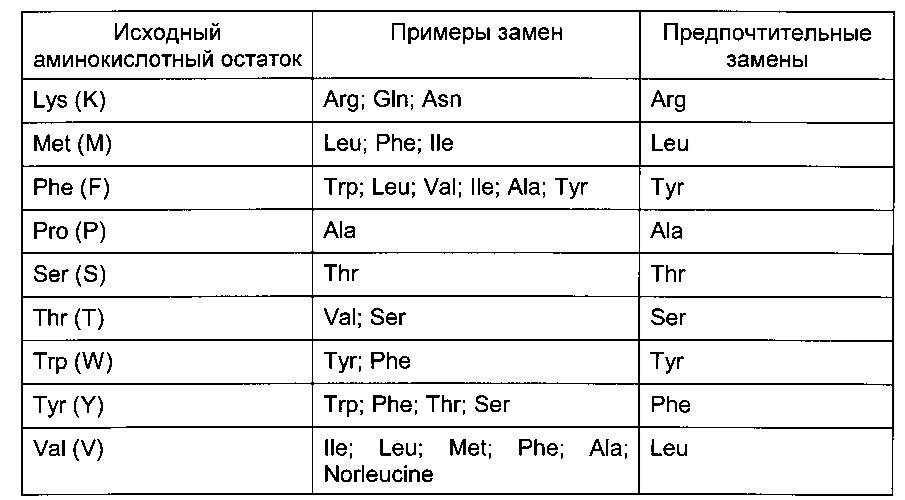
Аминокислотные остатки можно сгруппировать в соответствии с общими свойствами боковых цепей:Amino acid residues can be grouped according to the general properties of the side chains:
(1) гидрофобные: норлейцин, Met, Ala, Val, Leu, Ile;(1) hydrophobic: norleucine, Met, Ala, Val, Leu, Ile;
(2) нейтральные гидрофильные: Cys, Ser, Thr, Asn, Gln;(2) neutral hydrophilic: Cys, Ser, Thr, Asn, Gln;
(3) кислотные: Asp, Glu;(3) acidic: Asp, Glu;
(4) основные: His, Lys, Arg;(4) basic: His, Lys, Arg;
(5) влияющие на ориентацию цепи: Gly, Pro;(5) influencing chain orientation: Gly, Pro;
(6) ароматические: Trp, Tyr, Phe.(6) aromatic: Trp, Tyr, Phe.
Неконсервативные замены влекут за собой замещение представителя одного из этих классов представителем другого класса.Non-conservative substitutions entail the replacement of a representative of one of these classes by a representative of another class.
Один вид замен включает замену одного или нескольких остатков гипервариабельного участка родительского антитела (например, гуманизированного или человеческого антитела). Как правило, полученный(е) вариант(ы), отбираемый(е) для дальнейшего изучения, имее(ю)т модификации (например, улучшение) определенных биологических свойств (например, повышенную аффинность, пониженную иммуногенность) по сравнению с родительским антителом и/или в значительной степени сохраняе(ю)т определенные биологические свойства родительского антитела. Примером варианта с заменами является антитело, подвергнутое аффинному созреванию, которое может быть легко получено, например, при помощи технологии увеличения аффинности с использованием фагового дисплея, подробно описанной в данном документе. Вкратце, один или более остатков HVR подвергают мутации и проводят скрининг вариантов антитела, экспрессируемых фагом, по определенной биологической активности (например, аффинности связывания).One type of substitution involves replacing one or more residues of a hypervariable region of a parent antibody (e.g., a humanized or human antibody). As a rule, the obtained (e) variant (s), selected (e) for further study, has (s) t modifications (e.g., improvement) of certain biological properties (e.g., increased affinity, decreased immunogenicity) compared to the parent antibody and / or to a large extent, preserve (s) certain biological properties of the parent antibody. An example of a substitutional variant is an affinity matured antibody that can be readily prepared, for example, by using affinity enhancement technology using a phage display described in detail herein. Briefly, one or more HVR residues are mutated and screened for antibody variants expressed by phage for a particular biological activity (e.g., binding affinity).
Модификации (например, замены) могут осуществляться внутри HVR, например, для увеличения аффинности антитела. Такие изменения можно проводить в "горячих точках" HVR, т.е. в остатках, кодируемых кодонами, которые в процессе соматического созревания с высокой частотой подвергаются мутациям (см., например, Chowdhury, P.S., Methods Mol. Biol. 207 (2008) 179-196), и/или SDR (a-CDR), а у полученных вариантов VH или VL исследовать аффинность связывания. Повышение аффинности путем конструирования и повторного отбора из вторичных библиотек описано, например, Hoogenboom, H.R. et al. in Methods in Molecular Biology 178 (2002) 1-37. В некоторых воплощениях для повышения аффинности повышают изменчивость вариабельных генов, выбранных для повышения аффинности при помощи любого из существующих разнообразных методов (например, ПЦР пониженной точности, перестройки цепей или олигонуклеотид-направленного мутагенеза). После этого создают вторичную библиотеку. Затем проводят скрининг библиотеки для выявления любых вариантов антител с необходимой аффинностью. Другой способ повышения изменчивости включает методы, направленные на изменение HVR, когда рандомизируют несколько остатков HVR (например, 4-6 остатков одновременно). Остатки HVR, задействованные в связывании антигена, можно идентифицировать, например, при помощи аланин-сканирующего мутагенеза или моделирования. В частности, изменениям часто подвергаются CDR-H3 и CDR-L3.Modifications (e.g., substitutions) can be performed within the HVR, for example, to increase the affinity of the antibody. Such changes can be made in HVR hot spots, i.e. in residues encoded by codons that mutate at high frequency during somatic maturation (see, for example, Chowdhury, PS, Methods Mol. Biol. 207 (2008) 179-196), and / or SDR (a-CDR), and the obtained variants of VH or VL to investigate the binding affinity. Increasing affinity by constructing and reselecting from secondary libraries is described, for example, by Hoogenboom, H.R. et al. in Methods in Molecular Biology 178 (2002) 1-37. In some embodiments, to increase affinity, the variability of the variable genes selected to increase affinity is increased using any of a variety of existing methods (e.g., low precision PCR, chain restructuring, or oligonucleotide-directed mutagenesis). After that create a secondary library. The library is then screened to identify any antibody variants with the necessary affinity. Another way to increase the variability includes methods aimed at changing the HVR when randomizing multiple HVR residues (for example, 4-6 residues at a time). HVR residues involved in antigen binding can be identified, for example, by alanine scanning mutagenesis or modeling. In particular, CDR-H3 and CDR-L3 are often subject to change.
В некоторых воплощениях замены, вставки или делеции могут возникать в составе одного или нескольких HVR, при условии, что такие изменения существенным образом не снижают способность антитела связывать антиген. Например, могут быть выполнены консервативные замены в HVR (например, описанные здесь консервативные замены), которые существенным образом не снижают аффинность связывания. Такие замены могут располагаться за пределами "горячих точек" HVR или SDR. В некоторых воплощениях, каждый HVR либо остается без изменений, либо содержит не более одной, двух или трех аминокислотных замен в составе вариантов последовательностей VH и VL, приведенных выше.In some embodiments, substitutions, insertions, or deletions may occur as part of one or more HVRs, provided that such changes do not substantially reduce the ability of the antibody to bind antigen. For example, conservative substitutions in HVR can be performed (for example, conservative substitutions described herein), which do not significantly reduce binding affinity. Such replacements may be located outside the HVR or SDR hot spots. In some embodiments, each HVR either remains unchanged or contains no more than one, two, or three amino acid substitutions as part of the variants of the VH and VL sequences above.
Эффективным способом идентификации остатков или участков антитела, которые могут стать мишенями направленного мутагенеза, является "аланин-сканирующий мутагенез", описанный Cunningham, B.C. and Wells, J.A., Science 244 (1989) 1081-1085. В этом способе выявляют целевой аминокислотный остаток или группу целевых остатков (например, заряженные остатки, такие как arg, asp, his, lys и glu) и замещают нейтральными или отрицательно заряженными аминокислотами (например, аланином или полиаланином), чтобы выяснить, изменится ли взаимодействие антитела с антигеном. Если при первоначальной замене аминокислот функциональные свойства молекулы изменяются, в этих позициях проводят дальнейшие замены. В качестве альтернативы или дополнения можно провести анализ кристаллической структуры комплекса антиген-антитело для выявления точек контакта между антителом и антигеном. Данные остатки, задействованные в контактах, а также соседние с ними остатки могут стать кандидатами для замены. Можно проводить скрининг вариантов с целью выявления у них желаемых свойств.An effective method for identifying residues or regions of an antibody that may be targeted by directed mutagenesis is the "alanine scanning mutagenesis" described by Cunningham, B.C. and Wells, J. A., Science 244 (1989) 1081-1085. In this method, a target amino acid residue or a group of target residues (e.g., charged residues such as arg, asp, his, lys and glu) is detected and replaced with neutral or negatively charged amino acids (e.g. alanine or polyalanine) to determine if the interaction will change antibodies with antigen. If the functional properties of the molecule change during the initial replacement of amino acids, further replacements are made at these positions. As an alternative or addition, you can analyze the crystal structure of the antigen-antibody complex to identify contact points between the antibody and antigen. These balances involved in contacts, as well as the balances adjacent to them, can become candidates for replacement. Options may be screened to identify their desired properties.
Вставки охватывают присоединение аминокислотных последовательностей в амино- и/или карбокси-концевых областях, длиной от одного остатка до полипептидов, содержащих сотни или более остатков, а также вставки одного или нескольких аминокислотных остатков внутри последовательности. Примером вставки в концевой области является антитело с N-концевым остатком метионила. Другие варианты молекул антител со вставками включают соединение N- или С-конца антитела с ферментом (например, ADEPT) или полипептидом, позволяющее увеличить время полужизни антитела в сыворотке.The inserts cover the attachment of amino acid sequences in the amino and / or carboxy-terminal regions, from one residue to polypeptides containing hundreds or more residues in length, as well as the insertion of one or more amino acid residues within the sequence. An example of insertion in the terminal region is an antibody with an N-terminal methionyl residue. Other variants of antibody molecules with inserts include connecting the N- or C-terminus of the antibody with an enzyme (e.g., ADEPT) or a polypeptide, which can increase the serum half-life of the antibody.
Один предпочтительный вариант представляет собой вариант с одним остатком цистеина, у которого аминокислотный остаток в составе вариабельного домена тяжелой цепи в положении 53 по Кабату представляет собой цистеин.One preferred embodiment is a single cysteine residue variant in which the amino acid residue in the heavy chain variable domain at position 53 of Kabat is cysteine.
б) Варианты гликозилированияb) Glycosylation Options
В некоторых воплощениях предложенное антитело модифицировано для повышения или понижения степени гликозилирования антитела. Добавление или удаление сайтов гликозилирования антитела легко достигается за счет изменения аминокислотной последовательности таким образом, что создаются или удаляются один или несколько сайтов гликозилирования.In some embodiments, the proposed antibody is modified to increase or decrease the degree of glycosylation of the antibody. Adding or removing glycosylation sites of an antibody is easily achieved by altering the amino acid sequence such that one or more glycosylation sites are created or deleted.
В случаях, когда антитело содержит Fc фрагмент, можно модифицировать присоединенные к нему углеводы. Нативные антитела, продуцируемые в клетках млекопитающих, обычно содержат разветвленные двухантенные олигосахариды, которые как правило присоединены посредством N-гликозидной связи к Asn297 СН2 домена Fc фрагмента. См., например, Wright, A. and Morrison, S.L., TIBTECH 15 (1997) 26-32. Олигосахариды могут включать различные углеводы, например, маннозу, N-ацетилглюкозамин (GlcNAc), галактозу и сиаловую кислоту, а также фукозу, присоединенную к GlcNAc в «стволе» двухантенной олигосахаридной структуры. В некоторых воплощениях для создания вариантов антитела с некоторыми улучшенными свойствами модифицируют олигосахариды в составе антитела по изобретению.In cases where the antibody contains an Fc fragment, carbohydrates attached to it can be modified. Native antibodies produced in mammalian cells typically contain branched two-antenna oligosaccharides, which are typically linked via an N-glycosidic linkage to the Asn297 CH2 domain of the Fc fragment. See, for example, Wright, A. and Morrison, S. L., TIBTECH 15 (1997) 26-32. Oligosaccharides can include various carbohydrates, for example, mannose, N-acetylglucosamine (GlcNAc), galactose and sialic acid, as well as fucose, attached to GlcNAc in the "trunk" of the two-antenna oligosaccharide structure. In some embodiments, to create variants of an antibody with some improved properties, the oligosaccharides in the antibody composition of the invention are modified.
В одном воплощении предложены варианты антител, у которых углеводная структура, присоединенная (напрямую или опосредовано) к Fc фрагменту, может быть лишена фукозы. Например, содержание фукозы в таком антителе может составлять от 1% до 80%, от 1% до 65%, от 5% до 65% или от 20% до 40%. Количество фукозы определяют путем расчета среднего содержания фукозы в составе углеводной цепи, присоединенной к Asn297, относительно суммы всех гликоструктур, присоединенных к Asn 297 (например, комплексных, гибридных структур и структур с высоким содержанием маннозы), при определении методом масс-спектрометрии MALDI-TOF, например, согласно WO 2008/077546. Asn297 обозначает остаток аспарагина, находящийся приблизительно в положении 297 Fc фрагмента (нумерация остатков Fc фрагмента соответствует системе EU); однако Asn297 может также находиться на расстоянии ± 3 аминокислот от позиции 297, т.е. между позициями 294 и 300, вследствие незначительных вариаций в последовательности антител. Такие варианты с измененной степенью фукозилирования могут проявлять повышенную ADCC. См, например, US 2003/0157108; US 2004/0093621. Примеры публикаций, описывающих "дефукозилированные" или "лишенные фукозы" варианты антител, включают: US 2003/0157108; WO 2000/61739; WO 2001/29246; US 2003/0115614; US 2002/0164328; US 2004/0093621; US 2004/0132140; US 2004/0110704; US 2004/0110282; US 2004/0109865; WO 2003/085119; WO 2003/084570; WO 2005/035586; WO 2005/035778; WO 2005/053742; WO 2002/031140; Okazaki, A. et al., J. Mol. Biol. 336 (2004) 1239-1249; Yamane-Ohnuki, N. et al., Biotech. Bioeng. 87 (2004) 614-622. Примеры клеточных линий, способных продуцировать дефукозилированные антитела, включают клетки Lec13 CHO с нарушением фукозилирования белков (Ripka, J., et al., Arch. Biochem. Biophys. 249 (1986) 533-545; US 2003/0157108 и WO 2004/056312, в частности, Пример 11) и клеточные линии с выключенными генами, например, с выключенным геном α-1,6-фукозилтрансферазы, FUT8, клетки ОНО с выключенными генами (см., например, Yamane-Ohnuki, N. et al., Biotech. Bioeng. 87 (2004) 614-622; Kanda, Y. et al., Biotechnol. Bioeng. 94 (2006) 680-688 и WO 2003/085107).In one embodiment, antibody variants are provided in which the carbohydrate structure attached (directly or indirectly) to the Fc fragment can be devoid of fucose. For example, the fucose content of such an antibody can be from 1% to 80%, from 1% to 65%, from 5% to 65%, or from 20% to 40%. The amount of fucose is determined by calculating the average content of fucose in the carbohydrate chain attached to Asn297, relative to the sum of all glycostructures attached to Asn 297 (for example, complex, hybrid structures and structures with a high mannose content), as determined by MALDI-TOF mass spectrometry for example according to WO 2008/077546. Asn297 denotes an asparagine residue at approximately position 297 of the Fc fragment (the numbering of the residues of the Fc fragment corresponds to the EU system); however, Asn297 may also be located at a distance of ± 3 amino acids from position 297, i.e. between
Также известны варианты антител с бисекционными (разветвленными) олигосахаридами, например, в которых двухантенный олигосахарид, присоединенный к Fc фрагменту антитела, разделен "пополам" GlcNAc. Такие варианты антител могут иметь пониженную степень фукозилирования и/или повышенную ADCC. Примеры таких вариантов антител описаны, например, в WO 2003/011878; US 6,602,684 и US 2005/0123546. Также предложены варианты антител по меньшей мере с одним остатком галактозы в составе олигосахарида, присоединенного к Fc фрагменту. Данные варианты антител могут обладать улучшенной CDC функцией. Такие варианты антител описаны, например, в документах WO 1997/30087; WO 1998/58964 и WO 1999/22764. (430)Variants of antibodies with bisectional (branched) oligosaccharides are also known, for example, in which a two-antenna oligosaccharide attached to an Fc fragment of an antibody is bisected by GlcNAc. Such antibody variants may have a reduced degree of fucosylation and / or increased ADCC. Examples of such antibody variants are described, for example, in WO 2003/011878; US 6,602,684 and US 2005/0123546. Antibody variants with at least one galactose residue in the oligosaccharide attached to the Fc fragment are also provided. These antibody variants may have improved CDC function. Such antibody variants are described, for example, in documents WO 1997/30087; WO 1998/58964 and WO 1999/22764. (430)
в) Варианты с модификациями Fc фрагментаc) Variants with modifications to the Fc fragment
В некоторых воплощениях Fc фрагмент антитела, описанного в данном документе, можеть иметь одну или две аминокислотные модификации, таким образом получают варианты Fc фрагмента. Вариант с модификацией Fc фрагмента может содержать последовательность Fc фрагмента человеческого происхождения (например, Fc фрагмента lgG1, lgG2, lgG3 или lgG4 человека), имеющую аминокислотную модификацию (например, замену) в одной или нескольких аминокислотных позициях.In some embodiments of the Fc fragment of the antibody described herein may have one or two amino acid modifications, thus variants of the Fc fragment are obtained. An embodiment with an Fc fragment modification may comprise a sequence of an Fc fragment of human origin (e.g., an Fc fragment of human IgG1, IgG2, IgG3 or IgG4) having an amino acid modification (e.g., substitution) at one or more amino acid positions.
В некоторых воплощениях изобретение относится к варианту антитела, обладающему некоторыми, но не всеми эффекторными функциями, что делает его подходящим кандидатом для применений, в которых время полужизни антитела in vivo имеет важное значение, однако некоторые эффекторные функции (например, комплемент- и антитело-зависимая клеточная цитотоксичность) являются необязательными или нежелательными. Для подтверждения снижения/устранения CDC и/или ADCC активностей можно исследовать цитотоксичность in vitro и/или in vivo. Например, можно исследовать связывание с Fc рецепторами (FcR), чтобы подтвердить, что антитело не связывается с FcyR (следовательно, по всей вероятности, не обладает ADCC активностью), но сохраняет способность связывать FcRn. Первичные клетки, опосредующие ADCC, NK клетки, экспрессируют только FcγRIII, тогда как моноциты экспрессируют FcγRI, FcγRII и FcγRIII. Данные, касающиеся экспрессии FcR на гемопоэтических клетках, кратко изложены в Таблице 3 на стр. 464 в публикации Ravetch, J.V. and Kinet, J.P., Annu. Rev. Immunol. 9 (1991) 457-492. He являющиеся исчерпывающими примеры исследований in vitro, позволяющие оценить ADCC активность молекулы, представляющей интерес, описаны в патенте US 5500362 (см., например, I. et al., Proc. Natl. Acad. Sci. USA 83 (1986) 7059-7063 и Hellstrom, I. et al., Proc. Natl. Acad. Sci. USA 82 (1985) 1499-1502); U.S. Patent No. 5821337 (see Bruggemann, M. et al., J. Exp. Med. 166 (1987) 1351-1361). В альтернативном случае можно использовать нерадиоактивные методы исследования (см, например, нерадиоактивный метод исследования цитотоксичности для проточной цитометрии ACTI™ (CellTechnology, Inc. Mountain View, CA; и нерадиоактивный метод исследования цитотоксичности CytoTox 96® (Promega, Madison, WI). Эффекторные клетки, подходящие для таких исследований, включают мононуклеарные клетки периферической крови (МКПК) и естественные киллерные клетки (NK). В качестве дополнения или альтернативы ADCC активность молекулы, представляющей интерес, можно оценить in vivo, например, в модели на животных, такой как описанная Clynes, R., et al., Proc. Natl. Acad. Sci. USA 95 (1998) 652-656. Также, можно исследовать связывание C1q, чтобы подтвердить, что антитело не способно связывать C1q и, следовательно, не обладает CDC активностью. См., например, определение связывания C1q и С3с методом ИФА в WO 2006/029879 и WO 2005/100402. Для оценки активации комплемента можно выполнять исследование CDC (см., например, Gazzano-Santoro, Н., et al., J. Immunol. Methods 202 (1996) 163-171; Cragg, M.S., et al., Blood 101 (2003) 1045-1052; and Cragg, M.S. and M.J. Glennie, Blood 103 (2004) 2738-2743). Способы, известные в области техники, позволяют также исследовать связывание FcRn и клиренс/время полужизни in vivo (см., например, Petkova, S.B., et al., Int. Immunol. 18 (2006) 1759-1769).In some embodiments, the invention provides an antibody variant that has some, but not all, effector functions, making it a suitable candidate for applications in which the in vivo half-life of an antibody is important, but some effector functions (e.g., complement and antibody dependent cell cytotoxicity) are optional or undesirable. In vitro and / or in vivo cytotoxicity can be investigated to confirm the reduction / elimination of CDC and / or ADCC activities. For example, Fc receptor binding (FcR) can be tested to confirm that the antibody does not bind to FcyR (hence, in all likelihood, does not have ADCC activity) but retains the ability to bind FcRn. Primary cells mediating ADCC, NK cells, express FcγRIII only, while monocytes express FcγRI, FcγRII and FcγRIII. Data regarding FcR expression on hematopoietic cells are summarized in Table 3 on page 464 of Ravetch, J.V. and Kinet, J.P., Annu. Rev. Immunol. 9 (1991) 457-492. Non-exhaustive examples of in vitro studies allowing the ADCC activity of a molecule of interest to be evaluated are described in US Pat. No. 5,500,362 (see, e.g., I. et al., Proc. Natl. Acad. Sci. USA 83 (1986) 7059-7063 and Hellstrom, I. et al., Proc. Natl. Acad. Sci. USA 82 (1985) 1499-1502); U.S. Patent No. 5821337 (see Bruggemann, M. et al., J. Exp. Med. 166 (1987) 1351-1361). Alternatively, non-radioactive assays can be used (see, for example, ACTI ™ non-radioactive cytotoxicity assay for flow cytometry (CellTechnology, Inc. Mountain View, CA; and CytoTox 96® non-radioactive cytotoxicity assay (Promega, Madison, WI). Effector cells suitable for such studies include peripheral blood mononuclear cells (PBMCs) and natural killer cells (NKs). In addition to or alternative to ADCC, the activity of the molecule of interest can be evaluated in vivo, for example, in an animal model such as that described by Clynes, R., et al., Proc. Natl. Acad. Sci. USA 95 (1998) 652-656. Also, C1q binding can be examined to confirm that the antibody is unable to bind C1q and therefore does not have CDC activity. See, for example, the determination of C1q and C3c binding by ELISA in WO 2006/029879 and WO 2005/100402. To evaluate complement activation, a CDC assay can be performed (see, for example, Gazzano-Santoro, H., et al., J. Immunol. Methods 202 (1996) 163-171; Cragg, M. S., et al., Blood 101 (2003) 1045-1052; and Cragg, M.S. and M.J. Glennie, Blood 103 (2004) 2738-2743). Methods known in the art also allow the investigation of FcRn binding and clearance / half-life in vivo (see, for example, Petkova, S.B., et al., Int. Immunol. 18 (2006) 1759-1769).
Антитела со сниженной эффекторной функцией охватывают антитела с заменой одного или нескольких остатков в позициях 238, 265, 269, 270, 297, 327 и 329 в Fc фрагмента (патент US 6737056). Такие мутанты Fc включают мутанты Fc с заменами двух или нескольких аминокислот в позициях 265, 269, 270, 297 и 327, включая так называемые мутанты Fc "DANA", у которых остатки в позициях 265 и 297 замещены аланином (патент US 7332581).Antibodies with reduced effector function encompass antibodies with the replacement of one or more residues at
Описаны некоторые варианты антител с усиленным или ослабленным связыванием с FcR (см., например, патент US 6737056; WO 2004/056312 и Shields, R.L et al., J. Biol. Chem. 276 (2001) 6591-6604).Some antibody variants with enhanced or weakened binding to FcR have been described (see, for example, US Pat. No. 6,737,056; WO 2004/056312 and Shields, R. L. et al., J. Biol. Chem. 276 (2001) 6591-6604).
В некоторых воплощениях вариант антитела содержит Fc фрагмент, имеющий одну или несколько аминокислотных замен, которые приводят к улучшению ADCC, например, замены в позициях 298, 333 и/или 334 Fc фрагмента (нумерация остатков согласно системе EU).In some embodiments, an antibody variant comprises an Fc fragment having one or more amino acid substitutions that result in improved ADCC, for example, substitutions at positions 298, 333 and / or 334 of the Fc fragment (residue numbering according to the EU system).
В некоторых воплощениях модификации Fc фрагмента приводят к изменению (т.е. улучшению или нарушению) связывания C1q и/или комплемент-зависимой цитотоксичности (CDC), например, как описано в патенте US 6194551, WO 99/51642 и Idusogie, Е.Е. et al., J. Immunol. 164 (2000) 4178-4184.In some embodiments, modifications of the Fc fragment result in a change (i.e., improvement or impairment) of C1q binding and / or complement dependent cytotoxicity (CDC), for example, as described in US Pat. No. 6194551, WO 99/51642 and Idusogie, E.E. . et al., J. Immunol. 164 (2000) 4178-4184.
Антитела с увеличенным временем полужизни и улучшенным связыванием с неонатальным рецептором FcRn, отвечающим за транспорт материнских IgG к плоду (Guyer, R.L. et al., J. Immunol. 117 (1976) 587-593 и Kim, J.K. et al., J. Immunol. 24 (1994) 2429-2434), описаны в US 2005/0014934. Эти антитела содержат Fc фрагмент с одной или несколькими заменами, которые улучшают связывание Fc фрагмента с FcRn. Такие варианты с модификациями Fc включают варианты с заменами одного или нескольких остатков Fc фрагмента в позициях: 238, 256, 265, 272, 286, 303, 305, 307, 311, 312, 317, 340, 356, 360, 362, 376, 378, 380, 382, 413, 424 или 434, например, замены остатка в позиции 434 в Fc фрагмента (патент US 7371826).Antibodies with increased half-life and improved binding to the neonatal FcRn receptor responsible for transporting maternal IgG to the fetus (Guyer, RL et al., J. Immunol. 117 (1976) 587-593 and Kim, JK et al., J. Immunol . 24 (1994) 2429-2434) described in US 2005/0014934. These antibodies contain an Fc fragment with one or more substitutions that improve the binding of the Fc fragment to FcRn. Such variants with Fc modifications include variants with substitutions of one or more residues of the Fc fragment at positions: 238, 256, 265, 272, 286, 303, 305, 307, 311, 312, 317, 340, 356, 360, 362, 376, 378, 380, 382, 413, 424 or 434, for example, replacing the residue at position 434 in the Fc fragment (US patent 7371826).
См. также Duncan, A.R. and Winter, G., Nature 322 (1988) 738-740; US 5,648,260; US 5624821 и WO 94/29351, описывающие другие примеры вариантов с модификациями Fc фрагмента.See also Duncan, A.R. and Winter, G., Nature 322 (1988) 738-740; US 5,648,260; US 5624821 and WO 94/29351, describing other examples of variants with modifications of the Fc fragment.
г) Модифицированные цистеином варианты антителg) Modified cysteine antibody variants
В некоторых воплощениях может быть целесообразным создание модифицированных цистеином антител, например, "thioMAbs," в которых один или несколько остатков антитела замещены остатками цистеина. В конкретных воплощениях замещаемые остатки располагаются в доступных сайтах антитела. В результате замены этих остатков на цистеин в доступных сайтах антитела возникают реакционноспособные тиоловые группы, которые могут использоваться для конъюгирования антитела с другими компонентами, например, компонентами лекарств или фрагментами линкер-лекарство, для создания конъюгата антитела, согласно описанию ниже. В некоторых воплощениях цистеином могут быть замещены один или несколько из следующих остатков: V205 легкой цепи (нумерация по Кабат), А118 тяжелой цепи (нумерация EU) и S400 (нумерация EU) Fc области тяжелой цепи. Модифицированные цистеином антитела могут быть получены, как описано, например, в патенте US 7521541.In some embodiments, it may be appropriate to provide cysteine-modified antibodies, for example, “thioMAbs,” in which one or more antibody residues are substituted with cysteine residues. In specific embodiments, substitutable residues are located at accessible antibody sites. By replacing these residues with cysteine, reactive thiol groups arise in accessible antibody sites that can be used to conjugate the antibody to other components, for example, drug components or linker-drug fragments, to create an antibody conjugate as described below. In some embodiments, cysteine can be substituted with one or more of the following residues: V205 light chain (Kabat numbering), A118 heavy chain (EU numbering), and S400 (EU numbering) Fc region of the heavy chain. Cysteine modified antibodies can be prepared as described, for example, in US Pat. No. 7,521,541.
д) Производные антителd) Derivatives of antibodies
В некоторых воплощениях предложенное в данном документе антитело может быть также модифицировано с целью введения дополнительных небелковых компонентов, известных в данной области техники и легко доступных. Компоненты, подходящие для получения производных антитела, включают водорастворимые полимеры, но не ограничиваются ими. Не являющиеся исчерпывающими примеры водорастворимых полимеров включают полиэтиленгликоль (ПЭГ), сополимеры этиленгликоля и пропиленгликоля, карбоксиметилцеллюлозу, декстран, поливиниловый спирт, поливинилпирролидон, поли-1,3-диоксолан, поли-1,3,6-триоксан, сополимер этилена и малеинового ангидрида, полиаминокислоты (как гомополимеры, так и случайные сополимеры), а также декстран или поли(п-винил пирролидон)полиэтиленгликоль, гомополимеры пропропиленгликоля, сополимеры пролипропиленоксида и этилен оксида, полиоксиэтилированные полиолы (например, глицерол), поливиниловый спирт и их смеси, но не ограничиваются ими. Пропиональдегид полиэтиленгликоля может иметь преимущества при производстве благодаря своей стабильности в воде. Полимер может иметь любую молекулярную массу и может быть разветвленным или неразветвленным. Число полимеров, присоединенных к антителу, может варьироваться, в случае присоединения более одного полимера, их молекулы могут быть идентичными или различаться. Как правило, число и/или тип полимеров, применяемых для получения производных, определяется исходя из того, какие конкретные свойства или функции антитела, нуждаются в улучшении, и того, будет ли производное антитела применяться в терапии при определенных условиях, и т.д., но не ограничивается данными соображениями.In some embodiments, the antibody provided herein can also be modified to introduce additional non-protein components known in the art and readily available. Components suitable for the preparation of antibody derivatives include, but are not limited to, water-soluble polymers. Non-exhaustive examples of water-soluble polymers include polyethylene glycol (PEG), copolymers of ethylene glycol and propylene glycol, carboxymethyl cellulose, dextran, polyvinyl alcohol, polyvinyl pyrrolidone, poly-1,3-dioxolane, poly-1,3,6-trioxane, and malin copolymer polyamino acids (both homopolymers and random copolymers), as well as dextran or poly (p-vinyl pyrrolidone) polyethylene glycol, propylene glycol homopolymers, propylene propylene oxide and ethylene oxide copolymers, polyoxyethylene polyol (E.g., glycerol), polyvinyl alcohol and mixtures thereof, but not limited thereto. Polyethylene glycol propionaldehyde may have manufacturing advantages due to its stability in water. The polymer may have any molecular weight and may be branched or unbranched. The number of polymers attached to an antibody can vary; if more than one polymer is attached, their molecules can be identical or different. As a rule, the number and / or type of polymers used to obtain derivatives is determined on the basis of which specific properties or functions of the antibody need improvement, and whether the antibody derivative will be used in therapy under certain conditions, etc. , but is not limited to these considerations.
В другом воплощении предложены конъюгаты антитела и небелковые компоненты, которые могут избирательно нагреваться под воздействием излучения. В одном воплощении небелковый компонент представляет собой углеродную нанотрубку (Kam, N.W. et al., Proc. Natl. Acad. Sci. USA 102 (2005) 11600-11605). Излучение может иметь любую длину волны, включая, но не ограничиваясь длинами волн, не повреждающими обычные клетки, но нагревающими небелковый компонент до температуры, которая вызывает гибель клеток, расположенных вблизи небелкового компонента антитела.In another embodiment, antibody conjugates and non-protein components are provided that can selectively heat under the influence of radiation. In one embodiment, the non-protein component is a carbon nanotube (Kam, N.W. et al., Proc. Natl. Acad. Sci. USA 102 (2005) 11600-11605). Radiation can have any wavelength, including, but not limited to wavelengths that do not damage ordinary cells, but heat the non-protein component to a temperature that causes the death of cells located near the non-protein component of the antibody.
Б. Рекомбинантные способы и композицииB. Recombinant Methods and Compositions
Антитела можно получать с помощью рекомбинантных способов и композиций, например, описанных в патенте US 4816567. В одном воплощении предложена выделенная нуклеиновая кислота, кодирующая вариант антитела к теофиллину, описанного в данном документе. Такая нуклеиновая кислота может кодировать аминокислотную последовательность, содержащую VL, и/или аминокислотную последовательность, содержащую VH антитела (например, легкую и/или тяжелую цепи антитела). В следующем воплощении предложены один или несколько векторов (например, экспрессирующих векторов), содержащих такую нуклеиновую кислоту. В следующем воплощении предложены клетки-хозяева, содержащие такую нуклеиновую кислоту. В одном из таких воплощений клетка-хозяин содержит (например, была трансформирована): (1) вектор, содержащий нуклеиновую кислоту, кодирующую аминокислотную последовательность, содержащую VL антитела, и аминокислотную последовательность, содержащую VH антитела, или (2) первый вектор, содержащий нуклеиновую кислоту, кодирующую аминокислотную последовательность, содержащую VL антитела, и второй вектор, содержащий нуклеиновую кислоту, кодирующую аминокислотную последовательность, содержащую VH антитела. В одном воплощении клетка-хозяин представляет собой эукариотическую клетку, например, клетку яичника китайского хомячка (СНО) или лимфоидную клетку (например, клетку Y0, NS0, Sp20). В одном воплощении предложен способ получения антитела к теофиллину, где способ включает культивирование клеток-хозяев, содержащих нуклеиновую кислоту, кодирующую антитело, согласно описанию выше, при условиях, подходящих для экспрессии антитела, и возможно, выделение антитела из клеток-хозяев (или среды культивирования клеток-хозяев).Antibodies can be prepared using recombinant methods and compositions, for example, those described in US Pat. No. 4,816,567. In one embodiment, an isolated nucleic acid is proposed that encodes a variant of the theophylline antibody described herein. Such a nucleic acid may encode an amino acid sequence containing VL and / or an amino acid sequence containing VH antibodies (e.g., light and / or heavy chains of an antibody). In a further embodiment, one or more vectors (eg, expression vectors) comprising such a nucleic acid are provided. In a further embodiment, host cells comprising such a nucleic acid are provided. In one such embodiment, the host cell contains (for example, has been transformed): (1) a vector containing a nucleic acid encoding an amino acid sequence containing a VL antibody, and an amino acid sequence containing a VH antibody, or (2) a first vector containing a nucleic acid an acid encoding an amino acid sequence containing a VL antibody, and a second vector containing a nucleic acid encoding an amino acid sequence containing a VH antibody. In one embodiment, the host cell is a eukaryotic cell, for example, a Chinese hamster ovary (CHO) cell or a lymphoid cell (for example, a Y0, NS0, Sp20 cell). In one embodiment, a method for producing an anti-theophylline antibody is provided, wherein the method comprises culturing host cells containing a nucleic acid encoding an antibody as described above under conditions suitable for expression of the antibody, and optionally isolating the antibody from the host cells (or culture medium host cells).
Для получения варианта антитела к теофиллину рекомбинантным способом нуклеиновую кислоту, кодирующую антитело, например, согласно описанию выше, выделяют и встраивают в один или несколько векторов для дальнейшего клонирования и/или экспрессии в клетках-хозяевах. Данную нуклеиновую кислоту легко выделить и секвенировать при помощи стандартных методов (например, с использованием олигонуклеотидных зондов, способных специфически связываться с генами, кодирующими тяжелую и легкую цепи антитела).To obtain an antibody variant against theophylline by a recombinant method, the nucleic acid encoding the antibody, for example, as described above, is isolated and inserted into one or more vectors for further cloning and / or expression in host cells. This nucleic acid can be easily isolated and sequenced using standard methods (for example, using oligonucleotide probes capable of specifically binding to genes encoding the antibody heavy and light chains).
Клетки-хозяева, подходящие для клонирования или экспрессии векторов, кодирующих антитело, включают клетки прокариот или эукариот, описанные в данном документе. Например, антитела могут производиться в бактериях, в частности, когда гликозилирование и эффекторные функции Fc не являются необходимыми. Экспрессия фрагментов антител и полипептидов в бактериях описана, например, в документах US 5648237, US 5789199 и US 5840523 (см. также Charlton, К.А., In: Methods in Molecular Biology, Vol. 248, Lo, B.K.C. (ed.), Humana Press, Totowa, NJ (2003), pp. 245-254, описывающих экспрессию фрагментов антител в Е.coli). После экспрессии антитело можно выделить из бактериальной массы в виде растворимой фракции и затем очистить.Host cells suitable for cloning or expressing vectors encoding an antibody include prokaryotic or eukaryotic cells described herein. For example, antibodies can be produced in bacteria, in particular when glycosylation and Fc effector functions are not necessary. The expression of fragments of antibodies and polypeptides in bacteria is described, for example, in documents US 5648237, US 5789199 and US 5840523 (see also Charlton, K.A., In: Methods in Molecular Biology, Vol. 248, Lo, BKC (ed.) Humana Press, Totowa, NJ (2003), pp. 245-254, describing the expression of antibody fragments in E. coli). After expression, the antibody can be isolated from the bacterial mass as a soluble fraction and then purified.
Кроме прокариот в качестве хозяев для клонирования или экспрессии векторов, кодирующих антитела, подходят микроорганизмы-эукариоты, такие как мицелиальные грибы или дрожжи, включая штаммы грибов и дрожжей, у которых пути гликозилирования "гуманизированы" для получения антител с частично или полностью человеческим профилем гликозилирования. См. Gerngross, T.U., Nat. Biotech. 22 (2004) 1409-1414 и Li, Н. et al., Nat. Biotech. 24 (2006) 210-215.In addition to prokaryotes, eukaryotic microorganisms such as mycelial fungi or yeast, including fungal and yeast strains in which the glycosylation pathways are "humanized" to produce antibodies with a partially or fully human glycosylation profile, are suitable hosts for cloning or expression of antibody-encoding vectors. See Gerngross, T.U., Nat. Biotech 22 (2004) 1409-1414 and Li, H. et al., Nat. Biotech 24 (2006) 210-215.
Клетки-хозяева, подходящие для экспрессии (гликозилированных) полипептидов также получают из многоклеточных организмов (беспозвоночных и позвоночных). Примеры клеток беспозвоночных включают клетки растений и насекомых. Также найдены многочисленные штаммы бакуловирусов, которые используют совместно с клетками насекомых, в частности, для трансфекции клеток Spodoptera frugiperda.Host cells suitable for expression of (glycosylated) polypeptides are also obtained from multicellular organisms (invertebrates and vertebrates). Examples of invertebrate cells include plant and insect cells. Numerous strains of baculoviruses have also been found that are used in conjunction with insect cells, in particular for transfection of Spodoptera frugiperda cells.
В качестве хозяев также используют культуры клеток растений. См., например, патенты US 5959177, 6040498, 6420548, 7125978 и 6417429 (описывающие технологию PLANTIBODIES™ для получения антител в трансгенных растениях).Plant hosts are also used as hosts. See, for example, US patents 5959177, 6040498, 6420548, 7125978 and 6417429 (describing PLANTIBODIES ™ technology for producing antibodies in transgenic plants).
В качестве хозяев также используют клетки позвоночных. Например, можно использовать клеточные линии млекопитающих, адаптированные для роста в суспензии. Другими примерами клеточных линий млекопитающих, используемых в качестве хозяев, являются линия клеток почки обезьяны CV1, трансформированная SV40 (COS-7); линия человеческих эмбриональных клеток почки (клетки 293 или 293Т, описанные, например, Graham, F.L. et al., J. Gen Virol. 36 (1977) 59-74); клетки почки новорожденного хомяка (ВНК); мышиные клетки сертоли (клетки ТМ4, описанные, например, Mather, J.P., Biol. Reprod. 23 (1980) 243-252); клетки почки обезьяны (CV1); клетки почки африканской зеленой мартышки (VERO-76); клетки карциномы шейки матки человека (HELA); клетки почки собаки (MDCK); клетки печени крысы буффало (BRL 3А); клетки легких человека (W138); клетки печени человека (Hep G2); клетки опухоли молочной железы мыши (ММТ 060562); клетки TRI (описанные, например, Mather, J.P. et al., Annals N.Y. Acad. Sci. 383 (1982) 44-68; клетки MRC 5; и клетки FS4. Другие клеточные линии млекопитающих, используемые в качестве хозяев, включают клетки яичников китайского хомячка (СНО), включая клетки DHFR" СНО (Urlaub, G. et al., Proc. Natl. Acad. Sci. USA 77 (1980) 4216-4220) и линии клеток миеломы, такие как Y0, NS0 и Sp2/0. Обзор некоторых клеточных линий млекопитающих, подходящих в качестве хозяев для получения антител, представлен, например, Yazaki, P. and Wu, A.M., Methods in Molecular Biology, Vol. 248, Lo, B.K.C. (ed.), Humana Press, Totowa, NJ (2004), pp. 255-268.Vertebrate cells are also used as hosts. For example, mammalian cell lines adapted for growth in suspension can be used. Other examples of mammalian cell lines used as hosts are the monkey kidney cell line CV1 transformed by SV40 (COS-7); a line of human embryonic kidney cells (293 or 293T cells described, for example, by Graham, F. L. et al., J. Gen Virol. 36 (1977) 59-74); cells of the kidney of a newborn hamster (BHK); murine sertoli cells (TM4 cells described, for example, Mather, J.P., Biol. Reprod. 23 (1980) 243-252); monkey kidney cells (CV1); African green monkey kidney cells (VERO-76); human cervical carcinoma cells (HELA); dog kidney cells (MDCK); buffalo rat liver cells (BRL 3A); human lung cells (W138); human liver cells (Hep G2); mouse breast tumor cells (MMT 060562); TRI cells (described, for example, by Mather, JP et al., Annals NY Acad. Sci. 383 (1982) 44-68;
В. Количественные методы анализаB. Quantitative analysis methods
Идентификацию, скрининг или исследование физических/химических свойств и/или биологической активности предложенных в данном документе антител к теофиллину проводят с помощью различных количественных методов анализа, известных в области техники.The identification, screening, or investigation of the physical / chemical properties and / or biological activity of the theophylline antibodies provided herein is carried out using various quantitative assay methods known in the art.
Исследование связывания и другие количественные методы анализаBinding Assay and Other Quantitative Analysis Methods
В одном аспекте определяют антигенсвязывающую активность антитела по изобретению, например, при помощи таких известных способов, как ИФА, вестерн-блоттинг и т.д.In one aspect, antigen-binding activity of an antibody of the invention is determined, for example, using known methods such as ELISA, Western blotting, etc.
В другом аспекте для идентификации антитела, конкурирующего с антителом, описанным в данном документе, за связывание с теофиллином, применяют конкурентный анализ.In another aspect, a competitive assay is used to identify an antibody competing with the antibody described herein for binding to theophylline.
В типовом исследовании конкуренции антител иммобилизованный теофиллин инкубируют с раствором, содержащим первое меченое антитело, связывающееся с теофиллином, и второе немеченое антитело, у которого определяют способность конкурировать с первым антителом за связывание с теофиллином. Второе антитело может находиться в супернатанте гибридомы. В качестве контроля иммобилизованный теофиллин инкубируют с раствором, содержащим первое меченое антитело, но не содержащим второго немеченого антитела. После инкубации в условиях, позволяющих связаться первому антителу с теофиллином, избыток несвязанного антитела удаляют, и определяют количество метки, связавшейся с иммобилизованным теофиллином. Если количество метки, связавшейся с иммобилизованным теофиллином, существенно снижено в исследуемом образце по отношению к контрольному образцу, это указывает на то, что второе антитело конкурирует с первым антителом за связывание с теофиллином. См. Harlow, Е. and Lane, D., Antibodies: A Laboratory Manual, Chapter 14, Cold Spring Harbor Laboratory, Cold Spring Harbor, NY (1988).In a typical antibody competition study, immobilized theophylline is incubated with a solution containing the first labeled antibody that binds to theophylline and a second unlabeled antibody, which determines the ability to compete with the first antibody for binding to theophylline. The second antibody may be in the supernatant of the hybridoma. As a control, immobilized theophylline is incubated with a solution containing the first labeled antibody but not containing the second unlabeled antibody. After incubation under conditions allowing the first antibody to bind to theophylline, the excess of unbound antibody is removed and the amount of label bound to immobilized theophylline is determined. If the amount of label bound to immobilized theophylline is significantly reduced in the test sample relative to the control sample, this indicates that the second antibody competes with the first antibody for binding to theophylline. See Harlow, E. and Lane, D., Antibodies: A Laboratory Manual,
Г. ИммуноконъюгатыD. Immunoconjugates
В изобретении также предложены иммуноконъюгаты, содержащие антитело к теофиллину, описанное в данном документе, конъюгированное с одним или несколькими цитотоксическими агентами, например, химиотерапевтическими агентами или лекарствами, подавляющими рост агентами, токсинами (например, белковыми токсинами, энзиматически активными токсинами бактериального, грибкового, растительного или животного происхождения и их фрагментами) или радиоактивными изотопами.The invention also provides immunoconjugates containing an anti-theophylline antibody described herein conjugated to one or more cytotoxic agents, for example, chemotherapeutic agents or growth inhibitory agents, toxins (e.g., protein toxins, enzymatically active toxins of bacterial, fungal, plant or animal origin and fragments thereof) or radioactive isotopes.
В одном воплощении иммуноконгъюгат представляет собой конъюгат антитело-лекарство (ADC, от англ. antibody-drug conjugate), в составе которого антитело конъюгировано с одним или несколькими лекарствами, включая майтансиноид (см. US 5208020, US 5416064 и ЕР 0425235 В1); ауристатин, например, лекарственные фрагменты DE и DF монометилауристатина (ММАЕ и MMAF) (см. US 5635483, US 5780588 и US 7498298); доластатин, калихеамицин или их производные (см. US 5712374, US 5714586, US 5739116, US 5767285, US 5770701, US 5770710, US 5773001 и US 5877296; Hinman, L.M. et al., Cancer Res. 53 (1993) 3336-3342 и Lode, H.N. et al., Cancer Res. 58 (1998) 2925-2928); антрациклин, например, дауномицин или доксорубицин (см. Kratz, F. et al., Curr. Med. Chem. 13 (2006) 477-523; Jeffrey, S.C. et al., Bioorg. Med. Chem. Lett. 16 (2006) 358-362; Torgov, M.Y. et al., Bioconjug. Chem. 16 (2005) 717-721; Nagy, A. et al., Proc. Natl. Acad. Sci. USA 97 (2000) 829-834; Dubowchik, G.M. et al., Bioorg. & Med. Chem. Letters 12 (2002) 1529-1532; King, H.D. et al., J. Med. Chem. 45 (20029 4336-4343 и патент US 6630579); метотрексат; виндезин; таксан, например, доцетаксел, паклитаксел, ларотаксел, тезетаксел, ортатаксел; трихотецен; и СС1065, но не ограничиваясь ими.In one embodiment, the immunoconjugate is an antibody-drug conjugate (ADC), in which the antibody is conjugated to one or more drugs, including maytansinoid (see US 5208020, US 5416064 and EP 0425235 B1); auristatin, for example, drug fragments DE and DF of monomethylauristatin (MMAE and MMAF) (see US 5635483, US 5780588 and US 7498298); dolastatin, calicheamicin or their derivatives (see US 5712374, US 5714586, US 5739116, US 5767285, US 5770701, US 5770710, US 5773001 and US 5877296; Hinman, LM et al., Cancer Res. 53 (1993) 3336-3342 and Lode, HN et al., Cancer Res. 58 (1998) 2925-2928); anthracycline, e.g. daunomycin or doxorubicin (see Kratz, F. et al., Curr. Med. Chem. 13 (2006) 477-523; Jeffrey, SC et al., Bioorg. Med. Chem. Lett. 16 (2006 ) 358-362; Torgov, MY et al., Bioconjug. Chem. 16 (2005) 717-721; Nagy, A. et al., Proc. Natl. Acad. Sci. USA 97 (2000) 829-834; Dubowchik , GM et al., Bioorg. & Med. Chem. Letters 12 (2002) 1529-1532; King, HD et al., J. Med. Chem. 45 (20029 4336-4343 and US Pat. No. 6,630,579); methotrexate; vindesine ; taxane, for example, docetaxel, paclitaxel, larotaxel, tezetaxel, ortataxel; trichothecene; and CC1065, but not limited to.
В другом воплощении иммуноконъюгат содержит описанное в данном документе антитело, конъюгированное с энзиматически активным токсином или его фрагментом, включая А-цепь дифтерийного токсина, несвязывающие активные фрагменты дифтерийного токсина, А-цепь экзотоксина (из Pseudomonas aeruginosa), А-цепь рицина, А-цепь абрина, А-цепь модецина, альфа-сарцин, белки Aleurites fordii, белки диантины, белки Phytolaca americana (PAPI, РАРМ и PAP-S), ингибитор Momordica charantia, курцин, кротин, ингибитор Sapaonaria officinalis, гелонин, митогеллин, ретстриктоцин, феномицин, эномицин и трихотецены, но не ограничиваясь ими.In another embodiment, the immunoconjugate comprises an antibody described herein conjugated to an enzymatically active toxin or fragment thereof, including diphtheria toxin A chain, non-binding active diphtheria toxin fragments, exotoxin A chain (from Pseudomonas aeruginosa), ricin A chain, A-chain ricin, A Abrin chain, Modecine A-chain, alpha-sarcin, Aleurites fordii proteins, Diantin proteins, Phytolaca americana proteins (PAPI, PAPM and PAP-S), Momordica charantia inhibitor, curcine, crotin, Sapaonaria officinalis inhibitor, gelonin, mitcocline, phenomycin, enomycin and trichothecines, but not about bordering on them.
В другом воплощении иммуноконъюгат содержит описанное в данном документе антитело, конъюгированное с радиоактивным изотопом и формирующее "радиоконъюгат". Существует большое разнообразие радиоактивных изотопов для получения радиоактивных конъюгатов. Примеры их включают At211, I131, I125, Y90, Re186, Re188, Sm153, Bi212, P32, Pb212 и радиоактивные изотопы Lu. Если радиоконъюгат применяют для детекции, он может содержать радиоактивный изотоп для проведения сцинтиграфического исследования, например, TC99m или I123, или спиновую метку для проведения исследования методом ядерного магнитного резонанса (ЯМР) (также известного под названием магнитного резонансного исследования), например, иод-123, иод-131, индий-111, фтор-19, углерод-13, азот-15, кислород-17, гадолиний, марганец или железо.In another embodiment, the immunoconjugate comprises the antibody described herein conjugated to a radioactive isotope and forms a “radio conjugate”. There is a wide variety of radioactive isotopes for producing radioactive conjugates. Examples thereof include At 211 , I 131 , I 125 , Y 90 , Re 186 , Re 188 , Sm 153 , Bi 212 , P 32 , Pb 212 and the radioactive isotopes Lu. If the radioconjugate is used for detection, it may contain a radioactive isotope for scintigraphy, for example, TC 99m or I 123 , or a spin mark for conducting a nuclear magnetic resonance (NMR) study (also known as magnetic resonance imaging), for example, iodine -123, iodine-131, indium-111, fluorine-19, carbon-13, nitrogen-15, oxygen-17, gadolinium, manganese or iron.
Конъюгаты антитела с цитотоксическим агентом можно получать с помощью различных бифункциональных сшивающих агентов для присоединения белков, таких как N-сукцинимидил-3-(2-пиридилдитио)-пропионат (SPDP), сукцинимидил-4-(N-малеимидометил) циклогексан-1-карбоксилат (SMCC), иминотиолан (IT), бифункциональные производные имидоэфиров (такие как диметил адипимидат HCl), активные эфиры (такие как дисукцинимидил суберат), альдегиды (такие как глутаральдегид), бис-азидо соединения (такие как бис (р-азидобензоил) гександиамин), производные бисдиазония (такие как бис-(р-диазоний-бензоил)-этилендиамин), диизоцианаты (такие как толуол 2,6-диизоцианат) и соединения с двумя активными атомами фтора (такие как 1,5-дифлуоро-2,4-динитробензен). Например, иммунотоксин рицина может быть получен согласно описанию Vitetta, E.S. et al., Science 238 (1987) 1098-1104. Меченая углеродом-14 1-изотиоцианатобензил-3-метилдиэтилен триаминопентауксусная кислота (MX-DTPA) является примером хелатирующего агента для конъюгирования меченого радиоактивным изотопом нуклеотида с антителом. См. WO94/11026. Линкер может быть "расщепляемым линкером", обеспечивающим высвобождение цитотоксического лекарства в клетках. Например, можно использовать кислотолабильный линкер, чувствительный к пептидазам линкер, фотолабильный линкер, диметиловый линкер или дисульфид-содержащий линкер (Chari, R.V. et al., Cancer Res. 52 (1992) 127-131; U.S. Patent No. 5208020).Antibody conjugates with a cytotoxic agent can be prepared using various bifunctional crosslinking agents to attach proteins, such as N-succinimidyl-3- (2-pyridyldithio) propionate (SPDP), succinimidyl-4- (N-maleimidomethyl) cyclohexane-1-carboxylate (SMCC), iminothiolan (IT), bifunctional imidoester derivatives (such as dimethyl adipimidate HCl), active esters (such as disuccinimidyl suberate), aldehydes (such as glutaraldehyde), bis-azido compounds (such as bis (p-azidobenzanoyl hex) ), bisdiazonium derivatives (such as bis- (p-diazonium-benzoyl) -ethylenediamine), diisocyanates (such as
Иммуноконъюгаты или конъюгаты антитело-лекарство в данном документе явным образом охватывают но не ограничиваются конъюгатами, полученными с помощью образующих поперечные связи реагентов, включающих, но не ограничивающихся BMPS, EMCS, GMBS, HBVS, LC-SMCC, MBS, МРВН, SBAP, SIA, SIAB, SMCC, SMPB, SMPH, сульфо-EMCS, сульфо-GMBS, сульфо-KMUS, сульфо-MBS, сульфо-SIAB, сульфо-SMCC и сульфо-SMPB и SVSB (сукцинимидил-(4-винилсульфон)-бензоат), которые доступны для приобретения (например, в компании Pierce Biotechnology, Inc., Rockford, IL, U.S.A).The antibody-drug immunoconjugates or conjugates herein explicitly encompass, but are not limited to, conjugates obtained by crosslinking reagents, including but not limited to BMPS, EMCS, GMBS, HBVS, LC-SMCC, MBS, MRPH, SBAP, SIA, SIAB, SMCC, SMPB, SMPH, sulfo-EMCS, sulfo-GMBS, sulfo-KMUS, sulfo-MBS, sulfo-SIAB, sulfo-SMCC and sulfo-SMPB and SVSB (succinimidyl (4-vinyl sulfone) benzoate), which commercially available (e.g., from Pierce Biotechnology, Inc., Rockford, IL, USA).
Д. Способы и композиции для диагностики и детекцииD. Methods and compositions for diagnosis and detection
Термин «детекция» в данном описании охватывает количественное и качественное определение.The term "detection" in this description covers the quantitative and qualitative determination.
В одном воплощении предложено антитело к теофиллину для применения в способе диагностики или детекции. Такой способ может представлять собой способ in vitro или in vivo.In one embodiment, an anti-theophylline antibody is provided for use in a diagnostic or detection method. Such a method may be an in vitro or in vivo method.
В некоторых воплощениях предложены меченые антитела к теофиллину. Метки охватывают детектируемые напрямую метки или компоненты (например, флуоресцентные, хромофорные, электронно-плотные, хемилюминесцентные и радиоактивные метки), а также компоненты, например, ферменты или лиганды, детектируемые опосредовано, например, при помощи ферментативной реакции или молекулярного взаимодействия, но не ограничиваются ими. Примеры меток включают радиоизотопы 32Р, 14С, 125I, 3Н и 131I, флуорофоры, например, редкоземельные хелаты или флуоресцеин и его производные, родамин и его производные, дансил, умбеллиферон, люциферазы, например, люциферазу светлячка и бактериальную люциферазу (патент US 4737456), люциферин, 2,3-дигидрофталазиндионы, пероксидазу хрена (HRP, от англ. horseradish peroxidase), щелочную фосфатазу, В-галактозидазу, глюкоамилазу, лизоцим, сахаридоксидазы, например, глюкозооксидазу, галактозооксидазу и глюкозо-6-фосфат дегидрогеназу, оксидазы гетероциклических соединений, такие как уриказа и ксантин-оксидаза, связанные с ферментом, использующим пероксид водорода для окисления хромогена, таким как пероксидаза хрена, лактопероксидаза или микропероксидаза, теофиллин/авидин, спиновые метки, бактериофаговые метки, стабильные свободные радикалы, и им подобные, но не ограничиваются ими.In some embodiments, labeled antibodies to theophylline are provided. Labels encompass directly detectable labels or components (e.g., fluorescent, chromophore, electron-dense, chemiluminescent, and radioactive labels), as well as components, such as enzymes or ligands, that are detected indirectly, for example, by an enzymatic reaction or molecular interaction, but are not limited to by them. Examples of labels include 32 P, 14 C, 125 I, 3 H and 131 I radioisotopes, fluorophores, for example, rare earth chelates or fluorescein and its derivatives, rhodamine and its derivatives, dansil, umbelliferone, luciferase, e.g. firefly luciferase and bacterial luciferase ( US patent 4737456), luciferin, 2,3-dihydrophthalazinediones, horseradish peroxidase (HRP, from horseradish peroxidase), alkaline phosphatase, B-galactosidase, glucoamylase, lysozyme, saccharidoxidase, for example, glucose oxidase, 6-galactosidase heterocyclic oxidase compounds such as uricase and xanthine oxidase associated with an enzyme that uses hydrogen peroxide to oxidize a chromogen, such as horseradish peroxidase, lactoperoxidase or microperoxidase, theophylline / avidin, spin labels, bacteriophage labels, stable free radicals, and the like, but not limited to them.
Е. Фармацевтические композицииE. Pharmaceutical Compositions
Фармацевтические композиции антитела к теофиллину, описанного в данном документе, изготавливают путем смешивания данного антитела к теофиллину, имеющего необходимую степень чистоты, с одним или несколькими возможными фармацевтически приемлемыми носителями (Remington's Pharmaceutical Sciences, 16th edition, Osol, A. (ed.) (1980)), в форме лиофилизированного препарата или водного раствора. Фармацевтически приемлемые носители, как правило, являются нетоксичными для реципиентов в используемых дозировках и концентрациях и включают: буферы, например, фосфатный, цитратный и содержащие другие органические кислоты; антиоксиданты, включая аскорбиновую кислоту и метионин; консерванты (такие как октадецилдиметилбензил аммоний хлорид; хлорид гексаметония; хлорид бензалкония; хлорид бензетония; фенол, бутиловый или бензиловый спирт; алкилпарабены, такие как метил- или пропилпарабен; катехин; резорцин; циклогексанол; 3-пентанол; и м-крезол); низкомолекулярные (содержащие менее 10 остатков) полипептиды; белки, такие как сывороточный альбумин, желатин или иммуноглобулины, гидрофильные полимеры, такие как поли(винил)пирролидон; аминокислоты, такие как глицин, глутамин, аспарагин, гистидин, аргинин или лизин; моносахариды, дисахариды и другие углеводы, включая глюкозу, маннозу или декстрины; хелатирующие агенты, такие как ЭДТА; углеводы, такие как сахароза, маннит, трегалоза или сорбит; солеобразующие противоионы, такие как натрий; комплексы с металлами (например, комплексы Zn-белок); и/или неионные поверхностно-активные вещества, такие как полиэтиленгликоль (ПЭГ), но не ограничиваются ими. Примеры фармацевтически приемлемых носителей в данном документе также включают диспергирующие агенты, такие как активные в нейтральных условиях 5 растворимые гликопротеины гиалуронидазы (sHASEGP), например, растворимые гликопротеины гиалуронидазы РН-20 человека, такие как rHuPH20 (HYLENEX®, Baxter International, Inc.). Примеры некоторых sHASEGP, включая rHuPH20, и способы их применения описаны в публикациях US 2005/0260186 и 2006/0104968. В одном аспекте sHASEGP комбинируют с одним или несколькими 10 гликозаминогликаназами, такими как хондроитиназы.The pharmaceutical compositions of an anti-theophylline antibody described herein are prepared by mixing the anti-theophylline antibody of the required purity with one or more possible pharmaceutically acceptable carriers (Remington's Pharmaceutical Sciences, 16th edition, Osol, A. (ed.) (1980) )), in the form of a lyophilized preparation or aqueous solution. Pharmaceutically acceptable carriers are generally non-toxic to recipients at the dosages and concentrations used and include: buffers, for example phosphate, citrate and other organic acids; antioxidants, including ascorbic acid and methionine; preservatives (such as octadecyldimethylbenzyl ammonium chloride; hexamethonium chloride; benzalkonium chloride; benzethonium chloride; phenol, butyl or benzyl alcohol; alkyl parabens such as methyl or propyl paraben; catechin; resorcinol; cyclohexanol; 3-pentanol;) and m-phenol; low molecular weight (containing less than 10 residues) polypeptides; proteins such as serum albumin, gelatin or immunoglobulins, hydrophilic polymers such as poly (vinyl) pyrrolidone; amino acids such as glycine, glutamine, asparagine, histidine, arginine or lysine; monosaccharides, disaccharides and other carbohydrates, including glucose, mannose or dextrins; chelating agents such as EDTA; carbohydrates such as sucrose, mannitol, trehalose or sorbitol; salt forming counterions, such as sodium; complexes with metals (for example, Zn-protein complexes); and / or non-ionic surfactants, such as polyethylene glycol (PEG), but are not limited to. Examples of pharmaceutically acceptable carriers herein also include dispersing agents such as neutral active 5 soluble hyaluronidase glycoproteins (sHASEGP), for example, human pH-20 soluble glycoproteins such as rHuPH20 (HYLENEX®, Baxter International, Inc.). Examples of some sHASEGPs, including rHuPH20, and methods for their use are described in US 2005/0260186 and 2006/0104968. In one aspect, sHASEGPs are combined with one or more of 10 glycosaminoglycanases, such as chondroitinases.
Примеры лиофилизированных композиций антител описаны в патенте US 6,267,958. Водные композиции антител включают описанные в патентах US 6,171,586 и WO 2006/044908, последние содержат гистидин-ацетатный буфер.Examples of lyophilized antibody compositions are described in US Pat. No. 6,267,958. Aqueous antibody compositions include those described in US Pat. No. 6,171,586 and WO 2006/044908, the latter containing histidine acetate buffer.
В состав композиций также могут входить несколько активных 15 ингредиентов, необходимых для лечения конкретного заболевания, предпочтительно имеющих комплементарную активность и не оказывающих друг на друга отрицательного влияния. Например, может быть целесообразным включение [[перечень лекарств, которые можно скомбинировать с антителом к теофиллину]]. Такие активные ингредиенты соответственно находятся в 20 комбинации в количествах, эффективных для намеченного использования.The composition may also include several active 15 ingredients necessary for the treatment of a particular disease, preferably having complementary activity and not exerting negative effects on each other. For example, the inclusion of [[a list of drugs that can be combined with the theophylline antibody]] may be appropriate. Such active ingredients are respectively found in 20 combinations in amounts effective for the intended use.
Активные ингредиенты могут находиться в микрокапсулах, приготовленных, например, с помощью технологии коацервации или полимеризации на границе раздела фаз, например, в микрокапсулах гидроксиметилцеллюлозы или желатина и микрокапсулах поли-25 (метил метакрилата), соответственно, в коллоидных системах доставки лекарственных препаратов (например, липосомах, альбуминовых микросферах, микроэмульсиях, наночастицах и нанокапсулах) или в макроэмульсиях. Такие методики описаны Remington's Pharmaceutical Sciences, 16th edition, Osol, A. (ed.) (1980).The active ingredients may be in microcapsules prepared, for example, by coacervation or polymerization at the phase boundary, for example, in microcapsules of hydroxymethyl cellulose or gelatin and micro-capsules of poly-25 (methyl methacrylate), respectively, in colloidal drug delivery systems (e.g. liposomes, albumin microspheres, microemulsions, nanoparticles and nanocapsules) or in macroemulsions. Such techniques are described by Remington's Pharmaceutical Sciences, 16th edition, Osol, A. (ed.) (1980).
Можно изготавливать препараты с пролонгированным высвобождением. Примеры подходящих препаратов с пролонгированным высвобождением включают полупроницаемые матрицы твердых гидрофобных полимеров, содержащих антитело, в которых матрицы находятся в форме профилированных изделий, например, в виде пленок или микрокапсул.Sustained release preparations can be made. Examples of suitable sustained release formulations include semipermeable matrices of solid hydrophobic polymers containing antibodies, in which the matrices are in the form of shaped articles, for example, in the form of films or microcapsules.
Препараты для введения in vivo, как правило, стерильны. Стерильность достигают, например, путем фильтрации через стерильные фильтрующие мембраны.Preparations for in vivo administration are generally sterile. Sterility is achieved, for example, by filtration through sterile filtering membranes.
Ж. Терапевтические способы и композицииG. Therapeutic methods and compositions
Любое из предложенных в данном документе антител к теофиллину можно применять в терапевтических способах.Any of the theophylline antibodies proposed herein can be used in therapeutic methods.
В одном аспекте предложено антитело к теофиллину для применения в качестве лекарственного препарата. В некоторых воплощениях предложено антитело к теофиллину для применения в способе лечения.In one aspect, an anti-theophylline antibody is provided for use as a medicament. In some embodiments, an anti-theophylline antibody is provided for use in a method of treatment.
В следующем аспекте изобретения предложено применение антитела к теофиллину в производстве или изготовлении лекарственного средства.In a further aspect of the invention, there is provided the use of an anti-theophylline antibody in the manufacture or manufacture of a medicament.
В следующем аспекте изобретения предложены фармацевтические композиции, содержащие любое из предложенных здесь антител к теофиллину. В одном воплощении фармацевтическая композиция содержит любое из предложенных здесь антител к теофиллину и фармацевтически приемлемый носитель.In a further aspect of the invention, pharmaceutical compositions are provided comprising any of the theophylline antibodies provided herein. In one embodiment, the pharmaceutical composition comprises any of the theophylline antibodies provided herein and a pharmaceutically acceptable carrier.
Антитела по изобретению можно применять для терапии либо в отдельности, либо в комбинации с другими агентами. Например, антитело по изобретению можно вводить одновременно по меньшей мере с одним дополнительным терапевтическим агентом.Antibodies of the invention can be used for therapy either individually or in combination with other agents. For example, an antibody of the invention can be administered simultaneously with at least one additional therapeutic agent.
Такие комбинированные терапии, упомянутые выше, включают комбинированное введение (когда два или более терапевтических агентов включены в состав одного или нескольких препаратов) и раздельное введение, когда введение антитела по изобретению осуществляют до, одновременно и/или после введения дополнительного терапевтического агента и/или адъюванта. Антитела по изобретению также можно применять в комбинации с лучевой терапией.Such combination therapies mentioned above include combined administration (when two or more therapeutic agents are included in one or more preparations) and separate administration when the antibodies of the invention are administered before, simultaneously and / or after administration of the additional therapeutic agent and / or adjuvant . The antibodies of the invention can also be used in combination with radiation therapy.
Антитело по изобретению (и любой дополнительный терапевтический агент) можно вводить любым подходящим способом, включая парентеральное, внутрилегочное и интраназальное, и, при необходимости местного лечения, внутриочаговое введение. Парентеральное введение включает внутримышечное, внутривенное, внутриартериальное, внутрибрюшинное или подкожное введение. Дозирование можно выполнять любым подходящим способом, например, посредством инъекций, таких как внутривенные или подкожные инъекции, отчасти в зависимости от того, является ли введение кратковременным или длительным. Возможны различные режимы дозирования, включая однократное или многократное введение через различные промежутки времени, болюсное введение и пульсовое введение, но не ограничиваясь ими.The antibody of the invention (and any additional therapeutic agent) can be administered by any suitable method, including parenteral, intrapulmonary and intranasal, and, if necessary, local treatment, intracranial administration. Parenteral administration includes intramuscular, intravenous, intraarterial, intraperitoneal or subcutaneous administration. Dosing can be carried out in any suitable way, for example, by injection, such as intravenous or subcutaneous injection, in part depending on whether the administration is short or long. Various dosing regimens are possible, including but not limited to single or multiple dosing at various time intervals, bolus dosing and pulse dosing.
Антитела по изобретению изготавливают, дозируют и вводят в соответствии с требованиями надлежащей медицинской практики. Факторы, которые необходимо при этом учитывать, включают конкретное заболевание, подлежащее лечению, конкретное млекопитающее, получающее лечение, клиническое состояние индивидуального пациента, причину нарушения, место введения агента, способ введения, схему введения и другие факторы, известные медицинскому персоналу. Антитело не обязательно, но возможно находится в комбинации с одним или несколькими агентами, используемыми на данный момент для предупреждения или лечения обсуждаемого нарушения. Эффективное количество этих иных агентов зависит от количества антитела, присутствующего в препарате, типа нарушения или лечения и других факторов, обсуждавшихся выше. Как правило, их применяют в таких же дозировках и вводят такими же способами, как описанные в данном документе, или как приблизительно от 1 до 99% описанных здесь дозировок, или в любой дозировке и любым способом, который считают подходящим с эмпирической/клинической точки зрения.Antibodies of the invention are formulated, dosed and administered in accordance with good medical practice. Factors that must be taken into account include the particular disease to be treated, the specific mammal receiving treatment, the clinical condition of the individual patient, the cause of the disorder, the site of administration of the agent, route of administration, route of administration, and other factors known to medical personnel. An antibody is optional, but may be in combination with one or more agents currently used to prevent or treat the disorder in question. The effective amount of these other agents depends on the amount of antibody present in the preparation, the type of disorder or treatment, and other factors discussed above. As a rule, they are used in the same dosages and administered in the same manner as described herein, or as approximately 1 to 99% of the dosages described herein, or in any dosage and in any manner that is considered empirically / clinically appropriate .
Соответствующая дозировка антитела по изобретению (при использовании отдельно или в комбинации с одним или несколькими дополнительными терапевтическими агентами) для предупреждения или лечения заболевания будет зависеть от типа заболевания, подлежащего лечению, типа антитела, тяжести и течения заболевания, от того, вводят ли антитело в целях профилактики или лечения, от предшествующего лечения, истории болезни пациента и ответа на антитело, а также от выбора лечащего врача. Соответственно, антитело вводят пациенту единовременно или на протяжении серии процедур. В зависимости от типа и тяжести заболевания возможная первоначальная дозировка для введения антитела пациенту может составлять приблизительно от 1 мкг/кг до 15 мг/кг (например, 0,5 мг/кг - 10 мг/кг), например, в виде одного или нескольких отдельных введений, или в виде непрерывной инфузии. Как правило, одна дозировка может варьироваться приблизительно от 1 мкг/кг до 100 мг/кг или более, в зависимости от упомянутых выше факторов. При повторяющемся введении на протяжении нескольких дней или более, в зависимости от патологического состояния, лечение продолжают до тех пор, пока не наступит желаемое подавление симптомов заболевания. Одним из примеров дозировки антитела может быть диапазон приблизительно от 0,05 мг/кг приблизительно до 10 мг/кг. Таким образом, пациенту вводят одну или несколько доз, составляющих приблизительно 0,5 мг/кг, 2,0 мг/кг, 4,0 мг/кг или 10 мг/кг (или любые их комбинации). Эти дозы можно вводить с перерывами, например, каждую неделю или каждые три недели (например, таким образом, чтобы пациент получил приблизительно от двух до двадцати, или, например, приблизительно шесть доз антитела). Возможно введение начальной ударной дозы, за которой следует введение одной или нескольких более низких доз. Однако, возможны и другие режимы дозирования. Успех данного лечения легко отследить при помощи известных методик и тестов.The appropriate dosage of an antibody of the invention (when used alone or in combination with one or more additional therapeutic agents) to prevent or treat a disease will depend on the type of disease to be treated, the type of antibody, the severity and course of the disease, whether the antibody is administered for the purpose prevention or treatment, from previous treatment, the patient’s medical history and response to the antibody, as well as the choice of the attending physician. Accordingly, the antibody is administered to the patient at a time or over a series of procedures. Depending on the type and severity of the disease, the possible initial dosage for administering the antibody to the patient may be from about 1 μg / kg to 15 mg / kg (e.g. 0.5 mg / kg - 10 mg / kg), for example, in the form of one or more individual administrations, or as a continuous infusion. Typically, a single dosage may vary from about 1 μg / kg to 100 mg / kg or more, depending on the factors mentioned above. With repeated administration for several days or more, depending on the pathological condition, treatment is continued until the desired suppression of the symptoms of the disease occurs. One example of an antibody dosage may be in the range of about 0.05 mg / kg to about 10 mg / kg. Thus, one or more doses of approximately 0.5 mg / kg, 2.0 mg / kg, 4.0 mg / kg or 10 mg / kg (or any combination thereof) are administered to a patient. These doses can be administered intermittently, for example, every week or every three weeks (for example, so that the patient receives from about two to twenty, or, for example, about six doses of the antibody). The introduction of an initial loading dose is possible, followed by the introduction of one or more lower doses. However, other dosing regimens are possible. The success of this treatment is easy to track using well-known methods and tests.
Очевидно, что любой из вышеупомянутых препаратов или терапевтических способов, в которых используют иммуноконъюгат по изобретению, можно применять в качестве альтернативы или дополнения к антителу к теофиллину.Obviously, any of the aforementioned preparations or therapeutic methods that use the immunoconjugate of the invention can be used as an alternative or addition to the theophylline antibody.
III. ИзделияIII. Products
В другом аспекте изобретения предложены изделия, содержащие материалы, которые могут найти применение в лечении, предупреждении и/или диагностике нарушений, описанных выше. Изделия содержат контейнер и этикетку или листовку-вкладыш на контейнере или внутри него. Подходящие контейнеры включают, например, бутыли, флаконы, шприцы, пакеты с раствором для внутривенного введения и т.д. Контейнеры могут быть изготовлены из различных материалов, таких как стекло или пластик. Контейнер содержит композицию, которая самостоятельно или в комбинации с другой композицией является эффективной при лечении, предупреждении и/или диагностике патологических состояний, и может иметь отверстие для стерильного доступа (например, контейнер может представлять собой пакет с раствором для внутривенного введения или флакон с пробкой, которую можно проткнуть иглой для подкожных инъекций). По меньшей мере один активный агент в композиции представляет собой антитело по изобретению. На этикетке или листовке-вкладыше указано, что композицию применяют для лечения предпочтительного патологического состояния. Кроме того, изделие может содержать (а) первый контейнер с содержащейся в нем композицией, где композиция содержит антитело по изобретению и (б) второй контейнер с содержащейся в нем композицией, где композиция содержит цитотоксический или иной терапевтический агент. Изделие в данном воплощении изобретения может также содержать листовку-вкладыш, с указанием, что композиции можно применять в лечении конкретного патологического состояния. В качестве альтернативы или дополнения изделие может также содержать второй (или третий) контейнер, содержащий фармацевтически-приемлемый буфер, например, бактериостатическую воду для инъекций (BWFI), фосфатно-солевой буфер, раствор Рингера и раствор декстрозы. Оно может также содержать другие материалы, привлекательные с коммерческой и с потребительской точки зрения, включая другие буферы, растворители, фильтры, иглы и шприцы.In another aspect of the invention, articles are provided containing materials that may find use in the treatment, prevention, and / or diagnosis of disorders described above. Products contain a container and a label or leaflet on or inside the container. Suitable containers include, for example, bottles, vials, syringes, bags with solution for intravenous administration, etc. Containers can be made of various materials, such as glass or plastic. The container contains a composition that alone or in combination with another composition is effective in the treatment, prevention and / or diagnosis of pathological conditions, and may have a hole for sterile access (for example, the container may be a bag with an intravenous solution or a vial with a stopper, which can be pierced with a hypodermic needle). At least one active agent in the composition is an antibody of the invention. The label or package insert indicates that the composition is used to treat a preferred pathological condition. In addition, the product may contain (a) a first container with the composition contained in it, where the composition contains the antibody of the invention and (b) a second container with the composition contained in it, where the composition contains a cytotoxic or other therapeutic agent. The product in this embodiment of the invention may also contain a leaflet indicating that the composition can be used in the treatment of a particular pathological condition. As an alternative or addition, the product may also contain a second (or third) container containing a pharmaceutically acceptable buffer, for example, bacteriostatic water for injection (BWFI), phosphate-buffered saline, Ringer's solution and dextrose solution. It may also contain other materials that are commercially and commercially attractive, including other buffers, solvents, filters, needles and syringes.
Очевидно, что любое из вышеупомянутых изделий может содержать иммуноконъюгат по изобретению в качестве альтернативы или дополнения к антителу к теофиллину.Obviously, any of the above products may contain the immunoconjugate according to the invention as an alternative or in addition to the theophylline antibody.
ОПИСАНИЕ ПРИМЕРОВ ОСУЩЕСТВЛЕНИЯ ИЗОБРЕТЕНИЯDESCRIPTION OF EMBODIMENTS OF THE INVENTION
Ниже приведены примеры способов и композиций по изобретению. Очевидно, что с учетом общего описания, приведенного выше, могут осуществляться многие другие воплощения.The following are examples of methods and compositions of the invention. Obviously, in view of the general description given above, many other embodiments may take place.
Пример 1. Выделение и характеристика кДНК, кодирующей домены VH и VL мышиного антитела к теофиллину класса lgG1 с легкой каппа-цепью, полученного с использованием мышиной гибридомыExample 1. Isolation and characterization of cDNA encoding the VH and VL domains of a mouse Kappa light IgG1 class theophylline antibody obtained using a mouse hybridoma
Для получения информации о последовательностях белка (и ДНК) доменов VH и VL мышиного антитела к гаптену теофиллину использовали непосредственно клоны гибридомы. Затем провели следующие этапы экспериментов: (i) выделение РНК из антитело-продуцирующих клеток гибридомы, (ii) конвертацию данной РНК в кДНК, получение ПЦР-фрагментов, кодирующих VH и VL, и (iii) встраивание данных ПЦР-фрагментов в плазмидные векторы для наработки в E.coli и определение последовательности их ДНК (и выведение последовательности белка).Hybridoma clones were used directly to obtain information on the protein (and DNA) sequences of the VH and VL domains of the mouse anti-theophylline hapten antibody. Then, the following experimental steps were carried out: (i) isolation of RNA from antibody-producing hybridoma cells, (ii) conversion of this RNA into cDNA, production of PCR fragments encoding VH and VL, and (iii) insertion of these PCR fragments into plasmid vectors for developments in E. coli and determining the sequence of their DNA (and deducing the sequence of the protein).
Выделение РНК из клеток гибридомы:Isolation of RNA from hybridoma cells:
РНК выделяли из 5×10⁶ клеток гибридомы, экспрессирующих антитело, с помощью набора RNeasy-Kit (Qiagen). Вкратце, осажденные клетки однократно промывали ФСБ, осаждали и затем ресуспендировали в 500 мкл лизирующего буфера RLT (с добавлением бета-меркаптоэтанола (R.-ME). Для полного лизиса клетки пропускали через колонки Qiashredder (Qiagen) и затем подвергали процедуре очистки, опосредованной матриксом (этанол, колонки RNeasy), согласно описанию в руководстве производителя. После последнего этапа отмывки РНК элюировали с колонок в 50 мкл свободной от РНКаз воды. Концентрацию выделенной РНК определяли по показателям А260 и А280 в образцах, разведенных 1:20. Качество выделенных образцов РНК (интактность, степень деградации) анализировали с помощью денатурирующего электрофореза в геле агарозы с формамидом (см. руководство Маниатиса). Получили отдельные полосы, представляющие интактные 18s и 28s РНК, что свидетельствовало о хорошем качестве препаратов РНК. Выделенную РНК гибридом замораживали и хранили в аликвотах при -80°С.RNA was isolated from 5 × 10 6 hybridoma cells expressing the antibody using the RNeasy-Kit (Qiagen). Briefly, the pelleted cells were washed once with PBS, pelleted and then resuspended in 500 μl of RLT lysis buffer (supplemented with beta-mercaptoethanol (R.-ME). For complete lysis, the cells were passed through Qiashredder (Qiagen) columns and then subjected to a matrix-mediated purification procedure (ethanol, RNeasy columns) as described in the manufacturer's manual. After the last washing step, RNA was eluted from the columns in 50 μl of RNase-free water. The concentration of RNA isolated was determined by A260 and A280 in samples diluted 1:20. Isolated RNA samples (intactness, degree of degradation) were analyzed by denaturing agarose gel electrophoresis with formamide (see Maniatis manual). Separate bands representing intact 18s and 28s RNA were obtained, indicating good quality of RNA preparations. Isolated RNA hybrid was frozen and stored in aliquots at -80 ° C.
Получение фрагментов ДНК, кодирующих VH и VH, при помощи ПЦР с быстрой амплификацией концов кДНК, клонирование данных фрагментов ДНК в плазмиды и определение последовательности их ДНК и аминокислотной последовательностиObtaining DNA fragments encoding VH and VH using PCR with rapid amplification of cDNA ends, cloning these DNA fragments into plasmids and determining their DNA sequence and amino acid sequence
Для последующего проведения реакций ПЦР с быстрой амплификацией концов кДНК (RACE-PCR) получали кДНК из препаратов РНК с помощью методов, описанных в заявке на международный патент РСТ/ЕР2011/074273. Затем из агарозного геля выделяли ПЦР-фрагменты, кодирующие VH и VL, с последующей очисткой с применением стандартных методов молекулярной биологии. Очищенные ПЦР-фрагменты, синтезированные с помощью полимеразы PWO, встраивали в вектор pCR bluntll topo с применением набора pCR bluntll topo (Invitrogen), точно следуя инструкциям производителя. Продуктами лигирования Торо трансформировали компетентные клетки E.coli Торо10-one-shot. Затем по колониям на чашках с LB-агаром, содержащим канамицин, идентифицировали клоны E.coli, которые содержали вектор со вставками VL или VH. Из этих колоний выделяли плазмидную ДНК и подтверждали наличие необходимой вставки в составе вектора путем рестрикции с помощью EcoRI. Поскольку вектор содержал сайты, распознаваемые рестриктазой EcoRI, фланкирующие вставку с каждой стороны, плазмиды, несущие вставки, идентифицировали по наличию фрагментов размером приблизително 800 пн (в случае VL) или 600 пн (в случае VH). Последовательность ДНК и выведенную белковую последовательность VL и VH определяли путем автоматического секвенирования ДНК множества клонов, для VL и для VH.For subsequent PCR reactions with rapid amplification of cDNA ends (RACE-PCR), cDNA was obtained from RNA preparations using the methods described in international patent application PCT / EP2011 / 074273. Then, PCR fragments encoding VH and VL were isolated from the agarose gel, followed by purification using standard molecular biology methods. Purified PCR fragments synthesized using PWO polymerase were inserted into the pCR bluntll topo vector using the pCR bluntll topo kit (Invitrogen), exactly following the manufacturer's instructions. Toro ligation products transformed competent E.coli Toro 10-one-shot cells. Then, E. coli clones that contained a vector with VL or VH inserts were identified by colonies on LB agar plates containing kanamycin. Plasmid DNA was isolated from these colonies and the presence of the desired insert in the vector was confirmed by restriction with EcoRI. Since the vector contained sites recognized by the EcoRI restrictase enzyme flanking the insert on each side, plasmids carrying the inserts were identified by the presence of fragments of approximately 800 bp (in the case of VL) or 600 bp (in the case of VH). The DNA sequence and the deduced protein sequence of VL and VH were determined by automatic DNA sequencing of multiple clones for VL and for VH.
Последовательность VL мышиного антитела к теофиллину представлена последовательностью SEQ ID NO: 08. Последовательность VH мышиного антитела к теофиллину представлена последовательностью SEQ ID NO: 04.The VL sequence of the mouse anti-theophylline antibody is represented by the sequence of SEQ ID NO: 08. The VH sequence of the mouse anti-theophylline antibody is represented by the sequence of SEQ ID NO: 04.
Пример 2. Гуманизация доменов УН и VL мышиного антитела к теофиллинуExample 2. Humanization of the domains of the CN and VL of a mouse antibody to theophylline
Гуманизацию мышиного антитела, связывающего теофиллин, осуществляли следующим образом: гуманизированное антитело к теофиллину было получено на основе комбинации человеческих каркасных участков IGHV4-31-02 и IGKV2-30-01 в зародышевой конфигурации. Гуманизированный VH получен на основе зародышевой последовательности IGHV4-31-02 человека и J элемента зародышевой последовательности IGHJ4-01-3 человека. В положении 71 каркасного участка 3 ввели одну обратную мутацию (V71R). Гуманизированный VL получен на основе зародышевой последовательности IGHV2-30-01 человека и J элемента зародышевой последовательности IGKJ2-01 человека. В положении 46 каркасного участка 2 ввели одну обратную мутацию (R46L). Аминокислотная последовательность гуманизированного VH представлена последовательностью SEQ ID NO: 12, а аминокислотная последовательность гуманизированного VL представлена последовательностью SEQ ID NO: 16.The theophylline binding mouse antibody was humanized as follows: a humanized anti-theophylline antibody was prepared based on a combination of human framework regions IGHV4-31-02 and IGKV2-30-01 in a germline configuration. Humanized VH was obtained based on the human germline sequence IGHV4-31-02 and the J element of the human germline IGHJ4-01-3. At position 71 of the
Пример 3. Состав, экспрессия и выделение рекомбинантных антител к теофиллинуExample 3. The composition, expression and isolation of recombinant antibodies to theophylline
Для получения моно- или биспецифических химерных или гуманизированных антител комбинировали вариабельные области мышиного и гуманизированного антитела к теофиллину и константные области, имеющие человеческое происхождение.To obtain mono- or bispecific chimeric or humanized antibodies, the variable regions of the mouse and humanized antibodies to theophylline and constant regions of human origin were combined.
Для создания моноспецифических гуманизированных антител к теофиллину и биспецифических гуманизированных антител к теофиллину, специфически связывающихся с теофиллином, а также с различными мишенями, отличными от теофиллина (например, рецепторными тирозинкиназами или IGF-1R) было необходимо (i) сконструировать и определить аминокислотные и нуклеотидные последовательности таких молекул, (ii) экспрессировать данные молекулы в трансфецированных культивируемых клетках млекопитающих и (iii) выделить данные молекулы из надосадочной жидкости трансфецированных клеток. Данные этапы выполняли, как описано в публикации РСТ/ЕР2011/074273.To create monospecific humanized antibodies to theophylline and bispecific humanized antibodies to theophylline that specifically bind to theophylline, as well as to various targets other than theophylline (for example, receptor tyrosine kinases or IGF-1R), it was necessary to (i) construct and determine the amino acid and nucleotide sequences such molecules, (ii) express these molecules in transfected cultured mammalian cells, and (iii) isolate these molecules from the supernatant ansected cells. These steps were performed as described in PCT / EP2011 / 074273.
Для создания гуманизированного антитела класса IgG, имеющего связывающую детерминанту (исходного) мышиного антитела к теофиллину, гуманизированную последовательность VH объединяли в рамке считывания с N-концом последовательности СН1-шарнир-СН2-СН3 Fc фрагмента человеческого lgG1. Аналогично, гуманизированную последовательность VL объединяли в рамке считывания с N-концом константной области CL-каппа человеческого происхождения.To create a humanized IgG class antibody that binds the determinant of the (original) mouse theophylline antibody, the humanized VH sequence was combined in the reading frame with the N-terminus of the sequence of the CH1-hinge-CH2-CH3 Fc fragment of human IgG1. Similarly, the humanized VL sequence was combined into a reading frame with the N-terminus of the constant region of CL-kappa of human origin.
Для создания производных биспецифического анитела, имеющих связывающую детерминанту для теофиллина, а также детерминанты для других мишеней, антитело к теофиллину, представляющее собой scFv или Fab-фрагмент, объединяли в рамке считывания с С-концом тяжелой цепи антител, описанных ранее. Во многих случаях использованные scFv к гаптену дополнительно стабилизировали за счет введения дисульфидной связи VH44-VL100, как описано ранее (например, Reiter, Y., et al., Nature biotechnology 14 (1996) 1239-1245).To create derivatives of a bispecific antibody having a binding determinant for theophylline, as well as determinants for other targets, the theophylline antibody, which is an scFv or Fab fragment, was combined in the reading frame with the C-terminus of the heavy chain of antibodies described previously. In many cases, the scFvs used for hapten were further stabilized by introducing the VH44-VL100 disulfide bond as previously described (e.g., Reiter, Y., et al., Nature biotechnology 14 (1996) 1239-1245).
Экспрессирующие плазмидыExpressing plasmids
Экспрессирующие плазмиды, содержащие экспрессионные кассеты для экспрессии тяжелой и легкой цепей, собирали по отдельности в векторах для экспрессии в клетках млекопитающих.Expression plasmids containing expression cassettes for expression of the heavy and light chains were collected separately in vectors for expression in mammalian cells.
Таким образом, генные сегменты, кодирующие отдельные элементы, собирали, как описано выше.Thus, gene segments encoding individual elements were assembled as described above.
Общие сведения о нуклеотидных последовательностях легкой и тяжелой цепей, имеющих человеческое происхождение, из которых можно получить информацию о частотах использования кодонов, приведены в публикации Kabat, Е.А., et al., Sequences of Proteins of Immunological Interest, 5th ed., Public Health Service, National Institutes of Health, Bethesda, MD (1991), NIH Publication No 91-3242.General information about the nucleotide sequences of light and heavy chains of human origin, from which information on codon usage frequencies can be obtained, is given in the publication Kabat, E.A., et al., Sequences of Proteins of Immunological Interest, 5th ed., Public Health Service, National Institutes of Health, Bethesda, MD (1991), NIH Publication No. 91-3242.
Транскрипционная единица легкой κ-цепи имеет в своем составе следующие элементы:The transcription unit of the light κ chain contains the following elements:
- предранний энхансер и промотор цитомегаловируса человека (hCMV),- the early early enhancer and promoter of human cytomegalovirus (hCMV),
- синтетический 5'-нетранслируемый участок, включая последовательность Козак,- synthetic 5'-untranslated plot, including the Kozak sequence,
- сигнальную последовательность тяжелой цепи мышиного иммуноглобулина, включая интрон сигнальной последовательности,- the signal sequence of the heavy chain of the mouse immunoglobulin, including the intron of the signal sequence,
- клонированную кДНК вариабельной области легкой цепи, несущую рестрикционный сайт Bsml на 5' конце и донорный сайт сплайсинга и уникальный рестрикционный сайт Notl на 3' конце,- cloned cDNA of the variable region of the light chain, bearing the Bsml restriction site at the 5 'end and a splicing donor site and a unique Notl restriction site at the 3' end,
- ген, кодирующий константную область человеческой κ-цепи, включая энхансер 2 интрона гена κ-цепи lg мыши (Picard, D., and Schaffner, W. Nature 307 (1984) 80-82) и- a gene encoding a constant region of the human κ chain, including
- сигнальную последовательность полиаденилирования (поли-А) κ-цепи иммуноглобулина человека.- the signal sequence of polyadenylation (poly-A) of the κ chain of human immunoglobulin.
Транскрипционная единица тяжелой γ1-цепи имеет в своем составе следующие элементы:The transcriptional unit of the heavy γ1 chain incorporates the following elements:
- предранний энхансер и промотор цитомегаловируса человека (hCMV),- the early early enhancer and promoter of human cytomegalovirus (hCMV),
- синтетический 5'-нетранслируемый участок, включая последовательность Козак,- synthetic 5'-untranslated plot, including the Kozak sequence,
- сигнальную последовательность модифицированной тяжелой цепи мышиного иммуноглобулина, включая интрон сигнальной последовательности,- the signal sequence of the modified heavy chain of the mouse immunoglobulin, including the intron of the signal sequence,
- клонированную кДНК вариабельной области тяжелой цепи моноспецифического антитела или клонированную кДНК, объединяющую scFv с вариабельной областью тяжелой цепи биспецифического антитела, несущую уникальный рестрикционный сайт Bsml на 5' конце и донорный сайт сплайсинга и уникальный рестрикционный сайт Notl на 3' конце,- a cloned cDNA of the variable region of the heavy chain of a monospecific antibody or a cloned cDNA that combines scFv with the variable region of the heavy chain of a bispecific antibody that carries a unique Bsml restriction site at the 5 'end and a donor splicing site and a unique Notl restriction site at the 3' end,
- ген, кодирующий константную область человеческой тяжелой yl-цепи, включая энхансер гена μ-цепи lg мыши (Neuberger, M.S., EMBO J. 2 (1983) 1373-1378) и- a gene encoding the constant region of the human heavy yl chain, including the enhancer of the mouse lg μ chain gene (Neuberger, M.S., EMBO J. 2 (1983) 1373-1378) and
- сигнальную последовательность полиаденилирования (поли-А) γ1-цепи иммуноглобулина человека.- the signal sequence of polyadenylation (poly-A) of the γ1 chain of human immunoglobulin.
Помимо кассет для экспрессии легкой κ-цепи или тяжелой γ1-цепи данные плазмиды содержали:In addition to cassettes for expression of the light κ chain or heavy γ1 chain, these plasmids contained:
- ген устойчивости к гигромицину,- hygromycin resistance gene,
- ориджин репликации oriP виуса Эпштейна-Барр (EBV, от англ. Epstein-Barr virus)- OriP replication origin of Vius Epstein-Barr virus (EBV, from English Epstein-Barr virus)
- ориджин репликации вектора pUC18, обеспечивающий репликацию данной плазмиды в Е.coli, и- the origin of replication of the vector pUC18, providing replication of this plasmid in E. coli, and
- ген бета-лактамазы, придающий Е.coli устойчивость к ампициллину.- beta-lactamase gene, which gives E. coli resistance to ampicillin.
Технологии рекомбинации ДНКDNA recombination technology
Клонирование выполняли, используя стандартные методы клонирования, описанные Sambrook et al., 199 (см. выше). Все реагенты для молекулярной биологии приобретали (если не указано обратное) и использовали согласно инструкциям производителя.Cloning was performed using standard cloning methods described by Sambrook et al., 199 (see above). All reagents for molecular biology were purchased (unless otherwise indicated) and used according to the manufacturer's instructions.
ДНК, содержащую кодирующие последовательности, мутации или другие генетические элементы, синтезировали в компании Geneart AG, Регенсбург.DNA containing coding sequences, mutations, or other genetic elements was synthesized at Geneart AG, Regensburg.
Последовательность ДНК определяли путем секвенирования двуцепочечной матрицы в компании SequiServe (SequiServe GmbH, Германия).The DNA sequence was determined by sequencing a double-stranded template at SequiServe (SequiServe GmbH, Germany).
Анализ последовательностей ДНК и белка и обработка данныхDNA and protein sequence analysis and data processing
Для получения, картирования, анализа, аннотирования и иллюстрирования последовательностей использовали программное обеспечение Vector NTI Advance suite версии 9.0.To obtain, map, analyze, annotate, and illustrate sequences, Vector NTI Advance suite version 9.0 software was used.
Экспрессия антител к теофиллину и их производныхThe expression of antibodies to theophylline and their derivatives
Антитела к теофиллину экспрессировали при помощи транзиторной трансфекции эмбриональных клеток почки человека (HEK 293) в суспензии. С этой целью конструировали экспрессирующие векторы, кодирующие легкую и тяжелую цепи соответствующих моно- или биспецифических антител и несущие маркеры селекции для прокариотических и эукариотических клеток, как описано выше. Данные плазмиды амплифицировали в E.coli, очищали и затем использовали для транзиторной трансфекции. Для работы с клетками использовали стандартные методы культивирования клеток, описанные в Current Protocols in Cell Biology (2000), Bonifacino, J.S., Dasso, M., Harford, J.В., Lippincott-Schwartz, J. and Yamada, K.M. (eds.), John Wiley & Sons, Inc.Antibodies to theophylline were expressed by transient transfection of human kidney embryonic cells (HEK 293) in suspension. For this purpose, expression vectors were constructed that encode the light and heavy chains of the corresponding mono- or bispecific antibodies and carrying selection markers for prokaryotic and eukaryotic cells, as described above. These plasmids were amplified in E. coli, purified and then used for transient transfection. To work with cells, standard cell culturing methods described in Current Protocols in Cell Biology (2000), Bonifacino, J.S., Dasso, M., Harford, J. B., Lippincott-Schwartz, J. and Yamada, K.M. were used. (eds.), John Wiley & Sons, Inc.
Клетки культивировали в соответствующей среде для экспрессии при 37°С/8% CO2. В день трансфекции клетки высаживали в свежой среде в плотности 1-2×10⁶ жизнеспособных клеток/мл. Комплексы ДНК с реагентами для трансфекции готовили в среде Opti-MEM I (Invitrogen, США), содержащей 250 мкг плазмидной ДНК, кодирующей тяжелую и легкую цепи, в молярном соотношении 1:1 в конечном объеме 250 мл. Через 7 дней после трансфекции надосадочную жидкость, содержащую моноспецифическое или биспецифическое антитело, просветляли при помощи центрифугирования при 14000 g в течение 30 мин и фильтровали через стерильный фильр (0,22 мкм). Надосадочную жидкость хранили при -20°С до выделения.Cells were cultured in an appropriate expression medium at 37 ° C / 8% CO 2 . On the day of transfection, cells were planted in fresh medium at a density of 1-2 × 10 6 viable cells / ml. DNA complexes with transfection reagents were prepared in Opti-MEM I medium (Invitrogen, USA) containing 250 μg of plasmid DNA encoding the heavy and light chains in a 1: 1 molar ratio in a final volume of 250 ml. 7 days after transfection, the supernatant containing a monospecific or bispecific antibody was clarified by centrifugation at 14,000 g for 30 minutes and filtered through a sterile filter (0.22 μm). The supernatant was stored at −20 ° C. until isolated.
Для определения концентрации антител и производных в культуральной надосадочной жидкости использовали аффинную ВЭЖХ. Для этого культуральную надосадочную жидкость, содержащую моно- или биспецифические антитела или их производные, связывающиеся с белком А, наносили на колонку Applied Biosystems Poros А/20 в растворе, содержащем 200 мМ KH2PO4, 100 мМ цитрата натрия, рН 7,4. Элюирование с хроматографического материала осуществляли при помощи раствора, содержащего 200 мМ NaCl, 100 мМ лимонной кислоты, рН 2,5. Использовали систему ВЭЖХ UltiMate 3000 (Dionex). Для количественной оценки элюированного белка определяли поглощение в УФ области и измеряли площади пиков. В качестве стандарта использовали очищенное антитело lgG1.Affinity HPLC was used to determine the concentration of antibodies and derivatives in the culture supernatant. For this, a culture supernatant containing mono- or bispecific antibodies or their derivatives binding to protein A was applied onto an Applied Biosystems Poros A / 20 column in a solution containing 200 mM KH 2 PO 4 , 100 mM sodium citrate, pH 7.4 . Elution from the chromatographic material was carried out using a solution containing 200 mm NaCl, 100 mm citric acid, pH 2.5. An UltiMate 3000 HPLC system (Dionex) was used. For quantification of the eluted protein, UV absorbance was determined and peak areas were measured. As a standard, purified IgG1 antibody was used.
Выделение антител к теофиллинуIsolation of antibodies to theophylline
Надосадочную жидкость собирали через семь дней после трансфекции клеток HEK 293. Рекомбинантное антитело, содержащееся в надосадочной жидкости, выделяли в два этапа при помощи аффинной хроматографии с применением сефарозы с иммобилизованным белком A (GE Healthcare, Швеция) и эксклюзионной хроматографии с применением Superdex200. Вкратце, просветленную культуральную надосадочную жидкость, содержащую антитело, наносили на колонку MabSelectSuRe Protein А (5-50 мл), уравновешенную ФСБ (10 мМ Na2HPO4, 1 мМ KH2PO4, 137 мМ NaCl и 2,7 мМ KCl, рН 7,4). Несвязанные белки удаляли путем промывания уравновешивающим буфером. Антитела (или производные) элюировали 50 мМ цитратным буфером, рН 3,2. Фракции, содержащие белок, нейтрализовали 0,1 мл 2М Трис-буфера, рН 9,0. Затем элюированные белковые фракции объединяли, концентрировали при помощи центрифужных фильтров Amicon Ultra (MWCO: 30 К, Millipore) и загружали в колонку для гель-фильтрации Superdex200 HiLoad 26/60 (GE Healthcare, Швеция), уравновешенную 20 мМ гистидина, 140 мМ NaCl, рН 6,0. Концентрацию белка в препаратах очищенных антител и их производных определяли по оптической плотности (ОП) при 280 нм, с коррекцией на величину фонового поглощения при 320 нм, используя молярный коэффициент экстинкции, рассчитанный по аминокислотной последовательности согласно Расе et. al., Protein Science, 1995, 4, 2411-2423. Фракции, содержащие мономерные антитела, объединяли, мгновенно замораживали и хранили при -80°С. Часть образцов использовали для последующего анализа и характеризации белков.The supernatant was collected seven days after transfection of HEK 293 cells. The recombinant antibody contained in the supernatant was isolated in two steps using affinity chromatography using immobilized protein A sepharose (GE Healthcare, Sweden) and size exclusion chromatography using Superdex200. Briefly, the clarified culture supernatant containing the antibody was applied to a MabSelectSuRe Protein A column (5-50 ml), equilibrated with PBS (10 mM Na 2 HPO 4 , 1 mM KH 2 PO 4 , 137 mM NaCl and 2.7 mM KCl, pH 7.4). Unbound proteins were removed by washing with equilibration buffer. Antibodies (or derivatives) were eluted with 50 mM citrate buffer, pH 3.2. Protein containing fractions were neutralized with 0.1 ml of 2M Tris buffer, pH 9.0. Then, the eluted protein fractions were combined, concentrated using Amicon Ultra centrifuge filters (MWCO: 30 K, Millipore) and loaded onto a
Гомогенность антител подтверждали при помощи ДСН-ПАГ в присутствии и в отсутствие восстанавливающего агента (5 мМ 1,4-дитиотрейтол) с окрашиванием Кумасси бриллиантовым синим. Систему гелей NuPAGE® Pre-Cast (Invitrogen, США) использовали в соответствии с инструкциями производителя (4-20% Трис-глициновые гели).Antibody homogeneity was confirmed by SDS-PAG in the presence and absence of a reducing agent (5
При разделении методом ДСН-ПАГ в восстанавливающих условиях наблюдаемая молекулярная масса полипептидных цепей IgG соответствовала рассчетной молекулярной массе. Уровень экспрессии всех конструкций анализировали с применением белка А. В данных экспериментах с транзиторной экспрессией без оптимизации средний выход белка составлял от 6 мг до 35 мг очищенного белка на литр культуральной надосадочной жидкости.When separated by SDS-PAG under reducing conditions, the observed molecular weight of the IgG polypeptide chains corresponded to the calculated molecular weight. The expression level of all constructs was analyzed using protein A. In these experiments with transient expression without optimization, the average protein yield was from 6 mg to 35 mg of purified protein per liter of culture supernatant.
На Фиг. 1 показаны результаты анализа экспрессированных химерных и гуманизированных антител, связывающих теофиллин, методом ДСН-ПАГ. Состав и гомогенность химерных и гуманизированных антител после очистки с применением белка А и эксклюзионной хроматографии оценивали по наличию Н-цепей и L-цепей антител в виде одиночных полос, дополнительных белковых загрязнений не наблюдали.In FIG. 1 shows the results of the analysis of expressed chimeric and humanized theophylline-binding antibodies by SDS-PAG. The composition and homogeneity of chimeric and humanized antibodies after purification using protein A and size exclusion chromatography were evaluated by the presence of H-chains and L-chains of antibodies in the form of single bands; no additional protein contamination was observed.
Пример 4. Исследование специфического связывания антитела с теофиллиномExample 4. The study of specific binding of the antibody to theophylline
Для исследования специфического связывания антитела методом ИФА планшеты для ИФА, покрытые стрептавидином, загружали биотинилированным теофиллином (500 нг/мл в ФСБ) и инкубировали в течение 30 мин при комнатной температуре. После двукратного промывания для удаления несвязанного антигена добавляли антитела в концентрациях от 50 до 3000 нг/мл (в ФСБ) и инкубировали в течение 30 мин. После двукратного промывания связанное антитело определяли при помощи конъюгата анти-huFc Fab-HRP и субстрата ABTS (измеряя поглощение при 405 нм). На Фиг. 2 показано, что химерное и гуманизированное антитело специфически и дозозависимо связываются с теофиллином, иммобилизованным на планшете для ИФА. Напротив, контрольное антитело, распознающее иной антиген LeY (углевод), не вызывает появления сигнала в данном тесте.To study the specific binding of antibodies by ELISA, ELISA plates coated with streptavidin were loaded with biotinylated theophylline (500 ng / ml in PBS) and incubated for 30 min at room temperature. After washing twice, to remove unbound antigen, antibodies were added in concentrations from 50 to 3000 ng / ml (in PBS) and incubated for 30 minutes. After washing twice, the bound antibody was determined using an anti-huFc Fab-HRP conjugate and ABTS substrate (measuring absorbance at 405 nm). In FIG. 2 shows that a chimeric and humanized antibody binds specifically and dose-dependently to theophylline immobilized on an ELISA plate. In contrast, a control antibody that recognizes a different LeY antigen (carbohydrate) does not cause a signal in this test.
Для определения аффинности антитела, специфически связывающего теофиллин, использовали метод SPR. Профиль связывания антител к теофиллину показан на Фиг. 3. Рассчитанные показатели аффинности (KD) составили 20 нМ и 17 нМ, соответственно, для мышиного (верхний ряд) и гуманизированного (нижний ряд) антител (см. таблицу ниже).To determine the affinity of an antibody specifically binding to theophylline, the SPR method was used. The binding profile of antibodies to theophylline is shown in FIG. 3. The calculated affinity indices (KD) were 20 nM and 17 nM, respectively, for mouse (upper row) and humanized (lower row) antibodies (see table below).
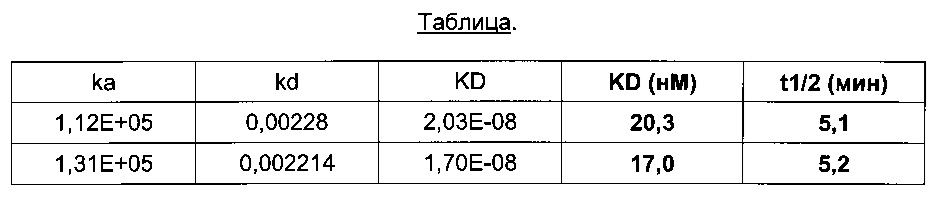
Пример 5. Образование ковалентных комплексов между теофиллином и антителом к теофиллинуExample 5. The formation of covalent complexes between theophylline and an antibody to theophylline
Для исследования образования ковалентных комплексов, в которые входят теофиллин и связывающие теофиллин антитела, как системы, распознающие гаптен, в качестве флуоресцентного "груза" использовали Теофиллин-Cys-Cy5, полученный с помощью методов синтеза и выделения, описанных выше. Структура синтезированного производного Теофиллин-Cys-Су5 показана на Фиг. 4. Чтобы продемонстрировать формирование ковалентной дисульфидной связи получали связывающие теофиллин антитела, имеющие дополнительный Cys в положениях 54 или 55 вариабельной области тяжелой цепи (Cys-антитело к теофиллину). Степень чистоты данных антител показана на примере варианта Y54C на Фиг. 46. Даные производные антитела образовывали комплексы с Теофиллином-Cys-Су5, которые затем разделяли при помощи ДСН-ПАГ в невосстанавливающих и восстанавливающих условиях, как описано в Примере 3. Су5, находящийся в комплексе с антителом к теофиллину благодаря формированию дисульфидной связи, детектировали в невосстанавливающих условиях в геле по флуоресценции, испускаемой Н-цепью, как описано в Примере 3. На Фиг. 4в показано, что ковалентные комплексы между антителом формировались в результате обыкновенного нагружения антитела, как и в случае образования дисульфидной связи при использовании в качестве гаптена дигоксигенина, флуоресцеина или биотина. Как и предполагали, данные комплексы диссоциировали в восстанавливающих условиях, т.е. "груз" отщеплялся от Н-цепи при восстановлении дисульфидной связи (Фиг. 4в).To study the formation of covalent complexes, which include theophylline and theophylline-binding antibodies, as systems that recognize haptens, theophylline-Cys-Cy5 obtained using the synthesis and isolation methods described above was used as a fluorescent “load”. The structure of the synthesized theophylline-Cys-Cy5 derivative is shown in FIG. 4. To demonstrate the formation of a covalent disulfide bond, theophylline-binding antibodies were obtained having additional Cys at
Пример 6. Связывающее теофиллин антитело демонстрирует чрезвычайно высокую аффинность связывания со своим антигеномExample 6. Theophylline-binding antibody exhibits an extremely high binding affinity for its antigen.
Аффинность антитела, связывающего теофиллин, оценивали методом поверхностного плазмонного резонанса с использованием биосенсора BIAcore (Фиг. 5). Fab-фрагменты антитела иммобилизовали на поверхности чипа при помощи захватывающего антитела анти-huFab и затем приводили их в контакт с "грузом", соединенным с молекулой теофиллина (Тео-пептидом). Формировались комплексы 1:1 (Fab:теофиллин-"груз"/). Наблюдалось быстрое связывание (высокая скорость ассоциации), при этом диссоциация не регистрировалась, т.е. значимого высвобождения связанного антигена не наблюдалось. Таким образом, антитело демонстрировало неожиданно высокую аффинность, не превышавшую нескольких пикомолей, возможно, составлявшую менее 1 пМ (Фиг. 5). Поскольку в данных экспериментальных условиях диссоциацию не наблюдали, точные значения kD определить не удалось (пределы чувствительности метода не позволяли зарегистрировать высвобождение антитела). Таким образом, возможно, аффинность антитела находится в субпикомолярном диапазоне.The affinity of theophylline-binding antibodies was evaluated by surface plasmon resonance using a BIAcore biosensor (Fig. 5). Fab fragments of the antibody were immobilized on the surface of the chip using an anti-huFab capture antibody and then brought into contact with a “load” connected to the theophylline molecule (Theo peptide). The complexes were formed 1: 1 (Fab: theophylline-"cargo" /). Fast binding was observed (high rate of association), while dissociation was not recorded, i.e. no significant release of bound antigen was observed. Thus, the antibody showed unexpectedly high affinity, not exceeding several picomoles, possibly less than 1 pM (Fig. 5). Since no dissociation was observed under these experimental conditions, the exact values of k D could not be determined (the sensitivity limits of the method did not allow the detection of antibody release). Thus, it is possible that the affinity of the antibody is in the subpicomolar range.
Claims (17)
Applications Claiming Priority (3)
| Application Number | Priority Date | Filing Date | Title |
|---|---|---|---|
| EP12174958.4 | 2012-07-04 | ||
| EP12174958 | 2012-07-04 | ||
| PCT/EP2013/064090 WO2014006118A1 (en) | 2012-07-04 | 2013-07-04 | Anti-theophylline antibodies and methods of use |
Related Child Applications (1)
| Application Number | Title | Priority Date | Filing Date |
|---|---|---|---|
| RU2017128512A Division RU2017128512A (en) | 2012-07-04 | 2013-07-04 | ANTIBODIES TO THEOPHYLLIN AND WAYS OF THEIR APPLICATION |
Publications (2)
| Publication Number | Publication Date |
|---|---|
| RU2015102068A RU2015102068A (en) | 2016-08-20 |
| RU2630664C2 true RU2630664C2 (en) | 2017-09-11 |
Family
ID=48794057
Family Applications (2)
| Application Number | Title | Priority Date | Filing Date |
|---|---|---|---|
| RU2015102068A RU2630664C2 (en) | 2012-07-04 | 2013-07-04 | Theophylline antibodies and methods for their application |
| RU2017128512A RU2017128512A (en) | 2012-07-04 | 2013-07-04 | ANTIBODIES TO THEOPHYLLIN AND WAYS OF THEIR APPLICATION |
Family Applications After (1)
| Application Number | Title | Priority Date | Filing Date |
|---|---|---|---|
| RU2017128512A RU2017128512A (en) | 2012-07-04 | 2013-07-04 | ANTIBODIES TO THEOPHYLLIN AND WAYS OF THEIR APPLICATION |
Country Status (15)
| Country | Link |
|---|---|
| US (1) | US9925272B2 (en) |
| EP (2) | EP3138578B1 (en) |
| JP (2) | JP6324376B2 (en) |
| KR (1) | KR20150023938A (en) |
| CN (2) | CN104394886B (en) |
| BR (1) | BR112014030843A2 (en) |
| CA (1) | CA2872184A1 (en) |
| DK (1) | DK2869837T3 (en) |
| ES (1) | ES2600154T3 (en) |
| HU (1) | HUE029435T2 (en) |
| MX (1) | MX353951B (en) |
| PL (1) | PL2869837T3 (en) |
| RU (2) | RU2630664C2 (en) |
| SI (1) | SI2869837T1 (en) |
| WO (1) | WO2014006118A1 (en) |
Families Citing this family (7)
| Publication number | Priority date | Publication date | Assignee | Title |
|---|---|---|---|---|
| WO2014006123A1 (en) | 2012-07-04 | 2014-01-09 | F. Hoffmann-La Roche Ag | Anti-biotin antibodies and methods of use |
| ES2604012T3 (en) | 2012-07-04 | 2017-03-02 | F. Hoffmann-La Roche Ag | Covalently bound antigen-antibody conjugates |
| RU2630664C2 (en) * | 2012-07-04 | 2017-09-11 | Ф. Хоффманн-Ля Рош Аг | Theophylline antibodies and methods for their application |
| KR102278979B1 (en) | 2014-01-03 | 2021-07-19 | 에프. 호프만-라 로슈 아게 | Covalently linked helicar-anti-helicar antibody conjugates and uses thereof |
| US10561737B2 (en) | 2014-01-03 | 2020-02-18 | Hoffmann-La Roche Inc. | Bispecific anti-hapten/anti-blood brain barrier receptor antibodies, complexes thereof and their use as blood brain barrier shuttles |
| JP6521464B2 (en) | 2014-01-03 | 2019-05-29 | エフ.ホフマン−ラ ロシュ アーゲーF. Hoffmann−La Roche Aktiengesellschaft | Covalently linked polypeptide toxin-antibody conjugates |
| MX384037B (en) | 2014-06-26 | 2025-03-14 | Hoffmann La Roche | ANTI-BROMODEOXYURIDINE (BRDU) ANTIBODIES AND METHODS OF USE. |
Citations (4)
| Publication number | Priority date | Publication date | Assignee | Title |
|---|---|---|---|---|
| US4524025A (en) * | 1982-06-30 | 1985-06-18 | E. I. Du Pont De Nemours And Company | Hybridoma cell lines and monoclonal antibodies to theophylline |
| US4855226A (en) * | 1985-06-07 | 1989-08-08 | Beckman Instruments, Inc. | Novel competitive assay for theophylline and reagent for use therein |
| WO2010045388A2 (en) * | 2008-10-14 | 2010-04-22 | Dyax Corp. | Use of mmp-9 and mmp-12 binding proteins for the treatment and prevention of systemic sclerosis |
| RU2010108429A (en) * | 2007-08-15 | 2011-09-20 | ЙЕДА РЕСЕАРЧ ЭНД ДЕВЕЛОПМЕНТ КО. ЛТД, эт ве Вайзманн Институте оф Сайнсе (IL) | MMR-9 REGULATORS AND THEIR APPLICATION |
Family Cites Families (161)
| Publication number | Priority date | Publication date | Assignee | Title |
|---|---|---|---|---|
| US4275149A (en) | 1978-11-24 | 1981-06-23 | Syva Company | Macromolecular environment control in specific receptor assays |
| US4318980A (en) | 1978-04-10 | 1982-03-09 | Miles Laboratories, Inc. | Heterogenous specific binding assay employing a cycling reactant as label |
| US4533493A (en) | 1981-08-27 | 1985-08-06 | Miles Laboratories, Inc. | Theophylline immunogens, antibodies, labeled conjugates, and related derivatives |
| JPS5920228A (en) * | 1982-06-30 | 1984-02-01 | イ−・アイ・デユポン・ド・ネモア−ス・アンド・コンパニ− | Hybridoma cell strain and monoclonal antibody against theophylline |
| US4816567A (en) | 1983-04-08 | 1989-03-28 | Genentech, Inc. | Recombinant immunoglobin preparations |
| US5316757A (en) | 1984-10-18 | 1994-05-31 | Board Of Regents, The University Of Texas System | Synthesis of polyazamacrocycles with more than one type of side-chain chelating groups |
| US5342606A (en) | 1984-10-18 | 1994-08-30 | Board Of Regents, The University Of Texas System | Polyazamacrocyclic compounds for complexation of metal ions |
| US4737456A (en) | 1985-05-09 | 1988-04-12 | Syntex (U.S.A.) Inc. | Reducing interference in ligand-receptor binding assays |
| US4676980A (en) | 1985-09-23 | 1987-06-30 | The United States Of America As Represented By The Secretary Of The Department Of Health And Human Services | Target specific cross-linked heteroantibodies |
| US6548640B1 (en) | 1986-03-27 | 2003-04-15 | Btg International Limited | Altered antibodies |
| US6881536B1 (en) | 1986-04-30 | 2005-04-19 | Bioveris Corporation | Particle based electrochemiluminescent assays |
| IL85035A0 (en) | 1987-01-08 | 1988-06-30 | Int Genetic Eng | Polynucleotide molecule,a chimeric antibody with specificity for human b cell surface antigen,a process for the preparation and methods utilizing the same |
| WO1988007089A1 (en) | 1987-03-18 | 1988-09-22 | Medical Research Council | Altered antibodies |
| GB8706503D0 (en) | 1987-03-19 | 1987-04-23 | British Petroleum Co Plc | Aromatic hydrocarbons |
| US5770701A (en) | 1987-10-30 | 1998-06-23 | American Cyanamid Company | Process for preparing targeted forms of methyltrithio antitumor agents |
| US5606040A (en) | 1987-10-30 | 1997-02-25 | American Cyanamid Company | Antitumor and antibacterial substituted disulfide derivatives prepared from compounds possessing a methyl-trithio group |
| DE3836656A1 (en) | 1988-10-27 | 1990-05-03 | Boehringer Mannheim Gmbh | NEW DIGOXIGENINE DERIVATIVES AND THEIR USE |
| WO1990005144A1 (en) | 1988-11-11 | 1990-05-17 | Medical Research Council | Single domain ligands, receptors comprising said ligands, methods for their production, and use of said ligands and receptors |
| DE3920358A1 (en) | 1989-06-22 | 1991-01-17 | Behringwerke Ag | BISPECIFIC AND OLIGO-SPECIFIC, MONO- AND OLIGOVALENT ANTI-BODY CONSTRUCTS, THEIR PRODUCTION AND USE |
| US5208020A (en) | 1989-10-25 | 1993-05-04 | Immunogen Inc. | Cytotoxic agents comprising maytansinoids and their therapeutic use |
| CA2026147C (en) | 1989-10-25 | 2006-02-07 | Ravi J. Chari | Cytotoxic agents comprising maytansinoids and their therapeutic use |
| US5959177A (en) | 1989-10-27 | 1999-09-28 | The Scripps Research Institute | Transgenic plants expressing assembled secretory antibodies |
| EP0462246A4 (en) | 1989-11-07 | 1992-11-25 | Bristol-Myers Squibb Company | Oligomeric immunoglobulins |
| US6075181A (en) | 1990-01-12 | 2000-06-13 | Abgenix, Inc. | Human antibodies derived from immunized xenomice |
| US6150584A (en) | 1990-01-12 | 2000-11-21 | Abgenix, Inc. | Human antibodies derived from immunized xenomice |
| US5770429A (en) | 1990-08-29 | 1998-06-23 | Genpharm International, Inc. | Transgenic non-human animals capable of producing heterologous antibodies |
| AU8506991A (en) | 1990-08-31 | 1992-03-30 | Bristol-Myers Squibb Company | Homoconjugated immunoglobulins |
| DE69129154T2 (en) | 1990-12-03 | 1998-08-20 | Genentech, Inc., South San Francisco, Calif. | METHOD FOR ENRICHING PROTEIN VARIANTS WITH CHANGED BINDING PROPERTIES |
| US5571894A (en) | 1991-02-05 | 1996-11-05 | Ciba-Geigy Corporation | Recombinant antibodies specific for a growth factor receptor |
| DE4118120A1 (en) | 1991-06-03 | 1992-12-10 | Behringwerke Ag | TETRAVALENT BISPECIFIC RECEPTORS, THEIR PRODUCTION AND USE |
| US6511663B1 (en) | 1991-06-11 | 2003-01-28 | Celltech R&D Limited | Tri- and tetra-valent monospecific antigen-binding proteins |
| JP4124480B2 (en) | 1991-06-14 | 2008-07-23 | ジェネンテック・インコーポレーテッド | Immunoglobulin variants |
| GB9114948D0 (en) | 1991-07-11 | 1991-08-28 | Pfizer Ltd | Process for preparing sertraline intermediates |
| WO1993006217A1 (en) | 1991-09-19 | 1993-04-01 | Genentech, Inc. | EXPRESSION IN E. COLI OF ANTIBODY FRAGMENTS HAVING AT LEAST A CYSTEINE PRESENT AS A FREE THIOL, USE FOR THE PRODUCTION OF BIFUNCTIONAL F(ab')2 ANTIBODIES |
| FI941572L (en) | 1991-10-07 | 1994-05-27 | Oncologix Inc | Combination and method of use of anti-erbB-2 monoclonal antibodies |
| WO1993008829A1 (en) | 1991-11-04 | 1993-05-13 | The Regents Of The University Of California | Compositions that mediate killing of hiv-infected cells |
| US5480990A (en) | 1991-12-10 | 1996-01-02 | The Dow Chemical Company | Bicyclopolyazamacrocyclocarboxylic acid complexes for use as contrast agents |
| US5739294A (en) | 1991-12-10 | 1998-04-14 | The Dow Chemical Company | Bicyclopol yazamacrocyclophosphonic acid complexes for use as contrast agents |
| US5428139A (en) | 1991-12-10 | 1995-06-27 | The Dow Chemical Company | Bicyclopolyazamacrocyclophosphonic acid complexes for use as radiopharmaceuticals |
| ATE503496T1 (en) | 1992-02-06 | 2011-04-15 | Novartis Vaccines & Diagnostic | BIOSYNTHETIC BINDING PROTEIN FOR TUMOR MARKERS |
| ZA932522B (en) | 1992-04-10 | 1993-12-20 | Res Dev Foundation | Immunotoxins directed against c-erbB-2(HER/neu) related surface antigens |
| ATE139900T1 (en) | 1992-11-13 | 1996-07-15 | Idec Pharma Corp | THERAPEUTIC USE OF CHIMERIC AND LABELED ANTIBODIES AGAINST HUMAN B LYMPHOCYTE RESTRICTED DIFFERENTIATION ANTIGEN FOR THE TREATMENT OF B CELL LYMPHOMA |
| US5635483A (en) | 1992-12-03 | 1997-06-03 | Arizona Board Of Regents Acting On Behalf Of Arizona State University | Tumor inhibiting tetrapeptide bearing modified phenethyl amides |
| US5780588A (en) | 1993-01-26 | 1998-07-14 | Arizona Board Of Regents | Elucidation and synthesis of selected pentapeptides |
| US5385893A (en) | 1993-05-06 | 1995-01-31 | The Dow Chemical Company | Tricyclopolyazamacrocyclophosphonic acids, complexes and derivatives thereof, for use as contrast agents |
| US5462725A (en) | 1993-05-06 | 1995-10-31 | The Dow Chemical Company | 2-pyridylmethylenepolyazamacrocyclophosphonic acids, complexes and derivatives thereof, for use as contrast agents |
| CA2163345A1 (en) | 1993-06-16 | 1994-12-22 | Susan Adrienne Morgan | Antibodies |
| US6476198B1 (en) | 1993-07-13 | 2002-11-05 | The Scripps Research Institute | Multispecific and multivalent antigen-binding polypeptide molecules |
| WO1995009917A1 (en) | 1993-10-07 | 1995-04-13 | The Regents Of The University Of California | Genetically engineered bispecific tetravalent antibodies |
| US5773001A (en) | 1994-06-03 | 1998-06-30 | American Cyanamid Company | Conjugates of methyltrithio antitumor agents and intermediates for their synthesis |
| AU684992B2 (en) | 1994-07-25 | 1998-01-08 | Boehringer Mannheim Gmbh | Hapten-marked peptides |
| US5789199A (en) | 1994-11-03 | 1998-08-04 | Genentech, Inc. | Process for bacterial production of polypeptides |
| US5840523A (en) | 1995-03-01 | 1998-11-24 | Genetech, Inc. | Methods and compositions for secretion of heterologous polypeptides |
| US5731168A (en) | 1995-03-01 | 1998-03-24 | Genentech, Inc. | Method for making heteromultimeric polypeptides |
| US5869046A (en) | 1995-04-14 | 1999-02-09 | Genentech, Inc. | Altered polypeptides with increased half-life |
| US5712374A (en) | 1995-06-07 | 1998-01-27 | American Cyanamid Company | Method for the preparation of substantiallly monomeric calicheamicin derivative/carrier conjugates |
| US5714586A (en) | 1995-06-07 | 1998-02-03 | American Cyanamid Company | Methods for the preparation of monomeric calicheamicin derivative/carrier conjugates |
| US6267958B1 (en) | 1995-07-27 | 2001-07-31 | Genentech, Inc. | Protein formulation |
| DE69724761T2 (en) | 1996-01-11 | 2004-08-05 | Techniclone, Inc., Tustin | BIOTINYLATED ANTIBODY WITH REDUCED POSITIVE NET CHARGE AND TOXIN, MEDICINE OR CHELATE |
| GB9603256D0 (en) | 1996-02-16 | 1996-04-17 | Wellcome Found | Antibodies |
| US5834456A (en) | 1996-02-23 | 1998-11-10 | The Dow Chemical Company | Polyazamacrocyclofluoromonoalkylphosphonic acids, and their complexes, for use as contrast agents |
| IL132560A0 (en) | 1997-05-02 | 2001-03-19 | Genentech Inc | A method for making multispecific antibodies having heteromultimeric and common components |
| US6171586B1 (en) | 1997-06-13 | 2001-01-09 | Genentech, Inc. | Antibody formulation |
| ES2244066T3 (en) | 1997-06-24 | 2005-12-01 | Genentech, Inc. | PROCEDURE AND COMPOSITIONS OF GALACTOSILATED GLICOPROTEINS. |
| US6040498A (en) | 1998-08-11 | 2000-03-21 | North Caroline State University | Genetically engineered duckweed |
| WO1999009055A2 (en) | 1997-08-18 | 1999-02-25 | Innogenetics N.V. | Interferon-gamma-binding molecules for treating septic shock, cachexia, immune diseases and skin disorders |
| WO1999022764A1 (en) | 1997-10-31 | 1999-05-14 | Genentech, Inc. | Methods and compositions comprising glycoprotein glycoforms |
| US6610833B1 (en) | 1997-11-24 | 2003-08-26 | The Institute For Human Genetics And Biochemistry | Monoclonal human natural antibodies |
| WO1999029888A1 (en) | 1997-12-05 | 1999-06-17 | The Scripps Research Institute | Humanization of murine antibody |
| ATE375365T1 (en) | 1998-04-02 | 2007-10-15 | Genentech Inc | ANTIBODIES VARIANTS AND FRAGMENTS THEREOF |
| US6528624B1 (en) | 1998-04-02 | 2003-03-04 | Genentech, Inc. | Polypeptide variants |
| US6194551B1 (en) | 1998-04-02 | 2001-02-27 | Genentech, Inc. | Polypeptide variants |
| PT1071700E (en) | 1998-04-20 | 2010-04-23 | Glycart Biotechnology Ag | Glycosylation engineering of antibodies for improving antibody-dependent cellular cytotoxicity |
| DE19819846B4 (en) | 1998-05-05 | 2016-11-24 | Deutsches Krebsforschungszentrum Stiftung des öffentlichen Rechts | Multivalent antibody constructs |
| US6737056B1 (en) | 1999-01-15 | 2004-05-18 | Genentech, Inc. | Polypeptide variants with altered effector function |
| EP1141024B1 (en) | 1999-01-15 | 2018-08-08 | Genentech, Inc. | POLYPEPTIDE COMPRISING A VARIANT HUMAN IgG1 Fc REGION |
| US6897044B1 (en) | 1999-01-28 | 2005-05-24 | Biogen Idec, Inc. | Production of tetravalent antibodies |
| EP1154799A2 (en) | 1999-02-22 | 2001-11-21 | Millennium Pharmaceuticals, Inc. | Biotinylated-chemokine antibody complexes |
| ES2601882T5 (en) | 1999-04-09 | 2021-06-07 | Kyowa Kirin Co Ltd | Procedure to monitor the activity of an immunofunctional molecule |
| US7125978B1 (en) | 1999-10-04 | 2006-10-24 | Medicago Inc. | Promoter for regulating expression of foreign genes |
| KR100797667B1 (en) | 1999-10-04 | 2008-01-23 | 메디카고 인코포레이티드 | How to regulate transcription of foreign genes |
| CA2388245C (en) | 1999-10-19 | 2012-01-10 | Tatsuya Ogawa | The use of serum-free adapted rat cells for producing heterologous polypeptides |
| GB9926529D0 (en) | 1999-11-09 | 2000-01-12 | Ks Biomedix Ltd | Targeting agents |
| AU784983B2 (en) | 1999-12-15 | 2006-08-17 | Genentech Inc. | Shotgun scanning, a combinatorial method for mapping functional protein epitopes |
| DK1242438T3 (en) | 1999-12-29 | 2007-02-12 | Immunogen Inc | Cytotoxic agents comprising modified doxorubicins and daunorubicins and their therapeutic use |
| DK2857516T3 (en) | 2000-04-11 | 2017-08-07 | Genentech Inc | Multivalent antibodies and uses thereof |
| US6946292B2 (en) | 2000-10-06 | 2005-09-20 | Kyowa Hakko Kogyo Co., Ltd. | Cells producing antibody compositions with increased antibody dependent cytotoxic activity |
| HU231090B1 (en) | 2000-10-06 | 2020-07-28 | Kyowa Kirin Co., Ltd. | Cells producing antibody compositions |
| US7064191B2 (en) | 2000-10-06 | 2006-06-20 | Kyowa Hakko Kogyo Co., Ltd. | Process for purifying antibody |
| US6596541B2 (en) | 2000-10-31 | 2003-07-22 | Regeneron Pharmaceuticals, Inc. | Methods of modifying eukaryotic cells |
| EP1916303B1 (en) | 2000-11-30 | 2013-02-27 | Medarex, Inc. | Nucleic acids encoding rearranged human immunoglobulin sequences from transgenic transchromosomal mice |
| EP1423510A4 (en) | 2001-08-03 | 2005-06-01 | Glycart Biotechnology Ag | ANTIBODY GLYCOSYLATION VARIANTS WITH INCREASED CELL CYTOTOXICITY DEPENDENT OF ANTIBODIES |
| DE60124912T2 (en) | 2001-09-14 | 2007-06-14 | Affimed Therapeutics Ag | Multimeric, single chain, tandem Fv antibodies |
| HUP0600342A3 (en) | 2001-10-25 | 2011-03-28 | Genentech Inc | Glycoprotein compositions |
| US20040093621A1 (en) | 2001-12-25 | 2004-05-13 | Kyowa Hakko Kogyo Co., Ltd | Antibody composition which specifically binds to CD20 |
| WO2003085119A1 (en) | 2002-04-09 | 2003-10-16 | Kyowa Hakko Kogyo Co., Ltd. | METHOD OF ENHANCING ACTIVITY OF ANTIBODY COMPOSITION OF BINDING TO FcϜ RECEPTOR IIIa |
| CA2481837A1 (en) | 2002-04-09 | 2003-10-16 | Kyowa Hakko Kogyo Co., Ltd. | Production process for antibody composition |
| CA2481656A1 (en) | 2002-04-09 | 2003-10-16 | Kyowa Hakko Kogyo Co., Ltd. | Cells in which activity of the protein involved in transportation of gdp-fucose is reduced or lost |
| US20050031613A1 (en) | 2002-04-09 | 2005-02-10 | Kazuyasu Nakamura | Therapeutic agent for patients having human FcgammaRIIIa |
| WO2003084569A1 (en) | 2002-04-09 | 2003-10-16 | Kyowa Hakko Kogyo Co., Ltd. | Drug containing antibody composition |
| CN102911987B (en) | 2002-04-09 | 2015-09-30 | 协和发酵麒麟株式会社 | The adorned cell of genome |
| CA2488441C (en) | 2002-06-03 | 2015-01-27 | Genentech, Inc. | Synthetic antibody phage libraries |
| US7361740B2 (en) | 2002-10-15 | 2008-04-22 | Pdl Biopharma, Inc. | Alteration of FcRn binding affinities or serum half-lives of antibodies by mutagenesis |
| EP1560596A1 (en) | 2002-11-15 | 2005-08-10 | Immunomedics, Inc. | Use of multi-specific, non-covalent complexes for targeted delivery of therapeutics |
| DK2289936T3 (en) | 2002-12-16 | 2017-07-31 | Genentech Inc | IMMUNGLOBULIN VARIATIONS AND APPLICATIONS THEREOF |
| EP1585767A2 (en) | 2003-01-16 | 2005-10-19 | Genentech, Inc. | Synthetic antibody phage libraries |
| WO2004065569A2 (en) | 2003-01-23 | 2004-08-05 | The Regents Of The University Of California | Multi-functional antibodies |
| US20050026263A1 (en) | 2003-07-31 | 2005-02-03 | The Regents Of The University Of California | Multi-functional antibodies |
| US7871607B2 (en) | 2003-03-05 | 2011-01-18 | Halozyme, Inc. | Soluble glycosaminoglycanases and methods of preparing and using soluble glycosaminoglycanases |
| US20060104968A1 (en) | 2003-03-05 | 2006-05-18 | Halozyme, Inc. | Soluble glycosaminoglycanases and methods of preparing and using soluble glycosaminogly ycanases |
| US7214545B2 (en) | 2003-04-28 | 2007-05-08 | The Regents Of The University Of California | Element-coded affinity tags |
| CA2530388A1 (en) | 2003-06-27 | 2005-01-06 | Biogen Idec Ma Inc. | Modified binding molecules comprising connecting peptides |
| WO2005004809A2 (en) | 2003-07-01 | 2005-01-20 | Immunomedics, Inc. | Multivalent carriers of bi-specific antibodies |
| WO2005035586A1 (en) | 2003-10-08 | 2005-04-21 | Kyowa Hakko Kogyo Co., Ltd. | Fused protein composition |
| WO2005035778A1 (en) | 2003-10-09 | 2005-04-21 | Kyowa Hakko Kogyo Co., Ltd. | PROCESS FOR PRODUCING ANTIBODY COMPOSITION BY USING RNA INHIBITING THE FUNCTION OF α1,6-FUCOSYLTRANSFERASE |
| DK2380910T3 (en) | 2003-11-05 | 2015-10-19 | Roche Glycart Ag | Antigen binding molecules with increased Fc receptor binding affinity and effector function |
| PT2489364E (en) | 2003-11-06 | 2015-04-16 | Seattle Genetics Inc | Monomethylvaline compounds conjugated to antibodies |
| WO2005053742A1 (en) | 2003-12-04 | 2005-06-16 | Kyowa Hakko Kogyo Co., Ltd. | Medicine containing antibody composition |
| MXPA06011199A (en) | 2004-03-31 | 2007-04-16 | Genentech Inc | Humanized anti-tgf-beta antibodies. |
| US7785903B2 (en) | 2004-04-09 | 2010-08-31 | Genentech, Inc. | Variable domain library and uses |
| PL1737891T3 (en) | 2004-04-13 | 2013-08-30 | Hoffmann La Roche | Anti-p-selectin antibodies |
| EP1786918A4 (en) | 2004-07-17 | 2009-02-11 | Imclone Systems Inc | Novel tetravalent bispecific antibody |
| TWI380996B (en) | 2004-09-17 | 2013-01-01 | Hoffmann La Roche | Anti-ox40l antibodies |
| NZ553500A (en) | 2004-09-23 | 2009-11-27 | Genentech Inc Genentech Inc | Cysteine engineered antibodies and conjugates withCysteine engineered antibodies and conjugates with a free cysteine amino acid in the heavy chain a free cysteine amino acid in the heavy chain |
| US20100111856A1 (en) | 2004-09-23 | 2010-05-06 | Herman Gill | Zirconium-radiolabeled, cysteine engineered antibody conjugates |
| JO3000B1 (en) | 2004-10-20 | 2016-09-05 | Genentech Inc | Antibody Formulations. |
| WO2006106905A1 (en) | 2005-03-31 | 2006-10-12 | Chugai Seiyaku Kabushiki Kaisha | Process for production of polypeptide by regulation of assembly |
| MY169746A (en) | 2005-08-19 | 2019-05-14 | Abbvie Inc | Dual variable domain immunoglobulin and uses thereof |
| EP1957531B1 (en) | 2005-11-07 | 2016-04-13 | Genentech, Inc. | Binding polypeptides with diversified and consensus vh/vl hypervariable sequences |
| US20070237764A1 (en) | 2005-12-02 | 2007-10-11 | Genentech, Inc. | Binding polypeptides with restricted diversity sequences |
| CA2630649A1 (en) | 2005-12-07 | 2007-06-14 | F. Hoffmann-La Roche Ag | Neuropeptide-2 receptor-agonists |
| NZ591252A (en) | 2006-03-17 | 2012-06-29 | Biogen Idec Inc | Methods of designing antibody or antigen binding fragments thereof with substituted non-covarying amino acids |
| WO2007131242A2 (en) | 2006-05-05 | 2007-11-15 | The Regents Of The University Of California | Streptavidin-biotin-link antibody-hapten system |
| AR060871A1 (en) | 2006-05-09 | 2008-07-16 | Genentech Inc | UNION OF POLYPEPTIDES WITH OPTIMIZED SUPERCONTIGES |
| WO2008027236A2 (en) | 2006-08-30 | 2008-03-06 | Genentech, Inc. | Multispecific antibodies |
| DK2087002T3 (en) | 2006-10-27 | 2014-10-27 | Lpath Inc | Compositions and Methods for Binding Sphingosine-1-Phosphate |
| US20080226635A1 (en) | 2006-12-22 | 2008-09-18 | Hans Koll | Antibodies against insulin-like growth factor I receptor and uses thereof |
| CN100592373C (en) | 2007-05-25 | 2010-02-24 | 群康科技(深圳)有限公司 | Liquid crystal display panel driving device and driving method thereof |
| US9266967B2 (en) | 2007-12-21 | 2016-02-23 | Hoffmann-La Roche, Inc. | Bivalent, bispecific antibodies |
| US20090162359A1 (en) | 2007-12-21 | 2009-06-25 | Christian Klein | Bivalent, bispecific antibodies |
| US8242247B2 (en) | 2007-12-21 | 2012-08-14 | Hoffmann-La Roche Inc. | Bivalent, bispecific antibodies |
| US8227577B2 (en) | 2007-12-21 | 2012-07-24 | Hoffman-La Roche Inc. | Bivalent, bispecific antibodies |
| SI2235064T1 (en) | 2008-01-07 | 2016-04-29 | Amgen Inc. | Method for making antibody fc-heterodimeric molecules using electrostatic steering effects |
| WO2010056893A1 (en) | 2008-11-13 | 2010-05-20 | Imclone Llc | Humanization and affinity-optimization of antibodies |
| US7816856B2 (en) | 2009-02-25 | 2010-10-19 | Global Oled Technology Llc | Flexible oled display with chiplets |
| KR101431318B1 (en) | 2009-04-02 | 2014-08-20 | 로슈 글리카트 아게 | Multispecific antibodies comprising full length antibodies and single chain fab fragments |
| JP5616428B2 (en) | 2009-04-07 | 2014-10-29 | ロシュ グリクアート アクチェンゲゼルシャフト | Trivalent bispecific antibody |
| DK2419447T3 (en) | 2009-04-17 | 2017-09-25 | Immunas Pharma Inc | ANTIBODIES THAT SPECIFICALLY BIND TO A BETA OLIGOMER AND USE THEREOF |
| PE20120540A1 (en) | 2009-05-27 | 2012-05-09 | Hoffmann La Roche | THREE-SPECIFIC OR TETRA-SPECIFIC ANTIBODIES |
| US9676845B2 (en) | 2009-06-16 | 2017-06-13 | Hoffmann-La Roche, Inc. | Bispecific antigen binding proteins |
| US8703132B2 (en) | 2009-06-18 | 2014-04-22 | Hoffmann-La Roche, Inc. | Bispecific, tetravalent antigen binding proteins |
| SG177560A1 (en) | 2009-07-06 | 2012-03-29 | Hoffmann La Roche | Bi-specific digoxigenin binding antibodies |
| WO2011032022A1 (en) | 2009-09-11 | 2011-03-17 | The Government Of The United States Of America As Represented By The Secretary Of The Department Of Health And Human Services | Improved pseudomonas exotoxin a with reduced immunogenicity |
| BR112013014644A2 (en) | 2011-01-03 | 2017-03-07 | F Hoffmann - La Roche Ag | pharmaceutical composition and complex |
| CN102253215A (en) * | 2011-06-07 | 2011-11-23 | 济南金域医学检验中心有限公司 | Theophylline homogeneous enzyme immunoassay kit and preparation method thereof |
| EP2855531A1 (en) | 2012-05-24 | 2015-04-08 | F. Hoffmann-La Roche AG | Multispecific antibodies |
| RU2630664C2 (en) * | 2012-07-04 | 2017-09-11 | Ф. Хоффманн-Ля Рош Аг | Theophylline antibodies and methods for their application |
| WO2014006123A1 (en) | 2012-07-04 | 2014-01-09 | F. Hoffmann-La Roche Ag | Anti-biotin antibodies and methods of use |
| ES2604012T3 (en) | 2012-07-04 | 2017-03-02 | F. Hoffmann-La Roche Ag | Covalently bound antigen-antibody conjugates |
| JP6521464B2 (en) | 2014-01-03 | 2019-05-29 | エフ.ホフマン−ラ ロシュ アーゲーF. Hoffmann−La Roche Aktiengesellschaft | Covalently linked polypeptide toxin-antibody conjugates |
| KR102278979B1 (en) | 2014-01-03 | 2021-07-19 | 에프. 호프만-라 로슈 아게 | Covalently linked helicar-anti-helicar antibody conjugates and uses thereof |
-
2013
- 2013-07-04 RU RU2015102068A patent/RU2630664C2/en not_active IP Right Cessation
- 2013-07-04 KR KR20157002955A patent/KR20150023938A/en not_active Abandoned
- 2013-07-04 EP EP16188547.0A patent/EP3138578B1/en active Active
- 2013-07-04 CN CN201380034688.9A patent/CN104394886B/en active Active
- 2013-07-04 CA CA2872184A patent/CA2872184A1/en not_active Abandoned
- 2013-07-04 WO PCT/EP2013/064090 patent/WO2014006118A1/en not_active Ceased
- 2013-07-04 CN CN201710177355.1A patent/CN107082810B/en active Active
- 2013-07-04 JP JP2015519219A patent/JP6324376B2/en active Active
- 2013-07-04 ES ES13737564.8T patent/ES2600154T3/en active Active
- 2013-07-04 PL PL13737564T patent/PL2869837T3/en unknown
- 2013-07-04 SI SI201330381A patent/SI2869837T1/en unknown
- 2013-07-04 MX MX2014014381A patent/MX353951B/en active IP Right Grant
- 2013-07-04 BR BR112014030843A patent/BR112014030843A2/en not_active Application Discontinuation
- 2013-07-04 EP EP13737564.8A patent/EP2869837B1/en active Active
- 2013-07-04 HU HUE13737564A patent/HUE029435T2/en unknown
- 2013-07-04 RU RU2017128512A patent/RU2017128512A/en not_active Application Discontinuation
- 2013-07-04 DK DK13737564.8T patent/DK2869837T3/en active
-
2014
- 2014-12-18 US US14/576,033 patent/US9925272B2/en active Active
-
2018
- 2018-04-10 JP JP2018075117A patent/JP6549278B2/en active Active
Patent Citations (4)
| Publication number | Priority date | Publication date | Assignee | Title |
|---|---|---|---|---|
| US4524025A (en) * | 1982-06-30 | 1985-06-18 | E. I. Du Pont De Nemours And Company | Hybridoma cell lines and monoclonal antibodies to theophylline |
| US4855226A (en) * | 1985-06-07 | 1989-08-08 | Beckman Instruments, Inc. | Novel competitive assay for theophylline and reagent for use therein |
| RU2010108429A (en) * | 2007-08-15 | 2011-09-20 | ЙЕДА РЕСЕАРЧ ЭНД ДЕВЕЛОПМЕНТ КО. ЛТД, эт ве Вайзманн Институте оф Сайнсе (IL) | MMR-9 REGULATORS AND THEIR APPLICATION |
| WO2010045388A2 (en) * | 2008-10-14 | 2010-04-22 | Dyax Corp. | Use of mmp-9 and mmp-12 binding proteins for the treatment and prevention of systemic sclerosis |
Also Published As
| Publication number | Publication date |
|---|---|
| MX2014014381A (en) | 2015-02-05 |
| US20150238628A1 (en) | 2015-08-27 |
| PL2869837T3 (en) | 2017-03-31 |
| CN104394886A (en) | 2015-03-04 |
| DK2869837T3 (en) | 2016-09-26 |
| JP2015527983A (en) | 2015-09-24 |
| SI2869837T1 (en) | 2016-12-30 |
| CN107082810B (en) | 2020-12-25 |
| CN104394886B (en) | 2017-05-24 |
| HUE029435T2 (en) | 2017-02-28 |
| RU2015102068A (en) | 2016-08-20 |
| CA2872184A1 (en) | 2014-01-09 |
| KR20150023938A (en) | 2015-03-05 |
| MX353951B (en) | 2018-02-07 |
| ES2600154T3 (en) | 2017-02-07 |
| CN107082810A (en) | 2017-08-22 |
| HK1203354A1 (en) | 2015-10-30 |
| RU2017128512A (en) | 2019-02-15 |
| WO2014006118A1 (en) | 2014-01-09 |
| BR112014030843A2 (en) | 2019-10-15 |
| EP3138578A1 (en) | 2017-03-08 |
| JP6324376B2 (en) | 2018-05-16 |
| JP6549278B2 (en) | 2019-07-24 |
| EP2869837A1 (en) | 2015-05-13 |
| EP3138578B1 (en) | 2022-01-12 |
| US9925272B2 (en) | 2018-03-27 |
| EP2869837B1 (en) | 2016-09-14 |
| JP2018138561A (en) | 2018-09-06 |
Similar Documents
| Publication | Publication Date | Title |
|---|---|---|
| CN105949313B (en) | Antibody Fc variants | |
| CN105884898B (en) | Anti-fibroblast activation protein antibodies and methods of use | |
| RU2630296C2 (en) | Antibodies to biotin and application methods | |
| EP3632935A1 (en) | Anti-tim3 antibodies and methods of use | |
| JP6549278B2 (en) | Anti-theophylline antibodies and methods of use | |
| JP2017536102A (en) | Anti-alpha-synuclein antibodies and methods of use | |
| JP7248761B2 (en) | Anti-BRDU Antibodies and Methods of Use | |
| JP2019507584A (en) | Anti-myostatin antibody and method of use | |
| JP2019518012A (en) | Modified anti-tenascin antibodies and methods of use | |
| HK1242354B (en) | Anti-theophylline antibodies and methods of use | |
| HK1242354A1 (en) | Anti-theophylline antibodies and methods of use | |
| HK1203354B (en) | Anti-theophylline antibodies and methods of use | |
| HK1182117B (en) | Anti-tenascin-c a2 antibodies and methods of use | |
| HK1182117A1 (en) | Anti-tenascin-c a2 antibodies and methods of use | |
| HK1228426A1 (en) | Antibody fc variants | |
| HK1235408A1 (en) | Anti-alpha-synuclein antibodies and methods of use | |
| HK1234419A1 (en) | Anti-brdu antibodies and methods of use | |
| HK1208235B (en) | Anti-biotin antibodies and methods of use | |
| HK1181402B (en) | Anti-fap antibodies and methods of use | |
| HK1193109B (en) | Antibody fc variants |
Legal Events
| Date | Code | Title | Description |
|---|---|---|---|
| MM4A | The patent is invalid due to non-payment of fees |
Effective date: 20200705 |