KR20220139874A - Selective transmission of power headroom reports - Google Patents
Selective transmission of power headroom reports Download PDFInfo
- Publication number
- KR20220139874A KR20220139874A KR1020227026906A KR20227026906A KR20220139874A KR 20220139874 A KR20220139874 A KR 20220139874A KR 1020227026906 A KR1020227026906 A KR 1020227026906A KR 20227026906 A KR20227026906 A KR 20227026906A KR 20220139874 A KR20220139874 A KR 20220139874A
- Authority
- KR
- South Korea
- Prior art keywords
- serving
- phr
- prs
- phr function
- function
- Prior art date
- Legal status (The legal status is an assumption and is not a legal conclusion. Google has not performed a legal analysis and makes no representation as to the accuracy of the status listed.)
- Pending
Links
- 230000005540 biological transmission Effects 0.000 title description 28
- 238000000034 method Methods 0.000 claims abstract description 68
- 238000005259 measurement Methods 0.000 claims abstract description 54
- 230000006870 function Effects 0.000 claims description 220
- 230000007717 exclusion Effects 0.000 claims description 19
- 230000006854 communication Effects 0.000 abstract description 50
- 238000004891 communication Methods 0.000 abstract description 46
- 238000012545 processing Methods 0.000 description 42
- 238000013461 design Methods 0.000 description 22
- 238000007726 management method Methods 0.000 description 16
- 239000000969 carrier Substances 0.000 description 11
- 238000001228 spectrum Methods 0.000 description 11
- 238000005516 engineering process Methods 0.000 description 9
- 230000008859 change Effects 0.000 description 8
- 230000001413 cellular effect Effects 0.000 description 7
- 238000001514 detection method Methods 0.000 description 7
- 230000011664 signaling Effects 0.000 description 7
- 230000001419 dependent effect Effects 0.000 description 6
- 230000009471 action Effects 0.000 description 5
- 238000012937 correction Methods 0.000 description 5
- 238000013507 mapping Methods 0.000 description 5
- 230000002829 reductive effect Effects 0.000 description 5
- 230000006837 decompression Effects 0.000 description 4
- 238000010586 diagram Methods 0.000 description 4
- 230000003287 optical effect Effects 0.000 description 4
- 230000008569 process Effects 0.000 description 4
- 230000002441 reversible effect Effects 0.000 description 4
- 238000004422 calculation algorithm Methods 0.000 description 3
- 230000020411 cell activation Effects 0.000 description 3
- 230000006835 compression Effects 0.000 description 3
- 238000007906 compression Methods 0.000 description 3
- 238000012544 monitoring process Methods 0.000 description 3
- 230000000737 periodic effect Effects 0.000 description 3
- 238000012384 transportation and delivery Methods 0.000 description 3
- 230000001960 triggered effect Effects 0.000 description 3
- 230000008901 benefit Effects 0.000 description 2
- 125000004122 cyclic group Chemical group 0.000 description 2
- 239000000835 fiber Substances 0.000 description 2
- 230000002401 inhibitory effect Effects 0.000 description 2
- 230000000670 limiting effect Effects 0.000 description 2
- 239000006249 magnetic particle Substances 0.000 description 2
- 230000007246 mechanism Effects 0.000 description 2
- 238000012986 modification Methods 0.000 description 2
- 230000004048 modification Effects 0.000 description 2
- 239000002245 particle Substances 0.000 description 2
- 230000002085 persistent effect Effects 0.000 description 2
- 230000010363 phase shift Effects 0.000 description 2
- 230000005855 radiation Effects 0.000 description 2
- 238000013468 resource allocation Methods 0.000 description 2
- 230000011218 segmentation Effects 0.000 description 2
- 238000012546 transfer Methods 0.000 description 2
- 238000012795 verification Methods 0.000 description 2
- 241000700159 Rattus Species 0.000 description 1
- 230000002776 aggregation Effects 0.000 description 1
- 238000004220 aggregation Methods 0.000 description 1
- 238000003491 array Methods 0.000 description 1
- 230000003190 augmentative effect Effects 0.000 description 1
- 238000013475 authorization Methods 0.000 description 1
- 230000000903 blocking effect Effects 0.000 description 1
- 230000003139 buffering effect Effects 0.000 description 1
- 238000004364 calculation method Methods 0.000 description 1
- 238000012512 characterization method Methods 0.000 description 1
- 238000004590 computer program Methods 0.000 description 1
- 239000004020 conductor Substances 0.000 description 1
- 230000008094 contradictory effect Effects 0.000 description 1
- 230000009977 dual effect Effects 0.000 description 1
- 230000000694 effects Effects 0.000 description 1
- 239000011521 glass Substances 0.000 description 1
- 230000006872 improvement Effects 0.000 description 1
- 238000007689 inspection Methods 0.000 description 1
- 239000012212 insulator Substances 0.000 description 1
- 239000000463 material Substances 0.000 description 1
- 238000010295 mobile communication Methods 0.000 description 1
- 238000005192 partition Methods 0.000 description 1
- 238000012913 prioritisation Methods 0.000 description 1
- 230000001105 regulatory effect Effects 0.000 description 1
- 230000009131 signaling function Effects 0.000 description 1
- 230000003595 spectral effect Effects 0.000 description 1
- 230000009466 transformation Effects 0.000 description 1
- 238000010200 validation analysis Methods 0.000 description 1
- 230000000007 visual effect Effects 0.000 description 1
Images


Classifications
-
- H—ELECTRICITY
- H04—ELECTRIC COMMUNICATION TECHNIQUE
- H04W—WIRELESS COMMUNICATION NETWORKS
- H04W52/00—Power management, e.g. Transmission Power Control [TPC] or power classes
- H04W52/04—Transmission power control [TPC]
- H04W52/38—TPC being performed in particular situations
- H04W52/40—TPC being performed in particular situations during macro-diversity or soft handoff
-
- H—ELECTRICITY
- H04—ELECTRIC COMMUNICATION TECHNIQUE
- H04W—WIRELESS COMMUNICATION NETWORKS
- H04W52/00—Power management, e.g. Transmission Power Control [TPC] or power classes
- H04W52/04—Transmission power control [TPC]
- H04W52/30—Transmission power control [TPC] using constraints in the total amount of available transmission power
- H04W52/36—Transmission power control [TPC] using constraints in the total amount of available transmission power with a discrete range or set of values, e.g. step size, ramping or offsets
- H04W52/365—Power headroom reporting
-
- H—ELECTRICITY
- H04—ELECTRIC COMMUNICATION TECHNIQUE
- H04L—TRANSMISSION OF DIGITAL INFORMATION, e.g. TELEGRAPHIC COMMUNICATION
- H04L5/00—Arrangements affording multiple use of the transmission path
- H04L5/003—Arrangements for allocating sub-channels of the transmission path
- H04L5/0048—Allocation of pilot signals, i.e. of signals known to the receiver
-
- H—ELECTRICITY
- H04—ELECTRIC COMMUNICATION TECHNIQUE
- H04L—TRANSMISSION OF DIGITAL INFORMATION, e.g. TELEGRAPHIC COMMUNICATION
- H04L5/00—Arrangements affording multiple use of the transmission path
- H04L5/003—Arrangements for allocating sub-channels of the transmission path
- H04L5/0048—Allocation of pilot signals, i.e. of signals known to the receiver
- H04L5/0051—Allocation of pilot signals, i.e. of signals known to the receiver of dedicated pilots, i.e. pilots destined for a single user or terminal
-
- H—ELECTRICITY
- H04—ELECTRIC COMMUNICATION TECHNIQUE
- H04W—WIRELESS COMMUNICATION NETWORKS
- H04W52/00—Power management, e.g. Transmission Power Control [TPC] or power classes
- H04W52/04—Transmission power control [TPC]
- H04W52/18—TPC being performed according to specific parameters
- H04W52/24—TPC being performed according to specific parameters using SIR [Signal to Interference Ratio] or other wireless path parameters
- H04W52/242—TPC being performed according to specific parameters using SIR [Signal to Interference Ratio] or other wireless path parameters taking into account path loss
-
- H—ELECTRICITY
- H04—ELECTRIC COMMUNICATION TECHNIQUE
- H04W—WIRELESS COMMUNICATION NETWORKS
- H04W52/00—Power management, e.g. Transmission Power Control [TPC] or power classes
- H04W52/04—Transmission power control [TPC]
- H04W52/06—TPC algorithms
- H04W52/14—Separate analysis of uplink or downlink
- H04W52/146—Uplink power control
-
- H—ELECTRICITY
- H04—ELECTRIC COMMUNICATION TECHNIQUE
- H04W—WIRELESS COMMUNICATION NETWORKS
- H04W52/00—Power management, e.g. Transmission Power Control [TPC] or power classes
- H04W52/04—Transmission power control [TPC]
- H04W52/30—Transmission power control [TPC] using constraints in the total amount of available transmission power
- H04W52/32—TPC of broadcast or control channels
- H04W52/325—Power control of control or pilot channels
Landscapes
- Engineering & Computer Science (AREA)
- Signal Processing (AREA)
- Computer Networks & Wireless Communication (AREA)
- Mobile Radio Communication Systems (AREA)
Abstract
무선 통신을 위한 기법들이 개시된다. 일 양상에서, UE는 PL-RS(pathloss reference signal)에 대해 PHR(power headroom report) 기능을 수행할지 여부를 결정하는 것을 결정한다. 결정에 기초하여, UE는, 결정에 기초하여 PL-RS에 대해 PHR 기능 또는 하나 이상의 경로 손실 측정들을 수행한다. 일부 양상들에서, 결정은 PL-RS와 연관된 셀 타입 또는 PL-RS 타입에 기초한다. 다른 양상들에서, 결정은 UE의 서빙 셀로부터 수신되는 PL-RS와 연관된 표시(예컨대, 명시적 또는 묵시적 표시)에 기초한다.Techniques for wireless communication are disclosed. In an aspect, the UE determines whether to perform a power headroom report (PHR) function for a pathloss reference signal (PL-RS). Based on the determination, the UE performs a PHR function or one or more pathloss measurements on the PL-RS based on the determination. In some aspects, the determination is based on a PL-RS type or a cell type associated with the PL-RS. In other aspects, the determination is based on an indication (eg, explicit or implicit indication) associated with the PL-RS received from a serving cell of the UE.
Description
[0001] 본 특허 출원은 2020년 2월 10일자로 출원된 "SELECTIVE TRANSMISSION OF POWER HEADROOM REPORTS"라는 명칭의 미국 가출원 제 62/972,141호 및 2021년 2월 5일자로 출원된 "SELECTIVE TRANSMISSION OF POWER HEADROOM REPORTS"라는 명칭의 미국 정규 출원 제 17/168,922호의 우선권을 주장하며, 상기 출원들 모두는 본원의 양수인에게 양도되고, 그에 의해 그 전체가 인용에 의해 본원에 명백하게 포함된다.[0001] This patent application is entitled "SELECTIVE TRANSMISSION OF POWER HEADROOM REPORTS", US Provisional Application No. 62/972,141, filed February 10, 2020, and "SELECTIVE TRANSMISSION OF POWER HEADROOM REPORTS," filed February 5, 2021. Priority is claimed to U.S. regular application Ser. No. 17/168,922, all of which are assigned to the assignee of the present application, and are hereby expressly incorporated herein by reference in their entirety.
[0002] 본 개시내용의 양상들은 일반적으로 무선 통신들에 관한 것으로, 더 상세하게는, 전력 헤드룸 보고(PHR: power headroom report)들의 선택적 송신에 관한 것이다.[0002] Aspects of the present disclosure generally relate to wireless communications, and more particularly, to the selective transmission of power headroom reports (PHR).
[0003] 무선 통신 시스템들은 1세대 아날로그 무선 폰 서비스(1G), 2세대(2G) 디지털 무선 폰 서비스(중간 2.5G 네트워크들을 포함함), 3세대(3G) 고속 데이터, 인터넷-가능 무선 서비스 및 4세대(4G) 서비스(예컨대, LTE 또는 WiMax)를 포함하는 다양한 세대들을 통해 개발되어 왔다. 셀룰러 및 PCS(personal communications service) 시스템들을 포함하여 다양한 상이한 타입들의 무선 통신 시스템들이 현재 사용되고 있다. 알려져 있는 셀룰러 시스템들의 예들은 셀룰러 아날로그 AMPS(advanced mobile phone system), 및 CDMA(code division multiple access), FDMA(frequency division multiple access), TDMA(time division multiple access), TDMA의 GSM(Global System for Mobile access) 변형 등에 기초한 디지털 셀룰러 시스템들을 포함한다.[0003] Wireless communication systems include first-generation analog wireless phone service (1G), second-generation (2G) digital wireless phone service (including intermediate 2.5G networks), third-generation (3G) high-speed data, Internet-enabled wireless service, and fourth-generation ( 4G) services (eg, LTE or WiMax) have been developed through various generations. A variety of different types of wireless communication systems are currently in use, including cellular and personal communications service (PCS) systems. Examples of known cellular systems are the cellular analog advanced mobile phone system (AMPS), and the Global System for Mobile (GSM) of code division multiple access (CDMA), frequency division multiple access (FDMA), time division multiple access (TDMA), and TDMA. access) digital cellular systems based on transformation, etc.
[0004] 5세대(5G) 무선 표준(NR(New Radio)로 지칭됨)은 다른 개선들 중에서도, 더 높은 데이터 전달 속도들, 더 많은 수의 연결들, 및 더 양호한 커버리지를 가능하게 한다. 차세대 모바일 네트워크 연합(Next Generation Mobile Networks Alliance)에 따르면, 5G 표준은 수만 명의 사용자들 각각에게 초당 수십 메가비트 ― 사무실 층에 있는 수십 명의 작업자들에게 초당 1 기가비트 ― 의 데이터 레이트들을 제공하도록 설계된다. 수십만 개의 동시 연결들이 대규모의 무선 센서 배치들을 지원하기 위해 지원되어야 한다. 결과적으로, 5G 모바일 통신들의 스펙트럼 효율성은 현재 4G 표준과 비교하여 크게 향상되어야 한다. 게다가, 현재 표준들과 비교하여 시그널링 효율성들이 향상되어야 하고, 레이턴시가 실질적으로 감소되어야 한다.[0004] The fifth generation (5G) radio standard (referred to as New Radio (NR)) enables higher data transfer rates, a greater number of connections, and better coverage, among other improvements. According to the Next Generation Mobile Networks Alliance, the 5G standard is designed to deliver data rates of tens of megabits per second to each of tens of thousands of users—one gigabit per second to dozens of workers on the office floor. Hundreds of thousands of simultaneous connections must be supported to support large-scale wireless sensor deployments. As a result, the spectral efficiency of 5G mobile communications should be greatly improved compared to the current 4G standard. Moreover, compared to current standards, signaling efficiencies should be improved, and latency should be substantially reduced.
[0005] 다음의 설명은 본원에 개시된 하나 이상의 양상들에 관한 간략화된 요약을 제시한다. 따라서, 다음의 요약은 모든 구상된 양상들에 관한 광범위한 개요로 고려되지 않아야 하고, 다음의 요약이 모든 구상된 양상들에 관한 핵심 또는 중요한 엘리먼트들을 식별하거나, 또는 임의의 특정 양상과 연관된 범위를 서술하는 것으로 간주되지 않아야 한다. 따라서, 다음의 요약은 아래에서 제시되는 상세한 설명에 선행하도록 간략화된 형태로 본원에 개시된 메커니즘들에 관한 하나 이상의 양상들에 관해 특정 개념들을 제시하기 위한 유일한 목적을 갖는다.[0005] The following description presents a simplified summary of one or more aspects disclosed herein. Accordingly, the following summary is not to be considered as an extensive overview of all contemplated aspects, but the following summary identifies key or critical elements regarding all contemplated aspects, or delineates the scope associated with any particular aspect. should not be considered as Accordingly, the following summary is for the sole purpose of presenting certain concepts relating to one or more aspects of the mechanisms disclosed herein in a simplified form that precedes the detailed description presented below.
[0006] 일 양상은, PL-RS(pathloss reference signal)와 연관된 셀 타입 또는 PL-RS 타입에 기초하여 PL-RS에 대해 PHR(power headroom report) 기능을 수행할지 여부를 결정하는 단계, 및 결정에 기초하여 PL-RS에 대해 PHR 기능 또는 하나 이상의 경로 손실 측정들을 수행하는 단계를 포함하는 UE(user equipment)를 동작시키는 방법에 관한 것이다.[0006] An aspect includes determining whether to perform a power headroom report (PHR) function for a PL-RS based on a PL-RS type or a cell type associated with a pathloss reference signal (PL-RS), and based on the determination A method of operating user equipment (UE) comprising performing a PHR function or one or more pathloss measurements for a PL-RS.
[0007] 다른 양상은, UE(user equipment)의 서빙 셀로부터 수신된 PL-RS(pathloss reference signal)와 연관된 표시에 기초하여 PL-RS에 대해 PHR(power headroom report) 기능을 수행할지 여부를 결정하는 단계, 및 결정에 기초하여 PL-RS에 대해 PHR 기능 또는 하나 이상의 경로 손실 측정들을 수행하는 단계를 포함하는 UE를 동작시키는 방법에 관한 것이다.[0007] Another aspect includes determining whether to perform a power headroom report (PHR) function for a PL-RS based on an indication associated with a pathloss reference signal (PL-RS) received from a serving cell of a user equipment (UE); and performing a PHR function or one or more pathloss measurements on the PL-RS based on the determination.
[0008] 또 다른 양상은, 메모리, 적어도 하나의 트랜시버, 및 메모리 및 적어도 하나의 트랜시버에 통신 가능하게 커플링된 적어도 하나의 프로세서를 포함하는 UE(user equipment)에 관한 것으로, 적어도 하나의 프로세서는, PL-RS(pathloss reference signal)와 연관된 셀 타입 또는 PL-RS 타입에 기초하여 PL-RS에 대해 PHR(power headroom report) 기능을 수행할지 여부를 결정하도록 그리고 결정에 기초하여 PL-RS에 대해 PHR 기능 또는 하나 이상의 경로 손실 측정들을 수행하도록 구성된다.[0008] Another aspect relates to user equipment (UE) comprising a memory, at least one transceiver, and at least one processor communicatively coupled to the memory and the at least one transceiver, the at least one processor comprising: to determine whether to perform a power headroom report (PHR) function for the PL-RS based on a cell type or PL-RS type associated with a pathloss reference signal (RS) and a PHR function for the PL-RS based on the determination; or and perform one or more pathloss measurements.
[0009] 또 다른 양상은, 메모리, 적어도 하나의 트랜시버, 및 메모리 및 적어도 하나의 트랜시버에 통신 가능하게 커플링된 적어도 하나의 프로세서를 포함하는 UE(user equipment)에 관한 것으로, 적어도 하나의 프로세서는, UE의 서빙 셀로부터 수신된 PL-RS(pathloss reference signal)와 연관된 표시에 기초하여 PL-RS에 대해 PHR(power headroom report) 기능을 수행할지 여부를 결정하도록, 그리고 결정에 기초하여 PL-RS에 대해 PHR 기능 또는 하나 이상의 경로 손실 측정들을 수행하도록 구성된다.[0009] Another aspect relates to user equipment (UE) comprising a memory, at least one transceiver, and at least one processor communicatively coupled to the memory and the at least one transceiver, the at least one processor comprising: to determine whether to perform a power headroom report (PHR) function for the PL-RS based on an indication associated with a pathloss reference signal (PL-RS) received from the serving cell, and PHR for the PL-RS based on the determination function or one or more path loss measurements.
[0010] 또 다른 양상은, PL-RS(pathloss reference signal)와 연관된 셀 타입 또는 PL-RS 타입에 기초하여 PL-RS에 대해 PHR(power headroom report) 기능을 수행할지 여부를 결정하기 위한 수단, 및 결정에 기초하여 PL-RS에 대해 PHR 기능 또는 하나 이상의 경로 손실 측정들을 수행하기 위한 수단을 포함하는 UE(user equipment)에 관한 것이다.[0010] Another aspect provides means for determining whether to perform a power headroom report (PHR) function for a PL-RS based on a cell type or a PL-RS type associated with a pathloss reference signal (PL-RS), and determining to a user equipment (UE) comprising means for performing a PHR function or one or more pathloss measurements for a PL-RS based on the PL-RS.
[0011] 또 다른 양상은, UE(user equipment)의 서빙 셀로부터 수신된 PL-RS(pathloss reference signal)와 연관된 표시에 기초하여 PL-RS에 대해 PHR(power headroom report) 기능을 수행할지 여부를 결정하기 위한 수단, 및 결정에 기초하여 PL-RS에 대해 PHR 기능 또는 하나 이상의 경로 손실 측정들을 수행하기 위한 수단을 포함하는 UE에 관한 것이다.[0011] Another aspect is for determining whether to perform a power headroom report (PHR) function for a PL-RS based on an indication associated with a pathloss reference signal (PL-RS) received from a serving cell of a user equipment (UE). and means for performing a PHR function or one or more pathloss measurements on the PL-RS based on the determination.
[0012] 또 다른 양상은, 컴퓨터 실행 가능한 명령들을 저장하는 비일시적 컴퓨터 판독 가능한 매체에 관한 것으로, 컴퓨터 실행 가능한 명령들은 PL-RS(pathloss reference signal)와 연관된 셀 타입 또는 PL-RS 타입에 기초하여 PL-RS에 대해 PHR(power headroom report) 기능을 수행할지 여부를 결정하도록 UE(user equipment)에 명령하는 적어도 하나의 명령, 및 결정에 기초하여 PL-RS에 대해 PHR 기능 또는 하나 이상의 경로 손실 측정들을 수행하도록 UE에 명령하는 적어도 하나의 명령을 포함한다.[0012] Another aspect relates to a non-transitory computer-readable medium storing computer-executable instructions, wherein the computer-executable instructions are based on a PL-RS type or a cell type associated with a pathloss reference signal (PL-RS). at least one command instructing a user equipment (UE) to determine whether to perform a power headroom report (PHR) function for and at least one command instructing the UE.
[0013] 또 다른 양상은, 컴퓨터 실행 가능한 명령들을 저장하는 비일시적 컴퓨터 판독 가능한 매체에 관한 것으로, 컴퓨터 실행 가능한 명령들은 UE(user equipment)의 서빙 셀로부터 수신된 PL-RS(pathloss reference signal)와 연관된 표시에 기초하여 PL-RS에 대해 PHR(power headroom report) 기능을 수행할지 여부를 결정하도록 UE에 명령하는 적어도 하나의 명령, 및 결정에 기초하여 PL-RS에 대해 PHR 기능 또는 하나 이상의 경로 손실 측정들을 수행하도록 UE에 명령하는 적어도 하나의 명령을 포함한다.[0013] Another aspect relates to a non-transitory computer-readable medium having stored thereon computer-executable instructions, wherein the computer-executable instructions are in an indication associated with a pathloss reference signal (PL-RS) received from a serving cell of a user equipment (UE). at least one command instructing the UE to determine whether to perform a power headroom report (PHR) function for the PL-RS based on the determination, and perform the PHR function or one or more pathloss measurements for the PL-RS based on the determination. and at least one command instructing the UE to do so.
[0014] 본원에 개시된 양상들과 연관된 다른 목적들 및 이점들은 첨부된 도면들 및 상세한 설명에 기초하여 당업자들에게 명백할 것이다.[0014] Other objects and advantages associated with the aspects disclosed herein will be apparent to those skilled in the art based on the accompanying drawings and detailed description.
[0015]
첨부한 도면들은 본 개시내용의 다양한 양상들의 설명을 돕기 위해 제시되며, 양상들의 제한이 아니라 단지 양상들의 예시를 위해 제공된다.
[0016]
도 1은 다양한 양상들에 따른 예시적 무선 통신 시스템을 예시한다.
[0017]
도 2a 및 도 2b는 다양한 양상들에 따른, 예시적 무선 네트워크 구조들을 예시한다.
[0018]
도 3a 내지 도 3c는 본원에 교시된 바와 같이 무선 통신 노드들에서 사용될 수 있고 통신을 지원하도록 구성될 수 있는 컴포넌트들의 몇몇 샘플 양상들의 간략화된 블록 다이어그램들이다.
[0019]
도 4a 및 도 4b는 본 개시내용의 양상들에 따른, 프레임 구조들 및 프레임 구조들 내의 채널들의 예들을 예시하는 다이어그램들이다.
[0020]
도 5는 무선 노드에 의해 지원되는 셀에 대한 예시적 PRS 구성을 예시한다.
[0021]
도 6a는 본 개시내용의 양상들에 따른, 예시적 무선 통신 프로세스를 예시한다.
[0022]
도 6b는 본 개시내용의 다른 양상들에 따른, 예시적 무선 통신 프로세스를 예시한다.BRIEF DESCRIPTION OF THE DRAWINGS The accompanying drawings are presented to aid in the description of various aspects of the present disclosure, and are provided merely by way of illustration of the aspects and not limitation of the aspects.
1 illustrates an example wireless communication system in accordance with various aspects.
2A and 2B illustrate example wireless network structures, in accordance with various aspects.
3A-3C are simplified block diagrams of some sample aspects of components that may be used in wireless communication nodes and configured to support communication as taught herein.
4A and 4B are diagrams illustrating examples of frame structures and channels within frame structures, in accordance with aspects of the present disclosure.
5 illustrates an example PRS configuration for a cell supported by a wireless node;
6A illustrates an example wireless communication process, in accordance with aspects of the present disclosure.
6B illustrates an example wireless communication process, in accordance with other aspects of the present disclosure.
[0023] 본 개시내용의 양상들이 예시를 목적으로 제공되는 다양한 예들과 관련된 다음의 설명 및 관련된 도면들에서 제공된다. 대안적 양상들은 본 개시내용의 범위로부터 벗어나지 않으면서 고안될 수 있다. 추가적으로, 본 개시내용의 잘 알려진 엘리먼트들은 본 개시내용의 관련 세부사항들을 모호하게 하지 않도록 상세하게 설명되지 않을 것이거나 또는 생략될 것이다.[0023] Aspects of the present disclosure are provided in the following description and related drawings, in conjunction with various examples, which are provided for purposes of illustration. Alternative aspects may be devised without departing from the scope of the present disclosure. Additionally, well-known elements of the disclosure will not be described in detail or will be omitted so as not to obscure the relevant details of the disclosure.
[0024] "예시적" 및/또는 "예"라는 용어들은 "예, 사례 또는 예시로서 제공되는"을 의미하는 것으로 본원에서 사용된다. "예시적" 및/또는 "예"로서 본원에 설명된 임의의 양상은 반드시 다른 양상들에 비해 바람직하거나 또는 유리한 것으로서 해석되는 것은 아니다. 마찬가지로, "본 개시내용의 양상들"이라는 용어는 본 개시내용의 모든 양상들이 논의된 특징, 이점, 또는 동작 모드를 포함할 것을 요구하지 않는다.[0024] The terms “exemplary” and/or “example” are used herein to mean “serving as an example, instance, or illustration.” Any aspect described herein as “exemplary” and/or “example” is not necessarily to be construed as preferred or advantageous over other aspects. Likewise, the term “aspects of the disclosure” does not require that all aspects of the disclosure include the discussed feature, advantage, or mode of operation.
[0025] 당업자들은 아래에서 설명되는 정보 및 신호들이 다양한 상이한 기술들 및 기법들 중 임의의 것을 사용하여 표현될 수 있다는 것을 인식할 것이다. 예컨대, 아래의 설명 전반에 걸쳐 참조될 수 있는 데이터, 명령들, 커맨드들, 정보, 신호들, 비트들, 심볼들 및 칩들은, 부분적으로 특정 애플리케이션, 부분적으로 원하는 설계, 부분적으로 대응하는 기술 등에 따라 전압들, 전류들, 전자기파들, 자기장들 또는 자기 입자들, 광 필드들 또는 광 입자들, 또는 이들의 임의의 조합에 의해 표현될 수 있다.[0025] Those skilled in the art will recognize that the information and signals described below may be represented using any of a variety of different technologies and techniques. For example, data, instructions, commands, information, signals, bits, symbols and chips that may be referenced throughout the description below are, in part, a specific application, in part a desired design, in part a corresponding technology, and the like. may be represented by voltages, currents, electromagnetic waves, magnetic fields or magnetic particles, light fields or light particles, or any combination thereof.
[0026] 추가로, 많은 양상들이, 예컨대, 컴퓨팅 디바이스의 엘리먼트들에 의해 수행될 액션(action)들의 시퀀스들에 관해 설명된다. 본원에 설명된 다양한 액션들이 특정 회로들(예컨대, ASIC(application specific integrated circuit)들)에 의해, 하나 이상의 프로세서들에 의해 실행되는 프로그램 명령들에 의해 또는 이 둘의 조합에 의해 수행될 수 있다는 것을 인식할 것이다. 추가적으로, 본원에 설명된 액션들의 시퀀스(들)는, 실행 시에, 디바이스의 연관된 프로세서로 하여금 본원에 설명된 기능성을 수행하게 하거나 또는 본원에 설명된 기능성을 수행하도록 디바이스의 연관된 프로세서에 명령할 대응하는 컴퓨터 명령들의 세트가 저장된 임의의 형태의 비일시적 컴퓨터 판독 가능한 저장 매체 내에서 전적으로 구현되는 것으로 고려될 수 있다. 따라서, 본 개시내용의 다양한 양상들은 다수의 상이한 형태들로 구현될 수 있으며, 이들 모두는 청구되는 청구 대상의 범위 내에 있는 것으로 고려되었다. 또한, 본원에 설명된 양상들 각각에 대해, 임의의 그러한 양상들의 대응하는 형태는 예컨대, 설명된 액션을 수행하도록 "구성되는 로직"으로서 본원에 설명될 수 있다.[0026] Additionally, many aspects are described, eg, with respect to sequences of actions to be performed by elements of a computing device. It is understood that the various actions described herein may be performed by specific circuits (eg, application specific integrated circuits (ASICs)), by program instructions executed by one or more processors, or by a combination of the two. will recognize Additionally, the sequence(s) of actions described herein correspond to, when executed, causing the associated processor of the device to perform the functionality described herein or instructing the associated processor of the device to perform the functionality described herein. may be considered entirely embodied in any form of non-transitory computer readable storage medium having a set of computer instructions stored thereon. Accordingly, various aspects of the present disclosure may be embodied in many different forms, all of which are contemplated to be within the scope of claimed subject matter. Also, for each of the aspects described herein, a corresponding form of any such aspect may be described herein, eg, as “logic configured” to perform a described action.
[0027] 본원에서 사용되는 바와 같이, "UE(user equipment)" 및 "기지국"이라는 용어들은, 달리 서술되지 않는 한, 임의의 특정 RAT(radio access technology)에 특정하거나, 또는 그렇지 않으면 제한하는 것으로 의도되지 않는다. 일반적으로, UE는 무선 통신 네트워크를 통해 통신하기 위해 사용자에 의해 사용되는 임의의 무선 통신 디바이스(예컨대, 모바일 폰, 라우터, 태블릿 컴퓨터, 랩탑 컴퓨터, 추적 디바이스, 웨어러블(예컨대, 스마트워치, 안경, AR(augmented reality)/VR(virtual reality) 헤드셋 등), 차량(예컨대, 자동차, 오토바이, 자전거 등), IoT(Internet of Things) 디바이스 등)일 수 있다. UE는 이동식일 수 있거나 또는 (예컨대, 특정 시간에) 고정식일 수 있으며, RAN(radio access network)과 통신할 수 있다. 본원에서 사용되는 바와 같이, "UE"라는 용어는 "액세스 단말" 또는 "AT", "클라이언트 디바이스", "무선 디바이스", "가입자 디바이스", "가입자 단말", "가입자국", "사용자 단말" 또는 UT, "모바일 단말", "이동국" 또는 그 변형들로서 상호 교환 가능하게 지칭될 수 있다. 일반적으로, UE들은 RAN을 경유하여 코어 네트워크와 통신할 수 있고, 코어 네트워크를 통해, UE들은 인터넷과 같은 외부 네트워크들과 그리고 다른 UE들과 연결될 수 있다. 물론, 이를테면, 유선 액세스 네트워크들, (예컨대, IEEE 802.11 등에 기초한) WLAN(wireless local area network) 네트워크들 등을 통해, 코어 네트워크 및/또는 인터넷에 연결하는 다른 메커니즘들이 UE들에 대해 또한 가능하다.[0027] As used herein, the terms "user equipment (UE)" and "base station" are not intended to be specific, or otherwise limiting, to any particular radio access technology (RAT), unless stated otherwise. . In general, a UE is any wireless communication device (eg, mobile phone, router, tablet computer, laptop computer, tracking device, wearable (eg, smartwatch, glasses, AR) used by a user to communicate over a wireless communication network). (augmented reality)/virtual reality (VR) headset, etc.), a vehicle (eg, a car, a motorcycle, a bicycle, etc.), an Internet of Things (IoT) device, etc.). A UE may be mobile or stationary (eg, at a specific time) and may communicate with a radio access network (RAN). As used herein, the term "UE" refers to "access terminal" or "AT", "client device", "wireless device", "subscriber device", "subscriber terminal", "subscriber station", "user terminal" “or UT, “mobile terminal”, “mobile station” or variations thereof. In general, UEs may communicate with a core network via RAN, and via the core network, UEs may connect with external networks such as the Internet and with other UEs. Of course, other mechanisms for connecting to the core network and/or the Internet are also possible for UEs, such as via wired access networks, wireless local area networks (eg, based on IEEE 802.11, etc.) wireless local area networks (WLAN) networks, etc.
[0028] 기지국은 그것이 배치된 네트워크에 따라 UE들과 통신하는 몇몇 RAT들 중 하나에 따라 동작할 수 있고, 대안적으로, AP(access point), 네트워크 노드, NodeB, eNB(evolved NodeB), NR(New Radio) Node B(gNB 또는 gNodeB로 또한 지칭됨) 등으로 지칭될 수 있다. 게다가, 일부 시스템들에서는, 기지국이 순수하게 에지 노드 시그널링 기능들을 제공할 수 있는 반면, 다른 시스템들에서는, 기지국이 추가 제어 및/또는 네트워크 관리 기능들을 제공할 수 있다. 통신 링크 ― 이 통신 링크를 통해 UE들이 신호들을 기지국에 전송할 수 있음 ― 는 UL(uplink) 채널(예컨대, 역방향 트래픽 채널, 역방향 제어 채널, 액세스 채널 등)이라 칭해진다. 통신 링크 ― 이 통신 링크를 통해 기지국이 신호들을 UE들에 전송할 수 있음 ― 는 DL(downlink) 또는 순방향 링크 채널(예컨대, 페이징 채널, 제어 채널, 브로드캐스트 채널, 순방향 트래픽 채널 등)이라 칭해진다. 본원에서 사용되는 바와 같이, TCH(traffic channel)라는 용어는 UL/역방향 또는 DL/순방향 트래픽 채널을 지칭할 수 있다.[0028] A base station may operate according to one of several RATs that communicate with UEs depending on the network in which it is deployed, alternatively an access point (AP), network node, NodeB, evolved NodeB (eNB), New Radio (NR) ) Node B (also referred to as gNB or gNodeB) or the like. Moreover, in some systems, the base station may provide purely edge node signaling functions, while in other systems, the base station may provide additional control and/or network management functions. A communication link through which UEs can send signals to a base station is called an uplink (UL) channel (eg, a reverse traffic channel, a reverse control channel, an access channel, etc.). A communication link through which a base station may send signals to UEs is referred to as a downlink (DL) or forward link channel (eg, a paging channel, a control channel, a broadcast channel, a forward traffic channel, etc.). As used herein, the term traffic channel (TCH) may refer to a UL/reverse or DL/forward traffic channel.
[0029] "기지국"이라는 용어는 단일 물리적 TRP(transmission-reception point) 또는 콜로케이팅(co-locate)될 수 있거나 또는 콜로케이팅되지 않을 수 있는 다수의 물리적 TRP들을 지칭할 수 있다. 예컨대, "기지국"이라는 용어가 단일 물리적 TRP를 지칭하는 경우, 물리적 TRP는 기지국의 셀에 대응하는 기지국의 안테나일 수 있다. "기지국"이라는 용어가 다수의 콜로케이팅된 물리적 TRP들을 지칭하는 경우, 물리적 TRP들은 기지국의 안테나들의 어레이(예컨대, MIMO(multiple-input multiple-output) 시스템에서와 같이 또는 기지국이 빔포밍을 사용하는 경우)일 수 있다. "기지국"이라는 용어가 다수의 콜로케이팅되지 않은 물리적 TRP들을 지칭하는 경우, 물리적 TRP들은 DAS(distributed antenna system)(전송 매체를 통해 공통 소스에 연결된 공간적으로 분리된 안테나들의 네트워크) 또는 RRH(remote radio head)(서빙 기지국에 연결된 원격 기지국)일 수 있다. 대안적으로, 콜로케이팅되지 않은 물리적 TRP들은 UE로부터 측정 보고를 수신하는 서빙 기지국일 수 있고, UE가 기준 RF 신호들을 측정하고 있는 이웃 기지국일 수 있다. TRP는 기지국이 무선 신호들을 송신 및 수신하는 포인트이기 때문에, 본원에서 사용되는 바와 같이, 기지국으로부터의 송신 또는 기지국에서의 수신에 대한 지칭들은 기지국의 특정 TRP를 지칭하는 것으로 이해되어야한다.[0029] The term “base station” may refer to a single physical transmission-reception point (TRP) or multiple physical TRPs that may or may not be co-located. For example, when the term “base station” refers to a single physical TRP, the physical TRP may be an antenna of the base station corresponding to the cell of the base station. When the term "base station" refers to multiple collocated physical TRPs, the physical TRPs are an array of antennas at the base station (eg, as in a multiple-input multiple-output (MIMO) system or the base station uses beamforming) if so) can be When the term "base station" refers to multiple non-collocated physical TRPs, the physical TRPs are either a distributed antenna system (DAS) (a network of spatially separated antennas connected to a common source via a transmission medium) or a remote (RRH) radio head) (remote base station connected to the serving base station). Alternatively, the non-collocated physical TRPs may be the serving base station that receives the measurement report from the UE, and may be the neighboring base station from which the UE is measuring reference RF signals. Since TRP is the point at which a base station transmits and receives radio signals, as used herein, references to transmission from or reception at a base station should be understood to refer to a specific TRP of the base station.
[0030] "RF 신호"는 송신기와 수신기 사이의 공간을 통해 정보를 전송하는 주어진 주파수의 전자기파를 포함한다. 본원에서 사용되는 바와 같이, 송신기는 단일 "RF 신호" 또는 다수의 "RF 신호들"을 수신기에 송신할 수 있다. 그러나, 수신기는 다중경로 채널들을 통한 RF 신호들의 전파 특성들로 인해 각각의 송신되는 RF 신호에 대응하는 다수의 "RF 신호들"을 수신할 수 있다. 송신기와 수신기 사이의 상이한 경로들 상에서 송신되는 동일한 RF 신호는 "다중경로" RF 신호로 지칭될 수 있다.[0030] An “RF signal” includes electromagnetic waves of a given frequency that transmit information through the space between a transmitter and a receiver. As used herein, a transmitter may transmit a single “RF signal” or multiple “RF signals” to a receiver. However, the receiver may receive multiple “RF signals” corresponding to each transmitted RF signal due to the propagation characteristics of RF signals over multipath channels. The same RF signal transmitted on different paths between a transmitter and a receiver may be referred to as a “multipath” RF signal.
[0031]
다양한 양상들에 따르면, 도 1은 예시적 무선 통신 시스템(100)을 예시한다. 무선 통신 시스템(100)(WWAN(wireless wide area network)으로 또한 지칭될 수 있음)은 다양한 기지국들(102) 및 다양한 UE들(104)을 포함할 수 있다. 기지국들(102)은 매크로 셀 기지국들(고전력 셀룰러 기지국들) 및/또는 소형 셀 기지국들(저전력 셀룰러 기지국들)을 포함할 수 있다. 일 양상에서, 매크로 셀 기지국은, 무선 통신 시스템(100)이 LTE 네트워크에 대응하는 eNB들, 무선 통신 시스템(100)이 NR 네트워크에 대응하는 gNB들, 또는 이 둘의 조합을 포함할 수 있으며, 소형 셀 기지국들은 펨토셀들, 피코셀들, 마이크로셀들 등을 포함할 수 있다.[0031]
1 illustrates an example
[0032]
기지국들(102)은 집합적으로 RAN을 형성할 수 있고, 백홀 링크들(122)을 통해 코어 네트워크(170)(예컨대, EPC(evolved packet core) 또는 NGC(next generation core))와 인터페이싱할 수 있고, 코어 네트워크(170)를 통해 하나 이상의 로케이션 서버들(172)로 인터페이싱할 수 있다. 다른 기능들에 추가하여, 기지국들(102)은, 사용자 데이터의 전달, 라디오 채널 암호화 및 암호화해제, 무결성 보호, 헤더 압축, 이동성 제어 기능들(예컨대, 핸드오버, 이중 연결), 셀-간 간섭 조정, 연결 셋업 및 해제, 로드 밸런싱(load balancing), NAS(non-access stratum) 메시지들의 분배, NAS 노드 선택, 동기화, RAN 공유, MBMS(multimedia broadcast multicast service), 가입자 및 장비 추적, RIM(RAN information management), 페이징, 포지셔닝 및 경고 메시지들의 전달 중 하나 이상에 관련된 기능들을 수행할 수 있다. 기지국들(102)은 유선 또는 무선일 수 있는 백홀 링크들(134)을 통해 직접적으로 또는 간접적으로(예컨대, EPC/NGC를 통해) 서로 통신할 수 있다.[0032]
[0033]
기지국들(102)은 UE들(104)과 무선으로 통신할 수 있다. 기지국들(102) 각각은 개개의 지리적 커버리지 영역(110)에 대한 통신 커버리지를 제공할 수 있다. 일 양상에서, 하나 이상의 셀들은 각각의 커버리지 영역(110)에서 기지국(102)에 의해 지원될 수 있다. "셀"은 (예컨대, 캐리어 주파수, 컴포넌트 캐리어, 캐리어, 대역 등으로 지칭되는 일부 주파수 자원을 통해) 기지국과의 통신에 사용되는 논리적 통신 엔티티이며, 동일한 또는 상이한 캐리어 주파수를 통해 동작하는 셀들을 구별하기 위한 식별자(예컨대, PCI(physical cell identifier), VCI(virtual cell identifier))와 연관될 수 있다. 일부 경우들에서, 상이한 셀들은, 상이한 타입들의 UE들에 대한 액세스를 제공할 수 있는 상이한 프로토콜 타입들(예컨대, MTC(machine-type communication), NB-IoT(narrowband IoT), eMBB(enhanced mobile broadband), 또는 그 외의 것들)에 따라 구성될 수 있다. 셀이 특정 기지국에 의해 지원되기 때문에, "셀"이라는 용어는 맥락에 따라 논리적 통신 엔티티 및 그것을 지원하는 기지국 중 하나 또는 둘 모두를 지칭할 수 있다. 일부 경우들에서, "셀"이라는 용어는 또한, 캐리어 주파수가 지리적 커버리지 영역들(110)의 일부 부분 내에서 통신을 위해 검출 및 사용될 수 있는 한, 기지국의 지리적 커버리지 영역(예컨대, 섹터)을 지칭할 수 있다.[0033]
[0034]
이웃 매크로 셀 기지국(102) 지리적 커버리지 영역들(110)이 (예컨대, 핸드오버 영역에서) 부분적으로 오버랩될 수 있지만, 지리적 커버리지 영역들(110) 중 일부는 더 큰 지리적 커버리지 영역(110)에 의해 실질적으로 오버랩될 수 있다. 예컨대, 소형 셀 기지국(102')은 하나 이상의 매크로 셀 기지국들(102)의 커버리지 영역(110)과 실질적으로 오버랩되는 커버리지 영역(110')을 가질 수 있다. 소형 셀 및 매크로 셀 기지국들 모두를 포함하는 네트워크는 이종 네트워크로 알려질 수 있다. 이종 네트워크는 또한 HeNB(home eNB)들을 포함할 수 있으며, 이는 CSG(closed subscriber group)로 알려진 제한된 그룹에 서비스를 제공할 수 있다.[0034]
Although the neighboring macro
[0035]
기지국들(102)과 UE들(104) 사이의 통신 링크들(120)은 UE(104)로부터 기지국(102)으로의 UL(역방향 링크로 또한 지칭됨) 송신들 및/또는 기지국(102)으로부터 UE(104)로의 DL(downlink)(순방향 링크로 또한 지칭됨) 송신들을 포함할 수 있다. 통신 링크들(120)은 공간적 멀티플렉싱, 빔포밍(beamforming) 및/또는 송신 다이버시티를 포함하는 MIMO 안테나 기술을 사용할 수 있다. 통신 링크들(120)은 하나 이상의 캐리어 주파수들을 통해 이루어질 수 있다. 캐리어들의 배정은 DL 및 UL에 대해 비대칭일 수 있다(예컨대, 더 많거나 또는 더 적은 캐리어들이 UL보다 DL에 배정될 수 있음).[0035]
The communication links 120 between the
[0036]
무선 통신 시스템(100)은 비면허 주파수 스펙트럼(예컨대, 5 GHz)에서 통신 링크들(154)을 통해 WLAN(wireless local area network) 스테이션(STA)들(152)과 통신하는 WLAN AP(access point)(150)를 더 포함할 수 있다. 비면허 주파수 스펙트럼에서 통신할 때, WLAN STA들(152) 및/또는 WLAN AP(150)는 채널이 이용 가능한지 여부를 결정하기 위해 통신하기 이전에 CCA(clear channel assessment) 또는 LBT(listen before talk) 프로시저를 수행할 수 있다.[0036]
The
[0037]
소형 셀 기지국(102')은 면허 및/또는 비면허 주파수 스펙트럼에서 동작할 수 있다. 비면허 주파수 스펙트럼에서 동작할 때, 소형 셀 기지국(102')은 LTE 또는 NR 기술을 사용하고, WLAN AP(150)에 의해 사용되는 것과 동일한 5 GHz 비면허 주파수 스펙트럼을 사용할 수 있다. 비면허 주파수 스펙트럼에서 LTE/5G를 사용하는 소형 셀 기지국(102')은 액세스 네트워크에 대한 커버리지를 부스팅(boost)하고 그리고/또는 액세스 네트워크의 용량을 증가시킬 수 있다. 비면허 스펙트럼의 NR은 NR-U로 지칭될 수 있다. 비면허 스펙트럼의 LTE는 LTE-U, LAA(licensed assisted access) 또는 MulteFire로 지칭될 수 있다.[0037]
Small cell base station 102' may operate in licensed and/or unlicensed frequency spectrum. When operating in the unlicensed frequency spectrum, the small
[0038]
무선 통신 시스템(100)은 UE(182)와 통신하는 mmW(millimeter wave) 주파수들 및/또는 근(near) mmW 주파수들에서 동작할 수 있는 mmW 기지국(180)을 더 포함할 수 있다. EHF(extremely high frequency)는 전자기 스펙트럼에서 RF의 일부이다. EHF는 30 GHz 내지 300 GHz의 범위 및 1 밀리미터 내지 10 밀리미터의 파장을 갖는다. 이 대역에서의 라디오 파들은 밀리미터 파로 지칭될 수 있다. 근 mmW는 100 밀리미터의 파장으로 3 GHz의 주파수까지 아래로 확장될 수 있다. SHF(super high frequency) 대역은 3 GHz 내지 30 GHz까지(센티미터 파로 또한 지칭됨) 확장된다. mmW/근 mmW 라디오 주파수 대역을 사용하는 통신들은 높은 경로 손실 및 상대적으로 짧은 범위를 갖는다. mmW 기지국(180) 및 UE(182)는 mmW 통신 링크(184)를 통해 빔포밍(송신 및/또는 수신)을 활용하여 매우 높은 경로 손실 및 단거리를 보상할 수 있다. 추가로, 대안적 구성들에서 하나 이상의 기지국들(102)은 또한 mmW 또는 근 mmW 및 빔포밍을 사용하여 송신할 수 있다는 것을 인식할 것이다. 따라서, 전술된 예시들은 단지 예들일뿐이고 본원에 개시된 다양한 양상들을 제한하는 것으로 해석되지 않아야 한다는 것을 인식할 것이다.[0038]
The
[0039] 송신 빔포밍은 RF 신호를 특정 방향으로 포커싱하기 위한 기법이다. 전통적으로, 네트워크 노드(예컨대, 기지국)가 RF 신호를 브로드캐스트할 때, 그것은 모든 방향들로(전 방향으로) 신호를 브로드캐스트한다. 송신 빔포밍을 통해, 네트워크 노드는 주어진 타깃 디바이스(예컨대, UE)가 (송신 네트워크 노드에 대해) 어디에 로케이팅(locate)될지를 결정하고, 그 특정 방향으로 더 강한 다운링크 RF 신호를 투사하여, 수신 디바이스(들)에 더 빠르고(데이터 레이트 측면에서) 더 강한 RF 신호를 제공한다. 송신할 때 RF 신호의 방향성을 변경하기 위해, 네트워크 노드는 RF 신호를 브로드캐스트하고 있는 하나 이상의 송신기들 각각에서 RF 신호의 위상 및 상대적 진폭을 제어할 수 있다. 예컨대, 네트워크 노드는 안테나들을 실제로 이동시키지 않고 상이한 방향들로 가리키도록 "스티어링(steer)"될 수 있는 RF 파들의 빔을 생성하는 안테나들의 어레이("위상 어레이" 또는 "안테나 어레이"로 지칭됨)를 사용할 수 있다. 구체적으로, 송신기로부터의 RF 전류는 정확한 위상 관계로 개별 안테나들에 공급되어, 별개의 안테나들로부터의 라디오 파들이 상쇄되어 원하지 않는 방향들로의 방사를 억제하면서 함께 가산되어 원하는 방향으로의 방사를 증가시킨다.[0039] Transmission beamforming is a technique for focusing an RF signal in a specific direction. Traditionally, when a network node (eg, a base station) broadcasts an RF signal, it broadcasts the signal in all directions (all directions). Through transmit beamforming, the network node determines where a given target device (e.g., UE) will be located (relative to the transmitting network node), and projects a stronger downlink RF signal in that particular direction, Provides a faster (in terms of data rate) and stronger RF signal to the receiving device(s). To change the directionality of the RF signal when transmitting, the network node may control the phase and relative amplitude of the RF signal at each of one or more transmitters that are broadcasting the RF signal. For example, a network node may be an array of antennas (referred to as a "phased array" or "antenna array") that generates a beam of RF waves that can be "steered" to point in different directions without actually moving the antennas. ) can be used. Specifically, the RF current from the transmitter is supplied to the individual antennas in a precise phase relationship, so that the radio waves from the separate antennas are added together to suppress radiation in undesired directions while canceling out radiation in the desired direction. increase
[0040] 송신 빔들은 준-콜로케이팅(quasi-collocate)될 수 있으며, 이는 이들이 네트워크 노드 자체의 송신 안테나들이 물리적으로 콜로케이팅되는지 여부에 관계없이 수신기(예컨대, UE)에 동일한 파라미터들을 갖는 것으로 나타낸다는 것을 의미한다. NR에는, 4개의 타입들의 QCL(quasi-collocation) 관계들이 존재한다. 구체적으로, 주어진 타입의 QCL 관계는, 제2 빔 상의 제2 기준 RF 신호에 대한 특정 파라미터들이 소스 빔 상의 소스 기준 RF 신호에 대한 정보로부터 도출될 수 있다는 것을 의미한다. 따라서, 소스 기준 RF 신호가 QCL 타입 A인 경우, 수신기는 소스 기준 RF 신호를 사용하여 동일한 채널 상에서 송신되는 제2 기준 RF 신호의 도플러 시프트, 도플러 확산, 평균 지연 및 지연 확산을 추정할 수 있다. 따라서, 소스 기준 RF 신호가 QCL 타입 B인 경우, 수신기는 소스 기준 RF 신호를 사용하여 동일한 채널 상에서 송신되는 제2 기준 RF 신호의 도플러 시프트 및 도플러 확산을 추정할 수 있다. 소스 기준 RF 신호가 QCL 타입 C인 경우, 수신기는 소스 기준 RF 신호를 사용하여 동일한 채널 상에서 송신되는 제2 기준 RF 신호의 도플러 시프트 및 평균 지연을 추정할 수 있다. 소스 기준 RF 신호가 QCL 타입 D인 경우, 수신기는 소스 기준 RF 신호를 사용하여 동일한 채널 상에서 송신되는 제2 기준 RF 신호의 공간적 수신 파라미터를 추정할 수 있다.[0040] The transmit beams may be quasi-collocated, indicating that they have the same parameters to the receiver (eg UE) regardless of whether the network node's own transmit antennas are physically collocated. means that In NR, there are four types of quasi-collocation (QCL) relationships. Specifically, a QCL relationship of a given type means that certain parameters for the second reference RF signal on the second beam can be derived from information about the source reference RF signal on the source beam. Accordingly, when the source reference RF signal is QCL type A, the receiver may estimate the Doppler shift, Doppler spread, average delay, and delay spread of the second reference RF signal transmitted on the same channel by using the source reference RF signal. Accordingly, when the source reference RF signal is QCL type B, the receiver may estimate the Doppler shift and Doppler spread of the second reference RF signal transmitted on the same channel by using the source reference RF signal. When the source reference RF signal is QCL type C, the receiver may estimate the Doppler shift and average delay of the second reference RF signal transmitted on the same channel by using the source reference RF signal. When the source reference RF signal is QCL type D, the receiver may estimate a spatial reception parameter of the second reference RF signal transmitted on the same channel by using the source reference RF signal.
[0041] 수신 빔포밍에서, 수신기는 수신 빔을 사용하여, 주어진 채널 상에서 검출된 RF 신호들을 증폭시킨다. 예컨대, 수신기는 특정 방향으로부터 수신된 RF 신호들을 증폭시키기 위해(예컨대, RF 신호들의 이득 레벨을 증가시키기 위해) 이득 세팅(gain setting)을 증가시키고 그리고/또는 그 특정 방향으로 안테나들의 어레이의 위상 세팅을 조정할 수 있다. 따라서, 수신기가 특정 방향으로 빔포밍한다고 말할 때, 그것은 그 방향에서의 빔 이득이 다른 방향들을 따르는 빔 이득에 비해 높거나 또는 그 방향에서의 빔 이득이 수신기에 이용 가능한 모든 다른 수신 빔들의 그 방향에서의 빔 이득과 비교하여 가장 높다는 것을 의미한다. 이것은 그 방향으로부터 수신된 RF 신호들의 더 강한 수신된 신호 강도(예컨대, RSRP(reference signal received power), RSRQ(reference signal received quality), SINR(signal-to-interference-plus-noise ratio) 등)를 초래한다.[0041] In receive beamforming, a receiver uses a receive beam to amplify RF signals detected on a given channel. For example, the receiver may increase a gain setting to amplify RF signals received from a particular direction (eg, increase a gain level of the RF signals) and/or set a phase of the array of antennas in that particular direction. can be adjusted. Thus, when a receiver is said to be beamforming in a particular direction, it means that the beam gain in that direction is high compared to the beam gain along other directions, or that the beam gain in that direction is that of all other receive beams available to the receiver. It means the highest compared to the beam gain at This results in stronger received signal strength (eg, reference signal received power (RSRP), reference signal received quality (RSRQ), signal-to-interference-plus-noise ratio (SINR), etc.) of RF signals received from that direction. cause
[0042] 수신 빔들은 공간적으로 관련될 수 있다. 공간적 관계는 제2 기준 신호에 대한 송신 빔에 대한 파라미터들이 제1 기준 신호에 대한 수신 빔에 대한 정보로부터 도출될 수 있다는 것을 의미한다. 예컨대, UE는 특정 수신 빔을 사용하여 기지국으로부터 기준 다운링크 기준 신호(예컨대, SSB(synchronization signal block))를 수신할 수 있다. 그런 다음, UE는 수신 빔의 파라미터들에 기초하여 업링크 기준 신호(예컨대, SRS(sounding reference signal))를 그 기지국에 전송하기 위한 송신 빔을 형성할 수 있다.[0042] The receive beams may be spatially related. The spatial relationship means that parameters for the transmit beam for the second reference signal can be derived from information about the receive beam for the first reference signal. For example, the UE may receive a reference downlink reference signal (eg, a synchronization signal block (SSB)) from a base station using a specific receive beam. The UE may then form a transmit beam for transmitting an uplink reference signal (eg, a sounding reference signal (SRS)) to the base station based on the parameters of the receive beam.
[0043] "다운링크" 빔은 그것을 형성하는 엔티티에 따라 송신 빔 또는 수신 빔일 수 있다는 점에 유의한다. 예컨대, 기지국이 기준 신호를 UE에 송신하기 위해 다운링크 빔을 형성하고 있을 경우, 다운링크 빔은 송신 빔이다. 그러나, UE가 다운링크 빔을 형성하고 있을 경우, 그것은 다운링크 기준 신호를 수신하기 위한 수신 빔이다. 유사하게, "업링크" 빔은 그것을 형성하는 엔티티에 따라 송신 빔 또는 수신 빔일 수 있다. 예컨대, 기지국이 업링크 빔을 형성하고 있을 경우, 그것은 업링크 수신 빔이고, UE가 업링크 빔을 형성하고 있을 경우, 그것은 업링크 송신 빔이다.[0043] Note that a “downlink” beam may be a transmit beam or a receive beam depending on the entity forming it. For example, when the base station is forming a downlink beam to transmit a reference signal to the UE, the downlink beam is a transmit beam. However, when the UE is forming a downlink beam, it is a receive beam for receiving the downlink reference signal. Similarly, an “uplink” beam may be a transmit beam or a receive beam depending on the entity forming it. For example, when the base station is forming an uplink beam, it is an uplink receive beam, and when the UE is forming an uplink beam, it is an uplink transmit beam.
[0044]
5G에서, 무선 노드들(예컨대, 기지국들(102/180), UE들(104/182))이 동작하는 주파수 스펙트럼은 FR1(450 내지 6000 MHz), FR2(24250 내지 52600 MHz), FR3(52600 MHz 초과), 및 FR4(FR1 내지 FR2)와 같은 다수의 주파수 범위들로 분할된다. 5G와 같은 다중 캐리어 시스템에서, 캐리어 주파수들 중 하나는 "주(primary) 캐리어" 또는 "앵커(anchor) 캐리어" 또는 "주 서빙 셀" 또는 "PCell"로 지칭되고, 나머지 캐리어 주파수들은 "보조(secondary) 캐리어들" 또는 "보조 서빙 셀들" 또는 "SCell들"로 지칭된다. 캐리어 어그리게이션에서, 앵커 캐리어는, UE(104/182)가 초기 RRC(radio resource control) 연결 설정 프로시저를 수행하거나 또는 RRC 연결 재설정 프로시저를 개시하는 셀, 및 UE(104/182)에 의해 활용되는 주 주파수(예컨대, FR1) 상에서 동작하는 캐리어이다. 주 캐리어는 모든 공통 및 UE-특정 제어 채널들을 전달하며, 면허 주파수에서의 캐리어일 수 있다(그러나, 이것이 항상 그 경우는 아님). 보조 캐리어는, 일단 UE(104)와 앵커 캐리어 사이에 RRC 연결이 설정되면 구성될 수 있고, 추가 라디오 자원들을 제공하는 데 사용될 수 있는 제2 주파수(예컨대, FR2) 상에서 동작하는 캐리어이다. 일부 경우들에서, 보조 캐리어는 비면허 주파수의 캐리어일 수 있다. 보조 캐리어는 필요한 시그널링 정보 및 신호들만을 포함할 수 있으며, 예컨대, 주 업링크 및 다운링크 캐리어들 둘 모두가 통상적으로 UE-특정적이기 때문에, UE-특정적인 것들은 보조 캐리어에 존재하지 않을 수 있다. 이것은 셀 내의 상이한 UE들(104/182)이 상이한 다운링크 주 캐리어들을 가질 수 있다는 것을 의미한다. 업링크 주 캐리어들도 마찬가지이다. 네트워크는 언제든지 임의의 UE(104/182)의 주 캐리어를 변경할 수 있다. 이것은 예컨대, 상이한 캐리어들 상의 부하의 균형을 맞추기 위해 이루어진다. "서빙 셀"(PCell이든 SCell이든)은 일부 기지국이 통신하는 캐리어 주파수/컴포넌트 캐리어에 대응하기 때문에, "셀", "서빙 셀", "컴포넌트 캐리어", "캐리어 주파수" 등이라는 용어는 상호 교환 가능하게 사용될 수 있다.[0044]
In 5G, the frequency spectrum in which wireless nodes (eg,
[0045]
예컨대, 여전히 도 1을 참조하면, 매크로 셀 기지국들(102)에 의해 활용되는 주파수들 중 하나는 앵커 캐리어(또는 "PCell")일 수 있고, 매크로 셀 기지국들(102) 및/또는 mmW 기지국(180)에 의해 활용되는 다른 주파수들은 보조 캐리어들("SCell들")일 수 있다. 다수의 캐리어들의 동시 송신 및/또는 수신은 UE(104/182)가 그것의 데이터 송신 및/또는 수신 레이트들을 상당히 증가시키는 것을 가능하게 한다. 예컨대, 다중 캐리어 시스템에서 2개의 20 MHz 어그리게이트(aggregate)된 캐리어들은 이론적으로 단일 20 MHz 캐리어에 의해 도달된 캐리어와 비교하여 데이터 레이트가 2배 증가하는 것으로 이어질 것이다(즉, 40 MHz).[0045]
For example, still referring to FIG. 1 , one of the frequencies utilized by the macro
[0046]
무선 통신 시스템(100)은 하나 이상의 D2D(device-to-device) P2P(peer-to-peer) 링크들을 통해 하나 이상의 통신 네트워크들에 간접적으로 연결하는 UE(190)와 같은 하나 이상의 UE들을 더 포함할 수 있다. 도 1의 예에서, UE(190)는 기지국들(102) 중 하나(예컨대, 이를 통해 UE(190)가 셀룰러 연결을 간접적으로 획득할 수 있음)에 연결된 UE들(104) 중 하나와 D2D P2P 링크(192)를 갖고, WLAN AP(150)에 연결된 WLAN STA(152)(이를 통해 UE(190)가 WLAN-기반 인터넷 연결을 간접적으로 획득할 수 있음)와 D2D P2P 링크(194)를 갖는다. 일 예에서, D2D P2P 링크들(192 및 194)은 LTE-D(LTE Direct), WiFi-D(WiFi Direct), Bluetooth® 등과 같은 임의의 잘 알려진 D2D RAT를 통해 지원될 수 있다.[0046]
The
[0047]
무선 통신 시스템(100)은 통신 링크(120)를 통해 매크로 셀 기지국(102)과 통신하고 그리고/또는 mmW 통신 링크(184)를 통해 mmW 기지국(180)과 통신할 수 있는 UE(164)를 더 포함할 수 있다. 예컨대, 매크로 셀 기지국(102)은 UE(164)에 대한 PCell 및 하나 이상의 SCell들을 지원할 수 있고, mmW 기지국(180)은 UE(164)에 대한 하나 이상의 SCell들을 지원할 수 있다.[0047]
The
[0048]
다양한 양상들에 따르면, 도 2a는 예시적 무선 네트워크 구조(200)를 예시한다. 예컨대, NGC(210)("5GC"로 또한 지칭됨)는 제어 평면 기능들(214)(예컨대, UE 등록, 인증, 네트워크 액세스, 게이트웨이 선택 등) 및 사용자 평면 기능들(212)(예컨대, UE 게이트웨이 기능, 데이터 네트워크들에 대한 액세스, IP 라우팅 등)로서 기능적으로 보여질 수 있으며, 이들은 코어 네트워크를 형성하기 위해 협력적으로 동작한다. 사용자 평면 인터페이스(NG-U)(213) 및 제어 평면 인터페이스(NG-C)(215)는 gNB(222)를 NGC(210)에, 구체적으로 제어 평면 기능들(214) 및 사용자 평면 기능들(212)에 연결시킨다. 추가 구성에서, eNB(224)는 또한 NGC(210)에 연결되는데, NG-C(215)를 통해 제어 평면 기능들(214)에 연결되고, NG-U(213)를 통해 사용자 평면 기능들(212)에 연결될 수 있다. 추가적으로, eNB(224)는 백홀 연결(223)을 통해 gNB(222)와 직접적으로 통신할 수 있다. 일부 구성들에서, 뉴 RAN(220)은 하나 이상의 gNB들(222)만을 가질 수 있는 반면, 다른 구성들은 eNB들(224) 및 gNB들(222) 둘 모두 중 하나 이상을 포함한다. gNB(222) 또는 eNB(224)는 UE들(204)(예컨대, 도 1에 도시된 UE들 중 임의의 UE)과 통신할 수 있다. 다른 선택적 양상은 UE들(204)에 로케이션 보조(location assistance)를 제공하기 위해 NGC(210)와 통신할 수 있는 로케이션 서버(230)를 포함할 수 있다. 로케이션 서버(230)는 복수의 별개의 서버들(예컨대, 물리적으로 분리된 서버들, 단일 서버 상의 상이한 소프트웨어 모듈들, 다수의 물리적 서버들에 걸쳐 분산된(spread) 상이한 소프트웨어 모듈들 등)로서 구현될 수 있거나 또는 대안적으로 단일 서버에 각각 대응할 수 있다. 로케이션 서버(230)는 코어 네트워크, NGC(210), 및/또는 인터넷(예시되지 않음)을 통해 로케이션 서버(230)에 연결할 수 있는 UE들(204)에 대한 하나 이상의 로케이션 서비스들을 지원하도록 구성될 수 있다. 추가로, 로케이션 서버(230)는 코어 네트워크의 컴포넌트에 통합될 수 있거나 또는 대안적으로 코어 네트워크 외부에 있을 수 있다.[0048]
2A illustrates an example
[0049]
다양한 양상들에 따르면, 도 2b는 다른 예시적 무선 네트워크 구조(250)를 예시한다. 예컨대, NGC(260)("5GC"로 또한 지칭됨)는 AMF(access and mobility management function)/UPF(user plane function)(264)에 의해 제공된 제어 평면 기능들, 및 SMF(session management function)(262)에 의해 제공된 사용자 평면 기능들로서 기능적으로 보여질 수 있으며, 이들은 코어 네트워크(즉, NGC(260))를 형성하기 위해 협력적으로 동작한다. 사용자 평면 인터페이스(263) 및 제어 평면 인터페이스(265)는 eNB(224)를 NGC(260)에, 구체적으로 SMF(262) 및 AMF/UPF(264)에 각각 연결시킨다. 추가 구성에서, gNB(222)는 또한 NGC(260)에 연결되는데, 제어 평면 인터페이스(265)를 통해 AMF/UPF(264)에 연결되고, 사용자 평면 인터페이스(263)를 통해 SMF(262)에 연결될 수 있다. 추가로, eNB(224)는 NGC(260)에 대한 gNB 직접 연결을 통하거나 또는 통하지 않고 백홀 연결(223)을 통해 gNB(222)와 직접적으로 통신할 수 있다. 일부 구성들에서, 뉴 RAN(220)은 하나 이상의 gNB들(222)만을 가질 수 있는 반면, 다른 구성들은 eNB들(224) 및 gNB들(222) 둘 모두 중 하나 이상을 포함한다. gNB(222) 또는 eNB(224)는 UE들(204)(예컨대, 도 1에 도시된 UE들 중 임의의 UE)과 통신할 수 있다. 뉴 RAN(220)의 기지국들은 N2 인터페이스를 통해 AMF/UPF(264)의 AMF-측과 통신하고, N3 인터페이스를 통해 AMF/UPF(264)의 UPF-측과 통신한다.[0049]
2B illustrates another example
[0050]
AMF의 기능들은 등록 관리, 연결 관리, 도달가능성 관리, 이동성 관리, 법적 차단, UE(204)와 SMF(262) 사이의 SM(session management) 메시지들에 대한 전송, SM 메시지들을 라우팅하기 위한 투명 프록시 서비스들, 액세스 인증 및 액세스 허가, UE(204)와 SMSF(short message service function) 사이의 SMS(short message service) 메시지들에 대한 전송(도시되지 않음), 및 SEAF(security anchor functionality)를 포함한다. AMF는 또한, AUSF(authentication server function)(도시되지 않음) 및 UE(204)와 상호 작용하고, UE(204) 인증 프로세스의 결과로서 설정된 중간 키를 수신한다. USIM(UMTS(universal mobile telecommunications system) subscriber identity module)에 기초한 인증의 경우, AMF는 AUSF로부터 보안 재료를 리트리브한다. 또한, AMF의 기능들은 SCM(security context management)을 포함한다. SCM은 그것이 액세스-네트워크 특정 키들을 도출하는 데 사용하는 키를 SEAF로부터 수신한다. 또한, AMF의 기능성은 규제 서비스들을 위한 로케이션 서비스 관리, UE(204)와 LMF(location management function)(270) 사이뿐만 아니라 뉴 RAN(220)과 LMF(270) 사이의 로케이션 서비스 메시지들에 대한 전송, EPS(evolved packet system)와 상호 동작하기 위한 EPS 베어러 식별자 배정, 및 UE(204) 이동성 이벤트 통지를 포함한다. 또한, AMF는 또한 비-3GPP 액세스 네트워크들에 대한 기능성들을 지원한다.[0050]
The functions of AMF include registration management, connection management, reachability management, mobility management, legal interception, transmission of session management (SM) messages between
[0051] UPF의 기능들은 RAT-내/RAT-간 이동성(적용 가능할 때)을 위한 앵커 포인트로서의 역할, 데이터 네트워크에의 상호 연결의 외부 PDU(protocol data unit) 세션 포인트(도시되지 않음)로서의 역할, 패킷 라우팅 및 포워딩의 제공, 패킷 검사, 사용자 평면 정책 규칙 시행(예컨대, 게이팅(gating), 재지향(redirection), 트래픽 스티어링(traffic steering)), 법적 차단(사용자 평면 수집), 트래픽 사용량 보고, 사용자 평면에 대한 QoS(quality of service) 핸들링(예컨대, UL/DL 레이트 시행, DL에서의 반사적 QoS 마킹(marking)), UL 트래픽 검증(SDF(service data flow)에서 QoS 흐름으로의 맵핑), UL 및 DL에서의 전송 레벨 패킷 마킹, DL 패킷 버퍼링 및 DL 데이터 통지 트리거링, 및 소스 RAN 노드로의 하나 이상의 "엔드 마커(end marker)들"의 전송 및 포워딩을 포함한다.[0051] The functions of UPF are: role as anchor point for intra-/inter-RAT mobility (when applicable), role as external protocol data unit (PDU) session point (not shown) of interconnection to data network, packet routing and provision of forwarding, packet inspection, user plane policy rule enforcement (eg gating, redirection, traffic steering), legal blocking (user plane collection), traffic usage reporting, user plane Quality of service (QoS) handling (eg, UL/DL rate enforcement, reflective QoS marking in DL), UL traffic validation (service data flow (SDF) to QoS flow mapping), in UL and DL transport level packet marking, DL packet buffering and DL data notification triggering, and sending and forwarding of one or more “end markers” to the source RAN node.
[0052]
SMF(262)의 기능들은 세션 관리, UE IP(Internet protocol) 어드레스 배정 및 관리, 사용자 평면 기능들의 선택 및 제어, 트래픽을 적절한 목적지로 라우팅하기 위한 UPF에서의 트래픽 스티어링의 구성, QoS 및 정책 시행의 일부의 제어, 및 다운링크 데이터 통지를 포함한다. SMF(262)가 AMF/UPF(264)의 AMF-측과 통신하게 하는 인터페이스는 N11 인터페이스로 지칭된다.[0052]
The functions of the
[0053]
다른 선택적 양상은 UE들(204)에 로케이션 보조를 제공하기 위해 NGC(260)와 통신할 수 있는 LMF(270)를 포함할 수 있다. LMF(270)는 복수의 별개의 서버들(예컨대, 물리적으로 분리된 서버들, 단일 서버 상의 상이한 소프트웨어 모듈들, 다수의 물리적 서버들에 걸쳐 분산된 상이한 소프트웨어 모듈들 등)로서 구현될 수 있거나 또는 대안적으로 단일 서버에 각각 대응할 수 있다. LMF(270)는 코어 네트워크, NGC(260), 및/또는 인터넷(예시되지 않음)을 통해 LMF(270)에 연결할 수 있는 UE들(204)에 대한 하나 이상의 로케이션 서비스들을 지원하도록 구성될 수 있다.[0053]
Another optional aspect may include the
[0054]
도 3a, 도 3b 및 도 3c는 UE(302)(본원에 설명된 UE들 중 임의의 UE에 대응할 수 있음), 기지국(304)(본원에 설명된 기지국들 중 임의의 것에 대응할 수 있음), 및 본원에 교시된 바와 같은 파일 송신 동작들을 지원하기 위한 네트워크 엔티티(306)(로케이션 서버(230) 및 LMF(270)를 포함하는, 본원에 설명된 네트워크 기능들 중 임의의 것에 대응할 수 있거나 또는 이를 구현할 수 있음)에 포함될 수 있는 몇몇 샘플 컴포넌트들(대응하는 블록들에 의해 표현됨)을 예시한다. 이러한 컴포넌트들은 상이한 구현들에서 (예컨대, ASIC, SoC(system-on-chip) 등에서) 상이한 타입들의 장치들로 구현될 수 있다는 것이 인식될 것이다. 예시된 컴포넌트들은 또한, 통신 시스템에서 다른 장치들에 포함될 수 있다. 예컨대, 시스템에서의 다른 장치들은 유사한 기능성을 제공하기 위해 설명된 것들과 유사한 컴포넌트들을 포함할 수 있다. 또한, 주어진 장치는 컴포넌트들 중 하나 이상을 포함할 수 있다. 예컨대, 장치는, 장치가 다수의 캐리어들 상에서 동작하고 그리고/또는 상이한 기술들을 통해 통신하는 것을 가능하게 하는 다수의 트랜시버 컴포넌트들을 포함할 수 있다.[0054]
3A, 3B and 3C show a UE 302 (which may correspond to any of the UEs described herein), a base station 304 (which may correspond to any of the base stations described herein); and network entity 306 (
[0055]
UE(302) 및 기지국(304)은 각각, NR 네트워크, LTE 네트워크, GSM 네트워크 등과 같은 하나 이상의 무선 통신 네트워크들(도시되지 않음)을 통해 통신하도록 구성된 WWAN(wireless wide area network) 트랜시버(310 및 350)를 각각 포함한다. WWAN 트랜시버들(310 및 350)은 관심 있는 무선 통신 매체(예컨대, 특정 주파수 스펙트럼에서 시간/주파수 자원들의 일부 세트) 상에서 적어도 하나의 지정된 RAT(예컨대, NR, LTE, GSM 등)를 통해 다른 UE들, 액세스 포인트들, 기지국들(예컨대, eNB들, gNB들) 등과 같은 다른 네트워크 노드들과 통신하기 위한 하나 이상의 안테나들(316 및 356)에 각각 연결될 수 있다. WWAN 트랜시버들(310 및 350)은 지정된 RAT에 따라 신호들(318 및 358)(예컨대, 메시지들, 표시들, 정보 등)을 각각 송신 및 인코딩하도록, 반대로 신호들(318 및 358)(예컨대, 메시지들, 표시들, 정보, 파일럿들 등)을 각각 수신 및 디코딩하도록 다양하게 구성될 수 있다. 구체적으로, 트랜시버들(310 및 350)은 각각 신호들(318 및 358)을 송신 및 인코딩하기 위한 하나 이상의 송신기들(314 및 354)을 각각 포함하고, 각각 신호들(318 및 358)을 수신 및 디코딩하기 위한 하나 이상의 수신기들(312 및 352)을 각각 포함한다.[0055]
[0056]
UE(302) 및 기지국(304)은 또한 적어도 일부 경우들에서, WLAN(wireless local area network) 트랜시버들(320 및 360)을 각각 포함한다. WLAN 트랜시버들(320 및 360)은 관심 있는 무선 통신 매체 상에서 적어도 하나의 지정된 RAT(예컨대, WiFi, LTE-D, Bluetooth® 등)를 통해 다른 UE들, 액세스 포인트들, 기지국들 등과 같은 다른 네트워크 노드들과 통신하기 위해 각각 하나 이상의 안테나들(326 및 366)에 연결될 수 있다. WLAN 트랜시버들(320 및 360)은 지정된 RAT에 따라 신호들(328 및 368)(예컨대, 메시지들, 표시들, 정보 등)을 각각 송신 및 인코딩하도록, 반대로 신호들(328 및 368)(예컨대, 메시지들, 표시들, 정보, 파일럿들 등)을 각각 수신 및 디코딩하도록 다양하게 구성될 수 있다. 구체적으로, 트랜시버들(320 및 360)은 각각 신호들(328 및 368)을 송신 및 인코딩하기 위한 하나 이상의 송신기들(324 및 364)을 각각 포함하고, 각각 신호들(328 및 368)을 수신 및 디코딩하기 위한 하나 이상의 수신기들(322 및 362)을 각각 포함한다.[0056]
[0057]
송신기 및 수신기를 포함하는 트랜시버 회로망은 일부 구현들에서 (예컨대, 단일 통신 디바이스의 송신기 회로 및 수신기 회로로서 구현된) 통합된 디바이스를 포함할 수 있거나, 일부 구현들에서 별개의 송신기 디바이스 및 별개의 수신기 디바이스를 포함할 수 있거나, 다른 구현들에서 다른 방식들로 구현될 수 있다. 일 양상에서, 송신기는 개개의 장치가 본원에 설명된 바와 같이 송신 "빔포밍"을 수행할 수 있게 하는 안테나 어레이와 같은 복수의 안테나들(예컨대, 안테나들(316, 336, 및 376))을 포함하거나 또는 이에 커플링될 수 있다. 유사하게, 수신기는 개개의 장치가 본원에 설명된 바와 같이 수신 빔포밍을 수행할 수 있게 하는 안테나 어레이와 같은 복수의 안테나들(예컨대, 안테나들(316, 336, 및 376))을 포함하거나 또는 이에 커플링될 수 있다. 일 양상에서, 송신기 및 수신기는 동일한 복수의 안테나들(예컨대, 안테나들(316, 336, 및 376))을 공유할 수 있어서, 개개의 장치는 동시에 둘 모두가 아니라 주어진 시간에만 수신 또는 송신할 수 있다. 장치들(302 및/또는 304)의 무선 통신 디바이스(예컨대, 트랜시버들(310 및 320 및/또는 350 및 360) 중 하나 또는 둘 모두)는 또한 다양한 측정들을 수행하기 위한 NLM(network listen module) 등을 포함할 수 있다.[0057]
Transceiver circuitry that includes a transmitter and a receiver may in some implementations include an integrated device (eg, implemented as a transmitter circuit and a receiver circuit of a single communication device), or in some implementations a separate transmitter device and a separate receiver. It may include a device, or may be implemented in other ways in other implementations. In one aspect, the transmitter includes a plurality of antennas (eg,
[0058]
장치들(302 및 304)은 또한 적어도 일부 경우들에서, SPS(satellite positioning systems) 수신기들(330 및 370)을 포함한다. SPS 수신기들(330 및 370)은 각각 GPS(global positioning system) 신호들, GLONASS(global navigation satellite system) 신호들, Galileo 신호들, Beidou 신호들, 인도 지역 항법 위성 시스템(NAVIC), QZSS(Quasi-Zenith Satellite System) 등과 같은 SPS 신호들(338 및 378)을 각각 수신하기 위한 하나 이상의 안테나들(336 및 376)에 각각 연결될 수 있다. SPS 수신기들(330 및 370)은 각각 SPS 신호들(338 및 378)을 수신 및 프로세싱하기 위한 임의의 적합한 하드웨어 및/또는 소프트웨어를 포함할 수 있다. SPS 수신기들(330 및 370)은 다른 시스템들로부터 적절한 정보 및 동작들을 요청하고, 임의의 적합한 SPS 알고리즘에 의해 획득된 측정들을 사용하여 장치들(302 및 304)의 포지션들을 결정하는 데 필요한 계산들을 수행한다.[0058]
[0059]
기지국(304) 및 네트워크 엔티티(306)는 각각 다른 네트워크 엔티티들과 통신하기 위한 적어도 하나의 네트워크 인터페이스들(380 및 390)을 각각 포함한다. 예컨대, 네트워크 인터페이스들(380 및 390)(예컨대, 하나 이상의 네트워크 액세스 포트들)은 유선-기반 또는 무선 백홀 연결을 통해 하나 이상의 네트워크 엔티티들과 통신하도록 구성될 수 있다. 일부 양상들에서, 네트워크 인터페이스들(380 및 390)은 유선-기반 또는 무선 신호 통신을 지원하도록 구성된 트랜시버들로서 구현될 수 있다. 이 통신은 예컨대, 메시지들, 파라미터들, 또는 다른 타입들의 정보를 전송 및 수신하는 것을 수반할 수 있다.[0059]
[0060]
장치들(302, 304, 및 306)은 또한, 본원에 개시된 바와 같은 동작들과 함께 사용될 수 있는 다른 컴포넌트들을 포함한다. UE(302)는 예컨대, 본원에 개시된 바와 같은 FBS(false base station) 검출과 관련된 기능성을 제공하고 다른 프로세싱 기능성을 제공하기 위한 프로세싱 시스템(332)을 구현하는 프로세서 회로망을 포함한다. 기지국(304)은 예컨대, 본원에 개시된 바와 같은 FBS 검출과 관련된 기능성을 제공하고 다른 프로세싱 기능성을 제공하기 위한 프로세싱 시스템(384)을 포함한다. 네트워크 엔티티(306)는 예컨대, 본원에 개시된 바와 같은 FBS 검출과 관련된 기능성을 제공하고 다른 프로세싱 기능성을 제공하기 위한 프로세싱 시스템(394)을 포함한다. 일 양상에서, 프로세싱 시스템들(332, 384 및 394)은 예컨대, 하나 이상의 범용 프로세서들, 다중 코어 프로세서들, ASIC들, DSP(digital signal processor)들, FPGA(field programmable gate array)들 또는 다른 프로그래밍 가능한 로직 디바이스들 또는 프로세싱 회로망을 포함할 수 있다.[0060]
[0061]
장치들(302, 304, 및 306)은 각각 정보(예컨대, 예비된 자원들, 임계치들, 파라미터들 등을 표시하는 정보)를 유지하기 위한 메모리 컴포넌트들(340, 386, 및 396)(예컨대, 각각이 메모리 디바이스를 포함함)을 구현하는 메모리 회로망을 포함한다. 일부 경우들에서, 장치(302)는 PHR(power headroom report) 모듈(342)을 포함할 수 있다. PHR 모듈(342)은, 실행될 때, 장치(302)로 하여금, 본원에 설명된 기능성을 수행하게 하는 프로세싱 시스템(332)의 일부이거나 또는 이에 커플링된 하드웨어 회로를 포함할 수 있다. 다른 양상들에서, PHR 모듈(342)은 프로세싱 시스템(332)(예컨대, 다른 프로세싱 시스템 등과 통합되는 모뎀 프로세싱 시스템의 일부) 외부에 있을 수 있다. 대안적으로, PHR 모듈(342)은, 프로세싱 시스템(332)(예컨대, 또는 모뎀 프로세싱 시스템, 다른 프로세싱 시스템 등)에 의해 실행될 때, 장치(302)로 하여금, 본원에 설명된 기능성을 수행하게 하는 메모리 컴포넌트(340)에 저장된 메모리 모듈(도 3a에 도시됨)일 수 있다.[0061]
[0062]
UE(302)는 WWAN 트랜시버(310), WLAN 트랜시버(320), 및/또는 SPS 수신기(330)에 의해 수신된 신호들로부터 도출된 모션 데이터와 독립적인 움직임 및/또는 배향 정보를 제공하기 위해 프로세싱 시스템(332)에 커플링된 하나 이상의 센서들(344)을 포함할 수 있다. 예로서, 센서(들)(344)는 가속도계(예컨대, MEMS(micro-electrical mechanical system) 디바이스), 자이로스코프, 지자기 센서(예컨대, 나침반), 고도계(예컨대, 기압 고도계), 및/또는 임의의 다른 타입의 움직임 검출 센서를 포함할 수 있다. 더욱이, 센서(들)(344)는 복수의 상이한 타입들의 디바이스들을 포함할 수 있고, 모션 정보를 제공하기 위해 이들의 출력들을 결합할 수 있다. 예컨대, 센서(들)(344)는 다축(multi-axis) 가속도계 및 배향 센서들의 조합을 사용하여, 2D 및/또는 3D 좌표 시스템들에서 포지션들을 컴퓨팅하는 능력을 제공할 수 있다.[0062]
[0063]
게다가, UE(302)는 표시들(예컨대, 청각적 및/또는 시각적 표시들)을 사용자에게 제공하고 그리고/또는 (예컨대, 키패드, 터치 스크린, 마이크로폰 등과 같은 센싱 디바이스의 사용자 액추에이션(actuation) 시에) 사용자 입력을 수신하기 위한 사용자 인터페이스(346)를 포함한다. 도시되지 않았지만, 장치들(304 및 306)은 또한 사용자 인터페이스들을 포함할 수 있다.[0063]
In addition, the
[0064]
프로세싱 시스템(384)을 더 상세하게 참조하면, 다운링크에서, 네트워크 엔티티(306)로부터의 IP 패킷들이 프로세싱 시스템(384)에 제공될 수 있다. 프로세싱 시스템(384)은 RRC 계층, PDCP(packet data convergence protocol) 계층, RLC(radio link control) 계층 및 MAC(medium access control) 계층에 대한 기능성을 구현할 수 있다. 프로세싱 시스템(384)은, 시스템 정보(예컨대, MIB(master information block), SIB(system information block)들)의 브로드캐스팅, RRC 연결 제어(예컨대, RRC 연결 페이징, RRC 연결 설정, RRC 연결 수정 및 RRC 연결 해제), RAT-간 이동성 및 UE 측정 보고를 위한 측정 구성과 연관된 RRC 계층 기능성; 헤더 압축/압축해제, 보안(암호화, 암호화해제, 무결성 보호, 무결성 검증) 및 핸드오버 지원 기능들과 연관된 PDCP 계층 기능성; 상위 계층 PDU(packet data unit)들의 전달, ARQ를 통한 에러 정정, RLC SDU(service data unit)들의 연접(concatenation), 세그먼트화 및 리어셈블리, RLC 데이터 PDU들의 재세그먼트화 및 RLC 데이터 PDU들의 재순서화와 연관된 RLC 계층 기능성; 및 논리 채널들과 전송 채널들 사이의 맵핑, 스케줄링 정보 보고, 에러 정정, 우선순위 핸들링 및 논리 채널 우선순위화와 연관된 MAC 계층 기능성을 제공할 수 있다.[0064]
Referring more specifically to
[0065]
송신기(354) 및 수신기(352)는 다양한 신호 프로세싱 기능들과 연관된 계층-1 기능성을 구현할 수 있다. 물리(PHY) 계층을 포함하는 계층-1은 전송 채널들 상에서의 에러 검출, 전송 채널들의 FEC(forward error correction) 코딩/디코딩, 인터리빙, 레이트 매칭, 물리 채널들로의 맵핑, 물리 채널들의 변조/복조, 및 MIMO 안테나 프로세싱을 포함할 수 있다. 송신기(354)는 다양한 변조 방식들(예컨대, BPSK(binary phase-shift keying), QPSK(quadrature phase-shift keying), M-PSK(M-phase-shift keying), M-QAM(M-quadrature amplitude modulation))에 기초한 신호 성상도들로의 맵핑을 핸들링한다. 그런 다음, 코딩되고 변조된 심볼들은 병렬 스트림들로 분할될 수 있다. 그런 다음, 각각의 스트림은 OFDM(orthogonal frequency division multiplexing) 서브캐리어에 맵핑되고, 시간 및/또는 주파수 도메인에서 기준 신호(예컨대, 파일럿)와 멀티플렉싱되고, 그런 다음, IFFT(Inverse Fast Fourier Transform)를 사용하여 함께 결합되어, 시간 도메인 OFDM 심볼 스트림을 반송하는 물리 채널을 생성할 수 있다. OFDM 스트림은 다수의 공간적 스트림들을 생성하기 위해 공간적으로 프리코딩된다. 채널 추정기로부터의 채널 추정치들은 코딩 및 변조 방식을 결정하기 위해 뿐만 아니라, 공간적 프로세싱을 위해 사용될 수 있다. 채널 추정치는 UE(302)에 의해 송신되는 기준 신호 및/또는 채널 상태 피드백으로부터 도출될 수 있다. 그런 다음, 각각의 공간적 스트림은 하나 이상의 상이한 안테나들(356)에 제공될 수 있다. 송신기(354)는 송신을 위해 개개의 공간적 스트림으로 RF 캐리어를 변조할 수 있다.[0065]
[0066]
UE(302)에서, 수신기(312)는 자신의 개개의 안테나(들)(316)를 통해 신호를 수신한다. 수신기(312)는 RF 캐리어 상에서 변조된 정보를 복원하고, 그 정보를 프로세싱 시스템(332)에 제공한다. 송신기(314) 및 수신기(312)는 다양한 신호 프로세싱 기능들과 연관된 계층-1 기능성을 구현한다. 수신기(312)는 UE(302)를 목적지로 하는 임의의 공간적 스트림들을 복원하기 위해 정보에 대한 공간적 프로세싱을 수행할 수 있다. 다수의 공간적 스트림들이 UE(302)를 목적지로 할 경우, 이들은 수신기(312)에 의해 단일 OFDM 심볼 스트림으로 결합될 수 있다. 그런 다음, 수신기(312)는 FFT(fast Fourier transform)를 사용하여 OFDM 심볼 스트림을 시간 도메인으로부터 주파수 도메인으로 변환한다. 주파수 도메인 신호는 OFDM 신호의 각각의 서브캐리어에 대한 별개의 OFDM 심볼 스트림을 포함한다. 각각의 서브캐리어 상의 심볼들 및 기준 신호는 기지국(304)에 의해 송신되는 가장 가능성 있는 신호 성상점들을 결정함으로써 복원 및 복조된다. 이 연판정(soft decision)들은 채널 추정기에 의해 컴퓨팅된 채널 추정치들에 기초할 수 있다. 그런 다음, 연판정들은 물리 채널 상에서 기지국(304)에 의해 원래 송신되었던 데이터 및 제어 신호들을 복원하기 위해 디코딩 및 디인터리빙(de-interleave)된다. 그런 다음, 데이터 및 제어 신호들은 프로세싱 시스템(332)에 제공되고, 프로세싱 시스템(332)은 계층-3 및 계층-2 기능성을 구현한다.[0066]
At the
[0067]
UL에서, 프로세싱 시스템(332)은 전송 및 논리 채널들 사이의 디멀티플렉싱, 패킷 리어셈블리, 암호화해제, 헤더 압축해제, 및 코어 네트워크로부터의 IP 패킷들을 복원하기 위한 제어 신호 프로세싱을 제공한다. 프로세싱 시스템(332)은 또한 에러 검출을 담당한다.[0067]
In the UL,
[0068]
기지국(304)에 의한 DL 송신과 관련하여 설명된 기능성과 유사하게, 프로세싱 시스템(332)은, 시스템 정보(예컨대, MIB, SIB들) 포착, RRC 연결들 및 측정 보고와 연관된 RRC 계층 기능성; 헤더 압축/압축해제 및 보안(암호화, 암호화해제, 무결성 보호, 무결성 검증)과 연관된 PDCP 계층 기능성; 상위 계층 PDU들의 전달, ARQ를 통한 에러 정정, RLC SDU들의 연접, 세그먼트화 및 리어셈블리, RLC 데이터 PDU들의 재세그먼트화 및 RLC 데이터 PDU들의 재순서화와 연관된 RLC 계층 기능성; 및 논리 채널들과 전송 채널들 사이의 맵핑, TB(transport block)들로의 MAC SDU들의 멀티플렉싱, TB들로부터의 MAC SDU들의 디멀티플렉싱, 스케줄링 정보 보고, HARQ를 통한 에러 정정, 우선순위 핸들링 및 논리 채널 우선순위화와 연관된 MAC 계층 기능성을 제공한다.[0068]
Similar to the functionality described with respect to DL transmission by
[0069]
기지국(304)에 의해 송신되는 기준 신호 또는 피드백으로부터 채널 추정기에 의해 도출된 채널 추정치들은 적절한 코딩 및 변조 방식들을 선택하고 공간적 프로세싱을 가능하게 하기 위해 송신기(314)에 의해 사용될 수 있다. 송신기(314)에 의해 생성된 공간적 스트림들은 상이한 안테나(들)(316)에 제공될 수 있다. 송신기(314)는 송신을 위해 개개의 공간적 스트림으로 RF 캐리어를 변조할 수 있다.[0069]
The channel estimates derived by the channel estimator from the reference signal or feedback transmitted by the
[0070]
UL 송신은 UE(302)에서의 수신기 기능과 관련하여 설명된 것과 유사한 방식으로 기지국(304)에서 프로세싱된다. 수신기(352)는 자신의 개개의 안테나(들)(356)를 통해 신호를 수신한다. 수신기(352)는 RF 캐리어 상에서 변조된 정보를 복원하고, 그 정보를 프로세싱 시스템(384)에 제공한다.[0070]
The UL transmission is processed at the
[0071]
UL에서, 프로세싱 시스템(384)은 전송 및 논리 채널들 사이의 디멀티플렉싱, 패킷 리어셈블리, 암호화해제, 헤더 압축해제, UE(302)로부터의 IP 패킷들을 복원하기 위한 제어 신호 프로세싱을 제공한다. 프로세싱 시스템(384)으로부터의 IP 패킷들은 코어 네트워크에 제공될 수 있다. 프로세싱 시스템(384)은 또한 에러 검출을 담당한다.[0071]
In the UL,
[0072]
편의상, 장치들(302, 304, 및/또는 306)은, 본원에 설명된 다양한 예들에 따라 구성될 수 있는 다양한 컴포넌트들을 포함하는 것으로서 도 3a-도 3c에 도시된다. 그러나, 예시된 블록들은 상이한 설계들에서 상이한 기능성을 가질 수 있다는 것이 인식될 것이다.[0072]
For convenience,
[0073]
장치들(302, 304, 및 306)의 다양한 컴포넌트들은 각각 데이터 버스들(334, 382, 및 392)을 통해 서로 통신할 수 있다. 도 3a-도 3c의 컴포넌트들은 다양한 방식들로 구현될 수 있다. 일부 구현들에서, 도 3a-도 3c의 컴포넌트들은 예컨대, 하나 이상의 프로세서들 및/또는 (하나 이상의 프로세서들을 포함할 수 있는) 하나 이상의 ASIC들과 같은 하나 이상의 회로들로 구현될 수 있다. 여기서, 각각의 회로는 이러한 기능성을 제공하기 위해 회로에 의해 사용되는 정보 또는 실행 가능한 코드를 저장하기 위한 적어도 하나의 메모리 컴포넌트를 사용하고 그리고/또는 포함할 수 있다. 예컨대, 블록들(310 내지 346)에 의해 표현된 기능성 중 일부 또는 전부는 UE(302)의 프로세서 및 메모리 컴포넌트(들)에 의해(예컨대, 적절한 코드의 실행에 의해, 그리고/또는 프로세서 컴포넌트들의 적절한 구성에 의해) 구현될 수 있다. 유사하게, 블록들(350 내지 386)에 의해 표현된 기능성 중 일부 또는 전부는 기지국(304)의 프로세서 및 메모리 컴포넌트(들)에 의해(예컨대, 적절한 코드의 실행에 의해, 그리고/또는 프로세서 컴포넌트들의 적절한 구성에 의해) 구현될 수 있다. 또한, 블록들(390 내지 396)에 의해 표현된 기능성 중 일부 또는 전부는 네트워크 엔티티(306)의 프로세서 및 메모리 컴포넌트(들)에 의해(예컨대, 적절한 코드의 실행에 의해, 그리고/또는 프로세서 컴포넌트들의 적절한 구성에 의해) 구현될 수 있다. 간략화를 위해, 다양한 동작들, 액트(act)들, 및/또는 기능들이 "UE에 의해", "기지국에 의해", "포지셔닝 엔티티에 의해" 등으로 수행되는 것으로 본원에 설명된다. 그러나, 인식될 바와 같이, 그러한 동작들, 액트들, 및/또는 기능들이 프로세싱 시스템들(332, 384, 394), 트랜시버들(310, 320, 350, 및 360), 메모리 컴포넌트들(340, 386, 및 396), PHR 모듈(342) 등과 같은 UE, 기지국, 포지셔닝 엔티티 등의 특정 컴포넌트들 또는 컴포넌트들의 조합들에 의해 실제로 수행될 수 있다.[0073]
The various components of
[0074] 도 4a는 본 개시내용의 양상들에 따른, DL 프레임 구조의 예를 예시하는 다이어그램(400)이다. 도 4b는 본 개시내용의 양상들에 따른, DL 프레임 구조에서의 채널들의 예를 예시하는 다이어그램(430)이다. 다른 무선 통신 기술들은 상이한 프레임 구조들 및/또는 상이한 채널들을 가질 수 있다.[0074] 4A is a diagram 400 illustrating an example of a DL frame structure, in accordance with aspects of the present disclosure. 4B is a diagram 430 illustrating an example of channels in a DL frame structure, in accordance with aspects of the present disclosure. Different wireless communication technologies may have different frame structures and/or different channels.
[0075] LTE 및 일부 경우들에서 NR은, 다운링크 상에서 OFDM을 활용하고, 업링크 상에서 SC-FDM(single-carrier frequency division multiplexing)을 활용한다. 그러나, LTE와 달리, NR은 또한 업링크 상에서 OFDM을 사용하기 위한 옵션을 갖는다. OFDM 및 SC-FDM은 시스템 대역폭을, 톤들, 빈(bin)들 등으로 통상적으로 또한 지칭되는 다수(K개)의 직교 서브캐리어들로 파티셔닝한다. 각각의 서브캐리어는 데이터로 변조될 수 있다. 일반적으로, 변조 심볼들은 주파수 도메인에서는 OFDM을 통해, 그리고 시간 도메인에서는 SC-FDM을 통해 전송된다. 인접한 서브캐리어들 사이의 간격은 고정될 수 있고, 서브캐리어들의 총 수(K개)는 시스템 대역폭에 의존할 수 있다. 예컨대, 서브캐리어들의 간격은 15 kHz일 수 있고, 최소 자원 배정(자원 블록)은 12개의 서브캐리어들(또는 180 kHz)일 수 있다. 결과적으로, 명목상의 FFT 사이즈는 1.25, 2.5, 5, 10 또는 20 메가헤르츠(MHz)의 시스템 대역폭에 대해 각각 128, 256, 512, 1024 또는 2048과 동일할 수 있다. 시스템 대역폭은 또한, 서브대역들로 파티셔닝될 수 있다. 예컨대, 서브대역은 1.08 MHz(즉, 6개의 자원 블록들)를 커버할 수 있고, 1.25, 2.5, 5, 10 또는 20 MHz의 시스템 대역폭에 대해 각각 1개, 2개, 4개, 8개 또는 16개의 서브대역들이 존재할 수 있다.[0075] NR in LTE and in some cases utilizes OFDM on the downlink and single-carrier frequency division multiplexing (SC-FDM) on the uplink. However, unlike LTE, NR also has the option to use OFDM on the uplink. OFDM and SC-FDM partition the system bandwidth into multiple (K) orthogonal subcarriers, also commonly referred to as tones, bins, and the like. Each subcarrier may be modulated with data. In general, modulation symbols are transmitted via OFDM in the frequency domain and SC-FDM in the time domain. The spacing between adjacent subcarriers may be fixed, and the total number of subcarriers (K) may depend on the system bandwidth. For example, the spacing of subcarriers may be 15 kHz, and the minimum resource allocation (resource block) may be 12 subcarriers (or 180 kHz). Consequently, the nominal FFT size may be equal to 128, 256, 512, 1024 or 2048 for a system bandwidth of 1.25, 2.5, 5, 10 or 20 megahertz (MHz), respectively. The system bandwidth may also be partitioned into subbands. For example, a subband may cover 1.08 MHz (ie, 6 resource blocks), and 1, 2, 4, 8 or 1 for a system bandwidth of 1.25, 2.5, 5, 10 or 20 MHz, respectively There may be 16 subbands.
[0076] LTE는 단일 뉴머롤로지(numerology)(서브캐리어 간격, 심볼 길이 등)를 지원한다. 대조적으로, NR은 다수의 뉴머롤로지들을 지원할 수 있으며, 예컨대, 15 kHz, 30 kHz, 60 kHz, 120 kHz, 및 204 kHz 또는 그 초과의 서브캐리어 간격이 이용 가능할 수 있다. 아래에서 제공되는 표 1은 상이한 NR 뉴머롤로지들에 대한 일부 다양한 파라미터들을 열거한다.[0076] LTE supports a single numerology (subcarrier spacing, symbol length, etc.). In contrast, NR may support multiple numerologies, eg, 15 kHz, 30 kHz, 60 kHz, 120 kHz, and 204 kHz or greater subcarrier spacing may be available. Table 1, provided below, lists some of the various parameters for different NR numerologies.

[0077] 도 4a 및 도 4b의 예들에서, 15 kHz의 뉴머롤로지가 사용된다. 따라서, 시간 도메인에서, 프레임(예컨대, 10 ms)은 각각 1 ms의 동일하게 사이즈가 지정된 10개의 서브프레임들로 분할되고, 각각의 서브프레임은 하나의 시간 슬롯을 포함한다. 도 4a 및 도 4b에서, 시간은 수평으로(예컨대, X-축 상에서) 표현되고 시간은 좌측으로부터 우측으로 증가하는 반면, 주파수는 수직으로(예컨대, Y-축 상에서) 표현되고 주파수는 하측으로부터 상측으로 증가(또는 감소)한다.[0077] In the examples of Figures 4a and 4b, a numerology of 15 kHz is used. Thus, in the time domain, a frame (eg, 10 ms) is divided into 10 equally sized subframes of 1 ms each, each subframe comprising one time slot. 4A and 4B , time is represented horizontally (eg, on the X-axis) and time increases from left to right, while frequency is represented vertically (eg, on the Y-axis) and frequency is from bottom to top. to increase (or decrease).
[0078] 자원 그리드는 시간 슬롯들을 표현하는 데 사용될 수 있으며, 각각의 시간 슬롯은 주파수 도메인에서 하나 이상의 시간 동시 RB(resource block)들(물리적 RB(PRB)들로 또한 지칭됨)을 포함한다. 자원 그리드는 다수의 RE(resource element)들로 추가로 분할된다. RE는 시간 도메인에서 하나의 심볼 길이에 대응할 수 있고, 주파수 도메인에서 하나의 서브캐리어에 대응할 수 있다. 도 4a 및 도 4b의 뉴머롤로지에서, 정상 사이클릭 프리픽스의 경우, RB는 총 84개의 RE들을 위해, 주파수 도메인에서 12개의 연속 서브캐리어들, 및 시간 도메인에서 7개의 연속 심볼들(DL의 경우, OFDM 심볼들; UL의 경우 SC-FDMA 심볼들)을 포함할 수 있다. 확장된 사이클릭 프리픽스의 경우, RB는 총 72개의 RE들을 위해, 주파수 도메인에서 12개의 연속 서브캐리어들, 및 시간 도메인에서 6개의 연속 심볼들을 포함할 수 있다. 각각의 RE에 의해 반송된 비트들의 수는 변조 방식에 의존한다.[0078] A resource grid may be used to represent time slots, each time slot including one or more time simultaneous resource blocks (RBs) (also referred to as physical RBs (PRBs)) in the frequency domain. The resource grid is further divided into multiple resource elements (REs). An RE may correspond to one symbol length in the time domain and may correspond to one subcarrier in the frequency domain. 4A and 4B, for a normal cyclic prefix, RB is 12 consecutive subcarriers in the frequency domain, and 7 consecutive symbols in the time domain (for DL for a total of 84 REs) , OFDM symbols; SC-FDMA symbols for UL). For an extended cyclic prefix, an RB may contain 12 consecutive subcarriers in the frequency domain and 6 consecutive symbols in the time domain for a total of 72 REs. The number of bits carried by each RE depends on the modulation scheme.
[0079] 도 4a에 예시된 바와 같이, RE들 중 일부는 UE에서의 채널 추정을 위해 DL-RS(DL reference(pilot) signal)들을 반송한다. DL-RS는 DMRS(demodulation reference signals)들 및 CSI-RS(channel state information reference signal)들을 포함할 수 있으며, 이들의 예시적 로케이션들은 도 4a에서 "R"로 라벨링된다.[0079] As illustrated in FIG. 4A , some of the REs carry DL reference (pilot) signals (DL-RSs) for channel estimation at the UE. The DL-RS may include demodulation reference signals (DMRS) and channel state information reference signals (CSI-RS), exemplary locations of which are labeled “R” in FIG. 4A .
[0080] 도 4b는 프레임의 DL 서브프레임 내에서의 다양한 채널들의 예를 예시한다. PDCCH(physical downlink control channel)는 하나 이상의 CCE(control channel element)들 내에서 DCI(DL control information)를 반송하며, 각각의 CCE는 9개의 REG(RE group)들을 포함하고, 각각의 REG는 OFDM 심볼에서 4개의 연속 RE들을 포함한다. DCI는 UL 자원 배정(영구 및 비영구)에 대한 정보 및 UE에 송신되는 DL 데이터에 대한 설명들을 반송한다. 다수(예컨대, 최대 8개)의 DCI들이 PDCCH에서 구성될 수 있으며, 이러한 DCI들은 다수의 포맷들 중 하나를 가질 수 있다. 예컨대, UL 스케줄링, 비-MIMO DL 스케줄링, MIMO DL 스케줄링, 및 UL 전력 제어를 위한 상이한 DCI 포맷들이 존재한다.[0080] 4B illustrates an example of various channels within a DL subframe of a frame. A physical downlink control channel (PDCCH) carries DL control information (DCI) in one or more control channel elements (CCEs), each CCE includes nine RE groups (REGs), and each REG is an OFDM symbol contains 4 consecutive REs. DCI carries information on UL resource allocation (persistent and non-persistent) and descriptions of DL data transmitted to the UE. Multiple (eg, up to 8) DCIs may be configured in the PDCCH, and these DCIs may have one of multiple formats. For example, there are different DCI formats for UL scheduling, non-MIMO DL scheduling, MIMO DL scheduling, and UL power control.
[0081] 서브프레임/심볼 타이밍 및 물리 계층 아이덴티티를 결정하기 위해 UE에 의해 PSS(primary synchronization signal)가 사용된다. 물리 계층 셀 아이덴티티 그룹 번호 및 라디오 프레임 타이밍을 결정하기 위해 UE에 의해 SSS(secondary synchronization signal)가 사용된다. 물리 계층 아이덴티티 및 물리 계층 셀 아이덴티티 그룹 번호에 기초하여, UE는 PCI를 결정할 수 있다. PCI에 기초하여, UE는 전술된 DL-RS의 로케이션(location)들을 결정할 수 있다. MIB를 반송하는 PBCH(physical broadcast channel)는 SSB(SS/PBCH로 또한 지칭됨)를 형성하기 위해 PSS 및 SSS와 논리적으로 그룹핑될 수 있다. MIB는 DL 시스템 대역폭에서의 RB들의 수 및 SFN(system frame number)을 제공한다. PDSCH(physical downlink shared channel)는 사용자 데이터, SIB(system information block)들과 같은 PBCH를 통해 송신되지 않은 브로드캐스트 시스템 정보, 및 페이징 메시지들을 반송한다.[0081] A primary synchronization signal (PSS) is used by the UE to determine subframe/symbol timing and physical layer identity. A secondary synchronization signal (SSS) is used by the UE to determine the physical layer cell identity group number and radio frame timing. Based on the physical layer identity and the physical layer cell identity group number, the UE may determine the PCI. Based on the PCI, the UE may determine the locations of the DL-RS described above. A physical broadcast channel (PBCH) carrying MIB may be logically grouped with PSS and SSS to form an SSB (also referred to as SS/PBCH). The MIB provides the number of RBs in the DL system bandwidth and the system frame number (SFN). A physical downlink shared channel (PDSCH) carries user data, broadcast system information not transmitted over the PBCH such as system information blocks (SIBs), and paging messages.
[0082]
일부 경우들에서, 도 4a에 예시된 DL RS는 PRS(positioning reference signal)들일 수 있다. 도 5는 무선 노드(이를테면, 기지국(102))에 의해 지원되는 셀에 대한 예시적 PRS 구성(500)을 예시한다. 도 5는 SFN(system frame number), 셀 특정 서브프레임 오프셋(ΔPRS)(552), 및 PRS 주기(TPRS)(520)에 의해 PRS 포지셔닝 기회들이 어떻게 결정되는지를 도시한다. 통상적으로, 셀 특정 PRS 서브프레임 구성은, OTDOA(observed time difference of arrival) 보조 데이터에 포함되는 "PRS 구성 인덱스"(IPRS)에 의해 정의된다. PRS 주기(TPRS)(520) 및 셀 특정 서브프레임 오프셋(ΔPRS)은 아래 표 2에 예시된 바와 같이, PRS 구성 인덱스(IPRS)에 기초하여 정의된다.In some cases, the DL RS illustrated in FIG. 4A may be positioning reference signals (PRS). 5 illustrates an
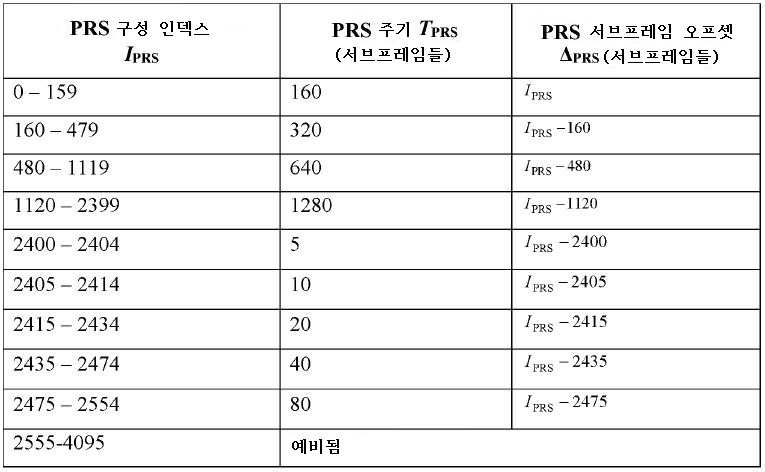
[0083] PRS 구성은 PRS를 송신하는 셀의 SFN을 참조하여 정의된다. 제1 PRS 포지셔닝 기회를 포함하는 NPRS 다운링크 서브프레임들의 제1 서브프레임에 대한 PRS 인스턴스들은 다음을 만족할 수 있으며:[0083] The PRS configuration is defined with reference to the SFN of the cell transmitting the PRS. PRS instances for a first subframe of N PRS downlink subframes containing a first PRS positioning opportunity may satisfy:

여기서 nf는 0 ≤ nf ≤ 1023인 SFN이고, ns는 0 ≤ ns ≤ 19인 nf에 의해 정의된 라디오 프레임 내의 슬롯 수이고, TPRS는 PRS 주기(520)이고, ΔPRS는 셀 특정 서브프레임 오프셋(552)이다.where n f is the SFN with 0 ≤ n f ≤ 1023, n s is the number of slots in the radio frame defined by n f with 0 ≤ n s ≤ 19, T PRS is the
[0084]
도 5에 도시된 바와 같이, 셀 특정 서브프레임 오프셋(ΔPRS)(552)은 시스템 프레임 번호 0(슬롯(550)으로서 마킹되는 슬롯 '번호 0')으로부터 시작하여 제1(후속) PRS 포지셔닝 기회의 시작까지 송신되는 서브프레임들의 수에 관해 정의될 수 있다. 도 5의 예에서, 연속 PRS 포지셔닝 기회들(518a, 518b, 및 518c) 각각에서의 연속 포지셔닝 서브프레임들(NPRS)의 수는 4와 동일하다. 즉, PRS 포지셔닝 기회들(518a, 518b, 및 518c)을 표현하는 각각의 음영 블록은 4개의 서브프레임들을 표현한다.As shown in FIG. 5 , the cell specific subframe offset (Δ PRS ) 552 is a first (following) starting from system frame number 0 (slot 'number 0' marked as slot 550). It may be defined with respect to the number of subframes transmitted until the start of the PRS positioning opportunity. In the example of FIG. 5 , the number of consecutive positioning subframes N PRS in each of consecutive
[0085]
일부 양상들에서, UE가 특정 셀에 대한 OTDOA 보조 데이터에서 PRS 구성 인덱스(IPRS)를 수신할 때, UE는 표 2를 사용하여 PRS 주기(TPRS)(520) 및 PRS 서브프레임 오프셋(ΔPRS)을 결정할 수 있다. 그런 다음, UE는 PRS가 셀에서 스케줄링될 때, 라디오 프레임, 서브프레임, 및 슬롯을 결정할 수 있다(예컨대, 수식(1)을 사용하여). OTDOA 보조 데이터는, 예컨대, 로케이션 서버(예컨대, 로케이션 서버(230), LMF(270))에 의해 결정될 수 있고, 기준 셀에 대한 보조 데이터, 및 다양한 기지국들에 의해 지원되는 다수의 이웃 셀들을 포함한다.In some aspects, when the UE receives a PRS configuration index (I PRS ) in OTDOA assistance data for a particular cell, the UE uses Table 2 to determine a PRS period (T PRS ) 520 and a PRS subframe The offset Δ PRS may be determined. The UE may then determine (eg, using Equation (1)) the radio frame, subframe, and slot when the PRS is scheduled in the cell. OTDOA assistance data may be determined by, for example, a location server (eg,
[0086] 통상적으로, 동일한 주파수를 사용하는 네트워크에서의 모든 셀들로부터의 PRS 기회들은 시간상으로 정렬되며, 상이한 주파수를 사용하는 네트워크에서의 다른 셀들에 대해 고정된 알려진 시간 오프셋(예컨대, 셀 특정 서브프레임 오프셋(552))을 가질 수 있다. SFN-동기식 네트워크들에서 모든 무선 노드들(예컨대, 기지국들(102))은 프레임 경계 및 시스템 프레임 번호 둘 모두 상에서 정렬될 수 있다. 따라서, SFN-동기식 네트워크들에서, 다양한 무선 노드들에 의해 지원되는 모든 셀들은 PRS 송신의 임의의 특정 주파수에 대해 동일한 PRS 구성 인덱스를 사용할 수 있다. 한편, SFN-비동기식 네트워크들에서, 다양한 무선 노드들은, 시스템 프레임 번호가 아니라 프레임 경계 상에서 정렬된다. 따라서, SFN-비동기식 네트워크들에서, 각각의 셀에 대한 PRS 구성 인덱스는 PRS 기회들이 시간상으로 정렬하도록 네트워크에 의해 개별적으로 구성될 수 있다.[0086] Typically, PRS opportunities from all cells in the network using the same frequency are aligned in time, and a known time offset (eg, cell specific subframe offset 552) fixed relative to other cells in the network using different frequencies. )) can have. In SFN-synchronous networks all wireless nodes (eg, base stations 102 ) may be aligned on both a frame boundary and a system frame number. Thus, in SFN-synchronous networks, all cells supported by various wireless nodes may use the same PRS configuration index for any particular frequency of PRS transmission. On the other hand, in SFN-asynchronous networks, the various radio nodes are aligned on a frame boundary rather than a system frame number. Thus, in SFN-asynchronous networks, the PRS configuration index for each cell may be individually configured by the network such that the PRS opportunities align in time.
[0087] UE가 셀들, 예컨대, 기준 셀 또는 서빙 셀 중 적어도 하나의 셀 타이밍(예컨대, SFN)을 획득할 수 있는 경우, UE는 OTDOA 포지셔닝을 위한 기준 및 이웃 셀들의 PRS 기회들의 타이밍을 결정할 수 있다. 그런 다음, 다른 셀들의 타이밍은, 예컨대, 상이한 셀들로부터의 PRS 기회들이 오버랩된다는 가정에 기초하여 UE에 의해 도출될 수 있다.[0087] If the UE is able to obtain cell timing (eg, SFN) of at least one of the cells, eg, a reference cell or a serving cell, the UE may determine the timing of PRS opportunities of neighboring cells and a reference for OTDOA positioning. The timing of other cells may then be derived by the UE, eg, based on the assumption that PRS opportunities from different cells overlap.
[0088] 3GPP Rel. 15는 MAC CE(Control Element)로서 PHR(power headroom report)을 도입하였다. PHR은 현재 UE 송신 전력(추정 전력)과 공칭 전력 사이의 헤드룸을 보고한다. 예컨대, 서빙 셀은 UE가 특정 서브프레임에 대해 얼마나 많은 업링크 대역폭을 사용하도록 허용되는지를 추정하기 위해 PHR을 사용할 수 있다. PHR은 PHR에 대한 다음 주기적 트리거 이전에 경로 손실 또는 전력 백오프(P-MPRc)의 변화에 의해, 또는 주기적으로, 셀 활성화, PHR 기능적 구성 또는 재구성에 의해 주기적으로, 또는 트리거될 수 있다. 일 특정 예로서, 경로 손실 PHR 트리거와 관련하여, 3GPP Rel. 15의 TS 38.321 Section 5.4.6은, PL-RS가 PL-RS 사이에서 변경되었는지 여부에 관계없이, 위에서 평가된 하나의 셀에 대한 경로 손실 변화가 현재 PL-RS(pathloss reference signal)에 대해 현재 측정된 경로 손실과 그 시간에 사용 중인 PL-RS에 대해 마지막 PHR 송신의 송신 시간에 측정된 경로 손실 사이에 있음을 특정한다. PL-RS는 SSB 또는 CSI-RS일 수 있으며, UE는 모든 UL 송신들(예컨대, PUCCH(Physical Uplink Control Channel), PUSCH(Physical Uplink Shared Channel), SRS 등)에 대해 서빙 셀당 최대 4개의 PL-RS들을 유지할 수 있다.[0088] 3GPP Rel. 15 introduced a power headroom report (PHR) as a MAC CE (Control Element). The PHR reports the headroom between the current UE transmit power (estimated power) and the nominal power. For example, the serving cell may use the PHR to estimate how much uplink bandwidth the UE is allowed to use for a particular subframe. A PHR may be triggered by a change in path loss or power backoff (P-MPR c ) before the next periodic trigger for the PHR, or periodically, by cell activation, PHR functional configuration or reconfiguration, or periodically. As a specific example, with respect to path loss PHR triggers, see 3GPP Rel. TS 38.321 Section 5.4.6 of 15 states that, regardless of whether the PL-RS is changed between PL-RSs, the pathloss change for one cell evaluated above is current for the current pathloss reference signal (PL-RS). Specifies that it is between the measured pathloss and the measured pathloss at the transmission time of the last PHR transmission for the PL-RS in use at that time. The PL-RS can be SSB or CSI-RS, and the UE has a maximum of 4 PL-s per serving cell for all UL transmissions (eg, Physical Uplink Control Channel (PUCCH), Physical Uplink Shared Channel (PUSCH), SRS, etc.) RSs can be maintained.
[0089] 3GPP Rel. 16은 PHR들을 트리거할 수 있는 PL-RS들의 수에 대해 확장하였다. 예컨대, 3GPP Rel. 16에서, 포지셔닝을 위한 UL SRS(이는 UL PRS로서 특성화될 수 있음)는 PL-RS로서 SSB 또는 DL PRS와 연관될 수 있다. 3GPP Rel. 15에서와 같이, 서빙 셀당 4개의 PL RS들과 더불어, 모든 UL PRS 세트들에 걸쳐 최대 N개의 PL-RS들이 사용될 수 있다. N은 (예컨대, RRC 시그널링을 통해) UE 능력으로서 구성 가능하며, 0, 4, 8 또는 16과 동일할 수 있다. SSB는 서빙 또는 이웃 셀로부터 올 수 있다(예컨대, 셀 ID가 표시됨). 유사하게, DL PRS는 임의의 TRP로부터 올 수 있다(예컨대, TRP가 표시됨). SSB 및 PRS 송신 전력이 또한 표시된다.[0089] 3GPP Rel. 16 extended for the number of PL-RSs that can trigger PHRs. For example, 3GPP Rel. At 16 , a UL SRS for positioning (which may be characterized as a UL PRS) may be associated with a SSB or a DL PRS as a PL-RS. 3GPP Rel. As in 15, with 4 PL RSs per serving cell, up to N PL-RSs can be used across all UL PRS sets. N is configurable (eg, via RRC signaling) as a UE capability and may be equal to 0, 4, 8 or 16. The SSB may come from a serving or neighboring cell (eg cell ID is indicated). Similarly, the DL PRS can come from any TRP (eg TRP is indicated). The SSB and PRS transmit powers are also indicated.
[0090] 3GPP Rel. 15로부터의 4개의 레거시 PL-RS들과 연관된 경로 손실-기반 PHR 트리거들을 3GPP Rel. 16에 도입된 새로운 PL-RS들로 적용하는 것은 전체 PHR 활동을 증가시키는데, 이는 개개의 UE들에서의 전력 소비를 또한 증가시키면서 시스템의 간섭을 가중시킨다. 본 개시내용의 하나 이상의 실시예들은 선택적 방식으로 PHR 기능을 구현하는 것에 관한 것이다(예컨대, PHR을 선택적으로 트리거하기 위해 PL-RS와 연관된 하나 이상의 조건들을 모니터링함).[0090] 3GPP Rel. Path loss-based PHR triggers associated with 4 legacy PL-RSs from 15 3GPP Rel. Applying with the new PL-RSs introduced in 16 increases the overall PHR activity, which adds to the interference of the system while also increasing the power consumption at individual UEs. One or more embodiments of the present disclosure relate to implementing a PHR function in an optional manner (eg, monitoring one or more conditions associated with a PL-RS to selectively trigger a PHR).
[0091]
도 6a는 본 개시내용의 양상들에 따른, 예시적 무선 통신 프로세스(600)를 예시한다. 일 양상에서, 프로세스(600)는 UE에 의해 수행될 수 있다.[0091]
6A illustrates an example
[0092]
610에서, UE는 PL-RS(pathloss reference signal)와 연관된 셀 타입 또는 PL-RS 타입에 기초하여 PL-RS에 대해 PHR(power headroom report) 기능을 수행할지 여부를 결정한다. 일 예에서, 610의 결정은 PL-RS들에 대한 PHR들과 연관된 적어도 하나의 규칙에 기초할 수 있다. 일 예에서, 적어도 하나의 규칙은 사전 정의될 수 있다(예컨대, 관련 표준에서 정의됨). 다른 예에서, 적어도 하나의 규칙은 (예컨대, 일부 설계들에서 DCI 또는 MAC-CE를 통해, RRC 시그널링과 같은 다른 설계들에서 상위 계층 시그널링을 통해) 동적으로 구성될 수 있다. 일 양상에서, 동작(610)은 수신기(들)(312), WWAN 트랜시버(310), 프로세싱 시스템(332), 메모리(340), PHR 모듈(342) 등에 의해 수행될 수 있다.[0092]
At 610 , the UE determines whether to perform a power headroom report (PHR) function for the PL-RS based on a cell type or a PL-RS type associated with a pathloss reference signal (PL-RS). In one example, the determination of 610 may be based on at least one rule associated with PHRs for PL-RSs. In one example, the at least one rule may be predefined (eg, defined in a relevant standard). In another example, the at least one rule may be configured dynamically (eg, via DCI or MAC-CE in some designs, and higher layer signaling in other designs, such as RRC signaling). In an aspect,
[0093]
620에서, UE는 결정에 기초하여 PL-RS에 대해 PHR 기능 또는 하나 이상의 경로 손실 측정들을 수행한다. 일부 설계들에서, 동작(620)의 수행은 PL-RS에 대해 PHR 기능 및 하나 이상의 경로 손실 측정들을 수행한다(예컨대, 610의 결정이 PHR 기능을 수행하는 것인 경우). 다른 설계들에서, 수행은 PL-RS에 대해 하나 이상의 경로 손실 측정들만을 수행한다(예컨대, 610의 결정이 PHR 기능을 수행하지 않을 것인 경우). 일 예에서, PHR 기능은 PHR을 선택적으로 트리거하기 위해 개개의 PL-RS와 연관된 하나 이상의 조건들을 모니터링하는 것을 포함할 수 있다. 위에서 설명된 바와 같이, 이러한 PHR 트리거링 조건(들)은 PHR에 대한 다음 주기적 트리거 이전에 경로 손실 또는 전력 백오프(P-MPRc)의 변화에 의해 또는 주기적으로, 셀 활성화, PHR 기능적 구성 또는 재구성을 포함할 수 있다. 일 양상에서, 동작(620)은 송신기(들)(314), WWAN 트랜시버(310), 프로세싱 시스템(332), 메모리(340), PHR 모듈(342) 등에 의해 수행될 수 있다.At 620 , the UE performs a PHR function or one or more pathloss measurements on the PL-RS based on the determination. In some designs, the performance of
[0094] 동작들(610-620)을 참조하면, 610의 결정이 PL-RS에 대해 PHR 기능을 수행하지 않을 것인 경우, UE는 그 PL-RS에 대해 PHR 기능을 수행하는 것을 억제하는 것으로서 특성화될 수 있으며, 이는 하나 이상의 PHR 트리거링 조건(들)이 만족되는지 여부에 관계없이, UE가 PHR을 생성하는 것 및/또는 송신하는 것을 억제하는 것으로 해석될 수 있다. 따라서, 적어도 하나의 규칙은, 610에서의 결정이 PHR 기능을 수행하기로 결정하는 경우 PHR이 송신되었을 시나리오에서 PHR이 보고되지 않도록, PHR 트리거링 조건(들)을 효과적으로 무시(override)한다.[0094] Referring to operations 610 - 620 , if the determination of 610 is not to perform the PHR function for the PL-RS, the UE may be characterized as refraining from performing the PHR function for the PL-RS. , which may be interpreted as inhibiting the UE from generating and/or transmitting a PHR, regardless of whether one or more PHR triggering condition(s) are satisfied. Accordingly, the at least one rule effectively overrides the PHR triggering condition(s) such that the PHR is not reported in a scenario where a PHR would have been transmitted if the decision at 610 decided to perform the PHR function.
[0095] 도 6a의 620을 참조하면, PL-RS에 대해 PHR 기능이 수행되는지 여부에 관계없이, 일부 설계들에서, UE는 하나 이상의 UL PRS들과 연관하여 PL-RS에 대해 하나 이상의 경로 손실 측정들을 수행한다. UE는 620에서, 하나 이상의 경로 손실 측정들에 기초하여 UL PRS(들)에 대한 전력 제어를 선택적으로 추가로 수행한다. 이 경우, 610의 결정이 PHR 기능을 수행하지 않을 것이면, 하나 이상의 경로 손실 측정들은 PL-RS에 대한 PHR-관련 고려사항에 대해 무시된다. 대안적으로, 610의 결정이 PHR 기능을 수행하는 것인 경우, 이러한 선택적 경로 손실 측정(들) 중 하나 이상이 PHR을 선택적으로 트리거하는 데 사용될 수 있다.[0095] Referring to 620 of FIG. 6A , regardless of whether the PHR function is performed for the PL-RS, in some designs, the UE performs one or more pathloss measurements on the PL-RS in association with one or more UL PRSs. do. The UE optionally further performs power control for the UL PRS(s) based on one or more pathloss measurements, at 620 . In this case, if the decision of 610 is not to perform the PHR function, the one or more pathloss measurements are ignored for PHR-related considerations for the PL-RS. Alternatively, if the determination of 610 is to perform a PHR function, one or more of these optional pathloss measurement(s) may be used to selectively trigger the PHR.
[0096] 일 예에서, 610의 결정이 PHR 기능을 수행할 PL-RS들은 제1 세트의 PL-RS들에 대응할 수 있고, 610의 결정이 PHR 기능을 수행하지 않을 PL-RS들은 제2 세트의 PL-RS들에 대응할 수 있다. 이 경우, UL PRS들은 제1 세트의 PL-RS와 연관된 셀(들)을 포함할 수 있거나 또는 포함하지 않을 수 있고, 제2 세트의 PL-RS들에 대한 경로 손실을 제한하는 것은 불필요할 수 있으며(예컨대, 제1 세트의 PL-RS들에 대해 수행되는 경로 손실 관리와의 중복은 동일한 셀(들)이 관련되는 것임), 이 경우, 선택적 경로 손실 측정들이 제2 세트의 PL-RS들에 대해 수행되지 않을 수 있다. 일부 설계들에서, 제1 세트의 PL-RS들이 PHR을 선택적으로 트리거하는 데 사용되는 반면, PL-RS들의 제1 및 제2 세트들 모두가 UL-PRS들에 사용된다.[0096] In one example, the PL-RSs for which the determination of 610 will perform the PHR function may correspond to a first set of PL-RSs, and the PL-RSs for which the determination of 610 will not perform the PHR function are PL-RSs of the second set It can correspond to RSs. In this case, the UL PRSs may or may not include the cell(s) associated with the first set of PL-RSs, and it may not be necessary to limit the path loss for the second set of PL-RSs. (e.g., the overlap with pathloss management performed on the first set of PL-RSs involves the same cell(s)), in which case the selective pathloss measurements are performed on the PL-RSs of the second set. may not be performed for In some designs, both first and second sets of PL-RSs are used for UL-PRSs, while a first set of PL-RSs are used to selectively trigger the PHR.
[0097] 도 6a를 참조하면, 예로서, PHR 기능으로부터 특정 PL-RS(들)를 배제하는 것은, 감소된 UE에서의 전력 소비, 감소된 시스템 오버헤드 및/또는 간섭, 확장성(예컨대, 더 많은 PL-RS들이 PHR-관련 병목 현상들을 경험하지 않고 지원될 수 있음) 등과 같은 하나 이상의 기술적 이점들을 제공한다(예컨대, 모든 PL-RS들에 대해 PHR 기능을 단순히 수행하는 것에 비해).[0097] Referring to FIG. 6A , for example, excluding certain PL-RS(s) from the PHR function may result in reduced power consumption at the UE, reduced system overhead and/or interference, scalability (eg, more PL -RSs can be supported without experiencing PHR-related bottlenecks), etc. (eg, compared to simply performing a PHR function for all PL-RSs).
[0098] 제1 세트의 PL-RS들 또는 제2 세트의 PL-RS들의 일부로서 PL-RS들을 정렬하는 데 사용될 수 있는 다양한 규칙들이 이제 설명될 것이다. 전술된 규칙들 중 하나 이상은 도 6a의 610에서의 결정의 일부로서 사용될 수 있다: 특히, 아래의 규칙들은 제1 및 제2 세트들의 PL-RS들과 관련하여 설명되며, 이에 의해 610의 결정이 PHR 기능을 수행할 PL-RS들은 제1 세트의 PL-RS들에 대응할 수 있고, 610의 결정이 PHR 기능을 수행하지 않을 PL-RS들은 제2 세트의 PL-RS들에 대응할 수 있다.[0098] Various rules that may be used to align PL-RSs as part of a first set of PL-RSs or a second set of PL-RSs will now be described. One or more of the rules described above may be used as part of the decision at 610 of FIG. 6A : In particular, the rules below are described with respect to first and second sets of PL-RSs, whereby the decision of 610 is The PL-RSs to perform this PHR function may correspond to a first set of PL-RSs, and the PL-RSs for which the determination of 610 will not perform the PHR function may correspond to a second set of PL-RSs.
[0099] 도 6a를 참조하면, 제1 규칙 예에서, 적어도 하나의 규칙은 4개의 레거시 3GPP Rel. 15 PL-RS들을 제1 세트의 PL-RS들의 일부로서 특성화하는 것일 수 있는 반면, 임의의 다른 PL-RS들을 제2 세트의 PL-RS들의 일부로서 특성화하는 것일 수 있다. 이 경우, 추가 PL-RS들의 포함은 PHR에 영향을 미치지 않을 것이다.[0099] Referring to FIG. 6A , in the first rule example, at least one rule includes four legacy 3GPP Rel. Characterizing 15 PL-RSs as part of a first set of PL-RSs, while characterizing any other PL-RSs as part of a second set of PL-RSs. In this case, the inclusion of additional PL-RSs will not affect the PHR.
[00100] 도 6a를 참조하면, 제2 규칙 예에서, 적어도 하나의 규칙은 PHR 기능에의 참여로부터, UL PRS에 대해 PL-RS로서 역할을 하는 임의의 RS를 배제하는 것을 포함할 수 있다. 본원에서 사용되는 바와 같이, PHR 기능으로부터의 PL-RS의 배제는 제2 세트의 PL-RS들의 일부로서 배제된 그 PL-RS의 특성화를 내포한다. 추가로, 본원에서 사용되는 바와 같이, "UL PRS"는 '포지셔닝을 위한 SRS'(또는 등가물)로 명시적으로 식별된 SRS, 또는 (예컨대, 최소 및/또는 최대 대역폭 임계치들, 컴-밀도(comb-density), 지속 기간, 컴-스태거링(comb-staggering)이 인에이블/디스에이블되는지 여부와 같은 컴-스태거링 조건 등을 추가로 만족시키면서 포지셔닝을 위한 SRS와 같은) 그러한 SRS들의 서브세트의 임의의 조합일 수 있다.[00100] Referring to FIG. 6A , in a second rule example, at least one rule may include excluding any RS serving as a PL-RS for the UL PRS from participation in the PHR function. As used herein, exclusion of a PL-RS from PHR function implies characterization of that PL-RS as excluded as part of a second set of PL-RSs. Additionally, as used herein, "UL PRS" refers to an SRS explicitly identified as an 'SRS for positioning' (or equivalent), or (e.g., minimum and/or maximum bandwidth thresholds, com-density ( (such as SRS for positioning while additionally satisfying comb-density), duration, comb-staggering conditions such as whether comb-staggering is enabled/disabled It can be any combination of subsets.
[00101] 도 6a를 참조하면, 제3 규칙 예에서, 적어도 하나의 규칙은 PHR 기능에의 참여로부터, UL PRS에 대해서만 PL-RS로서 역할을 하는 임의의 RS를 배제하는 것을 포함할 수 있다. 예컨대, UL PRS뿐만 아니라 다른 UL 채널(들)에 통상적인 제1 PL-RS는 제1 세트의 일부일 수 있는(즉, PHR 기능에 대해 포함됨) 반면, UL PRS에 특정적이고 다른 UL 채널(들)과 연관되지 않은 제2 PL-RS는 제2 세트의 일부일 수 있다(즉, PHR 기능에 대해 배제됨).[00101] Referring to FIG. 6A , in a third rule example, at least one rule may include excluding any RS serving as a PL-RS only for the UL PRS from participation in the PHR function. For example, a first PL-RS typical to UL PRS as well as other UL channel(s) may be part of the first set (ie included for PHR function), while specific to UL PRS and other UL channel(s) The second PL-RS not associated with may be part of the second set (ie, excluded for PHR function).
[00102] 도 6a를 참조하면, 제4 규칙 예에서, 적어도 하나의 규칙은 PHR 기능에의 참여로부터, RS로서 역할을 하는 임의의 DL PRS를 배제하는 것을 포함할 수 있다. 일 예에서, UL-PRS에 대해 PL-RS로서 역할을 하는 하나의 DL-PRS는 예컨대, TRP-ID에 기초하여 더 선택적인 방식으로 배제될 수 있다(예컨대, 특정 TRP들과 연관된 DL PRS들은 제1 세트의 일부이고, 다른 TRP들과 연관된 DL PRS들은 제2 세트의 일부임). 더 구체적인 구현에서, 적어도 하나의 규칙은 PHR 기능에의 참여로부터, (예컨대, TRP-ID에 기초하여 결정된) 비서빙 셀과 연관된 임의의 DL PRS를 배제하는 것을 포함할 수 있다. 이 경우, 서빙 셀과 연관된 DL PRS에 대한 제1 PL은 제1 세트의 일부일 수 있는(즉, PHR 기능에 대해 포함됨) 반면, 비서빙 셀과 연관된 DL PRS에 대한 제2 PL은 제2 세트의 일부일 수 있다(즉, PHR 기능에 대해 배제됨).[00102] Referring to FIG. 6A , in a fourth rule example, at least one rule may include excluding any DL PRS serving as an RS from participation in a PHR function. In one example, one DL-PRS serving as a PL-RS for a UL-PRS may be excluded in a more selective manner, eg, based on TRP-ID (eg, DL PRSs associated with specific TRPs are DL PRSs that are part of the first set and associated with other TRPs are part of the second set). In a more specific implementation, the at least one rule may include excluding, from participation in the PHR function, any DL PRS associated with the non-serving cell (eg, determined based on the TRP-ID). In this case, the first PL for the DL PRS associated with the serving cell may be part of the first set (ie included for the PHR function), while the second PL for the DL PRS associated with the non-serving cell is of the second set. may be some (ie excluded for PHR function).
[00103] 도 6a를 참조하여, 제5 규칙 예에서, 적어도 하나의 규칙은 PHR 기능에의 참여로부터, 비서빙 셀과 연관된 임의의 DL RS에 대해 PL-RS로서 역할을 하는 임의의 RS를 배제하는 것을 포함할 수 있다. 일 예에서, 비서빙 셀은 연관된 TRP-ID에 기초하여 식별될 수 있다.[00103] Referring to FIG. 6A , in a fifth rule example, the at least one rule includes excluding, from participation in the PHR function, any RS serving as a PL-RS for any DL RS associated with a non-serving cell. can do. In one example, the non-serving cell may be identified based on the associated TRP-ID.
[00104] 도 6a를 참조하면, 제6 규칙 예에서, 적어도 하나의 규칙은 조합하여 구현되는, 위에서 서술된 규칙들 중 임의의 것과 같은 다수의 규칙들을 포함할 수 있다. 이 경우, PL-RS들이 PHR 기능에의 참여로부터 배제되는(또는 PHR 기능에의 참여에 포함되는) 다수의 규칙들이 존재할 수 있다. 예컨대, 적어도 하나의 규칙은 PHR 기능에의 참여로부터, UL PRS에 대해 PL-RS로서 역할을 하는 임의의 RS, UL PRS에 대해서만 PL-RS로서 역할을 하는 임의의 RS, UL PRS에 대해 PL-RS로서 임의의 DL PRS, 비서빙 셀과 연관된 DL PRS에 대해 PL-RS로서 역할을 하는 임의의 RS, 비서빙 셀과 연관된 임의의 DL RS에 대해 PL-RS로서 역할을 하는 임의의 RS, 또는 이들의 임의의 조합을 배제하는 것을 포함할 수 있다.[00104] Referring to FIG. 6A , in a sixth rule example, at least one rule may include multiple rules, such as any of the rules described above, implemented in combination. In this case, there may be multiple rules in which PL-RSs are excluded from (or included in) the PHR function. For example, at least one rule is from participation in the PHR function, any RS acting as PL-RS for UL PRS, Any RS acting as PL-RS only for UL PRS, PL-RS for UL PRS Any DL PRS as RS, any RS serving as a PL-RS for a DL PRS associated with a non-serving cell, any RS serving as a PL-RS for any DL RS associated with a non-serving cell, or excluding any combination thereof.
[00105] 도 6a를 참조하면, 일부 설계들에서, 하나의 셀에 대한 경로 손실 변화는, 현재 경로 손실 기준에 대해 현재 측정된 경로 손실과 그 시간에 사용 중인 경로 손실 기준에 대해 PHR의 마지막 송신의 송신 시간에 측정된 경로 손실 사이에 있다(경로 손실 기준이 그 사이에서 변경되었는지 여부에 관계없이). 일부 설계들에서, 이 목적을 위한 현재 경로 손실 기준은 pathlossReferenceRS-Pos를 사용하여 구성된 임의의 경로 손실 기준을 포함하지 않는다.Referring to FIG. 6A , in some designs, the pathloss change for one cell is the current measured pathloss for the current pathloss criterion and the last transmission of the PHR for the pathloss criterion in use at that time. is between the pathloss measured at the transmission time of n (regardless of whether the pathloss criterion has changed in between). In some designs, the current pathloss criterion for this purpose does not include any pathloss criterion constructed using pathlossReferenceRS-Pos .
[00106]
도 6b는 본 개시내용의 양상들에 따른, 예시적 무선 통신 프로세스(650)를 예시한다. 일 양상에서, 프로세스(650)는 UE에 의해 수행될 수 있다.[00106]
6B illustrates an example
[00107]
660에서, UE는 UE의 서빙 셀로부터 수신된 PL-RS(pathloss reference signal)와 연관된 표시에 기초하여 PL-RS에 대해 PHR(power headroom report) 기능을 수행할지 여부를 결정한다. 일 예에서, 660의 결정은 PL-RS들에 대한 PHR들과 연관된 적어도 하나의 규칙에 기초할 수 있다. 일 예에서, 적어도 하나의 규칙은 사전 정의될 수 있다(예컨대, 관련 표준에서 정의됨). 다른 예에서, 적어도 하나의 규칙은 (예컨대, 일부 설계들에서 DCI 또는 MAC-CE를 통해, RRC 시그널링과 같은 다른 설계들에서 상위 계층 시그널링을 통해) 동적으로 구성될 수 있다. 일 양상에서, 동작(660)은 수신기(들)(312), WWAN 트랜시버(310), 프로세싱 시스템(332), 메모리(340), PHR 모듈(342) 등에 의해 수행될 수 있다.[00107]
At 660 , the UE determines whether to perform a power headroom report (PHR) function for the PL-RS based on an indication associated with a pathloss reference signal (PL-RS) received from a serving cell of the UE. In one example, the determination of 660 may be based on at least one rule associated with PHRs for PL-RSs. In one example, the at least one rule may be predefined (eg, defined in a relevant standard). In another example, the at least one rule may be configured dynamically (eg, via DCI or MAC-CE in some designs, and higher layer signaling in other designs, such as RRC signaling). In an aspect,
[00108]
670에서, UE는 결정에 기초하여 PL-RS에 대해 PHR 기능 또는 하나 이상의 경로 손실 측정들을 수행한다. 일부 설계들에서, 동작(670)의 수행은 PL-RS에 대해 PHR 기능 및 하나 이상의 경로 손실 측정들을 수행한다(예컨대, 660의 결정이 PHR 기능을 수행하는 것인 경우). 다른 설계들에서, 수행은 PL-RS에 대해 하나 이상의 경로 손실 측정들만을 수행한다(예컨대, 660의 결정이 PHR 기능을 수행하지 않을 것인 경우). 일 예에서, PHR 기능은 PHR을 선택적으로 트리거하기 위해 개개의 PL-RS와 연관된 하나 이상의 조건들을 모니터링하는 것을 포함할 수 있다. 위에서 설명된 바와 같이, 이러한 PHR 트리거링 조건(들)은 PHR에 대한 다음 주기적 트리거 이전에 경로 손실 또는 전력 백오프(P-MPRc)의 변화에 의해 또는 주기적으로, 셀 활성화, PHR 기능적 구성 또는 재구성을 포함할 수 있다. 일 양상에서, 동작(670)은 송신기(들)(314), WWAN 트랜시버(310), 프로세싱 시스템(332), 메모리(340), PHR 모듈(342) 등에 의해 수행될 수 있다.At 670 , the UE performs a PHR function or one or more pathloss measurements for the PL-RS based on the determination. In some designs, the performance of
[00109] 동작들(660-670)을 참조하면, 660의 결정이 PL-RS에 대해 PHR 기능을 수행하지 않을 것인 경우, UE는 그 PL-RS에 대해 PHR 기능을 수행하는 것을 억제하는 것으로서 특성화될 수 있으며, 이는 하나 이상의 PHR 트리거링 조건(들)이 만족되는지 여부에 관계없이, UE가 PHR을 생성하는 것 및/또는 송신하는 것을 억제하는 것으로 해석될 수 있다. 따라서, 적어도 하나의 규칙은, 660에서의 결정이 PHR 기능을 수행하기로 결정하는 경우 PHR이 송신되었을 시나리오에서 PHR이 보고되지 않도록, PHR 트리거링 조건(들)을 효과적으로 무시한다.[00109] Referring to operations 660 - 670 , if the determination of 660 is not to perform the PHR function for the PL-RS, the UE may be characterized as refraining from performing the PHR function for the PL-RS. , which may be interpreted as inhibiting the UE from generating and/or transmitting a PHR, regardless of whether one or more PHR triggering condition(s) are satisfied. Accordingly, the at least one rule effectively ignores the PHR triggering condition(s) such that the PHR is not reported in a scenario in which a PHR would have been sent if the decision at 660 decided to perform the PHR function.
[00110] 도 6b의 670을 참조하면, PL-RS에 대해 PHR 기능이 수행되는지 여부에 관계없이, 일부 설계들에서, UE는 하나 이상의 UL PRS들과 연관하여 PL-RS에 대해 하나 이상의 경로 손실 측정들을 수행한다. UE는 670에서, 하나 이상의 경로 손실 측정들에 기초하여 UL PRS(들)에 대한 전력 제어를 선택적으로 추가로 수행한다. 이 경우, 660의 결정이 PHR 기능을 수행하지 않을 것이면, 하나 이상의 경로 손실 측정들은 PL-RS에 대한 PHR-관련 고려사항에 대해 무시된다. 대안적으로, 660의 결정이 PHR 기능을 수행하는 것인 경우, 이러한 선택적 경로 손실 측정(들) 중 하나 이상이 PHR을 선택적으로 트리거하는 데 사용될 수 있다.[00110] Referring to 670 of FIG. 6B , regardless of whether the PHR function is performed for the PL-RS, in some designs, the UE performs one or more pathloss measurements on the PL-RS in association with one or more UL PRSs. do. The UE optionally further performs power control for the UL PRS(s) based on one or more pathloss measurements, at 670 . In this case, if the decision of 660 is not to perform the PHR function, the one or more pathloss measurements are ignored for PHR-related considerations for the PL-RS. Alternatively, if the determination of 660 is to perform a PHR function, one or more of these optional pathloss measurement(s) may be used to selectively trigger the PHR.
[00111] 일 예에서, 660의 결정이 PHR 기능을 수행할 PL-RS들은 제1 세트의 PL-RS들에 대응할 수 있고, 660의 결정이 PHR 기능을 수행하지 않을 PL-RS들은 제2 세트의 PL-RS들에 대응할 수 있다. 이 경우, UL PRS들은 제1 세트의 PL-RS와 연관된 셀(들)을 포함할 수 있거나 또는 포함하지 않을 수 있고, 제2 세트의 PL-RS들에 대한 경로 손실을 제한하는 것은 불필요할 수 있으며(예컨대, 제1 세트의 PL-RS들에 대해 수행되는 경로 손실 관리와의 중복은 동일한 셀(들)이 관련되는 것임), 이 경우, 선택적 경로 손실 측정들이 제2 세트의 PL-RS들에 대해 수행되지 않을 수 있다. 일부 설계들에서, 제1 세트의 PL-RS들이 PHR을 선택적으로 트리거하는 데 사용되는 반면, PL-RS들의 제1 및 제2 세트들 모두가 UL-PRS들에 사용된다.[00111] In one example, the PL-RSs for which the determination of 660 will perform the PHR function may correspond to a first set of PL-RSs, and the PL-RSs for which the determination of 660 will not perform the PHR function may correspond to the PL-RSs of the second set of PL-RSs. It can correspond to RSs. In this case, the UL PRSs may or may not include the cell(s) associated with the first set of PL-RSs, and it may not be necessary to limit the path loss for the second set of PL-RSs. (e.g., the overlap with pathloss management performed on the first set of PL-RSs involves the same cell(s)), in which case the selective pathloss measurements are performed on the PL-RSs of the second set. may not be performed for In some designs, both first and second sets of PL-RSs are used for UL-PRSs, while a first set of PL-RSs are used to selectively trigger the PHR.
[00112] 도 6b를 참조하면, 예로서, PHR 기능으로부터 특정 PL-RS(들)를 배제하는 것은, 감소된 UE에서의 전력 소비, 감소된 시스템 오버헤드 및/또는 간섭, 확장성(예컨대, 더 많은 PL-RS들이 PHR-관련 병목 현상들을 경험하지 않고 지원될 수 있음) 등과 같은 하나 이상의 기술적 이점들을 제공한다(예컨대, 모든 PL-RS들에 대해 PHR 기능을 단순히 수행하는 것에 비해).[00112] Referring to FIG. 6B , for example, excluding certain PL-RS(s) from the PHR function may result in reduced power consumption at the UE, reduced system overhead and/or interference, scalability (eg, more PL -RSs can be supported without experiencing PHR-related bottlenecks), etc. (eg, compared to simply performing a PHR function for all PL-RSs).
[00113] 제1 세트의 PL-RS들 또는 제2 세트의 PL-RS들의 일부로서 PL-RS들을 정렬하는 데 사용될 수 있는 다양한 규칙들이 이제 설명될 것이다. 전술된 규칙들 중 하나 이상은 도 6b의 660에서의 결정의 일부로서 사용될 수 있다: 특히, 아래의 규칙들은 제1 및 제2 세트들의 PL-RS들과 관련하여 설명되며, 이에 의해 660의 결정이 PHR 기능을 수행할 PL-RS들은 제1 세트의 PL-RS들에 대응할 수 있고, 660의 결정이 PHR 기능을 수행하지 않을 PL-RS들은 제2 세트의 PL-RS들에 대응할 수 있다.[00113] Various rules that may be used to align PL-RSs as part of a first set of PL-RSs or a second set of PL-RSs will now be described. One or more of the foregoing rules may be used as part of the decision at 660 of FIG. 6B : In particular, the following rules are described with respect to first and second sets of PL-RSs, whereby the decision of 660 is The PL-RSs to perform this PHR function may correspond to a first set of PL-RSs, and the PL-RSs for which the determination of 660 will not perform the PHR function may correspond to a second set of PL-RSs.
[00114] 도 6b를 참조하면, 제1 규칙 예에서, 적어도 하나의 규칙은 PHR 기능에의 참여로부터, PHR 기능 배제를 표시하는 명시적 표시가 제공되는 PL-RS로서 역할을 하는 임의의 RS를 배제하는 것을 포함할 수 있다(예컨대, 명시적 '옵트아웃(opt-out)' 규칙). 대안으로서, 적어도 하나의 규칙은 PHR 기능에의 참여로부터, PHR 기능 포함을 표시하는 명시적 표시가 제공되지 않는 PL-RS로서 역할을 하는 임의의 RS를 배제하는 것을 포함할 수 있다(예컨대, 명시적 '옵트인(opt-in)' 규칙). 일부 설계들에서, 명시적 옵트인 규칙 또는 명시적 옵트아웃 규칙은 (예컨대, UL PRS 및 다른 채널 타입(들) 둘 모두와 연관된 공통 PL-RS와는 대조적으로) UL PRS에 대해 PL-RS로서 역할만을 하거나 또는 적어도 하나의 UL PRS에 대해 PL-RS로서 역할을 하는 RS들과 같은 특정 RS 타입들에 대해 구현될 수 있다. 일부 설계들에서, 명시적 옵트인 규칙 또는 명시적 옵트아웃 규칙은 4개의 레거시 3GPP Rel. 15 PL-RS들 중 하나 이상에 적용될 수 있다.[00114] Referring to FIG. 6B , in a first example rule, at least one rule excludes, from participation in PHR function, any RS serving as a PL-RS provided with an explicit indication indicating exclusion of PHR function. may include (eg, explicit 'opt-out' rules). Alternatively, the at least one rule may include excluding from participation in the PHR function any RS serving as a PL-RS that is not provided with an explicit indication indicating inclusion of the PHR function (eg, explicit enemy 'opt-in' rules). In some designs, an explicit opt-in rule or an explicit opt-out rule acts as a PL-RS for a UL PRS (eg, as opposed to a common PL-RS associated with both the UL PRS and other channel type(s)). It can be implemented for specific RS types, such as RSs that act as PL-RSs for only one or more UL PRSs. In some designs, the explicit opt-in rule or the explicit opt-out rule can contain four legacy 3GPP Rel. It can be applied to one or more of 15 PL-RSs.
[00115] 도 6b를 참조하면, 제2 규칙 예에서, 적어도 하나의 규칙은 PHR 기능에의 참여로부터, PHR 기능 배제를 표시하는 묵시적 표시가 제공되는 PL-RS로서 역할을 하는 임의의 RS를 배제하는 것을 포함할 수 있다(예컨대, 묵시적 '옵트아웃' 규칙). 대안으로서, 적어도 하나의 규칙은 PHR 기능에의 참여로부터, PHR 기능 포함을 표시하는 묵시적 표시가 제공되지 않는 PL-RS로서 역할을 하는 임의의 RS를 배제하는 것을 포함할 수 있다(예컨대, 묵시적 '옵트인(opt-in)' 규칙). 일부 설계들에서, 묵시적 옵트인 규칙 또는 묵시적 옵트아웃 규칙은 (예컨대, UL PRS 및 다른 채널 타입(들) 둘 모두와 연관된 공통 PL-RS와는 대조적으로) UL PRS에 대해 PL-RS로서 역할만을 하거나 또는 적어도 하나의 UL PRS에 대해 PL-RS로서 역할을 하는 RS들과 같은 특정 RS 타입들에 대해 구현될 수 있다. 일부 설계들에서, 묵시적 옵트인 규칙 또는 묵시적 옵트아웃 규칙은 4개의 레거시 3GPP Rel. 15 PL-RS들 중 하나 이상에 적용될 수 있다.[00115] Referring to FIG. 6B , in a second rule example, the at least one rule comprises excluding, from participation in PHR function, any RS serving as a PL-RS provided with an implicit indication indicating exclusion of PHR function. may (eg, an implied 'opt-out' rule). Alternatively, the at least one rule may include excluding from participation in the PHR function any RS serving as a PL-RS that is not provided with an implicit indication indicating PHR function inclusion (eg, an implicit ' 'opt-in' rules). In some designs, the implicit opt-in rule or the implicit opt-out rule only serves as a PL-RS for a UL PRS (eg, as opposed to a common PL-RS associated with both the UL PRS and other channel type(s)) or Or it may be implemented for specific RS types, such as RSs that serve as PL-RSs for at least one UL PRS. In some designs, the implied opt-in rule or the implied opt-out rule is based on four legacy 3GPP Rel. It can be applied to one or more of 15 PL-RSs.
[00116] 도 6b를 참조하면, 제3 규칙 예에서, 적어도 하나의 규칙은 조합하여 구현되는, 위에서 서술된 규칙들 중 임의의 것과 같은 다수의 규칙들을 포함할 수 있다. 이 경우, PL-RS들이 PHR 기능에의 참여로부터 배제되는(또는 PHR 기능에의 참여에 포함되는) 다수의 규칙들이 존재할 수 있다. 예컨대, 적어도 하나의 규칙은, PHR 기능에의 참여로부터, PHR 기능 배제를 표시하는 명시적 표시가 제공되는 PL-RS로서 역할을 하는 임의의 RS를 배제하는 것, PHR 기능에의 참여로부터, PHR 기능 포함을 표시하는 명시적 표시가 제공되지 않는 PL-RS로서 역할을 하는 임의의 RS를 배제하는 것, PHR 기능에의 참여로부터, PHR 기능 배제를 표시하는 묵시적 표시가 제공되는 PL-RS로서 역할을 하는 임의의 RS를 배제하는 것, PHR 기능에의 참여로부터, PHR 기능 포함을 표시하는 묵시적 표시가 제공되지 않는 PL-RS로서 역할을 하는 임의의 RS를 배제하는 것, 또는 이들의 임의의 조합을 포함할 수 있다.[00116] Referring to FIG. 6B , in a third rule example, at least one rule may include multiple rules, such as any of the rules described above, implemented in combination. In this case, there may be multiple rules in which PL-RSs are excluded from (or included in) the PHR function. For example, the at least one rule is to exclude any RS serving as a PL-RS provided an explicit indication indicating exclusion of PHR function is provided, from participation in PHR function, from participation in PHR function, Excluding any RS serving as a PL-RS not provided with an explicit indication indicating function inclusion, from participation in PHR function, serving as a PL-RS provided with an implicit indication indicating exclusion of PHR function excluding any RS serving as a PL-RS that is not provided with an implicit indication indicating PHR function inclusion, from participation in PHR function, or any combination thereof may include
[00117] 위의 상세한 설명에서, 상이한 특징들이 예들로 함께 그룹핑되었다는 것을 알 수 있다. 이러한 개시내용의 방식은, 예시적 조항들이 각각의 조항에서 명시적으로 언급된 것보다 더 많은 특징들을 갖는다는 의도로서 이해되지 않아야 한다. 오히려, 본 개시내용의 다양한 양상들은 개시된 개별적인 예시적 조항의 모든 특징들보다 더 적은 특징들을 포함할 수 있다. 따라서, 다음의 조항들은 그에 의해 설명에 포함되는 것으로 간주되어야 하며, 여기서 각각의 조항 그 자체는 별개의 예가 될 수 있다. 각각의 종속 조항은 다른 조항들 중 하나와의 특정 조합을 조항들에서 참조할 수 있지만, 그 종속 조항의 양상(들)은 특정 조합에 제한되지 않는다. 다른 예시적 조항들은 또한 임의의 다른 종속 조항 또는 독립 조항의 청구 대상과 종속 조항 양상(들)의 조합, 또는 다른 종속 및 독립 조항들과의 임의의 특징의 조합을 포함할 수 있다는 것을 인식할 것이다. 본원에 개시된 다양한 양상들은, 특정 조합이 의도되지 않는다고 쉽게 추론될 수 있거나 또는 명시적으로 표현되지 않는 한(예컨대, 절연체 및 전도체 둘 모두로서 엘리먼트를 정의하는 것과 같은 모순적 양상들), 이러한 조합들을 명시적으로 포함한다. 게다가, 조항이 독립 조항에 직접적으로 종속되지 않더라도, 조항의 양상들이 임의의 다른 독립 조항에 포함될 수 있는 것으로 또한 의도된다.[00117] In the above detailed description, it can be seen that different features have been grouped together as examples. This manner of disclosure is not to be construed as an intention that the exemplary clauses have more features than are expressly recited in each clause. Rather, various aspects of the present disclosure may include fewer features than all features of an individual illustrative clause disclosed. Accordingly, the following provisions are to be considered herein incorporated by reference, where each provision itself may be a separate instance. Each dependent clause may reference in the clauses a particular combination with one of the other clauses, but the aspect(s) of that dependent clause is not limited to that particular combination. It will be appreciated that other exemplary clauses may also include a combination of the subject matter of any other dependent clause or independent clause and the dependent clause aspect(s), or any combination of features with other dependent and independent clauses. . Various aspects disclosed herein specify such combinations, unless it can be readily inferred that a particular combination is not intended or unless explicitly stated (eg, contradictory aspects such as defining an element as both an insulator and a conductor). negatively included Furthermore, it is also intended that aspects of a clause may be included in any other independent clause, even if the clause is not directly dependent on the independent clause.
[00118] 도 6a를 참조하면, 일부 설계들에서, 현재 경로 손실 기준(예컨대, TS 38.331에서의 pathlossReferenceRS-Pos)에 대해 현재 측정된 경로 손실과 그 시간에 사용 중인 경로 손실 기준(예컨대, TS 38.331에서의 pathlossReferenceRS-Pos)에 대해 PHR의 마지막 송신의 송신 시간에 측정된 경로 손실 사이에서 특정 셀에 대한 경로 손실 변화가 계산되거나 또는 측정될 수 있다(경로 손실 기준이 그 사이에서 변경되었는지 여부에 관계없이).Referring to FIG. 6A , in some designs, the currently measured pathloss for a current pathloss criterion (eg, pathlossReferenceRS-Pos in TS 38.331) and the pathloss criterion in use at that time (eg, TS 38.331) The pathloss change for a particular cell may be calculated or measured between the pathloss measured at the transmission time of the last transmission of the PHR for pathlossReferenceRS-Pos at (regardless of whether the pathloss criterion has changed in between). without).
[00119] 구현 예들이 다음의 넘버링(number)된 조항들에 설명된다:[00119] Implementation examples are described in the following numbered clauses:
[00120]
조항 1. PL-RS(pathloss reference signal)와 연관된 셀 타입 또는 PL-RS 타입에 기초하여 PL-RS에 대해 PHR(power headroom report) 기능을 수행할지 여부를 결정하는 단계, 및 결정에 기초하여 PL-RS에 대해 PHR 기능 또는 하나 이상의 경로 손실 측정들을 수행하는 단계를 포함하는, UE(user equipment)를 동작시키는 방법.[00120]
[00121]
조항 2. 조항 1의 방법에 있어서, 수행하는 단계는 PL-RS에 대해 PHR 기능 및 하나 이상의 경로 손실 측정들을 수행하거나, 또는 수행하는 단계는 PL-RS에 대해 하나 이상의 경로 손실 측정들만을 수행한다.[00121]
[00122]
조항 3. 조항들 1 또는 2 중 임의의 조항의 방법에 있어서, 결정하는 단계는 PHR 기능에의 참여로부터, UL(uplink) PRS(positioning reference signal)에 대해 PL-RS로서 역할을 하는 임의의 RS를 배제하는 것을 포함하는 적어도 하나의 규칙에 기초한다.[00122]
[00123]
조항 4. 조항들 1 내지 3 중 임의의 조항의 방법에 있어서, 결정하는 단계는 PHR 기능에의 참여로부터, UL(uplink) PRS(positioning reference signal)에 대해서만 PL-RS로서 역할을 하는 임의의 RS를 배제하는 것을 포함하는 적어도 하나의 규칙에 기초한다.[00123]
[00124] 조항 5. 조항들 1 내지 4 중 임의의 조항의 방법에 있어서, 결정하는 단계는 PHR 기능에의 참여로부터, RS로서 역할을 하는 임의의 DL(downlink) PRS(positioning reference signal)를 배제하는 것을 포함하는 적어도 하나의 규칙에 기초한다.[00124] Clause 5. The method of any of clauses 1-4, wherein the determining comprises excluding, from participation in a PHR function, any downlink (DL) positioning reference signal (PRS) serving as an RS. based on at least one rule.
[00125]
조항 6. 조항들 1 내지 5 중 임의의 조항의 방법에 있어서, 결정하는 단계는 PHR 기능에의 참여로부터, 비서빙 셀과 연관된 UL(uplink) PRS에 대해 RS로서 역할을 하는 임의의 DL(downlink) PRS(positioning reference signal)를 배제하는 것을 포함하는 적어도 하나의 규칙에 기초한다.[00125]
[00126]
조항 7. 조항들 1 내지 6 중 임의의 조항의 방법에 있어서, 결정하는 단계는 PHR 기능에의 참여로부터, 비서빙 셀과 연관된 임의의 DL RS에 대해 PL-RS로서 역할을 하는 임의의 RS를 배제하는 것을 포함하는 적어도 하나의 규칙에 기초한다.[00126]
[00127]
조항 8. 조항들 1 내지 7 중 임의의 조항의 방법에 있어서, 결정하는 단계는 PHR 기능에의 참여로부터, UL(uplink) PRS(positioning reference signal)에 대해 PL-RS로서 역할을 하는 임의의 RS, UL PRS에 대해서만 PL-RS로서 역할을 하는 임의의 RS, RS로서 역할을 하는 임의의 DL(downlink) PRS, 비서빙 셀과 연관된 UL PRS에 대해 RS로서 역할을 하는 임의의 DL PRS, 비서빙 셀과 연관된 임의의 DL RS에 대해 PL-RS로서 역할을 하는 임의의 RS, 또는 이들의 임의의 조합을 배제하는 것을 포함하는 적어도 하나의 규칙에 기초한다.[00127]
[00128]
조항 9. 조항들 1 내지 8 중 임의의 조항의 방법에 있어서, 하나 이상의 경로 손실 측정들은 하나 이상의 UL(uplink) PRS(positioning reference signal)들과 연관되며, 방법은, 하나 이상의 경로 손실 측정들에 기초하여 UL PRS들에 대한 전력 제어를 수행하는 단계를 더 포함한다.[00128]
[00129]
조항 10. UE를 동작시키는 방법은, UE(user equipment)의 서빙 셀로부터 수신된 PL-RS(pathloss reference signal)와 연관된 표시에 기초하여 PL-RS에 대해 PHR(power headroom report) 기능을 수행할지 여부를 결정하는 단계, 및 결정에 기초하여 PL-RS에 대해 PHR 기능 또는 하나 이상의 경로 손실 측정들을 수행하는 단계를 포함한다.[00129]
[00130]
조항 11. 조항 10의 방법에 있어서, 수행하는 단계는 PL-RS에 대해 PHR 기능 및 하나 이상의 경로 손실 측정들을 수행하거나, 또는 수행하는 단계는 PL-RS에 대해 하나 이상의 경로 손실 측정들만을 수행한다.[00130]
[00131]
조항 12. 조항들 10 또는 11 중 임의의 조항의 방법에 있어서, 결정하는 단계는 PHR 기능에의 참여로부터, PHR 기능 배제를 표시하는 명시적 표시가 제공되는 PL-RS로서 역할을 하는 임의의 RS를 배제하는 것을 포함하는 적어도 하나의 규칙에 기초하거나, 또는 결정하는 단계는 PHR 기능에의 참여로부터, PHR 기능 포함을 표시하는 명시적 표시가 제공되지 않는 PL-RS로서 역할을 하는 임의의 RS를 배제하는 것을 포함하는 적어도 하나의 규칙에 기초한다.[00131]
[00132]
조항 13. 조항들 10 내지 12 중 임의의 조항의 방법에 있어서, 결정하는 단계는 PHR 기능에의 참여로부터, PHR 기능 배제를 표시하는 묵시적 표시가 제공되는 PL-RS로서 역할을 하는 임의의 RS를 배제하는 것을 포함하는 적어도 하나의 규칙에 기초하거나, 또는 결정하는 단계는 PHR 기능에의 참여로부터, PHR 기능 포함을 표시하는 묵시적 표시가 제공되지 않는 PL-RS로서 역할을 하는 임의의 RS를 배제하는 것을 포함하는 적어도 하나의 규칙에 기초한다.[00132]
[00133] 조항 14. 조항들 10 내지 13 중 임의의 조항의 방법에 있어서, 결정하는 단계는, PHR 기능에의 참여로부터, 배제하는 것: PHR 기능에의 참여로부터, PHR 기능 배제를 표시하는 명시적 표시가 제공되는 PL-RS로서 역할을 하는 임의의 RS를 배제하는 것, PHR 기능에의 참여로부터, PHR 기능 포함을 표시하는 명시적 표시가 제공되지 않는 PL-RS로서 역할을 하는 임의의 RS를 배제하는 것, PHR 기능에의 참여로부터, PHR 기능 배제를 표시하는 묵시적 표시가 제공되는 PL-RS로서 역할을 하는 임의의 RS를 배제하는 것, PHR 기능에의 참여로부터, PHR 기능 포함을 표시하는 묵시적 표시가 제공되지 않는 PL-RS로서 역할을 하는 임의의 RS를 배제하는 것, 또는 이들의 임의의 조합을 포함하는 적어도 하나의 규칙에 기초한다.[00133] Clause 14. The method of any of clauses 10-13, wherein the determining comprises: from participation in the PHR function, excluding: from participation in the PHR function, an explicit indication indicating exclusion of the PHR function; excluding any RS serving as a provided PL-RS, from participation in PHR function, excluding any RS serving as a PL-RS not provided with an explicit indication indicating the inclusion of PHR function from participation in PHR function, excluding any RS serving as a PL-RS provided with an implied indication indicating exclusion of PHR function, from participation in PHR function, an implicit indication indicating inclusion of PHR function is based on at least one rule including excluding any RS serving as a PL-RS that is not provided, or any combination thereof.
[00134] 조항 15. 조항들 10 내지 14 중 임의의 조항의 방법에 있어서, 하나 이상의 경로 손실 측정들은 하나 이상의 UL(uplink) PRS(positioning reference signal)들과 연관되며, 방법은, 하나 이상의 경로 손실 측정들에 기초하여 UL PRS들에 대한 전력 제어를 수행하는 단계를 더 포함한다.[00134] Clause 15. The method of any of clauses 10-14, wherein the one or more pathloss measurements are associated with one or more uplink (UL) positioning reference signals (PRS), the method comprising: The method further includes performing power control for UL PRSs based on the UL PRSs.
[00135] 조항 16. 장치는, 메모리, 및 메모리에 통신 가능하게 커플링된 적어도 하나의 프로세서를 포함하며, 메모리 및 적어도 하나의 프로세서는 조항들 1 내지 15 중 임의의 조항에 따른 방법을 수행하도록 구성된다.[00135] Clause 16. An apparatus comprising: a memory and at least one processor communicatively coupled to the memory, the memory and the at least one processor configured to perform the method according to any of clauses 1-15.
[00136] 조항 17. 장치는, 조항들 1 내지 15 중 임의의 조항에 따른 방법을 수행하기 위한 수단을 포함한다.[00136] Clause 17. The apparatus comprises means for performing a method according to any of clauses 1-15.
[00137] 조항 18. 컴퓨터 실행 가능한 명령들을 저장하는 비일시적 컴퓨터 판독 가능한 저장 매체로서, 컴퓨터 실행 가능한 것은, 컴퓨터 또는 프로세서로 하여금, 조항 1 내지 15 중 임의의 조항에 따른 방법을 수행하게 하기 위한 적어도 하나의 명령을 포함한다.[00137] Clause 18. A non-transitory computer-readable storage medium storing computer-executable instructions, the computer-executable at least one instruction for causing a computer or processor to perform a method according to any of clauses 1-15. includes
[00138] 당업자들은 정보 및 신호들이 다양한 상이한 기술들 및 기법들 중 임의의 것을 사용하여 표현될 수 있다는 것을 인식할 것이다. 예컨대, 위의 설명 전반에 걸쳐 참조될 수 있는 데이터, 명령들, 커맨드들, 정보, 신호들, 비트들, 심볼들, 및 칩들은 전압들, 전류들, 전자기파들, 자기장들 또는 자기 입자들, 광학 필드들 또는 광학 입자들, 또는 이들의 임의의 조합에 의해 표현될 수 있다.[00138] Those of skill in the art will recognize that information and signals may be represented using any of a variety of different technologies and techniques. For example, data, instructions, commands, information, signals, bits, symbols, and chips that may be referenced throughout the above description may contain voltages, currents, electromagnetic waves, magnetic fields or magnetic particles; may be represented by optical fields or optical particles, or any combination thereof.
[00139] 추가로, 당업자들은 본원에 개시된 양상들과 관련하여 설명된 다양한 예시적인 논리적 블록들, 모듈들, 회로들, 및 알고리즘 단계들이 전자 하드웨어, 컴퓨터 소프트웨어 또는 둘 모두의 조합들로서 구현될 수 있다는 것을 인식할 것이다. 하드웨어 및 소프트웨어의 이러한 상호 교환가능성을 명확하게 예시하기 위해, 다양한 예시적 컴포넌트들, 블록들, 모듈들, 회로들, 및 단계들은 일반적으로 그들의 기능성의 측면에서 위에서 설명되었다. 그러한 기능성이 하드웨어로서 구현되는지 또는 소프트웨어로서 구현되는지는 전체 시스템 상에 부과되는 설계 제약들 및 특정 애플리케이션에 의존한다. 당업자들은 설명된 기능성을 각각의 특정 애플리케이션에 대해 다양한 방식들로 구현할 수 있지만, 그러한 구현 판정들이 본 개시내용의 범위로부터 벗어나게 하는 것으로 해석되지 않아야 한다.[00139] Additionally, those skilled in the art will appreciate that the various illustrative logical blocks, modules, circuits, and algorithm steps described in connection with the aspects disclosed herein may be implemented as electronic hardware, computer software, or combinations of both. will be. To clearly illustrate this interchangeability of hardware and software, various illustrative components, blocks, modules, circuits, and steps have been described above generally in terms of their functionality. Whether such functionality is implemented as hardware or software depends upon the particular application and design constraints imposed on the overall system. Skilled artisans may implement the described functionality in varying ways for each particular application, but such implementation decisions should not be interpreted as causing a departure from the scope of the present disclosure.
[00140] 본원에 개시된 양상들과 관련하여 설명된 다양한 예시적인 논리적 블록들, 모듈들, 및 회로들은 범용 프로세서, DSP, ASIC, FPGA 또는 다른 프로그래밍 가능한 로직 디바이스, 이산 게이트 또는 트랜지스터 로직, 이산 하드웨어 컴포넌트들, 또는 이들의 임의의 조합(본원에 설명된 기능들을 수행하도록 설계됨)으로 구현 또는 수행될 수 있다. 범용 프로세서는 마이크로프로세서일 수 있지만, 대안적으로, 프로세서는 임의의 종래의 프로세서, 제어기, 마이크로제어기, 또는 상태 머신(state machine)일 수 있다. 프로세서는 또한, 컴퓨팅 디바이스들의 조합, 예컨대, DSP와 마이크로프로세서의 조합, 복수의 마이크로프로세서들, DSP 코어와 결합된 하나 이상의 마이크로프로세서들, 또는 임의의 다른 그러한 구성으로서 구현될 수 있다.[00140] The various illustrative logical blocks, modules, and circuits described in connection with the aspects disclosed herein may include a general purpose processor, DSP, ASIC, FPGA or other programmable logic device, discrete gate or transistor logic, discrete hardware components, or It may be implemented or performed in any combination thereof (designed to perform the functions described herein). A general purpose processor may be a microprocessor, but in the alternative, the processor may be any conventional processor, controller, microcontroller, or state machine. A processor may also be implemented as a combination of computing devices, eg, a combination of a DSP and a microprocessor, a plurality of microprocessors, one or more microprocessors in combination with a DSP core, or any other such configuration.
[00141] 본원에 개시된 양상들과 관련하여 설명된 방법들, 시퀀스들 및/또는 알고리즘들은 직접적으로, 하드웨어로, 프로세서에 의해 실행되는 소프트웨어 모듈로, 또는 이 둘의 조합으로 구현될 수 있다. 소프트웨어 모듈은, RAM(random access memory), 플래시 메모리, ROM(read-only memory), EPROM(erasable programmable ROM), EEPROM(electrically erasable programmable ROM), 레지스터들, 하드 디스크, 탈착식(removable) 디스크, CD-ROM, 또는 당해 기술 분야에서 알려진 임의의 다른 형태의 저장 매체에 상주할 수 있다. 예시적 저장 매체는, 프로세서가 저장 매체로부터 정보를 판독할 수 있고 저장 매체에 정보를 기록할 수 있도록 프로세서에 커플링된다. 대안적으로, 저장 매체는 프로세서에 통합될 수 있다. 프로세서 및 저장 매체는 ASIC에 상주할 수 있다. ASIC는 사용자 단말(예컨대, UE)에 상주할 수 있다. 대안적으로, 프로세서 및 저장 매체는 사용자 단말에 별개의 컴포넌트들로서 상주할 수 있다.[00141] The methods, sequences, and/or algorithms described in connection with the aspects disclosed herein may be implemented directly, in hardware, in a software module executed by a processor, or in a combination of the two. Software modules include random access memory (RAM), flash memory, read-only memory (ROM), erasable programmable ROM (EPROM), electrically erasable programmable ROM (EEPROM), registers, hard disk, removable disk, CD -ROM, or any other form of storage medium known in the art. An exemplary storage medium is coupled to the processor such that the processor can read information from, and write information to, the storage medium. Alternatively, the storage medium may be integrated into the processor. The processor and storage medium may reside in the ASIC. The ASIC may reside in a user terminal (eg, UE). Alternatively, the processor and storage medium may reside as separate components in the user terminal.
[00142] 하나 이상의 예시적 양상들에서, 설명된 기능들이 하드웨어, 소프트웨어, 펌웨어, 또는 이들의 임의의 조합으로 구현될 수 있다. 소프트웨어로 구현되는 경우, 기능들은, 컴퓨터 판독 가능한 매체 상에 하나 이상의 명령들 또는 코드로서 저장되거나 또는 이를 통해 송신될 수 있다. 컴퓨터 판독 가능한 매체들은 하나의 장소에서 다른 장소로의 컴퓨터 프로그램의 이전을 가능하게 하는 임의의 매체를 포함하는 통신 매체들, 및 컴퓨터 저장 매체들 둘 모두를 포함한다. 저장 매체들은 컴퓨터에 의해 액세스될 수 있는 임의의 이용 가능한 매체들일 수 있다. 제한이 아닌 예로서, 그러한 컴퓨터 판독 가능한 매체들은, RAM, ROM, EEPROM, CD-ROM 또는 다른 광학 디스크 저장소, 자기 디스크 저장 또는 다른 자기 저장 디바이스들, 또는 원하는 프로그램 코드를 명령들 또는 데이터 구조들의 형태로 반송 또는 저장하는 데 사용될 수 있고 컴퓨터에 의해 액세스될 수 있는 임의의 다른 매체를 포함할 수 있다. 또한, 임의의 연결수단(connection)이 컴퓨터 판독 가능한 매체로 적절히 칭해진다. 예컨대, 소프트웨어가 웹사이트, 서버, 또는 다른 원격 소스로부터 동축 케이블, 광섬유 케이블, 트위스티드 페어(twisted pair), DSL(digital subscriber line), 또는 (적외선, 라디오, 및 마이크로파와 같은) 무선 기술들을 사용하여 송신되는 경우, 동축 케이블, 광섬유 케이블, 트위스티드 페어, DSL, 또는 (적외선, 라디오, 및 마이크로파와 같은) 무선 기술들이 매체의 정의 내에 포함된다. 본원에서 사용되는 디스크(disk 및 disc)는 CD(compact disc), 레이저 디스크(disc), 광학 디스크(disc), DVD(digital versatile disc), 플로피 디스크(disk), 및 블루-레이 디스크(disc)를 포함하며, 여기서 디스크(disk)들은 통상적으로 데이터를 자기적으로 재생하는 반면, 디스크(disc)들은 레이저들을 이용하여 광학적으로 데이터를 재생한다. 위의 것들의 조합들이 또한 컴퓨터 판독 가능한 매체들의 범위 내에 포함되어야 한다.[00142] In one or more exemplary aspects, the functions described may be implemented in hardware, software, firmware, or any combination thereof. If implemented in software, the functions may be stored on or transmitted over as one or more instructions or code on a computer-readable medium. Computer-readable media includes both computer storage media and communication media including any medium that enables transfer of a computer program from one place to another. Storage media can be any available media that can be accessed by a computer. By way of example, and not limitation, such computer readable media may contain RAM, ROM, EEPROM, CD-ROM or other optical disk storage, magnetic disk storage or other magnetic storage devices, or desired program code in the form of instructions or data structures. may include any other medium that can be used for transporting or storing to a computer and that can be accessed by a computer. Also, any connection is properly termed a computer-readable medium. For example, the software may be transmitted from a website, server, or other remote source using coaxial cable, fiber optic cable, twisted pair, digital subscriber line (DSL), or wireless technologies (such as infrared, radio, and microwave). When transmitted, coaxial cable, fiber optic cable, twisted pair, DSL, or wireless technologies (such as infrared, radio, and microwave) are included within the definition of a medium. As used herein, disks (disk and disc) include compact disc (CD), laser disk (disc), optical disk (disc), digital versatile disc (DVD), floppy disk (disk), and Blu-ray disk (disc). where disks typically reproduce data magnetically, while disks optically reproduce data using lasers. Combinations of the above should also be included within the scope of computer-readable media.
[00143] 전술된 개시내용은 본 개시내용의 예시적 양상들을 나타내지만, 다양한 변화들 및 수정들이 첨부된 청구항들에 의해 정의되는 바와 같은 본 개시내용의 범위로부터 벗어나지 않으면서 본원에서 이루어질 수 있다는 점에 유의해야 한다. 본원에 설명된 본 개시내용의 양상들에 따른 방법 청구항들의 기능들, 단계들 및/또는 액션들은 임의의 특정 순서로 수행될 필요는 없다. 게다가, 개시내용의 엘리먼트들은 단수 형태로 설명되거나 또는 청구될 수 있지만, 단수에 대한 제한이 명시적으로 서술되지 않는 한 복수가 고려된다.[00143] While the foregoing disclosure represents exemplary aspects of the disclosure, it should be noted that various changes and modifications may be made herein without departing from the scope of the disclosure as defined by the appended claims. do. The functions, steps and/or actions of the method claims in accordance with aspects of the disclosure described herein need not be performed in any particular order. Furthermore, although elements of the disclosure may be described or claimed in the singular, the plural is contemplated unless limitations to the singular are explicitly stated.
Claims (33)
PL-RS(pathloss reference signal)와 연관된 셀 타입 또는 PL-RS 타입에 기초하여 상기 PL-RS에 대해 PHR(power headroom report) 기능을 수행할지 여부를 결정하는 단계; 및
상기 결정에 기초하여 상기 PL-RS에 대해 PHR 기능 또는 하나 이상의 경로 손실 측정들을 수행하는 단계를 포함하는, UE를 동작시키는 방법.A method of operating user equipment (UE), comprising:
determining whether to perform a power headroom report (PHR) function for the PL-RS based on a PL-RS type or a cell type associated with a pathloss reference signal (PL-RS); and
performing a PHR function or one or more pathloss measurements on the PL-RS based on the determination.
상기 수행하는 단계는 상기 PL-RS에 대한 상기 PHR 기능 및 상기 하나 이상의 경로 손실 측정들을 수행하거나, 또는
상기 수행하는 단계는 상기 PL-RS에 대한 상기 하나 이상의 경로 손실 측정들만을 수행하는, UE를 동작시키는 방법.The method of claim 1,
The performing may include performing the PHR function and the one or more pathloss measurements for the PL-RS, or
wherein the performing only performs the one or more pathloss measurements for the PL-RS.
상기 결정하는 단계는 상기 PHR 기능에의 참여로부터, UL(uplink) PRS(positioning reference signal)에 대해 PL-RS로서 역할을 하는 임의의 RS를 배제하는 것을 포함하는 적어도 하나의 규칙에 기초하는, UE를 동작시키는 방법.The method of claim 1,
The determining is based on at least one rule comprising excluding, from participation in the PHR function, any RS serving as a PL-RS for an uplink (UL) positioning reference signal (PRS). how to make it work.
상기 결정하는 단계는 상기 PHR 기능에의 참여로부터, UL(uplink) PRS(positioning reference signal)에 대해서만 PL-RS로서 역할을 하는 임의의 RS를 배제하는 것을 포함하는 적어도 하나의 규칙에 기초하는, UE를 동작시키는 방법.The method of claim 1,
The determining is based on at least one rule comprising excluding, from the participation in the PHR function, any RS serving as a PL-RS only for an uplink (UL) positioning reference signal (PRS), the UE how to make it work.
상기 결정하는 단계는 상기 PHR 기능에의 참여로부터, RS로서 역할을 하는 임의의 DL(downlink) PRS(positioning reference signal)를 배제하는 것을 포함하는 적어도 하나의 규칙에 기초하는, UE를 동작시키는 방법.The method of claim 1,
wherein the determining is based on at least one rule comprising excluding, from participation in the PHR function, any downlink (DL) positioning reference signal (PRS) serving as an RS.
상기 결정하는 단계는 상기 PHR 기능에의 참여로부터, 비서빙(non-serving) 셀과 연관된 UL(uplink) PRS에 대해 RS로서 역할을 하는 임의의 DL(downlink) PRS(positioning reference signal)를 배제하는 것을 포함하는 적어도 하나의 규칙에 기초하는, UE를 동작시키는 방법.The method of claim 1,
The determining step excludes any DL (downlink) positioning reference signal (PRS) that serves as an RS for an uplink (UL) PRS associated with a non-serving cell from participation in the PHR function. A method of operating a UE based on at least one rule comprising:
상기 결정하는 단계는 상기 PHR 기능에의 참여로부터, 비서빙 셀과 연관된 임의의 DL RS에 대해 PL-RS로서 역할을 하는 임의의 RS를 배제하는 것을 포함하는 적어도 하나의 규칙에 기초하는, UE를 동작시키는 방법.The method of claim 1,
The determining is based on at least one rule comprising excluding, from participation in the PHR function, any RS serving as a PL-RS for any DL RS associated with a non-serving cell. How to make it work.
상기 결정하는 단계는 상기 PHR 기능에의 참여로부터,
UL(uplink) PRS(positioning reference signal)에 대해 PL-RS로서 역할을 하는 임의의 RS, 또는
UL PRS에 대해서만 PL-RS로서 역할을 하는 임의의 RS, 또는
RS로서 역할을 하는 임의의 DL(downlink) PRS, 또는
UL PRS에 대해 RS로서 역할을 하는 임의의 DL PRS, 또는
비서빙 셀과 연관된 UL PRS에 대해 RS로서 역할을 하는 임의의 DL PRS, 또는
비서빙 셀과 연관된 임의의 DL RS에 대해 PL-RS로서 역할을 하는 임의의 RS, 또는
이들의 임의의 조합
을 배제하는 것을 포함하는 적어도 하나의 규칙에 기초하는, UE를 동작시키는 방법.The method of claim 1,
The determining step is from participation in the PHR function,
Any RS serving as a PL-RS for an uplink (UL) positioning reference signal (PRS), or
Any RS serving as a PL-RS only for UL PRS, or
Any DL (downlink) PRS serving as RS, or
Any DL PRS serving as RS to UL PRS, or
Any DL PRS that serves as an RS for the UL PRS associated with the non-serving cell, or
Any RS serving as a PL-RS for any DL RS associated with a non-serving cell, or
any combination of these
A method of operating a UE based on at least one rule comprising excluding
상기 하나 이상의 경로 손실 측정들은 하나 이상의 UL(uplink) PRS(positioning reference signal)들과 연관되며,
상기 방법은,
상기 하나 이상의 경로 손실 측정들에 기초하여 상기 UL PRS들에 대한 전력 제어를 수행하는 단계를 더 포함하는, UE를 동작시키는 방법.The method of claim 1,
The one or more pathloss measurements are associated with one or more uplink (UL) positioning reference signals (PRS),
The method is
and performing power control on the UL PRSs based on the one or more pathloss measurements.
상기 UE의 서빙 셀로부터 수신된 PL-RS(pathloss reference signal)와 연관된 표시에 기초하여 상기 PL-RS에 대해 PHR(power headroom report) 기능을 수행할지 여부를 결정하는 단계; 및
상기 결정에 기초하여 상기 PL-RS에 대해 PHR 기능 또는 하나 이상의 경로 손실 측정들을 수행하는 단계를 포함하는, UE를 동작시키는 방법.A method of operating user equipment (UE), comprising:
determining whether to perform a power headroom report (PHR) function for the PL-RS based on an indication associated with a pathloss reference signal (PL-RS) received from a serving cell of the UE; and
performing a PHR function or one or more pathloss measurements on the PL-RS based on the determination.
상기 수행하는 단계는 상기 PL-RS에 대한 상기 PHR 기능 및 상기 하나 이상의 경로 손실 측정들을 수행하거나, 또는
상기 수행하는 단계는 상기 PL-RS에 대한 상기 하나 이상의 경로 손실 측정들만을 수행하는, UE를 동작시키는 방법.11. The method of claim 10,
The performing may include performing the PHR function and the one or more pathloss measurements for the PL-RS, or
wherein the performing only performs the one or more pathloss measurements for the PL-RS.
상기 결정하는 단계는 상기 PHR 기능에의 참여로부터, PHR 기능 배제를 표시하는 명시적 표시가 제공되는 PL-RS로서 역할을 하는 임의의 RS를 배제하는 것을 포함하는 적어도 하나의 규칙에 기초하거나, 또는
상기 결정하는 단계는 상기 PHR 기능에의 참여로부터, PHR 기능 포함을 표시하는 명시적 표시가 제공되지 않는 PL-RS로서 역할을 하는 임의의 RS를 배제하는 것을 포함하는 적어도 하나의 규칙에 기초하는, UE를 동작시키는 방법.11. The method of claim 10,
the determining is based on at least one rule comprising excluding, from participation in the PHR function, any RS serving as a PL-RS provided with an explicit indication indicating exclusion of the PHR function; or
wherein the determining is based on at least one rule comprising excluding from participation in the PHR function any RS serving as a PL-RS that is not provided with an explicit indication indicating inclusion of the PHR function; How to operate a UE.
상기 결정하는 단계는 상기 PHR 기능에의 참여로부터, PHR 기능 배제를 표시하는 묵시적 표시가 제공되는 PL-RS로서 역할을 하는 임의의 RS를 배제하는 것을 포함하는 적어도 하나의 규칙에 기초하거나, 또는
상기 결정하는 단계는 상기 PHR 기능에의 참여로부터, PHR 기능 포함을 표시하는 묵시적 표시가 제공되지 않는 PL-RS로서 역할을 하는 임의의 RS를 배제하는 것을 포함하는 적어도 하나의 규칙에 기초하는, UE를 동작시키는 방법.11. The method of claim 10,
the determining is based on at least one rule comprising excluding, from participation in the PHR function, any RS serving as a PL-RS provided with an implicit indication indicating exclusion of the PHR function; or
The determining is based on at least one rule comprising excluding, from the participation in the PHR function, any RS serving as a PL-RS for which an implicit indication indicating inclusion of the PHR function is not provided. how to make it work.
상기 결정하는 단계는 상기 PHR 기능에의 참여로부터 배제하는 것:
상기 PHR 기능에의 참여로부터, PHR 기능 배제를 표시하는 명시적 표시가 제공되는 PL-RS로서 역할을 하는 임의의 RS를 배제하는 것, 또는
상기 PHR 기능에의 참여로부터, PHR 기능 포함을 표시하는 명시적 표시가 제공되지 않는 PL-RS로서 역할을 하는 임의의 RS를 배제하는 것, 또는
상기 PHR 기능에의 참여로부터, PHR 기능 배제를 표시하는 묵시적 표시가 제공되는 PL-RS로서 역할을 하는 임의의 RS를 배제하는 것, 또는
상기 PHR 기능에의 참여로부터, PHR 기능 포함을 표시하는 묵시적 표시가 제공되지 않는 PL-RS로서 역할을 하는 임의의 RS를 배제하는 것, 또는
이들의 임의의 조합
을 포함하는 적어도 하나의 규칙에 기초하는, UE를 동작시키는 방법.11. The method of claim 10,
wherein said determining excludes from participation in said PHR function:
excluding from participation in said PHR function any RS serving as a PL-RS provided with an explicit indication indicating exclusion of PHR function; or
to exclude from participation in said PHR function any RS serving as a PL-RS that is not provided with an explicit indication indicating inclusion of PHR function; or
excluding from participation in said PHR function any RS serving as a PL-RS provided with an implicit indication indicating exclusion of PHR function; or
excluding from participation in the PHR function any RS serving as a PL-RS not provided with an implicit indication indicating the inclusion of PHR function; or
any combination of these
A method of operating a UE based on at least one rule comprising:
상기 하나 이상의 경로 손실 측정들은 하나 이상의 UL(uplink) PRS(positioning reference signal)들과 연관되며,
상기 방법은,
상기 하나 이상의 경로 손실 측정들에 기초하여 상기 UL PRS들에 대한 전력 제어를 수행하는 단계를 더 포함하는, UE를 동작시키는 방법.11. The method of claim 10,
The one or more pathloss measurements are associated with one or more uplink (UL) positioning reference signals (PRS),
The method is
and performing power control on the UL PRSs based on the one or more pathloss measurements.
메모리;
적어도 하나의 트랜시버; 및
상기 메모리 및 상기 적어도 하나의 트랜시버에 통신 가능하게 커플링된 적어도 하나의 프로세서를 포함하며, 상기 적어도 하나의 프로세서는,
PL-RS(pathloss reference signal)와 연관된 셀 타입 또는 PL-RS 타입에 기초하여 상기 PL-RS에 대해 PHR(power headroom report) 기능을 수행할지 여부를 결정하도록; 그리고
상기 결정에 기초하여 상기 PL-RS에 대해 PHR 기능 또는 하나 이상의 경로 손실 측정들을 수행하도록 구성되는, UE.As user equipment (UE),
Memory;
at least one transceiver; and
at least one processor communicatively coupled to the memory and the at least one transceiver, the at least one processor comprising:
to determine whether to perform a power headroom report (PHR) function for the PL-RS based on a PL-RS type or a cell type associated with a pathloss reference signal (PL-RS); and
and perform a PHR function or one or more pathloss measurements on the PL-RS based on the determination.
상기 결정은 상기 PHR 기능에의 참여로부터, UL(uplink) PRS(positioning reference signal)에 대해서만 PL-RS로서 역할을 하는 임의의 RS를 배제하는 것을 포함하는 적어도 하나의 규칙에 기초하는, UE.17. The method of claim 16,
wherein the determination is based on at least one rule comprising excluding, from participation in the PHR function, any RS serving as a PL-RS only for an uplink (UL) positioning reference signal (PRS).
상기 결정은 상기 PHR 기능에의 참여로부터,
UL(uplink) PRS(positioning reference signal)에 대해 PL-RS로서 역할을 하는 임의의 RS, 또는
UL PRS에 대해서만 PL-RS로서 역할을 하는 임의의 RS, 또는
RS로서 역할을 하는 임의의 DL(downlink) PRS, 또는
UL PRS에 대해 RS로서 역할을 하는 임의의 DL PRS, 또는
비서빙 셀과 연관된 UL PRS에 대해 RS로서 역할을 하는 임의의 DL PRS, 또는
비서빙 셀과 연관된 임의의 DL RS에 대해 PL-RS로서 역할을 하는 임의의 RS, 또는
이들의 임의의 조합
을 배제하는 것을 포함하는 적어도 하나의 규칙에 기초하는, UE.17. The method of claim 16,
said determination from participation in said PHR function;
Any RS serving as a PL-RS for an uplink (UL) positioning reference signal (PRS), or
Any RS serving as a PL-RS only for UL PRS, or
Any DL (downlink) PRS serving as RS, or
Any DL PRS serving as RS to UL PRS, or
Any DL PRS that serves as an RS for the UL PRS associated with the non-serving cell, or
Any RS serving as a PL-RS for any DL RS associated with a non-serving cell, or
any combination of these
based on at least one rule comprising excluding
메모리;
적어도 하나의 트랜시버; 및
상기 메모리 및 상기 적어도 하나의 트랜시버에 통신 가능하게 커플링된 적어도 하나의 프로세서를 포함하며,
상기 적어도 하나의 프로세서는,
상기 UE의 서빙 셀로부터 수신된 PL-RS(pathloss reference signal)와 연관된 표시에 기초하여 상기 PL-RS에 대해 PHR(power headroom report) 기능을 수행할지 여부를 결정하도록; 그리고
상기 결정에 기초하여 상기 PL-RS에 대해 PHR 기능 또는 하나 이상의 경로 손실 측정들을 수행하도록 구성되는, UE.As user equipment (UE),
Memory;
at least one transceiver; and
at least one processor communicatively coupled to the memory and the at least one transceiver;
the at least one processor,
determine whether to perform a power headroom report (PHR) function for the PL-RS based on an indication associated with a pathloss reference signal (PL-RS) received from a serving cell of the UE; and
and perform a PHR function or one or more pathloss measurements on the PL-RS based on the determination.
상기 결정은 상기 PHR 기능에의 참여로부터, UL(uplink) PRS(positioning reference signal)에 대해서만 PL-RS로서 역할을 하는 임의의 RS를 배제하는 것을 포함하는 적어도 하나의 규칙에 기초하는, UE.20. The method of claim 19,
wherein the determination is based on at least one rule comprising excluding, from participation in the PHR function, any RS serving as a PL-RS only for an uplink (UL) positioning reference signal (PRS).
상기 결정은 상기 PHR 기능에의 참여로부터 배제하는 것:
상기 PHR 기능에의 참여로부터, PHR 기능 배제를 표시하는 명시적 표시가 제공되는 PL-RS로서 역할을 하는 임의의 RS를 배제하는 것, 또는
상기 PHR 기능에의 참여로부터, PHR 기능 포함을 표시하는 명시적 표시가 제공되지 않는 PL-RS로서 역할을 하는 임의의 RS를 배제하는 것, 또는
상기 PHR 기능에의 참여로부터, PHR 기능 배제를 표시하는 묵시적 표시가 제공되는 PL-RS로서 역할을 하는 임의의 RS를 배제하는 것, 또는
상기 PHR 기능에의 참여로부터, PHR 기능 포함을 표시하는 묵시적 표시가 제공되지 않는 PL-RS로서 역할을 하는 임의의 RS를 배제하는 것, 또는
이들의 임의의 조합
을 포함하는 적어도 하나의 규칙에 기초하는, UE.20. The method of claim 19,
wherein said determining excludes from participation in said PHR function:
excluding from participation in said PHR function any RS serving as a PL-RS provided with an explicit indication indicating exclusion of PHR function; or
to exclude from participation in said PHR function any RS serving as a PL-RS that is not provided with an explicit indication indicating inclusion of PHR function; or
excluding from participation in said PHR function any RS serving as a PL-RS provided with an implicit indication indicating exclusion of PHR function; or
excluding from participation in the PHR function any RS serving as a PL-RS not provided with an implicit indication indicating the inclusion of PHR function; or
any combination of these
based on at least one rule comprising:
PL-RS(pathloss reference signal)와 연관된 셀 타입 또는 PL-RS 타입에 기초하여 상기 PL-RS에 대해 PHR(power headroom report) 기능을 수행할지 여부를 결정하기 위한 수단; 및
상기 결정에 기초하여 상기 PL-RS에 대해 PHR 기능 또는 하나 이상의 경로 손실 측정들을 수행하기 위한 수단을 포함하는, UE.As user equipment (UE),
means for determining whether to perform a power headroom report (PHR) function for the PL-RS based on a PL-RS type or a cell type associated with a pathloss reference signal (PL-RS); and
and means for performing a PHR function or one or more pathloss measurements on the PL-RS based on the determination.
상기 결정은 상기 PHR 기능에의 참여로부터, UL(uplink) PRS(positioning reference signal)에 대해서만 PL-RS로서 역할을 하는 임의의 RS를 배제하는 것을 포함하는 적어도 하나의 규칙에 기초하는, UE.23. The method of claim 22,
wherein the determination is based on at least one rule comprising excluding, from participation in the PHR function, any RS serving as a PL-RS only for an uplink (UL) positioning reference signal (PRS).
상기 결정은 상기 PHR 기능에의 참여로부터:
UL(uplink) PRS(positioning reference signal)에 대해 PL-RS로서 역할을 하는 임의의 RS, 또는
UL PRS에 대해서만 PL-RS로서 역할을 하는 임의의 RS, 또는
RS로서 역할을 하는 임의의 DL(downlink) PRS, 또는
UL PRS에 대해 RS로서 역할을 하는 임의의 DL PRS, 또는
비서빙 셀과 연관된 UL PRS에 대해 RS로서 역할을 하는 임의의 DL PRS, 또는
비서빙 셀과 연관된 임의의 DL RS에 대해 PL-RS로서 역할을 하는 임의의 RS, 또는
이들의 임의의 조합
을 배제하는 것을 포함하는 적어도 하나의 규칙에 기초하는, UE.23. The method of claim 22,
The determination is from participation in the PHR function:
Any RS serving as a PL-RS for an uplink (UL) positioning reference signal (PRS), or
Any RS serving as a PL-RS only for UL PRS, or
Any DL (downlink) PRS serving as RS, or
Any DL PRS serving as RS to UL PRS, or
Any DL PRS that serves as an RS for the UL PRS associated with the non-serving cell, or
Any RS serving as a PL-RS for any DL RS associated with a non-serving cell, or
any combination of these
based on at least one rule comprising excluding
상기 UE의 서빙 셀로부터 수신된 PL-RS(pathloss reference signal)와 연관된 표시에 기초하여 상기 PL-RS에 대해 PHR(power headroom report) 기능을 수행할지 여부를 결정하기 위한 수단; 및
상기 결정에 기초하여 상기 PL-RS에 대해 PHR 기능 또는 하나 이상의 경로 손실 측정들을 수행하기 위한 수단을 포함하는, UE.As user equipment (UE),
means for determining whether to perform a power headroom report (PHR) function for the PL-RS based on an indication associated with a pathloss reference signal (PL-RS) received from a serving cell of the UE; and
and means for performing a PHR function or one or more pathloss measurements on the PL-RS based on the determination.
상기 결정은 상기 PHR 기능에의 참여로부터, UL(uplink) PRS(positioning reference signal)에 대해서만 PL-RS로서 역할을 하는 임의의 RS를 배제하는 것을 포함하는 적어도 하나의 규칙에 기초하는, UE.26. The method of claim 25,
wherein the determination is based on at least one rule comprising excluding, from participation in the PHR function, any RS serving as a PL-RS only for an uplink (UL) positioning reference signal (PRS).
상기 결정은 상기 PHR 기능에의 참여로부터 배제하는 것:
상기 PHR 기능에의 참여로부터, PHR 기능 배제를 표시하는 명시적 표시가 제공되는 PL-RS로서 역할을 하는 임의의 RS를 배제하는 것, 또는
상기 PHR 기능에의 참여로부터, PHR 기능 포함을 표시하는 명시적 표시가 제공되지 않는 PL-RS로서 역할을 하는 임의의 RS를 배제하는 것, 또는
상기 PHR 기능에의 참여로부터, PHR 기능 배제를 표시하는 묵시적 표시가 제공되는 PL-RS로서 역할을 하는 임의의 RS를 배제하는 것, 또는
상기 PHR 기능에의 참여로부터, PHR 기능 포함을 표시하는 묵시적 표시가 제공되지 않는 PL-RS로서 역할을 하는 임의의 RS를 배제하는 것, 또는
이들의 임의의 조합
을 포함하는 적어도 하나의 규칙에 기초하는, UE.26. The method of claim 25,
wherein said determining excludes from participation in said PHR function:
excluding from participation in said PHR function any RS serving as a PL-RS provided with an explicit indication indicating exclusion of PHR function; or
to exclude from participation in said PHR function any RS serving as a PL-RS that is not provided with an explicit indication indicating inclusion of PHR function; or
excluding from participation in said PHR function any RS serving as a PL-RS provided with an implicit indication indicating exclusion of PHR function; or
excluding from participation in the PHR function any RS serving as a PL-RS not provided with an implicit indication indicating the inclusion of PHR function; or
any combination of these
based on at least one rule comprising:
상기 컴퓨터 실행 가능한 명령들은,
PL-RS(pathloss reference signal)와 연관된 셀 타입 또는 PL-RS 타입에 기초하여 상기 PL-RS에 대해 PHR(power headroom report) 기능을 수행할지 여부를 결정하도록 UE(user equipment)에 명령하는 적어도 하나의 명령; 및
상기 결정에 기초하여 상기 PL-RS에 대해 PHR 기능 또는 하나 이상의 경로 손실 측정들을 수행하도록 상기 UE에 명령하는 적어도 하나의 명령을 포함하는, 비일시적 컴퓨터 판독 가능한 저장 매체.A non-transitory computer-readable storage medium storing computer-executable instructions, comprising:
The computer-executable instructions include:
at least one instructing a user equipment (UE) to determine whether to perform a power headroom report (PHR) function for the PL-RS based on a cell type associated with a pathloss reference signal (PL-RS) or a PL-RS type command of; and
and at least one instruction instructing the UE to perform a PHR function or one or more pathloss measurements for the PL-RS based on the determination.
상기 결정은 상기 PHR 기능에의 참여로부터, UL(uplink) PRS(positioning reference signal)에 대해서만 PL-RS로서 역할을 하는 임의의 RS를 배제하는 것을 포함하는 적어도 하나의 규칙에 기초하는, 비일시적 컴퓨터 판독 가능한 저장 매체.29. The method of claim 28,
wherein the determination is based on at least one rule comprising excluding, from participation in the PHR function, any RS serving as a PL-RS only for an uplink (UL) positioning reference signal (PRS). readable storage medium.
상기 결정은 상기 PHR 기능에의 참여로부터:
UL(uplink) PRS(positioning reference signal)에 대해 PL-RS로서 역할을 하는 임의의 RS, 또는
UL PRS에 대해서만 PL-RS로서 역할을 하는 임의의 RS, 또는
RS로서 역할을 하는 임의의 DL(downlink) PRS, 또는
UL PRS에 대해 RS로서 역할을 하는 임의의 DL PRS, 또는
비서빙 셀과 연관된 UL PRS에 대해 RS로서 역할을 하는 임의의 DL PRS, 또는
비서빙 셀과 연관된 임의의 DL RS에 대해 PL-RS로서 역할을 하는 임의의 RS, 또는
이들의 임의의 조합
을 배제하는 것을 포함하는 적어도 하나의 규칙에 기초하는, 비일시적 컴퓨터 판독 가능한 저장 매체.29. The method of claim 28,
The determination is from participation in the PHR function:
Any RS serving as a PL-RS for an uplink (UL) positioning reference signal (PRS), or
Any RS serving as a PL-RS only for UL PRS, or
Any DL (downlink) PRS serving as RS, or
Any DL PRS serving as RS to UL PRS, or
Any DL PRS that serves as an RS for the UL PRS associated with the non-serving cell, or
Any RS serving as a PL-RS for any DL RS associated with a non-serving cell, or
any combination of these
A non-transitory computer-readable storage medium based on at least one rule comprising excluding
상기 컴퓨터 실행 가능한 명령들은,
UE(user equipment)의 서빙 셀로부터 수신된 PL-RS(pathloss reference signal)와 연관된 표시에 기초하여 상기 PL-RS에 대해 PHR(power headroom report) 기능을 수행할지 여부를 결정하도록 상기 UE에 명령하는 적어도 하나의 명령; 및
상기 결정에 기초하여 상기 PL-RS에 대해 PHR 기능 또는 하나 이상의 경로 손실 측정들을 수행하도록 상기 UE에 명령하는 적어도 하나의 명령을 포함하는, 비일시적 컴퓨터 판독 가능한 저장 매체.A non-transitory computer-readable storage medium storing computer-executable instructions, comprising:
The computer-executable instructions include:
Instructing the UE to determine whether to perform a power headroom report (PHR) function for the PL-RS based on an indication associated with a pathloss reference signal (PL-RS) received from a serving cell of a user equipment (UE) at least one command; and
and at least one instruction instructing the UE to perform a PHR function or one or more pathloss measurements for the PL-RS based on the determination.
상기 결정은 상기 PHR 기능에의 참여로부터 배제하는 것:
상기 PHR 기능에의 참여로부터, PHR 기능 배제를 표시하는 명시적 표시가 제공되는 PL-RS로서 역할을 하는 임의의 RS를 배제하는 것, 또는
상기 PHR 기능에의 참여로부터, PHR 기능 포함을 표시하는 명시적 표시가 제공되지 않는 PL-RS로서 역할을 하는 임의의 RS를 배제하는 것, 또는
상기 PHR 기능에의 참여로부터, PHR 기능 배제를 표시하는 묵시적 표시가 제공되는 PL-RS로서 역할을 하는 임의의 RS를 배제하는 것, 또는
상기 PHR 기능에의 참여로부터, PHR 기능 포함을 표시하는 묵시적 표시가 제공되지 않는 PL-RS로서 역할을 하는 임의의 RS를 배제하는 것, 또는
이들의 임의의 조합
을 포함하는 적어도 하나의 규칙에 기초하는, 비일시적 컴퓨터 판독 가능한 저장 매체.32. The method of claim 31,
wherein said determining excludes from participation in said PHR function:
excluding from participation in said PHR function any RS serving as a PL-RS provided with an explicit indication indicating exclusion of PHR function; or
to exclude from participation in said PHR function any RS serving as a PL-RS that is not provided with an explicit indication indicating inclusion of PHR function; or
excluding from participation in said PHR function any RS serving as a PL-RS provided with an implicit indication indicating exclusion of PHR function; or
excluding from participation in the PHR function any RS serving as a PL-RS not provided with an implicit indication indicating the inclusion of PHR function; or
any combination of these
A non-transitory computer-readable storage medium based on at least one rule comprising a.
상기 결정은 상기 PHR 기능에의 참여로부터, UL(uplink) PRS(positioning reference signal)에 대해서만 PL-RS로서 역할을 하는 임의의 RS를 배제하는 것을 포함하는 적어도 하나의 규칙에 기초하는, 비일시적 컴퓨터 판독 가능한 저장 매체.33. The method of claim 32,
wherein the determination is based on at least one rule comprising excluding, from participation in the PHR function, any RS serving as a PL-RS only for an uplink (UL) positioning reference signal (PRS). readable storage medium.
Applications Claiming Priority (5)
| Application Number | Priority Date | Filing Date | Title |
|---|---|---|---|
| US202062972141P | 2020-02-10 | 2020-02-10 | |
| US62/972,141 | 2020-02-10 | ||
| US17/168,922 | 2021-02-05 | ||
| US17/168,922 US11632725B2 (en) | 2020-02-10 | 2021-02-05 | Selective transmission of power headroom reports |
| PCT/US2021/017115 WO2021162995A1 (en) | 2020-02-10 | 2021-02-08 | Selective transmission of power headroom reports |
Publications (1)
| Publication Number | Publication Date |
|---|---|
| KR20220139874A true KR20220139874A (en) | 2022-10-17 |
Family
ID=77273338
Family Applications (1)
| Application Number | Title | Priority Date | Filing Date |
|---|---|---|---|
| KR1020227026906A Pending KR20220139874A (en) | 2020-02-10 | 2021-02-08 | Selective transmission of power headroom reports |
Country Status (8)
| Country | Link |
|---|---|
| US (1) | US11632725B2 (en) |
| EP (1) | EP4104540B1 (en) |
| JP (1) | JP7642657B2 (en) |
| KR (1) | KR20220139874A (en) |
| CN (1) | CN115380577B (en) |
| BR (1) | BR112022015254A2 (en) |
| TW (1) | TWI875948B (en) |
| WO (1) | WO2021162995A1 (en) |
Families Citing this family (2)
| Publication number | Priority date | Publication date | Assignee | Title |
|---|---|---|---|---|
| WO2022232103A1 (en) * | 2021-04-26 | 2022-11-03 | Ofinno, Llc | Default power headroom report rules |
| WO2023151020A1 (en) * | 2022-02-11 | 2023-08-17 | Apple Inc. | Improved reference signal measurement mechanisms during secondary cell activation in new radio |
Family Cites Families (6)
| Publication number | Priority date | Publication date | Assignee | Title |
|---|---|---|---|---|
| KR101831281B1 (en) * | 2010-04-06 | 2018-02-23 | 삼성전자주식회사 | Device and method for handling scheduling information in wireless communication system |
| WO2013046965A1 (en) | 2011-09-28 | 2013-04-04 | シャープ株式会社 | Mobile station device, communication system, communication method, and integrated circuit |
| US9369971B2 (en) * | 2011-09-28 | 2016-06-14 | Sharp Kabushiki Kaisha | Mobile station device, communication system, communication method, and integrated circuit |
| WO2019070181A1 (en) * | 2017-10-02 | 2019-04-11 | Telefonaktiebolaget Lm Ericsson (Publ) | First node, second node, and methods performed thereby for handling power headroom reporting |
| KR102257411B1 (en) * | 2018-05-10 | 2021-05-28 | 아서스테크 컴퓨터 인코포레이션 | Method and Apparatus for triggering power headroom report for multiple pathloss reference in a wireless communication system |
| CN110621037B (en) | 2018-06-19 | 2021-04-09 | 维沃移动通信有限公司 | PH calculation method and terminal |
-
2021
- 2021-02-05 US US17/168,922 patent/US11632725B2/en active Active
- 2021-02-08 WO PCT/US2021/017115 patent/WO2021162995A1/en not_active Ceased
- 2021-02-08 EP EP21708891.3A patent/EP4104540B1/en active Active
- 2021-02-08 JP JP2022547219A patent/JP7642657B2/en active Active
- 2021-02-08 KR KR1020227026906A patent/KR20220139874A/en active Pending
- 2021-02-08 CN CN202180012625.8A patent/CN115380577B/en active Active
- 2021-02-08 BR BR112022015254A patent/BR112022015254A2/en unknown
- 2021-02-08 TW TW110104803A patent/TWI875948B/en active
Also Published As
| Publication number | Publication date |
|---|---|
| CN115380577A (en) | 2022-11-22 |
| TWI875948B (en) | 2025-03-11 |
| US20210258892A1 (en) | 2021-08-19 |
| EP4104540C0 (en) | 2025-08-27 |
| JP2023517474A (en) | 2023-04-26 |
| WO2021162995A1 (en) | 2021-08-19 |
| JP7642657B2 (en) | 2025-03-10 |
| EP4104540A1 (en) | 2022-12-21 |
| US11632725B2 (en) | 2023-04-18 |
| TW202137801A (en) | 2021-10-01 |
| BR112022015254A2 (en) | 2022-09-20 |
| CN115380577B (en) | 2025-07-18 |
| EP4104540B1 (en) | 2025-08-27 |
Similar Documents
| Publication | Publication Date | Title |
|---|---|---|
| CN114982315B (en) | Triggered Positioning Reference Signal (PRS) based on Downlink Control Information (DCI) | |
| US20240049193A1 (en) | Indication of slot offset for a sounding reference signal via trigger value | |
| US20230232259A1 (en) | Secondary cell group in dormant state with data traffic disabled | |
| US11825420B2 (en) | Selective transmission of power headroom reports | |
| US11356301B2 (en) | Determining a path loss for semi-persistent sounding reference signals for positioning | |
| WO2022016495A1 (en) | Cell (re)selection and sidelink relay (re)selection procedures | |
| WO2021196155A1 (en) | Mac ce with spatial relation information for srs resources across a list of cells | |
| US11632725B2 (en) | Selective transmission of power headroom reports | |
| US12483316B2 (en) | Beam management for a secondary cell group in a dormant state | |
| US20230413185A1 (en) | Determining an initial prach preamble transmission power based on historical completed prach procedures | |
| WO2021232226A1 (en) | Modifying a beam failure threshold based upon user equipment movement information | |
| US20220015119A1 (en) | Timers and uplink skipping | |
| WO2022027554A1 (en) | Aperiodic measurements for a secondary cell group in a dormant state | |
| WO2021164008A1 (en) | Dci-guided pdcch dmrs reception bundling | |
| WO2021223076A1 (en) | Optimizing physical downlink control channel (pdcch) power |
Legal Events
| Date | Code | Title | Description |
|---|---|---|---|
| PA0105 | International application |
Patent event date: 20220803 Patent event code: PA01051R01D Comment text: International Patent Application |
|
| PG1501 | Laying open of application |