JP2023517474A - Selective transmission of power headroom reports - Google Patents
Selective transmission of power headroom reports Download PDFInfo
- Publication number
- JP2023517474A JP2023517474A JP2022547219A JP2022547219A JP2023517474A JP 2023517474 A JP2023517474 A JP 2023517474A JP 2022547219 A JP2022547219 A JP 2022547219A JP 2022547219 A JP2022547219 A JP 2022547219A JP 2023517474 A JP2023517474 A JP 2023517474A
- Authority
- JP
- Japan
- Prior art keywords
- acting
- phr
- rss
- prs
- participation
- Prior art date
- Legal status (The legal status is an assumption and is not a legal conclusion. Google has not performed a legal analysis and makes no representation as to the accuracy of the status listed.)
- Granted
Links
Images


Classifications
-
- H—ELECTRICITY
- H04—ELECTRIC COMMUNICATION TECHNIQUE
- H04W—WIRELESS COMMUNICATION NETWORKS
- H04W52/00—Power management, e.g. Transmission Power Control [TPC] or power classes
- H04W52/04—Transmission power control [TPC]
- H04W52/38—TPC being performed in particular situations
- H04W52/40—TPC being performed in particular situations during macro-diversity or soft handoff
-
- H—ELECTRICITY
- H04—ELECTRIC COMMUNICATION TECHNIQUE
- H04W—WIRELESS COMMUNICATION NETWORKS
- H04W52/00—Power management, e.g. Transmission Power Control [TPC] or power classes
- H04W52/04—Transmission power control [TPC]
- H04W52/30—Transmission power control [TPC] using constraints in the total amount of available transmission power
- H04W52/36—Transmission power control [TPC] using constraints in the total amount of available transmission power with a discrete range or set of values, e.g. step size, ramping or offsets
- H04W52/365—Power headroom reporting
-
- H—ELECTRICITY
- H04—ELECTRIC COMMUNICATION TECHNIQUE
- H04L—TRANSMISSION OF DIGITAL INFORMATION, e.g. TELEGRAPHIC COMMUNICATION
- H04L5/00—Arrangements affording multiple use of the transmission path
- H04L5/003—Arrangements for allocating sub-channels of the transmission path
- H04L5/0048—Allocation of pilot signals, i.e. of signals known to the receiver
- H04L5/0051—Allocation of pilot signals, i.e. of signals known to the receiver of dedicated pilots, i.e. pilots destined for a single user or terminal
-
- H—ELECTRICITY
- H04—ELECTRIC COMMUNICATION TECHNIQUE
- H04W—WIRELESS COMMUNICATION NETWORKS
- H04W52/00—Power management, e.g. Transmission Power Control [TPC] or power classes
- H04W52/04—Transmission power control [TPC]
- H04W52/06—TPC algorithms
- H04W52/14—Separate analysis of uplink or downlink
- H04W52/146—Uplink power control
-
- H—ELECTRICITY
- H04—ELECTRIC COMMUNICATION TECHNIQUE
- H04W—WIRELESS COMMUNICATION NETWORKS
- H04W52/00—Power management, e.g. Transmission Power Control [TPC] or power classes
- H04W52/04—Transmission power control [TPC]
- H04W52/18—TPC being performed according to specific parameters
- H04W52/24—TPC being performed according to specific parameters using SIR [Signal to Interference Ratio] or other wireless path parameters
- H04W52/242—TPC being performed according to specific parameters using SIR [Signal to Interference Ratio] or other wireless path parameters taking into account path loss
-
- H—ELECTRICITY
- H04—ELECTRIC COMMUNICATION TECHNIQUE
- H04L—TRANSMISSION OF DIGITAL INFORMATION, e.g. TELEGRAPHIC COMMUNICATION
- H04L5/00—Arrangements affording multiple use of the transmission path
- H04L5/003—Arrangements for allocating sub-channels of the transmission path
- H04L5/0048—Allocation of pilot signals, i.e. of signals known to the receiver
-
- H—ELECTRICITY
- H04—ELECTRIC COMMUNICATION TECHNIQUE
- H04W—WIRELESS COMMUNICATION NETWORKS
- H04W52/00—Power management, e.g. Transmission Power Control [TPC] or power classes
- H04W52/04—Transmission power control [TPC]
- H04W52/30—Transmission power control [TPC] using constraints in the total amount of available transmission power
- H04W52/32—TPC of broadcast or control channels
- H04W52/325—Power control of control or pilot channels
Landscapes
- Engineering & Computer Science (AREA)
- Signal Processing (AREA)
- Computer Networks & Wireless Communication (AREA)
- Mobile Radio Communication Systems (AREA)
Abstract
ワイヤレス通信のための技法が開示される。一態様では、UEは、経路損失基準信号(PL-RS)について電力ヘッドルーム報告(PHR)機能を実施すべきかどうかを決定することを決定する。決定に基づいて、UEは、決定に基づいてPL-RSについてPHR機能または1つまたは複数の経路損失測定を実施する。いくつかの態様では、決定は、PL-RSに関連するPL-RSタイプまたはセルタイプに基づく。他の態様では、決定は、UEのサービングセルから受信されたPL-RSに関連する指示(たとえば、明示的または暗黙的指示)に基づく。【選択図】図6ATechniques for wireless communication are disclosed. In one aspect, a UE decides to determine whether to implement a power headroom reporting (PHR) function for a path loss reference signal (PL-RS). Based on the decision, the UE performs PHR function or one or more path loss measurements on the PL-RS based on the decision. In some aspects, the determination is based on the PL-RS type or cell type associated with the PL-RS. In other aspects, the determination is based on PL-RS related indications (eg, explicit or implicit indications) received from the UE's serving cell. [Selection drawing] Fig. 6A
Description
関連出願の相互参照
[0001]本特許出願は、その両方が本出願の譲受人に譲渡され、その全体が参照により本明細書に明確に組み込まれる、2020年2月10日に出願された「SELECTIVE TRANSMISSION OF POWER HEADROOM REPORTS」と題する米国仮出願第62/972,141号、および2021年2月5日に出願された「SELECTIVE TRANSMISSION OF POWER HEADROOM REPORTS」と題する米国非仮出願第17/168,922号の利益を主張する。
Cross-reference to related applications
[0001] This patent application is entitled "SELECTIVE TRANSMISSION OF POWER HEADROOM REPORTS," U.S. Provisional Application No. 62/972,141, and U.S. Nonprovisional Application No. 17/168,922, entitled "SELECTIVE TRANSMISSION OF POWER HEADROOM REPORTS," filed February 5, 2021. claim.
[0002]本開示の態様は、一般にワイヤレス通信に関し、より詳細には、電力ヘッドルーム報告(PHR)の選択的送信に関する。 [0002] Aspects of the present disclosure relate generally to wireless communications, and more particularly to selective transmission of power headroom reports (PHR).
[0003]ワイヤレス通信システムは、第1世代アナログワイヤレス電話サービス(1G)と、(中間の2.5Gネットワークを含む)第2世代(2G)デジタルワイヤレス電話サービスと、第3世代(3G)高速データ、インターネット対応ワイヤレスサービスと、第4世代(4G)サービス(たとえば、LTE(登録商標)またはWiMax(登録商標))とを含む、様々な世代を通して発展してきた。現在、セルラーおよびパーソナル通信サービス(PCS)システムを含む、使用されている多くの異なるタイプのワイヤレス通信システムがある。知られているセルラーシステムの例は、セルラーアナログ高度モバイルフォンシステム(AMPS)、および符号分割多元接続(CDMA)、周波数分割多元接続(FDMA)、時分割多元接続(TDMA)、TDMAのモバイルアクセス用グローバルシステム(GSM(登録商標))変形形態などに基づくデジタルセルラーシステムを含む。 [0003] Wireless communication systems include first generation analog wireless telephone service (1G), second generation (2G) digital wireless telephone service (including 2.5G networks in between), and third generation (3G) high speed data , Internet-enabled wireless services, and fourth generation (4G) services (eg, LTE or WiMax). There are currently many different types of wireless communication systems in use, including cellular and personal communication service (PCS) systems. Examples of known cellular systems are the Cellular Analog Advanced Mobile Phone System (AMPS), and Code Division Multiple Access (CDMA), Frequency Division Multiple Access (FDMA), Time Division Multiple Access (TDMA), TDMA for mobile access. Includes digital cellular systems such as those based on the Global System (GSM) variant.
[0004]新無線(NR)と呼ばれる第5世代(5G)ワイヤレス規格は、改善の中でも、より高いデータ転送速度と、より多い数の接続と、より良いカバレージとを可能にする。次世代モバイルネットワークアライアンスによる5G規格は、数万人のユーザの各々に数十メガビット毎秒のデータレートを与え、オフィスフロア上の数十人の労働者に1ギガビット毎秒のデータレートを与えるように設計されている。大きいワイヤレスセンサー展開をサポートするために、数十万の同時接続がサポートされるべきである。したがって、5Gモバイル通信のスペクトル効率は、現在の4G規格と比較して著しく拡張されるべきである。さらに、現在の規格と比較して、シグナリング効率が拡張されるべきであり、レイテンシが大幅に低減されるべきである。 [0004] The fifth generation (5G) wireless standard, called New Radio (NR), enables higher data rates, a higher number of connections, and better coverage, among other improvements. The Next Generation Mobile Networks Alliance's 5G standard is designed to give data rates of tens of megabits per second to each of tens of thousands of users and 1 gigabits per second to dozens of workers on an office floor. It is To support large wireless sensor deployments, hundreds of thousands of simultaneous connections should be supported. Therefore, the spectral efficiency of 5G mobile communications should be significantly enhanced compared to current 4G standards. Furthermore, signaling efficiency should be enhanced and latency should be significantly reduced compared to current standards.
[0005]以下は、本明細書で開示される1つまたは複数の態様に関係する簡略化された概要を提示する。したがって、以下の概要は、すべての企図された態様に関係する広範な概観と見なされるべきではなく、また、以下の概要は、すべての企図された態様に関係する重要なまたは重大な要素を識別するか、あるいは特定の態様に関連する範囲を定めるものと考えられるべきではない。したがって、以下の概要は、以下で提示される発明を実施するための形態に先行して、簡略化された形で、本明細書で開示される機構に関係する1つまたは複数の態様に関係するいくつかの概念を提示する唯一の目的を有する。 [0005] The following presents a simplified summary relating to one or more aspects disclosed herein. Therefore, the following summary should not be construed as an extensive overview relating to all contemplated aspects, nor does it identify key or critical elements relating to all contemplated aspects. should not be construed as limiting or defining a scope relating to any particular embodiment. Accordingly, the following summary, in a simplified form, prefaces the detailed description presented below, and relates to one or more aspects relating to the features disclosed herein. It has the sole purpose of presenting some concepts that
[0006]一態様は、経路損失基準信号(PL-RS)に関連するPL-RSタイプまたはセルタイプに基づいて、PL-RSについて電力ヘッドルーム報告(PHR)機能を実施すべきかどうかを決定することと、決定に基づいてPL-RSについてPHR機能または1つまたは複数の経路損失測定を実施することとを備える、ユーザ機器(UE)を動作させる方法を対象とする。 [0006] One aspect determines whether to implement a power headroom reporting (PHR) function for the PL-RS based on the PL-RS type or cell type associated with the path loss reference signal (PL-RS). and performing a PHR function or one or more path loss measurements on the PL-RS based on the determination.
[0007]別の態様は、ユーザ機器(UE)のサービングセルから受信された経路損失基準信号(PL-RS)に関連する指示に基づいて、PL-RSについて電力ヘッドルーム報告(PHR)機能を実施すべきかどうかを決定することと、決定に基づいてPL-RSについてPHR機能または1つまたは複数の経路損失測定を実施することとを備える、UEを動作させる方法を対象とする。 [0007] Another aspect implements a power headroom reporting (PHR) function for a path loss reference signal (PL-RS) received from a serving cell of a user equipment (UE) based on an indication related to the PL-RS. and performing a PHR function or one or more path loss measurements on the PL-RS based on the determination.
[0008]別の態様は、メモリと、少なくとも1つのトランシーバと、メモリおよび少なくとも1つのトランシーバに通信可能に結合された少なくとも1つのプロセッサとを備える、ユーザ機器(UE)であって、少なくとも1つのプロセッサが、経路損失基準信号(PL-RS)に関連するPL-RSタイプまたはセルタイプに基づいて、PL-RSについて電力ヘッドルーム報告(PHR)機能を実施すべきかどうかを決定することと、決定に基づいてPL-RSについてPHR機能または1つまたは複数の経路損失測定を実施することと、を行うように構成された、ユーザ機器(UE)を対象とする。 [0008] Another aspect is a user equipment (UE) comprising a memory, at least one transceiver, and at least one processor communicatively coupled to the memory and the at least one transceiver, wherein at least one determining whether a processor should perform a power headroom reporting (PHR) function for the PL-RS based on the PL-RS type or cell type associated with the path loss reference signal (PL-RS); performing a PHR function or one or more path loss measurements on a PL-RS based on a user equipment (UE).
[0009]別の態様は、メモリと、少なくとも1つのトランシーバと、メモリおよび少なくとも1つのトランシーバに通信可能に結合された少なくとも1つのプロセッサとを備える、ユーザ機器(UE)であって、少なくとも1つのプロセッサが、UEのサービングセルから受信された経路損失基準信号(PL-RS)に関連する指示に基づいて、PL-RSについて電力ヘッドルーム報告(PHR)機能を実施すべきかどうかを決定することと、決定に基づいてPL-RSについてPHR機能または1つまたは複数の経路損失測定を実施することと、を行うように構成された、ユーザ機器(UE)を対象とする。 [0009] Another aspect is a user equipment (UE) comprising a memory, at least one transceiver, and at least one processor communicatively coupled to the memory and the at least one transceiver, wherein at least one determining whether a processor should perform a power headroom reporting (PHR) function for the PL-RS based on an indication associated with the path loss reference signal (PL-RS) received from the serving cell of the UE; performing a PHR function or one or more path loss measurements on a PL-RS based on the determination.
[0010]別の態様は、経路損失基準信号(PL-RS)に関連するPL-RSタイプまたはセルタイプに基づいて、PL-RSについて電力ヘッドルーム報告(PHR)機能を実施すべきかどうかを決定するための手段と、決定に基づいてPL-RSについてPHR機能または1つまたは複数の経路損失測定を実施するための手段とを備える、ユーザ機器(UE)を対象とする。 [0010] Another aspect determines whether to implement a power headroom reporting (PHR) function for the PL-RS based on the PL-RS type or cell type associated with the path loss reference signal (PL-RS). and means for performing a PHR function or one or more path loss measurements on a PL-RS based on the determination.
[0011]別の態様は、ユーザ機器(UE)のサービングセルから受信された経路損失基準信号(PL-RS)に関連する指示に基づいて、PL-RSについて電力ヘッドルーム報告(PHR)機能を実施すべきかどうかを決定するための手段と、決定に基づいてPL-RSについてPHR機能または1つまたは複数の経路損失測定を実施するための手段とを備える、UEを対象とする。 [0011] Another aspect implements a power headroom reporting (PHR) function for a path loss reference signal (PL-RS) received from a serving cell of a user equipment (UE) based on an indication related to the PL-RS. and means for performing a PHR function or one or more path loss measurements on a PL-RS based on the determination.
[0012]別の態様は、コンピュータ実行可能命令を記憶する非一時的コンピュータ可読媒体であって、コンピュータ実行可能命令が、経路損失基準信号(PL-RS)に関連するPL-RSタイプまたはセルタイプに基づいて、PL-RSについて電力ヘッドルーム報告(PHR)機能を実施すべきかどうかを決定するようにユーザ機器(UE)に命令する少なくとも1つの命令と、決定に基づいてPL-RSについてPHR機能または1つまたは複数の経路損失測定を実施するようにUEに命令する少なくとも1つの命令とを備える、非一時的コンピュータ可読媒体を対象とする。 [0012] Another aspect is a non-transitory computer-readable medium storing computer-executable instructions, the computer-executable instructions being a path loss reference signal (PL-RS) associated PL-RS type or cell type at least one instruction for instructing a user equipment (UE) to determine whether to perform a power headroom reporting (PHR) function for the PL-RS based on the determination and the PHR function for the PL-RS based on the determination or at least one instruction for instructing a UE to perform one or more path loss measurements.
[0013]別の態様は、コンピュータ実行可能命令を記憶する非一時的コンピュータ可読媒体であって、コンピュータ実行可能命令が、ユーザ機器(UE)のサービングセルから受信された経路損失基準信号(PL-RS)に関連する指示に基づいて、PL-RSについて電力ヘッドルーム報告(PHR)機能を実施すべきかどうかを決定するようにUEに命令する少なくとも1つの命令と、決定に基づいてPL-RSについてPHR機能または1つまたは複数の経路損失測定を実施するようにUEに命令する少なくとも1つの命令とを備える、非一時的コンピュータ可読媒体を対象とする。 [0013] Another aspect is a non-transitory computer-readable medium storing computer-executable instructions, the computer-executable instructions being a path loss reference signal (PL-RS) received from a serving cell of a user equipment (UE). ) to instruct the UE to determine whether to perform a power headroom reporting (PHR) function for the PL-RS based on the instructions associated with the PHR for the PL-RS based on the determination. at least one instruction for instructing a UE to perform one or more path loss measurements.
[0014]本明細書で開示される態様に関連する他の目的および利点は、添付の図面および発明を実施するための形態に基づいて当業者に明らかになるであろう。 [0014] Other objects and advantages associated with the aspects disclosed herein will become apparent to those skilled in the art based on the accompanying drawings and detailed description.
[0015]添付の図面は、本開示の様々な態様の説明を助けるために提示され、態様の限定ではなく、単に態様の例示のために与えられる。 [0015] The accompanying drawings are presented to help explain the various aspects of the present disclosure, and are provided merely by way of illustration of the aspects, not limitation of the aspects.
[0023]本開示の態様が、説明のために与えられる様々な例を対象とする以下の説明および関連する図面において与えられる。本開示の範囲から逸脱することなく、代替態様が考案され得る。さらに、本開示の関連する詳細を不明瞭にしないように、本開示のよく知られている要素については詳細に説明されないか、または省略される。 [0023] Aspects of the disclosure are provided in the following description and related drawings directed to various examples given for purposes of illustration. Alternate aspects may be devised without departing from the scope of the present disclosure. Additionally, well-known elements of the disclosure will not be described in detail or will be omitted so as not to obscure the relevant details of the disclosure.
[0024]「例示的」および/または「例」という単語は、本明細書では「例、事例、または例示の働きをすること」を意味するために使用される。本明細書で「例示的」および/または「例」として説明されるいかなる態様も、必ずしも他の態様よりも好ましいまたは有利であると解釈されるべきであるとは限らない。同様に、「本開示の態様」という用語は、本開示のすべての態様が、説明される特徴、利点または動作モードを含むことを必要としない。 [0024] The words "exemplary" and/or "example" are used herein to mean "serving as an example, instance, or illustration." Any aspect described herein as "exemplary" and/or "example" is not necessarily to be construed as preferred or advantageous over other aspects. Similarly, the term "aspects of the disclosure" does not require that all aspects of the disclosure include the described feature, advantage or mode of operation.
[0025]以下で説明される情報および信号は、様々な異なる技術および技法のいずれかを使用して表され得ることを当業者は諒解されよう。たとえば、以下の説明全体にわたって言及され得るデータ、命令、コマンド、情報、信号、ビット、シンボル、およびチップは、部分的に特定の適用例、部分的に所望の設計、部分的に対応する技術などに応じて、電圧、電流、電磁波、磁界または磁性粒子、光場または光学粒子、あるいはそれらの任意の組合せによって表され得る。 [0025] Those of skill in the art will appreciate that the information and signals described below may be represented using any of a variety of different technologies and techniques. For example, the data, instructions, commands, information, signals, bits, symbols, and chips that may be referred to throughout the following description are partly for specific applications, partly desired designs, partly corresponding technologies, etc. , may be represented by voltages, currents, electromagnetic waves, magnetic fields or magnetic particles, optical fields or optical particles, or any combination thereof.
[0026]さらに、多くの態様が、たとえば、コンピューティングデバイスの要素によって実施されるべき一連のアクションに関して説明される。本明細書で説明される様々なアクションは、特定の回路(たとえば、特定用途向け集積回路(ASIC))によって、1つまたは複数のプロセッサによって実行されるプログラム命令によって、または両方の組合せによって実施され得ることを認識されよう。さらに、本明細書で説明される一連のアクションは、実行時に、本明細書で説明される機能をデバイスの関連するプロセッサに実施させるかまたは実施するように命令することになるコンピュータ命令の対応するセットを記憶した任意の形態の非一時的コンピュータ可読記憶媒体内で全体として実施されるべきものと見なされ得る。したがって、本開示の様々な態様は、請求される主題の範囲内に入ることがすべて企図されているいくつかの異なる形態で実施され得る。さらに、本明細書で説明される態様の各々について、任意のそのような態様の対応する形態は、本明細書では、たとえば、説明されるアクションを実施する「ように構成された論理」として説明され得る。 [0026] Moreover, many aspects are described in terms of sequences of actions to be performed by, for example, elements of a computing device. Various actions described herein may be performed by specific circuitry (eg, an application specific integrated circuit (ASIC)), by program instructions executed by one or more processors, or by a combination of both. Recognize what you get. Further, the sequences of actions described herein are corresponding computer instructions that, when executed, cause or direct an associated processor of the device to perform the functions described herein. The set may be considered to be embodied as a whole in any form of non-transitory computer-readable storage medium on which it is stored. Accordingly, the various aspects of the disclosure can be embodied in a number of different forms, all of which are intended to be within the scope of the claimed subject matter. Further, for each of the aspects described herein, the corresponding form of any such aspect may be described herein as "logic configured to" perform the actions described, for example. can be
[0027]本明細書で使用される「ユーザ機器」(UE)および「基地局」という用語は、別段に記載されていない限り、いずれかの特定の無線アクセス技術(RAT)に固有であるかまたは他の方法でそれに限定されることを意図されていない。概して、UEは、ワイヤレス通信ネットワークを介して通信するためにユーザによって使用される任意のワイヤレス通信デバイス(たとえば、モバイルフォン、ルータ、タブレットコンピュータ、ラップトップコンピュータ、追跡デバイス、ウェアラブル(たとえば、スマートウォッチ、グラス、拡張現実(AR)/仮想現実(VR)ヘッドセットなど)、車両(たとえば、自動車、オートバイ、自転車など)、モノのインターネット(IoT)デバイスなど)であり得る。UEは、モバイルであり得るかまたは(たとえば、いくつかの時間において)固定であり得、無線アクセスネットワーク(RAN)と通信し得る。本明細書で使用される「UE」という用語は、「アクセス端末」または「AT」、「クライアントデバイス」、「ワイヤレスデバイス」、「加入者デバイス」、「加入者端末」、「加入者局」、「ユーザ端末」またはUT、「モバイル端末」、「移動局」、あるいはそれらの変形形態と互換的に呼ばれることがある。概して、UEは、RANを介してコアネットワークと通信することができ、コアネットワークを通して、UEは、インターネットなどの外部ネットワークおよび他のUEと接続され得る。もちろん、ワイヤードアクセスネットワーク、(たとえば、IEEE802.11などに基づく)ワイヤレスローカルエリアネットワーク(WLAN)ネットワークなどを介したものなど、コアネットワークおよび/またはインターネットに接続する他の機構もUEに対して可能である。 [0027] As used herein, the terms "user equipment" (UE) and "base station" are specific to any particular radio access technology (RAT), unless otherwise stated. or otherwise intended to be limited thereto. Generally, a UE is any wireless communication device used by a user to communicate over a wireless communication network (e.g. mobile phone, router, tablet computer, laptop computer, tracking device, wearable (e.g. smartwatch, glasses, augmented reality (AR)/virtual reality (VR) headsets, etc.), vehicles (eg, automobiles, motorcycles, bicycles, etc.), Internet of Things (IoT) devices, etc.). A UE may be mobile or stationary (eg, at some time) and may communicate with a radio access network (RAN). As used herein, the term “UE” refers to “access terminal” or “AT”, “client device”, “wireless device”, “subscriber device”, “subscriber terminal”, “subscriber station”. , “user terminal” or UT, “mobile terminal”, “mobile station” or variations thereof. Generally, a UE can communicate with a core network via a RAN, through which the UE can be connected with external networks such as the Internet and other UEs. Of course, other mechanisms of connecting to the core network and/or the Internet are possible for the UE, such as via a wired access network, a wireless local area network (WLAN) network (e.g., based on IEEE 802.11, etc.), etc. be.
[0028]基地局は、それが展開されるネットワークに応じて、UEと通信しているいくつかのRATのうちの1つに従って動作し得、代替的に、アクセスポイント(AP)、ネットワークノード、ノードB、発展型ノードB(eNB)、(gNBまたはgノードBとも呼ばれる)新無線(NR)ノードBなどと呼ばれることがある。さらに、いくつかのシステムでは、基地局は、純粋にエッジノードシグナリング機能を与え得、他のシステムでは、それは、追加の制御および/またはネットワーク管理機能を与え得る。UEがそれを通して基地局に信号を送ることができる通信リンクは、アップリンク(UL)チャネル(たとえば、逆方向トラフィックチャネル、逆方向制御チャネル、アクセスチャネルなど)と呼ばれる。基地局がそれを通してUEに信号を送ることができる通信リンクは、ダウンリンク(DL)または順方向リンクチャネル(たとえば、ページングチャネル、制御チャネル、ブロードキャストチャネル、順方向トラフィックチャネルなど)と呼ばれる。本明細書で使用されるトラフィックチャネル(TCH)という用語は、UL/逆方向トラフィックチャネルまたはDL/順方向トラフィックチャネルのいずれかを指すことができる。 [0028] A base station may operate according to one of several RATs in communication with a UE, depending on the network in which it is deployed; alternatively, an access point (AP), network node, It may also be called a Node B, an evolved Node B (eNB), a New Radio (NR) Node B (also called a gNB or gNode B), and so on. Moreover, in some systems the base station may provide purely edge node signaling functions, while in other systems it may provide additional control and/or network management functions. A communication link through which a UE can send signals to a base station is called an uplink (UL) channel (eg, reverse traffic channel, reverse control channel, access channel, etc.). The communication link through which a base station can send signals to UEs is called a downlink (DL) or forward link channel (eg, paging channel, control channel, broadcast channel, forward traffic channel, etc.). The term Traffic Channel (TCH) as used herein can refer to either UL/Reverse Traffic Channel or DL/Forward Traffic Channel.
[0029]「基地局」という用語は、単一の物理的送信受信ポイント(TRP)、またはコロケートされることもされないこともある複数の物理的TRPを指し得る。たとえば、「基地局」という用語が、単一の物理的TRPを指す場合、物理的TRPは、基地局のセルに対応する基地局のアンテナであり得る。「基地局」という用語が、複数のコロケートされた物理的TRPを指す場合、物理的TRPは、基地局の(たとえば、多入力多出力(MIMO)システムにおけるような、または基地局がビームフォーミングを採用する場合における)アンテナのアレイであり得る。「基地局」という用語が、複数のコロケートされない物理的TRPを指す場合、物理的TRPは、分散アンテナシステム(DAS)(トランスポート媒体を介して共通ソースに接続された、空間的に分離されたアンテナのネットワーク)またはリモートラジオヘッド(RRH)(サービング基地局に接続されたリモート基地局)であり得る。代替的に、コロケートされない物理的TRPは、UEから測定報告を受信するサービング基地局と、UEがその基準RF信号を測定しているネイバー基地局とであり得る。TRPは、基地局がワイヤレス信号をそこから送信および受信するポイントであるので、本明細書で使用される、基地局からの送信または基地局における受信への言及は、基地局の特定のTRPを指すものとして理解されるべきである。 [0029] The term "base station" may refer to a single physical transmit and receive point (TRP) or multiple physical TRPs that may or may not be collocated. For example, if the term "base station" refers to a single physical TRP, the physical TRP may be the base station's antenna corresponding to the base station's cell. When the term "base station" refers to multiple collocated physical TRPs, the physical TRPs may refer to the base station (e.g., as in a multiple-input multiple-output (MIMO) system or the base station performing beamforming). array of antennas (if employed). When the term "base station" refers to multiple non-collocated physical TRPs, the physical TRPs are distributed antenna systems (DAS) (spatially separated network of antennas) or remote radio heads (RRHs) (remote base stations connected to a serving base station). Alternatively, the non-collocated physical TRP can be the serving base station that receives the measurement reports from the UE and the neighbor base station from which the UE is measuring its reference RF signal. A TRP is the point from which a base station transmits and receives wireless signals, so as used herein, references to transmission from or reception at a base station refer to a particular TRP of a base station. should be understood as referring to
[0030]「RF信号」は、送信機と受信機との間の空間を通して情報をトランスポートする所与の周波数の電磁波を備える。本明細書で使用される送信機は、単一の「RF信号」または複数の「RF信号」を受信機に送信し得る。しかしながら、受信機は、マルチパスチャネルを通るRF信号の伝搬特性により、各送信されるRF信号に対応する複数の「RF信号」を受信し得る。送信機と受信機との間の異なる経路上の同じ送信されるRF信号は、「マルチパス」RF信号と呼ばれることがある。 [0030] An "RF signal" comprises electromagnetic waves of a given frequency that transport information through the space between a transmitter and a receiver. As used herein, a transmitter may transmit a single "RF signal" or multiple "RF signals" to a receiver. However, due to the propagation characteristics of RF signals through multipath channels, a receiver may receive multiple "RF signals" corresponding to each transmitted RF signal. The same transmitted RF signal on different paths between a transmitter and receiver is sometimes referred to as a "multipath" RF signal.
[0031]様々な態様によれば、図1は、例示的なワイヤレス通信システム100を示す。(ワイヤレスワイドエリアネットワーク(WWAN)と呼ばれることもある)ワイヤレス通信システム100は、様々な基地局102と、様々なUE104とを含み得る。基地局102は、マクロセル基地局(高電力セルラー基地局)および/またはスモールセル基地局(低電力セルラー基地局)を含み得る。一態様では、マクロセル基地局は、ワイヤレス通信システム100がLTEネットワークに対応するeNB、またはワイヤレス通信システム100がNRネットワークに対応するgNB、あるいは両方の組合せを含み得、スモールセル基地局は、フェムトセル、ピコセル、マイクロセルなどを含み得る。
[0031] In accordance with various aspects, FIG. 1 illustrates an exemplary
[0032]基地局102は、集合的にRANを形成し、バックホールリンク122を通してコアネットワーク170(たとえば、発展型パケットコア(EPC)または次世代コア(NGC))とインターフェースし、コアネットワーク170を通して1つまたは複数のロケーションサーバ172へとインターフェースし得る。他の機能に加えて、基地局102は、ユーザデータを転送することと、無線チャネル暗号化および解読と、完全性保護と、ヘッダ圧縮と、モビリティ制御機能(たとえば、ハンドオーバ、デュアル接続性)と、セル間干渉協調と、接続セットアップおよび解放と、負荷分散と、非アクセス層(NAS)メッセージのための分配と、NASノード選択と、同期と、RAN共有と、マルチメディアブロードキャストマルチキャストサービス(MBMS)と、加入者および機器トレースと、RAN情報管理(RIM)と、ページングと、測位と、警告メッセージの配信とのうちの1つまたは複数に関係する機能を実施し得る。基地局102は、ワイヤードまたはワイヤレスであり得るバックホールリンク134を介して、直接または間接的に(たとえば、EPC/NGCを通して)互いに通信し得る。
[0032] The
[0033]基地局102はUE104とワイヤレス通信し得る。基地局102の各々は、それぞれの地理的カバレージエリア110に通信カバレージを与え得る。一態様では、1つまたは複数のセルは、各カバレージエリア110中の基地局102によってサポートされ得る。「セル」は、(たとえば、キャリア周波数、コンポーネントキャリア、キャリア、帯域などと呼ばれる、何らかの周波数リソースを介した)基地局との通信のために使用される論理的通信エンティティであり、同じまたは異なるキャリア周波数を介して動作するセルを区別するための識別子(たとえば、物理セル識別子(PCI)、仮想セル識別子(VCI))に関連し得る。いくつかの場合には、異なるセルは、異なるタイプのUEにアクセスを与え得る異なるプロトコルタイプ(たとえば、マシンタイプ通信(MTC)、狭帯域IoT(NB-IoT)、拡張モバイルブロードバンド(eMBB)、またはその他)に従って構成され得る。セルは特定の基地局によってサポートされるので、「セル」という用語は、コンテキストに応じて、論理的通信エンティティと、それをサポートする基地局とのいずれかまたは両方を指し得る。いくつかの場合には、「セル」という用語は、キャリア周波数が検出され、地理的カバレージエリア110の何らかの部分内の通信のために使用され得る限り、基地局の地理的カバレージエリア(たとえば、セクタ)をも指し得る。
[0033]
[0034]ネイバリングマクロセル基地局102の地理的カバレージエリア110は、(たとえば、ハンドオーバ領域において)部分的に重複し得るが、地理的カバレージエリア110のうちのいくつかは、より大きい地理的カバレージエリア110によってかなり重複され得る。たとえば、スモールセル基地局102’は、1つまたは複数のマクロセル基地局102のカバレージエリア110とかなり重複するカバレージエリア110’を有し得る。スモールセル基地局とマクロセル基地局の両方を含むネットワークは、異種ネットワークとして知られ得る。異種ネットワークはまた、限定加入者グループ(CSG)として知られる制限されたグループにサービスを与え得るホームeNB(HeNB)を含み得る。
[0034] The
[0035]基地局102とUE104との間の通信リンク120は、UE104から基地局102への(逆方向リンクとも呼ばれる)UL送信、および/または基地局102からUE104への(順方向リンクとも呼ばれる)ダウンリンク(DL)送信を含み得る。通信リンク120は、空間多重化、ビームフォーミング、および/または送信ダイバーシティを含む、MIMOアンテナ技術を使用し得る。通信リンク120は、1つまたは複数のキャリア周波数を通したものであり得る。キャリアの割振りは、DLとULとに関して非対称であり得る(たとえば、DLの場合、ULの場合よりも多いまたは少ないキャリアが割り振られ得る)。
[0035] The
[0036]ワイヤレス通信システム100は、無認可周波数スペクトル(たとえば、5GHz)中の通信リンク154を介してワイヤレスローカルエリアネットワーク(WLAN)局(STA)152と通信しているWLANアクセスポイント(AP)150をさらに含み得る。無認可周波数スペクトル中で通信するとき、WLAN STA152および/またはWLAN AP150は、チャネルが利用可能であるかどうかを決定するために、通信する前にクリアチャネルアセスメント(CCA)プロシージャまたはリッスンビフォアトーク(LBT)プロシージャを実施し得る。
[0036] The
[0037]スモールセル基地局102’は、認可および/または無認可周波数スペクトル中で動作し得る。無認可周波数スペクトル中で動作するとき、スモールセル基地局102’は、LTEまたはNR技術を採用し、WLAN AP150によって使用されるのと同じ5GHz無認可周波数スペクトルを使用し得る。無認可周波数スペクトル中でLTE/5Gを採用するスモールセル基地局102’は、アクセスネットワークへのカバレージをブーストし、および/またはアクセスネットワークの容量を増加させ得る。無認可スペクトルにおけるNRは、NR-Uと呼ばれることがある。無認可スペクトルにおけるLTEは、LTE-U、認可支援アクセス(LAA)、またはMulteFireと呼ばれることがある。
[0037] Small cell base stations 102' may operate in licensed and/or unlicensed frequency spectrums. When operating in the unlicensed frequency spectrum, small
[0038]ワイヤレス通信システム100は、UE182と通信している、ミリメートル波(mmW)周波数および/または近mmW周波数中で動作し得るmmW基地局180をさらに含み得る。極高周波(EHF)は、電磁スペクトル中のRFの一部である。EHFは、30GHz~300GHzの範囲と、1ミリメートルから10ミリメートルの間の波長とを有する。この帯域中の電波は、ミリメートル波と呼ばれることがある。近mmWは、100ミリメートルの波長をもつ3GHzの周波数まで下方に延在し得る。超高周波(SHF)帯域は、センチメートル波とも呼ばれる、3GHzから30GHzの間に延在する。mmW/近mmW無線周波数帯域を使用する通信は、高い経路損失と比較的短い範囲とを有する。mmW基地局180とUE182とは、極めて高い経路損失と短い範囲とを補償するために、mmW通信リンク184を介してビームフォーミング(送信および/または受信)を利用し得る。さらに、代替構成では、1つまたは複数の基地局102はまた、mmWまたは近mmWとビームフォーミングとを使用して送信し得ることが諒解されよう。したがって、上記の説明は、例にすぎず、本明細書で開示される様々な態様を限定すると解釈されるべきではないことが諒解されよう。
[0038]
[0039]送信ビームフォーミングは、RF信号を特定の方向に集束させるための技法である。旧来、ネットワークノード(たとえば、基地局)がRF信号をブロードキャストするとき、それは、信号をすべての方向に(全方向的に)ブロードキャストする。送信ビームフォーミングでは、ネットワークノードは、所与のターゲットデバイス(たとえば、UE)が(送信ネットワークノードに対して)どこに位置するかを決定し、より強いダウンリンクRF信号をその特定の方向に投射し、それにより、(データレートに関して)より高速でより強いRF信号を(1つまたは複数の)受信デバイスに与える。送信するときにRF信号の方向性を変更するために、ネットワークノードは、RF信号をブロードキャストしている1つまたは複数の送信機の各々において、RF信号の位相と相対振幅とを制御することができる。たとえば、ネットワークノードは、アンテナを実際に移動させることなしに、異なる方向に向くように「ステアリング」され得るRF波のビームを作成する(「フェーズドアレイ」または「アンテナアレイ」と呼ばれる)アンテナのアレイを使用し得る。特に、送信機からのRF電流は、別個のアンテナからの電波が互いに加算されて所望の方向における放射が増加される一方で、望ましくない方向における放射を打ち消して抑制するように、適正な位相関係とともに個々のアンテナに供給される。 [0039] Transmit beamforming is a technique for focusing RF signals in a particular direction. Traditionally, when a network node (eg, base station) broadcasts an RF signal, it broadcasts the signal in all directions (omnidirectionally). In transmit beamforming, a network node determines where a given target device (e.g., UE) is located (relative to the transmitting network node) and projects a stronger downlink RF signal in that particular direction. , thereby providing a faster (in terms of data rate) and stronger RF signal to the receiving device(s). To change the directionality of an RF signal as it transmits, a network node may control the phase and relative amplitude of the RF signal at each of the one or more transmitters broadcasting the RF signal. can. For example, a network node creates an array of antennas (called a "phased array" or "antenna array") that creates beams of RF waves that can be "steered" to point in different directions without actually moving the antennas. can be used. In particular, the RF currents from the transmitter are properly phased so that the waves from the separate antennas add together to increase radiation in desired directions, while canceling and suppressing radiation in undesired directions. to the individual antennas.
[0040]送信ビームは擬似コロケートされ得、これは、ネットワークノードの送信アンテナ自体が物理的にコロケートされるか否かにかかわらず、送信ビームが受信機(たとえば、UE)には同じパラメータを有するように見えることを意味する。NRでは、4つのタイプの擬似コロケーション(QCL)関係がある。特に、所与のタイプのQCL関係は、第2のビーム上の第2の基準RF信号に関するいくつかのパラメータが、ソースビーム上のソース基準RF信号に関する情報から導出され得ることを意味する。したがって、ソース基準RF信号がQCLタイプAである場合、受信機は、同じチャネル上で送信される第2の基準RF信号のドップラーシフトと、ドップラー拡散と、平均遅延と、遅延拡散とを推定するために、ソース基準RF信号を使用することができる。ソース基準RF信号がQCLタイプBである場合、受信機は、同じチャネル上で送信される第2の基準RF信号のドップラーシフトとドップラー拡散とを推定するために、ソース基準RF信号を使用することができる。ソース基準RF信号がQCLタイプCである場合、受信機は、同じチャネル上で送信される第2の基準RF信号のドップラーシフトと平均遅延とを推定するために、ソース基準RF信号を使用することができる。ソース基準RF信号がQCLタイプDである場合、受信機は、同じチャネル上で送信される第2の基準RF信号の空間受信パラメータを推定するために、ソース基準RF信号を使用することができる。 [0040] The transmit beams may be quasi-collocated, which means that the transmit beams have the same parameters to the receiver (eg, UE) whether or not the network node's transmit antennas themselves are physically collocated. It means that it looks like In NR, there are four types of quasi-collocation (QCL) relations. In particular, a given type of QCL relationship means that some parameters for the second reference RF signal on the second beam can be derived from information about the source reference RF signal on the source beam. Therefore, if the source reference RF signal is QCL type A, the receiver estimates the Doppler shift, Doppler spread, mean delay, and delay spread of a second reference RF signal transmitted on the same channel. For this purpose, a source reference RF signal can be used. If the source reference RF signal is QCL type B, the receiver uses the source reference RF signal to estimate the Doppler shift and Doppler spread of a second reference RF signal transmitted on the same channel. can be done. If the source reference RF signal is QCL type C, the receiver uses the source reference RF signal to estimate the Doppler shift and mean delay of a second reference RF signal transmitted on the same channel. can be done. If the source reference RF signal is QCL type D, the receiver can use the source reference RF signal to estimate the spatial reception parameters of a second reference RF signal transmitted on the same channel.
[0041]受信ビームフォーミングでは、受信機は、所与のチャネル上で検出されたRF信号を増幅するために受信ビームを使用する。たとえば、受信機は、特定の方向から受信されるRF信号を増幅する(たとえば、それの利得レベルを増加させる)ために、その方向においてアンテナのアレイの利得設定を増加させ、および/または位相設定を調整することができる。したがって、受信機が、ある方向にビームフォーミングすると言われるとき、それは、その方向におけるビーム利得が、他の方向に沿ったビーム利得に対して高いこと、またはその方向におけるビーム利得が、受信機にとって利用可能なすべての他の受信ビームのその方向におけるビーム利得と比較して最も高いことを意味する。これは、その方向から受信されるRF信号のより強い受信信号強度(たとえば、基準信号受信電力(RSRP)、基準信号受信品質(RSRQ)、信号対干渉プラス雑音比(SINR)など)を生じる。 [0041] In receive beamforming, a receiver uses a receive beam to amplify the RF signal detected on a given channel. For example, to amplify (eg, increase its gain level) an RF signal received from a particular direction, the receiver increases the gain setting and/or phase setting of the array of antennas in that direction. can be adjusted. Therefore, when a receiver is said to beamform in a direction, it means that the beam gain in that direction is higher than the beam gain along other directions, or that the beam gain in that direction is It means the highest compared to the beam gain in that direction of all other available receive beams. This results in stronger received signal strength (eg, reference signal received power (RSRP), reference signal received quality (RSRQ), signal-to-interference-plus-noise ratio (SINR), etc.) of RF signals received from that direction.
[0042]受信ビームは空間的に関係し得る。空間関係は、第2の基準信号のための送信ビームのためのパラメータが、第1の基準信号のための受信ビームに関する情報から導出され得ることを意味する。たとえば、UEは、基地局から基準ダウンリンク基準信号(たとえば、同期信号ブロック(SSB))を受信するために、特定の受信ビームを使用し得る。UEは、次いで、受信ビームのパラメータに基づいて、その基地局にアップリンク基準信号(たとえば、サウンディング基準信号(SRS))を送るための送信ビームを形成することができる。 [0042] The receive beams may be spatially related. The spatial relationship means that the parameters for the transmit beam for the second reference signal can be derived from information about the receive beam for the first reference signal. For example, a UE may use a particular receive beam to receive reference downlink reference signals (eg, synchronization signal blocks (SSBs)) from base stations. The UE may then form transmit beams for sending uplink reference signals (eg, sounding reference signals (SRS)) to its base station based on the parameters of the receive beams.
[0043]「ダウンリンク」ビームは、それを形成しているエンティティに応じて、送信ビームまたは受信ビームのいずれかであり得ることに留意されたい。たとえば、基地局が、UEに基準信号を送信するためにダウンリンクビームを形成している場合、ダウンリンクビームは送信ビームである。しかしながら、UEがダウンリンクビームを形成している場合、それは、ダウンリンク基準信号を受信するための受信ビームである。同様に、「アップリンク」ビームは、それを形成しているエンティティに応じて、送信ビームまたは受信ビームのいずれかであり得る。たとえば、基地局がアップリンクビームを形成している場合、それはアップリンク受信ビームであり、UEがアップリンクビームを形成している場合、それはアップリンク送信ビームである。 [0043] Note that a "downlink" beam can be either a transmit beam or a receive beam, depending on the entity forming it. For example, if the base station forms downlink beams to transmit reference signals to the UE, the downlink beams are transmit beams. However, if the UE is forming a downlink beam, it is the receive beam for receiving the downlink reference signal. Similarly, an "uplink" beam can be either a transmit beam or a receive beam, depending on the entity forming it. For example, if the base station is forming an uplink beam, it is an uplink receive beam, and if the UE is forming an uplink beam, it is an uplink transmit beam.
[0044]5Gでは、ワイヤレスノード(たとえば、基地局102/180、UE104/182)が動作する周波数スペクトルは、複数の周波数範囲、FR1(450から6000MHzまで)と、FR2(24250から52600MHzまで)と、FR3(52600MHz超)と、FR4(FR1からFR2の間)とに分割される。5Gなど、マルチキャリアシステムでは、キャリア周波数のうちの1つは、「1次キャリア」または「アンカーキャリア」または「1次サービングセル」または「PCell」と呼ばれ、残りのキャリア周波数は、「2次キャリア」または「2次サービングセル」または「SCell」と呼ばれる。キャリアアグリゲーションにおいて、アンカーキャリアは、UE104/182と、UE104/182が初期無線リソース制御(RRC)接続確立プロシージャを実施するかまたはRRC接続再確立プロシージャを開始するかのいずれかであるセルとによって利用される1次周波数(たとえば、FR1)上で動作するキャリアである。1次キャリアは、すべての共通のおよびUE固有の制御チャネルを搬送し、認可周波数中のキャリアであり得る(ただし、これは常に当てはまるとは限らない)。2次キャリアは、RRC接続がUE104とアンカーキャリアとの間で確立されると構成され得、追加の無線リソースを与えるために使用され得る、第2の周波数(たとえば、FR2)上で動作するキャリアである。いくつかの場合には、2次キャリアは、無認可周波数中のキャリアであり得る。2次キャリアは、必要なシグナリング情報および信号のみを含んでいることがあり、たとえば、1次アップリンクキャリアと1次ダウンリンクキャリアの両方が典型的にはUE固有であるので、UE固有であるものは、2次キャリア中に存在しないことがある。これは、セル中の異なるUE104/182が、異なるダウンリンク1次キャリアを有し得ることを意味する。同じことが、アップリンク1次キャリアについて真である。ネットワークは、任意の時間に任意のUE104/182の1次キャリアを変更することが可能である。これは、たとえば、異なるキャリアに対する負荷を分散させるために行われる。(PCellであるかSCellであるかにかかわらず)「サービングセル」は、何らかの基地局がそれを介して通信しているキャリア周波数/コンポーネントキャリアに対応するので、「セル」、「サービングセル」、「コンポーネントキャリア」、「キャリア周波数」などの用語は、互換的に使用され得る。
[0044] In 5G, the frequency spectrum in which wireless nodes (eg,
[0045]たとえば、まだ図1を参照すると、マクロセル基地局102によって利用される周波数のうちの1つは、アンカーキャリア(または「PCell」)であり得、マクロセル基地局102および/またはmmW基地局180によって利用される他の周波数は、2次キャリア(「SCell」)であり得る。複数のキャリアの同時送信および/または受信は、UE104/182がそれのデータ送信および/または受信レートを著しく増加させることを可能にする。たとえば、マルチキャリアシステムにおける2つの20MHzのアグリゲートされたキャリアは、理論的には、単一の20MHzキャリアによって達成されるものと比較して、データレートの倍増(すなわち、40MHz)につながるであろう。
[0045] For example, still referring to FIG. 1, one of the frequencies utilized by
[0046]ワイヤレス通信システム100は、1つまたは複数のデバイスツーデバイス(D2D)ピアツーピア(P2P)リンクを介して1つまたは複数の通信ネットワークに間接的に接続する、UE190などの1つまたは複数のUEをさらに含み得る。図1の例では、UE190は、(たとえば、UE190がそれを通してセルラー接続性を間接的に取得し得る)基地局102のうちの1つに接続されたUE104のうちの1つとのD2D P2Pリンク192と、(UE190がそれを通してWLANベースインターネット接続性を間接的に取得し得る)WLAN AP150に接続されたWLAN STA152とのD2D P2Pリンク194とを有する。一例では、D2D P2Pリンク192および194は、LTE Direct(LTE-D)、WiFi Direct(登録商標)(WiFi(登録商標)-D)、Bluetooth(登録商標)など、任意のよく知られているD2D RATを用いてサポートされ得る。
[0046]
[0047]ワイヤレス通信システム100は、通信リンク120を介してマクロセル基地局102と通信し、および/またはmmW通信リンク184を介してmmW基地局180と通信し得る、UE164をさらに含み得る。たとえば、マクロセル基地局102は、UE164のためにPCellと1つまたは複数のSCellとをサポートし得、mmW基地局180は、UE164のために1つまたは複数のSCellをサポートし得る。
[0047]
[0048]様々な態様によれば、図2Aは、例示的なワイヤレスネットワーク構造200を示す。たとえば、(「5GC」とも呼ばれる)NGC210は、機能的には、コアネットワークを形成するために協働的に動作する、制御プレーン機能214(たとえば、UE登録、認証、ネットワークアクセス、ゲートウェイ選択など)、およびユーザプレーン機能212(たとえば、UEゲートウェイ機能、データネットワークへのアクセス、IPルーティングなど)と見なされ得る。ユーザプレーンインターフェース(NG-U)213と制御プレーンインターフェース(NG-C)215とは、gNB222をNGC210に、特に制御プレーン機能214とユーザプレーン機能212とに接続する。追加の構成では、eNB224も、制御プレーン機能214へのNG-C215と、ユーザプレーン機能212へのNG-U213とを介してNGC210に接続され得る。さらに、eNB224は、バックホール接続223を介してgNB222と直接通信し得る。いくつかの構成では、新RAN220は、1つまたは複数のgNB222のみを有し得、他の構成は、eNB224とgNB222の両方のうちの1つまたは複数を含む。gNB222またはeNB224のいずれかが、UE204(たとえば、図1に示されているUEのいずれか)と通信し得る。別の随意の態様は、UE204にロケーション支援を与えるためにNGC210と通信していることがある、ロケーションサーバ230を含み得る。ロケーションサーバ230は、複数の別個のサーバ(たとえば、物理的に別個のサーバ、単一のサーバ上の異なるソフトウェアモジュール、複数の物理サーバにわたって拡散された異なるソフトウェアモジュールなど)として実装され得るか、または代替的に、各々単一のサーバに対応し得る。ロケーションサーバ230は、コアネットワーク、NGC210を介して、および/またはインターネット(示されず)を介してロケーションサーバ230に接続することができるUE204のための1つまたは複数のロケーションサービスをサポートするように構成され得る。さらに、ロケーションサーバ230は、コアネットワークの構成要素に統合され得るか、または代替的にコアネットワークの外部にあり得る。
[0048] In accordance with various aspects, FIG. 2A illustrates an exemplary
[0049]様々な態様によれば、図2Bは、別の例示的なワイヤレスネットワーク構造250を示す。たとえば、(「5GC」とも呼ばれる)NGC260は、機能的には、コアネットワーク(すなわち、NGC260)を形成するために協働的に動作する、アクセスおよびモビリティ管理機能(AMF)/ユーザプレーン機能(UPF)264によって与えられる制御プレーン機能、ならびにセッション管理機能(SMF)262によって与えられるユーザプレーン機能と見なされ得る。ユーザプレーンインターフェース263と制御プレーンインターフェース265とは、eNB224をNGC260に、特にそれぞれSMF262とAMF/UPF264とに接続する。追加の構成では、gNB222はまた、AMF/UPF264への制御プレーンインターフェース265と、SMF262へのユーザプレーンインターフェース263とを介してNGC260に接続され得る。さらに、eNB224は、NGC260へのgNB直接接続性を用いてまたは用いずに、バックホール接続223を介してgNB222と直接通信し得る。いくつかの構成では、新RAN220は、1つまたは複数のgNB222のみを有し得、他の構成は、eNB224とgNB222の両方のうちの1つまたは複数を含む。gNB222またはeNB224のいずれかが、UE204(たとえば、図1に示されているUEのいずれか)と通信し得る。新RAN220の基地局は、N2インターフェースを介してAMF/UPF264のAMF側と通信し、N3インターフェースを介してAMF/UPF264のUPF側と通信する。
[0049] In accordance with various aspects, FIG. 2B illustrates another example
[0050]AMFの機能は、登録管理と、接続管理と、到達可能性管理と、モビリティ管理と、合法的傍受と、UE204とSMF262との間のセッション管理(SM)メッセージのトランスポートと、SMメッセージをルーティングするための透過的プロキシサービスと、アクセス認証およびアクセス許可と、UE204とショートメッセージサービス機能(SMSF)(図示せず)との間のショートメッセージサービス(SMS)メッセージのトランスポートと、セキュリティアンカー機能(SEAF)とを含む。AMFはまた、認証サーバ機能(AUSF)(図示せず)およびUE204と対話し、UE204認証プロセスの結果として確立された中間キーを受信する。UMTS(ユニバーサルモバイルテレコミュニケーションズシステム)加入者識別モジュール(USIM)に基づく認証の場合、AMFは、AUSFからセキュリティ資料を取り出す。AMFの機能はまた、セキュリティコンテキスト管理(SCM)を含む。SCMは、それがアクセスネットワーク固有のキーを導出するために使用するキーをSEAFから受信する。AMFの機能はまた、規制サービスのためのロケーションサービス管理と、UE204とロケーション管理機能(LMF)270との間の、ならびに新RAN220とLMF270との間のロケーションサービスメッセージのトランスポートと、発展型パケットシステム(EPS)との相互動作のためのEPSベアラ識別子割振りと、UE204モビリティイベント通知とを含む。さらに、AMFはまた、非3GPP(登録商標)アクセスネットワークのための機能をサポートする。
[0050] The functions of AMF are registration management, connection management, reachability management, mobility management, lawful interception, transport of session management (SM) messages between
[0051]UPFの機能は、(適用可能なとき)RAT内/間モビリティのためのアンカーポイントとして働くことと、データネットワーク(図示せず)への相互接続の外部プロトコルデータユニット(PDU)セッションポイントとして働くことと、パケットルーティングおよびフォワーディングを与えることと、パケット検査と、ユーザプレーンポリシールール執行(たとえば、ゲーティング、リダイレクション、トラフィックステアリング)と、合法的傍受(ユーザプレーン収集)と、トラフィック使用報告と、ユーザプレーンのためのサービス品質(QoS)ハンドリング(たとえば、UL/DLレート執行、DLにおける反射性QoSマーキング)と、ULトラフィック検証(サービスデータフロー(SDF)対QoSフローマッピング)と、ULおよびDLにおけるトランスポートレベルパケットマーキングと、DLパケットバッファリングおよびDLデータ通知トリガリングと、ソースRANノードに1つまたは複数の「終了マーカー」を送ることおよびフォワーディングすることとを含む。 [0051] The function of the UPF is to act as an anchor point for intra/inter-RAT mobility (when applicable) and an external protocol data unit (PDU) session point of interconnection to a data network (not shown). providing packet routing and forwarding; packet inspection; user plane policy rule enforcement (e.g., gating, redirection, traffic steering); lawful interception (user plane collection); , Quality of Service (QoS) handling for the user plane (e.g., UL/DL rate enforcement, reflective QoS marking in the DL), UL traffic validation (service data flow (SDF) to QoS flow mapping), and UL and DL DL packet buffering and DL data notification triggering; sending and forwarding one or more “end markers” to the source RAN node.
[0052]SMF262の機能は、セッション管理と、UEインターネットプロトコル(IP)アドレス割振りおよび管理と、ユーザプレーン機能の選択および制御と、トラフィックを適切な宛先にルーティングするためのUPFにおけるトラフィックステアリングの構成と、ポリシー執行およびQoSの一部の制御と、ダウンリンクデータ通知とを含む。SMF262がそれを介してAMF/UPF264のAMF側と通信するインターフェースは、N11インターフェースと呼ばれる。
[0052] The functions of the
[0053]別の随意の態様は、UE204にロケーション支援を与えるためにNGC260と通信していることがある、LMF270を含み得る。LMF270は、複数の別個のサーバ(たとえば、物理的に別個のサーバ、単一のサーバ上の異なるソフトウェアモジュール、複数の物理サーバにわたって拡散された異なるソフトウェアモジュールなど)として実装され得るか、または代替的に、各々単一のサーバに対応し得る。LMF270は、コアネットワーク、NGC260を介して、および/またはインターネット(示されず)を介してLMF270に接続することができるUE204のための1つまたは複数のロケーションサービスをサポートするように構成され得る。
Another optional aspect may include
[0054]図3A、図3B、および図3Cは、本明細書で教示されるファイル送信動作をサポートするために、(本明細書で説明されるUEのいずれかに対応し得る)UE302と、(本明細書で説明される基地局のいずれかに対応し得る)基地局304と、(ロケーションサーバ230とLMF270とを含む、本明細書で説明されるネットワーク機能のいずれかに対応するかまたはそれを実施し得る)ネットワークエンティティ306とに組み込まれ得る、(対応するブロックによって表される)いくつかの例示的な構成要素を示す。これらの構成要素は、異なる実装形態では異なるタイプの装置において(たとえば、ASICにおいて、システムオンチップ(SoC)においてなど)実装され得ることが諒解されよう。図示された構成要素は、通信システム中の他の装置にも組み込まれ得る。たとえば、システム中の他の装置は、同様の機能を与えるために説明されるものと同様の構成要素を含み得る。また、所与の装置が、構成要素のうちの1つまたは複数を含んでいることがある。たとえば、装置は、装置が複数のキャリア上で動作し、および/または異なる技術によって通信することを可能にする、複数のトランシーバ構成要素を含み得る。
[0054] Figures 3A, 3B, and 3C illustrate a UE 302 (which may correspond to any of the UEs described herein), and a
[0055]UE302と基地局304とは、各々、NRネットワーク、LTEネットワーク、GSMネットワークなど、1つまたは複数のワイヤレス通信ネットワーク(図示せず)を介して通信するように構成されたワイヤレスワイドエリアネットワーク(WWAN)トランシーバ310および350をそれぞれ含む。WWANトランシーバ310および350は、当該のワイヤレス通信媒体(たとえば、特定の周波数スペクトル中の時間/周波数リソースの何らかのセット)上で少なくとも1つの指定されたRAT(たとえば、NR、LTE、GSMなど)を介して、他のUE、アクセスポイント、基地局(たとえば、eNB、gNB)などの他のネットワークノードと通信するために、それぞれ、1つまたは複数のアンテナ316および356に接続され得る。WWANトランシーバ310および350は、指定されたRATに従って、それぞれ、信号318および358(たとえば、メッセージ、指示、情報など)を送信および符号化するために、ならびに逆に、それぞれ、信号318および358(たとえば、メッセージ、指示、情報、パイロットなど)を受信および復号するために、様々に構成され得る。特に、トランシーバ310および350は、それぞれ、信号318および358を送信および符号化するために、1つまたは複数の送信機314および354をそれぞれ含み、それぞれ、信号318および358を受信および復号するために、1つまたは複数の受信機312および352をそれぞれ含む。
[0055]
[0056]UE302と基地局304とはまた、少なくともいくつかの場合には、それぞれ、ワイヤレスローカルエリアネットワーク(WLAN)トランシーバ320および360を含む。WLANトランシーバ320および360は、当該のワイヤレス通信媒体上で少なくとも1つの指定されたRAT(たとえば、WiFi、LTE-D、Bluetooth(登録商標)など)を介して、他のUE、アクセスポイント、基地局などの他のネットワークノードと通信するために、それぞれ、1つまたは複数のアンテナ326および366に接続され得る。WLANトランシーバ320および360は、指定されたRATに従って、それぞれ、信号328および368(たとえば、メッセージ、指示、情報など)を送信および符号化するために、ならびに逆に、それぞれ、信号328および368(たとえば、メッセージ、指示、情報、パイロットなど)を受信および復号するために、様々に構成され得る。特に、トランシーバ320および360は、それぞれ、信号328および368を送信および符号化するために、1つまたは複数の送信機324および364をそれぞれ含み、それぞれ、信号328および368を受信および復号するために、1つまたは複数の受信機322および362をそれぞれ含む。
[0056]
[0057]送信機と受信機とを含むトランシーバ回路は、いくつかの実装形態では、(たとえば、単一の通信デバイスの送信機回路および受信機回路として実施される)統合されたデバイスを備え得、いくつかの実装形態では、別個の送信機デバイスと別個の受信機デバイスとを備え得、または他の実装形態では、他の方法で実施され得る。一態様では、送信機は、本明細書で説明されるように、それぞれの装置が送信「ビームフォーミング」を実施することを可能にする、アンテナアレイなどの複数のアンテナ(たとえば、アンテナ316、336、および376)を含むかまたはそれらに結合され得る。同様に、受信機は、本明細書で説明されるように、それぞれの装置が受信ビームフォーミングを実施することを可能にする、アンテナアレイなどの複数のアンテナ(たとえば、アンテナ316、336、および376)を含むかまたはそれらに結合され得る。一態様では、送信機と受信機とは、それぞれの装置が、同時に受信と送信の両方を行うのではなく、所与の時間において受信または送信のみを行うことができるように、同じ複数のアンテナ(たとえば、アンテナ316、336、および376)を共有し得る。装置302および/または304のワイヤレス通信デバイス(たとえば、トランシーバ310および320ならびに/または350および360の一方または両方)はまた、様々な測定を実施するためのネットワークリッスンモジュール(NLM)などを備え得る。
[0057] A transceiver circuit that includes a transmitter and a receiver may, in some implementations, comprise an integrated device (eg, implemented as transmitter and receiver circuits of a single communication device). , in some implementations may comprise a separate transmitter device and a separate receiver device, or in other implementations may be implemented in other ways. In one aspect, the transmitter includes multiple antennas, such as antenna arrays (e.g.,
[0058]装置302および304はまた、少なくともいくつかの場合には、衛星測位システム(SPS)受信機330および370を含む。SPS受信機330および370は、全地球測位システム(GPS)信号、グローバルナビゲーション衛星システム(GLONASS)信号、ガリレオ信号、北斗信号、インドの地域ナビゲーション衛星システム(NAVIC)、準天頂衛星システム(QZSS)など、それぞれ、SPS信号338および378を受信するための、1つまたは複数のアンテナ336および376にそれぞれ接続され得る。SPS受信機330および370は、それぞれ、SPS信号338および378を受信および処理するための、任意の好適なハードウェアおよび/またはソフトウェアを備え得る。SPS受信機330および370は、他のシステムに適宜に情報と動作とを要求し、任意の好適なSPSアルゴリズムによって取得された測定値を使用して装置302および304の位置を決定するのに必要な計算を実施する。
[0058]
[0059]基地局304とネットワークエンティティ306とは、各々、他のネットワークエンティティと通信するための少なくとも1つのネットワークインターフェース380および390を含む。たとえば、ネットワークインターフェース380および390(たとえば、1つまたは複数のネットワークアクセスポート)は、ワイヤベースまたはワイヤレスバックホール接続を介して1つまたは複数のネットワークエンティティと通信するように構成され得る。いくつかの態様では、ネットワークインターフェース380および390は、ワイヤベースまたはワイヤレス信号通信をサポートするように構成されたトランシーバとして実装され得る。この通信は、たとえば、メッセージ、パラメータ、または他のタイプの情報を送信および受信することを伴い得る。
[0059]
[0060]装置302、304、および306はまた、本明細書で開示される動作とともに使用され得る他の構成要素を含む。UE302は、たとえば、本明細書で開示される偽基地局(FBS:false base station)検出に関係する機能を与えるための、および他の処理機能を与えるための処理システム332を実装するプロセッサ回路を含む。基地局304は、たとえば、本明細書で開示されるFBS検出に関係する機能を与えるための、および他の処理機能を与えるための処理システム384を含む。ネットワークエンティティ306は、たとえば、本明細書で開示されるFBS検出に関係する機能を与えるための、および他の処理機能を与えるための処理システム394を含む。一態様では、処理システム332、384、および394は、たとえば、1つまたは複数の汎用プロセッサ、マルチコアプロセッサ、ASIC、デジタル信号プロセッサ(DSP)、フィールドプログラマブルゲートアレイ(FPGA)、あるいは他のプログラマブル論理デバイスまたは処理回路を含み得る。
[0060]
[0061]装置302、304、および306は、情報(たとえば、予約済みリソース、しきい値、パラメータなどを示す情報)を維持するために、(たとえば、各々メモリデバイスを含む)メモリ構成要素340、386、および396をそれぞれ実装するメモリ回路を含む。いくつかの場合には、装置302は、電力ヘッドルーム報告(PHR)モジュール342を含み得る。PHRモジュール342は、実行されたとき、装置302に本明細書で説明される機能を実施させる、処理システム332の一部であるかまたはそれに結合されたハードウェア回路を備え得る。他の態様では、PHRモジュール342は、処理システム332の外部にあり得る(たとえば、モデム処理システムの一部である、別の処理システムと統合される、など)。代替的に、PHRモジュール342は、処理システム332(たとえば、またはモデム処理システム、別の処理システムなど)によって実行されたとき、装置302に本明細書で説明される機能を実施させる、メモリ構成要素340に記憶された(図3Aに示されているような)メモリモジュールであり得る。
[0061]
[0062]UE302は、WWANトランシーバ310、WLANトランシーバ320、および/またはSPS受信機330によって受信された信号から導出される動きデータとは無関係である移動および/または配向情報を与えるために、処理システム332に結合された1つまたは複数のセンサー344を含み得る。例として、(1つまたは複数の)センサー344は、加速度計(たとえば、マイクロ電気機械システム(MEMS)デバイス)、ジャイロスコープ、地磁気センサー(たとえば、コンパス)、高度計(たとえば、気圧高度計)、および/または任意の他のタイプの移動検出センサーを含み得る。その上、(1つまたは複数の)センサー344は、複数の異なるタイプのデバイスを含み、動き情報を与えるためにそれらの出力を合成し得る。たとえば、(1つまたは複数の)センサー344は、2Dおよび/または3D座標系における位置を算出する能力を与えるために、多軸加速度計と配向センサーとの組合せを使用し得る。
[0062]
[0063]さらに、UE302は、ユーザに指示(たとえば、可聴および/または視覚指示)を与えるための、および/または(たとえば、検知デバイスそのようなキーパッド、タッチスクリーン、マイクロフォンなどのユーザ作動時に)ユーザ入力を受信するためのユーザインターフェース346を含む。図示されていないが、装置304および306もユーザインターフェースを含み得る。
[0063] Additionally, the
[0064]より詳細に処理システム384を参照すると、ダウンリンクにおいて、ネットワークエンティティ306からのIPパケットが処理システム384に与えられ得る。処理システム384は、RRCレイヤと、パケットデータコンバージェンスプロトコル(PDCP)レイヤと、無線リンク制御(RLC)レイヤと、媒体アクセス制御(MAC)レイヤとのための機能を実装し得る。処理システム384は、システム情報(たとえば、マスタ情報ブロック(MIB)、システム情報ブロック(SIB))のブロードキャスティングと、RRC接続制御(たとえば、RRC接続ページング、RRC接続確立、RRC接続修正、およびRRC接続解放)と、RAT間モビリティと、UE測定報告のための測定構成とに関連するRRCレイヤ機能、ヘッダ圧縮/復元と、セキュリティ(暗号化、解読、完全性保護、完全性検証)と、ハンドオーバサポート機能とに関連するPDCPレイヤ機能、上位レイヤパケットデータユニット(PDU)の転送と、ARQを介した誤り訂正と、RLCサービスデータユニット(SDU)の連結、セグメンテーション、およびリアセンブリと、RLCデータPDUの再セグメンテーションと、RLCデータPDUの並べ替えとに関連するRLCレイヤ機能、ならびに論理チャネルとトランスポートチャネルとの間のマッピングと、スケジューリング情報報告と、誤り訂正と、優先度ハンドリングと、論理チャネル優先度付けとに関連するMACレイヤ機能を与え得る。
[0064] Referring to
[0065]送信機354と受信機352とは、様々な信号処理機能に関連するレイヤ1機能を実装し得る。物理(PHY)レイヤを含むレイヤ1は、トランスポートチャネル上の誤り検出と、トランスポートチャネルの前方誤り訂正(FEC)コーディング/復号と、インターリービングと、レートマッチングと、物理チャネル上へのマッピングと、物理チャネルの変調/復調と、MIMOアンテナ処理とを含み得る。送信機354は、様々な変調方式(たとえば、2位相シフトキーイング(BPSK)、4位相シフトキーイング(QPSK)、M位相シフトキーイング(M-PSK)、多値直交振幅変調(M-QAM))に基づく信号コンスタレーションへのマッピングをハンドリングする。コーディングされ、変調されたシンボルは、次いで、並列ストリームにスプリットされ得る。各ストリームは、次いで、時間領域OFDMシンボルストリームを搬送する物理チャネルを生成するために、直交周波数分割多重(OFDM)サブキャリアにマッピングされ、時間および/または周波数領域において基準信号(たとえば、パイロット)と多重化され、次いで、逆高速フーリエ変換(IFFT)を使用して互いに合成され得る。OFDMストリームは、複数の空間ストリームを生成するために空間的にプリコーディングされる。チャネル推定器からのチャネル推定値は、コーディングおよび変調方式を決定するために、ならびに空間処理のために使用され得る。チャネル推定値は、UE302によって送信される基準信号および/またはチャネル状態フィードバックから導出され得る。各空間ストリームは、次いで、1つまたは複数の異なるアンテナ356に与えられ得る。送信機354は、送信のためにそれぞれの空間ストリームでRFキャリアを変調し得る。
[0065]
[0066]UE302において、受信機312は、それのそれぞれの(1つまたは複数の)アンテナ316を通して信号を受信する。受信機312は、RFキャリア上に変調された情報を復元し、その情報を処理システム332に与える。送信機314と受信機312とは、様々な信号処理機能に関連するレイヤ1機能を実装する。受信機312は、UE302に宛てられた空間ストリームを復元するために、情報に対して空間処理を実施し得る。複数の空間ストリームがUE302に宛てられた場合、それらは、受信機312によって単一のOFDMシンボルストリームに合成され得る。受信機312は、次いで、高速フーリエ変換(FFT)を使用してOFDMシンボルストリームを時間領域から周波数領域にコンバートする。周波数領域信号は、OFDM信号の各サブキャリアについて別個のOFDMシンボルストリームを備える。各サブキャリア上のシンボルと、基準信号とは、基地局304によって送信される、可能性が最も高い信号コンスタレーションポイントを決定することによって復元され、復調される。これらの軟判定は、チャネル推定器によって算出されたチャネル推定値に基づき得る。軟判定は、次いで、物理チャネル上で基地局304によって最初に送信されたデータおよび制御信号を復元するために復号およびデインターリーブされる。データと制御信号とは、次いで、レイヤ3およびレイヤ2機能を実装する処理システム332に与えられる。
[0066] At
[0067]ULでは、処理システム332は、コアネットワークからのIPパケットを復元するために、トランスポートチャネルと論理チャネルとの間の逆多重化と、パケットリアセンブリと、解読と、ヘッダ復元と、制御信号処理とを与える。処理システム332はまた、誤り検出を担当する。
[0067] In the UL, the
[0068]基地局304によるDL送信に関して説明される機能と同様に、処理システム332は、システム情報(たとえば、MIB、SIB)獲得と、RRC接続と、測定報告とに関連するRRCレイヤ機能、ヘッダ圧縮/復元と、セキュリティ(暗号化、解読、完全性保護、完全性検証)とに関連するPDCPレイヤ機能、上位レイヤPDUの転送と、ARQを介した誤り訂正と、RLC SDUの連結、セグメンテーション、およびリアセンブリと、RLCデータPDUの再セグメンテーションと、RLCデータPDUの並べ替えとに関連するRLCレイヤ機能、ならびに論理チャネルとトランスポートチャネルとの間のマッピングと、トランスポートブロック(TB)上へのMAC SDUの多重化と、TBからのMAC SDUの逆多重化と、スケジューリング情報報告と、HARQを介した誤り訂正と、優先度ハンドリングと、論理チャネル優先度付けとに関連するMACレイヤ機能を与える。
[0068] Similar to the functions described with respect to DL transmission by
[0069]基地局304によって送信される基準信号またはフィードバックからの、チャネル推定器によって導出されるチャネル推定値は、適切なコーディングおよび変調方式を選択することと、空間処理を可能にすることとを行うために、送信機314によって使用され得る。送信機314によって生成された空間ストリームは、(1つまたは複数の)異なるアンテナ316に与えられ得る。送信機314は、送信のためにそれぞれの空間ストリームでRFキャリアを変調し得る。
[0069] The channel estimate derived by the channel estimator from a reference signal or feedback transmitted by
[0070]UL送信は、UE302における受信機機能に関して説明される様式と同様の様式で基地局304において処理される。受信機352は、それのそれぞれの(1つまたは複数の)アンテナ356を通して信号を受信する。受信機352は、RFキャリア上に変調された情報を復元し、その情報を処理システム384に与える。
[0070] UL transmissions are processed at the
[0071]ULでは、処理システム384は、UE302からのIPパケットを復元するために、トランスポートチャネルと論理チャネルとの間の逆多重化と、パケットリアセンブリと、解読と、ヘッダ復元と、制御信号処理とを与える。処理システム384からのIPパケットは、コアネットワークに与えられ得る。処理システム384はまた、誤り検出を担当する。
[0071] In the UL, the
[0072]便宜上、装置302、304、および/または306は、図3A~図3Cでは、本明細書で説明される様々な例に従って構成され得る様々な構成要素を含むものとして示されている。しかしながら、図示されたブロックは、異なる設計では異なる機能を有し得ることが諒解されよう。
[0072] For convenience,
[0073]装置302、304、および306の様々な構成要素は、それぞれ、データバス334、382、および392を介して互いに通信し得る。図3A~図3Cの構成要素は様々な方法で実装され得る。いくつかの実装形態では、図3A~図3Cの構成要素は、たとえば、1つまたは複数のプロセッサおよび/または(1つまたは複数のプロセッサを含み得る)1つまたは複数のASICなど、1つまたは複数の回路において実装され得る。ここで、各回路は、この機能を与えるために回路によって使用される情報または実行可能コードを記憶するための少なくとも1つのメモリ構成要素を使用し、および/あるいは組み込み得る。たとえば、ブロック310~346によって表される機能の一部または全部は、UE302のプロセッサと(1つまたは複数の)メモリ構成要素とによって(たとえば、適切なコードの実行によっておよび/またはプロセッサ構成要素の適切な構成によって)実装され得る。同様に、ブロック350~386によって表される機能の一部または全部は、基地局304のプロセッサと(1つまたは複数の)メモリ構成要素とによって(たとえば、適切なコードの実行によっておよび/またはプロセッサ構成要素の適切な構成によって)実装され得る。また、ブロック390~396によって表される機能の一部または全部は、ネットワークエンティティ306のプロセッサと(1つまたは複数の)メモリ構成要素とによって(たとえば、適切なコードの実行によっておよび/またはプロセッサ構成要素の適切な構成によって)実装され得る。簡単のために、様々な動作、行為、および/または機能は、本明細書では、「UEによって」、「基地局によって」、「測位エンティティによって」などで実施されるものとして説明される。しかしながら、諒解されるように、そのような動作、行為、および/または機能は、実際は、処理システム332、384、394、トランシーバ310、320、350、および360、メモリ構成要素340、386、および396、PHRモジュール342など、UE、基地局、測位エンティティなどの特定の構成要素または構成要素の組合せによって実施され得る。
[0073] The various components of
[0074]図4Aは、本開示の態様による、DLフレーム構造の一例を示す図400である。図4Bは、本開示の態様による、DLフレーム構造内のチャネルの一例を示す図430である。他のワイヤレス通信技術は、異なるフレーム構造および/または異なるチャネルを有し得る。 [0074] FIG. 4A is a drawing 400 illustrating an example of a DL frame structure, according to aspects of this disclosure. FIG. 4B is a diagram 430 illustrating an example of channels within a DL frame structure, according to aspects of the present disclosure. Other wireless communication technologies may have different frame structures and/or different channels.
[0075]LTE、および場合によってはNRは、ダウンリンク上ではOFDMを利用し、アップリンク上ではシングルキャリア周波数分割多重(SC-FDM)を利用する。しかしながら、LTEとは異なり、NRはアップリンク上でもOFDMを使用するためのオプションを有する。OFDMおよびSC-FDMは、システム帯域幅を、一般にトーン、ビンなどとも呼ばれる複数(K)個の直交サブキャリアに区分する。各サブキャリアはデータで変調され得る。概して、変調シンボルは、OFDMでは周波数領域において送られ、SC-FDMでは時間領域において送られる。隣接するサブキャリア間の間隔は固定であり得、サブキャリアの総数(K)はシステム帯域幅に依存し得る。たとえば、サブキャリアの間隔は15kHzであり得、最小リソース割振り(リソースブロック)は、12個のサブキャリア(または180kHz)であり得る。したがって、公称FFTサイズは、1.25、2.5、5、10、または20メガヘルツ(MHz)のシステム帯域幅に対して、それぞれ、128、256、512、1024、または2048に等しくなり得る。システム帯域幅はまた、サブバンドに区分され得る。たとえば、サブバンドは1.08MHz(すなわち、6つのリソースブロック)をカバーし得、1.25、2.5、5、10、または20MHzのシステム帯域幅に対して、それぞれ、1、2、4、8、または16個のサブバンドがあり得る。 [0075] LTE, and possibly NR, utilize OFDM on the downlink and single-carrier frequency division multiplexing (SC-FDM) on the uplink. However, unlike LTE, NR has the option to use OFDM on the uplink as well. OFDM and SC-FDM partition the system bandwidth into multiple (K) orthogonal subcarriers, which are also commonly called tones, bins, and so on. Each subcarrier may be modulated with data. In general, modulation symbols are sent in the frequency domain with OFDM and in the time domain with SC-FDM. The spacing between adjacent subcarriers may be fixed, and the total number of subcarriers (K) may depend on system bandwidth. For example, the subcarrier spacing may be 15 kHz and the minimum resource allocation (resource block) may be 12 subcarriers (or 180 kHz). Therefore, the nominal FFT size can be equal to 128, 256, 512, 1024, or 2048 for system bandwidths of 1.25, 2.5, 5, 10, or 20 megahertz (MHz), respectively. The system bandwidth may also be partitioned into subbands. For example, a subband may cover 1.08 MHz (i.e., 6 resource blocks) and 1, 2, 4 subbands, respectively, for system bandwidths of 1.25, 2.5, 5, 10, or 20 MHz. , 8, or 16 subbands.
[0076]LTEは、単一のヌメロロジー(サブキャリア間隔、シンボル長など)をサポートする。対照的に、NRは複数のヌメロロジーをサポートし得、たとえば、15kHz、30kHz、60kHz、120kHzおよび204kHzの、またはそれよりも大きいサブキャリア間隔が利用可能であり得る。以下で与えられる表1は、異なるNRのヌメロロジーのためのいくつかの様々なパラメータを列挙する。 [0076] LTE supports a single numerology (subcarrier spacing, symbol length, etc.). In contrast, NR may support multiple numerologies, eg, subcarrier spacings of 15 kHz, 30 kHz, 60 kHz, 120 kHz and 204 kHz or larger may be available. Table 1, given below, lists some of the various parameters for different NR numerologies.
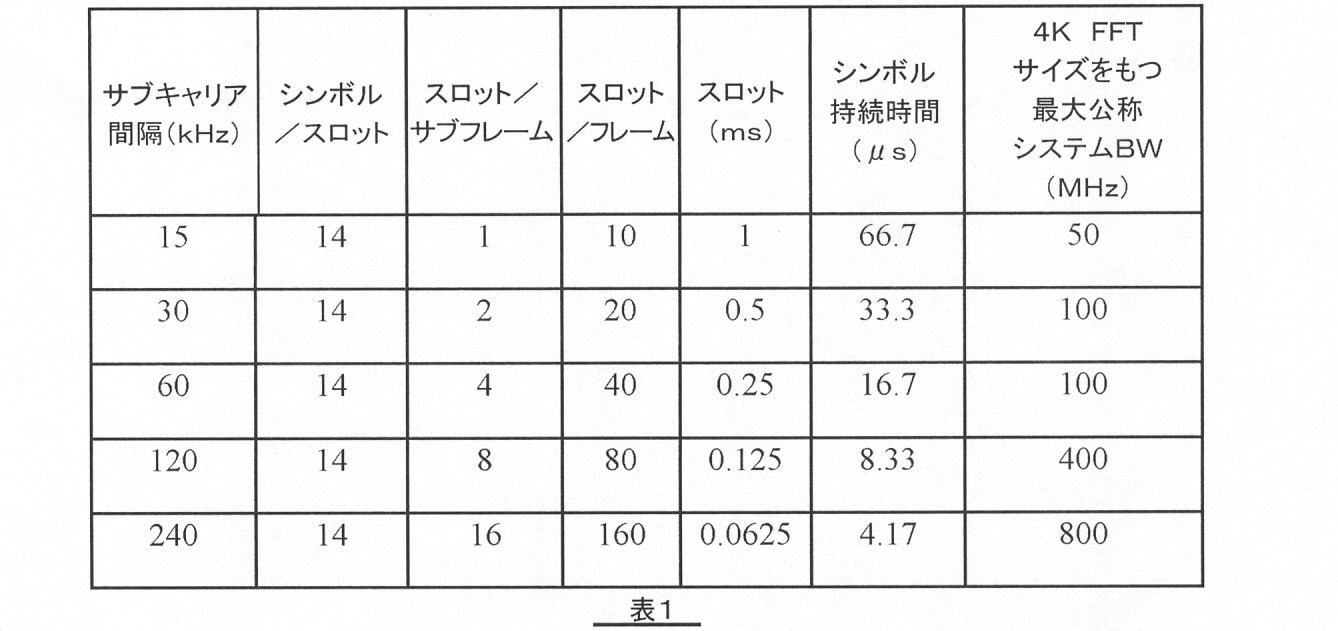
[0077]図4Aおよび図4Bの例では、15kHzのヌメロロジーが使用される。したがって、時間領域では、フレーム(たとえば、10ms)が各々1msの10個の等しいサイズのサブフレームに分割され、各サブフレームは1つのタイムスロットを含む。図4Aおよび図4Bでは、時間は水平方向に(たとえば、X軸上で)表され、時間は左から右に増加し、周波数は垂直方向に(たとえば、Y軸上で)表され、周波数は下から上に増加する(または減少する)。 [0077] In the example of Figures 4A and 4B, a 15 kHz numerology is used. Thus, in the time domain, a frame (eg, 10 ms) is divided into 10 equally sized subframes of 1 ms each, with each subframe containing one time slot. In FIGS. 4A and 4B, time is represented horizontally (eg, on the X-axis), with time increasing from left to right, and frequency is represented vertically (eg, on the Y-axis), with frequency Increase (or decrease) from bottom to top.
[0078]タイムスロットを表すためにリソースグリッドが使用され得、各タイムスロットは、周波数領域における1つまたは複数の(物理RB(PRB)とも呼ばれる)時間並列リソースブロック(RB)を含む。リソースグリッドは、複数のリソース要素(RE)にさらに分割される。REは、時間領域における1つのシンボル長および周波数領域における1つのサブキャリアに対応し得る。図4Aおよび図4Bのヌメロロジーでは、ノーマルサイクリックプレフィックスの場合、RBは、合計84個のREについて、周波数領域において12個の連続するサブキャリアを含んでいることがあり、時間領域において7つの連続するシンボル(DLの場合、OFDMシンボル、ULの場合、SC-FDMAシンボル)を含んでいることがある。拡張サイクリックプレフィックスの場合、RBは、合計72個のREについて、周波数領域において12個の連続するサブキャリアを含んでおり、時間領域において6個の連続するシンボルを含んでいることがある。各REによって搬送されるビット数は変調方式に依存する。 [0078] A resource grid may be used to represent timeslots, where each timeslot includes one or more time-parallel resource blocks (RBs) (also called physical RBs (PRBs)) in the frequency domain. The resource grid is further divided into multiple resource elements (REs). An RE may correspond to one symbol length in the time domain and one subcarrier in the frequency domain. In the numerology of FIGS. 4A and 4B, for a normal cyclic prefix, an RB may contain 12 consecutive subcarriers in the frequency domain and 7 consecutive subcarriers in the time domain for a total of 84 REs. (OFDM symbols for DL, SC-FDMA symbols for UL). For the extended cyclic prefix, an RB may contain 12 consecutive subcarriers in the frequency domain and 6 consecutive symbols in the time domain for a total of 72 REs. The number of bits carried by each RE depends on the modulation scheme.
[0079]図4Aに示されているように、REのうちのいくつかが、UEにおけるチャネル推定のためのDL基準(パイロット)信号(DL-RS)を搬送する。DL-RSは、復調基準信号(DMRS)とチャネル状態情報基準信号(CSI-RS)とを含み得、それらの例示的なロケーションが、図4Aにおいて「R」と標示される。 [0079] As shown in FIG. 4A, some of the REs carry DL reference (pilot) signals (DL-RS) for channel estimation at the UE. DL-RS may include demodulation reference signals (DMRS) and channel state information reference signals (CSI-RS), whose exemplary locations are labeled "R" in FIG. 4A.
[0080]図4Bは、フレームのDLサブフレーム内の様々なチャネルの一例を示す。物理ダウンリンク制御チャネル(PDCCH)は、1つまたは複数の制御チャネル要素(CCE)内でDL制御情報(DCI)を搬送し、各CCEは9つのREグループ(REG)を含み、各REGは、OFDMシンボル中に4つの連続するREを含む。DCIは、ULリソース割振り(永続的および非永続的)に関する情報と、UEに送信されるDLデータに関する説明とを搬送する。複数の(たとえば、最高8つの)DCIが、PDCCHにおいて構成され得、これらのDCIは複数のフォーマットのうちの1つを有することができる。たとえば、ULスケジューリングのために、非MIMO DLスケジューリングのために、MIMO DLスケジューリングのために、およびUL電力制御のために、異なるDCIフォーマットがある。 [0080] Figure 4B shows an example of various channels within a DL subframe of a frame. A physical downlink control channel (PDCCH) carries DL control information (DCI) in one or more control channel elements (CCEs), each CCE containing nine RE groups (REGs), each REG comprising: It contains four consecutive REs in an OFDM symbol. DCI carries information about UL resource allocation (persistent and non-persistent) and description about DL data sent to the UE. Multiple (eg, up to 8) DCIs may be configured on the PDCCH, and these DCIs may have one of multiple formats. For example, there are different DCI formats for UL scheduling, non-MIMO DL scheduling, MIMO DL scheduling, and UL power control.
[0081]1次同期信号(PSS)が、サブフレーム/シンボルタイミングと物理レイヤ識別情報とを決定するためにUEによって使用される。2次同期信号(SSS)が、物理レイヤセル識別情報グループ番号と無線フレームタイミングとを決定するためにUEによって使用される。物理レイヤ識別情報および物理レイヤセル識別情報グループ番号に基づいて、UEはPCIを決定することができる。PCIに基づいて、UEは、上述のDL-RSのロケーションを決定することができる。MIBを搬送する物理ブロードキャストチャネル(PBCH)は、(SS/PBCHとも呼ばれる)SSBを形成するためにPSSおよびSSSを用いて論理的にグループ化され得る。MIBは、DLシステム帯域幅中のRBの数と、システムフレーム番号(SFN)とを与える。物理ダウンリンク共有チャネル(PDSCH)は、ユーザデータと、システム情報ブロック(SIB)などのPBCHを通して送信されないブロードキャストシステム情報と、ページングメッセージとを搬送する。 [0081] A primary synchronization signal (PSS) is used by the UE to determine subframe/symbol timing and physical layer identification information. A secondary synchronization signal (SSS) is used by the UE to determine the physical layer cell identity group number and radio frame timing. Based on the physical layer identity and the physical layer cell identity group number, the UE can determine the PCI. Based on PCI, the UE can determine the location of the above DL-RS. A physical broadcast channel (PBCH) carrying MIBs may be logically grouped with PSS and SSS to form an SSB (also called SS/PBCH). The MIB gives the number of RBs in the DL system bandwidth and the system frame number (SFN). The physical downlink shared channel (PDSCH) carries user data, broadcast system information not sent over the PBCH, such as system information blocks (SIBs), and paging messages.
[0082]いくつかの場合には、図4Aに示されているDL RSは、測位基準信号(PRS)であり得る。図5は、(基地局102などの)ワイヤレスノードによってサポートされるセルのための例示的なPRS構成500を示す。図5は、PRS測位オケージョンが、システムフレーム番号(SFN)、セル固有サブフレームオフセット(ΔPRS)552、およびPRS周期性(TPRS)520によって、どのように決定されるかを示す。一般に、セル固有PRSサブフレーム構成は、観測到着時間差(OTDOA)支援データ中に含まれる「PRS構成インデックス」IPRSによって定義される。PRS周期性(TPRS)520およびセル固有サブフレームオフセット(ΔPRS)は、以下の表2に示されているように、PRS構成インデックスIPRSに基づいて定義される。
[0082] In some cases, the DL RS shown in FIG. 4A may be a positioning reference signal (PRS). FIG. 5 shows an
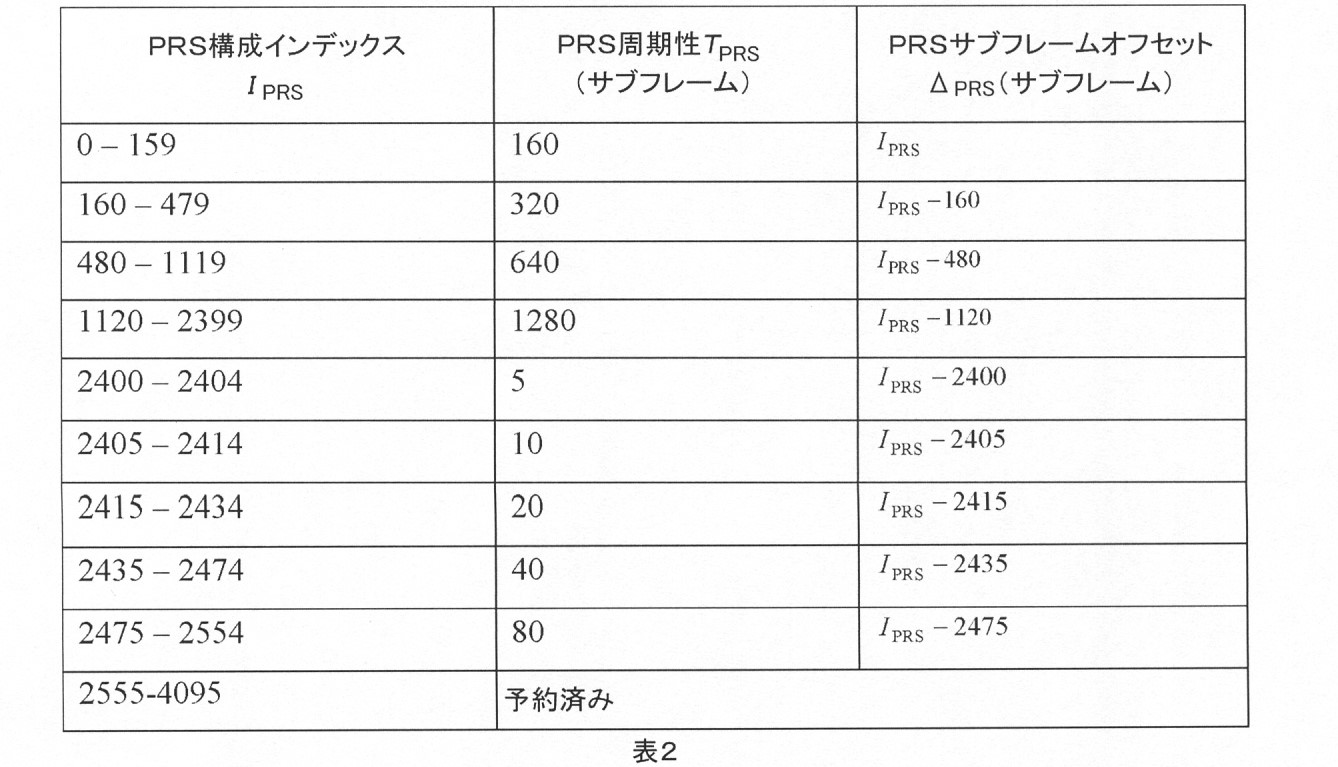
[0083]PRS構成は、PRSを送信するセルのSFNを参照して定義される。PRSインスタンスは、第1のPRS測位オケージョンを備えるNPRS個のダウンリンクサブフレームのうちの第1のサブフレームについて、 [0083] The PRS configuration is defined with reference to the SFN of the cell transmitting the PRS. The PRS instance is, for the first subframe of the N PRS downlink subframes comprising the first PRS positioning occasion:

を満たし得、ここで、nfは、0≦nf≦1023のSFNであり、nsは、0≦ns≦19の、nfによって定義される無線フレーム内のスロット番号であり、TPRSは、PRS周期性520であり、ΔPRSは、セル固有サブフレームオフセット552である。
where n f is the SFN with 0≦n f ≦1023, n s is the slot number within the radio frame defined by n f with 0≦n s ≦19, and T PRS is the
[0084]図5に示されているように、セル固有サブフレームオフセットΔPRS552は、システムフレーム番号0(スロット「番号0」、スロット550としてマークされる)から開始して第1の(後続の)PRS測位オケージョンの開始まで送信されるサブフレームの数に関して定義され得る。図5中の例では、連続するPRS測位オケージョン518a、518b、および518cの各々における連続する測位サブフレームの数(NPRS)は4に等しい。すなわち、PRS測位オケージョン518a、518b、および518cを表す各影付きブロックは、4つのサブフレームを表す。
[0084] As shown in FIG. 5, the cell-specific subframe offset
[0085]いくつかの態様では、UEが特定のセルのためのOTDOA支援データ中でPRS構成インデックスIPRSを受信するとき、UEは、表2を使用して、PRS周期性TPRS520とPRSサブフレームオフセットΔPRSとを決定し得る。UEは、次いで、(たとえば、式(1)を使用して)PRSがセルにおいてスケジュールされるときの無線フレームとサブフレームとスロットとを決定し得る。OTDOA支援データは、たとえば、ロケーションサーバ(たとえば、ロケーションサーバ230、LMF270)によって決定され得、基準セル、および様々な基地局によってサポートされるいくつかのネイバーセルのための支援データを含む。
[0085] In some aspects, when the UE receives the PRS configuration index I PRS in the OTDOA assistance data for a particular cell, the UE uses Table 2 to determine the
[0086]一般に、同じ周波数を使用するネットワークにおけるすべてのセルからのPRSオケージョンは、時間的に整合され、異なる周波数を使用するネットワークにおける他のセルに対して、固定の知られている時間オフセット(たとえば、セル固有サブフレームオフセット552)を有し得る。SFN同期ネットワークでは、すべてのワイヤレスノード(たとえば、基地局102)が、フレーム境界とシステムフレーム番号の両方に関して整合され得る。したがって、SFN同期ネットワークでは、様々なワイヤレスノードによってサポートされるすべてのセルが、PRS送信の特定の周波数のための同じPRS構成インデックスを使用し得る。一方、SFN非同期ネットワークでは、様々なワイヤレスノードは、システムフレーム番号でなく、フレーム境界に関して整合され得る。したがって、SFN非同期ネットワークでは、各セルのためのPRS構成インデックスは、PRSオケージョンが時間的に整合するように、ネットワークによって別個に構成され得る。 [0086] In general, PRS occasions from all cells in a network using the same frequency are time-aligned with a fixed and known time offset ( For example, it may have a cell-specific subframe offset 552). In an SFN synchronized network, all wireless nodes (eg, base stations 102) may be aligned on both frame boundaries and system frame numbers. Thus, in an SFN synchronized network, all cells supported by various wireless nodes may use the same PRS configuration index for a particular frequency of PRS transmission. On the other hand, in SFN asynchronous networks, various wireless nodes may be aligned on frame boundaries rather than system frame numbers. Therefore, in SFN asynchronous networks, the PRS configuration index for each cell can be configured separately by the network such that the PRS occasions are time aligned.
[0087]UEは、そのUEが、セルのうちの少なくとも1つ、たとえば、基準セルまたはサービングセルのセルタイミング(たとえば、SFN)を取得することができる場合、OTDOA測位のための基準セルおよびネイバーセルのPRSオケージョンのタイミングを決定し得る。他のセルのタイミングは、次いで、たとえば、異なるセルからのPRSオケージョンが重複するという仮定に基づいて、UEによって導出され得る。 [0087] A UE may select reference and neighbor cells for OTDOA positioning if the UE is able to acquire the cell timing (eg, SFN) of at least one of the cells, eg, the reference cell or the serving cell. can determine the timing of PRS occasions of Timing for other cells may then be derived by the UE, eg, based on the assumption that PRS occasions from different cells overlap.
[0088]3GPP Rel.15は、MAC制御要素(CE)として電力ヘッドルーム報告(PHR)を導入した。PHRは、現在のUE送信電力(推定された電力)と公称電力との間のヘッドルームを報告する。たとえば、サービングセルは、UEが特定のサブフレームのためにどのくらいのアップリンク帯域幅を使用することを可能にされるかを推定するためにPHRを使用し得る。PHRは、PHR機能的構成または再構成、セルアクティブ化によって、周期的に、あるいはPHRのための次の周期トリガより前の経路損失または電力バックオフ(P-MPRc)の変動によって、トリガされ得る。1つの具体的な例として、経路損失PHRトリガに関して、3GPP Rel.15のTS38.321セクション5.4.6は、上記で査定された1つのセルについての経路損失変動が、現在の時間において、現在の経路損失基準信号(PL-RS)に関して測定された経路損失と、最後のPHR送信の送信時間において、その時間において使用中のPL-RSに関して測定された経路損失との間のものであることを、経路損失基準信号(PL-RS)がPL-RSの間に変化したかどうかには関係なく、指定する。PL-RSは、SSBまたはCSI-RSであり得、UEは、すべてのUL送信(たとえば、物理アップリンク制御チャネル(PUCCH)、物理アップリンク共有チャネル(PUSCH)、SRSなど)についてサービングセルごとに最高4つのPL-RSを維持することができる。 [0088] 3GPP Rel. 15 introduced Power Headroom Reporting (PHR) as a MAC Control Element (CE). PHR reports the headroom between the current UE transmit power (estimated power) and the nominal power. For example, the serving cell may use PHR to estimate how much uplink bandwidth the UE is allowed to use for a particular subframe. PHR is triggered by PHR functional configuration or reconfiguration, cell activation, periodically, or by variations in path loss or power backoff (P-MPR c ) prior to the next periodic trigger for PHR. obtain. As one specific example, for path loss PHR triggers, 3GPP Rel. 15 TS 38.321 Section 5.4.6 states that the pathloss variation for one cell assessed above is the measured pathloss relative to the current pathloss reference signal (PL-RS) at the current time and the pathloss measured for the PL-RS in use at that time, at the transmission time of the last PHR transmission, when the pathloss reference signal (PL-RS) is the PL-RS's Specifies whether or not it has changed in the meantime. PL-RS can be SSB or CSI-RS, and the UE has the highest per serving cell for all UL transmissions (eg, physical uplink control channel (PUCCH), physical uplink shared channel (PUSCH), SRS, etc.). Four PL-RS can be maintained.
[0089]3GPP Rel.16は、PHRをトリガし得るいくつかのPL-RSから発展した。たとえば、3GPP Rel.16では、(UL PRSとして特徴づけられ得る)測位のためのUL SRSが、PL-RSとしてのSSBまたはDL PRSに関連し得る。3GPP Rel.15の場合のようなサービングセルごとの4つのPL RSに加えて、最高N個のPL-RSが、すべてのUL PRSセットにわたって使用され得る。Nは、(たとえば、RRCシグナリングを介して)UE能力として構成可能であり、0、4、8または16に等しいことがある。SSBは、サービングまたはネイバリングセルからのものであり得る(たとえば、セルIDが示される)。同様に、DL PRSは、任意のTRPからのものであり得る(たとえば、TRPが示される)。SSBおよびPRS送信電力も示される。 [0089] 3GPP Rel. 16 evolved from several PL-RS that can trigger PHR. For example, 3GPP Rel. At 16, a UL SRS for positioning (which may be characterized as a UL PRS) may be associated with SSB or DL PRS as PL-RS. 3GPP Rel. Up to N PL-RSs may be used across all UL PRS sets, in addition to 4 PL RSs per serving cell, such as in the 15 case. N is configurable as a UE capability (eg, via RRC signaling) and may be equal to 0, 4, 8 or 16. The SSB may be from a serving or neighboring cell (eg, cell ID is indicated). Similarly, the DL PRS can be from any TRP (eg, TRP indicated). SSB and PRS transmit powers are also shown.
[0090]3GPP Rel.15からの4つのレガシーPL-RSに関連する経路損失ベースPHRトリガを、3GPP Rel.16において導入された新しいPL-RSに適用することは、全体的なPHRアクティビティを増加させ、これは、それぞれのUEにおける電力消費をも増加させながらシステムにおける干渉を増やす。本開示の1つまたは複数の実施形態は、選択的様式でPHR機能を実装すること(たとえば、PHRを選択的にトリガするためのPL-RSに関連する1つまたは複数の条件を監視すること)を対象とする。 [0090] 3GPP Rel. 3GPP Rel. Applying the new PL-RS introduced in 16 increases the overall PHR activity, which increases interference in the system while also increasing power consumption at each UE. One or more embodiments of the present disclosure implement PHR functionality in a selective manner (e.g., monitor one or more conditions associated with PL-RS to selectively trigger PHR ).
[0091]図6Aは、本開示の態様による、ワイヤレス通信の例示的なプロセス600を示す。一態様では、プロセス600はUEによって実施され得る。
[0091] FIG. 6A illustrates an
[0092]610において、UEは、経路損失基準信号(PL-RS)に関連するPL-RSタイプまたはセルタイプに基づいて、PL-RSについて電力ヘッドルーム報告(PHR)機能を実施すべきかどうかを決定する。一例では、610の決定は、PL-RSについてのPHRに関連する少なくとも1つのルールに基づき得る。一例では、少なくとも1つのルールは、あらかじめ定義され(たとえば、関連する規格において定義され)得る。別の例では、少なくとも1つのルールは、(たとえば、いくつかの設計ではDCIまたはMAC-CEを介して、他の設計では、RRCシグナリングなどの上位レイヤシグナリングを介して)動的に構成され得る。一態様では、動作610は、(1つまたは複数の)受信機312、WWANトランシーバ310、処理システム332、メモリ340、PHRモジュール342などによって実施され得る。
[0092] At 610, the UE determines whether to implement a power headroom reporting (PHR) function for the PL-RS based on the PL-RS type or cell type associated with the PL-RS. decide. In one example, the determination of 610 can be based on at least one rule related to PHR for PL-RS. In one example, at least one rule may be predefined (eg, defined in a relevant standard). In another example, at least one rule may be dynamically configured (eg, via DCI or MAC-CE in some designs and via higher layer signaling such as RRC signaling in other designs). . In one aspect,
[0093]620において、UEは、決定に基づいてPL-RSについてPHR機能または1つまたは複数の経路損失測定を実施する。いくつかの設計では、動作620を実施することは、(たとえば、610の決定がPHR機能を実施することである場合)PL-RSについてPHR機能と1つまたは複数の経路損失測定とを実施する。他の設計では、実施することは、(たとえば、610の決定がPHR機能を実施しないことである場合)PL-RSについて1つまたは複数の経路損失測定のみを実施する。一例では、PHR機能は、PHRを選択的にトリガするためのそれぞれのPL-RSに関連する1つまたは複数の条件を監視することを備え得る。上記で説明されたように、これらの(1つまたは複数の)PHRトリガ条件は、PHR機能的構成または再構成、セルアクティブ化、周期的に、あるいはPHRのための次の周期トリガより前の経路損失または電力バックオフ(P-MPRc)の変動によって、を備え得る。一態様では、動作620は、(1つまたは複数の)送信機314、WWANトランシーバ310、処理システム332、メモリ340、PHRモジュール342などによって実施され得る。
[0093] At 620, the UE performs a PHR function or one or more path loss measurements on the PL-RS based on the determination. In some designs, performing
[0094]動作610~620を参照すると、610の決定がPL-RSについてPHR機能を実施しないことである場合、UEは、1つまたは複数のPHRトリガ条件が満たされるかどうかには関係なく、そのPL-RSについてPHR機能を実施することを「控えること(refraining)」として特徴づけられ得、これは、UEがPHRを生成および/または送信することを控えることとして解釈され得る。したがって、少なくとも1つのルールは、610における決定がPHR機能を実施することを決定する場合にPHRが送信されたであろうシナリオにおいてPHRが報告されないように、(1つまたは複数の)PHRトリガ条件を効果的にオーバーライドする。 [0094] Referring to operations 610-620, if the decision of 610 is not to perform the PHR function for the PL-RS, the UE may, regardless of whether one or more PHR trigger conditions are met, Performing the PHR function for that PL-RS may be characterized as "refraining," which may be interpreted as the UE refraining from generating and/or transmitting PHR. Accordingly, at least one rule specifies that the PHR trigger condition(s) is not reported in scenarios where a PHR would have been sent if the decision at 610 determined to implement the PHR function. effectively override the .
[0095]図6Aの620を参照すると、PHR機能がPL-RSに関して実施されるかどうかには関係なく、いくつかの設計では、UEは、1つまたは複数のUL PRSに関連してPL-RSに対して1つまたは複数の経路損失測定を実施する。UEは、さらに随意に、620における1つまたは複数の経路損失測定に基づいて(1つまたは複数の)UL PRSのための電力制御を実施する。この場合、610の決定がPHR機能を実施しないことである場合、1つまたは複数の経路損失測定は、PL-RSについてのPHR関係考慮について無視される。代替的に、これらの随意の(1つまたは複数の)経路損失測定のうちの1つまたは複数は、610の決定がPHR機能を実施することである場合、PHRを選択的にトリガするために使用され得る。 [0095] Referring to 620 in FIG. 6A, regardless of whether the PHR function is implemented on the PL-RS, in some designs, the UE may perform PL-RS in association with one or more UL PRS. Perform one or more path loss measurements on the RS. The UE also optionally performs power control for the UL PRS(s) based on one or more path loss measurements at 620 . In this case, if the decision of 610 is not to implement the PHR function, one or more of the pathloss measurements are ignored for PHR-related considerations for PL-RS. Alternatively, one or more of these optional path loss measurement(s) may be used to selectively trigger PHR if the determination of 610 is to perform the PHR function. can be used.
[0096]一例では、610の決定がPHR機能を実施することであるPL-RSは、PL-RSの第1のセットに対応し得、610の決定がPHR機能を実施しないことであるPL-RSは、PL-RSの第2のセットに対応し得る。この場合、UL PRSは、PL-RSの第1のセットに関連する(1つまたは複数の)セルを含むことも含まないこともあり、PL-RSの第2のセット上の経路損失を限定することは不要であり得(たとえば、PL-RSの第1のセットについて実施される経路損失管理との冗長が、(1つまたは複数の)同じセルが関与するである)、その場合、随意の経路損失測定はPL-RSの第2のセットについて実施されないことがある。いくつかの設計では、PL-RSの第1のセットは、PHRを選択的にトリガするために使用されるが、PL-RSの第1のセットと第2のセットの両方は、UL-PRSのために使用される。 [0096] In one example, the PL-RSs for which the determination of 610 is to perform the PHR function may correspond to the first set of PL-RSs, and the PL-RSs for which the determination of 610 is not to perform the PHR function. The RS may correspond to a second set of PL-RSs. In this case, the UL PRS may or may not include the cell(s) associated with the first set of PL-RSs, limiting the path loss on the second set of PL-RSs. may be unnecessary (eg, the redundancy with the path loss management performed for the first set of PL-RSs involves the same cell(s)), in which case the optional path loss measurements may not be performed for the second set of PL-RSs. In some designs, a first set of PL-RSs is used to selectively trigger PHR, while both the first and second sets of PL-RSs are UL-PRS used for
[0097]図6Aを参照すると、例として、PHR機能からある(1つまたは複数の)PL-RSを除外することは、UEにおける低減された電力消費、低減されたシステムオーバーヘッドおよび/または干渉、スケーラビリティ(たとえば、より多くのPL-RSが、PHR関係ボトルネックを経験することなしにサポートされ得る)など、(たとえば、単にすべてのPL-RSに対してPHR機能を実施することに対して)1つまたは複数の技術的利点を与える。 [0097] Referring to FIG. 6A, by way of example, excluding certain PL-RS(s) from the PHR function may result in reduced power consumption at the UE, reduced system overhead and/or interference, Scalability (e.g., more PL-RSs can be supported without experiencing PHR-related bottlenecks), etc. (e.g., versus simply implementing PHR functionality for all PL-RSs) Provides one or more technical advantages.
[0098]次に、PL-RSをPL-RSの第1のセットまたはPL-RSの第2のセットの一部として分類するために使用され得る様々なルールが説明される。上述のルールのうちの1つまたは複数は、図6Aの610における決定の一部として使用され得る。特に、以下のルールは、PL-RSの第1および第2のセットに関して説明され、それにより、610の決定がPHR機能を実施することであるPL-RSは、PL-RSの第1のセットに対応し得、610の決定がPHR機能を実施しないことであるPL-RSは、PL-RSの第2のセットに対応し得る。 [0098] Various rules that may be used to classify a PL-RS as part of a first set of PL-RSs or a second set of PL-RSs are now described. One or more of the rules described above may be used as part of the determination at 610 of FIG. 6A. In particular, the following rules are described with respect to the first and second sets of PL-RSs whereby the PL-RS whose decision of 610 is to perform the PHR function is the first set of PL-RSs and the PL-RS for which the determination of 610 is not to perform the PHR function may correspond to a second set of PL-RSs.
[0099]図6Aを参照すると、第1のルールの例では、少なくとも1つのルールは、4つのレガシー3GPP Rel.15 PL-RSをPL-RSの第1のセットの一部として特徴づけながら、任意の他のPL-RSをPL-RSの第2のセットの一部として特徴づけることであり得る。この場合、追加のPL-RSの包含は、PHRへの影響を有しない。 [0099] Referring to FIG. 6A, in a first rule example, at least one rule specifies four legacy 3GPP Rel. 15 PL-RSs as part of the first set of PL-RSs, while characterizing any other PL-RSs as part of the second set of PL-RSs. In this case, inclusion of additional PL-RS has no impact on PHR.
[00100]図6Aを参照すると、第2のルールの例では、少なくとも1つのルールは、PHR機能への参加から、UL PRSのためのPL-RSとして働くRSを除外することを備え得る。本明細書で使用される、PHR機能からのPL-RSの除外は、PL-RSの第2のセットの一部としてのその除外されたPL-RSの特徴づけを暗示する。さらに、本明細書で使用される「UL PRS」は、「測位のためのSRS」(または等価物)として明示的に識別されるSRSの任意の組合せ、あるいはそのようなSRS(たとえば、最小および/または最大帯域幅しきい値、コム密度(comb-density)、持続時間、コムスタガリング(comb-staggering)が有効化/無効化されるかどうかなどのコムスタガリング条件などをさらに満たしながらの測位のためのものであるSRS)のサブセットであり得る。 [00100] Referring to FIG. 6A, in a second rule example, at least one rule may comprise excluding an RS acting as a PL-RS for a UL PRS from participating in the PHR function. As used herein, exclusion of a PL-RS from the PHR function implies characterization of that excluded PL-RS as part of the second set of PL-RSs. Further, as used herein, "UL PRS" refers to any combination of SRSs explicitly identified as "SRS for Positioning" (or equivalents), or any such SRS (e.g., minimum and / or positioning while further satisfying comb-staggering conditions such as maximum bandwidth threshold, comb-density, duration, whether comb-staggering is enabled/disabled, etc. SRS) may be a subset of
[00101]図6Aを参照すると、第3のルールの例では、少なくとも1つのルールは、PHR機能への参加から、UL PRSのみのためのPL-RSとして働くRSを除外することを備え得る。たとえば、UL PRSならびに(1つまたは複数の)他のULチャネルに共通である第1のPL-RSは、第1のセットの一部であり(すなわち、PHR機能について含まれ)得るが、UL PRSに固有であり、(1つまたは複数の)他のULチャネルに関連しない第2のPL-RSは、第2のセットの一部であり(すなわち、PHR機能について除外され)得る。 [00101] Referring to FIG. 6A, in a third rule example, at least one rule may comprise excluding RSs acting as PL-RSs for UL PRS only from participation in the PHR function. For example, the first PL-RS that is common to the UL PRS as well as the other UL channel(s) may be part of the first set (ie, included for PHR functionality), but the UL A second PL-RS that is PRS-specific and not associated with other UL channel(s) may be part of the second set (ie, excluded for PHR functionality).
[00102]図6Aを参照すると、第4のルールの例では、少なくとも1つのルールは、PHR機能への参加から、RSとして働くDL PRSを除外することを備え得る。一例では、UL-PRSのためのPL-RSとして働く1つのDL-PRSが、より選択的な様式で、たとえば、TRP-IDに基づいて、除外され得る(たとえば、いくつかのTRPに関連するDL PRSが第1のセットの一部であり、他のTRPに関連するDL PRSが第2のセットの一部である)。より具体的な実装形態では、少なくとも1つのルールは、PHR機能への参加から、非サービングセルに関連する(たとえば、TRP-IDに基づいて決定された)DL PRSを除外することを備え得る。この場合、サービングセルに関連するDL PRSのための第1のPLは、第1のセットの一部であり(すなわち、PHR機能について含まれ)得るが、非サービングセルに関連するDL PRSのための第2のPLは、第2のセットの一部であり(すなわち、PHR機能について除外され)得る。 [00102] Referring to FIG. 6A, in a fourth rule example, at least one rule may comprise excluding a DL PRS acting as an RS from participating in a PHR function. In one example, one DL-PRS acting as a PL-RS for a UL-PRS may be excluded in a more selective manner, eg, based on TRP-ID (eg, DL PRSs are part of the first set and DL PRSs associated with other TRPs are part of the second set). In a more specific implementation, the at least one rule may comprise excluding DL PRSs associated with non-serving cells (eg, determined based on TRP-ID) from participating in the PHR function. In this case, the first PL for the DL PRS associated with the serving cell may be part of the first set (i.e., included for PHR functionality), but the first PL for the DL PRS associated with the non-serving cell Two PLs may be part of the second set (ie, excluded for PHR functionality).
[00103]図6Aを参照すると、第5のルールの例では、少なくとも1つのルールは、PHR機能への参加から、非サービングセルに関連するDL RSのためのPL-RSとして働くRSを除外することを備え得る。一例では、非サービングセルは、関連するTRP-IDに基づいて識別され得る。 [00103] Referring to FIG. 6A, in a fifth rule example, at least one rule excludes RSs acting as PL-RSs for DL RSs associated with non-serving cells from participating in the PHR function. can be provided. In one example, non-serving cells can be identified based on the associated TRP-ID.
[00104]図6Aを参照すると、第6のルールの例では、少なくとも1つのルールは、組合せにおいて実装される、上記で言及されたルールのいずれかなど、複数のルールを備え得る。この場合、PL-RSがPHR機能への参加から除外される(またはそれに含まれる)、複数のルールがあり得る。たとえば、少なくとも1つのルールは、PHR機能への参加から、UL PRSのためのPL-RSとして働くRS、UL PRSのみのためのPL-RSとして働くRS、UL-PRSのためのPL-RSとして働くDL-PRS、非サービングセルに関連するDL PRSのためのPL-RSとして働くRS、非サービングセルに関連するDL RSのためのPL-RSとして働くRS、またはそれらの任意の組合せを除外することを備え得る。 [00104] Referring to FIG. 6A, in a sixth rule example, at least one rule may comprise multiple rules, such as any of the rules mentioned above, implemented in combination. In this case, there may be multiple rules by which the PL-RS is excluded from (or included in) participation in the PHR function. For example, at least one rule is from participation in the PHR function, RS acting as PL-RS for UL PRS, RS acting as PL-RS for UL PRS only, PL-RS for UL-PRS. excluding serving DL-PRSs, RSs acting as PL-RSs for DL PRSs associated with non-serving cells, RSs acting as PL-RSs for DL RSs associated with non-serving cells, or any combination thereof. be prepared.
[00105]図6Aを参照すると、いくつかの設計では、1つのセルについての経路損失変動は、経路損失基準が間に変化したかどうかには関係なく、現在の時間において、現在の経路損失基準に関して測定された経路損失と、PHRの最後の送信の送信時間において、その時間において使用中の経路損失基準に関して測定された経路損失との間のものである。いくつかの設計では、この目的のための現在の経路損失基準は、pathlossReferenceRS-Posを使用して構成された経路損失基準を含まない。 [00105] Referring to FIG. 6A, in some designs, the pathloss variation for one cell is equal to and the pathloss measured at the transmission time of the last transmission of the PHR with respect to the pathloss criterion in use at that time. In some designs, the current pathloss criteria for this purpose do not include pathloss criteria configured using pathlossReferenceRS-Pos.
[00106]図6Bは、本開示の態様による、ワイヤレス通信の例示的なプロセス650を示す。一態様では、プロセス650はUEによって実施され得る。
[00106] FIG. 6B illustrates an
[00107]660において、UEは、UEのサービングセルから受信された経路損失基準信号(PL-RS)に関連する指示に基づいてPL-RSについて電力ヘッドルーム報告(PHR)機能を実施すべきかどうかを決定する。一例では、660の決定は、PL-RSについてのPHRに関連する少なくとも1つのルールに基づき得る。一例では、少なくとも1つのルールは、あらかじめ定義され(たとえば、関連する規格において定義され)得る。別の例では、少なくとも1つのルールは、(たとえば、いくつかの設計ではDCIまたはMAC-CEを介して、他の設計では、RRCシグナリングなどの上位レイヤシグナリングを介して)動的に構成され得る。一態様では、動作660は、(1つまたは複数の)受信機312、WWANトランシーバ310、処理システム332、メモリ340、PHRモジュール342などによって実施され得る。
[00107] At 660, the UE determines whether to perform a power headroom reporting (PHR) function for the PL-RS based on an indication related to the path loss reference signal (PL-RS) received from the UE's serving cell. decide. In one example, the determination of 660 can be based on at least one rule related to PHR for PL-RS. In one example, at least one rule may be predefined (eg, defined in a relevant standard). In another example, at least one rule may be dynamically configured (eg, via DCI or MAC-CE in some designs and via higher layer signaling such as RRC signaling in other designs). . In one aspect,
[00108]670において、UEは、決定に基づいてPL-RSについてPHR機能または1つまたは複数の経路損失測定を実施する。いくつかの設計では、動作670を実施することは、(たとえば、660の決定がPHR機能を実施することである場合)PL-RSについてPHR機能と1つまたは複数の経路損失測定とを実施する。他の設計では、実施することは、(たとえば、660の決定がPHR機能を実施しないことである場合)PL-RSについて1つまたは複数の経路損失測定のみを実施する。一例では、PHR機能は、PHRを選択的にトリガするためのそれぞれのPL-RSに関連する1つまたは複数の条件を監視することを備え得る。上記で説明されたように、これらの(1つまたは複数の)PHRトリガ条件は、PHR機能的構成または再構成、セルアクティブ化、周期的に、あるいはPHRのための次の周期トリガより前の経路損失または電力バックオフ(P-MPRc)の変動によって、を備え得る。一態様では、動作670は、(1つまたは複数の)送信機314、WWANトランシーバ310、処理システム332、メモリ340、PHRモジュール342などによって実施され得る。
[00108] At 670, the UE performs a PHR function or one or more path loss measurements on the PL-RS based on the determination. In some designs, performing
[00109]動作660~670を参照すると、660の決定がPL-RSについてPHR機能を実施しないことである場合、UEは、1つまたは複数のPHRトリガ条件が満たされるかどうかには関係なく、そのPL-RSについてPHR機能を実施することを「控えること」として特徴づけられ得、これは、UEがPHRを生成および/または送信することを控えることとして解釈され得る。したがって、少なくとも1つのルールは、660における決定がPHR機能を実施することを決定する場合にPHRが送信されたであろうシナリオにおいてPHRが報告されないように、(1つまたは複数の)PHRトリガ条件を効果的にオーバーライドする。 [00109] Referring to operations 660-670, if the decision of 660 is not to perform the PHR function for the PL-RS, the UE may, regardless of whether one or more PHR trigger conditions are met, Performing PHR functionality for that PL-RS may be characterized as “refraining”, which may be interpreted as the UE refraining from generating and/or transmitting PHR. Therefore, at least one rule specifies that the PHR trigger condition(s) is not reported in scenarios where a PHR would have been sent if the decision at 660 decided to implement the PHR function. effectively override the .
[00110]図6Bの670を参照すると、PHR機能がPL-RSに関して実施されるかどうかには関係なく、いくつかの設計では、UEは、1つまたは複数のUL PRSに関連してPL-RSに対して1つまたは複数の経路損失測定を実施する。UEは、さらに随意に、670における1つまたは複数の経路損失測定に基づいて(1つまたは複数の)UL PRSのための電力制御を実施する。この場合、660の決定がPHR機能を実施しないことである場合、1つまたは複数の経路損失測定は、PL-RSについてのPHR関係考慮について無視される。代替的に、これらの随意の(1つまたは複数の)経路損失測定のうちの1つまたは複数は、660の決定がPHR機能を実施することである場合、PHRを選択的にトリガするために使用され得る。 [00110] Referring to 670 in FIG. 6B, regardless of whether the PHR function is implemented on the PL-RS, in some designs, the UE may operate the PL-RS in association with one or more UL PRS. Perform one or more path loss measurements on the RS. The UE also optionally implements power control for the UL PRS(s) based on one or more path loss measurements at 670 . In this case, if the decision of 660 is not to implement the PHR function, one or more of the pathloss measurements are ignored for PHR-related considerations for PL-RS. Alternatively, one or more of these optional path loss measurement(s) may be used to selectively trigger PHR if the determination of 660 is to perform the PHR function. can be used.
[00111]一例では、660の決定がPHR機能を実施することであるPL-RSは、PL-RSの第1のセットに対応し得、660の決定がPHR機能を実施しないことであるPL-RSは、PL-RSの第2のセットに対応し得る。この場合、UL PRSは、PL-RSの第1のセットに関連する(1つまたは複数の)セルを含むことも含まないこともあり、PL-RSの第2のセット上の経路損失を限定することは不要であり得(たとえば、PL-RSの第1のセットについて実施される経路損失管理との冗長が、(1つまたは複数の)同じセルが関与するである)、その場合、随意の経路損失測定はPL-RSの第2のセットについて実施されないことがある。いくつかの設計では、PL-RSの第1のセットは、PHRを選択的にトリガするために使用されるが、PL-RSの第1のセットと第2のセットの両方は、UL-PRSのために使用される。 [00111] In one example, the PL-RSs for which the determination of 660 is to perform the PHR function may correspond to the first set of PL-RSs and the PL-RSs for which the determination of 660 is not to perform the PHR function. The RS may correspond to a second set of PL-RSs. In this case, the UL PRS may or may not include the cell(s) associated with the first set of PL-RSs, limiting the path loss on the second set of PL-RSs. may be unnecessary (eg, the redundancy with the pathloss management performed for the first set of PL-RSs involves the same cell(s)), in which case the optional path loss measurements may not be performed for the second set of PL-RSs. In some designs, a first set of PL-RSs is used to selectively trigger PHR, but both the first and second sets of PL-RSs are UL-PRS used for
[00112]図6Bを参照すると、例として、PHR機能からある(1つまたは複数の)PL-RSを除外することは、UEにおける低減された電力消費、低減されたシステムオーバーヘッドおよび/または干渉、スケーラビリティ(たとえば、より多くのPL-RSが、PHR関係ボトルネックを経験することなしにサポートされ得る)など、(たとえば、単にすべてのPL-RSに対してPHR機能を実施することに対して)1つまたは複数の技術的利点を与える。 [00112] Referring to FIG. 6B, by way of example, excluding certain PL-RS(s) from the PHR function may result in reduced power consumption at the UE, reduced system overhead and/or interference, Scalability (e.g., more PL-RSs can be supported without experiencing PHR-related bottlenecks), etc. (e.g., versus simply implementing PHR functionality for all PL-RSs) Provides one or more technical advantages.
[00113]次に、PL-RSをPL-RSの第1のセットまたはPL-RSの第2のセットの一部として分類するために使用され得る様々なルールが説明される。上述のルールのうちの1つまたは複数は、図6Bの660における決定の一部として使用され得る。特に、以下のルールは、PL-RSの第1および第2のセットに関して説明され、それにより、660の決定がPHR機能を実施することであるPL-RSは、PL-RSの第1のセットに対応し得、660の決定がPHR機能を実施しないことであるPL-RSは、PL-RSの第2のセットに対応し得る。 [00113] Various rules that may be used to classify a PL-RS as part of a first set of PL-RSs or a second set of PL-RSs are now described. One or more of the rules described above may be used as part of the determination at 660 in FIG. 6B. In particular, the following rules are described with respect to the first and second sets of PL-RSs whereby the PL-RS whose decision of 660 is to perform the PHR function is the first set of PL-RSs and the PL-RS for which the determination of 660 is not to perform the PHR function may correspond to a second set of PL-RSs.
[00114]図6Bを参照すると、第1のルールの例では、少なくとも1つのルールは、PHR機能への参加から、PHR機能除外を示す明示的指示(たとえば、明示的「オプトアウト(opt-out)」ルール)が与えられるPL-RSとして働くRSを除外することを備え得る。代替として、少なくとも1つのルールは、PHR機能への参加から、PHR機能包含を示す明示的指示(たとえば、明示的「オプトイン(opt-in)」ルール)が与えられないPL-RSとして働くRSを除外することを備え得る。いくつかの設計では、明示的オプトインルールまたは明示的オプトアウトルールは、少なくとも1つのUL PRSのためのPL-RSとして働くRS、または(たとえば、UL PRSと(1つまたは複数の)他のチャネルタイプの両方に関連する共通PL-RSとは対照的に)UL PRSのためのPL-RSとしてのみ働くRSなど、特定のRSタイプのために実装され得る。いくつかの設計では、明示的オプトインルールまたは明示的オプトアウトルールは、4つのレガシー3GPP Rel.15 PL-RSのうちの1つまたは複数に適用され得る。 [00114] Referring to FIG. 6B, in a first rule example, at least one rule includes an explicit indication of PHR feature exclusion (e.g., an explicit "opt-out" from participation in the PHR feature). )” rule) to exclude RSs acting as PL-RSs given the rule). Alternatively, at least one rule excludes RSs acting as PL-RSs that are not given an explicit indication of PHR functional inclusion (e.g., an explicit "opt-in" rule) from participation in the PHR function. Exclusions may be provided. In some designs, an explicit opt-in rule or an explicit opt-out rule is an RS that acts as a PL-RS for at least one UL PRS, or (eg, a UL PRS and other channel(s)). It may be implemented for a specific RS type, such as an RS that acts only as a PL-RS for UL PRS (as opposed to a common PL-RS that is associated with both types). In some designs, the explicit opt-in or explicit opt-out rules are the four legacy 3GPP Rel. It may be applied to one or more of the 15 PL-RSs.
[00115]図6Bを参照すると、第2のルールの例では、少なくとも1つのルールは、PHR機能への参加から、PHR機能除外を示す暗黙的指示(たとえば、暗黙的「オプトアウト」ルール)が与えられるPL-RSとして働くRSを除外することを備え得る。代替として、少なくとも1つのルールは、PHR機能への参加から、PHR機能包含を示す暗黙的指示(たとえば、暗黙的「オプトイン」ルール)が与えられないPL-RSとして働くRSを除外することを備え得る。いくつかの設計では、暗黙的オプトインルールまたは暗黙的オプトアウトルールは、少なくとも1つのUL PRSのためのPL-RSとして働くRS、または(たとえば、UL PRSと(1つまたは複数の)他のチャネルタイプの両方に関連する共通PL-RSとは対照的に)UL PRSのためのPL-RSとしてのみ働くRSなど、特定のRSタイプのために実装され得る。いくつかの設計では、暗黙的オプトインルールまたは暗黙的オプトアウトルールは、4つのレガシー3GPP Rel.15 PL-RSのうちの1つまたは複数に適用され得る。 [00115] Referring to FIG. 6B, in a second rule example, at least one rule has an implicit indication (e.g., an implicit "opt-out" rule) indicating PHR feature exclusion from participation in the PHR feature. It may comprise excluding RSs acting as given PL-RSs. Alternatively, the at least one rule comprises excluding RSs acting as PL-RSs not given an implicit indication of PHR functional inclusion (e.g., an implicit "opt-in" rule) from participation in the PHR function. obtain. In some designs, the implicit opt-in rule or implicit opt-out rule is an RS that acts as a PL-RS for at least one UL PRS, or (eg, a UL PRS and other channel(s)). It may be implemented for a specific RS type, such as an RS acting only as a PL-RS for UL PRS (as opposed to a common PL-RS associated with both types). In some designs, the implicit opt-in or implicit opt-out rules are the four legacy 3GPP Rel. It may be applied to one or more of the 15 PL-RSs.
[00116]図6Bを参照すると、第3のルールの例では、少なくとも1つのルールは、組合せにおいて実装される、上記で言及されたルールのいずれかなど、複数のルールを備え得る。この場合、PL-RSがPHR機能への参加から除外される(またはそれに含まれる)、複数のルールがあり得る。たとえば、少なくとも1つのルールは、PHR機能への参加から、PHR機能除外を示す明示的指示が与えられるPL-RSとして働くRSを除外すること、PHR機能への参加から、PHR機能包含を示す明示的指示が与えられないPL-RSとして働くRSを除外すること、PHR機能への参加から、PHR機能除外を示す暗黙的指示が与えられるPL-RSとして働くRSを除外すること、PHR機能への参加から、PHR機能包含を示す暗黙的指示が与えられないPL-RSとして働くRSを除外すること、またはそれらの任意の組合せを備え得る。 [00116] Referring to FIG. 6B, in a third rule example, at least one rule may comprise multiple rules, such as any of the rules mentioned above, implemented in combination. In this case, there may be multiple rules by which the PL-RS is excluded from (or included in) participation in the PHR function. For example, at least one rule may exclude RSs acting as PL-RSs from participating in the PHR function that are given explicit indications of PHR function exclusion, excluding RSs acting as PL-RSs for which no explicit indication is given; excluding RSs acting as PL-RSs given implicit indications indicating PHR function exclusion from participation in the PHR function; Participation may comprise excluding RSs acting as PL-RSs that are not given an implicit indication of PHR functional inclusion, or any combination thereof.
[00117]上記の詳細な説明では、異なる特徴が例にまとめられていることがわかる。開示のこの様式は、例示的な条項が、各条項において明示的に述べられるものよりも多くの特徴を有するという意図として理解されるべきではない。むしろ、本開示の様々な態様は、開示される個々の例示的な条項のすべての特徴よりも少数を含み得る。したがって、以下の条項は、本明細書に組み込まれると見なされるべきであり、各条項はそれ自体によって別個の例として存在することができる。各従属条項は、条項において、他の条項のうちの1つとの特定の組合せを指すことができるが、その従属条項の(1つまたは複数の)態様は、特定の組合せに限定されない。他の例示的な条項が、任意の他の従属条項または独立条項の主題との(1つまたは複数の)従属条項態様の組合せ、あるいは他の従属および独立条項との任意の特徴の組合せをも含むことができることが諒解されよう。本明細書で開示される様々な態様は、特定の組合せ(たとえば、要素を絶縁体と導体の両方として定義することなど、矛盾する態様)が意図されないことが明示的に表されるかまたは容易に推論され得ない限り、これらの組合せを明確に含む。さらに、条項の態様が任意の他の独立条項に含まれ得ることが、その条項がその独立条項に直接従属していない場合でも、同じく意図される。 [00117] In the above detailed description, it can be seen that different features are grouped in examples. This form of disclosure should not be understood as an intention that the exemplary clauses have more features than are expressly recited in each clause. Rather, various aspects of the disclosure may include less than all features of each disclosed exemplary clause. Accordingly, the following clauses should be considered incorporated herein and each clause may stand by itself as a separate instance. Each subclause may refer to a particular combination with one of the other clauses in a clause, but the aspect(s) of that subclause is not limited to any particular combination. Other exemplary clauses may also combine subclause aspect(s) with the subject matter of any other subclause or independent clause, or any feature combination with other subordinate and independent clauses. It will be appreciated that it can include The various aspects disclosed herein are expressly expressed or implied that no particular combination (e.g., contradictory aspects, such as defining an element as both an insulator and a conductor) is intended. expressly includes combinations of these unless it can be inferred from Further, it is also contemplated that aspects of a clause may be included in any other independent clause, even if that clause is not directly dependent on that independent clause.
[00118]図6Aを参照すると、いくつかの設計では、特定のセルについての経路損失変動は、現在時間において、現在の経路損失基準(たとえば、TS38.331におけるpathlossReferenceRS-Pos)に関して測定された経路損失と、PHRの最後の送信の送信時間において、その時間において使用中の経路損失基準(たとえば、TS38.331におけるpathlossReferenceRS-Pos)に関して測定された経路損失との間で、経路損失基準が間に変化したかどうかには関係なく、測定または計算され得る。 [00118] Referring to FIG. 6A, in some designs, the pathloss variation for a particular cell is measured relative to the current pathloss reference (eg, pathlossReferenceRS-Pos in TS38.331) at the current time. Between the loss and the pathloss measured at the transmission time of the last transmission of the PHR with respect to the pathloss reference in use at that time (e.g., pathlossReferenceRS-Pos in TS38.331), the pathloss reference is between It can be measured or calculated regardless of whether it has changed.
[00119]実装例が、以下の番号付けされた条項において説明される。 [00119] Example implementations are described in the numbered sections below.
[00120]条項1.ユーザ機器(UE)を動作させる方法であって、経路損失基準信号(PL-RS)に関連するPL-RSタイプまたはセルタイプに基づいて、PL-RSについて電力ヘッドルーム報告(PHR)機能を実施すべきかどうかを決定することと、決定に基づいてPL-RSについてPHR機能または1つまたは複数の経路損失測定を実施することとを備える、方法。
[00120]
[00121]条項2.実施することが、PL-RSについてPHR機能および1つまたは複数の経路損失測定を実施する、あるいは、実施することが、PL-RSについて1つまたは複数の経路損失測定のみを実施する、条項1に記載の方法。
[00121]
[00122]条項3.決定することが、PHR機能への参加から、アップリンク(UL)測位基準信号(PRS)のためのPL-RSとして働くRSを除外することを含む少なくとも1つのルールに基づく、条項1から2のいずれかに記載の方法。
[00122]
[00123]条項4.決定することが、PHR機能への参加から、アップリンク(UL)測位基準信号(PRS)のみのためのPL-RSとして働くRSを除外することを含む少なくとも1つのルールに基づく、条項1から3のいずれかに記載の方法。
[00123]
[00124]条項5.決定することが、PHR機能への参加から、RSとして働くダウンリンク(DL)測位基準信号(PRS)を除外することを含む少なくとも1つのルールに基づく、条項1から4のいずれかに記載の方法。 [00124] Clause 5. 5. The method of any of clauses 1-4, wherein determining is based on at least one rule including excluding downlink (DL) positioning reference signals (PRS) acting as RSs from participating in PHR functions. .
[00125]条項6.決定することが、PHR機能への参加から、非サービングセルに関連するアップリンク(UL)-PRSのためのRSとして働くダウンリンク(DL)測位基準信号(PRS)を除外することを含む少なくとも1つのルールに基づく、条項1から5のいずれかに記載の方法。
[00125]
[00126]条項7.決定することが、PHR機能への参加から、非サービングセルに関連するDL RSのためのPL-RSとして働くRSを除外することを含む少なくとも1つのルールに基づく、条項1から6のいずれかに記載の方法。
[00126]
[00127]条項8.決定することが、PHR機能への参加から、アップリンク(UL)測位基準信号(PRS)のためのPL-RSとして働くRS、UL PRSのみのためのPL-RSとして働くRS、RSとして働くダウンリンク(DL)PRS、非サービングセルに関連するUL-PRSのためのRSとして働くDL PRS、非サービングセルに関連するDL RSのためのPL-RSとして働くRS、またはそれらの任意の組合せを除外することを含む少なくとも1つのルールに基づく、条項1から7のいずれかに記載の方法。
[00127]
[00128]条項9.1つまたは複数の経路損失測定が、1つまたは複数のアップリンク(UL)測位基準信号(PRS)に関連し、1つまたは複数の経路損失測定に基づいてUL PRSのための電力制御を実施することをさらに備える、条項1から8のいずれかに記載の方法。
[00128]
[00129]条項10.ユーザ機器(UE)を動作させる方法であって、UEのサービングセルから受信された経路損失基準信号(PL-RS)に関連する指示に基づいて、PL-RSについて電力ヘッドルーム報告(PHR)機能を実施すべきかどうかを決定することと、決定に基づいてPL-RSについてPHR機能または1つまたは複数の経路損失測定を実施することとを備える、方法。
[00129]
[00130]条項11.実施することが、PL-RSについてPHR機能または1つまたは複数の経路損失測定を実施する、あるいは実施することが、PL-RSについて1つまたは複数の経路損失測定のみを実施する、条項10に記載の方法。
[00130]
[00131]条項12.決定することは、PHR機能への参加から、PHR機能除外を示す明示的指示が与えられるPL-RSとして働くRSを除外することを含む少なくとも1つのルールに基づく、または決定することは、PHR機能への参加から、PHR機能包含を示す明示的指示が与えられないPL-RSとして働くRSを除外することを含む少なくとも1つのルールに基づく、条項10から11のいずれかに記載の方法。
[00131]
[00132]条項13.決定することは、PHR機能への参加から、PHR機能除外を示す暗黙的指示が与えられるPL-RSとして働くRSを除外することを含む少なくとも1つのルールに基づく、または決定することは、PHR機能への参加から、PHR機能包含を示す暗黙的指示が与えられないPL-RSとして働くRSを除外することを含む少なくとも1つのルールに基づく、条項10から12のいずれかに記載の方法。
[00132]
[00133]条項14.決定することは、PHR機能への参加から、PHR機能への参加から、PHR機能除外を示す明示的指示が与えられるPL-RSとして働くRSを除外すること、PHR機能への参加から、PHR機能包含を示す明示的指示が与えられないPL-RSとして働くRSを除外すること、PHR機能への参加から、PHR機能除外を示す暗黙的指示が与えられるPL-RSとして働くRSを除外すること、PHR機能への参加から、PHR機能包含を示す暗黙的指示が与えられないPL-RSとして働くRSを除外すること、またはそれらの任意の組合せを除外することを含む少なくとも1つのルールに基づく、条項10から13のいずれかに記載の方法。 [00133] Clause 14. Determining is to exclude from participation in the PHR function an RS acting as a PL-RS for which an explicit indication of PHR function exclusion is given; excluding RSs acting as PL-RSs that are not given an explicit indication of inclusion, excluding RSs acting as PL-RSs that are given an implicit indication of PHR function exclusion from participation in the PHR function; a provision based on at least one rule including excluding RSs acting as PL-RSs not given an implicit indication of PHR function inclusion, or any combination thereof, from participation in the PHR function; 14. The method according to any one of 10-13.
[00134]条項15.1つまたは複数の経路損失測定が、1つまたは複数のアップリンク(UL)測位基準信号(PRS)に関連し、1つまたは複数の経路損失測定に基づいてUL PRSのための電力制御を実施することをさらに備える、条項10から14のいずれかに記載の方法。 [00134] Clause 15. The one or more path loss measurements are associated with one or more uplink (UL) positioning reference signals (PRS), and the UL PRS are determined based on the one or more path loss measurements 15. The method of any of clauses 10-14, further comprising implementing power control for.
[00135]条項16.メモリと、メモリに通信可能に結合された少なくとも1つのプロセッサとを備え、メモリおよび少なくとも1つのプロセッサが、条項1~15のいずれかに記載の方法を実施するように構成された、装置。 [00135] Clause 16. 16. An apparatus comprising a memory and at least one processor communicatively coupled to the memory, wherein the memory and the at least one processor are configured to perform the method of any of clauses 1-15.
[00136]条項17.条項1から15のいずれかに記載の方法を実施するための手段を備える、装置。 [00136] Clause 17. 16. Apparatus comprising means for performing the method according to any one of clauses 1-15.
[00137]条項18.コンピュータ実行可能命令を記憶する非一時的コンピュータ可読媒体であって、コンピュータ実行可能が、コンピュータまたはプロセッサに条項1から15のいずれかに記載の方法を実施させるための少なくとも1つの命令を備える、非一時的コンピュータ可読媒体。
[00137]
[00138]情報および信号は、様々な異なる技術および技法のいずれかを使用して表され得ることを当業者は諒解されよう。たとえば、上記の説明全体にわたって言及され得るデータ、命令、コマンド、情報、信号、ビット、シンボル、およびチップは、電圧、電流、電磁波、磁界または磁性粒子、光場または光学粒子、あるいはそれらの任意の組合せによって表され得る。 [00138] Those of skill in the art will understand that information and signals may be represented using any of a variety of different technologies and techniques. For example, data, instructions, commands, information, signals, bits, symbols, and chips that may be referred to throughout the above description may refer to voltages, currents, electromagnetic waves, magnetic fields or magnetic particles, light fields or optical particles, or any of these. It can be represented by a combination.
[00139]さらに、本明細書で開示される態様に関して説明された様々な例示的な論理ブロック、モジュール、回路、およびアルゴリズムステップは、電子ハードウェア、コンピュータソフトウェア、または両方の組合せとして実装され得ることを、当業者は諒解されよう。ハードウェアとソフトウェアのこの互換性を明確に示すために、様々な例示的な構成要素、ブロック、モジュール、回路、およびステップが、概してそれらの機能に関して上記で説明された。そのような機能がハードウェアとして実装されるのかソフトウェアとして実装されるのかは、特定の適用例および全体的なシステムに課される設計制約に依存する。当業者は、説明された機能を特定の適用例ごとに様々な方法で実装し得るが、そのような実装の決定は、本開示の範囲からの逸脱を生じるものと解釈されるべきではない。 [00139] Moreover, the various illustrative logical blocks, modules, circuits, and algorithm steps described in relation to the aspects disclosed herein may be implemented as electronic hardware, computer software, or a combination of both. , those skilled in the art will appreciate. To clearly illustrate this interchangeability of hardware and software, various illustrative components, blocks, modules, circuits, and steps have been described above generally in terms of their functionality. Whether such functionality is implemented as hardware or software depends on the particular application and design constraints imposed on the overall system. Skilled artisans may implement the described functionality in varying ways for each particular application, but such implementation decisions should not be interpreted as causing a departure from the scope of the present disclosure.
[00140]本明細書で開示される態様に関して説明された様々な例示的な論理ブロック、モジュール、および回路は、汎用プロセッサ、DSP、ASIC、FPGA、または他のプログラマブル論理デバイス、個別ゲートまたはトランジスタ論理、個別ハードウェア構成要素、あるいは本明細書で説明された機能を実施するように設計されたそれらの任意の組合せを用いて実装または実施され得る。汎用プロセッサは、マイクロプロセッサであり得るが、代替として、プロセッサは、任意の従来のプロセッサ、コントローラ、マイクロコントローラ、または状態機械であり得る。プロセッサはまた、コンピューティングデバイスの組合せ、たとえば、DSPとマイクロプロセッサとの組合せ、複数のマイクロプロセッサ、DSPコアと連携する1つまたは複数のマイクロプロセッサ、または任意の他のそのような構成として実装され得る。 [00140] The various exemplary logic blocks, modules, and circuits described with respect to the aspects disclosed herein may be implemented using general purpose processors, DSPs, ASICs, FPGAs, or other programmable logic devices, discrete gates or transistor logic. , discrete hardware components, or any combination thereof designed to perform the functions described herein. A general-purpose processor may be a microprocessor, but, in the alternative, the processor may be any conventional processor, controller, microcontroller, or state machine. A processor may also be implemented as a combination of computing devices, such as a combination DSP and microprocessor, multiple microprocessors, one or more microprocessors in conjunction with a DSP core, or any other such configuration. obtain.
[00141]本明細書で開示される態様に関して説明された方法、シーケンスおよび/またはアルゴリズムは、ハードウェアで直接実施されるか、プロセッサによって実行されるソフトウェアモジュールで実施されるか、またはその2つの組合せで実施され得る。ソフトウェアモジュールは、ランダムアクセスメモリ(RAM)、フラッシュメモリ、読取り専用メモリ(ROM)、消去可能プログラマブルROM(EPROM)、電気的消去可能プログラマブルROM(EEPROM(登録商標))、レジスタ、ハードディスク、リムーバブルディスク、CD-ROM、または当技術分野で知られている任意の他の形態の記憶媒体中に常駐し得る。例示的な記憶媒体は、プロセッサが記憶媒体から情報を読み取り、記憶媒体に情報を書き込むことができるように、プロセッサに結合される。代替として、記憶媒体はプロセッサと一体化され得る。プロセッサおよび記憶媒体はASIC中に存在し得る。ASICはユーザ端末(たとえば、UE)中に存在し得る。代替として、プロセッサおよび記憶媒体は、ユーザ端末中に個別構成要素として存在し得る。 [00141] The methods, sequences and/or algorithms described with respect to the aspects disclosed herein may be implemented directly in hardware, in software modules executed by a processor, or in a combination of the two. A combination may be implemented. A software module may reside in random access memory (RAM), flash memory, read only memory (ROM), erasable programmable ROM (EPROM), electrically erasable programmable ROM (EEPROM®), registers, hard disk, removable disk, It may reside on a CD-ROM or any other form of storage medium known in the art. An exemplary storage medium is coupled to the processor such that the processor can read information from, and write information to, the storage medium. Alternatively, the storage medium may be integral with the processor. A processor and storage medium may reside in an ASIC. The ASIC may reside in a user equipment (eg, UE). Alternatively, the processor and storage medium may reside as separate components in the user terminal.
[00142]1つまたは複数の例示的な態様では、説明された機能は、ハードウェア、ソフトウェア、ファームウェア、またはそれらの任意の組合せで実装され得る。ソフトウェアで実装される場合、機能は、1つまたは複数の命令またはコードとしてコンピュータ可読媒体上に記憶されるか、あるいはコンピュータ可読媒体を介して送信され得る。コンピュータ可読媒体は、ある場所から別の場所へのコンピュータプログラムの転送を可能にする任意の媒体を含む、コンピュータ記憶媒体とコンピュータ通信媒体の両方を含む。記憶媒体は、コンピュータによってアクセスされ得る任意の利用可能な媒体であり得る。限定ではなく例として、そのようなコンピュータ可読媒体は、RAM、ROM、EEPROM、CD-ROMまたは他の光ディスクストレージ、磁気ディスクストレージまたは他の磁気記憶デバイス、あるいは命令またはデータ構造の形態の所望のプログラムコードを搬送または記憶するために使用され得、コンピュータによってアクセスされ得る任意の他の媒体を備えることができる。また、いかなる接続もコンピュータ可読媒体と適切に呼ばれる。たとえば、ソフトウェアが、同軸ケーブル、光ファイバーケーブル、ツイストペア、デジタル加入者回線(DSL)、または赤外線、無線、およびマイクロ波などのワイヤレス技術を使用して、ウェブサイト、サーバ、または他のリモートソースから送信される場合、同軸ケーブル、光ファイバーケーブル、ツイストペア、DSL、または赤外線、無線、およびマイクロ波などのワイヤレス技術は媒体の定義の中に含まれる。本明細書で使用されるディスク(disk)およびディスク(disc)は、コンパクトディスク(disc)(CD)、レーザーディスク(登録商標)(disc)、光ディスク(disc)、デジタル多用途ディスク(disc)(DVD)、フロッピー(登録商標)ディスク(disk)およびBlu-ray(登録商標)ディスク(disc)を含み、ここで、ディスク(disk)は通常、データを磁気的に再生し、ディスク(disc)は、データをレーザーで光学的に再生する。上記の組合せも、コンピュータ可読媒体の範囲内に含まれるべきである。 [00142] In one or more exemplary aspects, the functions described may be implemented in hardware, software, firmware, or any combination thereof. If implemented in software, the functions may be stored on or transmitted over a computer-readable medium as one or more instructions or code. Computer-readable media includes both computer storage media and communication media including any medium that facilitates transfer of a computer program from one place to another. A storage media may be any available media that can be accessed by a computer. By way of example, and not limitation, such computer readable media may include RAM, ROM, EEPROM, CD-ROM or other optical disk storage, magnetic disk storage or other magnetic storage devices, or any desired program in the form of instructions or data structures. It can comprise any other medium that can be used to carry or store code and that can be accessed by a computer. Also, any connection is properly termed a computer-readable medium. For example, software transmitted from a website, server, or other remote source using coaxial cable, fiber optic cable, twisted pair, digital subscriber line (DSL), or wireless technologies such as infrared, radio, and microwave Where applicable, coaxial cable, fiber optic cable, twisted pair, DSL, or wireless technologies such as infrared, radio, and microwave are included within the definition of medium. As used herein, disk and disc refer to compact disc (CD), laser disc (disc), optical disc (disc), digital versatile disc ( DVD), floppy disk and Blu-ray disk, where the disk usually reproduces data magnetically and the disk is , the data is reproduced optically with a laser. Combinations of the above should also be included within the scope of computer-readable media.
[00143]上記の開示は本開示の例示的な態様を示しているが、添付の特許請求の範囲によって定義された本開示の範囲から逸脱することなく、本明細書において様々な変更および修正が行われ得ることに留意されたい。本明細書で説明された本開示の態様による方法クレームの機能、ステップおよび/またはアクションは、特定の順序で実施される必要がない。さらに、本開示の要素は、単数形で説明または請求されていることがあるが、単数形に限定することが明示的に述べられていない限り、複数形が企図される。 [00143] While the above disclosure illustrates exemplary aspects of the present disclosure, various changes and modifications may be made herein without departing from the scope of the disclosure as defined by the appended claims. Note that it can be done. The functions, steps and/or actions of the method claims in accordance with the aspects of the disclosure described herein need not be performed in any particular order. Furthermore, although elements of the disclosure may be described or claimed in the singular, the plural is contemplated unless the singular is explicitly stated to be limiting.
Claims (33)
経路損失基準信号(PL-RS)に関連するPL-RSタイプまたはセルタイプに基づいて、前記PL-RSについて電力ヘッドルーム報告(PHR)機能を実施すべきかどうかを決定することと、
前記決定に基づいて、前記PL-RSについてPHR機能または1つまたは複数の経路損失測定を実施することと、
を備える、方法。 A method of operating a user equipment (UE), comprising:
determining whether to implement a power headroom reporting (PHR) function for a path loss reference signal (PL-RS) based on the PL-RS type or cell type associated with the PL-RS;
performing a PHR function or one or more path loss measurements on the PL-RS based on the determination;
A method.
前記実施することは、前記PL-RSについて前記1つまたは複数の経路損失測定のみを実施する、
請求項1に記載の方法。 the performing performs the PHR function or the one or more path loss measurements for the PL-RS; or
the performing only performs the one or more path loss measurements for the PL-RS;
The method of claim 1.
アップリンク(UL)測位基準信号(PRS)のためのPL-RSとして働くRS、または、
UL PRSのみのためのPL-RSとして働くRS、または、
RSとして働くダウンリンク(DL)PRS、または、
UL-PRSのためのRSとして働くDL PRS、または、
非サービングセルに関連するUL-PRSのためのRSとして働くDL PRS、または、
非サービングセルに関連するDL RSのためのPL-RSとして働くRS、または、
それらの任意の組合せ、
を除外することを含む少なくとも1つのルールに基づく、請求項1に記載の方法。 said determining, from participation in said PHR function,
RS acting as PL-RS for uplink (UL) positioning reference signals (PRS); or
RS acting as PL-RS for UL PRS only, or
a downlink (DL) PRS acting as an RS, or
a DL PRS acting as an RS for the UL-PRS, or
DL PRS acting as an RS for UL-PRSs associated with non-serving cells, or
RS acting as PL-RS for DL RSs associated with non-serving cells; or
any combination thereof,
2. The method of claim 1, based on at least one rule including excluding
前記1つまたは複数の経路損失測定に基づいて前記UL PRSのための電力制御を実施すること、
をさらに備える、請求項1に記載の方法。 the one or more path loss measurements are associated with one or more uplink (UL) positioning reference signals (PRS);
performing power control for the UL PRS based on the one or more path loss measurements;
2. The method of claim 1, further comprising:
前記UEのサービングセルから受信された経路損失基準信号(PL-RS)に関連する指示に基づいて、前記PL-RSについて電力ヘッドルーム報告(PHR)機能を実施すべきかどうかを決定することと、
前記決定に基づいて、前記PL-RSについてPHR機能または1つまたは複数の経路損失測定を実施することと、
を備える、方法。 A method of operating a user equipment (UE), comprising:
determining whether to perform a power headroom reporting (PHR) function for the PL-RS based on an indication related to a path loss reference signal (PL-RS) received from a serving cell of the UE;
performing a PHR function or one or more path loss measurements on the PL-RS based on the determination;
A method.
前記実施することは、前記PL-RSについて前記1つまたは複数の経路損失測定のみを実施する、
請求項10に記載の方法。 the performing performs the PHR function or the one or more path loss measurements for the PL-RS; or
the performing only performs the one or more path loss measurements for the PL-RS;
11. The method of claim 10.
前記決定することは、前記PHR機能への参加から、PHR機能包含を示す明示的指示が与えられないPL-RSとして働くRSを除外することを含む少なくとも1つのルールに基づく、
請求項10に記載の方法。 said determining is based on at least one rule including excluding from participation in said PHR function an RS acting as a PL-RS given an explicit indication indicating PHR function exclusion; or
said determining is based on at least one rule comprising excluding from participation in said PHR function an RS acting as a PL-RS not given an explicit indication of PHR function inclusion;
11. The method of claim 10.
前記決定することは、前記PHR機能への参加から、PHR機能包含を示す暗黙的指示が与えられないPL-RSとして働くRSを除外することを含む少なくとも1つのルールに基づく、
請求項10に記載の方法。 the determining is based on at least one rule including excluding from participation in the PHR function an RS acting as a PL-RS given an implicit indication indicating PHR function exclusion; or
the determining is based on at least one rule comprising excluding from participation in the PHR function an RS acting as a PL-RS that is not given an implicit indication of PHR function inclusion;
11. The method of claim 10.
前記PHR機能への参加から、PHR機能除外を示す明示的指示が与えられるPL-RSとして働くRSを除外すること、または、
前記PHR機能への参加から、PHR機能包含を示す明示的指示が与えられないPL-RSとして働くRSを除外すること、または、
前記PHR機能への参加から、PHR機能除外を示す暗黙的指示が与えられるPL-RSとして働くRSを除外すること、または、
前記PHR機能への参加から、PHR機能包含を示す暗黙的指示が与えられないPL-RSとして働くRSを除外すること、または、
それらの任意の組合せ、
を除外することを含む少なくとも1つのルールに基づく、請求項10に記載の方法。 said determining, from participation in said PHR function,
excluding from participation in said PHR function an RS acting as a PL-RS given an explicit indication of PHR function exclusion; or
excluding RSs acting as PL-RSs that are not given an explicit indication of PHR function inclusion from participation in said PHR function, or
excluding from participation in the PHR function an RS acting as a PL-RS given an implicit indication indicating PHR function exclusion; or
excluding RSs acting as PL-RSs that are not given an implicit indication of PHR functional inclusion from participation in the PHR function; or
any combination thereof,
11. The method of claim 10, based on at least one rule including excluding
前記1つまたは複数の経路損失測定に基づいて、前記UL PRSのための電力制御を実施すること、をさらに備える、請求項10に記載の方法。 the one or more path loss measurements are associated with one or more uplink (UL) positioning reference signals (PRS);
11. The method of claim 10, further comprising implementing power control for the UL PRS based on the one or more path loss measurements.
少なくとも1つのトランシーバと、
前記メモリおよび前記少なくとも1つのトランシーバに通信可能に結合された少なくとも1つのプロセッサと、
を備える、ユーザ機器(UE)であって、前記少なくとも1つのプロセッサは、
経路損失基準信号(PL-RS)に関連するPL-RSタイプまたはセルタイプに基づいて、前記PL-RSについて電力ヘッドルーム報告(PHR)機能を実施すべきかどうかを決定することと、
前記決定に基づいて、前記PL-RSについてPHR機能または1つまたは複数の経路損失測定を実施することと、
を行うように構成された、ユーザ機器(UE)。 memory;
at least one transceiver;
at least one processor communicatively coupled to said memory and said at least one transceiver;
A user equipment (UE) comprising:
determining whether to implement a power headroom reporting (PHR) function for a path loss reference signal (PL-RS) based on the PL-RS type or cell type associated with the PL-RS;
performing a PHR function or one or more path loss measurements on the PL-RS based on the determination;
A user equipment (UE), configured to:
アップリンク(UL)測位基準信号(PRS)のためのPL-RSとして働くRS、または、
UL PRSのみのためのPL-RSとして働くRS、または、
RSとして働くダウンリンク(DL)PRS、または、
UL-PRSのためのRSとして働くDL PRS、または、
非サービングセルに関連するUL-PRSのためのRSとして働くDL PRS、または、
非サービングセルに関連するDL RSのためのPL-RSとして働くRS、または、
それらの任意の組合せ、
を除外することを含む少なくとも1つのルールに基づく、請求項16に記載のUE。 said determination, from participation in said PHR function,
RS acting as PL-RS for uplink (UL) positioning reference signals (PRS); or
RS acting as PL-RS for UL PRS only, or
a downlink (DL) PRS acting as an RS, or
a DL PRS acting as an RS for the UL-PRS, or
DL PRS acting as an RS for UL-PRSs associated with non-serving cells, or
RS acting as PL-RS for DL RSs associated with non-serving cells; or
any combination thereof,
17. The UE of claim 16, based on at least one rule including excluding
少なくとも1つのトランシーバと、
前記メモリおよび前記少なくとも1つのトランシーバに通信可能に結合された少なくとも1つのプロセッサと、
を備える、ユーザ機器(UE)であって、前記少なくとも1つのプロセッサは、
前記UEのサービングセルから受信された経路損失基準信号(PL-RS)に関連する指示に基づいて、前記PL-RSについて電力ヘッドルーム報告(PHR)機能を実施すべきかどうかを決定することと、
前記決定に基づいて、前記PL-RSについてPHR機能または1つまたは複数の経路損失測定を実施することと、
を行うように構成された、ユーザ機器(UE)。 memory;
at least one transceiver;
at least one processor communicatively coupled to said memory and said at least one transceiver;
A user equipment (UE) comprising:
determining whether to perform a power headroom reporting (PHR) function for the PL-RS based on an indication related to a path loss reference signal (PL-RS) received from a serving cell of the UE;
performing a PHR function or one or more path loss measurements on the PL-RS based on the determination;
A user equipment (UE), configured to:
前記PHR機能への参加から、PHR機能除外を示す明示的指示が与えられるPL-RSとして働くRSを除外すること、または、
前記PHR機能への参加から、PHR機能包含を示す明示的指示が与えられないPL-RSとして働くRSを除外すること、または、
前記PHR機能への参加から、PHR機能除外を示す暗黙的指示が与えられるPL-RSとして働くRSを除外すること、または、
前記PHR機能への参加から、PHR機能包含を示す暗黙的指示が与えられないPL-RSとして働くRSを除外すること、または、
それらの任意の組合せ、
を除外することを含む少なくとも1つのルールに基づく、請求項19に記載のUE。 said determination, from participation in said PHR function,
excluding from participation in said PHR function an RS acting as a PL-RS given an explicit indication of PHR function exclusion; or
excluding RSs acting as PL-RSs that are not given an explicit indication of PHR function inclusion from participation in said PHR function, or
excluding from participation in the PHR function an RS acting as a PL-RS given an implicit indication indicating PHR function exclusion; or
excluding RSs acting as PL-RSs that are not given an implicit indication of PHR functional inclusion from participation in the PHR function; or
any combination thereof,
20. The UE of claim 19, based on at least one rule including excluding
前記決定に基づいて、前記PL-RSについてPHR機能または1つまたは複数の経路損失測定を実施するための手段と、
を備える、ユーザ機器(UE)。 means for determining whether to implement a power headroom reporting (PHR) function for a path loss reference signal (PL-RS) based on a PL-RS type or cell type associated with said PL-RS;
means for performing a PHR function or one or more path loss measurements for the PL-RS based on the determination;
A user equipment (UE), comprising:
アップリンク(UL)測位基準信号(PRS)のためのPL-RSとして働くRS、または、
UL PRSのみのためのPL-RSとして働くRS、または、
RSとして働くダウンリンク(DL)PRS、または、
UL-PRSのためのRSとして働くDL PRS、または、
非サービングセルに関連するUL-PRSのためのRSとして働くDL PRS、または、
非サービングセルに関連するDL RSのためのPL-RSとして働くRS、または、
それらの任意の組合せ、
を除外することを含む少なくとも1つのルールに基づく、請求項22に記載のUE。 said determination, from participation in said PHR function,
RS acting as PL-RS for uplink (UL) positioning reference signals (PRS); or
RS acting as PL-RS for UL PRS only, or
a downlink (DL) PRS acting as an RS, or
a DL PRS acting as an RS for the UL-PRS, or
DL PRS acting as an RS for UL-PRSs associated with non-serving cells, or
RS acting as PL-RS for DL RSs associated with non-serving cells; or
any combination thereof,
23. The UE of claim 22, based on at least one rule including excluding
前記UEのサービングセルから受信された経路損失基準信号(PL-RS)に関連する指示に基づいて、前記PL-RSについて電力ヘッドルーム報告(PHR)機能を実施すべきかどうかを決定するための手段と、
前記決定に基づいて、前記PL-RSについてPHR機能または1つまたは複数の経路損失測定を実施するための手段と、
を備える、ユーザ機器(UE)。 A user equipment (UE),
means for determining, based on an indication associated with a path loss reference signal (PL-RS) received from a serving cell of the UE, whether to perform a power headroom reporting (PHR) function for the PL-RS; ,
means for performing a PHR function or one or more path loss measurements for the PL-RS based on the determination;
A user equipment (UE), comprising:
26. The method of claim 25, wherein the determination is based on at least one rule including excluding RSs acting as PL-RSs for uplink (UL) positioning reference signals (PRS) only from participation in the PHR function. UE as described.
前記PHR機能への参加から、PHR機能除外を示す明示的指示が与えられるPL-RSとして働くRSを除外すること、または、
前記PHR機能への参加から、PHR機能包含を示す明示的指示が与えられないPL-RSとして働くRSを除外すること、または、
前記PHR機能への参加から、PHR機能除外を示す暗黙的指示が与えられるPL-RSとして働くRSを除外すること、または、
前記PHR機能への参加から、PHR機能包含を示す暗黙的指示が与えられないPL-RSとして働くRSを除外すること、または、
それらの任意の組合せ、
を除外することを含む少なくとも1つのルールに基づく、請求項25に記載のUE。 said determination, from participation in said PHR function,
excluding from participation in said PHR function an RS acting as a PL-RS given an explicit indication of PHR function exclusion; or
excluding RSs acting as PL-RSs that are not given an explicit indication of PHR function inclusion from participation in said PHR function, or
excluding from participation in the PHR function an RS acting as a PL-RS given an implicit indication indicating PHR function exclusion; or
excluding RSs acting as PL-RSs that are not given an implicit indication of PHR functional inclusion from participation in the PHR function; or
any combination thereof,
26. The UE of claim 25, based on at least one rule comprising excluding
経路損失基準信号(PL-RS)に関連するPL-RSタイプまたはセルタイプに基づいて、前記PL-RSについて電力ヘッドルーム報告(PHR)機能を実施すべきかどうかを決定するようにユーザ機器(UE)に命令する少なくとも1つの命令と、
前記決定に基づいて、前記PL-RSについてPHR機能または1つまたは複数の経路損失測定を実施するように前記UEに命令する少なくとも1つの命令と、
を備える、非一時的コンピュータ可読媒体。 A non-transitory computer-readable medium storing computer-executable instructions, the computer-executable instructions comprising:
A user equipment (UE ), and at least one instruction to
at least one instruction to instruct the UE to perform a PHR function or one or more path loss measurements for the PL-RS based on the determination;
A non-transitory computer-readable medium comprising:
アップリンク(UL)測位基準信号(PRS)のためのPL-RSとして働くRS、または、
UL PRSのみのためのPL-RSとして働くRS、または、
RSとして働くダウンリンク(DL)PRS、または、
UL-PRSのためのRSとして働くDL PRS、または、
非サービングセルに関連するUL-PRSのためのRSとして働くDL PRS、または、
非サービングセルに関連するDL RSのためのPL-RSとして働くRS、または、
それらの任意の組合せ、
を除外することを含む少なくとも1つのルールに基づく、請求項28に記載の非一時的コンピュータ可読媒体。 said determination, from participation in said PHR function,
RS acting as PL-RS for uplink (UL) positioning reference signals (PRS); or
RS acting as PL-RS for UL PRS only, or
a downlink (DL) PRS acting as an RS, or
a DL PRS acting as an RS for the UL-PRS, or
DL PRS acting as an RS for UL-PRSs associated with non-serving cells, or
RS acting as PL-RS for DL RSs associated with non-serving cells; or
any combination thereof,
29. The non-transitory computer-readable medium of claim 28, based on at least one rule that includes excluding
前記UEのサービングセルから受信された経路損失基準信号(PL-RS)に関連する指示に基づいて、前記PL-RSについて電力ヘッドルーム報告(PHR)機能を実施すべきかどうかを決定するようにユーザ機器(UE)に命令する少なくとも1つの命令と、
前記決定に基づいて、前記PL-RSについてPHR機能または1つまたは複数の経路損失測定を実施するように前記UEに命令する少なくとも1つの命令と、
を備える、非一時的コンピュータ可読媒体。 A non-transitory computer-readable medium storing computer-executable instructions, the computer-executable instructions comprising:
A user equipment to determine whether to perform a power headroom reporting (PHR) function for the PL-RS based on an indication associated with a path loss reference signal (PL-RS) received from a serving cell of the UE. at least one instruction to (UE);
at least one instruction to instruct the UE to perform a PHR function or one or more path loss measurements for the PL-RS based on the determination;
A non-transitory computer-readable medium comprising:
前記PHR機能への参加から、PHR機能除外を示す明示的指示が与えられるPL-RSとして働くRSを除外すること、または、
前記PHR機能への参加から、PHR機能包含を示す明示的指示が与えられないPL-RSとして働くRSを除外すること、または、
前記PHR機能への参加から、PHR機能除外を示す暗黙的指示が与えられるPL-RSとして働くRSを除外すること、または、
前記PHR機能への参加から、PHR機能包含を示す暗黙的指示が与えられないPL-RSとして働くRSを除外すること、または、
それらの任意の組合せ、
を除外することを含む少なくとも1つのルールに基づく、請求項31に記載の非一時的コンピュータ可読媒体。 said determination, from participation in said PHR function,
excluding from participation in said PHR function an RS acting as a PL-RS given an explicit indication of PHR function exclusion; or
excluding RSs acting as PL-RSs that are not given an explicit indication of PHR function inclusion from participation in said PHR function, or
excluding from participation in the PHR function an RS acting as a PL-RS given an implicit indication indicating PHR function exclusion; or
excluding RSs acting as PL-RSs that are not given an implicit indication of PHR functional inclusion from participation in the PHR function; or
any combination thereof,
32. The non-transitory computer-readable medium of claim 31, based on at least one rule that includes excluding
Applications Claiming Priority (5)
| Application Number | Priority Date | Filing Date | Title |
|---|---|---|---|
| US202062972141P | 2020-02-10 | 2020-02-10 | |
| US62/972,141 | 2020-02-10 | ||
| US17/168,922 | 2021-02-05 | ||
| US17/168,922 US11632725B2 (en) | 2020-02-10 | 2021-02-05 | Selective transmission of power headroom reports |
| PCT/US2021/017115 WO2021162995A1 (en) | 2020-02-10 | 2021-02-08 | Selective transmission of power headroom reports |
Publications (3)
| Publication Number | Publication Date |
|---|---|
| JP2023517474A true JP2023517474A (en) | 2023-04-26 |
| JPWO2021162995A5 JPWO2021162995A5 (en) | 2024-01-18 |
| JP7642657B2 JP7642657B2 (en) | 2025-03-10 |
Family
ID=77273338
Family Applications (1)
| Application Number | Title | Priority Date | Filing Date |
|---|---|---|---|
| JP2022547219A Active JP7642657B2 (en) | 2020-02-10 | 2021-02-08 | SELECTIVE TRANSMISSION OF POWER HEADROOM REPORTS - Patent application |
Country Status (8)
| Country | Link |
|---|---|
| US (1) | US11632725B2 (en) |
| EP (1) | EP4104540B1 (en) |
| JP (1) | JP7642657B2 (en) |
| KR (1) | KR20220139874A (en) |
| CN (1) | CN115380577B (en) |
| BR (1) | BR112022015254A2 (en) |
| TW (1) | TWI875948B (en) |
| WO (1) | WO2021162995A1 (en) |
Families Citing this family (2)
| Publication number | Priority date | Publication date | Assignee | Title |
|---|---|---|---|---|
| WO2022232103A1 (en) * | 2021-04-26 | 2022-11-03 | Ofinno, Llc | Default power headroom report rules |
| WO2023151020A1 (en) * | 2022-02-11 | 2023-08-17 | Apple Inc. | Improved reference signal measurement mechanisms during secondary cell activation in new radio |
Citations (2)
| Publication number | Priority date | Publication date | Assignee | Title |
|---|---|---|---|---|
| JP2019198068A (en) * | 2018-05-10 | 2019-11-14 | 華碩電腦股▲ふん▼有限公司 | Method and apparatus for triggering power headroom reporting for multiple path loss references in wireless communication system |
| WO2019242478A1 (en) * | 2018-06-19 | 2019-12-26 | 维沃移动通信有限公司 | Ph calculation method and terminal |
Family Cites Families (4)
| Publication number | Priority date | Publication date | Assignee | Title |
|---|---|---|---|---|
| KR101831281B1 (en) * | 2010-04-06 | 2018-02-23 | 삼성전자주식회사 | Device and method for handling scheduling information in wireless communication system |
| WO2013046965A1 (en) | 2011-09-28 | 2013-04-04 | シャープ株式会社 | Mobile station device, communication system, communication method, and integrated circuit |
| US9369971B2 (en) * | 2011-09-28 | 2016-06-14 | Sharp Kabushiki Kaisha | Mobile station device, communication system, communication method, and integrated circuit |
| WO2019070181A1 (en) * | 2017-10-02 | 2019-04-11 | Telefonaktiebolaget Lm Ericsson (Publ) | First node, second node, and methods performed thereby for handling power headroom reporting |
-
2021
- 2021-02-05 US US17/168,922 patent/US11632725B2/en active Active
- 2021-02-08 WO PCT/US2021/017115 patent/WO2021162995A1/en not_active Ceased
- 2021-02-08 EP EP21708891.3A patent/EP4104540B1/en active Active
- 2021-02-08 JP JP2022547219A patent/JP7642657B2/en active Active
- 2021-02-08 KR KR1020227026906A patent/KR20220139874A/en active Pending
- 2021-02-08 CN CN202180012625.8A patent/CN115380577B/en active Active
- 2021-02-08 BR BR112022015254A patent/BR112022015254A2/en unknown
- 2021-02-08 TW TW110104803A patent/TWI875948B/en active
Patent Citations (3)
| Publication number | Priority date | Publication date | Assignee | Title |
|---|---|---|---|---|
| JP2019198068A (en) * | 2018-05-10 | 2019-11-14 | 華碩電腦股▲ふん▼有限公司 | Method and apparatus for triggering power headroom reporting for multiple path loss references in wireless communication system |
| WO2019242478A1 (en) * | 2018-06-19 | 2019-12-26 | 维沃移动通信有限公司 | Ph calculation method and terminal |
| JP2021528892A (en) * | 2018-06-19 | 2021-10-21 | 維沃移動通信有限公司Vivo Mobile Communication Co., Ltd. | PH calculation method and terminal |
Also Published As
| Publication number | Publication date |
|---|---|
| CN115380577A (en) | 2022-11-22 |
| TWI875948B (en) | 2025-03-11 |
| US20210258892A1 (en) | 2021-08-19 |
| EP4104540C0 (en) | 2025-08-27 |
| WO2021162995A1 (en) | 2021-08-19 |
| JP7642657B2 (en) | 2025-03-10 |
| KR20220139874A (en) | 2022-10-17 |
| EP4104540A1 (en) | 2022-12-21 |
| US11632725B2 (en) | 2023-04-18 |
| TW202137801A (en) | 2021-10-01 |
| BR112022015254A2 (en) | 2022-09-20 |
| CN115380577B (en) | 2025-07-18 |
| EP4104540B1 (en) | 2025-08-27 |
Similar Documents
| Publication | Publication Date | Title |
|---|---|---|
| JP2022550079A (en) | Low Tier User Device Positioning with Premium User Device Assistance | |
| TWI858110B (en) | Indication of time-frequency synchronization signal block (ssb) locations of neighboring transmission-reception points for positioning reference signal puncturing purposes | |
| US12278748B2 (en) | Detailed warning and error reporting related to UL PRS transmission properties | |
| WO2021067008A1 (en) | Sounding reference signal (srs) configurations for one or more frequency hops | |
| JP2022549790A (en) | Positioning in networks with frequency reuse | |
| JP2023516841A (en) | A procedure for associating Sounding Reference Signal (SRS) resources with Random Access Channels (RACH) | |
| JP2023517813A (en) | Positioning measurement data reported via L1 or L2 signaling | |
| JP2023519805A (en) | Positioning measurement data reported via L1 or L2 signaling | |
| US20230232259A1 (en) | Secondary cell group in dormant state with data traffic disabled | |
| CN115053581B (en) | Selective transmission of power headroom reports | |
| JP7692921B2 (en) | Positioning measurement data | |
| JP7642657B2 (en) | SELECTIVE TRANSMISSION OF POWER HEADROOM REPORTS - Patent application | |
| US20230413185A1 (en) | Determining an initial prach preamble transmission power based on historical completed prach procedures | |
| JP2022550384A (en) | Constraints on Source Reference Signals for Positioning Reference Signal Pseudo-Collocation Timing References | |
| WO2021232226A1 (en) | Modifying a beam failure threshold based upon user equipment movement information | |
| KR20230047097A (en) | Enable search space set | |
| CN116602002A (en) | Tearing down packet data session after transition to different subscription of dual subscriber identity module dual standby user equipment | |
| US20240089805A1 (en) | Puncturing of inter-frequency measurements during evolved packet system fallback call procedure | |
| WO2022056778A1 (en) | Cell reselection procedure based on locally determined value for omitted system information block parameter | |
| WO2022027554A1 (en) | Aperiodic measurements for a secondary cell group in a dormant state | |
| WO2021164008A1 (en) | Dci-guided pdcch dmrs reception bundling | |
| WO2024151353A1 (en) | Positioning reference signal repetition measurement management |
Legal Events
| Date | Code | Title | Description |
|---|---|---|---|
| RD02 | Notification of acceptance of power of attorney |
Free format text: JAPANESE INTERMEDIATE CODE: A7422 Effective date: 20230104 |
|
| A521 | Request for written amendment filed |
Free format text: JAPANESE INTERMEDIATE CODE: A523 Effective date: 20240110 |
|
| A621 | Written request for application examination |
Free format text: JAPANESE INTERMEDIATE CODE: A621 Effective date: 20240110 |
|
| A131 | Notification of reasons for refusal |
Free format text: JAPANESE INTERMEDIATE CODE: A131 Effective date: 20241119 |
|
| A977 | Report on retrieval |
Free format text: JAPANESE INTERMEDIATE CODE: A971007 Effective date: 20241120 |
|
| A521 | Request for written amendment filed |
Free format text: JAPANESE INTERMEDIATE CODE: A523 Effective date: 20250109 |
|
| TRDD | Decision of grant or rejection written | ||
| A01 | Written decision to grant a patent or to grant a registration (utility model) |
Free format text: JAPANESE INTERMEDIATE CODE: A01 Effective date: 20250128 |
|
| A61 | First payment of annual fees (during grant procedure) |
Free format text: JAPANESE INTERMEDIATE CODE: A61 Effective date: 20250226 |
|
| R150 | Certificate of patent or registration of utility model |
Ref document number: 7642657 Country of ref document: JP Free format text: JAPANESE INTERMEDIATE CODE: R150 |