KR20220044495A - HPK1 inhibitors and uses thereof - Google Patents
HPK1 inhibitors and uses thereof Download PDFInfo
- Publication number
- KR20220044495A KR20220044495A KR1020227003145A KR20227003145A KR20220044495A KR 20220044495 A KR20220044495 A KR 20220044495A KR 1020227003145 A KR1020227003145 A KR 1020227003145A KR 20227003145 A KR20227003145 A KR 20227003145A KR 20220044495 A KR20220044495 A KR 20220044495A
- Authority
- KR
- South Korea
- Prior art keywords
- alkyl
- alkoxy
- halogen
- pharmaceutically acceptable
- compound
- Prior art date
- Legal status (The legal status is an assumption and is not a legal conclusion. Google has not performed a legal analysis and makes no representation as to the accuracy of the status listed.)
- Pending
Links
Classifications
-
- C—CHEMISTRY; METALLURGY
- C07—ORGANIC CHEMISTRY
- C07F—ACYCLIC, CARBOCYCLIC OR HETEROCYCLIC COMPOUNDS CONTAINING ELEMENTS OTHER THAN CARBON, HYDROGEN, HALOGEN, OXYGEN, NITROGEN, SULFUR, SELENIUM OR TELLURIUM
- C07F9/00—Compounds containing elements of Groups 5 or 15 of the Periodic Table
- C07F9/02—Phosphorus compounds
- C07F9/547—Heterocyclic compounds, e.g. containing phosphorus as a ring hetero atom
- C07F9/6561—Heterocyclic compounds, e.g. containing phosphorus as a ring hetero atom containing systems of two or more relevant hetero rings condensed among themselves or condensed with a common carbocyclic ring or ring system, with or without other non-condensed hetero rings
-
- A—HUMAN NECESSITIES
- A61—MEDICAL OR VETERINARY SCIENCE; HYGIENE
- A61K—PREPARATIONS FOR MEDICAL, DENTAL OR TOILETRY PURPOSES
- A61K31/00—Medicinal preparations containing organic active ingredients
- A61K31/33—Heterocyclic compounds
- A61K31/395—Heterocyclic compounds having nitrogen as a ring hetero atom, e.g. guanethidine or rifamycins
- A61K31/495—Heterocyclic compounds having nitrogen as a ring hetero atom, e.g. guanethidine or rifamycins having six-membered rings with two or more nitrogen atoms as the only ring heteroatoms, e.g. piperazine or tetrazines
- A61K31/505—Pyrimidines; Hydrogenated pyrimidines, e.g. trimethoprim
- A61K31/506—Pyrimidines; Hydrogenated pyrimidines, e.g. trimethoprim not condensed and containing further heterocyclic rings
-
- A—HUMAN NECESSITIES
- A61—MEDICAL OR VETERINARY SCIENCE; HYGIENE
- A61K—PREPARATIONS FOR MEDICAL, DENTAL OR TOILETRY PURPOSES
- A61K31/00—Medicinal preparations containing organic active ingredients
- A61K31/33—Heterocyclic compounds
- A61K31/395—Heterocyclic compounds having nitrogen as a ring hetero atom, e.g. guanethidine or rifamycins
- A61K31/495—Heterocyclic compounds having nitrogen as a ring hetero atom, e.g. guanethidine or rifamycins having six-membered rings with two or more nitrogen atoms as the only ring heteroatoms, e.g. piperazine or tetrazines
- A61K31/505—Pyrimidines; Hydrogenated pyrimidines, e.g. trimethoprim
- A61K31/519—Pyrimidines; Hydrogenated pyrimidines, e.g. trimethoprim ortho- or peri-condensed with heterocyclic rings
-
- A—HUMAN NECESSITIES
- A61—MEDICAL OR VETERINARY SCIENCE; HYGIENE
- A61K—PREPARATIONS FOR MEDICAL, DENTAL OR TOILETRY PURPOSES
- A61K31/00—Medicinal preparations containing organic active ingredients
- A61K31/33—Heterocyclic compounds
- A61K31/395—Heterocyclic compounds having nitrogen as a ring hetero atom, e.g. guanethidine or rifamycins
- A61K31/535—Heterocyclic compounds having nitrogen as a ring hetero atom, e.g. guanethidine or rifamycins having six-membered rings with at least one nitrogen and one oxygen as the ring hetero atoms, e.g. 1,2-oxazines
- A61K31/5375—1,4-Oxazines, e.g. morpholine
- A61K31/538—1,4-Oxazines, e.g. morpholine ortho- or peri-condensed with carbocyclic ring systems
-
- A—HUMAN NECESSITIES
- A61—MEDICAL OR VETERINARY SCIENCE; HYGIENE
- A61K—PREPARATIONS FOR MEDICAL, DENTAL OR TOILETRY PURPOSES
- A61K31/00—Medicinal preparations containing organic active ingredients
- A61K31/33—Heterocyclic compounds
- A61K31/395—Heterocyclic compounds having nitrogen as a ring hetero atom, e.g. guanethidine or rifamycins
- A61K31/535—Heterocyclic compounds having nitrogen as a ring hetero atom, e.g. guanethidine or rifamycins having six-membered rings with at least one nitrogen and one oxygen as the ring hetero atoms, e.g. 1,2-oxazines
- A61K31/5375—1,4-Oxazines, e.g. morpholine
- A61K31/5383—1,4-Oxazines, e.g. morpholine ortho- or peri-condensed with heterocyclic ring systems
-
- A—HUMAN NECESSITIES
- A61—MEDICAL OR VETERINARY SCIENCE; HYGIENE
- A61K—PREPARATIONS FOR MEDICAL, DENTAL OR TOILETRY PURPOSES
- A61K45/00—Medicinal preparations containing active ingredients not provided for in groups A61K31/00 - A61K41/00
- A61K45/06—Mixtures of active ingredients without chemical characterisation, e.g. antiphlogistics and cardiaca
-
- A—HUMAN NECESSITIES
- A61—MEDICAL OR VETERINARY SCIENCE; HYGIENE
- A61P—SPECIFIC THERAPEUTIC ACTIVITY OF CHEMICAL COMPOUNDS OR MEDICINAL PREPARATIONS
- A61P35/00—Antineoplastic agents
-
- C—CHEMISTRY; METALLURGY
- C07—ORGANIC CHEMISTRY
- C07D—HETEROCYCLIC COMPOUNDS
- C07D401/00—Heterocyclic compounds containing two or more hetero rings, having nitrogen atoms as the only ring hetero atoms, at least one ring being a six-membered ring with only one nitrogen atom
- C07D401/14—Heterocyclic compounds containing two or more hetero rings, having nitrogen atoms as the only ring hetero atoms, at least one ring being a six-membered ring with only one nitrogen atom containing three or more hetero rings
-
- C—CHEMISTRY; METALLURGY
- C07—ORGANIC CHEMISTRY
- C07D—HETEROCYCLIC COMPOUNDS
- C07D405/00—Heterocyclic compounds containing both one or more hetero rings having oxygen atoms as the only ring hetero atoms, and one or more rings having nitrogen as the only ring hetero atom
- C07D405/14—Heterocyclic compounds containing both one or more hetero rings having oxygen atoms as the only ring hetero atoms, and one or more rings having nitrogen as the only ring hetero atom containing three or more hetero rings
-
- C—CHEMISTRY; METALLURGY
- C07—ORGANIC CHEMISTRY
- C07D—HETEROCYCLIC COMPOUNDS
- C07D413/00—Heterocyclic compounds containing two or more hetero rings, at least one ring having nitrogen and oxygen atoms as the only ring hetero atoms
- C07D413/14—Heterocyclic compounds containing two or more hetero rings, at least one ring having nitrogen and oxygen atoms as the only ring hetero atoms containing three or more hetero rings
-
- C—CHEMISTRY; METALLURGY
- C07—ORGANIC CHEMISTRY
- C07D—HETEROCYCLIC COMPOUNDS
- C07D471/00—Heterocyclic compounds containing nitrogen atoms as the only ring hetero atoms in the condensed system, at least one ring being a six-membered ring with one nitrogen atom, not provided for by groups C07D451/00 - C07D463/00
- C07D471/02—Heterocyclic compounds containing nitrogen atoms as the only ring hetero atoms in the condensed system, at least one ring being a six-membered ring with one nitrogen atom, not provided for by groups C07D451/00 - C07D463/00 in which the condensed system contains two hetero rings
- C07D471/04—Ortho-condensed systems
-
- C—CHEMISTRY; METALLURGY
- C07—ORGANIC CHEMISTRY
- C07D—HETEROCYCLIC COMPOUNDS
- C07D473/00—Heterocyclic compounds containing purine ring systems
- C07D473/26—Heterocyclic compounds containing purine ring systems with an oxygen, sulphur, or nitrogen atom directly attached in position 2 or 6, but not in both
- C07D473/32—Nitrogen atom
-
- C—CHEMISTRY; METALLURGY
- C07—ORGANIC CHEMISTRY
- C07D—HETEROCYCLIC COMPOUNDS
- C07D487/00—Heterocyclic compounds containing nitrogen atoms as the only ring hetero atoms in the condensed system, not provided for by groups C07D451/00 - C07D477/00
- C07D487/02—Heterocyclic compounds containing nitrogen atoms as the only ring hetero atoms in the condensed system, not provided for by groups C07D451/00 - C07D477/00 in which the condensed system contains two hetero rings
- C07D487/04—Ortho-condensed systems
-
- C—CHEMISTRY; METALLURGY
- C07—ORGANIC CHEMISTRY
- C07D—HETEROCYCLIC COMPOUNDS
- C07D491/00—Heterocyclic compounds containing in the condensed ring system both one or more rings having oxygen atoms as the only ring hetero atoms and one or more rings having nitrogen atoms as the only ring hetero atoms, not provided for by groups C07D451/00 - C07D459/00, C07D463/00, C07D477/00 or C07D489/00
- C07D491/02—Heterocyclic compounds containing in the condensed ring system both one or more rings having oxygen atoms as the only ring hetero atoms and one or more rings having nitrogen atoms as the only ring hetero atoms, not provided for by groups C07D451/00 - C07D459/00, C07D463/00, C07D477/00 or C07D489/00 in which the condensed system contains two hetero rings
- C07D491/10—Spiro-condensed systems
- C07D491/107—Spiro-condensed systems with only one oxygen atom as ring hetero atom in the oxygen-containing ring
-
- C—CHEMISTRY; METALLURGY
- C07—ORGANIC CHEMISTRY
- C07D—HETEROCYCLIC COMPOUNDS
- C07D498/00—Heterocyclic compounds containing in the condensed system at least one hetero ring having nitrogen and oxygen atoms as the only ring hetero atoms
- C07D498/02—Heterocyclic compounds containing in the condensed system at least one hetero ring having nitrogen and oxygen atoms as the only ring hetero atoms in which the condensed system contains two hetero rings
- C07D498/04—Ortho-condensed systems
-
- C—CHEMISTRY; METALLURGY
- C07—ORGANIC CHEMISTRY
- C07D—HETEROCYCLIC COMPOUNDS
- C07D519/00—Heterocyclic compounds containing more than one system of two or more relevant hetero rings condensed among themselves or condensed with a common carbocyclic ring system not provided for in groups C07D453/00 or C07D455/00
-
- C—CHEMISTRY; METALLURGY
- C07—ORGANIC CHEMISTRY
- C07F—ACYCLIC, CARBOCYCLIC OR HETEROCYCLIC COMPOUNDS CONTAINING ELEMENTS OTHER THAN CARBON, HYDROGEN, HALOGEN, OXYGEN, NITROGEN, SULFUR, SELENIUM OR TELLURIUM
- C07F9/00—Compounds containing elements of Groups 5 or 15 of the Periodic Table
- C07F9/02—Phosphorus compounds
- C07F9/547—Heterocyclic compounds, e.g. containing phosphorus as a ring hetero atom
- C07F9/6558—Heterocyclic compounds, e.g. containing phosphorus as a ring hetero atom containing at least two different or differently substituted hetero rings neither condensed among themselves nor condensed with a common carbocyclic ring or ring system
- C07F9/65583—Heterocyclic compounds, e.g. containing phosphorus as a ring hetero atom containing at least two different or differently substituted hetero rings neither condensed among themselves nor condensed with a common carbocyclic ring or ring system each of the hetero rings containing nitrogen as ring hetero atom
Landscapes
- Chemical & Material Sciences (AREA)
- Organic Chemistry (AREA)
- Health & Medical Sciences (AREA)
- Life Sciences & Earth Sciences (AREA)
- General Health & Medical Sciences (AREA)
- Medicinal Chemistry (AREA)
- Pharmacology & Pharmacy (AREA)
- Animal Behavior & Ethology (AREA)
- Public Health (AREA)
- Veterinary Medicine (AREA)
- Molecular Biology (AREA)
- Biochemistry (AREA)
- Epidemiology (AREA)
- Chemical Kinetics & Catalysis (AREA)
- General Chemical & Material Sciences (AREA)
- Nuclear Medicine, Radiotherapy & Molecular Imaging (AREA)
- Pharmaceuticals Containing Other Organic And Inorganic Compounds (AREA)
- Plural Heterocyclic Compounds (AREA)
- Nitrogen Condensed Heterocyclic Rings (AREA)
- Medicines That Contain Protein Lipid Enzymes And Other Medicines (AREA)
- Nitrogen And Oxygen Or Sulfur-Condensed Heterocyclic Ring Systems (AREA)
- Medicines Containing Antibodies Or Antigens For Use As Internal Diagnostic Agents (AREA)
Abstract
HPK1 활성을 억제함으로써 치료가능한 질환 (예컨대, 암)을 치료하는데 유용한 하기 구조 화학식 (I-0) 또는 화학식 (II)에 의해 나타내어진 화합물, 또는 그의 제약상 허용되는 염 또는 입체이성질체가 본원에 제공된다.


Description
<관련 출원에 대한 상호 참조><Cross-Reference to Related Applications>
본 출원은 2019년 7월 4일에 출원된 국제 특허 출원 번호 PCT/CN2019/094634의 우선권의 이익을 주장한다. 상기 언급된 출원의 전체 내용은 본원에 참조로 포함된다.This application claims the benefit of priority of International Patent Application No. PCT/CN2019/094634, filed on July 4, 2019. The entire contents of the aforementioned applications are incorporated herein by reference.
조혈 전구 세포 키나제 1 (HPK1) (미토겐-활성화 단백질 키나제 키나제 키나제 키나제 1 (MAP4K1)로도 공지됨)은, MAP3K (MAP 키나제 키나제 키나제)가 MAP2K (MAP 키나제 키나제)를 활성화시키고, 이는 다시 이중 Thr 및 Tyr MAPK 패밀리 구성원 JNK (c-Jun N-말단 키나제)를 활성화시키는 것을 포함하는 고전적 3-단 MAPK 경로의 상류에서 작용하는 단백질 키나제이다. 조혈 전구 세포에서 원래 클로닝된 HPK1/MAP4K1은 골수, 태아 간, 림프절, 태반, 비장 및 흉선을 비롯한 림프성 기관/조직에서 우세하게 발현된다 (문헌 [Hu et al., Gene & Dev. 10(18): 2251-2264, 1996; Kiefer et al., The EMBO J. 15(24): 7013-7025, 1996]). 세포 수준에서, HPK1은 조혈 전구 세포, T 세포, B 세포, 대식세포, 수지상 세포, 호중구 및 비만 세포를 비롯한 조혈 구획 내의 모든 세포 유형에서 발현된다 (상기 문헌 [Hu]; 상기 문헌 [Kiefer]).Hematopoietic progenitor cell kinase 1 (HPK1) (also known as mitogen-activated protein kinase kinase kinase kinase 1 (MAP4K1)), MAP3K (MAP kinase kinase kinase) activates MAP2K (MAP kinase kinase), which in turn doubles Thr and Tyr MAPK family member JNK (c-Jun N-terminal kinase), a protein kinase that acts upstream of the classical three-terminal MAPK pathway. HPK1/MAP4K1, originally cloned from hematopoietic progenitor cells, is predominantly expressed in lymphoid organs/tissues including bone marrow, fetal liver, lymph nodes, placenta, spleen and thymus (Hu et al., Gene & Dev. 10(18) ): 2251-2264, 1996; Kiefer et al., The EMBO J. 15(24): 7013-7025, 1996]). At the cellular level, HPK1 is expressed in all cell types within the hematopoietic compartment, including hematopoietic progenitor cells, T cells, B cells, macrophages, dendritic cells, neutrophils and mast cells (Hu, supra; Kiefer, supra). .
HPK1/MAP4K1은 HPK1 (MAP4K1), GCK (MAP4K2), GLK (MAP4K3), HGK/NIK (MAP4K4), KHS/GCKR (MAP4K5) 및 MINK (MAP4K6)를 포함하는 6종의 MAP4K 중 하나이다. 종합하면, 이들 MAP4K는 지금까지 확인된 약 26종의 포유동물 Ste20-유사 세린/트레오닌 키나제의 구성원이며, 이는 효모 페로몬 신호전달 경로에서 MAP3K를 활성화시키는 추정 MAP4K인 효모 sterile20 단백질 (Ste20p)의 상동체이다. 이들 포유동물 Ste20-유사 키나제는 도메인 구조에 기초하여 2개의 하위패밀리로 분류된다: p21-활성화 키나제 (PAK) 및 배 중심 키나제 (GCK). GCK 서브패밀리 중에서, 이들 중 몇몇은 MAP3K 키나제 캐스케이드를 활성화시켜 JNK 활성화를 유도할 수 있다.HPK1/MAP4K1 is one of six MAP4Ks, including HPK1 (MAP4K1), GCK (MAP4K2), GLK (MAP4K3), HGK/NIK (MAP4K4), KHS/GCKR (MAP4K5) and MINK (MAP4K6). Taken together, these MAP4Ks are members of about 26 mammalian Ste20-like serine/threonine kinases identified to date, which are homologs of yeast sterile20 protein (Ste20p), a putative MAP4K that activates MAP3K in the yeast pheromone signaling pathway. am. These mammalian Ste20-like kinases are classified into two subfamilies based on domain structure: p21-activated kinases (PAK) and germinal center kinases (GCK). Among the GCK subfamily, several of these can activate the MAP3K kinase cascade to induce JNK activation.
MAP4K는 구조적으로 고도로 유사하며, N-말단 키나제 도메인 (KD), 이어서 2-4개의 프롤린-풍부 모티프, 및 C-말단 시트론-상동성 도메인 (CNH)을 갖는다.MAP4Ks are highly structurally similar and have an N-terminal kinase domain (KD) followed by 2-4 proline-rich motifs, and a C-terminal citron-homology domain (CNH).
HPK1의 키나제 도메인의 ATP-결합 부위는 Lys-46을 포함한다. 이 잔기의 Met로의 돌연변이 (HPK1-M46)는 HPK1의 촉매적 활성화를 무효화한다 (상기 문헌 [Hu]).The ATP-binding site of the kinase domain of HPK1 contains Lys-46. Mutation of this residue to Met (HPK1-M46) abolishes the catalytic activation of HPK1 (Hu, supra).
HPK1의 키나제 도메인 내에 다수의 보존된 Ser/Thr 인산화 부위, 및 그의 처음 2개의 프롤린-풍부 모티프 사이에 보존된 Tyr 인산화 부위가 존재한다. LCK/ZAP70에 의한 Tyr379 (마우스에서, 또는 인간에서는 Tyr381)의 인산화는 HPK1 활성화에 필요한 것으로 보이며, 이는 LCK 또는 ZAP70의 결핍이 항-CD3 자극 시 Jurkat T 세포에서 Tyr-379 인산화 및 HPK1의 키나제 활성을 무효화하기 때문이다 (문헌 [Ling et al., JBC 276(22):18908-18914, 2001; Liou et al., Immunity 12(4):399-408, 2000; Sauer et al., JBC 276(48):45207, 45216, 2001]). 다른 한편으로는, Thr-355 자가인산화는 HPK1의 유비퀴틴화 및 분해를 조절한다. Thr-355는 PP4-표적화된 탈인산화 부위이며; 이러한 탈인산화는 활성화된 HPK1의 CUL7/Fbxw8-매개된 유비퀴틴화 및 프로테아솜 분해를 방지하고 (문헌 [Wang et al., Cancer Res. 69(3):1063-1070, 2009]), 따라서 HPK1은 또한 단백질 포스파타제 4 (PP4)에 의해 안정화 및 활성화된다 (문헌 [Zhou et al., JBC 279(47):49551-49561, 2004]).There are multiple conserved Ser/Thr phosphorylation sites within the kinase domain of HPK1, and a conserved Tyr phosphorylation site between its first two proline-rich motifs. Phosphorylation of Tyr379 (Tyr381 in mice, or in humans) by LCK/ZAP70 appears to be required for HPK1 activation, indicating that deficiency of LCK or ZAP70 results in Tyr-379 phosphorylation and kinase activity of HPK1 in Jurkat T cells upon anti-CD3 stimulation. (Ling et al., JBC 276(22):18908-18914, 2001; Liou et al., Immunity 12(4):399-408, 2000; Sauer et al., JBC 276( 48):45207, 45216, 2001]). On the other hand, Thr-355 autophosphorylation regulates ubiquitination and degradation of HPK1. Thr-355 is a PP4-targeted dephosphorylation site; This dephosphorylation prevents CUL7/Fbxw8-mediated ubiquitination and proteasome degradation of activated HPK1 (Wang et al., Cancer Res. 69(3):1063-1070, 2009) and thus HPK1 is also stabilized and activated by the protein phosphatase 4 (PP4) (Zhou et al., JBC 279(47):49551-49561, 2004).
Tyr 인산화 부위는 또한 카스파제 절단 부위 (DDVD)에 인접한다. 전장 HPK1은 아폽토시스 세포 내 이 부위에서 카스파제-3에 의해 절단되어, N-말단 HPK1 단편의 촉매 활성을 증진시킬 수 있는 것으로 밝혀졌다 (문헌 [Chen et al., Oncogene 18:7370-7377, 1999]).The Tyr phosphorylation site is also adjacent to the caspase cleavage site (DDVD). It has been shown that full-length HPK1 can be cleaved by caspase-3 at this site in apoptotic cells to enhance the catalytic activity of the N-terminal HPK1 fragment (Chen et al., Oncogene 18:7370-7377, 1999). ]).
HPK1의 4개의 Pro-풍부 모티프는 많은 SH3 도메인-함유 단백질과 HPK1의 상호작용을 매개한다 (문헌 [Boomer & Tan, JCB 95(1): 34-44, 2005]).Four Pro-rich motifs of HPK1 mediate the interaction of HPK1 with many SH3 domain-containing proteins (Boomer & Tan, JCB 95(1): 34-44, 2005).
HPK1의 CNH 도메인이 HPK1-매개 림프구 부착에 수반될 수 있는데, 이는 또 다른 Ste20-유사 키나제 TNIK에서의 시트론 상동성 도메인이 Rap2에 결합하고 액틴 세포골격을 조절하기 때문이다 (문헌 [Taira et al., JBC 279(47):49488-49496, 2004]).The CNH domain of HPK1 may be involved in HPK1-mediated lymphocyte adhesion because the citron homology domain in another Ste20-like kinase TNIK binds Rap2 and regulates the actin cytoskeleton (Taira et al. , JBC 279(47):49488-49496, 2004]).
MAP4K는 세포 신호전달, 면역 세포 활성화, 세포 형질전환 및 세포 이동을 조절하는 것을 통해 면역계에서, 특히 림프구에서 중요한 역할을 한다. HPK1 녹-아웃 (KO) 마우스는 KLH 면역화 후에 증진된 T-세포 활성화, 증가된 시토카인 생산, 및 증가된 항체 생산을 나타낸다. HPK1 KO 마우스는 또한 EAE 유도에 보다 감수성이다. HPK1 KO T 세포 및 B 세포는 증진된 세포 활성화 및 항원 수용체 신호전달을 나타낸다. HPK1 KO 수지상 세포는 보다 높은 수준의 공동-자극 분자 및 염증유발 시토카인을 나타낸다 (문헌 [Alzabin et al., J. Immunol. 182(10):6187-6194, 2009; Shui et al., Nat. Immunol. 8(1):84-91, 2007]).MAP4K plays an important role in the immune system, particularly in lymphocytes, through regulating cell signaling, immune cell activation, cell transformation and cell migration. HPK1 knock-out (KO) mice display enhanced T-cell activation, increased cytokine production, and increased antibody production after KLH immunization. HPK1 KO mice are also more susceptible to EAE induction. HPK1 KO T cells and B cells display enhanced cell activation and antigen receptor signaling. HPK1 KO dendritic cells exhibit higher levels of co-stimulatory molecules and pro-inflammatory cytokines (Alzabin et al., J. Immunol. 182(10):6187-6194, 2009; Shui et al., Nat. Immunol. 8(1):84-91, 2007]).
세포주 (예를 들어, HEK293 및 COS-1 세포, 및 조혈 Jurkat T 세포 및 백혈병 HL-60 세포)에서의 과다발현은 HPK1이 다중 MAP3K (TAK1, MEKK1 및 MLK3 포함)를 통해 MAPK JNK (p38 또는 ERK MAP 키나제는 아님)를 활성화시킬 수 있고, 이들 모두는 MAP2K MKK4 및 MKK7을 활성화시키고, 차례로 JNK를 활성화시킨다는 것을 입증하였다.Overexpression in cell lines (e.g., HEK293 and COS-1 cells, and hematopoietic Jurkat T cells and leukemia HL-60 cells) showed that HPK1 was multiplied by multiple MAP3Ks (including TAK1, MEKK1 and MLK3) through MAPK JNK (p38 or ERK). not MAP kinase), both of which activate MAP2Ks MKK4 and MKK7, which in turn activate JNK.
흥미롭게도, 면역 세포에서의 MAP4K의 조절 기능은 JNK-비의존성 메카니즘에 의해 주로 매개되는 것으로 보인다. HPK1 키나제 활성화가 IKK-NF-κB 활성화에 요구된다는 것이 입증되었고, HPK1은 CARMA1을 조절하는 것을 통해 그렇게 하는 것으로 여겨진다. CARMA1은 항-CD3 자극시 Jurkat T 세포에서의 IKKβ 활성화를 용이하게 하는 소위 CBM (CARMA1/BCL10/MALT1) 복합체에서의 어댑터 단백질이다. 활성화된 IKK는 IκB를 절단하고, 연관된 NF-κB 핵 전사 인자를 방출한다. 특히, HPK1은 CARMA1과 유도적으로 회합되고, NF-κB 활성화에 요구되는 Ser-551에서 CARMA1을 직접 인산화시킨다 (문헌 [Brenner et al., PNAS USA, 196(34):14508-14513, 2009]).Interestingly, the regulatory function of MAP4K in immune cells appears to be mediated primarily by a JNK-independent mechanism. It has been demonstrated that HPK1 kinase activation is required for IKK-NF-κB activation, and HPK1 is believed to do so through regulating CARMA1. CARMA1 is an adapter protein in the so-called CBM (CARMA1/BCL10/MALT1) complex that facilitates IKKβ activation in Jurkat T cells upon anti-CD3 stimulation. Activated IKK cleaves IκB and releases the associated NF-κB nuclear transcription factor. In particular, HPK1 associates inductively with CARMA1 and directly phosphorylates CARMA1 at Ser-551, which is required for NF-κB activation (Brenner et al., PNAS USA, 196(34):14508-14513, 2009). ).
T 세포에서 TCR 자극시 림프구 단백질 티로신 키나제 (Lck)는 TCR/CD3 복합체의 시토졸 측 상의 면역수용체 티로신-기반 활성화 모티프 (ITAM)를 인산화시킨다. 이어서, Zap-70이 TCR/CD3 복합체로 동원되고, 여기서 인산화되고 활성화된다. 활성화된 ZAP-70은 SLP-76으로 불리는 어댑터 단백질을 인산화시키고, 이는 형질막으로 전위되고, HPK1을 비롯한 다수의 단백질에 결합함으로써 다중-단백질 시그날로솜 복합체의 형성을 촉진한다. 이들 단백질은 집합적으로 TCR 신호전달을 상이한 이펙터 분자로 전달하여, T-림프구의 활성화, 생존 및 증식으로 이어진다.Upon TCR stimulation in T cells, lymphocyte protein tyrosine kinase (Lck) phosphorylates an immunoreceptor tyrosine-based activation motif (ITAM) on the cytosolic side of the TCR/CD3 complex. Zap-70 is then recruited to the TCR/CD3 complex, where it is phosphorylated and activated. Activated ZAP-70 phosphorylates an adapter protein called SLP-76, which translocates to the plasma membrane and promotes the formation of multi-protein signalosome complexes by binding to multiple proteins, including HPK1. These proteins collectively transduce TCR signaling to different effector molecules, leading to activation, survival and proliferation of T-lymphocytes.
이 과정 동안, HPK1은 SLP-76의 SH2 도메인에 직접 결합하고, 주로 TCR 신호전달의 음성 조절제로서 작용한다. 예를 들어, TCR 신호전달은 시험관내 TCR 라이게이션시 과다증식 및 IL-2 생산을 나타낸다는 점에서 HPK1 KO 1차 T 세포에서 증진된다 (상기 문헌 [Shui]). HPK1은 Ser-376에서 SLP-76 어댑터 단백질을 인산화함으로써 음성 피드백 메카니즘을 통해 TCR 신호전달을 하향조절할 수 있는 것으로 여겨진다. HPK1에 의한 Ser-376 인산화시, SLP-76은 인산화 Ser-376 잔기를 통해 14-3-3에 결합하여, SLP-76의 Lys-30 (K30) 잔기에서의 유비퀴틴화를 유도하고, 이는 후속적으로 프로테아솜 분해에 대해 표적화된다. HPK1은 또한 GADS를 포함한 다른 어댑터 단백질에서의 유사한 메카니즘에 의해 (예를 들어, GADS의 Thr-254를 인산화시키고 14-3-3 상호작용을 촉진함으로써) TCR 신호전달을 하향-조절한다.During this process, HPK1 directly binds to the SH2 domain of SLP-76 and acts primarily as a negative regulator of TCR signaling. For example, TCR signaling is enhanced in HPK1 KO primary T cells in that they exhibit hyperproliferation and IL-2 production upon TCR ligation in vitro (Shui, supra). It is believed that HPK1 may downregulate TCR signaling through a negative feedback mechanism by phosphorylation of the SLP-76 adapter protein at Ser-376. Upon Ser-376 phosphorylation by HPK1, SLP-76 binds to 14-3-3 via phosphorylated Ser-376 residues, leading to ubiquitination at the Lys-30 (K30) residues of SLP-76, which subsequently targeted for proteasome degradation. HPK1 also down-regulates TCR signaling by similar mechanisms in other adapter proteins, including GADS (eg, phosphorylates Thr-254 of GADS and promotes 14-3-3 interactions).
따라서, HPK1은 JNK 활성화 및 TCR 신호전달에서 이중적인 반대의 역할을 하는 것으로 보인다. HPK1이 MAP3K-MAP2K-MAPK 경로를 통해 상이한 과다발현 시스템에서 JNK 경로를 직접적으로 활성화시키는 것으로 입증된 반면, SLP-76 활성화의 HPK1-매개 억제는 또한 TCR 신호전달에서 JNK 활성의 억제로 이어질 것이다. 이는 HPK1 녹아웃 1차 T 세포가 영향받지 않는 JNK 활성을 나타낸다는 관찰과 일치한다 (상기 문헌 [Shui]). 유사하게, HPK1은 2가지 상이한 대조적 메카니즘으로 IKK 활성화를 조절하는 것으로 보인다 - 한편으로는, HPK1은 CARMA1을 직접 인산화시킴으로써 IKK를 활성화시키고; 다른 한편으로는, HPK1은 또한 SLP-76 활성화를 억제함으로써 IKK 활성화를 음성 조절한다. HPK1에 의해 수행되는 이러한 외견상 대조적인 이중 역할은 HPK1이 TCR 신호전달의 초기 단계에서 JNK 및 IKK 활성화를 용이하게 하지만, 후기 단계에서 TCR 신호전달을 약화시키는데 중요한 역할을 하는 것으로 가장 잘 이해된다.Thus, HPK1 appears to have doubly opposing roles in JNK activation and TCR signaling. While HPK1 has been demonstrated to directly activate the JNK pathway in different overexpression systems via the MAP3K-MAP2K-MAPK pathway, HPK1-mediated inhibition of SLP-76 activation will also lead to inhibition of JNK activity in TCR signaling. This is consistent with the observation that HPK1 knockout primary T cells exhibit unaffected JNK activity (Shui, supra). Similarly, HPK1 appears to regulate IKK activation by two different contrasting mechanisms - on the one hand, HPK1 activates IKK by directly phosphorylating CARMA1; On the other hand, HPK1 also negatively regulates IKK activation by inhibiting SLP-76 activation. This seemingly contrasting dual role played by HPK1 is best understood as HPK1 facilitating JNK and IKK activation at early stages of TCR signaling, but plays an important role in attenuating TCR signaling at later stages.
HPK1은 또한 B 세포에서 BCR-유도된 세포 활성화 및 증식에서 유사한 음성 조절 역할을 한다. B 세포는 BLNK로 불리는 SLP-76-유사 어댑터 단백질을 사용하여 JNK 및 IKK 활성화를 비롯한 BCR 신호전달을 변환한다. B 세포에서, Tyr 키나제 Syk 및 Lyn은 Tyr 인산화 및 HPK1의 활성화를 촉진하고, 생성된 HPK1의 pY379는 HPK1-BLNK 결합을 매개한다. BLNK의 HPK1에 의한 음성 피드백은 BLNK의 Thr-152를 통한 것이다. 14-3-3에 의한 pT152 결합은 다중 Lys 잔기에서의 BLNK 유비퀴틴화, 및 후속적인 BLNK의 프로테아솜 분해 (따라서 BCR 신호전달을 약화시킴)로 이어진다.HPK1 also plays a similar negative regulatory role in BCR-induced cell activation and proliferation in B cells. B cells use a SLP-76-like adapter protein called BLNK to transduce BCR signaling, including JNK and IKK activation. In B cells, the Tyr kinases Syk and Lyn promote Tyr phosphorylation and activation of HPK1, and the resulting HPK1 pY379 mediates HPK1-BLNK binding. Negative feedback by HPK1 of BLNK is via Thr-152 of BLNK. pT152 binding by 14-3-3 leads to BLNK ubiquitination at multiple Lys residues and subsequent proteasome degradation of BLNK (thus attenuating BCR signaling).
흥미롭게도, HPK1은 조절 T 세포 (Treg)의 억제 기능의 양성 조절인자인 것으로 보인다 (문헌 [Sawasdikosol et al., J Immunol. 188(supp. 1):163, 2012]). HPK1 결핍 마우스 Foxp3+ Treg는 TCR-유도된 이펙터 T 세포 증식을 억제하는데 결함이 있었고, 역설적으로 TCR 결속 후에 IL-2를 생산하는 능력을 획득하였다 (상기 문헌 [Sawasdikosol]). 따라서, HPK1은 Treg 기능 및 말초 자기-관용의 중요한 조절인자이다.Interestingly, HPK1 appears to be a positive regulator of the inhibitory function of regulatory T cells (T reg ) (Sawasdikosol et al., J Immunol. 188(supp. 1):163, 2012). HPK1-deficient mice Foxp3 + Tregs were defective in inhibiting TCR-induced effector T cell proliferation, and paradoxically acquired the ability to produce IL-2 after TCR binding (Sawasdikosol, supra). Thus, HPK1 is an important regulator of Treg function and peripheral self-tolerance.
HPK1은 또한 CD4+ T 세포 활성화의 PGE2-매개 억제에 관여한다 (문헌 [Ikegami et al., J Immunol. 166(7):4689-4696, 2001]). US2007/0087988은 HPK1 키나제 활성이 PGE2-유도된 PKA 활성화를 통해 CD4+ T 세포에서 PGE2의 생리학적 농도에 대한 노출에 의해 증가되었음을 나타낸다. HPK1 결핍 T 세포의 증식은 PGE2의 억제 효과에 저항성이었다 (US 2007/0087988). 따라서, HPK1의 PGE2-매개 활성화는 면역 반응을 조정하는 신규 조절 경로를 나타낼 수 있다.HPK1 is also involved in PGE2-mediated inhibition of CD4 + T cell activation (Ikegami et al., J Immunol. 166(7):4689-4696, 2001). US2007/0087988 shows that HPK1 kinase activity was increased by exposure to physiological concentrations of PGE2 in CD4 + T cells via PGE2-induced PKA activation. Proliferation of HPK1-deficient T cells was resistant to the inhibitory effect of PGE2 (US 2007/0087988). Thus, PGE2-mediated activation of HPK1 may represent a novel regulatory pathway to modulate immune responses.
TCR 및 BCR 이외에, HPK1은 또한 TGF-R (형질전환 성장 인자 수용체) (문헌 [Wang et al., JBC 272(36):22771-22775, 1997]) 또는 Gs-커플링된 PGE2 수용체 (EP2 및 EP4) (문헌 [Ikegami et al., J Immunol. 166(7):4689-4696, 2001])의 하류 신호를 변환한다.In addition to TCR and BCR, HPK1 also binds to TGF-R (transforming growth factor receptor) (Wang et al., JBC 272(36):22771-22775, 1997) or a Gs-coupled PGE2 receptor (EP2 and EP4) (Ikegami et al., J Immunol. 166(7):4689-4696, 2001).
HPK1은 면역 세포 부착을 음성 조절한다. T 세포에서 TCR 활성화는 또한 인테그린 활성화를 유도하여, T-세포 부착 및 면역학적 시냅스 형성을 일으킨다. 이는 TCR-유도된 인테그린 활성화에 요구되는 탈과립화-촉진 어댑터 단백질 (ADAP)의 SLP-76 결합에 의해 달성되지만 (문헌 [Wang et al., J. Exp. Med. 200(8):1063-1074, 2004]) 그의 구성적으로 회합된 SKAP55 단백질은 활성화된 소형 GTPase Rap1을 형질막으로 표적화하여 인테그린 활성화를 유도한다 (문헌 [Kliche et al., MCB 26(19):7130-7144, 2006]). 다시 말해서, SLP-76/ADAP/SKAP55 3원 복합체는 TCR 신호전달을 인테그린 패밀리의 부착 분자에 전달함으로써, T-세포 부착을 촉진한다. HPK1은 SLP-76 (상기 참조)을 하향-조절하는 것을 통해서 뿐만 아니라 SLP-76 상의 동일한 SH2 결합 부위에 대해 ADAP와 경쟁하는 것을 통해서 이 경로를 음성 조절하며, 이는 다시 ADAP 하류 이펙터 Rap1의 활성을 약화시킨다 (문헌 [Patzak et al., Eur. J. Immunol. 40(11):3220-3225, 2010]).HPK1 negatively regulates immune cell adhesion. TCR activation in T cells also induces integrin activation, resulting in T-cell adhesion and immunological synapse formation. This is achieved by SLP-76 binding of the degranulation-promoting adapter protein (ADAP), which is required for TCR-induced integrin activation (Wang et al., J. Exp. Med. 200(8):1063-1074). , 2004]) and its constitutively associated SKAP55 protein induces integrin activation by targeting the activated small GTPase Rap1 to the plasma membrane (Kliche et al., MCB 26(19):7130-7144, 2006). . In other words, the SLP-76/ADAP/SKAP55 ternary complex promotes T-cell adhesion by transducing TCR signaling to adhesion molecules of the integrin family. HPK1 negatively regulates this pathway not only through down-regulating SLP-76 (see above) but also through competing with ADAP for the same SH2 binding site on SLP-76, which in turn inhibits the activity of the ADAP downstream effector Rap1. attenuate (Patzak et al., Eur. J. Immunol. 40(11):3220-3225, 2010).
HPK1은 유사하게 B 세포에서 인테그린 활성화 및 세포 부착을 음성 조절한다. 여기서, HPK1은 SKAP-HOM으로 불리는 SKAP55 상동체와 회합되며 (문헌 [Konigsberger et al., PloS One 5(9). pii: e12468, 2010), 이는 B-세포 부착에 요구된다 (문헌 [Togni et al., MCB 25(18):8052-8063, 2005]). HPK1은 SKAP-HOM 상의 음성 인산화 부위를 유도하고, 이는 다시 Rap1 활성화를 억제하는 것으로 여겨진다.HPK1 similarly negatively regulates integrin activation and cell adhesion in B cells. Here, HPK1 associates with a SKAP55 homologue called SKAP-HOM (Konigsberger et al., PloS One 5(9). pii: e12468, 2010), which is required for B-cell adhesion (Togni et al. al., MCB 25(18):8052-8063, 2005]). HPK1 induces a negative phosphorylation site on SKAP-HOM, which in turn is believed to inhibit Rap1 activation.
그러나, 호중구에서, HPK1은 그의 부착을 양성 조절한다. 느린 롤링, 단단한 결합, 세포 확산 및 붕괴를 비롯한 호중구 트래픽킹은 액틴과 HIP-55 (55 kDa의 HPK1-상호작용 단백질) 사이의 상호작용을 유도하는 β2-인테그린 활성화의 외부-내-신호전달에 의해 제어된다. 이는 β2-인테그린의 고친화도 입체형태를 강화하여, 호중구 부착에 기여한다 (문헌 [Hepper et al., J. Immunol. 188(9):4590-4601, 2012; Schymeinsky et al., Blood 114(19):4209-4220, 2009]). HPK1은 β2-인테그린-매개 부착시 호중구의 라멜리포듐에서 HIP-55 및 액틴과 공동-국재화된다 (문헌 [Jakob et al., Blood 121(20):4184-4194, 2013]). CXCL1-매개 호중구 부착은 시험관내 및 생체내에서 HPK1 결핍 또는 HIP-55 결핍에 의해 무효화된다 (상기 문헌 [Jakob]; 상기 문헌 [Schymeinsky]).However, in neutrophils, HPK1 positively regulates its adhesion. Neutrophil trafficking, including slow rolling, tight binding, cell proliferation and disruption, is implicated in the exo-intra-signaling of β2-integrin activation leading to the interaction between actin and HIP-55 (a 55 kDa HPK1-interacting protein). controlled by This enhances the high-affinity conformation of β2-integrin, contributing to neutrophil adhesion (Hepper et al., J. Immunol. 188(9):4590-4601, 2012; Schymeinsky et al., Blood 114(19). ):4209-4220, 2009]). HPK1 co-localizes with HIP-55 and actin in ramellipodium of neutrophils upon β2-integrin-mediated attachment (Jakob et al., Blood 121(20):4184-4194, 2013). CXCL1-mediated neutrophil adhesion is abolished by either HPK1 deficiency or HIP-55 deficiency in vitro and in vivo (Jakob supra; Schymeinsky supra).
TCR 및 BCR 기능을 하향-조절하는데 있어서의 그의 역할과 일치하게, HPK1은 적응 면역 반응을 음성 조절하고, T-세포 활성화 및 면역 반응의 HPK1-매개 조절의 상실은 자가면역 발병기전에 대한 결정적인 메카니즘일 수 있다. HPK1 KO 마우스에서, T 및 B 세포의 발생은 영향을 받지 않은 것으로 보였지만 (상기 문헌 [Shui]), 이들 동물로부터의 T 세포는 TCR 근위 신호전달 및 하류 ERK의 극적으로 증가된 활성화를 나타내어, 항-CD3 자극시 시험관내에서 이들 세포의 과다증식을 유발하였다 (상기 문헌 [Shui]). 면역화된 HPK1-결핍 마우스로부터의 T 세포는 항원 특이적 자극시 과반응성이고, 유의하게 더 높은 수준의 염증성 시토카인, 예컨대 IL-2, IFN-γ 및 IL-4를 생산한다. 이러한 마우스는 또한 훨씬 더 높은 수준의 IgM 및 IgG 이소형을 생산하며, 이는 HPK1 녹아웃 B 세포의 증진된 기능을 시사한다 (상기 문헌 [Shui]).Consistent with its role in down-regulating TCR and BCR function, HPK1 negatively regulates the adaptive immune response, and loss of HPK1-mediated regulation of T-cell activation and immune response is a critical mechanism for autoimmune pathogenesis. can be In HPK1 KO mice, the development of T and B cells did not appear to be affected (Shui, supra), but T cells from these animals showed dramatically increased activation of TCR proximal signaling and downstream ERK, -CD3 stimulation induced hyperproliferation of these cells in vitro (Shui, supra). T cells from immunized HPK1-deficient mice are hyperresponsive upon antigen specific stimulation and produce significantly higher levels of inflammatory cytokines such as IL-2, IFN-γ and IL-4. These mice also produce much higher levels of IgM and IgG isotypes, suggesting enhanced function of HPK1 knockout B cells (Shui, supra).
HPK1 KO 마우스는 실험적 자가면역 뇌척수염 (EAE)의 유도에 보다 민감하기 때문에, HPK1은 또한 마우스에서 자가면역을 음성 제어한다 (상기 문헌 [Shui]). HPK1 약화는 또한 인간 환자에서 비정상적 T- 및 B-세포 활성화 및 자가면역에 기여한다. HPK1은 건선성 관절염 환자의 말초 혈액 단핵 세포 또는 전신 홍반성 루푸스 (SLE) 환자의 T 세포에서 하향-조절된다.Because HPK1 KO mice are more susceptible to induction of experimental autoimmune encephalomyelitis (EAE), HPK1 also negatively controls autoimmunity in mice (Shui, supra). HPK1 attenuation also contributes to aberrant T- and B-cell activation and autoimmunity in human patients. HPK1 is down-regulated in peripheral blood mononuclear cells of patients with psoriatic arthritis or T cells of patients with systemic lupus erythematosus (SLE).
HPK1의 생리학적 기능은 림프구로 제한되지 않으며, HPK1은 또한 미지의 메카니즘을 통해 수지상 세포 (DC) 성숙 및 활성화를 음성 조절한다 (상기 문헌 [Alzabin]). HPK1 KO 마우스에서, 골수-유래 수지상 세포 (BMDC)는 증진된 수준의 공동-자극 분자 CD80/CD86, 및 염증유발 시토카인의 증가된 생산을 나타낸다 (상기 문헌 [Alzabin]). 결과적으로, 수지상 세포의 항원 제시 활성은 HPK1 KO 마우스에서 보다 효율적이다 (상기 문헌 [Alzabin]). 보다 중요하게는, HPK1 KO BMDC-매개 CTL 반응에 의한 종양 근절은 야생형 BMDC에 의한 것보다 효과적이다 (상기 문헌 [Alzabin]). 추가로, HPK1은 또한 T- 및 B-림프구-의존성 메카니즘을 통해 항종양 면역을 제어할 수 있다. HPK1 결핍 T 세포의 입양 전달은 야생형 T 세포보다 종양 성장 및 전이를 제어하는데 보다 효과적인 것으로 밝혀졌다 (문헌 [Alzabin et al., Cancer Immunol Immunother 59(3):419-429, 2010]). 유사하게, HPK1 녹아웃 마우스로부터의 BMDC는 야생형 BMDC에 비해 루이스 폐 암종을 근절하기 위해 T 세포 반응을 개시하는데 보다 효율적이었다 (문헌 [Alzabin et al., J Immunol. 182(10):6187-6194, 2009]).The physiological function of HPK1 is not limited to lymphocytes, and HPK1 also negatively regulates dendritic cell (DC) maturation and activation through unknown mechanisms (Alzabin supra). In HPK1 KO mice, bone marrow-derived dendritic cells (BMDCs) display enhanced levels of the co-stimulatory molecules CD80/CD86, and increased production of pro-inflammatory cytokines (Alzabin, supra). Consequently, the antigen presenting activity of dendritic cells is more efficient in HPK1 KO mice (Alzabin, supra). More importantly, tumor eradication by HPK1 KO BMDC-mediated CTL responses is more effective than by wild-type BMDCs (Alzabin, supra). Additionally, HPK1 may also control anti-tumor immunity through T- and B-lymphocyte-dependent mechanisms. Adoptive transfer of HPK1-deficient T cells has been shown to be more effective in controlling tumor growth and metastasis than wild-type T cells (Alzabin et al., Cancer Immunol Immunother 59(3):419-429, 2010). Similarly, BMDCs from HPK1 knockout mice were more efficient in initiating T cell responses to eradicate Lewis lung carcinoma compared to wild-type BMDCs (Alzabin et al., J Immunol. 182(10):6187-6194, 2009]).
따라서, HPK1 활성을 조정하는 것을 통해 질환 또는 장애를 치료하기 위한 HPK1 억제 화합물에 대한 필요성이 존재한다.Accordingly, there is a need for HPK1 inhibitory compounds for treating diseases or disorders through modulating HPK1 activity.
HPK1의 활성을 억제하는 화학식 (I-0), (I-1), (I-2), (I), (II), (II-1), (II-2) 또는 (II-2')의 화합물, 및 실시예의 화합물 (본원에서 집합적으로 "본 발명의 화합물"로 지칭됨), 및 그의 제약상 허용되는 염이 본원에 기재된다.Formula (I-0), (I-1), (I-2), (I), (II), (II-1), (II-2) or (II-2') inhibiting the activity of HPK1 ), and the compounds of the Examples (collectively referred to herein as “compounds of the invention”), and pharmaceutically acceptable salts thereof, are described herein.
한 측면에서, 본 발명은 하기 구조 화학식 (I-0)에 의해 나타내어진 화합물, 또는 그의 제약상 허용되는 염 또는 입체이성질체를 제공한다.In one aspect, the present invention provides a compound represented by the following structural formula (I-0), or a pharmaceutically acceptable salt or stereoisomer thereof.

여기서,here,
X는 CR2R3 또는 NR3이고;X is CR 2 R 3 or NR 3 ;
A는 CR2 또는 N이고;A is CR 2 or N;
R은 옥소로 임의로 치환된 8-10원 비시클릭 질소 함유 헤테로아릴 또는 8-10원 비시클릭 질소 함유 헤테로시클릴이고, 여기서 R에 의해 나타내어진 질소 함유 헤테로아릴 또는 질소 함유 헤테로시클릴은 N, O 및 S로부터 선택된 1 내지 3개의 헤테로원자를 갖고, 1 내지 4개의 Ra로 임의로 치환되고, 여기서 R은 질소 고리 원자를 통해 피리미딘 고리와 연결되거나 또는 R은 하기 구조에 의해 나타내어지고:R is 8-10 membered bicyclic nitrogen containing heteroaryl or 8-10 membered bicyclic nitrogen containing heterocyclyl optionally substituted with oxo, wherein the nitrogen containing heteroaryl or nitrogen containing heterocyclyl represented by R is N; having 1 to 3 heteroatoms selected from O and S, optionally substituted with 1 to 4 R a , wherein R is connected to the pyrimidine ring through a nitrogen ring atom or R is represented by the structure:

R1은 H, 중수소, 할로겐, OH, CN, NH2, NO2, C1-6알킬, C2-6알케닐, C2-6알키닐, C1-6알콕시, NR11R12, C(O)NR11R12, C(O)C1-6알킬, C(O)OC1-6알킬, NR11C(O)C1-6알킬, 페닐, 5-6원 헤테로아릴, C3-6시클로알킬, 또는 3-7원 헤테로시클릴이고, 여기서 R1에 의해 나타내어지거나 또는 R1에 의해 나타내어진 기에서의 알킬, 알케닐, 알키닐, 알콕시, 페닐, 헤테로아릴, 시클로알킬, 또는 헤테로시클릴은 할로겐, OH, CN, C1-4알킬, C1-4알콕시, C1-4할로알킬, C1-4할로알콕시, 및 NR11R12로 이루어진 군으로부터 독립적으로 선택된 1 내지 3개의 치환기로 임의로 치환되거나; 또는R 1 is H, deuterium, halogen, OH, CN, NH 2 , NO 2 , C 1-6 alkyl, C 2-6 alkenyl, C 2-6 alkynyl, C 1-6 alkoxy, NR 11 R 12 , C(O)NR 11 R 12 , C(O)C 1-6 alkyl, C(O)OC 1-6 alkyl, NR 11 C(O)C 1-6 alkyl, phenyl, 5-6 membered heteroaryl, C 3-6 cycloalkyl, or 3-7 membered heterocyclyl, wherein alkyl in the group represented by or represented by R 1 , alkenyl, alkynyl, alkoxy, phenyl, heteroaryl, cyclo Alkyl, or heterocyclyl is independently from the group consisting of halogen, OH, CN, C 1-4 alkyl, C 1-4 alkoxy, C 1-4 haloalkyl, C 1-4 haloalkoxy, and NR 11 R 12 optionally substituted with 1 to 3 selected substituents; or
R 및 R1은 이들이 부착되어 있는 탄소 원자와 함께 하기 나타낸 고리를 형성하고:R and R 1 together with the carbon atom to which they are attached form the ring shown below:


각 경우의 R2는 독립적으로 H, 중수소, 할로겐, OH, CN, NH2, NO2, C1-6알킬, C2-6알케닐, C2-6알키닐, C1-6알콕시, NR11R12, C(O)NR11R12, C(O)C1-6알킬, C(O)OC1-6알킬, NR11C(O)C1-6알킬, P(=O)R11R12, S(=O)2R11, 또는 S(=O)2NR11R12이고, 여기서 R2에 의해 나타내어지거나 또는 R2에 의해 나타내어진 기에서의 알킬, 알케닐, 알키닐, 또는 알콕시는 할로겐, OH, CN, C1-4알킬, C1-4할로알킬, C1-4알콕시, C1-4할로알콕시, 및 NR11R12로 이루어진 군으로부터 독립적으로 선택된 1 내지 3개의 치환기로 임의로 치환되고;each occurrence of R 2 is independently H, deuterium, halogen, OH, CN, NH 2 , NO 2 , C 1-6 alkyl, C 2-6 alkenyl, C 2-6 alkynyl, C 1-6 alkoxy, NR 11 R 12 , C(O)NR 11 R 12 , C(O)C 1-6 alkyl, C(O)OC 1-6 alkyl, NR 11 C(O)C 1-6 alkyl, P(=O )R 11 R 12 , S(=O) 2 R 11 , or S(=O) 2 NR 11 R 12 , wherein alkyl, alkenyl in the group represented by R 2 or represented by R 2 , alkynyl, or alkoxy is independently selected from the group consisting of halogen, OH, CN, C 1-4 alkyl, C 1-4 haloalkyl, C 1-4 alkoxy, C 1-4 haloalkoxy, and NR 11 R 12 optionally substituted with 1 to 3 substituents;
R3은 H, C1-6알킬, C(O)C1-6알킬, C3-6시클로알킬, 또는 3-7원 헤테로시클릴이고, 여기서 R3에 의해 나타내어지거나 또는 R3에 의해 나타내어진 기에서의 알킬, 시클로알킬, 또는 헤테로시클릴은 할로겐, OH, CN, C1-4알킬, C1-4할로알킬, C1-4알콕시, C1-4할로알콕시, C3-6시클로알킬, 3-7원 헤테로시클릴, 및 NR11R12로 이루어진 군으로부터 독립적으로 선택된 1 내지 3개의 치환기로 임의로 치환되고;R 3 is H, C 1-6 alkyl, C(O)C 1-6 alkyl, C 3-6 cycloalkyl, or 3-7 membered heterocyclyl, where represented by R 3 or by R 3 Alkyl, cycloalkyl, or heterocyclyl in the group represented is halogen, OH, CN, C 1-4 alkyl, C 1-4 haloalkyl, C 1-4 alkoxy, C 1-4 haloalkoxy, C 3 - optionally substituted with 1 to 3 substituents independently selected from the group consisting of 6 cycloalkyl, 3-7 membered heterocyclyl, and NR 11 R 12 ;
각 경우의 R11 및 R12는 독립적으로 H 또는 C1-6알킬이고, 여기서 R11 또는 R12에 의해 나타내어진 알킬은 할로겐, OH, CN, C1-4알킬, C1-4할로알킬, C1-4알콕시, C1-4할로알콕시, C3-6시클로알킬, 및 3-7원 헤테로시클릴로 이루어진 군으로부터 독립적으로 선택된 1 내지 3개의 치환기로 임의로 치환되거나, 또는each occurrence of R 11 and R 12 is independently H or C 1-6 alkyl, wherein the alkyl represented by R 11 or R 12 is halogen, OH, CN, C 1-4 alkyl, C 1-4 haloalkyl optionally substituted with 1 to 3 substituents independently selected from the group consisting of , C 1-4 alkoxy, C 1-4 haloalkoxy, C 3-6 cycloalkyl, and 3-7 membered heterocyclyl, or
R11 및 R12는 이들이 부착되어 있는 질소 원자 또는 인 원자와 함께 할로겐, OH, CN, C1-4알킬, C1-4할로알킬, C1-4알콕시, 및 C1-4할로알콕시로 이루어진 군으로부터 독립적으로 선택된 1 내지 3개의 치환기로 임의로 치환된 3-7원 헤테로시클릴을 형성하고;R 11 and R 12 together with the nitrogen atom or phosphorus atom to which they are attached are halogen, OH, CN, C 1-4 alkyl, C 1-4 haloalkyl, C 1-4 alkoxy, and C 1-4 haloalkoxy; form a 3-7 membered heterocyclyl optionally substituted with 1 to 3 substituents independently selected from the group consisting of;
각 경우의 Ra는 독립적으로 H, 중수소, 할로겐, OH, CN, NH2, NO2, COOH, C1-6알킬, C2-6알케닐, C2-6알키닐, C1-6알콕시, NR11R12, C(O)NR11R12, C(O)NR11OR12, C(O)NR11S(=O)2R12, C(O)C1-6알킬, C(O)OR11, NR11C(O)R12, S(=O)2R11, S(=O)2NR11R12, NR11S(=O)2R12, P(=O)R11R12, C3-6시클로알킬, 3-7원 헤테로시클릴, 또는 5-6원 헤테로아릴이고, 여기서 Ra에 의해 나타내어지거나 또는 Ra에 의해 나타내어진 기에서의 알킬, 알케닐, 알키닐, 알콕시, 시클로알킬, 헤테로시클릴, 또는 헤테로아릴은 할로겐, OH, CN, C1-4알킬, C1-4할로알킬, C1-4알콕시, C1-4할로알콕시, NR11R12, C(O)NR11R12, C(O)NR11OR12, C(O)NR11S(=O)2R12, C(O)OR11, NR11S(=O)2R12, P(=O)R11R12, S(=O)2R11, S(=O)2NR11R12, 및 5-6원 헤테로아릴로 이루어진 군으로부터 독립적으로 선택된 1 내지 3개의 치환기로 임의로 치환되거나; 또는each occurrence of R a is independently H, deuterium, halogen, OH, CN, NH 2 , NO 2 , COOH, C 1-6 alkyl, C 2-6 alkenyl, C 2-6 alkynyl, C 1-6 alkoxy, NR 11 R 12 , C(O)NR 11 R 12 , C(O)NR 11 OR 12 , C(O)NR 11 S(=O) 2 R 12 , C(O)C 1-6 alkyl, C(O)OR 11 , NR 11 C(O)R 12 , S(=O) 2 R 11 , S(=O) 2 NR 11 R 12 , NR 11 S(=O) 2 R 12 , P(= O)R 11 R 12 , C 3-6 cycloalkyl, 3-7 membered heterocyclyl, or 5-6 membered heteroaryl, wherein alkyl in the group represented by R a or represented by R a ; Alkenyl, alkynyl, alkoxy, cycloalkyl, heterocyclyl, or heteroaryl is halogen, OH, CN, C 1-4 alkyl, C 1-4 haloalkyl, C 1-4 alkoxy, C 1-4 haloalkoxy , NR 11 R 12 , C(O)NR 11 R 12 , C(O)NR 11 OR 12 , C(O)NR 11 S(=O) 2 R 12 , C(O)OR 11 , NR 11 S( =O) 2 R 12 , P(=O)R 11 R 12 , S(=O) 2 R 11 , S(=O) 2 NR 11 R 12 , and 5-6 membered heteroaryl independently optionally substituted with 1 to 3 selected substituents; or
2개의 Ra는 이들이 부착되어 있는 탄소 원자(들)와 함께 C3-6시클로알킬 또는 3-7원 헤테로시클릴을 형성하고, 여기서 시클로알킬 또는 헤테로시클릴은 할로겐, OH, CN, C1-4알킬, C1-4할로알킬, C1-4알콕시, 및 C1-4할로알콕시로 이루어진 군으로부터 독립적으로 선택된 1 내지 3개의 치환기로 임의로 치환되고;two R a together with the carbon atom(s) to which they are attached form C 3-6 cycloalkyl or 3-7 membered heterocyclyl, wherein the cycloalkyl or heterocyclyl is halogen, OH, CN, C 1 optionally substituted with 1 to 3 substituents independently selected from the group consisting of -4 alkyl, C 1-4 haloalkyl, C 1-4 alkoxy, and C 1-4 haloalkoxy;
각 경우의 Rb는 독립적으로 H, 중수소, 할로겐, OH, CN, NH2, NO2, COOH, C1-6알킬, C2-6알케닐, C2-6알키닐, C1-6알콕시, NR11R12, C(O)NR11R12, C(O)NR11OR12, C(O)NR11S(=O)2R12, C(O)C1-6알킬, C(O)OR11, NR11C(O)R12, S(=O)2R11, S(=O)2NR11R12, NR11S(=O)2R12, P(=O)R11R12, C3-6시클로알킬, 3-7원 헤테로시클릴, 또는 5-6원 헤테로아릴이고, 여기서 Rb에 의해 나타내어지거나 또는 Rb에 의해 나타내어진 기에서의 알킬, 알케닐, 알키닐, 알콕시, 시클로알킬, 헤테로시클릴, 또는 헤테로아릴은 할로겐, OH, CN, C1-4알킬, C1-4할로알킬, C1-4알콕시, C1-4할로알콕시, NR11R12, C(O)NR11R12, C(O)NR11OR12, C(O)NR11S(=O)2R12, C(O)OR11, NR11S(=O)2R12, P(=O)R11R12, S(=O)2R11, S(=O)2NR11R12, 및 5-6원 헤테로아릴로 이루어진 군으로부터 독립적으로 선택된 1 내지 3개의 치환기로 임의로 치환되고;each occurrence of R b is independently H, deuterium, halogen, OH, CN, NH 2 , NO 2 , COOH, C 1-6 alkyl, C 2-6 alkenyl, C 2-6 alkynyl, C 1-6 alkoxy, NR 11 R 12 , C(O)NR 11 R 12 , C(O)NR 11 OR 12 , C(O)NR 11 S(=O) 2 R 12 , C(O)C 1-6 alkyl, C(O)OR 11 , NR 11 C(O)R 12 , S(=O) 2 R 11 , S(=O) 2 NR 11 R 12 , NR 11 S(=O) 2 R 12 , P(= O)R 11 R 12 , C 3-6 cycloalkyl, 3-7 membered heterocyclyl, or 5-6 membered heteroaryl, wherein alkyl in the group represented by R b or represented by R b ; Alkenyl, alkynyl, alkoxy, cycloalkyl, heterocyclyl, or heteroaryl is halogen, OH, CN, C 1-4 alkyl, C 1-4 haloalkyl, C 1-4 alkoxy, C 1-4 haloalkoxy , NR 11 R 12 , C(O)NR 11 R 12 , C(O)NR 11 OR 12 , C(O)NR 11 S(=O) 2 R 12 , C(O)OR 11 , NR 11 S(=O) 2 R 12 , P(=O)R 11 R 12 , S(=O) 2 R optionally substituted with 1 to 3 substituents independently selected from the group consisting of 11 , S(=O) 2 NR 11 R 12 , and 5-6 membered heteroaryl;
각 경우의 Rc는 독립적으로 페닐, N 및 O로부터 선택된 1 내지 3개의 헤테로원자를 갖는 5-6원 모노시클릭 헤테로시클릴; N 및 O로부터 선택된 1 내지 3개의 헤테로원자를 갖는 5-6원 모노시클릭 헤테로아릴이고; 여기서 Rc에 의해 나타내어진 페닐, 헤테로시클릴, 또는 헤테로아릴은 할로겐, OH, CN, C1-4알킬, C1-4할로알킬, C1-4알콕시, C1-4할로알콕시, NR11R12, C(O)NR11R12, 및 P(O)디-C1-6알킬로 이루어진 군으로부터 독립적으로 선택된 1 내지 3개의 치환기로 임의로 치환되고;each occurrence of R c is independently 5-6 membered monocyclic heterocyclyl having 1 to 3 heteroatoms selected from phenyl, N and O; 5-6 membered monocyclic heteroaryl having 1 to 3 heteroatoms selected from N and O; wherein phenyl, heterocyclyl, or heteroaryl represented by R c is halogen, OH, CN, C 1-4 alkyl, C 1-4 haloalkyl, C 1-4 alkoxy, C 1-4 haloalkoxy, NR optionally substituted with 1 to 3 substituents independently selected from the group consisting of 11 R 12 , C(O)NR 11 R 12 , and P(O)di-C 1-6 alkyl;
Ra'는 OH, CN, 5-6원 헤테로아릴, C(O)NR11R12, C(O)NR11OR12, C(O)NR11S(=O)2R12, C(O)OR11, NR11S(=O)2R12, P(=O)R11R12, S(=O)2R11, S(=O)2NR11R12로 임의로 치환된 C1-6알킬이고;R a ' is OH, CN, 5-6 membered heteroaryl, C(O)NR 11 R 12 , C(O)NR 11 OR 12 , C(O)NR 11 S(=O) 2 R 12 , C( C optionally substituted with O)OR 11 , NR 11 S(=O) 2 R 12 , P(=O)R 11 R 12 , S(=O) 2 R 11 , S(=O) 2 NR 11 R 12 . 1-6 alkyl;
m은 0, 1, 2, 또는 3이고;m is 0, 1, 2, or 3;
n은 0, 1, 2, 3, 또는 4이고;n is 0, 1, 2, 3, or 4;
p는 1, 2, 또는 3이고;p is 1, 2, or 3;
q는 1, 2 또는 3이고; p + q ≤4이다.q is 1, 2 or 3; p + q ≤4.
또 다른 측면에서, 본 발명은 하기 구조 화학식 (II)에 의해 나타내어진 화합물, 또는 그의 제약상 허용되는 염 또는 입체이성질체를 제공한다.In another aspect, the present invention provides a compound represented by structural formula (II), or a pharmaceutically acceptable salt or stereoisomer thereof.
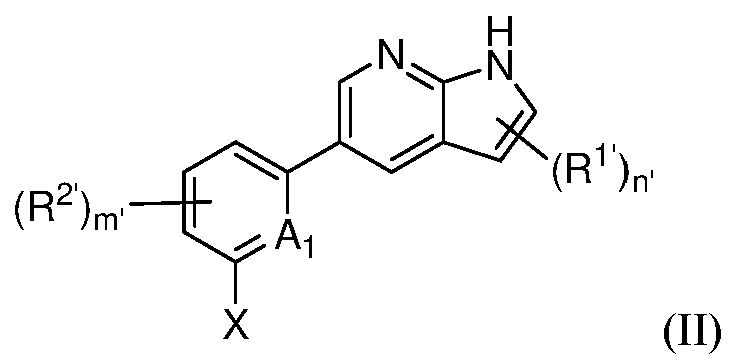
여기서,here,
A1은 CR' 또는 N이고;A 1 is CR′ or N;
X는 -P(=O)R3'R4'이고;X is -P(=0)R 3' R 4' ;
R'은 H, 중수소, 할로겐, CN, NO2, C1-6알킬, C2-6알케닐, C2-6알키닐, C1-6알콕시, NR11'R12', C(O)NR11'R12', C(O)C1-6알킬, C(O)OC1-6알킬, NR11'C(O)C1-6알킬이고, 여기서 R'에 의해 나타내어지거나 또는 R'에 의해 나타내어진 기에서의 알킬, 알케닐, 알키닐, 또는 알콕시는 할로겐, OH, CN, C1-4알킬, C1-4할로알킬, C1-4알콕시, C1-4할로알콕시, 및 NR11'R12'로 이루어진 군으로부터 독립적으로 선택된 1 내지 3개의 치환기로 임의로 치환되고;R′ is H, deuterium, halogen, CN, NO 2 , C 1-6 alkyl, C 2-6 alkenyl, C 2-6 alkynyl, C 1-6 alkoxy, NR 11′ R 12′ , C(O )NR 11′ R 12′ , C(O)C 1-6 alkyl, C(O)OC 1-6 alkyl, NR 11′ C(O)C 1-6 alkyl, wherein is represented by R′ or Alkyl, alkenyl, alkynyl, or alkoxy in the group represented by R' is halogen, OH, CN, C 1-4 alkyl, C 1-4 haloalkyl, C 1-4 alkoxy, C 1-4 halo optionally substituted with 1 to 3 substituents independently selected from the group consisting of alkoxy, and NR 11′ R 12′ ;
각 경우의 R1'은 독립적으로 H, 중수소, 할로겐, OH, CN, NO2, C1-6알킬, C2-6알케닐, C2-6알키닐, C1-6알콕시, NR11'R12', C(O)NR11'R12', C(O)C1-6알킬, C(O)OC1-6알킬, NR11'C(O)C1-6알킬, C3-7시클로알킬, 또는 3-7원 헤테로시클릴이고, 여기서 R1'에 의해 나타내어지거나 또는 R1'에 의해 나타내어진 기에서의 알킬, 알케닐, 알키닐, 알콕시, 시클로알킬, 또는 헤테로시클릴은 할로겐, OH, CN, C1-4알킬, C1-4할로알킬, C1-4알콕시, C1-4할로알콕시, 및 NR11'R12'로 이루어진 군으로부터 독립적으로 선택된 1 내지 3개의 치환기로 임의로 치환되고;each occurrence of R 1′ is independently H, deuterium, halogen, OH, CN, NO 2 , C 1-6 alkyl, C 2-6 alkenyl, C 2-6 alkynyl, C 1-6 alkoxy, NR 11 ' R 12' , C(O)NR 11' R 12' , C(O)C 1-6 alkyl, C(O)OC 1-6 alkyl, NR 11' C(O)C 1-6 alkyl, C 3-7 cycloalkyl, or 3-7 membered heterocyclyl, wherein alkyl, alkenyl, alkynyl, alkoxy, cycloalkyl, or hetero in the group represented by R 1 ′ or represented by R 1′ cyclyl is independently selected from the group consisting of halogen, OH, CN, C 1-4 alkyl, C 1-4 haloalkyl, C 1-4 alkoxy, C 1-4 haloalkoxy, and NR 11′ R 12′ optionally substituted with to 3 substituents;
각 경우의 R2'는 독립적으로 H, 중수소, 할로겐, OH, CN, NO2, C1-6알킬, C2-6알케닐, C2-6알키닐, C1-6알콕시, NR11'R12', C(O)NR11'R12', C(O)C1-6알킬, C(O)OC1-6알킬, NR11'C(O)C1-6알킬, 페닐, 5-6원 헤테로아릴, C3-7시클로알킬, 또는 3-7원 헤테로아릴이고, 여기서 R2'에 의해 나타내어지거나 또는 R2'에 의해 나타내어진 기에서의 알킬, 알케닐, 알키닐, 알콕시, 페닐, 헤테로아릴, 시클로알킬, 또는 헤테로시클릴은 할로겐, OH, CN, C1-4알킬, C1-4할로알킬, C1-4알콕시, C1-4할로알콕시, 및 NR11'R12'로 이루어진 군으로부터 독립적으로 선택된 1 내지 3개의 치환기로 임의로 치환되고;each occurrence of R 2′ is independently H, deuterium, halogen, OH, CN, NO 2 , C 1-6 alkyl, C 2-6 alkenyl, C 2-6 alkynyl, C 1-6 alkoxy, NR 11 ' R 12' , C(O)NR 11' R 12' , C(O)C 1-6 alkyl, C(O)OC 1-6 alkyl, NR 11' C(O)C 1-6 alkyl, phenyl , 5-6 membered heteroaryl, C 3-7 cycloalkyl, or 3-7 membered heteroaryl, wherein alkyl, alkenyl, alkynyl in the group represented by R 2 ′ or represented by R 2′ , alkoxy, phenyl, heteroaryl, cycloalkyl, or heterocyclyl is halogen, OH, CN, C 1-4 alkyl, C 1-4 haloalkyl, C 1-4 alkoxy, C 1-4 haloalkoxy, and NR 11' optionally substituted with 1 to 3 substituents independently selected from the group consisting of R 12' ;
각각의 R3' 및 R4'는 독립적으로 H, C1-6알킬, C2-6알케닐, C2-6알키닐이고, 여기서 R3' 또는 R4'에 의해 나타내어진 알킬, 알케닐, 또는 알키닐은 할로겐, OH, CN, C1-4알킬, C1-4할로알킬, C1-4알콕시, C1-4할로알콕시, 및 NR11'R12'로 이루어진 군으로부터 독립적으로 선택된 1 내지 3개의 치환기로 임의로 치환되고;each R 3′ and R 4′ is independently H, C 1-6 alkyl, C 2-6 alkenyl, C 2-6 alkynyl, wherein the alkyl represented by R 3′ or R 4′ , al Kenyl, or alkynyl, is independently from the group consisting of halogen, OH, CN, C 1-4 alkyl, C 1-4 haloalkyl, C 1-4 alkoxy, C 1-4 haloalkoxy, and NR 11′ R 12′ optionally substituted with 1 to 3 substituents selected from;
각 경우의 R11' 및 R12'는 독립적으로 H 또는 C1-6알킬이고, 여기서 R11' 또는 R12'에 의해 나타내어진 알킬은 할로겐, OH, CN, C1-4알킬, C1-4할로알킬, C1-4알콕시, C1-4할로알콕시, C3-6시클로알킬, 및 3-7원 헤테로시클릴로 이루어진 군으로부터 독립적으로 선택된 1 내지 3개의 치환기로 임의로 치환되거나, 또는each occurrence of R 11′ and R 12′ is independently H or C 1-6 alkyl, wherein the alkyl represented by R 11′ or R 12′ is halogen, OH, CN, C 1-4 alkyl, C 1 optionally substituted with 1 to 3 substituents independently selected from the group consisting of -4 haloalkyl, C 1-4 alkoxy, C 1-4 haloalkoxy, C 3-6 cycloalkyl, and 3-7 membered heterocyclyl, or
R11' 및 R12'는 이들이 부착되어 있는 질소 원자와 함께 할로겐, OH, CN, C1-4알킬, C1-4할로알킬, C1-4알콕시, 또는 C1-4할로알콕시로 이루어진 군으로부터 독립적으로 선택된 1 내지 3개의 치환기로 임의로 치환된 3-7원 헤테로시클릴을 형성하고;R 11' and R 12' together with the nitrogen atom to which they are attached consist of halogen, OH, CN, C 1-4 alkyl, C 1-4 haloalkyl, C 1-4 alkoxy, or C 1-4 haloalkoxy; form a 3-7 membered heterocyclyl optionally substituted with 1 to 3 substituents independently selected from the group;
m'은 0, 1, 또는 2이고;m' is 0, 1, or 2;
n'은 0, 1, 또는 2이다.n' is 0, 1, or 2.
유효량의 본 발명의 화합물 또는 그의 제약상 허용되는 염, 및 제약상 허용되는 담체를 포함하는 제약 조성물이 본원에 제공된다.Provided herein are pharmaceutical compositions comprising an effective amount of a compound of the invention, or a pharmaceutically acceptable salt thereof, and a pharmaceutically acceptable carrier.
또한, 치료 유효량의 본 발명의 화합물 또는 그의 제약상 허용되는 염, 및 하나 이상의 치료 활성 공동-작용제를 포함하는 조합물이 제공된다.Also provided is a combination comprising a therapeutically effective amount of a compound of the invention, or a pharmaceutically acceptable salt thereof, and one or more therapeutically active co-agents.
본 발명은 HPK1 활성의 억제를 필요로 하는 대상체에게 치료 유효량의 본 발명의 화합물 또는 그의 제약상 허용되는 염을 투여하는 것을 포함하는, 상기 대상체에서 HPK1 활성을 억제하는 방법을 추가로 제공한다.The present invention further provides a method of inhibiting HPK1 activity in a subject in need thereof comprising administering to the subject a therapeutically effective amount of a compound of the present invention, or a pharmaceutically acceptable salt thereof.
본 발명은 본원에 기재된 바와 같은 질환 또는 상태, 예컨대 암 (예컨대, 유방암, 결장직장암, 폐암, 난소암 및 췌장암)을 갖는 대상체에게 치료 유효량의 본 발명의 화합물 또는 그의 제약상 허용되는 염을 투여하는 것을 포함하는, 상기 대상체를 치료하는 방법을 추가로 제공한다.The present invention provides a method for administering a therapeutically effective amount of a compound of the present invention, or a pharmaceutically acceptable salt thereof, to a subject having a disease or condition as described herein, such as cancer (eg, breast, colorectal, lung, ovarian and pancreatic cancer). There is further provided a method of treating the subject comprising:
특정 실시양태는 의약, 예컨대 HPK1 억제제로서 작용하는 의약으로서 사용하기 위한 본 발명의 화합물 또는 그의 제약상 허용되는 염을 개시한다.Certain embodiments disclose a compound of the present invention, or a pharmaceutically acceptable salt thereof, for use as a medicament, such as a medicament acting as an HPK1 inhibitor.
본 개시내용은 또한 상기 기재된 본 발명의 방법 중 임의의 것에서의 본 발명의 화합물 또는 그의 제약상 허용되는 염, 또는 그를 포함하는 제약 조성물의 용도를 제공한다. 한 실시양태에서, 본원에 기재된 본 발명의 방법 중 임의의 것에 사용하기 위한 본 발명의 화합물 또는 그의 제약상 허용되는 염, 또는 그를 포함하는 제약 조성물이 제공된다. 또 다른 실시양태에서, 기재된 본 발명의 방법 중 임의의 것을 위한 의약의 제조를 위한 본 발명의 화합물 또는 그의 제약상 허용되는 염, 또는 그를 포함하는 제약 조성물의 용도가 제공된다.The present disclosure also provides the use of a compound of the invention, or a pharmaceutically acceptable salt thereof, or a pharmaceutical composition comprising the same, in any of the methods of the invention described above. In one embodiment, there is provided a compound of the invention, or a pharmaceutically acceptable salt thereof, or a pharmaceutical composition comprising the same, for use in any of the methods of the invention described herein. In another embodiment, there is provided the use of a compound of the present invention, or a pharmaceutically acceptable salt thereof, or a pharmaceutical composition comprising the same, for the manufacture of a medicament for any of the methods of the present invention described.
1. 개요1. Overview
본원에 기재된 본 발명은 HPK1/MAP4K1 억제제, 그의 제약상 허용되는 염, 그의 제약 조성물, 및 그를 사용하여 HPK1/MAP4K1 활성을 조정 (예를 들어, 억제)하는 방법을 제공하며, 상기 방법은 그를 필요로 하는 환자/대상체에게 본 발명의 HPK1/MAP4K1 억제제 화합물 또는 그의 제약상 허용되는 염을 투여하는 것을 포함한다. 특정 실시양태에서, 본 발명의 화합물 또는 그의 제약상 허용되는 염은 암 치료에서 면역을 증진, 자극 및/또는 증가시키기 위한 치료적 투여에 유용하다.The invention described herein provides HPK1/MAP4K1 inhibitors, pharmaceutically acceptable salts thereof, pharmaceutical compositions thereof, and methods of using the same to modulate (eg, inhibit) HPK1/MAP4K1 activity, the methods comprising It includes administering the HPK1/MAP4K1 inhibitor compound of the present invention or a pharmaceutically acceptable salt thereof to a patient/subject for In certain embodiments, a compound of the present invention, or a pharmaceutically acceptable salt thereof, is useful for therapeutic administration to enhance, stimulate and/or increase immunity in the treatment of cancer.
예를 들어, HPK1 상호작용의 억제와 연관된 질환 또는 장애의 치료 방법은 그를 필요로 하는 환자에게 치료 유효량의 본원에 제공된 화합물 또는 그의 제약상 허용되는 염을 투여하는 것을 포함할 수 있다. 본 개시내용의 화합물은 단독으로, 다른 작용제 또는 요법과 조합하여, 또는 암을 포함한 질환 또는 장애의 치료를 위한 아주반트 또는 네오아주반트로서 사용될 수 있다.For example, a method of treating a disease or disorder associated with inhibition of HPK1 interaction can comprise administering to a patient in need thereof a therapeutically effective amount of a compound provided herein, or a pharmaceutically acceptable salt thereof. The compounds of the present disclosure may be used alone, in combination with other agents or therapies, or as adjuvants or neoadjuvants for the treatment of diseases or disorders, including cancer.
2. 정의2. Definition
본원에 사용된 바와 같이, 본 발명의 문맥에서 (특히 청구범위의 문맥에서) 사용된 단수 용어 ("a", "an", "the") 및 유사 용어는 본원에 달리 나타내지 않거나 또는 문맥상 명백하게 모순되지 않는 한 단수형 및 복수형 둘 다를 포괄하는 것으로 해석되어야 한다.As used herein, the singular terms (“a”, “an”, “the”) and like terms used in the context of the present invention (especially in the context of the claims) and like terms are not otherwise indicated herein or are clearly It should be construed to encompass both the singular and the plural unless contradictory.
본원에 사용된 "할로"는 할로겐을 의미하고, 클로로, 플루오로, 브로모 및 아이오도를 포함한다.As used herein, “halo” means halogen and includes chloro, fluoro, bromo and iodo.
단독으로 또는 보다 큰 모이어티, 예컨대 "알콕시" 또는 "할로알킬" 등의 일부로서 사용된 용어 "알킬"은 포화 지방족 직쇄 또는 분지형 1가 탄화수소 라디칼을 의미한다. 달리 명시되지 않는 한, 알킬 기는 전형적으로 1-4 또는 1-6개의 탄소 원자를 가지며, 즉 (C1-C4)알킬 또는 (C1-C6)알킬이다. 여기서, "(C1-C4)알킬" 기는 선형 또는 분지형 배열로 1 내지 4개의 탄소 원자를 갖는 라디칼을 의미한다. 예는 메틸, 에틸, n-프로필, 이소-프로필, n-부틸, sec-부틸, 이소부틸, tert-부틸, n-펜틸, 이소펜틸, 네오펜틸, n-헥실 등을 포함한다.The term "alkyl" used alone or as part of a larger moiety, such as "alkoxy" or "haloalkyl", means a saturated aliphatic straight-chain or branched monovalent hydrocarbon radical. Unless otherwise specified, an alkyl group typically has 1-4 or 1-6 carbon atoms, ie is (C 1 -C 4 )alkyl or (C 1 -C 6 )alkyl. Here, a “(C 1 -C 4 )alkyl” group means a radical having from 1 to 4 carbon atoms in a linear or branched arrangement. Examples include methyl, ethyl, n-propyl, iso-propyl, n-butyl, sec-butyl, isobutyl, tert-butyl, n-pentyl, isopentyl, neopentyl, n-hexyl, and the like.
용어 "C1-6알킬렌"은 1 내지 6개의 탄소 원자를 갖는 2가 완전 포화 분지형 또는 직쇄 1가 탄화수소 라디칼을 지칭한다. 유사하게, 용어 "C1-4알킬렌", "C1-3알킬렌" 및 "C1-2알킬렌"은 이에 따라 해석되어야 한다. C1-6알킬렌의 대표적인 예는 메틸렌, 에틸렌, n-프로필렌, 이소프로필렌, n-부틸렌, sec-부틸렌, 이소-부틸렌, tert-부틸렌, n-펜틸렌, 이소펜틸렌, 네오펜틸렌 및 n-헥실렌을 포함하나 이에 제한되지는 않는다.The term “C 1-6 alkylene” refers to a divalent fully saturated branched or straight chain monovalent hydrocarbon radical having 1 to 6 carbon atoms. Similarly, the terms “C 1-4 alkylene”, “C 1-3 alkylene” and “C 1-2 alkylene” should be interpreted accordingly. Representative examples of C 1-6 alkylene include methylene, ethylene, n-propylene, isopropylene, n-butylene, sec-butylene, iso-butylene, tert-butylene, n-pentylene, isopentylene, neopentylene and n-hexylene.
용어 "히드록실에 의해 임의로 치환된 C1-C6알킬"은 1개 이상의 히드록시에 의해 치환될 수 있는 상기 정의된 바와 같은 C1-C6알킬을 지칭한다. 예는 히드록시메틸, 히드록시에틸, 1,2-디히드록시에틸, 2,3-디히드록시-프로필 등을 포함하나 이에 제한되지는 않는다.The term “C 1 -C 6 alkyl optionally substituted by hydroxyl” refers to C 1 -C 6 alkyl as defined above which may be substituted by one or more hydroxy. Examples include, but are not limited to, hydroxymethyl, hydroxyethyl, 1,2-dihydroxyethyl, 2,3-dihydroxy-propyl, and the like.
본원에 사용된 용어 "디 C1-6알킬아미노"는 화학식 -N(Ra)-Ra의 모이어티를 지칭하며, 여기서 각각의 Ra는 상기 정의된 바와 같이 동일하거나 상이할 수 있는 C1-6알킬이고, 이와 유사하게 용어 "모노 C1-6알킬아미노"는 화학식 -N(H)-Ra의 모이어티를 지칭하고, 여기서 Ra는 상기 정의된 바와 같은 C1-6알킬이다.As used herein, the term “di C 1-6 alkylamino” refers to a moiety of the formula —N(R a )—R a , wherein each R a is C, which may be the same or different as defined above. 1-6 alkyl, and analogously the term “mono C 1-6 alkylamino” refers to a moiety of the formula —N(H)—R a , wherein R a is C 1-6 alkyl as defined above. am.
용어 "알케닐"은 적어도 1개의 이중 결합을 함유하는 분지쇄 또는 직쇄 1가 탄화수소 라디칼을 의미한다. 알케닐은 단일 또는 다중불포화일 수 있고, E 또는 Z 배위로 존재할 수 있다. 달리 명시되지 않는 한, 알케닐 기는 전형적으로 2-6개의 탄소 원자를 가지며, 즉 (C2-C6)알케닐이다. 예를 들어, "(C2-C6)알케닐"은 선형 또는 분지형 배열로 2-6개의 탄소 원자를 갖는 라디칼을 의미한다.The term "alkenyl" means a branched or straight chain monovalent hydrocarbon radical containing at least one double bond. Alkenyls may be mono or polyunsaturated and may exist in either the E or Z configuration. Unless otherwise specified, an alkenyl group typically has 2-6 carbon atoms, ie is (C 2 -C 6 )alkenyl. For example, “(C 2 -C 6 )alkenyl” means a radical having 2-6 carbon atoms in a linear or branched configuration.
용어 "알키닐"은 적어도 1개의 삼중 결합을 함유하는 분지쇄 또는 직쇄 1가 탄화수소 라디칼을 의미한다. 달리 명시되지 않는 한, 알키닐 기는 전형적으로 2-6개의 탄소 원자를 가지며, 즉 (C2-C6)알키닐이다. 예를 들어, "(C2-C6)알키닐"은 선형 또는 분지형 배열로 2-6개의 탄소 원자를 갖는 라디칼을 의미한다.The term "alkynyl" means a branched or straight chain monovalent hydrocarbon radical containing at least one triple bond. Unless otherwise specified, an alkynyl group typically has 2-6 carbon atoms, ie is (C 2 -C 6 )alkynyl. For example, “(C 2 -C 6 )alkynyl” means a radical having 2-6 carbon atoms in a linear or branched configuration.
용어 "알콕시"는 산소 연결 원자를 통해 부착된 알킬 라디칼을 의미하고, -O-알킬에 의해 나타내어진다. 예를 들어, "C1-C6알콕시"는 -O-C1-C6알킬을 지칭하며, 여기서 알킬은 상기 본원에 정의되어 있고, "(C1-C4)알콕시"는 메톡시, 에톡시, 프로폭시 및 부톡시 등을 포함한다. 알콕시의 대표적인 예는 메톡시, 에톡시, 프로폭시, 2-프로폭시, 부톡시, tert-부톡시, 펜틸옥시, 헥실옥시, 시클로프로필옥시-, 시클로헥실옥시-등을 포함하나 이에 제한되지는 않는다. 전형적으로, 알콕시 기는 약 1 내지 6개의 탄소 원자, 1 내지 4개의 탄소 원자, 또는 1 내지 2개의 탄소 원자를 갖는다.The term “alkoxy” means an alkyl radical attached through an oxygen linking atom and is represented by —O-alkyl. For example, “C 1 -C 6 alkoxy” refers to —OC 1 -C 6 alkyl, wherein alkyl is defined herein above and “(C 1 -C 4 )alkoxy” refers to methoxy, ethoxy , propoxy and butoxy, and the like. Representative examples of alkoxy include, but are not limited to, methoxy, ethoxy, propoxy, 2-propoxy, butoxy, tert-butoxy, pentyloxy, hexyloxy, cyclopropyloxy-, cyclohexyloxy-, and the like. it doesn't happen Typically, an alkoxy group has about 1 to 6 carbon atoms, 1 to 4 carbon atoms, or 1 to 2 carbon atoms.
용어 "할로알킬" 및 "할로알콕시"는 경우에 따라 1개 이상의 할로겐 원자로 치환된 알킬 또는 알콕시를 의미한다. 할로알킬의 예는 트리플루오로메틸, 트리클로로메틸, 펜타플루오로에틸 등을 포함하나 이에 제한되지는 않는다.The terms "haloalkyl" and "haloalkoxy" mean alkyl or alkoxy optionally substituted with one or more halogen atoms. Examples of haloalkyl include, but are not limited to, trifluoromethyl, trichloromethyl, pentafluoroethyl, and the like.
따라서, 용어 "할로겐에 의해 임의로 치환된 C1-6알킬"은 1개 이상의 할로겐에 의해 치환될 수 있는 상기 정의된 바와 같은 C1-C6알킬을 지칭한다. 예는 트리플루오로메틸, 디플루오로메틸, 플루오로메틸, 트리클로로메틸, 2,2,2-트리플루오로에틸, 1-플루오로메틸-2-플루오로에틸, 3-브로모-2-플루오로프로필 및 1-브로모메틸-2-브로모에틸을 포함하나 이에 제한되지는 않는다.Accordingly, the term “C 1-6 alkyl optionally substituted by halogen” refers to C 1 -C 6 alkyl as defined above which may be substituted by one or more halogen. Examples are trifluoromethyl, difluoromethyl, fluoromethyl, trichloromethyl, 2,2,2-trifluoroethyl, 1-fluoromethyl-2-fluoroethyl, 3-bromo-2- fluoropropyl and 1-bromomethyl-2-bromoethyl.
본원에 사용된 용어 "시클로알킬"은 나타낸 개수의 고리 및 탄소 원자를 함유하는 3 내지 14개의 탄소를 갖는 포화 시클릭, 비시클릭, 트리시클릭 또는 폴리시클릭 탄화수소 기를 포함한다 (예를 들어, C3-C14모노시클릭, C4-C14비시클릭, C5-C14트리시클릭, 또는 C6-C14폴리시클릭 시클로알킬). 일부 실시양태에서, "시클로알킬"은 모노시클릭 시클로알킬이다. 모노시클릭 시클로알킬 기의 예는 시클로펜틸 (C5), 시클로헥실 (C6), 시클로프로필 (C3), 시클로부틸 (C4), 시클로헵틸 (C7) 및 시클로옥틸 (C8)을 포함한다. 일부 실시양태에서, "시클로알킬"은 비시클릭 시클로알킬이다. 비시클릭 시클로알킬의 예는 비시클로[1.1.0]부탄 (C4), 비시클로[1.1.1]펜탄 (C5), 스피로[2.2]펜탄 (C5), 비시클로[2.1.0]펜탄 (C5), 비시클로[2.1.1]헥산 (C6), 비시클로[3.3.3]운데칸 (C11), 데카히드로나프탈렌 (C10), 비시클로[4.3.2]운데칸 (C11), 스피로[5.5]운데칸 (C11) 및 비시클로[4.3.3]도데칸 (C12)을 포함한다. 일부 실시양태에서, "시클로알킬"은 트리시클릭 시클로알킬이다. 트리시클릭 시클로알킬의 예는 아다만틴 (C12)을 포함한다. 달리 기재되지 않는 한, "시클로알킬"은 3 내지 6개의 탄소 원자를 갖고, 모노시클릭이다.The term “cycloalkyl,” as used herein, includes saturated cyclic, bicyclic, tricyclic or polycyclic hydrocarbon groups having 3 to 14 carbons containing the indicated number of rings and carbon atoms (eg, C 3 -C 14 monocyclic, C 4 -C 14 bicyclic, C 5 -C 14 tricyclic, or C 6 -C 14 polycyclic cycloalkyl). In some embodiments, “cycloalkyl” is monocyclic cycloalkyl. Examples of monocyclic cycloalkyl groups are cyclopentyl (C 5 ), cyclohexyl (C 6 ), cyclopropyl (C 3 ), cyclobutyl (C 4 ), cycloheptyl (C 7 ) and cyclooctyl (C 8 ). includes In some embodiments, “cycloalkyl” is bicyclic cycloalkyl. Examples of bicyclic cycloalkyl are bicyclo[1.1.0]butane (C 4 ), bicyclo[1.1.1]pentane (C 5 ), spiro[2.2]pentane (C 5 ), bicyclo[2.1.0] Pentane (C 5 ), bicyclo[2.1.1]hexane (C 6 ), bicyclo[3.3.3]undecane (C 11 ), decahydronaphthalene (C 10 ), bicyclo[4.3.2]undecane (C 11 ), spiro[5.5]undecane (C 11 ) and bicyclo[4.3.3]dodecane (C 12 ). In some embodiments, “cycloalkyl” is tricyclic cycloalkyl. Examples of tricyclic cycloalkyl include adamantine (C 12 ). Unless otherwise stated, "cycloalkyl" has 3 to 6 carbon atoms and is monocyclic.
단독으로 또는 "아르알킬", "아르알콕시" 또는 "아릴옥시알킬"에서와 같이 보다 큰 모이어티의 일부로서 사용된 용어 "아릴 기"는 카르보시클릭 방향족 고리를 의미한다. 용어 "아릴"은 용어 "아릴 고리", "카르보시클릭 방향족 고리", "아릴 기" 및 "카르보시클릭 방향족 기"와 상호교환가능하게 사용될 수 있다. 전형적으로, 아릴은 6-20개의 탄소 원자, 전형적으로 6-14개의 고리 탄소 원자를 갖는 모노시클릭, 비시클릭 또는 트리시클릭 아릴이다. 또한, 본원에 사용된 용어 "아릴"은 단일 방향족 고리, 또는 함께 융합된 다중 방향족 고리일 수 있는 방향족 치환기를 지칭한다. 예는 페닐, 나프틸, 안트라세닐, 1,2-디히드로나프틸, 1,2,3,4-테트라히드로나프틸, 플루오레닐, 인다닐, 인데닐 등을 포함한다.The term "aryl group" used alone or as part of a larger moiety as in "aralkyl", "aralkoxy" or "aryloxyalkyl" means a carbocyclic aromatic ring. The term “aryl” may be used interchangeably with the terms “aryl ring”, “carbocyclic aromatic ring”, “aryl group” and “carbocyclic aromatic group”. Typically, aryl is monocyclic, bicyclic or tricyclic aryl having 6-20 carbon atoms, typically 6-14 ring carbon atoms. Also, as used herein, the term “aryl” refers to an aromatic substituent which may be a single aromatic ring, or multiple aromatic rings fused together. Examples include phenyl, naphthyl, anthracenyl, 1,2-dihydronaphthyl, 1,2,3,4-tetrahydronaphthyl, fluorenyl, indanyl, indenyl, and the like.
"치환된 아릴 기"는 수소에 결합된 고리 탄소 원자인 임의의 1개 이상의 치환가능한 고리 원자에서 치환된다. 치환된 아릴은 전형적으로 히드록실, 티올, 시아노, 니트로, C1-C4알킬, C1-C4알케닐, C1-C4알키닐, C1-C4알콕시, C1-C4티오알킬, C1-C4알케닐옥시, C1-C4알키닐옥시, 할로겐, C1-C4알킬카르보닐, 카르복시, C1-C4알콕시카르보닐, 아미노, C1-C4알킬아미노, 디-C1-C4알킬아미노, C1-C4알킬아미노카르보닐, 디-C1-C4알킬아미노카르보닐, C1-C4알킬카르보닐아미노, C1-C4알킬카르보닐, C1-C4알킬 아미노, 술포닐, 술파모일, 알킬술파모일, 및 C1-C4알킬아미노술포닐로 이루어진 군으로부터 독립적으로 선택된 1-5개 (예컨대, 1, 또는 2, 또는 3개)의 치환기에 의해 치환되고, 여기서 각각의 상기 언급된 탄화수소 기 (예를 들어, 알킬, 알케닐, 알키닐, 알콕시 잔기)는 각 경우에 할로겐, 히드록실 또는 C1-C4알콕시 기로부터 독립적으로 선택된 1개 이상의 잔기에 의해 추가로 치환될 수 있다.A “substituted aryl group” is substituted at any one or more substitutable ring atoms that are ring carbon atoms bonded to hydrogen. Substituted aryl is typically hydroxyl, thiol, cyano, nitro, C 1 -C 4 alkyl, C 1 -C 4 alkenyl, C 1 -C 4 alkynyl, C 1 -C 4 alkoxy, C 1 -C 4 thioalkyl, C 1 -C 4 alkenyloxy, C 1 -C 4 alkynyloxy, halogen, C 1 -C 4 alkylcarbonyl, carboxy, C 1 -C 4 alkoxycarbonyl, amino, C 1 -C 4 alkylamino, di-C 1 -C 4 alkylamino, C 1 -C 4 alkylaminocarbonyl, di-C 1 -C 4 alkylaminocarbonyl, C 1 -C 4 alkylcarbonylamino, C 1 -C 4 alkylcarbonyl, C 1 -C 4 alkyl amino, sulfonyl, sulfamoyl, alkylsulfamoyl, and 1-5 (eg, 1 , or 2, or 3) substituents, wherein each of the above-mentioned hydrocarbon groups (eg alkyl, alkenyl, alkynyl, alkoxy moieties) is in each case halogen, hydroxyl or C 1 -C 4 may be further substituted by one or more moieties independently selected from alkoxy groups.
용어 "헤테로시클릴 기" 또는 "헤테로시클릭 기"는 바람직하게는 1-4개의 고리 헤테로원자를 함유하는 바람직하게는 3 내지 10원 모노시클릭, 비-방향족 (부분 포화 포함) 고리, 또는 바람직하게는 7 내지 20개의 구성원 및 바람직하게는 1 내지 4개의 고리 헤테로원자를 갖는 고리를 갖는 폴리시클릭 고리를 의미하며, 여기서 폴리시클릭 고리는 1개 이상의 방향족 또는 헤테로방향족 고리와 융합된 1개 이상의 모노시클릭 비-방향족 헤테로시클릭 고리를 갖는다. 헤테로시클릴 기는 전형적으로 3 내지 7개, 3 내지 24개, 4 내지 16개, 5 내지 10개, 또는 5 또는 6개의 고리 원자를 가지며; 여기서 임의로 1 내지 4개, 특히 1 또는 2개의 고리 원자는 헤테로원자이다 (따라서 나머지 고리 원자는 탄소임). 각각의 헤테로원자는 독립적으로 질소, 4급 질소, 산화된 질소 (예를 들어, NO); 산소; 및 술폭시드 및 술폰을 포함한 황으로부터 선택된다. 헤테로시클릭 기는 헤테로원자 또는 탄소 원자에 부착될 수 있다. 헤테로사이클의 예는 테트라히드로푸란 (THF), 디히드로푸란, 1,4-디옥산, 모르폴린, 1,4-디티안, 피페라진, 피페리딘, 1,3-디옥솔란, 이미다조이시딘, 이미다졸린, 피롤린, 피롤리딘, 테트라히드로피란, 디히드로피란, 옥사티올란, 디티올란, 1,3-디옥산, 1,3-디티안, 옥사티안, 티오모르폴린 등을 포함한다.The term "heterocyclyl group" or "heterocyclic group" refers to a preferably 3 to 10 membered monocyclic, non-aromatic (including partially saturated) ring, preferably containing 1-4 ring heteroatoms, or means a polycyclic ring having a ring having preferably 7 to 20 members and preferably 1 to 4 ring heteroatoms, wherein the polycyclic ring is at least one aromatic or heteroaromatic ring fused with one or more aromatic or heteroaromatic rings. It has a monocyclic non-aromatic heterocyclic ring. Heterocyclyl groups typically have 3 to 7, 3 to 24, 4 to 16, 5 to 10, or 5 or 6 ring atoms; wherein optionally 1 to 4, in particular 1 or 2 ring atoms are heteroatoms (thus the remaining ring atoms are carbon). each heteroatom is independently nitrogen, quaternary nitrogen, oxidized nitrogen (eg, NO); Oxygen; and sulfur including sulfoxides and sulfones. A heterocyclic group may be attached to a heteroatom or carbon atom. Examples of heterocycles include tetrahydrofuran (THF), dihydrofuran, 1,4-dioxane, morpholine, 1,4-dithiane, piperazine, piperidine, 1,3-dioxolane, imidazoy Cidine, imidazoline, pyrroline, pyrrolidine, tetrahydropyran, dihydropyran, oxathiolane, dithiolane, 1,3-dioxane, 1,3-dithiane, oxathian, thiomorpholine, etc. include
헤테로시클릴 기는 융합된 또는 가교된 고리 뿐만 아니라 스피로시클릭 고리를 포함할 수 있다. 한 실시양태에서, 헤테로시클릴 기는 페닐 기와 융합된 모노시클릭 비-방향족 헤테로시클릭 고리를 갖는 비시클릭 고리이다. 예시적인 폴리시클릭 헤테로시클릭 기는 테트라히드로이소퀴놀리닐 (예컨대, 1,2,3,4-테트라히드로이소퀴놀린-7-일, 2-메틸-1,2,3,4-테트라히드로이소퀴놀린-7-일, 1,2,3,4-테트라히드로이소퀴놀린-6-일 및 2-메틸-1,2,3,4-테트라히드로이소퀴놀린-6-일), 이소인돌리닐 (예컨대, 2-에틸이소인돌린-5-일, 2-메틸이소인돌린-5-일), 인돌리닐, 테트라히드로벤조[f]옥사제피닐 (예를 들어, 2,3,4,5-테트라히드로벤조[f][1,4]옥사제핀-7-일)을 포함한다.Heterocyclyl groups can include fused or bridged rings as well as spirocyclic rings. In one embodiment, the heterocyclyl group is a bicyclic ring having a monocyclic non-aromatic heterocyclic ring fused with a phenyl group. Exemplary polycyclic heterocyclic groups include tetrahydroisoquinolinyl (eg, 1,2,3,4-tetrahydroisoquinolin-7-yl, 2-methyl-1,2,3,4-tetrahydroisoquinoline -7-yl, 1,2,3,4-tetrahydroisoquinolin-6-yl and 2-methyl-1,2,3,4-tetrahydroisoquinolin-6-yl), isoindolinyl (such as , 2-ethylisoindolin-5-yl, 2-methylisoindolin-5-yl), indolinyl, tetrahydrobenzo[f]oxazepinyl (eg 2,3,4,5-tetra hydrobenzo[f][1,4]oxazepin-7-yl).
용어 "헤테로사이클", "헤테로시클릴" 또는 "헤테로시클릭"은 포화이든 또는 부분 불포화이든, 또한 임의로 치환된 고리를 지칭한다. 치환된 헤테로시클릴은 1-4개, 예컨대 1, 또는 2, 또는 3, 또는 4개의 치환기에 의해 독립적으로 치환된 헤테로시클릴 기일 수 있다.The terms “heterocycle”, “heterocyclyl” or “heterocyclic” refer to a ring, whether saturated or partially unsaturated, which is also optionally substituted. Substituted heterocyclyl can be a heterocyclyl group independently substituted by 1-4, such as 1, or 2, or 3, or 4 substituents.
일부 실시양태에서, 헤테로시클릴 기는 고리 탄소 원자 및 1-4개의 고리 헤테로원자를 가지며, 여기서 각각의 헤테로원자는 독립적으로 질소, 산소 및 황으로부터 선택되는 것인 3-14원 비-방향족 고리계이다 ("3-14원 헤테로시클릴").In some embodiments, the heterocyclyl group has ring carbon atoms and 1-4 ring heteroatoms, wherein each heteroatom is independently selected from nitrogen, oxygen, and sulfur, a 3-14 membered non-aromatic ring system. ("3-14 membered heterocyclyl").
단독으로 또는 "헤테로아르알킬" 또는 "헤테로아릴알콕시"에서와 같이 보다 큰 모이어티의 일부로서 사용된 용어 "헤테로아릴", "헤테로방향족", "헤테로아릴 고리", "헤테로아릴 기", "헤테로방향족 고리" 및 "헤테로방향족 기"는 탄소 및 적어도 1개 (전형적으로 1 내지 4개, 보다 전형적으로 1 또는 2개)의 헤테로원자 (예를 들어, 산소, 질소 또는 황)로부터 선택되는 5 내지 14개의 고리 원자를 갖는 방향족 고리 기를 지칭한다. "헤테로아릴"은 모노시클릭 고리, 및 모노시클릭 헤테로방향족 고리가 1개 이상의 다른 카르보시클릭 방향족 또는 헤테로방향족 고리에 융합된 폴리시클릭 (예를 들어, 비- 또는 트리-시클릭) 고리를 포함한다. 따라서, "5-14원 헤테로아릴"은 모노시클릭, 비시클릭 또는 트리시클릭 고리계를 포함한다.The terms "heteroaryl", "heteroaromatic", "heteroaryl ring", "heteroaryl group", " used alone or as part of a larger moiety as in "heteroaralkyl" or "heteroarylalkoxy" A heteroaromatic ring" and a "heteroaromatic group" are 5 selected from carbon and at least 1 (typically 1 to 4, more typically 1 or 2) heteroatoms (eg, oxygen, nitrogen or sulfur) refers to an aromatic ring group having from 14 to 14 ring atoms. "Heteroaryl" refers to a monocyclic ring and a polycyclic (eg, bi- or tri-cyclic) ring in which a monocyclic heteroaromatic ring is fused to one or more other carbocyclic aromatic or heteroaromatic rings. include Thus, "5-14 membered heteroaryl" includes monocyclic, bicyclic or tricyclic ring systems.
모노시클릭 5-6원 헤테로아릴 기의 예는 푸라닐 (예를 들어, 2-푸라닐, 3-푸라닐), 이미다졸릴 (예를 들어, N-이미다졸릴, 2-이미다졸릴, 4-이미다졸릴, 5-이미다졸릴), 이속사졸릴 (예를 들어, 3-이속사졸릴, 4-이속사졸릴, 5-이속사졸릴), 옥사디아졸릴 (예를 들어, 2-옥사디아졸릴, 5-옥사디아졸릴), 옥사졸릴 (예를 들어, 2-옥사졸릴, 4-옥사졸릴, 5-옥사졸릴), 피라졸릴 (예를 들어, 3-피라졸릴, 4-피라졸릴), 피롤릴 (예를 들어, 1-피롤릴, 2-피롤릴, 3-피롤릴), 피리딜 (예를 들어, 2-피리딜, 3-피리딜, 4-피리딜), 피리미디닐 (예를 들어, 2-피리미디닐, 4-피리미디닐, 5-피리미디닐), 피리다지닐 (예를 들어, 3-피리다지닐), 티아졸릴 (예를 들어, 2-티아졸릴, 4-티아졸릴, 5-티아졸릴), 트리아졸릴 (예를 들어, 2-트리아졸릴, 5-트리아졸릴), 테트라졸릴 (예를 들어, 테트라졸릴), 티에닐 (예를 들어, 2-티에닐, 3-티에닐), 피리미디닐, 피리디닐 및 피리다지닐을 포함한다.Examples of monocyclic 5-6 membered heteroaryl groups are furanyl (eg 2-furanyl, 3-furanyl), imidazolyl (eg N-imidazolyl, 2-imidazolyl) , 4-imidazolyl, 5-imidazolyl), isoxazolyl (eg 3-isoxazolyl, 4-isoxazolyl, 5-isoxazolyl), oxadiazolyl (eg 2 -oxadiazolyl, 5-oxadiazolyl), oxazolyl (eg 2-oxazolyl, 4-oxazolyl, 5-oxazolyl), pyrazolyl (eg 3-pyrazolyl, 4-pyra) zolyl), pyrrolyl (eg 1-pyrrolyl, 2-pyrrolyl, 3-pyrrolyl), pyridyl (eg 2-pyridyl, 3-pyridyl, 4-pyridyl), pyri midinyl (eg 2-pyrimidinyl, 4-pyrimidinyl, 5-pyrimidinyl), pyridazinyl (eg 3-pyridazinyl), thiazolyl (eg 2- Thiazolyl, 4-thiazolyl, 5-thiazolyl), triazolyl (eg 2-triazolyl, 5-triazolyl), tetrazolyl (eg tetrazolyl), thienyl (eg, 2-thienyl, 3-thienyl), pyrimidinyl, pyridinyl and pyridazinyl.
전형적으로, 헤테로아릴은 5-10원 고리계 (예를 들어, 5-6원 모노사이클 또는 8-10원 비사이클) 또는 5-6원 고리계이다. 전형적인 헤테로아릴 기는 2- 또는 3-티에닐, 2- 또는 3-푸릴, 2- 또는 3-피롤릴, 2-, 4- 또는 5-이미다졸릴, 3-, 4- 또는 5-피라졸릴, 2-, 4- 또는 5-티아졸릴, 3-, 4- 또는 5-이소티아졸릴, 2-, 4- 또는 5-옥사졸릴, 3-, 4- 또는 5-이속사졸릴, 3- 또는 5-1,2,4-트리아졸릴, 4- 또는 5-1,2,3-트리아졸릴, 테트라졸릴, 2-, 3- 또는 4-피리딜, 3- 또는 4-피리다지닐, 3-, 4- 또는 5-피라지닐, 2-피라지닐 및 2-, 4- 또는 5-피리미디닐을 포함한다.Typically, a heteroaryl is a 5-10 membered ring system (eg, a 5-6 membered monocycle or an 8-10 membered bicycle) or a 5-6 membered ring system. Typical heteroaryl groups are 2- or 3-thienyl, 2- or 3-furyl, 2- or 3-pyrrolyl, 2-, 4- or 5-imidazolyl, 3-, 4- or 5-pyrazolyl, 2-, 4- or 5-thiazolyl, 3-, 4- or 5-isothiazolyl, 2-, 4- or 5-oxazolyl, 3-, 4- or 5-isoxazolyl, 3- or 5 -1,2,4-triazolyl, 4- or 5-1,2,3-triazolyl, tetrazolyl, 2-, 3- or 4-pyridyl, 3- or 4-pyridazinyl, 3-, 4- or 5-pyrazinyl, 2-pyrazinyl and 2-, 4- or 5-pyrimidinyl.
폴리시클릭 방향족 헤테로아릴 기의 예는 카르바졸릴, 벤즈이미다졸릴, 벤조티에닐, 벤조푸라닐, 인돌릴, 퀴놀리닐, 벤조트리아졸릴, 벤조티아졸릴, 벤족사졸릴, 벤즈이미다졸릴, 이소퀴놀리닐, 인돌릴, 이소인돌릴, 아크리디닐 또는 벤즈이속사졸릴을 포함한다.Examples of polycyclic aromatic heteroaryl groups include carbazolyl, benzimidazolyl, benzothienyl, benzofuranyl, indolyl, quinolinyl, benzotriazolyl, benzothiazolyl, benzoxazolyl, benzimidazolyl, isoquinolinyl, indolyl, isoindolyl, acridinyl or benzisoxazolyl.
따라서, 용어 "헤테로아릴"은 또한 헤테로방향족 고리가 1개 이상의 아릴, 시클로지방족 또는 헤테로시클릴 고리에 융합된 기를 지칭하며, 여기서 부착 라디칼 또는 지점은 헤테로방향족 고리 상에 있다. 비제한적 예는 1-, 2-, 3-, 5-, 6-, 7-, 또는 8-인돌리지닐, 1-, 3-, 4-, 5-, 6-, 또는 7-이소인돌릴, 2-, 3-, 4-, 5-, 6-, 또는 7-인돌릴, 2-, 3-, 4-, 5-, 6-, 또는 7-인다졸릴, 2-, 4-, 5-, 6-, 7-, 또는 8-퓨리닐, 1-, 2-, 3-, 4-, 6-, 7-, 8-, 또는 9-퀴놀리지닐, 2-, 3-, 4-, 5-, 6-, 7-, 또는 8-퀴놀릴, 1-, 3-, 4-, 5-, 6-, 7-, 또는 8-이소퀴놀릴, 1-, 4-, 5-, 6-, 7-, 또는 8-프탈라지닐, 2-, 3-, 4-, 5-, 또는 6-나프티리디닐, 2-, 3-, 5-, 6-, 7-, 또는 8-퀴나졸리닐, 3-, 4-, 5-, 6-, 7-, 또는 8-신놀리닐, 2-, 4-, 6-, 또는 7-프테리디닐, 1-, 2-, 3-, 4-, 5-, 6-, 7-, 또는 8-4aH 카르바졸릴, 1-, 2-, 3-, 4-, 5-, 6-, 7-, 또는 8-카르바졸릴, 1-, 3-, 4-, 5-, 6-, 7-, 8-, 또는 9-카르볼리닐, 1-, 2-, 3-, 4-, 6-, 7-, 8-, 9-, 또는 10-페난트리디닐, 1-, 2-, 3-, 4-, 5-, 6-, 7-, 8-, 또는 9-아크리디닐, 1-, 2-, 4-, 5-, 6-, 7-, 8-, 또는 9-페리미디닐, 2-, 3-, 4-, 5-, 6-, 8-, 9-, 또는 10-페난트롤리닐, 1-, 2-, 3-, 4-, 6-, 7-, 8-, 또는 9-페나지닐, 1-, 2-, 3-, 4-, 6-, 7-, 8-, 9-, 또는 10-페노티아지닐, 1-, 2-, 3-, 4-, 6-, 7-, 8-, 9-, 또는 10-페녹사지닐, 2-, 3-, 4-, 5-, 6-, 또는 1-, 3-, 4-, 5-, 6-, 7-, 8-, 9-, 또는 10-벤즈이소퀴놀리닐, 2-, 3-, 4-, 또는 티에노[2,3-b]푸라닐, 2-, 3-, 5-, 6-, 7-, 8-, 9-, 10-, 또는 11-7H-피라지노[2,3-c]카르바졸릴, 2-, 3-, 5-, 6-, 또는 7-2H-푸로[3,2-b]-피라닐, 2-, 3-, 4-, 5-, 7-, 또는 8-5H-피리도[2,3-d]-o-옥사지닐, 1-, 3-, 또는 5-1H-피라졸로[4,3-d]-옥사졸릴, 2-, 4-, 또는 5-4H-이미다조[4,5-d]-티아졸릴, 3-, 5-, 또는 8-피라지노[2,3-d]피리다지닐, 2-, 3-, 5-, 또는 6-이미다조[2,1-b]-티아졸릴, 1-, 3-, 6-, 7-, 8-, 또는 9-푸로[3,4-c]신놀리닐, 1-, 2-, 3-, 4-, 5-, 6-, 8-, 9-, 10- 또는 11-4H-피리도[2,3-c]카르바졸릴, 2-, 3-, 8- 또는 7-이미다조[1,2-b][1,2,4]트리아지닐, 7-벤조[b]티에닐, 2-, 4-, 5-, 6- 또는 7-벤족사졸릴, 2-, 4-, 5-, 6- 또는 7-벤즈이미다졸릴, 2-, 4-, 5-, 6- 또는 7-벤조티아졸릴, 1-, 2-, 4-, 5-, 6-, 7-, 8- 또는 9-벤족사피닐, 2-, 4-, 5-, 6-, 7- 또는 8-벤족사지닐, 1-, 2-, 3-, 5-, 6-, 7-, 8-, 9-, 10- 또는 11-1H-피롤로[1,2-b][2]벤즈아자피닐을 포함한다.Accordingly, the term “heteroaryl” also refers to a group in which a heteroaromatic ring is fused to one or more aryl, cycloaliphatic or heterocyclyl rings, wherein the radical or point of attachment is on the heteroaromatic ring. Non-limiting examples include 1-, 2-, 3-, 5-, 6-, 7-, or 8-indolizinyl, 1-, 3-, 4-, 5-, 6-, or 7-isoindolyl , 2-, 3-, 4-, 5-, 6-, or 7-indolyl, 2-, 3-, 4-, 5-, 6-, or 7-indazolyl, 2-, 4-, 5 -, 6-, 7-, or 8-purinyl, 1-, 2-, 3-, 4-, 6-, 7-, 8-, or 9-quinolizinyl, 2-, 3-, 4- , 5-, 6-, 7-, or 8-quinolyl, 1-, 3-, 4-, 5-, 6-, 7-, or 8-isoquinolyl, 1-, 4-, 5-, 6-, 7-, or 8-phthalazinyl, 2-, 3-, 4-, 5-, or 6-naphthyridinyl, 2-, 3-, 5-, 6-, 7-, or 8- Quinazolinyl, 3-, 4-, 5-, 6-, 7-, or 8-cinnolinyl, 2-, 4-, 6-, or 7-pteridinyl, 1-, 2-, 3- , 4-, 5-, 6-, 7-, or 8-4aH carbazolyl, 1-, 2-, 3-, 4-, 5-, 6-, 7-, or 8-carbazolyl, 1 -, 3-, 4-, 5-, 6-, 7-, 8-, or 9-carbolinyl, 1-, 2-, 3-, 4-, 6-, 7-, 8-, 9- , or 10-phenanthridinyl, 1-, 2-, 3-, 4-, 5-, 6-, 7-, 8-, or 9-acridinyl, 1-, 2-, 4-, 5- , 6-, 7-, 8-, or 9-periimidinyl, 2-, 3-, 4-, 5-, 6-, 8-, 9-, or 10-phenanthrolinyl, 1-, 2- , 3-, 4-, 6-, 7-, 8-, or 9-phenazinyl, 1-, 2-, 3-, 4-, 6-, 7-, 8-, 9-, or 10-pheno Thiazinyl, 1-, 2-, 3-, 4-, 6-, 7-, 8-, 9-, or 10-phenoxazinyl, 2-, 3-, 4-, 5-, 6-, or 1-, 3-, 4-, 5-, 6-, 7-, 8-, 9-, or 10-benzisoquinolinyl, 2-, 3-, 4-, or thieno[2,3- b] furanyl, 2-, 3-, 5-, 6-, 7-, 8-, 9-, 10-, or 11-7H-pyrazino [2 ,3-c]carbazolyl, 2-, 3-, 5-, 6-, or 7-2H-furo[3,2-b]-pyranyl, 2-, 3-, 4-, 5-, 7-, or 8-5H-pyrido[2,3-d]-o-oxazinyl, 1-, 3-, or 5-1H-pyrazolo[4,3-d]-oxazolyl, 2-, 4-, or 5-4H-imidazo[4,5-d]-thiazolyl, 3-, 5-, or 8-pyrazino[2,3-d]pyridazinyl, 2-, 3-, 5 -, or 6-imidazo[2,1-b]-thiazolyl, 1-, 3-, 6-, 7-, 8-, or 9-furo[3,4-c] cinnolinyl, 1- , 2-, 3-, 4-, 5-, 6-, 8-, 9-, 10- or 11-4H-pyrido[2,3-c]carbazolyl, 2-, 3-, 8- or 7-imidazo [1,2-b] [1,2,4] triazinyl, 7-benzo [b] thienyl, 2-, 4-, 5-, 6- or 7-benzoxazolyl, 2 -, 4-, 5-, 6- or 7-benzimidazolyl, 2-, 4-, 5-, 6- or 7-benzothiazolyl, 1-, 2-, 4-, 5-, 6- , 7-, 8- or 9-benzoxafinyl, 2-, 4-, 5-, 6-, 7- or 8-benzoxazinyl, 1-, 2-, 3-, 5-, 6-, 7 -, 8-, 9-, 10- or 11-1H-pyrrolo[1,2-b][2]benzazafinyl.
전형적인 융합된 헤테로아릴 기는 2-, 3-, 4-, 5-, 6-, 7- 또는 8-퀴놀리닐, 1-, 3-, 4-, 5-, 6-, 7- 또는 8-이소퀴놀리닐, 2-, 3-, 4-, 5-, 6- 또는 7-인돌릴, 2-, 3-, 4-, 5-, 6- 또는 7-벤조[b]티에닐, 2-, 4-, 5-, 6- 또는 7-벤족사졸릴, 2-, 4-, 5-, 6- 또는 7-벤즈이미다졸릴 및 2-, 4-, 5-, 6- 또는 7-벤조티아졸릴을 포함하나 이에 제한되지는 않는다.Typical fused heteroaryl groups are 2-, 3-, 4-, 5-, 6-, 7- or 8-quinolinyl, 1-, 3-, 4-, 5-, 6-, 7- or 8- Isoquinolinyl, 2-, 3-, 4-, 5-, 6- or 7-indolyl, 2-, 3-, 4-, 5-, 6- or 7-benzo [b] thienyl, 2 -, 4-, 5-, 6- or 7-benzoxazolyl, 2-, 4-, 5-, 6- or 7-benzimidazolyl and 2-, 4-, 5-, 6- or 7- including, but not limited to, benzothiazolyl.
본원에 사용된 용어 히드록시에 의해 임의로 치환된 피리딘 또는 피리딜, 예를 들어 2-피리딜, 3-피리딜 또는 4-피리딜은 각각의 히드록시-피리딘 또는 히드록시-피리딜을 지칭하고, 그의 호변이성질체 형태, 예컨대 각각의 피리돈 또는 피리도닐을 포함할 수 있다.As used herein, the term pyridine or pyridyl optionally substituted by hydroxy, for example 2-pyridyl, 3-pyridyl or 4-pyridyl, refers to hydroxy-pyridine or hydroxy-pyridyl, respectively, and , tautomeric forms thereof, such as pyridone or pyridonyl respectively.
본원에 사용된 용어 옥소에 의해 임의로 치환된 피리딘 또는 피리딜, 예를 들어 2-피리딜, 3-피리딜 또는 4-피리딜은 각각의 피리돈 또는 피리도닐을 지칭하고, 그의 호변이성질체 형태, 예컨대 각각의 히드록시-피리딘 또는 히드록시-피리딜을, 단 상기 호변이성질체 형태를 수득할 수 있는 경우에 포함할 수 있다. 옥소에 의해 임의로 치환된 피리딘 또는 피리딜은 추가로 각각의 피리딘-N-옥시드 또는 피리딜-N-옥시드를 지칭할 수 있다.As used herein, the term pyridine or pyridyl optionally substituted by oxo, for example 2-pyridyl, 3-pyridyl or 4-pyridyl, refers to the respective pyridone or pyridonyl, and tautomeric forms thereof , such as hydroxy-pyridine or hydroxy-pyridyl, respectively, provided that such tautomeric forms are obtainable. Pyridine or pyridyl optionally substituted by oxo may further refer to the respective pyridine-N-oxide or pyridyl-N-oxide.
"치환된 헤테로아릴 기"는 임의의 1개 이상의 치환가능한 고리 원자에서 치환되고, 이는 수소에 결합된 고리 탄소 또는 고리 질소 원자이다.A “substituted heteroaryl group” is substituted at any one or more substitutable ring atoms, which is a ring carbon or ring nitrogen atom bonded to a hydrogen.
용어 "가교된 비시클릭 기"는 적어도 3개의 인접한 고리 원자를 공유하는 2개의 고리를 포함하는 고리계를 지칭한다.The term “bridged bicyclic group” refers to a ring system comprising two rings sharing at least three adjacent ring atoms.
본원에 사용된 많은 모이어티 (예를 들어, 알킬, 알킬렌, 시클로알킬, 아릴, 헤테로아릴 또는 헤테로시클릴)는 "치환된" 또는 "임의로 치환된" 것으로 지칭된다. 달리 나타내지 않는 한, 모이어티가 이들 용어 중 하나에 의해 변형되는 경우, 이는 치환에 이용가능한 것으로 관련 기술분야의 통상의 기술자에게 공지된 모이어티의 임의의 부분이 치환될 수 있으며, 이는 1개 이상의 치환기를 포함함을 나타낸다. 1개 초과의 치환기가 존재하는 경우, 각각의 치환기는 독립적으로 선택될 수 있다. 이러한 치환 수단은 관련 기술분야에 널리 공지되어 있고/거나 본 발명에 의해 교시된다. 임의적인 치환기는 모이어티에 부착하기에 적합한 임의의 치환기일 수 있다.As used herein, many of the moieties (eg, alkyl, alkylene, cycloalkyl, aryl, heteroaryl or heterocyclyl) are referred to as “substituted” or “optionally substituted”. Unless otherwise indicated, when a moiety is modified by one of these terms, it may be substituted for any portion of the moiety known to one of ordinary skill in the art as available for substitution, which may be substituted with one or more Indicates that a substituent is included. When more than one substituent is present, each substituent can be independently selected. Such substitution means are well known in the art and/or taught by the present invention. The optional substituent may be any substituent suitable for attachment to a moiety.
적합한 치환기가 구체적으로 열거되지 않은 경우, 예시적인 치환기는 (C1-C5)알킬, (C1-C5)히드록시알킬, (C1-C5)할로알킬, (C1-C5)알콕시, (C1-C5) 할로알콕시, 할로겐, 히드록실, 시아노, 아미노, -CN, -NO2, -ORc1, -NRa1Rb1, -S(O)iRa1, -NRa1S(O)iRb1, -S(O)iNRa1Rb1, -C(=O)ORa1, -OC(=O)ORa1, -C(=S)ORa1, -O(C=S)Ra1, -C(=O)NRa1Rb1, -NRa1C(=O)Rb1, -C(=S)NRa1Rb1, -C(=O)Ra1, -C(=S)Ra1, NRa1C(=S)Rb1, -O(C=O)NRa1Rb1, -NRa1(C=S)ORb1, -O(C=S)NRa1Rb1, -NRa1(C=O)NRa1Rb1, -NRa1(C=S)NRa1Rb1, 페닐, 또는 5-6원 헤테로아릴을 포함하나 이에 제한되지는 않는다. 각각의 Ra1 및 각각의 Rb1은 독립적으로 -H, 및 히드록실 또는 (C1-C3)알콕시로 임의로 치환된 (C1-C5)알킬로부터 선택되고; Rc1은 -H, (C1-C5)할로알킬 또는 (C1-C5)알킬이고, 여기서 (C1-C5)알킬은 히드록실 또는 (C1-C3)알콕시로 임의로 치환된다.If suitable substituents are not specifically listed, exemplary substituents are (C 1 -C 5 )alkyl, (C 1 -C 5 )hydroxyalkyl, (C 1 -C 5 )haloalkyl, (C 1 -C 5 ) )alkoxy, (C 1 -C 5 ) haloalkoxy, halogen, hydroxyl, cyano, amino, -CN, -NO 2 , -OR c1 , -NR a1 R b1 , -S(O) i R a1 , - NR a1 S(O) i R b1 , -S(O) i NR a1 R b1 , -C(=O)OR a1 , -OC(=O)OR a1 , -C(=S)OR a1 , -O (C=S)R a1 , -C(=O)NR a1 R b1 , -NR a1 C(=O)R b1 , -C(=S)NR a1 R b1 , -C(=O)R a1 , -C(=S)R a1 , NR a1 C(=S)R b1 , -O(C=O)NR a1 R b1 , -NR a1 (C=S)OR b1 , -O(C=S)NR a1 R b1 , -NR a1 (C=O)NR a1 R b1 , -NR a1 (C=S)NR a1 R b1 , phenyl, or 5-6 membered heteroaryl. each R a1 and each R b1 is independently selected from —H and (C 1 -C 5 )alkyl optionally substituted with hydroxyl or (C 1 -C 3 )alkoxy; R c1 is —H, (C 1 -C 5 )haloalkyl or (C 1 -C 5 )alkyl, wherein (C 1 -C 5 )alkyl is optionally substituted with hydroxyl or (C 1 -C 3 )alkoxy do.
본원에 기재된 화합물은 다양한 호변이성질체 형태로 존재할 수 있다. 용어 "호변이성질체" 또는 "호변이성질체성"은 수소 원자의 적어도 1개의 형식적 이동 및 원자가에서의 적어도 1의 변화 (예를 들어, 단일 결합에서 이중 결합으로, 삼중 결합에서 단일 결합으로, 또는 그 반대의 경우)로부터 생성된 2종 이상의 상호전환가능한 화합물/치환기를 지칭한다. 예시적인 호변이성질체화는 케토에서 엔올로, 아미드에서 이미드로, 락탐에서 락팀으로, 엔아민에서 이민으로, 및 엔아민에서 (상이한 엔아민)으로의 호변이성질체화를 포함한다. 본 발명의 교시는 구조적으로 도시되지 않은 형태를 포함하는 호변이성질체 형태의 화합물을 포괄한다. 이러한 화합물의 모든 이러한 이성질체 형태가 명시적으로 포함된다. 화합물의 호변이성질체가 방향족인 경우, 이 화합물은 방향족이다.The compounds described herein may exist in various tautomeric forms. The term "tautomer" or "tautomerism" refers to at least one formal shift of a hydrogen atom and at least one change in valency (e.g., from a single bond to a double bond, from a triple bond to a single bond, or vice versa). ) refers to two or more interconvertible compounds/substituents resulting from Exemplary tautomerizations include tautomers from keto to enol, amide to imide, lactam to lactim, enamine to imine, and enamine to (different enamines). The teachings of the present invention encompass tautomeric forms of compounds, including structurally non-illustrated forms. All such isomeric forms of such compounds are expressly included. When a tautomer of a compound is aromatic, the compound is aromatic.
상기 기재된 화학식 중 어느 하나의 화합물은 1종 이상의 이성질현상 (예를 들어, 광학, 기하 또는 호변이성질체 이성질현상)을 나타낼 수 있다. 상기 기재된 화학식 중 어느 하나의 화합물은 또한 동위원소 표지될 수 있다. 이러한 변형은 그의 구조적 특징을 참조하여 정의된 상기 기재된 화학식 중 어느 하나의 화합물에 내포되어 있고, 따라서 본 개시내용의 범주 내에 포함된다.A compound of any one of the formulas described above may exhibit one or more isomerism (eg, optical, geometric or tautomeric isomerism). A compound of any of the formulas described above may also be isotopically labeled. Such modifications are contemplated for compounds of any one of the formulas described above, defined with reference to their structural features, and are therefore included within the scope of the present disclosure.
1개 이상의 비대칭 탄소 원자를 함유하는 상기 기재된 화학식 중 어느 하나의 화합물은 2종 이상의 입체이성질체로서 존재할 수 있다. 상기 기재된 화학식 중 어느 하나의 화합물이 알케닐 또는 알케닐렌 기를 함유하는 경우, 기하 시스/트랜스 (또는 Z/E) 이성질체가 가능하다. 구조 이성질체가 낮은 에너지 장벽을 통해 상호전환가능한 경우, 호변이성질체 이성질현상 ("호변이성질현상")이 발생할 수 있다. 이는, 예를 들어 이미노, 케토 또는 옥심 기를 함유하는 상기 기재된 화학식 중 어느 하나의 화합물에서 양성자 호변이성질현상의 형태, 또는 방향족 모이어티를 함유하는 화합물에서 소위 원자가 호변이성질현상의 형태를 취할 수 있다. 따라서, 단일 화합물은 1종 초과의 유형의 이성질현상을 나타낼 수 있게 된다.A compound of any of the formulas described above containing one or more asymmetric carbon atoms may exist as two or more stereoisomers. When a compound of any of the formulas described above contains an alkenyl or alkenylene group, geometric cis/trans (or Z/E) isomers are possible. Tautomeric isomerism (“tautomerism”) may occur when structural isomers are interconvertible through low energy barriers. This may take the form of proton tautomerism in compounds of any one of the formulas described above, for example containing an imino, keto or oxime group, or so-called valence tautomerism in compounds containing an aromatic moiety. can Thus, a single compound may exhibit more than one type of isomerism.
1개 이상의 키랄 중심을 갖는 화합물은 다양한 입체이성질체 형태로 존재할 수 있다. 입체이성질체는 단지 그의 공간 배열만이 상이한 화합물이다. 입체이성질체는 모든 부분입체이성질체, 거울상이성질체 및 에피머 형태 뿐만 아니라 라세미체 및 그의 혼합물을 포함한다. 용어 "기하 이성질체"는 적어도 1개의 이중 결합을 가지며, 여기서 이중 결합(들)은 시스 (또한 신 또는 엔트게겐 (E)으로 지칭됨) 또는 트랜스 (또한 안티 또는 주잠멘 (Z)으로 지칭됨) 형태 뿐만 아니라 그의 혼합물로 존재할 수 있는 것인 화합물을 지칭한다. 개시된 화합물이 입체화학을 나타내지 않으면서 명명되거나 또는 구조에 의해 도시된 경우, 명칭 또는 구조가 1종 이상의 가능한 입체이성질체, 또는 기하 이성질체를 포괄하거나, 또는 포괄된 입체이성질체 또는 기하 이성질체의 혼합물을 포괄하는 것으로 이해된다.Compounds having more than one chiral center may exist in various stereoisomeric forms. Stereoisomers are compounds that differ only in their spatial arrangement. Stereoisomers include all diastereomeric, enantiomeric and epimeric forms, as well as racemates and mixtures thereof. The term "geometric isomer" has at least one double bond, wherein the double bond(s) is cis (also referred to as syn or entgegen (E)) or trans (also referred to as anti or zuzammen (Z)) It refers to a compound that may exist in form as well as mixtures thereof. When a disclosed compound is named or shown by structure without indicating stereochemistry, the name or structure encompasses one or more possible stereoisomers, or geometric isomers, or encompasses the encompassed stereoisomers or mixtures of geometrical isomers. it is understood that
기하 이성질체가 명칭 또는 구조에 의해 도시된 경우, 명명되거나 도시된 이성질체가 또 다른 이성질체보다 더 큰 정도로 존재하며, 즉 명명되거나 도시된 기하 이성질체의 기하 이성질체 순도가 중량 기준으로 50% 초과, 예컨대 적어도 60%, 70%, 80%, 90%, 99% 또는 99.9% 순수한 것으로 이해되어야 한다. 기하 이성질체 순도는 혼합물 중 명명되거나 도시된 기하 이성질체의 중량을 혼합물 중 모든 기하 이상질체의 총 중량으로 나눔으로써 결정된다.When a geometric isomer is depicted by a name or structure, the named or depicted isomer is present to a greater extent than the other isomer, i.e. the geometric isomeric purity of the named or depicted geometric isomer is greater than 50% by weight, such as at least 60 %, 70%, 80%, 90%, 99% or 99.9% pure. Geometric isomeric purity is determined by dividing the weight of the named or depicted geometric isomers in the mixture by the total weight of all geometric isomers in the mixture.
라세미 혼합물은 50%는 1종의 거울상이성질체이고 50%는 상응하는 거울상이성질체인 것을 의미한다. 1개의 키랄 중심을 갖는 화합물이 키랄 중심의 입체화학을 나타내지 않으면서 명명되거나 도시된 경우, 명칭 또는 구조는 화합물의 가능한 거울상이성질체 형태 둘 다 (예를 들어, 거울상이성질체적으로-순수한, 거울상이성질체적으로-풍부한 또는 라세미 둘 다)를 포괄하는 것으로 이해된다. 2개 이상의 키랄 중심을 갖는 화합물이 키랄 중심의 입체화학을 나타내지 않으면서 명명되거나 도시된 경우, 명칭 또는 구조는 화합물의 모든 가능한 부분입체이성질체 형태 (예를 들어, 부분입체이성질체적으로 순수한, 부분입체이성질체적으로 풍부한 및 1종 이상의 부분입체이성질체의 등몰 혼합물 (예를 들어, 라세미 혼합물))를 포괄하는 것으로 이해된다.A racemic mixture means that 50% is one enantiomer and 50% is the corresponding enantiomer. When a compound having one chiral center is named or depicted without indicating the stereochemistry of the chiral center, the name or structure indicates that both possible enantiomeric forms of the compound (e.g., enantiomerically-pure, enantiomerically is understood to encompass both roto-enriched or racemic). When a compound having two or more chiral centers is named or depicted without indicating the stereochemistry of the chiral centers, the name or structure indicates all possible diastereomeric forms of the compound (e.g., diastereomerically pure, diastereomeric It is understood to encompass isomerically enriched and equimolar mixtures of one or more diastereomers (eg racemic mixtures).
거울상이성질체 및 부분입체이성질체 혼합물은 널리 공지된 방법, 예컨대 키랄-상 기체 크로마토그래피, 키랄-상 고성능 액체 크로마토그래피, 화합물의 키랄 염 복합체로서의 결정화, 또는 키랄 용매 중 화합물의 결정화에 의해 그의 성분 거울상이성질체 또는 입체이성질체로 분해될 수 있다. 거울상이성질체 및 부분입체이성질체는 또한 널리 공지된 비대칭 합성 방법에 의해 부분입체이성질체적으로- 또는 거울상이성질체적으로-순수한 중간체, 시약, 및 촉매로부터 수득될 수 있다.Mixtures of enantiomers and diastereomers can be prepared by well-known methods, such as chiral-phase gas chromatography, chiral-phase high performance liquid chromatography, crystallization of a compound as a chiral salt complex, or crystallization of a compound in a chiral solvent, of its component enantiomers by means of well-known methods. Or it can be resolved into stereoisomers. Enantiomers and diastereomers can also be obtained from diastereomerically- or enantiomerically-pure intermediates, reagents, and catalysts by well-known asymmetric synthetic methods.
화합물이 단일 거울상이성질체를 나타내는 명칭 또는 구조에 의해 지정된 경우, 달리 나타내지 않는 한, 화합물은 적어도 60%, 70%, 80%, 90%, 99% 또는 99.9% 광학적으로 순수하다 (또한 "거울상이성질체적으로 순수하다"로 지칭됨). 광학 순도는 혼합물 중 명명되거나 도시된 거울상이성질체의 중량을 혼합물 중 두 거울상이성질체의 총 중량으로 나눈 것이다.When a compound is designated by a name or structure that represents a single enantiomer, unless otherwise indicated, the compound is at least 60%, 70%, 80%, 90%, 99% or 99.9% optically pure (also "enantiomerically referred to as "pure"). Optical purity is the weight of the named or depicted enantiomer in a mixture divided by the total weight of both enantiomers in the mixture.
개시된 화합물의 입체화학이 명명되거나 구조에 의해 도시되고, 명명되거나 도시된 구조가 1종 초과의 입체이성질체를 포괄하는 경우 (예를 들어, 부분입체이성질체 쌍에서와 같음), 포괄된 입체이성질체 중 1종 또는 포괄된 입체이성질체의 임의의 혼합물이 포함되는 것으로 이해되어야 한다. 명명되거나 도시된 입체이성질체의 입체이성질체 순도가 적어도 60 중량%, 70 중량%, 80 중량%, 90 중량%, 99 중량% 또는 99.9 중량%라는 것이 추가로 이해되어야 한다. 이 경우에 입체이성질체 순도는 혼합물 중 명칭 또는 구조에 의해 포괄된 입체이성질체의 총 중량을 혼합물 중 모든 입체이성질체의 총 중량으로 나눔으로써 결정된다.When the stereochemistry of a disclosed compound is named or depicted by a structure, and the named or depicted structure encompasses more than one stereoisomer (eg, as in a diastereomeric pair), one of the encompassed stereoisomers It is to be understood that any mixture of species or encompassed stereoisomers is included. It should further be understood that the stereoisomeric purity of the named or depicted stereoisomers is at least 60%, 70%, 80%, 90%, 99% or 99.9% by weight. Stereoisomeric purity in this case is determined by dividing the total weight of the stereoisomers covered by the name or structure in the mixture by the total weight of all stereoisomers in the mixture.
상기 기재된 화학식 중 어느 하나의 화합물의 제약상 허용되는 염은 또한 광학 활성인 반대이온 (예를 들어, d-락테이트 또는 l-리신) 또는 라세미인 반대이온 (예를 들어, dl-타르트레이트 또는 dl-아르기닌)을 함유할 수 있다.A pharmaceutically acceptable salt of a compound of any one of the formulas described above is also an optically active counterion (eg, d-lactate or 1-lysine) or a racemic counterion (eg, dl-tartrate or dl-arginine).
시스/트랜스 이성질체는 관련 기술분야의 통상의 기술자에게 널리 공지된 통상의 기술, 예를 들어 크로마토그래피 및 분별 결정화에 의해 분리될 수 있다.Cis/trans isomers can be separated by conventional techniques well known to those skilled in the art, for example chromatography and fractional crystallization.
개별 거울상이성질체의 제조/단리를 위한 통상의 기술은 광학적으로 순수한 적합한 전구체로부터의 키랄 합성, 또는 예를 들어 키랄 고압 액체 크로마토그래피 (HPLC)를 사용하는 라세미체 (또는 염 또는 유도체의 라세미체)의 분해를 포함한다. 대안적으로, 라세미체 (또는 라세미 전구체)는 적합한 광학 활성 화합물, 예를 들어 알콜, 또는 상기 기재된 화학식 중 어느 하나의 화합물이 산성 또는 염기성 모이어티를 함유하는 경우, 염기 또는 산, 예컨대 1-페닐에틸아민 또는 타르타르산과 반응할 수 있다. 생성된 부분입체이성질체 혼합물은 크로마토그래피 및/또는 분별 결정화에 의해 분리될 수 있으며, 부분입체이성질체들 중 하나 또는 둘 다는 관련 기술분야의 통상의 기술자에게 널리 공지된 수단에 의해 상응하는 순수한 거울상이성질체(들)로 전환될 수 있다. 상기 기재된 화학식 중 어느 하나의 키랄 화합물 (및 그의 키랄 전구체)은 0 내지 50 부피%, 전형적으로 2 내지 20 부피%의 이소프로판올, 및 0 내지 5 부피%의 알킬아민, 전형적으로 0.1 부피%의 디에틸아민을 함유하는 탄화수소, 전형적으로 헵탄 또는 헥산으로 이루어진 이동상을 사용하여 비대칭 수지 상에서 크로마토그래피, 전형적으로 HPLC를 사용하여 거울상이성질체적으로 풍부한 형태로 수득될 수 있다. 용리액을 농축시켜 풍부화된 혼합물을 수득한다. 미임계 및 초임계 유체를 사용하는 키랄 크로마토그래피가 사용될 수 있다. 본 개시내용의 일부 실시양태에서 유용한 키랄 크로마토그래피 방법은 관련 기술분야에 공지되어 있다 (예를 들어, 문헌 [Smith, Roger M., Loughborough University, Loughborough, UK; Chromatographic Science Series (1998), 75 (Supercritical Fluid Chromatography with Packed Columns), pp. 223-249] 및 그에 인용된 참고문헌 참조). 칼럼은 다이셀® 케미칼 인더스트리즈, 리미티드(Daicel® Chemical Industries, Ltd.) (일본 도쿄)의 자회사인 키랄 테크놀로지스, 인크(Chiral Technologies, Inc) (미국 펜실베니아주 웨스트 체스터)로부터 입수할 수 있다.Conventional techniques for the preparation/isolation of individual enantiomers include chiral synthesis from optically pure suitable precursors, or racemates (or racemates of salts or derivatives) using, for example, chiral high pressure liquid chromatography (HPLC). ), including the decomposition of Alternatively, the racemate (or racemic precursor) can be a suitable optically active compound, such as an alcohol, or a base or acid, such as 1 if the compound of any one of the formulas described above contains an acidic or basic moiety. -Can react with phenylethylamine or tartaric acid. The resulting diastereomeric mixture may be separated by chromatography and/or fractional crystallization, wherein one or both of the diastereomers are converted to the corresponding pure enantiomer ( ) can be converted to A chiral compound of any one of the formulas described above (and a chiral precursor thereof) comprises 0 to 50% by volume, typically 2 to 20% by volume isopropanol, and 0 to 5% by volume alkylamine, typically 0.1% by volume diethyl It can be obtained in enantiomerically enriched form using chromatography on an asymmetric resin, typically HPLC, using a mobile phase consisting of a hydrocarbon containing an amine, typically heptane or hexane. Concentrate the eluent to give an enriched mixture. Chiral chromatography using subcritical and supercritical fluids can be used. Chiral chromatography methods useful in some embodiments of the present disclosure are known in the art (see, e.g., Smith, Roger M., Loughborough University, Loughborough, UK; Chromatographic Science Series (1998), 75 ( Supercritical Fluid Chromatography with Packed Columns), pp. 223-249 and references cited therein). The column can be obtained from Chiral Technologies, Inc (West Chester, PA), a subsidiary of Daicel® Chemical Industries, Ltd. (Tokyo, Japan).
상기 기재된 화학식 중 어느 하나의 화합물은 단일 호변이성질체 형태로 본원에 도시되었으며, 모든 가능한 호변이성질체 형태는 본 개시내용의 범주 내에 포함된다는 것이 강조되어야 한다.It should be emphasized that the compounds of any one of the formulas described above are shown herein in single tautomeric form, and that all possible tautomeric forms are included within the scope of the present disclosure.
본 개시내용은 또한 1개 이상의 원자가 동일한 원자 번호를 갖지만 자연에서 우세한 원자 질량 또는 질량수와 상이한 원자 질량 또는 질량수를 갖는 원자에 의해 대체된, 상기 기재된 화학식 중 어느 하나의 모든 제약상 허용되는 동위원소-표지된 화합물을 포함한다.The present disclosure also includes all pharmaceutically acceptable isotopes of any one of the formulas described above, wherein one or more atoms have the same atomic number but replaced by an atom having an atomic mass or mass number different from the atomic mass or mass number that prevails in nature - labeled compounds.
본 개시내용의 화합물에 포함되기에 적합한 동위원소의 예는 수소의 동위원소, 예컨대 2H 및 3H, 탄소의 동위원소, 예컨대 11C, 13C 및 14C, 염소의 동위원소, 예컨대 36Cl, 플루오린의 동위원소, 예컨대 18F, 아이오딘의 동위원소, 예컨대 123I 및 125I, 질소의 동위원소, 예컨대 13N 및 15N, 산소의 동위원소, 예컨대 15O, 17O 및 18O, 인의 동위원소, 예컨대 32P, 및 황의 동위원소, 예컨대 35S를 포함한다.Examples of isotopes suitable for inclusion in the compounds of the present disclosure include isotopes of hydrogen such as 2 H and 3 H, isotopes of carbon such as 11 C, 13 C and 14 C, isotopes of chlorine such as 36 Cl , isotopes of fluorine such as 18 F, isotopes of iodine such as 123 I and 125 I, isotopes of nitrogen such as 13 N and 15 N, isotopes of oxygen such as 15 O, 17 O and 18 O , isotopes of phosphorus such as 32 P, and isotopes of sulfur such as 35 S.
상기 기재된 화학식 중 어느 하나의 특정 동위원소-표지된 화합물, 예를 들어 방사성 동위원소가 혼입된 화합물은 약물 및/또는 기질 조직 분포 연구에 유용하다. 방사성 동위원소 삼중수소, 즉 3H, 및 탄소-14, 즉 14C는 혼입의 용이성 및 용이한 검출 수단의 관점에서 이러한 목적에 특히 유용하다.Certain isotopically-labeled compounds of any of the formulas described above, eg, compounds incorporating radioactive isotopes, are useful in drug and/or substrate tissue distribution studies. The radioactive isotopes tritium, ie 3 H, and carbon-14, ie 14 C, are particularly useful for this purpose in view of their ease of incorporation and easy means of detection.
보다 무거운 동위원소, 예컨대 중수소, 즉 2H로의 치환은 보다 큰 대사 안정성, 예를 들어 증가된 생체내 반감기 또는 감소된 투여량 요건으로부터 생성된 특정의 치료 이점을 제공할 수 있다.Substitution with a heavier isotope, such as deuterium, i.e. 2 H, may provide certain therapeutic advantages resulting from greater metabolic stability, such as increased in vivo half-life or reduced dosage requirements.
양전자 방출 동위원소, 예컨대 11C, 18F, 15O 및 13N으로의 치환은 기질 수용체 점유율을 조사하기 위한 양전자 방출 단층촬영 (PET) 연구에 유용할 수 있다.Substitution with positron emitting isotopes such as 11 C, 18 F, 15 O and 13 N may be useful in positron emission tomography (PET) studies to investigate substrate receptor occupancy.
상기 기재된 화학식 중 어느 하나의 동위원소-표지된 화합물은 일반적으로 이전에 사용된 비-표지된 시약 대신 적절한 동위원소-표지된 시약을 사용하여 관련 기술분야의 통상의 기술자에게 공지된 통상적인 기술에 의해 또는 첨부된 실시예 및 제조예에 기재된 것과 유사한 방법에 의해 제조될 수 있다.Isotopically-labeled compounds of any of the formulas described above are generally prepared in conventional techniques known to those skilled in the art using appropriate isotopically-labeled reagents instead of previously used non-labeled reagents. or by methods similar to those described in the accompanying examples and preparations.
본 개시내용에 따른 제약상 허용되는 용매화물은 결정화 용매가 동위원소 치환될 수 있는 것들, 예를 들어 D2O, d6-아세톤, d6-DMSO인 것을 포함한다.Pharmaceutically acceptable solvates according to the present disclosure include those in which the crystallization solvent may be isotopically substituted, eg, D 2 O, d 6 -acetone, d 6 -DMSO.
본원의 화합물이 구조 화학식에 의해 나타내어지거나 또는 본원의 화학 명칭에 의해 지정되는 경우, 화합물에 대해 존재할 수 있는 모든 다른 호변이성질체 형태가 구조 화학식에 의해 포괄되는 것으로 이해되어야 한다.When a compound herein is represented by a structural formula or designated by a chemical name herein, it is to be understood that all other tautomeric forms that may exist for the compound are encompassed by the structural formula.
본원에 주어진 임의의 화학식은 또한 화합물의 비표지된 형태 뿐만 아니라 동위원소 표지된 형태, 예컨대 2H를 나타내는 것으로 의도된다. 추가로, 중수소 (즉, 2H 또는 D)로의 치환은, 이러한 맥락에서 중수소가 화학식 (I-0), (I-1) 또는 (I-2)의 화합물의 치환기로서 간주되는 것으로 이해되는 경우, 보다 큰 대사 안정성, 예를 들어 증가된 생체내 반감기 또는 감소된 투여량 요건 또는 치료 지수의 개선으로부터 생성된 특정의 치료 이점을 제공할 수 있다. 이러한 보다 무거운 동위원소, 구체적으로 중수소의 농도는 동위원소 농축 계수에 의해 정의될 수 있다. 본원에 사용된 용어 "동위원소 농축 계수"는 명시된 동위원소의 동위원소 존재비와 천연 존재비 사이의 비를 의미한다. 본 발명의 화합물에서 치환기가 표시된 중수소인 경우, 이러한 화합물은 각각의 지정된 중수소 원자에 대해 적어도 3500 (각각의 지정된 중수소 원자에서 52.5% 중수소 혼입), 적어도 4000 (60% 중수소 혼입), 적어도 4500 (67.5% 중수소 혼입), 적어도 5000 (75% 중수소 혼입), 적어도 5500 (82.5% 중수소 혼입), 적어도 6000 (90% 중수소 혼입), 적어도 6333.3 (95% 중수소 혼입), 적어도 6466.7 (97% 중수소 혼입), 적어도 6600 (99% 중수소 혼입), 또는 적어도 6633.3 (99.5% 중수소 혼입)의 동위원소 농축 계수를 갖는다.Any formula given herein is also intended to represent unlabeled as well as isotopically labeled forms of the compound, such as 2H. Further, substitution with deuterium (i.e. 2H or D) is understood in this context as deuterium being regarded as a substituent of a compound of formula (I-0), (I-1) or (I-2), It may provide certain therapeutic advantages resulting from greater metabolic stability, for example increased in vivo half-life or reduced dosage requirements or improvements in therapeutic index. The concentration of these heavier isotopes, specifically deuterium, can be defined by the isotopic enrichment factor. As used herein, the term “isotopic enrichment factor” means the ratio between the isotopic abundance and the natural abundance of a specified isotope. When the substituent is deuterium as indicated in the compounds of the present invention, such compounds contain at least 3500 (52.5% deuterium incorporation at each designated deuterium atom), at least 4000 (60% deuterium incorporation), at least 4500 (67.5 incorporation) for each designated deuterium atom. % deuterium incorporation), at least 5000 (75% deuterium incorporation), at least 5500 (82.5% deuterium incorporation), at least 6000 (90% deuterium incorporation), at least 6333.3 (95% deuterium incorporation), at least 6466.7 (97% deuterium incorporation), an isotopic enrichment factor of at least 6600 (99% deuterium incorporation), or at least 6633.3 (99.5% deuterium incorporation).
본 발명의 화합물은 치료를 위한 유리 형태로, 또는 적절한 경우에 제약상 허용되는 염 형태로 존재할 수 있다.The compounds of the present invention may exist in free form for treatment or, where appropriate, in the form of a pharmaceutically acceptable salt.
본원에 사용된 용어 "염" 또는 "염들"은 본 발명의 화합물의 산 부가염 또는 염기 부가염을 지칭한다. "염"은 특히 "제약상 허용되는 염"을 포함한다. 용어 "제약상 허용되는 염"은 본 발명의 화합물의 생물학적 유효성 및 특성을 보유하고, 전형적으로 생물학적으로 또는 달리 바람직하지 않은 것이 아닌, 많은 경우에 본 발명의 화합물이 아미노 및/또는 카르복실 기 또는 그와 유사한 기의 존재에 의해 산 및/또는 염기 염을 형성할 수 있는 염을 지칭한다.As used herein, the term “salt” or “salts” refers to an acid or base addition salt of a compound of the present invention. "Salt" particularly includes "pharmaceutically acceptable salts". The term "pharmaceutically acceptable salts" refers to compounds of the present invention that retain the biological effectiveness and properties of the compounds of the present invention, and in many cases, which are not typically biologically or otherwise undesirable, contain amino and/or carboxyl groups or refers to salts capable of forming acid and/or base salts by the presence of groups similar thereto.
제약상 허용되는 산 부가염은 무기 산 및 유기 산을 사용하여 형성될 수 있으며, 예를 들어 아세테이트, 아스파르테이트, 벤조에이트, 베실레이트, 브로마이드/히드로브로마이드, 비카르보네이트/카르보네이트, 비술페이트/술페이트, 캄포르술포네이트, 클로라이드/히드로클로라이드, 클로르테오필리오네이트, 시트레이트, 에탄디술포네이트, 푸마레이트, 글루셉테이트, 글루코네이트, 글루쿠로네이트, 히푸레이트, 히드로아이오다이드/아이오다이드, 이소티오네이트, 락테이트, 락토비오네이트, 라우릴술페이트, 말레이트, 말레에이트, 말로네이트, 만델레이트, 메실레이트, 메틸술페이트, 나프토에이트, 나프실레이트, 니코티네이트, 니트레이트, 옥타데카노에이트, 올레에이트, 옥살레이트, 팔미테이트, 파모에이트, 포스페이트/히드로겐 포스파페/디히드로겐 포스페이트, 폴리갈락투로나페, 프로피오네이트, 스테아레이트, 숙시네이트, 서브살리실레이트, 타르트레이트, 토실레이트 및 트리플루오로아세테이트 염이다.Pharmaceutically acceptable acid addition salts can be formed using inorganic acids and organic acids, for example acetate, aspartate, benzoate, besylate, bromide/hydrobromide, bicarbonate/carbonate, Bisulfate/sulfate, camphorsulfonate, chloride/hydrochloride, chlortheophylionate, citrate, ethanedisulfonate, fumarate, glucoptate, gluconate, glucuronate, hyporate, hydroioda Id/iodide, isothionate, lactate, lactobionate, lauryl sulfate, maleate, maleate, malonate, mandelate, mesylate, methylsulfate, naphthoate, nafsylate, nico Tinate, nitrate, octadecanoate, oleate, oxalate, palmitate, pamoate, phosphate/hydrogen phosphape/dihydrogen phosphate, polygalacturonafe, propionate, stearate, succinate , subsalicylate, tartrate, tosylate and trifluoroacetate salts.
염이 유도될 수 있는 무기 산은, 예를 들어 염산, 브로민화수소산, 황산, 질산, 인산 등을 포함한다.Inorganic acids from which salts can be derived include, for example, hydrochloric acid, hydrobromic acid, sulfuric acid, nitric acid, phosphoric acid, and the like.
염이 유도될 수 있는 유기 산은, 예를 들어 아세트산, 프로피온산, 글리콜산, 옥살산, 말레산, 말론산, 숙신산, 푸마르산, 타르타르산, 시트르산, 벤조산, 만델산, 메탄술폰산, 에탄술폰산, 톨루엔술폰산, 술포살리실산 등을 포함한다. 제약상 허용되는 염기 부가 염은 무기 및 유기 염기를 이용하여 형성될 수 있다. 염이 유도될 수 있는 무기 염기는, 예를 들어 암모늄 염 및 주기율표의 칼럼 I 내지 XII로부터의 금속을 포함하고, 특정 실시양태에서, 염은 나트륨, 칼륨, 암모늄, 칼슘, 마그네슘, 철, 은, 아연 및 구리로부터 유도된다. 특정 실시양태에서, 적합한 염은 암모늄, 칼륨, 나트륨, 칼슘 및 마그네슘 염을 포함한다.Organic acids from which salts can be derived are, for example, acetic acid, propionic acid, glycolic acid, oxalic acid, maleic acid, malonic acid, succinic acid, fumaric acid, tartaric acid, citric acid, benzoic acid, mandelic acid, methanesulfonic acid, ethanesulfonic acid, toluenesulfonic acid, sulfo salicylic acid and the like. Pharmaceutically acceptable base addition salts can be formed with inorganic and organic bases. Inorganic bases from which salts can be derived include, for example, ammonium salts and metals from columns I-XII of the Periodic Table, in certain embodiments the salts are sodium, potassium, ammonium, calcium, magnesium, iron, silver, Derived from zinc and copper. In certain embodiments, suitable salts include ammonium, potassium, sodium, calcium and magnesium salts.
염이 유도될 수 있는 유기 염기는, 예를 들어 1급, 2급 및 3급 아민, 자연 발생 치환된 아민을 포함한 치환된 아민, 시클릭 아민, 염기성 이온 교환 수지 등을 포함한다. 특정 유기 아민은 이소프로필아민, 벤자틴, 콜리네이트, 디에탄올아민, 디에틸아민, 리신, 메글루민, 피페라진 및 트로메타민을 포함한다.Organic bases from which salts can be derived include, for example, primary, secondary and tertiary amines, substituted amines including naturally occurring substituted amines, cyclic amines, basic ion exchange resins, and the like. Particular organic amines include isopropylamine, benzathine, cholinate, diethanolamine, diethylamine, lysine, meglumine, piperazine and tromethamine.
본 발명의 제약상 허용되는 염은 통상의 화학적 방법에 의해 염기성 또는 산성 모이어티로부터 합성될 수 있다. 일반적으로, 이러한 염은 이들 화합물의 유리 산 형태를 화학량론적 양의 적절한 염기 (예컨대, Na, Ca, Mg 또는 K 히드록시드, 카르보네이트, 비카르보네이트 등)와 반응시킴으로써, 또는 이들 화합물의 유리 염기 형태를 화학량론적 양의 적절한 산과 반응시킴으로써 제조될 수 있다. 이러한 반응은 전형적으로 물 중에서 또는 유기 용매 중에서, 또는 상기 둘의 혼합물 중에서 수행된다. 일반적으로, 실행가능한 경우, 에테르, 에틸 아세테이트, 에탄올, 이소프로판올 또는 아세토니트릴과 같은 비-수성 매질의 사용이 바람직하다. 추가의 적합한 염의 목록은, 예를 들어 문헌 ["Remington's Pharmaceutical Sciences," 20th ed., Mack Publishing Company, Easton, PA, (1985)]; 및 ["Handbook of Pharmaceutical Salts: Properties, Selection, and Use" by Stahl and Wermuth (Wiley- VCH, Weinheim, Germany, 2002)]에서 찾아볼 수 있다.Pharmaceutically acceptable salts of the present invention may be synthesized from basic or acidic moieties by conventional chemical methods. In general, such salts are prepared by reacting the free acid form of these compounds with a stoichiometric amount of an appropriate base (eg, Na, Ca, Mg or K hydroxide, carbonate, bicarbonate, etc.), or by reacting these compounds with can be prepared by reacting the free base form of This reaction is typically carried out in water or in an organic solvent, or in a mixture of the two. In general, where practicable, the use of non-aqueous media such as ether, ethyl acetate, ethanol, isopropanol or acetonitrile is preferred. A list of additional suitable salts can be found, for example, in "Remington's Pharmaceutical Sciences," 20th ed., Mack Publishing Company, Easton, PA, (1985); and "Handbook of Pharmaceutical Salts: Properties, Selection, and Use" by Stahl and Wermuth (Wiley- VCH, Weinheim, Germany, 2002).
용어 "조성물" 및 "제제"는 상호교환가능하게 사용된다.The terms “composition” and “agent” are used interchangeably.
"대상체"는 포유동물, 바람직하게는 인간이지만, 수의학적 치료를 필요로 하는 동물, 예를 들어 반려 동물 (예를 들어, 개, 고양이 등), 가축 (예를 들어, 소, 양, 돼지, 말 등) 및 실험 동물 (예를 들어, 래트, 마우스, 기니 피그 등)일 수도 있다.A "subject" is a mammal, preferably a human, but an animal in need of veterinary treatment, such as a companion animal (eg, dog, cat, etc.), livestock (eg, cow, sheep, pig, horses, etc.) and laboratory animals (eg, rats, mice, guinea pigs, etc.).
본원에 사용된 바와 같이, 대상체가 치료로부터 생물학적으로, 의학적으로 또는 삶의 질에 있어서 이익을 얻을 경우, 이러한 대상체는 이러한 치료를 "필요로 한다".As used herein, a subject "in need of" a treatment if the subject would benefit biologically, medically, or in quality of life from such treatment.
용어 "투여하다", "투여하는" 또는 "투여"는 본 발명의 화합물 또는 그의 조성물을 대상체 내에 또는 대상체 상에 도입하는 방법을 지칭한다. 이들 방법은 관절내 (관절에서), 정맥내, 근육내, 종양내, 피내, 복강내, 피하, 경구, 국소, 척수강내, 흡입, 경피, 직장으로 등을 포함하나 이에 제한되지는 않는다. 본원에 기재된 작용제 및 방법과 함께 사용될 수 있는 투여 기술은 예를 들어 문헌 [Goodman and Gilman, The Pharmacological Basis of Therapeutics, current ed.; Pergamon; and Remington's, Pharmaceutical Sciences (current edition), Mack Publishing Co., Easton, Pennsylvania]에서 발견된다.The terms “administer”, “administering” or “administration” refer to a method of introducing a compound of the invention or a composition thereof into or on a subject. These methods include, but are not limited to, intra-articular (in the joint), intravenous, intramuscular, intratumoral, intradermal, intraperitoneal, subcutaneous, oral, topical, intrathecal, inhalation, transdermal, rectally, and the like. Administration techniques that can be used with the agents and methods described herein are described, for example, in Goodman and Gilman, The Pharmacological Basis of Therapeutics, current ed.; Pergamon; and Remington's, Pharmaceutical Sciences (current edition), Mack Publishing Co., Easton, Pennsylvania.
본원에 사용된 용어 "억제하다", "억제" 또는 "억제하는"은 주어진 상태, 증상 또는 장애 또는 질환의 감소 또는 억제, 또는 생물학적 활성 또는 과정의 기저 활성의 유의한 감소를 지칭한다.As used herein, the terms “inhibit”, “inhibition” or “inhibiting” refer to the reduction or inhibition of a given condition, symptom or disorder or disease, or a significant decrease in the underlying activity of a biological activity or process.
용어 "치료", "치료하다" 및 "치료하는"은 본원에 기재된 질환의 진행을 역전, 완화 또는 억제하는 것을 지칭한다. 일부 실시양태에서, 치료는 질환의 하나 이상의 징후 또는 증상이 발생하였거나 또는 관찰된 후에 투여될 수 있다 (즉, 치유적 치료). 다른 실시양태에서, 치료는 질환의 징후 또는 증상의 부재 하에 투여될 수 있다. 예를 들어, 치료는 (예를 들어, 증상의 병력에 비추어 및/또는 병원체에 대한 노출에 비추어) 증상의 발병 이전에 감수성 대상체에게 투여될 수 있다 (즉, 예방적 치료). 또한, 예를 들어 증상이 해결된 후에 치료를 지속하여 재발을 지연 또는 예방할 수도 있다.The terms “treatment”, “treat” and “treating” refer to reversing, ameliorating or inhibiting the progression of a disease described herein. In some embodiments, treatment may be administered after one or more signs or symptoms of a disease have occurred or are observed (ie, curative treatment). In other embodiments, the treatment may be administered in the absence of signs or symptoms of the disease. For example, treatment can be administered to a susceptible subject prior to the onset of symptoms (ie, prophylactic treatment) (eg, in light of a history of symptoms and/or in light of exposure to a pathogen). Also, for example, treatment may be continued after symptoms have resolved to delay or prevent recurrence.
용어 "상태", "질환" 및 "장애"는 상호교환가능하게 사용된다.The terms “condition”, “disease” and “disorder” are used interchangeably.
일반적으로, 본원에 교시된 화합물의 유효량은 다양한 인자, 예컨대 주어진 약물 또는 화합물, 제약 제제, 투여 경로, 질환 또는 장애의 유형, 치료될 대상체 또는 숙주의 정체성 등에 따라 달라지지만, 그럼에도 불구하고 관련 기술분야의 통상의 기술자에 의해 상용적으로 결정될 수 있다. 본 발명의 교시의 화합물의 유효량은 관련 기술분야의 통상의 기술자에 의해 관련 기술분야에 공지된 상용 방법에 의해 용이하게 결정될 수 있다.In general, an effective amount of a compound taught herein will depend on a variety of factors, such as a given drug or compound, pharmaceutical agent, route of administration, type of disease or disorder, identity of the subject or host to be treated, etc., although nonetheless, those in the art It can be routinely determined by one of ordinary skill in the art. An effective amount of a compound of the present teachings can be readily determined by one of ordinary skill in the art by routine methods known in the art.
용어 "유효량"은 대상체에게 투여될 때 임상 결과를 포함하여 유익한 또는 목적하는 결과를 발생시키는, 예를 들어 대조군과 비교하여 대상체에서 치료할 상태의 증상을 억제하거나, 저해하거나 또는 감소시키는 양을 의미한다. 예를 들어, 유효량은 단위 투여 형태 (예를 들어, 1일에 1 mg 내지 약 50 g, 예를 들어 1일에 1 mg 내지 약 5 그램)로 제공될 수 있다.The term "effective amount" means an amount that, when administered to a subject, produces beneficial or desired results, including clinical results, e.g., inhibits, inhibits, or reduces the symptoms of the condition being treated in a subject as compared to a control group . For example, an effective amount may be presented in unit dosage form (eg, from 1 mg to about 50 g per day, eg, from 1 mg to about 5 grams per day).
본 발명의 화합물의 용어 "치료 유효량"은 대상체의 생물학적 또는 의학적 반응, 예를 들어 효소 또는 단백질 활성의 감소 또는 억제, 또는 증상의 개선, 상태의 완화, 질환 진행의 둔화 또는 지연, 또는 질환의 예방 등을 도출할 본 발명의 화합물의 양을 지칭한다. 한 비제한적 실시양태에서, 용어 "치료 유효량"은, 대상체에게 투여되는 경우, (1) (i) HPK1에 의해 매개되거나, 또는 (ii) HPK1 활성과 연관되거나, 또는 (iii) HPK1의 활성 (정상적 또는 비정상적)을 특징으로 하는 상태, 또는 장애 또는 질환을 적어도 부분적으로 완화, 억제, 예방 및/또는 개선시키는데 효과적이거나; 또는 (2) HPK1의 활성을 감소 또는 억제하는데 효과적이거나; 또는 (3) HPK1의 발현을 감소 또는 억제하는데 효과적이거나; 또는 (4) HPK1의 단백질 수준을 조절하는데 효과적인 본 발명의 화합물의 양을 지칭한다. 또 다른 비제한적 실시양태에서, 용어 "치료 유효량"은, 세포, 또는 조직, 또는 비-세포 생물학적 물질, 또는 배지에 투여되는 경우, HPK1의 활성을 적어도 부분적으로 감소 또는 억제하는데 효과적이거나; 또는 HPK1의 발현을 부분적으로 또는 완전히 감소 또는 억제하는데 효과적인 본 발명의 화합물의 양을 지칭한다.The term "therapeutically effective amount" of a compound of the present invention refers to reduction or inhibition of a biological or medical response in a subject, such as enzyme or protein activity, or amelioration of symptoms, amelioration of a condition, slowing or delaying of disease progression, or prevention of disease. and the like. In one non-limiting embodiment, the term "therapeutically effective amount", when administered to a subject, refers to (1) (i) mediated by HPK1, or (ii) associated with HPK1 activity, or (iii) an activity of HPK1 ( is effective in at least partially alleviating, suppressing, preventing and/or ameliorating a condition, or disorder or disease characterized by a normal or abnormal); or (2) effective in reducing or inhibiting the activity of HPK1; or (3) effective in reducing or inhibiting the expression of HPK1; or (4) an amount of a compound of the invention effective to modulate protein levels of HPK1. In another non-limiting embodiment, the term "therapeutically effective amount" is effective at at least partially reducing or inhibiting the activity of HPK1 when administered to a cell, or tissue, or non-cell biological material, or medium; or an amount of a compound of the present invention effective to partially or completely reduce or inhibit the expression of HPK1.
본원에 기재된 모든 방법은 본원에 달리 나타내거나 또는 문맥상 명백하게 모순되지 않는 한, 임의의 적합한 순서로 수행될 수 있다. 본원에 제공된 임의의 및 또 다른 예, 또는 예시적인 언어 (예를 들어, "예컨대")의 사용은 단지 본 발명을 보다 잘 예시하기 위한 것이며, 달리 청구된 본 발명의 범주에 대한 제한을 제기하는 것은 아니다.All methods described herein can be performed in any suitable order unless otherwise indicated herein or otherwise clearly contradicted by context. The use of any and further examples, or illustrative language (eg, "such as") provided herein is merely to better exemplify the invention, and is not intended to pose a limitation on the scope of the invention as otherwise claimed. it is not
상기 화학식에서 사용된 일반적인 화학 용어는 그의 일반적인 의미를 갖는다.The general chemical terms used in the above formulas have their general meanings.
본원에 사용된 "h" 또는 "hr"은 시간을 지칭하고, "min"은 분을 지칭하고, "MCL"은 외투 세포 림프종을 지칭하고, "AML"은 급성 골수성 백혈병을 지칭하고, "CML"은 만성 골수성 백혈병을 지칭하고, "Boc"는 N-tert-부톡시카르보닐을 지칭하고, "EA"는 에틸 아세테이트를 지칭하고, "DCM"은 디클로로메탄을 지칭하고, "DMSO"는 디메틸술폭시드를 지칭하고, "DMA"는 디메틸아세트아미드를 지칭하고, "THF"는 테트라히드로푸란을 지칭하고, "MtBE"는 메틸 tert-부틸 에테르를 지칭하고, "TEA"는 트리에틸아민을 지칭하고, "FBS"는 태아 소 혈청을 지칭하고, "PBS"는 포스페이트 완충 염수를 지칭하고, "BSA"는 소 혈청 알부민을 지칭하고, "RT"는 실온을 지칭하고, "mpk"는 킬로그램당 밀리그램을 의미하고, "po"는 경구로 (경구)를 지칭하고, "qd"는 1일 1회 투여를 의미하고, "HPLC"는 고압 액체 크로마토그래피를 의미하고, "q2d"는 2일마다 단일 용량을 의미하고, "q2dx10"은 2일마다 10회의 단일 용량을 의미하고, "VSMC"는 혈관 평활근 세포를 지칭하고, "XRD"는 X선 회절을 지칭한다.As used herein, “h” or “hr” refers to time, “min” refers to minutes, “MCL” refers to mantle cell lymphoma, “AML” refers to acute myeloid leukemia, and “CML” " refers to chronic myeloid leukemia, "Boc" refers to N-tert-butoxycarbonyl, "EA" refers to ethyl acetate, "DCM" refers to dichloromethane, and "DMSO" refers to dimethyl refers to sulfoxide, “DMA” refers to dimethylacetamide, “THF” refers to tetrahydrofuran, “MtBE” refers to methyl tert-butyl ether, and “TEA” refers to triethylamine “FBS” refers to fetal bovine serum, “PBS” refers to phosphate buffered saline, “BSA” refers to bovine serum albumin, “RT” refers to room temperature, and “mpk” refers to per kilogram milligram, “po” refers to orally (oral), “qd” refers to once daily dosing, “HPLC” refers to high pressure liquid chromatography, and “q2d” refers to every 2 days single dose, "q2dx10" means 10 single doses every 2 days, "VSMC" refers to vascular smooth muscle cells, and "XRD" refers to X-ray diffraction.
본원에 사용된 용어 "제약상 허용되는 담체"는 관련 기술분야의 통상의 기술자에게 공지된 바와 같은 임의의 및 모든 용매, 분산 매질, 코팅, 계면활성제, 항산화제, 보존제 (예를 들어, 항박테리아제, 항진균제), 등장화제, 흡수 지연제, 염, 보존제, 약물 안정화제, 결합제, 부형제, 붕해제, 윤활제, 감미제, 향미제, 염료 등 및 그의 조합을 포함한다 (예를 들어, 문헌 [Remington's Pharmaceutical Sciences, 18th Ed. Mack Printing Company, 1990, pp. 1289-1329] 참조. 통상적인 어떠한 담체도 활성 성분과 비상용성인 경우를 제외하고는, 치료 또는 제약 조성물에서의 그의 사용이 고려된다.As used herein, the term “pharmaceutically acceptable carrier” includes any and all solvents, dispersion media, coatings, surfactants, antioxidants, preservatives (e.g., antibacterial agents, antifungal agents), isotonic agents, absorption delaying agents, salts, preservatives, drug stabilizers, binders, excipients, disintegrants, lubricants, sweetening agents, flavoring agents, dyes, etc. and combinations thereof (see, e.g., Remington's Pharmaceutical Sciences, 18th Ed. Mack Printing Company, 1990, pp. 1289-1329. Except insofar as any conventional carriers are incompatible with the active ingredient, their use in therapeutic or pharmaceutical compositions is contemplated.
또한, 본 발명의 화합물 (그의 염 포함)은 또한 그의 수화물 형태로 수득될 수 있거나, 또는 그의 결정화에 사용되는 다른 용매를 포함할 수 있다. 본 발명의 화합물은 본질적으로 또는 설계에 의해 제약상 허용되는 용매 (물 포함)와의 용매화물을 형성할 수 있으며; 따라서, 본 발명은 용매화 및 비용매화 형태 둘 다를 포괄하도록 의도된다. 용어 "용매화물"은 본 발명의 화합물 (그의 제약상 허용되는 염 포함)과 1종 이상의 용매 분자와의 분자 복합체를 지칭한다. 이러한 용매 분자는 수용자에게 무해한 것으로 공지된, 제약 업계에서 통상적으로 사용되는 것들, 예를 들어 물, 에탄올 등이다. 용어 "수화물"은 용매 분자가 물인 복합체를 지칭한다.In addition, the compounds of the present invention (including salts thereof) may also be obtained in the form of their hydrates, or may contain other solvents used for their crystallization. The compounds of the present invention are capable of forming solvates with pharmaceutically acceptable solvents (including water), either by nature or by design; Accordingly, the present invention is intended to encompass both solvated and unsolvated forms. The term “solvate” refers to a molecular complex of a compound of the invention (including pharmaceutically acceptable salts thereof) with one or more solvent molecules. Such solvent molecules are those commonly used in the pharmaceutical industry, eg water, ethanol, and the like, which are known to be harmless to recipients. The term “hydrate” refers to a complex in which the solvent molecule is water.
본 발명의 화합물 (그의 염, 수화물 및 용매화물 포함)은 본질적으로 또는 설계에 의해 다형체를 형성할 수 있다. 또 다른 측면에서, 본 발명은 본 발명의 화합물 및 제약상 허용되는 담체를 포함하는 제약 조성물을 제공한다. 제약 조성물은 특정한 투여 경로, 예컨대 경구 투여, 비경구 투여, 및 직장 투여 등을 위해 제제화될 수 있다. 또한, 본 발명의 제약 조성물은 고체 형태 (예컨대, 비제한적으로 캡슐, 정제, 환제, 과립, 분말 또는 좌제) 또는 액체 형태 (예컨대, 비제한적으로 용액, 현탁액 또는 에멀젼)로 제조될 수 있다. 제약 조성물은 통상의 제약 작업, 예컨대 멸균에 적용될 수 있고/거나 통상의 불활성 희석제, 윤활제, 또는 완충제, 뿐만 아니라 아주반트, 예컨대 보존제, 안정화제, 습윤제, 유화제 및 완충제 등을 함유할 수 있다.The compounds of the present invention, including salts, hydrates and solvates thereof, are capable of forming polymorphs, either essentially or by design. In another aspect, the invention provides a pharmaceutical composition comprising a compound of the invention and a pharmaceutically acceptable carrier. Pharmaceutical compositions can be formulated for specific routes of administration, such as oral administration, parenteral administration, rectal administration, and the like. In addition, the pharmaceutical compositions of the present invention may be prepared in solid form (such as but not limited to capsules, tablets, pills, granules, powders or suppositories) or liquid form (such as but not limited to solutions, suspensions or emulsions). Pharmaceutical compositions may be subjected to conventional pharmaceutical operations, such as sterilization, and/or may contain conventional inert diluents, lubricants, or buffers, as well as adjuvants such as preservatives, stabilizers, wetting agents, emulsifiers and buffers, and the like.
전형적으로, 제약 조성물은 활성 성분을 a) 희석제, 예를 들어 락토스, 덱스트로스, 수크로스, 만니톨, 소르비톨, 셀룰로스 및/또는 글리신; b) 윤활제, 예를 들어 실리카, 활석, 스테아르산, 그의 마그네슘 또는 칼슘 염 및/또는 폴리에틸렌글리콜; 정제의 경우에 또한 c) 결합제, 예를 들어 규산알루미늄마그네슘, 전분 페이스트, 젤라틴, 트라가칸트, 메틸셀룰로스, 소듐 카르복시메틸셀룰로스 및/또는 폴리비닐피롤리돈; 원하는 경우에 d) 붕해제, 예를 들어 전분, 한천, 알긴산 또는 그의 나트륨 염, 또는 발포성 혼합물; 및/또는 e) 흡수제, 착색제, 향미제 및 감미제와 함께 포함하는 정제 또는 젤라틴 캡슐이다. 정제는 관련 기술분야에 공지된 방법에 따라 또한 필름 코팅 또는 장용 코팅될 수 있다.Typically, pharmaceutical compositions contain the active ingredient in a) diluents such as lactose, dextrose, sucrose, mannitol, sorbitol, cellulose and/or glycine; b) lubricants, for example silica, talc, stearic acid, its magnesium or calcium salts and/or polyethylene glycol; in the case of tablets also c) binders, for example magnesium aluminum silicate, starch paste, gelatin, tragacanth, methylcellulose, sodium carboxymethylcellulose and/or polyvinylpyrrolidone; if desired d) disintegrating agents, for example starch, agar, alginic acid or its sodium salt, or effervescent mixtures; and/or e) a tablet or gelatin capsule comprising an absorbent, coloring, flavoring and sweetening agent. The tablets may also be film coated or enteric coated according to methods known in the art.
경구 투여에 적합한 조성물은 유효량의 본 발명의 화합물을 정제, 로젠지, 수성 또는 유성 현탁액, 분산성 분말 또는 과립, 에멀젼, 경질 또는 연질 캡슐, 또는 시럽 또는 엘릭시르의 형태로 포함한다. 경구 사용을 위한 조성물은 제약 조성물의 제조에 대해 관련 기술분야에 공지된 임의의 방법에 따라 제조되고, 이러한 조성물은 제약상 우아하고 맛우수한 제제를 제공하기 위해 감미제, 향미제, 착색제 및 보존제로 이루어진 군으로부터 선택되는 1종 이상의 작용제를 함유할 수 있다. 정제는 활성 성분을 정제의 제조에 적합한 비독성 제약상 허용되는 부형제와 혼합하여 함유할 수 있다. 이들 부형제는, 예를 들어 불활성 희석제, 예컨대 탄산칼슘, 탄산나트륨, 락토스, 인산칼슘 또는 인산나트륨; 과립화제 및 붕해제, 예를 들어 옥수수 전분 또는 알긴산; 결합제, 예를 들어 전분, 젤라틴 또는 아카시아; 및 윤활제, 예를 들어 스테아르산마그네슘, 스테아르산 또는 활석이다. 정제는 코팅되지 않거나, 또는 공지된 기술에 의해 코팅되어 위장관에서의 붕해 및 흡수를 지연시키고, 이로써 보다 장기간에 걸쳐 지속적인 작용을 제공한다. 예를 들어, 시간 지연 물질, 예컨대 글리세릴 모노스테아레이트 또는 글리세릴 디스테아레이트가 사용될 수 있다. 경구 사용을 위한 제제는 활성 성분이 불활성 고체 희석제, 예를 들어 탄산칼슘, 인산칼슘 또는 카올린과 혼합된 경질 젤라틴 캡슐로서, 또는 활성 성분이 물 또는 오일 매질, 예를 들어 땅콩 오일, 액체 파라핀 또는 올리브 오일과 혼합된 연질 젤라틴 캡슐로서 제공될 수 있다.Compositions suitable for oral administration include an effective amount of a compound of the invention in the form of tablets, lozenges, aqueous or oily suspensions, dispersible powders or granules, emulsions, hard or soft capsules, or syrups or elixirs. Compositions for oral use are prepared according to any method known in the art for the preparation of pharmaceutical compositions, said compositions comprising sweetening, flavoring, coloring and preserving agents to provide pharmaceutically elegant and palatable preparations. It may contain one or more agents selected from the group. Tablets may contain the active ingredient in admixture with non-toxic pharmaceutically acceptable excipients suitable for the manufacture of tablets. These excipients may be, for example, inert diluents such as calcium carbonate, sodium carbonate, lactose, calcium phosphate or sodium phosphate; granulating and disintegrating agents such as corn starch or alginic acid; binders such as starch, gelatin or acacia; and lubricants such as magnesium stearate, stearic acid or talc. The tablets may be uncoated or coated by known techniques to delay disintegration and absorption in the gastrointestinal tract, thereby providing a sustained action over a longer period of time. For example, a time delay material such as glyceryl monostearate or glyceryl distearate may be used. Formulations for oral use are prepared as hard gelatin capsules in which the active ingredient is mixed with an inert solid diluent, for example calcium carbonate, calcium phosphate or kaolin, or in which the active ingredient is mixed in water or an oil medium, for example peanut oil, liquid paraffin or olive. May be provided as soft gelatin capsules mixed with oil.
특정의 주사가능한 조성물은 수성 등장성 용액 또는 현탁액이고, 좌제는 유리하게는 지방 에멀젼 또는 현탁액으로부터 제조된다. 상기 조성물은 멸균될 수 있고/거나, 아주반트, 예컨대 보존제, 안정화제, 습윤제 또는 유화제, 용해 촉진제, 삼투압 조절을 위한 염 및/또는 완충제를 함유할 수 있다. 또한, 이들은 다른 치료상 가치있는 물질을 또한 함유할 수 있다. 상기 조성물은 각각 통상적인 혼합, 과립화 또는 코팅 방법에 따라 제조되고, 약 0.1-75%, 또는 약 1-50%의 활성 성분을 함유한다. 경피 적용에 적합한 조성물은 유효량의 본 발명의 화합물을 적합한 담체와 함께 포함한다. 경피 전달에 적합한 담체는 숙주의 피부를 통한 통과를 보조하기 위해 흡수가능한 약리학상 허용되는 용매를 포함한다. 예를 들어, 경피 장치는 백킹 부재, 화합물을 임의로 담체와 함께 함유하는 저장소, 임의로 장기간에 걸쳐 제어되고 미리 결정된 속도로 숙주의 피부에 화합물을 전달하기 위한 속도 제어 장벽, 및 장치를 피부에 고정하기 위한 수단을 포함하는 붕대 형태이다.Certain injectable compositions are aqueous isotonic solutions or suspensions, and suppositories are advantageously prepared from fatty emulsions or suspensions. The composition may be sterile and/or may contain adjuvants such as preservatives, stabilizers, wetting or emulsifying agents, dissolution promoters, salts for regulating the osmotic pressure and/or buffers. In addition, they may also contain other therapeutically valuable substances. The compositions are prepared according to conventional mixing, granulating or coating methods, respectively, and contain about 0.1-75%, or about 1-50% of active ingredient. Compositions suitable for transdermal application include an effective amount of a compound of the present invention in association with a suitable carrier. Suitable carriers for transdermal delivery include absorbable pharmacologically acceptable solvents to aid passage through the skin of the host. For example, transdermal devices include a backing member, a reservoir containing the compound optionally with a carrier, optionally a rate controlling barrier for delivering the compound to the skin of a host at a controlled and predetermined rate over an extended period of time, and securing the device to the skin. It is in the form of a bandage including means for
예를 들어 피부 및 눈에 대한 국소 적용에 적합한 조성물은 수용액, 현탁액, 연고, 크림, 겔, 또는 예를 들어 에어로졸 등에 의한 전달을 위한 분무가능한 제제를 포함한다. 이러한 국소 전달 시스템은 특히 피부 적용, 예를 들어 피부암의 치료, 예를 들어 선 크림, 로션, 스프레이 등에서의 예방적 사용에 적절할 것이다. 따라서, 이들은 관련 기술분야에 널리 공지된 국소 (화장품 포함) 제제에 사용하기에 특히 적합하다. 이는 가용화제, 안정화제, 장성 증진제, 완충제 및 보존제를 함유할 수 있다.Compositions suitable for topical application, eg to the skin and eyes, include aqueous solutions, suspensions, ointments, creams, gels, or sprayable formulations for delivery, eg, by aerosol and the like. Such topical delivery systems would be particularly suitable for skin applications, for example, for the treatment of skin cancer, for example, prophylactic use in sun creams, lotions, sprays, and the like. Accordingly, they are particularly suitable for use in topical (including cosmetic) formulations well known in the art. They may contain solubilizing agents, stabilizing agents, tonicity enhancing agents, buffering agents and preservatives.
본원에 사용된 국소 적용은 또한 흡입 또는 비강내 적용에 관한 것일 수 있다. 이들은 건조 분말 흡입기로부터 건조 분말의 형태로 (단독으로, 혼합물로서, 예를 들어 락토스와의 건조 블렌드로서, 또는 예를 들어 인지질과의 혼합 성분 입자로서), 또는 적합한 추진제의 사용 하에 또는 사용 없이 가압 용기, 펌프, 스프레이, 아토마이저 또는 네뷸라이저로부터의 에어로졸 스프레이 제공물의 형태로 간편하게 전달될 수 있다.Topical application as used herein may also relate to inhalation or intranasal application. They are in the form of dry powder from a dry powder inhaler (alone, as a mixture, for example as a dry blend with lactose, or for example as mixed component particles with phospholipids), or pressurized with or without the use of a suitable propellant. It may conveniently be delivered in the form of an aerosol spray offering from a container, pump, spray, atomizer or nebulizer.
본 발명은 활성 성분으로서 본 발명의 화합물을 포함하는 무수 제약 조성물 및 투여 형태를 추가로 제공하며, 이는 물이 특정 화합물의 분해를 용이하게 할 수 있기 때문이다.The present invention further provides anhydrous pharmaceutical compositions and dosage forms comprising a compound of the present invention as an active ingredient, since water can facilitate the degradation of certain compounds.
본 발명의 무수 제약 조성물 및 투여 형태는 무수 또는 저수분 함유 성분 및 저수분 또는 저습 조건을 사용하여 제조될 수 있다. 무수 제약 조성물은 그의 무수 성질이 유지되도록 제조 및 저장될 수 있다. 따라서, 무수 조성물은 이들이 적합한 규정 키트에 포함될 수 있도록 물에 대한 노출을 방지하는 것으로 공지된 물질을 사용하여 포장된다. 적합한 포장의 예는 기밀 호일, 플라스틱, 단위 용량 용기 (예를 들어, 바이알), 블리스터 팩 및 스트립 팩을 포함하나 이에 제한되지는 않는다.Anhydrous pharmaceutical compositions and dosage forms of the present invention can be prepared using anhydrous or low moisture containing ingredients and low moisture or low humidity conditions. Anhydrous pharmaceutical compositions may be prepared and stored such that their anhydrous nature is maintained. Accordingly, anhydrous compositions are packaged using materials known to prevent exposure to water so that they can be included in a suitable prescribing kit. Examples of suitable packaging include, but are not limited to, hermetic foil, plastic, unit dose containers (eg, vials), blister packs, and strip packs.
본 발명은 활성 성분으로서의 본 발명의 화합물이 분해되는 속도를 감소시키는 1종 이상의 작용제를 포함하는 제약 조성물 및 투여 형태를 추가로 제공한다. 본원에서 "안정화제"로 지칭되는 이러한 작용제는 항산화제, 예컨대 아스코르브산, pH 완충제 또는 염 완충제 등을 포함하나 이에 제한되지는 않는다.The present invention further provides pharmaceutical compositions and dosage forms comprising one or more agents that reduce the rate at which a compound of the invention as an active ingredient degrades. Such agents, referred to herein as "stabilizers", include, but are not limited to, antioxidants such as ascorbic acid, pH buffers or salt buffers, and the like.
3. 화합물3. Compounds
하기 화학식 (I-0) 또는 (II)의 일반 구조를 갖는 화합물의 실시양태가 본원에 개시된다.Disclosed herein are embodiments of compounds having the general structure of Formula (I-0) or (II):

본 발명의 제1 실시양태에서,In a first embodiment of the present invention,
X는 CR2R3 또는 NR3이고;X is CR 2 R 3 or NR 3 ;
A는 CR2 또는 N이고;A is CR 2 or N;
R은 옥소로 임의로 치환된 8-10원 비시클릭 질소 함유 헤테로아릴 또는 8-10원 비시클릭 질소 함유 헤테로시클릴이고, 여기서 R에 의해 나타내어진 질소 함유 헤테로아릴 또는 질소 함유 헤테로시클릴은 N, O 및 S로부터 선택된 1 내지 3개의 헤테로원자를 갖고, 1 내지 4개의 Ra로 임의로 치환되고, 여기서 R은 질소 고리 원자를 통해 피리미딘 고리와 연결되거나 또는 R은 하기 구조에 의해 나타내어지고:R is 8-10 membered bicyclic nitrogen containing heteroaryl or 8-10 membered bicyclic nitrogen containing heterocyclyl optionally substituted with oxo, wherein the nitrogen containing heteroaryl or nitrogen containing heterocyclyl represented by R is N; having 1 to 3 heteroatoms selected from O and S, optionally substituted with 1 to 4 R a , wherein R is connected to the pyrimidine ring through a nitrogen ring atom or R is represented by the structure:

R1은 H, 중수소, 할로겐, OH, CN, NH2, NO2, C1-6알킬, C2-6알케닐, C2-6알키닐, C1-6알콕시, NR11R12, C(O)NR11R12, C(O)C1-6알킬, C(O)OC1-6알킬, NR11C(O)C1-6알킬, 페닐, 5-6원 헤테로아릴, C3-6시클로알킬, 또는 3-7원 헤테로시클릴이고, 여기서 R1에 의해 나타내어지거나 또는 R1에 의해 나타내어진 기에서의 알킬, 알케닐, 알키닐, 알콕시, 페닐, 헤테로아릴, 시클로알킬, 또는 헤테로시클릴은 할로겐, OH, CN, C1-4알킬, C1-4알콕시, C1-4할로알킬, C1-4할로알콕시, 및 NR11R12로 이루어진 군으로부터 독립적으로 선택된 1 내지 3개의 치환기로 임의로 치환되거나; 또는R 1 is H, deuterium, halogen, OH, CN, NH 2 , NO 2 , C 1-6 alkyl, C 2-6 alkenyl, C 2-6 alkynyl, C 1-6 alkoxy, NR 11 R 12 , C(O)NR 11 R 12 , C(O)C 1-6 alkyl, C(O)OC 1-6 alkyl, NR 11 C(O)C 1-6 alkyl, phenyl, 5-6 membered heteroaryl, C 3-6 cycloalkyl, or 3-7 membered heterocyclyl, wherein alkyl in the group represented by or represented by R 1 , alkenyl, alkynyl, alkoxy, phenyl, heteroaryl, cyclo Alkyl, or heterocyclyl is independently from the group consisting of halogen, OH, CN, C 1-4 alkyl, C 1-4 alkoxy, C 1-4 haloalkyl, C 1-4 haloalkoxy, and NR 11 R 12 optionally substituted with 1 to 3 selected substituents; or
R 및 R1은 이들이 부착되어 있는 탄소 원자와 함께 하기 나타낸 고리를 형성하고:R and R 1 together with the carbon atom to which they are attached form the ring shown below:


각 경우의 R2는 독립적으로 H, 중수소, 할로겐, OH, CN, NH2, NO2, C1-6알킬, C2-6알케닐, C2-6알키닐, C1-6알콕시, NR11R12, C(O)NR11R12, C(O)C1-6알킬, C(O)OC1-6알킬, NR11C(O)C1-6알킬, P(=O)R11R12, S(=O)2R11, 또는 S(=O)2NR11R12이고, 여기서 R2에 의해 나타내어지거나 또는 R2에 의해 나타내어진 기에서의 알킬, 알케닐, 알키닐, 또는 알콕시는 할로겐, OH, CN, C1-4알킬, C1-4할로알킬, C1-4알콕시, C1-4할로알콕시, 및 NR11R12로 이루어진 군으로부터 독립적으로 선택된 1 내지 3개의 치환기로 임의로 치환되고;each occurrence of R 2 is independently H, deuterium, halogen, OH, CN, NH 2 , NO 2 , C 1-6 alkyl, C 2-6 alkenyl, C 2-6 alkynyl, C 1-6 alkoxy, NR 11 R 12 , C(O)NR 11 R 12 , C(O)C 1-6 alkyl, C(O)OC 1-6 alkyl, NR 11 C(O)C 1-6 alkyl, P(=O )R 11 R 12 , S(=O) 2 R 11 , or S(=O) 2 NR 11 R 12 , wherein alkyl, alkenyl in the group represented by R 2 or represented by R 2 , alkynyl, or alkoxy is independently selected from the group consisting of halogen, OH, CN, C 1-4 alkyl, C 1-4 haloalkyl, C 1-4 alkoxy, C 1-4 haloalkoxy, and NR 11 R 12 optionally substituted with 1 to 3 substituents;
R3은 H, C1-6알킬, C(O)C1-6알킬, C3-6시클로알킬, 또는 3-7원 헤테로시클릴이고, 여기서 R3에 의해 나타내어지거나 또는 R3에 의해 나타내어진 기에서의 알킬, 시클로알킬, 또는 헤테로시클릴은 할로겐, OH, CN, C1-4알킬, C1-4할로알킬, C1-4알콕시, C1-4할로알콕시, C3-6시클로알킬, 3-7원 헤테로시클릴, 및 NR11R12로 이루어진 군으로부터 독립적으로 선택된 1 내지 3개의 치환기로 임의로 치환되고;R 3 is H, C 1-6 alkyl, C(O)C 1-6 alkyl, C 3-6 cycloalkyl, or 3-7 membered heterocyclyl, where represented by R 3 or by R 3 Alkyl, cycloalkyl, or heterocyclyl in the group represented is halogen, OH, CN, C 1-4 alkyl, C 1-4 haloalkyl, C 1-4 alkoxy, C 1-4 haloalkoxy, C 3 - optionally substituted with 1 to 3 substituents independently selected from the group consisting of 6 cycloalkyl, 3-7 membered heterocyclyl, and NR 11 R 12 ;
각 경우의 R11 및 R12는 독립적으로 H 또는 C1-6알킬이고, 여기서 R11 또는 R12에 의해 나타내어진 알킬은 할로겐, OH, CN, C1-4알킬, C1-4할로알킬, C1-4알콕시, C1-4할로알콕시, C3-6시클로알킬, 및 3-7원 헤테로시클릴로 이루어진 군으로부터 독립적으로 선택된 1 내지 3개의 치환기로 임의로 치환되거나, 또는each occurrence of R 11 and R 12 is independently H or C 1-6 alkyl, wherein the alkyl represented by R 11 or R 12 is halogen, OH, CN, C 1-4 alkyl, C 1-4 haloalkyl optionally substituted with 1 to 3 substituents independently selected from the group consisting of , C 1-4 alkoxy, C 1-4 haloalkoxy, C 3-6 cycloalkyl, and 3-7 membered heterocyclyl, or
R11 및 R12는 이들이 부착되어 있는 질소 원자 또는 인 원자와 함께 할로겐, OH, CN, C1-4알킬, C1-4할로알킬, C1-4알콕시, 및 C1-4할로알콕시로 이루어진 군으로부터 독립적으로 선택된 1 내지 3개의 치환기로 임의로 치환된 3-7원 헤테로시클릴을 형성하고;R 11 and R 12 together with the nitrogen atom or phosphorus atom to which they are attached are halogen, OH, CN, C 1-4 alkyl, C 1-4 haloalkyl, C 1-4 alkoxy, and C 1-4 haloalkoxy; form a 3-7 membered heterocyclyl optionally substituted with 1 to 3 substituents independently selected from the group consisting of;
각 경우의 Ra는 독립적으로 H, 중수소, 할로겐, OH, CN, NH2, NO2, COOH, C1-6알킬, C2-6알케닐, C2-6알키닐, C1-6알콕시, NR11R12, C(O)NR11R12, C(O)NR11OR12, C(O)NR11S(=O)2R12, C(O)C1-6알킬, C(O)OR11, NR11C(O)R12, S(=O)2R11, S(=O)2NR11R12, NR11S(=O)2R12, P(=O)R11R12, C3-6시클로알킬, 3-7원 헤테로시클릴, 또는 5-6원 헤테로아릴이고, 여기서 Ra에 의해 나타내어지거나 또는 Ra에 의해 나타내어진 기에서의 알킬, 알케닐, 알키닐, 알콕시, 시클로알킬, 헤테로시클릴, 또는 헤테로아릴은 할로겐, OH, CN, C1-4알킬, C1-4할로알킬, C1-4알콕시, C1-4할로알콕시, NR11R12, C(O)NR11R12, C(O)NR11OR12, C(O)NR11S(=O)2R12, C(O)OR11, NR11S(=O)2R12, P(=O)R11R12, S(=O)2R11, S(=O)2NR11R12, 및 5-6원 헤테로아릴로 이루어진 군으로부터 독립적으로 선택된 1 내지 3개의 치환기로 임의로 치환되거나; 또는each occurrence of R a is independently H, deuterium, halogen, OH, CN, NH 2 , NO 2 , COOH, C 1-6 alkyl, C 2-6 alkenyl, C 2-6 alkynyl, C 1-6 alkoxy, NR 11 R 12 , C(O)NR 11 R 12 , C(O)NR 11 OR 12 , C(O)NR 11 S(=O) 2 R 12 , C(O)C 1-6 alkyl, C(O)OR 11 , NR 11 C(O)R 12 , S(=O) 2 R 11 , S(=O) 2 NR 11 R 12 , NR 11 S(=O) 2 R 12 , P(= O)R 11 R 12 , C 3-6 cycloalkyl, 3-7 membered heterocyclyl, or 5-6 membered heteroaryl, wherein alkyl in the group represented by R a or represented by R a ; Alkenyl, alkynyl, alkoxy, cycloalkyl, heterocyclyl, or heteroaryl is halogen, OH, CN, C 1-4 alkyl, C 1-4 haloalkyl, C 1-4 alkoxy, C 1-4 haloalkoxy , NR 11 R 12 , C(O)NR 11 R 12 , C(O)NR 11 OR 12 , C(O)NR 11 S(=O) 2 R 12 , C(O)OR 11 , NR 11 S( =O) 2 R 12 , P(=O)R 11 R 12 , S(=O) 2 R 11 , S(=O) 2 NR 11 R 12 , and 5-6 membered heteroaryl independently optionally substituted with 1 to 3 selected substituents; or
2개의 Ra는 이들이 부착되어 있는 탄소 원자(들)와 함께 C3-6시클로알킬 또는 3-7원 헤테로시클릴을 형성하고, 여기서 시클로알킬 또는 헤테로시클릴은 할로겐, OH, CN, C1-4알킬, C1-4할로알킬, C1-4알콕시, 및 C1-4할로알콕시로 이루어진 군으로부터 독립적으로 선택된 1 내지 3개의 치환기로 임의로 치환되고;two R a together with the carbon atom(s) to which they are attached form C 3-6 cycloalkyl or 3-7 membered heterocyclyl, wherein the cycloalkyl or heterocyclyl is halogen, OH, CN, C 1 optionally substituted with 1 to 3 substituents independently selected from the group consisting of -4 alkyl, C 1-4 haloalkyl, C 1-4 alkoxy, and C 1-4 haloalkoxy;
각 경우의 Rb는 독립적으로 H, 중수소, 할로겐, OH, CN, NH2, NO2, COOH, C1-6알킬, C2-6알케닐, C2-6알키닐, C1-6알콕시, NR11R12, C(O)NR11R12, C(O)NR11OR12, C(O)NR11S(=O)2R12, C(O)C1-6알킬, C(O)OR11, NR11C(O)R12, S(=O)2R11, S(=O)2NR11R12, NR11S(=O)2R12, P(=O)R11R12, C3-6시클로알킬, 3-7원 헤테로시클릴, 또는 5-6원 헤테로아릴이고, 여기서 Rb에 의해 나타내어지거나 또는 Rb에 의해 나타내어진 기에서의 알킬, 알케닐, 알키닐, 알콕시, 시클로알킬, 헤테로시클릴, 또는 헤테로아릴은 할로겐, OH, CN, C1-4알킬, C1-4할로알킬, C1-4알콕시, C1-4할로알콕시, NR11R12, C(O)NR11R12, C(O)NR11OR12, C(O)NR11S(=O)2R12, C(O)OR11, NR11S(=O)2R12, P(=O)R11R12, S(=O)2R11, S(=O)2NR11R12, 및 5-6원 헤테로아릴로 이루어진 군으로부터 독립적으로 선택된 1 내지 3개의 치환기로 임의로 치환되고;each occurrence of R b is independently H, deuterium, halogen, OH, CN, NH 2 , NO 2 , COOH, C 1-6 alkyl, C 2-6 alkenyl, C 2-6 alkynyl, C 1-6 alkoxy, NR 11 R 12 , C(O)NR 11 R 12 , C(O)NR 11 OR 12 , C(O)NR 11 S(=O) 2 R 12 , C(O)C 1-6 alkyl, C(O)OR 11 , NR 11 C(O)R 12 , S(=O) 2 R 11 , S(=O) 2 NR 11 R 12 , NR 11 S(=O) 2 R 12 , P(= O)R 11 R 12 , C 3-6 cycloalkyl, 3-7 membered heterocyclyl, or 5-6 membered heteroaryl, wherein alkyl in the group represented by R b or represented by R b ; Alkenyl, alkynyl, alkoxy, cycloalkyl, heterocyclyl, or heteroaryl is halogen, OH, CN, C 1-4 alkyl, C 1-4 haloalkyl, C 1-4 alkoxy, C 1-4 haloalkoxy , NR 11 R 12 , C(O)NR 11 R 12 , C(O)NR 11 OR 12 , C(O)NR 11 S(=O) 2 R 12 , C(O)OR 11 , NR 11 S( =O) 2 R 12 , P(=O)R 11 R 12 , S(=O) 2 R 11 , S(=O) 2 NR 11 R 12 , and 5-6 membered heteroaryl independently optionally substituted with 1 to 3 selected substituents;
각 경우의 Rc는 독립적으로 페닐, N 및 O로부터 선택된 1 내지 3개의 헤테로원자를 갖는 5-6원 모노시클릭 헤테로시클릴; N 및 O로부터 선택된 1 내지 3개의 헤테로원자를 갖는 5-6원 모노시클릭 헤테로아릴이고; 여기서 Rc에 의해 나타내어진 페닐, 헤테로시클릴, 또는 헤테로아릴은 할로겐, OH, CN, C1-4알킬, C1-4할로알킬, C1-4알콕시, C1-4할로알콕시, NR11R12, C(O)NR11R12, 및 P(O)디-C1-6알킬로 이루어진 군으로부터 독립적으로 선택된 1 내지 3개의 치환기로 임의로 치환되고;each occurrence of R c is independently 5-6 membered monocyclic heterocyclyl having 1 to 3 heteroatoms selected from phenyl, N and O; 5-6 membered monocyclic heteroaryl having 1 to 3 heteroatoms selected from N and O; wherein phenyl, heterocyclyl, or heteroaryl represented by R c is halogen, OH, CN, C 1-4 alkyl, C 1-4 haloalkyl, C 1-4 alkoxy, C 1-4 haloalkoxy, NR optionally substituted with 1 to 3 substituents independently selected from the group consisting of 11 R 12 , C(O)NR 11 R 12 , and P(O)di-C 1-6 alkyl;
Ra'는 OH, CN, 5-6원 헤테로아릴, C(O)NR11R12, C(O)NR11OR12, C(O)NR11S(=O)2R12, C(O)OR11, NR11S(=O)2R12, P(=O)R11R12, S(=O)2R11, S(=O)2NR11R12로 임의로 치환된 C1-6알킬이고;R a ' is OH, CN, 5-6 membered heteroaryl, C(O)NR 11 R 12 , C(O)NR 11 OR 12 , C(O)NR 11 S(=O) 2 R 12 , C( C optionally substituted with O)OR 11 , NR 11 S(=O) 2 R 12 , P(=O)R 11 R 12 , S(=O) 2 R 11 , S(=O) 2 NR 11 R 12 . 1-6 alkyl;
m은 0, 1, 2, 또는 3이고;m is 0, 1, 2, or 3;
n은 0, 1, 2, 3, 또는 4이고;n is 0, 1, 2, 3, or 4;
p는 1, 2, 또는 3이고;p is 1, 2, or 3;
q는 1, 2 또는 3이고; p + q ≤4인q is 1, 2 or 3; p + q ≤4
화학식 (I-0)에 의해 나타내어진 화합물, 또는 그의 제약상 허용되는 염 또는 입체이성질체가 제공된다.Provided is a compound represented by formula (I-0), or a pharmaceutically acceptable salt or stereoisomer thereof.
본 발명의 제2 실시양태에서, 화합물은 하기 구조 화학식 (I-1)에 의해 나타내어지거나, 또는 그의 제약상 허용되는 염 또는 입체이성질체이고, 나머지 가변기는 제1 실시양태에 정의된 바와 같다.In a second embodiment of the present invention, the compound is represented by the following structural formula (I-1), or a pharmaceutically acceptable salt or stereoisomer thereof, and the remaining variables are as defined in the first embodiment.

본 발명의 제3 실시양태에서, 화합물은 하기 구조 화학식 (I-2)에 의해 나타내어지거나, 또는 그의 제약상 허용되는 염 또는 입체이성질체이고, 나머지 가변기는 제1 및/또는 제2 실시양태에 정의된 바와 같다.In a third embodiment of the present invention, the compound is represented by the structural formula (I-2) same as it has been

본 발명의 제4 실시양태에서,In a fourth embodiment of the present invention,
R은 

제5 실시양태에서, 각 경우의 Ra는 독립적으로 H, 할로겐, OH, CN, C1-4알킬, C1-4알콕시, NR11R12, C(O)NR11R12, C(O)NR11OR12, C(O)NR11S(=O)2R12, C(O)C1-4알킬, C(O)OR11, NR11C(O)C1-4알킬, NR11S(=O)2R12, S(=O)2R11, S(=O)2NR11R12, P(=O)R11R12, C3-6시클로알킬, 3-7원 헤테로시클릴, 또는 5-6원 헤테로아릴이고, 여기서 Ra에 의해 나타내어지거나 또는 Ra에 의해 나타내어진 기에서의 알킬, 알콕시, 시클로알킬, 헤테로시클릴, 또는 헤테로아릴은 할로겐, OH, CN, C1-4알킬, C1-4할로알킬, C1-4알콕시, C1-4할로알콕시, NR11R12, C(O)NR11R12, C(O)NR11OR12, C(O)NR11S(=O)2R12, C(O)OR11, NR11S(=O)2R12, P(=O)R11R12, S(=O)2R11, S(=O)2NR11R12, 및 5-6원 헤테로아릴로 이루어진 군으로부터 독립적으로 선택된 1 내지 3개의 치환기로 임의로 치환되고, 나머지 가변기는 제1, 제2, 제3 및/또는 제4 실시양태에 정의된 바와 같은 것인 화학식 (I-0), (I-1) 또는 (I-2)의 화합물, 또는 그의 제약상 허용되는 염 또는 입체이성질체가 제공된다.In a fifth embodiment, each occurrence of R a is independently H, halogen, OH, CN, C 1-4 alkyl, C 1-4 alkoxy, NR 11 R 12 , C(O)NR 11 R 12 , C( O)NR 11 OR 12 , C(O)NR 11 S(=O) 2 R 12 , C(O)C 1-4 alkyl, C(O)OR 11 , NR 11 C(O)C 1-4 alkyl , NR 11 S(=O) 2 R 12 , S(=O) 2 R 11 , S(=O) 2 NR 11 R 12 , P(=O)R 11 R 12 , C 3-6 cycloalkyl, 3 -7 membered heterocyclyl, or 5-6 membered heteroaryl, wherein alkyl, alkoxy, cycloalkyl, heterocyclyl, or heteroaryl in the group represented by or represented by R a is halogen, OH, CN, C 1-4 alkyl, C 1-4 haloalkyl, C 1-4 alkoxy, C 1-4 haloalkoxy, NR 11 R 12 , C(O)NR 11 R 12 , C(O)NR 11 OR 12 , C(O)NR 11 S(=O) 2 R 12 , C(O)OR 11 , NR 11 S(=O) 2 R 12 , P(=O)R 11 R 12 , S(=O ) 2 R 11 , S(=O) 2 NR 11 R 12 , and optionally substituted with 1 to 3 substituents independently selected from the group consisting of 5-6 membered heteroaryl, and the remaining variables are the first, second, second Provided is a compound of formula (I-0), (I-1) or (I-2), as defined in the third and/or fourth embodiments, or a pharmaceutically acceptable salt or stereoisomer thereof.
제6 실시양태에서, R1은 H, 할로겐, CN, C1-6알킬, C2-6알케닐, C1-6알콕시, NR11R12, C(O)NR11R12, C(O)C1-6알킬, C(O)OC1-6알킬, NR11C(O)C1-6알킬이고, 여기서 R1에 의해 나타내어지거나 또는 R1에 의해 나타내어진 기에서의 알킬, 알케닐, 또는 알콕시는 할로겐, OH, CN, C1-4알킬, C1-4알콕시, C1-4할로알킬, C1-4할로알콕시, 및 NR11R12로 이루어진 군으로부터 독립적으로 선택된 1 내지 3개의 치환기로 임의로 치환되고, 나머지 가변기는 제1, 제2, 제3, 제4 및/또는 제5 실시양태에 정의된 바와 같은 것인 화학식 (I-0), (I-1) 또는 (I-2)의 화합물, 또는 그의 제약상 허용되는 염 또는 입체이성질체가 제공된다.In a sixth embodiment, R 1 is H, halogen, CN, C 1-6 alkyl, C 2-6 alkenyl, C 1-6 alkoxy, NR 11 R 12 , C(O)NR 11 R 12 , C( O)C 1-6 alkyl, C(O)OC 1-6 alkyl, NR 11 C(O)C 1-6 alkyl, wherein alkyl in the group represented by R 1 or represented by R 1 , alkenyl, or alkoxy is independently selected from the group consisting of halogen, OH, CN, C 1-4 alkyl, C 1-4 alkoxy, C 1-4 haloalkyl, C 1-4 haloalkoxy, and NR 11 R 12 Formulas (I-0), (I-1) optionally substituted with 1-3 substituents, the remaining variables as defined in the first, second, third, fourth and/or fifth embodiments. or (I-2), or a pharmaceutically acceptable salt or stereoisomer thereof.
제7 실시양태에서, 각 경우의 R2는 독립적으로 H, 할로겐, OH, CN, NH2, NO2, C1-4알킬, C1-4알콕시, NR11R12, C(O)NR11R12, C(O)C1-4알킬, C(O)OC1-4알킬, NR11C(O)C1-4알킬, P(=O)R11R12, S(=O)2R11, 또는 S(=O)2NR11R12이고, 여기서 R2에 의해 나타내어지거나 또는 R2에 의해 나타내어진 기에서의 알킬 또는 알콕시는 할로겐, OH, CN, C1-4알킬, C1-4할로알킬, C1-4알콕시, C1-4할로알콕시, 및 NR11R12로 이루어진 군으로부터 독립적으로 선택된 1 내지 3개의 치환기로 임의로 치환되고, 나머지 가변기는 제1, 제2, 제3, 제4, 제5 및/또는 제6 실시양태에 정의된 바와 같은 것인 화학식 (I-0), (I-1) 또는 (I-2)의 화합물, 또는 그의 제약상 허용되는 염 또는 입체이성질체가 제공된다.In a seventh embodiment, each occurrence of R 2 is independently H, halogen, OH, CN, NH 2 , NO 2 , C 1-4 alkyl, C 1-4 alkoxy, NR 11 R 12 , C(O)NR 11 R 12 , C(O)C 1-4 alkyl, C(O)OC 1-4 alkyl, NR 11 C(O)C 1-4 alkyl, P(=O)R 11 R 12 , S(=O ) 2 R 11 , or S(=O) 2 NR 11 R 12 , wherein the alkyl or alkoxy in the group represented by R 2 or represented by R 2 is halogen, OH, CN, C 1-4 alkyl , C 1-4 haloalkyl, C 1-4 alkoxy, C 1-4 haloalkoxy, and optionally substituted with 1 to 3 substituents independently selected from the group consisting of NR 11 R 12 , the remaining variables are the first, second A compound of formula (I-0), (I-1) or (I-2), as defined in the second, third, fourth, fifth and/or sixth embodiments, or a pharmaceutically acceptable compound thereof salts or stereoisomers are provided.
제8 실시양태에서, R3은 H, C1-6알킬, 또는 C(O)C1-6알킬이고, 여기서 R3에 의해 나타내어지거나 또는 R3에 의해 나타내어진 기에서의 알킬은 할로겐, OH, CN, C1-4알킬, C1-4할로알킬, C1-4알콕시, C1-4할로알콕시, 및 NR11R12로 이루어진 군으로부터 독립적으로 선택된 1 내지 3개의 치환기로 임의로 치환되고, 나머지 가변기는 제1, 제2, 제3, 제4, 제5, 제6, 및/또는 제7 실시양태에 정의된 바와 같은 것인 화학식 (I-0), (I-1) 또는 (I-2)의 화합물, 또는 그의 제약상 허용되는 염 또는 입체이성질체가 제공된다.In an eighth embodiment, R 3 is H, C 1-6 alkyl, or C(O)C 1-6 alkyl, wherein the alkyl in the group represented by R 3 or represented by R 3 is halogen; optionally substituted with 1 to 3 substituents independently selected from the group consisting of OH, CN, C 1-4 alkyl, C 1-4 haloalkyl, C 1-4 alkoxy, C 1-4 haloalkoxy, and NR 11 R 12 and wherein the remaining variables are as defined in the first, second, third, fourth, fifth, sixth, and/or seventh embodiments. Provided is a compound of (I-2), or a pharmaceutically acceptable salt or stereoisomer thereof.
제9 실시양태에서, 각 경우의 Ra는 독립적으로 H, 할로겐, OH, CN, C1-4알킬, C3-6시클로알킬, C(O)NR11R12, C(O)NR11OR12, C(O)NR11S(=O)2R12, C(O)OR11, N(R11)S(=O)2R12, S(=O)2R11, S(=O)2NR11R12, P(O)R11R12, 또는 5-6원 헤테로아릴이고, 여기서 Ra에 의해 나타내어지거나 또는 Ra에 의해 나타내어진 기에서의 알킬 또는 시클로알킬은 할로겐, OH, CN, C1-4알킬, C1-4할로알킬, C1-4알콕시, C1-4할로알콕시, NR11R12, C(O)NR11R12, C(O)NR11OR12, C(O)NR11S(=O)2R12, C(O)OR11, NR11S(=O)2R12, P(=O)R11R12, S(=O)2R11, S(=O)2NR11R12, 및 5-6원 헤테로아릴로 이루어진 군으로부터 독립적으로 선택된 1 내지 3개의 치환기로 임의로 치환되고; 각 경우의 R11 및 R12는 독립적으로 H 또는 C1-6알킬이고, 나머지 가변기는 제1, 제2, 제3, 제4, 제5, 제6, 제7, 및/또는 제8 실시양태에 정의된 바와 같은 것인 화학식 (I-0), (I-1) 또는 (I-2)의 화합물, 또는 그의 제약상 허용되는 염 또는 입체이성질체가 제공된다.In a ninth embodiment, each occurrence of R a is independently H, halogen, OH, CN, C 1-4 alkyl, C 3-6 cycloalkyl, C(O)NR 11 R 12 , C(O)NR 11 . OR 12 , C(O)NR 11 S(=O) 2 R 12 , C(O)OR 11 , N(R 11 )S(=O) 2 R 12 , S(=O) 2 R 11 , S( =O) 2 NR 11 R 12 , P(O)R 11 R 12 , or 5-6 membered heteroaryl, wherein the alkyl or cycloalkyl in the group represented by R a or represented by R a is halogen , OH, CN, C 1-4 alkyl, C 1-4 haloalkyl, C 1-4 alkoxy, C 1-4 haloalkoxy, NR 11 R 12 , C(O)NR 11 R 12 , C(O)NR 11 OR 12 , C(O)NR 11 S(=O) 2 R 12 , C(O)OR 11 , NR 11 S(=O) 2 R 12 , P(=O)R 11 R 12 , S(= O) optionally substituted with 1 to 3 substituents independently selected from the group consisting of 2 R 11 , S(=O) 2 NR 11 R 12 , and 5-6 membered heteroaryl; each instance of R 11 and R 12 is independently H or C 1-6 alkyl, and the remaining variables are in the first, second, third, fourth, fifth, sixth, seventh, and/or eighth implementation. Provided is a compound of formula (I-0), (I-1) or (I-2), as defined in the embodiments, or a pharmaceutically acceptable salt or stereoisomer thereof.
제10 실시양태에서, R1은 H, 할로겐, CN, C1-4알킬, C1-4할로알킬, C2-4알케닐, C1-4알콕시, 또는 C1-4할로알콕시이고, 나머지 가변기는 제1, 제2, 제3, 제4, 제5, 제6, 제7, 제8, 및/또는 제9 실시양태에 정의된 바와 같은 것인 화학식 (I-0), (I-1) 또는 (I-2)의 화합물, 또는 그의 제약상 허용되는 염 또는 입체이성질체가 제공된다. In a tenth embodiment, R 1 is H, halogen, CN, C 1-4 alkyl, C 1-4 haloalkyl, C 2-4 alkenyl, C 1-4 alkoxy, or C 1-4 haloalkoxy; Formula (I-0), (I) wherein the remaining variables are as defined in the first, second, third, fourth, fifth, sixth, seventh, eighth, and/or ninth embodiments. -1) or (I-2), or a pharmaceutically acceptable salt or stereoisomer thereof.
제11 실시양태에서, R은 

제12 실시양태에서, R은 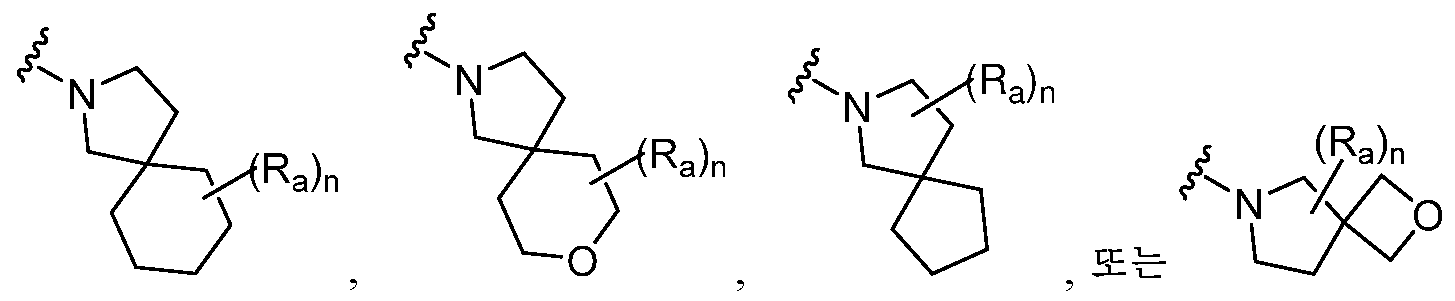

제13 실시양태에서, R은 

제14 실시양태에서,In a fourteenth embodiment,
각 경우의 Ra는 독립적으로 H, 할로겐, C1-4알킬, -(CHRaa)kOH, -(CHRaa)kCN, -(CHRaa)kC(O)OR11, -(CHRaa)kC(O)NR11R12, -(CHRaa)kC(O)NR11OR12, -(CHRaa)kS(=O)2R11, -(CHRaa)kC(O)NR11S(=O)2R12, -(CHRaa)kS(=O)2NR11R12, -(CHRaa)kNR11S(=O)2R12, -(CHRaa)k-5-6원 헤테로아릴, 또는 -(CHRaa)kP(=O)R11R12이고;each occurrence of R a is independently H, halogen, C 1-4 alkyl, -(CHR aa ) k OH, -(CHR aa ) k CN, -(CHR aa ) k C(O)OR 11 , -(CHR aa ) k C(O)NR 11 R 12 , -(CHR aa ) k C(O)NR 11 OR 12 , -(CHR aa ) k S(=O) 2 R 11 , -(CHR aa ) k C( O)NR 11 S(=O) 2 R 12 , -(CHR aa ) k S(=O) 2 NR 11 R 12 , -(CHR aa ) k NR 11 S(=O) 2 R 12 , -(CHR aa ) k -5-6 membered heteroaryl, or -(CHR aa ) k P(=O)R 11 R 12 ;
Raa는 독립적으로 H, 또는 할로겐으로 임의로 치환된 C1-3알킬이고;R aa is independently H, or C 1-3 alkyl optionally substituted with halogen;
R11 및 R12는 독립적으로 H 또는 C1-4알킬이고;R 11 and R 12 are independently H or C 1-4 alkyl;
k는 0 또는 1이고, 나머지 가변기는 제1, 제2, 제3, 제4, 제5, 제6, 제7, 제8, 제9, 제10, 제11, 제12, 및/또는 제13 실시양태에 정의된 바와 같은 것인k is 0 or 1, and the remaining variables are first, second, third, fourth, fifth, sixth, seventh, eighth, ninth, tenth, eleventh, twelfth, and/or th 13 as defined in embodiment
화학식 (I-0), (I-1) 또는 (I-2)의 화합물, 또는 그의 제약상 허용되는 염 또는 입체이성질체가 제공된다.Provided is a compound of formula (I-0), (I-1) or (I-2), or a pharmaceutically acceptable salt or stereoisomer thereof.
제15 실시양태에서, R1은 H, F, Cl, CN, 또는 CF3이고, 나머지 가변기는 제1, 제2, 제3, 제4, 제5, 제6, 제7, 제8, 제9, 제10, 제11, 제12, 제13 및/또는 제14 실시양태에 정의된 바와 같은 것인 화학식 (I-0), (I-1) 또는 (I-2)의 화합물, 또는 그의 제약상 허용되는 염 또는 입체이성질체가 제공된다.In a fifteenth embodiment, R 1 is H, F, Cl, CN, or CF 3 , and the remaining variables are first, second, third, fourth, fifth, sixth, seventh, eighth, th A compound of formula (I-0), (I-1) or (I-2) as defined in the ninth, tenth, eleventh, twelfth, thirteenth and/or fourteenth embodiment, or a compound thereof Pharmaceutically acceptable salts or stereoisomers are provided.
제16 실시양태에서, R은 

화학식 (I-0), (I-1) 또는 (I-2)의 화합물, 또는 그의 제약상 허용되는 염 또는 입체이성질체가 제공된다.Provided is a compound of formula (I-0), (I-1) or (I-2), or a pharmaceutically acceptable salt or stereoisomer thereof.
제17 실시양태에서,In the seventeenth embodiment,
R은 

Ra1은 독립적으로 H, C1-4알킬, 또는 C1-4히드록시알킬이고;R a1 is independently H, C 1-4 alkyl, or C 1-4 hydroxyalkyl;
Ra1 '은 독립적으로 -(CHRaa)kOH, -(CHRaa)kCN, -(CHRaa)kC(O)OR11, -(CHRaa)kS(=O)2R11, -(CHRaa)kC(O)NR11R12, -(CHRaa)kC(O)NR11OR12, -(CHRaa)kC(O)NR11S(=O)2R12, -(CHRaa)kS(=O)2NR11R12, -(CHRaa)kNR11S(=O)2R12, -(CHRaa)k-5-6원 헤테로아릴, 또는 -(CHRaa)kP(=O)R11R12이고;R a1 ' is independently -(CHR aa ) k OH, -(CHR aa ) k CN, -(CHR aa ) k C(O)OR 11 , -(CHR aa ) k S(=O) 2 R 11 , -(CHR aa ) k C(O)NR 11 R 12 , -(CHR aa ) k C(O)NR 11 OR 12 , -(CHR aa ) k C(O)NR 11 S(=O) 2 R 12 , -(CHR aa ) k S(=O) 2 NR 11 R 12 , -(CHR aa ) k NR 11 S(=O) 2 R 12 , -(CHR aa ) k -5-6 membered heteroaryl, or -(CHR aa ) k P(=O)R 11 R 12 ;
Raa는 독립적으로 H, 또는 할로겐으로 임의로 치환된 C1-3알킬이고;R aa is independently H, or C 1-3 alkyl optionally substituted with halogen;
Ra는 독립적으로 H, F, 또는 Cl이고;R a is independently H, F, or Cl;
R11 및 R12는 독립적으로 H 또는 C1-4알킬이고;R 11 and R 12 are independently H or C 1-4 alkyl;
k는 0 또는 1이고, 나머지 가변기는 제1, 제2, 제3, 제4, 제5, 제6, 제7, 제8, 제9 및/또는 제10 실시양태에 정의된 바와 같은 것인k is 0 or 1 and the remaining variables are as defined in the first, second, third, fourth, fifth, sixth, seventh, eighth, ninth and/or tenth embodiments.
화학식 (I-0), (I-1) 또는 (I-2)의 화합물, 또는 그의 제약상 허용되는 염 또는 입체이성질체가 제공된다.Provided is a compound of formula (I-0), (I-1) or (I-2), or a pharmaceutically acceptable salt or stereoisomer thereof.
제18 실시양태에서,In the eighteenth embodiment,
Ra1은 독립적으로 H, CH3, 또는 CH2OH이고;R a1 is independently H, CH 3 , or CH 2 OH;
Ra1 '은 독립적으로 -(CHRaa)kOH, -(CHRaa)kCN, -(CHRaa)kC(O)OR11, -(CHRaa)kS(=O)2R11, -(CHRaa)kC(O)NR11R12, -(CHRaa)kC(O)NR11OR12, -(CHRaa)kC(O)NR11S(=O)2R12, -(CHRaa)kS(=O)2NR11R12, -(CHRaa)kNR11S(=O)2R12, -(CHRaa)k-테트라졸, 또는 -(CHRaa)kP(=O)R11R12이고;R a1 ' is independently -(CHR aa ) k OH, -(CHR aa ) k CN, -(CHR aa ) k C(O)OR 11 , -(CHR aa ) k S(=O) 2 R 11 , -(CHR aa ) k C(O)NR 11 R 12 , -(CHR aa ) k C(O)NR 11 OR 12 , -(CHR aa ) k C(O)NR 11 S(=O) 2 R 12 , -(CHR aa ) k S(=O) 2 NR 11 R 12 , -(CHR aa ) k NR 11 S(=O) 2 R 12 , -(CHR aa ) k -tetrazole, or -(CHR aa ) ) k P(=O)R 11 R 12 ;
Raa는 독립적으로 H, CH3, 또는 CF3이고;R aa is independently H, CH 3 , or CF 3 ;
R11 및 R12는 독립적으로 H 또는 C1-2알킬이고;R 11 and R 12 are independently H or C 1-2 alkyl;
k는 0 또는 1이고, 나머지 가변기는 제17 실시양태에 정의된 바와 같은 것인k is 0 or 1 and the remaining variables are as defined in the seventeenth embodiment.
화학식 (I-0), (I-1) 또는 (I-2)의 화합물, 또는 그의 제약상 허용되는 염 또는 입체이성질체가 제공된다.Provided is a compound of formula (I-0), (I-1) or (I-2), or a pharmaceutically acceptable salt or stereoisomer thereof.
본 발명의 제19 실시양태에서, 각 경우의 Ra는 독립적으로 H 또는 F이고, 나머지 가변기는 제18 실시양태에 정의된 바와 같은 것인 화학식 (I-0), (I-1) 또는 (I-2)의 화합물, 또는 그의 제약상 허용되는 염 또는 입체이성질체가 제공된다.In a nineteenth embodiment of the present invention, each occurrence of R a is independently H or F and the remaining variables are as defined in the eighteenth embodiment of formula (I-0), (I-1) or ( There is provided a compound of I-2), or a pharmaceutically acceptable salt or stereoisomer thereof.
본 발명의 제20 실시양태에서, R1은 Cl이고, 나머지 가변기는 제1, 제2, 제3, 제4, 제5, 제6, 제7, 제8, 제9, 제10, 제11, 제12, 제13, 제14, 제15, 제16, 제17, 제18, 및/또는 제19 실시양태에 정의된 바와 같은 것인 화학식 (I-0), (I-1) 또는 (I-2)의 화합물, 또는 그의 제약상 허용되는 염 또는 입체이성질체가 제공된다.In a twentieth embodiment of the invention, R 1 is Cl and the remaining variables are first, second, third, fourth, fifth, sixth, seventh, eighth, ninth, tenth, eleventh. , formula (I-0), (I-1) or ( There is provided a compound of I-2), or a pharmaceutically acceptable salt or stereoisomer thereof.
제21 실시양태에서, R 및 R1은 이들이 부착되어 있는 탄소 원자와 함께 하기 나타낸 고리를 형성하고:In a twenty-first embodiment, R and R 1 together with the carbon atom to which they are attached form the ring shown below:


제22 실시양태에서,In a 22nd embodiment,
각 경우의 Rb는 독립적으로 H, 할로겐, OH, CN, NH2, COOH, C1-4알킬, C1-4할로알킬, C1-4히드록시알킬, C1-4알콕시, C1-4할로알콕시, C1-4히드록시알콕시, NR11R12, C(O)NR11R12, C(O)C1-4알킬, C(O)OC1-4알킬, C(O)NR11OR12, S(=O)2R11, S(=O)2NR11R12, NR11(S=O)2R12, C(O)NR11S(=O)2R12, P(=O)R11R12, 5-6원 헤테로아릴, 또는 NR11C(O)C1-4알킬이고;each occurrence of R b is independently H, halogen, OH, CN, NH 2 , COOH, C 1-4 alkyl, C 1-4 haloalkyl, C 1-4 hydroxyalkyl, C 1-4 alkoxy, C 1 -4 Haloalkoxy, C 1-4 Hydroxyalkoxy, NR 11 R 12 , C(O)NR 11 R 12 , C(O)C 1-4 Alkyl, C(O)OC 1-4 Alkyl, C(O) )NR 11 OR 12 , S(=O) 2 R 11 , S(=O) 2 NR 11 R 12 , NR 11 (S=O) 2 R 12 , C(O)NR 11 S(=O) 2 R 12 , P(=O)R 11 R 12 , 5-6 membered heteroaryl, or NR 11 C(O)C 1-4 alkyl;
각 경우의 Rc는 페닐 또는 피리디닐이고, 이들 각각은 할로겐, OH, CN, C1-4알킬, C1-4할로알킬, C1-4알콕시, C1-4할로알콕시, NR11R12, C(O)NR11R12, 및 P(=O)디-C1-6알킬로 이루어진 군으로부터 독립적으로 선택된 1 또는 2개의 치환기로 임의로 치환되고, 나머지 가변기는 제1, 제2, 제3 및/또는 제21 실시양태에 정의된 바와 같은 것인R c at each occurrence is phenyl or pyridinyl, each of which is halogen, OH, CN, C 1-4 alkyl, C 1-4 haloalkyl, C 1-4 alkoxy, C 1-4 haloalkoxy, NR 11 R 12 , C(O)NR 11 R 12 , and P(=O)di-C 1-6 alkyl optionally substituted with 1 or 2 substituents independently selected from the group consisting of, the remaining variables being the first, second, as defined in the third and/or twenty-first embodiment.
화학식 (I-0), (I-1) 또는 (I-2)의 화합물, 또는 그의 제약상 허용되는 염 또는 입체이성질체가 제공된다.Provided is a compound of formula (I-0), (I-1) or (I-2), or a pharmaceutically acceptable salt or stereoisomer thereof.
제23 실시양태에서, R 및 R1은 이들이 부착되어 있는 탄소 원자와 함께 하기 나타낸 고리를 형성하고:In a twenty-third embodiment, R and R 1 together with the carbon atom to which they are attached form the ring shown below:


제24 실시양태에서,In a twenty-fourth embodiment,
각 경우의 Rb는 독립적으로 H, 할로겐, CN, COOH, C1-2알킬, 또는 C1-2할로알킬이고;each occurrence of R b is independently H, halogen, CN, COOH, C 1-2 alkyl, or C 1-2 haloalkyl;
각 경우의 Rc는 페닐 또는 피리디닐이고, 이들 각각은 할로겐, C1-4알킬, C1-4할로알킬, C1-4알콕시, C1-4할로알콕시, NR11R12, C(O)NR11R12, 및 P(=O)디-C1-6알킬로 이루어진 군으로부터 독립적으로 선택된 1 또는 2개의 치환기로 임의로 치환되고,R c at each occurrence is phenyl or pyridinyl, each of which is halogen, C 1-4 alkyl, C 1-4 haloalkyl, C 1-4 alkoxy, C 1-4 haloalkoxy, NR 11 R 12 , C( O)NR 11 R 12 , and optionally substituted with 1 or 2 substituents independently selected from the group consisting of P(=O)di-C 1-6 alkyl,
각 경우의 R11 및 R12는 독립적으로 H 또는 C1-6알킬이고, 나머지 가변기는 제1, 제2, 제3, 제21, 제22, 및/또는 제23 실시양태에 정의된 바와 같은 것인each occurrence of R 11 and R 12 is independently H or C 1-6 alkyl and the remaining variables are as defined in the first, second, third, twenty-first, twenty-second, and/or twenty-third embodiment. that
화학식 (I-0), (I-1) 또는 (I-2)의 화합물, 또는 그의 제약상 허용되는 염 또는 입체이성질체가 제공된다.Provided is a compound of formula (I-0), (I-1) or (I-2), or a pharmaceutically acceptable salt or stereoisomer thereof.
제25 실시양태에서,In a twenty-fifth embodiment,
각 경우의 Rb는 독립적으로 H, CN, 또는 COOH이고;each occurrence of R b is independently H, CN, or COOH;
각 경우의 Rc는 페닐 또는 피리디닐이고, 이들 각각은 C1-4알킬, C(O)N(CH3)2, 및 P(=O)(CH3)2로 이루어진 군으로부터 독립적으로 선택된 1 또는 2개의 치환기로 임의로 치환되고, 나머지 가변기는 제1, 제2, 제3, 제21, 제22, 제23, 및/또는 제24 실시양태에 정의된 바와 같은 것인each occurrence of R c is phenyl or pyridinyl, each of which is independently selected from the group consisting of C 1-4 alkyl, C(O)N(CH 3 ) 2 , and P(=O)(CH 3 ) 2 . optionally substituted with 1 or 2 substituents, and the remaining variables are as defined in the first, second, third, twenty-first, twenty-second, twenty-third, and/or twenty-fourth embodiment.
화학식 (I-0), (I-1) 또는 (I-2)의 화합물, 또는 그의 제약상 허용되는 염 또는 입체이성질체가 제공된다.Provided is a compound of formula (I-0), (I-1) or (I-2), or a pharmaceutically acceptable salt or stereoisomer thereof.
제26 실시양태에서, m은 0 또는 1이고, 나머지 가변기는 제1, 제2, 제3, 제4, 제5, 제6, 제7, 제8, 제9, 제10, 제11, 제12, 제13, 제14, 제15, 제16, 제17, 제18, 제19, 제20, 제21, 제22, 제23, 제24, 및/또는 제25 실시양태에 정의된 바와 같은 것인 화학식 (I-0), (I-1) 또는 (I-2)의 화합물, 또는 그의 제약상 허용되는 염 또는 입체이성질체가 제공된다.In a twenty-sixth embodiment, m is 0 or 1 and the remaining variables are first, second, third, fourth, fifth, sixth, seventh, eighth, ninth, tenth, eleventh, th 12, 13, 14, 15, 16, 17, 18, 19, 20, 21, 22, 23, 24, and/or 25th embodiment. is a compound of formula (I-0), (I-1) or (I-2), or a pharmaceutically acceptable salt or stereoisomer thereof.
제27 실시양태에서, 
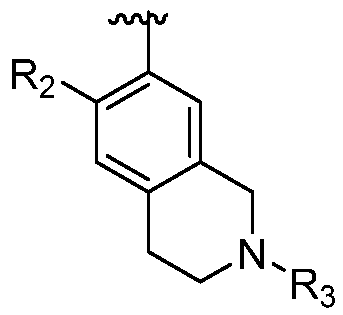
제28 실시양태에서, 각 경우의 R2는 H, 할로겐, C1-4알킬, C1-4할로알킬, C1-4알콕시, C1-4할로알콕시이고; R3은 H, C1-6알킬, C1-6히드록시알킬, 또는 COCH2NR11R12이고, 나머지 가변기는 제1, 제2, 제3, 제4, 제5, 제6, 제7, 제8, 제9, 제10, 제11, 제12, 제13, 제14, 제15, 제16, 제17, 제18, 제19, 제20, 제21, 제22, 제23, 제24, 제25, 제26 및/또는 제27 실시양태에 정의된 바와 같은 것인 화학식 (I-0), (I-1) 또는 (I-2)의 화합물, 또는 그의 제약상 허용되는 염 또는 입체이성질체가 제공된다.In a twenty-eighth embodiment, each occurrence of R 2 is H, halogen, C 1-4 alkyl, C 1-4 haloalkyl, C 1-4 alkoxy, C 1-4 haloalkoxy; R 3 is H, C 1-6 alkyl, C 1-6 hydroxyalkyl, or COCH 2 NR 11 R 12 , and the remaining variables are first, second, third, fourth, fifth, sixth, th 7th, 8th, 9th, 10th, 11th, 12th, 13th, 14th, 15th, 16th, 17th, 18th, 19th, 20th, 21st, 22nd, 23rd, A compound of formula (I-0), (I-1) or (I-2), or a pharmaceutically acceptable salt thereof, as defined in the twenty-fourth, twenty-fifth, twenty-sixth and/or twenty-seventh embodiment. or stereoisomers.
제29 실시양태에서, 각 경우의 R2는 H, F, Cl, 또는 OCH3이고; R3은 H 또는 C1-4알킬이고, 나머지 가변기는 제1, 제2, 제3, 제4, 제5, 제6, 제7, 제8, 제9, 제10, 제11, 제12, 제13, 제14, 제15, 제16, 제17, 제18, 제19, 제20, 제21, 제22, 제23, 제24, 제25, 제26, 제27, 및/또는 제28 실시양태에 정의된 바와 같은 것인 화학식 (I-0), (I-1) 또는 (I-2)의 화합물, 또는 그의 제약상 허용되는 염 또는 입체이성질체가 제공된다.In a twenty-ninth embodiment, each occurrence of R 2 is H, F, Cl, or OCH 3 ; R 3 is H or C 1-4 alkyl, and the remaining variables are 1st, 2nd, 3rd, 4th, 5th, 6th, 7th, 8th, 9th, 10th, 11th, 12th , 13th, 14th, 15th, 16th, 17th, 18th, 19th, 20th, 21st, 22nd, 23rd, 24th, 25th, 26th, 27th, and/or th 28 Provided is a compound of formula (I-0), (I-1) or (I-2), or a pharmaceutically acceptable salt or stereoisomer thereof, as defined in the 28th embodiment.
본 발명의 제30 실시양태에서, 하기 화학식 (II)에 의해 나타내어진 화합물, 또는 그의 제약상 허용되는 염 또는 입체이성질체가 제공된다.In a thirtieth embodiment of the present invention, there is provided a compound represented by formula (II), or a pharmaceutically acceptable salt or stereoisomer thereof.

여기서,here,
A1은 CR' 또는 N이고;A 1 is CR′ or N;
X는 -P(=O)R3'R4'이고;X is -P(=0)R 3' R 4' ;
R'은 H, 중수소, 할로겐, CN, NO2, C1-6알킬, C2-6알케닐, C2-6알키닐, C1-6알콕시, NR11'R12', C(O)NR11'R12', C(O)C1-6알킬, C(O)OC1-6알킬, NR11'C(O)C1-6알킬이고, 여기서 R'에 의해 나타내어지거나 또는 R'에 의해 나타내어진 기에서의 알킬, 알케닐, 알키닐 또는 알콕시는 할로겐, OH, CN, C1-4알킬, C1-4할로알킬, C1-4알콕시, C1-4할로알콕시, 및 NR11'R12'로 이루어진 군으로부터 독립적으로 선택된 1 내지 3개의 치환기로 임의로 치환되고;R′ is H, deuterium, halogen, CN, NO 2 , C 1-6 alkyl, C 2-6 alkenyl, C 2-6 alkynyl, C 1-6 alkoxy, NR 11′ R 12′ , C(O )NR 11′ R 12′ , C(O)C 1-6 alkyl, C(O)OC 1-6 alkyl, NR 11′ C(O)C 1-6 alkyl, wherein is represented by R′ or Alkyl, alkenyl, alkynyl or alkoxy in the group represented by R' is halogen, OH, CN, C 1-4 alkyl, C 1-4 haloalkyl, C 1-4 alkoxy, C 1-4 haloalkoxy , and optionally substituted with 1 to 3 substituents independently selected from the group consisting of NR 11′ R 12′ ;
각 경우의 R1'은 독립적으로 H, 중수소, 할로겐, OH, CN, NO2, C1-6알킬, C2-6알케닐, C2-6알키닐, C1-6알콕시, NR11'R12', C(O)NR11'R12', C(O)C1-6알킬, C(O)OC1-6알킬, NR11'C(O)C1-6알킬, C3-7시클로알킬, 또는 3-7원 헤테로시클릴이고, 여기서 R1'에 의해 나타내어지거나 또는 R1'에 의해 나타내어진 기에서의 알킬, 알케닐, 알키닐, 알콕시, 시클로알킬, 또는 헤테로시클릴은 할로겐, OH, CN, C1-4알킬, C1-4할로알킬, C1-4알콕시, C1-4할로알콕시, 및 NR11'R12'로 이루어진 군으로부터 독립적으로 선택된 1 내지 3개의 치환기로 임의로 치환되고;each occurrence of R 1′ is independently H, deuterium, halogen, OH, CN, NO 2 , C 1-6 alkyl, C 2-6 alkenyl, C 2-6 alkynyl, C 1-6 alkoxy, NR 11 ' R 12' , C(O)NR 11' R 12' , C(O)C 1-6 alkyl, C(O)OC 1-6 alkyl, NR 11' C(O)C 1-6 alkyl, C 3-7 cycloalkyl, or 3-7 membered heterocyclyl, wherein alkyl, alkenyl, alkynyl, alkoxy, cycloalkyl, or hetero in the group represented by R 1 ′ or represented by R 1′ cyclyl is independently selected from the group consisting of halogen, OH, CN, C 1-4 alkyl, C 1-4 haloalkyl, C 1-4 alkoxy, C 1-4 haloalkoxy, and NR 11′ R 12′ optionally substituted with to 3 substituents;
각 경우의 R2'는 독립적으로 H, 중수소, 할로겐, OH, CN, NO2, C1-6알킬, C2-6알케닐, C2-6알키닐, C1-6알콕시, NR11'R12', C(O)NR11'R12', C(O)C1-6알킬, C(O)OC1-6알킬, NR11'C(O)C1-6알킬, 페닐, 5-6원 헤테로아릴, C3-7시클로알킬, 또는 3-7원 헤테로시클릴이고, 여기서 R2'에 의해 나타내어지거나 또는 R2'에 의해 나타내어진 기에서의 알킬, 알케닐, 알키닐, 알콕시, 페닐, 헤테로아릴, 시클로알킬, 또는 헤테로시클릴은 할로겐, OH, CN, C1-4알킬, C1-4할로알킬, C1-4알콕시, C1-4할로알콕시, 및 NR11'R12'로 이루어진 군으로부터 독립적으로 선택된 1 내지 3개의 치환기로 임의로 치환되고;each occurrence of R 2′ is independently H, deuterium, halogen, OH, CN, NO 2 , C 1-6 alkyl, C 2-6 alkenyl, C 2-6 alkynyl, C 1-6 alkoxy, NR 11 ' R 12' , C(O)NR 11' R 12' , C(O)C 1-6 alkyl, C(O)OC 1-6 alkyl, NR 11' C(O)C 1-6 alkyl, phenyl , 5-6 membered heteroaryl, C 3-7 cycloalkyl, or 3-7 membered heterocyclyl, wherein alkyl, alkenyl, alkyl in the group represented by R 2 ′ or represented by R 2′ nyl, alkoxy, phenyl, heteroaryl, cycloalkyl, or heterocyclyl is halogen, OH, CN, C 1-4 alkyl, C 1-4 haloalkyl, C 1-4 alkoxy, C 1-4 haloalkoxy, and optionally substituted with 1 to 3 substituents independently selected from the group consisting of NR 11′ R 12′ ;
각각의 R3' 및 R4'는 독립적으로 H, C1-6알킬, C2-6알케닐, C2-6알키닐이고, 여기서 R3' 또는 R4'에 의해 나타내어진 알킬, 알케닐, 또는 알키닐은 할로겐, OH, CN, C1-4알킬, C1-4할로알킬, C1-4알콕시, C1-4할로알콕시, 및 NR11'R12'로 이루어진 군으로부터 독립적으로 선택된 1 내지 3개의 치환기로 임의로 치환되고;each R 3′ and R 4′ is independently H, C 1-6 alkyl, C 2-6 alkenyl, C 2-6 alkynyl, wherein the alkyl represented by R 3′ or R 4′ , al Kenyl, or alkynyl, is independently from the group consisting of halogen, OH, CN, C 1-4 alkyl, C 1-4 haloalkyl, C 1-4 alkoxy, C 1-4 haloalkoxy, and NR 11′ R 12′ optionally substituted with 1 to 3 substituents selected from;
각 경우의 R11' 및 R12'는 독립적으로 H 또는 C1-6알킬이고, 여기서 R11' 또는 R12'에 의해 나타내어진 알킬은 할로겐, OH, CN, C1-4알킬, C1-4할로알킬, C1-4알콕시, C1-4할로알콕시, C3-6시클로알킬, 및 3-7원 헤테로시클릴로 이루어진 군으로부터 독립적으로 선택된 1 내지 3개의 치환기로 임의로 치환되거나, 또는each occurrence of R 11′ and R 12′ is independently H or C 1-6 alkyl, wherein the alkyl represented by R 11′ or R 12′ is halogen, OH, CN, C 1-4 alkyl, C 1 optionally substituted with 1 to 3 substituents independently selected from the group consisting of -4 haloalkyl, C 1-4 alkoxy, C 1-4 haloalkoxy, C 3-6 cycloalkyl, and 3-7 membered heterocyclyl, or
R11' 및 R12'는 이들이 부착되어 있는 질소 원자와 함께 할로겐, OH, CN, C1-4알킬, C1-4할로알킬, C1-4알콕시, 또는 C1-4할로알콕시로 이루어진 군으로부터 독립적으로 선택된 1 내지 3개의 치환기로 임의로 치환된 3-7원 헤테로시클릴을 형성하고;R 11' and R 12' together with the nitrogen atom to which they are attached consist of halogen, OH, CN, C 1-4 alkyl, C 1-4 haloalkyl, C 1-4 alkoxy, or C 1-4 haloalkoxy; form a 3-7 membered heterocyclyl optionally substituted with 1 to 3 substituents independently selected from the group;
m'은 0, 1, 또는 2이고;m' is 0, 1, or 2;
n'은 0, 1, 또는 2이다.n' is 0, 1, or 2.
본 발명의 제31 실시양태에서, 화학식 (II)의 화합물은 하기 구조 화학식 (II-1)에 의해 나타내어지거나, 또는 그의 제약상 허용되는 염 또는 입체이성질체이다.In a thirty-first embodiment of the present invention, the compound of formula (II) is represented by the following structural formula (II-1), or is a pharmaceutically acceptable salt or stereoisomer thereof.

여기서, R'은 H, 할로겐, NR11'R12', 또는 할로겐, OH, CN, C1-4알킬, C1-4할로알킬, C1-4알콕시, C1-4할로알콕시, 및 NR11'R12'로 이루어진 군으로부터 독립적으로 선택된 1 내지 3개의 치환기로 임의로 치환된 C1-6알킬이고, 나머지 가변기는 제30 실시양태에 정의된 바와 같다.wherein R′ is H, halogen, NR 11′ R 12′ , or halogen, OH, CN, C 1-4 alkyl, C 1-4 haloalkyl, C 1-4 alkoxy, C 1-4 haloalkoxy, and C 1-6 alkyl optionally substituted with 1 to 3 substituents independently selected from the group consisting of NR 11′ R 12′ and the remaining variables are as defined in the thirtieth embodiment.
제32 실시양태에서, R3' 및 R4'는 독립적으로 H, 또는 할로겐, OH, CN, C1-4알킬, C1-4할로알킬, C1-4알콕시, C1-4할로알콕시, 및 NR11'R12'로 이루어진 군으로부터 독립적으로 선택된 1 내지 3개의 치환기로 임의로 치환된 C1-6알킬이고, 나머지 가변기는 제30 및/또는 제31 실시양태에 정의된 바와 같은 것인 화학식 (II) 또는 (II-1)의 화합물, 또는 그의 제약상 허용되는 염 또는 입체이성질체이다.In a 32nd embodiment, R 3′ and R 4′ are independently H, or halogen, OH, CN, C 1-4 alkyl, C 1-4 haloalkyl, C 1-4 alkoxy, C 1-4 haloalkoxy and C 1-6 alkyl optionally substituted with 1 to 3 substituents independently selected from the group consisting of NR 11′ R 12′ , wherein the remaining variables are as defined in the 30th and/or 31st embodiments. a compound of formula (II) or (II-1), or a pharmaceutically acceptable salt or stereoisomer thereof.
제33 실시양태에서,In a 33 embodiment,
각 경우의 R1'은 독립적으로 H, 할로겐, C1-6알킬, C2-6알케닐, C2-6알키닐, C3-7시클로알킬, 또는 3-7원 헤테로시클릴이고, 여기서 R1'에 의해 나타내어진 알킬, 알케닐, 알키닐, 시클로알킬, 또는 헤테로시클릴은 할로겐, OH, CN, C1-4알킬, C1-4할로알킬, C1-4알콕시, C1-4할로알콕시, 및 NR11'R12'로 이루어진 군으로부터 독립적으로 선택된 1 내지 3개의 치환기로 임의로 치환되고;each occurrence of R 1′ is independently H, halogen, C 1-6 alkyl, C 2-6 alkenyl, C 2-6 alkynyl, C 3-7 cycloalkyl, or 3-7 membered heterocyclyl; wherein alkyl, alkenyl, alkynyl, cycloalkyl, or heterocyclyl represented by R 1′ is halogen, OH, CN, C 1-4 alkyl, C 1-4 haloalkyl, C 1-4 alkoxy, C optionally substituted with 1 to 3 substituents independently selected from the group consisting of 1-4 haloalkoxy, and NR 11′ R 12′ ;
각 경우의 R2'는 독립적으로 H, 할로겐, OH, NO2, C1-6알킬, C1-6알콕시, NR11'R12', C(O)NR11'R12', C(O)C1-6알킬, C(O)OC1-6알킬, NR11'C(O)C1-6알킬, 5-6원 헤테로아릴, 또는 3-7원 헤테로시클릴이고, 여기서 R2'에 의해 나타내어지거나 또는 R2'에 의해 나타내어진 기에서의 알킬, 알콕시, 헤테로아릴 또는 헤테로시클릴은 할로겐, OH, CN, C1-4알킬, C1-4할로알킬, C1-4알콕시, C1-4할로알콕시, 및 NR11'R12'로 이루어진 군으로부터 독립적으로 선택된 1 내지 3개의 치환기로 임의로 치환되고, 나머지 가변기는 제30, 제31 및/또는 제32 실시양태에 정의된 바와 같은 것인each occurrence of R 2′ is independently H, halogen, OH, NO 2 , C 1-6 alkyl, C 1-6 alkoxy, NR 11′ R 12′ , C(O)NR 11′ R 12′ , C( O)C 1-6 alkyl, C(O)OC 1-6 alkyl, NR 11′ C(O)C 1-6 alkyl, 5-6 membered heteroaryl, or 3-7 membered heterocyclyl, wherein R Alkyl, alkoxy, heteroaryl or heterocyclyl in the group represented by 2 ' or represented by R 2' is halogen, OH, CN, C 1-4 alkyl, C 1-4 haloalkyl, C 1 - 4 optionally substituted with 1 to 3 substituents independently selected from the group consisting of 4 alkoxy, C 1-4 haloalkoxy, and NR 11′ R 12′ , the remaining variables being as in the 30th, 31st and/or 32nd embodiments. as defined
화학식 (II) 또는 (II-1)의 화합물, 또는 그의 제약상 허용되는 염 또는 입체이성질체이다.a compound of formula (II) or (II-1), or a pharmaceutically acceptable salt or stereoisomer thereof.
제34 실시양태에서, 화학식 (II) 또는 (II-1)의 화합물은 하기 구조 화학식 (II-2) 또는 (II-2')에 의해 나타내어지거나, 또는 그의 제약상 허용되는 염 또는 입체이성질체이다.In a thirty-fourth embodiment, the compound of formula (II) or (II-1) is represented by structural formula (II-2) or (II-2'), or a pharmaceutically acceptable salt or stereoisomer thereof .

여기서, R'은 H, 할로겐, 또는 NH2이고, 나머지 가변기는 제30, 제31, 제32, 및/또는 제33 실시양태에 정의된 바와 같다.wherein R′ is H, halogen, or NH 2 , and the remaining variables are as defined in the thirtieth, thirty-first, thirty-second, and/or thirty-third embodiment.
제35 실시양태에서, 각 경우의 R2'는 독립적으로 H, 할로겐 OH; 할로겐 또는 OH 또는 NR11'R12'로 임의로 치환된 C1-4알킬; C1-4알콕시, C(O)OC1-6알킬, C(O)NR11'R12', NR11'R12', NR11'C(O)C1-6알킬, 5-6원 헤테로시클릴, 또는 5-6원 헤테로아릴이고; 각 경우의 R1'은 독립적으로 H 또는 C1-4알킬이고, 나머지 가변기는 제30, 제31, 제32, 제33, 및/또는 제34 실시양태에 정의된 바와 같은 것인 화학식 (II), (II-1), (II-2) 또는 (II-2')의 화합물, 또는 그의 제약상 허용되는 염 또는 입체이성질체이다.In a 35 embodiment, each occurrence of R 2′ is independently H, halogen OH; C 1-4 alkyl optionally substituted with halogen or OH or NR 11′ R 12′ ; C 1-4 alkoxy, C(O)OC 1-6 alkyl, C(O)NR 11' R 12' , NR 11' R 12' , NR 11' C(O)C 1-6 alkyl, 5-6 membered heterocyclyl, or 5-6 membered heteroaryl; Formula (II) wherein each occurrence of R 1′ is independently H or C 1-4 alkyl and the remaining variables are as defined in the thirty-first, thirty-first, thirty-two, thirty-third, and/or thirty-fourth embodiment. ), (II-1), (II-2) or (II-2'), or a pharmaceutically acceptable salt or stereoisomer thereof.
제36 실시양태에서, R3' 및 R4'는 독립적으로 C1-6알킬이고; 각 경우의 R2'는 독립적으로 H, 할로겐, OH; 할로겐 또는 OH 또는 NR11'R12'로 임의로 치환된 C1-4알킬; C1-4알콕시, C(O)OC1-4알킬, C(O)NR11'R12', NR11'R12', NHC(O)C1-6알킬, 피롤리디닐, 피롤리딘-2-온, 옥사졸이고, 여기서 각 경우의 R11' 및 R12'는 독립적으로 H 또는 C1-4알킬이고, 나머지 가변기는 제30, 제31, 제32, 제33, 제34, 및/또는 제35 실시양태에 정의된 바와 같은 것인 화학식 (II), (II-1), (II-2) 또는 (II-2')의 화합물, 또는 그의 제약상 허용되는 염 또는 입체이성질체이다.In a 36 embodiment, R 3′ and R 4′ are independently C 1-6 alkyl; each occurrence of R 2′ is independently H, halogen, OH; C 1-4 alkyl optionally substituted with halogen or OH or NR 11′ R 12′ ; C 1-4 alkoxy, C(O)OC 1-4 alkyl, C(O)NR 11' R 12' , NR 11' R 12' , NHC(O)C 1-6 alkyl, pyrrolidinyl, pyrroly din-2-one, oxazole, wherein each occurrence of R 11' and R 12' is independently H or C 1-4 alkyl and the remaining variables are 30, 31, 32, 33, 34, and/or a compound of formula (II), (II-1), (II-2) or (II-2') as defined in the thirty-fifth embodiment, or a pharmaceutically acceptable salt or stereoisomer thereof. am.
제37 실시양태에서, X는 -P(O)(CH3)2이고, 각 경우의 R2'는 독립적으로 H, F, Cl, OH, CH3NH2, 또는 NHCOCH3이고, 나머지 가변기는 제30, 제31, 제32, 제33, 제34, 제35, 및/또는 제36 실시양태에 정의된 바와 같은 것인 화학식 (II), (II-1), (II-2) 또는 (II-2')의 화합물, 또는 그의 제약상 허용되는 염 또는 입체이성질체이다.In a 37 embodiment, X is —P(O)(CH 3 ) 2 , each occurrence of R 2′ is independently H, F, Cl, OH, CH 3 NH 2 , or NHCOCH 3 , and the remaining variables are Formula (II), (II-1), (II-2) or ( II-2'), or a pharmaceutically acceptable salt or stereoisomer thereof.
1. 하기 구조 화학식 (I)에 의해 나타내어진 화합물, 또는 그의 제약상 허용되는 염.1. A compound represented by the following structural formula (I), or a pharmaceutically acceptable salt thereof.

여기서,here,
A는 CR2 또는 N이고;A is CR 2 or N;
R은 옥소로 임의로 치환된 8-10원 비시클릭 질소 함유 헤테로아릴 또는 8-10원 비시클릭 질소 함유 헤테로시클릴이고, 여기서 R에 의해 나타내어진 질소 함유 헤테로아릴 또는 질소 함유 헤테로시클릴은 N, O, 및 S로부터 선택된 1 내지 3개의 헤테로원자를 갖고, 1 내지 4개의 Ra로 임의로 치환되고;R is 8-10 membered bicyclic nitrogen containing heteroaryl or 8-10 membered bicyclic nitrogen containing heterocyclyl optionally substituted with oxo, wherein the nitrogen containing heteroaryl or nitrogen containing heterocyclyl represented by R is N; having 1 to 3 heteroatoms selected from O, and S, optionally substituted with 1 to 4 R a ;
R1은 H, 중수소, 할로겐, OH, CN, NH2, NO2, C1-6알킬, C2-6알케닐, C2-6알키닐, C1-6알콕시, NR11R12, C(O)NR11R12, C(O)C1-6알킬, C(O)OC1-6알킬, NR11C(O)C1-6알킬, 페닐, 5-6원 헤테로아릴, C3-6시클로알킬, 또는 3-7원 헤테로시클릴이고, 여기서 R1에 의해 나타내어지거나 또는 R1에 의해 나타내어진 기에서의 알킬, 알케닐, 알키닐, 알콕시, 페닐, 헤테로아릴, 시클로알킬, 또는 헤테로시클릴은 할로겐, -OH, CN, C1-4알킬, C1-4할로알킬, C1-4알콕시, C1-4할로알콕시, 및 NR11R12로 이루어진 군으로부터 독립적으로 선택된 1 내지 3개의 치환기로 임의로 치환되거나; 또는R 1 is H, deuterium, halogen, OH, CN, NH 2 , NO 2 , C 1-6 alkyl, C 2-6 alkenyl, C 2-6 alkynyl, C 1-6 alkoxy, NR 11 R 12 , C(O)NR 11 R 12 , C(O)C 1-6 alkyl, C(O)OC 1-6 alkyl, NR 11 C(O)C 1-6 alkyl, phenyl, 5-6 membered heteroaryl, C 3-6 cycloalkyl, or 3-7 membered heterocyclyl, wherein alkyl in the group represented by or represented by R 1 , alkenyl, alkynyl, alkoxy, phenyl, heteroaryl, cyclo Alkyl, or heterocyclyl, is independently from the group consisting of halogen, —OH, CN, C 1-4 alkyl, C 1-4 haloalkyl, C 1-4 alkoxy, C 1-4 haloalkoxy, and NR 11 R 12 optionally substituted with 1 to 3 substituents selected from; or
R 및 R1은 이들이 부착되어 있는 탄소 원자와 함께 하기 나타낸 고리를 형성하고:R and R 1 together with the carbon atom to which they are attached form the ring shown below:


R2는 H, 중수소, 할로겐, OH, CN, NH2, NO2, C1-6알킬, C2-6알케닐, C2-6알키닐, C1-6알콕시, NR11R12, C(O)NR11R12, C(O)C1-6알킬, C(O)OC1-6알킬, NR11C(O)C1-6알킬, -P(=O)R11R12, -S(=O)2R11, 또는 -S(=O)2NR11R12이고, 여기서 R2에 의해 나타내어지거나 또는 R2에 의해 나타내어진 기에서의 알킬, 알케닐, 알키닐, 또는 알콕시는 할로겐, -OH, CN, C1-4알킬, C1-4할로알킬, C1-4알콕시, C1-4할로알콕시, 및 NR11R12로 이루어진 군으로부터 독립적으로 선택된 1 내지 3개의 치환기로 임의로 치환되고;R 2 is H, deuterium, halogen, OH, CN, NH 2 , NO 2 , C 1-6 alkyl, C 2-6 alkenyl, C 2-6 alkynyl, C 1-6 alkoxy, NR 11 R 12 , C(O)NR 11 R 12 , C(O)C 1-6 alkyl, C(O)OC 1-6 alkyl, NR 11 C(O)C 1-6 alkyl, -P(=O)R 11 R 12 , —S(=O) 2 R 11 , or —S(=O) 2 NR 11 R 12 , wherein alkyl, alkenyl, alkynyl in the group represented by R 2 or represented by R 2 . , or alkoxy is independently selected from the group consisting of halogen, —OH, CN, C 1-4 alkyl, C 1-4 haloalkyl, C 1-4 alkoxy, C 1-4 haloalkoxy, and NR 11 R 12 optionally substituted with to 3 substituents;
R3은 H, C1-6알킬, C(O)C1-6알킬, C3-6시클로알킬, 또는 3-7원 헤테로시클릴이고, 여기서 R3에 의해 나타내어지거나 또는 R3에 의해 나타내어진 기에서의 알킬, 시클로알킬, 또는 헤테로시클릴은 할로겐, -OH, CN, C1-4알킬, C1-4할로알킬, C1-4알콕시, C1-4할로알콕시, C3-6시클로알킬, 3-7원 헤테로시클릴, 및 NR11R12로 이루어진 군으로부터 독립적으로 선택된 1 내지 3개의 치환기로 임의로 치환되고;R 3 is H, C 1-6 alkyl, C(O)C 1-6 alkyl, C 3-6 cycloalkyl, or 3-7 membered heterocyclyl, where represented by R 3 or by R 3 Alkyl, cycloalkyl, or heterocyclyl in the group represented is halogen, —OH, CN, C 1-4 alkyl, C 1-4 haloalkyl, C 1-4 alkoxy, C 1-4 haloalkoxy, C 3 optionally substituted with 1 to 3 substituents independently selected from the group consisting of -6 cycloalkyl, 3-7 membered heterocyclyl, and NR 11 R 12 ;
각 경우의 R11 및 R12는 독립적으로 H 또는 C1-6알킬이고, 여기서 R11 또는 R12에 의해 나타내어진 알킬은 할로겐, -OH, CN, C1-4알킬, C1-4할로알킬, C1-4알콕시, C1-4할로알콕시, C3-6시클로알킬, 및 3-7원 헤테로시클릴로 이루어진 군으로부터 독립적으로 선택된 1 내지 3개의 치환기로 임의로 치환되거나, 또는each occurrence of R 11 and R 12 is independently H or C 1-6 alkyl, wherein the alkyl represented by R 11 or R 12 is halogen, —OH, CN, C 1-4 alkyl, C 1-4 halo optionally substituted with 1 to 3 substituents independently selected from the group consisting of alkyl, C 1-4 alkoxy, C 1-4 haloalkoxy, C 3-6 cycloalkyl, and 3-7 membered heterocyclyl, or
R11 및 R12는 이들이 부착되어 있는 질소 원자 또는 인 원자와 함께 할로겐, -OH, CN, C1-4알킬, C1-4할로알킬, C1-4알콕시, 또는 C1-4할로알콕시로 이루어진 군으로부터 독립적으로 선택된 1 내지 3개의 치환기로 임의로 치환된 3-7원 헤테로시클릴을 형성하고;R 11 and R 12 together with the nitrogen atom or phosphorus atom to which they are attached are halogen, —OH, CN, C 1-4 alkyl, C 1-4 haloalkyl, C 1-4 alkoxy, or C 1-4 haloalkoxy form a 3-7 membered heterocyclyl optionally substituted with 1 to 3 substituents independently selected from the group consisting of;
각 경우의 Ra는 독립적으로 H, 중수소, 할로겐, OH, CN, NH2, NO2, COOH, C1-6알킬, C2-6알케닐, C2-6알키닐, C1-6알콕시, NR11R12, C(O)NR11R12, C(O)C1-6알킬, C(O)OC1-6알킬, NR11C(O)C1-6알킬, -P(=O)R11R12, -S(=O)2R11, 또는 -S(=O)2NR11R12, C3-6시클로알킬, 또는 3-7원 헤테로시클릴이고, 여기서 Ra에 의해 나타내어지거나 또는 Ra에 의해 나타내어진 기에서의 알킬, 알케닐, 알키닐, 또는 알콕시, 시클로알킬, 또는 헤테로시클릴은 할로겐, -OH, CN, C1-4알킬, C1-4할로알킬, C1-4알콕시, C1-4할로알콕시, 및 NR11R12로 이루어진 군으로부터 독립적으로 선택된 1 내지 3개의 치환기로 임의로 치환되거나; 또는each occurrence of R a is independently H, deuterium, halogen, OH, CN, NH 2 , NO 2 , COOH, C 1-6 alkyl, C 2-6 alkenyl, C 2-6 alkynyl, C 1-6 Alkoxy, NR 11 R 12 , C(O)NR 11 R 12 , C(O)C 1-6 Alkyl, C(O)OC 1-6 Alkyl, NR 11 C(O)C 1-6 Alkyl, -P (=O)R 11 R 12 , —S(=O) 2 R 11 , or —S(=O) 2 NR 11 R 12 , C 3-6 cycloalkyl, or 3-7 membered heterocyclyl, wherein Alkyl, alkenyl, alkynyl, or alkoxy, cycloalkyl, or heterocyclyl in the group represented by R a or represented by R a is halogen, —OH, CN, C 1-4 alkyl, C 1 optionally substituted with 1 to 3 substituents independently selected from the group consisting of -4 haloalkyl, C 1-4 alkoxy, C 1-4 haloalkoxy, and NR 11 R 12 ; or
2개의 Ra는 이들이 부착되어 있는 탄소 원자와 함께 C3-6시클로알킬 또는 3-7원 헤테로시클릴을 형성하고, 여기서 시클로알킬 또는 헤테로시클릴은 할로겐, -OH, CN, C1-4알킬, C1-4할로알킬, C1-4알콕시, 및 C1-4할로알콕시로 이루어진 군으로부터 독립적으로 선택된 1 내지 3개의 치환기로 임의로 치환되고;two R a together with the carbon atom to which they are attached form a C 3-6 cycloalkyl or 3-7 membered heterocyclyl, wherein the cycloalkyl or heterocyclyl is halogen, —OH, CN, C 1-4 optionally substituted with 1 to 3 substituents independently selected from the group consisting of alkyl, C 1-4 haloalkyl, C 1-4 alkoxy, and C 1-4 haloalkoxy;
각 경우의 Rb는 독립적으로 H, 중수소, 할로겐, OH, CN, NH2, NO2, C1-6알킬, C2-6알케닐, C2-6알키닐, C1-6알콕시, NR11R12, C(O)NR11R12, C(O)C1-6알킬, C(O)OC1-6알킬, 또는 NR11C(O)C1-6알킬이고, 여기서 Rb에 의해 나타내어지거나 또는 Rb에 의해 나타내어진 기에서의 알킬, 알케닐, 알키닐, 또는 알콕시는 할로겐, -OH, CN, C1-4알킬, C1-4할로알킬, C1-4알콕시, C1-4할로알콕시, 및 NR11R12로 이루어진 군으로부터 독립적으로 선택된 1 내지 3개의 치환기로 임의로 치환되고;each occurrence of R b is independently H, deuterium, halogen, OH, CN, NH 2 , NO 2 , C 1-6 alkyl, C 2-6 alkenyl, C 2-6 alkynyl, C 1-6 alkoxy, NR 11 R 12 , C(O)NR 11 R 12 , C(O)C 1-6 alkyl, C(O)OC 1-6 alkyl, or NR 11 C(O)C 1-6 alkyl, wherein R Alkyl, alkenyl, alkynyl, or alkoxy in the group represented by b or represented by R b is halogen, —OH, CN, C 1-4 alkyl, C 1-4 haloalkyl, C 1-4 optionally substituted with 1 to 3 substituents independently selected from the group consisting of alkoxy, C 1-4 haloalkoxy, and NR 11 R 12 ;
Rc는 페닐, N 및 O로부터 선택된 1 내지 3개의 헤테로원자를 갖는 5-6원 모노시클릭 헤테로시클릴; N 및 O로부터 선택된 1 내지 3개의 헤테로원자를 갖는 5-6원 모노시클릭 헤테로아릴이고; 여기서 Rc에 의해 나타내어진 페닐, 헤테로시클릴, 또는 헤테로아릴은 할로겐, -OH, CN, C1-4알킬, C1-4할로알킬, C1-4알콕시, C1-4할로알콕시, NR11R12, -C(O)NR11R12, 및 -P(O)디-C1-6알킬로 이루어진 군으로부터 독립적으로 선택된 1 내지 3개의 치환기로 임의로 치환되고;R c is phenyl, 5-6 membered monocyclic heterocyclyl having 1 to 3 heteroatoms selected from N and O; 5-6 membered monocyclic heteroaryl having 1 to 3 heteroatoms selected from N and O; wherein phenyl, heterocyclyl, or heteroaryl represented by R c is halogen, —OH, CN, C 1-4 alkyl, C 1-4 haloalkyl, C 1-4 alkoxy, C 1-4 haloalkoxy, optionally substituted with 1 to 3 substituents independently selected from the group consisting of NR 11 R 12 , —C(O)NR 11 R 12 , and —P(O)di-C 1-6 alkyl;
m은 0, 1, 2 또는 3이다.m is 0, 1, 2 or 3.
2. 단락 1에 있어서, R은 

3. 단락 1 또는 2에 있어서,3. Paragraph 1 or 2,
각 경우의 Ra는 독립적으로 H, 할로겐, OH, NH2, CN, COOH, C1-4알킬, C1-4할로알킬, C1-4히드록시알킬, C1-4알콕시, C1-4할로알콕시, C1-4히드록시알콕시, NR11R12, C(O)NR11R12, C(O)C1-4알킬, C(O)OC1-4알킬, NR11C(O)C1-4알킬, -P(=O)R11R12, -S(=O)2R11, -S(=O)2NR11R12, C3-6시클로알킬, 또는 3-7원 헤테로시클릴이거나, 또는each occurrence of R a is independently H, halogen, OH, NH 2 , CN, COOH, C 1-4 alkyl, C 1-4 haloalkyl, C 1-4 hydroxyalkyl, C 1-4 alkoxy, C 1 -4 Haloalkoxy, C 1-4 Hydroxyalkoxy, NR 11 R 12 , C(O)NR 11 R 12 , C(O)C 1-4 Alkyl, C(O)OC 1-4 Alkyl, NR 11 C (O)C 1-4 alkyl, -P(=O)R 11 R 12 , -S(=O) 2 R 11 , -S(=O) 2 NR 11 R 12 , C 3-6 cycloalkyl, or 3-7 membered heterocyclyl, or
2개의 Ra는 이들이 부착되어 있는 탄소 원자와 함께 C3-6시클로알킬 또는 3-7원 헤테로시클릴을 형성하고, 여기서 시클로알킬 또는 헤테로시클릴은 할로겐, -OH, CN, C1-4알킬, C1-4할로알킬, C1-4알콕시, 및 C1-4할로알콕시로 이루어진 군으로부터 독립적으로 선택된 1 내지 3개의 치환기로 임의로 치환되는 것인 화합물 또는 그의 제약상 허용되는 염.two R a together with the carbon atom to which they are attached form a C 3-6 cycloalkyl or 3-7 membered heterocyclyl, wherein the cycloalkyl or heterocyclyl is halogen, —OH, CN, C 1-4 The compound, or a pharmaceutically acceptable salt thereof, is optionally substituted with 1 to 3 substituents independently selected from the group consisting of alkyl, C 1-4 haloalkyl, C 1-4 alkoxy, and C 1-4 haloalkoxy.
4. 단락 1-3 중 어느 하나에 있어서, R1은 H, 할로겐, C1-6알킬, C1-6알콕시, C2-6알케닐, NR11R12, C(O)NR11R12, C(O)C1-6알킬, C(O)OC1-6알킬, NR11C(O)C1-6알킬이고, 여기서 R1에 의해 나타내어지거나 또는 R1에 의해 나타내어진 기에서의 알킬, 알케닐 또는 알콕시는 할로겐, -OH, CN, C1-4알킬, C1-4할로알킬, C1-4알콕시, C1-4할로알콕시, 및 NR11R12로 이루어진 군으로부터 독립적으로 선택된 1 내지 3개의 치환기로 임의로 치환되는 것인 화합물 또는 그의 제약상 허용되는 염.4. The method of any of paragraphs 1-3, wherein R 1 is H, halogen, C 1-6 alkyl, C 1-6 alkoxy, C 2-6 alkenyl, NR 11 R 12 , C(O)NR 11 R 12 , C(O)C 1-6 alkyl, C(O)OC 1-6 alkyl, NR 11 C(O)C 1-6 alkyl, wherein the group represented by R 1 or represented by R 1 . Alkyl, alkenyl or alkoxy in the group consisting of halogen, —OH, CN, C 1-4 alkyl, C 1-4 haloalkyl, C 1-4 alkoxy, C 1-4 haloalkoxy, and NR 11 R 12 A compound or a pharmaceutically acceptable salt thereof, which is optionally substituted with 1 to 3 substituents independently selected from
5. 단락 1-4 중 어느 하나에 있어서, 각 경우의 Ra는 독립적으로 H, 할로, OH, C1-4알킬, COOH, C(O)NR11R12, 또는 -P(O)R11R12이고, 여기서 각 경우의 R11 및 R12는 독립적으로 H 또는 C1-6알킬인 화합물 또는 그의 제약상 허용되는 염.5. The method of any one of paragraphs 1-4, wherein each occurrence of R a is independently H, halo, OH, C 1-4 alkyl, COOH, C(O)NR 11 R 12 , or —P(O)R 11 R 12 , wherein each occurrence of R 11 and R 12 is independently H or C 1-6 alkyl, or a pharmaceutically acceptable salt thereof.
6. 단락 1-5 중 어느 하나에 있어서, R1은 H, 할로겐, C1-4알킬, C1-4할로알킬, C2-4알케닐, C1-4알콕시, 또는 C1-4할로알콕시인 화합물 또는 그의 제약상 허용되는 염.6. The method of any of paragraphs 1-5, wherein R 1 is H, halogen, C 1-4 alkyl, C 1-4 haloalkyl, C 2-4 alkenyl, C 1-4 alkoxy, or C 1-4 A compound that is haloalkoxy, or a pharmaceutically acceptable salt thereof.
7. 단락 1-6 중 어느 하나에 있어서, R은 

8. 단락 1-7 중 어느 하나에 있어서, R은 

9. 단락 1-8 중 어느 하나에 있어서, 각 경우의 Ra는 독립적으로 H, F, Cl, C1-4알킬, COOH, CONH2, C(O)N(CH3)2, 또는 -P(O)(CH3)2인 화합물 또는 그의 제약상 허용되는 염.9. The method of any one of paragraphs 1-8, wherein each occurrence of R a is independently H, F, Cl, C 1-4 alkyl, COOH, CONH 2 , C(O)N(CH 3 ) 2 , or — P(O)(CH 3 ) 2 , or a pharmaceutically acceptable salt thereof.
10. 단락 1-9 중 어느 하나에 있어서, R1은 H, Cl, 또는 CF3인 화합물 또는 그의 제약상 허용되는 염.10. The compound of any of paragraphs 1-9, or a pharmaceutically acceptable salt thereof, wherein R 1 is H, Cl, or CF 3 .
11. 단락 1에 있어서, R 및 R1은 이들이 부착되어 있는 탄소 원자와 함께 하기 나타낸 고리를 형성하고:11. The method of paragraph 1, wherein R and R 1 together with the carbon atom to which they are attached form the ring shown below:


12. 단락 1 또는 11에 있어서,12. Paragraph 1 or 11,
각 경우의 Rb는 독립적으로 H, 할로겐, OH, NH2, C1-4알킬, C1-4할로알킬, C1-4히드록시알킬, C1-4알콕시, C1-4할로알콕시, C1-4히드록시알콕시, NR11R12, C(O)NR11R12, C(O)C1-4알킬, C(O)OC1-4알킬, 또는 NR11C(O)C1-4알킬이고;each occurrence of R b is independently H, halogen, OH, NH 2 , C 1-4 alkyl, C 1-4 haloalkyl, C 1-4 hydroxyalkyl, C 1-4 alkoxy, C 1-4 haloalkoxy , C 1-4 hydroxyalkoxy, NR 11 R 12 , C(O)NR 11 R 12 , C(O)C 1-4 alkyl, C(O)OC 1-4 alkyl, or NR 11 C(O) C 1-4 alkyl;
각 경우의 Rc는 페닐 또는 피리디닐이고, 이들 각각은 할로겐, -OH, CN, C1-4알킬, C1-4할로알킬, C1-4알콕시, C1-4할로알콕시, NR11R12, -C(O)NR11R12, 및 -P(O)디-C1-6알킬로 이루어진 군으로부터 독립적으로 선택된 1 또는 2개의 치환기로 임의로 치환되는 것인R c at each occurrence is phenyl or pyridinyl, each of which is halogen, —OH, CN, C 1-4 alkyl, C 1-4 haloalkyl, C 1-4 alkoxy, C 1-4 haloalkoxy, NR 11 optionally substituted with 1 or 2 substituents independently selected from the group consisting of R 12 , -C(O)NR 11 R 12 , and -P(O)di-C 1-6 alkyl
화합물 또는 그의 제약상 허용되는 염.A compound or a pharmaceutically acceptable salt thereof.
13. 단락 1, 11 및 12 중 어느 하나에 있어서, 13. The method of any of paragraphs 1, 11 and 12,
각 경우의 Rb는 독립적으로 H, 할로겐, C1-2알킬, C1-2할로알킬이고;each occurrence of R b is independently H, halogen, C 1-2 alkyl, C 1-2 haloalkyl;
각 경우의 Rc는 페닐 또는 피리디닐이고, 이들 각각은 할로겐, C1-4알킬, C1-4할로알킬, C1-4알콕시, C1-4할로알콕시, NR11R12, -C(O)NR11R12, 및 -P(O)디-C1-6알킬로 이루어진 군으로부터 독립적으로 선택된 1 또는 2개의 치환기로 임의로 치환되고,R c at each occurrence is phenyl or pyridinyl, each of which is halogen, C 1-4 alkyl, C 1-4 haloalkyl, C 1-4 alkoxy, C 1-4 haloalkoxy, NR 11 R 12 , -C (O)NR 11 R 12 , and optionally substituted with 1 or 2 substituents independently selected from the group consisting of -P(O)di-C 1-6 alkyl,
각 경우의 R11 및 R12는 독립적으로 H 또는 C1-6알킬인each occurrence of R 11 and R 12 is independently H or C 1-6 alkyl;
화합물 또는 그의 제약상 허용되는 염.A compound or a pharmaceutically acceptable salt thereof.
14. 단락 1 및 11-13 중 어느 하나에 있어서,14. The method of any one of paragraphs 1 and 11-13,
각 경우의 Rb는 독립적으로 H이고;each occurrence of R b is independently H;
각 경우의 Rc는 페닐 또는 피리디닐이고, 이들 각각은 C1-4알킬, -C(O)N(CH3)2, 및 -P(O)(CH3)2로 이루어진 군으로부터 독립적으로 선택된 1 또는 2개의 치환기로 임의로 치환되는 것인each occurrence of R c is phenyl or pyridinyl, each of which is independently from the group consisting of C 1-4 alkyl, —C(O)N(CH 3 ) 2 , and —P(O)(CH 3 ) 2 . optionally substituted with 1 or 2 selected substituents
화합물 또는 그의 제약상 허용되는 염.A compound or a pharmaceutically acceptable salt thereof.
15. 단락 1-14 중 어느 하나에 있어서, R2는 H, 할로겐, OH, CN, NH2, NO2, C1-4알킬, C1-4알콕시, NR11R12, -C(O)NR11R12, C(O)C1-4알킬, C(O)OC1-4알킬, NR11C(O)C1-4알킬, -P(=O)R11R12, -S(=O)2R11, 또는 -S(=O)2NR11R12이고, 여기서 R2에 의해 나타내어지거나 또는 R2에 의해 나타내어진 기에서의 알킬 또는 알콕시는 할로겐, -OH, CN, C1-4알킬, C1-4할로알킬, C1-4알콕시, C1-4할로알콕시, 및 NR11R12로 이루어진 군으로부터 독립적으로 선택된 1 내지 3개의 치환기로 임의로 치환되고; m은 0 또는 1인 화합물 또는 그의 제약상 허용되는 염.15. The method of any of paragraphs 1-14, wherein R 2 is H, halogen, OH, CN, NH 2 , NO 2 , C 1-4 alkyl, C 1-4 alkoxy, NR 11 R 12 , —C(O )NR 11 R 12 , C(O)C 1-4 alkyl, C(O)OC 1-4 alkyl, NR 11 C(O)C 1-4 alkyl, -P(=O)R 11 R 12 , - S(=O) 2 R 11 , or —S(=O) 2 NR 11 R 12 , wherein the alkyl or alkoxy in the group represented by R 2 or represented by R 2 is halogen, —OH, CN optionally substituted with 1 to 3 substituents independently selected from the group consisting of , C 1-4 alkyl, C 1-4 haloalkyl, C 1-4 alkoxy, C 1-4 haloalkoxy, and NR 11 R 12 ; m is 0 or 1, or a pharmaceutically acceptable salt thereof.
16. 단락 1-15 중 어느 하나에 있어서, 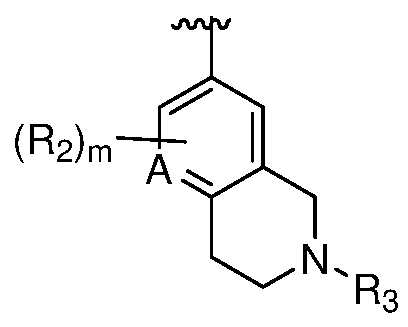

17. 단락 1-16 중 어느 하나에 있어서, 각 경우의 R2는 H, 할로겐, C1-4알킬, C1-4할로알킬, C1-4알콕시, C1-4할로알콕시이고; R3은 H, C1-6알킬, C1-6히드록시알킬, 또는 COCH2NR11R12이고, 여기서 각 경우의 R11 및 R12는 독립적으로 H 또는 C1-6알킬인 화합물 또는 그의 제약상 허용되는 염.17. The of any of paragraphs 1-16, wherein each occurrence of R 2 is H, halogen, C 1-4 alkyl, C 1-4 haloalkyl, C 1-4 alkoxy, C 1-4 haloalkoxy; R 3 is H, C 1-6 alkyl, C 1-6 hydroxyalkyl, or COCH 2 NR 11 R 12 , wherein each occurrence of R 11 and R 12 is independently H or C 1-6 alkyl; or A pharmaceutically acceptable salt thereof.
18. 단락 1-17 중 어느 하나에 있어서, 각 경우의 R2는 H, Cl, 또는 OCH3이고; R3은 H, C1-4알킬, C1-4히드록시알킬, 또는 COCH2N(CH3)2인 화합물 또는 그의 제약상 허용되는 염.18. The of any of paragraphs 1-17, wherein each occurrence of R 2 is H, Cl, or OCH 3 ; R 3 is H, C 1-4 alkyl, C 1-4 hydroxyalkyl, or COCH 2 N(CH 3 ) 2 , or a pharmaceutically acceptable salt thereof.
19. 하기 구조 화학식 (II)에 의해 나타내어진 화합물 또는 그의 제약상 허용되는 염.19. A compound represented by the following structural formula (II), or a pharmaceutically acceptable salt thereof.

여기서,here,
A1은 CR' 또는 N이고;A 1 is CR′ or N;
X는 -P(=O)R3'R4' 또는 -S(O)2NR5'R6'이고;X is —P(=O)R 3′ R 4′ or —S(O) 2 NR 5′ R 6′ ;
R'은 H, 중수소, 할로겐, CN, NO2, C1-6알킬, C2-6알케닐, C2-6알키닐, C1-6알콕시, NR11'R12', C(O)NR11'R12', C(O)C1-6알킬, C(O)OC1-6알킬, NR11'C(O)C1-6이고, 여기서 R'에 의해 나타내어지거나 또는 R'에 의해 나타내어진 기에서의 알킬, 알케닐, 알키닐 또는 알콕시는 할로겐, -OH, CN, C1-4알킬, C1-4할로알킬, C1-4알콕시, C1-4할로알콕시, 및 NR11'R12'로 이루어진 군으로부터 독립적으로 선택된 1 내지 3개의 치환기로 임의로 치환되고;R′ is H, deuterium, halogen, CN, NO 2 , C 1-6 alkyl, C 2-6 alkenyl, C 2-6 alkynyl, C 1-6 alkoxy, NR 11′ R 12′ , C(O )NR 11′ R 12′ , C(O)C 1-6 alkyl, C(O)OC 1-6 alkyl, NR 11′ C(O)C 1-6 , wherein is represented by R′ or R Alkyl, alkenyl, alkynyl or alkoxy in the group represented by ' is halogen, -OH, CN, C 1-4 alkyl, C 1-4 haloalkyl, C 1-4 alkoxy, C 1-4 haloalkoxy , and optionally substituted with 1 to 3 substituents independently selected from the group consisting of NR 11′ R 12′ ;
각 경우의 R1'은 독립적으로 H, 중수소, 할로겐, OH, CN, NO2, C1-6알킬, C2-6알케닐, C2-6알키닐, C1-6알콕시, NR11'R12', C(O)NR11'R12', C(O)C1-6알킬, C(O)OC1-6알킬, NR11'C(O)C1-6알킬, C3-7시클로알킬, 또는 3-7원 헤테로시클릴이고, 여기서 R1'에 의해 나타내어지거나 또는 R1'에 의해 나타내어진 기에서의 알킬, 알케닐, 알키닐, 알콕시, 시클로알킬, 또는 헤테로시클릴은 할로겐, -OH, CN, C1-4알킬, C1-4할로알킬, C1-4알콕시, C1-4할로알콕시, 및 NR11'R12'로 이루어진 군으로부터 독립적으로 선택된 1 내지 3개의 치환기로 임의로 치환되고;each occurrence of R 1′ is independently H, deuterium, halogen, OH, CN, NO 2 , C 1-6 alkyl, C 2-6 alkenyl, C 2-6 alkynyl, C 1-6 alkoxy, NR 11 ' R 12' , C(O)NR 11' R 12' , C(O)C 1-6 alkyl, C(O)OC 1-6 alkyl, NR 11' C(O)C 1-6 alkyl, C 3-7 cycloalkyl, or 3-7 membered heterocyclyl, wherein alkyl, alkenyl, alkynyl, alkoxy, cycloalkyl, or hetero in the group represented by R 1 ′ or represented by R 1′ cyclyl is independently selected from the group consisting of halogen, —OH, CN, C 1-4 alkyl, C 1-4 haloalkyl, C 1-4 alkoxy, C 1-4 haloalkoxy, and NR 11′ R 12′ optionally substituted with 1 to 3 substituents;
각 경우의 R2'는 독립적으로 H, 중수소, 할로겐, OH, CN, NO2, C1-6알킬, C2-6알케닐, C2-6알키닐, C1-6알콕시, NR11'R12', C(O)NR11'R12', C(O)C1-6알킬, C(O)OC1-6알킬, NR11'C(O)C1-6알킬, 페닐, 5-6원 헤테로아릴, C3-7시클로알킬, 또는 3-7원 헤테로시클릴이고, 여기서 R2'에 의해 나타내어지거나 또는 R2'에 의해 나타내어진 기에서의 알킬, 알케닐, 알키닐, 알콕시, 페닐, 헤테로아릴, 시클로알킬, 또는 헤테로시클릴은 할로겐, -OH, CN, C1-4알킬, C1-4할로알킬, C1-4알콕시, C1-4할로알콕시, 및 NR11'R12'로 이루어진 군으로부터 독립적으로 선택된 1 내지 3개의 치환기로 임의로 치환되고;each occurrence of R 2′ is independently H, deuterium, halogen, OH, CN, NO 2 , C 1-6 alkyl, C 2-6 alkenyl, C 2-6 alkynyl, C 1-6 alkoxy, NR 11 ' R 12' , C(O)NR 11' R 12' , C(O)C 1-6 alkyl, C(O)OC 1-6 alkyl, NR 11' C(O)C 1-6 alkyl, phenyl , 5-6 membered heteroaryl, C 3-7 cycloalkyl, or 3-7 membered heterocyclyl, wherein alkyl, alkenyl, alkyl in the group represented by R 2 ′ or represented by R 2′ nyl, alkoxy, phenyl, heteroaryl, cycloalkyl, or heterocyclyl is halogen, -OH, CN, C 1-4 alkyl, C 1-4 haloalkyl, C 1-4 alkoxy, C 1-4 haloalkoxy; and NR 11′ R 12′ optionally substituted with 1 to 3 substituents independently selected from the group consisting of;
각각의 R3' 및 R4'는 독립적으로 H, C1-6알킬, C2-6알케닐, C2-6알키닐이고, 여기서 R3' 또는 R4'에 의해 나타내어진 알킬, 알케닐, 또는 알키닐은 할로겐, -OH, CN, C1-4알킬, C1-4할로알킬, C1-4알콕시, C1-4할로알콕시, 및 NR11'R12'로 이루어진 군으로부터 독립적으로 선택된 1 내지 3개의 치환기로 임의로 치환되고;each R 3′ and R 4′ is independently H, C 1-6 alkyl, C 2-6 alkenyl, C 2-6 alkynyl, wherein the alkyl represented by R 3′ or R 4′ , al Kenyl, or alkynyl, is selected from the group consisting of halogen, —OH, CN, C 1-4 alkyl, C 1-4 haloalkyl, C 1-4 alkoxy, C 1-4 haloalkoxy, and NR 11′ R 12′ . optionally substituted with 1 to 3 independently selected substituents;
각각의 R5' 및 R6'은 독립적으로 H, C1-6알킬, C2-6알케닐, C2-6알키닐이고, 여기서 R5' 또는 R6'에 의해 나타내어진 알킬, 알케닐, 또는 알키닐은 할로겐, -OH, CN, C1-4알킬, C1-4할로알킬, C1-4알콕시, C1-4할로알콕시, 및 NR11'R12'로 이루어진 군으로부터 독립적으로 선택된 1 내지 3개의 치환기로 임의로 치환되거나; 또는each R 5′ and R 6′ is independently H, C 1-6 alkyl, C 2-6 alkenyl, C 2-6 alkynyl, wherein the alkyl represented by R 5′ or R 6′ , al Kenyl, or alkynyl, is selected from the group consisting of halogen, —OH, CN, C 1-4 alkyl, C 1-4 haloalkyl, C 1-4 alkoxy, C 1-4 haloalkoxy, and NR 11′ R 12′ . optionally substituted with 1 to 3 independently selected substituents; or
R5' 및 R6'은 이들이 부착되어 있는 질소 원자와 함께 할로겐, -OH, CN, C1-4알킬, C1-4할로알킬, C1-4알콕시, 또는 C1-4할로알콕시로 이루어진 군으로부터 독립적으로 선택된 1 내지 3개의 치환기로 임의로 치환된 3-7원 헤테로시클릴을 형성하고;R 5′ and R 6′ together with the nitrogen atom to which they are attached are halogen, —OH, CN, C 1-4 alkyl, C 1-4 haloalkyl, C 1-4 alkoxy, or C 1-4 haloalkoxy. form a 3-7 membered heterocyclyl optionally substituted with 1 to 3 substituents independently selected from the group consisting of;
각 경우의 R11' 및 R12'는 독립적으로 H 또는 C1-6알킬이고, 여기서 R11' 또는 R12'에 의해 나타내어진 알킬은 할로겐, -OH, CN, C1-4알킬, C1-4할로알킬, C1-4알콕시, C1-4할로알콕시, C3-6시클로알킬, 및 3-7원 헤테로시클릴로 이루어진 군으로부터 독립적으로 선택된 1 내지 3개의 치환기로 임의로 치환되거나, 또는each occurrence of R 11′ and R 12′ is independently H or C 1-6 alkyl, wherein the alkyl represented by R 11′ or R 12′ is halogen, —OH, CN, C 1-4 alkyl, C optionally substituted with 1 to 3 substituents independently selected from the group consisting of 1-4 haloalkyl, C 1-4 alkoxy, C 1-4 haloalkoxy, C 3-6 cycloalkyl, and 3-7 membered heterocyclyl; or
R11' 및 R12'는 이들이 부착되어 있는 질소 원자와 함께 할로겐, -OH, CN, C1-4알킬, C1-4할로알킬, C1-4알콕시, 또는 C1-4할로알콕시로 이루어진 군으로부터 독립적으로 선택된 1 내지 3개의 치환기로 임의로 치환된 3-7원 헤테로시클릴을 형성하고;R 11′ and R 12′ together with the nitrogen atom to which they are attached are halogen, —OH, CN, C 1-4 alkyl, C 1-4 haloalkyl, C 1-4 alkoxy, or C 1-4 haloalkoxy. form a 3-7 membered heterocyclyl optionally substituted with 1 to 3 substituents independently selected from the group consisting of;
m'은 0, 1, 또는 2이고;m' is 0, 1, or 2;
n'은 0, 1, 또는 2이다.n' is 0, 1, or 2.
20. 단락 19에 있어서, 하기 구조 화학식 (II-1)에 의해 나타내어진 화합물 또는 그의 제약상 허용되는 염.20. The compound according to paragraph 19, represented by the following structural formula (II-1), or a pharmaceutically acceptable salt thereof.

여기서,here,
A1은 CR' 또는 N이고;A 1 is CR′ or N;
R'은 H, 할로겐, NR11'R12', 또는 할로겐, -OH, CN, C1-4알킬, C1-4할로알킬, C1-4알콕시, C1-4할로알콕시, 및 NR11'R12'로 이루어진 군으로부터 독립적으로 선택된 1 내지 3개의 치환기로 임의로 치환된 C1-6알킬이다.R′ is H, halogen, NR 11′ R 12′ , or halogen, —OH, CN, C 1-4 alkyl, C 1-4 haloalkyl, C 1-4 alkoxy, C 1-4 haloalkoxy, and NR 11′ R 12′ is C 1-6 alkyl optionally substituted with 1 to 3 substituents independently selected from the group consisting of.
21. 단락 19 또는 20에 있어서,21. Paragraph 19 or 20,
X는 -P(=O)R3'R4' 또는 -S(O)2NR5'R6'이고;X is —P(=O)R 3′ R 4′ or —S(O) 2 NR 5′ R 6′ ;
각각의 R3' 및 R4'는 독립적으로 H, 또는 할로겐, -OH, CN, C1-4알킬, C1-4할로알킬, C1-4알콕시, C1-4할로알콕시, 및 NR11R12로 이루어진 군으로부터 독립적으로 선택된 1 내지 3개의 치환기로 임의로 치환된 C1-6알킬이고;each R 3′ and R 4′ is independently H, or halogen, —OH, CN, C 1-4 alkyl, C 1-4 haloalkyl, C 1-4 alkoxy, C 1-4 haloalkoxy, and NR 11 R 12 C 1-6 alkyl optionally substituted with 1 to 3 substituents independently selected from the group consisting of;
각각의 R5' 및 R6'은 독립적으로 H 또는 C1-6알킬이거나, 또는each R 5′ and R 6′ is independently H or C 1-6 alkyl, or
R5' 및 R6'은 이들이 부착되어 있는 질소 원자와 함께 할로겐, -OH, CN, C1-4알킬, C1-4할로알킬, C1-4알콕시, 또는 C1-4할로알콕시로 이루어진 군으로부터 독립적으로 선택된 1 내지 3개의 치환기로 임의로 치환된 3-7원 헤테로시클릴을 형성하는 것인R 5′ and R 6′ together with the nitrogen atom to which they are attached are halogen, —OH, CN, C 1-4 alkyl, C 1-4 haloalkyl, C 1-4 alkoxy, or C 1-4 haloalkoxy. Forming a 3-7 membered heterocyclyl optionally substituted with 1 to 3 substituents independently selected from the group consisting of
화합물 또는 그의 제약상 허용되는 염.A compound or a pharmaceutically acceptable salt thereof.
22. 단락 19-21 중 어느 하나에 있어서, 각 경우의 R1'은 독립적으로 H, 할로겐, C1-6알킬, C2-6알케닐, C2-6알키닐, C3-7시클로알킬, 또는 3-7원 헤테로시클릴이고, 여기서 R1'에 의해 나타내어진 알킬, 알케닐, 알키닐, 시클로알킬, 또는 헤테로시클릴은 할로겐, -OH, CN, C1-4알킬, C1-4할로알킬, C1-4알콕시, C1-4할로알콕시, 및 NR11'R12'로 이루어진 군으로부터 독립적으로 선택된 1 내지 3개의 치환기로 임의로 치환되는 것인 화합물 또는 그의 제약상 허용되는 염.22. The clauses of any one of paragraphs 19-21, wherein each occurrence of R 1′ is independently H, halogen, C 1-6 alkyl, C 2-6 alkenyl, C 2-6 alkynyl, C 3-7 cyclo alkyl, or 3-7 membered heterocyclyl, wherein the alkyl, alkenyl, alkynyl, cycloalkyl, or heterocyclyl represented by R 1′ is halogen, —OH, CN, C 1-4 alkyl, C 1-4 haloalkyl, C 1-4 alkoxy, C 1-4 haloalkoxy, and NR 11' R 12' optionally substituted with 1 to 3 substituents independently selected from the group consisting of, or a pharmaceutically acceptable compound thereof salt to be.
23. 단락 19-22 중 어느 하나에 있어서, 각 경우의 R2'는 독립적으로 H, 할로겐, OH, NH2, C1-6알킬, C1-6알콕시, NR11'R12', C(O)NR11'R12', C(O)C1-6알킬, C(O)OC1-6알킬, NR11'C(O)C1-6알킬, 5-6원 헤테로아릴, 또는 3-7원 헤테로시클릴이고, 여기서 R2'에 의해 나타내어지거나 또는 R2'에 의해 나타내어진 기에서의 알킬, 알콕시, 헤테로아릴, 또는 헤테로시클릴은 할로겐, -OH, CN, C1-4알킬, C1-4할로알킬, C1-4알콕시, C1-4할로알콕시, 및 NR11'R12'로 이루어진 군으로부터 독립적으로 선택된 1 내지 3개의 치환기로 임의로 치환되는 것인 화합물 또는 그의 제약상 허용되는 염.23. The method of any one of paragraphs 19-22, wherein each occurrence of R 2′ is independently H, halogen, OH, NH 2 , C 1-6 alkyl, C 1-6 alkoxy, NR 11′ R 12′ , C (O)NR 11′ R 12′ , C(O)C 1-6 alkyl, C(O)OC 1-6 alkyl, NR 11′ C(O)C 1-6 alkyl, 5-6 membered heteroaryl, or 3-7 membered heterocyclyl, wherein alkyl, alkoxy, heteroaryl, or heterocyclyl in the group represented by R 2 ′ or represented by R 2′ is halogen, —OH, CN, C 1 compound optionally substituted with 1 to 3 substituents independently selected from the group consisting of -4 alkyl, C 1-4 haloalkyl, C 1-4 alkoxy, C 1-4 haloalkoxy, and NR 11′ R 12′ or a pharmaceutically acceptable salt thereof.
24. 단락 19-23 중 어느 하나에 있어서, 하기 구조 화학식 (II-2) 또는 (II-2')에 의해 나타내어진 화합물 또는 그의 제약상 허용되는 염.24. The compound according to any one of paragraphs 19-23, represented by the following structural formula (II-2) or (II-2'), or a pharmaceutically acceptable salt thereof.

여기서, A1은 CR' 또는 N이고; R'은 H, 할로겐, 또는 NH2이다.wherein A 1 is CR′ or N; R′ is H, halogen, or NH 2 .
25. 단락 19-24 중 어느 하나에 있어서, 각 경우의 R2'는 독립적으로 H, 할로겐, OH; 할로겐 또는 OH 또는 NR11'R12'로 임의로 치환된 C1-4알킬; C1-4알콕시, C(O)OC1-6알킬, C(O)NR11'R12', NR11'R12', NR11'C(O)C1-6알킬, 5-6원 헤테로시클릴 (피롤리디닐 또는 피롤리딘-2-온), 또는 헤테로아릴 (옥사졸)인 화합물 또는 그의 제약상 허용되는 염.25. The method of any one of paragraphs 19-24, wherein each occurrence of R 2′ is independently H, halogen, OH; C 1-4 alkyl optionally substituted with halogen or OH or NR 11′ R 12′ ; C 1-4 alkoxy, C(O)OC 1-6 alkyl, C(O)NR 11' R 12' , NR 11' R 12' , NR 11' C(O)C 1-6 alkyl, 5-6 A compound that is membered heterocyclyl (pyrrolidinyl or pyrrolidin-2-one), or heteroaryl (oxazole), or a pharmaceutically acceptable salt thereof.
26. 단락 19-25 중 어느 하나에 있어서,26. The method of any of paragraphs 19-25,
X는 -P(=O)R3'R4' 또는 -S(O)2NR5'R6'이고;X is —P(=O)R 3′ R 4′ or —S(O) 2 NR 5′ R 6′ ;
R3' 및 R4'는 독립적으로 C1-6알킬이고;R 3′ and R 4′ are independently C 1-6 alkyl;
R5' 및 R6'은 독립적으로 H 또는 C1-6알킬인R 5′ and R 6′ are independently H or C 1-6 alkyl
화합물 또는 그의 제약상 허용되는 염.A compound or a pharmaceutically acceptable salt thereof.
27. 단락 19-26 중 어느 하나에 있어서, 각 경우의 R1'은 독립적으로 H 또는 C1-4알킬인 화합물 또는 그의 제약상 허용되는 염.27. The compound of any of paragraphs 19-26, or a pharmaceutically acceptable salt thereof, wherein each occurrence of R 1′ is independently H or C 1-4 alkyl.
28. 단락 19-27 중 어느 하나에 있어서, 각 경우의 R2'는 독립적으로 H, 할로겐, OH; 할로겐 또는 OH 또는 NR11'R12'로 임의로 치환된 C1-4알킬; C1-4알콕시, C(O)OC1-4알킬, C(O)NR11'R12', NR11'R12', NHC(O)C1-6알킬, 피롤리디닐, 피롤리딘-2-온, 옥사졸이고, 여기서 각 경우의 R11' 및 R12'는 독립적으로 H 또는 C1-4알킬인 화합물 또는 그의 제약상 허용되는 염.28. The of any of paragraphs 19-27, wherein each occurrence of R 2′ is independently H, halogen, OH; C 1-4 alkyl optionally substituted with halogen or OH or NR 11′ R 12′ ; C 1-4 alkoxy, C(O)OC 1-4 alkyl, C(O)NR 11' R 12' , NR 11' R 12' , NHC(O)C 1-6 alkyl, pyrrolidinyl, pyrroly Din-2-one, oxazole, wherein each occurrence of R 11′ and R 12′ is independently H or C 1-4 alkyl, or a pharmaceutically acceptable salt thereof.
29. 단락 19-28 중 어느 하나에 있어서, X는 -P(O)(CH3)2 또는 -S(O)2NHMe인 화합물 또는 그의 제약상 허용되는 염.29. The compound of any of paragraphs 19-28, or a pharmaceutically acceptable salt thereof, wherein X is —P(O)(CH 3 ) 2 or —S(O) 2 NHMe.
30. 단락 19-29 중 어느 하나에 있어서, 각 경우의 R2'는 독립적으로 H, F, Cl, OH, CH3, NH2, 또는 -NHCOCH3인 화합물 또는 그의 제약상 허용되는 염.30. The compound of any of paragraphs 19-29, or a pharmaceutically acceptable salt thereof, wherein each occurrence of R 2′ is independently H, F, Cl, OH, CH 3 , NH 2 , or —NHCOCH 3 .
31. 단락 19-30 중 어느 하나에 있어서, X는 -P(=O)(CH3)2인 화합물 또는 그의 제약상 허용되는 염.31. The compound of any of paragraphs 19-30, or a pharmaceutically acceptable salt thereof, wherein X is —P(=O)(CH 3 ) 2 .
한 실시양태에서, 화합물, 또는 그의 제약상 허용되는 염 또는 입체이성질체는 화학식 (I-0), (I-1), (I-2), (I), (II), (II-1), (II-2) 또는 (II-2')의 화합물로부터, 또는 실시예에서 선택된다.In one embodiment, the compound, or a pharmaceutically acceptable salt or stereoisomer thereof, is of formula (I-0), (I-1), (I-2), (I), (II), (II-1) , (II-2) or (II-2'), or in the Examples.
특정 실시양태에서, HPK1 억제제 (본 발명의 화합물)는 Lck, ZAP70, JAK3, PKC 세타, TBK1 및 MAP4K3으로부터 선택되는 1종 이상의 키나제에 비해 선택적이다. 특정 실시양태에서, 본 발명의 HPK1 억제제는 Lck, ZAP70 및 JAK3으로부터 선택되는 1종 이상의 키나제에 비해 선택적이다. 특정 실시양태에서, 본 발명의 HPK1 억제제는 JAK3에 비해 선택적이다.In certain embodiments, the HPK1 inhibitor (compound of the invention) is selective over one or more kinases selected from Lck, ZAP70, JAK3, PKC theta, TBK1 and MAP4K3. In certain embodiments, an HPK1 inhibitor of the invention is selective over one or more kinases selected from Lck, ZAP70 and JAK3. In certain embodiments, HPK1 inhibitors of the invention are selective over JAK3.
예를 들어, 대상 HPK1 억제제는 Lck에 대한 IC50이 HPK1에 대한 IC50보다 적어도 2-, 3-, 5-, 10-, 20-, 40-, 50-, 75-, 100-, 150-, 200-, 300-, 400-, 500-, 600-, 750-, 또는 1000-배 더 높은 정도로 Lck에 비해 선택적이다.For example, a subject HPK1 inhibitor has an IC50 for Lck that is at least 2-, 3-, 5-, 10-, 20-, 40-, 50-, 75-, 100-, 150-, 200 -, 300-, 400-, 500-, 600-, 750-, or 1000-fold higher degree of selective relative to Lck.
특정 실시양태에서, HPK1 억제제는 ZAP70에 대한 IC50이 HPK1에 대한 IC50보다 적어도 2-, 3-, 5-, 10-, 20-, 40-, 50-, 75-, 100-, 150-, 200-, 300-, 400-, 500-, 600-, 750- 또는 1000-배 더 높은 정도로 ZAP70에 비해 선택적이다.In certain embodiments, the HPK1 inhibitor has an IC50 for ZAP70 of at least 2-, 3-, 5-, 10-, 20-, 40-, 50-, 75-, 100-, 150-, 200 -, 300-, 400-, 500-, 600-, 750- or 1000-fold higher than ZAP70.
특정 실시양태에서, HPK1 억제제는 JAK3에 대한 IC50이 HPK1에 대한 IC50보다 적어도 2-, 3-, 5-, 10-, 20-, 40-, 50-, 75-, 100-, 150-, 200-, 300-, 400-, 500-, 600-, 750-, 또는 1000-배 더 높은 정도로 JAK3에 비해 선택적이다.In certain embodiments, the HPK1 inhibitor has an IC50 for JAK3 of at least 2-, 3-, 5-, 10-, 20-, 40-, 50-, 75-, 100-, 150-, 200 -, 300-, 400-, 500-, 600-, 750-, or 1000-fold higher degree of selective over JAK3.
특정 실시양태에서, HPK1 억제제는 PKC 세타에 대한 IC50이 HPK1에 대한 IC50보다 적어도 2-, 3-, 5-, 10-, 20-, 40-, 50-, 75-, 100-, 150-, 200-, 300-, 400-, 500-, 600-, 750-, 또는 1000-배 더 높은 정도로 PKC 세타에 비해 선택적이다.In certain embodiments, the HPK1 inhibitor has an IC50 for PKC theta of at least 2-, 3-, 5-, 10-, 20-, 40-, 50-, 75-, 100-, 150-, Selective over PKC theta to a 200-, 300-, 400-, 500-, 600-, 750-, or 1000-fold higher degree.
특정 실시양태에서, HPK1 억제제는 TBK1에 대한 IC50이 HPK1에 대한 IC50보다 적어도 2-, 3-, 5-, 10-, 20-, 40-, 50-, 75-, 100-, 150-, 200-, 300-, 400-, 500-, 600-, 750-, 또는 1000-배 더 높은 정도로 TBK1에 비해 선택적이다.In certain embodiments, the HPK1 inhibitor has an IC50 for TBK1 that is at least 2-, 3-, 5-, 10-, 20-, 40-, 50-, 75-, 100-, 150-, 200 -, 300-, 400-, 500-, 600-, 750-, or 1000-fold higher degree of selective over TBK1.
특정 실시양태에서, HPK1 억제제는 MAP4K3에 대한 IC50이 HPK1에 대한 IC50보다 적어도 2-, 3-, 5-, 10-, 20-, 40-, 50-, 75-, 100-, 150-, 200-, 300-, 400-, 500-, 600-, 750-, 또는 1000-배 더 높은 정도로 MAP4K3에 비해 선택적이다.In certain embodiments, the HPK1 inhibitor has an IC50 for MAP4K3 at least 2-, 3-, 5-, 10-, 20-, 40-, 50-, 75-, 100-, 150-, 200 -, 300-, 400-, 500-, 600-, 750-, or 1000-fold higher than MAP4K3.
HPK1, Lck, ZAP70, PKC 세타, JAK3, TBK1 및 MAP4K3에 대한 활성은 임의의 관련 기술분야에 인정된 방법, 예컨대 생물학 실시예, 예컨대 생물학 실시예 1-7에 기재된 예시적인 프로토콜 (모두 본원에 참조로 포함됨)을 사용하여 측정될 수 있다 (예를 들어, IC50 값에 의해 측정됨).Activity against HPK1, Lck, ZAP70, PKC theta, JAK3, TBK1 and MAP4K3 can be obtained by any art-recognized method, such as the exemplary protocols described in the Biology Examples, such as Biology Examples 1-7 (all herein incorporated by reference). included as ) (eg, measured by IC50 values).
4. 치료가능한 질환4. TREATABLE DISEASES
HPK1 억제제, 그의 제약상 허용되는 염, 그의 제약 조성물은 HPK1 활성의 조정 (즉, 억제) 방법에 사용될 수 있으며, 상기 방법은 HPK1 활성의 조정 (즉, 억제)을 필요로 하는 환자/대상체에게 본원에 기재된 바와 같은 본 발명의 HPK1 억제제 화합물 또는 그의 제약상 허용되는 염을 투여하는 것을 포함한다.HPK1 inhibitors, pharmaceutically acceptable salts thereof, pharmaceutical compositions thereof can be used in a method of modulating (ie, inhibiting) HPK1 activity, which method is provided herein to a patient/subject in need of modulating (ie, inhibiting) HPK1 activity. and administering the HPK1 inhibitor compound of the present invention, or a pharmaceutically acceptable salt thereof, as described in
특히, 본 발명은 질환, 특히 암 (특히 조혈 및 고형 종양) 또는 조절이상 면역 반응을 갖는 상태 또는 이상 MAP4K1 신호전달과 연관된 다른 장애의 치료 또는 예방에 사용하기 위한, 본 발명의 화합물, 또는 그의 입체이성질체, 호변이성질체, N-옥시드, 수화물, 용매화물 및 염, 특히 그의 제약상 허용되는 염, 또는 그의 혼합물의 용도를 제공한다. 본 발명에 따른 화합물의 제약 활성은 적어도 부분적으로 MAP4K1 억제제로서의 그의 활성에 의해 설명될 수 있다.In particular, the present invention relates to a compound of the present invention, or a conformation thereof, for use in the treatment or prophylaxis of a disease, in particular cancer (especially hematopoietic and solid tumors) or conditions having a dysregulated immune response or other disorders associated with aberrant MAP4K1 signaling isomers, tautomers, N-oxides, hydrates, solvates and salts, particularly pharmaceutically acceptable salts thereof, or mixtures thereof. The pharmaceutical activity of the compounds according to the invention can be explained at least in part by their activity as MAP4K1 inhibitors.
특정 실시양태에서, 본 발명의 화합물 또는 그의 제약상 허용되는 염은 양성 증식증, 아테롬성동맥경화성 장애, 패혈증, 자가면역 장애, 혈관 장애, 바이러스 감염, 신경변성 장애, 염증성 장애 및 남성 생식 조절 장애를 포함하나 이에 제한되지는 않는 질환 또는 적응증을 치료하기 위한, 그를 필요로 하는 대상체에게의 치료적 투여에 유용하다.In certain embodiments, a compound of the invention, or a pharmaceutically acceptable salt thereof, comprises benign hyperplasia, atherosclerotic disorders, sepsis, autoimmune disorders, vascular disorders, viral infections, neurodegenerative disorders, inflammatory disorders and disorders of male reproductive control. It is useful for therapeutic administration to a subject in need thereof, for the treatment of, but not limited to, a disease or indication.
특정 실시양태에서, 본 발명의 화합물 또는 그의 제약상 허용되는 염은 암 치료에서 면역을 증진, 자극 및/또는 증가시키기 위한 치료적 투여에 유용하다.In certain embodiments, a compound of the present invention, or a pharmaceutically acceptable salt thereof, is useful for therapeutic administration to enhance, stimulate and/or increase immunity in the treatment of cancer.
본 발명의 HPK1 억제제 화합물은 단독으로, 또는 다른 작용제 또는 요법과 조합하여, 또는 암을 비롯한 질환 또는 장애의 치료를 위한 아주반트 또는 네오아주반트로서 사용될 수 있다.The HPK1 inhibitor compounds of the present invention may be used alone or in combination with other agents or therapies, or as adjuvants or neoadjuvants for the treatment of diseases or disorders, including cancer.
특정 실시양태에서, 본 발명의 방법은 골암, 췌장암, 피부암, 두경부암, 피부 또는 안내 악성 흑색종, 자궁암, 난소암, 직장암, 항문부암, 위암, 고환암, 자궁암, 난관 암종, 자궁내막 암종, 자궁내막암, 자궁경부 암종, 질 암종, 외음부 암종, 호지킨병, 비-호지킨 림프종, 식도암, 소장암, 내분비계암, 갑상선암, 부갑상선암, 부신암, 연부 조직 육종, 요도암, 음경암, 급성 골수성 백혈병, 만성 골수성 백혈병, 급성 림프모구성 백혈병, 만성 림프구성 백혈병을 포함한 만성 또는 급성 백혈병, 소아기 고형 종양, 림프구성 림프종, 방광암, 신장암 또는 요도암, 신우 암종, 중추 신경계 (CNS)의 신생물, 원발성 CNS 림프종, 종양 혈관신생, 척수축 종양, 뇌간 신경교종, 뇌하수체 선종, 카포시 육종, 표피양암, 편평 세포암, T-세포 림프종, 석면에 의해 유발된 것을 포함한 환경적으로 유발된 암, 및 상기 암의 조합을 포함하나 이에 제한되지는 않는 암의 치료에 사용될 수 있다.In certain embodiments, the methods of the present invention include bone cancer, pancreatic cancer, skin cancer, head and neck cancer, skin or intraocular malignant melanoma, uterine cancer, ovarian cancer, rectal cancer, anal cancer, stomach cancer, testicular cancer, uterine cancer, fallopian tube carcinoma, endometrial carcinoma, uterus Endometrial cancer, cervical carcinoma, vaginal carcinoma, vulvar carcinoma, Hodgkin's disease, non-Hodgkin's lymphoma, esophageal cancer, small intestine cancer, endocrine system cancer, thyroid cancer, parathyroid cancer, adrenal cancer, soft tissue sarcoma, urethral cancer, penile cancer, acute Chronic or acute leukemia, including myeloid leukemia, chronic myelogenous leukemia, acute lymphoblastic leukemia, chronic lymphocytic leukemia, childhood solid tumors, lymphocytic lymphoma, bladder cancer, renal or urethral cancer, renal pelvic carcinoma, renal in the central nervous system (CNS) Environmentally induced cancers, including those caused by biological, primary CNS lymphoma, tumor angiogenesis, spinal cord tumor, brainstem glioma, pituitary adenoma, Kaposi's sarcoma, epithelial carcinoma, squamous cell carcinoma, T-cell lymphoma, asbestos; and combinations of the above cancers.
일부 실시양태에서, 본 발명의 화합물로 치료가능한 암은 흑색종 (예를 들어, 전이성 악성 흑색종), 신암 (예를 들어, 투명 세포 암종), 전립선암 (예를 들어, 호르몬 불응성 전립선 선암종), 유방암, 삼중-음성 유방암, 결장암 및 폐암 (예를 들어, 비소세포 폐암 및 소세포 폐암)을 포함한다. 추가로, 본 발명의 화합물을 사용하여 성장이 억제될 수 있는 불응성 또는 재발성 악성종양이 또한 치료가능하다.In some embodiments, the cancer treatable with a compound of the invention is melanoma (eg, metastatic malignant melanoma), renal cancer (eg, clear cell carcinoma), prostate cancer (eg, hormone refractory prostate adenocarcinoma) ), breast cancer, triple-negative breast cancer, colon cancer and lung cancer (eg, non-small cell lung cancer and small cell lung cancer). Additionally, refractory or relapsed malignancies for which growth may be inhibited are also treatable using the compounds of the present invention.
일부 실시양태에서, 본 발명의 화합물을 사용하여 치료가능한 암은 고형 종양 (예를 들어, 전립선암, 결장암, 식도암, 자궁내막암, 난소암, 자궁암, 신암, 간암, 췌장암, 위암, 유방암, 폐암, 기도암, 뇌암, 안암, 갑상선암 및 부갑상선암, 피부암, 두경부암, 생식 기관암, 소화관암, 요로암, 교모세포종, 육종, 방광암 등), 혈액암 (예를 들어, 림프종, 백혈병, 예컨대 급성 림프모구성 백혈병 (ALL), 급성 골수 백혈병 (AML), 만성 림프구성 백혈병 (CLL), 만성 골수 백혈병 (CML), DLBCL, 외투 세포 림프종, 비-호지킨 림프종 (재발성 또는 불응성 NHL 및 재발성 여포성 포함), 호지킨 림프종 또는 다발성 골수종), 육종, 및 그의 원격 전이를 포함하나 이에 제한되지는 않는다.In some embodiments, the cancer treatable using the compounds of the present invention is a solid tumor (eg, prostate cancer, colon cancer, esophageal cancer, endometrial cancer, ovarian cancer, uterine cancer, renal cancer, liver cancer, pancreatic cancer, gastric cancer, breast cancer, lung cancer) , airway cancer, brain cancer, eye cancer, thyroid and parathyroid cancer, skin cancer, head and neck cancer, reproductive tract cancer, gastrointestinal cancer, urinary tract cancer, glioblastoma, sarcoma, bladder cancer, etc.), blood cancer (eg lymphoma, leukemia, such as acute Lymphoblastic leukemia (ALL), acute myeloid leukemia (AML), chronic lymphocytic leukemia (CLL), chronic myelogenous leukemia (CML), DLBCL, mantle cell lymphoma, non-Hodgkin's lymphoma (relapsed or refractory NHL and relapsed) follicular), Hodgkin's lymphoma or multiple myeloma), sarcoma, and distant metastases thereof.
일부 실시양태에서, 본 발명의 화합물을 사용하여 치료가능한 질환 및 적응증은 혈액암, 육종, 폐암, 위장암, 비뇨생식관암, 간암, 골암, 신경계암, 부인과암 및 피부암을 포함하나 이에 제한되지는 않는다.In some embodiments, diseases and indications treatable using the compounds of the present invention include, but are not limited to, hematologic cancer, sarcoma, lung cancer, gastrointestinal cancer, genitourinary tract cancer, liver cancer, bone cancer, nervous system cancer, gynecological cancer and skin cancer. does not
예시적인 혈액암은 림프종 및 백혈병, 예컨대 급성 림프모구성 백혈병 (ALL), 급성 골수 백혈병 (AML), 급성 전골수구 백혈병 (APL), 만성 림프구성 백혈병 (CLL), 만성 골수 백혈병 (CML), 미만성 대 B-세포 림프종 (DLBCL), 외투 세포 림프종, 비-호지킨 림프종 (재발성 또는 불응성 NHL 및 재발성 여포성 포함), 호지킨 림프종, 골수증식성 질환 (예를 들어, 원발성 골수섬유증 (PMF), 진성 적혈구증가증 (PV), 본태성 혈소판증가증 (ET), 골수이형성증 증후군 (MDS), T-세포 급성 림프모구성 림프종 (T-ALL), 다발성 골수종, 피부 T-세포 림프종, 발덴스트롬 마크로글로불린혈증, 모발상 세포 림프종, 만성 골수 림프종, 및 버킷 림프종을 포함한다.Exemplary hematologic cancers include lymphomas and leukemias such as acute lymphoblastic leukemia (ALL), acute myeloid leukemia (AML), acute promyelocytic leukemia (APL), chronic lymphocytic leukemia (CLL), chronic myelogenous leukemia (CML), diffuse Large B-cell lymphoma (DLBCL), mantle cell lymphoma, non-Hodgkin's lymphoma (including relapsed or refractory NHL and relapsed follicular), Hodgkin's lymphoma, myeloproliferative disease (e.g., primary myelofibrosis ( PMF), polycythemia vera (PV), essential thrombocytosis (ET), myelodysplastic syndrome (MDS), T-cell acute lymphoblastic lymphoma (T-ALL), multiple myeloma, cutaneous T-cell lymphoma, Waldenstrom macroglobulinemia, hairy cell lymphoma, chronic myelogenous lymphoma, and Burkitt's lymphoma.
예시적인 육종은 연골육종, 유잉 육종, 골육종, 횡문근육종, 혈관육종, 섬유육종, 지방육종, 점액종, 횡문근종, 횡문근육종, 섬유종, 지방종, 과오종 및 기형종을 포함한다.Exemplary sarcomas include chondrosarcoma, Ewing's sarcoma, osteosarcoma, rhabdomyosarcoma, angiosarcoma, fibrosarcoma, liposarcoma, myxoma, rhabdomyosarcoma, rhabdomyosarcoma, fibroma, lipoma, hamartoma and teratoma.
예시적인 폐암은 비소세포 폐암 (NSCLC), 소세포 폐암, 기관지원성 암종 (편평 세포, 미분화 소세포, 미분화 대세포, 선암종), 폐포 (세기관지) 암종, 기관지 선종, 연골성 과오종 및 중피종을 포함한다.Exemplary lung cancers include non-small cell lung cancer (NSCLC), small cell lung cancer, bronchogenic carcinoma (squamous cell, undifferentiated small cell, undifferentiated large cell, adenocarcinoma), alveolar (bronchiolar) carcinoma, bronchial adenoma, chondrocarcinoma and mesothelioma.
예시적인 위장암은 식도암 (편평 세포 암종, 선암종, 평활근육종, 림프종), 위암 (암종, 림프종, 평활근육종), 췌장암 (관 선암종, 인슐린종, 글루카곤종, 가스트린종, 카르시노이드 종양, 비포마), 소장암 (선암종, 림프종, 카르시노이드 종양, 카포시 육종, 평활근종, 혈관종, 지방종, 신경섬유종, 섬유종), 대장암 (선암종, 관상 선종, 융모성 선종, 과오종, 평활근종), 및 결장직장암을 포함한다.Exemplary gastrointestinal cancers include esophageal cancer (squamous cell carcinoma, adenocarcinoma, leiomyosarcoma, lymphoma), gastric cancer (carcinoma, lymphoma, leiomyosarcoma), pancreatic cancer (ductal adenocarcinoma, insulinoma, glucagonoma, gastrinoma, carcinoid tumor, biforma) ), small intestine cancer (adenocarcinoma, lymphoma, carcinoid tumor, Kaposi's sarcoma, leiomyoma, hemangioma, lipoma, neurofibroma, fibroma), colorectal cancer (adenocarcinoma, tubular adenoma, villous adenoma, hamartoma, leiomyoma), and colorectal cancer include
예시적인 비뇨생식관암은 신장암 (선암종, 윌름스 종양 [신모세포종]), 방광암 및 요도암 (편평 세포 암종, 이행 세포 암종, 선암종), 전립선암 (선암종, 육종), 및 고환암 (정상피종, 기형종, 배아성 암종, 기형암종, 융모막암종, 육종, 간질 세포 암종, 섬유종, 섬유선종, 선종양 종양, 지방종)을 포함한다.Exemplary genitourinary tract cancers include kidney cancer (adenocarcinoma, Wilms' tumor [nephroblastoma]), bladder and urethral cancer (squamous cell carcinoma, transitional cell carcinoma, adenocarcinoma), prostate cancer (adenocarcinoma, sarcoma), and testicular cancer (semenothelioma, teratoma, embryonic carcinoma, teratocarcinoma, choriocarcinoma, sarcoma, stromal cell carcinoma, fibroma, fibroadenoma, adenomatous tumor, lipoma).
예시적인 간암은 간세포암 (간세포성 암종), 담관암종, 간모세포종, 혈관육종, 간세포성 선종 및 혈관종을 포함한다.Exemplary liver cancers include hepatocellular carcinoma (hepatocellular carcinoma), cholangiocarcinoma, hepatoblastoma, hemangiosarcoma, hepatocellular adenoma, and hemangioma.
예시적인 골암은, 예를 들어 골원성 육종 (골육종), 섬유육종, 악성 섬유 조직구종, 연골육종, 유잉 육종, 악성 림프종 (세망 세포 육종), 다발성 골수종, 악성 거대 세포 종양 척삭종, 골연골종 (골연골성 외골증), 양성 연골종, 연골모세포종, 연골점액섬유종, 유골 골종 및 거대 세포 종양을 포함한다.Exemplary bone cancers include, for example, osteogenic sarcoma (osteosarcoma), fibrosarcoma, malignant fibrous histiocytoma, chondrosarcoma, Ewing's sarcoma, malignant lymphoma (reticular cell sarcoma), multiple myeloma, malignant giant cell tumor chordoma, osteochondroma ( osteochondrosis), benign chondromas, chondroblastomas, chondromycofibromas, osteomyelomas, and giant cell tumors.
예시적인 신경계 암은 두개골암 (골종, 혈관종, 육아종, 황색종, 변형성 골염), 수막암 (수막종, 수막육종, 신경교종증), 뇌암 (성상세포종, 수모세포종, 신경교종, 상의세포종, 배세포종 (송과체종), 교모세포종, 다형성 교모세포종, 핍지교종, 슈반세포종, 망막모세포종, 선천성 종양), 및 척수암 (신경섬유종, 수막종, 신경교종, 육종), 뿐만 아니라 신경모세포종 및 레르미트-두크로스병을 포함한다.Exemplary cancers of the nervous system include cranial cancer (osteoma, hemangioma, granuloma, xanthomas, osteomyelitis), meningioma (meningioma, meningiosarcoma, gliomatosis), brain cancer (astrocytoma, medulloblastoma, glioma, ependymoma, germ cell tumor ( pineal tumor), glioblastoma, glioblastoma multiforme, oligodendroglioma, Schwann celloma, retinoblastoma, congenital tumor), and spinal cancer (neurofibroma, meningioma, glioma, sarcoma), as well as neuroblastoma and Lermitt-Ducros disease. include
예시적인 부인과암은 자궁암 (자궁내막 암종), 자궁경부암 (자궁경부 암종, 전-종양 자궁경부 이형성증), 난소암 (난소 암종 (장액성 낭선암종, 점액성 낭선암종, 미분류 암종), 과립-난포막 세포 종양, 세르톨리-라이디히 세포 종양, 미분화배세포종, 악성 기형종), 외음부암 (편평 세포 암종, 상피내 암종, 선암종, 섬유육종, 흑색종), 질암 (투명 세포 암종, 편평 세포 암종, 포도상 육종 (배아성 횡문근육종), 및 난관암 (암종)을 포함한다.Exemplary gynecological cancers are uterine cancer (endometrium carcinoma), cervical cancer (cervical carcinoma, pre-tumor cervical dysplasia), ovarian cancer (ovarian carcinoma (serous cystadenocarcinoma, mucinous cystadenocarcinoma, unclassified carcinoma), granule-follicle Membrane cell tumor, Sertoli-Reidich cell tumor, undifferentiated germ cell tumor, malignant teratoma), vulvar cancer (squamous cell carcinoma, intraepithelial carcinoma, adenocarcinoma, fibrosarcoma, melanoma), vaginal cancer (clear cell carcinoma, squamous cell carcinoma, staphylococcal sarcoma (embryonic rhabdomyosarcoma), and fallopian tube cancer (carcinoma).
예시적인 피부암은 흑색종, 기저 세포 암종, 편평 세포 암종, 카포시 육종, 메르켈 세포 피부암, 이형성 모반, 지방종, 혈관종, 피부섬유종 및 켈로이드를 포함한다. 일부 실시양태에서, 본 발명의 화합물을 사용하여 치료가능한 질환 및 적응증은 겸상 적혈구 질환 (예를 들어, 겸상 적혈구성 빈혈), 삼중-음성 유방암 (TNBC), 골수이형성 증후군, 고환암, 담관암, 식도암 및 요로상피 암종을 포함하나 이에 제한되지는 않는다.Exemplary skin cancers include melanoma, basal cell carcinoma, squamous cell carcinoma, Kaposi's sarcoma, Merkel cell skin cancer, nevus dysplastic, lipoma, hemangioma, dermatofibroma, and keloid. In some embodiments, diseases and indications treatable using the compounds of the present invention include sickle cell disease (eg, sickle cell anemia), triple-negative breast cancer (TNBC), myelodysplastic syndrome, testicular cancer, cholangiocarcinoma, esophageal cancer and including but not limited to urothelial carcinoma.
예시적인 두경부암은 교모세포종, 흑색종, 횡문근육종, 림프육종, 골육종, 편평 세포 암종, 선암종, 구강암, 후두암, 비인두암, 비강암 및 부비강암, 및 갑상선암 및 부갑상선암을 포함한다.Exemplary head and neck cancers include glioblastoma, melanoma, rhabdomyosarcoma, lymphosarcoma, osteosarcoma, squamous cell carcinoma, adenocarcinoma, oral cancer, laryngeal cancer, nasopharyngeal cancer, nasal and sinus cancer, and thyroid and parathyroid cancer.
일부 실시양태에서, 대상 HPK1 억제제는 PGE2 (예를 들어, Cox-2 과다발현 종양) 및/또는 아데노신 (CD73 및 CD39 과다발현 종양)을 생산하는 종양을 치료하는데 사용될 수 있다. Cox-2의 과다발현은 다수의 종양, 예컨대 결장직장암, 유방암, 췌장암 및 폐암에서 검출되었으며, 여기서 이는 불량한 예후와 상관관계가 있다. COX-2의 과다발현은 혈액암 모델, 예컨대 RAJI (버킷 림프종) 및 U937 (급성 전단핵구 백혈병) 뿐만 아니라 환자의 모세포에서 보고되었다. CD73은 결장, 폐, 췌장 및 난소의 암종을 포함한 다양한 인간 암종에서 상향-조절된다. CD73의 보다 높은 발현 수준은 종양 신생혈관화, 침습 및 전이, 및 유방암에서의 보다 짧은 환자 생존 시간과 연관되었다.In some embodiments, a subject HPK1 inhibitor can be used to treat tumors that produce PGE2 (eg, Cox-2 overexpressing tumors) and/or adenosine (CD73 and CD39 overexpressing tumors). Overexpression of Cox-2 has been detected in a number of tumors, such as colorectal cancer, breast cancer, pancreatic cancer and lung cancer, where it correlates with a poor prognosis. Overexpression of COX-2 has been reported in hematologic cancer models such as RAJI (Buckett's lymphoma) and U937 (acute shear mononuclear leukemia) as well as in blast cells of patients. CD73 is up-regulated in a variety of human carcinomas, including carcinomas of the colon, lung, pancreas and ovary. Higher expression levels of CD73 were associated with tumor neovascularization, invasion and metastasis, and shorter patient survival times in breast cancer.
치료가능한 유방암의 예는 삼중 음성 유방암, 침습성 관 암종, 침습성 소엽성 암종, 관 상피내 암종 및 소엽성 상피내 암종을 포함하나 이에 제한되지는 않는다.Examples of treatable breast cancer include, but are not limited to, triple negative breast cancer, invasive ductal carcinoma, invasive lobular carcinoma, ductal carcinoma in situ, and lobular carcinoma in situ.
호흡기도암의 예는 소세포 및 비소세포 폐 암종, 뿐만 아니라 기관지 선종 및 흉막폐 모세포종을 포함하나 이에 제한되지는 않는다.Examples of respiratory tract cancer include, but are not limited to, small cell and non-small cell lung carcinoma, as well as bronchial adenoma and pleuropulmonary blastoma.
치료가능한 뇌암의 예는 뇌간 및 시상하부 신경교종, 소뇌 및 대뇌 성상세포종, 교모세포종, 수모세포종, 상의세포종, 뿐만 아니라 신경외배엽 및 송과체 종양을 포함하나 이에 제한되지는 않는다.Examples of treatable brain cancers include, but are not limited to, brainstem and hypothalamic gliomas, cerebellar and cerebral astrocytomas, glioblastomas, medulloblastomas, ependymomas, as well as neuroectoderm and pineal tumors.
치료가능한 남성 생식 기관의 종양은 전립선암 및 고환암을 포함하나 이에 제한되지는 않는다.Treatable tumors of the male reproductive system include, but are not limited to, prostate cancer and testicular cancer.
치료가능한 여성 생식 기관의 종양은 자궁내막암, 자궁경부암, 난소암, 질암 및 외음부암, 뿐만 아니라 자궁의 육종을 포함하나 이에 제한되지는 않는다.Treatable tumors of the female reproductive system include, but are not limited to, endometrial cancer, cervical cancer, ovarian cancer, vaginal cancer and vulvar cancer, as well as sarcoma of the uterus.
치료가능한 난소암은 장액성 종양, 자궁내막양 종양, 점액성 낭선암종, 과립막 세포 종양, 세르톨리-라이디히 세포 종양 및 남성모세포종을 포함하나 이에 제한되지는 않는다.Treatable ovarian cancers include, but are not limited to, serous tumors, endometrioid tumors, mucinous cystadenocarcinomas, granulosa cell tumors, Sertoli-Leideg cell tumors, and androblastomas.
치료가능한 자궁경부암은 편평 세포 암종, 선암종, 선편평상피 암종, 소세포 암종, 신경내분비 종양, 유리질 세포 암종 및 융모선 선암종을 포함하나 이에 제한되지는 않는다.Treatable cervical cancers include, but are not limited to, squamous cell carcinoma, adenocarcinoma, adenosquamous carcinoma, small cell carcinoma, neuroendocrine tumor, hyaline cell carcinoma, and chorionic adenocarcinoma.
치료가능한 소화관의 종양은 항문암, 결장암, 결장직장암, 식도암, 담낭암, 위암, 췌장암, 직장암, 소장암 및 타액선암을 포함하나 이에 제한되지는 않는다.Tumors of the digestive tract that are treatable include, but are not limited to, anal cancer, colon cancer, colorectal cancer, esophageal cancer, gallbladder cancer, gastric cancer, pancreatic cancer, rectal cancer, small intestine cancer and salivary gland cancer.
치료가능한 식도암은 식도 세포 암종 및 선암종, 뿐만 아니라 편평 세포 암종, 평활근육종, 악성 흑색종, 횡문근육종 및 림프종을 포함하나 이에 제한되지는 않는다.Treatable esophageal cancers include, but are not limited to, esophageal cell carcinoma and adenocarcinoma, as well as squamous cell carcinoma, leiomyosarcoma, malignant melanoma, rhabdomyosarcoma and lymphoma.
치료가능한 위암은 장형 및 미만형 위 선암종을 포함하나 이에 제한되지는 않는다.Treatable gastric cancers include, but are not limited to, intestinal and diffuse gastric adenocarcinomas.
치료가능한 췌장암은 관 선암종, 선편평상피 암종 및 췌장 내분비 종양을 포함하나 이에 제한되지는 않는다.Treatable pancreatic cancers include, but are not limited to, ductal adenocarcinoma, adenosquamous carcinoma, and pancreatic endocrine tumors.
치료가능한 요로의 종양은 방광암, 음경암, 신장암, 신우암, 요관암, 요도암 및 인간 유두상 신암을 포함하나 이에 제한되지는 않는다.Treatable tumors of the urinary tract include, but are not limited to, bladder cancer, penile cancer, kidney cancer, renal pelvic cancer, ureter cancer, urethral cancer, and human papillary renal cancer.
치료가능한 신장암은 신세포 암종, 요로상피 세포 암종, 사구체근접 세포 종양 (레닌종), 혈관근지방종, 신장 종양세포종, 벨리니관 암종, 신장의 투명-세포 육종, 중배엽성 신종 및 윌름스 종양을 포함하나 이에 제한되지는 않는다.Treatable renal cancers include renal cell carcinoma, urothelial cell carcinoma, proximal glomerular cell tumor (reninoma), hemangiomyolipoma, renal tumorocytoma, Bellini's duct carcinoma, clear-cell sarcoma of the kidney, mesodermal neoplasia and Wilms' tumor. including but not limited to.
치료가능한 방광암은 이행 세포 암종, 편평 세포 암종, 선암종, 육종 및 소세포 암종을 포함하나 이에 제한되지는 않는다.Treatable bladder cancers include, but are not limited to, transitional cell carcinoma, squamous cell carcinoma, adenocarcinoma, sarcoma, and small cell carcinoma.
치료가능한 안암은 안내 흑색종 및 망막모세포종을 포함하나 이에 제한되지는 않는다.Treatable eye cancers include, but are not limited to, intraocular melanoma and retinoblastoma.
치료가능한 간암은 간세포성 암종 (섬유층판성 변이체를 갖거나 갖지 않는 간 세포 암종), 담관암종 (간내 담관 암종), 및 혼합 간세포성 담관암종을 포함하나 이에 제한되지는 않는다.Treatable liver cancers include, but are not limited to, hepatocellular carcinoma (liver cell carcinoma with or without fibrolamellar variants), cholangiocarcinoma (intrahepatic cholangiocarcinoma), and mixed hepatocellular cholangiocarcinoma.
치료가능한 피부암은 편평 세포 암종, 카포시 육종, 악성 흑색종, 메르켈 세포 피부암 및 비-흑색종 피부암을 포함하나 이에 제한되지는 않는다.Treatable skin cancers include, but are not limited to, squamous cell carcinoma, Kaposi's sarcoma, malignant melanoma, Merkel cell skin cancer, and non-melanoma skin cancer.
치료가능한 두경부암은 두경부의 편평 세포암, 후두암, 하인두암, 비인두암, 구인두암, 타액선암, 구순암 및 구강암 및 편평 세포를 포함하나 이에 제한되지는 않는다.Treatable head and neck cancers include, but are not limited to, squamous cell cancer of the head and neck, laryngeal cancer, hypopharyngeal cancer, nasopharyngeal cancer, oropharyngeal cancer, salivary adenocarcinoma, labial and oral cancer and squamous cell cancer.
치료가능한 림프종은 AIDS-관련 림프종, 비-호지킨 림프종, 피부 T-세포 림프종, 버킷 림프종, 호지킨병, 및 중추 신경계의 림프종을 포함하나 이에 제한되지는 않는다.Treatable lymphomas include, but are not limited to, AIDS-related lymphoma, non-Hodgkin's lymphoma, cutaneous T-cell lymphoma, Burkitt's lymphoma, Hodgkin's disease, and lymphoma of the central nervous system.
치료가능한 육종은 연부 조직의 육종, 골육종, 악성 섬유 조직구종, 림프육종 및 횡문근육종을 포함하나 이에 제한되지는 않는다.Treatable sarcomas include, but are not limited to, sarcoma of soft tissue, osteosarcoma, malignant fibrous histiocytoma, lymphosarcoma, and rhabdomyosarcoma.
치료가능한 백혈병은 급성 골수성 백혈병, 급성 림프모구성 백혈병, 만성 림프구성 백혈병, 만성 골수 백혈병 및 모발상 세포 백혈병을 포함하나 이에 제한되지는 않는다.Treatable leukemias include, but are not limited to, acute myeloid leukemia, acute lymphoblastic leukemia, chronic lymphocytic leukemia, chronic myelogenous leukemia and hairy cell leukemia.
특정 실시양태에서, 본 발명의 화합물은 MAP4K1이 관여하는 다양한 다른 장애, 예컨대 심혈관 및 폐 질환을 치료하는데 사용될 수 있다.In certain embodiments, the compounds of the invention may be used to treat a variety of other disorders in which MAP4K1 is involved, such as cardiovascular and pulmonary diseases.
특정 실시양태에서, 본 발명의 화합물은 심혈관, 염증성 및 섬유화 장애, 신장애, 특히 급성 및 만성 신기능부전, 및 또한 급성 및 만성 신부전의 치료 및/또는 예방을 위한 의약에 사용될 수 있다.In certain embodiments, the compounds of the present invention may be used in medicaments for the treatment and/or prophylaxis of cardiovascular, inflammatory and fibrotic disorders, renal disorders, in particular acute and chronic renal insufficiency, and also acute and chronic renal failure.
여기서, 용어 "신기능부전"은 신기능부전의 급성 및 만성 징후 둘 다, 및 또한 기저 또는 관련 신장애, 예컨대 당뇨병성 및 비-당뇨병성 신병증, 고혈압성 신병증, 허혈성 신장애, 신저관류, 투석중 저혈압, 폐쇄성 요로병증, 신협착, 사구체병증, 사구체신염 (예컨대, 예를 들어 원발성 사구체신염; 최소 변화 사구체신염 (지질성신결석증); 막 사구체신염; 초점성 분절성 사구체경화증 (FSGS); 막-증식성 사구체신염; 초승달 사구체신염; 사구체간질증식성 사구체신염 (IgA 신염, 베르게르병); 감염후 사구체신염; 속발성 사구체신염), 당뇨병, 홍반성 루푸스, 아밀로이드증, 굿패스쳐 증후군, 베게너 육아종증, 헤노흐-쉔라인 자반증, 현미경적 다발혈관염, 급성 사구체신염, 신우신염 (예를 들어, 요로결석증, 양성 전립선 비대증, 당뇨병, 기형, 진통제의 남용, 크론병의 결과로서), 사구체경화증, 신장의 세동맥괴사, 세관간질성 질환, 신병증성 장애, 예컨대 원발성 및 선천성 또는 후천성 신장애, 알포트 증후군, 신염, 면역학적 신장 장애, 예컨대 신장 이식 거부 및 면역복합체-유발 신장 장애, 독성 물질에 의해 유발된 신병증, 조영제에 의해 유발된 신병증, 당뇨병성 및 비-당뇨병성 신병증, 신낭, 신경화증, 고혈압성 신경화증, 및 진단학적으로, 예를 들어 비정상적으로 감소된 크레아티닌 및/또는 수분 배설, 우레아, 질소, 칼륨 및/또는 크레아티닌의 비정상적으로 상승된 혈액 농도, 신장 효소, 예를 들어 글루타밀 신테타제의 변경된 활성, 변경된 소변 오스몰농도 또는 소변 부피, 상승된 미세알부민뇨, 거대알부민뇨, 사구체 및 세동맥 상의 병변, 세관 확장, 고인산혈증 및/또는 투석에 대한 필요를 특징으로 할 수 있는 신결석증후군을 포함한다.As used herein, the term “renal insufficiency” refers to both acute and chronic signs of renal insufficiency, as well as underlying or related renal disorders such as diabetic and non-diabetic nephropathy, hypertensive nephropathy, ischemic nephropathy, renal hypoperfusion, hypotension during dialysis. , obstructive uropathy, renal stenosis, glomerulopathy, glomerulonephritis (such as e.g. primary glomerulonephritis; minimal change glomerulonephritis (lipid nephrolithiasis); membrane glomerulonephritis; focal segmental glomerulosclerosis (FSGS); membrane-proliferative Glomerulonephritis; Crescent glomerulonephritis; Interstitial proliferative glomerulonephritis (IgA nephritis, Berger's disease); Post-infectious glomerulonephritis; secondary glomerulonephritis), diabetes, lupus erythematosus, amyloidosis, Goodpasture's syndrome, Wegener's granulomatosis, Henoch -Schenlein purpura, microscopic polyangiitis, acute glomerulonephritis, pyelonephritis (e.g. urolithiasis, benign prostatic hyperplasia, diabetes, malformations, abuse of analgesics, as a result of Crohn's disease), glomerulosclerosis, arteriolar necrosis of the kidney , tubulointerstitial disease, nephropathic disorders such as primary and congenital or acquired renal disorders, Alport's syndrome, nephritis, immunological kidney disorders such as kidney transplant rejection and immunocomplex-induced kidney disorders, nephropathy caused by toxic substances , contrast agent-induced nephropathy, diabetic and non-diabetic nephropathy, renal cyst, neuropathy, hypertensive neuropathy, and diagnostically, e.g., abnormally reduced creatinine and/or water excretion, urea, nitrogen, abnormally elevated blood concentrations of potassium and/or creatinine, altered activity of renal enzymes such as glutamyl synthetase, altered urine osmolarity or urine volume, elevated microalbuminuria, macroalbuminuria, lesions on the glomeruli and arterioles, nephrolithiasis syndrome, which may be characterized by tubular dilatation, hyperphosphatemia, and/or a need for dialysis.
특정 실시양태에서, 본 발명의 화합물은 신기능부전의 후유증, 예를 들어 폐 부종, 심부전, 요독증, 빈혈, 전해질 장애 (예를 들어, 고칼슘혈증, 저나트륨혈증) 및 골 및 탄수화물 대사에서의 장애의 치료 및/또는 예방에 사용될 수 있다.In certain embodiments, the compounds of the present invention are used to treat the sequelae of renal insufficiency, such as pulmonary edema, heart failure, uremia, anemia, electrolyte disturbances (eg, hypercalcemia, hyponatremia) and disorders in bone and carbohydrate metabolism. It can be used for treatment and/or prophylaxis.
특정 실시양태에서, 본 발명의 화합물은 신기능부전의 후유증, 예를 들어 폐 부종, 심부전, 요독증, 빈혈, 전해질 장애 (예를 들어, 고칼륨혈증, 저나트륨혈증) 및 골 및 탄수화물 대사에서의 장애의 치료 및/또는 예방에 사용될 수 있다.In certain embodiments, the compounds of the invention are sequelae of renal insufficiency, such as pulmonary edema, heart failure, uremia, anemia, electrolyte disturbances (eg, hyperkalemia, hyponatremia) and disorders in bone and carbohydrate metabolism. can be used for the treatment and/or prevention of
특정 실시양태에서, 본 발명의 화합물은 추가로 다낭성 신장 질환 (PCKD) 및 부적절한 ADH 분비 증후군 (SIADH)의 치료 및/또는 예방에 적합하다.In certain embodiments, the compounds of the present invention are further suitable for the treatment and/or prophylaxis of polycystic kidney disease (PCKD) and syndrome of inappropriate ADH secretion (SIADH).
특정 실시양태에서, 본 발명의 화합물은 또한 대사 증후군, 고혈압, 저항성 고혈압, 급성 및 만성 심부전, 관상동맥 심장 질환, 안정형 및 불안정형 협심증, 말초 및 심장 혈관 장애, 부정맥, 심방성 및 심실성 부정맥 및 전도 장애, 예를 들어 방실 차단도 I-III (AB 차단 I-III), 심실상성 부정빈맥, 심방 세동, 심방 조동, 심실 세동, 심실 조동, 심실성 부정빈맥, 토르사드 드 포인트 빈맥, 심방 및 심실 기외수축, AV-접합부 기외수축, 동기능 부전 증후군, 실신, AV-결절성 회귀성 빈맥, 볼프-파킨슨-화이트 증후군, 급성 관상동맥 증후군 (ACS), 자가면역 심장 장애 (심막염, 심내막염, 판막염, 대동맥염, 심근병증), 쇼크, 예컨대 심인성 쇼크, 패혈성 쇼크 및 아나필락시스성 쇼크, 동맥류, 복서 심근병증 (조기 심실 수축 (PVC))의 치료 및/또는 예방, 혈전색전성 장애 및 허혈, 예컨대 심근 허혈, 심근경색, 졸중, 심장 비대, 일과성 허혈 발작, 전자간증, 염증성 심혈관 장애, 관상 동맥 및 말초 동맥의 연축, 부종 형성, 예를 들어 폐 부종, 뇌 부종, 신장 부종 또는 심부전에 의해 유발된 부종, 말초 순환 장애, 재관류 손상, 동맥 및 정맥 혈전증, 심근 기능부전, 내피 기능장애의 치료 및/또는 예방, 예를 들어 혈전용해 요법, 경피 경관 혈관성형술 (PTA), 경관 관상동맥 혈관성형술 (PTCA), 심장 이식 및 우회로 수술, 및 또한 미세혈관 및 대혈관 손상 (혈관염), 증가된 수준의 피브리노겐 및 저밀도 지단백질 (LDL) 및 증가된 농도의 플라스미노겐 활성화제 억제제 1 (PAI-1) 후의 재협착의 예방, 및 또한 발기 기능장애 및 여성 성 기능장애의 치료 및/또는 예방에 적합하다.In certain embodiments, the compounds of the present invention may also be used to treat metabolic syndrome, hypertension, resistant hypertension, acute and chronic heart failure, coronary heart disease, stable and unstable angina, peripheral and cardiovascular disorders, arrhythmias, atrial and ventricular arrhythmias and Conduction disorders such as atrioventricular block degree I-III (AB block I-III), supraventricular arrhythmia, atrial fibrillation, atrial flutter, ventricular fibrillation, ventricular flutter, ventricular arrhythmia, Torsade de Point tachycardia, atrial and Ventricular extrasystole, AV-junction extrasystole, sinus dysfunction syndrome, syncope, AV-nodular recurrent tachycardia, Wolf-Parkinson-White syndrome, acute coronary syndrome (ACS), autoimmune cardiac disorders (pericarditis, endocarditis, valvitis) , aortitis, cardiomyopathy), shock such as cardiogenic shock, septic shock and anaphylactic shock, aneurysm, treatment and/or prevention of boxer cardiomyopathy (premature ventricular contraction (PVC)), thromboembolic disorders and ischemia, such as Myocardial ischemia, myocardial infarction, stroke, cardiac hypertrophy, transient ischemic attack, preeclampsia, inflammatory cardiovascular disorders, spasm of coronary and peripheral arteries, edema formation caused by e.g. pulmonary edema, cerebral edema, renal edema or heart failure Treatment and/or prevention of edema, peripheral circulation disorders, reperfusion injury, arterial and venous thrombosis, myocardial insufficiency, endothelial dysfunction, e.g. thrombolytic therapy, percutaneous percutaneous angioplasty (PTA), cervical coronary angioplasty (PTCA) ), heart transplant and bypass surgery, and also after microvascular and macrovascular injury (vasculitis), increased levels of fibrinogen and low density lipoprotein (LDL) and increased concentrations of plasminogen activator inhibitor 1 (PAI-1). It is suitable for the prevention of stenosis, and also for the treatment and/or prevention of erectile dysfunction and female sexual dysfunction.
특정 실시양태에서, 본 발명의 화합물은 또한 천식 장애, 폐동맥 고혈압 (PAH) 및 다른 형태의 폐고혈압 (PH), 예컨대 좌심장 질환, HIV, 겸상 적혈구 빈혈, 혈전색전증 (CTEPH), 사르코이드증, COPD 또는 폐 섬유증-연관 폐고혈압, 만성-폐쇄성 폐 질환 (COPD), 급성 호흡 곤란 증후군 (ARDS), 급성 폐 손상 (ALI), 알파-1-항트립신 결핍 (AATD), 폐 섬유증, 폐기종 (예를 들어, 담배 연기에 의해 유발된 폐기종) 및 낭성 섬유증 (CF)의 치료 및/또는 예방에 적합하다.In certain embodiments, the compounds of the present invention may also be administered to asthma disorders, pulmonary arterial hypertension (PAH) and other forms of pulmonary hypertension (PH), such as left heart disease, HIV, sickle cell anemia, thromboembolism (CTEPH), sarcoidosis, COPD or pulmonary fibrosis-associated pulmonary hypertension, chronic-obstructive pulmonary disease (COPD), acute respiratory distress syndrome (ARDS), acute lung injury (ALI), alpha-1-antitrypsin deficiency (AATD), pulmonary fibrosis, emphysema (such as For example, emphysema induced by tobacco smoke) and cystic fibrosis (CF) and/or prevention.
특정 실시양태에서, 본 발명의 화합물은 또한 NO/cGMP 시스템의 교란을 특징으로 하는 중추 신경계 장애의 제어에 효과적이다. 이들은 특히 상황/질환/증후군과 연관하여 발생하는 것과 같은 인지 장애, 예컨대 경도 인지 장애, 연령-연관 학습 및 기억 장애, 연령-연관 기억 상실, 혈관성 치매, 두개뇌 외상, 졸중, 졸중 후에 발생하는 치매 (졸중후 치매), 외상후 두개뇌 외상, 일반적 집중력 장애, 학습 및 기억 문제를 갖는 소아에서의 집중력 장애, 알츠하이머병, 루이 소체 치매, 전두엽의 변성을 갖는 치매, 예컨대 픽 증후군, 파킨슨병, 피질기저 변성을 갖는 진행성 치매, 근위축성 측삭 경화증 (ALS), 헌팅톤병, 탈수초화, 다발성 경화증, 시상 변성, 크로이츠펠트-야콥 치매, HIV 치매, 치매를 갖는 조현병 또는 코르사코프 정신병 후의 지각, 집중, 학습 또는 기억의 개선에 특히 적합하다.In certain embodiments, the compounds of the present invention are also effective in the control of central nervous system disorders characterized by disturbance of the NO/cGMP system. These include cognitive impairments, such as mild cognitive impairment, age-related learning and memory impairments, age-related memory loss, vascular dementia, cranial brain trauma, stroke, dementia that occurs after stroke, particularly as occurs in connection with situations/diseases/syndromes (post-stroke dementia), post-traumatic cranial trauma, general attention disorders, concentration disorders in children with learning and memory problems, Alzheimer's disease, Lewy body dementia, dementia with frontal lobe degeneration such as Pick's syndrome, Parkinson's disease, cortex Perception, concentration, learning after progressive dementia with underlying degeneration, amyotrophic lateral sclerosis (ALS), Huntington's disease, demyelinating, multiple sclerosis, thalamic degeneration, Creutzfeldt-Jakob dementia, HIV dementia, schizophrenia with dementia or Korsakoff psychosis Or it is particularly suitable for improving memory.
특정 실시양태에서, 본 발명의 화합물은 또한 중추 신경계 장애, 예컨대 불안, 긴장 및 우울증 상태, CNS-관련 성 기능장애 및 수면 장애의 치료 및/또는 예방, 및 식품, 자극제 및 중독성 물질 섭취의 병적 장애의 제어에 적합하다.In certain embodiments, the compounds of the present invention may also be used in the treatment and/or prophylaxis of central nervous system disorders, such as anxiety, nervous and depressive states, CNS-related sexual dysfunction and sleep disorders, and pathological disorders of intake of foods, stimulants and addictive substances. suitable for the control of
특정 실시양태에서, 본 발명의 화합물은 또한 뇌 혈류를 제어하는데 적합하고, 따라서 편두통을 제어하는데 효과적인 작용제를 나타낸다.In certain embodiments, the compounds of the present invention are also suitable for controlling cerebral blood flow and thus represent agents effective for controlling migraine headaches.
특정 실시양태에서, 본 발명의 화합물은 또한 뇌경색 (뇌졸중)의 후유증, 예컨대 졸중, 뇌 허혈 및 두개뇌 외상의 예방 및 제어에 적합하다. 본 발명에 따른 화합물은 마찬가지로 통증 및 이명의 상태를 제어하는데 사용될 수 있다.In certain embodiments, the compounds of the present invention are also suitable for the prevention and control of sequelae of cerebral infarction (stroke), such as stroke, cerebral ischemia and cranial brain trauma. The compounds according to the invention can likewise be used to control the conditions of pain and tinnitus.
특정 실시양태에서, 본 발명의 화합물은 항염증 작용을 가지며, 따라서 패혈증 (SIRS), 다발성 기관 부전 (MODS, MOF), 신장의 염증성 장애, 만성 장 염증 (IBD, 크론병, UC), 췌장염, 복막염, 류마티스 장애, 염증성 피부 장애 및 염증성 안 장애의 치료 및/또는 예방을 위한 항염증제로서 사용될 수 있다.In certain embodiments, the compounds of the present invention have anti-inflammatory action, and thus sepsis (SIRS), multiple organ failure (MODS, MOF), inflammatory disorders of the kidney, chronic intestinal inflammation (IBD, Crohn's disease, UC), pancreatitis, as an anti-inflammatory agent for the treatment and/or prophylaxis of peritonitis, rheumatic disorders, inflammatory skin disorders and inflammatory eye disorders.
특정 실시양태에서, 본 발명의 화합물은 또한 자가면역 질환의 치료 및/또는 예방에 사용될 수 있다.In certain embodiments, the compounds of the present invention may also be used for the treatment and/or prevention of autoimmune diseases.
특정 실시양태에서, 본 발명의 화합물은 또한 내부 기관, 예를 들어 폐, 심장, 신장, 골수 및 특히 간의 섬유화 장애, 및 또한 피부과적 섬유증 및 섬유화 안 장애의 치료 및/또는 예방에 적합하다.In certain embodiments, the compounds of the present invention are also suitable for the treatment and/or prophylaxis of fibrotic disorders of internal organs such as lung, heart, kidney, bone marrow and especially liver, and also dermatological fibrosis and fibrotic eye disorders.
본원에 사용된 용어 "섬유화 장애"는 특히 다음을 포함한다: 간 섬유증, 간 경변증, 폐 섬유증, 심내막심근 섬유증, 신병증, 사구체신염, 간질성 신섬유증, 당뇨병으로 인한 섬유화 손상, 골수 섬유증 및 유사한 섬유화 장애, 경피증, 반상경피증, 켈로이드, 비후성 반흔형성 (또한 외과적 절차 후), 모반, 당뇨병성 망막병증, 증식성 유리체망막병증 및 결합 조직의 장애 (예를 들어, 사르코이드증).As used herein, the term "fibrotic disorder" includes inter alia: liver fibrosis, liver cirrhosis, pulmonary fibrosis, endocardial myocardial fibrosis, nephropathy, glomerulonephritis, interstitial renal fibrosis, fibrotic injury due to diabetes, myelofibrosis and Similar fibrotic disorders, scleroderma, macula scleroderma, keloids, hypertrophic scarring (also after surgical procedures), nevus, diabetic retinopathy, proliferative vitreoretinopathy and disorders of connective tissue (eg sarcoidosis).
특정 실시양태에서, 본 발명의 화합물은 또한, 예를 들어 녹내장 수술의 결과로서 수술후 반흔형성을 제어하는데 적합하다.In certain embodiments, the compounds of the present invention are also suitable for controlling postoperative scarring, for example as a result of glaucoma surgery.
특정 실시양태에서, 본 발명의 화합물은 또한 노화 및 각화 피부에 화장품용으로 사용될 수 있다.In certain embodiments, the compounds of the present invention may also be used cosmetically for aging and keratinized skin.
특정 실시양태에서, 본 발명의 화합물은 간염, 신생물, 골다공증, 녹내장 및 위부전마비의 치료 및/또는 예방에 적합하다.In certain embodiments, the compounds of the present invention are suitable for the treatment and/or prophylaxis of hepatitis, neoplasia, osteoporosis, glaucoma and gastroparesis.
특정 실시양태에서, 본 발명의 화합물은 바이러스 감염 (예를 들어, HIV 및 카포시 육종); 염증성 및 자가면역 질환 (예를 들어, 결장염, 관절염, 알츠하이머병, 사구체신염 및 상처 치유); 박테리아, 진균 및/또는 기생충 감염; 피부 질환 (예를 들어, 건선); 세포 수의 증가를 특징으로 하는 증식증에 기초한 질환 (예를 들어, 섬유모세포, 간세포, 골 및 골수 세포, 연골 또는 평활근 세포 또는 상피 세포 (예를 들어, 자궁내막 증식증)); 골 질환 및 심혈관 질환 (예를 들어, 재협착 및 비대)의 치료 및/또는 예방에 적합하다.In certain embodiments, the compounds of the present invention are effective in treating viral infections (eg, HIV and Kaposi's sarcoma); inflammatory and autoimmune diseases (eg, colitis, arthritis, Alzheimer's disease, glomerulonephritis and wound healing); bacterial, fungal and/or parasitic infections; skin diseases (eg, psoriasis); diseases based on hyperplasia characterized by an increase in the number of cells (eg, fibroblasts, hepatocytes, bone and bone marrow cells, cartilage or smooth muscle cells or epithelial cells (eg, endometrial hyperplasia)); It is suitable for the treatment and/or prevention of bone diseases and cardiovascular diseases (eg restenosis and hypertrophy).
또 다른 실시양태에서, 본 발명의 화합물은 또한 여성에서 자궁 유섬유종 (자궁 평활근종 또는 자궁근종)을 치료 또는 예방하는데 사용될 수 있다. 자궁 유섬유종은 자궁의 평활근 층인 자궁근층의 양성 종양이다. 자궁 유섬유종은 여성의 생애 동안 천천히 성장하고, 그의 성장은 여성 성 호르몬 에스트라디올 및 프로게스테론에 의존한다. 따라서, 백인 및 아프리카계 미국 여성에서 각각 대략 70% 및 >80%를 갖는 자궁 유섬유종의 최고 유병률은 35세부터 이들이 호르몬 수치 감소로 인해 수축하는 폐경기까지 계속 발견된다. 각각 백인 및 아프리카계 미국 여성의 대략 30% 및 45%는 유섬유종으로 인한 임상적으로 관련된 증상, 즉 월경주기와 관련된 과다 월경 출혈 및 통증을 나타낸다 (문헌 [David et al., Eur J Obstet Gynecol Reprod Biol. 199:137-140, 2016]). 이와 관련하여 과다 월경 출혈은 월경 출혈 기간 중 80 mL 초과의 혈액 손실로 정의된다. 점막하 위치의 자궁 유섬유종, 예를 들어 자궁내막 바로 아래에 위치한 자궁 유섬유종은 자궁 출혈에 대해 훨씬 더 심각한 영향을 미치는 것으로 보이며, 이는 이환된 여성에서 빈혈을 유발할 수 있다. 또한, 자궁 유섬유종은 그의 증상으로 인해 이환된 여성의 삶의 질에 심각하게 영향을 미친다.In another embodiment, the compounds of the present invention may also be used to treat or prevent uterine fibroids (uterine leiomyomas or fibroids) in women. Uterine fibroids are benign tumors of the myometrium, the smooth muscle layer of the uterus. Uterine fibroids grow slowly during a woman's life, and their growth is dependent on the female sex hormones estradiol and progesterone. Thus, the highest prevalence of uterine fibroids, with approximately 70% and >80%, respectively, in Caucasian and African American women continues to be found from the age of 35 until menopause, when they contract due to decreased hormone levels. Approximately 30% and 45% of Caucasian and African American women, respectively, present with clinically relevant symptoms due to fibroids, namely, excessive menstrual bleeding and pain associated with the menstrual cycle (David et al., Eur J Obstet Gynecol Reprod Biol). 199:137-140, 2016]). In this regard, excessive menstrual bleeding is defined as a loss of blood greater than 80 mL during menstrual bleeding. Fibroids of the uterus in submucosal locations, for example those located just below the endometrium, appear to have a much more severe effect on uterine bleeding, which may lead to anemia in affected women. Furthermore, uterine fibroids seriously affect the quality of life of women affected by their symptoms.
특정 실시양태에서, 본 발명의 화합물은 만성 신장애, 급성 및 만성 신기능부전, 당뇨병성, 염증성 또는 고혈압성 신병증, 섬유화 장애, 심기능부전, 협심증, 고혈압, 폐고혈압, 허혈, 혈관 장애, 혈전색전성 장애, 동맥경화증, 겸상 적혈구성 빈혈, 발기 기능장애, 양성 전립선 비대증, 양성 전립선 비대증과 연관된 배뇨곤란, 헌팅톤, 치매, 알츠하이머 및 크로이츠펠트-야콥의 치료 및/또는 예방에 유용하다.In certain embodiments, the compounds of the present invention are administered in combination with chronic renal failure, acute and chronic renal failure, diabetic, inflammatory or hypertensive nephropathy, fibrotic disorder, heart failure, angina pectoris, hypertension, pulmonary hypertension, ischemia, vascular disorders, thromboembolic disorders. It is useful in the treatment and/or prevention of disorders, arteriosclerosis, sickle cell anemia, erectile dysfunction, benign prostatic hyperplasia, dysuria associated with benign prostatic hyperplasia, Huntington's, dementia, Alzheimer's and Creutzfeldt-Jakob.
본 발명은 만성 신장애, 급성 및 만성 신기능부전, 당뇨병성, 염증성 또는 고혈압성 신병증, 섬유화 장애, 심기능부전, 협심증, 고혈압, 폐고혈압, 허혈, 혈관 장애, 혈전색전성 장애, 동맥경화증, 겸상 적혈구성 빈혈, 발기 기능장애, 양성 전립선 비대증, 양성 전립선 비대증과 연관된 배뇨곤란, 헌팅톤, 치매, 알츠하이머 및 크로이츠펠트-야콥의 치료 및/또는 예방을 위한 방법을 제공한다.The present invention relates to chronic renal failure, acute and chronic renal failure, diabetic, inflammatory or hypertensive nephropathy, fibrotic disorder, heart failure, angina pectoris, hypertension, pulmonary hypertension, ischemia, vascular disorder, thromboembolic disorder, arteriosclerosis, sickle cell disease Methods are provided for the treatment and/or prevention of sexual anemia, erectile dysfunction, benign prostatic hyperplasia, dysuria associated with benign prostatic hyperplasia, Huntington's, dementia, Alzheimer's and Creutzfeldt-Jakob.
본 발명은 장애, 특히 상기 언급된 장애의 치료 및/또는 예방을 위한 본 발명에 따른 화합물의 용도를 추가로 제공한다.The present invention further provides the use of the compounds according to the invention for the treatment and/or prophylaxis of disorders, in particular the disorders mentioned above.
본 발명은 추가로 유효량의 본 발명에 따른 화합물 중 적어도 하나를 사용하여 장애, 특히 상기 언급된 장애를 치료 및/또는 예방하는 방법을 제공한다.The present invention further provides a method for treating and/or preventing disorders, in particular the disorders mentioned above, using an effective amount of at least one of the compounds according to the invention.
따라서, 본 발명의 화합물은 종양 성장의 감소 및 조절이상 면역 반응의 조정을 위해 외인성 및/또는 내인성 리간드에 의한 MAP4K1 활성화를 억제, 차단, 감소 또는 감소시키는데, 예를 들어 암 및 암 면역요법과 관련하여 면역억제를 차단하고 면역 세포 활성화 및 침윤을 증가시키는데 이용될 수 있다. 이 방법은 인간을 비롯한 그를 필요로 하는 포유동물에게 장애를 치료하는데 유효한 양의 본 발명의 화합물 또는 그의 제약상 허용되는 염, 이성질체, 다형체, 대사물, 수화물, 용매화물 또는 에스테르를 투여하는 것을 포함한다.Accordingly, the compounds of the present invention inhibit, block, decrease or decrease MAP4K1 activation by exogenous and/or endogenous ligands for the purpose of reducing tumor growth and modulating dysregulated immune responses, e.g. in connection with cancer and cancer immunotherapy. It can be used to block immunosuppression and increase immune cell activation and invasion. The method comprises administering to a mammal, including a human, in need thereof an amount effective to treat a disorder of a compound of the invention, or a pharmaceutically acceptable salt, isomer, polymorph, metabolite, hydrate, solvate or ester thereof. include
본 발명은 또한 조절이상 면역 반응을 갖는 장애, 염증, 감염 및 암에 대한 백신접종, 바이러스 감염, 비만 및 식이-유발 비만, 지방증, 대사 장애, 간 지방증 및 자궁 유섬유종과 같은 (이에 제한되지는 않음) MAP4K1이 관여하는 다양한 다른 장애를 치료하는 방법을 제공한다. 이들 장애는 인간에서 잘 특징화되어 있지만, 다른 포유동물에서도 유사한 병인으로 존재하며, 본 발명의 제약 조성물을 투여함으로써 치료될 수 있다.The present invention also relates to disorders with dysregulated immune response, such as, but not limited to, vaccination against inflammation, infection and cancer, viral infections, obesity and diet-induced obesity, steatosis, metabolic disorders, hepatic steatosis and uterine fibroids. ) to treat a variety of different disorders in which MAP4K1 is involved. Although these disorders are well characterized in humans, they exist with a similar etiology in other mammals and can be treated by administering the pharmaceutical compositions of the present invention.
5. 조합 요법5. Combination Therapy
본 발명의 화합물은 대상 화합물에 의해 치료가능한 질환 또는 적응증을 치료하는데 적합한 1종 이상의 추가의/2차 치료제와의 조합 요법에 사용될 수 있다.The compounds of the present invention may be used in combination therapy with one or more additional/second-line therapeutic agents suitable for treating a disease or indication treatable by the subject compound.
따라서, 특정 실시양태에서, 예를 들어 본 발명의 화합물을 사용하는 본 발명의 방법은 그를 필요로 하는 대상체에게 추가의 치료제를 투여하는 것을 포함할 수 있다. 추가의 치료제는 (i) NF-κB 경로의 성분일 수 있거나 아닐 수 있는 면역계 체크포인트를 차단하거나 억제하는 면역조정제; 및/또는 (ii) 면역 이펙터 반응을 직접 자극하는 작용제, 예컨대 시토카인, 또는 종양 특이적 입양 전달된 T 세포 집단, 또는 종양 세포에 의해 발현된 단백질에 특이적인 항체; 및/또는 (iii) 종양 항원 또는 그의 면역원성 단편을 포함하는 조성물; 및/또는 (iv) 화학요법제일 수 있다.Thus, in certain embodiments, for example, methods of the invention using a compound of the invention may comprise administering to a subject in need thereof an additional therapeutic agent. The additional therapeutic agent may include (i) an immunomodulatory agent that blocks or inhibits immune system checkpoints that may or may not be components of the NF-κB pathway; and/or (ii) an agent that directly stimulates an immune effector response, such as an antibody specific for a cytokine, or a tumor specific adoptively transferred T cell population, or a protein expressed by the tumor cells; and/or (iii) a composition comprising a tumor antigen or an immunogenic fragment thereof; and/or (iv) a chemotherapeutic agent.
특정 실시양태에서, 제2 치료제는 PI3K-AKT-mTOR 경로의 억제제, Raf-MAPK 경로의 억제제, JAK-STAT 경로의 억제제, 베타 카테닌 경로의 억제제, 노치 경로의 억제제, 헤지호그 경로의 억제제, Pim 키나제의 억제제, 및/또는 단백질 샤페론 및 세포 주기 진행의 억제제를 포함한다. 특정 실시양태에서, 본 발명의 조합 요법은 세포 집단에서 약물-내성이 발생할 가능성을 감소시키고/거나 치료의 독성을 감소시킨다.In certain embodiments, the second therapeutic agent is an inhibitor of the PI3K-AKT-mTOR pathway, an inhibitor of the Raf-MAPK pathway, an inhibitor of the JAK-STAT pathway, an inhibitor of the beta catenin pathway, an inhibitor of the Notch pathway, an inhibitor of the Hedgehog pathway, Pim inhibitors of kinases, and/or inhibitors of protein chaperones and cell cycle progression. In certain embodiments, the combination therapy of the invention reduces the likelihood of developing drug-resistance in a cell population and/or reduces the toxicity of the treatment.
특정 실시양태에서, 본 발명의 HPK1 억제제 화합물은 암의 치료를 위해 다음 키나제 중 1종 이상의 억제제와 조합할 수 있다: Akt1, Akt2, Akt3, TGF-βPν, PKA, PKG, PKC, CaM-키나제, 포스포릴라제 키나제, MEKK, ERK, MAPK, mTOR, EGFR, HER2, HER3, HER4, INS-R, IGF-1R, IR-R, PDGFαR, PDGFβR, CSFIR, KIT, FLK-II, KDR/FLK-1, FLK-4, flt-1, FGFR1, FGFR2, FGFR3, FGFR4, c-Met, Ron, Sea, TRKA, TRKB, TRKC, FLT3, VEGFR/Flt2, Flt4, EphA1, EphA2, EphA3, EphB2, EphB4, Tie2, Src, Fyn, Lck, Fgr, Btk, Fak, SYK, FRK, JAK, ABL, ALK 및 B-Raf.In certain embodiments, an HPK1 inhibitor compound of the invention may be combined with an inhibitor of one or more of the following kinases for the treatment of cancer: Akt1, Akt2, Akt3, TGF-βPv, PKA, PKG, PKC, CaM-kinase, phosphorylase kinase, MEKK, ERK, MAPK, mTOR, EGFR, HER2, HER3, HER4, INS-R, IGF-1R, IR-R, PDGFαR, PDGFβR, CSFIR, KIT, FLK-II, KDR/FLK- 1, FLK-4, flt-1, FGFR1, FGFR2, FGFR3, FGFR4, c-Met, Ron, Sea, TRKA, TRKB, TRKC, FLT3, VEGFR/Flt2, Flt4, EphA1, EphA2, EphA3, EphB2, EphB4, Tie2, Src, Fyn, Lck, Fgr, Btk, Fak, SYK, FRK, JAK, ABL, ALK and B-Raf.
특정 실시양태에서, 본 발명의 HPK1 억제제 화합물은 암의 치료를 위해 다음 억제제 중 1종 이상과 조합할 수 있다: FGFR 억제제 (FGFR1, FGFR2, FGFR3 또는 FGFR4, 예를 들어 AZD4547, BAY 1187982, ARQ087, BGJ398, BIBF1120, TKI258, 루시타닙, 도비티닙, TAS-120, J J-42756493, 데비올347, INCB54828, INCB62079, 및 INCB63904), JAK 억제제 (JAK1 및/또는 JAK2, 예를 들어 룩솔리티닙, 바리시티닙, 또는 이타시티닙 (INCB39110)), IDO 억제제 (예를 들어, 에파카도스타트 및 NLG919), LSD1 억제제 (예를 들어, GSK2979552, INCB59872 및 INCB60003), TDO 억제제, PI3K-델타 억제제 (예를 들어, INCB50797 및 INCB50465), PI3K-감마 억제제, 예컨대 PI3K-감마 선택적 억제제, CSF1R 억제제 (예를 들어, PLX3397 및 LY3022855), TAM 수용체 티로신 키나제 (Tyro-3, Axl, 및 Mer), 아릴 탄화수소 수용체 (AhR) 조정제 (예컨대, 라퀴니모드, 아미노플라본, CB7993113, CH223191, 6, 2',4'-트리메톡시플라본 (TMF), GNF351 (N-(2-(1H-인돌-3-일)에틸)-9-이소프로필-2-(5-메틸피리딘-3-일)-9H-퓨린-6-아민), 아미노플라본, NKI150460, 인돌-3-카르비놀, β-나프토플라본 및 그의 이량체, 디인돌릴메탄 (DIM), 4-히드록시타목시펜, 레플루노미드, 랄록시펜, 트라닐라스트, 플루타미드, 멕실레틴, 니모디핀, 오메프라졸, 술린닥, 트라닐라스트, 및 TCDD (2,3,7,8-테트라클로로디벤조-p-디옥신)), 혈관신생 억제제, 인터류킨 수용체 억제제, 브로모 및 말단외 패밀리 구성원 억제제 (예를 들어, 브로모도메인 억제제 또는 BET 억제제, 예컨대 OTX015, CPI-0610, INCB54329, 및 INCB57643), 및 아데노신 수용체 길항제 또는 그의 조합.In certain embodiments, the HPK1 inhibitor compounds of the present invention may be combined with one or more of the following inhibitors for the treatment of cancer: FGFR inhibitors (FGFR1, FGFR2, FGFR3 or FGFR4, for example AZD4547, BAY 1187982, ARQ087, BGJ398, BIBF1120, TKI258, lucitanib, dovitinib, TAS-120, J J-42756493, deviol347, INCB54828, INCB62079, and INCB63904), JAK inhibitors (JAK1 and/or JAK2 such as ruxolitinib, vari Citinib, or itacitinib (INCB39110)), IDO inhibitors (eg epacadostat and NLG919), LSD1 inhibitors (eg GSK2979552, INCB59872 and INCB60003), TDO inhibitors, PI3K-delta inhibitors (eg eg INCB50797 and INCB50465), PI3K-gamma inhibitors such as PI3K-gamma selective inhibitors, CSF1R inhibitors (eg PLX3397 and LY3022855), TAM receptor tyrosine kinases (Tyro-3, Axl, and Mer), aryl hydrocarbon receptors (AhR) modulators (such as laquinimod, aminoflavone, CB7993113, CH223191, 6, 2',4'-trimethoxyflavone (TMF), GNF351 (N-(2-(1H-indol-3-yl) Ethyl)-9-isopropyl-2-(5-methylpyridin-3-yl)-9H-purin-6-amine), aminoflavone, NKI150460, indole-3-carbinol, β-naphthoflavone and dimers thereof Sieve, diindolylmethane (DIM), 4-hydroxytamoxifen, leflunomide, raloxifene, tranilast, flutamide, mexiletine, nimodipine, omeprazole, sulindac, tranilast, and TCDD (2, 3,7,8-tetrachlorodibenzo-p-dioxin), angiogenesis inhibitors, interleukin receptor inhibitors, bromo and extraterminal family member inhibitors (eg bromodomain inhibitors or BET inhibitors such as OTX015; CPI-0610, INCB543 29, and INCB57643), and an adenosine receptor antagonist or a combination thereof.
특정 실시양태에서, 본 발명의 HPK1 억제제 화합물은 HDAC의 억제제, 예컨대 파노비노스타트 및 보리노스타트와 조합할 수 있다.In certain embodiments, the HPK1 inhibitor compounds of the invention may be combined with inhibitors of HDACs, such as panobinostat and vorinostat.
특정 실시양태에서, 본 발명의 HPK1 억제제 화합물은 c-Met의 억제제, 예컨대 오나르툼주맙, 티반트닙 및 캅마티닙 (INC-280)과 조합할 수 있다.In certain embodiments, the HPK1 inhibitor compounds of the invention may be combined with inhibitors of c-Met, such as onartumzumab, tivantnib and capmatinib (INC-280).
특정 실시양태에서, 본 발명의 HPK1 억제제 화합물은 BTK의 억제제, 예컨대 이브루티닙과 조합할 수 있다.In certain embodiments, an HPK1 inhibitor compound of the invention may be combined with an inhibitor of BTK, such as ibrutinib.
특정 실시양태에서, 본 발명의 HPK1 억제제 화합물은 mTOR의 억제제, 예를 들어 라파마이신, 시롤리무스, 템시롤리무스 및 에베롤리무스와 조합할 수 있다.In certain embodiments, the HPK1 inhibitor compounds of the invention may be combined with inhibitors of mTOR, such as rapamycin, sirolimus, temsirolimus and everolimus.
특정 실시양태에서, 본 발명의 HPK1 억제제 화합물은 MEK의 억제제, 예컨대 트라메티닙, 셀루메티닙 및 GDC-0973과 조합할 수 있다.In certain embodiments, HPK1 inhibitor compounds of the invention may be combined with inhibitors of MEK, such as trametinib, selumetinib and GDC-0973.
특정 실시양태에서, 본 발명의 HPK1 억제제 화합물은 Hsp90 (예를 들어, 타네스피마이신), 시클린 의존성 키나제 (예를 들어, 팔보시클립), PARP (예를 들어, 올라파립) 및 Pim 키나제 (LGH447, INCB053914 및 SGI-1776)의 억제제와 조합할 수 있다.In certain embodiments, an HPK1 inhibitor compound of the invention comprises Hsp90 (eg, tanespimycin), a cyclin dependent kinase (eg, palbociclib), PARP (eg, olaparib) and a Pim kinase ( LGH447, INCB053914 and SGI-1776).
특정 실시양태에서, 본 발명의 HPK1 억제제 화합물은 DNA 센서 (c-GAS)의 효능제 및/또는 그의 하류 어댑터 단백질 STING와 조합할 수 있다.In certain embodiments, the HPK1 inhibitor compounds of the invention may be combined with an agonist of a DNA sensor (c-GAS) and/or its downstream adapter protein STING.
cGAS (시클릭 GMP-AMP 신타제)-STING (인터페론 유전자의 자극제) 경로는, 시토졸 DNA의 존재를 검출하고, 이에 반응하여 노쇠 또는 방어 메카니즘의 활성화로 이어질 수 있는 염증성 유전자의 발현을 촉발하는 기능을 하는 선천성 면역계의 구성요소이다. 통상의 핵 국재화에서 시토졸로의 DNA의 국재화는 종양발생 또는 바이러스 감염과 연관된다. cGAS는 시토졸에서 발견되고, 시토졸 DNA에 직접 결합 시, cGAS는 ATP 및 GTP로부터 2'3'-cGAMP의 생산을 촉매하는 이량체를 형성한다. 이어서, 생성된 cGAMP는 제2 메신저로 작용하여 STING에 결합하고 전사 인자 IRF3의 활성화를 촉발한다. 활성화된 IRF3은 유형-1 IFN-β의 전사, 및 다양한 생물학적 반응, 예컨대 바이러스 반응, 종양 감시, 자가면역 및 세포 노쇠를 개시하는 다수의 하류 표적 유전자를 유도한다. 많은 종양 세포에서, 구성적으로 활성인 DNA 손상 반응은 세포질 DNA의 축적 및 cGAS/STING 경로의 활성화로 이어진다. 림프종 세포에서 NKG2D 리간드인 Rae1이 STING/IRF3 의존성 방식으로 상향조절되어, NK-매개 종양 클리어런스를 보조하는 것으로 밝혀졌다. 항원-제시 세포, 예컨대 수지상 세포에서의 c-GAS-STING 경로의 활성화는 그의 기능을 증진시키고 항종양 면역을 부스팅하는 것으로 밝혀졌다.The cGAS (cyclic GMP-AMP synthase)-STING (stimulator of the interferon gene) pathway detects the presence of cytosolic DNA and in response triggers the expression of inflammatory genes that can lead to senescence or activation of defense mechanisms It is a component of the functioning innate immune system. In conventional nuclear localization, the localization of DNA to the cytosol is associated with oncogenesis or viral infection. cGAS is found in the cytosol, and upon direct binding to cytosolic DNA, cGAS forms a dimer that catalyzes the production of 2'3'-cGAMP from ATP and GTP. The generated cGAMP then acts as a second messenger, binding to STING and triggering the activation of the transcription factor IRF3. Activated IRF3 induces transcription of type-1 IFN-β and a number of downstream target genes that initiate a variety of biological responses such as viral responses, tumor surveillance, autoimmunity and cellular senescence. In many tumor cells, a constitutively active DNA damage response leads to accumulation of cytoplasmic DNA and activation of the cGAS/STING pathway. It has been shown that in lymphoma cells, the NKG2D ligand, Rael, is upregulated in a STING/IRF3-dependent manner, aiding NK-mediated tumor clearance. Activation of the c-GAS-STING pathway in antigen-presenting cells, such as dendritic cells, has been shown to enhance its function and boost anti-tumor immunity.
특정 실시양태에서, 본 발명의 HPK1 억제제 화합물은 1종 이상의 면역 체크포인트 억제제와 조합할 수 있다.In certain embodiments, the HPK1 inhibitor compounds of the invention may be combined with one or more immune checkpoint inhibitors.
이펙터 T 세포 활성화는 MHC 복합체에 의해 제시된 항원성 펩티드를 인식하는 TCR에 의해 정상적으로 촉발된다. 이어서, 달성된 활성화의 유형 및 수준은 자극하는 신호와 이펙터 T 세포 반응을 억제하는 신호 사이의 균형에 의해 결정된다. "면역계 체크포인트"는 이펙터 T 세포 반응의 억제에 유리하게 균형을 변경시키는 임의의 분자 상호작용을 지칭하기 위해 본원에 사용된다. 즉, 발생시 이펙터 T 세포의 활성화를 음성 조절하는 분자 상호작용이다. 이러한 상호작용은 억제 신호를 이펙터 T 세포 내로 전달하는 리간드와 세포 표면 수용체 사이의 상호작용과 같이 직접적일 수 있다. 또는, 다르게는 활성화 신호를 이펙터 T 세포 내로 전달하는 리간드와 세포 표면 수용체 사이의 상호작용, 또는 억제 분자 또는 세포의 상향조절, 또는 이펙터 T 세포에 의해 요구되는 대사물의 효소에 의한 고갈을 촉진하는 상호작용, 또는 그의 임의의 조합의 차단 또는 억제와 같이 간접적일 수 있다.Effector T cell activation is normally triggered by TCRs that recognize antigenic peptides presented by the MHC complex. The type and level of activation achieved is then determined by the balance between the signal that stimulates and the signal that inhibits the effector T cell response. “Immune system checkpoint” is used herein to refer to any molecular interaction that alters the balance in favor of inhibition of an effector T cell response. That is, it is a molecular interaction that negatively regulates the activation of effector T cells during development. Such interactions may be direct, such as interactions between ligands and cell surface receptors that transmit inhibitory signals into effector T cells. or, alternatively, an interaction between a ligand and a cell surface receptor that transmits an activation signal into an effector T cell, or an interaction that promotes upregulation of an inhibitory molecule or cell, or enzymatic depletion of a metabolite required by the effector T cell. may be indirect, such as blocking or inhibiting action, or any combination thereof.
면역계 체크포인트의 예는 a) 인돌아민 2,3-디옥시게나제 (IDO1)와 그의 기질 사이의 상호작용; b) PD1과 PD-L1 및/또는 PD1과 PD-L2 사이의 상호작용; c) CTLA-4와 CD86 및/또는 CTLA-4와 CD80 사이의 상호작용; d) B7-H3 및/또는 B7-H4와 그의 각각의 리간드 사이의 상호작용; e) HVEM과 BTLA 사이의 상호작용; f) GAL9와 TIM3 사이의 상호작용; g) MHC 부류 I 또는 II와 LAG 3 사이의 상호작용; 및 h) MHC 부류 I 또는 II와 KIR 사이의 상호작용; i) OX40 (CD134)과 OX40L (CD252) 사이의 상호작용; j) CD40과 CD40L (CD154) 사이의 상호작용; k) 4-1 BB (CD137)와 4-1 BBL을 포함하는 리간드 사이의 상호작용; l) GITR과 GITRL을 포함하는 리간드 사이의 상호작용을 포함한다.Examples of immune system checkpoints include: a) the interaction between indoleamine 2,3-dioxygenase (IDO1) and its substrate; b) an interaction between PD1 and PD-L1 and/or between PD1 and PD-L2; c) an interaction between CTLA-4 and CD86 and/or CTLA-4 and CD80; d) interactions between B7-H3 and/or B7-H4 and their respective ligands; e) interaction between HVEM and BTLA; f) interaction between GAL9 and TIM3; g) an interaction between MHC class I or II and LAG 3; and h) an interaction between MHC class I or II and KIR; i) the interaction between OX40 (CD134) and OX40L (CD252); j) the interaction between CD40 and CD40L (CD154); k) an interaction between a ligand comprising 4-1 BB (CD137) and 4-1 BBL; l) the interaction between GITR and a ligand comprising GITRL.
따라서 예시적인 면역 체크포인트 억제제는 면역 체크포인트 분자, 예컨대 CD20, CD27, CD28, CD39, CD40, CD 122, CD96, CD73, CD47, OX40, GITR, CSF1R, JAK, PI3K 델타, PI3K 감마, TAM, 아르기나제, CD137 (4-1BB로도 공지됨), ICOS, A2AR, B7-H3, B7-H4, BTLA, CTLA-4, LAG3, TIM3, VISTA, PD-1, PD-L1, 및 PD-L2에 대한 억제제를 포함한다.Accordingly, exemplary immune checkpoint inhibitors are immune checkpoint molecules such as CD20, CD27, CD28, CD39, CD40, CD 122, CD96, CD73, CD47, OX40, GITR, CSF1R, JAK, PI3K delta, PI3K gamma, TAM, Kinase, CD137 (also known as 4-1BB), ICOS, A2AR, B7-H3, B7-H4, BTLA, CTLA-4, LAG3, TIM3, VISTA, PD-1, PD-L1, and PD-L2 inhibitors against
본 발명의 목적을 위한 대표적인 체크포인트는 체크포인트 (b), 즉 PD1과 그의 리간드 PD-L1 및 PD-L2 중 어느 하나 사이의 상호작용이다. PD1은 이펙터 T 세포 상에서 발현된다. 어느 하나의 리간드와의 결속은 활성화를 하향조절하는 신호를 생성한다. 리간드는 일부 종양에 의해 발현된다. PD-L1은 특히 흑색종을 포함한 많은 고형 종양에 의해 발현된다. 따라서, 이들 종양은 T 세포 상의 억제 PD-1 수용체의 활성화를 통해 면역 매개 항종양 효과를 하향 조절할 수 있다. PD1과 그의 리간드 중 하나 또는 둘 다 사이의 상호작용을 차단함으로써, 면역 반응의 체크포인트를 제거하여 항종양 T 세포 반응을 증대시킬 수 있다. 따라서, PD1 및 그의 리간드는 본 발명의 방법에서 표적화될 수 있는 면역계 체크포인트의 성분의 예이다.An exemplary checkpoint for the purposes of the present invention is checkpoint (b), ie the interaction between PD1 and any of its ligands PD-L1 and PD-L2. PD1 is expressed on effector T cells. Binding to either ligand produces a signal that downregulates activation. Ligands are expressed by some tumors. PD-L1 is specifically expressed by many solid tumors, including melanoma. Thus, these tumors may down-regulate immune-mediated antitumor effects through activation of inhibitory PD-1 receptors on T cells. By blocking the interaction between PD1 and one or both of its ligands, it is possible to eliminate checkpoints in the immune response, thereby enhancing the anti-tumor T cell response. Thus, PD1 and its ligands are examples of components of the immune system checkpoint that can be targeted in the methods of the present invention.
본 발명의 목적을 위한 또 다른 체크포인트는 체크포인트 (c), 즉 T 세포 수용체 CTLA-4와 그의 리간드인 B7 단백질 (B7-1 및 B7-2) 사이의 상호작용이다. CTLA-4는 통상적으로 초기 활성화 후에 T 세포 표면 상에서 상향조절되고, 리간드 결합은 추가/지속 활성화를 억제하는 신호를 생성한다. CTLA-4는 B7 단백질과의 결합에 대해, T 세포 표면 상에서 또한 발현되지만 활성화를 상향조절하는 수용체 CD28과 경쟁한다. 따라서, B7 단백질과의 CTLA-4 상호작용은 차단하지만 B7 단백질과의 CD28 상호작용은 차단하지 않음으로써, 면역 반응의 정상 체크 포인트 중 하나를 제거하여 증대된 항종양 T 세포 반응을 유도할 수 있다. 따라서, CTLA-4 및 그의 리간드는 본 발명의 방법에서 표적화될 수 있는 면역계 체크포인트의 성분의 예이다.Another checkpoint for the purposes of the present invention is checkpoint (c), ie the interaction between the T cell receptor CTLA-4 and its ligand B7 protein (B7-1 and B7-2). CTLA-4 is usually upregulated on the T cell surface after initial activation, and ligand binding produces a signal that inhibits additive/sustained activation. CTLA-4 competes for binding to the B7 protein with the receptor CD28, which is also expressed on the T cell surface but upregulates activation. Thus, by blocking CTLA-4 interaction with B7 protein but not CD28 interaction with B7 protein, it is possible to eliminate one of the normal checkpoints of the immune response and induce an enhanced anti-tumor T cell response. . Thus, CTLA-4 and its ligands are examples of components of immune system checkpoints that can be targeted in the methods of the present invention.
일부 실시양태에서, 면역 체크포인트 분자는 CD27, CD28, CD40, ICOS, OX40, GITR, 및 CD137로부터 선택되는 자극 체크포인트 분자이다.In some embodiments, the immune checkpoint molecule is a stimulatory checkpoint molecule selected from CD27, CD28, CD40, ICOS, OX40, GITR, and CD137.
일부 실시양태에서, 면역 체크포인트 분자는 A2AR, B7-H3, B7-H4, BTLA, CTLA-4, IDO, KIR, LAG3, PD-1, HM3, 및 VISTA로부터 선택되는 억제성 체크포인트 분자이다.In some embodiments, the immune checkpoint molecule is an inhibitory checkpoint molecule selected from A2AR, B7-H3, B7-H4, BTLA, CTLA-4, IDO, KIR, LAG3, PD-1, HM3, and VISTA.
일부 실시양태에서, 본원에 제공된 화합물은 KIR 억제제, TIGIT 억제제, LAIR1 억제제, CD 160 억제제, 2B4 억제제 및 TGFR 베타 억제제로부터 선택되는 1종 이상의 작용제와 조합하여 사용될 수 있다.In some embodiments, the compounds provided herein may be used in combination with one or more agents selected from a KIR inhibitor, a TIGIT inhibitor, a LAIR1 inhibitor, a CD 160 inhibitor, a 2B4 inhibitor, and a TGFR beta inhibitor.
일부 실시양태에서, 본원에 제공된 화합물은 전형적으로 소 유기 분자인 소분자 억제제 (SMI)인 면역 체크포인트 억제제와 조합하여 사용될 수 있다. 예를 들어, 특정 실시양태에서, IDO1의 억제제는 에파카도스타트 (INCB24360), 인독시모드, GDC-0919 (NLG919) 및 F001287을 포함한다. IDO1의 다른 억제제는 1-메틸트립토판 (1 MT)을 포함한다.In some embodiments, the compounds provided herein can be used in combination with immune checkpoint inhibitors, which are small molecule inhibitors (SMIs), typically small organic molecules. For example, in certain embodiments, inhibitors of IDO1 include epacadostat (INCB24360), indoxymod, GDC-0919 (NLG919) and F001287. Other inhibitors of IDO1 include 1-methyltryptophan (1 MT).
일부 실시양태에서, 면역 체크포인트 분자의 억제제는 또한 "면역조정제"로 공지되어 있으며, 이는 대상체에게 투여되는 경우에 면역계 체크포인트의 작용을 차단 또는 억제하여 대상체에서 면역 이펙터 반응, 전형적으로 항종양 T 세포 이펙터 반응을 포함할 수 있는 T 세포 이펙터 반응의 상향조절을 일으키는 임의의 작용제를 포함한다.In some embodiments, inhibitors of immune checkpoint molecules are also known as “immunomodulators,” which when administered to a subject block or inhibit the action of an immune system checkpoint, thereby causing an immune effector response, typically an anti-tumor T, in a subject. includes any agent that causes upregulation of a T cell effector response, which may include a cellular effector response.
본 발명의 방법에 사용되는 면역조정제는 상기 기재된 임의의 면역계 체크포인트를 차단 또는 억제할 수 있다. 작용제는 상기 차단 또는 억제를 일으키는 항체 또는 임의의 다른 적합한 작용제일 수 있다. 따라서, 작용제는 일반적으로 상기 체크포인트의 억제제로서 지칭될 수 있다.The immunomodulatory agents used in the methods of the invention may block or inhibit any of the immune system checkpoints described above. The agent may be an antibody or any other suitable agent that causes such blocking or inhibition. Thus, an agent may generally be referred to as an inhibitor of this checkpoint.
본원에 사용된 "항체"는 전체 항체 및 그의 임의의 항원 결합 단편 (즉, "항원-결합 부분") 또는 단일 쇄를 포함한다. 항체는 폴리클로날 항체 또는 모노클로날 항체일 수 있고, 임의의 적합한 방법에 의해 생산될 수 있다. 용어 항체의 "항원-결합 부분" 내에 포괄되는 결합 단편의 예는 Fab 단편, F(ab')2 단편, Fab' 단편, Fd 단편, Fv 단편, dAb 단편, 및 단리된 상보성 결정 영역 (CDR)을 포함한다. 단일 쇄 항체, 예컨대 scFv 및 중쇄 항체, 예컨대 VHH 및 낙타 항체가 또한 용어 항체의 "항원-결합 부분" 내에 포괄되는 것으로 의도된다.As used herein, “antibody” includes whole antibodies and any antigen-binding fragments thereof (ie, “antigen-binding portions”) or single chains. The antibody may be a polyclonal antibody or a monoclonal antibody, and may be produced by any suitable method. Examples of binding fragments encompassed within the term “antigen-binding portion” of an antibody include Fab fragments, F(ab′) 2 fragments, Fab′ fragments, F d fragments, Fv fragments, dAb fragments, and isolated complementarity determining regions (CDRs). ) is included. Single chain antibodies such as scFv and heavy chain antibodies such as VHH and camel antibodies are also intended to be encompassed within the term “antigen-binding portion” of an antibody.
특정 실시양태에서, 본 발명의 HPK1 억제제와 함께 사용되는 면역조정제는 항-PD1 항체, 항-PD-L1 항체 또는 항-CTLA-4 항체이다.In certain embodiments, the immunomodulatory agent used with an HPK1 inhibitor of the invention is an anti-PD1 antibody, an anti-PD-L1 antibody, or an anti-CTLA-4 antibody.
일부 실시양태에서, 면역 체크포인트 분자의 억제제는 PD-1의 억제제, 예를 들어 항-PD-1 모노클로날 항체이다. 일부 실시양태에서, 항-PD-1 모노클로날 항체는 니볼루맙 (MDX-1106), 펨브롤리주맙 (머크 3475 또는 람브롤리주맙), 피딜리주맙 (CT-011), 티슬렐리주맙 (BGB-A317), 캄렐리주맙 (SHR-1210), 스파르탈리주맙 (PDR001) 또는 AMP-514 (MEDI0680)이다. 일부 실시양태에서, 항-PD-1 모노클로날 항체는 니볼루맙 또는 펨브롤리주맙이다. 일부 실시양태에서, 항-PD1 항체는 펨브롤리주맙이다. 일부 실시양태에서, 항 PD-1 항체는 캄렐리주맙 (SHR-1210)이다. 특정 실시양태에서, PD-1의 억제제는 AMP-224 (PD-1에 결합하는 PD-L2 Fc 융합 단백질) 또는 AUNP-12 (항-PD-1 펩티드)이다.In some embodiments, the inhibitor of an immune checkpoint molecule is an inhibitor of PD-1, eg, an anti-PD-1 monoclonal antibody. In some embodiments, the anti-PD-1 monoclonal antibody is nivolumab (MDX-1106), pembrolizumab (Merck 3475 or lambrolizumab), pidilizumab (CT-011), tislelizumab (BGB- A317), camrelizumab (SHR-1210), spartalizumab (PDR001) or AMP-514 (MEDI0680). In some embodiments, the anti-PD-1 monoclonal antibody is nivolumab or pembrolizumab. In some embodiments, the anti-PD1 antibody is pembrolizumab. In some embodiments, the anti-PD-1 antibody is camrelizumab (SHR-1210). In certain embodiments, the inhibitor of PD-1 is AMP-224 (PD-L2 F c fusion protein that binds PD-1) or AUNP-12 (anti-PD-1 peptide).
일부 실시양태에서, 면역 체크포인트 분자의 억제제는 PD-L1의 억제제, 예를 들어 항-PD-L1 모노클로날 항체이다. 일부 실시양태에서, 항-PD-L1 모노클로날 항체는 BMS-935559, BMS-936559 (MDX-1105), MEDI-4736 (두르발루맙), MPDL3280A (또한 RG7446으로 공지됨), YW243.55.S70 (HPAB-0381-WJ), 또는 MSB0010718C이다. 일부 실시양태에서, 항-PD-L1 모노클로날 항체는 MPDL3280A 또는 MEDI-4736이다. 특정 실시양태에서, 항-PD-L1 항체는 아테졸리주맙, 아벨루맙, 두르발루맙 또는 MEDI-4736, 및 MPDL3280A를 포함한다.In some embodiments, the inhibitor of an immune checkpoint molecule is an inhibitor of PD-L1, eg, an anti-PD-L1 monoclonal antibody. In some embodiments, the anti-PD-L1 monoclonal antibody is BMS-935559, BMS-936559 (MDX-1105), MEDI-4736 (durvalumab), MPDL3280A (also known as RG7446), YW243.55. S70 (HPAB-0381-WJ), or MSB0010718C. In some embodiments, the anti-PD-L1 monoclonal antibody is MPDL3280A or MEDI-4736. In certain embodiments, the anti-PD-L1 antibody comprises atezolizumab, avelumab, durvalumab or MEDI-4736, and MPDL3280A.
일부 실시양태에서, 면역 체크포인트 분자의 억제제는 CTLA-4의 억제제, 예를 들어 항-CTLA-4 항체이다. 일부 실시양태에서, 항-CTLA-4 항체는 이필리무맙, 트레멜리무맙, 또는 WO2014/207063 (본원에 참조로 포함됨)에 개시된 임의의 항체이다. 다른 분자는 폴리펩티드, 또는 가용성 돌연변이체 CD86 폴리펩티드를 포함한다. 특정 실시양태에서, 항체는 이필루무맙이다.In some embodiments, the inhibitor of an immune checkpoint molecule is an inhibitor of CTLA-4, eg, an anti-CTLA-4 antibody. In some embodiments, the anti-CTLA-4 antibody is ipilimumab, tremelimumab, or any antibody disclosed in WO2014/207063, incorporated herein by reference. Other molecules include polypeptides, or soluble mutant CD86 polypeptides. In certain embodiments, the antibody is ipilumumab.
특정 실시양태에서, 면역 체크포인트 분자의 억제제는 본원에 기재된 조정제 중 2종 이상의 조합, 예컨대 2종 이상의 상이한 표적 (예를 들어, PD-1, PD-L1 및 PD-L2)을 표적화하는 조합이다. 예시적인 조합은 α-PD-1 및 α-PD-L1; α-CTLA-4, α-PD-L1, 및 α-CD20 등을 포함한다.In certain embodiments, the inhibitor of an immune checkpoint molecule is a combination of two or more of the modulators described herein, such as a combination that targets two or more different targets (eg, PD-1, PD-L1 and PD-L2). . Exemplary combinations include α-PD-1 and α-PD-L1; α-CTLA-4, α-PD-L1, and α-CD20, and the like.
일부 실시양태에서, 면역 체크포인트 분자의 억제제는 4-1 BB와 그의 리간드 사이의 상호작용을 차단 또는 억제하는 항체, 예컨대 우토밀루맙이다.In some embodiments, the inhibitor of an immune checkpoint molecule is an antibody that blocks or inhibits the interaction between 4-1 BB and its ligand, such as utomilumab.
일부 실시양태에서, 면역 체크포인트 분자의 억제제는 CSFIR의 억제제, 예를 들어 항-CSF1R 항체이다. 일부 실시양태에서, 항-CSF1R 항체는 IMC-CS4 또는 RG7155이다.In some embodiments, the inhibitor of an immune checkpoint molecule is an inhibitor of CSFIR, eg, an anti-CSF1R antibody. In some embodiments, the anti-CSF1R antibody is IMC-CS4 or RG7155.
일부 실시양태에서, 면역 체크포인트 분자의 억제제는 LAG3의 억제제, 예를 들어 항-LAG3 항체이다. 일부 실시양태에서, 항-LAG3 항체는 BMS-986016, LAG525, IMP321 또는 GSK2831781이다.In some embodiments, the inhibitor of an immune checkpoint molecule is an inhibitor of LAG3, eg, an anti-LAG3 antibody. In some embodiments, the anti-LAG3 antibody is BMS-986016, LAG525, IMP321, or GSK2831781.
일부 실시양태에서, 면역 체크포인트 분자의 억제제는 GITR의 억제제, 예를 들어 항-GITR 항체이다. 일부 실시양태에서, 항-GITR 항체는 TRX518, MK-4166, MK1248, BMS-986156, MEDI1873 또는 GWN323이다.In some embodiments, the inhibitor of an immune checkpoint molecule is an inhibitor of GITR, eg, an anti-GITR antibody. In some embodiments, the anti-GITR antibody is TRX518, MK-4166, MK1248, BMS-986156, MEDI1873, or GWN323.
일부 실시양태에서, 면역 체크포인트 분자의 억제제는 OX40의 억제제, 예를 들어 항-OX40 항체 또는 OX40L 융합 단백질이다. 일부 실시양태에서, 항-OX40 항체는 MEDI0562, MEDI6469, MOXR0916, PF-04518600 또는 GSK3174998이다. 일부 실시양태에서, OX40L 융합 단백질은 MEDI6383이다.In some embodiments, the inhibitor of an immune checkpoint molecule is an inhibitor of OX40, eg, an anti-OX40 antibody or OX40L fusion protein. In some embodiments, the anti-OX40 antibody is MEDI0562, MEDI6469, MOXR0916, PF-04518600, or GSK3174998. In some embodiments, the OX40L fusion protein is MEDI6383.
일부 실시양태에서, 면역 체크포인트 분자의 억제제는 TIM3의 억제제, 예를 들어 항-TIM3 항체이다. 일부 실시양태에서, 항-TIM3 항체는 MBG-453이다.In some embodiments, the inhibitor of an immune checkpoint molecule is an inhibitor of TIM3, eg, an anti-TIM3 antibody. In some embodiments, the anti-TIM3 antibody is MBG-453.
일부 실시양태에서, 면역 체크포인트 분자의 억제제는 CD20의 억제제, 예를 들어 항-CD20 항체이다. 일부 실시양태에서, 항-CD20 항체는 오비누투주맙 또는 리툭시맙이다.In some embodiments, the inhibitor of an immune checkpoint molecule is an inhibitor of CD20, eg, an anti-CD20 antibody. In some embodiments, the anti-CD20 antibody is obinutuzumab or rituximab.
일부 실시양태에서, 본 발명의 화합물은 1종 이상의 대사 효소 억제제와 조합하여 사용될 수 있다. 일부 실시양태에서, 대사 효소 억제제는 IDO1, TDO 또는 아르기나제의 억제제이다. IDO1 억제제의 예는 에파카도스타트 및 NGL919를 포함한다. 아르기나제 억제제의 예는 CB-1158이다.In some embodiments, the compounds of the present invention may be used in combination with one or more inhibitors of metabolic enzymes. In some embodiments, the metabolic enzyme inhibitor is an inhibitor of IDO1, TDO, or arginase. Examples of IDO1 inhibitors include epacadostat and NGL919. An example of an arginase inhibitor is CB-1158.
일부 실시양태에서, 본 발명의 화합물은 이중특이적 항체와 조합하여 사용될 수 있다. 일부 실시양태에서, 이중특이적 항체의 도메인 중 하나는 PD-1, PD-L1, CTLA-4, GITR, OX40, TIM3, LAG3, CD137, ICOS, CD3 또는 TGFβ 수용체를 표적화한다.In some embodiments, compounds of the invention may be used in combination with bispecific antibodies. In some embodiments, one of the domains of the bispecific antibody targets a PD-1, PD-L1, CTLA-4, GITR, OX40, TIM3, LAG3, CD137, ICOS, CD3, or TGFβ receptor.
일부 실시양태에서, 본 발명의 화합물은 질환, 예컨대 암의 치료를 위한 1종 이상의 작용제와 조합하여 사용될 수 있다. 일부 실시양태에서, 작용제는 알킬화제, 프로테아솜 억제제, 코르티코스테로이드 또는 면역조정제이다. 알킬화제의 예는 벤다무스틴, 질소 머스타드, 에틸렌이민 유도체, 알킬 술포네이트, 니트로소우레아 및 트리아젠, 우라실 머스타드, 클로르메틴, 시클로포스파미드 (시톡산(Cytoxan)™), 이포스파미드, 멜팔란, 클로람부실, 피포브로만, 트리에틸렌-멜라민, 트리에틸렌티오포스포르아민, 부술판, 카르무스틴, 로무스틴, 스트렙토조신, 다카르바진 및 테모졸로미드를 포함한다. 일부 실시양태에서, 프로테아솜 억제제는 카르필조밉이다. 일부 실시양태에서, 코르티코스테로이드는 덱사메타손 (DEX)이다. 일부 실시양태에서, 면역조정제는 레날리도미드 (LEN) 또는 포말리도미드 (POM)이다.In some embodiments, the compounds of the present invention may be used in combination with one or more agents for the treatment of diseases such as cancer. In some embodiments, the agent is an alkylating agent, a proteasome inhibitor, a corticosteroid, or an immunomodulatory agent. Examples of alkylating agents include bendamustine, nitrogen mustard, ethylenimine derivatives, alkyl sulfonates, nitrosoureas and triazenes, uracil mustard, chlormethine, cyclophosphamide (Cytoxan™), ifosfamide, mel phalan, chlorambucil, pipobroman, triethylene-melamine, triethylenethiophosphoramine, busulfan, carmustine, lomustine, streptozocin, dacarbazine and temozolomide. In some embodiments, the proteasome inhibitor is carfilzomib. In some embodiments, the corticosteroid is dexamethasone (DEX). In some embodiments, the immunomodulatory agent is lenalidomide (LEN) or pomalidomide (POM).
본 개시내용의 화합물은 추가로 암을 치료하는 다른 방법과 조합하여, 예를 들어 화학요법, 방사선조사 요법, 종양-표적화 요법, 아주반트 요법, 면역요법 또는 수술에 의해 사용될 수 있다. 면역요법의 예는 시토카인 치료 (예를 들어, 인터페론, GM-CSF, G-CSF, IL-2), CRS-207 면역요법, 암 백신, 모노클로날 항체, 입양 T 세포 전달, 종양용해 바이러스요법 및 면역조정 소분자, 예컨대 탈리도미드 또는 JAK1/2 억제제 등을 포함한다.The compounds of the present disclosure may further be used in combination with other methods of treating cancer, for example, by chemotherapy, radiation therapy, tumor-targeted therapy, adjuvant therapy, immunotherapy or surgery. Examples of immunotherapy include cytokine treatment (eg interferon, GM-CSF, G-CSF, IL-2), CRS-207 immunotherapy, cancer vaccine, monoclonal antibody, adoptive T cell transfer, oncolytic virotherapy and small immunomodulatory molecules such as thalidomide or JAK1/2 inhibitors and the like.
본 발명의 화합물은 1종 이상의 항암 약물, 예컨대 화학요법제와 조합하여 투여될 수 있다. 예시적인 화학요법제는 아바렐릭스, 아비라테론, 아파티닙, 아플리베르셉트, 알데스류킨, 알렘투주맙, 알리트레티노인, 알로퓨리놀, 알트레타민, 아나스트로졸, 삼산화비소, 아스파라기나제, 악시티닙, 아자시티딘, 베바시주맙, 벡사로텐, 바리시티닙, 비칼루타미드, 블레오마이신, 보르테좀비, 보르테조밉, 브리바닙, 부파를리십, 부술판 정맥내, 부술판 경구, 칼루스테론, 카페시타빈, 카르보플라틴, 카르무스틴, 세디라닙, 세툭시맙, 클로람부실, 시스플라틴, 클라드리빈, 클로파라빈, 크리조티닙, 시클로포스파미드, 시타라빈, 다카르바진, 다코미티닙, 닥티노마이신, 달테파린 소듐, 다사티닙, 닥티노마이신, 다우노루비신, 데시타빈, 데가렐릭스, 데니류킨, 데니류킨 디프티톡스, 데옥시코포르마이신, 덱스라족산, 도세탁셀, 독소루비신, 드롤록사핀, 드로모스타놀론 프로피오네이트, 에쿨리주맙, 엔잘루타미드, 에피도필로톡신, 에피루비신, 에를로티닙, 에스트라무스틴, 에토포시드 포스페이트, 에토포시드, 엑세메스탄, 펜타닐 시트레이트, 필그라스팀, 플록수리딘, 플루다라빈, 플루오로우라실, 플루타미드, 풀베스트란트, 게피티닙, 겜시타빈, 겜투주맙 오조가미신, 고세렐린 아세테이트, 히스트렐린 아세테이트, 이브리투모맙 티욱세탄,이다루비신, 이델라리십, 이포스파미드, 이마티닙 메실레이트, 인터페론 알파 2a, 이리노테칸, 라파티닙 디토실레이트, 레날리도미드, 레트로졸, 류코보린, 류프롤리드 아세테이트, 레바미솔, 로무스틴, 메클로레타민, 메게스트롤 아세테이트, 멜팔란, 메르캅토퓨린, 메토트렉세이트, 메톡살렌, 미트라마이신, 미토마이신 C, 미토탄, 미톡산트론, 난드롤론 펜프로피오네이트, 나벨벤, 네시투무맙, 넬라라빈, 네라티닙, 닐로티닙, 닐루타미드, 노페투모맙, 오세렐린, 옥살리플라틴, 파클리탁셀, 파미드로네이트, 파니투무맙, 파조파닙, 페가스파르가제, 페그필그라스팀, 페메트렉세드 디소듐, 펜토스타틴, 필라랄리십, 피포브로만, 플리카마이신, 포나티닙, 프레드니손, 프로카르바진, 퀴나크린, 라스부리카제, 레고라페닙, 렐록사핀, 리툭시맙, 룩솔리티닙, 소라페닙, 스트렙토조신, 수니티닙, 수니티닙 말레에이트, 타목시펜, 테가푸르, 테모졸로미드, 테니포시드, 테스토락톤, 탈리도미드, 티오구아닌, 티오테파, 토포테칸, 토레미펜, 토시투모맙, 트라스투주맙, 트레티노인, 트립토렐린, 우라실 머스타드, 발루비신, 반데타닙, 빈블라스틴, 빈크리스틴, 비노렐빈, 보리노스타트 및 졸레드로네이트 중 임의의 것을 포함한다.The compounds of the present invention may be administered in combination with one or more anti-cancer drugs, such as chemotherapeutic agents. Exemplary chemotherapeutic agents include abarelix, abiraterone, afatinib, aflibercept, aldesleukin, alemtuzumab, alitretinoin, allopurinol, altretamine, anastrozole, arsenic trioxide, asparaginase, Axitinib, azacitidine, bevacizumab, bexarotene, baricitinib, bicalutamide, bleomycin, bortezombi, bortezomib, brivanib, buparlisib, busulfan intravenous, busulfan oral, callus theron, capecitabine, carboplatin, carmustine, cediranib, cetuximab, chlorambucil, cisplatin, cladribine, clofarabine, crizotinib, cyclophosphamide, cytarabine, dacarbazine, Dacomitinib, dactinomycin, dalteparin sodium, dasatinib, dactinomycin, daunorubicin, decitabine, degarelix, denileukin, denileukin diftitox, deoxycoformycin, dexrazoxic acid, docetaxel, doxorubicin, droloxapine, dromostanolone propionate, eculizumab, enzalutamide, epidophylotoxin, epirubicin, erlotinib, estramustine, etoposide phosphate, etoposide, Exemestane, fentanyl citrate, filgrastim, floxuridine, fludarabine, fluorouracil, flutamide, fulvestrant, gefitinib, gemcitabine, gemtuzumab ozogamicin, goserelin acetate, histrelin acetate, ibritumomab tiuxetane, idarubicin, idelarisib, ifosfamide, imatinib mesylate, interferon alpha 2a, irinotecan, lapatinib ditosylate, lenalidomide, letrozole, leucovorin, Leuprolide acetate, levamisole, lomustine, mechlorethamine, megestrol acetate, melphalan, mercaptopurine, methotrexate, methoxalene, mithramycin, mitomycin C, mitotane, mitoxantrone, nandrolone fen propionate, nabelbene, nesitumumab, nelarabine, neratinib, nilotinib, nilutamide, nofetumomab, oserelin, oxaliplatin, paclitaxel, pamidronate, panitumumab, pazopanib, pe gaspargase, pegfilgrastim, pemetrexed disodium, pentostatin, pilaralisib, fifobroman, plicamycin, ponatinib, prednisone, procarbazine, quinacrine, rasburicase , regorafenib, reloxapine, rituximab, ruxolitinib, sorafenib, streptozocin, sunitinib, sunitinib maleate, tamoxifen, tegafur, temozolomide, teniposide, testolactone, thali domide, thioguanine, thiotepa, topotecan, toremifene, tositumomab, trastuzumab, tretinoin, tryptorelin, uracil mustard, valrubicin, vandetanib, vinblastine, vincristine, vinorelbine, vorino start and zoledronate.
다른 항암제(들)는 항체 치료제, 예컨대 트라스투주맙 (헤르셉틴), 공동자극 분자, 예컨대 CTLA-4에 대한 항체 (예를 들어, 이필리무맙 또는 트레멜리무맙), 4-1BB, PD-1 및 PD-L1에 대한 항체, 또는 시토카인 (IL-10, TGF-β 등)에 대한 항체를 포함한다. 암 또는 감염, 예컨대 바이러스, 박테리아, 진균, 및 기생충 감염의 치료를 위해 본 개시내용의 화합물과 조합할 수 있는 PD-1 및/또는 PD-L1에 대한 항체의 예는 니볼루맙, 펨브롤리주맙, MPDL3280A, MEDI-4736, 및 SHR-1210을 포함하나 이에 제한되지는 않는다.Other anticancer agent(s) include antibody therapeutics such as trastuzumab (Herceptin), antibodies to costimulatory molecules such as CTLA-4 (eg ipilimumab or tremelimumab), 4-1BB, PD-1 and antibodies to PD-L1, or to cytokines (IL-10, TGF-β, etc.). Examples of antibodies to PD-1 and/or PD-L1 that may be combined with a compound of the present disclosure for the treatment of cancer or infections such as viral, bacterial, fungal, and parasitic infections include nivolumab, pembrolizumab, MPDL3280A, MEDI-4736, and SHR-1210.
다른 항암제는 키나제 연관 세포 증식성 장애의 억제제를 포함한다. 이들 키나제는 오로라-A, CDK1, CDK2, CDK3, CDK5, CDK7, CDK8, CDK9, 에프린 수용체 키나제, CHK1, CHK2, SRC, Yes, Fyn, Lck, Fer, Fes, Syk, Itk, Bmx, GSK3, JNK, PAK1, PAK2, PAK3, PAK4, PDK1, PKA, PKC, Rsk 및 SGK를 포함하나 이에 제한되지는 않는다.Other anticancer agents include inhibitors of kinase-associated cell proliferative disorders. These kinases are aurora-A, CDK1, CDK2, CDK3, CDK5, CDK7, CDK8, CDK9, ephrin receptor kinase, CHK1, CHK2, SRC, Yes, Fyn, Lck, Fer, Fes, Syk, Itk, Bmx, GSK3, JNK, PAK1, PAK2, PAK3, PAK4, PDK1, PKA, PKC, Rsk and SGK.
다른 항암제는 또한 면역 세포 이동을 차단하는 것, 예컨대 CCR2 및 CCR4를 비롯한 케모카인 수용체에 대한 길항제를 포함한다. 본 개시내용의 화합물은 추가로 1종 이상의 항염증제, 스테로이드, 면역억제제 또는 치료 항체와 조합하여 사용될 수 있다.Other anticancer agents also include those that block immune cell migration, such as antagonists to chemokine receptors, including CCR2 and CCR4. The compounds of the present disclosure may further be used in combination with one or more anti-inflammatory, steroid, immunosuppressive or therapeutic antibodies.
일부 실시양태에서, 본 발명의 화합물은 면역 이펙터 반응을 직접 자극하는 추가의 치료제, 예컨대 시토카인, 또는 종양 특이적 입양 전달된 T 세포 집단, 또는 종양 세포에 의해 발현된 단백질에 특이적인 항체와 조합하여 사용될 수 있다.In some embodiments, the compounds of the invention are administered in combination with an antibody specific for an additional therapeutic agent that directly stimulates an immune effector response, such as a cytokine, or a tumor specific adoptively transferred T cell population, or a protein expressed by the tumor cells. can be used
본원에 사용된 "면역 이펙터 반응을 직접 자극하는 작용제"는 임의의 적합한 작용제를 의미하지만, 전형적으로 시토카인 또는 케모카인 (또는 이들 중 어느 하나의 생산을 자극하는 작용제), 종양 특이적 입양 전달된 T 세포 집단, 또는 종양 세포에 의해 발현된 단백질에 특이적인 항체를 지칭한다.As used herein, "agent that directly stimulates an immune effector response" means any suitable agent, but typically a cytokine or chemokine (or an agent that stimulates the production of either of these), tumor-specific adoptively transferred T cells Refers to an antibody specific for a protein expressed by a population, or tumor cells.
시토카인은 IFNα, IPNβ, IFNγ 및 IFNA로부터 선택된 인터페론, 또는 인터류킨, 예컨대 IL-2일 수 있다. 케모카인은 CXCR3을 발현하는 T 세포를 유인하는, 예를 들어 CXCL9, 10, 및 11로부터 선택된 염증 매개체일 수 있다. 시토카인 또는 케모카인의 생산을 자극하는 작용제는 인간에게 투여하기에 적합한 아주반트일 수 있다. 한 예는 바실레 칼메테-게랭 (BCG)이며, 이는 전형적으로 방광암의 치료를 위해 방광내 (요도 카테터) 투여된다. 방광암에 대한 BCG의 전형적인 투여 요법은 6주 동안 1주에 1회이지만, 그의 긴 안전성 이력을 고려하면 또한 유지 관리로서 무기한으로 투여된다. BCG는 방광암에 대한 면역 반응을 자극하는 것으로 밝혀졌다. BCG는 또한 전형적으로 피내로 투여되는 경우, 특히 결장암에 대해 종양 항원을 포함하는 조성물 (즉, 암 백신)과 조합하여 아주반트로서 사용되어 왔다. 이러한 BCG의 사용 또한 본 발명에서 고려된다. 종양 특이적 입양 전달된 T 세포 집단은 개체에서 종양 특이적 T 세포 집단의 크기를 직접적으로 증가시키고, 임의의 적합한 수단에 의해 생성될 수 있다. 그러나, 전형적으로 이러한 프로세스는 환자로부터 채취된 종양 샘플로부터 종양 특이적 T 세포를 단리하는 단계, 및 종양-특이적 T 세포의 확장된 집단을 상기 환자에게 복귀시키기 전에 이러한 세포들을 선택적으로 배양하는 단계를 수반한다. 대안적으로, 종양 특이적 T 세포 집단은 T 세포 수용체 유전자좌의 유전자 조작, 이어서 변경된 세포의 확장에 의해 생산될 수 있다.The cytokine may be an interferon selected from IFNα, IPNβ, IFNγ and IFNA, or an interleukin such as IL-2. The chemokine may be an inflammatory mediator that attracts T cells expressing CXCR3, eg, selected from CXCL9, 10, and 11. An agent that stimulates the production of a cytokine or chemokine may be an adjuvant suitable for administration to a human. One example is Basile Calmete-Guerin (BCG), which is typically administered intravesically (urethral catheter) for the treatment of bladder cancer. The typical dosing regimen of BCG for bladder cancer is once a week for 6 weeks, but given its long safety history it is also administered indefinitely as maintenance. BCG has been shown to stimulate the immune response against bladder cancer. BCG has also been used as an adjuvant in combination with a composition comprising a tumor antigen (ie, a cancer vaccine), particularly for colon cancer, typically when administered intradermally. The use of such BCG is also contemplated in the present invention. A tumor specific adoptively transferred T cell population directly increases the size of a tumor specific T cell population in an individual, and may be generated by any suitable means. However, typically such a process involves isolating tumor-specific T cells from a tumor sample taken from a patient, and optionally culturing these cells prior to returning the expanded population of tumor-specific T cells to the patient. is accompanied by Alternatively, tumor-specific T cell populations can be produced by genetic manipulation of the T cell receptor locus followed by expansion of the altered cells.
종양 세포에 의해 발현된 단백질에 특이적인 항체는 전형적으로 종양 세포에 결합하고 항체-의존성 세포-매개 세포독성 (ADCC)을 통해 세포의 파괴를 촉진함으로써 면역 활성을 자극한다. 이러한 유형의 항체의 예는 항-CD20 항체, 예컨대 오파투무맙 또는 리툭시맙, 및 항-CD52 항체, 예컨대 알렘투주맙을 포함한다.Antibodies specific for proteins expressed by tumor cells stimulate immune activity, typically by binding to tumor cells and promoting destruction of cells through antibody-dependent cell-mediated cytotoxicity (ADCC). Examples of this type of antibody include an anti-CD20 antibody, such as ofatumumab or rituximab, and an anti-CD52 antibody, such as alemtuzumab.
따라서, 특정의 예시적인 실시양태에서, 본 발명의 화합물은 칼시뉴린 억제제, 예를 들어 시클로스포린 A 또는 FK 506; mTOR 억제제, 예를 들어 라파마이신, 40-0-(2-히드록시에틸)-라파마이신, 비올리무스-7 또는 비올리무스-9; 면역억제 특성을 갖는 아스코마이신, 예를 들어 ABT-281, ASM981; 코르티코스테로이드; 시클로포스파미드; 아자티오프렌; 메토트렉세이트; 레플루노미드; 미조리빈; 미코페놀산 또는 염; 미코페놀레이트 모페틸; IL-1β 억제제와 조합하여 사용될 수 있다.Accordingly, in certain exemplary embodiments, the compounds of the present invention are selected from the group consisting of calcineurin inhibitors such as cyclosporin A or FK 506; mTOR inhibitors such as rapamycin, 40-0-(2-hydroxyethyl)-rapamycin, biolimus-7 or biolimus-9; ascomycins with immunosuppressive properties such as ABT-281, ASM981; corticosteroids; cyclophosphamide; azathioprene; methotrexate; leflunomide; Missouri bean; mycophenolic acid or salt; mycophenolate mofetil; It can be used in combination with an IL-1β inhibitor.
또 다른 실시양태에서, 본 발명의 화합물은 PI3 키나제 억제제인 공동-작용제와 조합된다.In another embodiment, a compound of the invention is combined with a co-agonist that is a PI3 kinase inhibitor.
또 다른 실시양태에서, 본 발명의 화합물은 BTK (브루톤 티로신 키나제)에 영향을 미치는 공동-작용제와 조합된다.In another embodiment, a compound of the invention is combined with a co-agent that affects BTK (Bruton's Tyrosine Kinase).
종양성 질환의 치료를 위해 본 발명의 화합물은 B-세포 조정제, 예를 들어 리툭시맙, BTK 또는 Syk 억제제, PKC, PI3 키나제, PDK, PIM, JAK 및 mTOR의 억제제, 및 BH3 모방체와 조합하여 사용될 수 있다.For the treatment of neoplastic diseases, the compounds of the present invention are combined with B-cell modulators such as rituximab, BTK or Syk inhibitors, inhibitors of PKC, PI3 kinase, PDK, PIM, JAK and mTOR, and BH3 mimetics can be used for
일부 실시양태에서, 본 발명의 화합물 (그의 염 포함)은 또 다른 면역원성 작용제, 예컨대 암성 세포, 정제된 종양 항원 (재조합 단백질, 펩티드 및 탄수화물 분자 포함), 세포, 및 면역 자극 시토카인을 코딩하는 유전자로 형질감염된 세포와 조합할 수 있다. 사용될 수 있는 종양 백신의 비제한적 예는 흑색종 항원의 펩티드, 예컨대 gp100, MAGE 항원, Trp-2, MARTI 및/또는 티로시나제의 펩티드, 또는 시토카인 GM-CSF를 발현하도록 형질감염된 종양 세포를 포함한다.In some embodiments, the compounds of the invention (including salts thereof) are administered with another immunogenic agent, such as cancerous cells, purified tumor antigens (including recombinant proteins, peptides and carbohydrate molecules), cells, and genes encoding immune stimulating cytokines. can be combined with transfected cells. Non-limiting examples of tumor vaccines that can be used include peptides of melanoma antigen, such as gp100, MAGE antigen, Trp-2, MARTI and/or tyrosinase peptides, or tumor cells transfected to express the cytokine GM-CSF.
일부 실시양태에서, 본 발명의 화합물 또는 그의 염은 또한 암의 치료를 위한 백신접종 프로토콜과 조합하여 사용될 수 있다. 일부 실시양태에서, 종양 세포는 GM-CSF를 발현하도록 형질도입된다. 일부 실시양태에서, 종양 백신은 인간 암에 연루된 바이러스, 예컨대 인간 유두종 바이러스 (HPV), 간염 바이러스 (HBV 및 HCV) 및 카포시 헤르페스 육종 바이러스 (KHSV)로부터의 단백질을 포함한다. 일부 실시양태에서, 본 개시내용의 화합물은 종양 특이적 항원, 예컨대 종양 조직 자체로부터 단리된 열 쇼크 단백질과 조합하여 사용될 수 있다. 일부 실시양태에서, 본 발명의 화합물 또는 그의 염은 수지상 세포 면역화와 조합하여 강력한 항종양 반응을 활성화시킬 수 있다.In some embodiments, a compound of the present invention, or a salt thereof, may also be used in combination with a vaccination protocol for the treatment of cancer. In some embodiments, the tumor cells are transduced to express GM-CSF. In some embodiments, the tumor vaccine comprises proteins from viruses implicated in human cancer, such as human papillomavirus (HPV), hepatitis virus (HBV and HCV) and Kaposi herpes sarcoma virus (KHSV). In some embodiments, the compounds of the present disclosure may be used in combination with a tumor specific antigen, such as a heat shock protein isolated from the tumor tissue itself. In some embodiments, a compound of the invention, or a salt thereof, is capable of activating a potent anti-tumor response in combination with dendritic cell immunization.
일부 실시양태에서, 본 발명의 화합물은 Fe α 또는 Fe γ 수용체-발현 이펙터 세포를 종양 세포로 표적화하는 이중특이적 마크로시클릭 펩티드와 조합하여 사용될 수 있다. 본 발명의 화합물은 또한 숙주 면역 반응성을 활성화시키는 마크로시클릭 펩티드와 조합할 수 있다.In some embodiments, compounds of the invention may be used in combination with bispecific macrocyclic peptides that target Fe α or Fe γ receptor-expressing effector cells to tumor cells. The compounds of the present invention may also be combined with macrocyclic peptides that activate host immune responsiveness.
일부 실시양태에서, 본 발명의 화합물은 조혈 기원의 다양한 종양의 치료를 위해 골수 이식과 조합하여 사용될 수 있다.In some embodiments, the compounds of the present invention may be used in combination with bone marrow transplantation for the treatment of various tumors of hematopoietic origin.
본 발명의 화합물과 조합하여 사용하기 위해 고려되는 적합한 항바이러스제는 뉴클레오시드 및 뉴클레오티드 리버스 트랜스크립타제 억제제 (NRTI), 비-뉴클레오시드 리버스 트랜스크립타제 억제제 (NNRTI), 프로테아제 억제제 및 다른 항바이러스 약물을 포함할 수 있다. 적합한 NRTI의 예는 지도부딘 (AZT); 디다노신 (ddl); 잘시타빈 (ddC); 스타부딘 (d4T); 라미부딘 (3TC); 아바카비르 (1592U89); 아데포비르 디피복실 [비스(POM)-PMEA]; 로부카비르 (BMS-180194); BCH-10652; 엠트리시타빈 [(-)-FTC]; 베타-L-FD4 (또한 베타-L-D4C로 불리며, 베타-L-2',3'-디클레옥시-5-플루오로-시티덴으로도 명명됨); DAPD ((-)-베타-D-2,6-디아미노-퓨린 디옥솔란); 및 로데노신 (FddA)을 포함한다. 전형적인 적합한 NNRTI는 네비라핀 (BI-RG-587); 델라비라딘 (BHAP, U-90152); 에파비렌즈 (DMP-266); PNU-142721; AG-1549; MKC-442 (1-(에톡시-메틸)-5-(1-메틸에틸)-6-(페닐메틸)-(2,4(1H,3H)-피리미딘디온); 및 (+)-칼라놀리드 A(NSC-675451) 및 B를 포함한다. 전형적인 적합한 프로테아제 억제제는 사퀴나비르 (Ro 31-8959); 리토나비르 (ABT-538); 인디나비르 (MK-639); 넬프나비르 (AG-1343); 암프레나비르 (141W94); 라시나비르 (BMS-234475); DMP-450; BMS-2322623; ABT-378; 및 AG-1549를 포함한다. 다른 항바이러스제는 히드록시우레아, 리바비린, IL-2, IL-12, 펜타푸시드 및 이숨 프로젝트 번호 11607을 포함한다.Suitable antiviral agents contemplated for use in combination with the compounds of the present invention include nucleoside and nucleotide reverse transcriptase inhibitors (NRTIs), non-nucleoside reverse transcriptase inhibitors (NNRTIs), protease inhibitors and other antiviral agents. may include drugs. Examples of suitable NRTIs include zidovudine (AZT); didanosine (ddl); zalcitabine (ddC); stavudine (d4T); lamivudine (3TC); abacavir (1592U89); adefovir dipivoxil [bis(POM)-PMEA]; Robukavir (BMS-180194); BCH-10652; emtricitabine [(-)-FTC]; beta-L-FD4 (also called beta-L-D4C, also called beta-L-2′,3′-dicleoxy-5-fluoro-cytidene); DAPD ((-)-beta-D-2,6-diamino-purine dioxolane); and rhodenosine (FddA). Typical suitable NNRTIs include nevirapine (BI-RG-587); delaviradine (BHAP, U-90152); efavirenz (DMP-266); PNU-142721; AG-1549; MKC-442 (1-(ethoxy-methyl)-5-(1-methylethyl)-6-(phenylmethyl)-(2,4(1H,3H)-pyrimidinedione); and (+)-color Nolide A (NSC-675451) and B. Typical suitable protease inhibitors include saquinavir (Ro 31-8959); ritonavir (ABT-538); indinavir (MK-639); nelfnavir (AG-1343); Amprenavir (141W94); Racinavir (BMS-234475); DMP-450; BMS-2322623; ABT-378; and AG-1549. Other antiviral agents include hydroxyurea, Ribavirin, IL-2, IL-12, Pentafuside and Isum Project No. 11607.
본 발명의 방법에 사용되는 많은 추가의 치료제는 정맥내, 복강내 또는 데포 투여를 필요로 하는 생물제제일 수 있는 것으로 인지될 것이다. 추가 실시양태에서, 본 발명의 화합물은 경구로 투여되고, 추가의 치료제는 비경구로, 예를 들어 정맥내로, 복강내로 또는 데포로서 투여된다.It will be appreciated that many of the additional therapeutic agents used in the methods of the present invention may be biologics requiring intravenous, intraperitoneal or depot administration. In a further embodiment, the compound of the invention is administered orally and the additional therapeutic agent is administered parenterally, eg, intravenously, intraperitoneally or as a depot.
본원에 기재된 임의의 조합 요법에서, 1종 초과의 제약 작용제가 환자에게 투여되는 경우, 이들은 동시에, 개별적으로, 순차적으로, 또는 조합하여 (예를 들어, 2종 초과의 작용제의 경우) 투여될 수 있다.In any combination therapy described herein, when more than one pharmaceutical agent is administered to a patient, they may be administered simultaneously, separately, sequentially, or in combination (eg, for more than two agents). there is.
한 실시양태에서, 본 발명은 요법에서 동시, 개별 또는 순차적 사용을 위한 조합 제제로서 본 발명의 화합물, 예컨대 대상 화합물 또는 그의 임의의 하위군, 및 적어도 1종의 다른 치료제를 포함하는 생성물을 제공한다. 조합 제제로서 제공되는 생성물은 동일한 제약 조성물 중에 본 발명의 화합물 또는 그의 임의의 하위군, 및 다른 치료제(들)를 함께 포함하는 조성물, 또는 개별 형태로, 예를 들어 키트 형태로 대상 화합물 또는 그의 임의의 하위군, 및 다른 치료제(들)를 포함하는 조성물을 포함한다.In one embodiment, the invention provides a product comprising a compound of the invention, such as a subject compound or any subgroup thereof, and at least one other therapeutic agent as a combined preparation for simultaneous, separate or sequential use in therapy. . A product provided as a combination preparation may be a composition comprising a compound of the invention, or any subgroup thereof, and the other therapeutic agent(s) together, in the same pharmaceutical composition, or in separate form, for example in kit form, the subject compound or any of its compounds. subgroups of, and other therapeutic agent(s).
한 실시양태에서, 본 발명은 2종 이상의 개별 제약 조성물을 포함하는 키트를 제공하며, 이들 중 적어도 1종은 대상 화합물을 함유하고, 또 다른 것은 본원에 논의된 제2 치료제를 함유한다. 한 실시양태에서, 키트는 상기 조성물을 개별적으로 보유하기 위한 수단, 예컨대 용기, 분할된 병 또는 분할된 호일 패킷을 포함한다. 이러한 키트의 예는 정제, 캡슐 등의 포장에 전형적으로 사용되는 블리스터 팩이다. 본 발명의 키트는 상이한 투여 형태, 예를 들어 경구 및 비경구 투여를 위해, 개별 조성물을 상이한 투여 간격으로 투여하기 위해, 또는 개별 조성물을 서로에 대해 적정하기 위해 사용될 수 있다. 순응도를 돕기 위해, 본 발명의 키트는 전형적으로 투여 지침서를 포함한다.In one embodiment, the invention provides a kit comprising two or more separate pharmaceutical compositions, at least one of which contains the subject compound and another contains the second therapeutic agent discussed herein. In one embodiment, the kit comprises means for individually holding the composition, such as a container, divided bottle or divided foil packet. An example of such a kit is a blister pack typically used for packaging tablets, capsules, and the like. The kits of the present invention may be used in different dosage forms, for example, for oral and parenteral administration, to administer the individual compositions at different dosing intervals, or to titrate the individual compositions against each other. To aid compliance, kits of the present invention typically include instructions for administration.
6. 화합물 스크리닝 / 검정 방법6. Compound Screening/Assay Methods
본 발명의 화합물은 HPK1의 키나제 활성을 억제하며, 상기 키나제 활성은 수많은 생화학적 검정, 예컨대 실시예 1에 기재된 검정을 이용하여 직접 검정될 수 있다. 임의의 화합물의 IC50 값은 억제제 농도의 범위에 걸쳐 그에 따라 결정될 수 있다. 또한, 화합물의 억제 효과는 또한 TCR 및 CD28 자극 후 T 세포에 의한 시토카인 분비에 대한 화합물의 효과를 측정하기 위해 생물학적 검정을 사용하여 평가될 수 있다.The compounds of the present invention inhibit the kinase activity of HPK1, which kinase activity can be assayed directly using a number of biochemical assays, such as those described in Example 1. The IC50 value of any compound can be determined accordingly over a range of inhibitor concentrations. In addition, the inhibitory effect of a compound can also be assessed using a biological assay to determine the effect of a compound on cytokine secretion by T cells after TCR and CD28 stimulation.
예를 들어, 실시예 5는 범 T 세포의 자극 시 IL-2 & IFN-γ 방출에 대한 HPK1 억제제의 효과를 측정하기 위한 이러한 기능적 검정을 기재한다. 분비된 IL-2 & IFN-γ는 표준 ELISA 검정에 의해 측정/정량화될 수 있다. 간략하게, 상업적으로 입수가능한 키트, 예컨대 MACS (밀테닐 바이오텍(Miltenyl Biotec)) 범 T 단리 키트 (Cat. No. 130-096-535)를 사용하여 말초 혈액 (PB) 단핵 세포 (MNC), 또는 PBMC로부터 범 T 세포를 단리할 수 있다. 1차 인간 범-T 세포는 CD4 및 CD8 T 세포 뿐만 아니라 일부 감마/델타 T 세포 하위세트를 포함한다. 범-T 세포는 칼럼의 사용 없이 음성 면역자기 분리 기술을 사용하여 단리될 수 있다.For example, Example 5 describes such a functional assay for determining the effect of HPK1 inhibitors on IL-2 & IFN-γ release upon stimulation of pan T cells. Secreted IL-2 & IFN-γ can be measured/quantified by standard ELISA assays. Briefly, peripheral blood (PB) mononuclear cells (MNC), or using commercially available kits such as MACS (Miltenyl Biotec) Pan T Isolation Kit (Cat. No. 130-096-535), Pan T cells can be isolated from PBMCs. Primary human pan-T cells include CD4 and CD8 T cells as well as some gamma/delta T cell subsets. Pan-T cells can be isolated using negative immunomagnetic separation techniques without the use of columns.
단리된 범-T 세포를 96-웰 플레이트에 100,000개 세포/웰로 분배하고, 고정된 항-CD3 항체 및 가용성 항-CD28 항체, 또는 양성 대조군으로서의 PMA/이오노마이신 (또는 음성 대조군으로서의 배양 배지)으로 자극할 수 있다. 상이한 농도의 시험 화합물을 세포에 첨가하여 TCR-자극/CD28 공동-자극 후 시토카인 분비에 대한 화합물 효과를 평가할 수 있다. 자극된 세포를 2일 더 인큐베이션한 후, ELISA 검정 및 IL-2 및 IFN-γ의 정량화를 위해 상청액 (범-T 세포에 의해 분비된 시토카인을 함유함)을 각각의 웰로부터 수집하였다.Isolated pan-T cells were distributed at 100,000 cells/well in 96-well plates, fixed anti-CD3 antibody and soluble anti-CD28 antibody, or PMA/ionomycin as positive control (or culture medium as negative control) can be stimulated by Different concentrations of test compounds can be added to cells to assess the effect of compounds on cytokine secretion following TCR-stimulation/CD28 co-stimulation. After incubating the stimulated cells for an additional 2 days, supernatants (containing cytokines secreted by pan-T cells) were collected from each well for ELISA assays and quantification of IL-2 and IFN-γ.
추가의 검정은 또한 HPK1을 억제하는 임의의 HPK1 억제제의 능력을 평가하거나, 또는 HPK1 억제 활성을 보유하는 화합물을 스크리닝하는데 사용될 수 있다.Additional assays can also be used to assess the ability of any HPK1 inhibitor to inhibit HPK1, or to screen for compounds that possess HPK1 inhibitory activity.
예를 들어, 한 검정에서, HPK1 키나제 활성의 억제는 하기와 같이 기재된 Treg 검정 (조절 T-세포 증식 검정)을 사용하여 검정될 수 있다. 구체적으로, 1차 CD4+/CD25- T-세포 및 CD4+/CD25+ 조절 T-세포를 적합한 키트, 예컨대 써모 피셔 사이언티픽(Thermo Fisher Scientific) (Cat. No. 11363D)으로부터의 것을 사용하여 인간 말초 혈액 단핵 세포 (PBMC)로부터 단리한다. CD4+/CD25- T-세포를 판매업체에 의해 제공된 프로토콜에 따라 CFSE (써모 피셔 사이언티픽, C34554)로 표지하였다. CFSE 표지된 T-세포 및 CD4+/CD25+ 조절 T-세포를 RPMI-1640 배지 중에 1 x 10⁶개 세포/mL의 농도로 재현탁시켰다. 100 μL의 CFSE-표지된 T-세포를 50 μL의 CD4+/CD25+ 조절 T-세포와 혼합하거나 혼합하지 않고, 5 μL의 항-CD3/CD28 비드 (써모 피셔 사이언티픽, 11132D) 및 50 μL의 RPMI-1640 배지에 희석된 다양한 농도의 화합물로 처리하였다. 혼합된 세포 집단을 5일 동안 배양하고 (37℃, 5% CO2), CFSE-표지된 T-세포의 증식을 제5일에 FITC 채널을 사용하여 BD LSR포르테사 X-20에 의해 분석하였다. 대상 화합물에 의한 HPK1의 억제는 Treg 기능을 증진시키고, CFSE 표지된 1차 CD4+/CD25-T-세포의 증식을 억제할 것으로 예상된다.For example, in one assay, inhibition of HPK1 kinase activity can be assayed using the Treg assay (regulatory T-cell proliferation assay) described as follows. Specifically, primary CD4 + /CD25 − T-cells and CD4 + /CD25 + regulatory T-cells were transfected with human using a suitable kit, such as from Thermo Fisher Scientific (Cat. No. 11363D). It is isolated from peripheral blood mononuclear cells (PBMC). CD4 + /CD25 − T-cells were labeled with CFSE (Thermo Fisher Scientific, C34554) according to the protocol provided by the vendor. CFSE labeled T-cells and CD4 + /CD25 + regulatory T-cells were resuspended in RPMI-1640 medium at a concentration of 1×10 6 cells/mL. Mix 100 µL of CFSE-labeled T-cells with or without mixing 50 µL of CD4 + /CD25 + regulatory T-cells, 5 µL of anti-CD3/CD28 beads (Thermo Fisher Scientific, 11132D) and 50 µL It was treated with various concentrations of compounds diluted in RPMI-1640 medium. The mixed cell population was cultured for 5 days (37° C., 5% CO 2 ), and the proliferation of CFSE-labeled T-cells was analyzed on day 5 by BD LSR Fortessa X-20 using FITC channels. . Inhibition of HPK1 by the subject compounds is expected to enhance Treg function and inhibit proliferation of CFSE-labeled primary CD4 + /CD25 − T-cells.
또 다른 예에서, HPK1 키나제 활성의 억제는 하기와 같이 기재된 p-SLP-76 S376 HTRF 검정 (시스바이오)을 사용하여 검정될 수 있다. 이러한 HTRF 세포-기반 검정은 HPK1에 의해 세린 376 상에서 인산화된 SLP-76의 신속한 정량적 검출을 가능하게 한다. 포스포-SLP-76은 주요 신호전달 복합체가 구축되는 스캐폴드를 생성하며, T-림프구 활성화의 마커이다. 제조업체에 따르면, 포스포-SLP-76 (Ser376) 검정은 2개의 표지된 항체를 사용한다: 하나는 공여 형광단을 갖고, 다른 하나는 수용자를 갖는다. 제1 항체는 SLP-76 상의 인산화 S376 모티프에 대한 결합에 특이적이고, 제2 항체는 그의 인산화 상태와 무관하게 SLP-76을 인식하는 그의 능력에 특이적이다. 단백질 인산화는 표지된 항체 둘 다를 포함하는 면역-복합체 형성을 가능하게 하고, 이는 공여 형광단을 수용자에 근접하게 가져와 FRET 신호를 생성한다. 그의 강도는 샘플에 존재하는 인산화 단백질의 농도에 정비례하고, 비-세척 검정 포맷 하에 단백질의 인산화 상태를 평가하는 수단을 제공한다.In another example, inhibition of HPK1 kinase activity can be assayed using the p-SLP-76 S376 HTRF assay (CisBio) described below. This HTRF cell-based assay enables rapid quantitative detection of SLP-76 phosphorylated on serine 376 by HPK1. Phospho-SLP-76 creates a scaffold upon which key signaling complexes are built and is a marker of T-lymphocyte activation. According to the manufacturer, the phospho-SLP-76 (Ser376) assay uses two labeled antibodies: one with the donor fluorophore and the other with the acceptor. The first antibody is specific for binding to a phosphorylated S376 motif on SLP-76 and the second antibody is specific for its ability to recognize SLP-76 regardless of its phosphorylation status. Protein phosphorylation allows the formation of an immune-complex comprising both labeled antibodies, which brings the donor fluorophore in proximity to the recipient and generates a FRET signal. Its strength is directly proportional to the concentration of phosphorylated protein present in the sample and provides a means to assess the phosphorylation status of the protein under a non-wash assay format.
간략하게, Jurkat 세포 (10% FBS를 함유하는 RPMI1640 배지에서 배양됨)를 수집하고, 원심분리한 후, 적절한 배지에서 3 x 10⁶개 세포/mL로 재현탁시킨다. 이어서, Jurkat 세포 (35 μL)를 384-웰 플레이트의 각 웰에 분배하였다. 시험 화합물을 40배 희석을 위해 세포 배양 배지로 희석하였다 (39 μL 세포 배양 배지를 1 μL의 화합물에 첨가함). 웰 플레이트 내의 Jurkat 세포를 다양한 농도의 시험 화합물로 처리하고 (5 μL 희석된 화합물을 35 μL Jurkat 세포에 첨가하고, 1:3 희석과 함께 3 μM로부터 출발함), 37℃, 5% CO2에서 1시간 동안 처리한 다음, 항-CD3 (5 μg/ml, OKT3 클론)으로 30분 동안 처리하여 TCR 및 HPK1을 활성화시켰다. 4x용해 완충제 (LB)를 함유하는 (p-SLP76 ser376HTRF 키트로부터의) 100x 차단 시약의 1:25 희석물을 제조하고, 차단 시약을 함유하는 4xLB 완충제 15 μL를 각 웰에 첨가하고, 부드럽게 진탕시키면서 실온에서 45분 동안 인큐베이션하였다. 세포 용해물 (16 μL)을 그라이너 백색 플레이트에 첨가하고, p-SLP76 Ser376 HTRF 시약 (2 μL 공여자, 2 μL 수용자)으로 처리하고, 4℃에서 밤새 인큐베이션하였다. 균질 시간 분해 형광 (HTRF)을 다음날 페라스타 플레이트 판독기 상에서 측정하였다. IC50 측정은 그래프패드 프리즘(GraphPad Prism) 5.0 소프트웨어를 사용하여 퍼센트 억제의 곡선 대 억제제 농도의 로그를 피팅함으로써 수행하였다.Briefly, Jurkat cells (cultured in RPMI1640 medium containing 10% FBS) are harvested, centrifuged and resuspended at 3×10 6 cells/mL in appropriate medium. Jurkat cells (35 μL) were then dispensed into each well of a 384-well plate. Test compounds were diluted with cell culture medium for a 40-fold dilution (39 μL cell culture medium was added to 1 μL of compound). Jurkat cells in well plates were treated with various concentrations of test compound (5 μL diluted compound added to 35 μL Jurkat cells, starting from 3 μM with 1:3 dilution), 37° C., 5% CO 2 . After treatment for 1 hour, TCR and HPK1 were activated by treatment with anti-CD3 (5 μg/ml, OKT3 clone) for 30 minutes. Prepare a 1:25 dilution of 100x blocking reagent (from p-SLP76 ser376HTRF kit) containing 4x lysis buffer (LB), add 15 µL of 4xLB buffer containing blocking reagent to each well, with gentle shaking Incubate at room temperature for 45 minutes. Cell lysates (16 μL) were added to Greiner white plates, treated with p-SLP76 Ser376 HTRF reagent (2 μL donor, 2 μL acceptor) and incubated at 4° C. overnight. Homogeneous time-resolved fluorescence (HTRF) was measured the next day on a Perasta plate reader. IC50 measurements were performed by fitting a curve of percent inhibition versus logarithm of inhibitor concentration using GraphPad Prism 5.0 software.
상기 기재된 임의의 검정은 대규모 또는 고처리량 스크리닝 (HTS)을 위해 규모 확대될 수 있다. 상기 기재된 임의의 검정을 이용하여, 대상 화합물의 IC50 값을 측정할 수 있다.Any of the assays described above can be scaled up for large-scale or high-throughput screening (HTS). Any of the assays described above can be used to determine the IC50 value of a subject compound.
7. 제약 조성물7. Pharmaceutical Compositions
본 발명은 본원에 기재된 화합물 중 어느 하나 또는 그의 제약상 허용되는 염, 및 1종 이상의 제약상 허용되는 담체 또는 부형제를 포함하는 제약 조성물을 제공한다.The present invention provides a pharmaceutical composition comprising any one of the compounds described herein, or a pharmaceutically acceptable salt thereof, and one or more pharmaceutically acceptable carriers or excipients.
"제약상 허용되는 부형제" 및 "제약상 허용되는 담체"는 활성제의 제제화 및/또는 대상체로의 투여 및/또는 대상체에 의한 흡수를 돕는 물질을 지칭하고, 대상체에 대한 유의한 독성학적 유해 효과를 유발하지 않으면서 본 개시내용의 조성물에 포함될 수 있다. 제약상 허용되는 담체 및 부형제의 비제한적 예는 물, NaCl, 생리 염수 용액, 락테이트화 링거액, 정상 수크로스, 정상 글루코스, 결합제, 충전제, 붕해제, 윤활제, 코팅, 감미제, 향미제, 염 용액 (예컨대, 링거액), 알콜, 오일, 젤라틴, 탄수화물, 예컨대 락토스, 아밀로스 또는 전분, 지방산 에스테르, 히드록시메틸셀룰로스, 폴리비닐 피롤리딘 및 착색제 등을 포함한다. 이러한 제제는 멸균될 수 있고, 원하는 경우, 본원에 제공된 화합물과 유해하게 반응하지 않거나 또는 그의 활성을 방해하지 않는 보조제, 예컨대 윤활제, 보존제, 안정화제, 습윤제, 유화제, 삼투압에 영향을 미치는 염, 완충제, 착색제, 및/또는 방향 물질 등과 혼합될 수 있다. 관련 기술분야의 통상의 기술자는 다른 제약 담체 및 부형제가 개시된 화합물과 함께 사용하기에 적합하다는 것을 인식할 것이다."Pharmaceutically acceptable excipient" and "pharmaceutically acceptable carrier" refer to substances that aid in the formulation and/or administration to and/or absorption by a subject of an active agent, and have a significant toxicological adverse effect on the subject. may be included in the compositions of the present disclosure without causing Non-limiting examples of pharmaceutically acceptable carriers and excipients include water, NaCl, physiological saline solution, lactated Ringer's solution, normal sucrose, normal glucose, binders, fillers, disintegrants, lubricants, coatings, sweetening agents, flavoring agents, salt solutions (eg Ringer's solution), alcohols, oils, gelatin, carbohydrates such as lactose, amylose or starch, fatty acid esters, hydroxymethylcellulose, polyvinyl pyrrolidine and colorants and the like. Such formulations can be sterilized and, if desired, adjuvants that do not adversely react with or interfere with the activity of the compounds provided herein, such as lubricants, preservatives, stabilizers, wetting agents, emulsifiers, salts that affect osmotic pressure, buffers. , colorants, and/or fragrances. Those of ordinary skill in the art will recognize that other pharmaceutical carriers and excipients are suitable for use with the disclosed compounds.
이들 조성물은 임의로 1종 이상의 추가의 치료제를 추가로 포함한다. 대안적으로, 본 발명의 화합물은 그를 필요로 하는 환자에게 1종 이상의 다른 치료 요법 (예를 들어, 글리벡 또는 다른 키나제 억제제, 인터페론, 골수 이식, 파르네실 트랜스퍼라제 억제제, 비스포스포네이트, 탈리도미드, 암 백신, 호르몬 요법, 항체, 방사선 등)의 투여와 조합하여 투여될 수 있다. 예를 들어, 본 발명의 화합물과 함께 공동 투여하거나 그와 함께 제약 조성물에 포함시키기 위한 추가의 치료제는 또 다른 1종 이상의 항암제일 수 있다.These compositions optionally further comprise one or more additional therapeutic agents. Alternatively, the compounds of the present invention may be administered to a patient in need thereof in one or more other treatment regimens (eg, Gleevec or other kinase inhibitors, interferons, bone marrow transplantation, farnesyl transferase inhibitors, bisphosphonates, thalidomide, cancer vaccine, hormone therapy, antibody, radiation, etc.). For example, an additional therapeutic agent for co-administration with or for inclusion in a pharmaceutical composition with a compound of the present invention may be another one or more anti-cancer agents.
본원에 기재된 바와 같이, 본 발명의 조성물은 제약상 허용되는 담체와 함께 본 발명의 화합물을 포함하며, 이는 본원에 사용된 바와 같이, 목적하는 특정한 투여 형태에 적합한 바와 같은 임의의 및 모든 용매, 희석제, 또는 다른 비히클, 분산 또는 현탁 보조제, 표면 활성제, 등장화제, 증점제 또는 유화제, 보존제, 고체 결합제, 윤활제 등을 포함한다. 문헌 [Remington's Pharmaceutical Sciences, Fifteenth Edition, E. W. Martin (Mack Publishing Co., Easton, Pa., 1975)]은 제약 조성물을 제제화하는데 사용되는 다양한 담체 및 그의 제조를 위한 공지된 기술을 개시한다. 임의의 통상적인 담체 매질이, 예컨대 임의의 바람직하지 않은 생물학적 효과를 생성하거나 또는 달리 제약 조성물의 임의의 다른 성분(들)과 유해한 방식으로 상호작용함으로써 본 발명의 화합물과 비상용성인 경우를 제외하고는, 그의 사용은 본 발명의 범주 내에 있는 것으로 고려된다. 제약상 허용되는 담체로서 기능할 수 있는 물질의 일부 예는 당, 예컨대 락토스, 글루코스 및 수크로스; 전분, 예컨대 옥수수 전분 및 감자 전분; 셀룰로스 및 그의 유도체, 예컨대 소듐 카르복시메틸 셀룰로스, 에틸 셀룰로스 및 셀룰로스 아세테이트; 분말화 트라가칸트; 맥아; 젤라틴; 활석; 부형제, 예컨대 코코아 버터 및 좌제 왁스; 오일, 예컨대 땅콩 오일, 목화씨 오일; 홍화 오일; 참깨 오일; 올리브 오일; 옥수수 오일 및 대두 오일; 글리콜, 예컨대 프로필렌 글리콜; 에스테르, 예컨대 에틸 올레에이트 및 에틸 라우레이트; 한천; 완충제, 예컨대 수산화마그네슘 및 수산화알루미늄; 알긴산; 발열원-무함유 물; 등장성 염수; 링거액; 에틸 알콜 및 포스페이트 완충제 용액, 뿐만 아니라 다른 비-독성 상용성 윤활제, 예컨대 소듐 라우릴 술페이트 및 스테아르산마그네슘을 포함하나 이에 제한되지는 않으며, 뿐만 아니라 착색제, 방출제, 코팅제, 감미제, 향미제 및 퍼퓸제, 보존제 및 항산화제가 또한 조성물에 존재할 수 있다.As described herein, the compositions of the present invention comprise a compound of the present invention in association with a pharmaceutically acceptable carrier, which, as used herein, in any and all solvents, diluents, and as suitable for the particular dosage form desired. , or other vehicles, dispersing or suspending aids, surface active agents, isotonic agents, thickening or emulsifying agents, preservatives, solid binders, lubricants, and the like. Remington's Pharmaceutical Sciences, Fifteenth Edition, E. W. Martin (Mack Publishing Co., Easton, Pa., 1975) discloses various carriers used in formulating pharmaceutical compositions and known techniques for their preparation. Except insofar as any conventional carrier medium is incompatible with the compounds of the present invention, such as by producing any undesirable biological effect or otherwise interacting in a deleterious manner with any other ingredient(s) of the pharmaceutical composition. , their use is considered to be within the scope of the present invention. Some examples of substances that can serve as pharmaceutically acceptable carriers include sugars such as lactose, glucose and sucrose; starches such as corn starch and potato starch; cellulose and its derivatives such as sodium carboxymethyl cellulose, ethyl cellulose and cellulose acetate; powdered tragacanth; malt; gelatin; talc; excipients such as cocoa butter and suppository waxes; oils such as peanut oil, cottonseed oil; safflower oil; sesame oil; olive oil; corn oil and soybean oil; glycols such as propylene glycol; esters such as ethyl oleate and ethyl laurate; agar; buffers such as magnesium hydroxide and aluminum hydroxide; alginic acid; pyrogen-free water; isotonic saline; Ringer's solution; ethyl alcohol and phosphate buffer solutions, as well as other non-toxic compatible lubricants such as sodium lauryl sulfate and magnesium stearate, as well as colorants, release agents, coating agents, sweetening, flavoring and Perfumes, preservatives and antioxidants may also be present in the composition.
8. 제제8. Formulation
본 발명은 또한 본 발명의 활성 화합물을 1종 이상의 제약상 허용되는 담체 및/또는 희석제 및/또는 아주반트 (본원에서 집합적으로 "담체" 물질로 지칭됨), 및 원하는 경우에 다른 활성 성분과 함께 포함하는 조성물 부류를 포괄한다.The present invention also provides an active compound of the present invention in combination with one or more pharmaceutically acceptable carriers and/or diluents and/or adjuvants (collectively referred to herein as "carrier" substances) and, if desired, other active ingredients; It encompasses classes of compositions that are included together.
특정 실시양태에서, 본 발명은 본 발명의 화합물 또는 그의 제약상 허용되는 염을 제약상 허용되는 담체와 함께 포함하는, 암, 특히 본원에 기재된 암을 치료하기 위한 제약 제제를 제공한다.In certain embodiments, the invention provides a pharmaceutical formulation for the treatment of cancer, particularly the cancer described herein, comprising a compound of the invention, or a pharmaceutically acceptable salt thereof, in association with a pharmaceutically acceptable carrier.
특정 실시양태에서, 본 발명은 본 발명의 화합물 또는 그의 제약상 허용되는 염을 제약상 허용되는 담체와 함께 포함하는, 유방암, 결장직장암, 폐암, 난소암 및 췌장암으로 이루어진 군으로부터 선택되는 암을 치료하기 위한 제약 제제를 제공한다.In certain embodiments, the present invention provides treatment for a cancer selected from the group consisting of breast cancer, colorectal cancer, lung cancer, ovarian cancer and pancreatic cancer, comprising a compound of the present invention, or a pharmaceutically acceptable salt thereof, in association with a pharmaceutically acceptable carrier. It provides a pharmaceutical formulation for
본 발명의 화합물은 임의의 적합한 경로에 의해, 바람직하게는 이러한 경로에 적합화된 제약 조성물의 형태로, 및 의도된 치료에 효과적인 용량으로 투여될 수 있다. 본 발명의 화합물 및 조성물은, 예를 들어 경구로, 점막으로, 국소로, 직장으로, 경폐로, 예컨대 흡입 스프레이에 의해, 또는 비경구로, 예컨대 혈관내로, 정맥내로, 복강내로, 피하로, 근육내로, 경피로, 안와내로, 척수강내로, 뇌실내로, 종양내로, 비강내로, 흉골내로, 이식에 의해, 흡입에 의해, 및 주입 기술에 의해 통상적인 제약상 허용되는 담체, 아주반트 및 비히클을 함유하는 투여 단위 제제로 투여될 수 있다.The compounds of the present invention may be administered by any suitable route, preferably in the form of a pharmaceutical composition adapted for such route, and in a dose effective for the intended treatment. The compounds and compositions of the present invention may be administered, for example, orally, mucosally, topically, rectally, transpulmonary, such as by inhalation spray, or parenterally, such as intravascularly, intravenously, intraperitoneally, subcutaneously, intramuscularly conventional pharmaceutically acceptable carriers, adjuvants and vehicles intrathecally, transdermally, intraorbitally, intrathecally, intraventricularly, intratumorally, intranasally, intrasternally, by implantation, by inhalation, and by infusion techniques. It can be administered in dosage unit formulations containing
전형적으로, 제약 조성물은 활성 성분을 a) 희석제, 예를 들어 락토스, 덱스트로스, 수크로스, 만니톨, 소르비톨, 셀룰로스 및/또는 글리신; b) 윤활제, 예를 들어 실리카, 활석, 스테아르산, 그의 마그네슘 또는 칼슘 염 및/또는 폴리에틸렌글리콜; 정제의 경우에 또한 c) 결합제, 예를 들어 규산알루미늄마그네슘, 전분 페이스트, 젤라틴, 트라가칸트, 메틸셀룰로스, 소듐 카르복시메틸셀룰로스 및/또는 폴리비닐피롤리돈; 원하는 경우에 d) 붕해제, 예를 들어 전분, 한천, 알긴산 또는 그의 나트륨 염, 또는 발포성 혼합물; 및/또는 e) 흡수제, 착색제, 향미제 및 감미제와 함께 포함하는 정제 또는 젤라틴 캡슐이다. 정제는 관련 기술분야에 공지된 방법에 따라 또한 필름 코팅 또는 장용 코팅될 수 있다.Typically, pharmaceutical compositions contain the active ingredient in a) diluents such as lactose, dextrose, sucrose, mannitol, sorbitol, cellulose and/or glycine; b) lubricants, for example silica, talc, stearic acid, its magnesium or calcium salts and/or polyethylene glycol; in the case of tablets also c) binders, for example magnesium aluminum silicate, starch paste, gelatin, tragacanth, methylcellulose, sodium carboxymethylcellulose and/or polyvinylpyrrolidone; if desired d) disintegrating agents, for example starch, agar, alginic acid or its sodium salt, or effervescent mixtures; and/or e) a tablet or gelatin capsule comprising an absorbent, coloring, flavoring and sweetening agent. The tablets may also be film coated or enteric coated according to methods known in the art.
경구 투여에 적합한 조성물은 유효량의 본 발명의 화합물을 정제, 로젠지, 수성 또는 유성 현탁액, 분산성 분말 또는 과립, 에멀젼, 경질 또는 연질 캡슐, 또는 시럽 또는 엘릭시르의 형태로 포함한다. 경구 사용을 위한 조성물은 제약 조성물의 제조에 대해 관련 기술분야에 공지된 임의의 방법에 따라 제조되고, 이러한 조성물은 제약상 우아하고 맛우수한 제제를 제공하기 위해 감미제, 향미제, 착색제 및 보존제로 이루어진 군으로부터 선택되는 1종 이상의 작용제를 함유할 수 있다. 정제는 활성 성분을 정제의 제조에 적합한 비독성 제약상 허용되는 부형제와 혼합하여 함유할 수 있다. 이들 부형제는, 예를 들어 불활성 희석제, 예컨대 탄산칼슘, 탄산나트륨, 락토스, 인산칼슘 또는 인산나트륨; 과립화제 및 붕해제, 예를 들어 옥수수 전분 또는 알긴산; 결합제, 예를 들어 전분, 젤라틴 또는 아카시아; 및 윤활제, 예를 들어 스테아르산마그네슘, 스테아르산 또는 활석이다. 정제는 코팅되지 않거나, 또는 공지된 기술에 의해 코팅되어 위장관에서의 붕해 및 흡수를 지연시키고, 이로써 보다 장기간에 걸쳐 지속적인 작용을 제공한다. 예를 들어, 시간 지연 물질, 예컨대 글리세릴 모노스테아레이트 또는 글리세릴 디스테아레이트가 사용될 수 있다. 경구 사용을 위한 제제는 활성 성분이 불활성 고체 희석제, 예를 들어 탄산칼슘, 인산칼슘 또는 카올린과 혼합된 경질 젤라틴 캡슐로서, 또는 활성 성분이 물 또는 오일 매질, 예를 들어 땅콩 오일, 액체 파라핀 또는 올리브 오일과 혼합된 연질 젤라틴 캡슐로서 제공될 수 있다.Compositions suitable for oral administration include an effective amount of a compound of the invention in the form of tablets, lozenges, aqueous or oily suspensions, dispersible powders or granules, emulsions, hard or soft capsules, or syrups or elixirs. Compositions for oral use are prepared according to any method known in the art for the preparation of pharmaceutical compositions, said compositions comprising sweetening, flavoring, coloring and preserving agents to provide pharmaceutically elegant and palatable preparations. It may contain one or more agents selected from the group. Tablets may contain the active ingredient in admixture with non-toxic pharmaceutically acceptable excipients suitable for the manufacture of tablets. These excipients may be, for example, inert diluents such as calcium carbonate, sodium carbonate, lactose, calcium phosphate or sodium phosphate; granulating and disintegrating agents such as corn starch or alginic acid; binders such as starch, gelatin or acacia; and lubricants such as magnesium stearate, stearic acid or talc. The tablets may be uncoated or coated by known techniques to delay disintegration and absorption in the gastrointestinal tract, thereby providing a sustained action over a longer period of time. For example, a time delay material such as glyceryl monostearate or glyceryl distearate may be used. Formulations for oral use are prepared as hard gelatin capsules in which the active ingredient is admixed with an inert solid diluent, for example calcium carbonate, calcium phosphate or kaolin, or as hard gelatine capsules in which the active ingredient is mixed in water or an oil medium, for example peanut oil, liquid paraffin or olive. May be provided as soft gelatin capsules mixed with oil.
특정의 주사가능한 조성물은 수성 등장성 용액 또는 현탁액이고, 좌제는 유리하게는 지방 에멀젼 또는 현탁액으로부터 제조된다. 상기 조성물은 멸균될 수 있고/거나, 아주반트, 예컨대 보존제, 안정화제, 습윤제 또는 유화제, 용해 촉진제, 삼투압 조절을 위한 염 및/또는 완충제를 함유할 수 있다. 또한, 이들은 다른 치료상 가치있는 물질을 또한 함유할 수 있다. 상기 조성물은 각각 통상적인 혼합, 과립화 또는 코팅 방법에 따라 제조되고, 약 0.1-75%, 또는 약 1-50%의 활성 성분을 함유한다. 경피 적용에 적합한 조성물은 유효량의 본 발명의 화합물을 적합한 담체와 함께 포함한다. 경피 전달에 적합한 담체는 숙주의 피부를 통한 통과를 보조하기 위해 흡수가능한 약리학상 허용되는 용매를 포함한다. 예를 들어, 경피 장치는 백킹 부재, 화합물을 임의로 담체와 함께 함유하는 저장소, 임의로 장기간에 걸쳐 제어되고 미리 결정된 속도로 숙주의 피부에 화합물을 전달하기 위한 속도 제어 장벽, 및 장치를 피부에 고정하기 위한 수단을 포함하는 붕대 형태이다.Certain injectable compositions are aqueous isotonic solutions or suspensions, and suppositories are advantageously prepared from fatty emulsions or suspensions. The composition may be sterile and/or may contain adjuvants such as preservatives, stabilizers, wetting or emulsifying agents, dissolution promoters, salts for regulating the osmotic pressure and/or buffers. In addition, they may also contain other therapeutically valuable substances. The compositions are prepared according to conventional mixing, granulating or coating methods, respectively, and contain about 0.1-75%, or about 1-50% of active ingredient. Compositions suitable for transdermal application include an effective amount of a compound of the present invention in association with a suitable carrier. Suitable carriers for transdermal delivery include absorbable pharmacologically acceptable solvents to aid passage through the skin of the host. For example, transdermal devices include a backing member, a reservoir containing the compound optionally with a carrier, optionally a rate controlling barrier for delivering the compound to the skin of a host at a controlled and predetermined rate over an extended period of time, and securing the device to the skin. It is in the form of a bandage including means for
예를 들어 피부 및 눈에 대한 국소 적용에 적합한 조성물은 수용액, 현탁액, 연고, 크림, 겔, 또는 예를 들어 에어로졸 등에 의한 전달을 위한 분무가능한 제제를 포함한다. 이러한 국소 전달 시스템은 특히 피부 적용, 예를 들어 피부암의 치료, 예를 들어 선 크림, 로션, 스프레이 등에서의 예방적 사용에 적절할 것이다. 따라서, 이들은 관련 기술분야에 널리 공지된 국소 (화장품 포함) 제제에 사용하기에 특히 적합하다. 이는 가용화제, 안정화제, 장성 증진제, 완충제 및 보존제를 함유할 수 있다.Compositions suitable for topical application, eg to the skin and eyes, include aqueous solutions, suspensions, ointments, creams, gels, or sprayable formulations for delivery, eg, by aerosol and the like. Such topical delivery systems would be particularly suitable for skin applications, for example, for the treatment of skin cancer, for example, prophylactic use in sun creams, lotions, sprays, and the like. Accordingly, they are particularly suitable for use in topical (including cosmetic) formulations well known in the art. They may contain solubilizing agents, stabilizing agents, tonicity enhancing agents, buffering agents and preservatives.
본원에 사용된 국소 적용은 또한 흡입 또는 비강내 적용에 관한 것일 수 있다. 이들은 건조 분말 흡입기로부터 건조 분말의 형태로 (단독으로, 혼합물로서, 예를 들어 락토스와의 건조 블렌드로서, 또는 예를 들어 인지질과의 혼합 성분 입자로서), 또는 적합한 추진제의 사용 하에 또는 사용 없이 가압 용기, 펌프, 스프레이, 아토마이저 또는 네뷸라이저로부터의 에어로졸 스프레이 제공물의 형태로 간편하게 전달될 수 있다.Topical application as used herein may also relate to inhalation or intranasal application. They are in the form of dry powder from a dry powder inhaler (alone, as a mixture, for example as a dry blend with lactose, or for example as mixed component particles with phospholipids), or pressurized with or without the use of a suitable propellant. It may conveniently be delivered in the form of an aerosol spray offering from a container, pump, spray, atomizer or nebulizer.
본 발명은 활성 성분으로서 본 발명의 화합물을 포함하는 무수 제약 조성물 및 투여 형태를 추가로 제공하며, 이는 물이 특정 화합물의 분해를 용이하게 할 수 있기 때문이다.The present invention further provides anhydrous pharmaceutical compositions and dosage forms comprising a compound of the present invention as an active ingredient, since water can facilitate the degradation of certain compounds.
본 발명의 무수 제약 조성물 및 투여 형태는 무수 또는 저수분 함유 성분 및 저수분 또는 저습 조건을 사용하여 제조될 수 있다. 무수 제약 조성물은 그의 무수 성질이 유지되도록 제조 및 저장될 수 있다. 따라서, 무수 조성물은 이들이 적합한 규정 키트에 포함될 수 있도록 물에 대한 노출을 방지하는 것으로 공지된 물질을 사용하여 포장된다. 적합한 포장의 예는 기밀 호일, 플라스틱, 단위 용량 용기 (예를 들어, 바이알), 블리스터 팩 및 스트립 팩을 포함하나 이에 제한되지는 않는다.Anhydrous pharmaceutical compositions and dosage forms of the present invention can be prepared using anhydrous or low moisture containing ingredients and low moisture or low humidity conditions. Anhydrous pharmaceutical compositions may be prepared and stored such that their anhydrous nature is maintained. Accordingly, anhydrous compositions are packaged using materials known to prevent exposure to water so that they can be included in a suitable prescribing kit. Examples of suitable packaging include, but are not limited to, hermetic foil, plastic, unit dose containers (eg, vials), blister packs, and strip packs.
본 발명은 활성 성분으로서의 본 발명의 화합물이 분해되는 속도를 감소시키는 1종 이상의 작용제를 포함하는 제약 조성물 및 투여 형태를 추가로 제공한다. 본원에서 "안정화제"로 지칭되는 이러한 작용제는 항산화제, 예컨대 아스코르브산, pH 완충제 또는 염 완충제 등을 포함하나 이에 제한되지는 않는다.The present invention further provides pharmaceutical compositions and dosage forms comprising one or more agents that reduce the rate at which a compound of the invention as an active ingredient degrades. Such agents, referred to herein as "stabilizers", include, but are not limited to, antioxidants such as ascorbic acid, pH buffers or salt buffers, and the like.
본 발명의 제약 활성 화합물은 인간 및 다른 포유동물을 비롯한 환자에게 투여하기 위한 의약제를 제조하기 위해 약제학의 통상적인 방법에 따라 가공될 수 있다.The pharmaceutically active compounds of the present invention may be processed according to conventional methods of pharmaceuticals to prepare medicaments for administration to patients, including humans and other mammals.
본 발명의 화합물 및/또는 조성물로 질환 상태를 치료하기 위해 투여되는 화합물의 양 및 투여 요법은 대상체의 연령, 체중, 성별 및 의학적 상태, 질환의 유형, 질환의 중증도, 투여 경로 및 빈도, 및 사용되는 특정한 화합물을 포함한 다양한 요인에 따라 달라진다. 따라서, 투여 요법은 광범위하게 달라질 수 있지만, 표준 방법을 사용하여 통상적으로 결정될 수 있다. 이전에 언급된 바와 같이, 1일 용량은 1회 투여로 제공될 수 있거나, 또는 2, 3, 4회 또는 그 초과의 투여로 분할될 수 있다.The amount and dosing regimen of the compound administered to treat a disease state with the compounds and/or compositions of the present invention will depend on the age, weight, sex and medical condition of the subject, the type of disease, the severity of the disease, the route and frequency of administration, and the use It depends on a number of factors, including the particular compound being used. Accordingly, the dosing regimen may vary widely, but may be routinely determined using standard methods. As previously noted, the daily dose may be given as a single dose or may be divided into 2, 3, 4 or more doses.
치료 목적을 위해, 본 발명의 활성 화합물은 지시된 투여 경로에 적절한 1종 이상의 아주반트, 부형제 또는 담체와 통상적으로 조합된다. 경구로 투여되는 경우, 화합물은 락토스, 수크로스, 전분 분말, 알칸산의 셀룰로스 에스테르, 셀룰로스 알킬 에스테르, 활석, 스테아르산, 스테아르산마그네슘, 산화마그네슘, 인산 및 황산의 나트륨 및 칼슘 염, 젤라틴, 아카시아 검, 알긴산나트륨, 폴리비닐피롤리돈 및/또는 폴리비닐 알콜과 혼합된 다음, 편리한 투여를 위해 정제화 또는 캡슐화될 수 있다. 이러한 캡슐 또는 정제는 히드록시프로필메틸 셀룰로스 중 활성 화합물의 분산액으로 제공될 수 있는 바와 같은 제어-방출 제제를 함유할 수 있다.For therapeutic purposes, the active compounds of the present invention are ordinarily combined with one or more adjuvants, excipients or carriers suitable for the route of administration indicated. When administered orally, the compounds are lactose, sucrose, starch powder, cellulose esters of alkanoic acids, cellulose alkyl esters, talc, stearic acid, magnesium stearate, magnesium oxide, sodium and calcium salts of phosphoric and sulfuric acids, gelatin, acacia It may be mixed with gum, sodium alginate, polyvinylpyrrolidone and/or polyvinyl alcohol and then tableted or encapsulated for convenient administration. Such capsules or tablets may contain a controlled-release preparation, such as may be provided as a dispersion of the active compound in hydroxypropylmethyl cellulose.
피부 상태의 경우, 본 발명의 화합물의 국소 제제를 환부에 1일 2 내지 4회 적용하는 것이 바람직할 수 있다. 국소 투여에 적합한 제제는 피부를 통한 침투에 적합한 액체 또는 반-액체 제제 (예를 들어, 도찰제, 로션, 연고, 크림 또는 페이스트) 및 눈, 귀 또는 코로의 투여에 적합한 점적제를 포함한다. 국소 투여의 경우, 활성 성분은 제제의 0.001% 내지 10% w/w, 예를 들어 1 중량% 내지 2 중량%를 차지할 수 있지만, 제제의 10% w/w만큼, 그러나 바람직하게는 5% w/w 이하, 보다 바람직하게는 0.1% 내지 1%를 차지할 수 있다.For skin conditions, it may be desirable to apply a topical formulation of a compound of the present invention to the affected area 2 to 4 times a day. Formulations suitable for topical administration include liquid or semi-liquid preparations suitable for penetration through the skin (eg, liniments, lotions, ointments, creams or pastes) and drops suitable for administration to the eyes, ears, or nose. For topical administration, the active ingredient may comprise from 0.001% to 10% w/w of the formulation, for example from 1% to 2% w/w, but as much as 10% w/w, but preferably 5% w of the formulation. /w or less, more preferably 0.1% to 1% may occupy.
본 발명의 화합물은 또한 경피 장치에 의해 투여될 수 있다. 바람직하게는, 경피 투여는 저장소 및 다공성 막 유형 또는 다양한 고체 매트릭스의 패치를 사용하여 달성될 것이다. 어느 경우든, 활성제는 저장소 또는 마이크로캡슐로부터 막을 통해 수용자의 피부 또는 점막과 접촉하고 있는 활성제 투과성 접착제로 연속적으로 전달된다. 활성제가 피부를 통해 흡수되는 경우, 활성제의 제어되고 미리 결정된 흐름이 수용자에게 투여된다. 마이크로캡슐의 경우, 캡슐화제는 또한 막으로서 기능할 수 있다. 본 발명의 에멀젼의 유성 상은 공지된 방식으로 공지된 성분으로부터 구성될 수 있다.The compounds of the present invention may also be administered by transdermal devices. Preferably, transdermal administration will be accomplished using patches of reservoir and porous membrane type or of various solid matrices. In either case, the active agent is delivered continuously from the reservoir or microcapsule through the membrane to the active agent permeable adhesive in contact with the skin or mucous membrane of the recipient. When the active agent is absorbed through the skin, a controlled and predetermined flow of the active agent is administered to the recipient. In the case of microcapsules, the encapsulant can also function as a membrane. The oily phase of the emulsions of the invention may be constituted from known ingredients in a known manner.
상은 단지 유화제만을 포함할 수 있지만, 적어도 1종의 유화제와 지방 또는 오일 또는 지방 및 오일 둘 다의 혼합물을 포함할 수 있다. 바람직하게는, 친수성 유화제는 안정화제로서 작용하는 친지성 유화제와 함께 포함된다. 오일 및 지방 둘 다를 포함하는 것이 또한 바람직하다. 이와 함께, 안정화제(들)의 존재 또는 부재 하의 유화제(들)는 소위 유화 왁스를 구성하고, 오일 및 지방과 함께 왁스는 크림 제제의 유성 분산 상을 형성하는 소위 유화 연고 베이스를 구성한다. 본 발명의 제제에 사용하기에 적합한 유화제 및 에멀젼 안정화제는 트윈 60, 스팬 80, 세토스테아릴 알콜, 미리스틸 알콜, 글리세릴 모노스테아레이트, 소듐 라우릴 술페이트, 글리세릴 디스테아레이트를 단독으로 또는 왁스와 함께, 또는 관련 기술분야에 널리 공지된 다른 물질과 함께 포함한다.The phase may comprise only an emulsifier, but may comprise a mixture of at least one emulsifier and a fat or oil or both fats and oils. Preferably, a hydrophilic emulsifier is included together with a lipophilic emulsifier which acts as a stabilizer. It is also preferred to include both oils and fats. Together with this, the emulsifier(s) with or without stabilizer(s) constitute the so-called emulsifying wax, and together with the oil and fat the wax constitutes the so-called emulsifying ointment base which forms the oily dispersed phase of the cream formulation. Emulsifiers and emulsion stabilizers suitable for use in the formulations of the present invention include Tween 60, Span 80, cetostearyl alcohol, myristyl alcohol, glyceryl monostearate, sodium lauryl sulfate, glyceryl distearate alone or with wax, or with other materials well known in the art.
제제화에 적합한 오일 또는 지방의 선택은, 제약 에멀젼 제제에 사용될 수 있는 대부분의 오일 중 활성 화합물의 용해도가 매우 낮기 때문에 원하는 화장품 특성을 달성하는지의 여부를 기초로 한다. 따라서, 크림은 바람직하게는 튜브 또는 다른 용기로부터의 누출을 피하기 위해 적합한 점조도를 갖는 비-유지성, 비-착색성 및 세척가능한 제품이어야 한다. 직쇄 또는 분지쇄, 일염기성 또는 이염기성 알킬 에스테르, 예컨대 디-이소아디페이트, 이소세틸 스테아레이트, 코코넛 지방산의 프로필렌 글리콜 디에스테르, 이소프로필 미리스테이트, 데실 올레에이트, 이소프로필 팔미테이트, 부틸 스테아레이트, 2-에틸헥실 팔미테이트 또는 분지쇄 에스테르의 블렌드가 사용될 수 있다. 이들은 요구되는 특성에 따라 단독으로 또는 조합하여 사용될 수 있다.The selection of suitable oils or fats for formulation is based on whether the desired cosmetic properties are achieved because the solubility of the active compounds in most oils that can be used in pharmaceutical emulsion formulations is very low. Accordingly, the cream should preferably be a non-greasy, non-pigmenting and washable product with a suitable consistency to avoid leakage from tubes or other containers. Straight or branched chain, monobasic or dibasic alkyl esters such as di-isoadipate, isocetyl stearate, propylene glycol diesters of coconut fatty acids, isopropyl myristate, decyl oleate, isopropyl palmitate, butyl stearate , 2-ethylhexyl palmitate or a blend of branched chain esters can be used. These may be used alone or in combination depending on the required properties.
다르게는, 고융점 지질, 예컨대 백색 연질 파라핀 및/또는 액체 파라핀 또는 다른 미네랄 오일이 사용될 수 있다.Alternatively, high melting point lipids such as white soft paraffin and/or liquid paraffin or other mineral oils may be used.
눈으로의 국소 투여에 적합한 제제는 또한 활성 성분이 적합한 담체, 특히 활성 성분을 위한 수성 용매 중에 용해 또는 현탁된 점안제를 포함한다.Formulations suitable for topical administration to the eye also include eye drops in which the active ingredient is dissolved or suspended in a suitable carrier, in particular an aqueous solvent for the active ingredient.
활성 성분은 바람직하게는 이러한 제제 중에 0.5 내지 20%, 유리하게는 0.5 내지 10%, 특히 약 1.5% w/w의 농도로 존재한다.The active ingredient is preferably present in such formulations in a concentration of 0.5 to 20%, advantageously 0.5 to 10%, in particular about 1.5% w/w.
비경구 투여용 제제는 수성 또는 비-수성 등장성 멸균 주사 용액 또는 현탁액의 형태일 수 있다. 이들 용액 및 현탁액은 경구 투여용 제제에서의 사용을 위해 언급된 담체 또는 희석제 중 1종 이상을 사용하거나, 또는 다른 적합한 분산제 또는 습윤제 및 현탁화제를 사용함으로써 멸균 분말 또는 과립으로부터 제조될 수 있다. 화합물은 물, 폴리에틸렌 글리콜, 프로필렌 글리콜, 에탄올, 옥수수 오일, 목화씨 오일, 땅콩 오일, 참깨 오일, 벤질 알콜, 염화나트륨, 트라가칸트 검 및/또는 다양한 완충제 중에 용해될 수 있다. 다른 아주반트 및 투여 방식은 제약 업계에 널리 공지되어 있다. 활성 성분은 또한 염수, 덱스트로스 또는 물을 비롯한 적합한 담체, 또는 시클로덱스트린 (즉, 캅티솔), 공용매 가용화제 (즉, 프로필렌 글리콜) 또는 미셀 가용화제 (즉, 트윈 80)와 함께 조성물로서 주사에 의해 투여될 수 있다.Formulations for parenteral administration may be in the form of aqueous or non-aqueous isotonic sterile injectable solutions or suspensions. These solutions and suspensions may be prepared from sterile powders or granules by using one or more of the carriers or diluents mentioned for use in formulations for oral administration, or by using other suitable dispersing or wetting agents and suspending agents. The compound may be dissolved in water, polyethylene glycol, propylene glycol, ethanol, corn oil, cottonseed oil, peanut oil, sesame oil, benzyl alcohol, sodium chloride, gum tragacanth and/or various buffers. Other adjuvants and modes of administration are well known in the pharmaceutical art. The active ingredient may also be injected as a composition with a suitable carrier, including saline, dextrose or water, or cyclodextrin (i.e., Captisol), a cosolvent solubilizing agent (i.e., propylene glycol) or a micellar solubilizing agent (i.e., Tween 80). can be administered by
멸균 주사가능한 제제는 또한 비-독성의 비경구로 허용되는 희석제 또는 용매 중의 멸균 주사가능한 용액 또는 현탁액, 예를 들어 1,3-부탄디올 중의 용액일 수 있다. 사용될 수 있는 허용되는 비히클 및 용매 중에는 물, 링거액 및 등장성 염화나트륨 용액이 있다. 또한, 멸균 고정 오일이 용매 또는 현탁 매질로서 통상적으로 사용된다. 이러한 목적을 위해, 합성 모노- 또는 디글리세리드를 비롯한 임의의 무자극 고정 오일이 사용될 수 있다. 또한, 지방산, 예컨대 올레산이 주사제의 제조에 사용된다.The sterile injectable preparation may also be a sterile injectable solution or suspension in a non-toxic parenterally acceptable diluent or solvent, for example, as a solution in 1,3-butanediol. Among the acceptable vehicles and solvents that may be used are water, Ringer's solution and isotonic sodium chloride solution. In addition, sterile, fixed oils are conventionally employed as the solvent or suspending medium. For this purpose, any bland fixed oil may be employed, including synthetic mono- or diglycerides. In addition, fatty acids such as oleic acid are used in the preparation of injectables.
폐 투여의 경우, 제약 조성물은 에어로졸의 형태로 또는 건조 분말 에어로졸을 포함하는 흡입기로 투여될 수 있다.For pulmonary administration, the pharmaceutical composition may be administered in the form of an aerosol or with an inhaler comprising a dry powder aerosol.
약물의 직장 투여용 좌제는 약물을 적합한 비자극성 부형제, 예컨대 코코아 버터 및 폴리에틸렌 글리콜과 혼합함으로써 제조될 수 있으며, 이는 상온에서는 고체이지만 직장 온도에서는 액체여서 직장 내에서 용융되어 약물을 방출할 것이다.Suppositories for rectal administration of a drug may be prepared by mixing the drug with suitable non-irritating excipients such as cocoa butter and polyethylene glycol, which are solid at room temperature but liquid at rectal temperature and will melt in the rectum to release the drug.
제약 조성물은 통상의 제약 작업, 예컨대 멸균에 적용될 수 있고/거나 통상의 아주반트, 예컨대 보존제, 안정화제, 습윤제, 유화제, 완충제 등을 함유할 수 있다. 정제 및 환제는 추가로 장용 코팅으로 제조될 수 있다. 이러한 조성물은 또한 아주반트, 예컨대 습윤제, 감미제, 향미제 및 퍼퓸제를 포함할 수 있다. 본 발명의 제약 조성물은 본원에 기재된 화학식의 화합물 또는 그의 제약상 허용되는 염; 키나제 억제제 (소분자, 폴리펩티드, 항체 등), 면역억제제, 항암제, 항바이러스제, 항염증제, 항진균제, 항생제 또는 항혈관 과다증식 화합물로부터 선택되는 추가의 작용제; 및 임의의 제약상 허용되는 담체, 아주반트 또는 비히클을 포함한다.Pharmaceutical compositions may be subjected to customary pharmaceutical operations, such as sterilization, and/or may contain customary adjuvants, such as preservatives, stabilizers, wetting agents, emulsifying agents, buffering agents, and the like. Tablets and pills may further be prepared with an enteric coating. Such compositions may also include adjuvants such as wetting, sweetening, flavoring and perfuming agents. A pharmaceutical composition of the present invention comprises a compound of the formulas described herein, or a pharmaceutically acceptable salt thereof; further agents selected from kinase inhibitors (small molecules, polypeptides, antibodies, etc.), immunosuppressants, anticancer agents, antiviral agents, anti-inflammatory agents, antifungal agents, antibiotics or anti-vascular hyperproliferative compounds; and any pharmaceutically acceptable carrier, adjuvant or vehicle.
본 발명의 대안적 조성물은 본원에 기재된 화학식의 화합물 또는 그의 제약상 허용되는 염; 및 제약상 허용되는 담체, 아주반트 또는 비히클을 포함한다. 이러한 조성물은, 예를 들어 키나제 억제제 (소분자, 폴리펩티드, 항체 등), 면역억제제, 항암제, 항바이러스제, 항염증제, 항진균제, 항생제 또는 항혈관 과다증식 화합물을 포함한 1종 이상의 추가의 치료제를 임의로 포함할 수 있다.Alternative compositions of the present invention include a compound of the formulas described herein, or a pharmaceutically acceptable salt thereof; and pharmaceutically acceptable carriers, adjuvants or vehicles. Such compositions may optionally include one or more additional therapeutic agents, including, for example, kinase inhibitors (small molecules, polypeptides, antibodies, etc.), immunosuppressants, anticancer agents, antiviral agents, anti-inflammatory agents, antifungal agents, antibiotics or anti-vascular hyperproliferative compounds. there is.
용어 "제약상 허용되는 담체 또는 아주반트"는 본 발명의 화합물과 함께 환자에게 투여될 수 있고, 그의 약리학적 활성을 파괴하지 않으며, 치료량의 화합물을 전달하기에 충분한 용량으로 투여되는 경우에 비독성인 담체 또는 아주반트를 지칭한다. 본 발명의 제약 조성물에 사용될 수 있는 제약상 허용되는 담체, 아주반트 및 비히클은 이온 교환체, 알루미나, 스테아르산알루미늄, 레시틴, 자기 유화 약물 전달 시스템 (SEDDS), 예컨대 d-아토코페롤 폴리에틸렌글리콜 1000 숙시네이트, 제약 투여 형태에 사용되는 계면활성제, 예컨대 트윈 또는 다른 유사한 중합체 전달 매트릭스, 혈청 단백질, 예컨대 인간 혈청 알부민, 완충제 물질, 예컨대 포스페이트, 글리신, 소르브산, 소르브산칼륨, 포화 식물성 지방산의 부분 글리세리드 혼합물, 물, 염 또는 전해질, 예컨대 프로타민 술페이트, 인산수소이나트륨, 인산수소칼륨, 염화나트륨, 아연 염, 콜로이드성 실리카, 삼규산마그네슘, 폴리비닐 피롤리돈, 셀룰로스-기재 물질, 폴리에틸렌 글리콜, 소듐 카르복시메틸셀룰로스, 폴리아크릴레이트, 왁스, 폴리에틸렌-폴리옥시프로필렌-블록 중합체, 폴리에틸렌 글리콜 및 양모 지방을 포함하나 이에 제한되지는 않는다. 시클로덱스트린, 예컨대 u-, P-, 및 y-시클로덱스트린, 또는 화학적으로 개질된 유도체, 예컨대 히드록시알킬시클로덱스트린 (2 및 3-히드록시프로필-시클로덱스트린 포함), 또는 다른 가용화된 유도체가 또한 본원에 기재된 화학식의 화합물의 전달을 증진시키는데 유리하게 사용될 수 있다.The term "pharmaceutically acceptable carrier or adjuvant" refers to a compound that can be administered to a patient with a compound of the present invention, does not destroy its pharmacological activity, and is nontoxic when administered in a dose sufficient to deliver a therapeutic amount of the compound. refers to a carrier or adjuvant. Pharmaceutically acceptable carriers, adjuvants and vehicles that may be used in the pharmaceutical compositions of the present invention include ion exchangers, alumina, aluminum stearate, lecithin, self-emulsifying drug delivery systems (SEDDS) such as d-atocopherol polyethyleneglycol 1000 succinate. nates, surfactants used in pharmaceutical dosage forms such as Tween or other similar polymeric delivery matrices, serum proteins such as human serum albumin, buffer substances such as phosphate, glycine, sorbic acid, potassium sorbate, partial glyceride mixtures of saturated vegetable fatty acids , water, salts or electrolytes such as protamine sulfate, disodium hydrogen phosphate, potassium hydrogen phosphate, sodium chloride, zinc salt, colloidal silica, magnesium trisilicate, polyvinyl pyrrolidone, cellulose-based material, polyethylene glycol, sodium carboxymethyl cellulose, polyacrylates, waxes, polyethylene-polyoxypropylene-block polymers, polyethylene glycols, and wool fats. Cyclodextrins such as u-, P-, and y-cyclodextrins, or chemically modified derivatives such as hydroxyalkylcyclodextrins (including 2 and 3-hydroxypropyl-cyclodextrins), or other solubilized derivatives are also It can be advantageously used to enhance the delivery of compounds of the formulas described herein.
제약 조성물은 캡슐, 정제, 에멀젼 및 수성 현탁액, 분산액 및 용액을 포함하나 이에 제한되지는 않는 임의의 경구로 허용되는 투여 형태로 경구로 투여될 수 있다. 경구용 정제의 경우, 통상적으로 사용되는 담체는 락토스 및 옥수수 전분을 포함한다. 윤활제, 예컨대 스테아르산마그네슘이 또한 전형적으로 첨가된다. 캡슐 형태의 경구 투여를 위해, 유용한 희석제는 락토스 및 건조 옥수수 전분을 포함한다. 수성 현탁액 및/또는 에멀젼이 경구로 투여되는 경우, 활성 성분은 유화제 및/또는 현탁화제와 조합된 유성 상에 현탁 또는 용해될 수 있다.The pharmaceutical compositions may be administered orally in any orally acceptable dosage form including, but not limited to, capsules, tablets, emulsions and aqueous suspensions, dispersions and solutions. In the case of tablets for oral use, carriers commonly used include lactose and corn starch. Lubricating agents such as magnesium stearate are also typically added. For oral administration in capsule form, useful diluents include lactose and dry corn starch. When aqueous suspensions and/or emulsions are administered orally, the active ingredient may be suspended or dissolved in the oily phase in combination with emulsifying and/or suspending agents.
원하는 경우, 특정 감미제, 향미제 및/또는 착색제가 첨가될 수 있다. 제약 조성물은 리포솜 또는 마이크로캡슐화 기술을 이용하는 제제를 포함할 수 있으며, 그의 다양한 예는 관련 기술분야에 공지되어 있다.If desired, certain sweetening, flavoring and/or coloring agents may be added. Pharmaceutical compositions may include formulations using liposome or microencapsulation techniques, various examples of which are known in the art.
제약 조성물은 비강 에어로졸 또는 흡입에 의해 투여될 수 있다. 이러한 조성물은 제약 제제 분야에 널리 공지된 기술에 따라 제조되고, 벤질 알콜 또는 다른 적합한 보존제, 생체이용률을 증진시키기 위한 흡수 촉진제, 플루오로카본, 및/또는 다른 가용화제 또는 분산제를 사용하여 염수 중 용액으로서 제조될 수 있으며, 그의 예는 또한 관련 기술분야에 널리 공지되어 있다.Pharmaceutical compositions may be administered by nasal aerosol or inhalation. Such compositions are prepared according to techniques well known in the art of pharmaceutical formulation and are in solution in saline using benzyl alcohol or other suitable preservatives, absorption enhancers to enhance bioavailability, fluorocarbons, and/or other solubilizing or dispersing agents. can be prepared as, examples of which are also well known in the art.
9. 치료 키트9. Therapy Kit
본 발명의 한 측면은 본 발명에 따른 방법 또는 용도를 편리하고 효과적으로 수행하기 위한 키트에 관한 것이다. 일반적으로, 제약 팩 또는 키트는 본 발명의 제약 조성물의 하나 이상의 성분으로 충전된 하나 이상의 용기를 포함한다. 이러한 키트는 고체 경구 형태, 예컨대 정제 또는 캡슐의 전달에 특히 적합하다. 이러한 키트는 바람직하게는 다수의 단위 투여량을 포함하고, 또한 그의 의도된 사용 순서로 배향된 투여량을 갖는 카드를 포함할 수 있다. 원하는 경우, 기억 보조물은, 예를 들어 숫자, 문자 또는 다른 표시의 형태로, 또는 투여량이 투여될 수 있는 치료 스케줄에서 날짜를 지정하는 캘린더 삽입물과 함께 제공될 수 있다. 제약 제품의 제조, 사용 또는 판매를 규제하는 정부 기관에 의해 규정된 형태의 안내문이 이러한 용기(들)와 임의로 연합될 수 있으며, 상기 안내문은 인간 투여를 위한 제조, 사용 또는 판매에 대한 기관의 승인을 반영한다.One aspect of the invention relates to a kit for conveniently and effectively carrying out the method or use according to the invention. Generally, a pharmaceutical pack or kit comprises one or more containers filled with one or more ingredients of a pharmaceutical composition of the present invention. Such kits are particularly suitable for delivery in solid oral forms, such as tablets or capsules. Such kits preferably contain a plurality of unit doses, and may also include a card having the doses oriented in the order of their intended use. If desired, the memory aid may be provided, for example, in the form of numbers, letters, or other indicia, or with a calendar insert designating a date in a treatment schedule from which a dose may be administered. A notice in the form prescribed by a governmental agency regulating the manufacture, use or sale of pharmaceutical products may optionally be associated with such container(s), said notice being agency approval for manufacture, use, or sale for human administration. reflects the
하기 대표적인 실시예는 그의 다양한 실시양태 및 그의 등가물에서 본 발명의 실시에 적합화될 수 있는 중요한 추가의 정보, 예시 및 지침을 함유한다. 이들 실시예는 본 발명의 예시를 돕기 위한 것으로서, 본 발명의 범주를 제한하는 것으로 의도되지 않으며 그러한 것으로 해석되지 않아야 한다. 실제로, 본원에 제시되고 기재된 것들에 추가로 본 발명의 다양한 변형, 및 그의 많은 추가 실시양태는 하기 실시예 및 본원에 인용된 과학 및 특허 문헌에 대한 참조를 포함하여 본 문헌의 검토 시 관련 기술분야의 통상의 기술자에게 명백해질 것이다.The following representative examples contain important additional information, examples, and guidance that may be adapted to the practice of the invention in its various embodiments and equivalents thereof. These examples are provided to help illustrate the present invention, and are not intended and should not be construed as limiting the scope of the present invention. Indeed, various modifications of the present invention, in addition to those shown and described herein, and many further embodiments thereof, are subject to a review of this document, including reference to the following examples and scientific and patent literature cited herein, in the pertinent art of this document. will be apparent to those skilled in the art.
인용된 참고문헌의 내용은 최신 기술을 예시하는 것을 돕기 위해 본원에 참조로 포함된다.The contents of the cited references are incorporated herein by reference to help illustrate the state of the art.
또한, 본 발명의 목적을 위해, 화학 원소는 원소 주기율표, CAS 버전, 문헌 [Handbook of Chemistry and Physics, 75th Ed., inside cover]에 따라 확인된다. 추가로, 유기 화학의 일반적 원리, 뿐만 아니라 구체적 관능성 모이어티 및 반응성은 문헌 ["Organic Chemistry," Thomas Sorrell, University Science Books, Sausalito: 1999] 및 ["Organic Chemistry," Morrison & Boyd (3d Ed)]에 기재되어 있으며, 이들 둘 다의 전체 내용은 본원에 참조로 포함된다.Furthermore, for the purposes of the present invention, chemical elements are identified according to the Periodic Table of the Elements, CAS version, Handbook of Chemistry and Physics, 75 th Ed., inside cover. Additionally, general principles of organic chemistry, as well as specific functional moieties and reactivity, are described in "Organic Chemistry," Thomas Sorrell, University Science Books, Sausalito: 1999 and "Organic Chemistry," Morrison & Boyd (3d Ed )], the entire contents of both of which are incorporated herein by reference.
10. 합성 반응식10. Synthesis Scheme
본 발명의 화합물은 관련 기술분야에 인지된 기술 및 절차에 따라 관련 기술분야의 통상의 기술자에 의해 제조될 수 있다. 보다 구체적으로, 본 발명의 화합물은 하기 제시된 반응식, 방법 및 실시예에 제시된 바와 같이 제조될 수 있다. 관련 기술분야의 통상의 기술자는 하기 반응식에서의 개별 단계가 본 발명의 화합물을 제공하기 위해 달라질 수 있음을 알 것이다. 시약 및 출발 물질은 관련 기술분야의 통상의 기술자에게 용이하게 입수가능하다. 모든 치환기는 달리 명시되지 않는 한 이전에 정의된 바와 같다.The compounds of the present invention can be prepared by one of ordinary skill in the art according to art-recognized techniques and procedures. More specifically, the compounds of the present invention can be prepared as set forth in the Schemes, Methods and Examples set forth below. One of ordinary skill in the art will appreciate that individual steps in the following schemes may be varied to provide compounds of the present invention. Reagents and starting materials are readily available to those skilled in the art. All substituents are as previously defined unless otherwise specified.
<실시예><Example>
하기는 본 명세서에서 사용된 약어 및 그의 의미이다:The following are the abbreviations used herein and their meanings:
EtOAc: 에틸 아세테이트EtOAc: ethyl acetate
DCM: 디클로로메탄DCM: dichloromethane
ACN: 아세토니트릴ACN: acetonitrile
THF: 테트라히드로푸란THF: tetrahydrofuran
DMSO: 디메틸 술폭시드DMSO: dimethyl sulfoxide
MeOH: 메탄올MeOH: methanol
EtOH: 에탄올EtOH: ethanol
DMF: N,N-디메틸포름아미드DMF: N,N-dimethylformamide
DMA: N,N-디메틸아세트아미드DMA: N,N-dimethylacetamide
DMF DMA: N,N-디메틸포름아미드 디메틸아세탈DMF DMA: N,N-dimethylformamide dimethylacetal
NCS: N-클로로숙신이미드NCS: N-chlorosuccinimide
NBS: N-브로모숙신이미드NBS: N-bromosuccinimide
NIS: N-아이오도숙신이미드NIS: N-iodosuccinimide
Pd-C: 탄소상 팔라듐Pd-C: palladium on carbon
LDA: 리튬 디이소프로필아미드LDA: lithium diisopropylamide
TFA: 트리플루오로아세트산TFA: trifluoroacetic acid
PTSA: p-톨루엔 술폰산PTSA: p-toluene sulfonic acid
DIBAL-H: 디이소부틸알루미늄 히드라이드DIBAL-H: Diisobutylaluminum hydride
LAH: 수소화알루미늄리튬LAH: lithium aluminum hydride
Py: 피리딘Py: pyridine
DPPA: 디페닐포스포릴 아지드DPPA: Diphenylphosphoryl azide
CDI: 1,1-카르보닐 디이미다졸CDI: 1,1-carbonyl diimidazole
TEA: 트리에틸아민TEA: triethylamine
DIPEA: N,N-디이소프로필에틸아민DIPEA: N,N-diisopropylethylamine
DMAP: 4-(디메틸아미노)피리딘DMAP: 4-(dimethylamino)pyridine
EDCI: N-(3-디메틸아미노프로필)-N-에틸 카르보디이미드 히드로클로라이드EDCI: N-(3-dimethylaminopropyl)-N-ethyl carbodiimide hydrochloride
HATU: (1-[비스(디메틸아미노)메틸렌]-1H-1,2,3-트리아졸로[4,5-b]피리디늄 3-옥시드 헥사플루오로포스페이트HATU: (1-[bis(dimethylamino)methylene]-1H-1,2,3-triazolo[4,5-b]pyridinium 3-oxide hexafluorophosphate
HOBT: 1-히드록시벤조트리아졸HOBT: 1-hydroxybenzotriazole
TfOH: 트리플루오로메탄 술폰산TfOH: trifluoromethane sulfonic acid
dppf: 1,1-페로센디일-비스(디페닐포스핀)dppf: 1,1-ferrocenediyl-bis(diphenylphosphine)
DAST: (디에틸아미노)황 트리플루오라이드DAST: (diethylamino)sulfur trifluoride
Pd2(dba)3: 트리스(디벤질리덴아세톤) 디팔라듐(0)Pd2(dba)3: Tris(dibenzylideneacetone) Dipalladium(0)
Boc: tert-부톡시카르보닐Boc: tert-butoxycarbonyl
Ac: 아세틸Ac: acetyl
TMSI: 트리메틸 실릴 아이오다이드TMSI: trimethyl silyl iodide
TBAI: 테트라부틸암모늄 아이오다이드TBAI: tetrabutylammonium iodide
PPh3: 트리페닐 포스핀PPh 3 : triphenyl phosphine
dba: 디벤질리덴아세톤dba: dibenzylideneacetone
BINAP: 2,2'-비스(디페닐 포스피노)-1,1'-비나프틸BINAP: 2,2'-bis(diphenyl phosphino)-1,1'-binaphthyl
MsCl: 메탄 술포닐 클로라이드MsCl: Methane sulfonyl chloride
TsCl: 톨루엔 술포닐 클로라이드TsCl: toluene sulfonyl chloride
DMAP: 4-디메틸 아미노피리딘DMAP: 4-dimethyl aminopyridine
LiHMDS: 리튬 비스(트리메틸 실릴)아미드LiHMDS: Lithium bis(trimethyl silyl)amide
NaHMDS: 나트륨 비스(트리메틸 실릴)아미드NaHMDS: Sodium bis(trimethyl silyl)amide
DMS: 디메틸 술피드DMS: dimethyl sulfide
DME: 디메톡시에탄DME: dimethoxyethane
DCE: 디클로로에탄DCE: dichloroethane
NMR: 핵 자기 공명NMR: nuclear magnetic resonance
LC-MS: 액체 크로마토그래피 질량 분광측정법LC-MS: Liquid Chromatography Mass Spectrometry
ESI-MS: 전기 분무 이온화 질량 분광측정법ESI-MS: Electrospray Ionization Mass Spectrometry
GCMS: 기체 크로마토그래피 질량 분광측정법GCMS: Gas Chromatography Mass Spectrometry
TLC: 박층 크로마토그래피TLC: thin layer chromatography
TCR: T 세포 수용체TCR: T cell receptor
BCR: B 세포 수용체BCR: B cell receptor
CARD: 카스파제 활성화 및 동원 도메인CARD: Caspase activation and mobilization domains
mM: 밀리몰mM: millimoles
μM: 마이크로몰μM: micromolar
mL: 마이크로리터mL: microliter
ng: 나노그램ng: nanogram
nM: 나노몰nM: nanomolar
nm: 나노미터nm: nanometer
IC50: 반수 최대 억제 농도IC 50 : half maximal inhibitory concentration
OD: 광학 밀도OD: optical density
A. 생물학적 실시예A. Biological Examples
생물학 실시예 1 HPK1 생화학적 검정Biology Example 1 HPK1 biochemical assay
본 실시예는 ADP-글로(ADP-GLO)™ 키나제 검정을 사용하여 HPK1 키나제 활성에 대한 잠재적 HPK1 억제제 화합물의 효과를 측정하였다.This example measured the effect of potential HPK1 inhibitor compounds on HPK1 kinase activity using the ADP-GLO™ kinase assay.
ADP-글로™ 키나제 검정 (프로메가 코포레이션, 위스콘신주 매디슨)은 키나제 반응으로부터 형성된 ADP를 측정한다. 제조업체에 따르면, 키나제 검정에서 형성된 ADP는 먼저 ATP로 전환되고, 이는 이어서 루시페라제 반응에서 광을 생성하는데 사용된다. 생성된 발광은 키나제 활성과 상관관계가 있다. 예시적인 실험 설정을 하기에 기재하지만, 개별 검정에서 약간의 조정이 이루어질 수 있다.The ADP-Glo™ Kinase Assay (Promega Corporation, Madison, Wis.) measures ADP formed from a kinase reaction. According to the manufacturer, the ADP formed in the kinase assay is first converted to ATP, which is then used to generate light in the luciferase reaction. The resulting luminescence correlates with kinase activity. An exemplary experimental setup is described below, although minor adjustments may be made in individual assays.
물질 및 장비Substances and equipment
1. 시약:1. Reagents:

2. 장비 및 공급처:2. Equipment and suppliers:

3. 플레이트 설정3. Plate Setup
10 μM (최고 농도)에서 0.508 nM (최저 농도)로의 화합물의 연속 3배 희석. 양성 대조군은 10 μM 참조물질 + 효소 + 기질이다. 음성 대조군은 1% DMSO + 효소 + 기질이다.Serial 3-fold dilutions of compounds from 10 μM (highest concentration) to 0.508 nM (lowest concentration). Positive control is 10 μM reference + enzyme + substrate. Negative control is 1% DMSO + enzyme + substrate.
4. 절차4. Procedure
1. 완충제 제조1. Buffer Preparation
40 mM 트리스 pH7.5; 20 mM MgCl2, 0.1 mg/ml BSA, 50 μM DTT40 mM Tris pH7.5; 20 mM MgCl 2 , 0.1 mg/ml BSA, 50 μM DTT
완충제 스톡buffer stock

20 mL 1 M 트리스 및 10 mL 1 M MgCl2를 470 mL ddH2O에 첨가하여 완충제 스톡을 얻고, RT에서 비축하였다.A buffer stock was obtained by adding 20 mL 1 M Tris and 10 mL 1 M MgCl 2 to 470 mL ddH 2 O and stocked up at RT.
2. 새로운 1* 검정 완충제의 제조2. Preparation of New 1* Assay Buffer

3. 화합물 제조3. Compound Preparation
1) 10 μL의 10 mM 각각의 화합물 스톡을 90 μL의 DMSO와 혼합함으로써 화합물을 1 mM로 희석하였다.1) Compounds were diluted to 1 mM by mixing 10 μL of 10 mM each compound stock with 90 μL of DMSO.
2) 이어서, 화합물을 BRAVO에 의해 10가지 용량에 대해 3배 희석하였다 (5 μL 내지 10 μL 희석). 최고 화합물 농도는 1 mM (100x)이었고, DMSO 농도는 100%였다.2) Compounds were then diluted 3-fold for 10 doses by BRAVO (5 μL to 10 μL dilution). The highest compound concentration was 1 mM (100x) and the DMSO concentration was 100%.
3) 100 nL의 각각의 희석된 화합물 샘플을 ECHO에 의해 384-웰 플레이트 (코닝-4512)로 옮겼다.3) 100 nL of each diluted compound sample was transferred by ECHO to a 384-well plate (Corning-4512).
4) 플레이트를 1,500 rpm에서 1분 동안 원심분리하였다.4) The plate was centrifuged at 1,500 rpm for 1 minute.
4. 2x ATP-MBP 혼합물의 제조:4. Preparation of 2x ATP-MBP mixture:
키나제 완충제 중 20 μM ATP, 0.2 μg/μL MBP (최종 농도: 10 μM ATP, 0.1 μg/μL MBP)20 μM ATP, 0.2 μg/μL MBP in kinase buffer (final concentration: 10 μM ATP, 0.1 μg/μL MBP)

5. 검정 완충제를 사용한 2x HPK1 작업 용액의 제조.5. Preparation of 2x HPK1 Working Solution with Assay Buffer.
HPK1 최종 농도는 0.6 ng/μL였다. 높은 효력을 갖는 화합물의 경우, 보다 낮은 농도의 HPK1을 사용하였다 (0.26 ng/μL-0.065 ng/μL).The final concentration of HPK1 was 0.6 ng/μL. For compounds with high potency, lower concentrations of HPK1 were used (0.26 ng/μL-0.065 ng/μL).
6. 5 μL/웰의 2x HPK1 작업 용액을 첨가하고, 1,500 rpm에서 1분 동안 원심분리하였다.6. Add 5 μL/well of 2x HPK1 working solution and centrifuge at 1,500 rpm for 1 min.
7. 5 μL/웰의 2x ATP-기질을 첨가하고, 1,500 rpm에서 1분 동안 원심분리하였다.7. Add 5 μL/well of 2x ATP-substrate and centrifuge at 1,500 rpm for 1 min.
8. 25℃에서 1시간 (또는 높은 효력을 갖는 화합물의 경우 6시간) 동안 인큐베이션하였다.8. Incubate at 25° C. for 1 hour (or 6 hours for high potency compounds).
9. 5 μL/웰 ADP-GLO™ 시약을 첨가하여 키나제 반응을 정지시키고, 소비되지 않은 ATP를 고갈시켰다. 1,500 rpm에서 1분 동안 원심분리하였다. 25℃에서 40분 동안 인큐베이션하였다.9. Add 5 μL/well ADP-GLO™ reagent to stop the kinase reaction and deplete unconsumed ATP. Centrifugation was performed at 1,500 rpm for 1 minute. Incubated at 25° C. for 40 minutes.
10. 10 μL의 키나제 검출 시약을 첨가하여 ADP를 ATP로 전환시켰다. 1,500 rpm에서 1분 동안 원심분리하였다. 25℃에서 40분 동안 인큐베이션하였다.10. ADP was converted to ATP by adding 10 μL of kinase detection reagent. Centrifugation was performed at 1,500 rpm for 1 minute. Incubated at 25° C. for 40 minutes.
11. 발광 신호를 엔비전 플레이트 판독기 (384-CTG) 상에서 기록하였다.11. Luminescence signals were recorded on an Envision plate reader (384-CTG).
5. 데이터 분석5. Data Analysis
화합물의 각각의 농도에서의 퍼센트 (%) 억제를 각각의 검정 플레이트 내에 함유된 고 및 저 대조군 웰에서의 신호에 기초하고 그에 대해 상대적으로 계산하였다. 고 대조군 웰은 0% 억제로서 기능하였고, 어떠한 화합물도 함유하지 않고 오히려 DMSO (최종 농도 = 0.5%)를 함유하는 저 대조군 웰은 100% 억제로서 기능하였다. 시험 화합물에 대한 농도 및 % 억제 값을 플롯팅하고, 50% 억제에 요구되는 화합물의 농도 (IC50)를 3-파라미터 로지스틱 용량 반응 방정식으로 결정하였다. 참조 펩티드/화합물에 대한 종점 값 (IC50)을 품질 관리 척도로서 각각의 실험에서 평가하였다. 종점 값이 예상 값의 3배 이내이면, 실험은 허용가능한 것으로 간주되었다.Percent (%) inhibition at each concentration of compound was calculated based on and relative to the signals in the high and low control wells contained within each assay plate. The high control wells served as 0% inhibition and the low control wells containing no compound but rather DMSO (final concentration=0.5%) served as 100% inhibition. Concentration and % inhibition values for the test compound were plotted and the concentration of compound required for 50% inhibition (IC50) was determined with a 3-parameter logistic dose response equation. The endpoint value (IC50) for the reference peptide/compound was assessed in each experiment as a quality control measure. If the endpoint value was within 3 times the expected value, the experiment was considered acceptable.
생물학 실시예 2 PKC-세타 생화학적 검정Biology Example 2 PKC-theta biochemical assay
본 실시예는 ADP-글로™ 키나제 검정을 사용하여 PKC-세타 키나제 활성에 대한 잠재적 HPK1 억제제 화합물의 효과를 측정하였다. 예시적인 실험 설정을 하기에 기재하지만, 개별 검정에서 약간의 조정이 이루어질 수 있다.This example measured the effect of potential HPK1 inhibitor compounds on PKC-theta kinase activity using the ADP-Glo™ kinase assay. An exemplary experimental setup is described below, although minor adjustments may be made in individual assays.
물질 및 장비Substances and equipment
1. 시약:1. Reagents:

2. 장비 및 공급처:2. Equipment and suppliers:

3. 플레이트 설정3. Plate Setup
10 μM (최고 농도)에서 0.508 nM (최저 농도)로의 화합물의 연속 3배 희석. 양성 대조군은 10 μM 참조물질 + 효소 + 기질이다. 음성 대조군은 1% DMSO + 효소 + 기질이다.Serial 3-fold dilutions of compounds from 10 μM (highest concentration) to 0.508 nM (lowest concentration). Positive control is 10 μM reference + enzyme + substrate. Negative control is 1% DMSO + enzyme + substrate.
4. 절차4. Procedure
1. 완충제 제조1. Buffer Preparation
40 mM 트리스 pH7.5; 20 mM MgCl2, 0.1 mg/ml BSA, 50 μM DTT40 mM Tris pH7.5; 20 mM MgCl 2 , 0.1 mg/ml BSA, 50 μM DTT
완충제 스톡buffer stock

20 mL 1 M 트리스 및 10 mL 1 M MgCl2를 470 mL ddH2O에 첨가하여 완충제 스톡을 얻고, RT에서 비축하였다.A buffer stock was obtained by adding 20 mL 1 M Tris and 10 mL 1 M MgCl 2 to 470 mL ddH 2 O and stocked up at RT.
2. 새로운 1* 검정 완충제의 제조2. Preparation of New 1* Assay Buffer

3. 화합물 제조3. Compound Preparation
1) 10 μL의 10 mM 각각의 화합물 스톡을 90 μL의 DMSO와 혼합함으로써 화합물을 1 mM로 희석하였다.1) Compounds were diluted to 1 mM by mixing 10 μL of 10 mM each compound stock with 90 μL of DMSO.
2) 이어서, 화합물을 BRAVO에 의해 10가지 용량에 대해 3배 희석하였다 (5 μL 내지 10 μL 희석). 최고 화합물 농도는 1 mM (100x)이었고, DMSO 농도는 100%였다.2) Compounds were then diluted 3-fold for 10 doses by BRAVO (5 μL to 10 μL dilution). The highest compound concentration was 1 mM (100x) and the DMSO concentration was 100%.
3) 50 nL의 각각의 희석된 화합물 샘플을 ECHO에 의해 384-웰 플레이트 (코닝-4512)로 옮겼다.3) 50 nL of each diluted compound sample was transferred by ECHO to a 384-well plate (Corning-4512).
4) 플레이트를 1,500 rpm에서 1분 동안 원심분리하였다.4) The plate was centrifuged at 1,500 rpm for 1 minute.
4. 키나제 완충제 중 2x 효소 작업 용액의 제조:4. Preparation of 2x Enzyme Working Solution in Kinase Buffer:

5. 2x ATP-서브 혼합물의 제조:5. Preparation of 2x ATP-submixture:

6. 2.5 μL/웰의 2x 효소 작업 용액을 첨가하고, 1,500 rpm에서 1분 동안 원심분리하였다.6. Add 2.5 μL/well of 2x enzyme working solution and centrifuge at 1,500 rpm for 1 min.
7. 2.5 μL/웰의 2x ATP-기질을 첨가하고, 1,500 rpm에서 1분 동안 원심분리하였다.7. Add 2.5 μL/well of 2x ATP-substrate and centrifuge at 1,500 rpm for 1 min.
8. 25℃에서 60분 동안 인큐베이션하였다.8. Incubate at 25° C. for 60 minutes.
9. 5 μL/웰 ADP-글로™ 시약을 첨가하여 키나제 반응을 정지시키고, 1시간 후에 소비되지 않은 ATP를 고갈시켰다. 1,500 rpm에서 1분 동안 원심분리하였다. 25℃에서 40분 동안 인큐베이션하였다.9. Add 5 μL/well ADP-Glo™ reagent to stop the kinase reaction and deplete unconsumed ATP after 1 hour. Centrifugation was performed at 1,500 rpm for 1 minute. Incubated at 25° C. for 40 minutes.
10. 10 μL의 키나제 검출 시약을 첨가하여 ADP를 ATP로 전환시켰다. 1,500 rpm에서 1분 동안 원심분리하였다. 25℃에서 40분 동안 인큐베이션하였다.10. ADP was converted to ATP by adding 10 μL of kinase detection reagent. Centrifugation was performed at 1,500 rpm for 1 minute. Incubated at 25° C. for 40 minutes.
11. 발광 신호를 엔비전 플레이트 판독기 (384-USL) 상에서 기록하였다.11. Luminescence signals were recorded on an Envision plate reader (384-USL).
5. 데이터 분석5. Data Analysis
화합물의 각각의 농도에서의 퍼센트 (%) 억제를 각각의 검정 플레이트 내에 함유된 고 및 저 대조군 웰에서의 신호에 기초하고 그에 대해 상대적으로 계산하였다. 고 대조군 웰은 0% 억제로서 기능하였고, 어떠한 화합물도 함유하지 않고 오히려 DMSO (최종 농도 = 0.5%)를 함유하는 저 대조군 웰은 100% 억제로서 기능하였다. 시험 화합물에 대한 농도 및 % 억제 값을 플롯팅하고, 50% 억제에 요구되는 화합물의 농도 (IC50)를 3-파라미터 로지스틱 용량 반응 방정식으로 결정하였다. 참조 펩티드/화합물에 대한 종점 값 (IC50)을 품질 관리 척도로서 각각의 실험에서 평가하였다. 종점 값이 예상 값의 3배 이내이면, 실험은 허용가능한 것으로 간주되었다.Percent (%) inhibition at each concentration of compound was calculated based on and relative to the signals in the high and low control wells contained within each assay plate. The high control wells served as 0% inhibition and the low control wells containing no compound but rather DMSO (final concentration=0.5%) served as 100% inhibition. Concentration and % inhibition values for the test compound were plotted and the concentration of compound required for 50% inhibition (IC50) was determined with a 3-parameter logistic dose response equation. The endpoint value (IC50) for the reference peptide/compound was assessed in each experiment as a quality control measure. If the endpoint value was within 3 times the expected value, the experiment was considered acceptable.
생물학 실시예 3 TBK1 생화학적 검정Biology Example 3 TBK1 biochemical assay
본 실시예는 ADP-글로™ 키나제 검정을 사용하여 TBK1 키나제 활성에 대한 잠재적 HPK1 억제제 화합물의 효과를 측정하였다. 예시적인 실험 설정을 하기에 기재하지만, 개별 검정에서 약간의 조정이 이루어질 수 있다.This example measured the effect of potential HPK1 inhibitor compounds on TBK1 kinase activity using the ADP-Glo™ kinase assay. An exemplary experimental setup is described below, although minor adjustments may be made in individual assays.
물질 및 장비Substances and equipment
1. 시약:1. Reagents:

2. 장비 및 공급처:2. Equipment and suppliers:

3. 플레이트 설정3. Plate Setup
상기를 참조한다.See above.
4. 절차4. Procedure
1. 완충제 제조1. Buffer Preparation
40 mM 트리스 pH7.5; 20 mM MgCl2, 0.1 mg/ml BSA, 50 μM DTT40 mM Tris pH7.5; 20 mM MgCl 2 , 0.1 mg/ml BSA, 50 μM DTT
완충제 스톡buffer stock

20 mL 1 M 트리스 및 10 mL 1 M MgCl2를 470 mL ddH2O에 첨가하여 완충제 스톡을 얻고, RT (실온)에서 비축하였다.A buffer stock was obtained by adding 20 mL 1 M Tris and 10 mL 1 M MgCl 2 to 470 mL ddH 2 O and stocked up at RT (RT).
2. 새로운 1* 검정 완충제의 제조2. Preparation of New 1* Assay Buffer

3. 화합물 제조3. Compound Preparation
1) 10 μL의 10 mM 각각의 화합물 스톡을 90 μL의 DMSO와 혼합함으로써 화합물을 1 mM로 희석하였다.1) Compounds were diluted to 1 mM by mixing 10 μL of 10 mM each compound stock with 90 μL of DMSO.
2) 이어서, 화합물을 BRAVO에 의해 10가지 용량에 대해 3배 희석하였다 (5 μL 내지 10 μL 희석). 최고 화합물 농도는 1 mM (100x)이었고, DMSO 농도는 100%였다.2) Compounds were then diluted 3-fold for 10 doses by BRAVO (5 μL to 10 μL dilution). The highest compound concentration was 1 mM (100x) and the DMSO concentration was 100%.
3) 50 nL의 각각의 희석된 화합물 샘플을 ECHO에 의해 384-웰 플레이트 (코닝-4512)로 옮겼다.3) 50 nL of each diluted compound sample was transferred by ECHO to a 384-well plate (Corning-4512).
4) 플레이트를 1,500 rpm에서 1분 동안 원심분리하였다.4) The plate was centrifuged at 1,500 rpm for 1 minute.
4. 키나제 완충제 중 2x 효소 작업 용액의 제조:4. Preparation of 2x Enzyme Working Solution in Kinase Buffer:

5. 2x ATP-서브 혼합물의 제조:5. Preparation of 2x ATP-submixture:

6. 2.5 μL/웰의 2x 효소 작업 용액을 첨가하고, 1,500 rpm에서 1분 동안 원심분리하였다.6. Add 2.5 μL/well of 2x enzyme working solution and centrifuge at 1,500 rpm for 1 min.
7. 2.5 μL/웰의 2x ATP-기질을 첨가하고, 1,500 rpm에서 1분 동안 원심분리하였다.7. Add 2.5 μL/well of 2x ATP-substrate and centrifuge at 1,500 rpm for 1 min.
8. 25℃에서 60분 동안 인큐베이션하였다.8. Incubate at 25° C. for 60 minutes.
9. 5 μL/웰 ADP-글로™ 시약을 첨가하여 키나제 반응을 정지시키고, 1시간 후에 소비되지 않은 ATP를 고갈시켰다. 1,500 rpm에서 1분 동안 원심분리하였다. 25℃에서 40분 동안 인큐베이션하였다.9. Add 5 μL/well ADP-Glo™ reagent to stop the kinase reaction and deplete unconsumed ATP after 1 hour. Centrifugation was performed at 1,500 rpm for 1 minute. Incubated at 25° C. for 40 minutes.
10. 10 μL의 키나제 검출 시약을 첨가하여 ADP를 ATP로 전환시켰다. 1,500 rpm에서 1분 동안 원심분리하였다. 25℃에서 40분 동안 인큐베이션하였다.10. ADP was converted to ATP by adding 10 μL of kinase detection reagent. Centrifugation was performed at 1,500 rpm for 1 minute. Incubated at 25° C. for 40 minutes.
11. 발광 신호를 엔비전 플레이트 판독기 (384-USL) 상에서 기록하였다.11. Luminescence signals were recorded on an Envision plate reader (384-USL).
5. 데이터 분석5. Data Analysis
화합물의 각각의 농도에서의 퍼센트 (%) 억제를 각각의 검정 플레이트 내에 함유된 고 및 저 대조군 웰에서의 신호에 기초하고 그에 대해 상대적으로 계산하였다. 고 대조군 웰은 0% 억제로서 기능하였고, 어떠한 화합물도 함유하지 않고 오히려 DMSO (최종 농도 = 0.5%)를 함유하는 저 대조군 웰은 100% 억제로서 기능하였다. 시험 화합물에 대한 농도 및 % 억제 값을 플롯팅하고, 50% 억제에 요구되는 화합물의 농도 (IC50)를 3-파라미터 로지스틱 용량 반응 방정식으로 결정하였다. 참조 펩티드/화합물에 대한 종점 값 (IC50)을 품질 관리 척도로서 각각의 실험에서 평가하였다. 종점 값이 예상 값의 3배 이내이면, 실험은 허용가능한 것으로 간주되었다.Percent (%) inhibition at each concentration of compound was calculated based on and relative to the signals in the high and low control wells contained within each assay plate. The high control wells served as 0% inhibition and the low control wells containing no compound but rather DMSO (final concentration=0.5%) served as 100% inhibition. Concentration and % inhibition values for the test compound were plotted and the concentration of compound required for 50% inhibition (IC50) was determined with a 3-parameter logistic dose response equation. The endpoint value (IC50) for the reference peptide/compound was assessed in each experiment as a quality control measure. If the endpoint value was within 3 times the expected value, the experiment was considered acceptable.
생물학 실시예 4 JAK3 생화학적 검정Biology Example 4 JAK3 biochemical assay
본 실시예는 JAK3 키나제 활성에 대한 잠재적 HPK1 억제제 화합물의 효과를 측정하기 위해 ADP-글로™ 키나제 검정을 사용하였다. 예시적인 실험 설정을 하기에 기재하지만, 개별 검정에서 약간의 조정이 이루어질 수 있다.This example used the ADP-Glo™ kinase assay to determine the effect of potential HPK1 inhibitor compounds on JAK3 kinase activity. An exemplary experimental setup is described below, although minor adjustments may be made in individual assays.
물질 및 장비Substances and equipment
1. 시약:1. Reagents:

2. 장비 및 공급처:2. Equipment and suppliers:

3. 절차3. Procedure
1. JAK3 키나제 완충제를 제조하였다.1. JAK3 kinase buffer was prepared.
DTT 및 BSA를 완충제에 새로 첨가하였다 (최종 농도: 40 mM 트리스 pH7.5; 20 mM MgCl2, 0.1 mg/ml BSA, 50 μM DTT).DTT and BSA were freshly added to the buffer (final concentration: 40 mM Tris pH7.5; 20 mM MgCl 2 , 0.1 mg/ml BSA, 50 μM DTT).

2. 화합물 제조2. Compound preparation
시험 화합물에 대해: 5 μL의 10 mM 화합물 스톡을 45 μL DMSO에 혼합함으로써 화합물을 1 mM로 희석하였다. 이어서, 화합물 용액을 10가지 용량에 대해 3배 연속 희석하였다. 최고 화합물 농도는 1 mM (100x)이었고, DMSO 농도는 100%였다.For test compounds: Compounds were diluted to 1 mM by mixing 5 μL of 10 mM compound stock in 45 μL DMSO. The compound solution was then serially diluted 3-fold for 10 doses. The highest compound concentration was 1 mM (100x) and the DMSO concentration was 100%.
각각의 10가지 용량의 희석된 화합물 50 nL를 ECHO에 의해 384-웰 검정 플레이트 (코닝 #4512)에 첨가하였다.Each of 10 doses of 50 nL of diluted compound was added by ECHO to a 384-well assay plate (Corning #4512).
양성 대조군의 경우, 50 nL의 1 mM 참조 화합물을 ECHO에 의해 384-웰 검정 플레이트 (코닝 #4512)에 첨가하였다.For a positive control, 50 nL of 1 mM reference compound was added by ECHO to a 384-well assay plate (Corning #4512).
음성 대조군의 경우: 음성 대조군으로서 DMSO 50 nL를 384-웰 검정 플레이트로 옮겼다.For negative control: As negative control, 50 nL of DMSO was transferred to a 384-well assay plate.
검정 플레이트를 1,500 rpm에서 1분 동안 원심분리하였다.Assay plates were centrifuged at 1,500 rpm for 1 min.
3. 화합물을 하기 레이아웃에 따라 ECHO에 의해 전달하였다:3. Compounds were delivered by ECHO according to the following layout:
참조 및 시험 화합물 1-15: 10 μM에서 0.508 nM로의 연속 3배 희석 (10가지 용량); 음성 대조군은 0.78 ng JAK3, 4 μM ATP & 0.2 μg/μL 폴리, 1% DMSO이고; 양성 대조군은 최고 용량의 참조 화합물, 0.78 ng JAK3, 0.2 μg/μL 폴리(E4Y1), 4 μMATP, 1% DMSO임.Reference and test compounds 1-15: serial 3-fold dilutions from 10 μM to 0.508 nM (10 doses); negative control was 0.78 ng JAK3, 4 μM ATP & 0.2 μg/μL poly, 1% DMSO; Positive controls were the highest dose of reference compound, 0.78 ng JAK3, 0.2 μg/μL poly(E4Y1), 4 μMATP, 1% DMSO.
4. 2.5 μL/웰의 2x JAK3 작업 용액을 피펫 (써모, 30 μL 다중-채널)을 사용하여 첨가하고, 1,500 rpm에서 1분 동안 원심분리하였다.4. 2.5 μL/well of 2x JAK3 working solution was added using a pipette (Thermo, 30 μL multi-channel) and centrifuged at 1,500 rpm for 1 minute.
5. 2.5 μL/웰의 2x ATP-폴리 (E4Y1) 작업 혼합물을 피펫 (써모, 30 μL 다중-채널)을 사용하여 첨가하고, 1,500 rpm에서 1분 동안 원심분리하였다.5. Add 2.5 μL/well of 2x ATP-Poly (E4Y1) working mixture using a pipette (Thermo, 30 μL multi-channel) and centrifuge at 1,500 rpm for 1 minute.
6. 검정 플레이트를 25℃에서 60분 동안 인큐베이션하였다.6. Assay plates were incubated at 25° C. for 60 minutes.
7. 5 μL/웰 ADP-글로™ 시약을 BRAVO에 의해 첨가하여 키나제 반응을 정지시키고, 1시간 후에 소비되지 않은 ATP를 고갈시켰다. 1,500 rpm에서 1분 동안 원심분리하였다. 25℃에서 40분 동안 인큐베이션하였다.7. 5 μL/well ADP-Glo™ reagent was added by BRAVO to stop the kinase reaction and depleted unconsumed ATP after 1 h. Centrifugation was performed at 1,500 rpm for 1 minute. Incubated at 25° C. for 40 minutes.
8. 10 μL의 키나제 검출 시약을 BRAVO에 의해 첨가하여 ADP를 ATP로 전환시켰다. 1,500 rpm에서 1분 동안 원심분리하였다. 25℃에서 40분 동안 인큐베이션하였다.8. 10 μL of kinase detection reagent was added by BRAVO to convert ADP to ATP. Centrifugation was performed at 1,500 rpm for 1 minute. Incubated at 25° C. for 40 minutes.
9. 발광 신호를 엔비전 플레이트 판독기 (384-USL) 상에서 기록하였다.9. Luminescence signals were recorded on an Envision plate reader (384-USL).
10. XL-피트를 사용하여 데이터를 처리하였다. 억제% = [1-(시험 웰-음성 대조군)/(양성 대조군-음성 대조군)]*100%.10. Data was processed using XL-feet. % inhibition = [1-(test well-negative control)/(positive control-negative control)]*100%.
5. 데이터 분석5. Data Analysis
화합물의 각각의 농도에서의 퍼센트 (%) 억제를 각각의 검정 플레이트 내에 함유된 음성 및 양성 대조군 웰에서의 신호에 기초하고 그에 대해 상대적으로 계산하였다. 음성 대조군 웰은 0% 억제로서 기능하였고, 양성 대조군 웰은 100% 억제로서 기능하였다. 시험 화합물에 대한 농도 및 % 억제 값을 플롯팅하고, 50% 억제에 요구되는 화합물의 농도 (IC50)를 3-파라미터 로지스틱 용량 반응 방정식으로 결정하였다. 참조 펩티드/화합물에 대한 종점 값 (IC50)을 품질 관리 척도로서 각각의 실험에서 평가하였다. 종점 값이 예상 값의 3배 이내이면, 실험은 허용가능한 것으로 간주되었다.Percent (%) inhibition at each concentration of compound was calculated based on and relative to the signals in the negative and positive control wells contained within each assay plate. Negative control wells served as 0% inhibition and positive control wells served as 100% inhibition. Concentration and % inhibition values for the test compound were plotted and the concentration of compound required for 50% inhibition (IC50) was determined with a 3-parameter logistic dose response equation. The endpoint value (IC50) for the reference peptide/compound was assessed in each experiment as a quality control measure. If the endpoint value was within 3 times the expected value, the experiment was considered acceptable.
생물학 실시예 5 ZAP70 생화학적 검정 프로토콜Biology Example 5 ZAP70 Biochemical Assay Protocol
본 실시예는 ADP-글로™ 키나제 검정을 사용하여 ZAP70 키나제 활성에 대한 잠재적 HPK1 억제제 화합물의 효과를 측정하였다. 예시적인 실험 설정을 하기에 기재하지만, 개별 검정에서 약간의 조정이 이루어질 수 있다.This example measured the effect of potential HPK1 inhibitor compounds on ZAP70 kinase activity using the ADP-Glo™ kinase assay. An exemplary experimental setup is described below, although minor adjustments may be made in individual assays.
물질 및 장비Substances and equipment
1. 시약:1. Reagents:

2. 장비 및 공급처:2. Equipment and suppliers:
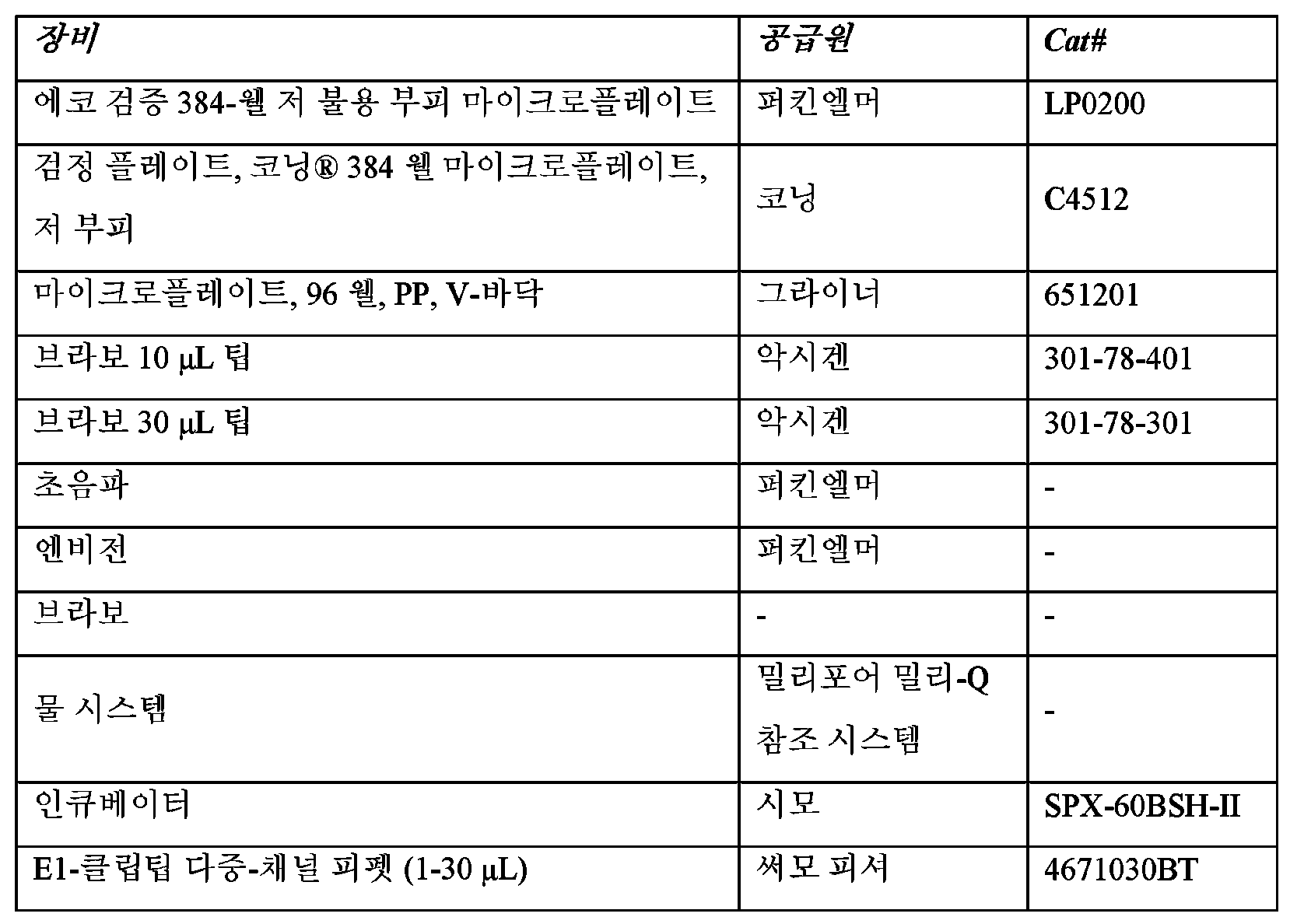
3. 절차3. Procedure
1. ZAP70 키나제 완충제 제조:1. Preparation of ZAP70 Kinase Buffer:
DTT 및 BSA를 완충제에 새로 첨가하였다 (최종 농도: 40 mM 트리스 pH7.5; 20 mM MgCl2, 0.1 mg/ml BSA, 50 μM DTT, 2 mM MnCl2).DTT and BSA were freshly added to the buffer (final concentration: 40 mM Tris pH7.5; 20 mM MgCl 2 , 0.1 mg/ml BSA, 50 μM DTT, 2 mM MnCl 2 ).

2. 화합물 제조:2. Compound preparation:
시험 화합물의 경우, 먼저 5 μL 10 mM 화합물 스톡을 45 μL의 DMSO에 혼합함으로써 화합물을 1 mM로 희석하였다. 이어서, 이들 화합물을 10가지 용량에 대해 3배 희석하였다. 최고 화합물 농도는 1 mM (100x)이었고, DMSO 농도는 100%였다.For test compounds, compounds were diluted to 1 mM by first mixing 5 μL 10 mM compound stock into 45 μL of DMSO. These compounds were then diluted 3-fold for 10 doses. The highest compound concentration was 1 mM (100x) and the DMSO concentration was 100%.
50 nL의 화합물 용액을 ECHO에 의해 384-웰 검정 플레이트 (코닝 #4512)로 옮겼다.50 nL of compound solution was transferred by ECHO to a 384-well assay plate (Corning #4512).
양성 대조군의 경우: 50 nL의 1 mM 스타우로스포린을 양성 대조군으로서 384-웰 검정 플레이트로 옮겼다.For positive control: 50 nL of 1 mM staurosporin was transferred to a 384-well assay plate as positive control.
음성 대조군의 경우: 50 nL의 DMSO를 음성 대조군으로서 384-웰 검정 플레이트로 옮겼다. 검정 플레이트를 1,500 rpm에서 1분 동안 원심분리하였다.For negative control: 50 nL of DMSO was transferred to a 384-well assay plate as negative control. Assay plates were centrifuged at 1,500 rpm for 1 min.
3. 화합물을 하기 레이아웃에 따라 ECHO에 의해 전달하였다:3. Compounds were delivered by ECHO according to the following layout:
스타우로스포린 및 시험 화합물 1-15: 10 μM에서 0.508 nM로의 연속 3배 희석 (10가지 용량); 음성 대조군은 6.25 ng ZAP70, 10 μM ATP & 0.4 μg/μL 폴리, 1% DMSO이고; 양성 대조군은 10 μM 스타우로스포린, 6.25 ng ZAP70, 10 μM ATP & 0.4 μg/μL 폴리, 1% DMSO임.Staurosporine and test compounds 1-15: serial 3-fold dilutions from 10 μM to 0.508 nM (10 doses); negative control was 6.25 ng ZAP70, 10 μM ATP & 0.4 μg/μL poly, 1% DMSO; Positive controls were 10 μM staurosporin, 6.25 ng ZAP70, 10 μM ATP & 0.4 μg/μL poly, 1% DMSO.
4. 2x ATP-폴리(E4Y1) 혼합물을 제조하였다: 키나제 완충제 중 20 μM ATP, 0.8 μg/μL 폴리(E4Y1) (최종 농도: 10 μM ATP, 0.4 μg/μL 폴리(E4Y1)).4. Prepare 2x ATP-poly(E4Y1) mixture: 20 μM ATP, 0.8 μg/μL poly(E4Y1) in kinase buffer (final concentration: 10 μM ATP, 0.4 μg/μL poly(E4Y1)).
5. 2x ZAP70 작업 용액을 제조하였다: 키나제 완충제 중 (2.5 ng/μL) (최종 농도는 1.25 ng/μL였음). 5. Prepare 2x ZAP70 working solution: in kinase buffer (2.5 ng/μL) (final concentration was 1.25 ng/μL).
6. 2.5 μL/웰의 2x ZAP70 작업 용액을 피펫 (써모, 30 μL 다중-채널)을 사용하여 첨가하고, 1,500 rpm에서 1분 동안 원심분리하였다.6. 2.5 μL/well of 2x ZAP70 working solution was added using a pipette (Thermo, 30 μL multi-channel) and centrifuged at 1,500 rpm for 1 minute.
7. 2.5 μL/웰의 2x ATP-폴리 (E4Y1) 작업 혼합물을 피펫 (써모, 30 μL 다중-채널)을 사용하여 첨가하고, 1,500 rpm에서 1분 동안 원심분리하였다.7. Add 2.5 μL/well of 2x ATP-Poly (E4Y1) working mixture using a pipette (Thermo, 30 μL multi-channel) and centrifuge at 1,500 rpm for 1 min.
8. 검정 플레이트를 25℃에서 60분 동안 인큐베이션하였다.8. Incubate the assay plate at 25° C. for 60 minutes.
9. 5 μL/웰 ADP-글로™ 시약을 BRAVO에 의해 첨가하여 키나제 반응을 정지시키고, 1시간 후에 소비되지 않은 ATP를 고갈시켰다. 1,500 rpm에서 1분 동안 원심분리하였다. 25℃에서 40분 동안 인큐베이션하였다.9. 5 μL/well ADP-Glo™ reagent was added by BRAVO to stop the kinase reaction and depleted unconsumed ATP after 1 h. Centrifugation was performed at 1,500 rpm for 1 minute. Incubated at 25° C. for 40 minutes.
10. 10 μL의 키나제 검출 시약을 BRAVO에 의해 첨가하여 ADP를 ATP로 전환시켰다. 1,500 rpm에서 1분 동안 원심분리하였다. 25℃에서 40분 동안 인큐베이션하였다.10. 10 μL of kinase detection reagent was added by BRAVO to convert ADP to ATP. Centrifugation was performed at 1,500 rpm for 1 minute. Incubated at 25° C. for 40 minutes.
11. 발광 신호를 엔비전 플레이트 판독기 (384-USL) 상에서 기록하였다.11. Luminescence signals were recorded on an Envision plate reader (384-USL).
12. XL-피트를 사용하여 데이터를 처리하였다. 억제% = [1-(시험 웰-음성 대조군)/(양성 대조군-음성 대조군)]*100%.12. Data was processed using XL-feet. % inhibition = [1-(test well-negative control)/(positive control-negative control)]*100%.
5. 데이터 분석5. Data Analysis
화합물의 각각의 농도에서의 퍼센트 (%) 억제를 각각의 검정 플레이트 내에 함유된 음성 및 양성 대조군 웰에서의 신호에 기초하고 그에 대해 상대적으로 계산하였다. 음성 대조군 웰은 0% 억제로서 기능하였고, 양성 대조군 웰은 100% 억제로서 기능하였다. 시험 화합물에 대한 농도 및 % 억제 값을 플롯팅하고, 50% 억제에 요구되는 화합물의 농도 (IC50)를 3-파라미터 로지스틱 용량 반응 방정식으로 결정하였다. 참조 펩티드/화합물에 대한 종점 값 (IC50)을 품질 관리 척도로서 각각의 실험에서 평가하였다. 종점 값이 예상 값의 3배 이내이면, 실험은 허용가능한 것으로 간주되었다.Percent (%) inhibition at each concentration of compound was calculated based on and relative to the signals in the negative and positive control wells contained within each assay plate. Negative control wells served as 0% inhibition and positive control wells served as 100% inhibition. Concentration and % inhibition values for the test compound were plotted and the concentration of compound required for 50% inhibition (IC50) was determined with a 3-parameter logistic dose response equation. The endpoint value (IC50) for the reference peptide/compound was assessed in each experiment as a quality control measure. If the endpoint value was within 3 times the expected value, the experiment was considered acceptable.
생물학 실시예 6 LCK 생화학적 검정 프로토콜Biology Example 6 LCK Biochemical Assay Protocol
본 실시예는 ADP-글로™ 키나제 검정을 사용하여 Lck 키나제 활성에 대한 잠재적 HPK1 억제제 화합물의 효과를 측정하였다. 예시적인 실험 설정을 하기에 기재하지만, 개별 검정에서 약간의 조정이 이루어질 수 있다.This example measured the effect of potential HPK1 inhibitor compounds on Lck kinase activity using the ADP-Glo™ kinase assay. An exemplary experimental setup is described below, although minor adjustments may be made in individual assays.
물질 및 장비Substances and equipment
1. 시약:1. Reagents:

2. 장비 및 공급처:2. Equipment and suppliers:
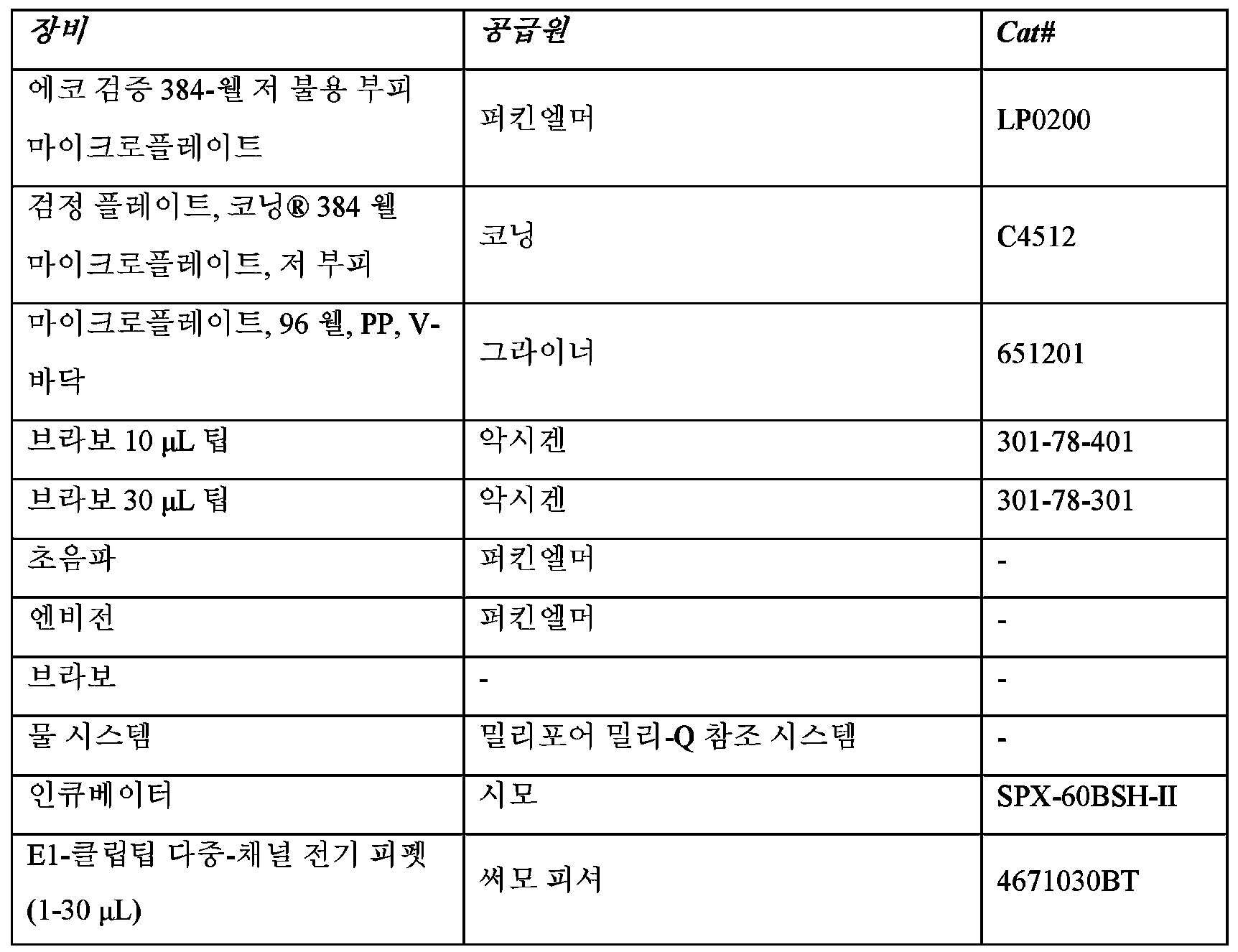
3. 절차3. Procedure
1. LCK 키나제 완충제 제조:1. Preparation of LCK Kinase Buffer:
DTT 및 BSA를 완충제에 새로 첨가하였다 (최종 농도: 40 mM 트리스 pH7.5; 20 mM MgCl2, 0.1 mg/ml BSA, 50 μM DTT, 2 mM MnCl2).DTT and BSA were freshly added to the buffer (final concentration: 40 mM Tris pH7.5; 20 mM MgCl 2 , 0.1 mg/ml BSA, 50 μM DTT, 2 mM MnCl 2 ).

2. 화합물 제조:2. Compound preparation:
시험 화합물의 경우, 먼저 5 μL 10 mM 화합물 스톡을 45 μL의 DMSO에 혼합함으로써 화합물을 1 mM로 희석하였다. 이어서, 화합물 용액을 10가지 용량에 대해 3배 연속 희석하였다. 최고 화합물 농도는 1 mM (100x)이었고, DMSO 농도는 100%였다.For test compounds, compounds were diluted to 1 mM by first mixing 5 μL 10 mM compound stock into 45 μL of DMSO. The compound solution was then serially diluted 3-fold for 10 doses. The highest compound concentration was 1 mM (100x) and the DMSO concentration was 100%.
양성 대조군의 경우: 3 μL의 10 mM 스톡을 97 μL DMSO에 혼합함으로써 스타우로스포린을 300 μM로 희석하였다.For positive control: Dilute staurosporin to 300 μM by mixing 3 μL of 10 mM stock in 97 μL DMSO.
50 nL의 화합물 용액 및 300 μM 스타우로스포린을 BRAVO에 의해 384-웰 검정 플레이트 (코닝 #4512)로 옮겼다.50 nL of compound solution and 300 μM staurosporine were transferred by BRAVO to a 384-well assay plate (Corning #4512).
음성 대조군의 경우: 50 nL의 DMSO를 음성 대조군으로서 384-웰 검정 플레이트로 옮겼다. 검정 플레이트를 1,500 rpm에서 1분 동안 원심분리하였다.For negative control: 50 nL of DMSO was transferred to a 384-well assay plate as negative control. Assay plates were centrifuged at 1,500 rpm for 1 min.
3. 화합물을 하기 레이아웃에 따라 ECHO에 의해 전달하였다:3. Compounds were delivered by ECHO according to the following layout:
스타우로스포린 및 시험 화합물 1-15: 10 μM에서 0.508 nM로의 연속 3배 희석 (10가지 용량); 음성 대조군은 7 ng LCK, 20 μM ATP & 0.4 μg/μL 폴리, 1% DMSO이고; 양성 대조군은 3 μM 스타우로스포린, 7 ng LCK, 20 μM ATP & 0.4 μg/μL 폴리, 1% DMSO임.Staurosporine and test compounds 1-15: serial 3-fold dilutions from 10 μM to 0.508 nM (10 doses); negative control was 7 ng LCK, 20 μM ATP & 0.4 μg/μL poly, 1% DMSO; Positive controls were 3 μM staurosporin, 7 ng LCK, 20 μM ATP & 0.4 μg/μL poly, 1% DMSO.
4. 2x ATP-폴리(E4Y1) 혼합물을 제조하였다: 키나제 완충제 중 40 μM ATP, 0.8 μg/μL 폴리(E4Y1) (최종 농도: 20 μM ATP, 0.4 μg/μL 폴리(E4Y1)).4. Prepare 2x ATP-poly(E4Y1) mixture: 40 μM ATP, 0.8 μg/μL poly(E4Y1) in kinase buffer (final concentration: 20 μM ATP, 0.4 μg/μL poly(E4Y1)).
5. 2x LCK 작업 용액을 제조하였다: 키나제 완충제 중 (2.8 ng/μL) (최종 농도는 1.4 ng/μL였음). 5. Prepare 2x LCK working solution: in kinase buffer (2.8 ng/μL) (final concentration was 1.4 ng/μL).
6. 2.5 μL/웰의 2x LCK 작업 용액을 피펫 (써모, 30 μL 다중-채널)을 사용하여 첨가하고, 1,000 rpm에서 1분 동안 원심분리하였다.6. Add 2.5 μL/well of 2x LCK working solution using a pipette (Thermo, 30 μL multi-channel) and centrifuge at 1,000 rpm for 1 minute.
7. 2.5 μL/웰의 2x ATP-폴리 (E4Y1) 작업 혼합물을 피펫 (써모, 30 μL 다중-채널)을 사용하여 첨가하고, 1,000 rpm에서 1분 동안 원심분리하였다.7. Add 2.5 μL/well of 2x ATP-Poly (E4Y1) working mixture using a pipette (Thermo, 30 μL multi-channel) and centrifuge at 1,000 rpm for 1 min.
8. 검정 플레이트를 25℃에서 60분 동안 인큐베이션하였다.8. Incubate the assay plate at 25° C. for 60 minutes.
9. 5 μL/웰 ADP-글로™ 시약을 BRAVO에 의해 첨가하여 키나제 반응을 정지시키고, 1시간 후에 소비되지 않은 ATP를 고갈시켰다. 1,000 rpm에서 1분 동안 원심분리한다. 25℃에서 40분 동안 인큐베이션하였다.9. 5 μL/well ADP-Glo™ reagent was added by BRAVO to stop the kinase reaction and depleted unconsumed ATP after 1 h. Centrifuge at 1,000 rpm for 1 min. Incubated at 25° C. for 40 minutes.
10. 10 μL의 키나제 검출 시약을 BRAVO에 의해 첨가하여 ADP를 ATP로 전환시켰다. 1,000 rpm에서 1분 동안 원심분리한다. 25℃에서 30분 동안 인큐베이션하였다.10. 10 μL of kinase detection reagent was added by BRAVO to convert ADP to ATP. Centrifuge at 1,000 rpm for 1 min. Incubated at 25° C. for 30 minutes.
11. 발광 신호를 엔비전 플레이트 판독기 (384-USL) 상에서 기록하였다.11. Luminescence signals were recorded on an Envision plate reader (384-USL).
12. XL-피트를 사용하여 데이터를 처리하였다. 억제% = (음성 대조군-시험 웰)/(음성 대조군-양성 대조군)x100%.12. Data was processed using XL-feet. % inhibition = (negative control-test wells)/(negative control-positive control)x100%.
4. 데이터 분석4. Data Analysis
화합물의 각각의 농도에서의 퍼센트 (%) 억제를 각각의 검정 플레이트 내에 함유된 음성 및 양성 대조군 웰에서의 신호에 기초하고 그에 대해 상대적으로 계산하였다. 음성 대조군 웰은 0% 억제로서 기능하였고, 양성 대조군 웰은 100% 억제로서 기능하였다. 시험 화합물에 대한 농도 및 % 억제 값을 플롯팅하고, 50% 억제에 요구되는 화합물의 농도 (IC50)를 3-파라미터 로지스틱 용량 반응 방정식으로 결정하였다. 참조 펩티드/화합물에 대한 종점 값 (IC50)을 품질 관리 척도로서 각각의 실험에서 평가하였다. 종점 값이 예상 값의 3배 이내이면, 실험은 허용가능한 것으로 간주되었다.Percent (%) inhibition at each concentration of compound was calculated based on and relative to the signals in the negative and positive control wells contained within each assay plate. Negative control wells served as 0% inhibition and positive control wells served as 100% inhibition. Concentration and % inhibition values for the test compound were plotted and the concentration of compound required for 50% inhibition (IC50) was determined with a 3-parameter logistic dose response equation. The endpoint value (IC50) for the reference peptide/compound was assessed in each experiment as a quality control measure. If the endpoint value was within 3 times the expected value, the experiment was considered acceptable.
생물학 실시예 7 MAP4K3 단백질 키나제 검정Biology Example 7 MAP4K3 protein kinase assay
본 실시예는 단백질 키나제 MAP4K3에 의한 펩티드 기질의 인산화를 측정하기 위한 검정 프로토콜을 제공한다.This example provides an assay protocol for measuring phosphorylation of peptide substrates by the protein kinase MAP4K3.
간략하게, MAP4K3, 그의 기질, 및 보조인자 (ATP 및 Mg2+)를 마이크로타이터 플레이트의 웰에서 합하고, 25℃에서 5시간 동안 인큐베이션하였다. 인큐베이션 말미에, 반응물을 EDTA-함유 완충제의 첨가에 의해 켄칭하였다. 기질 및 생성물을 분리하고, 캘리퍼 라이프 사이언시스로부터의 마이크로유체-기반 랩칩(LabChip) 3000 약물 디스커버리 시스템을 사용하여 전기영동으로 정량화하였다.Briefly, MAP4K3, its substrate, and cofactors (ATP and Mg 2+ ) were combined in wells of a microtiter plate and incubated at 25° C. for 5 h. At the end of the incubation, the reaction was quenched by addition of EDTA-containing buffer. Substrate and product were isolated and quantified electrophoretically using a microfluidic-based LabChip 3000 drug discovery system from Caliper Life Sciences.
본 검정의 경우, MAP4K3 기질은 FAM-GAGRLGRDKYKTLRQIRQ-NH2 (FAM은 카르복시플루오레세인임)였다. 펩티드 기질은 바람직하게는 모세관 전기영동에 의해 > 98% 순수하였다.For this assay, the MAP4K3 substrate was FAM-GAGRLGRDKYKTLRQIRQ-NH2 (FAM is carboxyfluorescein). The peptide substrate was preferably >98% pure by capillary electrophoresis.
전형적인 검정 설정 및 조건은 하기에 제공된다.Typical assay settings and conditions are provided below.
1. 384-웰 플레이트의 웰에 5 μL의 2x 효소 완충제 (또는 대조군)를 첨가하였다.1. Add 5 μL of 2x enzyme buffer (or control) to the wells of a 384-well plate.
2. 100 nL의 100x 화합물을 첨가하였다. 원하는 경우, 효소 및 화합물을 이 시점에 사전-인큐베이션할 수 있다.2. Add 100 nL of 100x compound. If desired, enzymes and compounds can be pre-incubated at this point.
3. 5 μL의 2x 기질 완충제를 첨가하였다.3. Add 5 μL of 2x substrate buffer.
4. 플레이트를 25℃에서 5시간 동안 인큐베이션하였다.4. The plate was incubated at 25° C. for 5 hours.
5. 40 μL의 1.25x 정지 완충제를 첨가하여 반응을 종결시켰다.5. Stop the reaction by adding 40 μL of 1.25x stop buffer.
6. 하기 표의 값을 사용하여 캘리퍼 랩칩(Caliper LabChip)® 3000 약물 디스커버리 시스템 상에서 작업을 생성하였다.6. A task was created on a Caliper LabChip® 3000 Drug Discovery System using the values in the table below.
12 시퍼 칩에 대한 분리 조건12 Separation conditions for sipper chips

7. 플레이트를 로딩하고, 여기를 위해 청색 레이저 (480 nm) 및 검출을 위해 녹색 CCD (520 nm) (CCD2)를 사용하여 전기영동을 시작하였다.7. Load the plate and start electrophoresis using a blue laser (480 nm) for excitation and a green CCD (520 nm) (CCD2) for detection.
상기 검정을 다음 반응 조건에서 실행하였다: 총 5시간; 25℃에서, 20 mM의 100% 억제제 EDTA의 존재 하.The assay was run under the following reaction conditions: a total of 5 hours; At 25 °C, in the presence of 20 mM 100% inhibitor EDTA.
최종 검정 반응 혼합물은 다음과 같다: 100 mM HEPES, pH 7.5; 0.1% BSA; 0.01% 트리톤 X-100; 1 mM DTT; 5 mM MgCl2, 10 μM 오르토바나듐산나트륨, 10 μM 베타-글리세로포스페이트 20 μM ATP; 1% DMSO (화합물로부터); 0.5 μM FAM-GAGRLGRDKYKTLRQIRQ-NH2; 0.5 nM MAP4K3 효소.The final assay reaction mixture was: 100 mM HEPES, pH 7.5; 0.1% BSA; 0.01% Triton X-100; 1 mM DTT; 5 mM MgCl 2 , 10 μM sodium orthovanadate, 10 μM beta-glycerophosphate 20 μM ATP; 1% DMSO (from compound); 0.5 μM FAM-GAGRLGRDKYKTLRQIRQ-NH2; 0.5 nM MAP4K3 enzyme.
MAP4K3의 비활성(specific activity)은 로트마다 다르며, 효소 농도는 기질에서 생성물로의 ~10-20% 전환을 산출하도록 조정될 필요가 있을 수 있다는 것에 유의해야 한다.It should be noted that the specific activity of MAP4K3 varies from lot to lot and the enzyme concentration may need to be adjusted to yield ˜10-20% conversion of substrate to product.
각각의 샘플에 존재하는 기질 및 생성물 펩티드를 랩칩 3000 모세관 전기영동 기기를 사용하여 전기영동으로 분리하였다. 기질 및 생성물 펩티드가 분리됨에 따라, 2개의 형광 피크가 관찰되었다. 기질 및 생성물 피크의 상대 형광 강도의 변화는 측정된 파라미터로서 효소 활성을 반영한다. 모세관 전기영동도 (RDA 획득 파일)를 HTS 웰 애널라이저 소프트웨어 (캘리퍼 라이프 사이언시스)를 사용하여 분석하였다. 각각의 샘플에서의 키나제 활성은 생성물 대 합계 비 (PSR): P/(S+P)로서 결정되며, 여기서 P는 생성물 펩티드의 피크 높이이고, S는 기질 펩티드의 피크 높이이다.Substrate and product peptides present in each sample were electrophoretically separated using a LabChip 3000 capillary electrophoresis instrument. As the substrate and product peptide separated, two fluorescence peaks were observed. Changes in the relative fluorescence intensities of substrate and product peaks reflect enzyme activity as a measured parameter. Capillary electrophoresis (RDA acquisition file) was analyzed using HTS Well Analyzer software (Caliper Life Sciences). Kinase activity in each sample is determined as product to sum ratio (PSR): P/(S+P), where P is the peak height of the product peptide and S is the peak height of the substrate peptide.
각각의 화합물에 대해, 효소 활성을 다양한 농도 (3x 희석 간격의 12가지 농도의 화합물)에서 측정하였다. 음성 대조군 샘플 (억제제의 부재 하에 0%-억제) 및 양성 대조군 샘플 (20 mM EDTA의 존재 하에 100%-억제)을 4회 반복하여 조립하고, 각 농도에서의 각 화합물에 대한 %-억제 값을 계산하는데 사용하였다.For each compound, enzyme activity was measured at various concentrations (12 concentrations of compound at 3x dilution intervals). Negative control samples (0%-inhibition in the absence of inhibitor) and positive control samples (100%-inhibition in the presence of 20 mM EDTA) were assembled in 4 replicates and the %-inhibition values for each compound at each concentration were calculated used to calculate.
퍼센트 억제 (Pinh)는 다음 방정식을 사용하여 결정된다:The percent inhibition (P inh ) is determined using the following equation:
Pinh = (PSR0% - PSRinh)/(PSR0% - PSR100%)*100, 여기서 PSRinh는 억제제의 존재 하의 생성물 합계 비이고, PSR0%는 억제제의 부재 하의 평균 생성물 합계 비이고, PSR100%는 100%-억제 대조군 샘플에서의 평균 생성물 합계 비이다.P inh = (PSR 0% - PSR inh )/(PSR 0% - PSR 100% )*100, where PSR inh is the ratio of the sum of products in the presence of inhibitor and PSR 0% is the ratio of the sum of products in the absence of the inhibitor , PSR 100% is the average product sum ratio in the 100%-inhibited control sample.
XL피트 4 소프트웨어 (IBDS)를 사용하여 4 파라미터 S자형 용량-반응 모델에 의해 억제 곡선 (핀헤르수스 억제제 농도)을 피팅함으로써 억제제의 IC50 값을 결정하였다.IC50 values of inhibitors were determined by fitting inhibition curves (pinhersus inhibitor concentrations) by a 4-parameter sigmoidal dose-response model using XLfit 4 software (IBDS).
검정에 사용된 특정 물질 & 완충제는 참조 값에 대해 하기 열거된다.Specific materials & buffers used in the assay are listed below for reference values.
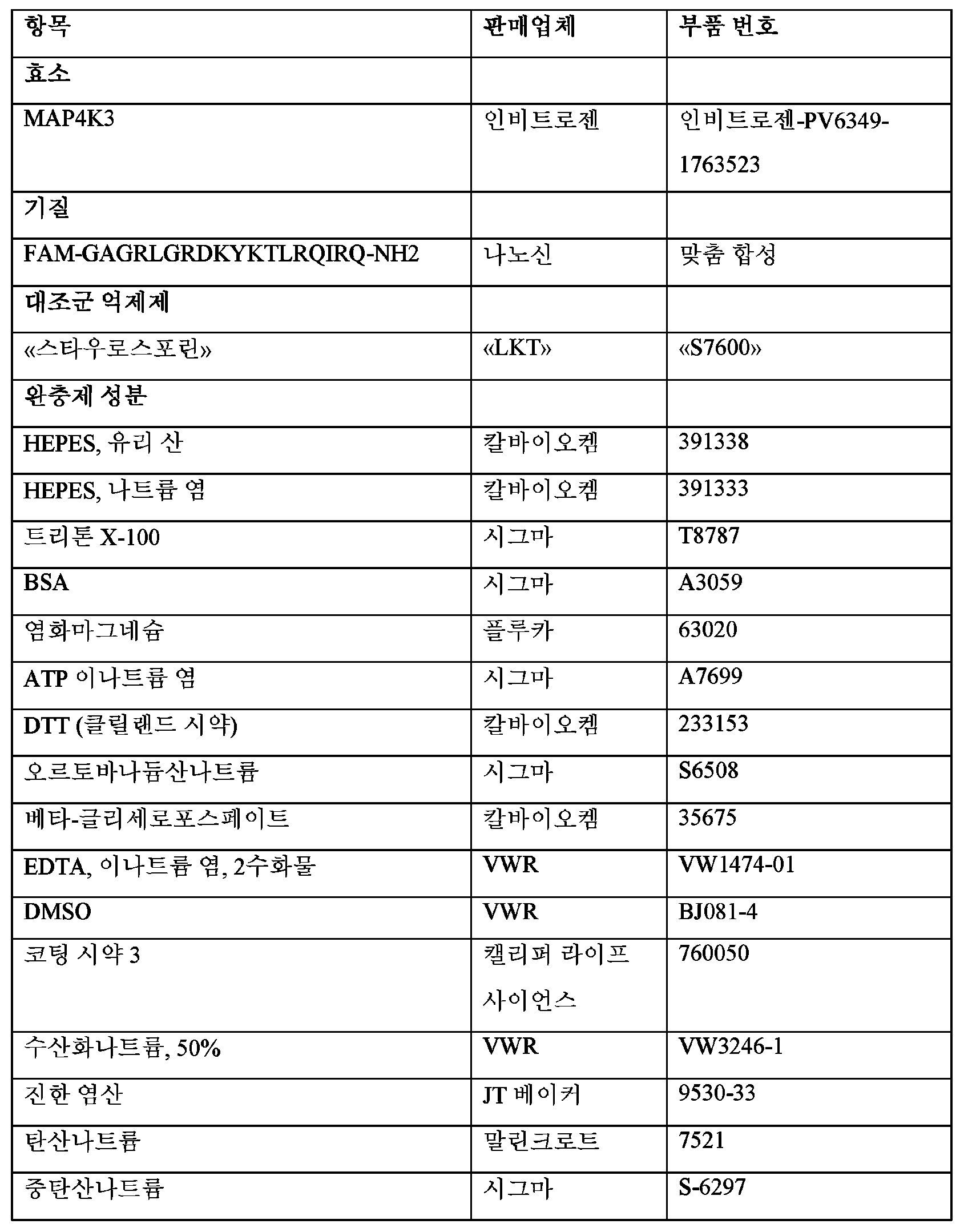
생물학 실시예 8 인간 범 T 세포에 의해 방출된 IL2 & IFN-γ에 대한 화합물 효능 연구Biology Example 8 Compound Efficacy Study on IL2 & IFN-γ Released by Human Pan T Cells
본 실시예는 범 T 세포 및 ELISA 검정 포맷을 사용하여 IL2 & IFN-γ 방출에 대한 화합물 효과를 측정하는데 사용될 수 있는 검정 방법이다.This example is an assay method that can be used to determine the effect of a compound on IL2 & IFN-γ release using a pan T cell and ELISA assay format.
물질 및 장비Substances and equipment
1. 시약:1. Reagents:


2. 장비 및 공급처:2. Equipment and suppliers:

3. 절차3. Procedure
범 T 단리 및 시약 제조를 위한 절차 (제0일):Procedures for pan-T isolation and reagent preparation (day 0):
1. 세포 성장 배지:1. Cell Growth Medium:
RPMI1640: ATCC, Cat # 30-2001RPMI1640: ATCC, Cat # 30-2001
10% FBS: 깁코, Cat # 1009914110% FBS: Gibco, Cat # 10099141
1% Pen-Strep: 깁코, Cat # 151401221% Pen-Strep: Gibco, Cat # 15140122
1% 비-필수 아미노: 깁코, Cat #111400501% Non-Essential Amino: Gibco, Cat #11140050
베타-메르캅토에탄올: 깁코, Cat#21985023Beta-Mercaptoethanol: Gibco, Cat#21985023
2. 범 T 단리 완충제 제조:2. Pan T Isolation Buffer Preparation:
MACS® BSA 원액 (#130-091-376)을 오토맥스(autoMACS)® 헹굼 용액으로 20배 희석함으로써 포스페이트-완충 염수 (PBS), pH 7.2, 0.5% 소 혈청 알부민 (BSA), 및 2 mM EDTA를 함유하는 용액을 제조하였다. 완충제를 4℃에서 유지하였다. 기포가 칼럼을 차단할 수 있기 때문에, 사용 전에 완충제를 탈기시켰다.Phosphate-buffered saline (PBS), pH 7.2, 0.5% bovine serum albumin (BSA), and 2 mM EDTA by diluting MACS® BSA stock solution (#130-091-376) 20-fold with autoMACS® rinse solution. A solution containing The buffer was maintained at 4°C. The buffer was degassed prior to use, as air bubbles can block the column.

3. 동결된 PBMC의 해동3. Thaw of Frozen PBMCs
1) 배지를 37℃ 수조에서 예열하였다.1) The medium was preheated in a 37°C water bath.
2) 세포를 37℃ 수조에서 급속하게 해동시켰다.2) Cells were rapidly thawed in a 37°C water bath.
3) 미리-가온된 배지를 15 mL 튜브에 첨가하였다. 세포를 튜브로 옮겼다.3) Add pre-warmed medium to 15 mL tube. Cells were transferred to tubes.
4) 8분 동안 300 x g 원심분리하였다 (원심분리 증가 0, 감소 0).4) Centrifuged at 300 x g for 8 minutes (centrifugation increase 0, decrease 0).
5) 헹굼 완충제를 사용하여 PBMC를 세척하였다.5) Washing PBMCs using rinse buffer.
6) PBMC를 300 x g에서 8분 동안 원심분리하고, 이를 2회 세척하였다 (원심분리 증가 9, 감소 1).6) PBMCs were centrifuged at 300 x g for 8 min, washed twice (centrifugation increase 9, decrease 1).
7) 세포를 범 T 세포 단리 완충제로 재현탁시키고, 세포 수를 계수하였다.7) Cells were resuspended with pan T cell isolation buffer, and cell number was counted.
4. 범 T 세포 단리:4. Pan T Cell Isolation:
마이크로비드 칵테일을 사용한 세포 염색Cell staining using microbead cocktail
1) 세포를 준비하고, 세포 수를 측정하였다. 세포를 70 μm 세포 여과기로 여과하였다.1) Cells were prepared and the number of cells was measured. Cells were filtered through a 70 μm cell strainer.
2) 세포 펠릿을 107개의 총 세포당 40 μL의 완충제 중에 재현탁시켰다.2) The cell pellet was resuspended in 40 μL of buffer per 10 7 total cells.
3) 107개의 총 세포당 10 μL의 범 T 세포 비오틴-항체 칵테일을 첨가하였다.3) Add 10 μL of pan T cell biotin-antibody cocktail per 10 7 total cells.
4) 잘 혼합하고, 냉장고 (얼음)에서 10분 동안 인큐베이션하였다.4) Mix well and incubate in refrigerator (ice) for 10 minutes.
5) 107개의 총 세포당 30 μL의 완충제를 첨가하였다.5) 30 μL of buffer was added per 10 7 total cells.
6) 107개의 총 세포당 20 μL의 범 T 세포 마이크로비드 칵테일을 첨가한다.6) Add 20 μL of pan T cell microbead cocktail per 10 7 total cells.
7) 잘 혼합하고, 냉장고 (얼음)에서 15분 동안 인큐베이션하였다.7) Mix well and incubate in refrigerator (ice) for 15 minutes.
8) 후속 자기 세포 분리로 진행하였다.8) Proceed to subsequent magnetic cell isolation.
주: a. 빠르게 작업하고, 세포를 차갑게 유지하고, 사전-냉각된 용액 (2-8℃)을 사용한다. b. 주어진 자기 표지에 대한 부피는 총 107개 이하의 세포에 대한 것이다. 보다 적은 세포를 사용하여 작업할 때, 나타낸 바와 동일한 부피를 사용한다. c. 더 높은 세포 수로 작업할 때, 이에 따라 모든 시약 부피 및 총 부피를 규모 확대한다. d. 최적의 성능을 위해, 자기 표지 전에 단일-세포 현탁액을 수득하는 것이 중요하다.Note: a. Work fast, keep cells cold, and use pre-chilled solutions (2-8° C.). b. The volume for a given magnetic label is for a total of up to 10 7 cells. When working with fewer cells, use the same volume as indicated. c. When working with higher cell numbers, scale up all reagent volumes and total volumes accordingly. d. For optimal performance, it is important to obtain a single-cell suspension prior to magnetic labeling.
후속 수동 세포 분리:Subsequent manual cell isolation:
1) LS 칼럼을 적합한 MACS 분리기의 자기장에 넣었다. 세부사항에 대해서는 각각의 MACS 칼럼 데이터 시트를 참조한다.1) The LS column was placed in the magnetic field of a suitable MACS separator. Refer to each MACS column data sheet for details.
2) 3 mL의 완충제로 세정하여 칼럼을 제조하였다.2) A column was prepared by washing with 3 mL of buffer.
3) 세포 현탁액을 칼럼 상에 적용하였다. 풍부화된 T 세포를 나타내는 통과액을 수집하였다.3) The cell suspension was applied onto the column. Flow-through representing enriched T cells was collected.
4) 칼럼을 완충제 5 mL로 세척하였다. 풍부화된 T 세포를 나타내는, 통과하는 비표지된 세포를 수집하였다.4) Wash the column with 5 mL of buffer. Transbounding unlabeled cells, representing enriched T cells, were collected.
리마인더: 후속 단계로 진행하기 전에 칼럼 저장소가 비워질 때까지 항상 대기한다.Reminder: Always wait until the column reservoir is empty before proceeding to the next step.
5. 범 T 세포 FACS:5. Pan T Cell FACS:
1) 각각 50 μL의 PBMC 및 범 T 세포를 FACS 튜브에 취하였다.1) 50 μL of each of PBMCs and pan T cells were taken into FACS tubes.
2) 세포를 항-인간 CD3/CD4/CD8 항체 (1 μL/1 μL/1 μL/튜브)와 함께 4℃에서 20분 동안 인큐베이션하였다. 비염색 대조군의 경우, 세포를 FACS 염색 완충제와 함께 인큐베이션하였다.2) Cells were incubated with anti-human CD3/CD4/CD8 antibody (1 μL/1 μL/1 μL/tube) at 4° C. for 20 minutes. For unstained controls, cells were incubated with FACS staining buffer.
3) 차가운 염색 완충제 (0.2% BSA 및 1 mM EDTA를 함유한 PBS)로 2회 세척하였다.3) Wash twice with cold staining buffer (PBS with 0.2% BSA and 1 mM EDTA).
4) FACS를 실행하였다. % 분석을 위해 CD3+, CD3+CD4+, 및 CD3+CD8+ 집단을 게이팅하였다.4) FACS was performed. CD3 + , CD3 + CD4 + , and CD3 + CD8 + populations were gated for % analysis.
5) 범 T 세포의 순도가 90% 초과이면, 세포 현탁액을 적절한 부피의 세포 배양 배지로 1 x 10⁶개 세포/mL로 희석하였다.5) If the purity of the pan T cells is greater than 90%, the cell suspension was diluted to 1×10 6 cells/mL with an appropriate volume of cell culture medium.
6) 세포 현탁액을 추후 사용을 위해 멸균 일회용 저장소 내로 분배하였다.6) The cell suspension was dispensed into sterile disposable reservoirs for later use.
화합물 및 항-인간 CD3/CD28의 제조 절차 (제0일):Procedure for the preparation of compounds and anti-human CD3/CD28 (day 0):
1. 화합물 제조1. Compound Preparation
화합물 연속 희석 (공급원 플레이트 1000x)Serial dilution of compound (source plate 1000x)
화합물을 100% DMSO 중에 10 mM의 농도로 가용화시켰다. 이어서, 8-포인트 용량으로 3배 연속 희석하였다.The compound was solubilized at a concentration of 10 mM in 100% DMSO. It was then serially diluted 3-fold to 8-point doses.
4x 화합물 용량 제조 (인터 플레이트: 코닝-3599):4x compound dose preparation (Interplate: Corning-3599):
배양 배지 중 4x 화합물 용액을 제조하였다. 상하로 피펫팅하였다. ZPE 대조군의 경우, 배양 배지 중 0.4% DMSO (4x)를 제조하였다. HPE 대조군의 경우, 배양 배지 중 0.4 μM의 RGT003-026 (4x)을 제조하였다.A 4x compound solution in culture medium was prepared. Pipetted up and down. For the ZPE control, 0.4% DMSO (4x) in culture medium was prepared. For the HPE control, 0.4 μM of RGT003-026 (4x) in culture medium was prepared.
2. 항-인간 CD3 (원액 농도 6.76 mg/ml): 4℃에서 저장함.2. Anti-human CD3 (stock concentration 6.76 mg/ml): stored at 4°C.
1) 항-인간 CD3을 PBS로 0.5 μg/mL의 최종 농도로 희석하였다. 1) Anti-human CD3 was diluted with PBS to a final concentration of 0.5 μg/mL.
2) 양성 및 음성 대조군 웰을 제외한 각각의 웰에 50 μL/웰의 CD3을 첨가하였다. 양성 및 음성 대조군 웰은 CD3/CD28 자극을 갖지 않았다.2) 50 μL/well of CD3 was added to each well except for the positive and negative control wells. Positive and negative control wells did not have CD3/CD28 stimulation.
3) 5% CO2 인큐베이터 내 37℃에서 2시간 동안 인큐베이션하였다.3) Incubated for 2 hours at 37° C. in a 5% CO 2 incubator.
4) 50 μL 항체 용액을 세포 배양 플레이트로부터 제거하였다. 각각의 웰을 매회 200 μL의 멸균 PBS로 2회 헹궜다.4) Remove 50 μL antibody solution from cell culture plate. Rinse each well twice with 200 µL of sterile PBS each time.
3. 항-인간 CD28 (4x) 제조3. Preparation of anti-human CD28 (4x)
항체를 배양 배지를 사용하여 11.07 mg/mL의 원액 농도에서 2 μg/mL (4x)로 희석하였다.Antibodies were diluted to 2 μg/mL (4x) using culture medium at a stock concentration of 11.07 mg/mL.
4. PMA/이노마이신 제조 (4x)4. PMA/Inomycin Preparation (4x)
1) PMA를 배지 중 400 ng/mL (8x)로 희석하였다.1) PMA was diluted to 400 ng/mL (8x) in medium.
2) 이노마이신을 배지 중 8 μM (8x)로 희석하였다.2) Inomycin was diluted to 8 μM (8×) in medium.
3) 동일한 부피의 PMA를 이오노마이신과 혼합하여 4x 혼합물을 수득하였다.3) An equal volume of PMA was mixed with ionomycin to obtain a 4x mixture.
세포를 자극하는 절차 (제0일)Procedure to stimulate cells (day 0)
1. 1x10⁵개 세포/웰 (100 μL/웰)의 세포 현탁액을 96-웰 플레이트 (세포 플레이트: 그라이너-655180)로 옮겼다.1. 1x10 5 cells/well (100 μL/well) of cell suspension was transferred to 96-well plate (cell plate: Greiner-655180).
2. 시험 화합물 및 ZPE/HPE 대조군에 대해 50 μL/웰의 항-인간 CD28을 첨가하였다. 양성 또는 음성 대조군의 경우, 50 μL/웰의 4x PMA/이노마이신 용액 또는 배양 배지를 각각 첨가하였다.2. 50 μL/well of anti-human CD28 was added for test compound and ZPE/HPE control. For positive or negative controls, 50 μL/well of 4x PMA/inomycin solution or culture medium was added, respectively.
3. 하기 제시된 플레이트 맵에 따라 50 μL/웰의 화합물을 세포 플레이트에 첨가하였다. ZPE/HPE 대조군의 경우, 각각 50 μL/웰의 0.4% DMSO 용액 또는 0.4 μM의 RGT003-026 (4x)을 첨가하였다. 양성 또는 음성 대조군의 경우, 50 μL/웰의 배양 배지를 첨가하였다.3. Add 50 μL/well of compound to the cell plate according to the plate map presented below. For ZPE/HPE controls, either 50 μL/well of 0.4% DMSO solution or 0.4 μM of RGT003-026 (4x) was added, respectively. For positive or negative controls, 50 μL/well of culture medium was added.
4. 플레이트를 48시간 동안 인큐베이션하였다.4. Plates were incubated for 48 hours.
IL-2 & IFN-γ ELISA에 대한 절차:Procedure for IL-2 & IFN-γ ELISA:
제1일: 플레이트 코팅:Day 1: Plate Coating:
1) 마이크로-웰을 웰당 100 μL의 코팅 완충제 중에 희석된 IL-2 & IFN-γ 포획 항체로 코팅하였다. 권장된 항체 코팅 희석의 경우, 로트-특이적 지침서/분석 인증서를 참조한다. 플레이트를 밀봉하고, 4℃에서 밤새 인큐베이션하였다.1) Micro-wells were coated with IL-2 & IFN-γ capture antibody diluted in 100 μL of coating buffer per well. For recommended antibody coating dilutions, see lot-specific instructions/certificate of analysis. The plate was sealed and incubated overnight at 4°C.
제2일: 샘플 수집:Day 2: Sample Collection:
1) 37℃, 5% CO2 인큐베이터에서 48시간 동안 인큐베이션한 후, 세포 플레이트를 1,000 rpm에서 10분 동안 원심분리하였다. 100 μL/웰 상청액을 수집한 다음, IL-2 및 IFN-γ ELISA 검정을 수행하였다. 상청액은 -80℃에서 저장할 수 있고, 다음날 IL-2 및 IFN-γ ELISA 검정을 수행할 수 있다. 검정이 IL-2 및 IFN-γ 표준 곡선의 선형 범위를 초과하지 않도록 하기 위해 상청액을 30 내지 40배 희석할 필요가 있을 수 있다.1) 37° C., 5% CO 2 After incubation for 48 hours in an incubator, the cell plate was centrifuged at 1,000 rpm for 10 minutes. 100 μL/well supernatant was collected and then IL-2 and IFN-γ ELISA assays were performed. The supernatant can be stored at -80° C. and the IL-2 and IFN-γ ELISA assays can be performed the next day. It may be necessary to dilute the supernatant 30-40 fold to ensure that the assay does not exceed the linear range of the IL-2 and IFN-γ standard curves.
2) 새로운 배지 (항-CD28, P/I 및 화합물 함유)를 플레이트에 100 μL/웰로 첨가하였다.2) Fresh medium (containing anti-CD28, P/I and compound) was added to the plate at 100 μL/well.
3) 플레이트 맵:3) Plate Map:
제3-4일: IL-2 & IFN-γ ELISA:Day 3-4: IL-2 & IFN-γ ELISA:
1) 웰을 흡인하고, ≥ 300 μL/웰 세척 완충제로 3회 세척하였다. 마지막 세척 후에, 플레이트를 뒤집고, 흡수지 상에 블롯팅하여 임의의 잔류 완충제를 제거하였다.1) Aspirate the wells and wash 3 times with ≧300 μL/well wash buffer. After the last wash, the plates were inverted and blotted on absorbent paper to remove any residual buffer.
2) 플레이트를 ≥ 200 μL/웰 검정 희석제로 차단하였다. RT에서 1시간 동안 인큐베이션하였다.2) Plates were blocked with ≧200 μL/well assay diluent. Incubated for 1 hour at RT.
3) 단계 2에서와 같이 흡인/세척하였다.3) Aspirate/wash as in step 2.
4) 검정 희석제 중 표준물을 제조하였다.4) Prepare standards in assay diluent.
IL-2 표준 스톡 제조:IL-2 Standard Stock Manufacturing:
1 mL 탈이온수를 바이알 (235 ng/바이알)에 첨가하였고, 원액 농도는 235 ng/mL였다. 표준 스톡을 10 μL/바이알로 분취하고, -80℃에서 동결시켰다.1 mL deionized water was added to the vial (235 ng/vial) and the stock concentration was 235 ng/mL. Standard stocks were aliquoted into 10 μL/vial and frozen at -80°C.
IFN-γ 표준 스톡 제조:IFN-γ standard stock preparation:
1 mL 탈이온수를 바이알 (145 ng/바이알)에 첨가하고, 원액 농도는 145 ng/mL였다. 표준 스톡을 10 μL/바이알로 분취하고, -80℃에서 동결시켰다.1 mL deionized water was added to the vial (145 ng/vial) and the stock concentration was 145 ng/mL. Standard stocks were aliquoted into 10 μL/vial and frozen at -80°C.
IL-2/IFNγ에 대한 표준 곡선의 제조:Preparation of standard curves for IL-2/IFNγ:
표준 샘플을 500 pg/mL의 최고 농도로 희석하였다. 이어서, 10-포인트 용량 (블랭크 대조군 포함)으로 2배 연속 희석을 실행하였다. 상이한 농도의 표준물을 ELISA 플레이트에 100 μL/웰로 옮겼다.Standard samples were diluted to the highest concentration of 500 pg/mL. Two-fold serial dilutions were then run with a 10-point dose (including blank control). Different concentrations of standards were transferred to ELISA plates at 100 μL/well.
1) 각각의 표준물, 샘플 및 대조군 100 μL를 적절한 웰 내로 피펫팅하였다. 플레이트를 밀봉하고, RT에서 2시간 동안 인큐베이션하였다.1) Pipet 100 μL of each standard, sample and control into the appropriate wells. The plate was sealed and incubated for 2 h at RT.
2) 단계 2에서와 같이 흡인/세척하되, 총 5회 세척하였다.2) Aspirate/wash as in step 2, but wash a total of 5 times.
3) 100 μL의 작업 검출기 (검출 항체 + SAv-HRP 시약)를 각각의 웰에 첨가하였다. 플레이트를 밀봉하고, 1시간 동안 RT에서 인큐베이션하였다.3) 100 μL of working detector (detection antibody + SAv-HRP reagent) was added to each well. The plate was sealed and incubated for 1 h at RT.
4) 단계 2에서와 같이 흡인/세척하되, 총 7회 세척하였다. 주: 이 최종 세척 단계에서, 웰을 각 세척에 대해 30초 내지 1분 동안 세척 완충제 중에 침지시킨다.4) Aspirate/wash as in step 2, but wash a total of 7 times. Note: In this final wash step, the wells are immersed in wash buffer for 30 seconds to 1 minute for each wash.
5) 100 μL의 기질 용액을 각각의 웰에 첨가하였다. 플레이트를 (플레이트 실러 없이) 암실에서 30분 동안 실온에서 인큐베이션하였다.5) 100 μL of substrate solution was added to each well. Plates were incubated at room temperature for 30 minutes in the dark (without plate sealer).
6) 50 μL의 정지 용액을 각각의 웰에 첨가하였다.6) 50 μL of stop solution was added to each well.
7) 반응을 중단한지 30분 이내에 450 nm에서 흡광도를 판독하였다. OD450 nm을 570nm에서의 OD 값에 대해 정규화하였다.7) Absorbance was read at 450 nm within 30 minutes of stopping the reaction. OD450 nm was normalized to the OD value at 570 nm.
4. 데이터 분석:4. Data Analysis:
생화학적 검정을 위해, 화합물의 각각의 농도에서의 퍼센트 (%) 억제를 각각의 검정 플레이트 내에 함유된 HPE 및 ZPE 웰에서의 신호에 기초하고 그에 대해 계산하였다. HPE 웰은 100% 효과적인 것으로 간주되었고, 어떠한 화합물도 함유하지 않고 오히려 DMSO (최종 농도 = 0.1%)를 함유하는 ZPE 웰은 0% 효과적인 것으로 간주되었다.For biochemical assays, the percent (%) inhibition at each concentration of compound was calculated based on and calculated against the signals in the HPE and ZPE wells contained within each assay plate. HPE wells were considered 100% effective, and ZPE wells containing no compound but rather DMSO (final concentration = 0.1%) were considered 0% effective.
세포 검정을 위해, 화합물의 각각의 농도에서 DMSO 대조군에 대한 IL-2 또는 IFN-γ의 반응 (데이터는 제시되지 않음)을 계산하였다. 표 2를 참조한다. EC2x는 200% 반응 (2배)을 제공하는 화합물의 농도를 나타내고, EC50은 그래프패드 프리즘을 사용하여 계산하였다.For cellular assays, the response of IL-2 or IFN-γ to DMSO control at each concentration of compound (data not shown) was calculated. See Table 2. EC2x represents the concentration of compound that gave 200% response (2 fold), and EC50 was calculated using GraphPad Prism.
예시적인 화합물로부터 수득된 생화학적 및 세포 데이터를 하기 표 1 및 2에 열거하였다.Biochemical and cellular data obtained from exemplary compounds are listed in Tables 1 and 2 below.
표 1Table 1


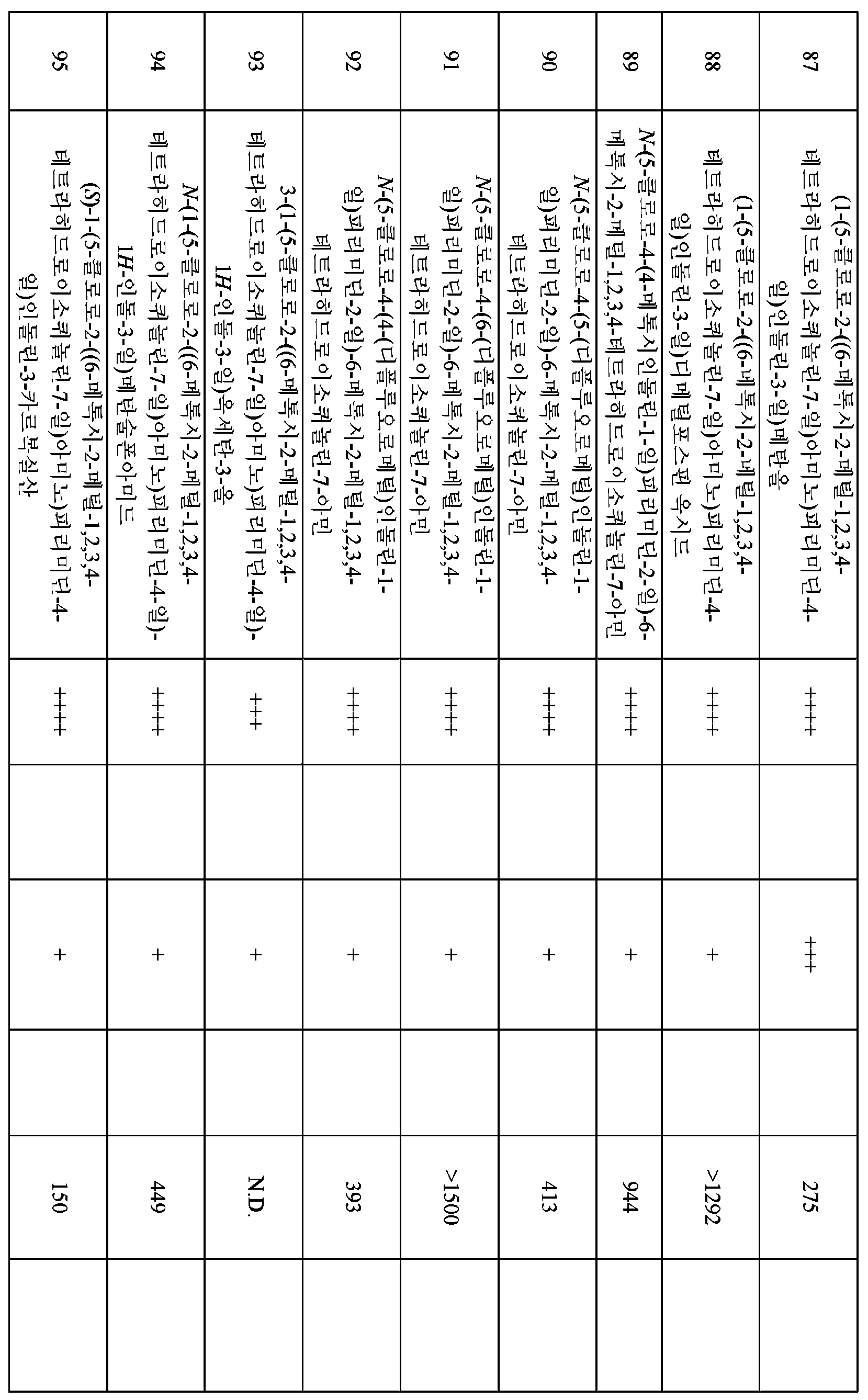
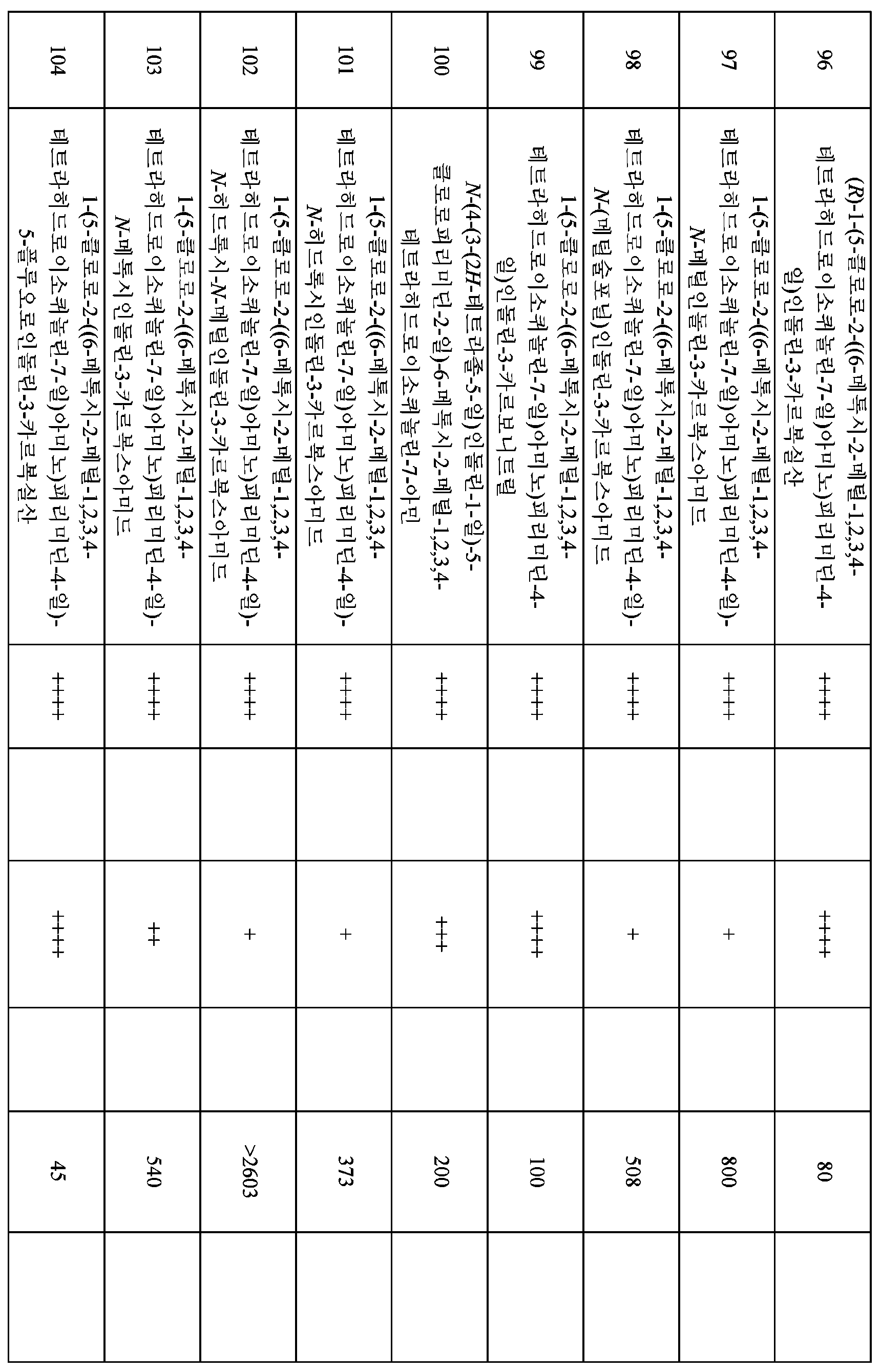


N.D.: 측정되지 않음.N.D.: Not measured.
B*: 제1 시험 시설에서 수행된 시험. N*: 제2 시험 시설에서 수행된 시험.B*: Testing performed at the first testing facility. N*: tests performed at the second testing facility.
표 2Table 2


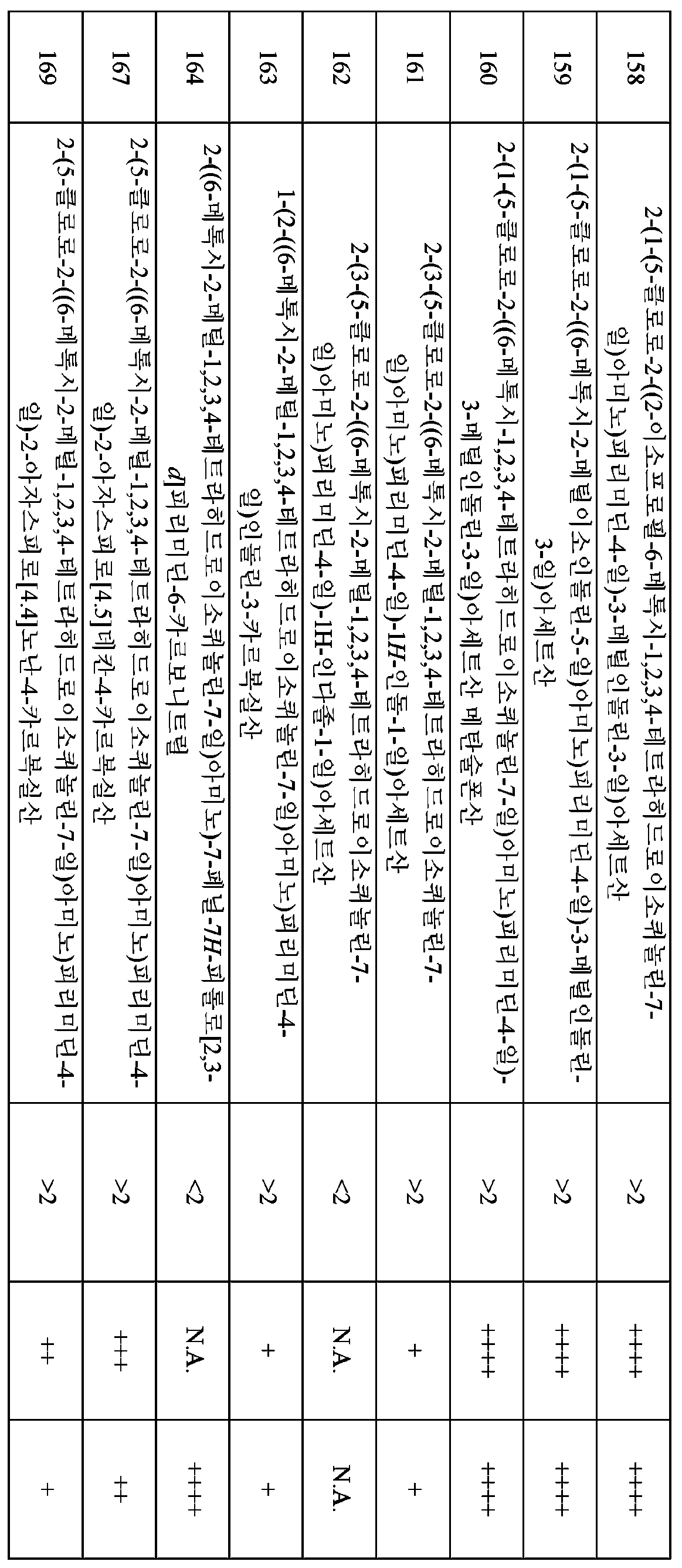
N.A.: 이용가능하지 않음.N.A.: Not available.
표 1 및 2에서, IC50, EC2x 및 EC50 값은 각각 100 nM 이하의 값에 대해 "++++"로; "++++"보다 높지만 500 nM 이하의 값에 대해 "+++"로; "+++"보다 높지만 1 μM 이하의 값에 대해 "++"로; 및 1 μM 초과의 값에 대해 "+"로 나타낸다.In Tables 1 and 2, the IC50, EC2x, and EC50 values are denoted as “++++” for values of 100 nM or less, respectively; to "++++" for values higher than "++++" but less than or equal to 500 nM; to "++" for values higher than "+++" but less than or equal to 1 μM; and “+” for values greater than 1 μM.
B. 합성 실시예B. Synthesis Examples
장비 설명Equipment Description
NMR 스펙트럼을 400 MHz (1H), 376 MHz (19F) 또는 75 MHz (13C)에서 작동하는 배리안 머큐리 분광계로 측정하였다. 샘플에 사용된 용매는 각각의 화합물에 대한 실험 절차에 명시되어 있다. 화학적 이동은 백만분율 (ppm, δ 단위)로 표현된다. 커플링 상수는 헤르츠 (Hz)의 단위이다. 분할 패턴은 겉보기 다중도를 기재하고, s (단일선), d (이중선), t (삼중선), q (사중선), quint (오중선), m (다중선), br (넓음)로서 지정된다.NMR spectra were measured with a Varian Mercury spectrometer operating at 400 MHz ( 1 H), 376 MHz ( 19 F) or 75 MHz ( 13 C). The solvents used for the samples are specified in the experimental procedures for each compound. Chemical shifts are expressed in parts per million (ppm, δ units). The coupling constant is in units of hertz (Hz). The split pattern describes the apparent multiplicity, as s (single line), d (doublet), t (triplet), q (quartet), quint (quintet), m (multiline), br (broad). designated
하기 시스템을 LCMS에 사용하였다: 애질런트 6120 (이원 구배 모듈 펌프), 엑스브리지 분석 칼럼 C18, 5 μm, 4.6 x 50 mm, 25℃, 5 μL 주입 부피, 2 mL/분, 하기 시기에 따른 수성 0.1% 아세트산암모늄 중 아세토니트릴의 구배 사용:The following system was used for LCMS: Agilent 6120 (two gradient module pump), XBridge Analytical Column C 18 , 5 μm, 4.6×50 mm, 25° C., 5 μL injection volume, 2 mL/min, aqueous according to the following time period: Using a gradient of acetonitrile in 0.1% ammonium acetate:
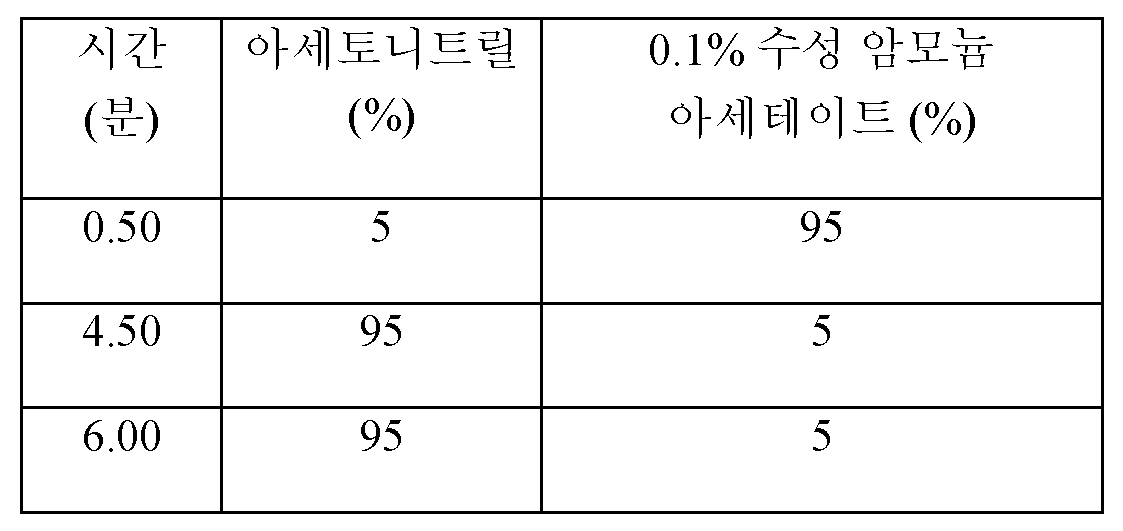
실험 절차: 모든 반응은 달리 명시되지 않는 한 건조 질소의 분위기 하에 수행되었다. TLC 플레이트를 u.v. 광으로 가시화하였다. 플래쉬 크로마토그래피는 유리 칼럼을 사용하는 실리카 겔 (40-60 μm) 상에서의 칼럼 크로마토그래피를 지칭한다. 다르게는, 220 또는 254 nm에서의 u.v. 검출 및 바이오타지 정상 또는 역상 실리카 카트리지를 사용하는 바이오타지 SP1 또는 바이오타지 이솔레라 시스템을 이용하여 자동화 크로마토그래피를 수행하였다. 추가의 세부사항은 관련 실험 절차 하에 찾아볼 수 있다.Experimental Procedure: All reactions were performed under an atmosphere of dry nitrogen unless otherwise specified. TLC plates were washed with u.v. Visualized with light. Flash chromatography refers to column chromatography on silica gel (40-60 μm) using a glass column. Alternatively, u.v. at 220 or 254 nm. Detection and Automated Chromatography was performed using a Biotage SP1 or Biotage Isolera system using either a Biotage normal or reversed-phase silica cartridge. Further details can be found under the relevant experimental procedures.
일반적 방법 및 제조General methods and manufacturing
화학식 (I-0), (I-1), (I-2), (I), (II), (II-1), (II-2) 또는 (II-2')의 화합물, 또는 중간체 및 구체적 실시예는 본원에 기재된 합성 방법을 통해 제조된다. 실험 절차에서, 반응 조건, 예컨대 온도, 용액의 농도, 용매의 부피, 마이크로웨이브 조건의 적용, 반응의 지속기간 또는 그의 조합에 대한 변형이 본 발명의 일부로서 고려되고, 구체적으로 언급된 산, 염기, 시약, 커플링 시약, 용매 등 이외에, 대안적 적합한 산, 염기, 시약, 커플링 시약, 용매 등이 사용될 수 있고, 본 발명의 범주 내에 포함된다. 모든 가능한 기하 이성질체, 입체이성질체, 염 형태는 본 발명의 범주 내에서 고려된다.A compound of formula (I-0), (I-1), (I-2), (I), (II), (II-1), (II-2) or (II-2'), or an intermediate and specific examples are prepared via the synthetic methods described herein. In the experimental procedure, modifications to the reaction conditions such as temperature, concentration of solution, volume of solvent, application of microwave conditions, duration of reaction or combinations thereof are contemplated as part of the present invention, and specifically mentioned acids, bases , reagents, coupling reagents, solvents, and the like, alternative suitable acids, bases, reagents, coupling reagents, solvents, and the like may be used and are included within the scope of the present invention. All possible geometric isomeric, stereoisomeric, salt forms are contemplated within the scope of the present invention.
피리미딘 화합물의 반응식 및 합성 절차:Schemes and synthetic procedures for pyrimidine compounds:

조건 A1: DMF 중 Int. E (또는 상업적으로 입수가능한 시약) (1.0 당량)의 용액에 수소화나트륨 (미네랄 오일 중 60% 분산액, 1.2 당량)을 0℃에서 첨가하고, 혼합물을 0℃에서 30분 동안 교반하였다. 상기 반응 혼합물에 0℃에서 5-R1 치환된 2,4-디클로로피리미딘 (1.0-1.3 당량)을 첨가한 다음, 생성된 혼합물을 실온에서 1시간 동안 교반하고, 0℃로 냉각시키고, 얼음-H2O로 켄칭하였다. 조 생성물을 정제하여 4-R 및 5-R1 치환된 2-Cl-피리미딘을 제공하였다.Condition A1: Int. To a solution of E (or commercially available reagent) (1.0 equiv) was added sodium hydride (60% dispersion in mineral oil, 1.2 equiv) at 0 °C and the mixture was stirred at 0 °C for 30 min. To the reaction mixture was added 5-R 1 substituted 2,4-dichloropyrimidine (1.0-1.3 eq) at 0° C., then the resulting mixture was stirred at room temperature for 1 hour, cooled to 0° C., and ice Quench with -H 2 O. The crude product was purified to provide 4-R and 5-R 1 substituted 2-Cl-pyrimidines.
조건 A2: DMF 중 5-R1 치환된 2,4-디클로로피리미딘 (1.0-1.5 당량)의 용액에 탄산칼륨 (2.0 당량) 및 Int. E (또는 상업적으로 입수가능한 시약) (1.0 당량)를 첨가하였다. 혼합물을 80℃에서 밤새 교반하고, 실온으로 냉각시키고, H2O로 희석하고, EA로 추출하였다. 조 생성물을 정제하여 4-R 및 5-R1 치환된 2-Cl-피리미딘을 제공하였다.Condition A2: To a solution of 5-R 1 substituted 2,4-dichloropyrimidine (1.0-1.5 equiv) in DMF potassium carbonate (2.0 equiv) and Int. E (or commercially available reagent) (1.0 eq) was added. The mixture was stirred at 80° C. overnight, cooled to room temperature, diluted with H 2 O and extracted with EA. The crude product was purified to provide 4-R and 5-R 1 substituted 2-Cl-pyrimidines.
조건 A3: n-부탄올 중 Int. E (또는 상업적으로 입수가능한 시약) (1.0 당량)의 용액에 5-R1 치환된 2,4-디클로로피리미딘 (1.0-1.5 당량) 및 DIPEA (1.0-2.0 당량)를 후속적으로 첨가하였다. 반응 혼합물을 100℃에서 18시간 동안 교반하고, 물로 희석하고, EA로 추출하였다. 조 생성물을 정제하여 4-R 및 5-R1 치환된 2-Cl-피리미딘을 제공하였다.Condition A3: Int. To a solution of E (or commercially available reagent) (1.0 equiv) was subsequently added 5-R 1 substituted 2,4-dichloropyrimidine (1.0-1.5 equiv) and DIPEA (1.0-2.0 equiv). The reaction mixture was stirred at 100° C. for 18 h, diluted with water and extracted with EA. The crude product was purified to provide 4-R and 5-R 1 substituted 2-Cl-pyrimidines.
조건 B1: 2-메톡시에탄올 중 Int. W (1.0-1.4 당량)의 용액에 4-R 및 5-R1 치환된 2-Cl-피리미딘 (1.0 당량) 및 EtOH 용액 중 HCl (3.0 당량)을 첨가하였다. 생성된 혼합물을 120℃에서 20시간 동안 교반하고, 진공 하에 농축시켰다. 잔류물을 실리카 겔 상에서 플래쉬 칼럼 크로마토그래피 및/또는 정제용-HPLC에 의해 정제하였다.Condition B1: Int. To a solution of W (1.0-1.4 equiv) was added 4-R and 5-R 1 substituted 2-Cl-pyrimidine (1.0 equiv) and HCl in EtOH solution (3.0 equiv). The resulting mixture was stirred at 120° C. for 20 h and concentrated in vacuo. The residue was purified by flash column chromatography and/or preparative-HPLC on silica gel.
조건 B2: 이소프로판올 중 4-R 및 5-R1 치환된 2-Cl-피리미딘 (1.0 당량)의 용액 및 Int. W (1-1.3 당량)의 용액에 트리플루오로아세트산 (1.0-3.0 당량)을 첨가하였다. 혼합물을 N2 하에 100℃에서 20시간 동안 교반하고, 실온으로 냉각시키고, 포화 NaHCO3 수용액으로 pH ~8로 염기성화시키고, DCM으로 추출하였다. 유기 상을 염수로 세척하고, 무수 Na2SO4 상에서 건조시키고, 여과하였다. 여과물을 진공 하에 농축시키고, 잔류물을 실리카 겔 상에서 플래쉬 칼럼 크로마토그래피 및/또는 정제용-HPLC에 의해 정제하였다.Condition B2: A solution of 4-R and 5-R 1 substituted 2-Cl-pyrimidine (1.0 equiv) in isopropanol and Int. To a solution of W (1-1.3 equiv) was added trifluoroacetic acid (1.0-3.0 equiv). The mixture was stirred under N 2 at 100° C. for 20 h, cooled to room temperature, basified to pH-8 with saturated aqueous NaHCO 3 aqueous solution, and extracted with DCM. The organic phase was washed with brine, dried over anhydrous Na 2 SO 4 and filtered. The filtrate was concentrated in vacuo and the residue was purified by flash column chromatography and/or prep-HPLC on silica gel.
조건 B3: 이소프로판올 중 4-R 및 5-R1 치환된 2-Cl-피리미딘 (1.0 당량) 및 Int. W (1-1.3 당량)의 용액에 TsOH·H2O (1.0-1.2 당량)를 첨가하였다. 혼합물을 100℃에서 밤새 교반하고, 실온으로 냉각시키고, 포화 NaHCO3 수용액으로 pH ~8로 염기성화시키고, DCM으로 추출하였다. 유기 상을 염수로 세척하고, 무수 Na2SO4 상에서 건조시키고, 여과하였다. 여과물을 진공 하에 농축시키고, 잔류물을 실리카 겔 상에서 플래쉬 칼럼 크로마토그래피 및/또는 정제용-HPLC에 의해 정제하였다.Condition B3: 4-R and 5-R 1 substituted 2-Cl-pyrimidine in isopropanol (1.0 equiv) and Int. To a solution of W (1-1.3 equiv) was added TsOH.H 2 O (1.0-1.2 equiv). The mixture was stirred at 100° C. overnight, cooled to room temperature, basified to pH-8 with saturated aqueous NaHCO 3 aqueous solution, and extracted with DCM. The organic phase was washed with brine, dried over anhydrous Na 2 SO 4 and filtered. The filtrate was concentrated in vacuo and the residue was purified by flash column chromatography and/or prep-HPLC on silica gel.
조건 B4: 디옥산 중 4-R 및 5-R1 치환된 2-Cl-피리미딘 (1.0 당량)의 용액에 Int. W (1.0-1.2 당량), Pd2(dba)3 (0.2 당량), Xantphos (0.2 당량), 및 탄산칼륨 (2.0 당량)을 첨가하였다. 혼합물을 N2 하에 100℃에서 12시간 동안 교반하고, 실온으로 냉각시키고, 여과하였다. 잔류물을 실리카 겔 상에서 플래쉬 칼럼 크로마토그래피 및/또는 정제용-HPLC에 의해 정제하였다.Condition B4: In a solution of 4-R and 5-R 1 substituted 2-Cl-pyrimidine (1.0 equiv) in dioxane Int. W (1.0-1.2 equiv), Pd 2 (dba) 3 (0.2 equiv), Xantphos (0.2 equiv), and potassium carbonate (2.0 equiv) were added. The mixture was stirred under N 2 at 100° C. for 12 h, cooled to room temperature and filtered. The residue was purified by flash column chromatography and/or preparative-HPLC on silica gel.
구체적 예에 따라, 조건 A와 B 사이에 4-R 및 5-R1 치환된 2-Cl-피리미딘의 추가 전환, 및 조건 B 후에 추가 전환이 있었다.According to a specific example, there was a further conversion of 4-R and 5-R 1 substituted 2-Cl-pyrimidines between conditions A and B, and a further conversion after condition B.
중간체intermediate

6-메톡시-2-메틸-1,2,3,4-테트라히드로이소퀴놀린-7-아민6-Methoxy-2-methyl-1,2,3,4-tetrahydroisoquinolin-7-amine

단계 1: 수성 HCl 용액 (1 N, 192 mL, 192 mmol) 중 2-(3-메톡시페닐)에탄아민 (20.0 g, 132.27 mmol, 19.23 mL)의 혼합물에 포름알데히드의 수용액 (37% w.t., 41.64 g, 529.08 mmol)을 첨가하였다. 혼합물을 60℃에서 1시간 동안 교반하고, 0℃로 냉각시키고, 50% 수성 NaOH 용액 (17.44 g, 218 mmol)을 0℃에서 적가하여 염기성화시켰다. 생성된 혼합물을 실온에서 밤새 교반하고, 여과하였다. 여과물을 농축시켜 비스(6-메톡시-3,4-디히드로이소퀴놀린-2(1H)-일)메탄을을 백색 고체 (23 g, 100% 수율)로서 제공하였다.Step 1: In a mixture of 2-(3-methoxyphenyl)ethanamine (20.0 g, 132.27 mmol, 19.23 mL) in aqueous HCl solution (1 N, 192 mL, 192 mmol) an aqueous solution of formaldehyde (37% w.t., 41.64 g, 529.08 mmol) was added. The mixture was stirred at 60 °C for 1 h, cooled to 0 °C and basified by dropwise addition of 50% aqueous NaOH solution (17.44 g, 218 mmol) at 0 °C. The resulting mixture was stirred at room temperature overnight and filtered. The filtrate was concentrated to give bis(6-methoxy-3,4-dihydroisoquinolin-2(1H)-yl)methane as a white solid (23 g, 100% yield).
단계 2: i-PrOH (200 mL) 중 비스(6-메톡시-3,4-디히드로이소퀴놀린-2(1H)-일)메탄 (28 g, 82.73 mmol)의 현탁액에 진한 HCl (15.20 g, 182.01 mmol, 15.3 mL)을 0℃에서 적가하고, 혼합물을 실온에서 18시간 동안 교반하였다. MTBE (70 mL)를 상기 혼합물에 첨가하고, 현탁액을 실온에서 추가로 4시간 동안 교반하였다. 여과한 후, 케이크를 MTBE/i-PrOH의 혼합물 (100 mL, 1/1 v/v)로 세척하고, 건조시켜 6-메톡시-1,2,3,4-테트라히드로이소퀴놀린 히드로클로라이드를 백색 고체로서 제공하였으며, 이를 DCM (300 mL) 중에 현탁시켰다. 혼합물에 포화 수성 NaHCO3 용액 (500 mL)을 첨가하고, 혼합물을 실온에서 2시간 동안 교반하였다. 분리한 후, 수성 층을 DCM (50 mL x 4)으로 추출하였다. 합한 유기 층을 무수 Na2SO4 상에서 건조시키고, 여과하고, 농축시켜 6-메톡시-1,2,3,4-테트라히드로이소퀴놀린을 황색 오일 (10 g, 75% 수율)로서 제공하였다. LC-MS (ESI) m/z: 164 [M+H]+.Step 2: To a suspension of bis(6-methoxy-3,4-dihydroisoquinolin-2(1H)-yl)methane (28 g, 82.73 mmol) in i-PrOH (200 mL) with concentrated HCl (15.20 g , 182.01 mmol, 15.3 mL) was added dropwise at 0° C. and the mixture was stirred at room temperature for 18 h. MTBE (70 mL) was added to the mixture and the suspension was stirred at room temperature for an additional 4 h. After filtration, the cake was washed with a mixture of MTBE/i-PrOH (100 mL, 1/1 v/v) and dried to give 6-methoxy-1,2,3,4-tetrahydroisoquinoline hydrochloride It provided as a white solid, which was suspended in DCM (300 mL). To the mixture was added saturated aqueous NaHCO 3 solution (500 mL) and the mixture was stirred at room temperature for 2 h. After separation, the aqueous layer was extracted with DCM (50 mL×4). The combined organic layers were dried over anhydrous Na 2 SO 4 , filtered and concentrated to give 6-methoxy-1,2,3,4-tetrahydroisoquinoline as a yellow oil (10 g, 75% yield). LC-MS (ESI) m/z: 164 [M+H] + .
단계 3: MeOH (30 mL) 중 6-메톡시-1,2,3,4-테트라히드로이소퀴놀린 (1.63 g, 9.99 mmol)의 용액에 실온에서 수성 포름알데히드 (37% w/w, 4.8 g, 59.92 mmol, 1.67 mL)를 첨가하였다. 혼합물을 실온에서 15분 동안 교반하고, 0℃로 냉각시키고, 여기에 NaBH4 (1.13 g, 29.96 mmol)를 조금씩 첨가하였다. 혼합물을 실온에서 3시간 동안 교반하고, 빙수 (10 mL)로 켄칭하고, DCM (20 mL x 5)으로 추출하였다. 유기 층을 무수 황산나트륨 상에서 건조시키고, 여과하고, 농축시켰다. 잔류물을 실리카 겔 상에서 플래쉬 칼럼 크로마토그래피 (DCM/MeOH = 10/1 v/v)에 의해 정제하여 6-메톡시-2-메틸-1,2,3,4-테트라히드로이소퀴놀린을 황색 오일 (1.7 g, 96% 수율)로서 제공하였다. LC-MS (ESI) m/z: 178 [M+H]+.Step 3: To a solution of 6-methoxy-1,2,3,4-tetrahydroisoquinoline (1.63 g, 9.99 mmol) in MeOH (30 mL) at room temperature aqueous formaldehyde (37% w/w, 4.8 g) , 59.92 mmol, 1.67 mL) was added. The mixture was stirred at room temperature for 15 minutes, cooled to 0° C., to which NaBH 4 (1.13 g, 29.96 mmol) was added portionwise. The mixture was stirred at room temperature for 3 h, quenched with ice water (10 mL) and extracted with DCM (20 mL×5). The organic layer was dried over anhydrous sodium sulfate, filtered and concentrated. The residue was purified by flash column chromatography on silica gel (DCM/MeOH = 10/1 v/v) to give 6-methoxy-2-methyl-1,2,3,4-tetrahydroisoquinoline as a yellow oil. (1.7 g, 96% yield). LC-MS (ESI) m/z: 178 [M+H] + .
단계 4: 진한 황산 (4 mL)의 사전-냉각된 용액 (0℃)에 0℃에서 6-메톡시-2-메틸-1,2,3,4-테트라히드로이소퀴놀린 (2 g, 11.28 mmol), 및 구아니딘 니트레이트 (1.17 g, 9.59 mmol)를 후속적으로 첨가하였다. 생성된 혼합물을 0℃에서 30분 동안 교반하고, 빙수 (20 mL)로 켄칭하고, 수성 NaOH 용액 (4 N)을 사용하여 pH 10-11로 염기성화시키고, DCM (50 mL x 4)으로 추출하였다. 합한 유기 층을 무수 Na2SO4 상에서 건조시키고, 여과하고, 농축시켰다. 잔류물을 실리카 겔 상에서 플래쉬 칼럼 크로마토그래피 (PE 100% v/v, PE/EA = 1/1 v/v, EA 100% v/v에 이어서 DCM/MeOH = 20/1, v/v)에 의해 정제하여 6-메톡시-2-메틸-7-니트로-1,2,3,4-테트라히드로이소퀴놀린을 황색 고체 (0.9 g, 36% 수율)로서 제공하였다. LC-MS (ESI) m/z: 223 [M+H]+.Step 4: 6-Methoxy-2-methyl-1,2,3,4-tetrahydroisoquinoline (2 g, 11.28 mmol) in a pre-cooled solution (0°C) of concentrated sulfuric acid (4 mL) at 0°C ), and guanidine nitrate (1.17 g, 9.59 mmol) were added subsequently. The resulting mixture was stirred at 0° C. for 30 min, quenched with ice water (20 mL), basified to pH 10-11 with aqueous NaOH solution (4 N), and extracted with DCM (50 mL×4). did The combined organic layers were dried over anhydrous Na 2 SO 4 , filtered and concentrated. The residue was subjected to flash column chromatography on silica gel (PE 100% v/v, PE/EA = 1/1 v/v, EA 100% v/v then DCM/MeOH = 20/1, v/v) to give 6-methoxy-2-methyl-7-nitro-1,2,3,4-tetrahydroisoquinoline as a yellow solid (0.9 g, 36% yield). LC-MS (ESI) m/z: 223 [M+H] + .
단계 5: EA (32 mL), H2O (16 mL), 및 EtOH (144 mL) 중 6-메톡시-2-메틸-7-니트로-1,2,3,4-테트라히드로이소퀴놀린 (4.2 g, 14.40 mmol)의 용액에 Fe 분말 (5.5 g, 93.99 mmol) 및 암모니아 클로라이드 (793.96 mg, 13.08 mmol)를 첨가하였다. 혼합물을 60℃에서 48시간 동안 교반하고, 실온으로 냉각시키고, 여과하였다. 케이크를 메탄올 (30 mL x 3)로 세척하고, 여과물을 농축시켰다. 잔류물을 실리카 겔 상에서 플래쉬 칼럼 크로마토그래피 (DCM/MeOH = 20/1에서 10/1 v/v)에 의해 정제하여 6-메톡시-2-메틸-1,2,3,4-테트라히드로이소퀴놀린-7-아민 히드로클로라이드를 황색 고체 (4.5 g, 100% 수율)로서 제공하였다. LC-MS (ESI) m/z: 193 [M+H]+.Step 5: 6-Methoxy-2-methyl-7-nitro-1,2,3,4-tetrahydroisoquinoline in EA (32 mL), H 2 O (16 mL), and EtOH (144 mL) ( To a solution of 4.2 g, 14.40 mmol) was added Fe powder (5.5 g, 93.99 mmol) and ammonia chloride (793.96 mg, 13.08 mmol). The mixture was stirred at 60° C. for 48 h, cooled to room temperature and filtered. The cake was washed with methanol (30 mL×3) and the filtrate was concentrated. The residue was purified by flash column chromatography on silica gel (DCM/MeOH = 20/1 to 10/1 v/v) to 6-methoxy-2-methyl-1,2,3,4-tetrahydroiso The quinolin-7-amine hydrochloride was provided as a yellow solid (4.5 g, 100% yield). LC-MS (ESI) m/z: 193 [M+H] + .
대안적 합성 방법:Alternative synthetic methods:

단계 1: DCM (100 mL) 중 트리에틸아민 (13.38 g, 132.27 mmol, 18.44 mL), 2-(3-메톡시페닐)에탄아민 (10 g, 66.13 mmol) 및 DMAP (807.96 mg, 6.61 mmol)의 용액에 Boc2O (15.88 g, 72.75 mmol, 16.70 mL)를 0℃에서 천천히 첨가하였다. 이어서, 혼합물을 실온에서 16시간 동안 교반하고, 빙수 (200 mL)로 희석하고, EtOAc (3 x 200 mL)로 추출하였다. 합한 유기 상을 염수 (100 mL)로 세척하고, 무수 Na2SO4 상에서 건조시키고, 여과하고, 진공 하에 농축시켰다. 잔류물을 플래쉬 크로마토그래피 (SiO2, 석유 에테르/에틸 아세테이트 = 10/1)에 의해 정제하여 tert-부틸 (3-메톡시페네틸)카르바메이트 (14.6 g, 79.06% 수율, 90% 순도)를 무색 액체로서 제공하였다. LC-MS (ESI) m/z: 196 [M+H-56]+.Step 1: Triethylamine (13.38 g, 132.27 mmol, 18.44 mL), 2-(3-methoxyphenyl)ethanamine (10 g, 66.13 mmol) and DMAP (807.96 mg, 6.61 mmol) in DCM (100 mL) To the solution of Boc 2 O (15.88 g, 72.75 mmol, 16.70 mL) was slowly added at 0 °C. The mixture was then stirred at room temperature for 16 h, diluted with ice water (200 mL) and extracted with EtOAc (3×200 mL). The combined organic phases were washed with brine (100 mL), dried over anhydrous Na 2 SO 4 , filtered and concentrated in vacuo. The residue was purified by flash chromatography (SiO 2 , petroleum ether/ethyl acetate = 10/1) to tert-butyl (3-methoxyphenethyl)carbamate (14.6 g, 79.06% yield, 90% purity) was provided as a colorless liquid. LC-MS (ESI) m/z: 196 [M+H-56] + .
단계 2: CH2Cl2 (50 mL) 중 tert-부틸 (3-메톡시페네틸)카르바메이트 (7 g, 27.85 mmol) 및 2-클로로피리딘 (4.74 g, 41.78 mmol, 3.92 mL)의 용액에 -78℃에서 CH2Cl2 (5 mL) 중 Tf2O (8.64 g, 30.64 mmol, 5.15 mL)의 용액을 첨가하였다. 20분 후에, BH3 .Et2O (19.77 g, 139.26 mmol)를 상기 용액에 적가하였다. 이어서, 반응 혼합물을 실온으로 가온하고, 2시간 동안 교반하고, 포화 NaHCO3 용액으로 조심스럽게 켄칭하였다. 생성된 혼합물을 CH2Cl2 (3 x 100 mL)로 추출하였다. 합한 유기 층을 염수 (50 mL)로 세척하고, 무수 Na2SO4 상에서 건조시키고, 여과하고, 진공 하에 농축시켰다. 잔류물을 플래쉬 크로마토그래피 (SiO2, 석유 에테르/에틸 아세테이트/메탄올 = 5/1/0에서 10/10/1)에 의해 정제하여 6-메톡시-3,4-디히드로이소퀴놀린-1(2H)-온 (3.4 g, 68.89% 수율)을 회백색 고체로서 제공하였다. LC-MS (ESI) m/z: 178 [M+H]+.Step 2: A solution of tert-butyl (3-methoxyphenethyl)carbamate (7 g, 27.85 mmol) and 2-chloropyridine (4.74 g, 41.78 mmol, 3.92 mL) in CH 2 Cl 2 (50 mL) was added a solution of Tf 2 O (8.64 g, 30.64 mmol, 5.15 mL) in CH 2 Cl 2 (5 mL) at -78°C. After 20 minutes, BH 3 . Et 2 O (19.77 g, 139.26 mmol) was added dropwise to the solution. The reaction mixture was then warmed to room temperature, stirred for 2 h, and carefully quenched with saturated NaHCO 3 solution. The resulting mixture was extracted with CH 2 Cl 2 (3×100 mL). The combined organic layers were washed with brine (50 mL), dried over anhydrous Na 2 SO 4 , filtered and concentrated in vacuo. The residue was purified by flash chromatography (SiO 2 , petroleum ether/ethyl acetate/methanol = 5/1/0 to 10/10/1) to give 6-methoxy-3,4-dihydroisoquinoline-1 ( 2H)-one (3.4 g, 68.89% yield) was provided as an off-white solid. LC-MS (ESI) m/z: 178 [M+H] + .
단계 3: 진한 H2SO4 (50 mL) 중 6-메톡시-3,4-디히드로이소퀴놀린-1(2H)-온 (3.8 g, 21.44 mmol, 9.62 mL)의 용액에 HNO3 (2.16 g, 22.29 mmol, 65% 순도)를 -20℃에서 적가하였다. 혼합물을 -20℃ 내지 -25℃에서 3시간 동안 교반하고, 빙수 (300 mL)에 부었다. 수성 층을 디클로로메탄 (3 x 200 mL)으로 추출하였다. 합한 유기 층을 진공 하에 농축시키고, 잔류물을 플래쉬 칼럼 크로마토그래피 (SiO2, 석유 에테르/에틸 아세테이트/메탄올 = 10/1/0~10/10/1)에 의해 정제하여 6-메톡시-7-니트로-3,4-디히드로이소퀴놀린-1(2H)-온 (2.02 g, 40.78% 수율)을 제공하였다. LC-MS (ESI) m/z: 223 [M+H]+.Step 3: To a solution of 6-methoxy-3,4-dihydroisoquinolin-1(2H)-one (3.8 g, 21.44 mmol, 9.62 mL) in concentrated H 2 SO 4 (50 mL) HNO 3 (2.16) g, 22.29 mmol, 65% purity) was added dropwise at -20°C. The mixture was stirred at -20°C to -25°C for 3 h and poured into ice water (300 mL). The aqueous layer was extracted with dichloromethane (3×200 mL). The combined organic layers were concentrated in vacuo and the residue was purified by flash column chromatography (SiO 2 , petroleum ether/ethyl acetate/methanol = 10/1/0-10/10/1) to 6-methoxy-7 -Nitro-3,4-dihydroisoquinolin-1(2H)-one (2.02 g, 40.78% yield) was provided. LC-MS (ESI) m/z: 223 [M+H] + .
단계 4: THF (200 mL) 중 6-메톡시-7-니트로-3,4-디히드로이소퀴놀린-1(2H)-온 (2.02 g, 9.09 mmol)의 용액에 1 M BH3/THF (45.46 mmol, 45.5 mL)를 첨가하였다. 혼합물을 환류 하에 20시간 동안 교반하고, 메탄올 (30 mL)로 조심스럽게 켄칭하였다. 생성된 용액을 진공 하에 농축시켰다. 잔류물을 2 N HCl (50 mL) 중에서 80℃에서 3시간 동안 가열하고, 냉각시키고, 수성 수산화 암모늄으로 염기성화시키고, 디클로로메탄 (3 x 100 mL)으로 추출하였다. 합한 유기 층을 무수 황산나트륨 상에서 건조시키고, 여과하고, 농축시켜 6-메톡시-7-니트로-1,2,3,4-테트라히드로이소퀴놀린 (1.89 g, 100.00% 수율)을 제공하였다. LC-MS (ESI) m/z: 209 [M+H]+.Step 4: To a solution of 6-methoxy-7-nitro-3,4-dihydroisoquinolin-1(2H)-one (2.02 g, 9.09 mmol) in THF (200 mL) 1 M BH 3 /THF ( 45.46 mmol, 45.5 mL) was added. The mixture was stirred at reflux for 20 h and carefully quenched with methanol (30 mL). The resulting solution was concentrated in vacuo. The residue was heated in 2 N HCl (50 mL) at 80° C. for 3 h, cooled, basified with aqueous ammonium hydroxide and extracted with dichloromethane (3×100 mL). The combined organic layers were dried over anhydrous sodium sulfate, filtered and concentrated to give 6-methoxy-7-nitro-1,2,3,4-tetrahydroisoquinoline (1.89 g, 100.00% yield). LC-MS (ESI) m/z: 209 [M+H] + .
단계 5: 메탄올 (30 mL) 중 6-메톡시-7-니트로-1,2,3,4-테트라히드로이소퀴놀린 (1.89 g, 9.08 mmol, 9.62 mL)의 용액에 실온에서 포름알데히드 (1.64 g, 54.46 mmol, 1.51 mL)를 첨가하였다. 혼합물을 실온에서 15분 동안 교반하고, 0℃로 냉각시켰다. 이어서, NaBH4 (1.03 g, 27.23 mmol)를 상기 혼합물에 조금씩 첨가하였다. 생성된 혼합물을 실온에서 3시간 동안 교반하고, 빙수 (10 mL)로 켄칭하고, DCM (20 mL x 5)으로 추출하였다. 합한 유기 층을 무수 황산나트륨 상에서 건조시키고, 여과하고, 농축시켰다. 잔류물을 실리카 겔 상에서 플래쉬 칼럼 크로마토그래피 (DCM/MeOH = 10/1, v/v)에 의해 정제하여 6-메톡시-2-메틸-7-니트로-1,2,3,4-테트라히드로이소퀴놀린 (1.4 g, 69.40% 수율)을 황색 오일로서 제공하였다. LC-MS (ESI) m/z: 223 [M+H]+.Step 5: To a solution of 6-methoxy-7-nitro-1,2,3,4-tetrahydroisoquinoline (1.89 g, 9.08 mmol, 9.62 mL) in methanol (30 mL) at room temperature with formaldehyde (1.64 g , 54.46 mmol, 1.51 mL) was added. The mixture was stirred at room temperature for 15 min and cooled to 0 °C. Then NaBH 4 (1.03 g, 27.23 mmol) was added portionwise to the mixture. The resulting mixture was stirred at room temperature for 3 h, quenched with ice water (10 mL) and extracted with DCM (20 mL×5). The combined organic layers were dried over anhydrous sodium sulfate, filtered and concentrated. The residue was purified by flash column chromatography on silica gel (DCM/MeOH = 10/1, v/v) to 6-methoxy-2-methyl-7-nitro-1,2,3,4-tetrahydro Isoquinoline (1.4 g, 69.40% yield) was provided as a yellow oil. LC-MS (ESI) m/z: 223 [M+H] + .
단계 6: EtOAc (2 mL), H2O (1 mL), 및 EtOH (10 mL) 중 6-메톡시-2-메틸-7-니트로-1,2,3,4-테트라히드로이소퀴놀린 (1.3 g, 5.85 mmol)의 용액에 Fe (2.19 g, 39.19 mmol) 및 암모니아 클로라이드 (284.74 mg, 5.32 mmol)를 첨가하였다. 혼합물을 60℃에서 16시간 동안 교반하고, 실온으로 냉각시키고, 여과하였다. 케이크를 메탄올 (30 mL x 3)로 세척하고, 여과물을 농축시켰다. 잔류물을 실리카 겔 상에서 플래쉬 칼럼 크로마토그래피 (DCM/MeOH = 20/1에서 10/1 v/v)에 의해 정제하여 6-메톡시-2-메틸-1,2,3,4-테트라히드로이소퀴놀린-7-아민 히드로클로라이드를 황색 고체 (0.85 g, 75.6% 수율)로서 제공하였다. LC-MS (ESI) m/z: 193 [M+H]+.Step 6: 6-Methoxy-2-methyl-7-nitro-1,2,3,4-tetrahydroisoquinoline in EtOAc (2 mL), H 2 O (1 mL), and EtOH (10 mL) ( To a solution of 1.3 g, 5.85 mmol) was added Fe (2.19 g, 39.19 mmol) and ammonia chloride (284.74 mg, 5.32 mmol). The mixture was stirred at 60° C. for 16 h, cooled to room temperature and filtered. The cake was washed with methanol (30 mL×3) and the filtrate was concentrated. The residue was purified by flash column chromatography on silica gel (DCM/MeOH = 20/1 to 10/1 v/v) to 6-methoxy-2-methyl-1,2,3,4-tetrahydroiso The quinolin-7-amine hydrochloride was provided as a yellow solid (0.85 g, 75.6% yield). LC-MS (ESI) m/z: 193 [M+H] + .

2-메틸-1,2,3,4-테트라히드로이소퀴놀린-7-아민2-Methyl-1,2,3,4-tetrahydroisoquinolin-7-amine

단계 1: 진한 황산 (20 mL) 중 1,2,3,4-테트라히드로이소퀴놀린 (4.8 g, 36.04 mmol)의 빙냉 용액에 온도를 5℃ 미만으로 유지하면서 질산칼륨 (4.01 g, 47.21 mmol)을 조금씩 첨가하였다. 반응 혼합물을 실온에서 밤새 교반하고, 얼음 (100 g)에 붓고, NH3·H2O를 사용하여 pH ~9로 조정하고, CH2Cl2 (50 mL x 3)로 추출하였다. 합한 유기 층을 무수 황산나트륨 상에서 건조시키고, 여과하고, 농축시켰다. 잔류물을 메탄올 중에서 결정화하여 7-니트로-1,2,3,4-테트라히드로이소퀴놀린 히드로클로라이드를 황색 고체 (4.2 g, 54% 수율)로서 제공하였다. LC-MS (ESI) m/: 179 [M+H]+.Step 1: In an ice-cooled solution of 1,2,3,4-tetrahydroisoquinoline (4.8 g, 36.04 mmol) in concentrated sulfuric acid (20 mL) potassium nitrate (4.01 g, 47.21 mmol) maintaining the temperature below 5° C. was added little by little. The reaction mixture was stirred at room temperature overnight, poured into ice (100 g), adjusted to pH ˜9 with NH 3 .H 2 O and extracted with CH 2 Cl 2 (50 mL×3). The combined organic layers were dried over anhydrous sodium sulfate, filtered and concentrated. The residue was crystallized in methanol to give 7-nitro-1,2,3,4-tetrahydroisoquinoline hydrochloride as a yellow solid (4.2 g, 54% yield). LC-MS (ESI) m/: 179 [M+H] + .
단계 2: 건조 1,2-디클로로에탄 (200 mL) 중 7-니트로-1,2,3,4-테트라히드로이소퀴놀린 히드로클로라이드 (5.0 g, 23.29 mmol)의 교반 혼합물에 포르말린 (37% 수성 포름알데히드, 2.0 mL, 25.86 mmol), 및 이어서 트리아세톡시보로히드라이드 (19.81 g, 104.82 mmol)를 첨가하였다. 반응 혼합물을 실온에서 4시간 동안 격렬히 교반하고, 농축시켰다. 잔류물을 EtOAc (400 mL)로 희석하고, 포화 NaHCO3 수용액 (400 mL)으로 천천히 켄칭하고, 30분 동안 교반하였다. 혼합물을 EA (100 mL x 4)로 추출하였다. 유기 층을 무수 황산나트륨 상에서 건조시키고, 여과하고, 농축시켜 2-메틸-7-니트로-1,2,3,4-테트라히드로이소퀴놀린을 갈색 고체 (3.8 g, 85% 수율)로서 제공하였다. LC-MS (ESI) m/: 193 [M+H]+.Step 2: To a stirred mixture of 7-nitro-1,2,3,4-tetrahydroisoquinoline hydrochloride (5.0 g, 23.29 mmol) in dry 1,2-dichloroethane (200 mL) formalin (37% aqueous form aldehyde, 2.0 mL, 25.86 mmol), followed by triacetoxyborohydride (19.81 g, 104.82 mmol). The reaction mixture was stirred vigorously at room temperature for 4 h and concentrated. The residue was diluted with EtOAc (400 mL), quenched slowly with saturated aqueous NaHCO 3 solution (400 mL) and stirred for 30 min. The mixture was extracted with EA (100 mL×4). The organic layer was dried over anhydrous sodium sulfate, filtered and concentrated to give 2-methyl-7-nitro-1,2,3,4-tetrahydroisoquinoline as a brown solid (3.8 g, 85% yield). LC-MS (ESI) m/: 193 [M+H] + .
단계 3: EA (10 mL), EtOH (100 mL), 및 H2O (20 mL) 중 2-메틸-7-니트로-1,2,3,4-테트라히드로이소퀴놀린 (3.8 g, 19.77 mmol), Fe (5.52 g, 98.85 mmol), NH4Cl (15.86 g, 296.54 mmol)의 현탁액을 70℃에서 24시간 동안 격렬히 교반하였다. 여과한 후, 케이크를 EA/EtOH의 혼합 용매 (100 mL, 10/1, v/v)로 세척하고, 여과물을 농축시켰다. 잔류물을 실리카 겔 상에서 플래쉬 칼럼 크로마토그래피 (DCM 중 MeOH, 0%에서 25% v/v)에 의해 정제하여 2-메틸-1,2,3,4-테트라히드로이소퀴놀린-7-아민을 황색 고체 (1.84 g, 57% 수율)로서 제공하였다. LC-MS (ESI) m/z: 163 [M+H]+.Step 3: 2-methyl-7-nitro-1,2,3,4-tetrahydroisoquinoline (3.8 g, 19.77 mmol) in EA (10 mL), EtOH (100 mL), and H 2 O (20 mL) ), Fe (5.52 g, 98.85 mmol), NH 4 Cl (15.86 g, 296.54 mmol) was stirred vigorously at 70° C. for 24 h. After filtration, the cake was washed with a mixed solvent of EA/EtOH (100 mL, 10/1, v/v), and the filtrate was concentrated. The residue was purified by flash column chromatography on silica gel (MeOH in DCM, 0% to 25% v/v) to give 2-methyl-1,2,3,4-tetrahydroisoquinolin-7-amine to yellow Provided as a solid (1.84 g, 57% yield). LC-MS (ESI) m/z: 163 [M+H] + .

6-클로로-2-메틸-1,2,3,4-테트라히드로이소퀴놀린-7-아민6-Chloro-2-methyl-1,2,3,4-tetrahydroisoquinolin-7-amine

단계 1: MeCN (15 mL) 중 6-클로로이소퀴놀린 (2.0 g, 12.22 mmol)의 용액에 실온에서 MeI (5.21 g, 36.67 mmol)를 첨가하였다. 혼합물을 밀봉된 튜브 중에서 50℃에서 2일 동안 교반하였다. 실온으로 냉각시킨 후, 고체를 여과에 의해 수집하고, 건조시켜 6-클로로-2-메틸이소퀴놀린-2-윰 아이오다이드를 황색 고체 (3.2 g, 86% 수율)로서 제공하였다. LC-MS (ESI) m/z: 178 [M]+.Step 1: To a solution of 6-chloroisoquinoline (2.0 g, 12.22 mmol) in MeCN (15 mL) at room temperature was added MeI (5.21 g, 36.67 mmol). The mixture was stirred in a sealed tube at 50° C. for 2 days. After cooling to room temperature, the solid was collected by filtration and dried to give 6-chloro-2-methylisoquinoline-2-ium iodide as a yellow solid (3.2 g, 86% yield). LC-MS (ESI) m/z: 178 [M] + .
단계 2: MeOH (8 mL) 중 6-클로로-2-메틸이소퀴놀린-2-윰 아이오다이드 (200 mg, 0.65 mmol)의 용액에 NaBH4 (127.06 mg, 3.36 mmol)를 0℃에서 조금씩 첨가하였다. 혼합물을 실온에서 3시간 동안 교반하고, 포화 수성 NaHCO3 용액을 사용하여 pH ~9로 조정하고, DCM (30 mL x 3)으로 추출하였다. 유기 층을 무수 황산나트륨 상에서 건조시키고, 여과하고, 농축시켰다. 잔류물을 정제용-TLC (DCM/MeOH = 20/1, v/v)에 의해 정제하여 6-클로로-2-메틸-1,2,3,4-테트라히드로이소퀴놀린을 황색 고체 (90 mg, 44% 수율)로서 제공하였다. LC-MS (ESI) m/z: 182 [M+H]+.Step 2: To a solution of 6-chloro-2-methylisoquinoline-2-ium iodide (200 mg, 0.65 mmol) in MeOH (8 mL) was added NaBH 4 (127.06 mg, 3.36 mmol) portionwise at 0° C. did The mixture was stirred at room temperature for 3 h, adjusted to pH ~9 with saturated aqueous NaHCO 3 solution, and extracted with DCM (30 mL×3). The organic layer was dried over anhydrous sodium sulfate, filtered and concentrated. The residue was purified by prep-TLC (DCM/MeOH = 20/1, v/v) to give 6-chloro-2-methyl-1,2,3,4-tetrahydroisoquinoline as a yellow solid (90 mg , 44% yield). LC-MS (ESI) m/z: 182 [M+H] + .
단계 3&4: 6-메톡시-2-메틸-1,2,3,4-테트라히드로이소퀴놀린 대신 6-클로로-2-메틸-1,2,3,4-테트라히드로이소퀴놀린을 사용한, Int. W1의 단계 4&5와 동일한 절차. LC-MS (ESI) m/z: 197 [M+H]+.Step 3&4: Using 6-chloro-2-methyl-1,2,3,4-tetrahydroisoquinoline instead of 6-methoxy-2-methyl-1,2,3,4-tetrahydroisoquinoline, Int. Same procedure as step 4&5 of W1. LC-MS (ESI) m/z: 197 [M+H] + .

2-메톡시-6-메틸-5,6,7,8-테트라히드로-1,6-나프티리딘-3-아민2-Methoxy-6-methyl-5,6,7,8-tetrahydro-1,6-naphthyridin-3-amine
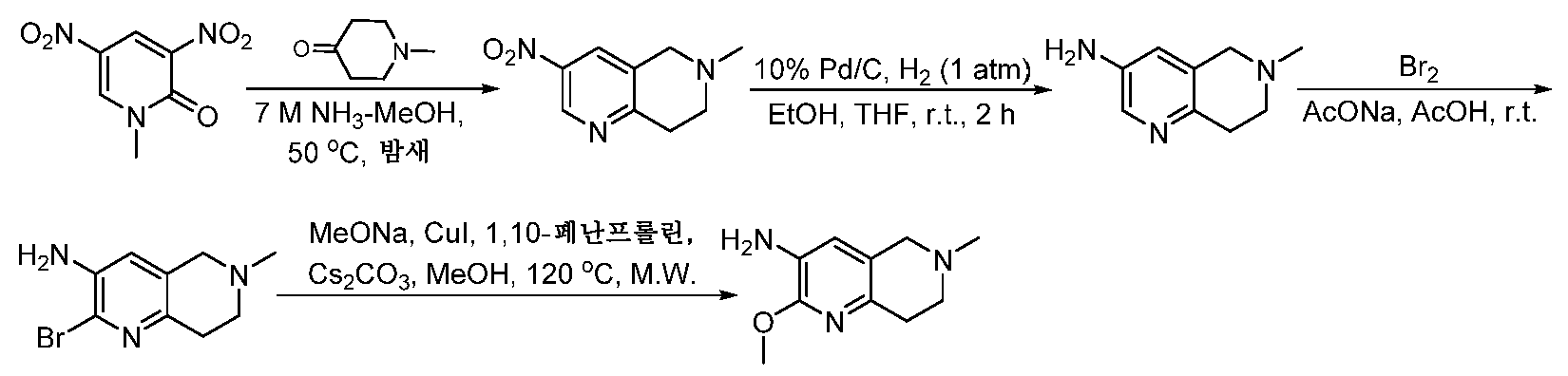
단계 1: NH3/MeOH (7 N, 50 mL) 중 1-메틸-3,5-디니트로-피리딘-2-온 (4.5 g, 22.60 mmol) 및 1-메틸피페리딘-4-온 (2.81 g, 24.86 mmol)의 용액을 밀봉된 튜브에서 50℃에서 밤새 교반하였다. 실온으로 냉각시킨 후, 혼합물을 농축시키고, 잔류물을 DCM (100 mL)과 포화 수성 NaHCO3 용액 (50 mL) 사이에 분배하였다. 층을 분리하고, 수성 층을 DCM (50 mL x 2)으로 추출하였다. 합한 유기 층을 무수 Na2SO4 상에서 건조시키고, 여과하고, 농축시켜 6-메틸-3-니트로-5,6,7,8-테트라히드로-1,6-나프티리딘을 적색 고체 (2.84 g, 65% 수율)로서 제공하였다. LC-MS (ESI) m/z: 194 [M+H]+.Step 1: 1-Methyl-3,5-dinitro-pyridin-2-one (4.5 g, 22.60 mmol) and 1-methylpiperidin-4-one in NH 3 /MeOH (7 N, 50 mL) ( 2.81 g, 24.86 mmol) was stirred overnight at 50° C. in a sealed tube. After cooling to room temperature, the mixture was concentrated and the residue was partitioned between DCM (100 mL) and saturated aqueous NaHCO 3 solution (50 mL). The layers were separated and the aqueous layer was extracted with DCM (50 mL×2). The combined organic layers were dried over anhydrous Na 2 SO 4 , filtered and concentrated to give 6-methyl-3-nitro-5,6,7,8-tetrahydro-1,6-naphthyridine as a red solid (2.84 g, 65% yield). LC-MS (ESI) m/z: 194 [M+H] + .
단계 2: 에탄올 (35 mL) 및 THF (35 mL) 중 6-메틸-3-니트로-7,8-디히드로-5H-1,6-나프티리딘 (1.3 g, 6.73 mmol)의 용액에 10% Pd/C (817.20 mg)를 첨가하고, 혼합물을 H2 (1 atm) 하에 2시간 동안 교반하였다. 여과한 후, 케이크를 EtOH (5 mL x 2)로 세척하고, 여과물을 농축시켜 6-메틸-5,6,7,8-테트라히드로-1,6-나프티리딘-3-아민을 황색 고체 (1.1 g, 100% 수율)로서 제공하였다. LC-MS (ESI) m/z: 164 [M+H]+.Step 2: 10% in a solution of 6-methyl-3-nitro-7,8-dihydro-5H-1,6-naphthyridine (1.3 g, 6.73 mmol) in ethanol (35 mL) and THF (35 mL) Pd/C (817.20 mg) was added and the mixture was stirred under H 2 (1 atm) for 2 h. After filtration, the cake was washed with EtOH (5 mL x 2) and the filtrate was concentrated to give 6-methyl-5,6,7,8-tetrahydro-1,6-naphthyridin-3-amine as a yellow solid. (1.1 g, 100% yield). LC-MS (ESI) m/z: 164 [M+H] + .
단계 3: 아세트산 (25 mL) 중 6-메틸-5,6,7,8-테트라히드로-1,6-나프티리딘-3-아민 (1.2 g, 7.35 mmol) 및 AcONa (1.21 g, 14.70 mmol)의 용액에 실온에서 브로민 (1.17 g, 7.35 mmol)을 첨가하고, 혼합물을 실온에서 1시간 동안 교반하였다. 혼합물을 DCM (100 mL) 및 물 (30 mL) 중에 희석하고, NaHCO3을 사용하여 pH ~9로 천천히 조정하였다. 유기 층을 무수 Na2SO4 상에서 건조시키고, 여과하고, 농축시켰다. 잔류물을 실리카 겔 상에서 플래쉬 칼럼 크로마토그래피 (DCM/MeOH = 20/1, v/v)에 의해 정제하여 2-브로모-6-메틸-5,6,7,8-테트라히드로-1,6-나프티리딘-3-아민을 황색 고체 (570 mg, 32%)로서 제공하였다. LC-MS (ESI) m/z: 242 [M+H].Step 3: 6-Methyl-5,6,7,8-tetrahydro-1,6-naphthyridin-3-amine (1.2 g, 7.35 mmol) and AcONa (1.21 g, 14.70 mmol) in acetic acid (25 mL) To the solution of bromine (1.17 g, 7.35 mmol) at room temperature was added, and the mixture was stirred at room temperature for 1 hour. The mixture was diluted in DCM (100 mL) and water (30 mL) and slowly adjusted to pH ˜9 with NaHCO 3 . The organic layer was dried over anhydrous Na 2 SO 4 , filtered and concentrated. The residue was purified by flash column chromatography on silica gel (DCM/MeOH = 20/1, v/v) to 2-bromo-6-methyl-5,6,7,8-tetrahydro-1,6 -naphthyridin-3-amine was provided as a yellow solid (570 mg, 32%). LC-MS (ESI) m/z: 242 [M+H].
단계 4: MeOH (2 mL) 중 2-브로모-6-메틸-5,6,7,8-테트라히드로-1,6-나프티리딘-3-아민 (250 mg, 1.03 mmol), 탄산세슘 (672.86 mg, 2.07 mmol) 및 MeONa (83.67 mg, 1.55 mmol)의 혼합물에 CuI (19.67 mg, 103.26 umol) 및 1,10-페난트롤린 1수화물 (40.94 mg, 206.51 umol)을 첨가하였다. 혼합물을 N2에 의해 보호된 마이크로웨이브 조건 하에 120℃에서 2시간 동안 교반하였다. 실온으로 냉각시킨 후, 잔류물을 정제용-TLC (DCM/MeOH = 15/1, v/v)에 의해 정제하여 2-메톡시-6-메틸-5,6,7,8-테트라히드로-1,6-나프티리딘-3-아민을 황색 고체 (74 mg, 37% 수율)로서 제공하였다. LC-MS (ESI) m/z: 194 [M+H]+.Step 4: 2-bromo-6-methyl-5,6,7,8-tetrahydro-1,6-naphthyridin-3-amine (250 mg, 1.03 mmol) in MeOH (2 mL), cesium carbonate ( To a mixture of 672.86 mg, 2.07 mmol) and MeONa (83.67 mg, 1.55 mmol) was added CuI (19.67 mg, 103.26 umol) and 1,10-phenanthroline monohydrate (40.94 mg, 206.51 umol). The mixture was stirred at 120° C. for 2 h under microwave conditions protected by N 2 . After cooling to room temperature, the residue was purified by prep-TLC (DCM/MeOH = 15/1, v/v) to 2-methoxy-6-methyl-5,6,7,8-tetrahydro- 1,6-naphthyridin-3-amine was provided as a yellow solid (74 mg, 37% yield). LC-MS (ESI) m/z: 194 [M+H] + .

2-이소프로필-6-메톡시-1,2,3,4-테트라히드로이소퀴놀린-7-아민2-Isopropyl-6-methoxy-1,2,3,4-tetrahydroisoquinolin-7-amine

단계 1: MeOH (10 mL) 중 6-메톡시-1,2,3,4-테트라히드로이소퀴놀린 (340 mg, 2.08 mmol)의 혼합물에 아세톤 (725.93 mg, 12.50 mmol, 917.74 uL)을 실온에서 적가하고, 혼합물을 실온에서 30분 동안 교반하였다. 이어서, NaBH(AcO)3 (6.25 mmol)을 상기 혼합물에 0℃에서 조금씩 첨가하고, 생성된 혼합물을 실온에서 3시간 동안 교반하고, 포화 수성 NaHCO3 용액 (10 mL)으로 0℃에서 켄칭하고, 농축시켰다. 잔류물을 DCM (50 mL x 2)으로 추출하고, 합한 유기 층을 염수 (20 mL x 2)로 세척하고, 무수 Na2SO4 상에서 건조시키고, 여과하고, 농축시켰다. 잔류물을 실리카 겔 상에서 플래쉬 칼럼 크로마토그래피 (DCM/MeOH = 20/1, v/v)에 의해 정제하여 2-이소프로필-6-메톡시-1,2,3,4-테트라히드로이소퀴놀린을 백색 고체 (150 mg, 35% 수율)로서 제공하였다. LC-MS (ESI) m/z: 206 [M+H]+.Step 1: To a mixture of 6-methoxy-1,2,3,4-tetrahydroisoquinoline (340 mg, 2.08 mmol) in MeOH (10 mL) was added acetone (725.93 mg, 12.50 mmol, 917.74 uL) at room temperature. It was added dropwise and the mixture was stirred at room temperature for 30 minutes. Then NaBH(AcO) 3 (6.25 mmol) was added to the mixture in portions at 0° C., and the resulting mixture was stirred at room temperature for 3 h, quenched with saturated aqueous NaHCO 3 solution (10 mL) at 0° C., concentrated. The residue was extracted with DCM (50 mL×2) and the combined organic layers were washed with brine (20 mL×2), dried over anhydrous Na 2 SO 4 , filtered and concentrated. The residue was purified by flash column chromatography on silica gel (DCM/MeOH = 20/1, v/v) to give 2-isopropyl-6-methoxy-1,2,3,4-tetrahydroisoquinoline It was provided as a white solid (150 mg, 35% yield). LC-MS (ESI) m/z: 206 [M+H] + .
단계 2: 6-메톡시-2-메틸-1,2,3,4-테트라히드로이소퀴놀린 대신 2-이소프로필-6-메톡시-1,2,3,4-테트라히드로이소퀴놀린을 사용한, Int. W1의 단계 4와 동일한 절차. LC-MS (ESI) m/z: 251 [M+H]+.Step 2: Using 2-isopropyl-6-methoxy-1,2,3,4-tetrahydroisoquinoline instead of 6-methoxy-2-methyl-1,2,3,4-tetrahydroisoquinoline; Int. Same procedure as step 4 of W1. LC-MS (ESI) m/z: 251 [M+H] + .
단계 3: EA (6 mL) 중 2-이소프로필-6-메톡시-7-니트로-1,2,3,4-테트라히드로이소퀴놀린 (200 mg, 799.06 umol) 및 탄소 상 10% 팔라듐 (30 mg, 799.06 umol)의 혼합물을 H2 (1 atm) 하에 실온에서 16시간 동안 교반하고, 여과하였다. 여과물을 농축시키고, 잔류물을 정제용-TLC (DCM/MeOH = 10/1, v/v)로 정제하여 2-이소프로필-6-메톡시-1,2,3,4-테트라히드로이소퀴놀린-7-아민을 백색 고체 (50 mg, 28% 수율)로서 제공하였다. LC-MS (ESI) m/z: 221 [M+H]+.Step 3: 2-Isopropyl-6-methoxy-7-nitro-1,2,3,4-tetrahydroisoquinoline (200 mg, 799.06 umol) and 10% palladium on carbon (30) in EA (6 mL) mg, 799.06 umol) was stirred under H 2 (1 atm) at room temperature for 16 h and filtered. The filtrate was concentrated and the residue was purified by prep-TLC (DCM/MeOH = 10/1, v/v) to 2-isopropyl-6-methoxy-1,2,3,4-tetrahydroiso Quinolin-7-amine was provided as a white solid (50 mg, 28% yield). LC-MS (ESI) m/z: 221 [M+H] + .
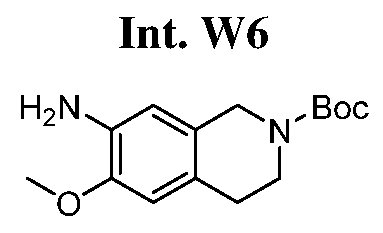
tert-부틸 7-아미노-6-메톡시-3,4-디히드로이소퀴놀린-2(1H)-카르복실레이트tert-Butyl 7-amino-6-methoxy-3,4-dihydroisoquinoline-2(1H)-carboxylate

단계 1: 진한 H2SO4 (5 mL)의 차가운 용액에 6-메톡시-1,2,3,4-테트라히드로이소퀴놀린 (1.0 g, 1.84 mmol)을 -10℃ 하에 첨가하였다. 구아니딘 니트레이트 (758 mg, 6.13 mmol)를 -10℃에서 상기 혼합물에 조금씩 첨가하였다. 혼합물을 -10℃에서 30분 동안 교반하고, 냉수 (20 mL)에 붓고, 수성 NaOH 용액 (4 N)을 사용하여 pH ~8로 조정하고, EA (40 mL x 4)로 추출하였다. 합한 유기 층을 무수 황산나트륨 상에서 건조시키고, 여과하고, 농축시켰다. 잔류물을 실리카 겔 상에서 플래쉬 칼럼 크로마토그래피 (DCM 100% v/v에 이어서 DCM/MeOH = 10/1, v/v)에 의해 정제하여 6-메톡시-7-니트로-1,2,3,4-테트라히드로이소퀴놀린을 황색 고체 (200 mg, 16% 수율)로서 제공하였다. LC-MS (ESI) m/z: 209 [M+H]+.Step 1: To a cold solution of concentrated H 2 SO 4 (5 mL) was added 6-methoxy-1,2,3,4-tetrahydroisoquinoline (1.0 g, 1.84 mmol) at -10°C. Guanidine nitrate (758 mg, 6.13 mmol) was added portionwise to the mixture at -10°C. The mixture was stirred at −10° C. for 30 min, poured into cold water (20 mL), adjusted to pH ˜8 with aqueous NaOH solution (4 N), and extracted with EA (40 mL×4). The combined organic layers were dried over anhydrous sodium sulfate, filtered and concentrated. The residue was purified by flash column chromatography on silica gel (DCM 100% v/v then DCM/MeOH = 10/1, v/v) to give 6-methoxy-7-nitro-1,2,3, 4-Tetrahydroisoquinoline was provided as a yellow solid (200 mg, 16% yield). LC-MS (ESI) m/z: 209 [M+H] + .
단계 2: DCM (5 mL) 중 6-메톡시-7-니트로-1,2,3,4-테트라히드로이소퀴놀린 (100 mg, 0.48 mmol), Boc2O (157 mg, 0.72 mmol), 및 Et3N (97 mg, 0.96 mmol)의 혼합물을 실온에서 4시간 동안 교반하고, 농축시켰다. 잔류물을 실리카 겔 상에서 플래쉬 칼럼 크로마토그래피 (DCM 100% v/v에 이어서 DCM/MeOH = 10/1, v/v)에 의해 정제하여 tert-부틸 6-메톡시-7-니트로-3,4-디히드로이소퀴놀린-2(1H)-카르복실레이트를 황색 오일 (150 mg, 100% 수율)로서 제공하였다. LC-MS (ESI) m/z: 209 [M-100+1]+.Step 2: 6-Methoxy-7-nitro-1,2,3,4-tetrahydroisoquinoline (100 mg, 0.48 mmol), Boc 2 O (157 mg, 0.72 mmol) in DCM (5 mL), and A mixture of Et 3 N (97 mg, 0.96 mmol) was stirred at room temperature for 4 h and concentrated. The residue was purified by flash column chromatography on silica gel (DCM 100% v/v then DCM/MeOH = 10/1, v/v) tert-butyl 6-methoxy-7-nitro-3,4 -Dihydroisoquinoline-2(1H)-carboxylate was provided as a yellow oil (150 mg, 100% yield). LC-MS (ESI) m/z: 209 [M-100+1] + .
단계 3: EtOH (5 mL) 중 tert-부틸 6-메톡시-7-니트로-3,4-디히드로이소퀴놀린-2(1H)-카르복실레이트 (150 mg, 0.48 mmol) 및 10% Pd/C (50 mg)의 혼합물을 H2 (1 atm) 하에 실온에서 16시간 동안 교반하고, 여과하였다. 여과물을 농축시켜 tert-부틸 7-아미노-6-메톡시-3,4-디히드로이소퀴놀린-2(1H)-카르복실레이트를 황색 고체 (110 mg, 81% 수율)로서 제공하였다. LC-MS (ESI) m/z: 223 [M-55]+.Step 3: tert-Butyl 6-methoxy-7-nitro-3,4-dihydroisoquinoline-2(1H)-carboxylate (150 mg, 0.48 mmol) and 10% Pd/ A mixture of C (50 mg) was stirred under H 2 (1 atm) at room temperature for 16 h and filtered. The filtrate was concentrated to provide tert-butyl 7-amino-6-methoxy-3,4-dihydroisoquinoline-2(1H)-carboxylate as a yellow solid (110 mg, 81% yield). LC-MS (ESI) m/z: 223 [M-55] + .

6-플루오로-2-메틸-1,2,3,4-테트라히드로이소퀴놀린-7-아민6-Fluoro-2-methyl-1,2,3,4-tetrahydroisoquinolin-7-amine
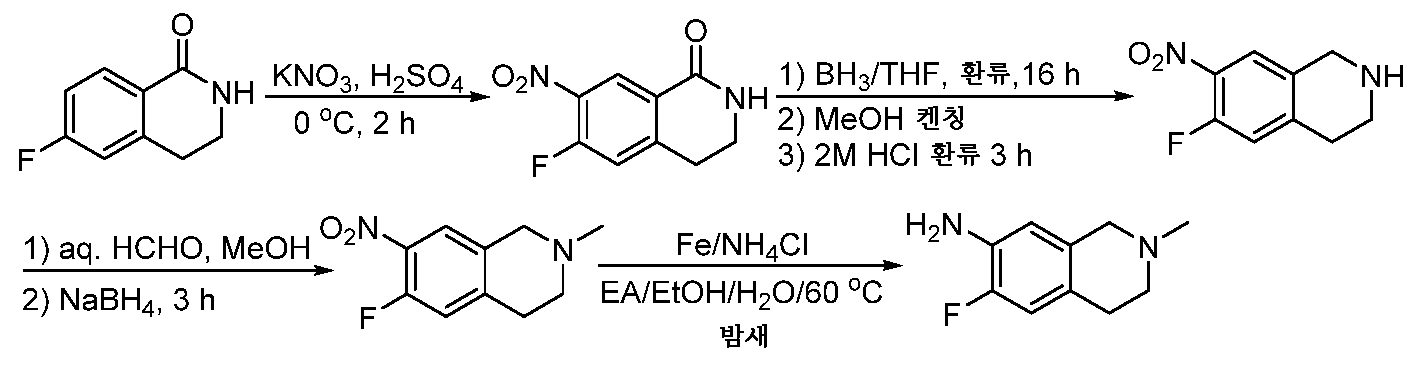
단계 1: H2SO4 (9 mL) 중 6-플루오로-3,4-디히드로-2H-이소퀴놀린-1-온 (900 mg, 5.45 mmol)의 용액에 질산칼륨 (578.47 mg, 5.72 mmol)을 0℃에서 조금씩 첨가하였다. 생성된 혼합물을 0℃에서 2시간 동안 교반하고, 빙수에 부었다. 백색 고체를 침전시키고, 여과에 의해 수집하고, 진공 하에 건조시켜 6-플루오로-7-니트로-3,4-디히드로-2H-이소퀴놀린-1-온 (1.04 g, 86% 수율)을 제공하였다. LC-MS (ESI) m/z: 211 [M+H]+.Step 1: To a solution of 6-fluoro-3,4-dihydro-2H-isoquinolin-1-one (900 mg, 5.45 mmol) in H 2 SO 4 (9 mL) potassium nitrate (578.47 mg, 5.72 mmol) ) was added little by little at 0 °C. The resulting mixture was stirred at 0° C. for 2 h and poured into ice water. A white solid precipitated, collected by filtration and dried under vacuum to give 6-fluoro-7-nitro-3,4-dihydro-2H-isoquinolin-1-one (1.04 g, 86% yield) did LC-MS (ESI) m/z: 211 [M+H] + .
단계 2&3&4: 6-메톡시-7-니트로-3,4-디히드로-2H-이소퀴놀린-1-온 대신 6-플루오로-7-니트로-3,4-디히드로-2H-이소퀴놀린-1-온을 사용한, Int. W1의 대안적 합성 방법의 단계 4&5&6과 동일한 절차. LC-MS (ESI) m/z: 181 [M+H]+.Step 2&3&4: 6-fluoro-7-nitro-3,4-dihydro-2H-isoquinoline-1 instead of 6-methoxy-7-nitro-3,4-dihydro-2H-isoquinolin-1-one Using -on, Int. The same procedure as steps 4&5&6 of the alternative synthesis method of W1. LC-MS (ESI) m/z: 181 [M+H] + .

2-에틸-6-메톡시-1,2,3,4-테트라히드로이소퀴놀린-7-아민2-Ethyl-6-methoxy-1,2,3,4-tetrahydroisoquinolin-7-amine

단계 1: CH3CN (10 mL) 중 6-메톡시-7-니트로-1,2,3,4-테트라히드로이소퀴놀린 (300 mg, 1.44 mmol)의 용액에 아이오도에탄 (224.72 mg, 1.44 mmol, 115.83 μl) 및 K2CO3 (796.52 mg, 5.76 mmol)을 첨가하였다. 반응 혼합물을 20℃에서 16시간 동안 교반하고, 에틸 아세테이트 (100 mL)와 물 (100 mL) 사이에 분배하였다. 유기 층을 분리하고, 무수 황산마그네슘 상에서 건조시키고, 여과하였다. 여과물을 진공 하에 농축시키고, 잔류물을 실리카 겔 상에서 플래쉬 칼럼 크로마토그래피 (수성 수산화암모늄을 함유하는 디클로로메탄 중 0-20% 메탄올)에 의해 정제하여 2-에틸-6-메톡시-7-니트로-1,2,3,4-테트라히드로이소퀴놀린 (136 mg, 40% 수율)을 제공하였다. LC-MS (ESI) m/z: 237 [M+H]+.Step 1: To a solution of 6-methoxy-7-nitro-1,2,3,4-tetrahydroisoquinoline (300 mg, 1.44 mmol) in CH 3 CN (10 mL) in iodoethane (224.72 mg, 1.44) mmol, 115.83 μl) and K 2 CO 3 (796.52 mg, 5.76 mmol) were added. The reaction mixture was stirred at 20° C. for 16 h and partitioned between ethyl acetate (100 mL) and water (100 mL). The organic layer was separated, dried over anhydrous magnesium sulfate and filtered. The filtrate was concentrated in vacuo and the residue was purified by flash column chromatography on silica gel (0-20% methanol in dichloromethane containing aqueous ammonium hydroxide) to 2-ethyl-6-methoxy-7-nitro -1,2,3,4-tetrahydroisoquinoline (136 mg, 40% yield) was provided. LC-MS (ESI) m/z: 237 [M+H] + .
단계 2: 2-메틸-6-메톡시-7-니트로-1,2,3,4-테트라히드로이소퀴놀린 대신 2-에틸-6-메톡시-7-니트로-1,2,3,4-테트라히드로이소퀴놀린을 사용한, Int. W1의 대안적 합성 방법의 단계 6과 동일한 절차. LC-MS (ESI) m/z: 207 [M+H]+.Step 2: 2-ethyl-6-methoxy-7-nitro-1,2,3,4- instead of 2-methyl-6-methoxy-7-nitro-1,2,3,4-tetrahydroisoquinoline Using tetrahydroisoquinoline, Int. Same procedure as step 6 of the alternative synthesis method of W1. LC-MS (ESI) m/z: 207 [M+H] + .

6-메톡시-2-메틸이소인돌린-5-아민6-Methoxy-2-methylisoindolin-5-amine

단계 1: 6-플루오로-3,4-디히드로이소퀴놀린-1(2H)-온 대신 5-메톡시이소인돌린-1-온을 사용한, Int. W7의 단계 1과 동일한 절차. LC-MS (ESI) m/z: 209 [M+H]+.Step 1: Using 5-methoxyisoindolin-1-one instead of 6-fluoro-3,4-dihydroisoquinolin-1(2H)-one, Int. Same procedure as step 1 of W7. LC-MS (ESI) m/z: 209 [M+H] + .
단계 2&3&4: 6-메톡시-7-니트로-3,4-디히드로-2H-이소퀴놀린-1-온 대신 5-메톡시-6-니트로이소인돌린-1-온을 사용한 Int. W1의 대안적 합성 방법의 단계 4&5&6과 동일한 절차. LC-MS (ESI) m/z: 179 [M+H]+.Step 2&3&4: Int using 5-methoxy-6-nitroisoindolin-1-one instead of 6-methoxy-7-nitro-3,4-dihydro-2H-isoquinolin-1-one. The same procedure as steps 4&5&6 of the alternative synthesis method of W1. LC-MS (ESI) m/z: 179 [M+H] + .
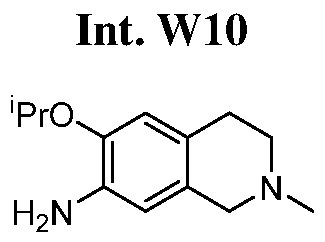
6-이소프로폭시-2-메틸-1,2,3,4-테트라히드로이소퀴놀린-7-아민6-Isopropoxy-2-methyl-1,2,3,4-tetrahydroisoquinolin-7-amine

단계 1: 물 (5 mL) 중 6-메톡시-2-메틸-7-니트로-1,2,3,4-테트라히드로이소퀴놀린 (50 mg, 224.98 umol)의 용액에 1 M 브로민화수소 (1 mL)를 첨가하였다. 혼합물을 환류 하에 16시간 동안 교반하고, 포화 중탄산나트륨 수용액을 사용하여 pH 8로 염기성화시키고, 디클로로메탄/메탄올 (v/v, 10/1, 20 mL x 3)로 추출하였다. 유기 상을 무수 황산나트륨 상에서 건조시키고, 여과하였다. 여과물을 진공 하에 농축시켜 조 2-메틸-7-니트로-1,2,3,4-테트라히드로이소퀴놀린-6-올 (46.84 mg, 90% 수율)을 제공하였다. LC-MS (ESI) m/z: 209 [M+H]+.Step 1: To a solution of 6-methoxy-2-methyl-7-nitro-1,2,3,4-tetrahydroisoquinoline (50 mg, 224.98 umol) in water (5 mL) 1 M hydrogen bromide ( 1 mL) was added. The mixture was stirred at reflux for 16 h, basified to pH 8 with saturated aqueous sodium bicarbonate solution and extracted with dichloromethane/methanol (v/v, 10/1, 20 mL×3). The organic phase was dried over anhydrous sodium sulfate and filtered. The filtrate was concentrated in vacuo to give crude 2-methyl-7-nitro-1,2,3,4-tetrahydroisoquinolin-6-ol (46.84 mg, 90% yield). LC-MS (ESI) m/z: 209 [M+H] + .
단계 2: DMF (2 mL) 중 2-메틸-7-니트로-1,2,3,4-테트라히드로이소퀴놀린-6-올 (230 mg, 1.10 mmol) 및 2-아이오도프로판 (187.78 mg, 1.10 mmol, 110.46 uL)의 용액에 탄산칼륨 (229.00 mg, 1.66 mmol)을 첨가하였다. 혼합물을 실온에서 16시간 동안 교반하고, 염수 (10 mL)로 희석하였다. 수성 상을 분리하고, 에틸 아세테이트 (20 mL x 3)로 추출하였다. 유기 상을 무수 황산나트륨 상에서 건조시키고, 여과하였다. 여과물을 진공 하에 농축시키고, 잔류물을 실리카 겔 상에서 플래쉬 칼럼 크로마토그래피 (EA/PE: 10~50%)에 의해 정제하여 6-이소프로폭시-2-메틸-7-니트로-1,2,3,4-테트라히드로이소퀴놀린 (240 mg, 87% 수율)을 제공하였다. LC-MS (ESI) m/z: 251 [M+H]+.Step 2: 2-Methyl-7-nitro-1,2,3,4-tetrahydroisoquinolin-6-ol (230 mg, 1.10 mmol) and 2-iodopropane (187.78 mg, To a solution of 1.10 mmol, 110.46 uL) was added potassium carbonate (229.00 mg, 1.66 mmol). The mixture was stirred at room temperature for 16 h and diluted with brine (10 mL). The aqueous phase was separated and extracted with ethyl acetate (20 mL×3). The organic phase was dried over anhydrous sodium sulfate and filtered. The filtrate was concentrated in vacuo and the residue was purified by flash column chromatography on silica gel (EA/PE: 10-50%) to give 6-isopropoxy-2-methyl-7-nitro-1,2, Provided 3,4-tetrahydroisoquinoline (240 mg, 87% yield). LC-MS (ESI) m/z: 251 [M+H] + .
단계 3: 6-메톡시-2-메틸-7-니트로-1,2,3,4-테트라히드로이소퀴놀린 5-메톡시-6-니트로이소인돌린-1-온 대신 6-이소프로폭시-2-메틸-7-니트로-1,2,3,4-테트라히드로이소퀴놀린을 사용한, Int. W1의 대안적 합성 방법의 단계 6과 동일한 절차. LC-MS (ESI) m/z: 221 [M+H]+.Step 3: 6-isopropoxy-2 instead of 6-methoxy-2-methyl-7-nitro-1,2,3,4-tetrahydroisoquinoline 5-methoxy-6-nitroisoindolin-1-one Using -methyl-7-nitro-1,2,3,4-tetrahydroisoquinoline, Int. Same procedure as step 6 of the alternative synthesis method of W1. LC-MS (ESI) m/z: 221 [M+H] + .

1-(7-아미노-6-메톡시-3,4-디히드로이소퀴놀린-2(1H)-일)-2,2,2-트리플루오로에탄-1-온1-(7-amino-6-methoxy-3,4-dihydroisoquinolin-2(1H)-yl)-2,2,2-trifluoroethan-1-one

단계 1: 디클로로메탄 (15 mL) 중 6-메톡시-7-니트로-1,2,3,4-테트라히드로이소퀴놀린 (908 mg, 4.14 mmol)의 용액에 트리에틸아민 (838.43 mg, 8.29 mmol, 1.15 mL)을 0℃에서 첨가하고, 이어서 트리플루오로아세트산 무수물 (1.04 g, 4.97 mmol, 700.78 uL)을 첨가하였다. 반응 혼합물을 실온에서 3시간 동안 교반하고, 포화 NaHCO3 수용액을 사용하여 pH 8로 염기성화시키고, 디클로로메탄 (10 mL x 3)으로 추출하였다. 합한 유기 상을 무수 황산나트륨 상에서 건조시키고, 여과하였다. 여과물을 진공 하에 농축시켜 조 2,2,2-트리플루오로-1-(6-메톡시-7-니트로-3,4-디히드로이소퀴놀린-2(1H)-일)에탄-1-온을 황색 고체 (1.26 g, 95% 수율)로서 제공하였다. LC-MS (ESI) m/z: 305 [M+H]+.Step 1: To a solution of 6-methoxy-7-nitro-1,2,3,4-tetrahydroisoquinoline (908 mg, 4.14 mmol) in dichloromethane (15 mL) triethylamine (838.43 mg, 8.29 mmol) , 1.15 mL) at 0° C. followed by trifluoroacetic anhydride (1.04 g, 4.97 mmol, 700.78 uL). The reaction mixture was stirred at room temperature for 3 h, basified to pH 8 with saturated aqueous NaHCO 3 aqueous solution, and extracted with dichloromethane (10 mL×3). The combined organic phases were dried over anhydrous sodium sulfate and filtered. The filtrate was concentrated in vacuo to crude 2,2,2-trifluoro-1-(6-methoxy-7-nitro-3,4-dihydroisoquinolin-2(1H)-yl)ethane-1- was provided as a yellow solid (1.26 g, 95% yield). LC-MS (ESI) m/z: 305 [M+H] + .
단계 2: 메탄올 (30 mL) 중 2,2,2-트리플루오로-1-(6-메톡시-7-니트로-3,4-디히드로이소퀴놀린-2(1H)-일)에탄-1-온 (1.33 g, 4.14 mmol) 및 탄소 상 10% 팔라듐 (400 mg, 3.76 mmol)의 혼합물을 H2 분위기 하에 25℃에서 16시간 동안 교반하고, 셀라이트를 통해 여과하였다. 케이크를 메탄올 (30 mL x 3)로 세척하고, 여과물을 진공 하에 농축시켜 1-(7-아미노-6-메톡시-3,4-디히드로이소퀴놀린-2(1H)-일)-2,2,2-트리플루오로에탄-1-온을 담황색 고체 (1.14 g, 95% 수율)로서 제공하였다. LC-MS (ESI) m/z: 275 [M+H]+.Step 2: 2,2,2-trifluoro-1-(6-methoxy-7-nitro-3,4-dihydroisoquinolin-2(1H)-yl)ethane-1 in methanol (30 mL) A mixture of -one (1.33 g, 4.14 mmol) and 10% palladium on carbon (400 mg, 3.76 mmol) was stirred under H 2 atmosphere at 25° C. for 16 h and filtered through celite. The cake was washed with methanol (30 mL x 3) and the filtrate was concentrated in vacuo to 1-(7-amino-6-methoxy-3,4-dihydroisoquinolin-2(1H)-yl)-2 Provided ,2,2-trifluoroethan-1-one as a pale yellow solid (1.14 g, 95% yield). LC-MS (ESI) m/z: 275 [M+H] + .

(1H-인돌-3-일)디메틸포스핀 옥시드(1H-indol-3-yl)dimethylphosphine oxide

단계 1: DMF (40 mL) 중 1H-인돌 (2.34 g, 19.97 mmol) 및 KOH (1.34 g, 23.97 mmol)의 혼합물에 DMF (10 mL) 중 I2 (5.08 g, 19.97 mmol)의 용액을 0℃에서 적가하였다. 생성된 혼합물을 0℃에서 30분 동안 교반하고, 냉수 (200 mL)로 희석하고, 추가로 30분 동안 교반하였다. 고체를 여과에 의해 수집하고, H2O (30 mL x 3)로 세척하고, 진공 하에 건조시켜 3-아이오도-1H-인돌을 황색 고체 (2.58 g, 53% 수율)로서 제공하였다.Step 1: To a mixture of 1H-indole (2.34 g, 19.97 mmol) and KOH (1.34 g, 23.97 mmol) in DMF (40 mL) was added 0 a solution of I 2 (5.08 g, 19.97 mmol) in DMF (10 mL) It was added dropwise at °C. The resulting mixture was stirred at 0° C. for 30 min, diluted with cold water (200 mL) and stirred for an additional 30 min. The solid was collected by filtration, washed with H 2 O (30 mL×3) and dried under vacuum to give 3-iodo-1H-indole as a yellow solid (2.58 g, 53% yield).
단계 2: DCM (15 mL) 중 3-아이오도-1H-인돌 (2.4 g, 9.87 mmol)의 용액에 트리에틸아민 (3.00 g, 4.13 mL, 29.62 mmol), Boc2O (4.31 g, 19.75 mmol), 및 DMAP (120.64 mg, 0.99 mmol)를 첨가하였다. 혼합물을 실온에서 1시간 동안 교반하고, 진공 하에 농축시켰다. 잔류물을 실리카 겔 상에서 플래쉬 칼럼 크로마토그래피 (EA/PE = 20/1, v/v)에 의해 정제하여 tert-부틸 3-아이오도-1H-인돌-1-카르복실레이트를 갈색 오일 (4.6 g, 100% 수율)로서 제공하였다.Step 2: To a solution of 3-iodo-1H-indole (2.4 g, 9.87 mmol) in DCM (15 mL) triethylamine (3.00 g, 4.13 mL, 29.62 mmol), Boc 2 O (4.31 g, 19.75 mmol) ), and DMAP (120.64 mg, 0.99 mmol) were added. The mixture was stirred at room temperature for 1 h and concentrated in vacuo. The residue was purified by flash column chromatography on silica gel (EA/PE = 20/1, v/v) to give tert-butyl 3-iodo-1H-indole-1-carboxylate as a brown oil (4.6 g , 100% yield).
단계 3: DMF (8 mL) 중 tert-부틸 3-아이오도인돌-1-카르복실레이트 (1.0 g, 2.91 mmol), 디메틸포스핀 옥시드 (250.19 mg, 3.21 mmol), Pd(OAc)2 (65.42 mg, 0.29 mmol), Xantphos (168.61 mg, 0.29 mmol) 및 K3PO4 (680.40 mg, 3.21 mmol)의 혼합물을 N2에 의해 보호된 마이크로웨이브 조건 하에 80℃에서 5시간 동안 교반하였다. 실온으로 냉각시킨 후, 혼합물을 농축시키고, 잔류물을 실리카 겔 상에서 플래쉬 칼럼 크로마토그래피 (DCM 100% v/v에 이어서 DCM/MeOH = 20/1 v/v)에 의해 정제하여 tert-부틸 3-(디메틸포스포릴)-1H-인돌-1-카르복실레이트를 갈색 오일 (1 g, 100% 수율)로서 제공하였다. LC-MS (ESI) m/z: 294 [M+H]+.Step 3: tert-Butyl 3-iodoindole-1-carboxylate (1.0 g, 2.91 mmol), dimethylphosphine oxide (250.19 mg, 3.21 mmol), Pd(OAc) 2 ( A mixture of 65.42 mg, 0.29 mmol), Xantphos (168.61 mg, 0.29 mmol) and K 3 PO 4 (680.40 mg, 3.21 mmol) was stirred under microwave conditions protected by N 2 at 80° C. for 5 h. After cooling to room temperature, the mixture was concentrated and the residue was purified by flash column chromatography on silica gel (DCM 100% v/v then DCM/MeOH = 20/1 v/v) tert-butyl 3- (dimethylphosphoryl)-1H-indole-1-carboxylate was provided as a brown oil (1 g, 100% yield). LC-MS (ESI) m/z: 294 [M+H] + .
단계 4: DCM (6 mL) 중 tert-부틸 3-(디메틸포스포릴)-1H-인돌-1-카르복실레이트 (1.0 g, 3.41 mmol)의 용액에 0℃에서 TFA (3 mL)를 첨가하였다. 혼합물을 실온에서 밤새 교반하고, 진공 하에 농축시켰다. 잔류물을 실리카 겔 상에서 플래쉬 칼럼 크로마토그래피 (DCM/MeOH = 20/1, v/v)에 의해 정제하여 (1H-인돌-3-일)디메틸포스핀 옥시드를 백색 고체 (460 mg, 70% 수율)로서 제공하였다. LC-MS (ESI) m/z: 194 [M+H]+.Step 4: To a solution of tert-butyl 3-(dimethylphosphoryl)-1H-indole-1-carboxylate (1.0 g, 3.41 mmol) in DCM (6 mL) at 0° C. was added TFA (3 mL) . The mixture was stirred at room temperature overnight and concentrated in vacuo. The residue was purified by flash column chromatography on silica gel (DCM/MeOH = 20/1, v/v) to give (1H-indol-3-yl)dimethylphosphine oxide as a white solid (460 mg, 70%) yield). LC-MS (ESI) m/z: 194 [M+H] + .

N,N-디메틸-1H-인돌-3-카르복스아미드N,N-dimethyl-1H-indole-3-carboxamide

DMF (15 mL) 중 1H-인돌-3-카르복실산 (1.0 g, 6.21 mmol), HATU (4.72 g, 12.41 mmol), 및 디메틸아민 히드로클로라이드 (1.01 g, 12.41 mmol)의 용액에 트리에틸아민 (2.51 g, 3.46 mL, 24.82 mmol)을 0℃에서 적가하였다. 혼합물을 실온에서 14시간 동안 교반하고, H2O (100 mL)로 희석하고, 에틸 아세테이트 (100 mL x 3)로 추출하였다. 합한 유기 층을 염수 (100 mL x 5)로 세척하고, 무수 황산나트륨 상에서 건조시키고, 여과하였다. 여과물을 진공 하에 농축시켜 N,N-디메틸-1H-인돌-3-카르복스아미드를 백색 고체 (650 mg, 56% 수율)로서 제공하였다. LC-SM (ESI) m/z: 189 [M+H]+.To a solution of 1H-indole-3-carboxylic acid (1.0 g, 6.21 mmol), HATU (4.72 g, 12.41 mmol), and dimethylamine hydrochloride (1.01 g, 12.41 mmol) in DMF (15 mL) triethylamine (2.51 g, 3.46 mL, 24.82 mmol) was added dropwise at 0°C. The mixture was stirred at room temperature for 14 h, diluted with H 2 O (100 mL) and extracted with ethyl acetate (100 mL×3). The combined organic layers were washed with brine (100 mL×5), dried over anhydrous sodium sulfate and filtered. The filtrate was concentrated in vacuo to provide N,N-dimethyl-1H-indole-3-carboxamide as a white solid (650 mg, 56% yield). LC-SM (ESI) m/z: 189 [M+H] + .

3-플루오로-1H-인돌3-Fluoro-1H-indole

단계 1: THF (5 mL) 중 3,3-디플루오로인돌린-2-온 (300 mg, 1.77 mmol)의 용액에 BH3/S(CH3)2 (2 M) (6.21 mmol, 3 mL)를 0℃에서 적가하였다. 혼합물을 실온에서 2시간 동안 교반하고, 0℃에서 10% 시트르산 수용액으로 켄칭하고, 물로 희석하였다. 생성된 혼합물을 에틸 아세테이트 (50 mL x 3)로 추출하고, 유기 상을 염수 (100 mL)로 세척하고, 무수 황산나트륨 상에서 건조시키고, 여과하였다. 여과물을 진공 하에 농축시켜 3-플루오로-1H-인돌 (220 mg, 91.78% 수율)을 황색 고체로서 제공하였다. LC-MS (ESI) m/z: 136.1 [M+H]+.Step 1: To a solution of 3,3-difluoroindolin-2-one (300 mg, 1.77 mmol) in THF (5 mL) BH 3 /S(CH 3 ) 2 (2 M) (6.21 mmol, 3 mL) was added dropwise at 0 °C. The mixture was stirred at room temperature for 2 h, quenched at 0° C. with 10% aqueous citric acid solution, and diluted with water. The resulting mixture was extracted with ethyl acetate (50 mL x 3) and the organic phase was washed with brine (100 mL), dried over anhydrous sodium sulfate and filtered. The filtrate was concentrated in vacuo to provide 3-fluoro-1H-indole (220 mg, 91.78% yield) as a yellow solid. LC-MS (ESI) m/z: 136.1 [M+H] + .

N,N-디메틸-1H-인돌-2-카르복스아미드N,N-dimethyl-1H-indole-2-carboxamide
1H-인돌-3-카르복실산 대신 1H-인돌-2-카르복실산을 사용한, Int. E2와 동일한 절차. LC-MS (ESI) m/z: 189 [M+H]+.Using 1H-indole-2-carboxylic acid instead of 1H-indole-3-carboxylic acid, Int. Same procedure as E2. LC-MS (ESI) m/z: 189 [M+H] + .
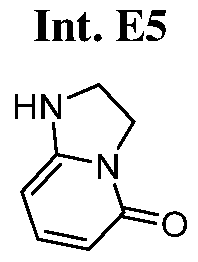
2,3-디히드로이미다조[1,2-a]피리딘-5(1H)-온2,3-dihydroimidazo[1,2-a]pyridin-5(1H)-one

단계 1: 에탄올 (40 mL) 중 2,6-디플루오로피리딘 (2.3 g, 19.99 mmol, 1.81 mL) 및 2-아미노에탄올 (12.21 g, 199.86 mmol, 12.09 mL)의 혼합물을 90℃에서 16시간 동안 교반하고, 물 (50 mL)로 켄칭하고, EtOAc (3 x 100 mL)로 추출하였다. 합한 유기 상을 염수 (50 mL)로 세척하고, 무수 Na2SO4 상에서 건조시키고, 여과하고, 진공 하에 농축시켰다. 잔류물을 플래쉬 크로마토그래피 (SiO2, 에틸 아세테이트 100%)에 의해 정제하여 2-((6-플루오로피리딘-2-일)아미노)에탄-1-올 (3 g, 93.24% 수율, 97% 순도)을 무색 액체로서 제공하였다. LC-MS (ESI) m/z: 157.2 [M+H]+.Step 1: A mixture of 2,6-difluoropyridine (2.3 g, 19.99 mmol, 1.81 mL) and 2-aminoethanol (12.21 g, 199.86 mmol, 12.09 mL) in ethanol (40 mL) at 90° C. for 16 h stirred for a while, quenched with water (50 mL) and extracted with EtOAc (3×100 mL). The combined organic phases were washed with brine (50 mL), dried over anhydrous Na 2 SO 4 , filtered and concentrated in vacuo. The residue was purified by flash chromatography (SiO 2 , ethyl acetate 100%) to 2-((6-fluoropyridin-2-yl)amino)ethan-1-ol (3 g, 93.24% yield, 97%) purity) as a colorless liquid. LC-MS (ESI) m/z: 157.2 [M+H] + .
단계 2: MeCN (1 mL) 중 2-((6-플루오로피리딘-2-일)아미노)에탄-1-올 (500 mg, 3.20 mmol) 및 (2,2,2-트리플루오로아세틸) 2,2,2-트리플루오로아세테이트 (1.68 g, 8.00 mmol, 1.13 mL)의 혼합물을 밀봉된 튜브 내에서 55℃에서 16시간 동안 교반하고, 진공 하에 농축시켰다. 잔류물을 후속 단계에 정제 없이 사용하였다.Step 2: 2-((6-fluoropyridin-2-yl)amino)ethan-1-ol (500 mg, 3.20 mmol) and (2,2,2-trifluoroacetyl) in MeCN (1 mL) A mixture of 2,2,2-trifluoroacetate (1.68 g, 8.00 mmol, 1.13 mL) was stirred in a sealed tube at 55° C. for 16 h and concentrated in vacuo. The residue was used in the next step without purification.
단계 3: 조 5-플루오로-2,3-디히드로-1H-이미다조[1,2-a]피리딘-4-윰 (500 mg, 3.59 mmol)의 부분을 물 (25 mL) 중에 용해시키고, 물 236.18 uL 중 NaOH (503.05 mg, 12.58 mmol)를 첨가하였다. 혼합물을 실온에서 30시간 동안 교반하고, 진한 HCl로 중화시키고, 진공 하에 농축시켰다. 생성된 고체를 DCM 중에 현탁시키고, 셀라이트의 패드를 통해 여과하고, EtOAc로 세척하였다. 합한 유기 상을 진공 하에 농축시키고, 잔류물을 실리카 겔 크로마토그래피 (DCM/MeOH = 20/1)에 의해 정제하여 2,3-디히드로이미다조[1,2-a]피리딘-5(1H)-온 (100 mg, 10.22% 수율, 50% 순도)을 제공하였다. LC-MS (ESI) m/z: 137.1 [M+H]+.Step 3: A portion of crude 5-fluoro-2,3-dihydro-1H-imidazo[1,2-a]pyridin-4-ium (500 mg, 3.59 mmol) is dissolved in water (25 mL) and , NaOH (503.05 mg, 12.58 mmol) in 236.18 uL of water was added. The mixture was stirred at room temperature for 30 h, neutralized with concentrated HCl and concentrated in vacuo. The resulting solid was suspended in DCM, filtered through a pad of celite and washed with EtOAc. The combined organic phases were concentrated in vacuo, and the residue was purified by silica gel chromatography (DCM/MeOH = 20/1) to 2,3-dihydroimidazo[1,2-a]pyridine-5(1H) -on (100 mg, 10.22% yield, 50% purity) was provided. LC-MS (ESI) m/z: 137.1 [M+H] + .

인돌린-3-일메탄올Indolin-3-ylmethanol

단계 1: TFA (30 mL) 중 메틸 1H-인돌-3-카르복실레이트 (1.75 g, 9.99 mmol)의 용액에 NaBH3CN (6.28 g, 99.90 mmol)을 -10℃에서 조금씩 첨가하였다. 이어서, 혼합물을 동일한 온도에서 추가로 1시간 동안 교반하고, 수성 NaOH (10%, 100 mL)로 켄칭하였다. 생성된 혼합물을 디클로로메탄 (3 x 100 mL)으로 추출하였다. 합한 유기 층을 무수 Na2SO4 상에서 건조시키고, 여과하였다. 여과물을 진공 하에 농축시켜 메틸 인돌린-3-카르복실레이트 (0.54 g, 1.52 mmol, 50% 순도)를 수득하였다. LC-MS (ESI) m/z: 178 [M+H]+.Step 1: To a solution of methyl 1H-indole-3-carboxylate (1.75 g, 9.99 mmol) in TFA (30 mL) was added NaBH 3 CN (6.28 g, 99.90 mmol) portionwise at -10°C. The mixture was then stirred at the same temperature for an additional 1 h and quenched with aqueous NaOH (10%, 100 mL). The resulting mixture was extracted with dichloromethane (3 x 100 mL). The combined organic layers were dried over anhydrous Na 2 SO 4 and filtered. The filtrate was concentrated in vacuo to give methyl indoline-3-carboxylate (0.54 g, 1.52 mmol, 50% purity). LC-MS (ESI) m/z: 178 [M+H] + .
단계 2: THF (10 mL) 중 메틸 인돌린-3-카르복실레이트 (0.2 g, 1.13 mmol)의 용액을 THF 중 1.0 M LiAlH4 (94.24 mg, 2.48 mmol)로 처리하고, 환류하에 2시간 동안 교반하였다. 메탄올 (10 mL)을 조심스럽게 첨가하여 혼합물을 켄칭하였다. 생성된 용액을 진공 하에 농축시켰다. 생성된 잔류물을 실리카 겔 상에서 플래쉬 칼럼 크로마토그래피 (MeOH/DCM = 0~10%)에 의해 정제하여 인돌린-3-일메탄올을 무색 오일 (90 mg, 53% 수율)로서 수득하였다. LC-MS (ESI) m/z: 150 [M+H]+.Step 2: A solution of methyl indoline-3-carboxylate (0.2 g, 1.13 mmol) in THF (10 mL) was treated with 1.0 M LiAlH 4 (94.24 mg, 2.48 mmol) in THF, reflux for 2 h stirred. Methanol (10 mL) was carefully added to quench the mixture. The resulting solution was concentrated in vacuo. The resulting residue was purified by flash column chromatography on silica gel (MeOH/DCM = 0-10%) to give indolin-3-ylmethanol as a colorless oil (90 mg, 53% yield). LC-MS (ESI) m/z: 150 [M+H] + .

인돌린-3-일디메틸포스핀 옥시드Indolin-3-yldimethylphosphine oxide

단계 1: THF (20 mL) 중 인돌 (2 g, 17.07 mmol)의 용액에 NaH (819.40 mg, 20.49 mmol, 미네랄 오일 중 60%)를 0℃에서 첨가하였다. 혼합물을 0℃에서 30분 동안 교반하고, 벤젠술포닐 클로라이드 (3.62 g, 20.49 mmol)를 상기 혼합물에 첨가하였다. 생성된 혼합물을 실온에서 1시간 동안 교반하고, 0℃로 냉각시키고, 빙수 (100 mL)로 켄칭하였다. 혼합물을 에틸 아세테이트 (3 x 50 mL)로 추출하고, 합한 유기 상을 무수 황산나트륨 상에서 건조시키고, 여과하였다. 여과물을 진공 하에 농축시키고, 잔류물을 실리카 겔 (EA/PE = 9/1) 상에서 플래쉬 칼럼 크로마토그래피에 의해 정제하여 1-(페닐술포닐)-1H-인돌을 무색 오일 (3.8 g, 87% 수율)로서 제공하였다. LC-MS (ESI) m/z: 258 [M+H]+.Step 1: To a solution of indole (2 g, 17.07 mmol) in THF (20 mL) was added NaH (819.40 mg, 20.49 mmol, 60% in mineral oil) at 0°C. The mixture was stirred at 0° C. for 30 min, and benzenesulfonyl chloride (3.62 g, 20.49 mmol) was added to the mixture. The resulting mixture was stirred at room temperature for 1 h, cooled to 0° C. and quenched with ice water (100 mL). The mixture was extracted with ethyl acetate (3 x 50 mL) and the combined organic phases were dried over anhydrous sodium sulfate and filtered. The filtrate was concentrated in vacuo and the residue was purified by flash column chromatography on silica gel (EA/PE = 9/1) to give 1-(phenylsulfonyl)-1H-indole as a colorless oil (3.8 g, 87 % yield). LC-MS (ESI) m/z: 258 [M+H] + .
단계 2: CH3CN (30 mL) 중 1-(페닐술포닐)-1H-인돌 (500 mg, 1.94 mmol) 및 AgNO3 (330.34 mg, 1.94 mmol)의 혼합물을 N2 분위기 하에 실온에서 2시간 동안 교반한 후, 디메틸포스핀 옥시드 (455.00 mg, 5.83 mmol)를 첨가하였다. 혼합물을 100℃에서 16시간 동안 교반하고, 실리카 겔을 통해 여과하였다. 여과물을 진공 하에 농축시키고, 잔류물을 실리카 겔 상에서 플래쉬 칼럼 크로마토그래피 (DCM/MeOH = 10/1)에 의해 정제하여 (1H-인돌-3-일)디메틸포스핀 옥시드를 황색 오일 (150 mg, 13% 수율)로서 제공하였다. LC-MS (ESI) m/z: 194 [M+H]+.Step 2: A mixture of 1-(phenylsulfonyl)-1H-indole (500 mg, 1.94 mmol) and AgNO 3 (330.34 mg, 1.94 mmol) in CH 3 CN (30 mL) under N 2 atmosphere at room temperature for 2 h After stirring for a while, dimethylphosphine oxide (455.00 mg, 5.83 mmol) was added. The mixture was stirred at 100° C. for 16 h and filtered through silica gel. The filtrate was concentrated in vacuo and the residue was purified by flash column chromatography on silica gel (DCM/MeOH = 10/1) to give (1H-indol-3-yl)dimethylphosphine oxide as a yellow oil (150 mg, 13% yield). LC-MS (ESI) m/z: 194 [M+H] + .
단계 3: TFA (5 mL) 중 (1H-인돌-3-일)디메틸포스핀 옥시드 (175 mg, 905.88 umol)의 용액에 배치 중 NaBH3CN (570.71 mg, 9.06 mmol)을 -5℃에서 첨가하였다. 반응 혼합물을 실온에서 밤새 교반하고, 2 N NaOH 용액을 사용하여 pH 9-10으로 조정하고, 디클로로메탄/메탄올 (10/1)로 희석하였다. 수성 상을 디클로로메탄/메탄올 (10/1, 20 mL x 3)로 추출하였다. 유기 상을 무수 황산나트륨 상에서 건조시키고, 여과하였다. 여과물을 진공 하에 농축시켜 인돌린-3-일디메틸포스핀 옥시드를 무색 오일 (40 mg, 14% 수율)로서 제공하였다. LC-MS (ESI) m/z: 196 [M+H]+.Step 3: To a solution of (1H-indol-3-yl)dimethylphosphine oxide (175 mg, 905.88 umol) in TFA (5 mL) in batch NaBH 3 CN (570.71 mg, 9.06 mmol) at -5°C added. The reaction mixture was stirred at room temperature overnight, adjusted to pH 9-10 with 2 N NaOH solution and diluted with dichloromethane/methanol (10/1). The aqueous phase was extracted with dichloromethane/methanol (10/1, 20 mL×3). The organic phase was dried over anhydrous sodium sulfate and filtered. The filtrate was concentrated in vacuo to provide indolin-3-yldimethylphosphine oxide as a colorless oil (40 mg, 14% yield). LC-MS (ESI) m/z: 196 [M+H] + .

3-(메틸술포닐)-1H-인돌3-(methylsulfonyl)-1H-indole

THF (20 mL) 중 인돌 (1 g, 8.54 mmol)의 용액에 칼륨 2-메틸프로판-2-올레이트 (1.05 g, 9.39 mmol)를 첨가하였다. 반응 혼합물을 25℃에서 30분 동안 교반하고, 이어서 트리에틸보란 (920.15 mg, 9.39 mmol) 및 메탄술포닐 클로라이드 (1.08 g, 9.39 mmol, 726.77 uL)를 순차적으로 첨가하였다. 반응 혼합물을 -15℃에서 16시간 동안 교반하고, 포화 염화암모늄 용액 (50 mL)으로 켄칭하고, 에틸 아세테이트 (30 mL x 3)로 추출하였다. 유기 상을 무수 황산나트륨 상에서 건조시키고, 여과하였다. 여과물을 진공 하에 농축시키고, 잔류물을 실리카 겔 (PE/EA = 5/1) 상에서 플래쉬 칼럼 크로마토그래피에 의해 정제하여 3-메틸술포닐-1H-인돌을 담황색 고체 (810 mg, 46% 수율)로서 제공하였다. LC-MS (ESI) m/z: 196 [M+H]+.To a solution of indole (1 g, 8.54 mmol) in THF (20 mL) was added potassium 2-methylpropan-2-oleate (1.05 g, 9.39 mmol). The reaction mixture was stirred at 25° C. for 30 min, then triethylborane (920.15 mg, 9.39 mmol) and methanesulfonyl chloride (1.08 g, 9.39 mmol, 726.77 uL) were added sequentially. The reaction mixture was stirred at -15°C for 16 h, quenched with saturated ammonium chloride solution (50 mL), and extracted with ethyl acetate (30 mL×3). The organic phase was dried over anhydrous sodium sulfate and filtered. The filtrate was concentrated in vacuo and the residue was purified by flash column chromatography on silica gel (PE/EA = 5/1) to give 3-methylsulfonyl-1H-indole as a pale yellow solid (810 mg, 46% yield). ) as provided. LC-MS (ESI) m/z: 196 [M+H] + .

3-(메틸술포닐)인돌린3-(methylsulfonyl)indoline

단계 1: THF (5 mL) 중 3-메틸술포닐-1H-인돌 (546 mg, 2.8 mmol)의 용액에 NaH (172 mg, 4.3 mmol, 미네랄 오일 중 60%)를 0℃에서 천천히 첨가하였다. 반응 혼합물을 0℃에서 30분 동안 교반하고, 이어서 Boc2O (934 mg, 4.3 mmol)를 첨가하였다. 반응 혼합물을 25℃에서 16시간 동안 교반하고, 포화 염화암모늄 용액 (10 mL)으로 켄칭하고, 에틸 아세테이트 (10 mL x 3)로 추출하였다. 유기 상을 무수 황산나트륨 상에서 건조시키고, 여과하였다. 여과물을 진공 하에 농축시키고, 잔류물을 실리카 겔 상에서 크로마토그래피 칼럼 (PE/EA = 5/1)을 통해 정제하여 tert-부틸 3-(메틸술포닐)-1H-인돌-1-카르복실레이트를 황색 고체 (530 mg, 64% 수율)로서 제공하였다. LC-MS (ESI) m/z: 296 [M+H]+.Step 1: To a solution of 3-methylsulfonyl-1H-indole (546 mg, 2.8 mmol) in THF (5 mL) was slowly added NaH (172 mg, 4.3 mmol, 60% in mineral oil) at 0°C. The reaction mixture was stirred at 0° C. for 30 min, then Boc 2 O (934 mg, 4.3 mmol) was added. The reaction mixture was stirred at 25° C. for 16 h, quenched with saturated ammonium chloride solution (10 mL) and extracted with ethyl acetate (10 mL×3). The organic phase was dried over anhydrous sodium sulfate and filtered. The filtrate was concentrated in vacuo and the residue was purified via a chromatography column on silica gel (PE/EA = 5/1) tert-butyl 3-(methylsulfonyl)-1H-indole-1-carboxylate was provided as a yellow solid (530 mg, 64% yield). LC-MS (ESI) m/z: 296 [M+H] + .
단계 2: 디클로로메탄 (14 mL) 및 메탄올 (52 mL) 중 tert-부틸 3-(메틸술포닐)-1H-인돌-1-카르복실레이트 (530 mg, 1.70 mmol)의 교반 용액에 마그네슘 (207.mg, 8.52 mmol)을 천천히 첨가하였다. 반응 혼합물을 25℃에서 16시간 동안 교반하고, 포화 염화암모늄 용액 (60 mL)으로 희석하고, 디클로로메탄 (60 mL x 3)으로 추출하였다. 유기 상을 무수 황산나트륨 상에서 건조시키고, 여과하였다. 여과물을 진공 하에 농축시키고, 잔류물을 실리카 겔 상에서 플래쉬 칼럼 크로마토그래피 (석유 에테르 중 10%에서 20% 에틸 아세테이트로 용리함)를 통해 정제하여 tert-부틸 3-(메틸술포닐)인돌린-1-카르복실레이트 (260 mg, 49% 수율)를 담황색 고체로서 제공하였다. LC-MS (ESI) m/z: 298 [M+H]+.Step 2: To a stirred solution of tert-butyl 3-(methylsulfonyl)-1H-indole-1-carboxylate (530 mg, 1.70 mmol) in dichloromethane (14 mL) and methanol (52 mL) magnesium (207 .mg, 8.52 mmol) was added slowly. The reaction mixture was stirred at 25° C. for 16 h, diluted with saturated ammonium chloride solution (60 mL) and extracted with dichloromethane (60 mL×3). The organic phase was dried over anhydrous sodium sulfate and filtered. The filtrate was concentrated in vacuo and the residue was purified via flash column chromatography on silica gel (eluting with 10% to 20% ethyl acetate in petroleum ether) tert-butyl 3-(methylsulfonyl)indoline- 1-carboxylate (260 mg, 49% yield) was provided as a pale yellow solid. LC-MS (ESI) m/z: 298 [M+H] + .
단계 3: 디클로로메탄 (4 mL) 중 tert-부틸 3-(메틸술포닐)인돌린-1-카르복실레이트 (260 mg, 0.831 mmol)의 용액에 2,2,2-트리플루오로아세트산 (2 mL)을 0℃에서 첨가하였다. 생성된 용액을 25℃에서 2시간 동안 교반하고, 진공 하에 농축시켜 조 3-메틸술포닐)인돌린을 제공하였고, 이를 추가 정제 없이 사용하였다. LC-MS (ESI) m/z: 198 [M+H]+.Step 3: To a solution of tert-butyl 3-(methylsulfonyl)indoline-1-carboxylate (260 mg, 0.831 mmol) in dichloromethane (4 mL) 2,2,2-trifluoroacetic acid (2 mL) was added at 0 °C. The resulting solution was stirred at 25° C. for 2 h and concentrated in vacuo to give crude 3-methylsulfonyl)indoline, which was used without further purification. LC-MS (ESI) m/z: 198 [M+H] + .

4-메톡시인돌린4-Methoxyindoline

AcOH (5 mL) 중 4-메톡시-1H-인돌 (500 mg, 3.40 mmol)의 용액에 소듐 시아노보로히드라이드 (895.00 mg, 13.59 mmol)를 10분에 걸쳐 조금씩 첨가하였다. 혼합물을 실온에서 30분 동안 교반하고, 물 (40 mL)로 희석하고, 진공 하에 농축시켰다. 잔류물을 에틸 아세테이트 (25 mL x 3)로 추출하였다. 합한 유기 상을 포화 NaHCO3 수용액 (50 mL) 및 염수 (50 mL)로 세척하고, 무수 Na2SO4 상에서 건조시키고, 여과하였다. 여과물을 진공 하에 농축시켜 조 4-메톡시인돌린 (500 mg, 79% 수율)을 제공하였으며, 이를 즉시 추가 정제 없이 사용하였다. LC-MS (ESI) m/z: 150 [M+H]+.To a solution of 4-methoxy-1H-indole (500 mg, 3.40 mmol) in AcOH (5 mL) was added sodium cyanoborohydride (895.00 mg, 13.59 mmol) portionwise over 10 min. The mixture was stirred at room temperature for 30 min, diluted with water (40 mL) and concentrated in vacuo. The residue was extracted with ethyl acetate (25 mL x 3). The combined organic phases were washed with saturated aqueous NaHCO 3 aqueous solution (50 mL) and brine (50 mL), dried over anhydrous Na 2 SO 4 and filtered. The filtrate was concentrated in vacuo to give crude 4-methoxyindoline (500 mg, 79% yield), which was used immediately without further purification. LC-MS (ESI) m/z: 150 [M+H] + .

3-((메틸술포닐)메틸)-1H-인돌3-((methylsulfonyl)methyl)-1H-indole

단계 1: 물 (15 mL) 중 1-(1H-인돌-3-일)-N,N-디메틸메탄아민 (1 g, 5.74 mmol)의 현탁액에 물 중 20% 소듐 메탄티올레이트 (402.25 mg, 5.74 mmol, 5 mL)를 첨가하였다. 반응 혼합물을 105℃에서 16시간 동안 교반하고, 실온으로 냉각시키고, 클로로메탄 (50 mL x 3)으로 추출하였다. 유기 상을 0.5 M HCl 수용액 (40 mL), 포화 중탄산나트륨 수용액 (50 mL), 및 염수 (50 mL)로 세척하고, 무수 황산나트륨 상에서 건조시키고, 여과하였다. 여과물을 진공 하에 농축시키고, 잔류물을 실리카 겔 (PE/EA = 10/1) 상에서 플래쉬 칼럼 크로마토그래피에 의해 정제하여 3-((메틸티오)메틸)-1H-인돌을 백색 고체 (594 mg, 55% 수율)로서 제공하였다. LC-MS (ESI) m/z: 178 [M+H]+.Step 1: To a suspension of 1-(1H-indol-3-yl)-N,N-dimethylmethanamine (1 g, 5.74 mmol) in water (15 mL) 20% sodium methanethiolate in water (402.25 mg, 5.74 mmol, 5 mL) was added. The reaction mixture was stirred at 105° C. for 16 h, cooled to room temperature and extracted with chloromethane (50 mL×3). The organic phase was washed with 0.5 M aqueous HCl solution (40 mL), saturated aqueous sodium bicarbonate solution (50 mL), and brine (50 mL), dried over anhydrous sodium sulfate, and filtered. The filtrate was concentrated in vacuo and the residue was purified by flash column chromatography on silica gel (PE/EA = 10/1) to give 3-((methylthio)methyl)-1H-indole as a white solid (594 mg , 55% yield). LC-MS (ESI) m/z: 178 [M+H] + .
단계 2: 3-((메틸술포닐)메틸)-1H-인돌. 메탄올 (0.5 mL) 중 3-((메틸티오)메틸)-1H-인돌 (250 mg, 1.34 mmol)의 용액에 옥손 (904.90 mg, 1.47 mmol)을 첨가하였다. 반응 혼합물을 25℃에서 16시간 동안 교반하고, 포화 중탄산나트륨 수용액을 사용하여 pH 8로 염기성화시키고, 에틸 아세테이트 (10 mL x 3)로 추출하였다. 유기 상을 무수 황산나트륨 상에서 건조시키고, 여과하였다. 여과물을 진공 하에 농축시키고, 잔류물을 실리카 겔 (PE/EA= 10/1) 상에서 플래쉬 칼럼 크로마토그래피에 의해 정제하여 3-(메틸술포닐메틸)-1H-인돌을 백색 고체 (139 mg, 47% 수율)로서 제공하였다. LC-MS (ESI) m/z: 210 [M+H]+.Step 2: 3-((methylsulfonyl)methyl)-1H-indole. To a solution of 3-((methylthio)methyl)-1H-indole (250 mg, 1.34 mmol) in methanol (0.5 mL) was added oxone (904.90 mg, 1.47 mmol). The reaction mixture was stirred at 25° C. for 16 h, basified to pH 8 with saturated aqueous sodium bicarbonate solution, and extracted with ethyl acetate (10 mL×3). The organic phase was dried over anhydrous sodium sulfate and filtered. The filtrate was concentrated in vacuo and the residue was purified by flash column chromatography on silica gel (PE/EA=10/1) to give 3-(methylsulfonylmethyl)-1H-indole as a white solid (139 mg, 47% yield). LC-MS (ESI) m/z: 210 [M+H] + .

5-(디플루오로메틸)인돌린5-(difluoromethyl)indoline

단계 1: THF (15 mL) 중 DMAP (896.50 mg, 7.34 mmol), 1H-인돌-5-카르브알데히드 (986.30 mg, 6.79 mmol) 및 디-tert-부틸 디카르보네이트 (1.63 g, 7.47 mmol)의 혼합물을 실온에서 16시간 동안 교반하고, 물 10 mL를 첨가하여 켄칭하고, 에틸 아세테이트 (3 x 50 mL)로 추출하였다. 유기 층을 무수 황산나트륨 상에서 건조시키고, 여과하였다. 여과물을 진공 하에 농축시켜 tert-부틸 5-포르밀-1H-인돌-1-카르복실레이트 (1.4 g, 84% 수율)를 제공하였다. LC-MS (ESI) m/z: 246 [M+H]+.Step 1: DMAP (896.50 mg, 7.34 mmol), 1H-indole-5-carbaldehyde (986.30 mg, 6.79 mmol) and di-tert-butyl dicarbonate (1.63 g, 7.47 mmol) in THF (15 mL) The mixture of was stirred at room temperature for 16 hours, quenched by addition of 10 mL of water, and extracted with ethyl acetate (3 x 50 mL). The organic layer was dried over anhydrous sodium sulfate and filtered. The filtrate was concentrated in vacuo to give tert-butyl 5-formyl-1H-indole-1-carboxylate (1.4 g, 84% yield). LC-MS (ESI) m/z: 246 [M+H] + .
단계 2: DCM (20 mL) 중 tert-부틸 5-포르밀-1H-인돌-1-카르복실레이트 (500 mg, 2.04 mmol)의 용액에 0℃에서 N-에틸-N-(트리플루오로-술파닐)에탄아민 (1.64 g, 10.19 mmol, 1.35 mL)을 첨가하였다. 이어서, 혼합물을 실온에서 16시간 동안 교반하고, 포화 NaHCO3 수용액을 사용하여 pH 8로 염기성화시키고, 디클로로메탄 (50 mL x 3)으로 추출하였다. 유기 상을 무수 황산나트륨 상에서 건조시키고, 여과하였다. 여과물을 진공 하에 농축시키고, 잔류물을 실리카 겔 상에서 플래쉬 칼럼 크로마토그래피 (EA/PE, 1/9)에 의해 정제하여 tert-부틸 5-(디플루오로메틸)-1H-인돌-1-카르복실레이트를 백색 고체 (336 mg, 62% 수율)로서 제공하였다.Step 2: To a solution of tert-butyl 5-formyl-1H-indole-1-carboxylate (500 mg, 2.04 mmol) in DCM (20 mL) at 0 °C N-ethyl-N-(trifluoro- Sulfanyl)ethanamine (1.64 g, 10.19 mmol, 1.35 mL) was added. The mixture was then stirred at room temperature for 16 h, basified to pH 8 with saturated aqueous NaHCO 3 aqueous solution, and extracted with dichloromethane (50 mL×3). The organic phase was dried over anhydrous sodium sulfate and filtered. The filtrate was concentrated in vacuo and the residue was purified by flash column chromatography on silica gel (EA/PE, 1/9) tert-butyl 5-(difluoromethyl)-1H-indole-1-car The carboxylate was provided as a white solid (336 mg, 62% yield).
단계 3: MeOH (5 mL) 중 tert-부틸 5-(디플루오로메틸)-1H-인돌-1-카르복실레이트 (200 mg, 748.30 umol) 및 팔라듐 (79.63 mg, 748.30 umol)의 혼합물을 N2 분위기 하에 25℃에서 1시간 동안 교반하고, 여과하였다. 여과물을 진공 하에 농축시켜 조 tert-부틸 5-(디플루오로메틸)인돌린-1-카르복실레이트를 황색 오일 (200 mg, 99% 수율)로서 제공하였다.Step 3: A mixture of tert-butyl 5-(difluoromethyl)-1H-indole-1-carboxylate (200 mg, 748.30 umol) and palladium (79.63 mg, 748.30 umol) in MeOH (5 mL) with N The mixture was stirred at 25° C. for 1 hour under 2 atmospheres and filtered. The filtrate was concentrated in vacuo to provide crude tert-butyl 5-(difluoromethyl)indoline-1-carboxylate as a yellow oil (200 mg, 99% yield).
단계 4: HCl-EA (568.67 mg, 15.60 mmol, 710.84 uL) 중 tert-부틸 5-(디플루오로메틸)인돌린-1-카르복실레이트 (200 mg, 742.70 umol)의 용액을 0℃에서 2시간 동안 교반하고, 진공 하에 농축시켜 5-(디플루오로메틸)인돌린을 백색 고체 (126.59 mg, 81% 수율)로서 제공하였다. LC-MS (ESI) m/z: 170 [M+H]+.Step 4: A solution of tert-butyl 5-(difluoromethyl)indoline-1-carboxylate (200 mg, 742.70 umol) in HCl-EA (568.67 mg, 15.60 mmol, 710.84 uL) at 0° C. Stirred for hours and concentrated in vacuo to provide 5-(difluoromethyl)indoline as a white solid (126.59 mg, 81% yield). LC-MS (ESI) m/z: 170 [M+H] + .

6-(디플루오로메틸)인돌린6-(difluoromethyl)indoline
1H-인돌-5-카르브알데히드 대신 1H-인돌-6-카르브알데히드를 사용한, Int. E12와 동일한 절차. LC-MS (ESI) m/z: 170 [M+H]+.Using 1H-indole-6-carbaldehyde instead of 1H-indole-5-carbaldehyde, Int. Same procedure as E12. LC-MS (ESI) m/z: 170 [M+H] + .

4-(디플루오로메틸)인돌린 히드로클로라이드4-(difluoromethyl)indoline hydrochloride
1H-인돌-5-카르브알데히드 대신 1H-인돌-4-카르브알데히드를 사용한, Int. E12와 동일한 절차. LC-MS (ESI) m/z: 170 [M+H]+.Using 1H-indole-4-carbaldehyde instead of 1H-indole-5-carbaldehyde, Int. Same procedure as E12. LC-MS (ESI) m/z: 170 [M+H] + .

tert-부틸 ((1H-인돌-3-일)술포닐)카르바메이트tert-Butyl ((1H-indol-3-yl)sulfonyl)carbamate

단계 1: 무수 CH3CN (10 mL) 중 1-(페닐술포닐)-1H-인돌 (1 g, 3.89 mmol)의 용액에 클로로술폰산 (1.36 g, 11.66 mmol, 776.33 uL)을 0℃에서 조심스럽게 첨가하였다. 이어서, 반응 혼합물을 실온으로 4시간에 걸쳐 가온하고, 밤새 교반하고, 빙수 (50 mL)에 붓고, 디클로로메탄 (30 mL x 2)으로 추출하였다. 합한 유기 층을 포화 중탄산나트륨 수용액 (50 mL x 2) 및 염수 (50 mL)로 세척하고, 무수 황산나트륨 상에서 건조시키고, 여과하였다. 여과물을 진공 하에 농축시켜 1-(페닐술포닐)-1H-인돌-3-술포닐 클로라이드를 백색 고체 (868 mg, 63% 수율)로서 제공하였다.Step 1: To a solution of 1-(phenylsulfonyl)-1H-indole (1 g, 3.89 mmol) in anhydrous CH 3 CN (10 mL) was carefully added chlorosulfonic acid (1.36 g, 11.66 mmol, 776.33 uL) at 0 °C. was gently added. The reaction mixture was then warmed to room temperature over 4 h, stirred overnight, poured into ice water (50 mL) and extracted with dichloromethane (30 mL x 2). The combined organic layers were washed with saturated aqueous sodium bicarbonate solution (50 mL×2) and brine (50 mL), dried over anhydrous sodium sulfate and filtered. The filtrate was concentrated in vacuo to provide 1-(phenylsulfonyl)-1H-indole-3-sulfonyl chloride as a white solid (868 mg, 63% yield).
단계 2: CH2Cl2 (16 mL) 중 1-(페닐술포닐)-1H-인돌-3-술포닐 클로라이드 (800 mg, 2.25 mmol)의 용액에 NH3/MeOH (960.00 mg, 56.47 mmol, 8 mL)를 0℃에서 천천히 첨가하였다. 이어서, 혼합물을 실온에서 밤새 교반하고, 물 (20 mL)로 희석하고, CH2Cl2 (20 mL x 3)로 추출하였다. 합한 유기 층을 1 M HCl (20 mL), 물 (20 mL) 및 염수 (20 mL)로 순차적으로 세척하고, 무수 황산나트륨 상에서 건조시키고, 여과하였다. 여과물을 진공 하에 농축시켜 1-(페닐술포닐)-1H-인돌-3-술폰아미드를 백색 고체 (639 mg, 84% 수율)로서 제공하였다. LC-MS (ESI) m/z: 359 [M+Na]+.Step 2: To a solution of 1-(phenylsulfonyl)-1H-indole-3-sulfonyl chloride (800 mg, 2.25 mmol) in CH 2 Cl 2 (16 mL) NH 3 /MeOH (960.00 mg, 56.47 mmol, 8 mL) was added slowly at 0°C. The mixture was then stirred at room temperature overnight, diluted with water (20 mL) and extracted with CH 2 Cl 2 (20 mL×3). The combined organic layers were washed sequentially with 1 M HCl (20 mL), water (20 mL) and brine (20 mL), dried over anhydrous sodium sulfate and filtered. The filtrate was concentrated in vacuo to give 1-(phenylsulfonyl)-1H-indole-3-sulfonamide as a white solid (639 mg, 84% yield). LC-MS (ESI) m/z: 359 [M+Na] + .
단계 3: THF (10 mL) 중 1-(페닐술포닐)-1H-인돌-3-술폰아미드 (1.03 g, 3.06 mmol)의 용액에 NaH (612 mg, 15.31 mmol, 미네랄 오일 중 60% 현탁됨)를 0℃에서 첨가하였다. 혼합물을 0℃에서 30분 동안 교반하고, 이어서 Boc2O (2.67 g, 12.25 mmol)를 첨가하였다. 생성된 혼합물을 실온에서 16시간 동안 교반하고, 빙수에 부었다. 2개의 상을 분리하고, 수성 상을 디클로로메탄/메탄올 (v/v, 10/1, 20 mL x 3)로 추출하였다. 합한 유기 상을 무수 황산나트륨 상에서 건조시키고, 여과하였다. 여과물을 진공 하에 농축시키고, 잔류물을 실리카 겔 상에서 플래쉬 칼럼 크로마토그래피 (DCM/MeOH = 9/1)에 의해 정제하여 tert-부틸 ((1-(페닐술포닐)-1H-인돌-3-일)술포닐)카르바메이트 (438 mg, 31% 수율)를 회백색 고체로서 수득하였다. LC-MS (ESI) m/z: 381 [M+H-56]+.Step 3: In a solution of 1-(phenylsulfonyl)-1H-indole-3-sulfonamide (1.03 g, 3.06 mmol) in THF (10 mL) NaH (612 mg, 15.31 mmol, 60% suspended in mineral oil) ) was added at 0 °C. The mixture was stirred at 0° C. for 30 min, then Boc 2 O (2.67 g, 12.25 mmol) was added. The resulting mixture was stirred at room temperature for 16 h and poured into ice water. The two phases were separated and the aqueous phase was extracted with dichloromethane/methanol (v/v, 10/1, 20 mL×3). The combined organic phases were dried over anhydrous sodium sulfate and filtered. The filtrate was concentrated in vacuo and the residue was purified by flash column chromatography on silica gel (DCM/MeOH = 9/1) to tert-butyl ((1-(phenylsulfonyl)-1H-indole-3- Yield) sulfonyl)carbamate (438 mg, 31% yield) as an off-white solid. LC-MS (ESI) m/z: 381 [M+H-56] + .
단계 4: 메탄올 (8 mL) 및 H2O (2 mL) 중 tert-부틸 ((1-(페닐술포닐)-1H-인돌-3-일)술포닐)카르바메이트 (438 mg, 1.00 mmol) 및 K2CO3 (553.90 mg, 4.01 mmol)의 혼합물을 실온에서 밤새 교반하고, 아세트산을 사용하여 pH 5로 산성화시키고, 분리하였다. 유기 상을 무수 황산나트륨 상에서 건조시키고, 여과하였다. 여과물을 진공 하에 농축시키고, 잔류물을 역상 크로마토그래피 (H2O/메탄올)에 의해 정제하여 tert-부틸 ((1H-인돌-3-일)술포닐)카르바메이트를 백색 고체 (200 mg, 67% 수율)로서 제공하였다. LC-MS (ESI) m/z: 319 [M+Na]+.Step 4: tert-Butyl ((1-(phenylsulfonyl)-1H-indol-3-yl)sulfonyl)carbamate (438 mg, 1.00 mmol) in methanol (8 mL) and H 2 O (2 mL) ) and K 2 CO 3 (553.90 mg, 4.01 mmol) was stirred at room temperature overnight, acidified to pH 5 with acetic acid and separated. The organic phase was dried over anhydrous sodium sulfate and filtered. The filtrate was concentrated in vacuo and the residue was purified by reverse phase chromatography (H 2 O/methanol) to give tert-butyl ((1H-indol-3-yl)sulfonyl)carbamate as a white solid (200 mg) , 67% yield). LC-MS (ESI) m/z: 319 [M+Na] + .

3-(3-((tert-부틸디메틸실릴)옥시)옥세탄-3-일)-1H-인돌3-(3-((tert-butyldimethylsilyl)oxy)oxetan-3-yl)-1H-indole

단계 1: DCM (60 mL) 중 1-(페닐술포닐)-1H-인돌 (2 g, 7.38 mmol)의 용액에 브로민 (1.18 g, 7.38 mmol, 378.23 uL)을 적가하였다. 이어서, 적색 반응 혼합물을 25℃에서 4.5시간 동안 교반하고, 포화 중탄산나트륨 수용액 (50 mL)에 붓고, 분리하였다. 유기 층을 포화 티오황산나트륨 수용액 (50 mL), 물 (50 mL), 및 염수 (50 mL)로 세척하고, 무수 MgSO4 상에서 건조시키고, 여과하였다. 여과물을 진공 하에 농축시키고, 잔류물을 실리카 겔 (20% EA/PE) 상에서 플래쉬 칼럼 크로마토그래피에 의해 정제하여 3-브로모-1-(페닐술포닐)-1H-인돌을 백색 고체 (1.5 g, 57% 수율)로서 제공하였다. LC-MS (ESI) m/z: 336 [M+H]+.Step 1: To a solution of 1-(phenylsulfonyl)-1H-indole (2 g, 7.38 mmol) in DCM (60 mL) was added bromine (1.18 g, 7.38 mmol, 378.23 uL) dropwise. The red reaction mixture was then stirred at 25° C. for 4.5 h, poured into saturated aqueous sodium bicarbonate solution (50 mL), and separated. The organic layer was washed with saturated aqueous sodium thiosulfate solution (50 mL), water (50 mL), and brine (50 mL), dried over anhydrous MgSO 4 , and filtered. The filtrate was concentrated in vacuo and the residue was purified by flash column chromatography on silica gel (20% EA/PE) to give 3-bromo-1-(phenylsulfonyl)-1H-indole as a white solid (1.5 g, 57% yield). LC-MS (ESI) m/z: 336 [M+H] + .
단계 2: THF (5 mL) 중 3-브로모-1-(페닐술포닐)-1H-인돌 (200 mg, 0.595 mmol)의 용액에 2.5 M 부틸리튬 (0.36 mL, 0.892 mmol)을 -78℃에서 첨가하였다. 반응 혼합물을 -78℃에서 30분 동안 교반하고, 이어서 옥세탄-3-온 (85.74 mg, 1.19 mmol, 76.55 uL)을 -78℃에서 첨가하였다. -78℃에서 30분 후, 반응 혼합물을 25℃에서 16시간 동안 교반하고, 포화 염화암모늄 수용액 (30 mL)에 붓고, 분리하였다. 유기 층을 염수 (50 mL)로 세척하고, 무수 황산나트륨 상에서 건조시키고, 여과하였다. 여과물을 진공 하에 농축시키고, 잔류물을 실리카 겔 (10% EA/PE) 상에서 플래쉬 칼럼 크로마토그래피에 의해 정제하여 3-(1-(페닐술포닐)-1H-인돌-3-일)옥세탄-3-올을 담황색 고체 (110 mg, 53% 수율)로서 제공하였다. LC-MS (ESI) m/z: 276 [M+H]+.Step 2: To a solution of 3-bromo-1-(phenylsulfonyl)-1H-indole (200 mg, 0.595 mmol) in THF (5 mL) was added 2.5 M butyllithium (0.36 mL, 0.892 mmol) at -78°C was added in The reaction mixture was stirred at -78 °C for 30 min, then oxetan-3-one (85.74 mg, 1.19 mmol, 76.55 uL) was added at -78 °C. After 30 min at -78 °C, the reaction mixture was stirred at 25 °C for 16 h, poured into saturated aqueous ammonium chloride solution (30 mL) and separated. The organic layer was washed with brine (50 mL), dried over anhydrous sodium sulfate and filtered. The filtrate was concentrated in vacuo and the residue was purified by flash column chromatography on silica gel (10% EA/PE) to 3-(1-(phenylsulfonyl)-1H-indol-3-yl)oxetane Provided -3-ol as a pale yellow solid (110 mg, 53% yield). LC-MS (ESI) m/z: 276 [M+H] + .
단계 3: 2 M NaOH 용액 (5 mL) 및 메탄올 (5 mL)의 혼합 용매 중 3-(1-(페닐술포닐)-1H-인돌-3-일)옥세탄-3-올 (383 mg, 1.16 mmol)의 용액을 85℃에서 16시간 동안 교반하고, 물 (20 mL)로 희석하고, 분리하였다. 유기 층을 염수 (20 mL)로 세척하고, 무수 황산나트륨 상에서 건조시키고, 여과하였다. 여과물을 진공 하에 농축시키고, 잔류물을 실리카 겔 상에서 플래쉬 칼럼 크로마토그래피 (10%-100% EA/PE)에 의해 정제하여 3-(1H-인돌-3-일)옥세탄-3-올을 담황색 고체 (182 mg, 79% 수율)로서 제공하였다. LC-MS (ESI) m/z: 190 [M+H]+.Step 3: 3-(1-(phenylsulfonyl)-1H-indol-3-yl)oxetan-3-ol (383 mg, 1.16 mmol) was stirred at 85° C. for 16 h, diluted with water (20 mL) and separated. The organic layer was washed with brine (20 mL), dried over anhydrous sodium sulfate and filtered. The filtrate was concentrated in vacuo and the residue was purified by flash column chromatography on silica gel (10%-100% EA/PE) to give 3-(1H-indol-3-yl)oxetan-3-ol It was provided as a pale yellow solid (182 mg, 79% yield). LC-MS (ESI) m/z: 190 [M+H] + .
단계 4: DMF (6 mL) 중 3-(1H-인돌-3-일)옥세탄-3-올 (600 mg, 3.01 mmol)의 용액에 tert-부틸클로로디메틸실란 (1.14 g, 7.53 mmol, 1.40 mL) 및 이미다졸 (615.25 mg, 9.04 mmol)을 0℃에서 첨가하였다. 반응 혼합물을 25℃에서 16시간 동안 교반하고, 물 (20 mL)로 희석하고, 포화 중탄산나트륨 수용액을 사용하여 pH 8로 염기성화시키고, 에틸 아세테이트 (10 mL x 3)로 추출하였다. 유기 층을 염수 (20 mL x 3)로 세척하고, 무수 황산나트륨 상에서 건조시키고, 여과하였다. 여과물을 진공 하에 농축시키고, 잔류물을 실리카 겔 상에서 플래쉬 칼럼 크로마토그래피 (10%-100% EA/PE)를 통해 정제하여 3-(3-((tert-부틸디메틸실릴)옥시)옥세탄-3-일)-1H-인돌을 담황색 고체 (890 mg, 92% 수율)로서 제공하였다. LC-MS (ESI) m/z: 304 [M+H]+.Step 4: To a solution of 3-(1H-indol-3-yl)oxetan-3-ol (600 mg, 3.01 mmol) in DMF (6 mL) tert-butylchlorodimethylsilane (1.14 g, 7.53 mmol, 1.40) mL) and imidazole (615.25 mg, 9.04 mmol) at 0°C. The reaction mixture was stirred at 25° C. for 16 h, diluted with water (20 mL), basified to pH 8 with saturated aqueous sodium bicarbonate solution, and extracted with ethyl acetate (10 mL×3). The organic layer was washed with brine (20 mL x 3), dried over anhydrous sodium sulfate and filtered. The filtrate was concentrated in vacuo and the residue was purified via flash column chromatography on silica gel (10%-100% EA/PE) to 3-(3-((tert-butyldimethylsilyl)oxy)oxetane- Provided 3-yl)-1H-indole as a pale yellow solid (890 mg, 92% yield). LC-MS (ESI) m/z: 304 [M+H] + .

메틸 인돌린-3-카르복실레이트Methyl indoline-3-carboxylate

단계 1: THF (50 mL) 중 메틸 1H-인돌-3-카르복실레이트 (5 g, 28.54 mmol)의 용액에 NaH (1.71 g, 42.81 mmol, 미네랄 오일 중 60%)를 0℃에서 천천히 첨가하였다. 반응 혼합물을 0℃에서 30분 동안 교반하고, 이어서 Boc2O (9.34 g, 42.81 mmol)를 첨가하였다. 반응 혼합물을 25℃에서 16시간 동안 교반하고, 포화 염화암모늄 용액 (100 mL)으로 켄칭하고, 에틸 아세테이트 (100 mL x 3)로 추출하였다. 유기 상을 무수 황산나트륨 상에서 건조시키고, 여과하였다. 여과물을 진공 하에 농축시키고, 잔류물을 실리카 겔 (PE/EA = 5/1) 상에서 플래쉬 칼럼 크로마토그래피에 의해 정제하여 1-(tert-부틸) 3-메틸 1H-인돌-1,3-디카르복실레이트를 황색 고체 (5.3 g, 64% 수율)로서 제공하였다. LC-MS (ESI) m/z: 276 [M+H]+.Step 1: To a solution of methyl 1H-indole-3-carboxylate (5 g, 28.54 mmol) in THF (50 mL) was slowly added NaH (1.71 g, 42.81 mmol, 60% in mineral oil) at 0° C. . The reaction mixture was stirred at 0° C. for 30 min, then Boc 2 O (9.34 g, 42.81 mmol) was added. The reaction mixture was stirred at 25° C. for 16 h, quenched with saturated ammonium chloride solution (100 mL) and extracted with ethyl acetate (100 mL×3). The organic phase was dried over anhydrous sodium sulfate and filtered. The filtrate was concentrated in vacuo and the residue was purified by flash column chromatography on silica gel (PE/EA = 5/1) to 1-(tert-butyl) 3-methyl 1H-indole-1,3-dica The carboxylate was provided as a yellow solid (5.3 g, 64% yield). LC-MS (ESI) m/z: 276 [M+H] + .
단계 2: 디클로로메탄 (60 mL) 및 메탄올 (211 mL) 중 1-(tert-부틸) 3-메틸 1H-인돌-1,3-디카르복실레이트 (2 g, 6.90 mmol)의 교반 용액에 마그네슘 (838.72 mg, 34.51 mmol)을 천천히 첨가하였다. 반응 혼합물을 25℃에서 16시간 동안 교반하고, 포화 염화암모늄 용액 (100 mL)으로 희석하고, 디클로로메탄 (100 mL x 3)으로 추출하였다. 유기 상을 무수 황산나트륨 상에서 건조시키고, 여과하였다. 여과물을 진공 하에 농축시키고, 잔류물을 실리카 겔 (EA/PE: 10-20%) 상에서 플래쉬 칼럼 크로마토그래피에 의해 정제하여 1-(tert-부틸) 3-메틸 인돌린-1,3-디카르복실레이트를 담황색 오일 (1.1 g, 55% 수율)로서 제공하였다. LC-MS (ESI) m/z: 222 [M+H-56]+.Step 2: Magnesium in a stirred solution of 1-(tert-butyl) 3-methyl 1H-indole-1,3-dicarboxylate (2 g, 6.90 mmol) in dichloromethane (60 mL) and methanol (211 mL) (838.72 mg, 34.51 mmol) was added slowly. The reaction mixture was stirred at 25° C. for 16 h, diluted with saturated ammonium chloride solution (100 mL) and extracted with dichloromethane (100 mL×3). The organic phase was dried over anhydrous sodium sulfate and filtered. The filtrate was concentrated in vacuo and the residue was purified by flash column chromatography on silica gel (EA/PE: 10-20%) to 1-(tert-butyl) 3-methyl indoline-1,3-dica The carboxylate was provided as a pale yellow oil (1.1 g, 55% yield). LC-MS (ESI) m/z: 222 [M+H-56] + .
단계 3: DCM (5 mL) 중 1-(tert-부틸) 3-메틸 인돌린-1,3-디카르복실레이트 (500 mg, 1.71 mmol)의 용액에 트리플루오로아세트산 (1.25 mL)을 첨가하였다. 생성된 혼합물을 실온에서 2시간 동안 교반하고, 진공 하에 농축시켰다. 잔류물을 DCM (100 mL)에 용해시키고 NaHCO3 수용액 (30 mL x 3)으로 포화시켰다. 유기 상을 무수 Na2SO4 상에서 건조시키고, 여과하였다. 여과물을 진공 하에 농축시켜 메틸 인돌린-3-카르복실레이트 (308 mg, 94% 수율)를 제공하였으며, 이를 추가 정제 없이 사용하였다. LC-MS (ESI) m/z: 178 [M+H]+.Step 3: To a solution of 1-(tert-butyl) 3-methyl indoline-1,3-dicarboxylate (500 mg, 1.71 mmol) in DCM (5 mL) was added trifluoroacetic acid (1.25 mL) did The resulting mixture was stirred at room temperature for 2 h and concentrated in vacuo. The residue was dissolved in DCM (100 mL) and saturated with aqueous NaHCO 3 solution (30 mL×3). The organic phase was dried over anhydrous Na 2 SO 4 and filtered. The filtrate was concentrated in vacuo to provide methyl indoline-3-carboxylate (308 mg, 94% yield), which was used without further purification. LC-MS (ESI) m/z: 178 [M+H] + .

메틸 3-메틸인돌린-3-카르복실레이트Methyl 3-methylindoline-3-carboxylate

단계 1: DMF (8 mL) 중 1-(tert-부틸) 3-메틸 인돌린-1,3-디카르복실레이트 (320 mg, 1.15 mmol) 및 아이오도메탄 (491.36 mg, 3.46 mmol)의 용액에 수소화나트륨 (50.77 mg, 1.27 mmol, 미네랄 오일 중 60%)을 25℃에서 첨가하였다. 혼합물을 25℃에서 2시간 동안 교반하고, EA (200 mL)로 희석한 다음, 물 (20 mL x 3) 및 염수 (30 mL)로 세척하였다. 유기 층을 무수 Na2SO4 상에서 건조시키고, 여과하였다. 여과물을 진공 하에 농축시키고, 잔류물을 실리카 겔 상에서 플래쉬 칼럼 크로마토그래피 (EA/PE: 15%)에 의해 정제하여 1-(tert-부틸) 3-메틸 3-메틸인돌린-1,3-디카르복실레이트를 담황색 오일 (244 mg, 70% 수율)로서 제공하였다. LC-MS (ESI) m/z: 236 [M+H-56]+.Step 1: A solution of 1-(tert-butyl) 3-methyl indoline-1,3-dicarboxylate (320 mg, 1.15 mmol) and iodomethane (491.36 mg, 3.46 mmol) in DMF (8 mL) Sodium hydride (50.77 mg, 1.27 mmol, 60% in mineral oil) was added at 25°C. The mixture was stirred at 25° C. for 2 h, diluted with EA (200 mL), then washed with water (20 mL×3) and brine (30 mL). The organic layer was dried over anhydrous Na 2 SO 4 and filtered. The filtrate was concentrated in vacuo and the residue was purified by flash column chromatography on silica gel (EA/PE: 15%) to 1-(tert-butyl) 3-methyl 3-methylindoline-1,3- The dicarboxylate was provided as a pale yellow oil (244 mg, 70% yield). LC-MS (ESI) m/z: 236 [M+H-56] + .
단계 2: 디클로로메탄 (4 mL) 중 1-(tert-부틸) 3-메틸 3-메틸인돌린-1,3-디카르복실레이트 (240 mg, 0.824 mmol)의 용액에 트리플루오로아세트산 (1 mL)을 25℃에서 첨가하였다. 혼합물을 실온에서 2시간 동안 교반하고, 진공 하에 농축시켜 조 메틸 3-메틸인돌린-3-카르복실레이트를 추가 정제 없이 제공하였다. LC-MS (ESI) m/z: 192 [M+H]+.Step 2: To a solution of 1-(tert-butyl) 3-methyl 3-methylindoline-1,3-dicarboxylate (240 mg, 0.824 mmol) in dichloromethane (4 mL) trifluoroacetic acid (1 mL) was added at 25°C. The mixture was stirred at room temperature for 2 h and concentrated in vacuo to provide crude methyl 3-methylindoline-3-carboxylate without further purification. LC-MS (ESI) m/z: 192 [M+H] + .
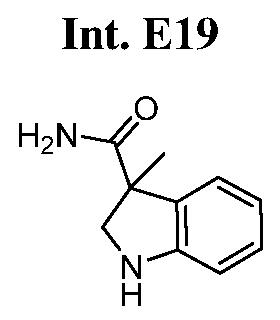
3-메틸인돌린-3-카르복스아미드3-Methylindoline-3-carboxamide

단계 1: THF (10 mL) 중 1-(tert-부틸) 3-메틸 3-메틸인돌린-1,3-디카르복실레이트 (500 mg, 1.63 mmol)의 용액에 LiOH 수용액 (2 N, 5 mL)을 적가하였다. 반응 혼합물을 25℃에서 16시간 동안 교반하고, 0℃에서 1 M HCl 용액 (10 mL)을 사용하여 pH ~4로 조정하고, 진공 하에 농축시켰다. 잔류물을 EA (10 mL x 3)로 추출하였다. 유기 상을 염수 (20 mL)로 세척하고, 무수 황산나트륨 상에서 건조시키고, 여과하였다. 여과물을 진공 하에 농축시켜 1-tert-부톡시카르보닐-3-메틸-인돌린-3-카르복실산 (452 mg)을 담황색 고체로서 제공하였다. LC-MS (ESI) m/z: 278 [M+H]+.Step 1: To a solution of 1-(tert-butyl) 3-methyl 3-methylindoline-1,3-dicarboxylate (500 mg, 1.63 mmol) in THF (10 mL) in aqueous LiOH solution (2 N, 5 mL) was added dropwise. The reaction mixture was stirred at 25° C. for 16 h, adjusted to pH ˜4 with 1 M HCl solution (10 mL) at 0° C., and concentrated in vacuo. The residue was extracted with EA (10 mL×3). The organic phase was washed with brine (20 mL), dried over anhydrous sodium sulfate and filtered. The filtrate was concentrated in vacuo to provide 1-tert-butoxycarbonyl-3-methyl-indoline-3-carboxylic acid (452 mg) as a pale yellow solid. LC-MS (ESI) m/z: 278 [M+H] + .
단계 2: DMF (5 mL) 중 1-tert-부톡시카르보닐-3-메틸-인돌린-3-카르복실산 (452 mg, 1.55 mmol)의 용액에 염화암모늄 (414.1 mg, 7.74 mmol), DIEA (600.4 mg, 4.65 mmol) 및 HATU (765.4 mg, 2.01 mmol)를 순차적으로 첨가하였다. 반응 혼합물을 25℃에서 16시간 동안 교반하고, 포화 염화암모늄 용액 (15 mL)으로 희석하고, EA (10 mL x 3)로 추출하였다. 유기 상을 염수 (15 mL x 3)로 세척하고, 무수 황산나트륨 상에서 건조시키고, 여과하였다. 여과물을 진공 하에 농축시키고, 잔류물을 실리카 겔 (PE/EA = 10/1) 상에서 플래쉬 칼럼 크로마토그래피에 의해 정제하여 tert-부틸 3-카르바모일-3-메틸-인돌린-1-카르복실레이트를 백색 고체 (420 mg, 93% 수율)로서 제공하였다. LC-MS (ESI) m/z: 277 [M+H]+.Step 2: To a solution of 1-tert-butoxycarbonyl-3-methyl-indoline-3-carboxylic acid (452 mg, 1.55 mmol) in DMF (5 mL) ammonium chloride (414.1 mg, 7.74 mmol), DIEA (600.4 mg, 4.65 mmol) and HATU (765.4 mg, 2.01 mmol) were added sequentially. The reaction mixture was stirred at 25° C. for 16 h, diluted with saturated ammonium chloride solution (15 mL) and extracted with EA (10 mL×3). The organic phase was washed with brine (15 mL×3), dried over anhydrous sodium sulfate and filtered. The filtrate was concentrated in vacuo and the residue was purified by flash column chromatography on silica gel (PE/EA = 10/1) tert-butyl 3-carbamoyl-3-methyl-indoline-1-carr The carboxylate was provided as a white solid (420 mg, 93% yield). LC-MS (ESI) m/z: 277 [M+H] + .
단계 3: 1-(tert-부틸) 3-메틸 3-메틸인돌린-1,3-디카르복실레이트 대신 tert-부틸 3-카르바모일-3-메틸-인돌린-1-카르복실레이트를 사용한, Int. 18의 단계 3과 동일한 절차. LC-MS (ESI) m/z: 177 [M+H]+.Step 3: Replace 1-(tert-butyl) 3-methyl 3-methylindoline-1,3-dicarboxylate with tert-butyl 3-carbamoyl-3-methyl-indoline-1-carboxylate Used, Int. Same procedure as step 3 of 18. LC-MS (ESI) m/z: 177 [M+H] + .

N,3-디메틸인돌린-3-카르복스아미드N,3-dimethylindoline-3-carboxamide
염화암모늄 대신 메틸아민 히드로클로라이드를 사용한, Int. E19의 단계 2&3과 동일한 절차. LC-MS (ESI) m/z: 191 [M+H]+.Using methylamine hydrochloride instead of ammonium chloride, Int. Same procedure as step 2&3 of E19. LC-MS (ESI) m/z: 191 [M+H] + .

(3메틸인돌린-3-일)메탄올(3-methylindolin-3-yl)methanol

THF (10 mL) 중 1-(tert-부틸) 3-메틸 3-메틸인돌린-1,3-디카르복실레이트 (150 mg, 0.515 mmol)의 용액에 실온에서 THF 중 1.0 M LiAlH4 (1 mL, 1.13 mmol)를 첨가하였다. 반응 혼합물을 환류 하에 2시간 동안 교반하고, 실온에서 메탄올 (10 mL)을 조심스럽게 첨가하여 켄칭하였다. 생성된 혼합물을 진공 하에 농축시키고, 잔류물을 실리카 겔 상에서 플래쉬 칼럼 크로마토그래피 (MeOH/DCM = 0~10%)에 의해 정제하여 (3-메틸인돌린-3-일)메탄올 (60 mg, 71% 수율)을 제공하였다. LC-MS (ESI) m/z: 164 [M+H]+.To a solution of 1-(tert-butyl) 3-methyl 3-methylindoline-1,3-dicarboxylate (150 mg, 0.515 mmol) in THF (10 mL) at room temperature at room temperature with 1.0 M LiAlH 4 in THF (1 mL, 1.13 mmol) was added. The reaction mixture was stirred at reflux for 2 h and quenched by careful addition of methanol (10 mL) at room temperature. The resulting mixture was concentrated in vacuo and the residue was purified by flash column chromatography on silica gel (MeOH/DCM = 0-10%) in (3-methylindolin-3-yl)methanol (60 mg, 71) % yield). LC-MS (ESI) m/z: 164 [M+H] + .

메틸 5-플루오로인돌린-3-카르복실레이트Methyl 5-fluoroindoline-3-carboxylate

단계 1&2: 1H-인돌-3-카르복실레이트 대신 5-플루오로-1H-인돌-3-카르복실레이트를 사용한, Int. E17의 단계 1&2와 동일한 절차. LC-MS (ESI) m/z: 318 [M+Na]+.Step 1&2: Using 5-fluoro-1H-indole-3-carboxylate instead of 1H-indole-3-carboxylate, Int. Same procedure as step 1&2 of E17. LC-MS (ESI) m/z: 318 [M+Na] + .
단계 3: HCl/EA (4 M, 3 mL) 중 1-(tert-부틸) 3-메틸 5-플루오로인돌린-1,3-디카르복실레이트 (176 mg, 0.596 mmol)의 용액을 실온에서 1시간 동안 교반하고, 진공 하에 농축시켜 메틸 5-플루오로인돌린-3-카르복실레이트 (110 mg, 94.6% 수율)를 백색 고체로서 수득하였다. LC-MS (ESI) m/z: 196 [M+H]+.Step 3: A solution of 1-(tert-butyl) 3-methyl 5-fluoroindoline-1,3-dicarboxylate (176 mg, 0.596 mmol) in HCl/EA (4 M, 3 mL) at room temperature stirred for 1 h and concentrated in vacuo to give methyl 5-fluoroindoline-3-carboxylate (110 mg, 94.6% yield) as a white solid. LC-MS (ESI) m/z: 196 [M+H] + .

메틸 6-플루오로인돌린-3-카르복실레이트Methyl 6-fluoroindoline-3-carboxylate

단계 1: 에탄올 (50 mL) 중 6-플루오로-1H-인돌-3-카르복실산 (600 mg, 3.35 mmol)의 용액에 진한 황산 (0.1 mL)을 첨가하였다. 반응 혼합물을 85℃에서 16시간 동안 교반하고, 실온으로 냉각시키고, 포화 중탄산나트륨 수용액으로 중화시키고, EA (10 mL x 3)로 추출하였다. 유기 상을 무수 황산나트륨 상에서 건조시키고, 여과하였다. 여과물을 진공 하에 농축시키고, 잔류물을 실리카 겔 (PE/EA = 10/1) 상에서 플래쉬 칼럼 크로마토그래피에 의해 정제하여 에틸 6-플루오로-1H-인돌-3-카르복실레이트 (646 mg, 94.9% 수율)를 담황색 고체로서 제공하였다. LC-MS (ESI) m/z: 208 [M+H]+.Step 1: To a solution of 6-fluoro-1H-indole-3-carboxylic acid (600 mg, 3.35 mmol) in ethanol (50 mL) was added concentrated sulfuric acid (0.1 mL). The reaction mixture was stirred at 85° C. for 16 h, cooled to room temperature, neutralized with saturated aqueous sodium bicarbonate solution, and extracted with EA (10 mL×3). The organic phase was dried over anhydrous sodium sulfate and filtered. The filtrate was concentrated in vacuo and the residue was purified by flash column chromatography on silica gel (PE/EA = 10/1) to ethyl 6-fluoro-1H-indole-3-carboxylate (646 mg, 94.9% yield) as a pale yellow solid. LC-MS (ESI) m/z: 208 [M+H] + .
단계 2&3: 1H-인돌-3-카르복실레이트 대신 에틸 6-플루오로-1H-인돌-3-카르복실레이트를 사용한 (MeOH와의 에스테르교환), Int. E17의 단계 1&2와 동일한 절차. LC-MS (ESI) m/z: 296 [M+H]+.Step 2&3: Using ethyl 6-fluoro-1H-indole-3-carboxylate instead of 1H-indole-3-carboxylate (transesterification with MeOH), Int. Same procedure as step 1&2 of E17. LC-MS (ESI) m/z: 296 [M+H] + .
단계 4: 1-(tert-부틸) 3-메틸 5-플루오로인돌린-1,3-디카르복실레이트 대신 1-(tert-부틸) 3-에틸 6-플루오로인돌린-1,3-디카르복실레이트를 사용한, Int. E22의 단계 3과 동일한 절차. LC-MS (ESI) m/z: 196 [M+H]+.Step 4: 1-(tert-butyl) 3-ethyl 6-fluoroindoline-1,3- instead of 1-(tert-butyl) 3-methyl 5-fluoroindoline-1,3-dicarboxylate Using dicarboxylates, Int. Same procedure as step 3 of E22. LC-MS (ESI) m/z: 196 [M+H] + .

메틸 5-메톡시인돌린-3-카르복실레이트Methyl 5-methoxyindoline-3-carboxylate
1H-인돌-3-카르복실레이트 대신 5-메톡시-1H-인돌-3-카르복실레이트를 사용한, Int. E17과 동일한 절차. LC-MS (ESI) m/z: 208 [M+H]+.Using 5-methoxy-1H-indole-3-carboxylate instead of 1H-indole-3-carboxylate, Int. Same procedure as E17. LC-MS (ESI) m/z: 208 [M+H] + .

메틸 6-메톡시인돌린-3-카르복실레이트Methyl 6-methoxyindoline-3-carboxylate
6-플루오로-1H-인돌-3-카르복실산 대신 6-메톡시-1H-인돌-3-카르복실산을 사용한, Int. E23과 동일한 절차. LC-MS (ESI) m/z: 208 [M+H]+.Using 6-methoxy-1H-indole-3-carboxylic acid instead of 6-fluoro-1H-indole-3-carboxylic acid, Int. Same procedure as E23. LC-MS (ESI) m/z: 208 [M+H] + .

메틸 4-메톡시인돌린-3-카르복실레이트Methyl 4-methoxyindoline-3-carboxylate

단계 1: DCM (10 mL) 중 4-메톡시-1H-인돌 (1.4 g, 9.51 mmol) 및 피리딘 (3.76 g, 47.56 mmol, 3.85 mL)의 용액에 DCM (10 mL) 중 2,2,2-트리클로로아세틸 클로라이드 (8.65 g, 47.56 mmol)를 0℃에서 적가하였다. 0℃에서 1.5시간 동안 교반한 후, 혼합물을 진공 하에 농축시켰다. 잔류물을 메탄올 (20 ml) 중에 용해시키고, 이를 메탄올 (50 mL) 중 소듐 메톡시드 (1.54 g, 28.54 mmol, 1.59 mL)의 교반 현탁액에 20분에 걸쳐 첨가하였다. 혼합물을 실온에서 1시간 동안 교반하고, 0℃로 냉각시키고, 물 (50 mL)로 희석하고, DCM (30 mL x 3)으로 추출하였다. 유기 상을 무수 Na2SO4 상에서 건조시키고, 여과하였다. 여과물을 진공 하에 농축시키고, 잔류물을 실리카 겔 상에서 플래쉬 칼럼 크로마토그래피 (MeOH/DCM = 1%-10%)에 의해 정제하여 메틸 4-메톡시-1H-인돌-3-카르복실레이트 (800 mg, 38% 수율)를 제공하였다. LC-MS (ESI) m/z: 206 [M+H]+.Step 1: To a solution of 4-methoxy-1H-indole (1.4 g, 9.51 mmol) and pyridine (3.76 g, 47.56 mmol, 3.85 mL) in DCM (10 mL) 2,2,2 in DCM (10 mL) -trichloroacetyl chloride (8.65 g, 47.56 mmol) was added dropwise at 0°C. After stirring at 0° C. for 1.5 h, the mixture was concentrated in vacuo. The residue was dissolved in methanol (20 ml), which was added over 20 min to a stirred suspension of sodium methoxide (1.54 g, 28.54 mmol, 1.59 mL) in methanol (50 mL). The mixture was stirred at room temperature for 1 h, cooled to 0° C., diluted with water (50 mL) and extracted with DCM (30 mL×3). The organic phase was dried over anhydrous Na 2 SO 4 and filtered. The filtrate was concentrated in vacuo and the residue was purified by flash column chromatography on silica gel (MeOH/DCM=1%-10%) to methyl 4-methoxy-1H-indole-3-carboxylate (800 mg, 38% yield). LC-MS (ESI) m/z: 206 [M+H] + .
단계 2&3&4: 5-플루오로-1H-인돌-3-카르복실레이트 대신 메틸 4-메톡시-1H-인돌-3-카르복실레이트를 사용한, Int. E22와 동일한 절차. LC-MS (ESI) m/z: 208 [M+H]+.Step 2&3&4: Using methyl 4-methoxy-1H-indole-3-carboxylate instead of 5-fluoro-1H-indole-3-carboxylate, Int. Same procedure as E22. LC-MS (ESI) m/z: 208 [M+H] + .

메틸 5-플루오로-3-메틸인돌린-3-카르복실레이트Methyl 5-fluoro-3-methylindoline-3-carboxylate
단계 1에서 1-(tert-부틸) 3-메틸 인돌린-1,3-디카르복실레이트 대신 1-(tert-부틸) 3-메틸 5-플루오로인돌린-1,3-디카르복실레이트를 사용하고; 단계 2에서 Int. 22의 단계 3과 같은 HCl/EA 탈보호 조건 하에 Int. E18과 동일한 절차. LC-MS (ESI) m/z: 210 [M+H]+.1-(tert-butyl) 3-methyl 5-fluoroindoline-1,3-dicarboxylate in step 1 instead of 1-(tert-butyl) 3-methyl indoline-1,3-dicarboxylate using ; In step 2, Int. 22 under the same HCl/EA deprotection conditions as step 3 of Int. Same procedure as E18. LC-MS (ESI) m/z: 210 [M+H] + .

메틸 6-플루오로-3-메틸인돌린-3-카르복실레이트Methyl 6-fluoro-3-methylindoline-3-carboxylate
단계 1에서 1-(tert-부틸) 3-메틸 인돌린-1,3-디카르복실레이트 대신 1-(tert-부틸) 3-메틸 5-플루오로인돌린-1,3-디카르복실레이트를 사용하고; 단계 2에서 Int. 22의 단계 3과 같은 HCl/EA 탈보호 조건 하에 Int. E18과 동일한 절차. LC-MS (ESI) m/z: 210 [M+H]+.1-(tert-butyl) 3-methyl 5-fluoroindoline-1,3-dicarboxylate in step 1 instead of 1-(tert-butyl) 3-methyl indoline-1,3-dicarboxylate using ; In step 2, Int. 22 under the same HCl/EA deprotection conditions as step 3 of Int. Same procedure as E18. LC-MS (ESI) m/z: 210 [M+H] + .

메틸 2-(인돌린-3-일)아세테이트Methyl 2-(indolin-3-yl)acetate

디클로로메탄 (16 mL) 및 TFA (3 mL) 중 메틸 2-(1H-인돌-3-일)아세테이트 (500 mg, 2.64 mmol)의 용액에 수소화붕소나트륨 (199.95 mg, 5.29 mmol)을 0℃에서 첨가하였다. 혼합물을 0℃에서 2시간 동안 교반하고, DCM (200 mL)으로 희석하고, 포화 NaHCO3 수용액 (10 mL)으로 켄칭하였다. 유기 상을 분리하고, 무수 황산나트륨 상에서 건조시키고, 여과하였다. 여과물을 진공 하에 농축시켜 메틸 2-인돌린-3-일아세테이트를 갈색 오일 (477 mg, 85% 수율)로서 제공하였다. LC-MS (ESI) m/z: 196 [M+H]+.To a solution of methyl 2-(1H-indol-3-yl)acetate (500 mg, 2.64 mmol) in dichloromethane (16 mL) and TFA (3 mL) was added sodium borohydride (199.95 mg, 5.29 mmol) at 0 °C. added. The mixture was stirred at 0° C. for 2 h, diluted with DCM (200 mL) and quenched with saturated aqueous NaHCO 3 aqueous solution (10 mL). The organic phase was separated, dried over anhydrous sodium sulfate and filtered. The filtrate was concentrated in vacuo to provide methyl 2-indolin-3-ylacetate as a brown oil (477 mg, 85% yield). LC-MS (ESI) m/z: 196 [M+H] + .
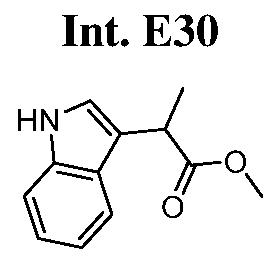
메틸 2-(1H-인돌-3-일)프로파노에이트Methyl 2-(1H-indol-3-yl)propanoate

단계 1: DCM (10 mL) 중 메틸 2-(1H-인돌-3-일) 아세테이트 (1 g, 5.29 mmol)의 용액에 트리에틸아민 (2.14 g, 21.14 mmol), DMAP (129.13 mg, 1.06 mmol) 및 디-tert-부틸 카르보네이트 (1.73 g, 7.93 mmol)를 아르곤 분위기 하에 실온에서 첨가하였다. 5시간 동안 교반한 후, 반응 혼합물을 포화 NH4Cl 수용액 (20 mL)으로 희석하고, DCM (20 mL x 2)으로 추출하였다. 유기 상을 염수 (20 mL)로 세척하고, 무수 Na2SO4 상에서 건조시키고, 여과하였다. 여과물을 진공 하에 농축시키고, 잔류물을 실리카 겔 (0~20% EA/PE) 상에서 플래쉬 칼럼 크로마토그래피에 의해 정제하여 tert-부틸 3-(2-메톡시-2-옥소에틸)-1H-인돌-1-카르복실레이트를 담황색 오일 (1.46 g, 95% 수율)로서 제공하였다. LC-MS (ESI) m/z: 307 [M+18]+.Step 1: To a solution of methyl 2-(1H-indol-3-yl) acetate (1 g, 5.29 mmol) in DCM (10 mL) triethylamine (2.14 g, 21.14 mmol), DMAP (129.13 mg, 1.06 mmol) ) and di-tert-butyl carbonate (1.73 g, 7.93 mmol) were added at room temperature under argon atmosphere. After stirring for 5 h, the reaction mixture was diluted with saturated aqueous NH 4 Cl solution (20 mL) and extracted with DCM (20 mL×2). The organic phase was washed with brine (20 mL), dried over anhydrous Na 2 SO 4 and filtered. The filtrate was concentrated in vacuo and the residue purified by flash column chromatography on silica gel (0-20% EA/PE) tert-butyl 3-(2-methoxy-2-oxoethyl)-1H- Indole-1-carboxylate was provided as a pale yellow oil (1.46 g, 95% yield). LC-MS (ESI) m/z: 307 [M+18] + .
단계 2: 무수 THF (10 mL) 중 tert-부틸 3-(2-메톡시-2-옥소에틸)-1H-인돌-1-카르복실레이트 (300 mg, 1.04 mmol)의 용액에 N2 하에 -20℃에서 30분에 걸쳐 KHMDS (227.53 mg, 1.14 mmol)를 적가하였다. 이어서, 용액을 -78℃에서 추가로 40분 동안 교반하고, 이어서 아이오도메탄 (147.18 mg, 1.04 mmol)을 -78℃에서 적가하였다. 동일한 온도에서 1.5시간 동안 교반한 후, 반응 혼합물을 포화 NH4Cl 수용액 (20 mL)으로 켄칭하고, 분리하였다. 수성 층을 EtOAc (20 mL x 3)로 추출하고, 합한 유기 상을 염수 (20 mL)로 세척하고, 무수 Na2SO4 상에서 건조시키고, 여과하였다. 여과물을 진공 하에 농축시키고, 잔류물을 실리카 겔 (0~20% EA/PE) 상에서 플래쉬 칼럼 크로마토그래피에 의해 정제하여 tert-부틸 3-(1-메톡시-1-옥소프로판-2-일)-1H-인돌-1-카르복실레이트를 무색 오일 (105 mg, 30% 수율)로서 제공하였다. LC-MS (ESI) m/z: 326 [M+Na]+.Step 2: To a solution of tert-butyl 3-(2-methoxy-2-oxoethyl)-1H-indole-1-carboxylate (300 mg, 1.04 mmol) in anhydrous THF (10 mL) under N 2 - KHMDS (227.53 mg, 1.14 mmol) was added dropwise at 20° C. over 30 min. The solution was then stirred at -78 °C for an additional 40 min, then iodomethane (147.18 mg, 1.04 mmol) was added dropwise at -78 °C. After stirring at the same temperature for 1.5 h, the reaction mixture was quenched with saturated aqueous NH 4 Cl solution (20 mL) and separated. The aqueous layer was extracted with EtOAc (20 mL×3) and the combined organic phases washed with brine (20 mL), dried over anhydrous Na 2 SO 4 and filtered. The filtrate was concentrated in vacuo and the residue purified by flash column chromatography on silica gel (0-20% EA/PE) tert-butyl 3-(1-methoxy-1-oxopropan-2-yl) )-1H-indole-1-carboxylate was provided as a colorless oil (105 mg, 30% yield). LC-MS (ESI) m/z: 326 [M+Na] + .
단계 3: 염산/디옥산 (4 N, 15 mL) 중 tert-부틸 3-(2-메톡시-1-메틸-2-옥소-에틸)인돌-1-카르복실레이트 (550 mg, 1.81 mmol)의 용액을 25℃에서 48시간 동안 교반하고, 진공 하에 농축시켰다. 잔류물을 역상 크로마토그래피 (0.01%TFA/메탄올)에 의해 정제하여 메틸 2-(1H-인돌-3-일)프로파노에이트 (110 mg, 51% 순도)를 무색 오일로서 수득하였다. LC-MS (ESI) m/z: 204 [M+H]+.Step 3: tert-Butyl 3-(2-methoxy-1-methyl-2-oxo-ethyl)indole-1-carboxylate (550 mg, 1.81 mmol) in hydrochloric acid/dioxane (4 N, 15 mL) The solution of was stirred at 25 °C for 48 h, and concentrated in vacuo. The residue was purified by reverse phase chromatography (0.01% TFA/methanol) to give methyl 2-(1H-indol-3-yl)propanoate (110 mg, 51% purity) as a colorless oil. LC-MS (ESI) m/z: 204 [M+H] + .

메틸 1-(1H-인돌-3-일)시클로프로판-1-카르복실레이트Methyl 1-(1H-indol-3-yl)cyclopropane-1-carboxylate

단계 1: THF/HMPA (v/v, 10/1) (5.5 mL) 중 tert-부틸 3-(2-메톡시-2-옥소-에틸)인돌-1-카르복실레이트 (100 mg, 0.346 mmol)의 용액에 LDA (81.5 mg, 0.760 mmol)를 -78℃에서 첨가하고, 이어서 30분 후에 1,2-디브로모에탄 (97.4 mg, 0.518 mmol)을 첨가하였다. 이어서, 반응 혼합물을 실온에서 밤새 교반하고, 빙수의 첨가에 의해 켄칭하고, 분리하였다. 수성 상을 디클로로메탄/메탄올 (v/v, 10/1, 20 mL x 3)로 추출하였다. 유기 상을 무수 황산나트륨 상에서 건조시키고, 여과하였다. 여과물을 진공 하에 농축시키고, 잔류물을 실리카 겔 (EA/PE = 1/9) 상에서 플래쉬 칼럼 크로마토그래피에 의해 정제하여 tert-부틸 3-(1-메톡시카르보닐)시클로프로필-1H-인돌-1-카르복실레이트를 황색 오일 (120 mg, 78% 수율)로서 제공하였다. LC-MS (ESI) m/z: 338 [M+Na]+.Step 1: tert-Butyl 3-(2-methoxy-2-oxo-ethyl)indole-1-carboxylate (100 mg, 0.346 mmol) in THF/HMPA (v/v, 10/1) (5.5 mL) ) was added LDA (81.5 mg, 0.760 mmol) at -78°C, followed by 1,2-dibromoethane (97.4 mg, 0.518 mmol) after 30 minutes. The reaction mixture was then stirred at room temperature overnight, quenched by addition of ice water and separated. The aqueous phase was extracted with dichloromethane/methanol (v/v, 10/1, 20 mL×3). The organic phase was dried over anhydrous sodium sulfate and filtered. The filtrate was concentrated in vacuo and the residue purified by flash column chromatography on silica gel (EA/PE = 1/9) tert-butyl 3-(1-methoxycarbonyl)cyclopropyl-1H-indole -1-carboxylate was provided as a yellow oil (120 mg, 78% yield). LC-MS (ESI) m/z: 338 [M+Na] + .
단계 2: tert-부틸 3-(2-메톡시-1-메틸-2-옥소-에틸)인돌-1-카르복실레이트 대신 tert-부틸 3-(1-메톡시카르보닐)시클로프로필-1H-인돌-1-카르복실레이트를 사용한, Int. E30의 단계 3과 동일한 절차. LC-MS (ESI) m/z: 238 [M+Na]+.Step 2: tert-Butyl 3-(1-methoxycarbonyl)cyclopropyl-1H- instead of tert-butyl 3-(2-methoxy-1-methyl-2-oxo-ethyl)indole-1-carboxylate Using indole-1-carboxylate, Int. Same procedure as step 3 of E30. LC-MS (ESI) m/z: 238 [M+Na] + .

3,3,3-트리플루오로-2-(1H-인돌-3-일)프로판산3,3,3-trifluoro-2-(1H-indol-3-yl)propanoic acid

단계 1: 메틸 3,3,3-트리플루오로-2-옥소-프로파노에이트 (4.68 g, 29.96 mmol)에 격렬히 교반하면서 인돌 (117 mg, 0.999 mmol)을 첨가하였다. 혼합물을 약 1분 내에 고화시키고, DMF (40 mL)에 용해시키고, 0℃로 냉각시키고, 이어서 SOCl2 (8.91 g, 74.91 mmol)를 적가하였다. 전환이 LCMS에 의해 모니터링될 때까지 생성된 혼합물을 동일한 온도에서 교반하였다. 여기에 NaBH4 (3.40 g, 89.89 mmol)를 조금씩 천천히 첨가하였다. 이어서, 혼합물을 0℃에서 3시간 동안 교반하고, 교반하면서 포화NH4Cl 수용액 100 mL에 부었다. 생성된 고체를 여과하고, 여과물을 에틸 아세테이트 (50 mL x 3)로 추출하였다. 유기 상을 무수 황산나트륨 상에서 건조시키고, 여과하였다. 여과물을 진공 하에 농축시키고, 잔류물을 실리카 겔 (PE/EA = 0~20%) 상에서 플래쉬 칼럼 크로마토그래피에 의해 정제하여 메틸 3,3,3-트리플루오로-2-(1H-인돌-3-일)프로파노에이트를 황색 고체 (6.5 g, 84% 수율)로서 제공하였다. LC-MS (ESI) m/z: 258 [M+H]+.Step 1: To methyl 3,3,3-trifluoro-2-oxo-propanoate (4.68 g, 29.96 mmol) was added indole (117 mg, 0.999 mmol) with vigorous stirring. The mixture solidified in about 1 min, dissolved in DMF (40 mL), cooled to 0° C., then SOCl 2 (8.91 g, 74.91 mmol) was added dropwise. The resulting mixture was stirred at the same temperature until the conversion was monitored by LCMS. To this was slowly added NaBH 4 (3.40 g, 89.89 mmol) little by little. The mixture was then stirred at 0° C. for 3 hours, and poured into 100 mL of saturated NH 4 Cl aqueous solution with stirring. The resulting solid was filtered and the filtrate was extracted with ethyl acetate (50 mL×3). The organic phase was dried over anhydrous sodium sulfate and filtered. The filtrate was concentrated in vacuo and the residue was purified by flash column chromatography on silica gel (PE/EA = 0-20%) to methyl 3,3,3-trifluoro-2-(1H-indole- 3-yl)propanoate was provided as a yellow solid (6.5 g, 84% yield). LC-MS (ESI) m/z: 258 [M+H] + .
단계 2: 진한 HCl (12 mL) 및 AcOH (60 mL)의 혼합 용매 중 메틸 3,3,3-트리플루오로-2-(1H-인돌-3-일)프로파노에이트 (2.0 g, 7.78 mmol)의 용액을 격렬한 환류 하에 16시간 동안 교반하고, 실온으로 냉각시키고, 진공 하에 농축시켰다. 잔류물을 역상 크로마토그래피 (H2O/MeOH = 100/0~50/50)에 의해 정제하여 3,3,3-트리플루오로-2-(1H-인돌-3-일)프로판산을 회백색 분말 (1 g, 50% 수율)로서 제공하였다. LC-MS (ESI) m/z: 244 [M+H]+.Step 2: Methyl 3,3,3-trifluoro-2-(1H-indol-3-yl)propanoate (2.0 g, 7.78 mmol) in a mixed solvent of concentrated HCl (12 mL) and AcOH (60 mL) ) was stirred under vigorous reflux for 16 h, cooled to room temperature and concentrated in vacuo. The residue was purified by reverse phase chromatography (H 2 O/MeOH = 100/0-50/50) to give 3,3,3-trifluoro-2-(1H-indol-3-yl)propanoic acid off-white Provided as a powder (1 g, 50% yield). LC-MS (ESI) m/z: 244 [M+H] + .

메틸 2-(3-메틸인돌린-3-일)아세테이트Methyl 2-(3-methylindolin-3-yl)acetate

단계 1: THF (20 mL) 중 1-(tert-부틸) 3-메틸 3-메틸인돌린-1,3-디카르복실레이트 (730 mg, 2.51 mmol)의 용액에 물 (1.41 mL) 중 수산화나트륨 (3.01 g, 75.17 mmol)의 수용액을 첨가하였다. 혼합물을 실온에서 16시간 동안 교반하고, 수성 1 M HCl 용액으로 산성화시키고, EtOAc (100 mL x 3)로 추출하였다. 유기 상을 염수 (50 mL)로 세척하고, 무수 Na2SO4 상에서 건조시키고, 여과하였다. 여과물을 진공 하에 농축시켜 조 1-tert-부톡시카르보닐-3-메틸인돌린-3-카르복실산을 황색 오일 (620 mg, 85% 수율)로서 제공하였다. LC-MS (ESI) m/z: 222 [M+H-56]+.Step 1: To a solution of 1-(tert-butyl) 3-methyl 3-methylindoline-1,3-dicarboxylate (730 mg, 2.51 mmol) in THF (20 mL) hydroxylated in water (1.41 mL) An aqueous solution of sodium (3.01 g, 75.17 mmol) was added. The mixture was stirred at room temperature for 16 h, acidified with aqueous 1 M HCl solution and extracted with EtOAc (100 mL×3). The organic phase was washed with brine (50 mL), dried over anhydrous Na 2 SO 4 and filtered. The filtrate was concentrated in vacuo to provide crude 1-tert-butoxycarbonyl-3-methylindoline-3-carboxylic acid as a yellow oil (620 mg, 85% yield). LC-MS (ESI) m/z: 222 [M+H-56] + .
단계 2: DCM (15 mL) 중 1-tert-부톡시카르보닐-3-메틸인돌린-3-카르복실산 (630 mg, 2.27 mmol)의 혼합물에 0℃에서 옥살릴 디클로라이드 (865.1 mg, 6.82 mmol) 및 N,N-디메틸포름아미드 (8.3 mg, 0.114 mmol)를 천천히 첨가하였다. 혼합물을 실온에서 16시간 동안 교반하고, 진공 하에 농축시켰다. 잔류물 (670 mg, 1.13 mmol)을 THF (10 mL) 및 MeCN (5.00 mL) 중에 용해시키고, 디아조메틸(트리메틸)실란 (258.75 mg, 2.27 mmol) (디에틸 에테르 중 2 M 용액)을 상기 용액에 천천히 첨가하였다. 반응 혼합물을 N2 하에 2시간 동안 교반하고, 10% 시트르산 (10 mL)으로 켄칭하고, DCM (50 mL)과 물 (50 mL) 사이에 분배하였다. 유기 상을 무수 황산나트륨 상에서 건조시키고, 여과하였다. 여과물을 진공 하에 농축시키고, 잔류물을 실리카 겔 (EA/PE = 0-10%) 상에서 플래쉬 칼럼 크로마토그래피에 의해 정제하여 tert-부틸 3-(2-디아조아세틸)-3-메틸인돌린-1-카르복실레이트를 황색 오일 (200 mg, 56% 수율)로서 제공하였다.Step 2: To a mixture of 1-tert-butoxycarbonyl-3-methylindoline-3-carboxylic acid (630 mg, 2.27 mmol) in DCM (15 mL) at 0° C., oxalyl dichloride (865.1 mg, 6.82 mmol) and N,N-dimethylformamide (8.3 mg, 0.114 mmol) were added slowly. The mixture was stirred at room temperature for 16 h and concentrated in vacuo. The residue (670 mg, 1.13 mmol) was dissolved in THF (10 mL) and MeCN (5.00 mL) and diazomethyl(trimethyl)silane (258.75 mg, 2.27 mmol) (2M solution in diethyl ether) was added above It was added slowly to the solution. The reaction mixture was stirred under N 2 for 2 h, quenched with 10% citric acid (10 mL), and partitioned between DCM (50 mL) and water (50 mL). The organic phase was dried over anhydrous sodium sulfate and filtered. The filtrate was concentrated in vacuo and the residue purified by flash column chromatography on silica gel (EA/PE = 0-10%) tert-butyl 3-(2-diazoacetyl)-3-methylindoline -1-carboxylate was provided as a yellow oil (200 mg, 56% yield).
단계 3: 메탄올 (5 mL) 중 tert-부틸 3-(2-디아조아세틸)-3-메틸인돌린-1-카르복실레이트 (200 mg, 0.664 mmol)의 용액에 벤조산은 (76.0 mg, 0.332 mmol)을 첨가하였다. 반응 혼합물을 N2 하에 실온에서 1.5시간 동안 교반하고, DCM (50 mL) 및 물 (50 mL)로 희석하였다. 유기 층을 분리하고, 무수 황산나트륨 상에서 건조시키고, 여과하였다. 여과물을 진공 하에 농축시키고, 잔류물을 실리카 겔 상에서 플래쉬 칼럼 크로마토그래피 (EA/PE = 0-15%)에 의해 정제하여 tert-부틸 3-(2-메톡시-2-옥소에틸)-3-메틸인돌린-1-카르복실레이트를 무색 오일 (100 mg, 42% 수율)로서 제공하였다. LC-MS (ESI) m/z: 250 [M+H-56]+.Step 3: To a solution of tert-butyl 3-(2-diazoacetyl)-3-methylindoline-1-carboxylate (200 mg, 0.664 mmol) in methanol (5 mL) silver benzoate (76.0 mg, 0.332 mmol) was added. The reaction mixture was stirred under N 2 at room temperature for 1.5 h, diluted with DCM (50 mL) and water (50 mL). The organic layer was separated, dried over anhydrous sodium sulfate and filtered. The filtrate was concentrated in vacuo and the residue was purified by flash column chromatography on silica gel (EA/PE = 0-15%) tert-butyl 3-(2-methoxy-2-oxoethyl)-3 -Methylindoline-1-carboxylate was provided as a colorless oil (100 mg, 42% yield). LC-MS (ESI) m/z: 250 [M+H-56] + .
단계 4: DCM (3 mL) 중 tert-부틸 3-(2-메톡시-2-옥소에틸)-3-메틸인돌린-1-카르복실레이트 (100 mg, 0.278 mmol) 및 HCl/EA (4 M, 1.5 mL)의 혼합물을 실온에서 2시간 동안 교반하고, 진공 하에 농축시켜 조 메틸 2-(3-메틸인돌린-3-일)아세테이트를 추가 정제 없이 제공하였다. LC-MS (ESI) m/z: 206 [M+H]+.Step 4: tert-Butyl 3-(2-methoxy-2-oxoethyl)-3-methylindoline-1-carboxylate (100 mg, 0.278 mmol) and HCl/EA (4) in DCM (3 mL) M, 1.5 mL) was stirred at room temperature for 2 h and concentrated in vacuo to give crude methyl 2-(3-methylindolin-3-yl)acetate without further purification. LC-MS (ESI) m/z: 206 [M+H] + .
대안적 합성 방법:Alternative synthetic methods:

단계 1: THF (200 mL) 중 3-메틸인돌린-2-온 (20 g, 135.89 mmol)의 용액에 NaH (6.52 g, 163.09 mmol, 미네랄 오일 중 60% 현탁됨)를 0℃에서 30분에 걸쳐 첨가하였다. 반응 혼합물을 0℃에서 30분 동안 교반하고, 이어서 THF (50 mL) 중 디-tert-부틸 카르보네이트 (29.07 g, 133.18 mmol)의 용액을 적가하였다. 반응 혼합물을 1시간 동안 교반하고, 포화 NH4Cl 수용액 (50 mL)으로 희석하고, CH2Cl2 (100 mL x 2)로 추출하였다. 합한 유기 상을 무수 Na2SO4 상에서 건조시키고, 여과하였다. 여과물을 진공 하에 농축시키고, 잔류물을 실리카 겔 (PE/EA = 9/1) 상에서 플래쉬 칼럼 크로마토그래피에 의해 정제하여 tert-부틸 3-메틸-2-옥소인돌린-1-카르복실레이트 (30 g, 74% 수율)를 황색 오일로서 제공하였다. LC-MS (ESI) m/z: 192 [M+H]+.Step 1: To a solution of 3-methylindolin-2-one (20 g, 135.89 mmol) in THF (200 mL) was added NaH (6.52 g, 163.09 mmol, 60% suspended in mineral oil) at 0° C. for 30 min. was added over. The reaction mixture was stirred at 0° C. for 30 min, then a solution of di-tert-butyl carbonate (29.07 g, 133.18 mmol) in THF (50 mL) was added dropwise. The reaction mixture was stirred for 1 h, diluted with saturated aqueous NH 4 Cl solution (50 mL) and extracted with CH 2 Cl 2 (100 mL×2). The combined organic phases were dried over anhydrous Na 2 SO 4 and filtered. The filtrate was concentrated in vacuo and the residue was purified by flash column chromatography on silica gel (PE/EA = 9/1) to tert-butyl 3-methyl-2-oxoindoline-1-carboxylate ( 30 g, 74% yield) as a yellow oil. LC-MS (ESI) m/z: 192 [M+H] + .
단계 2: THF (300 mL) 중 tert-부틸 3-메틸-2-옥소인돌린-1-카르복실레이트 (30 g, 103.12 mmol)의 용액에 NaH (4.95 g, 123.74 mmol, 미네랄 오일 중 60%)를 0℃에서 30분에 걸쳐 첨가하였다. 반응 혼합물을 0℃에서 30분 동안 교반하고, 이어서 메틸 2-브로모아세테이트 (18.93 g, 123.74 mmol)를 적가하였다. 반응 혼합물을 1시간 동안 교반하고, 포화 NH4Cl 수용액 (100 mL)으로 켄칭하고, CH2Cl2 (200 mL x 2)로 추출하였다. 합한 유기 상을 무수 Na2SO4 상에서 건조시키고, 여과하였다. 여과물을 진공 하에 농축시키고, 잔류물을 실리카 겔 (PE/EA = 8/2) 상에서 플래쉬 칼럼 크로마토그래피에 의해 정제하여 tert-부틸 3-(2-메톡시-2-옥소에틸)-3-메틸-2-옥소인돌린-1-카르복실레이트 (28 g, 83% 수율)를 백색 고체로서 제공하였다. LC-MS (ESI) m/z: 264 [M+H-56]+.Step 2: To a solution of tert-butyl 3-methyl-2-oxoindoline-1-carboxylate (30 g, 103.12 mmol) in THF (300 mL) with NaH (4.95 g, 123.74 mmol, 60% in mineral oil) ) was added over 30 min at 0 °C. The reaction mixture was stirred at 0° C. for 30 min, then methyl 2-bromoacetate (18.93 g, 123.74 mmol) was added dropwise. The reaction mixture was stirred for 1 h, quenched with saturated aqueous NH 4 Cl solution (100 mL), and extracted with CH 2 Cl 2 (200 mL×2). The combined organic phases were dried over anhydrous Na 2 SO 4 and filtered. The filtrate was concentrated in vacuo and the residue purified by flash column chromatography on silica gel (PE/EA = 8/2) tert-butyl 3-(2-methoxy-2-oxoethyl)-3- Methyl-2-oxoindoline-1-carboxylate (28 g, 83% yield) was provided as a white solid. LC-MS (ESI) m/z: 264 [M+H-56] + .
단계 3: 1,4-디옥산 (35 mL) 중 4 M HCl 및 CH2Cl2 (200 mL) 중 tert-부틸 3-(2-메톡시-2-옥소에틸)-3-메틸-2-옥소인돌린-1-카르복실레이트 (28 g, 87.68 mmol)의 혼합물을 실온에서 2시간 동안 교반하고, 진공 하에 농축시켰다. 잔류물을 CH2Cl2 (200 mL)와 포화 NaHCO3 수용액 (50 mL) 사이에 분배하였다. 분리된 수성 층을 CH2Cl2 (50 mL x 3)로 추출하고, 합한 유기 층을 무수 Na2SO4 상에서 건조시키고, 여과하였다. 여과물을 진공 하에 농축시켜 메틸 2-(3-메틸-2-옥소인돌린-3-일)아세테이트 (17.6 g, 82% 수율)를 제공하였다. LC-MS (ESI) m/z: 220 [M+H]+.Step 3: 4 M HCl in 1,4-dioxane (35 mL) and tert-butyl 3-(2-methoxy-2-oxoethyl)-3-methyl-2- in CH 2 Cl 2 (200 mL) A mixture of oxoindoline-1-carboxylate (28 g, 87.68 mmol) was stirred at room temperature for 2 h and concentrated in vacuo. The residue was partitioned between CH 2 Cl 2 (200 mL) and saturated aqueous NaHCO 3 aqueous solution (50 mL). The separated aqueous layer was extracted with CH 2 Cl 2 (50 mL×3) and the combined organic layers were dried over anhydrous Na 2 SO 4 and filtered. The filtrate was concentrated in vacuo to provide methyl 2-(3-methyl-2-oxoindolin-3-yl)acetate (17.6 g, 82% yield). LC-MS (ESI) m/z: 220 [M+H] + .
단계 4: 톨루엔 (220 mL) 중 메틸 2-(3-메틸-2-옥소인돌린-3-일)아세테이트 (15.6 g, 71.16 mmol) 및 라웨슨 시약 (14.71 g, 36.38 mmol)의 혼합물을 130℃에서 1.5시간 동안 교반하고, 진공 하에 농축시켰다. 잔류물을 실리카 겔 (PE/EA = 80:20) 상에서 플래쉬 칼럼 크로마토그래피에 의해 정제하여 메틸 2-(3-메틸-2-티옥소인돌린-3-일)아세테이트 (15.5 g, 74% 수율)를 백색 고체로서 제공하였다. LC-MS (ESI) m/z: 236 [M+H]+.Step 4: A mixture of methyl 2-(3-methyl-2-oxoindolin-3-yl)acetate (15.6 g, 71.16 mmol) and Rawesson's reagent (14.71 g, 36.38 mmol) in toluene (220 mL) was added to 130 Stirred at <RTI ID=0.0>C</RTI> for 1.5 h and concentrated in vacuo. The residue was purified by flash column chromatography on silica gel (PE/EA = 80:20) to yield methyl 2-(3-methyl-2-thioxoindolin-3-yl)acetate (15.5 g, 74% yield). ) as a white solid. LC-MS (ESI) m/z: 236 [M+H] + .
단계 5: 혼합된 THF (70 mL) 및 메탄올 (70 mL) 중 메틸 2-(3-메틸-2-티옥소인돌린-3-일)아세테이트 (9.5 g, 40.37 mmol) 및 염화니켈 (10.46 g, 80.75 mmol)의 혼합물에 NaBH4 (9.16 g, 242.24 mmol)를 0℃에서 1시간에 걸쳐 조금씩 첨가하였다. 생성된 혼합물을 10분 동안 교반하고, 셀라이트의 패드를 통해 여과하였다. 고체 케이크를 MeOH (100 mL)로 세척하고, 여과물을 진공 하에 농축시켰다. 잔류물을 EA (200 mL) 중에 용해시키고, 물 (60 mL x 3)로 세척하였다. 유기 상을 무수 황산나트륨 상에서 건조시키고, 여과하였다. 여과물을 진공 하에 농축시키고, 잔류물을 실리카 겔 상에서 플래쉬 칼럼 크로마토그래피 (CH2Cl2: 메탄올 = 95:5)에 의해 정제하여 메틸 2-(3-메틸인돌린-3-일)아세테이트 (6.5 g, 75% 수율)를 황색 오일로서 제공하였다. LC-MS (ESI) m/z: 206 [M+H]+.Step 5: Methyl 2-(3-methyl-2-thioxoindolin-3-yl)acetate (9.5 g, 40.37 mmol) and nickel chloride (10.46 g) in THF (70 mL) and methanol (70 mL) mixed , 80.75 mmol) was added NaBH 4 (9.16 g, 242.24 mmol) portionwise at 0° C. over 1 hour. The resulting mixture was stirred for 10 minutes and filtered through a pad of Celite. The solid cake was washed with MeOH (100 mL) and the filtrate was concentrated in vacuo. The residue was dissolved in EA (200 mL) and washed with water (60 mL×3). The organic phase was dried over anhydrous sodium sulfate and filtered. The filtrate was concentrated in vacuo and the residue was purified by flash column chromatography on silica gel (CH 2 Cl 2 :methanol = 95:5) to methyl 2-(3-methylindolin-3-yl)acetate ( 6.5 g, 75% yield) as a yellow oil. LC-MS (ESI) m/z: 206 [M+H] + .
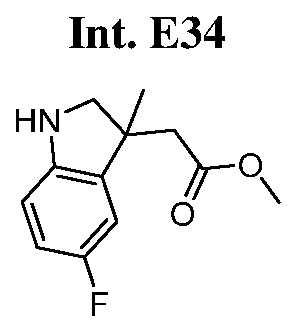
메틸 2-(5-플루오로-3-메틸인돌린-3-일)아세테이트Methyl 2-(5-fluoro-3-methylindolin-3-yl)acetate
1-(tert-부틸) 3-메틸 3-메틸인돌린-1,3-디카르복실레이트 대신 1-(tert-부틸) 3-메틸 5-플루오로-3-메틸인돌린-1,3-디카르복실레이트를 사용한, Int. E33과 동일한 절차. LC-MS (ESI) m/z: 224 [M+H]+.1-(tert-butyl) 3-methyl 5-fluoro-3-methylindoline-1,3- instead of 1-(tert-butyl) 3-methyl 3-methylindoline-1,3-dicarboxylate Using dicarboxylates, Int. Same procedure as E33. LC-MS (ESI) m/z: 224 [M+H] + .

메틸 2-(6-플루오로-3-메틸인돌린-3-일)아세테이트Methyl 2-(6-fluoro-3-methylindolin-3-yl)acetate
1-(tert-부틸) 3-메틸 3-메틸인돌린-1,3-디카르복실레이트 대신 1-(tert-부틸) 3-메틸 6-플루오로-3-메틸인돌린-1,3-디카르복실레이트를 사용한, Int. E33과 동일한 절차. LC-MS (ESI) m/z: 224 [M+H]+.1-(tert-butyl) 3-methyl 6-fluoro-3-methylindoline-1,3- instead of 1-(tert-butyl) 3-methyl 3-methylindoline-1,3-dicarboxylate Using dicarboxylates, Int. Same procedure as E33. LC-MS (ESI) m/z: 224 [M+H] + .

메틸 2-(5,6-디플루오로-3-메틸인돌린-3-일)아세테이트Methyl 2-(5,6-difluoro-3-methylindolin-3-yl)acetate

단계 1&2&3: 4-메톡시-1H-인돌 대신 5,6-디플루오로-1H-인돌을 사용한, Int. E26의 단계 1&2&3과 동일한 절차. LC-MS (ESI) m/z: 258 [M+H-56]+.Steps 1&2&3: Using 5,6-difluoro-1H-indole instead of 4-methoxy-1H-indole, Int. Same procedure as step 1&2&3 of E26. LC-MS (ESI) m/z: 258 [M+H-56] + .
단계 4: 무수 THF (60 mL) 중 1-(tert-부틸) 3-메틸 5,6-디플루오로인돌린-1,3-디카르복실레이트 (910 mg, 2.90 mmol)의 용액에 N2의 보호 하에 -78℃에서 20분에 걸쳐 아이오도메탄 (494.7 mg, 3.49 mmol) 및 -78℃에서 45분에 걸쳐 1 M KHMDS (3.2 mL)를 첨가하였다. 반응 혼합물을 -78℃에서 2시간 동안 교반하고, 포화 NH4Cl 수용액 (50 mL)으로 켄칭하고, 분리하였다. 수성 층을 EA (50 mL x 3)로 추출하고, 합한 유기 상을 염수 (40 mL)로 세척하고, 무수 Na2SO4 상에서 건조시키고, 여과하였다. 여과물을 진공 하에 농축시키고, 잔류물을 실리카 겔 상에서 플래쉬 칼럼 크로마토그래피 (10~20% EA/PE)에 의해 정제하여 1-(tert-부틸) 3-메틸 5,6-디플루오로-3-메틸인돌린-1,3-디카르복실레이트를 무색 오일 (810 mg, 82% 수율)로서 제공하였다. LC-MS (ESI) m/z: 272 [M+H-56]+.Step 4: To a solution of 1-(tert-butyl) 3-methyl 5,6-difluoroindoline-1,3-dicarboxylate (910 mg, 2.90 mmol) in anhydrous THF (60 mL) N 2 Iodomethane (494.7 mg, 3.49 mmol) over 20 min at -78°C and 1 M KHMDS (3.2 mL) at -78°C over 45 min was added under the protection of. The reaction mixture was stirred at -78 °C for 2 h, quenched with saturated aqueous NH 4 Cl solution (50 mL) and separated. The aqueous layer was extracted with EA (50 mL×3) and the combined organic phases were washed with brine (40 mL), dried over anhydrous Na 2 SO 4 and filtered. The filtrate was concentrated in vacuo and the residue was purified by flash column chromatography on silica gel (10-20% EA/PE) to 1-(tert-butyl) 3-methyl 5,6-difluoro-3 -Methylindoline-1,3-dicarboxylate was provided as a colorless oil (810 mg, 82% yield). LC-MS (ESI) m/z: 272 [M+H-56] + .
단계 5&6&7&8: 1-(tert-부틸) 3-메틸 3-메틸인돌린-1,3-디카르복실레이트 대신 1-(tert-부틸) 3-메틸 5-플루오로-3-메틸인돌린-1,3-디카르복실레이트를 사용한, Int. E33과 동일한 절차. LC-MS (ESI) m/z: 242 [M+H]+.Step 5&6&7&8: 1-(tert-butyl) 3-methyl 5-fluoro-3-methylindoline-1 instead of 1-(tert-butyl) 3-methyl 3-methylindoline-1,3-dicarboxylate Using ,3-dicarboxylate, Int. Same procedure as E33. LC-MS (ESI) m/z: 242 [M+H] + .
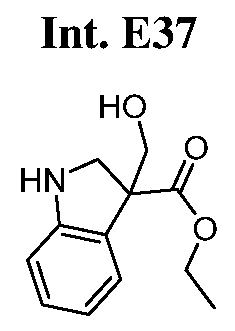
에틸 3-(히드록시메틸)인돌린-3-카르복실레이트Ethyl 3-(hydroxymethyl)indoline-3-carboxylate

단계 1: 에탄올 (5 mL) 중 1-(tert-부틸) 3-메틸 인돌린-1,3-디카르복실레이트 (300 mg, 1.08 mmol)의 용액에 파라포름알데히드 (48.72 mg, 1.62 mmol) 및 K2CO3 (448.53 mg, 3.25 mmol)을 첨가하였다. 반응 혼합물을 실온에서 16시간 동안 교반하고, 여과하였다. 여과물을 진공 하에 농축시켜 조 1-(tert-부틸) 3-에틸 3-(히드록시메틸)인돌린-1,3-디카르복실레이트 (330 mg, 99% 수율)를 제공하였다. LC-MS (ESI) m/z: 222 [M+H-100]+.Step 1: Paraformaldehyde (48.72 mg, 1.62 mmol) in a solution of 1-(tert-butyl) 3-methyl indoline-1,3-dicarboxylate (300 mg, 1.08 mmol) in ethanol (5 mL) and K 2 CO 3 (448.53 mg, 3.25 mmol) were added. The reaction mixture was stirred at room temperature for 16 h and filtered. The filtrate was concentrated in vacuo to give crude 1-(tert-butyl) 3-ethyl 3-(hydroxymethyl)indoline-1,3-dicarboxylate (330 mg, 99% yield). LC-MS (ESI) m/z: 222 [M+H-100] + .
단계 2: DCM (5 mL) 중 1-(tert-부틸) 3-에틸 인돌린-1,3-디카르복실레이트 (300 mg, 1.08 mmol)의 용액에 0℃에서 디옥산 중 4 M HCl (3 mL)을 첨가하였다. 반응 혼합물을 실온에서 16시간 동안 교반하고, 포화 NaHCO3 수용액 (5 mL)으로 pH ~8로 중화시키고, DCM/MeOH (v/v, 10/1, 20 mL x 3)로 추출하였다. 유기 상을 무수 황산나트륨 상에서 건조시키고, 여과하였다. 여과물을 진공 하에 농축시켜 조 에틸 3-(히드록시메틸)인돌린-3-카르복실레이트 (239 mg, 89.9% 수율)를 수득하였다. LC-MS (ESI) m/z: 222 [M+H]+.Step 2: To a solution of 1-(tert-butyl) 3-ethyl indoline-1,3-dicarboxylate (300 mg, 1.08 mmol) in DCM (5 mL) at 0° C. 4 M HCl in dioxane ( 3 mL) was added. The reaction mixture was stirred at room temperature for 16 h, neutralized to pH-8 with saturated aqueous NaHCO 3 aqueous solution (5 mL), and extracted with DCM/MeOH (v/v, 10/1, 20 mL×3). The organic phase was dried over anhydrous sodium sulfate and filtered. The filtrate was concentrated in vacuo to give crude ethyl 3-(hydroxymethyl)indoline-3-carboxylate (239 mg, 89.9% yield). LC-MS (ESI) m/z: 222 [M+H] + .

에틸 2-아자스피로[4.5]데칸-4-카르복실레이트Ethyl 2-azaspiro[4.5]decane-4-carboxylate
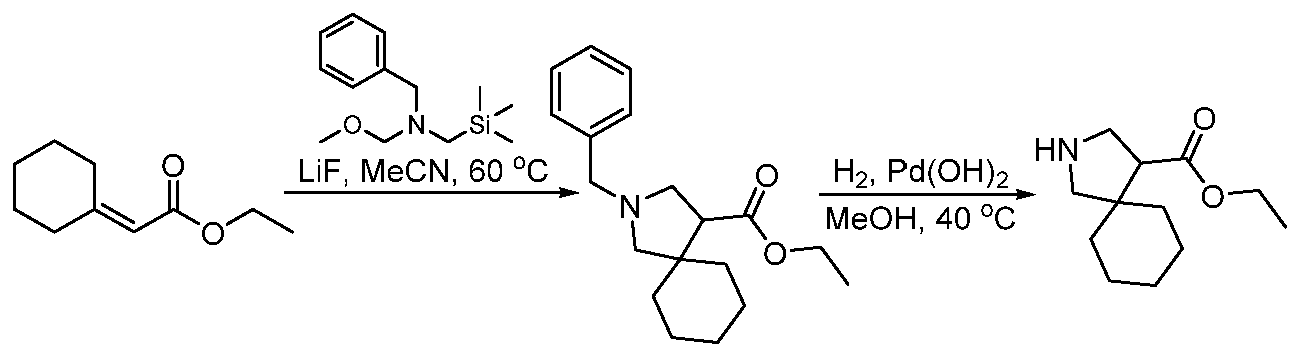
단계 1: MeCN (50 mL) 중 에틸 2-시클로헥실리덴아세테이트 (5 g, 29.72 mmol), N-(메톡시메틸)-1-페닐-N-(트리메틸실릴메틸)메탄아민 (14.11 g, 59.44 mmol) 및 플루오린화리튬 (2.31 g, 89.16 mmol)의 혼합물을 60℃에서 48시간 동안 교반하고, 진공하에 농축시켰다. 잔류물을 EA (100 mL)에 용해시키고, 이를 미리 냉각된 K2CO3 수용액 (10%, 100 mL x 2), 포화 CuSO4 수용액 (100 mL x 3) 및 염수 (100 mL)로 세척하였다. 유기 상을 무수 Na2SO4 상에서 건조시키고, 여과하였다. 여과물을 진공 하에 농축시키고, 잔류물을 역상 크로마토그래피 (0.03% NH4HCO3/MeOH)에 의해 정제하여 에틸 2-벤질-2-아자스피로[4.5]데칸-4-카르복실레이트 (5.55 g, 52.7% 수율, 85% 순도)를 담황색 오일로서 수득하였다. LC-MS (ESI) m/z: 302 [M+H]+.Step 1: Ethyl 2-cyclohexylideneacetate (5 g, 29.72 mmol) in MeCN (50 mL), N-(methoxymethyl)-1-phenyl-N-(trimethylsilylmethyl)methanamine (14.11 g, 59.44 mmol) and lithium fluoride (2.31 g, 89.16 mmol) was stirred at 60° C. for 48 h and concentrated in vacuo. The residue was dissolved in EA (100 mL), which was washed with pre-cooled aqueous K 2 CO 3 solution (10%, 100 mL×2), saturated aqueous CuSO 4 aqueous solution (100 mL×3) and brine (100 mL). . The organic phase was dried over anhydrous Na 2 SO 4 and filtered. The filtrate was concentrated in vacuo, and the residue was purified by reverse phase chromatography (0.03% NH 4 HCO 3 /MeOH) to ethyl 2-benzyl-2-azaspiro[4.5]decane-4-carboxylate (5.55 g) , 52.7% yield, 85% purity) as a pale yellow oil. LC-MS (ESI) m/z: 302 [M+H] + .
단계 2: 메탄올 (30 mL) 중 에틸 2-벤질-2-아자스피로[4.5]데칸-4-카르복실레이트 (2.65 g, 8.79 mmol)의 용액에 디히드록시팔라듐 (679.1 mg, 4.84 mmol)을 첨가하였다. 혼합물을 수소 분위기 (14 psi) 하에 40℃에서 24시간 동안 교반하고, 여과하였다. 여과물을 진공 하에 농축시켜 조 에틸 2-아자스피로[4.5]데칸-4-카르복실레이트를 제공하였다. LC-MS (ESI) m/z: 212 [M+H]+.Step 2: To a solution of ethyl 2-benzyl-2-azaspiro[4.5]decane-4-carboxylate (2.65 g, 8.79 mmol) in methanol (30 mL) was added dihydroxypalladium (679.1 mg, 4.84 mmol) added. The mixture was stirred under a hydrogen atmosphere (14 psi) at 40° C. for 24 h and filtered. The filtrate was concentrated in vacuo to provide crude ethyl 2-azaspiro[4.5]decane-4-carboxylate. LC-MS (ESI) m/z: 212 [M+H] + .

에틸 8-옥사-2-아자스피로[4.5]데칸-4-카르복실레이트Ethyl 8-oxa-2-azaspiro[4.5]decane-4-carboxylate
에틸 2-시클로헥실리덴아세테이트 대신 에틸 2-테트라히드로피란-4-일리덴아세테이트를 사용한, Int. E38과 동일한 절차. LC-MS (ESI) m/z: 214 [M+H]+.Using ethyl 2-tetrahydropyran-4-ylideneacetate instead of ethyl 2-cyclohexylideneacetate, Int. Same procedure as E38. LC-MS (ESI) m/z: 214 [M+H] + .

에틸 2-아자스피로[4.4]노난-4-카르복실레이트Ethyl 2-azaspiro[4.4]nonane-4-carboxylate
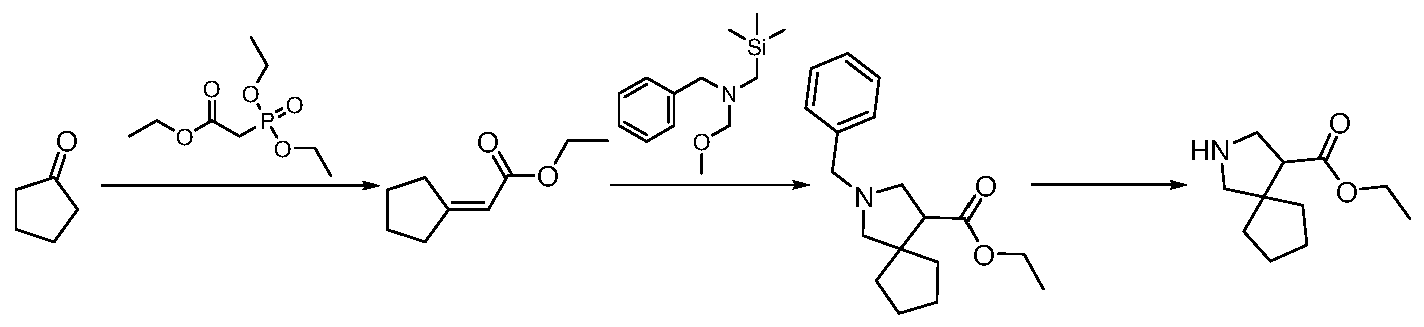
단계 1: 디에틸 에테르 (120 mL) 중 수소화나트륨 (2.08 g, 52.04 mmol, 미네랄 오일 중 60% 분산액)의 교반 현탁액에 0℃에서 에틸 2-디에톡시포스포릴아세테이트 (11.64 g, 51.94 mmol)를 첨가하였다. 생성된 혼합물을 5분 동안 교반하고, 이어서 디에틸 에테르 (10 mL) 중 시클로펜타논 (4.25 g, 50.53 mmol)의 용액을 첨가하였다. 반응 혼합물을 25℃에서 4시간 동안 교반하고, 0℃에서 포화 염화암모늄 수용액 (30 mL)으로 켄칭하고, 물 (100 mL)로 희석하고, 디에틸 에테르 (50 mL x 3)로 추출하였다. 합한 유기 상을 무수 황산나트륨 상에서 건조시키고, 여과하였다. 여과물을 진공 하에 농축시키고, 잔류물을 실리카 겔 상에서 플래쉬 칼럼 크로마토그래피 (석유 에테르/디에틸 에테르 = 10/1)에 의해 정제하여 에틸 2-시클로펜틸리덴아세테이트를 담황색 오일 (6.0 g, 73% 수율)로서 제공하였다. LC-MS (ESI) m/z: 155 [M+H]+.Step 1: To a stirred suspension of sodium hydride (2.08 g, 52.04 mmol, 60% dispersion in mineral oil) in diethyl ether (120 mL) at 0 °C was added ethyl 2-diethoxyphosphorylacetate (11.64 g, 51.94 mmol) added. The resulting mixture was stirred for 5 min, then a solution of cyclopentanone (4.25 g, 50.53 mmol) in diethyl ether (10 mL) was added. The reaction mixture was stirred at 25° C. for 4 h, quenched with saturated aqueous ammonium chloride solution (30 mL) at 0° C., diluted with water (100 mL) and extracted with diethyl ether (50 mL×3). The combined organic phases were dried over anhydrous sodium sulfate and filtered. The filtrate was concentrated in vacuo, and the residue was purified by flash column chromatography on silica gel (petroleum ether/diethyl ether = 10/1) to give ethyl 2-cyclopentylideneacetate as a pale yellow oil (6.0 g, 73). % yield). LC-MS (ESI) m/z: 155 [M+H] + .
단계 2&3: 에틸 2-시클로헥실리덴아세테이트 대신 에틸 2-시클로펜틸리덴아세테이트를 사용한, Int. E38과 동일한 절차. LC-MS (ESI) m/z: 198 [M+H]+.Step 2&3: Using ethyl 2-cyclopentylideneacetate instead of ethyl 2-cyclohexylideneacetate, Int. Same procedure as E38. LC-MS (ESI) m/z: 198 [M+H] + .
중간체 12Intermediate 12
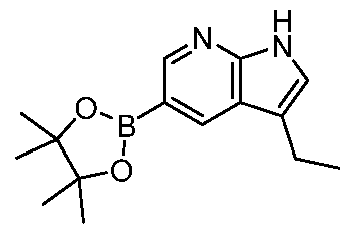
3-에틸-5-(4,4,5,5-테트라메틸-1,3,2-디옥사보롤란-2-일)-1H-피롤로[2,3-b]피리딘3-ethyl-5-(4,4,5,5-tetramethyl-1,3,2-dioxaborolan-2-yl)-1H-pyrrolo[2,3-b]pyridine

단계 1: N2 하에 무수 DCM (50 mL) 중 무수 AlCl3 (3.40 g, 25.50 mmol)의 현탁액에 5-브로모-1H-피롤로[2,3-b]피리딘 (1.01 g, 5.10 mmol)을 첨가하였다. 혼합물을 실온에서 1시간 동안 교반하고, AcCl (2.00 g, 25.50 mmol, 1.8 mL)을 여기에 적가하였다. 생성된 혼합물을 30분 동안 교반하고, 0℃로 냉각시키고, 용액이 투명해질 때까지 MeOH를 첨가하여 조심스럽게 켄칭하였다. 혼합물을 농축시키고, 잔류물을 H2O (30 mL)로 희석하고, 수성 NaOH 용액 (1 N)을 사용하여 pH ~4로 조정하고, 에틸 아세테이트 (30 mL x 3)로 추출하였다. 합한 유기 층을 염수 (30 mL x 2)로 세척하고, 무수 Na2SO4 상에서 건조시키고, 여과하고, 농축시켰다. 잔류물을 EA 중에서 초음파처리하고, 여과하여 1-(5-브로모-1H-피롤로[2,3-b]피리딘-3-일)에탄-1-온을 담황색 고체 (0.87 g, 71% 수율)로서 제공하였다. LC-MS (ESI) m/z: 239 [M+H]+.Step 1: 5-bromo-1H-pyrrolo[2,3-b]pyridine (1.01 g, 5.10 mmol) in a suspension of anhydrous AlCl 3 (3.40 g, 25.50 mmol) in anhydrous DCM (50 mL) under N 2 was added. The mixture was stirred at room temperature for 1 h, and AcCl (2.00 g, 25.50 mmol, 1.8 mL) was added dropwise thereto. The resulting mixture was stirred for 30 min, cooled to 0° C. and carefully quenched by addition of MeOH until the solution became clear. The mixture was concentrated and the residue was diluted with H 2 O (30 mL), adjusted to pH ˜4 with aqueous NaOH solution (1 N), and extracted with ethyl acetate (30 mL×3). The combined organic layers were washed with brine (30 mL×2), dried over anhydrous Na 2 SO 4 , filtered and concentrated. The residue was sonicated in EA and filtered to give 1-(5-bromo-1H-pyrrolo[2,3-b]pyridin-3-yl)ethan-1-one as a pale yellow solid (0.87 g, 71% yield). LC-MS (ESI) m/z: 239 [M+H] + .
단계 2: 이소프로필 알콜 (7 mL) 중 1-(5-브로모-1H-피롤로[2,3-b]피리딘-3-일)에탄-1-온 (200 mg, 0.84 mmol)의 교반 용액에 NaBH4 (158.24 mg, 4.18 mmol)를 0℃에서 조금씩 첨가하였다. 반응 혼합물을 83℃에서 24시간 동안 환류하고, 0℃로 냉각시키고, 물 (15 mL)로 희석하였다. 생성된 혼합물을 에틸 아세테이트 (30 mL x 3)로 추출하였다. 유기 층을 염수 (20 mL x 2)로 세척하고, 무수 Na2SO4 상에서 건조시키고, 여과하고, 농축시켰다. 잔류물을 정제용-TLC (PE/EA = 3/2 v/v)에 의해 정제하여 5-브로모-3-에틸-1H-피롤로[2,3-b]피리딘을 회백색 고체 (70 mg, 33% 수율)로서 제공하였다. LC-MS (ESI) m/z: 225 [M+H]+.Step 2: Stirring of 1-(5-bromo-1H-pyrrolo[2,3-b]pyridin-3-yl)ethan-1-one (200 mg, 0.84 mmol) in isopropyl alcohol (7 mL) To the solution was added NaBH 4 (158.24 mg, 4.18 mmol) portionwise at 0°C. The reaction mixture was refluxed at 83° C. for 24 h, cooled to 0° C. and diluted with water (15 mL). The resulting mixture was extracted with ethyl acetate (30 mL x 3). The organic layer was washed with brine (20 mL×2), dried over anhydrous Na 2 SO 4 , filtered and concentrated. The residue was purified by prep-TLC (PE/EA = 3/2 v/v) to give 5-bromo-3-ethyl-1H-pyrrolo[2,3-b]pyridine as an off-white solid (70 mg , 33% yield). LC-MS (ESI) m/z: 225 [M+H] + .
단계 3: 1,4-디옥산 (6 mL) 중 5-브로모-3-에틸-1H-피롤로[2,3-b]피리딘 (200 mg, 888.55 umol) 및 4,4,4',4',5,5,5',5'-옥타메틸-2,2'-비(1,3,2-디옥사보롤란) (270.77 mg, 1.07 mmol)의 용액에 CH3COOK (174.41 mg, 1.78 mmol) 및 Pd(dppf)Cl2·CH2Cl2 (72.56 mg, 88.86 umol)를 첨가하였다. 혼합물을 질소 분위기 하에 110℃에서 밤새 교반하고, 실온으로 냉각시키고, 여과하였다. 여과물을 농축시키고, 잔류물을 실리카 겔 상에서 플래쉬 칼럼 크로마토그래피 (PE/EA = 2/1 v/v)에 의해 정제하고, PE (10 mL) 중에서 추가로 초음파처리하여 3-에틸-5-(4,4,5,5-테트라메틸-1,3,2-디옥사보롤란-2-일)-1H-피롤로[2,3-b]피리딘을 백색 고체 (40 mg, 9% 수율)로서 제공하였다. LC-MS (ESI) m/z: 273 [M+H]+.Step 3: 5-bromo-3-ethyl-1H-pyrrolo[2,3-b]pyridine (200 mg, 888.55 umol) and 4,4,4' in 1,4-dioxane (6 mL), To a solution of 4',5,5,5',5'-octamethyl-2,2'-bi(1,3,2-dioxaborolane) (270.77 mg, 1.07 mmol) CH 3 COOK (174.41 mg , 1.78 mmol) and Pd(dppf)Cl 2 .CH 2 Cl 2 (72.56 mg, 88.86 umol) were added. The mixture was stirred overnight at 110° C. under a nitrogen atmosphere, cooled to room temperature and filtered. The filtrate was concentrated and the residue was purified by flash column chromatography on silica gel (PE/EA = 2/1 v/v) and further sonicated in PE (10 mL) to 3-ethyl-5- (4,4,5,5-tetramethyl-1,3,2-dioxaborolan-2-yl)-1H-pyrrolo[2,3-b]pyridine as a white solid (40 mg, 9% yield) ) as provided. LC-MS (ESI) m/z: 273 [M+H] + .
중간체 13Intermediate 13

(2-아미노-5-(4,4,5,5-테트라메틸-1,3,2-디옥사보롤란-2-일)페닐)디메틸포스핀 옥시드(2-amino-5-(4,4,5,5-tetramethyl-1,3,2-dioxaborolan-2-yl)phenyl)dimethylphosphine oxide

단계 1: DMF (20 mL) 중 4-브로모-2-아이오도-아닐린 (2.0 g, 6.71 mmol), 디메틸포스핀 옥시드 (628.76 mg, 8.06 mmol), Pd(OAc)2 (150.71 mg, 671.33 umol), Xantphos (776.86 mg, 1.34 mmol) 및 K3PO4 (2.85 g, 13.41 mmol)의 혼합물을 N2 하에 60℃에서 밤새 교반하였다. 실온으로 냉각시킨 후, 혼합물을 여과하고, EA (40 mL)로 세척하였다. 여과물을 H2O (40 mL)로 희석하고, EA (50 mL x 30)로 추출하였다. 유기 층을 염수 (40 mL x 3)로 세척하고, 무수 황산나트륨 상에서 건조시키고, 여과하고, 농축시켰다. 잔류물을 실리카 겔 상에서 플래쉬 칼럼 크로마토그래피 (DCM/MeOH = 60/1 v/v)에 의해 정제하여 (2-아미노-5-브로모페닐)디메틸포스핀 옥시드를 황색 고체 (1.6 g, 96% 수율)로서 제공하였다. LC-MS (ESI) m/z: 248 [M+H]+.Step 1: 4-bromo-2-iodo-aniline (2.0 g, 6.71 mmol), dimethylphosphine oxide (628.76 mg, 8.06 mmol), Pd(OAc) 2 (150.71 mg, 671.33 umol), Xantphos (776.86 mg, 1.34 mmol) and K 3 PO 4 (2.85 g, 13.41 mmol) were stirred under N 2 at 60° C. overnight. After cooling to room temperature, the mixture was filtered and washed with EA (40 mL). The filtrate was diluted with H 2 O (40 mL) and extracted with EA (50 mL×30). The organic layer was washed with brine (40 mL×3), dried over anhydrous sodium sulfate, filtered and concentrated. The residue was purified by flash column chromatography on silica gel (DCM/MeOH = 60/1 v/v) to give (2-amino-5-bromophenyl)dimethylphosphine oxide as a yellow solid (1.6 g, 96 % yield). LC-MS (ESI) m/z: 248 [M+H] + .
단계 2: 디옥산 (20 mL) 중 (2-아미노-5-브로모페닐)디메틸포스핀 옥시드 (1.53 g, 6.17 mmol), 4,4,5,5-테트라메틸-2-(4,4,5,5-테트라메틸-1,3,2-디옥사보롤란-2-일)-1,3,2-디옥사보롤란 (1.88 g, 7.41 mmol), Pd(dppf)Cl2 ·CH2Cl2 (503.70 mg, 616.80 umol), 및 KOAc (1.21 g, 12.34 mmol)의 혼합물을 N2 하에 100℃에서 5시간 동안 교반하였다. 실온으로 냉각시킨 후, 혼합물을 여과하고, EA (150 mL)로 세척하였다. 유기 층을 농축시키고, 실리카 겔 상에서 플래쉬 칼럼 크로마토그래피 (DCM/MeOH = 20/1 v/v)에 의해 정제하여 (2-아미노-5-(4,4,5,5-테트라메틸-1,3,2-디옥사보롤란-2-일)페닐)디메틸포스핀 옥시드를 흑색 오일 (1.16 g, 64% 수율)로서 제공하였다. LC-MS (ESI) m/z: 296 [M+H]+.Step 2: (2-amino-5-bromophenyl)dimethylphosphine oxide (1.53 g, 6.17 mmol), 4,4,5,5-tetramethyl-2- (4, in dioxane (20 mL) 4,5,5-tetramethyl-1,3,2-dioxaborolan-2-yl)-1,3,2-dioxaborolane (1.88 g, 7.41 mmol), Pd(dppf)Cl 2 A mixture of CH 2 Cl 2 (503.70 mg, 616.80 umol), and KOAc (1.21 g, 12.34 mmol) was stirred under N 2 at 100° C. for 5 h. After cooling to room temperature, the mixture was filtered and washed with EA (150 mL). The organic layer was concentrated and purified by flash column chromatography on silica gel (DCM/MeOH = 20/1 v/v) (2-amino-5-(4,4,5,5-tetramethyl-1, 3,2-dioxaborolan-2-yl)phenyl)dimethylphosphine oxide was provided as a black oil (1.16 g, 64% yield). LC-MS (ESI) m/z: 296 [M+H] + .
중간체 14Intermediate 14

2-클로로-3-에틸-5-(4,4,5,5-테트라메틸-1,3,2-디옥사보롤란-2-일)-1H-피롤로[2,3-b]피리딘2-Chloro-3-ethyl-5-(4,4,5,5-tetramethyl-1,3,2-dioxaborolan-2-yl)-1H-pyrrolo[2,3-b]pyridine

무수 디옥산 (1.5 mL) 중 5-브로모-2-클로로-3-에틸-2,3-디히드로-1H-피롤로[2,3-b]피리딘 (50 mg, 0.19 mmol), 4,4,6,6-테트라메틸-2-(4,4,5,5-테트라메틸-1,3,2-디옥사보롤란-2-일)-1,3,2-디옥사보리난 (73 mg, 0.27 mmol), 무수 AcOK (56 mg, 0.58 mmol), 및 Pd(dppf)Cl2·DCM (15 mg, 0.02 mmol)의 혼합물을 100℃에서 질소에 의해 보호된 마이크로웨이브 조건 하에 3시간 동안 교반하였다. 실온으로 냉각시킨 후, 혼합물을 여과하고, 여과물을 농축시켜 조 2-클로로-3-에틸-5-(4,4,5,5-테트라메틸-1,3,2-디옥사보롤란-2-일)-1H-피롤로[2,3-b]피리딘 (50 mg)을 제공하였으며, 이를 후속 단계에 추가 정제 없이 사용하였다. LC-MS (ESI) m/z: 307 [M+H]+.5-bromo-2-chloro-3-ethyl-2,3-dihydro-1H-pyrrolo[2,3-b]pyridine (50 mg, 0.19 mmol), 4 in anhydrous dioxane (1.5 mL), 4,6,6-tetramethyl-2-(4,4,5,5-tetramethyl-1,3,2-dioxaborolan-2-yl)-1,3,2-dioxaborinane ( 73 mg, 0.27 mmol), anhydrous AcOK (56 mg, 0.58 mmol), and a mixture of Pd(dppf)Cl 2 .DCM (15 mg, 0.02 mmol) at 100° C. under microwave conditions protected by nitrogen for 3 h stirred for a while. After cooling to room temperature, the mixture was filtered and the filtrate was concentrated to crude 2-chloro-3-ethyl-5-(4,4,5,5-tetramethyl-1,3,2-dioxaborolane- To give 2-yl)-1H-pyrrolo[2,3-b]pyridine (50 mg), which was used in the next step without further purification. LC-MS (ESI) m/z: 307 [M+H] + .
중간체 15Intermediate 15
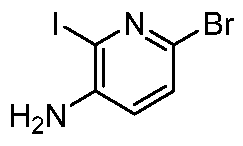
6-브로모-2-아이오도피리딘-3-아민6-Bromo-2-iodopyridin-3-amine

에탄올 (20 mL) 중 6-브로모피리딘-3-아민 (1 g, 5.68 mmol) 및 황산은 (1.77 g, 5.68 mmol)의 현탁액에 아이오딘 (1.44 g, 5.68 mmol)을 첨가하고, 반응 혼합물을 실온에서 밤새 교반하고, PE (20 mL)로 희석하고, 여과하였다. 여과물을 농축시키고, 잔류물을 EA (30 mL) 중에서 초음파처리하였다. 고체를 여과에 의해 수집하고, 건조시켜 6-브로모-2-아이오도-피리딘-3-아민을 갈색 고체 (380 mg, 22% 수율)로서 제공하였다. LC-MS (ESI) m/z: 299 [M+H]+.To a suspension of 6-bromopyridin-3-amine (1 g, 5.68 mmol) and silver sulfate (1.77 g, 5.68 mmol) in ethanol (20 mL) was added iodine (1.44 g, 5.68 mmol) and the reaction mixture was stirred at room temperature overnight, diluted with PE (20 mL) and filtered. The filtrate was concentrated and the residue sonicated in EA (30 mL). The solid was collected by filtration and dried to give 6-bromo-2-iodo-pyridin-3-amine as a brown solid (380 mg, 22% yield). LC-MS (ESI) m/z: 299 [M+H] + .
중간체 16Intermediate 16

tert-부틸 (2-브로모-4-아이오도페닐)(메틸)카르바메이트tert-Butyl (2-bromo-4-iodophenyl) (methyl) carbamate

단계 1: DCM (10 mL) 중 2-브로모-4-아이오도-아닐린 (1 g, 3.36 mmol)의 용액에 TEA (339.66 mg, 467.85 uL), DMAP (410.08 mg, 3.36 mmol), 및 Boc2O (732.58 mg, 3.36 mmol)를 첨가하였다. 혼합물을 실온에서 5시간 동안 교반하고, 농축시켰다. 잔류물을 실리카 겔 상에서 플래쉬 칼럼 크로마토그래피 (PE/EA = 10/1 v/v)에 의해 정제하여 tert-부틸 N-(2-브로모-4-아이오도-페닐)-N-tert-부톡시카르보닐-카르바메이트를 백색 고체 (732.58 mg, 43% 수율)로서 제공하였다.Step 1: To a solution of 2-bromo-4-iodo-aniline (1 g, 3.36 mmol) in DCM (10 mL), TEA (339.66 mg, 467.85 uL), DMAP (410.08 mg, 3.36 mmol), and Boc 2 O (732.58 mg, 3.36 mmol) was added. The mixture was stirred at room temperature for 5 h and concentrated. The residue was purified by flash column chromatography on silica gel (PE/EA = 10/1 v/v) to tert-butyl N-(2-bromo-4-iodo-phenyl)-N-tert-part Toxycarbonyl-carbamate was provided as a white solid (732.58 mg, 43% yield).
단계 2: 메탄올 (20 mL) 중 tert-부틸 N-(2-브로모-4-아이오도-페닐)-N-tert-부톡시카르보닐-카르바메이트 (800 mg, 1.61 mmol)의 용액에 탄산칼륨 (665.87 mg, 4.82 mmol)을 첨가하였다. 혼합물을 70℃에서 2시간 동안 교반하고, 농축시켰다. 잔류물을 실리카 겔 상에서 플래쉬 칼럼 크로마토그래피 (PE/EA = 10/1 v/v)에 의해 정제하여 tert-부틸 N-(2-브로모-4-아이오도-페닐)카르바메이트를 백색 고체 (462 mg, 72% 수율)로서 제공하였다.Step 2: To a solution of tert-butyl N-(2-bromo-4-iodo-phenyl)-N-tert-butoxycarbonyl-carbamate (800 mg, 1.61 mmol) in methanol (20 mL) Potassium carbonate (665.87 mg, 4.82 mmol) was added. The mixture was stirred at 70° C. for 2 h and concentrated. The residue was purified by flash column chromatography on silica gel (PE/EA = 10/1 v/v) to give tert-butyl N-(2-bromo-4-iodo-phenyl)carbamate as a white solid (462 mg, 72% yield).
단계 3: DMF (10 mL) 중 tert-부틸 N-(2-브로모-4-아이오도-페닐)카르바메이트 (400 mg, 1.00 mmol)의 용액에 탄산칼륨 (277.79 mg, 2.01 mmol) 및 아이오도메탄 (213.96 mg, 1.51 mmol)을 첨가하였다. 혼합물을 40℃에서 밤새 교반하였다. 실온으로 냉각시킨 후, 혼합물을 H2O (30 mL)로 희석하고, EA (30 mL x 3)로 추출하였다. 유기 층을 염수 (20 mL x 3)로 세척하고, 무수 Na2SO4 상에서 건조시키고, 여과하고, 농축시켰다. 잔류물을 실리카 겔 상에서 플래쉬 칼럼 크로마토그래피 (PE/EA = 10/1 v/v)에 의해 정제하여 tert-부틸 N-(2-브로모-4-아이오도-페닐)-N-메틸-카르바메이트를 황색 고체 (400 mg, 96% 수율)로서 제공하였다. LC-MS (ESI) m/z: 356 [M+H-55]+.Step 3: To a solution of tert-butyl N-(2-bromo-4-iodo-phenyl)carbamate (400 mg, 1.00 mmol) in DMF (10 mL) with potassium carbonate (277.79 mg, 2.01 mmol) and Iodomethane (213.96 mg, 1.51 mmol) was added. The mixture was stirred at 40° C. overnight. After cooling to room temperature, the mixture was diluted with H 2 O (30 mL) and extracted with EA (30 mL×3). The organic layer was washed with brine (20 mL×3), dried over anhydrous Na 2 SO 4 , filtered and concentrated. The residue was purified by flash column chromatography on silica gel (PE/EA = 10/1 v/v) tert-butyl N-(2-bromo-4-iodo-phenyl)-N-methyl-carr Bamate was provided as a yellow solid (400 mg, 96% yield). LC-MS (ESI) m/z: 356 [M+H-55] + .
중간체 17Intermediate 17

N-(2-브로모-4-아이오도페닐)아세트아미드N-(2-bromo-4-iodophenyl)acetamide

DCM (10 mL) 중 2-브로모-4-아이오도-아닐린 (1.0 g, 3.36 mmol)의 교반 용액에 트리에틸아민 (680.00 mg, 6.72 mmol, 0.94 mL), 및 이어서 아세트산 무수물 (411.63 mg, 4.03 mmol, 381.14 uL)을 첨가하였다. 혼합물을 실온에서 밤새 교반하고, 40℃에서 4시간 동안 가열하였다. 실온으로 냉각시킨 후, 혼합물을 농축시켜 N-(2-브로모-4-아이오도-페닐)아세트아미드를 회색 고체 (1.1 g, 96% 수율)로서 제공하였다. LC-MS (ESI) m/z: 340 [M+H]+.To a stirred solution of 2-bromo-4-iodo-aniline (1.0 g, 3.36 mmol) in DCM (10 mL) was triethylamine (680.00 mg, 6.72 mmol, 0.94 mL) followed by acetic anhydride (411.63 mg, 4.03 mmol, 381.14 uL) were added. The mixture was stirred at room temperature overnight and heated at 40° C. for 4 hours. After cooling to room temperature, the mixture was concentrated to give N-(2-bromo-4-iodo-phenyl)acetamide as a gray solid (1.1 g, 96% yield). LC-MS (ESI) m/z: 340 [M+H] + .
중간체 18Intermediate 18
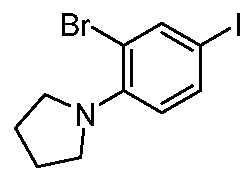
1-(2-브로모-4-아이오도페닐)피롤리딘1-(2-bromo-4-iodophenyl)pyrrolidine
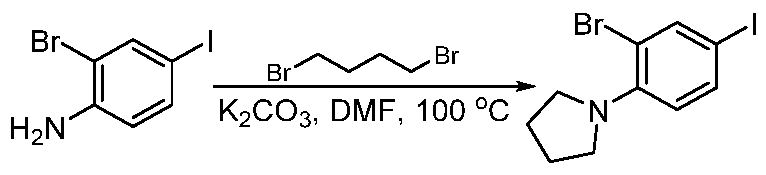
DMF (20 mL) 중 2-브로모-4-아이오도-아닐린 (1.0 g, 3.36 mmol), 1,4-디브로모부탄 (869.69 mg, 4.03 mmol), 및 탄산칼륨 (927.84 mg, 6.71 mmol)의 혼합물을 100℃에서 밤새 교반하였다. 실온으로 냉각시킨 후, 혼합물을 물 (40 mL)에 붓고, EA (50 mL x 3)로 추출하였다. 유기 층을 염수 (30 mL x 3)로 세척하고, 무수 황산나트륨 상에서 건조시키고, 여과하고, 농축시켰다. 잔류물을 실리카 겔 상에서 플래쉬 칼럼 크로마토그래피 (PE, 100% v/v)에 의해 정제하여 1-(2-브로모-4-아이오도-페닐)피롤리딘을 황색 오일 (200 mg, 17% 수율)로서 제공하였다. LC-MS (ESI) m/z: 352 [M+H]+.2-bromo-4-iodo-aniline (1.0 g, 3.36 mmol), 1,4-dibromobutane (869.69 mg, 4.03 mmol), and potassium carbonate (927.84 mg, 6.71 mmol) in DMF (20 mL) ) was stirred at 100 °C overnight. After cooling to room temperature, the mixture was poured into water (40 mL) and extracted with EA (50 mL×3). The organic layer was washed with brine (30 mL×3), dried over anhydrous sodium sulfate, filtered and concentrated. The residue was purified by flash column chromatography on silica gel (PE, 100% v/v) to give 1-(2-bromo-4-iodo-phenyl)pyrrolidine as a yellow oil (200 mg, 17% yield). LC-MS (ESI) m/z: 352 [M+H] + .
중간체 19Intermediate 19

2-브로모-3-플루오로-6-아이오도아닐린2-Bromo-3-fluoro-6-iodoaniline

DMF (2 mL) 중 2-브로모-3-플루오로-아닐린 (200 mg, 1.05 mmol)의 용액에 DMF (2 mL) 중 NIS (236.81 mg, 1.05 mmol)의 용액을 실온에서 적가하였다. 반응 혼합물을 실온에서 3시간 동안 교반하고, EA (30 mL)로 희석하고, 염수 (20 mL x 2)로 세척하였다. 유기 층을 무수 Na2SO4 상에서 건조시키고, 여과하고, 농축시켰다. 잔류물을 실리카 겔 상에서 플래쉬 칼럼 크로마토그래피 (PE/EA = 20/1 v/v)에 의해 정제하여 2-브로모-3-플루오로-6-아이오도-아닐린을 갈색 고체 (330 mg, 99% 수율)로서 제공하였다. LC-MS (ESI) m/z: 316 [M+H]+.To a solution of 2-bromo-3-fluoro-aniline (200 mg, 1.05 mmol) in DMF (2 mL) was added dropwise a solution of NIS (236.81 mg, 1.05 mmol) in DMF (2 mL) at room temperature. The reaction mixture was stirred at room temperature for 3 h, diluted with EA (30 mL) and washed with brine (20 mL×2). The organic layer was dried over anhydrous Na 2 SO 4 , filtered and concentrated. The residue was purified by flash column chromatography on silica gel (PE/EA = 20/1 v/v) to give 2-bromo-3-fluoro-6-iodo-aniline as a brown solid (330 mg, 99 % yield). LC-MS (ESI) m/z: 316 [M+H] + .
중간체 20Intermediate 20

메틸 2-브로모-4-아이오도벤조에이트Methyl 2-bromo-4-iodobenzoate

DMF (15 mL) 중 2-브로모-4-아이오도-벤조산 (1 g, 3.06 mmol), 탄산칼륨 (845.55 mg, 6.12 mmol)의 용액에 아이오도메탄 (651.27 mg, 4.59 mmol)을 첨가하였다. 반응 혼합물을 실온에서 밤새 교반하고, H2O (50 mL)로 켄칭하고, EA (25 mL x 2)로 추출하였다. 합한 유기 층을 염수 (30 mL x 3)로 세척하고, 무수 황산나트륨 상에서 건조시키고, 여과하고, 농축시켜 메틸 2-브로모-4-아이오도-벤조에이트를 갈색 오일 (1 g, 95% 수율)로서 제공하였다. LC-MS (ESI) m/z: 341 [M+H]+.To a solution of 2-bromo-4-iodo-benzoic acid (1 g, 3.06 mmol), potassium carbonate (845.55 mg, 6.12 mmol) in DMF (15 mL) was added iodomethane (651.27 mg, 4.59 mmol) . The reaction mixture was stirred at room temperature overnight, quenched with H 2 O (50 mL) and extracted with EA (25 mL×2). The combined organic layers were washed with brine (30 mL x 3), dried over anhydrous sodium sulfate, filtered, and concentrated to give methyl 2-bromo-4-iodo-benzoate as a brown oil (1 g, 95% yield). provided as LC-MS (ESI) m/z: 341 [M+H] + .
중간체 21Intermediate 21

2-브로모-1-(디플루오로메틸)-4-아이오도벤젠2-Bromo-1-(difluoromethyl)-4-iodobenzene

DCM (6 mL) 중 2-브로모-4-아이오도벤즈알데히드 (200 mg, 0.64 mmol)의 용액에 0℃에서 BAST (284 mg, 1.29 mmol)를 첨가하였다. 혼합물을 실온에서 2시간 동안 교반하고, 농축시켰다. 잔류물을 실리카 겔 상에서 플래쉬 칼럼 크로마토그래피 (EA/PE = 20/1 v/v)에 의해 정제하여 2-브로모-1-(디플루오로메틸)-4-아이오도벤젠을 백색 고체 (180 mg, 84% 수율)로서 제공하였다. To a solution of 2-bromo-4-iodobenzaldehyde (200 mg, 0.64 mmol) in DCM (6 mL) at 0° C. was added BAST (284 mg, 1.29 mmol). The mixture was stirred at room temperature for 2 h and concentrated. The residue was purified by flash column chromatography on silica gel (EA/PE = 20/1 v/v) to give 2-bromo-1-(difluoromethyl)-4-iodobenzene as a white solid (180 mg, 84% yield).
중간체 22Intermediate 22

2-브로모-3-플루오로-4-아이오도-1-메틸벤젠2-Bromo-3-fluoro-4-iodo-1-methylbenzene

무수 THF (5 mL) 중 2-브로모-1-플루오로-3-메틸-벤젠 (500 mg, 2.65 mmol)의 용액에 LDA (THF 중 2 N, 2 mL, 4.0 mmol)를 N2 하에 -70℃에서 10분에 걸쳐 적가하고, 혼합물을 -70℃에서 30분 동안 교반하였다. 무수 THF (2 mL) 중 I2 (2.01 g, 7.94 mmol)의 용액을 -70℃에서 상기 혼합물에 적가하고, 생성된 혼합물을 -70℃에서 3시간 동안 교반하였다. 실온으로 가온한 후, 혼합물을 포화 수성 NH4Cl 용액 (20 mL)에 붓고, EA (20 mL x 2)로 추출하였다. 합한 유기 층을 염수 (30 mL x 2)로 세척하고, 무수 Na2SO4 상에서 건조시키고, 여과하고, 농축시켰다. 잔류물을 정제용-TLC (PE, 100% v/v)에 의해 정제하여 3-브로모-2-플루오로-1-아이오도-4-메틸-벤젠을 무색 오일 (110 mg, 13% 수율)로서 제공하였다.To a solution of 2-bromo-1-fluoro-3-methyl-benzene (500 mg, 2.65 mmol) in anhydrous THF (5 mL) was added LDA (2 N in THF, 2 mL, 4.0 mmol) under N 2 - It was added dropwise at 70° C. over 10 minutes, and the mixture was stirred at -70° C. for 30 minutes. A solution of I 2 (2.01 g, 7.94 mmol) in anhydrous THF (2 mL) was added dropwise to the mixture at -70°C, and the resulting mixture was stirred at -70°C for 3 h. After warming to room temperature, the mixture was poured into saturated aqueous NH 4 Cl solution (20 mL) and extracted with EA (20 mL×2). The combined organic layers were washed with brine (30 mL×2), dried over anhydrous Na 2 SO 4 , filtered and concentrated. The residue was purified by prep-TLC (PE, 100% v/v) to give 3-bromo-2-fluoro-1-iodo-4-methyl-benzene as a colorless oil (110 mg, 13% yield). ) as provided.
중간체 24Intermediate 24

2,6-디브로모-3-메틸피리딘2,6-dibromo-3-methylpyridine
48% 수성 브로민화수소산 용액 (3 mL) 중 6-브로모-5-메틸-피리딘-2-아민 (100 mg, 0.535 mmol)의 용액에 브로민 (69.2 mg, 0.855 mmol)을 -5℃에서 적가하였다. 물 (2 mL) 중 아질산나트륨 (99.6 mg, 1.44 mmol)의 용액을 -5℃에서 상기 혼합물에 적가하였다. 생성된 혼합물을 실온에서 3시간 동안 교반하고, -5℃로 냉각시키고, 물 (5 mL) 중 KOH (100 mg)의 용액으로 켄칭하고, EA (20 mL x 2)로 추출하였다. 합한 유기 층을 염수 (20 mL)로 세척하고, 무수 Na2SO4 상에서 건조시키고, 여과하였다. 여과물을 진공 하에 농축시키고, 잔류물을 정제용-TLC (PE/EA = 10/1 v/v)에 의해 정제하여 2,6-디브로모-3-메틸-피리딘을 백색 고체 (20 mg, 15% 수율)로서 제공하였다. LC-MS (ESI) m/z: 250 [M+H]+.To a solution of 6-bromo-5-methyl-pyridin-2-amine (100 mg, 0.535 mmol) in 48% aqueous hydrobromic acid solution (3 mL) was added bromine (69.2 mg, 0.855 mmol) at -5 °C. was added dropwise. A solution of sodium nitrite (99.6 mg, 1.44 mmol) in water (2 mL) was added dropwise to the above mixture at -5°C. The resulting mixture was stirred at room temperature for 3 h, cooled to -5°C, quenched with a solution of KOH (100 mg) in water (5 mL) and extracted with EA (20 mL×2). The combined organic layers were washed with brine (20 mL), dried over anhydrous Na 2 SO 4 and filtered. The filtrate was concentrated in vacuo and the residue was purified by prep-TLC (PE/EA = 10/1 v/v) to give 2,6-dibromo-3-methyl-pyridine as a white solid (20 mg , 15% yield). LC-MS (ESI) m/z: 250 [M+H] + .
중간체 25Intermediate 25

2-(2-브로모-4-아이오도페닐)옥사졸2-(2-bromo-4-iodophenyl)oxazole

단계 1: DMF (10 mL) 중 2-브로모-4-아이오도-벤조산 (1 g, 3.06 mmol)의 교반 용액에 HATU (1.74 g, 4.59 mmol) 및 DIPEA (1.19 g, 9.18 mmol, 1.60 mL)를 첨가하였다. 10분 동안 교반한 후, 2,2-디메톡시에탄아민 (418.08 mg, 3.98 mmol, 433.25 uL)을 상기 혼합물에 첨가하였다. 혼합물을 밤새 교반하고, EA (20 mL)로 희석하고, 수성 NaHCO3 (30 mL x 2)으로 세척하였다. 유기 층을 무수 황산나트륨 상에서 건조시키고, 여과하고, 진공 하에 농축시켰다. 잔류물을 실리카 겔 상에서 플래쉬 칼럼 크로마토그래피 (PE/EA = 10/1 v/v)에 의해 정제하여 2-브로모-N-(2,2-디메톡시에틸)-4-아이오도-벤즈아미드를 황색 고체 (1 g, 2.42 mmol)로서 제공하였다. LC-MS (ESI) m/z: 382 [M-MeO]+.Step 1: To a stirred solution of 2-bromo-4-iodo-benzoic acid (1 g, 3.06 mmol) in DMF (10 mL) HATU (1.74 g, 4.59 mmol) and DIPEA (1.19 g, 9.18 mmol, 1.60 mL) ) was added. After stirring for 10 minutes, 2,2-dimethoxyethanamine (418.08 mg, 3.98 mmol, 433.25 uL) was added to the mixture. The mixture was stirred overnight, diluted with EA (20 mL) and washed with aqueous NaHCO 3 (30 mL×2). The organic layer was dried over anhydrous sodium sulfate, filtered and concentrated in vacuo. The residue was purified by flash column chromatography on silica gel (PE/EA = 10/1 v/v) to 2-bromo-N-(2,2-dimethoxyethyl)-4-iodo-benzamide was provided as a yellow solid (1 g, 2.42 mmol). LC-MS (ESI) m/z: 382 [M-MeO] + .
단계 2: 이튼 시약 (10 mL) 중 2-브로모-N-(2,2-디메톡시에틸)-4-아이오도-벤즈아미드 (1 g, 2.42 mmol)의 용액을 130℃에서 밤새 교반하였다. 실온으로 냉각시킨 후, 용액을 빙수 (60 mL)에 부었다. 생성된 현탁액을 여과하고, 건조시켜 2-(2-브로모-4-아이오도-페닐)옥사졸을 회색 고체 (840 mg, 2.40 mmol, 99% 수율)로서 제공하였다. LC-MS (ESI) m/z: 350 [M+H]+.Step 2: A solution of 2-bromo-N-(2,2-dimethoxyethyl)-4-iodo-benzamide (1 g, 2.42 mmol) in Eaton's reagent (10 mL) was stirred at 130° C. overnight. . After cooling to room temperature, the solution was poured into ice water (60 mL). The resulting suspension was filtered and dried to give 2-(2-bromo-4-iodo-phenyl)oxazole as a gray solid (840 mg, 2.40 mmol, 99% yield). LC-MS (ESI) m/z: 350 [M+H] + .
중간체 26Intermediate 26
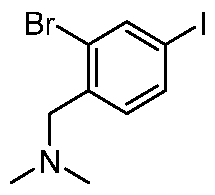
1-(2-브로모-4-아이오도페닐)-N,N-디메틸메탄아민1-(2-Bromo-4-iodophenyl)-N,N-dimethylmethanamine

MeOH (8 mL) 중 2-브로모-4-아이오도벤즈알데히드 (300 mg, 0.94 mmol), 디메틸아민 (THF 중 2 M, 0.58 mL, 1.16 mmol), 및 AcOH (5 방울)의 혼합물을 N2 하에 실온에서 1시간 동안 교반하였다. 이어서, NaBH3CN (90 mg, 1.45 mmol)을 상기 혼합물에 첨가하고, 생성된 혼합물을 40℃에서 16시간 동안 교반하였다. 실온으로 냉각시킨 후, 혼합물을 농축시키고, 잔류물을 실리카 겔 상에서 플래쉬 칼럼 크로마토그래피 (PE 100% v/v에 이어서 PE/EA = 5/1, v/v)에 의해 정제하여 1-(2-브로모-4-아이오도페닐)-N,N-디메틸메탄아민을 황색 오일 (10 mg, 29% 수율)로서 제공하였다. LC-MS (ESI) m/z: 340 [M+H]+.A mixture of 2-bromo-4-iodobenzaldehyde (300 mg, 0.94 mmol), dimethylamine (2 M in THF, 0.58 mL, 1.16 mmol), and AcOH (5 drops) in MeOH (8 mL) is N 2 under stirring at room temperature for 1 hour. Then NaBH 3 CN (90 mg, 1.45 mmol) was added to the mixture and the resulting mixture was stirred at 40° C. for 16 h. After cooling to room temperature, the mixture was concentrated and the residue was purified by flash column chromatography on silica gel (PE 100% v/v then PE/EA = 5/1, v/v) to 1-(2 -Bromo-4-iodophenyl)-N,N-dimethylmethanamine was provided as a yellow oil (10 mg, 29% yield). LC-MS (ESI) m/z: 340 [M+H] + .
중간체 27intermediate 27

1-(2-브로모-4-아이오도페닐)피롤리딘-2-온1-(2-Bromo-4-iodophenyl)pyrrolidin-2-one

단계 1: DCM (10 mL) 중 2-브로모-4-아이오도아닐린 (600 mg, 2.0 mmol)의 혼합물에 피리딘 (175 mg, 2.2 mmol) 및 4-클로로부타노일 클로라이드 (312 mg, 2.2 mmol)를 -20℃ 하에 적가하였다. 반응 혼합물을 -20℃에서 3시간 동안 교반하고, 물 (20 mL)로 희석하고, 수성 HCl 용액 (2 N)으로 세척하고, EA (30 mL x 3)로 추출하였다. 유기 층을 무수 Na2SO4 상에서 건조시키고, 여과하고, 농축시켜 N-(2-브로모-4-아이오도페닐)-4-클로로부탄아미드를 흑색 고체 (700 mg, 86% 수율)로서 제공하였다. LC-MS (ESI) m/z: 402 [M+H]+.Step 1: To a mixture of 2-bromo-4-iodoaniline (600 mg, 2.0 mmol) in DCM (10 mL) pyridine (175 mg, 2.2 mmol) and 4-chlorobutanoyl chloride (312 mg, 2.2 mmol) ) was added dropwise at -20°C. The reaction mixture was stirred at −20° C. for 3 h, diluted with water (20 mL), washed with aqueous HCl solution (2 N), and extracted with EA (30 mL×3). The organic layer was dried over anhydrous Na 2 SO 4 , filtered, and concentrated to provide N-(2-bromo-4-iodophenyl)-4-chlorobutanamide as a black solid (700 mg, 86% yield). did LC-MS (ESI) m/z: 402 [M+H] + .
단계 2: 건조 THF (10 mL) 중 N-(2-브로모-4-아이오도페닐)-4-클로로부탄아미드 (700 mg, 1.74 mmol)의 용액에 0℃에서 NaH (오일 중 60% 현탁액, 138 mg, 3.48 mmol)를 첨가하였다. 혼합물을 N2 하에 실온에서 2시간 동안 교반하고, 냉수 (20 mL)로 희석하고, EA (30 mL x 3)로 추출하였다. 유기 층을 염수 (20 mL)로 세척하고, 무수 황산나트륨 상에서 건조시키고, 여과하고, 농축시켰다. 잔류물을 실리카 겔 상에서 플래쉬 칼럼 크로마토그래피 (PE 100% v/v에 이어서 PE/EA = 5/1, v/v)에 의해 정제하여 1-(2-브로모-4-아이오도페닐)피롤리딘-2-온을 백색 고체 (500 mg, 78% 수율)로서 제공하였다. LC-MS (ESI) m/z: 366 [M+H]+.Step 2: To a solution of N-(2-bromo-4-iodophenyl)-4-chlorobutanamide (700 mg, 1.74 mmol) in dry THF (10 mL) at 0 °C with NaH (60% suspension in oil) , 138 mg, 3.48 mmol) was added. The mixture was stirred under N 2 at room temperature for 2 h, diluted with cold water (20 mL) and extracted with EA (30 mL×3). The organic layer was washed with brine (20 mL), dried over anhydrous sodium sulfate, filtered and concentrated. The residue was purified by flash column chromatography on silica gel (PE 100% v/v then PE/EA = 5/1, v/v) to 1-(2-bromo-4-iodophenyl)p Rollidin-2-one was provided as a white solid (500 mg, 78% yield). LC-MS (ESI) m/z: 366 [M+H] + .
중간체 28Intermediate 28

2-브로모-4-아이오도벤즈아미드2-Bromo-4-iodobenzamide

28% 수산화암모늄 (5 mL) 중 메틸 2-브로모-4-아이오도-벤조에이트 (500 mg, 1.47 mmol)의 혼합물을 밀봉된 튜브 중에서 100℃에서 5시간 동안 교반하고, 실온으로 냉각시키고, 여과하였다. 여과물을 농축시켜 2-브로모-4-아이오도-벤즈아미드를 백색 고체 (400 mg, 84% 수율)로서 제공하였다. LC-MS (ESI) m/z: 326 [M+H]+.A mixture of methyl 2-bromo-4-iodo-benzoate (500 mg, 1.47 mmol) in 28% ammonium hydroxide (5 mL) was stirred in a sealed tube at 100° C. for 5 h, cooled to room temperature, filtered. The filtrate was concentrated to provide 2-bromo-4-iodo-benzamide as a white solid (400 mg, 84% yield). LC-MS (ESI) m/z: 326 [M+H] + .
중간체 29Intermediate 29

N-(3,5-디브로모페닐)아세트아미드N-(3,5-dibromophenyl)acetamide

DCM (5 mL) 중 3,5-디브로모아닐린 (200 mg, 797.07 umol)의 용액에 0℃에서 TEA (241.97 mg, 2.39 mmol, 333.29 uL) 및 아세틸 클로라이드 (93.85 mg, 1.20 mmol, 72.75 uL)를 첨가하였다. 혼합물을 실온에서 2시간 동안 교반하고, H2O (20 mL)로 희석하고, DCM (30 mL x 3)으로 추출하였다. 합한 추출물을 무수 Na2SO4 상에서 건조시키고, 여과하고, 농축시켰다. 잔류물을 실리카 겔 상에서 플래쉬 칼럼 크로마토그래피 (PE/EA = 10/1 v/v)에 의해 정제하여 N-(3,5-디브로모페닐)아세트아미드를 황색 고체 (185 mg, 79% 수율)로서 제공하였다. LC-MS (ESI) m/z: 292 [M+H]+.TEA (241.97 mg, 2.39 mmol, 333.29 uL) and acetyl chloride (93.85 mg, 1.20 mmol, 72.75 uL) in a solution of 3,5-dibromoaniline (200 mg, 797.07 umol) in DCM (5 mL) at 0 °C ) was added. The mixture was stirred at room temperature for 2 h, diluted with H 2 O (20 mL) and extracted with DCM (30 mL×3). The combined extracts were dried over anhydrous Na 2 SO 4 , filtered and concentrated. The residue was purified by flash column chromatography on silica gel (PE/EA = 10/1 v/v) to give N-(3,5-dibromophenyl)acetamide as a yellow solid (185 mg, 79% yield). ) as provided. LC-MS (ESI) m/z: 292 [M+H] + .
중간체 30Intermediate 30

N-(4-브로모-2-아이오도페닐)옥세탄-3-아민N-(4-bromo-2-iodophenyl)oxetan-3-amine

단계 1: THF (20 mL) 중 4-브로모아닐린 (4 g, 23.25 mmol), 옥세탄-3-온 (2.18 g, 30.23 mmol, 1.94 mL), 무수 Na2SO4 (3.30 g, 23.25 mmol)의 혼합물을 실온에서 1시간 동안 교반하였다. 이어서, NaBH(OAc)3 (7.39 g, 34.88 mmol)을 실온에서 상기 혼합물에 첨가하였다. 혼합물을 실온에서 16시간 동안 교반하고, 물 (50 mL)로 희석하고, EA (100 mL x 2)로 추출하였다. 합한 유기 층을 포화 수성 NaHCO3 용액 (30 mL x 3) 및 염수 (20 mL x 2)로 세척하고, 무수 Na2SO4 상에서 건조시키고, 여과하고, 농축시켰다. 잔류물을 실리카 겔 상에서 플래쉬 칼럼 크로마토그래피 (EA/PE = 2/1 v/v)에 의해 정제하여 N-(4-브로모페닐)옥세탄-3-아민을 백색 고체 (3.4 g, 64% 수율)로서 제공하였다. LC-MS (ESI) m/z: 228 [M+H]+.Step 1: 4-Bromoaniline (4 g, 23.25 mmol), oxetan-3-one (2.18 g, 30.23 mmol, 1.94 mL) in THF (20 mL), anhydrous Na 2 SO 4 (3.30 g, 23.25 mmol) ) was stirred at room temperature for 1 hour. Then NaBH(OAc) 3 (7.39 g, 34.88 mmol) was added to the mixture at room temperature. The mixture was stirred at room temperature for 16 h, diluted with water (50 mL) and extracted with EA (100 mL×2). The combined organic layers were washed with saturated aqueous NaHCO 3 solution (30 mL×3) and brine (20 mL×2), dried over anhydrous Na 2 SO 4 , filtered and concentrated. The residue was purified by flash column chromatography on silica gel (EA/PE = 2/1 v/v) to give N-(4-bromophenyl)oxetan-3-amine as a white solid (3.4 g, 64%) yield). LC-MS (ESI) m/z: 228 [M+H] + .
단계 2: DMF (8 mL) 중 N-(4-브로모페닐)옥세탄-3-아민 (1.5 g, 6.58 mmol)의 용액에 DMF (3 mL) 중 NIS (1.48 g, 6.58 mmol)의 용액을 실온에서 적가하였다. 혼합물을 실온에서 3시간 동안 교반하고, 포화 수성 NaHSO3 (10 mL)으로 켄칭하고, EA (60 mL x 2)로 추출하였다. 합한 유기 층을 염수 (20 mL)로 세척하고, 무수 Na2SO4 상에서 건조시키고, 여과하고, 농축시켰다. 잔류물을 실리카 겔 상에서 플래쉬 칼럼 크로마토그래피 (EA/PE = 4/1 v/v)에 의해 정제하여 조 N-(4-브로모-2-아이오도-페닐)옥세탄-3-아민을 황색 고체 (630 mg, 30% 수율, 50% 순도)로서 제공하였다. LC-MS (ESI) m/z: 354 [M+H]+.Step 2: A solution of NIS (1.48 g, 6.58 mmol) in DMF (3 mL) in a solution of N-(4-bromophenyl)oxetan-3-amine (1.5 g, 6.58 mmol) in DMF (8 mL) was added dropwise at room temperature. The mixture was stirred at room temperature for 3 h, quenched with saturated aqueous NaHSO 3 (10 mL) and extracted with EA (60 mL×2). The combined organic layers were washed with brine (20 mL), dried over anhydrous Na 2 SO 4 , filtered and concentrated. The residue was purified by flash column chromatography on silica gel (EA/PE = 4/1 v/v) to give crude N-(4-bromo-2-iodo-phenyl)oxetan-3-amine to yellow Provided as a solid (630 mg, 30% yield, 50% purity). LC-MS (ESI) m/z: 354 [M+H] + .
예시된 화합물exemplified compounds
실시예 1Example 1

(1-(5-클로로-2-((6-메톡시-2-메틸-1,2,3,4-테트라히드로이소퀴놀린-7-일)아미노)피리미딘-4-일)-1H-인돌-3-일)디메틸포스핀 옥시드(1-(5-Chloro-2-((6-methoxy-2-methyl-1,2,3,4-tetrahydroisoquinolin-7-yl)amino)pyrimidin-4-yl)-1H- Indol-3-yl)dimethylphosphine oxide
단계 1: DMF (5 mL) 중 Int. E1 (200 mg, 1.04 mmol)의 용액에 수소화나트륨 (미네랄 오일 중 60% 분산액, 50 mg, 1.24 mmol)을 0℃에서 첨가하고, 혼합물을 0℃에서 30분 동안 교반하였다. 상기 반응 혼합물에 2,4,5-트리클로로피리미딘 (227.9 mg, 1.24 mmol)을 0℃에서 첨가한 다음, 생성된 혼합물을 실온에서 1시간 동안 교반하고, 0℃로 냉각시키고, 얼음-H2O (20 mL)로 켄칭하고, EA (30 mL x 3)로 추출하였다. 유기 상을 무수 황산나트륨 상에서 건조시키고, 여과하였다. 여과물을 진공 하에 농축시키고, 잔류물을 정제용-HPLC (MeCN/0.1% HCOOH)에 의해 정제하여 (1-(2,5-디클로로피리미딘-4-일)-1H-인돌-3-일)디메틸포스핀 옥시드를 백색 고체 (110 mg, 31% 수율)로서 수득하였다. LC-MS (ESI) m/z: 340 [M+H]+.Step 1: Int. in DMF (5 mL). To a solution of E1 (200 mg, 1.04 mmol) was added sodium hydride (60% dispersion in mineral oil, 50 mg, 1.24 mmol) at 0° C. and the mixture was stirred at 0° C. for 30 min. To the reaction mixture was added 2,4,5-trichloropyrimidine (227.9 mg, 1.24 mmol) at 0° C., then the resulting mixture was stirred at room temperature for 1 hour, cooled to 0° C., and ice-H Quench with 2 O (20 mL) and extracted with EA (30 mL×3). The organic phase was dried over anhydrous sodium sulfate and filtered. The filtrate was concentrated in vacuo and the residue was purified by prep-HPLC (MeCN/0.1% HCOOH) (1-(2,5-dichloropyrimidin-4-yl)-1H-indol-3-yl ) dimethylphosphine oxide was obtained as a white solid (110 mg, 31% yield). LC-MS (ESI) m/z: 340 [M+H] + .
단계 2: 2-메톡시에탄올 (3 mL) 중 Int. W1 (25.4 mg, 0.13 mmol)의 용액에 (1-(2,5-디클로로피리미딘-4-일)-1H-인돌-3-일)디메틸포스핀 옥시드 (30 mg, 0.09 mmol) 및 EtOH 중 HCl 용액 (2 N, 0.2 mL)을 첨가하였다. 생성된 혼합물을 120℃에서 20시간 동안 교반하고, 진공 하에 농축시켰다. 잔류물을 실리카 겔 상에서 플래쉬 칼럼 크로마토그래피 (DCM/MeOH = 15/1 v/v) 및 정제용-HPLC (MeCN/0.1% HCOOH)에 의해 정제하여 (1-(5-클로로-2-((6-메톡시-2-메틸-1,2,3,4-테트라히드로이소퀴놀린-7-일)아미노)피리미딘-4-일)-1H-인돌-3-일)디메틸포스핀 옥시드를 황색 고체 (8.3 mg, 19% 수율)로서 제공하였다. LC-MS (ESI) m/z: 496 [M+H]+. 1H NMR (400 MHz, CD3OD): δ 1.92 (s, 3H), 1.95 (s, 3H), 2.54 (s, 3H), 2.90-2.97 (m, 4H), 3.59 (s, 2H), 3.91 (s, 3H), 6.83 (s, 1H), 7.35-7.40 (m, 2H), 7.86-7.88 (m, 1H), 7.91-7.94 (m, 1H), 7.97 (s, 1H), 8.22 (d, J = 4.8 Hz, 1H), 8.65 (s, 1H).Step 2: Int. in 2-methoxyethanol (3 mL). In a solution of W1 (25.4 mg, 0.13 mmol) (1-(2,5-dichloropyrimidin-4-yl)-1H-indol-3-yl)dimethylphosphine oxide (30 mg, 0.09 mmol) and EtOH Heavy HCl solution (2 N, 0.2 mL) was added. The resulting mixture was stirred at 120° C. for 20 h and concentrated in vacuo. The residue was purified by flash column chromatography on silica gel (DCM/MeOH = 15/1 v/v) and preparative-HPLC (MeCN/0.1% HCOOH) (1-(5-chloro-2-(( 6-Methoxy-2-methyl-1,2,3,4-tetrahydroisoquinolin-7-yl)amino)pyrimidin-4-yl)-1H-indol-3-yl)dimethylphosphine oxide It was provided as a yellow solid (8.3 mg, 19% yield). LC-MS (ESI) m/z: 496 [M+H] + . 1 H NMR (400 MHz, CD 3 OD): δ 1.92 (s, 3H), 1.95 (s, 3H), 2.54 (s, 3H), 2.90-2.97 (m, 4H), 3.59 (s, 2H), 3.91 (s, 3H), 6.83 (s, 1H), 7.35-7.40 (m, 2H), 7.86-7.88 (m, 1H), 7.91-7.94 (m, 1H), 7.97 (s, 1H), 8.22 ( d, J = 4.8 Hz, 1H), 8.65 (s, 1H).
실시예 2Example 2

N-(5-클로로-4-(1H-인돌-1-일)피리미딘-2-일)-6-메톡시-2-메틸-1,2,3,4-테트라히드로이소퀴놀린-7-아민N-(5-chloro-4-(1H-indol-1-yl)pyrimidin-2-yl)-6-methoxy-2-methyl-1,2,3,4-tetrahydroisoquinoline-7- amine
단계 1에서 Int. E1 대신 인돌을 사용한, 실시예 1과 동일한 절차. LC-MS (ESI) m/z: 420 [M+H]+. 1H NMR (400 MHz, CD3OD): δ 2.79 (s, 3H), 3.07-3.10 (m, 2H), 3.26-3.27 (m, 2H), 3.94 (s, 5H), 6.75 (d, J = 3.6 Hz, 1H), 6.89 (s, 1H), 7.21-7.30 (m, 2H), 7.65 (d, J = 8.4 Hz, 1H), 7.83 (d, J = 3.6 Hz, 1H), 7.81 (d, J = 8.4 Hz,1H), 8.13 (s, 1H), 8.60 (s, 1H).In step 1, Int. Same procedure as Example 1, using indole instead of E1. LC-MS (ESI) m/z: 420 [M+H] + . 1 H NMR (400 MHz, CD 3 OD): δ 2.79 (s, 3H), 3.07-3.10 (m, 2H), 3.26-3.27 (m, 2H), 3.94 (s, 5H), 6.75 (d, J) = 3.6 Hz, 1H), 6.89 (s, 1H), 7.21-7.30 (m, 2H), 7.65 (d, J = 8.4 Hz, 1H), 7.83 (d, J = 3.6 Hz, 1H), 7.81 (d) , J = 8.4 Hz, 1H), 8.13 (s, 1H), 8.60 (s, 1H).
실시예 3Example 3

N-(4-(1H-인돌-1-일)-5-(트리플루오로메틸)피리미딘-2-일)-6-메톡시-2-메틸-1,2,3,4-테트라히드로이소퀴놀린-7-아민N-(4-(1H-indol-1-yl)-5-(trifluoromethyl)pyrimidin-2-yl)-6-methoxy-2-methyl-1,2,3,4-tetrahydro Isoquinolin-7-amine
단계 1에서 Int. E1 및 2,4,5-트리클로로피리미딘 대신 인돌린 및 2,4-디클로로-5-(트리플루오로메틸)피리미딘을 사용한, 실시예 1과 동일한 절차. LC-MS (ESI) m/z: 420 [M+H]+. 1H NMR (400 MHz, CD3OD): δ 2.55 (s, 3H), 2.92-2.96 (m, 4H), 3.19 (t, J = 8.0 Hz, 2H), 3.45 (s, 2H), 3.88 (s, 3H), 4.16 (t, J = 8.0 Hz, 2H), 6.78 (s, 1H), 7.02-7.07 (m, 1H), 7.17 (d, J = 7.2 Hz, 1H), 7.31 (d, J = 7.2 Hz, 1H), 7.55 (d, J = 8.0 Hz, 1H), 7.90 (s, 1H), 8.49 (s, 1H).In step 1, Int. Same procedure as Example 1, using indoline and 2,4-dichloro-5-(trifluoromethyl)pyrimidine instead of E1 and 2,4,5-trichloropyrimidine. LC-MS (ESI) m/z: 420 [M+H] + . 1 H NMR (400 MHz, CD 3 OD): δ 2.55 (s, 3H), 2.92-2.96 (m, 4H), 3.19 (t, J = 8.0 Hz, 2H), 3.45 (s, 2H), 3.88 ( s, 3H), 4.16 (t, J = 8.0 Hz, 2H), 6.78 (s, 1H), 7.02-7.07 (m, 1H), 7.17 (d, J = 7.2 Hz, 1H), 7.31 (d, J) = 7.2 Hz, 1H), 7.55 (d, J = 8.0 Hz, 1H), 7.90 (s, 1H), 8.49 (s, 1H).
실시예 4Example 4

N-(5-클로로-4-(인돌린-1-일)피리미딘-2-일)-6-메톡시-2-메틸-1,2,3,4-테트라히드로이소퀴놀린-7-아민N-(5-Chloro-4-(indolin-1-yl)pyrimidin-2-yl)-6-methoxy-2-methyl-1,2,3,4-tetrahydroisoquinolin-7-amine
단계 1: DMF (20 mL) 중 2,4,5-트리클로로피리미딘 (1 g, 5.45 mmol)의 용액에 탄산칼륨 (1.51 g, 10.90 mmol) 및 인돌린 (649.7 mg, 5.45 mmol)을 첨가하였다. 혼합물을 80℃에서 밤새 교반하고, 실온으로 냉각시키고, H2O (50 mL)로 희석하고, EA (50 mL x 2)로 추출하였다. 유기 상을 무수 황산나트륨 상에서 건조시키고, 여과하였다. 여과물을 진공 하에 농축시키고, 잔류물을 실리카 겔 상에서 플래쉬 칼럼 크로마토그래피 (EA/PE = 1/30, v/v)에 의해 정제하여 1-(2,5-디클로로피리미딘-4-일)인돌린을 백색 고체 (900 mg, 61% 수율)로서 제공하였다. LC-MS (ESI) m/z: 266 [M+H]+.Step 1: To a solution of 2,4,5-trichloropyrimidine (1 g, 5.45 mmol) in DMF (20 mL) was added potassium carbonate (1.51 g, 10.90 mmol) and indoline (649.7 mg, 5.45 mmol) did The mixture was stirred at 80° C. overnight, cooled to room temperature, diluted with H 2 O (50 mL) and extracted with EA (50 mL×2). The organic phase was dried over anhydrous sodium sulfate and filtered. The filtrate was concentrated in vacuo and the residue was purified by flash column chromatography on silica gel (EA/PE = 1/30, v/v) to 1-(2,5-dichloropyrimidin-4-yl) Indoline was provided as a white solid (900 mg, 61% yield). LC-MS (ESI) m/z: 266 [M+H] + .
단계 2: Int. W1 (30 mg, 0.16 mmol) 및 1-(2,5-디클로로피리미딘-4-일)인돌린 (41.5 mg, 0.16 mmol)을 조건 B1 (실시예 1의 단계 2에 예시된 바와 같음) 하에 사용하고, 실리카 겔 상에서 플래쉬 칼럼 크로마토그래피 (DCM/MeOH = 10/1)에 의한 정제 후에 N-(5-클로로-4-(인돌린-1-일)피리미딘-2-일)-6-메톡시-2-메틸-1,2,3,4-테트라히드로이소퀴놀린-7-아민을 황색 고체 (35 mg, 53% 수율)로서 제공하였다. LC-MS (ESI) m/z: 422 [M+H]+. 1H NMR (400 MHz, DMSO-d6): δ 2.33 (s, 3H), 2.59 (t, J = 5.2 Hz, 2H), 2.78 (t, J = 5.2 Hz, 2H), 3.13 (t, J = 8.0 Hz, 2H), 3.31 (s, 2H), 3.78 (s, 3H), 4.27 (t, J = 8.4 Hz, 2H), 6.75 (s, 1H), 6.93 (t, J = 7.6 Hz, 1H), 7.08 (t, J = 7.6 Hz, 1H), 7.25 (d, J = 6.8 Hz, 1H), 7.35 (d, J = 8.0 Hz, 1H), 7.56 (s, 1H), 7.96 (s, 1H), 8.24 (s, 2H).Step 2: Int. W1 (30 mg, 0.16 mmol) and 1-(2,5-dichloropyrimidin-4-yl)indoline (41.5 mg, 0.16 mmol) under condition B1 (as exemplified in step 2 of Example 1) N-(5-chloro-4-(indolin-1-yl)pyrimidin-2-yl)-6- after purification by flash column chromatography on silica gel (DCM/MeOH = 10/1) Methoxy-2-methyl-1,2,3,4-tetrahydroisoquinolin-7-amine was provided as a yellow solid (35 mg, 53% yield). LC-MS (ESI) m/z: 422 [M+H] + . 1 H NMR (400 MHz, DMSO-d 6 ): δ 2.33 (s, 3H), 2.59 (t, J = 5.2 Hz, 2H), 2.78 (t, J = 5.2 Hz, 2H), 3.13 (t, J) = 8.0 Hz, 2H), 3.31 (s, 2H), 3.78 (s, 3H), 4.27 (t, J = 8.4 Hz, 2H), 6.75 (s, 1H), 6.93 (t, J = 7.6 Hz, 1H) ), 7.08 (t, J = 7.6 Hz, 1H), 7.25 (d, J = 6.8 Hz, 1H), 7.35 (d, J = 8.0 Hz, 1H), 7.56 (s, 1H), 7.96 (s, 1H) ), 8.24 (s, 2H).
실시예 5Example 5
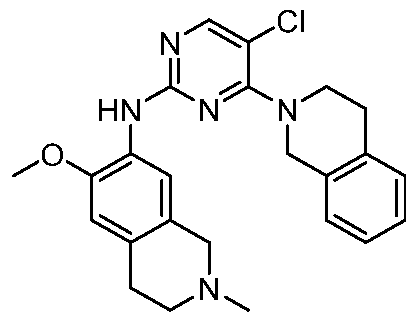
N-(5-클로로-4-(3,4-디히드로이소퀴놀린-2(1H)-일)피리미딘-2-일)-6-메톡시-2-메틸-1,2,3,4-테트라히드로이소퀴놀린-7-아민N-(5-chloro-4-(3,4-dihydroisoquinolin-2(1H)-yl)pyrimidin-2-yl)-6-methoxy-2-methyl-1,2,3,4 -tetrahydroisoquinolin-7-amine
단계 1에서 인돌린 대신 1,2,3,4-테트라히드로이소퀴놀린을 사용한, 실시예 4와 동일한 절차. LC-MS (ESI) m/z: 436 [M+H]+. 1H NMR (400 MHz, CD3OD): δ 2.66 (s, 3H), 2.99-3.05 (m, 6H), 3.84 (s, 2H), 3.89 (s, 3H), 4.00 (t, J = 6.0 Hz, 2H), 4.87 (s, 2H), 6.79 (s, 1H), 7.19 (s, 4H), 7.99 (s, 1H), 8.10 (s, 1H).Same procedure as Example 4, using 1,2,3,4-tetrahydroisoquinoline instead of indoline in step 1. LC-MS (ESI) m/z: 436 [M+H] + . 1 H NMR (400 MHz, CD 3 OD): δ 2.66 (s, 3H), 2.99-3.05 (m, 6H), 3.84 (s, 2H), 3.89 (s, 3H), 4.00 (t, J = 6.0 Hz, 2H), 4.87 (s, 2H), 6.79 (s, 1H), 7.19 (s, 4H), 7.99 (s, 1H), 8.10 (s, 1H).
실시예 6Example 6

N-(5-클로로-4-(3,4-디히드로퀴놀린-1(2H)-일)피리미딘-2-일)-6-메톡시-2-메틸-1,2,3,4-테트라히드로이소퀴놀린-7-아민N-(5-chloro-4-(3,4-dihydroquinolin-1(2H)-yl)pyrimidin-2-yl)-6-methoxy-2-methyl-1,2,3,4- Tetrahydroisoquinolin-7-amine
단계 1에서 인돌린 대신 1,2,3,4-테트라히드로퀴놀린을 사용한, 실시예 4와 동일한 절차. LC-MS (ESI) m/z: 436 [M+H]+. 1H NMR (400 MHz, CD3OD): δ 1.99-2.06 (m, 2H), 2.51 (s, 3H), 2.80-2.86 (m, 4H), 2.91 (t, J = 6.0 Hz, 2H), 3.44 (s, 2H), 3.87-3.90 (m, 5H), 6.73 (s, 1H), 6.85 (d, J = 8.0 Hz, 1H), 6.99-7.03 (m, 1H), 7.06-7.10 (m, 1H), 7.19 (d, J = 8.0 Hz, 1H), 7.87 (s, 1H), 8.14 (s, 1H).Same procedure as Example 4, using 1,2,3,4-tetrahydroquinoline instead of indoline in step 1. LC-MS (ESI) m/z: 436 [M+H] + . 1 H NMR (400 MHz, CD 3 OD): δ 1.99-2.06 (m, 2H), 2.51 (s, 3H), 2.80-2.86 (m, 4H), 2.91 (t, J = 6.0 Hz, 2H), 3.44 (s, 2H), 3.87-3.90 (m, 5H), 6.73 (s, 1H), 6.85 (d, J = 8.0 Hz, 1H), 6.99-7.03 (m, 1H), 7.06-7.10 (m, 1H), 7.19 (d, J = 8.0 Hz, 1H), 7.87 (s, 1H), 8.14 (s, 1H).
실시예 7Example 7

N-(5-클로로-4-(2,3-디히드로-4H-벤조[b][1,4]옥사진-4-일)피리미딘-2-일)-6-메톡시-2-메틸-1,2,3,4-테트라히드로이소퀴놀린-7-아민N-(5-chloro-4-(2,3-dihydro-4H-benzo[b][1,4]oxazin-4-yl)pyrimidin-2-yl)-6-methoxy-2- Methyl-1,2,3,4-tetrahydroisoquinolin-7-amine
단계 1에서 인돌린 대신 3,4-디히드로-2H-벤조[b][1,4]옥사진을 사용한, 실시예 4와 동일한 절차. LC-MS (ESI) m/z: 438 [M+H]+. 1H NMR (400 MHz, CD3OD): δ (ppm) 2.48 (s, 3H), 2.77 (t, J = 6.0 Hz, 2H), 2.88 (t, J = 6.0 Hz, 2H), 3.31 (s, 2H), 3.87 (s, 3H), 3.96 (t, J = 4.4 Hz, 2H), 4.28 (t, J = 4.4 Hz, 2H), 6.71 (s, 1H), 6.83-6.87 (m, 1H), 6.92-7.03 (m, 3H), 7.79 (s, 1H), 8.24 (s, 1H).Same procedure as in Example 4, using 3,4-dihydro-2H-benzo[b][1,4]oxazine in step 1 instead of indoline. LC-MS (ESI) m/z: 438 [M+H] + . 1 H NMR (400 MHz, CD 3 OD): δ (ppm) 2.48 (s, 3H), 2.77 (t, J = 6.0 Hz, 2H), 2.88 (t, J = 6.0 Hz, 2H), 3.31 (s) , 2H), 3.87 (s, 3H), 3.96 (t, J = 4.4 Hz, 2H), 4.28 (t, J = 4.4 Hz, 2H), 6.71 (s, 1H), 6.83-6.87 (m, 1H) , 6.92-7.03 (m, 3H), 7.79 (s, 1H), 8.24 (s, 1H).
실시예 8Example 8

1-(5-클로로-2-((6-메톡시-2-메틸-1,2,3,4-테트라히드로이소퀴놀린-7-일)아미노)피리미딘-4-일)-N,N-디메틸-1H-인돌-3-카르복스아미드1-(5-Chloro-2-((6-methoxy-2-methyl-1,2,3,4-tetrahydroisoquinolin-7-yl)amino)pyrimidin-4-yl)-N,N -Dimethyl-1H-indole-3-carboxamide
단계 1: Int. E2 (200 mg, 1.06 mmol) 및 2,4,5-트리클로로피리미딘 (194.90 mg, 1.06 mmol)을 조건 A2 (실시예 4의 단계 1에 예시된 바와 같음) 하에 사용하고, 실리카 겔 상에서 플래쉬 칼럼 크로마토그래피 (EA/PE = 1/1, v/v)에 의한 정제 후에 1-(2,5-디클로로피리미딘-4-일)-N,N-디메틸-1H-인돌-3-카르복스아미드를 백색 고체 (165 mg, 46% 수율)로서 제공하였다. LC-MS (ESI) m/z: 335 [M+H]+.Step 1: Int. E2 (200 mg, 1.06 mmol) and 2,4,5-trichloropyrimidine (194.90 mg, 1.06 mmol) were used under condition A2 (as exemplified in step 1 of Example 4) and flash on silica gel 1-(2,5-dichloropyrimidin-4-yl)-N,N-dimethyl-1H-indole-3-carbox after purification by column chromatography (EA/PE = 1/1, v/v) The amide was provided as a white solid (165 mg, 46% yield). LC-MS (ESI) m/z: 335 [M+H] + .
단계 2: 이소프로판올 (2 mL) 중 1-(2,5-디클로로피리미딘-4-일)-N,N-디메틸-1H-인돌-3-카르복스아미드 (52 mg, 0.16 mmol) 및 Int. W1 (29.8 mg, 0.16 mmol)의 용액에 트리플루오로아세트산 (53.1 mg, 0.48 mmol)을 첨가하였다. 혼합물을 N2 하에 100℃에서 20시간 동안 교반하고, 실온으로 냉각시키고, 정제용-HPLC (MeCN/0.1% HCOOH)에 의해 정제하여 1-(5-클로로-2-((6-메톡시-2-메틸-1,2,3,4-테트라히드로이소퀴놀린-7-일)아미노)피리미딘-4-일)-N,N-디메틸-1H-인돌-3-카르복스아미드를 황색 고체 (7.0 mg, 9% 수율)로서 제공하였다. LC-MS (ESI) m/z: 491 [M+H]+. 1H NMR (400 MHz, CD3OD): δ (ppm) 2.63 (s, 3H), 3.01-3.05 (m, 4H), 3.22 (s, 6H), 3.71 (s, 2H), 3.91 (s, 3H), 6.85 (s, 1H), 7.31-7.36 (m, 2H), 7.78-7.81 (m, 2H), 8.02 (s, 1H), 8.12 (s, 1H), 8.63 (s, 1H).Step 2: 1-(2,5-dichloropyrimidin-4-yl)-N,N-dimethyl-1H-indole-3-carboxamide (52 mg, 0.16 mmol) and Int. To a solution of W1 (29.8 mg, 0.16 mmol) was added trifluoroacetic acid (53.1 mg, 0.48 mmol). The mixture was stirred under N 2 at 100° C. for 20 h, cooled to room temperature and purified by prep-HPLC (MeCN/0.1% HCOOH) to 1-(5-chloro-2-((6-methoxy-) 2-Methyl-1,2,3,4-tetrahydroisoquinolin-7-yl)amino)pyrimidin-4-yl)-N,N-dimethyl-1H-indole-3-carboxamide as a yellow solid ( 7.0 mg, 9% yield). LC-MS (ESI) m/z: 491 [M+H] + . 1 H NMR (400 MHz, CD 3 OD): δ (ppm) 2.63 (s, 3H), 3.01-3.05 (m, 4H), 3.22 (s, 6H), 3.71 (s, 2H), 3.91 (s, 3H), 6.85 (s, 1H), 7.31-7.36 (m, 2H), 7.78-7.81 (m, 2H), 8.02 (s, 1H), 8.12 (s, 1H), 8.63 (s, 1H).
실시예 9Example 9

N-(4-(1H-벤조[d]이미다졸-1-일)-5-클로로피리미딘-2-일)-6-메톡시-2-메틸-1,2,3,4-테트라히드로이소퀴놀린-7-아민N-(4-(1H-Benzo[d]imidazol-1-yl)-5-chloropyrimidin-2-yl)-6-methoxy-2-methyl-1,2,3,4-tetrahydro Isoquinolin-7-amine
단계 1에서 Int. E2 대신 1H-벤조[d]이미다졸을 사용한, 실시예 8과 동일한 절차. LC-MS (ESI) m/z: 421 [M+H]+. 1H NMR (400 MHz, CD3OD): δ 2.87 (s, 3H), 3.12 (t, J = 6.8 Hz, 2H), 3.38 (t, J = 6.8 Hz, 2H), 3.93 (s, 3H), 4.06 (s, 2H), 6.91 (s, 1H), 7.41-7.44 (m, 2H), 7.78-7.81 (m, 1H), 7.85-7.88 (m, 1H), 8.03 (s, 1H), 8.69 (s, 1H), 8.79 (s, 1H).In step 1, Int. Same procedure as Example 8, using 1H-benzo[d]imidazole instead of E2. LC-MS (ESI) m/z: 421 [M+H] + . 1 H NMR (400 MHz, CD 3 OD): δ 2.87 (s, 3H), 3.12 (t, J = 6.8 Hz, 2H), 3.38 (t, J = 6.8 Hz, 2H), 3.93 (s, 3H) , 4.06 (s, 2H), 6.91 (s, 1H), 7.41-7.44 (m, 2H), 7.78-7.81 (m, 1H), 7.85-7.88 (m, 1H), 8.03 (s, 1H), 8.69 (s, 1H), 8.79 (s, 1H).
실시예 10Example 10

N-(4-(1H-인돌-1-일)-5-(트리플루오로메틸)피리미딘-2-일)-6-메톡시-2-메틸-1,2,3,4-테트라히드로이소퀴놀린-7-아민N-(4-(1H-indol-1-yl)-5-(trifluoromethyl)pyrimidin-2-yl)-6-methoxy-2-methyl-1,2,3,4-tetrahydro Isoquinolin-7-amine
단계 1: 1H-인돌 (349.9 mg, 3.0 mmol) 및 2,4-디클로로-5-(트리플루오로메틸)피리미딘 (650.9 mg, 3.0 mmol)을 조건 A1 (실시예 1의 단계 1에 예시된 바와 같음) 하에 사용하고, 정제용-HPLC에 의한 정제 후에 1-(2-클로로-5-(트리플루오로메틸)피리미딘-4-일)-1H-인돌을 황색 고체 (88 mg, 7% 수율)로서 제공하였다. LC-MS (ESI) m/z: 298 [M+H]+.Step 1: 1H-indole (349.9 mg, 3.0 mmol) and 2,4-dichloro-5-(trifluoromethyl)pyrimidine (650.9 mg, 3.0 mmol) were mixed with Condition A1 (as exemplified in Step 1 of Example 1) as) and after purification by preparative-HPLC 1-(2-chloro-5-(trifluoromethyl)pyrimidin-4-yl)-1H-indole as a yellow solid (88 mg, 7% yield). LC-MS (ESI) m/z: 298 [M+H] + .
단계 2: 이소프로판올 (3 mL) 중 1-(2-클로로-5-(트리플루오로메틸)피리미딘-4-일)-1H-인돌 (20 mg, 0.067 mmol) 및 Int. W1 (15.4 mg, 0.067 mmol)의 용액에 TsOH·H2O (11.6 mg, 0.067 mmol)를 첨가하였다. 혼합물을 100℃에서 밤새 교반하고, 실온으로 냉각시키고, 포화 NaHCO3 수용액을 사용하여 pH ~8로 염기성화시키고, DCM (10 mL x 3)으로 추출하였다. 유기 상을 무수 Na2SO4 상에서 건조시키고, 여과하였다. 여과물을 진공 하에 농축시키고, 잔류물을 실리카 겔 상에서 플래쉬 칼럼 크로마토그래피 (DCM/MeOH = 10/1 v/v)에 의해 정제하여 N-(4-(1H-인돌-1-일)-5-(트리플루오로메틸)피리미딘-2-일)-6-메톡시-2-메틸-1,2,3,4-테트라히드로이소퀴놀린-7-아민을 백색 고체 (17 mg, 55% 수율)로서 제공하였다. LC-MS (ESI) m/z: 454 [M+H]+. 1H NMR (400 MHz, CD3OD): δ 2.56 (s, 3H), 2.96-2.99 (m, 4H), 3.60 (brs, 2H), 3.91 (s, 3H), 6.73 (d, J = 3.6 Hz, 1H), 6.85 (s, 1H), 7.20-7.28 (m, 2H), 7.48 (d, J = 2.8 Hz, 1H), 7.63 (d, J = 8.4 Hz, 1H), 7.89 (d, J = 8.0 Hz, 1H), 7.97 (s, 1H), 8.83 (s, 1H).Step 2: 1-(2-Chloro-5-(trifluoromethyl)pyrimidin-4-yl)-1H-indole (20 mg, 0.067 mmol) and Int. To a solution of W1 (15.4 mg, 0.067 mmol) was added TsOH·H 2 O (11.6 mg, 0.067 mmol). The mixture was stirred at 100° C. overnight, cooled to room temperature, basified to pH-8 with saturated aqueous NaHCO 3 aqueous solution, and extracted with DCM (10 mL×3). The organic phase was dried over anhydrous Na 2 SO 4 and filtered. The filtrate was concentrated in vacuo and the residue was purified by flash column chromatography on silica gel (DCM/MeOH = 10/1 v/v) to N-(4-(1H-indol-1-yl)-5 -(trifluoromethyl)pyrimidin-2-yl)-6-methoxy-2-methyl-1,2,3,4-tetrahydroisoquinolin-7-amine as a white solid (17 mg, 55% yield) ) as provided. LC-MS (ESI) m/z: 454 [M+H] + . 1 H NMR (400 MHz, CD 3 OD): δ 2.56 (s, 3H), 2.96-2.99 (m, 4H), 3.60 (brs, 2H), 3.91 (s, 3H), 6.73 (d, J = 3.6 Hz, 1H), 6.85 (s, 1H), 7.20-7.28 (m, 2H), 7.48 (d, J = 2.8 Hz, 1H), 7.63 (d, J = 8.4 Hz, 1H), 7.89 (d, J) = 8.0 Hz, 1H), 7.97 (s, 1H), 8.83 (s, 1H).
실시예 11Example 11

N-(5-클로로-4-(3-플루오로-1H-인돌-1-일)피리미딘-2-일)-6-메톡시-2-메틸-1,2,3,4-테트라히드로이소퀴놀린-7-아민N-(5-Chloro-4-(3-fluoro-1H-indol-1-yl)pyrimidin-2-yl)-6-methoxy-2-methyl-1,2,3,4-tetrahydro Isoquinolin-7-amine
단계 1에서 1H-인돌 및 2,4-디클로로-5-(트리플루오로메틸)피리미딘 대신 Int. E3 및 2,4,5-트리클로로피리미딘을 사용한, 실시예 10과 동일한 절차. LC-MS (ESI) m/z: 438 [M+H]+. 1H NMR (400 MHz, DMSO-d6) δ 8.79 (s, 1H), 8.63 (s, 1H), 7.91 (d, J = 2.4 Hz, 1H), 7.83 (d, J = 6.8 Hz, 1H), 7.64 (dd, J = 6.0, 2.4 Hz, 1H), 7.37 (s, 1H), 7.33-7.17 (m, 2H), 6.73 (d, J = 55.3 Hz, 1H), 3.96-3.68 (m, 3H), 3.33 (s, 2H), 2.79 (t, J = 5.6 Hz, 2H), 2.55 (t, J = 5.9 Hz, 2H), 2.30 (s, 3H).In step 1 instead of 1H-indole and 2,4-dichloro-5-(trifluoromethyl)pyrimidine Int. Same procedure as Example 10, using E3 and 2,4,5-trichloropyrimidine. LC-MS (ESI) m/z: 438 [M+H] + . 1 H NMR (400 MHz, DMSO-d 6 ) δ 8.79 (s, 1H), 8.63 (s, 1H), 7.91 (d, J = 2.4 Hz, 1H), 7.83 (d, J = 6.8 Hz, 1H) , 7.64 (dd, J = 6.0, 2.4 Hz, 1H), 7.37 (s, 1H), 7.33-7.17 (m, 2H), 6.73 (d, J = 55.3 Hz, 1H), 3.96-3.68 (m, 3H) ), 3.33 (s, 2H), 2.79 (t, J = 5.6 Hz, 2H), 2.55 (t, J = 5.9 Hz, 2H), 2.30 (s, 3H).
실시예 80Example 80

N-(5-클로로-4-(3-(메틸술포닐)-1H-인돌-1-일)피리미딘-2-일)-6-메톡시-2-메틸-1,2,3,4-테트라히드로이소퀴놀린-7-아민N-(5-chloro-4-(3-(methylsulfonyl)-1H-indol-1-yl)pyrimidin-2-yl)-6-methoxy-2-methyl-1,2,3,4 -tetrahydroisoquinolin-7-amine
단계 1에서 1H-인돌 및 2,4-디클로로-5-(트리플루오로메틸)피리미딘 대신 Int. E8 및 2,4,5-트리클로로피리미딘을 사용한, 실시예 10과 동일한 절차. LC-MS (ESI) m/z: 498 [M+H]+. 1H NMR (500 MHz, DMSO-d6) δ 9.00 (s, 1H), 8.74 (s, 1H), 8.42 (s, 1H), 7.94-7.85 (m, 1H), 7.79-7.72 (m, 1H), 7.41 (dd, J = 6.1, 3.1 Hz, 2H), 7.33 (s, 1H), 6.79 (s, 1H), 3.79 (s, 3H), 3.34 (s, 2H), 3.30 (s, 3H), 2.77 (d, J = 5.8 Hz, 2H), 2.54 (d, J = 5.7 Hz, 2H), 2.30 (s, 3H).In step 1 instead of 1H-indole and 2,4-dichloro-5-(trifluoromethyl)pyrimidine Int. Same procedure as Example 10, using E8 and 2,4,5-trichloropyrimidine. LC-MS (ESI) m/z: 498 [M+H] + . 1 H NMR (500 MHz, DMSO-d 6 ) δ 9.00 (s, 1H), 8.74 (s, 1H), 8.42 (s, 1H), 7.94-7.85 (m, 1H), 7.79-7.72 (m, 1H) ), 7.41 (dd, J = 6.1, 3.1 Hz, 2H), 7.33 (s, 1H), 6.79 (s, 1H), 3.79 (s, 3H), 3.34 (s, 2H), 3.30 (s, 3H) , 2.77 (d, J = 5.8 Hz, 2H), 2.54 (d, J = 5.7 Hz, 2H), 2.30 (s, 3H).
실시예 81Example 81

N-(5-클로로-4-(3-(메틸술포닐)인돌린-1-일)피리미딘-2-일)-6-메톡시-2-메틸-1,2,3,4-테트라히드로이소퀴놀린-7-아민N-(5-chloro-4-(3-(methylsulfonyl)indolin-1-yl)pyrimidin-2-yl)-6-methoxy-2-methyl-1,2,3,4-tetra Hydroisoquinolin-7-amine
단계 1에서 1H-인돌 및 2,4-디클로로-5-(트리플루오로메틸)피리미딘 대신 Int. E9 및 2,4,5-트리클로로피리미딘을 사용한, 실시예 10과 동일한 절차. LC-MS (ESI) m/z: 500 [M+H]+. 1H NMR (500 MHz, DMSO-d6) δ 8.31 (s, 1H), 8.12 (s, 1H), 7.49 (d, J = 6.9 Hz, 2H), 7.41 (d, J = 8.1 Hz, 1H), 7.27 (t, J = 7.7 Hz, 1H), 7.06 (t, J = 7.3 Hz, 1H), 6.75 (s, 1H), 5.06 (d, J = 7.5 Hz, 1H), 4.72 (dd, J = 12.4, 9.5 Hz, 1H), 4.58 (dd, J = 12.5, 2.6 Hz, 1H), 3.77 (s, 3H), 3.28-3.21 (m, 2H), 2.89 (s, 3H), 2.77 (d, J = 5.5 Hz, 2H), 2.55 (t, J = 5.7 Hz, 2H), 2.30 (s, 3H).In step 1 instead of 1H-indole and 2,4-dichloro-5-(trifluoromethyl)pyrimidine Int. Same procedure as Example 10, using E9 and 2,4,5-trichloropyrimidine. LC-MS (ESI) m/z: 500 [M+H] + . 1 H NMR (500 MHz, DMSO-d 6 ) δ 8.31 (s, 1H), 8.12 (s, 1H), 7.49 (d, J = 6.9 Hz, 2H), 7.41 (d, J = 8.1 Hz, 1H) , 7.27 (t, J = 7.7 Hz, 1H), 7.06 (t, J = 7.3 Hz, 1H), 6.75 (s, 1H), 5.06 (d, J = 7.5 Hz, 1H), 4.72 (dd, J = 12.4, 9.5 Hz, 1H), 4.58 (dd, J = 12.5, 2.6 Hz, 1H), 3.77 (s, 3H), 3.28-3.21 (m, 2H), 2.89 (s, 3H), 2.77 (d, J) = 5.5 Hz, 2H), 2.55 (t, J = 5.7 Hz, 2H), 2.30 (s, 3H).
실시예 82Example 82

N-(5-클로로-4-(3-((메틸술포닐)메틸)-1H-인돌-1-일)피리미딘-2-일)-6-메톡시-2-메틸-1,2,3,4-테트라히드로이소퀴놀린-7-아민N-(5-chloro-4-(3-((methylsulfonyl)methyl)-1H-indol-1-yl)pyrimidin-2-yl)-6-methoxy-2-methyl-1,2, 3,4-tetrahydroisoquinolin-7-amine
단계 1에서 1H-인돌 및 2,4-디클로로-5-(트리플루오로메틸)피리미딘 대신 Int. E11 및 2,4,5-트리클로로피리미딘을 사용한, 실시예 10과 동일한 절차. LC-MS (ESI) m/z: 512 [M+H]+. 1H NMR (400 MHz, DMSO-d6) δ 8.78 (s, 1H), 8.66 (s, 1H), 7.98 (s, 1H), 7.80 (s, 2H), 7.42 (s, 1H), 7.25 (dd, J = 6.0, 3.1 Hz, 2H), 6.80 (s, 1H), 4.71 (s, 2H), 3.79 (s, 3H), 3.33 (s, 2H), 2.95 (s, 3H), 2.78 (s, 2H), 2.55 (d, J = 5.6 Hz, 2H), 2.30 (s, 3H).In step 1 instead of 1H-indole and 2,4-dichloro-5-(trifluoromethyl)pyrimidine Int. Same procedure as Example 10, using E11 and 2,4,5-trichloropyrimidine. LC-MS (ESI) m/z: 512 [M+H] + . 1 H NMR (400 MHz, DMSO-d 6 ) δ 8.78 (s, 1H), 8.66 (s, 1H), 7.98 (s, 1H), 7.80 (s, 2H), 7.42 (s, 1H), 7.25 ( dd, J = 6.0, 3.1 Hz, 2H), 6.80 (s, 1H), 4.71 (s, 2H), 3.79 (s, 3H), 3.33 (s, 2H), 2.95 (s, 3H), 2.78 (s) , 2H), 2.55 (d, J = 5.6 Hz, 2H), 2.30 (s, 3H).
실시예 83Example 83

1-(5-클로로-2-((6-메톡시-2-메틸-1,2,3,4-테트라히드로이소퀴놀린-7-일)아미노)피리미딘-4-일)-1H-인돌-3-술폰아미드1-(5-Chloro-2-((6-methoxy-2-methyl-1,2,3,4-tetrahydroisoquinolin-7-yl)amino)pyrimidin-4-yl)-1H-indole -3-sulfonamide
단계 1에서 1H-인돌 및 2,4-디클로로-5-(트리플루오로메틸)피리미딘 대신 Int. E15 및 2,4,5-트리클로로피리미딘을 사용한, 실시예 10과 동일한 절차. LC-MS (ESI) m/z: 499 [M+H]+. 1H NMR (400 MHz, DMSO-d6) δ 8.69 (d, J = 20.3 Hz, 1H), 8.47 (s, 1H), 7.96 (s, 1H), 7.71 (dd, J = 5.7, 3.1 Hz, 1H), 7.53 (dd, J = 6.1, 3.1 Hz, 1H), 7.16 (s, 2H), 7.12 (dd, J = 6.8, 3.7 Hz, 3H), 6.56 (s, 1H), 3.55 (s, 3H), 3.24 (s, 2H), 2.54 (s, 2H), 2.31 (d, J = 5.7 Hz, 2H), 2.07 (d, J = 14.9 Hz, 3H).In step 1 instead of 1H-indole and 2,4-dichloro-5-(trifluoromethyl)pyrimidine Int. Same procedure as Example 10, using E15 and 2,4,5-trichloropyrimidine. LC-MS (ESI) m/z: 499 [M+H] + . 1 H NMR (400 MHz, DMSO-d 6 ) δ 8.69 (d, J = 20.3 Hz, 1H), 8.47 (s, 1H), 7.96 (s, 1H), 7.71 (dd, J = 5.7, 3.1 Hz, 1H), 7.53 (dd, J = 6.1, 3.1 Hz, 1H), 7.16 (s, 2H), 7.12 (dd, J = 6.8, 3.7 Hz, 3H), 6.56 (s, 1H), 3.55 (s, 3H) ), 3.24 (s, 2H), 2.54 (s, 2H), 2.31 (d, J = 5.7 Hz, 2H), 2.07 (d, J = 14.9 Hz, 3H).
실시예 14Example 14
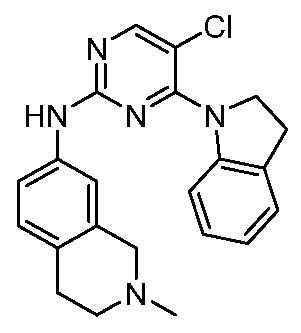
N-(5-클로로-4-(인돌린-1-일)피리미딘-2-일)-2-메틸-1,2,3,4-테트라히드로이소퀴놀린-7-아민N-(5-Chloro-4-(indolin-1-yl)pyrimidin-2-yl)-2-methyl-1,2,3,4-tetrahydroisoquinolin-7-amine
Int. W2 (36.58 mg, 0.23 mmol) 및 1-(2,5-디클로로피리미딘-4-일)인돌린 (60 mg, 0.23 mmol)을 조건 B3 하에 사용하고, 정제용-HPLC에 의한 정제 후에 N-(5-클로로-4-(인돌린-1-일)피리미딘-2-일)-2-메틸-1,2,3,4-테트라히드로이소퀴놀린-7-아민을 황색 고체 (10.4 mg, 12% 수율)로서 제공하였다. LC-MS (ESI) m/z: 392 [M+H]+. 1H NMR (400 MHz, CD3OD): δ 2.51 (s, 3H), 2.83-2.93 (m, 4H), 3.17 (t, J = 8.0 Hz, 2H), 3.57 (s, 2H), 4.33 (t, J = 8.0 Hz, 2H), 6.93-7.02 (m, 2H), 7.12 (t, J = 3.6 Hz, 1H), 7.24-7.32 (m, 2H), 7.42 (d, J = 8.0 Hz, 1H), 7.52 (d, J = 8.0 Hz, 1H), 8.14 (s, 1H).Int. W2 (36.58 mg, 0.23 mmol) and 1-(2,5-dichloropyrimidin-4-yl)indoline (60 mg, 0.23 mmol) were used under condition B3, prep-N- after purification by HPLC (5-chloro-4-(indolin-1-yl)pyrimidin-2-yl)-2-methyl-1,2,3,4-tetrahydroisoquinolin-7-amine as a yellow solid (10.4 mg, 12% yield). LC-MS (ESI) m/z: 392 [M+H] + . 1 H NMR (400 MHz, CD 3 OD): δ 2.51 (s, 3H), 2.83-2.93 (m, 4H), 3.17 (t, J = 8.0 Hz, 2H), 3.57 (s, 2H), 4.33 ( t, J = 8.0 Hz, 2H), 6.93-7.02 (m, 2H), 7.12 (t, J = 3.6 Hz, 1H), 7.24-7.32 (m, 2H), 7.42 (d, J = 8.0 Hz, 1H) ), 7.52 (d, J = 8.0 Hz, 1H), 8.14 (s, 1H).
실시예 15Example 15

6-클로로-N-(5-클로로-4-(인돌린-1-일)피리미딘-2-일)-2-메틸-1,2,3,4-테트라히드로이소퀴놀린-7-아민6-Chloro-N-(5-chloro-4-(indolin-1-yl)pyrimidin-2-yl)-2-methyl-1,2,3,4-tetrahydroisoquinolin-7-amine
Int. W3 (50 mg, 0.25 mmol) 및 1-(2,5-디클로로피리미딘-4-일)인돌린 (67.66 mg, 0.25 mmol)을 조건 B3 하에 사용하고, 정제용-HPLC에 의한 정제 후에 6-클로로-N-(5-클로로-4-(인돌린-1-일)피리미딘-2-일)-2-메틸-1,2,3,4-테트라히드로이소퀴놀린-7-아민을 황색 고체 (11.6 mg, 11% 수율)로서 제공하였다. LC-MS (ESI) m/z: 426 [M+H]+. 1H NMR (400 MHz, CD3OD): δ 2.54 (s, 3H), 2.89-2.96 (m, 4H), 3.18 (t, J = 8.0 Hz, 2H), 3.54 (s, 2H), 4.36 (t, J = 8.0 Hz, 2H), 6.96-7.00 (m, 1H), 7.11 (t, J = 8.0 Hz, 1H), 7.24-7.28 (m, 2H), 7.40 (d, J = 8.0 Hz, 1H), 7.93 (s, 1H), 8.19 (s, 1H).Int. W3 (50 mg, 0.25 mmol) and 1-(2,5-dichloropyrimidin-4-yl)indoline (67.66 mg, 0.25 mmol) were used under condition B3, preparative- after purification by HPLC 6- Chloro-N-(5-chloro-4-(indolin-1-yl)pyrimidin-2-yl)-2-methyl-1,2,3,4-tetrahydroisoquinolin-7-amine as a yellow solid (11.6 mg, 11% yield). LC-MS (ESI) m/z: 426 [M+H] + . 1 H NMR (400 MHz, CD 3 OD): δ 2.54 (s, 3H), 2.89-2.96 (m, 4H), 3.18 (t, J = 8.0 Hz, 2H), 3.54 (s, 2H), 4.36 ( t, J = 8.0 Hz, 2H), 6.96-7.00 (m, 1H), 7.11 (t, J = 8.0 Hz, 1H), 7.24-7.28 (m, 2H), 7.40 (d, J = 8.0 Hz, 1H) ), 7.93 (s, 1H), 8.19 (s, 1H).
실시예 19Example 19

N-(5-클로로-4-(인돌린-1-일)피리미딘-2-일)-2-메톡시-6-메틸-5,6,7,8-테트라히드로-1,6-나프티리딘-3-아민N-(5-Chloro-4-(indolin-1-yl)pyrimidin-2-yl)-2-methoxy-6-methyl-5,6,7,8-tetrahydro-1,6-naphthy Lidin-3-amine
Int. W4 (30 mg, 155.24 umol) 및 1-(2,5-디클로로피리미딘-4-일)인돌린 (41.31 mg, 155.24 umol)을 조건 B3 (2시간 동안 마이크로웨이브) 하에 사용하고, 플래쉬 칼럼 크로마토그래피 (DCM/MeOH = 10/1, v/v) 및 정제용-HPLC (MeCN/0.05% TFA)에 의한 정제 후에 N-(5-클로로-4-(인돌린-1-일)피리미딘-2-일)-2-메톡시-6-메틸-5,6,7,8-테트라히드로-1,6-나프티리딘-3-아민 (TFA 염)을 황색 고체 (6.6 mg, 10% 수율)로서 제공하였다. LC-MS (ESI) m/z: 423 [M+H]+. 1H NMR (400 MHz, CD3OD): δ 3.03 (s, 3H), 3.08-3.22 (m, 4H), 3.44-3.56 (m, 1H), 3.73-3.83 (m, 1H), 4.02 (s, 3H), 4.16 (d, J = 6.4 Hz, 2H), 4.38 (t, J = 8.0 Hz, 2H), 7.06 (t, J = 7.6 Hz, 1H), 7.20 (t, J = 7.4 Hz, 1H), 7.31 (d, J = 8.0 Hz, 1H), 7.42 (d, J = 8.0 Hz, 1H), 8.25 (s, 1H), 8.34 (s, 1H).Int. W4 (30 mg, 155.24 umol) and 1-(2,5-dichloropyrimidin-4-yl)indoline (41.31 mg, 155.24 umol) were used under condition B3 (microwave for 2 h), flash column chromatography N-(5-chloro-4-(indolin-1-yl)pyrimidine- after purification by Graph (DCM/MeOH = 10/1, v/v) and prep-HPLC (MeCN/0.05% TFA) 2-yl)-2-methoxy-6-methyl-5,6,7,8-tetrahydro-1,6-naphthyridin-3-amine (TFA salt) as a yellow solid (6.6 mg, 10% yield) provided as LC-MS (ESI) m/z: 423 [M+H] + . 1 H NMR (400 MHz, CD 3 OD): δ 3.03 (s, 3H), 3.08-3.22 (m, 4H), 3.44-3.56 (m, 1H), 3.73-3.83 (m, 1H), 4.02 (s) , 3H), 4.16 (d, J = 6.4 Hz, 2H), 4.38 (t, J = 8.0 Hz, 2H), 7.06 (t, J = 7.6 Hz, 1H), 7.20 (t, J = 7.4 Hz, 1H) ), 7.31 (d, J = 8.0 Hz, 1H), 7.42 (d, J = 8.0 Hz, 1H), 8.25 (s, 1H), 8.34 (s, 1H).
실시예 22Example 22
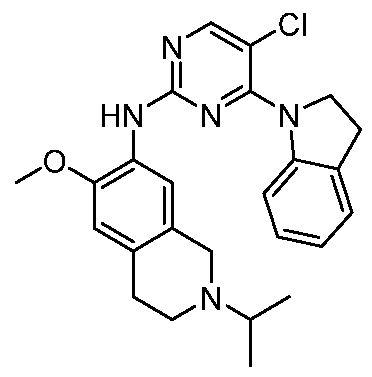
N-(5-클로로-4-(인돌린-1-일)피리미딘-2-일)-2-이소프로필-6-메톡시-1,2,3,4-테트라히드로이소퀴놀린-7-아민N-(5-Chloro-4-(indolin-1-yl)pyrimidin-2-yl)-2-isopropyl-6-methoxy-1,2,3,4-tetrahydroisoquinoline-7- amine
Int. W5 (50 mg, 0.227 mmol) 및 1-(2,5-디클로로피리미딘-4-일)인돌린 (60 mg, 0.227 mmol)을 조건 B3 (2시간 동안 마이크로웨이브) 하에 사용하고, 플래쉬 칼럼 크로마토그래피 (DCM/MeOH = 10/1, v/v)에 의한 정제 후에 N-(5-클로로-4-(인돌린-1-일)피리미딘-2-일)-2-이소프로필-6-메톡시-1,2,3,4-테트라히드로이소퀴놀린-7-아민을 황색 고체 (2.5 mg, 2% 수율)로서 제공하였다. LC-MS (ESI) m/z: 450 [M+H]+. 1H NMR (400 MHz, CD3OD): δ 1.17 (d, J = 6.4 Hz, 6H), 2.86-2.92 (m, 5H), 3.19 (t, J = 8.4 Hz, 2H), 3.49 (s, 2H), 3.88 (s, 3H), 4.36 (t, J = 8.4 Hz, 2H), 6.73 (s, 1H), 6.99 (t, J = 6.8 Hz, 1H), 7.17 (t, J = 7.6 Hz,1H), 7.29 (d, J = 7.2 Hz, 1H), 7.50 (d, J = 8.0 Hz, 1H), 7.99 (s, 1H), 8.16 (s, 1H).Int. W5 (50 mg, 0.227 mmol) and 1-(2,5-dichloropyrimidin-4-yl)indoline (60 mg, 0.227 mmol) were used under condition B3 (microwave for 2 h), flash column chromatography N-(5-chloro-4-(indolin-1-yl)pyrimidin-2-yl)-2-isopropyl-6- after purification by graphic (DCM/MeOH = 10/1, v/v) Methoxy-1,2,3,4-tetrahydroisoquinolin-7-amine was provided as a yellow solid (2.5 mg, 2% yield). LC-MS (ESI) m/z: 450 [M+H] + . 1 H NMR (400 MHz, CD 3 OD): δ 1.17 (d, J = 6.4 Hz, 6H), 2.86-2.92 (m, 5H), 3.19 (t, J = 8.4 Hz, 2H), 3.49 (s, 2H), 3.88 (s, 3H), 4.36 (t, J = 8.4 Hz, 2H), 6.73 (s, 1H), 6.99 (t, J = 6.8 Hz, 1H), 7.17 (t, J = 7.6 Hz, 1H), 7.29 (d, J = 7.2 Hz, 1H), 7.50 (d, J = 8.0 Hz, 1H), 7.99 (s, 1H), 8.16 (s, 1H).
실시예 23Example 23

N-(5-클로로-4-(인돌린-1-일)피리미딘-2-일)-6-메톡시-1,2,3,4-테트라히드로이소퀴놀린-7-아민N-(5-chloro-4-(indolin-1-yl)pyrimidin-2-yl)-6-methoxy-1,2,3,4-tetrahydroisoquinolin-7-amine
Int. W6 (110 mg, 0.39 mmol) 및 1-(2,5-디클로로피리미딘-4-일)인돌린 (105 mg, 0.39 mmol)을 조건 B3 (2시간 동안 마이크로웨이브) 하에 사용하여 N-(5-클로로-4-(인돌린-1-일)피리미딘-2-일)-6-메톡시-1,2,3,4-테트라히드로이소퀴놀린-7-아민 (1.0 TsOH 염)을 황색 고체 (130 mg, 58% 수율)로서 제공하였다. 고체를 여과에 의해 수집하였다. LC-MS (ESI) m/z: 408 [M+H]+. 1H NMR (400 MHz, DMSO-d6): δ 2.29 (s, 3H), 2.98 (t, J = 6.4 Hz, 2H), 3.16 (t, J = 8.0 Hz, 2H), 3.28-3.40 (m, 2H), 3.82 (s, 3H), 4.04 (d, J = 4.6 Hz, 2H), 4.37 (t, J = 8.0 Hz, 2H), 6.95 (s, 1H), 7.02 (dd, J = 7.4, 1.0 Hz, 1H), 7.07-7.20 (m, 3H), 7.30 (dd, J = 7.4, 1.0 Hz, 1H), 7.46-7.48 (m, 3H), 7.65 (s, 1H), 8.34 (s, 1H), 8.72 (s, 1H), 9.26 (s, 2H).Int. N-(5) using W6 (110 mg, 0.39 mmol) and 1-(2,5-dichloropyrimidin-4-yl)indoline (105 mg, 0.39 mmol) under condition B3 (microwave for 2 h) -Chloro-4-(indolin-1-yl)pyrimidin-2-yl)-6-methoxy-1,2,3,4-tetrahydroisoquinolin-7-amine (1.0 TsOH salt) as a yellow solid (130 mg, 58% yield). The solid was collected by filtration. LC-MS (ESI) m/z: 408 [M+H] + . 1 H NMR (400 MHz, DMSO-d 6 ): δ 2.29 (s, 3H), 2.98 (t, J = 6.4 Hz, 2H), 3.16 (t, J = 8.0 Hz, 2H), 3.28-3.40 (m) , 2H), 3.82 (s, 3H), 4.04 (d, J = 4.6 Hz, 2H), 4.37 (t, J = 8.0 Hz, 2H), 6.95 (s, 1H), 7.02 (dd, J = 7.4, 1.0 Hz, 1H), 7.07-7.20 (m, 3H), 7.30 (dd, J = 7.4, 1.0 Hz, 1H), 7.46-7.48 (m, 3H), 7.65 (s, 1H), 8.34 (s, 1H) ), 8.72 (s, 1H), 9.26 (s, 2H).
실시예 26Example 26

1-(7-((5-클로로-4-(인돌린-1-일)피리미딘-2-일)아미노)-6-메톡시-3,4-디히드로이소퀴놀린-2(1H)-일)-2-(디메틸아미노)에탄-1-온1-(7-((5-chloro-4-(indolin-1-yl)pyrimidin-2-yl)amino)-6-methoxy-3,4-dihydroisoquinoline-2(1H)- yl)-2-(dimethylamino)ethan-1-one
건조 CH2Cl2 (3 mL) 중 2-(디메틸아미노)아세트산 (5.06 mg, 49.03 umol), N-(5-클로로-4-인돌린-1-일-피리미딘-2-일)-6-메톡시-1,2,3,4-테트라히드로이소퀴놀린-7-아민 토실레이트 (20 mg, 34.48 umol), 및 HATU (18.64 mg, 49.03 umol)의 용액에 DIPEA (19.01 mg, 147.10 umol, 25.62 uL)를 0℃에서 적가하였다. 반응 혼합물을 실온에서 3시간 동안 교반하고, 진공 하에 농축시켰다. 잔류물을 정제용-HPLC (MeCN/0.1% HCOOH)에 의해 정제하여 1-(7-((5-클로로-4-(인돌린-1-일)피리미딘-2-일)아미노)-6-메톡시-3,4-디히드로이소퀴놀린-2(1H)-일)-2-(디메틸아미노)에탄-1-온을 백색 고체 (13.5 mg, 56% 수율)로서 제공하였다. LC-MS (ESI) m/z: 493 [M+H]+. 1H NMR (400 MHz, CD3OD): δ 2.57 (s, 3H), 2.62 (s, 3H), 2.75 (t, J = 6.4 Hz, 1H), 2.86 (t, J = 6.4 Hz, 1H), 3.14 (t, J = 8.4 Hz, 2H), 3.54 (s, 1H), 3.64-3.69 (m, 2H), 3.71 (s, 1H), 3.88 (d, J = 6.4 Hz,3H), 4.30 (s, 1H), 4.32-4.36 (m, 2H), 4.42 (s, 1H), 6.75 (s, 1H), 6.98-7.04 (m, 1H), 7.16 (t, J = 8.0 Hz, 1H), 7.24-7.29 (m, 1H), 7.39-7.46 (m, 1H), 8.01 (d, J = 17.2 Hz, 1H), 8.15 (d, J = 9.6 Hz, 1H).2-(dimethylamino)acetic acid (5.06 mg, 49.03 umol), N-(5-chloro-4-indolin-1-yl-pyrimidin-2-yl)-6 in dry CH 2 Cl 2 (3 mL) -Methoxy-1,2,3,4-tetrahydroisoquinolin-7-amine tosylate (20 mg, 34.48 umol), and DIPEA (19.01 mg, 147.10 umol) in a solution of HATU (18.64 mg, 49.03 umol) 25.62 uL) was added dropwise at 0°C. The reaction mixture was stirred at room temperature for 3 h and concentrated in vacuo. The residue was purified by preparative-HPLC (MeCN/0.1% HCOOH) to 1-(7-((5-chloro-4-(indolin-1-yl)pyrimidin-2-yl)amino)-6 Provided -Methoxy-3,4-dihydroisoquinolin-2(1H)-yl)-2-(dimethylamino)ethan-1-one as a white solid (13.5 mg, 56% yield). LC-MS (ESI) m/z: 493 [M+H] + . 1 H NMR (400 MHz, CD 3 OD): δ 2.57 (s, 3H), 2.62 (s, 3H), 2.75 (t, J = 6.4 Hz, 1H), 2.86 (t, J = 6.4 Hz, 1H) , 3.14 (t, J = 8.4 Hz, 2H), 3.54 (s, 1H), 3.64-3.69 (m, 2H), 3.71 (s, 1H), 3.88 (d, J = 6.4 Hz, 3H), 4.30 ( s, 1H), 4.32-4.36 (m, 2H), 4.42 (s, 1H), 6.75 (s, 1H), 6.98-7.04 (m, 1H), 7.16 (t, J = 8.0 Hz, 1H), 7.24 -7.29 (m, 1H), 7.39-7.46 (m, 1H), 8.01 (d, J = 17.2 Hz, 1H), 8.15 (d, J = 9.6 Hz, 1H).
실시예 27Example 27

2-(7-((5-클로로-4-(인돌린-1-일)피리미딘-2-일)아미노)-6-메톡시-3,4-디히드로이소퀴놀린-2(1H)-일)에탄-1-올2-(7-((5-chloro-4-(indolin-1-yl)pyrimidin-2-yl)amino)-6-methoxy-3,4-dihydroisoquinoline-2(1H)- day) ethanol-1-ol
MeOH (4 mL) 중 N-(5-클로로-4-(인돌린-1-일)피리미딘-2-일)-6-메톡시-1,2,3,4-테트라히드로이소퀴놀린-7-아민 토실레이트 (30 mg, 0.073 mmol), 2-((tert-부틸디메틸실릴)옥시)아세트알데히드 (13 mg, 0.073 mmol), 및 AcOH (2 방울)의 혼합물을 N2 하에 1시간 동안 교반하였다. 이어서, NaBH(OAc)3 (24 mg, 011 mmol)을 상기 혼합물에 첨가하고, 혼합물을 실온에서 16시간 동안 교반하고, 진공 하에 농축시켰다. 잔류물을 실리카 겔 상에서 플래쉬 칼럼 크로마토그래피 (DCM 100% v/v에 이어서 DCM/MeOH = 5/1 v/v)에 의해 정제하여 2-(7-((5-클로로-4-(인돌린-1-일)피리미딘-2-일)아미노)-6-메톡시-3,4-디히드로이소퀴놀린-2(1H)-일)에탄-1-올을 황색 고체 (6.4 mg, 20% 수율)로서 제공하였다. LC-MS (ESI) m/z: 452 [M+H]+. 1H NMR (400 MHz, CD3OD): δ 2.72 (t, J = 6.4 Hz, 2H), 2.86-2.91 (m, 4H), 3.19 (t, J = 8.4 Hz, 2H), 3.47 (s, 2H), 3.77 (t, J = 6.4 Hz, 2H), 3.88 (s, 3H), 4.35 (t, J = 8.4 Hz, 2H), 6.73 (s, 1H), 7.02 (t, J = 7.6 Hz, 1H), 7.18 (t, J = 8.0 Hz, 1H), 7.29 (d, J = 7.6 Hz, 1H), 7.46 (d, J = 8.0 Hz, 1H), 7.96 (s, 1H), 8.16 (s, 1H).N-(5-chloro-4-(indolin-1-yl)pyrimidin-2-yl)-6-methoxy-1,2,3,4-tetrahydroisoquinoline-7 in MeOH (4 mL) -A mixture of amine tosylate (30 mg, 0.073 mmol), 2-((tert-butyldimethylsilyl)oxy)acetaldehyde (13 mg, 0.073 mmol), and AcOH (2 drops) is stirred under N 2 for 1 h did Then NaBH(OAc) 3 (24 mg, 011 mmol) was added to the mixture and the mixture was stirred at room temperature for 16 h and concentrated in vacuo. The residue was purified by flash column chromatography on silica gel (DCM 100% v/v then DCM/MeOH = 5/1 v/v) to 2-(7-((5-chloro-4-(indoline)) -1-yl)pyrimidin-2-yl)amino)-6-methoxy-3,4-dihydroisoquinolin-2(1H)-yl)ethan-1-ol as a yellow solid (6.4 mg, 20% yield). LC-MS (ESI) m/z: 452 [M+H] + . 1 H NMR (400 MHz, CD 3 OD): δ 2.72 (t, J = 6.4 Hz, 2H), 2.86-2.91 (m, 4H), 3.19 (t, J = 8.4 Hz, 2H), 3.47 (s, 2H), 3.77 (t, J = 6.4 Hz, 2H), 3.88 (s, 3H), 4.35 (t, J = 8.4 Hz, 2H), 6.73 (s, 1H), 7.02 (t, J = 7.6 Hz, 1H), 7.18 (t, J = 8.0 Hz, 1H), 7.29 (d, J = 7.6 Hz, 1H), 7.46 (d, J = 8.0 Hz, 1H), 7.96 (s, 1H), 8.16 (s, 1H).
실시예 28Example 28

1-(5-클로로-2-((6-메톡시-2-메틸-1,2,3,4-테트라히드로이소퀴놀린-7-일)아미노)피리미딘-4-일)-N,N-디메틸-1H-인돌-2-카르복스아미드1-(5-Chloro-2-((6-methoxy-2-methyl-1,2,3,4-tetrahydroisoquinolin-7-yl)amino)pyrimidin-4-yl)-N,N -Dimethyl-1H-indole-2-carboxamide
단계 1: Int. E4 (673 mg, 3.58 mmol) 및 2,4,5-트리클로로피리미딘 (787 mg, 4.29 mmol)을 조건 A1 (실시예 1의 단계 1에 예시된 바와 같음) 하에 사용하고, 실리카 겔 상에서 플래쉬 칼럼 크로마토그래피 (EA/PE = 1/3, v/v) 및 정제용-HPLC에 의한 정제 후에 1-(2,5-디클로로피리미딘-4-일)-N,N-디메틸-인돌-2-카르복스아미드를 백색 고체 (160 mg, 22% 수율)로서 제공하였다. LC-MS (ESI) m/z: 335. [M+H]+.Step 1: Int. E4 (673 mg, 3.58 mmol) and 2,4,5-trichloropyrimidine (787 mg, 4.29 mmol) were used under condition A1 (as exemplified in step 1 of Example 1) and flash on silica gel 1-(2,5-dichloropyrimidin-4-yl)-N,N-dimethyl-indole-2 after purification by column chromatography (EA/PE = 1/3, v/v) and preparative-HPLC -carboxamide was provided as a white solid (160 mg, 22% yield). LC-MS (ESI) m/z: 335. [M+H] + .
단계 2: 디옥산 (4 mL) 중 1-(2,5-디클로로피리미딘-4-일)-N,N-디메틸-인돌-2-카르복스아미드 (50 mg, 0.15 mmol)의 용액에 Int. W1 (28.7 mg, 0.15 mmol), Pd2(dba)3 (27.3 mg, 0.03 mmol), Xantphos (17.3 mg, 0.03 mmol) 및 탄산칼륨 (41.2 mg, 0.3 mmol)을 첨가하였다. 혼합물을 N2 하에 100℃에서 12시간 동안 교반하고, 실온으로 냉각시키고, 여과하였다. 여과물을 농축시키고, 잔류물을 정제용-HPLC (MeCN/0.1% HCOOH)에 의해 정제하여 1-(5-클로로-2-((6-메톡시-2-메틸-1,2,3,4-테트라히드로이소퀴놀린-7-일)아미노)피리미딘-4-일)-N,N-디메틸-1H-인돌-2-카르복스아미드를 황색 고체 (2.4 mg, 3% 수율) [HCOOH 염]로서 제공하였다. LC-MS (ESI) m/z: 491 [M+H]+. 1H NMR (400 MHz, CD3OD): δ 2.71 (s, 3H), 2.99 (s, 3H), 3.02-3.05 (m, 2H), 3.14-3.17 (m, 2H), 3.30 (s, 3H), 3.88 (s, 2H), 3.91 (s, 3H), 6.85 (s, 1H), 7.10 (s, 1H), 7.26 (t, J = 8.0 Hz, 1H), 7.35 (t, J = 8.0 Hz, 1H), 7.49 (d, J = 8.0 Hz, 1H), 7.73 (d, J = 8.0 Hz, 1H), 8.02 (s, 1H), 8.50 (brs, 1H), 8.57 (s, 1H).Step 2: Int in a solution of 1-(2,5-dichloropyrimidin-4-yl)-N,N-dimethyl-indole-2-carboxamide (50 mg, 0.15 mmol) in dioxane (4 mL) . W1 (28.7 mg, 0.15 mmol), Pd 2 (dba) 3 (27.3 mg, 0.03 mmol), Xantphos (17.3 mg, 0.03 mmol) and potassium carbonate (41.2 mg, 0.3 mmol) were added. The mixture was stirred under N 2 at 100° C. for 12 h, cooled to room temperature and filtered. The filtrate was concentrated and the residue was purified by prep-HPLC (MeCN/0.1% HCOOH) to 1-(5-chloro-2-((6-methoxy-2-methyl-1,2,3, 4-tetrahydroisoquinolin-7-yl)amino)pyrimidin-4-yl)-N,N-dimethyl-1H-indole-2-carboxamide as a yellow solid (2.4 mg, 3% yield) [HCOOH salt ] as provided. LC-MS (ESI) m/z: 491 [M+H] + . 1 H NMR (400 MHz, CD 3 OD): δ 2.71 (s, 3H), 2.99 (s, 3H), 3.02-3.05 (m, 2H), 3.14-3.17 (m, 2H), 3.30 (s, 3H) ), 3.88 (s, 2H), 3.91 (s, 3H), 6.85 (s, 1H), 7.10 (s, 1H), 7.26 (t, J = 8.0 Hz, 1H), 7.35 (t, J = 8.0 Hz) , 1H), 7.49 (d, J = 8.0 Hz, 1H), 7.73 (d, J = 8.0 Hz, 1H), 8.02 (s, 1H), 8.50 (brs, 1H), 8.57 (s, 1H).
실시예 12Example 12
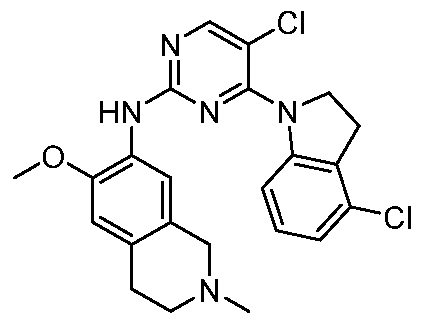
N-(5-클로로-4-(4-클로로인돌린-1-일)피리미딘-2-일)-6-메톡시-2-메틸-1,2,3,4-테트라히드로이소퀴놀린-7-아민N-(5-chloro-4-(4-chloroindolin-1-yl)pyrimidin-2-yl)-6-methoxy-2-methyl-1,2,3,4-tetrahydroisoquinoline- 7-amine
단계 1: 4-클로로인돌린 (111 mg, 1.06 mmol) 및 2,4,5-트리클로로피리미딘 (200 mg, 1.09 mmol)을 조건 A2 (실시예 4의 단계 1에 예시된 바와 같음) 하에 사용하고, 실리카 겔 상에서 플래쉬 칼럼 크로마토그래피 (EA/PE = 20/1, v/v)에 의한 정제 후에 4-클로로-1-(2,5-디클로로피리미딘-4-일)인돌린을 백색 고체 (160 mg, 59% 수율)로서 제공하였다. LC-MS (ESI) m/z: 300 [M+H]+.Step 1: 4-Chloroindoline (111 mg, 1.06 mmol) and 2,4,5-trichloropyrimidine (200 mg, 1.09 mmol) under condition A2 (as exemplified in Step 1 of Example 4) and 4-chloro-1-(2,5-dichloropyrimidin-4-yl)indoline after purification by flash column chromatography on silica gel (EA/PE = 20/1, v/v) as white Provided as a solid (160 mg, 59% yield). LC-MS (ESI) m/z: 300 [M+H] + .
단계 2: Int. W1 (68.5 mg, 299.43 umol) 및 4-클로로-1-(2,5-디클로로피리미딘-4-일)인돌린 (90 mg, 299.43 umol)을 조건 B3 (실시예 10의 단계 2에 예시된 바와 같음) 하에 사용하여 N-(5-클로로-4-(4-클로로인돌린-1-일)피리미딘-2-일)-6-메톡시-2-메틸-1,2,3,4-테트라히드로이소퀴놀린-7-아민 (TsOH 염)을 황색 고체 (115 mg, 84% 수율)로서 제공하였다. 고체를 여과에 의해 수집하였다. LC-MS (ESI) m/z: 456 [M+H]+. 1H NMR (400 MHz, CD3OD): δ 2.35 (s, 3H), 3.02 (s, 3H), 3.05-3.16 (m, 1H), 3.16-3.30 (m, 3H), 3.41-3.45 (m, 1H), 3.74-3.77 (m, 1H), 3.87 (s, 3H), 4.13-4.17 (m, 1H), 4.32-4.35 (m, 1H), 4.67 (t, J = 8.4 Hz, 2H), 7.04 (s, 1H), 7.13-7.21 (m, 4H), 7.49 (s, 1H), 7.65-7.67 (m, 3H), 8.21 (s, 1H).Step 2: Int. W1 (68.5 mg, 299.43 umol) and 4-chloro-1-(2,5-dichloropyrimidin-4-yl)indoline (90 mg, 299.43 umol) were mixed with Condition B3 (as exemplified in step 2 of Example 10) N-(5-chloro-4-(4-chloroindolin-1-yl)pyrimidin-2-yl)-6-methoxy-2-methyl-1,2,3,4 -Tetrahydroisoquinolin-7-amine (TsOH salt) was provided as a yellow solid (115 mg, 84% yield). The solid was collected by filtration. LC-MS (ESI) m/z: 456 [M+H] + . 1 H NMR (400 MHz, CD 3 OD): δ 2.35 (s, 3H), 3.02 (s, 3H), 3.05-3.16 (m, 1H), 3.16-3.30 (m, 3H), 3.41-3.45 (m , 1H), 3.74-3.77 (m, 1H), 3.87 (s, 3H), 4.13-4.17 (m, 1H), 4.32-4.35 (m, 1H), 4.67 (t, J = 8.4 Hz, 2H), 7.04 (s, 1H), 7.13-7.21 (m, 4H), 7.49 (s, 1H), 7.65-7.67 (m, 3H), 8.21 (s, 1H).
실시예 13Example 13

N-(5-클로로-4-(5-클로로인돌린-1-일)피리미딘-2-일)-6-메톡시-2-메틸-1,2,3,4-테트라히드로이소퀴놀린-7-아민N-(5-chloro-4-(5-chloroindolin-1-yl)pyrimidin-2-yl)-6-methoxy-2-methyl-1,2,3,4-tetrahydroisoquinoline- 7-amine
단계 1에서 5-클로로인돌린을 4-클로로인돌린 대신 사용한, 실시예 12와 동일한 절차. LC-MS (ESI) m/z: 456 [M+H]+. 1H NMR (400 MHz, CD3OD): δ 2.35 (s, 3H), 3.04 (s, 3H), 3.17-3.29 (m, 4H), 3.41-3.48 (m, 1H), 3.75-3.79 (m, 1H), 3.88 (s, 3H), 4.13-4.16 (m, 1H), 4.27-4.31 (m, 1H), 4.64 (t, J = 8.0 Hz, 2H), 7.04 (s, 1H), 7.16-7.21 (m, 3H), 7.38 (brs, 1H), 7.53 (s, 1H), 7.65-7.72 (m, 3H), 8.20 (s, 1H).The same procedure as in Example 12, using 5-chloroindoline instead of 4-chloroindoline in step 1. LC-MS (ESI) m/z: 456 [M+H] + . 1 H NMR (400 MHz, CD 3 OD): δ 2.35 (s, 3H), 3.04 (s, 3H), 3.17-3.29 (m, 4H), 3.41-3.48 (m, 1H), 3.75-3.79 (m) , 1H), 3.88 (s, 3H), 4.13-4.16 (m, 1H), 4.27-4.31 (m, 1H), 4.64 (t, J = 8.0 Hz, 2H), 7.04 (s, 1H), 7.16- 7.21 (m, 3H), 7.38 (brs, 1H), 7.53 (s, 1H), 7.65-7.72 (m, 3H), 8.20 (s, 1H).
실시예 18Example 18

N-(5-클로로-4-(6-클로로인돌린-1-일)피리미딘-2-일)-6-메톡시-2-메틸-1,2,3,4-테트라히드로이소퀴놀린-7-아민N-(5-chloro-4-(6-chloroindolin-1-yl)pyrimidin-2-yl)-6-methoxy-2-methyl-1,2,3,4-tetrahydroisoquinoline- 7-amine
단계 1에서 6-클로로인돌린을 4-클로로인돌린 대신 사용한, 실시예 12와 동일한 절차. LC-MS (ESI) m/z: 456 [M+H]+. 1H NMR (400 MHz, CD3OD): δ 2.35 (s, 0.45H), 3.01 (s, 3H), 3.13-3.20 (m, 4H), 3.35-3.40 (m, 1H), 3.73-3.77 (m, 1H), 3.90 (s, 3H), 4.10-4.14 (m, 1H), 4.31-4.35 (m, 1H), 4.59 (t, J = 8.4 Hz, 2H), 7.02 (s, 1H), 7.09-7.12 (m, 1H), 7.21 (d, J = 8.0 Hz, 0.3H), 7.29 (d, J = 8.0 Hz, 1H), 7.6-7.69 (m, 2.3H), 8.24 (s, 1H).The same procedure as in Example 12, using 6-chloroindoline instead of 4-chloroindoline in step 1. LC-MS (ESI) m/z: 456 [M+H] + . 1 H NMR (400 MHz, CD 3 OD): δ 2.35 (s, 0.45H), 3.01 (s, 3H), 3.13-3.20 (m, 4H), 3.35-3.40 (m, 1H), 3.73-3.77 ( m, 1H), 3.90 (s, 3H), 4.10-4.14 (m, 1H), 4.31-4.35 (m, 1H), 4.59 (t, J = 8.4 Hz, 2H), 7.02 (s, 1H), 7.09 -7.12 (m, 1H), 7.21 (d, J = 8.0 Hz, 0.3H), 7.29 (d, J = 8.0 Hz, 1H), 7.6-7.69 (m, 2.3H), 8.24 (s, 1H).
실시예 16Example 16

N-(5-클로로-4-(2,3-디히드로-1H-피롤로[3,2-b]피리딘-1-일)피리미딘-2-일)-6-메톡시-2-메틸-1,2,3,4-테트라히드로이소퀴놀린-7-아민N-(5-chloro-4-(2,3-dihydro-1H-pyrrolo[3,2-b]pyridin-1-yl)pyrimidin-2-yl)-6-methoxy-2-methyl -1,2,3,4-tetrahydroisoquinolin-7-amine
단계 1에서 4-클로로인돌린 대신 2,3-디히드로-1H-피롤로[3,2-b]피리딘 히드로클로라이드를 사용한, 실시예 12와 동일한 절차. LC-MS (ESI) m/z: 423 [M+H]+. 1H NMR (400 MHz, DMSO-d6): δ 2.39 (s, 3H), 2.67 (brs, 2H), 2.81-2.84 (m, 2H), 3.21 (t, J = 8.4 Hz, 2H), 3.41 (s, 2H), 3.76 (s, 3H), 4.36 (t, J = 8.4 Hz, 2H), 6.79 (s, 1H), 6.99-7.02 (m, 1H), 7.41 (s, 1H), 7.65 (d, J = 8.0 Hz, 1H), 8.03 (dd, J = 5.2, 1.2 Hz, 1H), 8.17 (s, 1H), 8.25 (s, 1H).Same procedure as in Example 12, using 2,3-dihydro-1H-pyrrolo[3,2-b]pyridine hydrochloride in step 1 instead of 4-chloroindoline. LC-MS (ESI) m/z: 423 [M+H] + . 1 H NMR (400 MHz, DMSO-d 6 ): δ 2.39 (s, 3H), 2.67 (brs, 2H), 2.81-2.84 (m, 2H), 3.21 (t, J = 8.4 Hz, 2H), 3.41 (s, 2H), 3.76 (s, 3H), 4.36 (t, J = 8.4 Hz, 2H), 6.79 (s, 1H), 6.99-7.02 (m, 1H), 7.41 (s, 1H), 7.65 ( d, J = 8.0 Hz, 1H), 8.03 (dd, J = 5.2, 1.2 Hz, 1H), 8.17 (s, 1H), 8.25 (s, 1H).
실시예 29Example 29

N-(5-클로로-4-(2,3-디히드로-1H-피롤로[3,2-b]피리딘-1-일)피리미딘-2-일)-2-메톡시-6-메틸-5,6,7,8-테트라히드로-1,6-나프티리딘-3-아민N-(5-chloro-4-(2,3-dihydro-1H-pyrrolo[3,2-b]pyridin-1-yl)pyrimidin-2-yl)-2-methoxy-6-methyl -5,6,7,8-tetrahydro-1,6-naphthyridin-3-amine
1-(2,5-디클로로피리미딘-4-일)-N,N-디메틸-인돌-2-카르복스아미드 및 Int. W1 대신 1-(2,5-디클로로피리미딘-4-일)-2,3-디히드로피롤로[3,2-b]피리딘 및 Int. W4를 사용한, 실시예 28의 단계 2와 동일한 절차. LC-MS (ESI) m/z: 424 [M+H]+. 1H NMR (400 MHz, CD3OD): δ 2.51 (s, 3H), 2.89-2.92 (m, 4H), 3.27-3.34 (m, 2H), 3.47 (s, 2H), 3.97 (s, 3H), 4.45 (t, J = 8.8 Hz, 2H), 7.16-7.19 (m, 1H), 7.76 (dd, J = 8.0, 0.8 Hz, 1H), 8.05 (dd, J = 4.8, 1.2 Hz, 1H), 8.09 (s, 1H), 8.25 (s, 1H), 8.51 (br, 1H).1-(2,5-dichloropyrimidin-4-yl)-N,N-dimethyl-indole-2-carboxamide and Int. 1-(2,5-dichloropyrimidin-4-yl)-2,3-dihydropyrrolo[3,2-b]pyridine instead of W1 and Int. Same procedure as step 2 of Example 28, using W4. LC-MS (ESI) m/z: 424 [M+H] + . 1 H NMR (400 MHz, CD 3 OD): δ 2.51 (s, 3H), 2.89-2.92 (m, 4H), 3.27-3.34 (m, 2H), 3.47 (s, 2H), 3.97 (s, 3H) ), 4.45 (t, J = 8.8 Hz, 2H), 7.16-7.19 (m, 1H), 7.76 (dd, J = 8.0, 0.8 Hz, 1H), 8.05 (dd, J = 4.8, 1.2 Hz, 1H) , 8.09 (s, 1H), 8.25 (s, 1H), 8.51 (br, 1H).
실시예 17Example 17

N-(5-클로로-4-(2,3-디히드로-1H-피롤로[2,3-b]피리딘-1-일)피리미딘-2-일)-6-메톡시-2-메틸-1,2,3,4-테트라히드로이소퀴놀린-7-아민N-(5-chloro-4-(2,3-dihydro-1H-pyrrolo[2,3-b]pyridin-1-yl)pyrimidin-2-yl)-6-methoxy-2-methyl -1,2,3,4-tetrahydroisoquinolin-7-amine
단계 1에서 4-클로로인돌린 대신 2,3-디히드로-1H-피롤로[2,3-b]피리딘을 사용한, 실시예 12와 동일한 절차. LC-MS (ESI) m/z: 423 [M+H]+. 1H NMR (400 MHz, CD3OD): δ 2.44 (s, 3H), 2.71-2.74 (m, 2H), 2.87-2.91 (m, 2H), 3.21 (t, J = 8.0 Hz, 2H), 3.47 (s, 2H), 3.87 (s, 3H), 4.25 (t, J = 8.4 Hz, 2H), 6.73 (s, 1H), 6.89-6.92 (m, 1H), 7.61 (dd, J = 7.2, 1.6 Hz, 1H), 8.00 (s, 2H), 8.30 (s, 1H).The same procedure as in Example 12, using 2,3-dihydro-1H-pyrrolo[2,3-b]pyridine in step 1 instead of 4-chloroindoline. LC-MS (ESI) m/z: 423 [M+H] + . 1 H NMR (400 MHz, CD 3 OD): δ 2.44 (s, 3H), 2.71-2.74 (m, 2H), 2.87-2.91 (m, 2H), 3.21 (t, J = 8.0 Hz, 2H), 3.47 (s, 2H), 3.87 (s, 3H), 4.25 (t, J = 8.4 Hz, 2H), 6.73 (s, 1H), 6.89-6.92 (m, 1H), 7.61 (dd, J = 7.2, 1.6 Hz, 1H), 8.00 (s, 2H), 8.30 (s, 1H).
실시예 20Example 20
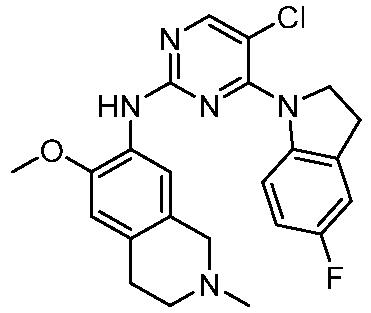
N-(5-클로로-4-(5-플루오로인돌린-1-일)피리미딘-2-일)-6-메톡시-2-메틸-1,2,3,4-테트라히드로이소퀴놀린-7-아민N-(5-Chloro-4-(5-fluoroindolin-1-yl)pyrimidin-2-yl)-6-methoxy-2-methyl-1,2,3,4-tetrahydroisoquinoline -7-amine
단계 1에서 4-클로로인돌린 대신 5-플루오로인돌린을 사용한, 실시예 12와 동일한 절차. LC-MS (ESI) m/z: 440 [M+H]+. 1H NMR (400 MHz, CD3OD): δ 2.35 (s, 1.5H), 2.79 (s, 3H), 3.06 (t, J = 6.0 Hz, 2H), 3.19 (t, J = 8.4 Hz, 2H), 3.25 (t, J = 6.0 Hz, 2H), 3.84 (s, 2H), 3.90 (s, 3H), 4.38 (t, J = 8.4 Hz, 2H), 6.82 (s, 1H), 6.90-6.95 (m, 1H), 7.06 (dd, J = 8.4, 2.4 Hz, 1H), 7.20 (d, J = 8.4 Hz, 1H), 7.38-7.41 (m, 1H), 7.67 (d, J = 8.4 Hz, 1H), 7.98 (s, 1H), 8.18 (s, 1H).The same procedure as in Example 12, using 5-fluoroindoline instead of 4-chloroindoline in step 1. LC-MS (ESI) m/z: 440 [M+H] + . 1 H NMR (400 MHz, CD 3 OD): δ 2.35 (s, 1.5H), 2.79 (s, 3H), 3.06 (t, J = 6.0 Hz, 2H), 3.19 (t, J = 8.4 Hz, 2H) ), 3.25 (t, J = 6.0 Hz, 2H), 3.84 (s, 2H), 3.90 (s, 3H), 4.38 (t, J = 8.4 Hz, 2H), 6.82 (s, 1H), 6.90-6.95 (m, 1H), 7.06 (dd, J = 8.4, 2.4 Hz, 1H), 7.20 (d, J = 8.4 Hz, 1H), 7.38-7.41 (m, 1H), 7.67 (d, J = 8.4 Hz, 1H), 7.98 (s, 1H), 8.18 (s, 1H).
실시예 21Example 21

N-(5-클로로-4-(6-플루오로인돌린-1-일)피리미딘-2-일)-6-메톡시-2-메틸-1,2,3,4-테트라히드로이소퀴놀린-7-아민N-(5-Chloro-4-(6-fluoroindolin-1-yl)pyrimidin-2-yl)-6-methoxy-2-methyl-1,2,3,4-tetrahydroisoquinoline -7-amine
단계 1에서 6-플루오로인돌린을 4-클로로인돌린 대신 사용한, 실시예 12와 동일한 절차. LC-MS (ESI) m/z: 440 [M+H]+. 1H NMR (400 MHz, CD3OD): δ 2.35 (s, 0.24H), 3.04 (s, 3H), 3.20 (m, 3H), 3.35-3.45 (m, 2H), 3.75-3.80 (m, 1H), 3.87 (s, 3H), 4.17 (d, J = 14.8 Hz, 1H), 4.42 (d, J = 14.8 Hz, 1H), 4.70 (t, J = 7.6 Hz, 2H), 6.87-6.92 (m, 1H), 7.06 (s, 1H), 7.21 (d, J = 8.0 Hz, 0.2H), 7.28-7.32 (m, 1H), 7.42 (s, 1H), 7.42-7.46 (m, 1H), 7.67 (d, J = 8.4 Hz, 0.16H), 8.22 (s, 1H).Same procedure as in Example 12, using 6-fluoroindoline instead of 4-chloroindoline in step 1. LC-MS (ESI) m/z: 440 [M+H] + . 1 H NMR (400 MHz, CD 3 OD): δ 2.35 (s, 0.24H), 3.04 (s, 3H), 3.20 (m, 3H), 3.35-3.45 (m, 2H), 3.75-3.80 (m, 1H), 3.87 (s, 3H), 4.17 (d, J = 14.8 Hz, 1H), 4.42 (d, J = 14.8 Hz, 1H), 4.70 (t, J = 7.6 Hz, 2H), 6.87-6.92 ( m, 1H), 7.06 (s, 1H), 7.21 (d, J = 8.0 Hz, 0.2H), 7.28-7.32 (m, 1H), 7.42 (s, 1H), 7.42-7.46 (m, 1H), 7.67 (d, J = 8.4 Hz, 0.16H), 8.22 (s, 1H).
실시예 24Example 24
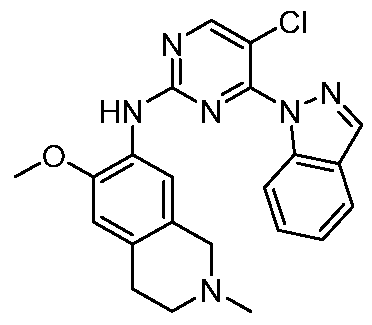
N-(5-클로로-4-(1H-인다졸-1-일)피리미딘-2-일)-6-메톡시-2-메틸-1,2,3,4-테트라히드로이소퀴놀린-7-아민N-(5-Chloro-4-(1H-indazol-1-yl)pyrimidin-2-yl)-6-methoxy-2-methyl-1,2,3,4-tetrahydroisoquinoline-7 -amine
단계 1에서 1H-인다졸을 4-클로로인돌린 대신 사용한, 실시예 12와 동일한 절차. LC-MS (ESI) m/z: 421 [M+H]+. 1H NMR (400 MHz, DMSO-d6) δ 8.88 (s, 1H), 8.61 (s, 1H), 8.50 (s, 1H), 8.23 (s, 1H), 8.07 (d, J = 7.9 Hz, 1H), 7.89 (d, J = 7.9 Hz, 1H), 7.48-7.39 (m, 1H), 7.35 (dd, J = 8.9, 5.9 Hz, 2H), 6.84 (s, 1H), 3.77 (s, 3H), 3.37-3.37 (m, 2H), 2.83 (t, J = 5.8 Hz, 2H), 2.59 (t, J = 5.7 Hz, 2H), 2.30 (d, J = 13.4 Hz, 3H).The same procedure as in Example 12, using 1H-indazole instead of 4-chloroindoline in step 1. LC-MS (ESI) m/z: 421 [M+H] + . 1 H NMR (400 MHz, DMSO-d 6 ) δ 8.88 (s, 1H), 8.61 (s, 1H), 8.50 (s, 1H), 8.23 (s, 1H), 8.07 (d, J = 7.9 Hz, 1H), 7.89 (d, J = 7.9 Hz, 1H), 7.48-7.39 (m, 1H), 7.35 (dd, J = 8.9, 5.9 Hz, 2H), 6.84 (s, 1H), 3.77 (s, 3H) ), 3.37-3.37 (m, 2H), 2.83 (t, J = 5.8 Hz, 2H), 2.59 (t, J = 5.7 Hz, 2H), 2.30 (d, J = 13.4 Hz, 3H).
실시예 25Example 25

N-(5-클로로-4-(3,3-디메틸인돌린-1-일)피리미딘-2-일)-6-메톡시-2-메틸-1,2,3,4-테트라히드로이소퀴놀린-7-아민N-(5-Chloro-4-(3,3-dimethylindolin-1-yl)pyrimidin-2-yl)-6-methoxy-2-methyl-1,2,3,4-tetrahydroiso Quinolin-7-amine
단계 1: n-부탄올 (2 mL) 중 3,3-디메틸인돌린 (200 mg, 1.36 mmol)의 용액에 2,4,5-트리클로로피리미딘 (250 mg, 1.36 mmol) 및 DIPEA (175.6 mg, 1.36 mmol)를 후속적으로 첨가하였다. 반응 혼합물을 100℃에서 18시간 동안 교반하고, 물 (5 mL)로 희석하고, EA (10 mL x 3)로 추출하였다. 유기 상을 무수 황산나트륨 상에서 건조시키고, 여과하였다. 여과물을 진공 하에 농축시키고, 잔류물을 실리카 겔 상에서 플래쉬 칼럼 크로마토그래피 (EA/PE = 1/10, v/v)에 의해 정제하여 1-(2,5-디클로로피리미딘-4-일)-3,3-디메틸-인돌린 (385 mg, 94.41% 수율)을 백색 고체로서 제공하였다. LC-MS (ESI) m/z: 296 [M+H]+.Step 1: In a solution of 3,3-dimethylindoline (200 mg, 1.36 mmol) in n-butanol (2 mL) 2,4,5-trichloropyrimidine (250 mg, 1.36 mmol) and DIPEA (175.6 mg) , 1.36 mmol) was added subsequently. The reaction mixture was stirred at 100° C. for 18 h, diluted with water (5 mL) and extracted with EA (10 mL×3). The organic phase was dried over anhydrous sodium sulfate and filtered. The filtrate was concentrated in vacuo and the residue was purified by flash column chromatography on silica gel (EA/PE = 1/10, v/v) to 1-(2,5-dichloropyrimidin-4-yl) Provided -3,3-dimethyl-indoline (385 mg, 94.41% yield) as a white solid. LC-MS (ESI) m/z: 296 [M+H] + .
단계 2: Int. W1 (86 mg, 0.323 mmol) 및 1-(2,5-디클로로피리미딘-4-일)-3,3-디메틸-인돌린 (100 mg, 0.323 mmol)을 조건 B3 (실시예 10의 단계 2에 예시된 바와 같음) 하에 사용하고, 정제용-HPLC (MeCN/10 mM NH4HCO3, 0.025% NH3·H2O)에 의한 정제 후에 N-(5-클로로-4-(3,3-디메틸인돌린-1-일)피리미딘-2-일)-6-메톡시-2-메틸-1,2,3,4-테트라히드로이소퀴놀린-7-아민 (85.5 mg, 58.84% 수율)을 백색 고체로서 제공하였다. LC-MS (ESI) m/z: 450 [M+H]+. 1H NMR (400 MHz, DMSO-d6) δ 8.25 (s, 1H), 7.98 (s, 1H), 7.56 (s, 1H), 7.33 (d, J = 7.9 Hz, 1H), 7.24 (d, J = 6.5 Hz, 1H), 7.14-7.05 (m, 1H), 6.98 (dd, J = 7.8, 7.0 Hz, 1H), 6.74 (s, 1H), 4.00 (s, 2H), 3.77 (s, 3H), 3.28 (s, 2H), 2.77 (t, J = 5.7 Hz, 2H), 2.55 (t, J = 5.8 Hz, 2H), 2.30 (s, 3H), 1.29 (s, 6H).Step 2: Int. W1 (86 mg, 0.323 mmol) and 1-(2,5-dichloropyrimidin-4-yl)-3,3-dimethyl-indoline (100 mg, 0.323 mmol) were mixed with Condition B3 (Step 2 of Example 10) as exemplified in ) and after purification by preparative-HPLC (MeCN/10 mM NH 4 HCO 3 , 0.025% NH 3 .H 2 O) N-(5-chloro-4-(3,3) -Dimethylindolin-1-yl)pyrimidin-2-yl)-6-methoxy-2-methyl-1,2,3,4-tetrahydroisoquinolin-7-amine (85.5 mg, 58.84% yield) was provided as a white solid. LC-MS (ESI) m/z: 450 [M+H] + . 1 H NMR (400 MHz, DMSO-d 6 ) δ 8.25 (s, 1H), 7.98 (s, 1H), 7.56 (s, 1H), 7.33 (d, J = 7.9 Hz, 1H), 7.24 (d, J = 6.5 Hz, 1H), 7.14-7.05 (m, 1H), 6.98 (dd, J = 7.8, 7.0 Hz, 1H), 6.74 (s, 1H), 4.00 (s, 2H), 3.77 (s, 3H) ), 3.28 (s, 2H), 2.77 (t, J = 5.7 Hz, 2H), 2.55 (t, J = 5.8 Hz, 2H), 2.30 (s, 3H), 1.29 (s, 6H).
실시예 84Example 84

N-(5-클로로-4-(스피로[시클로프로판-1,3'-인돌린]-1'-일)피리미딘-2-일)-6-메톡시-2-메틸-1,2,3,4-테트라히드로이소퀴놀린-7-아민N-(5-chloro-4-(spiro[cyclopropane-1,3′-indolin]-1′-yl)pyrimidin-2-yl)-6-methoxy-2-methyl-1,2, 3,4-tetrahydroisoquinolin-7-amine
단계 1에서 3,3-디메틸인돌린 대신 3,3-스피로[시클로프로판-1,3'-인돌린]히드로클로라이드를 사용한, 실시예 25와 동일한 절차. LC-MS (ESI) m/z: 440 [M+H]+. 1H NMR (400 MHz, DMSO-d6) δ 8.24 (s, 1H), 8.01 (s, 1H), 7.51 (s, 1H), 7.41 (d, J = 8.0 Hz, 1H), 7.08-6.97 (m, 1H), 6.94-6.86 (m, 1H), 6.85-6.68 (m, 2H), 4.28 (s, 2H), 3.78 (s, 3H), 3.27 (s, 2H), 2.77 (t, J = 5.7 Hz, 2H), 2.55 (t, J = 5.9 Hz, 2H), 2.30 (s, 3H), 1.15-1.06 (m, 2H), 1.03 (dd, J = 6.6, 4.5 Hz, 2H).The same procedure as in Example 25, using 3,3-spiro[cyclopropane-1,3′-indoline]hydrochloride in step 1 instead of 3,3-dimethylindoline. LC-MS (ESI) m/z: 440 [M+H] + . 1 H NMR (400 MHz, DMSO-d 6 ) δ 8.24 (s, 1H), 8.01 (s, 1H), 7.51 (s, 1H), 7.41 (d, J = 8.0 Hz, 1H), 7.08-6.97 ( m, 1H), 6.94-6.86 (m, 1H), 6.85-6.68 (m, 2H), 4.28 (s, 2H), 3.78 (s, 3H), 3.27 (s, 2H), 2.77 (t, J = 5.7 Hz, 2H), 2.55 (t, J = 5.9 Hz, 2H), 2.30 (s, 3H), 1.15-1.06 (m, 2H), 1.03 (dd, J = 6.6, 4.5 Hz, 2H).
실시예 85Example 85

N-(4-(5-브로모인돌린-1-일)-5-클로로피리미딘-2-일)-6-메톡시-2-메틸-1,2,3,4-테트라히드로이소퀴놀린-7-아민N-(4-(5-Bromoindolin-1-yl)-5-chloropyrimidin-2-yl)-6-methoxy-2-methyl-1,2,3,4-tetrahydroisoquinoline- 7-amine
단계 1에서 3,3-디메틸인돌린 대신 5-브로모인돌린을 사용한, 실시예 25와 동일한 절차. LC-MS (ESI) m/z: 502 [M+H]+. 1H NMR (500 MHz, DMSO-d6) δ 8.26 (s, 1H), 8.00 (s, 1H), 7.52 (s, 1H), 7.43 (s, 1H), 7.30 (d, J = 8.6 Hz, 1H), 7.21 (s, 1H), 6.76 (s, 1H), 4.28 (d, J = 7.7 Hz, 2H), 3.78 (s, 3H), 3.24 (s, 2H), 3.15 (s, 2H), 2.77 (s, 2H), 2.55 (s, 2H), 2.33 (s, 3H).Same procedure as Example 25, using 5-bromoindoline instead of 3,3-dimethylindoline in step 1. LC-MS (ESI) m/z: 502 [M+H] + . 1 H NMR (500 MHz, DMSO-d 6 ) δ 8.26 (s, 1H), 8.00 (s, 1H), 7.52 (s, 1H), 7.43 (s, 1H), 7.30 (d, J = 8.6 Hz, 1H), 7.21 (s, 1H), 6.76 (s, 1H), 4.28 (d, J = 7.7 Hz, 2H), 3.78 (s, 3H), 3.24 (s, 2H), 3.15 (s, 2H), 2.77 (s, 2H), 2.55 (s, 2H), 2.33 (s, 3H).
실시예 86Example 86

(1-(5-클로로-2-((6-메톡시-2-메틸-1,2,3,4-테트라히드로이소퀴놀린-7-일)아미노)피리미딘-4-일)인돌린-5-일)디메틸포스핀 옥시드(1-(5-Chloro-2-((6-methoxy-2-methyl-1,2,3,4-tetrahydroisoquinolin-7-yl)amino)pyrimidin-4-yl)indoline- 5-yl)dimethylphosphine oxide
디옥산 (2 mL) 중 N-(4-(5-브로모인돌린-1-일)-5-클로로피리미딘-2-일)-6-메톡시-2-메틸-1,2,3,4-테트라히드로이소퀴놀린-7-아민 (110 mg, 208.66 umol), 디메틸포스핀 옥시드 (26.65 mg, 341.44 umol), Pd2(dba)3 (10.42 mg, 11.38 umol), Xantphos (6.59 mg, 11.38 umol), 및 트리에틸아민 (69.10 mg, 682.88 umol, 95.18 uL)의 혼합물을 질소로 퍼징하고, 110℃에서 16시간 동안 교반하였다. 반응 혼합물을 정제용-HPLC (MeCN/10 mM NH4HCO3)에 의해 정제하여 (1-(5-클로로-2-((6-메톡시-2-메틸-1,2,3,4-테트라히드로이소퀴놀린-7-일)아미노)피리미딘-4-일)인돌린-5-일)디메틸포스핀 옥시드를 백색 고체 (57.3 mg, 55% 수율)로서 제공하였다. LC-MS (ESI) m/z: 498 [M+H]+. 1H NMR (400 MHz, DMSO-d6) δ 8.29 (s, 1H), 8.09 (s, 1H), 7.61 (d, J = 10.9 Hz, 1H), 7.53-7.36 (m, 3H), 6.77 (s, 1H), 4.31 (t, J = 8.2 Hz, 2H), 3.78 (s, 3H), 3.29 (s, 2H), 3.18 (t, J = 7.8 Hz, 2H), 2.77 (s, 2H), 2.55 (s, 2H), 2.31 (s, 3H), 1.62 (d, J = 13.2 Hz, 6H).N-(4-(5-bromoindolin-1-yl)-5-chloropyrimidin-2-yl)-6-methoxy-2-methyl-1,2,3 in dioxane (2 mL), 4-tetrahydroisoquinolin-7-amine (110 mg, 208.66 umol), dimethylphosphine oxide (26.65 mg, 341.44 umol), Pd 2 (dba) 3 (10.42 mg, 11.38 umol), Xantphos (6.59 mg, 11.38 umol), and triethylamine (69.10 mg, 682.88 umol, 95.18 uL) was purged with nitrogen and stirred at 110° C. for 16 h. The reaction mixture was purified by preparative-HPLC (MeCN/10 mM NH 4 HCO 3 ) (1-(5-chloro-2-((6-methoxy-2-methyl-1,2,3,4-) Tetrahydroisoquinolin-7-yl)amino)pyrimidin-4-yl)indolin-5-yl)dimethylphosphine oxide was provided as a white solid (57.3 mg, 55% yield). LC-MS (ESI) m/z: 498 [M+H] + . 1 H NMR (400 MHz, DMSO-d 6 ) δ 8.29 (s, 1H), 8.09 (s, 1H), 7.61 (d, J = 10.9 Hz, 1H), 7.53-7.36 (m, 3H), 6.77 ( s, 1H), 4.31 (t, J = 8.2 Hz, 2H), 3.78 (s, 3H), 3.29 (s, 2H), 3.18 (t, J = 7.8 Hz, 2H), 2.77 (s, 2H), 2.55 (s, 2H), 2.31 (s, 3H), 1.62 (d, J = 13.2 Hz, 6H).
실시예 87Example 87

(1-(5-클로로-2-((6-메톡시-2-메틸-1,2,3,4-테트라히드로이소퀴놀린-7-일)아미노)피리미딘-4-일)인돌린-3-일)메탄올(1-(5-Chloro-2-((6-methoxy-2-methyl-1,2,3,4-tetrahydroisoquinolin-7-yl)amino)pyrimidin-4-yl)indoline- 3-day) methanol
단계 1에서 3,3-디메틸인돌린 대신 Int. E6을 사용한, 실시예 25와 동일한 절차. LC-MS (ESI) m/z: 502 [M+H]+. 1H NMR (400 MHz, DMSO-d6) δ 10.00 (s, 1H), 8.28 (s, 1H), 8.16 (s, 1H), 7.70 (d, J = 4.0 Hz, 1H), 7.41 (d, J = 8.0 Hz, 1H), 7.31 (d, J = 7.3 Hz, 1H), 7.18 (t, J = 7.7 Hz, 1H), 6.98 (t, J = 7.3 Hz, 1H), 6.93 (s, 1H), 4.38-4.33 (m, 1H), 4.26 (s, 1H), 4.16 (s, 2H), 3.82 (s, 3H), 3.66 (d, J = 5.6 Hz, 2H), 3.54-3.38 (m, 2H), 3.30 (s, 1H), 3.14-2.95 (m, 2H), 2.92 (d, J = 3.6 Hz, 3H).Instead of 3,3-dimethylindoline in step 1, Int. Same procedure as Example 25, using E6. LC-MS (ESI) m/z: 502 [M+H] + . 1 H NMR (400 MHz, DMSO-d 6 ) δ 10.00 (s, 1H), 8.28 (s, 1H), 8.16 (s, 1H), 7.70 (d, J = 4.0 Hz, 1H), 7.41 (d, J = 8.0 Hz, 1H), 7.31 (d, J = 7.3 Hz, 1H), 7.18 (t, J = 7.7 Hz, 1H), 6.98 (t, J = 7.3 Hz, 1H), 6.93 (s, 1H) , 4.38-4.33 (m, 1H), 4.26 (s, 1H), 4.16 (s, 2H), 3.82 (s, 3H), 3.66 (d, J = 5.6 Hz, 2H), 3.54-3.38 (m, 2H) ), 3.30 (s, 1H), 3.14-2.95 (m, 2H), 2.92 (d, J = 3.6 Hz, 3H).
실시예 88Example 88

(1-(5-클로로-2-((6-메톡시-2-메틸-1,2,3,4-테트라히드로이소퀴놀린-7-일)아미노)피리미딘-4-일)인돌린-3-일)디메틸포스핀 옥시드(1-(5-Chloro-2-((6-methoxy-2-methyl-1,2,3,4-tetrahydroisoquinolin-7-yl)amino)pyrimidin-4-yl)indoline- 3-yl)dimethylphosphine oxide
단계 1에서 3,3-디메틸인돌린 대신 Int. E7을 사용한, 실시예 25와 동일한 절차. LC-MS (ESI) m/z: 502 [M+H]+. 1H NMR (400 MHz, DMSO-d6) δ 8.30 (s, 1H), 8.02 (s, 1H), 7.59 (s, 1H), 7.37 (d, J = 7.4 Hz, 1H), 7.27 (d, J = 8.0 Hz, 1H), 7.16 (t, J = 7.7 Hz, 1H), 6.99 (t, J = 7.5 Hz, 1H), 6.74 (s, 1H), 4.70-4.48 (m, 1H), 4.35 (ddd, J = 18.3, 11.1, 3.6 Hz, 1H), 3.85 (d, J = 9.9 Hz, 1H), 3.84-3.67 (m, 3H), 3.27-3.15 (m, 2H), 2.76 (t, J = 5.6 Hz, 2H), 2.55 (d, J = 5.7 Hz, 1H), 2.29 (s, 3H), 1.31 (dt, J = 33.1, 16.5 Hz, 6H).Instead of 3,3-dimethylindoline in step 1, Int. Same procedure as Example 25, using E7. LC-MS (ESI) m/z: 502 [M+H] + . 1 H NMR (400 MHz, DMSO-d 6 ) δ 8.30 (s, 1H), 8.02 (s, 1H), 7.59 (s, 1H), 7.37 (d, J = 7.4 Hz, 1H), 7.27 (d, J = 8.0 Hz, 1H), 7.16 (t, J = 7.7 Hz, 1H), 6.99 (t, J = 7.5 Hz, 1H), 6.74 (s, 1H), 4.70-4.48 (m, 1H), 4.35 ( ddd, J = 18.3, 11.1, 3.6 Hz, 1H), 3.85 (d, J = 9.9 Hz, 1H), 3.84-3.67 (m, 3H), 3.27-3.15 (m, 2H), 2.76 (t, J = 5.6 Hz, 2H), 2.55 (d, J = 5.7 Hz, 1H), 2.29 (s, 3H), 1.31 (dt, J = 33.1, 16.5 Hz, 6H).
실시예 89Example 89

N-(5-클로로-4-(4-메톡시인돌린-1-일)피리미딘-2-일)-6-메톡시-2-메틸-1,2,3,4-테트라히드로이소퀴놀린-7-아민N-(5-chloro-4-(4-methoxyindolin-1-yl)pyrimidin-2-yl)-6-methoxy-2-methyl-1,2,3,4-tetrahydroisoquinoline- 7-amine
단계 1에서 3,3-디메틸인돌린 대신 Int. E10을 사용한, 실시예 25와 동일한 절차. LC-MS (ESI) m/z: 452 [M+H]+. 1H NMR (400MHz, DMSO-d6) δ 8.23 (s, 1H), 7.93 (s, 1H), 7.56 (s, 1H), 7.02 (dd, J = 19.1, 8.0 Hz, 2H), 6.74 (s, 1H), 6.61 (d, J = 8.0 Hz, 1H), 4.27 (t, J = 8.3 Hz, 2H), 3.80 (s, 3H), 3.78 (s, 3H), 3.27 (s, 2H), 3.01 (t, J = 8.2 Hz, 2H), 2.77 (t, J = 5.6 Hz, 2H), 2.55 (t, J = 5.8 Hz, 2H), 2.31 (s, 3H).Instead of 3,3-dimethylindoline in step 1, Int. Same procedure as Example 25, using E10. LC-MS (ESI) m/z: 452 [M+H] + . 1 H NMR (400 MHz, DMSO-d 6 ) δ 8.23 (s, 1H), 7.93 (s, 1H), 7.56 (s, 1H), 7.02 (dd, J = 19.1, 8.0 Hz, 2H), 6.74 (s) , 1H), 6.61 (d, J = 8.0 Hz, 1H), 4.27 (t, J = 8.3 Hz, 2H), 3.80 (s, 3H), 3.78 (s, 3H), 3.27 (s, 2H), 3.01 (t, J = 8.2 Hz, 2H), 2.77 (t, J = 5.6 Hz, 2H), 2.55 (t, J = 5.8 Hz, 2H), 2.31 (s, 3H).
실시예 90Example 90

N-(5-클로로-4-(5-(디플루오로메틸)인돌린-1-일)피리미딘-2-일)-6-메톡시-2-메틸-1,2,3,4-테트라히드로이소퀴놀린-7-아민N-(5-chloro-4-(5-(difluoromethyl)indolin-1-yl)pyrimidin-2-yl)-6-methoxy-2-methyl-1,2,3,4- Tetrahydroisoquinolin-7-amine
단계 1에서 3,3-디메틸인돌린 대신 Int. E12를 사용한, 실시예 25와 동일한 절차. LC-MS (ESI) m/z: 472 [M+H]+. 1H NMR (500MHz, DMSO-d6) δ 8.29 (s, 1H), 8.04 (s, 1H), 7.55 (s, 1H), 7.49-7.39 (m, 2H), 7.29 (d, J = 8.2 Hz, 1H), 6.95 (t, J = 56.3 Hz, 1H), 6.76 (s, 1H), 4.31 (t, J = 8.3Hz, 2H), 3.79 (s, 3H), 3.27 (s, 2H), 3.19 (t, J = 8.2 Hz, 2H), 2.78 (s, 2H), 2.56 (br, 2H), 2.31 (s, 3H).Instead of 3,3-dimethylindoline in step 1, Int. Same procedure as Example 25, using E12. LC-MS (ESI) m/z: 472 [M+H] + . 1 H NMR (500 MHz, DMSO-d 6 ) δ 8.29 (s, 1H), 8.04 (s, 1H), 7.55 (s, 1H), 7.49-7.39 (m, 2H), 7.29 (d, J = 8.2 Hz) , 1H), 6.95 (t, J = 56.3 Hz, 1H), 6.76 (s, 1H), 4.31 (t, J = 8.3 Hz, 2H), 3.79 (s, 3H), 3.27 (s, 2H), 3.19 (t, J = 8.2 Hz, 2H), 2.78 (s, 2H), 2.56 (br, 2H), 2.31 (s, 3H).
실시예 91Example 91

N-(5-클로로-4-(6-(디플루오로메틸)인돌린-1-일)피리미딘-2-일)-6-메톡시-2-메틸-1,2,3,4-테트라히드로이소퀴놀린-7-아민N-(5-chloro-4-(6-(difluoromethyl)indolin-1-yl)pyrimidin-2-yl)-6-methoxy-2-methyl-1,2,3,4- Tetrahydroisoquinolin-7-amine
단계 1에서 3,3-디메틸인돌린 대신 Int. E13을 사용한, 실시예 25와 동일한 절차. LC-MS (ESI) m/z: 472 [M+H]+. 1H NMR (500 MHz, DMSO-d6) δ 8.29 (s, 1H), 8.03 (s, 1H), 7.52 (s, 1H), 7.43-7.32 (m, 2H), 7.13 (d, J = 7.6 Hz, 1H), 6.91 (s, 1H), 6.80 (s, 1H), 6.75 (s, 1H), 6.69 (s, 1H), 4.30 (t, J = 8.3 Hz, 2H), 3.79 (d, J = 19.8 Hz, 3H), 3.25 (s, 2H), 3.18 (t, J = 8.1 Hz, 2H), 2.77 (t, J = 5.6 Hz, 2H), 2.54 (t, J = 5.9 Hz, 2H), 2.28 (s, 3H).Instead of 3,3-dimethylindoline in step 1, Int. Same procedure as Example 25, using E13. LC-MS (ESI) m/z: 472 [M+H] + . 1 H NMR (500 MHz, DMSO-d 6 ) δ 8.29 (s, 1H), 8.03 (s, 1H), 7.52 (s, 1H), 7.43-7.32 (m, 2H), 7.13 (d, J = 7.6 Hz, 1H), 6.91 (s, 1H), 6.80 (s, 1H), 6.75 (s, 1H), 6.69 (s, 1H), 4.30 (t, J = 8.3 Hz, 2H), 3.79 (d, J) = 19.8 Hz, 3H), 3.25 (s, 2H), 3.18 (t, J = 8.1 Hz, 2H), 2.77 (t, J = 5.6 Hz, 2H), 2.54 (t, J = 5.9 Hz, 2H), 2.28 (s, 3H).
실시예 92Example 92

N-(5-클로로-4-(4-(디플루오로메틸)인돌린-1-일)피리미딘-2-일)-6-메톡시-2-메틸-1,2,3,4-테트라히드로이소퀴놀린-7-아민N-(5-chloro-4-(4-(difluoromethyl)indolin-1-yl)pyrimidin-2-yl)-6-methoxy-2-methyl-1,2,3,4- Tetrahydroisoquinolin-7-amine
단계 1에서 3,3-디메틸인돌린 대신 Int. E14를 사용한, 실시예 25와 동일한 절차. LC-MS (ESI) m/z: 472 [M+H]+. 1H NMR (500 MHz, DMSO-d6) δ 8.30 (s, 1H), 8.27 (s, 1H), 8.05 (s, 1H), 7.93 (s, 1H), 7.48 (s, 1H), 7.19 (dd, J = 13.6, 5.6 Hz, 1H), 7.13-7.04 (m, 1H), 6.75 (d, J = 5.8 Hz, 1H), 4.32 (t, J = 8.3 Hz, 2H), 3.78 (d, J = 9.6 Hz, 3H), 3.32-3.20 (m, 4H), 2.77 (s, 2H), 2.55 (t, J = 5.8 Hz, 2H), 2.31 (s, 3H).Instead of 3,3-dimethylindoline in step 1, Int. Same procedure as Example 25, using E14. LC-MS (ESI) m/z: 472 [M+H] + . 1 H NMR (500 MHz, DMSO-d 6 ) δ 8.30 (s, 1H), 8.27 (s, 1H), 8.05 (s, 1H), 7.93 (s, 1H), 7.48 (s, 1H), 7.19 ( dd, J = 13.6, 5.6 Hz, 1H), 7.13-7.04 (m, 1H), 6.75 (d, J = 5.8 Hz, 1H), 4.32 (t, J = 8.3 Hz, 2H), 3.78 (d, J) = 9.6 Hz, 3H), 3.32-3.20 (m, 4H), 2.77 (s, 2H), 2.55 (t, J = 5.8 Hz, 2H), 2.31 (s, 3H).
실시예 31Example 31

1-(5-클로로-2-((6-메톡시-2-메틸-1,2,3,4-테트라히드로이소퀴놀린-7-일)아미노)피리미딘-4-일)-2,3-디히드로이미다조[1,2-a]피리딘-5(1H)-온1-(5-Chloro-2-((6-methoxy-2-methyl-1,2,3,4-tetrahydroisoquinolin-7-yl)amino)pyrimidin-4-yl)-2,3 -dihydroimidazo[1,2-a]pyridin-5(1H)-one
단계 1: DMF/디옥산 (2 mL/2 mL) 중 Int. E5 (65 mg, 0.239 mmol), 2,4,5-트리클로로피리미딘 (53 mg, 0.286 mmol), NaOtBu (45.9 mg, 0.477 mmol), BINAP (3.9 mg, 0.006 mmol) 및 팔라듐 (II) 아세테이트 (1.3 mg, 0.006 mmol)의 혼합물을 N2 하에 70℃에서 16시간 동안 교반하고, 빙냉수 (10 mL)로 켄칭하고, EA (20 mL x 3)로 추출하였다. 유기 상을 염수로 세척하고, 무수 Na2SO4 상에서 건조시키고, 여과하였다. 여과물을 진공 하에 농축시켰다. 잔류물을 실리카 겔 상에서 플래쉬 칼럼 크로마토그래피 (DCM/MeOH = 10/1)에 의해 정제하여 1-(2,5-디클로로피리미딘-4-일)-2,3-디히드로이미다조[1,2-a]피리딘-5-온 (45 mg, 26.63% 수율, 40% 순도)을 제공하였다. LC-MS (ESI) m/z: 283.0 [M+H]+.Step 1: Int. in DMF/dioxane (2 mL/2 mL). E5 (65 mg, 0.239 mmol), 2,4,5-trichloropyrimidine (53 mg, 0.286 mmol), NaO t Bu (45.9 mg, 0.477 mmol), BINAP (3.9 mg, 0.006 mmol) and palladium (II) ) acetate (1.3 mg, 0.006 mmol) was stirred under N 2 at 70° C. for 16 h, quenched with ice cold water (10 mL) and extracted with EA (20 mL×3). The organic phase was washed with brine, dried over anhydrous Na 2 SO 4 and filtered. The filtrate was concentrated in vacuo. The residue was purified by flash column chromatography on silica gel (DCM/MeOH = 10/1) to 1-(2,5-dichloropyrimidin-4-yl)-2,3-dihydroimidazo[1, 2-a]pyridin-5-one (45 mg, 26.63% yield, 40% purity) was provided. LC-MS (ESI) m/z: 283.0 [M+H] + .
단계 2: 1-(2,5-디클로로피리미딘-4-일)-2,3-디히드로이미다조[1,2-a]피리딘-5-온 (40 mg, 0.056 mmol) 및 Int. W1 (10.9 mg, 0.056 mmol)을 조건 B3 (실시예 10의 단계 2에 예시된 바와 같음) 하에 사용하고, 정제용-HPLC (MeCN/0.1% HCOOH)에 의한 정제 후에 1-(5-클로로-2-((6-메톡시-2-메틸-1,2,3,4-테트라히드로이소퀴놀린-7-일)아미노)피리미딘-4-일)-2,3-디히드로이미다조[1,2-a]피리딘-5(1H)-온을 황색 고체 (2.5 mg, 9.73% 수율)로서 제공하였다. LC-MS (ESI) m/z: 439.0 [M+H]+.Step 2: 1-(2,5-dichloropyrimidin-4-yl)-2,3-dihydroimidazo[1,2-a]pyridin-5-one (40 mg, 0.056 mmol) and Int. W1 (10.9 mg, 0.056 mmol) was used under condition B3 (as exemplified in step 2 of Example 10), and after purification by preparative-HPLC (MeCN/0.1% HCOOH) 1-(5-chloro- 2-((6-Methoxy-2-methyl-1,2,3,4-tetrahydroisoquinolin-7-yl)amino)pyrimidin-4-yl)-2,3-dihydroimidazo[1 ,2-a]pyridin-5(1H)-one was provided as a yellow solid (2.5 mg, 9.73% yield). LC-MS (ESI) m/z: 439.0 [M+H] + .
실시예 48Example 48

N-(5-클로로-4-(이소퀴놀린-4-일)피리미딘-2-일)-6-메톡시-2-메틸-1,2,3,4-테트라히드로이소퀴놀린-7-아민N-(5-Chloro-4-(isoquinolin-4-yl)pyrimidin-2-yl)-6-methoxy-2-methyl-1,2,3,4-tetrahydroisoquinolin-7-amine
단계 1: DME/H2O (3 mL/1 mL) 중 4-이소퀴놀릴보론산 (100 mg, 578.12 umol)의 용액에 탄산칼륨 (159.8 mg, 1156 umol), 1,1'-비스(디페닐포스피노)페로센]디클로로팔라듐(II) (42.3 mg, 57.82 umol), 및 2,4,5-트리클로로피리미딘 (106.0 mg, 578.12 umol)을 첨가하였다. 혼합물을 N2 분위기 하에 100℃에서 밤새 교반하고, 실온으로 냉각시키고, EA (10 mL)로 희석하였다. 여과한 후, 여과물을 진공 하에 농축시켰다. 잔류물을 실리카 겔 상에서 플래쉬 칼럼 크로마토그래피 (PE/EA = 4/1 v/v)에 의해 정제하여 4-(2,5-디클로로피리미딘-4-일)이소퀴놀린을 황색 고체 (50 mg, 63% 수율)로서 제공하였다. LC-MS (ESI) m/z: 276 [M+H]+.Step 1: To a solution of 4-isoquinolylboronic acid (100 mg, 578.12 umol) in DME/H 2 O (3 mL/1 mL) potassium carbonate (159.8 mg, 1156 umol), 1,1'-bis( Diphenylphosphino)ferrocene]dichloropalladium(II) (42.3 mg, 57.82 umol), and 2,4,5-trichloropyrimidine (106.0 mg, 578.12 umol) were added. The mixture was stirred overnight at 100° C. under N 2 atmosphere, cooled to room temperature and diluted with EA (10 mL). After filtration, the filtrate was concentrated in vacuo. The residue was purified by flash column chromatography on silica gel (PE/EA = 4/1 v/v) to give 4-(2,5-dichloropyrimidin-4-yl)isoquinoline as a yellow solid (50 mg, 63% yield). LC-MS (ESI) m/z: 276 [M+H] + .
단계 2: 4-(2,5-디클로로피리미딘-4-일)이소퀴놀린 (50 mg, 0.181 mmol) 및 Int. W1 (41.4 mg, 0.181 mmol)을 조건 B3 (실시예 10의 단계 2에 예시된 바와 같음) 하에 사용하고, 정제용-HPLC (MeCN/0.05% TFA)에 의한 정제 후에 N-(5-클로로-4-(이소퀴놀린-4-일)피리미딘-2-일)-6-메톡시-2-메틸-1,2,3,4-테트라히드로이소퀴놀린-7-아민을 황색 고체 (12 mg, 12% 수율)로서 제공하였다. LC-MS (ESI) m/z: 432 [M+H]+. 1H NMR (400 MHz, CD3OD): δ 2.98 (s, 3H), 3.06-3.25 (m, 3H), 3.65-3.73 (m, 1H), 3.93 (s, 3H), 4.12-4.16 (m, 1H), 4.34-4.30 (m, 1H), 6.91 (s, 1H), 7.85-7.89 (m, 2H), 7.93-7.97 (m, 1H), 8.12 (s, 1H), 8.35 (d, J = 7.6 Hz, 1H), 8.61 (s, 1H), 8.68 (s, 1H), 9.52 (s, 1H).Step 2: 4-(2,5-dichloropyrimidin-4-yl)isoquinoline (50 mg, 0.181 mmol) and Int. W1 (41.4 mg, 0.181 mmol) was used under condition B3 (as exemplified in step 2 of Example 10) and after purification by preparative-HPLC (MeCN/0.05% TFA) N-(5-chloro- 4-(isoquinolin-4-yl)pyrimidin-2-yl)-6-methoxy-2-methyl-1,2,3,4-tetrahydroisoquinolin-7-amine as a yellow solid (12 mg, 12% yield). LC-MS (ESI) m/z: 432 [M+H] + . 1 H NMR (400 MHz, CD 3 OD): δ 2.98 (s, 3H), 3.06-3.25 (m, 3H), 3.65-3.73 (m, 1H), 3.93 (s, 3H), 4.12-4.16 (m) , 1H), 4.34-4.30 (m, 1H), 6.91 (s, 1H), 7.85-7.89 (m, 2H), 7.93-7.97 (m, 1H), 8.12 (s, 1H), 8.35 (d, J) = 7.6 Hz, 1H), 8.61 (s, 1H), 8.68 (s, 1H), 9.52 (s, 1H).
실시예 49Example 49
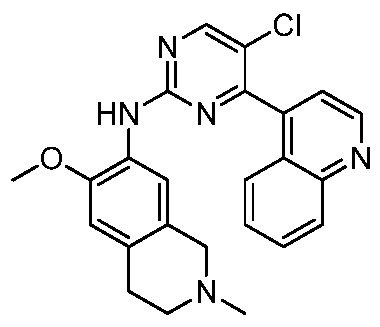
N-(5-클로로-4-(퀴놀린-4-일)피리미딘-2-일)-6-메톡시-2-메틸-1,2,3,4-테트라히드로이소퀴놀린-7-아민N-(5-chloro-4-(quinolin-4-yl)pyrimidin-2-yl)-6-methoxy-2-methyl-1,2,3,4-tetrahydroisoquinolin-7-amine
단계 1에서 4-이소퀴놀릴보론산 대신 4-퀴놀릴보론산을 사용한, 실시예 48과 동일한 절차. LC-MS (ESI) m/z: 432 [M+H]+. 1H NMR (400 MHz, CD3OD): δ 2.36 (s, 1.8H), 2.54 (s, 3H), 2.90-2.95 (m, 4H), 3.61 (s, 2H), 3.88 (s, 3H), 6.79 (s, 1H), 7.22 (d, J = 8.0 Hz, 1.2H), 7.61 (d, J = 4.4 Hz, 1H), 7.62-7.66 (m, 1H), 7.69 (d, J = 8.0 Hz, 1.2H), 7.78 (d, J = 8.4 Hz, 1H), 7.82-7.87 (m, 1H), 7.96 (s, 1H), 8.16 (d, J = 8.4 Hz, 1H), 8.63 (s, 1H), 9.00 (d, J = 4.4 Hz,1H).The same procedure as in Example 48, using 4-quinolylboronic acid instead of 4-isoquinolylboronic acid in step 1. LC-MS (ESI) m/z: 432 [M+H] + . 1 H NMR (400 MHz, CD 3 OD): δ 2.36 (s, 1.8H), 2.54 (s, 3H), 2.90-2.95 (m, 4H), 3.61 (s, 2H), 3.88 (s, 3H) , 6.79 (s, 1H), 7.22 (d, J = 8.0 Hz, 1.2H), 7.61 (d, J = 4.4 Hz, 1H), 7.62-7.66 (m, 1H), 7.69 (d, J = 8.0 Hz) , 1.2H), 7.78 (d, J = 8.4 Hz, 1H), 7.82-7.87 (m, 1H), 7.96 (s, 1H), 8.16 (d, J = 8.4 Hz, 1H), 8.63 (s, 1H) ), 9.00 (d, J = 4.4 Hz,1H).
실시예 93Example 93

3-(1-(5-클로로-2-((6-메톡시-2-메틸-1,2,3,4-테트라히드로이소퀴놀린-7-일)아미노)피리미딘-4-일)-1H-인돌-3-일)옥세탄-3-올3-(1-(5-Chloro-2-((6-methoxy-2-methyl-1,2,3,4-tetrahydroisoquinolin-7-yl)amino)pyrimidin-4-yl)- 1H-indol-3-yl)oxetan-3-ol
단계 1: Int. E16 (440 mg, 1.45 mmol) 및 2,4,5-트리클로로피리미딘 (293 mg, 1.59 mmol)을 조건 A1 하에 사용하고, 실리카 겔 상에서 플래쉬 칼럼 크로마토그래피 (PE/EA = 10/1)에 의한 정제 후에 3-(3-((tert-부틸디메틸실릴)옥시)옥세탄-3-일)-1-(2,5-디클로로피리미딘-4-일)-1H-인돌 (400 mg, 58% 수율)을 담황색 고체로서 제공하였다. LC-MS (ESI) m/z: 450 [M+H]+.Step 1: Int. E16 (440 mg, 1.45 mmol) and 2,4,5-trichloropyrimidine (293 mg, 1.59 mmol) were used under condition A1 and subjected to flash column chromatography on silica gel (PE/EA = 10/1) 3-(3-((tert-butyldimethylsilyl)oxy)oxetan-3-yl)-1-(2,5-dichloropyrimidin-4-yl)-1H-indole (400 mg, 58 % yield) as a pale yellow solid. LC-MS (ESI) m/z: 450 [M+H] + .
단계 2: 3-(3-((tert-부틸디메틸실릴)옥시)옥세탄-3-일)-1-(2,5-디클로로피리미딘-4-일)-1H-인돌 (200 mg, 0.444 mmol) 및 Int. W1 (142 mg, 0.533 mmol)을 조건 B3 하에 사용하고, 실리카 겔 상에서 플래쉬 칼럼 크로마토그래피 (PE/EA = 10/1)에 의한 정제 후에 N-(4-(3-(3-((tert-부틸디메틸실릴)옥시)옥세탄-3-일)-1H-인돌-1-일)-5-클로로피리미딘-2-일)-6-메톡시-2-메틸-1,2,3,4-테트라히드로이소퀴놀린-7-아민 (170 mg, 73% 수율)을 적색 고체로서 제공하였다. LC-MS (ESI) m/z: 606 [M+H]+.Step 2: 3-(3-((tert-Butyldimethylsilyl)oxy)oxetan-3-yl)-1-(2,5-dichloropyrimidin-4-yl)-1H-indole (200 mg, 0.444 mmol) and Int. W1 (142 mg, 0.533 mmol) was used under condition B3 and after purification by flash column chromatography on silica gel (PE/EA = 10/1) N-(4-(3-(3-((tert-) Butyldimethylsilyl)oxy)oxetan-3-yl)-1H-indol-1-yl)-5-chloropyrimidin-2-yl)-6-methoxy-2-methyl-1,2,3,4 -Tetrahydroisoquinolin-7-amine (170 mg, 73% yield) was provided as a red solid. LC-MS (ESI) m/z: 606 [M+H] + .
단계 3: THF (2 mL) 및 물 (0.3 mL)의 혼합 용매 중 N-(4-(3-(3-((tert-부틸디메틸실릴)옥시)옥세탄-3-일)-1H-인돌-1-일)-5-클로로피리미딘-2-일)-6-메톡시-2-메틸-1,2,3,4-테트라히드로이소퀴놀린-7-아민 (80 mg, 131.96 umol)의 용액에 포름산 (1 mL)을 첨가하였다. 반응 혼합물을 80℃에서 3시간 동안 교반하고, 정제용-HPLC (10 mM NH4HCO3 & 0.025% NH3·H2O/아세토니트릴)를 통해 정제하여 3-(1-(5-클로로-2-((6-메톡시-2-메틸-1,2,3,4-테트라히드로이소퀴놀린-7-일)아미노)피리미딘-4-일)-1H-인돌-3-일)옥세탄-3-올을 황색 고체 (2.0 mg, 3% 수율)로서 제공하였다. LC-MS (ESI) m/z: 492 [M+H]+. 1H NMR (400 MHz, DMSO-d6) δ 12.46 (s, 1H), 8.19 (s, 1H), 8.08 (s, 1H), 7.93 (d, J = 8.0 Hz, 1H), 7.57 (d, J = 8.0 Hz, 1H), 7.26 (t, J = 7.5 Hz, 1H), 7.19 (t, J = 8.1 Hz, 1H), 6.60 (s, 1H), 6.43 (s, 1H), 6.04 (s, 1H), 5.33 (s, 1H), 4.39 (d, J = 14.9 Hz, 1H), 4.11 (d, J = 14.8 Hz, 1H), 3.83 (d, J = 30.4 Hz, 2H), 3.62 (s, 3H), 3.36 (s, 2H), 2.76 (s, 2H), 2.58 (s, 2H), 2.33 (s, 3H).Step 3: N-(4-(3-(3-((tert-butyldimethylsilyl)oxy)oxetan-3-yl)-1H-indole in a mixed solvent of THF (2 mL) and water (0.3 mL) of -1-yl)-5-chloropyrimidin-2-yl)-6-methoxy-2-methyl-1,2,3,4-tetrahydroisoquinolin-7-amine (80 mg, 131.96 umol) To the solution was added formic acid (1 mL). The reaction mixture was stirred at 80° C. for 3 h and purified via prep-HPLC (10 mM NH 4 HCO 3 & 0.025% NH 3 .H 2 O/acetonitrile) to 3-(1-(5-chloro-) 2-((6-Methoxy-2-methyl-1,2,3,4-tetrahydroisoquinolin-7-yl)amino)pyrimidin-4-yl)-1H-indol-3-yl)oxetane -3-ol was provided as a yellow solid (2.0 mg, 3% yield). LC-MS (ESI) m/z: 492 [M+H] + . 1 H NMR (400 MHz, DMSO-d 6 ) δ 12.46 (s, 1H), 8.19 (s, 1H), 8.08 (s, 1H), 7.93 (d, J = 8.0 Hz, 1H), 7.57 (d, J = 8.0 Hz, 1H), 7.26 (t, J = 7.5 Hz, 1H), 7.19 (t, J = 8.1 Hz, 1H), 6.60 (s, 1H), 6.43 (s, 1H), 6.04 (s, 1H), 5.33 (s, 1H), 4.39 (d, J = 14.9 Hz, 1H), 4.11 (d, J = 14.8 Hz, 1H), 3.83 (d, J = 30.4 Hz, 2H), 3.62 (s, 3H), 3.36 (s, 2H), 2.76 (s, 2H), 2.58 (s, 2H), 2.33 (s, 3H).
실시예 94Example 94

N-(1-(5-클로로-2-((6-메톡시-2-메틸-1,2,3,4-테트라히드로이소퀴놀린-7-일)아미노)피리미딘-4-일)-1H-인돌-3-일)메탄술폰아미드N-(1-(5-chloro-2-((6-methoxy-2-methyl-1,2,3,4-tetrahydroisoquinolin-7-yl)amino)pyrimidin-4-yl)- 1H-indol-3-yl)methanesulfonamide
단계 1: 3-니트로-1H-인돌 (100 mg, 0.617 mmol) 및 2,4,5-트리클로로피리미딘 (125 mg, 0.678 mmol)을 조건 A1 하에 사용하고, 실리카 겔 상에서 플래쉬 칼럼 크로마토그래피 (PE/EA = 10/1)에 의한 정제 후에 1-(2,5-디클로로피리미딘-4-일)-3-니트로-1H-인돌 (78 mg, 30% 수율)을 황색 고체로서 제공하였다. LC-MS (ESI) m/z: 309 [M+H]+.Step 1: Using 3-nitro-1H-indole (100 mg, 0.617 mmol) and 2,4,5-trichloropyrimidine (125 mg, 0.678 mmol) under condition A1, flash column chromatography on silica gel ( After purification by PE/EA = 10/1), 1-(2,5-dichloropyrimidin-4-yl)-3-nitro-1H-indole (78 mg, 30% yield) was provided as a yellow solid. LC-MS (ESI) m/z: 309 [M+H] + .
단계 2: 1,4-디옥산 (0.5 mL) 및 물 (0.2 mL)의 혼합 용매 중 1-(2,5-디클로로피리미딘-4-일)-3-니트로-1H-인돌 (78 mg, 252.34 umol)의 용액에 아연 (5.42 mg, 82.89 umol) 및 NH4Cl (5.2 mg, 97.05 umol)을 0℃에서 순차적으로 첨가하였다. 반응 혼합물을 실온에서 1시간 동안 교반하고, 셀라이트를 통해 여과하였다. 여과물을 에틸 아세테이트 (10 mL)로 희석하고, 물 (5 mL) 및 염수 (5 mL)로 세척하고, 무수 황산나트륨 상에서 건조시키고, 여과하였다. 여과물을 진공 하에 농축시켜 1-(2,5-디클로로피리미딘-4-일)-1H-인돌-3-아민을 갈색 고체 (60 mg, 85% 수율)로서 제공하였다. LC-MS (ESI) m/z: 279 [M+H]+.Step 2: 1-(2,5-dichloropyrimidin-4-yl)-3-nitro-1H-indole (78 mg, 252.34 umol) and zinc (5.42 mg, 82.89 umol) and NH 4 Cl (5.2 mg, 97.05 umol) were sequentially added at 0°C. The reaction mixture was stirred at room temperature for 1 h and filtered through celite. The filtrate was diluted with ethyl acetate (10 mL), washed with water (5 mL) and brine (5 mL), dried over anhydrous sodium sulfate and filtered. The filtrate was concentrated in vacuo to give 1-(2,5-dichloropyrimidin-4-yl)-1H-indol-3-amine as a brown solid (60 mg, 85% yield). LC-MS (ESI) m/z: 279 [M+H] + .
단계 3: 무수 DCM (2 mL) 중 1-(2,5-디클로로피리미딘-4-일)-1H-인돌-3-아민 (60 mg, 214.96 umol)의 현탁액에 MsCl (138.09 mg, 214.96 umol)을 0℃에서 첨가하였다. 0℃에서 4시간 동안 교반한 후, 혼합물을 5% 수성 시트르산 (20 mL)과 DCM (20 mL) 사이에 분배하였다. 합한 유기 상을 물 (10 mL)로 세척하고, 무수 Na2SO4 상에서 건조시키고, 여과하였다. 여과물을 진공 하에 농축시키고, 잔류물을 실리카 겔 상에서 플래쉬 칼럼 크로마토그래피 (PE/EA = 1/10~1/5)에 의해 정제하여 N-(1-(2,5-디클로로피리미딘-4-일)-1H-인돌-3-일)메탄술폰아미드를 황색 고체 (75 mg, 97% 수율)로서 제공하였다. LC-MS (ESI) m/z: 357 [M+H]+.Step 3: To a suspension of 1-(2,5-dichloropyrimidin-4-yl)-1H-indol-3-amine (60 mg, 214.96 umol) in anhydrous DCM (2 mL) MsCl (138.09 mg, 214.96 umol) ) was added at 0 °C. After stirring at 0° C. for 4 h, the mixture was partitioned between 5% aqueous citric acid (20 mL) and DCM (20 mL). The combined organic phases were washed with water (10 mL), dried over anhydrous Na 2 SO 4 and filtered. The filtrate was concentrated in vacuo and the residue was purified by flash column chromatography on silica gel (PE/EA = 1/10-1/5) to N-(1-(2,5-dichloropyrimidine-4) -yl)-1H-indol-3-yl)methanesulfonamide was provided as a yellow solid (75 mg, 97% yield). LC-MS (ESI) m/z: 357 [M+H] + .
단계 4: N-(1-(2,5-디클로로피리미딘-4-일)-1H-인돌-3-일)메탄술폰아미드 (75 mg, 0.210 mmol) 및 Int. W1 (49 mg, 0.252 mmol)을 조건 B3 하에 사용하고, 정제용-HPLC (MeCN/0.1% HCOOH)에 의한 정제 후에 N-(1-(5-클로로-2-((6-메톡시-2-메틸-1,2,3,4-테트라히드로이소퀴놀린-7-일)아미노)피리미딘-4-일)-1H-인돌-3-일)메탄술폰아미드 (5.2 mg, 5% 수율)를 백색 고체로서 제공하였다. LC-MS (ESI) m/z: 513 [M+H]+. 1H NMR (400MHz, DMSO-d6) δ 8.75 (s, 1H), 8.62 (s, 1H), 8.28 (s, 1H), 7.86-7.72 (m, 2H), 7.47 (d, J = 8.0 Hz, 1H), 7.40 (s, 1H), 7.28-7.20 (m, 2H), 7.11 (d, J = 7.9 Hz, 1H), 6.80 (s, 1H), 3.79 (s, 3H), 2.99 (s, 3H), 2.79 (t, J = 5.8 Hz, 2H), 2.56 (t, J = 5.8 Hz, 2H), 2.31 (s, 3H), 2.29 (s, 2H).Step 4: N-(1-(2,5-dichloropyrimidin-4-yl)-1H-indol-3-yl)methanesulfonamide (75 mg, 0.210 mmol) and Int. W1 (49 mg, 0.252 mmol) was used under condition B3 and after purification by prep-HPLC (MeCN/0.1% HCOOH) N-(1-(5-chloro-2-((6-methoxy-2)) -Methyl-1,2,3,4-tetrahydroisoquinolin-7-yl)amino)pyrimidin-4-yl)-1H-indol-3-yl)methanesulfonamide (5.2 mg, 5% yield) It was provided as a white solid. LC-MS (ESI) m/z: 513 [M+H] + . 1 H NMR (400 MHz, DMSO-d 6 ) δ 8.75 (s, 1H), 8.62 (s, 1H), 8.28 (s, 1H), 7.86-7.72 (m, 2H), 7.47 (d, J = 8.0 Hz) , 1H), 7.40 (s, 1H), 7.28-7.20 (m, 2H), 7.11 (d, J = 7.9 Hz, 1H), 6.80 (s, 1H), 3.79 (s, 3H), 2.99 (s, 3H), 2.79 (t, J = 5.8 Hz, 2H), 2.56 (t, J = 5.8 Hz, 2H), 2.31 (s, 3H), 2.29 (s, 2H).
실시예 32Example 32

1-(5-클로로-2-((6-메톡시-2-메틸-1,2,3,4-테트라히드로이소퀴놀린-7-일)아미노)피리미딘-4-일)인돌린-3-카르복실산1-(5-Chloro-2-((6-methoxy-2-methyl-1,2,3,4-tetrahydroisoquinolin-7-yl)amino)pyrimidin-4-yl)indoline-3 -carboxylic acid
실시예 115Example 115
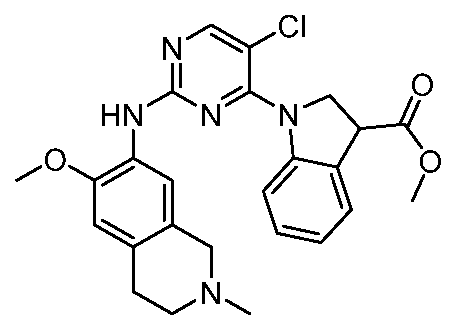
메틸 1-(5-클로로-2-((6-메톡시-2-메틸-1,2,3,4-테트라히드로이소퀴놀린-7-일)아미노)피리미딘-4-일)인돌린-3-카르복실레이트Methyl 1-(5-chloro-2-((6-methoxy-2-methyl-1,2,3,4-tetrahydroisoquinolin-7-yl)amino)pyrimidin-4-yl)indoline- 3-carboxylate
단계 1: NMP (0.6 mL) 중 2,4,5-트리클로로피리미딘 (220 mg, 1.20 mmol) 및 인돌린-3-카르복실산 (163 mg, 0.999 mmol)의 혼합물을 150℃에서 15분 동안 교반하고, 역상 크로마토그래피 (물 중 0-80% 메탄올)에 의해 정제하여 1-(2,5-디클로로피리미딘-4-일)인돌린-3-카르복실산 (160 mg, 48.55% 수율, 94% 순도)을 황색 고체로서 수득하였다. LC-MS (ESI) m/z: 310.0 [M+H]+.Step 1: A mixture of 2,4,5-trichloropyrimidine (220 mg, 1.20 mmol) and indoline-3-carboxylic acid (163 mg, 0.999 mmol) in NMP (0.6 mL) at 150° C. for 15 min stirred for a while and purified by reverse phase chromatography (0-80% methanol in water) to 1-(2,5-dichloropyrimidin-4-yl)indoline-3-carboxylic acid (160 mg, 48.55% yield) , 94% purity) as a yellow solid. LC-MS (ESI) m/z: 310.0 [M+H] + .
단계 2: i-PrOH (2.5 mL) 중 1-(2,5-디클로로피리미딘-4-일)인돌린-3-카르복실산 (30 mg, 0.097 mmol) 및 Int. W1 (19 mg, 0.097 mmol) 및 TsOH·H2O (18.4 mg, 0.097 mmol)의 혼합물을 85℃에서 5시간 동안 교반하고, 정제용-HPLC (10 mM NH4HCO3 & 0.025% NH3·H2O/아세토니트릴)에 의해 정제하여 1-(5-클로로-2-((6-메톡시-2-메틸-1,2,3,4-테트라히드로이소퀴놀린-7-일)아미노)피리미딘-4-일)인돌린-3-카르복실산 (1.8 mg, 4% 수율)을 황색 고체로서 제공하였다. LC-MS (ESI) m/z: 466 [M+H]+. 1H NMR (400 MHz, DMSO-d6) δ 8.25 (s, 1H), 8.03 (s, 1H), 7.51 (s, 1H), 7.40 (dd, J = 7.7, 3.9 Hz, 2H), 7.12 (t, J = 7.6 Hz, 1H), 6.97 (t, J = 7.3 Hz, 1H), 6.76 (s, 1H), 4.56 (dd, J = 10.6, 6.4 Hz, 1H), 4.38 (t, J = 10.1 Hz, 1H), 4.23 (s, 1H), 3.77 (s, 3H), 2.78 (d, J = 5.6 Hz, 2H), 2.67 (s, 1H), 2.60-2.55 (m, 3H), 2.32 (s, 3H).Step 2: 1-(2,5-dichloropyrimidin-4-yl)indoline-3-carboxylic acid (30 mg, 0.097 mmol) and Int. A mixture of W1 (19 mg, 0.097 mmol) and TsOH.H 2 O (18.4 mg, 0.097 mmol) was stirred at 85° C. for 5 h, and preparative-HPLC (10 mM NH 4 HCO 3 & 0.025% NH 3 ) 1-(5-chloro-2-((6-methoxy-2-methyl-1,2,3,4-tetrahydroisoquinolin-7-yl)amino) purified by H 2 O/acetonitrile) Provided pyrimidin-4-yl)indoline-3-carboxylic acid (1.8 mg, 4% yield) as a yellow solid. LC-MS (ESI) m/z: 466 [M+H] + . 1 H NMR (400 MHz, DMSO-d 6 ) δ 8.25 (s, 1H), 8.03 (s, 1H), 7.51 (s, 1H), 7.40 (dd, J = 7.7, 3.9 Hz, 2H), 7.12 ( t, J = 7.6 Hz, 1H), 6.97 (t, J = 7.3 Hz, 1H), 6.76 (s, 1H), 4.56 (dd, J = 10.6, 6.4 Hz, 1H), 4.38 (t, J = 10.1) Hz, 1H), 4.23 (s, 1H), 3.77 (s, 3H), 2.78 (d, J = 5.6 Hz, 2H), 2.67 (s, 1H), 2.60-2.55 (m, 3H), 2.32 (s) , 3H).
대안적 합성 방법:Alternative synthetic methods:
단계 1: n-BuOH (5 mL) 중 Int. E17 (300 mg, 1.59 mmol), 2,4,5-트리클로로피리미딘 (292 mg, 1.59 mmol) 및 DIPEA (411.4 mg, 3.18 mmol)의 혼합물을 100℃에서 16시간 동안 교반하고, 빙냉수 (20 mL)로 켄칭하고, EA (30 mL x 3)로 추출하였다. 유기 상을 염수 (30 mL)로 세척하고, 무수 Na2SO4 상에서 건조시키고, 여과하였다. 여과물을 진공 하에 농축시켰다. 잔류물을 실리카 겔 상에서 플래쉬 칼럼 크로마토그래피 (MeOH/DCM: 0-15%)에 의해 정제하여 메틸 1-(2,5-디클로로피리미딘-4-일)인돌린-3-카르복실레이트 (556 mg, 95% 수율)를 황색 고체로서 제공하였다. LC-MS (ESI) m/z: 324 [M+H]+.Step 1: Int. in n-BuOH (5 mL). A mixture of E17 (300 mg, 1.59 mmol), 2,4,5-trichloropyrimidine (292 mg, 1.59 mmol) and DIPEA (411.4 mg, 3.18 mmol) was stirred at 100° C. for 16 h, followed by ice-cold water ( 20 mL) and extracted with EA (30 mL×3). The organic phase was washed with brine (30 mL), dried over anhydrous Na 2 SO 4 and filtered. The filtrate was concentrated in vacuo. The residue was purified by flash column chromatography on silica gel (MeOH/DCM: 0-15%) to methyl 1-(2,5-dichloropyrimidin-4-yl)indoline-3-carboxylate (556) mg, 95% yield) as a yellow solid. LC-MS (ESI) m/z: 324 [M+H] + .
단계 2: i-PrOH (10 mL) 중 메틸 1-(2,5-디클로로피리미딘-4-일)인돌린-3-카르복실레이트 (250 mg, 0.678 mmol), Int. W1 (155 mg, 0.678 mmol) 및 TsOH·H2O (129.1 mg, 0.679 mmol)의 혼합물을 100℃에서 16시간 동안 교반하고, 포화 NaHCO3 수용액 (10 mL)으로 켄칭하고, DCM/MeOH (10/1, 30 mL x 3)로 추출하였다. 유기 상을 염수 (30 mL)로 세척하고, 무수 Na2SO4 상에서 건조시키고, 여과하였다. 여과물을 진공 하에 농축시켰다. 잔류물을 실리카 겔 상에서 플래쉬 칼럼 크로마토그래피 (MeOH/DCM: 0-15%)에 의해 정제하여 메틸 1-(5-클로로-2-((6-메톡시-2-메틸-1,2,3,4-테트라히드로이소퀴놀린-7-일)아미노)피리미딘-4-일)인돌린-3-카르복실레이트 및 이소프로필 1-(5-클로로-2-((6-메톡시-2-메틸-1,2,3,4-테트라히드로이소퀴놀린-7-일)아미노)피리미딘-4-일)인돌린-3-카르복실레이트의 혼합물 (530 mg)을 황색 고체로서 제공하였다. LC-MS (ESI) m/z: 480 (메틸 에스테르), 508 (이소프로필 에스테르) [M+H]+.Step 2: Methyl 1-(2,5-dichloropyrimidin-4-yl)indoline-3-carboxylate (250 mg, 0.678 mmol) in i-PrOH (10 mL), Int. A mixture of W1 (155 mg, 0.678 mmol) and TsOH·H 2 O (129.1 mg, 0.679 mmol) was stirred at 100° C. for 16 h, quenched with saturated aqueous NaHCO 3 aqueous solution (10 mL), DCM/MeOH (10 /1, 30 mL x 3). The organic phase was washed with brine (30 mL), dried over anhydrous Na 2 SO 4 and filtered. The filtrate was concentrated in vacuo. The residue was purified by flash column chromatography on silica gel (MeOH/DCM: 0-15%) to methyl 1-(5-chloro-2-((6-methoxy-2-methyl-1,2,3) ,4-Tetrahydroisoquinolin-7-yl)amino)pyrimidin-4-yl)indoline-3-carboxylate and isopropyl 1-(5-chloro-2-((6-methoxy-2- A mixture of methyl-1,2,3,4-tetrahydroisoquinolin-7-yl)amino)pyrimidin-4-yl)indoline-3-carboxylate (530 mg) was provided as a yellow solid. LC-MS (ESI) m/z: 480 (methyl ester), 508 (isopropyl ester) [M+H] + .
소량의 혼합물을 추가로 정제용-HPLC에 의해 정제하여 메틸 1-(5-클로로-2-((6-메톡시-2-메틸-1,2,3,4-테트라히드로이소퀴놀린-7-일)아미노)피리미딘-4-일)인돌린-3-카르복실레이트를 황색 고체로서 제공하였다. LC-MS (ESI) m/z: 480 [M+H]+. 1H NMR (400 MHz, DMSO-d6) δ 8.28 (s, 1H), 8.09 (s, 1H), 7.48 (s, 1H), 7.37 (dd, J = 15.3, 7.7 Hz, 2H), 7.16 (t, J = 7.4 Hz, 1H), 6.99 (t, J = 7.2 Hz, 1H), 6.76 (s, 1H), 4.54 (q, J = 10.8 Hz, 1H), 4.50-4.38 (m, 2H), 3.79 (d, J = 15.6 Hz, 3H), 3.71 (s, 3H), 3.29 (s, 2H), 2.78 (t, J = 5.7 Hz, 2H), 2.56 (t, J = 5.9 Hz, 2H), 2.31 (s, 3H).A small amount of the mixture was further purified by preparative-HPLC to methyl 1-(5-chloro-2-((6-methoxy-2-methyl-1,2,3,4-tetrahydroisoquinoline-7-) yl)amino)pyrimidin-4-yl)indoline-3-carboxylate was provided as a yellow solid. LC-MS (ESI) m/z: 480 [M+H] + . 1 H NMR (400 MHz, DMSO-d 6 ) δ 8.28 (s, 1H), 8.09 (s, 1H), 7.48 (s, 1H), 7.37 (dd, J = 15.3, 7.7 Hz, 2H), 7.16 ( t, J = 7.4 Hz, 1H), 6.99 (t, J = 7.2 Hz, 1H), 6.76 (s, 1H), 4.54 (q, J = 10.8 Hz, 1H), 4.50-4.38 (m, 2H), 3.79 (d, J = 15.6 Hz, 3H), 3.71 (s, 3H), 3.29 (s, 2H), 2.78 (t, J = 5.7 Hz, 2H), 2.56 (t, J = 5.9 Hz, 2H), 2.31 (s, 3H).
단계 3: THF (5 mL) 중 메틸 1-(5-클로로-2-((6-메톡시-2-메틸-1,2,3,4-테트라히드로이소퀴놀린-7-일)아미노)피리미딘-4-일)인돌린-3-카르복실레이트 및 이소프로필 1-(5-클로로-2-((6-메톡시-2-메틸-1,2,3,4-테트라히드로이소퀴놀린-7-일)아미노)피리미딘-4-일)인돌린-3-카르복실레이트 (530 mg) 및 LiOH 수용액 (2 N, 4 mL)의 혼합물을 실온에서 16시간 동안 교반하고, 포름산을 사용하여 pH ~5로 조정하고, DCM (30 mL x 3)으로 추출하였다. 합한 유기 상을 무수 Na2SO4 상에서 건조시키고, 여과하였다. 여과물을 진공 하에 농축시키고, 잔류물을 정제용-HPLC (10 mM NH4HCO3 & 0.025% NH3·H2O/아세토니트릴)에 의해 정제하여 1-(5-클로로-2-((6-메톡시-2-메틸-1,2,3,4-테트라히드로이소퀴놀린-7-일)아미노)피리미딘-4-일)인돌린-3-카르복실산 (158 mg, 84% 수율)을 담황색 고체로서 수득하였다. LC-MS (ESI) m/z: 466 [M+H]+.Step 3: Methyl 1-(5-chloro-2-((6-methoxy-2-methyl-1,2,3,4-tetrahydroisoquinolin-7-yl)amino)pyri in THF (5 mL) Midin-4-yl)indoline-3-carboxylate and isopropyl 1-(5-chloro-2-((6-methoxy-2-methyl-1,2,3,4-tetrahydroisoquinoline- A mixture of 7-yl)amino)pyrimidin-4-yl)indoline-3-carboxylate (530 mg) and aqueous LiOH solution (2 N, 4 mL) was stirred at room temperature for 16 hours, followed by using formic acid Adjusted to pH-5 and extracted with DCM (30 mL×3). The combined organic phases were dried over anhydrous Na 2 SO 4 and filtered. The filtrate was concentrated in vacuo and the residue was purified by prep-HPLC (10 mM NH 4 HCO 3 & 0.025% NH 3 .H 2 O/acetonitrile) to 1-(5-chloro-2-(( 6-Methoxy-2-methyl-1,2,3,4-tetrahydroisoquinolin-7-yl)amino)pyrimidin-4-yl)indoline-3-carboxylic acid (158 mg, 84% yield) ) as a pale yellow solid. LC-MS (ESI) m/z: 466 [M+H] + .
실시예 95 & 96Examples 95 & 96

(S)-1-(5-클로로-2-((6-메톡시-2-메틸-1,2,3,4-테트라히드로이소퀴놀린-7-일)아미노)피리미딘-4-일)인돌린-3-카르복실산 & (R)-1-(5-클로로-2-((6-메톡시-2-메틸-1,2,3,4-테트라히드로이소퀴놀린-7-일)아미노)피리미딘-4-일)인돌린-3-카르복실산(S)-1-(5-chloro-2-((6-methoxy-2-methyl-1,2,3,4-tetrahydroisoquinolin-7-yl)amino)pyrimidin-4-yl) Indoline-3-carboxylic acid & (R)-1-(5-chloro-2-((6-methoxy-2-methyl-1,2,3,4-tetrahydroisoquinolin-7-yl) Amino)pyrimidin-4-yl)indoline-3-carboxylic acid
라세미 1-(5-클로로-2-((6-메톡시-2-메틸-1,2,3,4-테트라히드로이소퀴놀린-7-일)아미노)피리미딘-4-일)인돌린-3-카르복실산 (20 mg)의 키랄-분리 후에 합성하였다. 입체화학은 확인되지 않았고, 2종의 생성물 (각각 4.5 mg, 5.1 mg)을 임의로 할당하였다.Racemic 1-(5-chloro-2-((6-methoxy-2-methyl-1,2,3,4-tetrahydroisoquinolin-7-yl)amino)pyrimidin-4-yl)indoline Synthesized after chiral-separation of -3-carboxylic acid (20 mg). Stereochemistry was not identified and two products (4.5 mg and 5.1 mg, respectively) were randomly assigned.
LC-MS (ESI) m/z: 466 [M+H]+. 1H NMR (500 MHz, DMSO-d6) δ 8.27 (s, 1H), 8.05 (s, 1H), 7.51 (s, 1H), 7.40 (d, J = 7.9 Hz, 2H), 7.15 (t, J = 7.8 Hz, 1H), 6.98 (t, J = 7.5 Hz, 1H), 6.77 (s, 1H), 4.54 (dd, J = 10.6, 6.1 Hz, 1H), 4.40 (t, J = 10.0 Hz, 1H), 4.31-4.27 (m, 1H), 3.77 (s, 3H), 3.26-3.24 (m, 2H), 2.80 (d, J = 5.6 Hz, 2H), 2.65 (d, J = 6.5 Hz, 2H), 2.37 (s, 3H). 키랄-HPLC 체류 시간: 1.285분; ee 값: >99%.LC-MS (ESI) m/z: 466 [M+H] + . 1 H NMR (500 MHz, DMSO-d 6 ) δ 8.27 (s, 1H), 8.05 (s, 1H), 7.51 (s, 1H), 7.40 (d, J = 7.9 Hz, 2H), 7.15 (t, J = 7.8 Hz, 1H), 6.98 (t, J = 7.5 Hz, 1H), 6.77 (s, 1H), 4.54 (dd, J = 10.6, 6.1 Hz, 1H), 4.40 (t, J = 10.0 Hz, 1H), 4.31-4.27 (m, 1H), 3.77 (s, 3H), 3.26-3.24 (m, 2H), 2.80 (d, J = 5.6 Hz, 2H), 2.65 (d, J = 6.5 Hz, 2H) ), 2.37 (s, 3H). Chiral-HPLC retention time: 1.285 min; ee value: >99%.
LC-MS (ESI) m/z: 466 [M+H]+. 1H NMR (500 MHz, DMSO-d6) δ 8.26 (s, 1H), 8.03 (s, 1H), 7.51 (s, 1H), 7.39 (d, J = 8.0 Hz, 2H), 7.15 (d, J = 7.7 Hz, 1H), 6.99 (d, J = 7.5 Hz, 1H), 6.76 (s, 1H), 4.54 (dd, J = 10.5, 6.2 Hz, 1H), 4.39 (t, J = 10.1 Hz, 1H), 4.28 (d, J = 6.1 Hz, 1H), 3.77 (s, 3H), 3.34 (s, 2H), 2.79 (t, J = 5.5 Hz, 2H), 2.61 (t, J = 5.7 Hz, 2H), 2.34 (s, 3H). 키랄-HPLC 체류 시간: 2.078분; ee 값: >99%.LC-MS (ESI) m/z: 466 [M+H] + . 1 H NMR (500 MHz, DMSO-d 6 ) δ 8.26 (s, 1H), 8.03 (s, 1H), 7.51 (s, 1H), 7.39 (d, J = 8.0 Hz, 2H), 7.15 (d, J = 7.7 Hz, 1H), 6.99 (d, J = 7.5 Hz, 1H), 6.76 (s, 1H), 4.54 (dd, J = 10.5, 6.2 Hz, 1H), 4.39 (t, J = 10.1 Hz, 1H), 4.28 (d, J = 6.1 Hz, 1H), 3.77 (s, 3H), 3.34 (s, 2H), 2.79 (t, J = 5.5 Hz, 2H), 2.61 (t, J = 5.7 Hz, 2H), 2.34 (s, 3H). Chiral-HPLC retention time: 2.078 min; ee value: >99%.
SFC 분리 조건:SFC separation conditions:
기기: SFC-150 (타르, 워터스)Instrument: SFC-150 (Tar, Waters)
칼럼: IG 20*250 mm, 10 um (다이셀)Column: IG 20*250 mm, 10 um (Dicell)
칼럼 온도: 35℃Column temperature: 35°C
이동상: CO2/EtOH (0.2% 메탄올/암모니아) = 50/50Mobile phase: CO 2 /EtOH (0.2% methanol/ammonia) = 50/50
유량: 120 g/분Flow rate: 120 g/min
배압: 100 barBack pressure: 100 bar
검출 파장: 214 nmDetection wavelength: 214 nm
사이클 시간: 8분Cycle time: 8 minutes
실시예 33Example 33

1-(5-클로로-2-((6-메톡시-2-메틸-1,2,3,4-테트라히드로이소퀴놀린-7-일)아미노)피리미딘-4-일)인돌린-3-카르복스아미드1-(5-Chloro-2-((6-methoxy-2-methyl-1,2,3,4-tetrahydroisoquinolin-7-yl)amino)pyrimidin-4-yl)indoline-3 -carboxamide
단계 1: DMF (1 mL) 중 1-(2,5-디클로로피리미딘-4-일)인돌린-3-카르복실산 (60 mg, 193.46 umol), 염화암모늄 (51.74 mg, 967.32 umol), HATU (110.34 mg, 290.20 umol) 및 트리에틸아민 (58.73 mg, 580.39 umol, 80.90 uL)의 혼합물을 실온에서 3시간 동안 교반하고, 빙냉수 (15 mL)로 켄칭하고, EtOAc (20 mL x 3)로 추출하였다. 합한 유기 상을 염수 (15 mL)로 세척하고, 무수 Na2SO4 상에서 건조시키고, 여과하였다. 여과물을 진공 하에 농축시켰다. 잔류물을 실리카 겔 상에서 플래쉬 칼럼 크로마토그래피 (EA/PE = 0-100%)에 의해 정제하여 1-(2,5-디클로로피리미딘-4-일)인돌린-3-카르복스아미드 (15 mg, 50.16% 수율, 100% 순도)를 백색 고체로서 제공하였다. LC-MS (ESI) m/z: 309 [M+H]+.Step 1: 1-(2,5-dichloropyrimidin-4-yl)indoline-3-carboxylic acid (60 mg, 193.46 umol), ammonium chloride (51.74 mg, 967.32 umol) in DMF (1 mL), A mixture of HATU (110.34 mg, 290.20 umol) and triethylamine (58.73 mg, 580.39 umol, 80.90 uL) was stirred at room temperature for 3 h, quenched with ice cold water (15 mL), EtOAc (20 mL x 3) extracted with The combined organic phases were washed with brine (15 mL), dried over anhydrous Na 2 SO 4 and filtered. The filtrate was concentrated in vacuo. The residue was purified by flash column chromatography on silica gel (EA/PE = 0-100%) to provide 1-(2,5-dichloropyrimidin-4-yl)indoline-3-carboxamide (15 mg , 50.16% yield, 100% purity) as a white solid. LC-MS (ESI) m/z: 309 [M+H]+.
단계 2: 1-(2,5-디클로로피리미딘-4-일)인돌린-3-카르복스아미드 (45 mg, 0.146 mmol) 및 Int. W1 (28 mg, 0.146 mmol)을 조건 B3 하에 사용하고, 정제용-HPLC (10 mM NH4HCO3 & 0.025% NH3·H2O/아세토니트릴)에 의한 정제 후에 1-(5-클로로-2-((6-메톡시-2-메틸-1,2,3,4-테트라히드로이소퀴놀린-7-일)아미노)피리미딘-4-일)인돌린-3-카르복스아미드 (26.9 mg, 55% 수율)를 백색 고체로서 제공하였다. LC-MS (ESI) m/z: 465 [M+H]+. 1H NMR (500 MHz, DMSO-d6) δ 8.24 (s, 1H), 8.00 (s, 1H), 7.80 (s, 1H), 7.50 (s, 1H), 7.39 (dd, J = 31.8, 7.8 Hz, 2H), 7.22 (s, 1H), 7.10 (t, J = 7.7 Hz, 1H), 6.97 (t, J = 7.4 Hz, 1H), 6.75 (s, 1H), 4.54 (dd, J = 10.3, 6.3 Hz, 1H), 4.36 (t, J = 9.9 Hz, 1H), 4.15 (dd, J = 9.3, 6.5 Hz, 1H), 3.77 (s, 3H), 3.28 (d, J = 12.2 Hz, 2H), 2.77 (t, J = 5.6 Hz, 2H), 2.55 (t, J = 5.9 Hz, 2H), 2.30 (s, 3H).Step 2: 1-(2,5-dichloropyrimidin-4-yl)indoline-3-carboxamide (45 mg, 0.146 mmol) and Int. W1 (28 mg, 0.146 mmol) was used under condition B3 and after purification by prep-HPLC (10 mM NH 4 HCO 3 & 0.025% NH 3 .H 2 O/acetonitrile) 1-(5-chloro- 2-((6-methoxy-2-methyl-1,2,3,4-tetrahydroisoquinolin-7-yl)amino)pyrimidin-4-yl)indoline-3-carboxamide (26.9 mg , 55% yield) as a white solid. LC-MS (ESI) m/z: 465 [M+H] + . 1 H NMR (500 MHz, DMSO-d 6 ) δ 8.24 (s, 1H), 8.00 (s, 1H), 7.80 (s, 1H), 7.50 (s, 1H), 7.39 (dd, J = 31.8, 7.8 Hz, 2H), 7.22 (s, 1H), 7.10 (t, J = 7.7 Hz, 1H), 6.97 (t, J = 7.4 Hz, 1H), 6.75 (s, 1H), 4.54 (dd, J = 10.3) , 6.3 Hz, 1H), 4.36 (t, J = 9.9 Hz, 1H), 4.15 (dd, J = 9.3, 6.5 Hz, 1H), 3.77 (s, 3H), 3.28 (d, J = 12.2 Hz, 2H) ), 2.77 (t, J = 5.6 Hz, 2H), 2.55 (t, J = 5.9 Hz, 2H), 2.30 (s, 3H).
실시예 97Example 97

1-(5-클로로-2-((6-메톡시-2-메틸-1,2,3,4-테트라히드로이소퀴놀린-7-일)아미노)피리미딘-4-일)-N-메틸인돌린-3-카르복스아미드1-(5-Chloro-2-((6-methoxy-2-methyl-1,2,3,4-tetrahydroisoquinolin-7-yl)amino)pyrimidin-4-yl)-N-methyl Indoline-3-carboxamide
단계 1에서 염화암모늄 대신 메틸아민 히드로클로라이드를 사용한, 실시예 33과 동일한 절차. LC-MS (ESI) m/z: 479 [M+H]+. 1H NMR (400MHz, DMSO-d6) δ 8.31-8.26 (m, 1H), 8.24 (s, 1H), 8.02 (s, 1H), 7.49 (s,1H), 7.42 (d, J = 8.3 Hz, 1H), 7.28 (d, J = 7.5 Hz, 1H), 7.10 (t, J = 7.7 Hz, 1H), 6.95 (t, J = 7.4 Hz, 1H), 6.75 (s, 1H), 4.54 (dd, J = 10.4, 6.5 Hz, 1H), 4.37 (t, J = 10.0 Hz, 1H), 4.22-4.05 (m, 1H), 3.77 (s, 3H), 3.28 (s, 2H), 2.77 (d, J = 5.7 Hz, 2H), 2.66 (d, J = 4.6 Hz, 3H), 2.56 (d, J = 5.8 Hz, 2H), 2.30 (s, 3H).Same procedure as Example 33, using methylamine hydrochloride instead of ammonium chloride in step 1. LC-MS (ESI) m/z: 479 [M+H] + . 1 H NMR (400 MHz, DMSO-d 6 ) δ 8.31-8.26 (m, 1H), 8.24 (s, 1H), 8.02 (s, 1H), 7.49 (s,1H), 7.42 (d, J = 8.3 Hz) , 1H), 7.28 (d, J = 7.5 Hz, 1H), 7.10 (t, J = 7.7 Hz, 1H), 6.95 (t, J = 7.4 Hz, 1H), 6.75 (s, 1H), 4.54 (dd , J = 10.4, 6.5 Hz, 1H), 4.37 (t, J = 10.0 Hz, 1H), 4.22-4.05 (m, 1H), 3.77 (s, 3H), 3.28 (s, 2H), 2.77 (d, J = 5.7 Hz, 2H), 2.66 (d, J = 4.6 Hz, 3H), 2.56 (d, J = 5.8 Hz, 2H), 2.30 (s, 3H).
실시예 98Example 98

1-(5-클로로-2-((6-메톡시-2-메틸-1,2,3,4-테트라히드로이소퀴놀린-7-일)아미노)피리미딘-4-일)-N-(메틸술포닐)인돌린-3-카르복스아미드1-(5-Chloro-2-((6-methoxy-2-methyl-1,2,3,4-tetrahydroisoquinolin-7-yl)amino)pyrimidin-4-yl)-N-( methylsulfonyl)indoline-3-carboxamide
단계 1: DCM (5 mL) 중 1-(2,5-디클로로피리미딘-4-일)인돌린-3-카르복실산 (60 mg, 0.193 mmol) 및 CDI (31.47 mg, 0.193 mmol)의 혼합물을 실온에서 1시간 동안 교반하고, 이어서 메탄술폰아미드 (27.6 mg, 0.290 mmol)를 첨가하였다. 혼합물을 추가로 1시간 동안 교반한 후, DBU (29.5 mg, 0.193 mmol)를 혼합물에 첨가하였다. 이어서, 반응 혼합물을 실온에서 16시간 동안 교반하고, HCl 수용액 (1 N, 20 mL)으로 켄칭하고, EtOAc (20 mL x 3)로 추출하였다. 합한 유기 상을 무수 황산나트륨 상에서 건조시키고, 여과하였다. 여과물을 진공 하에 농축시키고, 잔류물을 실리카 겔 상에서 플래쉬 칼럼 크로마토그래피 (MeOH/DCM = 0-15%)에 의해 정제하여 1-(2,5-디클로로피리미딘-4-일)-N-메틸술포닐-인돌린-3-카르복스아미드를 황색 오일 (45 mg, 37% 수율, 62% 순도)로서 제공하였다. LC-MS (ESI) m/z: 387 [M+H]+.Step 1: Mixture of 1-(2,5-dichloropyrimidin-4-yl)indoline-3-carboxylic acid (60 mg, 0.193 mmol) and CDI (31.47 mg, 0.193 mmol) in DCM (5 mL) was stirred at room temperature for 1 h, then methanesulfonamide (27.6 mg, 0.290 mmol) was added. After the mixture was stirred for an additional 1 h, DBU (29.5 mg, 0.193 mmol) was added to the mixture. The reaction mixture was then stirred at room temperature for 16 h, quenched with aqueous HCl solution (1 N, 20 mL) and extracted with EtOAc (20 mL×3). The combined organic phases were dried over anhydrous sodium sulfate and filtered. The filtrate was concentrated in vacuo and the residue was purified by flash column chromatography on silica gel (MeOH/DCM = 0-15%) to 1-(2,5-dichloropyrimidin-4-yl)-N- Methylsulfonyl-indoline-3-carboxamide was provided as a yellow oil (45 mg, 37% yield, 62% purity). LC-MS (ESI) m/z: 387 [M+H] + .
단계 2: 1-(2,5-디클로로피리미딘-4-일)-N-메틸술포닐-인돌린-3-카르복스아미드 (45 mg, 0.072 mmol) 및 Int. W1 (13.9 mg, 0.072 mmol)을 조건 B3 하에 사용하여 정제용-HPLC (0.1% FA/아세토니트릴)에 의한 정제 후에 1-(5-클로로-2-((6-메톡시-2-메틸-1,2,3,4-테트라히드로이소퀴놀린-7-일)아미노)피리미딘-4-일)-N-(메틸술포닐)인돌린-3-카르복스아미드 (29 mg, 74.1% 수율)를 담황색 고체로서 제공하였다. LC-MS (ESI) m/z: 543 [M+H]+. 1H NMR (400 MHz, DMSO-d6) δ 8.25 (s, 1H), 8.05 (s, 1H), 7.66 (s, 1H), 7.47 (d, J = 7.0 Hz, 1H), 7.33 (d, J = 8.4 Hz, 1H), 7.11 (t, J = 7.9 Hz, 1H), 6.94 (t, J = 7.4 Hz, 1H), 6.85 (s, 1H), 4.64-4.56 (m, 1H), 4.28 (t, J = 9.8 Hz, 1H), 4.00 (d, J = 7.8 Hz, 1H), 3.81 (s, 3H), 3.09 (s, 2H), 2.93 (s, 2H), 2.82 (s, 3H), 2.67 (s, 2H), 2.52 (s, 3H).Step 2: 1-(2,5-Dichloropyrimidin-4-yl)-N-methylsulfonyl-indoline-3-carboxamide (45 mg, 0.072 mmol) and Int. 1-(5-chloro-2-((6-methoxy-2-methyl-) after purification by prep-HPLC (0.1% FA/acetonitrile) using W1 (13.9 mg, 0.072 mmol) under condition B3 1,2,3,4-tetrahydroisoquinolin-7-yl)amino)pyrimidin-4-yl)-N-(methylsulfonyl)indoline-3-carboxamide (29 mg, 74.1% yield) was provided as a pale yellow solid. LC-MS (ESI) m/z: 543 [M+H] + . 1 H NMR (400 MHz, DMSO-d 6 ) δ 8.25 (s, 1H), 8.05 (s, 1H), 7.66 (s, 1H), 7.47 (d, J = 7.0 Hz, 1H), 7.33 (d, J = 8.4 Hz, 1H), 7.11 (t, J = 7.9 Hz, 1H), 6.94 (t, J = 7.4 Hz, 1H), 6.85 (s, 1H), 4.64-4.56 (m, 1H), 4.28 ( t, J = 9.8 Hz, 1H), 4.00 (d, J = 7.8 Hz, 1H), 3.81 (s, 3H), 3.09 (s, 2H), 2.93 (s, 2H), 2.82 (s, 3H), 2.67 (s, 2H), 2.52 (s, 3H).
실시예 99Example 99

1-(5-클로로-2-((6-메톡시-2-메틸-1,2,3,4-테트라히드로이소퀴놀린-7-일)아미노)피리미딘-4-일)인돌린-3-카르보니트릴1-(5-Chloro-2-((6-methoxy-2-methyl-1,2,3,4-tetrahydroisoquinolin-7-yl)amino)pyrimidin-4-yl)indoline-3 -carbonitrile
단계 1: DCM (5 mL) 중 1-(2,5-디클로로피리미딘-4-일)인돌린-3-카르복스아미드 (100 mg, 0.210 mmol) 및 피리딘 (67 mg, 0.841 mmol)의 용액에 DCM (1 mL) 중 트리플루오로아세트산 무수물 (88.3 mg, 0.421 mmol)을 0℃에서 천천히 첨가하였다. 혼합물을 0℃에서 1시간 동안 및 실온에서 6시간 동안 교반하고, 1 N HCl (10 mL)로 켄칭하였다. 생성된 혼합물을 DCM (20 mL x 3)으로 추출하고, 유기 상을 염수 (15 mL)로 세척하고, 무수 Na2SO4 상에서 건조시키고, 여과하였다. 여과물을 진공 하에 농축시켜 조 1-(2,5-디클로로피리미딘-4-일)인돌린-3-카르보니트릴 (60 mg, 40.2% 수율, 40% 순도)을 제공하였다. LC-MS (ESI) m/z: 291 [M+H]+.Step 1: Solution of 1-(2,5-dichloropyrimidin-4-yl)indoline-3-carboxamide (100 mg, 0.210 mmol) and pyridine (67 mg, 0.841 mmol) in DCM (5 mL) To this was slowly added trifluoroacetic anhydride (88.3 mg, 0.421 mmol) in DCM (1 mL) at 0°C. The mixture was stirred at 0° C. for 1 h and at room temperature for 6 h and quenched with 1 N HCl (10 mL). The resulting mixture was extracted with DCM (20 mL×3) and the organic phase washed with brine (15 mL), dried over anhydrous Na 2 SO 4 and filtered. The filtrate was concentrated in vacuo to give crude 1-(2,5-dichloropyrimidin-4-yl)indoline-3-carbonitrile (60 mg, 40.2% yield, 40% purity). LC-MS (ESI) m/z: 291 [M+H] + .
단계 2: 1-(2,5-디클로로피리미딘-4-일)인돌린-3-카르보니트릴 (60 mg, 40% 순도) 및 Int. W1 (10.8 mg, 0.056 mmol)을 조건 B3 하에 사용하고, 정제용-HPLC (10 mM NH4HCO3 & 0.025% NH3·H2O/아세토니트릴)에 의한 정제 후에 1-(5-클로로-2-((6-메톡시-2-메틸-1,2,3,4-테트라히드로이소퀴놀린-7-일)아미노)피리미딘-4-일)인돌린-3-카르보니트릴 (19.7 mg, 77.7% 수율)을 백색 고체로서 제공하였다. LC-MS (ESI) m/z: 447 [M+H]+. 1H NMR (400 MHz, DMSO-d6) δ 8.32 (s, 1H), 8.22 (s, 1H), 8.15 (s, 1H), 7.52-7.42 (m, 2H), 7.33 (d, J = 7.7 Hz, 1H), 7.24 (t, J = 7.5 Hz, 1H), 7.07 (t, J = 7.4 Hz, 1H), 6.76 (s, 1H), 4.89-4.80 (m, 1H), 4.58 (t, J = 10.0 Hz, 1H), 4.44 (dd, J = 10.7, 6.8 Hz, 1H), 3.77 (s, 3H), 3.29 (s, 2H), 2.77 (d, J = 5.8 Hz, 2H), 2.57-2.54 (m, 2H), 2.31 (s, 3H).Step 2: 1-(2,5-dichloropyrimidin-4-yl)indoline-3-carbonitrile (60 mg, 40% purity) and Int. W1 (10.8 mg, 0.056 mmol) was used under condition B3 and 1-(5-chloro-) after purification by prep-HPLC (10 mM NH 4 HCO 3 & 0.025% NH 3 .H 2 O/acetonitrile) 2-((6-methoxy-2-methyl-1,2,3,4-tetrahydroisoquinolin-7-yl)amino)pyrimidin-4-yl)indoline-3-carbonitrile (19.7 mg, 77.7% yield) as a white solid. LC-MS (ESI) m/z: 447 [M+H] + . 1 H NMR (400 MHz, DMSO-d 6 ) δ 8.32 (s, 1H), 8.22 (s, 1H), 8.15 (s, 1H), 7.52-7.42 (m, 2H), 7.33 (d, J = 7.7 Hz, 1H), 7.24 (t, J = 7.5 Hz, 1H), 7.07 (t, J = 7.4 Hz, 1H), 6.76 (s, 1H), 4.89-4.80 (m, 1H), 4.58 (t, J) = 10.0 Hz, 1H), 4.44 (dd, J = 10.7, 6.8 Hz, 1H), 3.77 (s, 3H), 3.29 (s, 2H), 2.77 (d, J = 5.8 Hz, 2H), 2.57-2.54 (m, 2H), 2.31 (s, 3H).
실시예 100Example 100
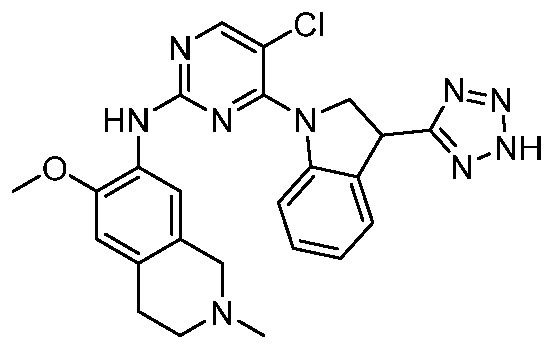
N-(4-(3-(2H-테트라졸-5-일)인돌린-1-일)-5-클로로피리미딘-2-일)-6-메톡시-2-메틸-1,2,3,4-테트라히드로이소퀴놀린-7-아민N-(4-(3-(2H-tetrazol-5-yl)indolin-1-yl)-5-chloropyrimidin-2-yl)-6-methoxy-2-methyl-1,2, 3,4-tetrahydroisoquinolin-7-amine
DMF (1.5 mL) 중 1-(5-클로로-2-((6-메톡시-2-메틸-1,2,3,4-테트라히드로이소퀴놀린-7-일)아미노)피리미딘-4-일)인돌린-3-카르보니트릴 (45 mg, 0.101 mmol), 아지드화나트륨 (9.8 mg, 0.151 mmol) 및 암모니아 아세테이트 (11.6 mg, 0.151 mmol)의 혼합물을 120℃에서 5시간 동안 교반하고, 실온으로 냉각시키고, HCl 수용액 (1 N, 5 mL)으로 희석하고, 추가로 30분 동안 교반하였다. 혼합물을 EA (20 mL x 3)로 추출하였다. 유기 상을 염수 (15 mL)로 세척하고 무수 Na2SO4 상에서 건조시키고, 여과하였다. 여과물을 진공 하에 농축시키고, 잔류물을 정제용-HPLC (MeCN/0.1% 포름산)에 의해 정제하여 N-(4-(3-(2H-테트라졸-5-일)인돌린-1-일)-5-클로로피리미딘-2-일)-6-메톡시-2-메틸-1,2,3,4-테트라히드로이소퀴놀린-7-아민을 백색 고체 (13.4 mg, 27% 수율)로서 제공하였다. LC-MS (ESI) m/z: 490 [M+H]+. 1H NMR (500 MHz, DMSO-d6) δ 8.29 (s, 1H), 8.15 (s, 1H), 8.06 (s, 1H), 7.72 (s, 1H), 7.32 (d, J = 7.7 Hz, 1H), 7.21-7.08 (m, 2H), 6.93 (t, J = 7.5 Hz, 1H), 6.83 (s, 1H), 4.89 (t, J = 9.1 Hz, 1H), 4.72 (s, 1H), 4.56 (s, 1H), 3.81 (s, 3H), 3.77 (s, 2H), 3.01 (s, 2H), 2.90 (d, J = 5.5 Hz, 2H), 2.63 (s, 3H).1-(5-Chloro-2-((6-methoxy-2-methyl-1,2,3,4-tetrahydroisoquinolin-7-yl)amino)pyrimidin-4- in DMF (1.5 mL) A mixture of yl)indoline-3-carbonitrile (45 mg, 0.101 mmol), sodium azide (9.8 mg, 0.151 mmol) and ammonia acetate (11.6 mg, 0.151 mmol) was stirred at 120° C. for 5 hours, Cooled to room temperature, diluted with aqueous HCl solution (1 N, 5 mL) and stirred for an additional 30 min. The mixture was extracted with EA (20 mL×3). The organic phase was washed with brine (15 mL), dried over anhydrous Na 2 SO 4 and filtered. The filtrate was concentrated in vacuo and the residue was purified by prep-HPLC (MeCN/0.1% formic acid) N-(4-(3-(2H-tetrazol-5-yl)indolin-1-yl) )-5-chloropyrimidin-2-yl)-6-methoxy-2-methyl-1,2,3,4-tetrahydroisoquinolin-7-amine as a white solid (13.4 mg, 27% yield) provided. LC-MS (ESI) m/z: 490 [M+H] + . 1 H NMR (500 MHz, DMSO-d 6 ) δ 8.29 (s, 1H), 8.15 (s, 1H), 8.06 (s, 1H), 7.72 (s, 1H), 7.32 (d, J = 7.7 Hz, 1H), 7.21-7.08 (m, 2H), 6.93 (t, J = 7.5 Hz, 1H), 6.83 (s, 1H), 4.89 (t, J = 9.1 Hz, 1H), 4.72 (s, 1H), 4.56 (s, 1H), 3.81 (s, 3H), 3.77 (s, 2H), 3.01 (s, 2H), 2.90 (d, J = 5.5 Hz, 2H), 2.63 (s, 3H).
실시예 101Example 101

1-(5-클로로-2-((6-메톡시-2-메틸-1,2,3,4-테트라히드로이소퀴놀린-7-일)아미노)피리미딘-4-일)-N-히드록시인돌린-3-카르복스아미드1-(5-Chloro-2-((6-methoxy-2-methyl-1,2,3,4-tetrahydroisoquinolin-7-yl)amino)pyrimidin-4-yl)-N-hydro Roxyindoline-3-carboxamide
단계 1: DCM (5 mL) 중 1-(2,5-디클로로피리미딘-4-일)인돌린-3-카르복실산 (150 mg, 0.484 mmol), 옥살릴 디클로라이드 (61.4 mg, 0.484 mmol) 및 N,N-디메틸포름아미드 (1.8 mg, 0.024 mmol)의 혼합물을 실온에서 2시간 동안 교반하고, 진공 하에 농축시켜 조 1-(2,5-디클로로피리미딘-4-일)인돌린-3-카르보닐 클로라이드를 제공하였으며, 이를 후속 단계에 추가 정제 없이 사용하였다.Step 1: 1-(2,5-dichloropyrimidin-4-yl)indoline-3-carboxylic acid (150 mg, 0.484 mmol), oxalyl dichloride (61.4 mg, 0.484 mmol) in DCM (5 mL) ) and N,N-dimethylformamide (1.8 mg, 0.024 mmol) was stirred at room temperature for 2 h and concentrated in vacuo to crude 1-(2,5-dichloropyrimidin-4-yl)indoline- To give 3-carbonyl chloride, which was used in the next step without further purification.
단계 2: MeOH (3 mL) 중 히드록실아민 히드로클로라이드 (79.3 mg, 1.14 mmol)의 현탁액에 0℃에서 KOH (63.8 mg, 1.14 mmol)를 천천히 첨가하였다. 반응 혼합물을 N2 하에 10분 동안 교반하고, 여기에 메탄올 (5 mL) 중 1-(2,5-디클로로피리미딘-4-일)인돌린-3-카르보닐 클로라이드 (75 mg, 0.228 mmol)를 0℃에서 첨가하였다. 이어서, 생성된 혼합물을 16시간 동안 교반하고, 빙냉수 (10 mL)로 켄칭하고, EtOAc (20 mL x 3)로 추출하였다. 유기 상을 염수 (5 mL)로 세척하고, 무수 Na2SO4 상에서 건조시키고, 여과하였다. 여과물을 진공 하에 농축시키고, 잔류물을 실리카 겔 (MeOH/DCM = 0-10/1) 상에서 플래쉬 칼럼 크로마토그래피에 의해 정제하여 1-(2,5-디클로로피리미딘-4-일)-N-히드록시인돌린-3-카르복스아미드를 백색 고체 (50 mg, 43% 수율, 64% 순도)로서 제공하였다. LC-MS (ESI) m/z: 325 [M+H]+.Step 2: To a suspension of hydroxylamine hydrochloride (79.3 mg, 1.14 mmol) in MeOH (3 mL) at 0° C. was slowly added KOH (63.8 mg, 1.14 mmol). The reaction mixture was stirred under N 2 for 10 min, thereto 1-(2,5-dichloropyrimidin-4-yl)indoline-3-carbonyl chloride (75 mg, 0.228 mmol) in methanol (5 mL) was added at 0 °C. The resulting mixture was then stirred for 16 h, quenched with ice cold water (10 mL) and extracted with EtOAc (20 mL×3). The organic phase was washed with brine (5 mL), dried over anhydrous Na 2 SO 4 and filtered. The filtrate was concentrated in vacuo and the residue was purified by flash column chromatography on silica gel (MeOH/DCM = 0-10/1) to 1-(2,5-dichloropyrimidin-4-yl)-N -Hydroxyindoline-3-carboxamide was provided as a white solid (50 mg, 43% yield, 64% purity). LC-MS (ESI) m/z: 325 [M+H] + .
단계 3: 1-(2,5-디클로로피리미딘-4-일)-N-히드록시인돌린-3-카르복스아미드 (50 mg, 64% 순도) 및 Int. W1 (18.9 mg, 0.098 mmol)을 조건 B3 하에 사용하여 정제용-HPLC (10 mM NH4HCO3 & 0.025% NH3·H2O/아세토니트릴)에 의한 정제 후에 1-(5-클로로-2-((6-메톡시-2-메틸-1,2,3,4-테트라히드로이소퀴놀린-7-일)아미노)피리미딘-4-일)-N-히드록시인돌린-3-카르복스아미드 (12.6 mg, 25.4% 수율)를 백색 고체로서 제공하였다. LC-MS (ESI) m/z: 481 [M+H]+. 1H NMR (400 MHz, DMSO-d6) δ 10.94 (s, 1H), 9.04 (s, 1H), 8.25 (s, 1H), 8.03 (s, 1H), 7.50-7.34 (m, 2H), 7.25 (d, J = 7.1 Hz, 1H), 7.11 (t, J = 7.6 Hz, 1H), 6.97 (t, J = 7.7 Hz, 1H), 6.75 (s, 1H), 4.51 (dd, J = 10.3, 6.7 Hz, 1H), 4.39 (t, J = 10.0 Hz, 1H), 4.08-3.99 (m, 1H), 3.77 (s, 3H), 3.27 (s, 2H), 2.77 (d, J = 5.8 Hz, 2H), 2.56 (d, J = 5.7 Hz, 2H), 2.30 (s, 3H).Step 3: 1-(2,5-dichloropyrimidin-4-yl)-N-hydroxyindoline-3-carboxamide (50 mg, 64% purity) and Int. 1-(5-chloro-2 after purification by prep-HPLC (10 mM NH 4 HCO 3 & 0.025% NH 3 .H 2 O/acetonitrile) using W1 (18.9 mg, 0.098 mmol) under condition B3 -((6-Methoxy-2-methyl-1,2,3,4-tetrahydroisoquinolin-7-yl)amino)pyrimidin-4-yl)-N-hydroxyindoline-3-carbox The amide (12.6 mg, 25.4% yield) was provided as a white solid. LC-MS (ESI) m/z: 481 [M+H] + . 1 H NMR (400 MHz, DMSO-d 6 ) δ 10.94 (s, 1H), 9.04 (s, 1H), 8.25 (s, 1H), 8.03 (s, 1H), 7.50-7.34 (m, 2H), 7.25 (d, J = 7.1 Hz, 1H), 7.11 (t, J = 7.6 Hz, 1H), 6.97 (t, J = 7.7 Hz, 1H), 6.75 (s, 1H), 4.51 (dd, J = 10.3) , 6.7 Hz, 1H), 4.39 (t, J = 10.0 Hz, 1H), 4.08-3.99 (m, 1H), 3.77 (s, 3H), 3.27 (s, 2H), 2.77 (d, J = 5.8 Hz) , 2H), 2.56 (d, J = 5.7 Hz, 2H), 2.30 (s, 3H).
실시예 102Example 102

1-(5-클로로-2-((6-메톡시-2-메틸-1,2,3,4-테트라히드로이소퀴놀린-7-일)아미노)피리미딘-4-일)-N-히드록시-N-메틸인돌린-3-카르복스아미드1-(5-Chloro-2-((6-methoxy-2-methyl-1,2,3,4-tetrahydroisoquinolin-7-yl)amino)pyrimidin-4-yl)-N-hydro Roxy-N-methylindoline-3-carboxamide
단계 2에서 히드록실아민 히드로클로라이드 대신 N-메틸히드록실아민을 사용한, 실시예 101과 동일한 절차. LC-MS (ESI) m/z: 495 [M+H]+. 1H NMR (400 MHz, DMSO-d6) δ 10.28 (s, 1H), 8.25 (s, 1H), 8.01 (s, 1H), 7.51 (s, 1H), 7.38 (dd, J = 19.3, 7.6 Hz, 2H), 7.11 (t, J = 7.5 Hz, 1H), 6.95 (t, J = 7.4 Hz, 1H), 6.75 (s, 1H), 4.90-4.79 (m, 1H), 4.51 (dd, J = 10.4, 6.4 Hz, 1H), 4.38 (t, J = 9.9 Hz, 1H), 3.77 (s, 3H), 3.28 (s, 2H), 3.18 (s, 3H), 2.76 (d, J = 5.7 Hz, 2H), 2.56 (d, J = 5.7 Hz, 2H), 2.30 (s, 3H).Same procedure as Example 101, using N-methylhydroxylamine instead of hydroxylamine hydrochloride in step 2. LC-MS (ESI) m/z: 495 [M+H] + . 1 H NMR (400 MHz, DMSO-d 6 ) δ 10.28 (s, 1H), 8.25 (s, 1H), 8.01 (s, 1H), 7.51 (s, 1H), 7.38 (dd, J = 19.3, 7.6 Hz, 2H), 7.11 (t, J = 7.5 Hz, 1H), 6.95 (t, J = 7.4 Hz, 1H), 6.75 (s, 1H), 4.90-4.79 (m, 1H), 4.51 (dd, J = 10.4, 6.4 Hz, 1H), 4.38 (t, J = 9.9 Hz, 1H), 3.77 (s, 3H), 3.28 (s, 2H), 3.18 (s, 3H), 2.76 (d, J = 5.7 Hz) , 2H), 2.56 (d, J = 5.7 Hz, 2H), 2.30 (s, 3H).
실시예 103Example 103

1-(5-클로로-2-((6-메톡시-2-메틸-1,2,3,4-테트라히드로이소퀴놀린-7-일)아미노)피리미딘-4-일)-N-메톡시인돌린-3-카르복스아미드1-(5-Chloro-2-((6-methoxy-2-methyl-1,2,3,4-tetrahydroisoquinolin-7-yl)amino)pyrimidin-4-yl)-N-methoxy Ciidoline-3-carboxamide
단계 2에서 히드록실아민 히드로클로라이드 대신 O-메틸히드록실아민 히드로클로라이드를 사용한, 실시예 101과 동일한 절차. LC-MS (ESI) m/z: 495 [M+H]+. 1H NMR (400 MHz, DMSO-d6) δ 11.60 (s, 1H), 8.25 (s, 1H), 8.05 (s, 1H), 7.50-7.39 (m, 2H), 7.26 (d, J = 7.5 Hz, 1H), 7.12 (t, J = 7.8 Hz, 1H), 6.97 (t, J = 7.1 Hz, 1H), 6.75 (s, 1H), 4.51 (dd, J = 10.4, 6.7 Hz, 1H), 4.39 (t, J = 10.0 Hz, 1H), 4.04-3.96 (m, 1H), 3.77 (s, 3H), 3.64 (s, 3H), 3.28 (s, 2H), 2.78 (s, 2H), 2.56 (d, J = 5.9 Hz, 2H), 2.30 (s, 3H).Same procedure as Example 101, using O-methylhydroxylamine hydrochloride instead of hydroxylamine hydrochloride in step 2. LC-MS (ESI) m/z: 495 [M+H] + . 1 H NMR (400 MHz, DMSO-d 6 ) δ 11.60 (s, 1H), 8.25 (s, 1H), 8.05 (s, 1H), 7.50-7.39 (m, 2H), 7.26 (d, J = 7.5 Hz, 1H), 7.12 (t, J = 7.8 Hz, 1H), 6.97 (t, J = 7.1 Hz, 1H), 6.75 (s, 1H), 4.51 (dd, J = 10.4, 6.7 Hz, 1H), 4.39 (t, J = 10.0 Hz, 1H), 4.04-3.96 (m, 1H), 3.77 (s, 3H), 3.64 (s, 3H), 3.28 (s, 2H), 2.78 (s, 2H), 2.56 (d, J = 5.9 Hz, 2H), 2.30 (s, 3H).
실시예 163Example 163

1-(2-((6-메톡시-2-메틸-1,2,3,4-테트라히드로이소퀴놀린-7-일)아미노)피리미딘-4-일)인돌린-3-카르복실산1-(2-((6-Methoxy-2-methyl-1,2,3,4-tetrahydroisoquinolin-7-yl)amino)pyrimidin-4-yl)indoline-3-carboxylic acid
단계 1: 메탄올 (10 mL) 중 메틸 1-(5-클로로-2-((6-메톡시-2-메틸-1,2,3,4-테트라히드로이소퀴놀린-7-일)아미노)피리미딘-4-일)인돌린-3-카르복실레이트 및 이소프로필 1-(5-클로로-2-((6-메톡시-2-메틸-1,2,3,4-테트라히드로이소퀴놀린-7-일)아미노)피리미딘-4-일)인돌린-3-카르복실레이트의 혼합물 (100 mg) 및 Pd/C (18.2 mg, 0.171 mmol)의 혼합물을 H2 하에 실온에서 16시간 동안 교반하고, 셀라이트의 패드를 통해 여과하였다. 고체 케이크를 EA (20 mL)로 세척하고, 여과물을 진공 하에 농축시켜 메틸 1-(2-((6-메톡시-2-메틸-1,2,3,4-테트라히드로이소퀴놀린-7-일)아미노)피리미딘-4-일)인돌린-3-카르복실레이트 및 이소프로필 1-(2-((6-메톡시-2-메틸-1,2,3,4-테트라히드로이소퀴놀린-7-일)아미노)피리미딘-4-일)인돌린-3-카르복실레이트의 조 혼합물을 제공하였으며, 이를 후속 단계에 정제 없이 사용하였다. LC-MS (ESI) m/z: 446 (메틸 에스테르), 474 (이소프로필 에스테르) [M+H]+.Step 1: Methyl 1-(5-chloro-2-((6-methoxy-2-methyl-1,2,3,4-tetrahydroisoquinolin-7-yl)amino)pyri in methanol (10 mL) Midin-4-yl)indoline-3-carboxylate and isopropyl 1-(5-chloro-2-((6-methoxy-2-methyl-1,2,3,4-tetrahydroisoquinoline- A mixture of 7-yl)amino)pyrimidin-4-yl)indoline-3-carboxylate (100 mg) and Pd/C (18.2 mg, 0.171 mmol) was stirred under H 2 at room temperature for 16 h. and filtered through a pad of Celite. The solid cake was washed with EA (20 mL) and the filtrate was concentrated in vacuo to methyl 1-(2-((6-methoxy-2-methyl-1,2,3,4-tetrahydroisoquinoline-7). -yl)amino)pyrimidin-4-yl)indoline-3-carboxylate and isopropyl 1-(2-((6-methoxy-2-methyl-1,2,3,4-tetrahydroiso A crude mixture of quinolin-7-yl)amino)pyrimidin-4-yl)indoline-3-carboxylate was provided, which was used in the next step without purification. LC-MS (ESI) m/z: 446 (methyl ester), 474 (isopropyl ester) [M+H] + .
단계 2: 메틸 1-(5-클로로-2-((6-메톡시-2-메틸-1,2,3,4-테트라히드로이소퀴놀린-7-일)아미노)피리미딘-4-일)인돌린-3-카르복실레이트 및 이소프로필 1-(5-클로로-2-((6-메톡시-2-메틸-1,2,3,4-테트라히드로이소퀴놀린-7-일)아미노)피리미딘-4-일)인돌린-3-카르복실레이트의 혼합물 대신에 메틸 1-(2-((6-메톡시-2-메틸-1,2,3,4-테트라히드로이소퀴놀린-7-일)아미노)피리미딘-4-일)인돌린-3-카르복실레이트 및 이소프로필 1-(2-((6-메톡시-2-메틸-1,2,3,4-테트라히드로이소퀴놀린-7-일)아미노)피리미딘-4-일)인돌린-3-카르복실레이트의 혼합물을 사용한, 실시예 32의 대안적 합성 방법의 단계 3과 동일한 절차. LC-MS (ESI) m/z: 432 [M+H]+. 1H NMR (400 MHz, DMSO-d6) δ 8.29 (s, 1H), 8.14 (dd, J = 16.9, 6.9 Hz, 2H), 7.82 (s, 1H), 7.62 (s, 1H), 7.43 (d, J = 7.3 Hz, 1H), 7.08 (t, J = 7.7 Hz, 1H), 6.92 (t, J = 7.3 Hz, 1H), 6.80 (s, 1H), 6.27 (d, J = 5.8 Hz, 1H), 4.32 (dd, J = 9.8, 5.0 Hz, 1H), 4.17-4.03 (m, 2H), 3.80 (d, J = 9.1 Hz, 3H), 3.28 (m, 2H), 2.84 (t, J = 5.6 Hz, 2H), 2.66 (t, J = 5.7 Hz, 2H), 2.36 (s, 3H).Step 2: Methyl 1-(5-chloro-2-((6-methoxy-2-methyl-1,2,3,4-tetrahydroisoquinolin-7-yl)amino)pyrimidin-4-yl) Indoline-3-carboxylate and isopropyl 1-(5-chloro-2-((6-methoxy-2-methyl-1,2,3,4-tetrahydroisoquinolin-7-yl)amino) methyl 1-(2-((6-methoxy-2-methyl-1,2,3,4-tetrahydroisoquinoline-7) instead of a mixture of pyrimidin-4-yl)indoline-3-carboxylate -yl)amino)pyrimidin-4-yl)indoline-3-carboxylate and isopropyl 1-(2-((6-methoxy-2-methyl-1,2,3,4-tetrahydroiso Same procedure as step 3 of the alternative synthesis method of Example 32, using a mixture of quinolin-7-yl)amino)pyrimidin-4-yl)indoline-3-carboxylate. LC-MS (ESI) m/z: 432 [M+H] + . 1 H NMR (400 MHz, DMSO-d 6 ) δ 8.29 (s, 1H), 8.14 (dd, J = 16.9, 6.9 Hz, 2H), 7.82 (s, 1H), 7.62 (s, 1H), 7.43 ( d, J = 7.3 Hz, 1H), 7.08 (t, J = 7.7 Hz, 1H), 6.92 (t, J = 7.3 Hz, 1H), 6.80 (s, 1H), 6.27 (d, J = 5.8 Hz, 1H), 4.32 (dd, J = 9.8, 5.0 Hz, 1H), 4.17-4.03 (m, 2H), 3.80 (d, J = 9.1 Hz, 3H), 3.28 (m, 2H), 2.84 (t, J) = 5.6 Hz, 2H), 2.66 (t, J = 5.7 Hz, 2H), 2.36 (s, 3H).
실시예 104Example 104

1-(5-클로로-2-((6-메톡시-2-메틸-1,2,3,4-테트라히드로이소퀴놀린-7-일)아미노)피리미딘-4-일)-5-플루오로인돌린-3-카르복실산1-(5-Chloro-2-((6-methoxy-2-methyl-1,2,3,4-tetrahydroisoquinolin-7-yl)amino)pyrimidin-4-yl)-5-fluoro Rhoindoline-3-carboxylic acid
단계 1에서 Int. E17 대신 Int. E22를 사용한, 실시예 32의 대안적 합성 방법과 동일한 절차. LC-MS (ESI) m/z: 484 [M+H]+. 1H NMR (500 MHz, DMSO-d6) δ 8.23 (s, 2H), 8.02 (s, 1H), 7.49 (s, 1H), 7.40 (dd, J = 8.6, 4.7 Hz, 1H), 7.21 (d, J = 6.7 Hz, 1H), 6.92 (dd, J = 8.9, 6.8 Hz, 1H), 6.78 (s, 1H), 4.60 (dd, J = 10.5, 6.2 Hz, 1H), 4.39 (t, J = 10.1 Hz, 1H), 4.22-4.10 (m, 1H), 3.77 (s, 3H), 3.42 (s, 2H), 2.82 (d, J = 5.5 Hz, 2H), 2.69 (t, J = 19.4 Hz, 2H), 2.40 (s, 3H).In step 1, Int. Instead of E17, Int. Same procedure as the alternative synthesis method of Example 32, using E22. LC-MS (ESI) m/z: 484 [M+H] + . 1 H NMR (500 MHz, DMSO-d 6 ) δ 8.23 (s, 2H), 8.02 (s, 1H), 7.49 (s, 1H), 7.40 (dd, J = 8.6, 4.7 Hz, 1H), 7.21 ( d, J = 6.7 Hz, 1H), 6.92 (dd, J = 8.9, 6.8 Hz, 1H), 6.78 (s, 1H), 4.60 (dd, J = 10.5, 6.2 Hz, 1H), 4.39 (t, J) = 10.1 Hz, 1H), 4.22-4.10 (m, 1H), 3.77 (s, 3H), 3.42 (s, 2H), 2.82 (d, J = 5.5 Hz, 2H), 2.69 (t, J = 19.4 Hz) , 2H), 2.40 (s, 3H).
실시예 105Example 105

1-(5-클로로-2-((6-메톡시-2-메틸-1,2,3,4-테트라히드로이소퀴놀린-7-일)아미노)피리미딘-4-일)-6-플루오로인돌린-3-카르복실산1-(5-Chloro-2-((6-methoxy-2-methyl-1,2,3,4-tetrahydroisoquinolin-7-yl)amino)pyrimidin-4-yl)-6-fluoro Rhoindoline-3-carboxylic acid
단계 1에서 Int. E17 대신 Int. E23을 사용한, 실시예 32의 대안적 합성 방법과 동일한 절차. LC-MS (ESI) m/z: 484 [M+H]+. 1H NMR (400 MHz, DMSO-d6) δ 8.33-8.25 (m, 1H), 8.20 (d, J = 6.6 Hz, 1H), 7.42 (s, 1H), 7.36 (dd, J = 14.4, 6.5 Hz, 1H), 7.20 (d, J = 10.7 Hz, 1H), 6.85-6.65 (m, 2H), 4.61 (dd, J = 10.4, 6.1 Hz, 1H), 4.42 (t, J = 10.0 Hz, 1H), 4.21-4.12 (m, 1H), 3.79 (d, J = 3.1 Hz, 1H), 3.75 (d, J = 10.4 Hz, 3H), 3.36-3.33 (m, 1H), 2.79 (t, J = 5.5 Hz, 2H), 2.63 (t, J = 5.1 Hz, 2H), 2.31 (d, J = 20.7 Hz, 3H).In step 1, Int. Instead of E17, Int. Same procedure as the alternative synthesis method of Example 32, using E23. LC-MS (ESI) m/z: 484 [M+H] + . 1 H NMR (400 MHz, DMSO-d 6 ) δ 8.33-8.25 (m, 1H), 8.20 (d, J = 6.6 Hz, 1H), 7.42 (s, 1H), 7.36 (dd, J = 14.4, 6.5) Hz, 1H), 7.20 (d, J = 10.7 Hz, 1H), 6.85-6.65 (m, 2H), 4.61 (dd, J = 10.4, 6.1 Hz, 1H), 4.42 (t, J = 10.0 Hz, 1H) ), 4.21-4.12 (m, 1H), 3.79 (d, J = 3.1 Hz, 1H), 3.75 (d, J = 10.4 Hz, 3H), 3.36-3.33 (m, 1H), 2.79 (t, J = 5.5 Hz, 2H), 2.63 (t, J = 5.1 Hz, 2H), 2.31 (d, J = 20.7 Hz, 3H).
실시예 106Example 106

1-(5-클로로-2-((6-메톡시-2-메틸-1,2,3,4-테트라히드로이소퀴놀린-7-일)아미노)피리미딘-4-일)-5-메톡시인돌린-3-카르복실산1-(5-Chloro-2-((6-methoxy-2-methyl-1,2,3,4-tetrahydroisoquinolin-7-yl)amino)pyrimidin-4-yl)-5-methoxy Ciidoline-3-carboxylic acid
단계 1에서 Int. E17 대신 Int. E24를 사용한, 실시예 32의 대안적 합성 방법과 동일한 절차. LC-MS (ESI) m/z: 496 [M+H]+. 1H NMR (400 MHz, DMSO-d6) δ 8.20 (s, 1H), 7.96 (s, 1H), 7.50 (s, 1H), 7.39 (d, J = 8.8 Hz, 1H), 6.96 (d, J = 2.0 Hz, 1H), 6.83-6.58 (m, 1H), 4.69-4.50 (m, 1H), 4.40 (s, 1H), 4.25 (d, J = 6.2 Hz, 1H), 3.76 (d, J = 11.4 Hz, 6H), 3.41 (s, 1H), 2.79 (d, J = 5.6 Hz, 2H), 2.64 (d, J = 5.4 Hz, 2H), 2.35 (s, 3H).In step 1, Int. Instead of E17, Int. Same procedure as the alternative synthesis method of Example 32, using E24. LC-MS (ESI) m/z: 496 [M+H] + . 1 H NMR (400 MHz, DMSO-d 6 ) δ 8.20 (s, 1H), 7.96 (s, 1H), 7.50 (s, 1H), 7.39 (d, J = 8.8 Hz, 1H), 6.96 (d, J = 2.0 Hz, 1H), 6.83-6.58 (m, 1H), 4.69-4.50 (m, 1H), 4.40 (s, 1H), 4.25 (d, J = 6.2 Hz, 1H), 3.76 (d, J) = 11.4 Hz, 6H), 3.41 (s, 1H), 2.79 (d, J = 5.6 Hz, 2H), 2.64 (d, J = 5.4 Hz, 2H), 2.35 (s, 3H).
실시예 107Example 107

1-(5-클로로-2-((6-메톡시-2-메틸-1,2,3,4-테트라히드로이소퀴놀린-7-일)아미노)피리미딘-4-일)-6-메톡시인돌린-3-카르복실산1-(5-Chloro-2-((6-methoxy-2-methyl-1,2,3,4-tetrahydroisoquinolin-7-yl)amino)pyrimidin-4-yl)-6-methoxy Ciidoline-3-carboxylic acid
단계 1에서 Int. E17 대신 Int. E25를 사용한, 실시예 32의 대안적 합성 방법과 동일한 절차. LC-MS (ESI) m/z: 496 [M+H]+. 1H NMR (500 MHz, DMSO-d6) δ 8.45 (s, 1H), 8.14 (s, 1H), 7.51 (d, J = 11.9 Hz, 1H), 7.39 (dd, J = 8.3, 2.3 Hz, 1H), 7.19 (d, J = 9.4 Hz, 1H), 7.03 (s, 1H), 6.76 (d, J = 8.4 Hz, 1H), 4.69 (d, J = 2.6 Hz, 1H), 4.62 (t, J = 10.0 Hz, 1H), 4.36-4.22 (m, 2H), 4.10 (d, J = 11.4 Hz, 1H), 3.85 (d, J = 1.7 Hz, 3H), 3.70 (d, J = 3.6 Hz, 4H), 3.33 (s, 1H), 3.14 (s, 1H), 3.07 (d, J = 17.0 Hz, 1H), 2.94 (s, 3H).In step 1, Int. Instead of E17, Int. Same procedure as the alternative synthesis method of Example 32, using E25. LC-MS (ESI) m/z: 496 [M+H] + . 1 H NMR (500 MHz, DMSO-d 6 ) δ 8.45 (s, 1H), 8.14 (s, 1H), 7.51 (d, J = 11.9 Hz, 1H), 7.39 (dd, J = 8.3, 2.3 Hz, 1H), 7.19 (d, J = 9.4 Hz, 1H), 7.03 (s, 1H), 6.76 (d, J = 8.4 Hz, 1H), 4.69 (d, J = 2.6 Hz, 1H), 4.62 (t, J = 10.0 Hz, 1H), 4.36-4.22 (m, 2H), 4.10 (d, J = 11.4 Hz, 1H), 3.85 (d, J = 1.7 Hz, 3H), 3.70 (d, J = 3.6 Hz, 4H), 3.33 (s, 1H), 3.14 (s, 1H), 3.07 (d, J = 17.0 Hz, 1H), 2.94 (s, 3H).
실시예 108Example 108

1-(5-클로로-2-((6-메톡시-2-메틸-1,2,3,4-테트라히드로이소퀴놀린-7-일)아미노)피리미딘-4-일)-4-메톡시인돌린-3-카르복실산1-(5-Chloro-2-((6-methoxy-2-methyl-1,2,3,4-tetrahydroisoquinolin-7-yl)amino)pyrimidin-4-yl)-4-methoxy Ciidoline-3-carboxylic acid
단계 1에서 Int. E17 대신 Int. E26을 사용한, 실시예 32의 대안적 합성 방법과 동일한 절차. LC-MS (ESI) m/z: 496 [M+H]+. 1H NMR (400 MHz, DMSO-d6) δ 8.24 (s, 1H), 8.00 (s, 1H), 7.52 (s, 1H), 7.11 (t, J = 8.1 Hz, 1H), 7.03 (d, J = 8.0 Hz, 1H), 6.75 (s, 1H), 6.63 (d, J = 8.1 Hz, 1H), 4.51 (t, J = 10.2 Hz, 1H), 4.32 (dd, J = 10.6, 4.8 Hz, 1H), 4.10 (dd, J = 9.7, 4.7 Hz, 1H), 3.77 (s, 7H), 2.78 (t, J = 5.6 Hz, 2H), 2.58 (t, J = 5.7 Hz, 2H), 2.49-2.48 (m, 1H), 2.33 (s, 3H).In step 1, Int. Instead of E17, Int. Same procedure as the alternative synthesis method of Example 32, using E26. LC-MS (ESI) m/z: 496 [M+H] + . 1 H NMR (400 MHz, DMSO-d 6 ) δ 8.24 (s, 1H), 8.00 (s, 1H), 7.52 (s, 1H), 7.11 (t, J = 8.1 Hz, 1H), 7.03 (d, J = 8.0 Hz, 1H), 6.75 (s, 1H), 6.63 (d, J = 8.1 Hz, 1H), 4.51 (t, J = 10.2 Hz, 1H), 4.32 (dd, J = 10.6, 4.8 Hz, 1H), 4.10 (dd, J = 9.7, 4.7 Hz, 1H), 3.77 (s, 7H), 2.78 (t, J = 5.6 Hz, 2H), 2.58 (t, J = 5.7 Hz, 2H), 2.49- 2.48 (m, 1H), 2.33 (s, 3H).
실시예 109Example 109

1-(5-플루오로-2-((6-메톡시-2-메틸-1,2,3,4-테트라히드로이소퀴놀린-7-일)아미노)피리미딘-4-일)인돌린-3-카르복실산1-(5-Fluoro-2-((6-methoxy-2-methyl-1,2,3,4-tetrahydroisoquinolin-7-yl)amino)pyrimidin-4-yl)indoline- 3-carboxylic acid
단계 1에서 2,4,5-트리클로로피리미딘 대신 2,4-디클로로-5-플루오로피리미딘을 사용한, 실시예 32의 대안적 합성 방법과 동일한 절차. LC-MS (ESI) m/z: 450 [M+H]+. 1H NMR (400 MHz, DMSO-d6) δ 8.19 (d, J = 5.8 Hz, 1H), 7.90 (d, J = 19.6 Hz, 1H), 7.85(d, J = 8.2 Hz, 1H), 7.50 (s, 1H), 7.40 (d, J = 7.4 Hz, 1H), 7.10 (t, J = 7.6 Hz, 1H), 6.98 (t, J = 7.4 Hz, 1H), 6.78 (s, 1H), 4.53 (dt, J = 10.5, 5.3 Hz, 1H), 4.41-4.31 (m, 1H), 4.27 (dd, J = 9.8, 5.7 Hz, 1H), 3.77 (s, 3H), 3.41 (s, 2H), 2.82 (t, J = 5.5 Hz, 2H), 2.64 (t, J = 5.9 Hz, 2H), 2.35 (s, 3H).Same procedure as the alternative synthesis method of Example 32, using 2,4-dichloro-5-fluoropyrimidine instead of 2,4,5-trichloropyrimidine in step 1. LC-MS (ESI) m/z: 450 [M+H] + . 1 H NMR (400 MHz, DMSO-d 6 ) δ 8.19 (d, J = 5.8 Hz, 1H), 7.90 (d, J = 19.6 Hz, 1H), 7.85 (d, J = 8.2 Hz, 1H), 7.50 (s, 1H), 7.40 (d, J = 7.4 Hz, 1H), 7.10 (t, J = 7.6 Hz, 1H), 6.98 (t, J = 7.4 Hz, 1H), 6.78 (s, 1H), 4.53 (dt, J = 10.5, 5.3 Hz, 1H), 4.41-4.31 (m, 1H), 4.27 (dd, J = 9.8, 5.7 Hz, 1H), 3.77 (s, 3H), 3.41 (s, 2H), 2.82 (t, J = 5.5 Hz, 2H), 2.64 (t, J = 5.9 Hz, 2H), 2.35 (s, 3H).
실시예 110Example 110

1-(5-시아노-2-((6-메톡시-2-메틸-1,2,3,4-테트라히드로이소퀴놀린-7-일)아미노)피리미딘-4-일)인돌린-3-카르복실산1-(5-cyano-2-((6-methoxy-2-methyl-1,2,3,4-tetrahydroisoquinolin-7-yl)amino)pyrimidin-4-yl)indoline- 3-carboxylic acid
단계 1에서 2,4,5-트리클로로피리미딘 대신 2,4-디클로로피리미딘-5-카르보니트릴을 사용한, 실시예 32의 대안적 합성 방법과 동일한 절차. LC-MS (ESI) m/z: 457 [M+H]+. 1H NMR (500 MHz, DMSO-d6) δ 9.13 (s, 1H), 8.54 (s, 1H), 7.41 (d, J = 65.9 Hz, 2H), 6.98 (d, J = 75.7 Hz, 3H), 4.45 (s, 1H), 4.20 (s, 2H), 3.70 (s, 3H), 3.16-3.08 (m, 2H), 2.91 (s, 2H), 2.65 (s, 2H), 2.35 (s, 3H).Same procedure as the alternative synthesis method of Example 32, using 2,4-dichloropyrimidine-5-carbonitrile instead of 2,4,5-trichloropyrimidine in step 1. LC-MS (ESI) m/z: 457 [M+H] + . 1 H NMR (500 MHz, DMSO-d 6 ) δ 9.13 (s, 1H), 8.54 (s, 1H), 7.41 (d, J = 65.9 Hz, 2H), 6.98 (d, J = 75.7 Hz, 3H) , 4.45 (s, 1H), 4.20 (s, 2H), 3.70 (s, 3H), 3.16-3.08 (m, 2H), 2.91 (s, 2H), 2.65 (s, 2H), 2.35 (s, 3H) ).
실시예 111Example 111

1-(5-클로로-2-((6-이소프로폭시-2-메틸-1,2,3,4-테트라히드로이소퀴놀린-7-일)아미노)피리미딘-4-일)인돌린-3-카르복실산1-(5-Chloro-2-((6-isopropoxy-2-methyl-1,2,3,4-tetrahydroisoquinolin-7-yl)amino)pyrimidin-4-yl)indoline- 3-carboxylic acid
단계 2에서 Int. W1 대신 Int. W9를 사용한, 실시예 32의 대안적 합성 방법과 동일한 절차. LC-MS (ESI) m/z: 494 [M+H]+.In step 2, Int. Instead of W1, Int. Same procedure as the alternative synthesis method of Example 32, using W9. LC-MS (ESI) m/z: 494 [M+H] + .
실시예 112Example 112

메틸 1-(5-(디플루오로메틸)-2-((6-메톡시-2-메틸-1,2,3,4-테트라히드로이소퀴놀린-7-일)아미노)피리미딘-4-일)인돌린-3-카르복실레이트Methyl 1-(5-(difluoromethyl)-2-((6-methoxy-2-methyl-1,2,3,4-tetrahydroisoquinolin-7-yl)amino)pyrimidin-4- Day) Indoline-3-carboxylate
단계 1: DCM (5 mL) 중 2,4-디클로로피리미딘-5-카르브알데히드 (300 mg, 1.70 mmol)의 용액에 N-에틸-N-(트리플루오로-술파닐)에탄아민 (1.37 g, 8.48 mmol)을 0℃에서 적가하였다. 반응 혼합물을 25℃에서 16시간 동안 교반하고, 0℃로 냉각시키고, 포화 중탄산나트륨 수용액을 사용하여 pH ~8로 염기성화시키고, 디클로로메탄 (5 mL x 3)으로 추출하였다. 유기 상을 무수 황산나트륨 상에서 건조시키고, 여과하였다. 여과물을 진공 하에 농축시켜 2,4-디클로로-5-(디플루오로메틸)피리미딘을 담황색 오일 (303 mg, 85% 수율)로서 제공하였다. LC-MS (ESI) m/z: 335 [M+H]+.Step 1: To a solution of 2,4-dichloropyrimidine-5-carbaldehyde (300 mg, 1.70 mmol) in DCM (5 mL) N-ethyl-N-(trifluoro-sulfanyl)ethanamine (1.37 g, 8.48 mmol) was added dropwise at 0°C. The reaction mixture was stirred at 25° C. for 16 h, cooled to 0° C., basified to pH-8 with saturated aqueous sodium bicarbonate solution, and extracted with dichloromethane (5 mL×3). The organic phase was dried over anhydrous sodium sulfate and filtered. The filtrate was concentrated in vacuo to provide 2,4-dichloro-5-(difluoromethyl)pyrimidine as a pale yellow oil (303 mg, 85% yield). LC-MS (ESI) m/z: 335 [M+H] + .
단계 2: Int. E17 (115.8 mg, 0.653 mmol) 및 2,4-디클로로-5-(디플루오로메틸)피리미딘 (130 mg, 0.653 mmol)을 조건 A3 하에 사용하고, 실리카 겔 상에서 플래쉬 칼럼 크로마토그래피 (PE/EA = 10/1)에 의한 정제 후에 메틸 1-(2-클로로-5-(디플루오로메틸)피리미딘-4-일)인돌린-3-카르복실레이트 (160 mg, 68.5% 수율)를 담황색 고체로서 제공하였다. LC-MS (ESI) m/z: 340 [M+H]+.Step 2: Int. E17 (115.8 mg, 0.653 mmol) and 2,4-dichloro-5-(difluoromethyl)pyrimidine (130 mg, 0.653 mmol) were used under condition A3 and flash column chromatography on silica gel (PE/EA = 10/1) after purification by methyl 1-(2-chloro-5-(difluoromethyl)pyrimidin-4-yl)indoline-3-carboxylate (160 mg, 68.5% yield) to pale yellow provided as a solid. LC-MS (ESI) m/z: 340 [M+H] + .
단계 3: 메틸 1-(2-클로로-5-(디플루오로메틸)피리미딘-4-일)인돌린-3-카르복실레이트 (159 mg, 0.445 mmol) 및 Int. W1 (102.6 mg, 0.534 mmol)을 조건 B3 하에 사용하고, 실리카 겔 상에서 플래쉬 칼럼 크로마토그래피 (PE/EA = 10/1)에 의한 정제 후에 메틸 1-(5-(디플루오로메틸)-2-((6-메톡시-2-메틸-1,2,3,4-테트라히드로이소퀴놀린-7-일)아미노)피리미딘-4-일)인돌린-3-카르복실레이트 (30 mg, 10.9% 수율)를 담황색 고체로서 제공하였다. LC-MS (ESI) m/z: 496 [M+H]+. 1H NMR (500 MHz, DMSO-d6) δ 8.44 (s, 1H), 8.39 (s, 1H), 7.58 (s, 1H), 7.42 (s, 1H), 7.35 (d, J = 7.4 Hz, 1H), 7.12 (d, J = 8.6 Hz, 1H), 7.00 (t, J = 7.3 Hz, 1H), 6.84 (d, J = 10.3 Hz, 1H), 4.47-4.39 (m, 2H), 4.34 (t, J = 9.6 Hz, 1H), 3.76 (s, 3H), 3.69 (s, 3H), 3.56 (s, 2H), 2.88 (m, 4H), 2.49-2.46 (s, 3H).Step 3: Methyl 1-(2-chloro-5-(difluoromethyl)pyrimidin-4-yl)indoline-3-carboxylate (159 mg, 0.445 mmol) and Int. W1 (102.6 mg, 0.534 mmol) was used under condition B3 and after purification by flash column chromatography on silica gel (PE/EA = 10/1) methyl 1-(5-(difluoromethyl)-2- ((6-Methoxy-2-methyl-1,2,3,4-tetrahydroisoquinolin-7-yl)amino)pyrimidin-4-yl)indoline-3-carboxylate (30 mg, 10.9 % yield) as a pale yellow solid. LC-MS (ESI) m/z: 496 [M+H] + . 1 H NMR (500 MHz, DMSO-d 6 ) δ 8.44 (s, 1H), 8.39 (s, 1H), 7.58 (s, 1H), 7.42 (s, 1H), 7.35 (d, J = 7.4 Hz, 1H), 7.12 (d, J = 8.6 Hz, 1H), 7.00 (t, J = 7.3 Hz, 1H), 6.84 (d, J = 10.3 Hz, 1H), 4.47-4.39 (m, 2H), 4.34 ( t, J = 9.6 Hz, 1H), 3.76 (s, 3H), 3.69 (s, 3H), 3.56 (s, 2H), 2.88 (m, 4H), 2.49-2.46 (s, 3H).
실시예 113Example 113

1-(5-클로로-2-((6-메톡시-2-메틸-1,2,3,4-테트라히드로이소퀴놀린-7-일)아미노)피리미딘-4-일)-1H-인다졸-3-카르복실산1-(5-Chloro-2-((6-methoxy-2-methyl-1,2,3,4-tetrahydroisoquinolin-7-yl)amino)pyrimidin-4-yl)-1H-inda sol-3-carboxylic acid
단계 1에서 Int. E17 대신 메틸 1H-인다졸-3-카르복실레이트를 사용한, 실시예 32의 대안적 합성 방법과 동일한 절차. LC-MS (ESI) m/z: 465 [M+H]+. 1H NMR (400 MHz, DMSO-d6) δ 8.87 (s, 1H), 8.63 (s, 1H), 8.38-8.22 (m, 2H), 7.99 (d, J = 8.1 Hz, 1H), 7.55-7.28 (m, 3H), 6.83 (s, 1H), 3.77 (s, 3H), 3.39-3.38 (m, 2H), 2.82 (d, J = 5.3 Hz, 2H), 2.61 (t, J = 5.7 Hz, 2H), 2.33 (s, 3H).In step 1, Int. Same procedure as the alternative synthesis method of Example 32, using methyl 1H-indazole-3-carboxylate instead of E17. LC-MS (ESI) m/z: 465 [M+H] + . 1 H NMR (400 MHz, DMSO-d 6 ) δ 8.87 (s, 1H), 8.63 (s, 1H), 8.38-8.22 (m, 2H), 7.99 (d, J = 8.1 Hz, 1H), 7.55 7.28 (m, 3H), 6.83 (s, 1H), 3.77 (s, 3H), 3.39-3.38 (m, 2H), 2.82 (d, J = 5.3 Hz, 2H), 2.61 (t, J = 5.7 Hz) , 2H), 2.33 (s, 3H).
실시예 34Example 34

1-(5-클로로-2-((6-메톡시-2-메틸-1,2,3,4-테트라히드로이소퀴놀린-7-일)아미노)피리미딘-4-일)-1H-인돌-3-카르복스아미드1-(5-Chloro-2-((6-methoxy-2-methyl-1,2,3,4-tetrahydroisoquinolin-7-yl)amino)pyrimidin-4-yl)-1H-indole -3-carboxamide
단계 1: 1H-인돌-3-카르복실산 (500 mg, 3.10 mmol) 및 2,4,5-트리클로로피리미딘 (625.99 mg, 3.41 mmol)을 조건 A1 하에 사용하고, 실리카 겔 상에서 플래쉬 칼럼 크로마토그래피 (DCM/MeOH, 50/1)에 의한 정제 후에 1-(2,5-디클로로피리미딘-4-일)인돌-3-카르복실산 (200 mg, 19.88% 수율, 95% 순도)을 황색 고체로서 제공하였다. LC-MS (ESI) m/z: 308.1 [M+H]+.Step 1: Using 1H-indole-3-carboxylic acid (500 mg, 3.10 mmol) and 2,4,5-trichloropyrimidine (625.99 mg, 3.41 mmol) under condition A1, flash column chromatography on silica gel 1-(2,5-dichloropyrimidin-4-yl)indole-3-carboxylic acid (200 mg, 19.88% yield, 95% purity) to yellow after purification by (DCM/MeOH, 50/1) provided as a solid. LC-MS (ESI) m/z: 308.1 [M+H] + .
단계 2&3: 1-(2,5-디클로로피리미딘-4-일)인돌린-3-카르복실산 대신 1-(2,5-디클로로피리미딘-4-일)인돌-3-카르복실산을 사용한, 실시예 33의 단계 1&2의 조건과 동일한 절차. LC-MS (ESI) m/z: 463.1 [M+H]+. 1H NMR (400 MHz, DMSO-d6) δ 8.87 (s, 1H), 8.71 (s, 1H), 8.49 (s, 1H), 8.29-8.15 (m, 1H), 7.78-7.64 (m, 2H), 7.39 (s, 1H), 7.31-7.21 (m, 2H), 7.11 (s, 1H), 6.79 (s, 1H), 3.79 (s, 3H), 3.33 (d, J = 5.8 Hz, 2H), 2.85-2.70 (m, 2H), 2.54 (t, J = 5.9 Hz, 2H), 2.29 (s, 3H).Step 2&3: Replace 1-(2,5-dichloropyrimidin-4-yl)indoline-3-carboxylic acid with 1-(2,5-dichloropyrimidin-4-yl)indole-3-carboxylic acid The same procedure as the conditions of steps 1 & 2 of Example 33, used. LC-MS (ESI) m/z: 463.1 [M+H] + . 1 H NMR (400 MHz, DMSO-d 6 ) δ 8.87 (s, 1H), 8.71 (s, 1H), 8.49 (s, 1H), 8.29-8.15 (m, 1H), 7.78-7.64 (m, 2H) ), 7.39 (s, 1H), 7.31-7.21 (m, 2H), 7.11 (s, 1H), 6.79 (s, 1H), 3.79 (s, 3H), 3.33 (d, J = 5.8 Hz, 2H) , 2.85-2.70 (m, 2H), 2.54 (t, J = 5.9 Hz, 2H), 2.29 (s, 3H).
실시예 114Example 114

메틸 1-(5-클로로-2-((6-메톡시-2-메틸-1,2,3,4-테트라히드로이소퀴놀린-7-일)아미노)피리미딘-4-일)-1H-인돌-3-카르복실레이트Methyl 1-(5-chloro-2-((6-methoxy-2-methyl-1,2,3,4-tetrahydroisoquinolin-7-yl)amino)pyrimidin-4-yl)-1H- Indole-3-carboxylate
실시예 35Example 35

1-(5-클로로-2-((6-메톡시-2-메틸-1,2,3,4-테트라히드로이소퀴놀린-7-일)아미노)피리미딘-4-일)-1H-인돌-3-카르복실산1-(5-Chloro-2-((6-methoxy-2-methyl-1,2,3,4-tetrahydroisoquinolin-7-yl)amino)pyrimidin-4-yl)-1H-indole -3-carboxylic acid
단계 1: 메틸 1H-인돌-3-카르복실레이트 (1 g, 5.71 mmol) 및 2,4,5-트리클로로피리미딘 (1.15 g, 6.28 mmol)을 조건 A1 하에 사용하고, 실리카 겔 상에서 플래쉬 칼럼 크로마토그래피 (DCM/MeOH = 100/1)에 의한 정제 후에 메틸 1-(2,5-디클로로피리미딘-4-일)-1H-인돌-3-카르복실레이트 (800 mg, 43.5% 수율)를 담황색 고체로서 제공하였다. LC-MS (ESI) m/z: 322 [M+H]+.Step 1: Using methyl 1H-indole-3-carboxylate (1 g, 5.71 mmol) and 2,4,5-trichloropyrimidine (1.15 g, 6.28 mmol) under condition A1, flash column on silica gel Methyl 1-(2,5-dichloropyrimidin-4-yl)-1H-indole-3-carboxylate (800 mg, 43.5% yield) was obtained after purification by chromatography (DCM/MeOH = 100/1) It was provided as a pale yellow solid. LC-MS (ESI) m/z: 322 [M+H] + .
단계 2: 메틸 1-(2,5-디클로로피리미딘-4-일)-1H-인돌-3-카르복실레이트 (200 mg, 0.621 mmol) 및 Int. W1 (143.2 mg, 0.745 mmol)을 조건 B3 하에 사용하고, 실리카 겔 상에서 플래쉬 칼럼 크로마토그래피 (DCM/MeOH = 100/1)에 의한 정제 후에 메틸 1-(5-클로로-2-((6-메톡시-2-메틸-1,2,3,4-테트라히드로이소퀴놀린-7-일)아미노)피리미딘-4-일)-1H-인돌-3-카르복실레이트 (138 mg, 44.2% 수율)를 백색 고체로서 제공하였다. LC-MS (ESI) m/z: 478 [M+H]+. 1H NMR (400 MHz, DMSO-d6) δ 8.95 (s, 1H), 8.72 (s, 1H), 8.48 (s, 1H), 8.09 (dd, J = 6.4, 2.3 Hz, 1H), 7.76 (dd, J = 6.6, 2.1 Hz, 1H), 7.47-7.24 (m, 3H), 6.79 (s, 1H), 3.87 (s, 3H), 3.78 (s, 3H), 3.33 (s, 2H), 2.78 (t, J = 5.7 Hz, 2H), 2.55 (d, J = 5.7 Hz, 2H), 2.30 (s, 3H).Step 2: Methyl 1-(2,5-dichloropyrimidin-4-yl)-1H-indole-3-carboxylate (200 mg, 0.621 mmol) and Int. W1 (143.2 mg, 0.745 mmol) was used under condition B3 and after purification by flash column chromatography on silica gel (DCM/MeOH = 100/1) methyl 1-(5-chloro-2-((6-me Toxy-2-methyl-1,2,3,4-tetrahydroisoquinolin-7-yl)amino)pyrimidin-4-yl)-1H-indole-3-carboxylate (138 mg, 44.2% yield) was provided as a white solid. LC-MS (ESI) m/z: 478 [M+H] + . 1 H NMR (400 MHz, DMSO-d 6 ) δ 8.95 (s, 1H), 8.72 (s, 1H), 8.48 (s, 1H), 8.09 (dd, J = 6.4, 2.3 Hz, 1H), 7.76 ( dd, J = 6.6, 2.1 Hz, 1H), 7.47-7.24 (m, 3H), 6.79 (s, 1H), 3.87 (s, 3H), 3.78 (s, 3H), 3.33 (s, 2H), 2.78 (t, J = 5.7 Hz, 2H), 2.55 (d, J = 5.7 Hz, 2H), 2.30 (s, 3H).
단계 3: 메틸 1-(5-클로로-2-((6-메톡시-2-메틸-1,2,3,4-테트라히드로이소퀴놀린-7-일)아미노)피리미딘-4-일)-1H-인돌-3-카르복실레이트 (454 mg, 0.950 mmol), AcOH (456 mg, 7.60 mmol) 및 HCl 수용액 (6 N, 36 mL)의 혼합물을 50℃에서 16시간 동안 교반하고, 정제용-HPLC (MeCN/0.04% 포름산)에 의해 정제하여 1-(5-클로로-2-((6-메톡시-2-메틸-1,2,3,4-테트라히드로이소퀴놀린-7-일)아미노)피리미딘-4-일)-1H-인돌-3-카르복실산 (33.1 mg, 7.5% 수율)을 백색 고체로서 제공하였다. LC-MS (ESI) m/z: 464.2 [M+H]+. 1H NMR (400 MHz, DMSO-d6) δ 8.88 (s, 1H), 8.69 (s, 1H), 8.33 (d, J = 20.1 Hz, 2H), 8.18 (s, 1H), 7.75 (d, J = 7.8 Hz, 1H), 7.37 (s, 1H), 7.28 (s, 2H), 6.80 (s, 1H), 3.79 (s, 3H), 3.34-3.33 (m, 2H), 2.78 (s, 2H), 2.55 (s, 2H), 2.30 (s, 3H)Step 3: Methyl 1-(5-chloro-2-((6-methoxy-2-methyl-1,2,3,4-tetrahydroisoquinolin-7-yl)amino)pyrimidin-4-yl) A mixture of -1H-indole-3-carboxylate (454 mg, 0.950 mmol), AcOH (456 mg, 7.60 mmol) and aqueous HCl solution (6 N, 36 mL) was stirred at 50° C. for 16 h, and purified - Purification by HPLC (MeCN/0.04% formic acid) 1-(5-chloro-2-((6-methoxy-2-methyl-1,2,3,4-tetrahydroisoquinolin-7-yl) Provided amino)pyrimidin-4-yl)-1H-indole-3-carboxylic acid (33.1 mg, 7.5% yield) as a white solid. LC-MS (ESI) m/z: 464.2 [M+H] + . 1 H NMR (400 MHz, DMSO-d 6 ) δ 8.88 (s, 1H), 8.69 (s, 1H), 8.33 (d, J = 20.1 Hz, 2H), 8.18 (s, 1H), 7.75 (d, J = 7.8 Hz, 1H), 7.37 (s, 1H), 7.28 (s, 2H), 6.80 (s, 1H), 3.79 (s, 3H), 3.34-3.33 (m, 2H), 2.78 (s, 2H) ), 2.55 (s, 2H), 2.30 (s, 3H)
실시예 116Example 116

메틸 1-(5-클로로-2-((6-메톡시-2-메틸-1,2,3,4-테트라히드로이소퀴놀린-7-일)아미노)피리미딘-4-일)-3-메틸인돌린-3-카르복실레이트Methyl 1-(5-chloro-2-((6-methoxy-2-methyl-1,2,3,4-tetrahydroisoquinolin-7-yl)amino)pyrimidin-4-yl)-3- Methylindoline-3-carboxylate
실시예 117Example 117

1-(5-클로로-2-((6-메톡시-2-메틸-1,2,3,4-테트라히드로이소퀴놀린-7-일)아미노)피리미딘-4-일)-3-메틸인돌린-3-카르복실산1-(5-Chloro-2-((6-methoxy-2-methyl-1,2,3,4-tetrahydroisoquinolin-7-yl)amino)pyrimidin-4-yl)-3-methyl Indoline-3-carboxylic acid
단계 1: n-부탄올 (4 mL) 중 Int. E18 (158 mg, 0.826 mmol), 2,4,5-트리클로로피리미딘 (197.0 mg, 1.07 mmol) 및 DIPEA (427.2 mg, 3.30 mmol)의 혼합물을 100℃에서 12시간 동안 교반하고, 실온으로 냉각시키고, DCM/MeOH (10/1, 100 mL) 및 물 (30 mL)로 희석하였다. 수성 상을 분리하고, DCM/MeOH (10/1, 30 mL x 3)로 추출하였다. 합한 유기 상을 염수 (40 mL)로 세척하고, 무수 황산나트륨 상에서 건조시키고, 여과하였다. 여과물을 진공 하에 농축시키고, 잔류물을 실리카 겔 상에서 플래쉬 칼럼 크로마토그래피 (EA/PE: 30%)에 의해 정제하고, 실리카 겔 상에서 플래쉬 칼럼 크로마토그래피 (EA/PE: 30%)에 의한 정제 후에 메틸 1-(2,5-디클로로피리미딘-4-일)-3-메틸인돌린-3-카르복실레이트 (257 mg, 89.2% 수율)를 담황색 고체로서 제공하였다. LC-MS (ESI) m/z: 338 [M+H]+.Step 1: Int. in n-butanol (4 mL). A mixture of E18 (158 mg, 0.826 mmol), 2,4,5-trichloropyrimidine (197.0 mg, 1.07 mmol) and DIPEA (427.2 mg, 3.30 mmol) was stirred at 100° C. for 12 h and cooled to room temperature. and diluted with DCM/MeOH (10/1, 100 mL) and water (30 mL). The aqueous phase was separated and extracted with DCM/MeOH (10/1, 30 mL×3). The combined organic phases were washed with brine (40 mL), dried over anhydrous sodium sulfate and filtered. The filtrate was concentrated in vacuo and the residue was purified by flash column chromatography on silica gel (EA/PE: 30%) and after purification by flash column chromatography on silica gel (EA/PE: 30%). Provided methyl 1-(2,5-dichloropyrimidin-4-yl)-3-methylindoline-3-carboxylate (257 mg, 89.2% yield) as a pale yellow solid. LC-MS (ESI) m/z: 338 [M+H] + .
단계 2: 이소프로판올 (3 mL) 중 메틸 1-(2,5-디클로로피리미딘-4-일)-3-메틸인돌린-3-카르복실레이트 (50 mg, 0.148 mmol), Int. W1 (40.6 mg, 0.177 mmol) 및 TsOH·H2O (28.1 mg, 0.148 mmol)의 혼합물을 120℃에서 12시간 동안 교반하고, 실온으로 냉각시키고, 포화 NaHCO3 수용액 (4 mL)으로 중화시키고, DCM (20 mL x 3)으로 추출하였다. 유기 상을 무수 황산나트륨 상에서 건조시키고, 여과하였다. 여과물을 진공 하에 농축시키고, 잔류물을 정제용-HPLC (MeCN/10 mM NH4HCO3, 0.025% NH3·H2O)에 의해 정제하여 메틸 1-(5-클로로-2-((6-메톡시-2-메틸-1,2,3,4-테트라히드로이소퀴놀린-7-일)아미노)피리미딘-4-일)-3-메틸인돌린-3-카르복실레이트 (20 mg, 27.4% 수율)를 황색 고체로서 제공하였다. LC-MS (ESI) m/z: 494 [M+H]+. 1H NMR (400 MHz, DMSO-d6) δ 8.27 (s, 1H), 8.08 (s, 1H), 7.49 (s, 1H), 7.35 (dd, J = 12.7, 7.8 Hz, 2H), 7.16 (t, J = 7.8 Hz, 1H), 7.00 (t, J = 7.5 Hz, 1H), 6.75 (s, 1H), 4.75 (d, J = 10.8 Hz, 1H), 4.09 (d, J = 10.8 Hz, 1H), 3.76 (s, 3H), 3.63 (s, 3H), 3.29 (s, 2H), 2.77 (t, J = 5.5 Hz, 2H), 2.56 (d, J = 5.8 Hz, 2H), 2.31 (s, 3H), 1.56 (s, 3H).Step 2: Methyl 1-(2,5-dichloropyrimidin-4-yl)-3-methylindoline-3-carboxylate (50 mg, 0.148 mmol) in isopropanol (3 mL), Int. A mixture of W1 (40.6 mg, 0.177 mmol) and TsOH.H 2 O (28.1 mg, 0.148 mmol) was stirred at 120° C. for 12 h, cooled to room temperature, neutralized with saturated aqueous NaHCO 3 solution (4 mL), Extracted with DCM (20 mL×3). The organic phase was dried over anhydrous sodium sulfate and filtered. The filtrate was concentrated in vacuo and the residue was purified by prep-HPLC (MeCN/10 mM NH 4 HCO 3 , 0.025% NH 3 .H 2 O) to methyl 1-(5-chloro-2-(( 6-Methoxy-2-methyl-1,2,3,4-tetrahydroisoquinolin-7-yl)amino)pyrimidin-4-yl)-3-methylindoline-3-carboxylate (20 mg , 27.4% yield) as a yellow solid. LC-MS (ESI) m/z: 494 [M+H] + . 1 H NMR (400 MHz, DMSO-d 6 ) δ 8.27 (s, 1H), 8.08 (s, 1H), 7.49 (s, 1H), 7.35 (dd, J = 12.7, 7.8 Hz, 2H), 7.16 ( t, J = 7.8 Hz, 1H), 7.00 (t, J = 7.5 Hz, 1H), 6.75 (s, 1H), 4.75 (d, J = 10.8 Hz, 1H), 4.09 (d, J = 10.8 Hz, 1H), 3.76 (s, 3H), 3.63 (s, 3H), 3.29 (s, 2H), 2.77 (t, J = 5.5 Hz, 2H), 2.56 (d, J = 5.8 Hz, 2H), 2.31 ( s, 3H), 1.56 (s, 3H).
단계 3: THF (2.5 mL) 중 메틸 1-(5-클로로-2-((6-메톡시-2-메틸-1,2,3,4-테트라히드로이소퀴놀린-7-일)아미노)피리미딘-4-일)-3-메틸인돌린-3-카르복실레이트 (20 mg, 0.040 mmol) 및 수산화리튬 수용액 (2 N, 0.1 mL)의 혼합물을 실온에서 3시간 동안 교반하고, 포름산을 사용하여 pH ~5로 조정하고, DCM (15 mL x 3)으로 추출하였다. 합한 유기 상을 무수 황산나트륨 상에서 건조시키고, 여과하였다. 여과물을 진공 하에 농축시키고, 잔류물을 정제용-HPLC (MeCN/0.1% 포름산)에 의해 정제하여 1-(5-클로로-2-((6-메톡시-2-메틸-1,2,3,4-테트라히드로이소퀴놀린-7-일)아미노)피리미딘-4-일)-3-메틸인돌린-3-카르복실산을 백색 고체 (10.7 mg, 55% 수율)로서 제공하였다. LC-MS (ESI) m/z: 480 [M+H]+. 1H NMR (400 MHz, DMSO-d6) δ 8.26 (s, 1H), 8.04 (s, 1H), 7.52 (s, 1H), 7.36 (t, J = 8.0 Hz, 2H), 7.15 (t, J = 7.7 Hz, 1H), 6.99 (t, J = 7.4 Hz, 1H), 6.76 (s, 1H), 4.76 (d, J = 10.6 Hz, 1H), 4.04 (d, J = 10.6 Hz, 1H), 3.35 (s, 2H), 2.79 (t, J = 5.5 Hz, 2H), 2.61 (t, J = 5.7 Hz, 2H), 2.34 (s, 3H), 1.53 (s, 3H).Step 3: Methyl 1-(5-chloro-2-((6-methoxy-2-methyl-1,2,3,4-tetrahydroisoquinolin-7-yl)amino)pyri in THF (2.5 mL) A mixture of midin-4-yl)-3-methylindoline-3-carboxylate (20 mg, 0.040 mmol) and aqueous lithium hydroxide solution (2 N, 0.1 mL) was stirred at room temperature for 3 hours, followed by formic acid was adjusted to pH ~5, and extracted with DCM (15 mL x 3). The combined organic phases were dried over anhydrous sodium sulfate and filtered. The filtrate was concentrated in vacuo and the residue was purified by prep-HPLC (MeCN/0.1% formic acid) to 1-(5-chloro-2-((6-methoxy-2-methyl-1,2, Provided 3,4-tetrahydroisoquinolin-7-yl)amino)pyrimidin-4-yl)-3-methylindoline-3-carboxylic acid as a white solid (10.7 mg, 55% yield). LC-MS (ESI) m/z: 480 [M+H] + . 1 H NMR (400 MHz, DMSO-d 6 ) δ 8.26 (s, 1H), 8.04 (s, 1H), 7.52 (s, 1H), 7.36 (t, J = 8.0 Hz, 2H), 7.15 (t, J = 7.7 Hz, 1H), 6.99 (t, J = 7.4 Hz, 1H), 6.76 (s, 1H), 4.76 (d, J = 10.6 Hz, 1H), 4.04 (d, J = 10.6 Hz, 1H) , 3.35 (s, 2H), 2.79 (t, J = 5.5 Hz, 2H), 2.61 (t, J = 5.7 Hz, 2H), 2.34 (s, 3H), 1.53 (s, 3H).
실시예 118 & 119Examples 118 & 119

(R)-1-(5-클로로-2-((6-메톡시-2-메틸-1,2,3,4-테트라히드로이소퀴놀린-7-일)아미노)피리미딘-4-일)-3-메틸인돌린-3-카르복실산 & (S)-1-(5-클로로-2-((6-메톡시-2-메틸-1,2,3,4-테트라히드로이소퀴놀린-7-일)아미노)피리미딘-4-일)-3-메틸인돌린-3-카르복실산(R)-1-(5-chloro-2-((6-methoxy-2-methyl-1,2,3,4-tetrahydroisoquinolin-7-yl)amino)pyrimidin-4-yl) -3-Methylindoline-3-carboxylic acid & (S)-1-(5-chloro-2-((6-methoxy-2-methyl-1,2,3,4-tetrahydroisoquinoline-) 7-yl)amino)pyrimidin-4-yl)-3-methylindoline-3-carboxylic acid
라세미 1-(5-클로로-2-((6-메톡시-2-메틸-1,2,3,4-테트라히드로이소퀴놀린-7-일)아미노)피리미딘-4-일)-3-메틸인돌린-3-카르복실산의 키랄-분리 후에 합성하였다. 입체화학은 확인되지 않았고, 2종의 생성물을 임의로 할당하였다.Racemic 1-(5-chloro-2-((6-methoxy-2-methyl-1,2,3,4-tetrahydroisoquinolin-7-yl)amino)pyrimidin-4-yl)-3 Synthesized after chiral-separation of -methylindoline-3-carboxylic acid. Stereochemistry was not identified and two products were randomly assigned.
LC-MS (ESI) m/z: 480 [M+H]+. 1H NMR (400 MHz, DMSO-d6) δ 8.25 (s, 1H), 8.00 (s, 1H), 7.52 (s, 1H), 7.37 (t, J = 7.3 Hz, 2H), 7.13 (t, J = 7.7 Hz, 1H), 6.99 (t, J = 7.4 Hz, 1H), 6.75 (s, 1H), 4.77 (d, J = 10.7 Hz, 1H), 4.02 (d, J = 10.7 Hz, 1H), 3.77 (s, 3H), 3.11-3.01 (m, 2H), 2.77 (d, J = 5.9 Hz, 2H), 2.57 (t, J = 5.7 Hz, 2H), 2.32 (s, 3H), 1.52 (s, 3H). 키랄-HPLC 체류 시간: 1.079분; ee 값: >99%.LC-MS (ESI) m/z: 480 [M+H] + . 1 H NMR (400 MHz, DMSO-d 6 ) δ 8.25 (s, 1H), 8.00 (s, 1H), 7.52 (s, 1H), 7.37 (t, J = 7.3 Hz, 2H), 7.13 (t, J = 7.7 Hz, 1H), 6.99 (t, J = 7.4 Hz, 1H), 6.75 (s, 1H), 4.77 (d, J = 10.7 Hz, 1H), 4.02 (d, J = 10.7 Hz, 1H) , 3.77 (s, 3H), 3.11-3.01 (m, 2H), 2.77 (d, J = 5.9 Hz, 2H), 2.57 (t, J = 5.7 Hz, 2H), 2.32 (s, 3H), 1.52 ( s, 3H). Chiral-HPLC retention time: 1.079 min; ee value: >99%.
LC-MS (ESI) m/z: 480 [M+H]+. 1H NMR (400 MHz, DMSO-d6) δ 8.26 (s, 1H), 8.02 (s, 1H), 7.53 (s, 1H), 7.37 (t, J = 7.4 Hz, 2H), 7.14 (t, J = 8.0 Hz, 1H), 7.00 (t, J = 7.5 Hz, 1H), 6.76 (s, 1H), 4.77 (d, J = 10.7 Hz, 1H), 4.04 (d, J = 10.5 Hz, 1H), 3.77 (s, 3H), 3.07-2.97 (m, 2H), 2.79 (s, 2H), 2.59 (d, J = 5.9 Hz, 2H), 2.33 (s, 3H), 1.53 (s, 3H). 키랄-HPLC 체류 시간: 1.501분; ee 값: >99%.LC-MS (ESI) m/z: 480 [M+H] + . 1 H NMR (400 MHz, DMSO-d 6 ) δ 8.26 (s, 1H), 8.02 (s, 1H), 7.53 (s, 1H), 7.37 (t, J = 7.4 Hz, 2H), 7.14 (t, J = 8.0 Hz, 1H), 7.00 (t, J = 7.5 Hz, 1H), 6.76 (s, 1H), 4.77 (d, J = 10.7 Hz, 1H), 4.04 (d, J = 10.5 Hz, 1H) , 3.77 (s, 3H), 3.07-2.97 (m, 2H), 2.79 (s, 2H), 2.59 (d, J = 5.9 Hz, 2H), 2.33 (s, 3H), 1.53 (s, 3H). Chiral-HPLC retention time: 1.501 min; ee value: >99%.
SFC 분리 조건:SFC separation conditions:
기기: SFC-150 (타르, 워터스)Instrument: SFC-150 (Tar, Waters)
칼럼: IG 20*250 mm, 10 um (다이셀)Column: IG 20*250 mm, 10 um (Dicell)
칼럼 온도: 35℃Column temperature: 35°C
이동상: CO2/EtOH (0.5% 메탄올/암모니아) = 45/55Mobile phase: CO 2 /EtOH (0.5% methanol/ammonia) = 45/55
유량: 120 g/분Flow rate: 120 g/min
배압: 100 barBack pressure: 100 bar
검출 파장: 214 nmDetection wavelength: 214 nm
사이클 시간: 3분Cycle time: 3 minutes
실시예 120Example 120

1-(5-클로로-2-((6-메톡시-2-메틸-1,2,3,4-테트라히드로이소퀴놀린-7-일)아미노)피리미딘-4-일)-3-메틸인돌린-3-카르복스아미드1-(5-Chloro-2-((6-methoxy-2-methyl-1,2,3,4-tetrahydroisoquinolin-7-yl)amino)pyrimidin-4-yl)-3-methyl Indoline-3-carboxamide
단계 1: Int. E19 (148 mg, 0.798 mmol) 및 2,4,5-트리클로로피리미딘 (146.4 mg, 0.798 mmol)을 조건 A3 하에 사용하고, 실리카 겔 상에서 플래쉬 칼럼 크로마토그래피 (EA/PE: 1/5)에 의한 정제 후에 1-(2,5-디클로로피리미딘-4-일)-3-메틸인돌린-3-카르복스아미드 (199 mg, 69.5% 수율)를 백색 고체로서 제공하였다. LC-MS (ESI) m/z: 323 [M+H]+.Step 1: Int. E19 (148 mg, 0.798 mmol) and 2,4,5-trichloropyrimidine (146.4 mg, 0.798 mmol) were used under condition A3 and subjected to flash column chromatography on silica gel (EA/PE: 1/5) To give 1-(2,5-dichloropyrimidin-4-yl)-3-methylindoline-3-carboxamide (199 mg, 69.5% yield) as a white solid after purification by LC-MS (ESI) m/z: 323 [M+H] + .
단계 2: 1-(2,5-디클로로피리미딘-4-일)-3-메틸인돌린-3-카르복스아미드 (199 mg, 0.585 mmol) 및 Int. W1 (135.0 mg, 0.702 mmol)을 조건 B3 하에 사용하고, 정제용-HPLC (MeCN/10 mM NH4HCO3)에 의한 정제 후에 1-(5-클로로-2-((6-메톡시-2-메틸-1,2,3,4-테트라히드로이소퀴놀린-7-일)아미노)피리미딘-4-일)-3-메틸인돌린-3-카르복스아미드 (82.5 mg, 28.3% 수율)를 백색 고체로서 제공하였다. LC-MS (ESI) m/z: 479 [M+H]+. 1H NMR (500 MHz, DMSO-d6) δ 8.25 (s, 1H), 7.99 (s, 1H), 7.52 (s, 1H), 7.46 (d, J = 7.5 Hz, 1H), 7.37 (d, J = 8.1 Hz, 1H), 7.28 (s, 1H), 7.18 (s, 1H), 7.13 (t, J = 7.7 Hz, 1H), 7.00 (t, J = 7.4 Hz, 1H), 6.75 (s, 1H), 4.81 (d, J = 10.4 Hz, 1H), 3.97 (d, J = 10.4 Hz, 1H), 3.77 (s, 3H), 3.29 (d, J = 5.1 Hz, 2H), 2.77 (t, J = 5.7 Hz, 2H), 2.55 (t, J = 5.8 Hz, 2H), 2.31 (s, 3H), 1.53 (s, 3H).Step 2: 1-(2,5-dichloropyrimidin-4-yl)-3-methylindoline-3-carboxamide (199 mg, 0.585 mmol) and Int. W1 (135.0 mg, 0.702 mmol) was used under condition B3 and 1-(5-chloro-2-((6-methoxy-2) after purification by prep-HPLC (MeCN/10 mM NH 4 HCO 3 ) -Methyl-1,2,3,4-tetrahydroisoquinolin-7-yl)amino)pyrimidin-4-yl)-3-methylindoline-3-carboxamide (82.5 mg, 28.3% yield) It was provided as a white solid. LC-MS (ESI) m/z: 479 [M+H] + . 1 H NMR (500 MHz, DMSO-d 6 ) δ 8.25 (s, 1H), 7.99 (s, 1H), 7.52 (s, 1H), 7.46 (d, J = 7.5 Hz, 1H), 7.37 (d, J = 8.1 Hz, 1H), 7.28 (s, 1H), 7.18 (s, 1H), 7.13 (t, J = 7.7 Hz, 1H), 7.00 (t, J = 7.4 Hz, 1H), 6.75 (s, 1H), 4.81 (d, J = 10.4 Hz, 1H), 3.97 (d, J = 10.4 Hz, 1H), 3.77 (s, 3H), 3.29 (d, J = 5.1 Hz, 2H), 2.77 (t, J = 5.7 Hz, 2H), 2.55 (t, J = 5.8 Hz, 2H), 2.31 (s, 3H), 1.53 (s, 3H).
실시예 121Example 121

1-(5-클로로-2-((6-메톡시-2-메틸-1,2,3,4-테트라히드로이소퀴놀린-7-일)아미노)피리미딘-4-일)-3-메틸인돌린-3-카르보니트릴1-(5-Chloro-2-((6-methoxy-2-methyl-1,2,3,4-tetrahydroisoquinolin-7-yl)amino)pyrimidin-4-yl)-3-methyl Indoline-3-carbonitrile
1-(2,5-디클로로피리미딘-4-일)인돌린-3-카르복스아미드 대신 1-(2,5-디클로로피리미딘-4-일)-3-메틸인돌린-3-카르복스아미드를 사용한, 실시예 99와 동일한 절차. LC-MS (ESI) m/z: 461 [M+H]+. 1H NMR (500 MHz, DMSO-d6) δ 8.33 (s, 1H), 8.16 (s, 1H), 7.60-7.43 (m, 2H), 7.33 (d, J = 8.0 Hz, 1H), 7.26 (t, J = 7.7 Hz, 1H), 7.09 (t, J = 7.4 Hz, 1H), 6.75 (s, 1H), 4.65 (d, J = 10.9 Hz, 1H), 4.27 (d, J = 10.9 Hz, 1H), 3.77 (d, J = 5.8 Hz, 3H), 3.29 (s, 2H), 2.77 (t, J = 5.7 Hz, 2H), 2.55 (t, J = 5.8 Hz, 2H), 2.31 (s, 3H), 1.73 (s, 3H).1-(2,5-dichloropyrimidin-4-yl)-3-methylindoline-3-carbox instead of 1-(2,5-dichloropyrimidin-4-yl)indoline-3-carboxamide Same procedure as Example 99, using amide. LC-MS (ESI) m/z: 461 [M+H] + . 1 H NMR (500 MHz, DMSO-d 6 ) δ 8.33 (s, 1H), 8.16 (s, 1H), 7.60-7.43 (m, 2H), 7.33 (d, J = 8.0 Hz, 1H), 7.26 ( t, J = 7.7 Hz, 1H), 7.09 (t, J = 7.4 Hz, 1H), 6.75 (s, 1H), 4.65 (d, J = 10.9 Hz, 1H), 4.27 (d, J = 10.9 Hz, 1H), 3.77 (d, J = 5.8 Hz, 3H), 3.29 (s, 2H), 2.77 (t, J = 5.7 Hz, 2H), 2.55 (t, J = 5.8 Hz, 2H), 2.31 (s, 3H), 1.73 (s, 3H).
실시예 122Example 122
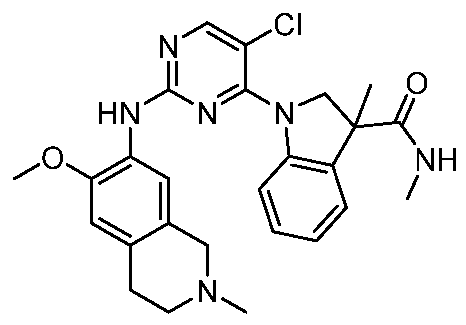
1-(5-클로로-2-((6-메톡시-2-메틸-1,2,3,4-테트라히드로이소퀴놀린-7-일)아미노)피리미딘-4-일)-N,3-디메틸인돌린-3-카르복스아미드1-(5-Chloro-2-((6-methoxy-2-methyl-1,2,3,4-tetrahydroisoquinolin-7-yl)amino)pyrimidin-4-yl)-N,3 -dimethylindoline-3-carboxamide
단계 1: Int. E20 (68 mg, 0.357 mmol) 및 2,4,5-트리클로로피리미딘 (72.1 mg, 0.393 mmol)을 조건 A3 하에 사용하고, 실리카 겔 상에서 플래쉬 칼럼 크로마토그래피 (DCM/MeOH: 10/1)에 의한 정제 후에 1-(2,5-디클로로피리미딘-4-일)-N,3-디메틸인돌린-3-카르복스아미드 (72 mg, 59.7% 수율)를 무색 오일로서 제공하였다. LC-MS (ESI) m/z: 337 [M+H]+.Step 1: Int. E20 (68 mg, 0.357 mmol) and 2,4,5-trichloropyrimidine (72.1 mg, 0.393 mmol) were used under condition A3 and subjected to flash column chromatography on silica gel (DCM/MeOH: 10/1) To give 1-(2,5-dichloropyrimidin-4-yl)-N,3-dimethylindoline-3-carboxamide (72 mg, 59.7% yield) as a colorless oil after purification by LC-MS (ESI) m/z: 337 [M+H] + .
단계 2: 1-(2,5-디클로로피리미딘-4-일)-N,3-디메틸인돌린-3-카르복스아미드 (72 mg, 0.214 mmol) 및 Int. W1 (41.1 mg, 0.214 mmol)을 조건 B3 하에 사용하고, 정제용-HPLC (MeCN/0.1% FA)에 의한 정제 후에 1-(5-클로로-2-((6-메톡시-2-메틸-1,2,3,4-테트라히드로이소퀴놀린-7-일)아미노)피리미딘-4-일)-N,3-디메틸인돌린-3-카르복스아미드 (45.6 mg, 43.3% 수율)를 백색 고체로서 제공하였다. LC-MS (ESI) m/z: 493 [M+H]+. 1H NMR (400 MHz, DMSO-d6) δ 8.29 (d, J = 32.1 Hz, 1H), 8.02 (s, 1H), 7.70 (s, 1H), 7.51 (s, 1H), 7.38 (t, J = 7.2 Hz, 2H), 7.14 (t, J = 7.1 Hz, 1H), 7.01 (d, J = 6.7 Hz, 1H), 6.75 (s, 1H), 4.81 (d, J = 10.3 Hz, 1H), 3.99 (d, J = 10.3 Hz, 1H), 3.77 (s, 3H), 3.31 (s, 2H), 2.78 (s, 2H), 2.58 (s, 5H), 2.32 (s, 3H), 1.61 (d, J = 64.4 Hz, 3H).Step 2: 1-(2,5-dichloropyrimidin-4-yl)-N,3-dimethylindoline-3-carboxamide (72 mg, 0.214 mmol) and Int. W1 (41.1 mg, 0.214 mmol) was used under condition B3 and after purification by prep-HPLC (MeCN/0.1% FA) 1-(5-chloro-2-((6-methoxy-2-methyl-) 1,2,3,4-tetrahydroisoquinolin-7-yl)amino)pyrimidin-4-yl)-N,3-dimethylindoline-3-carboxamide (45.6 mg, 43.3% yield) as white provided as a solid. LC-MS (ESI) m/z: 493 [M+H] + . 1 H NMR (400 MHz, DMSO-d 6 ) δ 8.29 (d, J = 32.1 Hz, 1H), 8.02 (s, 1H), 7.70 (s, 1H), 7.51 (s, 1H), 7.38 (t, J = 7.2 Hz, 2H), 7.14 (t, J = 7.1 Hz, 1H), 7.01 (d, J = 6.7 Hz, 1H), 6.75 (s, 1H), 4.81 (d, J = 10.3 Hz, 1H) , 3.99 (d, J = 10.3 Hz, 1H), 3.77 (s, 3H), 3.31 (s, 2H), 2.78 (s, 2H), 2.58 (s, 5H), 2.32 (s, 3H), 1.61 ( d, J = 64.4 Hz, 3H).
실시예 123Example 123

(1-(5-클로로-2-((6-메톡시-2-메틸-1,2,3,4-테트라히드로이소퀴놀린-7-일)아미노)피리미딘-4-일)-3-메틸인돌린-3-일)메탄올(1-(5-Chloro-2-((6-methoxy-2-methyl-1,2,3,4-tetrahydroisoquinolin-7-yl)amino)pyrimidin-4-yl)-3- Methylindolin-3-yl)methanol
단계 1: Int. E21 (60 mg, 0.382 mmol) 및 2,4,5-트리클로로피리미딘 (70 mg, 0.382 mmol)을 조건 A3 하에 사용하고, 실리카 겔 상에서 플래쉬 칼럼 크로마토그래피 (DCM/MeOH: 10/1)에 의한 정제 후에 (1-(2,5-디클로로피리미딘-4-일)-3-메틸인돌린-3-일)메탄올 (85 mg, 64.6% 수율)을 황색 오일로서 제공하였다. LC-MS (ESI) m/z: 310 [M+H]+.Step 1: Int. E21 (60 mg, 0.382 mmol) and 2,4,5-trichloropyrimidine (70 mg, 0.382 mmol) were used under condition A3 and subjected to flash column chromatography on silica gel (DCM/MeOH: 10/1) (1-(2,5-dichloropyrimidin-4-yl)-3-methylindolin-3-yl)methanol (85 mg, 64.6% yield) was provided as a yellow oil after purification by LC-MS (ESI) m/z: 310 [M+H] + .
단계 2: (1-(2,5-디클로로피리미딘-4-일)-3-메틸인돌린-3-일)메탄올 (85 mg,0.273 mmol) 및 Int. W1 (62.9 mg, 0.327 mmol)을 조건 B3 하에 사용하여 정제용-HPLC (MeCN/0.1% FA)에 의한 정제 후에 (1-(5-클로로-2-((6-메톡시-2-메틸-1,2,3,4-테트라히드로이소퀴놀린-7-일)아미노)피리미딘-4-일)-3-메틸인돌린-3-일)메탄올 (22.4 mg, 17.6%)을 백색 고체로서 제공하였다. LC-MS (ESI) m/z: 466 [M+H]+. 1H NMR (400 MHz, DMSO-d6) δ 8.23 (s, 1H), 7.97 (s, 1H), 7.54 (s, 1H), 7.37 (d, J = 8.1 Hz,1H),7.21 (d, J = 7.0 Hz, 1H), 7.10 (s, 1H), 6.97 (d, J = 7.4 Hz, 1H), 6.75 (s, 1H), 5.01 (t, J = 5.3 Hz, 1H), 4.26 (d, J = 10.5 Hz, 1H), 3.87 (d, J = 10.5 Hz, 1H), 3.77 (s, 3H), 3.39-3.35 (m, 2H), 3.30-3.28 (m, 2H), 2.80-2.75 (m, 2H), 2.58-2.54 (m, 2H), 2.31 (s, 3H), 1.29 (s, 3H).Step 2: (1-(2,5-dichloropyrimidin-4-yl)-3-methylindolin-3-yl)methanol (85 mg, 0.273 mmol) and Int. Prep-HPLC (MeCN/0.1% FA) using W1 (62.9 mg, 0.327 mmol) under condition B3 (1-(5-chloro-2-((6-methoxy-2-methyl-) provided 1,2,3,4-tetrahydroisoquinolin-7-yl)amino)pyrimidin-4-yl)-3-methylindolin-3-yl)methanol (22.4 mg, 17.6%) as a white solid did LC-MS (ESI) m/z: 466 [M+H] + . 1 H NMR (400 MHz, DMSO-d 6 ) δ 8.23 (s, 1H), 7.97 (s, 1H), 7.54 (s, 1H), 7.37 (d, J = 8.1 Hz, 1H), 7.21 (d, J = 7.0 Hz, 1H), 7.10 (s, 1H), 6.97 (d, J = 7.4 Hz, 1H), 6.75 (s, 1H), 5.01 (t, J = 5.3 Hz, 1H), 4.26 (d, J = 10.5 Hz, 1H), 3.87 (d, J = 10.5 Hz, 1H), 3.77 (s, 3H), 3.39-3.35 (m, 2H), 3.30-3.28 (m, 2H), 2.80-2.75 (m) , 2H), 2.58-2.54 (m, 2H), 2.31 (s, 3H), 1.29 (s, 3H).
실시예 124Example 124

1-(5-클로로-2-((6-메톡시-2-메틸-1,2,3,4-테트라히드로이소퀴놀린-7-일)아미노)피리미딘-4-일)-3-(히드록시메틸)인돌린-3-카르복실산1-(5-Chloro-2-((6-methoxy-2-methyl-1,2,3,4-tetrahydroisoquinolin-7-yl)amino)pyrimidin-4-yl)-3-( Hydroxymethyl)indoline-3-carboxylic acid
단계 1에서 Int. E18 대신 Int. E37을 사용한, 실시예 117과 동일한 절차. LC-MS (ESI) m/z: 498 [M+H]+. 1H NMR (400MHz, DMSO-d6) δ 8.25 (s, 1H), 8.21 (s, 1H), 8.00 (d, J = 9.3 Hz, 1H), 7.51 (s, 1H), 7.39 (t, J = 8.0 Hz, 2H), 7.12 (t, J = 7.7 Hz, 1H), 6.95 (t, J = 7.4 Hz, 1H), 6.76 (s, 1H), 4.75 (d, J = 10.7 Hz, 1H), 4.24 (d, J = 10.7 Hz, 1H), 3.86 (d, J = 10.4 Hz, 2H), 3.77 (s, 3H), 3.49 (br, 1H), 3.33 (br, 2H), 2.78 (t, J = 5.5 Hz, 2H), 2.59 (t, J = 5.7 Hz, 2H), 2.33 (s, 3H).In step 1, Int. Instead of E18, Int. Same procedure as Example 117, using E37. LC-MS (ESI) m/z: 498 [M+H] + . 1 H NMR (400 MHz, DMSO-d 6 ) δ 8.25 (s, 1H), 8.21 (s, 1H), 8.00 (d, J = 9.3 Hz, 1H), 7.51 (s, 1H), 7.39 (t, J) = 8.0 Hz, 2H), 7.12 (t, J = 7.7 Hz, 1H), 6.95 (t, J = 7.4 Hz, 1H), 6.76 (s, 1H), 4.75 (d, J = 10.7 Hz, 1H), 4.24 (d, J = 10.7 Hz, 1H), 3.86 (d, J = 10.4 Hz, 2H), 3.77 (s, 3H), 3.49 (br, 1H), 3.33 (br, 2H), 2.78 (t, J) = 5.5 Hz, 2H), 2.59 (t, J = 5.7 Hz, 2H), 2.33 (s, 3H).
실시예 125Example 125

1-(5-클로로-2-((6-메톡시-2-메틸-1,2,3,4-테트라히드로이소퀴놀린-7-일)아미노)피리미딘-4-일)-5-플루오로-3-메틸인돌린-3-카르복실산1-(5-Chloro-2-((6-methoxy-2-methyl-1,2,3,4-tetrahydroisoquinolin-7-yl)amino)pyrimidin-4-yl)-5-fluoro Rho-3-methylindoline-3-carboxylic acid
단계 1에서 Int. E18 대신 Int. E27을 사용한, 실시예 117과 동일한 절차. LC-MS (ESI) m/z: 498 [M+H]+. 1H NMR (400 MHz, DMSO-d6) δ 8.24 (s, 1H), 8.05 (s, 1H), 7.47 (s, 1H), 7.39 (dd, J = 8.8, 4.7 Hz, 1H), 7.18 (dd, J = 8.5, 2.7 Hz, 1H), 6.95 (td, J = 9.0, 2.7 Hz, 1H), 6.77 (s, 1H), 4.78 (d, J = 10.7 Hz, 1H), 4.06 (d, J = 10.7 Hz, 1H), 3.76 (s, 4H), 2.80 (d, J = 5.7 Hz, 2H), 2.67 (t, J = 5.8 Hz, 2H), 2.51 (s, 1H), 2.36 (d, J = 12.7 Hz, 3H), 1.52 (s, 3H).In step 1, Int. Instead of E18, Int. Same procedure as Example 117, using E27. LC-MS (ESI) m/z: 498 [M+H] + . 1 H NMR (400 MHz, DMSO-d 6 ) δ 8.24 (s, 1H), 8.05 (s, 1H), 7.47 (s, 1H), 7.39 (dd, J = 8.8, 4.7 Hz, 1H), 7.18 ( dd, J = 8.5, 2.7 Hz, 1H), 6.95 (td, J = 9.0, 2.7 Hz, 1H), 6.77 (s, 1H), 4.78 (d, J = 10.7 Hz, 1H), 4.06 (d, J) = 10.7 Hz, 1H), 3.76 (s, 4H), 2.80 (d, J = 5.7 Hz, 2H), 2.67 (t, J = 5.8 Hz, 2H), 2.51 (s, 1H), 2.36 (d, J) = 12.7 Hz, 3H), 1.52 (s, 3H).
실시예 126Example 126
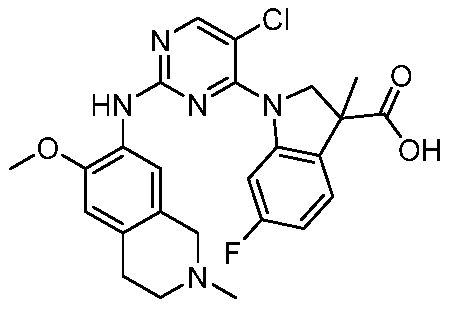
1-(5-클로로-2-((6-메톡시-2-메틸-1,2,3,4-테트라히드로이소퀴놀린-7-일)아미노)피리미딘-4-일)-6-플루오로-3-메틸인돌린-3-카르복실산1-(5-Chloro-2-((6-methoxy-2-methyl-1,2,3,4-tetrahydroisoquinolin-7-yl)amino)pyrimidin-4-yl)-6-fluoro Rho-3-methylindoline-3-carboxylic acid
단계 1에서 Int. E18 대신 Int. E28을 사용한, 실시예 117과 동일한 절차. LC-MS (ESI) m/z: 498 [M+H]+. 1H NMR (500 MHz, DMSO-d6) δ 8.27 (s, 1H), 8.20 (s, 1H), 7.41 (s, 1H), 7.37-7.27 (m, 1H), 7.18 (d, J = 10.4 Hz, 1H), 6.75 (s, 2H), 4.81 (d, J = 10.3 Hz, 1H), 4.08 (d, J = 10.4 Hz, 1H), 3.76 (s, 3H), 3.35 (s, 2H), 2.78 (s, 2H), 2.60 (s, 2H), 2.33 (s, 3H), 1.50 (s, 3H).In step 1, Int. Instead of E18, Int. Same procedure as Example 117, using E28. LC-MS (ESI) m/z: 498 [M+H] + . 1 H NMR (500 MHz, DMSO-d 6 ) δ 8.27 (s, 1H), 8.20 (s, 1H), 7.41 (s, 1H), 7.37-7.27 (m, 1H), 7.18 (d, J = 10.4) Hz, 1H), 6.75 (s, 2H), 4.81 (d, J = 10.3 Hz, 1H), 4.08 (d, J = 10.4 Hz, 1H), 3.76 (s, 3H), 3.35 (s, 2H), 2.78 (s, 2H), 2.60 (s, 2H), 2.33 (s, 3H), 1.50 (s, 3H).
실시예 127Example 127

1-(5-클로로-2-((6-메톡시-1,2,3,4-테트라히드로이소퀴놀린-7-일)아미노)피리미딘-4-일)-3-메틸인돌린-3-카르복실산1-(5-Chloro-2-((6-methoxy-1,2,3,4-tetrahydroisoquinolin-7-yl)amino)pyrimidin-4-yl)-3-methylindoline-3 -carboxylic acid
단계 2에서 Int. W1 대신 Int. W11을 사용한, 실시예 117과 동일한 절차. LC-MS (ESI) m/z: 466 [M+H]+. 1H NMR (500 MHz, DMSO-d6) δ 8.47 (s, 1H), 8.14 (s, 1H), 7.60 (s, 1H), 7.48 (s, 1H), 7.46 (d, J = 6.8 Hz, 1H), 7.24 (t, J = 7.6 Hz, 1H), 7.17 (t, J = 7.2 Hz, 1H), 7.03 (s, 1H), 5.01 (d, J = 11.0 Hz, 1H), 4.30 (d, J = 11.0 Hz, 1H), 4.14 (d, J = 6.3 Hz, 2H), 3.82 (s, 3H), 3.42 (t, J = 6.3 Hz, 2H), 3.04 (t, J = 6.1 Hz, 2H), 1.60 (s, 3H).In step 2, Int. Instead of W1, Int. Same procedure as Example 117, using W11. LC-MS (ESI) m/z: 466 [M+H] + . 1 H NMR (500 MHz, DMSO-d 6 ) δ 8.47 (s, 1H), 8.14 (s, 1H), 7.60 (s, 1H), 7.48 (s, 1H), 7.46 (d, J = 6.8 Hz, 1H), 7.24 (t, J = 7.6 Hz, 1H), 7.17 (t, J = 7.2 Hz, 1H), 7.03 (s, 1H), 5.01 (d, J = 11.0 Hz, 1H), 4.30 (d, J = 11.0 Hz, 1H), 4.14 (d, J = 6.3 Hz, 2H), 3.82 (s, 3H), 3.42 (t, J = 6.3 Hz, 2H), 3.04 (t, J = 6.1 Hz, 2H) , 1.60 (s, 3H).
실시예 128Example 128
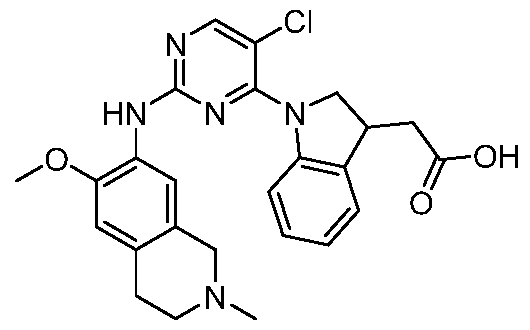
2-(1-(5-클로로-2-((6-메톡시-2-메틸-1,2,3,4-테트라히드로이소퀴놀린-7-일)아미노)피리미딘-4-일)인돌린-3-일)아세트산2-(1-(5-chloro-2-((6-methoxy-2-methyl-1,2,3,4-tetrahydroisoquinolin-7-yl)amino)pyrimidin-4-yl)indole Lin-3-yl)acetic acid
단계 1에서 Int. E18 대신 Int. E29를 사용한, 실시예 117과 동일한 절차. LC-MS (ESI) m/z: 480 [M+H]+. 1H NMR (400 MHz, DMSO-d6) δ 8.26 (d, J = 21.1 Hz, 1H), 7.98 (s, 1H), 7.55 (s, 1H), 7.30 (dd, J = 22.6, 7.7 Hz, 2H), 7.10 (t, J = 7.7 Hz, 1H), 6.94 (t, J = 7.4 Hz, 1H), 6.74 (s, 1H), 4.56-4.36 (m, 1H), 3.98 (dd, J = 10.6, 7.0 Hz, 1H), 3.77 (s, 3H), 3.69 (s, 2H), 3.29 (s, 2H), 2.84-2.70 (m, 3H), 2.56 (t, J = 5.8 Hz, 2H), 2.31 (s, 3H).In step 1, Int. Instead of E18, Int. Same procedure as Example 117, using E29. LC-MS (ESI) m/z: 480 [M+H] + . 1 H NMR (400 MHz, DMSO-d 6 ) δ 8.26 (d, J = 21.1 Hz, 1H), 7.98 (s, 1H), 7.55 (s, 1H), 7.30 (dd, J = 22.6, 7.7 Hz, 2H), 7.10 (t, J = 7.7 Hz, 1H), 6.94 (t, J = 7.4 Hz, 1H), 6.74 (s, 1H), 4.56-4.36 (m, 1H), 3.98 (dd, J = 10.6) , 7.0 Hz, 1H), 3.77 (s, 3H), 3.69 (s, 2H), 3.29 (s, 2H), 2.84-2.70 (m, 3H), 2.56 (t, J = 5.8 Hz, 2H), 2.31 (s, 3H).
실시예 129Example 129
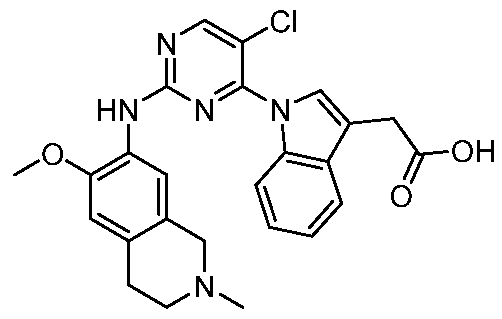
2-(1-(5-클로로-2-((6-메톡시-2-메틸-1,2,3,4-테트라히드로이소퀴놀린-7-일)아미노)피리미딘-4-일)-1H-인돌-3-일)아세트산2-(1-(5-Chloro-2-((6-methoxy-2-methyl-1,2,3,4-tetrahydroisoquinolin-7-yl)amino)pyrimidin-4-yl)- 1H-indol-3-yl)acetic acid
실시예 130Example 130

이소프로필 2-(1-(5-클로로-2-((6-메톡시-2-메틸-1,2,3,4-테트라히드로이소퀴놀린-7-일)아미노)피리미딘-4-일)-1H-인돌-3-일)아세테이트Isopropyl 2-(1-(5-chloro-2-((6-methoxy-2-methyl-1,2,3,4-tetrahydroisoquinolin-7-yl)amino)pyrimidin-4-yl )-1H-indol-3-yl)acetate
실시예 131Example 131

2-에틸부틸 2-(1-(5-클로로-2-((6-메톡시-2-메틸-1,2,3,4-테트라히드로이소퀴놀린-7-일)아미노)피리미딘-4-일)-1H-인돌-3-일)아세테이트2-ethylbutyl 2-(1-(5-chloro-2-((6-methoxy-2-methyl-1,2,3,4-tetrahydroisoquinolin-7-yl)amino)pyrimidine-4 -yl)-1H-indol-3-yl)acetate
단계 1: 2-(1H-인돌-3-일)아세트산 (300 mg, 1.71 mmol) 및 2,4,5-트리클로로피리미딘 (314.1 mg, 1.71 mmol)을 조건 A1 하에 사용하고, 역상 크로마토그래피에 의한 정제 후에 2-(1-(2,5-디클로로피리미딘-4-일)-1H-인돌-3-일)아세트산 (93 mg, 16.0% 수율)을 담황색 고체로서 제공하였다. LC-MS (ESI) m/z: 322 [M+H]+.Step 1: Using 2-(1H-indol-3-yl)acetic acid (300 mg, 1.71 mmol) and 2,4,5-trichloropyrimidine (314.1 mg, 1.71 mmol) under condition A1, reverse phase chromatography 2-(1-(2,5-dichloropyrimidin-4-yl)-1H-indol-3-yl)acetic acid (93 mg, 16.0% yield) was provided as a pale yellow solid after purification by LC-MS (ESI) m/z: 322 [M+H] + .
단계 2: 2-(1-(2,5-디클로로피리미딘-4-일)-1H-인돌-3-일)아세트산 (93 mg, 0.274 mmol) 및 Int. W1 (66.6 mg, 0.329 mmol)을 조건 B3 하에 사용하고, 실리카 겔 상에서 플래쉬 칼럼 크로마토그래피 (PE/EA = 10/1)에 의한 정제 후에 이소프로필 2-(1-(5-클로로-2-((6-메톡시-2-메틸-1,2,3,4-테트라히드로이소퀴놀린-7-일)아미노)피리미딘-4-일)-1H-인돌-3-일)아세테이트 (120 mg, 80.0% 수율)를 담황색 고체로서 제공하였다. LC-MS (ESI) m/z: 520 [M+H]+. 1H NMR (400 MHz, DMSO-d6) δ 8.70 (s, 1H), 8.62 (s, 1H), 7.86-7.77 (m, 2H), 7.57 (dd, J = 6.0, 2.8 Hz, 1H), 7.43 (s, 1H), 7.21 (dd, J = 6.0, 3.1 Hz, 2H), 6.80 (s, 1H), 4.94 (dt, J = 12.5, 6.3 Hz, 1H), 3.80 (s, 2H), 3.79 (s, 3H), 3.32 (s, 2H), 2.78 (t, J = 5.5 Hz, 2H), 2.55 (t, J = 5.9 Hz, 2H), 2.30 (s, 3H), 1.21 (d, J = 6.3 Hz, 6H).Step 2: 2-(1-(2,5-dichloropyrimidin-4-yl)-1H-indol-3-yl)acetic acid (93 mg, 0.274 mmol) and Int. W1 (66.6 mg, 0.329 mmol) was used under condition B3 and after purification by flash column chromatography on silica gel (PE/EA = 10/1) isopropyl 2-(1-(5-chloro-2-( (6-Methoxy-2-methyl-1,2,3,4-tetrahydroisoquinolin-7-yl)amino)pyrimidin-4-yl)-1H-indol-3-yl)acetate (120 mg, 80.0% yield) as a pale yellow solid. LC-MS (ESI) m/z: 520 [M+H] + . 1 H NMR (400 MHz, DMSO-d 6 ) δ 8.70 (s, 1H), 8.62 (s, 1H), 7.86-7.77 (m, 2H), 7.57 (dd, J = 6.0, 2.8 Hz, 1H), 7.43 (s, 1H), 7.21 (dd, J = 6.0, 3.1 Hz, 2H), 6.80 (s, 1H), 4.94 (dt, J = 12.5, 6.3 Hz, 1H), 3.80 (s, 2H), 3.79 (s, 3H), 3.32 (s, 2H), 2.78 (t, J = 5.5 Hz, 2H), 2.55 (t, J = 5.9 Hz, 2H), 2.30 (s, 3H), 1.21 (d, J = 6.3 Hz, 6H).
2-에틸부틸 2-(1-(5-클로로-2-((6-메톡시-2-메틸-1,2,3,4-테트라히드로이소퀴놀린-7-일)아미노)피리미딘-4-일)-1H-인돌-3-일)아세테이트를 단계 2에서 용매로서 2-에틸부탄-1-올을 사용하여 수득하였다. LC-MS (ESI) m/z: 562 [M+H]+. 1H NMR (400 MHz, DMSO-d6) δ 8.69 (s, 1H), 8.63 (s, 1H), 8.36 (s, 1H), 7.85-7.74 (m, 2H), 7.60-7.52 (m, 1H), 7.45 (s, 1H), 7.28-7.14 (m, 2H), 6.78 (d, J = 12.8 Hz, 1H), 3.99 (d, J = 5.8 Hz, 2H), 3.85 (s, 2H), 3.79 (s, 3H), 3.31 (s, 2H), 2.78 (t, J = 5.6 Hz, 2H), 2.55 (t, J = 5.8 Hz, 2H), 2.30 (d, J = 8.2 Hz, 3H), 1.45 (dd, J = 12.4, 6.2 Hz, 1H), 1.29-1.23 (m, 4H), 0.80 (t, J = 7.4 Hz, 6H).2-ethylbutyl 2-(1-(5-chloro-2-((6-methoxy-2-methyl-1,2,3,4-tetrahydroisoquinolin-7-yl)amino)pyrimidine-4 -yl)-1H-indol-3-yl)acetate was obtained in step 2 using 2-ethylbutan-1-ol as a solvent. LC-MS (ESI) m/z: 562 [M+H] + . 1 H NMR (400 MHz, DMSO-d 6 ) δ 8.69 (s, 1H), 8.63 (s, 1H), 8.36 (s, 1H), 7.85-7.74 (m, 2H), 7.60-7.52 (m, 1H) ), 7.45 (s, 1H), 7.28-7.14 (m, 2H), 6.78 (d, J = 12.8 Hz, 1H), 3.99 (d, J = 5.8 Hz, 2H), 3.85 (s, 2H), 3.79 (s, 3H), 3.31 (s, 2H), 2.78 (t, J = 5.6 Hz, 2H), 2.55 (t, J = 5.8 Hz, 2H), 2.30 (d, J = 8.2 Hz, 3H), 1.45 (dd, J = 12.4, 6.2 Hz, 1H), 1.29-1.23 (m, 4H), 0.80 (t, J = 7.4 Hz, 6H).
단계 3: 이소프로필 2-(1-(5-클로로-2-((6-메톡시-2-메틸-1,2,3,4-테트라히드로이소퀴놀린-7-일)아미노)피리미딘-4-일)-1H-인돌-3-일)아세테이트 (142 mg, 0.273 mmol)를 실시예 117의 단계 3과 동일한 조건 하에 사용하고, 정제용-HPLC (MeCN/10 mM NH4HCO3)에 의한 정제 후에 2-(1-(5-클로로-2-((6-메톡시-2-메틸-1,2,3,4-테트라히드로이소퀴놀린-7-일)아미노)피리미딘-4-일)-1H-인돌-3-일)아세트산을 백색 고체 (57.9 mg, 44.4% 수율)로서 제공하였다. LC-MS (ESI) m/z: 480 [M+H]+. 1H NMR (400 MHz, DMSO-d6) δ 8.79 (s, 1H), 8.64 (s, 1H), 7.80 (d, J = 6.8 Hz, 2H), 7.55 (s, 1H), 7.26 (d, J = 7.7 Hz, 1H), 7.22 (d, J = 7.6 Hz, 1H), 6.91 (s, 1H), 3.92 (s, 2H), 3.83 (s, 3H), 3.75 (s, 2H), 3.17 (s, 2H), 2.98 (s, 2H), 2.69 (s, 3H).Step 3: Isopropyl 2-(1-(5-chloro-2-((6-methoxy-2-methyl-1,2,3,4-tetrahydroisoquinolin-7-yl)amino)pyrimidine- 4-yl)-1H-indol-3-yl)acetate (142 mg, 0.273 mmol) was used under the same conditions as in step 3 of Example 117, and subjected to preparative-HPLC (MeCN/10 mM NH 4 HCO 3 ) 2-(1-(5-chloro-2-((6-methoxy-2-methyl-1,2,3,4-tetrahydroisoquinolin-7-yl)amino)pyrimidin-4- yl)-1H-indol-3-yl)acetic acid was provided as a white solid (57.9 mg, 44.4% yield). LC-MS (ESI) m/z: 480 [M+H] + . 1 H NMR (400 MHz, DMSO-d 6 ) δ 8.79 (s, 1H), 8.64 (s, 1H), 7.80 (d, J = 6.8 Hz, 2H), 7.55 (s, 1H), 7.26 (d, J = 7.7 Hz, 1H), 7.22 (d, J = 7.6 Hz, 1H), 6.91 (s, 1H), 3.92 (s, 2H), 3.83 (s, 3H), 3.75 (s, 2H), 3.17 ( s, 2H), 2.98 (s, 2H), 2.69 (s, 3H).
실시예 132Example 132

에틸 2-(1-(5-클로로-2-((6-메톡시-2-메틸-1,2,3,4-테트라히드로이소퀴놀린-7-일)아미노)피리미딘-4-일)-1H-인돌-3-일)아세테이트Ethyl 2-(1-(5-chloro-2-((6-methoxy-2-methyl-1,2,3,4-tetrahydroisoquinolin-7-yl)amino)pyrimidin-4-yl) -1H-indol-3-yl)acetate
에탄올 (1 mL) 중 2-(1-(5-클로로-2-((6-메톡시-2-메틸-1,2,3,4-테트라히드로이소퀴놀린-7-일)아미노)피리미딘-4-일)-1H-인돌-3-일)아세트산 (60 mg, 0.126 mmol)의 용액에 SOCl2 (29.9 mg, 0.251 mmol)를 적가하였다. 반응 혼합물을 85℃에서 3시간 동안 교반하고, 실온으로 냉각시키고, 포화 중탄산나트륨 수용액을 사용하여 pH 8로 염기성화시키고, 에틸 아세테이트 (10 mL x 3)로 추출하였다. 유기 상을 무수 황산나트륨 상에서 건조시키고, 여과하였다. 여과물을 진공 하에 농축시키고, 잔류물을 정제용-HPLC (10 mM NH4HCO3 & 0.025% NH3·H2O/아세토니트릴)에 의해 정제하여 에틸 2-(1-(5-클로로-2-((6-메톡시-2-메틸-1,2,3,4-테트라히드로이소퀴놀린-7-일)아미노)피리미딘-4-일)-1H-인돌-3-일)아세테이트를 담황색 고체 (7.8 mg, 12% 수율)로서 제공하였다. LC-MS (ESI) m/z: 506 [M+H]+. 1H NMR (400 MHz, DMSO-d6) δ 8.70 (s, 1H), 8.62 (s, 1H), 7.83 (s, 1H), 7.82-7.76 (m, 1H), 7.64-7.53 (m, 1H), 7.43 (s, 1H), 7.28-7.16 (m, 2H), 6.80 (s, 1H), 4.11 (q, J = 7.1 Hz, 2H), 3.84 (s, 2H), 3.79 (s, 3H), 3.33 (s, 2H), 2.78 (t, J = 5.5 Hz, 2H), 2.55 (t, J = 5.8 Hz, 2H), 2.30 (s, 3H), 1.20 (t, J = 7.1 Hz, 3H).2-(1-(5-chloro-2-((6-methoxy-2-methyl-1,2,3,4-tetrahydroisoquinolin-7-yl)amino)pyrimidine in ethanol (1 mL) To a solution of -4-yl)-1H-indol-3-yl)acetic acid (60 mg, 0.126 mmol) was added SOCl 2 (29.9 mg, 0.251 mmol) dropwise. The reaction mixture was stirred at 85° C. for 3 h, cooled to room temperature, basified to pH 8 with saturated aqueous sodium bicarbonate solution, and extracted with ethyl acetate (10 mL×3). The organic phase was dried over anhydrous sodium sulfate and filtered. The filtrate was concentrated in vacuo and the residue was purified by prep-HPLC (10 mM NH 4 HCO 3 & 0.025% NH 3 .H 2 O/acetonitrile) to ethyl 2-(1-(5-chloro-) 2-((6-methoxy-2-methyl-1,2,3,4-tetrahydroisoquinolin-7-yl)amino)pyrimidin-4-yl)-1H-indol-3-yl)acetate It was provided as a pale yellow solid (7.8 mg, 12% yield). LC-MS (ESI) m/z: 506 [M+H] + . 1 H NMR (400 MHz, DMSO-d 6 ) δ 8.70 (s, 1H), 8.62 (s, 1H), 7.83 (s, 1H), 7.82-7.76 (m, 1H), 7.64-753 (m, 1H) ), 7.43 (s, 1H), 7.28-7.16 (m, 2H), 6.80 (s, 1H), 4.11 (q, J = 7.1 Hz, 2H), 3.84 (s, 2H), 3.79 (s, 3H) , 3.33 (s, 2H), 2.78 (t, J = 5.5 Hz, 2H), 2.55 (t, J = 5.8 Hz, 2H), 2.30 (s, 3H), 1.20 (t, J = 7.1 Hz, 3H) .
실시예 133Example 133

2-(1-(5-클로로-2-((6-메톡시-2-메틸-1,2,3,4-테트라히드로이소퀴놀린-7-일)아미노)피리미딘-4-일)-1H-인돌-3-일)아세트아미드2-(1-(5-Chloro-2-((6-methoxy-2-methyl-1,2,3,4-tetrahydroisoquinolin-7-yl)amino)pyrimidin-4-yl)- 1H-indol-3-yl)acetamide
DMF (1 mL) 중 2-(1-(5-클로로-2-((6-메톡시-2-메틸-1,2,3,4-테트라히드로이소퀴놀린-7-일)아미노)피리미딘-4-일)-1H-인돌-3-일)아세트산 (30 mg, 0.060 mmol), 염화암모늄 (31.9 mg, 0.596 mmol), 및 HATU (34.0 mg, 0.089 mmol)의 혼합물에 DIPEA (115.6 mg, 0.894 mmol)를 첨가하였다. 반응 혼합물을 25℃에서 16시간 동안 교반하고, 정제용-HPLC (MeCN/10 mM NH4HCO3, 0.025% NH3·H2O)에 의해 정제하여 2-(1-(5-클로로-2-((6-메톡시-2-메틸-1,2,3,4-테트라히드로이소퀴놀린-7-일)아미노)피리미딘-4-일)-1H-인돌-3-일)아세트아미드 (9.1 mg, 32.0% 수율)를 백색 고체로서 수득하였다. LC-MS (ESI) m/z: 477 [M+H]+. 1H NMR (400 MHz, DMSO-d6) δ 8.67 (s, 1H), 8.61 (s, 1H), 7.81 (dd, J = 6.3, 3.0 Hz, 1H), 7.77 (s, 1H), 7.62 (dd, J = 5.5, 3.3 Hz, 1H), 7.51 (s, 1H), 7.45 (s, 1H), 7.20 (dd, J = 6.0, 3.1 Hz, 2H), 6.94 (s, 1H), 6.80 (s, 1H), 3.79 (s, 3H), 3.54 (s, 2H), 3.30 (s, 1H), 2.78 (d, J = 5.6 Hz, 2H), 2.56 (d, J = 5.8 Hz, 2H), 2.30 (s, 3H).2-(1-(5-chloro-2-((6-methoxy-2-methyl-1,2,3,4-tetrahydroisoquinolin-7-yl)amino)pyrimidine in DMF (1 mL) -4-yl)-1H-indol-3-yl)acetic acid (30 mg, 0.060 mmol), ammonium chloride (31.9 mg, 0.596 mmol), and DIPEA (115.6 mg, 0.894 mmol) was added. The reaction mixture was stirred at 25° C. for 16 h and purified by preparative-HPLC (MeCN/10 mM NH 4 HCO 3 , 0.025% NH 3 .H 2 O) to 2-(1-(5-chloro-2). -((6-Methoxy-2-methyl-1,2,3,4-tetrahydroisoquinolin-7-yl)amino)pyrimidin-4-yl)-1H-indol-3-yl)acetamide ( 9.1 mg, 32.0% yield) as a white solid. LC-MS (ESI) m/z: 477 [M+H] + . 1 H NMR (400 MHz, DMSO-d 6 ) δ 8.67 (s, 1H), 8.61 (s, 1H), 7.81 (dd, J = 6.3, 3.0 Hz, 1H), 7.77 (s, 1H), 7.62 ( dd, J = 5.5, 3.3 Hz, 1H), 7.51 (s, 1H), 7.45 (s, 1H), 7.20 (dd, J = 6.0, 3.1 Hz, 2H), 6.94 (s, 1H), 6.80 (s) , 1H), 3.79 (s, 3H), 3.54 (s, 2H), 3.30 (s, 1H), 2.78 (d, J = 5.6 Hz, 2H), 2.56 (d, J = 5.8 Hz, 2H), 2.30 (s, 3H).
실시예 134Example 134

2-(1-(5-클로로-2-((6-메톡시-2-메틸-1,2,3,4-테트라히드로이소퀴놀린-7-일)아미노)피리미딘-4-일)-1H-인돌-3-일)아세토니트릴2-(1-(5-Chloro-2-((6-methoxy-2-methyl-1,2,3,4-tetrahydroisoquinolin-7-yl)amino)pyrimidin-4-yl)- 1H-indol-3-yl)acetonitrile
DCM (2 mL) 중 2-(1-(5-클로로-2-((6-메톡시-2-메틸-1,2,3,4-테트라히드로이소퀴놀린-7-일)아미노)피리미딘-4-일)-1H-인돌-3-일)아세트아미드 (50 mg, 0.105 mmol) 및 피리딘 (33.2 mg, 0.419 mmol)의 용액에 트리플루오로아세트산 무수물 (44.0 mg, 0.210 mmol)을 0℃에서 적가하였다. 혼합물을 0℃에서 1시간 동안 및 실온에서 6시간 동안 교반하고, HCl 수용액 (1 N, 10 mL)으로 켄칭하고, DCM (20 mL x 3)으로 추출하였다. 유기 상을 염수 (15 mL)로 세척하고, 무수 Na2SO4 상에서 건조시키고, 여과하였다. 여과물을 진공 하에 농축시키고, 잔류물을 정제용-HPLC (0.1% FA/MeCN)에 의해 정제하여 2-(1-(5-클로로-2-((6-메톡시-2-메틸-1,2,3,4-테트라히드로이소퀴놀린-7-일)아미노)피리미딘-4-일)-1H-인돌-3-일)아세토니트릴 (19.3 mg, 39.7% 수율)을 백색 고체로서 제공하였다. LC-MS (ESI) m/z: 459 [M+H]+. 1H NMR (400 MHz, DMSO-d6) δ 8.76 (s, 1H), 8.65 (s, 1H), 8.35 (s, 2H), 7.89 (s, 1H),7.81 (dd, J = 6.3, 2.9 Hz, 1H), 7.69 (dd, J = 6.1, 2.8 Hz, 1H), 7.42 (s, 1H), 7.28 (dd, J = 6.1, 3.2 Hz, 2H), 6.80 (s, 1H), 4.18 (s, 2H), 3.79 (s, 3H), 3.33 (s, 2H), 2.78 (t, J = 5.6 Hz,2H), 2.55 (t, J = 5.8 Hz, 2H), 2.30 (s, 3H).2-(1-(5-chloro-2-((6-methoxy-2-methyl-1,2,3,4-tetrahydroisoquinolin-7-yl)amino)pyrimidine in DCM (2 mL) To a solution of -4-yl)-1H-indol-3-yl)acetamide (50 mg, 0.105 mmol) and pyridine (33.2 mg, 0.419 mmol) was added trifluoroacetic anhydride (44.0 mg, 0.210 mmol) at 0° C. was added dropwise. The mixture was stirred at 0° C. for 1 h and at room temperature for 6 h, quenched with aqueous HCl solution (1 N, 10 mL) and extracted with DCM (20 mL×3). The organic phase was washed with brine (15 mL), dried over anhydrous Na 2 SO 4 and filtered. The filtrate was concentrated in vacuo and the residue was purified by prep-HPLC (0.1% FA/MeCN) to 2-(1-(5-chloro-2-((6-methoxy-2-methyl-1) provided ,2,3,4-tetrahydroisoquinolin-7-yl)amino)pyrimidin-4-yl)-1H-indol-3-yl)acetonitrile (19.3 mg, 39.7% yield) as a white solid . LC-MS (ESI) m/z: 459 [M+H] + . 1 H NMR (400 MHz, DMSO-d 6 ) δ 8.76 (s, 1H), 8.65 (s, 1H), 8.35 (s, 2H), 7.89 (s, 1H),7.81 (dd, J = 6.3, 2.9 Hz, 1H), 7.69 (dd, J = 6.1, 2.8 Hz, 1H), 7.42 (s, 1H), 7.28 (dd, J = 6.1, 3.2 Hz, 2H), 6.80 (s, 1H), 4.18 (s) , 2H), 3.79 (s, 3H), 3.33 (s, 2H), 2.78 (t, J = 5.6 Hz, 2H), 2.55 (t, J = 5.8 Hz, 2H), 2.30 (s, 3H).
실시예 135Example 135
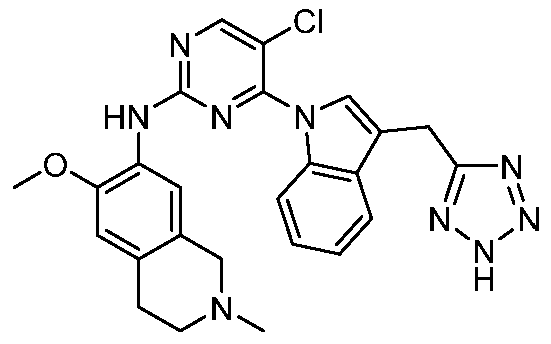
N-(4-(3-((2H-테트라졸-5-일)메틸)-1H-인돌-1-일)-5-클로로피리미딘-2-일)-6-메톡시-2-메틸-1,2,3,4-테트라히드로이소퀴놀린-7-아민N-(4-(3-((2H-tetrazol-5-yl)methyl)-1H-indol-1-yl)-5-chloropyrimidin-2-yl)-6-methoxy-2-methyl -1,2,3,4-tetrahydroisoquinolin-7-amine
1-(5-클로로-2-((6-메톡시-2-메틸-1,2,3,4-테트라히드로이소퀴놀린-7-일)아미노)피리미딘-4-일)인돌린-3-카르보니트릴 대신 2-(1-(5-클로로-2-((6-메톡시-2-메틸-1,2,3,4-테트라히드로이소퀴놀린-7-일)아미노)피리미딘-4-일)-1H-인돌-3-일)아세토니트릴을 사용한, 실시예 100과 동일한 절차. LC-MS (ESI) m/z: 502 [M+H]+. 1H NMR (500 MHz, DMSO-d6) δ 8.76 (s, 1H), 8.63 (s, 1H), 8.15 (s, 1H), 7.75 (d, J = 4.8 Hz, 2H), 7.56 (d, J = 7.6 Hz, 1H), 7.47 (s, 1H), 7.25-7.16 (m, 2H), 6.84 (s, 1H), 4.37 (s, 2H), 3.80 (s, 3H), 3.64 (s, 2H), 2.87 (s, 4H), 2.52 (s, 3H).1-(5-Chloro-2-((6-methoxy-2-methyl-1,2,3,4-tetrahydroisoquinolin-7-yl)amino)pyrimidin-4-yl)indoline-3 - 2-(1-(5-chloro-2-((6-methoxy-2-methyl-1,2,3,4-tetrahydroisoquinolin-7-yl)amino)pyrimidine-4 instead of carbonitrile Same procedure as in Example 100, using -yl)-1H-indol-3-yl)acetonitrile. LC-MS (ESI) m/z: 502 [M+H] + . 1 H NMR (500 MHz, DMSO-d 6 ) δ 8.76 (s, 1H), 8.63 (s, 1H), 8.15 (s, 1H), 7.75 (d, J = 4.8 Hz, 2H), 7.56 (d, J = 7.6 Hz, 1H), 7.47 (s, 1H), 7.25-7.16 (m, 2H), 6.84 (s, 1H), 4.37 (s, 2H), 3.80 (s, 3H), 3.64 (s, 2H) ), 2.87 (s, 4H), 2.52 (s, 3H).
실시예 136Example 136

2-(1-(5-클로로-2-((6-메톡시-2-메틸-1,2,3,4-테트라히드로이소퀴놀린-7-일)아미노)피리미딘-4-일)-1H-인돌-3-일)-N-메틸아세트아미드2-(1-(5-Chloro-2-((6-methoxy-2-methyl-1,2,3,4-tetrahydroisoquinolin-7-yl)amino)pyrimidin-4-yl)- 1H-indol-3-yl)-N-methylacetamide
염화암모늄 대신 메틸아민을 사용한, 실시예 133과 동일한 절차. LC-MS (ESI) m/z: 491 [M+H]+. 1H NMR (400 MHz, DMSO-d6) δ 8.68 (s, 1H), 8.62 (s, 1H), 7.97 (s, 1H), 7.80 (dd, J = 6.2, 3.0 Hz, 1H), 7.76 (s, 1H), 7.61 (dd, J = 5.6, 3.1 Hz, 1H), 7.44 (s, 1H), 7.20 (dd, J = 6.0, 3.1 Hz, 2H), 6.79 (s, 1H), 3.79 (s, 3H), 3.56 (s, 2H), 3.30 (s, 2H), 2.78 (d, J = 5.1 Hz, 2H), 2.59 (d, J = 4.6 Hz, 3H), 2.56 (d, J = 5.7 Hz, 2H), 2.30 (s, 3H).Same procedure as Example 133, using methylamine instead of ammonium chloride. LC-MS (ESI) m/z: 491 [M+H] + . 1 H NMR (400 MHz, DMSO-d 6 ) δ 8.68 (s, 1H), 8.62 (s, 1H), 7.97 (s, 1H), 7.80 (dd, J = 6.2, 3.0 Hz, 1H), 7.76 ( s, 1H), 7.61 (dd, J = 5.6, 3.1 Hz, 1H), 7.44 (s, 1H), 7.20 (dd, J = 6.0, 3.1 Hz, 2H), 6.79 (s, 1H), 3.79 (s) , 3H), 3.56 (s, 2H), 3.30 (s, 2H), 2.78 (d, J = 5.1 Hz, 2H), 2.59 (d, J = 4.6 Hz, 3H), 2.56 (d, J = 5.7 Hz) , 2H), 2.30 (s, 3H).
실시예 137Example 137

2-(1-(5-클로로-2-((6-메톡시-2-메틸-1,2,3,4-테트라히드로이소퀴놀린-7-일)아미노)피리미딘-4-일)-1H-인돌-3-일)-N-(시아노메틸)아세트아미드2-(1-(5-Chloro-2-((6-methoxy-2-methyl-1,2,3,4-tetrahydroisoquinolin-7-yl)amino)pyrimidin-4-yl)- 1H-indol-3-yl)-N-(cyanomethyl)acetamide
염화암모늄 대신 2-아미노아세토니트릴 황산을 사용한, 실시예 133과 동일한 절차. LC-MS (ESI) m/z: 516 [M+H]+. 1H NMR (400 MHz, DMSO-d6) δ 8.75 (s, 1H), 8.69 (s, 1H), 8.62 (s, 1H), 7.84-7.78 (m, 2H), 7.63-7.53 (m, 1H), 7.43 (s, 1H), 7.25-7.15 (m, 2H), 6.80 (s, 1H), 4.15 (d, J = 5.5 Hz, 2H), 3.79 (s, 3H), 3.67 (s, 2H), 3.30 (s, 2H), 2.79 (s, 2H), 2.56 (d, J = 5.5 Hz, 2H), 2.30 (s, 3H).Same procedure as Example 133, using 2-aminoacetonitrile sulfuric acid instead of ammonium chloride. LC-MS (ESI) m/z: 516 [M+H] + . 1 H NMR (400 MHz, DMSO-d 6 ) δ 8.75 (s, 1H), 8.69 (s, 1H), 8.62 (s, 1H), 7.84-7.78 (m, 2H), 7.63-753 (m, 1H) ), 7.43 (s, 1H), 7.25-7.15 (m, 2H), 6.80 (s, 1H), 4.15 (d, J = 5.5 Hz, 2H), 3.79 (s, 3H), 3.67 (s, 2H) , 3.30 (s, 2H), 2.79 (s, 2H), 2.56 (d, J = 5.5 Hz, 2H), 2.30 (s, 3H).
실시예 138Example 138

2-(1-(5-클로로-2-((6-메톡시-2-메틸-1,2,3,4-테트라히드로이소퀴놀린-7-일)아미노)피리미딘-4-일)-5-플루오로-1H-인돌-3-일)아세트산2-(1-(5-Chloro-2-((6-methoxy-2-methyl-1,2,3,4-tetrahydroisoquinolin-7-yl)amino)pyrimidin-4-yl)- 5-fluoro-1H-indol-3-yl)acetic acid
2-(1H-인돌-3-일)아세트산 대신 2-(5-플루오로-1H-인돌-3-일)아세트산을 사용한, 실시예 129와 동일한 절차. LC-MS (ESI) m/z: 496 [M+H]+. 1H NMR (400 MHz, DMSO-d6) δ 8.77 (d, J = 28.9 Hz, 1H), 8.61 (s, 1H), 7.90 (s, 1H), 7.81 (dd, J = 9.0, 4.5 Hz, 1H), 7.46-7.24 (m, 2H), 7.04 (td, J = 9.1, 2.4 Hz, 1H), 6.81 (s, 1H), 3.79 (s, 3H), 3.72 (s, 2H), 3.35 (s, 2H), 2.80 (d, J = 5.4 Hz, 2H), 2.59 (t, J = 5.7 Hz, 2H), 2.32 (s, 3H).Same procedure as Example 129, using 2-(5-fluoro-1H-indol-3-yl)acetic acid instead of 2-(1H-indol-3-yl)acetic acid. LC-MS (ESI) m/z: 496 [M+H] + . 1 H NMR (400 MHz, DMSO-d 6 ) δ 8.77 (d, J = 28.9 Hz, 1H), 8.61 (s, 1H), 7.90 (s, 1H), 7.81 (dd, J = 9.0, 4.5 Hz, 1H), 7.46-7.24 (m, 2H), 7.04 (td, J = 9.1, 2.4 Hz, 1H), 6.81 (s, 1H), 3.79 (s, 3H), 3.72 (s, 2H), 3.35 (s) , 2H), 2.80 (d, J = 5.4 Hz, 2H), 2.59 (t, J = 5.7 Hz, 2H), 2.32 (s, 3H).
실시예 139Example 139

2-(1-(5-클로로-2-((6-메톡시-2-메틸-1,2,3,4-테트라히드로이소퀴놀린-7-일)아미노)피리미딘-4-일)-6-플루오로-1H-인돌-3-일)아세트산2-(1-(5-Chloro-2-((6-methoxy-2-methyl-1,2,3,4-tetrahydroisoquinolin-7-yl)amino)pyrimidin-4-yl)- 6-fluoro-1H-indol-3-yl)acetic acid
2-(1H-인돌-3-일)아세트산 대신 2-(6-플루오로-1H-인돌-3-일)아세트산을 사용한, 실시예 129와 동일한 절차. LC-MS (ESI) m/z: 496 [M+H]+. 1H NMR (400 MHz, DMSO-d6) δ 8.79 (s, 1H), 8.61 (s, 1H), 8.24 (d, J = 10.5 Hz, 1H), 7.82 (s, 1H), 7.67-7.52 (m, 2H), 7.38 (s, 1H), 7.08 (td, J = 9.3, 2.4 Hz, 1H), 6.79 (s, 1H), 3.79 (s, 3H), 3.71 (s, 2H), 3.34 (s, 2H), 2.79 (t, J = 5.6 Hz, 2H), 2.56 (t, J = 5.8 Hz, 2H), 2.30 (s, 3H).Same procedure as Example 129, using 2-(6-fluoro-1H-indol-3-yl)acetic acid instead of 2-(1H-indol-3-yl)acetic acid. LC-MS (ESI) m/z: 496 [M+H] + . 1 H NMR (400 MHz, DMSO-d 6 ) δ 8.79 (s, 1H), 8.61 (s, 1H), 8.24 (d, J = 10.5 Hz, 1H), 7.82 (s, 1H), 7.67-7.52 ( m, 2H), 7.38 (s, 1H), 7.08 (td, J = 9.3, 2.4 Hz, 1H), 6.79 (s, 1H), 3.79 (s, 3H), 3.71 (s, 2H), 3.34 (s) , 2H), 2.79 (t, J = 5.6 Hz, 2H), 2.56 (t, J = 5.8 Hz, 2H), 2.30 (s, 3H).
실시예 140Example 140

2-(1-(5-클로로-2-((6-메톡시-2-메틸-1,2,3,4-테트라히드로이소퀴놀린-7-일)아미노)피리미딘-4-일)-5,6-디플루오로-1H-인돌-3-일)아세트산2-(1-(5-Chloro-2-((6-methoxy-2-methyl-1,2,3,4-tetrahydroisoquinolin-7-yl)amino)pyrimidin-4-yl)- 5,6-difluoro-1H-indol-3-yl)acetic acid
2-(1H-인돌-3-일)아세트산 대신 2-(5,6-디플루오로-1H-인돌-3-일)아세트산을 사용한, 실시예 129와 동일한 절차. LC-MS (ESI) m/z: 514 [M+H]+. 1H NMR (400 MHz, DMSO-d6) δ 8.84 (s, 1H), 8.61 (s, 1H), 8.23 (s, 1H), 7.92 (s, 1H), 7.88-7.79 (m, 1H), 7.61 (dd, J = 10.8, 8.0 Hz, 1H), 7.35 (s, 1H), 6.79 (d, J = 17.2 Hz, 1H), 3.78 (s, 3H), 3.72 (s, 2H), 3.35 (s, 2H), 2.80 (t, J = 5.3 Hz, 2H), 2.57 (s, 2H), 2.32 (d, J = 13.1 Hz, 3H).Same procedure as Example 129, using 2-(5,6-difluoro-1H-indol-3-yl)acetic acid instead of 2-(1H-indol-3-yl)acetic acid. LC-MS (ESI) m/z: 514 [M+H] + . 1 H NMR (400 MHz, DMSO-d 6 ) δ 8.84 (s, 1H), 8.61 (s, 1H), 8.23 (s, 1H), 7.92 (s, 1H), 7.88-7.79 (m, 1H), 7.61 (dd, J = 10.8, 8.0 Hz, 1H), 7.35 (s, 1H), 6.79 (d, J = 17.2 Hz, 1H), 3.78 (s, 3H), 3.72 (s, 2H), 3.35 (s) , 2H), 2.80 (t, J = 5.3 Hz, 2H), 2.57 (s, 2H), 2.32 (d, J = 13.1 Hz, 3H).
실시예 141Example 141

2-(1-(5-클로로-2-((6-메톡시-2-메틸-1,2,3,4-테트라히드로이소퀴놀린-7-일)아미노)피리미딘-4-일)-1H-인다졸-3-일)아세트산2-(1-(5-Chloro-2-((6-methoxy-2-methyl-1,2,3,4-tetrahydroisoquinolin-7-yl)amino)pyrimidin-4-yl)- 1H-indazol-3-yl)acetic acid
2-(1H-인돌-3-일)아세트산 대신 2-(1H-인다졸-3-일)아세트산을 사용한, 실시예 129와 동일한 절차. LC-MS (ESI) m/z: 479 [M+H]+.The same procedure as in Example 129, using 2-(1H-indazol-3-yl)acetic acid instead of 2-(1H-indol-3-yl)acetic acid. LC-MS (ESI) m/z: 479 [M+H] + .
실시예 142Example 142

2-(1-(5-클로로-2-((6-메톡시-2-메틸-1,2,3,4-테트라히드로이소퀴놀린-7-일)아미노)피리미딘-4-일)-1H-인돌-3-일)프로판산2-(1-(5-Chloro-2-((6-methoxy-2-methyl-1,2,3,4-tetrahydroisoquinolin-7-yl)amino)pyrimidin-4-yl)- 1H-indol-3-yl)propanoic acid
2-(1H-인돌-3-일)아세트산 대신 Int. E30을 사용한, 실시예 129와 동일한 절차. LC-MS (ESI) m/z: 492 [M+H]+. 1H NMR (400 MHz, DMSO-d6) δ 8.69 (s, 1H), 8.62 (s, 1H), 8.26 (s, 1H), 7.80-7.74 (m, 1H), 7.72 (s, 1H), 7.65 (d, J = 8.6 Hz, 1H), 7.44 (s, 1H), 7.24-7.15 (m, 2H), 6.79 (s, 1H), 3.93 (d, J = 7.1 Hz, 1H), 3.78 (s, 3H), 3.34 (s, 2H), 2.77 (d, J = 5.5 Hz, 2H), 2.56 (t, J = 5.8 Hz, 2H), 2.30 (s, 3H), 1.49 (d, J = 7.1 Hz, 3H).Instead of 2-(1H-indol-3-yl)acetic acid, Int. Same procedure as Example 129, using E30. LC-MS (ESI) m/z: 492 [M+H] + . 1 H NMR (400 MHz, DMSO-d 6 ) δ 8.69 (s, 1H), 8.62 (s, 1H), 8.26 (s, 1H), 7.80-7.74 (m, 1H), 7.72 (s, 1H), 7.65 (d, J = 8.6 Hz, 1H), 7.44 (s, 1H), 7.24-7.15 (m, 2H), 6.79 (s, 1H), 3.93 (d, J = 7.1 Hz, 1H), 3.78 (s) , 3H), 3.34 (s, 2H), 2.77 (d, J = 5.5 Hz, 2H), 2.56 (t, J = 5.8 Hz, 2H), 2.30 (s, 3H), 1.49 (d, J = 7.1 Hz) , 3H).
실시예 143Example 143

1-(1-(5-클로로-2-((6-메톡시-2-메틸-1,2,3,4-테트라히드로이소퀴놀린-7-일)아미노)피리미딘-4-일)-1H-인돌-3-일)시클로프로판-1-카르복실산1-(1-(5-Chloro-2-((6-methoxy-2-methyl-1,2,3,4-tetrahydroisoquinolin-7-yl)amino)pyrimidin-4-yl)- 1H-indol-3-yl)cyclopropane-1-carboxylic acid
2-(1H-인돌-3-일)아세트산 대신 Int. E31을 사용한, 실시예 129와 동일한 절차. LC-MS (ESI) m/z: 504 [M+H]+. 1H NMR (400 MHz, DMSO-d6) δ 8.68 (s, 1H), 8.62 (s, 1H), 8.27 (s, 1H), 7.81-7.75 (m, 1H), 7.72 (s, 1H), 7.59-7.53 (m, 1H), 7.44 (s, 1H), 7.23-7.18 (m, 2H), 6.79 (s, 1H), 3.79 (s, 3H), 3.35 (s, 2H), 2.78 (t, J = 5.5 Hz, 2H), 2.56 (t, J = 5.7 Hz, 2H), 2.31 (s, 3H), 1.49 (d, J = 2.7 Hz, 2H), 1.13 (d, J = 2.1 Hz, 2H).Instead of 2-(1H-indol-3-yl)acetic acid, Int. Same procedure as Example 129, using E31. LC-MS (ESI) m/z: 504 [M+H] + . 1 H NMR (400 MHz, DMSO-d 6 ) δ 8.68 (s, 1H), 8.62 (s, 1H), 8.27 (s, 1H), 7.81-7.75 (m, 1H), 7.72 (s, 1H), 7.59-7.53 (m, 1H), 7.44 (s, 1H), 7.23-7.18 (m, 2H), 6.79 (s, 1H), 3.79 (s, 3H), 3.35 (s, 2H), 2.78 (t, J = 5.5 Hz, 2H), 2.56 (t, J = 5.7 Hz, 2H), 2.31 (s, 3H), 1.49 (d, J = 2.7 Hz, 2H), 1.13 (d, J = 2.1 Hz, 2H) .
실시예 144Example 144
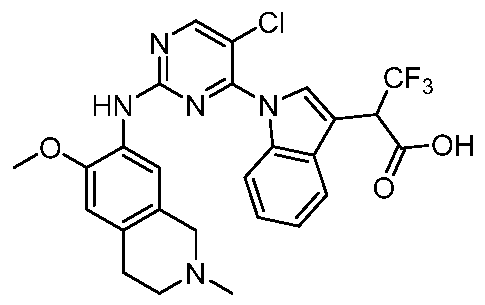
2-(1-(5-클로로-2-((6-메톡시-2-메틸-1,2,3,4-테트라히드로이소퀴놀린-7-일)아미노)피리미딘-4-일)-1H-인돌-3-일)-3,3,3-트리플루오로프로판산2-(1-(5-Chloro-2-((6-methoxy-2-methyl-1,2,3,4-tetrahydroisoquinolin-7-yl)amino)pyrimidin-4-yl)- 1H-indol-3-yl)-3,3,3-trifluoropropanoic acid
단계 1: Int. E32 (200 mg, 0.822 mmol)) 및 2,4,5-트리클로로피리미딘 (226.3 mg, 1.23 mmol)을 조건 A1 하에 사용하고, 역상 크로마토그래피 (MeCN/0.03% TFA)에 의한 정제 후에 2-(1-(2,5-디클로로피리미딘-4-일)-1H-인돌-3-일)-3,3,3-트리플루오로프로판산 (190 mg, 47.4% 수율, 80% 순도)을 제공하였다. LC-MS (ESI) m/z: 390 [M+H]+.Step 1: Int. E32 (200 mg, 0.822 mmol)) and 2,4,5-trichloropyrimidine (226.3 mg, 1.23 mmol) were used under condition A1 and after purification by reverse phase chromatography (MeCN/0.03% TFA) 2- (1-(2,5-dichloropyrimidin-4-yl)-1H-indol-3-yl)-3,3,3-trifluoropropanoic acid (190 mg, 47.4% yield, 80% purity) provided. LC-MS (ESI) m/z: 390 [M+H] + .
단계 2: Int. W1 (112.4 mg, 0.584 mmol) 및 2-(1-(2,5-디클로로피리미딘-4-일)-1H-인돌-3-일)-3,3,3-트리플루오로프로판산 (190 mg, 0.487 mmol)을 조건 B3 하에 사용하고, 정제용-HPLC (MeCN/0.1% HCOOH)에 의한 정제 후에 1-(1-(5-클로로-2-((6-메톡시-2-메틸-1,2,3,4-테트라히드로이소퀴놀린-7-일)아미노)피리미딘-4-일)-1H-인돌-3-일)시클로프로판-1-카르복실산을 백색 고체 (9.3 mg, 3.4% 수율)로서 제공하였다. LC-MS (ESI) m/z: 546 [M+H]+. 1H NMR (400MHz, DMSO-d6) δ 8.82 (s, 1H), 8.65 (s, 1H), 8.17 (s, 1H), 7.82 (s, 1H), 7.73 (d, J = 7.6 Hz, 1H), 7.63 (d, J = 7.7 Hz, 1H), 7.45 (s, 1H), 7.25-7.19 (m, 2H), 6.82 (s, 1H), 4.63 (d, J = 9.0 Hz, 1H), 3.77 (s, 3H), 3.63 (br, 2H), 2.88 (br, 5H), 2.56 (br, 2H).Step 2: Int. W1 (112.4 mg, 0.584 mmol) and 2-(1-(2,5-dichloropyrimidin-4-yl)-1H-indol-3-yl)-3,3,3-trifluoropropanoic acid (190 mg, 0.487 mmol) was used under condition B3, and after purification by prep-HPLC (MeCN/0.1% HCOOH) 1-(1-(5-chloro-2-((6-methoxy-2-methyl-) 1,2,3,4-tetrahydroisoquinolin-7-yl)amino)pyrimidin-4-yl)-1H-indol-3-yl)cyclopropane-1-carboxylic acid as a white solid (9.3 mg, 3.4% yield). LC-MS (ESI) m/z: 546 [M+H] + . 1 H NMR (400 MHz, DMSO-d 6 ) δ 8.82 (s, 1H), 8.65 (s, 1H), 8.17 (s, 1H), 7.82 (s, 1H), 7.73 (d, J = 7.6 Hz, 1H) ), 7.63 (d, J = 7.7 Hz, 1H), 7.45 (s, 1H), 7.25-7.19 (m, 2H), 6.82 (s, 1H), 4.63 (d, J = 9.0 Hz, 1H), 3.77 (s, 3H), 3.63 (br, 2H), 2.88 (br, 5H), 2.56 (br, 2H).
실시예 145Example 145

메틸 2-(1-(5-클로로-2-((6-메톡시-2-메틸-1,2,3,4-테트라히드로이소퀴놀린-7-일)아미노)피리미딘-4-일)-3-메틸인돌린-3-일)아세테이트Methyl 2-(1-(5-chloro-2-((6-methoxy-2-methyl-1,2,3,4-tetrahydroisoquinolin-7-yl)amino)pyrimidin-4-yl) -3-methylindolin-3-yl)acetate
실시예 146Example 146

2-(1-(5-클로로-2-((6-메톡시-2-메틸-1,2,3,4-테트라히드로이소퀴놀린-7-일)아미노)피리미딘-4-일)-3-메틸인돌린-3-일)아세트산2-(1-(5-Chloro-2-((6-methoxy-2-methyl-1,2,3,4-tetrahydroisoquinolin-7-yl)amino)pyrimidin-4-yl)- 3-methylindolin-3-yl)acetic acid
단계 1: n-BuOH (3 mL) 중 Int. E33 (67 mg, 0.248 mmol)의 혼합물에 2,4,5-트리클로로피리미딘 (45.5 mg, 0.248 mmol) 및 DIPEA (96.19 mg, 0.744 mmol)를 천천히 첨가하였다. 혼합물을 100℃에서 16시간 동안 교반하고, 빙냉수 (20 mL)로 켄칭하고, EA (30 mL x 3)로 추출하였다. 유기 상을 염수 (20 mL)로 세척하고, 무수 Na2SO4 상에서 건조시키고, 여과하였다. 여과물을 진공 하에 농축시키고, 잔류물을 실리카 겔 상에서 플래쉬 칼럼 크로마토그래피 (DCM/PE = 0-100%)에 의해 정제하여 메틸 2-(1-(2,5-디클로로피리미딘-4-일)-3-메틸인돌린-3-일)아세테이트 (80 mg, 83.3% 수율)를 황색 고체로서 수득하였다. LC-MS (ESI) m/z: 352 [M+H]+.Step 1: Int. in n-BuOH (3 mL). To a mixture of E33 (67 mg, 0.248 mmol) was added 2,4,5-trichloropyrimidine (45.5 mg, 0.248 mmol) and DIPEA (96.19 mg, 0.744 mmol) slowly. The mixture was stirred at 100° C. for 16 h, quenched with ice cold water (20 mL) and extracted with EA (30 mL×3). The organic phase was washed with brine (20 mL), dried over anhydrous Na 2 SO 4 and filtered. The filtrate was concentrated in vacuo and the residue was purified by flash column chromatography on silica gel (DCM/PE = 0-100%) to methyl 2-(1-(2,5-dichloropyrimidin-4-yl) )-3-methylindolin-3-yl)acetate (80 mg, 83.3% yield) was obtained as a yellow solid. LC-MS (ESI) m/z: 352 [M+H] + .
단계 2: i-PrOH (5 mL) 중 메틸 2-(1-(2,5-디클로로피리미딘-4-일)-3-메틸인돌린-3-일)아세테이트 (80 mg, 0.227 mmol)의 혼합물에 Int. W1 (51.5 mg, 0.227 mmol) 및 TsOH·H2O (43.2 mg, 0.227 mmol)를 천천히 첨가하였다. 혼합물을 100℃에서 16시간 동안 교반하고, 포화 NaHCO3 수용액 (10 mL)으로 켄칭하고, DCM/MeOH (v/v = 10/1, 30 mL x 3)로 추출하였다. 유기 상을 염수 (30 mL)로 세척하고, 무수 Na2SO4 상에서 건조시키고, 여과하였다. 여과물을 진공 하에 농축시키고, 잔류물을 실리카 겔 상에서 플래쉬 칼럼 크로마토그래피 (DCM/MeOH = 0-15%)에 의해 정제하여 메틸 2-(1-(5-클로로-2-((6-메톡시-2-메틸-1,2,3,4-테트라히드로이소퀴놀린-7-일)아미노)피리미딘-4-일)-3-메틸인돌린-3-일)아세테이트 (70 mg, 42.5% 수율)를 황색 고체로서 수득하였다. LC-MS (ESI) m/z: 508 [M+H]+. 1H NMR (500 MHz, DMSO-d6) δ 8.26 (s, 1H), 7.98 (s, 1H), 7.59 (s, 1H), 7.30 (t, J = 8.8 Hz, 2H), 7.12 (s, 1H), 6.98 (s, 1H), 6.74 (s, 1H), 4.38 (d, J = 10.7 Hz, 1H), 4.05 (d, J = 10.7 Hz, 1H), 3.78 (s, 3H), 3.50 (s, 3H), 3.27 (s, 2H), 2.78 (dd, J = 10.3, 4.8 Hz, 3H), 2.68 (s, 1H), 2.55 (t, J = 5.7 Hz, 2H), 2.30 (s, 3H), 1.36 (s, 3H).Step 2: of methyl 2-(1-(2,5-dichloropyrimidin-4-yl)-3-methylindolin-3-yl)acetate (80 mg, 0.227 mmol) in i-PrOH (5 mL) Int. W1 (51.5 mg, 0.227 mmol) and TsOH.H 2 O (43.2 mg, 0.227 mmol) were added slowly. The mixture was stirred at 100° C. for 16 h, quenched with saturated aqueous NaHCO 3 aqueous solution (10 mL) and extracted with DCM/MeOH (v/v = 10/1, 30 mL×3). The organic phase was washed with brine (30 mL), dried over anhydrous Na 2 SO 4 and filtered. The filtrate was concentrated in vacuo and the residue was purified by flash column chromatography on silica gel (DCM/MeOH = 0-15%) to methyl 2-(1-(5-chloro-2-((6-meOH) Toxy-2-methyl-1,2,3,4-tetrahydroisoquinolin-7-yl)amino)pyrimidin-4-yl)-3-methylindolin-3-yl)acetate (70 mg, 42.5% yield) as a yellow solid. LC-MS (ESI) m/z: 508 [M+H] + . 1 H NMR (500 MHz, DMSO-d 6 ) δ 8.26 (s, 1H), 7.98 (s, 1H), 7.59 (s, 1H), 7.30 (t, J = 8.8 Hz, 2H), 7.12 (s, 1H), 6.98 (s, 1H), 6.74 (s, 1H), 4.38 (d, J = 10.7 Hz, 1H), 4.05 (d, J = 10.7 Hz, 1H), 3.78 (s, 3H), 3.50 ( s, 3H), 3.27 (s, 2H), 2.78 (dd, J = 10.3, 4.8 Hz, 3H), 2.68 (s, 1H), 2.55 (t, J = 5.7 Hz, 2H), 2.30 (s, 3H) ), 1.36 (s, 3H).
단계 3: THF (5 mL) 중 메틸 2-(1-(5-클로로-2-((6-메톡시-2-메틸-1,2,3,4-테트라히드로이소퀴놀린-7-일)아미노)피리미딘-4-일)-3-메틸인돌린-3-일)아세테이트 (70 mg, 0.096 mmol) 및 LiOH 수용액 (2 N, 1 mL)의 혼합물을 실온에서 16시간 동안 교반하고, 포름산을 사용하여 pH ~5로 조정하고, DCM (30 mL x 3)으로 추출하였다. 합한 유기 상을 무수 황산나트륨 상에서 건조시키고, 여과하였다. 여과물을 진공 하에 농축시키고, 잔류물을 정제용-HPLC (MeCN/10 mM NH4HCO3, 0.025% NH3·H2O)에 의해 정제하여 2-(1-(5-클로로-2-((6-메톡시-2-메틸-1,2,3,4-테트라히드로이소퀴놀린-7-일)아미노)피리미딘-4-일)-3-메틸인돌린-3-일)아세트산 (23.0 mg, 46.2% 수율)을 백색 고체로서 수득하였다. LC-MS (ESI) m/z: 494 [M+H]+. 1H NMR (500 MHz, DMSO-d6) δ 8.25 (s, 1H), 7.99 (s, 1H), 7.57 (s, 1H), 7.29 (dd, J = 17.2, 7.6 Hz, 2H), 7.11 (t, J = 7.3 Hz, 1H), 6.98 (d, J = 7.3 Hz, 1H), 6.75 (s, 1H), 4.42 (d, J = 10.7 Hz, 1H), 4.02 (d, J = 10.6 Hz, 1H), 3.78 (s, 3H), 3.30 (s, 2H), 2.78 (s, 2H), 2.69 (d, J = 15.4 Hz, 1H), 2.58 (d, J = 6.1 Hz, 3H), 2.32 (s, 3H), 1.34 (s, 3H).Step 3: Methyl 2-(1-(5-chloro-2-((6-methoxy-2-methyl-1,2,3,4-tetrahydroisoquinolin-7-yl) in THF (5 mL)) A mixture of amino)pyrimidin-4-yl)-3-methylindolin-3-yl)acetate (70 mg, 0.096 mmol) and aqueous LiOH solution (2 N, 1 mL) was stirred at room temperature for 16 hours, and formic acid was used to adjust the pH to ~5, and extracted with DCM (30 mL x 3). The combined organic phases were dried over anhydrous sodium sulfate and filtered. The filtrate was concentrated in vacuo and the residue was purified by prep-HPLC (MeCN/10 mM NH 4 HCO 3 , 0.025% NH 3 .H 2 O) to 2-(1-(5-chloro-2- ((6-Methoxy-2-methyl-1,2,3,4-tetrahydroisoquinolin-7-yl)amino)pyrimidin-4-yl)-3-methylindolin-3-yl)acetic acid ( 23.0 mg, 46.2% yield) was obtained as a white solid. LC-MS (ESI) m/z: 494 [M+H] + . 1 H NMR (500 MHz, DMSO-d 6 ) δ 8.25 (s, 1H), 7.99 (s, 1H), 7.57 (s, 1H), 7.29 (dd, J = 17.2, 7.6 Hz, 2H), 7.11 ( t, J = 7.3 Hz, 1H), 6.98 (d, J = 7.3 Hz, 1H), 6.75 (s, 1H), 4.42 (d, J = 10.7 Hz, 1H), 4.02 (d, J = 10.6 Hz, 1H), 3.78 (s, 3H), 3.30 (s, 2H), 2.78 (s, 2H), 2.69 (d, J = 15.4 Hz, 1H), 2.58 (d, J = 6.1 Hz, 3H), 2.32 ( s, 3H), 1.34 (s, 3H).
실시예 147 & 148Examples 147 & 148

(R)-2-(1-(5-클로로-2-((6-메톡시-2-메틸-1,2,3,4-테트라히드로이소퀴놀린-7-일)아미노)피리미딘-4-일)-3-메틸인돌린-3-일)아세트산 & (S)-2-(1-(5-클로로-2-((6-메톡시-2-메틸-1,2,3,4-테트라히드로이소퀴놀린-7-일)아미노)피리미딘-4-일)-3-메틸인돌린-3-일)아세트산(R)-2-(1-(5-chloro-2-((6-methoxy-2-methyl-1,2,3,4-tetrahydroisoquinolin-7-yl)amino)pyrimidine-4 -yl)-3-methylindolin-3-yl)acetic acid & (S)-2-(1-(5-chloro-2-((6-methoxy-2-methyl-1,2,3,4) -tetrahydroisoquinolin-7-yl)amino)pyrimidin-4-yl)-3-methylindolin-3-yl)acetic acid
방법 1:Method 1:
단계 1: 메틸 2-(1-(5-클로로-2-((6-메톡시-2-메틸-1,2,3,4-테트라히드로이소퀴놀린-7-일)아미노)피리미딘-4-일)-3-메틸인돌린-3-일)아세테이트 (157 mg)의 SFC 키랄 분리로 (R)-메틸 2-(1-(5-클로로-2-((6-메톡시-2-메틸-1,2,3,4-테트라히드로이소퀴놀린-7-일)아미노)피리미딘-4-일)-3-메틸인돌린-3-일)아세테이트 및 (S)-메틸 2-(1-(5-클로로-2-((6-메톡시-2-메틸-1,2,3,4-테트라히드로이소퀴놀린-7-일)아미노)피리미딘-4-일)-3-메틸인돌린-3-일)아세테이트 (67 mg, 각각 63 mg)를 제공하였다. 입체화학은 확인되지 않았고, 2종의 생성물을 임의로 할당하였다.Step 1: Methyl 2-(1-(5-chloro-2-((6-methoxy-2-methyl-1,2,3,4-tetrahydroisoquinolin-7-yl)amino)pyrimidine-4 SFC chiral separation of -yl)-3-methylindolin-3-yl)acetate (157 mg) (R)-methyl 2-(1-(5-chloro-2-((6-methoxy-2-) Methyl-1,2,3,4-tetrahydroisoquinolin-7-yl)amino)pyrimidin-4-yl)-3-methylindolin-3-yl)acetate and (S)-methyl 2-(1 -(5-chloro-2-((6-methoxy-2-methyl-1,2,3,4-tetrahydroisoquinolin-7-yl)amino)pyrimidin-4-yl)-3-methylyne dolin-3-yl)acetate (67 mg, 63 mg each) was provided. Stereochemistry was not identified and two products were randomly assigned.
LC-MS (ESI) m/z: 508 [M+H]+. 키랄-HPLC 체류 시간: 1.829분; ee 값: 98.3%.LC-MS (ESI) m/z: 508 [M+H] + . Chiral-HPLC retention time: 1.829 min; ee value: 98.3%.
LC-MS (ESI) m/z: 508 [M+H]+. 키랄-HPLC 체류 시간: 3.427분; ee 값: >99%.LC-MS (ESI) m/z: 508 [M+H] + . Chiral-HPLC retention time: 3.427 min; ee value: >99%.
SFC 분리 조건:SFC separation conditions:
기기: SFC-80 (타르, 워터스)Instrument: SFC-80 (Tar, Waters)
칼럼: AD-H 20*250 mm, 10 um (다이셀)Column: AD-H 20*250 mm, 10 um (Daisel)
칼럼 온도: 35℃Column temperature: 35°C
이동상: CO2/EtOH (0.2% 메탄올/암모니아) = 50/50Mobile phase: CO 2 /EtOH (0.2% methanol/ammonia) = 50/50
유량: 80 g/분Flow rate: 80 g/min
배압: 100 barBack pressure: 100 bar
검출 파장: 214 nmDetection wavelength: 214 nm
사이클 시간: 6.9분Cycle time: 6.9 minutes
단계 2: (R)-메틸 2-(1-(5-클로로-2-((6-메톡시-2-메틸-1,2,3,4-테트라히드로이소퀴놀린-7-일)아미노)피리미딘-4-일)-3-메틸인돌린-3-일)아세테이트 및 (S)-메틸 2-(1-(5-클로로-2-((6-메톡시-2-메틸-1,2,3,4-테트라히드로이소퀴놀린-7-일)아미노)피리미딘-4-일)-3-메틸인돌린-3-일)아세테이트를 실시예 146의 단계 3과 동일한 조건 하에 개별적으로 가수분해하여 (R)-2-(1-(5-클로로-2-((6-메톡시-2-메틸-1,2,3,4-테트라히드로이소퀴놀린-7-일)아미노)피리미딘-4-일)-3-메틸인돌린-3-일)아세트산 및 (S)-2-(1-(5-클로로-2-((6-메톡시-2-메틸-1,2,3,4-테트라히드로이소퀴놀린-7-일)아미노)피리미딘-4-일)-3-메틸인돌린-3-일)아세트산 (17.6 mg, 각각 33.8 mg)을 제공하였다. 입체화학은 확인되지 않았고, 2종의 생성물을 임의로 할당하였다.Step 2: (R)-Methyl 2-(1-(5-chloro-2-((6-methoxy-2-methyl-1,2,3,4-tetrahydroisoquinolin-7-yl)amino) pyrimidin-4-yl)-3-methylindolin-3-yl)acetate and (S)-methyl 2-(1-(5-chloro-2-((6-methoxy-2-methyl-1, 2,3,4-tetrahydroisoquinolin-7-yl)amino)pyrimidin-4-yl)-3-methylindolin-3-yl)acetate was individually hydrolyzed under the same conditions as step 3 of Example 146 digested (R)-2-(1-(5-chloro-2-((6-methoxy-2-methyl-1,2,3,4-tetrahydroisoquinolin-7-yl)amino)pyrimidine -4-yl)-3-methylindolin-3-yl)acetic acid and (S)-2-(1-(5-chloro-2-((6-methoxy-2-methyl-1,2,3) provided ,4-tetrahydroisoquinolin-7-yl)amino)pyrimidin-4-yl)-3-methylindolin-3-yl)acetic acid (17.6 mg, 33.8 mg each). Stereochemistry was not identified and two products were randomly assigned.
LC-MS (ESI) m/z: 494 [M+H]+. 1H NMR (400 MHz, DMSO-d6) δ 8.25 (s, 1H), 8.00 (s, 1H), 7.57 (s, 1H), 7.30 (dd, J = 13.7, 7.7 Hz, 2H), 7.11 (t, J = 7.6 Hz, 1H), 6.97 (t, J = 7.3 Hz, 1H), 6.75 (s, 1H), 4.42 (d, J = 10.7 Hz, 1H), 4.02 (d, J = 10.8 Hz, 1H), 3.78 (s, 3H), 3.30 (s, 2H), 2.78 (s, 2H), 2.69 (d, J = 15.4 Hz, 1H), 2.62-2.54 (m, 3H), 2.32 (s, 3H), 1.34 (s, 3H). 키랄-HPLC 체류 시간: 1.384분; ee 값: >99%.LC-MS (ESI) m/z: 494 [M+H] + . 1 H NMR (400 MHz, DMSO-d 6 ) δ 8.25 (s, 1H), 8.00 (s, 1H), 7.57 (s, 1H), 7.30 (dd, J = 13.7, 7.7 Hz, 2H), 7.11 ( t, J = 7.6 Hz, 1H), 6.97 (t, J = 7.3 Hz, 1H), 6.75 (s, 1H), 4.42 (d, J = 10.7 Hz, 1H), 4.02 (d, J = 10.8 Hz, 1H), 3.78 (s, 3H), 3.30 (s, 2H), 2.78 (s, 2H), 2.69 (d, J = 15.4 Hz, 1H), 2.62-2.54 (m, 3H), 2.32 (s, 3H) ), 1.34 (s, 3H). Chiral-HPLC retention time: 1.384 min; ee value: >99%.
LC-MS (ESI) m/z: 494 [M+H]+. 1H NMR (400 MHz, DMSO-d6) δ 8.25 (s, 1H), 8.00 (s, 1H), 7.56 (s, 1H), 7.29 (dd, J = 13.6, 7.4 Hz, 2H), 7.10 (t, J = 7.1 Hz, 1H), 6.97 (t, J = 7.4 Hz, 1H), 6.75 (s, 1H), 4.41 (d, J = 10.8 Hz, 1H), 4.02 (d, J = 10.8 Hz, 1H), 3.77 (s, 3H), 3.29 (s, 2H), 2.77 (t, J = 5.6 Hz, 2H), 2.69 (d, J = 15.4 Hz, 1H), 2.57 (dd, J = 13.1, 7.1 Hz, 3H), 2.30 (d, J = 11.1 Hz, 3H), 1.34 (s, 2H). 키랄-HPLC 체류 시간: 1.132분; ee 값: >99%.LC-MS (ESI) m/z: 494 [M+H] + . 1 H NMR (400 MHz, DMSO-d 6 ) δ 8.25 (s, 1H), 8.00 (s, 1H), 7.56 (s, 1H), 7.29 (dd, J = 13.6, 7.4 Hz, 2H), 7.10 ( t, J = 7.1 Hz, 1H), 6.97 (t, J = 7.4 Hz, 1H), 6.75 (s, 1H), 4.41 (d, J = 10.8 Hz, 1H), 4.02 (d, J = 10.8 Hz, 1H), 3.77 (s, 3H), 3.29 (s, 2H), 2.77 (t, J = 5.6 Hz, 2H), 2.69 (d, J = 15.4 Hz, 1H), 2.57 (dd, J = 13.1, 7.1) Hz, 3H), 2.30 (d, J = 11.1 Hz, 3H), 1.34 (s, 2H). Chiral-HPLC retention time: 1.132 min; ee value: >99%.
방법 2:Method 2:
단계 1: 메틸 2-(1-(2,5-디클로로피리미딘-4-일)-3-메틸인돌린-3-일)아세테이트의 SFC 키랄 분리로 (R)-메틸 2-(1-(2,5-디클로로피리미딘-4-일)-3-메틸인돌린-3-일)아세테이트 및 (S)-메틸 2-(1-(2,5-디클로로피리미딘-4-일)-3-메틸인돌린-3-일)아세테이트를 제공하였다. 입체화학은 확인되지 않았고, 2종의 생성물을 임의로 할당하였다.Step 1: SFC chiral separation of methyl 2-(1-(2,5-dichloropyrimidin-4-yl)-3-methylindolin-3-yl)acetate (R)-methyl 2-(1-( 2,5-dichloropyrimidin-4-yl)-3-methylindolin-3-yl)acetate and (S)-methyl 2-(1-(2,5-dichloropyrimidin-4-yl)-3 -methylindolin-3-yl)acetate was provided. Stereochemistry was not identified and two products were randomly assigned.
LC-MS (ESI) m/z: 352 [M+H]+. 키랄-HPLC 체류 시간: 1.191분; ee 값: >99%.LC-MS (ESI) m/z: 352 [M+H] + . Chiral-HPLC retention time: 1.191 min; ee value: >99%.
LC-MS (ESI) m/z: 352 [M+H]+. 키랄-HPLC 체류 시간: 1.519분; ee 값: >99%.LC-MS (ESI) m/z: 352 [M+H] + . Chiral-HPLC retention time: 1.519 min; ee value: >99%.
SFC 분리 조건:SFC separation conditions:
기기: SFC-80 (타르, 워터스)Instrument: SFC-80 (Tar, Waters)
칼럼: AD-H 20*250 mm, 10 um (다이셀)Column: AD-H 20*250 mm, 10 um (Daisel)
칼럼 온도: 35℃Column temperature: 35°C
이동상: CO2/이소프로판올 (0.2% 메탄올/암모니아) = 87/13Mobile phase: CO 2 /isopropanol (0.2% methanol/ammonia) = 87/13
유량: 80 g/분Flow rate: 80 g/min
배압: 100 barBack pressure: 100 bar
검출 파장: 214 nmDetection wavelength: 214 nm
사이클 시간: 2.8분Cycle time: 2.8 minutes
(단계 2&3의 대표적인 예로서 하나의 입체이성질체)(One stereoisomer as a representative example of steps 2&3)
단계 2: t-부탄올 (25 mL) 중 Int. W1 (1.36 g, 5.96 mmol), (S)-메틸 2-(1-(2,5-디클로로피리미딘-4-일)-3-메틸인돌린-3-일)아세테이트 (2.1 g, 5.96 mmol) 및 TsOH·H2O (1.13 g, 5.96 mmol)의 혼합물을 100℃에서 12시간 동안 교반하고, 실온으로 냉각시키고, 포화 NaHCO3 수용액 (10 mL)에 붓고, EA (30 mL x 3)로 추출하였다. 유기 상을 무수 Na2SO4 상에서 건조시키고, 여과하였다. 여과물을 진공 하에 농축시키고, 잔류물을 실리카 겔 상에서 플래쉬 칼럼 크로마토그래피 (DCM/MeOH = 20:1)에 의해 정제하여 (S)-메틸 2-(1-(5-클로로-2-((6-메톡시-2-메틸-1,2,3,4-테트라히드로이소퀴놀린-7-일)아미노)피리미딘-4-일)-3-메틸인돌린-3-일)아세테이트 (1.8 g, 56.3% 수율)를 담황색 고체로서 제공하였다. LC-MS (ESI) m/z: 508 [M+H]+.Step 2: Int. in t-butanol (25 mL). W1 (1.36 g, 5.96 mmol), (S)-methyl 2-(1-(2,5-dichloropyrimidin-4-yl)-3-methylindolin-3-yl)acetate (2.1 g, 5.96 mmol) ) and TsOH.H 2 O (1.13 g, 5.96 mmol) was stirred at 100° C. for 12 h, cooled to room temperature, poured into saturated aqueous NaHCO 3 solution (10 mL), and with EA (30 mL×3). extracted. The organic phase was dried over anhydrous Na 2 SO 4 and filtered. The filtrate was concentrated in vacuo and the residue was purified by flash column chromatography on silica gel (DCM/MeOH = 20:1) (S)-methyl 2-(1-(5-chloro-2-(( 6-Methoxy-2-methyl-1,2,3,4-tetrahydroisoquinolin-7-yl)amino)pyrimidin-4-yl)-3-methylindolin-3-yl)acetate (1.8 g , 56.3% yield) as a pale yellow solid. LC-MS (ESI) m/z: 508 [M+H] + .
단계 3: 물 (5 mL) 중 수산화리튬 수화물 (264 mg, 6.3 mmol) 및 MeOH (5 mL) 중 (S)-메틸 2-(1-(5-클로로-2-((6-메톡시-2-메틸-1,2,3,4-테트라히드로이소퀴놀린-7-일)아미노)피리미딘-4-일)-3-메틸인돌린-3-일)아세테이트 (1.6 g, 3.15 mmol)의 용액의 혼합물을 실온에서 16시간 동안 교반하고, 아세트산을 사용하여 pH ~3으로 산성화시켰다. 생성된 혼합물을 정제용-HPLC (MeCN/10 mM NH4HCO3)에 의해 정제하여 (S)-2-(1-(5-클로로-2-((6-메톡시-2-메틸-1,2,3,4-테트라히드로이소퀴놀린-7-일)아미노)피리미딘-4-일)-3-메틸인돌린-3-일)아세트산 (839.3 mg, 53.9% 수율)을 연황색 고체로서 제공하였다. LC-MS (ESI) m/z: 494 [M+H]+. 1H NMR (400 MHz, DMSO-d6) δ 8.30 (s, 1H), 8.02 (s, 1H), 7.63 (s, 1H), 7.37 (d, J = 8.0 Hz, 1H), 7.33 (d, J = 8.0 Hz, 1H), 7.16 (t, J = 8.0 Hz, 1H), 7.02 (t, J = 8.0 Hz, 1H), 6.80 (s, 1H), 4.48 (d, J = 10.8 Hz, 1H), 4.08 (d, J = 10.8 Hz, 1H), 3.83 (s, 3H), 2.83 (t, J = 5.6 Hz, 2H), 2.74 (d, J = 15.2 Hz, 1H), 2.66-2.59 (m, 3H), 2.37 (s, 3H), 1.40 (s, 3H). 키랄-HPLC 체류 시간: 1.132분; ee 값: >99%.Step 3: Lithium hydroxide hydrate (264 mg, 6.3 mmol) in water (5 mL) and (S)-methyl 2-(1-(5-chloro-2-((6-methoxy-) in MeOH (5 mL) 2-methyl-1,2,3,4-tetrahydroisoquinolin-7-yl)amino)pyrimidin-4-yl)-3-methylindolin-3-yl)acetate (1.6 g, 3.15 mmol) The mixture of solutions was stirred at room temperature for 16 h and acidified to pH ˜3 with acetic acid. The resulting mixture was purified by preparative-HPLC (MeCN/10 mM NH 4 HCO 3 ) to (S)-2-(1-(5-chloro-2-((6-methoxy-2-methyl-1) ,2,3,4-tetrahydroisoquinolin-7-yl)amino)pyrimidin-4-yl)-3-methylindolin-3-yl)acetic acid (839.3 mg, 53.9% yield) as a light yellow solid provided. LC-MS (ESI) m/z: 494 [M+H] + . 1 H NMR (400 MHz, DMSO-d 6 ) δ 8.30 (s, 1H), 8.02 (s, 1H), 7.63 (s, 1H), 7.37 (d, J = 8.0 Hz, 1H), 7.33 (d, J = 8.0 Hz, 1H), 7.16 (t, J = 8.0 Hz, 1H), 7.02 (t, J = 8.0 Hz, 1H), 6.80 (s, 1H), 4.48 (d, J = 10.8 Hz, 1H) , 4.08 (d, J = 10.8 Hz, 1H), 3.83 (s, 3H), 2.83 (t, J = 5.6 Hz, 2H), 2.74 (d, J = 15.2 Hz, 1H), 2.66-2.59 (m, 3H), 2.37 (s, 3H), 1.40 (s, 3H). Chiral-HPLC retention time: 1.132 min; ee value: >99%.
실시예 149Example 149
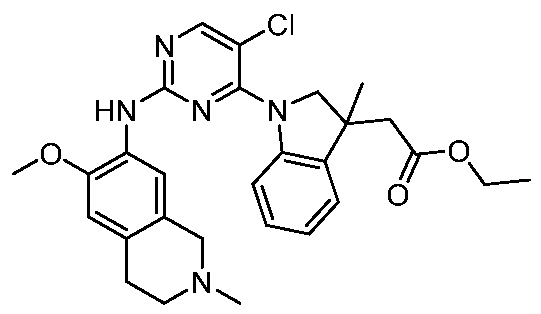
에틸 2-(1-(5-클로로-2-((6-메톡시-2-메틸-1,2,3,4-테트라히드로이소퀴놀린-7-일)아미노)피리미딘-4-일)-3-메틸인돌린-3-일)아세테이트Ethyl 2-(1-(5-chloro-2-((6-methoxy-2-methyl-1,2,3,4-tetrahydroisoquinolin-7-yl)amino)pyrimidin-4-yl) -3-methylindolin-3-yl)acetate
2-(1-(5-클로로-2-((6-메톡시-2-메틸-1,2,3,4-테트라히드로이소퀴놀린-7-일)아미노)피리미딘-4-일)-1H-인돌-3-일)아세트산 대신 2-(1-(5-클로로-2-((6-메톡시-2-메틸-1,2,3,4-테트라히드로이소퀴놀린-7-일)아미노)피리미딘-4-일)-3-메틸인돌린-3-일)아세트산을 사용한, 실시예 132와 동일한 절차. LC-MS (ESI) m/z: 522 [M+H]+. 1H NMR (400 MHz, DMSO-d6) δ 8.25 (s, 1H), 7.97 (s, 1H), 7.57 (s, 1H), 7.36-7.24 (m, 2H), 7.12 (dd, J = 11.1, 4.3 Hz, 1H), 6.98 (s, 1H), 6.74 (s, 1H), 4.41 (d, J = 10.8 Hz, 1H), 4.05 (d, J = 10.7 Hz, 1H), 3.96 (dd, J = 7.1, 1.5 Hz, 2H), 3.77 (d, J = 3.3 Hz, 3H), 3.27 (s, 2H), 2.75 (dd, J = 10.1, 7.2 Hz, 3H), 2.65 (s, 1H), 2.55 (d, J = 5.7 Hz, 2H), 2.30 (s, 3H), 1.35 (s, 3H), 1.06 (t, J = 7.1 Hz, 3H).2-(1-(5-Chloro-2-((6-methoxy-2-methyl-1,2,3,4-tetrahydroisoquinolin-7-yl)amino)pyrimidin-4-yl)- 2-(1-(5-chloro-2-((6-methoxy-2-methyl-1,2,3,4-tetrahydroisoquinolin-7-yl) instead of 1H-indol-3-yl)acetic acid Same procedure as Example 132, using amino)pyrimidin-4-yl)-3-methylindolin-3-yl)acetic acid. LC-MS (ESI) m/z: 522 [M+H] + . 1 H NMR (400 MHz, DMSO-d 6 ) δ 8.25 (s, 1H), 7.97 (s, 1H), 7.57 (s, 1H), 7.36-7.24 (m, 2H), 7.12 (dd, J = 11.1) , 4.3 Hz, 1H), 6.98 (s, 1H), 6.74 (s, 1H), 4.41 (d, J = 10.8 Hz, 1H), 4.05 (d, J = 10.7 Hz, 1H), 3.96 (dd, J) = 7.1, 1.5 Hz, 2H), 3.77 (d, J = 3.3 Hz, 3H), 3.27 (s, 2H), 2.75 (dd, J = 10.1, 7.2 Hz, 3H), 2.65 (s, 1H), 2.55 (d, J = 5.7 Hz, 2H), 2.30 (s, 3H), 1.35 (s, 3H), 1.06 (t, J = 7.1 Hz, 3H).
실시예 150Example 150

2-(1-(5-클로로-2-((6-메톡시-2-메틸-1,2,3,4-테트라히드로이소퀴놀린-7-일)아미노)피리미딘-4-일)-5-플루오로-3-메틸인돌린-3-일)아세트산2-(1-(5-Chloro-2-((6-methoxy-2-methyl-1,2,3,4-tetrahydroisoquinolin-7-yl)amino)pyrimidin-4-yl)- 5-Fluoro-3-methylindolin-3-yl)acetic acid
단계 1: n-BuOH (2 mL) 중 Int. E34 (295 mg, 1.32 mmol), 2,4,5-트리클로로피리미딘 (266.6 mg, 1.45 mmol) 및 DIPEA (170.5 mg, 1.32 mmol)의 용액을 100℃에서 2시간 동안 교반하고, 실온으로 냉각시키고, 물에 붓고, DCM/MeOH (v/v, 10/1, 20 mL x 3)로 추출하였다. 유기 상을 무수 황산나트륨 상에서 건조시키고, 여과하였다. 여과물을 진공 하에 농축시키고, 잔류물을 실리카 겔 (EA/PE = 1/4) 상에서 플래쉬 칼럼 크로마토그래피에 의해 정제하여 메틸 2-(1-(2,5-디클로로피리미딘-4-일)-5-플루오로-3-메틸인돌린-3-일)아세테이트 (416 mg, 85.0% 수율)를 회백색 고체로서 수득하였다. LC-MS (ESI) m/z: 370 [M+H]+.Step 1: Int. in n-BuOH (2 mL). A solution of E34 (295 mg, 1.32 mmol), 2,4,5-trichloropyrimidine (266.6 mg, 1.45 mmol) and DIPEA (170.5 mg, 1.32 mmol) was stirred at 100° C. for 2 h and cooled to room temperature. , poured into water and extracted with DCM/MeOH (v/v, 10/1, 20 mL×3). The organic phase was dried over anhydrous sodium sulfate and filtered. The filtrate was concentrated in vacuo and the residue was purified by flash column chromatography on silica gel (EA/PE = 1/4) to methyl 2-(1-(2,5-dichloropyrimidin-4-yl) Obtained -5-fluoro-3-methylindolin-3-yl)acetate (416 mg, 85.0% yield) as an off-white solid. LC-MS (ESI) m/z: 370 [M+H] + .
단계 2: i-PrOH (2 mL) 중 메틸 2-(1-(2,5-디클로로피리미딘-4-일)-5-플루오로-3-메틸인돌린-3-일)아세테이트 (100 mg, 0.270 mmol), Int. W1 (62.3 mg, 0.324 mmol) 및 TsOH·H2O (51.3 mg, 0.270 mmol)의 용액을 100℃에서 16시간 동안 교반하고, 실온으로 냉각시키고, 포화 NaHCO3 수용액을 사용하여 pH ~8로 중화시켰다. 혼합물을 DCM/MeOH (v/v, 10/1, 20 mL x 3)로 추출하였다. 유기 상을 무수 황산나트륨 상에서 건조시키고, 여과하였다. 여과물을 진공 하에 농축시키고, 잔류물을 실리카 겔 (EA/PE = 1/4) 상에서 플래쉬 칼럼 크로마토그래피에 의해 정제하여 메틸 2-(1-(5-클로로-2-((6-메톡시-2-메틸-1,2,3,4-테트라히드로이소퀴놀린-7-일)아미노)피리미딘-4-일)-5-플루오로-3-메틸인돌린-3-일)아세테이트 (186 mg, 80.7% 수율, 60% 순도)를 담황색 고체로서 수득하였다. LC-MS (ESI) m/z: 526 [M+H]+.Step 2: Methyl 2-(1-(2,5-dichloropyrimidin-4-yl)-5-fluoro-3-methylindolin-3-yl)acetate (100 mg) in i-PrOH (2 mL) , 0.270 mmol), Int. A solution of W1 (62.3 mg, 0.324 mmol) and TsOH·H 2 O (51.3 mg, 0.270 mmol) was stirred at 100° C. for 16 h, cooled to room temperature and neutralized to pH ˜8 with saturated aqueous NaHCO 3 aqueous solution. made it The mixture was extracted with DCM/MeOH (v/v, 10/1, 20 mL×3). The organic phase was dried over anhydrous sodium sulfate and filtered. The filtrate was concentrated in vacuo and the residue was purified by flash column chromatography on silica gel (EA/PE = 1/4) to methyl 2-(1-(5-chloro-2-((6-methoxy) -2-methyl-1,2,3,4-tetrahydroisoquinolin-7-yl)amino)pyrimidin-4-yl)-5-fluoro-3-methylindolin-3-yl)acetate (186 mg, 80.7% yield, 60% purity) as a pale yellow solid. LC-MS (ESI) m/z: 526 [M+H] + .
단계 3: THF (8 mL) 중 메틸 2-(1-(5-클로로-2-((6-메톡시-2-메틸-1,2,3,4-테트라히드로이소퀴놀린-7-일)아미노)피리미딘-4-일)-5-플루오로-3-메틸인돌린-3-일)아세테이트 (186 mg, 0.354 mmol) 및 LiOH 수용액 (2N, 3.5 mL)의 혼합물을 실온에서 밤새 교반하고, 포름산을 사용하여 pH ~5로 조정하고, DCM/MeOH (v/v, 10/1, 10 mL x 3)로 추출하였다. 합한 유기 상을 무수 황산나트륨 상에서 건조시키고, 여과하였다. 여과물을 진공 하에 농축시키고, 잔류물을 정제용-HPLC (MeCN/10 mM NH4HCO3, 0.025% NH3·H2O)에 의해 정제하여 2-(1-(5-클로로-2-((6-메톡시-2-메틸-1,2,3,4-테트라히드로이소퀴놀린-7-일)아미노)피리미딘-4-일)-5-플루오로-3-메틸인돌린-3-일)아세트산 (57.6 mg, 31.8% 수율)을 백색 고체로서 수득하였다. LC-MS (ESI) m/z: 512 [M+H]+. 1H NMR (400 MHz, DMSO-d6) δ 8.23 (s, 1H), 8.02 (s, 1H), 7.51 (s, 1H), 7.34 (dd, J = 8.7, 4.7 Hz, 1H), 7.20 (dd, J = 8.6, 2.7 Hz, 1H), 6.89 (td, J = 9.0, 2.7 Hz, 1H), 6.75 (s, 1H), 4.44 (d, J = 10.9 Hz, 1H), 4.06 (d, J = 10.8 Hz, 1H), 3.77 (s, 3H), 3.28 (s, 2H), 2.78 (t, J = 5.7 Hz, 2H), 2.71 (d, J = 15.6 Hz, 1H), 2.62 (s, 1H), 2.59-2.55 (m, 2H), 2.31 (s, 3H), 1.33 (s, 3H).Step 3: Methyl 2-(1-(5-chloro-2-((6-methoxy-2-methyl-1,2,3,4-tetrahydroisoquinolin-7-yl) in THF (8 mL)) A mixture of amino)pyrimidin-4-yl)-5-fluoro-3-methylindolin-3-yl)acetate (186 mg, 0.354 mmol) and aqueous LiOH solution (2N, 3.5 mL) was stirred at room temperature overnight , adjusted to pH ~5 with formic acid, and extracted with DCM/MeOH (v/v, 10/1, 10 mL x 3). The combined organic phases were dried over anhydrous sodium sulfate and filtered. The filtrate was concentrated in vacuo and the residue was purified by prep-HPLC (MeCN/10 mM NH 4 HCO 3 , 0.025% NH 3 .H 2 O) to 2-(1-(5-chloro-2- ((6-Methoxy-2-methyl-1,2,3,4-tetrahydroisoquinolin-7-yl)amino)pyrimidin-4-yl)-5-fluoro-3-methylindoline-3 -yl)acetic acid (57.6 mg, 31.8% yield) was obtained as a white solid. LC-MS (ESI) m/z: 512 [M+H] + . 1 H NMR (400 MHz, DMSO-d 6 ) δ 8.23 (s, 1H), 8.02 (s, 1H), 7.51 (s, 1H), 7.34 (dd, J = 8.7, 4.7 Hz, 1H), 7.20 ( dd, J = 8.6, 2.7 Hz, 1H), 6.89 (td, J = 9.0, 2.7 Hz, 1H), 6.75 (s, 1H), 4.44 (d, J = 10.9 Hz, 1H), 4.06 (d, J) = 10.8 Hz, 1H), 3.77 (s, 3H), 3.28 (s, 2H), 2.78 (t, J = 5.7 Hz, 2H), 2.71 (d, J = 15.6 Hz, 1H), 2.62 (s, 1H) ), 2.59-2.55 (m, 2H), 2.31 (s, 3H), 1.33 (s, 3H).
실시예 151Example 151

2-(1-(5-클로로-2-((6-메톡시-2-메틸-1,2,3,4-테트라히드로이소퀴놀린-7-일)아미노)피리미딘-4-일)-6-플루오로-3-메틸인돌린-3-일)아세트산2-(1-(5-Chloro-2-((6-methoxy-2-methyl-1,2,3,4-tetrahydroisoquinolin-7-yl)amino)pyrimidin-4-yl)- 6-Fluoro-3-methylindolin-3-yl)acetic acid
단계 1: n-BuOH (2 mL) 중 Int. E35 (78 mg, 0.349 mmol), 2,4,5-트리클로로피리미딘 (64.1 mg, 0.349 mmol) 및 DIPEA (135.2 mg, 1.05 mmol)의 용액을 100℃에서 16시간 동안 교반하고, 실온으로 냉각시키고, 물에 붓고, DCM/MeOH (v/v, 10/1, 20 mL x 3)로 추출하였다. 유기 상을 무수 황산나트륨 상에서 건조시키고, 여과하였다. 여과물을 진공 하에 농축시키고, 잔류물을 실리카 겔 (EA/PE = 1/10) 상에서 플래쉬 칼럼 크로마토그래피에 의해 정제하여 메틸 2-(1-(2,5-디클로로피리미딘-4-일)-6-플루오로-3-메틸인돌린-3-일)아세테이트 (100 mg, 73.4% 수율)를 담황색 오일로서 수득하였다. LC-MS (ESI) m/z: 370 [M+H]+.Step 1: Int. in n-BuOH (2 mL). A solution of E35 (78 mg, 0.349 mmol), 2,4,5-trichloropyrimidine (64.1 mg, 0.349 mmol) and DIPEA (135.2 mg, 1.05 mmol) was stirred at 100° C. for 16 h and cooled to room temperature. , poured into water and extracted with DCM/MeOH (v/v, 10/1, 20 mL×3). The organic phase was dried over anhydrous sodium sulfate and filtered. The filtrate was concentrated in vacuo and the residue was purified by flash column chromatography on silica gel (EA/PE = 1/10) to methyl 2-(1-(2,5-dichloropyrimidin-4-yl) Obtained -6-fluoro-3-methylindolin-3-yl)acetate (100 mg, 73.4% yield) as a pale yellow oil. LC-MS (ESI) m/z: 370 [M+H] + .
단계 2: i-PrOH (2 mL) 중 메틸 2-(1-(2,5-디클로로피리미딘-4-일)-6-플루오로-3-메틸인돌린-3-일)아세테이트 (82.7 mg, 0.232 mmol), Int. W1 (63.8 mg, 0.279 mmol) 및 TsOH·H2O (53.0 mg, 0.279 mmol)의 용액을 120℃에서 16시간 동안 교반하고, 실온으로 냉각시키고, 포화 NaHCO3 수용액을 사용하여 pH ~8로 중화시켰다. 혼합물을 DCM/MeOH (v/v, 10/1, 20 mL x 3)로 추출하였다. 유기 상을 무수 황산나트륨 상에서 건조시키고, 여과하였다. 여과물을 진공 하에 농축시키고, 잔류물을 실리카 겔 상에서 플래쉬 칼럼 크로마토그래피 (DCM/MeOH = 10/1)에 의해 정제하여 메틸 2-(1-(5-클로로-2-((6-메톡시-2-메틸-1,2,3,4-테트라히드로이소퀴놀린-7-일)아미노)피리미딘-4-일)-6-플루오로-3-메틸인돌린-3-일)아세테이트 (81 mg, 62.9% 수율)를 담황색 고체로서 수득하였다. LC-MS (ESI) m/z: 526 [M+H]+.Step 2: Methyl 2-(1-(2,5-dichloropyrimidin-4-yl)-6-fluoro-3-methylindolin-3-yl)acetate (82.7 mg) in i-PrOH (2 mL) , 0.232 mmol), Int. A solution of W1 (63.8 mg, 0.279 mmol) and TsOH·H 2 O (53.0 mg, 0.279 mmol) was stirred at 120° C. for 16 h, cooled to room temperature and neutralized to pH˜8 with saturated aqueous NaHCO 3 aqueous solution. made it The mixture was extracted with DCM/MeOH (v/v, 10/1, 20 mL×3). The organic phase was dried over anhydrous sodium sulfate and filtered. The filtrate was concentrated in vacuo and the residue was purified by flash column chromatography on silica gel (DCM/MeOH = 10/1) to methyl 2-(1-(5-chloro-2-((6-methoxy) -2-methyl-1,2,3,4-tetrahydroisoquinolin-7-yl)amino)pyrimidin-4-yl)-6-fluoro-3-methylindolin-3-yl)acetate (81 mg, 62.9% yield) as a pale yellow solid. LC-MS (ESI) m/z: 526 [M+H] + .
단계 3: 디옥산 (4 mL) 중 메틸 2-(1-(5-클로로-2-((6-메톡시-2-메틸-1,2,3,4-테트라히드로이소퀴놀린-7-일)아미노)피리미딘-4-일)-6-플루오로-3-메틸인돌린-3-일)아세테이트 (81 mg, 0.154 mmol) 및 LiOH 수용액 (1N, 4 mL)의 혼합물을 실온에서 밤새 교반하고, 포름산을 사용하여 pH ~5로 조정하고, EA (30 mL x 3)로 추출하였다. 합한 유기 상을 무수 황산나트륨 상에서 건조시키고, 여과하였다. 여과물을 진공 하에 농축시키고, 잔류물을 정제용-HPLC (MeCN/10 mM NH4HCO3, 0.025% NH3·H2O)에 의해 정제하여 2-(1-(5-클로로-2-((6-메톡시-2-메틸-1,2,3,4-테트라히드로이소퀴놀린-7-일)아미노)피리미딘-4-일)-6-플루오로-3-메틸인돌린-3-일)아세트산 (29.8 mg, 37.8% 수율)을 백색 고체로서 수득하였다. LC-MS (ESI) m/z: 512 [M+H]+. 1H NMR (400 MHz, DMSO-d6) δ 8.26 (s, 1H), 8.17 (s, 1H), 7.46 (s, 1H), 7.31-7.23 (m, 1H), 7.14 (d, J = 10.0 Hz, 1H), 6.75 (s, 2H), 4.46 (d, J = 10.7 Hz, 1H), 4.07 (d, J = 10.6 Hz, 1H), 3.77 (s, 3H), 3.31 (s, 2H), 2.77 (s, 2H), 2.69 (d, J = 15.6 Hz, 1H), 2.58 (d, J = 14.8 Hz, 3H), 2.31 (s, 3H), 1.33 (s, 3H).Step 3: Methyl 2-(1-(5-chloro-2-((6-methoxy-2-methyl-1,2,3,4-tetrahydroisoquinolin-7-yl) in dioxane (4 mL) A mixture of )amino)pyrimidin-4-yl)-6-fluoro-3-methylindolin-3-yl)acetate (81 mg, 0.154 mmol) and aqueous LiOH solution (1N, 4 mL) was stirred at room temperature overnight and adjusted to pH ~5 with formic acid, and extracted with EA (30 mL x 3). The combined organic phases were dried over anhydrous sodium sulfate and filtered. The filtrate was concentrated in vacuo and the residue was purified by prep-HPLC (MeCN/10 mM NH 4 HCO 3 , 0.025% NH 3 .H 2 O) to 2-(1-(5-chloro-2- ((6-Methoxy-2-methyl-1,2,3,4-tetrahydroisoquinolin-7-yl)amino)pyrimidin-4-yl)-6-fluoro-3-methylindoline-3 -yl)acetic acid (29.8 mg, 37.8% yield) was obtained as a white solid. LC-MS (ESI) m/z: 512 [M+H] + . 1 H NMR (400 MHz, DMSO-d 6 ) δ 8.26 (s, 1H), 8.17 (s, 1H), 7.46 (s, 1H), 7.31-7.23 (m, 1H), 7.14 (d, J = 10.0) Hz, 1H), 6.75 (s, 2H), 4.46 (d, J = 10.7 Hz, 1H), 4.07 (d, J = 10.6 Hz, 1H), 3.77 (s, 3H), 3.31 (s, 2H), 2.77 (s, 2H), 2.69 (d, J = 15.6 Hz, 1H), 2.58 (d, J = 14.8 Hz, 3H), 2.31 (s, 3H), 1.33 (s, 3H).
실시예 152 & 153Examples 152 & 153
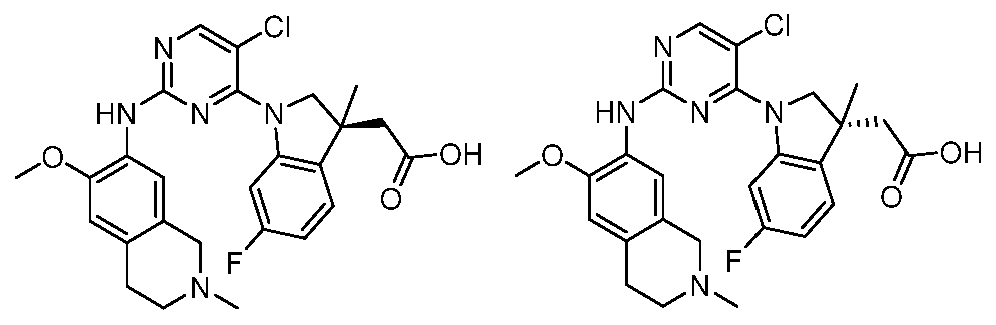
(S)-2-(1-(5-클로로-2-((6-메톡시-2-메틸-1,2,3,4-테트라히드로이소퀴놀린-7-일)아미노)피리미딘-4-일)-6-플루오로-3-메틸인돌린-3-일)아세트산 & (R)-2-(1-(5-클로로-2-((6-메톡시-2-메틸-1,2,3,4-테트라히드로이소퀴놀린-7-일)아미노)피리미딘-4-일)-6-플루오로-3-메틸인돌린-3-일)아세트산(S)-2-(1-(5-chloro-2-((6-methoxy-2-methyl-1,2,3,4-tetrahydroisoquinolin-7-yl)amino)pyrimidine-4 -yl)-6-fluoro-3-methylindolin-3-yl)acetic acid & (R)-2-(1-(5-chloro-2-((6-methoxy-2-methyl-1, 2,3,4-tetrahydroisoquinolin-7-yl)amino)pyrimidin-4-yl)-6-fluoro-3-methylindolin-3-yl)acetic acid
라세미 2-(1-(5-클로로-2-((6-메톡시-2-메틸-1,2,3,4-테트라히드로이소퀴놀린-7-일)아미노)피리미딘-4-일)-6-플루오로-3-메틸인돌린-3-일)아세트산의 키랄-분리 후에 합성하였다. 입체화학은 확인되지 않았고, 2종의 생성물을 임의로 할당하였다.Racemic 2-(1-(5-chloro-2-((6-methoxy-2-methyl-1,2,3,4-tetrahydroisoquinolin-7-yl)amino)pyrimidin-4-yl )-6-fluoro-3-methylindolin-3-yl)acetic acid after chiral-separation. Stereochemistry was not identified and two products were randomly assigned.
LC-MS (ESI) m/z: 512 [M+H]+. 키랄-HPLC 체류 시간: 11.913분; ee 값: 80.4%.LC-MS (ESI) m/z: 512 [M+H] + . Chiral-HPLC retention time: 11.913 min; ee value: 80.4%.
LC-MS (ESI) m/z: 512 [M+H]+. 키랄-HPLC 체류 시간: 16.631분; ee 값: 98.9%.LC-MS (ESI) m/z: 512 [M+H] + . Chiral-HPLC retention time: 16.631 min; ee value: 98.9%.
SFC 분리 조건:SFC separation conditions:
기기: 길슨-281Device: Gilson-281
칼럼: IG 20*250 mm, 10 umColumn: IG 20*250 mm, 10 um
이동상: n-헥산 (0.1% 디메틸아민)/EtOH (0.1% 디에틸아민) = 65:35Mobile phase: n-hexane (0.1% dimethylamine)/EtOH (0.1% diethylamine) = 65:35
유량: 40 mL/분Flow: 40 mL/min
사이클 시간: 22분Cycle time: 22 minutes
실시예 154Example 154

2-(1-(5-클로로-2-((6-메톡시-2-메틸-1,2,3,4-테트라히드로이소퀴놀린-7-일)아미노)피리미딘-4-일)-5,6-디플루오로-3-메틸인돌린-3-일)아세트산2-(1-(5-Chloro-2-((6-methoxy-2-methyl-1,2,3,4-tetrahydroisoquinolin-7-yl)amino)pyrimidin-4-yl)- 5,6-difluoro-3-methylindolin-3-yl)acetic acid
Int. E33 대신 Int. E36을 사용한, 실시예 146과 동일한 절차. LC-MS (ESI) m/z: 530 [M+H]+. 1H NMR (500 MHz, DMSO-d6) δ 8.24 (s, 1H), 8.20 (s, 1H), 7.45-7.36 (m, 3H), 6.75 (s, 1H), 4.46 (d, J = 10.8 Hz, 1H), 4.08 (d, J = 10.7 Hz, 1H), 3.76 (s, 3H), 3.27 (s, 2H), 2.77 (t, J = 5.5 Hz, 2H), 2.70 (d, J = 15.6 Hz, 1H), 2.61 (s, 1H), 2.56 (dd, J = 12.0, 6.2 Hz, 2H), 2.29 (s, 3H), 1.31 (s, 3H).Int. Instead of E33, Int. Same procedure as Example 146, using E36. LC-MS (ESI) m/z: 530 [M+H] + . 1 H NMR (500 MHz, DMSO-d 6 ) δ 8.24 (s, 1H), 8.20 (s, 1H), 7.45-7.36 (m, 3H), 6.75 (s, 1H), 4.46 (d, J = 10.8) Hz, 1H), 4.08 (d, J = 10.7 Hz, 1H), 3.76 (s, 3H), 3.27 (s, 2H), 2.77 (t, J = 5.5 Hz, 2H), 2.70 (d, J = 15.6) Hz, 1H), 2.61 (s, 1H), 2.56 (dd, J = 12.0, 6.2 Hz, 2H), 2.29 (s, 3H), 1.31 (s, 3H).
실시예 155Example 155

2-(1-(5-클로로-2-((2-메톡시-6-메틸-5,6,7,8-테트라히드로-1,6-나프티리딘-3-일)아미노)피리미딘-4-일)-3-메틸인돌린-3-일)아세트산2-(1-(5-chloro-2-((2-methoxy-6-methyl-5,6,7,8-tetrahydro-1,6-naphthyridin-3-yl)amino)pyrimidine- 4-yl)-3-methylindolin-3-yl)acetic acid
단계 2에서 Int. W1 대신 Int. W4를 사용하고, 단계 2에서 메틸 에스테르의 가수분해로 인한 단계 3을 생략한, 실시예 146과 동일한 절차. LC-MS (ESI) m/z: 495 [M+H]+. 1H NMR (500 MHz, DMSO-d6) δ 11.87 (s, 1H), 8.37 (s, 1H), 7.99 (s, 1H), 7.87 (s, 1H), 7.35(t, J = 8.6 Hz, 2H), 7.23 (t, J = 7.7 Hz, 1H), 7.03 (t, J = 7.3 Hz, 1H), 4.39 (d, J = 10.7 Hz, 1H), 4.07 (d, J = 10.7Hz,1H), 3.47 (s, 3H), 3.31 (s, 1H), 3.09 (s, 2H), 2.80 (d, J = 15.0 Hz, 1H), 2.71-2.63 (m, 1H), 2.56 (s,1H), 2.54 (s, 2H), 2.31 (s, 3H), 1.37 (s, 3H).In step 2, Int. Instead of W1, Int. Same procedure as Example 146, using W4 and omitting step 3 due to hydrolysis of the methyl ester in step 2. LC-MS (ESI) m/z: 495 [M+H] + . 1 H NMR (500 MHz, DMSO-d 6 ) δ 11.87 (s, 1H), 8.37 (s, 1H), 7.99 (s, 1H), 7.87 (s, 1H), 7.35 (t, J = 8.6 Hz, 2H), 7.23 (t, J = 7.7 Hz, 1H), 7.03 (t, J = 7.3 Hz, 1H), 4.39 (d, J = 10.7 Hz, 1H), 4.07 (d, J = 10.7 Hz, 1H) , 3.47 (s, 3H), 3.31 (s, 1H), 3.09 (s, 2H), 2.80 (d, J = 15.0 Hz, 1H), 2.71-2.63 (m, 1H), 2.56 (s, 1H), 2.54 (s, 2H), 2.31 (s, 3H), 1.37 (s, 3H).
실시예 156Example 156

2-(1-(5-클로로-2-((6-플루오로-2-메틸-1,2,3,4-테트라히드로이소퀴놀린-7-일)아미노)피리미딘-4-일)-3-메틸인돌린-3-일)아세트산2-(1-(5-Chloro-2-((6-fluoro-2-methyl-1,2,3,4-tetrahydroisoquinolin-7-yl)amino)pyrimidin-4-yl)- 3-methylindolin-3-yl)acetic acid
단계 1: i-PrOH (4 mL) 중 메틸 2-(1-(2,5-디클로로피리미딘-4-일)-3-메틸인돌린-3-일)아세테이트 (195.4 mg, 0.555 mmol), Int. W7 (100 mg, 0.555 mmol) 및 TsOH·H2O (105.5 mg, 0.555 mmol)의 용액을 120℃에서 16시간 동안 교반하고, 실온으로 냉각시키고, 포화 NaHCO3 수용액을 사용하여 pH ~8로 중화시켰다. 혼합물을 DCM/MeOH (v/v, 10/1, 20 mL x 3)로 추출하였다. 유기 상을 무수 황산나트륨 상에서 건조시키고, 여과하였다. 여과물을 진공 하에 농축시키고, 잔류물을 실리카 겔 상에서 플래쉬 칼럼 크로마토그래피 (DCM/MeOH = 10/1)에 의해 정제하여 메틸 2-(1-(5-클로로-2-((6-플루오로-2-메틸-1,2,3,4-테트라히드로이소퀴놀린-7-일)아미노)피리미딘-4-일)-3-메틸인돌린-3-일)아세테이트 및 이소프로필 2-(1-(5-클로로-2-((6-플루오로-2-메틸-1,2,3,4-테트라히드로이소퀴놀린-7-일)아미노)피리미딘-4-일)-3-메틸인돌린-3-일)아세테이트의 혼합물 (440 mg)을 담황색 고체로서 수득하였으며, 이를 후속 단계에 추가 정제 없이 사용하였다. LC-MS (ESI) m/z: 496 (메틸 에스테르), 524 (이소프로필 에스테르) [M+H]+.Step 1: Methyl 2-(1-(2,5-dichloropyrimidin-4-yl)-3-methylindolin-3-yl)acetate (195.4 mg, 0.555 mmol) in i-PrOH (4 mL), Int. A solution of W7 (100 mg, 0.555 mmol) and TsOH.H 2 O (105.5 mg, 0.555 mmol) was stirred at 120° C. for 16 h, cooled to room temperature and neutralized to pH-8 with saturated aqueous NaHCO 3 aqueous solution. made it The mixture was extracted with DCM/MeOH (v/v, 10/1, 20 mL×3). The organic phase was dried over anhydrous sodium sulfate and filtered. The filtrate was concentrated in vacuo and the residue was purified by flash column chromatography on silica gel (DCM/MeOH = 10/1) to methyl 2-(1-(5-chloro-2-((6-fluoro) -2-methyl-1,2,3,4-tetrahydroisoquinolin-7-yl)amino)pyrimidin-4-yl)-3-methylindolin-3-yl)acetate and isopropyl 2-(1 -(5-Chloro-2-((6-fluoro-2-methyl-1,2,3,4-tetrahydroisoquinolin-7-yl)amino)pyrimidin-4-yl)-3-methylyne A mixture of dolin-3-yl)acetates (440 mg) was obtained as a pale yellow solid, which was used in the next step without further purification. LC-MS (ESI) m/z: 496 (methyl ester), 524 (isopropyl ester) [M+H] + .
단계 3: THF (4 mL) 중 메틸 2-(1-(5-클로로-2-((6-플루오로-2-메틸-1,2,3,4-테트라히드로이소퀴놀린-7-일)아미노)피리미딘-4-일)-3-메틸인돌린-3-일)아세테이트 및 이소프로필 2-(1-(5-클로로-2-((6-플루오로-2-메틸-1,2,3,4-테트라히드로이소퀴놀린-7-일)아미노)피리미딘-4-일)-3-메틸인돌린-3-일)아세테이트의 혼합물 (220 mg) 및 LiOH 수용액 (2 N, 4 mL)의 혼합물을 실온에서 5시간 동안 교반하고, 50℃에서 16시간 동안 교반하고, 포름산을 사용하여 pH ~5로 조정하고, DCM/MeOH (10/1, 20 mL x 3)로 추출하였다. 합한 유기 상을 무수 황산나트륨 상에서 건조시키고, 여과하였다. 여과물을 진공 하에 농축시키고, 잔류물을 정제용-HPLC (MeCN/10 mM NH4HCO3)에 의해 정제하여 2-(1-(5-클로로-2-((6-플루오로-2-메틸-1,2,3,4-테트라히드로이소퀴놀린-7-일)아미노)피리미딘-4-일)-3-메틸인돌린-3-일)아세트산 (26.5 mg, 12.4% 수율)을 백색 고체로서 수득하였다. LC-MS (ESI) m/z: 482 [M+H]+. 1H NMR (400 MHz, DMSO-d6) δ 8.93 (s, 1H), 8.22 (s, 1H), 7.35-7.24 (m, 3H), 7.07-6.92 (m, 3H), 4.41 (d, J = 10.7 Hz, 1H), 4.03 (d, J = 10.8 Hz, 1H), 3.36 (s, 2H), 2.78 (d, J = 5.4 Hz, 2H), 2.68 (d, J = 15.5 Hz, 1H), 2.60-2.54 (m, 3H), 2.32 (s, 3H), 1.33 (s, 3H).Step 3: Methyl 2-(1-(5-chloro-2-((6-fluoro-2-methyl-1,2,3,4-tetrahydroisoquinolin-7-yl) in THF (4 mL)) Amino)pyrimidin-4-yl)-3-methylindolin-3-yl)acetate and isopropyl 2-(1-(5-chloro-2-((6-fluoro-2-methyl-1,2) A mixture of ,3,4-tetrahydroisoquinolin-7-yl)amino)pyrimidin-4-yl)-3-methylindolin-3-yl)acetate (220 mg) and an aqueous LiOH solution (2 N, 4 mL) ) was stirred at room temperature for 5 h, at 50 °C for 16 h, adjusted to pH ~5 with formic acid, and extracted with DCM/MeOH (10/1, 20 mL x 3). The combined organic phases were dried over anhydrous sodium sulfate and filtered. The filtrate was concentrated in vacuo and the residue was purified by prep-HPLC (MeCN/10 mM NH 4 HCO 3 ) to 2-(1-(5-chloro-2-((6-fluoro-2-) Methyl-1,2,3,4-tetrahydroisoquinolin-7-yl)amino)pyrimidin-4-yl)-3-methylindolin-3-yl)acetic acid (26.5 mg, 12.4% yield) as white Obtained as a solid. LC-MS (ESI) m/z: 482 [M+H] + . 1 H NMR (400 MHz, DMSO-d 6 ) δ 8.93 (s, 1H), 8.22 (s, 1H), 7.35-7.24 (m, 3H), 7.07-6.92 (m, 3H), 4.41 (d, J) = 10.7 Hz, 1H), 4.03 (d, J = 10.8 Hz, 1H), 3.36 (s, 2H), 2.78 (d, J = 5.4 Hz, 2H), 2.68 (d, J = 15.5 Hz, 1H), 2.60-2.54 (m, 3H), 2.32 (s, 3H), 1.33 (s, 3H).
실시예 157Example 157

2-(1-(5-클로로-2-((2-에틸-6-메톡시-1,2,3,4-테트라히드로이소퀴놀린-7-일)아미노)피리미딘-4-일)-3-메틸인돌린-3-일)아세트산2-(1-(5-Chloro-2-((2-ethyl-6-methoxy-1,2,3,4-tetrahydroisoquinolin-7-yl)amino)pyrimidin-4-yl)- 3-methylindolin-3-yl)acetic acid
단계 2에서 Int. W1 대신 Int. W8을 사용한, 실시예 146에서와 동일한 절차. LC-MS (ESI) m/z: 508 [M+H]+. 1H NMR (400MHz, DMSO-d6) δ 8.25 (s, 1H), 7.97 (s, 1H), 7.61 (s,1H), 7.31 (dd, J = 21.0, 7.7 Hz, 2H), 7.12 (t, J = 7.5 Hz, 1H), 6.96 (t, J = 7.2 Hz, 1H), 6.74 (s, 1H), 4.42 (d, J = 10.7 Hz, 1H), 4.02 (d, J = 10.7 Hz, 1H), 3.78 (s, 3H), 3.34 (s, 2H), 2.76 (s, 2H), 2.66-2.55 (m, 4H), 2.50-2.45 (d, J = 6.8 Hz, 2H), 1.34 (s, 3H), 1.08 (t, J = 7.0 Hz, 3H).In step 2, Int. Instead of W1, Int. Same procedure as in Example 146, using W8. LC-MS (ESI) m/z: 508 [M+H] + . 1 H NMR (400 MHz, DMSO-d 6 ) δ 8.25 (s, 1H), 7.97 (s, 1H), 7.61 (s, 1H), 7.31 (dd, J = 21.0, 7.7 Hz, 2H), 7.12 (t) , J = 7.5 Hz, 1H), 6.96 (t, J = 7.2 Hz, 1H), 6.74 (s, 1H), 4.42 (d, J = 10.7 Hz, 1H), 4.02 (d, J = 10.7 Hz, 1H) ), 3.78 (s, 3H), 3.34 (s, 2H), 2.76 (s, 2H), 2.66-2.55 (m, 4H), 2.50-2.45 (d, J = 6.8 Hz, 2H), 1.34 (s, 3H), 1.08 (t, J = 7.0 Hz, 3H).
실시예 158Example 158

2-(1-(5-클로로-2-((2-이소프로필-6-메톡시-1,2,3,4-테트라히드로이소퀴놀린-7-일)아미노)피리미딘-4-일)-3-메틸인돌린-3-일)아세트산2-(1-(5-chloro-2-((2-isopropyl-6-methoxy-1,2,3,4-tetrahydroisoquinolin-7-yl)amino)pyrimidin-4-yl) -3-methylindolin-3-yl)acetic acid
단계 2에서 Int. W1 대신 Int. W5를 사용한, 실시예 146에서와 동일한 절차. LC-MS (ESI) m/z: 522 [M+H]+. 1H NMR (400 MHz, DMSO-d6) δ 8.26 (s, 1H), 8.22 (s, 1H), 7.97 (s, 1H), 7.63 (s, 1H), 7.34 (d, J = 8.0 Hz, 1H), 7.28 (d, J = 6.9 Hz, 1H), 7.17-7.05 (m, 1H), 6.96 (t, J = 7.4 Hz, 1H), 6.73 (s, 1H), 4.42 (d, J = 10.8 Hz, 1H), 4.02 (d, J = 10.8 Hz, 1H), 3.78 (s, 3H), 3.47 (s, 2H), 2.93-2.81 (m, 1H), 2.77-2.68 (m, 4H), 2.66-2.54 (m, 2H), 1.34 (s, 3H), 1.06 (d, J = 6.5 Hz, 6H).In step 2, Int. Instead of W1, Int. Same procedure as in Example 146, using W5. LC-MS (ESI) m/z: 522 [M+H] + . 1 H NMR (400 MHz, DMSO-d 6 ) δ 8.26 (s, 1H), 8.22 (s, 1H), 7.97 (s, 1H), 7.63 (s, 1H), 7.34 (d, J = 8.0 Hz, 1H), 7.28 (d, J = 6.9 Hz, 1H), 7.17-7.05 (m, 1H), 6.96 (t, J = 7.4 Hz, 1H), 6.73 (s, 1H), 4.42 (d, J = 10.8) Hz, 1H), 4.02 (d, J = 10.8 Hz, 1H), 3.78 (s, 3H), 3.47 (s, 2H), 2.93-2.81 (m, 1H), 2.77-2.68 (m, 4H), 2.66 -2.54 (m, 2H), 1.34 (s, 3H), 1.06 (d, J = 6.5 Hz, 6H).
실시예 159Example 159
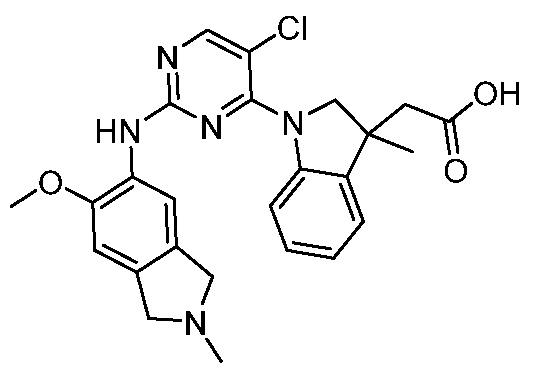
2-(1-(5-클로로-2-((6-메톡시-2-메틸이소인돌린-5-일)아미노)피리미딘-4-일)-3-메틸인돌린-3-일)아세트산2-(1-(5-chloro-2-((6-methoxy-2-methylisoindolin-5-yl)amino)pyrimidin-4-yl)-3-methylindolin-3-yl) acetic acid
단계 2에서 Int. W1 대신 Int. W9를 사용한, 실시예 146에서와 동일한 절차. LC-MS (ESI) m/z: 480 [M+H]+. 1H NMR (500 MHz, DMSO-d6) δ 8.26 (s, 1H), 8.02 (s, 1H), 7.77 (s, 1H), 7.34 (d, J = 8.0 Hz, 1H), 7.28 (d, J = 7.1 Hz, 1H), 7.11 (t, J = 7.3 Hz, 1H), 6.98 (t, J = 7.2 Hz, 1H), 6.94 (s, 1H), 4.41 (d, J = 10.8 Hz, 1H), 4.02 (d, J = 10.7 Hz, 1H), 3.80 (s, 5H), 3.70 (s, 2H), 2.69 (d, J = 15.5 Hz, 1H), 2.57 (d, J = 15.4 Hz, 1H), 2.47 (s, 3H), 1.34 (s, 3H).In step 2, Int. Instead of W1, Int. Same procedure as in Example 146, using W9. LC-MS (ESI) m/z: 480 [M+H] + . 1 H NMR (500 MHz, DMSO-d 6 ) δ 8.26 (s, 1H), 8.02 (s, 1H), 7.77 (s, 1H), 7.34 (d, J = 8.0 Hz, 1H), 7.28 (d, J = 7.1 Hz, 1H), 7.11 (t, J = 7.3 Hz, 1H), 6.98 (t, J = 7.2 Hz, 1H), 6.94 (s, 1H), 4.41 (d, J = 10.8 Hz, 1H) , 4.02 (d, J = 10.7 Hz, 1H), 3.80 (s, 5H), 3.70 (s, 2H), 2.69 (d, J = 15.5 Hz, 1H), 2.57 (d, J = 15.4 Hz, 1H) , 2.47 (s, 3H), 1.34 (s, 3H).
실시예 160Example 160
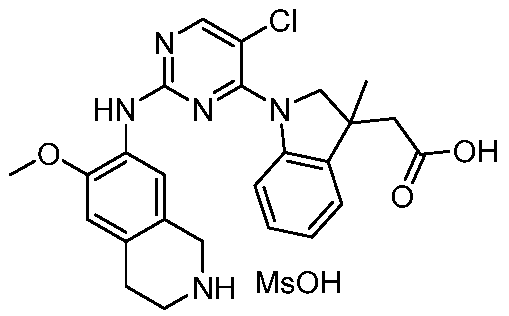
2-(1-(5-클로로-2-((6-메톡시-1,2,3,4-테트라히드로이소퀴놀린-7-일)아미노)피리미딘-4-일)-3-메틸인돌린-3-일)아세트산 메탄술폰산2-(1-(5-chloro-2-((6-methoxy-1,2,3,4-tetrahydroisoquinolin-7-yl)amino)pyrimidin-4-yl)-3-methylyne Dolin-3-yl)acetic acid methanesulfonic acid
단계 2에서 Int. W1 대신 Int. W11을 사용한, 실시예 146과 동일한 절차. LC-MS (ESI) m/z: 480 [M+H]+.In step 2, Int. Instead of W1, Int. Same procedure as Example 146, using W11. LC-MS (ESI) m/z: 480 [M+H] + .
아세토니트릴 (20 mL) 중 2-(1-(5-클로로-2-((6-메톡시-1,2,3,4-테트라히드로이소퀴놀린-7-일)아미노)피리미딘-4-일)-3-메틸인돌린-3-일)아세트산 (40 mg, 0.083 mmol)의 용액에 메탄술폰산 (8.0 mg, 0.083 mmol)을 첨가하였다. 반응 혼합물을 25℃에서 30분 동안 교반하고, 진공 하에 농축시켰다. 잔류물을 물 (15 mL)로 희석하고, 동결건조시켜 2-(1-(5-클로로-2-((6-메톡시-1,2,3,4-테트라히드로이소퀴놀린-7-일)아미노)피리미딘-4-일)-3-메틸인돌린-3-일)아세트산의 메탄술폰산 염 (39.4 mg, 81.3% 수율)을 백색 고체로서 수득하였다. LC-MS (ESI) m/z: 480 [M+H]+. 1H NMR (400 MHz, DMSO-d6) δ 7.97 (d, J = 14.2 Hz, 2H), 7.56 (s, 1H), 6.74 (s, 1H), 4.00 (s, 2H), 3.88 (d, J = 11.4 Hz, 1H), 3.82 (s, 3H), 3.55 (s, 1H), 3.42 (s, 2H), 2.86 (t, J = 7.5 Hz, 1H), 2.77 (s, 2H), 2.58 (s, 2H), 2.32 (s, 3H), 1.76-1.24 (m, 10H).2-(1-(5-chloro-2-((6-methoxy-1,2,3,4-tetrahydroisoquinolin-7-yl)amino)pyrimidin-4- in acetonitrile (20 mL) To a solution of yl)-3-methylindolin-3-yl)acetic acid (40 mg, 0.083 mmol) was added methanesulfonic acid (8.0 mg, 0.083 mmol). The reaction mixture was stirred at 25° C. for 30 min and concentrated in vacuo. The residue was diluted with water (15 mL) and lyophilized to 2-(1-(5-chloro-2-((6-methoxy-1,2,3,4-tetrahydroisoquinolin-7-yl) The methanesulfonic acid salt of )amino)pyrimidin-4-yl)-3-methylindolin-3-yl)acetic acid (39.4 mg, 81.3% yield) was obtained as a white solid. LC-MS (ESI) m/z: 480 [M+H] + . 1 H NMR (400 MHz, DMSO-d 6 ) δ 7.97 (d, J = 14.2 Hz, 2H), 7.56 (s, 1H), 6.74 (s, 1H), 4.00 (s, 2H), 3.88 (d, J = 11.4 Hz, 1H), 3.82 (s, 3H), 3.55 (s, 1H), 3.42 (s, 2H), 2.86 (t, J = 7.5 Hz, 1H), 2.77 (s, 2H), 2.58 ( s, 2H), 2.32 (s, 3H), 1.76-1.24 (m, 10H).
실시예 161Example 161

2-(3-(5-클로로-2-((6-메톡시-2-메틸-1,2,3,4-테트라히드로이소퀴놀린-7-일)아미노)피리미딘-4-일)-1H-인돌-1-일)아세트산2-(3-(5-chloro-2-((6-methoxy-2-methyl-1,2,3,4-tetrahydroisoquinolin-7-yl)amino)pyrimidin-4-yl)- 1H-indol-1-yl)acetic acid
단계 1: 무수 THF (10 mL) 중 인돌 (600.0 mg, 5.12 mmol)의 용액에 THF 중 메틸마그네슘 브로마이드 용액 (1 M, 5 mL)을 0℃에서 첨가하고, 이어서 2,4,5-트리클로로피리미딘 (466 mg, 2.54 mmol)을 10분 후에 첨가하였다. 반응 혼합물을 60℃에서 3시간 동안 교반하고, 실온으로 냉각시키고, 진공 하에 농축시켰다. 잔류물을 물 (10 mL)과 DCM (20 mL x 3) 사이에 분배하였다. 유기 상을 염수 (30 mL)로 세척하고, 무수 황산나트륨 상에서 건조시키고, 여과하였다. 여과물을 진공 하에 농축시키고, 잔류물을 실리카 겔 (5-10% EA/PE) 상에서 플래쉬 칼럼 크로마토그래피에 의해 정제하여 3-(2,5-디클로로피리미딘-4-일)-1H-인돌을 황색 고체 (160 mg, 12% 수율)로서 제공하였다. LC-MS (ESI) m/z: 264 [M+H]+.Step 1: To a solution of indole (600.0 mg, 5.12 mmol) in anhydrous THF (10 mL) was added a solution of methylmagnesium bromide in THF (1 M, 5 mL) at 0° C. followed by 2,4,5-trichloro Pyrimidine (466 mg, 2.54 mmol) was added after 10 min. The reaction mixture was stirred at 60° C. for 3 h, cooled to room temperature and concentrated in vacuo. The residue was partitioned between water (10 mL) and DCM (20 mL×3). The organic phase was washed with brine (30 mL), dried over anhydrous sodium sulfate and filtered. The filtrate was concentrated in vacuo and the residue was purified by flash column chromatography on silica gel (5-10% EA/PE) to 3-(2,5-dichloropyrimidin-4-yl)-1H-indole was provided as a yellow solid (160 mg, 12% yield). LC-MS (ESI) m/z: 264 [M+H] + .
단계 2: DMF (5 mL) 중 3-(2,5-디클로로피리미딘-4-일)-1H-인돌 (160 mg, 0.606 mmol) 및 에틸 2-브로모아세테이트 (303.5 mg, 1.82 mmol, 201.00 uL)의 용액에 중탄산나트륨 (254.5 mg, 3.03 mmol)을 25℃에서 첨가하였다. 혼합물을 80℃에서 16시간 동안 교반하고, 실온으로 냉각시키고, 물 (20 mL)로 희석하고, EA (20 mL x 3)로 추출하였다. 합한 유기 상을 염수 (30 mL)로 세척하고, 무수 Na2SO4 상에서 건조시키고, 여과하였다. 여과물을 진공 하에 농축시키고, 잔류물을 실리카 겔 (20-30% EA/PE) 상에서 플래쉬 칼럼 크로마토그래피에 의해 정제하여 에틸 2-(3-(2,5-디클로로피리미딘-4-일)-1H-인돌-1-일)아세테이트를 담황색 오일 (220 mg, 93% 수율)로서 제공하였다. LC-MS (ESI) m/z: 315 [M+H]+.Step 2: 3-(2,5-dichloropyrimidin-4-yl)-1H-indole (160 mg, 0.606 mmol) and ethyl 2-bromoacetate (303.5 mg, 1.82 mmol, 201.00) in DMF (5 mL) uL) was added sodium bicarbonate (254.5 mg, 3.03 mmol) at 25°C. The mixture was stirred at 80° C. for 16 h, cooled to room temperature, diluted with water (20 mL) and extracted with EA (20 mL×3). The combined organic phases were washed with brine (30 mL), dried over anhydrous Na 2 SO 4 and filtered. The filtrate was concentrated in vacuo and the residue was purified by flash column chromatography on silica gel (20-30% EA/PE) to ethyl 2-(3-(2,5-dichloropyrimidin-4-yl) -1H-indol-1-yl)acetate was provided as a pale yellow oil (220 mg, 93% yield). LC-MS (ESI) m/z: 315 [M+H] + .
단계 3: 에틸 2-(3-(2,5-디클로로피리미딘-4-일)-1H-인돌-1-일)아세테이트 (100 mg, 0.286 mmol) 및 Int. W1 (78.4 mg, 0.343 mmol)을 조건 B3 하에 사용하고, 실리카 겔 상에서 플래쉬 칼럼 크로마토그래피 (30-60% MeOH/DCM)에 의한 정제 후에 이소프로필 2-(3-(5-클로로-2-((6-메톡시-2-메틸-1,2,3,4-테트라히드로이소퀴놀린-7-일)아미노)피리미딘-4-일)-1H-인돌-1-일)아세테이트 (238 mg, 72.9% 수율)를 담황색 오일로서 제공하였다. LC-MS (ESI) m/z: 520 [M+H]+.Step 3: Ethyl 2-(3-(2,5-dichloropyrimidin-4-yl)-1H-indol-1-yl)acetate (100 mg, 0.286 mmol) and Int. W1 (78.4 mg, 0.343 mmol) was used under condition B3 and after purification by flash column chromatography on silica gel (30-60% MeOH/DCM) isopropyl 2-(3-(5-chloro-2-( (6-Methoxy-2-methyl-1,2,3,4-tetrahydroisoquinolin-7-yl)amino)pyrimidin-4-yl)-1H-indol-1-yl)acetate (238 mg, 72.9% yield) as a pale yellow oil. LC-MS (ESI) m/z: 520 [M+H] + .
단계 4: THF (6 mL) 및 물 (3 mL) 중 이소프로필 2-(3-(5-클로로-2-((6-메톡시-2-메틸-1,2,3,4-테트라히드로이소퀴놀린-7-일)아미노)피리미딘-4-일)-1H-인돌-1-일)아세테이트 (238 mg, 0.412 mmol)의 용액에 LiOH·H2O (480.1 mg, 11.44 mmol)를 첨가하였다. 혼합물을 25℃에서 2시간 동안 교반하고, 포름산을 사용하여 pH ~5로 산성화시키고, 정제용-HPLC (0.1% 포름산/아세토니트릴)에 의해 정제하여 2-(3-(5-클로로-2-((6-메톡시-2-메틸-1,2,3,4-테트라히드로이소퀴놀린-7-일)아미노)피리미딘-4-일)-1H-인돌-1-일)아세트산 (124.9 mg, 63.4% 수율)을 담황색 고체로서 수득하였다. LC-MS (ESI) m/z: 478 [M+H]+. 1H NMR (500 MHz, DMSO-d6) δ 8.56 (s, 1H), 8.47-8.30 (m, 2H), 8.23 (d, J = 32.9 Hz, 1H), 7.62 (s, 1H), 7.42 (d, J = 8.1 Hz, 1H), 7.21 (t, J = 7.5 Hz, 1H), 7.07 (t, J = 7.4 Hz, 1H), 6.84 (s, 1H), 5.01 (s, 2H), 3.79 (s, 3H), 3.51 (s, 2H), 2.88 (s, 2H), 2.74 (s, 2H), 2.39 (s, 3H).Step 4: Isopropyl 2-(3-(5-chloro-2-((6-methoxy-2-methyl-1,2,3,4-tetrahydro) in THF (6 mL) and water (3 mL) To a solution of isoquinolin-7-yl)amino)pyrimidin-4-yl)-1H-indol-1-yl)acetate (238 mg, 0.412 mmol) was added LiOH.H 2 O (480.1 mg, 11.44 mmol) did The mixture was stirred at 25° C. for 2 h, acidified to pH ˜5 with formic acid and purified by prep-HPLC (0.1% formic acid/acetonitrile) to 2-(3-(5-chloro-2- ((6-Methoxy-2-methyl-1,2,3,4-tetrahydroisoquinolin-7-yl)amino)pyrimidin-4-yl)-1H-indol-1-yl)acetic acid (124.9 mg , 63.4% yield) as a pale yellow solid. LC-MS (ESI) m/z: 478 [M+H] + . 1 H NMR (500 MHz, DMSO-d 6 ) δ 8.56 (s, 1H), 8.47-8.30 (m, 2H), 8.23 (d, J = 32.9 Hz, 1H), 7.62 (s, 1H), 7.42 ( d, J = 8.1 Hz, 1H), 7.21 (t, J = 7.5 Hz, 1H), 7.07 (t, J = 7.4 Hz, 1H), 6.84 (s, 1H), 5.01 (s, 2H), 3.79 ( s, 3H), 3.51 (s, 2H), 2.88 (s, 2H), 2.74 (s, 2H), 2.39 (s, 3H).
실시예 162Example 162

2-(3-(5-클로로-2-((6-메톡시-2-메틸-1,2,3,4-테트라히드로이소퀴놀린-7-일)아미노)피리미딘-4-일)-1H-인다졸-1-일)아세트산2-(3-(5-chloro-2-((6-methoxy-2-methyl-1,2,3,4-tetrahydroisoquinolin-7-yl)amino)pyrimidin-4-yl)- 1H-indazol-1-yl)acetic acid
단계 1: THF (15 mL) 중 3-아이오도-1H-인다졸 (500 mg, 2.05 mmol)의 용액에 칼륨 tert-부톡시드 (344.9 mg, 3.07 mmol)를 0℃에서 조금씩 첨가하고, 이어서 에틸 2-브로모아세테이트 (684.3 mg, 4.10 mmol)를 1시간 후에 적가하였다. 혼합물을 25℃에서 16시간 동안 교반하고, 진공 하에 농축시켰다. 잔류물을 EA (20 mL)와 물 (20 mL) 사이에 분배하였다. 유기 상을 분리하고, 수성 상을 EA (20 mL x 3)로 추출하였다. 합한 유기 상을 무수 Na2SO4 상에서 건조시키고, 여과하였다. 여과물을 진공 하에 농축시키고, 잔류물을 실리카 겔 상에서 플래쉬 칼럼 크로마토그래피 (15-20% EA/PE)에 의해 정제하여 에틸 2-(3-아이오도-1H-인다졸-1-일)아세테이트를 무색 오일 (549 mg, 81% 수율)로서 제공하였다. LC-MS (ESI) m/z: 331 [M+H]+.Step 1: To a solution of 3-iodo-1H-indazole (500 mg, 2.05 mmol) in THF (15 mL) was added potassium tert-butoxide (344.9 mg, 3.07 mmol) in portions at 0° C. followed by ethyl 2-Bromoacetate (684.3 mg, 4.10 mmol) was added dropwise after 1 hour. The mixture was stirred at 25° C. for 16 h and concentrated in vacuo. The residue was partitioned between EA (20 mL) and water (20 mL). The organic phase was separated and the aqueous phase was extracted with EA (20 mL×3). The combined organic phases were dried over anhydrous Na 2 SO 4 and filtered. The filtrate was concentrated in vacuo and the residue was purified by flash column chromatography on silica gel (15-20% EA/PE) to ethyl 2-(3-iodo-1H-indazol-1-yl)acetate was provided as a colorless oil (549 mg, 81% yield). LC-MS (ESI) m/z: 331 [M+H] + .
단계 2: 디옥산 (10 mL) 중 에틸 2-(3-아이오도-1H-인다졸-1-일)아세테이트 (520 mg, 1.58 mmol), 1,1,1,2,2,2-헥사메틸디스탄난 (1.03 g, 3.15 mmol) 및 Pd (PPh3)4 (182.1 mg, 0.158 mmol)의 혼합물을 N2로 퍼징하고, 100℃에서 16시간 동안 교반하고, 0℃로 냉각시키고, 1 M KF 용액 (10 mL)으로 켄칭하였다. 생성된 혼합물을 실온에서 30분 동안 교반하고, 물 (30 mL)로 희석하고, 디클로로메탄/메탄올 (v/v, 10/1, 20 mL x 3)로 추출하였다. 합한 유기 상을 무수 황산나트륨 상에서 건조시키고, 여과하였다. 여과물을 진공 하에 농축시키고, 잔류물을 실리카 겔 (EA/PE = 1/4) 상에서 플래쉬 칼럼 크로마토그래피에 의해 정제하여 에틸 2-(3-(트리메틸스탄닐)-1H-인다졸-1-일)아세테이트를 무색 오일 (145 mg, 25% 수율)로서 제공하였다. LC-MS (ESI) m/z: 369 [M+H]+.Step 2: Ethyl 2-(3-iodo-1H-indazol-1-yl)acetate (520 mg, 1.58 mmol), 1,1,1,2,2,2-hexa in dioxane (10 mL) A mixture of methyldistannan (1.03 g, 3.15 mmol) and Pd (PPh 3 ) 4 (182.1 mg, 0.158 mmol) was purged with N 2 , stirred at 100° C. for 16 h, cooled to 0° C., 1 Quench with M KF solution (10 mL). The resulting mixture was stirred at room temperature for 30 min, diluted with water (30 mL) and extracted with dichloromethane/methanol (v/v, 10/1, 20 mL×3). The combined organic phases were dried over anhydrous sodium sulfate and filtered. The filtrate was concentrated in vacuo and the residue was purified by flash column chromatography on silica gel (EA/PE = 1/4) to ethyl 2-(3-(trimethylstannyl)-1H-indazole-1- il)acetate was provided as a colorless oil (145 mg, 25% yield). LC-MS (ESI) m/z: 369 [M+H] + .
단계 3: 디옥산 (5 mL) 중 에틸 2-(3-(트리메틸스탄닐)-1H-인다졸-1-일)아세테이트 (145 mg, 0.395 mmol), 2,4,5-트리클로로피리미딘 (72.5 mg, 0.395 mmol) 및 Pd (PPh3)4 (45.7 mg, 0.040 mmol)의 혼합물을 N2로 퍼징하고, 100℃에서 16시간 동안 교반하고, 진공 하에 농축시켰다. 잔류물을 실리카 겔 (EA/PE = 1/4) 상에서 플래쉬 칼럼 크로마토그래피에 의해 정제하여 에틸 2-(3-(2,5-디클로로피리미딘-4-일)-1H-인다졸-1-일)아세테이트를 백색 고체 (68 mg, 49% 수율)로서 제공하였다. LC-MS (ESI) m/z: 351 [M+H]+.Step 3: Ethyl 2-(3-(trimethylstannyl)-1H-indazol-1-yl)acetate (145 mg, 0.395 mmol), 2,4,5-trichloropyrimidine in dioxane (5 mL) A mixture of (72.5 mg, 0.395 mmol) and Pd (PPh 3 ) 4 (45.7 mg, 0.040 mmol) was purged with N 2 , stirred at 100° C. for 16 h, and concentrated in vacuo. The residue was purified by flash column chromatography on silica gel (EA/PE = 1/4) to ethyl 2-(3-(2,5-dichloropyrimidin-4-yl)-1H-indazole-1- il)acetate was provided as a white solid (68 mg, 49% yield). LC-MS (ESI) m/z: 351 [M+H] + .
단계 4&5: 2-(3-(2,5-디클로로피리미딘-4-일)-1H-인돌-1-일)아세테이트 대신 에틸 2-(3-(2,5-디클로로피리미딘-4-일)-1H-인다졸-1-일)아세테이트를 사용한, 실시예 161의 단계 3&4와 동일한 절차. LC-MS (ESI) m/z: 479 [M+H]+. 1H NMR (400 MHz, DMSO-d6) δ 8.57 (d, J = 13.2 Hz, 2H), 8.18 (d, J = 7.8 Hz, 1H), 7.67 (d, J = 8.5 Hz, 1H), 7.58 (s, 1H), 7.51-7.35 (m, 1H), 7.27-7.13 (m, 1H), 6.88 (s, 1H), 5.23 (s, 2H), 3.79 (s, 3H), 3.62 (s, 2H), 2.91 (d, J = 5.2 Hz, 2H), 2.85 (d, J = 5.0 Hz, 2H), 2.47 (s, 3H).Step 4&5: Ethyl 2-(3-(2,5-dichloropyrimidin-4-yl) instead of 2-(3-(2,5-dichloropyrimidin-4-yl)-1H-indol-1-yl)acetate )-1H-indazol-1-yl)acetate, same procedure as steps 3&4 of Example 161. LC-MS (ESI) m/z: 479 [M+H] + . 1 H NMR (400 MHz, DMSO-d 6 ) δ 8.57 (d, J = 13.2 Hz, 2H), 8.18 (d, J = 7.8 Hz, 1H), 7.67 (d, J = 8.5 Hz, 1H), 7.58 (s, 1H), 7.51-7.35 (m, 1H), 7.27-7.13 (m, 1H), 6.88 (s, 1H), 5.23 (s, 2H), 3.79 (s, 3H), 3.62 (s, 2H) ), 2.91 (d, J = 5.2 Hz, 2H), 2.85 (d, J = 5.0 Hz, 2H), 2.47 (s, 3H).
실시예 167Example 167

2-(5-클로로-2-((6-메톡시-2-메틸-1,2,3,4-테트라히드로이소퀴놀린-7-일)아미노)피리미딘-4-일)-2-아자스피로[4.5]데칸-4-카르복실산2-(5-chloro-2-((6-methoxy-2-methyl-1,2,3,4-tetrahydroisoquinolin-7-yl)amino)pyrimidin-4-yl)-2-aza spiro[4.5]decane-4-carboxylic acid
단계 1: DCM (5 mL) 중 Int. E38 (500 mg, 2.37 mmol) 및 2,4,5-트리클로로피리미딘 (434.0 mg, 2.37 mmol)의 용액에 DIPEA (917.5 mg, 7.10 mmol)를 0℃에서 적가하였다. 혼합물을 25℃에서 2시간 동안 교반하고, 빙냉 포화 NH4Cl 수용액 (30 mL)으로 켄칭하고, EA (50 mL x 3)로 추출하였다. 유기 상을 염수 (20 mL)로 세척하고, 무수 Na2SO4 상에서 건조시키고, 여과하였다. 여과물을 진공 하에 농축시키고, 잔류물을 실리카 겔 상에서 플래쉬 칼럼 크로마토그래피 (PE/EA = 5-15%)에 의해 정제하여 에틸 2-(2,5-디클로로피리미딘-4-일)-2-아자스피로[4.5]데칸-4-카르복실레이트 (798 mg, 94.1% 수율)를 담황색 고체로서 수득하였다. LC-MS (ESI) m/z: 358 [M+H]+.Step 1: Int. in DCM (5 mL). To a solution of E38 (500 mg, 2.37 mmol) and 2,4,5-trichloropyrimidine (434.0 mg, 2.37 mmol) was added DIPEA (917.5 mg, 7.10 mmol) dropwise at 0°C. The mixture was stirred at 25° C. for 2 h, quenched with ice-cold saturated aqueous NH 4 Cl solution (30 mL) and extracted with EA (50 mL×3). The organic phase was washed with brine (20 mL), dried over anhydrous Na 2 SO 4 and filtered. The filtrate was concentrated in vacuo and the residue was purified by flash column chromatography on silica gel (PE/EA = 5-15%) to ethyl 2-(2,5-dichloropyrimidin-4-yl)-2 -Azaspiro[4.5]decane-4-carboxylate (798 mg, 94.1% yield) was obtained as a pale yellow solid. LC-MS (ESI) m/z: 358 [M+H] + .
단계 2: 에틸 2-(2,5-디클로로피리미딘-4-일)-2-아자스피로[4.5]데칸-4-카르복실레이트 (100 mg, 0.279 mmol) 및 Int. W1 (63.8 mg, 0.279 mmol)을 조건 B3 하에 사용하고, 실리카 겔 상에서 플래쉬 칼럼 크로마토그래피 (MeOH/DCM = 5-10%)에 의한 정제 후에 에틸 2-(5-클로로-2-((6-메톡시-2-메틸-1,2,3,4-테트라히드로이소퀴놀린-7-일)아미노)피리미딘-4-일)-2-아자스피로[4.5]데칸-4-카르복실레이트 (116 mg, 70.3% 수율, 87% 순도)를 담황색 고체로서 제공하였다. LC-MS (ESI) m/z: 514 [M+H]+.Step 2: Ethyl 2-(2,5-dichloropyrimidin-4-yl)-2-azaspiro[4.5]decane-4-carboxylate (100 mg, 0.279 mmol) and Int. W1 (63.8 mg, 0.279 mmol) was used under condition B3 and after purification by flash column chromatography on silica gel (MeOH/DCM = 5-10%) ethyl 2-(5-chloro-2-((6- Methoxy-2-methyl-1,2,3,4-tetrahydroisoquinolin-7-yl)amino)pyrimidin-4-yl)-2-azaspiro[4.5]decane-4-carboxylate (116 mg, 70.3% yield, 87% purity) as a pale yellow solid. LC-MS (ESI) m/z: 514 [M+H] + .
단계 3: 메틸 1-(5-클로로-2-((6-메톡시-2-메틸-1,2,3,4-테트라히드로이소퀴놀린-7-일)아미노)피리미딘-4-일)-3-메틸인돌린-3-카르복실레이트 대신 에틸 2-(5-클로로-2-((6-메톡시-2-메틸-1,2,3,4-테트라히드로이소퀴놀린-7-일)아미노)피리미딘-4-일)-2-아자스피로[4.5]데칸-4-카르복실레이트를 사용한, 실시예 117의 단계 3과 동일한 절차. LC-MS (ESI) m/z: 486 [M+H]+. 1H NMR (400 MHz, DMSO-d6) δ 7.97 (d, J = 14.2 Hz, 2H), 7.56 (s, 1H), 6.74 (s, 1H), 4.00 (s, 2H), 3.88 (d, J = 11.4 Hz, 1H), 3.82 (s, 3H), 3.55 (s, 1H), 3.42 (s, 2H), 2.86 (t, J = 7.5 Hz, 1H), 2.77 (s, 2H), 2.58 (s, 2H), 2.32 (s, 3H), 1.76-1.24 (m, 10H).Step 3: Methyl 1-(5-chloro-2-((6-methoxy-2-methyl-1,2,3,4-tetrahydroisoquinolin-7-yl)amino)pyrimidin-4-yl) Ethyl 2-(5-chloro-2-((6-methoxy-2-methyl-1,2,3,4-tetrahydroisoquinolin-7-yl instead of -3-methylindoline-3-carboxylate) Same procedure as step 3 of Example 117, using )amino)pyrimidin-4-yl)-2-azaspiro[4.5]decane-4-carboxylate. LC-MS (ESI) m/z: 486 [M+H] + . 1 H NMR (400 MHz, DMSO-d 6 ) δ 7.97 (d, J = 14.2 Hz, 2H), 7.56 (s, 1H), 6.74 (s, 1H), 4.00 (s, 2H), 3.88 (d, J = 11.4 Hz, 1H), 3.82 (s, 3H), 3.55 (s, 1H), 3.42 (s, 2H), 2.86 (t, J = 7.5 Hz, 1H), 2.77 (s, 2H), 2.58 ( s, 2H), 2.32 (s, 3H), 1.76-1.24 (m, 10H).
실시예 168Example 168

2-(5-클로로-2-((6-메톡시-2-메틸-1,2,3,4-테트라히드로이소퀴놀린-7-일)아미노)피리미딘-4-일)-8-옥사-2-아자스피로[4.5]데칸-4-카르복실산2-(5-chloro-2-((6-methoxy-2-methyl-1,2,3,4-tetrahydroisoquinolin-7-yl)amino)pyrimidin-4-yl)-8-oxa -2-azaspiro[4.5]decane-4-carboxylic acid
Int. E38 대신 Int. E39를 사용한, 실시예 167과 동일한 절차. LC-MS (ESI) m/z: 488 [M+H]+. 1H NMR (400 MHz, DMSO-d6) δ 7.97 (d, J = 7.8 Hz, 2H), 7.57 (s, 1H), 6.75 (s, 1H), 3.99 (t, J = 10.3 Hz, 3H), 3.82 (s, 3H), 3.77 (d, J = 11.1 Hz, 2H), 3.66 (d, J = 10.6 Hz, 1H), 3.50 (s, 2H), 3.46 (s, 2H), 2.95 (t, J = 7.2 Hz, 1H), 2.78 (s, 2H), 2.62 (s, 2H), 2.34 (s, 3H), 1.98 (s, 1H), 1.56-1.44 (m, 3H).Int. Instead of E38, Int. Same procedure as Example 167, using E39. LC-MS (ESI) m/z: 488 [M+H] + . 1 H NMR (400 MHz, DMSO-d 6 ) δ 7.97 (d, J = 7.8 Hz, 2H), 7.57 (s, 1H), 6.75 (s, 1H), 3.99 (t, J = 10.3 Hz, 3H) , 3.82 (s, 3H), 3.77 (d, J = 11.1 Hz, 2H), 3.66 (d, J = 10.6 Hz, 1H), 3.50 (s, 2H), 3.46 (s, 2H), 2.95 (t, J = 7.2 Hz, 1H), 2.78 (s, 2H), 2.62 (s, 2H), 2.34 (s, 3H), 1.98 (s, 1H), 1.56-1.44 (m, 3H).
실시예 169Example 169

2-(5-클로로-2-((6-메톡시-2-메틸-1,2,3,4-테트라히드로이소퀴놀린-7-일)아미노)피리미딘-4-일)-2-아자스피로[4.4]노난-4-카르복실산2-(5-chloro-2-((6-methoxy-2-methyl-1,2,3,4-tetrahydroisoquinolin-7-yl)amino)pyrimidin-4-yl)-2-aza spiro[4.4]nonane-4-carboxylic acid
Int. E38 대신 Int. E40을 사용한, 실시예 167과 동일한 절차. LC-MS (ESI) m/z: 472 [M+H]+. 1H NMR (400 MHz, DMSO-d6) δ 7.96 (s, 1H), 7.94 (s, 1H), 7.54 (s, 1H), 6.73 (s, 1H), 3.95 (d, J = 5.9 Hz, 2H), 3.81 (s, 3H), 3.72 (d, J = 10.5 Hz, 1H), 3.57 (d, J = 10.1 Hz, 1H), 3.41 (s, 2H), 2.98 (t, J = 7.1 Hz, 1H), 2.75 (d, J = 5.5 Hz, 2H), 2.58 (t, J = 5.7 Hz, 2H), 2.32 (s, 3H), 1.89 (s, 1H), 1.69-1.54 (m, 6H), 1.49 (s, 1H).Int. Instead of E38, Int. Same procedure as Example 167, using E40. LC-MS (ESI) m/z: 472 [M+H] + . 1 H NMR (400 MHz, DMSO-d 6 ) δ 7.96 (s, 1H), 7.94 (s, 1H), 7.54 (s, 1H), 6.73 (s, 1H), 3.95 (d, J = 5.9 Hz, 2H), 3.81 (s, 3H), 3.72 (d, J = 10.5 Hz, 1H), 3.57 (d, J = 10.1 Hz, 1H), 3.41 (s, 2H), 2.98 (t, J = 7.1 Hz, 1H), 2.75 (d, J = 5.5 Hz, 2H), 2.58 (t, J = 5.7 Hz, 2H), 2.32 (s, 3H), 1.89 (s, 1H), 1.69-1.54 (m, 6H), 1.49 (s, 1H).
실시예 170Example 170

N-(5-클로로-4-(2-옥사-6-아자스피로[3.4]옥탄-6-일)피리미딘-2-일)-6-메톡시-2-메틸-1,2,3,4-테트라히드로이소퀴놀린-7-아민N-(5-chloro-4-(2-oxa-6-azaspiro[3.4]octan-6-yl)pyrimidin-2-yl)-6-methoxy-2-methyl-1,2,3, 4-tetrahydroisoquinolin-7-amine
단계 1: THF (3 mL) 중 2,4,5-트리클로로피리미딘 (1 g, 5.45 mmol) 및 수산화나트륨 수용액 (1 N, 1 mL)의 혼합물을 실온에서 3시간 동안 교반하고, 1 N HCl을 사용하여 pH ~6으로 산성화시키고, CH2Cl2 (50 mL x 3)로 추출하였다. 합한 유기 상을 무수 Na2SO4 상에서 건조시키고, 여과하였다. 여과물을 진공 하에 농축시키고, 잔류물을 20% CH2Cl2/석유 에테르 중에서 재결정화에 의해 정제하여 2,5-디클로로피리미딘-4(3H)-온 (374 mg, 29% 수율)을 제공하였다. LC-MS (ESI) m/z: 165 [M+H]+.Step 1: A mixture of 2,4,5-trichloropyrimidine (1 g, 5.45 mmol) and aqueous sodium hydroxide solution (1 N, 1 mL) in THF (3 mL) is stirred at room temperature for 3 h, 1 N Acidified to pH-6 with HCl and extracted with CH 2 Cl 2 (50 mL×3). The combined organic phases were dried over anhydrous Na 2 SO 4 and filtered. The filtrate was concentrated in vacuo and the residue was purified by recrystallization in 20% CH 2 Cl 2 /petroleum ether to give 2,5-dichloropyrimidin-4(3H)-one (374 mg, 29% yield). provided. LC-MS (ESI) m/z: 165 [M+H] + .
단계 2: 2,5-디클로로피리미딘-4(3H)-온 (351 mg, 1.38 mmol) 및 Int. W1 (347.9 mg, 1.52 mmol)을 조건 B3 하에 사용하고, 실리카 겔 상에서 플래쉬 칼럼 크로마토그래피 (PE/EA = 4/1)에 의한 정제 후에 5-클로로-2-((6-메톡시-2-메틸-1,2,3,4-테트라히드로이소퀴놀린-7-일)아미노)피리미딘-4(3H)-온 (419 mg, 78.4% 수율)을 제공하였다. LC-MS (ESI) m/z: 321 [M+H]+.Step 2: 2,5-dichloropyrimidin-4(3H)-one (351 mg, 1.38 mmol) and Int. W1 (347.9 mg, 1.52 mmol) was used under condition B3, 5-chloro-2-((6-methoxy-2- Provided methyl-1,2,3,4-tetrahydroisoquinolin-7-yl)amino)pyrimidin-4(3H)-one (419 mg, 78.4% yield). LC-MS (ESI) m/z: 321 [M+H] + .
단계 3: 포스포릴 트리클로라이드 (1 mL) 중 5-클로로-2-((6-메톡시-2-메틸-1,2,3,4-테트라히드로이소퀴놀린-7-일)아미노)피리미딘-4(3H)-온 (150 mg, 0.388 mmol)의 용액을 95℃에서 18시간 동안 교반하고, 실온으로 냉각시키고, 포화 NaHCO3 수용액 (50 mL)에 붓고, 디클로로메탄 (20 mL x 3)으로 추출하였다. 합한 유기 상을 무수 Na2SO4 상에서 건조시키고, 여과하였다. 여과물을 진공 하에 농축시켜 조 N-(4,5-디클로로피리미딘-2-일)-6-메톡시-2-메틸-1,2,3,4-테트라히드로이소퀴놀린-7-아민 (160 mg, 36% 수율, 30% 순도)을 제공하였다. LC-MS (ESI) m/z: 339 [M+H]+.Step 3: 5-Chloro-2-((6-methoxy-2-methyl-1,2,3,4-tetrahydroisoquinolin-7-yl)amino)pyrimidine in phosphoryl trichloride (1 mL) A solution of -4(3H)-one (150 mg, 0.388 mmol) was stirred at 95° C. for 18 h, cooled to room temperature, poured into saturated aqueous NaHCO 3 aqueous solution (50 mL), and dichloromethane (20 mL×3) extracted with The combined organic phases were dried over anhydrous Na 2 SO 4 and filtered. The filtrate was concentrated in vacuo to crude N-(4,5-dichloropyrimidin-2-yl)-6-methoxy-2-methyl-1,2,3,4-tetrahydroisoquinolin-7-amine ( 160 mg, 36% yield, 30% purity). LC-MS (ESI) m/z: 339 [M+H] + .
단계 4: N-(4,5-디클로로피리미딘-2-일)-6-메톡시-2-메틸-1,2,3,4-테트라히드로이소퀴놀린-7-아민 (140 mg, 0.124 mmol, 30% 순도) 및 2-옥사-7-아자스피로[3.4]옥탄 (16.8 mg, 0.149 mmol)을 조건 A3 하에 사용하고, 정제용-HPLC (MeCN/10 mM NH4HCO3, 0.025% NH3·H2O)에 의한 정제 후에 N-(5-클로로-4-(2-옥사-6-아자스피로[3.4]옥탄-6-일)피리미딘-2-일)-6-메톡시-2-메틸-1,2,3,4-테트라히드로이소퀴놀린-7-아민 (11.8 mg, 22.9% 수율)을 제공하였다. LC-MS (ESI) m/z: 415 [M+H]+. 1H NMR (400 MHz, CDCl3) δ 8.08 (s, 1H), 7.91 (s, 1H), 7.40 (s, 1H), 6.59 (s, 1H), 4.72 (d, J = 6.2 Hz, 2H), 4.64 (d, J = 6.2 Hz, 2H), 4.06 (s, 2H), 3.87-3.83 (m, 2H), 3.85 (s, 3H), 3.55 (s, 2H), 2.87 (t, J = 5.8 Hz, 2H), 2.68 (t, J = 5.9 Hz, 2H), 2.47 (s, 3H), 2.25 (t, J = 7.0 Hz, 2H).Step 4: N-(4,5-dichloropyrimidin-2-yl)-6-methoxy-2-methyl-1,2,3,4-tetrahydroisoquinolin-7-amine (140 mg, 0.124 mmol , 30% purity) and 2-oxa-7-azaspiro[3.4]octane (16.8 mg, 0.149 mmol) were used under condition A3 and preparative-HPLC (MeCN/10 mM NH 4 HCO 3 , 0.025% NH 3 ) N-(5-chloro-4-(2-oxa-6-azaspiro[3.4]octan-6-yl)pyrimidin-2-yl)-6-methoxy-2 after purification by H 2 O) -Methyl-1,2,3,4-tetrahydroisoquinolin-7-amine (11.8 mg, 22.9% yield) was provided. LC-MS (ESI) m/z: 415 [M+H] + . 1 H NMR (400 MHz, CDCl 3 ) δ 8.08 (s, 1H), 7.91 (s, 1H), 7.40 (s, 1H), 6.59 (s, 1H), 4.72 (d, J = 6.2 Hz, 2H) , 4.64 (d, J = 6.2 Hz, 2H), 4.06 (s, 2H), 3.87-3.83 (m, 2H), 3.85 (s, 3H), 3.55 (s, 2H), 2.87 (t, J = 5.8 Hz, 2H), 2.68 (t, J = 5.9 Hz, 2H), 2.47 (s, 3H), 2.25 (t, J = 7.0 Hz, 2H).
실시예 36Example 36

6-메톡시-2-메틸-N-(7-페닐-7H-피롤로[2,3-d]피리미딘-2-일)-1,2,3,4-테트라히드로이소퀴놀린-7-아민6-Methoxy-2-methyl-N-(7-phenyl-7H-pyrrolo[2,3-d]pyrimidin-2-yl)-1,2,3,4-tetrahydroisoquinoline-7- amine
단계 1: DMF (8 mL) 중 2-클로로-7H-피롤로[2,3-d]피리미딘 (153 mg, 1.0 mmol), 1-브로모-2-아이오도-벤젠 (422.78 mg, 1.50 mmol), 탄산칼륨 (413.09 mg, 3.0 mmol), CuI (379.49 mg, 2.0 mmol) 및 (1S,2S)-N1,N2-디메틸시클로헥산-1,2-디아민 (282.95 mg, 2.0 mmol)의 혼합물을 N2 하에 120℃에서 18시간 동안 교반하였다. 실온으로 냉각시킨 후, 혼합물을 여과하고, 에틸 아세테이트 (100 mL)로 세척하였다. 여과물을 H2O (100 mL)로 희석하고, 분리하였다. 수성 상을 에틸 아세테이트 (100 mL x 2)로 추출하였다. 합한 유기 층을 염수 (100 mL x 4)로 세척하고, 무수 황산나트륨 상에서 건조시키고, 여과하였다. 여과물을 진공 하에 농축시켰다. 잔류물을 실리카 겔 상에서 플래쉬 칼럼 크로마토그래피 (EA/PE = 1/15 v/v)에 의해 정제하여 2-클로로-7-페닐-피롤로[2,3-d]피리미딘을 황색 고체 (40 mg, 17% 수율)로서 제공하였다. LC-MS (ESI) m/z: 230 [M+H]+.Step 1: 2-Chloro-7H-pyrrolo[2,3-d]pyrimidine (153 mg, 1.0 mmol), 1-bromo-2-iodo-benzene (422.78 mg, 1.50) in DMF (8 mL) mmol), potassium carbonate (413.09 mg, 3.0 mmol), CuI (379.49 mg, 2.0 mmol) and (1S,2S)-N 1 ,N 2 -dimethylcyclohexane-1,2-diamine (282.95 mg, 2.0 mmol) The mixture was stirred at 120° C. under N 2 for 18 hours. After cooling to room temperature, the mixture was filtered and washed with ethyl acetate (100 mL). The filtrate was diluted with H 2 O (100 mL) and separated. The aqueous phase was extracted with ethyl acetate (100 mL×2). The combined organic layers were washed with brine (100 mL×4), dried over anhydrous sodium sulfate and filtered. The filtrate was concentrated in vacuo. The residue was purified by flash column chromatography on silica gel (EA/PE = 1/15 v/v) to give 2-chloro-7-phenyl-pyrrolo[2,3-d]pyrimidine as a yellow solid (40 mg, 17% yield). LC-MS (ESI) m/z: 230 [M+H] + .
단계 2: 2-클로로-7-페닐-피롤로[2,3-d]피리미딘 (60 mg, 0.26 mmol) 및 Int. W1 (60.3 mg, 0.31 mmol)을 조건 B4 (실시예 28의 단계 2에 예시된 바와 같음) 하에 사용하고, 정제용-HPLC (MeCN/0.1% FA)에 의한 정제 후에 6-메톡시-2-메틸-N-(7-페닐-7H-피롤로[2,3-d]피리미딘-2-일)-1,2,3,4-테트라히드로이소퀴놀린-7-아민 (21.4 mg, 21% 수율)을 황색 고체로서 제공하였다. LC-MS (ESI) m/z: 386 [M+H]+. 1H NMR (400 Mhz, CD3OD): δ (ppm) 2.73 (s, 3H), 2.98-3.01 (m, 2H), 3.08-3.12 (m, 2H), 3.83 (s, 2H), 3.91 (s, 3H), 6.65 (d, J = 4.0 Hz, 1H), 6.77 (s, 1H), 7.41-7.45 (m, 1H), 7.47 (d, J = 4.0 Hz, 1H), 7.57-7.62 (m, 2H), 7.82 (d, J = 8.0 Hz, 2H), 8.38 (s, 1H), 8.68 (s, 1H).Step 2: 2-Chloro-7-phenyl-pyrrolo[2,3-d]pyrimidine (60 mg, 0.26 mmol) and Int. W1 (60.3 mg, 0.31 mmol) was used under condition B4 (as exemplified in step 2 of Example 28) and after purification by preparative-HPLC (MeCN/0.1% FA) 6-methoxy-2- Methyl-N-(7-phenyl-7H-pyrrolo[2,3-d]pyrimidin-2-yl)-1,2,3,4-tetrahydroisoquinolin-7-amine (21.4 mg, 21% yield) as a yellow solid. LC-MS (ESI) m/z: 386 [M+H] + . 1 H NMR (400 Mhz, CD 3 OD): δ (ppm) 2.73 (s, 3H), 2.98-3.01 (m, 2H), 3.08-3.12 (m, 2H), 3.83 (s, 2H), 3.91 ( s, 3H), 6.65 (d, J = 4.0 Hz, 1H), 6.77 (s, 1H), 7.41-7.45 (m, 1H), 7.47 (d, J = 4.0 Hz, 1H), 7.57-7.62 (m) , 2H), 7.82 (d, J = 8.0 Hz, 2H), 8.38 (s, 1H), 8.68 (s, 1H).
실시예 37Example 37

6-메톡시-2-메틸-N-(7-(피리딘-2-일)-7H-피롤로[2,3-d]피리미딘-2-일)-1,2,3,4-테트라히드로이소퀴놀린-7-아민6-Methoxy-2-methyl-N-(7-(pyridin-2-yl)-7H-pyrrolo[2,3-d]pyrimidin-2-yl)-1,2,3,4-tetra Hydroisoquinolin-7-amine
단계 1에서 1-브로모-2-아이오도-벤젠 대신 2-브로모피리딘을 사용한, 실시예 36과 동일한 절차. LC-MS (ESI) m/z: 387 [M+H]. 1H NMR (400 MHz, CD3OD): δ (ppm) 2.99 (s, 3H), 3.11-3.14 (m, 2H), 3.44-3.47 (m, 2H), 3.23 (s, 3H), 4.23 (s, 2H), 6.63 (d, J = 4.0 Hz, 1H), 6.83 (s, 1H), 7.31-7.35 (m, 1H), 7.99-8.04 (m, 2H), 8.28 (s, 1H), 8.50-8.51 (m, 1H), 8.58 (d, J = 8.0 Hz, 1H),8.65 (s, 1H).Same procedure as Example 36, using 2-bromopyridine instead of 1-bromo-2-iodo-benzene in step 1. LC-MS (ESI) m/z: 387 [M+H]. 1 H NMR (400 MHz, CD 3 OD): δ (ppm) 2.99 (s, 3H), 3.11-3.14 (m, 2H), 3.44-3.47 (m, 2H), 3.23 (s, 3H), 4.23 ( s, 2H), 6.63 (d, J = 4.0 Hz, 1H), 6.83 (s, 1H), 7.31-7.35 (m, 1H), 7.99-8.04 (m, 2H), 8.28 (s, 1H), 8.50 -8.51 (m, 1H), 8.58 (d, J = 8.0 Hz, 1H),8.65 (s, 1H).
실시예 38Example 38

2-(2-((6-메톡시-2-메틸-1,2,3,4-테트라히드로이소퀴놀린-7-일)아미노)-7H-피롤로[2,3-d]피리미딘-7-일)-N,N-디메틸벤즈아미드2-(2-((6-Methoxy-2-methyl-1,2,3,4-tetrahydroisoquinolin-7-yl)amino)-7H-pyrrolo[2,3-d]pyrimidine- 7-yl)-N,N-dimethylbenzamide
단계 1에서 1-브로모-2-아이오도-벤젠 대신 브로모-N,N-디메틸벤즈아미드를 사용한, 실시예 36과 동일한 절차. LC-MS (ESI) m/z: 457 [M+H]. 1H NMR (400 MHz, CD3OD): δ (ppm) 2.56 (s, 3H), 2.77 (s, 3H), 2.83 (s, 3H), 3.01 (t, J = 7.6 Hz, 2H), 3.16 (t, J = 7.6 Hz, 2H), 3.82 (s, 2H), 3.91 (s, 3H), 6.65 (d, J = 3.6 Hz, 1H), 6.78 (s, 1H), 7.20 (d, J = 3.6 Hz, 1H), 7.57-7.59 (m, 1H), 7.61-7.66 (m, 1H), 7.72-7.79 (m, 2H), 8.72 (s, 1H), 8.50 (brs, 1H), 8.72 (s, 1H).Same procedure as Example 36, using bromo-N,N-dimethylbenzamide instead of 1-bromo-2-iodo-benzene in step 1. LC-MS (ESI) m/z: 457 [M+H]. 1 H NMR (400 MHz, CD 3 OD): δ (ppm) 2.56 (s, 3H), 2.77 (s, 3H), 2.83 (s, 3H), 3.01 (t, J = 7.6 Hz, 2H), 3.16 (t, J = 7.6 Hz, 2H), 3.82 (s, 2H), 3.91 (s, 3H), 6.65 (d, J = 3.6 Hz, 1H), 6.78 (s, 1H), 7.20 (d, J = 3.6 Hz, 1H), 7.57-7.59 (m, 1H), 7.61-7.66 (m, 1H), 7.72-7.79 (m, 2H), 8.72 (s, 1H), 8.50 (brs, 1H), 8.72 (s) , 1H).
실시예 39Example 39

(2-(2-((6-메톡시-2-메틸-1,2,3,4-테트라히드로이소퀴놀린-7-일)아미노)-7H-피롤로[2,3-d]피리미딘-7-일)페닐)디메틸포스핀 옥시드(2-(2-((6-methoxy-2-methyl-1,2,3,4-tetrahydroisoquinolin-7-yl)amino)-7H-pyrrolo[2,3-d]pyrimidine -7-yl)phenyl)dimethylphosphine oxide
단계 1: 건조 DCM (12 mL) 중 2-클로로-7H-피롤로[2,3-d]피리미딘 (153 mg, 996.29 umol), (2-브로모페닐)보론산 (600.25 mg, 2.99 mmol), 및 Cu(OAc)2 (361.9 mg, 1.99 mmol)의 혼합물에 실온에서 NEt3(403.3 mg, 3.99 mmol)을 첨가하였다. 혼합물을 실온에서 4일 동안 교반하고, 여과하였다. 여과물을 진공 하에 농축시키고, 잔류물을 실리카 겔 (EA/PE = 1/5 v/v) 상에서 플래쉬 칼럼 크로마토그래피에 의해 정제하여 7-(2-브로모페닐)-2-클로로-피롤로[2,3-d]피리미딘을 백색 고체 (36 mg, 12% 수율)로서 제공하였다. LC-MS (ESI) m/z: 308 [M+H]+.Step 1: 2-Chloro-7H-pyrrolo[2,3-d]pyrimidine (153 mg, 996.29 umol), (2-bromophenyl)boronic acid (600.25 mg, 2.99 mmol) in dry DCM (12 mL) ), and Cu(OAc) 2 (361.9 mg, 1.99 mmol) at room temperature was added NEt 3 (403.3 mg, 3.99 mmol). The mixture was stirred at room temperature for 4 days and filtered. The filtrate was concentrated in vacuo and the residue was purified by flash column chromatography on silica gel (EA/PE = 1/5 v/v) with 7-(2-bromophenyl)-2-chloro-pyrrolo [2,3-d]pyrimidine was provided as a white solid (36 mg, 12% yield). LC-MS (ESI) m/z: 308 [M+H] + .
단계 2: 7-(2-브로모페닐)-2-클로로-피롤로[2,3-d]피리미딘 (100 mg, 0.324 mmol), 및 Int. W1 (62.3 mg, 0.324 mmol)을 조건 B3 하에 사용하고, 정제용-TLC (DCM/MeOH = 15/1)에 의한 정제 후에 N-(7-(2-브로모페닐)-7H-피롤로[2,3-d]피리미딘-2-일)-6-메톡시-2-메틸-1,2,3,4-테트라히드로이소퀴놀린-7-아민을 황색 고체 (94 mg, 62% 수율)로서 제공하였다. LC-MS (ESI) m/z: 464 [M+H]+.Step 2: 7-(2-Bromophenyl)-2-chloro-pyrrolo[2,3-d]pyrimidine (100 mg, 0.324 mmol), and Int. W1 (62.3 mg, 0.324 mmol) was used under condition B3 and after purification by prep-TLC (DCM/MeOH = 15/1) N-(7-(2-bromophenyl)-7H-pyrrolo[ 2,3-d]pyrimidin-2-yl)-6-methoxy-2-methyl-1,2,3,4-tetrahydroisoquinolin-7-amine as a yellow solid (94 mg, 62% yield) provided as LC-MS (ESI) m/z: 464 [M+H] + .
단계 3: tert-부틸 3-아이오도인돌-1-카르복실레이트 대신 N-(7-(2-브로모페닐)-7H-피롤로[2,3-d]피리미딘-2-일)-6-메톡시-2-메틸-1,2,3,4-테트라히드로이소퀴놀린-7-아민을 사용한, Int. E1의 단계 3과 동일한 절차. LC-MS (ESI) m/z: 462 [M+H]+. 1H NMR (400 MHz, CD3OD): δ (ppm) 1.43 (s, 3H), 1.46 (s, 3H), 2.78 (s, 3H), 3.00 (t, J = 2.0 Hz, 2H), 3.18 (t, J = 2.0 Hz, 2H), 3.67 (s, 2H), 3.89 (s, 3H), 6.73 (d, J = 3.6 Hz, 1H), 6.77 (s, 1H), 7.39 (d, J = 3.6 Hz, 1H), 7.48-7.51 (m, 1H), 7.64-7.70 (m, 1H), 7.80-7.89 (m, 1H), 8.04 (s, 1H), 8.13-8.20 (m, 1H), 8.76 (s, 1H).Step 3: N-(7-(2-bromophenyl)-7H-pyrrolo[2,3-d]pyrimidin-2-yl)- instead of tert-butyl 3-iodoindole-1-carboxylate Using 6-methoxy-2-methyl-1,2,3,4-tetrahydroisoquinolin-7-amine, Int. Same procedure as step 3 of E1. LC-MS (ESI) m/z: 462 [M+H] + . 1 H NMR (400 MHz, CD 3 OD): δ (ppm) 1.43 (s, 3H), 1.46 (s, 3H), 2.78 (s, 3H), 3.00 (t, J = 2.0 Hz, 2H), 3.18 (t, J = 2.0 Hz, 2H), 3.67 (s, 2H), 3.89 (s, 3H), 6.73 (d, J = 3.6 Hz, 1H), 6.77 (s, 1H), 7.39 (d, J = 3.6 Hz, 1H), 7.48-7.51 (m, 1H), 7.64-7.70 (m, 1H), 7.80-7.89 (m, 1H), 8.04 (s, 1H), 8.13-8.20 (m, 1H), 8.76 (s, 1H).
실시예 40Example 40

6-메톡시-2-메틸-N-(7-(피리딘-3-일)-7H-피롤로[2,3-d]피리미딘-2-일)-1,2,3,4-테트라히드로이소퀴놀린-7-아민6-Methoxy-2-methyl-N-(7-(pyridin-3-yl)-7H-pyrrolo[2,3-d]pyrimidin-2-yl)-1,2,3,4-tetra Hydroisoquinolin-7-amine
단계 1: 2-클로로-7H-피롤로[2,3-d]피리미딘 (0.500 g, 3.26 mmol), 3-피리딜보론산 (1.000 g, 8.14 mmol) 및 구리 디아세테이트 (0.887 g, 4.88 mmol)의 혼합물을 피리딘 (12.5 mL) 중에서 60℃에서 16시간 동안 O2 하에 교반하고, 진공 하에 농축시키고, 물 (100 mL)로 희석하고, EA (50 mL x 2)로 추출하였다. 합한 유기 상을 무수 황산나트륨 상에서 건조시키고, 여과하고, 농축시켰다. 잔류물을 실리카 겔 플래쉬 칼럼 크로마토그래피 (EA/PE = 1/5)에 의해 정제하여 2-클로로-7-(피리딘-3-일)-7H-피롤로[2,3-d]피리미딘 (520 mg, 62.3% 수율, 90% 순도)을 제공하였다. LC-MS (ESI) m/z: 231.1 [M+H]+.Step 1: 2-Chloro-7H-pyrrolo[2,3-d]pyrimidine (0.500 g, 3.26 mmol), 3-pyridylboronic acid (1.000 g, 8.14 mmol) and copper diacetate (0.887 g, 4.88) mmol) in pyridine (12.5 mL) at 60° C. for 16 h under O 2 , concentrated in vacuo, diluted with water (100 mL) and extracted with EA (50 mL×2). The combined organic phases were dried over anhydrous sodium sulfate, filtered and concentrated. The residue was purified by silica gel flash column chromatography (EA/PE = 1/5) to 2-chloro-7-(pyridin-3-yl)-7H-pyrrolo[2,3-d]pyrimidine ( 520 mg, 62.3% yield, 90% purity). LC-MS (ESI) m/z: 231.1 [M+H] + .
단계 2: 2-클로로-7-(3-피리딜)피롤로[2,3-d]피리미딘 (100 mg, 0.434 mmol), 및 Int. W1 (100 mg, 0.520 mmol)을 조건 B4 하에 사용하고, 정제용-HPLC (10 mM NH4HCO3, 0.025% NH3·H2O/MeCN)에 의한 정제 후에 메톡시-2-메틸-N-(7-(피리딘-3-일)-7H-피롤로[2,3-d]피리미딘-2-일)-1,2,3,4-테트라히드로이소퀴놀린-7-아민 (40.9 mg, 24.4% 수율)을 백색 고체로서 제공하였다. LC-MS (ESI) m/z: 387 [M+H]+. 1H NMR (400 MHz, DMSO-d6) δ 9.17 (d, J = 1.9 Hz, 1H), 8.81 (s, 1H), 8.61 (d, J = 4.2 Hz, 1H), 8.36 (d, J = 8.0 Hz, 1H), 8.03 (s, 1H), 7.90 (s, 1H), 7.77 (d, J = 3.6 Hz, 1H), 7.61 (dd, J = 8.1, 4.7 Hz, 1H), 6.75 (d, J = 3.7 Hz, 2H), 3.83 (s, 3H), 3.43 (s, 2H), 2.77 (s, 2H), 2.57 (t, J = 5.5 Hz, 2H), 2.28 (d, J = 66.6 Hz, 3H).Step 2: 2-Chloro-7-(3-pyridyl)pyrrolo[2,3-d]pyrimidine (100 mg, 0.434 mmol), and Int. W1 (100 mg, 0.520 mmol) was used under condition B4 and after purification by prep-HPLC (10 mM NH 4 HCO 3 , 0.025% NH 3 .H 2 O/MeCN) methoxy-2-methyl-N -(7-(pyridin-3-yl)-7H-pyrrolo[2,3-d]pyrimidin-2-yl)-1,2,3,4-tetrahydroisoquinolin-7-amine (40.9 mg , 24.4% yield) as a white solid. LC-MS (ESI) m/z: 387 [M+H] + . 1 H NMR (400 MHz, DMSO-d 6 ) δ 9.17 (d, J = 1.9 Hz, 1H), 8.81 (s, 1H), 8.61 (d, J = 4.2 Hz, 1H), 8.36 (d, J = 8.0 Hz, 1H), 8.03 (s, 1H), 7.90 (s, 1H), 7.77 (d, J = 3.6 Hz, 1H), 7.61 (dd, J = 8.1, 4.7 Hz, 1H), 6.75 (d, J = 3.7 Hz, 2H), 3.83 (s, 3H), 3.43 (s, 2H), 2.77 (s, 2H), 2.57 (t, J = 5.5 Hz, 2H), 2.28 (d, J = 66.6 Hz, 3H).
실시예 41Example 41
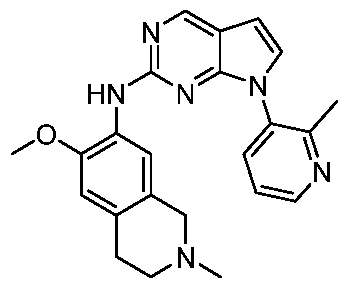
6-메톡시-2-메틸-N-(7-(2-메틸피리딘-3-일)-7H-피롤로[2,3-d]피리미딘-2-일)-1,2,3,4-테트라히드로이소퀴놀린-7-아민6-methoxy-2-methyl-N-(7-(2-methylpyridin-3-yl)-7H-pyrrolo[2,3-d]pyrimidin-2-yl)-1,2,3, 4-tetrahydroisoquinolin-7-amine
단계 1에서 3-피리딜보론산 대신 (2-메틸피리딘-3-일)보론산을 사용한, 실시예 40과 동일한 절차. LC-MS (ESI) m/z: 401 [M+H]+. 1H NMR (400 MHz, DMSO-d6) δ 8.80 (s, 1H), 8.62 (d, J = 4.7 Hz, 1H), 7.89 (d, J = 7.9 Hz, 2H), 7.75 (s, 1H), 7.59-7.35 (m, 2H), 6.71 (d, J = 4.7 Hz, 2H), 3.80 (s, 3H), 3.20 (s, 2H), 2.72 (t, J = 5.6 Hz, 2H), 2.54 (d, J = 5.8 Hz, 2H), 2.32 (s, 6H).The same procedure as in Example 40, using (2-methylpyridin-3-yl)boronic acid in step 1 instead of 3-pyridylboronic acid. LC-MS (ESI) m/z: 401 [M+H] + . 1 H NMR (400 MHz, DMSO-d 6 ) δ 8.80 (s, 1H), 8.62 (d, J = 4.7 Hz, 1H), 7.89 (d, J = 7.9 Hz, 2H), 7.75 (s, 1H) , 7.59-7.35 (m, 2H), 6.71 (d, J = 4.7 Hz, 2H), 3.80 (s, 3H), 3.20 (s, 2H), 2.72 (t, J = 5.6 Hz, 2H), 2.54 ( d, J = 5.8 Hz, 2H), 2.32 (s, 6H).
실시예 164Example 164

2-((6-메톡시-2-메틸-1,2,3,4-테트라히드로이소퀴놀린-7-일)아미노)-7-페닐-7H-피롤로[2,3-d]피리미딘-6-카르보니트릴2-((6-Methoxy-2-methyl-1,2,3,4-tetrahydroisoquinolin-7-yl)amino)-7-phenyl-7H-pyrrolo[2,3-d]pyrimidine -6-carbonitrile
단계 1: THF (30 mL) 중 5-브로모-2-클로로-N-페닐-피리미딘-4-아민 (1.5 g, 5.27 mmol) 및 1,1'-비스(디페닐포스피노)페로센]디클로로팔라듐(II) (192.87 mg, 263.58 umol)의 교반 혼합물에 트리에틸아민 (800.16 mg, 7.91 mmol, 1.10 mL) 및 3,3-디에톡시프로프-1-인 (1.01 g, 7.91 mmol, 1.13 mL)을 실온에서 순차적으로 첨가하였다. 혼합물을 N2로 퍼징하고, 실온에서 10분 동안 교반하고, 이어서 CuI (50.20 mg, 263.58 umol)를 첨가하였다. 반응 혼합물을 N2로 다시 퍼징하고, 60℃에서 48시간 동안 교반하고, 실온으로 냉각시키고, EtOAc (100 mL)로 희석하고, 여과하였다. 여과물을 물 (50 mL)로 희석하고, 분리하였다. 수성 상을 EtOAc (30 mLx3)로 추출하고, 합한 유기 상을 무수 Na2SO4 상에서 건조시키고, 여과하였다. 여과물을 진공 하에 농축시키고, 잔류물을 실리카 겔 상에서 플래쉬 칼럼 크로마토그래피 (5% EtOAc/석유 에테르에서 20% EtOAc/석유 에테르)에 의해 정제하여 2-클로로-5-(3,3-디에톡시프로프-1-이닐)-N-페닐-피리미딘-4-아민을 황색 고체 (1.18 g, 67% 수율)로서 제공하였다. LC-MS (ESI) m/z: 332 [M+H]+.Step 1: 5-Bromo-2-chloro-N-phenyl-pyrimidin-4-amine (1.5 g, 5.27 mmol) and 1,1′-bis(diphenylphosphino)ferrocene] in THF (30 mL)] To a stirred mixture of dichloropalladium(II) (192.87 mg, 263.58 umol) triethylamine (800.16 mg, 7.91 mmol, 1.10 mL) and 3,3-diethoxyprop-1-yne (1.01 g, 7.91 mmol, 1.13) mL) were added sequentially at room temperature. The mixture was purged with N 2 and stirred at room temperature for 10 min, then CuI (50.20 mg, 263.58 umol) was added. The reaction mixture was purged again with N 2 , stirred at 60° C. for 48 h, cooled to room temperature, diluted with EtOAc (100 mL) and filtered. The filtrate was diluted with water (50 mL) and separated. The aqueous phase was extracted with EtOAc (30 mLx3) and the combined organic phases were dried over anhydrous Na 2 SO 4 and filtered. The filtrate was concentrated in vacuo and the residue was purified by flash column chromatography on silica gel (5% EtOAc/petroleum ether to 20% EtOAc/petroleum ether) to 2-chloro-5-(3,3-diethoxy) Provided prop-1-ynyl)-N-phenyl-pyrimidin-4-amine as a yellow solid (1.18 g, 67% yield). LC-MS (ESI) m/z: 332 [M+H] + .
단계 2: THF (2 mL) 중 2-클로로-5-(3,3-디에톡시프로프-1-이닐)-N-페닐-피리미딘-4-아민 (400 mg, 1.21 mmol)의 교반 용액에 실온에서 THF 중 1 N TBAF (6.03 mmol, 6 mL)를 첨가하였다. 반응 혼합물을 60℃에서 2시간 동안 교반하고, 실온으로 냉각시키고, H2O (50 mL) 및 디클로로메탄 (50 mL)으로 희석하였다. 상을 분리하고, 수성 층을 디클로로메탄 (20 mLx3)으로 추출하였다. 합한 유기 층을 무수 Na2SO4 상에서 건조시키고, 여과하였다. 여과물을 진공 하에 농축시키고, 잔류물을 실리카 겔 상에서 플래쉬 칼럼 크로마토그래피 (10% EtOAc/석유 에테르에서 30% EtOAc/석유 에테르)에 의해 정제하여 2-클로로-6-(디에톡시메틸)-7-페닐-7H-피롤로[2,3-d]피리미딘을 회색 고체 (280 mg, 70% 수율)로서 제공하였다. LC-MS (ESI) m/z: 332 [M+H]+.Step 2: A stirred solution of 2-chloro-5-(3,3-diethoxyprop-1-ynyl)-N-phenyl-pyrimidin-4-amine (400 mg, 1.21 mmol) in THF (2 mL) was added 1 N TBAF in THF (6.03 mmol, 6 mL) at room temperature. The reaction mixture was stirred at 60° C. for 2 h, cooled to room temperature, and diluted with H 2 O (50 mL) and dichloromethane (50 mL). The phases were separated and the aqueous layer was extracted with dichloromethane (20 mLx3). The combined organic layers were dried over anhydrous Na 2 SO 4 and filtered. The filtrate was concentrated in vacuo and the residue was purified by flash column chromatography on silica gel (10% EtOAc/petroleum ether to 30% EtOAc/petroleum ether) to 2-chloro-6-(diethoxymethyl)-7 -Phenyl-7H-pyrrolo[2,3-d]pyrimidine was provided as a gray solid (280 mg, 70% yield). LC-MS (ESI) m/z: 332 [M+H] + .
단계 3: 2-클로로-6-(디에톡시메틸)-7-페닐-7H-피롤로[2,3-d]피리미딘 (100 mg, 0.3 mmol) 및 Int. W1 (57.8 mg, 0.3 mmol)을 조건 B4 하에 사용하고, 실리카 겔 상에서 플래쉬 칼럼 크로마토그래피 (MeOH/DCM: 5-10%)에 의한 정제 후에 N-(6-(디에톡시메틸)-7-페닐-7H-피롤로[2,3-d]피리미딘-2-일)-6-메톡시-2-메틸-1,2,3,4-테트라히드로이소퀴놀린-7-아민 (60 mg, 40.9% 수율)을 회백색 고체로서 제공하였다. LC-MS (ESI) m/z: 488 [M+H]+.Step 3: 2-Chloro-6-(diethoxymethyl)-7-phenyl-7H-pyrrolo[2,3-d]pyrimidine (100 mg, 0.3 mmol) and Int. W1 (57.8 mg, 0.3 mmol) was used under condition B4 and after purification by flash column chromatography on silica gel (MeOH/DCM: 5-10%) N-(6-(diethoxymethyl)-7-phenyl -7H-pyrrolo[2,3-d]pyrimidin-2-yl)-6-methoxy-2-methyl-1,2,3,4-tetrahydroisoquinolin-7-amine (60 mg, 40.9 % yield) as an off-white solid. LC-MS (ESI) m/z: 488 [M+H] + .
단계 4: 디옥산 (1 mL) 중 N-(6-(디에톡시메틸)-7-페닐-7H-피롤로[2,3-d]피리미딘-2-일)-6-메톡시-2-메틸-1,2,3,4-테트라히드로이소퀴놀린-7-아민 (60 mg, 0.123 mmol)의 교반 용액에 12 N HCl (0.2 mL)을 실온에서 첨가하였다. 반응 혼합물을 30분 동안 교반하고, 2 N NaOH를 사용하여 pH 8로 염기성화시키고, EtOAc (5 mL x 3)로 추출하였다. 합한 유기 상을 무수 Na2SO4 상에서 건조시키고, 여과하였다. 여과물을 진공 하에 농축시켜 2-((6-메톡시-2-메틸-1,2,3,4-테트라히드로이소퀴놀린-7-일)아미노)-7-페닐-7H-피롤로[2,3-d]피리미딘-6-카르브알데히드를 회색 고체 (50 mg, 98% 수율)로서 제공하였다. LC-MS (ESI) m/z: 414 [M+H]+.Step 4: N-(6-(diethoxymethyl)-7-phenyl-7H-pyrrolo[2,3-d]pyrimidin-2-yl)-6-methoxy-2 in dioxane (1 mL) To a stirred solution of -methyl-1,2,3,4-tetrahydroisoquinolin-7-amine (60 mg, 0.123 mmol) was added 12 N HCl (0.2 mL) at room temperature. The reaction mixture was stirred for 30 min, basified to pH 8 with 2 N NaOH and extracted with EtOAc (5 mL×3). The combined organic phases were dried over anhydrous Na 2 SO 4 and filtered. The filtrate was concentrated in vacuo to 2-((6-methoxy-2-methyl-1,2,3,4-tetrahydroisoquinolin-7-yl)amino)-7-phenyl-7H-pyrrolo[2 ,3-d]pyrimidine-6-carbaldehyde was provided as a gray solid (50 mg, 98% yield). LC-MS (ESI) m/z: 414 [M+H] + .
단계 5: 에탄올 (1 mL) 중 2-((6-메톡시-2-메틸-1,2,3,4-테트라히드로이소퀴놀린-7-일)아미노)-7-페닐-7H-피롤로[2,3-d]피리미딘-6-카르브알데히드 (50 mg, 0.121 mmol) 및 피라진 (19.7 mg, 0.246 mmol)의 교반 용액에 실온에서 히드록실아민 히드로클로라이드 (10.3 mg, 0.148 mmol)를 첨가하였다. 반응 혼합물을 90℃에서 2시간 동안 교반하고, 진공 하에 농축시켰다. 잔류물을 물 (10 mL)로 희석하고, EtOAc (10 mL x 3)로 추출하였다. 합한 유기 상을 염수 (10 mL)로 세척하고, 무수 Na2SO4 상에서 건조시키고, 여과하였다. 여과물을 진공 하에 농축시켜 2-((6-메톡시-2-메틸-1,2,3,4-테트라히드로이소퀴놀린-7-일)아미노)-7-페닐-7H-피롤로[2,3-d]피리미딘-6-카르브알데히드 옥심을 황색 고체 (52 mg, 99% 수율)로서 제공하였다. LC-MS (ESI) m/z: 429 [M+H]+.Step 5: 2-((6-Methoxy-2-methyl-1,2,3,4-tetrahydroisoquinolin-7-yl)amino)-7-phenyl-7H-pyrrolo in ethanol (1 mL) [2,3-d] To a stirred solution of [2,3-d] pyrimidine-6-carbaldehyde (50 mg, 0.121 mmol) and pyrazine (19.7 mg, 0.246 mmol) at room temperature hydroxylamine hydrochloride (10.3 mg, 0.148 mmol) added. The reaction mixture was stirred at 90° C. for 2 h and concentrated in vacuo. The residue was diluted with water (10 mL) and extracted with EtOAc (10 mL×3). The combined organic phases were washed with brine (10 mL), dried over anhydrous Na 2 SO 4 and filtered. The filtrate was concentrated in vacuo to 2-((6-methoxy-2-methyl-1,2,3,4-tetrahydroisoquinolin-7-yl)amino)-7-phenyl-7H-pyrrolo[2 ,3-d]pyrimidine-6-carbaldehyde oxime was provided as a yellow solid (52 mg, 99% yield). LC-MS (ESI) m/z: 429 [M+H] + .
단계 6: TEA (2 mL) 중 2-((6-메톡시-2-메틸-1,2,3,4-테트라히드로이소퀴놀린-7-일)아미노)-7-페닐-7H-피롤로[2,3-d]피리미딘-6-카르브알데히드 옥심 (52 mg, 0.121 mmol)의 교반 용액에 아세트산 무수물 (24.78 mg, 0.243 mmol)을 첨가하였다. 반응 혼합물을 90℃에서 2시간 동안 교반하고, 실온으로 냉각시키고, 진공 하에 농축시켰다. 잔류물을 정제용-HPLC (0.1% 포름산/MeCN)에 의해 정제하여 2-((6-메톡시-2-메틸-1,2,3,4-테트라히드로이소퀴놀린-7-일)아미노)-7-페닐-7H-피롤로[2,3-d]피리미딘-6-카르보니트릴을 황색 고체 (3.1 mg, 6% 수율)로서 제공하였다. LC-MS (ESI) m/z: 411 [M+H]+. 1H NMR (400 MHz, DMSO-d6) δ 8.98 (s, 1H), 8.37 (s, 1H), 8.24 (br, 1H), 7.87 (s, 1H), 7.78-7.63 (m, 5H), 7.61-7.59 (m, 1H)), 6.74 (s, 1H), 3.80 (s, 3H), 3.28 (s, 2H), 2.75 (s, 2H), 2.55 (s, 2H), 2.35 (s, 3H).Step 6: 2-((6-Methoxy-2-methyl-1,2,3,4-tetrahydroisoquinolin-7-yl)amino)-7-phenyl-7H-pyrrolo in TEA (2 mL) To a stirred solution of [2,3-d]pyrimidine-6-carbaldehyde oxime (52 mg, 0.121 mmol) was added acetic anhydride (24.78 mg, 0.243 mmol). The reaction mixture was stirred at 90° C. for 2 h, cooled to room temperature and concentrated in vacuo. The residue was purified by preparative-HPLC (0.1% formic acid/MeCN) to 2-((6-methoxy-2-methyl-1,2,3,4-tetrahydroisoquinolin-7-yl)amino) Provided -7-phenyl-7H-pyrrolo[2,3-d]pyrimidine-6-carbonitrile as a yellow solid (3.1 mg, 6% yield). LC-MS (ESI) m/z: 411 [M+H] + . 1 H NMR (400 MHz, DMSO-d 6 ) δ 8.98 (s, 1H), 8.37 (s, 1H), 8.24 (br, 1H), 7.87 (s, 1H), 7.78-7.63 (m, 5H), 7.61-7.59 (m, 1H)), 6.74 (s, 1H), 3.80 (s, 3H), 3.28 (s, 2H), 2.75 (s, 2H), 2.55 (s, 2H), 2.35 (s, 3H) ).
실시예 165Example 165

2-((6-메톡시-2-메틸-1,2,3,4-테트라히드로이소퀴놀린-7-일)아미노)-7-페닐-7H-피롤로[2,3-d]피리미딘-6-카르복실산2-((6-Methoxy-2-methyl-1,2,3,4-tetrahydroisoquinolin-7-yl)amino)-7-phenyl-7H-pyrrolo[2,3-d]pyrimidine -6-carboxylic acid
물 (3 mL) 및 에탄올 (3 mL)의 혼합 용매 중 2-((6-메톡시-2-메틸-1,2,3,4-테트라히드로이소퀴놀린-7-일)아미노)-7-페닐-7H-피롤로[2,3-d]피리미딘-6-카르브알데히드 (30 mg, 0.073 mmol)의 용액에 수산화나트륨 (14.5 mg, 0.363 mmol) 및 산화은 (33.6 mg, 0.145 mmol)을 첨가하였다. 반응 혼합물을 80℃에서 16시간 동안 교반하고, 실온으로 냉각시키고, 물 (20 mL)로 희석하고, pH 3-4로 산성화시켰다. 혼합물을 DCM (20 mL x 3)으로 추출하고, 유기 상을 무수 황산나트륨 상에서 건조시키고, 여과하였다. 여과물을 진공 하에 농축시키고, 잔류물을 정제용-HPLC에 의해 정제하여 2-((6-메톡시-2-메틸-1,2,3,4-테트라히드로이소퀴놀린-7-일)아미노)-7-페닐-7H-피롤로[2,3-d]피리미딘-6-카르복실산 (4.4 mg, 14.1% 수율)을 황색 고체로서 제공하였다. LC-MS (ESI) m/z: 430 [M+H]+. 1H NMR (400 MHz, DMSO-d6) δ 8.88 (s, 1H), 7.92 (s, 1H), 7.89 (s, 1H), 7.53-7.51 (m, 2H), 7.47-7.42 (m, 3H), 7.25 (s, 1H), 6.71 (s, 1H), 3.81 (s, 3H), 3.26 (s, 2H), 2.74-2.73 (m, 2H), 2.61-2.59 (m, 2H), 2.39 (s, 3H).2-((6-methoxy-2-methyl-1,2,3,4-tetrahydroisoquinolin-7-yl)amino)-7- in a mixed solvent of water (3 mL) and ethanol (3 mL) Sodium hydroxide (14.5 mg, 0.363 mmol) and silver oxide (33.6 mg, 0.145 mmol) were added to a solution of phenyl-7H-pyrrolo[2,3-d]pyrimidine-6-carbaldehyde (30 mg, 0.073 mmol). added. The reaction mixture was stirred at 80° C. for 16 h, cooled to room temperature, diluted with water (20 mL) and acidified to pH 3-4. The mixture was extracted with DCM (20 mL×3) and the organic phase was dried over anhydrous sodium sulfate and filtered. The filtrate was concentrated in vacuo and the residue was purified by prep-HPLC to 2-((6-methoxy-2-methyl-1,2,3,4-tetrahydroisoquinolin-7-yl)amino )-7-phenyl-7H-pyrrolo[2,3-d]pyrimidine-6-carboxylic acid (4.4 mg, 14.1% yield) was provided as a yellow solid. LC-MS (ESI) m/z: 430 [M+H] + . 1 H NMR (400 MHz, DMSO-d 6 ) δ 8.88 (s, 1H), 7.92 (s, 1H), 7.89 (s, 1H), 7.53-7.51 (m, 2H), 7.47-7.42 (m, 3H) ), 7.25 (s, 1H), 6.71 (s, 1H), 3.81 (s, 3H), 3.26 (s, 2H), 2.74-2.73 (m, 2H), 2.61-2.59 (m, 2H), 2.39 ( s, 3H).
실시예 43Example 43

6-메톡시-2-메틸-N-(9-페닐-9H-퓨린-2-일)-1,2,3,4-테트라히드로이소퀴놀린-7-아민6-Methoxy-2-methyl-N-(9-phenyl-9H-purin-2-yl)-1,2,3,4-tetrahydroisoquinolin-7-amine
단계 1: 디옥산 (20 mL) 중 2,4-디클로로-5-니트로-피리미딘 (1 g, 5.16 mmol)의 용액에 실온에서 아닐린 (0.96 mg, 10.31 mmol)을 천천히 첨가하였다. 이어서, 혼합물을 실온에서 1시간 동안 교반하고, 여과하였다. 여과물을 농축시켜 2-클로로-5-니트로-N-페닐-피리미딘-4-아민을 황색 고체 (800 mg, 62% 수율)로서 제공하였다. LC-SM (ESI) m/z: 251 [M+H]+.Step 1: To a solution of 2,4-dichloro-5-nitro-pyrimidine (1 g, 5.16 mmol) in dioxane (20 mL) at room temperature was added aniline (0.96 mg, 10.31 mmol) slowly. The mixture was then stirred at room temperature for 1 h and filtered. The filtrate was concentrated to provide 2-chloro-5-nitro-N-phenyl-pyrimidin-4-amine as a yellow solid (800 mg, 62% yield). LC-SM (ESI) m/z: 251 [M+H] + .
단계 2: 에틸 아세테이트/EtOH/H2O (6 mL/27 mL/3 mL) 중 2-클로로-5-니트로-N-페닐-피리미딘-4-아민 (500 mg, 1.99 mmol)의 혼합물에 Fe (557.1 mg, 9.97 mmol) 및 NH4Cl (74.7 mg, 1.40 mmol)을 실온에서 첨가하였다. 혼합물을 60℃에서 2시간 동안 교반하였다. 실온으로 냉각시킨 후, 혼합물을 여과하고, 메탄올 (30 mL)로 세척하였다. 여과물을 농축시키고, 잔류물을 실리카 겔 상에서 플래쉬 칼럼 크로마토그래피 (DCM/MeOH = 20/1 v/v)에 의해 정제하여 2-클로로-N4-페닐-피리미딘-4,5-디아민을 연황색 고체 (350 mg, 79% 수율)로서 제공하였다. LC-MS (ESI) m/z: 221 [M+H]+.Step 2: To a mixture of 2-chloro-5-nitro-N-phenyl-pyrimidin-4-amine (500 mg, 1.99 mmol) in ethyl acetate/EtOH/H 2 O (6 mL/27 mL/3 mL) Fe (557.1 mg, 9.97 mmol) and NH 4 Cl (74.7 mg, 1.40 mmol) were added at room temperature. The mixture was stirred at 60° C. for 2 h. After cooling to room temperature, the mixture was filtered and washed with methanol (30 mL). The filtrate was concentrated and the residue was purified by flash column chromatography on silica gel (DCM/MeOH = 20/1 v/v) to give 2-chloro-N 4 -phenyl-pyrimidine-4,5-diamine Provided as a light yellow solid (350 mg, 79% yield). LC-MS (ESI) m/z: 221 [M+H] + .
단계 3: 트리에틸 오르토포르메이트 (10 mL) 및 DMF (5 mL) 중 2-클로로-N4-페닐-피리미딘-4,5-디아민 (300 mg, 1.36 mmol)의 용액에 진한 HCl (0.6 mL)을 첨가하였다. 반응 혼합물을 실온에서 2시간 동안 교반하고, H2O (20 mL)로 희석하고, EA (20 mL x 2)로 추출하였다. 합한 유기 층을 무수 Na2SO4 상에서 건조시키고, 여과하고, 농축 건조시켰다. 잔류물을 실리카 겔 칼럼 상에서 플래쉬 칼럼 크로마토그래피 (EA/PE = 1/2 v/v)에 의해 정제하여 2-클로로-9-페닐-퓨린을 황색 고체 (220 mg, 70% 수율)로서 제공하였다. LC-MS (ESI) m/z: 231 [M+H]+.Step 3: To a solution of 2-chloro-N 4 -phenyl-pyrimidine-4,5-diamine (300 mg, 1.36 mmol) in triethyl orthoformate (10 mL) and DMF (5 mL) in concentrated HCl (0.6 mL) was added. The reaction mixture was stirred at room temperature for 2 h, diluted with H 2 O (20 mL) and extracted with EA (20 mL×2). The combined organic layers were dried over anhydrous Na 2 SO 4 , filtered and concentrated to dryness. The residue was purified by flash column chromatography on a silica gel column (EA/PE = 1/2 v/v) to give 2-chloro-9-phenyl-purine as a yellow solid (220 mg, 70% yield). . LC-MS (ESI) m/z: 231 [M+H] + .
단계 4: 2-클로로-9-페닐-퓨린 (30 mg, 0.13 mmol), 및 Int. W1 (25 mg, 0.13 mmol)을 조건 B4 하에 사용하여 정제용-HPLC (0.05% TFA/MeCN)에 의한 정제 후에 6-메톡시-2-메틸-N-(9-페닐-9H-퓨린-2-일)-1,2,3,4-테트라히드로이소퀴놀린-7-아민 (8 mg)을 황색 고체로서 제공하였다. LC-MS (ESI) m/z: 387 [M+H]. 1H NMR (400 MHz, CD3OD): δ 3.07 (s, 3H), 3.12-3.13 (m, 1H), 3.19-3.27 (m, 1H), 3.39-3.48 (m, 1H), 3.74-3.75 (m, 1H), 3.95 (s, 3H), 4.25-4.41 (m, 2H), 6.91 (s, 1H), 7.53-7.57 (m, 1H), 7.66-7.89 (m, 2H), 7.91 (d, J = 1.2 Hz, 2H), 8.40 (s, 1H), 8.57 (s, 1H), 8.67 (s, 1H).Step 4: 2-Chloro-9-phenyl-purine (30 mg, 0.13 mmol), and Int. 6-methoxy-2-methyl-N-(9-phenyl-9H-purine-2 after purification by prep-HPLC (0.05% TFA/MeCN) using W1 (25 mg, 0.13 mmol) under condition B4 -yl)-1,2,3,4-tetrahydroisoquinolin-7-amine (8 mg) was provided as a yellow solid. LC-MS (ESI) m/z: 387 [M+H]. 1 H NMR (400 MHz, CD 3 OD): δ 3.07 (s, 3H), 3.12-3.13 (m, 1H), 3.19-3.27 (m, 1H), 3.39-3.48 (m, 1H), 3.74-3.75 (m, 1H), 3.95 (s, 3H), 4.25-4.41 (m, 2H), 6.91 (s, 1H), 7.53-7.57 (m, 1H), 7.66-7.89 (m, 2H), 7.91 (d , J = 1.2 Hz, 2H), 8.40 (s, 1H), 8.57 (s, 1H), 8.67 (s, 1H).
실시예 44Example 44

2-(2-((6-메톡시-2-메틸-1,2,3,4-테트라히드로이소퀴놀린-7-일)아미노)-9H-퓨린-9-일)-N,N-디메틸벤즈아미드2-(2-((6-Methoxy-2-methyl-1,2,3,4-tetrahydroisoquinolin-7-yl)amino)-9H-purin-9-yl)-N,N-dimethyl benzamide
단계 1에서 아닐린 대신 2-아미노-N,N-디메틸벤즈아미드를 사용한, 실시예 43과 동일한 절차. LC-MS (ESI) m/z: 458 [M+H]. 1H NMR (400 MHz, CD3OD): δ 2.73 (s, 3H), 2.77 (s, 3H), 2.84 (s, 3H), 3.03 (t, J = 6.0 Hz, 2H), 3.18 (t, J = 6.0 Hz, 2H), 3.88 (s, 2H), 3.90 (s, 3H), 6.81 (s, 1H), 7.61-7.64 (m, 1H), 7.68-7.76 (m, 1H), 7.76-7.78 (m, 2H), 8.18 (s, 1H), 8.19 (s, 1H), 8.45 (brs, 1H), 8.83 (s, 1H).Same procedure as Example 43, using 2-amino-N,N-dimethylbenzamide in step 1 instead of aniline. LC-MS (ESI) m/z: 458 [M+H]. 1 H NMR (400 MHz, CD 3 OD): δ 2.73 (s, 3H), 2.77 (s, 3H), 2.84 (s, 3H), 3.03 (t, J = 6.0 Hz, 2H), 3.18 (t, J = 6.0 Hz, 2H), 3.88 (s, 2H), 3.90 (s, 3H), 6.81 (s, 1H), 7.61-7.64 (m, 1H), 7.68-7.76 (m, 1H), 7.76-7.78 (m, 2H), 8.18 (s, 1H), 8.19 (s, 1H), 8.45 (brs, 1H), 8.83 (s, 1H).
실시예 45Example 45

(2-(2-((6-메톡시-2-메틸-1,2,3,4-테트라히드로이소퀴놀린-7-일)아미노)-9H-퓨린-9-일)페닐)디메틸포스핀 옥시드(2-(2-((6-Methoxy-2-methyl-1,2,3,4-tetrahydroisoquinolin-7-yl)amino)-9H-purin-9-yl)phenyl)dimethylphosphine oxide
단계 1에서 아닐린 대신 (2-아미노페닐)디메틸포스핀 옥시드를 사용한, 실시예 43과 동일한 절차. LC-MS (ESI) m/z: 463 [M+H]. 1H NMR (400 MHz, CD3OD): δ 1.62 (s, 3H), 1.65 (s, 3H), 2.87 (s, 3H), 3.07 (t, J = 6.0 Hz, 2H), 3.33 (t, J = 6.0 Hz, 2H), 3.89 (s, 3H), 3.94 (s, 2H), 6.82 (s, 1H), 7.60-7.63 (m, 1H), 7.81-7.91 (m, 2H), 8.01-8.07 (m, 1H), 8.12 (s, 1H), 8.35 (s, 1H), 8.45 (brs, 1H), 8.85 (s, 1H).Same procedure as Example 43, using (2-aminophenyl)dimethylphosphine oxide in step 1 instead of aniline. LC-MS (ESI) m/z: 463 [M+H]. 1 H NMR (400 MHz, CD 3 OD): δ 1.62 (s, 3H), 1.65 (s, 3H), 2.87 (s, 3H), 3.07 (t, J = 6.0 Hz, 2H), 3.33 (t, J = 6.0 Hz, 2H), 3.89 (s, 3H), 3.94 (s, 2H), 6.82 (s, 1H), 7.60-7.63 (m, 1H), 7.81-7.91 (m, 2H), 8.01-8.07 (m, 1H), 8.12 (s, 1H), 8.35 (s, 1H), 8.45 (brs, 1H), 8.85 (s, 1H).
실시예 166Example 166

2-((6-메톡시-2-메틸-1,2,3,4-테트라히드로이소퀴놀린-7-일)아미노)-7-메틸-9-페닐-7,9-디히드로-8H-퓨린-8-온2-((6-Methoxy-2-methyl-1,2,3,4-tetrahydroisoquinolin-7-yl)amino)-7-methyl-9-phenyl-7,9-dihydro-8H- Purine-8-one
단계 1: 디클로로메탄 (30 mL) 중 2-클로로-N4-페닐-피리미딘-4,5-디아민 (410 mg, 1.86 mmol)의 용액에 CDI (301.29 mg, 1.86 mmol)를 첨가하였다. 혼합물을 25℃에서 16시간 동안 교반하고, 포화 NaHCO3 수용액 (20 mL)으로 희석하고, 분리하였다. 수성 상을 DCM/MeOH (v/v, 10/1, 20 mL x 3)로 추출하였다. 합한 유기 상을 무수 Na2SO4 상에서 건조시키고, 여과하였다. 여과물을 진공 하에 농축시키고, 잔류물을 실리카 겔 상에서 플래쉬 칼럼 크로마토그래피 (80-100% EtOAc/헥산)에 의해 정제하여 2-클로로-9-페닐-7,9-디히드로-8H-퓨린-8-온을 담황색 고체 (264 mg, 58% 수율)로서 제공하였다. LC-MS (ESI) m/z: 247 [M+H]+.Step 1: To a solution of 2-chloro-N 4 -phenyl-pyrimidine-4,5-diamine (410 mg, 1.86 mmol) in dichloromethane (30 mL) was added CDI (301.29 mg, 1.86 mmol). The mixture was stirred at 25° C. for 16 h, diluted with saturated aqueous NaHCO 3 aqueous solution (20 mL) and separated. The aqueous phase was extracted with DCM/MeOH (v/v, 10/1, 20 mL×3). The combined organic phases were dried over anhydrous Na 2 SO 4 and filtered. The filtrate was concentrated in vacuo and the residue was purified by flash column chromatography on silica gel (80-100% EtOAc/hexanes) to 2-chloro-9-phenyl-7,9-dihydro-8H-purine- 8-one was provided as a pale yellow solid (264 mg, 58% yield). LC-MS (ESI) m/z: 247 [M+H] + .
단계 2: THF (10 mL) 중 2-클로로-9-페닐-7,9-디히드로-8H-퓨린-8-온 (230 mg, 932.49 umol) 및 아이오도메탄 (463.3 mg, 3.26 mmol)의 용액에 0℃에서 수소화나트륨 (111.9 mg, 2.80 mmol, 미네랄 오일 중 60% 분산액)을 첨가하였다. 혼합물을 0-25℃에서 6시간 동안 교반하고, 물 (10 mL)로 켄칭하고, 분리하였다. 수성 상을 디클로로메탄/메탄올 (v/v, 10/1, 20 mL x 3)로 추출하였다. 합한 유기 층을 무수 Na2SO4 상에서 건조시키고, 여과하였다. 여과물을 진공 하에 농축시키고, 잔류물을 실리카 겔 상에서 플래쉬 칼럼 크로마토그래피 (석유 에테르 중 30-40% EtOAc)를 통해 정제하여 2-클로로-7-메틸-9-페닐-7,9-디히드로-8H-퓨린-8-온을 담황색 고체 (80 mg, 24% 수율)로서 제공하였다. LC-MS (ESI) m/z: 261 [M+H]+.Step 2: 2-chloro-9-phenyl-7,9-dihydro-8H-purin-8-one (230 mg, 932.49 umol) and iodomethane (463.3 mg, 3.26 mmol) in THF (10 mL) To the solution was added sodium hydride (111.9 mg, 2.80 mmol, 60% dispersion in mineral oil) at 0°C. The mixture was stirred at 0-25° C. for 6 h, quenched with water (10 mL) and separated. The aqueous phase was extracted with dichloromethane/methanol (v/v, 10/1, 20 mL×3). The combined organic layers were dried over anhydrous Na 2 SO 4 and filtered. The filtrate was concentrated in vacuo and the residue was purified via flash column chromatography on silica gel (30-40% EtOAc in petroleum ether) to 2-chloro-7-methyl-9-phenyl-7,9-dihydro -8H-purin-8-one was provided as a pale yellow solid (80 mg, 24% yield). LC-MS (ESI) m/z: 261 [M+H] + .
단계 3: 2-클로로-7-메틸-9-페닐-7,9-디히드로-8H-퓨린-8-온 (70 mg, 0.268 mmol), 및 Int. W1 (21.4 mg, 0.268 mmol)을 조건 B3 하에 사용하여 정제용-HPLC (0.1% FA/MeCN)에 의한 정제 후에 2-((6-메톡시-2-메틸-1,2,3,4-테트라히드로이소퀴놀린-7-일)아미노)-7-메틸-9-페닐-7,9-디히드로-8H-퓨린-8-온 (44.2 mg, 39.5% 수율)을 황색 고체로서 제공하였다. LC-MS (ESI) m/z: 417 [M+H]+. 1H NMR (400 MHz, DMSO-d6) δ 8.29 (s, 1H), 8.25 (s, 1H), 7.88 (s, 1H), 7.67 (s, 2H), 7.58 (t, J = 7.7 Hz, 2H), 7.47 (t, J = 7.3 Hz, 1H), 6.71 (s, 1H), 3.79 (s, 3H), 3.40 (s, 3H), 3.28-3.20 (m, 2H), 2.74 (s, 2H), 2.55 (s, 2H), 2.34 (s, 3H).Step 3: 2-Chloro-7-methyl-9-phenyl-7,9-dihydro-8H-purin-8-one (70 mg, 0.268 mmol), and Int. Prep-HPLC (0.1% FA/MeCN) using W1 (21.4 mg, 0.268 mmol) under condition B3 followed by 2-((6-methoxy-2-methyl-1,2,3,4- Provided tetrahydroisoquinolin-7-yl)amino)-7-methyl-9-phenyl-7,9-dihydro-8H-purin-8-one (44.2 mg, 39.5% yield) as a yellow solid. LC-MS (ESI) m/z: 417 [M+H] + . 1 H NMR (400 MHz, DMSO-d 6 ) δ 8.29 (s, 1H), 8.25 (s, 1H), 7.88 (s, 1H), 7.67 (s, 2H), 7.58 (t, J = 7.7 Hz, 2H), 7.47 (t, J = 7.3 Hz, 1H), 6.71 (s, 1H), 3.79 (s, 3H), 3.40 (s, 3H), 3.28-3.20 (m, 2H), 2.74 (s, 2H) ), 2.55 (s, 2H), 2.34 (s, 3H).
실시예 46Example 46
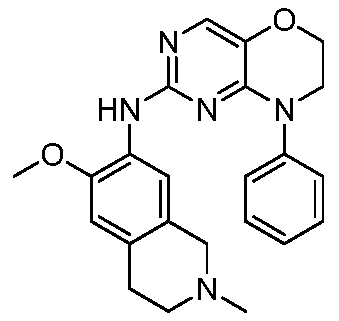
N-(6-메톡시-2-메틸-1,2,3,4-테트라히드로이소퀴놀린-7-일)-8-페닐-7,8-디히드로-6H-피리미도[5,4-b][1,4]옥사진-2-아민N-(6-Methoxy-2-methyl-1,2,3,4-tetrahydroisoquinolin-7-yl)-8-phenyl-7,8-dihydro-6H-pyrimido[5,4- b][1,4]oxazin-2-amine
단계 1: 디옥산 (15 mL) 중 2,4-디클로로-5-메톡시-피리미딘 (1.00 g, 5.59 mmol)의 용액에 DIPEA (1.44 g, 11.17 mmol, 1.95 mL) 및 아닐린 (0.520 mg, 5.59 mmol)을 첨가하였다. 혼합물을 N2 분위기 하에 120℃에서 밤새 교반하고, 농축시켰다. 잔류물을 실리카 겔 칼럼 상에서 플래쉬 칼럼 크로마토그래피 (PE/EA = 2/1 v/v)에 의해 정제하여 2-클로로-5-메톡시-N-페닐-피리미딘-4-아민을 황색 고체 (950 mg, 72% 수율)로서 제공하였다. LC-MS (ESI) m/z: 236 [M+H]+.Step 1: To a solution of 2,4-dichloro-5-methoxy-pyrimidine (1.00 g, 5.59 mmol) in dioxane (15 mL) DIPEA (1.44 g, 11.17 mmol, 1.95 mL) and aniline (0.520 mg, 5.59 mmol) was added. The mixture was stirred overnight at 120° C. under N 2 atmosphere and concentrated. The residue was purified by flash column chromatography on a silica gel column (PE/EA = 2/1 v/v) to give 2-chloro-5-methoxy-N-phenyl-pyrimidin-4-amine as a yellow solid ( 950 mg, 72% yield). LC-MS (ESI) m/z: 236 [M+H] + .
단계 2: DCM (5 mL) 중 2-클로로-5-메톡시-N-페닐-피리미딘-4-아민 (100 mg, 0.424 mmol)의 용액에 0℃에서 삼브로민화붕소 (1.06 g, 4.24 mmol)를 첨가하였다. 혼합물을 실온에서 질소 하에 3일 동안 교반하고, 0℃에서 MeOH (30 mL)에 붓고, 농축시켰다. 잔류물을 실리카 겔 상에서 플래쉬 칼럼 크로마토그래피 (PE/EA = 1/1 v/v에 이어서 DCM/MeOH = 10/1 v/v)에 의해 정제하여 4-아닐리노-2-클로로-피리미딘-5-올을 백색 고체 (94 mg, 100% 수율)로서 제공하였다. LC-MS (ESI) m/z: 222 [M+H]+.Step 2: To a solution of 2-chloro-5-methoxy-N-phenyl-pyrimidin-4-amine (100 mg, 0.424 mmol) in DCM (5 mL) at 0 °C with boron tribromide (1.06 g, 4.24) mmol) was added. The mixture was stirred at room temperature under nitrogen for 3 days, poured into MeOH (30 mL) at 0° C. and concentrated. The residue was purified by flash column chromatography on silica gel (PE/EA = 1/1 v/v then DCM/MeOH = 10/1 v/v) to 4-anilino-2-chloro-pyrimidine- 5-ol was provided as a white solid (94 mg, 100% yield). LC-MS (ESI) m/z: 222 [M+H] + .
단계 3: DMF (5 mL) 중 4-아닐리노-2-클로로-피리미딘-5-올 (94 mg, 0.424 mmol)의 용액에 탄산칼륨 (175.85 mg, 1.27 mmol) 및 1-브로모-2-클로로-에탄 (91.2 mg, 0.636 mmol)을 첨가하였다. 혼합물을 실온에서 16시간 동안 교반하고, H2O (20 mL)로 희석하고, EA (20 mL x 3)로 추출하였다. 유기 층을 무수 Na2SO4 상에서 건조시키고, 여과하고, 농축시켰다. 잔류물을 실리카 겔 (PE/EA = 2/1) 상에서 플래쉬 칼럼 크로마토그래피에 의해 정제하여 2-클로로-8-페닐-6,7-디히드로피리미도[5,4-b][1,4]옥사진을 백색 고체 (60 mg, 57% 수율)로서 제공하였다. LC-MS (ESI) m/z: 248 [M+H]+.Step 3: To a solution of 4-anilino-2-chloro-pyrimidin-5-ol (94 mg, 0.424 mmol) in DMF (5 mL) potassium carbonate (175.85 mg, 1.27 mmol) and 1-bromo-2 -Chloro-ethane (91.2 mg, 0.636 mmol) was added. The mixture was stirred at room temperature for 16 h, diluted with H 2 O (20 mL) and extracted with EA (20 mL×3). The organic layer was dried over anhydrous Na 2 SO 4 , filtered and concentrated. The residue was purified by flash column chromatography on silica gel (PE/EA = 2/1) to 2-chloro-8-phenyl-6,7-dihydropyrimido[5,4-b][1,4 ]oxazine was provided as a white solid (60 mg, 57% yield). LC-MS (ESI) m/z: 248 [M+H] + .
단계 4: 2-클로로-8-페닐-6,7-디히드로피리미도[5,4-b][1,4]옥사진 (50 mg, 0.202 mmol), 및 Int. W1 (46.2 mg, 0.202 mmol)을 조건 B3 하에 사용하여 N-(6-메톡시-2-메틸-1,2,3,4-테트라히드로이소퀴놀린-7-일)-8-페닐-7,8-디히드로-6H-피리미도[5,4-b][1,4]옥사진-2-아민 (48 mg, 59% 수율)을 백색 고체로서 제공하였으며, 이를 여과에 의해 수집하였다. LC-MS (ESI) m/z: 404 [M+H]+. 1H NMR (400 MHz, CD3OD): δ 3.03 (s, 3H), 3.06-3.10 (m, 1H), 3.12-3.28 (m, 2H), 3.68-3.71 (m, 1H), 3.80-3.81 (m, 2H), 3.90 (s, 3H), 4.09 (t, J = 4.0 Hz, 2H), 4.44 (t, J = 4.0 Hz, 2H), 6.89 (s, 1H), 7.36 (s, 1H), 7.52-7.54 (m, 2H), 7.56-7.60 (m, 1H), 7.63-7.67 (m, 2H), 7.72 (s, 1H).Step 4: 2-Chloro-8-phenyl-6,7-dihydropyrimido[5,4-b][1,4]oxazine (50 mg, 0.202 mmol), and Int. N-(6-methoxy-2-methyl-1,2,3,4-tetrahydroisoquinolin-7-yl)-8-phenyl-7 using W1 (46.2 mg, 0.202 mmol) under condition B3; 8-dihydro-6H-pyrimido[5,4-b][1,4]oxazin-2-amine (48 mg, 59% yield) was provided as a white solid, which was collected by filtration. LC-MS (ESI) m/z: 404 [M+H] + . 1 H NMR (400 MHz, CD 3 OD): δ 3.03 (s, 3H), 3.06-3.10 (m, 1H), 3.12-3.28 (m, 2H), 3.68-3.71 (m, 1H), 3.80-3.81 (m, 2H), 3.90 (s, 3H), 4.09 (t, J = 4.0 Hz, 2H), 4.44 (t, J = 4.0 Hz, 2H), 6.89 (s, 1H), 7.36 (s, 1H) , 7.52-7.54 (m, 2H), 7.56-7.60 (m, 1H), 7.63-7.67 (m, 2H), 7.72 (s, 1H).
실시예 47Example 47

(2-(2-((6-메톡시-2-메틸-1,2,3,4-테트라히드로이소퀴놀린-7-일)아미노)-6H-피리미도[5,4-b][1,4]옥사진-8(7H)-일)페닐)디메틸포스핀 옥시드(2-(2-((6-methoxy-2-methyl-1,2,3,4-tetrahydroisoquinolin-7-yl)amino)-6H-pyrimido[5,4-b][1 ,4]oxazin-8(7H)-yl)phenyl)dimethylphosphine oxide
단계 1에서 아닐린 대신 2-디메틸포스포릴아닐린을 사용한, 실시예 46과 동일한 절차. LC-MS (ESI) m/z: 480 [M+H]+. 1H NMR (400 MHz, CD3OD): δ 1.63 (d, J = 13.2 Hz, 3H), 1.80 (d, J = 13.6 Hz, 3H), 2.88 (s, 3H), 2.98 (t, J = 6.0 Hz, 2H), 3.26 (t, J = 6.4 Hz, 2H), 3.46-3.55 (m, 2H), 3.84 (s, 3H), 3.87-3.94 (m, 2H), 4.38-4.45 (m, 2H), 6.70 (s, 1H), 7.31 (s, 1H), 7.54-7.58 (m, 1H), 7.71-7.76 (m, 2H), 7.85 (t, J = 8.0 Hz, 1H), 7.98-8.04 (m, 1H), 8.46 (brs, 1H).Same procedure as Example 46, using 2-dimethylphosphorylaniline instead of aniline in step 1. LC-MS (ESI) m/z: 480 [M+H] + . 1 H NMR (400 MHz, CD 3 OD): δ 1.63 (d, J = 13.2 Hz, 3H), 1.80 (d, J = 13.6 Hz, 3H), 2.88 (s, 3H), 2.98 (t, J = 6.0 Hz, 2H), 3.26 (t, J = 6.4 Hz, 2H), 3.46-3.55 (m, 2H), 3.84 (s, 3H), 3.87-3.94 (m, 2H), 4.38-4.45 (m, 2H) ), 6.70 (s, 1H), 7.31 (s, 1H), 7.54-7.58 (m, 1H), 7.71-7.76 (m, 2H), 7.85 (t, J = 8.0 Hz, 1H), 7.98-8.04 ( m, 1H), 8.46 (brs, 1H).
실시예 171Example 171
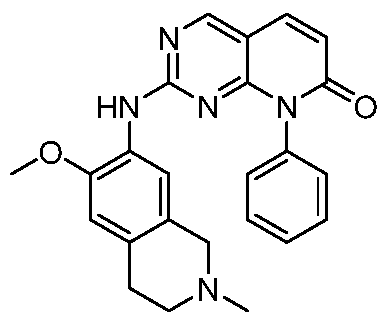
2-((6-메톡시-2-메틸-1,2,3,4-테트라히드로이소퀴놀린-7-일)아미노)-8-페닐피리도[2,3-d]피리미딘-7(8H)-온2-((6-Methoxy-2-methyl-1,2,3,4-tetrahydroisoquinolin-7-yl)amino)-8-phenylpyrido[2,3-d]pyrimidine-7( 8H)-on
단계 1: MeCN (20 mL) 중 5-브로모-2,4-디클로로-피리미딘 (1.2 g, 5.27 mmol)의 용액에 0℃에서 트리에틸아민 (639.45 mg, 6.32 mmol, 880.78 uL) 및 아닐린 (529.64 mg, 5.69 mmol)을 첨가하였다. 반응 혼합물을 25℃에서 16시간 동안 교반하고, 진공 하에 농축시켰다. 잔류물을 실리카 겔 상에서 플래쉬 칼럼 크로마토그래피 (PE/EtOAc = 0-50%)에 의해 정제하여 5-브로모-2-클로로-N-페닐피리미딘-4-아민을 황색 고체 (1.2 g, 76% 수율)로서 제공하였다. LC-MS (ESI) m/z: 284 [M+H]+.Step 1: To a solution of 5-bromo-2,4-dichloro-pyrimidine (1.2 g, 5.27 mmol) in MeCN (20 mL) at 0° C. with triethylamine (639.45 mg, 6.32 mmol, 880.78 uL) and aniline (529.64 mg, 5.69 mmol) was added. The reaction mixture was stirred at 25° C. for 16 h and concentrated in vacuo. The residue was purified by flash column chromatography on silica gel (PE/EtOAc = 0-50%) to give 5-bromo-2-chloro-N-phenylpyrimidin-4-amine as a yellow solid (1.2 g, 76 % yield). LC-MS (ESI) m/z: 284 [M+H] + .
단계 2: THF (4 mL) 중 5-브로모-2-클로로-N-페닐피리미딘-4-아민 (283 mg, 994.59 umol), 아크릴산 (358.4 mg, 4.97 mmol) 및 DIPEA (1.29 g, 9.95 mmol)의 용액에 비스(벤조니트릴)팔라듐(II) 클로라이드 (19.07 mg, 49.73 umol) 및 트리스-o-톨릴포스판 (15.14 mg, 0.050 mmol)을 첨가하였다. 혼합물을 N2 분위기 하에 70℃에서 24시간 동안 교반하였다. 반응 혼합물을 후속 단계에 어떠한 정제도 없이 사용하였다. LC-MS (ESI) m/z: 276 [M+H]+.Step 2: 5-Bromo-2-chloro-N-phenylpyrimidin-4-amine (283 mg, 994.59 umol), acrylic acid (358.4 mg, 4.97 mmol) and DIPEA (1.29 g, 9.95) in THF (4 mL) mmol) was added bis(benzonitrile)palladium(II) chloride (19.07 mg, 49.73 umol) and tris-o-tolylphosphane (15.14 mg, 0.050 mmol). The mixture was stirred at 70° C. under N 2 atmosphere for 24 hours. The reaction mixture was used in the next step without any purification. LC-MS (ESI) m/z: 276 [M+H] + .
단계 3: 상기 반응 혼합물에 아세트산 무수물 (540.00 mg, 5.29 mmol)을 첨가하였다. 이어서, 혼합물을 80℃에서 24시간 동안 교반하고, 진공 하에 농축시켰다. 잔류물을 DCM (50 mL) 및 물 (50 mL)로 희석하고, 분리하였다. 유기 상을 1 N HCl (10 mL)로 세척하고, 무수 Na2SO4 상에서 건조시키고, 여과하였다. 여과물을 진공 하에 농축시키고, 잔류물을 실리카 겔 상에서 플래쉬 칼럼 크로마토그래피 (EA/PE = 0-60%)를 통해 정제하여 2-클로로-8-페닐피리도[2,3-d]피리미딘-7(8H)-온을 황색 고체 (88 mg, 34% 수율)로서 제공하였다. LC-MS (ESI) m/z: 258 [M+H]+.Step 3: To the reaction mixture was added acetic anhydride (540.00 mg, 5.29 mmol). The mixture was then stirred at 80° C. for 24 h and concentrated in vacuo. The residue was diluted with DCM (50 mL) and water (50 mL) and separated. The organic phase was washed with 1 N HCl (10 mL), dried over anhydrous Na 2 SO 4 and filtered. The filtrate was concentrated in vacuo and the residue was purified via flash column chromatography on silica gel (EA/PE = 0-60%) to 2-chloro-8-phenylpyrido[2,3-d]pyrimidine -7(8H)-one was provided as a yellow solid (88 mg, 34% yield). LC-MS (ESI) m/z: 258 [M+H] + .
단계 4: 2-클로로-8-페닐피리도[2,3-d]피리미딘-7(8H)-온 (40 mg, 0.155 mmol) 및 Int. W1 (35.5 mg, 0.155 mmol)을 조건 B3 하에 사용하여 정제용-HPLC (10 mM NH4HCO3, 0.025% NH3·H2O/MeCN)에 의한 정제 후에 2-((6-메톡시-2-메틸-1,2,3,4-테트라히드로이소퀴놀린-7-일)아미노)-8-페닐피리도[2,3-d]피리미딘-7(8H)-온 (17.1 mg, 26.6% 수율)을 백색 고체로서 제공하였다. LC-MS (ESI) m/z: 414 [M+H]+. 1H NMR (500 MHz, DMSO-d6) δ 8.81 (s, 1H), 8.11 (s, 1H), 7.94 (d, J = 9.4 Hz, 1H), 7.61 (s, 2H), 7.53 (t, J = 7.4 Hz, 1H), 7.34 (d, J = 7.2 Hz, 2H), 7.14 (s, 1H), 6.68 (s, 1H), 6.49 (d, J = 9.4 Hz, 1H), 3.79 (s, 3H), 2.91 (s, 2H), 2.68 (s, 2H), 2.47 (s, 2H), 2.35 (s, 3H).Step 4: 2-Chloro-8-phenylpyrido[2,3-d]pyrimidin-7(8H)-one (40 mg, 0.155 mmol) and Int. 2-((6-methoxy-) using W1 (35.5 mg, 0.155 mmol) under condition B3 after purification by prep-HPLC (10 mM NH 4 HCO 3 , 0.025% NH 3 .H 2 O/MeCN) 2-Methyl-1,2,3,4-tetrahydroisoquinolin-7-yl)amino)-8-phenylpyrido[2,3-d]pyrimidin-7(8H)-one (17.1 mg, 26.6 % yield) as a white solid. LC-MS (ESI) m/z: 414 [M+H] + . 1 H NMR (500 MHz, DMSO-d 6 ) δ 8.81 (s, 1H), 8.11 (s, 1H), 7.94 (d, J = 9.4 Hz, 1H), 7.61 (s, 2H), 7.53 (t, J = 7.4 Hz, 1H), 7.34 (d, J = 7.2 Hz, 2H), 7.14 (s, 1H), 6.68 (s, 1H), 6.49 (d, J = 9.4 Hz, 1H), 3.79 (s, 3H), 2.91 (s, 2H), 2.68 (s, 2H), 2.47 (s, 2H), 2.35 (s, 3H).
실시예 172Example 172

(2-((6-메톡시-2-메틸-1,2,3,4-테트라히드로이소퀴놀린-7-일)아미노)퀴나졸린-7-일)디메틸포스핀 옥시드(2-((6-Methoxy-2-methyl-1,2,3,4-tetrahydroisoquinolin-7-yl)amino)quinazolin-7-yl)dimethylphosphine oxide
단계 1: 7-브로모-2-클로로퀴나졸린 (100 mg, 0.411 mmol) 및 Int. W1 (94.8 mg, 0.493 mmol)을 조건 B3 하에 사용하고, 실리카 겔 상에서 플래쉬 칼럼 크로마토그래피 (PE/EA: 5/1)에 의한 정제 후에 7-브로모-N-(6-메톡시-2-메틸-1,2,3,4-테트라히드로이소퀴놀린-7-일)퀴나졸린-2-아민 (90 mg, 52.1% 수율)을 황색 고체로서 제공하였다. LC-MS (ESI) m/z: 401 [M+H]+.Step 1: 7-Bromo-2-chloroquinazoline (100 mg, 0.411 mmol) and Int. W1 (94.8 mg, 0.493 mmol) was used under condition B3 and after purification by flash column chromatography on silica gel (PE/EA: 5/1) 7-bromo-N-(6-methoxy-2- Provided methyl-1,2,3,4-tetrahydroisoquinolin-7-yl)quinazolin-2-amine (90 mg, 52.1% yield) as a yellow solid. LC-MS (ESI) m/z: 401 [M+H] + .
단계 2: 디옥산 (1 mL) 중 7-브로모-N-(6-메톡시-2-메틸-1,2,3,4-테트라히드로이소퀴놀린-7-일)퀴나졸린-2-아민 (80 mg, 200.36 umol), 디메틸포스핀 옥시드 (23.5 mg, 300.54 umol), Pd2(dba)3 (9.2 mg, 10.02 umol), Xantphos (5.8 mg, 10.02 umol), 및 트리에틸아민 (60.8 mg, 601.08 umol)의 혼합물을 질소로 퍼징하고, 110℃에서 16시간 동안 교반하였다. 반응 혼합물을 정제용-HPLC (MeCN/10 mM NH4HCO3, 0.025% NH3·H2O)에 의해 정제하여 (2-((6-메톡시-2-메틸-1,2,3,4-테트라히드로이소퀴놀린-7-일)아미노)퀴나졸린-7-일)디메틸포스핀 옥시드를 황색 고체 (2.9 mg, 3.6% 수율)로서 제공하였다. LC-MS (ESI) m/z: 496 [M+H]+. 1H NMR (400 MHz, DMSO-d6) δ 9.35 (s, 1H), 8.34 (s, 1H), 8.28 (s, 1H), 8.09 (s, 1H), 8.03 (dd, J = 12.7, 7.7 Hz, 2H), 7.69 (t, J = 9.0 Hz, 1H), 6.81 (s, 1H), 3.83 (s, 3H), 3.52 (s, 2H), 2.81 (d, J = 5.5 Hz, 2H), 2.61 (t, J = 5.7 Hz, 2H), 2.37 (s, 3H), 1.75 (d, J = 13.4 Hz, 6H).Step 2: 7-Bromo-N-(6-methoxy-2-methyl-1,2,3,4-tetrahydroisoquinolin-7-yl)quinazolin-2-amine in dioxane (1 mL) (80 mg, 200.36 umol), dimethylphosphine oxide (23.5 mg, 300.54 umol), Pd 2 (dba) 3 (9.2 mg, 10.02 umol), Xantphos (5.8 mg, 10.02 umol), and triethylamine (60.8) mg, 601.08 umol) was purged with nitrogen and stirred at 110° C. for 16 h. The reaction mixture was purified by preparative-HPLC (MeCN/10 mM NH 4 HCO 3 , 0.025% NH 3 .H 2 O) (2-((6-methoxy-2-methyl-1,2,3, Provided 4-tetrahydroisoquinolin-7-yl)amino)quinazolin-7-yl)dimethylphosphine oxide as a yellow solid (2.9 mg, 3.6% yield). LC-MS (ESI) m/z: 496 [M+H] + . 1 H NMR (400 MHz, DMSO-d 6 ) δ 9.35 (s, 1H), 8.34 (s, 1H), 8.28 (s, 1H), 8.09 (s, 1H), 8.03 (dd, J = 12.7, 7.7 Hz, 2H), 7.69 (t, J = 9.0 Hz, 1H), 6.81 (s, 1H), 3.83 (s, 3H), 3.52 (s, 2H), 2.81 (d, J = 5.5 Hz, 2H), 2.61 (t, J = 5.7 Hz, 2H), 2.37 (s, 3H), 1.75 (d, J = 13.4 Hz, 6H).
실시예 50Example 50

(5-(3-에틸-1H-피롤로[2,3-b]피리딘-5-일)-2-메틸페닐)디메틸포스핀 옥시드(5-(3-ethyl-1H-pyrrolo[2,3-b]pyridin-5-yl)-2-methylphenyl)dimethylphosphine oxide
단계 1: 1,4-디옥산 (6 mL) 및 H2O (0.6 mL) 중 중간체 12 (200 mg, 734.89 umol), 2-브로모-4-아이오도-1-메틸벤젠 (181.84 mg, 612.41 umol), Pd(dppf)Cl2·CH2Cl2 (50.01 mg, 61.24 umol), 및 K2CO3 (253.92 mg, 1.84 mmol)의 혼합물을 질소 분위기 하에 80℃에서 3시간 동안 교반하고, 실온으로 냉각시키고, 여과하였다. 여과물을 농축시키고, 잔류물을 실리카 겔 상에서 플래쉬 칼럼 크로마토그래피 (PE/EA = 1/9 v/v)에 의해 정제하여 5-(3-브로모-4-메틸페닐)-3-에틸-1H-피롤로[2,3-b]피리딘을 담황색 분말 (100 mg, 49% 수율)로서 제공하였다. LC-MS (ESI) m/z: 315 [M+H]+).Step 1: Intermediate 12 (200 mg, 734.89 umol) in 1,4-dioxane (6 mL) and H 2 O (0.6 mL), 2-bromo-4-iodo-1-methylbenzene (181.84 mg, 612.41 umol), Pd(dppf)Cl 2 .CH 2 Cl 2 (50.01 mg, 61.24 umol), and K 2 CO 3 (253.92 mg, 1.84 mmol) were stirred under a nitrogen atmosphere at 80° C. for 3 hours, Cooled to room temperature and filtered. The filtrate was concentrated and the residue was purified by flash column chromatography on silica gel (PE/EA = 1/9 v/v) to 5-(3-bromo-4-methylphenyl)-3-ethyl-1H -pyrrolo[2,3-b]pyridine was provided as a pale yellow powder (100 mg, 49% yield). LC-MS (ESI) m/z: 315 [M+H] + ).
단계 2: DMF (4 mL) 중 5-(3-브로모-4-메틸페닐)-3-에틸-1H-피롤로[2,3-b]피리딘 (49 mg, 154.48 umol), 디메틸포스핀 옥시드 (14.47 mg, 185.38 umol), Pd(OAc)2 (1.73 mg, 7.72 umol), Xantphos (4.47 mg, 7.72 umol) 및 K3PO4 (36.07 mg, 169.93 umol)의 혼합물을 140℃에서 질소 분위기에 의해 보호된 마이크로웨이브 조건 하에 2시간 동안 교반하였다. 실온으로 냉각시킨 후, 혼합물을 H2O (20 mL)로 희석하고, EA (20 mL x 3)로 추출하였다. 합한 유기 층을 염수 (20 mL)로 세척하고, 무수 Na2SO4 상에서 건조시키고, 여과하고, 농축시켰다. 잔류물을 정제용-HPLC (MeCN/0.1% HCOOH)에 의해 정제하여 (5-(3-에틸-1H-피롤로[2,3-b]피리딘-5-일)-2-메틸페닐)디메틸포스핀 옥시드를 백색 고체 (14.6 mg, 30% 수율)로서 제공하였다. LC-MS (ESI) m/z: 313 [M+H]+.Step 2: 5-(3-bromo-4-methylphenyl)-3-ethyl-1H-pyrrolo[2,3-b]pyridine (49 mg, 154.48 umol), dimethylphosphine oxide in DMF (4 mL) A mixture of seed (14.47 mg, 185.38 umol), Pd(OAc) 2 (1.73 mg, 7.72 umol), Xantphos (4.47 mg, 7.72 umol) and K 3 PO 4 (36.07 mg, 169.93 umol) at 140° C. under nitrogen atmosphere was stirred for 2 hours under microwave conditions protected by After cooling to room temperature, the mixture was diluted with H 2 O (20 mL) and extracted with EA (20 mL×3). The combined organic layers were washed with brine (20 mL), dried over anhydrous Na 2 SO 4 , filtered and concentrated. The residue was purified by prep-HPLC (MeCN/0.1% HCOOH) (5-(3-ethyl-1H-pyrrolo[2,3-b]pyridin-5-yl)-2-methylphenyl)dimethylphos Pin oxide was provided as a white solid (14.6 mg, 30% yield). LC-MS (ESI) m/z: 313 [M+H] + .
실시예 51Example 51
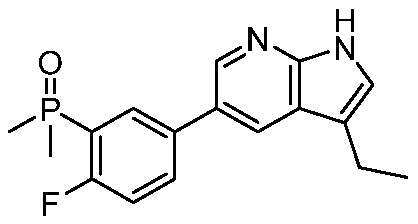
(5-(3-에틸-1H-피롤로[2,3-b]피리딘-5-일)-2-플루오로페닐)디메틸포스핀 옥시드(5-(3-ethyl-1H-pyrrolo[2,3-b]pyridin-5-yl)-2-fluorophenyl)dimethylphosphine oxide
단계 1에서 2-브로모-4-아이오도-1-메틸벤젠 대신 2-브로모-1-플루오로-4-아이오도벤젠을 사용한, 실시예 50과 동일한 절차. LC-MS (ESI) m/z: 317 [M+H]+.Same procedure as Example 50, using 2-bromo-1-fluoro-4-iodobenzene in step 1 instead of 2-bromo-4-iodo-1-methylbenzene. LC-MS (ESI) m/z: 317 [M+H] + .
실시예 52Example 52

(2-클로로-5-(3-에틸-1H-피롤로[2,3-b]피리딘-5-일)페닐)디메틸포스핀 옥시드(2-chloro-5-(3-ethyl-1H-pyrrolo[2,3-b]pyridin-5-yl)phenyl)dimethylphosphine oxide
실시예 53Example 53

(3-(3-에틸-1H-피롤로[2,3-b]피리딘-5-일)페닐)디메틸포스핀 옥시드(3-(3-ethyl-1H-pyrrolo[2,3-b]pyridin-5-yl)phenyl)dimethylphosphine oxide
단계 1에서 2-브로모-4-아이오도-1-메틸벤젠 대신 2-브로모-1-클로로-4-아이오도벤젠을 사용한, 실시예 50과 동일한 절차. 실시예 53을 단계 2에서 부산물로서 수득하였다.The same procedure as in Example 50, using 2-bromo-1-chloro-4-iodobenzene in step 1 instead of 2-bromo-4-iodo-1-methylbenzene. Example 53 was obtained as a by-product in step 2.
(2-클로로-5-(3-에틸-1H-피롤로[2,3-b]피리딘-5-일)페닐)디메틸포스핀 옥시드: LC-MS (ESI) m/z: 333 [M+H]+.(2-chloro-5-(3-ethyl-1H-pyrrolo[2,3-b]pyridin-5-yl)phenyl)dimethylphosphine oxide: LC-MS (ESI) m/z: 333 [M +H] + .
(3-(3-에틸-1H-피롤로[2,3-b]피리딘-5-일)페닐)디메틸포스핀 옥시드 LC-MS (ESI) m/z: 299 [M+H]+.(3-(3-ethyl-1H-pyrrolo[2,3-b]pyridin-5-yl)phenyl)dimethylphosphine oxide LC-MS (ESI) m/z: 299 [M+H] + .
실시예 54Example 54

(5-(3-에틸-1H-피롤로[2,3-b]피리딘-5-일)-2-메톡시페닐)디메틸포스핀 옥시드(5-(3-ethyl-1H-pyrrolo[2,3-b]pyridin-5-yl)-2-methoxyphenyl)dimethylphosphine oxide
단계 1에서 2-브로모-4-아이오도-1-메틸벤젠 대신 2-브로모-4-아이오도-1-메톡시벤젠을 사용한, 실시예 50과 동일한 절차. LC-MS (ESI) m/z: 329 [M+H]+.Same procedure as Example 50, using 2-bromo-4-iodo-1-methoxybenzene instead of 2-bromo-4-iodo-1-methylbenzene in step 1. LC-MS (ESI) m/z: 329 [M+H] + .
실시예 55Example 55

(5-(3-에틸-1H-피롤로[2,3-b]피리딘-5-일)-2-히드록시페닐)디메틸포스핀 옥시드(5-(3-ethyl-1H-pyrrolo[2,3-b]pyridin-5-yl)-2-hydroxyphenyl)dimethylphosphine oxide
무수 DCM (5 mL) 중 실시예 54 (28 mg, 85.28 umol)의 교반 용액에 실온에서 삼브로민화붕소 (68.67 mg, 274.10 umol, 0.2 mL)를 적가하였다. 반응 혼합물을 실온에서 2시간 동안 교반하고, MeOH를 첨가하여 조심스럽게 켄칭하였다. 생성된 혼합물을 농축시키고, 잔류물을 정제용-HPLC (MeCN/0.1% HCOOH)에 의해 정제하여 (5-(3-에틸-1H-피롤로[2,3-b]피리딘-5-일)-2-히드록시페닐)디메틸포스핀 옥시드를 백색 고체 (21 mg, 78% 수율)로서 제공하였다. LC-MS (ESI) m/z: 315 [M+H]+.To a stirred solution of Example 54 (28 mg, 85.28 umol) in anhydrous DCM (5 mL) at room temperature was added boron tribromide (68.67 mg, 274.10 umol, 0.2 mL) dropwise. The reaction mixture was stirred at room temperature for 2 h and carefully quenched by addition of MeOH. The resulting mixture was concentrated and the residue was purified by prep-HPLC (MeCN/0.1% HCOOH) (5-(3-ethyl-1H-pyrrolo[2,3-b]pyridin-5-yl) -2-hydroxyphenyl)dimethylphosphine oxide was provided as a white solid (21 mg, 78% yield). LC-MS (ESI) m/z: 315 [M+H] + .
실시예 56Example 56

(3-(3-에틸-1H-피롤로[2,3-b]피리딘-5-일)-5-메틸페닐)디메틸포스핀 옥시드(3-(3-ethyl-1H-pyrrolo[2,3-b]pyridin-5-yl)-5-methylphenyl)dimethylphosphine oxide
단계 1에서 2-브로모-4-아이오도-1-메틸벤젠 대신 1,3-디브로모-5-메틸-벤젠을 사용한, 실시예 50과 동일한 절차. LC-MS (ESI) m/z: 313 [M+H]+.Same procedure as Example 50, using 1,3-dibromo-5-methyl-benzene instead of 2-bromo-4-iodo-1-methylbenzene in step 1. LC-MS (ESI) m/z: 313 [M+H] + .
실시예 57Example 57

(3-아미노-5-(3-에틸-1H-피롤로[2,3-b]피리딘-5-일)페닐)디메틸포스핀 옥시드(3-amino-5-(3-ethyl-1H-pyrrolo[2,3-b]pyridin-5-yl)phenyl)dimethylphosphine oxide
단계 1에서 2-브로모-4-아이오도-1-메틸벤젠 대신 3,5-디브로모아닐린을 사용한, 실시예 50과 동일한 절차. LC-MS (ESI) m/z: 314 [M+H]+.Same procedure as in Example 50, using 3,5-dibromoaniline instead of 2-bromo-4-iodo-1-methylbenzene in step 1. LC-MS (ESI) m/z: 314 [M+H] + .
실시예 58Example 58
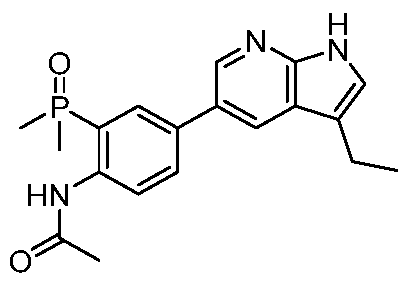
N-(2-(디메틸포스포릴)-4-(3-에틸-1H-피롤로[2,3-b]피리딘-5-일)페닐)아세트아미드N-(2-(dimethylphosphoryl)-4-(3-ethyl-1H-pyrrolo[2,3-b]pyridin-5-yl)phenyl)acetamide
단계 1에서 2-브로모-4-아이오도-1-메틸벤젠 대신 중간체 17을 사용한, 실시예 50과 동일한 절차. LC-MS (ESI) m/z: 356 [M+H]+.Same procedure as Example 50, using intermediate 17 in step 1 instead of 2-bromo-4-iodo-1-methylbenzene. LC-MS (ESI) m/z: 356 [M+H] + .
실시예 59Example 59

N-(2-브로모-4-(3-에틸-1H-피롤로[2,3-b]피리딘-5-일)페닐)아세트아미드N-(2-bromo-4-(3-ethyl-1H-pyrrolo[2,3-b]pyridin-5-yl)phenyl)acetamide
단계 1에서 2-브로모-4-아이오도-1-메틸벤젠 대신 중간체 18을 사용한, 실시예 50과 동일한 절차. LC-MS (ESI) m/z: 368 [M+H]+.Same procedure as Example 50, using Intermediate 18 instead of 2-bromo-4-iodo-1-methylbenzene in Step 1. LC-MS (ESI) m/z: 368 [M+H] + .
실시예 60Example 60

(2-아미노-3-(3-에틸-1H-피롤로[2,3-b]피리딘-5-일)-6-플루오로페닐)디메틸포스핀 옥시드(2-amino-3-(3-ethyl-1H-pyrrolo[2,3-b]pyridin-5-yl)-6-fluorophenyl)dimethylphosphine oxide
단계 1에서 2-브로모-4-아이오도-1-메틸벤젠 대신 중간체 19를 사용한, 실시예 50과 동일한 절차. LC-MS (ESI) m/z: 332 [M+H]+.Same procedure as Example 50, using Intermediate 19 instead of 2-bromo-4-iodo-1-methylbenzene in Step 1. LC-MS (ESI) m/z: 332 [M+H] + .
실시예 61Example 61
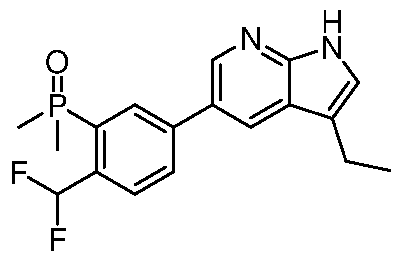
(2-(디플루오로메틸)-5-(3-에틸-1H-피롤로[2,3-b]피리딘-5-일)페닐)디메틸포스핀 옥시드(2-(difluoromethyl)-5-(3-ethyl-1H-pyrrolo[2,3-b]pyridin-5-yl)phenyl)dimethylphosphine oxide
단계 1에서 2-브로모-4-아이오도-1-메틸벤젠 대신 중간체 21을 사용한, 실시예 50과 동일한 절차. LC-MS (ESI) m/z: 349 [M+H]+.Same procedure as Example 50, using Intermediate 21 instead of 2-bromo-4-iodo-1-methylbenzene in Step 1. LC-MS (ESI) m/z: 349 [M+H] + .
실시예 62Example 62

(3-(3-에틸-1H-피롤로[2,3-b]피리딘-5-일)-2-플루오로-6-메틸페닐)디메틸포스핀 옥시드(3-(3-ethyl-1H-pyrrolo[2,3-b]pyridin-5-yl)-2-fluoro-6-methylphenyl)dimethylphosphine oxide
단계 1에서 2-브로모-4-아이오도-1-메틸벤젠 대신 중간체 22를 사용한, 실시예 50과 동일한 절차. LC-MS (ESI) m/z: 331 [M+H]+.Same procedure as Example 50, using Intermediate 22 instead of 2-bromo-4-iodo-1-methylbenzene in step 1. LC-MS (ESI) m/z: 331 [M+H] + .
실시예 63Example 63

(5-(3-에틸-1H-피롤로[2,3-b]피리딘-5-일)-2-(옥사졸-2-일)페닐)디메틸포스핀 옥시드(5-(3-ethyl-1H-pyrrolo[2,3-b]pyridin-5-yl)-2-(oxazol-2-yl)phenyl)dimethylphosphine oxide
단계 1에서 2-브로모-4-아이오도-1-메틸벤젠 대신 중간체 25를 사용한, 실시예 50과 동일한 절차. LC-MS (ESI) m/z: 366 [M+H]+.Same procedure as Example 50, using Intermediate 25 instead of 2-bromo-4-iodo-1-methylbenzene in Step 1. LC-MS (ESI) m/z: 366 [M+H] + .
실시예 64Example 64

(6-(3-에틸-1H-피롤로[2,3-b]피리딘-5-일)-3-메틸피리딘-2-일)디메틸포스핀 옥시드(6-(3-ethyl-1H-pyrrolo[2,3-b]pyridin-5-yl)-3-methylpyridin-2-yl)dimethylphosphine oxide
단계 1에서 2-브로모-4-아이오도-1-메틸벤젠 대신 중간체 24를 사용한, 실시예 50과 동일한 절차. LC-MS (ESI) m/z: 314 [M+H]+.Same procedure as Example 50, using Intermediate 24 instead of 2-bromo-4-iodo-1-methylbenzene in Step 1. LC-MS (ESI) m/z: 314 [M+H] + .
실시예 65Example 65

(2-((디메틸아미노)메틸)-5-(3-에틸-1H-피롤로[2,3-b]피리딘-5-일)페닐)디메틸포스핀 옥시드(2-((dimethylamino)methyl)-5-(3-ethyl-1H-pyrrolo[2,3-b]pyridin-5-yl)phenyl)dimethylphosphine oxide
단계 1에서 2-브로모-4-아이오도-1-메틸벤젠 대신 중간체 26을 사용한, 실시예 50과 동일한 절차. LC-MS (ESI) m/z: 356 [M+H]+.Same procedure as Example 50, using Intermediate 26 instead of 2-bromo-4-iodo-1-methylbenzene in step 1. LC-MS (ESI) m/z: 356 [M+H] + .
실시예 66Example 66

1-(2-(디메틸포스포릴)-4-(3-에틸-1H-피롤로[2,3-b]피리딘-5-일)페닐)피롤리딘-2-온1-(2-(dimethylphosphoryl)-4-(3-ethyl-1H-pyrrolo[2,3-b]pyridin-5-yl)phenyl)pyrrolidin-2-one
단계 1에서 2-브로모-4-아이오도-1-메틸벤젠 대신 중간체 27을 사용한, 실시예 50과 동일한 절차. LC-MS (ESI) m/z: 382 [M+H]+.Same procedure as Example 50, using intermediate 27 in step 1 instead of 2-bromo-4-iodo-1-methylbenzene. LC-MS (ESI) m/z: 382 [M+H] + .
실시예 67Example 67

2-(디메틸포스포릴)-4-(3-에틸-1H-피롤로[2,3-b]피리딘-5-일)벤즈아미드2-(dimethylphosphoryl)-4-(3-ethyl-1H-pyrrolo[2,3-b]pyridin-5-yl)benzamide
단계 1에서 2-브로모-4-아이오도-1-메틸벤젠 대신 중간체 28을 사용한, 실시예 50과 동일한 절차. LC-MS (ESI) m/z: 342 [M+H]+.Same procedure as Example 50, using intermediate 28 in step 1 instead of 2-bromo-4-iodo-1-methylbenzene. LC-MS (ESI) m/z: 342 [M+H] + .
실시예 68Example 68

N-(3-(디메틸포스포릴)-5-(3-에틸-1H-피롤로[2,3-b]피리딘-5-일)페닐)아세트아미드N-(3-(dimethylphosphoryl)-5-(3-ethyl-1H-pyrrolo[2,3-b]pyridin-5-yl)phenyl)acetamide
단계 1에서 2-브로모-4-아이오도-1-메틸벤젠 대신 중간체 29를 사용한, 실시예 50과 동일한 절차. LC-MS (ESI) m/z: 356 [M+H]+.Same procedure as Example 50, using Intermediate 29 instead of 2-bromo-4-iodo-1-methylbenzene in Step 1. LC-MS (ESI) m/z: 356 [M+H] + .
실시예 69Example 69

(2-아미노-5-(2-클로로-3-에틸-1H-피롤로[2,3-b]피리딘-5-일)페닐)디메틸포스핀 옥시드(2-amino-5-(2-chloro-3-ethyl-1H-pyrrolo[2,3-b]pyridin-5-yl)phenyl)dimethylphosphine oxide
실시예 70Example 70

(2-아미노-5-(3-에틸-1H-피롤로[2,3-b]피리딘-5-일)페닐)디메틸포스핀 옥시드(2-amino-5-(3-ethyl-1H-pyrrolo[2,3-b]pyridin-5-yl)phenyl)dimethylphosphine oxide
단계 1에서 2-브로모-4-아이오도-1-메틸벤젠 및 중간체 12 대신 2-브로모-4-아이오도아닐린 및 중간체 14를 사용한, 실시예 50과 동일한 절차.Same procedure as Example 50, using 2-bromo-4-iodoaniline and Intermediate 14 instead of 2-bromo-4-iodo-1-methylbenzene and Intermediate 12 in Step 1.
(2-아미노-5-(2-클로로-3-에틸-1H-피롤로[2,3-b]피리딘-5-일)페닐)디메틸포스핀 옥시드: [HCOOH 염] LC-MS (ESI) m/z: 348 [M+H].(2-amino-5-(2-chloro-3-ethyl-1H-pyrrolo[2,3-b]pyridin-5-yl)phenyl)dimethylphosphine oxide: [HCOOH salt] LC-MS (ESI ) m/z: 348 [M+H].
(2-아미노-5-(3-에틸-1H-피롤로[2,3-b]피리딘-5-일)페닐)디메틸포스핀 옥시드: [HCOOH 염]을 단계 2에서 부산물로서 수득하였다. LC-MS (ESI) m/z: 314 [M+H]+.(2-amino-5-(3-ethyl-1H-pyrrolo[2,3-b]pyridin-5-yl)phenyl)dimethylphosphine oxide: [HCOOH salt] was obtained as a byproduct in step 2. LC-MS (ESI) m/z: 314 [M+H] + .
실시예 71Example 71

(5-(3-에틸-1H-피롤로[2,3-b]피리딘-5-일)-2-(메틸아미노)페닐)디메틸포스핀 옥시드(5-(3-ethyl-1H-pyrrolo[2,3-b]pyridin-5-yl)-2-(methylamino)phenyl)dimethylphosphine oxide
단계 1&2: 단계 1에서 2-브로모-4-아이오도-1-메틸벤젠 대신 중간체 16을 사용한, 실시예 50과 동일한 절차. LC-MS (ESI) m/z : 428 [M+H]+.Step 1&2: Same procedure as Example 50, using intermediate 16 in step 1 instead of 2-bromo-4-iodo-1-methylbenzene. LC-MS (ESI) m/z: 428 [M+H] + .
단계 3: DCM (5 mL) 중 tert-부틸 (2-(디메틸포스포릴)-4-(3-에틸-1H-피롤로[2,3-b]피리딘-5-일)페닐) (메틸)카르바메이트 (25 mg, 58.48 umol)의 용액에 TFA (1.48 g, 12.98 mmol, 1 mL)를 0℃에서 첨가하였다. 혼합물을 실온에서 2시간 동안 교반하였다. 증발시킨 후, 잔류물을 정제용-HPLC (MeCN/0.1% HCOOH)에 의해 정제하여 (5-(3-에틸-1H-피롤로[2,3-b]피리딘-5-일)-2-(메틸아미노)페닐)디메틸포스핀 옥시드를 황색 고체 (18 mg, 94% 수율)로서 제공하였다. LC-MS (ESI) m/z : 328 [M+H]+.Step 3: tert-Butyl (2-(dimethylphosphoryl)-4-(3-ethyl-1H-pyrrolo[2,3-b]pyridin-5-yl)phenyl) (methyl) in DCM (5 mL) To a solution of carbamate (25 mg, 58.48 umol) was added TFA (1.48 g, 12.98 mmol, 1 mL) at 0°C. The mixture was stirred at room temperature for 2 hours. After evaporation, the residue was purified by prep-HPLC (MeCN/0.1% HCOOH) (5-(3-ethyl-1H-pyrrolo[2,3-b]pyridin-5-yl)-2- (methylamino)phenyl)dimethylphosphine oxide was provided as a yellow solid (18 mg, 94% yield). LC-MS (ESI) m/z: 328 [M+H] + .
실시예 72Example 72

메틸 2-(디메틸포스포릴)-4-(3-에틸-1H-피롤로[2,3-b]피리딘-5-일)벤조에이트Methyl 2-(dimethylphosphoryl)-4-(3-ethyl-1H-pyrrolo[2,3-b]pyridin-5-yl)benzoate
단계 1에서 2-브로모-4-아이오도-1-메틸벤젠 대신 중간체 20을 사용한,실시예 50과 동일한 절차. LC-MS (ESI) m/z: 357 [M+H]+.Same procedure as Example 50, using Intermediate 20 instead of 2-bromo-4-iodo-1-methylbenzene in step 1. LC-MS (ESI) m/z: 357 [M+H] + .
실시예 73Example 73
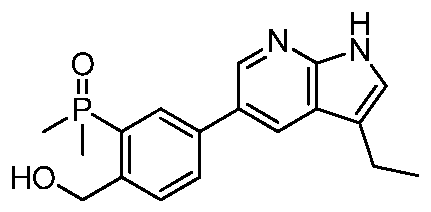
(5-(3-에틸-1H-피롤로[2,3-b]피리딘-5-일)-2-(히드록시메틸)페닐)디메틸포스핀 옥시드(5-(3-ethyl-1H-pyrrolo[2,3-b]pyridin-5-yl)-2-(hydroxymethyl)phenyl)dimethylphosphine oxide
건조 THF (5 mL) 중 메틸 2-디메틸포스포릴-4-(3-에틸-1H-피롤로[2,3-b]피리딘-5-일)벤조에이트 (139.61 mg, 391.78 umol)의 용액에 리튬 알루미늄 테트라히드라이드 (26.58 mg, 783.56 umol)를 0℃에서 적가하였다. 혼합물을 실온에서 1시간 동안 교반하고, 빙수 (10 mL)에 붓고, DCM (10 mL x 3)으로 추출하였다. 유기 층을 염수 (10 mL)로 세척하고, 무수 황산나트륨 상에서 건조시키고, 여과하고, 농축시켰다. 잔류물을 역상 크로마토그래피 (MeOH/0.1% 트리플루오로아세트산)에 의해 정제하여 (5-(3-에틸-1H-피롤로[2,3-b]피리딘-5-일)-2-(히드록시메틸)페닐)디메틸포스핀 옥시드를 백색 고체 (100 mg, 78% 수율)로서 제공하였다. LC-MS (ESI) m/z: 329 [M+H]+.To a solution of methyl 2-dimethylphosphoryl-4-(3-ethyl-1H-pyrrolo[2,3-b]pyridin-5-yl)benzoate (139.61 mg, 391.78 umol) in dry THF (5 mL) Lithium aluminum tetrahydride (26.58 mg, 783.56 umol) was added dropwise at 0°C. The mixture was stirred at room temperature for 1 h, poured into ice water (10 mL) and extracted with DCM (10 mL x 3). The organic layer was washed with brine (10 mL), dried over anhydrous sodium sulfate, filtered and concentrated. The residue was purified by reverse phase chromatography (MeOH/0.1% trifluoroacetic acid) (5-(3-ethyl-1H-pyrrolo[2,3-b]pyridin-5-yl)-2-(hydro Roxymethyl)phenyl)dimethylphosphine oxide was provided as a white solid (100 mg, 78% yield). LC-MS (ESI) m/z: 329 [M+H] + .
실시예 74Example 74

(5-(3-에틸-1H-피롤로[2,3-b]피리딘-5-일)-2-(플루오로메틸)페닐)디메틸포스핀 옥시드(5-(3-ethyl-1H-pyrrolo[2,3-b]pyridin-5-yl)-2-(fluoromethyl)phenyl)dimethylphosphine oxide
DCM (5 mL) 중 (5-(3-에틸-1H-피롤로[2,3-b]피리딘-5-일)-2-(히드록시메틸)페닐)디메틸포스핀 옥시드 (200 mg, 609.12 umol)의 용액에 DAST (117.82 mg, 730.94 umol)를 0℃에서 적가하였다. 혼합물을 실온에서 2시간 동안 교반하고, 농축시켰다. 잔류물을 정제용-HPLC (MeCN/0.05% 트리플루오로아세트산)에 의해 정제하여 (5-(3-에틸-1H-피롤로[2,3-b]피리딘-5-일)-2-(플루오로메틸)페닐)디메틸포스핀 옥시드를 백색 고체 (2.5 mg, 1.5% 수율)로서 제공하였다. LC-MS (ESI) m/z: 331 [M+H]+.(5-(3-ethyl-1H-pyrrolo[2,3-b]pyridin-5-yl)-2-(hydroxymethyl)phenyl)dimethylphosphine oxide (200 mg, 609.12 umol) was added dropwise to a solution of DAST (117.82 mg, 730.94 umol) at 0°C. The mixture was stirred at room temperature for 2 h and concentrated. The residue was purified by prep-HPLC (MeCN/0.05% trifluoroacetic acid) (5-(3-ethyl-1H-pyrrolo[2,3-b]pyridin-5-yl)-2-( Fluoromethyl)phenyl)dimethylphosphine oxide was provided as a white solid (2.5 mg, 1.5% yield). LC-MS (ESI) m/z: 331 [M+H] + .
실시예 75Example 75

(3-아미노-6-(3-에틸-1H-피롤로[2,3-b]피리딘-5-일)피리딘-2-일)디메틸포스핀 옥시드(3-amino-6-(3-ethyl-1H-pyrrolo[2,3-b]pyridin-5-yl)pyridin-2-yl)dimethylphosphine oxide
단계 1: DMF (15 mL) 중 중간체 15 (330 mg, 1.10 mmol), 디메틸포스핀 옥시드 (103.40 mg, 1.32 mmol), 아세트산팔라듐 (II) (24.79 mg, 110.40 umol), Xantphos (127.76 mg, 220.80 umol), 및 인산칼륨 (468.70 mg, 2.21 mmol)의 혼합물을 질소 하에 50℃에서 4시간 동안 교반하였다. 실온으로 냉각시킨 후, 혼합물을 여과하고, 여과물을 H2O (20 mL)로 희석하였다. 생성된 혼합물을 EA (30 mL x 3)로 추출하였다. 유기 층을 염수 (30 mL x 3)로 세척하고, 무수 황산나트륨 상에서 건조시키고, 여과하고, 농축시켰다. 잔류물을 역상 칼럼 크로마토그래피 (H2O 중 MeOH, 0%에서 100% v/v)에 의해 정제하여 6-브로모-2-디메틸포스포릴-피리딘-3-아민을 백색 고체 (180 mg, 60% 수율)로서 수득하였다. LC-MS (ESI) m/z: 249 [M+H]+.Step 1: Intermediate 15 (330 mg, 1.10 mmol), dimethylphosphine oxide (103.40 mg, 1.32 mmol), palladium (II) acetate (24.79 mg, 110.40 umol), Xantphos (127.76 mg, 220.80 umol), and potassium phosphate (468.70 mg, 2.21 mmol) was stirred under nitrogen at 50° C. for 4 h. After cooling to room temperature, the mixture was filtered and the filtrate was diluted with H 2 O (20 mL). The resulting mixture was extracted with EA (30 mL x 3). The organic layer was washed with brine (30 mL×3), dried over anhydrous sodium sulfate, filtered and concentrated. The residue was purified by reverse phase column chromatography (MeOH in H 2 O, 0% to 100% v/v) to give 6-bromo-2-dimethylphosphoryl-pyridin-3-amine as a white solid (180 mg, 60% yield). LC-MS (ESI) m/z: 249 [M+H] + .
단계 2: 디옥산 (5 mL) 및 H2O (0.5 mL) 중 6-브로모-2-디메틸포스포릴-피리딘-3-아민 (100 mg, 401.53 umol), 중간체 12 (131.13 mg, 481.84 umol), Pd(dppf)Cl2·DCM (29.38 mg, 40.15 umol), 및 탄산칼륨 (110.99 mg, 803.07 umol)의 혼합물을 질소 하에 90℃에서 밤새 교반하였다. 실온으로 냉각시킨 후, 혼합물을 여과하고, 여과물을 농축시켰다. 잔류물을 EA (50 mL)로 희석하고, H2O (20 mL) 및 염수 (20 mL)로 세척하고, 무수 Na2SO4 상에서 건조시키고, 여과하고, 농축시켰다. 잔류물을 정제용-TLC (DCM/MeOH = 10/1 v/v)에 의해 정제하여 (3-아미노-6-(3-에틸-1H-피롤로[2,3-b]피리딘-5-일)피리딘-2-일)디메틸포스핀 옥시드를 황색 고체 (2 mg)로서 제공하였다. LC-MS (ESI) m/z: 315 [M+H]+.Step 2: 6-Bromo-2-dimethylphosphoryl-pyridin-3-amine (100 mg, 401.53 umol) in dioxane (5 mL) and H 2 O (0.5 mL), intermediate 12 (131.13 mg, 481.84 umol) ), Pd(dppf)Cl 2 .DCM (29.38 mg, 40.15 umol), and potassium carbonate (110.99 mg, 803.07 umol) was stirred under nitrogen at 90° C. overnight. After cooling to room temperature, the mixture was filtered and the filtrate was concentrated. The residue was diluted with EA (50 mL), washed with H 2 O (20 mL) and brine (20 mL), dried over anhydrous Na 2 SO 4 , filtered and concentrated. The residue was purified by prep-TLC (DCM/MeOH = 10/1 v/v) (3-amino-6-(3-ethyl-1H-pyrrolo[2,3-b]pyridine-5- yl)pyridin-2-yl)dimethylphosphine oxide was provided as a yellow solid (2 mg). LC-MS (ESI) m/z: 315 [M+H] + .
실시예 76Example 76

(5-(3-에틸-1H-피롤로[2,3-b]피리딘-5-일)-2-(옥세탄-3-일아미노)페닐)디메틸포스핀 옥시드(5-(3-ethyl-1H-pyrrolo[2,3-b]pyridin-5-yl)-2-(oxetan-3-ylamino)phenyl)dimethylphosphine oxide
단계 1에서 중간체 15 대신 중간체 30을 사용한, 실시예 75와 동일한 절차. LC-MS (ESI) m/z: 370 [M+H]+.Same procedure as Example 75, using Intermediate 30 instead of Intermediate 15 in Step 1. LC-MS (ESI) m/z: 370 [M+H] + .
실시예 77Example 77

(2-아미노-5-(3-이소프로필-1H-피롤로[2,3-b]피리딘-5-일)페닐)디메틸포스핀 옥시드(2-amino-5-(3-isopropyl-1H-pyrrolo[2,3-b]pyridin-5-yl)phenyl)dimethylphosphine oxide
단계 1: 건조 THF (25 mL) 중 1-(5-브로모-1H-피롤로[2,3-b]피리딘-3-일)에타논 (590 mg, 2.47 mmol)의 용액에 수소화나트륨 (오일 중 60% 현탁액, 71.99 mg, 3 mmol)을 0℃에서 조금씩 첨가하고, 혼합물을 0℃에서 1시간 동안 교반하였다. TsCl (714.90 mg, 3.75 mmol)을 상기 혼합물에 0℃에서 조금씩 첨가하였다. 혼합물을 실온에서 2시간 동안 교반하고, H2O (20 mL)로 켄칭하고, EA (30 mL x 3)로 추출하였다. 유기 층을 염수 (30 mL)로 세척하고, 무수 황산나트륨 상에서 건조시키고, 여과하고, 농축시켰다. 잔류물을 실리카 겔 상에서 플래쉬 칼럼 크로마토그래피 (EA/PE = 2/3 v/v)에 의해 정제하여 1-(5-브로모-1-토실-1H-피롤로[2,3-b]피리딘-3-일)에탄-1-온을 황색 고체 (800 mg, 83% 수율)로서 제공하였다. LC-MS (ESI) m/z: 393 [M+H]+.Step 1: To a solution of 1-(5-bromo-1H-pyrrolo[2,3-b]pyridin-3-yl)ethanone (590 mg, 2.47 mmol) in dry THF (25 mL) sodium hydride ( A 60% suspension in oil, 71.99 mg, 3 mmol) was added portionwise at 0° C. and the mixture was stirred at 0° C. for 1 h. TsCl (714.90 mg, 3.75 mmol) was added portionwise to the mixture at 0°C. The mixture was stirred at room temperature for 2 h, quenched with H 2 O (20 mL) and extracted with EA (30 mL×3). The organic layer was washed with brine (30 mL), dried over anhydrous sodium sulfate, filtered and concentrated. The residue was purified by flash column chromatography on silica gel (EA/PE = 2/3 v/v) to 1-(5-bromo-1-tosyl-1H-pyrrolo[2,3-b]pyridine Provided -3-yl)ethan-1-one as a yellow solid (800 mg, 83% yield). LC-MS (ESI) m/z: 393 [M+H] + .
단계 2: 건조 THF (20 mL) 중 1-(5-브로모-1-토실-1H-피롤로[2,3-b]피리딘-3-일)에탄-1-온 (1.62 g, 4.12 mmol)의 용액에 메틸마그네슘 브로마이드 (에테르 중 3 M, 6.87 mL, 20.6 mmol)를 0℃에서 적가하였다. 혼합물을 0℃에서 2시간 동안 교반하고, 빙수 (50 mL)에 붓고, 에틸 아세테이트 (100 mL x 3)로 추출하였다. 유기 층을 염수 (50 mL)로 세척하고, 무수 황산나트륨 상에서 건조시키고, 여과하고, 농축시켰다. 잔류물을 실리카 겔 상에서 플래쉬 칼럼 크로마토그래피 (EA/PE = 1/4 v/v)에 의해 정제하여 2-(5-브로모-1-토실-1H-피롤로[2,3-b]피리딘-3-일)프로판-2-올을 황색 고체 (900 mg, 76% 수율)로서 제공하였다. LC-MS (ESI) m/z: 409 [M+H]+.Step 2: 1-(5-Bromo-1-tosyl-1H-pyrrolo[2,3-b]pyridin-3-yl)ethan-1-one (1.62 g, 4.12 mmol) in dry THF (20 mL) ) was added dropwise methylmagnesium bromide (3 M in ether, 6.87 mL, 20.6 mmol) at 0°C. The mixture was stirred at 0° C. for 2 h, poured into ice-water (50 mL) and extracted with ethyl acetate (100 mL×3). The organic layer was washed with brine (50 mL), dried over anhydrous sodium sulfate, filtered and concentrated. The residue was purified by flash column chromatography on silica gel (EA/PE = 1/4 v/v) to 2-(5-bromo-1-tosyl-1H-pyrrolo[2,3-b]pyridine Provided -3-yl)propan-2-ol as a yellow solid (900 mg, 76% yield). LC-MS (ESI) m/z: 409 [M+H] + .
단계 3: 건조 DCM (10 mL) 중 2-(5-브로모-1-토실-1H-피롤로[2,3-b]피리딘-3-일)프로판-2-올 (900 mg, 2.20 mmol)의 용액에 0℃에서 Et3SiH (1.28 g, 10.99 mmol, 1.76 mL) 및 트리플루오로아세트산 (1.25 g, 10.99 mmol, 847.02 uL)을 첨가하였다. 혼합물을 실온에서 밤새 교반하고, 빙수 (20 mL)에 붓고, 포화 수성 NaHCO3 용액을 사용하여 pH 4~5로 염기성화시키고, DCM (30 mL x 3)으로 추출하였다. 유기 층을 염수 (30 mL)로 세척하고, 무수 황산나트륨 상에서 건조시키고, 여과하고, 농축시켰다. 잔류물을 실리카 겔 상에서 플래쉬 칼럼 크로마토그래피 (PE 중 EA, 3%에서 10% v/v)에 의해 정제하여 5-브로모-3-이소프로필-1-토실-1H-피롤로[2,3-b]피리딘을 백색 고체 (570 mg, 66% 수율)로서 제공하였다. LC-MS (ESI) m/z: 393 [M+H]+.Step 3: 2-(5-Bromo-1-tosyl-1H-pyrrolo[2,3-b]pyridin-3-yl)propan-2-ol (900 mg, 2.20 mmol) in dry DCM (10 mL) ) was added Et 3 SiH (1.28 g, 10.99 mmol, 1.76 mL) and trifluoroacetic acid (1.25 g, 10.99 mmol, 847.02 uL) at 0 °C. The mixture was stirred at room temperature overnight, poured into ice water (20 mL), basified to pH 4-5 with saturated aqueous NaHCO 3 solution, and extracted with DCM (30 mL×3). The organic layer was washed with brine (30 mL), dried over anhydrous sodium sulfate, filtered and concentrated. The residue was purified by flash column chromatography on silica gel (EA in PE, 3% to 10% v/v) 5-bromo-3-isopropyl-1-tosyl-1H-pyrrolo[2,3 -b]pyridine was provided as a white solid (570 mg, 66% yield). LC-MS (ESI) m/z: 393 [M+H] + .
단계 4: 디옥산 (3 mL) 및 H2O (0.43 mL) 중 5-브로모-3-이소프로필-1-토실-1H-피롤로[2,3-b]피리딘 (200 mg, 508.52 umol), 중간체 13 (225.11 mg, 762.78 umol), Pd(dppf)Cl2·CH2Cl2 (41.53 mg, 50.85 umol), 및 K2CO3 (210.85 mg, 1.53 mmol)의 혼합물을 N2 하에 100℃에서 밤새 교반하였다. 실온으로 냉각시킨 후, 혼합물을 농축시키고, 잔류물을 실리카 겔 상에서 플래쉬 칼럼 크로마토그래피 (DCM/MeOH = 20/1 v/v)에 의해 정제하여 (2-아미노-5-(3-이소프로필-1-토실-1H-피롤로[2,3-b]피리딘-5-일)페닐)디메틸포스핀 옥시드를 갈색 오일 (290 mg, 100% 수율)로서 제공하였다. LC-MS (ESI) m/z: 482 [M+H]+.Step 4: 5-bromo-3-isopropyl-1-tosyl-1H-pyrrolo[2,3-b]pyridine (200 mg, 508.52 umol) in dioxane (3 mL) and H 2 O (0.43 mL) ), intermediate 13 (225.11 mg, 762.78 umol), Pd(dppf)Cl 2 .CH 2 Cl 2 (41.53 mg, 50.85 umol), and a mixture of K 2 CO 3 (210.85 mg, 1.53 mmol) at 100 under N 2 Stir overnight at °C. After cooling to room temperature, the mixture was concentrated and the residue was purified by flash column chromatography on silica gel (DCM/MeOH = 20/1 v/v) (2-amino-5-(3-isopropyl- 1-Tosyl-1H-pyrrolo[2,3-b]pyridin-5-yl)phenyl)dimethylphosphine oxide was provided as a brown oil (290 mg, 100% yield). LC-MS (ESI) m/z: 482 [M+H] + .
단계 5: 메탄올 (5 mL) 중 (2-아미노-5-(3-이소프로필-1-토실-1H-피롤로[2,3-b]피리딘-5-일)페닐)디메틸포스핀 옥시드 (100 mg, 207.66 umol)의 용액에 실온에서 수성 NaOH 용액 (3 N, 3 mL, 9 mmol)을 첨가하였다. 혼합물을 2시간 동안 환류하고, 농축시켰다. 잔류물을 H2O (10 mL)로 희석하고, 묽은 HCl 용액 (1 N)을 사용하여 pH ~5로 조정하고, DCM (20 mL x 3)으로 추출하였다. 유기 층을 무수 황산나트륨 상에서 건조시키고, 여과하고, 농축시켰다. 잔류물을 정제용-HPLC (MeCN/0.1% HCOOH)에 의해 정제하여 (2-아미노-5-(3-이소프로필-1H-피롤로[2,3-b]피리딘-5-일)페닐)디메틸포스핀 옥시드를 백색 고체 (10.8 mg, 16% 수율)로서 제공하였다. LC-MS (ESI) m/z: 328 [M+H]+.Step 5: (2-amino-5-(3-isopropyl-1-tosyl-1H-pyrrolo[2,3-b]pyridin-5-yl)phenyl)dimethylphosphine oxide in methanol (5 mL) (100 mg, 207.66 umol) was added aqueous NaOH solution (3 N, 3 mL, 9 mmol) at room temperature. The mixture was refluxed for 2 h and concentrated. The residue was diluted with H 2 O (10 mL), adjusted to pH ˜5 with dilute HCl solution (1 N) and extracted with DCM (20 mL×3). The organic layer was dried over anhydrous sodium sulfate, filtered and concentrated. The residue was purified by preparative-HPLC (MeCN/0.1% HCOOH) (2-amino-5-(3-isopropyl-1H-pyrrolo[2,3-b]pyridin-5-yl)phenyl) Dimethylphosphine oxide was provided as a white solid (10.8 mg, 16% yield). LC-MS (ESI) m/z: 328 [M+H] + .
실시예 78Example 78

(5-(3-에틸-1H-피롤로[2,3-b]피리딘-5-일)-2-(트리플루오로메틸)페닐)디메틸포스핀 옥시드(5-(3-ethyl-1H-pyrrolo[2,3-b]pyridin-5-yl)-2-(trifluoromethyl)phenyl)dimethylphosphine oxide
단계 1: 2-브로모-4-아이오도-1-메틸벤젠 대신 5-브로모-2-(트리플루오로메틸)아닐린을 사용한, 실시예 50의 단계 1과 동일한 절차. LC-MS (ESI) m/z: 306 [M+H]+.Step 1: Same procedure as Step 1 of Example 50, using 5-bromo-2-(trifluoromethyl)aniline instead of 2-bromo-4-iodo-1-methylbenzene. LC-MS (ESI) m/z: 306 [M+H] + .
단계 2: THF (5 mL) 중 5-(3-에틸-1H-피롤로[2,3-b]피리딘-5-일)-2-(트리플루오로메틸)아닐린 (50 mg, 163.77 umol)의 용액에 -78℃에서 플루오린화붕소 에틸 에테르 (92.98 mg, 655.10 umol, 82.28 uL) 및 tert-부틸니트라이트 (59.11 mg, 573.21 umol, 68.18 uL)를 첨가하였다. 혼합물을 이 온도에서 10분 동안 교반하고, 실온으로 가온하고, 30분 동안 교반하였다. 혼합물을 Et2O (10 mL)로 희석하고, 여과하여 고체를 제거하였다. 여과물을 농축시키고 (20℃ 미만), 생성된 디아조늄 염을 아세톤 (5 mL) 중 KI (40.78 mg, 245.66 umol) 및 아이오딘 (14.66 mg, 114.64 umol)의 혼합물에 0℃에서 첨가하였다. 생성된 혼합물을 실온에서 밤새 교반하고, 농축시켰다. 잔류물을 실리카 겔 상에서 플래쉬 칼럼 크로마토그래피로 정제하여 3-에틸-5-(3-아이오도-4-(트리플루오로메틸)페닐)-1H-피롤로[2,3-b]피리딘을 황색 고체 (30 mg, 44% 수율)로서 제공하였다. LC-MS (ESI) m/z: 417 [M+H]+.Step 2: 5-(3-ethyl-1H-pyrrolo[2,3-b]pyridin-5-yl)-2-(trifluoromethyl)aniline (50 mg, 163.77 umol) in THF (5 mL) boron fluoride ethyl ether (92.98 mg, 655.10 umol, 82.28 uL) and tert-butylnitrite (59.11 mg, 573.21 umol, 68.18 uL) were added to a solution of The mixture was stirred at this temperature for 10 min, warmed to room temperature and stirred for 30 min. The mixture was diluted with Et 2 O (10 mL) and filtered to remove solids. The filtrate was concentrated (<20 °C) and the resulting diazonium salt was added to a mixture of KI (40.78 mg, 245.66 umol) and iodine (14.66 mg, 114.64 umol) in acetone (5 mL) at 0 °C. The resulting mixture was stirred at room temperature overnight and concentrated. The residue was purified by flash column chromatography on silica gel to give 3-ethyl-5-(3-iodo-4-(trifluoromethyl)phenyl)-1H-pyrrolo[2,3-b]pyridine to yellow Provided as a solid (30 mg, 44% yield). LC-MS (ESI) m/z: 417 [M+H] + .
단계 3: 5-(3-브로모-4-메틸페닐)-3-에틸-1H-피롤로[2,3-b]피리딘 대신 3-에틸-5-(3-아이오도-4-(트리플루오로메틸)페닐)-1H-피롤로[2,3-b]피리딘을 사용한, 실시예 50의 단계 2와 동일한 절차. LC-MS (ESI) m/z: 367 [M+H]+.Step 3: 3-ethyl-5-(3-iodo-4-(trifluoro) instead of 5-(3-bromo-4-methylphenyl)-3-ethyl-1H-pyrrolo[2,3-b]pyridine Same procedure as step 2 of Example 50, using lomethyl)phenyl)-1H-pyrrolo[2,3-b]pyridine. LC-MS (ESI) m/z: 367 [M+H] + .
Claims (45)

여기서,
X는 CR2R3 또는 NR3이고;
A는 CR2 또는 N이고;
R은 옥소로 임의로 치환된 8-10원 비시클릭 질소 함유 헤테로아릴 또는 8-10원 비시클릭 질소 함유 헤테로시클릴이고, 여기서 R로 나타내어진 질소 함유 헤테로아릴 또는 질소 함유 헤테로시클릴은 N, O 및 S로부터 선택된 1 내지 3개의 헤테로원자를 갖고, 1 내지 4개의 Ra로 임의로 치환되고, 여기서 R은 질소 고리 원자를 통해 피리미딘 고리와 연결되거나 또는 R은 하기 구조에 의해 나타내어지고:

R1은 H, 중수소, 할로겐, OH, CN, NH2, NO2, C1-6알킬, C2-6알케닐, C2-6알키닐, C1-6알콕시, NR11R12, C(O)NR11R12, C(O)C1-6알킬, C(O)OC1-6알킬, NR11C(O)C1-6알킬, 페닐, 5-6원 헤테로아릴, C3-6시클로알킬, 또는 3-7원 헤테로시클릴이고, 여기서 R1에 의해 나타내어지거나 또는 R1에 의해 나타내어진 기에서의 알킬, 알케닐, 알키닐, 알콕시, 페닐, 헤테로아릴, 시클로알킬, 또는 헤테로시클릴은 할로겐, OH, CN, C1-4알킬, C1-4알콕시, C1-4할로알킬, C1-4할로알콕시, 및 NR11R12로 이루어진 군으로부터 독립적으로 선택된 1 내지 3개의 치환기로 임의로 치환되거나; 또는
R 및 R1은 이들이 부착되어 있는 탄소 원자와 함께 하기 나타낸 고리를 형성하고:


각 경우의 R2는 독립적으로 H, 중수소, 할로겐, OH, CN, NH2, NO2, C1-6알킬, C2-6알케닐, C2-6알키닐, C1-6알콕시, NR11R12, C(O)NR11R12, C(O)C1-6알킬, C(O)OC1-6알킬, NR11C(O)C1-6알킬, P(=O)R11R12, S(=O)2R11, 또는 S(=O)2NR11R12이고, 여기서 R2에 의해 나타내어지거나 또는 R2에 의해 나타내어진 기에서의 알킬, 알케닐, 알키닐, 또는 알콕시는 할로겐, OH, CN, C1-4알킬, C1-4할로알킬, C1-4알콕시, C1-4할로알콕시, 및 NR11R12로 이루어진 군으로부터 독립적으로 선택된 1 내지 3개의 치환기로 임의로 치환되고;
R3은 H, C1-6알킬, C(O)C1-6알킬, C3-6시클로알킬, 또는 3-7원 헤테로시클릴이고, 여기서 R3에 의해 나타내어지거나 또는 R3에 의해 나타내어진 기에서의 알킬, 시클로알킬, 또는 헤테로시클릴은 할로겐, OH, CN, C1-4알킬, C1-4할로알킬, C1-4알콕시, C1-4할로알콕시, C3-6시클로알킬, 3-7원 헤테로시클릴, 및 NR11R12로 이루어진 군으로부터 독립적으로 선택된 1 내지 3개의 치환기로 임의로 치환되고;
각 경우의 R11 및 R12는 독립적으로 H 또는 C1-6알킬이고, 여기서 R11 또는 R12에 의해 나타내어진 알킬은 할로겐, OH, CN, C1-4알킬, C1-4할로알킬, C1-4알콕시, C1-4할로알콕시, C3-6시클로알킬, 및 3-7원 헤테로시클릴로 이루어진 군으로부터 독립적으로 선택된 1 내지 3개의 치환기로 임의로 치환되거나, 또는
R11 및 R12는 이들이 부착되어 있는 질소 원자 또는 인 원자와 함께 할로겐, OH, CN, C1-4알킬, C1-4할로알킬, C1-4알콕시, 및 C1-4할로알콕시로 이루어진 군으로부터 독립적으로 선택된 1 내지 3개의 치환기로 임의로 치환된 3-7원 헤테로시클릴을 형성하고;
각 경우의 Ra는 독립적으로 H, 중수소, 할로겐, OH, CN, NH2, NO2, COOH, C1-6알킬, C2-6알케닐, C2-6알키닐, C1-6알콕시, NR11R12, C(O)NR11R12, C(O)NR11OR12, C(O)NR11S(=O)2R12, C(O)C1-6알킬, C(O)OR11, NR11C(O)R12, S(=O)2R11, S(=O)2NR11R12, NR11S(=O)2R12, P(=O)R11R12, C3-6시클로알킬, 3-7원 헤테로시클릴, 또는 5-6원 헤테로아릴이고, 여기서 Ra에 의해 나타내어지거나 또는 Ra에 의해 나타내어진 기에서의 알킬, 알케닐, 알키닐, 알콕시, 시클로알킬, 헤테로시클릴, 또는 헤테로아릴은 할로겐, OH, CN, C1-4알킬, C1-4할로알킬, C1-4알콕시, C1-4할로알콕시, NR11R12, C(O)NR11R12, C(O)NR11OR12, C(O)NR11S(=O)2R12, C(O)OR11, NR11S(=O)2R12, P(=O)R11R12, S(=O)2R11, S(=O)2NR11R12, 및 5-6원 헤테로아릴로 이루어진 군으로부터 독립적으로 선택된 1 내지 3개의 치환기로 임의로 치환되거나; 또는
2개의 Ra는 이들이 부착되어 있는 탄소 원자(들)와 함께 C3-6시클로알킬 또는 3-7원 헤테로시클릴을 형성하고, 여기서 시클로알킬 또는 헤테로시클릴은 할로겐, OH, CN, C1-4알킬, C1-4할로알킬, C1-4알콕시, 및 C1-4할로알콕시로 이루어진 군으로부터 독립적으로 선택된 1 내지 3개의 치환기로 임의로 치환되고;
각 경우의 Rb는 독립적으로 H, 중수소, 할로겐, OH, CN, NH2, NO2, COOH, C1-6알킬, C2-6알케닐, C2-6알키닐, C1-6알콕시, NR11R12, C(O)NR11R12, C(O)NR11OR12, C(O)NR11S(=O)2R12, C(O)C1-6알킬, C(O)OR11, NR11C(O)R12, S(=O)2R11, S(=O)2NR11R12, NR11S(=O)2R12, P(=O)R11R12, C3-6시클로알킬, 3-7원 헤테로시클릴, 또는 5-6원 헤테로아릴이고, 여기서 Rb에 의해 나타내어지거나 또는 Rb에 의해 나타내어진 기에서의 알킬, 알케닐, 알키닐, 알콕시, 시클로알킬, 헤테로시클릴, 또는 헤테로아릴은 할로겐, OH, CN, C1-4알킬, C1-4할로알킬, C1-4알콕시, C1-4할로알콕시, NR11R12, C(O)NR11R12, C(O)NR11OR12, C(O)NR11S(=O)2R12, C(O)OR11, NR11S(=O)2R12, P(=O)R11R12, S(=O)2R11, S(=O)2NR11R12, 및 5-6원 헤테로아릴로 이루어진 군으로부터 독립적으로 선택된 1 내지 3개의 치환기로 임의로 치환되고;
각 경우의 Rc는 독립적으로 페닐, N 및 O로부터 선택된 1 내지 3개의 헤테로원자를 갖는 5-6원 모노시클릭 헤테로시클릴; N 및 O로부터 선택된 1 내지 3개의 헤테로원자를 갖는 5-6원 모노시클릭 헤테로아릴이고; 여기서 Rc에 의해 나타내어진 페닐, 헤테로시클릴, 또는 헤테로아릴은 할로겐, OH, CN, C1-4알킬, C1-4할로알킬, C1-4알콕시, C1-4할로알콕시, NR11R12, C(O)NR11R12, 및 P(O)디-C1-6알킬로 이루어진 군으로부터 독립적으로 선택된 1 내지 3개의 치환기로 임의로 치환되고;
Ra'는 OH, CN, 5-6원 헤테로아릴, C(O)NR11R12, C(O)NR11OR12, C(O)NR11S(=O)2R12, C(O)OR11, NR11S(=O)2R12, P(=O)R11R12, S(=O)2R11, S(=O)2NR11R12로 임의로 치환된 C1-6알킬이고;
m은 0, 1, 2, 또는 3이고;
n은 0, 1, 2, 3, 또는 4이고;
p는 1, 2, 또는 3이고;
q는 1, 2 또는 3이고; p + q ≤4이다.A compound represented by the following structural formula (I-0), or a pharmaceutically acceptable salt or stereoisomer thereof:
here,
X is CR 2 R 3 or NR 3 ;
A is CR 2 or N;
R is 8-10 membered bicyclic nitrogen containing heteroaryl or 8-10 membered bicyclic nitrogen containing heterocyclyl optionally substituted with oxo, wherein the nitrogen containing heteroaryl or nitrogen containing heterocyclyl represented by R is N, O and 1 to 3 heteroatoms selected from S, optionally substituted with 1 to 4 R a , wherein R is connected to the pyrimidine ring through a nitrogen ring atom or R is represented by the structure:
R 1 is H, deuterium, halogen, OH, CN, NH 2 , NO 2 , C 1-6 alkyl, C 2-6 alkenyl, C 2-6 alkynyl, C 1-6 alkoxy, NR 11 R 12 , C(O)NR 11 R 12 , C(O)C 1-6 alkyl, C(O)OC 1-6 alkyl, NR 11 C(O)C 1-6 alkyl, phenyl, 5-6 membered heteroaryl, C 3-6 cycloalkyl, or 3-7 membered heterocyclyl, wherein alkyl in the group represented by or represented by R 1 , alkenyl, alkynyl, alkoxy, phenyl, heteroaryl, cyclo Alkyl, or heterocyclyl is independently from the group consisting of halogen, OH, CN, C 1-4 alkyl, C 1-4 alkoxy, C 1-4 haloalkyl, C 1-4 haloalkoxy, and NR 11 R 12 optionally substituted with 1 to 3 selected substituents; or
R and R 1 together with the carbon atom to which they are attached form the ring shown below:
each occurrence of R 2 is independently H, deuterium, halogen, OH, CN, NH 2 , NO 2 , C 1-6 alkyl, C 2-6 alkenyl, C 2-6 alkynyl, C 1-6 alkoxy, NR 11 R 12 , C(O)NR 11 R 12 , C(O)C 1-6 alkyl, C(O)OC 1-6 alkyl, NR 11 C(O)C 1-6 alkyl, P(=O )R 11 R 12 , S(=O) 2 R 11 , or S(=O) 2 NR 11 R 12 , wherein alkyl, alkenyl in the group represented by R 2 or represented by R 2 , alkynyl, or alkoxy is independently selected from the group consisting of halogen, OH, CN, C 1-4 alkyl, C 1-4 haloalkyl, C 1-4 alkoxy, C 1-4 haloalkoxy, and NR 11 R 12 optionally substituted with 1 to 3 substituents;
R 3 is H, C 1-6 alkyl, C(O)C 1-6 alkyl, C 3-6 cycloalkyl, or 3-7 membered heterocyclyl, where represented by R 3 or by R 3 Alkyl, cycloalkyl, or heterocyclyl in the group represented is halogen, OH, CN, C 1-4 alkyl, C 1-4 haloalkyl, C 1-4 alkoxy, C 1-4 haloalkoxy, C 3 - optionally substituted with 1 to 3 substituents independently selected from the group consisting of 6 cycloalkyl, 3-7 membered heterocyclyl, and NR 11 R 12 ;
each occurrence of R 11 and R 12 is independently H or C 1-6 alkyl, wherein the alkyl represented by R 11 or R 12 is halogen, OH, CN, C 1-4 alkyl, C 1-4 haloalkyl optionally substituted with 1 to 3 substituents independently selected from the group consisting of , C 1-4 alkoxy, C 1-4 haloalkoxy, C 3-6 cycloalkyl, and 3-7 membered heterocyclyl, or
R 11 and R 12 together with the nitrogen atom or phosphorus atom to which they are attached are halogen, OH, CN, C 1-4 alkyl, C 1-4 haloalkyl, C 1-4 alkoxy, and C 1-4 haloalkoxy; form a 3-7 membered heterocyclyl optionally substituted with 1 to 3 substituents independently selected from the group consisting of;
each occurrence of R a is independently H, deuterium, halogen, OH, CN, NH 2 , NO 2 , COOH, C 1-6 alkyl, C 2-6 alkenyl, C 2-6 alkynyl, C 1-6 alkoxy, NR 11 R 12 , C(O)NR 11 R 12 , C(O)NR 11 OR 12 , C(O)NR 11 S(=O) 2 R 12 , C(O)C 1-6 alkyl, C(O)OR 11 , NR 11 C(O)R 12 , S(=O) 2 R 11 , S(=O) 2 NR 11 R 12 , NR 11 S(=O) 2 R 12 , P(= O)R 11 R 12 , C 3-6 cycloalkyl, 3-7 membered heterocyclyl, or 5-6 membered heteroaryl, wherein alkyl in the group represented by R a or represented by R a ; Alkenyl, alkynyl, alkoxy, cycloalkyl, heterocyclyl, or heteroaryl is halogen, OH, CN, C 1-4 alkyl, C 1-4 haloalkyl, C 1-4 alkoxy, C 1-4 haloalkoxy , NR 11 R 12 , C(O)NR 11 R 12 , C(O)NR 11 OR 12 , C(O)NR 11 S(=O) 2 R 12 , C(O)OR 11 , NR 11 S( =O) 2 R 12 , P(=O)R 11 R 12 , S(=O) 2 R 11 , S(=O) 2 NR 11 R 12 , and 5-6 membered heteroaryl independently optionally substituted with 1 to 3 selected substituents; or
two R a together with the carbon atom(s) to which they are attached form C 3-6 cycloalkyl or 3-7 membered heterocyclyl, wherein the cycloalkyl or heterocyclyl is halogen, OH, CN, C 1 optionally substituted with 1 to 3 substituents independently selected from the group consisting of -4 alkyl, C 1-4 haloalkyl, C 1-4 alkoxy, and C 1-4 haloalkoxy;
each occurrence of R b is independently H, deuterium, halogen, OH, CN, NH 2 , NO 2 , COOH, C 1-6 alkyl, C 2-6 alkenyl, C 2-6 alkynyl, C 1-6 alkoxy, NR 11 R 12 , C(O)NR 11 R 12 , C(O)NR 11 OR 12 , C(O)NR 11 S(=O) 2 R 12 , C(O)C 1-6 alkyl, C(O)OR 11 , NR 11 C(O)R 12 , S(=O) 2 R 11 , S(=O) 2 NR 11 R 12 , NR 11 S(=O) 2 R 12 , P(= O)R 11 R 12 , C 3-6 cycloalkyl, 3-7 membered heterocyclyl, or 5-6 membered heteroaryl, wherein alkyl in the group represented by R b or represented by R b ; Alkenyl, alkynyl, alkoxy, cycloalkyl, heterocyclyl, or heteroaryl is halogen, OH, CN, C 1-4 alkyl, C 1-4 haloalkyl, C 1-4 alkoxy, C 1-4 haloalkoxy , NR 11 R 12 , C(O)NR 11 R 12 , C(O)NR 11 OR 12 , C(O)NR 11 S(=O) 2 R 12 , C(O)OR 11 , NR 11 S(=O) 2 R 12 , P(=O)R 11 R optionally substituted with 1 to 3 substituents independently selected from the group consisting of 12 , S(=O) 2 R 11 , S(=O) 2 NR 11 R 12 , and 5-6 membered heteroaryl;
each occurrence of R c is independently 5-6 membered monocyclic heterocyclyl having 1 to 3 heteroatoms selected from phenyl, N and O; 5-6 membered monocyclic heteroaryl having 1 to 3 heteroatoms selected from N and O; wherein phenyl, heterocyclyl, or heteroaryl represented by R c is halogen, OH, CN, C 1-4 alkyl, C 1-4 haloalkyl, C 1-4 alkoxy, C 1-4 haloalkoxy, NR optionally substituted with 1 to 3 substituents independently selected from the group consisting of 11 R 12 , C(O)NR 11 R 12 , and P(O)di-C 1-6 alkyl;
R a ' is OH, CN, 5-6 membered heteroaryl, C(O)NR 11 R 12 , C(O)NR 11 OR 12 , C(O)NR 11 S(=O) 2 R 12 , C( C optionally substituted with O)OR 11 , NR 11 S(=O) 2 R 12 , P(=O)R 11 R 12 , S(=O) 2 R 11 , S(=O) 2 NR 11 R 12 . 1-6 alkyl;
m is 0, 1, 2, or 3;
n is 0, 1, 2, 3, or 4;
p is 1, 2, or 3;
q is 1, 2 or 3; p + q ≤4.


각 경우의 Ra는 독립적으로 H, 할로겐, OH, CN, C1-4알킬, C3-6시클로알킬, C(O)NR11R12, C(O)NR11OR12, C(O)NR11S(=O)2R12, C(O)OR11, N(R11)S(=O)2R12, S(=O)2R11, S(=O)2NR11R12, P(O)R11R12, 또는 5-6원 헤테로아릴이고, 여기서 Ra에 의해 나타내어지거나 또는 Ra에 의해 나타내어진 기에서의 알킬 또는 시클로알킬은 할로겐, OH, CN, C1-4알킬, C1-4할로알킬, C1-4알콕시, C1-4할로알콕시, NR11R12, C(O)NR11R12, C(O)NR11OR12, C(O)NR11S(=O)2R12, C(O)OR11, NR11S(=O)2R12, P(=O)R11R12, S(=O)2R11, S(=O)2NR11R12, 및 5-6원 헤테로아릴로 이루어진 군으로부터 독립적으로 선택된 1 내지 3개의 치환기로 임의로 치환되고;
각 경우의 R11 및 R12는 독립적으로 H 또는 C1-6알킬인
화합물, 또는 그의 제약상 허용되는 염 또는 입체이성질체.9. The method according to any one of claims 1 to 8,
each occurrence of R a is independently H, halogen, OH, CN, C 1-4 alkyl, C 3-6 cycloalkyl, C(O)NR 11 R 12 , C(O)NR 11 OR 12 , C(O) )NR 11 S(=O) 2 R 12 , C(O)OR 11 , N(R 11 )S(=O) 2 R 12 , S(=O) 2 R 11 , S(=O) 2 NR 11 R 12 , P(O)R 11 R 12 , or 5-6 membered heteroaryl, wherein the alkyl or cycloalkyl in the group represented by R a or represented by R a is halogen, OH, CN, C 1-4 alkyl, C 1-4 haloalkyl, C 1-4 alkoxy, C 1-4 haloalkoxy, NR 11 R 12 , C(O)NR 11 R 12 , C(O)NR 11 OR 12 , C( O)NR 11 S(=O) 2 R 12 , C(O)OR 11 , NR 11 S(=O) 2 R 12 , P(=O)R 11 R 12 , S(=O) 2 R 11 , optionally substituted with 1 to 3 substituents independently selected from the group consisting of S(=O) 2 NR 11 R 12 , and 5-6 membered heteroaryl;
each occurrence of R 11 and R 12 is independently H or C 1-6 alkyl;
A compound, or a pharmaceutically acceptable salt or stereoisomer thereof.


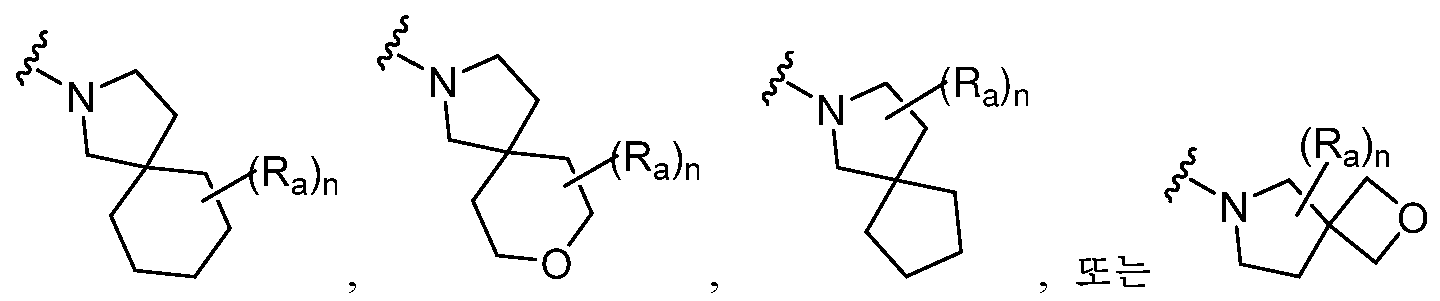



각 경우의 Ra는 독립적으로 H, 할로겐, C1-4알킬, -(CHRaa)kOH, -(CHRaa)kCN, -(CHRaa)kC(O)OR11, -(CHRaa)kC(O)NR11R12, -(CHRaa)kC(O)NR11OR12, -(CHRaa)kC(O)NR11S(=O)2R12, -(CHRaa)kS(=O)2R11, -(CHRaa)kS(=O)2NR11R12, -(CHRaa)kNR11S(=O)2R12, -(CHRaa)k-5-6원 헤테로아릴, 또는 -(CHRaa)kP(=O)R11R12이고;
Raa는 독립적으로 H, 또는 할로겐으로 임의로 치환된 C1-3알킬이고;
R11 및 R12는 독립적으로 H 또는 C1-4알킬이고;
k는 0 또는 1인
화합물, 또는 그의 제약상 허용되는 염 또는 입체이성질체.14. The method according to any one of claims 1 to 13,
each occurrence of R a is independently H, halogen, C 1-4 alkyl, -(CHR aa ) k OH, -(CHR aa ) k CN, -(CHR aa ) k C(O)OR 11 , -(CHR aa ) k C(O)NR 11 R 12 , -(CHR aa ) k C(O)NR 11 OR 12 , -(CHR aa ) k C(O)NR 11 S(=O) 2 R 12 , -( CHR aa ) k S(=O) 2 R 11 , -(CHR aa ) k S(=O) 2 NR 11 R 12 , -(CHR aa ) k NR 11 S(=O) 2 R 12 , -(CHR aa ) k -5-6 membered heteroaryl, or -(CHR aa ) k P(=O)R 11 R 12 ;
R aa is independently H, or C 1-3 alkyl optionally substituted with halogen;
R 11 and R 12 are independently H or C 1-4 alkyl;
k is 0 or 1
A compound, or a pharmaceutically acceptable salt or stereoisomer thereof.


R은
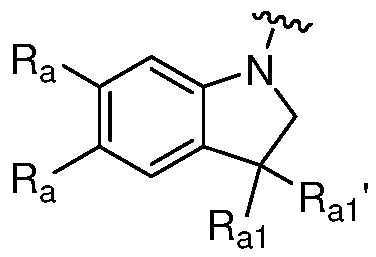

Ra1은 독립적으로 H, C1-4알킬, 또는 C1-4히드록시알킬이고;
Ra1 '은 독립적으로 -(CHRaa)kOH, -(CHRaa)kCN, -(CHRaa)kC(O)OR11, -(CHRaa)kC(O)NR11R12, -(CHRaa)kC(O)NR11OR12, -(CHRaa)kC(O)NR11S(=O)2R12, -(CHRaa)kS(=O)2R11, -(CHRaa)kS(=O)2NR11R12, -(CHRaa)kNR11S(=O)2R12, -(CHRaa)k-5-6원 헤테로아릴, 또는 -(CHRaa)kP(=O)R11R12이고;
Raa는 독립적으로 H, 또는 할로겐으로 임의로 치환된 C1-3알킬이고;
Ra는 독립적으로 H, F, 또는 Cl이고;
R11 및 R12는 독립적으로 H 또는 C1-4알킬이고;
k는 0 또는 1인
화합물, 또는 그의 제약상 허용되는 염 또는 입체이성질체.11. The method according to any one of claims 1 to 10,
R is
R a1 is independently H, C 1-4 alkyl, or C 1-4 hydroxyalkyl;
R a1 ' is independently -(CHR aa ) k OH, -(CHR aa ) k CN, -(CHR aa ) k C(O)OR 11 , -(CHR aa ) k C(O)NR 11 R 12 , -(CHR aa ) k C(O)NR 11 OR 12 , -(CHR aa ) k C(O)NR 11 S(=O) 2 R 12 , -(CHR aa ) k S(=O) 2 R 11 , -(CHR aa ) k S(=O) 2 NR 11 R 12 , -(CHR aa ) k NR 11 S(=O) 2 R 12 , -(CHR aa ) k -5-6 membered heteroaryl, or -(CHR aa ) k P(=O)R 11 R 12 ;
R aa is independently H, or C 1-3 alkyl optionally substituted with halogen;
R a is independently H, F, or Cl;
R 11 and R 12 are independently H or C 1-4 alkyl;
k is 0 or 1
A compound, or a pharmaceutically acceptable salt or stereoisomer thereof.
Ra1은 독립적으로 H, CH3, 또는 CH2OH이고;
Ra1 '은 독립적으로 -(CHRaa)kOH, -(CHRaa)kCN, -(CHRaa)kC(O)OR11, -(CHRaa)kC(O)NR11R12, -(CHRaa)kC(O)NR11OR12, -(CHRaa)kC(O)NR11S(=O)2R12, -(CHRaa)kS(=O)2R11, -(CHRaa)kS(=O)2NR11R12, -(CHRaa)kNR11S(=O)2R12, -(CHRaa)k-테트라졸, 또는 -(CHRaa)kP(=O)R11R12이고;
Raa는 독립적으로 H, CH3, 또는 CF3이고;
R11 및 R12는 독립적으로 H 또는 C1-2알킬이고;
k는 0 또는 1인
화합물, 또는 그의 제약상 허용되는 염 또는 입체이성질체.18. The method of claim 17,
R a1 is independently H, CH 3 , or CH 2 OH;
R a1 ' is independently -(CHR aa ) k OH, -(CHR aa ) k CN, -(CHR aa ) k C(O)OR 11 , -(CHR aa ) k C(O)NR 11 R 12 , -(CHR aa ) k C(O)NR 11 OR 12 , -(CHR aa ) k C(O)NR 11 S(=O) 2 R 12 , -(CHR aa ) k S(=O) 2 R 11 , -(CHR aa ) k S(=O) 2 NR 11 R 12 , -(CHR aa ) k NR 11 S(=O) 2 R 12 , -(CHR aa ) k -tetrazole, or -(CHR aa ) ) k P(=O)R 11 R 12 ;
R aa is independently H, CH 3 , or CF 3 ;
R 11 and R 12 are independently H or C 1-2 alkyl;
k is 0 or 1
A compound, or a pharmaceutically acceptable salt or stereoisomer thereof.


각 경우의 Rb는 독립적으로 H, 할로겐, OH, CN, NH2, COOH, C1-4알킬, C1-4할로알킬, C1-4히드록시알킬, C1-4알콕시, C1-4할로알콕시, C1-4히드록시알콕시, NR11R12, C(O)NR11R12, C(O)C1-4알킬, C(O)OC1-4알킬, C(O)NR11OR12, S(=O)2R11, S(=O)2NR11R12, NR11(S=O)2R12, C(O)NR11S(=O)2R12, P(=O)R11R12, 5-6원 헤테로아릴, 또는 NR11C(O)C1-4알킬이고;
각 경우의 Rc는 페닐 또는 피리디닐이고, 이들 각각은 할로겐, OH, CN, C1-4알킬, C1-4할로알킬, C1-4알콕시, C1-4할로알콕시, NR11R12, C(O)NR11R12, 및 P(=O)디-C1-6알킬로 이루어진 군으로부터 독립적으로 선택된 1 또는 2개의 치환기로 임의로 치환되는 것인
화합물, 또는 그의 제약상 허용되는 염 또는 입체이성질체.22. The method of any one of claims 1 to 3 and 21,
each occurrence of R b is independently H, halogen, OH, CN, NH 2 , COOH, C 1-4 alkyl, C 1-4 haloalkyl, C 1-4 hydroxyalkyl, C 1-4 alkoxy, C 1 -4 Haloalkoxy, C 1-4 Hydroxyalkoxy, NR 11 R 12 , C(O)NR 11 R 12 , C(O)C 1-4 Alkyl, C(O)OC 1-4 Alkyl, C(O) )NR 11 OR 12 , S(=O) 2 R 11 , S(=O) 2 NR 11 R 12 , NR 11 (S=O) 2 R 12 , C(O)NR 11 S(=O) 2 R 12 , P(=O)R 11 R 12 , 5-6 membered heteroaryl, or NR 11 C(O)C 1-4 alkyl;
R c at each occurrence is phenyl or pyridinyl, each of which is halogen, OH, CN, C 1-4 alkyl, C 1-4 haloalkyl, C 1-4 alkoxy, C 1-4 haloalkoxy, NR 11 R 12 , C(O)NR 11 R 12 , and optionally substituted with 1 or 2 substituents independently selected from the group consisting of P(=O)di-C 1-6 alkyl
A compound, or a pharmaceutically acceptable salt or stereoisomer thereof.


각 경우의 Rb는 독립적으로 H, 할로겐, CN, COOH, C1-2알킬, 또는 C1-2할로알킬이고;
각 경우의 Rc는 페닐 또는 피리디닐이고, 이들 각각은 할로겐, C1-4알킬, C1-4할로알킬, C1-4알콕시, C1-4할로알콕시, NR11R12, C(O)NR11R12, 및 P(=O)디-C1-6알킬로 이루어진 군으로부터 독립적으로 선택된 1 또는 2개의 치환기로 임의로 치환되고,
각 경우의 R11 및 R12는 독립적으로 H 또는 C1-6알킬인
화합물, 또는 그의 제약상 허용되는 염 또는 입체이성질체.24. The method according to any one of claims 1 to 3 and 21 to 23,
each occurrence of R b is independently H, halogen, CN, COOH, C 1-2 alkyl, or C 1-2 haloalkyl;
R c at each occurrence is phenyl or pyridinyl, each of which is halogen, C 1-4 alkyl, C 1-4 haloalkyl, C 1-4 alkoxy, C 1-4 haloalkoxy, NR 11 R 12 , C( O)NR 11 R 12 , and optionally substituted with 1 or 2 substituents independently selected from the group consisting of P(=O)di-C 1-6 alkyl,
each occurrence of R 11 and R 12 is independently H or C 1-6 alkyl;
A compound, or a pharmaceutically acceptable salt or stereoisomer thereof.
각 경우의 Rb는 독립적으로 H, CN, 또는 COOH이고;
각 경우의 Rc는 페닐 또는 피리디닐이고, 이들 각각은 C1-4알킬, C(O)N(CH3)2, 및 P(=O)(CH3)2로 이루어진 군으로부터 독립적으로 선택된 1 또는 2개의 치환기로 임의로 치환되는 것인
화합물 또는 그의 제약상 허용되는 염 또는 입체이성질체.25. The method according to any one of claims 1 to 3 and 21 to 24,
each occurrence of R b is independently H, CN, or COOH;
each occurrence of R c is phenyl or pyridinyl, each of which is independently selected from the group consisting of C 1-4 alkyl, C(O)N(CH 3 ) 2 , and P(=O)(CH 3 ) 2 . optionally substituted with 1 or 2 substituents
A compound or a pharmaceutically acceptable salt or stereoisomer thereof.


여기서,
A1은 CR' 또는 N이고;
X는 -P(=O)R3'R4'이고;
R'은 H, 중수소, 할로겐, CN, NO2, C1-6알킬, C2-6알케닐, C2-6알키닐, C1-6알콕시, NR11'R12', C(O)NR11'R12', C(O)C1-6알킬, C(O)OC1-6알킬, NR11'C(O)C1-6알킬이고, 여기서 R'로 나타내어지거나 또는 R'로 나타내어진 기에서의 알킬, 알케닐, 알키닐, 또는 알콕시는 할로겐, OH, CN, C1-4알킬, C1-4할로알킬, C1-4알콕시, C1-4할로알콕시, 및 NR11'R12'로 이루어진 군으로부터 독립적으로 선택된 1 내지 3개의 치환기로 임의로 치환되고;
각 경우의 R1'은 독립적으로 H, 중수소, 할로겐, OH, CN, NO2, C1-6알킬, C2-6알케닐, C2-6알키닐, C1-6알콕시, NR11'R12', C(O)NR11'R12', C(O)C1-6알킬, C(O)OC1-6알킬, NR11'C(O)C1-6알킬, C3-7시클로알킬, 또는 3-7원 헤테로시클릴이고, 여기서 R1'에 의해 나타내어지거나 또는 R1'에 의해 나타내어진 기에서의 알킬, 알케닐, 알키닐, 알콕시, 시클로알킬, 또는 헤테로시클릴은 할로겐, OH, CN, C1-4알킬, C1-4할로알킬, C1-4알콕시, C1-4할로알콕시, 및 NR11'R12'로 이루어진 군으로부터 독립적으로 선택된 1 내지 3개의 치환기로 임의로 치환되고;
각 경우의 R2'는 독립적으로 H, 중수소, 할로겐, OH, CN, NO2, C1-6알킬, C2-6알케닐, C2-6알키닐, C1-6알콕시, NR11'R12', C(O)NR11'R12', C(O)C1-6알킬, C(O)OC1-6알킬, NR11'C(O)C1-6알킬, 페닐, 5-6원 헤테로아릴, C3-7시클로알킬, 또는 3-7원 헤테로아릴이고, 여기서 R2'에 의해 나타내어지거나 또는 R2'에 의해 나타내어진 기에서의 알킬, 알케닐, 알키닐, 알콕시, 페닐, 헤테로아릴, 시클로알킬, 또는 헤테로시클릴은 할로겐, OH, CN, C1-4알킬, C1-4할로알킬, C1-4알콕시, C1-4할로알콕시, 및 NR11'R12'로 이루어진 군으로부터 독립적으로 선택된 1 내지 3개의 치환기로 임의로 치환되고;
각각의 R3' 및 R4'는 독립적으로 H, C1-6알킬, C2-6알케닐, C2-6알키닐이고, 여기서 R3' 또는 R4'에 의해 나타내어진 알킬, 알케닐, 또는 알키닐은 할로겐, OH, CN, C1-4알킬, C1-4할로알킬, C1-4알콕시, C1-4할로알콕시, 및 NR11'R12'로 이루어진 군으로부터 독립적으로 선택된 1 내지 3개의 치환기로 임의로 치환되고;
각 경우의 R11' 및 R12'는 독립적으로 H 또는 C1-6알킬이고, 여기서 R11' 또는 R12'에 의해 나타내어진 알킬은 할로겐, OH, CN, C1-4알킬, C1-4할로알킬, C1-4알콕시, C1-4할로알콕시, C3-6시클로알킬, 및 3-7원 헤테로시클릴로 이루어진 군으로부터 독립적으로 선택된 1 내지 3개의 치환기로 임의로 치환되거나, 또는
R11' 및 R12'는 이들이 부착되어 있는 질소 원자와 함께 할로겐, OH, CN, C1-4알킬, C1-4할로알킬, C1-4알콕시, 또는 C1-4할로알콕시로 이루어진 군으로부터 독립적으로 선택된 1 내지 3개의 치환기로 임의로 치환된 3-7원 헤테로시클릴을 형성하고;
m'은 0, 1, 또는 2이고;
n'은 0, 1, 또는 2이다.A compound represented by the formula (II): or a pharmaceutically acceptable salt thereof:
here,
A 1 is CR′ or N;
X is -P(=0)R 3' R 4' ;
R′ is H, deuterium, halogen, CN, NO 2 , C 1-6 alkyl, C 2-6 alkenyl, C 2-6 alkynyl, C 1-6 alkoxy, NR 11′ R 12′ , C(O )NR 11′ R 12′ , C(O)C 1-6 alkyl, C(O)OC 1-6 alkyl, NR 11′ C(O)C 1-6 alkyl, wherein is represented by R′ or R Alkyl, alkenyl, alkynyl, or alkoxy in the group represented by ' is halogen, OH, CN, C 1-4 alkyl, C 1-4 haloalkyl, C 1-4 alkoxy, C 1-4 haloalkoxy, and NR 11′ R 12′ optionally substituted with 1 to 3 substituents independently selected from the group consisting of;
each occurrence of R 1′ is independently H, deuterium, halogen, OH, CN, NO 2 , C 1-6 alkyl, C 2-6 alkenyl, C 2-6 alkynyl, C 1-6 alkoxy, NR 11 ' R 12' , C(O)NR 11' R 12' , C(O)C 1-6 alkyl, C(O)OC 1-6 alkyl, NR 11' C(O)C 1-6 alkyl, C 3-7 cycloalkyl, or 3-7 membered heterocyclyl, wherein alkyl, alkenyl, alkynyl, alkoxy, cycloalkyl, or hetero in the group represented by R 1 ′ or represented by R 1′ cyclyl is independently selected from the group consisting of halogen, OH, CN, C 1-4 alkyl, C 1-4 haloalkyl, C 1-4 alkoxy, C 1-4 haloalkoxy, and NR 11′ R 12′ optionally substituted with to 3 substituents;
each occurrence of R 2′ is independently H, deuterium, halogen, OH, CN, NO 2 , C 1-6 alkyl, C 2-6 alkenyl, C 2-6 alkynyl, C 1-6 alkoxy, NR 11 ' R 12' , C(O)NR 11' R 12' , C(O)C 1-6 alkyl, C(O)OC 1-6 alkyl, NR 11' C(O)C 1-6 alkyl, phenyl , 5-6 membered heteroaryl, C 3-7 cycloalkyl, or 3-7 membered heteroaryl, wherein alkyl, alkenyl, alkynyl in the group represented by R 2 ′ or represented by R 2′ , alkoxy, phenyl, heteroaryl, cycloalkyl, or heterocyclyl is halogen, OH, CN, C 1-4 alkyl, C 1-4 haloalkyl, C 1-4 alkoxy, C 1-4 haloalkoxy, and NR 11' optionally substituted with 1 to 3 substituents independently selected from the group consisting of R 12' ;
each R 3′ and R 4′ is independently H, C 1-6 alkyl, C 2-6 alkenyl, C 2-6 alkynyl, wherein the alkyl represented by R 3′ or R 4′ , al Kenyl, or alkynyl, is independently from the group consisting of halogen, OH, CN, C 1-4 alkyl, C 1-4 haloalkyl, C 1-4 alkoxy, C 1-4 haloalkoxy, and NR 11′ R 12′ optionally substituted with 1 to 3 substituents selected from;
each occurrence of R 11′ and R 12′ is independently H or C 1-6 alkyl, wherein the alkyl represented by R 11′ or R 12′ is halogen, OH, CN, C 1-4 alkyl, C 1 optionally substituted with 1 to 3 substituents independently selected from the group consisting of -4 haloalkyl, C 1-4 alkoxy, C 1-4 haloalkoxy, C 3-6 cycloalkyl, and 3-7 membered heterocyclyl, or
R 11' and R 12' together with the nitrogen atom to which they are attached consist of halogen, OH, CN, C 1-4 alkyl, C 1-4 haloalkyl, C 1-4 alkoxy, or C 1-4 haloalkoxy; form a 3-7 membered heterocyclyl optionally substituted with 1 to 3 substituents independently selected from the group;
m' is 0, 1, or 2;
n' is 0, 1, or 2.
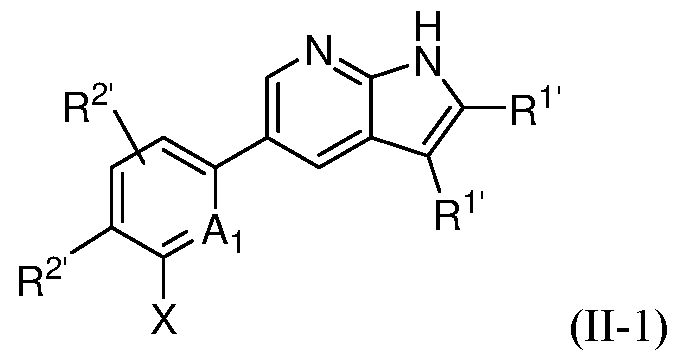
여기서, R'은 H, 할로겐, NR11'R12', 또는 할로겐, OH, CN, C1-4알킬, C1-4할로알킬, C1-4알콕시, C1-4할로알콕시, 및 NR11'R12'로 이루어진 군으로부터 독립적으로 선택된 1 내지 3개의 치환기로 임의로 치환된 C1-6알킬이다.31. The compound according to claim 30, represented by the following structural formula (II-1): or a pharmaceutically acceptable salt or stereoisomer thereof:
wherein R′ is H, halogen, NR 11′ R 12′ , or halogen, OH, CN, C 1-4 alkyl, C 1-4 haloalkyl, C 1-4 alkoxy, C 1-4 haloalkoxy, and C 1-6 alkyl optionally substituted with 1 to 3 substituents independently selected from the group consisting of NR 11′ R 12′ .
각 경우의 R1'은 독립적으로 H, 할로겐, C1-6알킬, C2-6알케닐, C2-6알키닐, C3-7시클로알킬, 또는 3-7원 헤테로시클릴이고, 여기서 R1'에 의해 나타내어진 알킬, 알케닐, 알키닐, 시클로알킬, 또는 헤테로시클릴은 할로겐, OH, CN, C1-4알킬, C1-4할로알킬, C1-4알콕시, C1-4할로알콕시, 및 NR11'R12'로 이루어진 군으로부터 독립적으로 선택된 1 내지 3개의 치환기로 임의로 치환되고;
각 경우의 R2'는 독립적으로 H, 할로겐, OH, NO2, C1-6알킬, C1-6알콕시, NR11'R12', C(O)NR11'R12', C(O)C1-6알킬, C(O)OC1-6알킬, NR11'C(O)C1-6알킬, 5-6원 헤테로아릴, 또는 3-7원 헤테로시클릴이고, 여기서 R2'에 의해 나타내어지거나 또는 R2'에 의해 나타내어진 기에서의 알킬, 알콕시, 헤테로아릴, 또는 헤테로시클릴은 할로겐, OH, CN, C1-4알킬, C1-4할로알킬, C1-4알콕시, C1-4할로알콕시, 및 NR11'R12'로 이루어진 군으로부터 독립적으로 선택된 1 내지 3개의 치환기로 임의로 치환되는 것인
화합물, 또는 그의 제약상 허용되는 염 또는 입체이성질체.33. The method according to any one of claims 30 to 32,
each occurrence of R 1′ is independently H, halogen, C 1-6 alkyl, C 2-6 alkenyl, C 2-6 alkynyl, C 3-7 cycloalkyl, or 3-7 membered heterocyclyl; wherein alkyl, alkenyl, alkynyl, cycloalkyl, or heterocyclyl represented by R 1′ is halogen, OH, CN, C 1-4 alkyl, C 1-4 haloalkyl, C 1-4 alkoxy, C optionally substituted with 1 to 3 substituents independently selected from the group consisting of 1-4 haloalkoxy, and NR 11′ R 12′ ;
each occurrence of R 2′ is independently H, halogen, OH, NO 2 , C 1-6 alkyl, C 1-6 alkoxy, NR 11′ R 12′ , C(O)NR 11′ R 12′ , C( O)C 1-6 alkyl, C(O)OC 1-6 alkyl, NR 11′ C(O)C 1-6 alkyl, 5-6 membered heteroaryl, or 3-7 membered heterocyclyl, wherein R Alkyl, alkoxy, heteroaryl, or heterocyclyl in the group represented by 2 ′ or represented by R 2′ is halogen, OH, CN, C 1-4 alkyl, C 1-4 haloalkyl, C 1 optionally substituted with 1 to 3 substituents independently selected from the group consisting of -4 alkoxy, C 1-4 haloalkoxy, and NR 11′ R 12′
A compound, or a pharmaceutically acceptable salt or stereoisomer thereof.

여기서, R'은 H, 할로겐, 또는 NH2이다.34. The compound according to any one of claims 30 to 33, represented by the structural formula (II-2) or (II-2'), or a pharmaceutically acceptable salt or stereoisomer thereof:
wherein R' is H, halogen, or NH 2 .
각 경우의 R2'는 독립적으로 H, 할로겐, OH; 할로겐 또는 OH 또는 NR11'R12'로 임의로 치환된 C1-4알킬; C1-4알콕시, C(O)OC1-6알킬, C(O)NR11'R12', NR11'R12', NR11'C(O)C1-6알킬, 5-6원 헤테로시클릴, 또는 5-6원 헤테로아릴이고;
각 경우의 R1'은 독립적으로 H 또는 C1-4알킬인
화합물, 또는 그의 제약상 허용되는 염 또는 입체이성질체.35. The method according to any one of claims 30 to 34,
each occurrence of R 2′ is independently H, halogen, OH; C 1-4 alkyl optionally substituted with halogen or OH or NR 11′ R 12′ ; C 1-4 alkoxy, C(O)OC 1-6 alkyl, C(O)NR 11' R 12' , NR 11' R 12' , NR 11' C(O)C 1-6 alkyl, 5-6 membered heterocyclyl, or 5-6 membered heteroaryl;
each occurrence of R 1' is independently H or C 1-4 alkyl;
A compound, or a pharmaceutically acceptable salt or stereoisomer thereof.
R3' 및 R4'는 독립적으로 C1-6알킬이고;
각 경우의 R2'는 독립적으로 H, 할로겐, OH; 할로겐 또는 OH 또는 NR11'R12'로 임의로 치환된 C1-4알킬; C1-4알콕시, C(O)OC1-4알킬, C(O)NR11'R12', NR11'R12', NHC(O)C1-6알킬, 피롤리디닐, 피롤리딘-2-온, 옥사졸이고, 여기서 각 경우의 R11' 및 R12'는 독립적으로 H 또는 C1-4알킬인
화합물, 또는 그의 제약상 허용되는 염 또는 입체이성질체.36. The method according to any one of claims 30 to 35,
R 3′ and R 4′ are independently C 1-6 alkyl;
each occurrence of R 2′ is independently H, halogen, OH; C 1-4 alkyl optionally substituted with halogen or OH or NR 11′ R 12′ ; C 1-4 alkoxy, C(O)OC 1-4 alkyl, C(O)NR 11' R 12' , NR 11' R 12' , NHC(O)C 1-6 alkyl, pyrrolidinyl, pyrroly diin-2-one, oxazole, wherein each occurrence of R 11′ and R 12′ is independently H or C 1-4 alkyl
A compound, or a pharmaceutically acceptable salt or stereoisomer thereof.
Applications Claiming Priority (3)
| Application Number | Priority Date | Filing Date | Title |
|---|---|---|---|
| CN2019094634 | 2019-07-04 | ||
| CNPCT/CN2019/094634 | 2019-07-04 | ||
| PCT/CN2020/100134 WO2021000935A1 (en) | 2019-07-04 | 2020-07-03 | Hpk1 inhibitors and uses thereof |
Publications (1)
| Publication Number | Publication Date |
|---|---|
| KR20220044495A true KR20220044495A (en) | 2022-04-08 |
Family
ID=74100919
Family Applications (2)
| Application Number | Title | Priority Date | Filing Date |
|---|---|---|---|
| KR1020227003145A Pending KR20220044495A (en) | 2019-07-04 | 2020-07-03 | HPK1 inhibitors and uses thereof |
| KR1020237003551A Pending KR20230035061A (en) | 2019-07-04 | 2021-07-02 | HPK1 inhibitors and uses thereof |
Family Applications After (1)
| Application Number | Title | Priority Date | Filing Date |
|---|---|---|---|
| KR1020237003551A Pending KR20230035061A (en) | 2019-07-04 | 2021-07-02 | HPK1 inhibitors and uses thereof |
Country Status (16)
| Country | Link |
|---|---|
| US (2) | US20220389037A1 (en) |
| EP (2) | EP3994133A4 (en) |
| JP (2) | JP7633989B2 (en) |
| KR (2) | KR20220044495A (en) |
| CN (2) | CN114555585B (en) |
| AU (2) | AU2020298649A1 (en) |
| BR (1) | BR112022000064A2 (en) |
| CA (1) | CA3145973A1 (en) |
| DK (1) | DK4175951T3 (en) |
| ES (1) | ES2981368T3 (en) |
| FI (1) | FI4175951T3 (en) |
| IL (1) | IL289612B2 (en) |
| MA (1) | MA56462A (en) |
| MX (2) | MX2022000271A (en) |
| TW (1) | TWI878319B (en) |
| WO (2) | WO2021000935A1 (en) |
Families Citing this family (24)
| Publication number | Priority date | Publication date | Assignee | Title |
|---|---|---|---|---|
| KR102658602B1 (en) | 2018-10-31 | 2024-04-19 | 길리애드 사이언시즈, 인코포레이티드 | Substituted 6-azabenzimidazole compounds with HPK1 inhibitory activity |
| EP4371987B9 (en) | 2018-10-31 | 2025-11-26 | Gilead Sciences, Inc. | Substituted 6-azabenzimidazole compounds as hpk1 inhibitors |
| WO2020237025A1 (en) | 2019-05-23 | 2020-11-26 | Gilead Sciences, Inc. | Substituted exo-methylene-oxindoles which are hpk1/map4k1 inhibitors |
| KR20220044495A (en) * | 2019-07-04 | 2022-04-08 | 치루 레고르 테라퓨틱스 인코포레이티드 | HPK1 inhibitors and uses thereof |
| WO2021146370A1 (en) | 2020-01-15 | 2021-07-22 | Blueprint Medicines Corporation | Map4k1 inhibitors |
| WO2022063140A1 (en) * | 2020-09-23 | 2022-03-31 | Shenzhen Ionova Life Science Co., Ltd. | Pyrimidine and pyridine derivatives as hpk1 modulator and methods using same |
| CN116874503B (en) * | 2020-10-28 | 2025-08-08 | 杭州阿诺生物医药科技有限公司 | High-activity HPK1 kinase inhibitor |
| CN117120090A (en) * | 2021-02-12 | 2023-11-24 | 林伯士萨顿公司 | HPK1 antagonists and uses thereof |
| WO2022187856A1 (en) * | 2021-03-05 | 2022-09-09 | Nimbus Saturn, Inc. | Hpk1 antagonists and uses thereof |
| EP4305041A1 (en) * | 2021-03-08 | 2024-01-17 | Blueprint Medicines Corporation | Map4k1 inhibitors |
| CN117295748A (en) * | 2021-03-08 | 2023-12-26 | 缆图药品公司 | MAP4K1 inhibitors |
| TW202246263A (en) * | 2021-03-23 | 2022-12-01 | 大陸商杭州阿諾生物醫藥科技有限公司 | Hpk1 kinase inhibitor compounds |
| EP4313989A4 (en) | 2021-03-29 | 2025-03-05 | Nimbus Saturn, Inc. | HPK1 ANTAGONISTS AND THEIR USES |
| CN117377673A (en) * | 2021-03-29 | 2024-01-09 | 林伯士萨顿公司 | HPK1 antagonists and their uses |
| CN116848103A (en) * | 2021-04-08 | 2023-10-03 | 杭州阿诺生物医药科技有限公司 | Highly active HPK1 kinase inhibitor |
| KR20240083168A (en) * | 2021-07-14 | 2024-06-11 | 블루프린트 메디신즈 코포레이션 | Heterocyclic compounds as MAP4K1 inhibitors |
| ES3036245T3 (en) | 2021-07-20 | 2025-09-18 | Astrazeneca Ab | Substituted pyrazine-2-carboxamides as hpk1 inhibitors for the treatment of cancer |
| WO2023083299A1 (en) * | 2021-11-12 | 2023-05-19 | 微境生物医药科技(上海)有限公司 | Fused ring compound as hpk1 inhibitor |
| CN118434729A (en) * | 2022-01-11 | 2024-08-02 | 微境生物医药科技(上海)有限公司 | Condensed ring compounds as HPK1 inhibitors |
| WO2023245329A1 (en) * | 2022-06-20 | 2023-12-28 | Biofront Ltd | Multi-kinase inhibitors, compositions thereof, and methods of using the same |
| CN117447479B (en) * | 2023-02-20 | 2026-01-20 | 杭州医学院 | Pyrrolopyrazine derivative of targeted tumor immune kinase, preparation method and application thereof |
| CN116813692A (en) * | 2023-06-29 | 2023-09-29 | 凌科药业(杭州)有限公司 | Phosphorus-containing compounds, pharmaceutical compositions thereof and uses thereof |
| WO2025096647A1 (en) * | 2023-10-30 | 2025-05-08 | Nimbus Saturn, Inc. | Methods of treating tumors |
| WO2025137168A2 (en) | 2023-12-19 | 2025-06-26 | Regor Pharmaceuticals, Inc. | Salt and solid forms of a hpk1 inhibitor |
Family Cites Families (21)
| Publication number | Priority date | Publication date | Assignee | Title |
|---|---|---|---|---|
| WO2007041511A2 (en) | 2005-09-30 | 2007-04-12 | New York University | Hematopoietic progenitor kinase 1 for modulation of an immune response |
| CA2654670A1 (en) * | 2006-07-06 | 2008-01-10 | Boehringer Ingelheim International Gmbh | New compounds |
| US20100216767A1 (en) | 2006-12-22 | 2010-08-26 | Mina Aikawa | Quinazolines for pdk1 inhibition |
| WO2008110508A1 (en) * | 2007-03-09 | 2008-09-18 | Glaxo Group Limited | Pyrrolo-pyridine derivatives for the treatment of disorders associated with inappropriate ikk1 activity |
| JPWO2009084695A1 (en) | 2007-12-28 | 2011-05-19 | カルナバイオサイエンス株式会社 | 2-Aminoquinazoline derivatives |
| US8791112B2 (en) * | 2011-03-30 | 2014-07-29 | Arrien Pharmaceuticals Llc | Substituted 5-(pyrazin-2-yl)-1H-pyrazolo [3, 4-B] pyridine and pyrazolo [3, 4-B] pyridine derivatives as protein kinase inhibitors |
| GB201311475D0 (en) | 2013-06-27 | 2013-08-14 | Alligator Bioscience Ab | Polypeptides |
| EP3096754B1 (en) * | 2014-01-22 | 2018-08-29 | Merck Sharp & Dohme Corp. | Metallo-beta-lactamase inhibitors |
| CN104876914B (en) * | 2014-02-28 | 2017-04-19 | 山东轩竹医药科技有限公司 | Pyrimidine derivative type anaplastic lymphoma kinase inhibitor |
| US20170137426A1 (en) | 2014-03-28 | 2017-05-18 | Changzhou Jiekai Pharmatech Co., Ltd. | Heterocyclic compounds as axl inhibitors |
| CN106188029B (en) * | 2015-05-05 | 2018-09-18 | 山东轩竹医药科技有限公司 | Two and ring class anaplastic lymphoma kinase inhibitor |
| US20190119299A1 (en) * | 2016-06-30 | 2019-04-25 | Janssen Pharmaceutica Nv | Cyanoindoline derivatives as nik inhibitors |
| US20180072718A1 (en) * | 2016-09-09 | 2018-03-15 | Incyte Corporation | Pyrazolopyridine compounds and uses thereof |
| WO2018102366A1 (en) * | 2016-11-30 | 2018-06-07 | Ariad Pharmaceuticals, Inc. | Anilinopyrimidines as haematopoietic progenitor kinase 1 (hpk1) inhibitors |
| WO2018152220A1 (en) * | 2017-02-15 | 2018-08-23 | Incyte Corporation | Pyrazolopyridine compounds and uses thereof |
| EP3596075B1 (en) * | 2017-03-15 | 2023-10-11 | F. Hoffmann-La Roche AG | Azaindoles as inhibitors of hpk1 |
| EP3694861A4 (en) * | 2017-10-09 | 2021-05-19 | Nuvation Bio Inc. | HETEROCYCLIC COMPOUNDS AND THEIR USES |
| US10745388B2 (en) * | 2018-02-20 | 2020-08-18 | Incyte Corporation | Indazole compounds and uses thereof |
| US10899755B2 (en) * | 2018-08-08 | 2021-01-26 | Incyte Corporation | Benzothiazole compounds and uses thereof |
| EP3971190A4 (en) * | 2019-05-17 | 2023-06-14 | Voronoi Inc. | Heterocycle-fused pyrimidine derivative and use thereof |
| KR20220044495A (en) * | 2019-07-04 | 2022-04-08 | 치루 레고르 테라퓨틱스 인코포레이티드 | HPK1 inhibitors and uses thereof |
-
2020
- 2020-07-03 KR KR1020227003145A patent/KR20220044495A/en active Pending
- 2020-07-03 MA MA056462A patent/MA56462A/en unknown
- 2020-07-03 JP JP2022500151A patent/JP7633989B2/en active Active
- 2020-07-03 TW TW109122604A patent/TWI878319B/en active
- 2020-07-03 CA CA3145973A patent/CA3145973A1/en active Pending
- 2020-07-03 MX MX2022000271A patent/MX2022000271A/en unknown
- 2020-07-03 EP EP20834163.6A patent/EP3994133A4/en active Pending
- 2020-07-03 BR BR112022000064A patent/BR112022000064A2/en not_active Application Discontinuation
- 2020-07-03 US US17/624,514 patent/US20220389037A1/en active Pending
- 2020-07-03 CN CN202080057904.1A patent/CN114555585B/en active Active
- 2020-07-03 AU AU2020298649A patent/AU2020298649A1/en active Pending
- 2020-07-03 WO PCT/CN2020/100134 patent/WO2021000935A1/en not_active Ceased
-
2021
- 2021-07-02 ES ES21742686T patent/ES2981368T3/en active Active
- 2021-07-02 JP JP2023500011A patent/JP7759374B2/en active Active
- 2021-07-02 CN CN202180053862.9A patent/CN116096370B/en active Active
- 2021-07-02 FI FIEP21742686.5T patent/FI4175951T3/en active
- 2021-07-02 DK DK21742686.5T patent/DK4175951T3/en active
- 2021-07-02 EP EP21742686.5A patent/EP4175951B1/en active Active
- 2021-07-02 AU AU2021299849A patent/AU2021299849A1/en active Pending
- 2021-07-02 KR KR1020237003551A patent/KR20230035061A/en active Pending
- 2021-07-02 MX MX2023000025A patent/MX2023000025A/en unknown
- 2021-07-02 US US18/013,402 patent/US20230339896A1/en active Pending
- 2021-07-02 WO PCT/CN2021/104206 patent/WO2022002237A1/en not_active Ceased
-
2022
- 2022-01-04 IL IL289612A patent/IL289612B2/en unknown
Also Published As
| Publication number | Publication date |
|---|---|
| EP3994133A1 (en) | 2022-05-11 |
| US20220389037A1 (en) | 2022-12-08 |
| JP7633989B2 (en) | 2025-02-20 |
| WO2021000935A1 (en) | 2021-01-07 |
| CN116096370B (en) | 2024-12-20 |
| AU2021299849A1 (en) | 2023-02-23 |
| ES2981368T3 (en) | 2024-10-08 |
| CN114555585A (en) | 2022-05-27 |
| AU2020298649A1 (en) | 2022-02-17 |
| TWI878319B (en) | 2025-04-01 |
| EP4175951A1 (en) | 2023-05-10 |
| MA56462A (en) | 2022-05-11 |
| EP3994133A4 (en) | 2023-11-22 |
| IL289612A (en) | 2022-03-01 |
| IL289612B1 (en) | 2025-10-01 |
| BR112022000064A2 (en) | 2022-05-24 |
| JP7759374B2 (en) | 2025-10-23 |
| US20230339896A1 (en) | 2023-10-26 |
| FI4175951T3 (en) | 2024-07-10 |
| JP2023533938A (en) | 2023-08-07 |
| CA3145973A1 (en) | 2021-01-07 |
| TW202116751A (en) | 2021-05-01 |
| CN116096370A (en) | 2023-05-09 |
| MX2022000271A (en) | 2022-04-20 |
| EP4175951B1 (en) | 2024-05-01 |
| JP2022538923A (en) | 2022-09-06 |
| CN114555585B (en) | 2025-02-11 |
| DK4175951T3 (en) | 2024-07-29 |
| MX2023000025A (en) | 2023-04-04 |
| IL289612B2 (en) | 2026-02-01 |
| WO2022002237A1 (en) | 2022-01-06 |
| KR20230035061A (en) | 2023-03-10 |
Similar Documents
| Publication | Publication Date | Title |
|---|---|---|
| JP7633989B2 (en) | HPK1 inhibitors and uses thereof | |
| JP7118267B2 (en) | 2,3-dihydro-1H-pyrrolo[3,4-c]pyridin-1-one derivatives as HPK1 inhibitors for the treatment of cancer | |
| TWI828027B (en) | Pyrrolotriazine compounds as tam inhibitors | |
| CA2725014C (en) | Inhibitors of pi3 kinase | |
| DK2376478T3 (en) | Pyridyloxyindoline inhibitors for VEGF-R2 and its use in the treatment of diseases | |
| AU2017312970B2 (en) | 2-oxo-imidazopyridines as reversible BTK inhibitors and uses thereof | |
| CN114945366A (en) | HPK1 antagonists and their uses | |
| JP2021515033A (en) | N- (Phenyl) -2- (Phenyl) Pyrimidine-4-carboxamide Derivatives and Related Compounds as HPK1 Inhibitors for Treating Cancer | |
| KR20170066566A (en) | Heteroaryl compounds as btk inhibitors and uses thereof | |
| TW202140441A (en) | Substituted oxoisoindoline compounds | |
| TW200940544A (en) | Inhibitors of PI3 kinase | |
| JP7303948B2 (en) | Azalactam compounds as HPK1 inhibitors | |
| CN112912142B (en) | 5-Azaindazole derivatives as adenosine receptor antagonists | |
| JP2022505978A (en) | 5-Azindazole derivative as an adenosine receptor antagonist | |
| RU2839132C2 (en) | Hpk1 inhibitors and use thereof | |
| HK40090215A (en) | Hpk1 inhibitors and uses thereof | |
| JP2023054768A (en) | Azalactam compounds as HPK1 inhibitors |
Legal Events
| Date | Code | Title | Description |
|---|---|---|---|
| PA0105 | International application |
St.27 status event code: A-0-1-A10-A15-nap-PA0105 |
|
| PG1501 | Laying open of application |
St.27 status event code: A-1-1-Q10-Q12-nap-PG1501 |
|
| E13-X000 | Pre-grant limitation requested |
St.27 status event code: A-2-3-E10-E13-lim-X000 |
|
| P11-X000 | Amendment of application requested |
St.27 status event code: A-2-2-P10-P11-nap-X000 |
|
| P13-X000 | Application amended |
St.27 status event code: A-2-2-P10-P13-nap-X000 |
|
| PA0201 | Request for examination |
St.27 status event code: A-1-2-D10-D11-exm-PA0201 |
|
| PN2301 | Change of applicant |
St.27 status event code: A-3-3-R10-R13-asn-PN2301 St.27 status event code: A-3-3-R10-R11-asn-PN2301 |
|
| PE0902 | Notice of grounds for rejection |
St.27 status event code: A-1-2-D10-D21-exm-PE0902 |