KR20220003585A - inhaler system - Google Patents
inhaler system Download PDFInfo
- Publication number
- KR20220003585A KR20220003585A KR1020217038827A KR20217038827A KR20220003585A KR 20220003585 A KR20220003585 A KR 20220003585A KR 1020217038827 A KR1020217038827 A KR 1020217038827A KR 20217038827 A KR20217038827 A KR 20217038827A KR 20220003585 A KR20220003585 A KR 20220003585A
- Authority
- KR
- South Korea
- Prior art keywords
- inhalation
- exacerbation
- probability
- respiratory disease
- subject
- Prior art date
- Legal status (The legal status is an assumption and is not a legal conclusion. Google has not performed a legal analysis and makes no representation as to the accuracy of the status listed.)
- Pending
Links
Images


Classifications
-
- A—HUMAN NECESSITIES
- A61—MEDICAL OR VETERINARY SCIENCE; HYGIENE
- A61B—DIAGNOSIS; SURGERY; IDENTIFICATION
- A61B5/00—Measuring for diagnostic purposes; Identification of persons
- A61B5/72—Signal processing specially adapted for physiological signals or for diagnostic purposes
- A61B5/7271—Specific aspects of physiological measurement analysis
- A61B5/7275—Determining trends in physiological measurement data; Predicting development of a medical condition based on physiological measurements, e.g. determining a risk factor
-
- A—HUMAN NECESSITIES
- A61—MEDICAL OR VETERINARY SCIENCE; HYGIENE
- A61M—DEVICES FOR INTRODUCING MEDIA INTO, OR ONTO, THE BODY; DEVICES FOR TRANSDUCING BODY MEDIA OR FOR TAKING MEDIA FROM THE BODY; DEVICES FOR PRODUCING OR ENDING SLEEP OR STUPOR
- A61M15/00—Inhalators
- A61M15/009—Inhalators using medicine packages with incorporated spraying means, e.g. aerosol cans
-
- A—HUMAN NECESSITIES
- A61—MEDICAL OR VETERINARY SCIENCE; HYGIENE
- A61B—DIAGNOSIS; SURGERY; IDENTIFICATION
- A61B5/00—Measuring for diagnostic purposes; Identification of persons
- A61B5/08—Measuring devices for evaluating the respiratory organs
- A61B5/0826—Detecting or evaluating apnoea events
-
- A—HUMAN NECESSITIES
- A61—MEDICAL OR VETERINARY SCIENCE; HYGIENE
- A61B—DIAGNOSIS; SURGERY; IDENTIFICATION
- A61B5/00—Measuring for diagnostic purposes; Identification of persons
- A61B5/08—Measuring devices for evaluating the respiratory organs
- A61B5/087—Measuring breath flow
-
- A—HUMAN NECESSITIES
- A61—MEDICAL OR VETERINARY SCIENCE; HYGIENE
- A61B—DIAGNOSIS; SURGERY; IDENTIFICATION
- A61B5/00—Measuring for diagnostic purposes; Identification of persons
- A61B5/48—Other medical applications
- A61B5/4836—Diagnosis combined with treatment in closed-loop systems or methods
- A61B5/4839—Diagnosis combined with treatment in closed-loop systems or methods combined with drug delivery
-
- A—HUMAN NECESSITIES
- A61—MEDICAL OR VETERINARY SCIENCE; HYGIENE
- A61B—DIAGNOSIS; SURGERY; IDENTIFICATION
- A61B5/00—Measuring for diagnostic purposes; Identification of persons
- A61B5/48—Other medical applications
- A61B5/4842—Monitoring progression or stage of a disease
-
- A—HUMAN NECESSITIES
- A61—MEDICAL OR VETERINARY SCIENCE; HYGIENE
- A61B—DIAGNOSIS; SURGERY; IDENTIFICATION
- A61B5/00—Measuring for diagnostic purposes; Identification of persons
- A61B5/48—Other medical applications
- A61B5/4848—Monitoring or testing the effects of treatment, e.g. of medication
-
- A—HUMAN NECESSITIES
- A61—MEDICAL OR VETERINARY SCIENCE; HYGIENE
- A61K—PREPARATIONS FOR MEDICAL, DENTAL OR TOILETRY PURPOSES
- A61K31/00—Medicinal preparations containing organic active ingredients
- A61K31/13—Amines
- A61K31/135—Amines having aromatic rings, e.g. ketamine, nortriptyline
- A61K31/138—Aryloxyalkylamines, e.g. propranolol, tamoxifen, phenoxybenzamine
-
- A—HUMAN NECESSITIES
- A61—MEDICAL OR VETERINARY SCIENCE; HYGIENE
- A61K—PREPARATIONS FOR MEDICAL, DENTAL OR TOILETRY PURPOSES
- A61K9/00—Medicinal preparations characterised by special physical form
- A61K9/0012—Galenical forms characterised by the site of application
- A61K9/007—Pulmonary tract; Aromatherapy
- A61K9/0073—Sprays or powders for inhalation; Aerolised or nebulised preparations generated by other means than thermal energy
-
- A—HUMAN NECESSITIES
- A61—MEDICAL OR VETERINARY SCIENCE; HYGIENE
- A61M—DEVICES FOR INTRODUCING MEDIA INTO, OR ONTO, THE BODY; DEVICES FOR TRANSDUCING BODY MEDIA OR FOR TAKING MEDIA FROM THE BODY; DEVICES FOR PRODUCING OR ENDING SLEEP OR STUPOR
- A61M15/00—Inhalators
- A61M15/0001—Details of inhalators; Constructional features thereof
-
- A—HUMAN NECESSITIES
- A61—MEDICAL OR VETERINARY SCIENCE; HYGIENE
- A61M—DEVICES FOR INTRODUCING MEDIA INTO, OR ONTO, THE BODY; DEVICES FOR TRANSDUCING BODY MEDIA OR FOR TAKING MEDIA FROM THE BODY; DEVICES FOR PRODUCING OR ENDING SLEEP OR STUPOR
- A61M15/00—Inhalators
- A61M15/0001—Details of inhalators; Constructional features thereof
- A61M15/0021—Mouthpieces therefor
- A61M15/0025—Mouthpieces therefor with caps
-
- A—HUMAN NECESSITIES
- A61—MEDICAL OR VETERINARY SCIENCE; HYGIENE
- A61M—DEVICES FOR INTRODUCING MEDIA INTO, OR ONTO, THE BODY; DEVICES FOR TRANSDUCING BODY MEDIA OR FOR TAKING MEDIA FROM THE BODY; DEVICES FOR PRODUCING OR ENDING SLEEP OR STUPOR
- A61M15/00—Inhalators
- A61M15/0028—Inhalators using prepacked dosages, one for each application, e.g. capsules to be perforated or broken-up
- A61M15/003—Inhalators using prepacked dosages, one for each application, e.g. capsules to be perforated or broken-up using capsules, e.g. to be perforated or broken-up
-
- A—HUMAN NECESSITIES
- A61—MEDICAL OR VETERINARY SCIENCE; HYGIENE
- A61M—DEVICES FOR INTRODUCING MEDIA INTO, OR ONTO, THE BODY; DEVICES FOR TRANSDUCING BODY MEDIA OR FOR TAKING MEDIA FROM THE BODY; DEVICES FOR PRODUCING OR ENDING SLEEP OR STUPOR
- A61M15/00—Inhalators
- A61M15/0065—Inhalators with dosage or measuring devices
-
- A—HUMAN NECESSITIES
- A61—MEDICAL OR VETERINARY SCIENCE; HYGIENE
- A61M—DEVICES FOR INTRODUCING MEDIA INTO, OR ONTO, THE BODY; DEVICES FOR TRANSDUCING BODY MEDIA OR FOR TAKING MEDIA FROM THE BODY; DEVICES FOR PRODUCING OR ENDING SLEEP OR STUPOR
- A61M15/00—Inhalators
- A61M15/0065—Inhalators with dosage or measuring devices
- A61M15/0068—Indicating or counting the number of dispensed doses or of remaining doses
- A61M15/008—Electronic counters
-
- A—HUMAN NECESSITIES
- A61—MEDICAL OR VETERINARY SCIENCE; HYGIENE
- A61M—DEVICES FOR INTRODUCING MEDIA INTO, OR ONTO, THE BODY; DEVICES FOR TRANSDUCING BODY MEDIA OR FOR TAKING MEDIA FROM THE BODY; DEVICES FOR PRODUCING OR ENDING SLEEP OR STUPOR
- A61M15/00—Inhalators
- A61M15/0091—Inhalators mechanically breath-triggered
-
- A—HUMAN NECESSITIES
- A61—MEDICAL OR VETERINARY SCIENCE; HYGIENE
- A61M—DEVICES FOR INTRODUCING MEDIA INTO, OR ONTO, THE BODY; DEVICES FOR TRANSDUCING BODY MEDIA OR FOR TAKING MEDIA FROM THE BODY; DEVICES FOR PRODUCING OR ENDING SLEEP OR STUPOR
- A61M15/00—Inhalators
- A61M15/0091—Inhalators mechanically breath-triggered
- A61M15/0093—Inhalators mechanically breath-triggered without arming or cocking, e.g. acting directly on the delivery valve
-
- A—HUMAN NECESSITIES
- A61—MEDICAL OR VETERINARY SCIENCE; HYGIENE
- A61M—DEVICES FOR INTRODUCING MEDIA INTO, OR ONTO, THE BODY; DEVICES FOR TRANSDUCING BODY MEDIA OR FOR TAKING MEDIA FROM THE BODY; DEVICES FOR PRODUCING OR ENDING SLEEP OR STUPOR
- A61M16/00—Devices for influencing the respiratory system of patients by gas treatment, e.g. ventilators; Tracheal tubes
- A61M16/0003—Accessories therefor, e.g. sensors, vibrators, negative pressure
-
- A—HUMAN NECESSITIES
- A61—MEDICAL OR VETERINARY SCIENCE; HYGIENE
- A61P—SPECIFIC THERAPEUTIC ACTIVITY OF CHEMICAL COMPOUNDS OR MEDICINAL PREPARATIONS
- A61P11/00—Drugs for disorders of the respiratory system
- A61P11/06—Antiasthmatics
-
- A—HUMAN NECESSITIES
- A61—MEDICAL OR VETERINARY SCIENCE; HYGIENE
- A61P—SPECIFIC THERAPEUTIC ACTIVITY OF CHEMICAL COMPOUNDS OR MEDICINAL PREPARATIONS
- A61P11/00—Drugs for disorders of the respiratory system
- A61P11/08—Bronchodilators
-
- C—CHEMISTRY; METALLURGY
- C07—ORGANIC CHEMISTRY
- C07K—PEPTIDES
- C07K16/00—Immunoglobulins [IGs], e.g. monoclonal or polyclonal antibodies
- C07K16/18—Immunoglobulins [IGs], e.g. monoclonal or polyclonal antibodies against material from animals or humans
- C07K16/24—Immunoglobulins [IGs], e.g. monoclonal or polyclonal antibodies against material from animals or humans against cytokines, lymphokines or interferons
- C07K16/244—Interleukins [IL]
-
- C—CHEMISTRY; METALLURGY
- C07—ORGANIC CHEMISTRY
- C07K—PEPTIDES
- C07K16/00—Immunoglobulins [IGs], e.g. monoclonal or polyclonal antibodies
- C07K16/18—Immunoglobulins [IGs], e.g. monoclonal or polyclonal antibodies against material from animals or humans
- C07K16/24—Immunoglobulins [IGs], e.g. monoclonal or polyclonal antibodies against material from animals or humans against cytokines, lymphokines or interferons
- C07K16/244—Interleukins [IL]
- C07K16/247—IL-4
-
- C—CHEMISTRY; METALLURGY
- C07—ORGANIC CHEMISTRY
- C07K—PEPTIDES
- C07K16/00—Immunoglobulins [IGs], e.g. monoclonal or polyclonal antibodies
- C07K16/18—Immunoglobulins [IGs], e.g. monoclonal or polyclonal antibodies against material from animals or humans
- C07K16/28—Immunoglobulins [IGs], e.g. monoclonal or polyclonal antibodies against material from animals or humans against receptors, cell surface antigens or cell surface determinants
- C07K16/2866—Immunoglobulins [IGs], e.g. monoclonal or polyclonal antibodies against material from animals or humans against receptors, cell surface antigens or cell surface determinants against receptors for cytokines, lymphokines, interferons
-
- C—CHEMISTRY; METALLURGY
- C07—ORGANIC CHEMISTRY
- C07K—PEPTIDES
- C07K16/00—Immunoglobulins [IGs], e.g. monoclonal or polyclonal antibodies
- C07K16/42—Immunoglobulins [IGs], e.g. monoclonal or polyclonal antibodies against immunoglobulins
- C07K16/4283—Immunoglobulins [IGs], e.g. monoclonal or polyclonal antibodies against immunoglobulins against an allotypic or isotypic determinant on Ig
- C07K16/4291—Immunoglobulins [IGs], e.g. monoclonal or polyclonal antibodies against immunoglobulins against an allotypic or isotypic determinant on Ig against IgE
-
- G—PHYSICS
- G16—INFORMATION AND COMMUNICATION TECHNOLOGY [ICT] SPECIALLY ADAPTED FOR SPECIFIC APPLICATION FIELDS
- G16H—HEALTHCARE INFORMATICS, i.e. INFORMATION AND COMMUNICATION TECHNOLOGY [ICT] SPECIALLY ADAPTED FOR THE HANDLING OR PROCESSING OF MEDICAL OR HEALTHCARE DATA
- G16H20/00—ICT specially adapted for therapies or health-improving plans, e.g. for handling prescriptions, for steering therapy or for monitoring patient compliance
- G16H20/10—ICT specially adapted for therapies or health-improving plans, e.g. for handling prescriptions, for steering therapy or for monitoring patient compliance relating to drugs or medications, e.g. for ensuring correct administration to patients
-
- G—PHYSICS
- G16—INFORMATION AND COMMUNICATION TECHNOLOGY [ICT] SPECIALLY ADAPTED FOR SPECIFIC APPLICATION FIELDS
- G16H—HEALTHCARE INFORMATICS, i.e. INFORMATION AND COMMUNICATION TECHNOLOGY [ICT] SPECIALLY ADAPTED FOR THE HANDLING OR PROCESSING OF MEDICAL OR HEALTHCARE DATA
- G16H20/00—ICT specially adapted for therapies or health-improving plans, e.g. for handling prescriptions, for steering therapy or for monitoring patient compliance
- G16H20/10—ICT specially adapted for therapies or health-improving plans, e.g. for handling prescriptions, for steering therapy or for monitoring patient compliance relating to drugs or medications, e.g. for ensuring correct administration to patients
- G16H20/13—ICT specially adapted for therapies or health-improving plans, e.g. for handling prescriptions, for steering therapy or for monitoring patient compliance relating to drugs or medications, e.g. for ensuring correct administration to patients delivered from dispensers
-
- G—PHYSICS
- G16—INFORMATION AND COMMUNICATION TECHNOLOGY [ICT] SPECIALLY ADAPTED FOR SPECIFIC APPLICATION FIELDS
- G16H—HEALTHCARE INFORMATICS, i.e. INFORMATION AND COMMUNICATION TECHNOLOGY [ICT] SPECIALLY ADAPTED FOR THE HANDLING OR PROCESSING OF MEDICAL OR HEALTHCARE DATA
- G16H40/00—ICT specially adapted for the management or administration of healthcare resources or facilities; ICT specially adapted for the management or operation of medical equipment or devices
- G16H40/60—ICT specially adapted for the management or administration of healthcare resources or facilities; ICT specially adapted for the management or operation of medical equipment or devices for the operation of medical equipment or devices
- G16H40/63—ICT specially adapted for the management or administration of healthcare resources or facilities; ICT specially adapted for the management or operation of medical equipment or devices for the operation of medical equipment or devices for local operation
-
- G—PHYSICS
- G16—INFORMATION AND COMMUNICATION TECHNOLOGY [ICT] SPECIALLY ADAPTED FOR SPECIFIC APPLICATION FIELDS
- G16H—HEALTHCARE INFORMATICS, i.e. INFORMATION AND COMMUNICATION TECHNOLOGY [ICT] SPECIALLY ADAPTED FOR THE HANDLING OR PROCESSING OF MEDICAL OR HEALTHCARE DATA
- G16H50/00—ICT specially adapted for medical diagnosis, medical simulation or medical data mining; ICT specially adapted for detecting, monitoring or modelling epidemics or pandemics
- G16H50/20—ICT specially adapted for medical diagnosis, medical simulation or medical data mining; ICT specially adapted for detecting, monitoring or modelling epidemics or pandemics for computer-aided diagnosis, e.g. based on medical expert systems
-
- G—PHYSICS
- G16—INFORMATION AND COMMUNICATION TECHNOLOGY [ICT] SPECIALLY ADAPTED FOR SPECIFIC APPLICATION FIELDS
- G16H—HEALTHCARE INFORMATICS, i.e. INFORMATION AND COMMUNICATION TECHNOLOGY [ICT] SPECIALLY ADAPTED FOR THE HANDLING OR PROCESSING OF MEDICAL OR HEALTHCARE DATA
- G16H50/00—ICT specially adapted for medical diagnosis, medical simulation or medical data mining; ICT specially adapted for detecting, monitoring or modelling epidemics or pandemics
- G16H50/30—ICT specially adapted for medical diagnosis, medical simulation or medical data mining; ICT specially adapted for detecting, monitoring or modelling epidemics or pandemics for calculating health indices; for individual health risk assessment
-
- G—PHYSICS
- G16—INFORMATION AND COMMUNICATION TECHNOLOGY [ICT] SPECIALLY ADAPTED FOR SPECIFIC APPLICATION FIELDS
- G16H—HEALTHCARE INFORMATICS, i.e. INFORMATION AND COMMUNICATION TECHNOLOGY [ICT] SPECIALLY ADAPTED FOR THE HANDLING OR PROCESSING OF MEDICAL OR HEALTHCARE DATA
- G16H50/00—ICT specially adapted for medical diagnosis, medical simulation or medical data mining; ICT specially adapted for detecting, monitoring or modelling epidemics or pandemics
- G16H50/70—ICT specially adapted for medical diagnosis, medical simulation or medical data mining; ICT specially adapted for detecting, monitoring or modelling epidemics or pandemics for mining of medical data, e.g. analysing previous cases of other patients
-
- A—HUMAN NECESSITIES
- A61—MEDICAL OR VETERINARY SCIENCE; HYGIENE
- A61B—DIAGNOSIS; SURGERY; IDENTIFICATION
- A61B5/00—Measuring for diagnostic purposes; Identification of persons
- A61B5/74—Details of notification to user or communication with user or patient; User input means
-
- A—HUMAN NECESSITIES
- A61—MEDICAL OR VETERINARY SCIENCE; HYGIENE
- A61M—DEVICES FOR INTRODUCING MEDIA INTO, OR ONTO, THE BODY; DEVICES FOR TRANSDUCING BODY MEDIA OR FOR TAKING MEDIA FROM THE BODY; DEVICES FOR PRODUCING OR ENDING SLEEP OR STUPOR
- A61M11/00—Sprayers or atomisers specially adapted for therapeutic purposes
-
- A—HUMAN NECESSITIES
- A61—MEDICAL OR VETERINARY SCIENCE; HYGIENE
- A61M—DEVICES FOR INTRODUCING MEDIA INTO, OR ONTO, THE BODY; DEVICES FOR TRANSDUCING BODY MEDIA OR FOR TAKING MEDIA FROM THE BODY; DEVICES FOR PRODUCING OR ENDING SLEEP OR STUPOR
- A61M15/00—Inhalators
- A61M15/0001—Details of inhalators; Constructional features thereof
- A61M15/0021—Mouthpieces therefor
- A61M15/0025—Mouthpieces therefor with caps
- A61M15/0026—Hinged caps
-
- A—HUMAN NECESSITIES
- A61—MEDICAL OR VETERINARY SCIENCE; HYGIENE
- A61M—DEVICES FOR INTRODUCING MEDIA INTO, OR ONTO, THE BODY; DEVICES FOR TRANSDUCING BODY MEDIA OR FOR TAKING MEDIA FROM THE BODY; DEVICES FOR PRODUCING OR ENDING SLEEP OR STUPOR
- A61M15/00—Inhalators
- A61M15/0065—Inhalators with dosage or measuring devices
- A61M15/0068—Indicating or counting the number of dispensed doses or of remaining doses
- A61M15/007—Mechanical counters
-
- A—HUMAN NECESSITIES
- A61—MEDICAL OR VETERINARY SCIENCE; HYGIENE
- A61M—DEVICES FOR INTRODUCING MEDIA INTO, OR ONTO, THE BODY; DEVICES FOR TRANSDUCING BODY MEDIA OR FOR TAKING MEDIA FROM THE BODY; DEVICES FOR PRODUCING OR ENDING SLEEP OR STUPOR
- A61M16/00—Devices for influencing the respiratory system of patients by gas treatment, e.g. ventilators; Tracheal tubes
- A61M16/0003—Accessories therefor, e.g. sensors, vibrators, negative pressure
- A61M2016/0015—Accessories therefor, e.g. sensors, vibrators, negative pressure inhalation detectors
- A61M2016/0018—Accessories therefor, e.g. sensors, vibrators, negative pressure inhalation detectors electrical
- A61M2016/0021—Accessories therefor, e.g. sensors, vibrators, negative pressure inhalation detectors electrical with a proportional output signal, e.g. from a thermistor
-
- A—HUMAN NECESSITIES
- A61—MEDICAL OR VETERINARY SCIENCE; HYGIENE
- A61M—DEVICES FOR INTRODUCING MEDIA INTO, OR ONTO, THE BODY; DEVICES FOR TRANSDUCING BODY MEDIA OR FOR TAKING MEDIA FROM THE BODY; DEVICES FOR PRODUCING OR ENDING SLEEP OR STUPOR
- A61M16/00—Devices for influencing the respiratory system of patients by gas treatment, e.g. ventilators; Tracheal tubes
- A61M16/0003—Accessories therefor, e.g. sensors, vibrators, negative pressure
- A61M2016/0015—Accessories therefor, e.g. sensors, vibrators, negative pressure inhalation detectors
- A61M2016/0018—Accessories therefor, e.g. sensors, vibrators, negative pressure inhalation detectors electrical
- A61M2016/0024—Accessories therefor, e.g. sensors, vibrators, negative pressure inhalation detectors electrical with an on-off output signal, e.g. from a switch
-
- A—HUMAN NECESSITIES
- A61—MEDICAL OR VETERINARY SCIENCE; HYGIENE
- A61M—DEVICES FOR INTRODUCING MEDIA INTO, OR ONTO, THE BODY; DEVICES FOR TRANSDUCING BODY MEDIA OR FOR TAKING MEDIA FROM THE BODY; DEVICES FOR PRODUCING OR ENDING SLEEP OR STUPOR
- A61M16/00—Devices for influencing the respiratory system of patients by gas treatment, e.g. ventilators; Tracheal tubes
- A61M16/0003—Accessories therefor, e.g. sensors, vibrators, negative pressure
- A61M2016/0027—Accessories therefor, e.g. sensors, vibrators, negative pressure pressure meter
-
- A—HUMAN NECESSITIES
- A61—MEDICAL OR VETERINARY SCIENCE; HYGIENE
- A61M—DEVICES FOR INTRODUCING MEDIA INTO, OR ONTO, THE BODY; DEVICES FOR TRANSDUCING BODY MEDIA OR FOR TAKING MEDIA FROM THE BODY; DEVICES FOR PRODUCING OR ENDING SLEEP OR STUPOR
- A61M16/00—Devices for influencing the respiratory system of patients by gas treatment, e.g. ventilators; Tracheal tubes
- A61M16/0003—Accessories therefor, e.g. sensors, vibrators, negative pressure
- A61M2016/003—Accessories therefor, e.g. sensors, vibrators, negative pressure with a flowmeter
- A61M2016/0033—Accessories therefor, e.g. sensors, vibrators, negative pressure with a flowmeter electrical
- A61M2016/0039—Accessories therefor, e.g. sensors, vibrators, negative pressure with a flowmeter electrical in the inspiratory circuit
-
- A—HUMAN NECESSITIES
- A61—MEDICAL OR VETERINARY SCIENCE; HYGIENE
- A61M—DEVICES FOR INTRODUCING MEDIA INTO, OR ONTO, THE BODY; DEVICES FOR TRANSDUCING BODY MEDIA OR FOR TAKING MEDIA FROM THE BODY; DEVICES FOR PRODUCING OR ENDING SLEEP OR STUPOR
- A61M2202/00—Special media to be introduced, removed or treated
- A61M2202/06—Solids
- A61M2202/064—Powder
-
- A—HUMAN NECESSITIES
- A61—MEDICAL OR VETERINARY SCIENCE; HYGIENE
- A61M—DEVICES FOR INTRODUCING MEDIA INTO, OR ONTO, THE BODY; DEVICES FOR TRANSDUCING BODY MEDIA OR FOR TAKING MEDIA FROM THE BODY; DEVICES FOR PRODUCING OR ENDING SLEEP OR STUPOR
- A61M2205/00—General characteristics of the apparatus
- A61M2205/05—General characteristics of the apparatus combined with other kinds of therapy
-
- A—HUMAN NECESSITIES
- A61—MEDICAL OR VETERINARY SCIENCE; HYGIENE
- A61M—DEVICES FOR INTRODUCING MEDIA INTO, OR ONTO, THE BODY; DEVICES FOR TRANSDUCING BODY MEDIA OR FOR TAKING MEDIA FROM THE BODY; DEVICES FOR PRODUCING OR ENDING SLEEP OR STUPOR
- A61M2205/00—General characteristics of the apparatus
- A61M2205/18—General characteristics of the apparatus with alarm
-
- A—HUMAN NECESSITIES
- A61—MEDICAL OR VETERINARY SCIENCE; HYGIENE
- A61M—DEVICES FOR INTRODUCING MEDIA INTO, OR ONTO, THE BODY; DEVICES FOR TRANSDUCING BODY MEDIA OR FOR TAKING MEDIA FROM THE BODY; DEVICES FOR PRODUCING OR ENDING SLEEP OR STUPOR
- A61M2205/00—General characteristics of the apparatus
- A61M2205/33—Controlling, regulating or measuring
- A61M2205/3306—Optical measuring means
-
- A—HUMAN NECESSITIES
- A61—MEDICAL OR VETERINARY SCIENCE; HYGIENE
- A61M—DEVICES FOR INTRODUCING MEDIA INTO, OR ONTO, THE BODY; DEVICES FOR TRANSDUCING BODY MEDIA OR FOR TAKING MEDIA FROM THE BODY; DEVICES FOR PRODUCING OR ENDING SLEEP OR STUPOR
- A61M2205/00—General characteristics of the apparatus
- A61M2205/33—Controlling, regulating or measuring
- A61M2205/3327—Measuring
-
- A—HUMAN NECESSITIES
- A61—MEDICAL OR VETERINARY SCIENCE; HYGIENE
- A61M—DEVICES FOR INTRODUCING MEDIA INTO, OR ONTO, THE BODY; DEVICES FOR TRANSDUCING BODY MEDIA OR FOR TAKING MEDIA FROM THE BODY; DEVICES FOR PRODUCING OR ENDING SLEEP OR STUPOR
- A61M2205/00—General characteristics of the apparatus
- A61M2205/33—Controlling, regulating or measuring
- A61M2205/3331—Pressure; Flow
-
- A—HUMAN NECESSITIES
- A61—MEDICAL OR VETERINARY SCIENCE; HYGIENE
- A61M—DEVICES FOR INTRODUCING MEDIA INTO, OR ONTO, THE BODY; DEVICES FOR TRANSDUCING BODY MEDIA OR FOR TAKING MEDIA FROM THE BODY; DEVICES FOR PRODUCING OR ENDING SLEEP OR STUPOR
- A61M2205/00—General characteristics of the apparatus
- A61M2205/33—Controlling, regulating or measuring
- A61M2205/3331—Pressure; Flow
- A61M2205/3334—Measuring or controlling the flow rate
-
- A—HUMAN NECESSITIES
- A61—MEDICAL OR VETERINARY SCIENCE; HYGIENE
- A61M—DEVICES FOR INTRODUCING MEDIA INTO, OR ONTO, THE BODY; DEVICES FOR TRANSDUCING BODY MEDIA OR FOR TAKING MEDIA FROM THE BODY; DEVICES FOR PRODUCING OR ENDING SLEEP OR STUPOR
- A61M2205/00—General characteristics of the apparatus
- A61M2205/33—Controlling, regulating or measuring
- A61M2205/3331—Pressure; Flow
- A61M2205/3358—Measuring barometric pressure, e.g. for compensation
-
- A—HUMAN NECESSITIES
- A61—MEDICAL OR VETERINARY SCIENCE; HYGIENE
- A61M—DEVICES FOR INTRODUCING MEDIA INTO, OR ONTO, THE BODY; DEVICES FOR TRANSDUCING BODY MEDIA OR FOR TAKING MEDIA FROM THE BODY; DEVICES FOR PRODUCING OR ENDING SLEEP OR STUPOR
- A61M2205/00—General characteristics of the apparatus
- A61M2205/33—Controlling, regulating or measuring
- A61M2205/3368—Temperature
-
- A—HUMAN NECESSITIES
- A61—MEDICAL OR VETERINARY SCIENCE; HYGIENE
- A61M—DEVICES FOR INTRODUCING MEDIA INTO, OR ONTO, THE BODY; DEVICES FOR TRANSDUCING BODY MEDIA OR FOR TAKING MEDIA FROM THE BODY; DEVICES FOR PRODUCING OR ENDING SLEEP OR STUPOR
- A61M2205/00—General characteristics of the apparatus
- A61M2205/33—Controlling, regulating or measuring
- A61M2205/3375—Acoustical, e.g. ultrasonic, measuring means
-
- A—HUMAN NECESSITIES
- A61—MEDICAL OR VETERINARY SCIENCE; HYGIENE
- A61M—DEVICES FOR INTRODUCING MEDIA INTO, OR ONTO, THE BODY; DEVICES FOR TRANSDUCING BODY MEDIA OR FOR TAKING MEDIA FROM THE BODY; DEVICES FOR PRODUCING OR ENDING SLEEP OR STUPOR
- A61M2205/00—General characteristics of the apparatus
- A61M2205/35—Communication
- A61M2205/3546—Range
- A61M2205/3553—Range remote, e.g. between patient's home and doctor's office
-
- A—HUMAN NECESSITIES
- A61—MEDICAL OR VETERINARY SCIENCE; HYGIENE
- A61M—DEVICES FOR INTRODUCING MEDIA INTO, OR ONTO, THE BODY; DEVICES FOR TRANSDUCING BODY MEDIA OR FOR TAKING MEDIA FROM THE BODY; DEVICES FOR PRODUCING OR ENDING SLEEP OR STUPOR
- A61M2205/00—General characteristics of the apparatus
- A61M2205/35—Communication
- A61M2205/3546—Range
- A61M2205/3561—Range local, e.g. within room or hospital
-
- A—HUMAN NECESSITIES
- A61—MEDICAL OR VETERINARY SCIENCE; HYGIENE
- A61M—DEVICES FOR INTRODUCING MEDIA INTO, OR ONTO, THE BODY; DEVICES FOR TRANSDUCING BODY MEDIA OR FOR TAKING MEDIA FROM THE BODY; DEVICES FOR PRODUCING OR ENDING SLEEP OR STUPOR
- A61M2205/00—General characteristics of the apparatus
- A61M2205/35—Communication
- A61M2205/3576—Communication with non implanted data transmission devices, e.g. using external transmitter or receiver
- A61M2205/3584—Communication with non implanted data transmission devices, e.g. using external transmitter or receiver using modem, internet or bluetooth
-
- A—HUMAN NECESSITIES
- A61—MEDICAL OR VETERINARY SCIENCE; HYGIENE
- A61M—DEVICES FOR INTRODUCING MEDIA INTO, OR ONTO, THE BODY; DEVICES FOR TRANSDUCING BODY MEDIA OR FOR TAKING MEDIA FROM THE BODY; DEVICES FOR PRODUCING OR ENDING SLEEP OR STUPOR
- A61M2205/00—General characteristics of the apparatus
- A61M2205/35—Communication
- A61M2205/3576—Communication with non implanted data transmission devices, e.g. using external transmitter or receiver
- A61M2205/3592—Communication with non implanted data transmission devices, e.g. using external transmitter or receiver using telemetric means, e.g. radio or optical transmission
-
- A—HUMAN NECESSITIES
- A61—MEDICAL OR VETERINARY SCIENCE; HYGIENE
- A61M—DEVICES FOR INTRODUCING MEDIA INTO, OR ONTO, THE BODY; DEVICES FOR TRANSDUCING BODY MEDIA OR FOR TAKING MEDIA FROM THE BODY; DEVICES FOR PRODUCING OR ENDING SLEEP OR STUPOR
- A61M2205/00—General characteristics of the apparatus
- A61M2205/50—General characteristics of the apparatus with microprocessors or computers
- A61M2205/502—User interfaces, e.g. screens or keyboards
-
- A—HUMAN NECESSITIES
- A61—MEDICAL OR VETERINARY SCIENCE; HYGIENE
- A61M—DEVICES FOR INTRODUCING MEDIA INTO, OR ONTO, THE BODY; DEVICES FOR TRANSDUCING BODY MEDIA OR FOR TAKING MEDIA FROM THE BODY; DEVICES FOR PRODUCING OR ENDING SLEEP OR STUPOR
- A61M2205/00—General characteristics of the apparatus
- A61M2205/50—General characteristics of the apparatus with microprocessors or computers
- A61M2205/502—User interfaces, e.g. screens or keyboards
- A61M2205/505—Touch-screens; Virtual keyboard or keypads; Virtual buttons; Soft keys; Mouse touches
-
- A—HUMAN NECESSITIES
- A61—MEDICAL OR VETERINARY SCIENCE; HYGIENE
- A61M—DEVICES FOR INTRODUCING MEDIA INTO, OR ONTO, THE BODY; DEVICES FOR TRANSDUCING BODY MEDIA OR FOR TAKING MEDIA FROM THE BODY; DEVICES FOR PRODUCING OR ENDING SLEEP OR STUPOR
- A61M2205/00—General characteristics of the apparatus
- A61M2205/50—General characteristics of the apparatus with microprocessors or computers
- A61M2205/52—General characteristics of the apparatus with microprocessors or computers with memories providing a history of measured variating parameters of apparatus or patient
-
- A—HUMAN NECESSITIES
- A61—MEDICAL OR VETERINARY SCIENCE; HYGIENE
- A61M—DEVICES FOR INTRODUCING MEDIA INTO, OR ONTO, THE BODY; DEVICES FOR TRANSDUCING BODY MEDIA OR FOR TAKING MEDIA FROM THE BODY; DEVICES FOR PRODUCING OR ENDING SLEEP OR STUPOR
- A61M2205/00—General characteristics of the apparatus
- A61M2205/58—Means for facilitating use, e.g. by people with impaired vision
- A61M2205/581—Means for facilitating use, e.g. by people with impaired vision by audible feedback
-
- A—HUMAN NECESSITIES
- A61—MEDICAL OR VETERINARY SCIENCE; HYGIENE
- A61M—DEVICES FOR INTRODUCING MEDIA INTO, OR ONTO, THE BODY; DEVICES FOR TRANSDUCING BODY MEDIA OR FOR TAKING MEDIA FROM THE BODY; DEVICES FOR PRODUCING OR ENDING SLEEP OR STUPOR
- A61M2205/00—General characteristics of the apparatus
- A61M2205/58—Means for facilitating use, e.g. by people with impaired vision
- A61M2205/583—Means for facilitating use, e.g. by people with impaired vision by visual feedback
- A61M2205/584—Means for facilitating use, e.g. by people with impaired vision by visual feedback having a color code
-
- A—HUMAN NECESSITIES
- A61—MEDICAL OR VETERINARY SCIENCE; HYGIENE
- A61M—DEVICES FOR INTRODUCING MEDIA INTO, OR ONTO, THE BODY; DEVICES FOR TRANSDUCING BODY MEDIA OR FOR TAKING MEDIA FROM THE BODY; DEVICES FOR PRODUCING OR ENDING SLEEP OR STUPOR
- A61M2205/00—General characteristics of the apparatus
- A61M2205/82—Internal energy supply devices
- A61M2205/8206—Internal energy supply devices battery-operated
-
- A—HUMAN NECESSITIES
- A61—MEDICAL OR VETERINARY SCIENCE; HYGIENE
- A61M—DEVICES FOR INTRODUCING MEDIA INTO, OR ONTO, THE BODY; DEVICES FOR TRANSDUCING BODY MEDIA OR FOR TAKING MEDIA FROM THE BODY; DEVICES FOR PRODUCING OR ENDING SLEEP OR STUPOR
- A61M2230/00—Measuring parameters of the user
- A61M2230/30—Blood pressure
-
- A—HUMAN NECESSITIES
- A61—MEDICAL OR VETERINARY SCIENCE; HYGIENE
- A61M—DEVICES FOR INTRODUCING MEDIA INTO, OR ONTO, THE BODY; DEVICES FOR TRANSDUCING BODY MEDIA OR FOR TAKING MEDIA FROM THE BODY; DEVICES FOR PRODUCING OR ENDING SLEEP OR STUPOR
- A61M2230/00—Measuring parameters of the user
- A61M2230/40—Respiratory characteristics
-
- C—CHEMISTRY; METALLURGY
- C07—ORGANIC CHEMISTRY
- C07K—PEPTIDES
- C07K2317/00—Immunoglobulins specific features
- C07K2317/20—Immunoglobulins specific features characterized by taxonomic origin
- C07K2317/21—Immunoglobulins specific features characterized by taxonomic origin from primates, e.g. man
-
- C—CHEMISTRY; METALLURGY
- C07—ORGANIC CHEMISTRY
- C07K—PEPTIDES
- C07K2317/00—Immunoglobulins specific features
- C07K2317/20—Immunoglobulins specific features characterized by taxonomic origin
- C07K2317/24—Immunoglobulins specific features characterized by taxonomic origin containing regions, domains or residues from different species, e.g. chimeric, humanized or veneered
-
- C—CHEMISTRY; METALLURGY
- C07—ORGANIC CHEMISTRY
- C07K—PEPTIDES
- C07K2317/00—Immunoglobulins specific features
- C07K2317/50—Immunoglobulins specific features characterized by immunoglobulin fragments
- C07K2317/52—Constant or Fc region; Isotype
Landscapes
- Health & Medical Sciences (AREA)
- Engineering & Computer Science (AREA)
- Life Sciences & Earth Sciences (AREA)
- Public Health (AREA)
- General Health & Medical Sciences (AREA)
- Biomedical Technology (AREA)
- Veterinary Medicine (AREA)
- Animal Behavior & Ethology (AREA)
- Medical Informatics (AREA)
- Chemical & Material Sciences (AREA)
- Pulmonology (AREA)
- Heart & Thoracic Surgery (AREA)
- Bioinformatics & Cheminformatics (AREA)
- Biophysics (AREA)
- Medicinal Chemistry (AREA)
- Pathology (AREA)
- Epidemiology (AREA)
- Molecular Biology (AREA)
- Organic Chemistry (AREA)
- Hematology (AREA)
- Anesthesiology (AREA)
- Primary Health Care (AREA)
- Surgery (AREA)
- Physics & Mathematics (AREA)
- Immunology (AREA)
- Data Mining & Analysis (AREA)
- Pharmacology & Pharmacy (AREA)
- Physiology (AREA)
- Databases & Information Systems (AREA)
- Genetics & Genomics (AREA)
- Proteomics, Peptides & Aminoacids (AREA)
- Biochemistry (AREA)
- Chemical Kinetics & Catalysis (AREA)
- General Chemical & Material Sciences (AREA)
- Nuclear Medicine, Radiotherapy & Molecular Imaging (AREA)
- Artificial Intelligence (AREA)
- Computer Vision & Pattern Recognition (AREA)
- Psychiatry (AREA)
- Signal Processing (AREA)
- General Business, Economics & Management (AREA)
Abstract
대상체의 호흡기 질환 악화 확률(또는 가능성)을 결정하기 위한 시스템이 제공된다. 시스템은 대상체에게 약물을 전달하기 위한 흡입기 장치를 포함한다. 약물이, 예를 들어, 구조 약물 또는 유지 약물일 수 있다. 흡입기 장치는 흡입기 장치를 사용하여 대상체에 의해 수행된 흡입을 결정하도록 구성된 사용-검출 시스템을 구비한다. 센서 시스템이 흡입 동안 기류와 관련된 파라미터를 측정하도록 구성된다. 사용자 인터페이스가 대상체가 경함하고 있는 호흡기 질환의 상태의 조짐의 사용자 입력을 가능하게 한다. 프로세서는 사용-검출 시스템으로부터의 기록된 흡입(들), 센서 시스템으로부터 수신된 파라미터(들), 및 사용자 인터페이스로부터 수신된 조짐에 기초하여 호흡기 질환 악화의 확률을 결정하도록 구성된다. 대상체의 호흡기 질환 악화 확률을 결정하기 위한 방법이 추가로 제공된다.A system is provided for determining a probability (or likelihood) of exacerbation of a respiratory disease in a subject. The system includes an inhaler device for delivering a drug to a subject. The drug can be, for example, a rescue drug or a maintenance drug. The inhaler device has a use-detection system configured to determine an inhalation performed by a subject using the inhaler device. A sensor system is configured to measure a parameter related to airflow during inhalation. The user interface enables user input of an indication of a condition of a respiratory disease for which the subject is suffering. The processor is configured to determine the probability of exacerbation of the respiratory disease based on the recorded inhalation(s) from the use-detection system, the parameter(s) received from the sensor system, and the indication received from the user interface. Further provided are methods for determining a subject's probability of exacerbating a respiratory disease.
Description
본 개시는 흡입기 시스템, 특히, 호흡기 질환의 악화 확률을 결정하기 위한 시스템 및 방법에 관한 것이다.The present disclosure relates to inhaler systems, particularly systems and methods for determining the probability of exacerbation of a respiratory disease.
천식이나 만성 폐쇄성 폐질환(COPD)과 같은 많은 호흡기 질환은 환자의 증상을 관리하며 돌이킬 수 없는 변화의 위험을 줄이기 위해 치료에 장기간의 약물 투여가 수반되는 평생 관리가 필요한 질환이다. 현재로서는 천식과 COPD와 같은 질환에 대한 치료법이 없다. 치료에는 두 가지 형태가 있다. 첫째, 기도 염증을 감소시켜 결과적으로 향후의 증상을 조절하기 위한 유지 측면의 치료가 있다. 유지 요법은 전형적으로, 단독으로 또는 지속성 기관지 확장제 및/또는 무스카린 길항제와 함께, 흡입식 코르티코스테로이드에 의해 제공된다. 둘째, 쌕쌕거림, 기침, 가슴 답답함 및 숨가쁨 증상의 급성 발현을 완화하기 위해 환자에게 속효성 기관지 확장제를 투여하는 구조(또는 완화) 측면의 치료도 있다. 천식이나 COPD와 같은 호흡기 질환을 앓고 있는 환자는 또한, 호흡기 질환에서 증상이 급격히 악화되는 일시적인 발적 또는 악화를 경험할 수 있다. 최악의 경우, 악화로 인해 생명이 위협받을 수 있다.Many respiratory diseases, such as asthma and chronic obstructive pulmonary disease (COPD), require lifelong management, where treatment involves long-term drug administration to manage the patient's symptoms and reduce the risk of irreversible changes. Currently, there is no cure for diseases such as asthma and COPD. There are two forms of treatment. First, there are maintenance aspects of treatment to reduce airway inflammation and consequently to control future symptoms. Maintenance therapy is typically given by inhaled corticosteroids, either alone or in combination with long-acting bronchodilators and/or muscarinic antagonists. Second, there is also structural (or alleviation) treatment in which a short-acting bronchodilator is administered to the patient to relieve the acute onset of wheezing, cough, chest tightness, and shortness of breath. Patients suffering from respiratory diseases such as asthma or COPD may also experience temporary redness or exacerbations in which symptoms worsen rapidly in respiratory diseases. In the worst case, the exacerbation can be life-threatening.
임박한 호흡기 질환 악화를 식별할 수 있는 능력이 있다면, 환자의 상태가, 예를 들어, 의사의 예정에 없는 방문, 병원 입원 및 전신 스테로이드 투여를 필요로 하기 전에, 조치 계획이 개선되며 선제적 치료를 위한 기회가 제공될 것이다.The ability to identify an impending respiratory disease exacerbation improves the action plan and promotes proactive treatment before the patient's condition necessitates, for example, unscheduled doctor visits, hospital admissions and systemic steroid administration. opportunities will be provided for
따라서, 당업계는 임박한 호흡기 질환의 악화 위험을 식별하기 위한 개선된 방법을 필요로 한다.Accordingly, there is a need in the art for improved methods for identifying risk of impending exacerbation of respiratory disease.
따라서, 본 개시는 대상체의 호흡기 질환 악화 확률을 결정하기 위한 시스템으로서, 대상체에게 약물을 전달하기 위한 흡입기 장치로서, 흡입기 장치를 사용하여 대상체에 의해 수행된 흡입을 결정하도록 구성된 사용-검출 시스템을 구비한 흡입기 장치; 흡입 동안 기류와 관련된 파라미터를 측정하도록 구성된 센서 시스템; 대상체가 경함하고 있는 호흡기 질환의 상태의 조짐을 입력하기 위한 사용자 인터페이스; 및 각각의 상기 흡입을 기록하며; 흡입 또는 흡입들에 대해 측정된 파라미터를 수신하며; 조짐을 수신하며; 및 기록된 흡입 또는 흡입들, 수신된 파라미터 또는 파라미터들, 및 수신된 조짐에 기초하여 호흡기 질환 악화의 확률을 결정하도록 구성된 프로세서를 포함하는 시스템을 제공한다.Accordingly, the present disclosure provides a system for determining a probability of exacerbation of a respiratory disease in a subject, an inhaler device for delivering a drug to a subject, comprising a use-detection system configured to determine inhalation performed by a subject using the inhaler device One inhaler device; a sensor system configured to measure a parameter related to airflow during inhalation; a user interface for inputting an indication of a condition of a respiratory disease in which the subject is suffering; and recording each said inhalation; receive a measured parameter for inhalation or inhalations; receive an indication; and a processor configured to determine a probability of exacerbation of a respiratory disease based on the recorded inhalation or inhalations, the received parameter or parameters, and the received symptom.
흡입 횟수, 흡입 동안의 기류와 관련된 파라미터, 대상체가 경험하고 있는 호흡기 질환의 상태의 조짐을 사용하면 호흡기 질환 악화의 정확한 예측을 가능하게 할 수 있다.The use of the number of inhalations, parameters related to airflow during inhalation, and indications of the state of respiratory disease the subject is experiencing may allow for accurate prediction of respiratory disease exacerbations.
본 발명이 이제, 제한할 의도가 있는 것은 아닌 첨부 도면을 참조하여 더 상세히 설명될 것이다:
도 1은 일 실시예에 따른 시스템의 블록도를 보여주며;
도 2는 다른 실시예에 따른 시스템을 보여주며;
도 3a는 일 실시예에 따른 방법의 순서도를 보여주며;
도 3b는 다른 실시예에 따른 방법과 관련된 순서도 및 시각표를 보여주며;
도 4는 구조 약물의 흡입을 보여주는 시각표를 보여주며;
도 5는 평균 구조 흡입 횟수 대 천식 악화로부터의 일수에 대한 그래프를 보여주며;
도 6은 평균 구조 흡입 횟수 대 천식 악화로부터의 일수에 대한 다른 그래프를 보여주며;
도 7은 천식 악화로부터의 일수에 대한 개개의 기준선 값에 대한 기류와 관련된 다양한 파라미터 및 구조 흡입 횟수의 변화율을 보여주는 4개의 그래프를 보여주며;
도 8은 천식 악화 확률을 결정하기 위한 모델의 수신자 조작 특성(ROC) 곡선 분석을 보여주며;
도 9는 구조 흡입 평균 횟수 대 COPD 악화로부터의 일수에 대한 그래프를 보여주며;
도 10은 평균 구조 흡입 횟수 대 COPD 악화로부터의 일수에 대한 다른 그래프를 보여주며;
도 11은 평균 피크 흡입 유량(L/min) 대 COPD 악화로부터의 일수에 대한 그래프를 보여주며;
도 12는 평균 피크 흡입 유량(L/min) 대 COPD 악화로부터의 일수에 대한 다른 그래프를 보여주며;
도 13은 평균 흡입량(L) 대 COPD 악화로부터의 일수에 대한 그래프를 보여주며;
도 14는 평균 흡입량(L) 대 COPD 악화로부터의 일수에 대한 다른 그래프를 보여주며;
도 15는 평균 흡입 지속 시간(들) 대 COPD 악화로부터의 일수에 대한 그래프를 보여주며;
도 16은 평균 흡입 지속 시간(들) 대 COPD 악화로부터의 일수에 대한 다른 그래프를 보여주며;
도 17은 임박한 COPD 악화의 확률을 결정하기 위한 모델의 수신자 조작 특성(ROC) 곡선 분석을 보여주며;
도 18은 흡입기의 정면 사시도를 보여주며;
도 19는 도 18에 도시된 흡입기의 단면 내부 사시도를 보여주며;
도 20은 도 18에 도시된 예시적인 흡입기의 분해 사시도를 제공하며;
도 21은 도 18에 도시된 흡입기의 상부 캡 및 전자 모듈의 분해 사시도를 제공하며; 및
도 22는 도 18에 도시된 예시적인 흡입기를 통한 기류 속도 대 압력의 그래프를 보여준다.The present invention will now be described in more detail with reference to the accompanying drawings, which are not intended to be limiting:
1 shows a block diagram of a system according to an embodiment;
2 shows a system according to another embodiment;
3A shows a flowchart of a method according to an embodiment;
3B shows a flowchart and timeline associated with a method according to another embodiment;
4 shows a timeline showing inhalation of rescue drugs;
Figure 5 shows a graph of mean number of rescue inhalations versus days from asthma exacerbation;
6 shows another graph of the mean number of rescue inhalations versus days from asthma exacerbation;
7 shows four graphs showing the rate of change of the number of rescue inhalations and various parameters related to airflow versus individual baseline values for days from exacerbation of asthma;
8 shows a recipient operating characteristic (ROC) curve analysis of a model for determining asthma exacerbation probability;
9 shows a graph of average number of rescue inhalations versus days from COPD exacerbation;
10 shows another graph of the mean number of rescue inhalations versus days from exacerbation of COPD;
11 shows a graph of mean peak inhalation flow (L/min) versus days from COPD exacerbation;
12 shows another graph of mean peak inhalation flow (L/min) versus days from COPD exacerbation;
13 shows a graph of mean intake (L) versus days from COPD exacerbation;
14 shows another graph of mean intake (L) versus days from exacerbation of COPD;
15 shows a graph of mean inhalation duration(s) versus days from COPD exacerbation;
16 shows another graph of mean inhalation duration(s) versus days from COPD exacerbation;
17 shows a recipient operating characteristic (ROC) curve analysis of a model for determining the probability of an impending COPD exacerbation;
18 shows a front perspective view of the inhaler;
19 shows a cross-sectional internal perspective view of the inhaler shown in FIG. 18 ;
20 provides an exploded perspective view of the exemplary inhaler shown in FIG. 18 ;
FIG. 21 provides an exploded perspective view of the electronic module and upper cap of the inhaler shown in FIG. 18 ; and
22 shows a graph of airflow velocity versus pressure through the exemplary inhaler shown in FIG. 18 .
상세한 설명 및 특정 예는, 장치, 시스템 및 방법의 예시적인 실시예를 나타내면서, 단지 예시의 목적을 위한 것이며 본 발명의 범위를 제한할 의도가 있는 것은 아님을 이해하여야 한다. 본 발명의 장치, 시스템 및 방법의 이러한 그리고 다른 특징, 양태 및 이점이 다음의 설명, 첨부된 청구범위 및 첨부 도면으로부터 더 잘 이해될 것이다. 도면은 단지 개략적인 것이며 실제 크기 비율로 도시되어 있지 않음을 이해하여야 한다. 동일하거나 유사한 부분을 나타내기 위해 도면 전체에 걸쳐 동일한 도면 부호가 사용된다는 것을 또한 이해하여야 한다.It is to be understood that the detailed description and specific examples, while representing exemplary embodiments of apparatus, systems and methods, are for purposes of illustration only and are not intended to limit the scope of the invention. These and other features, aspects and advantages of the apparatus, systems and methods of the present invention will be better understood from the following description, appended claims, and accompanying drawings. It should be understood that the drawings are schematic only and are not drawn to scale. It should also be understood that the same reference numbers are used throughout the drawings to refer to the same or like parts.
천식과 COPD는 기도의 만성 염증성 질환이다. 이들 모두 다양하고 반복적인 기류 폐쇄 및 기관지 경련 증상을 특징으로 한다. 증상으로는 쌕쌕거림, 기침, 가슴 답답함 및 숨가쁨 발현이 있다.Asthma and COPD are chronic inflammatory diseases of the airways. All of them are characterized by varying and recurrent symptoms of airflow obstruction and bronchospasm. Symptoms include wheezing, coughing, chest tightness and shortness of breath.
이러한 증상은 유발 기제를 피함으로써 그리고 약물, 특히, 흡입 약물을 사용함으로써 관리된다. 약물에는 흡입식 코르티코스테로이드(ICS)와 기관지 확장제가 포함된다.These symptoms are managed by avoiding triggering mechanisms and by using medications, particularly inhaled medications. Medications include inhaled corticosteroids (ICS) and bronchodilators.
흡입식 코르티코스테로이드(ICS)는 호흡기 질환의 장기적 조절에 사용되는 스테로이드 호르몬이다. 이것은 기도 염증을 줄이는 기능이 있다. 예로는, 부데소니드, 베클로메타손(디프로피오네이트), 플루티카손(프로피오네이트), 모메타손(푸로에이트), 시클레소니드 및 덱사메타손(나트륨)이 있다. 괄호는 바람직한 염 또는 에스테르 형태를 나타낸다.Inhaled corticosteroids (ICS) are steroid hormones used for long-term control of respiratory diseases. It has the function of reducing airway inflammation. Examples include budesonide, beclomethasone (dipropionate), fluticasone (propionate), mometasone (furoate), ciclesonide and dexamethasone (sodium). Parentheses indicate the preferred salt or ester form.
다양한 종류의 기관지 확장제가 기도 내의 다양한 수용체를 표적으로 한다. 일반적으로 사용되는 두 종류는 β2-작용제와 항콜린제이다.Different classes of bronchodilators target different receptors in the airways. Two commonly used classes are β 2 -agonists and anticholinergics.
β2-아드레날린 작용제(또는 "β2-작용제")는 β2 -아드레날린 수용체에 작용하여 평활근 이완을 유도하여, 기관지 통로 확장을 초래한다. 지속성 β2-작용제(LABA)의 예에는 포르모테롤(푸마르산염), 살메테롤(지나포에이트), 인다카테롤(말레인산염), 밤부테롤(염산염), 클렌부테롤(염산염), 올로다테롤(염산염), 카르모테롤(염산염), 툴로부테롤(염산염) 및 빌란테롤(트리페닐아세테이트)이 포함된다. 속효성 β2-작용제(SABA)의 일 예로는 알부테롤(황산염)이 있다.β 2 -adrenergic agonists (or “β 2 -agonists”) act on β 2 -adrenergic receptors to induce smooth muscle relaxation, resulting in bronchial channel dilation. Examples of long-acting β 2 -agonists (LABAs) include formoterol (fumarate), salmeterol (ginapoate), indacaterol (maleate), bambuterol (hydrochloride), clenbuterol (hydrochloride), ol These include rhdaterol (hydrochloride), carmoterol (hydrochloride), tulobuterol (hydrochloride) and vilanterol (triphenylacetate). One example of a fast-acting β 2 -agonist (SABA) is albuterol (sulfate).
전형적으로, 속효성 기관지 확장제는 급성 기관지 수축을 신속하게 완화하는 반면(종종 "구조" 또는 "완화” 약품이라고 함), 지속성 기관지 확장제는 보다 장기적인 증상을 조절하고 예방하는 데 도움이 된다. 그러나, 일부 빠른 발현의 지속성 기관지 확장제가 포르모테롤(푸마르산염)과 같은 구조 약품으로서 사용될 수 있다. 따라서, 구조 약품은 급성 기관지 수축을 완화시킨다. 구조 약품은 필요에 따라/임기응변(prn)으로 복용된다. 구조 약품이 또한, ICS-포르모테롤(푸마르산염), 전형적으로 부데소니드-포르모테롤(푸마르산염)과 같은 조합 제품의 형태일 수 있다. 따라서, 구조 약품은 바람직하게는 SABA 또는 속효성 LABA, 보다 바람직하게는 알부테롤(황산염) 또는 포르모테롤(푸마르산염), 그리고 가장 바람직하게는 알부테롤(황산염)이다.Typically, short-acting bronchodilators provide rapid relief from acute bronchoconstriction (sometimes referred to as “rescue” or “relief” drugs), while long-acting bronchodilators help control and prevent longer-term symptoms. Fast-acting long-acting bronchodilator can be used as rescue agent, such as formoterol (fumarate).Therefore, rescue agent relieves acute bronchoconstriction.Rescue agent is taken as needed/adjusted (prn). Rescue drug can also be in the form of combination product such as ICS-formoterol (fumarate), typically budesonide-formoterol (fumarate).Therefore, rescue drug is preferably SABA or short-acting LABA, rather than Preferably albuterol (sulfate) or formoterol (fumarate), and most preferably albuterol (sulfate).
전형적으로 황산염으로서 투여되는 알부테롤(살부타몰로도 알려짐)이 본 개시의 바람직한 구조 약품이다.Albuterol (also known as salbutamol), typically administered as sulfate, is the preferred rescue agent of the present disclosure.
항콜린제(또는 "항무스카린제")는 신경 세포의 수용체를 선택적으로 차단함으로써 신경 전달 물질인 아세틸콜린을 차단한다. 국소 적용 시에, 항콜린제가 대부분 기도에 위치한 M3 무스카린 수용체에 작용하여 평활근 이완을 생성하여, 이에 따라 기관지 확장 효과를 생성한다. 지속성 무스카린 길항제(LAMA)의 예에는 티오트로피움(브롬화물), 옥시트로피움(브롬화물), 아클리디늄(브롬화물), 이프라트로피움(브롬화물), 글리코피로늄(브롬화물), 옥시부티닌(염산염 또는 브롬화수소산염), 톨테로딘(타르타르산염), 트로스피움(염화물), 솔리페나신(숙신산염), 페소테로딘(푸마르산염) 및 다리페나신(브롬화수소산염)이 포함된다.Anticholinergics (or "antimuscarinic drugs") block the neurotransmitter acetylcholine by selectively blocking receptors on nerve cells. When applied topically, anticholinergics mostly act on M 3 muscarinic receptors located in the airways to produce smooth muscle relaxation, thus creating a bronchodilating effect. Examples of long-acting muscarinic antagonists (LAMAs) include tiotropium (bromide), oxytropium (bromide), aclidinium (bromide), ipratropium (bromide), glycopyrronium (bromide). , oxybutynin (hydrochloride or hydrobromide), tolterodine (tartrate), trospium (chloride), solifenacin (succinate), fesoterodine (fumarate), and darifenacin (hydrobromide) This is included.
건조 분말 흡입기(DPI), 가압 정량 흡입기(pMDI) 또는 네불라이저(nebulizer)를 통한 것과 같이 흡입에 의한 전달용의 이러한 약물을 제조하고 제형화하는 데 많은 접근법이 취해져 왔다.Many approaches have been taken to prepare and formulate such drugs for delivery by inhalation, such as via a dry powder inhaler (DPI), pressurized metered dose inhaler (pMDI) or nebulizer.
천식에 대한 국제 전략(GINA)의 지침에 따라, 천식의 치료에 단계적인 접근법이 취해지고 있다. 가벼운 형태의 천식을 나타내는 1단계에서는, 필요에 따라 황산염 알부테롤과 같은 SABA가 환자에게 투여된다. SABA를 투여할 때마다 필요에 따라 저용량 ICS-포르모테롤 또는 저용량 ICS가 또한 환자에게 투여될 수 있다. 2단계에서는, SABA와 함께 또는 필요에 따라 저용량 ICS-포르모테롤과 함께 저용량 ICS가 규칙적으로 제공된다. 3단계에서는 LABA가 추가된다. 4단계에서는 용량이 늘어나며, 5단계에서는 항콜린제 또는 저용량 경구 코르티코스테로이드와 같은 추가 치료제가 포함된다. 따라서, 개개의 단계가 호흡기 질환의 급성 중증도에 따라 각각 구성되는 치료 요법으로서 간주될 수 있다.In accordance with the guidelines of the International Strategy for Asthma (GINA), a step-by-step approach is being taken in the treatment of asthma. In
COPD는 전 세계적으로 주요 사망 원인이다. 이것은 만성 기관지염, 폐기종을 포함하며 또한 작은 기도를 수반하는 이질적인 장기적 질환이다. COPD를 가진 환자에게서 발생하는 병리학적 변화는 대부분, 기도, 폐 실질 조직 및 폐 혈관계에 국한된다. 표현형으로, 이러한 변화는 폐가 건강하게 기체를 흡수하고 배출하는 능력을 감소시킨다. COPD is the leading cause of death worldwide. It is a heterogeneous long-term disease that includes chronic bronchitis, emphysema and also involves small airways. The pathological changes that occur in patients with COPD are mostly confined to the airways, lung parenchyma, and pulmonary vasculature. Phenotypically, these changes reduce the lungs' ability to absorb and excrete gases in a healthy way.
기관지염은 기관지의 장기간의 염증을 특징으로 한다. 일반적인 증상으로 쌕쌕거림, 숨가쁨, 기침 및 가래 배출이 있을 수 있으며, 이러한 증상은 모두 매우 불편할뿐만 아니라 환자의 삶의 질에 불리하게 작용한다. 폐기종이 또한 장기간의 기관지 염증과 관련이 있으며, 염증 반응으로 인해 폐 조직의 파괴 및 기도의 점진적인 협착이 초래된다. 시간이 지날수록 폐 조직이 자연적인 탄력을 잃고 비대해진다. 이와 같이, 기체 교환 효능이 감소하며 호흡한 공기가 폐 내부에 갇히게 되는 경우가 많다. 이것은 국소적인 저산소증을 초래하며, 흡입당 환자의 혈류로 전달되는 산소의 양을 감소시킨다. 따라서, 환자는 숨가쁨 및 호흡 곤란 사례를 경험하게 된다.Bronchitis is characterized by prolonged inflammation of the bronchi. Common symptoms may include wheezing, shortness of breath, coughing, and discharge of phlegm, all of which are very uncomfortable and adversely affect the patient's quality of life. Emphysema is also associated with long-term bronchial inflammation, and the inflammatory response results in destruction of lung tissue and progressive narrowing of the airways. Over time, the lung tissue loses its natural elasticity and becomes enlarged. As such, gas exchange efficiency is reduced and the breathed air is often trapped inside the lungs. This results in local hypoxia, which reduces the amount of oxygen delivered to the patient's bloodstream per inhalation. Thus, the patient experiences shortness of breath and dyspnea events.
COPD를 앓고 있는 환자는 매일 이러한 증상을 전부는 아니지만 다양하게 경험한다. 증상의 심각성이 다양한 인자에 의해 결정될 것이지만, 가장 일반적으로는 질병의 진행과 상관 관계에 있을 것이다. 이들 증상은, 그 심각성과 상관없이, 안정적인 COPD를 나타내며, 다양한 의약품의 투여를 통해 이러한 질병 상태가 유지 및 관리된다. 다양한 치료법이 있지만, 흡입식 기관지 확장제, 항콜린제, 지속성 및 속효성 β2-작용제 및 코르티코스테로이드가 사용되는 경우가 많다. 약물은 흔히, 단일 요법으로서 또는 병용 치료로서 투여된다.Patients with COPD experience varying, if not all, of these symptoms every day. The severity of symptoms will be determined by a variety of factors, but most will be correlated with disease progression. These symptoms, regardless of their severity, indicate stable COPD, and these disease states are maintained and managed through the administration of various drugs. Although there are a variety of treatments, inhaled bronchodilators, anticholinergics, long-acting and short-acting β 2 -agonists, and corticosteroids are often used. Drugs are often administered as monotherapy or as combination therapy.
환자는 만성 폐쇄성 폐 질환에 대한 국제 전략(GOLD)의 지침에 정의된 범주를 사용하여 환자의 COPD 심각성에 따라 분류된다. 이러한 범주는 A-D로 표시되며, 권장되는 첫 번째 치료 선택안은 범주에 따라 다르다. 그룹 A의 환자에게는 속효성 무스카린 길항제(SAMA)(prn) 또는 속효성 β2-작용제(SABA)(prn)가 권장된다. 그룹 B의 환자에게는 지속성 무스카린 길항제(LAMA) 또는 지속성 β2-작용제(LABA)가 권장된다. 그룹 C의 환자에게는 흡입식 코르티코스테로이드(ICS) + LABA 또는 LAMA가 권장된다. 그룹 D의 환자에게는 ICS + LABA 및/또는 LAMA가 권장된다.Patients are classified according to their COPD severity using the categories defined in the guidelines of the International Strategy for Chronic Obstructive Pulmonary Disease (GOLD). These categories are marked with AD, and the recommended first treatment option varies by category. Short-acting muscarinic antagonists (SAMA) (prn) or short-acting β 2 -agonists (SABAs) (prn) are recommended for patients in group A. Long-acting muscarinic antagonist (LAMA) or long-acting β 2 -agonist (LABA) is recommended for patients in group B. Inhaled corticosteroids (ICS) plus LABA or LAMA are recommended for patients in group C. For patients in group D, ICS + LABA and/or LAMA is recommended.
천식이나 COPD와 같은 호흡기 질환을 앓고 있는 환자는 나날이 그 상태 변화가 기준선을 초과하여 주기적으로 악화된다. 악화는 추가 요법, 즉, 유지 요법 이상의 요법을 필요로 하는 호흡기 증상의 급성 악화를 의미한다.Patients suffering from respiratory diseases such as asthma or COPD periodically exacerbate the change in their condition day by day, exceeding the baseline. Exacerbation refers to an acute exacerbation of respiratory symptoms requiring additional therapy, ie, more than maintenance therapy.
천식의 경우, 중간 정도의 악화에 대한 추가 요법에 따라 SABA, 경구 코르티코스테로이드 및/또는 제어 유량의 산소(후자는 입원을 필요로 함)가 반복 투여된다. 극심한 악화의 경우에는 항콜린제(전형적으로 이프라트로피움 브롬화물), 분무식 SABA 또는 IV 황산마그네슘이 추가된다.For asthma, repeated administration of SABA, oral corticosteroids and/or controlled flow oxygen (the latter requiring hospitalization) as follow-up therapy for moderate exacerbation. For severe exacerbations, anticholinergics (typically ipratropium bromide), nebulized SABA or IV magnesium sulfate are added.
COPD의 경우, 중간 정도의 악화에 대한 추가 요법에 따라 SABA, 경구 코르티코스테로이드 및/또는 항생제가 반복 투여된다. 극심한 악화의 경우에는 제어 유량의 산소 및/또는 호흡 지원(두 가지 모두 입원을 필요로 함)이 추가된다.For COPD, repeated administration of SABA, oral corticosteroids and/or antibiotics as follow-up therapy for moderate exacerbation. For severe exacerbations, controlled flow oxygen and/or respiratory support (both requiring hospitalization) is added.
본 개시의 의미 내에서의 악화는 중간 정도의 악화 및 극심한 악화를 모두 포함한다.Exacerbations within the meaning of the present disclosure include both moderate exacerbations and extreme exacerbations.
본 개시는 호흡기 질환의 악화를 예측하여 환자의 치료에 조기에 개입하는 것을 허용함으로써 환자에 대한 결과를 개선하는 치료 접근법에 관한 것이다.The present disclosure relates to therapeutic approaches that improve outcomes for patients by predicting exacerbation of respiratory disease and allowing early intervention in the patient's treatment.
대상체의 호흡기 질환 악화 확률(또는 가능성)을 결정하기 위한 시스템이 제공된다. 시스템은 대상체에게 약물을 전달하기 위한 흡입기 장치를 포함한다. 약물이, 예를 들어, 구조 약물 또는 유지 약물일 수 있다. 구조 약물은, 예를 들어, 약물 흡입 시에 기관지 및 세기관지의 급속한 확장에 영향을 주는 방식으로 호흡기 증상의 악화를 치료하는 데 적합할 수 있다. 흡입기 장치는 흡입기 장치를 사용하여 대상체에 의해 수행된 흡입을 결정하도록 구성된 사용-검출 시스템을 구비한다. 센서 시스템이 흡입 동안 기류와 관련된 파라미터를 측정하도록 구성된다. 사용자 인터페이스가 대상체가 경함하고 있는 호흡기 질환의 상태의 조짐의 사용자 입력을 가능하게 한다. 프로세서는 사용-검출 시스템으로부터의 기록된 흡입(들), 센서 시스템으로부터 수신된 파라미터(들), 및 사용자 인터페이스로부터 수신된 조짐에 기초하여 호흡기 질환 악화의 확률을 결정하도록 구성된다. 시스템과 관련하여 논의된 임의의 바람직한 실시예가 본 개시의 방법에 적용될 수 있으며, 그 반대의 경우도 마찬가지이다.A system is provided for determining a probability (or likelihood) of exacerbation of a respiratory disease in a subject. The system includes an inhaler device for delivering a drug to a subject. The drug can be, for example, a rescue drug or a maintenance drug. Rescue drugs may be suitable for treating exacerbation of respiratory symptoms, for example, in a manner that affects the rapid dilatation of bronchi and bronchi upon inhalation of the drug. The inhaler device has a use-detection system configured to determine an inhalation performed by a subject using the inhaler device. A sensor system is configured to measure a parameter related to airflow during inhalation. The user interface enables user input of an indication of a condition of a respiratory disease for which the subject is suffering. The processor is configured to determine the probability of exacerbation of the respiratory disease based on the recorded inhalation(s) from the use-detection system, the parameter(s) received from the sensor system, and the indication received from the user interface. Any preferred embodiment discussed with respect to the system may be applied to the method of the present disclosure, and vice versa.
흡입기 장치가 대상체에게 구조 약물을 분배하기 위한 제1 흡입기를 포함할 수 있다. 따라서, 사용-검출 시스템이 구조 약물의 흡입을 결정하도록 구성될 수 있다.The inhaler device may include a first inhaler for dispensing a rescue drug to a subject. Accordingly, the use-detection system may be configured to determine the inhalation of a rescue drug.
대안으로서 또는 추가적으로, 흡입기 장치가 대상체에게 유지 약물을 분배하기 위한 제2 흡입기를 포함할 수 있다. 따라서, 사용-검출 시스템이 유지 약물의 흡입을 결정하도록 구성될 수 있다.Alternatively or additionally, the inhaler device may include a second inhaler for dispensing maintenance medication to the subject. Accordingly, the use-detection system may be configured to determine inhalation of maintenance medicament.
센서 시스템이 구조 약물 및/또는 유지 약물의 흡입 동안 파라미터를 측정하도록 구성될 수 있다.The sensor system may be configured to measure a parameter during inhalation of the rescue drug and/or maintenance drug.
구조 약물은 위에 정의된 바와 같으며 전형적으로, SABA 또는 포르모테롤(푸마산염)과 같은 속효성 LABA이다. 구조 약품이 또한, ICS-포르모테롤(푸마르산염), 전형적으로 부데소니드-포르모테롤(푸마르산염)과 같은 조합 제품의 형태일 수 있다. 이러한 접근법을 "유지 및 구조 요법(MART)"이라 한다. 그러나, 구조 약물이 존재한다는 것은, 구조 약물의 존재가 사용된 가중치 적용 모델에서 결정적이기 때문에, 본 개시의 의미 내에서 그 자체로 제1 흡입기라는 것을 나타낸다. 따라서, 이것은 구조 약물과 병용 구조 및 유지 약물을 모두 포함한다. 대조적으로, 제2 흡입기는 존재하는 경우 구조 목적이 아닌 치료 요법의 유지 양태로만 사용된다. 제1 흡입기는 필요에 따라 사용될 수 있는 반면, 제2 흡입기는 정기적으로 미리 정의된 시간에 사용하도록 되어 있다는 것이 주요 차이점이다.The rescue drug is as defined above and is typically a fast-acting LABA such as SABA or formoterol (fumacate). The rescue drug may also be in the form of a combination product such as ICS-formoterol (fumarate), typically budesonide-formoterol (fumarate). This approach is referred to as “maintenance and rescue therapy (MART)”. However, the presence of a rescue drug indicates that it is itself a first inhaler within the meaning of the present disclosure, as the presence of a rescue drug is crucial in the weighted model used. Thus, it includes both rescue drugs and concomitant rescue and maintenance drugs. In contrast, the second inhaler, if any, is only used as a maintenance aspect of the treatment regimen and not for rescue purposes. The main difference is that the first inhaler can be used as needed, whereas the second inhaler is regularly intended for use at a predefined time.
시스템이, 예를 들어, 제1 기간 동안의 흡입 횟수를 결정하거나 기록하도록 구성된 프로세서를 추가로 포함한다. 따라서, 구조 흡입 횟수 및/또는 유지 흡입 횟수가 결정될 수 있다. 대상체가 악화에 가까워짐에 따라 제1 흡입기를 더 많이 사용할 수 있기 때문에, 구조 흡입 횟수가 악화를 예측하는 인자를 나타낼 수 있다.The system further comprises a processor configured to, for example, determine or record the number of inhalations during the first period of time. Accordingly, the number of rescue suctions and/or the number of maintenance suctions can be determined. Since the subject can use more of the first inhaler as the subject approaches the exacerbation, the number of rescue inhalations may represent a predictive factor of exacerbation.
유지 흡입 횟수가 대안으로서 또는 추가적으로, 악화를 예측하는 데 유용한 정보를 나타낼 수 있는데, 그 이유는 유지 흡입 횟수가 적을수록(유지 약물 요법의 순응도 저하를 나타냄) 악화 위험이 증가될 수 있기 때문이다.The number of maintenance inhalations may alternatively or additionally represent useful information in predicting exacerbation, since fewer maintenance inhalations (indicative of poor adherence to maintenance drug therapy) may increase the risk of exacerbation.
비교적 간단한 일 예에서, 제1 흡입기를 사용한 구조 흡입 횟수의 증가(문제의 대상체에 대한 기준선 기간에 대한) 및/또는 제2 흡입기를 사용한 흡입 횟수의 감소(치료 요법의 규칙 준수도 저하를 나타냄)가, 흡입 파라미터와 함께, 더 높은 호흡기 질환 악화 가능성으로 이어지는 폐 기능 악화를 나타낼 수 있다.In one relatively simple example, an increase in the number of rescue inhalers with a first inhaler (relative to the baseline period for the subject in question) and/or a decrease in the number of inhalations with a second inhaler (indicative of decreased adherence to the treatment regimen) may, together with inhalation parameters, indicate deterioration of lung function leading to a higher likelihood of exacerbation of respiratory disease.
흡입(들) 동안의 기류와 관련된 파라미터가 임박한 악화의 지표를 제공할 수 있는데, 그 이유는 파라미터가 대상체의 폐 기능 및/또는 폐 건강에 대한 대리 역할을 할 수 있기 때문이다.Parameters related to airflow during inhalation(s) may provide an indication of an imminent exacerbation, since the parameter may serve as a surrogate for the subject's lung function and/or lung health.
대상체가 경험한 바와 같은 호흡기 질환의 상태가 유용한 진단 정보를 제공할 수 있다. 예를 들어, 대상체가 동시에 경험한 바와 같은 호흡기 질환의 상태가 다른 인자, 예를 들어, 흡입 횟수 및/또는 흡입 파라미터에 의해 표시된 악화 위험이 적절하게 결정되었음에 대한 확인 또는 그 외 다른 방식을 제공할 수 있다. 이러한 방식으로, 호흡기 질환의 상태의 조짐이, 예를 들어, 흡입 횟수 및 흡입 파라미터에 기초하지만 대상체가 경험하고 있는 호흡기 질환의 상태를 무시하는 예측에 비해 악화 예측 정확도를 향상시킬 수 있다. A state of respiratory disease as experienced by a subject can provide useful diagnostic information. For example, the state of a respiratory disease as simultaneously experienced by the subject provides confirmation or otherwise that the risk of exacerbation indicated by other factors, such as number of inhalations and/or inhalation parameters, has been appropriately determined. can do. In this way, the predictive accuracy of exacerbation may be improved compared to predictions where a symptom of a respiratory disease state is based, for example, on the number of inhalations and inhalation parameters, but ignores the state of the respiratory disease that the subject is experiencing.
다양한 대상체 관련 및 환경 인자를 모니터링함으로써 천식 또는 COPD 악화와 같은 임박한 호흡기 질환 악화의 위험을 평가하려는 시도가 있었다. 이에 따라 어떤 인자를 고려하고 어떤 인자를 무시하여야 하는지에 관한 문제에 직면하였다. 위험 결정에 최소한의 또는 무시할 수 있는 수준의 영향만 미치는 인자를 무시할 경우, 예를 들어, 처리 자원, 배터리 전력, 메모리 요건 등과 같은 더 적은 계산 자원을 사용하여 위험을 보다 효율적으로 결정하는 것이 가능할 수 있다. 임박한 호흡기 질환 악화를 결정할 수 있는 정확도 개선 요건이 더 중요하다. 더 정확하게 위험을 결정하게 되면 적절한 임상 개입이 대상체에게 전달될 수 있도록 더 효과적인 경고 시스템을 촉진할 수 있다. 따라서, 악화 위험을 더 정확하게 평가할 경우 급성 위험에 처한 대상체에 대한 개입을 안내할 가능성이 있을 수 있다.Attempts have been made to assess the risk of an imminent exacerbation of a respiratory disease such as asthma or COPD exacerbation by monitoring a variety of subject-related and environmental factors. Accordingly, we faced the problem of which factors to consider and which factors to ignore. By ignoring factors that have only minimal or negligible impact on risk determination, it may be possible to determine risk more efficiently using fewer computational resources, for example processing resources, battery power, memory requirements, etc. have. More important are the requirements for improved accuracy that can determine impending respiratory disease exacerbations. A more accurate risk determination may facilitate a more effective warning system so that appropriate clinical intervention can be communicated to the subject. Therefore, a more accurate assessment of exacerbation risk may have the potential to guide interventions in subjects at acute risk.
악화 가능성이 더 높은 경우, 치료 요법을 단계적으로 변경하는 것이, 예를 들어, 더 큰 급성 위험에 처한 대상체용으로 구성된 요법으로 정당화될 수 있다. 대안으로서, 장기간에 걸쳐 악화 가능성이 더 낮은 경우, 향상된 확률 결정 정확도가 기존 치료 요법의 하향 조정 또는 심지어 제거를 정당화하기 위한 지침으로서 사용될 수 있다. 이것은, 예를 들어, 대상체가 더 이상 자신의 호흡기 질환의 상태에 상응하지 않는 고용량의 약물을 복용하는 것이 더 이상 필요하지 않을 수 있음을 의미할 수 있다.If the likelihood of exacerbation is higher, escalation of the treatment regimen may be justified, for example, with a regimen configured for subjects at greater acute risk. Alternatively, improved probability determination accuracy can be used as a guideline to justify downgrade or even elimination of existing treatment regimens when the likelihood of exacerbation is lower over the long term. This may mean, for example, that it may no longer be necessary for the subject to take high doses of a drug that no longer correspond to the state of his respiratory disease.
본 발명자가 아래에서 더 상세히 설명될 광범위한 임상 연구를 수행하여 밝혀낸 바와 같이, 대상체에 의해 수행된 약물의 흡입 횟수 및 약물의 흡입 동안의 기류와 관련된 파라미터 모두에 기초하여 악화 확률을 계산하는 모델을 채용함으로써 호흡기 질환의 악화 확률 결정의 향상된 정확도가 달성될 수 있다.Adopting a model for calculating the probability of exacerbation based on both the number of inhalations of the drug performed by the subject and the parameters related to the airflow during inhalation of the drug, as revealed by the inventors conducting extensive clinical studies, which will be described in greater detail below By doing so, an improved accuracy of determining the probability of exacerbation of a respiratory disease can be achieved.
예를 들어, 흡입 횟수가 제1 기간에 걸쳐 기록될 수 있다. 이 제1 기간은 흡입 횟수가 계산되는 샘플 기간에 해당한다. 제1 기간이, 예를 들어, 1일 내지 15일일 수 있다. 이 샘플 기간은 이 기간이 표시 횟수의 흡입, 예를 들어, 구조 흡입이 발생하는 것을 허용하도록 선택될 수 있다. 샘플 기간이 너무 짧으면 신뢰할 수 있는 악화 예측을 위해 충분한 흡입 데이터가 수집되는 것을 허용하지 못할 수 있는 반면, 샘플 기간이 너무 길면 진단적인 또는 예측적인 의미가 있는 단기 경향을 구분하기 어렵게 만드는 평균화 효과를 야기할 수 있다.For example, the number of inhalations can be recorded over the first period. This first period corresponds to the sample period in which the number of inhalations is counted. The first period of time may be, for example, from 1 day to 15 days. This sample period may be selected such that this period allows an indicated number of inhalations, eg, rescue breaths, to occur. A sample period that is too short may not allow sufficient inhalation data to be collected for reliable exacerbation prediction, whereas a sample period that is too long causes an averaging effect that makes it difficult to distinguish short-term trends with diagnostic or predictive significance. can do.
흡입 횟수와 파라미터를 모두 사용하면, 예를 들어, 이러한 인자 중 하나를 무시하는 모델보다 더 정확한 예측 모델을 얻을 수 있다. 호흡기 질환, 예를 들어, 천식 또는 COPD의 유형에 따라, 이는 아래에서 더 상세히 설명될 바와 같이, 흡입 횟수가 악화 확률 결정에서 흡입 파라미터보다 더 중요하거나 덜 중요할 수 있다.Using both the number of inhalations and parameters, for example, a more accurate predictive model can be obtained than a model ignoring one of these factors. Depending on the type of respiratory disease, eg asthma or COPD, the number of inhalations may be more or less important than the inhalation parameter in determining the probability of exacerbation, as will be explained in more detail below.
구조 흡입기 사용과 관련된 경향을 포함하여 구조 흡입 횟수가 흡입 동안의 기류와 관련된 파라미터보다 천식 확률 결정에 더 중요할 수 있다는 것이 임상 연구를 통해 밝혀졌다. 파라미터가 여전히 천식 악화 확률을 결정하는 중요한 인자일 수 있지만, 전체적으로 구조 흡입 횟수보다 확률에 덜 영향을 미칠 수 있다. 따라서, 확률 결정의 추가의 정확도 향상은 구조 흡입 횟수가 파라미터보다 확률 결정에 더 중요하도록 예측 모델에 가중치를 적용하는 것으로부터 기인한다.Clinical studies have shown that the number of rescue breaths, including trends related to rescue inhaler use, may be more important in determining asthma probability than parameters related to airflow during inhalation. Although the parameter may still be an important factor in determining the probability of asthma exacerbation, overall it may have less effect on the probability than the number of rescue inhalations. Therefore, a further improvement in accuracy of probabilistic determination results from weighting the predictive model such that the number of rescue suctions is more important to probabilistic determination than a parameter.
천식 모델은, 예를 들어, 구조 흡입 횟수와 연관된 제1 가중 계수 및 파라미터와 연관된 제2 가중 계수를 가질 수 있다. 구조 흡입 횟수(또는 관련된 구조 약물 사용 경향) 및 파라미터를 정량화하는 데 사용되는 상이한 단위를 설명하기 위해 표준화하는 경우, 제1 가중 계수가 제2 가중 계수보다 다 클 수 있어, 이에 의해 구조 흡입 횟수가 파라미터보다 천식 확률 결정에 더 중요하다는 것이 보장된다.The asthma model may have, for example, a first weighting coefficient associated with the number of rescue inhalations and a second weighting coefficient associated with the parameter. When normalizing to account for the different units used to quantify the number of rescue breaths (or related rescue drug use) and parameters, the first weighting factor may be greater than the second weighting factor, thereby reducing the number of rescue breaths. It is guaranteed to be more important in determining asthma probability than parameters.
확률 결정은 부분적으로, 구조 흡입 횟수에 기초한다. 구조 흡입 횟수에 기초하여 결정한다는 것은 모델이 제1 기간 동안의 구조 흡입 절대 횟수 및/또는 구조 흡입 횟수에 기초한 하나 이상의 경향을 사용하는 것을 의미할 수 있다. 여기서 경향은 구조 흡입 횟수 자체가 아니라, 구조 흡입 횟수 변화를 의미한다.The probability determination is based, in part, on the number of rescue suctions. Determining based on the number of rescue blows may mean that the model uses one or more trends based on the absolute number of rescue blows and/or the number of rescue blows during the first time period. Here, the trend means the change in the number of rescue suctions, not the rescue suction frequency itself.
구조 흡입 횟수에 기초한 경향이, 예를 들어, 낮 동안의 특정 기간 동안 수행된 흡입 횟수를 포함할 수 있다. 따라서, 예를 들어, 야간에 이루어진 흡입 횟수가 흡입 횟수에 관한 일 인자로서 포함될 수 있다. 프로세서가, 예를 들어, 이러한 낮 동안의 구조 약물 사용 시간을 기록하기 위해 적절한 시계 기능을 갖출 수 있다.Trends based on the number of rescue breaths may include, for example, the number of breaths performed during a particular period during the day. Thus, for example, the number of inhalations made at night may be included as a factor with respect to the number of inhalations. The processor may, for example, be equipped with an appropriate clock function to record the time of rescue drug use during these days.
제1 가중 계수는 구조 흡입 절대 횟수 및/또는 구조 흡입 횟수에 기초한 하나 이상의 경향에 가중치를 적용할 수 있다.The first weighting factor may weight one or more trends based on the absolute number of rescue blows and/or the number of rescue suctions.
천식 악화 예측의 경우 보다 일반적으로, 구조 흡입 횟수(예를 들어, 임의의 관련 경향을 포함)가 모델에서(다른 인자에 비해) 40% 내지 95%, 바람직하게는 55% 내지 95%, 보다 바람직하게는 60% 내지 85%, 그리고 가장 바람직하게는 60% 내지 80%, 예를 들어, 약 60% 또는 약 80%의 의의/중요성을 가질 수 있다.More generally for the prediction of asthma exacerbation, the number of rescue inhalations (eg, including any relevant trends) is 40% to 95%, preferably 55% to 95%, more preferable in the model (relative to other factors) preferably 60% to 85%, and most preferably 60% to 80%, for example about 60% or about 80% significance/importance.
천식 악화 확률 결정은 또한, 구조 흡입 동안의 및/또는 제2 흡입기가 존재하는 경우 제2 흡입기를 사용한 일상적인 흡입 동안의 기류와 관련된 파라미터에 기초할 수 있다. 파라미터가 흡입 동안의 기류와 관련된 단일 인자에 해당할 수 있으며, 또는 복수의 인자를 포함할 수 있다. 예를 들어, 파라미터가 피크 흡입 유량, 흡입량, 흡입 지속 시간, 및 흡입 속도 중 적어도 하나일 수 있다. 피크 흡입 유량까지의 시간이, 예를 들어, 흡입 속도 측정값을 제공할 수 있다.The asthma exacerbation probability determination may also be based on parameters related to airflow during rescue inhalation and/or during routine inhalation with a second inhaler if present. The parameter may correspond to a single factor related to airflow during inhalation, or it may include multiple factors. For example, the parameter may be at least one of a peak suction flow rate, suction amount, suction duration, and suction rate. The time to peak suction flow rate may provide, for example, a suction rate measurement.
파라미터에 기초하여 천식 악화 확률을 결정한다는 것은 모델이 흡입 동안의 기류와 관련된 하나 이상의 인자 및/또는 개개의 인자 또는 인자들과 관련된 하나 이상의 경향을 사용한다는 것을 의미할 수 있다. 여기서 경향은 개개의 인자(들)의 변화에 해당한다.Determining the asthma exacerbation probability based on the parameter may mean that the model uses one or more factors related to airflow during inhalation and/or one or more trends related to the individual factor or factors. A trend here corresponds to a change in the individual factor(s).
제2 가중 계수는 흡입 동안의 기류와 관련된 하나 이상의 인자 및/또는 개개의 인자 또는 인자들과 관련된 하나 이상의 경향에 가중치를 적용할 수 있다.The second weighting factor may weight one or more factors related to airflow during inhalation and/or one or more trends related to an individual factor or factors.
보다 일반적으로, 흡입 파라미터(예를 들어, 임의의 관련 경향을 포함)는 모델에서 2% 내지 49% 또는 2% 내지 30%, 바람직하게는 2% 내지 45%, 보다 바람직하게는 5% 내지 40%, 그리고 가장 바람직하게는 10% 내지 35%, 예를 들어, 약 10% 또는 약 35%의 의의/중요성(예를 들어, 가중치)을 가질 수 있다.More generally, the inhalation parameters (including for example any relevant trends) are between 2% and 49% or between 2% and 30%, preferably between 2% and 45%, more preferably between 5% and 40% in the model. %, and most preferably between 10% and 35%, such as about 10% or about 35% significance/importance (eg weight).
천식 악화 확률이 제1 기간 이후의 악화 기간 내에 발생하는 임박한 천식 악화의 확률일 수 있다. 따라서, 모델은 흡입 데이터, 즉, 구조 흡입 횟수 및 파라미터 데이터가 수집되는 제1 기간에 후속하는 "악화 기간"이라고 하는 소정의 기간 동안 발생하는 천식 악화의 확률을 결정하는 것을 가능하게 할 수 있다. 악화 기간이, 예를 들어, 1일 내지 10일, 예를 들어, 5일일 수 있다. 악화 기간이 이러한 기간 내의 악화를 예측하는 모델의 능력에 기초하여 선택될 수 있으면서, 또한 소정의 기간이 필요한 경우 적절한 치료 단계를 수행하기에 충분히 긴 것을 보장하도록 선택될 수 있다. The asthma exacerbation probability may be a probability of an impending asthma exacerbation occurring within an exacerbation period after the first period. Thus, the model may make it possible to determine the probability of asthma exacerbations occurring during a predetermined period referred to as an “exacerbation period” following a first period in which inhalation data, ie rescue inhalation number and parameter data, are collected. The exacerbation period may be, for example, from 1 day to 10 days, for example, 5 days. The period of exacerbation may be selected based on the model's ability to predict exacerbations within this period, while also being selected to ensure that a given period of time is long enough to carry out the appropriate treatment steps if necessary.
일부 실시예에서, 생체 파라미터가 정확도를 더욱 개선하기 위해 천식 악화 확률 모델에 포함될 수 있다. 이러한 실시예에서, 프로세서가, 예를 들어, 생체 파라미터를 수신하도록 구성될 수 있다. 예를 들어, 데이터 입력 유닛이 대상체 및/또는 의료서비스 제공자가 생체 파라미터를 입력하는 것을 가능하게 하도록 시스템에 포함될 수 있다.In some embodiments, biometric parameters may be included in the asthma exacerbation probabilistic model to further improve accuracy. In such an embodiment, the processor may be configured to receive, for example, a biometric parameter. For example, a data input unit may be included in the system to enable a subject and/or a healthcare provider to input biometric parameters.
예를 들어, 천식 악화 확률 모델은 생체 파라미터가 확률 결정에서 구조 흡입 횟수보다 더 낮은 중요성을 갖도록 가중치가 적용될 수 있다. 다시 말해, 제3 가중 계수가 생체 파라미터(또는 생체 파라미터들)와 연관될 수 있으며, 이러한 제3 가중 계수는 구조 흡입 횟수와 연관된 제1 가중 계수보다 작을 수 있다. 제3 가중 계수가 기류에 관한 파라미터와 연관된 제2 가중 계수보다 크거나 작을 수 있다. For example, the asthma exacerbation probabilistic model may be weighted so that the bio-parameter has a lower importance than the number of rescue inhalations in determining the probability. In other words, the third weighting coefficient may be associated with the biometric parameter (or biometric parameters), and this third weighting coefficient may be less than the first weighting coefficient associated with the number of rescue suctions. The third weighting factor may be greater than or less than a second weighting factor associated with the parameter relating to the airflow.
바람직하게는, 천식 악화 확률 모델의 경우, 제3 가중 계수가 제2 가중 계수보다 작다. 따라서, 예측력 순으로, 구급 약물의 사용이 가장 큰 영향을 미칠 수 있으며, 다음으로 흡입 파라미터가, 그리고 그 다음으로 생체 파라미터가 영향을 미칠 수 있다.Preferably, for the asthma exacerbation probability model, the third weighting coefficient is less than the second weighting coefficient. Therefore, in order of predictive power, the use of rescue drugs may have the greatest impact, followed by inhalation parameters, and then biometric parameters.
생체 측정 파라미터가, 예를 들어, 체중, 키, 체질량 지수, 수축기 및/또는 이완기 혈압을 포함한 혈압, 성별, 인종, 연령, 흡연 이력, 수면/활동 패턴, 악화 이력, 대상체에게 투여된 다른 치료제 또는 약물 등으로부터 선택된 하나 이상일 수 있다. 일 실시예에서, 생체 파라미터가 연령, 체질량 지수 및 악화 이력을 포함한다. 바람직한 일 실시예에서, 생체 파라미터가 악화 이력 및 병력, 체질량 지수, 및 혈압, 예를 들어, 수축기 및/또는 이완기 혈압을 포함한다.Biometric parameters can be, for example, weight, height, body mass index, blood pressure including systolic and/or diastolic blood pressure, sex, race, age, smoking history, sleep/activity pattern, history of exacerbation, other therapeutic agents administered to the subject, or It may be one or more selected from drugs and the like. In one embodiment, the biometric parameters include age, body mass index, and history of deterioration. In a preferred embodiment, the bio-parameters include history and history of exacerbation, body mass index, and blood pressure, eg, systolic and/or diastolic blood pressure.
보다 일반적으로, 천식 악화 확률 결정의 경우, 생체 파라미터는 모델에서 1% 내지 15%, 바람직하게는 1% 내지 12%, 보다 바람직하게는 3% 내지 10%, 그리고 가장 바람직하게는 4% 내지 10%, 예를 들어, 약 5% 또는 약 8%의 의의/중요성(예를 들어, 가중치)을 가질 수 있다.More generally, for determining the probability of exacerbation of asthma, the biometric parameter is 1% to 15%, preferably 1% to 12%, more preferably 3% to 10%, and most preferably 4% to 10% in the model. %, eg, about 5% or about 8%, of significance/importance (eg, weight).
비제한적인 일 예에서, 천식 악화 예측의 경우, 구조 흡입 횟수(예를 들어, 임의의 관련 경향을 포함)가 모델에서(다른 인자에 비해) 40% 내지 95%, 바람직하게는 55% 내지 90%, 보다 바람직하게는 60% 내지 85%, 그리고 가장 바람직하게는 60% 내지 80%, 예를 들어, 약 60% 또는 약 80%의 의의/중요성(예를 들어, 가중치)를 가지며; 흡입 파라미터(예를 들어, 임의의 관련 경향을 포함)가 모델에서 2% 내지 49%, 바람직하게는 2% 내지 45%, 보다 바람직하게는 5% 내지 40%, 그리고 가장 바람직하게는 10% 내지 35%, 예를 들어, 약 10% 또는 약 35%의 의의/중요성(예를 들어, 가중치)을 가지며; 생체 파라미터가 모델에서 1% 내지 15%, 바람직하게는 1% 내지 12%, 보다 바람직하게는 3% 내지 10%, 그리고 가장 바람직하게는 4% 내지 10%, 예를 들어, 약 5% 또는 약 8%의 의의/중요성(예를 들어, 가중치)을 갖는다.In one non-limiting example, for prediction of asthma exacerbation, the number of rescue inhalations (including, for example, any relevant trends) in the model (relative to other factors) is 40% to 95%, preferably 55% to 90%. %, more preferably 60% to 85%, and most preferably 60% to 80%, for example about 60% or about 80% significance/importance (eg weight); Inhalation parameters (including for example any relevant trends) in the model are between 2% and 49%, preferably between 2% and 45%, more preferably between 5% and 40%, and most preferably between 10% and has significance/importance (eg, weight) of 35%, eg, about 10% or about 35%; Biometric parameters are 1% to 15% in the model, preferably 1% to 12%, more preferably 3% to 10%, and most preferably 4% to 10%, for example about 5% or about It has significance/importance (eg weight) of 8%.
보다 일반적으로, 날씨 또는 오염 수준과 관련된 환경 데이터와 같은 추가 데이터 소스(source)가 또한 천식 악화 예측 모델에 추가될 수 있다. 이러한 추가 데이터는 구조 흡입 횟수보다 확률 결정에 덜 중요하며 선택적으로 흡입 파라미터 데이터보다 덜 중요하도록 가중치가 적용될 수 있다. More generally, additional data sources, such as environmental data related to weather or pollution levels, may also be added to the asthma exacerbation prediction model. This additional data is less important in determining the probability than the number of rescue suctions and can optionally be weighted to be less important than the suction parameter data.
일반적으로, 천식 악화 확률 결정의 경우, 구조 흡입 횟수(예를 들어, 구조 흡입 횟수의 임의의 관련 경향을 포함)가 확률 결정에서 가장 중요한 인자일 수 있다.In general, for the determination of the probability of exacerbation of asthma, the number of rescue breaths (including, for example, any relevant trend in the number of rescue breaths) may be the most important factor in determining the probability.
특정한 일 예에서, 80%에서 55%로의 유지 약물 요법의 규칙 준수도 감소, 67.5%의 구조 흡입기 사용 증가, 34%의 피크 흡입 유량 감소, 23%의 흡입량 저하(환자의 기준선으로부터의 모든 변화), 전년도의 2번의 악화, 및 28 이상의 BMI는 0.87의 ROC-AUC(아래의 도 8 및 도 17의 논의 참조)와 함께 다음 5일 동안의 천식 악화 가능성을 초래할 수 있다.In one specific example, 80% to 55% reduction in adherence to maintenance drug regimen compliance, 67.5% increase in rescue inhaler use, 34% decrease in peak inhalation flow, 23% decrease in inhalation volume (any change from patient's baseline) , 2 exacerbations in the previous year, and a BMI of 28 or greater can result in a likelihood of asthma exacerbations over the next 5 days with an ROC-AUC of 0.87 (see discussion in FIGS. 8 and 17 below).
COPD 악화 예측으로 돌아가서, 구조 흡입 횟수와 파라미터를 모두 사용하면, 예를 들어, 이러한 인자 중 하나를 무시하는 모델보다 더 정확한 예측 모델을 (천식 악화 경우와 유사하게) 얻을 수 있다. 더욱이, 파라미터와 관련된 경향을 포함하여 흡입 동안의 기류와 관련된 파라미터가 구조 흡입 횟수보다 COPD 악화 확률 결정에 더 중요하다는 것이 추가의 임상 연구를 통해 밝혀졌다. 구조 흡입 횟수가 여전히 악화 확률을 결정하는 중요한 인자일 수 있지만, 전체적으로 파라미터보다 확률에 덜 영향을 미칠 수 있다. 따라서, 확률 결정의 추가의 정확도 향상은 구조 흡입 횟수보다 파라미터가 확률 결정에 더 중요하도록 모델에 가중치를 적용하는 것으로부터 기인한다.Returning to predicting COPD exacerbation, using both rescue inhalation frequency and parameters, for example, a more accurate predictive model (similar to the asthma exacerbation case) can be obtained than a model ignoring one of these factors. Moreover, additional clinical studies have shown that parameters related to airflow during inhalation, including parameter-related trends, are more important in determining the probability of COPD exacerbation than the number of rescue inhalations. Although the number of rescue suctions may still be an important factor in determining the probability of exacerbation, it may affect the probability less than the parameters overall. Thus, a further improvement in accuracy of probabilistic determination results from weighting the model such that the parameter is more important for probabilistic determination than the rescue suction number.
COPD 악화 예측 모델은, 예를 들어, 파라미터(들)와 연관된 제1 가중 계수 및 흡입 횟수와 연관된 제2 가중 계수를 가질 수 있다. 구조 흡입 횟수(또는 관련된 구조 약물 사용 경향) 및 파라미터를 정량화하는 데 사용되는 상이한 단위를 설명하기 위해 표준화하는 경우, 제1 가중 계수가 제2 가중 계수보다 다 클 수 있어, 이에 의해 파라미터가 구조 흡입 횟수보다 COPD 악화 확률 결정에 더 중요하다는 것이 보장된다.The COPD exacerbation prediction model may have, for example, a first weighting coefficient associated with the parameter(s) and a second weighting coefficient associated with the number of inhalations. When normalizing to account for the different units used to quantify the number of rescue inhalations (or related rescue drug use) and parameters, the first weighting factor may be greater than the second weighting factor, thereby reducing the parameter to rescue suction. It is guaranteed to be more important in determining the probability of COPD exacerbation than the number of times.
COPD 악화 확률 결정은 구조 흡입 동안의 및/또는 제2 흡입기가 존재하는 경우 제2 흡입기를 사용한 일상적인 흡입 동안의 기류와 관련된 파라미터에 기초할 수 있다. 파라미터가 흡입 동안의 기류와 관련된 단일 인자에 해당할 수 있으며, 또는 복수의 인자를 포함할 수 있다. 예를 들어, 파라미터가 피크 흡입 유량, 흡입량, 흡입 지속 시간, 및 흡입 속도 중 적어도 하나일 수 있다. 피크 흡입 유량까지의 시간이, 예를 들어, 흡입 속도 측정값을 제공할 수 있다.The determination of the probability of exacerbation of COPD may be based on parameters related to airflow during rescue inhalation and/or during routine inhalation with a second inhaler, if present. The parameter may correspond to a single factor related to airflow during inhalation, or it may include multiple factors. For example, the parameter may be at least one of a peak suction flow rate, suction amount, suction duration, and suction rate. The time to peak suction flow rate may provide, for example, a suction rate measurement.
파라미터에 기초하여 결정한다는 것은 모델이 흡입 동안의 기류와 관련된 하나 이상의 인자 및/또는 개개의 인자 또는 인자들과 관련된 하나 이상의 경향을 사용한다는 것을 의미할 수 있다. 여기서 경향은 개개의 인자(들)의 변화에 해당한다.Determining based on a parameter may mean that the model uses one or more factors related to airflow during inhalation and/or one or more trends related to an individual factor or factors. A trend here corresponds to a change in the individual factor(s).
제1 가중 계수는 흡입 동안의 기류와 관련된 하나 이상의 인자 및/또는 개개의 인자 또는 인자들과 관련된 하나 이상의 경향에 가중치를 적용할 수 있다.The first weighting factor may weight one or more factors related to airflow during inhalation and/or one or more trends related to an individual factor or factors.
보다 일반적으로, COPD 악화 확률 결정을 위해, 구조 흡입 동안 및/또는 일상적인 흡입 동안의 기류와 관련된 파라미터(예를 들어, 임의의 관련 경향을 포함)가 모델에서(다른 인자에 비해) 55% 내지 95%, 바람직하게는 65% 내지 90%, 그리고 가장 바람직하게는 75% 내지 85%, 예를 들어, 약 80%의 의의/중요성(예를 들어, 가중치)을 가질 수 있다.More generally, for determining the probability of COPD exacerbation, parameters related to airflow (e.g., including any relevant trends) during rescue inhalation and/or during routine inhalation range from 55% (relative to other factors) in the model. 95%, preferably 65% to 90%, and most preferably 75% to 85%, for example about 80% significance/importance (eg weight).
COPD 악화 확률 결정은 또한 부분적으로, 구조 흡입 횟수에 기초할 수 있다. 구조 흡입 횟수에 기초하여 결정한다는 것은 모델이 제1 기간 동안의 구조 흡입 절대 횟수 및/또는 구조 흡입 횟수에 기초한 하나 이상의 경향을 사용하는 것을 의미할 수 있다. 여기서 경향은 구조 흡입 횟수 자체가 아니라, 구조 흡입 횟수 변화를 의미한다. The determination of the probability of COPD exacerbation may also be based, in part, on the number of rescue breaths. Determining based on the number of rescue blows may mean that the model uses one or more trends based on the absolute number of rescue blows and/or the number of rescue blows during the first time period. Here, the trend means the change in the number of rescue suctions, not the rescue suction frequency itself.
제2 가중 계수는 구조 흡입 절대 횟수 및/또는 구조 흡입 횟수에 기초한 하나 이상의 경향에 가중치를 적용할 수 있다.The second weighting factor may weight one or more trends based on the absolute number of rescue blows and/or the rescue suction number.
구조 흡입 횟수에 기초한 경향이, 예를 들어, 낮 동안의 특정 기간 동안 수행된 흡입 횟수를 포함할 수 있다. 따라서, 예를 들어, 야간에 이루어진 흡입 횟수가 흡입 횟수에 관한 일 인자로서 포함될 수 있다.Trends based on the number of rescue breaths may include, for example, the number of breaths performed during a particular period during the day. Thus, for example, the number of inhalations made at night may be included as a factor with respect to the number of inhalations.
보다 일반적으로, COPD 악화 예측 결정을 위해, 구조 흡입 횟수(예를 들어, 임의의 관련 경향을 포함)가 모델에서 2% 내지 30%, 바람직하게는 5% 내지 25%, 그리고 가장 바람직하게는 10% 내지 20%, 예를 들어, 약 15%의 의의/중요성(예를 들어, 가중치)를 가질 수 있다.More generally, for a predictive determination of COPD exacerbation, the number of rescue breaths (including for example any relevant trends) is between 2% and 30%, preferably between 5% and 25%, and most preferably between 10% and 10% in the model. % to 20%, for example about 15% significance/importance (eg weight).
COPD 악화 확률이 제1 기간 이후의 악화 기간 내에 발생하는 임박한 COPD 악화의 확률일 수 있다. 따라서, 모델은 흡입 데이터, 즉, 구조 흡입 횟수 및 파라미터 데이터가 수집되는 제1 기간에 후속하는 "악화 기간"이라고 하는 소정의 기간 동안 발생하는 COPD 악화의 확률을 결정하는 것을 가능하게 할 수 있다. 악화 기간이, 예를 들어, 1일 내지 10일, 예를 들어, 5일일 수 있다. 악화 기간이 이러한 기간 내의 악화를 예측하는 모델의 능력에 기초하여 선택될 수 있으면서, 또한 소정의 기간이 필요한 경우 적절한 치료 단계를 수행하기에 충분히 긴 것을 보장하도록 선택될 수 있다.The COPD exacerbation probability may be a probability of an impending COPD exacerbation that occurs within an exacerbation period after the first period. Thus, the model may make it possible to determine the probability of COPD exacerbation occurring during a predetermined period referred to as an “exacerbation period” following a first period in which inhalation data, ie, rescue inhalation number and parameter data are collected. The exacerbation period may be, for example, from 1 day to 10 days, for example, 5 days. The period of exacerbation may be selected based on the model's ability to predict exacerbations within this period, while also being selected to ensure that a given period of time is long enough to carry out the appropriate treatment steps if necessary.
일부 실시예에서, 생체 파라미터가 정확도를 더욱 개선하기 위해 COPD 악화 예측 모델에 포함될 수 있다. 이러한 실시예에서, 프로세서가, 예를 들어, 생체 파라미터를 수신하도록 구성될 수 있다. 예를 들어, 데이터 입력 유닛이 대상체 및/또는 의료서비스 제공자가 생체 파라미터를 입력하는 것을 가능하게 하도록 시스템에 포함될 수 있다.In some embodiments, biometric parameters may be included in the COPD exacerbation predictive model to further improve accuracy. In such an embodiment, the processor may be configured to receive, for example, a biometric parameter. For example, a data input unit may be included in the system to enable a subject and/or a healthcare provider to input biometric parameters.
예를 들어, COPD 악화 예측 모델은 생체 파라미터가 확률 결정에서 흡입 동안의 기류와 관련된 파라미터보다 더 낮은 중요성을 갖도록 가중치가 적용될 수 있다. 다시 말해, 제3 가중 계수가 생체 파라미터(또는 생체 파라미터들)와 연관될 수 있으며, 이러한 제3 가중 계수는 파라미터와 연관된 제1 가중 계수보다 작을 수 있다. 제3 가중 계수가 구조 흡입 횟수에 관한 파라미터와 연관된 제2 가중 계수보다 크거나 작을 수 있다.For example, a COPD exacerbation predictive model may be weighted so that biometric parameters have a lower importance in probabilistic determination than parameters related to airflow during inhalation. In other words, a third weighting coefficient may be associated with a biometric parameter (or biometric parameters), and this third weighting coefficient may be less than a first weighting coefficient associated with the parameter. The third weighting factor may be greater than or less than a second weighting factor associated with the parameter relating to the number of rescue suctions.
바람직하게는, COPD 악화 예측의 경우, 제3 가중 계수가 제2 가중 계수보다 작다. 따라서, 예측력 순으로, 흡입 동안의 기류와 관련된 파라미터가 가장 큰 영향을 미칠 수 있으며, 다음으로 구조 흡입 횟수, 그리고 그 다음으로 생체 파라미터가 영향을 미칠 수 있다.Preferably, for COPD exacerbation prediction, the third weighting coefficient is less than the second weighting coefficient. Therefore, in order of predictive power, parameters related to airflow during inhalation may have the greatest influence, followed by the number of rescue suctions, and then biometric parameters.
천식 악화 예측에 관해 전술한 바와 같이, 생체 측정 파라미터가, 예를 들어, 체중, 키, 체질량 지수, 수축기 및/또는 이완기 혈압을 포함한 혈압, 성별, 인종, 연령, 흡연 이력, 수면/활동 패턴, 악화 이력, 대상체에게 투여된 다른 치료제 또는 약물 등으로부터 선택된 하나 이상일 수 있다. 바람직한 일 실시예에서, 생체 파라미터가 연령, 체질량 지수 및 악화 이력을 포함한다.As noted above with respect to the prediction of asthma exacerbation, biometric parameters can be determined by, for example, weight, height, body mass index, blood pressure including systolic and/or diastolic blood pressure, sex, race, age, smoking history, sleep/activity pattern, It may be one or more selected from a history of exacerbation, other therapeutic agents or drugs administered to the subject, and the like. In one preferred embodiment, the biometric parameters include age, body mass index and history of deterioration.
보다 일반적으로, COPD 악화 예측의 경우, 생체 파라미터는 모델에서 1% 내지 12%, 바람직하게는 3% 내지 10%, 그리고 가장 바람직하게는 4% 내지 6%, 예를 들어, 약 5%의 의의/중요성(예를 들어, 가중치)을 가질 수 있다.More generally, for predicting COPD exacerbation, biometric parameters have a significance of between 1% and 12%, preferably between 3% and 10%, and most preferably between 4% and 6%, e.g., about 5%, in the model. /may have importance (eg weight).
날씨 또는 오염 수준과 관련된 환경 데이터와 같은 추가 데이터 소스(source)가 또한 COPD 악화 예측 모델에 추가될 수 있다. 이러한 추가 데이터는 흡입 파라미터 데이터보다 확률 결정에 덜 중요하며 선택적으로 구조 흡입 횟수 데이터보다 덜 중요하도록 가중치가 적용될 수 있다.Additional data sources, such as environmental data related to weather or pollution levels, may also be added to the COPD exacerbation prediction model. These additional data are less important for probabilistic determination than the inhalation parameter data and may optionally be weighted to be less important than the rescue suction count data.
호흡기 질환과 상관없이, 모델이 선형 모델일 수 있으며, 또는 비선형 모델일 수 있다. 모델이, 예를 들어, 기계 학습 모델일 수 있다. 예를 들어, 지도형 기계 학습 모델과 같은 지도형 모델이 사용될 수 있다. 채용된 특정 유형의 모델과 상관없이, 모델은 전술한 바와 같이 호흡기 질환에 따라 흡입 파라미터보다 흡입 횟수에 더 민감하도록, 즉, 더 반응하도록 구성된다. 이러한 감도가 가중치가 적용된 모델의 "가중치"에 해당할 수 있다.Regardless of respiratory disease, the model may be a linear model or a non-linear model. The model may be, for example, a machine learning model. For example, a supervised model such as a supervised machine learning model may be used. Irrespective of the particular type of model employed, the model is configured to be more sensitive, ie more responsive, to the number of inhalations than the inhalation parameters, depending on the respiratory disease, as described above. This sensitivity may correspond to the “weight” of the weighted model.
비제한적인 일 예에서, 모델이 의사 결정 분지도 기술을 사용하여 구성된다. 신경망 또는 딥 러닝(deep learning) 모델을 구축하는 것과 같은 다른 적절한 기술이 또한 당업자에 의해 고려될 수 있다.In one non-limiting example, a model is constructed using decision branching techniques. Other suitable techniques, such as building neural networks or deep learning models, are also contemplated by those skilled in the art.
예측되는 호흡기 질환 악화와 상관없이, 시스템의 프로세서가 흡입 횟수, 흡입 파라미터 및 대상체가 경험하고 있는 호흡기 질환 상태의 조짐(indication)에 기초하여 악화 확률을 결정할 수 있다. 예측에 조짐을 포함시키면 예측 정확도가 향상될 수 있다. 이것은 사용자 입력 조짐이, 예를 들어, 이러한 사용자 입력 조짐 없이 흡입 횟수 및 흡입 파라미터를 고려하여 파생된 예측 값에 비해 확률 평가 예측 값을 검증하거나 향상시키는 데 도움이 될 수 있기 때문이다.Irrespective of the predicted respiratory disease exacerbation, the processor of the system may determine the probability of exacerbation based on the number of inhalations, the inhalation parameters, and an indication of the respiratory disease state the subject is experiencing. Including the aura in the prediction can improve the prediction accuracy. This is because the user input aura can help to validate or improve the probabilistic evaluation predicted value compared to the predicted value derived by considering the number of inhalations and the inhalation parameters without, for example, such user input aura.
일 실시예에서, 프로세서가 기록된 흡입 또는 흡입들, 및 수신 흡입 파라미터 또는 파라미터들에 기초하지만 조짐에 기초하지는 않고 호흡기 질환 악화의 초기 확률을 결정한다. 초기 확률은, 예를 들어, 천식 및 COPD 악화 예측에 관하여 전술한 바와 같이 가중치 적용 모델을 사용하여 계산될 수 있다. 그리고, 확률, 즉, 전체 확률이 흡입(들), 파라미터(들) 및 대상체가 경험하고 있는 호흡기 질환의 상태에 대한 수신된 조짐에 기초하여 결정될 수 있다. 예를 들어, 전체 확률이 초기 확률 및 수신된 조짐에 기초하여 결정될 수 있다.In one embodiment, the processor determines the initial probability of exacerbation of the respiratory disease based on the recorded inhalation or inhalations and the received inhalation parameter or parameters but not based on the symptom. Initial probabilities can be calculated, for example, using weighted models as described above with respect to asthma and COPD exacerbation prediction. And, the probability, ie, the overall probability, may be determined based on the inhalation(s), the parameter(s), and the received indication of the condition of the respiratory disease the subject is experiencing. For example, the overall probability may be determined based on the initial probability and the received symptom.
예를 들어, 초기 확률이 이후 10일 동안의 악화 위험을 결정할 수 있다. 대상체가 경험한 호흡기 질환의 상태의 조짐을 취한 전체 확률이, 예를 들어, 이후 5일 동안 악화될 위험을 결정할 수 있다. 따라서, 확률 결정에 조짐을 포함시키면 보다 정확한 단기 예측을 가능하게 할 수 있다.For example, the initial probability may determine the risk of exacerbation over the next 10 days. The overall probability of taking a symptom of a state of respiratory disease experienced by a subject can determine the risk of worsening, eg, over the next 5 days. Therefore, including the indications in the probability determination may allow for more accurate short-term predictions.
확률 결정에 사용자 입력 조짐을 포함시킴으로써, 양의 및 음의 예측 값, 예측 감도, 즉. 위험에 처한 사람을 올바르게 식별하는 시스템/방법의 능력(참의 양성 비율), 및 예측 특수성, 즉, 위험에 처하지 않은 사람을 올바르게 식별하는 시스템/방법의 능력(참의 음성 비율) 중 하나 이상이 향상될 수 있다.By including user input indications in probability determination, positive and negative predictive values, predictive sensitivity, ie. At least one of the ability of the system/method to correctly identify persons at risk (true positive rate), and predictive specificity, i.e., the ability of the system/method to correctly identify persons not at risk (true negative rate) can be improved
흡입 및 흡입 파라미터 데이터가, 예를 들어, 빠르면 악화되기 10일 전에 대상체의 기준선으로부터의 편차를 나타낼 수 있다. 후속 예측에 사용자 입력 조짐을 포함시킴으로써, 양의 및 음의 예측 값 및 예측 시스템/방법의 감도 및 특수성이 개선될 수 있다.Inhalation and inhalation parameter data may indicate deviations from the subject's baseline, for example, as early as 10 days prior to exacerbation. By including user input indications in subsequent predictions, the sensitivity and specificity of positive and negative prediction values and prediction systems/methods can be improved.
프로세서가, 예를 들어, 사용자가 조짐을 입력하도록 사용자에게 프롬프트(prompt)를 발행하기 위해 사용자 인터페이스를 제어하도록 구성될 수 있다. 프롬프트는 흡입(들) 및 흡입 파라미터(들)로부터 결정된 초기 확률에 기초하지만 조짐에는 기초하지 않고 발행될 수 있다. 예를 들어, 프롬프트가 소정의 임계값에 도달하거나 이를 초과하는 초기 확률에 기초하여 발행될 수 있다. 이러한 방식으로, 사용자는 잠재적인 임박한 악화를 신호화하는 초기 확률에 기초하여 조짐을 입력하도록 시스템에 의해 프롬프트를 받을 수 있다. 그리고 사용자가 조짐을 입력함으로써, 조짐을 또한 고려한(전체) 확률이 초기 확률을 확인하거나 검증하는 데 도움이 될 수 있다.The processor may be configured to control the user interface, for example to issue a prompt to the user for the user to enter an indication. The prompt may be issued based on an initial probability determined from the inhalation(s) and the inhalation parameter(s), but not on an indication. For example, a prompt may be issued based on an initial probability of reaching or exceeding a predetermined threshold. In this way, the user may be prompted by the system to enter an indication based on an initial probability of signaling a potential imminent exacerbation. And as the user inputs the aura, the probabilities that also take into account the aura (total) may help to confirm or verify the initial probability.
이것은, 예를 들어, 조짐의 "분석 데이터 주도"의 사용으로 간주될 수 있다: 흡입 및 흡입 파라미터 데이터가 대상체의 호흡기 질환의 가능한 악화를 나타내는 경우 사용자 입력이 요청된다.This may be considered, for example, use of an "analytic data driven" of an indication: user input is requested when inhalation and inhalation parameter data indicate a possible exacerbation of the subject's respiratory disease.
사용자 인터페이스가, 예를 들어, 사용자 또는 대상체가 짧은 질문표를 완성하기 위해 팝업 알림 링크를 통해 조짐을 제공하도록 프롬프트를 제공할 수 있다. 이 팝업 알림이 제공되는 시기를 결정하는 로직(logic)이, 예를 들어, 구조 및/또는 제어기 흡입 횟수 및/또는 시간의 변화 및 흡입 파라미터와 같은 주요 변수의 이동에 의해 주도될 수 있다.The user interface may provide a prompt to provide an indication, for example, via a pop-up notification link, for the user or subject to complete a short questionnaire. The logic for determining when this pop-up notification is provided may be driven, for example, by changes in structure and/or controller inhalation frequency and/or time and shifting key variables such as inhalation parameters.
대안으로서 또는 추가적으로, 시스템은 사용자가 사용자 인터페이스를 통해 조짐을 입력하는 것을 선택하는 경우 조짐을 수신하도록 구성될 수 있다. 예를 들어, 조짐이 초기 확률 결정을 유용하게 향상시킬 수 있다고 의료서비스 제공자가 결정하는 경우이다. 예를 들어, 이것은 조짐의 "요청 시의" 사용으로 간주될 수 있다: 예를 들어, 의료 전문가에 의한 평가 이전 또는 평가 중에 환자 또는 그의 의사가 요청하게 된다.Alternatively or additionally, the system may be configured to receive an indication when a user selects to enter an indication via a user interface. For example, when a health care provider determines that an aura may usefully enhance an initial probability determination. For example, this may be considered an “on request” use of an indication: for example, requested by a patient or his or her physician prior to or during an evaluation by a healthcare professional.
이러한 방식으로, 사용자는 시스템 및/또는 의료서비스 제공자가 필요하다고 간주하는 경우에만 조짐을 입력하도록 프롬프트를 받을 수 있다. 이것은 대상체의 부담을 유리하게 감소시킬 수 있으며, 그렇게 하도록 요청받거나 프롬프트를 받는 경우, 즉, 이러한 입력이 대상체의 호흡기 질환 모니터링과 관련하여 바람직한 경우 대상체가 조짐을 입력할 가능성을 더 높일 수 있다. 따라서, 이들 실시예에서의 조짐의 입력이 대상체가 조짐을 입력하도록 일상적으로 프롬프트를 받는 시나리오보다 더 가능성이 높을 수 있다.In this way, the user may be prompted to enter an indication only if the system and/or health care provider deems it necessary. This may advantageously reduce the burden on the subject and may increase the likelihood that the subject will input an aura when asked or prompted to do so, ie, if such input is desirable with respect to monitoring the subject's respiratory disease. Thus, input of an aura in these embodiments may be more likely than a scenario in which the subject is routinely prompted to enter an aura.
일 실시예에서, 사용자 인터페이스가 복수의 사용자 선택 가능 호흡기 질환 상태 옵션을 제공하도록 구성된다. 이 경우, 조짐이 상태 옵션 중 적어도 하나의 사용자 선택에 의해 정해진다.In one embodiment, the user interface is configured to provide a plurality of user selectable respiratory disease condition options. In this case, the indication is determined by a user selection of at least one of the status options.
예를 들어, 사용자 인터페이스가 답변이 조짐에 해당하는 질문을 포함하는 질문표를 표시할 수 있다. 사용자, 예를 들어, 대상체 또는 그의 의료서비스 제공자가 사용자 인터페이스를 사용하여 질문에 대한 답변을 입력할 수 있다.For example, the user interface may display a questionnaire that includes a question for which an answer is an indication. A user, eg, a subject or their healthcare provider, may enter an answer to a question using the user interface.
질문표가 대상체의 부담을 최소화하기 위해 비교적 짧을 수 있으며, 즉, 비교적 적은 개수의 질문을 가질 수 있다. 그럼에도 불구하고, 질문의 개수와 특성은 조짐이 입력되지 않은 시나리오에 비해 조짐에 의해 악화 확률 결정이 향상될 수 있는 것을 보장하기 위한 것일 수 있다.The questionnaire may be relatively short in order to minimize the burden on the subject, that is, it may have a relatively small number of questions. Nevertheless, the number and nature of the questions may be to ensure that the probabilities of exacerbation by an aura can be improved compared to the scenario in which the aura is not entered.
보다 일반적으로, 질문표의 목적은 비교적 빨리 답변이 이루어지는 몇 가지 시기적절한 질문으로 대상체의 건강(호흡기 질환과 관련하여)에 대한 "그 순간의" 이해를 얻기 위해 동시간대의 또는 비교적 최근의(예를 들어, 지난 24 시간 이내의) 조짐을 확인하는 것이다. 질문표가 대상체의 현지 언어로 번역될 수 있다.More generally, the purpose of a questionnaire is to gain an "in the moment" understanding of a subject's health (with respect to respiratory disease) with several timely questions that are answered relatively quickly, either at the same time or relatively recent (e.g., For example, to check for signs (within the last 24 hours). The questionnaire may be translated into the subject's local language.
종래의 조절 질문표 그리고, 특히, 가장 인정받고 있는 천식 관련 천식 조절 질문표/시험(ACQ/T) 또는 COPD 관련 COPD 평가 시험(CAT)은 환자가 과거의 증상을 회상하는 것에 초점을 맞추는 경향이 있다. 회상에 치우치며 현재 대신 과거에 초점을 맞추는 것은 예측 분석의 목적을 위한 가치에 부정적인 영향을 미칠 가능성이 있다.Conventional conditioning questionnaires and, in particular, the most accepted asthma-related asthma control questionnaires/tests (ACQ/T) or COPD-related COPD assessment tests (CAT) tend to focus on patients recalling past symptoms. have. Recalling and focusing on the past instead of the present has the potential to negatively affect the value for the purposes of predictive analytics.
다음은 이러한 질문표의 비제한적인 예로서 제공된다. 대상체는 각각의 질문에 대해 다음 상태 옵션 중에서 선택할 수 있다(항상 (5); 대부분 (4); 때때로 (3); 약간(2); 없음(1)).The following is provided as a non-limiting example of such a questionnaire. Subjects can choose from the following status options for each question (always (5); mostly (4); sometimes (3); some (2); none (1)).
1. 숨가쁨을 "얼마나 자주 경험"하며 또는 "어느 정도"인가요?1. “How often” or “to what extent” do you experience shortness of breath?
2. 기침을 "얼마나 자주 경험"하며 또는 "어느 정도"인가요?2. “How often” or “to what extent” do you cough?
3. 쌕쌕거림을 "얼마나 자주 경험"하며 또는 "어느 정도"인가요?3. “How often” or “to what extent” do you experience wheezing?
4. 가슴 답답함을 "얼마나 자주 경험"하며 또는 "어느 정도"인가요?4. “How often” or “to what extent” do you experience chest tightness?
5. 야간 증상/수면 장애를 "얼마나 자주 경험"하며 또는 "어느 정도"인가요?5. “How often” or “to what extent” do you experience nocturnal symptoms/sleep disturbances?
6. 직장, 학교 또는 가정에서 제약을 "얼마나 자주 경험"하며 또는 "어느 정도"인가요?6. “How often” or “to what extent” do you experience restrictions at work, school or home?
예시적인 대체 질문표가 또한 제공된다.Exemplary alternative questionnaires are also provided.
1. 평소보다 호흡기 증상이 더 심한가요(예/아니오)? 예이면:1. Are your respiratory symptoms more severe than usual (yes/no)? If yes:
2. 가슴 답답함이나 숨가쁨이 더 심한가요(예/아니요)?2. Is chest tightness or shortness of breath more severe (yes/no)?
3. 기침이 더 심한가요(예/아니요)?3. Is your cough worse (yes/no)?
4. 쌕쌕거림이 더 심한가요(예/아니오)?4. Is the wheezing worse (yes/no)?
5. 수면에 영향을 받나요(예/아니요)?5. Is your sleep affected (yes/no)?
6. 집/직장/학교에서 활동이 제한받고 있나요(예/아니오)?6. Are you restricted from activities at home/work/school (yes/no)?
질문에 대한 답변이, 예를 들어, 점수를 계산하는 데 사용될 수 있으며, 이 점수는 대상체가 경험하고 있는 호흡기 질환의 상태의 조짐에 포함되거나 이에 해당한다.Answers to questions can be used, for example, to calculate a score, which score is included in or corresponds to a symptom of a condition of respiratory disease that the subject is experiencing.
일 실시예에서, 사용자 인터페이스는 선택 가능 아이콘, 예를 들어, 이모티콘 유형 아이콘, 체크박스, 슬라이더, 및/또는 다이얼의 형태로 상태 옵션을 제공하도록 구성된다. 이러한 방식으로, 사용자 인터페이스는 대상체가 경험하고 있는 호흡기 질환의 상태의 조짐을 입력하는 간단하고 직관적인 방법을 제공할 수 있다. 이러한 직관적인 입력은, 비교적 손쉬운 사용자 입력이 대상체의 호흡기 질환 악화에 의해 최소한도로만 방해받을 수 있기 때문에, 대상체가 직접 조짐을 입력하는 경우 특히 유리할 수 있다.In one embodiment, the user interface is configured to provide status options in the form of selectable icons, eg, emoji type icons, checkboxes, sliders, and/or dials. In this way, the user interface may provide a simple and intuitive way to input an indication of the condition of a respiratory disease that the subject is experiencing. Such intuitive input may be particularly advantageous when the subject directly inputs a sign, since a relatively easy user input can be minimally hindered by worsening of a respiratory disease of the subject.
대상체가 경험하고 있는 호흡기 질환의 상태의 조짐에 대한 사용자 입력을 가능하게 하기 위해 임의의 적절한 사용자 인터페이스가 채용될 수 있다. 예를 들어, 사용자 인터페이스가 사용자 장치의 (제1) 사용자 인터페이스를 포함하거나 구성될 수 있다. 사용자 장치가, 예를 들어, 개인용 컴퓨터, 태블릿 컴퓨터, 및/또는 스마트 폰일 수 있다. 사용자 장치가 스마트 폰인 경우, (제1) 사용자 인터페이스가, 예를 들어, 스마트 폰의 터치 스크린에 해당할 수 있다.Any suitable user interface may be employed to enable user input for indications of a condition of respiratory disease that the subject is experiencing. For example, the user interface may comprise or consist of a (first) user interface of the user device. The user device may be, for example, a personal computer, a tablet computer, and/or a smart phone. When the user device is a smart phone, the (first) user interface may correspond to, for example, a touch screen of the smart phone.
일 실시예에서, 시스템의 프로세서가 사용자 장치에 포함된 (제1) 프로세서에 적어도 부분적으로 포함될 수 있다. 대안으로서 또는 추가적으로, 흡입기 장치, 예를 들어, 제1 및/또는 제2 흡입기가, 예를 들어, (제2) 프로세서를 포함할 수 있으며, 시스템의 프로세서가 흡입기 장치에 포함된 (제2) 프로세서에 적어도 부분적으로 포함될 수 있다.In one embodiment, the processor of the system may be at least partially included in the (first) processor included in the user device. Alternatively or additionally, the inhaler device, eg the first and/or the second inhaler, may for example comprise a (second) processor, wherein the processor of the system is included in the (second) inhaler device. may be included at least partially in a processor.
대상체의 호흡기 질환 악화의 확률을 결정하기 위한 방법으로서, 대상체에 의해 수행된 약물의 흡입 또는 흡입들을 기록하는 단계; 흡입 또는 흡입들 동안 감지된 기류와 관련된 파라미터를 수신하는 단계; 대상체가 경험하고 있는 호흡기 질환의 상태의 조짐의 입력을 수신하는 단계; 및 기록된 흡입 또는 흡입들, 파라미터 또는 파라미터들, 및 수신된 조짐에 기초하여 호흡기 질환 악화의 확률을 결정하는 단계를 포함하는 방법이 제공된다.A method for determining a probability of exacerbation of a respiratory disease in a subject, comprising: recording an inhalation or inhalations of a drug performed by a subject; receiving a parameter related to airflow sensed during inhalation or inhalations; receiving an input of an indication of a condition of a respiratory disease that the subject is experiencing; and determining a probability of exacerbation of a respiratory disease based on the recorded inhalation or inhalations, the parameter or parameters, and the received indication.
또한, 컴퓨터 프로그램으로서, 컴퓨터 프로그램이 컴퓨터 상에서 실행될 때, 상기 방법을 구현하도록 구성되는 컴퓨터 프로그램 코드를 포함하는 컴퓨터 프로그램이 제공된다. 바람직한 일 실시예에서, 컴퓨터 프로그램은 앱, 예를 들어, 태블릿 컴퓨터 또는 스마트폰과 같은 모바일 장치용 앱의 형태를 취한다.Also provided is a computer program comprising computer program code configured to implement the method when the computer program is run on a computer as a computer program. In one preferred embodiment, the computer program takes the form of an app, for example an app for a mobile device such as a tablet computer or a smartphone.
대상체의 호흡기 질환 악화를 치료하기 위한 방법으로서, 위에 정의된 바와 같은 방법을 수행하는 단계; 확률이 소정의 상한 임계값에 도달하거나 초과하는지 여부를 결정하는 단계; 또는 확률이 소정의 하한 임계값에 도달하거나 미만인지 여부를 결정하는 단계; 및 소정의 상한 임계값에 도달하거나 초과하는 확률에 기초하여 또는 소정의 하한 임계값에 도달하거나 미만인 확률에 기초하여 호흡기 질환 악화를 치료하는 단계를 포함하는 방법이 추가로 제공된다.A method for treating an exacerbation of a respiratory disease in a subject, comprising: performing the method as defined above; determining whether the probability reaches or exceeds a predetermined upper threshold; or determining whether the probability reaches or is less than a predetermined lower threshold; and treating an exacerbation of a respiratory disease based on a probability of reaching or exceeding a predetermined upper threshold or based on a probability of reaching or less than a predetermined lower threshold.
치료 단계가, 예를 들어, 확률이 소정의 상한 임계값에 도달하거나 초과하는 경우 흡입기를 사용하여 대상체에게 구조 약물을 전달하는 단계를 포함할 수 있다.The treatment step may include, for example, delivering a rescue drug to the subject using an inhaler when the probability reaches or exceeds a predetermined upper threshold value.
치료 단계가 기존 치료를 수정하는 단계를 포함할 수 있다. 기존 치료는 제1 치료 요법을 포함할 수 있으며, 천식의 기존 치료를 수정하는 단계는 소정의 상한 임계값에 도달하거나 초과하는 확률에 기초하여 제1 치료 요법을 제2 치료 요법으로 변경하는 단계를 포함할 수 있으며, 제2 치료 요법은 제1 치료 요법보다 더 높은 호흡기 질환 악화 위험용으로 구성된다.The treatment step may include modifying an existing treatment. The existing treatment may comprise a first treatment regimen, wherein modifying an existing treatment for asthma comprises changing the first treatment regimen to a second treatment regimen based on a probability of reaching or exceeding a predetermined upper threshold value. wherein the second treatment regimen is configured for a higher risk of exacerbation of the respiratory disease than the first treatment regimen.
가중치 적용 모델을 사용하여 더 정확하게 위험을 결정하게 되면 적절한 임상 개입이 대상체에게 전달될 수 있도록 더 효과적인 경고 시스템을 촉진할 수 있다. 따라서, 악화 위험을 더 정확하게 평가할 경우 급성 위험에 처한 대상체에 대한 개입을 안내할 가능성이 있을 수 있다. 특히, 개입이 제2 치료 요법을 수행하는 단계를 포함할 수 있다. 예를 들어, 이것은 대상체를 GINA 또는 GOLD 지침에 지정된 더 높은 단계로 진행시키는 단계를 수반할 수 있다. 이러한 선제적 개입은, 제2 치료 요법으로의 진행이 정당화되기 위해, 대상체가 악화로 고통받도록 진행될 필요가 없으며 연관 위험을 겪을 필요가 없다는 것을 의미할 수 있다.A more accurate risk determination using weighted models may facilitate more effective alert systems so that appropriate clinical interventions can be delivered to subjects. Therefore, a more accurate assessment of exacerbation risk may have the potential to guide interventions in subjects at acute risk. In particular, the intervention may comprise performing a second treatment regimen. For example, this may involve advancing the subject to a higher stage specified in the GINA or GOLD guidelines. Such preemptive intervention may mean that the subject need not progress to suffer exacerbations and suffer associated risks for progression to a second treatment regimen to be justified.
일 실시예에서, 제2 치료 요법이 대상체에게 생물제제 약물을 투여하는 단계를 포함한다. 생물제제의 비교적 높은 비용은 생물제제 약물을 투여하는 단계를 포함하도록 대상체의 치료를 강화하는 데 신중한 고려와 정당화가 요구되는 경향이 있다는 것을 의미한다. 본 개시에 따른 시스템 및 방법은, 생물제제 약물의 투여를 정당화하기 위해, 악화를 경험하고 있는 대상체의 위험 측면에서 신뢰할 수 있는 측정치를 제공할 수 있다. 예를 들어, 결정된 확률이 소정의 최소 횟수의 경우에 높은 악화 위험을 나타내는 상한 임계값에 도달하거나 초과하는 경우, 생물제제 약물의 투여가 정량적으로 정당화될 수 있으며, 생물제제 약물이 그에 따라 투여될 수 있다.In one embodiment, the second treatment regimen comprises administering a biologic drug to the subject. The relatively high cost of biologics means that careful consideration and justification tend to be required to enhance treatment of a subject to include administering a biologic drug. Systems and methods according to the present disclosure can provide reliable measures in terms of risk of a subject experiencing exacerbation to justify administration of a biologic drug. For example, if the determined probability reaches or exceeds an upper threshold indicative of a high risk of exacerbation in a predetermined minimum number of cases, administration of the biologic drug may be quantitatively justified, and the biologic drug will be administered accordingly. can
보다 일반적으로, 생물제제 약물이 오말리주맙, 메폴리주맙, 레슬리주맙, 벤랄리주맙, 및 두필루맙 중 하나 이상을 포함할 수 있다.More generally, the biologic drug may include one or more of omalizumab, mepolizumab, reslizumab, benralizumab, and dupilumab.
호흡기 질환의 기존 치료를 수정하는 단계가 소정의 하한 임계값에 도달하거나 미만인 확률에 기초하여 제1 치료 요법을 제3 치료 요법으로 변경하는 단계를 포함할 수 있으며, 제3 치료 요법은 제1 치료 요법보다 더 낮은 호흡기 질환 악화 위험용으로 구성된다.Modifying an existing treatment for a respiratory disease may comprise changing the first treatment regimen to a third treatment regimen based on a probability that the predetermined lower threshold is reached or less than a predetermined lower threshold, wherein the third treatment regimen is the first treatment. It is intended for a lower risk of exacerbation of respiratory disease than therapy.
이 경우, 예를 들어, 비교적 장기적인 기간에 걸쳐 악화 가능성이 더 낮은 경우, 향상된 확률 결정 정확도가 기존 치료 요법의 하향 조정 또는 심지어 제거를 정당화하기 위한 지침으로서 사용될 수 있다. 특히, 대상체가 제1 치료 요법으로부터 제1 치료 요법보다 더 낮은 호흡기 질환 악화 위험용으로 구성된 제3 치료 요법으로 이동될 수 있다. 예를 들어, 이것은 대상체를 GINA 또는 GOLD 지침에 지정된 더 낮은 단계로 진행시키는 단계를 수반할 수 있다.In this case, for example, when exacerbation is less likely over a relatively long period of time, improved probability determination accuracy can be used as a guideline to justify downgrade or even elimination of existing treatment regimens. In particular, the subject may be moved from the first treatment regimen to a third treatment regimen configured for a lower risk of exacerbation of the respiratory disease than the first treatment regimen. For example, this may involve advancing the subject to a lower stage specified in the GINA or GOLD guidelines.
호흡기 질환 악화를 진단하기 위한 방법으로서, 위에 정의된 바와 같이 대상체의 천식 악화 확률을 결정하기 위한 방법을 수행하는 단계; 확률이 호흡기 질환 악화를 나타내는 소정의 상한 임계값에 도달하거나 초과하는지 여부를 결정하는 단계; 및 소정의 상한 임계값에 도달하거나 초과하는 확률에 기초하여 호흡기 질환 악화를 진단하는 단계를 포함하는 방법이 제공된다.A method for diagnosing an exacerbation of a respiratory disease, comprising: performing a method for determining a probability of exacerbation of asthma in a subject as defined above; determining whether the probability reaches or exceeds a predetermined upper threshold indicative of worsening of a respiratory disease; and diagnosing a respiratory disease exacerbation based on the probability of reaching or exceeding a predetermined upper threshold.
대상체의 급성 호흡기 질환의 심각성을 진단하기 위한 방법으로서, 위에 정의된 바와 같이 대상체의 호흡기 질환 악화 확률을 결정하기 위한 방법을 수행하는 단계; 확률이 호흡기 질환이 더 심각함을 나타내는 소정의 상한 임계값에 도달하거나 초과하는지 여부를 결정하는 단계; 또는 확률이 천식이 덜 심각함을 나타내는 소정의 하한 임계값에 도달하거나 미만인지 여부를 결정하는 단계; 및 소정의 상한 임계값에 도달하거나 초과하는 확률에 기초하여 더 높은 심각성을 진단하는 단계; 또는 소정의 하한 임계값에 도달하거나 미만의 확률에 기초하여 더 낮은 심각성을 진단하는 단계를 포함하는 방법이 또한 제공된다.A method for diagnosing the severity of an acute respiratory disease in a subject, comprising: performing a method for determining a probability of exacerbation of a respiratory disease in a subject as defined above; determining whether the probability reaches or exceeds a predetermined upper threshold indicating a more severe respiratory disease; or determining whether the probability is below or below a predetermined lower threshold indicating that asthma is less severe; and diagnosing a higher severity based on the probability of reaching or exceeding a predetermined upper threshold. or diagnosing a lower severity based on a probability of reaching or less than a predetermined lower threshold.
대상체의 부분 모집단을 획정하기 위한 방법으로서, 대상체 집단의 각각의 대상체에 대해 위에 정의된 방법을 수행하여, 이에 의해 집단의 각각의 대상체에 대한 호흡기 질환 악화 확률을 결정하는 단계; 하위 집단에 대해 결정된 확률과 나머지 집단에 대해 결정된 확률을 구분하는 임계 확률 또는 확률 범위를 제공하는 단계; 및 임계 확률 또는 확률 범위를 사용하여 나머지 집단으로부터 부분 모집단을 획정하는 단계를 포함하는 방법이 추가로 제공된다.A method for defining a subpopulation of subjects, comprising: performing the method as defined above for each subject in a population of subjects, thereby determining a probability of exacerbation of a respiratory disease for each subject in the population; providing a threshold probability or probability range that separates the probability determined for the subpopulation from the probability determined for the remaining population; and defining a subpopulation from the remainder of the population using a threshold probability or range of probability.
도 1은 일 실시예에 따른 시스템(10)의 블록도를 보여준다. 시스템(10)은 흡입기 장치(100) 및 프로세서(14)를 포함한다. 흡입기 장치(100)가, 예를 들어, SABA와 같은 구조 약물을 대상체에게 전달하기 위한 제1 흡입기를 포함할 수 있다. SABA는, 예를 들어, 알부테롤을 포함할 수 있다. 대안으로서 또는 추가적으로, 흡입기 장치(100)가 전술한 바와 같이 대상체에게 유지 약물을 전달하기 위한 제2 흡입기를 포함할 수 있다.1 shows a block diagram of a
시스템(10)이, 예를 들어, 대안으로서 "흡입기 조립체"로 지칭될 수 있다.
제1 흡입기가, 예를 들어, 대안으로서 "구조 흡입기"로 지칭될 수 있다.The first inhaler may, for example, alternatively be referred to as a “rescue inhaler”.
제2 흡입기가, 예를 들어, 대안으로서 "유지 흡입기" 또는 "제어기 흡입기"로 지칭될 수 있다.The second inhaler may, for example, alternatively be referred to as a “maintenance inhaler” or a “controller inhaler”.
구조 흡입 횟수가 흡입기 장치(100)에 포함된 사용-검출 시스템(12B)에 의해 결정된다.The number of rescue inhalations is determined by the use-
센서 시스템(12A)이 파라미터를 측정하도록 구성될 수 있다. 센서 시스템(12A)이, 예를 들어, 하나 이상의 압력 센서, 온도 센서, 습도 센서, 방향 센서, 음향 센서, 및/또는 광학 센서와 같은 하나 이상의 센서를 포함할 수 있다. 압력 센서(들)가 기압 센서(예를 들어, 대기압 센서), 차압 센서, 절대 압력 센서 및/또는 기타 등등을 포함할 수 있다. 센서가 마이크로 전자 기계 시스템(MEMS) 및/또는 나노 전자 기계 시스템(NEMS) 기술을 채용할 수 있다.The
압력 센서(들)가 파라미터를 측정하는 데 특히 적합할 수 있는데, 그 이유는 대상체에 의한 흡입 동안의 기류가 연관된 압력 변화를 측정함으로써 모니터링될 수 있기 때문이다. 도 18 내지 도 22를 참조하여 더 상세히 설명될 바와 같이, 압력 센서가, 예를 들어, 흡입 동안 대상체에 의해 공기 및 약물이 흡입되는 유동 경로 내부에 위치되거나 유동 경로와 유체 연통하도록 배치될 수 있다. 적절한 유량 센서를 통해서와 같은 파라미터를 측정하는 대안의 방법이 또한 당업자에게는 명백할 것이다.The pressure sensor(s) may be particularly suitable for measuring the parameter, since the airflow during inhalation by the subject may be monitored by measuring the associated pressure change. As will be described in greater detail with reference to FIGS. 18-22 , a pressure sensor may be positioned within or in fluid communication with a flow path through which air and drug are inhaled by a subject, for example, during inhalation. . Alternative methods of measuring a parameter, such as via an appropriate flow sensor, will also be apparent to those skilled in the art.
대안으로서 또는 추가적으로, 센서 시스템(12A)이 차압 센서를 포함할 수 있다. 차압 센서가, 예를 들어, 대상체가 흡입하는 공기 통로의 일 섹션에 걸쳐 압력차를 측정하기 위한 이중 포트 유형 센서를 포함할 수 있다. 단일 포트 게이지 유형 센서가 대안으로서 사용될 수 있다. 후자는 흡입 동안의 공기 통로의 압력과 흐름이 없을 때의 공기 통로의 압력의 차이를 측정함으로써 작동한다. 판독값의 차이가 흡입과 연관된 압력 강하에 해당한다.Alternatively or additionally, the
센서 시스템(12A)이 일상/유지 약물 흡입 동안 파라미터를 측정하도록 추가로 구성될 수 있다. 예를 들어, 센서 시스템(12A)이, 유지 약물 흡입 동안 파라미터를 측정하기 위해, 추가의 마이크로 전자 기계 시스템 압력 센서 또는 추가의 나노 전자 기계 시스템 압력 센서와 같은 추가의 압력 센서를 포함할 수 있다.The
이러한 방식으로, 구조 및 유지 약물 중 하나 또는 둘 모두의 흡입이 사용되어 대상체의 폐 기능 및/또는 폐 건강과 관련된 정보를 수집할 수 있다. 제1 흡입기와 제2 흡입기를 모두 사용하는 경우, 일상적인 흡입 및 구조 약물 흡입을 모두 모니터링함으로써 공급되는 추가 흡입 데이터에 의해 임박한 악화가 예측될 수 있는 정확도가 개선될 수 있다. In this way, inhalation of one or both rescue and maintenance drugs may be used to gather information related to the subject's lung function and/or lung health. When both the first and second inhalers are used, the accuracy with which imminent exacerbations can be predicted can be improved by additional inhalation data supplied by monitoring both routine inhalation and rescue drug inhalation.
각각의 흡입은 흡입이 발생하지 않은 경우에 대해 상대적인 기류 채널의 압력 감소와 연관될 수 있다. 압력이 가장 낮은 지점이 피크 흡입 유량에 해당할 수 있다. 압력 센서(12A)가 이 흡입 지점을 검출할 수 있다. 피크 흡입 유량이 흡입마다 다를 수 있으며, 대상체의 임상 상태에 따라 달라질 수 있다. 예를 들어, 대상체가 악화에 가까워지고 있는 경우 더 낮은 피크 흡입 유량이 기록될 수 있다. 본 명세서에 사용된 바와 같은 용어 "최소 피크 흡입 유량(minimum peak inhalation flow)"은 (제2) 기간 동안 흡입기 장치를 사용하여 수행된 흡입에 대해 기록된 최저 피크 흡입 유량을 의미할 수 있다.Each suction may be associated with a decrease in pressure in the airflow channel relative to the case where no suction occurred. The point of lowest pressure may correspond to the peak suction flow rate. A
각각의 흡입과 연관된 압력 변화가 대안으로서 또는 추가적으로, 흡입량을 결정하기 위해 사용될 수 있다. 이것은, 예를 들어, 압력 센서(12A)에 의해 측정된 흡입 동안의 압력 변화를 사용하여 흡입 시간에 걸친 유량을 먼저 결정함으로써 달성될 수 있으며, 이로부터 총 흡입량이 도출될 수 있다. 예를 들어, 대상체가 악화에 가까워지고 있는 경우, 대상체의 흡입 능력이 감소될 수 있기 때문에, 더 낮은 흡입량이 기록될 수 있다. 본 명세서에 사용된 바와 같은 용어 "최소 흡입량(minimum inhalation volume)"은 (제3) 기간 동안 흡입기 장치를 사용하여 수행된 흡입에 대해 기록된 최저 흡입량을 의미할 수 있다.The pressure change associated with each suction may alternatively or additionally be used to determine the suction amount. This may be achieved, for example, by first determining the flow rate over the inhalation time using the change in pressure during inhalation measured by the
각각의 흡입과 연관된 압력 변화가 대안으로서 또는 추가적으로, 흡입 지속 시간을 결정하기 위해 사용될 수 있다. 시간이, 예를 들어, 흡입의 시작과 동시에 압력 센서(12A)에 의해 측정된 제1 압력 감소로부터 흡입이 발생하지 않은 것에 해당하는 압력으로 복귀하는 압력까지 기록될 수 있다. 예를 들어, 대상체가 악화에 가까워지고 있는 경우, 대상체의 더 오래 흡입할 수 있는 능력이 감소될 수 있기 때문에, 더 낮은 흡입 지속 시간이 기록될 수 있다. 본 명세서에 사용된 바와 같은 용어 "최소 흡입 지속 시간(minimum inhalation duration)"은 (제4) 기간 동안 흡입기 장치를 사용하여 수행된 흡입에 대해 기록된 가장 짧은 흡입 지속 시간을 의미할 수 있다. The pressure change associated with each inhalation may alternatively or additionally be used to determine the inhalation duration. The time may be recorded, for example, from the first pressure decrease measured by the
일 실시예에서, 파라미터가, 예를 들어, 피크 흡입 유량, 흡입량 및/또는 흡입 지속 시간의 대안으로서 또는 이에 추가하여, 피크 흡입 유량까지의 시간을 포함한다. 이 피크 흡입 유량까지의 시간의 파라미터가, 예를 들어, 흡입의 시작과 동시에 압력 센서(12A)에 의해 측정된 제1 압력 감소로부터 피크 유량에 해당하는 최소값에 도달하는 압력까지 기록될 수 있다. 악화 위험이 더 큰 대상체가 피크 흡입 유량을 달성하는 데 더 오랜 시간이 걸릴 수 있다.In one embodiment, the parameter comprises, for example, as an alternative to or in addition to peak intake flow rate, intake amount and/or duration of inhalation, time to peak intake flow rate. This parameter of the time to the peak suction flow rate can be recorded, for example, from the first pressure decrease measured by the
비제한적인 일 예에서, 흡입기 장치는, 정상 흡입의 경우, 흡입 시작 후 대략 0.5초 동안 약물이 분배되도록 구성될 수 있다. 대략 1.5초 후와 같이 0.5초가 경과한 후에만 피크 흡입 유량에 도달하는 대상체의 흡입은 임박한 악화를 부분적으로 나타낼 수 있다.In one non-limiting example, the inhaler device may be configured such that, in the case of normal inhalation, the drug is dispensed for approximately 0.5 seconds after the start of inhalation. A subject's inhalation that reaches the peak inhalation flow rate only after 0.5 seconds has elapsed, such as after approximately 1.5 seconds, may in part indicate an impending worsening.
사용-검출 시스템(12B)은 대상체에 의한 흡입(들)(예를 들어, 흡입기가 구조 흡입기인 경우 대상체에 의한 각각의 구조 흡입, 또는 흡입기가 유지 흡입기인 경우 대상체에 의한 각각의 유지 흡입)을 등록하도록 구성된다. 비제한적인 일 예에서, 제1 흡입기(100)가 약물 저장소(도 1에 도시되지 않음) 및 저장소로부터 구조 약물의 도스(dose)를 계량하도록 구성된 도스 계량 조립체(도 1에 도시되지 않음)를 포함할 수 있다. 사용-검출 시스템(12B)이 도스 계량 조립체에 의한 도스의 계량을 등록하도록 구성될 수 있으며, 이에 의해 각각의 계량이 제1 흡입기(100)를 사용하여 대상체에 의해 수행된 구조 흡입을 나타낸다. 따라서, 흡입기(100)가 약물의 구조 흡입 횟수를 모니터링하도록 구성될 수 있는데, 그 이유는 도스가 대상체에 의해 흡입되기 전에 도스 계량 조립체를 통해 계량되어야 하기 때문이다. 계량 장치의 비제한적인 일 예가 도 18 내지 도 22를 참조하여 더 상세히 설명될 것이다. The use-
대안으로서 또는 추가적으로, 사용-검출 시스템(12B)이 상이한 방식으로 및/또는 당업자에게 명백한 추가의 또는 대안의 피드백에 기초하여 각각의 흡입을 등록할 수 있다. 예를 들어, 사용-검출 시스템(12B)이 센서 시스템(12A)으로부터의 피드백이 사용자에 의한 흡입이 발생하였음을 나타내는 경우(예를 들어, 압력 측정 또는 유량이 성공적인 흡입과 연관된 미리 정의된 임계값을 초과하는 경우) 대상체에 의한 흡입을 등록하도록 구성될 수 있다. 또한, 일부 예에서, 사용-검출 시스템(12B)은 흡입기의 스위치 또는 외부 장치의 사용자 입력부(예를 들어, 스마트폰의 터치스크린)가 흡입 이전에, 흡입 동안, 또는 흡입 이후에 대상체에 의해 수동으로 작동되는 경우 흡입을 등록하도록 구성될 수 있다. Alternatively or additionally, the use-
센서(예를 들어, 압력 센서)가, 예를 들어, 각각의 흡입을 등록하기 위해 사용-검출 시스템(12B)에 포함될 수 있다. 이러한 일 예에서, 사용-검출 시스템(12B) 및 센서 시스템(12A)이 개개의 센서(예를 들어, 압력 센서), 또는 사용-검출 및 흡입 파라미터 감지 기능을 모두 만족시키도록 구성된 공통 센서(예를 들어, 공통 압력 센서)를 채용할 수 있다.A sensor (eg, a pressure sensor) may be included in the use-
압력 센서가 사용-검출 시스템(12B)에 포함되는 경우, 도 18 내지 도 22를 참조하여 더 상세히 설명될 바와 같이, 압력 센서가, 예를 들어, 도스 계량 조립체를 통해 계량된 도스가 사용자에 의해 흡입되는지를 확인하거나 그 흡입 정도를 평가하는 데 사용될 수 있다.When a pressure sensor is included in the use-
일 실시예에서, 센서 시스템(12A) 및/또는 사용-검출 시스템(12B)이 음향 센서를 포함한다. 본 실시예의 음향 센서는 대상체가 개개의 흡입기 장치를 통해 흡입할 때 발생하는 소음을 감지하도록 구성된다. 음향 센서가, 예를 들면, 마이크를 포함할 수 있다.In one embodiment,
비제한적인 일 예에서, 개개의 흡입기 장치는 대상체가 장치를 통해 흡입할 때 회전하도록 배열된 캡슐을 포함할 수 있으며; 캡슐의 회전이 음향 센서에 의해 검출되기 위한 소음을 생성한다. 따라서, 캡슐의 회전이 사용 및/또는 흡입 파라미터 데이터를 유도하기 위해 적절하게 해석 가능한 소음, 예를 들어, 달가락거리는 소리를 제공할 수 있다.In one non-limiting example, an individual inhaler device may include a capsule arranged to rotate when a subject inhales through the device; The rotation of the capsule creates a noise to be detected by the acoustic sensor. Thus, rotation of the capsule may provide an appropriately interpretable noise, eg, a rattling sound, to guide usage and/or inhalation parameter data.
예를 들어, 사용 데이터(음향 센서가 사용-검출 장치(12B)에 포함되는 경우) 및/또는 흡입 동안의 기류와 관련된 파라미터(음향 센서가 센서 시스템(12A)에 포함된 경우)를 결정하기 위해 음향 데이터를 해석하는 데 알고리즘이 사용될 수 있다.For example, to determine usage data (if an acoustic sensor is included in the use-detecting
예를 들어, Colthorpe 등에 의해 "Adding Electronics to the Breezhaler: Satisfying the Needs of Patients" (Respiratory Drug Delivery)(2018), 71-79 페이지)에 설명된 바와 같은 알고리즘이 사용될 수 있다. 생성된 소리가 검출되고 나면, 알고리즘이 원시 음향 데이터를 처리하여 사용 및/또는 흡입 파라미터 데이터를 생성할 수 있다.For example, an algorithm as described in "Adding Electronics to the Breezhaler: Satisfying the Needs of Patients" by Colthorpe et al. (Respiratory Drug Delivery) (2018), pages 71-79) may be used. Once the generated sound is detected, an algorithm may process the raw acoustic data to generate usage and/or intake parameter data.
시스템(10)은 대상체가 경함하고 있는 호흡기 질환의 상태의 조짐의 사용자 입력을 가능하게 하는 사용자 인터페이스(13)를 추가로 포함한다. 이러한 목적을 위해 스마트폰의 터치 스크린과 같은 임의의 적절한 사용자 인터페이스(13)가 채용될 수 있다.The
시스템(10)에 포함된 프로세서(14)가 흡입 횟수를 결정하며 각각의 흡입에 대해 측정된 파라미터를 수신한다. 도 1에서 센서 시스템(12A)과 프로세서(14) 사이 및 사용-검출 시스템(12B)과 프로세서(14) 사이에 화살표로 개략적으로 도시된 바와 같이, 프로세서(14)가 사용-검출 시스템(12B) 및 센서 시스템(12A) 각각으로부터 흡입 및 파라미터 데이터를 수신할 수 있다. 사용자 인터페이스(13)와 프로세서(14) 사이의 화살표는 사용자 인터페이스(13)로부터 프로세서(14)에 의해 수신되는 대상체가 경험하고 있는 호흡기 질환의 상태의 조짐을 나타낸다. 프로세서(14)는 전술한 바와 같이 흡입, 흡입 파라미터, 및 조짐에 기초하여 호흡기 질환 악화의 확률을 결정하도록 구성된다.A
비제한적인 일 예에서, 프로세서(14)가 흡입기 장치(100)와 별도로 제공될 수 있으며, 이 경우 프로세서(14)는 센서 시스템(12A) 및 사용-검출 시스템(12B)으로부터 송신된 구조 흡입 횟수 및 파라미터 데이터를 수신한다. 외부 장치의 처리 유닛에서와 같이 이러한 외부 처리 유닛에서 데이터를 처리함으로써, 흡입기의 배터리 수명이 유리하게 보존될 수 있다.In one non-limiting example, the
흡입기 장치가, 예를 들어, 확률 결정 결과를 대상체에게 전달하기 위한 적절한 사용자 인터페이스를 포함할 수 있다. 확률을 숫자로 전달하는 것이 아니라, 일부 예에서는, 결정된 확률에 따라 상이한 색상의 광을 사용하는 것과 같이, 위험을 대상체에게 전달하는 보다 직관적인 방법이 사용될 수 있다. 따라서, 흡입기 장치가, 예를 들어, 대상체가 악화 위험을 완화하거나 제거하기 위해 구제 약물을 1회 이상 흡입하는 것과 같은 선제적 조치를 취하도록 촉구하며 및/또는 사용자 인터페이스를 사용하여 조짐을 입력하도록 유도할 수 있다.The inhaler device may include, for example, an appropriate user interface for communicating the probability determination result to the subject. Rather than conveying the probability as a number, a more intuitive method of conveying a risk to a subject may be used, in some instances, such as using different colors of light according to a determined probability. Accordingly, the inhaler device prompts the subject to take proactive action, such as, for example, inhaling one or more rescue medications to alleviate or eliminate the risk of exacerbation, and/or to enter an indication using the user interface. can induce
프로세서(14)의 기능 중 일부가 흡입기 장치에 포함된 내부 처리 유닛에 의해 수행되며, 확률 결정 자체와 같은 프로세서의 다른 기능이 외부 사용자 장치의 외부 처리 유닛(예를 들어, 프로세서)에 의해 수행될 수 있는 것이 또한 고려될 수 있다.Some of the functions of the
보다 일반적으로, 시스템(10)이, 예를 들어, 결정된 확률을 대상체 및/또는 임상의와 같은 의료서비스 제공자에게 전달하도록 구성된 통신 모듈(도 1에 도시하지 않음)을 포함할 수 있다. 그리고, 대상체 및/또는 임상의는 결정된 호흡기 질환 악화 확률에 기초하여 적절한 조치를 취할 수 있다. 예를 들어, 스마트폰 처리 유닛이 프로세서에 포함되는 경우, SMS, 이메일, 블루투스® 등과 같은 스마트 폰의 통신 기능이 결정된 확률을 의료서비스 제공자에게 전달하기 위해 채용될 수 있다.More generally,
도 2는 대상체의 호흡기 질환 악화 확률을 결정하기 위한 시스템(10)의 비제한적인 일 예를 보여준다. 대안으로서 호흡기 질환 악화 위험 예측 모델로 지칭될 수 있는 가중치 적용 모델이 확률을 결정하는 데 사용될 수 있으며, 그리고 그 결과가 대상체, 간병인 및/또는 의료서비스 제공자에게 제공될 수 있다.2 shows a non-limiting example of a
예시적인 시스템(10)은 흡입기 장치(100), 외부 장치(15)(예를 들어, 모바일 장치), 공공 및/또는 사설 네트워크(16)(예를 들어, 인터넷, 클라우드 네트워크), 및 개인용 데이터 저장 장치(17)를 포함한다. 외부 장치(15)가, 예를 들면, 스마트 폰, 개인용 컴퓨터, 랩탑, 무선 가능 미디어 장치, 미디어 스트리밍 장치, 태블릿 장치, 웨어러블 장치, Wi-Fi 또는 무선 통신 가능 텔레비젼, 또는 기타 적절한 인터넷 프로토콜 지원 장치를 포함할 수 있다. 예를 들어, 외부 장치(15)가 Wi-Fi 통신 링크, Wi-MAX 통신 링크, 블루투스® 또는 블루투스® 스마트 통신 링크, 근거리 통신(NFC) 링크, 이동 통신 링크, 텔레비전 화이트 스페이스(TVWS) 통신 링크, 또는 이들의 임의의 조합을 통해 RF 신호를 송신 및/또는 수신하도록 구성될 수 있다. 외부 장치(15)는 공공 및/또는 사설 네트워크(16)를 통해 개인용 데이터 저장 장치(17)로 데이터를 전송할 수 있다.
흡입기 장치(100)가 데이터를 외부 장치(15)로 전송하기 위해 블루투스® 라디오와 같은 통신 회로를 포함할 수 있다. 데이터가 위에서 언급한 흡입 및 파라미터 데이터를 포함할 수 있다.The
흡입기 장치(100)가 또한, 예를 들어, 프로그램 명령, 운영 체제 변경, 투여량 정보, 경고 또는 통지, 승인 등과 같은 데이터를 외부 장치(15)로부터 수신할 수 있다.The
외부 장치(15)가 프로세서(14)의 적어도 일부를 포함하여, 이에 의해 흡입 및 파라미터 데이터를 처리 및 분석할 수 있다. 예를 들어, 외부 장치(15)가 블록(18A)으로 나타내어진 바와 같이 호흡기 질환 악화 확률을 결정하기 위해서와 같이 데이터를 처리하며, 원격 저장을 위해 개인용 데이터 저장 장치(17)에 이러한 정보를 제공할 수 있다.
일부 비제한적인 예에서, 외부 장치(15)가 또한, 블록(18B)에 의해 나타내어진 바와 같이, 무흡입 이벤트, 저흡입 이벤트, 양호한 흡입 이벤트, 과도한 흡입 이벤트 및/또는 호기 이벤트를 식별하기 위해 데이터를 처리할 수 있다. 외부 장치(15)가 또한, 블록(18C)에 의해 나타내어진 바와 같이, 과소 사용 이벤트, 과사용 이벤트 및 최적 사용 이벤트를 식별하기 위해 데이터를 처리할 수 있다. 외부 장치(15)가, 예를 들어, 전달된 및/또는 남아 있는 도스의 수를 추정하며, 대상체가 도스 계량 조립체에 의해 계량된 약물의 도스를 흡입하는 데 실패하였음을 나타내는 타임스탬프 오류 플래그(timestamp error flag)와 연관된 바와 같은 오류 조건을 식별하기 위해 데이터를 처리할 수 있다. 외부 장치(15)가 디스플레이 및 디스플레이 상의 GUI를 통해 사용 파라미터를 시각적으로 제시하기 위한 소프트웨어를 포함할 수 있다. 사용 파라미터는 실시간 데이터에 기초하여 향후의 악화 위험을 예측하기 위해 저장될 수 있는 개인 맞춤형 데이터로서 저장될 수 있다.In some non-limiting examples,
개인용 데이터 저장 장치(17)에 저장되는 것으로 예시되어 있긴 하지만, 일부 예에서, 블록(18A)에 의해 나타내어진 바와 같은 호흡기 질환 악화 확률의 전부 또는 일부, 블록(18B)으로 나타내어진 바와 같은 무흡입 이벤트, 저흡입 이벤트, 양호한 흡입 이벤트, 과도한 흡입 이벤트 및/또는 호기 이벤트, 및/또는 블록(18C)으로 나타내어진 바와 같은 과소 사용 이벤트, 과사용 이벤트 및 최적 사용 이벤트가 외부 장치(15)에 저장될 수 있다.Although illustrated as being stored on personal
도 3a는 일 실시예에 따른 방법(20)의 순서도를 보여준다. 방법(20)은 도 1 및/또는 도 2에 도시된 시스템(10)과 같은 시스템에 의해 수행될 수 있다. 예를 들어, 제1 및/또는 제2 흡입기, 외부 장치(15), 및/또는 개인용 데이터 저장 장치(17) 중 하나 이상이 방법(20)의 전체 또는 일부를 수행하도록 구성될 수 있다. 즉, 단계(22, 24, 26)의 임의의 조합이 제1 흡입기, 제2 흡입기, 외부 장치(15) 및/또는 개인용 데이터 저장 장치(17)의 임의의 조합에 의해 수행될 수 있다. 또한, 단계(22, 24)가 임의의 시간순으로 수행될 수 있음을 이해하여야 한다.3A shows a flowchart of a
방법(20)은 대상체에 의해 수행된 약물의 흡입 또는 흡입들을 기록하는 단계(22); 대상체가 경험하고 있는 호흡기 질환의 상태의 조짐의 입력을 수신하는 단계(23); 흡입 또는 흡입들 동안 감지된 기류와 관련된 파라미터를 수신하는 단계(24); 및 기록된 흡입 또는 흡입들, 파라미터 또는 파라미터들, 및 수신된 조짐에 기초하여 호흡기 질환 악화 확률을 결정하는 단계(26)를 포함한다.The
방법(20)에 의해 예시되지는 않지만, 시스템(10)은 악화 확률이 임계값을 초과하거나 미만인 경우 사용자에게 통지하도록 구성될 수 있다. 예를 들어, 시스템(10)은 확률이 소정의 상한 임계값에 도달하거나 초과하는지 및/또는 소정의 하한 임계값에 도달하거나 미만인지 여부를 결정하도록 구성될 수 있다. 이에 응답하여, 시스템(10)은, 예를 들어, 환자의 치료 요법을 원래 치료 요법보다 더 높은(또는 더 낮은) 악화 위험용으로 구성된 치료 요법으로 전환(예를 들어, 환자의 의료서비스 제공자에게로의 메시지를 통해)을 개시함으로써 환자를 치료하도록 구성될 수 있다.Although not illustrated by
시스템(10)이 하나 이상의 기술을 통해 악화 확률을 사용자에게 통지할 수 있다. 예를 들어, 시스템(10)은 외부 장치(15)의 디스플레이에 메시지를 표시하며, 사용자와 연관된 의료서비스 제공자 또는 제삼자에게 메시지를 송신하며, 흡입기(100)의 표시기(예를 들어, 조명 또는 스피커)가 사용자 등에게 통지하도록 구성될 수 있다.The
방법(20)은 대상체에게 구조 약물을 전달하기 위한 흡입기 장치로서, 흡입기 장치를 사용하여 대상체에 의해 수행된 흡입을 결정하도록 구성된 사용-검출 시스템을 구비한 흡입기 장치를 제공하는 단계를 추가로 포함할 수 있다.
흡입 횟수, 예를 들어, 구조 및/또는 일상적인 흡입이 흡입기 장치에 포함된 사용-검출 시스템에 의해 결정될 수 있다. 센서 시스템이 전술한 바와 같이 흡입, 예를 들어, 구조 및/또는 일상적인 흡입 동안 기류와 관련된 파라미터를 측정할 수 있다.The number of inhalations, eg, structure and/or routine inhalation, may be determined by a use-detection system included in the inhaler device. The sensor system may measure parameters related to airflow during inhalation, eg rescue and/or routine inhalation, as described above.
방법(20)은 기록된 흡입 또는 흡입들, 및 수신된 파라미터 또는 파라미터들에 기초하지만 조짐에 기초하지는 않고 초기 호흡기 질환 악화 확률을 결정하는 단계를 추가로 포함할 수 있다. 예를 들어, 초기 확률이 이후 10일 동안의 악화 위험을 결정할 수 있다. 그리고, 호흡기 질환 악화의 (전체) 확률을 결정하는 단계(26)가 초기 확률 및 수신된 조짐, 또는 흡입(들), 파라미터(들) 및 조짐에 기초할 수 있다. 대상체가 경험한 호흡기 질환의 상태의 조짐을 취한 전체 확률이, 예를 들어, 이후 5일 동안 악화될 위험을 결정할 수 있다.
방법(20)은 초기 확률에 기초하여 조짐을 입력하도록 사용자에게 프롬프트를 발행하는 단계를 포함할 수 있다. 프롬프트가, 예를 들어, 소정의 임계값에 도달하거나 이를 초과하는 초기 확률에 기초하여 발행될 수 있다. 방법(20)의 이 실시예는, 예를 들어, 전술한 조짐의 "분석 데이터 주도"의 사용에 해당한다: 흡입 및 흡입 파라미터 데이터가 대상체의 호흡기 질환의 가능한 악화를 나타내는 경우 사용자 입력이 요청된다. 대안으로서 또는 추가적으로, 초기 확률에 기초하여 프롬프트 없이 조짐이 입력될 수 있다.
도 3b는 예시적인 방법과 관련된 조합 순서도 및 시각표를 보여준다. 시각표는 악화가 예상되는 날("0일"), 악화되기 5일 전("[-5]일"), 악화되기 10일 전("[-10]일")을 보여준다.3B shows a combination flowchart and timeline associated with an exemplary method. The timeline shows the expected days of exacerbation (“
도 3b에서, 블록(222)은 흡입기 사용 통지를 나타내며, 이것은 구조 약물 및/또는 유지 약물의 사용에 관한 통지로서 간주될 수 있다. 블록(224)은 흡입 동안의 기류와 관련된 파라미터에 해당하는 유량 통지를 나타낸다. 블록(225)은 "사용" 및 "유량" 통지를 나타내며, 이것은 흡입기 사용 및 흡입 파라미터에 기초한 조합된 통지로서 간주될 수 있다.In FIG. 3B , block 222 represents an inhaler use notification, which may be considered a notification regarding the use of rescue drugs and/or maintenance drugs.
블록(226)은 예측 통지를 나타낸다. 이 예측 통지는 위에서 설명된 초기 확률 결정에 기초할 수 있다. 도 3b는 [-10]일에 블록(223)에서 질문표가 실행되는 것을 보여준다. 이 실행은 사용자가 질문표를 통해 조짐을 입력하도록 프롬프트를 발행하는 단계를 포함할 수 있다. 블록(227)은 사용자 입력 후 악화 위험이 남아 있음을 나타내는 질문표의 결과를 나타낸다. 이것은 블록(230)에서 질문표가 계속 실행되거나, 사용자가 조짐을 다시 입력하도록 요청받거나, 호흡기 질환 상태에 관한 추가 입력을 요청받는다는 것을 의미한다. 블록(231)은, 예를 들어, 위에서 설명된 전체 확률 결정 후 악화 위험이 남아 있다는 시나리오를 나타내며, 블록(233)에서, 악화 예측 통지가 계속된다.
블록(228)은 블록(223)에서의 질문표 실행 후, 사용자 입력 통지에 기초하여 결정된 악화 위험이 기준선으로 복귀하는 시나리오를 나타낸다. 위험 통지가 이에 따라 블록(229)에서 종료된다.
유사하게, 블록(232)은 블록(230)에서의 계속된/추가의 질문표 완료 후, 악화 위험이 기준선으로 복귀하는 시나리오를 나타낸다. 도 3b에 도시되어 있지는 않지만(표현의 단순화를 위해), 블록(232)에서 악화 위험이 기준선으로 복귀한 후, 위험 통지가 종료될 수 있다.Similarly, block 232 represents a scenario in which exacerbation risk returns to baseline after completion of the continued/additional questionnaire at
천식 악화 가능성에 영향을 미치는 인자를 평가하기 위해 임상 연구가 수행되었다. 다음은 설명적이고 비제한적인 예로서 간주되어야 한다.Clinical studies were conducted to evaluate factors influencing the likelihood of asthma exacerbation. The following should be considered as illustrative and non-limiting examples.
Teva Pharmaceutical Industries에서 판매하는 ProAir Digihaler를 사용하여 투여된 알부테롤을 이 12주의 오픈 라벨 연구에서 활용하였지만, 연구 결과는 다른 유형의 장치를 사용하여 전달된 다른 구조 약물에 보다 일반적으로 적용 가능하다.Although albuterol administered using the ProAir Digihaler sold by Teva Pharmaceutical Industries was utilized in this 12-week open-label study, the study results are more generally applicable to other rescue drugs delivered using other types of devices.
연구에는 악화되기 쉬운 천식을 가진 환자(≥18세)를 모집하였다. 환자는 필요에 따라 프로에어 디지핼러(유당 담체와 함께 황산염으로서 알부테롤 90 mcg를 4시간마다 1-2회 흡입)를 사용하였다.The study enrolled patients (≥18 years of age) with exacerbated asthma. The patient used ProAir Digihaler (90 mcg of albuterol as sulfate with lactose carrier inhaled 1-2 times every 4 hours) as needed.
디지핼러의 전자 모듈이 각각의 사용, 즉, 각각의 흡입 및 각각의 흡입 동안의 기류와 관련된 파라미터(피크 흡기 유량, 흡입량, 피크 유량까지의 시간 및 흡입 지속 시간)를 기록하였다. 흡입기로부터 데이터를 다운로드하였으며, 임상 데이터와 함께 이 데이터에 기계 학습 알고리즘을 적용하여 임박한 악화를 예측하는 모델을 개발하였다.Digihaler's electronic module recorded the parameters (peak inspiratory flow rate, inspiratory volume, time to peak flow and duration of inhalation) related to each use, ie, each inhalation and airflow during each inhalation. Data were downloaded from the inhaler, and a machine learning algorithm was applied to this data along with clinical data to develop a model to predict impending exacerbation.
이 예에서 임상의 천식 악화(CAE)를 미국 흉부 협회(American Thoracic Society)/유럽 호흡기 협회(European Respiratory Society) 성명(HK Reddel 등), Am J Respir Crit Care Med(2009, 180(1), 59-99))에 기초하여 진단하였다. 이것은 "중증 CAE" 또는 "중등도 CAE"를 모두 포함한다.In this example, clinician asthma exacerbation (CAE) was identified by the American Thoracic Society/European Respiratory Society Statement (HK Reddel et al.), Am J Respir Crit Care Med (2009, 180(1), 59 -99)) was diagnosed. This includes both “severe CAE” or “moderate CAE”.
중증 CAE는 적어도 3일 동안의 경구 스테로이드(프레드니손 또는 등가물) 및 입원을 필요로 하는 악화된 천식을 포함하는 CAE로서 정의된다. 중등도 CAE는 적어도 3일 동안의 경구 스테로이드(프레드니손 또는 등가물) 또는 입원을 필요로 한다.Severe CAE is defined as CAE including exacerbated asthma requiring hospitalization and oral steroids (prednisone or equivalent) for at least 3 days. Moderate CAE requires oral steroids (prednisone or equivalent) or hospitalization for at least 3 days.
생성된 모델을, 도 8을 참조하여 더 상세히 설명될 바와 같이, 수신자 조작 특성(ROC) 곡선 분석에 의해 평가하였다.The resulting model was evaluated by receiver operating characteristic (ROC) curve analysis, as will be described in more detail with reference to FIG. 8 .
연구의 목적 및 1차 종료점은 디지핼러 단독으로 또는 흡입 동안의 기류, 신체 활동, 수면 등과 관련된 파라미터와 같은 CAE에 선행하는 다른 연구의 데이터와 함께 포착된 바와 같은 알부테롤 사용 패턴과 양을 조사하는 것이었다. 이 연구는 통합 센서가 장착되고 흡입 파라미터를 측정할 수 있는 구조 약물 흡입기 장치의 사용으로부터 파생된 CAE를 예측하는 모델을 개발하기 위한 성공적인 첫 번째 시도를 나타낸다.The purpose and primary endpoint of the study was to investigate the pattern and amount of albuterol use as captured by Digihaler alone or in conjunction with data from other studies preceding CAE, such as parameters related to airflow, physical activity, sleep, etc., during inhalation. it was This study represents a successful first attempt to develop a model predicting CAE derived from the use of a rescue drug inhaler device equipped with an integrated sensor and capable of measuring inhalation parameters.
도 4는 개개의 디지핼러에 의해 3명의 상이한 환자에 대해 기록된 서로 다른 흡입 패턴을 보여주는 3개의 시각표를 보여준다. 맨 위의 시각표는 해당 환자가 한 번에 한 번 흡입하는 것을 보여준다. 맨 아래의 시각표는 해당 환자가 일 세션에서 두 번 이상 연속으로 흡입하는 것을 보여준다. 이 문맥에서 "세션(session)"이라는 용어는 연속적인 흡입 사이에 60초를 넘지 않는 일련의 흡입으로서 정의된다. 중간 시각표는 해당 환자가 다양한 패턴으로 흡입하는 것을 보여준다. 따라서, 디지핼러는 구조 흡입 횟수를 기록할뿐만 아니라 사용 패턴을 기록하도록 구성된다.Figure 4 shows three timelines showing different inhalation patterns recorded for three different patients by individual Digihaler. The timeline at the top shows the patient taking one inhalation at a time. The timeline at the bottom shows the patient inhaling more than once in a row in one session. The term "session" in this context is defined as a series of inhalations not exceeding 60 seconds between successive inhalations. The intermediate timeline shows the patient inhaling in various patterns. Thus, the Digihaler is configured to record usage patterns as well as record the number of rescue suctions.
360명의 환자가 디지핼러로부터 1회 이상의 유효 흡입을 수행한 것으로 나타났다. 이들 360명의 환자를 분석에 포함시켰다. 이 중 64명의 환자가 총 78회의 CAE를 경험하였다. 도 5는 평균 구조 흡입 횟수 대 천식 악화로부터의 일수에 대한 그래프(30)를 보여준다. 도 5는 악화가 발생하는 날의 양측으로 14일의 위험 기간 동안의 데이터를 보여준다. 라인(32)은 위험 기간 동안의 평균 일일 구조 흡입 횟수에 해당한다. 라인(32)은, y-축에서, 라인(34)에 의해 나타내어진 위험 기간 외의 기준선 평균 일일 구조 흡입 횟수보다 더 높이 위치한다. 이것은 악화 위험이 증가함에 따라 평균 일일 구조 흡입 횟수가 증가하는 것을 나타낸다. 참고로, 도 5는 라인(36)으로 나타내어진 악화를 경험하지 않은 환자에 대한 기준선 일일 구조 흡입 횟수를 추가로 제공한다.It was found that 360 patients performed at least one effective inhalation from Digihaler. These 360 patients were included in the analysis. Of these, 64 patients experienced a total of 78 CAEs. 5 shows a
도 6은 평균 구조 흡입 횟수 대 천식 악화로부터의 일수에 대한 다른 그래프(30)를 보여준다. 도 6은 악화가 발생하는 날의 양측으로 50일의 위험 기간 동안의 데이터를 보여준다. 도 6은 라인(34)으로 나타내어진 위험 기간 외의 기준선 평균 일일 구조 흡입 횟수와 비교하여, 악화가 발생하는 날이 가까워짐에 따라 구조 흡입기 사용이 현저히 증가하는 것을 보여준다.6 shows another
도 7은 천식 악화로부터의 일수에 대한 개개의 기준선 값에 대한 기류와 관련된 다양한 파라미터 및 구조 흡입 횟수의 변화율을 보여주는 4개의 그래프를 보여준다.7 shows four graphs showing the rate of change of the number of rescue inhalations and various parameters related to airflow versus individual baseline values for days from asthma exacerbation.
그래프(40)는 천식 악화로부터의 일수에 대한 기준선(위험 기간 외) 대비 구조 흡입 횟수의 변화율을 플롯으로 나타낸다. 구조 흡입 횟수가 악화 직전 기준선에 비해 90% 증가하는 것으로 나타났다.
그래프(42)는 천식 악화로부터의 일수에 대한 기준선 대비 일일 최소 피크 흡입 유량의 변화율을 플롯으로 나타낸다. 그래프(42)는 일일 최소 피크 흡입 유량이 악화되기 전날에 일반적으로 감소하는 것을 보여준다. 일일 최소 피크 흡입 유량은 악화 직전 기준선에 비해 12% 감소하는 것으로 나타났다.
그래프(44)는 천식 악화로부터의 일수에 대한 기준선 대비 일일 최소 흡입량의 변화율을 플롯으로 나타낸다. 그래프(44)는 일일 최소 흡입량이 악화되기 전날에 일반적으로 감소하는 것을 보여준다. 일일 최소 흡입량은 악화 직전 기준선에 비해 20% 감소하는 것으로 나타났다.
그래프(46)는 천식 악화로부터의 일수에 대한 기준선 대비 일일 최소 흡입 지속 시간의 변화율을 플롯으로 나타낸다. 그래프(46)는 일일 최소 흡입 지속 시간이 악화되기 전날에 일반적으로 감소하는 것을 보여준다. 일일 최소 흡입 지속 시간은 악화 직전 기준선에 비해 15% 내지 20% 감소하는 것으로 나타났다.
제1 가중치 예측 모델의 구성에서, 특히 CAE 전 5일 동안의 천식 악화의 가장 강력한 예측 인자가 1일 평균 구조 흡입 횟수였던 것으로 밝혀졌다. 기류와 관련된 파라미터, 즉, 피크 흡입 유량, 흡입량 및/또는 흡입 지속 시간도 중요한 예측 값을 갖는 것으로 밝혀졌다.In the construction of the first weighted predictive model, it was found that the strongest predictor of asthma exacerbation, particularly during the 5 days before CAE, was the average number of rescue inhalations per day. It was also found that parameters related to airflow, ie, peak suction flow rate, suction volume and/or suction duration, have important predictive values.
제1 가중치 적용 예측 모델에서, 천식 악화 확률을 결정하는 가장 중요한 특징은 구조 흡입 횟수가 61%; 흡입 경향이 16%; 피크 흡입 유량이 13%; 흡입량이 8%; 야간 알부테롤 사용이 2%를 차지하는 것으로 밝혀졌다. 이러한 흡입 특징은 피크 흡입 유량, 피크 흡입 유량까지의 시간, 흡입량, 흡입 지속 시간, 야간 사용 및 시간 경과에 따른 이러한 파라미터의 경향을 기록한 디지핼러에 의해 수집되었다.In the first weighted prediction model, the most important characteristic determining the asthma exacerbation probability was that the number of rescue inhalations was 61%; 16% tendency to inhalation; 13% peak suction flow; 8% inhalation; Nocturnal albuterol use was found to account for 2%. These suction characteristics were collected by Digihaler, who recorded peak suction flow rate, time to peak suction flow rate, suction volume, suction duration, nighttime use, and trends of these parameters over time.
흡입 경향은 지난 3일과 비교하여 오늘 흡입량의 변화율과 같이 인위적으로 생성되거나 "조작된" 파라미터이다. 또 다른 예는 지난 3일과 비교하여 오늘 구조 흡입 횟수의 변화이다. 이러한 예에서 개개의 경향은 흡입량 또는 구조 흡입 횟수 자체가 아니라 그 개개의 변화이다.Inhalation trends are artificially created or "manipulated" parameters, such as the rate of change in today's intake compared to the past three days. Another example is the change in the number of rescue suctions today compared to the last 3 days. The individual trend in this example is not the amount of suction or the number of rescue suctions per se, but the individual variation.
위의 결과를 바탕으로, 천식 악화 확률을 결정하기 위한 제1 가중치 적용 예측 모델을 개발하였다. 지도형 기계 학습 기술인 그라디언트 부스팅 트리(Gradient Boosting Trees)를 사용하여 분류 문제(앞으로 x일(악화 기간)의 악화의 예/아니오)를 해결하였다. Based on the above results, a first weighted prediction model was developed to determine the asthma exacerbation probability. The classification problem (yes/no of deterioration in the next x days (exacerbation period)) was solved using the supervised machine learning technique, Gradient Boosting Trees.
그라디언트 부스팅 트리 기술은 당업계에 잘 알려져 있다(J.H. Friedman, Computational Statistics & Data Analysis (2002, 38(4), 367-378) 및 J.H. Friedman 등의 The Annals of Statistics (2000, 28(2), 337-407) 참조). 이것은 의사 결정 분지도(결정 및 가능한 결과의 트리형 모델)인 기본 예측 모델의 총체(다중 학습 알고리즘)의 형태로 예측 모델을 생성한다. 이것은 최적화 알고리즘을 사용하여 적절한 손실 함수(데이터의 예에 대한 추정값과 실제 값의 차이 함수)를 최소화함으로써 반복적인 방식으로 강력한 단일 학습기 모델을 구축한다. 최적화 알고리즘은 손실 함수의 예상 값을 최소화하기 위해 응답 변수(향후 x일의 악화의 예/아니오)의 알려진 값 및 예측 변수(특징 및 조작 특징의 목록)의 해당 값으로 이루어진 훈련 집합을 사용한다. 학습 절차는 응답 변수의 보다 정확한 추정치를 제공하기 위해 새로운 모델을 연속적으로 적용한다.Gradient boosting tree techniques are well known in the art (JH Friedman, Computational Statistics & Data Analysis (2002, 38(4), 367-378) and JH Friedman et al. The Annals of Statistics (2000, 28(2), 337) -407)). It creates a predictive model in the form of a set of basic predictive models (multi-learning algorithms) that are decision branching maps (tree-like models of decisions and possible outcomes). It uses an optimization algorithm to build a robust single-learner model in an iterative manner by minimizing the appropriate loss function (the function of the difference between the estimated and actual values for the examples of data). The optimization algorithm uses a training set of known values of the response variable (yes/no of worsening in the next x days) and corresponding values of the predictor variables (list of features and manipulation features) to minimize the expected value of the loss function. The learning procedure continuously applies the new model to provide a more accurate estimate of the response variable.
표 A는 서로에 대한 상대적 가중치와 함께 제1 가중치 적용 예측 모델에 포함된 인자의 예시적인 목록을 제공한다.Table A provides an exemplary list of factors included in the first weighted prediction model, along with their weights relative to each other.
[표 A][Table A]

임박한 천식 악화의 확률을 결정하기 위한 예측 모델의 핵심 인자가 구조 흡입 횟수와 관련된 경향을 포함한 구조 흡입 횟수이긴 하지만, 예측 모델은 흡입 동안의 기류와 관련된 파라미터를 보완하여 강화되었다. 도 8은 거짓의 양성율에 대해 참의 양성율을 플롯으로 표시함으로써 모델의 품질을 평가하는 모델의 수신자 조작 특성(ROC) 곡선 분석을 보여준다. 이 제1 가중치 적용 예측 모델은 위에서 설명된 관련 특징을 사용하여 0.75의 AUC 값으로 이후 5일에 걸쳐 임박한 악화를 예측하였다. 구조 흡입 횟수에만 기초한 특징을 사용하는 경우 AUC 값은 0.69이다.Although the key factor in the predictive model for determining the probability of an impending asthma exacerbation is the number of rescue inhalations, including trends related to the number of rescue inhalations, the predictive model was enhanced by supplementing parameters related to airflow during inhalation. 8 shows a recipient operating characteristic (ROC) curve analysis of a model that evaluates the quality of the model by plotting the true positive rate against the false positive rate. This first weighted predictive model predicted imminent exacerbation over the next 5 days with an AUC value of 0.75 using the relevant features described above. Using the feature based only on the number of rescue suctions, the AUC value is 0.69.
따라서, 흡입 동안의 기류와 관련된 파라미터는, 구조 흡입 횟수보다 확률에 전체적으로 덜 영향을 미침에도 불구하고, 구조 흡입 횟수 이외의 인자와 마찬가지로, 천식 악화 확률이 결정될 수 있는 정확도를 향상시키는 중요한 인자를 나타낼 수 있다.Thus, parameters related to airflow during inhalation, like factors other than the number of rescue inhalations, represent an important factor improving the accuracy with which the probability of asthma exacerbation can be determined, albeit having an overall less effect on the probability than the number of rescue inhalations. can
제1 가중치 적용 예측 모델을 개선하기 위한 노력의 일환으로, 동일한 데이터를 사용하여 제2 가중치 적용 예측 모델을 개발하였다. 생체 파라미터를 모델링에 포함시켰다. 특히, 병력, 체질량 지수(BMI), 및 혈압과 같은 증례 기록지(CRF) 데이터를 디지핼러 데이터와 조합하고, 예측 모델을 구체화하기 위해 기계 학습 알고리즘에 적용하였다.In an effort to improve the first weighted prediction model, a second weighted prediction model was developed using the same data. Biometric parameters were included in the modeling. In particular, case record sheet (CRF) data such as medical history, body mass index (BMI), and blood pressure were combined with Digihaler data and applied to a machine learning algorithm to refine the predictive model.
알고리즘을 디지핼러로부터 수집한 환자별 흡입 정보뿐만 아니라 나이, BMI, 혈압, 및 지난 12개월 동안의 악화 및 입원 횟수에 대해 훈련시켰다. 기준선 특징 및 예측 이전의 특징, 이 둘 사이의 비교, 및 이러한 특징의 변화 경향을 지도형 기계 학습 알고리즘에 적용하였다. 성능 측정치를 비교하기 위해 4중 교차 검증 기술을 사용하였으며, 가장 적합한 알고리즘으로서 그라디언트 부스팅 트리를 선택하였다. 이전과 같이, 생성된 모델을 곡선(ROC AUC) 분석 하에 수신자 조작 특성 영역에 의해 평가하였다.Algorithms were trained on age, BMI, blood pressure, and number of exacerbations and hospitalizations over the past 12 months, as well as patient-specific inhalation information collected from Digihaler. Baseline features and pre-prediction features, comparisons between the two, and trends in changes in these features were applied to the supervised machine learning algorithm. A quadruple cross-validation technique was used to compare the performance measures, and a gradient boosting tree was selected as the most suitable algorithm. As before, the resulting model was evaluated by the recipient operating characteristic domain under curve (ROC AUC) analysis.
표 B는 서로에 대한 상대적 가중치와 함께 제2 가중치 적용 예측 모델에 포함된 인자의 예시적인 목록을 제공한다.Table B provides an exemplary list of factors included in the second weighted predictive model along with their relative weights to each other.
[표 B][Table B]

이 제2 가중치 적용 예측 모델은 0.83의 AUC 값으로 이후 5일에 걸쳐 임박한 악화를 예측하였다. 제2 가중치 적용 예측 모델은 감도가 68.8%이었으며 특이도가 89.1%였다. 따라서, 이 제2 가중치 적용 예측 모델은 AUC가 0.75인 위에서 설명된 제1 가중치 적용 예측 모델보다 개선된 천식 악화 예측 모델을 나타내었다. 제2 가중치 적용 예측 모델의 추가적인 개선은 적어도 부분적으로 생체 파라미터의 포함에 기인할 수 있다.This second weighted predictive model predicted impending deterioration over the next 5 days with an AUC value of 0.83. The second weighted prediction model had a sensitivity of 68.8% and a specificity of 89.1%. Accordingly, this second weighted prediction model exhibited an improved asthma exacerbation prediction model compared to the above-described first weighted prediction model with an AUC of 0.75. A further improvement of the second weighted prediction model may be due, at least in part, to the inclusion of biometric parameters.
보다 일반적으로, 구조 흡입 횟수가 결정될 제1 기간이 3일 내지 8일과 같이 1일 내지 15일일 수 있다. 이러한 제1 기간에 걸쳐 구조 흡입 횟수를 모니터링하는 것은 천식 악화 확률을 결정하는 데 특히 효과적일 수 있다.More generally, the first period during which the number of rescue breaths will be determined may be from 1 day to 15 days, such as from 3 days to 8 days. Monitoring the number of rescue inhalations over this first period may be particularly effective in determining the probability of asthma exacerbation.
파라미터가 피크 흡입 유량을 포함하는 경우, 방법(20)은 제2 기간 동안 수행된 흡입에 대해 측정된 피크 흡입 유량으로부터 최소 또는 평균 피크 흡입 유량과 같은 피크 흡입 유량을 결정하는 단계를 추가로 포함할 수 있다. 제2 기간과 관련하여 "제2"라는 용어는 피크 흡입 유량을 샘플링하기 위한 기간과 구조 흡입 횟수가 샘플링되는 제1 기간을 구분하기 위한 것이다. 제2 기간이 제1 기간과 적어도 부분적으로 중첩될 수 있으며, 또는 제1 및 제2 기간이 동시간대일 수 있다.If the parameter includes a peak intake flow rate, the
따라서, 천식 악화 확률을 결정하는 단계(26)는 최소 또는 평균 피크 흡입 유량에 부분적으로 기초할 수 있다. 제2 기간이, 예를 들어, 1일과 같이 1일 내지 5일일 수 있다. 제2 기간이 제1 기간과 관련하여 위에서 설명한 고려 사항과 유사한 방식으로 적절한 지표 값의 피크 흡입 유량 데이터를 수집하는 데 필요한 시간에 따라 선택될 수 있다.Accordingly, the
천식 악화 확률의 결정이, 예를 들어, 도 7의 그래프(42)에 따라 기준선 피크 흡입 유량에 대한 최소 또는 평균 피크 흡입 유량의 변화에 부분적으로 기초할 수 있다.The determination of the asthma exacerbation probability may be based in part on a change in minimum or average peak inhalation flow rate relative to a baseline peak inhalation flow rate, eg, according to
악화 예측 정확도를 향상시키기 위해, 기준선에 대한 최소 또는 평균 피크 흡입 유량의 변화가, 예를 들어, 50% 이상 또는 90% 이상과 같이 10% 이상일 수 있다. 기준선이, 예를 들어, 악화가 발생하지 않은 기간에 걸쳐, 예를 들어, 1일 내지 20일 동안 측정된 일일 최소 피크 흡입 유량을 사용하여 결정될 수 있다. 대안으로서 또는 추가적으로, 최소 또는 평균 피크 흡입 유량이 절대값에 대해 평가될 수 있다.To improve exacerbation prediction accuracy, the change in minimum or average peak intake flow rate relative to baseline may be, for example, greater than or equal to 10%, such as greater than or equal to 50% or greater than 90%. A baseline may be determined using, for example, a daily minimum peak inhalation flow measured over a period in which no exacerbation has occurred, for example, from 1 to 20 days. Alternatively or additionally, the minimum or average peak suction flow rate can be evaluated for absolute values.
방법(20)은 제3 기간 동안 수행된 흡입에 대해 측정된 흡입량으로부터 최소 또는 평균 흡입량과 같은 흡입량을 결정하는 단계를 추가로 포함할 수 있다. 제3 기간과 관련하여 "제3"이라는 용어는 흡입량을 샘플링하기 위한 기간과 구조 흡입 횟수가 샘플링되는 제1 기간 및 피크 흡입 유량 데이터가 샘플링되는 제2 기간을 구분하기 위한 것이다. 제3 기간이 제1 기간 및/또는 제2 기간과 적어도 부분적으로 중첩될 수 있으며, 또는 제3 기간이 제1 기간 및 제2 기간 중 적어도 하나와 동시간대일 수 있다.
따라서, 천식 악화 확률을 결정하는 단계(26)는 최소 또는 평균 흡입량에 부분적으로 기초할 수 있다. 제3 기간이, 예를 들어, 1일과 같이 1일 내지 5일일 수 있다. 제3 기간이 제1 기간과 관련하여 위에서 설명한 고려 사항과 유사한 방식으로 적절한 지표 값의 최소 흡입량 데이터를 수집하는 데 필요한 시간에 따라 선택될 수 있다.Accordingly, the
천식 악화 확률의 결정이, 예를 들어, 도 7의 그래프(44)에 따라 기준선 흡입량에 대한 최소 또는 평균 흡입량의 변화에 부분적으로 기초할 수 있다. The determination of the asthma exacerbation probability may be based in part on a change in the minimum or average inhaled amount relative to the baseline inhaled amount, for example according to
악화 예측 정확도를 향상시키기 위해, 기준선에 대한 최소 또는 평균 흡입량의 변화가, 예를 들어, 50% 이상 또는 90% 이상과 같이 10% 이상일 수 있다. 기준선이, 예를 들어, 악화가 발생하지 않은 기간에 걸쳐, 예를 들어, 1일 내지 10일 동안 측정된 일일 최소 흡입량을 사용하여 결정될 수 있다. 대안으로서 또는 추가적으로, 최소 또는 평균 흡입량이 절대값에 대해 평가될 수 있다.To improve exacerbation prediction accuracy, the change in the minimum or average inhalation amount relative to the baseline may be, for example, 10% or more, such as 50% or more or 90% or more. A baseline may be determined using, for example, the minimum daily intake measured over a period in which no exacerbations have occurred, eg, from 1 to 10 days. Alternatively or additionally, the minimum or average inhalation amount may be assessed against the absolute value.
방법(20)은 제4 기간에 걸쳐 흡입에 대해 측정된 흡입 지속 시간으로부터 최소 또는 평균 흡입 지속 시간과 같은 흡입 지속 시간을 결정하는 단계를 추가로 포함할 수 있다. 제4 기간과 관련하여 "제4"라는 용어는 최소 흡입 지속 시간을 샘플링하기 위한 기간과 구조 흡입 횟수가 샘플링되는 제1 기간, 피크 흡입 유량 데이터가 샘플링되는 제2 기간, 및 흡입량 데이터가 샘플링되는 제3 기간을 구분하기 위한 것이다. 제4 기간이 제1 기간, 제2 기간 및/또는 제3 기간과 적어도 부분적으로 중첩될 수 있으며, 또는 제4 기간이 제1 기간, 제2 기간 및 제3 기간 중 적어도 하나와 동시간대일 수 있다.
따라서, 천식 악화 확률을 결정하는 단계(26)는 최소 또는 평균 흡입 지속 시간에 부분적으로 기초할 수 있다. 제4 기간이, 예를 들어, 1일과 같이 1일 내지 5일일 수 있다. 제4 기간이 제1 기간과 관련하여 위에서 설명한 고려 사항과 유사한 방식으로 적절한 지표 값의 최소 흡입 지속 시간 데이터를 수집하는 데 필요한 시간에 따라 선택될 수 있다.Accordingly, the
천식 악화 확률의 결정이, 예를 들어, 도 7의 그래프(46)에 따라 기준선 흡입 지속 시간에 대한 최소 또는 평균 흡입 지속 시간의 변화에 부분적으로 기초할 수 있다.The determination of the asthma exacerbation probability may be based in part on a change in the minimum or average inhalation duration relative to the baseline inhalation duration, eg, according to
악화 예측 정확도를 향상시키기 위해, 기준선에 대한 최소 또는 평균 흡입 지속 시간의 변화가, 예를 들어, 50% 이상 또는 90% 이상과 같이 10% 이상일 수 있다. 기준선이, 예를 들어, 악화가 발생하지 않은 기간에 걸쳐, 예를 들어, 1일 내지 20일 동안 측정된 일일 최소 흡입 지속 시간을 사용하여 결정될 수 있다. 대안으로서 또는 추가적으로, 최소 또는 평균 흡입 지속 시간이 절대값에 대해 평가될 수 있다.To improve exacerbation prediction accuracy, the change in minimum or average inhalation duration relative to baseline may be, for example, greater than or equal to 10%, such as greater than or equal to 50% or greater than 90%. A baseline may be determined using, for example, the minimum daily inhalation duration measured over a period in which no exacerbations have occurred, eg, from 1 to 20 days. Alternatively or additionally, a minimum or average duration of inhalation may be evaluated for absolute values.
COPD 악화 예측에 영향을 미치는 인자를 더 잘 이해하기 위해 추가의 임상 연구를 수행하였다. 다음은 설명적이고 비제한적인 예로서 간주되어야 한다.Additional clinical studies were performed to better understand the factors influencing the prediction of COPD exacerbation. The following should be considered as illustrative and non-limiting examples.
Teva Pharmaceutical Industries에서 판매하는 ProAir Digihaler를 사용하여 투여된 알부테롤을 이 12주의 다기관 오픈 라벨 연구에서 활용하였지만, 연구 결과는 다른 유형의 장치를 사용하여 전달된 다른 구조 약물에 보다 일반적으로 적용 가능하다.Although albuterol administered using the ProAir Digihaler sold by Teva Pharmaceutical Industries was utilized in this 12-week multicenter open-label study, the findings of the study are more generally applicable to other rescue drugs delivered using other types of devices.
디지핼러는 총 흡입 횟수, 최대 흡입 유량, 최대 흡입 유량까지의 시간, 흡입량 및 흡입 지속 시간의 기록을 가능하게 하였다. 연구 종료 시에 디지핼러의 전자 모듈로부터 데이터를 다운로드하였다.Digihaler made it possible to record the total number of suctions, maximum suction flow, time to maximum suction flow, suction volume and duration of suction. Data were downloaded from the Digihaler's electronic module at the end of the study.
급성 COPD 악화(AECOPD)가 이 연구의 주요 출력 척도였다. 이 연구에서, AECOPD는 "중증 AECOPD" 또는 "중등도 AECOPD"의 발생을 의미한다. "경증 AECOPD"는 이 연구에서 AECOPD의 척도로서 사용하지 않았다.Acute COPD exacerbation (AECOPD) was the main output measure in this study. In this study, AECOPD refers to the occurrence of "severe AECOPD" or "moderate AECOPD". "Mild AECOPD" was not used as a measure of AECOPD in this study.
중증 AECOPD은 전신 코르티코스테로이드(SCS, 기준선 위의 적어도 10 mg 프레드니손 등가물) 및/또는 전신 항생제 및 AECOPD에 대한 입원 치료를 필요로 하는 적어도 연속적인 2일 동안의 호흡기 증상 악화를 수반하는 이벤트로서 정의된다.Severe AECOPD is defined as an event with worsening of respiratory symptoms for at least 2 consecutive days requiring systemic corticosteroids (SCS, at least 10 mg prednisone equivalent above baseline) and/or systemic antibiotics and hospitalization for AECOPD .
중등도 AECOPD는 SCS(기준선 위의 적어도 10 mg 프레드니손 등가물) 및/또는 전신 항생제 치료를 필요로 하는 적어도 연속적인 2일 동안의 호흡기 증상 악화를 수반하며, AECOPD에 대한 예정에 없던 만남(예를 들어, 전화, 진료실 방문, 긴급 진료 방문 또는 응급 진료 방문)을 수반하긴 하지만 입원은 수반하지 않는 이벤트로서 정의된다. Moderate AECOPD is accompanied by worsening of respiratory symptoms for at least 2 consecutive days requiring SCS (at least 10 mg prednisone equivalent above baseline) and/or systemic antibiotic treatment, and an unscheduled encounter with AECOPD (e.g., It is defined as an event that involves a phone call, office visit, urgent care visit, or emergency care visit) but not hospitalization.
연구에는 COPD 환자(≥40세)를 모집하였다. 환자는 필요에 따라 프로에어 디지핼러(유당 담체와 함께 황산염으로서 알부테롤 90 mcg를 4시간마다 1-2회 흡입)를 사용하였다.The study recruited COPD patients (≥40 years of age). The patient used ProAir Digihaler (90 mcg of albuterol as sulfate with lactose carrier inhaled 1-2 times every 4 hours) as needed.
포함 기준에 따르면 환자는 SABA 외에 다음 중 적어도 하나를 포함하여야 한다(LABA, ICS/LABA, LAMA 또는 LABA/LAMA; 심사 이전 지난 12개월 동안 적어도 한번의 중등도 또는 중증 AECOPD의 발현; 디지핼러로부터 알부테롤의 적절한 사용을 입증할 수 있음; 및 다른 모든 구조 또는 유지 SABA 또는 속효성 항무스카린제를 중단하고 시험 지속 시간 동안 연구용으로 제공된 디지핼러로 교체할 의향).According to inclusion criteria, patients must have, in addition to SABA, at least one of the following (LABA, ICS/LABA, LAMA, or LABA/LAMA; at least one episode of moderate or severe AECOPD in the past 12 months prior to review; albuterol from Digihaler) (and intention to discontinue all other rescue or maintenance SABAs or short-acting antimuscarinic agents and replace with research-provided Digihaler for the duration of the trial).
연구자의 의견으로 연구 참여를 방해할 임상적으로 유의한 의학적 조건(치료된 또는 치료되지 않은)(COPD 이외의 다른 혼란스러운 기저 폐 장애가 있는 경우; 중단 후 5 반감기 또는 2차 방문 후 1개월 중 더 긴 기간 내에 연구용 의약품을 사용한 경우; 울혈성 심부전이 있는 경우; 임신 중이거나, 수유 중이거나, 연구 기간 동안 임신할 계획이 있는 경우)이 있는 환자는 연구에서 제외하였다.A clinically significant medical condition (treated or untreated) that, in the opinion of the investigator, would interfere with study participation (if there is a confounding underlying pulmonary disorder other than COPD; 5 half-life after discontinuation or 1 month after
2개의 부분 집합의 ca. 100명의 환자가 신체 활동(총 일일 걸음수(TDS))을 측정하기 위해 발목에 또는 수면 장애(수면 장애 지표(SDI))를 측정하기 위해 손목에 가속도계를 착용하여야 하였다.ca. of two subsets. 100 patients had to wear an accelerometer on the ankle to measure physical activity (total daily steps (TDS)) or on the wrist to measure sleep disturbance (sleep disturbance index (SDI)).
구조 약물 사용과 관련된 일반적인 관심 인자는 다음과 같다:Common factors of interest associated with rescue drug use include:
(1) AECOPD의 정점 이전의 날들 동안의 총 흡입 횟수(1) Total number of inhalations during the days prior to the peak of AECOPD
(2) 알부테롤 사용이 증가한 경우 AECOPD의 정점 이전의 일수, 및 (2) days before peak of AECOPD if albuterol use is increased, and
(3) AECOPD 이전 24시간 동안의 알부테롤 사용 횟수. (3) Number of albuterol use in 24 hours prior to AECOPD.
대략 400명의 환자를 등록하였다. 이것은 연구를 완료한 366명의 평가 가능한 환자를 제공하였다. 디지핼러의 336회의 유효 흡입을 기록하였다. 이에 대한 추가의 세부 사항이 표 1에 제공되어 있다.Approximately 400 patients were enrolled. This provided 366 evaluable patients who completed the study. 336 effective inhalations of Digihaler were recorded. Further details on this are provided in Table 1.
[표 1][Table 1]
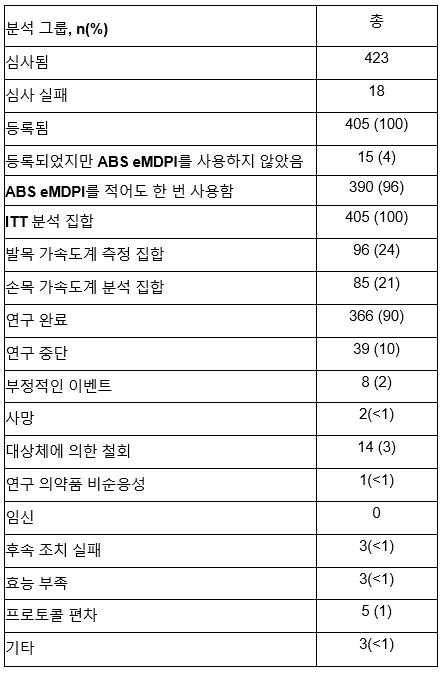
연구를 완료한 98명의 환자가 AECOPD 이벤트를 겪었으며 디지핼러를 사용하였다. 총 121건의 중등도/중증 AECOPD 이벤트가 기록되었다. 추가의 세부 사항이 표 2에 제공되어 있다.98 patients who completed the study had an AECOPD event and used Digihaler. A total of 121 moderate/severe AECOPD events were recorded. Additional details are provided in Table 2.
[표 2][Table 2]

연구를 완료한 366명의 환자에 대해: 30명(8%)의 환자가 흡입기를 전혀 사용하지 않았으며; 268명(73%)은 일일 평균 최대 5회 흡입하였으며; 11명(3%)은 일일 평균 10회 이상 흡입하였다. For the 366 patients who completed the study: 30 (8%) patients did not use an inhaler at all; 268 (73%) took an average of up to 5 inhalations per day; Eleven patients (3%) inhaled more than 10 times a day on average.
도 9는 대상체당 평균 구조 흡입 횟수 대 COPD 악화로부터의 일수에 대한 그래프(30b)를 보여준다. 도 9는 악화가 발생하는 날의 양측으로 14일의 위험 기간 동안의 데이터를 보여준다. 라인(32b)은 위험 기간 동안의 평균 일일 구조 흡입 횟수에 해당한다. 라인(32b)은, y-축에서, 라인(34b)에 의해 나타내어진 위험 기간 외의 기준선 평균 일일 구조 흡입 횟수보다 더 높이 위치한다. 이것은 악화 위험이 증가함에 따라 평균 일일 구조 흡입 횟수가 증가하는 것을 나타낸다. 참고로, 그림 9는 36b선으로 표시된 악화를 경험하지 않은 환자에 대한 기준 1일 구조 흡입 횟수를 추가로 제공합니다.9 shows a
도 10은 대상체당 평균 구조 흡입 횟수 대 COPD 악화로부터의 일수에 대한 다른 그래프(30b)를 보여준다. 도 10은 악화가 발생하는 날의 양측으로 30일의 위험 기간 동안의 데이터를 보여준다. 도 10은 라인(34b)으로 나타내어진 위험 기간 외의 기준선 평균 일일 구조 흡입 횟수와 비교하여, 악화가 발생하는 날이 가까워짐에 따라 구조 흡입기 사용이 현저히 증가하는 것을 보여준다.10 shows another
데이터는 악화되기 약 2주 전에 구조 약물 흡입 횟수의 증가를 보여준다. 악화되기 약 1주 전에 추가의 더 작은 증가가 있다. 표 3은 구조 약물 사용 증가와 AECOPD 사이의 연관성과 관련하여 추가의 세부 사항을 제공한다. The data show an increase in the number of rescue drug inhalations about 2 weeks before exacerbation. There is an additional smaller increase about a week before worsening. Table 3 provides additional details regarding the association between increased rescue drug use and AECOPD.
[표 3][Table 3]
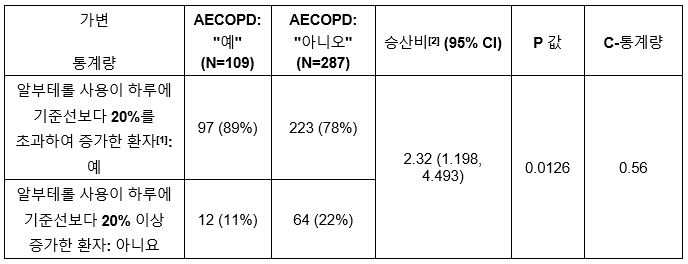
[1] AECOPD 이벤트를 경험한 환자의 경우, 알부테롤 사용이 이벤트의 증상 정점 전이다. 다수의 이벤트를 경험한 환자의 경우, 제1 이벤트만 분석에 포함된다. 기준선 알부테롤 사용이 연구에서 처음 7일 동안의 평균 흡입으로서 정의된다. 처음 7일 동안 흡입이 발생하지 않은 경우, 7일 이후에 최초 유효 흡입이 사용된다. 전체 연구 동안 흡입이 발생하지 않은 경우, 기준선은 0(제로)이다. [2] 모든 추론 통계량, 승산비, p 값 및 적합도에 대한 C-통계량을 증가된 알부테롤 사용 현황과 기준선 알부테롤 사용을 설명 변수로 하는 로지스틱 회귀 모델(logistic regression model)로부터 추정하였다. 1보다 큰 승산비는 일일 알부테롤 사용이 기준선보다 20% 넘게 초과한 환자가 알부테롤 사용이 기준선보다 20% 초과한 적이 없는 환자보다 AECOPD 이벤트를 경험할 가능성이 더 높다는 것을 나타낸다. 연구 1일차 내지 연구 7일차까지 AECOPD를 경험한 환자는 분석에서 제외된다.[1] For patients experiencing an AECOPD event, albuterol use precedes the symptom peak of the event. For patients experiencing multiple events, only the first event is included in the analysis. Baseline albuterol use is defined as mean inhalation over the first 7 days of the study. If no inhalation has occurred during the first 7 days, the first effective inhalation is used after 7 days. If no inhalation occurred during the entire study, the baseline is 0 (zero). [2] C-statistics for all inference statistics, odds ratios, p values, and goodness-of-fit were estimated from a logistic regression model with increased albuterol use and baseline albuterol use as explanatory variables. Odds ratios greater than 1 indicate that patients with daily albuterol use greater than 20% above baseline are more likely to experience an AECOPD event than patients whose daily albuterol use has never exceeded baseline by 20%. Patients who experienced AECOPD from
도 11은 대상체당 평균(중수) 피크 흡입 유량 대 COPD 악화로부터의 일수에 대한 그래프(40b)를 보여준다. 도 11은 악화가 발생하는 날의 양측으로 14일의 위험 기간 동안의 데이터를 보여준다. 라인(42b)은 위험 기간 동안의 평균 피크 흡입 유량에 해당한다. 라인(42b)은, y-축에서, 라인(44b)으로 나타내어진 위험 기간 외의 기준선 평균 피크 흡입 유량보다 약간 높이 위치하지만, 이 차이는 중요한 것으로 생각되지 않는다. 도 11은 라인(46b)으로 나타내어진, 악화를 경험하지 않은 환자에 대한 기준선 평균 피크 흡입 유량을 추가로 제공한다.11 shows a
도 12는 대상체당 평균(중수) 피크 흡입 유량 대 COPD 악화로부터의 일수에 대한 다른 그래프(60b)를 보여준다. 도 12는 악화가 발생하는 날의 양측으로 30일의 위험 기간 동안의 데이터를 보여준다. 도 12는 악화 이전 비교적 안정적이고 낮은 평균 피크 흡입 유량을 보여준다.12 shows another
도 13은 대상체당 평균 흡입량 대 COPD 악화로부터의 일수에 대한 그래프(60b)를 보여준다. 도 13은 악화가 발생하는 날의 양측으로 14일의 위험 기간 동안의 데이터를 보여준다. 라인(62b)은 위험 기간 동안의 평균 흡입량에 해당한다. 라인(62b)은, y-축에서, 라인(64b)에 의해 나타내어진 위험 기간 외의 기준선 평균 흡입량보다 더 낮게 위치한다. 도 13은 라인(66b)으로 나타내어진, 악화를 경험하지 않은 환자에 대한 기준선 평균 흡입량을 추가로 제공한다.13 shows a
도 14는 대상체당 평균 흡입량 대 COPD 악화로부터의 일수에 대한 그래프(60b)를 보여준다. 도 14는 악화가 발생하는 날의 양측으로 30일의 위험 기간 동안의 데이터를 보여준다.14 shows a
도 15는 대상체당 평균 흡입 지속 시간 대 COPD 악화로부터의 일수에 대한 그래프(70b)를 보여준다. 도 15는 악화가 발생하는 날의 양측으로 14일의 위험 기간 동안의 데이터를 보여준다. 라인(72b)은 위험 기간 동안의 평균 흡입 지속 시간에 해당한다. 라인(72b)은, y-축에서, 라인(74b)에 의해 나타내어진 위험 기간 외의 기준선 평균 흡입 지속 시간보다 더 낮게 위치한다. 도 15는 라인(76b)으로 나타내어진, 악화를 경험하지 않은 환자에 대한 기준선 평균 흡입 지속 시간을 추가로 제공한다.15 shows a
도 16은 대상체당 평균 흡입 지속 시간 대 COPD 악화로부터의 일수에 대한 다른 그래프(70b)를 보여준다. 도 16은 악화가 발생하는 날의 양측으로 30일의 위험 기간 동안의 데이터를 보여준다.16 shows another
도 13 내지 도 16은 AECOPD 이전에 흡입량과 지속 시간이 비교적 장기간에 걸쳐(약 30일 이상에 걸쳐 눈에 띄게) 선형적으로 감소하는 것을 나타낸다.13-16 show a linear decrease in inhalation volume and duration prior to AECOPD over a relatively long period of time (notably over about 30 days or more).
표 4는 ±14일 동안 및 그 기간 외에 AECOPD를 경험한 환자와 AECOPD를 경험하지 않은 환자에 대해 기록된 흡입 파라미터 및 구조 약물 사용을 비교하고 있다.Table 4 compares inhalation parameters and rescue drug use recorded for patients who experienced AECOPD and those who did not experience AECOPD for ±14 days and beyond.
[표 4][Table 4]
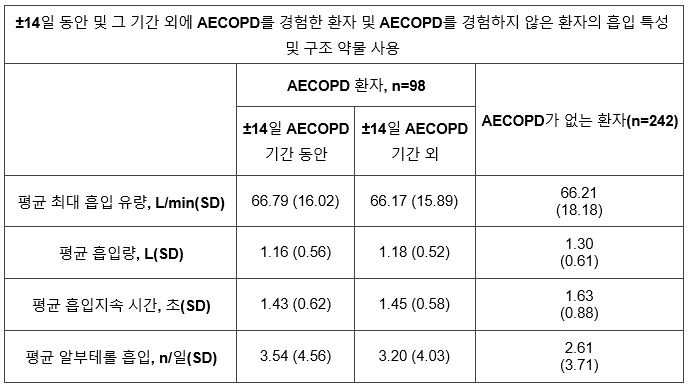
악화를 경험하지 않은 환자에 비해 악화를 경험한 환자에게서 기준선 평균 일일 알부테롤 흡입이 더 높았으며 평균 흡입량 및 지속 시간이 약간 더 낮았다. ±14일 AECOPD 기간 동안, 환자는 AECOPD가 없는 환자와 비교하여 기준선(±14일 AECOPD 기간 외)보다 더 높은 일일 알부테롤 흡입을 나타내었다.The baseline mean daily albuterol inhalation was higher and the mean inhalation volume and duration slightly lower in patients with exacerbations compared to those without exacerbations. During the ±14 day AECOPD period, patients had higher daily albuterol inhalations than baseline (outside the ±14 day AECOPD period) compared to patients without AECOPD.
전술한 천식 악화 예측 모델과 대조적으로, COPD 악화의 가장 강력한 예측 인자는 기류와 관련된 파라미터, 예를 들어, 피크 흡입 유량, 흡입량 및/또는 흡입 지속 시간인 것으로 밝혀졌다. 구조 흡입 횟수도 유의미한 예측 가치가 있는 것으로 밝혀졌다. In contrast to the asthma exacerbation predictive model described above, the strongest predictors of COPD exacerbation were found to be airflow-related parameters, such as peak inhalation flow rate, inhalation volume and/or inhalation duration. The number of rescue suctions was also found to have significant predictive value.
위의 결과를 바탕으로, COPD 악화 확률을 결정하기 위한 제1 가중치 적용 예측 모델을 개발하였다. 지도형 기계 학습 기술인 그라디언트 부스팅 트리를 사용하여 분류 문제(앞으로 x일(악화 기간)의 COPD 악화의 예/아니오)를 해결하였다. 사용된 그라디언트 부스팅 트리 기술은 천식 악화 예측 모델과 관련하여 전술한 바와 동일하였다.Based on the above results, a first weighted prediction model was developed to determine the probability of COPD exacerbation. Gradient boosting trees, a supervised machine learning technique, were used to solve the classification problem (yes/no of COPD exacerbations in the next x days (exacerbation period)). The gradient boosting tree technique used was the same as described above with respect to the asthma exacerbation prediction model.
표 5는 가중치 적용 모델에 포함될 수 있는 인자의 예시적인 목록을 서로에 대한 상대적 가중치와 함께 제공한다.Table 5 provides an exemplary list of factors that may be included in a weighted model, along with their relative weights to each other.
[표 5][Table 5]
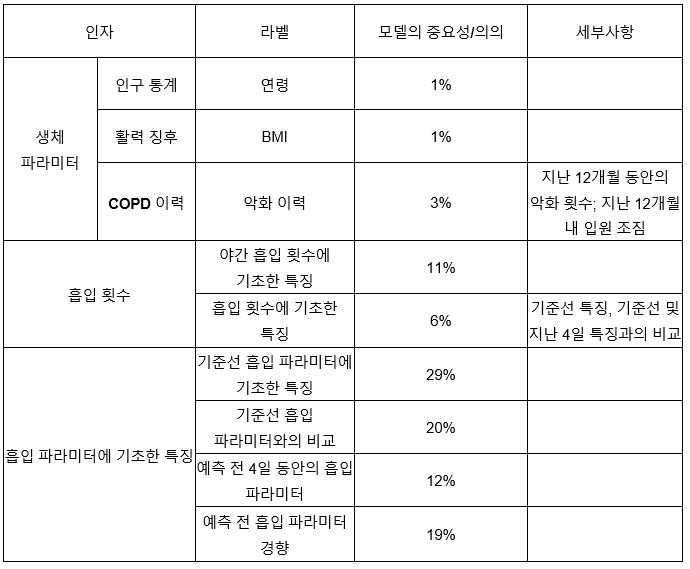
생성된 모델을 수신자 조작 특성(ROC) 곡선 분석에 의해 평가하였다. 임박한 COPD 악화의 확률을 결정하기 위한 예측 모델의 가장 중요한 인자가 흡입 파라미터이긴 하지만, 예측 모델은 이것을 구조 흡입 횟수와 관련된 데이터로 보완함으로써 강화되었다. 도 17은 거짓의 양성율에 대해 참의 양성율을 플롯으로 표시함으로써 모델의 품질을 평가하는 모델의 수신자 조작 특성(ROC) 곡선 분석을 보여준다. 이 모델은 0.77의 ROC 곡선(AUC) 값 아래의 영역으로 이후 5일에 걸쳐 임박한 악화를 예측하였다. The resulting model was evaluated by receiver operating characteristic (ROC) curve analysis. Although inhalation parameters were the most important factor in the predictive model for determining the probability of impending COPD exacerbation, the predictive model was enhanced by supplementing it with data related to the number of rescue inhalations. 17 shows a receiver operating characteristic (ROC) curve analysis of a model that evaluates the quality of the model by plotting the true positive rate against the false positive rate. The model predicted imminent exacerbation over the next 5 days with areas below the ROC curve (AUC) value of 0.77.
COPD 악화 예측의 경우, 구조 흡입 횟수는, 흡입 파라미터보다 확률에 전체적으로 덜 영향을 미침에도 불구하고, 악화 확률이 결정될 수 있는 정확도를 향상시키는 중요한 인자를 나타낼 수 있다.In the case of COPD exacerbation prediction, the number of rescue inhalations can represent an important factor improving the accuracy with which exacerbation probabilities can be determined, albeit overall less influencing probabilities than inhalation parameters.
파라미터가 피크 흡입 유량을 포함하는 경우, 방법(20)은 제2 기간 동안 수행된 흡입에 대해 측정된 피크 흡입 유량으로부터 최소 또는 평균 피크 흡입 유량과 같은 피크 흡입 유량을 결정하는 단계를 추가로 포함할 수 있다. 제2 기간과 관련하여 "제2"라는 용어는 피크 흡입 유량을 샘플링하기 위한 기간과 구조 흡입 횟수가 샘플링되는 제1 기간을 구분하기 위한 것이다. 제2 기간이 제1 기간과 적어도 부분적으로 중첩될 수 있으며, 또는 제1 및 제2 기간이 동시간대일 수 있다.If the parameter includes a peak intake flow rate, the
따라서, COPD 악화 확률을 결정하는 단계(26)는 최소 또는 평균 피크 흡입 유량에 부분적으로 기초할 수 있다. 제2 기간이 제1 기간과 관련하여 위에서 설명한 고려 사항과 유사한 방식으로 적절한 지표 값의 피크 흡입 유량 데이터를 수집하는 데 필요한 시간에 따라 선택될 수 있다.Accordingly, the
COPD 악화 확률의 결정이 도 11 및 도 12에 도시된 바와 같이 기준선 피크 흡입 유량에 대한 최소 또는 평균 피크 흡입 유량의 변화에 부분적으로 기초할 수 있다.The determination of the COPD exacerbation probability may be based in part on the change in the minimum or average peak inhalation flow rate relative to the baseline peak inhalation flow rate, as shown in FIGS. 11 and 12 .
악화 예측 정확도를 향상시키기 위해, 기준선에 대한 최소 또는 평균 피크 흡입 유량의 변화가, 예를 들어, 50% 이상 또는 90% 이상과 같이 10% 이상일 수 있다. 기준선이, 예를 들어, 악화가 발생하지 않은 기간에 걸쳐, 예를 들어, 10일과 같이 1일 내지 20일 동안 측정된 일일 최소 피크 흡입 유량을 사용하여 결정될 수 있다. 대안으로서 또는 추가적으로, 최소 또는 평균 피크 흡입 유량이 절대값에 대해 평가될 수 있다.To improve exacerbation prediction accuracy, the change in minimum or average peak intake flow rate relative to baseline may be, for example, greater than or equal to 10%, such as greater than or equal to 50% or greater than 90%. A baseline may be determined, for example, using the daily minimum peak inhalation flow measured over a period of time in which no exacerbations have occurred, eg, from 1 to 20 days, such as 10 days. Alternatively or additionally, the minimum or average peak suction flow rate can be evaluated for absolute values.
방법(20)은 제3 기간 동안 수행된 흡입에 대해 측정된 흡입량으로부터 최소 또는 평균 흡입량과 같은 흡입량을 결정하는 단계를 포함할 수 있다. 제3 기간과 관련하여 "제3"이라는 용어는 흡입량을 샘플링하기 위한 기간과 구조 흡입 횟수가 샘플링되는 제1 기간 및 피크 흡입 유량 데이터가 샘플링되는 제2 기간을 구분하기 위한 것이다. 제3 기간이 제1 기간 및/또는 제2 기간과 적어도 부분적으로 중첩될 수 있으며, 또는 제3 기간이 제1 기간 및 제2 기간 중 적어도 하나와 동시간대일 수 있다.
따라서, COPD 악화 확률을 결정하는 단계(26)는 최소 또는 평균 흡입량에 부분적으로 기초할 수 있다. 제3 기간이 제1 기간과 관련하여 위에서 설명한 고려 사항과 유사한 방식으로 적절한 지표 값의 최소 흡입량 데이터를 수집하는 데 필요한 시간에 따라 선택될 수 있다.Accordingly, the
COPD 악화 확률의 결정이 도 13 및 도 14에 도시된 바와 같이 기준선 흡입량에 대한 최소 또는 평균 흡입량의 변화에 부분적으로 기초할 수 있다. The determination of the COPD exacerbation probability may be based in part on the change in the minimum or average inhalation volume relative to the baseline inhalation amount, as shown in FIGS. 13 and 14 .
악화 예측 정확도를 향상시키기 위해, 기준선에 대한 최소 또는 평균 흡입량의 변화가, 예를 들어, 50% 이상 또는 90% 이상과 같이 10% 이상일 수 있다. 기준선이, 예를 들어, 악화가 발생하지 않은 기간에 걸쳐, 예를 들어, 10일과 같이 1일 내지 20일 동안 측정된 일일 최소 흡입량을 사용하여 결정될 수 있다. 대안으로서 또는 추가적으로, 최소 또는 평균 흡입량이 절대값에 대해 평가될 수 있다.To improve exacerbation prediction accuracy, the change in the minimum or average inhalation amount relative to the baseline may be, for example, 10% or more, such as 50% or more or 90% or more. A baseline may be determined using, for example, the minimum daily intake measured over a period of time in which no exacerbations have occurred, eg, from 1 to 20 days, eg, 10 days. Alternatively or additionally, the minimum or average inhalation amount may be assessed against the absolute value.
방법(20)은 제4 기간에 걸쳐 흡입에 대해 측정된 흡입 지속 시간으로부터 최소 또는 평균 흡입 지속 시간과 같은 흡입 지속 시간을 결정하는 단계를 포함할 수 있다. 제4 기간과 관련하여 "제4"라는 용어는 흡입 지속 시간을 샘플링하기 위한 기간과 구조 흡입 횟수가 샘플링되는 제1 기간, 피크 흡입 유량 데이터가 샘플링되는 제2 기간, 및 흡입량 데이터가 샘플링되는 제3 기간을 구분하기 위한 것이다. 제4 기간이 제1 기간, 제2 기간 및/또는 제3 기간과 적어도 부분적으로 중첩될 수 있으며, 또는 제4 기간이 제1 기간, 제2 기간 및 제3 기간 중 적어도 하나와 동시간대일 수 있다.
따라서, COPD 악화 확률을 결정하는 단계(26)는 최소 또는 평균 흡입 지속 시간에 부분적으로 기초할 수 있다. 제4 기간이 제1 기간과 관련하여 위에서 설명한 고려 사항과 유사한 방식으로 적절한 지표 값의 최소 흡입 지속 시간 데이터를 수집하는 데 필요한 시간에 따라 선택될 수 있다.Accordingly, the
COPD 악화 확률의 결정이 도 15 및 도 16에 도시된 바와 같이 기준선 흡입 지속 시간에 대한 최소 또는 평균 흡입 지속 시간의 변화에 부분적으로 기초할 수 있다. The determination of the COPD exacerbation probability may be based in part on the change in the minimum or average inhalation duration relative to the baseline inhalation duration, as shown in FIGS. 15 and 16 .
악화 예측 정확도를 향상시키기 위해, 기준선에 대한 최소 또는 평균 흡입 지속 시간의 변화가, 예를 들어, 50% 이상 또는 90% 이상과 같이 10% 이상일 수 있다. 기준선이, 예를 들어, 악화가 발생하지 않은 기간에 걸쳐, 예를 들어, 10일과 같이 1일 내지 20일 동안 측정된 일일 평균 흡입 지속 시간을 사용하여 결정될 수 있다. 대안으로서 또는 추가적으로, 최소 또는 평균 흡입 지속 시간이 절대값에 대해 평가될 수 있다.To improve exacerbation prediction accuracy, the change in minimum or average inhalation duration relative to baseline may be, for example, greater than or equal to 10%, such as greater than or equal to 50% or greater than 90%. A baseline may be determined, for example, using the average daily inhalation duration measured over a period in which no exacerbations have occurred, eg, from 1 to 20 days, such as 10 days. Alternatively or additionally, a minimum or average duration of inhalation can be evaluated for absolute values.
도 18 내지 도 22는 시스템(10)에 포함될 수 있는 흡입기 장치(100)의 비제한적인 일 예를 제공한다.18-22 provide one non-limiting example of an
도 18은 비제한적인 일 예에 따른, 여기에서 "흡입기"로 지칭되는 흡입기 장치(100)의 전방 사시도를 제공한다. 흡입기(100)가, 예를 들어, 호흡 작동식 흡입기일 수 있다. 흡입기(100)가 상부 캡(102), 메인 하우징(104), 마우스피스(106), 마우스피스 커버(108), 전자 모듈(120), 및 통기공(126)을 포함할 수 있다. 마우스피스 커버(108)가 메인 하우징(104)에 힌지 연결될 수 있어 마우스피스(106)를 노출시키도록 개폐될 수 있다. 힌지 연결로서 도시되어 있지만, 마우스피스 커버(106)가 다른 유형의 연결을 통해 흡입기(100)에 연결될 수 있다. 더욱이, 전자 모듈(120)이 메인 하우징(104)의 상부에 있는 상부 캡(102) 내부에 수용되는 것으로 도시되어 있지만, 전자 모듈(120)이 흡입기(100)의 본체(104) 내부에 통합 및/또는 수용될 수 있다.18 provides a front perspective view of an
도 19는 예시적인 흡입기(100)의 단면 내부 사시도를 제공한다. 메인 하우징(104) 내부에, 흡입기(100)가 약물 저장소(110)(예를 들어, 호퍼), 벨로우즈(112), 벨로우즈 스프링(114), 요크(보이지 않음), 투약 컵(116), 투약 챔버(117), 탈응집기(121) 및 유로(119)를 포함할 수 있다. 약물 저장소(110)는 대상체에게 전달하기 위한 건조 분말 약물과 같은 약물을 포함할 수 있다. 마우스피스 커버(108)가 폐쇄 위치로부터 개방 위치로 이동될 때, 벨로우즈(112)가 압축되어 약물 저장소(110)로부터 투약 컵(116)으로 도스의 약물을 전달할 수 있다. 그 후, 대상체가 도스의 약물을 받기 위한 노력으로서 마우스피스(106)를 통해 흡입할 수 있다.19 provides a cross-sectional interior perspective view of an
대상체의 흡입으로부터 생성된 기류에 의해 탈응집기(121)가 투약 컵(116) 내의 약물 덩어리를 깨부수는 방식으로 도스의 약물을 에어로졸화할 수 있다. 탈응집기(121)는 유로(119)를 통한 기류가 특정 속도를 충족 또는 초과하거나 특정 범위 내에 있는 경우 약물을 에어로졸화하도록 구성될 수 있다. 에어로졸화되는 경우, 도스의 약물이 투약 컵(116)으로부터 투약 챔버(117) 내로, 유로(119)를 통해, 그리고 마우스피스(106) 밖으로 대상체에게로 이동할 수 있다. 유로(119)를 통한 기류가 특정 속도를 충족 또는 초과하지 않거나 특정 범위 내에 있지 않은 경우, 약물이 투약 컵(116)에 남아 있을 수 있다. 투약 컵(116) 내의 약물이 탈응집기(121)에 의해 에어로졸화되지 않은 경우, 마우스피스 커버(108)가 이후 개방될 때 다른 도스의 약물이 약물 저장소(110)로부터 전달되지 않을 수 있다. 따라서, 1회 도스의 약물이 탈응집기(121)에 의해 에어로졸화된 때까지 투약 컵에 남아 있을 수 있다. 도스의 약물이 전달되면, 도스 확인이 도스 확인 정보로서 흡입기(100)의 메모리에 저장될 수 있다.The
대상체가 마우스피스(106)를 통해 흡입함에 따라, 공기가 통기공에 들어가 대상체에게 약물을 전달하기 위한 공기 흐름을 제공할 수 있다. 유로(119)가 투약 챔버(117)로부터 마우스피스(106)의 단부까지 연장될 수 있으며, 투약 챔버(117) 및 마우스피스(106)의 내부 부분을 포함할 수 있다. 투약 컵(116)이 투약 챔버(117) 내부에 또는 이에 인접하게 존재할 수 있다. 또한, 흡입기(100)가 초기에 약물 저장소(110) 내부의 약물의 총 도스의 개수로 설정되며 마우스피스 커버(108)가 폐쇄 위치로부터 개방 위치로 이동될 때마다 하나씩 감소하도록 구성된 도스 카운터(111)를 포함할 수 있다.As the subject inhales through the
상부 캡(102)이 메인 하우징(104)에 부착될 수 있다. 예를 들어, 상부 캡(102)이 메인 하우징(104) 상의 오목부와 정합하는 하나 이상의 클립의 사용을 통해 메인 하우징(104)에 부착될 수 있다. 상부 캡(102)이 연결되는 경우, 예를 들어, 상부 캡(102)과 메인 하우징(104) 사이에 실질적으로 공압 시일이 존재하도록 메인 하우징(104)의 일부와 중첩될 수 있다.A
도 20은 전자 모듈(120)을 노출시키기 위해 상부 캡(102)이 제거된 예시적인 흡입기(100)의 분해 사시도이다. 도 20에 도시된 바와 같이, 메인 하우징(104)의 상부 표면이 하나 이상(예를 들어, 2개)의 오리피스(146)를 포함할 수 있다. 오리피스(146) 중 하나가 슬라이더(140)를 수용하도록 구성될 수 있다. 예를 들어, 상부 캡(102)이 메인 하우징(104)에 부착될 때, 슬라이더(140)가 오리피스(146) 중 하나를 통해 메인 하우징(104)의 상부 표면을 통해 돌출될 수 있다.20 is an exploded perspective view of the
도 21은 예시적인 흡입기(100)의 상부 캡(102) 및 전자 모듈(120)의 분해 사시도이다. 도 21에 도시된 바와 같이, 슬라이더(140)가 암(142), 스토퍼(144), 및 말단부(145)를 형성할 수 있다. 말단부(145)가 슬라이더(140)의 바닥 부분일 수 있다. 슬라이더(140)의 말단부(145)가 메인 하우징(104) 내부에 존재하는 요크와 인접하도록(예를 들어, 마우스피스 커버(108)가 폐쇄 위치에 있거나 부분적으로 개방된 위치에 있을 때) 구성될 수 있다. 말단부(145)는 요크가 임의의 반경 방향 배향에 있을 때 요크의 상부 표면과 인접하도록 구성될 수 있다. 예를 들어, 요크의 상부 표면이 복수의 구멍(도시하지 않음)을 포함할 수 있으며, 슬라이더(140)의 말단부(145)가, 예를 들어, 구멍이 슬라이더(140)와 정렬되어 있는지 여부에 따라 요크의 상부 표면과 인접하도록 구성될 수 있다. 21 is an exploded perspective view of the
상부 캡(102)이 슬라이더 스프링(146) 및 슬라이더(140)를 수용하도록 구성된 슬라이더 가이드(148)를 포함할 수 있다. 슬라이더 스프링(146)이 슬라이더 가이드(148) 내부에 존재할 수 있다. 슬라이더 스프링(146)이 상부 캡(102)의 내부 표면과 정합할 수 있으며, 슬라이더 스프링(146)이 슬라이더(140)의 상부 부분(예를 들어, 기단부)과 정합(예를 들어, 인접)할 수 있다. 슬라이더(140)가 슬라이더 가이드(148) 내부에 설치되면, 슬라이더(140)의 상부와 상부 캡(102)의 내면 사이에서 슬라이더 스프링(146)이 부분적으로 압축될 수 있다. 예를 들어, 슬라이더 스프링(146)은 마우스피스 커버(108)가 폐쇄되면 슬라이더(140)의 말단부(145)가 요크와 접촉 상태를 유지하도록 구성될 수 있다. 슬라이더(145)의 말단부(145)가 또한, 마우스피스 커버(108)가 개방되거나 폐쇄되는 동안 요크와 접촉 상태를 유지할 수 있다. 슬라이더(140)의 스토퍼(144)가, 예를 들어, 슬라이더(140)가 마우스피스 커버(108)의 개폐를 통해 슬라이더 가이드(148) 내부에 유지되도록 슬라이더 가이드(148)의 스토퍼와 정합할 수 있으며, 그 반대도 마찬가지이다. 스토퍼(144) 및 슬라이더 가이드(148)가 슬라이더(140)의 수직(예를 들어, 축방향) 이동을 제한하도록 구성될 수 있다. 이러한 제한 범위는 요크의 수직 이동보다 작을 수 있다. 따라서, 마우스피스 커버(108)가 완전 개방 위치로 이동됨에 따라, 요크가 마우스피스(106)를 향해 수직 방향으로 계속 이동할 수 있지만, 스토퍼(144)는 슬라이더(140)의 말단부(145)가 더 이상 요크와 접촉하지 않을 수 있도록 슬라이더(140)의 수직 이동을 중단시킬 수 있다.The
보다 일반적으로, 요크가 마우스피스 커버(108)에 기계적으로 연결될 수 있으며 마우스피스 커버(108)가 폐쇄 위치로부터 개방됨에 따라 벨로우즈 스프링(114)을 압축하도록 이동한 다음, 마우스피스 커버가 완전 개방 위치에 도달하면 압축된 벨로우즈 스프링(114)을 해제하도록 구성될 수 있어, 이에 의해 벨로우즈(112)가 약물 저장소(110)로부터 투약 컵(116)으로 도스를 전달하도록 한다. 요크는 마우스피스 커버(108)가 폐쇄 위치에 있을 때 슬라이더(140)와 접촉 상태일 수 있다. 슬라이더(140)는 마우스피스 커버(108)가 폐쇄 위치로부터 개방됨에 따라 요크에 의해 이동되며 마우스피스 커버(108)가 완전 개방 위치에 도달하면 요크로부터 분리되도록 배열될 수 있다. 마우스피스 커버(108)를 개방하면 도스의 약물이 계량되기 때문에, 이러한 배열이 전술한 도스 계량 조립체의 비제한적인 일 예로서 간주될 수 있다.More generally, a yoke may be mechanically coupled to the
도스 계량 동안의 슬라이더(140)의 이동에 의해 슬라이더(140)가 스위치(130)와 정합하여 스위치를 작동시킬 수 있다. 스위치(130)가 도스 계량을 등록하도록 전자 모듈(120)을 작동시킬 수 있다. 따라서, 전자 모듈(120)과 함께 슬라이더(140) 및 스위치(130)가 전술한 사용-검출 시스템(12B)의 비제한적인 일 예에 해당할 수 있다. 이 예에서, 슬라이더(140)는 사용-검출 시스템(12B)이 도스 계량 조립체에 의한 도스의 계량을 등록하도록 구성되며, 이에 의해 각각의 계량이 제1 흡입기(100)를 사용하여 대상체에 의해 수행된 구조 흡입을 나타내도록 하는 수단으로서 간주될 수 있다.Movement of the
슬라이더(140)에 의한 스위치(130)의 작동에 의해 또한, 예를 들어, 전자 모듈(120)이 제1 전력 상태로부터 제2 전력 상태로 전이되며 마우스피스(106)로부터의 대상체에 의한 흡입을 감지하게 된다.Actuation of the
전자 모듈(120)이 인쇄 회로 기판(PCB) 조립체(122), 스위치(130), 전원(예를 들어, 배터리(126)), 및/또는 배터리 홀더(124)를 포함할 수 있다. PCB 조립체(122)가 센서 시스템(128), 무선 통신 회로(129), 스위치(130), 및/또는 하나 이상의 발광 다이오드(LED)와 같은 하나 이상의 표시기(도시하지 않음)와 같은 표면 실장 구성 요소를 포함할 수 있다. 전자 모듈(120)이 제어부(예를 들어, 프로세서) 및/또는 메모리를 포함할 수 있다. 제어부 및/또는 메모리가 PCB(122)의 물리적으로 구별되는 구성 요소일 수 있다. 대안으로서, 제어부 및 메모리가 PCB(122)에 장착된 다른 칩셋의 일부일 수 있으며, 예를 들어, 무선 통신 회로(129)가 전자 모듈(120)용의 제어부 및/또는 메모리를 포함할 수 있다. 전자 모듈(120)의 제어부가 마이크로컨트롤러, 프로그램 가능 논리 장치(PLD), 마이크로프로세서, 주문형 집적 회로(ASIC), 필드 프로그램 가능 게이트 어레이(FPGA), 또는 임의의 적절한 처리 장치, 또는 제어 회로를 포함할 수 있다.The
제어부가 메모리로부터의 정보에 접근하며 메모리에 데이터를 저장할 수 있다. 메모리가 비탈착식 메모리 및/또는 탈착식 메모리와 같은 임의의 유형의 적절한 메모리를 포함할 수 있다. 비탈착식 메모리는 랜덤 액세스 메모리(RAM), 읽기 전용 메모리(ROM), 하드 디스크 또는 기타 유형의 메모리 저장 장치를 포함할 수 있다. 착탈식 메모리는 가입자 식별 모듈(SIM) 카드, 메모리 스틱, 보안 디지털(SD) 메모리 카드 등을 포함할 수 있다. 메모리가 제어부 내부에 있을 수 있다. 제어부가 또한, 서버 또는 스마트 폰과 같이 전자 모듈(120) 내부에 물리적으로 위치되지 않는 메모리로부터의 데이터에 접근하며 메모리에 데이터를 저장할 수 있다.The control may access information from the memory and store data in the memory. The memory may include any type of suitable memory, such as non-removable memory and/or removable memory. Non-removable memory may include random access memory (RAM), read-only memory (ROM), hard disks, or other types of memory storage devices. Removable memory may include a subscriber identity module (SIM) card, a memory stick, a secure digital (SD) memory card, and the like. The memory may be internal to the control unit. The controller may also access data from a memory that is not physically located inside the
센서 시스템(128)이 하나 이상의 센서를 포함할 수 있다. 센서 시스템(128)이 센서 시스템(12A)의 일 예일 수 있다. 센서 시스템(128)이, 예를 들어, 하나 이상의 압력 센서, 온도 센서, 습도 센서, 방향 센서, 음향 센서, 및/또는 광학 센서와 같은 상이한 유형의 하나 이상의 센서를 포함할 수 있지만, 이것으로 제한되는 것은 아니다. 하나 이상의 압력 센서가 기압 센서(예를 들어, 대기압 센서), 차압 센서, 절대 압력 센서 및/또는 기타 등등을 포함할 수 있다. 센서가 마이크로 전자 기계 시스템(MEMS) 및/또는 나노 전자 기계 시스템(NEMS) 기술을 채용할 수 있다. 센서 시스템(128)이 전자 모듈(120)의 제어부에 즉각적인 판독치(예를 들어, 압력 판독치) 및/또는 시간 경과에 따라 집계된 판독치(예를 들어, 압력 판독치)를 제공하도록 구성될 수 있다. 도 19 및 도 20에 도시된 바와 같이, 센서 시스템(128)이 흡입기(100)의 유로(119) 외부에 존재할 수 있지만, 유로(119)에 공압적으로 결합될 수 있다.The
전자 모듈(120)의 제어부가 센서 시스템(128)으로부터 측정에 해당하는 신호를 수신할 수 있다. 제어부가 센서 시스템(128)으로부터 수신된 신호를 사용하여 하나 이상의 기류 측정치를 계산하거나 결정할 수 있다. 기류 측정치가 흡입기(100)의 유로(119)를 통한 기류의 프로파일을 나타낼 수 있다. 예를 들어, 센서 시스템(128)이 0.3 킬로파스칼(kPa)의 압력 변화를 기록하는 경우, 전자 모듈(120)은 이러한 변화가 유로(119)를 통한 분당 대략 45 리터(Lpm)의 기류 유속에 해당한다고 결정할 수 있다.The control unit of the
도 22는 기류 유속 대 압력의 그래프를 보여준다. 도 22에 도시된 기류 유속 및 프로파일은 단지 예시일 뿐이며, 결정된 유속이 흡입 장치(100) 및 그 구성 요소의 크기, 형상 및 디자인에 따라 달라질 수 있다.22 shows a graph of airflow flow rate versus pressure. The airflow flow rate and profile shown in FIG. 22 are merely exemplary, and the determined flow rate may vary depending on the size, shape, and design of the
전자 모듈(120)의 제어부가 센서 시스템(128)으로부터 수신된 신호 및/또는 결정된 기류 측정치를, 예를 들어, 흡입기(100)가 어떻게 사용되고 있는지 및/또는 사용으로 인해 전체 도스의 약물이 전달될 가능성이 있는지 여부의 평가의 일부로서 하나 이상의 임계값 또는 범위와 비교함으로써 실시간으로 개인 맞춤형 데이터를 생성할 수 있다. 예를 들어, 결정된 기류 측정치가 특정 임계값 미만의 기류 유속을 갖는 흡입에 해당하는 경우, 전자 모듈(120)은 흡입기(100)의 마우스피스(106)로부터의 흡입이 없거나 불충분하였다고 결정할 수 있다. 결정된 기류 측정치가 특정 임계값 위의 기류 유속을 갖는 흡입에 해당하는 경우, 전자 모듈(120)은 흡입기(100)의 마우스피스(106)로부터의 흡입이 과다하였다고 결정할 수 있다. 결정된 기류 측정치가 특정 범위 내의 기류 유속을 갖는 흡입에 해당하는 경우, 전자 모듈(120)은 흡입이 "양호"하거나 전체 도스의 약물 전달을 초래할 가능성이 있다고 결정할 수 있다.The control unit of the
압력 측정 판독치 및/또는 계산된 기류 측정치가 흡입기(100)로부터의 흡입 품질 또는 강도를 나타낼 수 있다. 예를 들어, 특정 임계값 또는 값 범위와 비교하는 경우, 판독치 및/또는 측정치를 사용하여 흡입을 양호한 흡입 이벤트, 저흡입 이벤트, 무흡입 이벤트, 또는 과도한 흡입 이벤트와 같은 특정 유형의 이벤트로 분류할 수 있다. 흡입의 분류가 대상체의 개인 맞춤형 데이터로서 저장된 사용 파라미터일 수 있다.Pressure measurement readings and/or calculated airflow measurements may be indicative of a suction quality or strength from the
무흡입 이벤트는 30 Lpm 미만의 기류 유속과 같은 특정 임계값 미만의 압력 측정 판독치 및/또는 기류 측정치와 연관될 수 있다. 무흡입 이벤트는 대상체가 마우스피스 커버(108)를 개방한 후 및 측정 사이클 동안 마우스피스(106)로부터 흡입하지 않는 경우 발생할 수 있다. 무흡입 이벤트가 또한, 대상체의 흡기 노력이 유로(119)를 통한 약물의 적절한 전달을 보장하기에 불충분한 경우, 예를 들어, 흡기 노력이 탈응집기(121)를 활성화하며 따라서 약물을 투약 컵(116)에서 에어로졸화하기에 불충분한 기류를 생성하는 경우 발생할 수 있다.A no-suction event may be associated with an airflow measurement and/or a pressure measurement reading below a certain threshold, such as an airflow flow rate of less than 30 Lpm. A no-suction event may occur if the subject does not inhale from the
저흡입 이벤트는 30 Lpm 내지 45 Lpm의 기류 유속과 같은 특정 범위 이내의 압력 측정 판독치 및/또는 기류 측정치와 연관될 수 있다. 저흡입 이벤트는 대상체가 마우스피스 커버(108)를 개방한 후 마우스피스(106)로부터 흡입하며 대상체의 흡기 노력으로 인해 약물의 적어도 일부 도스가 유로(119)를 통해 전달되는 경우 발생할 수 있다. 즉, 흡입이 약물의 적어도 일부가 투약 컵(116)으로부터 에어로졸화되도록 탈응집기(121)를 활성화하기에 충분할 수 있다.A hyposuction event may be associated with an airflow measurement and/or a pressure measurement reading within a certain range, such as an airflow flow rate of 30 Lpm to 45 Lpm. The low inhalation event may occur when the subject inhales from the
양호한 흡입 이벤트는 45 Lpm 내지 200 Lpm의 기류 유속과 같은 저흡입 이벤트 위의 압력 측정 판독치 및/또는 기류 측정치와 연관될 수 있다. 양호한 흡입 이벤트는 대상체가 마우스피스 커버(108)를 개방한 후 마우스피스(106)로부터 흡입하며 대상체의 흡기 노력이 유로(119)를 통한 약물의 적절한 전달을 보장하기에 충분한 경우, 예를 들어, 흡기 노력이 탈응집기(121)를 활성화하며 투약 컵(116)에서 전체 도스의 약물을 에어로졸화하기에 충분한 기류를 생성하는 경우 발생할 수 있다.A good intake event may be associated with a pressure measurement reading and/or an airflow measurement above a low intake event, such as an airflow flow rate of 45 Lpm to 200 Lpm. A good inhalation event is when the subject inhales from the
과도한 흡입 이벤트는 200 Lpm 위의 기류 유속과 같은 양호한 흡입 이벤트 위의 기류 측정치 및/또는 압력 측정 판독치와 연관될 수 있다. 과도한 흡입 이벤트는 대상체의 흡기 노력이 흡입기(100)의 정상적인 작동 파라미터를 초과하는 경우 발생할 수 있다. 과도한 흡입 이벤트는 대상체의 흡기 노력이 정상 범위 내에 있더라도 장치(100)가 사용 중에 적절하게 위치되거나 유지되지 않으면 발생할 수 있다. 예를 들어, 대상체가 마우스피스(106)로부터 흡입하는 동안 통기공이 막히거나 차단(예를 들어, 손가락이나 엄지손가락으로)되면 계산된 기류 유속이 200 Lpm을 초과할 수 있다.An excessive intake event may be associated with an airflow measurement and/or a pressure measurement reading above a good intake event, such as an airflow flow rate above 200 Lpm. An excessive inhalation event may occur when the subject's inspiratory effort exceeds normal operating parameters of the
임의의 적절한 임계값 또는 범위가 특정 이벤트를 분류하기 위해 사용될 수 있다. 이벤트 중 일부 또는 전부가 사용될 수 있다. 예를 들어, 무흡입 이벤트가 45 Lpm 미만의 기류 유속과 연관될 수 있으며, 양호한 흡입 이벤트가 45 Lpm 내지 200 Lpm의 기류 유속과 연관될 수 있다. 이와 같이, 경우에 따라 저흡입 이벤트가 전혀 사용되지 않을 수 있다.Any suitable threshold or range may be used to classify a particular event. Some or all of the events may be used. For example, a no-suction event may be associated with an airflow flow rate of less than 45 Lpm, and a good suction event may be associated with an airflow flow rate of between 45 Lpm and 200 Lpm. As such, in some cases the hyposuction event may not be used at all.
압력 측정 판독치 및/또는 계산된 기류 측정치가 또한, 흡입기(100)의 유로(119)를 통한 유동 방향을 나타낼 수 있다. 예를 들어, 압력 측정 판독치가 압력의 음의 변화를 반영하는 경우, 판독치가 유로(119)를 통해 마우스피스(106) 밖으로 유동하는 공기를 나타낼 수 있다. 압력 측정 판독치가 압력의 양의 변화를 반영하는 경우, 판독치가 유로(119)를 통해 마우스피스(106) 내로 유동하는 공기를 나타낼 수 있다. 따라서, 압력 측정 판독치 및/또는 기류 측정치를 사용하여 대상체가 마우스피스(106)로 숨을 내쉬고 있는지 여부를 결정할 수 있으며, 이것은 대상체가 장치(100)를 적절하게 사용하고 있지 않다는 신호일 수 있다.Pressure measurement readings and/or calculated airflow measurements may also indicate the direction of flow through
흡입기(100)가 폐 기능 측정치의 측정을 가능하게 하는 폐활량계 또는 유사하게 작동하는 장치를 포함할 수 있다. 예를 들어, 흡입기(100)가 대상체의 폐활량과 관련된 측정치를 얻기 위해 측정을 수행할 수 있다. 폐활량계 또는 유사하게 작동하는 장치가 대상체에 의해 흡입되며 및/또는 호기되는 공기의 양을 측정할 수 있다. 폐활량계 또는 유사하게 작동하는 장치가 흡입되며 및/또는 호기되는 공기의 양의 변화를 검출하기 위해 압력 변환기, 초음파계 또는 수위계를 사용할 수 있다.The
흡입기(100)의 사용으로부터 수집되거나 이에 기초하여 계산된 개인 맞춤형 데이터(예를 들어, 압력 측정치, 기류 측정치, 폐 기능 측정치, 도스 확인 정보 등)가 외부 장치를 통해(예를 들어, 부분적으로 또는 전체적으로)서도 계산 및/또는 평가될 수 있다. 보다 구체적으로, 전자 모듈(120)의 무선 통신 회로(129)가 송신기 및/또는 수신기(예를 들어, 트랜시버)뿐만 아니라 추가 회로를 포함할 수 있다. 예를 들어, 무선 통신 회로(129)가 블루투스 칩셋(예를 들어, 블루투스 저에너지 칩셋), 지그비(ZigBee) 칩셋, 스레드(Thread) 칩셋 등을 포함할 수 있다. 이와 같이, 전자 모듈(120)이 압력 측정치, 기류 측정치, 폐 기능 측정치, 도스 확인 정보, 및/또는 흡입기(100)의 사용과 관련된 기타 조건과 같은 개인 맞춤형 데이터를 무선으로 스마트폰을 포함한 외부 장치에 제공할 수 있다. 개인 맞춤형 데이터가 대상체의 폐 기능 및/또는 의학적 치료와 관련된 실시간 데이터와 같은, 사용 시간, 흡입기(100)의 사용 방법, 및 흡입기(100)의 사용자에 대한 개인 맞춤형 데이터를 나타내는 흡입기(100)의 실시간 데이터에 기초하여 악화 위험 예측이 가능하도록 외부 장치에 실시간으로 제공될 수 있다. 외부 장치가 수신된 정보를 처리하기 위한 그리고 그래픽 사용자 인터페이스(GUI)를 통해 흡입기(100)의 사용자에게 순응도 및 규칙 준수 피드백을 제공하기 위한 소프트웨어를 포함할 수 있다.Personalized data (eg, pressure measurements, airflow measurements, lung function measurements, dose confirmation information, etc.) collected from or calculated based on the use of the
기류 측정치가 흡입/호기의 평균 유량, 흡입/호기의 피크 유량(예를 들어, 수신된 최대 흡입), 흡입/호기의 양, 흡입/호기 피크까지의 시간, 및/또는 흡입/호기 지속 시간 중 하나 이상과 같은, 실시간으로 흡입기(100)로부터 수집되는 개인 맞춤형 데이터를 포함할 수 있다. 기류 측정치가 또한, 유로(119)를 통한 유동 방향을 나타낼 수 있다. 즉, 압력의 음의 변화가 마우스피스(106)로부터의 흡입에 해당할 수 있는 반면, 압력의 양의 변화는 마우스피스(106)로의 호기에 대응할 수 있다. 기류 측정치를 계산할 때, 전자 모듈(120)은 환경 조건에 의해 야기되는 임의의 왜곡을 제거하거나 최소화하도록 구성될 수 있다. 예를 들어, 전자 모듈(120)은 기류 측정치를 계산하기 이전 또는 이후의 대기압의 변화를 설명하기 위해 다시 영점화될 수 있다. 하나 이상의 압력 측정 및/또는 기류 측정치가 타임스탬프로 나타내어져 전자 모듈(120)의 메모리에 저장될 수 있다.Airflow measurements include average flow rate of inhalation/expiration, peak flow rate of inhalation/expiration (eg, maximum inhalation received), volume of inhalation/expiration, time to peak inhalation/expiration, and/or duration of inhalation/expiration. may include personalized data collected from the
기류 측정치에 추가하여, 흡입기(100) 또는 다른 컴퓨팅 장치가 추가의 개인 맞춤형 데이터를 생성하기 위해 기류 측정치를 사용할 수 있다. 예를 들어, 흡입기(100)의 전자 모듈(120)의 제어부가 기류 측정치를 피크 흡기 유량 측정치, 피크 호기 유량 측정치, 및/또는, 예를 들어, 1초 내의 강제 호기량(FEV1)과 같이 의료 종사자가 이해하는 대상체의 폐 기능 및/또는 폐 건강을 나타내는 다른 측정치로 변환할 수 있다. 흡입기의 전자 모듈(120)이 회귀 모델과 같은 수학적 모델을 사용하여 대상체의 폐 기능 및/또는 폐 건강의 측정값을 결정할 수 있다. 수학적 모델이 총 흡입량과 FEV1 사이의 상관 관계를 식별할 수 있다. 수학적 모델이 피크 흡기 유량과 FEV1 사이의 상관 관계를 식별할 수 있다. 수학적 모델이 총 흡입량과 피크 호기 유량 사이의 상관 관계를 식별할 수 있다. 수학적 모델이 피크 흡기 유량과 피크 호기 유량 사이의 상관 관계를 식별할 수 있다.In addition to airflow measurements, the
배터리(126)가 PCB(122)의 구성 요소에 전력을 제공할 수 있다. 배터리(126)가, 예를 들어, 코인 셀 배터리와 같은 전자 모듈(120)에 전력을 공급하기 위한 임의의 적절한 공급원일 수 있다. 배터리(126)가 재충전 가능하거나 재충전 불가능할 수 있다. 배터리(126)가 배터리 홀더(124)에 의해 수용될 수 있다. 배터리 홀더(124)는 배터리(126)가 PCB(122)와의 연속적인 접촉을 유지하며 및/또는 PCB(122)의 구성 요소와 전기적으로 연결되도록 PCB(122)에 고정될 수 있다. 배터리(126)가 배터리(126)의 수명에 영향을 미칠 수 있는 특정 배터리 용량을 가질 수 있다. 아래에서 추가로 논의되는 바와 같이, 배터리(126)로부터 PCB(122)의 하나 이상의 구성 요소로의 전력 분배는 배터리(126)가 흡입기(100) 및/또는 그 안에 포함된 약물의 유효 수명에 걸쳐 전자 모듈(120)에 전력을 공급할 수 있는 것을 보장하도록 관리될 수 있다.A
연결 상태에서 통신 회로와 메모리의 전원이 켜질 수 있으며 전자 모듈(120)이 스마트 폰과 같은 외부 장치와 "페어링"될 수 있다. 제어부가 메모리로부터 데이터를 검색하며 데이터를 외부 장치에 무선으로 전송할 수 있다. 제어부가 현재 메모리에 저장된 데이터를 검색하여 전송할 수 있다. 제어부가 또한, 현재 메모리에 저장된 데이터의 일부를 검색하여 전송할 수 있다. 예를 들어, 제어부는 어떤 부분이 외부 장치로 이미 전송되었는지 결정한 다음 이전에 전송되지 않은 부분(들)을 전송할 수 있을 수 있다. 대안으로서, 외부 장치가 특정 시간 이후 또는 외부 장치로의 마지막 전송 이후에 전자 모듈(120)에 의해 수집된 임의의 데이터와 같은 특정 데이터를 제어부로부터 요청할 수 있다. 제어부는 특정 데이터가 있는 경우 메모리로부터 특정 데이터를 검색하며 특정 데이터를 외부 장치로 전송할 수 있다.In the connected state, the communication circuit and the memory may be turned on, and the
전자 모듈(120)의 메모리에 저장된 데이터(예를 들어, 스위치(130)에 의해 생성된 신호, 감지 시스템(128)에 의해 취해진 압력 측정 판독치 및/또는 PCB(122)의 제어부에 의해 계산된 기류 측정치)가 흡입기(100)와 연관된 사용 파라미터를 결정하기 위해 데이터를 처리 및 분석할 수 있는 외부 장치로 전송될 수 있다. 또한, 모바일 장치에 존재하는 모바일 애플리케이션이 전자 모듈(120)로부터 수신된 데이터에 기초하여 사용자에 대한 피드백을 생성할 수 있다. 예를 들어, 모바일 애플리케이션은 일간, 주간 또는 월간 보고서를 생성하며, 오류 이벤트 또는 통지에 대한 확인을 제공하며, 대상체에게 유익한 피드백을 제공하며 및/또는 기타 등등의 작업을 수행할 수 있다.Data stored in the memory of the electronic module 120 (eg, a signal generated by the
개시된 실시예에 대한 다른 변형이 도면, 개시 내용 및 첨부된 청구범위의 연구로부터 청구된 발명을 실시함에 있어서 당업자에 의해 이해되고 실행될 수 있다. 청구범위에서, "포함하는(comprising)"이라는 단어는 다른 요소 또는 단계를 배제하지 않으며, 부정 관사 "a" 또는 "an"은 복수를 배제하지 않는다. 특정 조치가 서로 다른 종속항에서 다시 인용된다는 단순한 사실이 이러한 조치의 조합을 사용하여 이점을 얻을 수 없음을 의미하지 않는다. 청구범위의 참조 기호는 범위를 제한하는 것으로 해석되어서는 안 된다.Other modifications to the disclosed embodiments can be understood and effected by those skilled in the art in practicing the claimed invention from a study of the drawings, the disclosure and the appended claims. In the claims, the word "comprising" does not exclude other elements or steps, and the indefinite article "a" or "an" does not exclude a plurality. The mere fact that certain measures are recited again in different dependent claims does not mean that no advantage can be obtained from using a combination of these measures. Reference signs in the claims should not be construed as limiting the scope.
Claims (25)
대상체에게 약물을 전달하기 위한 흡입기 장치로서, 흡입기 장치를 사용하여 대상체에 의해 수행된 흡입을 결정하도록 구성된 사용-검출 시스템을 구비한 흡입기 장치;
상기 흡입 동안 기류와 관련된 파라미터를 측정하도록 구성된 센서 시스템;
대상체가 경함하고 있는 호흡기 질환의 상태의 조짐을 입력하기 위한 사용자 인터페이스; 및
각각의 상기 흡입을 기록하고; 상기 흡입 또는 흡입들에 대해 측정된 상기 파라미터를 수신하며; 상기 조짐을 수신하고; 그리고 상기 기록된 흡입 또는 흡입들, 상기 수신된 파라미터 또는 파라미터들, 및 상기 수신된 조짐에 기초하여 상기 호흡기 질환 악화 확률을 결정하도록 구성된 프로세서
를 포함하는 시스템.A system for determining a subject's probability of exacerbation of a respiratory disease, comprising:
An inhaler device for delivering a drug to a subject, comprising: an inhaler device having a use-detection system configured to determine inhalation performed by a subject using the inhaler device;
a sensor system configured to measure a parameter related to airflow during said inhalation;
a user interface for inputting an indication of a condition of a respiratory disease in which the subject is suffering; and
record each said inhalation; receive the measured parameter for the inhalation or inhalations; receive the indication; and a processor configured to determine the probability of exacerbation of the respiratory disease based on the recorded inhalation or inhalations, the received parameter or parameters, and the received indication.
a system containing
대상체에 의해 수행된 약물의 흡입 또는 흡입들을 기록하는 단계;
상기 흡입 또는 흡입들 동안 감지된 기류와 관련된 파라미터를 수신하는 단계;
대상체가 경험하고 있는 호흡기 질환의 상태의 조짐의 입력을 수신하는 단계; 및
상기 기록된 흡입 또는 흡입들, 상기 파라미터 또는 파라미터들, 및 상기 수신된 조짐에 기초하여 상기 호흡기 질환 악화 확률을 결정하는 단계
를 포함하는 방법.A method for determining the probability of exacerbation of a respiratory disease in a subject, comprising:
recording the inhalation or inhalations of the drug performed by the subject;
receiving a parameter related to airflow sensed during the inhalation or inhalations;
receiving an input of an indication of a condition of a respiratory disease that the subject is experiencing; and
determining the probability of exacerbation of the respiratory disease based on the recorded inhalation or inhalations, the parameter or parameters, and the received indication;
How to include.
제17항 내지 제19항 중 어느 한 항에 따른 방법을 수행하는 단계;
확률이 미리 정해놓은 상한 임계값에 도달하거나 초과하는지 여부를 결정하거나; 또는 확률이 미리 정해놓은 하한 임계값에 도달하거나 그 미만인지 여부를 결정하는 단계; 및
미리 정해놓은 상한 임계값에 도달하거나 초과하는 상기 확률에 기초하여, 또는 상기 미리 정해놓은 하한 임계값에 도달하거나 그 미만인 상기 확률에 기초하여 상기 호흡기 질환을 치료하는 단계
를 포함하는 방법.A method for treating exacerbation of a respiratory disease in a subject, comprising:
20. A method comprising: performing a method according to any one of claims 17 to 19;
determine whether the probability reaches or exceeds a predetermined upper threshold; or determining whether the probability reaches or falls below a predetermined lower threshold; and
treating the respiratory disease based on the probability of reaching or exceeding a predetermined upper threshold or based on the probability of reaching or below the predetermined lower threshold.
How to include.
제17항 내지 제19항 중 어느 한 항에 따른 방법을 수행하는 단계;
확률이 호흡기 질환 악화를 나타내는 미리 정해놓은 상한 임계값에 도달하거나 초과하는지 여부를 결정하는 단계; 및
미리 정해놓은 상한 임계값에 도달하거나 초과하는 상기 확률에 기초하여 상기 호흡기 질환 악화를 진단하는 단계
를 포함하는 방법.A method for diagnosing respiratory disease exacerbation, comprising:
20. A method comprising: performing a method according to any one of claims 17 to 19;
determining whether the probability reaches or exceeds a predetermined upper threshold indicative of worsening respiratory disease; and
diagnosing the exacerbation of the respiratory disease based on the probability of reaching or exceeding a predetermined upper threshold value
How to include.
Applications Claiming Priority (13)
| Application Number | Priority Date | Filing Date | Title |
|---|---|---|---|
| GBGB1906078.9A GB201906078D0 (en) | 2019-04-30 | 2019-04-30 | Inhaler system |
| GB1906078.9 | 2019-04-30 | ||
| GBGB1910776.2A GB201910776D0 (en) | 2019-07-29 | 2019-07-29 | Inhaler system |
| GB1910776.2 | 2019-07-29 | ||
| GBGB1919081.8A GB201919081D0 (en) | 2019-12-20 | 2019-12-20 | Inhaler system |
| GB1919076.8 | 2019-12-20 | ||
| GB1919081.8 | 2019-12-20 | ||
| GB1919070.1 | 2019-12-20 | ||
| GBGB1919076.8A GB201919076D0 (en) | 2019-12-20 | 2019-12-20 | Inhaler system |
| GBGB1919070.1A GB201919070D0 (en) | 2019-12-20 | 2019-12-20 | Inhaler system |
| GBGB2003534.1A GB202003534D0 (en) | 2020-03-11 | 2020-03-11 | Inhaler system |
| GB2003534.1 | 2020-03-11 | ||
| PCT/IB2020/054059 WO2020222148A1 (en) | 2019-04-30 | 2020-04-30 | Inhaler system |
Publications (1)
| Publication Number | Publication Date |
|---|---|
| KR20220003585A true KR20220003585A (en) | 2022-01-10 |
Family
ID=70614362
Family Applications (3)
| Application Number | Title | Priority Date | Filing Date |
|---|---|---|---|
| KR1020217038827A Pending KR20220003585A (en) | 2019-04-30 | 2020-04-30 | inhaler system |
| KR1020217038823A Pending KR20220003584A (en) | 2019-04-30 | 2020-04-30 | inhaler system |
| KR1020217038816A Pending KR20220003583A (en) | 2019-04-30 | 2020-04-30 | inhaler system |
Family Applications After (2)
| Application Number | Title | Priority Date | Filing Date |
|---|---|---|---|
| KR1020217038823A Pending KR20220003584A (en) | 2019-04-30 | 2020-04-30 | inhaler system |
| KR1020217038816A Pending KR20220003583A (en) | 2019-04-30 | 2020-04-30 | inhaler system |
Country Status (9)
| Country | Link |
|---|---|
| US (5) | US20220203050A1 (en) |
| EP (3) | EP3797424B1 (en) |
| JP (5) | JP7636345B2 (en) |
| KR (3) | KR20220003585A (en) |
| CN (3) | CN114007673B (en) |
| AU (3) | AU2020266043A1 (en) |
| CA (3) | CA3138454A1 (en) |
| ES (1) | ES3053866T3 (en) |
| WO (3) | WO2020222147A1 (en) |
Cited By (1)
| Publication number | Priority date | Publication date | Assignee | Title |
|---|---|---|---|---|
| WO2023225407A1 (en) * | 2022-05-20 | 2023-11-23 | Muttil Pavan | Smart inhaler |
Families Citing this family (16)
| Publication number | Priority date | Publication date | Assignee | Title |
|---|---|---|---|---|
| EP3767632B1 (en) * | 2012-06-25 | 2024-05-29 | Gecko Health Innovations, Inc. | Devices, systems, and methods for adherence monitoring and patient interaction |
| WO2021148966A1 (en) * | 2020-01-23 | 2021-07-29 | Novartis Ag | A computer-implemented system and method for outputting a prediction of an exacerbation and/or hospitalization of asthma |
| US20220233093A1 (en) * | 2021-01-22 | 2022-07-28 | AsthmaTek, Inc. | Systems and methods to provide a physician interface that enables a physician to assess asthma of a subject and provide therapeutic feedback |
| US12051492B2 (en) | 2021-01-29 | 2024-07-30 | AsthmaTek, Inc. | Systems and methods to determine a therapy regimen to treat asthma of a subject |
| GB2605170B (en) * | 2021-03-24 | 2023-09-27 | Respiratory Analytics | An inhaler monitoring device |
| GB202106254D0 (en) * | 2021-04-30 | 2021-06-16 | Teva Uk Ltd | Inhaler system |
| GB202108919D0 (en) * | 2021-06-22 | 2021-08-04 | Royal College Surgeons Ireland | Method and system to quantify and predict changes in lung function |
| CN117677417A (en) * | 2021-07-08 | 2024-03-08 | 阿斯利康(瑞典)有限公司 | Devices and systems for detection and analysis of inhaler use |
| US20250190863A1 (en) | 2022-04-12 | 2025-06-12 | Norton (Waterford) Limited | Drug delivery device with electronics |
| GB2630925A (en) * | 2023-06-12 | 2024-12-18 | Pharmatics Ltd | An AI-powered detachable inhaler monitoring device and method |
| WO2025012114A1 (en) | 2023-07-07 | 2025-01-16 | Norton (Waterford) Limited | An inhalable formulation of fluticasone propionate and albuterol sulfate for the treatment of asthma |
| EP4487842A1 (en) | 2023-07-07 | 2025-01-08 | Norton (Waterford) Limited | An inhalable formulation of fluticasone propionate and albuterol sulfate for the treatment of asthma |
| AU2024294145A1 (en) | 2023-07-07 | 2025-12-04 | Norton (Waterford) Limited | An inhalable formulation of fluticasone propionate and albuterol sulfate for the treatment of asthma |
| WO2026013023A1 (en) | 2024-07-08 | 2026-01-15 | Norton (Waterford) Limited | A fixed-dose dry powder inhalation formulation of fluticasone propionate and albuterol sulfate for the treatment of asthma |
| EP4678170A1 (en) | 2024-07-08 | 2026-01-14 | Norton (Waterford) Limited | A fixed-dose dry powder inhalation formulation of fluticasone propionate and albuterol sulfate for the treatment of asthma |
| CN120771398B (en) * | 2025-09-04 | 2025-11-14 | 徐州市第一人民医院 | A monitoring method and system for inhalation therapy based on the Internet of Things |
Family Cites Families (208)
| Publication number | Priority date | Publication date | Assignee | Title |
|---|---|---|---|---|
| US4972842A (en) | 1988-06-09 | 1990-11-27 | Vital Signals, Inc. | Method and apparatus for precision monitoring of infants on assisted ventilation |
| US4984158A (en) | 1988-10-14 | 1991-01-08 | Hillsman Dean | Metered dose inhaler biofeedback training and evaluation system |
| US5071453A (en) | 1989-09-28 | 1991-12-10 | Litton Systems, Inc. | Oxygen concentrator with pressure booster and oxygen concentration monitoring |
| US5394866A (en) | 1991-03-05 | 1995-03-07 | Aradigm Corporation | Automatic aerosol medication delivery system and methods |
| US5363842A (en) | 1991-12-20 | 1994-11-15 | Circadian, Inc. | Intelligent inhaler providing feedback to both patient and medical professional |
| US5505192A (en) | 1993-11-12 | 1996-04-09 | New-Med Corporation | Dispenser monitoring system |
| US6390088B1 (en) | 1993-12-13 | 2002-05-21 | Boehringer Ingelheim Kg | Aerosol inhaler |
| DE69424992T2 (en) | 1994-02-14 | 2000-10-26 | Aradigm Corp., Hayward | Inhalation exercise device |
| SE9400570D0 (en) | 1994-02-21 | 1994-02-21 | Astra Ab | Inhalation device, inhaler and processing unit |
| US5839429A (en) | 1994-03-25 | 1998-11-24 | Astra Aktiebolag | Method and apparatus in connection with an inhaler |
| SE9402237D0 (en) | 1994-06-23 | 1994-06-23 | Astra Ab | Measurement methods and systems |
| GB9421687D0 (en) | 1994-10-27 | 1994-12-14 | Aid Medic Ltd | Dosimetric spacer |
| US5809997A (en) | 1995-05-18 | 1998-09-22 | Medtrac Technologies, Inc. | Electronic medication chronolog device |
| AUPN332295A0 (en) | 1995-06-01 | 1995-06-29 | Butler, Donald Lewis | Personal pulmonary function analysers |
| US5957125A (en) | 1996-11-05 | 1999-09-28 | Medical Safety Products, Inc. | Apparatus for indicating proper orientation for oral and nasal inhalers |
| GB2320489A (en) | 1996-12-20 | 1998-06-24 | Norton Healthcare Ltd | Inhaler dose counter |
| SE9801122D0 (en) | 1998-03-30 | 1998-03-30 | Astra Ab | Inhalation device |
| SE9801121D0 (en) | 1998-03-30 | 1998-03-30 | Astra Ab | Electrical device |
| SE9801115D0 (en) | 1998-03-30 | 1998-03-30 | Astra Ab | Electrical device |
| US6283923B1 (en) | 1998-05-28 | 2001-09-04 | The Trustees Of Columbia University In The City Of New York | System and method for remotely monitoring asthma severity |
| JP2002517849A (en) | 1998-06-08 | 2002-06-18 | グラクソ グループ リミテッド | Disease management / education systems and methods |
| BR9911098A (en) | 1998-06-12 | 2002-01-29 | Microdose Technologies Inc | Measurement, packaging and administration of pharmaceutical drugs and medicines |
| PL349441A1 (en) | 1998-11-30 | 2002-07-29 | Novo Nordisk As | A medical system and a method of controlling the system for use by a patient for medical self treatment |
| US6990975B1 (en) | 1999-03-06 | 2006-01-31 | Smithkline Beecham Corporation | Medicament delivery system |
| GB9911388D0 (en) | 1999-05-18 | 1999-07-14 | Glaxo Group Ltd | Dispenser |
| US6466133B1 (en) | 1999-08-31 | 2002-10-15 | Airadvice, Inc. | Apparatus for allergen detection and air/asthma advice provision |
| US20030192535A1 (en) | 1999-09-24 | 2003-10-16 | Astrazeneca Ab. | Inhaler |
| EP1224601A1 (en) | 1999-10-01 | 2002-07-24 | Glaxo Group Limited | Remote patient assessment system |
| CA2399464C (en) | 2000-02-11 | 2008-10-07 | Medic-Aid Limited | Drug delivery apparatus |
| GB0003839D0 (en) | 2000-02-19 | 2000-04-05 | Glaxo Group Ltd | Housing for an inhaler |
| GB0004456D0 (en) | 2000-02-26 | 2000-04-19 | Glaxo Group Ltd | Medicament dispenser |
| WO2002005879A1 (en) | 2000-07-15 | 2002-01-24 | Glaxo Group Limited | Medicament dispenser |
| GB0021024D0 (en) | 2000-08-29 | 2000-10-11 | Glaxo Group Ltd | Inhalation device |
| GB0025749D0 (en) | 2000-10-20 | 2000-12-06 | Glaxo Group Ltd | Inhaler |
| GB0026646D0 (en) | 2000-10-31 | 2000-12-13 | Glaxo Group Ltd | Medicament dispenser |
| GB0108213D0 (en) | 2001-04-02 | 2001-05-23 | Glaxo Group Ltd | Medicament dispenser |
| GB0108208D0 (en) | 2001-04-02 | 2001-05-23 | Glaxo Group Ltd | Medicament dispenser |
| GB0108228D0 (en) | 2001-04-02 | 2001-05-23 | Glaxo Group Ltd | Medicament dispenser |
| US20080177154A1 (en) | 2001-08-13 | 2008-07-24 | Novo Nordisk A/S | Portable Device and Method Of Communicating Medical Data Information |
| GB0127989D0 (en) | 2001-11-22 | 2002-01-16 | Glaxo Group Ltd | Medicament dispensing system |
| GB0217199D0 (en) | 2002-07-25 | 2002-09-04 | Glaxo Group Ltd | Medicament dispenser |
| WO2003063754A1 (en) | 2002-01-30 | 2003-08-07 | Glaxo Group Limited | Compliance aid |
| GB0209531D0 (en) | 2002-04-26 | 2002-06-05 | Glaxo Group Ltd | Medicament dispenser |
| US7233228B2 (en) | 2002-04-29 | 2007-06-19 | Glaxo Group Limited | Alerting system |
| GB0209782D0 (en) | 2002-04-29 | 2002-06-05 | Glaxo Group Ltd | Medicament dispenser |
| GB0216831D0 (en) | 2002-07-19 | 2002-08-28 | Glaxo Group Ltd | Medicament dispenser |
| WO2004011068A1 (en) | 2002-07-25 | 2004-02-05 | Glaxo Group Limited | Medicament dispenser |
| GB2397527A (en) * | 2003-01-23 | 2004-07-28 | David Wald | Angina medication dose dispenser with log and analysis means for the diagnosis of risk of myocardial infartion |
| GB0311461D0 (en) | 2003-05-19 | 2003-06-25 | Glaxo Group Ltd | Display system |
| US20050172958A1 (en) * | 2003-08-20 | 2005-08-11 | The Brigham And Women's Hospital, Inc. | Inhalation device and system for the remote monitoring of drug administration |
| GB2406283B (en) | 2003-09-24 | 2006-04-05 | Altana Pharma Ag | Compliance monitor and method |
| GB2398065A (en) | 2003-10-16 | 2004-08-11 | Bespak Plc | Dispensing apparatus |
| US20050108046A1 (en) | 2003-11-18 | 2005-05-19 | Boehringer Ingelheim Pharmaceuticals, Inc. | Clinical management system and methods |
| GB0328859D0 (en) | 2003-12-12 | 2004-01-14 | Clinical Designs Ltd | Dispenser and counter |
| US8403865B2 (en) | 2004-02-05 | 2013-03-26 | Earlysense Ltd. | Prediction and monitoring of clinical episodes |
| US9131891B2 (en) | 2005-11-01 | 2015-09-15 | Earlysense Ltd. | Monitoring a condition of a subject |
| DE102004009435A1 (en) | 2004-02-24 | 2005-12-08 | Boehringer Ingelheim International Gmbh | atomizer |
| WO2006031712A2 (en) | 2004-09-13 | 2006-03-23 | Oriel Therapeutics, Inc. | Tubular dry powder drug containment systems, associated inhalers and methods |
| US8231573B2 (en) | 2005-02-01 | 2012-07-31 | Intelliject, Inc. | Medicament delivery device having an electronic circuit system |
| US8740789B2 (en) * | 2005-03-03 | 2014-06-03 | Cardiac Pacemakers, Inc. | Automatic etiology sequencing system and method |
| TWI442951B (en) | 2005-04-14 | 2014-07-01 | Astrazeneca Ab | Inhaler meter |
| KR20080030563A (en) | 2005-05-12 | 2008-04-04 | 코스 라이프 싸이언시즈, 인크. | Dose counter for metered dose inhalers |
| NZ540250A (en) | 2005-05-20 | 2008-04-30 | Nexus6 Ltd | Reminder alarm for inhaler with variable and selectable ring tone alarms |
| US8795170B2 (en) | 2005-11-29 | 2014-08-05 | Venture Gain LLC | Residual based monitoring of human health |
| US9242056B2 (en) | 2006-03-07 | 2016-01-26 | Bang & Olufsen Medicom A/S | Acoustic inhaler flow measurement |
| GB0610775D0 (en) | 2006-05-31 | 2006-07-12 | Glaxo Group Ltd | Dispensing device |
| US20070295329A1 (en) | 2006-06-13 | 2007-12-27 | Lieberman Eric A | Dose indicator |
| WO2008070516A2 (en) | 2006-12-01 | 2008-06-12 | Abbott Laboratories | Dose selective breath actuated inhaler |
| GB0625303D0 (en) | 2006-12-19 | 2007-01-24 | Jagotec Ag | Improvements in and relating to metered dose inhalers |
| WO2008112353A2 (en) * | 2007-02-05 | 2008-09-18 | The Brigham And Women's Hospital, Inc. | Instrumented metered-dose inhaler and methods for predicting disease exacerbations |
| JP4909156B2 (en) * | 2007-03-30 | 2012-04-04 | 富士フイルム株式会社 | Image presenting apparatus, image presenting method, and program |
| EP1992381A1 (en) | 2007-05-16 | 2008-11-19 | Boehringer Ingelheim Pharma GmbH & Co. KG | Dispensing device |
| JP2008301847A (en) | 2007-06-05 | 2008-12-18 | Canon Inc | Inhalation device and driving method thereof |
| GB0712803D0 (en) | 2007-07-02 | 2007-08-08 | Glaxo Group Ltd | Medicament dispenser |
| US20090151718A1 (en) | 2007-12-13 | 2009-06-18 | Next Safety, Inc. | Apparatuses and Methods for Diagnosing and Treating Respiratory Conditions |
| WO2009093969A1 (en) | 2008-01-23 | 2009-07-30 | Astrazeneca Ab | A medicament-containing dispenser provided with a display for presenting indicia to a user |
| US9550031B2 (en) | 2008-02-01 | 2017-01-24 | Reciprocal Labs Corporation | Device and method to monitor, track, map, and analyze usage of metered-dose inhalers in real-time |
| US20090221308A1 (en) | 2008-03-03 | 2009-09-03 | Novartis Ag | System and Method for Enhancing Drug-Taking Compliance |
| EP2106806A1 (en) | 2008-03-31 | 2009-10-07 | Fraunhofer-Gesellschaft zur Förderung der Angewandten Forschung e.V. | Nanoparticles for targeted delivery of active agents to the lung |
| JP5479465B2 (en) | 2008-06-20 | 2014-04-23 | マンカインド コーポレイション | Interactive device and method for profiling inhalation efforts in real time |
| US8844525B2 (en) * | 2008-07-25 | 2014-09-30 | Resmed Limited | Method and apparatus for detecting and treating heart failure |
| GB2462304B (en) | 2008-07-31 | 2010-12-01 | Laerdal Medical As | Device and method for detecting heart beats in a patient using the airway pressure |
| AU2009286377A1 (en) | 2008-08-25 | 2010-03-04 | Koninklijke Philips Electronics N.V. | Respiratory drug delivery apparatus which provides audio instructions |
| WO2010037058A2 (en) | 2008-09-26 | 2010-04-01 | Incube Labs, Llc | Controlled inhaler for distributing inhalant according to inhalation velocity |
| US8231541B2 (en) | 2008-10-22 | 2012-07-31 | Sharp Laboratories Of America, Inc. | Asthma status scoring method and system with confidence ratings |
| US8960189B2 (en) | 2008-12-11 | 2015-02-24 | Koninklijke Philips N.V. | System and method for monitoring a metered dose inhaler |
| NZ574666A (en) | 2009-02-05 | 2009-04-30 | Nexus6 Ltd | A medicament inhaler holder that uses optical means to count and display the number of doses used |
| US9526429B2 (en) * | 2009-02-06 | 2016-12-27 | Resmed Sensor Technologies Limited | Apparatus, system and method for chronic disease monitoring |
| WO2010103435A1 (en) | 2009-03-10 | 2010-09-16 | Koninklijke Philips Electronics N.V. | Diagnosis of asthma |
| NZ575836A (en) | 2009-03-27 | 2009-08-28 | Nexus6 Ltd | Improvements in or Relating to Medicament Delivery Systems |
| NZ575943A (en) | 2009-04-01 | 2009-07-31 | Nexus6 Ltd | Improvements in or Relating to Medicament Delivery Devices |
| US9060715B2 (en) | 2009-07-22 | 2015-06-23 | Koninklijke Philips N.V. | Nebulizer |
| US8547239B2 (en) | 2009-08-18 | 2013-10-01 | Cequr Sa | Methods for detecting failure states in a medicine delivery device |
| US8539945B2 (en) | 2009-08-18 | 2013-09-24 | Teva Pharmaceutical Industries Ltd. | Dose counter and recording method |
| US8758262B2 (en) | 2009-11-25 | 2014-06-24 | University Of Rochester | Respiratory disease monitoring system |
| EP2513826A2 (en) | 2009-12-19 | 2012-10-24 | Koninklijke Philips Electronics N.V. | Copd exacerbation prediction system and method |
| WO2011083377A1 (en) | 2010-01-07 | 2011-07-14 | Koninklijke Philips Electronics N.V. | Respiratory drug delivery apparatus including a feedback and compliance device |
| US8620591B2 (en) | 2010-01-14 | 2013-12-31 | Venture Gain LLC | Multivariate residual-based health index for human health monitoring |
| JP5961116B2 (en) * | 2010-03-08 | 2016-08-02 | コーニンクレッカ フィリップス エヌ ヴェKoninklijke Philips N.V. | System and method for obtaining an objective measure of dyspnea |
| GB201006901D0 (en) | 2010-04-26 | 2010-06-09 | Sagentia Ltd | Device for monitoring status and use of an inhalation or nasal drug delivery device |
| PL2987522T3 (en) | 2010-05-18 | 2019-07-31 | Ivax Pharmaceuticals Ireland | DOSE COUNTERS FOR INHALERS |
| EP3108966B1 (en) | 2010-06-18 | 2019-10-09 | Boehringer Ingelheim International GmbH | Inhaler |
| WO2012123919A2 (en) | 2011-03-16 | 2012-09-20 | Koninklijke Philips Electronics N.V. | System and method of remotely monitoring and/or managing the treatment of a plurality of subjects with aerosolized medicament |
| US20130053719A1 (en) | 2011-08-22 | 2013-02-28 | William Oren Wekell | Asthma monitoring device |
| US20140213925A1 (en) | 2011-09-20 | 2014-07-31 | Isonea Limited | Systems, methods and kits for measuring respiratory rate and dynamically predicting respiratory episodes |
| NZ595367A (en) | 2011-09-23 | 2012-02-24 | Nexus6 Ltd | A dose counting mechanism adapted to enclose a medicament delivery device |
| US20140365139A1 (en) * | 2011-12-04 | 2014-12-11 | Temple University | System and method for assessing a condition of a patient with a chronic illness |
| EP2788059A2 (en) | 2011-12-05 | 2014-10-15 | CHIESI FARMACEUTICI S.p.A. | Method and system for electronic mdi model |
| PT2797652T (en) | 2011-12-27 | 2019-02-19 | Vectura Gmbh | Inhalation device with feedback system |
| CN104023633B (en) | 2011-12-30 | 2017-05-24 | 皇家飞利浦有限公司 | Airway Impedance Measurement Integrated with Respiratory Treatment Devices |
| RU2480153C1 (en) * | 2012-02-10 | 2013-04-27 | Государственное Бюджетное Образовательное Учреждение Дополнительного Профессионального Образования "Иркутская Государственная Медицинская Академия Последипломного Образования" | Method of predicting course of moderate to severe chronic obstructive lung disease |
| WO2013138384A2 (en) | 2012-03-12 | 2013-09-19 | Uptoke Llc | Electronic vaporizing device and methods for use |
| ES2629479T3 (en) | 2012-03-15 | 2017-08-10 | Relevo Limited | Actuator device for inhalers |
| EP2858560B1 (en) | 2012-06-08 | 2021-03-17 | Koninklijke Philips N.V. | Method and system for monitoring the lung function of a patient |
| US11529072B2 (en) * | 2012-06-18 | 2022-12-20 | AireHealth Inc. | Method and apparatus for performing dynamic respiratory classification and tracking of wheeze and crackle |
| US9427534B2 (en) | 2012-07-05 | 2016-08-30 | Clement Clarke International Ltd. | Drug delivery inhaler devices |
| AU2013200972A1 (en) | 2012-07-27 | 2014-02-13 | Resmed Limited | System and Method for Tracking Medical Device Usage |
| US10258753B2 (en) | 2012-10-04 | 2019-04-16 | Boehringer Ingelheim International Gmbh | System, method, use and information storage medium for practicing of an inhalation process |
| US9179260B2 (en) | 2012-12-03 | 2015-11-03 | Mylan Inc. | Medicament information system and method |
| US9911308B2 (en) | 2012-12-27 | 2018-03-06 | Kaleo, Inc. | Devices, systems and methods for locating and interacting with medicament delivery systems |
| WO2014164897A2 (en) | 2013-03-11 | 2014-10-09 | Collins John R | Inhalator device and method |
| US9469527B2 (en) | 2013-03-14 | 2016-10-18 | Taiwan Semiconductor Manufacturing Company, Ltd. | MEMS pressure sensor and microphone devices having through-vias and methods of forming same |
| WO2015178907A1 (en) | 2013-05-21 | 2015-11-26 | Reciprocal Labs Corporation | Usage monitoring attachment for medicament dispenser |
| US8807131B1 (en) | 2013-06-18 | 2014-08-19 | Isonea Limited | Compliance monitoring for asthma inhalers |
| AU2014287059A1 (en) | 2013-07-12 | 2016-02-04 | Oscillari Llc | Acoustic based drug delivery monitor |
| WO2016049066A1 (en) | 2014-09-23 | 2016-03-31 | Oscillari Llc | Vibration sensor based drug delivery monitor |
| US10828434B2 (en) | 2013-08-30 | 2020-11-10 | Adherium (Nz) Limited | Compliance monitor for a medicament inhaler |
| US11424017B2 (en) * | 2013-10-19 | 2022-08-23 | Aptargroup, Inc. | Respiratory system and method that monitors medication flow |
| US10019555B2 (en) | 2013-10-19 | 2018-07-10 | Cohero Health, Inc. | Interactive respiratory device usage tracking system |
| WO2015066562A2 (en) | 2013-10-31 | 2015-05-07 | Knox Medical Diagnostics | Systems and methods for monitoring respiratory function |
| GB2519964A (en) * | 2013-11-01 | 2015-05-13 | Linde Aktiengesellshcaft | Apparatus and method for detecting health deterioration |
| US9188579B2 (en) | 2013-11-21 | 2015-11-17 | Qualcomm Incorporated | Sniffing smartphone |
| JP6097677B2 (en) | 2013-12-05 | 2017-03-15 | 日本光電工業株式会社 | Display device and display method |
| ES2934847T3 (en) | 2014-03-03 | 2023-02-27 | Adherium Nz Ltd | Compliance Monitor for Dry Powder Drug Delivery Device |
| US10743793B2 (en) | 2014-03-10 | 2020-08-18 | Respimetrix Gmbh | Systems and methods for delivering an agent to a user's lungs and for simultaneously monitoring lung health |
| PL3129087T3 (en) | 2014-04-07 | 2020-09-21 | Boehringer Ingelheim International Gmbh | Method, electronic device, inhalation training system for practicing and/or controlling an inhalation process of a patient |
| EP3142735A4 (en) | 2014-05-16 | 2018-01-24 | Adherium (NZ) Limited | Devices and methods for identification of medicament delivery devices |
| EP4487893A3 (en) | 2014-05-27 | 2025-03-26 | ResMed, Inc. | Remote data management for medical devices |
| US9679113B2 (en) | 2014-06-11 | 2017-06-13 | Aic Innovations Group, Inc. | Medication adherence monitoring system and method |
| EP3160343B1 (en) | 2014-06-27 | 2018-03-14 | Koninklijke Philips N.V. | Apparatus, system, method and computer program for assessing the risk of an exacerbation and/or hospitalization |
| AR102055A1 (en) | 2014-08-28 | 2017-02-01 | Norton (Waterford) Ltd | ASSISTANCE MODULE FOR THE CORRECT USE OF AN INHALER |
| EP3193990A1 (en) | 2014-09-15 | 2017-07-26 | Adherium (NZ) Ltd. | Adherence monitor for a dry powder medicament delivery device |
| US11497865B2 (en) | 2014-09-16 | 2022-11-15 | Medituner Ab | Computer controlled dosage system |
| CA2998709A1 (en) | 2014-09-17 | 2016-03-24 | Canary Medical Inc. | Devices, systems and methods for using and monitoring medical devices |
| US11033694B2 (en) | 2014-09-22 | 2021-06-15 | Koninklijke Philips N.V. | Inhaler with orientation sensor |
| US20160089089A1 (en) | 2014-09-25 | 2016-03-31 | Aedio, Inc. | Systems and methods for digital predictive disease exacerbation and pre-emptive treatment |
| US20160106935A1 (en) | 2014-10-17 | 2016-04-21 | Qualcomm Incorporated | Breathprint sensor systems, smart inhalers and methods for personal identification |
| US11051554B2 (en) | 2014-11-12 | 2021-07-06 | Rai Strategic Holdings, Inc. | MEMS-based sensor for an aerosol delivery device |
| CN107106794A (en) | 2014-11-20 | 2017-08-29 | 寇格尼塔有限责任公司 | Measurement, auxiliary and bearing calibration and device that inhalator is used |
| US10058661B2 (en) * | 2014-12-04 | 2018-08-28 | Norton (Waterford) Limited | Inhalation monitoring system and method |
| US11596738B2 (en) | 2014-12-04 | 2023-03-07 | Becton, Dickinson And Company | Force sensing resistor for liquid low-volume detection and occlusion sensing and methods and apparatuses for flow sensing along fluid path in fluid delivery device |
| CN107106796B (en) | 2015-01-09 | 2021-02-09 | 安瑞智能(新西兰)有限公司 | Monitor for a medicament inhaler |
| EP3248123A1 (en) | 2015-01-20 | 2017-11-29 | Novartis AG | Application unlock using a connected physical device and transfer of data therebetween |
| US20160283686A1 (en) | 2015-03-23 | 2016-09-29 | International Business Machines Corporation | Identifying And Ranking Individual-Level Risk Factors Using Personalized Predictive Models |
| US10726954B2 (en) * | 2015-04-22 | 2020-07-28 | Reciprocal Labs Corporation | Predictive modeling of respiratory disease risk and events |
| PL3111978T3 (en) | 2015-07-03 | 2022-01-24 | Novartis Ag | Inhaler adapted to read information stored in a data storage means of a container |
| US10664572B2 (en) | 2015-08-06 | 2020-05-26 | Microsoft Technology Licensing, Llc | Recommendations for health benefit resources |
| US11980484B2 (en) * | 2015-08-26 | 2024-05-14 | Resmed Sensor Technologies Limited | Systems and methods for monitoring and management of chronic disease |
| US20180221600A1 (en) | 2015-09-04 | 2018-08-09 | Presspart Gmbh & Co. Kg | Metered-Dose Inhaler Counter (MDI) with Lateral Switches and Metered-Does Inhaler Including such a Counter |
| US20190105450A1 (en) | 2015-09-25 | 2019-04-11 | Adherium (Nz) Limited | Adherence monitor for a medicament inhaler |
| US10957447B2 (en) | 2015-10-15 | 2021-03-23 | Reciprocal Labs Corporation | Pre-emptive chronic obstructive pulmonary disease risk notifications based on medicament device monitoring |
| US10255412B2 (en) | 2015-11-13 | 2019-04-09 | Reciprocal Labs Corporation | Real time adaptive controller medication dosing |
| US20170182267A1 (en) * | 2015-12-28 | 2017-06-29 | Lunatech, Llc | Electronic Vapor Device Spirometer |
| US10692011B2 (en) | 2016-01-21 | 2020-06-23 | Verily Life Sciences Llc | Adaptive model-based system to automatically quantify fall risk |
| HUE051868T2 (en) | 2016-01-28 | 2021-03-29 | Novartis Ag | Method for measuring flow features in an inhaler, inhaler and system |
| EP3416711B1 (en) | 2016-02-17 | 2022-04-06 | Adherium (NZ) Limited | Adherence monitor for a medicament inhaler with tethered cap |
| MA44627A (en) | 2016-04-04 | 2019-02-13 | Nexvap Sa | MOBILE INHALATOR AND CONTAINER USED AT THE SAME TIME |
| EP3228345A1 (en) | 2016-04-04 | 2017-10-11 | Nexvap SA | Inhaler and liquid composition |
| US11344684B2 (en) | 2016-04-05 | 2022-05-31 | Kindeva Drug Delivery L.P. | Medicinal inhaler refill assemblies comprising a lockout override mechanism |
| WO2017176704A1 (en) | 2016-04-05 | 2017-10-12 | 3M Innovative Properties Company | Medicinal inhaler refill assemblies comprising a lockout mechanism |
| US11244748B2 (en) | 2016-04-14 | 2022-02-08 | Mylan Inc. | Systems, devices and methods for assessing inhalation therapy |
| EP3448457B1 (en) | 2016-04-28 | 2024-01-17 | Embecta Corp. | Smart medication delivery devices for providing users with delivery infomatics and methods of using same |
| KR102295739B1 (en) | 2016-05-03 | 2021-08-30 | 뉴마 레스퍼러토리 인코포레이티드 | Droplet delivery device for delivery of fluids to the pulmonary system and methods of use |
| AU2017259982B2 (en) * | 2016-05-03 | 2021-04-01 | Pneuma Respiratory, Inc. | Systems and methods for pulmonary health management |
| EP3452152B1 (en) | 2016-05-03 | 2025-07-02 | Pneuma Respiratory, Inc. | A droplet delivery device for generating and delivering droplets to the pulmonary system |
| US10371737B2 (en) | 2016-06-17 | 2019-08-06 | Thin Film Electronics Asa | Wireless mechanism for detecting an open or closed container, and methods of making and using the same |
| WO2018011113A1 (en) | 2016-07-14 | 2018-01-18 | Koninklijke Philips N.V. | System and method for monitoring asthma symptoms |
| FR3055052B1 (en) * | 2016-08-10 | 2020-02-21 | L'air Liquide, Societe Anonyme Pour L'etude Et L'exploitation Des Procedes Georges Claude | DATA PROCESSING SYSTEM FOR PREDICTING EXACERBATION CRISIS OF A PATIENT WITH CHRONIC RESPIRATORY DISEASE |
| EP3500227A4 (en) | 2016-08-16 | 2020-04-08 | Resolve Digital Health Inc. | Digital health ecosystem |
| US20180056018A1 (en) * | 2016-08-31 | 2018-03-01 | Cephalon, Inc. | Inhalation Systems, Devices and Methods |
| US20180085540A1 (en) | 2016-09-28 | 2018-03-29 | Qualcomm Incorporated | Inhaler with one or more visual sensors |
| ES2871787T3 (en) | 2016-10-07 | 2021-11-02 | Boehringer Ingelheim Int | Medication compliance control system |
| DK3541288T3 (en) | 2016-11-15 | 2023-09-11 | Boehringer Ingelheim Vetmedica Gmbh | METHOD FOR PREDICTING A SPECIFIC RESPIRATORY PATHOGEN |
| US20180161530A1 (en) | 2016-12-14 | 2018-06-14 | Qualcomm Incorporated | Flow sensing medicine delivery device |
| US20190328278A1 (en) | 2017-01-03 | 2019-10-31 | 3M Innovative Properties Company | System and method for monitoring respiration |
| GB2558895B (en) | 2017-01-17 | 2019-10-09 | Cambridge Entpr Ltd | A thermal fluid flow sensor |
| GB2558896B (en) | 2017-01-17 | 2019-10-09 | Cambridge Entpr Ltd | A single membane flow-pressure sensing device |
| KR101846951B1 (en) * | 2017-02-22 | 2018-04-09 | 주식회사 씨씨앤아이리서치 | An application for predicting an acute exacerbation of chronic obstructive pulmonary disease |
| WO2018160073A1 (en) | 2017-03-01 | 2018-09-07 | Adherium (Nz) Limited | Adherence monitor for a medicament inhaler |
| EP3370175A1 (en) * | 2017-03-03 | 2018-09-05 | Linde Aktiengesellschaft | Method for providing a wearable device, method for predicting an acute exacerbation and system for predicting an acute exacerbation |
| EP3375473A1 (en) | 2017-03-17 | 2018-09-19 | PARI Pharma GmbH | Control device for aerosol nebulizer system |
| GB2563205A (en) * | 2017-06-01 | 2018-12-12 | Linde Ag | System and method for predicting an acute exacerbation of a patient's health condition |
| US20190014824A1 (en) | 2017-07-17 | 2019-01-17 | Torque Research and Development, Inc. | Portable device and method for vaporizing materials |
| ES2932836T3 (en) | 2017-07-25 | 2023-01-26 | Adherium Nz Ltd | Adhesion control method and device |
| IT201700093172A1 (en) | 2017-08-11 | 2019-02-11 | Restech S R L | METHOD FOR THE EARLY IDENTIFICATION OF REPUTATION OF CHRONIC OBSTRUCTIVE BRONCOPNEUMOPATHY |
| US11195622B2 (en) * | 2017-10-04 | 2021-12-07 | Reciprocal Labs Corporation | Pre-emptive asthma risk notifications based on medicament device monitoring |
| US20190108912A1 (en) | 2017-10-05 | 2019-04-11 | Iquity, Inc. | Methods for predicting or detecting disease |
| TWI655411B (en) | 2017-10-17 | 2019-04-01 | 香港商維吉朗科技有限公司 | Roller counter spirometer |
| US11925485B2 (en) * | 2017-12-06 | 2024-03-12 | Cardiac Pacemakers, Inc. | Non-invasive system for monitoring and treating respiratory distress |
| WO2019115779A1 (en) * | 2017-12-14 | 2019-06-20 | Fluidda Respi Nv | Screening tool for patients pulmonary conditions |
| US11342057B2 (en) | 2017-12-19 | 2022-05-24 | Reciprocal Labs Corporation | Dynamic graphical user interface for interaction with patient respiratory disease data |
| US10890343B2 (en) | 2018-02-07 | 2021-01-12 | Government Of The United States As Represented By The Administrator Of The U.S. Environmental Protection Agency | System and method for assessment and management of air pollution exposures using personal devices |
| US11804303B2 (en) | 2018-03-01 | 2023-10-31 | Reciprocal Labs Corporation | Evaluation of respiratory disease risk in a geographic region based on medicament device monitoring |
| US20190290127A1 (en) | 2018-03-20 | 2019-09-26 | Aic Innovations Group, Inc. | Apparatus and method for user evaluation |
| US11769598B2 (en) | 2018-05-21 | 2023-09-26 | Reciprocal Labs Corporation | Pre-emptive asthma risk notifications based on medicament device monitoring |
| US11456079B2 (en) | 2018-08-16 | 2022-09-27 | Reciprocal Labs Corporation | Identification of asthma triggering conditions based on medicament device monitoring for a patient |
| WO2020087014A1 (en) | 2018-10-26 | 2020-04-30 | AIRx Health, Inc. | Devices and methods for remotely managing chronic medical conditions |
| CN110021397A (en) | 2019-02-01 | 2019-07-16 | 捷普科技(上海)有限公司 | Method and storage medium based on human body physiological parameter prediction dosage |
-
2020
- 2020-04-30 KR KR1020217038827A patent/KR20220003585A/en active Pending
- 2020-04-30 WO PCT/IB2020/054057 patent/WO2020222147A1/en not_active Ceased
- 2020-04-30 KR KR1020217038823A patent/KR20220003584A/en active Pending
- 2020-04-30 CN CN202080032344.4A patent/CN114007673B/en active Active
- 2020-04-30 AU AU2020266043A patent/AU2020266043A1/en not_active Abandoned
- 2020-04-30 WO PCT/IB2020/054056 patent/WO2020222146A1/en not_active Ceased
- 2020-04-30 CN CN202080032408.0A patent/CN114008721A/en active Pending
- 2020-04-30 EP EP20724568.9A patent/EP3797424B1/en active Active
- 2020-04-30 EP EP20724570.5A patent/EP3796962A1/en not_active Withdrawn
- 2020-04-30 WO PCT/IB2020/054059 patent/WO2020222148A1/en not_active Ceased
- 2020-04-30 CA CA3138454A patent/CA3138454A1/en active Pending
- 2020-04-30 CA CA3138446A patent/CA3138446A1/en active Pending
- 2020-04-30 AU AU2020265813A patent/AU2020265813A1/en not_active Abandoned
- 2020-04-30 CN CN202080032345.9A patent/CN114008720A/en active Pending
- 2020-04-30 KR KR1020217038816A patent/KR20220003583A/en active Pending
- 2020-04-30 JP JP2021564374A patent/JP7636345B2/en active Active
- 2020-04-30 AU AU2020264799A patent/AU2020264799A1/en not_active Abandoned
- 2020-04-30 EP EP20724938.4A patent/EP3797425B1/en active Active
- 2020-04-30 ES ES20724938T patent/ES3053866T3/en active Active
- 2020-04-30 JP JP2021564396A patent/JP7606469B2/en active Active
- 2020-04-30 JP JP2021564397A patent/JP7664181B2/en active Active
- 2020-04-30 US US17/607,442 patent/US20220203050A1/en active Pending
- 2020-04-30 CA CA3138456A patent/CA3138456A1/en active Pending
- 2020-12-22 US US17/131,154 patent/US12138387B2/en active Active
-
2022
- 2022-07-14 US US17/864,582 patent/US12036359B2/en active Active
-
2024
- 2024-06-24 US US18/751,627 patent/US20240342404A1/en active Pending
- 2024-06-25 US US18/753,326 patent/US20240342405A1/en active Pending
- 2024-12-13 JP JP2024218300A patent/JP2025060689A/en active Pending
-
2025
- 2025-02-13 JP JP2025021174A patent/JP2025081422A/en active Pending
Cited By (1)
| Publication number | Priority date | Publication date | Assignee | Title |
|---|---|---|---|---|
| WO2023225407A1 (en) * | 2022-05-20 | 2023-11-23 | Muttil Pavan | Smart inhaler |
Also Published As
Similar Documents
| Publication | Publication Date | Title |
|---|---|---|
| US12036359B2 (en) | Inhaler system | |
| US11419995B2 (en) | Inhaler system | |
| KR20230054689A (en) | inhaler system | |
| KR20220119649A (en) | inhaler system | |
| US20240225479A1 (en) | Inhaler system |
Legal Events
| Date | Code | Title | Description |
|---|---|---|---|
| PA0105 | International application |
St.27 status event code: A-0-1-A10-A15-nap-PA0105 |
|
| PG1501 | Laying open of application |
St.27 status event code: A-1-1-Q10-Q12-nap-PG1501 |
|
| PA0201 | Request for examination |
St.27 status event code: A-1-2-D10-D11-exm-PA0201 |
|
| P11-X000 | Amendment of application requested |
St.27 status event code: A-2-2-P10-P11-nap-X000 |
|
| P13-X000 | Application amended |
St.27 status event code: A-2-2-P10-P13-nap-X000 |
|
| E902 | Notification of reason for refusal | ||
| PE0902 | Notice of grounds for rejection |
St.27 status event code: A-1-2-D10-D21-exm-PE0902 |
|
| E13-X000 | Pre-grant limitation requested |
St.27 status event code: A-2-3-E10-E13-lim-X000 |
|
| P11-X000 | Amendment of application requested |
St.27 status event code: A-2-2-P10-P11-nap-X000 |
|
| D22 | Grant of ip right intended |
Free format text: ST27 STATUS EVENT CODE: A-1-2-D10-D22-EXM-PE0701 (AS PROVIDED BY THE NATIONAL OFFICE) |
|
| PE0701 | Decision of registration |
St.27 status event code: A-1-2-D10-D22-exm-PE0701 |