KR20210070344A - Methods and compositions for modulation of tau protein - Google Patents
Methods and compositions for modulation of tau protein Download PDFInfo
- Publication number
- KR20210070344A KR20210070344A KR1020217013168A KR20217013168A KR20210070344A KR 20210070344 A KR20210070344 A KR 20210070344A KR 1020217013168 A KR1020217013168 A KR 1020217013168A KR 20217013168 A KR20217013168 A KR 20217013168A KR 20210070344 A KR20210070344 A KR 20210070344A
- Authority
- KR
- South Korea
- Prior art keywords
- zfp
- tau
- expression
- protein
- dna
- Prior art date
- Legal status (The legal status is an assumption and is not a legal conclusion. Google has not performed a legal analysis and makes no representation as to the accuracy of the status listed.)
- Pending
Links
Images


Classifications
-
- A—HUMAN NECESSITIES
- A61—MEDICAL OR VETERINARY SCIENCE; HYGIENE
- A61K—PREPARATIONS FOR MEDICAL, DENTAL OR TOILETRY PURPOSES
- A61K38/00—Medicinal preparations containing peptides
- A61K38/16—Peptides having more than 20 amino acids; Gastrins; Somatostatins; Melanotropins; Derivatives thereof
- A61K38/17—Peptides having more than 20 amino acids; Gastrins; Somatostatins; Melanotropins; Derivatives thereof from animals; from humans
- A61K38/1703—Peptides having more than 20 amino acids; Gastrins; Somatostatins; Melanotropins; Derivatives thereof from animals; from humans from vertebrates
- A61K38/1709—Peptides having more than 20 amino acids; Gastrins; Somatostatins; Melanotropins; Derivatives thereof from animals; from humans from vertebrates from mammals
-
- A—HUMAN NECESSITIES
- A61—MEDICAL OR VETERINARY SCIENCE; HYGIENE
- A61K—PREPARATIONS FOR MEDICAL, DENTAL OR TOILETRY PURPOSES
- A61K48/00—Medicinal preparations containing genetic material which is inserted into cells of the living body to treat genetic diseases; Gene therapy
- A61K48/005—Medicinal preparations containing genetic material which is inserted into cells of the living body to treat genetic diseases; Gene therapy characterised by an aspect of the 'active' part of the composition delivered, i.e. the nucleic acid delivered
-
- A—HUMAN NECESSITIES
- A61—MEDICAL OR VETERINARY SCIENCE; HYGIENE
- A61K—PREPARATIONS FOR MEDICAL, DENTAL OR TOILETRY PURPOSES
- A61K48/00—Medicinal preparations containing genetic material which is inserted into cells of the living body to treat genetic diseases; Gene therapy
- A61K48/0075—Medicinal preparations containing genetic material which is inserted into cells of the living body to treat genetic diseases; Gene therapy characterised by an aspect of the delivery route, e.g. oral, subcutaneous
-
- A—HUMAN NECESSITIES
- A61—MEDICAL OR VETERINARY SCIENCE; HYGIENE
- A61K—PREPARATIONS FOR MEDICAL, DENTAL OR TOILETRY PURPOSES
- A61K9/00—Medicinal preparations characterised by special physical form
- A61K9/0012—Galenical forms characterised by the site of application
- A61K9/0019—Injectable compositions; Intramuscular, intravenous, arterial, subcutaneous administration; Compositions to be administered through the skin in an invasive manner
-
- A—HUMAN NECESSITIES
- A61—MEDICAL OR VETERINARY SCIENCE; HYGIENE
- A61P—SPECIFIC THERAPEUTIC ACTIVITY OF CHEMICAL COMPOUNDS OR MEDICINAL PREPARATIONS
- A61P25/00—Drugs for disorders of the nervous system
-
- A—HUMAN NECESSITIES
- A61—MEDICAL OR VETERINARY SCIENCE; HYGIENE
- A61P—SPECIFIC THERAPEUTIC ACTIVITY OF CHEMICAL COMPOUNDS OR MEDICINAL PREPARATIONS
- A61P25/00—Drugs for disorders of the nervous system
- A61P25/28—Drugs for disorders of the nervous system for treating neurodegenerative disorders of the central nervous system, e.g. nootropic agents, cognition enhancers, drugs for treating Alzheimer's disease or other forms of dementia
-
- C—CHEMISTRY; METALLURGY
- C07—ORGANIC CHEMISTRY
- C07K—PEPTIDES
- C07K14/00—Peptides having more than 20 amino acids; Gastrins; Somatostatins; Melanotropins; Derivatives thereof
- C07K14/435—Peptides having more than 20 amino acids; Gastrins; Somatostatins; Melanotropins; Derivatives thereof from animals; from humans
- C07K14/46—Peptides having more than 20 amino acids; Gastrins; Somatostatins; Melanotropins; Derivatives thereof from animals; from humans from vertebrates
- C07K14/47—Peptides having more than 20 amino acids; Gastrins; Somatostatins; Melanotropins; Derivatives thereof from animals; from humans from vertebrates from mammals
- C07K14/4701—Peptides having more than 20 amino acids; Gastrins; Somatostatins; Melanotropins; Derivatives thereof from animals; from humans from vertebrates from mammals not used
- C07K14/4702—Regulators; Modulating activity
-
- C—CHEMISTRY; METALLURGY
- C07—ORGANIC CHEMISTRY
- C07K—PEPTIDES
- C07K14/00—Peptides having more than 20 amino acids; Gastrins; Somatostatins; Melanotropins; Derivatives thereof
- C07K14/435—Peptides having more than 20 amino acids; Gastrins; Somatostatins; Melanotropins; Derivatives thereof from animals; from humans
- C07K14/46—Peptides having more than 20 amino acids; Gastrins; Somatostatins; Melanotropins; Derivatives thereof from animals; from humans from vertebrates
- C07K14/47—Peptides having more than 20 amino acids; Gastrins; Somatostatins; Melanotropins; Derivatives thereof from animals; from humans from vertebrates from mammals
- C07K14/4701—Peptides having more than 20 amino acids; Gastrins; Somatostatins; Melanotropins; Derivatives thereof from animals; from humans from vertebrates from mammals not used
- C07K14/4711—Alzheimer's disease; Amyloid plaque core protein
-
- C—CHEMISTRY; METALLURGY
- C12—BIOCHEMISTRY; BEER; SPIRITS; WINE; VINEGAR; MICROBIOLOGY; ENZYMOLOGY; MUTATION OR GENETIC ENGINEERING
- C12N—MICROORGANISMS OR ENZYMES; COMPOSITIONS THEREOF; PROPAGATING, PRESERVING, OR MAINTAINING MICROORGANISMS; MUTATION OR GENETIC ENGINEERING; CULTURE MEDIA
- C12N15/00—Mutation or genetic engineering; DNA or RNA concerning genetic engineering, vectors, e.g. plasmids, or their isolation, preparation or purification; Use of hosts therefor
- C12N15/09—Recombinant DNA-technology
- C12N15/63—Introduction of foreign genetic material using vectors; Vectors; Use of hosts therefor; Regulation of expression
- C12N15/79—Vectors or expression systems specially adapted for eukaryotic hosts
- C12N15/85—Vectors or expression systems specially adapted for eukaryotic hosts for animal cells
- C12N15/86—Viral vectors
-
- A—HUMAN NECESSITIES
- A01—AGRICULTURE; FORESTRY; ANIMAL HUSBANDRY; HUNTING; TRAPPING; FISHING
- A01K—ANIMAL HUSBANDRY; AVICULTURE; APICULTURE; PISCICULTURE; FISHING; REARING OR BREEDING ANIMALS, NOT OTHERWISE PROVIDED FOR; NEW BREEDS OF ANIMALS
- A01K2217/00—Genetically modified animals
- A01K2217/07—Animals genetically altered by homologous recombination
- A01K2217/072—Animals genetically altered by homologous recombination maintaining or altering function, i.e. knock in
-
- A—HUMAN NECESSITIES
- A01—AGRICULTURE; FORESTRY; ANIMAL HUSBANDRY; HUNTING; TRAPPING; FISHING
- A01K—ANIMAL HUSBANDRY; AVICULTURE; APICULTURE; PISCICULTURE; FISHING; REARING OR BREEDING ANIMALS, NOT OTHERWISE PROVIDED FOR; NEW BREEDS OF ANIMALS
- A01K2227/00—Animals characterised by species
- A01K2227/10—Mammal
- A01K2227/105—Murine
-
- A—HUMAN NECESSITIES
- A01—AGRICULTURE; FORESTRY; ANIMAL HUSBANDRY; HUNTING; TRAPPING; FISHING
- A01K—ANIMAL HUSBANDRY; AVICULTURE; APICULTURE; PISCICULTURE; FISHING; REARING OR BREEDING ANIMALS, NOT OTHERWISE PROVIDED FOR; NEW BREEDS OF ANIMALS
- A01K2267/00—Animals characterised by purpose
- A01K2267/03—Animal model, e.g. for test or diseases
- A01K2267/0306—Animal model for genetic diseases
- A01K2267/0312—Animal model for Alzheimer's disease
-
- C—CHEMISTRY; METALLURGY
- C07—ORGANIC CHEMISTRY
- C07K—PEPTIDES
- C07K2319/00—Fusion polypeptide
- C07K2319/80—Fusion polypeptide containing a DNA binding domain, e.g. Lacl or Tet-repressor
- C07K2319/81—Fusion polypeptide containing a DNA binding domain, e.g. Lacl or Tet-repressor containing a Zn-finger domain for DNA binding
-
- C—CHEMISTRY; METALLURGY
- C12—BIOCHEMISTRY; BEER; SPIRITS; WINE; VINEGAR; MICROBIOLOGY; ENZYMOLOGY; MUTATION OR GENETIC ENGINEERING
- C12N—MICROORGANISMS OR ENZYMES; COMPOSITIONS THEREOF; PROPAGATING, PRESERVING, OR MAINTAINING MICROORGANISMS; MUTATION OR GENETIC ENGINEERING; CULTURE MEDIA
- C12N2750/00—MICROORGANISMS OR ENZYMES; COMPOSITIONS THEREOF; PROPAGATING, PRESERVING, OR MAINTAINING MICROORGANISMS; MUTATION OR GENETIC ENGINEERING; CULTURE MEDIA ssDNA viruses
- C12N2750/00011—Details
- C12N2750/14011—Parvoviridae
- C12N2750/14111—Dependovirus, e.g. adenoassociated viruses
- C12N2750/14141—Use of virus, viral particle or viral elements as a vector
- C12N2750/14143—Use of virus, viral particle or viral elements as a vector viral genome or elements thereof as genetic vector
Landscapes
- Health & Medical Sciences (AREA)
- Life Sciences & Earth Sciences (AREA)
- Chemical & Material Sciences (AREA)
- Engineering & Computer Science (AREA)
- Genetics & Genomics (AREA)
- Organic Chemistry (AREA)
- General Health & Medical Sciences (AREA)
- Medicinal Chemistry (AREA)
- Zoology (AREA)
- Bioinformatics & Cheminformatics (AREA)
- Biomedical Technology (AREA)
- Molecular Biology (AREA)
- Public Health (AREA)
- Veterinary Medicine (AREA)
- Animal Behavior & Ethology (AREA)
- Pharmacology & Pharmacy (AREA)
- Biotechnology (AREA)
- Proteomics, Peptides & Aminoacids (AREA)
- Gastroenterology & Hepatology (AREA)
- Biophysics (AREA)
- Biochemistry (AREA)
- Epidemiology (AREA)
- Neurology (AREA)
- Wood Science & Technology (AREA)
- General Engineering & Computer Science (AREA)
- Toxicology (AREA)
- Neurosurgery (AREA)
- Marine Sciences & Fisheries (AREA)
- Immunology (AREA)
- Microbiology (AREA)
- Virology (AREA)
- Physics & Mathematics (AREA)
- Plant Pathology (AREA)
- Nuclear Medicine, Radiotherapy & Molecular Imaging (AREA)
- Chemical Kinetics & Catalysis (AREA)
- General Chemical & Material Sciences (AREA)
- Psychiatry (AREA)
- Hospice & Palliative Care (AREA)
- Dermatology (AREA)
- Medicines Containing Material From Animals Or Micro-Organisms (AREA)
Abstract
본 개시내용은 알츠하이머병에 대한 진단 및 치료 분야의 것이다.The present disclosure is in the field of diagnosis and treatment for Alzheimer's disease.
Description
관련 출원에 대한 상호 참조CROSS-REFERENCE TO RELATED APPLICATIONS
본 출원은 2018년 10월 2일에 출원된 미국 가출원 번호 62/740,162의 이익을 주장하며, 그의 개시내용은 그 전문이 본원에 참조로 포함된다.This application claims the benefit of U.S. Provisional Application No. 62/740,162, filed on October 2, 2018, the disclosure of which is incorporated herein by reference in its entirety.
기술 분야technical field
본 개시내용은 타우병증, 예컨대 알츠하이머병의 치료 및/또는 예방을 포함한, 타우 발현을 조정하기 위한 조성물 및 방법 분야의 것이다.The present disclosure is in the field of compositions and methods for modulating tau expression, including treatment and/or prevention of tauopathy, such as Alzheimer's disease.
신경원섬유 엉킴 (NFT)에 축적될 수 있는 미세관-연관 단백질 (또한 MAPT로도 지칭됨)인 타우 단백질의 비정상적 수준 및/또는 응집은 집합적으로 타우병증으로 지칭되는 다수의 상태에 연루되어 왔다. 이들은 알츠하이머병 (AD), 전두측두엽 치매 (FTD, 문헌 [Benussi et al., (2015) Front Aging Neurosci. 7:171)] 참조), 진행성 핵상 마비 (PSP), 난치성 유전적 간질 (예를 들어, 드라베 증후군, 문헌 [Gheyara et al., (2014) Ann Neurol 76:443-456] 참조), 외상성 뇌 손상 (TBI) 및 피질기저 변성 (CBD, 문헌 [Scholz and Bras (2015) Int J. Mol Sci 16(10):24629-24655] 참조)을 포함한다. 이전의 연구는 뇌 척수액 (CSF) 내로 직접 투여된 안티센스 올리고뉴클레오티드를 사용한 성체 마우스에서의 타우 단백질 발현의 감소가 타우 단백질 수준의 완전한 또는 부분적인 감소를 유발하고, 또한 치료된 마우스를 발작 중증도의 관점에서 화학적으로 유도된 발작으로부터 보호한다는 것을 제시하였다 (DeVos et al., (2013) J of NeuroSci 33(31):12887). AD에서는, 예를 들어, 뇌에서의 타우 NFT의 존재와 인지 저하 사이에 직접적인 상관관계가 존재한다 (Spires-Jones and Hyman (2014) Neuron 82:756).Abnormal levels and/or aggregation of tau protein, a microtubule-associated protein (also referred to as MAPT) that can accumulate in neurofibrillary tangles (NFTs), has been implicated in a number of conditions collectively referred to as tauopathy. These include Alzheimer's disease (AD), frontotemporal dementia (FTD, see Benussi et al., (2015) Front Aging Neurosci. 7:171), progressive supranuclear palsy (PSP), refractory genetic epilepsy (e.g. , Dravet syndrome, see Gheyara et al., (2014) Ann Neurol 76:443-456), traumatic brain injury (TBI) and cortical basal degeneration (CBD, Scholz and Bras (2015) Int J. Mol Sci 16(10):24629-24655). Previous studies have shown that reduction of tau protein expression in adult mice with antisense oligonucleotides administered directly into cerebrospinal fluid (CSF) results in complete or partial reduction of tau protein levels, and that treated mice are also treated in terms of seizure severity. has been shown to protect against chemically induced seizures in (DeVos et al., (2013) J of NeuroSci 33(31):12887). In AD, for example, there is a direct correlation between the presence of tau NFTs in the brain and cognitive decline (Spires-Jones and Hyman (2014) Neuron 82:756).
또한, 미스폴딩된, 고도로 인산화된 타우 단백질은 뉴런에 의해 보다 용이하게 흡수되고 뇌 전반에 걸쳐 질환을 전파시킬 수 있기 때문에 타우 단백질은 프리온 유사 특성을 가질 수 있고, AD 환자의 뇌로부터 단리된 이러한 미스폴딩된 타우 단백질은 마우스 뉴런에 의해 용이하게 흡수될 수 있다는 것이 시사되었다 (Takeda et al., (2015) Nat Comm doi:10.1038/ncomms9490; Hyman (2014) Neuron 82:1189). 트랜스제닉 마우스 모델에서 엉킴-연관 인간 타우 단백질의 내후각 피질-제한된 발현은 마우스 타우 단백질의 미스폴딩, 및 임의의 검출가능한 인간 타우 단백질 발현의 부재 하의 뉴런에서의 그러한 타우 단백질의 응집으로 이어졌다 (de Calignon et al., (2012) Neuron 73:685-697). 이러한 작업은 미스폴딩된 인간 단백질이 미스폴딩을 '시딩'할 수 있고 마우스 단백질의 응집을 유발할 수 있음을 시사한다. 추가로, 내인성 마우스 타우의 유전적 감소 또는 상실은 돌연변이체 인간 타우 트랜스진의 과다발현에 의해 유발되는 신경병리학적 독성으로부터 보호한다 (Wegmann et al., (2015) EMBO J. 34(24):3028-41).In addition, the tau protein may have prion-like properties, as misfolded, highly phosphorylated tau protein can be more readily absorbed by neurons and spread disease throughout the brain, and these proteins isolated from the brains of AD patients It has been suggested that misfolded tau protein can be readily taken up by mouse neurons (Takeda et al., (2015) Nat Comm doi:10.1038/ncomms9490; Hyman (2014) Neuron 82:1189). The entanglement-associated human tau protein-restricted expression in the transgenic mouse model led to misfolding of the mouse tau protein and aggregation of such tau protein in neurons in the absence of any detectable human tau protein expression (de Calignon et al., (2012) Neuron 73:685-697). This work suggests that misfolded human proteins can 'seed' misfolding and cause aggregation of mouse proteins. Additionally, genetic reduction or loss of endogenous mouse tau protects against neuropathological toxicity caused by overexpression of the mutant human tau transgene (Wegmann et al., (2015) EMBO J. 34(24):3028). -41).
추정 5.3백만명의 미국인이 알츠하이머병 (AD)을 갖고, 이는 미국에서 상위 10가지 사망 원인 중 하나이며, 2050년까지 전세계적으로 106.2백만명의 사람이 상기 질환을 가질 것으로 추정된다 (van Dijk et al., (2015) Front Neurosci 9:173). 질환은 여성에서 보다 보편적이고 (사례의 2/3), 아프리카 또는 히스패닉 혈통의 사람이 백인 혈통의 사람보다 AD가 발생할 가능성이 더 크다. AD의 원인은 유전적 (특히 조기 발병의 경우, 사례의 5%) 및 환경적 및 생활방식 인자와 관련된 것으로 보인다. 전형적으로, 질환은 60대 중반의 사람에서 진단된다. 진단이 이루어지는 시점까지, 질환은 수년 또는 심지어 수십년 동안 진행되었다. 질환은 시간 경과에 따라 진행되고, 질환의 영향을 줄이거나 역전시키는 치료적 개입은 지금까지 확인되지 않았다.An estimated 5.3 million Americans have Alzheimer's disease (AD), which is one of the top 10 causes of death in the United States, and it is estimated that by 2050, 106.2 million people worldwide will have the disease (van Dijk et al. , (2015) Front Neurosci 9:173). The disease is more common in women (two-thirds of cases), and people of African or Hispanic descent are more likely to develop AD than people of Caucasian descent. The causes of AD appear to be genetic (especially for early onset, 5% of cases) and related to environmental and lifestyle factors. Typically, the disease is diagnosed in people in their mid-60s. By the time the diagnosis was made, the disease had progressed for years or even decades. The disease progresses over time, and no therapeutic intervention has so far been identified to reduce or reverse the effects of the disease.
질환-연관 유전자의 억제 또는 활성화는 조작된 전사 인자의 사용을 통해 달성되었다. 조작된 아연 핑거 전사 인자 (ZFP-TF)를 설계하고 사용하는 방법은 널리 문서화되어 있고 (예를 들어, 미국 특허 번호 6,534,261 참조), 보다 최근에는 전사 활성화제 유사 이펙터 전사 인자 (TALE-TF) 및 클러스터링된 규칙적 간격의 짧은 회문식 반복부 Cas 9 기반 전사 인자 (CRISPR-Cas-TF) 둘 다가 또한 기재되었다 (종설 논문 [Kabadi and Gersbach (2014) Methods 69(2):188-197] 참조). 표적화된 유전자의 비제한적 예는 포스포람반 (Zhang et al., (2012) Mol Ther 20(8):1508-1515), GDNF (Langaniere et al., (2010) J. Neurosci 39(49):16469) 및 VEGF (Liu et al., (2001) J Biol Chem 276:11323-11334)를 포함한다. 또한, 유전자의 활성화는 CRIPSR/Cas-아세틸트랜스퍼라제 융합의 사용에 의해 달성되었다 (Hilton et al., (2015) Nat Biotechnol 33(5):510-517). 유전자 발현을 억제하는 조작된 TF (리프레서)는 또한 트리뉴클레오티드 장애, 예컨대 헌팅틴병 (HD)을 치료하는데 효과적인 것으로 제시되었다. 예를 들어, 미국 특허 번호 8,956,828 및 미국 특허 공개 번호 2015/0335708을 참조한다. 미국 특허 공개 번호 2018/0153921은 타우 조정제를 개시한다.Repression or activation of disease-associated genes has been achieved through the use of engineered transcription factors. Methods of designing and using engineered zinc finger transcription factors (ZFP-TFs) are well documented (see, eg, U.S. Pat. No. 6,534,261), and more recently transcriptional activator-like effector transcription factors (TALE-TFs) and Both clustered regularly spaced short palindromic repeats Cas 9 based transcription factor (CRISPR-Cas-TF) have also been described (see review [Kabadi and Gersbach (2014) Methods 69(2):188-197]). Non-limiting examples of targeted genes include phosphoramban (Zhang et al., (2012) Mol Ther 20(8):1508-1515), GDNF (Langaniere et al., (2010) J. Neurosci 39(49): 16469) and VEGF (Liu et al., (2001) J Biol Chem 276:11323-11334). In addition, activation of the gene was achieved by the use of a CRIPSR/Cas-acetyltransferase fusion (Hilton et al., (2015) Nat Biotechnol 33(5):510-517). Engineered TFs (repressors) that inhibit gene expression have also been shown to be effective in treating trinucleotide disorders such as Huntingtin's disease (HD). See, eg, US Patent No. 8,956,828 and US Patent Publication No. 2015/0335708. US Patent Publication No. 2018/0153921 discloses tau modulators.
그러나, 타우병증의 진단, 예방, 및/또는 치료를 위한 개선된 조성물 및 방법이 여전히 필요하다. 따라서, AD를 포함한 타우병증의 예방 및/또는 치료를 위한 조성물 및 방법이 본원에 기재된다.However, there is still a need for improved compositions and methods for the diagnosis, prevention, and/or treatment of tauopathy. Accordingly, described herein are compositions and methods for the prevention and/or treatment of tauopathy, including AD.
1종 이상의 타우병증, 예컨대 알츠하이머병 (AD)을 진단, 예방 및/또는 치료하기 위한 방법 및 조성물이 본원에 개시된다. 특히, 조작된 전사 인자 리프레서 (타우 단백질 발현을 억제함)를 포함하는, 적어도 1종의 타우병증 예컨대 AD를 치료하기 위해 타우 대립유전자를 변형시키기 위한 (예를 들어, 그의 발현을 조정하기 위한) 방법 및 조성물이 본원에 제공된다. 추가로, 이들 방법 및 조성물은 AD, FTD, PSP, CBD 및/또는 발작을 포함한 다른 타우병증의 치료 및/또는 예방을 위해 MAPT 대립유전자를 변형시키는데 사용될 수 있다. 추가적으로, 2개 이상의 타우 리프레서의 사용은 단일 리프레서의 사용과 비교하여 놀랍고 예상외의 상승작용적 효과를 제공한다. 특히, 타우병증을 갖는 대상체에서 타우 단백질 응집체를 생체내 검출, 감소 및/또는 제거하기 위한 방법 및 조성물이 본원에 제공된다.Disclosed herein are methods and compositions for diagnosing, preventing and/or treating one or more tauopathy, such as Alzheimer's disease (AD). In particular, for modifying (e.g., modulating expression of) a tau allele to treat at least one tauopathy such as AD, comprising an engineered transcription factor repressor (inhibiting tau protein expression) ) methods and compositions are provided herein. Additionally, these methods and compositions can be used to modify the MAPT allele for the treatment and/or prophylaxis of AD, FTD, PSP, CBD and/or other tauopathy, including seizures. Additionally, the use of two or more tau repressors provides surprising and unexpected synergistic effects compared to the use of a single repressor. In particular, provided herein are methods and compositions for in vivo detection, reduction and/or elimination of tau protein aggregates in a subject having tauopathy.
따라서, 생체내에서 타우 발현을 조정하는데 사용하기 위한 미세관 연관 단백질 타우 (MAPT) 유전자의 유전자 조정제가 본원에 기재된다. 조정제는 MAPT 유전자의 적어도 12개의 뉴클레오티드의 표적 부위에 결합하는 DNA-결합 도메인; 및 기능적 도메인 (예를 들어, 전사 조절 도메인 (예컨대 억제 도메인 또는 활성화 도메인) 또는 뉴클레아제 도메인)을 포함하는 적어도 1개의 융합 분자를 포함한다. 아연 핑거 단백질 (ZFP), TAL-이펙터 도메인 단백질 (TALE), (CRISPR 시스템의) 단일 가이드 RNA, 아르고노트 단백질 등을 포함하나 이에 제한되지는 않는 임의의 DNA-결합 도메인이 사용될 수 있다. 특정 실시양태에서, DNA-결합 도메인은 아연 핑거 단백질 DNA-결합 도메인, 예를 들어 ZFP-TF, 즉 타우 대립유전자에 특이적으로 결합하는 ZFP 및 전사 억제 도메인 (예를 들어, KOX, KRAB 등)을 포함하는 융합 단백질이다. 특정 실시양태에서, 57890, 65918, 57930으로 지정된 ZFP를 포함하나 이에 제한되지는 않는 아연 핑거 단백질 DNA-결합 도메인은 표 1에 제시된 단백질 내 인식 나선을 갖는다. 본원에 기재된 조성물 및 방법 중 임의의 것에서, 2개 이상의 유전자 조정제가 사용된다 (예를 들어, 57890과 조합된 65918). 2개 이상의 융합 단백질은 상이한 표적 부위에 결합할 수 있고, 동일하거나 상이한 기능적 도메인을 포함할 수 있다. 2개 이상의 타우 리프레서는 단일 리프레서의 사용과 비교하여 놀랍고 예상외의 상승작용적 효과를 제공할 수 있다. 대안적으로, 본원에 기재된 바와 같은 2개 이상의 융합 단백질은 동일한 표적 부위에 결합할 수 있지만, 상이한 기능적 도메인을 포함할 수 있다. 일부 경우에, 3개 이상의 융합 단백질이 사용되고, 다른 경우에, 4개 이상의 융합 단백질이 사용되고, 다른 경우에, 5개 이상의 융합 단백질이 사용된다. 바람직한 실시양태에서, 2개 이상, 3개 이상, 4개 이상, 또는 5개 이상의 융합 단백질이 핵산 (예를 들어, rAAV)으로서 세포에 전달된다. 1개 이상의 핵산 (예를 들어, AAV 벡터)을 사용하여 본원에 기재된 타우 리프레서를 전달할 수 있다. 특정 실시양태에서, 타우 리프레서는 리프레서-코딩 서열이 2A (예를 들어, T2a) 서열에 의해 분리되어 있는 단일 핵산 벡터 (예를 들어, AAV 벡터)에 의해 운반되는 2개 이상의 타우 리프레서를 포함한다. 이들 실시양태에서, 2개 이상의 타우 리프레서를 코딩하는 서열은 임의의 순서일 수 있다 (예를 들어, 65918 리프레서 - T2a - 57890 리프레서 또는 57890 리프레서 - T2A - 65918 리프레서). 바람직한 실시양태에서, 융합 단백질은 표적화된 유전자의 발현의 억제를 유발한다. 일부 실시양태에서, 2개의 융합 단백질은 각각의 단백질이 그 자체로 활성이지만 조합되면 억제 활성이 상가적이게 되는 용량으로 투여된다. 바람직한 실시양태에서, 2개의 융합 단백질은 그 자체로는 활성이 아니지만, 조합되면 억제 활성이 상승작용적이게 되는 용량으로 투여된다.Accordingly, described herein are genetic modulators of the microtubule associated protein tau (MAPT) gene for use in modulating tau expression in vivo. The modulator comprises a DNA-binding domain that binds to a target site of at least 12 nucleotides of the MAPT gene; and at least one fusion molecule comprising a functional domain (eg, a transcriptional regulatory domain (eg, a repressive domain or an activation domain) or a nuclease domain). Any DNA-binding domain can be used, including, but not limited to, zinc finger protein (ZFP), TAL-effector domain protein (TALE), single guide RNA (of the CRISPR system), Argonaute protein, and the like. In certain embodiments, the DNA-binding domain comprises a zinc finger protein DNA-binding domain, e.g., ZFP-TF, i.e., a ZFP that specifically binds to the tau allele and a transcriptional repression domain (e.g., KOX, KRAB, etc.) It is a fusion protein comprising In certain embodiments, zinc finger protein DNA-binding domains, including but not limited to, ZFPs designated 57890, 65918, 57930, have a recognition helix in the protein set forth in Table 1. In any of the compositions and methods described herein, two or more genetic modulators are used (eg, 65918 in combination with 57890). The two or more fusion proteins may bind different target sites and may comprise the same or different functional domains. Two or more tau repressors can provide surprising and unexpected synergistic effects compared to the use of a single repressor. Alternatively, two or more fusion proteins as described herein may bind to the same target site, but may comprise different functional domains. In some cases, 3 or more fusion proteins are used, in other cases 4 or more fusion proteins are used, and in other cases 5 or more fusion proteins are used. In a preferred embodiment, two or more, three or more, four or more, or five or more fusion proteins are delivered to the cell as a nucleic acid (eg, rAAV). One or more nucleic acids (eg, AAV vectors) can be used to deliver the tau repressors described herein. In certain embodiments, the tau repressor comprises two or more tau repressors carried by a single nucleic acid vector (eg, AAV vector) in which the repressor-encoding sequence is separated by a 2A (eg, T2a) sequence. do. In these embodiments, the sequences encoding the two or more tau repressors may be in any order (eg, 65918 repressor - T2a - 57890 repressor or 57890 repressor - T2A - 65918 repressor). In a preferred embodiment, the fusion protein causes inhibition of expression of the targeted gene. In some embodiments, the two fusion proteins are administered at a dose such that each protein is active on its own but, when combined, the inhibitory activity is additive. In a preferred embodiment, the two fusion proteins are administered at a dose that is not active per se, but in combination results in synergistic inhibitory activity.
본원에 기재된 유전자 조정제는 폴리뉴클레오티드 및/또는 단백질 형태 뿐만 아니라 이러한 폴리뉴클레오티드 및/또는 단백질을 포함하는 제약 조성물을 포함한 임의의 형태로 대상체에게 제공될 수 있다.The genetic modulators described herein can be provided to a subject in any form, including in the form of polynucleotides and/or proteins, as well as pharmaceutical compositions comprising such polynucleotides and/or proteins.
일부 측면에서, 유전자 조정제 (또는 그의 성분, 예를 들어 DNA 결합 단백질)는 폴리뉴클레오티드 형태로 제공된다. 특정 실시양태에서, 폴리뉴클레오티드는 본원에 기재된 바와 같은 (예를 들어, 유전자 조정제 (리프레서)를 코딩하는) 폴리뉴클레오티드 중 임의의 것을 포함하는 유전자 전달 벡터이다. 특정 실시양태에서, 벡터는 아데노바이러스 벡터 (예를 들어, Ad5/F35 벡터), 통합 적격 또는 통합-결함 렌티바이러스 벡터를 포함한 렌티바이러스 벡터 (LV), 또는 아데노바이러스 연관 바이러스 벡터 (AAV)이다. 특정 실시양태에서, 유전자 조정제(들)는 관련 기술분야에 공지된 AAV 벡터 변이체 (예를 들어, 미국 특허 번호 9,585,971 및 7,198,951; 미국 특허 공개 번호 2017/0119906)를 포함한, 1개 이상의 AAV1, AAV2, AAV3, AAV4, AAV5, AAV6, AAV8, AAV 8.2, AAV9, AAV rh10, 이들 벡터의 유사형 (예를 들어, AAV2/8, AAV2/5, AAV2/6, AAV2/9 등)을 포함하나 이에 제한되지는 않는 적어도 1개의 AAV 벡터 (또는 그의 유사형 또는 변이체) 상에서 운반된다. 일부 실시양태에서, AAV 벡터는 혈액-뇌 장벽을 가로지를 수 있는 AAV 변이체이다 (예를 들어, 미국 특허 번호 9,585,971).In some aspects, the genetic modulator (or component thereof, eg, a DNA binding protein) is provided in the form of a polynucleotide. In certain embodiments, the polynucleotide is a gene transfer vector comprising any of the polynucleotides (eg, encoding a genetic modulator (repressor)) as described herein. In certain embodiments, the vector is an adenoviral vector (eg, Ad5/F35 vector), a lentiviral vector (LV), including an integration competent or integration-defective lentiviral vector, or an adenovirus associated viral vector (AAV). In certain embodiments, the genetic modulator(s) comprises one or more AAV1, AAV2, AAV vector variants known in the art (e.g., U.S. Patent Nos. 9,585,971 and 7,198,951; U.S. Patent Publication No. 2017/0119906); AAV3, AAV4, AAV5, AAV6, AAV8, AAV 8.2, AAV9, AAV rh10, analogs of these vectors (eg, AAV2/8, AAV2/5, AAV2/6, AAV2/9, etc.) It is carried on at least one AAV vector (or an analog or variant thereof) that does not become In some embodiments, the AAV vector is an AAV variant capable of crossing the blood-brain barrier (eg, US Pat. No. 9,585,971).
특정 실시양태에서, 본원에 기재된 바와 같은 유전자 조정제 (또는 동일하거나 상이한 폴리뉴클레오티드 상의 그의 1개 이상의 성분)를 코딩하는, 바이러스 및 비-바이러스 유전자 전달 비히클을 포함한 1종 이상의 벡터 (예를 들어, mRNA, 플라스미드, AAV 벡터, 렌티바이러스 벡터, Ad 벡터)로 구성된 타우의 유전자 조정제가 본원에 제공된다. 특정 실시양태에서, 폴리뉴클레오티드는 mRNA이다. 일부 측면에서, mRNA는 화학적으로 변형될 수 있다 (예를 들어, 문헌 [Kormann et al., (2011) Nature Biotechnology 29(2):154-157] 참조). 다른 측면에서, mRNA는 캡을 포함할 수 있다 (예를 들어, ARCA 캡 (미국 특허 번호 7,074,596 및 8,153,773 참조)). 추가 실시양태에서, mRNA는 비변형된 및 변형된 뉴클레오티드의 혼합물을 포함할 수 있다 (미국 특허 공개 번호 2012/0195936 참조).In certain embodiments, one or more vectors, including viral and non-viral gene delivery vehicles (e.g., mRNA , plasmids, AAV vectors, lentiviral vectors, Ad vectors) are provided herein. In certain embodiments, the polynucleotide is mRNA. In some aspects, mRNA can be chemically modified (see, eg, Kormann et al., (2011) Nature Biotechnology 29(2):154-157). In another aspect, the mRNA may comprise a cap (eg, ARCA caps (see US Pat. Nos. 7,074,596 and 8,153,773)). In a further embodiment, the mRNA may comprise a mixture of unmodified and modified nucleotides (see US Patent Publication No. 2012/0195936).
1개 이상의 유전자 조정제, 1개 이상의 폴리뉴클레오티드, 및/또는 1개 이상의 유전자 전달 비히클을 포함하는 제약 조성물 및 단리된 세포가 또한 제공된다. 특정 실시양태에서, 제약 조성물은 2개 이상의 유전자 조정제를 포함한다. 예를 들어, 특정 조성물은 제약상 허용되는 담체 또는 희석제와 조합된, 조절 서열에 작동가능하게 연결된 본원에 기재된 타우 조정 ZFP, Cas 또는 TALE 중 하나를 코딩하는 서열을 포함하는 핵산을 포함하며, 여기서 조절 서열은 세포에서 핵산의 발현을 가능하게 한다. 특정 실시양태에서, 코딩된 ZFP, CRISPR/Cas 또는 TALE는 돌연변이체 또는 야생형 MAPT 대립유전자에 대해 특이적이다. 일부 실시양태에서, 제약 조성물은 돌연변이체 또는 야생형 MAPT 대립유전자를 조정하는 ZFP, CRISPR/Cas 또는 TALE를 포함한다. 단백질-기반 조성물은 본원에 개시된 바와 같은 1개 이상의 ZFP, CRISPR/Cas 또는 TALE 및 제약상 허용되는 담체 또는 희석제를 포함한다.Also provided are isolated cells and pharmaceutical compositions comprising one or more genetic modulators, one or more polynucleotides, and/or one or more gene delivery vehicles. In certain embodiments, the pharmaceutical composition comprises two or more genetic modulators. For example, a particular composition comprises a nucleic acid comprising a sequence encoding one of a tau modulating ZFP, Cas or TALE described herein operably linked to a regulatory sequence in combination with a pharmaceutically acceptable carrier or diluent, wherein Regulatory sequences enable expression of the nucleic acid in the cell. In certain embodiments, the encoded ZFP, CRISPR/Cas or TALE is specific for a mutant or wild-type MAPT allele. In some embodiments, the pharmaceutical composition comprises a ZFP, CRISPR/Cas or TALE that modulates a mutant or wild-type MAPT allele. The protein-based composition comprises one or more ZFP, CRISPR/Cas or TALE as disclosed herein and a pharmaceutically acceptable carrier or diluent.
다른 실시양태에서, MAPT 발현의 억제를 필요로 하는 대상체에게 1개 이상의 폴리뉴클레오티드, 1개 이상의 유전자 전달 비히클, 및/또는 제약 조성물을 제공하는 것에 의하는 것을 포함하는, MAPT 발현의 억제를 필요로 하는 대상체에서 MAPT 발현을 억제하기 위한 방법 및 용도가 본원에 기재된다. 특정 실시양태에서, 본원에 기재된 조성물은 (예를 들어, 대상체에서 타우의 양을 감소시킴으로써) 타우병증을 치료 및/또는 예방하기 위한 것을 포함하여, 대상체에서 MAPT 발현을 억제하기 위해 사용된다. 본원에 기재된 조성물은 뇌 (전두 피질 엽, 전전두 피질, 두정 피질 엽, 후두 피질 엽, 측두 피질 엽 예컨대 비제한적으로 내후각 피질, 해마, 뇌간, 선조체, 시상, 중뇌, 소뇌) 및 척수 (예컨대 비제한적으로 요추, 흉추 및 경추 영역)에서 지속적인 기간 (4주, 3개월, 6개월 내지 1년 또는 그 초과) 동안 타우 수준을 감소시킨다. 본원에 기재된 조성물은 뇌실내, 척수강내, 두개내, 정맥내, 안와 (안와후 (RO)), 비강내 및/또는 수조내 투여를 포함하나 이에 제한되지 않는 임의의 투여 수단에 의해 대상체에게 제공될 수 있다. 본원에 기재된 바와 같은 조성물 중 1종 이상 (예를 들어, 유전자 조정제, 폴리뉴클레오티드, 제약 조성물 및/또는 세포) 뿐만 아니라 이들 조성물의 사용에 대한 지침서를 포함하는 키트가 또한 제공된다.In other embodiments, inhibition of MAPT expression is in need thereof, comprising providing one or more polynucleotides, one or more gene delivery vehicles, and/or a pharmaceutical composition to a subject in need thereof. Described herein are methods and uses for inhibiting MAPT expression in a subject with In certain embodiments, the compositions described herein are used to inhibit MAPT expression in a subject, including for treating and/or preventing tauopathy (eg, by reducing the amount of tau in the subject). The compositions described herein can be administered to the brain (frontal cortex, prefrontal cortex, parietal cortical lobe, occipital cortical lobe, temporal cortical lobe such as but not limited to entorhinal cortex, hippocampus, brainstem, striatum, thalamus, midbrain, cerebellum) and spinal cord (such as reduce tau levels for a sustained period (4 weeks, 3 months, 6 months to 1 year or more) in, but not limited to, lumbar, thoracic and cervical regions). The compositions described herein can be provided to a subject by any means of administration, including, but not limited to, intraventricular, intrathecal, intracranial, intravenous, orbital (retroorbital (RO)), intranasal and/or intracisternal administration. can be Also provided are kits comprising one or more of the compositions (eg, genetic modulators, polynucleotides, pharmaceutical compositions and/or cells) as described herein, as well as instructions for use of these compositions.
따라서, 본원에 기재된 방법 및 조성물을 사용하여 타우병증, 예컨대 알츠하이머병 또는 발작을 치료 및/또는 예방하는 방법이 본원에 제공된다. 일부 실시양태에서, 방법은 바이러스 벡터, 비-바이러스 벡터 (예를 들어, 플라스미드) 및/또는 그의 조합을 사용하여 폴리뉴클레오티드 및/또는 단백질 (또는 폴리뉴클레오티드 및/또는 단백질을 포함하는 제약 조성물)이 전달될 수 있는 조성물을 수반한다. 본원에 기재된 바와 같은 조성물 (단백질, 폴리뉴클레오티드, 세포 및/또는 이들 단백질, 폴리뉴클레오티드 및/또는 세포를 포함하는 제약 조성물)의 투여는 AD, 타우병증 또는 발작과 연관된 임상 증상 중 임의의 것의 호전 또는 제거, 뿐만 아니라 CNS 세포 (예를 들어, 뉴런, 성상세포, 미엘린 등)의 기능 및/또는 수의 증가를 포함하나 이에 제한되지는 않는 치료 (임상) 효과를 발생시킨다. 특정 실시양태에서, 본원에 기재된 조성물 및 방법은 타우 유전자 및/또는 단백질 발현을 (본원에 기재된 바와 같은 인공 리프레서를 제공받지 않은 대조군과 비교하여) 적어도 30%, 또는 40%, 바람직하게는 적어도 50%, 보다 더 바람직하게는 적어도 70%, 또는 적어도 80%, 또는 적어도 90%, 또는 적어도 95% 또는 95% 초과만큼 감소시킨다. 일부 실시양태에서, 적어도 50% 감소가 달성된다.Accordingly, provided herein are methods of treating and/or preventing tauopathy, such as Alzheimer's disease or seizures, using the methods and compositions described herein. In some embodiments, the method uses viral vectors, non-viral vectors (eg, plasmids), and/or combinations thereof to produce polynucleotides and/or proteins (or pharmaceutical compositions comprising polynucleotides and/or proteins). It involves a composition that can be delivered. Administration of a composition as described herein (proteins, polynucleotides, cells and/or pharmaceutical compositions comprising these proteins, polynucleotides and/or cells) results in amelioration or amelioration of any of the clinical symptoms associated with AD, tauopathy or seizures. Elimination, as well as an increase in the function and/or number of CNS cells (eg, neurons, astrocytes, myelin, etc.) results in therapeutic (clinical) effects, including but not limited to. In certain embodiments, the compositions and methods described herein reduce tau gene and/or protein expression by at least 30%, or 40%, preferably at least 50% (compared to a control not receiving an artificial repressor as described herein). %, even more preferably at least 70%, or at least 80%, or at least 90%, or at least 95% or greater than 95%. In some embodiments, at least a 50% reduction is achieved.
전달은 캐뉼라의 사용을 통한 것을 포함한 임의의 적합한 수단 또는 임의의 다른 전달 기술에 의해 임의의 뇌 영역, 예를 들어, 해마 또는 내후각 피질에 대해 이루어질 수 있다. 임의의 AAV 벡터는 벡터에 의해 직접 투여되지 않는 뇌 영역으로의 진행성 및 역행성 축삭 이동을 통하는 것을 포함하여, 대상체의 뇌로의 리프레서의 광범위한 전달을 제공할 수 있다 (예를 들어, 피각으로의 전달은 다른 구조 예컨대 피질, 흑색질, 시상 등으로의 전달을 발생시킴). 특정 실시양태에서, 대상체는 인간이고, 다른 실시양태에서, 대상체는 비-인간 영장류 (NHP)이다. 투여는 단일 용량으로, 또는 동시에 주어지는 일련의 용량으로, 또는 (투여 사이의 임의의 시기에의) 다중 투여로 이루어질 수 있다.Delivery can be to any brain region, eg, the hippocampus or olfactory cortex, by any suitable means or any other delivery technique, including through the use of a cannula. Any AAV vector can provide for a wide range of delivery of a repressor to the brain of a subject (e.g., to the cortex), including via progressive and retrograde axonal migration to regions of the brain not directly administered by the vector. Transmission results in transmission to other structures such as cortex, substantia nigra, thalamus, etc.). In certain embodiments, the subject is a human, and in other embodiments, the subject is a non-human primate (NHP). Administration may consist of a single dose, or a series of doses given simultaneously, or multiple administrations (at any time between administrations).
또한, 본원에 기재된 방법 중 임의의 것에서, 리프레서는 목적하는 효과를 제공하는 임의의 농도 (용량)로 전달될 수 있다. 바람직한 실시양태에서, 리프레서는 아데노-연관 바이러스 (AAV) 벡터를 사용하여 10,000 - 500,000개 벡터 게놈/세포 (또는 그 사이의 임의의 값)로 전달된다. 특정 실시양태에서, 리프레서는 렌티바이러스 벡터를 사용하여 250 내지 1,000 (또는 그 사이의 임의의 값)의 감염 다중도 (MOI)로 전달된다. 다른 실시양태에서, 리프레서는 플라스미드 벡터를 사용하여 0.01-1,000 ng/100,000개 세포 (또는 그 사이의 임의의 값)로 전달된다. 다른 실시양태에서, 리프레서는 mRNA로서 0.01-3000 ng/세포의 개수 (예를 들어, 50,000-200,000 (예를 들어, 100,000)개 세포 (또는 그 사이의 임의의 값))로 전달된다. 다른 실시양태에서, 리프레서는 아데노-연관 바이러스 (AAV) 벡터를 사용하여 뇌 실질에 1E10-1E14개 VG/ml (또는 그 사이의 임의의 값)로, 1-300 μl의 고정 부피로 전달된다. 다른 실시양태에서, 리프레서는 아데노-연관 바이러스 (AAV) 벡터를 사용하여 CSF에 1E10-1E14개 VG/ml (또는 그 사이의 임의의 값)로, 0.5-10 ml의 고정 부피로 전달된다.Also, in any of the methods described herein, the repressor may be delivered at any concentration (dose) that provides the desired effect. In a preferred embodiment, the repressor is delivered to 10,000 - 500,000 vector genomes/cell (or any value in between) using an adeno-associated virus (AAV) vector. In certain embodiments, the repressor is delivered with a multiplicity of infection (MOI) between 250 and 1,000 (or any value in between) using a lentiviral vector. In other embodiments, the repressor is delivered at 0.01-1,000 ng/100,000 cells (or any value in between) using a plasmid vector. In other embodiments, the repressor is delivered as mRNA at a number of 0.01-3000 ng/cell (eg, 50,000-200,000 (eg, 100,000) cells (or any value in between)). In another embodiment, the repressor is delivered to the brain parenchyma at 1E10-1E14 VG/ml (or any value in between) using an adeno-associated virus (AAV) vector in a fixed volume of 1-300 μl. In another embodiment, the repressor is delivered to the CSF using an adeno-associated virus (AAV) vector at 1E10-1E14 VG/ml (or any value in between), in a fixed volume of 0.5-10 ml.
따라서, 다른 측면에서, 1개 이상의 AAV 벡터를 사용하여 타우 대립유전자의 리프레서를 대상체에게 투여하는 것을 포함하는, 대상체에서 타우병증 (예를 들어, AD)을 예방 및/또는 치료하는 방법이 본원에 기재된다. 특정 실시양태에서, 리프레서를 코딩하는 AAV는 뇌실내, 척수강내, 두개내, 정맥내, 비강내, 안와후 또는 수조내 전달을 포함하나 이에 제한되지 않는 임의의 전달 방법을 통해 CNS (뇌 및/또는 CSF)에 투여된다. 다른 실시양태에서, 리프레서를 코딩하는 AAV는 대상체의 실질 (예를 들어, 해마 및/또는 내후각 피질) 내로 직접 투여된다. 다른 실시양태에서, 리프레서를 코딩하는 AAV는 정맥내로 (IV) 투여된다. 본원에 기재된 방법 중 임의의 것에서, 투여는 1회 (단일 투여) 수행될 수 있거나, 또는 투여당 동일하거나 상이한 용량으로 다수회 (투여 사이에는 임의의 시간이 존재함) 수행될 수 있다. 다수회 투여되는 경우, 동일하거나 상이한 투여량 및/또는 투여 방식의 전달 비히클이 사용될 수 있다 (예를 들어, 상이한 AAV 벡터가 IV 및/또는 ICV로 투여됨). 방법은, 모두 방법을 제공받지 않은 대상체와 비교하여, 또는 방법을 제공받기 전의 대상체 자신과 비교하여, 대상체에서, 예를 들어 AD를 갖는 대상체의 AD 뉴런에서 타우의 응집을 감소시키는 방법 (예를 들어, 타우 응집의 특징인 NFT를 감소시키는 방법); 뉴런 또는 뉴런의 집단 (예를 들어, AD 뉴런 또는 AD 뉴런의 집단)에서 아폽토시스를 감소시키는 방법; 뉴런 과다흥분성을 감소시키는 방법; 아밀로이드 베타 유도된 독성 (예를 들어, 시냅스 손실 및/또는 신경염성 이영양증)을 감소시키는 방법; 및/또는 AD 대상체에서 1종 이상의 인지 기능의 손실을 감소시키는 방법을 포함한다. 따라서, 본원에 기재된 방법은 하기: 신경독성, 병리학적 타우 종 (예를 들어, NFT 또는 인산화된 타우), 신경필라멘트 경쇄 (Nfl), CSF 타우, 신경교증, 이영양성 신경돌기, 척추 손실, 흥분독성, 피질 및 해마 수축, 특정 타우병증에 의해 영향을 받는 영역과 연관된 용적 변화, 수지상 타우 축적, 인지 (예를 들어, 설치류 모델에서의 방사상 미로 및 모리스 수중 미로, 공포 조건화 등), 및/또는 운동 결핍 중 1종 이상을 포함한, 타우병증의 바이오마커 및/또는 증상의 감소를 발생시킨다.Accordingly, in another aspect, provided herein is a method of preventing and/or treating tauopathy (eg, AD) in a subject comprising administering to the subject a repressor of a tau allele using one or more AAV vectors. described. In certain embodiments, the AAV encoding the repressor is administered via any delivery method to the CNS (brain and / or or CSF). In other embodiments, the AAV encoding the repressor is administered directly into the parenchyma (eg, hippocampus and/or entorhinal cortex) of the subject. In another embodiment, the AAV encoding the repressor is administered intravenously (IV). In any of the methods described herein, administration may be performed once (single administration), or may be performed multiple times (with any time between administrations) at the same or different doses per administration. For multiple administrations, the same or different dosages and/or modes of administration of the delivery vehicle may be used (eg, different AAV vectors are administered IV and/or ICV). The methods are all methods of reducing aggregation of tau in AD neurons in a subject, e.g., in a subject having AD, as compared to a subject not receiving the method, or compared to the subject himself prior to receiving the method (e.g., for example, a method of reducing NFT, which is characteristic of tau aggregation); a method of reducing apoptosis in a neuron or population of neurons (eg, an AD neuron or population of AD neurons); a method of reducing neuronal hyperexcitability; methods of reducing amyloid beta-induced toxicity (eg, synaptic loss and/or neuritic dystrophy); and/or a method of reducing the loss of one or more cognitive functions in an AD subject. Thus, the methods described herein are suitable for: neurotoxicity, pathological tau species (eg, NFT or phosphorylated tau), neurofilament light chain (Nfl), CSF tau, gliosis, dystrophic neurites, spinal loss, excitability. Toxicity, cortical and hippocampal constriction, volumetric changes associated with areas affected by certain tauopathy, dendritic tau accumulation, cognition (e.g., radial maze and Morris water maze in rodent models, vacuole conditioning, etc.), and/or resulting in a reduction in biomarkers and/or symptoms of tauopathy, including one or more of the motor deficits.
일부 측면에서, 세포 내의 병원성 타우 종의 양을 감소시키기 위한 방법 및 조성물이 제공된다. 일부 실시양태에서, 방법은 과인산화된 타우의 감소를 발생시킨다. 일부 경우에, 과인산화된 타우의 감소는 가용성 또는 과립상 타우의 감소를 발생시킨다. 다른 실시양태에서, 병원성 타우 종의 감소는 본원에 기재된 방법 및/또는 조성물에 따라 치료되지 않은 세포 또는 대상체와 비교하여 타우 응집을 감소시키고, 신경원섬유 엉킴 (NFT)의 감소를 유발한다. 추가 실시양태에서, 세포에서 관찰되는 NFT의 양을 역전시키는 방법이 제공된다. 또 다른 실시양태에서, 본 발명의 방법 및 조성물은 대상체의 뇌 내에서 병원성 타우 종 (예를 들어, NFT, 과인산화된 타우)의 증식의 둔화를 유발한다. 일부 실시양태에서, 뇌를 가로지르는 병원성 타우의 증식은 중지되고, 다른 실시양태에서, 뇌를 가로지르는 병원성 타우의 증식은 역전된다. 추가 실시양태에서, 뇌 내 아밀로이드 β 플라크와 회합된 이영양성 신경돌기의 수가 감소된다. 일부 실시양태에서, 이영양성 신경돌기의 수는 연령-매칭 야생형 뇌에서 발견되는 수준으로 감소된다. 추가 실시양태에서, 대상체의 뇌에서 아밀로이드 β 플라크와 회합된 과인산화된 타우를 감소시키기 위한 방법 및 조성물이 본원에 제공된다.In some aspects, methods and compositions are provided for reducing the amount of pathogenic tau species in a cell. In some embodiments, the method results in a decrease in hyperphosphorylated tau. In some cases, a decrease in hyperphosphorylated tau results in a decrease in soluble or granular tau. In other embodiments, the reduction of the pathogenic tau species reduces tau aggregation and results in a decrease in neurofibrillary tangles (NFTs) as compared to cells or subjects not treated according to the methods and/or compositions described herein. In a further embodiment, a method of reversing the amount of NFT observed in a cell is provided. In another embodiment, the methods and compositions of the invention cause slowing of proliferation of a pathogenic tau species (eg, NFT, hyperphosphorylated tau) within the brain of a subject. In some embodiments, proliferation of pathogenic tau across the brain is stopped, and in other embodiments, proliferation of pathogenic tau across the brain is reversed. In a further embodiment, the number of dystrophic neurites associated with amyloid β plaques in the brain is reduced. In some embodiments, the number of dystrophic neurites is reduced to a level found in an age-matched wild-type brain. In further embodiments, provided herein are methods and compositions for reducing hyperphosphorylated tau associated with amyloid β plaques in the brain of a subject.
일부 실시양태에서, 대상체에의 투여 후, 본원에 기재된 바와 같은 유전자 조정제 (유전자 리프레서) (예를 들어, ZFP-TF, TALE-TF 또는 CRISPR/Cas-TF)를 코딩하는 서열은 게놈 내로 삽입 (통합)되고, 한편 다른 실시양태에서, 리프레서를 코딩하는 서열은 에피솜으로 유지된다. 일부 경우에, TF 융합체를 코딩하는 핵산은 내인성 프로모터가 발현을 구동하도록 프로모터를 포함하는 세이프 하버 부위에 (예를 들어, 뉴클레아제-매개 통합을 통해) 삽입된다. 다른 실시양태에서, 리프레서 (TF) 공여자 서열은 세이프 하버 부위 내로 (뉴클레아제-매개 통합을 통해) 삽입되고, 공여자 서열은 리프레서의 발현을 구동하는 프로모터를 포함한다. 일부 실시양태에서, 유전자 조정제를 코딩하는 서열은 전달 후에 염색체외적으로 (에피솜으로) 유지되고, 이종 프로모터를 포함할 수 있다. 프로모터는 구성적 또는 유도성 프로모터일 수 있다. 일부 실시양태에서, 프로모터 서열은 광범위하게 발현되고, 한편 다른 실시양태에서, 프로모터는 조직 또는 세포/유형 특이적이다. 바람직한 실시양태에서, 프로모터 서열은 뉴런 세포에 대해 특이적이다. 다른 바람직한 실시양태에서, 선택된 프로모터는 낮은 발현을 갖는 것을 특징으로 한다. 바람직한 프로모터의 비제한적 예는 신경 특이적 프로모터 NSE, 시냅신, CAMKiia 및 MECP를 포함한다. 편재성 프로모터의 비제한적 예는 CMV, CAG 및 Ubc를 포함한다. 추가 실시양태는 미국 특허 공보 번호 2015/0267205에 기재된 바와 같은 자기-조절 프로모터의 사용을 포함한다.In some embodiments, following administration to a subject, a sequence encoding a genetic modulator (gene repressor) (eg, ZFP-TF, TALE-TF or CRISPR/Cas-TF) as described herein is inserted into the genome (integrated), while in other embodiments, the sequence encoding the repressor remains episomal. In some cases, the nucleic acid encoding the TF fusion is inserted (eg, via nuclease-mediated integration) at a safe harbor site comprising the promoter such that the endogenous promoter drives expression. In other embodiments, a repressor (TF) donor sequence is inserted (via nuclease-mediated integration) into a safe harbor site, and the donor sequence comprises a promoter driving expression of the repressor. In some embodiments, the sequence encoding the genetic modulator is maintained extrachromosomally (episomal) after delivery and may comprise a heterologous promoter. A promoter may be a constitutive or inducible promoter. In some embodiments, the promoter sequence is broadly expressed, while in other embodiments, the promoter is tissue or cell/type specific. In a preferred embodiment, the promoter sequence is specific for a neuronal cell. In another preferred embodiment, the selected promoter is characterized as having low expression. Non-limiting examples of preferred promoters include the neural specific promoters NSE, Synapsin, CAMKiia and MECP. Non-limiting examples of ubiquitous promoters include CMV, CAG and Ubc. A further embodiment includes the use of a self-regulating promoter as described in US Patent Publication No. 2015/0267205.
본원에 기재된 방법 중 임의의 것에서, 방법은 대상체의 1개 이상의 AD 뉴런에서 타우 대립유전자의 약 50% 이상, 약 55% 이상, 약 60% 이상, 약 65% 이상, 약 70% 이상, 약 75% 이상, 약 85% 이상, 약 90% 이상, 약 92% 이상, 약 95% 이상, 98% 이상, 또는 99% 이상의 억제를 발생시킬 수 있다.In any of the methods described herein, the method comprises at least about 50%, at least about 55%, at least about 60%, at least about 65%, at least about 70%, at least about 75 of the tau allele in one or more AD neurons of the subject. % or greater, about 85% or greater, about 90% or greater, about 92% or greater, about 95% or greater, 98% or greater, or 99% or greater inhibition.
특정 측면에서, 본원에 기재된 방법 및 조성물을 사용하여 타우병증을 예방 및/또는 치료하는 방법이 기재된다. 특정 실시양태에서, 대상체의 중추 신경계 (CNS)에서 MAPT 유전자 발현 및/또는 타우 단백질 수준을 조정 (예를 들어, 억제)하는 인공 전사 인자 (예를 들어, 아연 핑거 단백질 (ZFP-TF), TALE (TALE-TF), 및/또는 CRISPR/Cas-TF), 임의로 65918, 57890, 및/또는 57930으로 지정된 ZFP를 포함하는 ZFP-TF)의 사용은 타우병증 (예를 들어, 알츠하이머병 (AD), 전두측두엽 치매, 진행성 핵상 마비, 외상성 뇌 손상 (TBI), 발작 장애 및/또는 피질기저 변성)의 예방 및/또는 치료에 사용되며, 바람직하게는 여기서 타우병증의 증상은 임의로 대상체의 뇌에서 신경 엉킴의 발생을 감소시킴으로써 감소 또는 제거된다. 본원에 기재된 방법 및 용도 중 임의의 것에서, 인공 전사 인자(들)는 바이러스 벡터, 예컨대 AAV 벡터 (예를 들어, AAV9)에 의해 대상체의 CNS (예를 들어, 뇌 또는 척수)에, 예를 들어 정맥내로 또는 CNS에, 임의로 대상체의 뇌의 한쪽 또는 양쪽 반구 내의 선조체 또는 해마 내로 전달된다. 특정 실시양태에서, AAV 벡터는 CMV 또는 시냅신 (SYN) 프로모터를 포함한다. 추가 실시양태에서, 인공 전사 인자는 영장류 대상체의 뇌에서의 MAPT 유전자 발현 및/또는 타우 수준을 미치료 대상체와 비교하여 50% 이상, 임의로 70% 이상, 및 최대 99% 감소시킨다. 본원에 기재된 실시양태 중 임의의 것에서, 인공 전사 인자는 CMV 또는 SYN 프로모터를 포함하는 AAV 벡터에 의해 반구당 6E11개 rAAV 벡터 게놈으로 운반된다.In certain aspects, methods of preventing and/or treating tauopathy using the methods and compositions described herein are described. In certain embodiments, an artificial transcription factor (eg, zinc finger protein (ZFP-TF), TALE) that modulates (eg, inhibits) MAPT gene expression and/or tau protein levels in the subject's central nervous system (CNS). (TALE-TF), and/or CRISPR/Cas-TF), optionally a ZFP-TF comprising a ZFP designated as 65918, 57890, and/or 57930, is associated with tauopathy (e.g., Alzheimer's disease (AD)). , frontotemporal dementia, progressive supranuclear palsy, traumatic brain injury (TBI), seizure disorder and/or cortical basal degeneration), preferably wherein the symptoms of tauopathy are optionally neurological in the brain of the subject. It is reduced or eliminated by reducing the occurrence of tangles. In any of the methods and uses described herein, the artificial transcription factor(s) are delivered to the subject's CNS (eg, brain or spinal cord) by a viral vector, such as an AAV vector (eg, AAV9), for example, delivered intravenously or into the CNS, optionally into the striatum or hippocampus in one or both hemispheres of the subject's brain. In certain embodiments, the AAV vector comprises a CMV or synapsin (SYN) promoter. In a further embodiment, the artificial transcription factor reduces MAPT gene expression and/or tau levels in the brain of a primate subject by at least 50%, optionally at least 70%, and up to 99% as compared to an untreated subject. In any of the embodiments described herein, the artificial transcription factor is carried by an AAV vector comprising a CMV or SYN promoter into 6E11 rAAV vector genomes per hemisphere.
또한, 본원에 기재된 바와 같은 AAV 타우 조정제 (예를 들어, 리프레서) 및/또는 타우-조정제의 성분을 포함하고/거나 타우-조정제 (또는 그의 성분)를 코딩하는 폴리뉴클레오티드 중 1종 이상을 포함하는 키트가 제공된다. 키트는 세포 (예를 들어, 뉴런), 시약 (예를 들어 CSF에서, 예를 들어 타우 단백질을 검출 및/또는 정량화하기 위한 것) 및/또는 본원에 기재된 바와 같은 방법을 포함한 사용에 대한 지침서를 추가로 포함할 수 있다.Also comprising a component of an AAV tau modulator (e.g., repressor) and/or a tau-modulator as described herein and/or comprising one or more of a polynucleotide encoding a tau-modulator (or component thereof) kit is provided. The kit includes instructions for use, including cells (eg neurons), reagents (eg for detecting and/or quantifying tau protein, eg in CSF) and/or methods as described herein. may additionally include.
따라서, MAPT 발현을 억제하는 2개 이상의 인공 아연 핑거 단백질 전사 인자 (ZFP-TF) (예를 들어, 57890 또는 57930과 조합된 65918로 지정된 ZFP)를 포함하는 조성물이 본원에 제공된다. 2개 이상의 ZFP-TF를 포함하는 조성물은 단일 리프레서 및/또는 비치료 대조군 (대상체)과 비교하여 MAPT 발현을 1-, 2-, 3-, 4-, 5-, 6-, 7-, 8-, 9-, 10-배 또는 그 초과로 억제할 수 있다. 조성물은 전형적으로 폴리뉴클레오티드에 의해 코딩된 2개 이상의 ZFP-TF를 코딩하는 1개 이상의 폴리뉴클레오티드를 포함하며, 이는 1개 이상의 바이러스 (예를 들어, AAV 예컨대 AAV9) 벡터, 예를 들어 ZFP-TF 둘 다를 코딩하는 폴리뉴클레오티드를 포함하는 단일 AAV 벡터 또는 ZFP-TF 각각을 코딩하는 개별 AAV 벡터에 의해 운반될 수 있다. CMV 및/또는 시냅신 (SYN) 프로모터를 포함하나 이에 제한되지는 않는 임의의 프로모터가 ZFP-TF의 발현을 구동시키는데 사용될 수 있다. 본원에 기재된 1종 이상의 조성물 (예를 들어, 2개 이상의 ZFP-TF를 코딩하는 서열을 포함하는 1개 이상의 AAV 벡터)은 타우병증 (예를 들어, 알츠하이머병 (AD), 전두측두엽 치매, 진행성 핵상 마비, 외상성 뇌 손상 (TBI), 발작 장애 및/또는 피질기저 변성)의 예방 및/또는 치료를 필요로 하는 대상체에서 타우병증 (예를 들어, 알츠하이머병 (AD), 전두측두엽 치매, 진행성 핵상 마비, 외상성 뇌 손상 (TBI), 발작 장애 및/또는 피질기저 변성)을 예방 및/또는 치료하는데 사용될 수 있으며, 임의로 여기서 타우병증의 증상은 임의로 대상체의 뇌에서 신경 엉킴의 발생을 감소시킴으로써 감소 또는 제거된다. 조성물은 대상체에게 정맥내로 또는 CNS에 (예를 들어, 대상체의 뇌의 한쪽 또는 양쪽 반구 내의 선조체 또는 해마 내로) 투여될 수 있고, 임의로 여기서 1개 이상의 AAV 벡터는 반구당 약 1E10 내지 6E11개 rAAV 벡터 게놈으로 투여된다. 조성물의 2개 이상의 ZFP-TF의 발현은 영장류 대상체의 뇌에서의 MAPT 유전자 발현 및/또는 타우 수준을 미치료 대상체와 비교하여 50% 이상, 임의로 70% 이상, 및 최대 99% 감소시킨다.Accordingly, provided herein are compositions comprising two or more artificial zinc finger protein transcription factors (ZFP-TFs) that inhibit MAPT expression (eg, ZFP designated 65918 in combination with 57890 or 57930). Compositions comprising two or more ZFP-TFs reduce MAPT expression by 1-, 2-, 3-, 4-, 5-, 6-, 7-, compared to a single repressor and/or untreated control (subject); 8-, 9-, 10-fold or more can be inhibited. The composition typically comprises one or more polynucleotides encoding two or more ZFP-TFs encoded by the polynucleotides, which include one or more viral (eg AAV such as AAV9) vectors, such as ZFP-TF. It may be carried by a single AAV vector comprising a polynucleotide encoding both or by separate AAV vectors encoding each of the ZFP-TFs. Any promoter can be used to drive expression of ZFP-TF, including, but not limited to, the CMV and/or synapsin (SYN) promoter. One or more compositions described herein (eg, one or more AAV vectors comprising sequences encoding two or more ZFP-TFs) may be associated with tauopathy (eg, Alzheimer's disease (AD), frontotemporal dementia, advanced Tauopathy (e.g., Alzheimer's disease (AD), frontotemporal dementia, progressive supranuclearopathy in a subject in need thereof) paralysis, traumatic brain injury (TBI), seizure disorders and/or cortical basal degeneration), optionally wherein the symptoms of tauopathy are reduced or is removed The composition may be administered to a subject intravenously or into the CNS (eg, into the striatum or hippocampus in one or both hemispheres of the subject's brain), optionally wherein the one or more AAV vectors comprise about 1E10 to 6E11 rAAV vectors per hemisphere administered into the genome. Expression of two or more ZFP-TFs of the composition reduces MAPT gene expression and/or tau levels in the brain of a primate subject by at least 50%, optionally at least 70%, and up to 99% as compared to an untreated subject.
도 1은 본원에 기재된 바와 같은 타우 리프레서로 처리된 비-인간 영장류 (NHP)의 미측 해마로부터 채취한 예시적인 샘플 ("펀치 088")에서의 타우 발현 및 ZFP 전사체 수준을 도시한 그래프이다. 상부 플롯은 % 정규화된 타우 억제를 보여주고, 하부 플롯은 ZFP mRNA 카피 (전사체/ng RNA)를 보여준다. 그래프의 좌측 절반은 연구에서 각각의 동물의 좌측 반구로부터 수득한 펀치 088로부터의 데이터를 나타내고, 우측 절반은 연구에서 각각의 동물의 우측 반구로부터 수득한 펀치 088로부터의 데이터를 보여준다. 상이한 구축물에 사용된 프로모터가 하부를 따라 제시되고, 여기서 "CMV"는 CMV 프로모터의 사용을 나타내고, "SYN"은 시냅신 프로모터의 사용을 나타낸다.
도 2는 본원에 기재된 바와 같은 타우 리프레서로 처리된 NHP로부터 채취한 예시적인 샘플 (상부 패널에서 "펀치 088"은 미측 해마로부터 채취한 것이고 하부 패널에서 "펀치 035"는 문측 해마로부터 채취한 것임)에서의 타우 발현 및 ZFP 수준을 도시한 그래프이다. 각각의 패널에서 상부 플롯은 % 정규화된 타우 억제를 보여주고, 각각의 패널에서 하부 플롯은 ZFP mRNA 수준 (카피/ng mRNA)을 보여준다.
도 3은 표시된 NHP 뇌 샘플 (해마로부터의 "펀치 037", "펀치 039" 및 "펀치 061")의 ZFP 수준 및 비척도화된 타우 단백질 발현 수준 (상부 패널), 3마리의 비히클-처리된 동물의 평균에 대해 척도화된 것 (중간 패널), 또는 검출가능한 ZFP 발현이 부재하는 비히클-처리된 동물 및 ZFP-처리된 동물의 평균에 대해 척도화된 것 (하부 패널)을 도시한 그래프를 보여준다. 각각의 패널에서 상부 플롯은 % 정규화된 타우 억제를 보여주고 (좌측 축), 각각의 패널에서 하부 플롯은 ZFP mRNA 수준 (카피/ng mRNA)을 보여준다 (우측 축).
도 4는 본원에 기재된 바와 같은 타우 리프레서로 처리된 예시적인 NHP 대상체 (NHP07)에서의 문측에서 미측으로 정렬된 다양한 뇌 슬라이스 (각각의 반구에서 5, 6, 7, 8 및 9)로부터 채취한 74개의 펀치로부터의 타우 발현 및 ZFP 수준을 도시한 그래프이다. 각각의 패널에서 상부 플롯은 % 정규화된 타우 억제를 보여주고 (좌측 축), 각각의 패널에서 하부 플롯은 ZFP mRNA 수준 (카피/ng mRNA)을 보여준다 (우측 축).
도 5a 및 도 5b는 대조군 및 처리된 NHP 대상체에서의 타우 발현 및 ZFP 수준 및 상응하는 MRI 영상을 도시한다. 도 5a는 대조군 ("비히클", 좌측 패널에 제시된 바와 같음), 및 AAV 벡터 (AAV9)에 의해 운반된 타우 리프레서 65918 ("918") 및 57890 ("890") (여기서 리프레서 (918 및 890)의 발현은 시냅신 (SYN1) 프로모터에 의해 구동되고 리프레서는 T2A 절단 펩티드에 의해 연결됨)으로 처리된 NHP 대상체에서의 피질 및 해마를 보여주는 뇌 슬라이스 7로부터의 펀치에 초점을 맞춘, 타우 발현 및 ZFP 수준을 보여주는 그래프이다. 각각의 패널에서 상부 플롯은 % 정규화된 타우 억제를 보여주고, 각각의 패널에서 하부 플롯은 ZFP mRNA 수준 (카피/ng mRNA)을 보여준다. 도 5b는 주사 트랙의 수준에서의 동일한 대조군 (좌측 패널) 및 처리된 (우측 패널) 대상체로부터의 MRI 스캔을 도시한다. 공동-주입된 가돌리늄 트레이서는 양쪽 반구 내의 해마 영역에서 명백하다.
도 6a 내지 도 6e는 대조군 및 처리된 NHP 대상체로부터 채취한 샘플에서의 타우 발현 및 ZFP 수준을 도시한 그래프이다. 도 6a는 대조군 대상체 (NHP01, NHP02 및 NHP03)로부터의 결과를 보여준다. 도 6b는 AAV 벡터 (AAV9)에 의해 운반된 유전자 리프레서 65918 ("918") 및 57890 ("890") (여기서 리프레서 (918 및 890)의 발현은 시냅신 (SYN1) 프로모터에 의해 구동됨) ("SYN1.918-890")으로 처리된 NHP 대상체 (NHP04, NHP05 및 NHP06)로부터의 결과를 보여준다. 도 6c는 AAV 벡터 (AAV9)에 의해 운반된 유전자 리프레서 65918 ("918") 및 57890 ("890") (여기서 리프레서 (918 및 890)의 발현은 CMV 프로모터에 의해 구동됨) ("CMV.918-890")으로 처리된 대상체 (NHP07 및 NHP08) (좌측 패널), 및 AAV 벡터 (AAV9)에 의해 운반된 유전자 리프레서 57930 ("930") (여기서 리프레서 (930)의 발현은 시냅신 (SYN1) 프로모터에 의해 구동됨) ("SYN1.930")으로 처리된 대상체 (NHP09 및 NHP10) (우측 패널)로부터의 결과를 보여준다. 도 6d는 AAV 벡터 (AAV9)에 의해 운반된 57890 ("890") (여기서 리프레서의 발현은 시냅신 (SYN1) 프로모터에 의해 구동됨) ("SYN1.890")으로 처리된 대상체 (NHP11, NHP12 및 NHP13)로부터의 결과를 보여준다. 도 6e는 AAV 벡터 (AAV9)에 의해 운반된 65918 ("918") (여기서 리프레서의 발현은 시냅신 (SYN1) 프로모터에 의해 구동됨) ("SYN1.918")로 처리된 대상체 (NHP14 및 NHP15)로부터의 결과를 보여준다. 각각의 패널에서 상부 플롯은 % 정규화된 타우 억제를 보여주고, 각각의 패널에서 하부 플롯은 ZFP mRNA 수준 (카피/ng mRNA)을 보여준다.
도 7은 표시된 NHP 뇌 샘플 (펀치 ID, X-축)의 ZFP 수준 및 비척도화된 타우 발현 수준 (상부 패널), 또는 3마리의 비히클-처리된 동물의 평균에 대해 척도화된 타우 발현 (중간 패널), 또는 검출가능한 ZFP 발현이 부재하는 비히클-처리된 동물 및 ZFP-처리된 동물의 평균에 대해 척도화된 타우 발현 (하부 패널)의 복합 분석을 도시한 그래프이다. 좌측 패널은 대조군 대상체 ("비히클")를 보여주고, 우측 패널은 모든 처리된 대상체 ("모든 AAV-처리된 NHP")를 보여준다.
도 8은 검출가능한 ZFP 발현이 부재하는 비히클-처리된 동물 및 ZFP-처리된 동물의 평균에 대해 타우 발현을 척도화하는 방법을 사용한, 대조군 (좌측 그래프) 및 처리된 대상체 (우측 그래프)에서의 타우 발현 (상부 패널) 및 ZFP 수준 (하부 패널)의 복합 분석을 도시한 그래프이다.
도 9는 표시된 바와 같은 대조군 및 처리된 대상체의 좌측 (좌측 패널) 및 우측 (우측 패널) 반구에서의 타우 발현을 도시한 그래프이다. "VEH"는 비히클만 단독으로 투여받은 대조군 대상체를 나타내고; "SYN918-890"은 발현이 시냅신 프로모터에 의해 구동되는 65918 및 57890 유전자 리프레서를 코딩하는 AAV 벡터를 제공받은 대상체를 지칭하고; "CMV918-890"은 발현이 CMV 프로모터에 의해 구동되는 65918 및 57890 유전자 리프레서를 코딩하는 AAV 벡터를 제공받은 대상체를 지칭하고; "SYN930"은 발현이 시냅신 프로모터에 의해 구동되는 57930 유전자 리프레서를 코딩하는 AAV 벡터를 제공받은 대상체를 지칭하고; "SYN890"은 발현이 시냅신 프로모터에 의해 구동되는 57890 유전자 리프레서를 코딩하는 AAV 벡터를 제공받은 대상체를 지칭하고; "SYN918"은 발현이 시냅신 프로모터에 의해 구동되는 65918 유전자 리프레서를 코딩하는 AAV 벡터를 제공받은 대상체를 지칭한다. 이러한 분석을 위해, 정규화된 타우 발현은 각각의 펀치에 대해 검출가능한 ZFP 발현이 부재하는 비히클-처리된 동물 및 ZFP-처리된 동물로부터 측정된 타우 수준의 평균에 대해 척도화되었다.
도 10은 표시된 NHP 대상체에서의 ZFP 전사체 수준이 1E4개 미만의 ZFP 전사체 (카피/ng mRNA) (좌측 패널); 1E4 내지 1E5개 전사체 (카피/ng mRNA) (중간 패널); 및 1E5개 초과의 전사체 (카피/ng mRNA) (우측 패널)인 타우 발현 수준을 도시한 그래프이다. 좌측 반구 내의 수준은 상부 패널에 제시되고, 우측 반구 내의 수준은 하부 패널에 제시된다. 이러한 분석을 위해, 주어진 펀치에 대해 정규화된 타우 발현은 검출가능한 ZFP 발현이 부재하는 비히클-처리된 동물 및 ZFP-처리된 동물로부터 측정된 타우 수준의 평균에 대해 척도화되었다.
도 11은 표시된 NHP 대상체에서의 ZFP 전사체 수준이 ZFP 전사체 수준 (상부 좌측 패널), 1E4개 미만의 ZFP 전사체 (카피/ng mRNA) (하부 좌측 패널); 1E4 내지 1E5개 전사체 (카피/ng mRNA) (상부 우측 패널); 및 1E5개 초과의 전사체 (카피/ng mRNA) (하부 우측 패널)인 좌측 및 우측 반구에서의 타우 발현 수준을 도시한 그래프이다. 이러한 분석을 위해, 주어진 펀치에 대해 정규화된 타우 발현은 검출가능한 ZFP 발현이 부재하는 비히클-처리된 동물 및 ZFP-처리된 동물로부터 측정된 타우 수준의 평균에 대해 척도화되었다.
도 12는 대조군 대상체 (좌측 패널 - "비히클"), 및 발현이 시냅신 프로모터에 의해 구동되는 65918 및 57890 유전자 리프레서를 코딩하는 AAV 벡터 ("hSYN1.5789-65918")로 처리된 대상체에서의 타우 발현 및 ZFP 전사체 수준을 보여주는 상관관계 플롯을 도시한 그래프이다. 절대 정량화를 위한 ZFP qRT-PCR 검정의 한계는 대략 1E2개 전사체/ng mRNA이며, 이는 정량화 한계 미만 (BLOQ)으로 표시된다. 이러한 분석을 위해, 타우 발현은 검출가능한 ZFP 발현이 부재하는 비히클-처리된 동물 및 ZFP-처리된 동물의 평균에 대해 척도화된다.
도 13은 표시된 처리군에 대한 표시된 ZFP 전사체 수준에서의 타우 발현을 보여주는 상관관계 플롯이다. 이러한 분석을 위해, 각각의 펀치에 대한 타우 발현 수준은 3마리의 비히클-처리된 동물의 평균에 대해 척도화된다. 상부 패널은 모든 ZFP mRNA 수준에 걸친 관계를 보여주고; 하부 패널은 타우 감소와 연관된 ZFP 발현의 범위, 대략 1E4-1E6개 ZFP 전사체/ng mRNA만을 보여준다. 또한 R-제곱 및 P 값이 제시된다. 이러한 분석을 위해, 타우 발현은 검출가능한 ZFP 발현이 부재하는 비히클-처리된 동물 및 ZFP-처리된 동물의 평균에 대해 척도화된다.
도 14는 대조군 대상체 (좌측 패널 - "비히클"), 및 발현이 시냅신 프로모터에 의해 구동되는 65918 및 57890 유전자 리프레서를 코딩하는 AAV 벡터 ("hSYN1.5789-65918")로 처리된 대상체에서의 타우 발현 및 ZFP 전사체 수준을 보여주는 상관관계 플롯이다. 절대 정량화를 위한 ZFP qRT-PCR 검정의 한계는 대략 1E2개 전사체/ng mRNA이며, 이는 정량화 한계 미만 (BLOQ)으로 표시된다. 도 12와 대조적으로, 이러한 분석을 위해, 타우 발현 수준은 3마리의 비히클-처리된 동물의 평균에 대해 척도화된다.
도 15는 표시된 처리군에 대한 표시된 ZFP 전사체 수준에서의 타우 발현을 보여주는 상관관계 플롯이다. 이러한 분석을 위해, 각각의 펀치에 대한 타우 발현 수준은 3마리의 비히클-처리된 동물의 평균에 대해 척도화된다. 상부 패널은 모든 ZFP mRNA 수준에 걸친 관계를 보여주고; 하부 패널은 타우 감소와 연관된 ZFP 발현의 범위, 대략 1E4-1E6개 ZFP 전사체/ng mRNA만을 보여준다. 또한 R-제곱 및 P 값이 제시된다. 도 13과 대조적으로, 이러한 분석을 위해, 타우 발현 수준은 3마리의 비히클-처리된 동물의 평균에 대해 척도화된다.
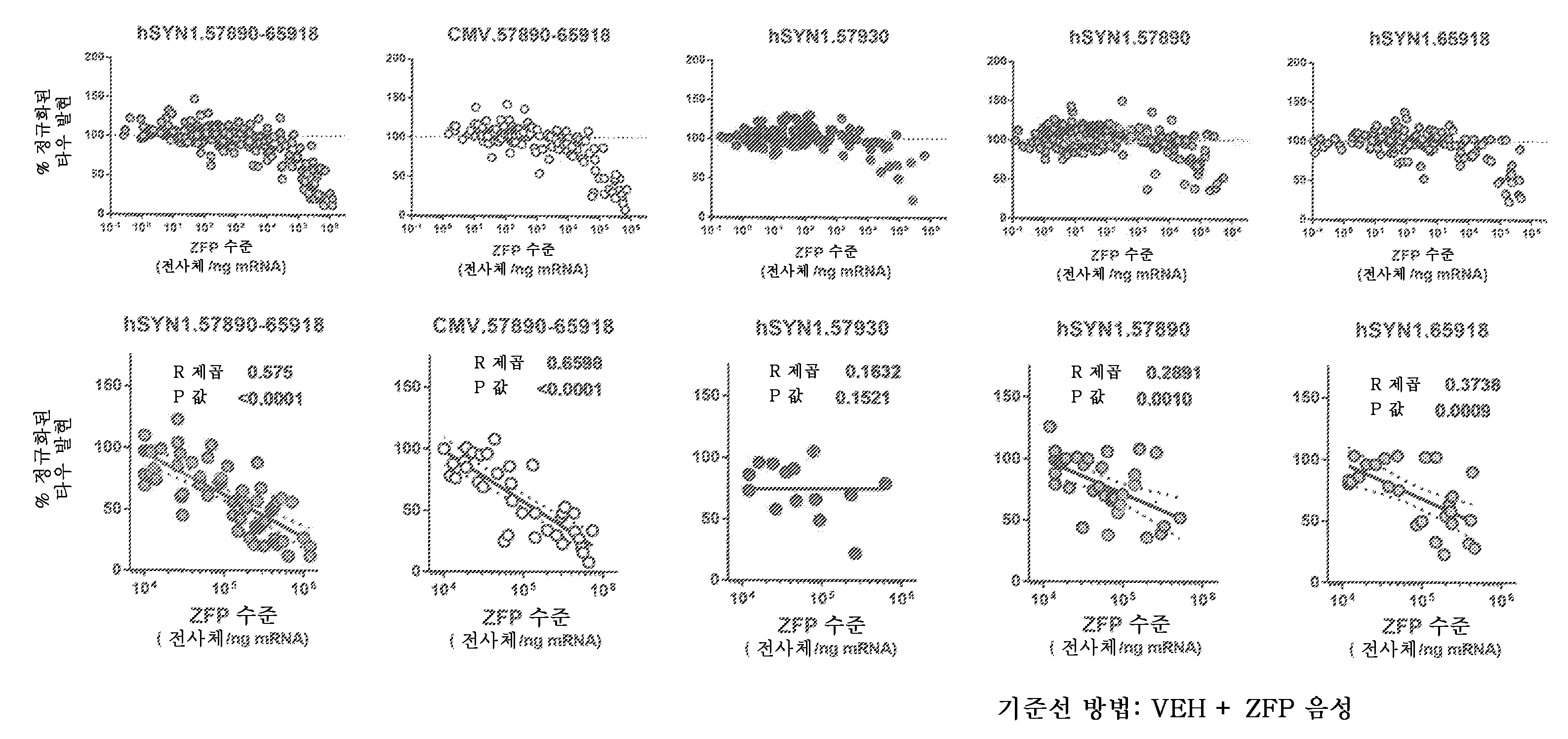
도 16은 대조군 대상체 (좌측 패널 - "비히클"), 및 발현이 시냅신 프로모터에 의해 구동되는 65918 및 57890 유전자 리프레서를 코딩하는 AAV 벡터 ("hSYN1.5789-65918")로 처리된 대상체에서의 타우 발현 및 ZFP 전사체 수준을 보여주는 상관관계 플롯이다. 절대 정량화를 위한 ZFP qRT-PCR 검정의 한계는 대략 1E2개 전사체/ng mRNA이며, 이는 정량화 한계 미만 (BLOQ)으로 표시된다. 이러한 분석을 위해, 타우 발현 수준은 비처리된 또는 ZFP-음성 동물에서의 기준선 타우 수준을 보정하기 위해 척도화되지 않았다.
도 17은 표시된 처리군에 대한 표시된 ZFP 전사체 수준에서의 타우 발현을 보여주는 상관관계 플롯이다. 이러한 분석을 위해, 각각의 펀치에 대한 타우 발현 수준은 3마리의 비히클-처리된 동물의 평균에 대해 척도화된다. 상부 패널은 모든 ZFP mRNA 수준에 걸친 관계를 보여주고; 하부 패널은 타우 감소와 연관된 ZFP 발현의 범위, 대략 1E4-1E6개 ZFP 전사체/ng mRNA만을 보여준다. 또한 R-제곱 및 P 값이 제시된다. 이러한 분석을 위해, 타우 발현 수준은 비처리된 또는 ZFP-음성 동물에서의 기준선 타우 수준을 보정하기 위해 척도화되지 않았다.
도 18a 내지 도 18d는 본원에 기재된 바와 같은 타우 ZFP-TF로 처리된 인간화 타우 마우스로부터의 결과를 도시한 막대 그래프이다. 도 18a는 표시된 구축물로 처리된 마우스의 상대 (좌측 그래프) 및 절대 (우측 그래프) ZFP 수준을 보여준다. 제시된 바와 같이, 65918 및 57890의 상승작용적 조합으로 처리된 마우스는 57890 단독보다 2x 더 높은 발현 수준을 보여주었다. 도 18b는 표시된 구축물로 처리된 마우스에서의 인간 타우 ("hTAU", 좌측 그래프), 마우스 타우 ("mTAU", 중간 그래프) 및 GFP (우측 그래프) 발현 수준을 보여준다. 제시된 바와 같이, 인간 타우 mRNA는 57890에 의한 ~60% 억제와 비교하여 65918-T2a-57890에 의해 ~90% 억제되었다. 마찬가지로, 마우스 타우 mRNA는 57890 단독에 의한 81% 억제와 비교하여 65918-T2a-57890에 의해 ~87% 억제되었다. 도 18c는 표시된 조건 하에 처리된 인간화 타우 마우스에서의 hTAU (좌측 그래프) 및 인간 사이토힌 ("hSTH", 우측 그래프)의 발현을 도시한다. 유사한 수준의 인간 타우 및 STH 감소가 관찰되었고, 이는 STH가 타우 내에 내재되고, 따라서, 2개의 유전자가 공동조절된다는 사실과 일치한다. 도 18d는 표시된 구축물로 처리된 인간화 타우 마우스의 GFAP (성상세포 마커) (좌측 그래프), IBA1 (소교세포 마커) (중간 그래프) 및 NeuN (뉴런 마커) (우측 그래프)의 발현 수준을 보여준다.
도 19a 내지 도 19c는 CMV 또는 시냅신 (SYN) 프로모터를 포함하는 ZFP-TF 구축물로부터 발현된 표시된 타우-특이적 ZFP-TF에 의한 처리 후의 비-인간 영장류 (NHP)에서의 증가된 소교세포 및 성상세포 마커 발현 수준을 도시한 그래프이다. 도 19a 및 도 19b는 소교세포의 마커인 이온화된 칼슘-결합 어댑터 분자 1 (IBA1) 수준을 보여준다. 소교세포 활성화는 염증 반응의 지표이다. 도 19c는 성상세포 활성화를 보여준다 (GFAP 수준에 의해 측정된 바와 같음). 제시된 바와 같이, SYN 프로모터를 포함하는 구축물 중 어떠한 것에 대해서도 소교세포 또는 성상세포 수준에서 ZFP 의존성 상승이 관찰되지 않은 반면에, CMV 프로모터를 포함하는 구축물에 의해서는 소교세포 및 성상세포 마커가 상승되었다.
도 20a 및 도 20b는 표시된 바와 같이 처리된 영장류의 좌측 ("L") 및 우측 ("R") 반구에서의 IBA1 (도 20a) 및 GFAP (도 20b)의 벌크 수준을 보여주는 그래프이다. 제시된 바와 같이, IBA1 및 GFAP 수준은 NHP 사이에서 다르고, 어떠한 처리군에 대해서도 주요 벌크 효과가 관찰되지 않았다.
도 21은 표시된 조건 하에 처리된 대상체에서의 ZFP에 대한 하우스키핑 유전자 EIF4a2의 정규화된 발현을 도시한 그래프이다. 제시된 바와 같이, 처리군 중 어떠한 것에서도 하우스키핑 유전자 (EIF4A2) 및 ZFP 발현의 수준과 상관관계가 존재하지 않았다.
도 22는 표시된 조건 하에 인간 iPSC-유래된 (IPS) 뉴런에서의 총 타우 단백질 수준을 도시한 그래프이다. "모의"는 공 AAV 벡터로 형질감염된 세포를 지칭하고; "대조군"은 타우를 표적화하지 않는 ZFP를 코딩하는 AAV 벡터로 형질감염된 세포를 지칭하고; "57930"은 57930 리프레서를 코딩하는 AAV 벡터로 처리된 세포를 지칭하고; "57890"은 57890 리프레서를 코딩하는 AAV 벡터로 처리된 세포를 지칭하고; "65918"은 65918 리프레서를 코딩하는 AAV 벡터로 처리된 세포를 지칭하고; "65918/57890"은 65918 및 57890 리프레서 둘 다를 코딩하는 AAV 벡터로 처리된 세포를 지칭한다. ZFP 리프레서를 코딩하는 모든 AAV 구축물은 리프레서의 발현을 구동하는 시냅신 프로모터 (SYN1)를 포함하였다. 타우 단백질 수준을 AAV 벡터 투여의 32일 후에 ELISA에 의해 평가하였다.1 is a graph depicting Tau expression and ZFP transcript levels in an exemplary sample (“Punch 088”) taken from the caudal hippocampus of a non-human primate (NHP) treated with a tau repressor as described herein. Top plot shows % normalized tau inhibition, bottom plot shows ZFP mRNA copies (transcript/ng RNA). The left half of the graph shows data from punch 088 obtained from the left hemisphere of each animal in the study, and the right half shows data from punch 088 obtained from the right hemisphere of each animal in the study. Promoters used in the different constructs are shown along the bottom, where "CMV" indicates the use of the CMV promoter and "SYN" indicates the use of the synapsin promoter.
2 is an exemplary sample taken from NHP treated with a tau repressor as described herein (in the upper panel "Punch 088" is from the caudal hippocampus and in the lower panel "Punch 035" is from the posterior hippocampus) Graphs depicting Tau expression and ZFP levels in The top plot in each panel shows % normalized tau inhibition, and the bottom plot in each panel shows ZFP mRNA levels (copy/ng mRNA).
3 shows ZFP levels and unscaled tau protein expression levels (top panel) of indicated NHP brain samples (“Punch 037”, “Punch 039” and “
FIG. 4 shows 74 samples taken from various brain slices (5, 6, 7, 8 and 9 in each hemisphere) aligned posteriorly in an exemplary NHP subject (NHP07) treated with a tau repressor as described herein. Graphs depicting Tau expression and ZFP levels from canine punches. The upper plot in each panel shows % normalized tau inhibition (left axis) and the lower plot in each panel shows ZFP mRNA levels (copy/ng mRNA) (right axis).
5A and 5B depict tau expression and ZFP levels and corresponding MRI images in control and treated NHP subjects. 5A shows control (“vehicle”, as shown in left panel), and tau repressors 65918 (“918”) and 57890 (“890”) delivered by AAV vectors (AAV9), where repressors (918 and 890) was driven by the synapsin (SYN1) promoter and the repressor linked by a T2A cleavage peptide). Focused on punches from
6A-6E are graphs depicting Tau expression and ZFP levels in samples taken from control and treated NHP subjects. 6A shows results from control subjects (NHP01, NHP02 and NHP03). 6B shows gene repressors 65918 ("918") and 57890 ("890") carried by an AAV vector (AAV9), wherein expression of repressors (918 and 890) is driven by the synapsin (SYN1) promoter. ) (“SYN1.918-890”) treated NHP subjects (NHP04, NHP05 and NHP06). 6C shows gene repressors 65918 ("918") and 57890 ("890") carried by an AAV vector (AAV9), wherein expression of repressors (918 and 890) is driven by the CMV promoter ("CMV") 918-890") treated subjects (NHP07 and NHP08) (left panel), and gene repressor 57930 ("930") carried by an AAV vector (AAV9), wherein expression of
7 shows ZFP levels and unscaled tau expression levels (top panel) of indicated NHP brain samples (Punch ID, X-axis), or tau expression scaled to the mean of three vehicle-treated animals (median). panel), or a composite analysis of tau expression (lower panel) scaled to the mean of vehicle-treated and ZFP-treated animals in the absence of detectable ZFP expression. The left panel shows control subjects (“vehicle”) and the right panel shows all treated subjects (“all AAV-treated NHPs”).
8 is a method for scaling tau expression relative to the mean of vehicle-treated and ZFP-treated animals lacking detectable ZFP expression in control (left graph) and treated subjects (right graph). Graphs depicting composite analysis of tau expression (top panel) and ZFP levels (bottom panel).
9 is a graph depicting tau expression in the left (left panel) and right (right panel) hemispheres of control and treated subjects as indicated. “VEH” refers to control subjects receiving vehicle alone; "SYN918-890" refers to a subject that has received AAV vectors encoding the 65918 and 57890 gene repressors whose expression is driven by the synapsin promoter; "CMV918-890" refers to a subject that has received AAV vectors encoding the 65918 and 57890 gene repressors whose expression is driven by the CMV promoter; “SYN930” refers to a subject that has received an AAV vector encoding the 57930 gene repressor whose expression is driven by a synapsin promoter; "SYN890" refers to a subject that has received an AAV vector encoding a 57890 gene repressor whose expression is driven by a synapsin promoter; "SYN918" refers to a subject that has received an AAV vector encoding the 65918 gene repressor whose expression is driven by a synapsin promoter. For this analysis, normalized tau expression was scaled against the average of tau levels measured from vehicle-treated and ZFP-treated animals that lack detectable ZFP expression for each punch.
Figure 10 shows that the ZFP transcript level in the indicated NHP subjects was less than 1E4 ZFP transcripts (copy/ng mRNA) (left panel); 1E4 to 1E5 transcripts (copy/ng mRNA) (middle panel); and tau expression levels with greater than 1E5 transcripts (copy/ng mRNA) (right panel). Levels in the left hemisphere are shown in the upper panel and levels in the right hemisphere are shown in the lower panel. For this analysis, normalized tau expression for a given punch was scaled against the mean of tau levels measured from vehicle-treated and ZFP-treated animals lacking detectable ZFP expression.
11 shows that ZFP transcript levels in the indicated NHP subjects were ZFP transcript levels (upper left panel), less than 1E4 ZFP transcripts (copy/ng mRNA) (lower left panel); 1E4 to 1E5 transcripts (copy/ng mRNA) (top right panel); and tau expression levels in the left and right hemispheres with more than 1E5 transcripts (copy/ng mRNA) (lower right panel). For this analysis, normalized tau expression for a given punch was scaled against the mean of tau levels measured from vehicle-treated and ZFP-treated animals lacking detectable ZFP expression.
12 shows control subjects (left panel—“Vehicle”), and Tau in subjects treated with AAV vectors encoding the 65918 and 57890 gene repressors (“hSYN1.5789-65918”) whose expression is driven by the synapsin promoter. A graph depicting a correlation plot showing expression and ZFP transcript levels. The limit of the ZFP qRT-PCR assay for absolute quantification is approximately 1E2 transcripts/ng mRNA, expressed as below the limit of quantification (BLOQ). For this analysis, tau expression is scaled against the mean of vehicle-treated and ZFP-treated animals lacking detectable ZFP expression.
13 is a correlation plot showing Tau expression at the indicated ZFP transcript levels for the indicated treatment groups. For this analysis, tau expression levels for each punch are scaled against the average of three vehicle-treated animals. The upper panel shows the relationship across all ZFP mRNA levels; The lower panel shows the range of ZFP expression associated with tau reduction, only approximately 1E4-1E6 ZFP transcripts/ng mRNA. R-squared and P values are also presented. For this analysis, tau expression is scaled against the mean of vehicle-treated and ZFP-treated animals lacking detectable ZFP expression.
FIG. 14 shows control subjects (left panel—“vehicle”), and tau in subjects treated with AAV vectors encoding the 65918 and 57890 gene repressors (“hSYN1.5789-65918”) whose expression is driven by a synapsin promoter. Correlation plots showing expression and ZFP transcript levels. The limit of the ZFP qRT-PCR assay for absolute quantification is approximately 1E2 transcripts/ng mRNA, expressed as below the limit of quantification (BLOQ). In contrast to Figure 12, for this analysis, tau expression levels are scaled relative to the mean of three vehicle-treated animals.
15 is a correlation plot showing Tau expression at the indicated ZFP transcript levels for the indicated treatment groups. For this analysis, tau expression levels for each punch are scaled against the average of three vehicle-treated animals. The upper panel shows the relationship across all ZFP mRNA levels; The lower panel shows the range of ZFP expression associated with tau reduction, only approximately 1E4-1E6 ZFP transcripts/ng mRNA. R-squared and P values are also presented. In contrast to FIG. 13 , for this analysis, tau expression levels are scaled relative to the mean of three vehicle-treated animals.
Figure 16 shows control subjects (left panel—“vehicle”), and tau in subjects treated with AAV vectors encoding the 65918 and 57890 gene repressors (“hSYN1.5789-65918”) whose expression is driven by a synapsin promoter. Correlation plots showing expression and ZFP transcript levels. The limit of the ZFP qRT-PCR assay for absolute quantification is approximately 1E2 transcripts/ng mRNA, expressed as below the limit of quantification (BLOQ). For this analysis, tau expression levels were not scaled to correct for baseline tau levels in untreated or ZFP-negative animals.
17 is a correlation plot showing Tau expression at the indicated ZFP transcript levels for the indicated treatment groups. For this analysis, tau expression levels for each punch are scaled against the average of three vehicle-treated animals. The upper panel shows the relationship across all ZFP mRNA levels; The lower panel shows the range of ZFP expression associated with tau reduction, only approximately 1E4-1E6 ZFP transcripts/ng mRNA. R-squared and P values are also presented. For this analysis, tau expression levels were not scaled to correct for baseline tau levels in untreated or ZFP-negative animals.
18A-18D are bar graphs depicting results from humanized tau mice treated with tau ZFP-TF as described herein. 18A shows relative (left graph) and absolute (right graph) ZFP levels of mice treated with the indicated constructs. As shown, mice treated with the synergistic combination of 65918 and 57890 showed a 2x higher expression level than 57890 alone. 18B shows human tau (“hTAU”, left graph), mouse tau (“mTAU”, middle graph) and GFP (right graph) expression levels in mice treated with the indicated constructs. As shown, human tau mRNA was -90% inhibited by 65918-T2a-57890 compared to -60% inhibition by 57890. Likewise, mouse tau mRNA was -87% inhibited by 65918-T2a-57890 compared to 81% inhibition by 57890 alone. Figure 18C depicts the expression of hTAU (left graph) and human cytokine (“hSTH”, right graph) in humanized tau mice treated under the indicated conditions. Similar levels of reduction in human tau and STH were observed, consistent with the fact that STH is internalized within tau, and thus the two genes are co-regulated. Figure 18D shows the expression levels of GFAP (astrocytic marker) (left graph), IBA1 (microglia marker) (middle graph) and NeuN (neuronal marker) (right graph) of humanized tau mice treated with the indicated constructs.
19A-19C show increased microglia in non-human primates (NHP) after treatment with the indicated tau-specific ZFP-TFs expressed from ZFP-TF constructs comprising CMV or synapsin (SYN) promoters and It is a graph showing the expression level of astrocyte markers. 19A and 19B show levels of ionized calcium-binding adapter molecule 1 (IBA1), a marker of microglia. Microglia activation is an indicator of the inflammatory response. 19C shows astrocyte activation (as measured by GFAP levels). As shown, no ZFP-dependent elevations were observed at the microglia or astrocyte level for any of the constructs containing the SYN promoter, whereas the constructs containing the CMV promoter raised microglia and astrocyte markers.
20A and 20B are graphs showing bulk levels of IBA1 ( FIG. 20A ) and GFAP ( FIG. 20B ) in the left (“L”) and right (“R”) hemispheres of primates treated as indicated. As shown, IBA1 and GFAP levels differed between NHPs, and no major bulk effect was observed for any treatment group.
21 is a graph depicting normalized expression of the housekeeping gene EIF4a2 for ZFP in subjects treated under the indicated conditions. As shown, there was no correlation with the levels of housekeeping gene (EIF4A2) and ZFP expression in any of the treatment groups.
22 is a graph depicting total tau protein levels in human iPSC-derived (IPS) neurons under the indicated conditions. “mock” refers to cells transfected with a blank AAV vector; “control” refers to cells transfected with an AAV vector encoding a ZFP that does not target tau; “57930” refers to cells treated with an AAV vector encoding the 57930 repressor; “57890” refers to cells treated with an AAV vector encoding a 57890 repressor; “65918” refers to cells treated with an AAV vector encoding the 65918 repressor; "65918/57890" refers to cells treated with an AAV vector encoding both the 65918 and 57890 repressors. All AAV constructs encoding the ZFP repressor contained the synapsin promoter (SYN1) driving expression of the repressor. Tau protein levels were assessed by ELISA after 32 days of AAV vector administration.
타우병증의 예방 및/또는 치료를 위한 조성물 및 방법이 본원에 개시된다. 특히, 본원에 기재된 조성물 및 방법은 타우병증, 예컨대 알츠하이머병 (AD), 전두측두엽 치매, 진행성 핵상 마비, 외상성 뇌 손상 (TBI), 발작 장애 및/또는 피질기저 변성을 예방 또는 치료하기 위해 MAPT (타우) 단백질의 발현을 억제하는데 사용된다. MAPT 리프레서 (예를 들어, MAPT-조정 전사 인자, 예컨대 아연 핑거 단백질 (ZFP TF), TALE (TALE-TF), 및/또는 CRISPR/Cas-TF를 포함하는 MAPT-조정 전사 인자)는, 예를 들어 타우병증 (예를 들어, AD)을 갖는 대상체의 뇌에서 타우의 응집을 감소시키고 신경 엉킴의 발생을 감소시킴으로써 타우병증의 영향 및/또는 증상이 감소 또는 제거되도록 CNS를 변형시킨다. 바람직한 실시양태에서, MAPT-조정 전사 인자는 바이러스 벡터, 예컨대 AAV에 의해 뇌로 전달된다. AAV는 뇌 전달에 매우 적합한 것으로 밝혀졌으므로, MAPT 조정 전사 인자를 전달하기 위해 이들 바이러스 벡터를 사용하는 것은 부적절한 발현 및 그에 의한 타우 단백질의 응집과 연관된 알츠하이머병과 같은 질환을 치료하는데 특히 유용하다.Disclosed herein are compositions and methods for the prevention and/or treatment of tauopathy. In particular, the compositions and methods described herein can be used to prevent or treat tauopathy, such as Alzheimer's disease (AD), frontotemporal dementia, progressive supranuclear palsy, traumatic brain injury (TBI), seizure disorders and/or cortical basal degeneration (MAPT) ( tau) is used to inhibit the expression of proteins. MAPT repressors (eg, MAPT-regulated transcription factors, such as MAPT-regulated transcription factors, including zinc finger protein (ZFP TF), TALE (TALE-TF), and/or CRISPR/Cas-TF), include The CNS is modified to reduce or eliminate the effects and/or symptoms of tauopathy, eg, by reducing the aggregation of tau in the brain of a subject with tauopathy (eg, AD) and reducing the occurrence of neural tangles. In a preferred embodiment, the MAPT-modulated transcription factor is delivered to the brain by a viral vector such as AAV. AAV has been found to be very suitable for brain delivery, so the use of these viral vectors to deliver MAPT modulated transcription factors is particularly useful for treating diseases such as Alzheimer's disease, which are associated with inappropriate expression and thereby aggregation of the tau protein.
미세관 연관 단백질 타우 (MAPT)는 알츠하이머병, 진행성 핵상 마비, 및 전두측두엽 치매를 포함한 여러 신경변성 장애의 발병기전과 밀접하게 연관된다. 유전적 및 안티센스-기반 타우 저하 접근법은 마우스에서 효과적이고 잘 허용되는 것으로 입증되었지만, 단일-투여, 세포내 타우-표적화 요법의 개발은 오래 지속되는 목표로 남아 있다. 아연 핑거 단백질 (ZFP) 설계 및 AAV 전달에서의 진보는 신경변성 질환에 대한 1-회, DNA-표적화 요법을 위한 새로운 잠재력을 생성하였다. 마우스, 비인간 영장류 (NHP), 및 인간 타우 전사 조절 요소를 표적화하는 ZFP 리프레서를 AAV 벡터를 사용하여 마우스 및 NHP 뇌로 전달하였다. MAPT-표적화된 ZFP는 1차 및 iPSC 뉴런에서 검출가능한 오프-타겟 유전자 조절 없이 마우스 및 인간 타우를 최대 99%만큼 감소시켰다. 성체 마우스에의 해마내 ZFP 전달은 >90% 타우 감소를 발생시켰다. 정맥내 ZFP 투여는 전체 뇌에 걸쳐 타우 수준을 50-70%만큼 감소시켰다. ZFP 발현 및 마우스 타우 감소는 검출가능한 오프-타겟 없이 적어도 6개월까지 안정하였고, 이는 APP/PS1 마우스에서 CSF-타우의 >80% 저하를 발생시켰고 이영양성 신경돌기를 50% 감소시켰다. NHP 해마로 ZFP를 전달하기 위해 양측, 실시간 MRI-가이드 정위술을 사용하였고, 이는 잘 허용되었고 해마 및 내후각 피질에서 최대 >80%의 타우 저하를 발생시켰다. ZFP 수준은 타우 감소와 강하게 상관되었다. ZFP의 효력, 효능, 특이성 및 허용성은 이들이 인간 타우병증의 치료를 위한 영구적인 타우 하향-조절을 달성한다는 것을 보여준다.The microtubule associated protein tau (MAPT) is closely implicated in the pathogenesis of several neurodegenerative disorders, including Alzheimer's disease, progressive supranuclear palsy, and frontotemporal dementia. Although genetic and antisense-based tau lowering approaches have proven effective and well tolerated in mice, the development of single-dose, intracellular tau-targeted therapies remains a long-standing goal. Advances in zinc finger protein (ZFP) design and AAV delivery have created new potential for one-time, DNA-targeted therapies for neurodegenerative diseases. ZFP repressors targeting mouse, non-human primate (NHP), and human Tau transcriptional regulatory elements were delivered into mouse and NHP brains using AAV vectors. MAPT-targeted ZFP reduced mouse and human tau by up to 99% without detectable off-target gene modulation in primary and iPSC neurons. Intrahippocampal ZFP delivery to adult mice resulted in >90% tau reduction. Intravenous ZFP administration reduced tau levels by 50-70% throughout the brain. ZFP expression and mouse tau reduction were stable for at least 6 months with no detectable off-target, resulting in >80% reduction in CSF-tau and 50% reduction in dystrophic neurites in APP/PS1 mice. A bilateral, real-time MRI-guided stereotactic technique was used to deliver ZFP to the NHP hippocampus, which was well tolerated and resulted in tau degradation of up to >80% in the hippocampus and entorhinal cortex. ZFP levels were strongly correlated with tau reduction. The potency, efficacy, specificity and tolerability of ZFPs show that they achieve permanent tau down-regulation for the treatment of human tauopathy.
일반사항General Information
본원에 개시된 방법의 실시 뿐만 아니라 조성물의 제조 및 용도는 달리 표시되지 않는 한, 분자 생물학, 생화학, 염색질 구조 및 분석, 전산 화학, 세포 배양, 재조합 DNA 및 관련 기술분야의 기술 내에 있는 바와 같은 관련된 분야에서의 통상적인 기술을 이용한다. 이들 기술은 하기 문헌에서 충분히 설명된다. 예를 들어, 문헌 [Sambrook et al., MOLECULAR CLONING: A LABORATORY MANUAL, Second edition, Cold Spring Harbor Laboratory Press, 1989 and Third edition, 2001; Ausubel et al., CURRENT PROTOCOLS IN MOLECULAR BIOLOGY, John Wiley & Sons, New York, 1987 and periodic updates; the series METHODS IN ENZYMOLOGY, Academic Press, San Diego; Wolffe, CHROMATIN STRUCTURE AND FUNCTION, Third edition, Academic Press, San Diego, 1998; METHODS IN ENZYMOLOGY, Vol. 304, "Chromatin" (P.M. Wassarman and A. P. Wolffe, eds.), Academic Press, San Diego, 1999; 및 METHODS IN MOLECULAR BIOLOGY, Vol. 119, "Chromatin Protocols" (P.B. Becker, ed.) Humana Press, Totowa, 1999]을 참조한다.The practice of the methods disclosed herein, as well as the preparation and use of the compositions, are, unless otherwise indicated, in molecular biology, biochemistry, chromatin structure and analysis, computational chemistry, cell culture, recombinant DNA, and related fields as within the skill of the art using conventional techniques in These techniques are fully described in the literature which follows. See, eg, Sambrook et al., MOLECULAR CLONING: A LABORATORY MANUAL, Second edition, Cold Spring Harbor Laboratory Press, 1989 and Third edition, 2001; Ausubel et al., CURRENT PROTOCOLS IN MOLECULAR BIOLOGY, John Wiley & Sons, New York, 1987 and periodic updates; the series METHODS IN ENZYMOLOGY, Academic Press, San Diego; Wolffe, CHROMATIN STRUCTURE AND FUNCTION, Third edition, Academic Press, San Diego, 1998; METHODS IN ENZYMOLOGY, Vol. 304, "Chromatin" (P.M. Wassarman and A. P. Wolffe, eds.), Academic Press, San Diego, 1999; and METHODS IN MOLECULAR BIOLOGY, Vol. 119, “Chromatin Protocols” (P.B. Becker, ed.) Humana Press, Totowa, 1999].
정의Justice
용어 "핵산", "폴리뉴클레오티드" 및 "올리고뉴클레오티드"는 상호교환가능하게 사용되고, 선형 또는 환상 입체 형태, 및 단일 가닥 또는 이중 가닥 형태의 데옥시리보뉴클레오티드 또는 리보뉴클레오티드 중합체를 지칭한다. 본 개시내용의 목적상, 이들 용어는 중합체의 길이에 대해 제한하는 것으로 해석되서는 안된다. 상기 용어는 자연 뉴클레오티드 뿐만 아니라 염기, 당 및/또는 포스페이트 모이어티 (예를 들어, 포스포로티오에이트 백본)에서 변형된 뉴클레오티드의 공지된 유사체를 포괄할 수 있다. 일반적으로, 특정한 뉴클레오티드의 유사체는 동일한 염기-쌍형성 특이성을 가지며; 즉 A의 유사체는 T와 염기-쌍형성할 것이다.The terms “nucleic acid”, “polynucleotide” and “oligonucleotide” are used interchangeably and refer to polymers of deoxyribonucleotides or ribonucleotides in linear or circular conformation, and in single- or double-stranded form. For the purposes of this disclosure, these terms should not be construed as limiting as to the length of the polymer. The term may encompass known analogs of natural nucleotides as well as nucleotides modified at base, sugar and/or phosphate moieties (eg, phosphorothioate backbones). In general, analogs of a particular nucleotide have the same base-pairing specificity; That is, an analog of A will base-pair with T.
용어 "폴리펩티드", "펩티드" 및 "단백질"은 아미노산 잔기의 중합체를 지칭하기 위해 상호교환가능하게 사용된다. 상기 용어는 1개 이상의 아미노산이 상응하는 자연 발생 아미노산의 화학적 유사체 또는 변형된 유도체인 아미노산 중합체에도 적용된다.The terms “polypeptide,” “peptide,” and “protein” are used interchangeably to refer to a polymer of amino acid residues. The term also applies to amino acid polymers in which one or more amino acids are chemical analogs or modified derivatives of the corresponding naturally occurring amino acids.
"결합"은 거대분자 사이의 (예를 들어, 단백질 및 핵산 사이의) 서열-특이적, 비-공유 상호작용을 지칭한다. 결합 상호작용의 모든 성분이 반드시 서열-특이적 (예를 들어, DNA 백본 내의 포스페이트 잔기와의 접촉)일 필요는 없지만, 이러한 상호작용은 전체적으로 서열-특이적이어야 한다. 이러한 상호작용은 일반적으로, 10-6 M-1 이하의 해리 상수 (Kd)에 의해 특징화될 수 있다. "친화도"는 결합 강도를 지칭하며: 증가된 결합 친화도는 보다 낮은 Kd와 상관된다."Binding" refers to a sequence-specific, non-covalent interaction between macromolecules (eg, between a protein and a nucleic acid). Although not all components of a binding interaction need necessarily be sequence-specific (eg, contact with a phosphate residue in the DNA backbone), such interactions must be sequence-specific as a whole. Such interactions can generally be characterized by a dissociation constant (K d ) of 10 −6 M −1 or less. “Affinity” refers to binding strength: increased binding affinity correlates with a lower K d .
"결합 단백질"은 또 다른 분자에 비-공유적으로 결합할 수 있는 단백질이다. 결합 단백질은, 예를 들어, DNA 분자 (DNA-결합 단백질), RNA 분자 (RNA-결합 단백질) 및/또는 단백질 분자 (단백질-결합 단백질)에 결합할 수 있다. 단백질-결합 단백질의 경우, 이는 그 자체에 결합할 수 있고/거나 (동종이량체, 동종삼량체 등을 형성하기 위함) 상이한 단백질(들)의 1개 이상의 분자에 결합할 수 있다. 결합 단백질은 1종 초과의 유형의 결합 활성을 가질 수 있다. 예를 들어, 아연 핑거 단백질은 DNA-결합, RNA-결합 및 단백질-결합 활성을 갖는다.A “binding protein” is a protein capable of non-covalently binding to another molecule. Binding proteins can bind, for example, to DNA molecules (DNA-binding proteins), RNA molecules (RNA-binding proteins) and/or protein molecules (protein-binding proteins). In the case of protein-binding proteins, it may bind itself (to form homodimers, homotrimers, etc.) and/or may bind one or more molecules of different protein(s). A binding protein may have more than one type of binding activity. For example, zinc finger proteins have DNA-binding, RNA-binding and protein-binding activities.
"아연 핑거 DNA 결합 단백질" (또는 결합 도메인)은 그의 구조가 아연 이온의 협조를 통해 안정화되는 결합 도메인 내의 아미노산 서열의 영역인, 1개 이상의 아연 핑거를 통해 서열-특이적 방식으로 DNA에 결합하는 단백질, 또는 더 큰 단백질 내의 도메인이다. 용어 아연 핑거 DNA 결합 단백질은 종종, 아연 핑거 단백질 또는 ZFP로서 약칭된다.A "zinc finger DNA binding protein" (or binding domain) is a region of an amino acid sequence within a binding domain whose structure is stabilized through the cooperation of zinc ions, which binds to DNA in a sequence-specific manner through one or more zinc fingers. A domain within a protein, or larger protein. The term zinc finger DNA binding protein is often abbreviated as zinc finger protein or ZFP.
"TALE DNA 결합 도메인" 또는 "TALE"는 1개 이상의 TALE 반복 도메인/단위를 포함하는 폴리펩티드이다. 반복 도메인은 TALE의 그의 동족 표적 DNA 서열에의 결합에 수반된다. 단일 "반복 단위" ("반복부"로도 지칭됨)는 전형적으로, 그 길이가 33-35개 아미노산이고 자연 발생 TALE 단백질 내의 다른 TALE 반복 서열과 적어도 일부 서열 상동성을 나타낸다. 예를 들어, 미국 특허 번호 8,586,526을 참조한다.A “TALE DNA binding domain” or “TALE” is a polypeptide comprising one or more TALE repeat domains/units. The repeat domain is involved in binding of the TALE to its cognate target DNA sequence. A single "repeat unit" (also referred to as a "repeat") is typically 33-35 amino acids in length and exhibits at least some sequence homology with other TALE repeat sequences in naturally occurring TALE proteins. See, eg, US Pat. No. 8,586,526.
"TtAgo"는 유전자 침묵에 수반되는 것으로 여겨지는 원핵 아르고노트 단백질이다. TtAgo는 박테리아 써무스 써모필루스(Thermus thermophilus)로부터 유래된다 (예를 들어, 문헌 [Swarts et al., (2014) Nature 507(7491):258-261, G. Sheng et al., (2013) Proc. Natl. Acad. Sci. U.S.A. 111, 652] 참조). "TtAgo 시스템"은, 예를 들어 TtAgo 효소에 의한 절단을 위한 가이드 DNA를 포함한, 요구되는 모든 성분이다. "재조합"은 2개의 폴리뉴클레오티드 사이의 유전자 정보의 교환 프로세스를 지칭하며, 비-상동 말단 연결 (NHEJ) 및 상동 재조합에 의한 공여자 포획을 포함하나 이에 제한되지는 않는다. 본 개시내용의 목적상, "상동 재조합 (HR)"은, 예를 들어, 상동성-지정 복구 메카니즘을 통해 세포 내에서 이중 가닥 파괴의 복구 동안 일어나는 전문화된 형태의 상기 교환을 지칭한다. 이러한 프로세스는 뉴클레오티드 서열 상동성을 필요로 하고, "표적" 분자 (즉, 이중 가닥 파괴를 경험한 것)의 주형 복구에 대한 "공여자" 분자를 이용하며, "비-교차 유전자 전환" 또는 "짧은 트랙 유전자 전환"으로서 다양하게 공지되어 있으며, 이는 유전자 정보를 공여자에서 표적으로 전달해주기 때문이다. 어떠한 특정한 이론에 얽매이는 것을 원하지는 않지만, 이러한 전달은 파괴된 표적과 공여자 사이에 형성되는 헤테로듀플렉스 DNA의 불일치 교정, 및/또는 공여자가 표적의 일부가 될 유전자 정보를 재합성하는데 사용되는 "합성-의존적 가닥 어닐링", 및/또는 관련 프로세스를 포함할 수 있다. 이러한 전문화된 HR은 종종, 표적 분자의 서열의 변경을 초래하여, 공여자 폴리뉴클레오티드의 서열의 일부 또는 전부가 표적 폴리뉴클레오티드 내로 혼입되도록 한다."TtAgo" is a prokaryotic Argonaute protein believed to be involved in gene silencing. TtAgo is derived from the bacterium Thermophilus (see, e.g., Swarts et al., (2014) Nature 507(7491):258-261, G. Sheng et al., (2013) Proc. Natl. Acad. Sci. USA 111, 652). A "TtAgo system" is all required components, including, for example, guide DNA for cleavage by the TtAgo enzyme. "Recombination" refers to the process of exchange of genetic information between two polynucleotides, including, but not limited to, donor capture by non-homologous end joining (NHEJ) and homologous recombination. For the purposes of this disclosure, "homologous recombination (HR)" refers to the exchange of specialized forms that occurs during repair of double strand breaks within a cell, eg, via a homology-directed repair mechanism. This process requires nucleotide sequence homology, uses a "donor" molecule for template repair of a "target" molecule (i.e., one that has undergone a double strand break), and uses a "non-cross-gene conversion" or "short It is variously known as "track gene conversion" because it transfers genetic information from the donor to the target. While not wishing to be bound by any particular theory, such transfer may be used to correct mismatches in heteroduplex DNA formed between the disrupted target and the donor, and/or the donor is used to resynthesize genetic information that will be part of the target. dependent strand annealing", and/or related processes. These specialized HRs often result in alterations in the sequence of the target molecule, such that some or all of the sequence of the donor polynucleotide is incorporated into the target polynucleotide.
DNA-결합 도메인 예컨대 sgRNA, 아연 핑거 결합 도메인 또는 TALE DNA 결합 도메인은, 예를 들어 선택된 표적 부위에 결합하는 sgRNA의 설계를 통해, 또는 자연 발생 아연 핑거 단백질의 인식 나선 영역의 조작 (1개 이상의 아미노산의 변경)에 의해 또는 TALE 단백질의 RVD의 조작에 의해, 미리 결정된 뉴클레오티드 서열에 결합하도록 "조작"될 수 있다. 따라서, 조작된 아연 핑거 단백질 또는 TALE는 비-자연 발생인 단백질이다. DNA-결합 도메인을 조작하는 방법의 비제한적 예는 설계 및 선택이다. "설계된" 아연 핑거 단백질 또는 TALE는 자연에서 발생하지 않는 단백질로서, 그의 설계/조성은 주로 합리적인 기준으로부터 비롯된다. 합리적 설계 기준은 기존의 ZFP 설계 및 결합 데이터에 관한 정보를 저장하는 데이터베이스에서 정보를 처리하기 위한 대체 규칙 및 컴퓨터 알고리즘의 적용을 포함한다. "선택된" 아연 핑거 단백질 또는 TALE는 자연에서 발견되지 않고, 그의 생성은 주로 실험 과정, 예컨대 파지 디스플레이, 상호작용 트랩 또는 하이브리드 선택으로부터 비롯된다. 예를 들어, 미국 특허 8,586,526; 6,140,081; 6,453,242; 6,746,838; 7,241,573; 6,866,997; 7,241,574 및 6,534,261을 참조하고; 또한 국제 특허 공개 번호 WO 03/016496을 참조한다.DNA-binding domains such as sgRNAs, zinc finger binding domains or TALE DNA binding domains can be created, for example, through the design of sgRNAs that bind to a selected target site, or by manipulation of the recognition helix region of a naturally occurring zinc finger protein (one or more amino acids). ) or by manipulation of the RVD of the TALE protein, it can be "engineered" to bind to a predetermined nucleotide sequence. Thus, engineered zinc finger proteins or TALEs are non-naturally occurring proteins. Non-limiting examples of methods of engineering DNA-binding domains are design and selection. A “designed” zinc finger protein or TALE is a protein that does not occur in nature, the design/composition of which stems primarily from rational criteria. Rational design criteria include the application of substitution rules and computer algorithms for processing information in databases that store information about existing ZFP design and combined data. "Selected" zinc finger proteins or TALEs are not found in nature, and their production mainly results from experimental processes such as phage display, interaction traps or hybrid selection. See, for example, US Pat. Nos. 8,586,526; 6,140,081; 6,453,242; 6,746,838; 7,241,573; 6,866,997; 7,241,574 and 6,534,261; See also International Patent Publication No. WO 03/016496.
용어 "서열"은 DNA 또는 RNA일 수 있고; 선형, 원형 또는 분지형일 수 있으며 단일 가닥 또는 이중 가닥일 수 있는, 임의의 길이의 뉴클레오티드 서열을 지칭한다. 용어 "공여자 서열"은 게놈 내로 삽입되는 뉴클레오티드 서열을 지칭한다. 공여자 서열은 임의의 길이, 예를 들어 2 내지 10,000개 뉴클레오티드 길이 (또는 그 사이 또는 그 위의 임의의 정수 값), 바람직하게 약 100 내지 1,000개 뉴클레오티드 길이 (또는 그 사이의 임의의 정수), 보다 바람직하게 약 200 내지 500개 뉴클레오티드 길이일 수 있다.The term “sequence” may be DNA or RNA; Refers to a nucleotide sequence of any length, which may be linear, circular or branched and may be single-stranded or double-stranded. The term “donor sequence” refers to a nucleotide sequence that is inserted into the genome. The donor sequence may be of any length, for example between 2 and 10,000 nucleotides in length (or any integer value therebetween), preferably between about 100 and 1,000 nucleotides in length (or any integer in between), more It may preferably be about 200 to 500 nucleotides in length.
"표적 부위" 또는 "표적 서열"은 결합을 위한 충분한 조건이 존재한다면, 결합 분자가 결합할 핵산의 부분을 규정하는 핵산 서열이다.A “target site” or “target sequence” is a nucleic acid sequence that defines a portion of a nucleic acid to which a binding molecule will bind if sufficient conditions for binding exist.
"외인성" 분자는 정상적으로는 세포에 존재하지 않지만, 1종 이상의 유전적, 생화학적 또는 다른 방법에 의해 세포 내로 도입될 수 있는 분자이다. "세포에서의 정상적인 존재"는 세포의 특정한 발달 단계 및 환경 조건과 관련하여 결정된다. 따라서, 예를 들어, 근육의 배아 발생 동안에만 존재하는 분자는 성체 근육 세포에 대해 외인성 분자이다. 유사하게, 열 쇼크에 의해 유도된 분자는 비-열-쇼크 세포에 대해 외인성 분자이다. 외인성 분자는, 예를 들어, 오작동 내인성 분자의 기능적 버전 또는 정상 기능 내인성 분자의 오작동 버전을 포함할 수 있다.An “exogenous” molecule is a molecule that is not normally present in a cell, but can be introduced into a cell by one or more genetic, biochemical or other methods. "Normal presence in a cell" is determined with respect to a particular developmental stage of the cell and environmental conditions. Thus, for example, a molecule that exists only during embryogenesis of a muscle is a molecule exogenous to an adult muscle cell. Similarly, molecules induced by heat shock are molecules exogenous to non-heat-shock cells. An exogenous molecule may include, for example, a functional version of a malfunctioning endogenous molecule or a malfunctioning version of a normally functioning endogenous molecule.
외인성 분자는, 특히, 조합 화학 프로세스에 의해 생성되는 것과 같은 소분자, 또는 거대분자, 예컨대 단백질, 핵산, 탄수화물, 지질, 당단백질, 지단백질, 폴리사카라이드, 상기 분자의 임의의 변형된 유도체, 또는 상기 분자 중 1종 이상을 포함하는 임의의 복합체일 수 있다. 핵산은 DNA 및 RNA를 포함하고, 단일 가닥 또는 이중 가닥일 수 있으며; 선형, 분지형 또는 원형일 수 있고; 임의의 길이일 수 있다. 핵산은 듀플렉스를 형성할 수 있는 것 뿐만 아니라 트리플렉스-형성 핵산을 포함한다. 예를 들어, 미국 특허 번호 5,176,996 및 5,422,251을 참조한다. 단백질은 DNA-결합 단백질, 전사 인자, 염색질 재형성 인자, 메틸화 DNA 결합 단백질, 폴리머라제, 메틸라제, 데메틸라제, 아세틸라제, 데아세틸라제, 키나제, 포스파타제, 인테그라제, 레콤비나제, 리가제, 토포이소머라제, 리가제 및 헬리카제를 포함하나 이에 제한되지는 않는다.Exogenous molecules are, inter alia, small molecules, or macromolecules, such as those produced by combinatorial chemical processes, such as proteins, nucleic acids, carbohydrates, lipids, glycoproteins, lipoproteins, polysaccharides, any modified derivatives of said molecules, or said It can be any complex comprising one or more of the molecules. Nucleic acids include DNA and RNA, and may be single-stranded or double-stranded; may be linear, branched or circular; It can be of any length. Nucleic acids include triplex-forming nucleic acids as well as those capable of forming duplexes. See, for example, US Pat. Nos. 5,176,996 and 5,422,251. Proteins are DNA-binding proteins, transcription factors, chromatin remodeling factors, methylated DNA binding proteins, polymerases, methylases, demethylases, acetylases, deacetylases, kinases, phosphatases, integrases, recombinases, ligases , topoisomerases, ligases and helicases.
외인성 분자는 내인성 분자와 동일한 유형의 분자, 예를 들어, 외인성 단백질 또는 핵산일 수 있다. 예를 들어, 외인성 핵산은 감염성 바이러스 게놈, 세포 내로 도입되는 플라스미드 또는 에피솜, 또는 세포 내에 정상적으로 존재하지 않는 염색체를 포함할 수 있다. 외인성 분자를 세포 내로 도입하는 방법은 관련 기술분야의 통상의 기술자에게 공지되어 있고, 지질 매개된 전달 (즉, 중성 및 양이온성 지질을 포함한 리포솜), 전기천공, 직접 주사, 세포 융합, 입자 충격, 인산칼슘 공동 침전, DEAE-덱스트란 매개된 전달 및 바이러스 벡터-매개된 전달을 포함하나 이에 제한되지는 않는다. 외인성 분자는 또한, 내인성 분자와 동일한 유형의 분자일 수 있지만, 세포가 유래된 것과 상이한 종으로부터 유래될 수 있다. 예를 들어, 인간 핵산 서열은 원래 마우스 또는 햄스터로부터 유래된 세포주 내로 도입될 수 있다.The exogenous molecule may be the same type of molecule as the endogenous molecule, eg, an exogenous protein or nucleic acid. For example, an exogenous nucleic acid may comprise an infectious viral genome, a plasmid or episome that is introduced into a cell, or a chromosome that is not normally present in the cell. Methods for introducing exogenous molecules into cells are known to those skilled in the art and include lipid mediated delivery (i.e., liposomes with neutral and cationic lipids), electroporation, direct injection, cell fusion, particle bombardment, calcium phosphate co-precipitation, DEAE-dextran mediated delivery, and viral vector-mediated delivery. An exogenous molecule may also be the same type of molecule as the endogenous molecule, but may be from a different species from which the cell is derived. For example, a human nucleic acid sequence can be introduced into a cell line originally derived from a mouse or hamster.
대조적으로, "내인성" 분자는 특정한 환경 조건 하에서 특정한 발달 단계의 특정한 세포에 정상적으로 존재하는 분자이다. 예를 들어, 내인성 핵산은 염색체, 미토콘드리아의 게놈, 엽록체 또는 다른 소기관, 또는 자연 발생 에피솜 핵산을 포함할 수 있다. 추가의 내인성 분자는 단백질, 예를 들어, 전사 인자 및 효소를 포함할 수 있다.In contrast, an “endogenous” molecule is a molecule normally present in a particular cell at a particular stage of development under particular environmental conditions. For example, endogenous nucleic acids may include chromosomes, mitochondrial genomes, chloroplasts or other organelles, or naturally occurring episomal nucleic acids. Additional endogenous molecules may include proteins such as transcription factors and enzymes.
"융합" 분자는 2개 이상의 서브유닛 분자가, 바람직하게 공유 연결된 분자이다. 서브유닛 분자는 동일한 화학적 유형의 분자일 수 있거나, 또는 상이한 화학적 유형의 분자일 수 있다. 제1 유형의 융합 분자의 예는 융합 단백질 (예를 들어, ZFP 또는 TALE DNA-결합 도메인과 1개 이상의 활성화 도메인 사이의 융합체) 및 융합 핵산 (예를 들어, 상기 기재된 융합 단백질을 코딩하는 핵산)을 포함하나 이에 제한되지는 않는다. 제2 유형의 융합 분자의 예는 트리플렉스-형성 핵산과 폴리펩티드 사이의 융합체, 및 작은 홈 결합제와 핵산 사이의 융합체를 포함하나 이에 제한되지는 않는다. 상기 용어는 또한, 폴리뉴클레오티드 성분이 폴리펩티드 성분과 회합되어 기능적 분자를 형성한 시스템 (예를 들어, 단일 가이드 RNA가 기능적 도메인과 회합되어 유전자 발현을 조정하는 CRISPR/Cas 시스템)을 포함한다.A “fusion” molecule is a molecule in which two or more subunit molecules are, preferably covalently linked. The subunit molecules may be molecules of the same chemical type, or they may be molecules of different chemical types. Examples of a first type of fusion molecule include a fusion protein (eg, a fusion between a ZFP or TALE DNA-binding domain and one or more activation domains) and a fusion nucleic acid (eg, a nucleic acid encoding a fusion protein described above). including, but not limited to. Examples of the second type of fusion molecule include, but are not limited to, a fusion between a triplex-forming nucleic acid and a polypeptide, and a fusion between a small groove binder and a nucleic acid. The term also includes systems in which a polynucleotide component is associated with a polypeptide component to form a functional molecule (eg, a CRISPR/Cas system in which a single guide RNA is associated with a functional domain to modulate gene expression).
세포에서의 융합 단백질의 발현은 이러한 세포로의 융합 단백질의 전달로부터 비롯되거나 또는 융합 단백질을 코딩하는 폴리뉴클레오티드를 세포로 전달함으로써 비롯될 수 있으며, 여기서 상기 폴리뉴클레오티드가 전사되고, 전사체가 번역되어 융합 단백질이 생성된다. 트랜스-스플라이싱, 폴리펩티드 절단 및 폴리펩티드 라이게이션이 또한, 세포에서의 단백질의 발현에 수반될 수 있다. 세포에의 폴리뉴클레오티드 및 폴리펩티드 전달 방법은 본 개시내용의 다른 곳에 제시된다.Expression of the fusion protein in a cell may result from delivery of the fusion protein into the cell or may result from delivery of a polynucleotide encoding the fusion protein to the cell, wherein the polynucleotide is transcribed, the transcript is translated and the fusion protein is fused. protein is produced Trans-splicing, polypeptide cleavage and polypeptide ligation may also be involved in the expression of a protein in a cell. Methods for delivering polynucleotides and polypeptides to cells are provided elsewhere in this disclosure.
"다량체화 도메인" (또한 "이량체화 도메인" 또는 "단백질 상호작용 도메인"으로도 지칭됨)은 ZFP TF 또는 TALE TF의 아미노, 카르복시 또는 아미노 및 카르복시 말단 영역에 혼입된 도메인이다. 이들 도메인은 다중 ZFP TF 또는 TALE TF 유닛의 다량체화를 가능하게 하여, 트리뉴클레오티드 반복 도메인의 보다 큰 트랙이 야생형 개수의 길이를 갖는 보다 짧은 트랙에 비해 다량체화된 ZFP TF 또는 TALE TF에 의해 우선적으로 결합되게 한다. 다량체화 도메인의 예는 류신 지퍼를 포함한다. 다량체화 도메인은 또한 소분자에 의해 조절될 수 있고, 여기서 다량체화 도메인은 소분자 또는 외부 리간드의 존재 하에서만 또 다른 다량체화 도메인과의 상호작용을 허용하는 적절한 입체형태를 취한다. 이러한 방식으로, 외인성 리간드를 사용하여 이들 도메인의 활성을 조절할 수 있다.A "multimerization domain" (also referred to as a "dimerization domain" or "protein interaction domain") is a domain incorporated into the amino, carboxy or amino and carboxy terminal regions of a ZFP TF or TALE TF. These domains enable multimerization of multiple ZFP TFs or TALE TF units, such that larger tracks of trinucleotide repeat domains are preferentially multimerized by ZFP TFs or TALE TFs compared to shorter tracks with lengths of wild-type numbers. to be combined Examples of multimerization domains include leucine zippers. A multimerization domain may also be regulated by a small molecule, wherein the multimerization domain assumes an appropriate conformation that permits interaction with another multimerization domain only in the presence of a small molecule or an external ligand. In this way, exogenous ligands can be used to modulate the activity of these domains.
"유전자"는 본 개시내용의 목적상, 유전자 생성물 (하기 참조)을 코딩하는 DNA 영역, 뿐만 아니라 조절 서열이 코딩 및/또는 전사된 서열에 인접하는지에 상관없이, 유전자 생성물의 생성을 조절하는 모든 DNA 영역을 포함한다. 따라서, 유전자는 프로모터 서열, 종결인자, 번역 조절 서열, 예컨대 리보솜 결합 부위 및 내부 리보솜 진입 부위, 인핸서, 사일렌서, 인슐레이터, 경계 요소, 복제 기점, 매트릭스 부착 부위 및 유전자좌 제어 영역을 포함하나, 이에 반드시 제한되지는 않는다.A "gene", for the purposes of this disclosure, refers to any region of DNA that encodes a gene product (see below), as well as any regulatory sequences that control the production of a gene product, whether or not the regulatory sequences are adjacent to the coding and/or transcribed sequences. contains a DNA region. Thus, a gene includes, but is not necessarily limited to, promoter sequences, terminators, translational control sequences such as ribosome binding sites and internal ribosome entry sites, enhancers, silencers, insulators, border elements, origins of replication, matrix attachment sites and locus control regions. it doesn't happen
"유전자 발현"은 유전자 내에 함유된 정보를 유전자 생성물로 전환시키는 것을 지칭한다. 유전자 생성물은 유전자의 직접 전사 생성물 (예를 들어, mRNA, tRNA, rRNA, 안티센스 RNA, 리보자임, 구조적 RNA 또는 임의의 다른 유형의 RNA) 또는 mRNA의 번역에 의해 생성된 단백질일 수 있다. 유전자 생성물은 또한, 캡핑, 폴리아데닐화, 메틸화 및 편집과 같은 프로세스에 의해 변형된 RNA, 및 예를 들어, 메틸화, 아세틸화, 인산화, 유비퀴틴화, ADP-리보실화, 미리스틸화, 및 글리코실화에 의해 변형된 단백질을 포함한다."Gene expression" refers to the conversion of information contained within a gene into a gene product. A gene product may be a direct transcription product of a gene (eg, mRNA, tRNA, rRNA, antisense RNA, ribozyme, structural RNA, or any other type of RNA) or a protein produced by translation of an mRNA. Gene products are also RNA modified by processes such as capping, polyadenylation, methylation and editing, and for example, methylation, acetylation, phosphorylation, ubiquitination, ADP-ribosylation, myristylation, and glycosylation. Proteins modified by
유전자 발현의 "조정"은 유전자의 활성의 변화를 지칭한다. 발현의 조정은 유전자 활성화 및 유전자 억제를 포함할 수 있으나, 이에 제한되지는 않는다. 게놈 편집 (예를 들어, 절단, 변경, 불활성화, 무작위 돌연변이)을 사용하여 발현을 조정할 수 있다. 유전자 불활성화는 본원에 기재된 바와 같은 ZFP 또는 TALE 단백질을 포함하지 않는 세포와 비교하여 유전자 발현에서의 임의의 감소를 지칭한다. 따라서, 유전자 불활성화는 부분적이거나 또는 완전할 수 있다."Modulation" of gene expression refers to a change in the activity of a gene. Modulation of expression may include, but is not limited to, gene activation and gene repression. Genome editing (eg, truncation, alteration, inactivation, random mutation) can be used to modulate expression. Gene inactivation refers to any decrease in gene expression as compared to a cell that does not contain a ZFP or TALE protein as described herein. Thus, gene inactivation may be partial or complete.
"유전자 조정제"는 1개 이상의 유전자의 발현 및/또는 서열을 변경시키는 임의의 분자를 지칭한다. 유전자 조정제의 비제한적 예는 표적 유전자에 결합하고 그의 발현을 변경시키는 전사 인자 (예컨대 본원에 기재된 바와 같은 인공 전사 인자) 및 표적 유전자의 서열을 변형시키고, 차례로 그의 발현을 변경시키는 (예를 들어, 삽입 및/또는 결실을 통한 표적의 불활성화) 뉴클레아제를 포함한다. 따라서, 유전자 조정제는 유전자 리프레서 (유전자 발현을 억제하고/거나 불활성화함) 또는 유전자 활성화제일 수 있다.A “gene modulator” refers to any molecule that alters the expression and/or sequence of one or more genes. Non-limiting examples of genetic modulators include transcription factors that bind to and alter expression of a target gene (such as artificial transcription factors as described herein) and modify the sequence of the target gene, which in turn alters its expression (e.g., inactivation of the target through insertion and/or deletion) nucleases. Thus, a gene modulator may be a gene repressor (which inhibits and/or inactivates gene expression) or a gene activator.
"관심 영역"은 세포 염색질의 임의의 영역, 예컨대, 예를 들어, 외인성 분자에 결합하는 것이 바람직한 유전자, 또는 유전자 내의 또는 이와 인접한 비-코딩 서열을 지칭한다. 결합은 표적화된 DNA 절단 및/또는 표적화된 재조합의 목적을 위한 것일 수 있다. 관심 영역은, 예를 들어 염색체, 에피솜, 소기관 게놈 (예를 들어, 미토콘드리아, 엽록체), 또는 감염 바이러스 게놈에 존재할 수 있다. 관심 영역은 유전자의 코딩 영역 내에, 전사된 비-코딩 영역, 예컨대, 예를 들어, 리더 서열, 트레일러 서열 또는 인트론 내에, 또는 코딩 영역의 상류 또는 하류의 비-전사된 영역 내에 존재할 수 있다. 관심 영역은 단일 뉴클레오티드 쌍 정도로 작을 수 있거나 또는 최대 2,000개의 뉴클레오티드 쌍 길이, 또는 임의의 정수 값의 뉴클레오티드 쌍일 수 있다."Region of interest" refers to any region of cellular chromatin, such as, for example, a gene for which it is desirable to bind an exogenous molecule, or a non-coding sequence within or adjacent to a gene. Binding may be for the purpose of targeted DNA cleavage and/or targeted recombination. The region of interest may be, for example, in a chromosome, episome, organelle genome (eg, mitochondrial, chloroplast), or in the genome of an infectious virus. The region of interest may be within the coding region of a gene, within a transcribed non-coding region, such as, for example, a leader sequence, trailer sequence or intron, or within a non-transcribed region upstream or downstream of the coding region. A region of interest may be as small as a single nucleotide pair or may be up to 2,000 nucleotide pairs in length, or any integer value of nucleotide pairs.
"진핵" 세포는 진균 세포 (예컨대 효모), 식물 세포, 동물 세포, 포유동물 세포 및 인간 세포 (예를 들어, T-세포)를 포함하나 이에 제한되지는 않는다."Eukaryotic" cells include, but are not limited to, fungal cells (such as yeast), plant cells, animal cells, mammalian cells, and human cells (eg, T-cells).
용어 "작동적 연결" 및 "작동가능하게 연결된" (또는 "작동적으로 연결된")은 2가지 이상의 성분 (예컨대, 서열 요소)의 병렬배치와 관련하여 상호교환가능하게 사용되며, 여기서는 둘 다의 성분이 정상적으로 기능하고 성분 중 적어도 하나가, 다른 성분 중 적어도 하나 상에서 발휘되는 기능을 매개할 수 있는 가능성을 허용하도록 성분들이 배열된다. 예시로서, 전사 조절 서열이 1개 이상의 전사 조절 인자의 존재 또는 부재에 반응하여 코딩 서열의 전사 수준을 제어하는 경우에, 이러한 전사 조절 서열, 예컨대 프로모터는 코딩 서열에 작동가능하게 연결되어 있다. 전사 조절 서열은 일반적으로, 코딩 서열과 시스로 작동가능하게 연결되지만, 이에 직접적으로 인접할 필요는 없다. 예를 들어, 인핸서는 코딩 서열과 비록 인접하지 않더라도 이러한 코딩 서열과 작동가능하게 연결되는 전사 조절 서열이다.The terms “operably linked” and “operably linked” (or “operably linked”) are used interchangeably in reference to the juxtaposition of two or more components (eg, sequence elements), where both are used interchangeably. The components are arranged such that they function normally and allow the possibility that at least one of the components may mediate a function exerted on at least one of the other components. By way of example, where a transcriptional regulatory sequence controls the level of transcription of a coding sequence in response to the presence or absence of one or more transcriptional regulatory factors, such transcriptional regulatory sequence, such as a promoter, is operably linked to the coding sequence. Transcriptional regulatory sequences are generally operably linked in cis with a coding sequence, but need not be directly contiguous therewith. For example, an enhancer is a transcriptional regulatory sequence that is operably linked to, if not contiguous with, a coding sequence.
융합 폴리펩티드와 관련하여, 용어 "작동가능하게 연결된"은 각각의 성분이 다른 성분과 연결되어, 그렇게 연결되지 않았을 경우와 동일한 기능을 수행한다는 사실을 지칭할 수 있다. 예를 들어, ZFP 또는 TALE DNA-결합 도메인이 활성화 도메인과 융합된 융합 분자와 관련하여, 융합 폴리펩티드 내의 ZFP 또는 TALE DNA-결합 도메인 부분이 그의 표적 부위 및/또는 그의 결합 부위에 결합할 수 있는 한편 활성화 도메인은 유전자 발현을 상향조절할 수 있다면, ZFP 또는 TALE DNA-결합 도메인 및 활성화 도메인은 작동가능하게 연결되어 있다. 유전자 발현을 조절할 수 있는 도메인에 융합된 ZFP는 집합적으로 "ZFP-TF" 또는 "아연 핑거 전사 인자"로 지칭되며, 유전자 발현을 조절할 수 있는 도메인에 융합된 TALE는 집합적으로 "TALE-TF" 또는 "TALE 전사 인자"로 지칭된다. ZFP DNA-결합 도메인이 절단 도메인에 융합된 융합 폴리펩티드 ("ZFN" 또는 "아연 핑거 뉴클레아제")의 경우에, 융합 폴리펩티드 내의 ZFP DNA-결합 도메인 부분이 그의 표적 부위 및/또는 그의 결합 부위에 결합할 수 있는 한편 절단 도메인은 표적 부위 부근에서 DNA를 절단할 수 있다면, ZFP DNA-결합 도메인 및 절단 도메인은 작동가능하게 연결되어 있다. TALE DNA-결합 도메인이 절단 도메인에 융합된 융합 폴리펩티드 ("TALEN" 또는 "TALE 뉴클레아제")의 경우에, 융합 폴리펩티드 내의 TALE DNA-결합 도메인 부분이 그의 표적 부위 및/또는 그의 결합 부위에 결합할 수 있는 한편 절단 도메인은 표적 부위 부근에서 DNA를 절단할 수 있다면, TALE DNA-결합 도메인 및 절단 도메인은 작동가능하게 연결되어 있다. Cas DNA-결합 도메인 (예를 들어, 단일 가이드 RNA)이 활성화 도메인에 융합된 융합 분자와 관련하여, 융합 폴리펩티드 내의 Cas DNA-결합 도메인 부분이 그의 표적 부위 및/또는 그의 결합 부위에 결합할 수 있는 한편 활성화 도메인은 유전자 발현을 상향조절할 수 있다면, Cas DNA-결합 도메인 및 활성화 도메인은 작동가능하게 연결되어 있다. Cas DNA-결합 도메인이 절단 도메인에 융합된 융합 폴리펩티드의 경우에, 융합 폴리펩티드 내의 Cas DNA-결합 도메인 부분이 그의 표적 부위 및/또는 그의 결합 부위에 결합할 수 있는 한편 절단 도메인은 표적 부위 부근에서 DNA를 절단할 수 있다면, Cas DNA-결합 도메인 및 절단 도메인은 작동가능하게 연결되어 있다.In the context of a fusion polypeptide, the term “operably linked” may refer to the fact that each component is linked to the other component, performing the same function as if it were not so linked. For example, in the context of a fusion molecule in which a ZFP or TALE DNA-binding domain is fused with an activation domain, a portion of the ZFP or TALE DNA-binding domain in the fusion polypeptide is capable of binding its target site and/or its binding site while The ZFP or TALE DNA-binding domain and the activation domain are operably linked if the activation domain is capable of upregulating gene expression. ZFPs fused to domains capable of modulating gene expression are collectively referred to as “ZFP-TF” or “zinc finger transcription factors”, and TALEs fused to domains capable of modulating gene expression are collectively referred to as “TALE-TFs” " or "TALE transcription factor". In the case of a fusion polypeptide ("ZFN" or "zinc finger nuclease") in which a ZFP DNA-binding domain is fused to a cleavage domain, the ZFP DNA-binding domain portion in the fusion polypeptide is at its target site and/or its binding site. The ZFP DNA-binding domain and the cleavage domain are operably linked if capable of binding while the cleavage domain is capable of cleaving DNA in the vicinity of the target site. In the case of a fusion polypeptide (“TALEN” or “TALE nuclease”) in which a TALE DNA-binding domain is fused to a cleavage domain, the TALE DNA-binding domain portion in the fusion polypeptide binds to its target site and/or its binding site. The TALE DNA-binding domain and the cleavage domain are operably linked if capable while the cleavage domain is capable of cleaving DNA in the vicinity of the target site. In the context of a fusion molecule in which a Cas DNA-binding domain (eg, a single guide RNA) is fused to an activation domain, the portion of the Cas DNA-binding domain in the fusion polypeptide is capable of binding its target site and/or its binding site. On the other hand, if the activation domain is capable of upregulating gene expression, then the Cas DNA-binding domain and the activation domain are operably linked. In the case of a fusion polypeptide in which a Cas DNA-binding domain is fused to a cleavage domain, a portion of the Cas DNA-binding domain in the fusion polypeptide is capable of binding its target site and/or its binding site while the cleavage domain is located in the vicinity of the target site. , the Cas DNA-binding domain and the cleavage domain are operably linked.
단백질, 폴리펩티드 또는 핵산의 "기능적 단편"은 그의 서열이 완전한 길이의 단백질, 폴리펩티드 또는 핵산과 동일하지는 않지만, 완전한 길이의 단백질, 폴리펩티드 또는 핵산과 동일한 기능을 보유하고 있는 단백질, 폴리펩티드 또는 핵산이다. 기능적 단편은 상응하는 천연 분자보다 더 많거나, 더 적거나, 또는 천연 분자와 동일한 수의 잔기를 보유할 수 있고/거나 1개 이상의 아미노산 또는 뉴클레오티드 치환을 함유할 수 있다. 핵산의 기능 (예를 들어, 코딩 기능, 또 다른 핵산과 혼성화할 수 있는 능력)을 결정하는 방법은 관련 기술분야에 널리 공지되어 있다. 유사하게, 단백질 기능을 결정하는 방법이 널리 공지되어 있다. 예를 들어, 폴리펩티드의 DNA-결합 기능은, 예를 들어, 필터-결합, 전기영동 이동-시프트, 또는 면역침전 검정에 의해 결정될 수 있다. DNA 절단은 겔 전기영동에 의해 검정될 수 있다. 상기 문헌 [Ausubel, et al.]을 참조한다. 또 다른 단백질과 상호작용할 수 있는 단백질의 능력은, 예를 들어, 공동 면역침전, 2-하이브리드 검정 또는 상보성 (유전적 및 생화학적 둘 다)에 의해 결정될 수 있다. 예를 들어, 문헌 [Fields, et al., (1989) Nature 340:245-246]; 미국 특허 번호 5,585,245 및 국제 특허 공개 번호 WO 98/44350을 참조한다.A "functional fragment" of a protein, polypeptide or nucleic acid is a protein, polypeptide or nucleic acid whose sequence is not identical to the full-length protein, polypeptide or nucleic acid, but retains the same function as the full-length protein, polypeptide or nucleic acid. A functional fragment may have more, fewer, or the same number of residues as the native molecule and/or may contain one or more amino acid or nucleotide substitutions than the corresponding native molecule. Methods for determining the function of a nucleic acid (eg, its coding function, its ability to hybridize with another nucleic acid) are well known in the art. Similarly, methods for determining protein function are well known. For example, the DNA-binding function of a polypeptide can be determined, for example, by filter-binding, electrophoretic transfer-shift, or immunoprecipitation assays. DNA cleavage can be assayed by gel electrophoresis. See Ausubel, et al., supra. The ability of a protein to interact with another protein can be determined, for example, by co-immunoprecipitation, two-hybrid assays or complementarity (both genetic and biochemical). See, eg, Fields, et al., (1989) Nature 340:245-246; See U.S. Patent No. 5,585,245 and International Patent Publication No. WO 98/44350.
"벡터"는 유전자 서열을 표적 세포로 전달할 수 있다. 전형적으로, "벡터 구축물", "발현 벡터" 및 "유전자 전달 벡터"는 관심 유전자의 발현을 지시할 수 있고, 유전자 서열을 표적 세포로 전달할 수 있는 임의의 핵산 구축물을 의미한다. 따라서, 상기 용어는 클로닝, 및 발현 비히클 뿐만 아니라 통합 벡터를 포함한다.A “vector” is capable of delivering a gene sequence to a target cell. Typically, "vector construct", "expression vector" and "gene transfer vector" refer to any nucleic acid construct capable of directing expression of a gene of interest and capable of delivering a gene sequence to a target cell. Thus, the term includes cloning and expression vehicles as well as integration vectors.
"리포터 유전자" 또는 "리포터 서열"은, 반드시는 아니지만 바람직하게 상용 검정에서, 용이하게 측정되는 단백질 생성물을 생산하는 임의의 서열을 지칭한다. 적합한 리포터 유전자는 항생제 저항성 (예를 들어, 암피실린 저항성, 네오마이신 저항성, G418 저항성, 퓨로마이신 저항성)을 매개하는 단백질을 코딩하는 서열, 착색 또는 형광 또는 발광 단백질 (예를 들어, 녹색 형광 단백질, 증진된 녹색 형광 단백질, 적색 형광 단백질, 루시페라제)을 코딩하는 서열, 및 증진된 세포 성장 및/또는 유전자 증폭을 매개하는 단백질 (예를 들어, 디히드로폴레이트 리덕타제)을 코딩하는 서열을 포함하나 이에 제한되지는 않는다. 에피토프 태그는, 예를 들어, FLAG, His, myc, Tap, HA 또는 임의의 검출가능한 아미노산 서열의 1개 이상의 카피를 포함한다. "발현 태그"는 관심 유전자의 발현을 모니터링하기 위해 목적하는 유전자 서열과 작동가능하게 연결될 수 있는 리포터를 코딩하는 서열을 포함한다.A “reporter gene” or “reporter sequence” refers to any sequence that produces a protein product that is readily measured, preferably, but not necessarily, in a commercial assay. Suitable reporter genes include sequences encoding proteins that mediate antibiotic resistance (eg, ampicillin resistance, neomycin resistance, G418 resistance, puromycin resistance), a colored or fluorescent or luminescent protein (eg, green fluorescent protein, enhancement green fluorescent protein, red fluorescent protein, luciferase), and a sequence encoding a protein (e.g., dihydrofolate reductase) that mediates enhanced cell growth and/or gene amplification However, the present invention is not limited thereto. Epitope tags include, for example, one or more copies of FLAG, His, myc, Tap, HA or any detectable amino acid sequence. An “expression tag” includes a sequence encoding a reporter that can be operably linked with a desired gene sequence for monitoring the expression of a gene of interest.
본 명세서 및 실시양태 전반에 걸쳐, 단어 "갖다" 및 "포함하다" 또는 변형, 예컨대 "갖는다", "갖는", "포함한다" 또는 "포함하는"은 언급된 정수 또는 정수 군을 포함하지만, 임의의 다른 정수 또는 정수 군을 배제하지는 않는다는 것을 의미하는 것으로 이해될 것이다. 본원에 언급된 모든 공개 및 다른 참고문헌은 그 전문이 참조로 포함된다. 다수의 문헌이 본원에 인용되었지만, 이러한 인용은 이들 문헌 중 임의의 것이 관련 기술분야의 통상의 일반 지식의 일부를 형성한다는 것을 인정하는 것은 아니다. 1개 이상의 관심 값에 적용된 바와 같은, 본원에 사용된 용어 "대략" 또는 "약"은 언급된 참조 값과 유사한 값을 지칭한다. 특정 실시양태에서, 상기 용어는, 달리 언급되지 않는 한 또는 다르게는 문맥으로부터 명백하지 않는 한, 언급된 참조 값의 어느 한 방향 (초과 또는 미만)으로의 10%, 9%, 8%, 7%, 6%, 5%, 4%, 3%, 2%, 1%, 또는 그 미만 내에 속하는 값의 범위를 지칭한다.Throughout this specification and embodiments, the words "have" and "comprises" or variations such as "have", "having", "comprises" or "comprising" include the recited integer or group of integers, but It will be understood that this is not meant to exclude any other integer or group of integers. All publications and other references mentioned herein are incorporated by reference in their entirety. Although a number of documents have been cited herein, such citation is not an admission that any of these documents form part of the common general knowledge in the relevant art. The term “approximately” or “about,” as used herein, as applied to one or more values of interest, refers to a value similar to a recited reference value. In certain embodiments, the term refers to 10%, 9%, 8%, 7% in either direction (greater than or less than) of the stated reference value, unless stated otherwise or otherwise clear from the context. , 6%, 5%, 4%, 3%, 2%, 1%, or less.
타우 및 알츠하이머병Tau and Alzheimer's
타우 단백질은 16개의 엑손을 포함하는 MAPT 유전자에 의해 코딩된다. 흥미롭게도, 엑손 1, 4, 5, 7, 9, 11 및 12는 구성적으로 발현되는 반면, 엑손 2, 3 및 10은 대안적으로 스플라이싱된 변이체로부터 유래된 타우 단백질 종에 존재할 수 있고, 이는 성인 뇌에서 6종의 상이한 타우 단백질 이소형의 존재로 이어진다. 타우는 단백질의 C-말단 절반 내의 3 또는 4개의 반복된 튜불린-결합 모티프를 통해 미세관에 결합하고, 이는 세관을 안정화하는 것으로 생각되며, 타우4R (4개의 튜불린 결합 모티프)이 타우3R보다 미세관과 더 강하게 상호작용하는 것으로 생각된다. 3R 대 4R의 비는 일반적으로 안정하지만, 병리학적 상태에서 영향을 받을 수 있다. 미세관과 상호작용하는 타우 형태는 인산화되고, 과인산화는 타우가 미세관으로부터 탈착되게 하는 것으로 보인다. 과인산화된 타우는 세포에서 격리될 수 있고, 이는 이어서 단백질의 입체형태적 변화 및 응집으로 이어진다. 이들 응집체는 병원성 신경원섬유 엉킴 (NFT)의 형성에서 초기 단계일 수 있지만, 과인산화된 타우는 가용성 형태로 병원성일 뿐만 아니라 엉킴으로 존재하는 경우에도 병원성일 수 있다 (Bodea et al., (2016) J of Neurochem 138(Suppl 1):71-94). NFT는 AD의 초기 병기에 내후각 피질 및 내측 측두엽으로 제한되고, 질환의 중증 임상 증상이 존재할 무렵 NFT는 뇌 전반에 걸쳐 광범위하다. 풍부한 NFT의 존재와 동시에, 아밀로이드 플라크의 광범위한 분포가 또한 발생한다. 실제로, 피질에서의 아밀로이드 침착은 타우 전파 속도 및 뇌의 원위 영역으로의 NFT의 확산의 증가로 이어지는 것으로 보인다. 타우 엉킴이 확산됨에 따라, 뉴런 손실의 동시 증가가 존재한다 (Pooler et al., (2015) Acta Neuropathol Commun 3:14, doi:10.1186/s40478-015-0199-x).The tau protein is encoded by the MAPT gene comprising 16 exons. Interestingly,
타우는 인산화될 수 있는 95개의 아미노산 잔기를 갖고, 글리코겐 신타제-3, 시클린-의존성 키나제 5, MAPK 패밀리의 구성원, 세포외-조절된 키나제, c-Jun N-말단 키나제 및 미세관-친화도 조절 키나제를 포함한 타우 인산화의 원인이 될 수 있는 몇몇 키나제가 확인되었으며, 이는 새로운 치료제에 대한 가능한 표적 후보일 수 있다 (Bodea (2016) 상기 동일 문헌).Tau has 95 amino acid residues that can be phosphorylated, glycogen synthase-3, cyclin-dependent kinase 5, member of the MAPK family, extracellular-regulated kinase, c-Jun N-terminal kinase and microtubule-affinity Several kinases have been identified that may be responsible for tau phosphorylation, including also regulatory kinases, which may be potential target candidates for novel therapeutics (Bodea (2016) supra).
아밀로이드 β 단백질 (Aβ)은 노인성 플라크의 주요 구성성분이며, 이는 NFT와 함께, 알츠하이머병의 신경병리학적 확인의 특징이다. Aβ는 39 내지 42개의 아미노산 쇄를 갖는 펩티드이고; 42개의 아미노산은 응집체를 보다 강력하게 형성하고, 질환의 발병기전에 연루되는 것으로 생각되며, 이는 아밀로이드 가설의 기초이다 (뇌에서의 Aβ의 축적이 AD의 주요 원인이라는 제안, 종설논문 [Hardy and Selkoe (2002) Science 297:353] 참조). Aβ는 편재성, 글리코실화, 황산화, 및 인산화된 내재성 막 단백질인 아밀로이드 전구체 단백질 (APP)의 단백질분해 절단 생성물이다 (Sorrentino et al., (2014) FEBS Lett 588:641-652). 그러나, AD로 이어지는 발병기전은 극도로 복잡하고, Aβ 축적의 발병기전은 비정상적 타우 거동에서 소정의 역할을 할 수 있다는 것이 분명해지고 있다 (Ando et al., (2016) PLoS Genet 12(3):e1005917).Amyloid β protein (Aβ) is a major component of senile plaques and, together with NFT, is a hallmark of neuropathological identification of Alzheimer's disease. Aβ is a peptide having a chain of 39 to 42 amino acids; 42 amino acids more strongly form aggregates and are thought to be implicated in the pathogenesis of the disease, which underlies the amyloid hypothesis (suggesting that the accumulation of Aβ in the brain is a major cause of AD, review [Hardy and Selkoe] (2002) Science 297:353). Aβ is the proteolytic cleavage product of amyloid precursor protein (APP), a ubiquitous, glycosylated, sulfated, and phosphorylated endogenous membrane protein (Sorrentino et al., (2014) FEBS Lett 588:641-652). However, the pathogenesis leading to AD is extremely complex, and it is becoming clear that the pathogenesis of Aβ accumulation may play a role in aberrant tau behavior (Ando et al., (2016) PLoS Genet 12(3): e1005917).
뇌에서의 타우의 감소는 AD의 병리상태를 개선시키는 것으로 밝혀졌다. 뮤린 AD 모델에서 타우 트랜스진 발현의 조절된 억제는 트랜스진 연관 타우 응집체의 저하 및 과인산화된 타우 및 NFT의 농도의 감소를 입증하였다. 실제로, 이러한 작업은 또한 전반적인 NFT의 손실을 보여주었고, 이는 NFT의 축적이 가역적일 수 있다는 것을 나타낸다 (Polydoro et al., (2013) J of Neurosci 33(33):13300-13311). 추가적으로, AAV를 통해 직접 해마내 투여를 통해 전달된 세포내 항-타우 항체로 수행된 연구는 불용성 타우 종, NFT의 감소, 및 비처리된 마우스 모델에서 관찰된 해마 위축의 복구를 입증하였다 (Liu et al., (2016) J Neurosci 36(49):12425-12435).Reduction of tau in the brain has been shown to ameliorate the pathology of AD. Modulated inhibition of tau transgene expression in a murine AD model demonstrated a decrease in transgene-associated tau aggregates and a decrease in the concentrations of hyperphosphorylated tau and NFT. Indeed, this work also showed a loss of overall NFT, indicating that the accumulation of NFT may be reversible (Polydoro et al., (2013) J of Neurosci 33(33):13300-13311). Additionally, studies conducted with intracellular anti-tau antibodies delivered via direct intrahippocampal administration via AAV demonstrated a reduction in insoluble tau species, NFT, and restoration of hippocampal atrophy observed in an untreated mouse model (Liu et al., (2016) J Neurosci 36(49):12425-12435).
DNA-결합 도메인DNA-binding domain
본원에 기재된 방법은 타우 (MATP) 유전자 내의 표적 서열에 특이적으로 결합하는 DNA-결합 도메인을 포함하는 조성물, 예를 들어 타우-조정 전사 인자를 사용한다. 임의의 폴리뉴클레오티드 또는 폴리펩티드 DNA-결합 도메인, 예를 들어 DNA-결합 단백질 (예를 들어, ZFP 또는 TALE) 또는 DNA-결합 폴리뉴클레오티드 (예를 들어, 단일 가이드 RNA)가 본원에 개시된 조성물 및 방법에 사용될 수 있다. 따라서, 타우 유전자의 유전자 조정제 (리프레서)가 기재된다.The methods described herein use a composition comprising a DNA-binding domain that specifically binds to a target sequence in the tau (MATP) gene, eg, a tau-modulating transcription factor. Any polynucleotide or polypeptide DNA-binding domain, e.g., a DNA-binding protein (e.g., ZFP or TALE) or a DNA-binding polynucleotide (e.g., a single guide RNA), can be incorporated into the compositions and methods disclosed herein. can be used Thus, genetic modulators (repressors) of the tau gene are described.
특정 실시양태에서, 타우-리프레서, 또는 그 안의 DNA 결합 도메인은 아연 핑거 단백질을 포함한다. 표적 부위의 선택; 융합 단백질 (및 이를 코딩하는 폴리뉴클레오티드)의 설계 및 구축을 위한 ZFP 및 방법은 관련 기술분야의 통상의 기술자에게 공지되어 있고, 미국 특허 번호 6,140,081; 5,789,538; 6,453,242; 6,534,261; 5,925,523; 6,007,988; 6,013,453; 6,200,759; 및 국제 특허 공개 번호 WO 95/19431; WO 96/06166; WO 98/53057; WO 98/54311; WO 00/27878; WO 01/60970 WO 01/88197; WO 02/099084; WO 98/53058; WO 98/53059; WO 98/53060; WO 02/016536 및 WO 03/016496에 상세히 기재되어 있다.In certain embodiments, the tau-repressor, or DNA binding domain therein, comprises a zinc finger protein. selection of target sites; ZFPs and methods for the design and construction of fusion proteins (and polynucleotides encoding them) are known to those of skill in the art and are described in US Pat. Nos. 6,140,081; 5,789,538; 6,453,242; 6,534,261; 5,925,523; 6,007,988; 6,013,453; 6,200,759; and International Patent Publication Nos. WO 95/19431; WO 96/06166; WO 98/53057; WO 98/54311; WO 00/27878; WO 01/60970 WO 01/88197; WO 02/099084; WO 98/53058; WO 98/53059; WO 98/53060; WO 02/016536 and WO 03/016496 are described in detail.
타우 표적 부위는 전형적으로 적어도 1개의 아연 핑거를 포함하지만, 복수의 아연 핑거 (예를 들어, 2, 3, 4, 5, 6개 또는 그 초과의 핑거)를 포함할 수 있다. 통상적으로, ZFP는 적어도 3개의 핑거를 포함한다. 특정의 ZFP는 4개, 5개 또는 6개의 핑거를 포함하며, 일부 ZFP는 8 9, 10, 11 또는 12개의 핑거를 포함한다. 3개의 핑거를 포함하는 ZFP는 전형적으로, 9개 또는 10개의 뉴클레오티드를 포함하는 표적 부위를 인식하고; 4개의 핑거를 포함하는 ZFP는 전형적으로, 12 내지 14개의 뉴클레오티드를 포함하는 표적 부위를 인식하는 반면; 6개의 핑거를 갖는 ZFP는 18 내지 21개의 뉴클레오티드를 포함하는 표적 부위를 인식할 수 있다. ZFP는 또한, 1개 이상의 조절 도메인을 포함하는 융합 단백질일 수 있으며, 이러한 도메인은 전사 활성화 또는 억제 도메인일 수 있다. 일부 실시양태에서, 융합 단백질은 함께 연결된 2개의 ZFP DNA 결합 도메인을 포함한다. 따라서, 이들 아연 핑거 단백질은 8, 9, 10, 11, 12개 또는 그 초과의 핑거를 포함할 수 있다. 일부 실시양태에서, 2개의 DNA 결합 도메인은 1개의 DNA 결합 도메인이 4, 5, 또는 6개의 아연 핑거를 포함하고 제2 DNA 결합 도메인이 추가의 4, 5, 또는 5개의 아연 핑거를 포함하도록 연장가능한 가요성 링커를 통해 연결된다. 일부 실시양태에서, 링커는 핑거 어레이가 8, 9, 10, 11 또는 12개 또는 그 초과의 핑거를 포함하는 1개의 DNA 결합 도메인을 포함하도록 하는 표준 핑거-간 링커이다. 다른 실시양태에서, 링커는 비정형 링커, 예컨대 가요성 링커이다. DNA 결합 도메인은 적어도 1개의 조절 도메인에 융합되고, 이는 'ZFP-ZFP-TF' 아키텍처로 생각될 수 있다. 이들 실시양태의 구체적 예로, 가요성 링커에 의해 연결되고 KOX 리프레서에 융합된 2개의 DNA 결합 도메인을 포함하는 "ZFP-ZFP-KOX" 및 2개의 ZFP-KOX 융합 단백질이 링커를 통해 함께 융합된 "ZFP-KOX-ZFP-KOX"가 언급될 수 있다.A tau target site typically includes at least one zinc finger, but may include a plurality of zinc fingers (eg, 2, 3, 4, 5, 6 or more fingers). Typically, a ZFP contains at least three fingers. Certain ZFPs contain 4, 5 or 6 fingers, and some ZFPs contain 8 9, 10, 11 or 12 fingers. ZFPs comprising three fingers typically recognize a target site comprising 9 or 10 nucleotides; ZFPs comprising four fingers typically recognize target sites comprising 12 to 14 nucleotides; A six-finger ZFP can recognize a target site comprising 18 to 21 nucleotides. A ZFP may also be a fusion protein comprising one or more regulatory domains, which domains may be transcriptional activation or repression domains. In some embodiments, the fusion protein comprises two ZFP DNA binding domains linked together. Accordingly, these zinc finger proteins may comprise 8, 9, 10, 11, 12 or more fingers. In some embodiments, the two DNA binding domains extend such that one DNA binding domain comprises 4, 5, or 6 zinc fingers and the second DNA binding domain comprises additional 4, 5, or 5 zinc fingers. possible via flexible linkers. In some embodiments, the linker is a standard inter-finger linker such that the finger array comprises one DNA binding domain comprising 8, 9, 10, 11 or 12 or more fingers. In other embodiments, the linker is an atypical linker, such as a flexible linker. The DNA binding domain is fused to at least one regulatory domain, which can be thought of as a 'ZFP-ZFP-TF' architecture. As a specific example of these embodiments, "ZFP-ZFP-KOX" comprising two DNA binding domains linked by a flexible linker and fused to a KOX repressor and two ZFP-KOX fusion proteins are fused together via a linker "ZFP-KOX-ZFP-KOX" may be mentioned.
조작된 아연 핑거 결합 도메인은 자연-발생 아연 핑거 단백질과 비교하여 신규 결합 특이성을 가질 수 있다. 조작 방법은 합리적 설계 및 다양한 유형의 선택을 포함하나, 이에 제한되지는 않는다. 합리적 설계는, 예를 들어, 트리플렛 (또는 쿼드루플렛) 뉴클레오티드 서열 및 개별 아연 핑거 아미노산 서열을 포함하는 데이터베이스를 사용하는 것을 포함하며, 여기서 각각의 트리플렛 또는 쿼드루플렛 뉴클레오티드 서열은 특정한 트리플렛 또는 쿼드루플렛 서열에 결합하는 아연 핑거의 1개 이상의 아미노산 서열과 회합된다. 예를 들어, 그 전문이 본원에 참조로 포함되는 공동-소유 미국 특허 번호 6,453,242 및 6,534,261을 참조한다.Engineered zinc finger binding domains may have novel binding specificities compared to naturally-occurring zinc finger proteins. Manipulation methods include, but are not limited to, rational design and selection of various types. Rational design includes, for example, using a database comprising triplet (or quadruplet) nucleotide sequences and individual zinc finger amino acid sequences, wherein each triplet or quadruplet nucleotide sequence is a specific triplet or quadruplet. associated with one or more amino acid sequences of a zinc finger that binds to a flat sequence. See, for example, commonly-owned US Pat. Nos. 6,453,242 and 6,534,261, which are incorporated herein by reference in their entirety.
또한, 이들 및 다른 참고문헌에 개시된 바와 같이, 아연 핑거 도메인 및/또는 다중 핑거 아연 핑거 단백질은 임의의 적합한 링커 서열, 예를 들어, 5개 이상의 아미노산 길이의 링커를 사용하여 함께 연결될 수 있다. 또한, 6개 이상의 아미노산 길이의 예시적인 링커 서열에 대해서는 미국 특허 번호 6,479,626; 6,903,185; 및 7,153,949를 참조한다. 본원에 기재된 단백질은 단백질의 개별 아연 핑거 사이에 적합한 링커의 임의의 조합을 포함할 수 있다.In addition, as disclosed in these and other references, zinc finger domains and/or multi-finger zinc finger proteins can be linked together using any suitable linker sequence, for example a linker of at least 5 amino acids in length. Also, see US Pat. Nos. 6,479,626; 6,903,185; and 7,153,949. The proteins described herein may comprise any combination of suitable linkers between the individual zinc fingers of the protein.
ZFP는 1개 이상의 전사 조절 (예를 들어, 억제 도메인)에 작동가능하게 회합 (연결)되어 ZF-TF (예를 들어, 리프레서)를 형성할 수 있다. 방법 및 조성물은 또한, 예를 들어 미국 특허 공개 번호 2018/0087072에 기재된 바와 같이 ZFP 백본에 대한 돌연변이에 의해 오프-타겟 부위로서 공지된 다른 비의도된 절단 부위에 비해 그의 의도된 표적에 대한 ZFP의 특이성을 증가시키기 위해 사용될 수 있다. 따라서, 본원에 기재된 타우 리프레서는 그의 DNA 결합 도메인 백본 영역 중 1개 이상에서의 돌연변이 및/또는 그의 전사 조절 도메인에서의 1개 이상의 돌연변이를 포함할 수 있다. 이들 ZFP는 DNA 백본 상의 포스페이트와 비-특이적으로 상호작용할 수 있는 ZFP DNA 결합 도메인 ('ZFP 백본') 내의 아미노산에 대한 돌연변이를 포함할 수 있지만, DNA 인식 나선에서는 변화를 포함하지 않는다. 따라서, 본 발명은 뉴클레오티드 표적 특이성에 요구되지 않는 ZFP 백본에서의 양이온성 아미노산 잔기의 돌연변이를 포함한다. 일부 실시양태에서, ZFP 백본에서의 이들 돌연변이는 양이온성 아미노산 잔기를 중성 또는 음이온성 아미노산 잔기로 돌연변이시키는 것을 포함한다. 일부 실시양태에서, ZFP 백본에서의 이들 돌연변이는 극성 아미노산 잔기를 중성 또는 비-극성 아미노산 잔기로 돌연변이시키는 것을 포함한다. 바람직한 실시양태에서, 돌연변이는 DNA 결합 나선 대비 위치 (-5), (-9) 및/또는 위치 (-14)에서 이루어진다. 일부 실시양태에서, 아연 핑거는 (-5), (-9) 및/또는 (-14)에서 1개 이상의 돌연변이를 포함할 수 있다. 추가 실시양태에서, 다중-핑거 아연 핑거 단백질 내의 1개 이상의 아연 핑거는 (-5), (-9) 및/또는 (-14)에서 돌연변이를 포함할 수 있다. 일부 실시양태에서, (-5), (-9) 및/또는 (-14)에서의 아미노산 (예를 들어, 아르기닌 (R) 또는 리신 (K))은 알라닌 (A), 류신 (L), Ser (S), Asp (N), Glu (E), Tyr (Y) 및/또는 글루타민 (Q)으로 돌연변이된다.ZFPs can be operably associated (linked) to one or more transcriptional regulation (eg, repression domains) to form ZF-TFs (eg, repressors). The methods and compositions also provide ZFP for its intended target relative to other unintended cleavage sites known as off-target sites by mutations to the ZFP backbone, for example, as described in US Patent Publication No. 2018/0087072. can be used to increase the specificity of Thus, a tau repressor described herein may comprise a mutation in one or more of its DNA binding domain backbone regions and/or one or more mutations in its transcriptional regulatory domain. These ZFPs may contain mutations to amino acids in the ZFP DNA binding domain ('ZFP backbone') that may non-specifically interact with phosphates on the DNA backbone, but do not contain changes in the DNA recognition helix. Accordingly, the present invention encompasses mutations of cationic amino acid residues in the ZFP backbone that are not required for nucleotide target specificity. In some embodiments, these mutations in the ZFP backbone comprise mutating a cationic amino acid residue to a neutral or anionic amino acid residue. In some embodiments, these mutations in the ZFP backbone comprise mutating a polar amino acid residue to a neutral or non-polar amino acid residue. In a preferred embodiment, the mutation is at position (-5), (-9) and/or position (-14) relative to the DNA binding helix. In some embodiments, a zinc finger may comprise one or more mutations in (-5), (-9) and/or (-14). In a further embodiment, one or more zinc fingers in a multi-finger zinc finger protein may comprise a mutation at (-5), (-9) and/or (-14). In some embodiments, the amino acid at (-5), (-9) and/or (-14) (eg, arginine (R) or lysine (K)) is alanine (A), leucine (L), mutated to Ser (S), Asp (N), Glu (E), Tyr (Y) and/or glutamine (Q).
대안적으로, DNA-결합 도메인은 뉴클레아제로부터 유래될 수 있다. 예를 들어, 귀소 엔도뉴클레아제 및 메가뉴클레아제, 예컨대 I-SceI, I-CeuI, PI-PspI, PI-Sce, I-SceIV, I-CsmI, I-PanI, I-SceII, I-PpoI, I-SceIII, I-CreI, I-TevI, I-TevII 및 I-TevIII의 인식 서열이 공지되어 있다. 또한, 미국 특허 번호 5,420,032; 미국 특허 번호 6,833,252; 문헌 [Belfort et al., (1997) Nucleic Acids Res. 25:3379-3388; Dujon et al., (1989) Gene 82:115-118; Perler et al., (1994) Nucleic Acids Res. 22:1125-1127; Jasin (1996) Trends Genet. 12:224-228; Gimble et al., (1996) J. Mol. Biol. 263:163-180; Argast et al., (1998) J. Mol. Biol. 280:345-353 및 the New England Biolabs catalogue]을 참조한다. 또한, 귀소 엔도뉴클레아제 및 메가뉴클레아제의 DNA-결합 특이성은 비-자연 표적 부위에 결합하도록 조작될 수 있다. 예를 들어, 문헌 [Chevalier et al., (2002) Molec. Cell 10:895-905; Epinat et al., (2003) Nucleic Acids Res. 31:2952-2962; Ashworth et al., (2006) Nature 441:656-659; Paques et al., (2007) Current Gene Therapy 7:49-66]; 미국 특허 공개 번호 2007/0117128을 참조한다.Alternatively, the DNA-binding domain may be derived from a nuclease. For example, homing endonucleases and meganucleases such as I-SceI, I-CeuI, PI-PspI, PI-Sce, I-SceIV, I-Csml, I-PanI, I-SceII, I- The recognition sequences of PpoI, I-SceIII, I-CreI, I-TevI, I-TevII and I-TevIII are known. See also U.S. Patent Nos. 5,420,032; US Patent No. 6,833,252; Belfort et al., (1997) Nucleic Acids Res. 25:3379-3388; Dujon et al., (1989) Gene 82:115-118; Perler et al., (1994) Nucleic Acids Res. 22:1125-1127; Jasin (1996) Trends Genet. 12:224-228; Gimble et al., (1996) J. Mol. Biol. 263:163-180; Argast et al., (1998) J. Mol. Biol. 280:345-353 and the New England Biolabs catalog. In addition, the DNA-binding specificity of homing endonucleases and meganucleases can be engineered to bind to non-native target sites. See, eg, Chevalier et al., (2002) Molec. Cell 10:895-905; Epinat et al., (2003) Nucleic Acids Res. 31:2952-2962; Ashworth et al., (2006) Nature 441:656-659; Paques et al., (2007) Current Gene Therapy 7:49-66]; See US Patent Publication No. 2007/0117128.
"2 핸드" 아연 핑거 단백질은 아연 핑거 DNA 결합 도메인의 2개의 클러스터가 개재 아미노산에 의해 분리되어 2개의 아연 핑거 도메인이 2개의 불연속 표적 부위에 결합하는 단백질이다. 2 핸드 유형의 아연 핑거 결합 단백질의 예는 SIP1이고, 여기서 4개의 아연 핑거의 클러스터는 단백질의 아미노 말단에 위치하고, 3개의 핑거의 클러스터는 카르복실 말단에 위치한다 (문헌 [Remacle et al., (1999) EMBO Journal 18 (18): 5073-5084] 참조). 이들 단백질 내의 아연 핑거의 각각의 클러스터는 독특한 표적 서열에 결합할 수 있고, 2개의 표적 서열 사이의 간격은 많은 뉴클레오티드를 포함할 수 있다. 2-핸드 ZFP는 예를 들어 ZFP 중 하나 또는 둘 다에 융합된 기능적 도메인을 포함할 수 있다. 따라서, 기능적 도메인은 하나 또는 둘 다의 ZFP의 외부에 부착될 수 있거나, 또는 ZFP 사이에 위치할 수 (ZFP 둘 다에 부착될 수) 있음이 명백할 것이다.A "two-hand" zinc finger protein is a protein in which two clusters of zinc finger DNA binding domains are separated by intervening amino acids so that two zinc finger domains bind to two discrete target sites. An example of a two-handed type zinc finger binding protein is SIP1, in which a cluster of four zinc fingers is located at the amino terminus of the protein and a cluster of three fingers is located at the carboxyl terminus (Remacle et al., ( 1999) EMBO Journal 18 (18): 5073-5084]). Each cluster of zinc fingers in these proteins can bind a unique target sequence, and the gap between two target sequences can contain many nucleotides. A two-handed ZFP may comprise, for example, a functional domain fused to one or both of the ZFPs. Accordingly, it will be apparent that functional domains may be attached to the outside of one or both ZFPs, or they may be located between the ZFPs (attached to both ZFPs).
특정 실시양태에서, DNA-결합 도메인은 자연 발생 또는 조작된 (비-자연 발생) TAL 이펙터 (TALE) DNA 결합 도메인을 포함한다. 예를 들어, 그 전문이 본원에 참조로 포함되는 미국 특허 번호 8,586,526을 참조한다. 특정 실시양태에서, TALE DNA-결합 단백질은 미국 특허 공개 번호 2018/0153921에 제시된 바와 같은 타우 표적 부위의 12, 13, 14, 15, 16, 17, 18, 19, 20개 또는 그 초과의 인접 뉴클레오티드에 결합한다. 타우 표적 부위에 결합하는 TALE DNA-결합 단백질의 RVD는 자연 발생 또는 비-자연 발생 RVD일 수 있다. 미국 특허 번호 8,586,526 및 9,458,205를 참조한다.In certain embodiments, the DNA-binding domain comprises a naturally occurring or engineered (non-naturally occurring) TAL effector (TALE) DNA binding domain. See, for example, US Pat. No. 8,586,526, which is incorporated herein by reference in its entirety. In certain embodiments, the TALE DNA-binding protein is 12, 13, 14, 15, 16, 17, 18, 19, 20 or more contiguous nucleotides of the tau target site as set forth in US Patent Publication No. 2018/0153921. bind to The RVD of the TALE DNA-binding protein that binds to the tau target site may be a naturally occurring or non-naturally occurring RVD. See US Pat. Nos. 8,586,526 and 9,458,205.
크산토모나스(Xanthomonas) 속의 식물 병원성 박테리아는 중요한 농작물에서 많은 질병을 유발시키는 것으로 공지되어 있다. 크산토모나스의 병원성은 식물 세포 내로 25종 초과의 상이한 이펙터 단백질을 주입하는 보존된 유형 III 분비 (T3S) 시스템에 좌우된다. 이들 중에서 주입된 단백질은 식물 전사 활성화제를 모방하고 식물 전사체를 조작하는 전사 활성화제-유사 이펙터 (TALE)이다 (문헌 [Kay et al., (2007) Science 318:648-651] 참조). 이들 단백질은 DNA 결합 도메인 및 전사 활성화 도메인을 함유한다. 가장 널리 특징규명된 TALE 중 하나가 크산토모나스 캄페스트그리스 pv. 베시카토리아(Xanthomonas campestgris pv. Vesicatoria)로부터의 AvrBs3이다 (문헌 [Bonas et al., (1989) Mol Gen Genet 218: 127-136] 및 국제 특허 공개 번호 WO 2010/079430 참조). TALE는 탠덤 반복 서열의 중앙 집중화된 도메인을 포함하며, 각각의 반복 서열은 이들 단백질의 DNA 결합 특이성의 핵심인 대략 34개의 아미노산을 함유한다. 또한, 이들은 핵 국재화 서열과 산성 전사 활성화 도메인을 함유한다 (고찰을 위해, 문헌 [Schornack et al., (2006) J Plant Physiol 163(3):256-272] 참조). 또한, 식물병원성 박테리아 랄스토니아 솔라나세아룸(Ralstonia solanacearum)에서는, brg11 및 hpx17로 지정된 2개의 유전자가 알. 솔라나세아룸(R. solanacearum) 생물변이형 1 균주 GMI1000 및 생물변이형 4 균주 RS1000에서 크산토모나스의 AvrBs3 패밀리에 상동인 것으로 밝혀졌다 (문헌 [Heuer, et al., (2007) Appl and Envir Micro 73(13):4379-4384] 참조). 이들 유전자는 뉴클레오티드 서열에 있어서 서로 98.9% 동일하지만, hpx17의 반복 도메인에 있어서 1,575 bp의 결실만큼 상이하다. 그러나, 둘 다의 유전자 생성물은 크산토모나스의 AvrBs3 패밀리 단백질과 40% 미만의 서열 동일성을 갖는다.Plant pathogenic bacteria of the genus Xanthomonas are known to cause many diseases in important crops. The pathogenicity of Xanthomonas relies on a conserved type III secretion (T3S) system that injects more than 25 different effector proteins into plant cells. Among these, the injected protein is a transcriptional activator-like effector (TALE) that mimics plant transcriptional activators and manipulates plant transcripts (see Kay et al., (2007) Science 318:648-651). These proteins contain a DNA binding domain and a transcriptional activation domain. One of the most widely characterized TALEs is Xanthomonas campestgris pv. It is AvrBs3 from Xanthomonas campestgris pv. Vesicatoria (see Bonas et al., (1989) Mol Gen Genet 218: 127-136 and International Patent Publication No. WO 2010/079430). TALEs contain centralized domains of tandem repeat sequences, each repeat sequence containing approximately 34 amino acids that are key to the DNA binding specificity of these proteins. In addition, they contain a nuclear localization sequence and an acidic transcriptional activation domain (for a review, see Schornack et al., (2006) J Plant Physiol 163(3):256-272). In addition, in the phytopathogenic bacterium Ralstonia solanacearum, two genes designated as brg11 and hpx17 are found in eggs. It was found to be homologous to AvrBs3 family of Xanthomonas in
이들 TALE의 특이성은 탠덤 반복부에서 발견되는 서열에 좌우된다. 반복 서열은 대략 102개의 bp를 포함하고, 반복부는 전형적으로, 서로 91-100% 상동이다 (Bonas et al., 상기 동일 문헌). 반복부의 다형성은 통상적으로 위치 12 및 13에 위치하고, 위치 12 및 13에서의 초가변 이잔기의 동일성과 TALE의 표적 서열 내의 인접 뉴클레오티드의 동일성 사이에는 1 대 1 상응도가 있는 것으로 보인다 (문헌 [Moscou and Bogdanove (2009) Science 326:1501 및 Boch et al., (2009) Science 326:1509-1512] 참조). 실험적으로, 이들 TALE의 DNA 인식에 대한 코드는, 위치 12 및 13에서의 HD 서열이 시토신 (C)에 대한 결합으로 이어지고, NG가 T에 결합하며, NI가 A, C, G 또는 T에 결합하고, NN이 A 또는 G에 결합하며, NG가 T에 결합하도록 결정되어 있다. 이들 DNA 결합 반복부는 새로운 조합 및 수의 반복부를 갖는 단백질로 어셈블리되어, 새로운 서열과 상호작용할 수 있는 인공 전사 인자를 만들었다. 또한, 본원에 그 전문이 참조로 포함되는 미국 특허 번호 8,586,526 및 미국 특허 공개 번호 2013/0196373은 N-캡 폴리펩티드, C-캡 폴리펩티드 (예를 들어, +63, +231 또는 +278) 및/또는 신규 (비정형) RVD를 갖는 TALE를 기재한다.The specificity of these TALEs depends on the sequences found in the tandem repeats. Repeat sequences contain approximately 102 bp, and repeats are typically 91-100% homologous to each other (Bonas et al., supra). Polymorphisms in the repeat are usually located at
예시적인 TALE는 그 전문이 참조로 포함되는 미국 특허 번호 8,586,526 및 9,458,205에 기재되어 있다.Exemplary TALEs are described in US Pat. Nos. 8,586,526 and 9,458,205, which are incorporated by reference in their entirety.
특정 실시양태에서, DNA 결합 도메인은 이량체화 및/또는 다량체화 도메인, 예를 들어 코일드-코일 (CC) 및 이량체화 아연 핑거 (DZ)를 포함한다. 미국 특허 공개 번호 2013/0253040을 참조한다.In certain embodiments, the DNA binding domain comprises a dimerization and/or multimerization domain, eg, a coiled-coil (CC) and a dimerization zinc finger (DZ). See US Patent Publication No. 2013/0253040.
추가 실시양태에서, DNA-결합 도메인은 CRISPR/Cas 시스템의 단일-가이드 RNA, 예를 들어 20150056705에 개시된 바와 같은 sgRNA를 포함한다.In a further embodiment, the DNA-binding domain comprises a single-guide RNA of a CRISPR/Cas system, eg, a sgRNA as disclosed in 20150056705.
최근, 진핵생물 RNAi 경로에 대응하는 것으로 가설화되는, 고세균 및 많은 박테리아에서의 RNA-매개된 게놈 방어 경로의 존재에 대한 유력한 증거가 대두되었다 (검토를 위해, 문헌 [Godde and Bickerton (2006) J. Mol. Evol. 62:718-729; Lillestol et al., (2006) Archaea 2:59-72; Makarova et al., (2006) Biol. Direct 1:7; Sorek et al., (2008) Nat. Rev. Microbiol. 6:181-186] 참조). CRISPR-Cas 시스템 또는 원핵생물 RNAi (pRNAi)로서 공지된 경로는 2개의 진화적으로 및 종종 물리적으로 연관된 유전자좌로부터 발생하는 것으로 제안된다: 시스템의 RNA 성분을 코딩하는 CRISPR (클러스터링된 규칙적 간격의 짧은 회문식 반복부) 유전자좌, 및 단백질을 코딩하는 cas (CRISPR-연관) 유전자좌 (Jansen et al., (2002) Mol. Microbiol. 43:1565-1575; Makarova et al., (2002) Nucleic Acids Res. 30:482-496; Makarova et al., (2006) Biol. Direct 1:7; Haft et al., (2005) PLoS Comput. Biol. 1:e60). CRISPR 유전자좌는 미생물 숙주에서 CRISPR-연관 (Cas) 유전자 뿐만 아니라 CRISPR-매개된 핵산 절단의 특이성을 프로그래밍할 수 있는 비-코딩 RNA 요소의 조합을 함유한다. 개개의 Cas 단백질은 진핵생물 RNAi 기구의 단백질 성분과 유의한 서열 유사성을 공유하지 않지만, 유사한 예측되는 기능 (예를 들어, RNA 결합, 뉴클레아제, 헬리카제 등)을 갖는다 (Makarova et al., (2006) Biol. Direct 1:7). CRISPR-연관 (cas) 유전자는 종종 CRISPR 반복-스페이서 어레이와 연관된다. 40개 초과의 상이한 Cas 단백질 패밀리가 기재되어 있다. 이들 단백질 패밀리 중에서, Cas1은 상이한 CRISPR/Cas 시스템 사이에 편재되어 있는 것으로 보인다. 8가지의 CRISPR 하위유형 (이. 콜라이(E. coli), 와이. 페스트(Y. pest), 엔. 메니(N. meni), 디. 불그(D. vulg), 티. 네아프(T. neap), 에이치. 마리(H. mari), 에이. 페르느(A. pern), 및 엠. 투베(M. tube))을 규정하는데 cas 유전자 및 반복 구조의 특정한 조합이 사용되어 왔고, 이들 중 일부는 반복부-연관 불가사의 단백질 (RAMP)을 코딩하는 추가의 유전자 모듈과 연관된다. 1종 초과의 CRISPR 하위유형이 단일 게놈에서 발생할 수 있다. CRISPR/Cas 하위유형의 산발적 분포는 시스템이 미생물 진화 동안 수평적 유전자 전달에 적용된다는 것을 시사한다.Recently, strong evidence has emerged for the existence of an RNA-mediated genomic defense pathway in archaea and many bacteria, hypothesized to correspond to the eukaryotic RNAi pathway (for review, see Godde and Bickerton (2006) J Mol. Evol. 62:718-729; Lillestol et al., (2006) Archaea 2:59-72; Makarova et al., (2006) Biol. Direct 1:7; Sorek et al., (2008) Nat Rev. Microbiol. 6:181-186). The pathway known as the CRISPR-Cas system or prokaryotic RNAi (pRNAi) is proposed to arise from two evolutionarily and often physically related loci: CRISPR, which encodes the RNA component of the system (clustered regularly spaced short cycles grammatical repeat) loci, and the cas (CRISPR-associated) locus encoding proteins (Jansen et al., (2002) Mol. Microbiol. 43:1565-1575; Makarova et al., (2002) Nucleic Acids Res. 30 :482-496; Makarova et al., (2006) Biol. Direct 1:7; Haft et al., (2005) PLoS Comput. Biol. 1:e60). The CRISPR locus contains a combination of CRISPR-associated (Cas) genes as well as non-coding RNA elements capable of programming the specificity of CRISPR-mediated nucleic acid cleavage in a microbial host. Individual Cas proteins do not share significant sequence similarity with protein components of the eukaryotic RNAi machinery, but have similar predicted functions (eg, RNA binding, nucleases, helicases, etc.) (Makarova et al., (2006) Biol. Direct 1:7). CRISPR-associated (cas) genes are often associated with CRISPR repeat-spacer arrays. More than 40 different Cas protein families have been described. Among these protein families, Cas1 appears to be localized among the different CRISPR/Cas systems. Eight CRISPR subtypes (E. coli, Y. pest, N. meni, D. vulg, T. neaf (T. neap), H. mari, A. pern, and M. tube) specific combinations of cas genes and repeat structures have been used, among which Some are associated with additional gene modules encoding repeat-associated wonder proteins (RAMPs). More than one CRISPR subtype can occur in a single genome. The sporadic distribution of CRISPR/Cas subtypes suggests that the system applies to horizontal gene transfer during microbial evolution.
에스. 피오게네스(S. pyogenes)에서 최초로 기재된 유형 II CRISPR은 가장 널리 특징규명된 시스템 중 하나이고, 4가지 일련의 단계에서 표적화된 DNA 이중 가닥 파괴를 수행한다. 첫째, 2개의 비-코딩 RNA인 프리-crRNA 어레이 및 tracrRNA가 CRISPR 유전자좌로부터 전사된다. 둘째, tracrRNA는 프리-crRNA의 반복 영역과 혼성화되고, 프리-crRNA가 개별 스페이서 서열을 함유하는 성숙한 crRNA로 프로세싱되는 것을 매개하며, 여기서 프로세싱은 Cas9 단백질의 존재 하에 이중 가닥 특이적 RNase III에 의해 일어난다. 셋째, 성숙한 crRNA:tracrRNA 복합체는 crRNA 상의 스페이서와, 표적 인식을 위해 추가적으로 요구되는 프로토스페이서 인접 모티프 (PAM) 다음에 있는 표적 DNA 상의 프로토스페이서 사이의 왓슨-크릭(Watson-Crick) 염기-쌍형성을 통해 Cas9를 표적 DNA로 지시한다. 또한, tracrRNA는 그의 3' 말단에서 crRNA과 염기 쌍형성하므로 또한 존재해야 하고, 이러한 회합은 Cas9 활성을 촉발한다. 마지막으로, Cas9는 표적 DNA의 절단을 매개하여 프로토스페이서 내에 이중 가닥 파괴를 생성한다. CRISPR/Cas 시스템의 활성은 3가지 단계를 포함한다: (i) '적응'으로 불리는 프로세스에서, 향후의 공격을 방지하기 위한 CRISPR 어레이 내로의 외부 DNA 서열의 삽입, (ii) 관련 단백질의 발현, 뿐만 아니라 어레이의 발현 및 프로세싱, 이어서 (iii) 외부 핵산으로의 RNA-매개된 간섭. 따라서, 박테리아 세포에서는, 소위 'Cas' 단백질 중 몇 가지가 CRISPR/Cas 시스템의 천연 기능에 수반된다.s. Type II CRISPR, first described in S. pyogenes, is one of the most widely characterized systems and performs targeted DNA double-strand breaks in four series of steps. First, two non-coding RNAs, a pre-crRNA array and a tracrRNA, are transcribed from the CRISPR locus. Second, the tracrRNA hybridizes with the repeat region of the pre-crRNA and mediates processing of the pre-crRNA into a mature crRNA containing individual spacer sequences, where processing occurs by double-strand-specific RNase III in the presence of the Cas9 protein. . Third, the mature crRNA:tracrRNA complex facilitates Watson-Crick base-pairing between the spacer on the crRNA and the protospacer on the target DNA following the protospacer adjacent motif (PAM) additionally required for target recognition. to direct Cas9 to the target DNA. In addition, the tracrRNA must also be present as it base-pairs with the crRNA at its 3' end, and this association triggers Cas9 activity. Finally, Cas9 mediates cleavage of the target DNA, creating a double-strand break within the protospacer. Activation of the CRISPR/Cas system involves three steps: (i) insertion of foreign DNA sequences into the CRISPR array to prevent future attack, (ii) expression of related proteins, in a process called 'adaptation'; as well as expression and processing of the array followed by (iii) RNA-mediated interference with foreign nucleic acids. Thus, in bacterial cells, several of the so-called 'Cas' proteins are involved in the natural function of the CRISPR/Cas system.
유형 II CRISPR 시스템은 많은 상이한 박테리아에서 발견되었다. 문헌 [Fonfara et al., (2013) Nuc Acid Res 42(4):2377-2590]에 의한 공개적으로 이용가능한 게놈에 대한 BLAST 검색으로 347종의 박테리아에서 Cas9 오르토로그를 발견하였다. 추가적으로, 이러한 군은 에스. 피오게네스, 에스. 뮤탄스(S. mutans), 에스. 써모필루스(S. thermophilus), 씨. 제주니(C. jejuni), 엔. 메닌기티디스(N. meningitidis), 피. 물토시다(P. multocida) 및 에프. 노비시다(F. novicida)로부터의 Cas9 오르토로그를 사용한 DNA 표적의 시험관내 CRISPR/Cas 절단을 입증하였다. 따라서, 용어 "Cas9"는 DNA 결합 도메인 및 2개의 뉴클레아제 도메인을 포함하는 RNA 가이드 DNA 뉴클레아제를 지칭하며, 여기서 Cas9를 코딩하는 유전자는 임의의 적합한 박테리아로부터 유래될 수 있다.Type II CRISPR systems have been found in many different bacteria. A BLAST search on publicly available genomes by Fonfara et al., (2013) Nuc Acid Res 42(4):2377-2590 found Cas9 orthologs in 347 bacteria. Additionally, this group includes S. Pyogenes, S. S. mutans, S. S. thermophilus, C. C. jejuni, N. Meningitidis (N. meningitidis), P. Multocida (P. multocida) and F. In vitro CRISPR/Cas cleavage of DNA targets using Cas9 orthologs from F. novicida was demonstrated. Thus, the term “Cas9” refers to an RNA guide DNA nuclease comprising a DNA binding domain and two nuclease domains, wherein the gene encoding Cas9 may be derived from any suitable bacterium.
Cas9 단백질은 적어도 2개의 뉴클레아제 도메인을 갖는다: 하나의 뉴클레아제 도메인은 HNH 엔도뉴클레아제와 유사하고, 다른 것은 Ruv 엔도뉴클레아제 도메인과 비슷하다. HNH-유형 도메인은 crRNA에 상보적인 DNA 가닥의 절단을 담당하는 것으로 보이고, Ruv 도메인은 비-상보적 가닥을 절단한다. Cas 9 뉴클레아제는 뉴클레아제 도메인 중 오직 1개만이 기능적이도록 조작되어 Cas 니카제를 생성할 수 있다 (문헌 [Jinek et al., (2012) Science 337:816] 참조). 니카제는 효소의 촉매 도메인 내의 아미노산의 특이적 돌연변이에 의해, 또는 도메인의 일부 또는 전부를 말단절단하여 그것이 더 이상 기능하지 않도록 하는 것에 의해 생성될 수 있다. Cas 9는 2개의 뉴클레아제 도메인을 포함하기 때문에, 이러한 접근법은 어느 하나의 도메인에 대해 이루어질 수 있다. 이중 가닥 파괴는 표적 DNA에서 2개의 이러한 Cas 9 니카제를 사용하는 것에 의해 달성될 수 있다. 니카제는 각각 DNA의 1개의 가닥을 절단할 것이고, 2개의 사용은 이중 가닥 파괴를 생성할 것이다.The Cas9 protein has at least two nuclease domains: one nuclease domain similar to HNH endonuclease and the other similar to Ruv endonuclease domain. The HNH-type domain appears to be responsible for cleavage of the DNA strand complementary to the crRNA, and the Ruv domain cleaves the non-complementary strand. Cas 9 nucleases can be engineered such that only one of the nuclease domains is functional to generate a Cas nickase (see Jinek et al., (2012) Science 337:816). A nickase can be produced by specific mutation of an amino acid in the catalytic domain of an enzyme, or by truncating some or all of the domain so that it no longer functions. Since Cas 9 contains two nuclease domains, this approach can be made for either domain. Double strand breaks can be achieved by using two such Cas 9 nicases in the target DNA. Each nickase will cleave one strand of DNA, and use of two will create a double strand break.
crRNA-tracrRNA 복합체의 요건은 crRNA 및 tracrRNA의 어닐링에 의해 정상적으로 형성된 헤어핀을 포함하는 조작된 "단일-가이드 RNA" (sgRNA)를 사용하는 것에 의해 피할 수 있다 (문헌 [Jinek et al., 상기 동일 문헌 및 Cong et al., (2013) Sciencexpress/10.1126/science.1231143] 참조). 에스. 피로게네스에서, 조작된 tracrRNA:crRNA 융합체 또는 sgRNA는, 이중 가닥 RNA:DNA 이종이량체가 Cas 회합된 RNA와 표적 DNA 사이에 형성된 경우에, Cas9가 표적 DNA를 절단하도록 가이드한다. Cas9 단백질 및 PAM 서열을 함유하는 조작된 sgRNA를 포함하는 이러한 시스템은 RNA 가이드 게놈 편집에 사용되어 왔고 (문헌 [Ramalingam et al., (2013) Stem Cells and Development 22(4):595-610] 참조), ZFN 및 TALEN과 유사한 편집 효율로 생체내 제브라피쉬 배아 게놈 편집에 유용하다 (문헌 [Hwang et al., (2013) Nature Biotechnology 31 (3):227] 참조).The requirement of crRNA-tracrRNA complexes can be avoided by using engineered “single-guide RNAs” (sgRNAs) comprising hairpins normally formed by annealing of crRNA and tracrRNA (Jinek et al., supra). and Cong et al., (2013) Sciencexpress/0.1126/science.1231143). s. In Pyrogenes, the engineered tracrRNA:crRNA fusion or sgRNA guides Cas9 to cleave the target DNA when a double-stranded RNA:DNA heterodimer is formed between the Cas-associated RNA and the target DNA. This system comprising an engineered sgRNA containing a Cas9 protein and a PAM sequence has been used for RNA guided genome editing (Ramalingam et al., (2013) Stem Cells and Development 22(4):595-610). ), is useful for in vivo zebrafish embryo genome editing with editing efficiencies similar to ZFNs and TALENs (see Hwang et al., (2013) Nature Biotechnology 31 (3):227).
CRISPR 유전자좌의 주요 생성물은 유입 표적화 서열을 함유하는 짧은 RNA인 것으로 보이고, 이는 경로에서의 그의 가설화되는 역할에 기초하여 가이드 RNA 또는 원핵 침묵 RNA (psiRNA)로 불린다 (Makarova et al., (2006) Biol. Direct 1:7; Hale et al., (2008) RNA, 14:2572-2579). RNA 분석은 CRISPR 유전자좌 전사체가 반복 서열 내에서 절단되어 개별 유입 표적화 서열 및 플랭킹 반복 단편을 함유하는 ~60- 내지 70-nt RNA 중간체를 방출한다는 것을 보여준다 (Tang et al., (2002) Proc. Natl. Acad. Sci. 99:7536-7541; Tang et al., (2005) Mol. Microbiol. 55:469-481; Lillestol et al., (2006) Archaea 2:59-72; Brouns et al., (2008) Science 321:960-964; Hale et al., (2008) RNA, 14:2572-2579). 고세균 피로코쿠스 푸리오수스(Pyrococcus furiosus)에서, 이들 중간체 RNA는 풍부한, 안정한 ~35- 내지 45-nt 성숙 psiRNA로 추가로 프로세싱된다 (Hale et al., (2008) RNA, 14:2572-2579).The major product of the CRISPR locus appears to be a short RNA containing an incoming targeting sequence, which is termed guide RNA or prokaryotic silencing RNA (psiRNA) based on its hypothesized role in the pathway (Makarova et al., (2006)). Biol. Direct 1:7; Hale et al., (2008) RNA, 14:2572-2579). RNA analysis shows that CRISPR locus transcripts are cleaved within repeat sequences to release ˜60- to 70-nt RNA intermediates containing individual incoming targeting sequences and flanking repeat fragments (Tang et al., (2002) Proc. Natl. Acad. Sci. 99:7536-7541; Tang et al., (2005) Mol. Microbiol. 55:469-481; Lillestol et al., (2006) Archaea 2:59-72; Brouns et al., (2008) Science 321:960-964; Hale et al., (2008) RNA, 14:2572-2579). In the archaea Pyrococcus furiosus, these intermediate RNAs are further processed into abundant, stable ˜35- to 45-nt mature psiRNA (Hale et al., (2008) RNA, 14:2572-2579) ).
crRNA-tracrRNA 복합체의 요건은 crRNA 및 tracrRNA의 어닐링에 의해 정상적으로 형성된 헤어핀을 포함하는 조작된 "단일-가이드 RNA" (sgRNA)를 사용하는 것에 의해 피할 수 있다 (문헌 [Jinek et al., (2012) Science 337:816 및 Cong et al., (2013) Sciencexpress/10.1126/science.1231143] 참조). 에스. 피로게네스에서, 조작된 tracrRNA:crRNA 융합체 또는 sgRNA는, 이중 가닥 RNA:DNA 이종이량체가 Cas 회합된 RNA와 표적 DNA 사이에 형성된 경우에, Cas9가 표적 DNA를 절단하도록 가이드한다. Cas9 단백질 및 PAM 서열을 함유하는 조작된 sgRNA를 포함하는 이러한 시스템은 RNA 가이드 게놈 편집에 사용되어 왔고 (Ramalingam, 상기 동일 문헌 참조), ZFN 및 TALEN과 유사한 편집 효율로 생체내 제브라피쉬 배아 게놈 편집에 유용하다 (문헌 [Hwang et al., (2013) Nature Biotechnology 31 (3):227] 참조).The requirement of crRNA-tracrRNA complexes can be avoided by using engineered "single-guide RNAs" (sgRNAs) comprising hairpins normally formed by annealing of crRNA and tracrRNA (Jinek et al., (2012)). Science 337:816 and Cong et al., (2013) Sciencexpress/0.1126/science.1231143). s. In Pyrogenes, the engineered tracrRNA:crRNA fusion or sgRNA guides Cas9 to cleave the target DNA when a double-stranded RNA:DNA heterodimer is formed between the Cas-associated RNA and the target DNA. This system comprising an engineered sgRNA containing a Cas9 protein and a PAM sequence has been used for RNA guided genome editing (Ramalingam, supra) and has been used for in vivo zebrafish embryo genome editing with editing efficiencies similar to ZFNs and TALENs. useful (see Hwang et al., (2013) Nature Biotechnology 31 (3):227).
키메라 또는 sgRNA는 임의의 목적하는 표적에 상보적인 서열을 포함하도록 조작될 수 있다. 일부 실시양태에서, 가이드 서열은 약 5, 10, 11, 12, 13, 14, 15, 16, 17, 18, 19, 20, 21, 22, 23, 24, 25, 26, 27, 28, 29, 30, 35, 40, 45, 50, 75개 또는 약 그 초과의 뉴클레오티드 길이이다. 일부 실시양태에서, 가이드 서열은 약 75, 50, 45, 40, 35, 30, 25, 20, 15, 12개 미만 또는 그 미만의 뉴클레오티드 길이이다. 특정 실시양태에서, sgRNA는 미국 공개 번호 20180153921에 제시된 바와 같은 타우 표적 부위의 12, 13, 14, 15, 16, 17, 18, 19, 20개 또는 그 초과의 인접 뉴클레오티드에 결합하는 서열을 포함한다. 일부 실시양태에서, RNA는 표적에 대해 상보성을 갖는 22개 염기를 포함하고, 에스. 피오게네스 CRISPR/Cas 시스템과 함께 사용하기 위해 형태 G[n19]에 이어 형태 NGG 또는 NAG의 프로토스페이서-인접 모티프 (PAM)를 포함한다. 따라서, 한 방법에서, sgRNA는 관심 유전자 내의 공지된 ZFN 표적을 사용하여 (i) ZFN 이종이량체의 인식 서열을 관련 게놈 (인간, 마우스, 또는 특정한 식물 종)의 참조 서열과 정렬하고; (ii) ZFN 절반-부위 사이의 스페이서 영역을 확인하고; (iii) 스페이서 영역에 가장 가까운 모티프 G[N20]GG의 위치를 확인하고 (1개 초과의 이러한 모티프가 스페이서와 중첩되는 경우, 스페이서에 대해 중심에 있는 모티프가 선택됨); (iv) 그러한 모티프를 sgRNA의 코어로서 사용함으로써 설계될 수 있다. 이러한 방법은 유리하게는 입증된 뉴클레아제 표적에 의존한다. 대안적으로, sgRNA는 단순히 G[n20]GG 형식과 일치하는 적합한 표적 서열을 확인함으로써, 임의의 관심 영역을 표적화하도록 설계될 수 있다. 상보성 영역과 함께, sgRNA는 sgRNA의 tracrRNA 부분의 테일 영역까지 연장되는 추가의 뉴클레오티드를 포함할 수 있다 (문헌 [Hsu et al., (2013) Nature Biotech doi:10.1038/nbt.2647] 참조). 테일은 +67 내지 +85개 뉴클레오티드, 또는 그 사이의 임의의 수일 수 있고, 바람직한 길이는 +85개 뉴클레오티드이다. 말단절단된 sgRNA, "tru-gRNA"가 또한 사용될 수 있다 (문헌 [Fu et al., (2014) Nature Biotech 32(3):279] 참조). tru-gRNA에서, 상보성 영역은 17 또는 18개 뉴클레오티드 길이로 감소된다.A chimeric or sgRNA can be engineered to contain a sequence complementary to any desired target. In some embodiments, the guide sequence is about 5, 10, 11, 12, 13, 14, 15, 16, 17, 18, 19, 20, 21, 22, 23, 24, 25, 26, 27, 28, 29 , 30, 35, 40, 45, 50, 75 or more nucleotides in length. In some embodiments, the guide sequence is less than about 75, 50, 45, 40, 35, 30, 25, 20, 15, 12 or less nucleotides in length. In certain embodiments, the sgRNA comprises a sequence that binds to 12, 13, 14, 15, 16, 17, 18, 19, 20 or more contiguous nucleotides of the tau target site as set forth in US Publication No. 20180153921. . In some embodiments, the RNA comprises 22 bases having complementarity to the target, and S. Contain a protospacer-adjacent motif (PAM) of form G[n19] followed by form NGG or NAG for use with the pyogenes CRISPR/Cas system. Thus, in one method, the sgRNA uses a known ZFN target within a gene of interest to (i) align the recognition sequence of a ZFN heterodimer with a reference sequence of a related genome (human, mouse, or specific plant species); (ii) identifying a spacer region between the ZFN half-sites; (iii) locate the motif G[N20]GG closest to the spacer region (if more than one such motif overlaps the spacer, the motif centered on the spacer is selected); (iv) can be designed by using such a motif as the core of the sgRNA. These methods advantageously rely on validated nuclease targets. Alternatively, sgRNAs can be designed to target any region of interest by simply identifying a suitable target sequence that matches the G[n20]GG format. Along with the region of complementarity, the sgRNA may contain additional nucleotides that extend to the tail region of the tracrRNA portion of the sgRNA (see Hsu et al., (2013) Nature Biotech doi:10.1038/nbt.2647). The tail can be from +67 to +85 nucleotides, or any number in between, with a preferred length of +85 nucleotides. A truncated sgRNA, “tru-gRNA” may also be used (see Fu et al., (2014) Nature Biotech 32(3):279). In tru-gRNA, the region of complementarity is reduced to 17 or 18 nucleotides in length.
또한, 대안적 PAM 서열이 또한 사용될 수 있으며, 여기서 PAM 서열은 에스. 피오게네스 Cas9를 사용하는 NGG에 대한 대안으로서 NAG일 수 있다 (Hsu 2013, 상기 동일 문헌). 추가의 PAM 서열은 또한 처음 G가 결여된 것을 포함할 수 있다 (Sander and Joung (2014) Nature Biotech 32(4):347). 에스. 피오게네스 코딩된 Cas9 PAM 서열에 더하여, 다른 박테리아 공급원으로부터의 Cas9 단백질에 대해 특이적인 다른 PAM 서열이 사용될 수 있다. 예를 들어, 하기 제시된 PAM 서열 (문헌 [Sander and Joung, 상기 동일 문헌, 및 Esvelt et al., (2013) Nat Meth 10(11):1116]으로부터 적합화됨)은 이들 Cas9 단백질에 대해 특이적이다:In addition, alternative PAM sequences may also be used, wherein the PAM sequence is S. An alternative to NGG using pyogenes Cas9 may be NAG (Hsu 2013, supra). Additional PAM sequences may also include those lacking the first G (Sander and Joung (2014) Nature Biotech 32(4):347). s. In addition to the pyogenes encoded Cas9 PAM sequence, other PAM sequences specific for Cas9 proteins from other bacterial sources may be used. For example, the PAM sequences shown below (adapted from Sander and Joung, supra, and Esvelt et al., (2013) Nat Meth 10(11): 1116) are specific for these Cas9 proteins. :
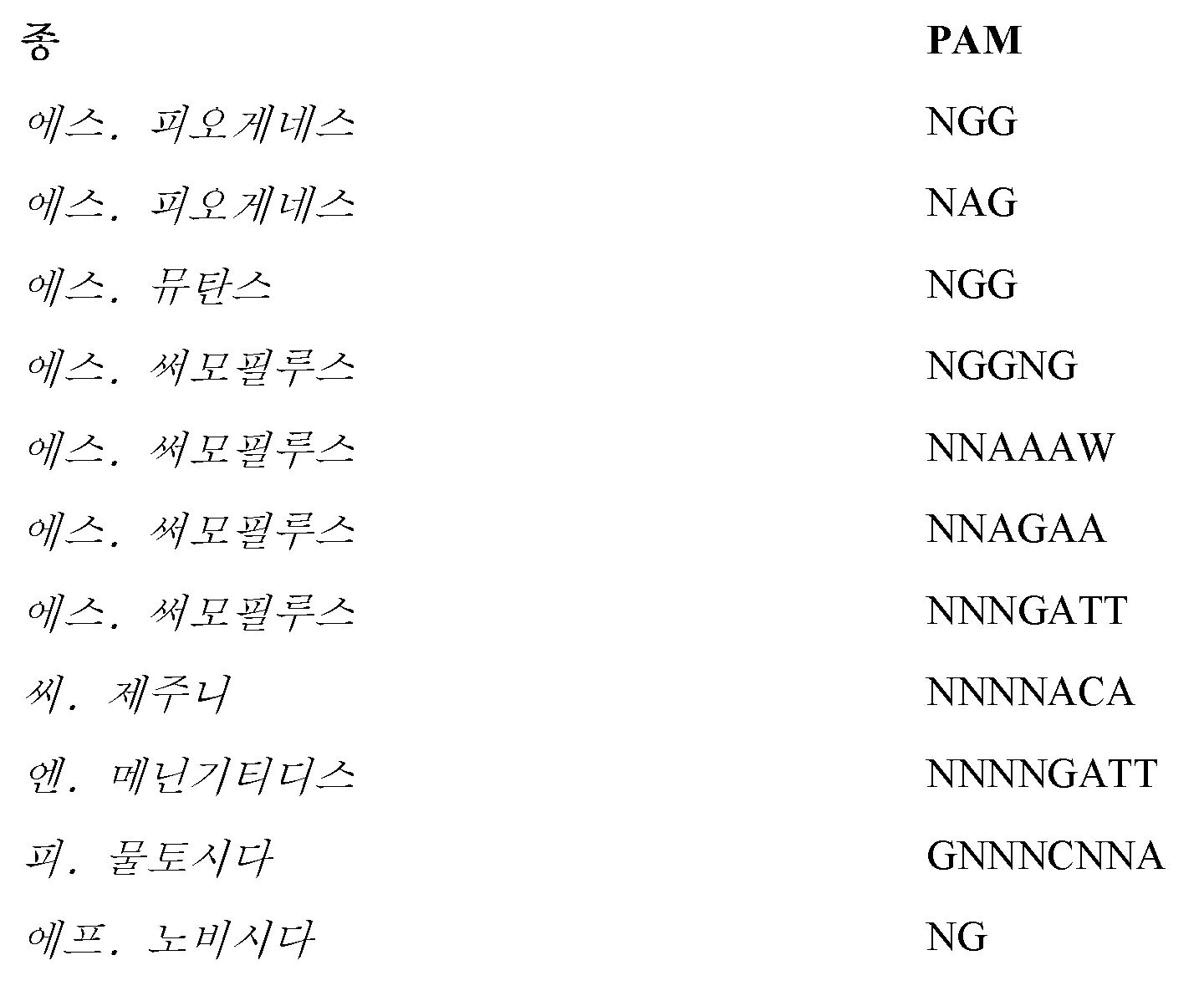
따라서, 에스. 피오게네스 CRISPR/Cas 시스템과 함께 사용하기에 적합한 표적 서열은 하기 가이드라인에 따라 선택될 수 있다: [n17, n18, n19, 또는 n20](G/A)G. 대안적으로 PAM 서열은 가이드라인 G[n17, n18, n19, n20](G/A)G를 따를 수 있다. 비-에스. 피오게네스 박테리아로부터 유래된 Cas9 단백질의 경우, 다른 PAM이 에스. 피오게네스 PAM 서열을 대체한 동일한 가이드라인이 사용될 수 있다.Therefore, S. Suitable target sequences for use with the Pyogenes CRISPR/Cas system can be selected according to the following guidelines: [n17, n18, n19, or n20](G/A)G. Alternatively the PAM sequence may follow the guidelines G[n17, n18, n19, n20](G/A)G. B-S. For the Cas9 protein derived from pyogenes bacteria, the other PAM is S. The same guidelines substituted for the pyogenes PAM sequence can be used.
잠재적인 오프 타겟 서열을 피해 특이성의 가장 높은 가능성을 갖는 표적 서열을 선택하는 것이 가장 바람직하다. 이들 바람직하지 않은 오프 타겟 서열은 다음과 같은 속성을 고려함으로써 확인될 수 있다: i) 사용되는 Cas9 단백질과 함께 기능하는 것으로 공지된 PAM 서열이 이어지는 표적 서열에서의 유사성; ii) 목적하는 표적 서열과 3개 미만의 미스매치를 갖는 유사한 표적 서열; iii) 미스매치가 모두, PAM 근위 영역보다는 PAM 원위 영역에 위치하는 것인, ii)에서와 같은 유사한 표적 서열 (때때로 '시드' 영역으로 지칭되는 (Wu et al., (2014) Nature Biotech doi:10.1038/nbt2889), PAM에 바로 인접하거나 근접한 뉴클레오티드 1-5개가 인식에 있어서 가장 중요하고, 따라서 미스매치가 시드 영역에 위치하는 추정 오프 타겟 부위는 sg RNA에 의해 인식될 가능성이 가장 적다는 일부 증거가 존재함); 및 iv) 미스매치가 연속적으로 이격되어 있지 않거나 또는 4개 초과의 뉴클레오티드만큼 이격되어 있는 유사한 표적 서열 (Hsu 2013, 상기 동일 문헌). 따라서, 어떤 CRIPSR/Cas 시스템을 사용해서든 이들 상기 기준을 사용하여 게놈 내의 잠재적인 오프 타겟 부위의 수의 분석을 수행함으로써, sgRNA에 적합한 표적 서열을 확인할 수 있다.It is most desirable to avoid potential off-target sequences and select the target sequence with the highest probability of specificity. These undesirable off-target sequences can be identified by considering the following attributes: i) similarity in the target sequence followed by a PAM sequence known to function with the Cas9 protein used; ii) a similar target sequence with less than 3 mismatches with the desired target sequence; iii) a similar target sequence as in ii) (sometimes referred to as a 'seed' region (Wu et al., (2014) Nature Biotech doi: 10.1038/nbt2889), some evidence that nucleotides 1-5 immediately adjacent or proximal to the PAM are most important for recognition, and thus putative off-target sites where mismatches are located in the seed region are least likely to be recognized by sg RNA exists); and iv) a similar target sequence in which the mismatches are not consecutively spaced or spaced more than 4 nucleotides apart (Hsu 2013, supra). Thus, by performing an analysis of the number of potential off-target sites in the genome using these above criteria using any CRIPSR/Cas system, suitable target sequences for sgRNAs can be identified.
일부 실시양태에서, CRISPR-Cpf1 시스템이 사용된다. 프란시셀라(Francisella) 종에서 확인된 CRISPR-Cpf1 시스템은 인간 세포에서 강건한 DNA 간섭을 매개하는 부류 2 CRISPR-Cas 시스템이다. 기능적으로 보존되어 있지만, Cpf1 및 Cas9는 그의 가이드 RNA 및 기질 특이성을 포함한 많은 측면에서 상이하다 (문헌 [Fagerlund et al., (2015) Genom Bio 16:251] 참조). Cas9 및 Cpf1 단백질 사이의 주요 차이는 Cpf1이 tracrRNA를 활용하지 않고, 따라서 crRNA 만을 필요로 한다는 것이다. FnCpf1 crRNA는 42-44개 뉴클레오티드 길이 (19개-뉴클레오티드 반복부 및 23-25개-뉴클레오티드 스페이서)이고, 2차 구조를 유지시키는 서열 변화를 견디는 단일 줄기-루프를 함유한다. 또한, Cpf1 crRNA는 Cas9에 의해 요구되는 ~100개-뉴클레오티드 조작된 sgRNA보다 상당히 더 짧고, FnCpfl에 대한 PAM 요건은 대체된 가닥 상의 5'-TTN-3' 및 5'-CTA-3'이다. Cas9 및 Cpf1 둘 다가 표적 DNA 내에 이중 가닥 파괴를 만들기는 하지만, Cas9는 그의 RuvC- 및 HNH-유사 도메인을 사용하여 가이드 RNA의 시드 서열 내에 평활-말단 커트를 만드는 반면에, Cpf1은 RuvC-유사 도메인을 사용하여 시드의 외부에 엇갈림 커트를 생성한다. Cpf1은 중요한 시드 영역으로부터 멀리 떨어져 엇갈림 커트를 만들기 때문에, NHEJ는 표적 부위를 파괴하지 않을 것이고, 따라서 목적하는 HDR 재조합 사건이 일어날 때까지 Cpf1이 동일한 부위를 계속해서 컷팅할 수 있도록 보장한다. 따라서, 본원에 기재된 방법 및 조성물에서, 용어 "Cas"는 Cas9 및 Cfp1 단백질 둘 다를 포함하는 것으로 이해된다. 따라서, 본원에 사용된 "CRISPR/Cas 시스템"은 뉴클레아제, 니카제 및/또는 전사 인자 시스템 둘 다를 포함한 CRISPR/Cas 및/또는 CRISPR/Cfp1 시스템 둘 다를 지칭한다.In some embodiments, the CRISPR-Cpf1 system is used. The CRISPR-Cpf1 system identified in Francisella spp. is a
일부 실시양태에서, 다른 Cas 단백질이 사용될 수 있다. 일부 예시적인 Cas 단백질은 Cas9, Cpf1 (또한 Cas12a로도 공지됨), C2c1, C2c2 (또한 Cas13a로도 공지됨), C2c3, Cas1, Cas2, Cas4, CasX 및 CasY를 포함하고; 그의 조작된 변이체 및 천연 변이체 (Burstein et al., (2017) Nature 542:237-241) 예를 들어 HF1/spCas9 (Kleinstiver et al., (2016) Nature 529:490-495; Cebrian-Serrano and Davies (2017) Mamm Genome 28(7):247-261); 분할 Cas9 시스템 (Zetsche et al., (2015) Nat Biotechnol 33(2):139-142), 인테인-엑스테인 시스템에 기초한 트랜스-스플라이싱된 Cas9 (Troung et al., (2015) Nucl Acid Res 43(13):6450-8); 미니-SaCas9 (Ma et al., (2018) ACS Synth Biol 7(4):978-985)를 포함한다. 따라서, 본원에 기재된 방법 및 조성물에서, 용어 "Cas"는 모든 Cas 변이체 단백질, 천연 및 조작된 것 둘 다를 포함하는 것으로 이해된다. 따라서, 본원에 사용된 "CRISPR/Cas 시스템"은 뉴클레아제, 니카제 및/또는 전사 인자 시스템 둘 다를 포함한 임의의 CRISPR/Cas 시스템을 지칭한다.In some embodiments, other Cas proteins may be used. Some exemplary Cas proteins include Cas9, Cpf1 (also known as Cas12a), C2c1, C2c2 (also known as Cas13a), C2c3, Cas1, Cas2, Cas4, CasX and CasY; Engineered and native variants thereof (Burstein et al., (2017) Nature 542:237-241) for example HF1/spCas9 (Kleinstiver et al., (2016) Nature 529:490-495; Cebrian-Serrano and Davies (2017) Mamm Genome 28(7):247-261); Split Cas9 system (Zetsche et al., (2015) Nat Biotechnol 33(2):139-142), trans-spliced Cas9 based on intein-extein system (Troung et al., (2015) Nucl Acid Res 43(13):6450-8); mini-SaCas9 (Ma et al., (2018) ACS Synth Biol 7(4):978-985). Accordingly, in the methods and compositions described herein, the term “Cas” is understood to include all Cas variant proteins, both natural and engineered. Thus, "CRISPR/Cas system" as used herein refers to any CRISPR/Cas system, including both nuclease, nickase and/or transcription factor systems.
특정 실시양태에서, Cas 단백질은 자연 발생 Cas 단백질의 "기능적 유도체"일 수 있다. 천연 서열 폴리펩티드의 "기능적 유도체"는 천연 서열 폴리펩티드와 공통으로 정성적 생물학적 특성을 갖는 화합물이다. "기능적 유도체"는 천연 서열의 단편, 및 천연 서열 폴리펩티드 및 그의 단편의 유도체를 포함하나 이에 제한되지는 않으며, 단 이들은 상응하는 천연 서열 폴리펩티드와 공통으로 생물학적 활성을 가져야 한다. 본원에서 고려된 생물학적 활성은 DNA 기질을 단편으로 가수분해시킬 수 있는 기능적 유도체의 능력이다. 용어 "유도체"는 폴리펩티드의 아미노산 서열 변이체, 공유 변형물, 및 그의 융합물 모두를 포괄한다. 일부 측면에서, 기능적 유도체는 자연 발생 Cas 단백질의 단일 생물학적 특성을 포함할 수 있다. 다른 측면에서, 기능적 유도체는 자연 발생 Cas 단백질의 생물학적 특성의 하위세트를 포함할 수 있다. Cas 폴리펩티드 또는 그의 단편의 적합한 유도체는 Cas 단백질 또는 그의 단편의 돌연변이체, 융합물, 공유 변형물을 포함하나 이에 제한되지는 않는다. Cas 단백질 또는 그의 단편을 포함하는 Cas 단백질 뿐만 아니라 Cas 단백질 또는 그의 단편의 유도체는 세포로부터 수득가능할 수 있거나 또는 화학적으로 합성될 수 있거나 또는 이들 두 절차의 조합에 의해 수득가능할 수 있다. 상기 세포는 Cas 단백질을 자연적으로 생산하는 세포, 또는 Cas 단백질을 자연적으로 생산하고 내인성 Cas 단백질을 더 높은 발현 수준으로 생산하도록 유전자 조작되거나 또는 외인적으로 도입된 핵산으로부터 Cas 단백질을 생산하도록 유전자 조작되는 세포일 수 있으며, 핵산은 내인성 Cas와 동일하거나 또는 상이한 Cas를 코딩한다. 일부 경우에, 상기 세포는 Cas 단백질을 자연적으로 생산하지 않고 Cas 단백질을 생산하도록 유전자 조작된다.In certain embodiments, the Cas protein may be a “functional derivative” of a naturally occurring Cas protein. A “functional derivative” of a native sequence polypeptide is a compound that has qualitative biological properties in common with the native sequence polypeptide. "Functional derivatives" include, but are not limited to, fragments of native sequence, and derivatives of native sequence polypeptides and fragments thereof, provided that they have biological activity in common with the corresponding native sequence polypeptide. A biological activity contemplated herein is the ability of a functional derivative to hydrolyze a DNA substrate into fragments. The term “derivative” encompasses all amino acid sequence variants, covalent modifications, and fusions thereof of a polypeptide. In some aspects, a functional derivative may comprise a single biological property of a naturally occurring Cas protein. In another aspect, a functional derivative may comprise a subset of the biological properties of a naturally occurring Cas protein. Suitable derivatives of Cas polypeptides or fragments thereof include, but are not limited to, mutants, fusions, and covalent modifications of the Cas protein or fragment thereof. Cas proteins, including Cas proteins or fragments thereof, as well as derivatives of Cas proteins or fragments thereof may be obtainable from cells or may be chemically synthesized or obtainable by a combination of these two procedures. The cell is a cell that naturally produces a Cas protein, or a cell that naturally produces a Cas protein and is engineered to produce an endogenous Cas protein at a higher expression level, or is genetically engineered to produce a Cas protein from an exogenously introduced nucleic acid. It may be a cell, and the nucleic acid encodes a Cas that is the same as or different from the endogenous Cas. In some cases, the cell is genetically engineered to produce a Cas protein without naturally producing the Cas protein.
특이적 유전자 (세이프 하버 유전자 포함)에 대해 표적화된 예시적인 CRISPR/Cas 뉴클레아제 시스템은 예를 들어 미국 특허 공개 번호 2015/0056705에 개시되어 있다.Exemplary CRISPR/Cas nuclease systems targeted to specific genes (including safe harbor genes) are disclosed, for example, in US Patent Publication No. 2015/0056705.
따라서, 뉴클레아제는 DNA를 절단하는 뉴클레아제 도메인과 조합하여 공여자 (트랜스진)를 삽입하는 것을 목적으로 하는 임의의 유전자 내의 표적 부위에 특이적으로 결합하는 DNA-결합 도메인을 포함한다.Thus, a nuclease comprises a DNA-binding domain that specifically binds to a target site in any gene for which it is intended to insert a donor (transgene) in combination with a nuclease domain that cleaves DNA.
타우 유전자 조정제tau gene modulator
타우 DNA-결합 도메인은 본원에 기재된 방법에 사용하기 위해 임의의 추가의 분자 (예를 들어, 폴리펩티드)에 융합될 수 있거나 또는 달리 그와 회합될 수 있다. 특정 실시양태에서, 방법은 적어도 1개의 DNA-결합 분자 (예를 들어, ZFP, TALE 또는 단일 가이드 RNA) 및 이종 조절 (기능적) 도메인 (또는 그의 기능적 단편)을 포함하는 융합 분자를 사용한다.The tau DNA-binding domain may be fused to or otherwise associated with any additional molecule (eg, a polypeptide) for use in the methods described herein. In certain embodiments, the method uses a fusion molecule comprising at least one DNA-binding molecule (eg, ZFP, TALE, or a single guide RNA) and a heterologous regulatory (functional) domain (or functional fragment thereof).
특정 실시양태에서, 타우 조정제의 기능적 도메인은 전사 조절 도메인을 포함한다. 통상적인 도메인은, 예를 들어, 전사 인자 도메인 (활성화제, 리프레서, 공동-활성화제, 공동-리프레서), 사일렌서, 종양유전자 (예를 들어, myc, jun, fos, myb, max, mad, rel, ets, bcl, myb, mos 패밀리 구성원 등); DNA 복구 효소 및 그의 연관 인자 및 변형인자; DNA 재배열 효소 및 그의 연관 인자 및 변형인자; 염색질 연관 단백질 및 그의 변형인자 (예를 들어 키나제, 아세틸라제 및 데아세틸라제); 및 DNA 변형 효소 (예를 들어, 메틸트랜스퍼라제, 토포이소머라제, 헬리카제, 리가제, 키나제, 포스파타제, 폴리머라제, 엔도뉴클레아제), 단백질 분해 변형인자 (데-유비퀴티나제, 리가제, 데그론) 및 그의 연관 인자 및 변형인자를 포함한다. 예를 들어, 그의 전문이 본원에 참조로 포함되는 미국 공개 번호 2013/0253040을 참조한다.In certain embodiments, the functional domain of a tau modulator comprises a transcriptional regulatory domain. Common domains include, for example, transcription factor domains (activators, repressors, co-activators, co-repressors), silencers, oncogenes (eg, myc, jun, fos, myb, max, mad , rel, ets, bcl, myb, mos family members, etc.); DNA repair enzymes and their associated factors and modifiers; DNA rearrangement enzymes and their associated factors and modifiers; chromatin-associated proteins and modifiers thereof (eg kinases, acetylases and deacetylases); and DNA modifying enzymes (eg, methyltransferases, topoisomerases, helicases, ligases, kinases, phosphatases, polymerases, endonucleases), proteolytic modifiers (de-ubiquitinases, ligases) agent, degron) and its associated factors and modifiers. See, for example, US Publication No. 2013/0253040, which is incorporated herein by reference in its entirety.
활성화를 달성하는데 적합한 도메인은 HSV VP16 활성화 도메인 (예를 들어, 문헌 [Hagmann et al., (1997) J. Virol. 71:5952-5962] 참조) 핵 호르몬 수용체 (예를 들어, 문헌 [Torchia et al., (1998) Curr. Opin. Cell. Biol. 10:373-383] 참조); 핵 인자 카파 B의 p65 서브유닛 (Bitko & Barik (1998) J. Virol. 72:5610-5618 and Doyle & Hunt (1997) Neuroreport 8:2937-2942); Liu et al., (1998) Cancer Gene Ther. 5:3-28), 또는 인공 키메라 기능적 도메인, 예컨대 VP64 (Beerli et al., (1998) Proc. Natl. Acad. Sci. USA 95:14623-33), 및 데그론 (Molinari et al., (1999) EMBO J. 18:6439-6447)을 포함한다. 추가의 예시적인 활성화 도메인은 Oct 1, Oct-2A, Sp1, AP-2, 및 CTF1 (Seipel et al., (1992) EMBO J. 11:4961-4968) 뿐만 아니라 p300, CBP, PCAF, SRC1 PvALF, AtHD2A 및 ERF-2를 포함한다. 예를 들어, 문헌 [Robyr et al., (2000) Mol. Endocrinol. 14:329-347; Collingwood et al., (1999) J. Mol. Endocrinol. 23:255-275; Leo et al., (2000) Gene 245:1-11; Manteuffel-Cymborowska (1999) Acta Biochim. Pol. 46:77-89; McKenna et al., (1999) J. Steroid Biochem. Mol. Biol. 69:3-12; Malik et al., (2000) Trends Biochem. Sci. 25:277-283; 및 Lemon et al., (1999) Curr. Opin. Genet. Dev. 9:499-504]을 참조한다. 추가의 예시적인 활성화 도메인은 OsGAI, HALF-1, C1, AP1, ARF-5,-6,-7, 및 -8, CPRF1, CPRF4, MYC-RP/GP, 및 TRAB1을 포함하나 이에 제한되지는 않는다. 예를 들어, 문헌 [Ogawa et al., (2000) Gene 245:21-29; Okanami et al., (1996) Genes Cells 1:87-99; Goff et al., (1991) Genes Dev. 5:298-309; Cho et al., (1999) Plant Mol. Biol. 40:419-429; Ulmason et al., (1999) Proc. Natl. Acad. Sci. USA 96:5844-5849; Sprenger-Haussels et al., (2000) Plant J. 22:1-8; Gong et al., (1999) Plant Mol. Biol. 41:33-44; 및 Hobo et al., (1999) Proc. Natl. Acad. Sci. USA 96:15,348-15,353]을 참조한다.Suitable domains to achieve activation include the HSV VP16 activation domain (see, e.g., Hagmann et al., (1997) J. Virol. 71:5952-5962) nuclear hormone receptor (e.g., Torchia et al. al., (1998) Curr. Opin. Cell. Biol. 10:373-383); p65 subunit of nuclear factor kappa B (Bitko & Barik (1998) J. Virol. 72:5610-5618 and Doyle & Hunt (1997) Neuroreport 8:2937-2942); Liu et al., (1998) Cancer Gene Ther. 5:3-28), or artificial chimeric functional domains such as VP64 (Beerli et al., (1998) Proc. Natl. Acad. Sci. USA 95:14623-33), and degron (Molinari et al., ( 1999) EMBO J. 18:6439-6447). Additional exemplary activation domains include
타우 리프레서를 제조하는데 사용될 수 있는 예시적인 억제 도메인은 KRAB A/B, KOX, TGF-베타-유도성 초기 유전자 (TIEG), v-erbA, SID, MBD2, MBD3, DNMT 패밀리의 구성원 (예를 들어, DNMT1, DNMT3A, DNMT3B), Rb, 및 MeCP2를 포함하나 이에 제한되지는 않는다. 예를 들어, 문헌 [Bird et al., (1999) Cell 99:451-454; Tyler et al., (1999) Cell 99:443-446; Knoepfler et al., (1999) Cell 99:447-450; 및 Robertson et al., (2000) Nature Genet. 25:338-342]을 참조한다. 추가의 예시적인 억제 도메인은 ROM2 및 AtHD2A를 포함하나 이에 제한되지는 않는다. 예를 들어, 문헌 [Chem et al., (1996) Plant Cell 8:305-321; 및 Wu et al., (2000) Plant J. 22:19-27]을 참조한다.Exemplary inhibitory domains that can be used to construct tau repressors include KRAB A/B, KOX, TGF-beta-inducible early gene (TIEG), v-erbA, SID, MBD2, MBD3, members of the DNMT family (e.g., , DNMT1, DNMT3A, DNMT3B), Rb, and MeCP2. See, eg, Bird et al., (1999) Cell 99:451-454; Tyler et al., (1999) Cell 99:443-446; Knoepfler et al., (1999) Cell 99:447-450; and Robertson et al., (2000) Nature Genet. 25:338-342]. Additional exemplary inhibitory domains include, but are not limited to, ROM2 and AtHD2A. See, eg, Chem et al., (1996) Plant Cell 8:305-321; and Wu et al., (2000) Plant J. 22:19-27.
일부 경우에, 도메인은 염색체의 후성적 조절에 수반된다. 일부 실시양태에서, 도메인은 히스톤 아세틸트랜스퍼라제 (HAT), 예를 들어 유형-A, 핵 국재화된 것, 예컨대 MYST 패밀리 구성원 MOZ, Ybf2/Sas3, MOF, 및 Tip60, GNAT 패밀리 구성원 Gcn5 또는 pCAF, p300 패밀리 구성원 CBP, p300 또는 Rtt109 (Berndsen and Denu (2008) Curr Opin Struct Biol 18(6):682-689)이다. 다른 경우에 도메인은 히스톤 데아세틸라제 (HDAC) 예컨대 부류 I (HDAC-1, 2, 3, 및 8), 부류 II (HDAC IIA (HDAC-4, 5, 7 및 9), HDAC IIB (HDAC 6 및 10)), 부류 IV (HDAC-11), 부류 III (또한 시르투인 (SIRT); SIRT1-7로도 공지됨)이다 (문헌 [Mottamal et al., (2015) Molecules 20(3):3898-3941] 참조). 일부 실시양태에서 사용되는 또 다른 도메인은 히스톤 포스포릴라제 또는 키나제이고, 예는 MSK1, MSK2, ATR, ATM, DNA-PK, Bub1, VprBP, IKK-α, PKCβ1, Dik/Zip, JAK2, PKC5, WSTF 및 CK2를 포함한다. 일부 실시양태에서, 메틸화 도메인이 사용되고, Ezh2, PRMT1/6, PRMT5/7, PRMT 2/6, CARM1, set7/9, MLL, ALL-1, Suv 39h, G9a, SETDB1, Ezh2, Set2, Dot1, PRMT 1/6, PRMT 5/7, PR-Set7 및 Suv4-20h와 같은 군으로부터 선택될 수 있다. sumo화 및 비오티닐화에 수반되는 도메인 (Lys9, 13, 4, 18 및 12)이 또한 일부 실시양태에서 사용될 수 있다 (검토, 문헌 [Kousarides (2007) Cell 128:693-705] 참조).In some cases, domains are involved in epigenetic regulation of chromosomes. In some embodiments, the domain is a histone acetyltransferase (HAT), e.g., type-A, nuclear localized, such as MYST family members MOZ, Ybf2/Sas3, MOF, and Tip60, GNAT family members Gcn5 or pCAF, p300 family member CBP, p300 or Rtt109 (Berndsen and Denu (2008) Curr Opin Struct Biol 18(6):682-689). In other cases the domain is a histone deacetylase (HDAC) such as class I (HDAC-1, 2, 3, and 8), class II (HDAC IIA (HDAC-4, 5, 7 and 9), HDAC IIB (HDAC 6) and 10)), class IV (HDAC-11), class III (also known as sirtuins (SIRTs); SIRT1-7) (Mottamal et al., (2015) Molecules 20(3):3898). -3941]). Another domain used in some embodiments is a histone phosphorylase or kinase, such as MSK1, MSK2, ATR, ATM, DNA-PK, Bub1, VprBP, IKK-α, PKCβ1, Dik/Zip, JAK2, PKC5 , WSTF and CK2. In some embodiments, a methylation domain is used and is selected from the group consisting of Ezh2, PRMT1/6, PRMT5/7,
융합 분자는 관련 기술분야의 통상의 기술자에게 널리 공지되어 있는 클로닝 및 생화학적 접합 방법에 의해 구축된다. 융합 분자는 DNA-결합 도메인 및 기능적 도메인 (예를 들어, 전사 활성화 또는 억제 도메인)을 포함한다. 융합 분자 또한 임의로, 핵 국재화 신호 (예컨대, 예를 들어, SV40 매질 T-항원으로부터의 것) 및 에피토프 태그 (예컨대, 예를 들어, FLAG 및 적혈구 응집소)를 포함한다. 융합 단백질 (및 이를 코딩하는 핵산)은 번역 리딩 프레임이 융합 성분들 사이에 보존되도록 설계된다.Fusion molecules are constructed by cloning and biochemical conjugation methods well known to those skilled in the art. A fusion molecule comprises a DNA-binding domain and a functional domain (eg, a transcriptional activation or repression domain). The fusion molecule also optionally comprises a nuclear localization signal (eg, from the SV40 medium T-antigen) and an epitope tag (eg, FLAG and hemagglutinin). Fusion proteins (and nucleic acids encoding them) are designed such that the translational reading frame is conserved between the fusion components.
한편으로는 기능적 도메인 (또는 그의 기능적 단편)의 폴리펩티드 성분과, 다른 한편으로는 비-단백질 DNA-결합 도메인 (예를 들어, 항생제, 삽입제, 작은 홈 결합제, 핵산) 사이의 융합물은 관련 기술분야의 통상의 기술자에게 공지된 생화학적 접합 방법에 의해 구축된다. 예를 들어, 피어스 케미칼 캄파니(Pierce Chemical Company) (일리노이주 록포드) 카탈로그를 참조한다. 작은 홈 결합제와 폴리펩티드 사이에 융합물을 제조하는 방법 및 조성물이 기재되어 있다. 문헌 [Mapp et al., (2000) Proc. Natl. Acad. Sci. USA 97:3930-3935]. 마찬가지로, 폴리펩티드 성분 기능 도메인과 회합된 sgRNA 핵산 성분을 포함하는 CRISPR/Cas TF 및 뉴클레아제가 또한 관련 기술분야의 통상의 기술자에게 공지되어 있고, 본원에서 상세화된다.Fusions between a polypeptide component of a functional domain (or functional fragment thereof) on the one hand and a non-protein DNA-binding domain (eg, antibiotic, intercalator, small groove binding agent, nucleic acid) on the other hand are described in the related art. It is constructed by biochemical conjugation methods known to those skilled in the art. See, for example, the Pierce Chemical Company (Rockford, IL) catalog. Methods and compositions for making fusions between small groove binders and polypeptides are described. Mapp et al., (2000) Proc. Natl. Acad. Sci. USA 97:3930-3935]. Likewise, CRISPR/Cas TFs and nucleases comprising an sgRNA nucleic acid component associated with a polypeptide component functional domain are also known to those skilled in the art and are detailed herein.
융합 분자는 관련 기술분야의 통상의 기술자에 공지된 바와 같은 제약상 허용되는 담체와 함께 제제화될 수 있다. 예를 들어, 문헌 [Remington's Pharmaceutical Sciences, 17th ed., 1985]; 및 공동-소유 국제 특허 공개 번호 WO 00/42219를 참조한다.The fusion molecule may be formulated with a pharmaceutically acceptable carrier as known to one of ordinary skill in the art. See, eg, Remington's Pharmaceutical Sciences, 17th ed., 1985; and co-owned International Patent Publication No. WO 00/42219.
융합 분자의 기능적 성분/도메인은, 일단 이러한 융합 분자가 그의 DNA 결합 도메인을 통해 표적 서열에 결합하면, 유전자의 전사에 영향을 미칠 수 있는 각종 상이한 성분 중 임의의 것으로부터 선택될 수 있다. 따라서, 기능적 성분은 다양한 전사 인자 도메인, 예컨대 활성화제, 리프레서, 공동 활성화제, 공동 리프레서, 및 사일렌서를 포함할 수 있으나, 이에 제한되지는 않는다.The functional component/domain of the fusion molecule can be selected from any of a variety of different components that can affect the transcription of a gene once such a fusion molecule binds to a target sequence via its DNA binding domain. Thus, a functional component may include, but is not limited to, various transcription factor domains such as, but not limited to, activators, repressors, co-activators, co-repressors, and silencers.
특정 실시양태에서, 융합 분자는 그의 조작된 (ZFP 또는 TALE 또는 sgRNA) DNA 결합 도메인을 통해 그의 의도되는 핵산 표적을 인식할 수 있는 기능적 엔티티를 생성하고, 뉴클레아제 활성을 통해 DNA가 DNA 결합 부위 근처를 컷팅하게 하는 뉴클레아제 (예를 들어, 아연 핑거 뉴클레아제 또는 TALE 뉴클레아제 또는 CRISPR/Cas 뉴클레아제)를 생성하기 위해, DNA-결합 도메인 및 뉴클레아제 도메인을 포함한다. 이러한 절단은 타우 유전자의 불활성화 (억제)를 초래한다. 따라서, 타우 리프레서는 또한 타우 뉴클레아제를 포함한다.In certain embodiments, the fusion molecule generates a functional entity capable of recognizing its intended nucleic acid target through its engineered (ZFP or TALE or sgRNA) DNA binding domain, and through nuclease activity the DNA binds to the DNA binding site. To generate a nuclease that allows to cut near (eg, zinc finger nuclease or TALE nuclease or CRISPR/Cas nuclease), a DNA-binding domain and a nuclease domain are included. This cleavage results in inactivation (repression) of the tau gene. Thus, tau repressors also include tau nucleases.
따라서, 본원에 기재된 방법 및 조성물은 광범위하게 적용가능하고, 임의의 관심 뉴클레아제를 수반할 수 있다. 뉴클레아제의 비제한적 예는 메가뉴클레아제, TALEN 및 아연 핑거 뉴클레아제를 포함한다. 뉴클레아제는 이종 DNA-결합 및 절단 도메인 (예를 들어, 아연 핑거 뉴클레아제; TALEN; 이종 절단 도메인을 갖는 메가뉴클레아제 DNA-결합 도메인, 뉴클레아제 도메인과 회합된 sgRNA)을 포함할 수 있거나, 또는 대안적으로, 자연 발생 뉴클레아제의 DNA-결합 도메인이 특정의 선택된 표적 부위에 결합하기 위해 변경될 수 있다 (예를 들어, 동족 결합 부위와 상이한 부위에 결합하도록 조작된 메가뉴클레아제).Accordingly, the methods and compositions described herein are broadly applicable and may involve any nuclease of interest. Non-limiting examples of nucleases include meganucleases, TALENs, and zinc finger nucleases. The nuclease may comprise a heterologous DNA-binding and cleavage domain (eg, zinc finger nuclease; TALEN; meganuclease DNA-binding domain with a heterologous cleavage domain, sgRNA associated with a nuclease domain). Alternatively, the DNA-binding domain of a naturally occurring nuclease can be altered to bind to a particular selected target site (eg, a meganucle engineered to bind to a site different from its cognate binding site). clease).
뉴클레아제 도메인은 임의의 뉴클레아제, 예를 들어 임의의 엔도뉴클레아제 또는 엑소뉴클레아제로부터 유래될 수 있다. 본원에 기재된 바와 같은 타우 DNA-결합 도메인에 융합될 수 있는 적합한 뉴클레아제 (절단) 도메인의 비제한적 예는 임의의 제한 효소, 예를 들어 유형 IIS 제한 효소 (예를 들어, FokI)로부터의 도메인을 포함한다. 특정 실시양태에서, 절단 도메인은 절단 활성을 위해 이량체화를 필요로 하는 절단 절반-도메인이다. 예를 들어, 그 전문이 본원에 참조로 포함되는 미국 특허 번호 8,586,526; 8,409,861; 및 7,888,121을 참조한다. 일반적으로, 융합 단백질이 절단 절반-도메인을 포함하는 경우, 절단을 위해 2개의 융합 단백질이 필요하다. 대안적으로, 2개의 절단 절반-도메인을 포함하는 단일 단백질이 사용될 수 있다. 2개의 절단 절반-도메인은 동일한 엔도뉴클레아제 (또는 그의 기능적 단편)로부터 유래될 수 있거나, 또는 각각의 절단 절반-도메인은 상이한 엔도뉴클레아제 (또는 그의 기능적 단편)로부터 유래될 수 있다. 또한, 2개의 융합 단백질에 대한 표적 부위는 바람직하게는, 서로에 대해, 2개의 융합 단백질의 그의 각각의 표적 부위에 대한 결합이 절단 절반-도메인을 서로, 절단 절반-도메인이 예를 들어 이량체화에 의해 기능적 절단 도메인을 형성하게 하는 공간적 배향으로 위치되도록 배치된다.The nuclease domain may be derived from any nuclease, for example any endonuclease or exonuclease. Non-limiting examples of suitable nuclease (cleavage) domains that can be fused to a tau DNA-binding domain as described herein include domains from any restriction enzyme, such as a Type IIS restriction enzyme (eg, FokI). includes In certain embodiments, the cleavage domain is a cleavage half-domain that requires dimerization for cleavage activity. See, for example, U.S. Patent Nos. 8,586,526; 8,409,861; and 7,888,121. In general, when a fusion protein comprises a cleavage half-domain, two fusion proteins are required for cleavage. Alternatively, a single protein comprising two cleavage half-domains may be used. The two cleavage half-domains may be from the same endonuclease (or functional fragment thereof), or each cleavage half-domain may be derived from a different endonuclease (or functional fragment thereof). In addition, the target sites for the two fusion proteins are preferably relative to each other, wherein the binding of the two fusion proteins to their respective target sites causes the cleavage half-domains to dimerize with each other, for example. is positioned in a spatial orientation that allows it to form a functional cleavage domain by
뉴클레아제 도메인은 또한 절단 활성을 갖는 임의의 메가뉴클레아제 (귀소 엔도뉴클레아제) 도메인으로부터 유래될 수 있고, 또한 I-SceI, I-CeuI, PI-PspI, PI-Sce, I-SceIV, I-CsmI, I-PanI, I-SceII, I-PpoI, I-SceIII, I-CreI, I-TevI, I-TevII 및 I-TevIII을 포함하나 이에 제한되지는 않는 본원에 기재된 뉴클레아제와 함께 사용될 수 있다.The nuclease domain can also be derived from any meganuclease (homing endonuclease) domain with cleavage activity, and also I-SceI, I-CeuI, PI-PspI, PI-Sce, I-SceIV , I-Csml, I-PanI, I-SceII, I-PpoI, I-SceIII, I-CreI, I-TevI, I-TevII and I-TevIII nucleases described herein, including but not limited to can be used with
특정 실시양태에서, 뉴클레아제는 치밀 TALEN (cTALEN)을 포함한다. 이들은 TALE DNA 결합 도메인을 TevI 뉴클레아제 도메인에 연결시키는 단일 쇄 융합 단백질이다. 융합 단백질은 TALE 영역에 의해 국재화된 니카제로서 작용할 수 있거나, 또는 TALE DNA 결합 도메인이 메가뉴클레아제 (예를 들어, TevI) 뉴클레아제 도메인에 대해서 위치되는 곳에 따라 이중 가닥 파괴를 생성할 수 있다 (문헌 [Beurdeley et al., (2013) Nat Comm 4:1762, DOI: 10.1038/ncomms2782] 참조).In certain embodiments, the nuclease comprises a dense TALEN (cTALEN). These are single chain fusion proteins that link the TALE DNA binding domain to the TevI nuclease domain. The fusion protein may act as a nickase localized by the TALE region, or it may create a double strand break depending on where the TALE DNA binding domain is located relative to the meganuclease (eg, TevI) nuclease domain. (See Beurdeley et al., (2013) Nat Comm 4:1762, DOI: 10.1038/ncomms2782).
다른 실시양태에서, TALE-뉴클레아제는 메가 TAL이다. 이들 메가 TAL 뉴클레아제는 TALE DNA 결합 도메인과 메가뉴클레아제 절단 도메인을 포함하는 융합 단백질이다. 메가뉴클레아제 절단 도메인은 단량체로서 활성이고, 활성을 위해 이량체화를 필요로 하지 않는다 (문헌 [Boissel et al., (2013) Nucl Acid Res: 1-13, doi: 10.1093/nar/gkt1224] 참조).In other embodiments, the TALE-nuclease is mega TAL. These mega TAL nucleases are fusion proteins comprising a TALE DNA binding domain and a meganuclease cleavage domain. The meganuclease cleavage domain is active as a monomer and does not require dimerization for activity (see Boissel et al., (2013) Nucl Acid Res: 1-13, doi: 10.1093/nar/gkt1224). ).
또한, 메가뉴클레아제의 뉴클레아제 도메인도 또한 DNA-결합 기능을 나타낼 수 있다. 임의의 TALEN은 추가의 TALEN (예를 들어, 1개 이상의 메가-TAL을 갖는 1종 이상의 TALEN (cTALEN 또는 FokI-TALEN)) 및/또는 ZFN과 조합되어 사용될 수 있다.In addition, the nuclease domain of a meganuclease may also exhibit a DNA-binding function. Any TALEN may be used in combination with additional TALENs (eg, one or more TALENs with one or more mega-TALs (cTALEN or FokI-TALEN)) and/or ZFNs.
또한, 절단 도메인은 야생형과 비교하여, 예를 들어, 오프-타겟 절단 효과를 감소시키거나 제거하는 편성 이종이량체의 형성을 위해 1개 이상의 변경을 포함할 수 있다. 예를 들어, 그 전문이 본원에 참조로 포함되는 미국 특허 번호 7,914,796; 8,034,598; 및 8,623,618을 참조한다.In addition, the cleavage domain may comprise one or more alterations compared to wild-type, for example, for the formation of a tight heterodimer that reduces or eliminates off-target cleavage effects. See, for example, U.S. Patent Nos. 7,914,796; 8,034,598; and 8,623,618.
본원에 기재된 바와 같은 뉴클레아제는 이중-가닥 표적 (예를 들어, 유전자)에서 이중- 또는 단일-가닥 파괴를 생성할 수 있다. 단일-가닥 파괴 ("닉")의 생성은, 예를 들어, 본원에 참조로 포함되는 미국 특허 번호 8,703,489 및 9,200,266에 기재되어 있고, 이는 뉴클레아제 도메인 중 하나의 촉매 도메인의 돌연변이가 어떻게 니카제를 생성하는지를 기재하고 있다.Nucleases as described herein are capable of producing double- or single-stranded breaks in a double-stranded target (eg, a gene). The generation of single-stranded breaks (“nics”) is described, for example, in US Pat. Nos. 8,703,489 and 9,200,266, which are incorporated herein by reference, which shows how mutation of the catalytic domain of one of the nuclease domains is nickase. It describes whether to create
따라서, 뉴클레아제 (절단) 도메인 또는 절단 절반-도메인은 절단 활성을 보유하거나 또는 기능적 절단 도메인을 형성하기 위해 다량체화 (예를 들어, 이량체화)하는 능력을 보유하는 단백질의 임의의 부분일 수 있다.Thus, a nuclease (cleavage) domain or cleavage half-domain can be any portion of a protein that retains cleavage activity or retains the ability to multimerize (e.g., dimerize) to form a functional cleavage domain. have.
대안적으로, 뉴클레아제는 소위 "분할-효소" 기술을 이용하여 핵산 표적 부위에서 생체내에서 어셈블리될 수 있다 (예를 들어, 미국 특허 공개 번호 2009/0068164 참조). 이러한 분할 효소의 성분은 별개의 발현 구축물 상에서 발현될 수 있거나, 또는 개별 성분이, 예를 들어, 자기 절단 2A 펩티드 (예를 들어, T2A) 또는 IRES 서열에 의해 분리되는 하나의 오픈 리딩 프레임 내에서 연결될 수 있다. 성분은 개별 아연 핑거 결합 도메인 또는 메가뉴클레아제 핵산 결합 도메인일 수 있다.Alternatively, nucleases can be assembled in vivo at nucleic acid target sites using so-called "split-enzyme" techniques (see, eg, US Patent Publication No. 2009/0068164). Components of such cleaving enzymes may be expressed on separate expression constructs, or within one open reading frame the individual components are separated by, for example, a self-cleaving 2A peptide (eg T2A) or IRES sequence can be connected A component may be an individual zinc finger binding domain or a meganuclease nucleic acid binding domain.
뉴클레아제를 대상으로 하여, 사용하기 전에, 예를 들어 미국 특허 공개 번호 2009/0111119에 기재된 바와 같은 효모 기반 염색체 시스템에서 활성에 관하여 스크리닝할 수 있다. 뉴클레아제 발현 구축물은 관련 기술분야에 공지된 방법을 사용하여 용이하게 설계될 수 있다.Nucleases can be screened for activity prior to use, eg, in yeast based chromosomal systems as described in US Patent Publication No. 2009/0111119. Nuclease expression constructs can be readily designed using methods known in the art.
융합 단백질 (또는 그의 성분)의 발현은 구성적 프로모터 또는 유도성 프로모터, 예를 들어 라피노스 및/또는 갈락토스의 존재 하에 활성화 (탈-억제)되고 글루코스의 존재 하에 억제되는 갈락토키나제 프로모터의 제어 하에 있을 수 있다. 바람직한 프로모터의 비제한적 예는 신경 특이적 프로모터 NSE, 시냅신, CAMKiia 및 MECP를 포함한다. 편재성 프로모터의 비제한적 예는 CAS 및 Ubc를 포함한다. 추가 실시양태는 미국 특허 공개 번호 2015/0267205에 기재된 바와 같은 자기-조절 프로모터의 사용 (타우 DNA-결합 도메인에 대한 고친화도 결합 부위의 포함을 통함)을 포함한다.Expression of the fusion protein (or components thereof) may be under the control of a constitutive or inducible promoter, for example a galactokinase promoter that is activated (de-repressed) in the presence of raffinose and/or galactose and repressed in the presence of glucose. can Non-limiting examples of preferred promoters include the neural specific promoters NSE, Synapsin, CAMKiia and MECP. Non-limiting examples of ubiquitous promoters include CAS and Ubc. Further embodiments include the use of a self-regulating promoter as described in US Patent Publication No. 2015/0267205 (via inclusion of a high affinity binding site for the tau DNA-binding domain).
특정 실시양태에서, 대상체에서 사용하기 위한 타우 조정제는 57890, 65918 및/또는 57930으로 지정된 ZFP를 포함한다. 특정 실시양태에서, 단일 ZFP 타우 리프레서와 비교하여 상승작용적 효과를 제공하는 2종 이상의 이러한 타우 조정제 (예를 들어, 57890 및 65918 ZFP 리프레서; 57890 및 57930 ZFP 리프레서; 65918 및 57930; 57890, 65918 및 57930)는 타우의 억제, 및 타우병증의 증상의 호전을 포함하여 타우병증 예컨대 AD의 치료 및/또는 예방을 위해 대상체에게 제공된다.In certain embodiments, a tau modulator for use in a subject comprises a ZFP designated 57890, 65918 and/or 57930. In certain embodiments, two or more such tau modulators (e.g., 57890 and 65918 ZFP repressors; 57890 and 57930 ZFP repressors; 65918 and 57930; 57890) provide a synergistic effect compared to a single ZFP tau repressor. , 65918 and 57930) are provided to a subject for the treatment and/or prophylaxis of tauopathy such as AD, including inhibition of tau, and amelioration of symptoms of tauopathy.
전달relay
본원에 기재된 단백질 및/또는 폴리뉴클레오티드 (예를 들어, 타우 조정제) 및 단백질 및/또는 폴리뉴클레오티드를 포함하는 조성물은, 예를 들어, 단백질의 주사에 의하는 것, mRNA를 통하는 것 및/또는 발현 구축물 (예를 들어, 플라스미드, 렌티바이러스 벡터, AAV 벡터, Ad 벡터 등)을 사용하는 것을 포함한 임의의 적합한 수단에 의해 표적 세포에 전달될 수 있다. 바람직한 실시양태에서, 리프레서는 AAV9 (미국 특허 번호 7,198,951 참조), 미국 특허 번호 9,585,971에 기재된 바와 같은 AAV 벡터를 포함하나 이에 제한되지 않는 AAV 벡터를 사용하여 전달된다.A protein and/or polynucleotide (eg, a tau modulator) described herein and a composition comprising the protein and/or polynucleotide can be administered, for example, by injection of the protein, via mRNA and/or expression can be delivered to target cells by any suitable means including using constructs (eg, plasmids, lentiviral vectors, AAV vectors, Ad vectors, etc.). In a preferred embodiment, the repressor is delivered using AAV vectors including, but not limited to, AAV vectors as described in AAV9 (see US Pat. No. 7,198,951), US Pat. No. 9,585,971.
본원에 기재된 바와 같은 아연 핑거 단백질을 포함하는 단백질을 전달하는 방법은, 예를 들어, 미국 특허 번호 6,453,242; 6,503,717; 6,534,261; 6,599,692; 6,607,882; 6,689,558; 6,824,978; 6,933,113; 6,979,539; 7,013,219; 및 7,163,824에 기재되어 있고, 이들 모두의 개시내용은 그 전문이 본원에 참조로 포함된다.Methods of delivering a protein comprising a zinc finger protein as described herein are described, for example, in US Pat. 6,503,717; 6,534,261; 6,599,692; 6,607,882; 6,689,558; 6,824,978; 6,933,113; 6,979,539; 7,013,219; and 7,163,824, the disclosures of all of which are incorporated herein by reference in their entirety.
플라스미드 벡터, 레트로바이러스 벡터, 렌티바이러스 벡터, 아데노바이러스 벡터, 폭스바이러스 벡터; 헤르페스바이러스 벡터 및 아데노-연관 바이러스 벡터 등을 포함하나 이에 제한되지는 않는 임의의 벡터 시스템을 사용할 수 있다. 또한, 미국 특허 번호 8,586,526; 6,534,261; 6,607,882; 6,824,978; 6,933,113; 6,979,539; 7,013,219; 및 7,163,824를 참조하고, 이는 그 전문이 본원에 참조로 포함된다. 더욱이, 이들 벡터 중 임의의 것이 1개 이상의 DNA-결합 단백질-코딩 서열을 포함할 수 있다는 것이 명백할 것이다. 따라서, 1개 이상의 타우 조정제 (예를 들어, 리프레서)가 세포 내로 도입되는 경우, 단백질 성분을 코딩하는 서열 및/또는 폴리뉴클레오티드 성분은 동일한 벡터 또는 상이한 벡터 상에서 운반될 수 있다. 다수의 벡터가 사용되는 경우, 각각의 벡터는 1개 또는 다수의 타우 조정제 (예를 들어, 리프레서) 또는 그의 성분을 코딩하는 서열을 포함할 수 있다. 바람직한 실시양태에서, 벡터 시스템은 AAV 벡터, 예를 들어 AAV9 또는 미국 특허 번호 9,585,971 또는 미국 특허 공개 번호 2017/0119906에 기재된 AAV 변이체이다.plasmid vectors, retroviral vectors, lentiviral vectors, adenovirus vectors, poxvirus vectors; Any vector system can be used, including, but not limited to, herpesvirus vectors and adeno-associated viral vectors, and the like. See also U.S. Patent Nos. 8,586,526; 6,534,261; 6,607,882; 6,824,978; 6,933,113; 6,979,539; 7,013,219; and 7,163,824, which are incorporated herein by reference in their entirety. Moreover, it will be apparent that any of these vectors may comprise one or more DNA-binding protein-coding sequences. Thus, when one or more tau modulators (eg, repressors) are introduced into a cell, the sequence encoding the protein component and/or the polynucleotide component may be carried on the same vector or on different vectors. When multiple vectors are used, each vector may comprise a sequence encoding one or multiple tau modulators (eg, repressors) or components thereof. In a preferred embodiment, the vector system is an AAV vector, eg, AAV9 or an AAV variant described in US Pat. No. 9,585,971 or US Patent Publication No. 2017/0119906.
통상적인 바이러스 및 비-바이러스 기반 유전자 전달 방법을 사용하여 세포 (예를 들어, 포유동물 세포) 및 표적 조직에 조작된 타우 조정제를 코딩하는 핵산을 도입할 수 있다. 또한 이러한 방법을 사용하여 이러한 리프레서 (또는 그의 성분)를 코딩하는 핵산을 세포에 시험관내 투여할 수 있다. 특정 실시양태에서, 리프레서를 코딩하는 핵산은 생체내 또는 생체외 유전자 요법 사용을 위하여 투여된다. 비-바이러스 벡터 전달 시스템은 DNA 플라스미드, 네이키드 핵산, 및 전달 비히클, 예컨대 리포솜 또는 폴록사머와 복합체를 형성한 핵산을 포함한다. 바이러스 벡터 전달 시스템은 세포로의 전달 후에 에피솜성 또는 통합된 게놈을 갖는 DNA 및 RNA 바이러스를 포함한다. 유전자 요법 절차에 관한 고찰을 위해, 문헌 [Anderson (1992) Science 256:808-813; Nabel & Felgner (1993) TIBTECH 11:211-217; Mitani & Caskey (1993) TIBTECH 11:162-166; Dillon (1993) TIBTECH 11:167-175; Miller (1992) Nature 357:455-460; Van Brunt (1988) Biotechnology 6(10):1149-1154 (1988); Vigne (1995) Restorative Neurology and Neuroscience 8:35-36; Kremer & Perricaudet (1995) British Medical Bulletin 51(1):31-44; Haddada et al., in Current Topics in Microbiology and Immunology Doerfler and Boehm (eds.) (1995); 및 Yu et al., (1994) Gene Therapy 1:13-26]을 참조한다.Conventional viral and non-viral based gene delivery methods can be used to introduce nucleic acids encoding engineered tau modulators into cells (eg, mammalian cells) and target tissues. Such methods can also be used to administer nucleic acids encoding such repressors (or components thereof) to cells in vitro. In certain embodiments, a nucleic acid encoding a repressor is administered for in vivo or ex vivo gene therapy use. Non-viral vector delivery systems include DNA plasmids, naked nucleic acids, and nucleic acids complexed with delivery vehicles such as liposomes or poloxamers. Viral vector delivery systems include DNA and RNA viruses that have episomal or integrated genomes after delivery into cells. For a review of gene therapy procedures, see Anderson (1992) Science 256:808-813; Nabel & Felgner (1993) TIBTECH 11:211-217; Mitani & Caskey (1993) TIBTECH 11:162-166; Dillon (1993) TIBTECH 11:167-175; Miller (1992) Nature 357:455-460; Van Brunt (1988) Biotechnology 6(10):1149-1154 (1988); Vigne (1995) Restorative Neurology and Neuroscience 8:35-36; Kremer & Perricaudet (1995) British Medical Bulletin 51(1):31-44; Haddada et al., in Current Topics in Microbiology and Immunology Doerfler and Boehm (eds.) (1995); and Yu et al., (1994) Gene Therapy 1:13-26.
핵산의 비-바이러스 전달 방법은 전기천공, 리포펙션, 미세주사, 바이오리스틱, 비로솜, 리포솜, 면역리포솜, 다가양이온 또는 지질:핵산 접합체, 네이키드 DNA, 네이키드 RNA, 인공 비리온, 및 DNA의 작용제-증진된 흡수를 포함한다. 예를 들어, 소니트론(Sonitron) 2000 시스템 (Rich-Mar)을 사용하는 초음파천공이 또한, 핵산의 전달을 위해 사용될 수 있다. 바람직한 실시양태에서, 1개 이상의 핵산이 mRNA로서 전달된다. 번역 효율 및/또는 mRNA 안정성을 증가시키기 위해 캡핑된 mRNA를 사용하는 것이 또한 바람직하다. 특히 바람직한 것은 ARCA (항-역전 캡 유사체) 캡 또는 그의 변이체이다. 미국 특허 번호 7,074,596 및 8,153,773을 참조하고, 이는 본원에 참조로 포함된다.Methods for non-viral delivery of nucleic acids include electroporation, lipofection, microinjection, biolistics, virosomes, liposomes, immunoliposomes, polycations or lipid:nucleic acid conjugates, naked DNA, naked RNA, artificial virions, and DNA. agonist-enhanced absorption of Sonoporation using, for example, a Sonitron 2000 system (Rich-Mar) can also be used for delivery of nucleic acids. In a preferred embodiment, the one or more nucleic acids are delivered as mRNA. It is also preferred to use capped mRNA to increase translation efficiency and/or mRNA stability. Particularly preferred are ARCA (anti-reverse cap analog) caps or variants thereof. See US Pat. Nos. 7,074,596 and 8,153,773, which are incorporated herein by reference.
추가의 예시적인 핵산 전달 시스템은 아막사 바이오시스템즈(Amaxa Biosystems) (독일 쾰른), 맥스사이트, 인크.(Maxcyte, Inc.) (매릴랜드주 록빌), BTX 몰레큘라 딜리버리 시스템즈(BTX Molecular Delivery Systems) (매사추세츠주 홀리스톤) 및 코페르니쿠스 테라퓨틱스 인크.(Copernicus Therapeutics Inc.)에 의해 제공된 것을 포함한다 (예를 들어, 미국 특허 번호 6,008,336 참조). 리포펙션은, 예를 들어, 미국 특허 번호 5,049,386; 4,946,787; 및 4,897,355에 기재되어 있고, 리포펙션 시약은 상업적으로 판매된다 (예를 들어, 트랜스펙탐(Transfectam)™ 및 리포펙틴(Lipofectin)™ 및 리포펙타민(Lipofectamine)™ RNAiMAX). 폴리뉴클레오티드의 효율적인 수용체-인식 리포펙션에 적합한 양이온성 및 중성 지질은 펠그너(Felgner), 국제 특허 공개 번호 WO 91/17424 및 WO 91/16024의 것을 포함한다. 세포 (생체외 투여) 또는 표적 조직 (생체내 투여)에 전달될 수 있다.Additional exemplary nucleic acid delivery systems include Amaxa Biosystems (Cologne, Germany), Maxcyte, Inc. (Rockville, MD), BTX Molecular Delivery Systems ( Holiston, Massachusetts) and Copernicus Therapeutics Inc. (see, eg, US Pat. No. 6,008,336). Lipofection is described, for example, in U.S. Patent Nos. 5,049,386; 4,946,787; and 4,897,355, and lipofection reagents are sold commercially (eg, Transfectam™ and Lipofectin™ and Lipofectamine™ RNAiMAX). Cationic and neutral lipids suitable for efficient receptor-recognizing lipofection of polynucleotides include those of Felgner, International Patent Publication Nos. WO 91/17424 and WO 91/16024. It can be delivered to a cell (administration ex vivo) or a target tissue (administration in vivo).
표적화된 리포솜, 예컨대 면역지질 복합체를 포함한 지질:핵산 복합체의 제조는 관련 기술분야의 통상의 기술자에게 널리 공지되어 있다 (예를 들어, 문헌 [Crystal (1995) Science 270:404-410 (1995); Blaese et al., (1995) Cancer Gene Ther. 2:291-297; Behr et al., (1994) Bioconjugate Chem. 5:382-389; Remy et al., (1994) Bioconjugate Chem. 5:647-654; Gao et al., (1995) Gene Therapy 2:710-722; Ahmad et al., (1992) Cancer Res. 52:4817-4820]; 미국 특허 번호 4,186,183; 4,217,344; 4,235,871; 4,261,975; 4,485,054; 4,501,728; 4,774,085; 4,837,028; 및 4,946,787 참조).Preparation of targeted liposomes, such as lipid:nucleic acid complexes, including immunolipid complexes, is well known to those skilled in the art (see, e.g., Crystal (1995) Science 270:404-410 (1995); Blaese et al., (1995) Cancer Gene Ther. 2:291-297; Behr et al., (1994) Bioconjugate Chem. 5:382-389; Remy et al., (1994) Bioconjugate Chem. 5:647- 654; Gao et al., (1995) Gene Therapy 2:710-722; Ahmad et al., (1992) Cancer Res. 52:4817-4820; US Pat. Nos. 4,186,183; 4,217,344; 4,235,871; 4,261,975; 4,485,054; 4,501,728 4,774,085; 4,837,028; and 4,946,787).
추가의 전달 방법은 EnGeneIC 전달 비히클 (EDV) 내로 전달될 핵산의 패키징을 이용하는 것을 포함한다. 이들 EDV는 항체의 하나의 아암이 표적 조직에 대한 특이성을 갖고 있고 다른 아암이 EDV에 대한 특이성을 갖고 있는 이중특이적 항체를 사용하여 표적 조직에 특이적으로 전달된다. 항체는 표적 세포 표면에 EDV를 가져온 다음 EDV를 세포내 이입에 의해 세포 내로 가져온다. 일단 세포 내에 있으면, 그 내용물이 방출된다 (문헌 [MacDiarmid et al., (2009) Nature Biotechnology 27(7):643] 참조).Additional delivery methods include using packaging of nucleic acids to be delivered into an EnGeneIC delivery vehicle (EDV). These EDVs are specifically delivered to a target tissue using a bispecific antibody in which one arm of the antibody has specificity for the target tissue and the other arm has specificity for the EDV. The antibody brings the EDV to the target cell surface and then brings the EDV into the cell by endocytosis. Once inside the cell, its contents are released (see MacDiarmid et al., (2009) Nature Biotechnology 27(7):643).
조작된 ZFP, TALE 또는 CRISPR/Cas 시스템을 코딩하는 핵산의 전달을 위하여 RNA 또는 DNA 바이러스 기반 시스템을 사용하는 것은 바이러스가 체내의 특이적 세포를 표적으로 하고 바이러스 페이로드를 핵으로 트래피킹하기 위한 고도로 진화된 프로세스를 활용한다. 바이러스 벡터는 환자에게 직접적으로 투여될 수 있거나 (생체내) 또는 시험관 내에서 세포를 처리하기 위해 사용될 수 있고, 이와 같이 변형된 세포가 환자에게 투여된다 (생체외). ZFP, TALE 또는 CRISPR/Cas 시스템을 전달하기 위한 통상적인 바이러스 기반 시스템은 유전자 전달을 위한 레트로바이러스, 렌티바이러스, 아데노바이러스, 아데노-연관, 백시니아 및 단순 포진 바이러스 벡터를 포함하나 이에 제한되지는 않는다. 숙주 게놈에서의 통합은 레트로바이러스, 렌티바이러스, 및 아데노-연관 바이러스 유전자 전달 방법을 이용하여 가능하며, 이로써 종종 삽입된 트랜스진의 장기간 발현이 초래된다. 추가적으로, 많은 상이한 세포 유형 및 표적 조직에서 높은 형질도입 효율이 관찰되었다.The use of RNA or DNA virus-based systems for the delivery of nucleic acids encoding engineered ZFP, TALE or CRISPR/Cas systems makes it highly desirable for the virus to target specific cells in the body and traffic the viral payload to the nucleus. Use advanced processes. Viral vectors can be administered directly to a patient (in vivo) or can be used to treat cells in vitro, and the cells so modified are administered to a patient (ex vivo). Conventional virus-based systems for delivering ZFP, TALE or CRISPR/Cas systems include, but are not limited to, retroviral, lentivirus, adenovirus, adeno-associated, vaccinia and herpes simplex virus vectors for gene delivery. . Integration in the host genome is possible using retroviral, lentiviral, and adeno-associated viral gene transfer methods, which often result in long-term expression of the inserted transgene. Additionally, high transduction efficiencies were observed in many different cell types and target tissues.
레트로바이러스의 지향성은 외래 외막 단백질을 혼입시켜, 표적 세포의 잠재적 표적 집단을 확장시킴으로써 변경될 수 있다. 렌티바이러스 벡터는 비-분할 세포를 형질도입 또는 감염시킬 수 있고 전형적으로 높은 바이러스 역가를 생성할 수 있는 레트로바이러스 벡터이다. 레트로바이러스 유전자 전달 시스템의 선택은 표적 조직에 좌우된다. 레트로바이러스 벡터는 6-10 kb 이하의 외래 서열에 대한 패키징 성능을 지닌 시스 작용성 장 말단 반복 서열로 구성된다. 최소한의 시스 작용성 LTR은 벡터의 복제 및 패키징에 충분하므로, 이어서 이를 사용하여 치료용 유전자를 표적 세포 내로 통합시켜 영구적인 트랜스진 발현을 제공한다. 광범위하게 사용된 레트로바이러스 벡터는 마우스 백혈병 바이러스 (MuLV), 긴팔원숭이 유인원 백혈병 바이러스 (GaLV), 유인원의 면역결핍 바이러스 (SIV), 인간 면역결핍 바이러스 (HIV), 및 그의 조합에 기초한 것을 포함한다 (예를 들어, 문헌 [Buchscher et al., (1992) J. Virol. 66:2731-2739; Johann et al., (1992) J. Virol. 66:1635-1640; Sommerfelt et al., (1990) Virol. 176:58-59; Wilson et al., (1989) J. Virol. 63:2374-2378; Miller et al., (1991) J. Virol. 65:2220-2224]; 국제 특허 공개 번호 WO 1994/026877 참조).The directivity of retroviruses can be altered by incorporating foreign outer membrane proteins, thereby expanding the potential target population of target cells. Lentiviral vectors are retroviral vectors capable of transducing or infecting non-dividing cells and typically producing high viral titers. The choice of retroviral gene delivery system depends on the target tissue. Retroviral vectors consist of cis-acting long terminal repeats with packaging capability for foreign sequences of 6-10 kb or less. Minimal cis-acting LTRs are sufficient for replication and packaging of the vector, so they are then used to integrate therapeutic genes into target cells to provide permanent transgene expression. Widely used retroviral vectors include those based on mouse leukemia virus (MuLV), gibbon simian leukemia virus (GaLV), simian immunodeficiency virus (SIV), human immunodeficiency virus (HIV), and combinations thereof ( See, e.g., Buchscher et al., (1992) J. Virol. 66:2731-2739; Johann et al., (1992) J. Virol. 66:1635-1640; Sommerfelt et al., (1990) Virol. 176:58-59; Wilson et al., (1989) J. Virol. 63:2374-2378; Miller et al., (1991) J. Virol. 65:2220-2224]; International Patent Publication No. WO 1994/026877).
일시적인 발현이 바람직한 적용에서는, 아데노바이러스 기반 시스템을 사용할 수 있다. 아데노바이러스 기반 벡터는 많은 세포 유형에서 매우 높은 형질도입 효율을 나타낼 수 있고 세포 분열을 필요로 하지 않는다. 이러한 벡터를 이용하여, 높은 역가 및 높은 수준의 발현이 수득되었다. 이러한 벡터는 비교적 단순한 시스템에서 다량으로 생성될 수 있다. 아데노-연관 바이러스 ("AAV") 벡터는 또한, 예를 들어, 핵산 및 펩티드의 시험관내 생성에서, 및 생체내 및 생체외 유전자 요법 절차의 경우에, 세포를 표적 핵산으로 형질도입하기 위해 사용된다 (예를 들어, 문헌 [West et al., (1987) Virology 160:38-47]; 미국 특허 번호 4,797,368; 국제 특허 공개 번호 WO 93/24641; [Kotin (1994) Human Gene Therapy 5:793-801; Muzyczka (1994) J. Clin. Invest. 94:1351] 참조). 재조합 AAV 벡터의 구축이 수많은 공개에 기재되어 있으며, 이러한 공개는 미국 특허 번호 5,173,414; 문헌 [Tratschin et al., (1985) Mol. Cell. Biol. 5:3251-3260; Tratschin et al., (1984) Mol. Cell. Biol. 4:2072-2081; Hermonat & Muzyczka (1984) PNAS 81:6466-6470; 및 Samulski et al., (1989) J. Virol. 63:03822-3828]을 포함한다.In applications where transient expression is desired, adenovirus based systems can be used. Adenovirus-based vectors can exhibit very high transduction efficiencies in many cell types and do not require cell division. Using these vectors, high titers and high levels of expression were obtained. Such vectors can be generated in large quantities in a relatively simple system. Adeno-associated virus (“AAV”) vectors are also used to transduce cells with target nucleic acids, for example, in the in vitro production of nucleic acids and peptides, and in the case of in vivo and ex vivo gene therapy procedures. (See, e.g., West et al., (1987) Virology 160:38-47; U.S. Patent No. 4,797,368; International Patent Publication No. WO 93/24641; Kotin (1994) Human Gene Therapy 5:793-801) ; Muzyczka (1994) J. Clin. Invest. 94:1351]). The construction of recombinant AAV vectors has been described in numerous publications, including US Pat. Nos. 5,173,414; Tratschin et al., (1985) Mol. Cell. Biol. 5:3251-3260; Tratschin et al., (1984) Mol. Cell. Biol. 4:2072-2081; Hermonat & Muzyczka (1984) PNAS 81:6466-6470; and Samulski et al., (1989) J. Virol. 63:03822-3828].
형질도입 작용제를 생성하기 위해 헬퍼 세포주 내로 삽입된 유전자에 의한 결함있는 벡터의 보완을 포함하는 접근 방식을 활용하는 적어도 6가지의 바이러스 벡터 접근 방식이 임상 시험에서 유전자 전달을 위해 현재 이용가능하다.At least six viral vector approaches are currently available for gene delivery in clinical trials, utilizing approaches that involve complementation of defective vectors with genes inserted into helper cell lines to generate transduction agents.
pLASN 및 MFG-S가 임상 시험에 사용되었던 레트로바이러스 벡터의 예이다 (Dunbar et al., (1995) Blood 85:3048-305; Kohn et al., (1995) Nat. Med. 1:1017-102; Malech et al., (1997) PNAS 94(22):12133-12138). PA317/pLASN은 유전자 요법 시험에 사용된 최초의 치료 벡터였다 (Blaese et al., (1995) Science 270:475-480). 50% 이상의 형질도입 효율이 MFG-S 패키지된 벡터에 대하여 관찰되었다 (Ellem et al., (1997) Immunol Immunother. 44(1):10-20; Dranoff et al., (1997) Hum. Gene Ther. 1:111-2).pLASN and MFG-S are examples of retroviral vectors that have been used in clinical trials (Dunbar et al., (1995) Blood 85:3048-305; Kohn et al., (1995) Nat. Med. 1:1017-102) Malech et al., (1997) PNAS 94(22):12133-12138). PA317/pLASN was the first therapeutic vector used in gene therapy trials (Blaese et al., (1995) Science 270:475-480). Transduction efficiencies greater than 50% were observed for MFG-S packaged vectors (Ellem et al., (1997) Immunol Immunother. 44(1):10-20; Dranoff et al., (1997) Hum. Gene Ther) 1:111-2).
재조합 아데노-연관 바이러스 벡터 (rAAV)는 결함있는 비병원성의 파르보바이러스 아데노-연관 유형 2 바이러스에 기초한 유망한 대체 유전자 전달 시스템이다. 모든 벡터는 트랜스진 발현 카세트를 플랭킹하는 AAV 145 bp 역위 말단 반복 서열만을 보유하고 있는 플라스미드로부터 유래된다. 형질도입된 세포의 게놈 내로의 통합에 기인한 효율적인 유전자 전달 및 안정한 트랜스진 전달이 상기 벡터 시스템에 대한 중요한 특징이다 (Wagner et al., (1998) Lancet 351(9117):1702-3, Kearns et al., (1996) Gene Ther. 9:748-55). 다른 AAV 혈청형, 예를 들어 AAV1, AAV3, AAV4, AAV5, AAV6, AAV8, AAV 8.2, AAV9, 및 AAV rh10 및 유사형화 AAV, 예컨대 AAV2/8, AAV2/5, AAV2/9 및 AAV2/6이 또한, 본 발명에 따라서 사용될 수 있다. 혈액-뇌 장벽을 가로지를 수 있는 신규 AAV 혈청형이 또한 본 발명에 따라 사용될 수 있다 (예를 들어, 미국 특허 번호 9,585,971 참조). 바람직한 실시양태에서, AAV9 벡터 (AAV9의 변이체 및 유사형 포함)가 사용된다.Recombinant adeno-associated viral vectors (rAAV) are a promising alternative gene delivery system based on defective avirulent parvovirus adeno-associated
복제-결핍 재조합 아데노바이러스 벡터 (Ad)는 높은 역가로 생성될 수 있고 수많은 상이한 세포 유형을 용이하게 감염시킬 수 있다. 대부분의 아데노바이러스 벡터는 트랜스진이 Ad E1a, E1b, 및/또는 E3 유전자를 대체하도록 조작되고; 연속해서 상기 복제 결함있는 벡터는 트랜스로 결실된 유전자 기능을 공급하는 인간 293 세포에서 번식된다. Ad 벡터는 여러 가지 유형의 조직을 생체내에서 형질도입시킬 수 있으며, 이는 비-분할, 분화된 세포, 예컨대 간, 신장 및 근육에서 발견된 것을 포함한다. 통상적인 Ad 벡터는 큰 운반 능력을 가지고 있다. 임상 시험에서 Ad 벡터를 사용하는 것의 한 예는 근육내 주사를 이용하여 항종양 면역을 위한 폴리뉴클레오티드 요법을 포함하였다 (Sterman et al., (1998) Hum. Gene Ther. 7:1083-9). 임상 시험에서 유전자 전달을 위하여 아데노바이러스 벡터를 사용하는 것의 추가의 예는 하기 문헌 [Rosenecker et al., (1996) Infection 24(1):5-10; Sterman et al., (1998) Hum. Gene Ther. 9(7):1083-1089; Welsh et al., (1995) Hum. Gene Ther. 2:205-18; Alvarez et al., (1997) Hum. Gene Ther. 5:597-613; Topf et al., (1998) Gene Ther. 5:507-513; Sterman et al., (1998) Hum. Gene Ther. 7:1083-1089]을 포함한다.Replication-deficient recombinant adenoviral vectors (Ad) can be produced at high titers and can readily infect numerous different cell types. Most adenoviral vectors are engineered such that the transgene replaces the Ad E1a, E1b, and/or E3 genes; Subsequently, the replication defective vector is propagated in human 293 cells supplying the deleted gene function in trans. Ad vectors are capable of transducing several types of tissue in vivo, including those found in non-dividing, differentiated cells such as liver, kidney and muscle. Conventional Ad vectors have a large carrying capacity. One example of the use of Ad vectors in clinical trials has included polynucleotide therapy for antitumor immunity using intramuscular injection (Sterman et al., (1998) Hum. Gene Ther. 7:1083-9). Further examples of the use of adenoviral vectors for gene delivery in clinical trials are described in Rosenecker et al., (1996) Infection 24(1):5-10; Sterman et al., (1998) Hum. Gene Ther. 9(7):1083-1089; Welsh et al., (1995) Hum. Gene Ther. 2:205-18; Alvarez et al., (1997) Hum. Gene Ther. 5:597-613; Topf et al., (1998) Gene Ther. 5:507-513; Sterman et al., (1998) Hum. Gene Ther. 7:1083-1089].
패키징 세포를 사용하여 숙주 세포를 감염시킬 수 있는 바이러스 입자를 형성시킨다. 이러한 세포는 아데노바이러스를 패키지하는 293 세포, 및 레트로바이러스를 패키지하는 Ψ2 세포 또는 PA317 세포를 포함한다. 유전자 요법에 사용된 바이러스 벡터는 통상적으로, 핵산 벡터를 바이러스 입자 내로 패키지하는 생산자 세포주에 의해 생성된다. 이러한 벡터는 전형적으로, 패키징 및 숙주 내로의 후속 통합 (적용가능한 경우)에 필요한 최소한의 바이러스 서열을 함유하고, 다른 바이러스 서열은 발현될 단백질을 코딩하는 발현 카세트에 의해 대체된다. 누락된 바이러스 기능은 패키징 세포주에 의해 트랜스로 공급된다. 예를 들어, 유전자 요법에 사용된 AAV 벡터는 전형적으로, 패키징 및 숙주 게놈 내로의 통합에 필요한 AAV 게놈으로부터의 역위 말단 반복 (ITR) 서열만을 보유한다. 바이러스 DNA는 다른 AAV 유전자, 즉 rep 및 cap를 코딩하는 헬퍼 플라스미드를 함유하지만, ITR 서열이 결여된 세포주에서 패키지된다. 이러한 세포주는 또한, 헬퍼로서 아데노바이러스로 감염된다. 헬퍼 바이러스는 AAV 벡터의 복제, 및 헬퍼 플라스미드로부터의 AAV 유전자의 발현을 증진시킨다. 헬퍼 플라스미드는 ITR 서열의 결여로 인해 상당한 양으로 패키지되지 않는다. 아데노바이러스로의 오염은, 예를 들어, 아데노바이러스가 AAV보다 더 감수성인 열 처리에 의해 감소될 수 있다.Packaging cells are used to form viral particles capable of infecting host cells. Such cells include 293 cells that package adenovirus, and Ψ2 cells or PA317 cells that package retrovirus. Viral vectors used in gene therapy are typically produced by producer cell lines that package nucleic acid vectors into viral particles. Such vectors typically contain minimal viral sequences necessary for packaging and subsequent integration into the host (if applicable), with other viral sequences replaced by an expression cassette encoding the protein to be expressed. Missing viral functions are supplied in trans by the packaging cell line. For example, AAV vectors used in gene therapy typically carry only inverted terminal repeat (ITR) sequences from the AAV genome necessary for packaging and integration into the host genome. Viral DNA is packaged in a cell line that contains helper plasmids encoding other AAV genes, namely rep and cap, but lacks the ITR sequence. This cell line is also infected with adenovirus as a helper. The helper virus enhances the replication of the AAV vector and the expression of the AAV gene from the helper plasmid. Helper plasmids are not packaged in significant quantities due to the lack of ITR sequences. Contamination with adenovirus can be reduced, for example, by heat treatment to which adenovirus is more sensitive than AAV.
많은 유전자 요법 적용에서는, 유전자 요법 벡터가 고도의 특이성으로 특정한 조직 유형에 전달되는 것이 바람직하다. 따라서, 바이러스 벡터는 바이러스의 외부 표면 상에 바이러스 코트 단백질을 갖는 융합 단백질로서 리간드를 발현시킴으로써 소정의 세포 유형에 대한 특이성을 갖도록 변형될 수 있다. 관심 세포 유형 상에 존재하는 것으로 공지된 수용체에 대한 친화성을 갖는 리간드가 선택된다. 예를 들어, 문헌 [Han et al., (1995) Proc. Natl. Acad. Sci. USA 92:9747-9751]에는 gp70과 융합된 인간 헤레굴린을 발현하도록 몰로니 마우스 백혈병 바이러스를 변형시킬 수 있고, 재조합 바이러스가 인간 표피 성장 인자 수용체를 발현하는 특정의 인간 유방암 세포를 감염시킨다고 보고되었다. 이러한 원리는 표적 세포가 수용체를 발현하고 바이러스가 세포 표면 수용체에 대한 리간드를 포함하는 융합 단백질을 발현하는 다른 바이러스-표적 세포 쌍으로 확장될 수 있다. 예를 들어, 섬유상 파지는 사실상 임의의 선택된 세포 수용체에 대한 특이적 결합 친화성을 갖는 항체 단편 (예를 들어, FAB 또는 Fv)을 표시하도록 조작될 수 있다. 상기 설명이 주로 바이러스 벡터에 적용되긴 하지만, 동일한 원리가 비-바이러스 벡터에도 적용될 수 있다. 이러한 벡터는 특이적 표적 세포에 의한 흡수를 선호하는 특이적 흡수 서열을 함유하도록 조작될 수 있다.In many gene therapy applications, it is desirable for gene therapy vectors to be delivered to specific tissue types with a high degree of specificity. Thus, viral vectors can be modified to have specificity for a given cell type by expressing the ligand as a fusion protein with a viral coat protein on the outer surface of the virus. Ligands with affinity for a receptor known to be present on the cell type of interest are selected. See, eg, Han et al., (1995) Proc. Natl. Acad. Sci. USA 92:9747-9751] reported that Moloney mouse leukemia virus can be modified to express human heregulin fused with gp70, and that the recombinant virus infects certain human breast cancer cells expressing human epidermal growth factor receptor. . This principle can be extended to other virus-target cell pairs in which the target cell expresses a receptor and the virus expresses a fusion protein comprising a ligand for a cell surface receptor. For example, filamentous phage can be engineered to display antibody fragments (eg, FAB or Fv) with specific binding affinity for virtually any selected cellular receptor. Although the above description applies primarily to viral vectors, the same principles can be applied to non-viral vectors as well. Such vectors can be engineered to contain specific uptake sequences that favor uptake by specific target cells.
유전자 요법 벡터는, 전형적으로 하기 기재된 바와 같은, 전신 투여 (예를 들어, 정맥내, 복강내, 근육내, 피하, 척수강내, 수조내, 뇌실내, 또는 해마, 피질, 선조체 등과 같은 뇌의 임의의 영역 내로의 것을 포함한 뇌 내로의 직접 주사를 포함한 두개내 주입) 또는 국소 적용에 의해 개별 환자에게 투여함으로써 생체내 전달될 수 있다. 대안적으로, 벡터는 생체외 세포, 예컨대 개별 환자로부터 체외 이식된 세포 (예를 들어, 림프구, 골수 흡인물, 조직 생검) 또는 만능 공여자 조혈 줄기 세포에 전달한 다음, 통상적으로 벡터가 혼입된 세포를 선택한 후에, 세포를 환자 내로 재이식할 수 있다.Gene therapy vectors can be administered systemically (e.g., intravenously, intraperitoneally, intramuscularly, subcutaneously, intrathecally, intracisternally, intraventricularly, or any of the brain, such as hippocampus, cortex, striatum, etc. intracranial injection (including direct injection into the brain, including those into the region of ) or by topical application to an individual patient. Alternatively, the vector may be delivered to cells ex vivo, such as cells transplanted ex vivo from an individual patient (e.g., lymphocytes, bone marrow aspirate, tissue biopsy) or pluripotent donor hematopoietic stem cells, and then cells, typically incorporating the vector After selection, the cells can be re-implanted into the patient.
특정 실시양태에서, 본원에 기재된 바와 같은 조성물 (예를 들어, 폴리뉴클레오티드 및/또는 단백질)은 생체내로 직접 전달된다. 조성물 (세포, 폴리뉴클레오티드 및/또는 단백질)은 중추 신경계 (CNS) 내로 직접 투여될 수 있고, 뇌 또는 척수로의 직접 주사를 포함하나 이에 제한되지는 않는다. 해마, 흑색질, 마이네르트 핵저조 (NBM), 선조체 및/또는 피질을 포함하나 이에 제한되지는 않는, 뇌의 하나 이상의 영역이 표적화될 수 있다. 대안적으로 또는 CNS 전달에 더하여, 조성물은 전신 투여될 수 있다 (예를 들어, 정맥내, 복강내, 심장내, 근육내, 피하, 척수강내, 수조내, 뇌실내 및/또는 두개내 주입). 본원에 기재된 조성물을 직접 대상체에게 (직접 CNS 내로 포함) 전달하기 위한 방법 및 조성물은 바늘 어셈블리를 통한 직접 주사 (예를 들어, 정위 주사)를 포함하나 이에 제한되지는 않는다. 이러한 방법은, 예를 들어, 뇌에의 조성물 (발현 벡터 포함)의 전달에 관하여 미국 특허 번호 7,837,668 및 8,092,429, 및 미국 특허 공개 번호 2006/0239966에 기재되어 있고, 이는 그 전문이 본원에 참조로 포함된다.In certain embodiments, a composition (eg, polynucleotide and/or protein) as described herein is delivered directly in vivo. Compositions (cells, polynucleotides and/or proteins) can be administered directly into the central nervous system (CNS), including, but not limited to, direct injection into the brain or spinal cord. One or more regions of the brain may be targeted, including, but not limited to, the hippocampus, substantia nigra, Meinert's nucleolus (NBM), striatum, and/or cortex. Alternatively or in addition to CNS delivery, the composition may be administered systemically (eg, intravenous, intraperitoneal, intracardiac, intramuscular, subcutaneous, intrathecal, intracisternal, intraventricular and/or intracranial infusion). . Methods and compositions for delivering a composition described herein directly to a subject (including directly into the CNS) include, but are not limited to, direct injection (eg, stereotactic injection) through a needle assembly. Such methods are described, for example, in U.S. Patent Nos. 7,837,668 and 8,092,429, and U.S. Patent Publication No. 2006/0239966 for delivery of compositions (including expression vectors) to the brain, which are incorporated herein by reference in their entirety. do.
투여되는 유효량은 환자마다 및 투여 방식 및 투여 부위에 따라 달라질 것이다. 따라서, 유효량은 조성물을 투여하는 의사에 의해 가장 잘 결정되고, 적절한 투여량은 관련 기술분야의 통상의 기술자에 의해 용이하게 결정될 수 있다. 통합 및 발현을 위한 충분한 시간을 허용한 후 (예를 들어, 전형적으로 4-15일), 치료 폴리펩티드의 혈청 또는 다른 조직 수준의 분석 및 투여 전 초기 수준과의 비교는, 투여되는 양이 너무 적은지, 옳은 범위 내인지, 또는 너무 많은지를 결정할 것이다. 초기 및 후속 투여에 적합한 요법은 또한 가변적이지만, 초기 투여에 이은 필요한 경우의 후속 투여에 의해 전형화된다. 후속 투여는 매일 내지 매년 내지 수년마다의 범위의 가변 간격으로 투여될 수 있다. 특정 실시양태에서,The effective amount administered will vary from patient to patient and depending on the mode of administration and site of administration. Thus, an effective amount is best determined by the physician administering the composition, and an appropriate dosage can be readily determined by one of ordinary skill in the art. After allowing sufficient time for integration and expression (e.g., typically 4-15 days), analysis of serum or other tissue levels of the therapeutic polypeptide and comparison with initial levels prior to administration determine whether the amount administered is too low. , will determine whether it is within the right range, or too many. Appropriate regimens for initial and subsequent administration also vary, but are typified by initial administration followed by subsequent administration if necessary. Subsequent administrations may be administered at variable intervals ranging from daily to annually to every few years. In certain embodiments,
아데노-연관 바이러스 (AAV) 벡터를 사용하여 인간 뇌에 직접 ZFP를 전달하기 위해, 선조체당 약 1x10¹⁰-5x10¹⁵개 (또는 이들 사이의 임의의 값) 벡터 게놈의 용량 범위를 적용할 수 있다. 언급된 바와 같이, 투여량은 다른 뇌 구조 및 상이한 전달 프로토콜에 따라 달라질 수 있다. AAV 벡터를 뇌에 직접 전달하는 방법은 관련 기술분야에 공지되어 있다. 예를 들어, 미국 특허 번호 9,089,667; 9,050,299; 8,337,458; 8,309,355; 7,182,944; 6,953,575; 및 6,309,634를 참조한다.To deliver ZFP directly to the human brain using an adeno-associated virus (AAV) vector, a dose range of about 1×10 10 −5×10 15 (or any value in between) vector genomes per striatum can be applied. As mentioned, the dosage may vary for different brain structures and different delivery protocols. Methods for delivering AAV vectors directly to the brain are known in the art. See, for example, U.S. Patent Nos. 9,089,667; 9,050,299; 8,337,458; 8,309,355; 7,182,944; 6,953,575; and 6,309,634.
진단, 연구를 위한 또는 (예를 들어, 형질감염된 세포의 숙주 유기체 내로의 재-주입을 통한) 유전자 요법을 위한 생체외 세포 형질감염은 관련 기술분야의 통상의 기술자에게 널리 공지되어 있다. 바람직한 실시양태에서, 세포를 대상 유기체로부터 단리하고, 적어도 1종의 타우 조정제 (예를 들어, 리프레서) 또는 그의 성분으로 형질감염시키고, 대상 유기체 (예를 들어, 환자) 내로 재주입한다. 바람직한 실시양태에서, 타우 조정제 (예를 들어, 리프레서)의 1개 이상의 핵산은 AAV9를 사용하여 전달된다. 다른 실시양태에서, 타우 조정제 (예를 들어, 리프레서)의 1개 이상의 핵산은 mRNA로서 전달된다. 번역 효율 및/또는 mRNA 안정성을 증가시키기 위해 캡핑된 mRNA를 사용하는 것이 또한 바람직하다. 특히 바람직한 것은 ARCA (항-역전 캡 유사체) 캡 또는 그의 변이체이다. 미국 특허 번호 7,074,596 및 8,153,773을 참조하며, 이는 그 전문이 본원에 참조로 포함된다. 생체외 형질감염에 적합한 다양한 세포 유형은 관련 기술분야의 통상의 기술자에게 널리 공지되어 있다 (예를 들어, 문헌 [Freshney et al., Culture of Animal Cells, A Manual of Basic Technique (3rd ed. 1994)], 환자로부터 세포를 단리하고 배양하는 방법에 관한 논의에 대해서는 상기 문헌에 인용된 참고문헌 참조).Ex vivo cell transfection for diagnosis, research, or gene therapy (eg, via re-injection of the transfected cells into a host organism) is well known to those skilled in the art. In a preferred embodiment, cells are isolated from a subject organism, transfected with at least one tau modulator (eg, repressor) or a component thereof, and reinjected into the subject organism (eg, patient). In a preferred embodiment, one or more nucleic acids of a tau modulator (eg repressor) are delivered using AAV9. In other embodiments, one or more nucleic acids of a tau modulator (eg, repressor) are delivered as mRNA. It is also preferred to use capped mRNA to increase translation efficiency and/or mRNA stability. Particularly preferred are ARCA (anti-reverse cap analog) caps or variants thereof. See US Pat. Nos. 7,074,596 and 8,153,773, which are incorporated herein by reference in their entirety. Various cell types suitable for ex vivo transfection are well known to those skilled in the art (see, e.g., Freshney et al., Culture of Animal Cells, A Manual of Basic Technique (3rd ed. 1994) ], see references cited therein for a discussion of methods of isolating and culturing cells from a patient).
한 실시양태에서, 세포 형질감염 및 유전자 요법을 위한 생체외 절차에 줄기 세포가 사용된다. 줄기 세포를 사용하는 경우의 이점은 이들이 시험관 내에서 다른 세포 유형으로 분화될 수 있거나, 또는 이들이 골수에 생착될 포유동물 (예컨대, 세포의 공여자) 내로 도입될 수 있다는 것이다. 시토카인, 예컨대 GM-CSF, IFN-γ 및 TNF-α를 사용하여 시험관 내에서 CD34+ 세포를 임상적으로 중요한 면역 세포 유형으로 분화시키는 방법이 공지되어 있다 (문헌 [Inaba et al., (1992) J. Exp. Med. 176:1693-1702] 참조).In one embodiment, stem cells are used in ex vivo procedures for cell transfection and gene therapy. An advantage of using stem cells is that they can be differentiated into other cell types in vitro, or they can be introduced into a mammal (eg, a donor of cells) to be engrafted in the bone marrow. Methods for differentiating CD34+ cells into clinically important immune cell types in vitro using cytokines such as GM-CSF, IFN-γ and TNF-α are known (Inaba et al., (1992) J Exp. Med. 176:1693-1702).
줄기 세포는 공지된 방법을 사용하여 형질도입 및 분화시키기 위해 단리된다. 예를 들어, 줄기 세포는 원치않는 세포, 예컨대 CD4+ 및 CD8+ (T 세포), CD45+ (panB 세포), GR-1 (과립구), 및 Iad (분화된 항원 제시 세포)에 결합하는 항체로 골수 세포를 패닝함으로써 골수 세포로부터 단리된다 (문헌 [Inaba et al., (1992) J. Exp. Med. 176:1693-1702] 참조).Stem cells are isolated for transduction and differentiation using known methods. For example, stem cells can be used to treat bone marrow cells with antibodies that bind to unwanted cells, such as CD4+ and CD8+ (T cells), CD45+ (panB cells), GR-1 (granulocytes), and Iad (differentiated antigen presenting cells). It is isolated from bone marrow cells by panning (see Inaba et al., (1992) J. Exp. Med. 176:1693-1702).
일부 실시양태에서는 변형시켰던 줄기 세포를 사용할 수도 있다. 예를 들어, 아폽토시스에 대해 저항성이 되도록 만든 뉴런의 줄기 세포가 치료 조성물로서 사용될 수 있으며, 여기서 상기 줄기 세포는 또한, 본 발명의 ZFP TF를 함유한다. 아폽토시스에 대한 저항성은, 예를 들어, 줄기 세포 내에서 BAX- 또는 BAK-특이적 TALEN 또는 ZFN (미국 특허 번호 8,597,912 참조)을 사용하여 BAX 및/또는 BAK를 녹아웃시킴으로써, 또는 예를 들어, 카스파제-6 특이적 ZFN을 또한 사용하여 카스파제에서 파괴되는 것에 의해 발생될 수 있다. 이들 세포는 타우 유전자를 조절하는 것으로 공지되어 있는 ZFP TF 또는 TALE TF로 형질감염시킬 수 있다.In some embodiments, stem cells that have been transformed may also be used. For example, stem cells of neurons made resistant to apoptosis can be used as therapeutic compositions, wherein said stem cells also contain the ZFP TFs of the present invention. Resistance to apoptosis can be achieved, for example, by knocking out BAX and/or BAK using BAX- or BAK-specific TALENs or ZFNs (see U.S. Pat. No. 8,597,912) in stem cells, or by, for example, caspase -6 specific ZFNs can also be used to be disrupted in caspases. These cells can be transfected with ZFP TF or TALE TF, which are known to regulate the tau gene.
치료용 ZFP 핵산을 함유하는 벡터 (예를 들어, 레트로바이러스, 아데노바이러스, 리포솜 등)는 또한, 생체내에서 세포의 형질도입을 위하여 유기체에 직접적으로 투여될 수 있다. 대안적으로, 네이키드 DNA를 투여할 수 있다. 투여는 주사, 주입, 국소 적용 및 전기천공을 포함하나 이에 제한되지는 않는, 분자를 혈액 또는 조직 세포와 궁극적으로 접촉시켜 이들 내로 도입하는데 정상적으로 사용되는 어떠한 경로에 의해서도 수행된다. 이러한 핵산의 적합한 투여 방법은 관련 기술분야의 통상의 기술자에게 이용가능하고 널리 공지되어 있으며, 2가지 이상의 경로를 사용하여 특정한 조성물을 투여할 수 있긴 하지만, 특정한 경로가 종종, 또 다른 경로보다 더 즉각적이고 더 유효한 반응을 제공할 수 있다.Vectors containing therapeutic ZFP nucleic acids (eg, retroviruses, adenoviruses, liposomes, etc.) can also be administered directly to an organism for transduction of cells in vivo. Alternatively, naked DNA may be administered. Administration is effected by any route normally used to ultimately contact and introduce molecules into blood or tissue cells, including, but not limited to injection, infusion, topical application, and electroporation. Suitable methods of administering such nucleic acids are available and well known to those skilled in the art, and although more than one route may be used to administer a particular composition, one route is often more immediate than another route. It can provide a more aggressive and more effective response.
DNA를 조혈 줄기 세포 내로 도입하는 방법이, 예를 들어, 미국 특허 번호 5,928,638에 개시된다. 트랜스진을 조혈 줄기 세포, 예를 들어, CD34+ 세포 내로 도입하는데 유용한 벡터는 아데노바이러스 유형 35를 포함한다.Methods for introducing DNA into hematopoietic stem cells are disclosed, for example, in US Pat. No. 5,928,638. Useful vectors for introducing a transgene into hematopoietic stem cells, such as CD34+ cells, include adenovirus type 35.
트랜스진을 면역 세포 (예를 들어, T-세포) 내로 도입하는데 적합한 벡터는 비-통합 렌티바이러스 벡터를 포함한다. 예를 들어, 문헌 [Ory et al., (1996) Proc. Natl. Acad. Sci. USA 93:11382-11388; Dull et al., (1998) J. Virol. 72:8463-8471; Zuffery et al., (1998) J. Virol. 72:9873-9880; Follenzi et al., (2000) Nature Genetics 25:217-222]을 참조한다.Suitable vectors for introducing a transgene into immune cells (eg, T-cells) include non-integrating lentiviral vectors. See, eg, Ory et al., (1996) Proc. Natl. Acad. Sci. USA 93:11382-11388; Dull et al., (1998) J. Virol. 72:8463-8471; Zuffery et al., (1998) J. Virol. 72:9873-9880; Follenzi et al., (2000) Nature Genetics 25:217-222.
제약상 허용되는 담체는 부분적으로, 투여되는 특정한 조성물에 의해서 결정될 뿐만 아니라 이러한 조성물을 투여하는데 사용되는 특정한 방법에 의해 결정된다. 따라서, 아래에 기재되는 바와 같이, 제약 조성물의 광범위한 적합한 제제가 이용가능하다 (예를 들어, 문헌 [Remington's Pharmaceutical Sciences, 17th ed., 1989] 참조).A pharmaceutically acceptable carrier is determined in part by the particular composition being administered as well as the particular method used to administer the composition. Thus, as described below, a wide variety of suitable formulations of pharmaceutical compositions are available (see, eg, Remington's Pharmaceutical Sciences, 17th ed., 1989).
상기 제시된 바와 같이, 개시된 방법 및 조성물은 원핵 세포, 진균 세포, 고세균 세포, 식물 세포, 곤충 세포, 동물 세포, 척추 동물 세포, 포유동물 세포 및 인간 세포를 포함하나 이에 제한되지는 않는 임의의 유형의 세포에 사용될 수 있다. 단백질 발현에 적합한 세포주는 관련 기술분야의 통상의 기술자에게 공지되어 있고, 이는 COS, CHO (예를 들어, CHO-S, CHO-K1, CHO-DG44, CHO-DUXB11), VERO, MDCK, WI38, V79, B14AF28-G3, BHK, HaK, NS0, SP2/0-Ag14, HeLa, HEK293 (예를 들어, HEK293-F, HEK293-H, HEK293-T), perC6, 곤충 세포, 예컨대 스포도프테라 프루기페르다(Spodoptera frugiperda) (Sf), 및 진균 세포 예컨대 사카로미세스(Saccharomyces), 피키아(Pichia) 및 쉬조사카로미세스(Schizosaccharomyces)를 포함하나 이에 제한되지는 않는다. 이들 세포주의 자손, 변이체 및 유도체가 또한 사용될 수 있다. 바람직한 실시양태, 방법 및 조성물은 뇌 세포에, 예를 들어 선조체 내로 직접 전달된다.As set forth above, the disclosed methods and compositions can be used for any type of cell, including, but not limited to, prokaryotic cells, fungal cells, archaea cells, plant cells, insect cells, animal cells, vertebrate cells, mammalian cells and human cells. cells can be used. Cell lines suitable for protein expression are known to the person skilled in the art and include COS, CHO (eg CHO-S, CHO-K1, CHO-DG44, CHO-DUXB11), VERO, MDCK, WI38, V79, B14AF28-G3, BHK, HaK, NS0, SP2/0-Ag14, HeLa, HEK293 (eg HEK293-F, HEK293-H, HEK293-T), perC6, insect cells such as Spodoptera frugi Spodoptera frugiperda (Sf), and fungal cells such as Saccharomyces, Pichia and Schizosaccharomyces. Progeny, variants and derivatives of these cell lines may also be used. Preferred embodiments, methods and compositions are delivered directly to brain cells, eg, into the striatum.
CNS 장애의 모델Models of CNS Disorders
CNS 장애의 연구는 동물 모델 시스템 예컨대 비-인간 영장류 (예를 들어, 파킨슨병 (Johnston and Fox (2015) Curr Top Behav Neurosci 22: 221-35); 근위축성 측삭 경화증 (Jackson et al., (2015) J. Med Primatol: 44(2):66-75), 헌팅톤병 (Yang et al., (2008) Nature 453(7197):921-4); 알츠하이머병 (Park et al., (2015) Int J Mol Sci 16(2):2386-402); 발작 (Hsiao et al., (2016) E Bio Med 9:257-77), 개 (예를 들어, MPS VII (Gurda et al., (2016) Mol Ther 24(2):206-216); 알츠하이머병 (Schutt et al., (2016) J Alzheimers Dis 52(2):433-49); 발작 (Varatharajah et al., (2017) Int J Neural Syst 27(1):1650046) 및 마우스 (예를 들어 발작 (Kadiyala et al., (2015) Epilepsy Res 109:183-96); 알츠하이머병 (Li et al., (2015) J Alzheimers Dis Parkin 5(3) doi 10:4172/2161-0460), (검토: Webster et al., (2014) Front Genet 5 art 88, doi:10.3389f/gene.2014.00088)에서 수행될 수 있다. 이들 모델은 질환의 특정 증상 세트를 조사하는데 유용할 수 있기 때문에 CNS 질환을 완전히 재현하는 동물 모델이 없는 경우에도 사용될 수 있다. 모델은 본원에 기재된 치료 방법 및 조성물 (유전자 리프레서)의 효능 및 안전성 프로파일을 결정하는데 도움이 될 수 있다.Studies of CNS disorders include animal model systems such as non-human primates (eg, Parkinson's disease (Johnston and Fox (2015) Curr Top Behav Neurosci 22: 221-35); amyotrophic lateral sclerosis (Jackson et al., (2015)). ) J. Med Primatol: 44(2):66-75), Huntington's disease (Yang et al., (2008) Nature 453(7197):921-4); Alzheimer's disease (Park et al., (2015) Int J Mol Sci 16(2):2386-402), seizures (Hsiao et al., (2016) E Bio Med 9:257-77), dogs (eg, MPS VII (Gurda et al., (2016)) Mol Ther 24(2):206-216); Alzheimer's disease (Schutt et al., (2016) J Alzheimers Dis 52(2):433-49); Seizures (Varatharajah et al., (2017) Int J Neural Syst 27(1):1650046) and mice (eg seizures (Kadiyala et al., (2015) Epilepsy Res 109:183-96); Alzheimer's disease (Li et al., (2015) J Alzheimers Dis Parkin 5(3) ) doi 10:4172/2161-0460), (reviewed by Webster et al., (2014) Front Genet 5 art 88, doi:10.3389f/gene.2014.00088). These models provide specific symptoms of the disease. Because it can be useful to investigate the set, it can be used even when there is no animal model that fully reproduces CNS disease.The model will be helpful in determining the efficacy and safety profile of the treatment method and composition (gene repressor) described herein. can
적용apply
MAPT-결합 분자 (예를 들어, ZFP, TALE, CRISPR/Cas 시스템, Ttago 등)를 포함한 본원에 기재된 바와 같은 타우 조정제 (예를 들어, 타우 리프레서), 및 이를 코딩하는 핵산은 다양한 적용을 위해 사용될 수 있다. 이들 적용은 MAPT-결합 분자 (DNA-결합 단백질을 코딩하는 핵산 포함)를 바이러스 (예를 들어, AAV) 또는 비-바이러스 벡터를 사용하여 대상체에게 투여하고, 이를 사용하여 대상체 내에서 표적 유전자의 발현을 조정하는 치료 방법을 포함한다. 조정은 억제, 예를 들어 AD 질환 상태에 기여하는 타우 발현의 억제의 형태일 수 있다. 대안적으로, 조정은 발현의 활성화 또는 내인성 세포 유전자의 발현의 증가가 질환 상태를 개선시킬 수 있을 때 활성화의 형태일 수 있다. 추가 실시양태에서, 조정은 예를 들어 MAPT 유전자의 불활성화를 위한 절단을 통한 (예를 들어, 1개 이상의 뉴클레아제에 의한) 억제일 수 있다. 상기 언급된 바와 같이, 이러한 적용을 위해, MAPT-결합 분자, 또는 보다 전형적으로, 이를 코딩하는 핵산은 제약상 허용되는 담체와 함께 제약 조성물로서 제제화된다.Tau modulators (e.g., tau repressors) as described herein, including MAPT-binding molecules (e.g., ZFP, TALE, CRISPR/Cas system, Ttago, etc.), and nucleic acids encoding the same, for a variety of applications can be used These applications include administering a MAPT-binding molecule (including a nucleic acid encoding a DNA-binding protein) to a subject using a viral (eg, AAV) or non-viral vector, which is then used to express the target gene in the subject. treatment methods to adjust the Modulation may be in the form of inhibition, eg inhibition of tau expression that contributes to an AD disease state. Alternatively, modulation may be in the form of activation when activation of expression or increase in expression of endogenous cellular genes can ameliorate the disease state. In a further embodiment, the modulation may be inhibition (eg, by one or more nucleases), eg, via cleavage for inactivation of the MAPT gene. As noted above, for such applications, the MAPT-binding molecule, or more typically, the nucleic acid encoding it, is formulated as a pharmaceutical composition together with a pharmaceutically acceptable carrier.
MAPT-결합 분자, 또는 이를 코딩하는 벡터는, 단독으로 또는 다른 적합한 성분 (예를 들어, 리포솜, 나노입자 또는 관련 기술분야에 공지된 다른 성분)과 조합되어 에어로졸 제제로 제조되어 (즉, 이는 "연무화"될 수 있음) 흡입을 통해 투여될 수 있다. 에어로졸 제제는 가압된 허용되는 추진제, 예컨대 디클로로디플루오로메탄, 프로판, 질소 등 내에 배치될 수 있다. 예를 들어 정맥내, 근육내, 피내 및 피하 경로에 의한 것과 같은 비경구 투여에 적합한 제제는 항산화제, 완충제, 정박테리아제, 및 제제가 의도된 수용자의 혈액과 등장성이 되도록 하는 용질을 함유할 수 있는 수성 및 비-수성, 등장성 멸균 주사 용액, 및 현탁화제, 가용화제, 증점제, 안정화제 및 보존제를 포함할 수 있는 수성 및 비-수성 멸균 현탁액을 포함한다. 조성물은 예를 들어 정맥내 주입에 의해, 경구로, 국소로, 복강내로, 방광내로, 안와후로 (RO), 두개내로 (예를 들어, 해마 및/또는 피질을 포함하나 이에 제한되지는 않는 뇌의 임의의 구역으로), 수조내로 또는 척수강내로 투여될 수 있다. 화합물 제제는 단위-용량 또는 다중-용량의 밀봉된 용기, 예컨대 앰플 및 바이알로 제공될 수 있다. 주사 용액 및 현탁액은 상기 기재된 종류의 멸균 분말, 과립 및 정제로부터 제조될 수 있다.A MAPT-binding molecule, or vector encoding the same, alone or in combination with other suitable components (eg, liposomes, nanoparticles or other components known in the art) is prepared into an aerosol formulation (i.e., it " may be "nebulized") and administered via inhalation. Aerosol formulations may be placed in pressurized acceptable propellants such as dichlorodifluoromethane, propane, nitrogen, and the like. Formulations suitable for parenteral administration, for example by intravenous, intramuscular, intradermal and subcutaneous routes, contain antioxidants, buffers, bacteriostatic agents, and solutes that render the formulation isotonic with the blood of the intended recipient. aqueous and non-aqueous, isotonic sterile injectable solutions which may contain sterile injection solutions, and aqueous and non-aqueous sterile suspensions which may contain suspending, solubilizing, thickening, stabilizing and preservative agents. The composition may be administered orally, topically, intraperitoneally, intravesically, retroorbitally (RO), intracranially (eg, brain including but not limited to hippocampus and/or cortex), eg, by intravenous infusion. to any region of the body), intracisternally, or intrathecally. Compound formulations may be presented in unit-dose or multi-dose sealed containers, such as ampoules and vials. Injection solutions and suspensions may be prepared from sterile powders, granules and tablets of the kind described above.
환자에게 투여되는 용량은 시간이 경과함에 따라 환자에서 유익한 치료 반응을 발생시키는데 충분하여야 한다. 용량은 사용된 특정한 MAPT-결합 분자의 효능 및 Kd, 표적 세포, 및 환자의 상태 뿐만 아니라, 치료될 환자의 체중 또는 체표면적에 의해 결정된다. 용량의 크기는 또한 특정한 환자에서 특정한 화합물 또는 벡터의 투여가 동반하는 임의의 유해 부작용의 존재, 성질, 및 정도에 의해 결정된다.The dose administered to a patient should be sufficient to produce a beneficial therapeutic response in the patient over time. The dose is determined by the potency and K d of the particular MAPT-binding molecule used, the target cells, and the condition of the patient, as well as the weight or body surface area of the patient to be treated. The size of the dose is also determined by the presence, nature, and extent of any adverse side effects that accompany administration of a particular compound or vector in a particular patient.
하기 실시예는 MAPT-조정제가 아연 핑거 단백질을 포함하는 본 개시내용의 예시적인 실시양태에 관한 것이다. 이는 단지 예시 목적이고, 조작된 DNA-결합 도메인을 갖는 TALE-TF, CRISPR/Cas 시스템, 추가의 ZFP, ZFN, TALEN, 추가의 CRISPR/Cas 시스템, 귀소 엔도뉴클레아제 (메가뉴클레아제)를 포함하나 이에 제한되지는 않는 다른 MAPT-조정제 (예를 들어, 리프레서)가 사용될 수 있음이 인지될 것이다. 이들 조정제는 하기 예시된 바와 같이 표적 부위에 결합하도록 통상의 기술자에게 공지된 방법을 사용하여 용이하게 수득될 수 있다는 것은 분명할 것이다. 유사하게, 하기 실시예는 전달 비히클이 임의의 AAV 벡터인 예시적인 실시양태에 관한 것이지만, 임의의 바이러스 (Ad, LV 등) 또는 비-바이러스 (플라스미드, mRNA 등)가 본원에 기재된 타우 리프레서를 전달하는데 사용될 수 있다는 것이 명백할 것이다.The following examples relate to exemplary embodiments of the present disclosure wherein the MAPT-modulator comprises a zinc finger protein. This is for illustrative purposes only, and TALE-TF with engineered DNA-binding domains, CRISPR/Cas systems, additional ZFPs, ZFNs, TALENs, additional CRISPR/Cas systems, homing endonucleases (meganucleases) It will be appreciated that other MAPT-modulators (eg, repressors) may be used, including but not limited to. It will be apparent that these modulators can be readily obtained using methods known to those skilled in the art to bind to a target site as exemplified below. Similarly, while the following examples relate to exemplary embodiments wherein the delivery vehicle is any AAV vector, any virus (Ad, LV, etc.) or non-viral (plasmid, mRNA, etc.) delivers the tau repressor described herein. It will be clear that it can be used to
실시예 1: 생체내 MAPT 억제Example 1: Inhibition of MAPT in vivo
미국 공개 번호 2018/0153921에 기재된 바와 같은 MAPT (타우) 표적 부위에 특이적인 아연 핑거 단백질을 하기와 같이 사용하였다:A zinc finger protein specific for the MAPT (tau) target site as described in US Publication No. 2018/0153921 was used as follows:
표 1: MAPT-특이적 설계Table 1: MAPT-specific design
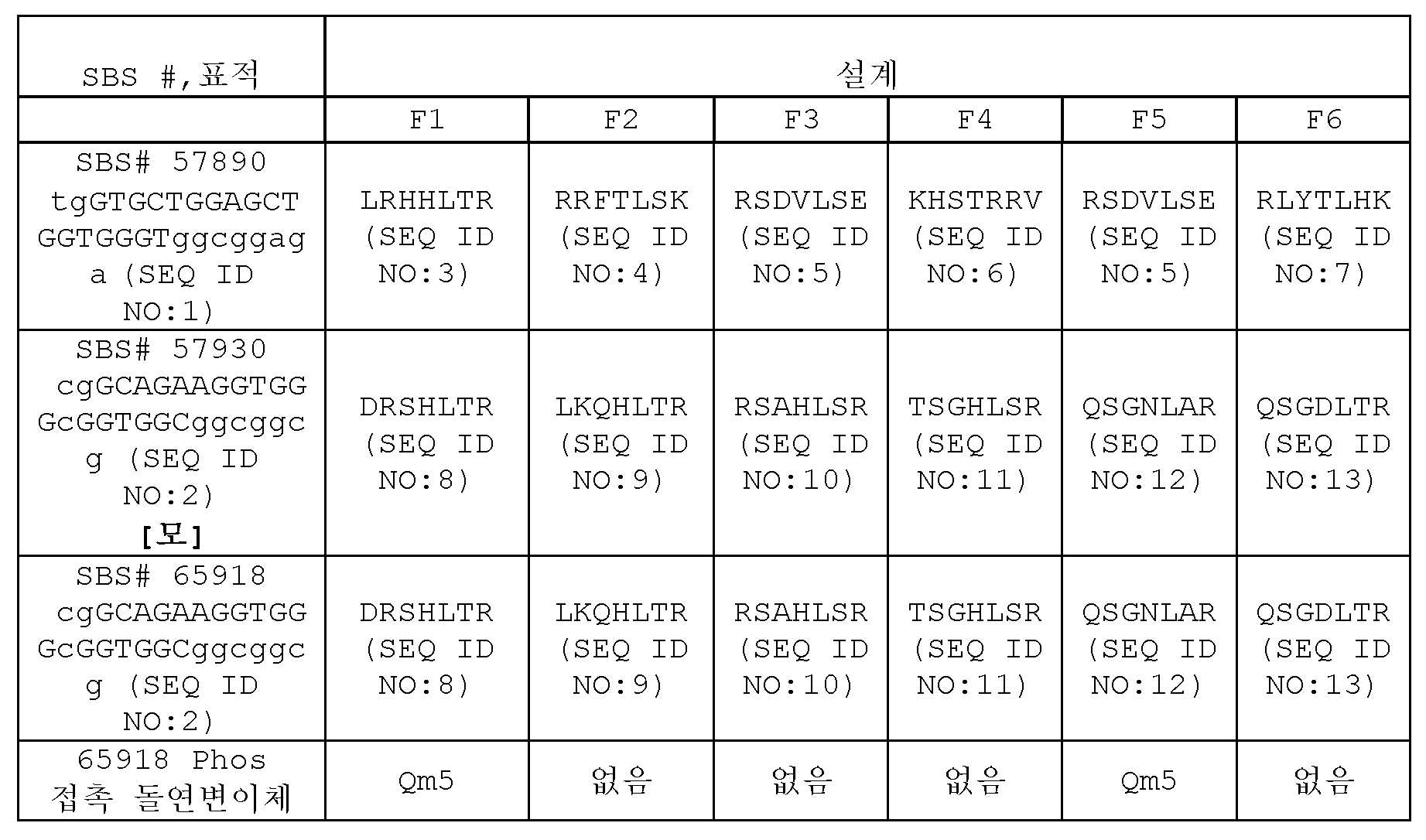
본원에 기재된 모든 ZFP를 KRAB 억제 도메인에 작동가능하게 연결시켜 ZFP-TF를 형성하였고, 이는 모두 MAPT 발현을 억제하였다.All ZFPs described herein were operably linked to the KRAB inhibitory domain to form ZFP-TFs, all of which inhibited MAPT expression.
영장류 (비-인간 영장류 (NHP) 모델)에서의 타우 발현의 억제를 관찰하기 위해 영장류 타우-특이적 ZFP-TF를 시노몰구스 원숭이 (엠. 파시쿨라리스(M. fascicularis))에서 시험한다. 시노몰구스 원숭이를 자동 급수 시스템이 장착된 스테인레스 스틸 케이지에 수용한다. 연구는 동물 복지법 규정집의 최종 규칙의 현행 버전 (미국 연방 규정집, 표제 9) 및 실험 동물의 관리 및 사용에 대한 지침, 실험실 동물 자원을 위한 기관, 생명 과학 위원회, 국립 연구 협의회, 8판의 모든 적용가능한 섹션을 준수한다.Primate tau-specific ZFP-TF is tested in cynomolgus monkeys (M. fascicularis) to observe inhibition of tau expression in primates (non-human primate (NHP) model). Cynomolgus monkeys are housed in stainless steel cages equipped with an automatic watering system. Research is the current version of the final rule of the Code of Animal Welfare Act (US Code of Federal Regulations, Title 9) and all applications of Guidelines for the Care and Use of Laboratory Animals, Agency for Laboratory Animal Resources, Life Sciences Commission, National Research Council, 8th Edition. Follow the sections where possible.
표 1의 ZFP-TF 리프레서를 본질적으로 미국 공개 번호 20180153921에 기재된 바와 같이 SYN1 프로모터 또는 CMV 프로모터를 갖는 AAV 벡터 (AAV2/9, 또는 그의 변이체) 내로 클로닝하였다. 사용된 AAV 벡터는 T2A 펩티드에 의해 연결된 65918 및 57890을 포함하는 리프레서의 발현을 구동하는 SYN1 프로모터를 갖는 벡터 (SYN918-890); T2A 펩티드에 의해 연결된 65918 및 57890을 포함하는 리프레서의 발현을 구동하는 CMV 프로모터를 갖는 벡터 (CMV918-890); 57930을 포함하는 리프레서의 발현을 구동하는 SYN1 프로모터를 갖는 벡터 (SYN930); 57890을 포함하는 리프레서의 발현을 구동하는 SYN1 프로모터를 갖는 벡터 (SYN890); 및 65918을 포함하는 리프레서의 발현을 구동하는 SYN1 프로모터를 갖는 벡터 (SYN918)를 포함하였다.The ZFP-TF repressor of Table 1 was cloned into an AAV vector (AAV2/9, or a variant thereof) having a SYN1 promoter or a CMV promoter essentially as described in US Publication No. 20180153921. The AAV vectors used include a vector having a SYN1 promoter driving expression of repressors comprising 65918 and 57890 linked by a T2A peptide (SYN918-890); a vector having a CMV promoter driving expression of a repressor comprising 65918 and 57890 linked by a T2A peptide (CMV918-890); a vector having the SYN1 promoter driving expression of the repressor, including 57930 (SYN930); a vector having a SYN1 promoter driving expression of a repressor comprising 57890 (SYN890); and a vector (SYN918) having the SYN1 promoter driving expression of the repressor including 65918.
15마리의 NHP 대상체를 하기 표에 제시된 바와 같이 처리하였다:Fifteen NHP subjects were treated as shown in the table below:
표 2Table 2
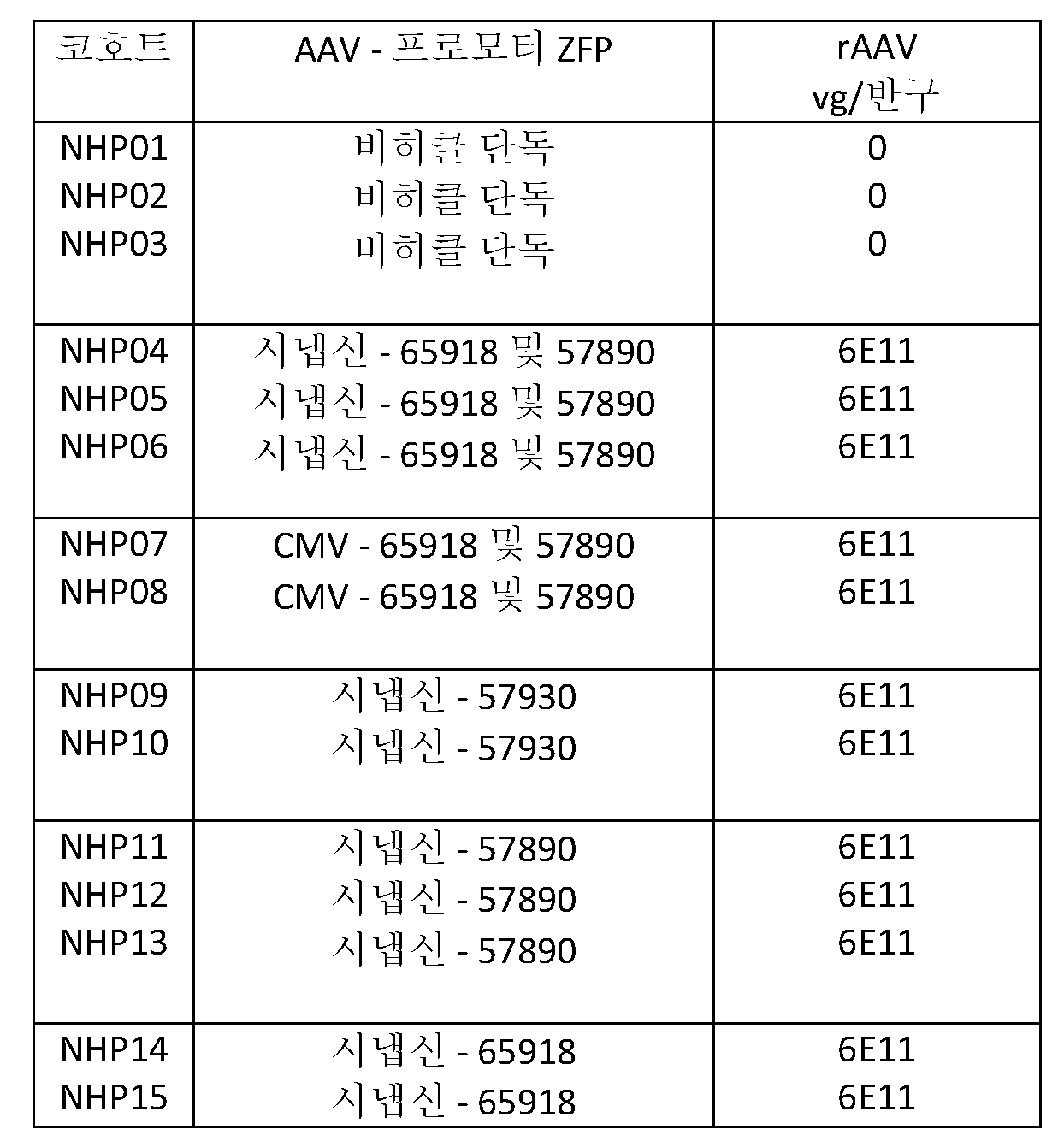
실험에서, hSYN1 또는 CMV 구동되는 ZFP TF를 포함하는 AAV9 벡터를 6E11개 vg/반구로 좌측 반구에 전달하고, 6E11개 vg/반구로 우측 반구에 전달한다. 동물은 좌측 반구에 60 μL의 부피의 시험 물품의 단일 용량을 제공받았고, 우측 반구에 60 μL의 단일 용량을 제공받았다. 모든 시험 물품에 대해, 용량 농도는 1E13개 vg/mL였다.In experiments, AAV9 vectors containing hSYN1 or CMV driven ZFP TFs are delivered to the left hemisphere at 6E11 vg/hemisphere and to the right hemisphere at 6E11 vg/hemisphere. Animals received a single dose of test article in a volume of 60 μL in the left hemisphere and a single dose of 60 μL in the right hemisphere. For all test articles, the dose concentration was 1E13 vg/mL.
28일 후, 동물을 희생시키고, 뇌를 떼어내고, 빙냉 PBS 중 관상 뇌 매트릭스 안에 넣었다. 뇌를 3 mm 관상 슬라이스 두께로 슬라이싱하였다 (대략 17개의 슬라이스로 나눔). 일부 뇌 슬라이스 (우측 및 좌측 반구)를 조직병리학 및 계내 혼성화 분석을 위해 10% 중성-완충 포르말린 중에 저장하였다. 모든 다른 뇌 슬라이스 (우측 및 좌측 반구)를 RNA레이터 (퀴아젠(Qiagen))에 넣고, 대략 24시간 동안 냉장시킨 후, 미리 규정된 뇌 표준판에 따라 2-3 mm 직경 펀치를 수집하였다. 펀치를 qRT-PCR 및 생체분포 분석을 위해 프로세싱하였다. 추가적으로, 타우 단백질 분석을 위해 CSF를 수집하였다.After 28 days, animals were sacrificed, brains removed and placed in a coronal brain matrix in ice-cold PBS. The brain was sliced into 3 mm coronal slice thickness (divided into approximately 17 slices). Some brain slices (right and left hemispheres) were stored in 10% neutral-buffered formalin for histopathology and in situ hybridization analysis. All other brain slices (right and left hemispheres) were placed in an RNAlater (Qiagen) and refrigerated for approximately 24 hours, after which 2-3 mm diameter punches were collected according to a predefined brain standard plate. Punches were processed for qRT-PCR and biodistribution analysis. Additionally, CSF was collected for tau protein analysis.
해마 및 내후각 피질 영역을 포함하는 슬라이스를 사용하여 qRT-PCR을 통해 타우, ZFP, 신경교 및 뉴런 세포 마커, 및 하우스키핑 유전자의 mRNA 발현 수준을 분석하였다. 결과는 ZFP-TF가 AAV에 의해 해마 영역으로 전달되었고 이는 타우 발현의 감소로 이어졌음을 보여준다.Slices containing hippocampal and olfactory cortex regions were used to analyze mRNA expression levels of tau, ZFP, glial and neuronal cell markers, and housekeeping genes via qRT-PCR. The results show that ZFP-TF was delivered to the hippocampal region by AAV, which led to a decrease in tau expression.
도 1 및 2는 표시된 대상체에서 표시된 벡터를 사용한 해마 펀치 088 및 035의 타우 억제 및 ZFP mRNA 수준 (카피/ng mRNA)의 예시적인 결과를 보여준다.1 and 2 show exemplary results of tau inhibition and ZFP mRNA levels (copy/ng mRNA) of hippocampal punch 088 and 035 using the indicated vectors in the indicated subjects.
도 3은 표시된 펀치 샘플 및 주어진 펀치에 대해 기준선 타우 수준을 확립하기 위해 평가된 3가지 방법으로부터의 결과를 보여주며, 이는 척도화 없음 (상부 패널), 3마리의 비히클-처리된 동물의 평균에 대한 척도화 (중간 패널), 또는 검출가능한 ZFP 발현이 부재하는 비히클-처리된 동물 및 ZFP-처리된 동물의 평균 타우 발현에 대한 척도화 (하부 패널)를 포함한다. 제시된 바와 같이, 어느 하나의 방법에 의한 척도화는 모든 15마리의 동물에 걸친 기준선 수준에 더 가까이 근접하고, 제3 방법 (ZFP 발현이 부재하는 NHP에 대한 척도화)은 일부 경우 (예를 들어, 펀치 037)에 연구에서 15마리의 동물에 걸친 타우 기준선을 다소 더 잘 대표한다.3 shows results from three methods evaluated to establish baseline tau levels for the indicated punch samples and given punches, no scaling (top panel), on average of three vehicle-treated animals. (middle panel), or the mean tau expression of vehicle-treated and ZFP-treated animals lacking detectable ZFP expression (lower panel). As shown, scaling by either method more closely approximates baseline levels across all 15 animals, and the third method (scaling for NHP in the absence of ZFP expression) in some cases (e.g. , Punch 037) somewhat better representative of the tau baseline across the 15 animals in the study.
도 4는 AAV CMV918-890으로 처리된 대상체 NHP07에서의 타우 조정 및 ZFP 수준을 보여준다. 이러한 분석을 위해, 정규화된 타우 발현을 각각의 펀치에 대해 검출가능한 ZFP 발현이 부재하는 비히클-처리된 동물 및 ZFP-처리된 동물로부터 측정된 타우 수준의 평균에 대해 척도화하였다. 이어서 NHP07에 대한 각각의 펀치로부터의 데이터를 추출하고, 분석된 뇌 섹션에 따라 그룹화하였다. 제시된 바와 같이, NHP07에서 특정 뇌 샘플에서 타우 억제가 나타났다.4 shows Tau modulation and ZFP levels in subjects NHP07 treated with AAV CMV918-890. For this analysis, normalized tau expression was scaled for each punch against the mean of tau levels measured from vehicle-treated and ZFP-treated animals lacking detectable ZFP expression. Data from each punch for NHP07 was then extracted and grouped according to the brain sections analyzed. As shown, NHP07 showed tau inhibition in certain brain samples.
도 5a는 대조군 대상체 (비히클, NHP01) 및 AAV SYN918-890 (NHP04)로 처리된 대상체에서의 타우 발현 및 ZFP 수준의 비교를 보여주고 (상부 패널), 도 5b는 슬라이스 7로부터의 MRI 결과를 보여준다. 이러한 분석을 위해, 정규화된 타우 발현을 각각의 펀치에 대해 검출가능한 ZFP 발현이 부재하는 비히클-처리된 동물 및 ZFP-처리된 동물로부터 측정된 타우 수준의 평균에 대해 척도화하였다.FIG. 5A shows a comparison of Tau expression and ZFP levels in control subjects (vehicle, NHP01) and subjects treated with AAV SYN918-890 (NHP04) (top panel), and FIG. 5B shows MRI results from
제시된 바와 같이, 비히클-처리된 NHP는 어떠한 검출가능한 타우 감소 또는 ZFP 발현도 갖지 않았다. 대조적으로, NHP04는 우측 반구의 슬라이스 7에서 검출가능한 ZFP 발현을 나타내었고, 이는 또한 2개의 내측 해마 펀치와 상관되었다. 증가된 ZFP 커버리지 및 타우 감소가 우측 반구의 섹션 8 및 9에 대해 관찰되었고, 이는 뇌의 그러한 수준으로부터의 MRI 데이터와 잘 상관되었다.As shown, vehicle-treated NHP did not have any detectable tau reduction or ZFP expression. In contrast, NHP04 showed detectable ZFP expression in
도 6은 대조군 대상체 (도 6a; NHP01, NHP02, NHP03); AAV SYN1.918-890으로 처리된 대상체 (도 6b; NHP04, NHP05, NHP06); AAV CMV.918-890으로 처리된 대상체 (도 6c; NHP07, NHP08); AAV SYN1.930으로 처리된 대상체 (도 6c; NHP09, NHP10); AAV SYN1.890으로 처리된 대상체 (도 6d; NHP11, NHP12, NHP13); 및 SYN1.918로 처리된 대상체 (도 6e; NHP14; NHP15)에서의 타우 발현 및 ZFP 수준의 결과를 보여준다.Figure 6 shows control subjects (Figure 6a; NHP01, NHP02, NHP03); subjects treated with AAV SYN1.918-890 ( FIG. 6B ; NHP04, NHP05, NHP06); subjects treated with AAV CMV.918-890 ( FIG. 6C ; NHP07, NHP08); subjects treated with AAV SYN1.930 ( FIG. 6C ; NHP09, NHP10); subjects treated with AAV SYN1.890 ( FIG. 6D ; NHP11, NHP12, NHP13); and Tau expression and ZFP levels in subjects treated with SYN1.918 ( FIG. 6E ; NHP14; NHP15).
도 7은 주어진 펀치에 대해 기준선 타우 수준을 확립하기 위해 3가지 방법을 평가한, 모든 동물에 걸친 모든 펀치에 대한 복합 분석을 보여주며, 이는 척도화 없음 (상부 패널), 3마리의 비히클-처리된 동물의 평균에 대한 척도화 (중간 패널), 또는 ZFP 발현이 부재하는 비히클-처리된 동물 및 ZFP-처리된 동물의 평균 타우 발현에 대한 척도화 (하부 패널)를 포함한다. 표시된 대상체 (좌측 패널에 제시된 비히클 NHP 대상체) 및 모든 AAV 처리된 대상체 (우측 패널)로부터의 결과가 제시된다. 제시된 바와 같이, 어느 하나의 방법에 의한 척도화는 모든 15마리의 동물에 걸친 기준선 수준에 더 가까이 근접하고, 제3 방법 (ZFP 발현이 부재하는 비히클- 및 ZFP-처리된 NHP에 대한 척도화)은 연구에서 3마리의 비히클- 및 12마리의 ZFP-처리된 동물에 걸친 타우 기준선을 다소 더 잘 대표한다.7 shows a composite analysis for all punches across all animals, evaluating three methods to establish baseline tau levels for a given punch, no scaling (top panel), three vehicle-treated animals. scaling to the mean of treated animals (middle panel), or the mean tau expression of vehicle-treated and ZFP-treated animals lacking ZFP expression (lower panel). Results from indicated subjects (vehicle NHP subjects presented in left panel) and all AAV treated subjects (right panel) are presented. As shown, the scaling by either method more closely approximates baseline levels across all 15 animals, and the third method (scaling for vehicle- and ZFP-treated NHPs lacking ZFP expression). is somewhat better representative of the tau baseline across 3 vehicle- and 12 ZFP-treated animals in the study.
이러한 분석을 위해, 정규화된 타우 발현을 각각의 펀치에 대해 검출가능한 ZFP 발현이 부재하는 비히클-처리된 동물 및 ZFP-처리된 동물로부터 측정된 타우 수준의 평균에 대해 척도화하였다. 도 8은 척도화된 타우 발현 수준 (상부) 및 절대 ZFP 전사체 수준 (카피/ng mRNA) 둘 다에 대한, 표시된 대상체 (좌측 패널에 제시된 비히클 NHP 대상체) 및 모든 AAV 처리된 대상체 (우측 패널)로부터의 결과를 보여준다. 도 9는 표시된 대상체의 좌측 및 우측 반구로부터의 타우 발현 결과를 보여준다. 도 10 및 11은 1E4개 미만의 ZFP 전사체가 존재하는 경우 (도 10의 좌측 패널, 도 11의 하부 좌측 패널); 1E4 내지 1E5개의 ZFP 전사체가 존재하는 경우 (도 10의 중간 패널; 도 11의 상부 우측 패널); 1E5개 초과의 ZFP 전사체가 존재하는 경우 (도 10의 우측 패널; 도 11의 하부 우측 패널) 및 모든 수준의 ZFP 전사체에 대한 (도 11의 상부 좌측 패널) 표시된 동물의 결과를 보여준다. 제시된 바와 같이, 낮은 수준의 ZFP 발현을 갖는 대부분의 펀치는 유의한 타우 감소를 갖지 않는다. 그러나, 1E4 내지 1E5개 ZFP 전사체/ng mRNA를 갖는 펀치는 일부 처리의 경우 중간 정도의 타우 감소를 갖고, 1E5개 이상의 전사체/ng mRNA를 갖는 것은 훨씬 더 큰 타우 감소를 갖는다.For this analysis, normalized tau expression was scaled for each punch against the mean of tau levels measured from vehicle-treated and ZFP-treated animals lacking detectable ZFP expression. 8 shows the indicated subjects (vehicle NHP subjects shown in left panel) and all AAV treated subjects (right panel) for both scaled tau expression levels (top) and absolute ZFP transcript levels (copy/ng mRNA). show the results from 9 shows the results of tau expression from the left and right hemispheres of the indicated subjects. Figures 10 and 11 show the presence of less than 1E4 ZFP transcripts (left panel of Figure 10, lower left panel of Figure 11); when 1E4 to 1E5 ZFP transcripts were present (middle panel of FIG. 10; upper right panel of FIG. 11); The results of the indicated animals are shown when more than 1E5 ZFP transcripts are present (right panel of FIG. 10; lower right panel of FIG. 11) and for all levels of ZFP transcripts (upper left panel of FIG. 11). As shown, most punches with low levels of ZFP expression do not have significant tau reduction. However, punches with 1E4 to 1E5 ZFP transcripts/ng mRNA have moderate tau reduction for some treatments, and those with 1E5 or more transcripts/ng mRNA have much greater tau reduction.
도 13, 도 15 및 도 17은 표시된 바와 같이 처리된 대상체에서의 ZFP 수준 (전사체/ng mRNA)의 함수로서의 정규화된 타우 발현의 퍼센트를 보여준다. 도 13은 타우 발현을 검출가능한 ZFP 발현이 부재하는 비히클-처리된 동물 및 ZFP-처리된 동물의 평균에 대해 척도화한 결과를 보여주고;13, 15 and 17 show the percentage of normalized tau expression as a function of ZFP levels (transcript/ng mRNA) in subjects treated as indicated. 13 shows the results of scaling tau expression to the mean of vehicle-treated and ZFP-treated animals lacking detectable ZFP expression;
도 15는 타우 발현을 비히클-처리된 동물의 평균에 대해서만 척도화한 결과를 보여주고; 도 17은 타우 발현을 기준선 타우 수준으로 조정되도록 척도화하지 않은 결과를 보여준다. 척도화 방법과 관계 없이, 데이터는 5가지의 ZFP 처리 중 4가지, 즉 AAV SYN1.65918-57890, AAV CMV. 65918-57890, AAV SYN1.57890, AAV SYN1.65918의 경우 ZFP 발현 수준과 타우 감소 사이에 유의한 상관관계가 있다는 것을 나타낸다. 가장 큰 정도의 타우 감소는 AAV SYN1.65918-57890 및 AAV CMV.65918-57890 처리에 의해 달성되었고, 일부 펀치는 >80% 타우 감소를 초과하였다.Figure 15 shows the results of tau expression scaled only to the mean of vehicle-treated animals; 17 shows the results of not scaling tau expression to adjust to baseline tau levels. Irrespective of the scaling method, data were obtained for 4 out of 5 ZFP treatments: AAV SYN1.65918-57890, AAV CMV. For 65918-57890, AAV SYN1.57890, and AAV SYN1.65918, there is a significant correlation between ZFP expression level and tau reduction. The greatest degree of tau reduction was achieved with AAV SYN1.65918-57890 and AAV CMV.65918-57890 treatments, with some punches exceeding >80% tau reduction.
도 12, 도 14 및 도 16은 비히클 (좌측 패널), 또는 그의 발현이 시냅신 1 프로모터에 의해 구동되는 57890 및 65918 ZFP-TF 리프레서를 코딩하는 AAV 벡터 (우측 패널)로 처리된 NHP 대상체에 대한 타우 발현 vs. ZFP 수준 상관관계 플롯을 보여준다. 절대 정량화를 위한 ZFP qRT-PCR 검정의 한계는 대략 1E2개 전사체/ng mRNA이며, 이는 정량화 한계 미만 (BLOQ)으로 표시된다. 도 12는 타우 발현을 검출가능한 ZFP 발현이 부재하는 비히클-처리된 동물 및 ZFP-처리된 동물의 평균에 대해 척도화한 결과를 보여준다. 도 14는 타우 발현 수준을 3마리의 비히클-처리된 동물의 평균에 대해 척도화한 분석을 보여준다. 도 16은 타우 발현 수준을 타우 기준선 수준을 보정하도록 척도화하지 않은 분석을 보여준다. 제시된 바와 같이, 타우의 억제는 존재하는 ZFP-TF의 양과 상관되었다.Figures 12, 14 and 16 show NHP subjects treated with vehicle (left panel), or AAV vectors encoding the 57890 and 65918 ZFP-TF repressors whose expression is driven by the
실시예 2: 인간화 타우 마우스 모델에서의 타우 억제Example 2: Tau Inhibition in Humanized Tau Mouse Model
또한 타우병증의 P301L 돌연변이체 인간 타우 (P301L) 트랜스제닉 마우스 모델 (rTg4510, 잭슨 랩스(Jackson Labs)) 및 hTau 마우스 모델 (B6.Cg-Mapttm1(EGFP)KltTg(MAPT)8cPdav/J, 잭슨 랩스)에서의 타우 감소를 본원에 기재된 바와 같이 유전자 리프레서의 투여 후에 평가하였다. hTau 마우스는 WT 인간 MAPT 유전자를 발현하고, 추가로, 내인성 (마우스) Mapt 유전자는 녹아웃되고 GFP 발현 구축물로 대체된다. 처리군은 하기 표에 제시된 바와 같았다:In addition, the P301L mutant human Tau (P301L) transgenic mouse model of tauopathy (rTg4510, Jackson Labs) and the hTau mouse model (B6.Cg-Mapt tm1(EGFP)Klt Tg(MAPT)8cPdav/J, Jackson) Labs) was assessed following administration of the gene repressor as described herein. hTau mice express the WT human MAPT gene, in addition, the endogenous (mouse) Mapt gene is knocked out and replaced with a GFP expression construct. Treatment groups were as shown in the table below:
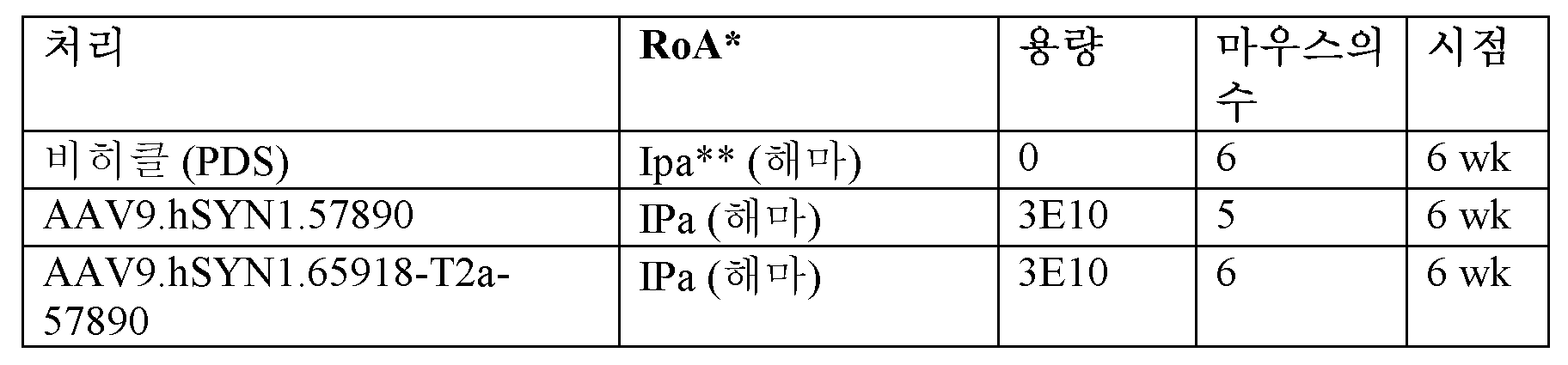
* 투여 경로* Route of administration
** 실질내 (Ipa)** Intraparenchymal (Ipa)
측정된 종점은 하기와 같았다: ZFP 및 타우 mRNA 발현 수준, RT-qPCR에 의함; GFAP, Iba1, NeuN mRNA 발현 수준, RT-qPCR에 의함; 사이토힌 (STH) mRNA 발현 수준, RT-qPCR에 의함 (STH는 인간 타우 유전자의 엑손 9와 10 사이의 인트론에 내재되어 있는 유인원 및 인간에서의 단백질-코딩 유전자임, 예를 들어 문헌 [Conrad et al., (2002) Proc Natl Acad Sci U S A. 99(11):7751-7756.] 참조); 및 타우 단백질 수준.The endpoints measured were: ZFP and tau mRNA expression levels, by RT-qPCR; GFAP, Iba1, NeuN mRNA expression levels, by RT-qPCR; Cytohin (STH) mRNA expression level, by RT-qPCR (STH is a protein-coding gene in apes and humans that is inherent in the intron between exons 9 and 10 of the human tau gene, see e.g. Conrad et al. al., (2002) Proc Natl Acad Sci US A. 99(11):7751-7756.); and tau protein levels.
도 18a 내지 도 18d에 제시된 바와 같이, 57890 및 65918의 상승작용적 쌍형성 (AAV9.hSYN.65918-T2a-57890)은 57890 (AAV9.hSY1.57890) 단독보다 적어도 2-배 더 높은 ZFP 발현 수준을 발생시켰다. 도 18a를 참조한다. 또한, 57890 및 65918을 코딩하는 구축물을 투여한 인간화 타우 마우스에서, 인간 타우 mRNA는 단지 57890만을 코딩하는 구축물을 투여한 마우스에서의 ~60% 억제와 비교하여 대략 90% 억제만큼 억제되었다 (마우스 타우 mRNA 발현은 57890 및 65918 조합에 의해 ~87% 및 57890에 의해 ~81% 억제됨). 도 18b를 참조한다. 인간 사이토힌 (hSTH)의 RT-qPCR 분석 후에 유사한 결과가 수득되었고, 57890 및 65918의 상승작용적 조합에 의한 억제는 57890 단독을 사용한 경우의 ~68%와 비교하여 ~88%였다. 도 18c를 참조한다. IBA1 및 GFAP 수준은 대조군과 비교하여 둘 다의 처리군에서 상승되었지만, NeuN 수준은 군들 사이에 유의하게 상이하지 않았다. 도 18d를 참조한다.18A-18D , the synergistic pairing of 57890 and 65918 (AAV9.hSYN.65918-T2a-57890) was at least 2-fold higher ZFP expression level than 57890 (AAV9.hSY1.57890) alone. caused See Fig. 18A. In addition, in humanized tau mice dosed with constructs encoding 57890 and 65918, human tau mRNA was inhibited by approximately 90% inhibition compared to -60% inhibition in mice dosed with constructs encoding only 57890 (mouse tau). mRNA expression was inhibited by -87% by 57890 and 65918 combination and by -81% by 57890). See Figure 18b. Similar results were obtained after RT-qPCR analysis of human cytokine (hSTH), with inhibition by the synergistic combination of 57890 and 65918 being -88% compared to -68% with 57890 alone. See Fig. 18c. IBA1 and GFAP levels were elevated in both treatment groups compared to controls, but NeuN levels were not significantly different between groups. See Fig. 18D.
또한, 이러한 및 다른 AD 마우스 모델 (예를 들어, APPswe/PS1d9, 잭슨 랩스)에서 리프레서의 임상 및 치료 유효성을 추가로 평가하여, 하기: RNA스코프(RNAscope) ISH 분석 (ZFP, 인간 타우, 및 마우스 타우의 단일 세포 분석, 예를 들어, 문헌 [Carstens et al., (2016) J Neurosci. 36(23):6312-6320] 참조); IHC ZFP/타우 분석 (예를 들어, 문헌 [Zeitler et al., (2019) Nature Medicine 25:1131-1142] 참조); 신경독성, 신경교증, 이영양성 신경돌기, 척추 손실, 흥분독성, 피질 및 해마 수축, 수지상 타우 축적, 인지 (예를 들어, 방사상 미로 및 모리스 수중 미로, 공포 조건화 등), 및 운동 결핍 중 1개 이상에 의하는 것을 포함하여 바이오마커 및 타우병증의 증상에서 감소가 존재하는지 결정하였다. 예를 들어, 문헌 [Bryan et al., (2009) Chapter 1: Transgenic Mouse Models of Alzheimer's Disease: Behavioral Testing and Considerations in Methods of Behavior Analysis in Neuroscience. 2nd edition, ed. Buccafusco, Boca Raton (FL): CRC Press/Taylor & Francis]을 참조한다. 추가적으로, 화학적으로 유도된 발작 모델, 예를 들어, 흥분독성 화합물, 예컨대 펜틸렌테트라졸 (PTZ, 예를 들어, 문헌 [Meyers et al., (1975) Epilepsia 16(2):257-67] 참조) 또는 카이네이트 (Ferraro et al., (1997) Mamm Genome 8:200-208)로 처리된 야생형 마우스를 또한 본원에 기재된 바와 같이 유전자 리프레서의 투여 후 4-8주째에 평가하여, 타우 감소가 하기를 포함한 발작에 대한 보호 효과: 발작 관련 치사성, 발작 잠복기 연장, 및/또는 발작 중증도의 감소를 부여하는지 결정한다.In addition, the clinical and therapeutic efficacy of repressors in these and other AD mouse models (e.g., APPswe/PS1d9, Jackson Labs) were further evaluated, in the following: RNAscope ISH assays (ZFP, human tau, and single cell analysis of mouse tau, see, eg, Carstens et al., (2016) J Neurosci. 36(23):6312-6320; IHC ZFP/tau assay (see, eg, Zeitler et al., (2019) Nature Medicine 25:1131-1142); One of neurotoxicity, gliosis, dystrophic neurites, spinal loss, excitotoxicity, cortical and hippocampal contraction, dendritic tau accumulation, cognition (e.g., radial maze and Morris water maze, fear conditioning, etc.), and motor deficits It was determined whether there was a decrease in biomarkers and symptoms of tauopathy, including by the above. See, eg, Bryan et al., (2009) Chapter 1: Transgenic Mouse Models of Alzheimer's Disease: Behavioral Testing and Considerations in Methods of Behavior Analysis in Neuroscience. 2nd edition, ed. Buccafusco, Boca Raton (FL): CRC Press/Taylor & Francis]. Additionally, see chemically induced seizure models, eg, excitotoxic compounds such as pentylenetetrazole (PTZ, eg, Meyers et al., (1975) Epilepsia 16(2):257-67). ) or kainate (Ferraro et al., (1997) Mamm Genome 8:200-208) were also evaluated 4-8 weeks after administration of the gene repressor as described herein, indicating that tau reduction was To determine whether it confer protective effects against seizures, including: seizure-related lethality, prolonged seizure latency, and/or reduction of seizure severity.
실시예 3: 신경염증성 반응Example 3: Neuroinflammatory Response
MAPT 리프레서 ZFP-TF로 생체내 처리된 영장류를 또한 소교세포 및 성상세포 마커의 발현 수준에 대해 평가하였다. 특히, IBA1 및 GFAP 발현에 대한 RT-qPCR 시약을 사용하여 실시예 1에 기재된 바와 같은 펀치를 평가하였다. 또한, E1F4A 하우스키핑 유전자의 수준을 처리된 영장류에서 또한 평가하였다. 간략하게, 뇌 펀치를 얼음 상의 0.6 mL TRI 시약 (써모 피셔(Thermo Fisher)) 및 2개의 3.2-mm 스틸 비드 (바이오스펙 프로덕츠(BioSpec Products))를 함유하는 1.5-mL 에펜도르프 튜브로 옮겼다.Primates treated in vivo with the MAPT repressor ZFP-TF were also evaluated for expression levels of microglia and astrocyte markers. Specifically, punch as described in Example 1 was evaluated using RT-qPCR reagents for IBA1 and GFAP expression. In addition, the level of the E1F4A housekeeping gene was also assessed in treated primates. Briefly, brain punches were transferred to 1.5-mL Eppendorf tubes containing 0.6 mL TRI reagent (Thermo Fisher) and two 3.2-mm steel beads (BioSpec Products) on ice.
조직을 퀴아젠 티슈라이저(Qiagen TissueLyser)를 사용하여 4℃에서 하기 파라미터를 사용하여 용해시켰다: 5회 사이클, 90초 지속시간, 25.1 빈도. 간략한 원심분리 후에, 1-브로모-3-클로로프로판 70 μL를 실온에서 각각의 샘플에 첨가하였다. 샘플을 10초 동안 볼텍싱하고, 4℃에서 10분 동안 12,000 xg로 원심분리하고, 각각의 샘플로부터의 120 μL의 수성 상을 96-웰 플레이트의 웰로 옮겼다. 이소프로필 알콜 60 마이크로리터 및 매그맥스(MagMax) 자기 비드 (써모 사이언티픽) 12 μL를 수성 상 샘플을 함유하는 각각의 샘플 웰에 첨가하였다. 킹피셔 96(Kingfisher 96) 로봇 (써모 사이언티픽) 및 매그맥스 키트 (써모 피셔)를 사용하여 제조업체의 지침에 따라 조직 용해물로부터 RNA를 단리하였다. 100 마이크로리터의 용리된 RNA를 자기 스탠드를 사용하여 자기 비드로부터 분리하였다.Tissues were lysed using a Qiagen TissueLyser at 4° C. with the following parameters: 5 cycles, 90 sec duration, 25.1 frequency. After brief centrifugation, 70 μL of 1-bromo-3-chloropropane was added to each sample at room temperature. Samples were vortexed for 10 seconds, centrifuged at 12,000×g for 10 minutes at 4° C., and 120 μL of the aqueous phase from each sample was transferred to the wells of a 96-well plate. 60 microliters of isopropyl alcohol and 12 μL of MagMax magnetic beads (Thermo Scientific) were added to each sample well containing the aqueous phase sample. RNA was isolated from tissue lysates using a Kingfisher 96 robot (Thermo Scientific) and a Magmax kit (Thermo Fisher) according to the manufacturer's instructions. 100 microliters of eluted RNA was isolated from magnetic beads using a magnetic stand.
RNA 수율 및 품질을 나노드롭 8000 기기 (써모 사이언티픽)를 사용하여 평가하였다. 모든 샘플에 대해 10 μL의 RNA 및 10 μL의 RT 마스터 믹스 (10x RT 완충제, 10x 무작위 프라이머, 25x dNTP 믹스, 멀티스크립(Multiscribe) 효소, 및 RNAse-무함유 물)와 함께 고성능 cDNA 역전사 키트 (어플라이드 바이오시스템즈(Applied Biosystems))를 사용하여 cDNA를 제조하였다. C1000 터치 바이오라드 써멀 사이클러에서 하기 프로그램을 사용하여 역전사를 수행하였다: 10분 동안 25℃, 120분 동안 37℃, 5분 동안 85℃, 및 4℃에서 유지. 바이오라드 CFX384 써멀 사이클러를 사용하여 qRT-PCR을 수행하였다. cDNA를 뉴클레아제-무함유 물 중에 10-배 희석하고, 4 μL의 희석된 cDNA를 각각의 10 μL PCR 반응에 첨가하였다. 각각의 샘플을 기술상 사중으로 검정하였다. 맞춤 택맨 프라이머:프로브 검정을 본 연구에 사용하였다. 2x 신속 멀티플렉스 PCR (퀴아젠) 마스터 믹스를 타우/EIF4a2/ATP5b 트리플렉스 검정에 사용하고, 스소어드밴스드 유니버셜 프로브스 슈퍼믹스(SsoAdvanced Universal Probes Supermix) (바이오라드)를 다른 검정에 사용하였다. qPCR 사이클링 조건은 하기와 같았다: 퀴아젠 패스트 멀티플렉스 마스터 믹스 → 5분 동안 95℃, 45초 동안 95℃, 45초 동안 60℃, 플레이트 판독, 40 사이클; 바이오라드 스소어드밴스드 마스터 믹스 → 90초 동안 95℃, 12초 동안 95℃, 40초 동안 60℃, 플레이트 판독, 42 사이클.RNA yield and quality were evaluated using a Nanodrop 8000 instrument (Thermo Scientific). High-performance cDNA reverse transcription kit (applied) with 10 µL of RNA and 10 µL of RT master mix (10x RT buffer, 10x random primers, 25x dNTP mix, Multiscribe enzyme, and RNAse-free water) for all samples cDNA was prepared using Applied Biosystems). Reverse transcription was performed on a C1000 Touch Biorad thermal cycler using the following program: 25° C. for 10 minutes, 37° C. for 120 minutes, 85° C. for 5 minutes, and hold at 4° C. qRT-PCR was performed using a Biorad CFX384 thermal cycler. cDNA was diluted 10-fold in nuclease-free water, and 4 μL of diluted cDNA was added to each 10 μL PCR reaction. Each sample was technically assayed in quadruplicate. A custom Taqman primer:probe assay was used in this study. A 2x rapid multiplex PCR (Qiagen) master mix was used for the Tau/EIF4a2/ATP5b triplex assay and the SsoAdvanced Universal Probes Supermix (Biorad) was used for the other assays. The qPCR cycling conditions were as follows: Qiagen Fast Multiplex Master Mix→95°C for 5 min, 95°C for 45 sec, 60°C for 45 sec, plate read, 40 cycles; Biorad Small Advanced Master Mix → 95°C for 90 sec, 95°C for 12 sec, 60°C for 40 sec, plate read, 42 cycles.
도 19a 내지 도 19c에 제시된 바와 같이, IBA1 및 GFAP 분석은 시냅신 프로모터를 포함하는 AAV 구축물로 처리된 영장류 중 어떠한 것에서도 소교세포 또는 성상세포 마커 수준의 ZFP-의존성 상승을 나타내지 않았다. 그러나, CMV 프로모터를 포함하는 AAV 구축물로 처리된 영장류는 상승된 성상세포 마커 수준을 나타내었다. 따라서, 뉴런-특이적 시냅신 프로모터를 포함하는 구축물을 영장류에게 투여한 경우 ZFP-의존성 신경염증성 반응은 관찰되지 않았다.19A-19C , IBA1 and GFAP assays did not show a ZFP-dependent elevation of microglia or astrocyte marker levels in any of the primates treated with AAV constructs comprising the synapsin promoter. However, primates treated with the AAV construct containing the CMV promoter showed elevated levels of astrocyte markers. Therefore, no ZFP-dependent neuroinflammatory response was observed when a construct comprising a neuron-specific synapsin promoter was administered to primates.
또한, 도 20a 및 도 20b에 제시된 바와 같이, 임의의 처리군에 대해 IBA1 (도 19a) 또는 GFAP (도 19b)에 대한 주요 벌크 효과는 관찰되지 않았다.In addition, as shown in FIGS. 20A and 20B , no major bulk effect on IBA1 ( FIG. 19A ) or GFAP ( FIG. 19B ) was observed for any of the treatment groups.
또한, 도 21에 제시된 바와 같이, ZFP MAPT 리프레서로 처리된 영장류에서 하우스키핑 유전자 (EIF4A2)의 수준과 ZFP 발현 사이에는 상관관계가 존재하지 않았다. ZFP 발현 또는 타우 감소로 인한 임의의 독성은 ZFP 수준이 증가함에 따른 E1F4A2 수준의 하락을 동반할 것이다.Also, as shown in FIG. 21 , there was no correlation between the level of the housekeeping gene (EIF4A2) and ZFP expression in primates treated with the ZFP MAPT repressor. Any toxicity due to decreased ZFP expression or tau will be accompanied by a drop in E1F4A2 levels with increasing ZFP levels.
따라서, 본원에 기재된 바와 같은 상승작용적 타우 리프레서는 신경염증성 반응을 도출하지 않으면서 생체내에서 타우를 효율적으로 억제한다 (대조군과 비교하여 최대 90% 이상).Thus, a synergistic tau repressor as described herein efficiently inhibits tau in vivo (up to 90% or more compared to control) without eliciting a neuroinflammatory response.
실시예 4: 타우 단백질 수준Example 4: Tau Protein Levels
타우 단백질 수준을 또한 본원에 기재된 리프레서를 제공받은 세포 및 대상체에서 시험하였다.Tau protein levels were also tested in cells and subjects that received the repressors described herein.
간략하게, 뉴런 (유도된 만능 줄기 세포로부터 유래됨)에 상기 기재된 바와 같은 AAV 벡터를 투여하고, 처리된 대상체로부터 채취한 세포 또는 펀치에서의 타우 단백질 수준을 표준 기술을 사용하여 ELISA에 의해 평가하였다. 간략하게, 인간 IPSC로부터 유래된 뉴런에 단일 ZFP 또는 상승작용적 65918/57890 조합을 코딩하는 AAV6 벡터를 통해 세포당 1E5개 VG의 용량으로 투여하였다 (n=4 반복실험). 세포를 32일 동안 배양하고, 표준 기술을 사용하여 ELISA에 의해 타우 단백질 수준에 대해 평가하였다.Briefly, neurons (derived from induced pluripotent stem cells) were administered an AAV vector as described above, and tau protein levels in cells or punches harvested from treated subjects were assessed by ELISA using standard techniques. . Briefly, neurons derived from human IPSCs were administered at a dose of 1E5 VG per cell via AAV6 vectors encoding either single ZFP or the synergistic 65918/57890 combination (n=4 replicates). Cells were cultured for 32 days and assessed for tau protein levels by ELISA using standard techniques.
도 22에 제시된 바와 같이, 인간 iPSC-유래된 뉴런에서의 타우 대 총 단백질의 비는 본원에 기재된 바와 같은 타우 리프레서로 처리된 세포에서 유의하게 감소되었다. 특히, 57930 리프레서 단독은 타우 단백질 발현을 대조군과 비교하여 5-배 초과로 감소시켰고; 57890 리프레서 단독은 타우 단백질 발현을 2-배 초과로 감소시켰고; 65918 리프레서 단독은 타우 발현을 2-배 초과로 감소시켰고; 상승작용적 65918-57890은 타우 단백질 발현을 대조군과 비교하여 10-배 초과로 감소시켰다. 타우 단백질 수준을 또한, 상기 실시예 2에 기재된 바와 같이 처리된 인간화 타우 마우스 모델의 CSF 및/또는 뇌 균질물에서 표준 ELISA (써모)를 사용하여 평가하였다. 대조군 (비히클)과 비교하여 65918-57890 상승작용 쌍에 의해 인간 타우 단백질의 50% 감소가 6주째에 관찰되었다. 65918-57890 쌍은 또한 57890 단독으로 투여된 동물과 비교하여 인간 타우 단백질 수준을 감소시켰다. 또한, 타우 단백질 수준은 동물에서 처리 8-12주 또는 그 초과 후를 포함한 나중 시점에 추가로 감소된다.22 , the ratio of tau to total protein in human iPSC-derived neurons was significantly reduced in cells treated with a tau repressor as described herein. In particular, 57930 repressor alone reduced tau protein expression by more than 5-fold compared to control; 57890 repressor alone reduced tau protein expression by more than 2-fold; 65918 repressor alone reduced tau expression more than 2-fold; Synergistic 65918-57890 reduced tau protein expression more than 10-fold compared to control. Tau protein levels were also assessed using standard ELISA (Thermo) in CSF and/or brain homogenates of humanized tau mouse models treated as described in Example 2 above. A 50% reduction in human tau protein was observed at 6 weeks by the 65918-57890 synergistic pair compared to control (vehicle). The 65918-57890 pair also reduced human tau protein levels compared to animals administered 57890 alone. In addition, tau protein levels are further reduced at later time points including 8-12 weeks or more after treatment in animals.
따라서, 본원에 기재된 바와 같은 타우 리프레서는 시험관내 및 생체내에서 타우 단백질 수준을 감소시킨다.Thus, a tau repressor as described herein reduces tau protein levels in vitro and in vivo.
연구는 타우 ZFP-TF 시약이 영장류 뇌에서 타우 발현을 (예컨대 치료 수준으로) 억제한다는 것을 입증한다.Studies demonstrate that the tau ZFP-TF reagent inhibits (eg, at therapeutic levels) tau expression in the primate brain.
본원에 언급된 모든 특허, 특허 출원 및 공개는 모든 목적상 그 전문이 본원에 참조로 포함된다.All patents, patent applications and publications mentioned herein are hereby incorporated by reference in their entirety for all purposes.
이해의 명확성의 목적으로 예시 및 예로서 개시내용이 일부 상세히 제공되었지만, 개시내용의 취지 또는 범주를 벗어나지 않으면서 다양한 변화 및 변형이 실시될 수 있다는 것이 관련 기술분야의 통상의 기술자에게 분명할 것이다. 따라서, 상기 설명 및 실시예는 제한적인 것으로서 해석되지 않아야 한다.Although the disclosure has been presented in some detail by way of illustration and example for purposes of clarity of understanding, it will be apparent to those skilled in the art that various changes and modifications can be practiced without departing from the spirit or scope of the disclosure. Accordingly, the above description and examples should not be construed as limiting.
SEQUENCE LISTING <110> SANGAMO THERAPEUTICS, INC. <120> METHODS AND COMPOSITIONS FOR MODULATION OF TAU PROTEINS <130> 8325-0182.40 <140> PCT/US2019/054339 <141> 2019-10-02 <150> 62/740,162 <151> 2018-10-02 <160> 13 <170> PatentIn version 3.5 <210> 1 <211> 28 <212> DNA <213> Unknown <220> <223> Description of Unknown: Human or mouse oligonucleotide <400> 1 tggtgctgga gctggtgggt ggcggaga 28 <210> 2 <211> 28 <212> DNA <213> Mus sp. <400> 2 cggcagaagg tgggcggtgg cggcggcg 28 <210> 3 <211> 7 <212> PRT <213> Artificial Sequence <220> <223> Description of Artificial Sequence: Synthetic peptide <400> 3 Leu Arg His His Leu Thr Arg 1 5 <210> 4 <211> 7 <212> PRT <213> Artificial Sequence <220> <223> Description of Artificial Sequence: Synthetic peptide <400> 4 Arg Arg Phe Thr Leu Ser Lys 1 5 <210> 5 <211> 7 <212> PRT <213> Artificial Sequence <220> <223> Description of Artificial Sequence: Synthetic peptide <400> 5 Arg Ser Asp Val Leu Ser Glu 1 5 <210> 6 <211> 7 <212> PRT <213> Artificial Sequence <220> <223> Description of Artificial Sequence: Synthetic peptide <400> 6 Lys His Ser Thr Arg Arg Val 1 5 <210> 7 <211> 7 <212> PRT <213> Artificial Sequence <220> <223> Description of Artificial Sequence: Synthetic peptide <400> 7 Arg Leu Tyr Thr Leu His Lys 1 5 <210> 8 <211> 7 <212> PRT <213> Artificial Sequence <220> <223> Description of Artificial Sequence: Synthetic peptide <400> 8 Asp Arg Ser His Leu Thr Arg 1 5 <210> 9 <211> 7 <212> PRT <213> Artificial Sequence <220> <223> Description of Artificial Sequence: Synthetic peptide <400> 9 Leu Lys Gln His Leu Thr Arg 1 5 <210> 10 <211> 7 <212> PRT <213> Artificial Sequence <220> <223> Description of Artificial Sequence: Synthetic peptide <400> 10 Arg Ser Ala His Leu Ser Arg 1 5 <210> 11 <211> 7 <212> PRT <213> Artificial Sequence <220> <223> Description of Artificial Sequence: Synthetic peptide <400> 11 Thr Ser Gly His Leu Ser Arg 1 5 <210> 12 <211> 7 <212> PRT <213> Artificial Sequence <220> <223> Description of Artificial Sequence: Synthetic peptide <400> 12 Gln Ser Gly Asn Leu Ala Arg 1 5 <210> 13 <211> 7 <212> PRT <213> Artificial Sequence <220> <223> Description of Artificial Sequence: Synthetic peptide <400> 13 Gln Ser Gly Asp Leu Thr Arg 1 5 SEQUENCE LISTING <110> SANGAMO THERAPEUTICS, INC. <120> METHODS AND COMPOSITIONS FOR MODULATION OF TAU PROTEINS <130> 8325-0182.40 <140> PCT/US2019/054339 <141> 2019-10-02 <150> 62/740,162 <151> 2018-10-02 <160> 13 <170> PatentIn version 3.5 <210> 1 <211> 28 <212> DNA <213> Unknown <220> <223> Description of Unknown: Human or mouse oligonucleotide <400> 1 tggtgctgga gctggtgggt ggcggaga 28 <210> 2 <211> 28 <212> DNA <213> Mus sp. <400> 2 cggcagaagg tgggcggtgg cggcggcg 28 <210> 3 <211> 7 <212> PRT <213> Artificial Sequence <220> <223> Description of Artificial Sequence: Synthetic peptide <400> 3 Leu Arg His His Leu Thr Arg 1 5 <210> 4 <211> 7 <212> PRT <213> Artificial Sequence <220> <223> Description of Artificial Sequence: Synthetic peptide <400> 4 Arg Arg Phe Thr Leu Ser Lys 1 5 <210> 5 <211> 7 <212> PRT <213> Artificial Sequence <220> <223> Description of Artificial Sequence: Synthetic peptide <400> 5 Arg Ser Asp Val Leu Ser Glu 1 5 <210> 6 <211> 7 <212> PRT <213> Artificial Sequence <220> <223> Description of Artificial Sequence: Synthetic peptide <400> 6 Lys His Ser Thr Arg Arg Val 1 5 <210> 7 <211> 7 <212> PRT <213> Artificial Sequence <220> <223> Description of Artificial Sequence: Synthetic peptide <400> 7 Arg Leu Tyr Thr Leu His Lys 1 5 <210> 8 <211> 7 <212> PRT <213> Artificial Sequence <220> <223> Description of Artificial Sequence: Synthetic peptide <400> 8 Asp Arg Ser His Leu Thr Arg 1 5 <210> 9 <211> 7 <212> PRT <213> Artificial Sequence <220> <223> Description of Artificial Sequence: Synthetic peptide <400> 9 Leu Lys Gln His Leu Thr Arg 1 5 <210> 10 <211> 7 <212> PRT <213> Artificial Sequence <220> <223> Description of Artificial Sequence: Synthetic peptide <400> 10 Arg Ser Ala His Leu Ser Arg 1 5 <210> 11 <211> 7 <212> PRT <213> Artificial Sequence <220> <223> Description of Artificial Sequence: Synthetic peptide <400> 11 Thr Ser Gly His Leu Ser Arg 1 5 <210> 12 <211> 7 <212> PRT <213> Artificial Sequence <220> <223> Description of Artificial Sequence: Synthetic peptide <400> 12 Gln Ser Gly Asn Leu Ala Arg 1 5 <210> 13 <211> 7 <212> PRT <213> Artificial Sequence <220> <223> Description of Artificial Sequence: Synthetic peptide <400> 13 Gln Ser Gly Asp Leu Thr Arg 1 5
Claims (17)
Applications Claiming Priority (3)
| Application Number | Priority Date | Filing Date | Title |
|---|---|---|---|
| US201862740162P | 2018-10-02 | 2018-10-02 | |
| US62/740,162 | 2018-10-02 | ||
| PCT/US2019/054339 WO2020072677A1 (en) | 2018-10-02 | 2019-10-02 | Methods and compositions for modulation of tau proteins |
Publications (1)
| Publication Number | Publication Date |
|---|---|
| KR20210070344A true KR20210070344A (en) | 2021-06-14 |
Family
ID=69946993
Family Applications (1)
| Application Number | Title | Priority Date | Filing Date |
|---|---|---|---|
| KR1020217013168A Pending KR20210070344A (en) | 2018-10-02 | 2019-10-02 | Methods and compositions for modulation of tau protein |
Country Status (10)
| Country | Link |
|---|---|
| US (2) | US12318427B2 (en) |
| EP (1) | EP3860618B1 (en) |
| JP (2) | JP7762563B2 (en) |
| KR (1) | KR20210070344A (en) |
| CN (1) | CN113226333A (en) |
| AU (1) | AU2019355433A1 (en) |
| CA (1) | CA3115156A1 (en) |
| IL (1) | IL281972A (en) |
| SG (1) | SG11202103316TA (en) |
| WO (1) | WO2020072677A1 (en) |
Families Citing this family (6)
| Publication number | Priority date | Publication date | Assignee | Title |
|---|---|---|---|---|
| IL266862B2 (en) | 2016-12-01 | 2024-01-01 | Sangamo Therapeutics Inc | Tau modulators and methods and compositions for delivery thereof |
| KR20210070344A (en) | 2018-10-02 | 2021-06-14 | 상가모 테라퓨틱스, 인코포레이티드 | Methods and compositions for modulation of tau protein |
| JP7703535B2 (en) | 2019-12-04 | 2025-07-07 | サンガモ セラピューティクス, インコーポレイテッド | Novel compositions and methods for recombinant AAV production |
| MX2022008953A (en) | 2020-01-22 | 2022-08-15 | Sangamo Therapeutics Inc | Zinc finger protein transcription factors for repressing tau expression. |
| KR20230037586A (en) * | 2020-07-09 | 2023-03-16 | 가부시키가이샤 모달리스 | Methods for treating Alzheimer's disease targeting the MAPT gene |
| KR102775835B1 (en) * | 2021-10-25 | 2025-03-06 | 한국과학기술연구원 | A preparation method for animal model of alzheimer's disease and animal model of alzheimer's disease using the same |
Family Cites Families (115)
| Publication number | Priority date | Publication date | Assignee | Title |
|---|---|---|---|---|
| US4217344A (en) | 1976-06-23 | 1980-08-12 | L'oreal | Compositions containing aqueous dispersions of lipid spheres |
| US4235871A (en) | 1978-02-24 | 1980-11-25 | Papahadjopoulos Demetrios P | Method of encapsulating biologically active materials in lipid vesicles |
| US4186183A (en) | 1978-03-29 | 1980-01-29 | The United States Of America As Represented By The Secretary Of The Army | Liposome carriers in chemotherapy of leishmaniasis |
| US4261975A (en) | 1979-09-19 | 1981-04-14 | Merck & Co., Inc. | Viral liposome particle |
| US4485054A (en) | 1982-10-04 | 1984-11-27 | Lipoderm Pharmaceuticals Limited | Method of encapsulating biologically active materials in multilamellar lipid vesicles (MLV) |
| US4501728A (en) | 1983-01-06 | 1985-02-26 | Technology Unlimited, Inc. | Masking of liposomes from RES recognition |
| US4946787A (en) | 1985-01-07 | 1990-08-07 | Syntex (U.S.A.) Inc. | N-(ω,(ω-1)-dialkyloxy)- and N-(ω,(ω-1)-dialkenyloxy)-alk-1-yl-N,N,N-tetrasubstituted ammonium lipids and uses therefor |
| US4897355A (en) | 1985-01-07 | 1990-01-30 | Syntex (U.S.A.) Inc. | N[ω,(ω-1)-dialkyloxy]- and N-[ω,(ω-1)-dialkenyloxy]-alk-1-yl-N,N,N-tetrasubstituted ammonium lipids and uses therefor |
| US5049386A (en) | 1985-01-07 | 1991-09-17 | Syntex (U.S.A.) Inc. | N-ω,(ω-1)-dialkyloxy)- and N-(ω,(ω-1)-dialkenyloxy)Alk-1-YL-N,N,N-tetrasubstituted ammonium lipids and uses therefor |
| US4797368A (en) | 1985-03-15 | 1989-01-10 | The United States Of America As Represented By The Department Of Health And Human Services | Adeno-associated virus as eukaryotic expression vector |
| US4774085A (en) | 1985-07-09 | 1988-09-27 | 501 Board of Regents, Univ. of Texas | Pharmaceutical administration systems containing a mixture of immunomodulators |
| US5422251A (en) | 1986-11-26 | 1995-06-06 | Princeton University | Triple-stranded nucleic acids |
| US4837028A (en) | 1986-12-24 | 1989-06-06 | Liposome Technology, Inc. | Liposomes with enhanced circulation time |
| US5176996A (en) | 1988-12-20 | 1993-01-05 | Baylor College Of Medicine | Method for making synthetic oligonucleotides which bind specifically to target sites on duplex DNA molecules, by forming a colinear triplex, the synthetic oligonucleotides and methods of use |
| US5264618A (en) | 1990-04-19 | 1993-11-23 | Vical, Inc. | Cationic lipids for intracellular delivery of biologically active molecules |
| WO1991017424A1 (en) | 1990-05-03 | 1991-11-14 | Vical, Inc. | Intracellular delivery of biologically active substances by means of self-assembling lipid complexes |
| US5173414A (en) | 1990-10-30 | 1992-12-22 | Applied Immune Sciences, Inc. | Production of recombinant adeno-associated virus vectors |
| US5420032A (en) | 1991-12-23 | 1995-05-30 | Universitge Laval | Homing endonuclease which originates from chlamydomonas eugametos and recognizes and cleaves a 15, 17 or 19 degenerate double stranded nucleotide sequence |
| US5792632A (en) | 1992-05-05 | 1998-08-11 | Institut Pasteur | Nucleotide sequence encoding the enzyme I-SceI and the uses thereof |
| US5587308A (en) | 1992-06-02 | 1996-12-24 | The United States Of America As Represented By The Department Of Health & Human Services | Modified adeno-associated virus vector capable of expression from a novel promoter |
| AU680921B2 (en) | 1993-05-17 | 1997-08-14 | Regents Of The University Of California, The | Ribozyme gene therapy for HIV infection and AIDS |
| US6140466A (en) | 1994-01-18 | 2000-10-31 | The Scripps Research Institute | Zinc finger protein derivatives and methods therefor |
| DE69534629D1 (en) | 1994-01-18 | 2005-12-29 | Scripps Research Inst | DERIVATIVES OF ZINC FINGER PROTEINS AND METHODS |
| JP4285766B2 (en) | 1994-03-23 | 2009-06-24 | オハイオ ユニバーシティ | Deliver to dense nucleic acids and cells |
| US5585245A (en) | 1994-04-22 | 1996-12-17 | California Institute Of Technology | Ubiquitin-based split protein sensor |
| GB9824544D0 (en) | 1998-11-09 | 1999-01-06 | Medical Res Council | Screening system |
| EP0781331B1 (en) | 1994-08-20 | 2008-09-03 | Gendaq Limited | Improvements in or relating to binding proteins for recognition of dna |
| US5789538A (en) | 1995-02-03 | 1998-08-04 | Massachusetts Institute Of Technology | Zinc finger proteins with high affinity new DNA binding specificities |
| US5928638A (en) | 1996-06-17 | 1999-07-27 | Systemix, Inc. | Methods for gene transfer |
| US5925523A (en) | 1996-08-23 | 1999-07-20 | President & Fellows Of Harvard College | Intraction trap assay, reagents and uses thereof |
| US6342345B1 (en) | 1997-04-02 | 2002-01-29 | The Board Of Trustees Of The Leland Stanford Junior University | Detection of molecular interactions by reporter subunit complementation |
| GB9710807D0 (en) | 1997-05-23 | 1997-07-23 | Medical Res Council | Nucleic acid binding proteins |
| GB9710809D0 (en) | 1997-05-23 | 1997-07-23 | Medical Res Council | Nucleic acid binding proteins |
| ES2341926T3 (en) | 1998-03-02 | 2010-06-29 | Massachusetts Institute Of Technology | POLYPROTEINS WITH ZINC FINGERS THAT HAVE IMPROVED LINKERS. |
| ES2326893T3 (en) | 1998-05-27 | 2009-10-21 | Genzyme Corporation | AAV VECTORS FOR THE MANUFACTURE OF MEDICINES FOR ADMINISTRATION POTENTIATED BY CONVECTION. |
| US6140081A (en) | 1998-10-16 | 2000-10-31 | The Scripps Research Institute | Zinc finger binding domains for GNN |
| US6599692B1 (en) | 1999-09-14 | 2003-07-29 | Sangamo Bioscience, Inc. | Functional genomics using zinc finger proteins |
| US6453242B1 (en) | 1999-01-12 | 2002-09-17 | Sangamo Biosciences, Inc. | Selection of sites for targeting by zinc finger proteins and methods of designing zinc finger proteins to bind to preselected sites |
| US6534261B1 (en) | 1999-01-12 | 2003-03-18 | Sangamo Biosciences, Inc. | Regulation of endogenous gene expression in cells using zinc finger proteins |
| US7013219B2 (en) | 1999-01-12 | 2006-03-14 | Sangamo Biosciences, Inc. | Regulation of endogenous gene expression in cells using zinc finger proteins |
| CA2394850C (en) | 1999-12-06 | 2012-02-07 | Sangamo Biosciences, Inc. | Methods of using randomized libraries of zinc finger proteins for the identification of gene function |
| DE60126913T2 (en) | 2000-01-24 | 2007-06-28 | Gendaq Ltd. | NUCLEIC ACID BINDING POLYPEPTIDE IS IDENTIFIED BY FLEXIBLE LINKER-LINKED NUCLEIC ACID ACID |
| EP2207032A1 (en) | 2000-02-08 | 2010-07-14 | Sangamo BioSciences, Inc. | Cells expressing zinc finger protein for drug discovery |
| US20020061512A1 (en) | 2000-02-18 | 2002-05-23 | Kim Jin-Soo | Zinc finger domains and methods of identifying same |
| US20030044787A1 (en) | 2000-05-16 | 2003-03-06 | Joung J. Keith | Methods and compositions for interaction trap assays |
| JP2002060786A (en) | 2000-08-23 | 2002-02-26 | Kao Corp | Bactericidal antifouling agent for hard surfaces |
| CA2431308C (en) | 2000-12-07 | 2010-04-13 | Sangamo Biosciences, Inc. | Regulation of angiogenesis with zinc finger proteins |
| GB0108491D0 (en) | 2001-04-04 | 2001-05-23 | Gendaq Ltd | Engineering zinc fingers |
| US7182944B2 (en) | 2001-04-25 | 2007-02-27 | The United States Of America As Represented By The Department Of Health And Human Services | Methods of increasing distribution of nucleic acids |
| WO2003016496A2 (en) | 2001-08-20 | 2003-02-27 | The Scripps Research Institute | Zinc finger binding domains for cnn |
| CA2469477A1 (en) | 2001-12-07 | 2003-06-12 | Toolgen, Inc. | Phenotypic screen of chimeric proteins |
| WO2003052052A2 (en) | 2001-12-17 | 2003-06-26 | The Trustees Of The University Of Pennsylvania | Adeno-associated virus (aav) serotype 9 sequences, vectors containing same, and uses therefor |
| US7074596B2 (en) | 2002-03-25 | 2006-07-11 | Board Of Supervisors Of Louisiana State University And Agricultural And Mechanical College | Synthesis and use of anti-reverse mRNA cap analogues |
| CA2542232A1 (en) | 2003-06-09 | 2005-01-20 | Alnylam Pharmaceuticals, Inc. | Method for treating neurodegenerative disease by inhibiting alpha-synuclein |
| US8409861B2 (en) | 2003-08-08 | 2013-04-02 | Sangamo Biosciences, Inc. | Targeted deletion of cellular DNA sequences |
| US7888121B2 (en) | 2003-08-08 | 2011-02-15 | Sangamo Biosciences, Inc. | Methods and compositions for targeted cleavage and recombination |
| EP1683862B1 (en) | 2003-09-25 | 2012-08-01 | Chiba-Prefecture | Microarray for assessing neuroblastoma prognosis and method of assessing neuroblastoma prognosis |
| CN1897977A (en) | 2003-10-20 | 2007-01-17 | Ns基因公司 | In vivo gene therapy of parkinson's disease |
| DK1807009T3 (en) | 2004-10-05 | 2015-03-02 | Genzyme Corp | Stair shaped needle |
| US20090068164A1 (en) | 2005-05-05 | 2009-03-12 | The Ariz Bd Of Regents On Behald Of The Univ Of Az | Sequence enabled reassembly (seer) - a novel method for visualizing specific dna sequences |
| AU2006283189B2 (en) | 2005-08-23 | 2013-01-31 | The Regents Of The University Of California | Reflux resistant cannula and system for chronic delivery of therapeutic agents using convection-enhanced delivery |
| ES2539616T3 (en) | 2005-10-18 | 2015-07-02 | Precision Biosciences | Rationally designed meganuclease with impaired dimer formation affinity |
| AU2007244826B2 (en) | 2006-04-25 | 2013-04-11 | The Regents Of The University Of California | Administration of growth factors for the treatment of CNS disorders |
| CA2651494C (en) | 2006-05-25 | 2015-09-29 | Sangamo Biosciences, Inc. | Engineered cleavage half-domains |
| CA2660485C (en) | 2006-08-11 | 2016-04-12 | Sangamo Biosciences, Inc. | Zinc finger nuclease-mediated homologous recombination |
| US7837668B2 (en) | 2006-10-10 | 2010-11-23 | Ceregene, Inc. | Needle assembly for use in delivering precise dosages of proteinaceous pharmaceutical compositions and methods for use of same |
| PT2167523E (en) | 2007-06-19 | 2014-09-22 | Univ Louisiana State | Synthesis and use of anti-reverse phosphorothioate analogs of the messenger rna cap |
| US9506120B2 (en) | 2007-09-27 | 2016-11-29 | Sangamo Biosciences, Inc. | Rapid in vivo identification of biologically active nucleases |
| AU2009260888B2 (en) | 2008-05-28 | 2014-09-11 | Sangamo Therapeutics, Inc. | Compositions for linking DNA-binding domains and cleavage domains |
| EP2294191B1 (en) | 2008-06-10 | 2016-09-28 | Sangamo BioSciences, Inc. | Methods and compositions for generation of bax- and bak-deficient cell lines |
| US8703489B2 (en) | 2008-08-22 | 2014-04-22 | Sangamo Biosciences, Inc. | Methods and compositions for targeted single-stranded cleavage and targeted integration |
| US20110016539A1 (en) | 2008-12-04 | 2011-01-20 | Sigma-Aldrich Co. | Genome editing of neurotransmission-related genes in animals |
| US20110023153A1 (en) | 2008-12-04 | 2011-01-27 | Sigma-Aldrich Co. | Genomic editing of genes involved in alzheimer's disease |
| KR20100080068A (en) | 2008-12-31 | 2010-07-08 | 주식회사 툴젠 | A novel zinc finger nuclease and uses thereof |
| EP2206723A1 (en) | 2009-01-12 | 2010-07-14 | Bonas, Ulla | Modular DNA-binding domains |
| UA107571C2 (en) | 2009-04-03 | 2015-01-26 | PHARMACEUTICAL COMPOSITION | |
| JP5866283B2 (en) | 2009-07-28 | 2016-02-17 | サンガモ バイオサイエンシーズ, インコーポレイテッド | Methods and compositions for treating trinucleotide repeat disease |
| DK2459231T3 (en) | 2009-07-31 | 2016-09-05 | Ethris Gmbh | RNA with a combination of unmodified and modified nucleotides for protein expression |
| US8956828B2 (en) | 2009-11-10 | 2015-02-17 | Sangamo Biosciences, Inc. | Targeted disruption of T cell receptor genes using engineered zinc finger protein nucleases |
| US20110135613A1 (en) | 2009-12-03 | 2011-06-09 | The J. David Gladstone Institutes | Methods for treating apolipoprotein e4-associated disorders |
| CA2788560A1 (en) | 2010-02-08 | 2011-08-11 | Sangamo Biosciences, Inc. | Engineered cleavage half-domains |
| HRP20200254T1 (en) | 2010-05-03 | 2020-05-29 | Sangamo Therapeutics, Inc. | PREPARATIONS FOR CONNECTING ZINC FINGER MODULE |
| EP2571512B1 (en) | 2010-05-17 | 2017-08-23 | Sangamo BioSciences, Inc. | Novel dna-binding proteins and uses thereof |
| US9322023B2 (en) | 2011-10-06 | 2016-04-26 | Cornell University | Constructs and methods for the assembly of biological pathways |
| US9458205B2 (en) | 2011-11-16 | 2016-10-04 | Sangamo Biosciences, Inc. | Modified DNA-binding proteins and uses thereof |
| RU2639277C2 (en) | 2012-02-29 | 2017-12-20 | Сангамо Байосайенсиз, Инк. | Methods and compositions for huntington disease treatment |
| MY179728A (en) | 2012-03-02 | 2020-11-12 | Nissan Motor | Three-dimensional object detection device |
| EP2931899A1 (en) | 2012-12-12 | 2015-10-21 | The Broad Institute, Inc. | Functional genomics using crispr-cas systems, compositions, methods, knock out libraries and applications thereof |
| WO2014153236A1 (en) | 2013-03-14 | 2014-09-25 | Isis Pharmaceuticals, Inc. | Compositions and methods for modulating tau expression |
| CA2910489A1 (en) | 2013-05-15 | 2014-11-20 | Sangamo Biosciences, Inc. | Methods and compositions for treatment of a genetic condition |
| ES2987399T3 (en) | 2013-06-05 | 2024-11-14 | Univ Duke | RNA-guided gene editing and gene regulation |
| TW202246503A (en) | 2013-07-19 | 2022-12-01 | 美商百健Ma公司 | Compositions for modulating tau expression |
| US9359599B2 (en) | 2013-08-22 | 2016-06-07 | President And Fellows Of Harvard College | Engineered transcription activator-like effector (TALE) domains and uses thereof |
| WO2015031619A1 (en) | 2013-08-28 | 2015-03-05 | Sangamo Biosciences, Inc. | Compositions for linking dna-binding domains and cleavage domains |
| ES2739288T3 (en) | 2013-09-13 | 2020-01-30 | California Inst Of Techn | Selective recovery |
| CN106030310B (en) * | 2013-12-13 | 2019-01-04 | 通用医疗公司 | Soluble high-molecular amount (HMW) TAU type and its application |
| WO2015143046A2 (en) | 2014-03-18 | 2015-09-24 | Sangamo Biosciences, Inc. | Methods and compositions for regulation of zinc finger protein expression |
| WO2015153760A2 (en) | 2014-04-01 | 2015-10-08 | Sangamo Biosciences, Inc. | Methods and compositions for prevention or treatment of a nervous system disorder |
| WO2015171932A1 (en) * | 2014-05-08 | 2015-11-12 | Sangamo Biosciences, Inc. | Methods and compositions for treating huntington's disease |
| EP3152319A4 (en) | 2014-06-05 | 2017-12-27 | Sangamo BioSciences, Inc. | Methods and compositions for nuclease design |
| TW201641691A (en) | 2015-02-04 | 2016-12-01 | 必治妥美雅史谷比公司 | TAU antisense oligomers and uses thereof |
| US20170035860A1 (en) | 2015-04-02 | 2017-02-09 | Alexander C. Flynn | Compositions and methods for treatment of neurogenerative diseases |
| US20200079825A1 (en) * | 2015-07-13 | 2020-03-12 | The General Hostital Corporation | Rare phosphorylated high molecular weight (hmw) tau species that are involved in neuronal uptake and propagation and applications thereof |
| MY189674A (en) | 2015-10-28 | 2022-02-24 | Sangamo Therapeutics Inc | Liver-specific constructs, factor viii expression cassettes and methods of use thereof |
| KR20180101442A (en) | 2016-02-02 | 2018-09-12 | 상가모 테라퓨틱스, 인코포레이티드 | Compositions for linking DNA-binding domains and cleavage domains |
| WO2017197141A2 (en) | 2016-05-13 | 2017-11-16 | Sangamo Therapeutics, Inc. | Targeted treatment of androgenic alopecia |
| LT3504229T (en) | 2016-08-24 | 2021-12-10 | Sangamo Therapeutics, Inc. | Regulation of gene expression using engineered nucleases |
| SG11201901364VA (en) | 2016-08-24 | 2019-03-28 | Sangamo Therapeutics Inc | Engineered target specific nucleases |
| WO2018039471A2 (en) | 2016-08-25 | 2018-03-01 | Trustees Of Boston University | Synthetic transcriptional and epigenetic regulators based on engineered, orthogonal zinc finger proteins |
| JP7256739B2 (en) | 2016-09-07 | 2023-04-12 | サンガモ セラピューティクス, インコーポレイテッド | Modulation of liver genes |
| US11371023B2 (en) | 2016-11-22 | 2022-06-28 | Wisconsin Alumni Research Foundation | Artificial transcription factors and uses thereof |
| IL266862B2 (en) | 2016-12-01 | 2024-01-01 | Sangamo Therapeutics Inc | Tau modulators and methods and compositions for delivery thereof |
| CN113195002A (en) | 2018-10-02 | 2021-07-30 | 桑格摩生物治疗股份有限公司 | Engineered genetic modulators |
| KR20210070344A (en) | 2018-10-02 | 2021-06-14 | 상가모 테라퓨틱스, 인코포레이티드 | Methods and compositions for modulation of tau protein |
| MX2022008953A (en) | 2020-01-22 | 2022-08-15 | Sangamo Therapeutics Inc | Zinc finger protein transcription factors for repressing tau expression. |
-
2019
- 2019-10-02 KR KR1020217013168A patent/KR20210070344A/en active Pending
- 2019-10-02 CA CA3115156A patent/CA3115156A1/en active Pending
- 2019-10-02 US US16/591,392 patent/US12318427B2/en active Active
- 2019-10-02 EP EP19868538.0A patent/EP3860618B1/en active Active
- 2019-10-02 CN CN201980079236.XA patent/CN113226333A/en active Pending
- 2019-10-02 AU AU2019355433A patent/AU2019355433A1/en active Pending
- 2019-10-02 WO PCT/US2019/054339 patent/WO2020072677A1/en not_active Ceased
- 2019-10-02 JP JP2021518063A patent/JP7762563B2/en active Active
- 2019-10-02 SG SG11202103316TA patent/SG11202103316TA/en unknown
-
2021
- 2021-04-01 IL IL281972A patent/IL281972A/en unknown
-
2025
- 2025-04-24 US US19/189,105 patent/US20250268981A1/en active Pending
- 2025-08-14 JP JP2025135084A patent/JP2025186238A/en active Pending
Also Published As
| Publication number | Publication date |
|---|---|
| CN113226333A (en) | 2021-08-06 |
| EP3860618A4 (en) | 2022-06-08 |
| IL281972A (en) | 2021-05-31 |
| SG11202103316TA (en) | 2021-04-29 |
| JP2022512579A (en) | 2022-02-07 |
| US20200101133A1 (en) | 2020-04-02 |
| JP7762563B2 (en) | 2025-10-30 |
| EP3860618A1 (en) | 2021-08-11 |
| AU2019355433A1 (en) | 2021-05-06 |
| JP2025186238A (en) | 2025-12-23 |
| US20250268981A1 (en) | 2025-08-28 |
| WO2020072677A1 (en) | 2020-04-09 |
| CA3115156A1 (en) | 2020-04-09 |
| EP3860618B1 (en) | 2026-02-04 |
| US12318427B2 (en) | 2025-06-03 |
Similar Documents
| Publication | Publication Date | Title |
|---|---|---|
| US20250313848A1 (en) | Engineered genetic modulators | |
| JP7381476B2 (en) | Methods and compositions for the treatment of rare diseases | |
| US11110154B2 (en) | Methods and compositions for treating Huntington's Disease | |
| US20230270774A1 (en) | Tau modulators and methods and compositions for delivery thereof | |
| US20250268981A1 (en) | Methods and compositions for modulation of tau proteins | |
| RU2789459C2 (en) | Tau modulators and methods and compositions for their delivery |
Legal Events
| Date | Code | Title | Description |
|---|---|---|---|
| PA0105 | International application |
St.27 status event code: A-0-1-A10-A15-nap-PA0105 |
|
| PG1501 | Laying open of application |
St.27 status event code: A-1-1-Q10-Q12-nap-PG1501 |
|
| A201 | Request for examination | ||
| P11-X000 | Amendment of application requested |
St.27 status event code: A-2-2-P10-P11-nap-X000 |
|
| P13-X000 | Application amended |
St.27 status event code: A-2-2-P10-P13-nap-X000 |
|
| PA0201 | Request for examination |
St.27 status event code: A-1-2-D10-D11-exm-PA0201 |
|
| R18-X000 | Changes to party contact information recorded |
St.27 status event code: A-3-3-R10-R18-oth-X000 |
|
| E902 | Notification of reason for refusal | ||
| PE0902 | Notice of grounds for rejection |
St.27 status event code: A-1-2-D10-D21-exm-PE0902 |
|
| T11-X000 | Administrative time limit extension requested |
St.27 status event code: U-3-3-T10-T11-oth-X000 |
|
| E13-X000 | Pre-grant limitation requested |
St.27 status event code: A-2-3-E10-E13-lim-X000 |
|
| P11-X000 | Amendment of application requested |
St.27 status event code: A-2-2-P10-P11-nap-X000 |
|
| D21 | Rejection of application intended |
Free format text: ST27 STATUS EVENT CODE: A-1-2-D10-D21-EXM-PE0902 (AS PROVIDED BY THE NATIONAL OFFICE) |
|
| PE0902 | Notice of grounds for rejection |
St.27 status event code: A-1-2-D10-D21-exm-PE0902 |