KR20210058947A - Systems and methods for signaling parameters in video coding - Google Patents
Systems and methods for signaling parameters in video coding Download PDFInfo
- Publication number
- KR20210058947A KR20210058947A KR1020217011589A KR20217011589A KR20210058947A KR 20210058947 A KR20210058947 A KR 20210058947A KR 1020217011589 A KR1020217011589 A KR 1020217011589A KR 20217011589 A KR20217011589 A KR 20217011589A KR 20210058947 A KR20210058947 A KR 20210058947A
- Authority
- KR
- South Korea
- Prior art keywords
- video
- tile
- data
- specifies
- tile set
- Prior art date
- Legal status (The legal status is an assumption and is not a legal conclusion. Google has not performed a legal analysis and makes no representation as to the accuracy of the status listed.)
- Ceased
Links
Images


Classifications
-
- H—ELECTRICITY
- H04—ELECTRIC COMMUNICATION TECHNIQUE
- H04N—PICTORIAL COMMUNICATION, e.g. TELEVISION
- H04N19/00—Methods or arrangements for coding, decoding, compressing or decompressing digital video signals
- H04N19/50—Methods or arrangements for coding, decoding, compressing or decompressing digital video signals using predictive coding
- H04N19/503—Methods or arrangements for coding, decoding, compressing or decompressing digital video signals using predictive coding involving temporal prediction
- H04N19/51—Motion estimation or motion compensation
-
- H—ELECTRICITY
- H04—ELECTRIC COMMUNICATION TECHNIQUE
- H04N—PICTORIAL COMMUNICATION, e.g. TELEVISION
- H04N19/00—Methods or arrangements for coding, decoding, compressing or decompressing digital video signals
- H04N19/10—Methods or arrangements for coding, decoding, compressing or decompressing digital video signals using adaptive coding
- H04N19/102—Methods or arrangements for coding, decoding, compressing or decompressing digital video signals using adaptive coding characterised by the element, parameter or selection affected or controlled by the adaptive coding
- H04N19/119—Adaptive subdivision aspects, e.g. subdivision of a picture into rectangular or non-rectangular coding blocks
-
- H—ELECTRICITY
- H04—ELECTRIC COMMUNICATION TECHNIQUE
- H04N—PICTORIAL COMMUNICATION, e.g. TELEVISION
- H04N19/00—Methods or arrangements for coding, decoding, compressing or decompressing digital video signals
- H04N19/10—Methods or arrangements for coding, decoding, compressing or decompressing digital video signals using adaptive coding
- H04N19/102—Methods or arrangements for coding, decoding, compressing or decompressing digital video signals using adaptive coding characterised by the element, parameter or selection affected or controlled by the adaptive coding
- H04N19/124—Quantisation
-
- H—ELECTRICITY
- H04—ELECTRIC COMMUNICATION TECHNIQUE
- H04N—PICTORIAL COMMUNICATION, e.g. TELEVISION
- H04N19/00—Methods or arrangements for coding, decoding, compressing or decompressing digital video signals
- H04N19/10—Methods or arrangements for coding, decoding, compressing or decompressing digital video signals using adaptive coding
- H04N19/102—Methods or arrangements for coding, decoding, compressing or decompressing digital video signals using adaptive coding characterised by the element, parameter or selection affected or controlled by the adaptive coding
- H04N19/13—Adaptive entropy coding, e.g. adaptive variable length coding [AVLC] or context adaptive binary arithmetic coding [CABAC]
-
- H—ELECTRICITY
- H04—ELECTRIC COMMUNICATION TECHNIQUE
- H04N—PICTORIAL COMMUNICATION, e.g. TELEVISION
- H04N19/00—Methods or arrangements for coding, decoding, compressing or decompressing digital video signals
- H04N19/10—Methods or arrangements for coding, decoding, compressing or decompressing digital video signals using adaptive coding
- H04N19/169—Methods or arrangements for coding, decoding, compressing or decompressing digital video signals using adaptive coding characterised by the coding unit, i.e. the structural portion or semantic portion of the video signal being the object or the subject of the adaptive coding
- H04N19/17—Methods or arrangements for coding, decoding, compressing or decompressing digital video signals using adaptive coding characterised by the coding unit, i.e. the structural portion or semantic portion of the video signal being the object or the subject of the adaptive coding the unit being an image region, e.g. an object
- H04N19/172—Methods or arrangements for coding, decoding, compressing or decompressing digital video signals using adaptive coding characterised by the coding unit, i.e. the structural portion or semantic portion of the video signal being the object or the subject of the adaptive coding the unit being an image region, e.g. an object the region being a picture, frame or field
-
- H—ELECTRICITY
- H04—ELECTRIC COMMUNICATION TECHNIQUE
- H04N—PICTORIAL COMMUNICATION, e.g. TELEVISION
- H04N19/00—Methods or arrangements for coding, decoding, compressing or decompressing digital video signals
- H04N19/10—Methods or arrangements for coding, decoding, compressing or decompressing digital video signals using adaptive coding
- H04N19/169—Methods or arrangements for coding, decoding, compressing or decompressing digital video signals using adaptive coding characterised by the coding unit, i.e. the structural portion or semantic portion of the video signal being the object or the subject of the adaptive coding
- H04N19/18—Methods or arrangements for coding, decoding, compressing or decompressing digital video signals using adaptive coding characterised by the coding unit, i.e. the structural portion or semantic portion of the video signal being the object or the subject of the adaptive coding the unit being a set of transform coefficients
-
- H—ELECTRICITY
- H04—ELECTRIC COMMUNICATION TECHNIQUE
- H04N—PICTORIAL COMMUNICATION, e.g. TELEVISION
- H04N19/00—Methods or arrangements for coding, decoding, compressing or decompressing digital video signals
- H04N19/10—Methods or arrangements for coding, decoding, compressing or decompressing digital video signals using adaptive coding
- H04N19/169—Methods or arrangements for coding, decoding, compressing or decompressing digital video signals using adaptive coding characterised by the coding unit, i.e. the structural portion or semantic portion of the video signal being the object or the subject of the adaptive coding
- H04N19/184—Methods or arrangements for coding, decoding, compressing or decompressing digital video signals using adaptive coding characterised by the coding unit, i.e. the structural portion or semantic portion of the video signal being the object or the subject of the adaptive coding the unit being bits, e.g. of the compressed video stream
-
- H—ELECTRICITY
- H04—ELECTRIC COMMUNICATION TECHNIQUE
- H04N—PICTORIAL COMMUNICATION, e.g. TELEVISION
- H04N19/00—Methods or arrangements for coding, decoding, compressing or decompressing digital video signals
- H04N19/70—Methods or arrangements for coding, decoding, compressing or decompressing digital video signals characterised by syntax aspects related to video coding, e.g. related to compression standards
Landscapes
- Engineering & Computer Science (AREA)
- Multimedia (AREA)
- Signal Processing (AREA)
- Compression Or Coding Systems Of Tv Signals (AREA)
Abstract
타일 세트 파라미터들을 시그널링하는 방법이 개시된다. 신택스 요소에 대한 값은 네트워크 추상화 계층(NAL) 유닛으로 시그널링된다. 신택스 요소에 대한 값은 타일 세트 계층 신택스 구조가 NAL 유닛에 포함됨을 나타낸다. 타일 세트 계층 신택스 구조에 포함된 하나 이상의 타일 세트 파라미터들에 대한 값들이 시그널링된다.A method of signaling tile set parameters is disclosed. The value for the syntax element is signaled in a network abstraction layer (NAL) unit. A value for the syntax element indicates that the tile set layer syntax structure is included in the NAL unit. Values for one or more tile set parameters included in the tile set layer syntax structure are signaled.
Description
본 발명은 비디오 코딩에 관한 것으로, 더 구체적으로는, 코딩된 비디오에 대한 타일 세트 파라미터들의 시그널링을 위한 기법들에 관한 것이다.The present invention relates to video coding and, more particularly, to techniques for signaling tile set parameters for coded video.
디지털 비디오 능력들은 디지털 텔레비전, 랩톱 또는 데스크톱 컴퓨터, 태블릿 컴퓨터, 디지털 레코딩 디바이스, 디지털 미디어 플레이어, 비디오 게이밍 디바이스, 소위 스마트 폰을 포함한 셀룰러 폰, 의료 이미징 디바이스 등을 포함한 광범위한 디바이스들에 통합될 수 있다. 디지털 비디오는 비디오 코딩 표준에 따라 코딩될 수 있다. 비디오 코딩 표준들은 비디오 압축 기법들을 포함할 수 있다. 비디오 코딩 표준들의 예들은 ISO/IEC MPEG-4 Visual 및 ITU-T H.264(ISO/IEC MPEG-4 AVC로도 알려짐) 및 HEVC(High-Efficiency Video Coding)를 포함한다. HEVC는 문헌[High Efficiency Video Coding (HEVC), Rec. ITU-T H.265, December 2016]에 기술되어 있으며, 이는 참고로 포함되고 본 명세서에서 ITU-T H.265로 지칭된다. 차세대 비디오 코딩 표준들의 개발을 위해 ITU-T H.265에 대한 확장 및 개선이 현재 고려되고 있다. 예를 들어, ITU-T VCEG(Video Coding Experts Group) 및 ISO/IEC(MPEG(Moving Picture Experts Group)(집합적으로 JVET(Joint Video Exploration Team)로 지칭됨))는 현재 HEVC 표준의 압축 능력을 현저히 초과하는 압축 능력을 가진 미래 비디오 코딩 기술의 표준화에 대한 잠재적 필요성을 연구하고 있다. 본 명세서에 참고로 포함되는 문헌[The Joint Exploration Model 7 (JEM 7), Algorithm Description of Joint Exploration Test Model 7 (JEM 7), ISO/IEC JTC1/SC29/WG11 Document: JVET-G1001, July 2017, Torino, IT]은 JVET에 의한 공동 테스트 모델 연구하의 코딩 피처들을, ITU-T H.265의 능력들을 능가하여 비디오 코딩 기술을 잠재적으로 향상시키는 것으로서 기술하고 있다. JEM 7의 코딩 피처들은 JEM 레퍼런스 소프트웨어로 구현된다는 점에 유의해야 한다. 본 명세서에서 사용된 바와 같이, 용어 "JEM"은 JEM 7에 포함된 알고리즘들 및 JEM 레퍼런스 소프트웨어의 구현들을 집합적으로 지칭할 수 있다. 또한, VCEG 및 MPEG에 의해 공동으로 발행된 "Joint Call for Proposals on Video Compression with Capabilities beyond HEVC"에 응답하여, 비디오 코딩의 다수의 설명들이 ISO/IEC JTC1/SC29/WG11(2018년 4월 16일-20일, 미국 캘리포이니아주 샌디에고)의 제10차 회의에서 다양한 그룹들에 의해 제안되었다. 비디오 코딩의 다수의 설명들의 결과로서, 비디오 코딩 규격의 초고 텍스트가 문헌["Versatile Video Coding (Draft 1)", 10th Meeting of ISO/IEC JTC1/SC29/WG11 16-20 April 2018, San Diego, CA, document JVET-J1001-v2]에 기재되어 있으며, 이는 본 명세서에 참고로 포함되고, JVET-J1001로 지칭된다. 본 명세서에 참고로 포함되고 JVET- K1001로 지칭되는 문헌["Versatile Video Coding (Draft 2)", 11th Meeting of ISO/IEC JTC1/SC29/WG11 10-18 July 2018, Ljubljana, SI, document JVET-K1001-v5]은 JVET-J1001에 대한 업데이트이다.Digital video capabilities can be integrated into a wide range of devices including digital televisions, laptop or desktop computers, tablet computers, digital recording devices, digital media players, video gaming devices, cellular phones including so-called smart phones, medical imaging devices, and the like. Digital video can be coded according to video coding standards. Video coding standards may include video compression techniques. Examples of video coding standards include ISO/IEC MPEG-4 Visual and ITU-T H.264 (also known as ISO/IEC MPEG-4 AVC) and High-Efficiency Video Coding (HEVC). HEVC is described in High Efficiency Video Coding (HEVC), Rec. ITU-T H.265, December 2016], which is incorporated by reference and referred to herein as ITU-T H.265. Expansion and improvement of ITU-T H.265 are currently being considered for the development of next-generation video coding standards. For example, ITU-T Video Coding Experts Group (VCEG) and ISO/IEC (Moving Picture Experts Group (MPEG) (collectively referred to as JVET (Joint Video Exploration Team))) represent the compression capabilities of the current HEVC standard. We are studying the potential need for standardization of future video coding technologies with significantly exceeding compression capabilities. Documents incorporated herein by reference [The Joint Exploration Model 7 (JEM 7), Algorithm Description of Joint Exploration Test Model 7 (JEM 7), ISO/IEC JTC1/SC29/WG11 Document: JVET-G1001, July 2017, Torino , IT] describes the coding features under the joint test model study by JVET as potentially improving video coding technology beyond the capabilities of ITU-T H.265. It should be noted that the coding features of JEM 7 are implemented with JEM reference software. As used herein, the term “JEM” may collectively refer to algorithms included in JEM 7 and implementations of JEM reference software. In addition, in response to "Joint Call for Proposals on Video Compression with Capabilities beyond HEVC" jointly issued by VCEG and MPEG, a number of descriptions of video coding are ISO/IEC JTC1/SC29/WG11 (April 16, 2018 On the 20th, it was proposed by various groups at the 10th meeting in San Diego, CA, USA. As a result of a number of descriptions of video coding, the draft text of the video coding standard is described in "Versatile Video Coding (Draft 1)", 10th Meeting of ISO/IEC JTC1/SC29/WG11 16-20 April 2018, San Diego, CA , document JVET-J1001-v2], which is incorporated herein by reference, and is referred to as JVET-J1001. Documents incorporated herein by reference and referred to as JVET-K1001 ["Versatile Video Coding (Draft 2)", 11th Meeting of ISO/IEC JTC1/SC29/WG11 10-18 July 2018, Ljubljana, SI, document JVET-K1001 -v5] is an update to JVET-J1001.
비디오 압축 기법은 비디오 시퀀스에서 고유 리던던시를 활용함으로써 비디오 데이터를 저장하고 송신하기 위한 데이터 요건을 감소시킨다. 비디오 압축 기법은 비디오 시퀀스를 연속적으로 더 작은 부분들(즉, 비디오 시퀀스 내의 프레임들의 그룹들, 프레임들의 그룹 내의 프레임, 프레임 내의 슬라이스들, 슬라이스 내의 코딩 트리 유닛들(예컨대, 매크로블록들), 코딩 트리 유닛 내의 코딩 블록들 등)로 세분할 수 있다. 인트라 예측 코딩 기법(intra prediction coding technique)(예컨대, 인트라-픽처(공간적)) 및 인터 예측 기법(inter prediction technique)(즉, 인터-픽처(시간적))은 코딩될 비디오 데이터의 유닛과 비디오 데이터의 기준 유닛 사이의 차이 값들을 생성하는 데 사용될 수 있다. 차이 값들은 잔차 데이터로 지칭될 수 있다. 잔차 데이터는 양자화된 변환 계수들로서 코딩될 수 있다. 신택스 요소(syntax element)들은 잔차 데이터와 기준 코딩 유닛(예컨대, 인트라-예측 모드 인덱스들, 모션 벡터들, 및 블록 벡터들)을 관련시킬 수 있다. 잔차 데이터 및 신택스 요소들은 엔트로피 코딩될 수 있다. 엔트로피 인코딩된 잔차 데이터 및 신택스 요소들은 컴플라이언트 비트스트림 내에 포함될 수 있다. 컴플라이언트 비트스트림 및 연관된 메타데이터가 데이터 구조에 따라 포맷될 수 있다.Video compression techniques reduce data requirements for storing and transmitting video data by utilizing inherent redundancy in video sequences. The video compression technique converts a video sequence into successively smaller portions (i.e., groups of frames within a video sequence, frames within a group of frames, slices within a frame, coding tree units within a slice (e.g., macroblocks), coding It can be subdivided into coding blocks within a tree unit, etc. Intra prediction coding technique (e.g., intra-picture (spatial)) and inter prediction technique (i.e., inter-picture (temporal)) It can be used to generate difference values between reference units. The difference values may be referred to as residual data. The residual data can be coded as quantized transform coefficients. Syntax elements may associate residual data with a reference coding unit (eg, intra-prediction mode indices, motion vectors, and block vectors). The residual data and syntax elements can be entropy coded. Entropy-encoded residual data and syntax elements may be included in a compliant bitstream. The compliant bitstream and associated metadata can be formatted according to the data structure.
일례에서, 타일 세트 파라미터들을 시그널링하는 방법은, 타일 세트 계층 신택스 구조가 네트워크 추상화 계층 유닛에 포함됨을 나타내는 네트워크 추상화 계층 유닛 내의 신택스 요소에 대한 값을 시그널링하는 단계, 및 타일 세트 계층 신택스 구조에 포함된 하나 이상의 타일 세트 파라미터들에 대한 값들을 시그널링하는 단계를 포함한다.In one example, a method of signaling tile set parameters includes signaling a value for a syntax element in the network abstraction layer unit indicating that the tile set layer syntax structure is included in the network abstraction layer unit, and included in the tile set layer syntax structure. Signaling values for one or more tile set parameters.
일례에서, 비디오 데이터를 디코딩하는 방법은, 타일 세트 계층 신택스 구조가 네트워크 추상화 계층 유닛에 포함됨을 나타내는 네트워크 추상화 계층 유닛 내의 신택스 요소에 대한 값을 파싱(parse)하는 단계, 타일 세트 계층 신택스 구조에 포함된 하나 이상의 타일 세트 파라미터들에 대한 값들을 파싱하는 단계, 및 하나 이상의 타일 세트 파라미터들에 대한 파싱된 값들에 기초하여 비디오 데이터를 생성하는 단계를 포함한다.In one example, a method of decoding video data includes parsing a value for a syntax element in the network abstraction layer unit indicating that the tile set layer syntax structure is included in the network abstraction layer unit, including in the tile set layer syntax structure Parsing the values for the one or more tile set parameters that have been generated, and generating video data based on the parsed values for the one or more tile set parameters.
도 1은 본 발명의 하나 이상의 기법들에 따른, 비디오 데이터를 인코딩 및 디코딩하도록 구성될 수 있는 시스템의 일례를 도시한 블록도이다.
도 2는 본 발명의 하나 이상의 기법들에 따른, 코딩된 비디오 데이터 및 대응하는 데이터 구조들을 도시한 개념도이다.
도 3은 본 발명의 하나 이상의 기법들에 따른, 코딩된 비디오 데이터 및 대응하는 메타데이터를 캡슐화하는 데이터 구조를 도시한 개념도이다.
도 4는 본 발명의 하나 이상의 기법들에 따른, 비디오 데이터를 인코딩 및 디코딩하도록 구성될 수 있는 시스템의 구현에 포함될 수 있는 컴포넌트들의 일례를 도시한 개념도이다.
도 5는 본 발명의 하나 이상의 기법들에 따른, 비디오 데이터를 인코딩하도록 구성될 수 있는 비디오 인코더의 일례를 도시한 블록도이다.
도 6은 본 발명의 하나 이상의 기법들에 따른, 비디오 데이터를 디코딩하도록 구성될 수 있는 비디오 디코더의 일례를 도시한 블록도이다.
도 7은 본 발명의 하나 이상의 기법들에 따른, 코딩된 비디오 데이터 및 대응하는 데이터 구조들을 도시한 개념도이다.1 is a block diagram illustrating an example of a system that may be configured to encode and decode video data, in accordance with one or more techniques of the present invention.
2 is a conceptual diagram illustrating coded video data and corresponding data structures, in accordance with one or more techniques of the present invention.
3 is a conceptual diagram illustrating a data structure encapsulating coded video data and corresponding metadata, in accordance with one or more techniques of the present invention.
4 is a conceptual diagram illustrating an example of components that may be included in an implementation of a system that may be configured to encode and decode video data, in accordance with one or more techniques of the present invention.
5 is a block diagram illustrating an example of a video encoder that may be configured to encode video data, in accordance with one or more techniques of the present invention.
6 is a block diagram illustrating an example of a video decoder that may be configured to decode video data, in accordance with one or more techniques of the present invention.
7 is a conceptual diagram illustrating coded video data and corresponding data structures, in accordance with one or more techniques of the present invention.
일반적으로, 본 개시는 비디오 데이터를 코딩하기 위한 다양한 기법들을 기술한다. 특히, 본 발명은 코딩된 비디오의 타일 세트 파라미터들을 시그널링하기 위한 기법들을 기술한다. 본 명세서에 기술된 기법들에 따른 타일 세트 파라미터들의 시그널링은 송신 대역폭을 낮추고/낮추거나 비디오 인코더 및/또는 디코더의 병렬화를 용이하게 함으로써 비디오 분배 시스템 성능을 개선하는 데 특히 유용할 수 있다. 본 발명의 기법들이 ITU-T H.264, ITU-T H.265, JVET-J1001, 및 JVET- K1001과 관련하여 기술되지만, 본 발명의 기법들은 대체로 비디오 코딩에 적용가능하다는 것에 유의하여야 한다. 예를 들어, 본 명세서에 기술되는 코딩 기법들은 블록 구조, 인트라 예측 기법, 인터 예측 기법, 변환 기법, 필터링 기법, 및/또는 ITU-T H.265에 포함된 것들 이외의 엔트로피 코딩 기법을 포함하는 비디오 코딩 시스템들(미래 비디오 코딩 표준들에 기초한 비디오 코딩 시스템들을 포함함)에 통합될 수 있다. 따라서, ITU-T H.264, ITU-T H.265, JVET-J1001, 및 JVET-K1001에 대한 언급은 설명 목적을 위한 것이며, 본 명세서에서 기술되는 기법들의 범주를 제한하는 것으로 해석되어서는 안 된다. 또한, 본 명세서에 문헌을 참고로 포함시키는 것은 본 명세서에서 사용된 용어들에 대하여 모호함을 제한하거나 생성하는 것으로 해석되어서는 안 된다는 것에 유의해야 한다. 예를 들어, 포함되는 참고 문헌이 다른 포함되는 참고 문헌과는 상이한 정의의 용어를 제공하는 경우 그리고/또는 그 용어가 본 명세서에서 사용될 때, 그 용어는 각자의 정의 각각을 폭넓게 포함하는 방식으로 그리고/또는 대안에서 특정 정의들 각각을 포함하는 방식으로 해석되어야 한다.In general, this disclosure describes various techniques for coding video data. In particular, the present invention describes techniques for signaling tile set parameters of coded video. Signaling of tile set parameters according to the techniques described herein may be particularly useful for improving video distribution system performance by lowering the transmission bandwidth and/or facilitating parallelization of the video encoder and/or decoder. Although the techniques of the present invention are described in relation to ITU-T H.264, ITU-T H.265, JVET-J1001, and JVET-K1001, it should be noted that the techniques of the present invention are generally applicable to video coding. For example, the coding techniques described herein include a block structure, an intra prediction technique, an inter prediction technique, a transform technique, a filtering technique, and/or an entropy coding technique other than those included in ITU-T H.265. It can be integrated into video coding systems (including video coding systems based on future video coding standards). Accordingly, references to ITU-T H.264, ITU-T H.265, JVET-J1001, and JVET-K1001 are for illustrative purposes and should not be construed as limiting the scope of the techniques described herein. do. In addition, it should be noted that incorporation of documents into the present specification by reference should not be construed as limiting or creating ambiguity for terms used herein. For example, when an included reference provides a term of a different definition than another included reference and/or when the term is used herein, the term is in a manner that broadly encompasses each of its respective definitions, and /Or should be interpreted in such a way as to include each of the specific definitions in the alternative.
일례에서, 디바이스는, 타일 세트 계층 신택스 구조가 네트워크 추상화 계층 유닛 내에 포함됨을 나타내는, 네트워크 추상화 계층 유닛 내의 신택스 요소에 대한 값을 시그널링하도록, 그리고 타일 세트 계층 신택스 구조에 포함되는 하나 이상의 타일 세트 파라미터들에 대한 값들을 시그널링하도록 구성된 하나 이상의 프로세서들을 포함한다.In one example, the device signals a value for the syntax element in the network abstraction layer unit, indicating that the tile set layer syntax structure is included in the network abstraction layer unit, and one or more tile set parameters included in the tile set layer syntax structure. And one or more processors configured to signal values for.
일례에서, 비일시적 컴퓨터 판독가능 저장 매체는, 그에 저장된 명령어들을 포함하고, 명령어들은, 실행될 때, 디바이스의 하나 이상의 프로세서들로 하여금, 타일 세트 계층 신택스 구조가 네트워크 추상화 계층 유닛 내에 포함됨을 나타내는, 네트워크 추상화 계층 유닛 내의 신택스 요소에 대한 값을 시그널링하게 하고, 그리고 타일 세트 계층 신택스 구조에 포함되는 하나 이상의 타일 세트 파라미터들에 대한 값들을 시그널링하게 한다.In one example, a non-transitory computer-readable storage medium comprises instructions stored therein, the instructions, when executed, causing one or more processors of the device to indicate that a tile set layer syntax structure is contained within a network abstraction layer unit. A value for the syntax element in the abstraction layer unit is signaled, and values for one or more tile set parameters included in the tile set layer syntax structure are signaled.
일례에서, 장치는, 타일 세트 계층 신택스 구조가 네트워크 추상화 계층 유닛 내에 포함됨을 나타내는, 네트워크 추상화 계층 유닛 내의 신택스 요소에 대한 값을 시그널링하기 위한 수단, 및 타일 세트 계층 신택스 구조에 포함되는 하나 이상의 타일 세트 파라미터들에 대한 값들을 시그널링하기 위한 수단을 포함한다.In one example, the device includes means for signaling a value for a syntax element in the network abstraction layer unit indicating that the tile set layer syntax structure is included in the network abstraction layer unit, and one or more tile sets included in the tile set layer syntax structure. And means for signaling values for the parameters.
일례에서, 디바이스는, 타일 세트 계층 신택스 구조가 네트워크 추상화 계층 유닛에 포함됨을 나타내는 네트워크 추상화 계층 유닛 내의 신택스 요소에 대한 값을 파싱하도록, 타일 세트 계층 신택스 구조에 포함되는 하나 이상의 타일 세트 파라미터들에 대한 값들을 파싱하도록, 그리고 하나 이상의 타일 세트 파라미터들에 대한 파싱된 값들에 기초하여 비디오 데이터를 생성하도록 구성된 하나 이상의 프로세서들을 포함한다.In one example, the device provides for one or more tile set parameters included in the tile set layer syntax structure to parse a value for the syntax element in the network abstraction layer unit indicating that the tile set layer syntax structure is included in the network abstraction layer unit. And one or more processors configured to parse values and to generate video data based on the parsed values for one or more tile set parameters.
일례에서, 비일시적 컴퓨터 판독가능 저장 매체는, 그에 저장된 명령어들을 포함하고, 명령어들은, 실행될 때, 디바이스의 하나 이상의 프로세서들로 하여금, 타일 세트 계층 신택스 구조가 네트워크 추상화 계층 유닛 내에 포함됨을 나타내는, 네트워크 추상화 계층 유닛 내의 신택스 요소에 대한 값을 파싱하게 하고, 타일 세트 계층 신택스 구조에 포함되는 하나 이상의 타일 세트 파라미터들에 대한 값들을 파싱하게 하고, 하나 이상의 타일 세트 파라미터들에 대한 파싱된 값들에 기초하여 비디오 데이터를 생성하게 한다.In one example, a non-transitory computer-readable storage medium comprises instructions stored therein, the instructions, when executed, causing one or more processors of the device to indicate that a tile set layer syntax structure is contained within a network abstraction layer unit. Parsing a value for a syntax element in an abstraction layer unit, parsing values for one or more tile set parameters included in a tile set layer syntax structure, and based on parsed values for one or more tile set parameters Lets create video data.
일례에서, 장치는, 타일 세트 계층 신택스 구조가 네트워크 추상화 계층 유닛에 포함됨을 나타내는 네트워크 추상화 계층 유닛 내의 신택스 요소에 대한 값을 파싱하기 위한 수단, 타일 세트 계층 신택스 구조에 포함되는 하나 이상의 타일 세트 파라미터들에 대한 값들을 파싱하기 위한 수단, 및 하나 이상의 타일 세트 파라미터들에 대한 파싱된 값들에 기초하여 비디오 데이터를 생성하기 위한 수단을 포함한다.In one example, the device includes means for parsing a value for a syntax element in the network abstraction layer unit indicating that the tile set layer syntax structure is included in the network abstraction layer unit, one or more tile set parameters included in the tile set layer syntax structure. And means for parsing the values for s, and means for generating video data based on the parsed values for the one or more tile set parameters.
하나 이상의 예의 상세 사항들이 첨부 도면들 및 아래의 설명에 기재된다. 다른 특징들, 목적들 및 이점들이 설명 및 도면들로부터, 그리고 청구범위로부터 명백할 것이다.Details of one or more examples are set forth in the accompanying drawings and the description below. Other features, objects and advantages will be apparent from the description and drawings, and from the claims.
비디오 콘텐츠는 전형적으로 일련의 프레임들로 구성된 비디오 시퀀스들을 포함한다. 일련의 프레임들은 또한 GOP(group of pictures)로 지칭될 수 있다. 각각의 비디오 프레임 또는 픽처는 하나 이상의 슬라이스를 포함할 수 있으며, 여기서 슬라이스는 복수의 비디오 블록들을 포함한다. 비디오 블록은 예측 코딩될 수 있는 픽셀 값들(샘플들로도 지칭됨)의 어레이를 포함한다. 비디오 블록들은 스캔 패턴(예컨대, 래스터 스캔)에 따라 순서화될 수 있다. 비디오 인코더가 비디오 블록들 및 그의 세분들에 대해 예측 인코딩을 수행한다. ITU-T H.264는 16x16개의 루마 샘플들을 포함하는 매크로블록을 명시한다. ITU-T H.265는 (최대 코딩 유닛(Largest Coding Unit, LCU)으로 지칭될 수 있는) 유사한 코딩 트리 유닛(Coding Tree Unit, CTU) 구조를 명시하는데, 여기서 픽처가 동일한 크기의 CTU들로 분할될 수 있고 각각의 CTU는 16x16, 32x32, 또는 64x64개의 루마 샘플들을 갖는 코딩 트리 블록(Coding Tree Block, CTB)들을 포함할 수 있다. 본 명세서에 사용된 바와 같이, 용어 "비디오 블록"은 일반적으로 픽처의 영역을 지칭할 수 있거나, 보다 구체적으로는 예측 코딩될 수 있는 픽셀 값들의 최대 어레이, 그의 세분들, 및/또는 대응하는 구조들을 지칭할 수 있다. 또한, ITU-T H.265에 따르면, 각각의 비디오 프레임 또는 픽처는 하나 이상의 타일을 포함하도록 분할될 수 있으며, 여기서 타일은 픽처의 직사각형 영역에 대응하는 코딩 트리 유닛들의 시퀀스이다.Video content typically includes video sequences made up of a series of frames. The series of frames may also be referred to as a group of pictures (GOP). Each video frame or picture may include one or more slices, where the slice includes a plurality of video blocks. A video block contains an array of pixel values (also referred to as samples) that can be predictively coded. Video blocks may be ordered according to a scan pattern (eg, raster scan). A video encoder performs predictive encoding on the video blocks and their subdivisions. ITU-T H.264 specifies a macroblock containing 16x16 luma samples. ITU-T H.265 specifies a similar Coding Tree Unit (CTU) structure (which may be referred to as a Largest Coding Unit (LCU)), where a picture is divided into CTUs of the same size. And each CTU may include Coding Tree Blocks (CTBs) having 16x16, 32x32, or 64x64 luma samples. As used herein, the term “video block” may generally refer to a region of a picture, or more specifically, a maximum array of pixel values that can be predictively coded, its subdivisions, and/or a corresponding structure. Can refer to. Further, according to ITU-T H.265, each video frame or picture can be divided to include one or more tiles, where a tile is a sequence of coding tree units corresponding to a rectangular region of the picture.
ITU-T H.265에서, CTU는 비디오 데이터의 각각의 성분(예컨대, 루마(Y) 및 크로마(Cb 및 Cr))에 대한 각자의 CTB들로 구성된다. 또한, ITU-T H.265에서, CTU는 쿼드트리(quadtree, QT) 분할 구조에 따라 분할될 수 있으며, 이는 CTU의 CTB들이 코딩 블록(Coding Block, CB)들로 분할되는 결과를 가져온다. 즉, ITU-T H.265에서, CTU는 쿼드트리 리프 노드(quadtree leaf node)들로 분할될 수 있다. ITU-T H.265에 따르면, 2개의 대응하는 크로마 CB들 및 연관된 신택스 요소들과 함께 하나의 루마 CB는 코딩 유닛(coding unit, CU)으로 지칭된다. ITU-T H.265에서, CB의 최소 허용 크기가 시그널링될 수 있다. ITU-T H.265에서, 루마 CB의 가장 작은 최소 허용 크기는 8x8개 루마 샘플들이다. ITU-T H.265에서, 인트라 예측 또는 인터 예측을 사용하여 픽처 영역을 코딩하는 결정이 CU 레벨에서 이루어진다.In ITU-T H.265, a CTU is composed of respective CTBs for each component of video data (eg, luma (Y) and chroma (Cb and Cr)). In addition, in ITU-T H.265, the CTU may be partitioned according to a quadtree (QT) partition structure, which results in the CTBs of the CTU being partitioned into coding blocks (CBs). That is, in ITU-T H.265, the CTU may be divided into quadtree leaf nodes. According to ITU-T H.265, one luma CB with two corresponding chroma CBs and associated syntax elements is referred to as a coding unit (CU). In ITU-T H.265, the minimum allowable size of CB can be signaled. In ITU-T H.265, the smallest minimum allowable size of luma CB is 8x8 luma samples. In ITU-T H.265, a decision to code a picture region using intra prediction or inter prediction is made at the CU level.
ITU-T H.265에서, CU가 CU에서 그의 루트(root)를 갖는 예측 유닛(prediction unit, PU) 구조와 연관된다. ITU-T H.265에서, PU 구조들은 루마 및 크로마 CB들이 대응하는 기준 샘플들을 생성할 목적으로 분할될 수 있게 한다. 즉, ITU-T H.265에서, 루마 및 크로마 CB들은 각자의 루마 및 크로마 예측 블록(PB)들로 분할될 수 있으며, 여기서 PB는 동일한 예측이 그에 대해 적용되는 샘플 값들의 블록을 포함한다. ITU-T H.265에서, CB는 1개, 2개 또는 4개의 PB로 분할될 수 있다. ITU-T H.265는 64x64개 샘플들로부터 4x4개 샘플들에 이르기까지의 PB 크기들을 지원한다. ITU-T H.265에서, 정사각형 PB들이 인트라 예측을 위해 지원되며, 여기서 CB가 PB를 형성할 수 있거나 CB는 4개의 정사각형 PB들로 분할될 수 있다(즉, 인트라 예측 PB 크기 유형은 MxM 또는 M/2xM/2을 포함하며, 여기서 M은 정사각형 CB의 높이 및 폭이다). ITU-T H.265에서, 정사각형 PB들에 더하여, 직사각형 PB들이 인터 예측을 위해 지원되며, 여기서 CB가 수직으로 또는 수평으로 반분되어 PB들을 형성할 수 있다(즉, 인터 예측 PB 유형들은 MxM, M/2xM/2, M/2xM, 또는 MxM/2을 포함한다). 또한, ITU-T H.265에서, 인터 예측을 위해, 4개의 비대칭 PB 파티션들이 지원되며, 여기서 CB는 CB의 높이(상부 또는 하부에서) 또는 폭(좌측 또는 우측에서)의 1/4에서 2개의 PB들로 분할된다(즉, 비대칭 파티션들은 M/4xM 좌측, M/4xM 우측, MxM/4 상부, 및 MxM/4 하부를 포함한다)는 것에 유의해야 한다. PB에 대응하는 인트라 예측 데이터(예컨대, 인트라 예측 모드 신택스 요소들) 또는 인터 예측 데이터(예컨대, 모션 데이터 신택스 요소들)가 PB에 대한 기준 및/또는 예측된 샘플 값들을 생성하는 데 사용된다.In ITU-T H.265, a CU is associated with a prediction unit (PU) structure that has its root in the CU. In ITU-T H.265, PU structures allow luma and chroma CBs to be partitioned for the purpose of generating corresponding reference samples. That is, in ITU-T H.265, luma and chroma CBs can be divided into respective luma and chroma prediction blocks (PBs), where PB contains a block of sample values for which the same prediction is applied. In ITU-T H.265, the CB can be divided into 1, 2 or 4 PBs. ITU-T H.265 supports PB sizes from 64x64 samples to 4x4 samples. In ITU-T H.265, square PBs are supported for intra prediction, where a CB may form a PB or a CB may be divided into four square PBs (i.e., the intra prediction PB size type is MxM or M/2xM/2, where M is the height and width of the square CB). In ITU-T H.265, in addition to square PBs, rectangular PBs are supported for inter prediction, where CB can be halved vertically or horizontally to form PBs (i.e., inter prediction PB types are MxM, M/2xM/2, M/2xM, or MxM/2). Also, in ITU-T H.265, for inter prediction, four asymmetric PB partitions are supported, where CB is 2 to 1/4 of the height (from the top or bottom) or width (from the left or right) of the CB. It should be noted that it is divided into two PBs (i.e., asymmetric partitions include M/4xM left, M/4xM right, MxM/4 top, and MxM/4 bottom). Intra prediction data (eg, intra prediction mode syntax elements) or inter prediction data (eg, motion data syntax elements) corresponding to the PB are used to generate reference and/or predicted sample values for the PB.
JEM은 최대 크기가 256x256개 루마 샘플들인 CTU를 특정한다. JEM은 쿼드트리 플러스 이진 트리(quadtree plus binary tree, QTBT) 블록 구조를 명시한다. JEM에서, QTBT 구조는 쿼드트리 리프 노드들이 이진 트리(binary tree, BT) 구조에 의해 추가로 분할될 수 있게 한다. 즉, JEM에서, 이진 트리 구조는 쿼드트리 리프 노드들이 수직으로 또는 수평으로 재귀적으로 분할될 수 있게 한다. 따라서, JEM에서의 이진 트리 구조는 정사각형 및 직사각형 리프 노드들을 가능하게 하며, 여기서 각각의 리프 노드는 CB를 포함한다. 도 2에 예시된 바와 같이, GOP에 포함된 픽처는 슬라이스들을 포함할 수 있으며, 여기서 각각의 슬라이스는 CTU들의 시퀀스를 포함하고 각각의 CTU는 QTBT 구조에 따라 분할될 수 있다. JEM에서, CB들은 임의의 추가 분할 없이 예측에 사용된다. 즉, JEM에서, CB는 동일한 예측이 그에 적용되는 샘플 값들의 블록일 수 있다. 따라서, JEM QTBT 리프 노드는 ITU-T H.265에서의 PB와 유사할 수 있다.JEM specifies a CTU with a maximum size of 256x256 luma samples. JEM specifies a quadtree plus binary tree (QTBT) block structure. In JEM, the QTBT structure allows quadtree leaf nodes to be further divided by a binary tree (BT) structure. That is, in JEM, the binary tree structure allows quadtree leaf nodes to be split vertically or recursively horizontally. Thus, the binary tree structure in JEM enables square and rectangular leaf nodes, where each leaf node contains a CB. As illustrated in FIG. 2, a picture included in a GOP may include slices, where each slice includes a sequence of CTUs and each CTU may be divided according to a QTBT structure. In JEM, CBs are used for prediction without any further division. That is, in JEM, CB may be a block of sample values to which the same prediction is applied. Thus, the JEM QTBT leaf node can be similar to the PB in ITU-T H.265.
인트라 예측 데이터(예컨대, 인트라 예측 모드 신택스 요소들) 또는 인터 예측 데이터(예컨대, 모션 데이터 신택스 요소들)는 PU들을 대응하는 기준 샘플들과 연관시킬 수 있다. 잔차 데이터는 비디오 데이터의 각각의 성분(예컨대, 루마(Y) 및 크로마(Cb 및 Cr))에 대응하는 차이 값들의 각자의 어레이들을 포함할 수 있다. 잔차 데이터는 픽셀 도메인에 있을 수 있다. 이산 코사인 변환(discrete cosine transform, DCT), 이산 사인 변환(discrete sine transform, DST), 정수 변환(integer transform), 웨이블릿 변환(wavelet transform), 또는 개념적으로 유사한 변환과 같은 변환이 픽셀 차이 값들에 적용되어 변환 계수들을 생성할 수 있다. ITU-T H.265에서, CU들은 변환 유닛(Transform Unit, TU)들로 추가로 세분될 수 있다는 것에 유의해야 한다. 즉, 픽셀 차이 값들의 어레이는 변환 계수들을 생성할 목적으로 세분될 수 있고(예컨대, 4개의 8x8 변환들이 16x16 루마 CB에 대응하는 잔차 값들의 16x16 어레이에 적용될 수 있음), 그러한 세분들은 변환 블록(Transform Block, TB)들로 지칭될 수 있다. 변환 계수들은 양자화 파라미터(quantization parameter, QP)에 따라 양자화될 수 있다. 양자화된 변환 계수들(레벨 값들로 지칭될 수 있음)은 엔트로피 인코딩 기법(예컨대, CAVLC(content adaptive variable length coding), CABAC(context adaptive binary arithmetic coding), PIPE(probability interval partitioning entropy coding) 등)에 따라 엔트로피 코딩될 수 있다. 또한, 예측 모드를 나타내는 신택스 요소와 같은 신택스 요소들이 또한 엔트로피 코딩될 수 있다. 엔트로피 인코딩된 양자화된 변환 계수들 및 대응하는 엔트로피 인코딩된 신택스 요소들은 비디오 데이터를 재생하는 데 사용될 수 있는 컴플라이언트 비트스트림을 형성할 수 있다. 이진화 프로세스가 엔트로피 코딩 프로세스의 일부로서 신택스 요소들에 대해 수행될 수 있다. 이진화는 신택스 값을 일련의 하나 이상의 비트로 변환하는 프로세스를 지칭한다. 이러한 비트들은 "빈(bin)"들로 지칭될 수 있다.Intra prediction data (eg, intra prediction mode syntax elements) or inter prediction data (eg, motion data syntax elements) may associate PUs with corresponding reference samples. The residual data may include respective arrays of difference values corresponding to each component of the video data (eg, luma (Y) and chroma (Cb and Cr)). The residual data may be in the pixel domain. Transformations such as discrete cosine transform (DST), discrete sine transform (DST), integer transform, wavelet transform, or conceptually similar transform are applied to pixel difference values. Can be used to generate transform coefficients. It should be noted that in ITU-T H.265, CUs can be further subdivided into Transform Units (TUs). That is, the array of pixel difference values can be subdivided for the purpose of generating transform coefficients (e.g., four 8x8 transforms can be applied to a 16x16 array of residual values corresponding to 16x16 luma CB), and such subdivisions can be subdivided into a transform block ( Transform Block, TB). The transform coefficients may be quantized according to a quantization parameter (QP). Quantized transform coefficients (which may be referred to as level values) are based on an entropy encoding technique (e.g., content adaptive variable length coding (CAVLC), context adaptive binary arithmetic coding (CABAC), probability interval partitioning entropy coding (PIPE), etc.)). It can be entropy coded accordingly. In addition, syntax elements such as syntax elements indicating a prediction mode may also be entropy coded. Entropy-encoded quantized transform coefficients and corresponding entropy-encoded syntax elements can form a compliant bitstream that can be used to reproduce video data. The binarization process can be performed on syntax elements as part of the entropy coding process. Binarization refers to the process of converting a syntax value into a series of one or more bits. These bits may be referred to as “bins”.
전술된 바와 같이, 인트라 예측 데이터 또는 인터 예측 데이터는 샘플 값들의 블록에 대한 기준 샘플 값들을 생성하는 데 사용된다. 현재 PB 또는 다른 유형의 픽처 영역 구조에 포함된 샘플 값들과, 연관된 기준 샘플들(예컨대, 예측을 사용하여 생성된 것들) 사이의 차이는 잔차 데이터로 지칭될 수 있다. 전술된 바와 같이, 인트라 예측 데이터 또는 인터 예측 데이터는 픽처(예컨대, PB 또는 CB)의 영역을 대응하는 기준 샘플들과 연관시킬 수 있다. 인트라 예측 코딩을 위해, 인트라 예측 모드는 픽처 내의 기준 샘플들의 위치를 특정할 수 있다. ITU-T H.265에서, 정의된 가능한 인트라 예측 모드들은 평면(즉, 표면 피팅) 예측 모드(predMode: 0), DC(즉, 플랫 오버올 에버리징(flat overall averaging)) 예측 모드(predMode: 1), 및 33개의 각도 예측 모드들(predMode: 2-34)을 포함한다. JEM에서, 정의된 가능한 인트라 예측 모드들은 평면 예측 모드(predMode: 0), DC 예측 모드(predMode: 1), 및 65개의 각도 예측 모드들(predMode: 2-66)을 포함한다. 평면 및 DC 예측 모드들은 비-방향성 예측 모드들로 지칭될 수 있고 각도 예측 모드들은 방향성 예측 모드들로 지칭될 수 있다는 것에 유의해야 한다. 본 명세서에서 기술된 기법들은 정의된 가능한 예측 모드들의 수에 무관하게 일반적으로 적용 가능할 수 있다는 것에 유의해야 한다.As described above, intra prediction data or inter prediction data is used to generate reference sample values for a block of sample values. The difference between the sample values included in the current PB or other type of picture region structure and the associated reference samples (eg, those generated using prediction) may be referred to as residual data. As described above, intra prediction data or inter prediction data may associate a region of a picture (eg, PB or CB) with corresponding reference samples. For intra prediction coding, the intra prediction mode can specify the location of reference samples within a picture. In ITU-T H.265, the defined possible intra prediction modes are a flat (ie, surface fitting) prediction mode (predMode: 0), a DC (ie, flat overall averaging) prediction mode (predMode: 1). ), and 33 angular prediction modes (predMode: 2-34). In JEM, the defined possible intra prediction modes include a planar prediction mode (predMode: 0), a DC prediction mode (predMode: 1), and 65 angular prediction modes (predMode: 2-66). It should be noted that planar and DC prediction modes may be referred to as non-directional prediction modes and angular prediction modes may be referred to as directional prediction modes. It should be noted that the techniques described herein may be generally applicable regardless of the number of defined possible prediction modes.
인터 예측 코딩을 위해, 모션 벡터(motion vector, MV)가 코딩될 비디오 블록의 픽처 이외의 픽처에서 기준 샘플들을 식별하고 그에 의해 비디오에서 시간 리던던시를 활용한다. 예를 들어, 현재 비디오 블록이 이전에 코딩된 프레임(들)에 위치된 기준 블록(들)으로부터 예측될 수 있고 모션 벡터가 기준 블록의 위치를 나타내는 데 사용될 수 있다. 모션 벡터 및 연관된 데이터는, 예를 들어, 모션 벡터의 수평 성분, 모션 벡터의 수직 성분, 모션 벡터에 대한 해상도(예컨대, 1/4 픽셀 정밀도, 1/2 픽셀 정밀도, 1 픽셀 정밀도, 2 픽셀 정밀도, 4 픽셀 정밀도), 예측 방향 및/또는 기준 픽처 인덱스 값을 설명할 수 있다. 또한, 예를 들어 ITU-T H.265와 같은 코딩 표준이 모션 벡터 예측을 지원할 수 있다. 모션 벡터 예측은 모션 벡터가 이웃하는 블록들의 모션 벡터들을 사용하여 특정될 수 있게 한다. 모션 벡터 예측의 예들은 어드밴스드 모션 벡터 예측(advanced motion vector prediction, AMVP), 시간 모션 벡터 예측(temporal motion vector prediction, TMVP), 소위 "병합(merge)" 모드, 및 "스킵(skip)" 및 "디렉트(direct)" 모션 추론을 포함한다. 또한, JEM은 진보된 시간 모션 벡터 예측(advanced temporal motion vector prediction, ATMVP), 공간-시간 모션 벡터 예측(Spatial-temporal motion vector prediction, STMVP), 프레임 레이트 상향 변환(Frame-Rate Up Conversion, FRUC) 기법들에 기초한 특수 병합 모드인 패턴 매칭된 모션 벡터 도출(Pattern matched motion vector derivation, PMMVD) 모드, 및 아핀 변환 모션 보상 예측을 지원한다.For inter prediction coding, a motion vector (MV) identifies reference samples in a picture other than the picture of a video block to be coded and thereby utilizes temporal redundancy in the video. For example, the current video block can be predicted from the reference block(s) located in the previously coded frame(s) and a motion vector can be used to indicate the location of the reference block. The motion vector and associated data are, for example, the horizontal component of the motion vector, the vertical component of the motion vector, the resolution for the motion vector (e.g. 1/4 pixel precision, 1/2 pixel precision, 1 pixel precision, 2 pixel precision). , 4 pixel precision), a prediction direction, and/or a reference picture index value. In addition, a coding standard such as ITU-T H.265 may support motion vector prediction. Motion vector prediction allows a motion vector to be specified using motion vectors of neighboring blocks. Examples of motion vector prediction are advanced motion vector prediction (AMVP), temporal motion vector prediction (TMVP), so-called “merge” mode, and “skip” and “ Includes "direct" motion inference. In addition, JEM uses advanced temporal motion vector prediction (ATMVP), spatial-temporal motion vector prediction (STMVP), and frame-rate up conversion (FRUC). A pattern matched motion vector derivation (PMMVD) mode, which is a special merge mode based on techniques, and affine transform motion compensation prediction are supported.
잔차 데이터는 비디오 데이터의 각각의 성분에 대응하는 차이 값들의 각자의 어레이들을 포함할 수 있다. 잔차 데이터는 픽셀 도메인에 있을 수 있다. 이산 코사인 변환(DCT), 이산 사인 변환(DST), 정수 변환, 웨이블릿 변환, 또는 개념적으로 유사한 변환과 같은 변환이 차이 값들의 어레이에 적용되어 변환 계수들을 생성할 수 있다. ITU-T H.265에서, CU가 CU 레벨에서 그의 루트를 갖는 변환 유닛(TU) 구조와 연관된다. 즉, ITU-T H.265에서, 전술된 바와 같이, 차이 값들의 어레이가 변환 계수들을 생성할 목적으로 세분될 수 있다(예컨대, 4개의 8x8 변환들이 잔차 값들의 16x16 어레이에 적용될 수 있다). ITU-T H.265에서, TB들이 반드시 PB들과 정렬되지는 않음에 유의해야 한다.The residual data may include respective arrays of difference values corresponding to each component of the video data. The residual data may be in the pixel domain. A transform such as a discrete cosine transform (DCT), a discrete sine transform (DST), an integer transform, a wavelet transform, or a conceptually similar transform may be applied to the array of difference values to generate transform coefficients. In ITU-T H.265, a CU is associated with a transform unit (TU) structure with its root at the CU level. That is, in ITU-T H.265, as described above, an array of difference values can be subdivided for the purpose of generating transform coefficients (eg, four 8x8 transforms can be applied to a 16x16 array of residual values). It should be noted that in ITU-T H.265, TBs are not necessarily aligned with PBs.
JEM에서, CB에 대응하는 잔차 값들이 추가 분할 없이 변환 계수들을 생성하는 데 사용된다는 것에 유의해야 한다. 즉, JEM에서 QTBT 리프 노드는 ITU-T H.265에서의 PB 및 TB 둘 모두와 유사할 수 있다. JEM에서, 코어 변환 및 후속 2차 변환이 변환 계수들을 생성하기 위해 (비디오 인코더에서) 적용될 수 있다는 것에 유의해야 한다. 비디오 디코더에 대해, 변환 순서가 반전된다. 또한, JEM에서, 변환 계수들을 생성하기 위해 2차 변환이 적용되는지의 여부는 예측 모드에 의존할 수 있다.It should be noted that in JEM, residual values corresponding to CB are used to generate transform coefficients without further division. That is, the QTBT leaf node in JEM can be similar to both PB and TB in ITU-T H.265. It should be noted that in JEM, the core transform and subsequent quadratic transform can be applied (in the video encoder) to generate transform coefficients. For the video decoder, the order of conversion is reversed. Also, in JEM, whether or not a quadratic transform is applied to generate transform coefficients may depend on the prediction mode.
양자화 프로세스가 변환 계수들에 대해 수행될 수 있다. 양자화는 특정된 값들의 세트로 제한된 진폭들에 의해 변환 계수들을 근사화한다. 양자화는 변환 계수들의 그룹을 표현하는 데 필요한 데이터의 양을 변경하기 위해 사용될 수 있다. 양자화는 스케일링 팩터 및 (예컨대, 가장 가까운 정수로 반올림하는) 임의의 연관된 반올림 함수들에 의한 변환 계수들의 나눗셈을 통해 실현될 수 있다. 양자화된 변환 계수들은 계수 레벨 값들로 지칭될 수 있다. 역양자화(inverse quantization)(또는 "탈양자화")는 계수 레벨 값들과 스케일링 팩터의 곱셈을 포함할 수 있다. 본 명세서에서 사용된 바와 같이 용어 "양자화 프로세스"는 몇몇 경우에 레벨 값들을 생성하기 위한 스케일링 팩터에 의한 나눗셈 또는 몇몇 경우에 변환 계수들을 복구하기 위한 스케일링 팩터에 의한 곱셈을 지칭할 수 있다는 것에 유의해야 한다. 즉, 양자화 프로세스는 몇몇 경우에는 양자화를 그리고 몇몇 경우에는 역양자화를 지칭할 수 있다.A quantization process can be performed on the transform coefficients. Quantization approximates transform coefficients by amplitudes limited to a specified set of values. Quantization can be used to change the amount of data needed to represent a group of transform coefficients. Quantization can be realized through division of transform coefficients by a scaling factor and any associated rounding functions (eg, rounding to the nearest integer). Quantized transform coefficients may be referred to as coefficient level values. Inverse quantization (or “dequantization”) may include multiplying coefficient level values by a scaling factor. It should be noted that, as used herein, the term "quantization process" may refer to division by a scaling factor to produce level values in some cases or multiplication by a scaling factor to recover transform coefficients in some cases. do. That is, the quantization process may refer to quantization in some cases and inverse quantization in some cases.
본 명세서에서 사용된 방정식들에 대하여, 다음의 산술 연산자들이 사용될 수 있다:For the equations used herein, the following arithmetic operators may be used:
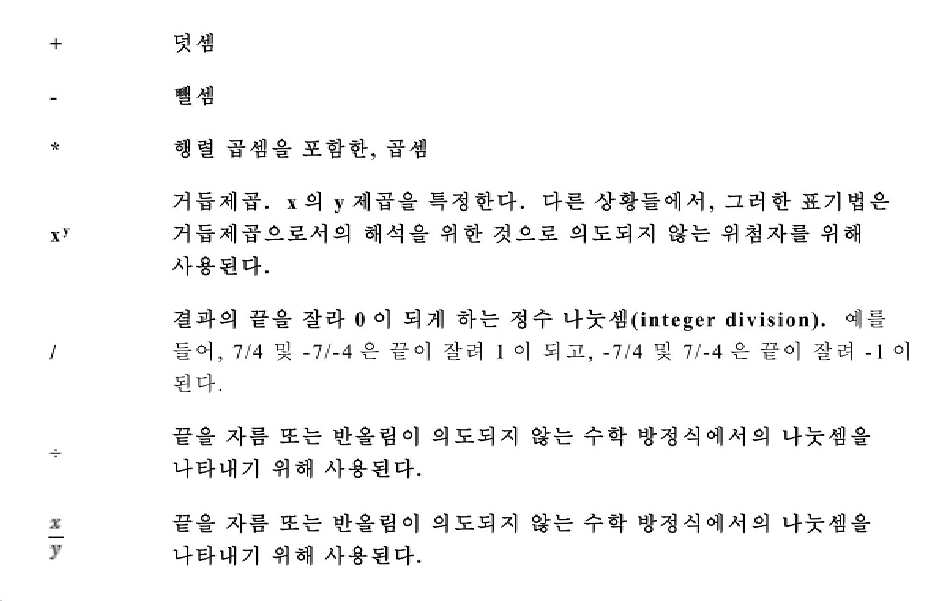
또한, 다음의 수학 함수들이 사용될 수 있다:In addition, the following mathematical functions can be used:
Log2(x) 밑(base)이 2인 x의 로그;Log2(x) The logarithm of x whose base is 2;

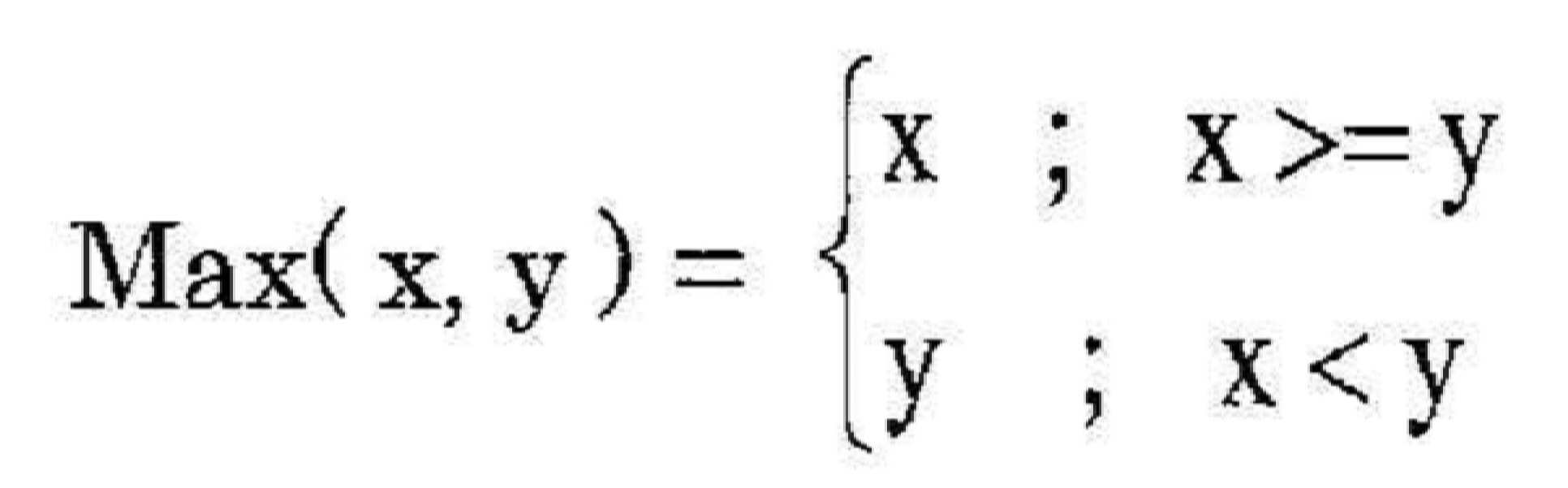
Ceil(x) x 이상의 최소 정수Ceil(x) smallest integer greater than or equal to x
본 명세서에서 사용된 예시적인 신택스에 대하여, 논리 연산자들의 다음의 정의들이 적용될 수 있다:For the exemplary syntax used herein, the following definitions of logical operators may be applied:
x && y x 및 y의 부울 논리 "and"x && y Boolean logic "and" of x and y
x | | y x 및 y의 부울 논리 "or"x | | y Boolean logic "or" of x and y
! 부울 논리 "not"! Boolean logic "not"
x ? y : z x가 TRUE이거나 0과 동일하지 않은 경우, y의 값으로 평가하고; 그렇지 않으면, z의 값으로 평가한다.x? y: z If x is TRUE or is not equal to 0, evaluates to the value of y; Otherwise, it is evaluated as the value of z.
또한, 하기의 관계 연산자들이 적용될 수 있다:In addition, the following relational operators can be applied:
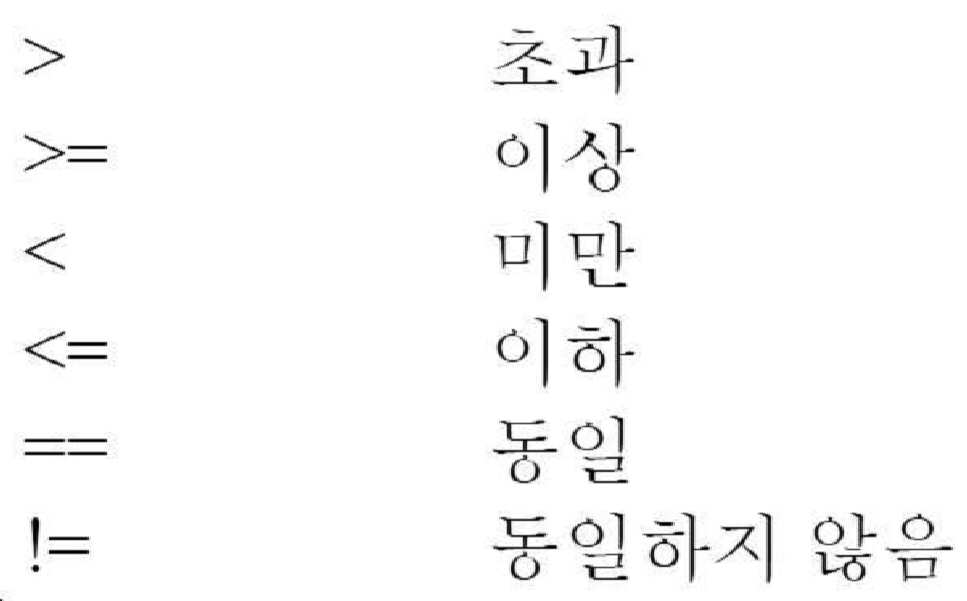
또한, 본 명세서에서 사용된 신택스 디스크립터들에서, 다음의 디스크립터들이 적용될 수 있다는 점에 유의해야 한다:In addition, it should be noted that in the syntax descriptors used in this specification, the following descriptors may be applied:
- b(8): 임의의 패턴의 비트 스트링을 갖는 바이트(8 비트). 이 디스크립터에 대한 파싱 프로세스는 함수 read_bits(8)의 반환 값에 의해 특정된다.-b(8): A byte (8 bits) with an arbitrary pattern of bit strings. The parsing process for this descriptor is specified by the return value of the function read_bits(8).
- f(n): 좌측 비트가 먼저 (좌측에서 우측으로) 기입된 n개의 비트들을 사용하는 고정 패턴 비트 스트링. 이러한 디스크립터에 대한 파싱 프로세스는 함수 read_bits(n)의 반환 값에 의해 특정된다.-f(n): A fixed pattern bit string using n bits with the left bit written first (from left to right). The parsing process for these descriptors is specified by the return value of the function read_bits(n).
- u(n): n개의 비트들을 사용하는 부호 없는 정수.-u(n): an unsigned integer using n bits.
- ue(v): 좌측 비트를 먼저 갖는 부호 없는 정수 0차 Exp-Golomb-코딩된 신택스 요소.-ue(v): an unsigned integer 0th order Exp-Golomb-coded syntax element with the left bit first.
전술된 바와 같이, ITU-T H.265에 따르면, 각각의 비디오 프레임 또는 픽처는 하나 이상의 슬라이스를 포함하도록 분할되고 하나 이상의 타일을 포함하도록 추가로 분할될 수 있다. 도 2는 슬라이스들을 포함하는 픽처들의 그룹의 예를 예시하는 개념도이다. 도 2에 예시된 예에서, Pic4는 2개의 슬라이스들(즉, Slice1 및 Slice2)을 포함하는 것으로 예시되며, 여기서 각각의 슬라이스는 (예컨대, 래스터 스캔 순서로) CTU들의 시퀀스를 포함한다. 슬라이스는 독립 슬라이스 세그먼트로 시작하고 동일한 액세스 유닛 내의 다음 독립 슬라이스 세그먼트(존재하는 경우)에 선행하는 모든 후속 종속 슬라이스 세그먼트들(존재하는 경우)을 포함하는 하나 이상의 슬라이스 세그먼트의 시퀀스라는 점에 유의해야 한다. 슬라이스 세그먼트는, 슬라이스와 같이, 코딩 트리 유닛들의 시퀀스이다. 본 명세서에 기술된 예들에서, 일부 경우들에 있어서, 용어 "슬라이스" 및 "슬라이스 세그먼트"는 코딩 트리 유닛들의 시퀀스를 나타내기 위해 상호 교환적으로 사용될 수 있다. ITU-T H.265에서, 타일은 하나 초과의 슬라이스에 포함된 코딩 트리 유닛들로 이루어질 수 있고 슬라이스는 하나 초과의 타일에 포함된 코딩 트리 유닛들로 이루어질 수 있다는 점에 유의해야 한다. 그러나, ITU-T H.265는 다음의 조건들 중 하나 또는 둘 모두가 충족되어야 한다고 규정한다: (1) 슬라이스 내의 모든 코딩 트리 유닛들이 동일한 타일에 속한다; 그리고 (2) 타일 내의 모든 코딩 트리 유닛들이 동일한 슬라이스에 속한다. 타일 세트들은 코딩 의존성들(예를 들어, 인트라-예측 의존성들, 엔트로피 인코딩 의존성들 등)에 대한 경계들을 정의하는 데 사용될 수 있고, 그렇기 때문에 코딩에서 병렬성을 가능하게 할 수 있다.As described above, according to ITU-T H.265, each video frame or picture may be divided to include one or more slices and may be further divided to include one or more tiles. 2 is a conceptual diagram illustrating an example of a group of pictures including slices. In the example illustrated in FIG. 2, Pic 4 is illustrated as comprising two slices (i.e., Slice 1 and Slice 2 ), where each slice comprises a sequence of CTUs (e.g., in raster scan order) . It should be noted that a slice is a sequence of one or more slice segments that starts with an independent slice segment and includes all subsequent dependent slice segments (if any) that precede the next independent slice segment (if any) within the same access unit. . A slice segment, like a slice, is a sequence of coding tree units. In the examples described herein, in some cases, the terms “slice” and “slice segment” may be used interchangeably to indicate a sequence of coding tree units. It should be noted that in ITU-T H.265, a tile may consist of coding tree units included in more than one slice and a slice may consist of coding tree units included in more than one tile. However, ITU-T H.265 specifies that one or both of the following conditions must be satisfied: (1) All coding tree units in a slice belong to the same tile; And (2) all coding tree units in a tile belong to the same slice. Tile sets can be used to define boundaries for coding dependencies (eg, intra-prediction dependencies, entropy encoding dependencies, etc.), thereby enabling parallelism in coding.
ITU-T H.265에서, 코딩된 비디오 시퀀스(coded video sequence, CVS)가 액세스 유닛들의 시퀀스로서 캡슐화(또는 구조화)될 수 있으며, 여기서 각각의 액세스 유닛은 네트워크 추상화 계층(network abstraction layer, NAL) 유닛들로서 구조화된 비디오 데이터를 포함한다. ITU-T H.265에서, 비트스트림은 하나 이상의 CVS들을 형성하는 NAL 유닛들의 시퀀스를 포함하는 것으로 기술된다. ITU-T H.265는 포맷 범위 확장(RExt)들, 확장성(SHVC), 멀티-뷰(MV-HEVC), 및 3-D(3D-HEVC)를 포함한 다층 확장들을 지원한다는 점에 유의해야 한다. 다층 확장들은 비디오 프레젠테이션이 기본 계층 및 하나 이상의 추가적인 향상 계층들을 포함할 수 있게 한다. 예를 들어, 기본 계층은 기본 품질 레벨(예를 들어, 고화질 렌더링)을 갖는 비디오 프레젠테이션이 제시될 수 있게 할 수 있고 향상 계층은 향상된 품질 레벨(예를 들어, 초고화질 렌더링)을 갖는 비디오 프레젠테이션이 제시될 수 있게 할 수 있다. ITU-T H.265에서, 향상 계층은 기본 계층을 참조함으로써 코딩될 수 있다. 즉, 예를 들어, 향상 계층 내의 픽처는 기본 계층 내의 하나 이상의 픽처(그의 확장된 버전들을 포함함)를 참조함으로써 (예를 들어, 인터 예측 기법들을 사용하여) 코딩될 수 있다. ITU-T H.265에서, 각각의 NAL 유닛은 NAL 유닛이 그와 연관되는 비디오 데이터의 계층을 나타내는 식별자를 포함할 수 있다. 서브-비트스트림 추출은 컴플라이언트 비트스트림을 수신하는 디바이스가 수신된 비트스트림 내의 데이터를 폐기하고/하거나 수정함으로써 새로운 컴플라이언트 비트스트림을 형성하는 프로세스를 지칭할 수 있다는 점에 유의해야 한다. 예를 들어, 서브-비트스트림 추출은 비디오의 특정 표현(예를 들어, 고품질 표현)에 대응하는 새로운 컴플라이언트 비트스트림을 형성하는 데 사용될 수 있다.In ITU-T H.265, a coded video sequence (CVS) may be encapsulated (or structured) as a sequence of access units, where each access unit is a network abstraction layer (NAL). Contains video data structured as units. In ITU-T H.265, a bitstream is described as containing a sequence of NAL units forming one or more CVSs. It should be noted that ITU-T H.265 supports multi-layer extensions including format range extensions (RExts), scalability (SHVC), multi-view (MV-HEVC), and 3-D (3D-HEVC). do. Multi-layer extensions allow a video presentation to include a base layer and one or more additional enhancement layers. For example, a base layer may allow a video presentation with a basic quality level (e.g., high definition rendering) to be presented, and an enhancement layer may allow a video presentation with an enhanced quality level (e.g., ultra-high definition rendering) to be presented. Can be presented. In ITU-T H.265, the enhancement layer can be coded by referring to the base layer. That is, for example, a picture in the enhancement layer can be coded (eg, using inter prediction techniques) by referring to one or more pictures (including extended versions thereof) in the base layer. In ITU-T H.265, each NAL unit may include an identifier indicating a layer of video data to which the NAL unit is associated with it. It should be noted that sub-bitstream extraction may refer to the process of forming a new compliant bitstream by a device receiving a compliant bitstream by discarding and/or modifying data in the received bitstream. For example, sub-bitstream extraction can be used to form a new compliant bitstream that corresponds to a specific representation of the video (eg, a high quality representation).
도 2에 예시된 예를 참조하면, Pic4에 포함된 비디오 데이터의 각각의 슬라이스(즉, Slice1 및 Slice2)는 NAL 유닛에 캡슐화된 것으로 예시되어 있다. ITU-T H.265에서, 비디오 시퀀스, GOP, 픽처, 슬라이스, 및 CTU 각각은 비디오 코딩 특성들을 설명하는 메타데이터와 연관될 수 있다. ITU-T H.265는 비디오 데이터 및/또는 비디오 코딩 특성들을 설명하는 데 사용될 수 있는 파라미터 세트들을 정의한다. ITU-T H.265에서, 파라미터 세트들은 NAL 유닛의 특수한 유형으로서 캡슐화될 수 있거나 메시지로서 시그널링될 수 있다. 코딩된 비디오 데이터(예를 들어, 슬라이스)를 포함하는 NAL 유닛들은 VCL(Video Coding Layer, 비디오 코딩 계층) NAL 유닛들로 지칭될 수 있고 메타데이터(예를 들어, 파라미터 세트들)를 포함하는 NAL 유닛들은 비-VCL NAL 유닛들로 지칭될 수 있다. 또한, ITU-T H.265는 보충 향상 정보(supplemental enhancement information, SEI) 메시지들이 시그널링될 수 있게 한다. ITU-T H.265에서, SEI 메시지들은 디코딩, 디스플레이 또는 다른 목적들과 관련된 프로세스들을 지원하지만, SEI 메시지들은 디코딩 프로세스에 의해 루마 또는 크로마 샘플들을 구성하는 데 필요하지 않을 수 있다. ITU-T H.265에서, SEI 메시지들은 비-VCL NAL 유닛들을 사용하여 비트스트림으로 시그널링될 수 있다. 또한, SEI 메시지들은 비트스트림 내에 존재하는 것 이외의 어떤 수단에 의해 전달될 수 있다(즉, 대역외 시그널링될 수 있다).Referring to the example illustrated in FIG. 2, it is illustrated that each slice (ie, Slice 1 and Slice 2 ) of video data included in Pic 4 is encapsulated in a NAL unit. In ITU-T H.265, each of a video sequence, GOP, picture, slice, and CTU may be associated with metadata describing video coding characteristics. ITU-T H.265 defines parameter sets that can be used to describe video data and/or video coding characteristics. In ITU-T H.265, parameter sets may be encapsulated as a special type of NAL unit or may be signaled as a message. NAL units containing coded video data (e.g., slice) may be referred to as Video Coding Layer (VCL) NAL units and NAL containing metadata (e.g., parameter sets) Units may be referred to as non-VCL NAL units. In addition, ITU-T H.265 enables supplemental enhancement information (SEI) messages to be signaled. In ITU-T H.265, SEI messages support processes related to decoding, display or other purposes, but SEI messages may not be required to construct luma or chroma samples by the decoding process. In ITU-T H.265, SEI messages can be signaled in a bitstream using non-VCL NAL units. In addition, SEI messages may be delivered by any means other than those present in the bitstream (ie, they may be signaled out of band).
도 3은 다수의 CVS를 포함하는 비트스트림의 예를 예시하며, 여기서 CVS가 각자의 액세스 유닛에 포함된 NAL 유닛에 의해 표현된다. 도 3에 예시된 예에서, 비-VCL NAL 유닛은 각자의 파라미터 세트 유닛(즉, 비디오 파라미터 세트(Video Parameter Set, VPS), 시퀀스 파라미터 세트(Sequence Parameter Set, SPS), 및 픽처 파라미터 세트(Picture Parameter Set, PPS) 유닛) 및 액세스 유닛 구분자(delimiter) NAL 유닛을 포함한다. ITU-T H.265는 NAL 유닛에 포함된 RBSP(Raw Byte Sequence Payload) 데이터 구조의 유형을 특정하는 NAL 유닛 헤더 시맨틱을 정의한다.3 illustrates an example of a bitstream including multiple CVSs, where CVS is represented by a NAL unit included in each access unit. In the example illustrated in FIG. 3, the non-VCL NAL units are each parameter set unit (i.e., a video parameter set (VPS), a sequence parameter set (SPS)), and a picture parameter set (Picture Parameter Set, PPS) unit) and an access unit delimiter NAL unit. ITU-T H.265 defines NAL unit header semantics that specify the type of RBSP (Raw Byte Sequence Payload) data structure included in the NAL unit.
표 1은, ITU-T H.265에서 제공되고 JVET-K1001에서 추가적으로 사용되는 일반 NAL 유닛 신택스를 예시한다.Table 1 illustrates the general NAL unit syntax provided in ITU-T H.265 and additionally used in JVET-K1001.
[표 1][Table 1]

ITU-T H.265는 하기의 일반 NAL 유닛 시맨틱들을 제공한다:ITU-T H.265 provides the following general NAL unit semantics:
NumBytesInNalUnit은 바이트 단위의 NAL 유닛의 크기를 특정한다. 이 값은 NAL 유닛의 디코딩에 필요하다. NumBytesInNalUnit의 추론을 가능하게 하기 위해 NAL 유닛 경계들의 일부 형태의 구분이 필요하다. 하나의 그러한 구분 방법은 바이트 스트림 포맷에 대한 [Annex B of ITU-T H.265]에 명시되어 있다. 이러한 규격 이외로 다른 구분 방법들이 명시될 수 있다.NumBytesInNalUnit specifies the size of the NAL unit in bytes. This value is required for decoding of the NAL unit. In order to enable the inference of NumBytesInNalUnit, it is necessary to distinguish some types of NAL unit boundaries. One such classification method is specified in [Annex B of ITU-T H.265] for the byte stream format. Other than these standards, other classification methods may be specified.
주 1 - 비디오 코딩 계층(video coding layer, VCL)은 비디오 데이터의 콘텐츠를 효율적으로 표현하도록 특정된다. NAL은, 그 데이터를 포맷화하도록, 그리고 다양한 통신 채널들 또는 저장 매체 상에서의 운송에 적절한 방식으로 헤더 정보를 제공하도록 특정된다. 모든 데이터는 NAL 유닛들에 포함되며, 이들 각각은 정수 개의 바이트들을 포함한다. NAL 유닛은 패킷 지향 시스템 및 비트스트림 시스템 둘 모두에서 사용하기 위한 일반 포맷을 특정한다. 패킷 지향 전송 및 바이트 스트림 둘 모두에 대한 NAL 유닛들의 포맷은, 각각의 NAL 유닛이 [Annex B of ITU-T H.265]에 명시된 바이트 스트림 포맷에서 시작 코드 프리픽스 및 여분의 패딩 바이트들에 의해 선행될 수 있다는 것을 제외하면 동일하다.NOTE 1-The video coding layer (VCL) is specified to efficiently represent the content of video data. The NAL is specified to format its data and to provide header information in a manner suitable for transport on various communication channels or storage media. All data is contained in NAL units, each of which contains an integer number of bytes. The NAL unit specifies a general format for use in both packet-oriented systems and bitstream systems. The format of NAL units for both packet-oriented transmission and byte stream, each NAL unit is preceded by a start code prefix and extra padding bytes in the byte stream format specified in [Annex B of ITU-T H.265]. It is the same except that it can be.
rbsp_byte[ i ]는 RBSP의 i-번째 바이트이다. RBSP는 바이트들의 순서화된 시퀀스로서 다음과 같이 특정된다:rbsp_byte[ i] is the i-th byte of RBSP. RBSP is an ordered sequence of bytes, specified as follows:
RBSP는 데이터 비트 스트링(string of data bits, SODB)을 다음과 같이 포함한다:RBSP contains a string of data bits (SODB) as follows:
- SODB가 비어 있는 경우(즉, 길이가 0 비트임), RBSP도 비어 있다.-If the SODB is empty (that is, the length is 0 bits), the RBSP is also empty.
- 그렇지 않은 경우, RBSP는 SODB를 다음과 같이 포함한다:-Otherwise, RBSP includes SODB as follows:
1) RBSP의 제1 바이트는 SODB의 (최상위, 최좌측) 8 비트를 포함하고; 다음 바이트의 RBSP는, 8 비트 미만의 SODB가 남을 때까지, SODB의 다음 8 비트 등을 포함한다.1) The first byte of RBSP contains 8 bits (most significant, leftmost) of SODB; The RBSP of the next byte contains the next 8 bits of the SODB, etc., until an SODB of less than 8 bits remains.
2) rbsp_trailing_bits()는 SODB 이후에 다음과 같이 존재한다:2) rbsp_trailing_bits() exists after SODB as follows:
i) 최종 RBSP 바이트의 제1 (최상위, 최우측) 비트들은 SODB의 남은 비트들을 (존재하는 경우) 포함한다.i) The first (highest, rightmost) bits of the last RBSP byte contain the remaining bits of the SODB (if any).
ii) 다음 비트는 1과 동일한 단일 rbsp_stop_one_bit로 이루어진다.ii) The next bit consists of a single rbsp_stop_one_bit equal to 1.
iii) rbsp_stop_one_bit가 바이트-정렬된 바이트의 마지막 비트가 아닐 때, 하나 이상의 rbsp_alignment_zero_bit가 존재하여 바이트 정렬을 초래한다.iii) When rbsp_stop_one_bit is not the last bit of a byte-aligned byte, more than one rbsp_alignment_zero_bit is present, resulting in byte alignment.
3) 0x0000과 동일한 하나 이상의 cabac_zero_word 16-bit 신택스 요소들은 RBSP의 끝에서 rbsp_trailing_bits() 이후 일부 RBSP들 내에 존재할 수 있다.3) One or more cabac_zero_word 16-bit syntax elements equal to 0x0000 may exist in some RBSPs after rbsp_trailing_bits() at the end of the RBSP.
이러한 RBSP 특성들을 갖는 신택스 구조들은 "_rbsp" 서픽스(suffix)를 사용하여 신택스 테이블들에 표기된다. 이러한 구조들은 rbsp_byte[i] 데이터 바이트들의 콘텐츠로서 NAL 유닛들 내에서 운반된다. RBSP 신택스 구조체들과 NAL 유닛들의 연관은 [본 명세서의 표 3]에 특정된 바와 같다.Syntax structures having these RBSP characteristics are indicated in syntax tables using the "_rbsp" suffix. These structures are carried in NAL units as the content of rbsp_byte[i] data bytes. The association of RBSP syntax structures and NAL units is as specified in [Table 3 of this specification].
. 주 2 - RBSP의 경계들이 알려져 있을 때, 디코더는 RBSP의 바이트들의 비트들을 연결하고 1과 동일한 마지막(최하위, 최우측) 비트인 rbsp_stop_one_bit를 폐기함으로써, 그리고 그 뒤에 오는, 0과 동일한, 임의의 후속(덜 중요한, 우측으로 더 먼) 비트를 폐기함으로써 RBSP로부터 SODB를 추출할 수 있다. 디코딩 프로세스에 필요한 데이터는 RBSP의 SODB 부분에 포함된다.. NOTE 2-When the boundaries of the RBSP are known, the decoder concatenates the bits of the bytes of the RBSP and discards the last (least significant, rightmost) bit equal to 1, rbsp_stop_one_bit, followed by any subsequent, equal to 0. You can extract the SODB from the RBSP by discarding the bits (less important, farther to the right). The data required for the decoding process is included in the SODB part of the RBSP.
emulation_prevention_three_byte 는 0x03과 동일한 바이트이다. emulation_prevention_three_byte가 NAL 유닛 내에 존재할 때, 그것은 디코딩 프로세스에 의해 폐기될 것이다.emulation_prevention_three_byte is the same byte as 0x03. When emulation_prevention_three_byte is present in the NAL unit, it will be discarded by the decoding process.
NAL 유닛의 마지막 바이트는 0x00과 동일하지 않을 것이다.The last byte of the NAL unit will not be equal to 0x00.
NAL 유닛 내에서, 하기의 3-바이트 시퀀스들은 임의의 바이트-정렬된 포지션에서 발생하지 않을 것이다:Within a NAL unit, the following 3-byte sequences will not occur in any byte-aligned position:
- 0x000000-0x000000
- 0x000001-0x000001
- 0x000002-0x000002
NAL 유닛 내에서, 하기의 시퀀스들 이외에 0x000003으로 시작하는 임의의 4-바이트 시퀀스가 임의의 바이트-정렬된 포지션에서 발생하지 않을 것이다:Within the NAL unit, any 4-byte sequence starting with 0x000003 other than the following sequences will not occur in any byte-aligned position:
- 0x00000300-0x00000300
- 0x00000301-0x00000301
- 0x00000302-0x00000302
- 0x00000303-0x00000303
표 2는 ITU-T H.265에서 제공되는 NAL 유닛 헤더 신택스를 예시한다.Table 2 illustrates the NAL unit header syntax provided in ITU-T H.265.
[표 2][Table 2]

ITU-T H.265는 표 2에 예시된 각자의 신택스 요소들에 대한 하기의 정의들을 제공한다.ITU-T H.265 provides the following definitions for the respective syntax elements illustrated in Table 2.
forbidden_zero_bit는 0과 동일할 것이다.forbidden_zero_bit will be equal to 0.
nuh_layer_id는 VCL NAL 유닛이 속하는 계층의 식별자 또는 비-VCL NAL 유닛이 적용되는 계층의 식별자를 특정한다.nuh_layer_id specifies an identifier of a layer to which a VCL NAL unit belongs or an identifier of a layer to which a non-VCL NAL unit is applied.
nuh_temporal_id_plus1 - 1은 NAL 유닛에 대한 시간 식별자를 특정한다. nuh_temporal_id_plus1의 값은 0과 동일하지 않을 것이다.nuh_temporal_id_plus1-1 specifies the time identifier for the NAL unit. The value of nuh_temporal_id_plus1 will not be equal to 0.
nal_unit_type과 관련하여, nal_unit_type은 NAL 유닛에 포함된 RBSP 데이터 구조의 유형을 특정한다. 표 3은 ITU-T H.265에서 제공되는 NAL 유닛 유형들을 예시한다.With respect to nal_unit_type, nal_unit_type specifies the type of the RBSP data structure included in the NAL unit. Table 3 illustrates NAL unit types provided in ITU-T H.265.
[표 3][Table 3]

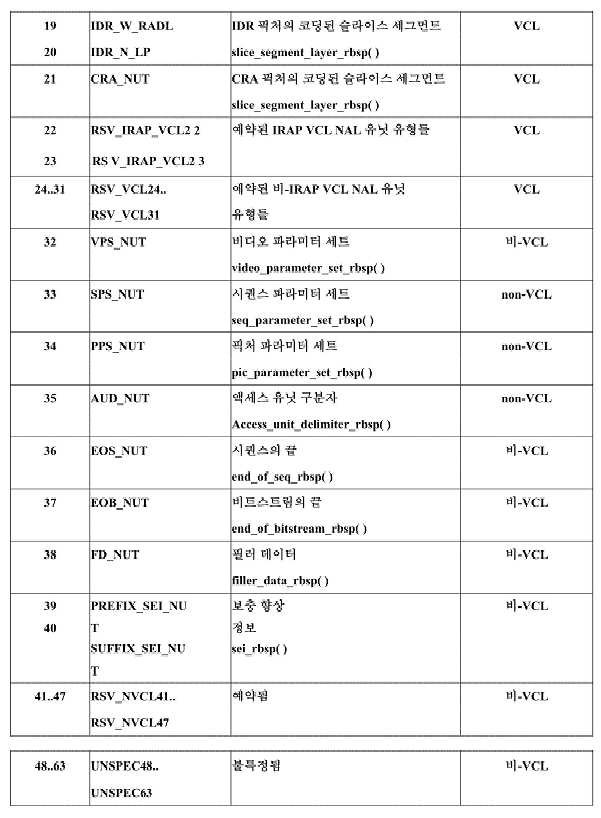
간결함을 위해, ITU-T H.265에서의 NAL 유닛 유형들 각각의 완전한 설명은 본 명세서에서 제공되지 않는다. 그러나, ITU-T H.265의 관련 섹션들이 참조된다.For brevity, a complete description of each of the NAL unit types in ITU-T H.265 is not provided herein. However, reference is made to the relevant sections of ITU-T H.265.
전술된 바와 같이, JVET-K1001은 비디오 코딩 규격의 초고이다. 표 4는 JVET-K1001에서의 NAL 유닛 헤더의 신택스를 예시한다.As described above, JVET-K1001 is the first draft of the video coding standard. Table 4 exemplifies the syntax of the NAL unit header in JVET-K1001.
[표 4][Table 4]
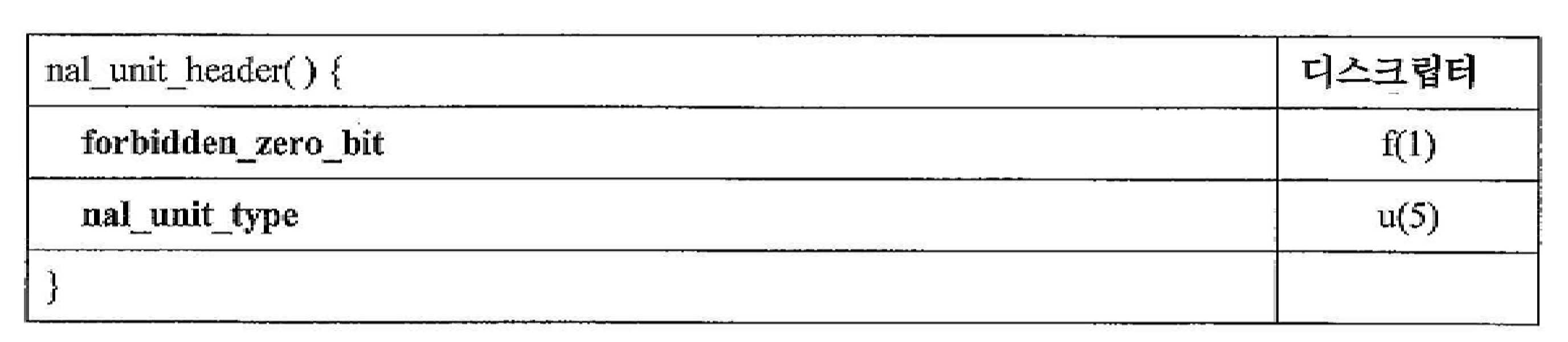
JVET-K1001은 표 4에 예시된 각자의 신택스 요소들에 대한 하기의 정의들을 제공한다.JVET-K1001 provides the following definitions for the respective syntax elements illustrated in Table 4.
forbidden_zero_bit는 0과 동일할 것이다.forbidden_zero_bit will be equal to 0.
nal_unit_type과 관련하여, JVET-K1001은 NAL 유닛 유형들이 이제 정의될 위치를 제공한다.Regarding nal_unit_type, JVET-K1001 provides a location where NAL unit types will now be defined.
JVET-K1001은 기본 시퀀스 파라미터 세트 신택스를 추가로 제공한다. 표 5는 JVET-K1001에서 제공되는 시퀀스 파라미터 세트의 신택스를 예시한다.JVET-K1001 additionally provides basic sequence parameter set syntax. Table 5 exemplifies the syntax of the sequence parameter set provided in JVET-K1001.
[표 5][Table 5]
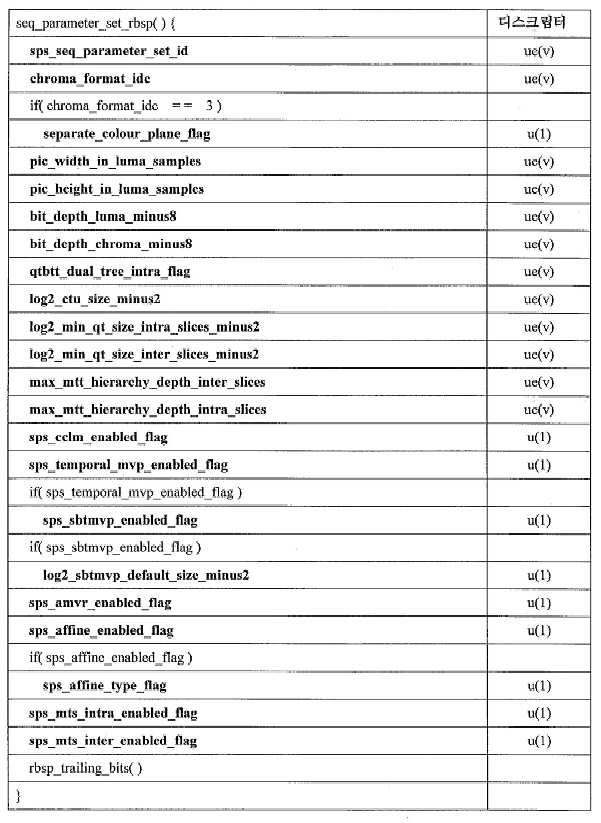
표 5에 예시된 각자의 신택스 요소들의 기본적인 정의들은 하기와 같다:.The basic definitions of the respective syntax elements illustrated in Table 5 are as follows:
sps_seq_parameter_set_id는 다른 신택스 요소들에 의한 참조를 위해 SPS에 대한 식별자를 제공한다. sps_seq_parameter_set_id의 값은 0 내지 15(이들 값 포함)의 범위에 있을 것이다.sps_seq_parameter_set_id provides an identifier for the SPS for reference by other syntax elements. The value of sps_seq_parameter_set_id will be in the range of 0 to 15 (including these values).
chroma_format_idc는 루마 샘플링에 대한 크로마 샘플링을 특정한다. chroma_format_idc의 값은 0 내지 3(이들 값 포함)의 범위에 있을 것이다.chroma_format_idc specifies chroma sampling for luma sampling. The value of chroma_format_idc will be in the range of 0 to 3 (including these values).
1과 동일한 separate_colour_plane_flag는 4:4:4 크로마 포맷의 3개의 컬러 성분들이 별개로 코딩된다는 것을 특정한다. 0과 동일한 separate_colour_plane_flag는 컬러 성분들이 별개로 코딩되지 않는다는 것을 특정한다. separate_colour_plane_flag가 존재하지 않을 때, 그것은 0과 동일한 것으로 추론된다. separate_colour_plane_flag가 1과 동일할 때, 코딩된 픽처는 3개의 별개의 성분들로 이루어지며, 이들 각각은 하나의 컬러 평면(Y, Cb, 또는 Cr)의 코딩된 샘플들로 이루어지고 단색 코딩 신택스를 사용한다. 이 경우에 있어서, 각각의 컬러 평면은 특정 colour_plane_id 값과 연관된다.A separate_colour_plane_flag equal to 1 specifies that the three color components of the 4:4:4 chroma format are coded separately. A separate_colour_plane_flag equal to 0 specifies that the color components are not separately coded. When separate_colour_plane_flag does not exist, it is inferred to be equal to zero. When separate_colour_plane_flag is equal to 1, a coded picture consists of three separate components, each of which consists of coded samples of one color plane (Y, Cb, or Cr) and uses a monochromatic coding syntax. do. In this case, each color plane is associated with a specific color_plane_id value.
pic_width_in_luma_samples는 루마 샘플들의 단위들로 각각의 디코딩된 픽처의 폭을 특정한다.pic_width_in_luma_samples specifies the width of each decoded picture in units of luma samples.
pic_height_in_luma_samples는 루마 샘플들의 단위들로 각각의 디코딩된 픽처의 높이를 특정한다.pic_height_in_luma_samples specifies the height of each decoded picture in units of luma samples.
bit_depth_luma_minus8은 루마 어레이의 샘플들의 비트 깊이 및 루마 양자화 파라미터 범위 오프셋의 값을 특정한다.bit_depth_luma_minus8 specifies a bit depth of samples of the luma array and a value of a luma quantization parameter range offset.
bit_depth_chroma_minus8은 크로마 어레이들의 샘플들의 비트 깊이 및 크로마 양자화 파라미터 범위 오프셋의 값을 특정한다.bit_depth_chroma_minus8 specifies a value of a bit depth of samples of chroma arrays and a chroma quantization parameter range offset.
1과 동일한 qtbtt_dual_tree_intra_flag는, I 슬라이스들에 대해, 각각의 CTU가 암시적 쿼드트리 분할을 사용하여 64x64 루마 샘플들을 갖는 코딩 유닛들로 분할되고, 이들 코딩 단위들이 루마 및 크로마에 대한 2개의 별개의 coding_quadtree 신택스 구조의 루트임을 특정한다.Qtbtt_dual_tree_intra_flag equal to 1 is, for I slices, each CTU is divided into coding units with 64x64 luma samples using implicit quadtree partitioning, and these coding units are two separate coding_quadtrees for luma and chroma. Specifies that it is the root of the syntax structure.
log2_ctu_size_minus2 + 2는 각각의 CTU의 루마 코딩 트리 블록 크기를 특정한다.log2_ctu_size_minus2 + 2 specifies the luma coding tree block size of each CTU.
log2_min_qt_size_intra_slices_minus2 + 2는 slice_type이 2와 동일한 슬라이스들(I)에서 CTU의 쿼드트리 분할로부터 생성되는 리프(leaf) 블록의 최소 루마 크기를 특정한다.log2_min_qt_size_intra_slices_minus2 + 2 specifies the minimum luma size of a leaf block generated from quadtree division of CTU in slices (I) having slice_type equal to 2.
log2_min_qt_size_inter_slices_minus2 + 2는 slice_type이 0과 동일한 슬라이스들(B) 또는 1과 동일한 슬라이스들(P)에서 CTU의 쿼드트리 분할로부터 생성되는 리프 블록의 최소 루마 크기를 특정한다.log2_min_qt_size_inter_slices_minus2 + 2 specifies the minimum luma size of a leaf block generated from quadtree division of CTU in slices (B) having a slice_type equal to 0 or slices (P) equal to 1 (P).
max_mtt_hierarchy_depth_inter_slices는 slice_type이 0과 동일한 슬라이스들(B) 또는 1과 동일한 슬라이스들(P)에서 쿼드트리 리프의 다중-유형 트리 분할로부터 생성되는 코딩 단위들에 대한 최대 계층구조 깊이를 특정한다.max_mtt_hierarchy_depth_inter_slices specifies the maximum hierarchical depth for coding units generated from multi-type tree splitting of a quadtree leaf in slices (B) having slice_type equal to 0 or slices (P) equal to 1 (P).
max_mtt_hierarchy_depth_intra_slices는 slice_type이 2와 동일한 슬라이스들(I)에서 쿼드트리 리프의 다중-유형 트리 분할로부터 생성되는 코딩 단위들에 대한 최대 계층구조 깊이를 특정한다.max_mtt_hierarchy_depth_intra_slices specifies the maximum hierarchical depth for coding units generated from multi-type tree division of a quadtree leaf in slices (I) whose slice_type is equal to 2.
0과 동일한 sps_cclm_enabled_flag는, 루마 성분으로부터 크로마 성분으로의 성분 교차 선형 모델(cross-component linear model) 인트라 예측이 디스에이블된다는 것을 특정한다. 1과 동일한 sps_cclm_enabled_flag는 루마 성분으로부터 크로마 성분으로의 성분 교차 선형 모델 인트라 예측이 인에이블된다는 것을 특정한다.Sps_cclm_enabled_flag equal to 0 specifies that the cross-component linear model intra prediction from the luma component to the chroma component is disabled. Sps_cclm_enabled_flag equal to 1 specifies that the component cross-linear model intra prediction from the luma component to the chroma component is enabled.
1과 동일한 sps_temporal_mvp_enabled_flag는 slice_temporal_mvp_enabled_flag가 CVS에서 slice_type이 I와 동일하지 않은 슬라이스들의 슬라이스 헤더들 내에 존재한다는 것을 특정한다. 0과 동일한 sps_temporal_mvp_enabled_flag는, slice_temporal_mvp_enabled_flag가 슬라이스 헤더들 내에 존재하지 않고 시간 모션 벡터 예측자들이 CVS에서 사용되지 않는다는 것을 특정한다.Sps_temporal_mvp_enabled_flag equal to 1 specifies that slice_temporal_mvp_enabled_flag is present in slice headers of slices whose slice_type is not equal to I in CVS. Sps_temporal_mvp_enabled_flag equal to 0 specifies that slice_temporal_mvp_enabled_flag is not present in slice headers and temporal motion vector predictors are not used in CVS.
1과 동일한 sps_sbtmvp_enabled_flag는 서브블록 기반 시간 모션 벡터 예측자들이 CVS에서 모든 슬라이스들이 slice_type이 I와 동일하지 않은 픽처들의 디코딩에서 사용될 수 있다는 것을 특정한다. 0과 동일한 sps_sbtmvp_enabled_flag는 서브블록 기반 시간 모션 벡터 예측자들이 CVS에서 사용되지 않는다는 것을 특정한다. sps_sbtmvp_enabled_flag가 존재하지 않을 때, 그것은 0과 동일한 것으로 추론된다.Sps_sbtmvp_enabled_flag equal to 1 specifies that subblock-based temporal motion vector predictors can be used in decoding of pictures whose slice_type is not equal to I in all slices in CVS. Sps_sbtmvp_enabled_flag equal to 0 specifies that subblock based temporal motion vector predictors are not used in CVS. When sps_sbtmvp_enabled_flag is not present, it is inferred to be equal to zero.
log2_sbtmvp_default_size_minus2는, slice_sbtmvp_size_override_flag가 0과 동일할 때, CVS에서 slice_type이 I와 동일하지 않은 슬라이스들의 슬라이스 헤더들 내의 신택스 요소 log2_sbtmvp_active_size_minus2의 추론된 값을 특정한다.log2_sbtmvp_default_size_minus2 specifies the inferred value of the syntax element log2_sbtmvp_active_size_minus2 in slice headers of slices whose slice_type is not equal to I in CVS when slice_sbtmvp_size_override_flag is equal to 0.
1과 동일한 sps_amvr_enabled_flag는 적응적 모션 벡터 차이 해상도가 모션 벡터 코딩에서 사용된다는 것을 특정한다. 0과 동일한 amvr_enabled_flag는 적응적 모션 벡터 차이 해상도가 모션 벡터 코딩에서 사용되지 않는다는 것을 특정한다.Sps_amvr_enabled_flag equal to 1 specifies that the adaptive motion vector difference resolution is used in motion vector coding. Amvr_enabled_flag equal to 0 specifies that the adaptive motion vector difference resolution is not used in motion vector coding.
sps_affine_enabled_flag는 아핀 모델 기반 모션 보상이 인터 예측을 위해 사용될 수 있는지 여부를 특정한다. sps_affine_enabled_flag가 0과 동일한 경우, 신택스는, 아핀 모델 기반 모션 보상이 CVS에서 사용되지 않도록, 그리고 merge_affine_flag, inter_affine_flag 및 cu_affine_type_flag는 CVS의 코딩 단위 신택스 내에 존재하지 않도록 제한될 것이다. 그렇지 않은 경우(sps_affine_enabled_flag가 1과 동일함), 아핀 모델 기반 모션 보상이 CVS에서 사용될 수 있다.sps_affine_enabled_flag specifies whether affine model-based motion compensation can be used for inter prediction. When sps_affine_enabled_flag is equal to 0, the syntax will be restricted so that affine model-based motion compensation is not used in CVS, and merge_affine_flag, inter_affine_flag and cu_affine_type_flag are not present in the coding unit syntax of CVS. Otherwise (sps_affine_enabled_flag is equal to 1), affine model-based motion compensation can be used in CVS.
sps_affine_type_flag는 6-파라미터 아핀 모델 기반 모션 보상이 인터 예측을 위해 사용될 수 있는지 여부를 특정한다. sps_affine_type_flag가 0과 동일한 경우, 신택스는, 6-파라미터 아핀 모델 기반 모션 보상이 CVS에서 사용되지 않도록, 그리고 cu_affine_type_flag는 CVS 내의 코딩 단위 신택스 내에 존재하지 않도록 제한될 것이다. 그렇지 않은 경우(sps_affine_type_flag가 1과 동일함), 6-파라미터 아핀 모델 기반 모션 보상이 CVS에서 사용될 수 있다. 존재하지 않을 때, sps_affine_type_flag의 값은 0과 동일한 것으로 추론된다.sps_affine_type_flag specifies whether 6-parameter affine model-based motion compensation can be used for inter prediction. If sps_affine_type_flag is equal to 0, the syntax will be restricted so that 6-parameter affine model based motion compensation is not used in CVS, and cu_affine_type_flag is not present in the coding unit syntax in CVS. Otherwise (sps_affine_type_flag is equal to 1), 6-parameter affine model-based motion compensation can be used in CVS. When not present, the value of sps_affine_type_flag is inferred to be equal to 0.
1과 동일한 sps_mts_intra_enabled_flag는 eu_mts_flag가 인트라 코딩 단위들에 대한 잔차 코딩 신택스 내에 존재할 수 있다는 것을 특정한다. 0과 동일한 sps_mts_intra_enabled_flag는 cu_mts_flag가 인트라 코딩 단위들에 대한 잔차 코딩 신택스 내에 존재하지 않는다는 것을 특정한다.Sps_mts_intra_enabled_flag equal to 1 specifies that eu_mts_flag may exist in the residual coding syntax for intra coding units. Sps_mts_intra_enabled_flag equal to 0 specifies that cu_mts_flag does not exist in the residual coding syntax for intra coding units.
sps_mts_inter_enabled_flag는 cu_mts_flag가 인터 코딩 단위들에 대한 잔차 코딩 신택스 내에 존재할 수 있다는 것을 특정한다. 0과 동일한 sps_mts_inter_enabled_flag는 cu_mts_flag가 인터 코딩 단위들에 대한 잔차 코딩 신택스 내에 존재하지 않는다는 것을 특정한다.sps_mts_inter_enabled_flag specifies that cu_mts_flag may exist in the residual coding syntax for inter coding units. Sps_mts_inter_enabled_flag equal to 0 specifies that cu_mts_flag does not exist in the residual coding syntax for inter coding units.
JVET-K1001은 기본 픽처 파라미터 세트 신택스를 추가로 제공한다. 표 6은 JVET-K1001 내의 픽처 파라미터 세트의 신택스를 예시한다.JVET-K1001 additionally provides basic picture parameter set syntax. Table 6 exemplifies the syntax of a picture parameter set in JVET-K1001.
[표 6][Table 6]
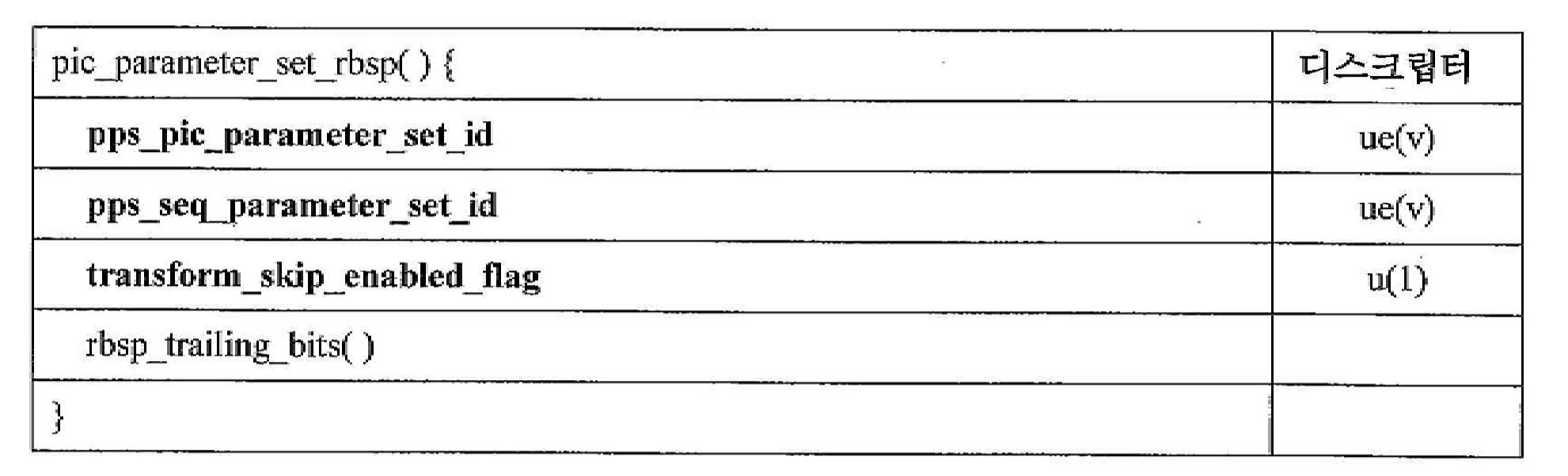
JVET-K1001은 표 6에 예시된 각자의 신택스 요소들에 대한 하기의 정의들을 제공한다.JVET-K1001 provides the following definitions for the respective syntax elements illustrated in Table 6.
pps_pic_parameter_set_id는 다른 신택스 요소들에 의한 참조를 위해 PPS를 식별한다. pps_pic_parameter_set_id의 값은 0 내지 63(이들 값 포함)의 범위에 있을 것이다.pps_pic_parameter_set_id identifies the PPS for reference by other syntax elements. The value of pps_pic_parameter_set_id will be in the range of 0 to 63 (including these values).
pps_seq_parameter_set_id는 활성 SPS에 대한 sps_seq_parameter_set_id의 값을 특정한다. pps_seq_parameter_set_id의 값은 0 내지 15(이들 값 포함)의 범위에 있을 것이다.pps_seq_parameter_set_id specifies the value of sps_seq_parameter_set_id for the active SPS. The value of pps_seq_parameter_set_id will be in the range of 0 to 15 (including these values).
1과 동일한 transforin_skip_enabled_flag는 transform_skip_flag가 잔차 코딩 신택스 내에 존재할 수 있다는 것을 특정한다. 0과 동일한 transform_skip_enabled_flag는 transform_skip_flag가 잔차 코딩 신택스 내에 존재하지 않는다는 것을 특정한다.Transforin_skip_enabled_flag equal to 1 specifies that transform_skip_flag may exist in the residual coding syntax. Transform_skip_enabled_flag equal to 0 specifies that transform_skip_flag is not present in the residual coding syntax.
JVET-K1001은 액세스 단위 구분자 신택스를 추가로 제공한다. 표 7은 JVET-K1001에서의 액세스 단위 구분자의 신택스를 예시한다.JVET-K1001 additionally provides an access unit separator syntax. Table 7 exemplifies the syntax of the access unit identifier in JVET-K1001.
[표 7][Table 7]
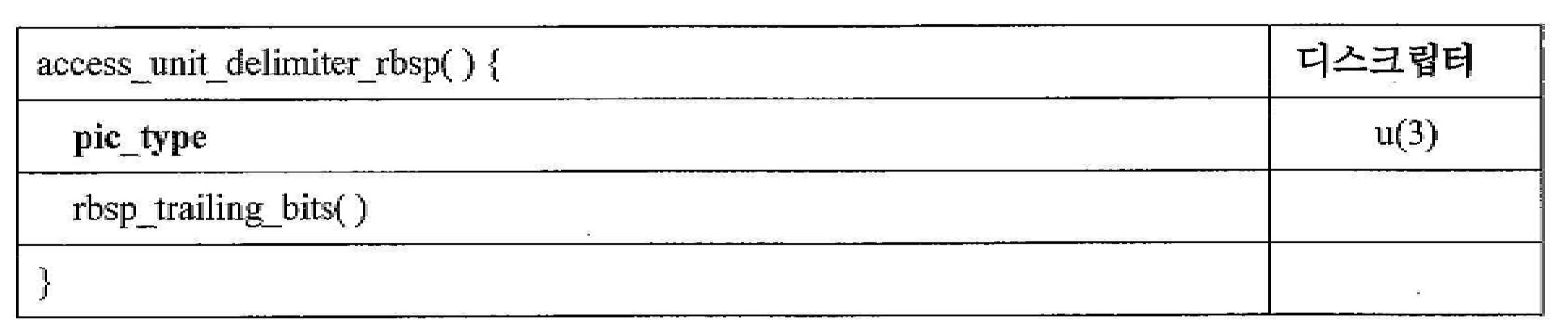
JVET-K1001은 표 7에 예시된 각자의 신택스 요소들에 대한 하기의 정의들을 제공한다.JVET-K1001 provides the following definitions for the respective syntax elements illustrated in Table 7.
pic_type은 액세스 단위 구분자 NAL 유닛을 포함하는 액세스 단위의 코딩된 픽처의 모든 슬라이스들에 대한 slice_type 값들이 pic_type의 주어진 값에 대해 표 8에 열거된 세트의 구성원들임을 나타낸다. pic_type의 값은 이러한 규격의 이러한 버전에 부합하는 비트스트림들에서 0, 1 또는 2와 동일할 것이다. pic_type의 다른 값들은 향후 사용을 위해 예약된다. 이러한 규격의 이러한 버전에 부합하는 디코더들은 pic_type의 예약된 값들을 무시할 것이다.The pic_type indicates that slice_type values for all slices of a coded picture of an access unit including an access unit identifier NAL unit are members of a set listed in Table 8 for a given value of pic_type. The value of pic_type will be equal to 0, 1 or 2 in bitstreams conforming to this version of this specification. Other values of pic_type are reserved for future use. Decoders conforming to this version of this specification will ignore the reserved values of pic_type.
[표 8][Table 8]
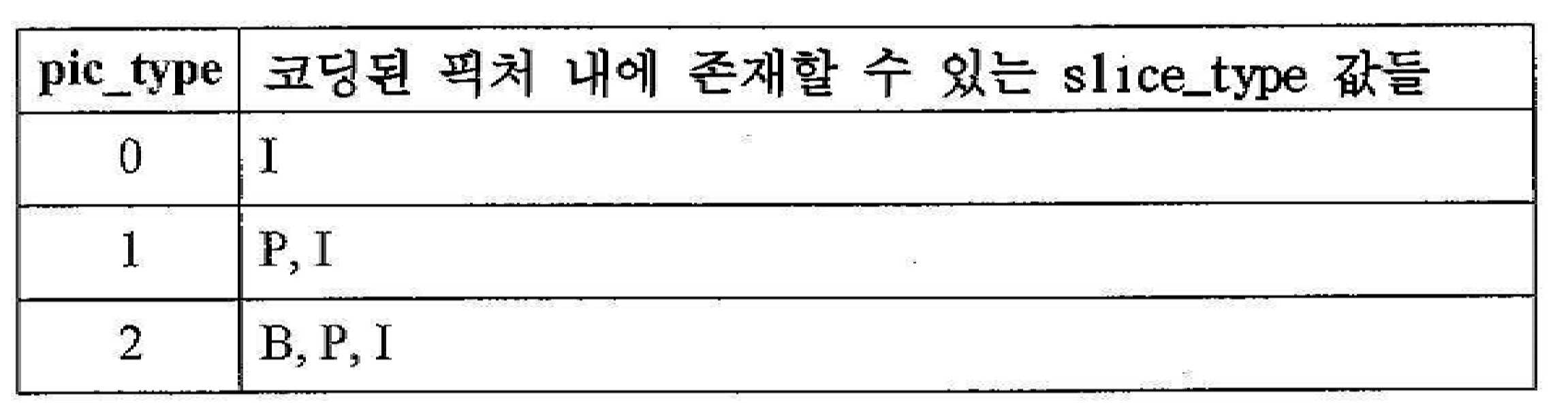
B 슬라이스는 양방향 예측(bi-prediction) 인터 예측, 단방향 예측(uni-prediction) 인터 예측, 및 인트라 예측이 허용되는 슬라이스를 지칭하고; P 슬라이스는 단방향 예측 인터 예측 및 인트라 예측이 허용되는 슬라이스를 지칭하고; I 슬라이스는 오로지 인트라 예측만이 허용되는 경우를 지칭한다는 것에 유의해야 한다. 일부 경우들에 있어서, B 및 P 슬라이스들은 인터 슬라이스들로 총칭된다는 것에 유의해야 한다.B slice refers to a slice in which bi-prediction inter prediction, uni-prediction inter prediction, and intra prediction are allowed; P slice refers to a slice in which uni-prediction inter prediction and intra prediction are allowed; It should be noted that I slice refers to the case where only intra prediction is allowed. It should be noted that in some cases, B and P slices are collectively referred to as inter slices.
JVET-K1001은 시퀀스 신택스의 끝, 비트스트림 신택스의 끝, 및 필러 데이터 신택스를 추가로 제공한다. 표 9는 JVET-K1001에서 제공되는 시퀀스 신택스의 끝을 예시하고, 표 10은 JVET-K1001에서 제공되는 비트스트림 신택스의 끝을 예시하고, 표 11은 JVET-K1001에서 제공되는 비트스트림 신택스의 끝을 예시한다.JVET-K1001 additionally provides the end of the sequence syntax, the end of the bitstream syntax, and the filler data syntax. Table 9 illustrates the end of the sequence syntax provided by JVET-K1001, Table 10 illustrates the end of the bitstream syntax provided by JVET-K1001, and Table 11 shows the end of the bitstream syntax provided by JVET-K1001. Illustrate.
[표 9][Table 9]

[표 10][Table 10]

[표 11][Table 11]

JVET-K1001은 표 11에 예시된 각자의 신택스 요소들에 대한 하기의 정의들을 제공한다.JVET-K1001 provides the following definitions for the respective syntax elements illustrated in Table 11.
ff_byte는 0xFF와 동일한 바이트이다.ff_byte is the same byte as 0xFF.
JVET-K1001은 슬라이스 헤더를 포함하는 슬라이스 계층 신택스를 추가로 제공한다. 표 12는 JVET-JK001에서 제공되는 슬라이스 계층 신택스를 예시하고, 표 13은 JVET-K1001에서 제공되는 슬라이스 헤더를 예시한다.JVET-K1001 additionally provides a slice layer syntax including a slice header. Table 12 exemplifies the slice layer syntax provided by JVET-JK001, and Table 13 exemplifies the slice header provided by JVET-K1001.
[표 12][Table 12]

[표 13][Table 13]

JVET-K1001은 표 13에 예시된 각자의 신택스 요소들에 대한 하기의 정의들을 제공한다.JVET-K1001 provides the following definitions for the respective syntax elements illustrated in Table 13.
slice_pic_parameter_set_id 는 사용 중인 PPS에 대한 pps_pic_parameter_set_id의 값을 특정한다. slice_pic_parameter_set_id의 값은 0 내지 63(이들 값 포함)의 범위에 있을 것이다.slice_pic_parameter_set_id specifies the value of pps_pic_parameter_set_id for the PPS in use. The value of slice_pic_parameter_set_id will be in the range of 0 to 63 (including these values).
slice_address는 픽처의 CTB 래스터 스캔에서 슬라이스 내의 제1 CTB의 어드레스를 특정한다.slice_address specifies the address of the first CTB in the slice in the CTB raster scan of the picture.
slice_type은 표 14에 따라 슬라이스의 코딩 유형을 특정한다.slice_type specifies the coding type of a slice according to Table 14.
[표 14][Table 14]
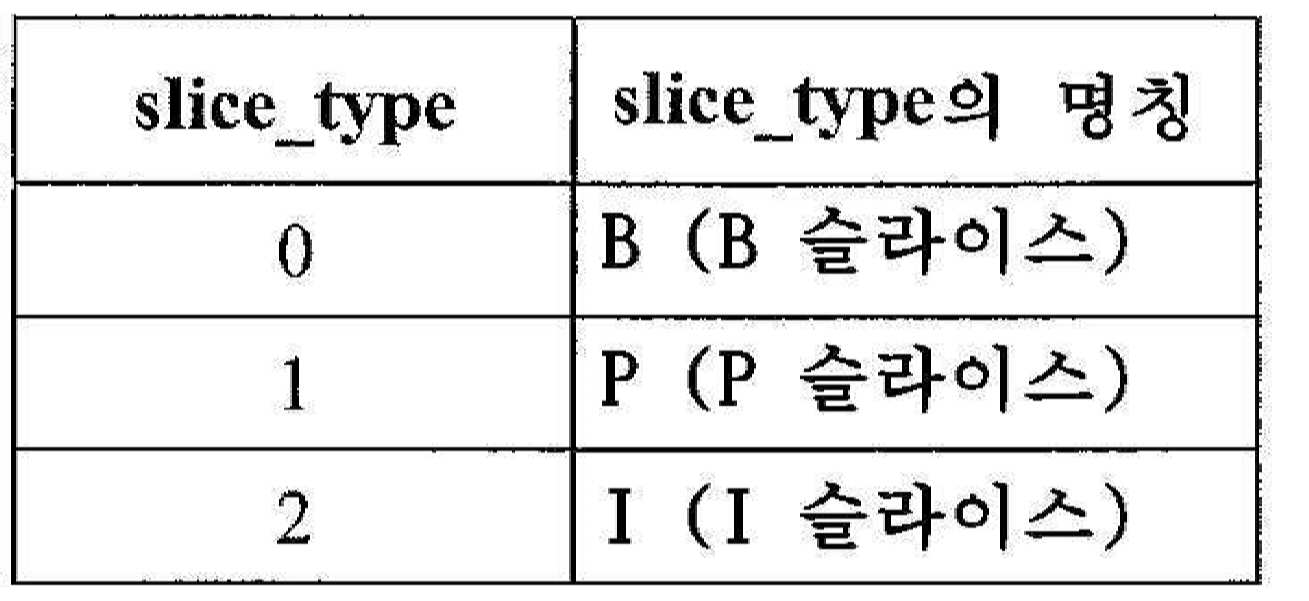
nal_unit_type이 [결정될 것]의 범위(하한 및 상한 값 포함)에 있는 값을 가질 때, 즉 픽처가 IRAP 픽처일 때, slice_type은 2와 동일할 것이다.When nal_unit_type has a value in the range of [to be determined] (including lower and upper limit values), that is, when the picture is an IRAP picture, slice_type will be equal to 2.
log2_diff_ctu_max_bt_size는 이진 분할을 이용하여 분할될 수 있는 코딩 블록의 최대 루마 크기(폭 또는 높이)와 루마 CTB 크기 사이의 차이를 특정한다.log2_diff_ctu_max_bt_size specifies the difference between the maximum luma size (width or height) of a coding block that can be split using binary partitioning and the luma CTB size.
1과 동일한 sbtmvp_size_override_flag는 신택스 요소 log2_sbtmvp_active_size_minus2가 현재 슬라이스에 대해 존재한다는 것을 특정한다. 0과 동일한 sbtmvp_size_override_flag는, 신택스 요소 log2_atmvp_active_size_minus2가 존재하지 않고 log2_sbtmvp_size_active_minus2가 log2_sbtmvp_default_size_minus2와 동일한 것으로 추론된다는 것을 특정한다.The sbtmvp_size_override_flag equal to 1 specifies that the syntax element log2_sbtmvp_active_size_minus2 exists for the current slice. Sbtmvp_size_override_flag equal to 0 specifies that the syntax element log2_atmvp_active_size_minus2 does not exist and that log2_sbtmvp_size_active_minus2 is inferred to be the same as log2_sbtmvp_default_size_minus2.
log2_sbtmvp_active_size_minus2 + 2는 현재 슬라이스의 서브블록 기반 TMVP에 대한 모션 파라미터들을 도출하기 위해 사용되는 서브블록 크기의 값을 특정한다. log2_sbtmvp_size_active_minus2가 존재하지 않을 때, 그것은 log2_sbtmvp_default_size_minus2와 동일한 것으로 추론된다. 변수는 하기와 같이 도출된다:log2_sbtmvp_active_size_minus2 + 2 specifies a value of the subblock size used to derive motion parameters for the subblock-based TMVP of the current slice. When log2_sbtmvp_size_active_minus2 does not exist, it is inferred to be the same as log2_sbtmvp_default_size_minus2. The variables are derived as follows:
Log2SbtmvpSize = log2_sbtmvp_size_active_minus2 + 2Log2SbtmvpSize = log2_sbtmvp_size_active_minus2 + 2
slice_temporal_mvp_enabled_flag는 시간 모션 벡터 예측자들이 인터 예측을 위해 사용될 수 있는지 여부를 특정한다. slice_temporal_mvp_enabled_flag가 0과 동일한 경우, 현재 픽처의 신택스 요소들은 시간 모션 벡터 예측자가 현재 픽처의 디코딩에서 사용되지 않도록 제한될 것이다. 그렇지 않은 경우(slice_temporal_mvp_enabled_flag가 1과 동일함), 시간 모션 벡터 예측자들은 현재 픽처의 디코딩에서 사용될 수 있다. 존재하지 않을 때, slice_temporal_mvp_enabled_flag의 값은 0과 동일한 것으로 추론된다.slice_temporal_mvp_enabled_flag specifies whether temporal motion vector predictors can be used for inter prediction. If slice_temporal_mvp_enabled_flag is equal to 0, syntax elements of the current picture will be restricted so that the temporal motion vector predictor is not used in decoding of the current picture. Otherwise (slice_temporal_mvp_enabled_flag is equal to 1), temporal motion vector predictors can be used in decoding of the current picture. When not present, the value of slice_temporal_mvp_enabled_flag is inferred to be equal to 0.
1과 동일한 mvd_l1_zero_flag는, mvd_coding(x0, y0, 1) 신택스 구조가 파싱되지 않고 compIdx = 0..1에 대해 MvdL1[ x0 ][ y0 ][ compIdx ]가 0과 동일하게 설정됨을 나타낸다. 0과 동일한 mvd_l1_zero_flag는 mvd_coding(x0, y0, 1) 신택스 구조가 파싱됨을 나타낸다.The mvd_l1_zero_flag equal to 1 indicates that the mvd_coding(x0, y0, 1) syntax structure is not parsed and MvdL1[x0][y0][ compIdx] is set equal to 0 for compIdx = 0..1. The mvd_l1_zero_flag equal to 0 indicates that the mvd_coding(x0, y0, 1) syntax structure is parsed.
1과 동일한 collocated_from_10_flag는 시간 모션 벡터 예측을 위해 사용된 공동-위치된 픽처가 참조 픽처 목록 0으로부터 도출된다는 것을 특정한다. 0과 동일한 collocated_from_10_flag는 시간 모션 벡터 예측을 위해 사용된 공동-위치된 픽처가 참조 픽처 목록 1로부터 도출된다는 것을 특정한다. collocated_from_10_flag가 존재하지 않을 때, 그것은 1과 동일한 것으로 추론된다.Collocated_from_10_flag equal to 1 specifies that the co-located picture used for temporal motion vector prediction is derived from reference picture list 0. Collocated_from_10_flag equal to 0 specifies that the co-located picture used for temporal motion vector prediction is derived from reference picture list 1. When collocated_from_10_flag does not exist, it is inferred to be equal to 1.
six_minus_max_num_merge_cand는 6으로부터 감산된, 슬라이스에서 지원되는 병합 모션 벡터 예측(MVP) 후보들의 최대 수를 특정한다. 병합 MVP 후보들의 최대 수, MaxNumMergeCand는 다음과 같이 도출된다:six_minus_max_num_merge_cand specifies the maximum number of merge motion vector prediction (MVP) candidates subtracted from 6 and supported in a slice. The maximum number of merged MVP candidates, MaxNumMergeCand, is derived as follows:
MaxNumMergeCand = 6 - six_minus_max_num_merge_candMaxNumMergeCand = 6-six_minus_max_num_merge_cand
MaxNumMergeCand의 값은 1 내지 6(이들 값 포함)의 범위에 있을 것이다.The value of MaxNumMergeCand will be in the range of 1 to 6 (including these values).
0과 동일한 dep_quant_enabled_flag는 종속적 양자화가 디스에이블된다는 것을 특정한다. 1과 동일한 dep_quant_enabled_flag는 종속적 양자화가 인에이블된다는 것을 특정한다.Dep_quant_enabled_flag equal to 0 specifies that dependent quantization is disabled. Dep_quant_enabled_flag equal to 1 specifies that dependent quantization is enabled.
0과 동일한 sign_data_hiding_enabled_flag는 부호 비트 은닉이 디스에이블된다는 것을 특정한다. 1과 동일한 sign_data_hiding_enabled_flag는 부호 비트 은닉이 인에이블된다는 것을 특정한다. sign_data_hiding_enabled_flag가 존재하지 않을 때, 그것은 0과 동일한 것으로 추론된다.Sign_data_hiding_enabled_flag equal to 0 specifies that sign bit hiding is disabled. Sign_data_hiding_enabled_flag equal to 1 specifies that sign bit hiding is enabled. When sign_data_hiding_enabled_flag is not present, it is inferred to be equal to zero.
JVET-K1001은 RBSP 트레일링 비트 신택스 및 바이트 정렬 신택스를 추가로 제공한다. 표 15는 JVET-K1001에서 제공되는 RBSP 트레일링 비트 신택스를 예시하고, 표 16은 JVET-K1001에서 제공되는 바이트 정렬 신택스를 예시한다.JVET-K1001 additionally provides RBSP trailing bit syntax and byte alignment syntax. Table 15 exemplifies the RBSP trailing bit syntax provided by JVET-K1001, and Table 16 exemplifies the byte alignment syntax provided by JVET-K1001.
[표 15][Table 15]
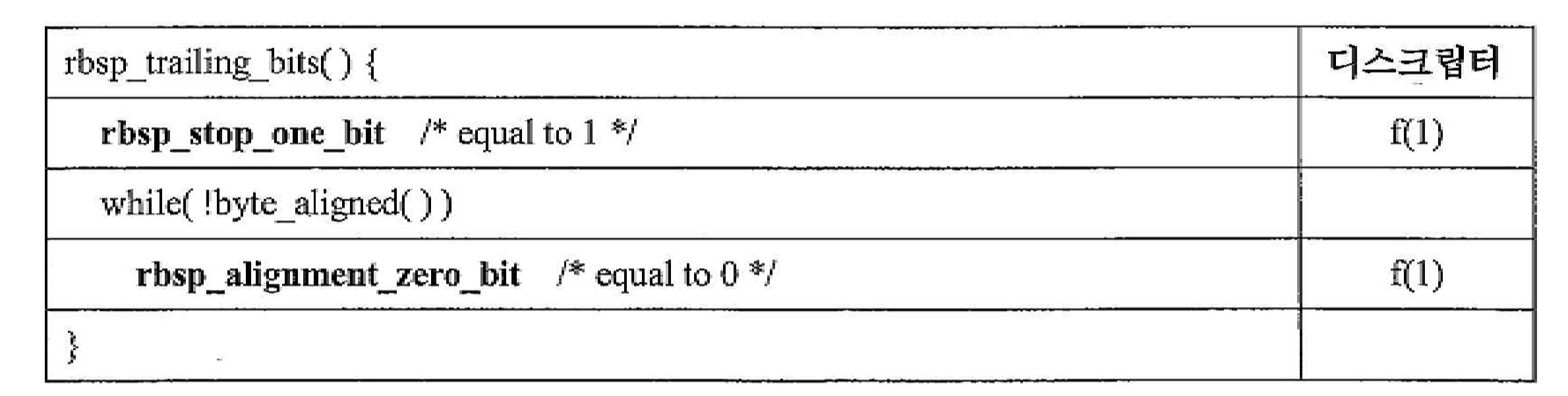
[표 16][Table 16]
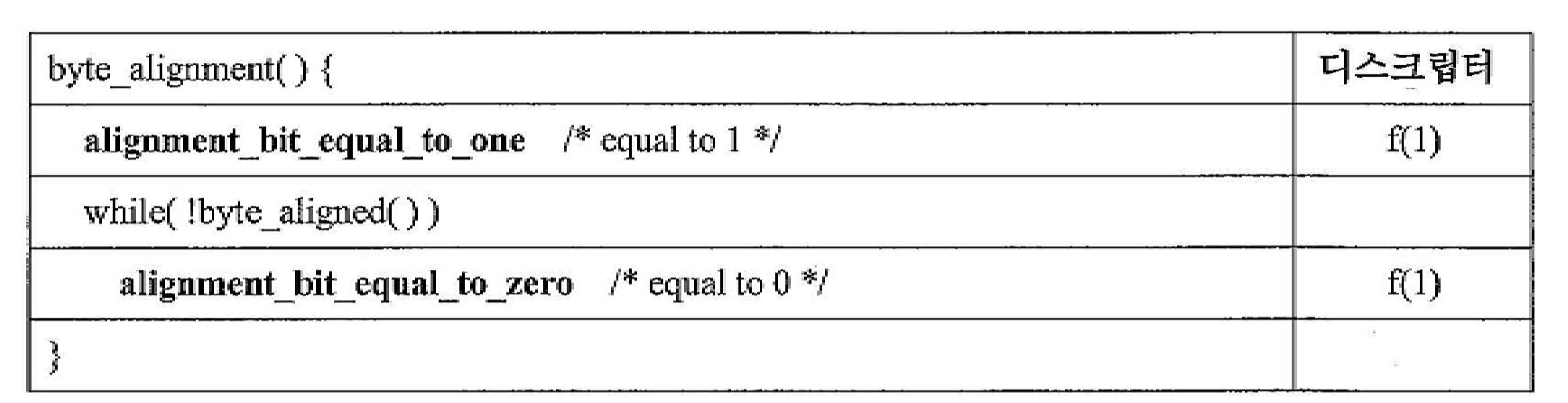
전술된 바와 같이, ITU-T H.265에 따르면, 각각의 비디오 프레임 또는 픽처는 하나 이상의 타일들을 포함하도록 구획화될 수 있다. ITU-T H.265에서, 픽처에 대한 타일 구조가 PPS를 사용하여 시그널링된다. 표 17은 타일 구조를 시그널링하기 위한 관련 신택스 요소들을 포함하는 ITU-T H.265에 명시된 PPS의 신택스의 일부분이다.As described above, according to ITU-T H.265, each video frame or picture may be partitioned to include one or more tiles. In ITU-T H.265, the tile structure for a picture is signaled using PPS. Table 17 is a part of the syntax of the PPS specified in ITU-T H.265 including related syntax elements for signaling the tile structure.
[표 17][Table 17]
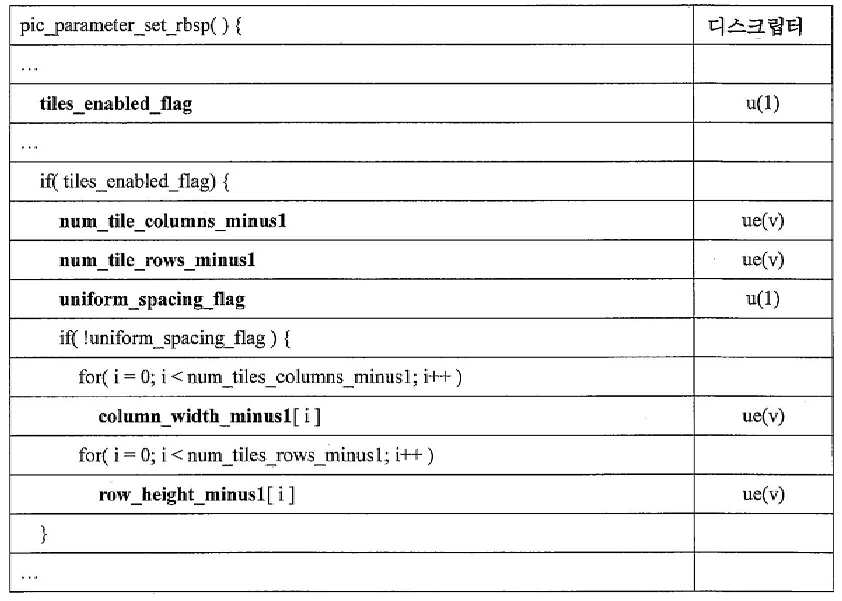
ITU-T H.265는 표 17에 예시된 각자의 신택스 요소들에 대한 하기의 정의들을 제공한다.ITU-T H.265 provides the following definitions for the respective syntax elements illustrated in Table 17.
1과 동일한 tiles_enabled_flag는 PPS를 참조하는 각각의 픽처 내에 하나 초과의 타일이 있다는 것을 특정한다. 0과 동일한 tiles_enabled_flag는 PPS를 참조하는 각각의 픽처 내에 오로지 하나의 타일만이 있다는 것을 특정한다. tiles_enabled_flag의 값이 CVS 내에서 활성화되는 모든 PPS들에 대해 동일할 것이라는 것이 비트스트림 부합의 요건이다.Tiles_enabled_flag equal to 1 specifies that there is more than one tile in each picture referencing the PPS. Tiles_enabled_flag equal to 0 specifies that there is only one tile in each picture referencing the PPS. It is a requirement of bitstream conformance that the value of tiles_enabled_flag will be the same for all PPSs activated in CVS.
num_tile_columns_minus1 + 1은 픽처를 구획화하는 타일 컬럼(column)들의 수를 특정한다. num_tile_columns_minus1은 0 내지 PicWidthlnCtbsY - 1(이들 값 포함)의 범위에 있을 것이다. 존재하지 않을 때, num_tile_columns_minus1의 값은 0과 동일한 것으로 추론된다.num_tile_columns_minus1 + 1 specifies the number of tile columns partitioning a picture. num_tile_columns_minus1 will be in the range of 0 to PicWidthlnCtbsY-1 (including these values). When not present, the value of num_tile_columns_minus1 is inferred to be equal to 0.
num_tile_rows_minus1 + 1은 픽처를 구획화하는 타일 로우(row)들의 수를 특정한다. num_tile_rows_minus1은 0 내지 PicHeightlnCtbsY - 1(이들 값 포함)의 범위 내에 있을 것이다. 존재하지 않을 때, num_tile_rows_minus1의 값은 0과 동일한 것으로 추론된다. tiles_enabled_flag가 1과 동일할 때, num_tile_columns_minus1 및 num_tile_rows minus1은 둘 모두가 0과 동일하지 않을 것이다.num_tile_rows_minus1 + 1 specifies the number of tile rows partitioning a picture. num_tile_rows_minus1 will be in the range of 0 to PicHeightlnCtbsY-1 (including these values). When not present, the value of num_tile_rows_minus1 is inferred to be equal to 0. When tiles_enabled_flag is equal to 1, num_tile_columns_minus1 and num_tile_rows minus1 will not both be equal to 0.
1과 동일한 uniform_spacing_flag는 타일 컬럼 경계들 및 마찬가지로 타일 로우 경계들이 픽처에 걸쳐서 균일하게 분포된다는 것을 특정한다. 0과 동일한 uniform_spacing_flag는 타일 컬럼 경계들 및 마찬가지로 타일 로우 경계들은 픽처에 걸쳐서 균일하게 분포되는 것이 아니라 신택스 요소들 column_width_minus1[ i ] 및 row_height_minus1[ i ]를 사용하여 명시적으로 시그널링된다는 것을 특정한다. 존재하지 않을 때, uniform_spacing_flag의 값은 1과 동일한 것으로 추론된다.The uniform_spacing_flag equal to 1 specifies that tile column boundaries and likewise tile row boundaries are uniformly distributed across the picture. The uniform_spacing_flag equal to 0 specifies that tile column boundaries and likewise tile row boundaries are not uniformly distributed across the picture, but are explicitly signaled using the syntax elements column_width_minus1[i] and row_height_minus1[i]. When not present, the value of uniform_spacing_flag is inferred to be equal to 1.
column_width_minus1[ i ] + 1은 코딩 트리 블록들의 단위들에서 i-번째 타일 컬럼의 폭을 특정한다.column_width_minus1[ i] + 1 specifies the width of the i-th tile column in units of coding tree blocks.
row_height_minus1[ i ] + 1은 코딩 트리 블록들의 단위들에서 i-번째 타일 로우의 높이를 특정한다.row_height_minus1[ i] + 1 specifies the height of the i-th tile row in units of coding tree blocks.
위에 제공된 바와 같이, JVET-K1001은 타일 구조를 시그널링하기 위한 메커니즘을 제공하지 않는다. 본 발명은 픽처 헤더 및 타일 세트 파라미터들을 포함하는 전체 비트스트림 구조를 시그널링하기 위한 기법들을 기술한다.As provided above, JVET-K1001 does not provide a mechanism for signaling the tile structure. The present invention describes techniques for signaling an entire bitstream structure including a picture header and tile set parameters.
도 1은 본 개시의 하나 이상의 기법에 따라 비디오 데이터를 코딩(즉, 인코딩 및/또는 디코딩)하도록 구성될 수 있는 시스템의 예를 예시하는 블록도이다. 시스템(100)은 본 개시의 하나 이상의 기법에 따라 비디오 데이터를 캡슐화할 수 있는 시스템의 예를 나타낸다. 도 1에 예시된 바와 같이, 시스템(100)은 소스 디바이스(102), 통신 매체(110), 및 목적지 디바이스(120)를 포함한다. 도 1에 예시된 예에서, 소스 디바이스(102)는 비디오 데이터를 인코딩하고 인코딩된 비디오 데이터를 통신 매체(110)에 송신하도록 구성된 임의의 디바이스를 포함할 수 있다. 목적지 디바이스(120)는 인코딩된 비디오 데이터를 통신 매체(110)를 통해 수신하도록 그리고 인코딩된 비디오 데이터를 디코딩하도록 구성된 임의의 디바이스를 포함할 수 있다. 소스 디바이스(102) 및/또는 목적지 디바이스(120)는 유선 및/또는 무선 통신들을 위해 갖춰진 컴퓨팅 디바이스를 포함할 수 있고, 예를 들어 셋톱 박스, 디지털 비디오 레코더, 텔레비전, 데스크톱, 랩톱 또는 태블릿 컴퓨터, 게이밍 콘솔, 의료 이미징 디바이스, 및 예를 들어 스마트 폰, 셀룰러 폰, 개인 게이밍 디바이스를 포함하는 모바일 디바이스를 포함할 수 있다.1 is a block diagram illustrating an example of a system that may be configured to code (ie, encode and/or decode) video data in accordance with one or more techniques of this disclosure.
통신 매체(110)는 무선 및 유선 통신 매체, 및/또는 저장 디바이스들의 임의의 조합을 포함할 수 있다. 통신 매체(110)는 동축 케이블, 광섬유 케이블, 트위스티드 페어 케이블, 무선 송신기 및 수신기, 라우터, 스위치, 리피터, 기지국, 또는 다양한 디바이스들과 사이트들 사이의 통신을 용이하게 하는 데 유용할 수 있는 임의의 다른 장비를 포함할 수 있다. 통신 매체(110)는 하나 이상의 네트워크를 포함할 수 있다. 예를 들어, 통신 매체(110)는 월드 와이드 웹, 예를 들어 인터넷에의 액세스를 가능하게 하도록 구성된 네트워크를 포함할 수 있다. 네트워크는 하나 이상의 전기통신 프로토콜의 조합에 따라 동작할 수 있다. 전기통신 프로토콜들은 독점적인 태양들을 포함할 수 있고/있거나 표준화된 전기통신 프로토콜들을 포함할 수 있다. 표준화된 전기통신 프로토콜들의 예들은 DVB(Digital Video Broadcasting) 표준, ATSC(Advanced Television Systems Committee) 표준, ISDB(Integrated Services Digital Broadcasting) 표준, DOCSIS(Data Over Cable Service Interface Specification) 표준, GSM(Global System Mobile Communications) 표준, CDMA(code division multiple access) 표준, 3GPP(3rd Generation Partnership Project) 표준, ETSI(European Telecommunications standards Institute) 표준, IP(Internet Protocol) 표준, WAP(Wireless Application Protocol) 표준, 및 IEEE(Institute of Electrical and Electronics Engineers) 표준을 포함한다.
저장 디바이스들은 데이터를 저장할 수 있는 임의의 유형의 디바이스 또는 저장 매체를 포함할 수 있다. 저장 매체는 유형의(tangible) 또는 비일시적 컴퓨터 판독가능 매체를 포함할 수 있다. 컴퓨터 판독가능 매체는 광 디스크, 플래시 메모리, 자기 메모리, 또는 임의의 다른 적합한 디지털 저장 매체들을 포함할 수 있다. 몇몇 예에서, 메모리 디바이스 또는 그의 부분들은 비휘발성 메모리로서 기술될 수 있고 다른 예들에서 메모리 디바이스들의 부분들은 휘발성 메모리로서 기술될 수 있다. 휘발성 메모리들의 예들은 랜덤 액세스 메모리(RAM), 동적 랜덤 액세스 메모리(DRAM), 및 정적 랜덤 액세스 메모리(SRAM)를 포함할 수 있다. 비휘발성 메모리들의 예들은 자기 하드 디스크, 광 디스크, 플로피 디스크, 플래시 메모리, 또는 EPROM(electrically programmable memory) 또는 EEPROM(electrically erasable and programmable memory)의 형태를 포함할 수 있다. 저장 디바이스(들)는 메모리 카드(예컨대, SD(Secure Digital) 메모리 카드), 내부/외부 하드 디스크 드라이브, 및/또는 내부/외부 솔리드 스테이트 드라이브를 포함할 수 있다. 데이터는 정의된 파일 포맷에 따라 저장 디바이스에 저장될 수 있다.Storage devices may include any type of device or storage medium capable of storing data. Storage media may include tangible or non-transitory computer-readable media. Computer-readable media may include optical disks, flash memory, magnetic memory, or any other suitable digital storage media. In some examples, the memory device or portions thereof may be described as non-volatile memory and in other examples portions of the memory devices may be described as volatile memory. Examples of volatile memories may include random access memory (RAM), dynamic random access memory (DRAM), and static random access memory (SRAM). Examples of nonvolatile memories may include a magnetic hard disk, an optical disk, a floppy disk, a flash memory, or in the form of an electrically programmable memory (EPROM) or an electrically erasable and programmable memory (EEPROM). The storage device(s) may include a memory card (eg, a Secure Digital (SD) memory card), an internal/external hard disk drive, and/or an internal/external solid state drive. Data may be stored in the storage device according to the defined file format.
도 4는 시스템(100)의 구현에 포함될 수 있는 컴포넌트들의 예를 예시하는 개념도이다. 도 4에 예시된 예시적인 구현에서, 시스템(100)은 하나 이상의 컴퓨팅 디바이스(402A 내지 402N), 텔레비전 서비스 네트워크(404), 텔레비전 서비스 제공자 사이트(406), 광역 네트워크(408), 근거리 네트워크(410), 및 하나 이상의 콘텐츠 제공자 사이트(412A 내지 412N)를 포함한다. 도 4에 예시된 구현은 예를 들어 영화, 라이브 스포츠 이벤트 등과 같은 디지털 미디어 콘텐츠, 및 데이터 및 애플리케이션들 및 그와 연관된 미디어 프레젠테이션들이 컴퓨팅 디바이스들(402A 내지 402N)과 같은 복수의 컴퓨팅 디바이스에 분배되고 그들에 의해 액세스될 수 있게 하도록 구성될 수 있는 시스템의 예를 나타낸다. 도 4에 예시된 예에서, 컴퓨팅 디바이스들(402A 내지 402N)은 텔레비전 서비스 네트워크(404), 광역 네트워크(408), 및/또는 근거리 네트워크(410) 중 하나 이상으로부터 데이터를 수신하도록 구성된 임의의 디바이스를 포함할 수 있다. 예를 들어, 컴퓨팅 디바이스들(402A 내지 402N)은 유선 및/또는 무선 통신을 위해 갖춰질 수 있고, 하나 이상의 데이터 채널을 통해 서비스를 수신하도록 구성될 수 있고, 소위 스마트 텔레비전을 포함한 텔레비전, 셋톱 박스, 및 디지털 비디오 레코더를 포함할 수 있다. 게다가, 컴퓨팅 디바이스들(402A 내지 402N)은 데스크톱, 랩톱 또는 태블릿 컴퓨터, 게임 콘솔, 예를 들어 "스마트" 폰, 셀룰러 폰, 및 개인 게이밍 디바이스들을 포함한 모바일 디바이스를 포함할 수 있다.4 is a conceptual diagram illustrating an example of components that may be included in the implementation of the
텔레비전 서비스 네트워크(404)는 텔레비전 서비스들을 포함할 수 있는 디지털 미디어 콘텐츠가 분배될 수 있게 하도록 구성된 네트워크의 예이다. 예를 들어, 텔레비전 서비스 네트워크(404)는 공개 공중파 텔레비전 네트워크, 공개 또는 구독 기반 위성 텔레비전 서비스 제공자 네트워크, 및 공개 또는 구독 기반 케이블 텔레비전 제공자 네트워크 및/또는 오버 더 톱(over the top) 또는 인터넷 서비스 제공자를 포함할 수 있다. 몇몇 예에서 텔레비전 서비스 네트워크(404)가 주로 텔레비전 서비스들이 제공될 수 있게 하는 데 사용될 수 있지만, 텔레비전 서비스 네트워크(404)는 또한 본 명세서에서 설명된 전기통신 프로토콜들의 임의의 조합에 따라 다른 유형의 데이터 및 서비스가 제공될 수 있게 할 수 있다는 점에 유의해야 한다. 또한, 몇몇 예에서, 텔레비전 서비스 네트워크(404)는 텔레비전 서비스 제공자 사이트(406)와 컴퓨팅 디바이스들(402A 내지 402N) 중 하나 이상 사이의 쌍방향 통신을 가능하게 할 수 있다는 점에 유의해야 한다. 텔레비전 서비스 네트워크(404)는 무선 및/또는 유선 통신 매체의 임의의 조합을 포함할 수 있다. 텔레비전 서비스 네트워크(404)는 동축 케이블, 광섬유 케이블, 트위스티드 페어 케이블, 무선 송신기 및 수신기, 라우터, 스위치, 리피터, 기지국, 또는 다양한 디바이스들과 사이트들 사이의 통신을 용이하게 하는 데 유용할 수 있는 임의의 다른 장비를 포함할 수 있다. 텔레비전 서비스 네트워크(404)는 하나 이상의 전기통신 프로토콜의 조합에 따라 동작할 수 있다. 전기통신 프로토콜들은 독점적인 태양들을 포함할 수 있고/있거나 표준화된 전기통신 프로토콜들을 포함할 수 있다. 표준화된 전기통신 프로토콜들의 예들은 DVB 표준, ATSC 표준, ISDB 표준, DTMB 표준, DMB 표준, DOCSIS(Data Over Cable Service Interface Specification) 표준, HbbTV 표준, W3C 표준, 및 UPnP 표준을 포함한다.
도 4를 다시 참조하면, 텔레비전 서비스 제공자 사이트(406)는 텔레비전 서비스 네트워크(404)를 통해 텔레비전 서비스를 분배하도록 구성될 수 있다. 예를 들어, 텔레비전 서비스 제공자 사이트(406)는 하나 이상의 방송국, 케이블 텔레비전 제공자, 또는 위성 텔레비전 제공자, 또는 인터넷 기반 텔레비전 제공자를 포함할 수 있다. 예를 들어, 텔레비전 서비스 제공자 사이트(406)는 위성 업링크/다운링크를 통해 텔레비전 프로그래밍을 포함하는 송신을 수신하도록 구성될 수 있다. 또한, 도 4에 예시된 바와 같이, 텔레비전 서비스 제공자 사이트(406)는 광역 네트워크(408)와 통신할 수 있고 콘텐츠 제공자 사이트들(412A 내지 412N)로부터 데이터를 수신하도록 구성될 수 있다. 몇몇 예에서, 텔레비전 서비스 제공자 사이트(406)는 텔레비전 스튜디오를 포함할 수 있고 그로부터 콘텐츠가 비롯될 수 있다는 점에 유의해야 한다.Referring again to FIG. 4, the television service provider site 406 may be configured to distribute television services through the
광역 네트워크(408)는 패킷 기반 네트워크를 포함하고 하나 이상의 전기통신 프로토콜의 조합에 따라 동작할 수 있다. 전기통신 프로토콜들은 독점적인 태양들을 포함할 수 있고/있거나 표준화된 전기통신 프로토콜들을 포함할 수 있다. 표준화된 전기통신 프로토콜들의 예들은 GSM(Global System Mobile Communications) 표준, CDMA(code division multiple access) 표준, 3GPP(3rd Generation Partnership Project) 표준, ETSI(European Telecommunications Standards Institute) 표준, 유럽 표준(EN), IP 표준, WAP(Wireless Application Protocol) 표준, 및 IEEE(Institute of Electrical and Electronics Engineers) 표준, 이를테면 예를 들어 IEEE 802 표준들 중 하나 이상(예를 들어, Wi-Fi)을 포함한다. 광역 네트워크(408)는 무선 및/또는 유선 통신 매체의 임의의 조합을 포함할 수 있다. 광역 네트워크(408)는 동축 케이블, 광섬유 케이블, 트위스티드 페어 케이블, 이더넷 케이블, 무선 송신기 및 수신기, 라우터, 스위치, 리피터, 기지국, 또는 다양한 디바이스들과 사이트들 사이의 통신을 용이하게 하는 데 유용할 수 있는 임의의 다른 장비를 포함할 수 있다. 일례에서, 광역 네트워크(408)는 인터넷을 포함할 수 있다. 근거리 네트워크(410)는 패킷 기반 네트워크를 포함하고 하나 이상의 전기통신 프로토콜의 조합에 따라 동작할 수 있다. 근거리 네트워크(410)는 액세스 레벨 및/또는 물리적 인프라스트럭처에 기초하여 광역 네트워크(408)와 구별될 수 있다. 예를 들어, 근거리 네트워크(410)는 보안 홈 네트워크를 포함할 수 있다.
다시 도 4를 참조하면, 콘텐츠 제공자 사이트들(412A 내지 412N)은 멀티미디어 콘텐츠를 텔레비전 서비스 제공자 사이트(406) 및/또는 컴퓨팅 디바이스들(402A 내지 402N)에 제공할 수 있는 사이트들의 예를 나타낸다. 예를 들어, 콘텐츠 제공자 사이트는 멀티미디어 파일 및/또는 스트림을 텔레비전 서비스 제공자 사이트(406)에 제공하도록 구성된 하나 이상의 스튜디오 콘텐츠 서버를 갖는 스튜디오를 포함할 수 있다. 일례에서, 콘텐츠 제공자 사이트들(412A 내지 412N)은 IP 스위트(suite)를 이용하여 멀티미디어 콘텐츠를 제공하도록 구성될 수 있다. 예를 들어, 콘텐츠 제공자 사이트는 RTSP(Real Time Streaming Protocol), HTTP 등에 따라 수신기 디바이스에 멀티미디어 콘텐츠를 제공하도록 구성될 수 있다. 또한, 콘텐츠 제공자 사이트들(412A 내지 412N)은 광역 네트워크(408)를 통해 수신기 디바이스들, 컴퓨팅 디바이스들(402A 내지 402N) 및/또는 텔레비전 서비스 제공자 사이트(406) 중 하나 이상에 하이퍼텍스트 기반 콘텐츠 등을 포함한 데이터를 제공하도록 구성될 수 있다. 콘텐츠 제공자 사이트들(412A 내지 412N)은 하나 이상의 웹 서버를 포함할 수 있다. 데이터 제공자 사이트(412A 내지 412N)에 의해 제공되는 데이터는 데이터 포맷들에 따라 정의될 수 있다.Referring again to FIG. 4, content provider sites 412A through 412N represent examples of sites that may provide multimedia content to a television service provider site 406 and/or computing devices 402A through 402N. For example, a content provider site may include a studio having one or more studio content servers configured to provide multimedia files and/or streams to the television service provider site 406. In one example, content provider sites 412A-412N may be configured to provide multimedia content using an IP suite. For example, the content provider site may be configured to provide multimedia content to a receiver device according to Real Time Streaming Protocol (RTSP), HTTP, or the like. In addition, content provider sites 412A through 412N may provide hypertext-based content to one or more of receiver devices, computing devices 402A through 402N and/or television service provider sites 406 via
다시 도 1을 참조하면, 소스 디바이스(102)는 비디오 소스(104), 비디오 인코더(106), 데이터 캡슐화기(107), 및 인터페이스(108)를 포함한다. 비디오 소스(104)는 비디오 데이터를 캡처하고/하거나 저장하도록 구성된 임의의 디바이스를 포함할 수 있다. 예를 들어, 비디오 소스(104)는 비디오 카메라 및 그에 동작 가능하게 결합된 저장 디바이스를 포함할 수 있다. 비디오 인코더(106)는 비디오 데이터를 수신하고 비디오 데이터를 표현하는 컴플라이언트 비트스트림을 생성하도록 구성된 임의의 디바이스를 포함할 수 있다. 컴플라이언트 비트스트림은 비디오 디코더가 그로부터 비디오 데이터를 수신 및 재생할 수 있는 비트스트림을 지칭할 수 있다. 컴플라이언트 비트스트림의 태양들은 비디오 코딩 표준에 따라 정의될 수 있다. 컴플라이언트 비트스트림을 생성할 때 비디오 인코더(106)는 비디오 데이터를 압축할 수 있다. 압축은 손실이 있거나(시청자가 식별 가능하거나 식별 불가능함) 무손실일 수 있다. 도 5는 본 명세서에서 기술된 비디오 데이터를 인코딩하기 위한 기법들을 구현할 수 있는 비디오 인코더(500)의 예를 예시하는 블록도이다. 예시적인 비디오 인코더(500)가 별개의 기능 블록들을 갖는 것으로 예시되어 있지만, 그러한 예시는 설명의 목적을 위한 것이고 비디오 인코더(500) 및/또는 그의 서브-컴포넌트들을 특정 하드웨어 또는 소프트웨어 아키텍처로 제한하지 않는다는 것에 유의해야 한다. 비디오 인코더(500)의 기능들은 하드웨어, 펌웨어, 및/또는 소프트웨어 구현들의 임의의 조합을 이용하여 실현될 수 있다.Referring again to FIG. 1, the
비디오 인코더(500)는 픽처 영역들의 인트라 예측 코딩 및 인터 예측 코딩을 수행할 수 있고, 그렇기 때문에 하이브리드 비디오 인코더로 지칭될 수 있다. 도 5에 예시된 예에서, 비디오 인코더(500)는 소스 비디오 블록들을 수신한다. 몇몇 예에서, 소스 비디오 블록들은 코딩 구조에 따라 분할된 픽처의 영역들을 포함할 수 있다. 예를 들어, 소스 비디오 데이터는 매크로블록들, CTU들, CB들, 그의 세분들, 및/또는 다른 동등한 코딩 유닛을 포함할 수 있다. 몇몇 예에서, 비디오 인코더(500)는 소스 비디오 블록들의 추가 세분들을 수행하도록 구성될 수 있다. 본 명세서에 기술된 기법은 일반적으로, 인코딩 전에 그리고/또는 인코딩 동안 소스 비디오 데이터가 어떻게 분할되는지에 무관하게, 비디오 코딩에 적용 가능하다는 것에 유의해야 한다. 도 5에 예시된 예에서, 비디오 인코더(500)는 합산기(502), 변환 계수 생성기(504), 계수 양자화 유닛(506), 역양자화 및 변환 계수 프로세싱 유닛(508), 합산기(510), 인트라 예측 프로세싱 유닛(512), 인터 예측 프로세싱 유닛(514), 필터 유닛(516), 및 엔트로피 인코딩 유닛(518)을 포함한다. 도 5에 예시된 바와 같이, 비디오 인코더(500)는 소스 비디오 블록들을 수신하고 비트스트림을 출력한다.The video encoder 500 can perform intra prediction coding and inter prediction coding of picture regions, and thus may be referred to as a hybrid video encoder. In the example illustrated in FIG. 5, video encoder 500 receives source video blocks. In some examples, source video blocks may include regions of a picture divided according to a coding structure. For example, the source video data may include macroblocks, CTUs, CBs, subdivisions thereof, and/or other equivalent coding unit. In some examples, video encoder 500 may be configured to perform further subdivisions of source video blocks. It should be noted that the techniques described herein are generally applicable to video coding, regardless of how the source video data is split before and/or during encoding. In the example illustrated in FIG. 5, the video encoder 500 includes a
도 5에 예시된 예에서, 비디오 인코더(500)는 소스 비디오 블록으로부터 예측 비디오 블록을 감산함으로써 잔차 데이터를 생성할 수 있다. 예측 비디오 블록의 선택은 아래에 상세히 기술된다. 합산기(502)는 이러한 감산 연산을 수행하도록 구성된 컴포넌트를 나타낸다. 일례에서, 비디오 블록들의 감산은 픽셀 도메인에서 발생한다. 변환 계수 생성기(504)는 이산 코사인 변환(DCT), 이산 사인 변환(DST), 또는 개념적으로 유사한 변환과 같은 변환을 잔차 블록 또는 그의 세분들에 적용하여(예컨대, 4개의 8x8 변환들이 잔차 값들의 16x16 어레이에 적용될 수 있음), 잔차 변환 계수들의 세트를 생성한다. 변환 계수 생성기(504)는 그의 근사를 포함한, 이산 삼각 변환(discrete trigonometric transform)의 계열에 포함된 변환들의 임의의 그리고 모든 조합들을 수행하도록 구성될 수 있다. 변환 계수 생성기(504)는 변환 계수들을 계수 양자화 유닛(506)에 출력할 수 있다. 계수 양자화 유닛(506)은 변환 계수들의 양자화를 수행하도록 구성될 수 있다. 양자화 프로세스는 계수들 중 일부 또는 전부와 연관된 비트 깊이를 감소시킬 수 있다. 양자화의 정도는 인코딩된 비디오 데이터의 레이트-왜곡(즉, 비트-레이트 대 비디오 품질)을 변경할 수 있다. 양자화의 정도는 양자화 파라미터(QP)를 조정함으로써 수정될 수 있다. 양자화 파라미터는 슬라이스 레벨 값들 및/또는 CU 레벨 값들(예를 들어, CU 델타 QP 값들)에 기초하여 결정될 수 있다. QP 데이터는 변환 계수들의 특정 세트를 양자화하기 위한 QP를 결정하는 데 사용되는 임의의 데이터를 포함할 수 있다. 도 5에 예시된 바와 같이, 양자화된 변환 계수들(레벨 값들로 지칭될 수 있음)은 역양자화 및 변환 계수 프로세싱 유닛(508)에 출력된다. 역양자화 및 변환 계수 프로세싱 유닛(508)은 재구성된 잔차 데이터를 생성하기 위해 역양자화 및 역변환을 적용하도록 구성될 수 있다. 도 5에 예시된 바와 같이, 합산기(510)에서, 재구성된 잔차 데이터가 예측 비디오 블록에 추가될 수 있다. 이러한 방식으로, 인코딩된 비디오 블록은 재구성될 수 있고 결과적인 재구성된 비디오 블록은 주어진 예측, 변환, 및/또는 양자화에 대한 인코딩 품질을 평가하는 데 사용될 수 있다. 비디오 인코더(500)는 다수의 코딩 패스들을 수행하도록(예컨대, 예측, 변환 파라미터들, 및 양자화 파라미터들 중 하나 이상을 변경하면서 인코딩을 수행하도록) 구성될 수 있다. 비트스트림 또는 다른 시스템 파라미터들의 레이트-왜곡은 재구성된 비디오 블록들의 평가에 기초하여 최적화될 수 있다. 또한, 재구성된 비디오 블록들은 저장되고 후속 블록들을 예측하기 위한 기준으로서 사용될 수 있다.In the example illustrated in FIG. 5, the video encoder 500 may generate residual data by subtracting the predictive video block from the source video block. The selection of predictive video blocks is described in detail below.
다시 도 5를 참조하면, 인트라 예측 프로세싱 유닛(512)은 코딩될 비디오 블록에 대한 인트라 예측 모드를 선택하도록 구성될 수 있다. 인트라 예측 프로세싱 유닛(512)은 프레임을 평가하고 현재 블록을 인코딩하는 데 사용할 인트라 예측 모드를 결정하도록 구성될 수 있다. 전술된 바와 같이, 가능한 인트라 예측 모드들은 평면 예측 모드들, DC 예측 모드들, 및 각도 예측 모드들을 포함할 수 있다. 또한, 몇몇 예에서, 크로마 성분에 대한 예측 모드는 루마 예측 모드에 대한 예측 모드로부터 추론될 수 있다는 점에 유의해야 한다. 인트라 예측 프로세싱 유닛(512)은 하나 이상의 코딩 패스를 수행한 후에 인트라 예측 모드를 선택할 수 있다. 또한, 일례에서, 인트라 예측 프로세싱 유닛(512)은 레이트-왜곡 분석에 기초하여 예측 모드를 선택할 수 있다. 도 5에 예시된 바와 같이, 인트라 예측 프로세싱 유닛(512)은 인트라 예측 데이터(예컨대, 신택스 요소들)를 엔트로피 인코딩 유닛(518) 및 변환 계수 생성기(504)에 출력한다. 전술된 바와 같이, 잔차 데이터에 대해 수행되는 변환은 모드 의존적일 수 있다(예컨대, 2차 변환 행렬이 서술 모드에 기초하여 결정될 수 있다).Referring back to FIG. 5, the intra
다시 도 5를 참조하면, 인터 예측 프로세싱 유닛(514)은 현재 비디오 블록에 대한 인터 예측 코딩을 수행하도록 구성될 수 있다. 인터 예측 프로세싱 유닛(514)은 소스 비디오 블록들을 수신하고 비디오 블록의 PU들에 대한 모션 벡터를 계산하도록 구성될 수 있다. 모션 벡터는 기준 프레임 내의 예측 블록에 대한 현재 비디오 프레임 내의 비디오 블록의 PU의 변위를 나타낼 수 있다. 인터 예측 코딩은 하나 이상의 기준 픽처를 사용할 수 있다. 또한, 모션 예측은 단방향 예측(하나의 모션 벡터를 사용함) 또는 양방향 예측(2개의 모션 벡터들을 사용함)일 수 있다. 인터 예측 프로세싱 유닛(514)은 예를 들어 절대차의 합(SAD), 제곱차의 합(SSD), 또는 다른 차이 메트릭(metric)들에 의해 결정된 픽셀 차이를 계산함으로써 예측 블록을 선택하도록 구성될 수 있다. 전술된 바와 같이, 모션 벡터는 모션 벡터 예측에 따라 결정 및 특정될 수 있다. 인터 예측 프로세싱 유닛(514)은, 전술된 바와 같이, 모션 벡터 예측을 수행하도록 구성될 수 있다. 인터 예측 프로세싱 유닛(514)은 모션 예측 데이터를 사용하여 예측 블록을 생성하도록 구성될 수 있다. 예를 들어, 인터 예측 프로세싱 유닛(514)은 프레임 버퍼(도 5에 도시되지 않음) 내에 예측 비디오 블록을 위치시킬 수 있다. 인터 예측 프로세싱 유닛(514)은 하나 이상의 보간 필터를 재구성된 잔차 블록에 적용하여 모션 추정에서 사용하기 위한 서브-정수 픽셀 값들을 계산하도록 추가로 구성될 수 있다는 것에 유의해야 한다. 인터 예측 프로세싱 유닛(514)은 계산된 모션 벡터에 대한 모션 예측 데이터를 엔트로피 인코딩 유닛(518)에 출력할 수 있다.Referring back to FIG. 5, the inter
다시 도 5를 참조하면, 필터 유닛(516)은 재구성된 비디오 블록들 및 코딩 파라미터들을 수신하고 수정된 재구성된 비디오 데이터를 출력한다. 필터 유닛(516)은 디블록킹 및/또는 SAO(Sample Adaptive Offset) 필터링을 수행하도록 구성될 수 있다. SAO 필터링은 재구성된 비디오 데이터에 오프셋을 추가함으로써 재구성을 개선하는 데 사용될 수 있는 비선형 진폭 매핑이다. 도 5에 예시된 바와 같이, 인트라 예측 프로세싱 유닛(512) 및 인터 예측 프로세싱 유닛(514)은 필터 유닛(216)을 통해 수정된 재구성된 비디오 블록을 수신할 수 있다는 것에 유의해야 한다. 엔트로피 인코딩 유닛(518)은 양자화된 변환 계수들 및 예측 신택스 데이터(즉, 인트라 예측 데이터 및 모션 예측 데이터)를 수신한다. 몇몇 예에서, 계수 양자화 유닛(506)은 계수들이 엔트로피 인코딩 유닛(518)에 출력되기 전에 양자화된 변환 계수들을 포함하는 행렬의 스캔을 수행할 수 있다는 것에 유의해야 한다. 다른 예들에서, 엔트로피 인코딩 유닛(518)이 스캔을 수행할 수 있다. 엔트로피 인코딩 유닛(518)은 본 명세서에 기술된 기법들 중 하나 이상에 따라 엔트로피 인코딩을 수행하도록 구성될 수 있다. 이러한 방식으로, 비디오 인코더(500)는 본 개시의 하나 이상의 기법에 따라 인코딩된 비디오 데이터를 생성하도록 구성된 디바이스의 예를 나타낸다.Referring again to FIG. 5, the
다시 도 1을 참조하면, 데이터 캡슐화기(107)는 인코딩된 비디오 데이터를 수신하고 정의된 데이터 구조에 따라 컴플라이언트 비트스트림, 예를 들어 NAL 유닛들의 시퀀스를 생성할 수 있다. 컴플라이언트 비트스트림을 수신하는 디바이스는 그로부터 비디오 데이터를 재생할 수 있다. 또한, 전술된 바와 같이, 서브-비트스트림 추출은 ITU-T H.265 컴플라이언트 비트스트림을 수신하는 디바이스가 수신된 비트스트림 내의 데이터를 폐기 및/또는 수정함으로써 새로운 ITU-T H.265 컴플라이언트 비트스트림을 형성하는 프로세스를 지칭할 수 있다. 용어 "부합하는 비트스트림"은 용어 "컴플라이언트 비트스트림" 대신에 사용될 수 있다는 점에 유의해야 한다.Referring back to FIG. 1, the
일례에서, 데이터 캡슐화기(107)는 본 명세서에 기술된 하나 이상의 기법들에 따라 신택스를 생성하도록 구성될 수 있다. 데이터 캡슐화기(107)가 비디오 인코더(106)와 동일한 물리적 디바이스에 위치될 필요가 없다는 것에 유의해야 한다. 예를 들어, 비디오 인코더(106) 및 데이터 캡슐화기(107)에 의해 수행되는 것으로 기술되는 기능들은 도 4에 도시된 디바이스들 사이에 분산될 수 있다.In one example,
일례에서, 픽처는 타일 세트들 및 타일들로 구획화될 수 있는데, 여기서 타일 세트는 타일들의 시퀀스이고 타일은 코딩 트리 단위의 시퀀스이다. 타일 세트는 픽처의 직사각형 영역을 커버할 수 있다. 도 7은 6개의 타일 세트들로 분할된 예시적인 픽처를 도시한다. 도 7에 도시된 예에서, 각각의 타일 세트는 직사각형이다. 각각의 타일 세트는 타일들의 상이한 수의 컬럼들 및 로우들의 컬럼들로 배열된 상이한 수의 타일들을 가질 수 있다. 그러나, 다른 예에서, 각각의 타일세트가 동일한 수의 타일들을 가질 수 있다. 추가로, 각각의 타일 세트 내의 타일 컬럼들의 수 및 타일 로우들의 수는 각각의 픽처 내에서 변경될 수 있다. 플래그는 코딩된 비디오 시퀀스에서 각각의 타일 세트 내의 타일 컬럼들의 수 및 타일 로우들의 수가 고정됨을 나타내기 위해 시그널링될 수 있다. "타일 세트"는 대신에 "슬라이스"로 지칭될 수 있다는 것에 유의해야 한다. 이와 같이, 용어 "타일 세트" 또는 "타일세트" 및 "슬라이스"는 상호교환가능하게 사용될 수 있다.In one example, a picture may be partitioned into tile sets and tiles, where a tile set is a sequence of tiles and a tile is a sequence of coding tree units. The tile set may cover a rectangular area of the picture. 7 shows an exemplary picture divided into six tile sets. In the example shown in Fig. 7, each tile set is rectangular. Each tile set may have a different number of columns of tiles and a different number of tiles arranged in columns of rows. However, in another example, each tileset may have the same number of tiles. Additionally, the number of tile columns and the number of tile rows in each tile set can be changed within each picture. A flag may be signaled to indicate that the number of tile columns and the number of tile rows in each tile set in the coded video sequence is fixed. It should be noted that “tile set” may instead be referred to as “slice”. As such, the terms “tile set” or “tile set” and “slice” may be used interchangeably.
전술된 바와 같이, 표 4는 JVET-K1001에서 제공되는 일반 NAL 유닛 신택스를 예시한다. 추가로 전술된 바와 같이, JVET-K1001은 NAL 유닛 유형들이 이제 정의될 위치를 제공한다. 그러나, 본 명세서에 참고로 포함되고 JVET-K0325로 지칭된 문헌["On High Level Syntax Starting Point", 11th Meeting of ISOTEC JTC1/SC29/WG11 10-18 July 2018, Ljubljana, SI, document JVET-K0325]은 JVET-K1001에 추가될 NAL 유닛 유형을 제공한다는 것에 유의해야 한다. 일례에서, 본 명세서에 기술된 기법들에 따르면, 데이터 캡슐화기(107)는 표 18에 포함된 NAL 유닛 유형들 중 하나 이상을 시그널링하도록 구성될 수 있다.As described above, Table 4 illustrates the general NAL unit syntax provided in JVET-K1001. As further described above, JVET-K1001 provides a location where NAL unit types will now be defined. However, documents incorporated herein by reference and referred to as JVET-K0325 ["On High Level Syntax Starting Point", 11th Meeting of ISOTEC JTC1/SC29/WG11 10-18 July 2018, Ljubljana, SI, document JVET-K0325] It should be noted that provides the NAL unit type to be added to JVET-K1001. In one example, in accordance with the techniques described herein, the
[표 18][Table 18]

표 18과 관련하여, 하기가 정의될 수 있다:With respect to Table 18, the following can be defined:
인트라 랜덤 액세스 포인트(intra random access point, IRAP) 픽처: 각각의 VCL NAL 유닛이 IRAP_NUT와 동일한 nal_unit_type을 갖는 코딩된 픽처. Intra random access point (IRAP) picture : A coded picture in which each VCL NAL unit has the same nal_unit_type as IRAP_NUT.
비-IRAP 픽처: 각각의 VCL NAL 유닛이 NON_IRAP_NUT와 동일한 nal_unit_type을 갖는 코딩된 픽처. Non-IRAP picture : A coded picture in which each VCL NAL unit has the same nal_unit_type as NON_IRAP_NUT.
NAL 유닛으로서 픽처 헤더를 시그널링하는 것이 표 18에 나타나 있다. 픽처 헤더 내의 신택스 파라미터들을 시그널링하고 이들을 타일 세트 헤더에서 오버라이딩하게 하는 것은 비트 절감을 허용하고 여전히 유연성을 지원할 수 있다. 일부 예들에서, 본 명세서의 기법들에 따르면, 동일한 픽처 헤더가 다수의 픽처들에 적용될 수 있다. 이는 추가적인 비트 절감을 제공할 수 있다. 더 나아가, 그 자신의 NAL 유닛으로서 픽처 헤더를 갖는 것은 다수의 픽처들이 동일한 픽처 헤더를 참조하는 것을 용이하게 한다.Signaling the picture header as a NAL unit is shown in Table 18. Signaling the syntax parameters in the picture header and allowing them to be overridden in the tile set header allows bit savings and may still support flexibility. In some examples, according to the techniques herein, the same picture header may be applied to multiple pictures. This can provide additional bit savings. Furthermore, having a picture header as its own NAL unit facilitates multiple pictures referencing the same picture header.
타일 파라미터 관련 헤더는 하기의 태양들을 가질 수 있다: 1. 그것은 하나 초과의 타일, 예컨대 타일 세트 또는 타일들의 집합에 적용될 수 있고, 따라서 그것은 타일 세트 헤더일 수 있고/있거나; 2. 그것은, 필요에 따라, 픽처 헤더로부터의 파라미터들 중 일부를 선택적으로 오버라이드할 수 있다. 이는, 타일 세트 헤더 내의 일정 세트의 존재 플래그(presence flag)들에 의해 제어될 수 있다.A tile parameter related header may have the following aspects: 1. It may be applied to more than one tile, such as a tile set or a set of tiles, so it may be a tile set header and/or; 2. It can optionally override some of the parameters from the picture header, if necessary. This can be controlled by a set of presence flags in the tile set header.
대안의 예에서, PICH_NUT는 각각의 픽처/타일세트에 대해 활성화되는 비-VCL NAL 유닛일 수 있다는 것에 유의해야 한다. 예를 들어, 이러한 경우에 있어서의 NAL 유닛 테이블은 표 18A에 나타내진 바와 같을 수 있다:It should be noted that in an alternative example, PICH_NUT may be a non-VCL NAL unit that is activated for each picture/tileset. For example, the NAL unit table in this case may be as shown in Table 18A:
[표 18A][Table 18A]

일례에서, 타일, 타일 컬럼, 타일 로우, 및 타일 세트의 하기의 정의들이 사용될 수 있다. 단어 "타일세트" 및 "타일 세트"는 상호교환가능하게 사용되고, 동일한 것을 의미할 수 있다는 것에 유의해야 한다.In one example, the following definitions of a tile, tile column, tile row, and tile set may be used. It should be noted that the words “tile set” and “tile set” are used interchangeably and can mean the same thing.
타일: 픽처에서 특정 타일 컬럼 및 특정 타일 로우 내의 코딩된 트리 블록(CTB)들의 직사각형 영역.Tile: A rectangular area of coded tree blocks (CTBs) within a specific tile column and a specific tile row in a picture.
타일 컬럼: 픽처의 높이와 동일한 높이 및 픽처 파라미터 세트 내의 신택스 요소들에 의해 특정되는 폭을 갖는 CTB들의 직사각형 영역.Tile column: A rectangular area of CTBs with a height equal to the height of the picture and a width specified by syntax elements in the picture parameter set.
타일 로우: 픽처 파라미터 세트 내의 신택스 요소들에 의해 특정된 높이 및 픽처의 폭과 동일한 폭을 갖는 CTB들의 직사각형 영역.Tile Row: A rectangular area of CTBs having a height specified by syntax elements in a picture parameter set and a width equal to the width of the picture.
타일 세트: 하나 이상의 타일들의 집합. 일례에서, 타일 세트는 형상이 직사각형일 것이다. 타일 세트는 오로지 정수 개만의 인접 타일들을 포함할 수 있다. 일례에서, 타일 세트에서, 각각의 타일은 컬럼 또는 로우 치수를 따라 하나의 다른 타일에 인접해야 하거나, 또는 타일 세트는 오로지 하나의 타일만을 가져야 한다.Tile Set: A set of one or more tiles. In one example, the tile set will be rectangular in shape. A tile set may contain only an integer number of adjacent tiles. In one example, in a tile set, each tile should be adjacent to one other tile along a column or row dimension, or a tile set should have only one tile.
일례에서, NONIRAP_NUT는 코딩된 비-IRAP 타일 세트 tileset_layer_rbsp()일 수 있고, IRAP_NUT는 코딩된 IRAP 타일 세트 tileset_layer_rbsp()일 수 있다. IRAP 타일 세트에 대한 데이터만을 추출하는 서브-비트스트림 추출 프로세스에 의해 얻어진 비트스트림은 독립적으로 디코딩될 수 있다. 타일 세트에 대응하는 이러한 추출된 비트스트림 내의 제1 픽처 또는 서브픽처는 IRAP 픽처 또는 서브픽처이다.In one example, NONIRAP_NUT may be a coded non-IRAP tile set tileset_layer_rbsp(), and IRAP_NUT may be a coded IRAP tile set tileset_layer_rbsp(). The bitstream obtained by the sub-bitstream extraction process of extracting only data for the IRAP tile set can be independently decoded. The first picture or subpicture in this extracted bitstream corresponding to the tile set is an IRAP picture or subpicture.
표 19는 본 명세서의 기법들에 따라 데이터 캡슐화기(107)에 의해 시그널링될 수 있는 tileset_layer_rbsp() 신택스의 일례를 예시한다.Table 19 illustrates an example of tileset_layer_rbsp() syntax that may be signaled by the
[표 19][Table 19]
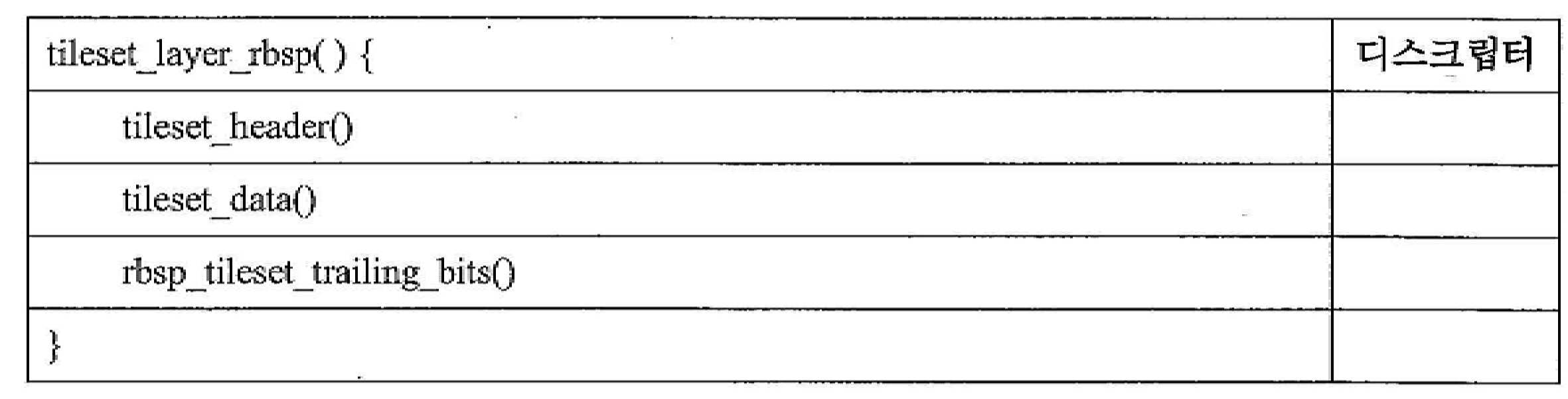
표 20은 본 명세서의 기법들에 따라 데이터 캡슐화기(107)에 의해 시그널링될 수 있는 tileset_header() 신택스의 일례를 예시한다.Table 20 illustrates an example of tileset_header() syntax that may be signaled by the
[표 20][Table 20]
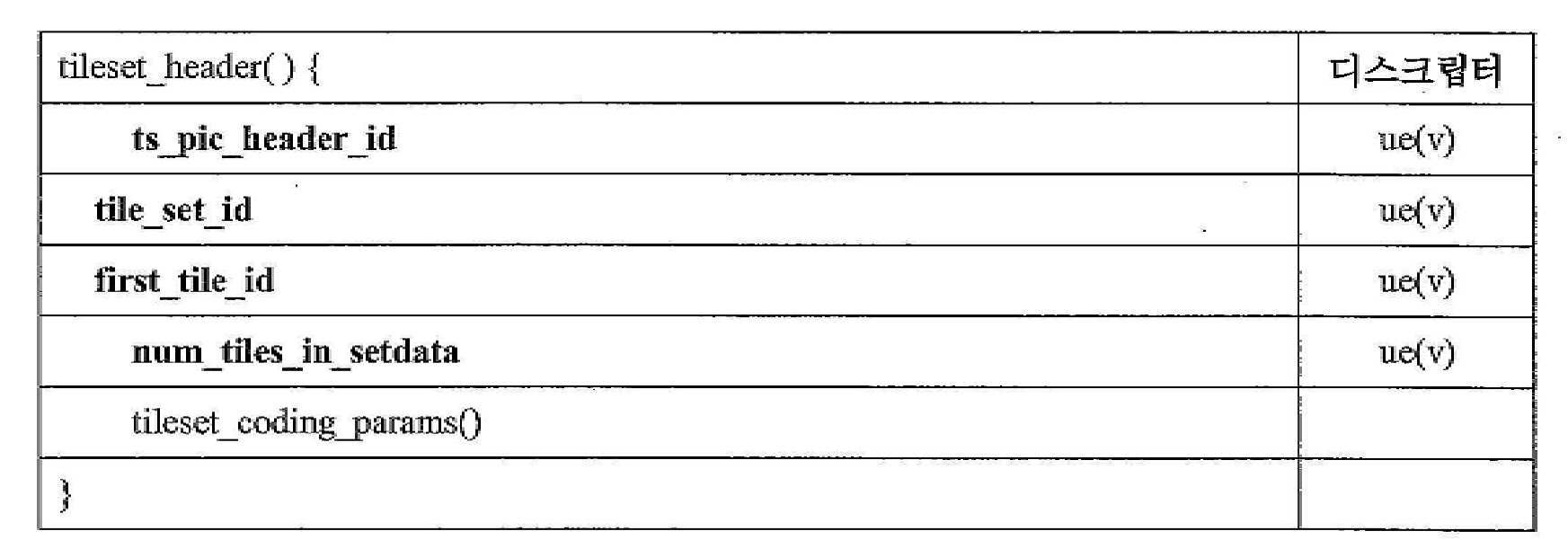
표 20과 관련하여, 각자의 신택스 요소들은 하기의 정의들에 기초할 수 있다:Regarding Table 20, the respective syntax elements can be based on the following definitions:
ts_pic_header_id는 이러한 타일 세트에 적용되는 픽처 헤더에 대한 pic_header_id의 값을 특정한다. ts_pic_header_id의 값은 0 내지 232-1(이들 값 포함)의 범위에 있을 것이다.ts_pic_header_id specifies a value of pic_header_id for a picture header applied to this tile set. The value of ts_pic_header_id will be in the range of 0 to 2 32 -1 (including these values).
tile_set_id는 이러한 타일 세트의 타일 세트 식별자를 특정한다.tile_set_id specifies a tile set identifier of this tile set.
first_tile_id는 이러한 tileset_header() 뒤에 오는 tileset_data()에 존재하는 식별자 tile_set_id를 갖는 타일 세트 내의 제1 타일의 TileId(타일 식별자)를 특정한다.first_tile_id specifies the TileId (tile identifier) of the first tile in the tile set having the identifier tile_set_id existing in tileset_data() following these tileset_header().
num_tiles_in_setdata는 이러한 tileset_header() 뒤에 오는 tileset_data()에 존재하는 식별자 tile_set_id를 갖는 타일 세트 내의 타일들의 수를 특정한다.num_tiles_in_setdata specifies the number of tiles in a tile set having an identifier tile_set_id present in tileset_data() following these tileset_header().
표 21은 본 명세서의 기법들에 따라 데이터 캡슐화기(107)에 의해 시그널링될 수 있는 tileset_header() 신택스의 일례를 예시한다.Table 21 illustrates an example of tileset_header() syntax that may be signaled by the
[표 21][Table 21]
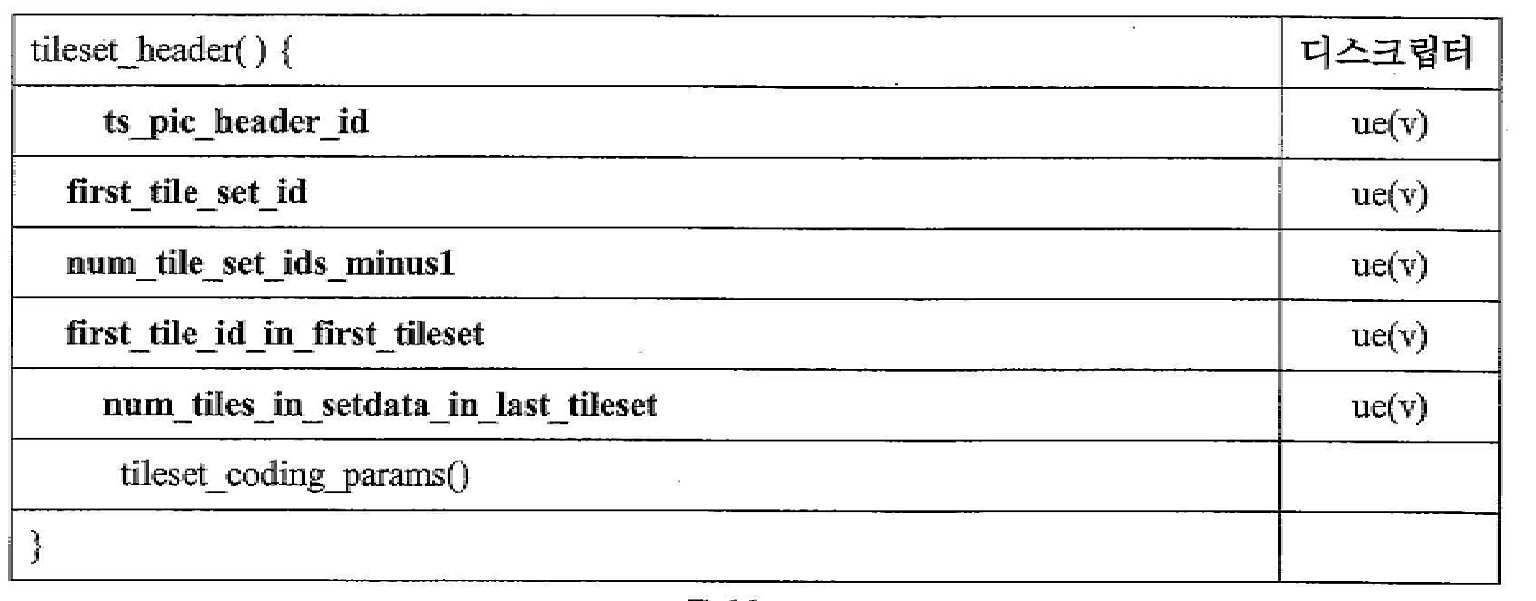
표 21과 관련하여, 각자의 신택스 요소들은 하기의 정의들에 기초할 수 있다:Regarding Table 21, the respective syntax elements can be based on the following definitions:
ts_pic_header_id는 이러한 타일 세트에 적용되는 픽처 헤더에 대한 pic_header_id의 값을 특정한다. ts_pic_header_id의 값은 0 내지 232-1(이들 값 포함)의 범위에 있을 것이다.ts_pic_header_id specifies a value of pic_header_id for a picture header applied to this tile set. The value of ts_pic_header_id will be in the range of 0 to 2 32 -1 (including these values).
first_tile_set_id는 tileset_header() 뒤에 오는 tileset_data()에서의 제1 타일 세트의 타일 세트 식별자를 특정한다.first_tile_set_id specifies a tile set identifier of the first tile set in tileset_data() following tileset_header().
num_tile_set_ids_minus1 + 1은 이러한 tileset_header() 뒤에 오는 tileset_data()에 존재하는 타일 세트들의 수를 특정한다.num_tile_set_ids_minus1 + 1 specifies the number of tile sets existing in tileset_data() following these tileset_header().
first_tile_id_in_first_tileset는 이러한 tileset_header() 뒤에 오는 tileset_data()에 존재하는 제1 타일 세트 내의 제1 타일의 TileId(타일 식별자)를 특정한다.first_tile_id_in_first_tileset specifies the TileId (tile identifier) of the first tile in the first tile set existing in tileset_data() following these tileset_header().
num_tiles_in_setdata_in_last_tileset는 이러한 tileset_header() 뒤에 오는 tileset_data()에 존재하는 마지막 타일 세트 내의 타일들의 수를 특정한다.num_tiles_in_setdata_in_last_tileset specifies the number of tiles in the last tile set present in tileset_data() following these tileset_header().
표 22는 본 명세서의 기법들에 따라 데이터 캡슐화기(107)에 의해 시그널링될 수 있는 tileset_header() 신택스의 일례를 예시한다.Table 22 illustrates an example of tileset_header() syntax that may be signaled by the
[표 22][Table 22]

표 22와 관련하여, 각자의 신택스 요소들은 하기의 정의들에 기초할 수 있다:Regarding Table 22, the respective syntax elements can be based on the following definitions:
first_tile_set_id는 이러한 tileset_header() 뒤에 오는 tileset_data()에서의 제1 타일 세트의 타일 세트 식별자를 특정한다.first_tile_set_id specifies the tile set identifier of the first tile set in tileset_data() following these tileset_header().
num_tile_set_ids_minus1 + 1은 이러한 tileset_header() 뒤에 오는 tileset_data()에 존재하는 타일 세트들의 수를 특정한다.num_tile_set_ids_minus1 + 1 specifies the number of tile sets existing in tileset_data() following these tileset_header().
first_tile_id_in_first_tileset는 이러한 tileset_header() 뒤에 오는 tileset_data()에 존재하는 제1 타일 세트 내의 제1 타일의 TileId(타일 식별자)를 특정한다.first_tile_id_in_first_tileset specifies the TileId (tile identifier) of the first tile in the first tile set existing in tileset_data() following these tileset_header().
num_tiles_in_setdata_in_first_tileset는 이러한 tileset_header() 뒤에 오는 tileset_data()에 존재하는 제1 타일 세트 내의 타일들의 수를 특정한다.num_tiles_in_setdata_in_first_tileset specifies the number of tiles in the first tile set existing in tileset_data() following these tileset_header().
num_tiles_in_setdata_in_last_tileset는 이러한 tileset_header() 뒤에 오는 tileset_data()에 존재하는 마지막 타일 세트 내의 타일들의 수를 특정한다.num_tiles_in_setdata_in_last_tileset specifies the number of tiles in the last tile set present in tileset_data() following these tileset_header().
표 22A는 본 명세서의 기법들에 따라 데이터 캡슐화기(107)에 의해 시그널링될 수 있는 tileset_header() 신택스의 일례를 예시한다. 이러한 예에서, 완전한 정수 개만의 타일 세트들이 tileset_data()에 포함된다. 이는 tilset_header()에서의 더 적은 신택스 요소들을 시그널링하는 것을 필요로 한다.Table 22A illustrates an example of tileset_header() syntax that may be signaled by the
[표 22A][Table 22A]

표 22A와 관련하여, 각자의 신택스 요소들은 하기의 정의들에 기초할 수 있다:With respect to Table 22A, the respective syntax elements can be based on the following definitions:
first_tile_set_id는 tileset_header() 뒤에 오는 tileset_data()에서의 제1 타일 세트의 타일 세트 식별자를 특정한다.first_tile_set_id specifies a tile set identifier of the first tile set in tileset_data() following tileset_header().
num_tile_set_ids_minus1 + 1은 이러한 tileset_header() 뒤에 오는 tileset_data()에 존재하는 타일 세트들의 수를 특정한다.num_tile_set_ids_minus1 + 1 specifies the number of tile sets existing in tileset_data() following these tileset_header().
표 23은 본 명세서의 기법들에 따라 데이터 캡슐화기(107)에 의해 시그널링될 수 있는 tileset_coding_parameters() 신택스의 일례를 예시한다.Table 23 illustrates an example of tileset_coding_parameters() syntax that may be signaled by the
[표 23][Table 23]
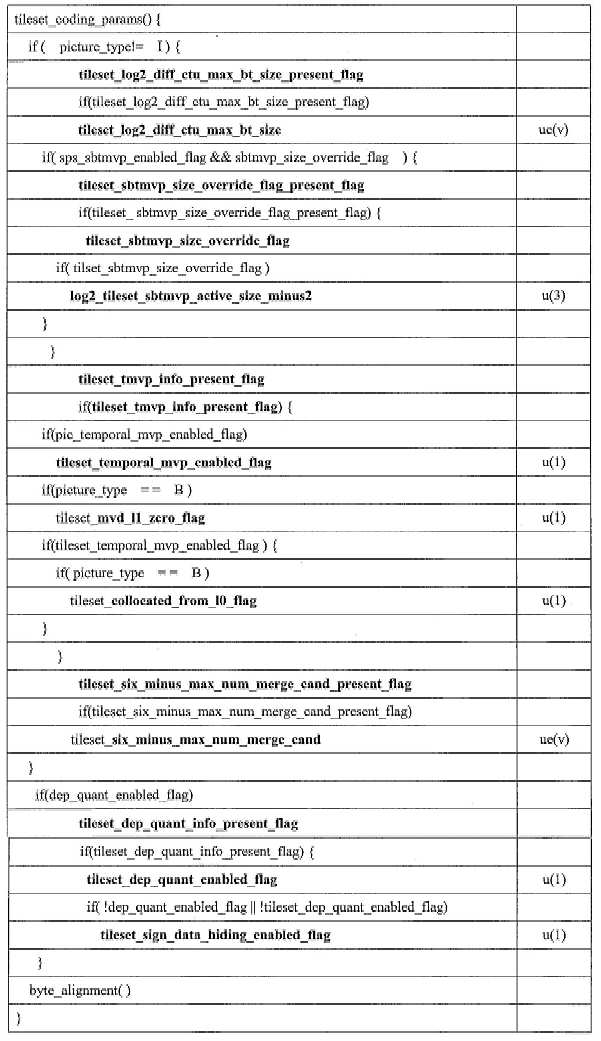
표 23과 관련하여, 각자의 신택스 요소들은 하기의 정의들에 기초할 수 있다:Regarding Table 23, the respective syntax elements can be based on the following definitions:
1과 동일한 tileset_log2_diff_ctu_max_bt_size_present_flag는 tileset_log2_diff_ctu_max_bt_size가 존재한다는 것을 특정한다. 0과 동일한 tileset_log2_diff_ctu_max_bt_size_present_flag는 tileset_log2_diff_ctu_max_bt_size가 존재하지 않는다는 것을 특정한다. 존재하지 않을 때, tileset_log2_diff_ctu_max_bt_size는 이러한 타일 세트에 대해 활성인 이러한 tilset_header()에서 ts_pic_header_id에 대응하는 pic_header() 구조로부터의 log2_diff_ctu_max_bt_size와 동일한 것으로 추론된다.Tileset_log2_diff_ctu_max_bt_size_present_flag equal to 1 specifies that tileset_log2_diff_ctu_max_bt_size exists. Tileset_log2_diff_ctu_max_bt_size_present_flag equal to 0 specifies that tileset_log2_diff_ctu_max_bt_size does not exist. When not present, tileset_log2_diff_ctu_max_bt_size is inferred to be equal to log2_diff_ctu_max_bt_size from the pic_header() structure corresponding to ts_pic_header_id in this tilset_header() active for this tile set.
tileset_log2_diff_ctu_max_bt_size는 이러한 타일 세트에 대해 이진 분할을 이용하여 분할될 수 있는 코딩 블록의 최대 루마 크기(폭 또는 높이)와 루마 CTB 크기 사이의 차이를 특정한다. log2_diff_ctu_max_bt_size의 시맨틱들은 이러한 타일 세트를 제외하고서 적용된다.tileset_log2_diff_ctu_max_bt_size specifies the difference between the maximum luma size (width or height) and the luma CTB size of a coding block that can be split using binary partitioning for this tile set. The semantics of log2_diff_ctu_max_bt_size apply except for this tile set.
1과 동일한 tileset_sbtmvp_size_override_flag_present_flag는 tileset_sbtmvp_size_override_flag, 및 tileset_sbtmvp_size_override_flag가 1과 동일한 경우의 log2_tileset_sbtmvp_active_size_minus2가 존재한다는 것을 특정한다. 0과 동일한 tileset_sbtmvp_size_override_flag_present_flag는 tileset_sbtmvp_size_override_flag 및 log2_tileset_sbtmvp_active_size_minus2가 존재하지 않는다는 것을 특정한다. 존재하지 않을 때, tileset_sbtmvp_size_override_flag_present_flag 및 log2_tileset_sbtmvp_active_size_minus2는 이러한 타일 세트에 대해 활성인 이러한 tilset_header()에서의 ts_pic_header_id에 대응하는 pic_header() 구조로부터의 sbtmvp _size_override_flag 및 log2_sbtmvp_active_size_minus2와 각각 동일한 것으로 추론된다.Tileset_sbtmvp_size_override_flag_present_flag equal to 1 specifies that tileset_sbtmvp_size_override_flag and log2_tileset_sbtmvp_active_size_minus2 when tileset_sbtmvp_size_override_flag is equal to 1 exist. Tileset_sbtmvp_size_override_flag_present_flag equal to 0 specifies that tileset_sbtmvp_size_override_flag and log2_tileset_sbtmvp_active_size_minus2 do not exist. When not present, tileset_sbtmvp_size_override_flag_present_flag and log2_tileset_sbtmvp_active_size_minus2 are inferred to be the same as sbtmvp_active_size_btm2_flag2 from the structure of pic_header() corresponding to ts_pic_header_id in this tilset_header() active for this tile set, respectively.
1과 동일한 tilset_sbtmvp_size_override_flag는 신택스 요소 log2_tilset_sbtmvp_active_size_minus2가 현재 타일 세트에 대해 존재한다는 것을 특정한다. 0과 동일한 sbtmvp_size_override_flag는, 신택스 요소 log2_tilset_sbtmvp_active_size_minus2가 존재하지 않고 log2_tileset_sbtmvp_size_active_minus2가 log2_sbtmvp_size_active_minus2와 동일한 것으로 추론된다는 것을 특정한다.The tilset_sbtmvp_size_override_flag equal to 1 specifies that the syntax element log2_tilset_sbtmvp_active_size_minus2 exists for the current tile set. Sbtmvp_size_override_flag equal to 0 specifies that the syntax element log2_tilset_sbtmvp_active_size_minus2 does not exist and that log2_tileset_sbtmvp_size_active_minus2 is inferred to be equal to log2_sbtmvp_size_active_minus2.
log2_tilset_sbtmvp_active_size_minus2 + 2는 현재 타일 세트의 서브블록 기반 TMVP에 대한 모션 파라미터들을 도출하기 위해 사용되는 서브블록 크기의 값을 특정한다. log2_tilset_sbtmvp_size_active_minus2가 존재하지 않을 때, 그것은 log2_sbtmvp_size_active_minus2와 동일한 것으로 추론된다. 변수는 다음과 같이 도출된다:log2_tilset_sbtmvp_active_size_minus2 + 2 specifies a value of the subblock size used to derive motion parameters for the subblock-based TMVP of the current tile set. When log2_tilset_sbtmvp_size_active_minus2 does not exist, it is inferred to be the same as log2_sbtmvp_size_active_minus2. The variables are derived as follows:
Log2SbtmvpSize = log2_tileset_sbtmvp_size_active_minus2 + 2Log2SbtmvpSize = log2_tileset_sbtmvp_size_active_minus2 + 2
1과 동일한 tileset_tmvp_info_present_flag는 tileset_temporal_mvp_enabled_flag, tileset_mvd_l1_zero_flag, 및 tileset_collocated_from_10_flag가 존재할 수 있다는 것을 특정한다. 0과 동일한 tileset_tmvp_info_present_flag는 tileset_temporal_mvp_enabled_flag, tileset_mvd_l1_zero_flag, 및 tileset_collocated_from_10_flag가 존재하지 않는다는 것을 특정한다. 존재하지 않을 때, tileset_temporal_mvp_enabled_flag, tileset_mvd_l1_zero_flag, 및 tileset_collocated_from_10_flag는 이러한 타일 세트에 대해 활성인 이러한 tilset_header()에서의 ts_pic_header_id에 대응하는 pic_header() 구조로부터의 pic_temporal_mvp_enabled_flag, mvd_l1_zero_flag, 및 collocated_from_10_flag와 각각 동일한 것으로 추론된다.Tileset_tmvp_info_present_flag equal to 1 specifies that tileset_temporal_mvp_enabled_flag, tileset_mvd_l1_zero_flag, and tileset_collocated_from_10_flag may exist. Tileset_tmvp_info_present_flag equal to 0 specifies that tileset_temporal_mvp_enabled_flag, tileset_mvd_l1_zero_flag, and tileset_collocated_from_10_flag do not exist. When not present, tileset_temporal_mvp_enabled_flag, tileset_mvd_l1_zero_flag, and tileset_collocated_from_10_flag are deduced from the pic_header() structure corresponding to the ts_pic_header_id in this tilset_header() that are active for this tile set, respectively, pic_ocated_flag_from_mvp_enabled_flag_mvp_enabled_flag_mvd from the same structure, respectively
tileset_temporal_mvp_enabled_flag는 시간 모션 벡터 예측자들이 현재 타일 세트에 대한 인터 예측을 위해 사용될 수 있는지 여부를 특정한다. tileset_temporal_mvp_enabled_flag가 0과 동일한 경우, 현재 타일 세트의 신택스 요소들은 시간 모션 벡터 예측자가 현재 타일 세트의 디코딩에서 사용되지 않도록 제한될 것이다. 그렇지 않은 경우(tileset_temporal_mvp_enabled_flag가 1과 동일함), 시간 모션 벡터 예측자들은 현재 타일 세트의 디코딩에서 사용될 수 있다. 존재하지 않을 때, tileset_temporal_mvp_enabled_flag의 값은 이러한 타일 세트에 대해 활성인 이러한 tilset_header()에서 ts_pic_header_id에 대응하는 pic_header() 구조로부터의 pic_temporal_mvp_enabled_flag와 동일한 것으로 추론된다.tileset_temporal_mvp_enabled_flag specifies whether temporal motion vector predictors can be used for inter prediction for the current tile set. If tileset_temporal_mvp_enabled_flag is equal to 0, syntax elements of the current tile set will be restricted so that the temporal motion vector predictor is not used in decoding of the current tile set. Otherwise (tileset_temporal_mvp_enabled_flag is equal to 1), temporal motion vector predictors can be used in decoding of the current tile set. When not present, the value of tileset_temporal_mvp_enabled_flag is inferred to be the same as pic_temporal_mvp_enabled_flag from the pic_header() structure corresponding to ts_pic_header_id in this tilset_header() active for this tile set.
1과 동일한 tilset_mvd_l1_zero_flag는, mvd_coding(x0, y0, 1) 신택스 구조가 파싱되지 않고 현재 타일 세트에 대한 compIdx = 0..1에 대해 MvdL1[ x0 ][ y0 ][ compIdx ]가 0과 동일하게 설정됨을 나타낸다. 0과 동일한 mvd_l1_zero_flag는 현재 타일 세트에 대해 mvd_coding(x0, y0, 1) 신택스 구조가 파싱됨을 나타낸다.Tilset_mvd_l1_zero_flag equal to 1 indicates that the mvd_coding(x0, y0, 1) syntax structure is not parsed and MvdL1[ x0 ][ y0 ][ compIdx] is set equal to 0 for compIdx = 0..1 for the current tile set. Show. The mvd_l1_zero_flag equal to 0 indicates that the mvd_coding(x0, y0, 1) syntax structure is parsed for the current tile set.
1과 동일한 tileset_collocated_from_10_flag는, 현재 타일 세트에 대해, 시간 모션 벡터 예측을 위해 사용된 공동-위치된 픽처가 참조 픽처 목록 0으로부터 도출된다는 것을 특정한다. 0과 동일한 collocated_from_10_flag는, 현재 타일 세트에 대해, 시간 모션 벡터 예측을 위해 사용된 공동-위치된 픽처가 참조 픽처 목록 1로부터 도출된다는 것을 특정한다. tileset_collocated_from_10_flag가 존재하지 않을 때, 그것은 이러한 타일 세트에 대해 활성인 이러한 tilset_header()에서 ts_pic_header_id에 대응하는 pic_header() 구조로부터의 collocated_from_10_flag와 동일한 것으로 추론된다.Tileset_collocated_from_10_flag equal to 1 specifies that, for the current tile set, the co-located picture used for temporal motion vector prediction is derived from reference picture list 0. The collocated_from_10_flag equal to 0 specifies that, for the current tile set, the co-located picture used for temporal motion vector prediction is derived from reference picture list 1. When tileset_collocated_from_10_flag is not present, it is inferred to be the same as collocated_from_10_flag from the pic_header() structure corresponding to ts_pic_header_id in this tilset_header() active for this tile set.
1과 동일한 tileset_six_minus_max_num_merge_cand_present_flag는 tileset_six_minus_max_num_merge_cand가 존재한다는 것을 특정한다. 0과 동일한 tileset_six_minus_max_num_merge_cand_present_flag는 tileset_six_minus_max_num_merge_cand가 존재하지 않는다는 것을 특정한다. 존재하지 않을 때, tileset_six_minus_max_num_merge_cand는 이러한 타일 세트에 대해 활성인 이러한 tilset_header()에서 ts_pic_header_id에 대응하는 pic_header() 구조로부터의 six_minus_rnax_num_merge_cand와 동일한 것으로 추론된다.Tileset_six_minus_max_num_merge_cand_present_flag equal to 1 specifies that tileset_six_minus_max_num_merge_cand exists. Tileset_six_minus_max_num_merge_cand_present_flag equal to 0 specifies that tileset_six_minus_max_num_merge_cand does not exist. When not present, tileset_six_minus_max_num_merge_cand is inferred to be the same as six_minus_rnax_num_merge_cand from the pic_header() structure corresponding to ts_pic_header_id in this tilset_header() active for this tile set.
tileset_six_minus_max_num_merge_cand는 6으로부터 감산된, 현재 타일 세트에서 지원되는 병합 모션 벡터 예측(MVP) 후보들의 최대 수를 특정한다. 병합 MVP 후보들의 최대 수, MaxNumMergeCand는 다음과 같이 도출된다:tileset_six_minus_max_num_merge_cand specifies the maximum number of merge motion vector prediction (MVP) candidates supported in the current tile set, subtracted from 6. The maximum number of merged MVP candidates, MaxNumMergeCand, is derived as follows:
MaxNumMergeCand = 6 - tilset_six_minus_max_num_merge_candMaxNumMergeCand = 6-tilset_six_minus_max_num_merge_cand
MaxNumMergeCand의 값은 1 내지 6(이들 값 포함)의 범위에 있을 것이다.The value of MaxNumMergeCand will be in the range of 1 to 6 (including these values).
1과 동일한 tileset_dep_quant_info_present_flag는 tileset_dep_quant_enabled_flag가 존재한다는 것을 특정한다. 0과 동일한 tileset_dep_quant_info_present_flag는 tileset_dep_quant_enabled_flag가 존재하지 않는다는 것을 특정한다. 존재하지 않을 때, tileset_dep_quant_enabled_flag는 이러한 타일 세트에 대해 활성인 이러한 tilset_header()에서 ts_pic_header_id에 대응하는 pic_header() 구조로부터의 dep_quant_enabled_flag와 동일한 것으로 추론된다.Tileset_dep_quant_info_present_flag equal to 1 specifies that tileset_dep_quant_enabled_flag is present. Tileset_dep_quant_info_present_flag equal to 0 specifies that tileset_dep_quant_enabled_flag does not exist. When not present, tileset_dep_quant_enabled_flag is inferred to be the same as dep_quant_enabled_flag from the pic_header() structure corresponding to ts_pic_header_id in this tilset_header() active for this tile set.
0과 동일한 tileset_dep_quant_enabled_flag는 종속적 양자화가 현재 타일 세트에 대해 디스에이블된다는 것을 특정한다. 1과 동일한 tileset_dep_quant_enabled_flag는 종속적 양자화가 현재 타일 세트에 대해 인에이블된다는 것을 특정한다.Tileset_dep_quant_enabled_flag equal to 0 specifies that dependent quantization is disabled for the current tile set. Tileset_dep_quant_enabled_flag equal to 1 specifies that dependent quantization is enabled for the current tile set.
0과 동일한 tileset_sign_data_hiding_enabled_flag는 부호 비트 은닉이 현재 타일 세트에 대해 디스에이블된다는 것을 특정한다. 1과 동일한 tile_sign_data_hiding_enabled_flag는 부호 비트 은닉이 현재 타일 세트에 대해 인에이블된다는 것을 특정한다. tile_sign_data_hiding_enabled_flag가 존재하지 않을 때, 그것은 이러한 타일 세트에 대해 활성인 이러한 tilset_header()에서 ts_pic_header_id에 대응하는 pic_header() 구조로부터의 sign_data_hiding_enabled_flag와 동일한 것으로 추론된다.Tileset_sign_data_hiding_enabled_flag equal to 0 specifies that sign bit hiding is disabled for the current tile set. Tile_sign_data_hiding_enabled_flag equal to 1 specifies that sign bit hiding is enabled for the current tile set. When tile_sign_data_hiding_enabled_flag is not present, it is inferred to be the same as sign_data_hiding_enabled_flag from the pic_header() structure corresponding to ts_pic_header_id in this tilset_header() active for this tile set.
표 24는 본 명세서의 기법들에 따라 데이터 캡슐화기(107)에 의해 시그널링될 수 있는 tileset_data() 신택스의 일례를 예시한다.Table 24 illustrates an example of tileset_data() syntax that may be signaled by the
[표 24][Table 24]
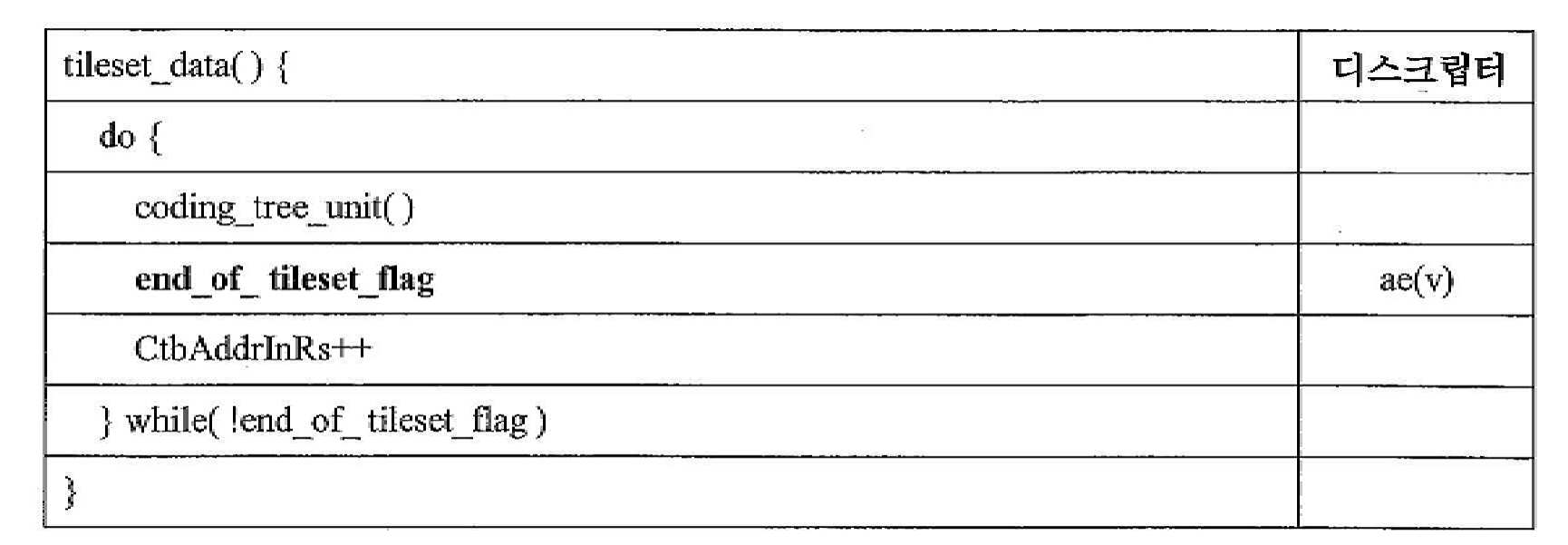
표 24와 관련하여, 각자의 신택스 요소들은 하기의 정의들에 기초할 수 있다:Regarding Table 24, the respective syntax elements can be based on the following definitions:
0과 동일한 end_of_tileset_flag는 다른 CTU가 타일 세트에서 뒤에 오고 있다는 것을 특정한다. 1과 동일한 end_of_tileset_flag는 타일 세트 슬라이스의 끝을 특정하는데, 즉 추가 CTU가 타일 세트에서 뒤에 오지 않는다는 것을 특정한다.The end_of_tileset_flag equal to 0 specifies that another CTU is coming behind in the tile set. The end_of_tileset_flag equal to 1 specifies the end of the tile set slice, that is, that the additional CTU does not follow in the tile set.
표 25는 본 명세서의 기법들에 따라 데이터 캡슐화기(107)에 의해 시그널링될 수 있는 rbsp_tileset_trailing_bits() 신택스의 일례를 예시한다.Table 25 illustrates an example of rbsp_tileset_trailing_bits() syntax that may be signaled by the
[표 25][Table 25]
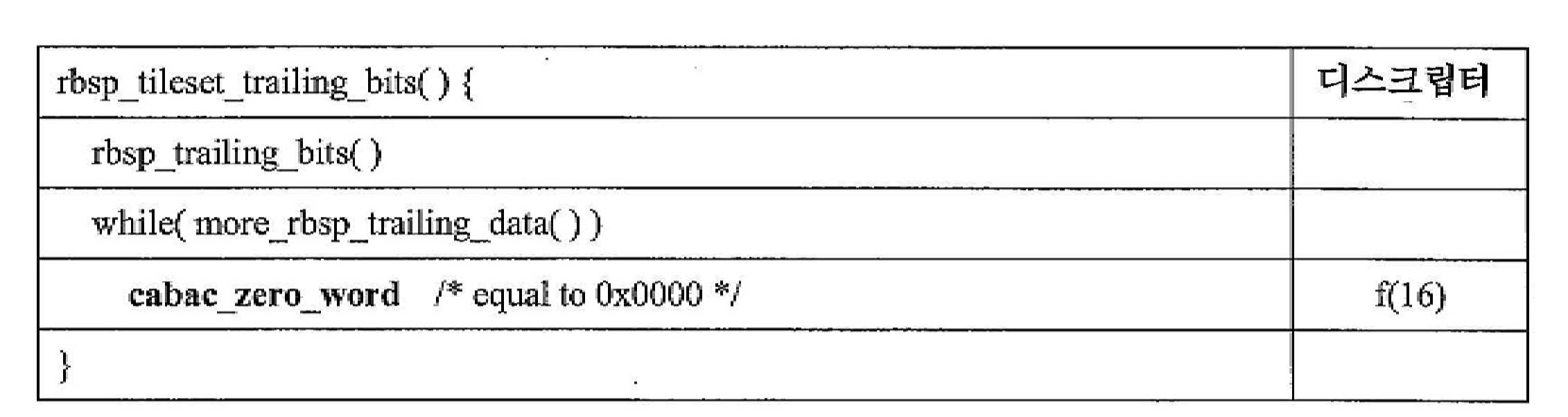
표 26은 본 명세서의 기법들에 따라 데이터 캡슐화기(107)에 의해 시그널링될 수 있는 pic_header_rbsp() 신택스의 일례를 예시한다.Table 26 illustrates an example of pic_header_rbsp() syntax that may be signaled by the
[표 26][Table 26]

표 27은 본 명세서의 기법들에 따라 데이터 캡슐화기(107)에 의해 시그널링될 수 있는 pic_header() 신택스의 일례를 예시한다.Table 27 illustrates an example of pic_header() syntax that may be signaled by the
[표 27][Table 27]
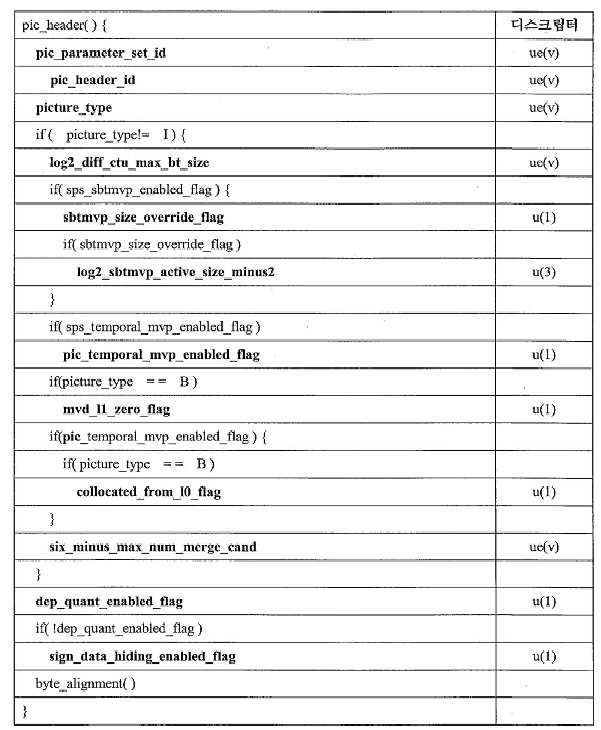
표 24와 관련하여, 각자의 신택스 요소들은 하기의 정의들에 기초할 수 있다:Regarding Table 24, the respective syntax elements can be based on the following definitions:
pps_pic_parameter_set_id는 다른 신택스 요소들에 의한 참조를 위해 PPS를 식별한다. pps_pic_parameter_set_id의 값은 0 내지 63(이들 값 포함)의 범위에 있을 것이다.pps_pic_parameter_set_id identifies the PPS for reference by other syntax elements. The value of pps_pic_parameter_set_id will be in the range of 0 to 63 (including these values).
pic_header_id는 다른 신택스 요소들에 의한 참조를 위해 픽처 헤더를 식별한다. pps_pic_parameter_set_id의 값은 0 내지 232-l(이들 값 포함)의 범위에 있을 것이다.pic_header_id identifies a picture header for reference by other syntax elements. The value of pps_pic_parameter_set_id will be in the range of 0 to 2 32 -l (including these values).
picture_type은 표 28에 따라 픽처의 코딩 유형을 나타낸다. pic_type의 값은 이러한 규격의 이러한 버전에 부합하는 비트스트림들에서 0, 1 또는 2와 동일할 것이다. pic_type의 다른 값들은 향후 사용을 위해 예약된다. 이러한 규격의 이러한 버전에 부합하는 디코더들은 pic_type의 예약된 값들을 무시할 것이다.picture_type represents a coding type of a picture according to Table 28. The value of pic_type will be equal to 0, 1 or 2 in bitstreams conforming to this version of this specification. Other values of pic_type are reserved for future use. Decoders conforming to this version of this specification will ignore the reserved values of pic_type.
[표 28][Table 28]
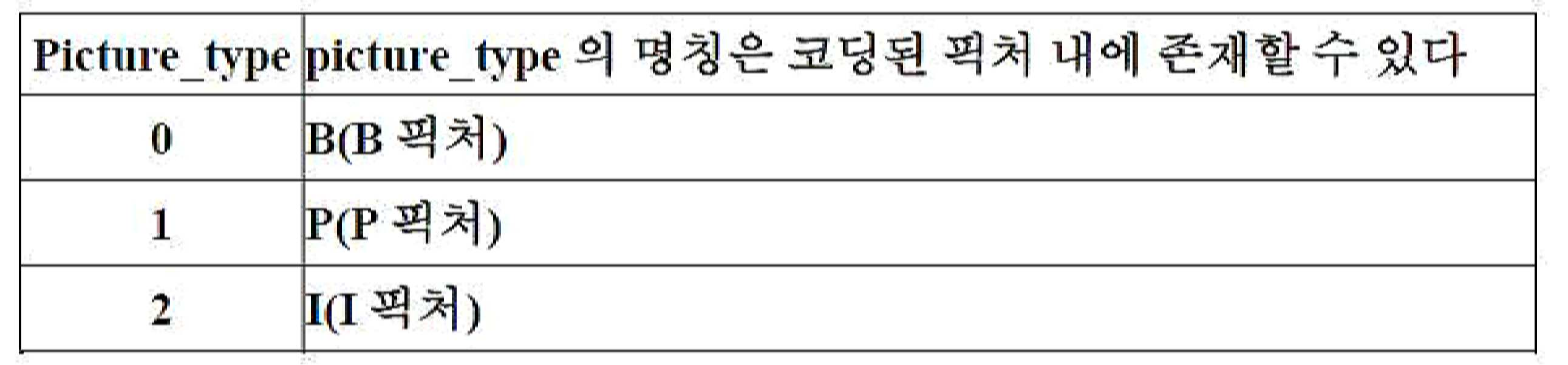
log2_diff_ctu_max_bt_size는 이진 분할을 이용하여 분할될 수 있는 코딩 블록의 최대 루마 크기(폭 또는 높이)와 루마 CTB 크기 사이의 차이를 특정한다.log2_diff_ctu_max_bt_size specifies the difference between the maximum luma size (width or height) of a coding block that can be split using binary partitioning and the luma CTB size.
1과 동일한 sbtmvp_size_override_flag는 신택스 요소 log2_sbtmvp_active_size_minus2가 현재 슬라이스에 대해 존재한다는 것을 특정한다. 0과 동일한 sbtmvp_size_override_flag는, 신택스 요소 log2_atmvp_active_size_minus2가 존재하지 않고 log2_sbtmvp_size_active_minus2가 log2_sbtmvp_default_size_minus2와 동일한 것으로 추론된다는 것을 특정한다.The sbtmvp_size_override_flag equal to 1 specifies that the syntax element log2_sbtmvp_active_size_minus2 exists for the current slice. Sbtmvp_size_override_flag equal to 0 specifies that the syntax element log2_atmvp_active_size_minus2 does not exist and that log2_sbtmvp_size_active_minus2 is inferred to be the same as log2_sbtmvp_default_size_minus2.
log2_sbtmvp_active_size_minus2 + 2는 현재 슬라이스의 서브블록 기반 TMVP에 대한 모션 파라미터들을 도출하기 위해 사용되는 서브블록 크기의 값을 특정한다. log2_sbtmvp_size_active_minus2가 존재하지 않을 때, 그것은 log2_sbtmvp_default_size_minus2와 동일한 것으로 추론된다. 변수는 다음과 같이 도출된다:log2_sbtmvp_active_size_minus2 + 2 specifies a value of the subblock size used to derive motion parameters for the subblock-based TMVP of the current slice. When log2_sbtmvp_size_active_minus2 does not exist, it is inferred to be the same as log2_sbtmvp_default_size_minus2. The variables are derived as follows:
Log2SbtmvpSize = log2_sbtmvp_size_active_minus2 + 2Log2SbtmvpSize = log2_sbtmvp_size_active_minus2 + 2
pic_temporal_mvp_enabled_flag는 시간 모션 벡터 예측자들이 현재 픽처에 대한 인터 예측을 위해 사용될 수 있는지 여부를 특정한다. pic_temporal_mvp_enabled_flag가 0과 동일한 경우, 현재 픽처의 신택스 요소들은 시간 모션 벡터 예측자가 현재 픽처의 디코딩에서 사용되지 않도록 제한될 것이다. 그렇지 않은 경우(pic_temporal_mvp_enabled_flag가 1과 동일함), 시간 모션 벡터 예측자들은 현재 픽처의 디코딩에서 사용될 수 있다. 존재하지 않을 때, picslice_temporal_mvp_enabled_flag의 값은 0과 동일한 것으로 추론된다.pic_temporal_mvp_enabled_flag specifies whether temporal motion vector predictors can be used for inter prediction for the current picture. When pic_temporal_mvp_enabled_flag is equal to 0, syntax elements of the current picture will be restricted so that the temporal motion vector predictor is not used in decoding of the current picture. Otherwise (pic_temporal_mvp_enabled_flag is equal to 1), temporal motion vector predictors can be used in decoding of the current picture. When not present, the value of picslice_temporal_mvp_enabled_flag is inferred to be equal to 0.
1과 동일한 mvd_l1_zero_flag는, mvd_coding(x0, y0, 1) 신택스 구조가 파싱되지 않고 compIdx = 0..1에 대해 MvdL1[ x0 ][ y0 ][ compIdx ]가 0과 동일하게 설정됨을 나타낸다. 0과 동일한 mvd_l1_zero_flag는 mvd_coding(x0, y0, 1) 신택스 구조가 파싱됨을 나타낸다.The mvd_l1_zero_flag equal to 1 indicates that the mvd_coding(x0, y0, 1) syntax structure is not parsed and MvdL1[x0][y0][ compIdx] is set equal to 0 for compIdx = 0..1. The mvd_l1_zero_flag equal to 0 indicates that the mvd_coding(x0, y0, 1) syntax structure is parsed.
1과 동일한 collocated_from_10_flag는 시간 모션 벡터 예측을 위해 사용된 공동-위치된 픽처가 참조 픽처 목록 0으로부터 도출된다는 것을 특정한다. 0과 동일한 collocated_from_10_flag는 시간 모션 벡터 예측을 위해 사용된 공동-위치된 픽처가 참조 픽처 목록 1로부터 도출된다는 것을 특정한다. collocated_from_10_flag가 존재하지 않을 때, 그것은 1과 동일한 것으로 추론된다.Collocated_from_10_flag equal to 1 specifies that the co-located picture used for temporal motion vector prediction is derived from reference picture list 0. Collocated_from_10_flag equal to 0 specifies that the co-located picture used for temporal motion vector prediction is derived from reference picture list 1. When collocated_from_10_flag does not exist, it is inferred to be equal to 1.
six_minus_max_num_merge_cand는 6으로부터 감산된, 슬라이스에서 지원되는 병합 모션 벡터 예측(MVP) 후보들의 최대 수를 특정한다. 병합 MVP 후보들의 최대 수, MaxNumMergeCand는 다음과 같이 도출된다:six_minus_max_num_merge_cand specifies the maximum number of merge motion vector prediction (MVP) candidates subtracted from 6 and supported in a slice. The maximum number of merged MVP candidates, MaxNumMergeCand, is derived as follows:
MaxNumMergeCand = 6 - six_minus_max_num_merge_candMaxNumMergeCand = 6-six_minus_max_num_merge_cand
MaxNumMergeCand의 값은 1 내지 6(이들 값 포함)의 범위에 있을 것이다.The value of MaxNumMergeCand will be in the range of 1 to 6 (including these values).
0과 동일한 dep_quant_enabled_flag는 종속적 양자화가 디스에이블된다는 것을 특정한다. 1과 동일한 dep_quant_enabled_flag는 종속적 양자화가 인에이블된다는 것을 특정한다.Dep_quant_enabled_flag equal to 0 specifies that dependent quantization is disabled. Dep_quant_enabled_flag equal to 1 specifies that dependent quantization is enabled.
0과 동일한 sign_data_hiding_enabled_flag는 부호 비트 은닉이 디스에이블된다는 것을 특정한다. 1과 동일한 sign_data_hiding_enabled_flag는 부호 비트 은닉이 인에이블된다는 것을 특정한다. sign_data_hiding_enabled_flag가 존재하지 않을 때, 그것은 0과 동일한 것으로 추론된다.Sign_data_hiding_enabled_flag equal to 0 specifies that sign bit hiding is disabled. Sign_data_hiding_enabled_flag equal to 1 specifies that sign bit hiding is enabled. When sign_data_hiding_enabled_flag is not present, it is inferred to be equal to zero.
일례에서, pic_header()에서의 하나 이상의 신택스 요소들은 PICH_NUT 대신 PPS_NUT로 시그널링될 수 있다는 것에 유의해야 한다.It should be noted that in one example, one or more syntax elements in pic_header() may be signaled as PPS_NUT instead of PICH_NUT.
표 29는 본 명세서의 기법들에 따라 데이터 캡슐화기(107)에 의해 시그널링될 수 있는 rbsp_pic_header_trailing_bits() 신택스의 일례를 예시한다.Table 29 illustrates an example of rbsp_pic_header_trailing_bits() syntax that may be signaled by the
[표 29][Table 29]
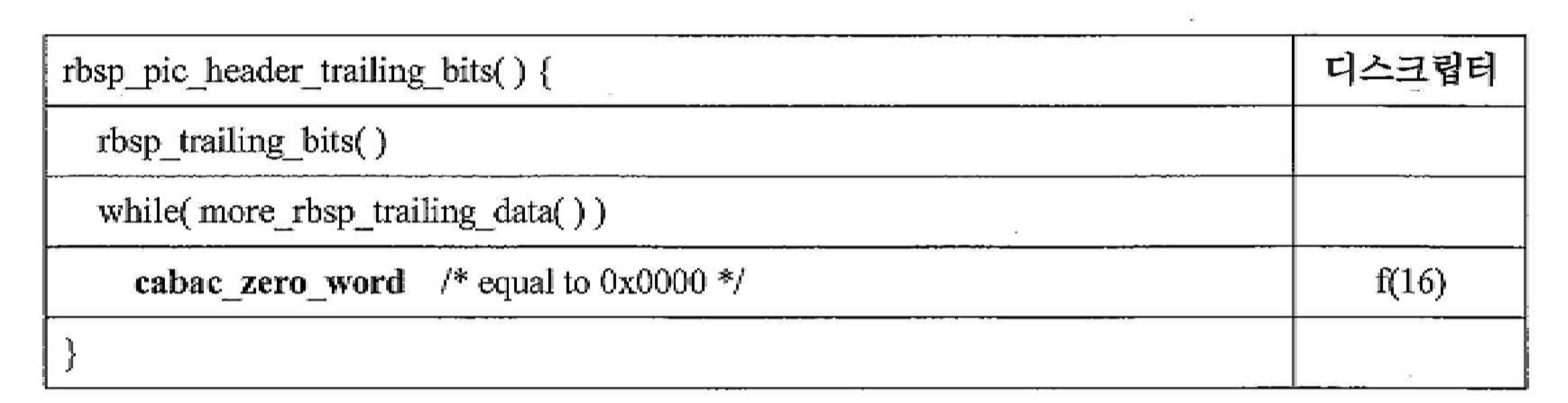
일부 예들에서, 픽처 헤더는 하나 이상의 픽처들에 적용될 수 있다는 것에 유의해야 한다. 또한, 일부 예들에서, 픽처 헤더 내의 파라미터들은 타일 세트 파라미터들에 따라 타일 세트에 대해 오버라이드될 수 있다. 일부 예시적인 경우들에 있어서, 소정의 제한들이 타일 세트에 대한 픽처 헤더 내의 파라미터들을 오버라이드하기 위해 적용될 수 있다.It should be noted that in some examples, the picture header can be applied to one or more pictures. Also, in some examples, parameters in the picture header may be overridden for a tile set according to tile set parameters. In some example cases, certain restrictions may be applied to override parameters in the picture header for the tile set.
전술된 바와 같이, ITU-T H.265에서, 타일 구조의 일부 또는 전부, 즉 픽처에 대한 하나 이상의 타일 및/또는 타일 세트 관련 파라미터들은 PPS를 사용하여 시그널링된다. 일례에서, 본 명세서의 기법들에 따르면, 타일 구조는 PPS로 시그널링될 수 있으며, 여기서, 위에서 제공된 바와 같이, 픽처 파라미터 세트는 picture_header()에서 식별된다. 다른 예에서, 타일 구조 중 일부 또는 전부, 즉 하나 이상의 타일 및/또는 타일 세트 관련 파라미터들은 SPS로 시그널링될 수 있다.As described above, in ITU-T H.265, some or all of the tile structure, i.e., one or more tiles for a picture and/or tile set related parameters are signaled using PPS. In one example, according to the techniques herein, the tile structure may be signaled in PPS, where, as provided above, a picture parameter set is identified in picture_header(). In another example, some or all of the tile structure, that is, one or more tiles and/or tile set related parameters may be signaled to the SPS.
이러한 방식으로, 소스 디바이스(102)는, 타일 세트 계층 신택스 구조가 네트워크 추상화 계층 유닛 내에 포함됨을 나타내는, 네트워크 추상화 계층 유닛 내의 신택스 요소에 대한 값을 시그널링하도록, 그리고 타일 세트 계층 신택스 구조에 포함되는 하나 이상의 타일 세트 파라미터들에 대한 값들을 시그널링하도록 구성된 디바이스의 일례를 표현한다.In this way, the
다시 도 1을 참조하면, 인터페이스(108)는 데이터 캡슐화기(107)에 의해 생성된 데이터를 수신하고 데이터를 통신 매체에 송신 및/또는 저장하도록 구성된 임의의 디바이스를 포함할 수 있다. 인터페이스(108)는 이더넷 카드와 같은 네트워크 인터페이스 카드를 포함할 수 있고, 광학 송수신기, 무선 주파수 송수신기, 또는 정보를 전송 및/또는 수신할 수 있는 임의의 다른 유형의 디바이스를 포함할 수 있다. 또한, 인터페이스(108)는 파일이 저장 디바이스에 저장되는 것을 가능하게 할 수 있는 컴퓨터 시스템 인터페이스를 포함할 수 있다. 예를 들어, 인터페이스(108)는 PCI(Peripheral Component Interconnect) 및 PCIe(Peripheral Component Interconnect Express) 버스 프로토콜, 독점적인 버스 프로토콜, USB(Universal Serial Bus) 프로토콜, I2C, 또는 피어(peer) 디바이스들을 상호접속시키는 데 사용될 수 있는 임의의 다른 논리적 및 물리적 구조를 지원하는 칩셋을 포함할 수 있다.Referring back to FIG. 1,
다시 도 1을 참조하면, 목적지 디바이스(120)는 인터페이스(122), 데이터 탈캡슐화기(123), 비디오 디코더(124), 및 디스플레이(126)를 포함한다. 인터페이스(122)는 통신 매체로부터 데이터를 수신하도록 구성된 임의의 디바이스를 포함할 수 있다. 인터페이스(122)는 이더넷 카드와 같은 네트워크 인터페이스 카드를 포함할 수 있고, 광학 송수신기, 무선 주파수 송수신기, 또는 정보를 수신 및/또는 전송할 수 있는 임의의 다른 유형의 디바이스를 포함할 수 있다. 또한, 인터페이스(122)는 컴플라이언트 비디오 비트스트림이 저장 디바이스로부터 검색되는 것을 가능하게 하는 컴퓨터 시스템 인터페이스를 포함할 수 있다. 예를 들어, 인터페이스(122)는 PCI 및 PCIe 버스 프로토콜, 독점적 버스 프로토콜, USB 프로토콜, I2C, 또는 피어 디바이스들을 상호 접속시키는 데 사용될 수 있는 임의의 다른 논리적 및 물리적 구조를 지원하는 칩셋을 포함할 수 있다. 데이터 탈캡슐화기(123)는 본 명세서에 기술된 예시적인 신택스 구조들 중 임의의 것을 수신하고 파싱하도록 구성될 수 있다.Referring back to FIG. 1, the
비디오 디코더(124)는 비트스트림(예를 들어, MCTS 서브-비트스트림 추출) 및/또는 그의 수용 가능한 변형들을 수신하고 그로부터 비디오 데이터를 재생하도록 구성된 임의의 디바이스를 포함할 수 있다. 디스플레이(126)는 비디오 데이터를 디스플레이하도록 구성된 임의의 디바이스를 포함할 수 있다. 디스플레이(126)는 액정 디스플레이(LCD), 플라즈마 디스플레이, 유기 발광 다이오드(OLED) 디스플레이, 또는 다른 유형의 디스플레이와 같은 다양한 디스플레이 디바이스들 중 하나를 포함할 수 있다. 디스플레이(126)는 고화질 디스플레이 또는 초고화질 디스플레이를 포함할 수 있다. 도 1에 예시된 예에서, 비디오 디코더(124)가 디스플레이(126)에 데이터를 출력하는 것으로 기술되지만, 비디오 디코더(124)는 비디오 데이터를 다양한 유형의 디바이스들 및/또는 그의 서브-컴포넌트들에 출력하도록 구성될 수 있다는 것에 유의해야 한다. 예를 들어, 비디오 디코더(124)는, 본 명세서에 기술된 바와 같이, 비디오 데이터를 임의의 통신 매체에 출력하도록 구성될 수 있다.The video decoder 124 may comprise any device configured to receive a bitstream (eg, MCTS sub-bitstream extraction) and/or acceptable variations thereof and play video data therefrom.
도 6은 본 개시의 하나 이상의 기법들에 따라 비디오 데이터를 디코딩하도록 구성될 수 있는 비디오 디코더의 예를 예시하는 블록도이다. 일례에서, 비디오 디코더(600)는 변환 데이터를 디코딩하고 디코딩된 변환 데이터에 기초하여 변환 계수들로부터 잔차 데이터를 재구성하도록 구성될 수 있다. 비디오 디코더(600)는 인트라 예측 디코딩 및 인터 예측 디코딩을 수행하도록 구성될 수 있고, 그렇기 때문에 하이브리드 디코더로 지칭될 수 있다. 비디오 디코더(600)는 표 1 내지 표 27에서 전술된 신택스 요소들의 임의의 조합을 파싱하도록 구성될 수 있다. 비디오 디코더(600)는 파싱된 신택스 요소들의 값들에 기초하여 비디오 디코딩을 수행할 수 있다. 예를 들어, 픽처가 특정 유형의 것인지의 여부에 기초하여 상이한 비디오 디코딩 기법들이 수행될 수 있다.6 is a block diagram illustrating an example of a video decoder that may be configured to decode video data in accordance with one or more techniques of this disclosure. In one example, video decoder 600 may be configured to decode transform data and reconstruct residual data from transform coefficients based on the decoded transform data. The video decoder 600 may be configured to perform intra prediction decoding and inter prediction decoding, and therefore may be referred to as a hybrid decoder. The video decoder 600 may be configured to parse any combination of syntax elements described above in Tables 1-27. The video decoder 600 may perform video decoding based on values of parsed syntax elements. For example, different video decoding techniques may be performed based on whether the picture is of a particular type.
도 6에 예시된 예에서, 비디오 디코더(600)는 엔트로피 디코딩 유닛(602), 역양자화 유닛 및 변환 계수 프로세싱 유닛(604), 인트라 예측 프로세싱 유닛(606), 인터 예측 프로세싱 유닛(608), 합산기(610), 포스트 필터 유닛(612), 및 기준 버퍼(614)를 포함한다. 비디오 디코더(600)는 비디오 코딩 시스템과 일치하는 방식으로 비디오 데이터를 디코딩하도록 구성될 수 있다. 예시적인 비디오 디코더(600)가 별개의 기능 블록들을 갖는 것으로 예시되지만, 그러한 예시는 설명의 목적을 위한 것이고 비디오 디코더(600) 및/또는 그의 서브-컴포넌트들을 특정 하드웨어 또는 소프트웨어 아키텍처로 제한하지 않는다는 것에 유의해야 한다. 비디오 디코더(600)의 기능들은 하드웨어, 펌웨어, 및/또는 소프트웨어 구현들의 임의의 조합을 이용하여 실현될 수 있다.In the example illustrated in FIG. 6, the video decoder 600 includes an
도 6에 예시된 바와 같이, 엔트로피 디코딩 유닛(602)은 엔트로피 인코딩된 비트스트림을 수신한다. 엔트로피 디코딩 유닛(602)은 엔트로피 인코딩 프로세스에 상반되는 프로세스에 따라 비트스트림으로부터 신택스 요소들 및 양자화된 계수들을 디코딩하도록 구성될 수 있다. 엔트로피 디코딩 유닛(602)은 전술된 엔트로피 코딩 기법들 중 임의의 것에 따라 엔트로피 디코딩을 수행하도록 구성될 수 있다. 엔트로피 디코딩 유닛(602)은 비디오 코딩 표준과 일치하는 방식으로 인코딩된 비트스트림 내의 신택스 요소들에 대한 값들을 결정할 수 있다. 도 6에 예시된 바와 같이, 엔트로피 디코딩 유닛(602)은 비트스트림으로부터 양자화 파라미터, 양자화된 계수 값들, 변환 데이터, 및 서술 데이터를 결정할 수 있다. 도 6에 예시된 예에서, 역양자화 유닛 및 변환 계수 프로세싱 유닛(604)은 엔트로피 디코딩 유닛(602)으로부터 양자화 파라미터, 양자화된 계수 값들, 변환 데이터 및 서술 데이터를 수신하고 재구성된 잔차 데이터를 출력한다.As illustrated in FIG. 6, the
다시 도 6을 참조하면, 재구성된 잔차 데이터가 합산기(610)에 제공될 수 있다. 합산기(610)는 재구성된 잔차 데이터를 예측 비디오 블록에 추가하고 재구성된 비디오 데이터를 생성할 수 있다. 예측 비디오 블록은 예측 비디오 기법(즉, 인트라 예측 및 인터 프레임 예측)에 따라 결정될 수 있다. 인트라 예측 프로세싱 유닛(606)은 인트라 예측 신택스 요소들을 수신하고 기준 버퍼(614)로부터 예측 비디오 블록을 검색하도록 구성될 수 있다. 기준 버퍼(614)는 비디오 데이터의 하나 이상의 프레임을 저장하도록 구성된 메모리 디바이스를 포함할 수 있다. 인트라 예측 신택스 요소들은 전술된 인트라 예측 모드들과 같은 인트라 예측 모드를 식별할 수 있다. 인터 예측 프로세싱 유닛(608)은 인터 예측 신택스 요소들을 수신하고 모션 벡터들을 생성하여 기준 버퍼(616)에 저장된 하나 이상의 기준 프레임들 내의 예측 블록을 식별할 수 있다. 인터 예측 프로세싱 유닛(608)은 모션 보상된 블록들을 생성하여, 가능하게는 보간 필터들에 기초하여 보간을 수행할 수 있다. 서브픽셀 정밀도로 모션 추정에 사용될 보간 필터들에 대한 식별자들이 신택스 요소들에 포함될 수 있다. 인터 예측 프로세싱 유닛(608)은 보간 필터들을 사용하여 기준 블록의 서브-정수(sub-integer) 픽셀들에 대한 보간된 값들을 계산할 수 있다. 포스트 필터 유닛(614)은 재구성된 비디오 데이터에 대해 필터링을 수행하도록 구성될 수 있다. 예를 들어, 포스트 필터 유닛(614)은 예를 들어 비트스트림에서 특정된 파라미터들에 기초하여 디블로킹 및/또는 SAO(Sample Adaptive Offset) 필터링을 수행하도록 구성될 수 있다. 또한, 몇몇 예에서, 포스트 필터 유닛(614)은 독점적 재량 필터링(예를 들어, 모스키토 잡음 감소와 같은 시각적 향상들)을 수행하도록 구성될 수 있다는 점에 유의해야 한다. 도 6에 예시된 바와 같이, 재구성된 비디오 블록은 비디오 디코더(600)에 의해 출력될 수 있다. 이러한 방식으로, 비디오 디코더(600)는, 타일 세트 계층 신택스 구조가 네트워크 추상화 계층 유닛에 포함됨을 나타내는 네트워크 추상화 계층 유닛에서 신택스 요소에 대한 값을 파싱하도록, 타일 세트 계층 신택스 구조에 포함된 하나 이상의 타일 세트 파라미터들에 대한 값들을 파싱하도록, 그리고 하나 이상의 타일 세트 파라미터들에 대한 파싱된 값들에 기초하여 비디오 데이터를 생성하도록 구성된 디바이스의 일례를 표현한다.Referring back to FIG. 6, the reconstructed residual data may be provided to the
하나 이상의 예들에서, 기술된 기능들은 하드웨어, 소프트웨어, 펌웨어, 또는 이들의 임의의 조합으로 구현될 수 있다. 소프트웨어로 구현되는 경우, 기능들은 컴퓨터 판독가능 매체 상에 하나 이상의 명령어들 또는 코드로서 저장되거나 이를 통해 송신될 수 있고, 하드웨어 기반 프로세싱 유닛에 의해 실행될 수 있다. 컴퓨터 판독가능 매체는 데이터 저장 매체와 같은 유형의 매체에 대응하는 컴퓨터 판독가능 저장 매체, 또는 예컨대 통신 프로토콜에 따라 하나의 장소로부터 다른 장소로의 컴퓨터 프로그램의 전송을 용이하게 하는 임의의 매체를 포함한 통신 매체를 포함할 수 있다. 이러한 방식으로, 컴퓨터 판독가능 매체는, 대체적으로, (1) 비일시적인 유형적 컴퓨터 판독가능 저장 매체 또는 (2) 신호 또는 반송파와 같은 통신 매체에 대응할 수 있다. 데이터 저장 매체는 본 개시에 기술된 기법들의 구현을 위한 명령어들, 코드 및/또는 데이터 구조들을 검색하기 위해 하나 이상의 컴퓨터 또는 하나 이상의 프로세서에 의해 액세스될 수 있는 임의의 이용 가능한 매체일 수 있다. 컴퓨터 프로그램 제품이 컴퓨터 판독가능 매체를 포함할 수 있다.In one or more examples, the described functions may be implemented in hardware, software, firmware, or any combination thereof. When implemented in software, the functions may be stored as one or more instructions or code on a computer-readable medium or transmitted through it, and may be executed by a hardware-based processing unit. A computer-readable medium is a computer-readable storage medium corresponding to a tangible medium such as a data storage medium, or any medium that facilitates the transfer of a computer program from one place to another according to, for example, a communication protocol. May include media. In this way, the computer-readable medium may, in general, correspond to (1) a non-transitory tangible computer-readable storage medium or (2) a communication medium such as a signal or a carrier wave. The data storage medium may be any available medium that can be accessed by one or more computers or one or more processors to retrieve instructions, code and/or data structures for implementation of the techniques described in this disclosure. The computer program product may include a computer readable medium.
제한이 아닌 예로서, 그러한 컴퓨터 판독가능 저장 매체는 RAM, ROM, EEPROM, CD-ROM 또는 다른 광 디스크 저장소, 자기 디스크 저장소, 또는 다른 자기 저장 디바이스, 플래시 메모리, 또는 명령어들 또는 데이터 구조들의 형태로 원하는 프로그램 코드를 저장하는 데 사용될 수 있고 컴퓨터에 의해 액세스될 수 있는 임의의 다른 매체를 포함할 수 있다. 또한, 임의의 접속이 컴퓨터 판독가능 매체로 적절히 지칭된다. 예를 들어, 명령어들이 동축 케이블, 광섬유 케이블, 트위스티드 페어, DSL(digital subscriber line), 또는 적외선, 무선, 및 마이크로파와 같은 무선 기술을 이용하여 웹사이트, 서버 또는 다른 원격 소스로부터 송신되는 경우, 동축 케이블, 광섬유 케이블, 트위스티드 페어, DSL, 또는 적외선, 무선, 및 마이크로파와 같은 무선 기술들이 매체의 정의에 포함된다. 그러나, 컴퓨터 판독가능 저장 매체 및 데이터 저장 매체는 접속, 반송파, 신호, 또는 다른 일시적 매체를 포함하는 것이 아니라, 대신에 비일시적인 유형의 저장 매체에 관한 것이라는 것을 이해해야 한다. 본 명세서에서 사용되는 바와 같은 디스크(disk) 및 디스크(disc)는 콤팩트 디스크(compact disc, CD), 레이저 디스크(laser disc), 광 디스크(optical disc), 디지털 다기능 디스크(digital versatile disc, DVD), 플로피 디스크(floppy disk) 및 블루레이 디스크(Blu-ray disc)를 포함하며, 여기서 디스크(disk)는 통상적으로 자기적으로 데이터를 재생하는 반면, 디스크(disc)는 레이저로 광학적으로 데이터를 재생한다. 상기의 것들의 조합이 또한 컴퓨터 판독가능 매체의 범위 내에 포함되어야 한다.By way of example, and not limitation, such computer-readable storage media may be in the form of RAM, ROM, EEPROM, CD-ROM or other optical disk storage, magnetic disk storage, or other magnetic storage device, flash memory, or instructions or data structures. It can include any other medium that can be used to store the desired program code and can be accessed by a computer. Also, any connection is properly termed a computer-readable medium. For example, if commands are transmitted from a website, server, or other remote source using wireless technologies such as coaxial cable, fiber optic cable, twisted pair, digital subscriber line (DSL), or infrared, wireless, and microwave, coaxial Wireless technologies such as cable, fiber optic cable, twisted pair, DSL, or infrared, wireless, and microwave are included in the definition of the medium. However, it should be understood that computer-readable storage media and data storage media do not include access, carrier waves, signals, or other transitory media, but instead are directed to a non-transitory tangible storage medium. Disks and disks as used herein are compact discs (CDs), laser discs, optical discs, digital versatile discs (DVDs). , Floppy disks and Blu-ray discs, where disks typically reproduce data magnetically, while disks optically reproduce data with a laser. do. Combinations of the above should also be included within the scope of computer-readable media.
명령어들은 하나 이상의 DSP(digital signal processor), 범용 마이크로프로세서, ASIC(application specific integrated circuit), FPGA(field programmable logic array), 또는 다른 동등한 집적 또는 개별 로직 회로망과 같은 하나 이상의 프로세서에 의해 실행될 수 있다. 따라서, 본 명세서에서 사용된 바와 같은 용어 "프로세서"는 본 명세서에 기술된 기법의 구현에 적합한 전술한 구조 또는 임의의 다른 구조 중 임의의 것을 지칭할 수 있다. 또한, 몇몇 태양에서, 본 명세서에 기술된 기능은 인코딩 및 디코딩을 위해 구성되거나 조합된 코덱에 포함된 전용 하드웨어 및/또는 소프트웨어 모듈들 내에 제공될 수 있다. 또한, 기법들은 하나 이상의 회로 또는 로직 요소로 완전히 구현될 수 있다.The instructions may be executed by one or more processors, such as one or more digital signal processors (DSPs), general purpose microprocessors, application specific integrated circuits (ASICs), field programmable logic arrays (FPGAs), or other equivalent integrated or discrete logic circuitry. Thus, the term “processor” as used herein may refer to any of the foregoing structures or any other structure suitable for implementation of the techniques described herein. Further, in some aspects, the functionality described herein may be provided within dedicated hardware and/or software modules configured for encoding and decoding or included in a combined codec. Also, the techniques may be fully implemented with one or more circuits or logic elements.
본 개시의 기법들은 무선 핸드셋, 집적 회로(IC) 또는 IC들의 세트(예컨대, 칩셋)를 포함한 매우 다양한 디바이스들 또는 장치들로 구현될 수 있다. 다양한 컴포넌트, 모듈, 또는 유닛이 개시된 기법들을 수행하도록 구성된 디바이스들의 기능적 태양들을 강조하기 위해 본 개시에서 설명되지만, 반드시 상이한 하드웨어 유닛들에 의한 실현을 요구하는 것은 아니다. 오히려, 위에 설명된 바와 같이, 다양한 유닛들이 코덱 하드웨어 유닛에서 조합되거나, 적합한 소프트웨어 및/또는 펌웨어와 관련하여, 위에 설명된 바와 같은 하나 이상의 프로세서를 포함한 상호 작용적 하드웨어 유닛들의 집합에 의해 제공될 수 있다.The techniques of this disclosure may be implemented with a wide variety of devices or apparatuses including a wireless handset, an integrated circuit (IC) or a set of ICs (eg, a chipset). While various components, modules, or units are described in this disclosure to highlight functional aspects of devices configured to perform the disclosed techniques, they do not necessarily require realization by different hardware units. Rather, as described above, various units may be combined in a codec hardware unit, or provided by a set of interactive hardware units including one or more processors as described above, in connection with suitable software and/or firmware. have.
더욱이, 전술한 실시예들 각각에서 사용되는 기지국 디바이스 및 단말기 디바이스의 각각의 기능 블록 또는 다양한 특징부는, 전형적으로 집적 회로 또는 복수의 집적 회로인 회로망에 의해 구현되거나 실행될 수 있다. 본 명세서에 기술된 기능들을 실행하도록 설계된 회로망은 범용 프로세서, DSP(digital signal processor), ASIC(application specific or general application integrated circuit), FPGA(field programmable gate array), 또는 다른 프로그래밍가능 로직 디바이스, 이산 게이트 또는 트랜지스터 로직, 또는 이산 하드웨어 컴포넌트, 또는 이들의 조합을 포함할 수 있다. 범용 프로세서는 마이크로프로세서일 수 있거나, 대안적으로, 프로세서는 종래의 프로세서, 컨트롤러, 마이크로컨트롤러 또는 상태 머신일 수 있다. 전술된 범용 프로세서 또는 각각의 회로는 디지털 회로에 의해 구성될 수 있거나 아날로그 회로에 의해 구성될 수 있다. 또한, 반도체 기술의 발전으로 인해 현재의 집적 회로들을 대체하는 집적 회로로 제조하는 기술이 나타날 때, 이러한 기술에 의한 집적 회로가 또한 사용될 수 있다.Moreover, each functional block or various features of the base station device and the terminal device used in each of the above-described embodiments may be implemented or executed by a network, which is typically an integrated circuit or a plurality of integrated circuits. Networks designed to perform the functions described herein include general purpose processors, digital signal processors (DSPs), application specific or general application integrated circuits (ASICs), field programmable gate arrays (FPGAs), or other programmable logic devices, discrete gates. Or transistor logic, or discrete hardware components, or combinations thereof. A general purpose processor may be a microprocessor, or alternatively, the processor may be a conventional processor, controller, microcontroller or state machine. The above-described general purpose processor or each circuit may be configured by a digital circuit or may be configured by an analog circuit. In addition, when a technology for manufacturing an integrated circuit replacing current integrated circuits appears due to the development of semiconductor technology, an integrated circuit by this technology may also be used.
다양한 예들이 기술되었다. 이들 및 다른 예들은 다음의 청구범위의 범위 내에 있다.Various examples have been described. These and other examples are within the scope of the following claims.
<상호 참조><Mutual reference>
본 정식 출원은 35 U.S.C. § 119 하에서 2018년 9월 20일자의 가출원 제62/734,232호에 대한 우선권을 주장하며, 이로써 그 전체 내용이 참고로 포함된다.This formal application is filed under 35 U.S.C. It claims priority to provisional application No. 62/734,232 of September 20, 2018 under § 119, the entire contents of which are hereby incorporated by reference.
Claims (9)
타일 세트 계층 신택스 구조가 네트워크 추상화 계층 유닛에 포함됨을 나타내는, 상기 네트워크 추상화 계층 유닛 내의 신택스 요소에 대한 값을 시그널링하는 단계; 및
상기 타일 세트 계층 신택스 구조에 포함된 하나 이상의 타일 세트 파라미터들에 대한 값들을 시그널링하는 단계를 포함하는, 방법.As a method of signaling tile set parameters,
Signaling a value for a syntax element in the network abstraction layer unit indicating that a tile set layer syntax structure is included in the network abstraction layer unit; And
And signaling values for one or more tile set parameters included in the tile set layer syntax structure.
타일 세트 계층 신택스 구조가 네트워크 추상화 계층 유닛에 포함됨을 나타내는, 상기 네트워크 추상화 계층 유닛 내의 신택스 요소에 대한 값을 파싱(parse)하는 단계;
상기 타일 세트 계층 신택스 구조에 포함된 하나 이상의 타일 세트 파라미터들에 대한 값들을 파싱하는 단계; 및
하나 이상의 타일 세트 파라미터들에 대한 상기 파싱된 값들에 기초하여 비디오 데이터를 생성하는 단계를 포함하는, 방법.As a method of decoding video data,
Parsing a value for a syntax element in the network abstraction layer unit indicating that a tile set layer syntax structure is included in the network abstraction layer unit;
Parsing values for one or more tile set parameters included in the tile set layer syntax structure; And
And generating video data based on the parsed values for one or more tile set parameters.
제6항의 디바이스를 포함하는, 시스템.The device of claim 5; And
A system comprising the device of claim 6.
Applications Claiming Priority (3)
| Application Number | Priority Date | Filing Date | Title |
|---|---|---|---|
| US201862734232P | 2018-09-20 | 2018-09-20 | |
| US62/734,232 | 2018-09-20 | ||
| PCT/JP2019/036316 WO2020059688A1 (en) | 2018-09-20 | 2019-09-17 | Systems and methods for signaling parameters in video coding |
Publications (1)
| Publication Number | Publication Date |
|---|---|
| KR20210058947A true KR20210058947A (en) | 2021-05-24 |
Family
ID=69887040
Family Applications (1)
| Application Number | Title | Priority Date | Filing Date |
|---|---|---|---|
| KR1020217011589A Ceased KR20210058947A (en) | 2018-09-20 | 2019-09-17 | Systems and methods for signaling parameters in video coding |
Country Status (7)
| Country | Link |
|---|---|
| US (2) | US11589069B2 (en) |
| EP (1) | EP3854100A4 (en) |
| JP (2) | JP2022501915A (en) |
| KR (1) | KR20210058947A (en) |
| CN (1) | CN112771873B (en) |
| RU (1) | RU2771478C1 (en) |
| WO (1) | WO2020059688A1 (en) |
Families Citing this family (21)
| Publication number | Priority date | Publication date | Assignee | Title |
|---|---|---|---|---|
| WO2020142704A1 (en) * | 2019-01-04 | 2020-07-09 | Futurewei Technologies, Inc. | Sub-picture based random access |
| JP7293368B2 (en) * | 2019-02-01 | 2023-06-19 | フラウンホーファー-ゲゼルシャフト・ツール・フェルデルング・デル・アンゲヴァンテン・フォルシュング・アインゲトラーゲネル・フェライン | A video codec that allows random access per subpicture or region and the concept of video synthesis using this video codec |
| EP3935835A4 (en) * | 2019-03-08 | 2022-12-14 | Telefonaktiebolaget Lm Ericsson (Publ) | METHOD OF PROVIDING ENCODING/DECODING DEPENDENT/INDEPENDENT PARTITIONS AND ASSOCIATED DEVICES |
| JP7377894B2 (en) * | 2019-05-21 | 2023-11-10 | 北京字節跳動網絡技術有限公司 | Syntax signaling in subblock merge mode |
| US20220224902A1 (en) * | 2019-06-25 | 2022-07-14 | Interdigital Vc Holdings France, Sas | Quantization matrices selection for separate color plane mode |
| EP4307665A3 (en) | 2019-08-10 | 2024-07-10 | Beijing Bytedance Network Technology Co., Ltd. | Buffer management in subpicture decoding |
| MX2022003451A (en) * | 2019-09-23 | 2022-05-18 | Huawei Tech Co Ltd | Method and apparatus for chrominance quantization parameters signalling. |
| CN117676135A (en) | 2019-10-18 | 2024-03-08 | 北京字节跳动网络技术有限公司 | Interaction between sub-pictures and loop filtering |
| WO2021110017A1 (en) | 2019-12-02 | 2021-06-10 | Beijing Bytedance Network Technology Co., Ltd. | Merge with motion vector differencing in affine mode |
| EP4679828A2 (en) * | 2019-12-12 | 2026-01-14 | LG Electronics Inc. | Method and device for signaling video information applicable at picture level or slice level |
| JP7448349B2 (en) * | 2019-12-17 | 2024-03-12 | シャープ株式会社 | Video decoding device |
| GB2590634B (en) * | 2019-12-20 | 2024-10-02 | Canon Kk | High Level syntax for video coding and decoding |
| WO2021123101A1 (en) * | 2019-12-20 | 2021-06-24 | Fraunhofer-Gesellschaft zur Förderung der angewandten Forschung e.V. | Video coding in relation to subpictures |
| US11343524B2 (en) * | 2019-12-27 | 2022-05-24 | Tencent America LLC | Method for adaptation parameter set reference and constraints in coded video stream |
| US11825107B2 (en) * | 2019-12-27 | 2023-11-21 | Tencent America LLC | Method for parameter set reference in coded video stream |
| KR20220157950A (en) | 2020-03-23 | 2022-11-29 | 베이징 바이트댄스 네트워크 테크놀로지 컴퍼니, 리미티드 | Prediction refinement for affine merge and affine motion vector prediction modes |
| WO2021195588A1 (en) * | 2020-03-26 | 2021-09-30 | Alibaba Group Holding Limited | Methods and apparatuses for signaling picture header |
| KR20240074009A (en) * | 2020-03-31 | 2024-05-27 | 베이징 다지아 인터넷 인포메이션 테크놀로지 컴퍼니 리미티드 | Methods and apparatuses for signaling of syntax elements in video coding |
| KR102687685B1 (en) * | 2020-05-20 | 2024-07-22 | 베이징 다지아 인터넷 인포메이션 테크놀로지 컴퍼니 리미티드 | Method and apparatus for signaling syntax elements in video coding |
| US12015799B2 (en) * | 2021-09-13 | 2024-06-18 | Apple Inc. | Systems and methods for data partitioning in video encoding |
| WO2025108907A1 (en) * | 2023-11-22 | 2025-05-30 | Interdigital Ce Patent Holdings, Sas | Method to extract codec-agnostic mesh data in basemesh bitstream |
Family Cites Families (11)
| Publication number | Priority date | Publication date | Assignee | Title |
|---|---|---|---|---|
| US9584819B2 (en) | 2011-10-24 | 2017-02-28 | Qualcomm Incorporated | Grouping of tiles for video coding |
| US9838684B2 (en) * | 2012-04-11 | 2017-12-05 | Qualcomm Incorporated | Wavefront parallel processing for video coding |
| EP4002850B1 (en) * | 2012-08-09 | 2022-12-21 | Sun Patent Trust | Image coding method and apparatus |
| CN107770555B (en) * | 2012-12-10 | 2020-04-14 | Lg 电子株式会社 | Method of decoding image and apparatus using the same |
| KR101972284B1 (en) | 2013-04-08 | 2019-04-24 | 소니 주식회사 | Region of interest scalability with shvc |
| US9930363B2 (en) * | 2013-04-12 | 2018-03-27 | Nokia Technologies Oy | Harmonized inter-view and view synthesis prediction for 3D video coding |
| GB2516224A (en) * | 2013-07-11 | 2015-01-21 | Nokia Corp | An apparatus, a method and a computer program for video coding and decoding |
| TW201517597A (en) * | 2013-07-31 | 2015-05-01 | Nokia Corp | Method and apparatus for video coding and decoding |
| US9912966B2 (en) * | 2014-01-03 | 2018-03-06 | Nokia Technologies Oy | Parameter set coding |
| US11943452B2 (en) * | 2016-07-14 | 2024-03-26 | Koninklijke Kpn N.V. | Systems and methods for video encoding and decoding |
| KR102602827B1 (en) * | 2018-09-04 | 2023-11-15 | 후아웨이 테크놀러지 컴퍼니 리미티드 | Reference frame acquisition method and device applied to two-way inter prediction |
-
2019
- 2019-09-17 KR KR1020217011589A patent/KR20210058947A/en not_active Ceased
- 2019-09-17 CN CN201980061566.6A patent/CN112771873B/en active Active
- 2019-09-17 RU RU2021110855A patent/RU2771478C1/en active
- 2019-09-17 WO PCT/JP2019/036316 patent/WO2020059688A1/en not_active Ceased
- 2019-09-17 JP JP2021515669A patent/JP2022501915A/en active Pending
- 2019-09-17 US US17/277,062 patent/US11589069B2/en active Active
- 2019-09-17 EP EP19863188.9A patent/EP3854100A4/en active Pending
-
2023
- 2023-02-17 US US18/111,023 patent/US11973970B2/en active Active
-
2024
- 2024-11-05 JP JP2024193482A patent/JP7798250B2/en active Active
Also Published As
| Publication number | Publication date |
|---|---|
| WO2020059688A1 (en) | 2020-03-26 |
| EP3854100A1 (en) | 2021-07-28 |
| US20230209079A1 (en) | 2023-06-29 |
| JP2022501915A (en) | 2022-01-06 |
| JP2025016693A (en) | 2025-02-04 |
| US20220053207A1 (en) | 2022-02-17 |
| US11973970B2 (en) | 2024-04-30 |
| RU2771478C1 (en) | 2022-05-04 |
| JP7798250B2 (en) | 2026-01-14 |
| CN112771873B (en) | 2024-10-18 |
| EP3854100A4 (en) | 2022-08-03 |
| CN112771873A (en) | 2021-05-07 |
| US11589069B2 (en) | 2023-02-21 |
Similar Documents
| Publication | Publication Date | Title |
|---|---|---|
| JP7798250B2 (en) | System and method for signaling parameters in video coding | |
| JP7699699B2 (en) | System and method for signaling tile structure for coded video pictures - Patents.com | |
| JP7018447B2 (en) | Systems and methods for signaling motion constraint tile sets for virtual reality applications | |
| US20200021853A1 (en) | Systems and methods for signaling scalable video in a media application format | |
| US11849135B2 (en) | Systems and methods for signaling picture order count values for pictures included in coded video | |
| WO2020122062A1 (en) | Systems and methods for signaling reference pictures in video coding | |
| WO2020059687A1 (en) | Systems and methods for signaling reference pictures in video coding | |
| US20250056026A1 (en) | Systems and methods for signaling picture types of pictures included in coded video |
Legal Events
| Date | Code | Title | Description |
|---|---|---|---|
| PA0105 | International application |
Patent event date: 20210419 Patent event code: PA01051R01D Comment text: International Patent Application |
|
| PG1501 | Laying open of application | ||
| A201 | Request for examination | ||
| PA0201 | Request for examination |
Patent event code: PA02012R01D Patent event date: 20220802 Comment text: Request for Examination of Application |
|
| E902 | Notification of reason for refusal | ||
| PE0902 | Notice of grounds for rejection |
Comment text: Notification of reason for refusal Patent event date: 20241011 Patent event code: PE09021S01D |
|
| E601 | Decision to refuse application | ||
| PE0601 | Decision on rejection of patent |
Patent event date: 20241217 Comment text: Decision to Refuse Application Patent event code: PE06012S01D |