KR20200099548A - Method for preparing anthelmintic 4-amino-quinoline-3-carboxamide derivative - Google Patents
Method for preparing anthelmintic 4-amino-quinoline-3-carboxamide derivative Download PDFInfo
- Publication number
- KR20200099548A KR20200099548A KR1020207020010A KR20207020010A KR20200099548A KR 20200099548 A KR20200099548 A KR 20200099548A KR 1020207020010 A KR1020207020010 A KR 1020207020010A KR 20207020010 A KR20207020010 A KR 20207020010A KR 20200099548 A KR20200099548 A KR 20200099548A
- Authority
- KR
- South Korea
- Prior art keywords
- compound
- iii
- equivalents
- formula
- acid
- Prior art date
- Legal status (The legal status is an assumption and is not a legal conclusion. Google has not performed a legal analysis and makes no representation as to the accuracy of the status listed.)
- Ceased
Links
- 0 CCCC1(*c2ccc(*)c(*)c2N(*)C1)C(O*)=O Chemical compound CCCC1(*c2ccc(*)c(*)c2N(*)C1)C(O*)=O 0.000 description 12
- KIVMHRPOVXQJPI-UHFFFAOYSA-N CCOC(c(c(N(C)C)c1cc2)cnc1c(Br)c2F)=O Chemical compound CCOC(c(c(N(C)C)c1cc2)cnc1c(Br)c2F)=O KIVMHRPOVXQJPI-UHFFFAOYSA-N 0.000 description 1
- HQKXQTUPYZKHDL-UHFFFAOYSA-N CCOC(c(cnc1c2cccc1Br)c2N(C)C)=O Chemical compound CCOC(c(cnc1c2cccc1Br)c2N(C)C)=O HQKXQTUPYZKHDL-UHFFFAOYSA-N 0.000 description 1
Classifications
-
- C—CHEMISTRY; METALLURGY
- C07—ORGANIC CHEMISTRY
- C07D—HETEROCYCLIC COMPOUNDS
- C07D405/00—Heterocyclic compounds containing both one or more hetero rings having oxygen atoms as the only ring hetero atoms, and one or more rings having nitrogen as the only ring hetero atom
- C07D405/02—Heterocyclic compounds containing both one or more hetero rings having oxygen atoms as the only ring hetero atoms, and one or more rings having nitrogen as the only ring hetero atom containing two hetero rings
- C07D405/12—Heterocyclic compounds containing both one or more hetero rings having oxygen atoms as the only ring hetero atoms, and one or more rings having nitrogen as the only ring hetero atom containing two hetero rings linked by a chain containing hetero atoms as chain links
-
- A—HUMAN NECESSITIES
- A61—MEDICAL OR VETERINARY SCIENCE; HYGIENE
- A61K—PREPARATIONS FOR MEDICAL, DENTAL OR TOILETRY PURPOSES
- A61K31/00—Medicinal preparations containing organic active ingredients
- A61K31/33—Heterocyclic compounds
- A61K31/395—Heterocyclic compounds having nitrogen as a ring hetero atom, e.g. guanethidine or rifamycins
- A61K31/435—Heterocyclic compounds having nitrogen as a ring hetero atom, e.g. guanethidine or rifamycins having six-membered rings with one nitrogen as the only ring hetero atom
- A61K31/47—Quinolines; Isoquinolines
- A61K31/4709—Non-condensed quinolines and containing further heterocyclic rings
-
- A—HUMAN NECESSITIES
- A61—MEDICAL OR VETERINARY SCIENCE; HYGIENE
- A61P—SPECIFIC THERAPEUTIC ACTIVITY OF CHEMICAL COMPOUNDS OR MEDICINAL PREPARATIONS
- A61P33/00—Antiparasitic agents
- A61P33/10—Anthelmintics
-
- B—PERFORMING OPERATIONS; TRANSPORTING
- B01—PHYSICAL OR CHEMICAL PROCESSES OR APPARATUS IN GENERAL
- B01J—CHEMICAL OR PHYSICAL PROCESSES, e.g. CATALYSIS OR COLLOID CHEMISTRY; THEIR RELEVANT APPARATUS
- B01J23/00—Catalysts comprising metals or metal oxides or hydroxides, not provided for in group B01J21/00
- B01J23/38—Catalysts comprising metals or metal oxides or hydroxides, not provided for in group B01J21/00 of noble metals
- B01J23/40—Catalysts comprising metals or metal oxides or hydroxides, not provided for in group B01J21/00 of noble metals of the platinum group metals
- B01J23/44—Palladium
-
- C—CHEMISTRY; METALLURGY
- C07—ORGANIC CHEMISTRY
- C07D—HETEROCYCLIC COMPOUNDS
- C07D215/00—Heterocyclic compounds containing quinoline or hydrogenated quinoline ring systems
- C07D215/02—Heterocyclic compounds containing quinoline or hydrogenated quinoline ring systems having no bond between the ring nitrogen atom and a non-ring member or having only hydrogen atoms or carbon atoms directly attached to the ring nitrogen atom
- C07D215/16—Heterocyclic compounds containing quinoline or hydrogenated quinoline ring systems having no bond between the ring nitrogen atom and a non-ring member or having only hydrogen atoms or carbon atoms directly attached to the ring nitrogen atom with hetero atoms or with carbon atoms having three bonds to hetero atoms with at the most one bond to halogen, e.g. ester or nitrile radicals, directly attached to ring carbon atoms
- C07D215/48—Carbon atoms having three bonds to hetero atoms with at the most one bond to halogen
- C07D215/54—Carbon atoms having three bonds to hetero atoms with at the most one bond to halogen attached in position 3
-
- C—CHEMISTRY; METALLURGY
- C07—ORGANIC CHEMISTRY
- C07D—HETEROCYCLIC COMPOUNDS
- C07D215/00—Heterocyclic compounds containing quinoline or hydrogenated quinoline ring systems
- C07D215/02—Heterocyclic compounds containing quinoline or hydrogenated quinoline ring systems having no bond between the ring nitrogen atom and a non-ring member or having only hydrogen atoms or carbon atoms directly attached to the ring nitrogen atom
- C07D215/16—Heterocyclic compounds containing quinoline or hydrogenated quinoline ring systems having no bond between the ring nitrogen atom and a non-ring member or having only hydrogen atoms or carbon atoms directly attached to the ring nitrogen atom with hetero atoms or with carbon atoms having three bonds to hetero atoms with at the most one bond to halogen, e.g. ester or nitrile radicals, directly attached to ring carbon atoms
- C07D215/48—Carbon atoms having three bonds to hetero atoms with at the most one bond to halogen
- C07D215/54—Carbon atoms having three bonds to hetero atoms with at the most one bond to halogen attached in position 3
- C07D215/56—Carbon atoms having three bonds to hetero atoms with at the most one bond to halogen attached in position 3 with oxygen atoms in position 4
Landscapes
- Chemical & Material Sciences (AREA)
- Organic Chemistry (AREA)
- Health & Medical Sciences (AREA)
- Veterinary Medicine (AREA)
- Chemical Kinetics & Catalysis (AREA)
- Life Sciences & Earth Sciences (AREA)
- Pharmacology & Pharmacy (AREA)
- Animal Behavior & Ethology (AREA)
- General Health & Medical Sciences (AREA)
- Public Health (AREA)
- Medicinal Chemistry (AREA)
- Engineering & Computer Science (AREA)
- Materials Engineering (AREA)
- Epidemiology (AREA)
- Tropical Medicine & Parasitology (AREA)
- General Chemical & Material Sciences (AREA)
- Nuclear Medicine, Radiotherapy & Molecular Imaging (AREA)
- Pharmaceuticals Containing Other Organic And Inorganic Compounds (AREA)
- Low-Molecular Organic Synthesis Reactions Using Catalysts (AREA)
- Organic Low-Molecular-Weight Compounds And Preparation Thereof (AREA)
- Plural Heterocyclic Compounds (AREA)
- Quinoline Compounds (AREA)
- Nitrogen And Oxygen Or Sulfur-Condensed Heterocyclic Ring Systems (AREA)
Abstract
본 발명은, Q, A, R4, R3 및 R3'가 본원에 정의된 바와 같은 것인 화학식 (II)의 퀴놀린 화합물을 제조하는 신규 방법, 뿐만 아니라 상기 신규 방법의 중간체 화합물에 관한 것이다.

Description
본 발명은 화학식 (II)의 퀴놀린 화합물을 제조하는 신규 방법에 관한 것이다:The present invention relates to a novel method of preparing the quinoline compound of formula (II):

여기서here
R3 및 R3'는 수소, C1-C3-알킬의 의미를 가질 수 있거나, 또는 이들이 결합되어 있는 질소와 함께 모르폴리닐-고리를 형성할 수 있고, R4는 수소 또는 할로겐의 의미를 가질 수 있고, Q는 수소, 할로겐, C1-C4-알킬, 및 1-5개의 할로겐 원자를 갖는 C1-C4-할로게노알킬로부터 선택된 1 내지 5개의 치환기 Z1 내지 Z5로 치환될 수 있는 페닐의 의미를 가질 수 있고, A는 하기로부터 선택된 기이다:R 3 and R 3 'is hydrogen, C 1 -C 3 -, or can have the meaning of alkyl, or morpholinyl, which is together with the nitrogen to which they are attached - and may form a ring, R 4 has the meaning of hydrogen or halogen And Q is 1 to 5 substituents Z 1 to Z 5 selected from hydrogen, halogen, C 1 -C 4 -alkyl, and C 1 -C 4 -halogenoalkyl having 1-5 halogen atoms. It may have the meaning of phenyl which may be substituted, and A is a group selected from:

본 발명은 추가로 본 발명의 신규 방법의 중간체 화합물에 관한 것이다.The invention further relates to intermediate compounds of the novel process of the invention.
본 발명은 상기 화학식 (II)의 퀴놀린 화합물, 예컨대 특히 화학식 (III)에 따른 퀴놀린 화합물을 제조하는 신규한 개선된 방법, 뿐만 아니라 상기 신규 방법의 중간체 화합물에 관한 것이다:The present invention relates to a novel and improved process for preparing the quinoline compound of formula (II), such as in particular the quinoline compound according to formula (III), as well as intermediate compounds of the novel process:

여기서 A, R4 및 Z1 내지 Z5는 본원에 정의된 바와 같다.Wherein A, R 4 and Z 1 to Z 5 are as defined herein.
본 발명의 방법에 의해 수득가능한 화학식 (II) 및 (III)의 화합물은 가치있는 약리학적 작용 스펙트럼을 나타내고, Slo-1과 효과적으로 상호작용하는 것으로 밝혀졌으며, 따라서 연충 감염, 특히 위장 및 장외 연충 감염을 제어, 치료 및/또는 예방하는데 이용될 수 있다.Compounds of formulas (II) and (III) obtainable by the method of the present invention exhibit a valuable spectrum of pharmacological action and have been found to interact effectively with Slo-1, and thus worms infections, especially gastrointestinal and intestinal worms Can be used to control, treat and/or prevent.
특정 퀴놀린 카르복스아미드가 심상성 여드름, 피부염 등과 같은 피부 질환의 치료 및/또는 예방에 적합한 작용제로서 JP2008-214323A에 기재되어 있다.Certain quinoline carboxamides are described in JP2008-214323A as agents suitable for the treatment and/or prevention of skin diseases such as acne vulgaris, dermatitis, and the like.
WO2017103851에는 아테롬성동맥경화증, 건선, 부비동염, 및 뒤시엔느 근육 이영양증을 치료하는데 유용한 H-PGDS 억제제로서의 퀴놀린-3-카르복스아미드가 개시되어 있다.WO2017103851 discloses quinoline-3-carboxamide as an H-PGDS inhibitor useful for treating atherosclerosis, psoriasis, sinusitis, and Duchenne muscular dystrophy.
추가로, 미공개 국제 출원 PCT/EP2017/078319에는 본 발명의 화학식 (II) 및 (III)에 의해 포괄되는 퀴놀린 유도체, 및 6 공정 단계를 포함하는 이러한 화합물을 수득하는 방법이 개시되어 있다. 상기 문헌에 기재된 6-단계-공정으로 37% 미만의 총 수율이 달성될 수 있다.In addition, unpublished international application PCT/EP2017/078319 discloses a quinoline derivative covered by formulas (II) and (III) of the present invention, and a method of obtaining such a compound comprising six process steps. A total yield of less than 37% can be achieved with the six-step-process described in this document.
따라서, 본 발명의 목적은 본원에 기재된 바와 같은 화학식 (II) 및 (III)에 따른 화합물을 제조하는 개선된 방법을 제공하는 것이었다. 개선된 방법은 특히 증가된 공간-시간 수율을 제공하여야 하며, 이에 따라 보다 짧은 시간 내에 보다 높은 수율의 제조를 가능하게 하고, 특히 용이하게 확장가능하고, 비용-효과적이며, 환경 친화적이고, 고도로 순수한 화합물을 일관되게 생성할 수 있는 최적화된 공정 조건을 적용하기에 특히 적합하여야 한다.Accordingly, it was an object of the present invention to provide an improved method for preparing compounds according to formulas (II) and (III) as described herein. The improved method should in particular provide an increased space-time yield, thereby enabling a higher yield of production in a shorter time, and in particular easily scalable, cost-effective, environmentally friendly and highly pure. It should be particularly suitable for applying the optimized process conditions that can consistently produce the compound.
상기 목적은 탈히드록시아미노화 단계, 스즈키 커플링 단계, 비누화 단계 및 추가의 아미드 커플링 단계의 4 공정 단계를 포함하는, 본 발명의 신규 방법을 제공함으로써 해결되었다. 신규 방법은 본 발명의 출발 화합물 (I)을 제조하기 위한 이튼 시약을 사용한 선행 고리화축합 단계를 추가로 포함할 수 있다.This object was solved by providing a novel process of the present invention comprising four process steps of a dehydroxyamination step, a Suzuki coupling step, a saponification step and an additional amide coupling step. The novel process may further comprise a prior cyclocondensation step using Eaton's reagent to prepare the starting compound (I) of the present invention.
선행 기술 예를 들어 문헌 [Bioorg. Med. Chem. Lett. 2003, p 1487-1490] 또는 WO 2013/118071 A1 및 대응 US 2013/210844에 탈히드록시아미노화가 기재되어 있다.Prior art, eg, Bioorg. Med. Chem. Lett. 2003, p 1487-1490] or WO 2013/118071 A1 and corresponding US 2013/210844 describes dehydroxyamination.
열적 공정 및 이튼 시약을 사용하는 것에 의한 고리화축합은 문헌 [J. Am. Chem. Soc. 1946, p 1204-1208, Org. Proc. Res. Dev. 2006, p 493-499, Org. Proc. Res. Dev. 2014, p 1482-1491]에 또는 EP1258252 및 US2003/0144507로부터 기재되어 있다.Cyclic condensation by thermal processing and using Eaton's reagent is described in J. Am. Chem. Soc. 1946, p 1204-1208, Org. Proc. Res. Dev. 2006, p 493-499, Org. Proc. Res. Dev. 2014, p 1482-1491 or from EP1258252 and US2003/0144507.
특히 미공개 국제 출원 PCT/EP2017/078319를 고려하였을 때, 본 발명의 신규 방법으로 미공개 국제 출원 PCT/EP2017/078319에 사용된 바와 같은 커플링제 HATU ([비스(디메틸아미노)메틸렌]-1H-1,2,3-트리아졸로[4,5-b]피리디늄 3-옥시드 헥사플루오로포스페이트)를 대체함으로써 커플링 단계 (단계 B-d)의 수율을 66%에서 90%로 증가시키는 것이 가능하였다. 본 발명의 개선된 탈히드록시아미노화 단계 (단계 B-a)는, 지금까지 실시된 탈클로로아미노화의 추가적인 공정 단계가 원-포트 반응으로 단축되고, 이에 따라 불안정한 클로로-중간체의 단리를 피함으로써 공간-시간 수율을 증가시킬 수 있는 신규한 단축된 탈히드록시아미노화를 제공함으로써, 본질적으로 동일한 수율을 가지면서 반응 시간의 27시간에서 6시간으로의 상당한 감소를 제공한다. 추가로, 열적 활성화 대신에 개선된 화학적 활성화 하에 선행 고리화축합 단계 (단계 A)를 수행하며, 그에 의해 출발 화합물 (I)의 수율의 68%에서 90%로의 증가를 달성함으로써 공간-시간 수율을 추가로 증가시키는 것이 가능하였다.In particular, considering the unpublished international application PCT/EP2017/078319, the coupling agent HATU ([bis(dimethylamino)methylene]-1H-1, as used in the unpublished international application PCT/EP2017/078319 as a novel method of the present invention, By replacing 2,3-triazolo[4,5-b]pyridinium 3-oxide hexafluorophosphate) it was possible to increase the yield of the coupling step (step Bd) from 66% to 90%. The improved dehydroxyamination step of the present invention (step Ba), the additional process steps of the dechloroamination carried out so far are shortened to a one-pot reaction, thus avoiding the isolation of the unstable chloro-intermediate -By providing a novel shortened dehydroxyamination which can increase the time yield, it provides a significant reduction of the reaction time from 27 hours to 6 hours while having essentially the same yield. Additionally, performing the preceding cyclization condensation step (step A) under improved chemical activation instead of thermal activation, thereby achieving an increase from 68% to 90% of the yield of starting compound (I), thereby improving the space-time yield. It was possible to increase further.
상기 언급된 바와 같이, 미공개 국제 출원 PCT/EP2017/078319에 기재된 바와 같은 6-단계-공정과 비교하여, 화학식 (II) 또는 (III)에 따른 화합물을 제조하는 방법에서 전체 수율을 약 37%에서 59% 초과로 증가시키며, 동시에 공정의 합성 단계 및 전체 시간의 양을 감소시켜, 공간-시간 수율의 상당한 개선을 유도하는 것이 가능하였다.As mentioned above, compared to the 6-step-process as described in the unpublished international application PCT/EP2017/078319, the overall yield in the method for preparing the compound according to formula (II) or (III) is about 37%. It was possible to increase to more than 59% and at the same time reduce the amount of synthesis step and total time of the process, leading to a significant improvement in space-time yield.
제1 측면에 따르면, 본 발명은 화학식 (I)에 따른 화합물로부터 상기 화학식 (II)에 따른 화합물을 제조하는 방법으로서:According to a first aspect, the present invention provides a method for preparing a compound according to formula (II) from a compound according to formula (I):

여기서here
Y는 할로겐 또는 Q의 의미를 갖고;Y has the meaning of halogen or Q;
X는 C=O, C-OH 또는 C-NR3R3'의 의미를 갖고;X has the meaning of C=O, C-OH or C-NR 3 R 3' ;

R1은 X가 C-OH 또는 C-NR3R3'인 경우에는 부재하거나 또는 X가 C=O인 경우에는 수소 원자이고;R 1 is absent when X is C-OH or C-NR 3 R 3' , or is a hydrogen atom when X is C=O;
R2는 수소 또는 C1-C3-알킬의 의미를 갖고;R 2 has the meaning of hydrogen or C 1 -C 3 -alkyl;
R3 및 R3'는 독립적으로 수소 또는 C1-C3-알킬의 의미를 갖거나, 또는R 3 and R 3 'are independently hydrogen or C 1 -C 3 - or has the meaning of alkyl, or
R3 및 R3'는 이들이 결합되어 있는 질소와 함께 모르폴리닐-고리를 형성하고;R 3 and R 3 'is morpholinyl, together with the nitrogen to which they are bonded - form a ring;
R4는 수소 또는 할로겐의 의미를 갖고;R 4 has the meaning of hydrogen or halogen;
Q는 1 내지 5개의 치환기 Z1 내지 Z5로 치환되는 페닐의 의미를 가지며, 여기서Q has the meaning of phenyl substituted with 1 to 5 substituents Z 1 to Z 5 , wherein
Z1 내지 Z5는 독립적으로 수소, 할로겐, C1-C4-알킬, 및 1-5개의 할로겐 원자를 갖는 C1-C4-할로게노알킬로부터 선택될 수 있고;Z 1 to Z 5 may be independently selected from hydrogen, halogen, C 1 -C 4 -alkyl, and C 1 -C 4 -halogenoalkyl having 1-5 halogen atoms;
A는 하기로부터 선택된 기이고:A is a group selected from:

여기서 방법에서 화학식 (II) 내의 기 Q, NR3R3' 및 NH-A는, 임의의 순서로 수행될 수 있으나, 단, 단계 B-d가 단계 B-c 전에 수행되지 않는 것인 단계 B-a, B-b, B-c 및 B-d에 의한 화학식 (I) 내의 기 R2, X 및 Y의 반응에 의해 수득되는 것인 방법에 관한 것이다:In the method wherein the groups Q, NR 3 R 3′ and NH-A in formula (II) may be performed in any order, provided that step Bd is not performed before step Bc. Steps Ba, Bb, Bc And to a process obtained by reaction of the groups R 2 , X and Y in formula (I) by Bd:
단계 B-a:Step B-a:
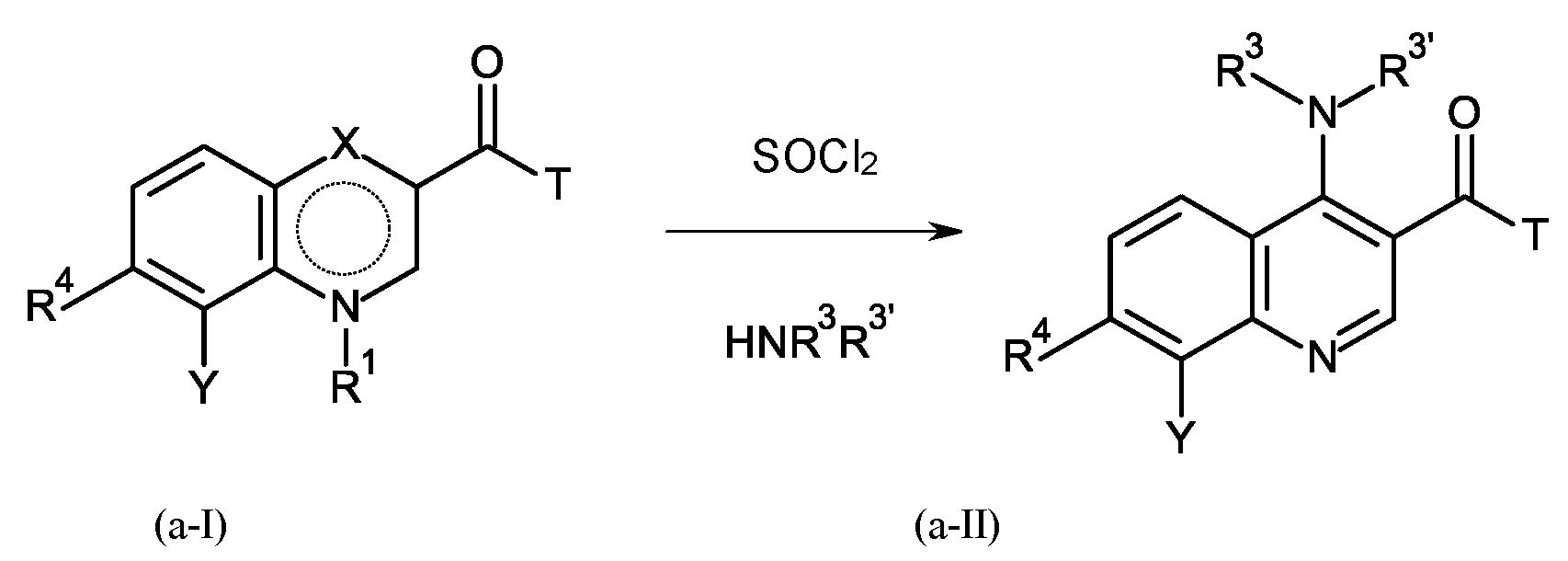
여기서 T는 기 -O-R2 또는 -NH-A를 나타내며, 이때 R2는 수소 또는 C1-C3-알킬이고;Wherein T represents the group -OR 2 or -NH-A, wherein R 2 is hydrogen or C 1 -C 3 -alkyl;
여기서 X는 C=O이고 R1은 수소이거나 또는 X는 C-OH이고 R1은 부재하며, 이는 화학식 (a-I-a) 및 (a-I-b)에 상응하고:Wherein X is C=O and R 1 is hydrogen or X is C-OH and R 1 is absent, which corresponds to formulas (aIa) and (aIb):
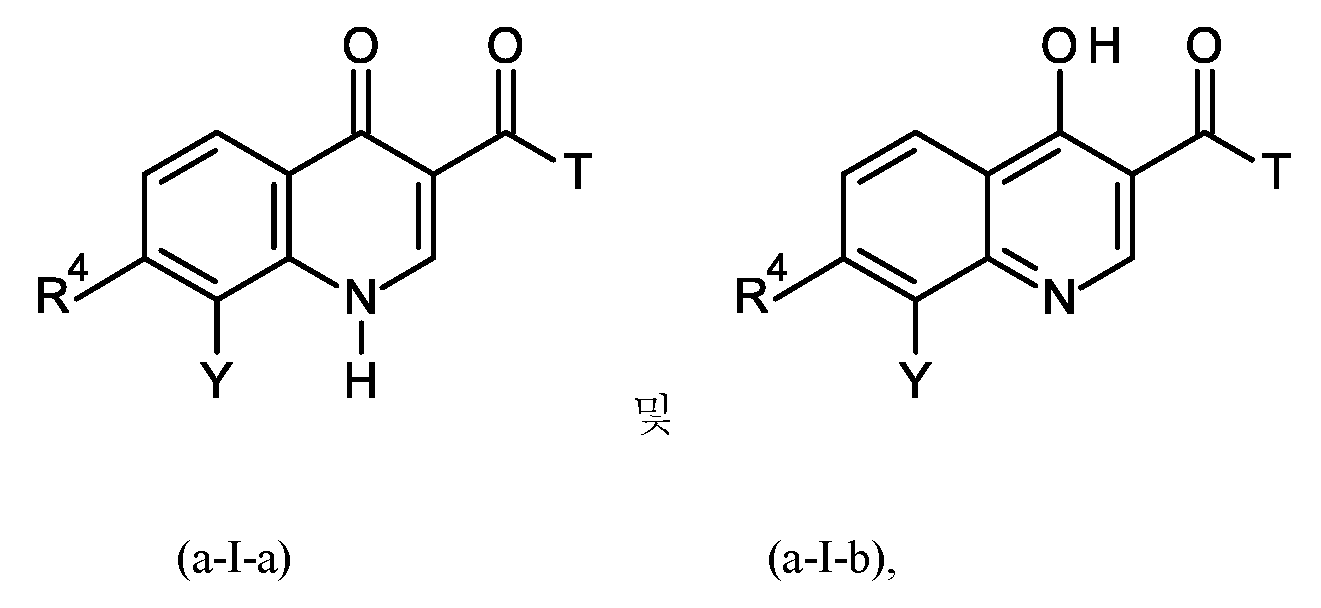
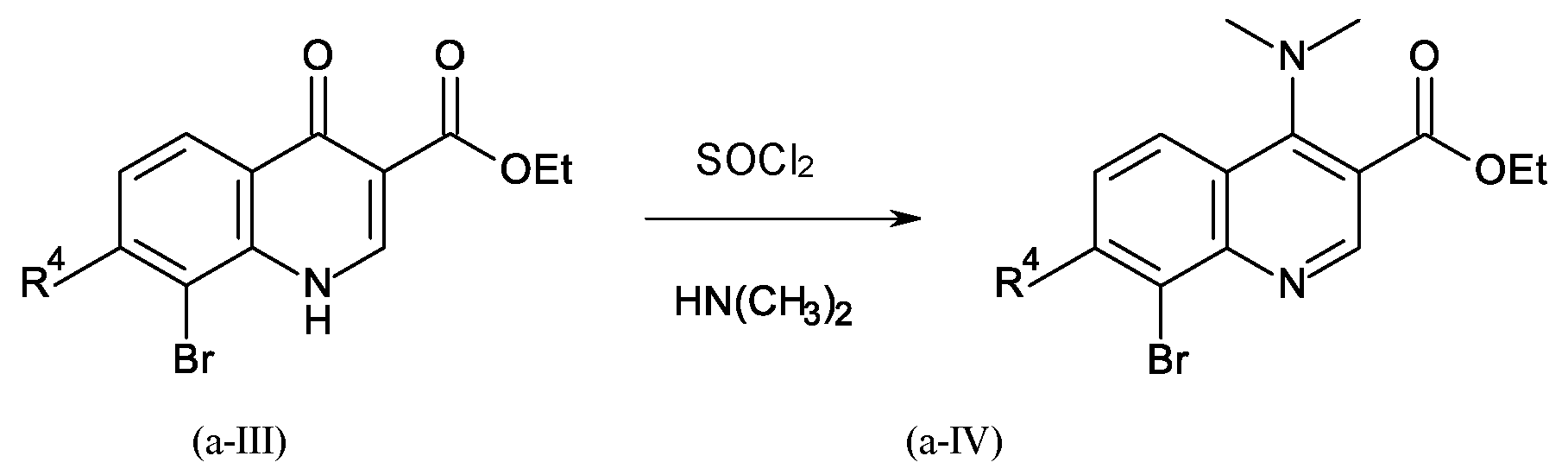
여기서 상기 공정 단계 B-a는 티오닐 클로라이드 (SOCl2)를 사용하여 수행됨;Wherein the process step Ba is carried out using thionyl chloride (SOCl 2 );
단계 B-b:Step B-b:
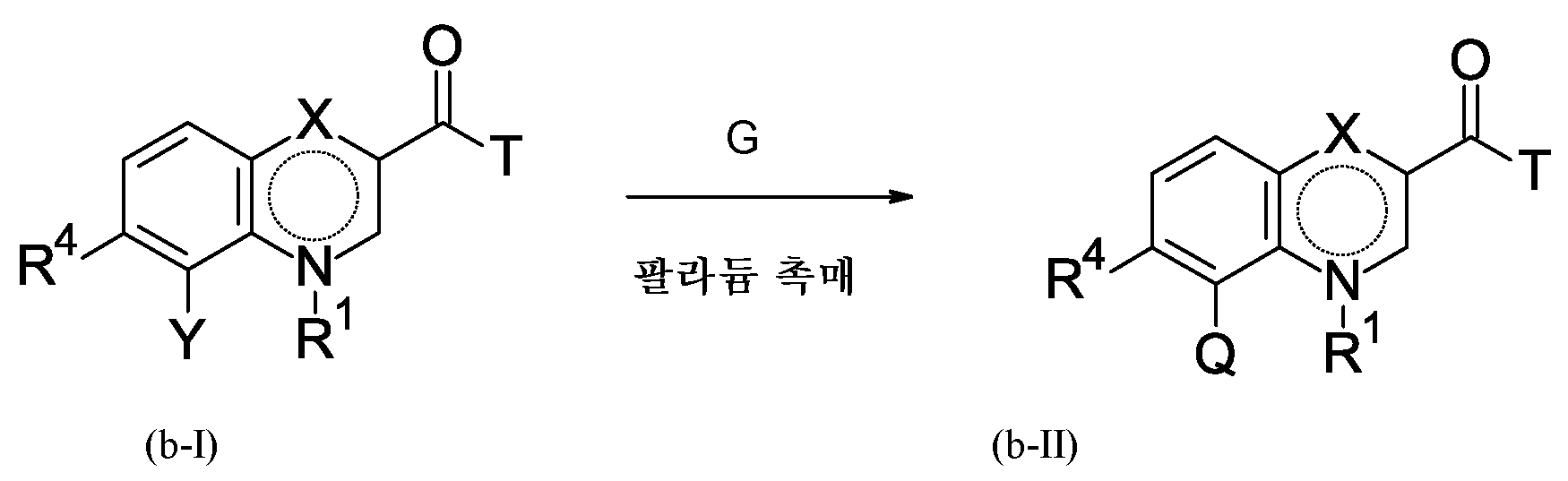
여기서 Y는 할로겐이고, T는 기 -O-R2 또는 -NH-A를 나타내며, 이때 R2는 수소 또는 C1-C3-알킬이고, G는 하기와 같이 정의될 수 있는, 스즈키-반응을 수행하는데 적합한 붕소 화합물을 나타내고:Where Y is halogen, T represents the group -OR 2 or -NH-A, wherein R 2 is hydrogen or C 1 -C 3 -alkyl, and G is Suzuki-reaction, which can be defined as follows Represents a boron compound suitable for:
G는 하기 화학식의 붕소 화합물을 나타내거나:G represents a boron compound of the formula:
(Q)nB(OH)3-n (Q) n B(OH) 3-n
(이때(At this time
n = 0, 1, 2 또는 3임),n = 0, 1, 2 or 3),
또는or
G는 하기 화학식의 붕소 화합물을 나타내거나:G represents a boron compound of the formula:
(Q)4B- M+ (Q) 4 B - M +
(이때(At this time
M = 리튬, 나트륨, 또는 칼륨임),M = lithium, sodium, or potassium),
또는or
G는 하기 화학식의 붕소 화합물을 나타내거나:G represents a boron compound of the formula:
QBF3 -M+ QBF 3 - M +
(이때(At this time
M = 리튬, 나트륨, 또는 칼륨임),M = lithium, sodium, or potassium),
또는or
G는 하기 화학식의 붕소 화합물을 나타냄;G represents a boron compound of the following formula;

단계 B-c:Step B-c:

여기서 R2는 C1-C3-알킬이고; 여기서 염기는 임의의 알칼리 금속 수산화물 및 알칼리 토금속 수산화물, 뿐만 아니라 임의의 알칼리 금속 탄산염 및 알칼리 토금속 탄산염에 상응하고, 산은 임의의 미네랄 산에 상응함;Wherein R 2 is C 1 -C 3 -alkyl; Wherein the base corresponds to any alkali metal hydroxide and alkaline earth metal hydroxide, as well as any alkali metal carbonate and alkaline earth metal carbonate, and the acid corresponds to any mineral acid;
단계 B-d:Step B-d:
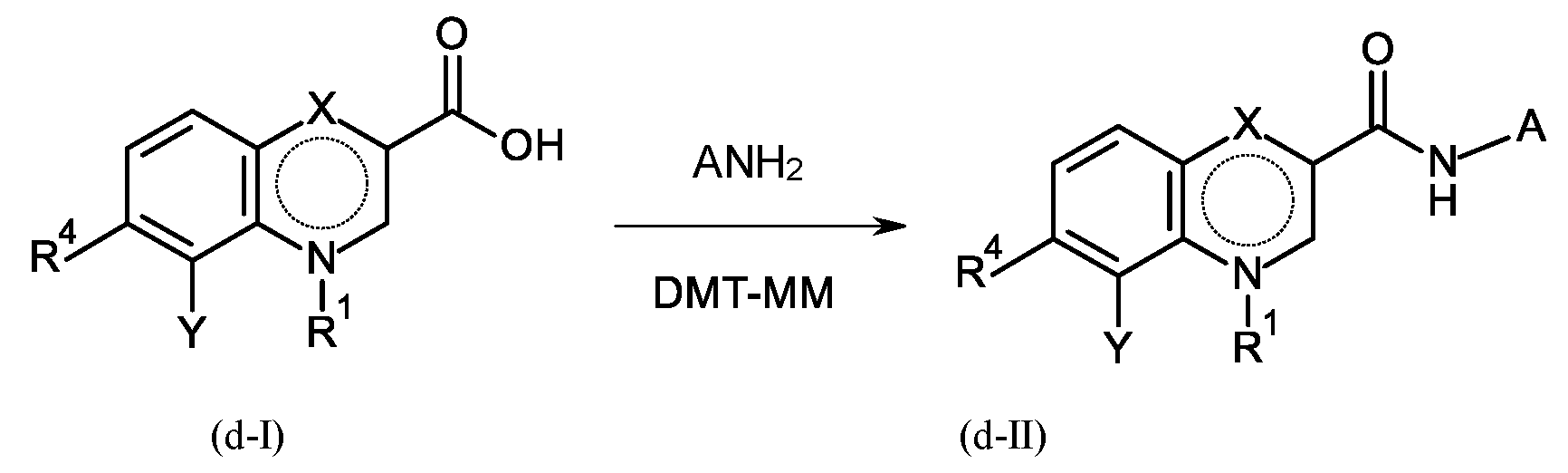
여기서 상기 공정 단계 B-d는 커플링제로서 4-(4,6-디메톡시-1,3,5-트리아진-2-일)-4-메틸-모르폴리늄 클로라이드 (DMT-MM)를 사용함으로써 수행되고;Here, the process step Bd is performed by using 4-(4,6-dimethoxy-1,3,5-triazine-2-yl)-4-methyl-morpholinium chloride (DMT-MM) as a coupling agent. Become;
여기서 반응 단계 B-a 내지 B-d에서 남아있는 치환기는 각각의 공정 스테이지에 상응하는 의미를 가짐.Here, the substituents remaining in the reaction steps B-a to B-d have a meaning corresponding to each process stage.
이는, 공정 단계 B-a, B-b, B-c 및 B-d의 각각의 순서에 따라, 특히 상기 정의된 바와 같은 각각의 출발 화합물의 치환기 Y, X, T 또는 R2가 각각의 선행 반응 단계로부터 유래하는 의미를 갖는다는 것을 의미한다.This has the meaning that, according to the respective order of process steps Ba, Bb, Bc and Bd, in particular the substituents Y, X, T or R 2 of each starting compound as defined above are derived from each preceding reaction step. Means that.
상기 언급된 바와 같이, 본 발명의 방법에서, 원칙적으로 반응 단계 B-a, B-b, B-c 및 B-d는 임의의 순서로 수행될 수 있으나, 단, 단계 B-d가 단계 B-c 전에 수행되지 않는다.As mentioned above, in the method of the present invention, in principle, reaction steps B-a, B-b, B-c and B-d can be carried out in any order, provided that steps B-d are not carried out before steps B-c.
본 발명의 제2 측면에 따르면, 상기 정의된 바와 같은 방법은 화학식 (I)에 따른 화합물을 제조하기 위한 선행 단계 A를 추가로 포함할 수 있으며:According to a second aspect of the invention, the method as defined above may further comprise a preceding step A for preparing a compound according to formula (I):
단계 A:Step A:

여기서 Y, R4, R1 및 R2는 상기 정의된 바와 같은 의미를 갖고,Where Y, R 4 , R 1 and R 2 have the same meaning as defined above,
여기서 상기 공정 단계 A는 > 1 당량 P2O5의 절대량으로 및 메탄 술폰산 (MSA)에 대한 15 내지 25 wt.-%의 상대량으로 P2O5를 사용하여 수행된다.Wherein the process step A is> the absolute amount of one equivalent of P 2 O 5 and methanesulfonic acid (MSA) 15 to about 25 wt .- is performed using a P 2 O 5 as a% relative amounts of.
공정 단계의 설명Description of process steps
공정 단계 A:Process Step A:
본 발명의 제2 측면의 선행 공정 단계 A에서 아닐린은 P2O5 및 메탄술폰산 (MSA)의 존재 하에 디에틸 2-(R2-옥시메틸렌)프로판디오에이트 화합물과 축합된다. 놀랍게도, 상기 반응의 화학선택성이 P2O5의 절대량 및 MSA에 대한 상대량에 좌우되는 것으로 밝혀졌다.In the preceding process step A of the second aspect of the invention, aniline is condensed with diethyl 2-(R 2 -oxymethylene)propanedioate compound in the presence of P 2 O 5 and methanesulfonic acid (MSA). Surprisingly, it was found that the chemoselectivity of the reaction depends on the absolute amount of P 2 O 5 and the relative amount to MSA.
≥ 1 당량, 바람직하게는 > 1 당량, 보다 바람직하게는 1.5 내지 3.5 당량, 바람직하게는 2.0 내지 3.0 당량, 보다 바람직하게는 약 2.5 당량 P2O5의 절대량이 본 발명의 공정 단계 A에서 사용되어 증가된 수율, 특히 90%에 이르는 수율을 달성한다.≥ 1 equivalent, preferably> 1 equivalent, more preferably 1.5 to 3.5 equivalents, preferably 2.0 to 3.0 equivalents, more preferably about 2.5 equivalents of P 2 O 5 is used in process step A of the present invention To achieve increased yields, especially up to 90%.
추가로, 공정 단계 A에서 MSA의 양에 대한 P2O5의 상대량은 7.0 내지 23.0 wt.%, 바람직하게는 15.0 내지 23.0 wt.-%, 보다 바람직하게는 약 23.0 wt.%이다.In addition, the relative amount of P 2 O 5 to the amount of MSA in process step A is 7.0 to 23.0 wt.%, preferably 15.0 to 23.0 wt.-%, more preferably about 23.0 wt.%.
놀랍게도, 고리화 전구체는 너무 낮은 농도의 P2O5를 사용할 때 또는 순수한 메탄술폰산 중에서 안정적이지 않으며 분해되는 것으로 밝혀졌다.Surprisingly, it has been found that the cyclization precursor is not stable and decomposes when using too low concentrations of P 2 O 5 or in pure methanesulfonic acid.
공정 단계 A는 70 내지 140℃, 바람직하게는 80 내지 130℃, 보다 바람직하게는 90 내지 120℃의 온도에서 수행될 수 있는, 아닐린의 2-(R2-옥시메틸렌)프로판디오에이트 화합물과의 축합에 의한 고리화 전구체의 제조를 포함한다. 반응은 바람직하게는 50 mbar 내지 1 atm에서 수행된다. 바람직하게는, 상기 단계에서 잔류 에탄올은 후속 고리화 단계에서 탁월한 화학선택성을 수득하기 위해 제거된다.Process step A is the combination of aniline with 2-(R 2 -oxymethylene)propanedioate compound, which can be carried out at a temperature of 70 to 140°C, preferably 80 to 130°C, more preferably 90 to 120°C. It includes the preparation of cyclized precursors by condensation. The reaction is preferably carried out at 50 mbar to 1 atm. Preferably, in this step residual ethanol is removed to obtain excellent chemoselectivity in the subsequent cyclization step.
생성된 고리화 전구체는 용융물의 형태로 또는 불활성 용매 중에 희석되어 후속 반응에 사용될 수 있다. 용융물이 사용되는 경우에, 적어도 80℃의 반응 온도가 요구된다. 바람직하게는, 중간 축합물은 희석된 형태로 사용된다. 희석은 예를 들어 톨루엔, 클로로벤젠, 크실렌, 아니솔, 메시틸렌, 1,2-디클로로벤젠 등, 또는 그의 혼합물을 포함한 임의의 적합한 용매 중에서 수행될 수 있다. 바람직한 용매는 톨루엔, 클로로벤젠 및 크실렌이며, 톨루엔이 가장 바람직하다.The resulting cyclized precursor can be used in a subsequent reaction in the form of a melt or diluted in an inert solvent. In case a melt is used, a reaction temperature of at least 80°C is required. Preferably, the intermediate condensate is used in diluted form. Dilution can be carried out in any suitable solvent including, for example, toluene, chlorobenzene, xylene, anisole, mesitylene, 1,2-dichlorobenzene, and the like, or mixtures thereof. Preferred solvents are toluene, chlorobenzene and xylene, with toluene being most preferred.
바람직하게는 톨루엔이 불활성 용매로서 선택된다. 예를 들어 톨루엔 중에 중간 축합물을 희석하는 것 (27 wt.-%까지)은 이튼 시약으로의 기술적으로 보다 우수하게 실현가능한 첨가 및 그의 결정화의 방지의 이점을 제공한다.Preferably toluene is selected as the inert solvent. Diluting the intermediate condensate in, for example, toluene (up to 27 wt.-%) provides the advantage of a technically better feasible addition to the Eaton reagent and prevention of its crystallization.
농축된 이튼 시약은 개별적으로, 바람직하게는 고리화 전구체를 제조하는 동안 동시에 준비된다.The concentrated Eaton reagents are prepared individually, preferably simultaneously during the preparation of the cyclized precursor.
이어서, 고리화 전구체 및 이튼 시약은 고리화축합 반응을 활성화시키기 위해 조합된다. 여기서, 고리화 전구체가 이튼 시약에 첨가될 수 있거나 또는 그 반대도 가능하다. 고리화 전구체를 준비된 이튼 시약에 첨가하는 것이 바람직하다.Then, the cyclization precursor and the Eaton reagent are combined to activate the cyclization condensation reaction. Here, the cyclization precursor can be added to the Eaton reagent or vice versa. It is preferred to add the cyclization precursor to the prepared Eaton reagent.
후속 고리화 반응은 30 내지 110℃, 바람직하게는 60 내지 100℃, 보다 바람직하게는 70 내지 90℃의 온도에서 수행될 수 있다.The subsequent cyclization reaction may be carried out at a temperature of 30 to 110°C, preferably 60 to 100°C, more preferably 70 to 90°C.
오산화인의 총량은 2 분량 이상으로, 바람직하게는 최대 8 분량으로 분배되어, 회분식으로 첨가될 수 있다.The total amount of phosphorus pentoxide may be divided into two or more portions, preferably up to eight portions, and added in batches.
화합물 (I)은, 예를 들어 소다액을 사용한 산성 모액의 부분 중화에 의해 단리될 수 있지만, 중화는 생성물의 상응하는 카르복실산으로의 비누화를 회피하도록 제어되어야 한다.Compound (I) can be isolated, for example, by partial neutralization of an acidic mother liquor with a soda liquor, but the neutralization must be controlled to avoid saponification of the product with the corresponding carboxylic acid.
생성된 필터 케이크는 세척되고 건조될 수 있다.The resulting filter cake can be washed and dried.
공정 단계 B-a:Process Step B-a:
본 발명의 방법의 공정 단계 B-a에서 단축된 탈히드록시아미노화는 탈히드록시염소화로부터의 불안정한 클로로-중간체를 단리할 필요 없이 원-포트 반응으로 수행된다. 이는 놀랍게도 화학량론적 양의 티오닐 클로라이드 (SOCl2)를 사용함으로써 달성될 수 있었다.Shortened dehydroxyamination in process step Ba of the process of the invention is carried out in a one-pot reaction without the need to isolate the labile chloro-intermediate from dehydroxychlorination. This could surprisingly be achieved by using a stoichiometric amount of thionyl chloride (SOCl 2 ).
여기서, 먼저 탈히드록시염소화 단계를 활성화시키기 위해 티오닐 클로라이드가 출발 화합물에 투입된다. 바람직하게는, 티오닐 클로라이드는 80 내지 110℃, 바람직하게는 85 내지 105℃, 보다 바람직하게는 90 내지 100℃의 온도에서 출발 화합물에 투입된다. 이들 반응 조건 하에서, 반응이 특히 제어가능하고 효율적인 것으로 밝혀졌다.Here, first, thionyl chloride is added to the starting compound to activate the dehydroxychlorination step. Preferably, thionyl chloride is added to the starting compound at a temperature of 80 to 110°C, preferably 85 to 105°C, more preferably 90 to 100°C. Under these reaction conditions, the reaction has been found to be particularly controllable and efficient.
바람직하게는 티오닐 클로라이드는 1.15 내지 2.30 당량, 바람직하게는 1.15 내지 1.50 당량, 보다 바람직하게는 1.15 내지 1.30 당량의 양으로 첨가된다.Preferably thionyl chloride is added in an amount of 1.15 to 2.30 equivalents, preferably 1.15 to 1.50 equivalents, more preferably 1.15 to 1.30 equivalents.
반응은 바람직하게는 촉매량의 N,N-디메틸포름아미드 (DMF) 또는 N,N-디에틸포름아미드 (DEF), N,N-디-n-부틸포름아미드 (DBF), N,N-디이소프로필포름아미드 (DIF)를 사용하여, 바람직하게는 DEF, DBF 또는 DIF를 사용하여, 보다 바람직하게는 DIF를 사용하여 수행된다.The reaction is preferably a catalytic amount of N,N-dimethylformamide (DMF) or N,N-diethylformamide (DEF), N,N-di-n-butylformamide (DBF), N,N-di It is carried out using isopropylformamide (DIF), preferably with DEF, DBF or DIF, more preferably with DIF.
촉매의 바람직한 양은 0.8 내지 5.0 mol%, 보다 바람직하게는 0.8 내지 3.0 mol%, 보다 더 바람직하게는 0.8 내지 1.5 mol%이다.The preferred amount of the catalyst is 0.8 to 5.0 mol%, more preferably 0.8 to 3.0 mol%, and even more preferably 0.8 to 1.5 mol%.
잔류 티오닐 클로라이드 및 염화수소는 증류되고, 후속적으로 목적하는 아민이 클로로-중간체를 포함하는 반응 혼합물에 첨가된다. 아민은 기체상 형태로 또는 수용액으로 사용될 수 있으며, 후자가 바람직하다. 디메틸아민을 사용하는 것이 특히 바람직하다. 이와 함께 클로로-중간체의 탈클로로아미노화는 아민 단독의 첨가에 의해 수행될 수 있다. 바람직하게는, 아민 화합물, 예컨대 바람직하게는 디메틸아민은 ≥ 1.35 당량, 바람직하게는 1.35 내지 2.70 당량, 보다 바람직하게는 1.35 내지 1.50 당량의 양으로 첨가된다.The residual thionyl chloride and hydrogen chloride are distilled off, and the desired amine is subsequently added to the reaction mixture comprising the chloro-intermediate. The amine can be used in gaseous form or as an aqueous solution, the latter being preferred. It is particularly preferred to use dimethylamine. Along with this, the dechloroamination of the chloro-intermediate can be carried out by addition of amine alone. Preferably, the amine compound, such as preferably dimethylamine, is added in an amount of ≥ 1.35 equivalents, preferably 1.35 to 2.70 equivalents, more preferably 1.35 to 1.50 equivalents.
아민 화합물, 예컨대 바람직하게는 디메틸아민의 첨가는 바람직하게는 20 내지 60℃, 바람직하게는 30 내지 50℃의 온도에서, 보다 바람직하게는 약 40℃에서 수행된다.The addition of the amine compound, such as preferably dimethylamine, is preferably carried out at a temperature of 20 to 60°C, preferably 30 to 50°C, more preferably at about 40°C.
반응은 1.0 내지 6.0 bar, 바람직하게는 1.0 내지 3.0 bar에서, 보다 바람직하게는 대기압 하에 수행될 수 있다.The reaction can be carried out at 1.0 to 6.0 bar, preferably at 1.0 to 3.0 bar, more preferably under atmospheric pressure.
필요한 아민의 최소한의 양을 감소시키기 위해 발생된 염산의 중화가 수행될 수 있다. 그러면, pH는 약 pH 8 내지 10, 바람직하게는 약 pH 9 내지 10이도록 제어되어야 한다. 특히 pH는 화합물 (I)의 재생 또는 에스테르 비누화를 회피하기 위해 pH 10을 초과하지 않아야 한다.Neutralization of the hydrochloric acid generated can be carried out to reduce the minimum amount of amine required. Then, the pH should be controlled to be about pH 8-10, preferably about pH 9-10. In particular the pH should not exceed pH 10 to avoid regeneration or ester saponification of compound (I).
중화 및 pH 조정을 위해 통상의 알칼리 화합물 예컨대 나트륨, 칼륨 또는 리튬 수산화물 용액, 또는 알칼리 탄산염 및 알칼리 토금속 탄산염의 수용액을 사용하는 것이 가능하다. 원칙적으로 8 내지 10, 바람직하게는 9 내지 10의 pH를 조정하고 유지할 수 있는 임의의 염기가 적합하며, 단, 염기는 아미노화를 위해 사용되는 아민 화합물, 예컨대 예를 들어 디메틸아민 또는 모르폴린과 같은 수준의 또는 그보다 낮은 친핵성을 갖는다. 따라서, pH를 조정하기 위해 트리알킬아민을 사용하는 것이 또한 가능하다. 바람직하게는 수성 수산화나트륨 용액이 사용된다. 특히, 신규 공정 단계 B-a가 건조 아민 화합물, 예를 들어 건조 디메틸아민의 사용을 요구하지 않으며, 본원에 기재된 바와 같은 알칼리 수용액 중에서 수행될 수 있다는 것이 놀랍다.For neutralization and pH adjustment it is possible to use conventional alkaline compounds such as sodium, potassium or lithium hydroxide solutions, or aqueous solutions of alkali carbonates and alkaline earth metal carbonates. In principle any base capable of adjusting and maintaining a pH of 8 to 10, preferably 9 to 10, is suitable, provided that the base is with an amine compound used for amination, such as for example dimethylamine or morpholine. Has the same level of nucleophilicity or less Thus, it is also possible to use trialkylamines to adjust the pH. Preferably an aqueous sodium hydroxide solution is used. In particular, it is surprising that the new process step B-a does not require the use of a dry amine compound, for example dry dimethylamine, and can be carried out in an aqueous alkaline solution as described herein.
생성된 생성물은 수성 염산으로의 추출 및 예를 들어 소다액을 사용한 중화 시 결정화에 의해 순수한 형태로 단리될 수 있다.The resulting product can be isolated in pure form by extraction with aqueous hydrochloric acid and crystallization upon neutralization, for example with a soda solution.
공정 단계 B-a는 적합한 용매 예컨대 톨루엔, 클로로벤젠, 크실렌, 메시틸렌, 1,2-디클로로벤젠 등을 사용하여 수행될 수 있다. 바람직한 용매는 톨루엔, 클로로벤젠 및 크실렌이며, 톨루엔이 가장 바람직하다.Process steps B-a can be carried out using suitable solvents such as toluene, chlorobenzene, xylene, mesitylene, 1,2-dichlorobenzene, and the like. Preferred solvents are toluene, chlorobenzene and xylene, with toluene being most preferred.
본 발명의 이러한 특정한 공정 단계 B-a로, 미공개 국제 출원 PCT/EP2017/078319로부터 공지된 바와 같은 방법과 비교하여 하나의 추가적인 공정 단계를 제거하는 것이 놀랍게도 가능하였다. 이와 함께 수성 조건에서 가수분해에 불안정한 중간체의 반응이 탁월한 수율로 가능해졌다는 것이 특히 놀라웠다.With this particular process step B-a of the present invention, it was surprisingly possible to eliminate one additional process step compared to the method as known from unpublished international application PCT/EP2017/078319. Along with this, it was particularly surprising that the reaction of an intermediate unstable to hydrolysis in aqueous conditions was possible in excellent yield.
공정 단계 B-b:Process steps B-b:
본 발명의 방법의 공정 단계 B-b에서 스즈키-커플링이 적합한 붕소 화합물 G 및 팔라듐 촉매를 사용하여 수행된다.In process steps B-b of the process of the invention, Suzuki-coupling is carried out using a suitable boron compound G and a palladium catalyst.
적합한 촉매는 일반적으로 스즈키-커플링 반응을 가능하게 하는 모든 팔라듐 촉매이다. 그의 예는 팔라듐(0)- 및 팔라듐(II) 전-촉매 예컨대, 포스핀 리간드 L 없이 또는 그와 조합된, PdCl2, Pd(OAc)2 (Ac = 아세테이트), Pd(NO3)2, Pd(acac)2 (acac = 아세틸-아세토네이트), Pd(dba)2 (dba = 디-벤질리덴-아세톤) 또는 지지체 예컨대 활성탄 상의 팔라듐, 및 사전-형성된 팔라듐(0)- 및 팔라듐(II)-촉매 예컨대 PdCl2(L)2 또는 Pd(L)4이다.Suitable catalysts are generally all palladium catalysts that enable the Suzuki-coupling reaction. Examples thereof include palladium(0)- and palladium(II) pre-catalysts such as PdCl 2 , Pd(OAc) 2 (Ac = acetate), Pd(NO 3 ) 2 , without or in combination with phosphine ligand L Pd(acac) 2 (acac = acetyl-acetonate), Pd(dba) 2 (dba = di-benzylidene-acetone) or a support such as palladium on activated carbon, and pre-formed palladium(0)- and palladium(II) -A catalyst such as PdCl 2 (L) 2 or Pd(L) 4 .
포스핀 리간드 없이 또는 그와 조합된, Pd(OAc)2, Pd(acac)2 및 PdCl2(L)2가 바람직하다. 포스핀 리간드와 조합된 Pd(acac)2가 가장 바람직하다.Pd(OAc) 2 , Pd(acac) 2 and PdCl 2 (L) 2 , without or in combination with a phosphine ligand, are preferred. Most preferred is Pd(acac) 2 in combination with a phosphine ligand.
적합한 리간드 L은 일반적으로 스즈키-커플링 반응을 위한 활성 팔라듐 촉매를 제공하는 것으로 공지된 모든 포스핀 리간드이다. 한자리 포스핀 리간드 P(Ar)n(알킬)3-n (이때 n = 0, 1, 2 또는 3임), 예컨대 PPh3, P(o-톨릴)3, P(o-아니실)3, P(p-아니실)3, P(nBu)3, P(tertBu)3, P(아다만틸)2Ph, PPh2(tertBu) 또는 PPh(tertBu)2가 바람직하다. P(tertBu)3, PPh2(tertBu) 및 PPh(tertBu)2가 바람직하다. P(tertBu)3이 가장 바람직하다.Suitable ligands L are generally all phosphine ligands known to provide active palladium catalysts for Suzuki-coupling reactions. Monodentate phosphine ligand P(Ar) n (alkyl) 3-n (where n = 0, 1, 2 or 3), such as PPh 3 , P(o-tolyl) 3 , P(o-anisyl) 3 , P (p- no seal) 3, P (nBu) 3 , P (tertBu) 3, P ( adamantyl) 2 Ph, PPh 2 (tertBu ) or PPh (tertBu) 2 is preferred. P(tertBu) 3 , PPh 2 (tertBu) and PPh(tertBu) 2 are preferred. P(tertBu) 3 is most preferred.
고도로 공기에 민감한 유리 포스핀의 보다 우수한 취급을 위해서는 테트라플루오로보레이트 염을 사용하는 것이 가능하다. 그러나, 모든 취급이 불활성 분위기 하에, 예를 들어 아르곤 하에 행해진다면, 예를 들어 톨루엔 중의, 유리 포스핀의 용액을 사용하는 것이 또한 가능하다.It is possible to use tetrafluoroborate salts for better handling of the highly air sensitive free phosphine. However, if all handling is done under an inert atmosphere, for example argon, it is also possible to use a solution of free phosphine, for example in toluene.
리간드 L 대 팔라듐의 몰비는 광범위하게 달라질 수 있다. 0.5 내지 10의 L/Pd 비를 사용하는 것이 바람직하며; 1 내지 6의 비가 보다 바람직하다.The molar ratio of ligand L to palladium can vary widely. It is preferred to use an L/Pd ratio of 0.5 to 10; A ratio of 1 to 6 is more preferable.
공정 단계 B-b에서 광범위한 용매, 예컨대 톨루엔, 크실렌, 클로로벤젠, 디클로로벤젠, 헵탄, 시클로헥산, 메틸-시클로헥산, 1,4-디옥산, 테트라히드로푸란, 2-메틸-테트라히드로푸란, 2,5-디메틸-테트라히드로푸란, 메틸-tert부틸-에테르, 시클로펜틸-메틸-에테르, 메탄올, 에탄올, 프로판올, 부탄올, 아세토니트릴, 부티로니트릴, N,N-디메틸포름아미드, 물, 또는 이들 용매의 혼합물이 사용될 수 있다. 톨루엔, 크실렌, 클로로벤젠, 메탄올, 에탄올, 메틸-tert부틸-에테르, 물, 및 이들 용매의 혼합물이 바람직하다. 메틸-tert부틸-에테르 및 물의 혼합물이 가장 바람직하다.In process step Bb a wide range of solvents such as toluene, xylene, chlorobenzene, dichlorobenzene, heptane, cyclohexane, methyl-cyclohexane, 1,4-dioxane, tetrahydrofuran, 2-methyl-tetrahydrofuran, 2,5 -Dimethyl-tetrahydrofuran, methyl-tertbutyl-ether, cyclopentyl-methyl-ether, methanol, ethanol, propanol, butanol, acetonitrile, butyronitrile, N,N-dimethylformamide, water, or these solvents Mixtures can be used. Toluene, xylene, chlorobenzene, methanol, ethanol, methyl-tertbutyl-ether, water, and mixtures of these solvents are preferred. Most preferred are mixtures of methyl-tertbutyl-ether and water.
공정 단계 B-b에서 광범위한 무기 및 유기 염기가 사용될 수 있다. 무기 염기 예컨대 수산화리튬, 수산화나트륨, 수산화칼륨, 수산화칼슘, 탄산리튬, 탄산나트륨, 탄산칼륨, 탄산칼슘, 플루오린화나트륨 및 플루오린화칼륨이 바람직하다. 수산화나트륨, 수산화칼륨, 탄산나트륨 및 탄산칼륨이 보다 바람직하다.A wide variety of inorganic and organic bases can be used in process steps B-b. Inorganic bases such as lithium hydroxide, sodium hydroxide, potassium hydroxide, calcium hydroxide, lithium carbonate, sodium carbonate, potassium carbonate, calcium carbonate, sodium fluoride and potassium fluoride are preferred. Sodium hydroxide, potassium hydroxide, sodium carbonate and potassium carbonate are more preferred.
본 발명에 따른 공정 단계 B-b에서 붕소 화합물 G는 하기 화학식의 붕소 화합물을 나타내거나:The boron compound G in process steps B-b according to the invention represents a boron compound of the formula:
(Q)nB(OH)3-n (Q) n B(OH) 3-n
(이때(At this time
n = , 1, 2 또는 3임),n =, 1, 2 or 3),
또는or
G는 하기 화학식의 붕소 화합물을 나타내거나:G represents a boron compound of the formula:
(Q)4B- M+ (Q) 4 B - M +
(이때(At this time
M = 리튬, 나트륨, 또는 칼륨임),M = lithium, sodium, or potassium),
또는or
G는 하기 화학식의 붕소 화합물을 나타내거나:G represents a boron compound of the formula:
QBF3 -M+ QBF 3 - M +
(이때(At this time
M = 리튬, 나트륨, 또는 칼륨임),M = lithium, sodium, or potassium),
또는or
G는 하기 화학식의 붕소 화합물을 나타낸다:G represents a boron compound of the formula:

여기서, 붕소 화합물은 적합한 보론산, 보린산, 보레이트, 보리네이트 또는 MIDA-보호된 보로네이트 에스테르 (MIDA = N-메틸이미노디아세트산)로부터 선택될 수 있다. 바람직하게는, 붕소 화합물 G는 (3,5-디클로로페닐)보론산, 비스(3,5-디클로로페닐)보린산, 트리(3,5-디클로로페닐)보론; 나트륨 테트라(3,5-디클로로페닐)보레이트, 칼륨 (3,5-디클로로페닐)트리플루오로보레이트, 또는 2-(3,5-디클로로페닐)-6-메틸-1,3,6,2-디옥사자보로칸-4,8-디온 (MIDA 보로네이트)으로부터 선택된 붕소 화합물을 나타낸다. 비스(3,5-디클로로페닐)보린산 및 (3,5-디클로로페닐)보론산이 가장 바람직하다.Here, the boron compound can be selected from suitable boronic acids, boric acids, borates, boronates or MIDA-protected boronate esters (MIDA = N-methyliminodiacetic acid). Preferably, the boron compound G is (3,5-dichlorophenyl) boronic acid, bis(3,5-dichlorophenyl) boric acid, tri(3,5-dichlorophenyl) boron; Sodium tetra(3,5-dichlorophenyl) borate, potassium (3,5-dichlorophenyl) trifluoroborate, or 2-(3,5-dichlorophenyl)-6-methyl-1,3,6,2- It shows a boron compound selected from dioxazaborocane-4,8-dione (MIDA boronate). Most preferred are bis(3,5-dichlorophenyl)boric acid and (3,5-dichlorophenyl)boronic acid.
공정 단계 B-b에서 놀라울 정도로 낮은 촉매 로딩이 고수율을 달성하는데 사용될 수 있다. 출발 물질에 대해 0.1 내지 1 mol%의 촉매 로딩이 바람직하다. 0.2 내지 0.8 mol%의 촉매 로딩이 보다 바람직하다. 0.3 내지 0.6 mol%의 촉매 로딩이 가장 바람직하다.In process steps B-b surprisingly low catalyst loadings can be used to achieve high yields. A catalyst loading of 0.1 to 1 mol% relative to the starting material is preferred. A catalyst loading of 0.2 to 0.8 mol% is more preferred. Most preferred is a catalyst loading of 0.3 to 0.6 mol%.
본 발명의 공정 단계 B-b는 바람직하게는, 잔류 팔라듐의 양이 ≤ 200 ppm, 바람직하게는 < 200 ppm으로 감소하도록, 보다 바람직하게는 잔류 팔라듐의 양이 ≤ 100 ppm, 가장 바람직하게는 < 100 ppm 으로 감소하도록 제어되어야 한다. 본 발명의 공정 단계 B-b로 이러한 낮은 잔류 팔라듐 양을 달성하는 것이 놀랍게도 가능하였다. 필요하다면, 추가의 감소가 후속 재결정화 단계를 적용함으로써 달성될 수 있다.The process step Bb of the invention is preferably such that the amount of residual palladium is reduced to ≤ 200 ppm, preferably <200 ppm, more preferably the amount of residual palladium is ≤ 100 ppm, most preferably <100 ppm. Should be controlled to decrease to It was surprisingly possible to achieve this low residual palladium amount with process steps B-b of the invention. If necessary, further reduction can be achieved by applying a subsequent recrystallization step.
아세틸시스테인의 수용액으로의 후속 추출을 적용함으로써 잔류 팔라듐을 추가로 감소시키는 것이 또한 가능하다. 이와 함께, 후속 비누화 단계 (예를 들어 단계 B-c)에서의 부분적 수첨탈염소화를 방지하기 위한 효율적 탈팔라듐화가 달성될 수 있다. 따라서, 이러한 추가적인 아세틸시스테인 처리는 본 발명의 공정 단계 B-c 전에 공정 단계 B-b를 수행하는 경우에 특히 적합하다.It is also possible to further reduce the residual palladium by applying a subsequent extraction of acetylcysteine into an aqueous solution. Along with this, efficient depalladiumization can be achieved to prevent partial hydrodechlorination in subsequent saponification steps (eg steps B-c). Accordingly, this additional acetylcysteine treatment is particularly suitable when performing process steps B-b before process steps B-c of the present invention.
아세틸시스테인 처리 및/또는 재결정화 단계를 적용함으로써 잔류 팔라듐 함량을 추가로 감소시키는 것이 가능하다.It is possible to further reduce the residual palladium content by applying an acetylcysteine treatment and/or recrystallization step.
놀랍게도, 본 발명의 공정 단계 B-b로 > 4000 ppm에서 < 500 ppm으로의 PCB80의 감소를 달성하는 것이 또한 가능한 것으로 추가로 밝혀졌다.Surprisingly, it was further found that it is also possible to achieve a reduction of PCB80 from >4000 ppm to <500 ppm with process steps B-b of the invention.
공정 단계 B-c:Process steps B-c:
본 발명의 방법의 공정 단계 B-c에서 기 [-(C=O)-O-C1-C3-알킬]의 비누화가 수행된다.In process step Bc of the process of the invention the saponification of the group [-(C=O)-OC 1 -C 3 -alkyl] is carried out.
여기서, 비누화는 통상의 비누화 조건을 적용함으로써 수행될 수 있다. 특히, 통상의 수산화물 화합물 예컨대 알칼리 금속 수산화물 및 알칼리 토금속 수산화물, 예컨대 특히 수산화나트륨, 수산화칼륨 또는 수산화리튬을 사용하는 것이 가능하다. 바람직하게는, 수산화나트륨이 사용된다.Here, saponification can be performed by applying conventional saponification conditions. In particular, it is possible to use conventional hydroxide compounds such as alkali metal hydroxides and alkaline earth metal hydroxides, such as in particular sodium hydroxide, potassium hydroxide or lithium hydroxide. Preferably, sodium hydroxide is used.
이들 염기 외에도, 알칼리 금속 탄산염 및 알칼리 토금속 탄산염, 예컨대 특히 탄산나트륨, 탄산칼륨, 탄산리튬, 탄산마그네슘 또는 탄산칼슘이 사용될 수 있다.In addition to these bases, alkali metal carbonates and alkaline earth metal carbonates such as in particular sodium carbonate, potassium carbonate, lithium carbonate, magnesium carbonate or calcium carbonate can be used.
반응은 바람직하게는 20-70℃의 온도에서 물/알콜 혼합물 중에서 수행된다. 알콜로서, 지방족 알콜이 사용될 수 있다. 바람직하게는, 에탄올 및 메탄올이 사용된다.The reaction is preferably carried out in a water/alcohol mixture at a temperature of 20-70°C. As the alcohol, aliphatic alcohols can be used. Preferably, ethanol and methanol are used.
공정 단계 B-c에서 ≤ 200 ppm, 바람직하게는 ≤ 100 ppm의 잔류 팔라듐 함량을 갖는 에스테르 화합물을 출발 화합물로서 사용하는 것이 특히 바람직하다. 비누화 단계 B-c에서 보다 높은 팔라듐 수준을 갖는 에스테르 화합물을 출발 화합물로서 사용하는 경우에, 상당한 양의 수첨탈염소화된 에스테르 및 수첨탈염소화 비누화된 카르복실산이 발생할 수 있었다.Particular preference is given to the use of ester compounds with residual palladium content of ≤ 200 ppm, preferably ≤ 100 ppm as starting compounds in process steps B-c. When an ester compound having a higher palladium level is used as the starting compound in saponification step B-c, significant amounts of hydrodechlorinated esters and hydrodechlorinated saponified carboxylic acids could occur.
바람직하게는, 비누화는 강력한 교반 하에 수행된다.Preferably, the saponification is carried out under vigorous stirring.
단계 B-c에서 비누화 생성물은 염으로서, 바람직하게는 HCl 염으로서 전달되고 단리되는 것이 추가로 바람직하다. 단계 B-c의 비누화 생성물의 유리 카르복실산 형태와 비교하여, 염은 저장되고 추가의 반응 단계에서 적용될 때 증가된 안정성을 나타내며 분해 경향을 덜 나타내는 것으로 밝혀졌다.It is further preferred that the saponification product in steps B-c is delivered and isolated as a salt, preferably as an HCl salt. Compared to the free carboxylic acid form of the saponification product of steps B-c, the salt was found to exhibit increased stability and less prone to degradation when stored and applied in a further reaction step.
공정 단계 B-d:Process steps B-d:
본 발명의 방법의 공정 단계 B-d에서 상기 정의된 바와 같은 기 A의 추가의 커플링이 수행된다.In process steps B-d of the method of the invention a further coupling of group A as defined above is carried out.
바람직하게는, 단계 B-d에서 출발 화합물은 상기 공정 단계 B-c와 관련하여 기재된 바와 같이, 염의 형태로, 바람직하게는 HCl 염의 형태로 사용된다.Preferably, the starting compounds in steps B-d are used in the form of salts, preferably in the form of HCl salts, as described in connection with process steps B-c above.
본 발명의 공정 단계 B-d에서 4-(4,6-디메톡시-1,3,5-트리아진-2-일)-4-메틸-모르폴리늄 클로라이드 (DMT-MM)가 커플링제로서 사용된다. 놀랍게도, 예를 들어 미공개 국제 출원 PCT/EP2017/078319에 기재된 바와 같은 TBTU (2-(1H-벤조트리아졸-1-일)-1,1,3,3-테트라메틸아미늄 테트라플루오로보레이트) 또는 HATU (1-[비스(디메틸아미노)메틸렌]-1H-1,2,3-트리아졸로[4,5-b]피리디늄 3-옥시드 헥사플루오로포스페이트) 대신에 커플링을 위해 DMT-MM을 사용하는 것이 유리한 것으로 밝혀졌다. 특히, HATU 대신에 DMT-MM을 사용하는 것은 수율을 66%에서 90%로 상당히 증가시킨다. 게다가, 본 발명의 방법에 사용된 바와 같은 DMT-MM은 훨씬 더 비용 효과적이며 기술적으로 실현가능하다.In process step Bd of the present invention, 4-(4,6-dimethoxy-1,3,5-triazin-2-yl)-4-methyl-morpholinium chloride (DMT-MM) is used as a coupling agent. . Surprisingly, TBTU (2-(1H-benzotriazol-1-yl)-1,1,3,3-tetramethylaminium tetrafluoroborate) as described, for example, in unpublished international application PCT/EP2017/078319 Or DMT- for coupling instead of HATU (1-[bis(dimethylamino)methylene]-1H-1,2,3-triazolo[4,5-b]pyridinium 3-oxide hexafluorophosphate) It has been found to be advantageous to use MM. In particular, using DMT-MM instead of HATU significantly increases the yield from 66% to 90%. Moreover, the DMT-MM as used in the method of the present invention is much more cost effective and technically feasible.
커플링 반응은 단리된 커플링 시약 DMT-MM을 사용함으로써 수행될 수 있다. 그러나, 놀랍게도, 커플링 반응은 또한 계내에서 2-클로로-4,6-디메톡시-1,3,5-트리아진 (CDMT) 및 N-메틸모르폴린 (NMM)으로부터 DMT-MM을 제조함으로써 수행될 수 있는 것으로 밝혀졌다.The coupling reaction can be performed by using the isolated coupling reagent DMT-MM. However, surprisingly, the coupling reaction was also carried out in situ by preparing DMT-MM from 2-chloro-4,6-dimethoxy-1,3,5-triazine (CDMT) and N-methylmorpholine (NMM). It turned out to be possible.
단리된 커플링 시약 CMT-MM의 농도는 120℃의 개시 온도에서의 -1110 J/g의 불리한 에너지 포텐셜로 인해 보다 높아야 하는 반면, DMT-MM의 계내 제조는 상응하게 제조된 DMT-MM의 양의 감소를 가능하게 한다. 따라서, 본 발명의 공정 단계 B-d에서, NMM 및 CDMT로부터 계내에서 커플링제 DMT-MM을 생성하는 것이 특히 바람직하다.The concentration of the isolated coupling reagent CMT-MM should be higher due to the unfavorable energy potential of -1110 J/g at an initiation temperature of 120° C., whereas the in situ preparation of DMT-MM is the amount of correspondingly prepared DMT-MM. Enables the reduction of Therefore, in process steps B-d of the present invention, it is particularly preferred to produce the coupling agent DMT-MM in situ from NMM and CDMT.
화합물 A-NH2의 첨가 후에 생성물 결정화를 방지하기 위해 결정 분쇄가 실시될 수 있다.Crystal pulverization may be carried out to prevent product crystallization after addition of the compound A-NH 2 .
공정 단계 B-d는 적합한 용매 예컨대 톨루엔, 클로로벤젠, 아니솔, 테트라히드로푸란 등을 사용하여 수행될 수 있다. 바람직한 용매는 톨루엔 및 클로로벤젠이며, 톨루엔이 가장 바람직하다.Process steps B-d can be carried out using suitable solvents such as toluene, chlorobenzene, anisole, tetrahydrofuran and the like. Preferred solvents are toluene and chlorobenzene, with toluene being most preferred.
바람직하게는, 아민 빌딩 블록의 양은 1.05 내지 1.4 당량, 바람직하게는 1.1 내지 1.3 당량, 보다 바람직하게는 1.1 내지 1.2 당량이다.Preferably, the amount of amine building blocks is 1.05 to 1.4 equivalents, preferably 1.1 to 1.3 equivalents, more preferably 1.1 to 1.2 equivalents.
바람직하게는, NMM의 양은 5.0 내지 15.0 당량, 바람직하게는 5.0 내지 10.0 당량, 보다 바람직하게는 5.0 내지 7.5 당량이다.Preferably, the amount of NMM is 5.0 to 15.0 equivalents, preferably 5.0 to 10.0 equivalents, more preferably 5.0 to 7.5 equivalents.
바람직하게는, CDMT의 양은 1.25 내지 2.00 당량, 바람직하게는 1.25 내지 1.80 당량, 보다 바람직하게는 1.25 내지 1.35 당량이다.Preferably, the amount of CDMT is 1.25 to 2.00 equivalents, preferably 1.25 to 1.80 equivalents, more preferably 1.25 to 1.35 equivalents.
바람직하게는, 반응은 20 내지 60℃, 바람직하게는 25 내지 50℃, 보다 바람직하게는 30 내지 40℃의 온도에서 수행된다.Preferably, the reaction is carried out at a temperature of 20 to 60°C, preferably 25 to 50°C, more preferably 30 to 40°C.
단계 B-d로부터의 생성물의 단리는 바람직하게는 반응 용매의 스트리핑을 가속하는, 환류 하에 tert-부틸메틸에테르 중에서 수행된다.Isolation of the product from steps B-d is preferably carried out in tert-butylmethylether under reflux, which accelerates the stripping of the reaction solvent.
본 발명의 방법의 추가의 측면:Further aspects of the method of the invention:
본 발명에 따른 방법으로부터 생성된 생성물은 통상의 기술자에게 통상적으로 공지되어 있는, 예를 들어 세척, 정제, 재결정화 및 건조 단계를 포함한 추가의 가공 단계에 적용될 수 있다.The product produced from the process according to the invention can be subjected to further processing steps which are commonly known to the person skilled in the art, including for example washing, purification, recrystallization and drying steps.
본 발명의 방법에 따라 제조된 화합물 및 중간체는 정제를 필요로 할 수 있다. 유기 화합물의 정제는 관련 기술분야의 통상의 기술자에게 널리 공지되어 있으며, 동일한 화합물을 정제하는 여러 방식이 존재할 수 있다. 일부 경우에, 정제가 필요하지 않을 수도 있다. 일부 경우에, 화합물은 결정화에 의해 정제될 수 있다. 일부 경우에, 적합한 용매를 사용하여 불순물을 교반해 낼 수 있다. 일부 경우에, 화합물은 크로마토그래피, 특히 예를 들어 바이오타지(Biotage) 자동정제기 시스템 (SP4® 또는 이솔레라 포(Isolera Four)®)과 조합하여 사전패킹된 실리카 겔 카트리지, 예를 들어 바이오타지 SNAP 카트리지 KP-Sil® 또는 KP-NH® 및 용리액 예컨대 헥산/에틸 아세테이트 또는 디클로로메탄/메탄올의 구배를 사용하는 플래쉬 칼럼 크로마토그래피에 의해 정제될 수 있다. 일부 경우에, 화합물은 적합한 사전패킹된 역상 칼럼, 및 첨가제 예컨대 트리플루오로아세트산, 포름산 또는 수성 암모니아를 함유할 수 있는 물 및 아세토니트릴의 구배와 같은 용리액과 조합하여, 예를 들어 다이오드 어레이 검출기 및/또는 온-라인 전기분무 이온화 질량 분광계가 장착된 워터스(Waters) 자동정제기를 사용하는 정제용 HPLC에 의해 정제될 수 있다.Compounds and intermediates prepared according to the methods of the present invention may require purification. Purification of organic compounds is well known to those of ordinary skill in the art, and there may be several ways of purifying the same compound. In some cases, purification may not be necessary. In some cases, the compound can be purified by crystallization. In some cases, a suitable solvent can be used to agitate the impurities. In some cases, the compounds are prepacked silica gel cartridges, e.g. Biotage, in combination with chromatography, e.g., Biotage automatic purifier system (SP4® or Isolera Four®). SNAP cartridges KP-Sil® or KP-NH® and eluents such as hexane/ethyl acetate or a gradient of dichloromethane/methanol can be purified by flash column chromatography. In some cases, the compound is combined with a suitable prepacked reverse phase column and an eluent such as a gradient of water and acetonitrile, which may contain additives such as trifluoroacetic acid, formic acid or aqueous ammonia, for example a diode array detector and /Or can be purified by preparative HPLC using a Waters automatic purifier equipped with an on-line electrospray ionization mass spectrometer.
일부 경우에, 상기 기재된 바와 같은 정제 방법은 충분히 염기성이거나 또는 산성인 관능기를 보유하는 본 발명의 화합물을 염의 형태로, 예컨대, 충분히 염기성인 본 발명의 화합물의 경우에는 예를 들어 트리플루오로아세테이트 또는 포르메이트 염의 형태로, 또는 충분히 산성인 본 발명의 화합물의 경우에는 예를 들어 암모늄 염의 형태로 제공할 수 있다. 이러한 유형의 염은 관련 기술분야의 통상의 기술자에게 공지된 다양한 방법에 의해 그의 유리 염기 또는 유리 산 형태로 각각 변형될 수 있거나, 또는 후속 생물학적 검정에서 염으로서 사용될 수 있다. 본원에 기재된 바와 같은 단리된 그대로의 본 발명의 화합물의 특정한 형태 (예를 들어 염, 유리 염기 등)가, 상기 화합물이 특정한 생물학적 활성을 정량화하기 위한 생물학적 검정에 적용될 수 있는 유일한 형태는 아니라는 것이 이해되어야 한다.In some cases, the purification method as described above takes a compound of the invention having a sufficiently basic or acidic functional group in the form of a salt, e.g., in the case of a sufficiently basic compound of the invention, for example trifluoroacetate or It can be provided in the form of a formate salt, or in the case of a sufficiently acidic compound of the invention, for example in the form of an ammonium salt. Salts of this type can each be transformed into their free base or free acid form by various methods known to those of skill in the art, or can be used as salts in subsequent biological assays. It is understood that a particular form of a compound of the present invention as isolated as described herein (e.g., salt, free base, etc.) is not the only form that can be applied in a biological assay to quantify a particular biological activity. Should be.
본 발명에 따른 방법으로부터 생성된 생성물 (화합물 및 중간체)은 관련 기술분야의 통상의 기술자에게 공지된 임의의 방법에 의해 임의의 염, 바람직하게는 제약상 허용되는 염으로 전환될 수 있다. 유사하게, 본 발명의 화합물 또는 중간체의 임의의 염은 관련 기술분야의 통상의 기술자에게 공지된 임의의 방법에 의해 유리 화합물로 전환될 수 있다.The products (compounds and intermediates) produced from the process according to the invention can be converted to any salt, preferably a pharmaceutically acceptable salt, by any method known to the person skilled in the art. Similarly, any salt of a compound or intermediate of the present invention can be converted to the free compound by any method known to one of ordinary skill in the art.
시약을 상기 시약의 동위원소 변형체, 바람직하게는 중수소-함유 시약으로 대체함으로써, 본원에 기재된 방법으로 본 발명에 따른 화합물의 동위원소 변형체를 제조하는 것이 또한 가능하다. 목적하는 중수소화 자리에 따라, 일부 경우에 D2O로부터의 중수소가 직접 화합물에 혼입될 수 있거나 또는 이러한 화합물을 합성하는데 유용한 시약에 혼입될 수 있다. 중수소 기체가 또한 중수소를 분자 내로 혼입시키는데 유용한 시약이다. 올레핀계 결합 및 아세틸렌계 결합의 촉매적 중수소화는 중수소의 혼입을 위한 신속한 경로이다. 중수소 기체의 존재 하의 금속 촉매 (즉, Pd, Pt, 및 Rh)가 관능기 함유 탄화수소 내의 수소를 중수소로 직접 교환하는데 사용될 수 있다. 다양한 중수소화된 시약 및 합성 빌딩 블록이 예를 들어 캐나다 퀘벡 소재의 C/D/N 이소토프스(C/D/N Isotopes); 미국 매사추세츠주 앤도버 소재의 캠브리지 이소토프 래보러토리즈 인크.(Cambridge Isotope Laboratories Inc.); 및 미국 뉴저지주 프린스턴 소재의 콤비포스 카탈리스츠, 인크.(CombiPhos Catalysts, Inc.)와 같은 회사로부터 상업적으로 입수가능하다.By replacing the reagent with an isotopic variant of the reagent, preferably a deuterium-containing reagent, it is also possible to prepare an isotopic variant of the compound according to the invention by the method described herein. Depending on the desired deuteration site, deuterium from D 2 O may in some cases be incorporated directly into the compound or may be incorporated into reagents useful for synthesizing such compounds. Deuterium gas is also a useful reagent for incorporating deuterium into the molecule. Catalytic deuteration of olefinic and acetylenic bonds is a rapid route for the incorporation of deuterium. Metal catalysts (i.e., Pd, Pt, and Rh) in the presence of deuterium gas can be used to directly exchange hydrogen in the functional group-containing hydrocarbon for deuterium. Various deuterated reagents and synthetic building blocks include, for example, C/D/N Isotopes, Quebec, Canada; Cambridge Isotope Laboratories Inc. of Andover, Massachusetts, USA; And CombiPhos Catalysts, Inc. of Princeton, NJ, USA.
본 발명의 방법으로 목적하는 생성물을 고수율 및 고순도로 수득하는 것이 가능하다.It is possible with the method of the present invention to obtain the desired product in high yield and high purity.
목적하는 생성물을 > 80%, 바람직하게는 > 85%, 바람직하게는 > 90%, 보다 바람직하게는 > 95%, 또는 심지어 최대 99%의 거울상이성질체 과잉률로 제공하는 것이 추가로 가능하다.It is further possible to provide the desired product at an enantiomeric excess of >80%, preferably >85%, preferably >90%, more preferably >95%, or even up to 99%.
추가로, ≤ 1.0 ppm, 바람직하게는 ≤ 0.5 ppm, 보다 바람직하게는 ≤ 0.1 ppm의 매우 낮은 PCB80 함량 및 ≤ 20 ppm, 바람직하게는 ≤ 10 ppm의 매우 낮은 잔류 팔라듐 함량을 갖는 목적하는 생성물을 제조하는 것이 가능하다.In addition, to prepare the desired product with a very low PCB80 content of ≤ 1.0 ppm, preferably ≤ 0.5 ppm, more preferably ≤ 0.1 ppm and a very low residual palladium content of ≤ 20 ppm, preferably ≤ 10 ppm It is possible to do.
정의Justice
본 발명과 관련하여 용어 "치환된"은 지정된 원자 또는 기 상의 1개 이상의 수소 원자가 지시된 기로부터 선택된 것으로 대체되는 것을 의미하며, 단, 기존 환경 하의 지정된 원자의 정상 원자가를 초과하지 않는다. 치환기 및/또는 가변기의 조합이 허용가능하다.In the context of the present invention, the term "substituted" means that one or more hydrogen atoms on the designated atom or group are replaced with one selected from the designated group, provided that the normal valency of the designated atom under the existing environment is not exceeded. Combinations of substituents and/or variables are permissible.
용어 "임의적으로 치환된"은 치환기의 수가 0과 같거나 또는 그와 상이할 수 있다는 것을 의미한다. 달리 지시되지 않는 한, 임의적으로 치환된 기는 임의의 이용가능한 탄소 또는 질소 원자 상에서 수소 원자를 비-수소 치환기로 대체함으로써 수용될 수 있는 만큼 많은 임의적인 치환기로 치환되는 것이 가능하다. 통상적으로, 임의적인 치환기의 수는, 존재하는 경우에, 1, 2, 3, 4 또는 5개, 특히 1, 2 또는 3개인 것이 가능하다.The term “optionally substituted” means that the number of substituents may be equal to or different from zero. Unless otherwise indicated, it is possible for an optionally substituted group to be substituted with as many optional substituents as acceptable by replacing a hydrogen atom with a non-hydrogen substituent on any available carbon or nitrogen atom. Usually, it is possible that the number of optional substituents, if present, is 1, 2, 3, 4 or 5, especially 1, 2 or 3.
본원에 사용된 용어 "하나 이상"은, 예를 들어 본 발명의 화합물의 치환기의 정의에서, "1, 2, 3, 4 또는 5, 특히 1, 2, 3 또는 4, 보다 특히 1, 2 또는 3, 보다 더 특히 1 또는 2"를 의미한다.As used herein, the term “one or more” means “1, 2, 3, 4 or 5, especially 1, 2, 3 or 4, more particularly 1, 2, or 3, more particularly 1 or 2".
본원에 사용된 바와 같이, 각각의 치환기가 나머지 분자에 연결되는 위치는 도시된 구조에서 상기 치환기 내의 해시 기호 (#) 또는 파선에 의해 표시될 수 있다.As used herein, the position at which each substituent is connected to the rest of the molecule may be indicated by a hash sign (#) or a broken line within the substituent in the illustrated structure.
본 명세서에서 사용되는 경우에 용어 "포함하는"은 "이루어진"을 포함한다.As used herein, the term “comprising” includes “consisting of”.
본 명세서 내에서 임의의 항목이 "본원에 언급된 바와 같은" 또는 "본원에 기재된 바와 같은" 것으로 지칭되는 경우에, 이는 본 명세서의 어느 곳에서든 언급되거나 또는 기재된 것일 수 있음을 의미한다.When any item within this specification is referred to as “as mentioned herein” or “as described herein”, it means that it may be mentioned or described anywhere in this specification.
본 명세서에 언급된 용어는 하기 의미를 갖는다:The terms mentioned herein have the following meanings:
용어 "할로겐 원자"는 플루오린, 염소, 브로민 또는 아이오딘 원자, 특히 플루오린, 염소 또는 브로민 원자를 의미한다.The term "halogen atom" means a fluorine, chlorine, bromine or iodine atom, in particular a fluorine, chlorine or bromine atom.
용어 "C1-C4-알킬"은 1, 2, 3 또는 4개의 탄소 원자를 갖는 선형 또는 분지형, 포화, 1가 탄화수소 기, 예를 들어 메틸, 에틸, n-프로필, 이소프로필, n-부틸, sec-부틸, 이소부틸 또는 tert-부틸 기, 또는 그의 이성질체를 의미한다. 용어 "C1-C3-알킬"은 1, 2 또는 3개의 탄소 원자를 갖는 선형 또는 분지형, 포화, 1가 탄화수소 기, 예를 들어 메틸, 에틸, n-프로필 또는 이소프로필 기를 의미한다.The term "C 1 -C 4 -alkyl" refers to a linear or branched, saturated, monovalent hydrocarbon group having 1, 2, 3 or 4 carbon atoms, such as methyl, ethyl, n-propyl, isopropyl, n -Butyl, sec-butyl, isobutyl or tert-butyl group, or isomers thereof. The term "C 1 -C 3 -alkyl" means a linear or branched, saturated, monovalent hydrocarbon group having 1, 2 or 3 carbon atoms, for example a methyl, ethyl, n-propyl or isopropyl group.
용어 "C1-C4-할로게노알킬"은, 용어 "C1-C4-알킬"이 상기 정의된 바와 같고 수소 원자 중 1개 이상이 동일하게 또는 상이하게 할로겐 원자로 대체된 것인 선형 또는 분지형, 포화, 1가 탄화수소 기를 의미한다. 특히, 상기 할로겐 원자는 플루오린 원자이다. 보다 특히, 모든 상기 할로겐 원자는 플루오린 원자이다 ("C1-C4-플루오로알킬"). 상기 C1-C4-할로게노알킬 기는, 예를 들어, 플루오로메틸, 디플루오로메틸, 트리플루오로메틸, 2-플루오로에틸, 2,2-디플루오로에틸, 2,2,2-트리플루오로에틸, 펜타플루오로에틸, 3,3,3-트리플루오로프로필 또는 1,3-디플루오로프로판-2-일이다.The term "C 1 -C 4 -halogenoalkyl" is a linear or wherein the term "C 1 -C 4 -alkyl" is as defined above and at least one of the hydrogen atoms is identically or differently replaced by a halogen atom It refers to a branched, saturated, monovalent hydrocarbon group. In particular, the halogen atom is a fluorine atom. More particularly, all of these halogen atoms are fluorine atoms (“C 1 -C 4 -fluoroalkyl”). The C 1 -C 4 -halogenoalkyl group, for example, fluoromethyl, difluoromethyl, trifluoromethyl, 2-fluoroethyl, 2,2-difluoroethyl, 2,2,2 -Trifluoroethyl, pentafluoroethyl, 3,3,3-trifluoropropyl or 1,3-difluoropropan-2-yl.
일반적으로, 그리고 달리 언급되지 않는 한, 헤테로아릴 또는 헤테로아릴렌 기는 그의 모든 가능한 이성질체 형태, 예를 들어: 나머지 분자와의 연결 지점과 관련하여 호변이성질체 및 위치 이성질체를 포함한다.In general, and unless stated otherwise, a heteroaryl or heteroarylene group includes all possible isomeric forms, such as: tautomers and positional isomers with respect to the point of connection with the rest of the molecule.
본 명세서에서, 예를 들어 "C1-C4-알킬" 또는 "C1-C4-할로게노알킬"의 정의와 관련하여 사용된 용어 "C1-C4"는 1 내지 4개의 유한수의 탄소 원자, 즉, 1, 2, 3 또는 4개의 탄소 원자를 갖는 알킬 기를 의미한다.In this specification, for example, the term "C 1 -C 4 "as used in connection with the definition of "C 1 -C 4 -alkyl" or "C 1 -C 4 -halogenoalkyl" is a finite number of 1 to 4 Means a carbon atom of, that is, an alkyl group having 1, 2, 3 or 4 carbon atoms.
값의 범위가 주어지는 경우에, 상기 범위는 상기 범위 내의 각각의 값 및 하위-범위를 포괄한다.When a range of values is given, the range encompasses each value and sub-range within that range.
예를 들어:For example:
"C1-C4"는 C1, C2, C3, C4, C1-C4, C1-C3, C1-C2, C2-C4, C2-C3, 및 C3-C4를 포괄하고;"C 1 -C 4 "means C 1 , C 2 , C 3 , C 4 , C 1 -C 4 , C 1 -C 3 , C 1 -C 2 , C 2 -C 4 , C 2 -C 3 , And C 3 -C 4 ;
"C1-C3"은 C1, C2, C3, C1-C3, C1-C2 및 C2-C3을 포괄한다.“C 1 -C 3 ”encompasses C 1 , C 2 , C 3 , C 1 -C 3 , C 1 -C 2 and C 2 -C 3 .
본원에 사용된 용어 "이탈기"는 화학 반응에서 안정한 종으로서 결합 전자를 가진 채로 대체되는 원자 또는 원자단을 의미한다. 특히, 이러한 이탈기는 하기를 포함하는 군으로부터 선택된다: 할라이드, 특히 플루오라이드, 클로라이드, 브로마이드 또는 아이오다이드, (메틸술포닐)옥시, [(트리플루오로메틸)술포닐]옥시, [(노나플루오로부틸)술포닐]옥시, (페닐술포닐)옥시, [(4-메틸페닐)술포닐]옥시, [(4-브로모페닐)술포닐]옥시, [(4-니트로페닐)술포닐]옥시, [(2-니트로페닐)술포닐]옥시, [(4-이소프로필페닐)술포닐]옥시, [(2,4,6-트리이소프로필페닐)술포닐]옥시, [(2,4,6-트리메틸페닐)술포닐]옥시, [(4-tert-부틸페닐)술포닐]옥시 및 [(4-메톡시페닐)술포닐]옥시.As used herein, the term “leaving group” refers to an atom or group of atoms that is replaced with a binding electron as a stable species in a chemical reaction. In particular, such leaving groups are selected from the group comprising: halides, especially fluoride, chloride, bromide or iodide, (methylsulfonyl)oxy, [(trifluoromethyl)sulfonyl]oxy, [(nona Fluorobutyl)sulfonyl]oxy, (phenylsulfonyl)oxy, [(4-methylphenyl)sulfonyl]oxy, [(4-bromophenyl)sulfonyl]oxy, [(4-nitrophenyl)sulfonyl] Oxy, [(2-nitrophenyl)sulfonyl]oxy, [(4-isopropylphenyl)sulfonyl]oxy, [(2,4,6-triisopropylphenyl)sulfonyl]oxy, [(2,4 ,6-trimethylphenyl)sulfonyl]oxy, [(4-tert-butylphenyl)sulfonyl]oxy and [(4-methoxyphenyl)sulfonyl]oxy.
본 발명과 관련하여 옥소 치환기는 이중 결합을 통해 탄소 원자에 결합되어, 예컨대 예를 들어 기 [-(C=O)-]를 형성하는 산소 원자를 의미한다.In the context of the present invention, an oxo substituent refers to an oxygen atom bonded to a carbon atom through a double bond, for example forming a group [-(C=O)-].
복수 형태의 단어인 화합물들, 염들, 다형체들, 수화물들, 용매화물들 등이 본원에 사용되는 경우에, 이는 또한 단일 화합물, 염, 다형체, 이성질체, 수화물, 용매화물 등을 의미하는 것으로 여겨진다.When the plural form of words compounds, salts, polymorphs, hydrates, solvates, etc. are used herein, it is also meant to mean a single compound, salt, polymorph, isomer, hydrate, solvate, etc. It is believed.
"안정한 화합물" 또는 "안정한 구조"란 반응 혼합물로부터의 유용한 정도의 순도까지의 단리 및 효과적인 치료제로의 제제화를 견디기에 충분히 강건한 화합물을 의미한다.By “stable compound” or “stable structure” is meant a compound that is sufficiently robust to withstand isolation to a useful degree of purity from a reaction mixture and formulation into an effective therapeutic agent.
본 발명의 화합물은 목적하는 다양한 치환기의 위치 및 성질에 따라, 1개 이상의 비대칭 중심을 임의적으로 함유한다. 1개 이상의 비대칭 탄소 원자가 (R) 또는 (S) 배위로 존재하는 것이 가능하며, 이는 단일 비대칭 중심의 경우에는 라세미 혼합물을 생성할 수 있고, 다수의 비대칭 중심의 경우에는 부분입체이성질체 혼합물을 생성할 수 있다. 특정 경우에, 비대칭이 또한 주어진 결합, 예를 들어, 특정된 화합물의 2개의 치환된 방향족 고리에 인접한 중심 결합 주위로의 제한된 회전으로 인해 존재하는 것이 가능하다.The compounds of the present invention optionally contain one or more asymmetric centers, depending on the position and nature of the various substituents desired. It is possible for more than one asymmetric carbon atom to be present in the (R) or (S) configuration, which can result in a racemic mixture in the case of a single asymmetric center, and a diastereomeric mixture in the case of multiple asymmetric centers. can do. In certain cases, it is also possible for asymmetry to exist due to limited rotation around a given bond, for example a central bond adjacent to the two substituted aromatic rings of the specified compound.
바람직한 화합물은 보다 바람직한 생물학적 활성을 생성하는 것들이다. 본 발명의 화합물의 분리된, 순수한 또는 부분적으로 정제된 이성질체 및 입체이성질체 또는 라세미 또는 부분입체이성질체 혼합물이 또한 본 발명의 범주 내에 포함된다. 이러한 물질의 정제 및 분리는 관련 기술분야에 공지된 표준 기술에 의해 달성될 수 있다.Preferred compounds are those that produce a more desirable biological activity. Separate, pure or partially purified isomers and stereoisomers or racemic or diastereomeric mixtures of the compounds of the present invention are also included within the scope of the present invention. Purification and separation of these materials can be accomplished by standard techniques known in the art.
바람직한 이성질체는 보다 바람직한 생물학적 활성을 생성하는 것들이다. 본 발명의 화합물의 이들 분리된, 순수한 또는 부분적으로 정제된 이성질체 또는 라세미 혼합물이 또한 본 발명의 범주 내에 포함된다. 이러한 물질의 정제 및 분리는 관련 기술분야에 공지된 표준 기술에 의해 달성될 수 있다.Preferred isomers are those that produce a more desirable biological activity. These isolated, pure or partially purified isomers or racemic mixtures of the compounds of the present invention are also included within the scope of the present invention. Purification and separation of these materials can be accomplished by standard techniques known in the art.
광학 이성질체는 통상적인 방법에 따른 라세미 혼합물의 분해에 의해, 예를 들어, 광학 활성 산 또는 염기를 사용한 부분입체이성질체 염의 형성 또는 공유 부분입체이성질체의 형성에 의해 수득될 수 있다. 적절한 산의 예는 타르타르산, 디아세틸타르타르산, 디톨루오일타르타르산 및 캄포르술폰산이다. 부분입체이성질체의 혼합물은 그의 물리적 및/또는 화학적 차이에 기반하여 관련 기술분야에 공지된 방법에 의해, 예를 들어, 크로마토그래피 또는 분별 결정화에 의해 그의 개별 부분입체이성질체로 분리될 수 있다. 이어서, 광학 활성 염기 또는 산은 분리된 부분입체이성질체 염으로부터 유리된다. 광학 이성질체의 분리를 위한 다른 방법은 거울상이성질체의 분리를 최대화하도록 최적으로 선택된, 통상적인 유도체화의 존재 하의 또는 부재 하의, 키랄 크로마토그래피 (예를 들어, 키랄 상을 사용하는 HPLC 칼럼)의 사용을 수반한다. 키랄 상을 사용하는 적합한 HPLC 칼럼은 상업적으로 입수가능하며, 예컨대, 예를 들어, 많은 다른 것들 중에서도, 모두 상용적으로 선택가능한 다이셀(Daicel)에 의해 제조되는 것들, 예를 들어, 키라셀(Chiracel) OD 및 키라셀 OJ가 있다. 유도체화의 존재 하의 또는 부재 하의, 효소적 분리가 또한 유용하다. 본 발명의 광학 활성 화합물은 마찬가지로 광학 활성 출발 물질을 이용하는 키랄 합성에 의해 수득될 수 있다.Optical isomers can be obtained by decomposition of racemic mixtures according to conventional methods, for example by formation of diastereomeric salts with optically active acids or bases or by formation of covalent diastereomers. Examples of suitable acids are tartaric acid, diacetyltartaric acid, ditoluoiltartaric acid and camphorsulfonic acid. Mixtures of diastereomers can be separated into their individual diastereomers by methods known in the art based on their physical and/or chemical differences, for example by chromatography or fractional crystallization. The optically active base or acid is then released from the separated diastereomeric salt. Another method for the separation of optical isomers involves the use of chiral chromatography (e.g., HPLC columns using chiral phases), with or without conventional derivatization, optimally selected to maximize the separation of enantiomers. Entails. Suitable HPLC columns using chiral phases are commercially available, such as, for example, those manufactured by Daicel, all commercially selectable, among many others, such as Kyracel ( Chiracel) OD and Chiracel OJ. Enzymatic separation, with or without derivatization, is also useful. The optically active compounds of the present invention can likewise be obtained by chiral synthesis using optically active starting materials.
상이한 유형의 이성질체를 서로 구별하기 위해, 문헌 [IUPAC Rules Section E (Pure Appl Chem 45, 11-30, 1976)]을 참조한다.To distinguish between the different types of isomers, see IUPAC Rules Section E (Pure Appl Chem 45, 11-30, 1976).
본 발명은 본 발명의 화합물 및 중간체의 모든 가능한 입체이성질체를 단일 입체이성질체로서, 또는 임의의 비의 상기 입체이성질체, 예를 들어 (R)- 또는 (S)- 이성질체의 임의의 혼합물로서 포함한다. 본 발명의 화합물의 단일 입체이성질체, 예를 들어 단일 거울상이성질체 또는 단일 부분입체이성질체의 단리는 임의의 적합한 최신기술의 방법, 예컨대 예를 들어 크로마토그래피, 특히 키랄 크로마토그래피에 의해 달성된다.The present invention includes all possible stereoisomers of the compounds and intermediates of the invention as a single stereoisomer, or as any mixture of said stereoisomers in any ratio, for example (R)- or (S)-isomers. Isolation of a single stereoisomer, for example a single enantiomer or a single diastereomer, of the compounds of the invention is achieved by any suitable state-of-the-art method, such as for example chromatography, in particular chiral chromatography.
추가로, 본 발명의 화합물 및 중간체는 호변이성질체로서 존재하는 것이 가능하다. 본 발명은 본 발명의 화합물 및 중간체의 모든 가능한 호변이성질체를 단일 호변이성질체로서, 또는 임의의 비의 상기 호변이성질체의 임의의 혼합물로서 포함한다.Additionally, it is possible that the compounds and intermediates of the present invention exist as tautomers. The present invention includes all possible tautomers of the compounds and intermediates of the present invention as a single tautomer, or as any mixture of said tautomers in any ratio.
추가로, 본 발명의 화합물은 본 발명의 화합물의 적어도 1개의 질소가 산화된 것으로 정의되는 N-옥시드로서 존재할 수 있다. 본 발명은 모든 이러한 가능한 N-옥시드를 포함한다.Additionally, the compounds of the present invention may exist as N-oxides, which are defined as oxidation of at least one nitrogen of the compounds of the present invention. The present invention includes all such possible N-oxides.
본 발명은 또한 본 발명의 화합물 및 중간체의 유용한 형태, 예컨대 대사물, 수화물, 용매화물, 전구약물, 염, 특히 제약상 허용되는 염, 및/또는 공-침전물을 포괄한다.The invention also encompasses useful forms of the compounds and intermediates of the invention, such as metabolites, hydrates, solvates, prodrugs, salts, particularly pharmaceutically acceptable salts, and/or co-precipitates.
본 발명의 화합물 및 중간체는 수화물로서, 또는 용매화물로서 존재할 수 있으며, 여기서 본 발명의 화합물 및 중간체는 화합물의 결정 격자의 구조적 요소로서 극성 용매, 특히 예를 들어 물, 메탄올 또는 에탄올을 함유한다. 극성 용매, 특히 물의 양은 화학량론적 또는 비-화학량론적 비로 존재하는 것이 가능하다. 화학량론적 용매화물, 예를 들어 수화물의 경우에, 각각 헤미-, (세미-), 모노-, 세스퀴-, 디-, 트리-, 테트라-, 펜타- 등의 용매화물 또는 수화물이 가능하다. 본 발명은 모든 이러한 수화물 또는 용매화물을 포함한다.The compounds and intermediates of the present invention may exist as hydrates or as solvates, wherein the compounds and intermediates of the present invention contain polar solvents, in particular for example water, methanol or ethanol, as structural elements of the crystal lattice of the compound. It is possible that the amount of polar solvent, in particular water, is present in stoichiometric or non-stoichiometric ratios. In the case of stoichiometric solvates, such as hydrates, solvates or hydrates such as hemi-, (semi-), mono-, sesqui-, di-, tri-, tetra-, penta-, etc. are possible, respectively. The present invention includes all such hydrates or solvates.
추가로, 본 발명의 화합물 및 중간체는 유리 형태로, 예를 들어 유리 염기로서, 또는 유리 산으로서, 또는 쯔비터이온으로서 존재하거나, 또는 염의 형태로 존재하는 것이 가능하다. 상기 염은 유기 부가염이든 또는 무기 부가염이든 임의의 염, 특히 임의의 제약상 허용되는 유기 또는 무기 부가염일 수 있으며, 이는 통상적으로 제약에서 사용되거나, 또는 예를 들어 본 발명의 화합물을 단리하거나 또는 정제하는데 사용된다.In addition, it is possible for the compounds and intermediates of the invention to be present in free form, for example as a free base, or as a free acid, or as a zwitterion, or in the form of a salt. The salt may be any salt, in particular any pharmaceutically acceptable organic or inorganic addition salt, whether it is an organic addition salt or an inorganic addition salt, which is usually used in pharmaceuticals, or for example isolating a compound of the present invention or Or used for purification.
용어 "제약상 허용되는 염"은 본 발명의 화합물의 무기 또는 유기 산 부가염을 지칭한다. 예를 들어, 문헌 [S. M. Berge, et al. "Pharmaceutical Salts," J. Pharm. Sci. 1977, 66, 1-19]을 참조한다.The term "pharmaceutically acceptable salt" refers to an inorganic or organic acid addition salt of a compound of the present invention. See, for example, S. M. Berge, et al. “Pharmaceutical Salts,” J. Pharm. Sci. 1977, 66, 1-19.
본 발명의 화합물의 적합한 제약상 허용되는 염은, 예를 들어, 충분히 염기성인, 예를 들어, 쇄 내에 또는 고리 내에 질소 원자를 보유하는 본 발명의 화합물의 산 부가염, 예컨대 무기 산 또는 "미네랄 산", 예컨대, 예를 들어, 염산, 브로민화수소산, 아이오딘화수소산, 황산, 술팜산, 이황산, 인산, 또는 질산과의, 또는 유기 산, 예컨대, 예를 들어, 포름산, 아세트산, 아세토아세트산, 피루브산, 트리플루오로아세트산, 프로피온산, 부티르산, 헥산산, 헵탄산, 운데칸산, 라우르산, 벤조산, 살리실산, 2-(4-히드록시벤조일)-벤조산, 캄포르산, 신남산, 시클로펜탄프로피온산, 디글루콘산, 3-히드록시-2-나프토산, 니코틴산, 파모산, 펙틴산, 3-페닐프로피온산, 피발산, 2-히드록시에탄술폰산, 이타콘산, 트리플루오로메탄술폰산, 도데실황산, 에탄술폰산, 벤젠술폰산, 파라-톨루엔술폰산, 메탄술폰산, 2-나프탈렌술폰산, 나프탈린디술폰산, 캄포르술폰산, 시트르산, 타르타르산, 스테아르산, 락트산, 옥살산, 말론산, 숙신산, 말산, 아디프산, 알긴산, 말레산, 푸마르산, D-글루콘산, 만델산, 아스코르브산, 글루코헵탄산, 글리세로인산, 아스파르트산, 술포살리실산, 또는 티오시안산과의 산 부가염일 수 있다.Suitable pharmaceutically acceptable salts of the compounds of the invention are, for example, acid addition salts of the compounds of the invention that are sufficiently basic, for example having nitrogen atoms in the chain or in the ring, such as inorganic acids or "minerals. Acids" such as with, for example, hydrochloric acid, hydrobromic acid, hydroiodic acid, sulfuric acid, sulfamic acid, disulfuric acid, phosphoric acid, or nitric acid, or with organic acids such as, for example formic acid, acetic acid, aceto Acetic acid, pyruvic acid, trifluoroacetic acid, propionic acid, butyric acid, hexanoic acid, heptanoic acid, undecanoic acid, lauric acid, benzoic acid, salicylic acid, 2-(4-hydroxybenzoyl)-benzoic acid, camphoric acid, cinnamic acid, cyclo Pentanepropionic acid, digluconic acid, 3-hydroxy-2-naphthoic acid, nicotinic acid, pamoic acid, pectic acid, 3-phenylpropionic acid, pivalic acid, 2-hydroxyethanesulfonic acid, itaconic acid, trifluoromethanesulfonic acid, dode Silsulfuric acid, ethanesulfonic acid, benzenesulfonic acid, para-toluenesulfonic acid, methanesulfonic acid, 2-naphthalenesulfonic acid, naphthalene disulfonic acid, camphorsulfonic acid, citric acid, tartaric acid, stearic acid, lactic acid, oxalic acid, malonic acid, succinic acid, malic acid, a Dipic acid, alginic acid, maleic acid, fumaric acid, D-gluconic acid, mandelic acid, ascorbic acid, glucoheptanoic acid, glycerophosphoric acid, aspartic acid, sulfosalicylic acid, or an acid addition salt with thiocyanic acid.
추가로, 충분히 산성인 본 발명의 화합물의 또 다른 적합한 제약상 허용되는 염은 알칼리 금속 염, 예를 들어 나트륨 또는 칼륨 염, 알칼리 토금속 염, 예를 들어 칼슘, 마그네슘 또는 스트론튬 염, 또는 알루미늄 또는 아연 염, 또는 암모니아로부터 또는 1 내지 20개의 탄소 원자를 갖는 유기 1급, 2급 또는 3급 아민, 예컨대 에틸아민, 디에틸아민, 트리에틸아민, 에틸디이소프로필아민, 모노에탄올아민, 디에탄올아민, 트리에탄올아민, 디시클로헥실아민, 디메틸아미노에탄올, 디에틸아미노에탄올, 트리스(히드록시메틸)아미노메탄, 프로카인, 디벤질아민, N-메틸모르폴린, 아르기닌, 리신, 1,2-에틸렌디아민, N-메틸피페리딘, N-메틸-글루카민, N,N-디메틸-글루카민, N-에틸-글루카민, 1,6-헥산디아민, 글루코사민, 사르코신, 세리놀, 2-아미노-1,3-프로판디올, 3-아미노-1,2-프로판디올, 4-아미노-1,2,3-부탄트리올로부터 유래된 암모늄 염, 또는 1 내지 20개의 탄소 원자를 갖는 4급 암모늄 이온, 예컨대 테트라메틸암모늄, 테트라에틸암모늄, 테트라(n-프로필)암모늄, 테트라(n-부틸)암모늄, N-벤질-N,N,N-트리메틸암모늄, 콜린 또는 벤즈알코늄과의 염이다.In addition, another suitable pharmaceutically acceptable salt of the compound of the invention that is sufficiently acidic is an alkali metal salt, such as sodium or potassium salt, an alkaline earth metal salt, such as calcium, magnesium or strontium salt, or aluminum or zinc. Salts or organic primary, secondary or tertiary amines from ammonia or having 1 to 20 carbon atoms, such as ethylamine, diethylamine, triethylamine, ethyldiisopropylamine, monoethanolamine, diethanolamine , Triethanolamine, dicyclohexylamine, dimethylaminoethanol, diethylaminoethanol, tris(hydroxymethyl)aminomethane, procaine, dibenzylamine, N-methylmorpholine, arginine, lysine, 1,2-ethylenediamine , N-methylpiperidine, N-methyl-glucamine, N,N-dimethyl-glucamine, N-ethyl-glucamine, 1,6-hexanediamine, glucosamine, sarcosine, serinol, 2-amino- Ammonium salts derived from 1,3-propanediol, 3-amino-1,2-propanediol, 4-amino-1,2,3-butanetriol, or quaternary ammonium ions having 1 to 20 carbon atoms Such as tetramethylammonium, tetraethylammonium, tetra(n-propyl)ammonium, tetra(n-butyl)ammonium, N-benzyl-N,N,N-trimethylammonium, choline or benzalkonium salts.
관련 기술분야의 통상의 기술자는 본 발명의 화합물의 산 부가염이 다수의 공지된 방법 중 임의의 것을 통해 화합물을 적절한 무기 또는 유기 산과 반응시킴으로써 제조되는 것이 가능하다는 것을 추가로 인식할 것이다. 대안적으로, 본 발명의 산성 화합물의 알칼리 금속 염 및 알칼리 토금속 염은 다양한 공지된 방법을 통해 본 발명의 화합물을 적절한 염기와 반응시킴으로써 제조된다.One of ordinary skill in the art will further appreciate that it is possible for the acid addition salts of the compounds of the present invention to be prepared by reacting the compound with a suitable inorganic or organic acid via any of a number of known methods. Alternatively, the alkali metal salts and alkaline earth metal salts of the acidic compounds of the present invention are prepared by reacting the compounds of the present invention with a suitable base through various known methods.
본 발명은 본 발명의 화합물 및 중간체의 모든 가능한 염을 단일 염으로서, 또는 임의의 비의 상기 염의 임의의 혼합물로서 포함한다.The invention includes all possible salts of the compounds and intermediates of the invention as a single salt or as any mixture of said salts in any ratio.
본 명세서에서, 특히 실험 섹션에서, 본 발명의 중간체 및 실시예의 합성에 있어서, 화합물이 상응하는 염기 또는 산과의 염 형태로서 언급되는 경우에, 각각의 제조 및/또는 정제 공정에 의해 수득된 바와 같은 상기 염 형태의 정확한 화학량론적 조성은 대부분의 경우에 미지이다.In this specification, especially in the experimental section, in the synthesis of the intermediates and examples of the invention, when a compound is referred to as a salt form with a corresponding base or acid, as obtained by the respective preparation and/or purification process The exact stoichiometric composition of the salt form is unknown in most cases.
달리 특정되지 않는 한, 염에 관한 화학 명칭 또는 구조식에서의 접미어, 예컨대, 예를 들어, "히드로클로라이드", "트리플루오로아세테이트", "나트륨 염", 또는 "x HCl", "x CF3COOH", "x Na+"는 염 형태의 화학량론이 특정되지 않은 염 형태를 의미한다.Unless otherwise specified, a chemical name for a salt or a suffix in the structural formula, such as, for example, "hydrochloride", "trifluoroacetate", "sodium salt", or "x HCl", "x CF 3 COOH", "x Na + "means a salt form for which the stoichiometry of the salt form is not specified.
이는 합성 중간체 또는 실시예 화합물 또는 그의 염이 기재된 제조 및/또는 정제 공정에 의해, (정의된 경우에) 미지의 화학량론적 조성을 갖는 용매화물, 예컨대 수화물로서 수득된 경우에도 유사하게 적용된다.This applies similarly when the synthetic intermediate or example compound or salt thereof is obtained by the described preparation and/or purification process as a solvate, such as a hydrate, having an unknown stoichiometric composition (if defined).
게다가, 본 발명은 본 발명의 화합물의 모든 가능한 결정질 형태 또는 다형체를 단일 다형체로서, 또는 임의의 비의 1종 초과의 다형체의 혼합물로서 포함한다.Furthermore, the present invention encompasses all possible crystalline forms or polymorphs of the compounds of the present invention as a single polymorph, or as a mixture of more than one polymorph in any ratio.
추가의 실시양태Additional embodiments
제3 측면에 따르면, 본 발명은 상기 기재된 바와 같은 화학식 (II)에 따른 화합물을 제조하는 방법으로서, 여기서 공정 단계는 하기 순서로 수행되고, 이때 치환기는 본원에 정의된 바와 같은 특정한 의미를 갖는 것인 방법에 관한 것이다:According to a third aspect, the present invention is a method of preparing a compound according to formula (II) as described above, wherein the process steps are performed in the following order, wherein the substituents have a specific meaning as defined herein Is about the method:
단계 B-a:Step B-a:

여기서 R2는 C1-C3-알킬이고, R3, R3' 및 R4는 상기 정의된 바와 같은 의미를 갖고;Wherein R 2 is C 1 -C 3 -alkyl, and R 3 , R 3'and R 4 have the meaning as defined above;
여기서 X는 C=O이고 R1은 수소이거나 또는 X는 C-OH이고 R1은 부재하며, 이는 화학식 (a-I-c) 및 (a-I-d)에 상응하고:Wherein X is C=O and R 1 is hydrogen or X is C-OH and R 1 is absent, which corresponds to formulas (alc) and (aId):

여기서 상기 공정 단계 B-a는 티오닐 클로라이드 (SOCl2)를 사용하여 수행됨; 이어서Wherein the process step Ba is carried out using thionyl chloride (SOCl 2 ); next
단계 B-b:Step B-b:

여기서 G는 스즈키-반응을 수행하는데 적합한 붕소 화합물을 나타내며, 이때 G는 상기 정의된 바와 같은 의미를 가짐; 이어서Where G represents a boron compound suitable for carrying out the Suzuki-reaction, where G has the meaning as defined above; next
단계 B-c:Step B-c:

여기서 염기는 임의의 알칼리 금속 수산화물 및 알칼리 토금속 수산화물 뿐만 아니라 임의의 알칼리 금속 탄산염 및 알칼리 토금속 탄산염에 상응하고; 산은 임의의 미네랄 산에 상응함; 이어서Wherein the base corresponds to any alkali metal hydroxide and alkaline earth metal hydroxide as well as any alkali metal carbonate and alkaline earth metal carbonate; Acid corresponds to any mineral acid; next
단계 B-d:Step B-d:

여기서 A는 상기 정의된 바와 같은 의미를 갖고;Where A has the meaning as defined above;
여기서 상기 공정 단계 B-d는 커플링제로서 DMT-MM을 사용함으로써 수행됨.Here, the process steps B-d are performed by using DMT-MM as a coupling agent.
제4 측면에 따르면, 본 발명은 본원에 기재된 바와 같은 방법으로서, 여기서 공정 단계는 하기 순서로 수행되고 하기 식에 의해 나타내어지는 것인 방법에 관한 것이다:According to a fourth aspect, the invention relates to a method as described herein, wherein the process steps are carried out in the following order and are represented by the formula:
단계 B-a:Step B-a:
여기서 R4는 상기 정의된 바와 같은 의미를 갖고, 여기서 상기 공정 단계 B-a는 티오닐 클로라이드 (SOCl2)를 사용하여 수행됨; 이어서Wherein R 4 has the meaning as defined above, wherein the process step Ba is carried out using thionyl chloride (SOCl 2 ); next
단계 B-b:Step B-b:

여기서 G는 스즈키-반응을 수행하는데 적합한 붕소 화합물을 나타내며, 이때 G는 상기 정의된 바와 같은 의미를 갖고, 이때Where G represents a boron compound suitable for carrying out the Suzuki-reaction, where G has the meaning as defined above, wherein
Q는 1 내지 5개의 치환기 Z1 내지 Z5로 치환될 수 있는 페닐이며, 여기서Q is phenyl which may be substituted with 1 to 5 substituents Z 1 to Z 5 , wherein
Z1 내지 Z5는 독립적으로 수소, 할로겐, C1-C4-알킬, 및 1-5개의 할로겐 원자를 갖는 C1-C4-할로게노알킬로부터 선택됨; 이어서Z 1 to Z 5 are independently selected from hydrogen, halogen, C 1 -C 4 -alkyl, and C 1 -C 4 -halogenoalkyl having 1-5 halogen atoms; next
단계 B-c:Step B-c:

여기서 염기는 임의의 알칼리 금속 수산화물 및 알칼리 토금속 수산화물, 뿐만 아니라 임의의 알칼리 금속 탄산염 및 알칼리 토금속 탄산염에 상응하고, 산은 임의의 미네랄 산에 상응함; 이어서Wherein the base corresponds to any alkali metal hydroxide and alkaline earth metal hydroxide, as well as any alkali metal carbonate and alkaline earth metal carbonate, and the acid corresponds to any mineral acid; next
단계 B-d:Step B-d:

여기서 A는 상기 정의된 바와 같은 기로부터 선택되고,Wherein A is selected from groups as defined above,
여기서 DMT-MM이 커플링제로서 사용됨.Here, DMT-MM is used as a coupling agent.
제5 측면에 따르면, 본 발명은 본원에 기재된 바와 같은 방법으로서, 여기서According to a fifth aspect, the present invention is a method as described herein, wherein
R4는 수소 및 플루오린으로부터 선택되고;R 4 is selected from hydrogen and fluorine;
Z1, Z3 및 Z5는 수소이고;Z 1 , Z 3 and Z 5 are hydrogen;
Z2 및 Z4는 염소이고;Z 2 and Z 4 are chlorine;
A는 하기 기인A is the following

방법에 관한 것이다.It's about how.
제6 측면에 따르면, 본 발명은 본원에 기재된 바와 같은 방법으로서, 여기서 기 A는 하기로 이루어진 군으로부터 선택되는 것인 방법에 관한 것이다:According to a sixth aspect, the invention relates to a method as described herein, wherein the group A is selected from the group consisting of:

상기 제6 측면에서 정의된 바와 같은 기 A를 갖는 화합물을 사용함으로써, 각각의 거울상이성질체 형태의 본 발명의 화합물 (및 중간체), 예컨대 특히 각각의 하기 거울상이성질체 형태의 화합물 (II), (d-II) 또는 (III)을 수득하는 것이 가능하다:By using a compound having the group A as defined in the sixth aspect above, the compounds (and intermediates) of the invention in the respective enantiomeric form, such as in particular the compounds (II), (d-) in the respective enantiomeric forms It is possible to obtain II) or (III):

제7 측면에 따르면, 본 발명은 본원에 기재된 바와 같은 방법으로서, 여기서 하나 이상의 공정 단계 B-a, B-b, B-c 및 B-d는 하기 공정 조건 중 하나 이상을 추가로 특징으로 하는 것인 방법에 관한 것이다:According to a seventh aspect, the invention relates to a method as described herein, wherein at least one process step B-a, B-b, B-c and B-d is further characterized by at least one of the following process conditions:
단계 B-a에서의 추가의 바람직한 공정 조건:Further preferred process conditions in step B-a:
바람직하게는, 단계 B-a에서 화학량론적 양의 티오닐 클로라이드가 사용된다.Preferably, a stoichiometric amount of thionyl chloride is used in step B-a.
바람직하게는, 단계 B-a에서 8 내지 10의 pH가 조정된다.Preferably, the pH of 8-10 is adjusted in step B-a.
단계 B-b에서의 추가의 바람직한 공정 조건:Further preferred process conditions in steps B-b:
바람직하게는, 단계 B-b에서 팔라듐-촉매 Pd(acac)2는 ≥ 0.3 mol%의 양으로 사용된다.Preferably, in step Bb the palladium-catalyst Pd(acac) 2 is used in an amount of ≥ 0.3 mol%.
바람직하게는, 단계 B-b에서 잔류 팔라듐의 양은 ≤ 200 ppm으로 감소한다.Preferably, the amount of palladium remaining in steps B-b is reduced to ≦200 ppm.
보다 바람직하게는, 단계 B-b에서 잔류 팔라듐의 양은 ≤ 100 ppm으로 감소한다.More preferably, the amount of palladium remaining in steps B-b is reduced to ≤ 100 ppm.
바람직하게는, 단계 B-b에서 후속 아세틸시스테인 추출 및/또는 재결정화 단계가 수행된다.Preferably, a subsequent acetylcysteine extraction and/or recrystallization step is carried out in steps B-b.
단계 B-c에서의 추가의 바람직한 공정 조건:Further preferred process conditions in steps B-c:
바람직하게는, 단계 B-c에서 출발 화합물로서 사용된 에스테르 화합물의 팔라듐 함량은 ≤ 200 ppm이다.Preferably, the palladium content of the ester compound used as starting compound in steps B-c is ≤ 200 ppm.
보다 바람직하게는, 단계 B-c에서 출발 화합물로서 사용된 에스테르 화합물의 팔라듐 함량은 ≤ 100 ppm이다.More preferably, the palladium content of the ester compound used as the starting compound in steps B-c is ≤ 100 ppm.
바람직하게는, 단계 B-c에서 에스테르 화합물의 비누화는 NaOH를 사용함으로써 수행된다.Preferably, the saponification of the ester compound in steps B-c is carried out by using NaOH.
바람직하게는, 단계 B-c에서 비누화 생성물은 염으로서 전달되고 단리된다.Preferably, in steps B-c the saponification product is transferred and isolated as a salt.
보다 바람직하게는, 비누화 생성물은 HCl 염으로서 전달되고 단리된다.More preferably, the saponification product is delivered and isolated as an HCl salt.
단계 B-d에서의 추가의 바람직한 공정 조건:Further preferred process conditions in steps B-d:
바람직하게는, 단계 B-d에서 출발 화합물은 HCl 염의 형태로 사용된다.Preferably, in steps B-d the starting compound is used in the form of the HCl salt.
바람직하게는, 단계 B-d에서 커플링제 DMT-MM은 NMM 및 CDMT로부터 계내에서 생성된다.Preferably, in steps B-d the coupling agent DMT-MM is produced in situ from NMM and CDMT.
추가의 측면에 따르면, 본 발명은 본원에 기재된 바와 같은 방법으로서, 여기서 공정 단계 A는 하기 공정 조건 중 하나 이상을 추가로 특징으로 하는 것인 방법에 관한 것이다.According to a further aspect, the invention relates to a method as described herein, wherein process step A is further characterized by one or more of the following process conditions.
단계 A에서의 추가의 바람직한 공정 조건:Further preferred process conditions in step A:
바람직하게는, 단계 A에서 제조된 중간 고리화 전구체는 불활성 용매 중에 희석되어 후속 반응에 사용된다.Preferably, the intermediate cyclized precursor prepared in step A is diluted in an inert solvent and used in the subsequent reaction.
보다 바람직하게는, 상기 중간 고리화 전구체는 톨루엔 중에 희석되어 사용된다.More preferably, the intermediate cyclization precursor is used diluted in toluene.
바람직하게는, 단계 A에서 오산화인의 총량은 2 분량 이상으로, 회분식으로 첨가된다.Preferably, in step A the total amount of phosphorus pentoxide is added in batches, in two or more portions.
보다 바람직하게는, 오산화인의 총량은 최대 8 분량으로, 회분식으로 첨가된다.More preferably, the total amount of phosphorus pentoxide is added in batches, up to 8 portions.
본 발명의 추가의 측면에 따르면, 하기 식에 의해 나타내어진 공정 단계 A가 수행된다:According to a further aspect of the invention, process step A represented by the following formula is carried out:
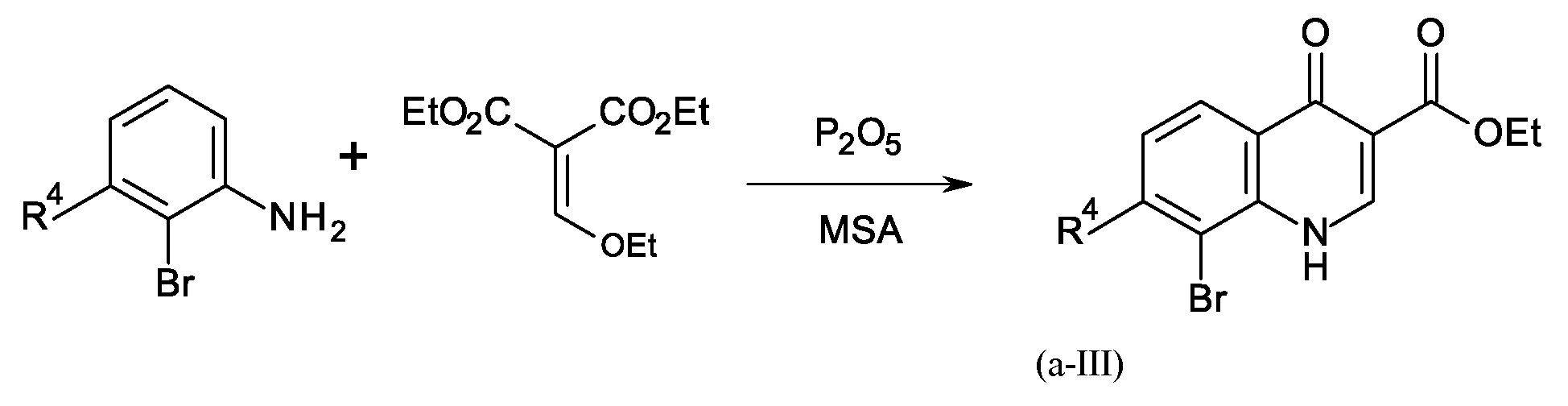
제8 측면에 따르면 본 발명은 하기 화학식의 화합물을 제조하기 위한 본원의 임의의 곳에 기재된 바와 같은 방법에 관한 것이다:According to an eighth aspect the invention relates to a method as described elsewhere herein for preparing a compound of the formula:
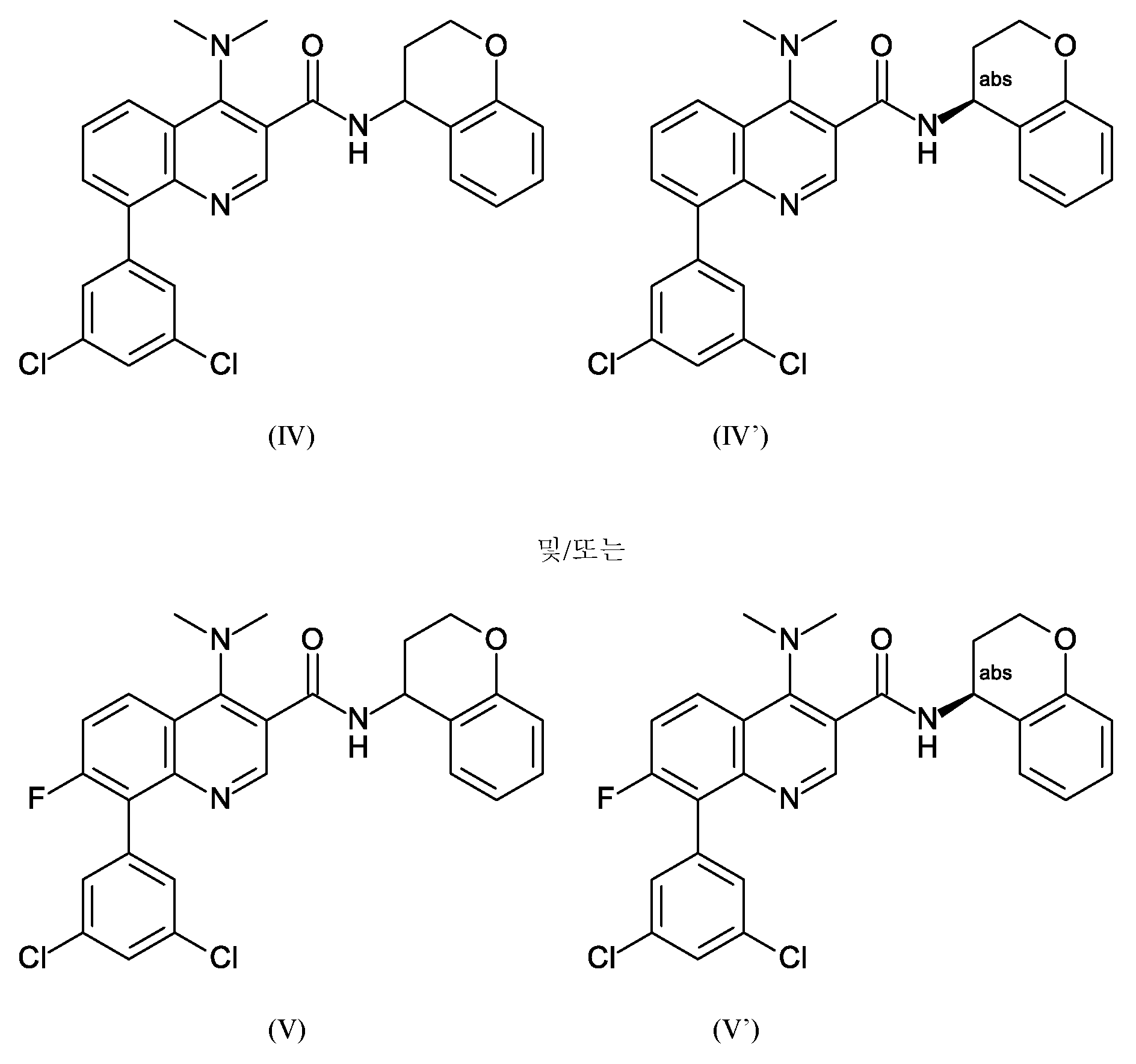
본 발명의 추가의 측면에 따르면 본원에 기재된 바와 같은 방법을, 각각 본원의 임의의 곳에 정의된 바와 같은 공정 단계 B-a, B-b, B-c 및 B-d를 하기 순서로 수행하는 것이 가능하다:According to a further aspect of the invention it is possible to carry out the process as described herein, each of the process steps B-a, B-b, B-c and B-d as defined elsewhere herein in the following order:
공정 단계가 공정 단계 B-b로 출발하여, 이어서 공정 단계 B-a, 이어서 공정 단계 B-c, 이어서 공정 단계 B-d의 순서로 수행되는 것인 본 발명에 따른 방법.The process according to the invention, wherein the process steps start with process steps B-b, followed by process steps B-a, then process steps B-c, followed by process steps B-d.
공정 단계가 공정 단계 B-b로 출발하여, 이어서 공정 단계 B-c, 이어서 공정 단계 B-d, 이어서 공정 단계 B-a의 순서로 수행되는 것인 본 발명에 따른 방법.The process according to the invention, wherein the process steps start with process steps B-b, followed by process steps B-c, then process steps B-d, followed by process steps B-a.
공정 단계가 공정 단계 B-b로 출발하여, 이어서 공정 단계 B-c, 이어서 공정 단계 B-a, 이어서 공정 단계 B-d의 순서로 수행되는 것인 본 발명에 따른 방법.The process according to the invention, wherein the process steps start with process steps B-b, followed by process steps B-c, then process steps B-a, followed by process steps B-d.
공정 단계가 공정 단계 B-c로 출발하여, 이어서 공정 단계 B-d, 이어서 공정 단계 B-a, 이어서 공정 단계 B-b의 순서로 수행되는 것인 본 발명에 따른 방법.The process according to the invention, wherein the process steps start with process steps B-c, followed by process steps B-d, then process steps B-a, followed by process steps B-b.
공정 단계가 공정 단계 B-c로 출발하여, 이어서 공정 단계 B-d, 이어서 공정 단계 B-b, 이어서 공정 단계 B-a의 순서로 수행되는 것인 본 발명에 따른 방법.The process according to the invention, wherein the process steps start with process steps B-c, followed by process steps B-d, then process steps B-b, followed by process steps B-a.
공정 단계가 공정 단계 B-c로 출발하여, 이어서 공정 단계 B-a, 이어서 공정 단계 B-b, 이어서 공정 단계 B-d의 순서로 수행되는 것인 본 발명에 따른 방법.The process according to the invention, wherein the process steps start with process steps B-c, followed by process steps B-a, then process steps B-b, followed by process steps B-d.
공정 단계가 공정 단계 B-c로 출발하여, 이어서 공정 단계 B-a, 이어서 공정 단계 B-d, 이어서 공정 단계 B-b의 순서로 수행되는 것인 본 발명에 따른 방법.The process according to the invention, wherein the process steps start with process steps B-c, followed by process steps B-a, then process steps B-d, followed by process steps B-b.
공정 단계가 공정 단계 B-c로 출발하여, 이어서 공정 단계 B-b, 이어서 공정 단계 B-a, 이어서 공정 단계 B-d의 순서로 수행되는 것인 본 발명에 따른 방법.The process according to the invention, wherein the process steps start with process steps B-c, followed by process steps B-b, then process steps B-a, followed by process steps B-d.
공정 단계가 공정 단계 B-c로 출발하여, 이어서 공정 단계 B-b, 이어서 공정 단계 B-d, 이어서 공정 단계 B-a의 순서로 수행되는 것인 본 발명에 따른 방법.The process according to the invention, wherein the process steps start with process steps B-c, followed by process steps B-b, then process steps B-d, followed by process steps B-a.
상기 언급된 바와 같은 본 발명의 추가의 측면에 따르면, 상기 정의된 바와 같은 공정 단계 A는 상기의 이들 대안적 공정 순서 중 임의의 것 전에 수행될 수 있다. 상기 "본 발명의 방법의 추가의 측면" 하에 언급된 바와 같은, 예를 들어 추가의 세척, 정제, 재결정화, 건조 등을 포함하는 추가적인 공정 단계가 마찬가지로 본원에 기재된 바와 같이 확실히 수행될 수 있다.According to a further aspect of the invention as mentioned above, process step A as defined above can be carried out before any of these alternative process sequences above. Additional process steps, as mentioned above under "Additional Aspects of the Process of the Invention", including, for example, further washing, purification, recrystallization, drying, etc. can likewise certainly be carried out as described herein.
제9 측면에 따르면, 본 발명은 본원의 임의의 곳에 정의된 바와 같은 공정 단계 B-a에 이어서, 생성된 화합물의 단리 및 임의적으로 정제를 수행함으로써 상기 정의된 바와 같은 하기 화학식에 따른 중간체 화합물:According to a ninth aspect, the present invention provides an intermediate compound according to the formula as defined above by carrying out process step B-a as defined elsewhere herein followed by isolation and optionally purification of the resulting compound:

및/또는 하기 화학식을 갖는 중간체 화합물:And/or an intermediate compound having the formula:

을 제조하는 방법에 관한 것이다. 여기서, 단리는 특히 고체 형태로의 회수를 의미한다.It relates to a method of manufacturing. Isolation here means in particular recovery in solid form.
추가의 측면에 따르면, 본 발명은 본원의 임의의 곳에 정의된 바와 같은 공정 단계 A에 이어서, 생성된 화합물의 단리 및 임의적으로 정제를 수행함으로써 하기 화학식에 따른 중간체 화합물:According to a further aspect, the present invention provides an intermediate compound according to the formula by following process step A as defined elsewhere herein, followed by isolation and optionally purification of the resulting compound:

을 제조하는 방법에 관한 것이다. 여기서, 단리는 특히 고체 형태로의 회수를 의미한다.It relates to a method of manufacturing. Isolation here means in particular recovery in solid form.
제10 측면에 따르면, 본 발명은 본원의 임의의 곳에 정의된 바와 같은 공정 단계 B-b에 이어서, 생성된 화합물의 단리 및 임의적으로 정제를 수행함으로써 상기 정의된 바와 같은 하기 화학식에 따른 중간체 화합물:According to a tenth aspect, the present invention provides an intermediate compound according to the formula as defined above by carrying out the isolation and optionally purification of the resulting compound following process steps B-b as defined elsewhere herein:
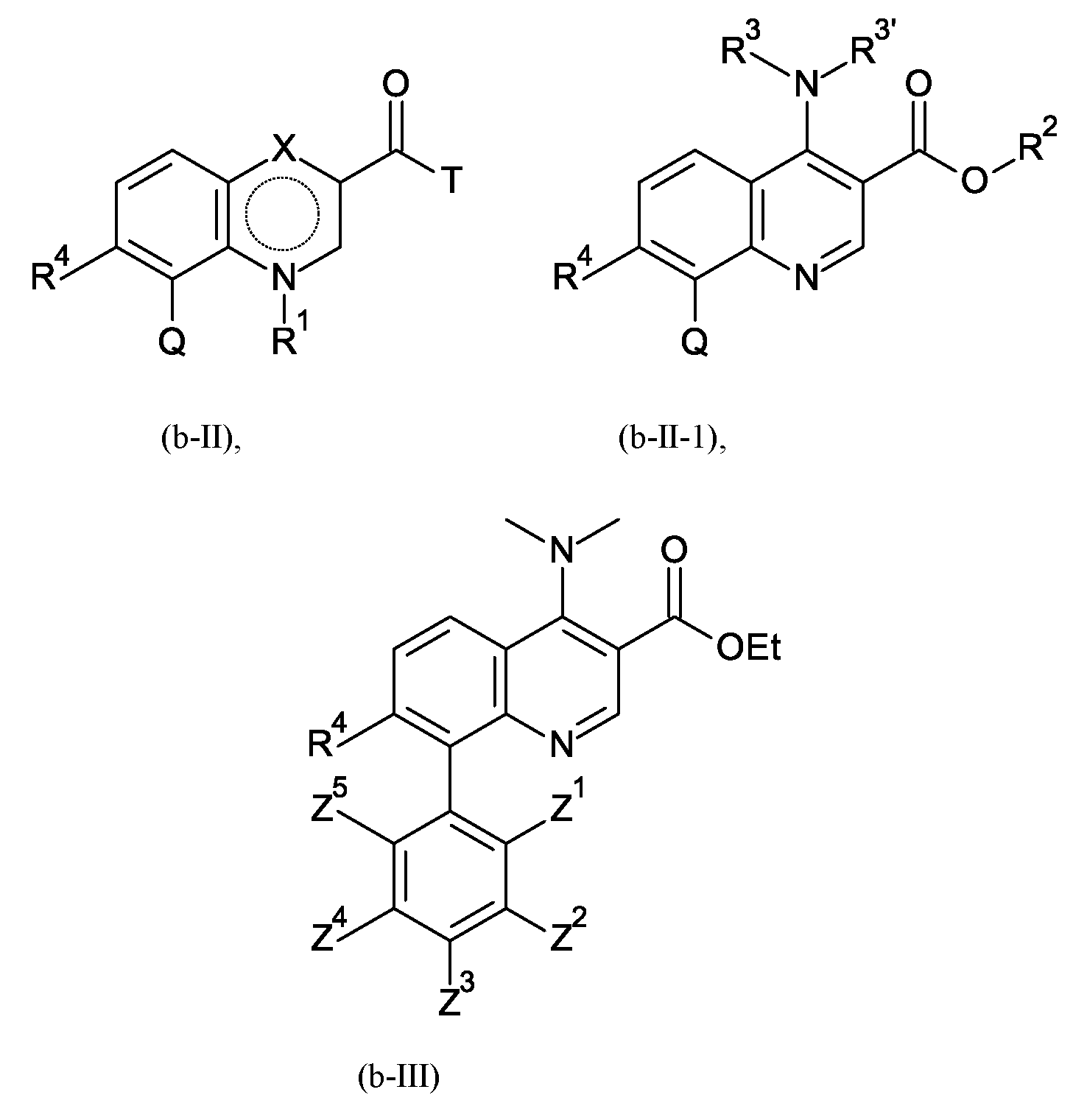
및/또는 하기 화학식을 갖는 중간체 화합물:And/or an intermediate compound having the formula:

(여기서 Z1 내지 Z5는 상기 정의된 바와 같은 의미를 가짐)(Where Z 1 to Z 5 have the same meaning as defined above)
을 제조하는 방법에 관한 것이다. 여기서, 단리는 특히 고체 형태로의 회수를 의미한다.It relates to a method of manufacturing. Isolation here means in particular recovery in solid form.
제11 측면에 따르면, 본 발명은 본원의 임의의 곳에 정의된 바와 같은 공정 단계 B-c에 이어서, 생성된 화합물의 단리 및 임의적으로 정제를 수행함으로써 상기 정의된 바와 같은 하기 화학식에 따른 중간체 화합물:According to an eleventh aspect, the invention provides an intermediate compound according to the formula as defined above by carrying out process steps B-c as defined elsewhere herein, followed by isolation and optionally purification of the resulting compound:
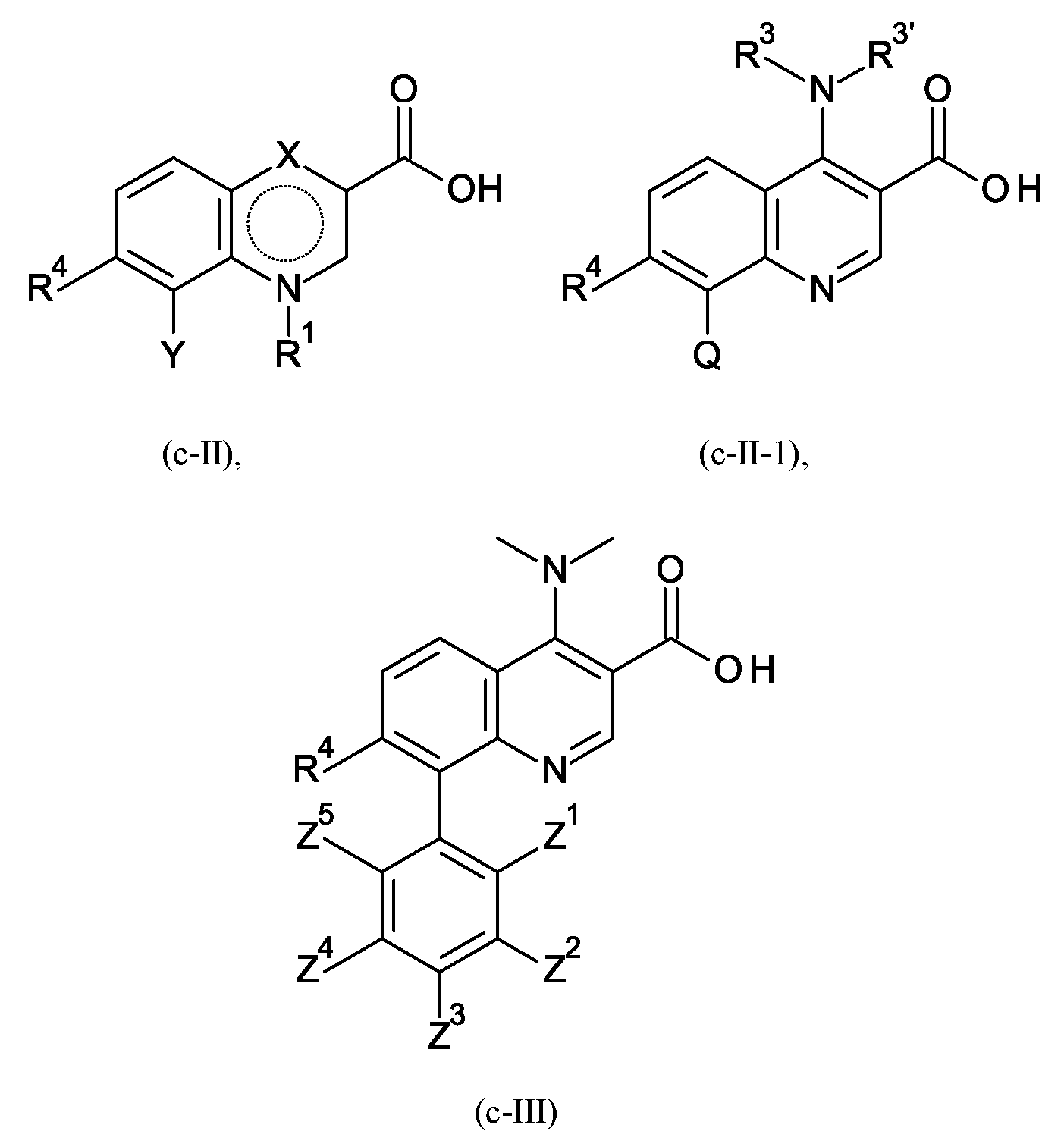
및/또는 하기 화학식을 갖는 중간체 화합물:And/or an intermediate compound having the formula:

(여기서 Z1 내지 Z5는 상기 정의된 바와 같은 의미를 가짐)(Where Z 1 to Z 5 have the same meaning as defined above)
을 제조하는 방법에 관한 것이다. 여기서, 단리는 특히 고체 형태로의, 바람직하게는 미네랄 산 염으로서의, 바람직하게는 HCl 염으로서의 회수를 의미한다.It relates to a method of manufacturing. Isolation here means in particular recovery in solid form, preferably as a mineral acid salt, preferably as an HCl salt.
제12 측면에 따르면, 본 발명은 본원의 임의의 곳에 정의된 바와 같은 공정 단계 B-d에 이어서, 생성된 화합물의 단리 및 임의적으로 정제를 수행함으로써 상기 정의된 바와 같은 하기 화학식에 따른 중간체 화합물:According to a twelfth aspect, the invention provides an intermediate compound according to the formula as defined above by carrying out process steps B-d as defined elsewhere herein, followed by isolation and optionally purification of the resulting compound:
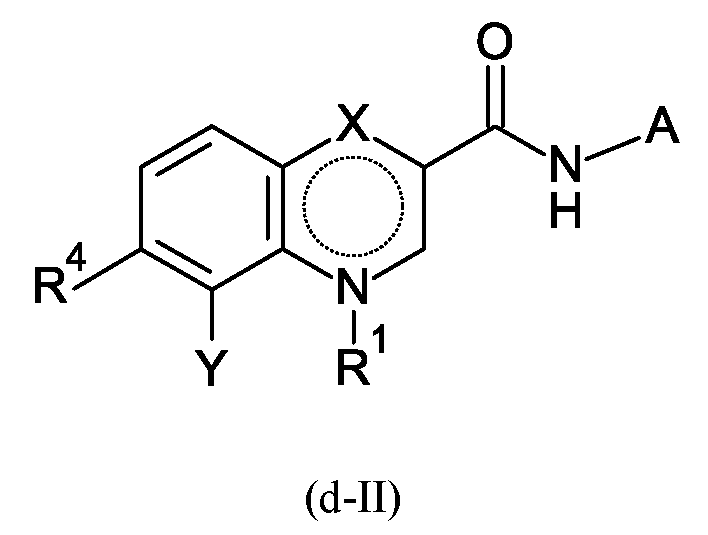
을 제조하는 방법에 관한 것이다. 여기서, 단리는 특히 고체 형태로의 회수를 의미한다. 상기 제11 측면에서, 상기 단계 B-d가 본 발명의 화학식 (II) 또는 (III)의 화합물을 생성할 최종 공정 단계로서 수행되지 않는 경우에만 중간체 화합물이 달성될 수 있다는 것이 통상의 기술자에게 명백하다.It relates to a method of manufacturing. Isolation here means in particular recovery in solid form. In the eleventh aspect, it is apparent to those skilled in the art that the intermediate compound can be achieved only when the steps B-d are not carried out as the final process step to produce the compound of formula (II) or (III) of the present invention.
제9 내지 제12 측면의 특정한 실시양태에서 중간체는 상기 제6 측면에서 정의된 바와 같은 기 A를 갖는 화합물을 사용함으로써 제조되며, 이에 따라 각각의 거울상이성질체 형태의 상기 정의된 바와 같은 각각의 중간체를 제공한다.In certain embodiments of the ninth to twelfth aspects the intermediates are prepared by using a compound having a group A as defined in the sixth aspect above, thereby forming each intermediate as defined above in the respective enantiomeric form. to provide.
제13 측면에 따르면, 본 발명은 상기 정의된 바와 같은 화학식 (a-I-1), (a-II), (a-II-1), (a-III), (a-IV), (a-V), (a-VI), (b-II), (b-II-1), (b-III), (b-IV), (b-V), (c-II), (c-II-1), (c-III), (c-IV), (c-V) 및 (d-II) 중 임의의 것에 따른 중간체 화합물 또는 그의 각각의 거울상이성질체 형태 (상기 제6 측면에서 정의된 바와 같은 기 A를 갖는 화합물을 사용함으로써 수득가능함)에 관한 것이다.According to the thirteenth aspect, the present invention provides formulas (aI-1), (a-II), (a-II-1), (a-III), (a-IV), (aV) as defined above. , (a-VI), (b-II), (b-II-1), (b-III), (b-IV), (bV), (c-II), (c-II-1) , an intermediate compound according to any of (c-III), (c-IV), (cV) and (d-II) or its respective enantiomeric form (having a group A as defined in the sixth aspect above. Which is obtainable by using a compound).
제14 측면에 따르면, 본 발명은 화학식 (II), (III), (IV) 및/또는 (V)에 따른 화합물 또는 그의 각각의 거울상이성질체 형태 (상기 제6 측면에서 정의된 바와 같은 기 A를 갖는 화합물을 사용함으로써 수득가능함), 예컨대 특히 상기 정의된 바와 같은 화학식 (IV') 및/또는 (V')에 따른 화합물을 제조하기 위한, 상기 정의된 바와 같은 또는 상기 정의된 바와 같은 방법에 의해 수득가능한 바와 같은 중간체 화합물의 용도에 관한 것이다.According to a fourteenth aspect, the present invention comprises a compound according to formulas (II), (III), (IV) and/or (V) or their respective enantiomeric forms (group A as defined in the sixth aspect above). Obtainable by using a compound having), such as by a method as defined above or as defined above, in particular for preparing a compound according to formula (IV') and/or (V') as defined above Relates to the use of intermediate compounds as obtainable.
제15 측면에 따르면, 본 발명은, 각각 상기 정의된 바와 같은 화학식 (b-II), (b-II-1), (b-III), (b-IV), (b-V), (c-II), (c-II-1), (c-III), (c-IV), (c-V) 및 (d-II)에 따른 중간체 화합물, 뿐만 아니라 그의 각각의 거울상이성질체 형태 (상기 제6 측면에서 정의된 바와 같은 기 A를 갖는 화합물을 사용함으로써 수득가능함)를 제조하기 위한, 상기 정의된 바와 같은 또는 상기 정의된 바와 같은 방법에 의해 수득가능한 바와 같은 화학식 (a-I-1), (a-II), (a-II-1), (a-III), (a-IV), (a-V) 및 (a-VI)에 따른 중간체 화합물의 용도에 관한 것이다.According to a fifteenth aspect, the present invention provides formulas (b-II), (b-II-1), (b-III), (b-IV), (bV), (c-) as defined above, respectively. II), (c-II-1), (c-III), (c-IV), (cV) and intermediate compounds according to (d-II), as well as their respective enantiomeric forms (the sixth aspect above Formulas (aI-1), (a-II as defined above or obtainable by a method as defined above) for preparing a compound having a group A as defined in ), (a-II-1), (a-III), (a-IV), (aV) and (a-VI).
제16 측면에 따르면, 본 발명은, 각각 상기 정의된 바와 같은 화학식 (a-I-1), (a-II), (a-II-1), (a-III), (a-IV), (a-V), (a-VI), (c-II), (c-II-1), (c-III), (c-IV), (c-V) 및 (d-II)에 따른 중간체 화합물, 뿐만 아니라 그의 각각의 거울상이성질체 형태 (상기 제6 측면에서 정의된 바와 같은 기 A를 갖는 화합물을 사용함으로써 수득가능함)를 제조하기 위한, 상기 정의된 바와 같은 또는 상기 정의된 바와 같은 방법에 의해 수득가능한 바와 같은 화학식 (b-II), (b-II-1), (b-III), (b-IV) 및 (b-V)에 따른 중간체 화합물의 용도에 관한 것이다.According to the sixteenth aspect, the present invention provides formulas (aI-1), (a-II), (a-II-1), (a-III), (a-IV), ( intermediate compounds according to aV), (a-VI), (c-II), (c-II-1), (c-III), (c-IV), (cV) and (d-II), as well as As well as obtainable by a method as defined above or as defined above for preparing its respective enantiomeric form (obtainable by using a compound having group A as defined in the sixth aspect above) The same relates to the use of intermediate compounds according to the formulas (b-II), (b-II-1), (b-III), (b-IV) and (bV).
제17 측면에 따르면, 본 발명은, 각각 상기 정의된 바와 같은 화학식 (a-I-1), (a-II), (a-II-1), (a-III), (a-IV), (a-V), (a-VI), (b-II), (b-II-1), (b-III), (b-IV), (b-V) 및 (d-II)에 따른 중간체 화합물, 뿐만 아니라 그의 각각의 거울상이성질체 형태 (상기 제6 측면에서 정의된 바와 같은 기 A를 갖는 화합물을 사용함으로써 수득가능함)를 제조하기 위한, 상기 정의된 바와 같은 또는 상기 정의된 바와 같은 방법에 의해 수득가능한 바와 같은 화학식 (c-II), (c-II-1), (c-III), (c-IV) 및 (c-V)에 따른 중간체 화합물의 용도에 관한 것이다.According to the seventeenth aspect, the present invention provides formulas (aI-1), (a-II), (a-II-1), (a-III), (a-IV), ( intermediate compounds according to aV), (a-VI), (b-II), (b-II-1), (b-III), (b-IV), (bV) and (d-II), as well as As well as obtainable by a method as defined above or as defined above for preparing its respective enantiomeric form (obtainable by using a compound having group A as defined in the sixth aspect above) The same relates to the use of intermediate compounds according to the formula (c-II), (c-II-1), (c-III), (c-IV) and (cV).
제18 측면에 따르면, 본 발명은, 각각 상기 정의된 바와 같은 화학식 (a-I-1), (a-II), (a-II-1), (a-III), (a-IV), (a-V), (a-VI), (b-II), (b-II-1), (b-III), (b-IV), (b-V), (c-II), (c-II-1), (c-III), (c-IV) 및 (c-V)에 따른 중간체 화합물, 뿐만 아니라 그의 각각의 거울상이성질체 형태 (상기 제6 측면에서 정의된 바와 같은 기 A를 갖는 화합물을 사용함으로써 수득가능함)를 제조하기 위한, 상기 정의된 바와 같은 또는 상기 정의된 바와 같은 방법에 의해 수득가능한 바와 같은 화학식 (d-II)에 따른 중간체 화합물의 용도에 관한 것이다.According to the eighteenth aspect, the present invention provides formulas (aI-1), (a-II), (a-II-1), (a-III), (a-IV), ( aV), (a-VI), (b-II), (b-II-1), (b-III), (b-IV), (bV), (c-II), (c-II- 1) obtained by using intermediate compounds according to, (c-III), (c-IV) and (cV), as well as their respective enantiomeric forms (compounds having group A as defined in the sixth aspect above) Possible) to the use of intermediate compounds according to formula (d-II) as defined above or as obtainable by a method as defined above.
실험 섹션Experiment section
본 출원에 기재된 본 발명의 다양한 측면은 하기 실시예에 의해 예시되며, 이는 어떠한 방식으로도 본 발명을 제한하는 것으로 의도되지 않는다.The various aspects of the invention described in this application are illustrated by the following examples, which are not intended to limit the invention in any way.
실험 섹션 - 일반적 파트Experimental section-general part
그에 대한 합성이 실험 파트에 기재되지 않은, 모든 시약은 상업적으로 입수가능하거나, 또는 공지된 화합물이거나, 또는 관련 기술분야의 통상의 기술자에 의해 공지된 방법에 의해 공지된 화합물로부터 형성될 수 있다.For which synthesis is not described in the experimental part, all reagents are commercially available, or are known compounds, or can be formed from known compounds by methods known by one of ordinary skill in the art.
실시예 1 - N-[(4S)-크로만-4-일]-8-(3,5-디클로로페닐)-4-(디메틸아미노)퀴놀린-3-카르복스아미드의 합성Example 1-Synthesis of N-[(4S)-chroman-4-yl]-8-(3,5-dichlorophenyl)-4-(dimethylamino)quinoline-3-carboxamide
실시예 1의 목적 화합물은 화학식 (IV')를 갖는 화합물이며, 이는 2-브로모아닐린 및 공정 단계 A로 개시하여, 이어서 공정 단계 B-a, B-b, B-c 및 B-d의 이러한 특정한 순서로 5 단계를 통해 제조된다:The target compound of Example 1 is a compound having the formula (IV'), which begins with 2-bromoaniline and process step A, followed by 5 steps in this particular sequence of process steps Ba, Bb, Bc and Bd. Is manufactured:

공정 단계 A:Process Step A:
제1 단계에서, 2-브로모아닐린을 디에틸 2-(에톡시메틸렌)프로판디오에이트 (DEMP)와 축합시켜 에틸 8-브로모-4-옥소-1H-퀴놀린-3-카르복실레이트를 90% 수율 (96 w% 순도)로 제공한다.In the first step, 2-bromoaniline is condensed with diethyl 2-(ethoxymethylene)propanedioate (DEMP) to obtain ethyl 8-bromo-4-oxo-1H-quinoline-3-carboxylate. % Yield (96 w% purity).

가열가능한 적하 깔때기, 환류 응축기, 기계적 교반기 및 온도계가 장착된 4구 둥근 바닥 플라스크 A (4000 mL)에 메탄술폰산 3.383 kg을 넣었다. 산을 125℃의 내부 온도로 가열하였다. 산에 오산화인 0.508 kg을 첨가하였다. 완전한 용해 (1시간) 후에 오산화인 0.508 kg의 추가 분량을 2시간에 걸쳐 용액에 투입하였다. 용해 과정 동안, 증류 헤드 및 온도계가 장착된 또 다른 2구 둥근 바닥 플라스크 B (1000 mL)에 디에틸 2-(에톡시메틸렌)프로판디오에이트 0.660 kg 및 2-브로모아닐린 0.500 kg을 충전하였다. 혼합물을 교반 하에 120℃의 내부 온도로 가열하고, HPLC 측정이 고리화 전구체로의 완전 전환을 나타낼 때까지 4시간에 걸쳐 에탄올을 증류시키고, 에탄올 125 mL를 수집하였다. 이어서, 혼합물로부터 잔류 에탄올 25 mL를 제거하기 위해 압력을 70 mbar로 감소시켰다. 이후에, 용기 B의 내용물을, 100℃의 재킷 온도로 예열된 용기 A의 적하 깔때기에 채웠다. 이어서, 전구체를 80℃의 내부 온도에서 1시간의 기간에 걸쳐 플라스크 B에 투입하였다. 생성된 암색 용액을 HPLC 측정이 완전 전환을 나타낼 때까지 1시간 더 추가로 교반하였다. 이어서, 암색 용액을 얼음 7.500 kg 상으로 첨가하고, 생성된 슬러리를 황색 현탁액이 수득될 때까지 교반하였다. 내부 온도가 30℃를 초과하지 않도록 하여 교반 하에 소다액 (33 w%) 3.524 kg을 현탁액에 첨가하였다. 이후에, 고체를 여과하고, pH 중성 세척액이 수득될 때까지 탈이온수 3.000 kg으로 세척하였다. 이어서, 고체를 세척액이 황색빛 색상으로 연해질 때까지 아세토니트릴 1.950 kg으로 세척하였다. 이어서, 황색 모래질 고체를 진공 하에 건조시켰다.3.383 kg of methanesulfonic acid was placed in a 4 neck round bottom flask A (4000 mL) equipped with a heatable dropping funnel, reflux condenser, mechanical stirrer and thermometer. The acid was heated to an internal temperature of 125°C. 0.508 kg of phosphorus pentoxide was added to the acid. After complete dissolution (1 hour) an additional portion of 0.508 kg of phosphorus pentoxide was added to the solution over 2 hours. During the dissolution process, another two necked round bottom flask B (1000 mL) equipped with a distillation head and thermometer was charged with 0.660 kg of diethyl 2-(ethoxymethylene)propanedioate and 0.500 kg of 2-bromoaniline. The mixture was heated to an internal temperature of 120° C. under stirring, and ethanol was distilled over 4 hours until HPLC measurement indicated complete conversion to the cyclized precursor, and 125 mL of ethanol was collected. The pressure was then reduced to 70 mbar to remove 25 mL of residual ethanol from the mixture. Thereafter, the contents of the container B were filled into the dropping funnel of the container A preheated to a jacket temperature of 100°C. Then, the precursor was added to flask B over a period of 1 hour at an internal temperature of 80°C. The resulting dark solution was stirred for an additional 1 hour until HPLC measurement indicated complete conversion. Then, the dark solution was added onto 7.500 kg of ice and the resulting slurry was stirred until a yellow suspension was obtained. 3.524 kg of soda solution (33 w%) was added to the suspension under stirring so that the internal temperature did not exceed 30°C. Thereafter, the solid was filtered and washed with 3.000 kg of deionized water until a pH neutral washing liquid was obtained. The solid was then washed with 1.950 kg of acetonitrile until the washing liquid turned yellowish in color. The yellow sandy solid was then dried under vacuum.
Q-NMR-분석을 통해 결정된 바와 같이, 남아있는 0.792 kg 고체는 96 w%의 에틸 8-브로모-4-옥소-1H-퀴놀린-3-카르복실레이트를 함유하며, 이는 0.760 kg의 순수한 생성물 및 90%의 수율에 상응한다.As determined through Q-NMR-analysis, the remaining 0.792 kg solid contains 96 w% of ethyl 8-bromo-4-oxo-1H-quinoline-3-carboxylate, which is 0.760 kg of pure product. And a yield of 90%.
1H-NMR (DMSO-d6, 400 MHz) δ (ppm) = 11.62 (bs, 1H), 8.45 (d, J = 8.0 Hz, 1H), 8.18 (d, J = 8.0 Hz, 1H), 8.05 (d, J = 8.0 Hz, 1H), 7.36 (dd, J = 8.0, 8.0 Hz, 1H), 4.24 (q, J = 7.0 Hz, 2H), 1.29 (t, J = 7.0 Hz, 3H). 1 H-NMR (DMSO-d6, 400 MHz) δ (ppm) = 11.62 (bs, 1H), 8.45 (d, J = 8.0 Hz, 1H), 8.18 (d, J = 8.0 Hz, 1H), 8.05 ( d, J = 8.0 Hz, 1H), 7.36 (dd, J = 8.0, 8.0 Hz, 1H), 4.24 (q, J = 7.0 Hz, 2H), 1.29 (t, J = 7.0 Hz, 3H).
공정 단계 B-a:Process Step B-a:
에틸 8-브로모-4-옥소-1H-퀴놀린-3-카르복실레이트를 제2 단계에서 티오닐클로라이드로의 탈히드록시염소화 및 디메틸아민으로의 후속 아미드화에 적용하여 단축된 방식으로 93% 수율 (96 w% 순도)로 에틸 8-브로모-4-(디메틸아미노)퀴놀린-3-카르복실레이트를 생성한다.93% in a shortened manner by applying ethyl 8-bromo-4-oxo-1H-quinoline-3-carboxylate in a second step to dehydroxychlorination to thionylchloride and subsequent amidation to dimethylamine Yield (96 w% purity) yields ethyl 8-bromo-4-(dimethylamino)quinoline-3-carboxylate.

적하 깔때기, 균압기를 갖는 환류 응축기, 기계적 교반기 및 온도계가 장착된 4구 둥근 바닥 플라스크 (4000 mL)에 에틸 8-브로모-4-옥소-1H-퀴놀린-3-카르복실레이트 (순도: 96.7 w%) 500.0 g, N,N-디이소프로필포름아미드 1.65 g 및 톨루엔 1500.0 g을 넣었다. 현탁액을 완만하게 혼합하면서 100℃의 내부 온도로 가열하였다. 상기 온도에 도달한 후에 티오닐 클로라이드 223.4 g을 1.5 h의 기간에 걸쳐 혼합물에 투입하였다. 투입이 완료된 후에, 혼합물을 HPLC 측정이 클로로-치환된 중간체로의 완전 전환을 나타낼 때까지 추가로 1.5 h 동안 교반하였다. 이후에, 총 250 mL의 잔류 티오닐 클로라이드, 염화수소 및 약간의 톨루엔을 증류시켜 잘 혼합할 수 있는 암색 용액을 수득하였으며, 이를 40℃의 내부 온도로 냉각시켰다. 환류 응축기를 pH 전극을 통해 대체하였다. 이어서, 디메틸아민 (물 중 40 w%) 248.4 g을 30분 이내에 용액에 투입하였다. pH를 9-10의 범위에서 유지하도록 총 365.0 g의 소다액 (15 w%)으로 조정하였다. 혼합물을 HPLC 측정이 완전 전환을 나타낼 때까지 40℃에서 추가로 2.0 h 동안 교반하였다. 이어서, 혼합물을 25℃로 냉각시킨 다음, 톨루엔 600 mL 및 탈이온수 1000 mL의 혼합물에 첨가하였다. 상 분리 후에 유기 상을 각각 반-농축된 염수 (13 w%) 600 mL로 2회 세척하였다. 합한 수성 상을 폐기하였다. 이어서, 유기 상을 20 w% 수성 염산 100 mL 및 탈이온수 400 mL의 혼합물로 1회 추출하고, 20 w% 수성 염산 100 mL 및 탈이온수 200 mL의 혼합물로 재차 추출하였다. 이어서, 유기 상을 폐기하였다. 최종적으로, 합한 수성 상을 완전한 생성물 침전을 위해 pH = 10에 도달하도록 총 640 g의 15 w% 소다액의 첨가를 통해 중화시켰다. 고체를 여과하고, 세척액이 할라이드-무함유가 될 때까지 총 2500 mL의 탈이온수로 세척하였다. 고체를 담황색을 띠도록 진공 하에 건조시켰다.Ethyl 8-bromo-4-oxo-1H-quinoline-3-carboxylate (purity: 96.7) in a four neck round bottom flask (4000 mL) equipped with dropping funnel, reflux condenser with equalizer, mechanical stirrer and thermometer. w%) 500.0 g, N,N-diisopropylformamide 1.65 g and toluene 1500.0 g were added. The suspension was heated to an internal temperature of 100° C. with gentle mixing. After reaching this temperature 223.4 g of thionyl chloride were added to the mixture over a period of 1.5 h. After the addition was complete, the mixture was stirred for an additional 1.5 h until HPLC measurement indicated complete conversion to the chloro-substituted intermediate. Thereafter, a total of 250 mL of residual thionyl chloride, hydrogen chloride, and some toluene were distilled to obtain a dark solution that could be well mixed, which was cooled to an internal temperature of 40°C. The reflux condenser was replaced via a pH electrode. Then, 248.4 g of dimethylamine (40 w% in water) was added to the solution within 30 minutes. The pH was adjusted with a total of 365.0 g of soda solution (15 w%) to maintain the pH in the range of 9-10. The mixture was stirred for an additional 2.0 h at 40° C. until HPLC measurement indicated complete conversion. The mixture was then cooled to 25° C. and then added to a mixture of 600 mL of toluene and 1000 mL of deionized water. After phase separation, the organic phase was washed twice with 600 mL of semi-concentrated brine (13 w%), respectively. The combined aqueous phase was discarded. Then, the organic phase was extracted once with a mixture of 100 mL of 20 w% aqueous hydrochloric acid and 400 mL of deionized water, and extracted again with a mixture of 100 mL of 20 w% aqueous hydrochloric acid and 200 mL of deionized water. Then the organic phase was discarded. Finally, the combined aqueous phases were neutralized via the addition of a total of 640 g of 15 w% soda liquor to reach pH = 10 for complete product precipitation. The solid was filtered and washed with a total of 2500 mL of deionized water until the wash was halide-free. The solid was dried under vacuum to give it a pale yellow color.
Q-NMR-분석을 통해 결정된 바와 같이, 남아있는 0.506 kg 고체는 96.6 w%의 에틸 8-브로모-4-(디메틸아미노)퀴놀린-3-카르복실레이트를 함유하였으며, 이는 0.489 kg의 순수한 생성물 및 93%의 수율에 상응한다.As determined via Q-NMR-analysis, the remaining 0.506 kg solids contained 96.6 w% of ethyl 8-bromo-4-(dimethylamino)quinoline-3-carboxylate, which was 0.489 kg of pure product. And 93% yield.
1H-NMR (DMSO-d6, 600 MHz) δ (ppm) = 8.83 (s, 1H), 8.22 (d, J = 8.0 Hz, 1H), 8.15 (d, J = 8.0 Hz, 1H), 7.50 (dd, J = 8.0, 8.0 Hz, 1H), 4.40 (q, J = 7.0 Hz, 2H), 3.06 (s, 6H), 1.37 (t, J = 7.0 Hz, 3H). 1 H-NMR (DMSO-d6, 600 MHz) δ (ppm) = 8.83 (s, 1H), 8.22 (d, J = 8.0 Hz, 1H), 8.15 (d, J = 8.0 Hz, 1H), 7.50 ( dd, J = 8.0, 8.0 Hz, 1H), 4.40 (q, J = 7.0 Hz, 2H), 3.06 (s, 6H), 1.37 (t, J = 7.0 Hz, 3H).
공정 단계 B-b:Process steps B-b:
이어서, 에틸 8-브로모-4-(디메틸아미노)퀴놀린-3-카르복실레이트를 스즈키-반응으로 3,5-디클로로페닐보론산과 커플링시켜 에틸 8-(3,5-디클로로페닐)-4-(디메틸아미노)퀴놀린-3-카르복실레이트를 제공한다:Subsequently, ethyl 8-bromo-4-(dimethylamino)quinoline-3-carboxylate was coupled with 3,5-dichlorophenylboronic acid by Suzuki-reaction to obtain ethyl 8-(3,5-dichlorophenyl)-4. -(Dimethylamino)quinoline-3-carboxylate gives:

균압기를 갖는 환류 응축기, 기계적 교반기 및 온도계가 장착된 4구 둥근 바닥 플라스크 (4000 mL)에 에틸 8-브로모-4-(디메틸아미노)퀴놀린-3-카르복실레이트 (순도: 96.9) 167.9 g, MTBE 2.375 kg (3.209 L), H2O 0.687 kg, K2CO3 139.2 g 및 3,5-디클로로페닐보론산 100 g을 상기 순서로 넣었다. 반응 혼합물을 30분 동안 교반 하에 아르곤으로 퍼징하였다. 그 후에, Pd(acac)2 0.920 g 및 HP(t-Bu)3BF4 0.876 g을 첨가하였다. 반응 혼합물을 아르곤의 완만한 플러싱 하에 교반하면서 54℃의 내부 온도 (환류)로 가열하였다. 6시간 후에 HPLC 측정은 완전 전환을 나타내었다. 혼합물을 20℃로 냉각시켰다. 상 분리 및 펄프 상의 수성 층으로의 할당 후에, 유기 상을 MgSO4 15 g 상에서 건조시키고, 건조제를 여과하였다. 용액으로부터 MTBE 1.500 L를 증류시켰다. 이어서, 용액에 EtOH 425 mL를 첨가하였다. 잔류 MTBE를 주위 압력 하에 70℃에서 증류시켜 EtOH 중의 생성물 용액을 남겼다. 용액을 22℃로 서서히 냉각시켜, 생성물의 결정화를 유도하였다. 고체를 여과하고, 빙냉 EtOH 100 mL로 세척하였다. 이후에, 황색 고체를 진공 하에 건조시켰다. 합한 모액 및 세척액의 HPLC 내부 표준 방법론을 통한 생성물 함량 분석은 여과물 중 24.79 g의 에틸 8-(3,5-디클로로페닐)-4-(디메틸아미노)퀴놀린-3-카르복실레이트를 제시하였으며, 이는 13%의 수율에 상응한다.167.9 g of ethyl 8-bromo-4-(dimethylamino)quinoline-3-carboxylate (purity: 96.9) in a four neck round bottom flask (4000 mL) equipped with a reflux condenser with a pressure equalizer, a mechanical stirrer and a thermometer. , MTBE 2.375 kg (3.209 L), H 2 O 0.687 kg, K 2 CO 3 139.2 g, and 3,5-dichlorophenylboronic acid 100 g were added in the above order. The reaction mixture was purged with argon under stirring for 30 minutes. After that, 0.920 g of Pd(acac) 2 and 0.876 g of HP(t-Bu) 3 BF 4 were added. The reaction mixture was heated to an internal temperature of 54° C. (reflux) with stirring under gentle flushing of argon. HPLC measurement after 6 hours showed complete conversion. The mixture was cooled to 20°C. After phase separation and assignment to the aqueous layer on the pulp, the organic phase was dried over 15 g MgSO 4 and the desiccant was filtered off. 1.500 L of MTBE was distilled from the solution. Then, 425 mL of EtOH was added to the solution. The residual MTBE was distilled at 70° C. under ambient pressure, leaving a solution of the product in EtOH. The solution was slowly cooled to 22° C. to induce crystallization of the product. The solid was filtered and washed with ice-cold EtOH 100 mL. Thereafter, the yellow solid was dried under vacuum. Product content analysis through HPLC internal standard methodology of the combined mother liquor and washing solution showed 24.79 g of ethyl 8-(3,5-dichlorophenyl)-4-(dimethylamino)quinoline-3-carboxylate in the filtrate, This corresponds to a yield of 13%.
Q-NMR-분석을 통해 결정된 바와 같이, 남아있는 0.165 kg 고체는 99 w%의 에틸 8-(3,5-디클로로페닐)-4-(디메틸아미노)퀴놀린-3-카르복실레이트를 함유하였으며, 이는 0.163 kg의 순수한 생성물 및 83%의 수율에 상응한다.As determined through Q-NMR-analysis, the remaining 0.165 kg solid contained 99 w% of ethyl 8-(3,5-dichlorophenyl)-4-(dimethylamino)quinoline-3-carboxylate, This corresponds to 0.163 kg of pure product and a yield of 83%.
1H-NMR (DMSO-d6, 600 MHz): δ = 8.77 (s, 1H), 8.28 (dd, J = 8.5; 1.4 Hz, 1H), 7.8 (dd, J = 7; 1.4 Hz, 1H), 7.7 (dd, J = 8.5; 7 Hz; 1H), 7.6 (m, 3H), 4.4 (q, J = 7 Hz, 2H), 3.08 (s, 6H), 1.36 (t, J = 7 Hz, 3H) ppm. 1 H-NMR (DMSO-d6, 600 MHz): δ = 8.77 (s, 1H), 8.28 (dd, J = 8.5; 1.4 Hz, 1H), 7.8 (dd, J = 7; 1.4 Hz, 1H), 7.7 (dd, J = 8.5; 7 Hz; 1H), 7.6 (m, 3H), 4.4 (q, J = 7 Hz, 2H), 3.08 (s, 6H), 1.36 (t, J = 7 Hz, 3H ) ppm.
공정 단계 B-c:Process steps B-c:
상기 중간체를 8-(3,5-디클로로페닐)-4-(디메틸아미노)퀴놀린-3-카르복실산 히드로클로라이드로 비누화시킨다:The intermediate is saponified with 8-(3,5-dichlorophenyl)-4-(dimethylamino)quinoline-3-carboxylic acid hydrochloride:

기계적 교반기, 적하 깔때기 및 온도계가 장착된 4구 둥근 바닥 플라스크 (500 mL)에 에틸 8-(3,5-디클로로페닐)-4-(디메틸아미노)퀴놀린-3-카르복실레이트 (순도: 99 w%) 0.048 kg, EtOH 0.175 L (138.3 g)를 넣었다. 농후한 황색빛 현탁액을 50℃의 내부 온도로 가열하고, 기계적 교반기로 교반하였다. 1 h 이내에 수성 NaOH (물 중 10%) 0.096 L를 적하 깔때기를 통해 첨가하였다. 혼합물을 HPLC 분석이 완전 전환을 제시할 때까지 50℃에서 8 h 동안 교반하였다.Ethyl 8-(3,5-dichlorophenyl)-4-(dimethylamino)quinoline-3-carboxylate (purity: 99 w) in a four neck round bottom flask (500 mL) equipped with a mechanical stirrer, dropping funnel and thermometer. %) 0.048 kg, EtOH 0.175 L (138.3 g) was added. The thick yellowish suspension was heated to an internal temperature of 50° C. and stirred with a mechanical stirrer. Within 1 h 0.096 L of aqueous NaOH (10% in water) was added via dropping funnel. The mixture was stirred at 50° C. for 8 h until HPLC analysis indicated complete conversion.
반응 완료 후에 휘발성 물질 0.125 kg을 42℃의 외부 가열 및 80 mbar의 압력에서의 증류를 통해 제거하였다. 0.158 g 백색 현탁액의 남아있는 잔류물에 탈이온수 0.080 L를 25℃에서 교반하면서 첨가하였다. 현탁액을 교반 하에 5℃로 냉각시키고, pH를 HCl (물 중 20%) 0.092 kg의 첨가를 통해 pH=1로 조정하였다. 고체를 5℃에서 여과하고, 빙냉 탈이온수 0.050 L로 세척하였다. 후속적으로, 고체를 아세톤 0.050 L로 세척하였다. 이어서, 필터 케이크를 40℃에서 진공 하에 건조시키고, 생성물을 백색 고체로서 수득하였다.After completion of the reaction, 0.125 kg of volatiles were removed through external heating at 42° C. and distillation at a pressure of 80 mbar. To the remaining residue of 0.158 g white suspension, 0.080 L of deionized water was added with stirring at 25°C. The suspension was cooled to 5° C. under stirring and the pH was adjusted to pH=1 via the addition of 0.092 kg HCl (20% in water). The solid was filtered at 5° C. and washed with 0.050 L of ice-cold deionized water. Subsequently, the solid was washed with 0.050 L of acetone. The filter cake was then dried under vacuum at 40° C. and the product was obtained as a white solid.
Q-NMR-분석을 통해 결정된 바와 같이, 남아있는 0.048 kg 고체는 95 w%의 8-(3,5-디클로로페닐)-4-(디메틸아미노)퀴놀린-3-카르복실산 히드로클로라이드를 함유하였으며, 이는 0.046 kg의 순수한 8-(3,5-디클로로페닐)-4-(디메틸아미노)퀴놀린-3-카르복실산 히드로클로라이드 및 95%의 수율에 상응한다.As determined through Q-NMR-analysis, the remaining 0.048 kg solid contained 95 w% of 8-(3,5-dichlorophenyl)-4-(dimethylamino)quinoline-3-carboxylic acid hydrochloride. , Which corresponds to 0.046 kg of pure 8-(3,5-dichlorophenyl)-4-(dimethylamino)quinoline-3-carboxylic acid hydrochloride and a yield of 95%.
1H-NMR (DMSO-d6, 400 MHz) δ (ppm) = 8.57 (s, 1H), 8.42 (dd, J = 8.5, 1.19 Hz, 1H), 7.87 (dd, J = 7.23, 1.19 Hz, 1H), 7.78 (t, J = 1.83 Hz, 1H), 7.7 (m, 1H), 7.63 (d, J = 1.91 Hz, 2H), 3.44 (s, 6H). 1 H-NMR (DMSO-d6, 400 MHz) δ (ppm) = 8.57 (s, 1H), 8.42 (dd, J = 8.5, 1.19 Hz, 1H), 7.87 (dd, J = 7.23, 1.19 Hz, 1H ), 7.78 (t, J = 1.83 Hz, 1H), 7.7 (m, 1H), 7.63 (d, J = 1.91 Hz, 2H), 3.44 (s, 6H).
공정 단계 B-d:Process steps B-d:
최종적으로, 8-(3,5-디클로로페닐)-4-(디메틸아미노)퀴놀린-3-카르복실산 히드로클로라이드를 CDMT 및 NMM의 이용을 통해 (S)-크로만아민·HCl로 90% 수율 (>99 w% 순도)로 아미드화시킨다.Finally, 90% yield of 8-(3,5-dichlorophenyl)-4-(dimethylamino)quinoline-3-carboxylic acid hydrochloride as (S)-chromanamine·HCl through the use of CDMT and NMM (>99 w% purity).

기계적 교반기, 적하 깔때기 및 온도계가 장착된 4구 둥근 바닥 플라스크 (500 mL)에 8-(3,5-디클로로페닐)-4-(디메틸아미노)퀴놀린-3-카르복실산 히드로클로라이드 (95 w%) 20.0 g, CDMT 11.0 g 및 톨루엔 160 mL를 첨가하였다. 25 min 이내의 NMM 25.0 g의 투입을 통해 현탁액을 35℃의 내부 온도로 가열하고, 이후에 외부 가열로 유지하였다. 첨가가 끝나면 현탁액은 황색으로 변하였고 보다 더 점성이 되었다. 그러나, 점도는 후속적으로 교반 하에 감소한다. 30 min 교반 후에 (S)-크로만-4-아민 히드로클로라이드 10.4 g을 1 분량으로 첨가하였다. 이후에, 현탁액을 HPLC 분석이 99% 전환을 나타낼 때까지 추가로 8시간 동안 교반하였다. 반응 완료 후에, 반응 혼합물을 실온 (20-22℃)으로 냉각시키고, 1구 둥근 바닥 플라스크 (1000 mL)로 전달하였다. 후속적으로, 메틸시클로헥산 320 mL를 첨가하고, 현탁액을 0℃로 냉각시키고, 이 온도에서 30 min 동안 교반하였다. 이어서, 고체를 유리 프릿 (por. 3)을 통해 여과하였다. 필터 케이크를 빙냉 아세토니트릴 100 mL, 수성 수산화나트륨 (5 w%) 100 mL 및 탈이온수 300 mL로 세척하였다. 고체를 진공 (40℃, 70 mbar) 하에 건조시켰다. 이후에, 건조 고체 24.2 g의 전체 양을 MTBE 120 mL 중에 현탁시켰다. 목적하는 다형체의 약간의 결정을 시드로서 첨가하였다. 이후에, 현탁액을 56℃의 외부 가열 하에 4시간 동안 교반하였다. 최종적으로, 현탁액을 22℃로 다시 냉각시키고, 고체를 여과하고, MTBE 20 mL로 세척하였다. 이어서, 생성물을 진공 (40℃, 50-10 mbar) 하에 2시간 동안 건조시켰다. 생성물을 백색 고체로서 수득하였다.8-(3,5-dichlorophenyl)-4-(dimethylamino)quinoline-3-carboxylic acid hydrochloride (95 w%) in a four neck round bottom flask (500 mL) equipped with a mechanical stirrer, dropping funnel and thermometer. ) 20.0 g, CDMT 11.0 g and 160 mL of toluene were added. The suspension was heated to an internal temperature of 35° C. through the injection of 25.0 g of NMM within 25 min, and then maintained by external heating. After the addition, the suspension turned yellow and became more viscous. However, the viscosity subsequently decreases under stirring. After stirring for 30 min, 10.4 g of (S)-chroman-4-amine hydrochloride was added in 1 portion. Thereafter, the suspension was stirred for an additional 8 hours until HPLC analysis indicated 99% conversion. After completion of the reaction, the reaction mixture was cooled to room temperature (20-22° C.) and transferred to a one neck round bottom flask (1000 mL). Subsequently, 320 mL of methylcyclohexane was added and the suspension was cooled to 0° C. and stirred at this temperature for 30 min. The solid was then filtered through a glass frit (por. 3). The filter cake was washed with 100 mL of ice-cold acetonitrile, 100 mL of aqueous sodium hydroxide (5 w%) and 300 mL of deionized water. The solid was dried under vacuum (40° C., 70 mbar). Thereafter, a total amount of 24.2 g of dry solid was suspended in 120 mL of MTBE. Some crystals of the desired polymorph were added as seeds. Thereafter, the suspension was stirred for 4 hours under external heating at 56°C. Finally, the suspension was cooled again to 22° C., the solid was filtered off and washed with 20 mL of MTBE. The product was then dried under vacuum (40° C., 50-10 mbar) for 2 hours. The product was obtained as a white solid.
Q-NMR 및 Q-HPLC 분석을 통해 결정된 바와 같이, 남아있는 22.8 g 고체는 99.1 w%의 (S)-N-(크로만-4-일)-8-(3,5-디클로로페닐)-4-(디메틸아미노)퀴놀린-3-카르복스아미드를 함유하였으며, 이는 21.6 g의 순수한 생성물 및 90%의 수율에 상응한다.As determined through Q-NMR and Q-HPLC analysis, the remaining 22.8 g solid was 99.1 w% of (S)-N-(chroman-4-yl)-8-(3,5-dichlorophenyl)- 4-(dimethylamino)quinoline-3-carboxamide, which corresponds to 21.6 g of pure product and a yield of 90%.
1H-NMR (DMSO-d6, 400 MHz) δ (ppm) = 9.10 (d, J = 8.0 Hz), 8.63 (s, 1H), 8.24 (d, J = 8.0 Hz, 1H), 7.80 (d, J = 8.0 Hz, 1H), 7.67-7.63 (m, 4H), 7.37 (d, J = 8.0 Hz, 1H), 7.17 (dd, J = 8.0, 8.0 Hz, 1H), 6.94 (dd, J = 8.0, 8.0 Hz, 1H), 6.80 (d, J = 8.0 Hz, 1H), 5.79-5.72 (m, 1H), 4.21-4.32 (m, 2H), 3.07 (s, 6H), 2.25-2.15 (m, 1H), 2.09-2.00 (m, 1H). 1 H-NMR (DMSO-d6, 400 MHz) δ (ppm) = 9.10 (d, J = 8.0 Hz), 8.63 (s, 1H), 8.24 (d, J = 8.0 Hz, 1H), 7.80 (d, J = 8.0 Hz, 1H), 7.67-7.63 (m, 4H), 7.37 (d, J = 8.0 Hz, 1H), 7.17 (dd, J = 8.0, 8.0 Hz, 1H), 6.94 (dd, J = 8.0 , 8.0 Hz, 1H), 6.80 (d, J = 8.0 Hz, 1H), 5.79-5.72 (m, 1H), 4.21-4.32 (m, 2H), 3.07 (s, 6H), 2.25-2.15 (m, 1H), 2.09-2.00 (m, 1H).
요약하면, 목적 화합물 (IV')는 2-브로모아닐린으로 개시하여 5 단계에 걸쳐 59%의 전체 수율로 제조될 수 있다.In summary, the target compound (IV') can be prepared in a total yield of 59% over 5 steps starting with 2-bromoaniline.
실시예 2 - N-[(4S)-크로만-4-일]-8-(3,5-디클로로페닐)-4-(디메틸아미노)-7-플루오로-퀴놀린-3-카르복스아미드의 합성Example 2-N-[(4S)-chroman-4-yl]-8-(3,5-dichlorophenyl)-4-(dimethylamino)-7-fluoro-quinoline-3-carboxamide synthesis
실시예 2의 목적 화합물은 화학식 (V')를 갖는 화합물이며, 이는 공정 단계 A에서 2-브로모-3-플루오로-아닐린으로 개시하여 실시예 1에 기재된 것과 동일한 방식으로 제조된다.The target compound of Example 2 is a compound having formula (V'), which is prepared in the same manner as described in Example 1 starting with 2-bromo-3-fluoro-aniline in process step A.
Claims (15)

여기서
Y는 할로겐 또는 Q의 의미를 갖고;
X는 C=O, C-OH 또는 C-NR3R3'의 의미를 갖고;

R1은 X가 C-OH 또는 C-NR3R3'인 경우에는 부재하거나 또는 X가 C=O인 경우에는 수소 원자이고;
R2는 수소 또는 C1-C3-알킬의 의미를 갖고;
R3 및 R3'는 독립적으로 수소 또는 C1-C3-알킬의 의미를 갖거나, 또는
R3 및 R3'는 이들이 결합되어 있는 질소와 함께 모르폴리닐-고리를 형성하고;
R4는 수소 또는 할로겐의 의미를 갖고;
Q는 1 내지 5개의 치환기 Z1 내지 Z5로 치환되는 페닐의 의미를 가지며, 여기서
Z1 내지 Z5는 독립적으로 수소, 할로겐, C1-C4-알킬, 및 1-5개의 할로겐 원자를 갖는 C1-C4-할로게노알킬로부터 선택될 수 있고;
A는 하기로부터 선택된 기이고:

여기서 방법에서 화학식 (II) 내의 기 Q, NR3R3' 및 NH-A는, 임의의 순서로 수행될 수 있으나, 단, 단계 B-d가 단계 B-c 전에 수행되지 않는 것인 단계 B-a, B-b, B-c 및 B-d에 의한 화학식 (I) 내의 기 R2, X 및 Y의 반응에 의해 수득되는 것인 방법:
단계 B-a:

여기서 T는 기 -O-R2 또는 -NH-A를 나타내며, 이때 R2는 수소 또는 C1-C3-알킬이고;
여기서 X는 C=O이고 R1은 수소이거나 또는 X는 C-OH이고 R1은 부재하며, 이는 화학식 (a-I-a) 및 (a-I-b)에 상응하고:
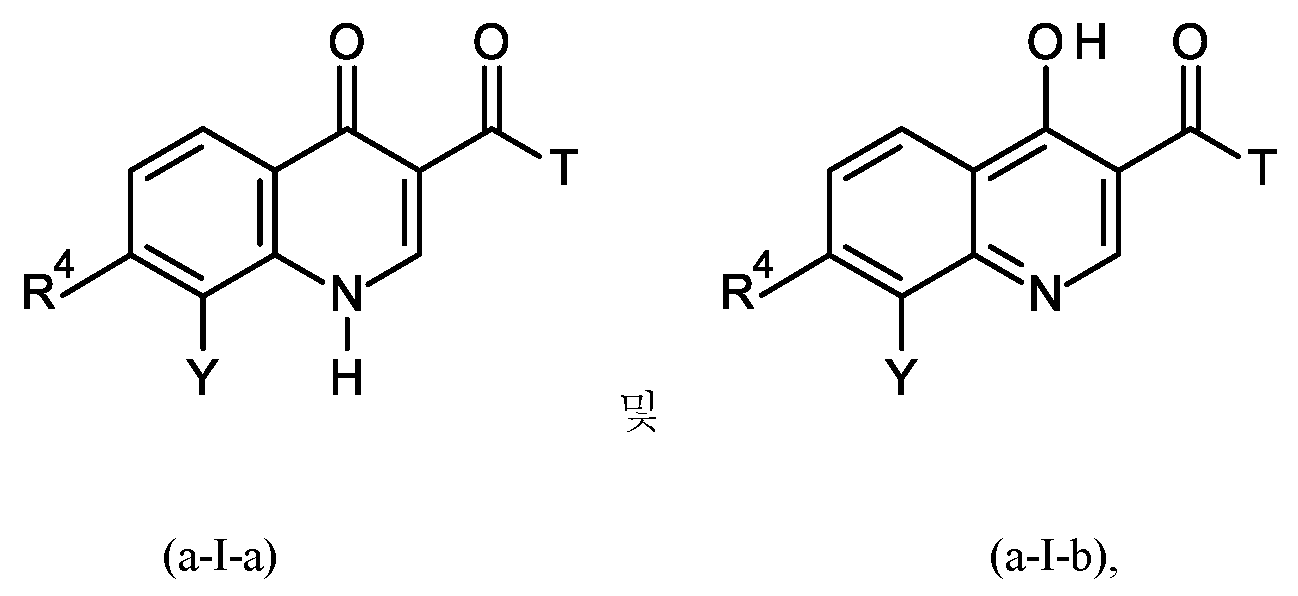
여기서 상기 공정 단계 B-a는 티오닐 클로라이드 (SOCl2)를 사용하여 수행됨;
단계 B-b:

여기서 Y는 할로겐이고, T는 기 -O-R2, -OH 또는 -NH-A를 나타내고, G는 스즈키-반응을 수행하는데 적합한 붕소 화합물을 나타내며, 이때 G는 하기와 같이 정의된 바와 같은 의미를 갖고:
G는 하기 화학식의 붕소 화합물을 나타내거나:
(Q)nB(OH)3-n
(이때
n = , 1, 2 또는 3임),
또는
G는 하기 화학식의 붕소 화합물을 나타내거나:
(Q)4B- M+
(이때
M = 리튬, 나트륨, 또는 칼륨임),
또는
G는 하기 화학식의 붕소 화합물을 나타내거나:
QBF3 -M+
(이때
M = 리튬, 나트륨, 또는 칼륨임),
또는
G는 하기 화학식의 붕소 화합물을 나타냄;

단계 B-c:

여기서 R2는 C1-C3-알킬이고; 여기서 염기는 임의의 알칼리 금속 수산화물 및 알칼리 토금속 수산화물, 뿐만 아니라 임의의 알칼리 금속 탄산염 및 알칼리 토금속 탄산염에 상응하고, 산은 임의의 미네랄 산에 상응함;
단계 B-d:

여기서 상기 공정 단계 B-d는 커플링제로서 DMT-MM을 사용함으로써 수행되고;
여기서 반응 단계 B-a 내지 B-d에서 남아있는 치환기는 각각의 공정 스테이지에 상응하는 의미를 가짐.As a method for preparing a compound according to formula (II) from a compound according to formula (I):
here
Y has the meaning of halogen or Q;
X has the meaning of C=O, C-OH or C-NR 3 R 3' ;
R 1 is absent when X is C-OH or C-NR 3 R 3' , or is a hydrogen atom when X is C=O;
R 2 has the meaning of hydrogen or C 1 -C 3 -alkyl;
R 3 and R 3 'are independently hydrogen or C 1 -C 3 - or has the meaning of alkyl, or
R 3 and R 3 'is morpholinyl, together with the nitrogen to which they are bonded - form a ring;
R 4 has the meaning of hydrogen or halogen;
Q has the meaning of phenyl substituted with 1 to 5 substituents Z 1 to Z 5 , wherein
Z 1 to Z 5 may be independently selected from hydrogen, halogen, C 1 -C 4 -alkyl, and C 1 -C 4 -halogenoalkyl having 1-5 halogen atoms;
A is a group selected from:
In the method wherein the groups Q, NR 3 R 3′ and NH-A in formula (II) may be performed in any order, provided that step Bd is not performed before step Bc. Steps Ba, Bb, Bc And by reaction of the groups R 2 , X and Y in formula (I) by Bd:
Step Ba:
Wherein T represents the group -OR 2 or -NH-A, wherein R 2 is hydrogen or C 1 -C 3 -alkyl;
Wherein X is C=O and R 1 is hydrogen or X is C-OH and R 1 is absent, which corresponds to formulas (aIa) and (aIb):
Wherein the process step Ba is carried out using thionyl chloride (SOCl 2 );
Step Bb:
Where Y is halogen, T represents the group -OR 2 , -OH or -NH-A, and G represents a boron compound suitable for carrying out the Suzuki-reaction, where G has the meaning as defined as follows :
G represents a boron compound of the formula:
(Q) n B(OH) 3-n
(At this time
n =, 1, 2 or 3),
or
G represents a boron compound of the formula:
(Q) 4 B - M +
(At this time
M = lithium, sodium, or potassium),
or
G represents a boron compound of the formula:
QBF 3 - M +
(At this time
M = lithium, sodium, or potassium),
or
G represents a boron compound of the following formula;
Step Bc:
Wherein R 2 is C 1 -C 3 -alkyl; Wherein the base corresponds to any alkali metal hydroxide and alkaline earth metal hydroxide, as well as any alkali metal carbonate and alkaline earth metal carbonate, and the acid corresponds to any mineral acid;
Step Bd:
Wherein the process step Bd is performed by using DMT-MM as a coupling agent;
Here, the substituents remaining in the reaction steps Ba to Bd have a meaning corresponding to each process stage.

여기서 P2O5는 > 1 당량 P2O5의 절대량으로 및 메탄 술폰산 (MSA)에 대한 7.0 내지 23.0 wt.-%의 상대량으로 반응 배치에 존재하는 것인
방법.The method of claim 1, further comprising a preceding step A for preparing a compound according to formula (I):
Where P 2 O 5 is present in the reaction batch in an absolute amount of> 1 equivalent P 2 O 5 and in a relative amount of 7.0 to 23.0 wt.-% to methane sulfonic acid (MSA).
Way.
단계 B-a:

여기서 R2는 C1-C3-알킬이고, R3, R3' 및 R4는 제1항 또는 제2항에 정의된 바와 같은 의미를 갖고;
여기서 X는 C=O이고 R1은 수소이거나 또는 X는 C-OH이고 R1은 부재하며, 이는 화학식 (a-I-c) 및 (a-I-d)에 상응하고:

여기서 상기 공정 단계 B-a는 티오닐 클로라이드 (SOCl2)를 사용하여 수행됨; 이어서
단계 B-b:

여기서 G는 제1항 또는 제2항에 정의된 바와 같은 의미를 갖는, 스즈키-반응을 수행하는데 적합한 붕소 화합물을 나타냄; 이어서
단계 B-c:

여기서 R2는 C1-C3-알킬이고; 여기서 염기는 임의의 알칼리 금속 수산화물 및 알칼리 토금속 수산화물, 뿐만 아니라 임의의 알칼리 금속 탄산염 및 알칼리 토금속 탄산염에 상응하고, 산은 임의의 미네랄 산에 상응함;
이어서
단계 B-d:
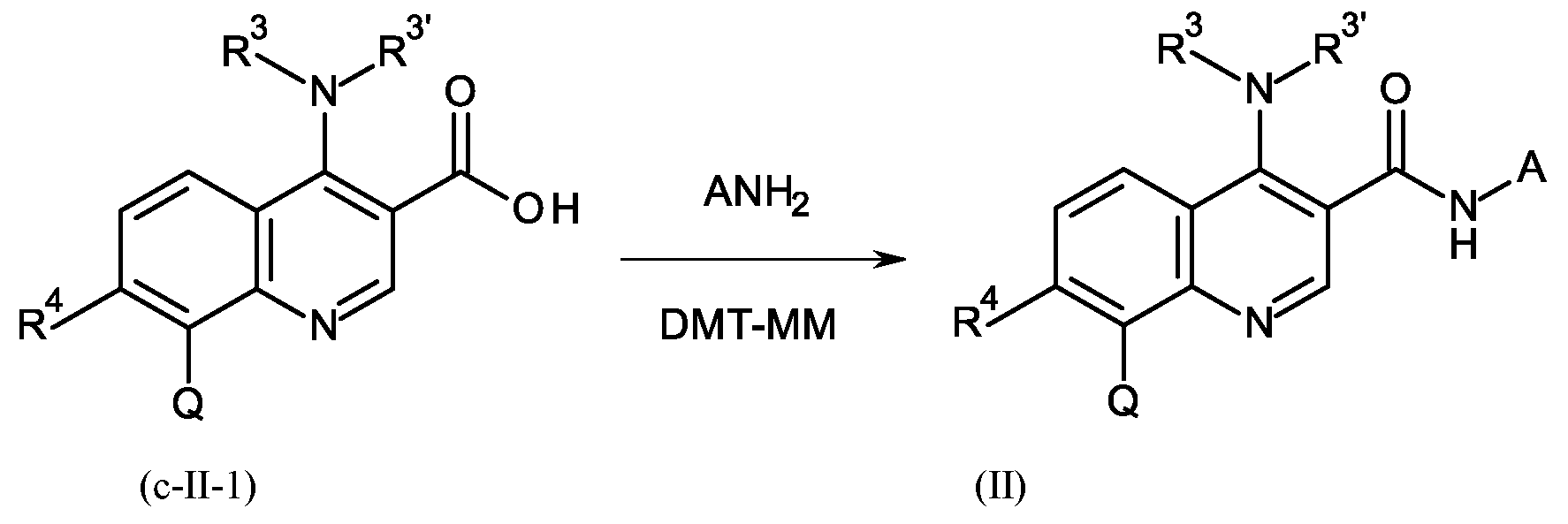
여기서 A는 제1항 또는 제2항에 정의된 바와 같은 의미를 갖고;
여기서 상기 공정 단계 B-d는 커플링제로서 DMT-MM을 사용함으로써 수행됨.The method according to claim 1 or 2, wherein the process steps are carried out in the following order:
Step Ba:
Wherein R 2 is C 1 -C 3 -alkyl, and R 3 , R 3'and R 4 have the meaning as defined in claim 1 or 2;
Wherein X is C=O and R 1 is hydrogen or X is C-OH and R 1 is absent, which corresponds to formulas (alc) and (aId):
Wherein the process step Ba is carried out using thionyl chloride (SOCl 2 ); next
Step Bb:
Wherein G represents a boron compound suitable for carrying out the Suzuki-reaction, having the meaning as defined in claim 1 or 2; next
Step Bc:
Wherein R 2 is C 1 -C 3 -alkyl; Wherein the base corresponds to any alkali metal hydroxide and alkaline earth metal hydroxide, as well as any alkali metal carbonate and alkaline earth metal carbonate, and the acid corresponds to any mineral acid;
next
Step Bd:
Where A has the meaning as defined in claim 1 or 2;
Here, the process step Bd is performed by using DMT-MM as a coupling agent.
단계 B-a:

여기서 상기 공정 단계 B-a는 티오닐 클로라이드 (SOCl2)를 사용하여 수행됨; 이어서
단계 B-b:

여기서 G는 제1항 또는 제2항에 정의된 바와 같은 의미를 갖는, 스즈키-반응을 수행하는데 적합한 붕소 화합물을 나타내고, 이때
Q는 1 내지 5개의 치환기 Z1 내지 Z5로 치환될 수 있는 페닐이며, 여기서
Z1 내지 Z5는 독립적으로 수소, 할로겐, C1-C4-알킬, 및 1-5개의 할로겐 원자를 갖는 C1-C4-할로게노알킬로부터 선택됨; 이어서
단계 B-c:

여기서 염기는 임의의 알칼리 금속 수산화물 및 알칼리 토금속 수산화물, 뿐만 아니라 임의의 알칼리 금속 탄산염 및 알칼리 토금속 탄산염에 상응하고, 산은 임의의 미네랄 산에 상응함; 이어서
단계 B-d:

여기서 A는 제1항에 정의된 바와 같은 기로부터 선택되고,
여기서 상기 공정 단계 B-d는 커플링제로서 DMT-MM을 사용함으로써 수행됨.The method of claim 3, represented by the following formula:
Step Ba:
Wherein the process step Ba is carried out using thionyl chloride (SOCl 2 ); next
Step Bb:
Where G represents a boron compound suitable for carrying out the Suzuki-reaction, having the meaning as defined in claim 1 or 2, wherein
Q is phenyl which may be substituted with 1 to 5 substituents Z 1 to Z 5 , wherein
Z 1 to Z 5 are independently selected from hydrogen, halogen, C 1 -C 4 -alkyl, and C 1 -C 4 -halogenoalkyl having 1-5 halogen atoms; next
Step Bc:
Wherein the base corresponds to any alkali metal hydroxide and alkaline earth metal hydroxide, as well as any alkali metal carbonate and alkaline earth metal carbonate, and the acid corresponds to any mineral acid; next
Step Bd:
Wherein A is selected from the group as defined in claim 1,
Here, the process step Bd is performed by using DMT-MM as a coupling agent.
R4가 수소 및 플루오린으로부터 선택되고;
Z1, Z3 및 Z5가 수소이고;
Z2 및 Z4가 염소이고;
A가 하기 기인

방법.The method according to any one of claims 1 to 4,
R 4 is selected from hydrogen and fluorine;
Z 1 , Z 3 and Z 5 are hydrogen;
Z 2 and Z 4 are chlorine;
A is the following cause
Way.

그에 의해 각각의 하기 거울상이성질체 형태의 화합물 (II), (d-II) 또는 (III)을 제공하는 것인

방법.The method according to any one of claims 1 to 5, wherein the group A is selected from the group consisting of:
Thereby providing each of the following enantiomeric forms of compound (II), (d-II) or (III)
Way.
- 단계 B-a에서 화학량론적 양의 티오닐 클로라이드가 사용됨;
- 단계 B-a에서 티오닐 클로라이드의 양이 1.15 내지 2.30 당량, 바람직하게는 1.15 내지 1.50 당량, 보다 바람직하게는 1.15 내지 1.30 당량임;
- 단계 B-a에서 8 내지 10의 pH가 조정됨;
- 단계 B-a에서 톨루엔, 클로로벤젠 또는 크실렌으로 이루어진 군으로부터 선택된 용매가 사용되며, 바람직하게는 톨루엔이 사용됨;
- 단계 B-a에서 DMF, DEF, DBF 또는 DIF, 바람직하게는 DEF, DBF 또는 DIF, 보다 바람직하게는 DIF로 이루어진 군으로부터 선택된 촉매가 사용됨;
- 단계 B-a에서 촉매가 0.8 내지 5.0 mol%, 바람직하게는 0.8 내지 3.0 mol%, 보다 바람직하게는 0.8 내지 1.5 mol%의 양으로 사용됨;
- 단계 B-a에서 아민 화합물이 디메틸아민임;
- 단계 B-a에서 아민 화합물이 ≥ 1.35 당량, 바람직하게는 1.35 내지 2.70 당량, 보다 바람직하게는 1.35 내지 1.50 당량의 양으로 첨가됨;
- 단계 B-b에서 팔라듐-촉매가 ≥ 0.3 mol%, 바람직하게는 0.3 내지 0.6 mol%의 양으로 사용됨;
- 단계 B-b에서 잔류 팔라듐의 양이 ≤ 200 ppm, 바람직하게는 ≤ 100 ppm으로 감소함;
- 단계 B-b에서 팔라듐-촉매가 포스핀 리간드 L 없이 또는 그와 조합된, Pd(OAc)2, Pd(acac)2 및 PdCl2(L)2로 이루어진 군으로부터 선택되며, 바람직하게는 팔라듐-촉매가 포스핀 리간드 L과 조합된 Pd(acac)2임;
- 단계 B-b에서, 존재하는 경우에, 포스핀 리간드 L이 한자리 포스핀 리간드 P(Ar)n(알킬)3-n (이때 n = 0, 1, 2 또는 3임), 예컨대 바람직하게는 PPh3, P(o-톨릴)3, P(o-아니실)3, P(p-아니실)3, P(nBu)3, P(tertBu)3, P(아다만틸)2Ph, PPh2(tertBu) 또는 PPh(tertBu)2, 보다 바람직하게는 P(tertBu)3, PPh2(tertBu) 또는 PPh(tertBu)2, 보다 더 바람직하게는 P(tertBu)3임;
- 단계 B-c에서 에스테르 화합물의 팔라듐 함량이 ≤ 200 ppm, 바람직하게는 ≤ 100 ppm임;
- 단계 B-c에서 에스테르 화합물의 비누화가 NaOH를 사용함으로써 수행됨;
- 단계 B-c에서 생성된 생성물의 HCl 염이 제조됨;
- 단계 B-d에서 출발 화합물이 HCl 염의 형태로 사용됨;
- 단계 B-d에서 톨루엔 또는 클로로벤젠으로 이루어진 군으로부터 선택된 용매가 사용되며, 바람직하게는 톨루엔이 사용됨;
- 단계 B-d에서 커플링제 DMT-MM이 단리된 DMT-MM 화합물로서 사용되거나 또는 NMM 및 CDMT로부터 계내에서 생성됨;
- 단계 B-d에서 출발 화합물이 1.05 내지 1.4 당량, 바람직하게는 1.1 내지 1.3 당량, 보다 바람직하게는 1.1 내지 1.2 당량의 양으로 사용됨;
- 단계 B-d에서 5.0 내지 15.0 당량, 바람직하게는 5.0 내지 10.0 당량, 보다 바람직하게는 5.0 내지 7.5 당량 NMM의 양이 사용됨;
- 단계 B-d에서 1.25 내지 2.00 당량, 바람직하게는 1.25 내지 1.80 당량, 보다 바람직하게는 1.25 내지 1.35 당량 CDMT의 양이 사용됨;
- 단계 A에서 제조된 중간 고리화 전구체가 불활성 용매 중에, 바람직하게는 톨루엔, 클로로벤젠 또는 크실렌 중에, 보다 바람직하게는 톨루엔 중에 희석되어 후속 반응에 사용됨;
- 단계 A에서 1.5 내지 3.5 당량, 바람직하게는 2.0 내지 3.0 당량, 보다 바람직하게는 약 2.5 당량 P2O5의 절대량이 사용됨;
- 단계 A에서 MSA의 양에 대한 P2O5의 상대량이 7.0 내지 23.0 wt.%, 바람직하게는 15.0 내지 23.0 wt.-%, 보다 바람직하게는 약 23.0 wt.%임;
- 단계 A에서 오산화인의 총량이 2 분량 이상으로, 회분식으로 첨가됨.The method according to any one of claims 1 to 6, wherein the at least one process step Ba, Bb, Bc and Bd is further characterized by at least one of the following process conditions:
-In step Ba a stoichiometric amount of thionyl chloride is used;
-The amount of thionyl chloride in step Ba is 1.15 to 2.30 equivalents, preferably 1.15 to 1.50 equivalents, more preferably 1.15 to 1.30 equivalents;
-The pH of 8 to 10 is adjusted in step Ba;
-In step Ba a solvent selected from the group consisting of toluene, chlorobenzene or xylene is used, preferably toluene;
-In step Ba a catalyst selected from the group consisting of DMF, DEF, DBF or DIF, preferably DEF, DBF or DIF, more preferably DIF is used;
-In step Ba the catalyst is used in an amount of 0.8 to 5.0 mol%, preferably 0.8 to 3.0 mol%, more preferably 0.8 to 1.5 mol%;
-The amine compound in step Ba is dimethylamine;
-In step Ba the amine compound is added in an amount of ≥ 1.35 equivalents, preferably 1.35 to 2.70 equivalents, more preferably 1.35 to 1.50 equivalents;
-In step Bb the palladium-catalyst is used in an amount of ≥ 0.3 mol%, preferably 0.3 to 0.6 mol%;
-In step Bb the amount of residual palladium is reduced to ≤ 200 ppm, preferably ≤ 100 ppm;
-In step Bb the palladium-catalyst is selected from the group consisting of Pd(OAc) 2 , Pd(acac) 2 and PdCl 2 (L) 2 , preferably palladium-catalyst, without or in combination with the phosphine ligand L Is Pd(acac) 2 in combination with phosphine ligand L;
-In step Bb, if present, the phosphine ligand L is a monodentate phosphine ligand P(Ar) n (alkyl) 3-n (where n = 0, 1, 2 or 3), such as preferably PPh 3 , P (o- tolyl) 3, P (o- no seal) 3, P (p- no seal) 3, P (nBu) 3 , P (tertBu) 3, P ( adamantyl) 2 Ph, PPh 2 (tertBu) or PPh(tertBu) 2 , more preferably P(tertBu) 3 , PPh 2 (tertBu) or PPh(tertBu) 2 , even more preferably P(tertBu) 3 ;
-The palladium content of the ester compound in step Bc is ≤ 200 ppm, preferably ≤ 100 ppm;
-Saponification of the ester compound in step Bc is carried out by using NaOH;
-The HCl salt of the product produced in step Bc is prepared;
-In step Bd the starting compound is used in the form of the HCl salt;
-In step Bd a solvent selected from the group consisting of toluene or chlorobenzene is used, preferably toluene;
-In step Bd the coupling agent DMT-MM is used as an isolated DMT-MM compound or is produced in situ from NMM and CDMT;
-In step Bd the starting compound is used in an amount of 1.05 to 1.4 equivalents, preferably 1.1 to 1.3 equivalents, more preferably 1.1 to 1.2 equivalents;
-In step Bd an amount of 5.0 to 15.0 equivalents, preferably 5.0 to 10.0 equivalents, more preferably 5.0 to 7.5 equivalents NMM is used;
-In step Bd an amount of 1.25 to 2.00 equivalents, preferably 1.25 to 1.80 equivalents, more preferably 1.25 to 1.35 equivalents CDMT is used;
-The intermediate cyclization precursor prepared in step A is diluted in an inert solvent, preferably in toluene, chlorobenzene or xylene, more preferably in toluene and used in the subsequent reaction;
-In step A an absolute amount of 1.5 to 3.5 equivalents, preferably 2.0 to 3.0 equivalents, more preferably about 2.5 equivalents P 2 O 5 is used;
-The relative amount of P 2 O 5 to the amount of MSA in step A is 7.0 to 23.0 wt.%, preferably 15.0 to 23.0 wt.-%, more preferably about 23.0 wt.%;
-In step A, the total amount of phosphorus pentoxide is 2 or more, added in batches.


(여기서 Z1 내지 Z5는 제1항 내지 제6항 중 어느 한 항에 정의된 바와 같은 의미를 가짐)Following process step Bb as defined in any one of claims 1 to 7 by carrying out isolation and optionally purification of the resulting compound, according to any one of claims 1 and 3 to 6 Intermediate compounds according to formulas (b-II), (b-II-1) and (b-III) as defined and a method for preparing the following intermediate compounds.
(Where Z 1 to Z 5 have the same meaning as defined in any one of claims 1 to 6)

(여기서 Z1 내지 Z5는 제1항 내지 제6항 중 어느 한 항에 정의된 바와 같은 의미를 가짐)The process step Bc as defined in any one of claims 1 to 7 is followed by isolation and optionally purification of the resulting compound, thereby according to any one of claims 1 and 3 to 6 Intermediate compounds according to formulas (c-II), (c-II-1), (c-III) as defined and a method for preparing the following intermediate compounds.
(Where Z 1 to Z 5 have the same meaning as defined in any one of claims 1 to 6)
또는
제1항 내지 제13항 중 어느 한 항에 정의된 바와 같은 화학식 (a-I-1), (a-II), (a-II-1), (a-IV), (a-V), (a-VI), (c-II), (c-II-1), (c-III), (c-IV), (c-V) 및 (d-II)에 따른 중간체 화합물을 제조하기 위한, 제13항의 또는 제10항에 따른 방법에 의해 수득가능한 바와 같은 화학식 (b-II), (b-II-1), (b-III), (b-IV) 및 (b-V)에 따른 중간체 화합물의 용도;
또는
제1항 내지 제13항 중 어느 한 항에 정의된 바와 같은 화학식 (a-I-1), (a-II), (a-II-1), (a-IV), (a-V), (a-VI), (b-II), (b-II-1), (b-III), (b-IV), (b-V) 및 (d-II)에 따른 중간체 화합물을 제조하기 위한, 제13항의 또는 제11항에 따른 방법에 의해 수득가능한 바와 같은 화학식 (c-II), (c-II-1), (c-III), (c-IV) 및 (c-V)에 따른 중간체 화합물의 용도;
또는
제1항 내지 제13항 중 어느 한 항에 정의된 바와 같은 화학식 (a-I-1), (a-II), (a-II-1), (a-IV), (a-V), (a-VI), (b-II), (b-II-1), (b-III), (b-IV), (b-V), (c-II), (c-II-1), (c-III), (c-IV) 및 (c-V)에 따른 중간체 화합물을 제조하기 위한, 제13항의 또는 제12항에 따른 방법에 의해 수득가능한 바와 같은 화학식 (d-II)에 따른 중간체 화합물의 용도;
또는
제1항 내지 제13항 중 어느 한 항에 정의된 바와 같은 화학식 (a-IV), (b-II), (b-II-1), (b-III), (b-IV), (b-V), (c-II), (c-II-1), (c-III), (c-IV), (c-V) 및 (d-II)에 따른 중간체 화합물을 제조하기 위한, 제13항의 또는 제2항에 따른 방법에 의해 수득가능한 바와 같은 화학식 (a-III)에 따른 중간체 화합물의 용도.Formulas (b-II), (b-II-1), (b-III), (b-IV), (bV), (c-) as defined in any one of claims 1 to 13 II) according to claim 13 or 9 for preparing intermediate compounds according to II), (c-II-1), (c-III), (c-IV), (cV) and (d-II) The use of intermediate compounds according to formulas (aI-1), (a-II), (a-II-1), (a-IV), (aV) and (a-VI) as obtainable by the method;
or
Formulas (aI-1), (a-II), (a-II-1), (a-IV), (aV), (a-) as defined in any one of claims 1 to 13 VI), for preparing intermediate compounds according to (c-II), (c-II-1), (c-III), (c-IV), (cV) and (d-II) of claim 13 Or the use of intermediate compounds according to formulas (b-II), (b-II-1), (b-III), (b-IV) and (bV) as obtainable by the method according to claim 10;
or
Formulas (aI-1), (a-II), (a-II-1), (a-IV), (aV), (a-) as defined in any one of claims 1 to 13 VI), for preparing intermediate compounds according to (b-II), (b-II-1), (b-III), (b-IV), (bV) and (d-II) of claim 13 Or the use of intermediate compounds according to formulas (c-II), (c-II-1), (c-III), (c-IV) and (cV) as obtainable by the method according to claim 11;
or
Formulas (aI-1), (a-II), (a-II-1), (a-IV), (aV), (a-) as defined in any one of claims 1 to 13 VI), (b-II), (b-II-1), (b-III), (b-IV), (bV), (c-II), (c-II-1), (c- III) the use of intermediate compounds according to formula (d-II) as obtainable by the method according to claim 13 or 12, for preparing intermediate compounds according to (c-IV) and (cV);
or
Formulas (a-IV), (b-II), (b-II-1), (b-III), (b-IV), (as defined in any one of claims 1 to 13) bV), (c-II), (c-II-1), (c-III), (c-IV), (cV) and (d-II) for preparing intermediate compounds according to claim 13 Or of an intermediate compound according to formula (a-III) as obtainable by the method according to claim 2.
Applications Claiming Priority (3)
| Application Number | Priority Date | Filing Date | Title |
|---|---|---|---|
| EP17207586.3 | 2017-12-15 | ||
| EP17207586 | 2017-12-15 | ||
| PCT/EP2018/084964 WO2019115768A1 (en) | 2017-12-15 | 2018-12-14 | Process for preparing antihelmintic 4-amino-quinoline-3-carboxamide derivatives |
Publications (1)
| Publication Number | Publication Date |
|---|---|
| KR20200099548A true KR20200099548A (en) | 2020-08-24 |
Family
ID=60673654
Family Applications (1)
| Application Number | Title | Priority Date | Filing Date |
|---|---|---|---|
| KR1020207020010A Ceased KR20200099548A (en) | 2017-12-15 | 2018-12-14 | Method for preparing anthelmintic 4-amino-quinoline-3-carboxamide derivative |
Country Status (17)
| Country | Link |
|---|---|
| US (1) | US11505544B2 (en) |
| EP (1) | EP3692037A1 (en) |
| JP (1) | JP7516245B2 (en) |
| KR (1) | KR20200099548A (en) |
| CN (1) | CN111448192B (en) |
| AU (1) | AU2018382999B2 (en) |
| CA (1) | CA3085675A1 (en) |
| CL (1) | CL2020001589A1 (en) |
| CO (1) | CO2020007222A2 (en) |
| DO (1) | DOP2020000118A (en) |
| IL (1) | IL275216A (en) |
| MX (1) | MX2020006185A (en) |
| PH (1) | PH12020550905A1 (en) |
| SG (1) | SG11202004260YA (en) |
| TW (1) | TWI809018B (en) |
| UY (1) | UY38009A (en) |
| WO (1) | WO2019115768A1 (en) |
Cited By (1)
| Publication number | Priority date | Publication date | Assignee | Title |
|---|---|---|---|---|
| KR20240154881A (en) | 2023-04-19 | 2024-10-28 | 오신희 | Support hanger for various facilities with earthquake-proof and damping structure |
Families Citing this family (8)
| Publication number | Priority date | Publication date | Assignee | Title |
|---|---|---|---|---|
| IL279977B2 (en) | 2018-07-09 | 2024-06-01 | Boehringer Ingelheim Animal Health Usa Inc | Anthelminthic heterocyclic compounds |
| CN113490527B (en) * | 2018-12-18 | 2024-10-25 | 瑞士伊兰科动物保健有限公司 | Bicyclic derivatives |
| US11560388B2 (en) | 2019-03-19 | 2023-01-24 | Boehringer Ingelheim Vetmedica Gmbh | Anthelmintic aza-benzothiophene and aza-benzofuran compounds |
| AU2021253168A1 (en) * | 2020-04-09 | 2022-11-03 | Elanco Animal Health Gmbh | Substituted condensed azines as anthelmintic compounds |
| CA3183100A1 (en) | 2020-05-29 | 2021-12-02 | Boehringer Ingelheim Pharma Gmbh & Co. Kg | Anthelmintic heterocyclic compounds |
| EP4148052A1 (en) * | 2021-09-09 | 2023-03-15 | Bayer Animal Health GmbH | New quinoline derivatives |
| AR127495A1 (en) | 2021-11-01 | 2024-01-31 | Boehringer Ingelheim Vetmedica Gmbh | PYRROLOPYRIDAZINE COMPOUNDS AS ANTIHELMINTICS |
| WO2025027117A1 (en) | 2023-08-02 | 2025-02-06 | Intervet International B.V. | Carboxamide-4-quinoline compounds with anthelmintic activity |
Family Cites Families (9)
| Publication number | Priority date | Publication date | Assignee | Title |
|---|---|---|---|---|
| ES2248923T3 (en) * | 1997-12-22 | 2006-03-16 | PHARMACIA & UPJOHN COMPANY LLC | 4-HYDROXIQUINOLIN-3-CARBOXAMIDS AND HYDRAZIDS AS ANTIVIRAL AGENTS. |
| WO2001047891A1 (en) | 1999-12-28 | 2001-07-05 | Eisai Co., Ltd. | Heterocyclic compounds having sulfonamide groups |
| RU2240826C2 (en) | 2000-02-03 | 2004-11-27 | Эйсай Ко., Лтд. | Inhibitor of integrin expression |
| JP2008214323A (en) | 2007-03-08 | 2008-09-18 | Kyowa Hakko Kogyo Co Ltd | Treatment and / or prevention agent for skin diseases |
| WO2013118071A1 (en) | 2012-02-09 | 2013-08-15 | Glenmark Pharmaceuticals S.A. | BICYCLIC COMPOUNDS AS mPGES-1 INHIBITORS |
| AR098475A1 (en) * | 2013-11-26 | 2016-06-01 | Bayer Cropscience Ag | PESTICIDE COMPOUNDS AND USES |
| NZ724691A (en) * | 2014-03-24 | 2018-02-23 | Guangdong Zhongsheng Pharmaceutical Co Ltd | Quinoline derivatives as smo inhibitors |
| CA3008358A1 (en) | 2015-12-17 | 2017-06-22 | Astex Therapeutics Limited | Quinoline-3-carboxamides as h-pgds inhibitors |
| ES2884073T3 (en) * | 2016-11-11 | 2021-12-10 | Bayer Animal Health Gmbh | New anthelmintic derivatives of quinoline-3-carboxamide |
-
2018
- 2018-12-14 KR KR1020207020010A patent/KR20200099548A/en not_active Ceased
- 2018-12-14 TW TW107145129A patent/TWI809018B/en active
- 2018-12-14 UY UY0001038009A patent/UY38009A/en not_active Application Discontinuation
- 2018-12-14 US US16/772,680 patent/US11505544B2/en active Active
- 2018-12-14 MX MX2020006185A patent/MX2020006185A/en unknown
- 2018-12-14 SG SG11202004260YA patent/SG11202004260YA/en unknown
- 2018-12-14 WO PCT/EP2018/084964 patent/WO2019115768A1/en not_active Ceased
- 2018-12-14 CA CA3085675A patent/CA3085675A1/en active Pending
- 2018-12-14 AU AU2018382999A patent/AU2018382999B2/en active Active
- 2018-12-14 JP JP2020531937A patent/JP7516245B2/en active Active
- 2018-12-14 EP EP18815237.5A patent/EP3692037A1/en active Pending
- 2018-12-14 CN CN201880080813.2A patent/CN111448192B/en active Active
-
2020
- 2020-06-08 IL IL275216A patent/IL275216A/en unknown
- 2020-06-12 CL CL2020001589A patent/CL2020001589A1/en unknown
- 2020-06-12 CO CONC2020/0007222A patent/CO2020007222A2/en unknown
- 2020-06-15 DO DO2020000118A patent/DOP2020000118A/en unknown
- 2020-06-15 PH PH12020550905A patent/PH12020550905A1/en unknown
Cited By (1)
| Publication number | Priority date | Publication date | Assignee | Title |
|---|---|---|---|---|
| KR20240154881A (en) | 2023-04-19 | 2024-10-28 | 오신희 | Support hanger for various facilities with earthquake-proof and damping structure |
Also Published As
| Publication number | Publication date |
|---|---|
| RU2020123282A (en) | 2022-01-17 |
| SG11202004260YA (en) | 2020-06-29 |
| CA3085675A1 (en) | 2019-06-20 |
| BR112020011901A2 (en) | 2020-11-24 |
| US11505544B2 (en) | 2022-11-22 |
| US20200308153A1 (en) | 2020-10-01 |
| JP7516245B2 (en) | 2024-07-16 |
| JP2021506774A (en) | 2021-02-22 |
| CN111448192B (en) | 2024-04-12 |
| AU2018382999A1 (en) | 2020-05-28 |
| DOP2020000118A (en) | 2020-08-31 |
| UY38009A (en) | 2019-07-31 |
| IL275216A (en) | 2020-07-30 |
| TWI809018B (en) | 2023-07-21 |
| PH12020550905A1 (en) | 2021-05-17 |
| WO2019115768A1 (en) | 2019-06-20 |
| AU2018382999B2 (en) | 2023-11-23 |
| TW201927773A (en) | 2019-07-16 |
| CO2020007222A2 (en) | 2020-11-20 |
| EP3692037A1 (en) | 2020-08-12 |
| CN111448192A (en) | 2020-07-24 |
| CL2020001589A1 (en) | 2020-11-20 |
| MX2020006185A (en) | 2020-09-03 |
Similar Documents
| Publication | Publication Date | Title |
|---|---|---|
| TWI809018B (en) | Process for preparing quinoline derivatives | |
| JP7682868B2 (en) | Method for preparing 2-cyanoethyl (4S)-4-(4-cyano-2-methoxyphenyl)-5-ethoxy-2,8-dimethyl-1,4-dihydro-1,6-naphthyridine-3-carboxylate by resolution of the racemate with diastereomeric tartrates | |
| EP2880017B1 (en) | Process and intermediates for preparing integrase inhibitors | |
| RU2742005C2 (en) | Methods for producing 4-alkoxy-3-(acyl or alkyl)oxypicolinamides | |
| EA018227B1 (en) | A method for the preparation of dabigatran and its intermediates | |
| CN110590635A (en) | Preparation method of levetiracetam and intermediate thereof | |
| KR102718536B1 (en) | Process for preparing 2-(5-methoxyisochroman-1-yl)-4,5-dihydro-1H-imidazole and its hydrogen sulfate salt | |
| WO2016008461A1 (en) | A new form of sofosbuvir and a method of its preparation | |
| JP6944682B2 (en) | Method for producing benzimidazole compound | |
| CN111527067B (en) | Method for producing 1-[5-(2-fluorophenyl)-1-(pyridin-3-ylsulfonyl)-1H-pyrrol-3-yl]-N-methylmethylamine monofumarate | |
| JP2012528181A (en) | Method for producing substituted tetrahydro β-carboline | |
| JP2020518661A5 (en) | ||
| JP2025026621A (en) | Method for producing cis-(-)-furosinopiperidol | |
| RU2804710C2 (en) | Method of producing antihelminthic 4-amino-quinoline-3-carboxamide derivatives | |
| CN104151313B (en) | A kind of method of purifying tadalafil intermediate | |
| WO2024180562A1 (en) | A process for the preparation of pure crystalline rimegepant and its salts thereof | |
| TWI855165B (en) | Process for preparing (r)-4-aminoindane and corresponding amides | |
| HK40033921A (en) | Process for preparing antihelmintic 4-amino-quinoline-3-carboxamide derivatives | |
| BR112020011901B1 (en) | PROCESS FOR PREPARING ANTHELMINTHIC DERIVATIVES OF 4-AMINOQUINOLINE-3-CARBOXAMIDE | |
| JP6660393B2 (en) | Method for preparing 4-cyanopiperidine hydrochloride | |
| JP2023528035A (en) | Method for making hydroxylated cyclopentylpyrimidine compounds | |
| JP2015528458A (en) | Method for preparing 6-iodo-2-oxindole | |
| KR20220101702A (en) | Manufacturing process of chroman compounds | |
| HK1209415B (en) | Process and intermediates for preparing integrase inhibitors | |
| HK1215809B (en) | Method for producing tricyclic compound, and tricyclic compound capable of being produced by said production method |
Legal Events
| Date | Code | Title | Description |
|---|---|---|---|
| PA0105 | International application |
St.27 status event code: A-0-1-A10-A15-nap-PA0105 |
|
| PG1501 | Laying open of application |
St.27 status event code: A-1-1-Q10-Q12-nap-PG1501 |
|
| R18-X000 | Changes to party contact information recorded |
St.27 status event code: A-3-3-R10-R18-oth-X000 |
|
| A201 | Request for examination | ||
| P11-X000 | Amendment of application requested |
St.27 status event code: A-2-2-P10-P11-nap-X000 |
|
| P13-X000 | Application amended |
St.27 status event code: A-2-2-P10-P13-nap-X000 |
|
| PA0201 | Request for examination |
St.27 status event code: A-1-2-D10-D11-exm-PA0201 |
|
| R18-X000 | Changes to party contact information recorded |
St.27 status event code: A-3-3-R10-R18-oth-X000 |
|
| E902 | Notification of reason for refusal | ||
| PE0902 | Notice of grounds for rejection |
St.27 status event code: A-1-2-D10-D21-exm-PE0902 |
|
| T11-X000 | Administrative time limit extension requested |
St.27 status event code: U-3-3-T10-T11-oth-X000 |
|
| P11-X000 | Amendment of application requested |
St.27 status event code: A-2-2-P10-P11-nap-X000 |
|
| P13-X000 | Application amended |
St.27 status event code: A-2-2-P10-P13-nap-X000 |
|
| E902 | Notification of reason for refusal | ||
| PE0902 | Notice of grounds for rejection |
St.27 status event code: A-1-2-D10-D21-exm-PE0902 |
|
| E13-X000 | Pre-grant limitation requested |
St.27 status event code: A-2-3-E10-E13-lim-X000 |
|
| P11-X000 | Amendment of application requested |
St.27 status event code: A-2-2-P10-P11-nap-X000 |
|
| P13-X000 | Application amended |
St.27 status event code: A-2-2-P10-P13-nap-X000 |
|
| B15 | Application refused following examination |
Free format text: ST27 STATUS EVENT CODE: N-2-6-B10-B15-EXM-PE0601 (AS PROVIDED BY THE NATIONAL OFFICE) |
|
| PE0601 | Decision on rejection of patent |
St.27 status event code: N-2-6-B10-B15-exm-PE0601 |
|
| E13 | Pre-grant limitation requested |
Free format text: ST27 STATUS EVENT CODE: A-2-3-E10-E13-LIM-X000 (AS PROVIDED BY THE NATIONAL OFFICE) |
|
| E13-X000 | Pre-grant limitation requested |
St.27 status event code: A-2-3-E10-E13-lim-X000 |
|
| P11 | Amendment of application requested |
Free format text: ST27 STATUS EVENT CODE: A-2-2-P10-P11-NAP-X000 (AS PROVIDED BY THE NATIONAL OFFICE) |
|
| P11-X000 | Amendment of application requested |
St.27 status event code: A-2-2-P10-P11-nap-X000 |