KR20200057103A - Pyrrolo[1,2,f][1,2,4]triazines useful for treating respiratory syncitial virus infections - Google Patents
Pyrrolo[1,2,f][1,2,4]triazines useful for treating respiratory syncitial virus infections Download PDFInfo
- Publication number
- KR20200057103A KR20200057103A KR1020207013948A KR20207013948A KR20200057103A KR 20200057103 A KR20200057103 A KR 20200057103A KR 1020207013948 A KR1020207013948 A KR 1020207013948A KR 20207013948 A KR20207013948 A KR 20207013948A KR 20200057103 A KR20200057103 A KR 20200057103A
- Authority
- KR
- South Korea
- Prior art keywords
- acn
- mmol
- added
- column
- water
- Prior art date
- Legal status (The legal status is an assumption and is not a legal conclusion. Google has not performed a legal analysis and makes no representation as to the accuracy of the status listed.)
- Granted
Links
- 230000009385 viral infection Effects 0.000 title abstract description 21
- 230000000241 respiratory effect Effects 0.000 title description 2
- 150000003918 triazines Chemical class 0.000 title 1
- 150000001875 compounds Chemical class 0.000 claims description 193
- 150000003839 salts Chemical class 0.000 claims description 58
- 239000000543 intermediate Substances 0.000 abstract description 307
- 238000000034 method Methods 0.000 abstract description 39
- 230000015572 biosynthetic process Effects 0.000 abstract description 35
- 238000003786 synthesis reaction Methods 0.000 abstract description 31
- 206010061603 Respiratory syncytial virus infection Diseases 0.000 abstract description 10
- BOUIZPWBFIVJPD-UHFFFAOYSA-N 3h-1,2,4-triazin-4-amine Chemical class NN1CN=NC=C1 BOUIZPWBFIVJPD-UHFFFAOYSA-N 0.000 abstract description 7
- 241000711904 Pneumoviridae Species 0.000 abstract description 3
- QQOWHRYOXYEMTL-UHFFFAOYSA-N triazin-4-amine Chemical class N=C1C=CN=NN1 QQOWHRYOXYEMTL-UHFFFAOYSA-N 0.000 abstract 1
- WEVYAHXRMPXWCK-UHFFFAOYSA-N Acetonitrile Chemical compound CC#N WEVYAHXRMPXWCK-UHFFFAOYSA-N 0.000 description 429
- XEKOWRVHYACXOJ-UHFFFAOYSA-N Ethyl acetate Chemical compound CCOC(C)=O XEKOWRVHYACXOJ-UHFFFAOYSA-N 0.000 description 371
- QTBSBXVTEAMEQO-UHFFFAOYSA-N Acetic acid Chemical compound CC(O)=O QTBSBXVTEAMEQO-UHFFFAOYSA-N 0.000 description 269
- XLYOFNOQVPJJNP-UHFFFAOYSA-N water Substances O XLYOFNOQVPJJNP-UHFFFAOYSA-N 0.000 description 216
- BDAGIHXWWSANSR-UHFFFAOYSA-N methanoic acid Natural products OC=O BDAGIHXWWSANSR-UHFFFAOYSA-N 0.000 description 200
- 239000000203 mixture Substances 0.000 description 199
- VLKZOEOYAKHREP-UHFFFAOYSA-N n-Hexane Chemical compound CCCCCC VLKZOEOYAKHREP-UHFFFAOYSA-N 0.000 description 194
- 239000000243 solution Substances 0.000 description 190
- -1 halomethyl compound Chemical class 0.000 description 184
- 235000019439 ethyl acetate Nutrition 0.000 description 152
- 238000005481 NMR spectroscopy Methods 0.000 description 150
- WYURNTSHIVDZCO-UHFFFAOYSA-N Tetrahydrofuran Chemical compound C1CCOC1 WYURNTSHIVDZCO-UHFFFAOYSA-N 0.000 description 136
- 238000006243 chemical reaction Methods 0.000 description 123
- 230000002829 reductive effect Effects 0.000 description 123
- 239000011541 reaction mixture Substances 0.000 description 108
- OSWFIVFLDKOXQC-UHFFFAOYSA-N 4-(3-methoxyphenyl)aniline Chemical compound COC1=CC=CC(C=2C=CC(N)=CC=2)=C1 OSWFIVFLDKOXQC-UHFFFAOYSA-N 0.000 description 100
- 235000019253 formic acid Nutrition 0.000 description 100
- YMWUJEATGCHHMB-UHFFFAOYSA-N Dichloromethane Chemical compound ClCCl YMWUJEATGCHHMB-UHFFFAOYSA-N 0.000 description 97
- OKKJLVBELUTLKV-UHFFFAOYSA-N Methanol Chemical compound OC OKKJLVBELUTLKV-UHFFFAOYSA-N 0.000 description 96
- 238000001195 ultra high performance liquid chromatography Methods 0.000 description 81
- JUJWROOIHBZHMG-UHFFFAOYSA-N Pyridine Chemical compound C1=CC=NC=C1 JUJWROOIHBZHMG-UHFFFAOYSA-N 0.000 description 79
- 229920006395 saturated elastomer Polymers 0.000 description 57
- 239000007787 solid Substances 0.000 description 57
- 239000011734 sodium Substances 0.000 description 56
- 239000012044 organic layer Substances 0.000 description 53
- ZMXDDKWLCZADIW-UHFFFAOYSA-N N,N-Dimethylformamide Chemical compound CN(C)C=O ZMXDDKWLCZADIW-UHFFFAOYSA-N 0.000 description 51
- 239000004480 active ingredient Substances 0.000 description 43
- 239000003814 drug Substances 0.000 description 43
- 239000000047 product Substances 0.000 description 43
- 238000010898 silica gel chromatography Methods 0.000 description 42
- 238000009472 formulation Methods 0.000 description 41
- 125000002887 hydroxy group Chemical group [H]O* 0.000 description 39
- UMJSCPRVCHMLSP-UHFFFAOYSA-N pyridine Natural products COC1=CC=CN=C1 UMJSCPRVCHMLSP-UHFFFAOYSA-N 0.000 description 39
- 239000012267 brine Substances 0.000 description 38
- HPALAKNZSZLMCH-UHFFFAOYSA-M sodium;chloride;hydrate Chemical compound O.[Na+].[Cl-] HPALAKNZSZLMCH-UHFFFAOYSA-M 0.000 description 38
- IAZDPXIOMUYVGZ-UHFFFAOYSA-N Dimethylsulphoxide Chemical compound CS(C)=O IAZDPXIOMUYVGZ-UHFFFAOYSA-N 0.000 description 35
- UIIMBOGNXHQVGW-UHFFFAOYSA-M Sodium bicarbonate Chemical compound [Na+].OC([O-])=O UIIMBOGNXHQVGW-UHFFFAOYSA-M 0.000 description 34
- ZMANZCXQSJIPKH-UHFFFAOYSA-N Triethylamine Chemical compound CCN(CC)CC ZMANZCXQSJIPKH-UHFFFAOYSA-N 0.000 description 34
- 239000002904 solvent Substances 0.000 description 33
- PMZURENOXWZQFD-UHFFFAOYSA-L Sodium Sulfate Chemical compound [Na+].[Na+].[O-]S([O-])(=O)=O PMZURENOXWZQFD-UHFFFAOYSA-L 0.000 description 31
- 229910004298 SiO 2 Inorganic materials 0.000 description 30
- FAPWRFPIFSIZLT-UHFFFAOYSA-M Sodium chloride Chemical compound [Na+].[Cl-] FAPWRFPIFSIZLT-UHFFFAOYSA-M 0.000 description 30
- 210000004027 cell Anatomy 0.000 description 30
- 150000002148 esters Chemical class 0.000 description 30
- KXDAEFPNCMNJSK-UHFFFAOYSA-N benzene carboxamide Natural products NC(=O)C1=CC=CC=C1 KXDAEFPNCMNJSK-UHFFFAOYSA-N 0.000 description 28
- 239000003480 eluent Substances 0.000 description 28
- HEMHJVSKTPXQMS-UHFFFAOYSA-M Sodium hydroxide Chemical compound [OH-].[Na+] HEMHJVSKTPXQMS-UHFFFAOYSA-M 0.000 description 27
- YXFVVABEGXRONW-UHFFFAOYSA-N Toluene Chemical compound CC1=CC=CC=C1 YXFVVABEGXRONW-UHFFFAOYSA-N 0.000 description 27
- 239000000872 buffer Substances 0.000 description 27
- 239000000843 powder Substances 0.000 description 26
- 238000003756 stirring Methods 0.000 description 26
- 239000000546 pharmaceutical excipient Substances 0.000 description 25
- 239000012453 solvate Substances 0.000 description 25
- 229940124597 therapeutic agent Drugs 0.000 description 24
- 239000010410 layer Substances 0.000 description 23
- 238000002953 preparative HPLC Methods 0.000 description 23
- 125000000217 alkyl group Chemical group 0.000 description 21
- RAXXELZNTBOGNW-UHFFFAOYSA-N imidazole Natural products C1=CNC=N1 RAXXELZNTBOGNW-UHFFFAOYSA-N 0.000 description 21
- 208000015181 infectious disease Diseases 0.000 description 21
- 239000012299 nitrogen atmosphere Substances 0.000 description 21
- LMBFAGIMSUYTBN-MPZNNTNKSA-N teixobactin Chemical compound C([C@H](C(=O)N[C@@H]([C@@H](C)CC)C(=O)N[C@@H](CO)C(=O)N[C@H](CCC(N)=O)C(=O)N[C@H]([C@@H](C)CC)C(=O)N[C@@H]([C@@H](C)CC)C(=O)N[C@@H](CO)C(=O)N[C@H]1C(N[C@@H](C)C(=O)N[C@@H](C[C@@H]2NC(=N)NC2)C(=O)N[C@H](C(=O)O[C@H]1C)[C@@H](C)CC)=O)NC)C1=CC=CC=C1 LMBFAGIMSUYTBN-MPZNNTNKSA-N 0.000 description 21
- RTZKZFJDLAIYFH-UHFFFAOYSA-N Diethyl ether Chemical compound CCOCC RTZKZFJDLAIYFH-UHFFFAOYSA-N 0.000 description 20
- VYPSYNLAJGMNEJ-UHFFFAOYSA-N Silicium dioxide Chemical compound O=[Si]=O VYPSYNLAJGMNEJ-UHFFFAOYSA-N 0.000 description 20
- 230000008901 benefit Effects 0.000 description 20
- 208000030925 respiratory syncytial virus infectious disease Diseases 0.000 description 20
- LFQSCWFLJHTTHZ-UHFFFAOYSA-N Ethanol Chemical compound CCO LFQSCWFLJHTTHZ-UHFFFAOYSA-N 0.000 description 19
- 239000000706 filtrate Substances 0.000 description 19
- WSFSSNUMVMOOMR-UHFFFAOYSA-N Formaldehyde Chemical compound O=C WSFSSNUMVMOOMR-UHFFFAOYSA-N 0.000 description 18
- 241000282412 Homo Species 0.000 description 18
- 125000004432 carbon atom Chemical group C* 0.000 description 18
- 239000000463 material Substances 0.000 description 18
- 239000002245 particle Substances 0.000 description 18
- LMDZBCPBFSXMTL-UHFFFAOYSA-N 1-Ethyl-3-(3-dimethylaminopropyl)carbodiimide Substances CCN=C=NCCCN(C)C LMDZBCPBFSXMTL-UHFFFAOYSA-N 0.000 description 17
- FPQQSJJWHUJYPU-UHFFFAOYSA-N 3-(dimethylamino)propyliminomethylidene-ethylazanium;chloride Chemical compound Cl.CCN=C=NCCCN(C)C FPQQSJJWHUJYPU-UHFFFAOYSA-N 0.000 description 17
- 239000008194 pharmaceutical composition Substances 0.000 description 17
- 238000000746 purification Methods 0.000 description 17
- 229910000030 sodium bicarbonate Inorganic materials 0.000 description 17
- 235000017557 sodium bicarbonate Nutrition 0.000 description 17
- KDLHZDBZIXYQEI-UHFFFAOYSA-N palladium Substances [Pd] KDLHZDBZIXYQEI-UHFFFAOYSA-N 0.000 description 16
- WUMYBFXWUJTWTB-UHFFFAOYSA-N [hydroxy(methoxy)phosphoryl] phosphono hydrogen phosphate Chemical compound COP(O)(=O)OP(O)(=O)OP(O)(O)=O WUMYBFXWUJTWTB-UHFFFAOYSA-N 0.000 description 15
- 239000012300 argon atmosphere Substances 0.000 description 15
- 238000004440 column chromatography Methods 0.000 description 15
- 239000007858 starting material Substances 0.000 description 15
- 239000000443 aerosol Substances 0.000 description 14
- 239000007788 liquid Substances 0.000 description 14
- 125000002496 methyl group Chemical group [H]C([H])([H])* 0.000 description 14
- MZRVEZGGRBJDDB-UHFFFAOYSA-N n-Butyllithium Substances [Li]CCCC MZRVEZGGRBJDDB-UHFFFAOYSA-N 0.000 description 14
- QJGQUHMNIGDVPM-UHFFFAOYSA-N nitrogen group Chemical group [N] QJGQUHMNIGDVPM-UHFFFAOYSA-N 0.000 description 14
- 125000006239 protecting group Chemical group 0.000 description 14
- 239000000741 silica gel Substances 0.000 description 14
- 229910002027 silica gel Inorganic materials 0.000 description 14
- 239000011780 sodium chloride Substances 0.000 description 14
- 125000000999 tert-butyl group Chemical group [H]C([H])([H])C(*)(C([H])([H])[H])C([H])([H])[H] 0.000 description 14
- FPGGTKZVZWFYPV-UHFFFAOYSA-M tetrabutylammonium fluoride Chemical compound [F-].CCCC[N+](CCCC)(CCCC)CCCC FPGGTKZVZWFYPV-UHFFFAOYSA-M 0.000 description 14
- 230000000840 anti-viral effect Effects 0.000 description 13
- 239000013058 crude material Substances 0.000 description 13
- 125000000956 methoxy group Chemical group [H]C([H])([H])O* 0.000 description 13
- 239000012071 phase Substances 0.000 description 13
- NLXLAEXVIDQMFP-UHFFFAOYSA-N Ammonia chloride Chemical compound [NH4+].[Cl-] NLXLAEXVIDQMFP-UHFFFAOYSA-N 0.000 description 12
- XKRFYHLGVUSROY-UHFFFAOYSA-N Argon Chemical compound [Ar] XKRFYHLGVUSROY-UHFFFAOYSA-N 0.000 description 12
- 229940079593 drug Drugs 0.000 description 12
- KWGKDLIKAYFUFQ-UHFFFAOYSA-M lithium chloride Chemical compound [Li+].[Cl-] KWGKDLIKAYFUFQ-UHFFFAOYSA-M 0.000 description 12
- 239000003921 oil Substances 0.000 description 12
- 239000000725 suspension Substances 0.000 description 12
- FYADHXFMURLYQI-UHFFFAOYSA-N 1,2,4-triazine Chemical compound C1=CN=NC=N1 FYADHXFMURLYQI-UHFFFAOYSA-N 0.000 description 11
- PEDCQBHIVMGVHV-UHFFFAOYSA-N Glycerine Chemical compound OCC(O)CO PEDCQBHIVMGVHV-UHFFFAOYSA-N 0.000 description 11
- LQZMLBORDGWNPD-UHFFFAOYSA-N N-iodosuccinimide Substances IN1C(=O)CCC1=O LQZMLBORDGWNPD-UHFFFAOYSA-N 0.000 description 11
- 102000004389 Ribonucleoproteins Human genes 0.000 description 11
- 108010081734 Ribonucleoproteins Proteins 0.000 description 11
- 150000001299 aldehydes Chemical group 0.000 description 11
- 125000001495 ethyl group Chemical group [H]C([H])([H])C([H])([H])* 0.000 description 11
- 235000019198 oils Nutrition 0.000 description 11
- SECXISVLQFMRJM-UHFFFAOYSA-N N-Methylpyrrolidone Chemical compound CN1CCCC1=O SECXISVLQFMRJM-UHFFFAOYSA-N 0.000 description 10
- 238000003556 assay Methods 0.000 description 10
- XJHCXCQVJFPJIK-UHFFFAOYSA-M cesium fluoride Substances [F-].[Cs+] XJHCXCQVJFPJIK-UHFFFAOYSA-M 0.000 description 10
- 230000000694 effects Effects 0.000 description 10
- CQRPUKWAZPZXTO-UHFFFAOYSA-M magnesium;2-methylpropane;chloride Chemical compound [Mg+2].[Cl-].C[C-](C)C CQRPUKWAZPZXTO-UHFFFAOYSA-M 0.000 description 10
- KJIFKLIQANRMOU-UHFFFAOYSA-N oxidanium;4-methylbenzenesulfonate Chemical compound O.CC1=CC=C(S(O)(=O)=O)C=C1 KJIFKLIQANRMOU-UHFFFAOYSA-N 0.000 description 10
- 150000003254 radicals Chemical class 0.000 description 10
- 239000003826 tablet Substances 0.000 description 10
- WFDIJRYMOXRFFG-UHFFFAOYSA-N Acetic anhydride Chemical compound CC(=O)OC(C)=O WFDIJRYMOXRFFG-UHFFFAOYSA-N 0.000 description 9
- CSCPPACGZOOCGX-UHFFFAOYSA-N Acetone Chemical compound CC(C)=O CSCPPACGZOOCGX-UHFFFAOYSA-N 0.000 description 9
- 241000711920 Human orthopneumovirus Species 0.000 description 9
- VEXZGXHMUGYJMC-UHFFFAOYSA-N Hydrochloric acid Chemical compound Cl VEXZGXHMUGYJMC-UHFFFAOYSA-N 0.000 description 9
- 125000001797 benzyl group Chemical group [H]C1=C([H])C([H])=C(C([H])=C1[H])C([H])([H])* 0.000 description 9
- 125000000051 benzyloxy group Chemical group [H]C1=C([H])C([H])=C(C([H])=C1[H])C([H])([H])O* 0.000 description 9
- 229910052799 carbon Inorganic materials 0.000 description 9
- 239000012230 colorless oil Substances 0.000 description 9
- 238000004519 manufacturing process Methods 0.000 description 9
- NCGWKCHAJOUDHQ-UHFFFAOYSA-N n,n-diethylethanamine;formic acid Chemical compound OC=O.OC=O.CCN(CC)CC NCGWKCHAJOUDHQ-UHFFFAOYSA-N 0.000 description 9
- 229910052757 nitrogen Inorganic materials 0.000 description 9
- 239000012074 organic phase Substances 0.000 description 9
- 239000003208 petroleum Substances 0.000 description 9
- BCNZYOJHNLTNEZ-UHFFFAOYSA-N tert-butyldimethylsilyl chloride Chemical compound CC(C)(C)[Si](C)(C)Cl BCNZYOJHNLTNEZ-UHFFFAOYSA-N 0.000 description 9
- JBWYRBLDOOOJEU-UHFFFAOYSA-N 1-[chloro-(4-methoxyphenyl)-phenylmethyl]-4-methoxybenzene Chemical compound C1=CC(OC)=CC=C1C(Cl)(C=1C=CC(OC)=CC=1)C1=CC=CC=C1 JBWYRBLDOOOJEU-UHFFFAOYSA-N 0.000 description 8
- VHYFNPMBLIVWCW-UHFFFAOYSA-N 4-Dimethylaminopyridine Chemical compound CN(C)C1=CC=NC=C1 VHYFNPMBLIVWCW-UHFFFAOYSA-N 0.000 description 8
- 241000700605 Viruses Species 0.000 description 8
- AGEZXYOZHKGVCM-UHFFFAOYSA-N benzyl bromide Chemical compound BrCC1=CC=CC=C1 AGEZXYOZHKGVCM-UHFFFAOYSA-N 0.000 description 8
- 239000003937 drug carrier Substances 0.000 description 8
- 239000000839 emulsion Substances 0.000 description 8
- 239000000796 flavoring agent Substances 0.000 description 8
- IXCSERBJSXMMFS-UHFFFAOYSA-N hydrogen chloride Substances Cl.Cl IXCSERBJSXMMFS-UHFFFAOYSA-N 0.000 description 8
- 229910000041 hydrogen chloride Inorganic materials 0.000 description 8
- 229910052740 iodine Inorganic materials 0.000 description 8
- 230000003647 oxidation Effects 0.000 description 8
- 238000007254 oxidation reaction Methods 0.000 description 8
- LPNYRYFBWFDTMA-UHFFFAOYSA-N potassium tert-butoxide Chemical compound [K+].CC(C)(C)[O-] LPNYRYFBWFDTMA-UHFFFAOYSA-N 0.000 description 8
- 229910052717 sulfur Inorganic materials 0.000 description 8
- 125000000391 vinyl group Chemical group [H]C([*])=C([H])[H] 0.000 description 8
- 150000001336 alkenes Chemical class 0.000 description 7
- 230000003833 cell viability Effects 0.000 description 7
- 239000003795 chemical substances by application Substances 0.000 description 7
- FFHWGQQFANVOHV-UHFFFAOYSA-N dimethyldioxirane Chemical compound CC1(C)OO1 FFHWGQQFANVOHV-UHFFFAOYSA-N 0.000 description 7
- 239000003995 emulsifying agent Substances 0.000 description 7
- 238000001914 filtration Methods 0.000 description 7
- 229910052739 hydrogen Inorganic materials 0.000 description 7
- 230000005764 inhibitory process Effects 0.000 description 7
- 238000005342 ion exchange Methods 0.000 description 7
- 238000004255 ion exchange chromatography Methods 0.000 description 7
- 238000006467 substitution reaction Methods 0.000 description 7
- YLQBMQCUIZJEEH-UHFFFAOYSA-N tetrahydrofuran Natural products C=1C=COC=1 YLQBMQCUIZJEEH-UHFFFAOYSA-N 0.000 description 7
- IJGRMHOSHXDMSA-UHFFFAOYSA-N Atomic nitrogen Chemical compound N#N IJGRMHOSHXDMSA-UHFFFAOYSA-N 0.000 description 6
- KZMGYPLQYOPHEL-UHFFFAOYSA-N Boron trifluoride etherate Chemical compound FB(F)F.CCOCC KZMGYPLQYOPHEL-UHFFFAOYSA-N 0.000 description 6
- 108091003079 Bovine Serum Albumin Proteins 0.000 description 6
- KXDHJXZQYSOELW-UHFFFAOYSA-M Carbamate Chemical compound NC([O-])=O KXDHJXZQYSOELW-UHFFFAOYSA-M 0.000 description 6
- 229940123932 Phosphodiesterase 4 inhibitor Drugs 0.000 description 6
- CDBYLPFSWZWCQE-UHFFFAOYSA-L Sodium Carbonate Chemical compound [Na+].[Na+].[O-]C([O-])=O CDBYLPFSWZWCQE-UHFFFAOYSA-L 0.000 description 6
- 208000036142 Viral infection Diseases 0.000 description 6
- 230000002378 acidificating effect Effects 0.000 description 6
- 125000003342 alkenyl group Chemical group 0.000 description 6
- HSFWRNGVRCDJHI-UHFFFAOYSA-N alpha-acetylene Natural products C#C HSFWRNGVRCDJHI-UHFFFAOYSA-N 0.000 description 6
- 235000019270 ammonium chloride Nutrition 0.000 description 6
- 229910052786 argon Inorganic materials 0.000 description 6
- PASDCCFISLVPSO-UHFFFAOYSA-N benzoyl chloride Chemical compound ClC(=O)C1=CC=CC=C1 PASDCCFISLVPSO-UHFFFAOYSA-N 0.000 description 6
- 239000006071 cream Substances 0.000 description 6
- 239000012043 crude product Substances 0.000 description 6
- 125000002534 ethynyl group Chemical group [H]C#C* 0.000 description 6
- 239000012091 fetal bovine serum Substances 0.000 description 6
- 229910052731 fluorine Inorganic materials 0.000 description 6
- 235000013355 food flavoring agent Nutrition 0.000 description 6
- 235000003599 food sweetener Nutrition 0.000 description 6
- 229910052736 halogen Inorganic materials 0.000 description 6
- 125000004435 hydrogen atom Chemical group [H]* 0.000 description 6
- 239000004615 ingredient Substances 0.000 description 6
- 125000001449 isopropyl group Chemical group [H]C([H])([H])C([H])(*)C([H])([H])[H] 0.000 description 6
- 239000003607 modifier Substances 0.000 description 6
- JRZJOMJEPLMPRA-UHFFFAOYSA-N olefin Natural products CCCCCCCC=C JRZJOMJEPLMPRA-UHFFFAOYSA-N 0.000 description 6
- 239000002587 phosphodiesterase IV inhibitor Substances 0.000 description 6
- SCVFZCLFOSHCOH-UHFFFAOYSA-M potassium acetate Chemical compound [K+].CC([O-])=O SCVFZCLFOSHCOH-UHFFFAOYSA-M 0.000 description 6
- 239000003765 sweetening agent Substances 0.000 description 6
- 238000012360 testing method Methods 0.000 description 6
- IMFACGCPASFAPR-UHFFFAOYSA-N tributylamine Chemical compound CCCCN(CCCC)CCCC IMFACGCPASFAPR-UHFFFAOYSA-N 0.000 description 6
- AQRLNPVMDITEJU-UHFFFAOYSA-N triethylsilane Chemical compound CC[SiH](CC)CC AQRLNPVMDITEJU-UHFFFAOYSA-N 0.000 description 6
- 229920002554 vinyl polymer Polymers 0.000 description 6
- ZCYVEMRRCGMTRW-UHFFFAOYSA-N 7553-56-2 Chemical compound [I] ZCYVEMRRCGMTRW-UHFFFAOYSA-N 0.000 description 5
- OKKJLVBELUTLKV-MZCSYVLQSA-N Deuterated methanol Chemical compound [2H]OC([2H])([2H])[2H] OKKJLVBELUTLKV-MZCSYVLQSA-N 0.000 description 5
- 239000002841 Lewis acid Substances 0.000 description 5
- XBDQKXXYIPTUBI-UHFFFAOYSA-N Propionic acid Chemical compound CCC(O)=O XBDQKXXYIPTUBI-UHFFFAOYSA-N 0.000 description 5
- DNIAPMSPPWPWGF-UHFFFAOYSA-N Propylene glycol Chemical compound CC(O)CO DNIAPMSPPWPWGF-UHFFFAOYSA-N 0.000 description 5
- 206010062106 Respiratory tract infection viral Diseases 0.000 description 5
- 125000000304 alkynyl group Chemical group 0.000 description 5
- 239000007900 aqueous suspension Substances 0.000 description 5
- 239000012298 atmosphere Substances 0.000 description 5
- 238000004113 cell culture Methods 0.000 description 5
- 125000000753 cycloalkyl group Chemical group 0.000 description 5
- 235000014113 dietary fatty acids Nutrition 0.000 description 5
- 239000002270 dispersing agent Substances 0.000 description 5
- 238000002474 experimental method Methods 0.000 description 5
- 239000000194 fatty acid Substances 0.000 description 5
- 229930195729 fatty acid Natural products 0.000 description 5
- 150000004665 fatty acids Chemical class 0.000 description 5
- 239000008187 granular material Substances 0.000 description 5
- 125000001188 haloalkyl group Chemical group 0.000 description 5
- 238000002347 injection Methods 0.000 description 5
- 239000007924 injection Substances 0.000 description 5
- 239000011630 iodine Substances 0.000 description 5
- 150000007517 lewis acids Chemical class 0.000 description 5
- 239000002609 medium Substances 0.000 description 5
- 210000000214 mouth Anatomy 0.000 description 5
- 125000003729 nucleotide group Chemical group 0.000 description 5
- 229910052763 palladium Inorganic materials 0.000 description 5
- RLOWWWKZYUNIDI-UHFFFAOYSA-N phosphinic chloride Chemical compound ClP=O RLOWWWKZYUNIDI-UHFFFAOYSA-N 0.000 description 5
- XHXFXVLFKHQFAL-UHFFFAOYSA-N phosphoryl trichloride Chemical compound ClP(Cl)(Cl)=O XHXFXVLFKHQFAL-UHFFFAOYSA-N 0.000 description 5
- 239000003755 preservative agent Substances 0.000 description 5
- 210000002345 respiratory system Anatomy 0.000 description 5
- 229910000104 sodium hydride Inorganic materials 0.000 description 5
- 230000001225 therapeutic effect Effects 0.000 description 5
- 238000013518 transcription Methods 0.000 description 5
- 230000035897 transcription Effects 0.000 description 5
- PUPZLCDOIYMWBV-UHFFFAOYSA-N (+/-)-1,3-Butanediol Chemical compound CC(O)CCO PUPZLCDOIYMWBV-UHFFFAOYSA-N 0.000 description 4
- 125000005913 (C3-C6) cycloalkyl group Chemical group 0.000 description 4
- RYHBNJHYFVUHQT-UHFFFAOYSA-N 1,4-Dioxane Chemical compound C1COCCO1 RYHBNJHYFVUHQT-UHFFFAOYSA-N 0.000 description 4
- VBICKXHEKHSIBG-UHFFFAOYSA-N 1-monostearoylglycerol Chemical compound CCCCCCCCCCCCCCCCCC(=O)OCC(O)CO VBICKXHEKHSIBG-UHFFFAOYSA-N 0.000 description 4
- JHSXHKMJBWOMRU-UHFFFAOYSA-M 2,2-dimethylpropanethioate Chemical compound CC(C)(C)C([O-])=S JHSXHKMJBWOMRU-UHFFFAOYSA-M 0.000 description 4
- HZNVUJQVZSTENZ-UHFFFAOYSA-N 2,3-dichloro-5,6-dicyano-1,4-benzoquinone Chemical compound ClC1=C(Cl)C(=O)C(C#N)=C(C#N)C1=O HZNVUJQVZSTENZ-UHFFFAOYSA-N 0.000 description 4
- HSJKGGMUJITCBW-UHFFFAOYSA-N 3-hydroxybutanal Chemical compound CC(O)CC=O HSJKGGMUJITCBW-UHFFFAOYSA-N 0.000 description 4
- 229960000549 4-dimethylaminophenol Drugs 0.000 description 4
- CIWBSHSKHKDKBQ-JLAZNSOCSA-N Ascorbic acid Chemical compound OC[C@H](O)[C@H]1OC(=O)C(O)=C1O CIWBSHSKHKDKBQ-JLAZNSOCSA-N 0.000 description 4
- 206010006448 Bronchiolitis Diseases 0.000 description 4
- 239000004215 Carbon black (E152) Substances 0.000 description 4
- IAZDPXIOMUYVGZ-WFGJKAKNSA-N Dimethyl sulfoxide Chemical compound [2H]C([2H])([2H])S(=O)C([2H])([2H])[2H] IAZDPXIOMUYVGZ-WFGJKAKNSA-N 0.000 description 4
- 206010061218 Inflammation Diseases 0.000 description 4
- PCLIMKBDDGJMGD-UHFFFAOYSA-N N-bromosuccinimide Chemical compound BrN1C(=O)CCC1=O PCLIMKBDDGJMGD-UHFFFAOYSA-N 0.000 description 4
- PXIPVTKHYLBLMZ-UHFFFAOYSA-N Sodium azide Chemical compound [Na+].[N-]=[N+]=[N-] PXIPVTKHYLBLMZ-UHFFFAOYSA-N 0.000 description 4
- CZMRCDWAGMRECN-UGDNZRGBSA-N Sucrose Chemical compound O[C@H]1[C@H](O)[C@@H](CO)O[C@@]1(CO)O[C@@H]1[C@H](O)[C@@H](O)[C@H](O)[C@@H](CO)O1 CZMRCDWAGMRECN-UGDNZRGBSA-N 0.000 description 4
- 229930006000 Sucrose Natural products 0.000 description 4
- 239000002253 acid Substances 0.000 description 4
- RJURFGZVJUQBHK-UHFFFAOYSA-N actinomycin D Natural products CC1OC(=O)C(C(C)C)N(C)C(=O)CN(C)C(=O)C2CCCN2C(=O)C(C(C)C)NC(=O)C1NC(=O)C1=C(N)C(=O)C(C)=C2OC(C(C)=CC=C3C(=O)NC4C(=O)NC(C(N5CCCC5C(=O)N(C)CC(=O)N(C)C(C(C)C)C(=O)OC4C)=O)C(C)C)=C3N=C21 RJURFGZVJUQBHK-UHFFFAOYSA-N 0.000 description 4
- 239000008346 aqueous phase Substances 0.000 description 4
- 125000000852 azido group Chemical group *N=[N+]=[N-] 0.000 description 4
- 230000037396 body weight Effects 0.000 description 4
- 239000000969 carrier Substances 0.000 description 4
- VGQOKOYKFDUPPJ-UHFFFAOYSA-N chloro-[2-[chloro(dimethyl)silyl]ethyl]-dimethylsilane Chemical compound C[Si](C)(Cl)CC[Si](C)(C)Cl VGQOKOYKFDUPPJ-UHFFFAOYSA-N 0.000 description 4
- 239000003086 colorant Substances 0.000 description 4
- 238000002648 combination therapy Methods 0.000 description 4
- 238000001816 cooling Methods 0.000 description 4
- 230000000120 cytopathologic effect Effects 0.000 description 4
- CSJLBAMHHLJAAS-UHFFFAOYSA-N diethylaminosulfur trifluoride Chemical compound CCN(CC)S(F)(F)F CSJLBAMHHLJAAS-UHFFFAOYSA-N 0.000 description 4
- 238000010790 dilution Methods 0.000 description 4
- 239000012895 dilution Substances 0.000 description 4
- 235000011180 diphosphates Nutrition 0.000 description 4
- 229940112141 dry powder inhaler Drugs 0.000 description 4
- 238000010828 elution Methods 0.000 description 4
- 239000003172 expectorant agent Substances 0.000 description 4
- 239000000284 extract Substances 0.000 description 4
- 239000003925 fat Substances 0.000 description 4
- 235000019197 fats Nutrition 0.000 description 4
- 235000011187 glycerol Nutrition 0.000 description 4
- 150000002367 halogens Chemical class 0.000 description 4
- 229930195733 hydrocarbon Natural products 0.000 description 4
- AFQIYTIJXGTIEY-UHFFFAOYSA-N hydrogen carbonate;triethylazanium Chemical compound OC(O)=O.CCN(CC)CC AFQIYTIJXGTIEY-UHFFFAOYSA-N 0.000 description 4
- 238000001727 in vivo Methods 0.000 description 4
- KLRHPHDUDFIRKB-UHFFFAOYSA-M indium(i) bromide Chemical compound [Br-].[In+] KLRHPHDUDFIRKB-UHFFFAOYSA-M 0.000 description 4
- 230000004054 inflammatory process Effects 0.000 description 4
- 238000001990 intravenous administration Methods 0.000 description 4
- 229940057995 liquid paraffin Drugs 0.000 description 4
- 238000004020 luminiscence type Methods 0.000 description 4
- 210000004072 lung Anatomy 0.000 description 4
- 238000005259 measurement Methods 0.000 description 4
- 230000002503 metabolic effect Effects 0.000 description 4
- 239000002207 metabolite Substances 0.000 description 4
- 229940071648 metered dose inhaler Drugs 0.000 description 4
- VKTOBGBZBCELGC-UHFFFAOYSA-M methyl(triphenoxy)phosphanium;iodide Chemical compound [I-].C=1C=CC=CC=1O[P+](OC=1C=CC=CC=1)(C)OC1=CC=CC=C1 VKTOBGBZBCELGC-UHFFFAOYSA-M 0.000 description 4
- 125000004108 n-butyl group Chemical group [H]C([H])([H])C([H])([H])C([H])([H])C([H])([H])* 0.000 description 4
- 125000004123 n-propyl group Chemical group [H]C([H])([H])C([H])([H])C([H])([H])* 0.000 description 4
- 239000006199 nebulizer Substances 0.000 description 4
- 239000012038 nucleophile Substances 0.000 description 4
- 239000008188 pellet Substances 0.000 description 4
- BWHMMNNQKKPAPP-UHFFFAOYSA-L potassium carbonate Chemical compound [K+].[K+].[O-]C([O-])=O BWHMMNNQKKPAPP-UHFFFAOYSA-L 0.000 description 4
- 230000009467 reduction Effects 0.000 description 4
- 238000004007 reversed phase HPLC Methods 0.000 description 4
- 239000000523 sample Substances 0.000 description 4
- 125000002914 sec-butyl group Chemical group [H]C([H])([H])C([H])([H])C([H])(*)C([H])([H])[H] 0.000 description 4
- 125000004469 siloxy group Chemical group [SiH3]O* 0.000 description 4
- UCSJYZPVAKXKNQ-HZYVHMACSA-N streptomycin Chemical compound CN[C@H]1[C@H](O)[C@@H](O)[C@H](CO)O[C@H]1O[C@@H]1[C@](C=O)(O)[C@H](C)O[C@H]1O[C@@H]1[C@@H](NC(N)=N)[C@H](O)[C@@H](NC(N)=N)[C@H](O)[C@H]1O UCSJYZPVAKXKNQ-HZYVHMACSA-N 0.000 description 4
- 239000005720 sucrose Substances 0.000 description 4
- 239000000375 suspending agent Substances 0.000 description 4
- 230000002195 synergetic effect Effects 0.000 description 4
- 238000002560 therapeutic procedure Methods 0.000 description 4
- JKNHZOAONLKYQL-UHFFFAOYSA-K tribromoindigane Chemical compound Br[In](Br)Br JKNHZOAONLKYQL-UHFFFAOYSA-K 0.000 description 4
- GRGCWBWNLSTIEN-UHFFFAOYSA-N trifluoromethanesulfonyl chloride Chemical compound FC(F)(F)S(Cl)(=O)=O GRGCWBWNLSTIEN-UHFFFAOYSA-N 0.000 description 4
- RIOQSEWOXXDEQQ-UHFFFAOYSA-N triphenylphosphine Chemical compound C1=CC=CC=C1P(C=1C=CC=CC=1)C1=CC=CC=C1 RIOQSEWOXXDEQQ-UHFFFAOYSA-N 0.000 description 4
- 238000003828 vacuum filtration Methods 0.000 description 4
- 239000000080 wetting agent Substances 0.000 description 4
- 125000006656 (C2-C4) alkenyl group Chemical group 0.000 description 3
- 125000006650 (C2-C4) alkynyl group Chemical group 0.000 description 3
- 125000006645 (C3-C4) cycloalkyl group Chemical group 0.000 description 3
- 125000003903 2-propenyl group Chemical group [H]C([*])([H])C([H])=C([H])[H] 0.000 description 3
- GUBGYTABKSRVRQ-XLOQQCSPSA-N Alpha-Lactose Chemical compound O[C@@H]1[C@@H](O)[C@@H](O)[C@@H](CO)O[C@H]1O[C@@H]1[C@@H](CO)O[C@H](O)[C@H](O)[C@H]1O GUBGYTABKSRVRQ-XLOQQCSPSA-N 0.000 description 3
- 241000416162 Astragalus gummifer Species 0.000 description 3
- OKTJSMMVPCPJKN-UHFFFAOYSA-N Carbon Chemical group [C] OKTJSMMVPCPJKN-UHFFFAOYSA-N 0.000 description 3
- IAYPIBMASNFSPL-UHFFFAOYSA-N Ethylene oxide Chemical compound C1CO1 IAYPIBMASNFSPL-UHFFFAOYSA-N 0.000 description 3
- GUBGYTABKSRVRQ-QKKXKWKRSA-N Lactose Natural products OC[C@H]1O[C@@H](O[C@H]2[C@H](O)[C@@H](O)C(O)O[C@@H]2CO)[C@H](O)[C@@H](O)[C@H]1O GUBGYTABKSRVRQ-QKKXKWKRSA-N 0.000 description 3
- 235000010643 Leucaena leucocephala Nutrition 0.000 description 3
- 240000007472 Leucaena leucocephala Species 0.000 description 3
- 208000019693 Lung disease Diseases 0.000 description 3
- SJRJJKPEHAURKC-UHFFFAOYSA-N N-Methylmorpholine Chemical compound CN1CCOCC1 SJRJJKPEHAURKC-UHFFFAOYSA-N 0.000 description 3
- 235000019483 Peanut oil Nutrition 0.000 description 3
- 206010057190 Respiratory tract infections Diseases 0.000 description 3
- 229920001615 Tragacanth Polymers 0.000 description 3
- 125000002015 acyclic group Chemical group 0.000 description 3
- 239000000048 adrenergic agonist Substances 0.000 description 3
- 150000001408 amides Chemical group 0.000 description 3
- 125000006242 amine protecting group Chemical group 0.000 description 3
- 230000003110 anti-inflammatory effect Effects 0.000 description 3
- 239000003963 antioxidant agent Substances 0.000 description 3
- 235000006708 antioxidants Nutrition 0.000 description 3
- 239000011230 binding agent Substances 0.000 description 3
- 210000004369 blood Anatomy 0.000 description 3
- 239000008280 blood Substances 0.000 description 3
- 229940124630 bronchodilator Drugs 0.000 description 3
- 239000000168 bronchodilator agent Substances 0.000 description 3
- 150000004657 carbamic acid derivatives Chemical class 0.000 description 3
- 239000003153 chemical reaction reagent Substances 0.000 description 3
- IJOOHPMOJXWVHK-UHFFFAOYSA-N chlorotrimethylsilane Chemical compound C[Si](C)(C)Cl IJOOHPMOJXWVHK-UHFFFAOYSA-N 0.000 description 3
- KRKNYBCHXYNGOX-UHFFFAOYSA-N citric acid Chemical compound OC(=O)CC(O)(C(O)=O)CC(O)=O KRKNYBCHXYNGOX-UHFFFAOYSA-N 0.000 description 3
- 239000003246 corticosteroid Substances 0.000 description 3
- 229960001334 corticosteroids Drugs 0.000 description 3
- 125000000113 cyclohexyl group Chemical group [H]C1([H])C([H])([H])C([H])([H])C([H])(*)C([H])([H])C1([H])[H] 0.000 description 3
- 125000001511 cyclopentyl group Chemical group [H]C1([H])C([H])([H])C([H])([H])C([H])(*)C1([H])[H] 0.000 description 3
- 231100000135 cytotoxicity Toxicity 0.000 description 3
- 230000003013 cytotoxicity Effects 0.000 description 3
- 238000002784 cytotoxicity assay Methods 0.000 description 3
- 231100000263 cytotoxicity test Toxicity 0.000 description 3
- HXGBXQDTNZMWGS-RUZDIDTESA-N darifenacin Chemical compound C=1C=CC=CC=1C([C@H]1CN(CCC=2C=C3CCOC3=CC=2)CC1)(C(=O)N)C1=CC=CC=C1 HXGBXQDTNZMWGS-RUZDIDTESA-N 0.000 description 3
- 238000013461 design Methods 0.000 description 3
- 239000003085 diluting agent Substances 0.000 description 3
- 239000002552 dosage form Substances 0.000 description 3
- 239000007789 gas Substances 0.000 description 3
- 150000002430 hydrocarbons Chemical class 0.000 description 3
- 230000007062 hydrolysis Effects 0.000 description 3
- 238000006460 hydrolysis reaction Methods 0.000 description 3
- 239000012535 impurity Substances 0.000 description 3
- 238000011534 incubation Methods 0.000 description 3
- 239000008101 lactose Substances 0.000 description 3
- 230000000670 limiting effect Effects 0.000 description 3
- 239000000314 lubricant Substances 0.000 description 3
- 239000002480 mineral oil Substances 0.000 description 3
- 239000001788 mono and diglycerides of fatty acids Substances 0.000 description 3
- 238000000465 moulding Methods 0.000 description 3
- 239000002773 nucleotide Substances 0.000 description 3
- 239000004006 olive oil Substances 0.000 description 3
- 235000008390 olive oil Nutrition 0.000 description 3
- 230000001590 oxidative effect Effects 0.000 description 3
- 230000036961 partial effect Effects 0.000 description 3
- 239000000312 peanut oil Substances 0.000 description 3
- 125000001997 phenyl group Chemical group [H]C1=C([H])C([H])=C(*)C([H])=C1[H] 0.000 description 3
- LFGREXWGYUGZLY-UHFFFAOYSA-N phosphoryl Chemical group [P]=O LFGREXWGYUGZLY-UHFFFAOYSA-N 0.000 description 3
- 229920000136 polysorbate Polymers 0.000 description 3
- 239000013641 positive control Substances 0.000 description 3
- 235000011056 potassium acetate Nutrition 0.000 description 3
- 230000002265 prevention Effects 0.000 description 3
- 125000002924 primary amino group Chemical group [H]N([H])* 0.000 description 3
- 239000000651 prodrug Substances 0.000 description 3
- 229940002612 prodrug Drugs 0.000 description 3
- 102000005962 receptors Human genes 0.000 description 3
- 108020003175 receptors Proteins 0.000 description 3
- 238000001953 recrystallisation Methods 0.000 description 3
- 230000000630 rising effect Effects 0.000 description 3
- 239000012363 selectfluor Substances 0.000 description 3
- 229910000029 sodium carbonate Inorganic materials 0.000 description 3
- AKHNMLFCWUSKQB-UHFFFAOYSA-L sodium thiosulfate Chemical compound [Na+].[Na+].[O-]S([O-])(=O)=S AKHNMLFCWUSKQB-UHFFFAOYSA-L 0.000 description 3
- 235000019345 sodium thiosulphate Nutrition 0.000 description 3
- 239000007921 spray Substances 0.000 description 3
- 239000003381 stabilizer Substances 0.000 description 3
- 239000000126 substance Substances 0.000 description 3
- 239000006228 supernatant Substances 0.000 description 3
- 210000001519 tissue Anatomy 0.000 description 3
- PIEPQKCYPFFYMG-UHFFFAOYSA-N tris acetate Chemical compound CC(O)=O.OCC(N)(CO)CO PIEPQKCYPFFYMG-UHFFFAOYSA-N 0.000 description 3
- GJFNRSDCSTVPCJ-UHFFFAOYSA-N 1,8-bis(dimethylamino)naphthalene Chemical compound C1=CC(N(C)C)=C2C(N(C)C)=CC=CC2=C1 GJFNRSDCSTVPCJ-UHFFFAOYSA-N 0.000 description 2
- MTPVBMVUENFFLL-HXUWFJFHSA-N 1-(2-fluorophenyl)-3-[(3s)-2-oxo-5-phenyl-1,3-dihydro-1,4-benzodiazepin-3-yl]urea Chemical compound FC1=CC=CC=C1NC(=O)N[C@@H]1C(=O)NC2=CC=CC=C2C(C=2C=CC=CC=2)=N1 MTPVBMVUENFFLL-HXUWFJFHSA-N 0.000 description 2
- MOHYOXXOKFQHDC-UHFFFAOYSA-N 1-(chloromethyl)-4-methoxybenzene Chemical compound COC1=CC=C(CCl)C=C1 MOHYOXXOKFQHDC-UHFFFAOYSA-N 0.000 description 2
- BXGYYDRIMBPOMN-UHFFFAOYSA-N 2-(hydroxymethoxy)ethoxymethanol Chemical compound OCOCCOCO BXGYYDRIMBPOMN-UHFFFAOYSA-N 0.000 description 2
- BFSVOASYOCHEOV-UHFFFAOYSA-N 2-diethylaminoethanol Chemical compound CCN(CC)CCO BFSVOASYOCHEOV-UHFFFAOYSA-N 0.000 description 2
- IZHVBANLECCAGF-UHFFFAOYSA-N 2-hydroxy-3-(octadecanoyloxy)propyl octadecanoate Chemical compound CCCCCCCCCCCCCCCCCC(=O)OCC(O)COC(=O)CCCCCCCCCCCCCCCCC IZHVBANLECCAGF-UHFFFAOYSA-N 0.000 description 2
- 125000001494 2-propynyl group Chemical group [H]C#CC([H])([H])* 0.000 description 2
- 125000002774 3,4-dimethoxybenzyl group Chemical group [H]C1=C([H])C(=C([H])C(OC([H])([H])[H])=C1OC([H])([H])[H])C([H])([H])* 0.000 description 2
- LULAYUGMBFYYEX-UHFFFAOYSA-N 3-chlorobenzoic acid Chemical compound OC(=O)C1=CC=CC(Cl)=C1 LULAYUGMBFYYEX-UHFFFAOYSA-N 0.000 description 2
- QSUSKMBNZQHHPA-UHFFFAOYSA-N 4-[4-(4-fluorophenyl)-1-(3-phenylpropyl)-5-pyridin-4-ylimidazol-2-yl]but-3-yn-1-ol Chemical compound C=1C=CC=CC=1CCCN1C(C#CCCO)=NC(C=2C=CC(F)=CC=2)=C1C1=CC=NC=C1 QSUSKMBNZQHHPA-UHFFFAOYSA-N 0.000 description 2
- BTJIUGUIPKRLHP-UHFFFAOYSA-N 4-nitrophenol Chemical compound OC1=CC=C([N+]([O-])=O)C=C1 BTJIUGUIPKRLHP-UHFFFAOYSA-N 0.000 description 2
- 244000215068 Acacia senegal Species 0.000 description 2
- 235000006491 Acacia senegal Nutrition 0.000 description 2
- QGZKDVFQNNGYKY-UHFFFAOYSA-N Ammonia Chemical compound N QGZKDVFQNNGYKY-UHFFFAOYSA-N 0.000 description 2
- VHUUQVKOLVNVRT-UHFFFAOYSA-N Ammonium hydroxide Chemical compound [NH4+].[OH-] VHUUQVKOLVNVRT-UHFFFAOYSA-N 0.000 description 2
- 206010006482 Bronchospasm Diseases 0.000 description 2
- DCERHCFNWRGHLK-UHFFFAOYSA-N C[Si](C)C Chemical compound C[Si](C)C DCERHCFNWRGHLK-UHFFFAOYSA-N 0.000 description 2
- VTYYLEPIZMXCLO-UHFFFAOYSA-L Calcium carbonate Chemical compound [Ca+2].[O-]C([O-])=O VTYYLEPIZMXCLO-UHFFFAOYSA-L 0.000 description 2
- HEDRZPFGACZZDS-UHFFFAOYSA-N Chloroform Chemical compound ClC(Cl)Cl HEDRZPFGACZZDS-UHFFFAOYSA-N 0.000 description 2
- FBPFZTCFMRRESA-FSIIMWSLSA-N D-Glucitol Natural products OC[C@H](O)[C@H](O)[C@@H](O)[C@H](O)CO FBPFZTCFMRRESA-FSIIMWSLSA-N 0.000 description 2
- FBPFZTCFMRRESA-JGWLITMVSA-N D-glucitol Chemical compound OC[C@H](O)[C@@H](O)[C@H](O)[C@H](O)CO FBPFZTCFMRRESA-JGWLITMVSA-N 0.000 description 2
- 108010092160 Dactinomycin Proteins 0.000 description 2
- VGGSQFUCUMXWEO-UHFFFAOYSA-N Ethene Chemical compound C=C VGGSQFUCUMXWEO-UHFFFAOYSA-N 0.000 description 2
- JOYRKODLDBILNP-UHFFFAOYSA-N Ethyl urethane Chemical compound CCOC(N)=O JOYRKODLDBILNP-UHFFFAOYSA-N 0.000 description 2
- 239000005977 Ethylene Substances 0.000 description 2
- LYCAIKOWRPUZTN-UHFFFAOYSA-N Ethylene glycol Chemical compound OCCO LYCAIKOWRPUZTN-UHFFFAOYSA-N 0.000 description 2
- 108010010803 Gelatin Proteins 0.000 description 2
- 229920000084 Gum arabic Polymers 0.000 description 2
- WTDHULULXKLSOZ-UHFFFAOYSA-N Hydroxylamine hydrochloride Chemical compound Cl.ON WTDHULULXKLSOZ-UHFFFAOYSA-N 0.000 description 2
- 206010020751 Hypersensitivity Diseases 0.000 description 2
- PWKSKIMOESPYIA-BYPYZUCNSA-N L-N-acetyl-Cysteine Chemical compound CC(=O)N[C@@H](CS)C(O)=O PWKSKIMOESPYIA-BYPYZUCNSA-N 0.000 description 2
- BAVYZALUXZFZLV-UHFFFAOYSA-N Methylamine Chemical compound NC BAVYZALUXZFZLV-UHFFFAOYSA-N 0.000 description 2
- 229940121948 Muscarinic receptor antagonist Drugs 0.000 description 2
- 239000012826 P38 inhibitor Substances 0.000 description 2
- 229930182555 Penicillin Natural products 0.000 description 2
- JGSARLDLIJGVTE-MBNYWOFBSA-N Penicillin G Chemical compound N([C@H]1[C@H]2SC([C@@H](N2C1=O)C(O)=O)(C)C)C(=O)CC1=CC=CC=C1 JGSARLDLIJGVTE-MBNYWOFBSA-N 0.000 description 2
- 206010035664 Pneumonia Diseases 0.000 description 2
- 239000004743 Polypropylene Substances 0.000 description 2
- 239000012980 RPMI-1640 medium Substances 0.000 description 2
- 241000725643 Respiratory syncytial virus Species 0.000 description 2
- IWUCXVSUMQZMFG-AFCXAGJDSA-N Ribavirin Chemical compound N1=C(C(=O)N)N=CN1[C@H]1[C@H](O)[C@H](O)[C@@H](CO)O1 IWUCXVSUMQZMFG-AFCXAGJDSA-N 0.000 description 2
- RUOGJYKOQBFJIG-UHFFFAOYSA-N SCH-351591 Chemical compound C12=CC=C(C(F)(F)F)N=C2C(OC)=CC=C1C(=O)NC1=C(Cl)C=[N+]([O-])C=C1Cl RUOGJYKOQBFJIG-UHFFFAOYSA-N 0.000 description 2
- 229920005654 Sephadex Polymers 0.000 description 2
- 239000012507 Sephadex™ Substances 0.000 description 2
- GIIZNNXWQWCKIB-UHFFFAOYSA-N Serevent Chemical compound C1=C(O)C(CO)=CC(C(O)CNCCCCCCOCCCCC=2C=CC=CC=2)=C1 GIIZNNXWQWCKIB-UHFFFAOYSA-N 0.000 description 2
- KEAYESYHFKHZAL-UHFFFAOYSA-N Sodium Chemical compound [Na] KEAYESYHFKHZAL-UHFFFAOYSA-N 0.000 description 2
- 235000021355 Stearic acid Nutrition 0.000 description 2
- QAOWNCQODCNURD-UHFFFAOYSA-N Sulfuric acid Chemical compound OS(O)(=O)=O QAOWNCQODCNURD-UHFFFAOYSA-N 0.000 description 2
- DTQVDTLACAAQTR-UHFFFAOYSA-N Trifluoroacetic acid Chemical compound OC(=O)C(F)(F)F DTQVDTLACAAQTR-UHFFFAOYSA-N 0.000 description 2
- 239000007983 Tris buffer Substances 0.000 description 2
- 235000010489 acacia gum Nutrition 0.000 description 2
- 229960004308 acetylcysteine Drugs 0.000 description 2
- RJURFGZVJUQBHK-IIXSONLDSA-N actinomycin D Chemical compound C[C@H]1OC(=O)[C@H](C(C)C)N(C)C(=O)CN(C)C(=O)[C@@H]2CCCN2C(=O)[C@@H](C(C)C)NC(=O)[C@H]1NC(=O)C1=C(N)C(=O)C(C)=C2OC(C(C)=CC=C3C(=O)N[C@@H]4C(=O)N[C@@H](C(N5CCC[C@H]5C(=O)N(C)CC(=O)N(C)[C@@H](C(C)C)C(=O)O[C@@H]4C)=O)C(C)C)=C3N=C21 RJURFGZVJUQBHK-IIXSONLDSA-N 0.000 description 2
- 230000004913 activation Effects 0.000 description 2
- 239000013543 active substance Substances 0.000 description 2
- 208000026935 allergic disease Diseases 0.000 description 2
- 230000007815 allergy Effects 0.000 description 2
- 239000000908 ammonium hydroxide Substances 0.000 description 2
- 238000004458 analytical method Methods 0.000 description 2
- 239000003443 antiviral agent Substances 0.000 description 2
- 235000010323 ascorbic acid Nutrition 0.000 description 2
- 229960005070 ascorbic acid Drugs 0.000 description 2
- 239000011668 ascorbic acid Substances 0.000 description 2
- QVGXLLKOCUKJST-UHFFFAOYSA-N atomic oxygen Chemical group [O] QVGXLLKOCUKJST-UHFFFAOYSA-N 0.000 description 2
- KXHPPCXNWTUNSB-UHFFFAOYSA-M benzyl(trimethyl)azanium;chloride Chemical compound [Cl-].C[N+](C)(C)CC1=CC=CC=C1 KXHPPCXNWTUNSB-UHFFFAOYSA-M 0.000 description 2
- 125000001584 benzyloxycarbonyl group Chemical group C(=O)(OCC1=CC=CC=C1)* 0.000 description 2
- 239000012472 biological sample Substances 0.000 description 2
- 230000000903 blocking effect Effects 0.000 description 2
- 229910052796 boron Inorganic materials 0.000 description 2
- ILAHWRKJUDSMFH-UHFFFAOYSA-N boron tribromide Chemical compound BrB(Br)Br ILAHWRKJUDSMFH-UHFFFAOYSA-N 0.000 description 2
- 230000007885 bronchoconstriction Effects 0.000 description 2
- 235000019437 butane-1,3-diol Nutrition 0.000 description 2
- SLJXUJZUTPFXRJ-UHFFFAOYSA-N buzepide Chemical compound C=1C=CC=CC=1C(C=1C=CC=CC=1)(C(=O)N)CCN1CCCCCC1 SLJXUJZUTPFXRJ-UHFFFAOYSA-N 0.000 description 2
- 239000001506 calcium phosphate Substances 0.000 description 2
- 229910000389 calcium phosphate Inorganic materials 0.000 description 2
- 235000011010 calcium phosphates Nutrition 0.000 description 2
- 239000002775 capsule Substances 0.000 description 2
- 125000004452 carbocyclyl group Chemical group 0.000 description 2
- 235000014633 carbohydrates Nutrition 0.000 description 2
- 150000001721 carbon Chemical group 0.000 description 2
- CREMABGTGYGIQB-UHFFFAOYSA-N carbon carbon Chemical compound C.C CREMABGTGYGIQB-UHFFFAOYSA-N 0.000 description 2
- 239000011203 carbon fibre reinforced carbon Substances 0.000 description 2
- 229910002091 carbon monoxide Inorganic materials 0.000 description 2
- 239000012876 carrier material Substances 0.000 description 2
- 239000012094 cell viability reagent Substances 0.000 description 2
- 238000012054 celltiter-glo Methods 0.000 description 2
- 230000008859 change Effects 0.000 description 2
- 229910052801 chlorine Inorganic materials 0.000 description 2
- 239000000812 cholinergic antagonist Substances 0.000 description 2
- 238000011260 co-administration Methods 0.000 description 2
- 238000013270 controlled release Methods 0.000 description 2
- 238000006880 cross-coupling reaction Methods 0.000 description 2
- 125000001995 cyclobutyl group Chemical group [H]C1([H])C([H])([H])C([H])(*)C1([H])[H] 0.000 description 2
- 238000005888 cyclopropanation reaction Methods 0.000 description 2
- 125000001559 cyclopropyl group Chemical group [H]C1([H])C([H])([H])C1([H])* 0.000 description 2
- 229960000640 dactinomycin Drugs 0.000 description 2
- 229960002677 darifenacin Drugs 0.000 description 2
- 239000002274 desiccant Substances 0.000 description 2
- NKLCNNUWBJBICK-UHFFFAOYSA-N dess–martin periodinane Chemical compound C1=CC=C2I(OC(=O)C)(OC(C)=O)(OC(C)=O)OC(=O)C2=C1 NKLCNNUWBJBICK-UHFFFAOYSA-N 0.000 description 2
- 201000010099 disease Diseases 0.000 description 2
- 208000037265 diseases, disorders, signs and symptoms Diseases 0.000 description 2
- KPUWHANPEXNPJT-UHFFFAOYSA-N disiloxane Chemical group [SiH3]O[SiH3] KPUWHANPEXNPJT-UHFFFAOYSA-N 0.000 description 2
- 231100000673 dose–response relationship Toxicity 0.000 description 2
- 229940121647 egfr inhibitor Drugs 0.000 description 2
- 230000003419 expectorant effect Effects 0.000 description 2
- 235000019634 flavors Nutrition 0.000 description 2
- 239000012530 fluid Substances 0.000 description 2
- 239000011737 fluorine Substances 0.000 description 2
- 229960002848 formoterol Drugs 0.000 description 2
- BPZSYCZIITTYBL-UHFFFAOYSA-N formoterol Chemical compound C1=CC(OC)=CC=C1CC(C)NCC(O)C1=CC=C(O)C(NC=O)=C1 BPZSYCZIITTYBL-UHFFFAOYSA-N 0.000 description 2
- 230000002496 gastric effect Effects 0.000 description 2
- 210000001035 gastrointestinal tract Anatomy 0.000 description 2
- XGALLCVXEZPNRQ-UHFFFAOYSA-N gefitinib Chemical compound C=12C=C(OCCCN3CCOCC3)C(OC)=CC2=NC=NC=1NC1=CC=C(F)C(Cl)=C1 XGALLCVXEZPNRQ-UHFFFAOYSA-N 0.000 description 2
- 239000000499 gel Substances 0.000 description 2
- 229920000159 gelatin Polymers 0.000 description 2
- 239000008273 gelatin Substances 0.000 description 2
- 239000007903 gelatin capsule Substances 0.000 description 2
- 235000019322 gelatine Nutrition 0.000 description 2
- 235000011852 gelatine desserts Nutrition 0.000 description 2
- 239000003862 glucocorticoid Substances 0.000 description 2
- 229940075507 glyceryl monostearate Drugs 0.000 description 2
- 125000005843 halogen group Chemical group 0.000 description 2
- 125000004970 halomethyl group Chemical group 0.000 description 2
- BXWNKGSJHAJOGX-UHFFFAOYSA-N hexadecan-1-ol Chemical compound CCCCCCCCCCCCCCCCO BXWNKGSJHAJOGX-UHFFFAOYSA-N 0.000 description 2
- JYGXADMDTFJGBT-VWUMJDOOSA-N hydrocortisone Chemical compound O=C1CC[C@]2(C)[C@H]3[C@@H](O)C[C@](C)([C@@](CC4)(O)C(=O)CO)[C@@H]4[C@@H]3CCC2=C1 JYGXADMDTFJGBT-VWUMJDOOSA-N 0.000 description 2
- XMBWDFGMSWQBCA-UHFFFAOYSA-N hydrogen iodide Chemical compound I XMBWDFGMSWQBCA-UHFFFAOYSA-N 0.000 description 2
- SHFJWMWCIHQNCP-UHFFFAOYSA-M hydron;tetrabutylazanium;sulfate Chemical compound OS([O-])(=O)=O.CCCC[N+](CCCC)(CCCC)CCCC SHFJWMWCIHQNCP-UHFFFAOYSA-M 0.000 description 2
- KTUFNOKKBVMGRW-UHFFFAOYSA-N imatinib Chemical compound C1CN(C)CCN1CC1=CC=C(C(=O)NC=2C=C(NC=3N=C(C=CN=3)C=3C=NC=CC=3)C(C)=CC=2)C=C1 KTUFNOKKBVMGRW-UHFFFAOYSA-N 0.000 description 2
- 238000000338 in vitro Methods 0.000 description 2
- 239000003701 inert diluent Substances 0.000 description 2
- 230000002458 infectious effect Effects 0.000 description 2
- 238000001802 infusion Methods 0.000 description 2
- 239000003112 inhibitor Substances 0.000 description 2
- 125000000959 isobutyl group Chemical group [H]C([H])([H])C([H])(C([H])([H])[H])C([H])([H])* 0.000 description 2
- 150000002596 lactones Chemical class 0.000 description 2
- 238000012417 linear regression Methods 0.000 description 2
- DLEDOFVPSDKWEF-UHFFFAOYSA-N lithium butane Chemical compound [Li+].CCC[CH2-] DLEDOFVPSDKWEF-UHFFFAOYSA-N 0.000 description 2
- 230000007774 longterm Effects 0.000 description 2
- 239000007937 lozenge Substances 0.000 description 2
- HQKMJHAJHXVSDF-UHFFFAOYSA-L magnesium stearate Chemical compound [Mg+2].CCCCCCCCCCCCCCCCCC([O-])=O.CCCCCCCCCCCCCCCCCC([O-])=O HQKMJHAJHXVSDF-UHFFFAOYSA-L 0.000 description 2
- 230000014759 maintenance of location Effects 0.000 description 2
- QPJVMBTYPHYUOC-UHFFFAOYSA-N methyl benzoate Chemical compound COC(=O)C1=CC=CC=C1 QPJVMBTYPHYUOC-UHFFFAOYSA-N 0.000 description 2
- LSEFCHWGJNHZNT-UHFFFAOYSA-M methyl(triphenyl)phosphanium;bromide Chemical compound [Br-].C=1C=CC=CC=1[P+](C=1C=CC=CC=1)(C)C1=CC=CC=C1 LSEFCHWGJNHZNT-UHFFFAOYSA-M 0.000 description 2
- 238000003801 milling Methods 0.000 description 2
- 238000012544 monitoring process Methods 0.000 description 2
- 229940066491 mucolytics Drugs 0.000 description 2
- DPHDSIQHVGSITN-UHFFFAOYSA-N n-(3,5-dichloropyridin-4-yl)-2-[1-[(4-fluorophenyl)methyl]-5-hydroxyindol-3-yl]-2-oxoacetamide Chemical compound C1=C(C(=O)C(=O)NC=2C(=CN=CC=2Cl)Cl)C2=CC(O)=CC=C2N1CC1=CC=C(F)C=C1 DPHDSIQHVGSITN-UHFFFAOYSA-N 0.000 description 2
- OKFDRAHPFKMAJH-UHFFFAOYSA-N n-(3,5-dichloropyridin-4-yl)-4-(difluoromethoxy)-8-(methanesulfonamido)dibenzofuran-1-carboxamide Chemical compound C=12C3=CC(NS(=O)(=O)C)=CC=C3OC2=C(OC(F)F)C=CC=1C(=O)NC1=C(Cl)C=NC=C1Cl OKFDRAHPFKMAJH-UHFFFAOYSA-N 0.000 description 2
- SYSQUGFVNFXIIT-UHFFFAOYSA-N n-[4-(1,3-benzoxazol-2-yl)phenyl]-4-nitrobenzenesulfonamide Chemical class C1=CC([N+](=O)[O-])=CC=C1S(=O)(=O)NC1=CC=C(C=2OC3=CC=CC=C3N=2)C=C1 SYSQUGFVNFXIIT-UHFFFAOYSA-N 0.000 description 2
- 239000013642 negative control Substances 0.000 description 2
- 230000007935 neutral effect Effects 0.000 description 2
- 231100000252 nontoxic Toxicity 0.000 description 2
- 230000003000 nontoxic effect Effects 0.000 description 2
- 239000000346 nonvolatile oil Substances 0.000 description 2
- 108020004707 nucleic acids Proteins 0.000 description 2
- 150000007523 nucleic acids Chemical class 0.000 description 2
- 102000039446 nucleic acids Human genes 0.000 description 2
- 239000002777 nucleoside Substances 0.000 description 2
- QIQXTHQIDYTFRH-UHFFFAOYSA-N octadecanoic acid Chemical compound CCCCCCCCCCCCCCCCCC(O)=O QIQXTHQIDYTFRH-UHFFFAOYSA-N 0.000 description 2
- OQCDKBAXFALNLD-UHFFFAOYSA-N octadecanoic acid Natural products CCCCCCCC(C)CCCCCCCCC(O)=O OQCDKBAXFALNLD-UHFFFAOYSA-N 0.000 description 2
- 239000012053 oil suspension Substances 0.000 description 2
- 239000002674 ointment Substances 0.000 description 2
- 125000001181 organosilyl group Chemical group [SiH3]* 0.000 description 2
- 150000002923 oximes Chemical class 0.000 description 2
- 125000006503 p-nitrobenzyl group Chemical group [H]C1=C([H])C(=C([H])C([H])=C1[N+]([O-])=O)C([H])([H])* 0.000 description 2
- 239000012188 paraffin wax Substances 0.000 description 2
- 238000007911 parenteral administration Methods 0.000 description 2
- 239000006072 paste Substances 0.000 description 2
- 230000035515 penetration Effects 0.000 description 2
- 229940049954 penicillin Drugs 0.000 description 2
- 239000000825 pharmaceutical preparation Substances 0.000 description 2
- WRMXOVHLRUVREB-UHFFFAOYSA-N phosphono phosphate;tributylazanium Chemical compound OP(O)(=O)OP([O-])([O-])=O.CCCC[NH+](CCCC)CCCC.CCCC[NH+](CCCC)CCCC WRMXOVHLRUVREB-UHFFFAOYSA-N 0.000 description 2
- 235000010482 polyoxyethylene sorbitan monooleate Nutrition 0.000 description 2
- 239000000244 polyoxyethylene sorbitan monooleate Substances 0.000 description 2
- 229920001155 polypropylene Polymers 0.000 description 2
- 229920000053 polysorbate 80 Polymers 0.000 description 2
- 229910000027 potassium carbonate Inorganic materials 0.000 description 2
- 238000002360 preparation method Methods 0.000 description 2
- 230000008569 process Effects 0.000 description 2
- 238000012545 processing Methods 0.000 description 2
- QELSKZZBTMNZEB-UHFFFAOYSA-N propylparaben Chemical compound CCCOC(=O)C1=CC=C(O)C=C1 QELSKZZBTMNZEB-UHFFFAOYSA-N 0.000 description 2
- 125000004076 pyridyl group Chemical group 0.000 description 2
- VSPXQZSDPSOPRO-UHFFFAOYSA-N pyrrolo[2,1-f][1,2,4]triazin-4-amine Chemical compound NC1=NC=NN2C=CC=C12 VSPXQZSDPSOPRO-UHFFFAOYSA-N 0.000 description 2
- 238000011160 research Methods 0.000 description 2
- 229960000329 ribavirin Drugs 0.000 description 2
- HZCAHMRRMINHDJ-DBRKOABJSA-N ribavirin Natural products O[C@@H]1[C@H](O)[C@@H](CO)O[C@H]1N1N=CN=C1 HZCAHMRRMINHDJ-DBRKOABJSA-N 0.000 description 2
- MNDBXUUTURYVHR-UHFFFAOYSA-N roflumilast Chemical compound FC(F)OC1=CC=C(C(=O)NC=2C(=CN=CC=2Cl)Cl)C=C1OCC1CC1 MNDBXUUTURYVHR-UHFFFAOYSA-N 0.000 description 2
- 238000002390 rotary evaporation Methods 0.000 description 2
- 229960004017 salmeterol Drugs 0.000 description 2
- 238000012216 screening Methods 0.000 description 2
- 238000013207 serial dilution Methods 0.000 description 2
- 230000011664 signaling Effects 0.000 description 2
- VFWRGKJLLYDFBY-UHFFFAOYSA-N silver;hydrate Chemical compound O.[Ag].[Ag] VFWRGKJLLYDFBY-UHFFFAOYSA-N 0.000 description 2
- 239000002002 slurry Substances 0.000 description 2
- 239000012312 sodium hydride Substances 0.000 description 2
- JQWHASGSAFIOCM-UHFFFAOYSA-M sodium periodate Chemical compound [Na+].[O-]I(=O)(=O)=O JQWHASGSAFIOCM-UHFFFAOYSA-M 0.000 description 2
- 229910052938 sodium sulfate Inorganic materials 0.000 description 2
- 235000011152 sodium sulphate Nutrition 0.000 description 2
- 239000000600 sorbitol Substances 0.000 description 2
- 235000010356 sorbitol Nutrition 0.000 description 2
- 238000001694 spray drying Methods 0.000 description 2
- 239000008117 stearic acid Substances 0.000 description 2
- 150000003431 steroids Chemical class 0.000 description 2
- 229960005322 streptomycin Drugs 0.000 description 2
- 208000024891 symptom Diseases 0.000 description 2
- 239000006188 syrup Substances 0.000 description 2
- 235000020357 syrup Nutrition 0.000 description 2
- 230000009885 systemic effect Effects 0.000 description 2
- ILMRJRBKQSSXGY-UHFFFAOYSA-N tert-butyl(dimethyl)silicon Chemical group C[Si](C)C(C)(C)C ILMRJRBKQSSXGY-UHFFFAOYSA-N 0.000 description 2
- JRMUNVKIHCOMHV-UHFFFAOYSA-M tetrabutylammonium bromide Chemical compound [Br-].CCCC[N+](CCCC)(CCCC)CCCC JRMUNVKIHCOMHV-UHFFFAOYSA-M 0.000 description 2
- HLZKNKRTKFSKGZ-UHFFFAOYSA-N tetradecan-1-ol Chemical compound CCCCCCCCCCCCCCO HLZKNKRTKFSKGZ-UHFFFAOYSA-N 0.000 description 2
- HWCKGOZZJDHMNC-UHFFFAOYSA-M tetraethylammonium bromide Chemical compound [Br-].CC[N+](CC)(CC)CC HWCKGOZZJDHMNC-UHFFFAOYSA-M 0.000 description 2
- ZVQXQPNJHRNGID-UHFFFAOYSA-N tetramethylsuccinonitrile Chemical compound N#CC(C)(C)C(C)(C)C#N ZVQXQPNJHRNGID-UHFFFAOYSA-N 0.000 description 2
- 239000002562 thickening agent Substances 0.000 description 2
- 238000011200 topical administration Methods 0.000 description 2
- QORWJWZARLRLPR-UHFFFAOYSA-H tricalcium bis(phosphate) Chemical compound [Ca+2].[Ca+2].[Ca+2].[O-]P([O-])([O-])=O.[O-]P([O-])([O-])=O QORWJWZARLRLPR-UHFFFAOYSA-H 0.000 description 2
- 125000002023 trifluoromethyl group Chemical group FC(F)(F)* 0.000 description 2
- 125000000025 triisopropylsilyl group Chemical group C(C)(C)[Si](C(C)C)(C(C)C)* 0.000 description 2
- WVLBCYQITXONBZ-UHFFFAOYSA-N trimethyl phosphate Chemical compound COP(=O)(OC)OC WVLBCYQITXONBZ-UHFFFAOYSA-N 0.000 description 2
- LEIMLDGFXIOXMT-UHFFFAOYSA-N trimethylsilyl cyanide Chemical compound C[Si](C)(C)C#N LEIMLDGFXIOXMT-UHFFFAOYSA-N 0.000 description 2
- 125000000026 trimethylsilyl group Chemical group [H]C([H])([H])[Si]([*])(C([H])([H])[H])C([H])([H])[H] 0.000 description 2
- 125000002221 trityl group Chemical group [H]C1=C([H])C([H])=C([H])C([H])=C1C([*])(C1=C(C(=C(C(=C1[H])[H])[H])[H])[H])C1=C([H])C([H])=C([H])C([H])=C1[H] 0.000 description 2
- 210000002700 urine Anatomy 0.000 description 2
- 235000015112 vegetable and seed oil Nutrition 0.000 description 2
- 239000008158 vegetable oil Substances 0.000 description 2
- 239000001993 wax Substances 0.000 description 2
- VNDYJBBGRKZCSX-UHFFFAOYSA-L zinc bromide Chemical compound Br[Zn]Br VNDYJBBGRKZCSX-UHFFFAOYSA-L 0.000 description 2
- AGTPSAZJSOQXHJ-UHFFFAOYSA-N (1-methylpiperidin-4-yl)methanamine Chemical compound CN1CCC(CN)CC1 AGTPSAZJSOQXHJ-UHFFFAOYSA-N 0.000 description 1
- LNAZSHAWQACDHT-XIYTZBAFSA-N (2r,3r,4s,5r,6s)-4,5-dimethoxy-2-(methoxymethyl)-3-[(2s,3r,4s,5r,6r)-3,4,5-trimethoxy-6-(methoxymethyl)oxan-2-yl]oxy-6-[(2r,3r,4s,5r,6r)-4,5,6-trimethoxy-2-(methoxymethyl)oxan-3-yl]oxyoxane Chemical compound CO[C@@H]1[C@@H](OC)[C@H](OC)[C@@H](COC)O[C@H]1O[C@H]1[C@H](OC)[C@@H](OC)[C@H](O[C@H]2[C@@H]([C@@H](OC)[C@H](OC)O[C@@H]2COC)OC)O[C@@H]1COC LNAZSHAWQACDHT-XIYTZBAFSA-N 0.000 description 1
- ASWBNKHCZGQVJV-UHFFFAOYSA-N (3-hexadecanoyloxy-2-hydroxypropyl) 2-(trimethylazaniumyl)ethyl phosphate Chemical compound CCCCCCCCCCCCCCCC(=O)OCC(O)COP([O-])(=O)OCC[N+](C)(C)C ASWBNKHCZGQVJV-UHFFFAOYSA-N 0.000 description 1
- DJGIFHJAWDEPNS-UHFFFAOYSA-N (4-nitroanilino)phosphonic acid Chemical compound OP(O)(=O)NC1=CC=C([N+]([O-])=O)C=C1 DJGIFHJAWDEPNS-UHFFFAOYSA-N 0.000 description 1
- MORCTKYKWNHWLH-UHFFFAOYSA-N (8-methyl-8-propan-2-yl-8-azoniabicyclo[3.2.1]octan-3-yl) 3-[2-(diethylamino)acetyl]oxy-2-phenylpropanoate Chemical compound C1C([N+]2(C)C(C)C)CCC2CC1OC(=O)C(COC(=O)CN(CC)CC)C1=CC=CC=C1 MORCTKYKWNHWLH-UHFFFAOYSA-N 0.000 description 1
- CWVKNUVSRQRHKK-UHFFFAOYSA-N (9,9-dimethyl-3-oxa-9-azoniatricyclo[3.3.1.02,4]nonan-7-yl) 2-[2-(diethylamino)acetyl]oxy-2,2-dithiophen-2-ylacetate Chemical compound C1C([N+]2(C)C)C3OC3C2CC1OC(=O)C(OC(=O)CN(CC)CC)(C=1SC=CC=1)C1=CC=CS1 CWVKNUVSRQRHKK-UHFFFAOYSA-N 0.000 description 1
- MJLJRGGFMRCMTO-UHFFFAOYSA-N (9-ethyl-9-methyl-3-oxa-9-azoniatricyclo[3.3.1.02,4]nonan-7-yl) 3-[2-(diethylamino)acetyl]oxy-2-phenylpropanoate Chemical compound C1C([N+]2(C)CC)C3OC3C2CC1OC(=O)C(COC(=O)CN(CC)CC)C1=CC=CC=C1 MJLJRGGFMRCMTO-UHFFFAOYSA-N 0.000 description 1
- 125000006526 (C1-C2) alkyl group Chemical group 0.000 description 1
- 125000006273 (C1-C3) alkyl group Chemical group 0.000 description 1
- 125000004178 (C1-C4) alkyl group Chemical group 0.000 description 1
- 125000000171 (C1-C6) haloalkyl group Chemical group 0.000 description 1
- WRIDQFICGBMAFQ-UHFFFAOYSA-N (E)-8-Octadecenoic acid Natural products CCCCCCCCCC=CCCCCCCC(O)=O WRIDQFICGBMAFQ-UHFFFAOYSA-N 0.000 description 1
- KZPYGQFFRCFCPP-UHFFFAOYSA-N 1,1'-bis(diphenylphosphino)ferrocene Chemical compound [Fe+2].C1=CC=C[C-]1P(C=1C=CC=CC=1)C1=CC=CC=C1.C1=CC=C[C-]1P(C=1C=CC=CC=1)C1=CC=CC=C1 KZPYGQFFRCFCPP-UHFFFAOYSA-N 0.000 description 1
- ZORQXIQZAOLNGE-UHFFFAOYSA-N 1,1-difluorocyclohexane Chemical compound FC1(F)CCCCC1 ZORQXIQZAOLNGE-UHFFFAOYSA-N 0.000 description 1
- QMMJWQMCMRUYTG-UHFFFAOYSA-N 1,2,4,5-tetrachloro-3-(trifluoromethyl)benzene Chemical compound FC(F)(F)C1=C(Cl)C(Cl)=CC(Cl)=C1Cl QMMJWQMCMRUYTG-UHFFFAOYSA-N 0.000 description 1
- ABADUMLIAZCWJD-UHFFFAOYSA-N 1,3-dioxole Chemical compound C1OC=CO1 ABADUMLIAZCWJD-UHFFFAOYSA-N 0.000 description 1
- FCXWHPXCAHMELT-UHFFFAOYSA-N 1-azabicyclo[2.2.2]octan-3-yl 1-cyclohexyl-3,4-dihydro-1h-isoquinoline-2-carboxylate Chemical compound C1N(CC2)CCC2C1OC(=O)N1CCC2=CC=CC=C2C1C1CCCCC1 FCXWHPXCAHMELT-UHFFFAOYSA-N 0.000 description 1
- VGXACJMXDYPFDB-UHFFFAOYSA-N 1-azabicyclo[2.2.2]octan-3-yl 2-(hydroxymethyl)-4-methylsulfinyl-2-phenylbutanoate Chemical compound C1N(CC2)CCC2C1OC(=O)C(CO)(CCS(=O)C)C1=CC=CC=C1 VGXACJMXDYPFDB-UHFFFAOYSA-N 0.000 description 1
- 125000004973 1-butenyl group Chemical group C(=CCC)* 0.000 description 1
- 125000004972 1-butynyl group Chemical group [H]C([H])([H])C([H])([H])C#C* 0.000 description 1
- XELSLLUJXUXNOB-UHFFFAOYSA-N 1-cyclooctyl-3-(3-methoxy-1-azabicyclo[2.2.2]octan-3-yl)-1-phenylprop-2-yn-1-ol Chemical compound C1N(CC2)CCC2C1(OC)C#CC(O)(C=1C=CC=CC=1)C1CCCCCCC1 XELSLLUJXUXNOB-UHFFFAOYSA-N 0.000 description 1
- KSHJXDWYTZJUEI-UHFFFAOYSA-N 1-cyclopropyl-3-[[1-(4-hydroxybutyl)benzimidazol-2-yl]methyl]imidazo[4,5-c]pyridin-2-one Chemical compound N=1C2=CC=CC=C2N(CCCCO)C=1CN(C1=O)C2=CN=CC=C2N1C1CC1 KSHJXDWYTZJUEI-UHFFFAOYSA-N 0.000 description 1
- JLPULHDHAOZNQI-ZTIMHPMXSA-N 1-hexadecanoyl-2-(9Z,12Z-octadecadienoyl)-sn-glycero-3-phosphocholine Chemical compound CCCCCCCCCCCCCCCC(=O)OC[C@H](COP([O-])(=O)OCC[N+](C)(C)C)OC(=O)CCCCCCC\C=C/C\C=C/CCCCC JLPULHDHAOZNQI-ZTIMHPMXSA-N 0.000 description 1
- IXPNQXFRVYWDDI-UHFFFAOYSA-N 1-methyl-2,4-dioxo-1,3-diazinane-5-carboximidamide Chemical compound CN1CC(C(N)=N)C(=O)NC1=O IXPNQXFRVYWDDI-UHFFFAOYSA-N 0.000 description 1
- 125000001637 1-naphthyl group Chemical group [H]C1=C([H])C([H])=C2C(*)=C([H])C([H])=C([H])C2=C1[H] 0.000 description 1
- IIZPXYDJLKNOIY-JXPKJXOSSA-N 1-palmitoyl-2-arachidonoyl-sn-glycero-3-phosphocholine Chemical compound CCCCCCCCCCCCCCCC(=O)OC[C@H](COP([O-])(=O)OCC[N+](C)(C)C)OC(=O)CCC\C=C/C\C=C/C\C=C/C\C=C/CCCCC IIZPXYDJLKNOIY-JXPKJXOSSA-N 0.000 description 1
- 125000006017 1-propenyl group Chemical group 0.000 description 1
- 125000000530 1-propynyl group Chemical group [H]C([H])([H])C#C* 0.000 description 1
- LGEZTMRIZWCDLW-UHFFFAOYSA-N 14-methylpentadecyl octadecanoate Chemical compound CCCCCCCCCCCCCCCCCC(=O)OCCCCCCCCCCCCCC(C)C LGEZTMRIZWCDLW-UHFFFAOYSA-N 0.000 description 1
- VFTFKUDGYRBSAL-UHFFFAOYSA-N 15-crown-5 Chemical compound C1COCCOCCOCCOCCO1 VFTFKUDGYRBSAL-UHFFFAOYSA-N 0.000 description 1
- LJCZNYWLQZZIOS-UHFFFAOYSA-N 2,2,2-trichlorethoxycarbonyl chloride Chemical compound ClC(=O)OCC(Cl)(Cl)Cl LJCZNYWLQZZIOS-UHFFFAOYSA-N 0.000 description 1
- NRKYWOKHZRQRJR-UHFFFAOYSA-N 2,2,2-trifluoroacetamide Chemical group NC(=O)C(F)(F)F NRKYWOKHZRQRJR-UHFFFAOYSA-N 0.000 description 1
- JVSFQJZRHXAUGT-UHFFFAOYSA-N 2,2-dimethylpropanoyl chloride Chemical compound CC(C)(C)C(Cl)=O JVSFQJZRHXAUGT-UHFFFAOYSA-N 0.000 description 1
- 125000006508 2,6-difluorobenzyl group Chemical group [H]C1=C([H])C(F)=C(C(F)=C1[H])C([H])([H])* 0.000 description 1
- GXVUZYLYWKWJIM-UHFFFAOYSA-N 2-(2-aminoethoxy)ethanamine Chemical compound NCCOCCN GXVUZYLYWKWJIM-UHFFFAOYSA-N 0.000 description 1
- OZAIFHULBGXAKX-UHFFFAOYSA-N 2-(2-cyanopropan-2-yldiazenyl)-2-methylpropanenitrile Chemical compound N#CC(C)(C)N=NC(C)(C)C#N OZAIFHULBGXAKX-UHFFFAOYSA-N 0.000 description 1
- RUHJZSZTSCSTCC-UHFFFAOYSA-N 2-(bromomethyl)naphthalene Chemical class C1=CC=CC2=CC(CBr)=CC=C21 RUHJZSZTSCSTCC-UHFFFAOYSA-N 0.000 description 1
- VTDVDWDFUXABTM-UHFFFAOYSA-N 2-(diethylamino)ethyl 4-cyano-4-(3-cyclopentyloxy-4-methoxyphenyl)cyclohexane-1-carboxylate Chemical compound C1CC(C(=O)OCCN(CC)CC)CCC1(C#N)C1=CC=C(OC)C(OC2CCCC2)=C1 VTDVDWDFUXABTM-UHFFFAOYSA-N 0.000 description 1
- GASJAMXNMLWWGD-UHFFFAOYSA-N 2-[2-(diethylamino)acetyl]oxy-2,2-dithiophen-2-ylacetic acid Chemical compound C=1C=CSC=1C(C(O)=O)(OC(=O)CN(CC)CC)C1=CC=CS1 GASJAMXNMLWWGD-UHFFFAOYSA-N 0.000 description 1
- BLUJRJMLDHEMRX-UHFFFAOYSA-N 2-[[2-hydroxy-5-[(5-methyltetrazol-1-yl)iminomethyl]phenyl]-(4-hydroxyphenyl)methyl]-4-[(5-methyltetrazol-1-yl)iminomethyl]phenol Chemical compound Cc1nnnn1N=Cc1ccc(O)c(c1)C(c1ccc(O)cc1)c1cc(C=Nn2nnnc2C)ccc1O BLUJRJMLDHEMRX-UHFFFAOYSA-N 0.000 description 1
- DEAGOVGXNPHPIJ-FJXQXJEOSA-N 2-ethylbutyl (2s)-2-aminopropanoate;hydrochloride Chemical compound Cl.CCC(CC)COC(=O)[C@H](C)N DEAGOVGXNPHPIJ-FJXQXJEOSA-N 0.000 description 1
- SFAAOBGYWOUHLU-UHFFFAOYSA-N 2-ethylhexyl hexadecanoate Chemical compound CCCCCCCCCCCCCCCC(=O)OCC(CC)CCCC SFAAOBGYWOUHLU-UHFFFAOYSA-N 0.000 description 1
- JWUJQDFVADABEY-UHFFFAOYSA-N 2-methyltetrahydrofuran Chemical compound CC1CCCO1 JWUJQDFVADABEY-UHFFFAOYSA-N 0.000 description 1
- 125000001622 2-naphthyl group Chemical group [H]C1=C([H])C([H])=C2C([H])=C(*)C([H])=C([H])C2=C1[H] 0.000 description 1
- 125000000094 2-phenylethyl group Chemical group [H]C1=C([H])C([H])=C(C([H])=C1[H])C([H])([H])C([H])([H])* 0.000 description 1
- HEILOAIZTWAOFN-UHFFFAOYSA-N 2-phenylmethoxy-5-(phenylmethoxymethyl)oxolan-2-ol Chemical compound C(C1=CC=CC=C1)OC1(OC(CC1)COCC1=CC=CC=C1)O HEILOAIZTWAOFN-UHFFFAOYSA-N 0.000 description 1
- 125000006494 2-trifluoromethyl benzyl group Chemical group [H]C1=C([H])C([H])=C(C(=C1[H])C([H])([H])*)C(F)(F)F 0.000 description 1
- LQJBNNIYVWPHFW-UHFFFAOYSA-N 20:1omega9c fatty acid Natural products CCCCCCCCCCC=CCCCCCCCC(O)=O LQJBNNIYVWPHFW-UHFFFAOYSA-N 0.000 description 1
- 125000006186 3,5-dimethyl benzyl group Chemical group [H]C1=C(C([H])=C(C([H])=C1C([H])([H])[H])C([H])([H])*)C([H])([H])[H] 0.000 description 1
- NHQDETIJWKXCTC-UHFFFAOYSA-N 3-chloroperbenzoic acid Chemical compound OOC(=O)C1=CC=CC(Cl)=C1 NHQDETIJWKXCTC-UHFFFAOYSA-N 0.000 description 1
- HWCBLDPYKRZMKJ-UHFFFAOYSA-N 4,4-bis(4-fluorophenyl)-1-[1-[(3-fluorophenyl)methyl]piperidin-4-yl]imidazolidin-2-one Chemical compound C1=CC(F)=CC=C1C1(C=2C=CC(F)=CC=2)NC(=O)N(C2CCN(CC=3C=C(F)C=CC=3)CC2)C1 HWCBLDPYKRZMKJ-UHFFFAOYSA-N 0.000 description 1
- JMSDQUDVBLZSMZ-UHFFFAOYSA-O 4,4-bis(4-fluorophenyl)-1-[1-methyl-1-(2-oxo-2-pyridin-2-ylethyl)pyrrolidin-1-ium-3-yl]imidazolidin-2-one Chemical compound C1CC(N2C(NC(C2)(C=2C=CC(F)=CC=2)C=2C=CC(F)=CC=2)=O)C[N+]1(C)CC(=O)C1=CC=CC=N1 JMSDQUDVBLZSMZ-UHFFFAOYSA-O 0.000 description 1
- UTUUPXBCDMQYRR-HSZRJFAPSA-N 4-[(2r)-2-(3-cyclopentyloxy-4-methoxyphenyl)-2-phenylethyl]pyridine Chemical compound COC1=CC=C([C@H](CC=2C=CN=CC=2)C=2C=CC=CC=2)C=C1OC1CCCC1 UTUUPXBCDMQYRR-HSZRJFAPSA-N 0.000 description 1
- UTUUPXBCDMQYRR-UHFFFAOYSA-N 4-[2-(3-cyclopentyloxy-4-methoxyphenyl)-2-phenylethyl]pyridine Chemical compound COC1=CC=C(C(CC=2C=CN=CC=2)C=2C=CC=CC=2)C=C1OC1CCCC1 UTUUPXBCDMQYRR-UHFFFAOYSA-N 0.000 description 1
- 125000006281 4-bromobenzyl group Chemical group [H]C1=C([H])C(=C([H])C([H])=C1Br)C([H])([H])* 0.000 description 1
- 125000006283 4-chlorobenzyl group Chemical group [H]C1=C([H])C(=C([H])C([H])=C1Cl)C([H])([H])* 0.000 description 1
- 125000001255 4-fluorophenyl group Chemical group [H]C1=C([H])C(*)=C([H])C([H])=C1F 0.000 description 1
- HIQIXEFWDLTDED-UHFFFAOYSA-N 4-hydroxy-1-piperidin-4-ylpyrrolidin-2-one Chemical compound O=C1CC(O)CN1C1CCNCC1 HIQIXEFWDLTDED-UHFFFAOYSA-N 0.000 description 1
- 125000004172 4-methoxyphenyl group Chemical group [H]C1=C([H])C(OC([H])([H])[H])=C([H])C([H])=C1* 0.000 description 1
- IFGWYHGYNVGVRB-UHFFFAOYSA-N 5-(2,4-difluorophenoxy)-n-[2-(dimethylamino)ethyl]-1-(2-methylpropyl)indazole-6-carboxamide Chemical compound CN(C)CCNC(=O)C=1C=C2N(CC(C)C)N=CC2=CC=1OC1=CC=C(F)C=C1F IFGWYHGYNVGVRB-UHFFFAOYSA-N 0.000 description 1
- KBGVODZZHUGUQK-UHFFFAOYSA-N 5-methyl-2-phenylmethoxy-5-(phenylmethoxymethyl)oxolan-2-ol Chemical compound C(C1=CC=CC=C1)OC1(OC(CC1)(C)COCC1=CC=CC=C1)O KBGVODZZHUGUQK-UHFFFAOYSA-N 0.000 description 1
- XVMSFILGAMDHEY-UHFFFAOYSA-N 6-(4-aminophenyl)sulfonylpyridin-3-amine Chemical compound C1=CC(N)=CC=C1S(=O)(=O)C1=CC=C(N)C=N1 XVMSFILGAMDHEY-UHFFFAOYSA-N 0.000 description 1
- BDDLHHRCDSJVKV-UHFFFAOYSA-N 7028-40-2 Chemical compound CC(O)=O.CC(O)=O.CC(O)=O.CC(O)=O BDDLHHRCDSJVKV-UHFFFAOYSA-N 0.000 description 1
- HBAQYPYDRFILMT-UHFFFAOYSA-N 8-[3-(1-cyclopropylpyrazol-4-yl)-1H-pyrazolo[4,3-d]pyrimidin-5-yl]-3-methyl-3,8-diazabicyclo[3.2.1]octan-2-one Chemical class C1(CC1)N1N=CC(=C1)C1=NNC2=C1N=C(N=C2)N1C2C(N(CC1CC2)C)=O HBAQYPYDRFILMT-UHFFFAOYSA-N 0.000 description 1
- QSBYPNXLFMSGKH-UHFFFAOYSA-N 9-Heptadecensaeure Natural products CCCCCCCC=CCCCCCCCC(O)=O QSBYPNXLFMSGKH-UHFFFAOYSA-N 0.000 description 1
- GJCOSYZMQJWQCA-UHFFFAOYSA-N 9H-xanthene Chemical compound C1=CC=C2CC3=CC=CC=C3OC2=C1 GJCOSYZMQJWQCA-UHFFFAOYSA-N 0.000 description 1
- OZAIFHULBGXAKX-VAWYXSNFSA-N AIBN Substances N#CC(C)(C)\N=N\C(C)(C)C#N OZAIFHULBGXAKX-VAWYXSNFSA-N 0.000 description 1
- 208000030507 AIDS Diseases 0.000 description 1
- 208000004611 Abdominal Obesity Diseases 0.000 description 1
- 229920000936 Agarose Polymers 0.000 description 1
- 239000005995 Aluminium silicate Substances 0.000 description 1
- 208000031295 Animal disease Diseases 0.000 description 1
- 238000006677 Appel reaction Methods 0.000 description 1
- 238000006822 Barton-McCombie deoxygenation reaction Methods 0.000 description 1
- KUVIULQEHSCUHY-XYWKZLDCSA-N Beclometasone Chemical compound C1CC2=CC(=O)C=C[C@]2(C)[C@]2(Cl)[C@@H]1[C@@H]1C[C@H](C)[C@@](C(=O)COC(=O)CC)(OC(=O)CC)[C@@]1(C)C[C@@H]2O KUVIULQEHSCUHY-XYWKZLDCSA-N 0.000 description 1
- BVKZGUZCCUSVTD-UHFFFAOYSA-M Bicarbonate Chemical compound OC([O-])=O BVKZGUZCCUSVTD-UHFFFAOYSA-M 0.000 description 1
- VOVIALXJUBGFJZ-KWVAZRHASA-N Budesonide Chemical compound C1CC2=CC(=O)C=C[C@]2(C)[C@@H]2[C@@H]1[C@@H]1C[C@H]3OC(CCC)O[C@@]3(C(=O)CO)[C@@]1(C)C[C@@H]2O VOVIALXJUBGFJZ-KWVAZRHASA-N 0.000 description 1
- PJFHZKIDENOSJB-UHFFFAOYSA-N Budesonide/formoterol Chemical compound C1=CC(OC)=CC=C1CC(C)NCC(O)C1=CC=C(O)C(NC=O)=C1.C1CC2=CC(=O)C=CC2(C)C2C1C1CC3OC(CCC)OC3(C(=O)CO)C1(C)CC2O PJFHZKIDENOSJB-UHFFFAOYSA-N 0.000 description 1
- 239000004358 Butane-1, 3-diol Substances 0.000 description 1
- XTSMNTIRPIFCGH-UHFFFAOYSA-N CC(COCC1=CC=CC=C1)(CC1)OC1OCC1=CC=CC=C1 Chemical compound CC(COCC1=CC=CC=C1)(CC1)OC1OCC1=CC=CC=C1 XTSMNTIRPIFCGH-UHFFFAOYSA-N 0.000 description 1
- QWOJMRHUQHTCJG-UHFFFAOYSA-N CC([CH2-])=O Chemical compound CC([CH2-])=O QWOJMRHUQHTCJG-UHFFFAOYSA-N 0.000 description 1
- 101100135744 Caenorhabditis elegans pch-2 gene Proteins 0.000 description 1
- 101100296719 Caenorhabditis elegans pde-4 gene Proteins 0.000 description 1
- 101100296726 Caenorhabditis elegans pde-5 gene Proteins 0.000 description 1
- KXDHJXZQYSOELW-UHFFFAOYSA-N Carbamic acid Chemical group NC(O)=O KXDHJXZQYSOELW-UHFFFAOYSA-N 0.000 description 1
- CURLTUGMZLYLDI-UHFFFAOYSA-N Carbon dioxide Chemical compound O=C=O CURLTUGMZLYLDI-UHFFFAOYSA-N 0.000 description 1
- 208000002177 Cataract Diseases 0.000 description 1
- 241000700198 Cavia Species 0.000 description 1
- 206010065941 Central obesity Diseases 0.000 description 1
- 241000282693 Cercopithecidae Species 0.000 description 1
- VEXZGXHMUGYJMC-UHFFFAOYSA-M Chloride anion Chemical compound [Cl-] VEXZGXHMUGYJMC-UHFFFAOYSA-M 0.000 description 1
- LUKZNWIVRBCLON-GXOBDPJESA-N Ciclesonide Chemical compound C1([C@H]2O[C@@]3([C@H](O2)C[C@@H]2[C@@]3(C[C@H](O)[C@@H]3[C@@]4(C)C=CC(=O)C=C4CC[C@H]32)C)C(=O)COC(=O)C(C)C)CCCCC1 LUKZNWIVRBCLON-GXOBDPJESA-N 0.000 description 1
- 244000060011 Cocos nucifera Species 0.000 description 1
- 235000013162 Cocos nucifera Nutrition 0.000 description 1
- 208000002330 Congenital Heart Defects Diseases 0.000 description 1
- 229920002261 Corn starch Polymers 0.000 description 1
- 206010011224 Cough Diseases 0.000 description 1
- FBPFZTCFMRRESA-KVTDHHQDSA-N D-Mannitol Chemical compound OC[C@@H](O)[C@@H](O)[C@H](O)[C@H](O)CO FBPFZTCFMRRESA-KVTDHHQDSA-N 0.000 description 1
- 229920002307 Dextran Polymers 0.000 description 1
- 208000000059 Dyspnea Diseases 0.000 description 1
- 206010013975 Dyspnoeas Diseases 0.000 description 1
- KCXVZYZYPLLWCC-UHFFFAOYSA-N EDTA Chemical compound OC(=O)CN(CC(O)=O)CCN(CC(O)=O)CC(O)=O KCXVZYZYPLLWCC-UHFFFAOYSA-N 0.000 description 1
- PXGOKWXKJXAPGV-UHFFFAOYSA-N Fluorine Chemical compound FF PXGOKWXKJXAPGV-UHFFFAOYSA-N 0.000 description 1
- 208000010412 Glaucoma Diseases 0.000 description 1
- 208000002705 Glucose Intolerance Diseases 0.000 description 1
- 206010018429 Glucose tolerance impaired Diseases 0.000 description 1
- 102000003886 Glycoproteins Human genes 0.000 description 1
- 108090000288 Glycoproteins Proteins 0.000 description 1
- HSRJKNPTNIJEKV-UHFFFAOYSA-N Guaifenesin Chemical group COC1=CC=CC=C1OCC(O)CO HSRJKNPTNIJEKV-UHFFFAOYSA-N 0.000 description 1
- 101000979342 Homo sapiens Nuclear factor NF-kappa-B p105 subunit Proteins 0.000 description 1
- UFHFLCQGNIYNRP-UHFFFAOYSA-N Hydrogen Chemical compound [H][H] UFHFLCQGNIYNRP-UHFFFAOYSA-N 0.000 description 1
- CPELXLSAUQHCOX-UHFFFAOYSA-N Hydrogen bromide Chemical compound Br CPELXLSAUQHCOX-UHFFFAOYSA-N 0.000 description 1
- 206010020772 Hypertension Diseases 0.000 description 1
- 108010055717 JNK Mitogen-Activated Protein Kinases Proteins 0.000 description 1
- 102000019145 JUN kinase activity proteins Human genes 0.000 description 1
- ZDXPYRJPNDTMRX-VKHMYHEASA-N L-glutamine Chemical compound OC(=O)[C@@H](N)CCC(N)=O ZDXPYRJPNDTMRX-VKHMYHEASA-N 0.000 description 1
- 229930182816 L-glutamine Natural products 0.000 description 1
- 239000005517 L01XE01 - Imatinib Substances 0.000 description 1
- 239000005411 L01XE02 - Gefitinib Substances 0.000 description 1
- 206010024971 Lower respiratory tract infections Diseases 0.000 description 1
- 229940122696 MAP kinase inhibitor Drugs 0.000 description 1
- 239000007993 MOPS buffer Substances 0.000 description 1
- 241000124008 Mammalia Species 0.000 description 1
- 229930195725 Mannitol Natural products 0.000 description 1
- 241001465754 Metazoa Species 0.000 description 1
- FQISKWAFAHGMGT-SGJOWKDISA-M Methylprednisolone sodium succinate Chemical compound [Na+].C([C@@]12C)=CC(=O)C=C1[C@@H](C)C[C@@H]1[C@@H]2[C@@H](O)C[C@]2(C)[C@@](O)(C(=O)COC(=O)CCC([O-])=O)CC[C@H]21 FQISKWAFAHGMGT-SGJOWKDISA-M 0.000 description 1
- 241000699670 Mus sp. Species 0.000 description 1
- 102000014415 Muscarinic acetylcholine receptor Human genes 0.000 description 1
- 108050003473 Muscarinic acetylcholine receptor Proteins 0.000 description 1
- HSHXDCVZWHOWCS-UHFFFAOYSA-N N'-hexadecylthiophene-2-carbohydrazide Chemical compound CCCCCCCCCCCCCCCCNNC(=O)c1cccs1 HSHXDCVZWHOWCS-UHFFFAOYSA-N 0.000 description 1
- 125000003047 N-acetyl group Chemical group 0.000 description 1
- LFTLOKWAGJYHHR-UHFFFAOYSA-N N-methylmorpholine N-oxide Chemical compound CN1(=O)CCOCC1 LFTLOKWAGJYHHR-UHFFFAOYSA-N 0.000 description 1
- 206010028980 Neoplasm Diseases 0.000 description 1
- 102100023050 Nuclear factor NF-kappa-B p105 subunit Human genes 0.000 description 1
- ANIXMVIMWSOZPP-UHFFFAOYSA-N O1COC(C1)C12C(OC(O1)(C)C)C(CO2)O Chemical compound O1COC(C1)C12C(OC(O1)(C)C)C(CO2)O ANIXMVIMWSOZPP-UHFFFAOYSA-N 0.000 description 1
- 239000005642 Oleic acid Substances 0.000 description 1
- ZQPPMHVWECSIRJ-UHFFFAOYSA-N Oleic acid Natural products CCCCCCCCC=CCCCCCCCC(O)=O ZQPPMHVWECSIRJ-UHFFFAOYSA-N 0.000 description 1
- 102000038030 PI3Ks Human genes 0.000 description 1
- 108091007960 PI3Ks Proteins 0.000 description 1
- 229910019142 PO4 Inorganic materials 0.000 description 1
- 241000711504 Paramyxoviridae Species 0.000 description 1
- 101150003085 Pdcl gene Proteins 0.000 description 1
- 229920002565 Polyethylene Glycol 400 Polymers 0.000 description 1
- 239000002202 Polyethylene glycol Substances 0.000 description 1
- 206010036790 Productive cough Diseases 0.000 description 1
- 239000013614 RNA sample Substances 0.000 description 1
- 108010092799 RNA-directed DNA polymerase Proteins 0.000 description 1
- 241000700159 Rattus Species 0.000 description 1
- 208000037656 Respiratory Sounds Diseases 0.000 description 1
- 206010038731 Respiratory tract irritation Diseases 0.000 description 1
- 208000036071 Rhinorrhea Diseases 0.000 description 1
- 206010039101 Rhinorrhoea Diseases 0.000 description 1
- CDMGBJANTYXAIV-UHFFFAOYSA-N SB 203580 Chemical compound C1=CC(S(=O)C)=CC=C1C1=NC(C=2C=CC(F)=CC=2)=C(C=2C=CN=CC=2)N1 CDMGBJANTYXAIV-UHFFFAOYSA-N 0.000 description 1
- 241000872198 Serjania polyphylla Species 0.000 description 1
- BLRPTPMANUNPDV-UHFFFAOYSA-N Silane Chemical compound [SiH4] BLRPTPMANUNPDV-UHFFFAOYSA-N 0.000 description 1
- DBMJMQXJHONAFJ-UHFFFAOYSA-M Sodium laurylsulphate Chemical compound [Na+].CCCCCCCCCCCCOS([O-])(=O)=O DBMJMQXJHONAFJ-UHFFFAOYSA-M 0.000 description 1
- 238000003477 Sonogashira cross-coupling reaction Methods 0.000 description 1
- 229920002472 Starch Polymers 0.000 description 1
- QAOWNCQODCNURD-UHFFFAOYSA-L Sulfate Chemical compound [O-]S([O-])(=O)=O QAOWNCQODCNURD-UHFFFAOYSA-L 0.000 description 1
- 101150110875 Syk gene Proteins 0.000 description 1
- 108091023040 Transcription factor Proteins 0.000 description 1
- 102000040945 Transcription factor Human genes 0.000 description 1
- 229920004890 Triton X-100 Polymers 0.000 description 1
- 239000013504 Triton X-100 Substances 0.000 description 1
- 206010047924 Wheezing Diseases 0.000 description 1
- 238000007295 Wittig olefination reaction Methods 0.000 description 1
- VGXACJMXDYPFDB-SXMMONRFSA-N [(3r)-1-azabicyclo[2.2.2]octan-3-yl] (2s)-2-(hydroxymethyl)-4-[(r)-methylsulfinyl]-2-phenylbutanoate Chemical compound C1([C@@](CO)(C(=O)O[C@@H]2C3CCN(CC3)C2)CC[S@](=O)C)=CC=CC=C1 VGXACJMXDYPFDB-SXMMONRFSA-N 0.000 description 1
- YYAZJTUGSQOFHG-IAVNQIGZSA-N [(6s,8s,10s,11s,13s,14s,16r,17r)-6,9-difluoro-17-(fluoromethylsulfanylcarbonyl)-11-hydroxy-10,13,16-trimethyl-3-oxo-6,7,8,11,12,14,15,16-octahydrocyclopenta[a]phenanthren-17-yl] propanoate;2-(hydroxymethyl)-4-[1-hydroxy-2-[6-(4-phenylbutoxy)hexylamino]eth Chemical compound C1=C(O)C(CO)=CC(C(O)CNCCCCCCOCCCCC=2C=CC=CC=2)=C1.C1([C@@H](F)C2)=CC(=O)C=C[C@]1(C)C1(F)[C@@H]2[C@@H]2C[C@@H](C)[C@@](C(=O)SCF)(OC(=O)CC)[C@@]2(C)C[C@@H]1O YYAZJTUGSQOFHG-IAVNQIGZSA-N 0.000 description 1
- BZEFPLNVTDBXTM-UHFFFAOYSA-N [1-(3-phenoxypropyl)-1-azoniabicyclo[2.2.2]octan-3-yl] 2-[2-(diethylamino)acetyl]oxy-2,2-dithiophen-2-ylacetate Chemical compound C=1C=CSC=1C(C=1SC=CC=1)(OC(=O)CN(CC)CC)C(=O)OC(C(CC1)CC2)C[N+]21CCCOC1=CC=CC=C1 BZEFPLNVTDBXTM-UHFFFAOYSA-N 0.000 description 1
- ULCAFXOHVMHABN-UHFFFAOYSA-N [2-[3-[di(propan-2-yl)amino]-1-phenylpropyl]-4-methylphenyl] 2-(dimethylamino)acetate Chemical compound C=1C(C)=CC=C(OC(=O)CN(C)C)C=1C(CCN(C(C)C)C(C)C)C1=CC=CC=C1 ULCAFXOHVMHABN-UHFFFAOYSA-N 0.000 description 1
- HCBRAEWDLZUPNL-UHFFFAOYSA-N [I+].CCCC[N+](CCCC)(CCCC)CCCC Chemical compound [I+].CCCC[N+](CCCC)(CCCC)CCCC HCBRAEWDLZUPNL-UHFFFAOYSA-N 0.000 description 1
- 238000002835 absorbance Methods 0.000 description 1
- 238000010521 absorption reaction Methods 0.000 description 1
- 231100000230 acceptable toxicity Toxicity 0.000 description 1
- DPXJVFZANSGRMM-UHFFFAOYSA-N acetic acid;2,3,4,5,6-pentahydroxyhexanal;sodium Chemical compound [Na].CC(O)=O.OCC(O)C(O)C(O)C(O)C=O DPXJVFZANSGRMM-UHFFFAOYSA-N 0.000 description 1
- 125000002777 acetyl group Chemical group [H]C([H])([H])C(*)=O 0.000 description 1
- 230000009471 action Effects 0.000 description 1
- 125000003670 adamantan-2-yl group Chemical group [H]C1([H])C(C2([H])[H])([H])C([H])([H])C3([H])C([*])([H])C1([H])C([H])([H])C2([H])C3([H])[H] 0.000 description 1
- 230000003044 adaptive effect Effects 0.000 description 1
- 230000000996 additive effect Effects 0.000 description 1
- 229940090167 advair Drugs 0.000 description 1
- 239000011543 agarose gel Substances 0.000 description 1
- NDAUXUAQIAJITI-UHFFFAOYSA-N albuterol Chemical compound CC(C)(C)NCC(O)C1=CC=C(O)C(CO)=C1 NDAUXUAQIAJITI-UHFFFAOYSA-N 0.000 description 1
- 150000001298 alcohols Chemical class 0.000 description 1
- 235000010443 alginic acid Nutrition 0.000 description 1
- 239000000783 alginic acid Substances 0.000 description 1
- 229920000615 alginic acid Polymers 0.000 description 1
- 229960001126 alginic acid Drugs 0.000 description 1
- 150000004781 alginic acids Chemical class 0.000 description 1
- 150000001335 aliphatic alkanes Chemical class 0.000 description 1
- 125000001931 aliphatic group Chemical group 0.000 description 1
- 150000001345 alkine derivatives Chemical class 0.000 description 1
- 125000005907 alkyl ester group Chemical group 0.000 description 1
- 125000002947 alkylene group Chemical group 0.000 description 1
- 235000012211 aluminium silicate Nutrition 0.000 description 1
- JBDGDEWWOUBZPM-XYPYZODXSA-N ambroxol Chemical group NC1=C(Br)C=C(Br)C=C1CN[C@@H]1CC[C@@H](O)CC1 JBDGDEWWOUBZPM-XYPYZODXSA-N 0.000 description 1
- 229960005174 ambroxol Drugs 0.000 description 1
- 230000009435 amidation Effects 0.000 description 1
- 238000007112 amidation reaction Methods 0.000 description 1
- 150000001412 amines Chemical class 0.000 description 1
- 229910021529 ammonia Inorganic materials 0.000 description 1
- 239000005557 antagonist Substances 0.000 description 1
- 229940121363 anti-inflammatory agent Drugs 0.000 description 1
- 239000002260 anti-inflammatory agent Substances 0.000 description 1
- 208000008784 apnea Diseases 0.000 description 1
- 238000013459 approach Methods 0.000 description 1
- 239000013011 aqueous formulation Substances 0.000 description 1
- 239000007864 aqueous solution Substances 0.000 description 1
- 239000003125 aqueous solvent Substances 0.000 description 1
- 239000012237 artificial material Substances 0.000 description 1
- 125000003118 aryl group Chemical group 0.000 description 1
- 208000006673 asthma Diseases 0.000 description 1
- 125000004429 atom Chemical group 0.000 description 1
- CBHOOMGKXCMKIR-UHFFFAOYSA-N azane;methanol Chemical compound N.OC CBHOOMGKXCMKIR-UHFFFAOYSA-N 0.000 description 1
- IVRMZWNICZWHMI-UHFFFAOYSA-N azide group Chemical group [N-]=[N+]=[N-] IVRMZWNICZWHMI-UHFFFAOYSA-N 0.000 description 1
- 239000000022 bacteriostatic agent Substances 0.000 description 1
- 230000004888 barrier function Effects 0.000 description 1
- 229950000210 beclometasone dipropionate Drugs 0.000 description 1
- 235000013871 bee wax Nutrition 0.000 description 1
- 239000012166 beeswax Substances 0.000 description 1
- DUXANUSOCMOJSI-UHFFFAOYSA-N benzhydryl carbamate Chemical compound C=1C=CC=CC=1C(OC(=O)N)C1=CC=CC=C1 DUXANUSOCMOJSI-UHFFFAOYSA-N 0.000 description 1
- 125000003236 benzoyl group Chemical group [H]C1=C([H])C([H])=C(C([H])=C1[H])C(*)=O 0.000 description 1
- 102000014974 beta2-adrenergic receptor activity proteins Human genes 0.000 description 1
- 108040006828 beta2-adrenergic receptor activity proteins Proteins 0.000 description 1
- 229960002537 betamethasone Drugs 0.000 description 1
- UREBDLICKHMUKA-DVTGEIKXSA-N betamethasone Chemical compound C1CC2=CC(=O)C=C[C@]2(C)[C@]2(F)[C@@H]1[C@@H]1C[C@H](C)[C@@](C(=O)CO)(O)[C@@]1(C)C[C@@H]2O UREBDLICKHMUKA-DVTGEIKXSA-N 0.000 description 1
- 239000012620 biological material Substances 0.000 description 1
- 230000002051 biphasic effect Effects 0.000 description 1
- 239000012455 biphasic mixture Substances 0.000 description 1
- 239000004305 biphenyl Substances 0.000 description 1
- 235000010290 biphenyl Nutrition 0.000 description 1
- 210000000988 bone and bone Anatomy 0.000 description 1
- 229910052794 bromium Inorganic materials 0.000 description 1
- 125000005998 bromoethyl group Chemical group 0.000 description 1
- 125000005997 bromomethyl group Chemical group 0.000 description 1
- YFTMLUSIDVFTKU-UHFFFAOYSA-M bromomethyl(triphenyl)phosphanium;bromide Chemical compound [Br-].C=1C=CC=CC=1[P+](C=1C=CC=CC=1)(CBr)C1=CC=CC=C1 YFTMLUSIDVFTKU-UHFFFAOYSA-M 0.000 description 1
- 229960004436 budesonide Drugs 0.000 description 1
- 125000000484 butyl group Chemical group [H]C([*])([H])C([H])([H])C([H])([H])C([H])([H])[H] 0.000 description 1
- 125000000480 butynyl group Chemical group [*]C#CC([H])([H])C([H])([H])[H] 0.000 description 1
- 229910000019 calcium carbonate Inorganic materials 0.000 description 1
- 150000001720 carbohydrates Chemical class 0.000 description 1
- 235000011089 carbon dioxide Nutrition 0.000 description 1
- 239000001768 carboxy methyl cellulose Substances 0.000 description 1
- 229940082638 cardiac stimulant phosphodiesterase inhibitors Drugs 0.000 description 1
- 239000003054 catalyst Substances 0.000 description 1
- 230000030833 cell death Effects 0.000 description 1
- 230000010261 cell growth Effects 0.000 description 1
- 239000013592 cell lysate Substances 0.000 description 1
- 210000001175 cerebrospinal fluid Anatomy 0.000 description 1
- 229940082500 cetostearyl alcohol Drugs 0.000 description 1
- 229960000541 cetyl alcohol Drugs 0.000 description 1
- 239000002738 chelating agent Substances 0.000 description 1
- 150000001805 chlorine compounds Chemical group 0.000 description 1
- 125000002603 chloroethyl group Chemical group [H]C([*])([H])C([H])([H])Cl 0.000 description 1
- 125000004218 chloromethyl group Chemical group [H]C([H])(Cl)* 0.000 description 1
- 230000001713 cholinergic effect Effects 0.000 description 1
- 230000001684 chronic effect Effects 0.000 description 1
- 229960003728 ciclesonide Drugs 0.000 description 1
- 238000010549 co-Evaporation Methods 0.000 description 1
- 229940110456 cocoa butter Drugs 0.000 description 1
- 235000019868 cocoa butter Nutrition 0.000 description 1
- 239000003240 coconut oil Substances 0.000 description 1
- 235000019864 coconut oil Nutrition 0.000 description 1
- 230000002860 competitive effect Effects 0.000 description 1
- 239000007891 compressed tablet Substances 0.000 description 1
- 238000007906 compression Methods 0.000 description 1
- 230000006835 compression Effects 0.000 description 1
- 238000009833 condensation Methods 0.000 description 1
- 230000005494 condensation Effects 0.000 description 1
- 208000028831 congenital heart disease Diseases 0.000 description 1
- 239000012050 conventional carrier Substances 0.000 description 1
- 238000007796 conventional method Methods 0.000 description 1
- 239000012084 conversion product Substances 0.000 description 1
- 239000008120 corn starch Substances 0.000 description 1
- 239000002537 cosmetic Substances 0.000 description 1
- 239000013078 crystal Substances 0.000 description 1
- 125000004093 cyano group Chemical group *C#N 0.000 description 1
- 125000004122 cyclic group Chemical group 0.000 description 1
- 125000001485 cycloalkadienyl group Chemical group 0.000 description 1
- 125000000392 cycloalkenyl group Chemical group 0.000 description 1
- 125000002100 cyclohexa-1,3-dienyl group Chemical group [H]C1([*])C([H])=C([H])C([H])=C([H])C1([H])[H] 0.000 description 1
- 125000004186 cyclopropylmethyl group Chemical group [H]C([H])(*)C1([H])C([H])([H])C1([H])[H] 0.000 description 1
- 230000001120 cytoprotective effect Effects 0.000 description 1
- 238000007405 data analysis Methods 0.000 description 1
- VRLDVERQJMEPIF-UHFFFAOYSA-N dbdmh Chemical compound CC1(C)N(Br)C(=O)N(Br)C1=O VRLDVERQJMEPIF-UHFFFAOYSA-N 0.000 description 1
- 238000000354 decomposition reaction Methods 0.000 description 1
- SASYSVUEVMOWPL-NXVVXOECSA-N decyl oleate Chemical compound CCCCCCCCCCOC(=O)CCCCCCC\C=C/CCCCCCCC SASYSVUEVMOWPL-NXVVXOECSA-N 0.000 description 1
- 230000003111 delayed effect Effects 0.000 description 1
- 238000002716 delivery method Methods 0.000 description 1
- KXGVEGMKQFWNSR-LLQZFEROSA-M deoxycholate Chemical compound C([C@H]1CC2)[C@H](O)CC[C@]1(C)[C@@H]1[C@@H]2[C@@H]2CC[C@H]([C@@H](CCC([O-])=O)C)[C@@]2(C)[C@@H](O)C1 KXGVEGMKQFWNSR-LLQZFEROSA-M 0.000 description 1
- 229940009976 deoxycholate Drugs 0.000 description 1
- 230000001419 dependent effect Effects 0.000 description 1
- 238000010511 deprotection reaction Methods 0.000 description 1
- 229960003957 dexamethasone Drugs 0.000 description 1
- UREBDLICKHMUKA-CXSFZGCWSA-N dexamethasone Chemical compound C1CC2=CC(=O)C=C[C@]2(C)[C@]2(F)[C@@H]1[C@@H]1C[C@@H](C)[C@@](C(=O)CO)(O)[C@@]1(C)C[C@@H]2O UREBDLICKHMUKA-CXSFZGCWSA-N 0.000 description 1
- 229960002344 dexamethasone sodium phosphate Drugs 0.000 description 1
- PLCQGRYPOISRTQ-FCJDYXGNSA-L dexamethasone sodium phosphate Chemical compound [Na+].[Na+].C1CC2=CC(=O)C=C[C@]2(C)[C@]2(F)[C@@H]1[C@@H]1C[C@@H](C)[C@@](C(=O)COP([O-])([O-])=O)(O)[C@@]1(C)C[C@@H]2O PLCQGRYPOISRTQ-FCJDYXGNSA-L 0.000 description 1
- 229940111685 dibasic potassium phosphate Drugs 0.000 description 1
- 125000006003 dichloroethyl group Chemical group 0.000 description 1
- TXFOLHZMICYNRM-UHFFFAOYSA-N dichlorophosphoryloxybenzene Chemical compound ClP(Cl)(=O)OC1=CC=CC=C1 TXFOLHZMICYNRM-UHFFFAOYSA-N 0.000 description 1
- 125000006001 difluoroethyl group Chemical group 0.000 description 1
- 125000001028 difluoromethyl group Chemical group [H]C(F)(F)* 0.000 description 1
- 230000001079 digestive effect Effects 0.000 description 1
- 210000002249 digestive system Anatomy 0.000 description 1
- CZZYITDELCSZES-UHFFFAOYSA-N diphenylmethane Chemical compound C=1C=CC=CC=1CC1=CC=CC=C1 CZZYITDELCSZES-UHFFFAOYSA-N 0.000 description 1
- 125000005982 diphenylmethyl group Chemical group [H]C1=C([H])C([H])=C(C([H])=C1[H])C([H])(*)C1=C([H])C([H])=C([H])C([H])=C1[H] 0.000 description 1
- VDCSGNNYCFPWFK-UHFFFAOYSA-N diphenylsilane Chemical compound C=1C=CC=CC=1[SiH2]C1=CC=CC=C1 VDCSGNNYCFPWFK-UHFFFAOYSA-N 0.000 description 1
- ZPWVASYFFYYZEW-UHFFFAOYSA-L dipotassium hydrogen phosphate Chemical compound [K+].[K+].OP([O-])([O-])=O ZPWVASYFFYYZEW-UHFFFAOYSA-L 0.000 description 1
- 239000006185 dispersion Substances 0.000 description 1
- 238000004821 distillation Methods 0.000 description 1
- 230000036267 drug metabolism Effects 0.000 description 1
- 241001493065 dsRNA viruses Species 0.000 description 1
- 238000003683 electrophilic halogenation reaction Methods 0.000 description 1
- 239000003974 emollient agent Substances 0.000 description 1
- 230000001804 emulsifying effect Effects 0.000 description 1
- 239000008387 emulsifying waxe Substances 0.000 description 1
- 239000003623 enhancer Substances 0.000 description 1
- 230000002255 enzymatic effect Effects 0.000 description 1
- 102000052116 epidermal growth factor receptor activity proteins Human genes 0.000 description 1
- 108700015053 epidermal growth factor receptor activity proteins Proteins 0.000 description 1
- 230000032050 esterification Effects 0.000 description 1
- 238000005886 esterification reaction Methods 0.000 description 1
- DEFVIWRASFVYLL-UHFFFAOYSA-N ethylene glycol bis(2-aminoethyl)tetraacetic acid Chemical compound OC(=O)CN(CC(O)=O)CCOCCOCCN(CC(O)=O)CC(O)=O DEFVIWRASFVYLL-UHFFFAOYSA-N 0.000 description 1
- 238000001704 evaporation Methods 0.000 description 1
- 230000008020 evaporation Effects 0.000 description 1
- 229940066493 expectorants Drugs 0.000 description 1
- 239000003889 eye drop Substances 0.000 description 1
- 229940012356 eye drops Drugs 0.000 description 1
- 239000000945 filler Substances 0.000 description 1
- 239000010419 fine particle Substances 0.000 description 1
- 229960002011 fludrocortisone Drugs 0.000 description 1
- AAXVEMMRQDVLJB-BULBTXNYSA-N fludrocortisone Chemical compound O=C1CC[C@]2(C)[C@@]3(F)[C@@H](O)C[C@](C)([C@@](CC4)(O)C(=O)CO)[C@@H]4[C@@H]3CCC2=C1 AAXVEMMRQDVLJB-BULBTXNYSA-N 0.000 description 1
- 229940042902 flumethasone pivalate Drugs 0.000 description 1
- JWRMHDSINXPDHB-OJAGFMMFSA-N flumethasone pivalate Chemical compound C1([C@@H](F)C2)=CC(=O)C=C[C@]1(C)[C@]1(F)[C@@H]2[C@@H]2C[C@@H](C)[C@@](C(=O)COC(=O)C(C)(C)C)(O)[C@@]2(C)C[C@@H]1O JWRMHDSINXPDHB-OJAGFMMFSA-N 0.000 description 1
- 229960000676 flunisolide Drugs 0.000 description 1
- 238000003682 fluorination reaction Methods 0.000 description 1
- 125000001153 fluoro group Chemical group F* 0.000 description 1
- 125000003784 fluoroethyl group Chemical group [H]C([H])(F)C([H])([H])* 0.000 description 1
- 229960001048 fluorometholone Drugs 0.000 description 1
- FAOZLTXFLGPHNG-KNAQIMQKSA-N fluorometholone Chemical compound C([C@@]12C)=CC(=O)C=C1[C@@H](C)C[C@@H]1[C@]2(F)[C@@H](O)C[C@]2(C)[C@@](O)(C(C)=O)CC[C@H]21 FAOZLTXFLGPHNG-KNAQIMQKSA-N 0.000 description 1
- 229960001629 fluorometholone acetate Drugs 0.000 description 1
- YRFXGQHBPBMFHW-SBTZIJSASA-N fluorometholone acetate Chemical compound C([C@@]12C)=CC(=O)C=C1[C@@H](C)C[C@@H]1[C@]2(F)[C@@H](O)C[C@]2(C)[C@@](OC(C)=O)(C(C)=O)CC[C@H]21 YRFXGQHBPBMFHW-SBTZIJSASA-N 0.000 description 1
- 125000004216 fluoromethyl group Chemical group [H]C([H])(F)* 0.000 description 1
- 229960000289 fluticasone propionate Drugs 0.000 description 1
- WMWTYOKRWGGJOA-CENSZEJFSA-N fluticasone propionate Chemical compound C1([C@@H](F)C2)=CC(=O)C=C[C@]1(C)[C@]1(F)[C@@H]2[C@@H]2C[C@@H](C)[C@@](C(=O)SCF)(OC(=O)CC)[C@@]2(C)C[C@@H]1O WMWTYOKRWGGJOA-CENSZEJFSA-N 0.000 description 1
- 239000006260 foam Substances 0.000 description 1
- 235000013305 food Nutrition 0.000 description 1
- 239000003205 fragrance Substances 0.000 description 1
- 210000004051 gastric juice Anatomy 0.000 description 1
- 229960002584 gefitinib Drugs 0.000 description 1
- 229940074045 glyceryl distearate Drugs 0.000 description 1
- 108700002314 gontivimab Proteins 0.000 description 1
- 230000012010 growth Effects 0.000 description 1
- 229960002146 guaifenesin Drugs 0.000 description 1
- 230000026030 halogenation Effects 0.000 description 1
- 238000005658 halogenation reaction Methods 0.000 description 1
- 239000007902 hard capsule Substances 0.000 description 1
- UBHWBODXJBSFLH-UHFFFAOYSA-N hexadecan-1-ol;octadecan-1-ol Chemical compound CCCCCCCCCCCCCCCCO.CCCCCCCCCCCCCCCCCCO UBHWBODXJBSFLH-UHFFFAOYSA-N 0.000 description 1
- 150000004677 hydrates Chemical class 0.000 description 1
- 229960000890 hydrocortisone Drugs 0.000 description 1
- 238000005984 hydrogenation reaction Methods 0.000 description 1
- 239000008309 hydrophilic cream Substances 0.000 description 1
- 229920013821 hydroxy alkyl cellulose Polymers 0.000 description 1
- 125000004029 hydroxymethyl group Chemical group [H]OC([H])([H])* 0.000 description 1
- 235000010979 hydroxypropyl methyl cellulose Nutrition 0.000 description 1
- 239000001866 hydroxypropyl methyl cellulose Substances 0.000 description 1
- 229920003088 hydroxypropyl methyl cellulose Polymers 0.000 description 1
- 239000005457 ice water Substances 0.000 description 1
- 229960002411 imatinib Drugs 0.000 description 1
- 230000001900 immune effect Effects 0.000 description 1
- 230000002401 inhibitory effect Effects 0.000 description 1
- 230000000977 initiatory effect Effects 0.000 description 1
- 229910052500 inorganic mineral Inorganic materials 0.000 description 1
- 239000002198 insoluble material Substances 0.000 description 1
- 230000003993 interaction Effects 0.000 description 1
- 230000000968 intestinal effect Effects 0.000 description 1
- 230000006662 intracellular pathway Effects 0.000 description 1
- 238000007918 intramuscular administration Methods 0.000 description 1
- 238000007913 intrathecal administration Methods 0.000 description 1
- 238000006192 iodination reaction Methods 0.000 description 1
- KQNPFQTWMSNSAP-UHFFFAOYSA-N isobutyric acid Chemical compound CC(C)C(O)=O KQNPFQTWMSNSAP-UHFFFAOYSA-N 0.000 description 1
- LSACYLWPPQLVSM-UHFFFAOYSA-N isobutyric acid anhydride Chemical compound CC(C)C(=O)OC(=O)C(C)C LSACYLWPPQLVSM-UHFFFAOYSA-N 0.000 description 1
- 229940078545 isocetyl stearate Drugs 0.000 description 1
- QXJSBBXBKPUZAA-UHFFFAOYSA-N isooleic acid Natural products CCCCCCCC=CCCCCCCCCC(O)=O QXJSBBXBKPUZAA-UHFFFAOYSA-N 0.000 description 1
- XUGNVMKQXJXZCD-UHFFFAOYSA-N isopropyl palmitate Chemical compound CCCCCCCCCCCCCCCC(=O)OC(C)C XUGNVMKQXJXZCD-UHFFFAOYSA-N 0.000 description 1
- 238000010902 jet-milling Methods 0.000 description 1
- NLYAJNPCOHFWQQ-UHFFFAOYSA-N kaolin Chemical compound O.O.O=[Al]O[Si](=O)O[Si](=O)O[Al]=O NLYAJNPCOHFWQQ-UHFFFAOYSA-N 0.000 description 1
- 229940043355 kinase inhibitor Drugs 0.000 description 1
- 239000006101 laboratory sample Substances 0.000 description 1
- 235000010445 lecithin Nutrition 0.000 description 1
- 239000000787 lecithin Substances 0.000 description 1
- 229940067606 lecithin Drugs 0.000 description 1
- 150000002632 lipids Chemical class 0.000 description 1
- 238000004895 liquid chromatography mass spectrometry Methods 0.000 description 1
- 239000006193 liquid solution Substances 0.000 description 1
- 210000004185 liver Anatomy 0.000 description 1
- 239000012160 loading buffer Substances 0.000 description 1
- 229960001798 loteprednol Drugs 0.000 description 1
- YPZVAYHNBBHPTO-MXRBDKCISA-N loteprednol Chemical compound O=C1C=C[C@]2(C)[C@H]3[C@@H](O)C[C@](C)([C@@](CC4)(O)C(=O)OCCl)[C@@H]4[C@@H]3CCC2=C1 YPZVAYHNBBHPTO-MXRBDKCISA-N 0.000 description 1
- 229960003744 loteprednol etabonate Drugs 0.000 description 1
- DMKSVUSAATWOCU-HROMYWEYSA-N loteprednol etabonate Chemical compound C1CC2=CC(=O)C=C[C@]2(C)[C@@H]2[C@@H]1[C@@H]1CC[C@@](C(=O)OCCl)(OC(=O)OCC)[C@@]1(C)C[C@@H]2O DMKSVUSAATWOCU-HROMYWEYSA-N 0.000 description 1
- 239000008176 lyophilized powder Substances 0.000 description 1
- 239000012139 lysis buffer Substances 0.000 description 1
- 239000011777 magnesium Substances 0.000 description 1
- 235000019359 magnesium stearate Nutrition 0.000 description 1
- 235000010355 mannitol Nutrition 0.000 description 1
- 239000000594 mannitol Substances 0.000 description 1
- 230000007246 mechanism Effects 0.000 description 1
- 230000010534 mechanism of action Effects 0.000 description 1
- 238000002844 melting Methods 0.000 description 1
- 230000008018 melting Effects 0.000 description 1
- 230000002175 menstrual effect Effects 0.000 description 1
- 230000004060 metabolic process Effects 0.000 description 1
- GKKDCARASOJPNG-UHFFFAOYSA-N metaldehyde Chemical compound CC1OC(C)OC(C)OC(C)O1 GKKDCARASOJPNG-UHFFFAOYSA-N 0.000 description 1
- OKKJLVBELUTLKV-VMNATFBRSA-N methanol-d1 Chemical compound [2H]OC OKKJLVBELUTLKV-VMNATFBRSA-N 0.000 description 1
- GPKUICFDWYEPTK-UHFFFAOYSA-N methoxycyclohexatriene Chemical compound COC1=CC=C=C[CH]1 GPKUICFDWYEPTK-UHFFFAOYSA-N 0.000 description 1
- XRDRKVPNHIWTBX-UHFFFAOYSA-N methyl 3-chlorobenzoate Chemical compound COC(=O)C1=CC=CC(Cl)=C1 XRDRKVPNHIWTBX-UHFFFAOYSA-N 0.000 description 1
- 229940095102 methyl benzoate Drugs 0.000 description 1
- 229920000609 methyl cellulose Polymers 0.000 description 1
- GDOPTJXRTPNYNR-UHFFFAOYSA-N methyl-cyclopentane Natural products CC1CCCC1 GDOPTJXRTPNYNR-UHFFFAOYSA-N 0.000 description 1
- 235000010981 methylcellulose Nutrition 0.000 description 1
- 239000001923 methylcellulose Substances 0.000 description 1
- 125000000325 methylidene group Chemical group [H]C([H])=* 0.000 description 1
- 229960004584 methylprednisolone Drugs 0.000 description 1
- 235000010755 mineral Nutrition 0.000 description 1
- 239000011707 mineral Substances 0.000 description 1
- 239000002829 mitogen activated protein kinase inhibitor Substances 0.000 description 1
- 239000007932 molded tablet Substances 0.000 description 1
- 229960002744 mometasone furoate Drugs 0.000 description 1
- WOFMFGQZHJDGCX-ZULDAHANSA-N mometasone furoate Chemical compound O([C@]1([C@@]2(C)C[C@H](O)[C@]3(Cl)[C@@]4(C)C=CC(=O)C=C4CC[C@H]3[C@@H]2C[C@H]1C)C(=O)CCl)C(=O)C1=CC=CO1 WOFMFGQZHJDGCX-ZULDAHANSA-N 0.000 description 1
- 125000001620 monocyclic carbocycle group Chemical group 0.000 description 1
- 239000012452 mother liquor Substances 0.000 description 1
- 239000002324 mouth wash Substances 0.000 description 1
- 230000000510 mucolytic effect Effects 0.000 description 1
- 229940043348 myristyl alcohol Drugs 0.000 description 1
- DILRJUIACXKSQE-UHFFFAOYSA-N n',n'-dimethylethane-1,2-diamine Chemical compound CN(C)CCN DILRJUIACXKSQE-UHFFFAOYSA-N 0.000 description 1
- RLKHFSNWQCZBDC-UHFFFAOYSA-N n-(benzenesulfonyl)-n-fluorobenzenesulfonamide Chemical compound C=1C=CC=CC=1S(=O)(=O)N(F)S(=O)(=O)C1=CC=CC=C1 RLKHFSNWQCZBDC-UHFFFAOYSA-N 0.000 description 1
- YOHYSYJDKVYCJI-UHFFFAOYSA-N n-[3-[[6-[3-(trifluoromethyl)anilino]pyrimidin-4-yl]amino]phenyl]cyclopropanecarboxamide Chemical compound FC(F)(F)C1=CC=CC(NC=2N=CN=C(NC=3C=C(NC(=O)C4CC4)C=CC=3)C=2)=C1 YOHYSYJDKVYCJI-UHFFFAOYSA-N 0.000 description 1
- SMMKTKILBQHSFL-UHFFFAOYSA-N n-[6-[2-cyanoethoxy-[di(propan-2-yl)amino]phosphanyl]oxyhexyl]-2,2,2-trifluoroacetamide Chemical compound N#CCCOP(N(C(C)C)C(C)C)OCCCCCCNC(=O)C(F)(F)F SMMKTKILBQHSFL-UHFFFAOYSA-N 0.000 description 1
- 210000003928 nasal cavity Anatomy 0.000 description 1
- 229920001206 natural gum Polymers 0.000 description 1
- 238000002663 nebulization Methods 0.000 description 1
- 125000002560 nitrile group Chemical group 0.000 description 1
- 150000002825 nitriles Chemical class 0.000 description 1
- 125000004355 nitrogen functional group Chemical group 0.000 description 1
- 231100000344 non-irritating Toxicity 0.000 description 1
- 150000003833 nucleoside derivatives Chemical class 0.000 description 1
- 125000003835 nucleoside group Chemical group 0.000 description 1
- GYCKQBWUSACYIF-UHFFFAOYSA-N o-hydroxybenzoic acid ethyl ester Natural products CCOC(=O)C1=CC=CC=C1O GYCKQBWUSACYIF-UHFFFAOYSA-N 0.000 description 1
- 229950000175 oglemilast Drugs 0.000 description 1
- 235000014593 oils and fats Nutrition 0.000 description 1
- 239000003883 ointment base Substances 0.000 description 1
- 238000006772 olefination reaction Methods 0.000 description 1
- ZQPPMHVWECSIRJ-KTKRTIGZSA-N oleic acid Chemical compound CCCCCCCC\C=C/CCCCCCCC(O)=O ZQPPMHVWECSIRJ-KTKRTIGZSA-N 0.000 description 1
- 210000000056 organ Anatomy 0.000 description 1
- 239000003960 organic solvent Substances 0.000 description 1
- SSYDTHANSGMJTP-UHFFFAOYSA-N oxolane-3,4-diol Chemical compound OC1COCC1O SSYDTHANSGMJTP-UHFFFAOYSA-N 0.000 description 1
- 125000006505 p-cyanobenzyl group Chemical group [H]C1=C([H])C(=C([H])C([H])=C1C#N)C([H])([H])* 0.000 description 1
- 102000002574 p38 Mitogen-Activated Protein Kinases Human genes 0.000 description 1
- 108010068338 p38 Mitogen-Activated Protein Kinases Proteins 0.000 description 1
- 229960000402 palivizumab Drugs 0.000 description 1
- 244000052769 pathogen Species 0.000 description 1
- 230000037361 pathway Effects 0.000 description 1
- 238000003359 percent control normalization Methods 0.000 description 1
- 229940124531 pharmaceutical excipient Drugs 0.000 description 1
- SYMBXRCEZJREBU-UHFFFAOYSA-N phenyl carbamodithioate Chemical compound NC(=S)SC1=CC=CC=C1 SYMBXRCEZJREBU-UHFFFAOYSA-N 0.000 description 1
- WVDDGKGOMKODPV-ZQBYOMGUSA-N phenyl(114C)methanol Chemical compound O[14CH2]C1=CC=CC=C1 WVDDGKGOMKODPV-ZQBYOMGUSA-N 0.000 description 1
- ZUOUZKKEUPVFJK-UHFFFAOYSA-N phenylbenzene Natural products C1=CC=CC=C1C1=CC=CC=C1 ZUOUZKKEUPVFJK-UHFFFAOYSA-N 0.000 description 1
- NBIIXXVUZAFLBC-UHFFFAOYSA-K phosphate Chemical compound [O-]P([O-])([O-])=O NBIIXXVUZAFLBC-UHFFFAOYSA-K 0.000 description 1
- 239000010452 phosphate Substances 0.000 description 1
- 239000002571 phosphodiesterase inhibitor Substances 0.000 description 1
- 239000003757 phosphotransferase inhibitor Substances 0.000 description 1
- 230000001766 physiological effect Effects 0.000 description 1
- 239000006187 pill Substances 0.000 description 1
- 230000008488 polyadenylation Effects 0.000 description 1
- 229920001223 polyethylene glycol Polymers 0.000 description 1
- 239000004810 polytetrafluoroethylene Substances 0.000 description 1
- 229920001343 polytetrafluoroethylene Polymers 0.000 description 1
- 239000001267 polyvinylpyrrolidone Substances 0.000 description 1
- 229920000036 polyvinylpyrrolidone Polymers 0.000 description 1
- 235000013855 polyvinylpyrrolidone Nutrition 0.000 description 1
- 239000011148 porous material Substances 0.000 description 1
- 238000001556 precipitation Methods 0.000 description 1
- 229960005205 prednisolone Drugs 0.000 description 1
- OIGNJSKKLXVSLS-VWUMJDOOSA-N prednisolone Chemical compound O=C1C=C[C@]2(C)[C@H]3[C@@H](O)C[C@](C)([C@@](CC4)(O)C(=O)CO)[C@@H]4[C@@H]3CCC2=C1 OIGNJSKKLXVSLS-VWUMJDOOSA-N 0.000 description 1
- 230000002028 premature Effects 0.000 description 1
- 230000002335 preservative effect Effects 0.000 description 1
- 125000001436 propyl group Chemical group [H]C([*])([H])C([H])([H])C([H])([H])[H] 0.000 description 1
- 235000013772 propylene glycol Nutrition 0.000 description 1
- 235000018102 proteins Nutrition 0.000 description 1
- 102000004169 proteins and genes Human genes 0.000 description 1
- 108090000623 proteins and genes Proteins 0.000 description 1
- 230000004800 psychological effect Effects 0.000 description 1
- 238000012383 pulmonary drug delivery Methods 0.000 description 1
- 239000012264 purified product Substances 0.000 description 1
- 150000004943 pyrrolo[2,3-d]pyrimidines Chemical class 0.000 description 1
- MIXMJCQRHVAJIO-TZHJZOAOSA-N qk4dys664x Chemical compound O.C1([C@@H](F)C2)=CC(=O)C=C[C@]1(C)[C@@H]1[C@@H]2[C@@H]2C[C@H]3OC(C)(C)O[C@@]3(C(=O)CO)[C@@]2(C)C[C@@H]1O.C1([C@@H](F)C2)=CC(=O)C=C[C@]1(C)[C@@H]1[C@@H]2[C@@H]2C[C@H]3OC(C)(C)O[C@@]3(C(=O)CO)[C@@]2(C)C[C@@H]1O MIXMJCQRHVAJIO-TZHJZOAOSA-N 0.000 description 1
- 239000011535 reaction buffer Substances 0.000 description 1
- 238000006722 reduction reaction Methods 0.000 description 1
- 238000000611 regression analysis Methods 0.000 description 1
- 230000001105 regulatory effect Effects 0.000 description 1
- 230000029058 respiratory gaseous exchange Effects 0.000 description 1
- 229950000915 revatropate Drugs 0.000 description 1
- 238000012552 review Methods 0.000 description 1
- 229960002586 roflumilast Drugs 0.000 description 1
- CVHZOJJKTDOEJC-UHFFFAOYSA-N saccharin Chemical compound C1=CC=C2C(=O)NS(=O)(=O)C2=C1 CVHZOJJKTDOEJC-UHFFFAOYSA-N 0.000 description 1
- 229940081974 saccharin Drugs 0.000 description 1
- 235000019204 saccharin Nutrition 0.000 description 1
- 239000000901 saccharin and its Na,K and Ca salt Substances 0.000 description 1
- 229960002052 salbutamol Drugs 0.000 description 1
- YGSDEFSMJLZEOE-UHFFFAOYSA-M salicylate Chemical compound OC1=CC=CC=C1C([O-])=O YGSDEFSMJLZEOE-UHFFFAOYSA-M 0.000 description 1
- 229960001860 salicylate Drugs 0.000 description 1
- 210000003296 saliva Anatomy 0.000 description 1
- 238000007790 scraping Methods 0.000 description 1
- 238000007423 screening assay Methods 0.000 description 1
- 230000028327 secretion Effects 0.000 description 1
- 238000000926 separation method Methods 0.000 description 1
- 210000002966 serum Anatomy 0.000 description 1
- 239000008159 sesame oil Substances 0.000 description 1
- 235000011803 sesame oil Nutrition 0.000 description 1
- 208000013220 shortness of breath Diseases 0.000 description 1
- 230000019491 signal transduction Effects 0.000 description 1
- 229910000077 silane Inorganic materials 0.000 description 1
- 239000000377 silicon dioxide Substances 0.000 description 1
- 150000003384 small molecules Chemical class 0.000 description 1
- 206010041232 sneezing Diseases 0.000 description 1
- 235000010413 sodium alginate Nutrition 0.000 description 1
- 239000000661 sodium alginate Substances 0.000 description 1
- 229940005550 sodium alginate Drugs 0.000 description 1
- WXMKPNITSTVMEF-UHFFFAOYSA-M sodium benzoate Chemical compound [Na+].[O-]C(=O)C1=CC=CC=C1 WXMKPNITSTVMEF-UHFFFAOYSA-M 0.000 description 1
- 239000004299 sodium benzoate Substances 0.000 description 1
- 235000010234 sodium benzoate Nutrition 0.000 description 1
- 239000012279 sodium borohydride Substances 0.000 description 1
- 229910000033 sodium borohydride Inorganic materials 0.000 description 1
- 229910001467 sodium calcium phosphate Inorganic materials 0.000 description 1
- 235000019812 sodium carboxymethyl cellulose Nutrition 0.000 description 1
- 229920001027 sodium carboxymethylcellulose Polymers 0.000 description 1
- 235000019333 sodium laurylsulphate Nutrition 0.000 description 1
- 239000001488 sodium phosphate Substances 0.000 description 1
- 239000007901 soft capsule Substances 0.000 description 1
- FBOUYBDGKBSUES-VXKWHMMOSA-N solifenacin Chemical compound C1([C@H]2C3=CC=CC=C3CCN2C(O[C@@H]2C3CCN(CC3)C2)=O)=CC=CC=C1 FBOUYBDGKBSUES-VXKWHMMOSA-N 0.000 description 1
- 229960003855 solifenacin Drugs 0.000 description 1
- 235000011069 sorbitan monooleate Nutrition 0.000 description 1
- 239000001593 sorbitan monooleate Substances 0.000 description 1
- 229940035049 sorbitan monooleate Drugs 0.000 description 1
- 238000001179 sorption measurement Methods 0.000 description 1
- 229940083466 soybean lecithin Drugs 0.000 description 1
- 241000894007 species Species 0.000 description 1
- 238000005507 spraying Methods 0.000 description 1
- 210000003802 sputum Anatomy 0.000 description 1
- 208000024794 sputum Diseases 0.000 description 1
- 235000019698 starch Nutrition 0.000 description 1
- 239000008107 starch Substances 0.000 description 1
- 238000007920 subcutaneous administration Methods 0.000 description 1
- 125000001424 substituent group Chemical group 0.000 description 1
- 125000003107 substituted aryl group Chemical group 0.000 description 1
- 239000000758 substrate Substances 0.000 description 1
- 150000005846 sugar alcohols Polymers 0.000 description 1
- 239000000829 suppository Substances 0.000 description 1
- 239000004094 surface-active agent Substances 0.000 description 1
- 229940035073 symbicort Drugs 0.000 description 1
- 229940037128 systemic glucocorticoids Drugs 0.000 description 1
- 239000000454 talc Substances 0.000 description 1
- 235000012222 talc Nutrition 0.000 description 1
- 229910052623 talc Inorganic materials 0.000 description 1
- 210000001138 tear Anatomy 0.000 description 1
- MHYGQXWCZAYSLJ-UHFFFAOYSA-N tert-butyl-chloro-diphenylsilane Chemical compound C=1C=CC=CC=1[Si](Cl)(C(C)(C)C)C1=CC=CC=C1 MHYGQXWCZAYSLJ-UHFFFAOYSA-N 0.000 description 1
- 125000001981 tert-butyldimethylsilyl group Chemical group [H]C([H])([H])[Si]([H])(C([H])([H])[H])[*]C(C([H])([H])[H])(C([H])([H])[H])C([H])([H])[H] 0.000 description 1
- 125000004192 tetrahydrofuran-2-yl group Chemical group [H]C1([H])OC([H])(*)C([H])([H])C1([H])[H] 0.000 description 1
- OSBSFAARYOCBHB-UHFFFAOYSA-N tetrapropylammonium Chemical compound CCC[N+](CCC)(CCC)CCC OSBSFAARYOCBHB-UHFFFAOYSA-N 0.000 description 1
- OULAJFUGPPVRBK-UHFFFAOYSA-N tetratriacontyl alcohol Natural products CCCCCCCCCCCCCCCCCCCCCCCCCCCCCCCCCCO OULAJFUGPPVRBK-UHFFFAOYSA-N 0.000 description 1
- 150000007970 thio esters Chemical class 0.000 description 1
- 238000004448 titration Methods 0.000 description 1
- 229940100611 topical cream Drugs 0.000 description 1
- 230000000699 topical effect Effects 0.000 description 1
- 229940100615 topical ointment Drugs 0.000 description 1
- 239000012049 topical pharmaceutical composition Substances 0.000 description 1
- 125000002088 tosyl group Chemical group [H]C1=C([H])C(=C([H])C([H])=C1C([H])([H])[H])S(*)(=O)=O 0.000 description 1
- 231100000419 toxicity Toxicity 0.000 description 1
- 230000001988 toxicity Effects 0.000 description 1
- 231100000440 toxicity profile Toxicity 0.000 description 1
- 235000010487 tragacanth Nutrition 0.000 description 1
- 239000000196 tragacanth Substances 0.000 description 1
- 229940116362 tragacanth Drugs 0.000 description 1
- 238000012546 transfer Methods 0.000 description 1
- 229960005294 triamcinolone Drugs 0.000 description 1
- GFNANZIMVAIWHM-OBYCQNJPSA-N triamcinolone Chemical compound O=C1C=C[C@]2(C)[C@@]3(F)[C@@H](O)C[C@](C)([C@@]([C@H](O)C4)(O)C(=O)CO)[C@@H]4[C@@H]3CCC2=C1 GFNANZIMVAIWHM-OBYCQNJPSA-N 0.000 description 1
- 229960002117 triamcinolone acetonide Drugs 0.000 description 1
- YNDXUCZADRHECN-JNQJZLCISA-N triamcinolone acetonide Chemical compound C1CC2=CC(=O)C=C[C@]2(C)[C@]2(F)[C@@H]1[C@@H]1C[C@H]3OC(C)(C)O[C@@]3(C(=O)CO)[C@@]1(C)C[C@@H]2O YNDXUCZADRHECN-JNQJZLCISA-N 0.000 description 1
- GKASDNZWUGIAMG-UHFFFAOYSA-N triethyl orthoformate Chemical compound CCOC(OCC)OCC GKASDNZWUGIAMG-UHFFFAOYSA-N 0.000 description 1
- SEDZOYHHAIAQIW-UHFFFAOYSA-N trimethylsilyl azide Chemical compound C[Si](C)(C)N=[N+]=[N-] SEDZOYHHAIAQIW-UHFFFAOYSA-N 0.000 description 1
- RYFMWSXOAZQYPI-UHFFFAOYSA-K trisodium phosphate Chemical compound [Na+].[Na+].[Na+].[O-]P([O-])([O-])=O RYFMWSXOAZQYPI-UHFFFAOYSA-K 0.000 description 1
- 229950008396 ulobetasol propionate Drugs 0.000 description 1
- BDSYKGHYMJNPAB-LICBFIPMSA-N ulobetasol propionate Chemical compound C1([C@@H](F)C2)=CC(=O)C=C[C@]1(C)[C@]1(F)[C@@H]2[C@@H]2C[C@H](C)[C@@](C(=O)CCl)(OC(=O)CC)[C@@]2(C)C[C@@H]1O BDSYKGHYMJNPAB-LICBFIPMSA-N 0.000 description 1
- 238000002604 ultrasonography Methods 0.000 description 1
- 229960005486 vaccine Drugs 0.000 description 1
- 239000003981 vehicle Substances 0.000 description 1
- 230000035899 viability Effects 0.000 description 1
- 230000029812 viral genome replication Effects 0.000 description 1
- 230000003612 virological effect Effects 0.000 description 1
- 239000008215 water for injection Substances 0.000 description 1
- 238000005303 weighing Methods 0.000 description 1
- 229920001285 xanthan gum Polymers 0.000 description 1
- 239000011701 zinc Substances 0.000 description 1
- 229940102001 zinc bromide Drugs 0.000 description 1
- DGVVWUTYPXICAM-UHFFFAOYSA-N β‐Mercaptoethanol Chemical compound OCCS DGVVWUTYPXICAM-UHFFFAOYSA-N 0.000 description 1
Classifications
-
- A—HUMAN NECESSITIES
- A61—MEDICAL OR VETERINARY SCIENCE; HYGIENE
- A61K—PREPARATIONS FOR MEDICAL, DENTAL OR TOILETRY PURPOSES
- A61K31/00—Medicinal preparations containing organic active ingredients
- A61K31/70—Carbohydrates; Sugars; Derivatives thereof
- A61K31/7042—Compounds having saccharide radicals and heterocyclic rings
- A61K31/7052—Compounds having saccharide radicals and heterocyclic rings having nitrogen as a ring hetero atom, e.g. nucleosides, nucleotides
- A61K31/706—Compounds having saccharide radicals and heterocyclic rings having nitrogen as a ring hetero atom, e.g. nucleosides, nucleotides containing six-membered rings with nitrogen as a ring hetero atom
-
- C—CHEMISTRY; METALLURGY
- C07—ORGANIC CHEMISTRY
- C07D—HETEROCYCLIC COMPOUNDS
- C07D487/00—Heterocyclic compounds containing nitrogen atoms as the only ring hetero atoms in the condensed system, not provided for by groups C07D451/00 - C07D477/00
- C07D487/02—Heterocyclic compounds containing nitrogen atoms as the only ring hetero atoms in the condensed system, not provided for by groups C07D451/00 - C07D477/00 in which the condensed system contains two hetero rings
- C07D487/04—Ortho-condensed systems
-
- A—HUMAN NECESSITIES
- A61—MEDICAL OR VETERINARY SCIENCE; HYGIENE
- A61K—PREPARATIONS FOR MEDICAL, DENTAL OR TOILETRY PURPOSES
- A61K31/00—Medicinal preparations containing organic active ingredients
- A61K31/16—Amides, e.g. hydroxamic acids
-
- A—HUMAN NECESSITIES
- A61—MEDICAL OR VETERINARY SCIENCE; HYGIENE
- A61K—PREPARATIONS FOR MEDICAL, DENTAL OR TOILETRY PURPOSES
- A61K31/00—Medicinal preparations containing organic active ingredients
- A61K31/33—Heterocyclic compounds
- A61K31/395—Heterocyclic compounds having nitrogen as a ring hetero atom, e.g. guanethidine or rifamycins
- A61K31/40—Heterocyclic compounds having nitrogen as a ring hetero atom, e.g. guanethidine or rifamycins having five-membered rings with one nitrogen as the only ring hetero atom, e.g. sulpiride, succinimide, tolmetin, buflomedil
- A61K31/407—Heterocyclic compounds having nitrogen as a ring hetero atom, e.g. guanethidine or rifamycins having five-membered rings with one nitrogen as the only ring hetero atom, e.g. sulpiride, succinimide, tolmetin, buflomedil condensed with other heterocyclic ring systems, e.g. ketorolac, physostigmine
-
- A—HUMAN NECESSITIES
- A61—MEDICAL OR VETERINARY SCIENCE; HYGIENE
- A61K—PREPARATIONS FOR MEDICAL, DENTAL OR TOILETRY PURPOSES
- A61K31/00—Medicinal preparations containing organic active ingredients
- A61K31/33—Heterocyclic compounds
- A61K31/395—Heterocyclic compounds having nitrogen as a ring hetero atom, e.g. guanethidine or rifamycins
- A61K31/53—Heterocyclic compounds having nitrogen as a ring hetero atom, e.g. guanethidine or rifamycins having six-membered rings with three nitrogens as the only ring hetero atoms, e.g. chlorazanil, melamine
-
- A—HUMAN NECESSITIES
- A61—MEDICAL OR VETERINARY SCIENCE; HYGIENE
- A61P—SPECIFIC THERAPEUTIC ACTIVITY OF CHEMICAL COMPOUNDS OR MEDICINAL PREPARATIONS
- A61P31/00—Antiinfectives, i.e. antibiotics, antiseptics, chemotherapeutics
- A61P31/12—Antivirals
- A61P31/14—Antivirals for RNA viruses
-
- A—HUMAN NECESSITIES
- A61—MEDICAL OR VETERINARY SCIENCE; HYGIENE
- A61P—SPECIFIC THERAPEUTIC ACTIVITY OF CHEMICAL COMPOUNDS OR MEDICINAL PREPARATIONS
- A61P31/00—Antiinfectives, i.e. antibiotics, antiseptics, chemotherapeutics
- A61P31/12—Antivirals
- A61P31/14—Antivirals for RNA viruses
- A61P31/16—Antivirals for RNA viruses for influenza or rhinoviruses
-
- C—CHEMISTRY; METALLURGY
- C07—ORGANIC CHEMISTRY
- C07D—HETEROCYCLIC COMPOUNDS
- C07D405/00—Heterocyclic compounds containing both one or more hetero rings having oxygen atoms as the only ring hetero atoms, and one or more rings having nitrogen as the only ring hetero atom
- C07D405/02—Heterocyclic compounds containing both one or more hetero rings having oxygen atoms as the only ring hetero atoms, and one or more rings having nitrogen as the only ring hetero atom containing two hetero rings
- C07D405/04—Heterocyclic compounds containing both one or more hetero rings having oxygen atoms as the only ring hetero atoms, and one or more rings having nitrogen as the only ring hetero atom containing two hetero rings directly linked by a ring-member-to-ring-member bond
-
- C—CHEMISTRY; METALLURGY
- C07—ORGANIC CHEMISTRY
- C07D—HETEROCYCLIC COMPOUNDS
- C07D405/00—Heterocyclic compounds containing both one or more hetero rings having oxygen atoms as the only ring hetero atoms, and one or more rings having nitrogen as the only ring hetero atom
- C07D405/14—Heterocyclic compounds containing both one or more hetero rings having oxygen atoms as the only ring hetero atoms, and one or more rings having nitrogen as the only ring hetero atom containing three or more hetero rings
-
- C—CHEMISTRY; METALLURGY
- C07—ORGANIC CHEMISTRY
- C07F—ACYCLIC, CARBOCYCLIC OR HETEROCYCLIC COMPOUNDS CONTAINING ELEMENTS OTHER THAN CARBON, HYDROGEN, HALOGEN, OXYGEN, NITROGEN, SULFUR, SELENIUM OR TELLURIUM
- C07F9/00—Compounds containing elements of Groups 5 or 15 of the Periodic Table
- C07F9/02—Phosphorus compounds
- C07F9/547—Heterocyclic compounds, e.g. containing phosphorus as a ring hetero atom
- C07F9/6561—Heterocyclic compounds, e.g. containing phosphorus as a ring hetero atom containing systems of two or more relevant hetero rings condensed among themselves or condensed with a common carbocyclic ring or ring system, with or without other non-condensed hetero rings
-
- C—CHEMISTRY; METALLURGY
- C07—ORGANIC CHEMISTRY
- C07H—SUGARS; DERIVATIVES THEREOF; NUCLEOSIDES; NUCLEOTIDES; NUCLEIC ACIDS
- C07H7/00—Compounds containing non-saccharide radicals linked to saccharide radicals by a carbon-to-carbon bond
- C07H7/06—Heterocyclic radicals
Landscapes
- Chemical & Material Sciences (AREA)
- Organic Chemistry (AREA)
- Health & Medical Sciences (AREA)
- Life Sciences & Earth Sciences (AREA)
- General Health & Medical Sciences (AREA)
- Molecular Biology (AREA)
- Virology (AREA)
- Public Health (AREA)
- Animal Behavior & Ethology (AREA)
- Veterinary Medicine (AREA)
- Pharmacology & Pharmacy (AREA)
- Medicinal Chemistry (AREA)
- Biochemistry (AREA)
- Epidemiology (AREA)
- Biotechnology (AREA)
- Engineering & Computer Science (AREA)
- Genetics & Genomics (AREA)
- Communicable Diseases (AREA)
- Oncology (AREA)
- Chemical Kinetics & Catalysis (AREA)
- General Chemical & Material Sciences (AREA)
- Nuclear Medicine, Radiotherapy & Molecular Imaging (AREA)
- Pulmonology (AREA)
- Pharmaceuticals Containing Other Organic And Inorganic Compounds (AREA)
- Nitrogen Condensed Heterocyclic Rings (AREA)
- Agricultural Chemicals And Associated Chemicals (AREA)
- Saccharide Compounds (AREA)
- Medicines That Contain Protein Lipid Enzymes And Other Medicines (AREA)
Abstract
본원에는 호흡기 세포융합 바이러스 감염을 비롯한 뉴모비리나에(Pneumovirinae) 바이러스 감염을 치료하기 위한 제제, 방법 및 하기 화학식 I의 치환된 테트라히드로푸라닐-피롤로[1,2-f][1,2,4]트리아진-4-아민 화합물뿐 아니라, 테트라히드로푸라닐-피롤로[1,2-f][1,2,4]트리아진-4-아민 화합물의 합성을 위한 방법 및 중간체가 제공된다.
<화학식 I>

<Formula I>
Description
분야Field
본원에는 치환된 테트라히드로푸라닐-피롤로[1,2-f][1,2,4]트리아진-4-아민 화합물, 호흡기 세포융합 바이러스 감염을 비롯한 뉴모비리나에(Pneumovirinae) 바이러스 감염의 치료를 위한 방법 및 제약 제제뿐 아니라, 화합물의 생성에 유용한 방법 및 중간체가 제공된다. Pneumovirinae virus infections, including substituted tetrahydrofuranyl-pyrrolo [1,2-f] [1,2,4] triazine-4-amine compounds, respiratory syncytial virus infections. Methods and pharmaceutical preparations for treatment are provided, as well as methods and intermediates useful for the production of compounds.
배경background
뉴모비리나에 바이러스는 다수의 주요한 인간 및 동물 질환의 원인이 되는 음성-센스 단일 가닥 RNA 바이러스이다. 바이러스의 뉴모비리나에 아과는 파라마이소비리다에(Paramyxoviridae) 과의 일부분이며, 인간 호흡기 세포융합 바이러스 (HRSV)를 포함한다. 거의 대부분의 어린이는 두번째 생일까지 HRSV 감염을 가질 것이다. HRSV는 유아기 및 아동기에서 하기도 감염의 주요 원인이 되며, 감염자의 0.5% 내지 2%는 입원을 필요로 한다. 만성 심장, 폐 질환을 갖는 고령자 및 성인 또는 면역억제되는 인간은 또한 중증 HRSV 질환이 발생할 고 위험을 갖는다 (http://www.cdc.gov/rsv/index.html). HRSV 감염을 예방하기 위한 백신은 현재 이용가능하지 않다. 모노클로날 항체 팔리비주맙은 면역학적 예방을 위하여 이용 가능하지만, 그의 사용은 고 위험의 유아, 예를 들면 조산아 또는 선천성 심장 또는 폐 질환을 갖는 자에 한정되어 있으며, 일반적인 사용을 위한 가격은 종종 엄두도 못낼 정도이다. 게다가, 뉴클레오시드 유사체 리바비린이 HRSV 감염을 치료하는 유일한 항바이러스제로 승인되었으나, 제한된 효능을 갖는다. 그러므로, 항-뉴모비리나에 치료제에 대한 수요가 존재한다.Pneumovirena virus is a negative-sense single-stranded RNA virus responsible for many major human and animal diseases. The subfamily Pneumovirinae of the virus is part of the Paramyxoviridae family and contains the human respiratory syncytial virus (HRSV). Almost all children will have HRSV infection by the second birthday. HRSV is a major cause of lower respiratory tract infection in infancy and childhood, and 0.5% to 2% of infected people require hospitalization. Elderly people with chronic heart and lung disease and adults or immunosuppressed humans also have a high risk of developing severe HRSV disease (http://www.cdc.gov/rsv/index.html). Vaccines to prevent HRSV infection are not currently available. Monoclonal antibody palivizumab is available for immunological prevention, but its use is limited to high-risk infants, such as premature infants or those with congenital heart or lung disease, and prices for general use are often I can't even afford it. Moreover, the nucleoside analog ribavirin has been approved as the only antiviral agent to treat HRSV infection, but has limited efficacy. Therefore, a need exists for anti-pneumovirina therapeutics.
바이러스 감염을 치료하는데 유용한 피롤로[2,3-d]피리미딘 화합물의 예는 U.S. 2012/0009147 A1 (Cho et al.), U.S. 2012/0020921 A1 (Cho et al.), WO 2008/089105 A2 (Babu et al.), WO 2008/141079 A1 (Babu et al.), WO 2009/132135 A1 (Butler et al.), WO 2010/002877 A2 (Francom), WO 2011/035231 A1 (Cho et al.), WO 2011/035250 A1 (Butler et al.), WO 2011/150288 A1 (Cho et al.), WO 2012/012465 (Cho et al.), WO 2012/012776 A1 (Mackman et al.), WO 2012/037038 (Clarke et al.), WO 2012/087596 A1 (Delaney et al.) 및 WO 2012/142075 A1 (Girijavallabhan et al.)에 기재되어 있다.Examples of pyrrolo [2,3-d] pyrimidine compounds useful for treating viral infections are described in U.S. 2012/0009147 A1 (Cho et al.), U.S. 2012/0020921 A1 (Cho et al.), WO 2008/089105 A2 (Babu et al.), WO 2008/141079 A1 (Babu et al.), WO 2009/132135 A1 (Butler et al.), WO 2010 / 002877 A2 (Francom), WO 2011/035231 A1 (Cho et al.), WO 2011/035250 A1 (Butler et al.), WO 2011/150288 A1 (Cho et al.), WO 2012/012465 (Cho et al .), WO 2012/012776 A1 (Mackman et al.), WO 2012/037038 (Clarke et al.), WO 2012/087596 A1 (Delaney et al.) And WO 2012/142075 A1 (Girijavallabhan et al.) It is described.
효과적이며, 허용되는 독성 프로파일을 갖는 HRSV 감염과 같은 뉴모비리나에 바이러스 감염을 비롯한 파라마이소비리다에 바이러스 감염을 치료하는데 유용한 신규한 항바이러스제에 대한 수요가 여전히 존재한다.There is still a need for new antiviral agents that are effective and useful for treating paramyisoviridae virus infections, including pneumovirena virus infections such as HRSV infections with acceptable toxicity profiles.
개요summary
본원은 인간 호흡기 세포융합 바이러스에 의하여 야기되는 감염의 치료를 비롯한 뉴모비리나에 바이러스 과에 의하여 야기된 감염의 치료를 위한 화합물, 방법 및 제약 제제가 제공된다.Provided herein are compounds, methods and pharmaceutical formulations for the treatment of infections caused by the Pneumovirina family, including the treatment of infections caused by the human respiratory syncytial virus.
본원은 하기 화학식 I의 화합물 또는 그의 제약상 허용되는 염을 제공한다:Provided herein is a compound of Formula I: or a pharmaceutically acceptable salt thereof:
<화학식 I><Formula I>

(상기 식에서,(In the above formula,
R1은 H 또는 F이며;R 1 is H or F;
R2는 H 또는 F이며;R 2 is H or F;
R3은 OH 또는 F이며;R 3 is OH or F;
R4는 CN, C1-C4 알킬, C2-C4 알케닐, C2-C4 알키닐, C3-C4 시클로알킬, 아지도, 할로겐 또는 C1-C2 할로알킬이며;R 4 is CN, C 1 -C 4 alkyl, C 2 -C 4 alkenyl, C 2 -C 4 alkynyl, C 3 -C 4 cycloalkyl, azido, halogen or C 1 -C 2 haloalkyl;
R6은 OH이며;R 6 is OH;
R5는 H 및R 5 is H and

의 군으로부터 선택되며; 여기서Is selected from the group of; here
n'는 1, 2, 3 및 4로부터 선택되며;n 'is selected from 1, 2, 3 and 4;
R8은 C1-C8 알킬, -O-C1-C8 알킬, 벤질, -O-벤질, -CH2-C3-C6 시클로알킬, -O-CH2-C3-C6 시클로알킬 및 CF3으로부터 선택되며;R 8 is C 1 -C 8 alkyl, -OC 1 -C 8 alkyl, benzyl, -O-benzyl, -CH 2 -C 3 -C 6 cycloalkyl, -O-CH 2 -C 3 -C 6 cycloalkyl And CF 3 ;
R9는 페닐, 1-나프틸, 2-나프틸,R 9 is phenyl, 1-naphthyl, 2-naphthyl,

R10은 H 및 CH3로부터 선택되며;R 10 is selected from H and CH 3 ;
R11은 H 또는 C1-C6 알킬로부터 선택되며;R 11 is selected from H or C 1 -C 6 alkyl;
R12는 H, C1-C8 알킬, 벤질, C3-C6 시클로알킬 및 -CH2-C3-C6 시클로알킬로부터 선택됨).R 12 is selected from H, C 1 -C 8 alkyl, benzyl, C 3 -C 6 cycloalkyl and -CH 2 -C 3 -C 6 cycloalkyl).
상세한 설명details
본원의 실시양태는 R1이 H이며, R2, R3, R4, R5, R6, R7, R8, R9, R10, R11, R12 및 n'를 비롯한 모든 기타 변수가 화학식 I에 대하여 상기 정의된 바와 같은 화학식 I의 화합물 또는 그의 제약상 허용되는 염을 포함한다.In the embodiments herein, R 1 is H and all other, including R 2 , R 3 , R 4 , R 5 , R 6 , R 7 , R 8 , R 9 , R 10 , R 11 , R 12 and n ' Variables include compounds of Formula I as defined above for Formula I or pharmaceutically acceptable salts thereof.
본원에서 또 다른 실시양태는 R2가 H이며, R1, R3, R4, R5, R6, R7, R8, R9, R10, R11, R12 및 n'를 비롯한 모든 기타 변수는 화학식 I에 대하여 상기 정의된 바와 같은 화학식 I의 화합물 또는 그의 제약상 허용되는 염을 포함한다.Another embodiment herein is R 2 is H, including R 1 , R 3 , R 4 , R 5 , R 6 , R 7 , R 8 , R 9 , R 10 , R 11 , R 12 and n ′ All other variables include compounds of Formula I as defined above for Formula I or pharmaceutically acceptable salts thereof.
본원의 추가의 실시양태는 R1 및 R2가 모두 H이며, R3, R4, R5, R6, R7, R8, R9, R10, R11, R12 및 n'를 비롯한 모든 기타 변수는 화학식 I에 대하여 상기 정의된 바와 같은 화학식 I의 화합물 또는 그의 제약상 허용되는 염을 포함한다.In a further embodiment herein, R 1 and R 2 are both H, and R 3 , R 4 , R 5 , R 6 , R 7 , R 8 , R 9 , R 10 , R 11 , R 12 and n ′. All other variables, including those of Formula I, as defined above for Formula I, or pharmaceutically acceptable salts thereof.
본원의 또 다른 실시양태는 R1, R2 및 R5가 모두 H이며, R3, R4, R6, R7, R8, R9, R10, R11, R12 및 n'를 비롯한 모든 기타 변수는 화학식 I에 대하여 상기 정의된 바와 같은 화학식 I의 화합물 또는 그의 제약상 허용되는 염을 포함한다.In another embodiment herein, R 1 , R 2 and R 5 are all H, and R 3 , R 4 , R 6 , R 7 , R 8 , R 9 , R 10 , R 11 , R 12 and n ′. All other variables, including those of Formula I, as defined above for Formula I, or pharmaceutically acceptable salts thereof.
본원의 또 다른 별도의 실시양태는 R1 및 R2가 모두 H이며, R3은 OH이며, R4, R5, R6, R7, R8, R9, R10, R11, R12 및 n'를 비롯한 모든 기타 변수는 화학식 I에 대하여 상기 정의된 바와 같은 화학식 I의 화합물 또는 그의 제약상 허용되는 염을 포함한다.In yet another separate embodiment herein, R 1 and R 2 are both H, R 3 is OH, and R 4 , R 5 , R 6 , R 7 , R 8 , R 9 , R 10 , R 11 , R All other variables, including 12 and n ', include compounds of Formula I as defined above for Formula I or pharmaceutically acceptable salts thereof.
본원의 또 다른 별도의 실시양태는 R1 및 R2가 모두 H이며, R3은 F이며, R4, R5, R6, R7, R8, R9, R10, R11, R12 및 n'를 비롯한 모든 기타 변수는 화학식 I에 대하여 상기 정의된 바와 같은 화학식 I의 화합물 또는 그의 제약상 허용되는 염을 포함한다.In yet another separate embodiment herein, R 1 and R 2 are both H, R 3 is F, and R 4 , R 5 , R 6 , R 7 , R 8 , R 9 , R 10 , R 11 , R All other variables, including 12 and n ', include compounds of Formula I as defined above for Formula I or pharmaceutically acceptable salts thereof.
본원에 제공된 또 다른 실시양태는 하기 화학식 II의 화합물 또는 그의 제약상 허용되는 염을 포함한다:Another embodiment provided herein includes a compound of Formula II: or a pharmaceutically acceptable salt thereof:
<화학식 II><Formula II>

(상기 식에서,(In the above formula,
R3은 OH 또는 F이며;R 3 is OH or F;
R4는 CN, C1-C4 알킬, C2-C4 알케닐, C2-C4 알키닐, C3-C4 시클로알킬, 아지도, 할로겐 또는 C1-C2 할로알킬이며;R 4 is CN, C 1 -C 4 alkyl, C 2 -C 4 alkenyl, C 2 -C 4 alkynyl, C 3 -C 4 cycloalkyl, azido, halogen or C 1 -C 2 haloalkyl;
R5는 H 및 R 5 is H and

의 군으로부터 선택되며; 여기서Is selected from the group of; here
n'는 1, 2, 3 및 4로부터 선택되며;n 'is selected from 1, 2, 3 and 4;
R8은 C1-C8 알킬, -O-C1-C8 알킬, 벤질, -O-벤질, -CH2-C3-C6 시클로알킬, -O-CH2-C3-C6 시클로알킬 및 CF3으로부터 선택되며;R 8 is C 1 -C 8 alkyl, -OC 1 -C 8 alkyl, benzyl, -O-benzyl, -CH 2 -C 3 -C 6 cycloalkyl, -O-CH 2 -C 3 -C 6 cycloalkyl And CF 3 ;
R9는 페닐이며;R 9 is phenyl;
R10은 H 및 CH3으로부터 선택되며;R 10 is selected from H and CH 3 ;
R11은 H 또는 C1-C6 알킬로부터 선택되며;R 11 is selected from H or C 1 -C 6 alkyl;
R12는 H, C1-C8 알킬, 벤질, C3-C6 시클로알킬 및 -CH2-C3-C6 시클로알킬로부터 선택됨).R 12 is selected from H, C 1 -C 8 alkyl, benzyl, C 3 -C 6 cycloalkyl and -CH 2 -C 3 -C 6 cycloalkyl).
추가의 실시양태는Additional embodiments
R3은 OH 또는 F이며;R 3 is OH or F;
R4는 CN, 메틸, 에틸, 에테닐, 에티닐, 아지도, F, Cl, -CH2Cl, -CH2F, -CHF2 또는 -CF3이며; R 4 is CN, methyl, ethyl, ethenyl, ethynyl, azido, F, Cl, -CH 2 Cl, -CH 2 F, -CHF 2 or -CF 3 ;
R5 및 모든 기타 기는 화학식 II에 대하여 정의된 바와 같은 화학식 II의 화합물 또는 그의 제약상 허용되는 염을 포함한다.R 5 and all other groups include compounds of Formula II as defined for Formula II, or pharmaceutically acceptable salts thereof.
또한, R3이 F인 상기 정의된 바와 같은 화학식 II의 화합물 또는 그의 제약상 허용되는 염을 포함하는 실시양태가 제공된다.Also provided are embodiments comprising a compound of Formula II as defined above, wherein R 3 is F or a pharmaceutically acceptable salt thereof.
또한, R3이 OH인 상기 정의된 바와 같은 화학식 II의 화합물 또는 그의 제약상 허용되는 염을 포함하는 실시양태가 제공된다. Also provided is an embodiment comprising a compound of Formula II as defined above, wherein R 3 is OH, or a pharmaceutically acceptable salt thereof.
또한, R3이 F이고, R4는 CN인 상기 정의된 바와 같은 화학식 II의 화합물 또는 그의 제약상 허용되는 염을 포함하는 실시양태가 제공된다.Also provided are embodiments comprising a compound of Formula II as defined above, wherein R 3 is F and R 4 is CN or a pharmaceutically acceptable salt thereof.
또한, R3이 OH이고, R4는 CN인 상기 정의된 바와 같은 화학식 II의 화합물 또는 그의 제약상 허용되는 염을 포함하는 실시양태가 제공된다.Also provided are embodiments comprising a compound of Formula II as defined above, wherein R 3 is OH and R 4 is CN or a pharmaceutically acceptable salt thereof.
또한, R1 및 R2가 모두 H이며, R3은 F이며, R4는 메틸, 에틸, 비닐 또는 에티닐인 상기 정의된 바와 같은 화학식 II의 화합물 또는 그의 제약상 허용되는 염을 포함하는 실시양태가 제공된다.In addition, R 1 and R 2 are both H, R 3 is F, and R 4 is methyl, ethyl, vinyl or ethynyl, as defined above, comprising a compound of Formula II or a pharmaceutically acceptable salt thereof Aspects are provided.
또한, R3이 OH이고, R4는 메틸, 에틸, 비닐 또는 에티닐인 상기 정의된 바와 같은 화학식 II의 화합물 또는 그의 제약상 허용되는 염을 포함하는 실시양태가 제공된다. Also provided is an embodiment comprising a compound of Formula II as defined above, wherein R 3 is OH and R 4 is methyl, ethyl, vinyl or ethynyl, or a pharmaceutically acceptable salt thereof.
또한, R3이 F이고, R4는 할로메틸인 상기 정의된 바와 같은 화학식 II의 화합물 또는 그의 제약상 허용되는 염을 포함하는 실시양태가 제공된다.Also provided is an embodiment comprising a compound of Formula II as defined above, wherein R 3 is F and R 4 is halomethyl, or a pharmaceutically acceptable salt thereof.
또한, R3이 OH이고, R4는 할로메틸인 상기 정의된 바와 같은 화학식 II의 화합물 또는 그의 제약상 허용되는 염을 포함하는 실시양태가 제공된다.Also provided are embodiments comprising a compound of Formula II as defined above, wherein R 3 is OH and R 4 is halomethyl or a pharmaceutically acceptable salt thereof.
또한, R5가 H인 상기 정의된 바와 같은 화학식 II의 화합물 또는 그의 제약상 허용되는 염을 포함하는 실시양태가 제공된다.Also provided is an embodiment comprising a compound of Formula II as defined above, wherein R 5 is H or a pharmaceutically acceptable salt thereof.
또한, 각각의 R5는 H이고, R3은 OH이며, R4는 메틸, 에틸, 비닐 또는 에티닐인 상기 정의된 바와 같은 화학식 II의 화합물 또는 그의 제약상 허용되는 염을 포함하는 실시양태가 제공된다.In addition, embodiments wherein each R 5 is H, R 3 is OH, and R 4 is methyl, ethyl, vinyl or ethynyl include a compound of Formula II as defined above, or a pharmaceutically acceptable salt thereof Is provided.
또한, R5가 H이고, R3은 F이며, R4는 할로메틸인 상기 정의된 바와 같은 화학식 II의 화합물 또는 그의 제약상 허용되는 염을 포함하는 실시양태가 제공된다.In addition, the R 5 is H, R 3 is F, and, R 4 is provided by the embodiment comprising the halomethyl compound or a pharmaceutically acceptable salt of formula (II) as defined above.
또한, R5가 H이고, R3은 OH이며, R4는 할로메틸인 상기 정의된 바와 같은 화학식 II의 화합물 또는 그의 제약상 허용되는 염을 포함하는 실시양태가 제공된다.In addition, the R 5 is H, and R 3 is OH, R 4 is provided by the embodiment comprising the halomethyl compound or a pharmaceutically acceptable salt of formula (II) as defined above.
R5가 H를 제외한 것일 수 있는 화학식 II의 화합물 또는 그의 제약상 허용되는 염을 포함하는 상기 기재된 각각의 실시양태에서, 모든 기타 변수는 실시양태에 대하여 기재된 바와 같고, R5는 R in each of the embodiments described above to be 5 comprises a formula II compound or a pharmaceutically acceptable salt thereof, except that the H, all other variables are as described with respect to the embodiments, R 5 is

의 군으로부터 선택되며; 여기서Is selected from the group of; here
R8은 C1-C8 알킬, -O-C1-C8 알킬, 벤질 및 -CH2-C3-C6 시클로알킬로부터 선택되며;R 8 is selected from C 1 -C 8 alkyl, -OC 1 -C 8 alkyl, benzyl and -CH 2 -C 3 -C 6 cycloalkyl;
R12는 C1-C8 알킬, 벤질, C3-C6 시클로알킬 및 -CH2-C3-C6 시클로알킬로부터 선택되는 추가의 실시양태가 존재한다.R 12 is a further embodiment selected from C 1 -C 8 alkyl, benzyl, C 3 -C 6 cycloalkyl and -CH 2 -C 3 -C 6 cycloalkyl.
바로 위에 기재된 각각의 실시양태에서, R8 및 R9가 각각 C1-C8 알킬로부터 선택되는 것을 제외하고, 모든 기타 변수가 바로 위에 기재된 바와 같은 화학식 II의 화합물 또는 그의 제약상 허용되는 염을 포함하는 추가의 실시양태가 존재한다. 마지막 문장에 기재된 각각의 실시양태에서, R8 및 R9가 각각 C1-C6 알킬로부터 선택되는 것을 제외한 모든 기타 변수가 바로 위에 기재된 바와 같은 화학식 II의 화합물 또는 그의 제약상 허용되는 염을 포함하는 추가의 실시양태가 존재한다. 마지막 문장에 기재된 각각의 실시양태에서, R8 및 R9가 각각 C1-C5 알킬로부터 선택되는 것을 제외한 모든 기타 변수가 바로 위에 기재된 바와 같은 화학식 II의 화합물 또는 그의 제약상 허용되는 염을 포함하는 추가의 실시양태가 존재한다. 마지막 문장에 기재된 각각의 실시양태에서, R8 및 R9가 각각 C1-C4 알킬로부터 선택되는 것을 제외한 모든 기타 변수가 바로 위에 기재된 바와 같은 화학식 II의 화합물 또는 그의 제약상 허용되는 염을 포함하는 추가의 실시양태가 존재한다.In each of the embodiments described immediately above, all other variables are selected from the compounds of Formula II or a pharmaceutically acceptable salt thereof, as described immediately above, except that R 8 and R 9 are each selected from C 1 -C 8 alkyl. There are additional embodiments to include. In each embodiment described in the last sentence, all other variables except R 8 and R 9 are each selected from C 1 -C 6 alkyl include a compound of Formula II or a pharmaceutically acceptable salt thereof, as described immediately above. There are additional embodiments. In each embodiment described in the last sentence, all other variables except R 8 and R 9 are each selected from C 1 -C 5 alkyl include a compound of Formula II as described immediately above, or a pharmaceutically acceptable salt thereof. There are additional embodiments. In each embodiment described in the last sentence, all other variables except R 8 and R 9 are each selected from C 1 -C 4 alkyl include a compound of Formula II or a pharmaceutically acceptable salt thereof, as described immediately above. There are additional embodiments.
화학식 I 또는 화학식 II의 화합물을 포함하는 본원에 기재된 각각의 실시양태에서, 모든 변수가 특정한 실시양태에 대하여 정의된 바와 같으며, 단 R3이 F인 경우 R4는 메틸이 아니라는 조건을 추가로 포함하는, 추가의 실시양태가 존재한다.In each embodiment described herein comprising a compound of Formula I or Formula II, all variables are as defined for the particular embodiment, provided that R 4 is not methyl if R 3 is F There are additional embodiments, including.
정의Justice
용어 할로 및 할로겐은 F, Cl, Br 및 I로부터 선택된 할로겐 원자를 지칭한다.The terms halo and halogen refer to halogen atoms selected from F, Cl, Br and I.
"아지도"는 아지드 기, 즉 기 -N3을 지칭한다. 본원에서 사용된 비와 같은 용어 "n"은 정수, 예컨대 1, 2, 3, 4, 5, 6, 7, 8, 9, 10, 11, 12, 13, 14, 15, 16, 17, 18, 19 및 20, 즉 2 내지 20 또는 2-20으로부터 선택된 정수를 지칭한다. 일부 경우에서, "n"은 1 내지 3, 1 내지 4, 1 내지 6, 1 내지 8, 2 내지 4, 2 내지 6, 2 내지 8 등의 정수의 군을 지칭한다.“Azido” refers to the azide group, ie the group -N 3 . As used herein, the term “n” as a ratio is an integer, such as 1, 2, 3, 4, 5, 6, 7, 8, 9, 10, 11, 12, 13, 14, 15, 16, 17, 18 , 19 and 20, that is, an integer selected from 2 to 20 or 2-20. In some cases, “n” refers to a group of integers from 1 to 3, 1 to 4, 1 to 6, 1 to 8, 2 to 4, 2 to 6, 2 to 8, and the like.
본원에서 사용된 바와 같은 용어 "할로알킬"은 하나 이상의 수소 원자가 할로 치환기에 의하여 각각 치환된 본원에서 정의된 바와 같은 알킬을 지칭한다. 예를 들면, (C1-C6)할로알킬은 수소 원자 중 하나 이상이 할로 치환기에 의하여 치환된 (C1-C6)알킬이다. 상기 범위는 알킬 기의 할로겐화를 완료하기 위하여 알킬 기에서 1개의 할로 치환기를 포함한다.The term “haloalkyl” as used herein refers to alkyl as defined herein wherein one or more hydrogen atoms are each substituted by a halo substituent. For example, (C 1 -C 6) haloalkyl, is an at least one of the hydrogen atoms replaced by a halo substituent (C 1 -C 6) alkyl. The above range includes one halo substituent in the alkyl group to complete halogenation of the alkyl group.
본원에서 사용된 바와 같은 용어 "(C1-n)할로알킬" (여기서 n은 정수임)은 단독으로 또는 또 다른 라디칼과 조합하여 상기 정의된 바와 같은 1 내지 n개의 탄소 원자를 가지며, 1개 이상의 수소 원자는 할로 치환기에 의하여 각각 치환되는 알킬 라디칼을 의미하고자 한다. (C1-n)할로알킬 (여기서 n은 2임)의 예로는 클로로메틸, 클로로에틸, 디클로로에틸, 브로모메틸, 브로모에틸, 디브로모에틸, 플루오로메틸, 디플루오로메틸, 트리플루오로메틸, 플루오로에틸 및 디플루오로에틸을 들 수 있으나, 이에 한정되지 않는다.The term “(C 1 -n ) haloalkyl” as used herein (where n is an integer), alone or in combination with another radical, has 1 to n carbon atoms as defined above, and has 1 or more The hydrogen atom is intended to mean an alkyl radical each substituted by a halo substituent. Examples of (C 1-n ) haloalkyl (where n is 2) are chloromethyl, chloroethyl, dichloroethyl, bromomethyl, bromoethyl, dibromoethyl, fluoromethyl, difluoromethyl, tri Fluoromethyl, fluoroethyl and difluoroethyl, but is not limited thereto.
본원에서 사용된 바와 같은 용어 "(C1-n)알킬" (여기서 n은 정수임)은 단독으로 또는 또 다른 라디칼과 조합하여 1 내지 n개의 탄소 원자를 함유하는 비고리형, 직쇄형 또는 분지형 알킬 라디칼을 의미하고자 한다. "(C1- 4)알킬"로는 메틸, 에틸, 프로필 (n-프로필), 부틸 (n-부틸), 1-메틸에틸 (이소-프로필), 1-메틸프로필 (sec-부틸), 2-메틸프로필 (이소-부틸) 및 1,1-디메틸에틸 (tert-부틸 또는 t-부틸)을 들 수 있으나, 이에 한정되지 않는다. 약어 Me는 메틸 기를 나타내며; Et는 에틸 기를 나타내며, Pr은 프로필 기를 나타내며, iPr은 1-메틸에틸 기를 나타내며, Bu는 부틸 기를 나타내며, tBu는 1,1-디메틸에틸 기를 나타낸다.The term “(C 1-n ) alkyl” as used herein (where n is an integer), alone or in combination with another radical, is acyclic, straight or branched alkyl containing 1 to n carbon atoms. It is intended to mean a radical. "(C 1- 4) alkyl" roneun methyl, ethyl, propyl (n- propyl), butyl (n- butyl), 1-methylethyl (iso-propyl), 1-methylpropyl (sec- butyl), 2- Methylpropyl (iso-butyl) and 1,1-dimethylethyl (tert-butyl or t-butyl), but is not limited thereto. The abbreviation Me represents a methyl group; Et represents an ethyl group, Pr represents a propyl group, iPr represents a 1-methylethyl group, Bu represents a butyl group, and tBu represents a 1,1-dimethylethyl group.
용어 "알킬"은 노말, 2급 또는 3급 원자를 함유하는 탄화수소를 지칭한다. 예를 들면, 알킬 기는 1 내지 4개의 탄소 원자 (즉, (C1-C4)알킬), 1 내지 3개의 탄소 원자 (즉, (C1-C3)알킬) 또는 1 또는 2개의 탄소 원자 (즉, (C1-C2)알킬)를 가질 수 있다. 적절한 알킬 기의 예로는 메틸 (Me, -CH3), 에틸 (Et, -CH2CH3), 1-프로필 (n-Pr, n-프로필, -CH2CH2CH3), 2-프로필 (i-Pr, i-프로필, -CH(CH3)2), 1-부틸 (n-Bu, n-부틸, -CH2CH2CH2CH3), 2-메틸-1-프로필 (i-Bu, i-부틸, -CH2CH(CH3)2), 2-부틸 (s-Bu, s-부틸, -CH(CH3)CH2CH3) 및 2-메틸-2-프로필 (t-Bu, t-부틸, -C(CH3)3)을 들 수 있으나, 이에 한정되지 않는다. "알킬"은 또한 모 알칸의 동일하거나 또는 2개의 상이한 탄소 원자로부터 2개의 수소 원자를 제거하여 유래하는 2개의 1가 라디칼 중심을 갖는 포화, 분지쇄 또는 직쇄 탄화수소 라디칼을 지칭한다. 통상의 알킬 라디칼로는 메틸렌 (-CH2-), 1,1-에틸 (-CH(CH3)-), 1,2-에틸 (-CH2CH2-), 1,1-프로필 (-CH(CH2CH3)-), 1,2-프로필 (-CH2CH(CH3)-), 1,3-프로필 (-CH2CH2CH2-), 1,4-부틸 (-CH2CH2CH2CH2-) 등을 들 수 있으나, 이에 한정되지 않는다.The term "alkyl" refers to a hydrocarbon containing normal, secondary or tertiary atoms. For example, an alkyl group is 1 to 4 carbon atoms (ie (C 1 -C 4 ) alkyl), 1 to 3 carbon atoms (ie (C 1 -C 3 ) alkyl) or 1 or 2 carbon atoms (Ie, (C 1 -C 2 ) alkyl). Examples of suitable alkyl groups are methyl (Me, -CH 3 ), ethyl (Et, -CH 2 CH 3 ), 1-propyl (n-Pr, n-propyl, -CH 2 CH 2 CH 3 ), 2-propyl (i-Pr, i-propyl, -CH (CH 3 ) 2 ), 1-butyl (n-Bu, n-butyl, -CH 2 CH 2 CH 2 CH 3 ), 2-methyl-1-propyl (i -Bu, i-butyl, -CH 2 CH (CH 3 ) 2 ), 2-butyl (s-Bu, s-butyl, -CH (CH 3 ) CH 2 CH 3 ) and 2-methyl-2-propyl ( t-Bu, t-butyl, -C (CH 3 ) 3 ), but is not limited thereto. “Alkyl” also refers to saturated, branched or straight chain hydrocarbon radicals having two monovalent radical centers derived from the removal of two hydrogen atoms from the same or two different carbon atoms of the parent alkane. Typical alkyl radicals include methylene (-CH 2- ), 1,1-ethyl (-CH (CH 3 )-), 1,2-ethyl (-CH 2 CH 2- ), 1,1-propyl (- CH (CH 2 CH 3 )-), 1,2-propyl (-CH 2 CH (CH 3 )-), 1,3-propyl (-CH 2 CH 2 CH 2- ), 1,4-butyl (- CH 2 CH 2 CH 2 CH 2- ) and the like, but is not limited thereto.
"알케닐"은 불포화의 하나 이상의 부위, 즉 탄소-탄소, sp2 이중 결합을 갖는 노말, 2급 또는 3급 탄소 원자를 함유하는 직쇄형 또는 분지형 탄화수소이다. 예로서, 알케닐 기는 2 내지 4개의 탄소 원자 (즉, C2-C4 알케닐) 또는 2 내지 3개의 탄소 원자 (즉, C2-C3 알케닐)를 가질 수 있다. 적절한 알케닐 기의 예로는 에틸렌 또는 비닐 (-CH=CH2) 및 알릴 (-CH2CH=CH2)을 들 수 있으나, 이에 한정되지 않는다."Alkenyl" is a straight or branched hydrocarbon containing one or more sites of unsaturation, i.e., carbon-carbon, normal with sp 2 double bonds, secondary or tertiary carbon atoms. As an example, an alkenyl group can have 2 to 4 carbon atoms (ie, C 2 -C 4 alkenyl) or 2 to 3 carbon atoms (ie, C 2 -C 3 alkenyl). Examples of suitable alkenyl groups include, but are not limited to, ethylene or vinyl (-CH = CH 2 ) and allyl (-CH 2 CH = CH 2 ).
본원에서 사용된 바와 같은 용어 "(C2-n)알케닐" (여기서 n은 정수임)은 단독으로 또는 또 다른 라디칼과 조합하여 2 내지 n개의 탄소 원자를 함유하며, 그중 2개 이상은 이중 결합에 의하여 서로에 결합되는 불포화, 비고리형 직쇄형 또는 분지형 라디칼을 의미하고자 한다. 상기 라디칼의 예로는 에테닐 (비닐), 1-프로페닐, 2-프로페닐 및 1-부테닐을 들 수 있으나, 이에 한정되지 않는다. 다른 의미로 명시하지 않는다면, 용어 "(C2-n)알케닐"은 가능한 경우 (E) 및 (Z) 이성질체 및 그의 혼합물을 비롯한 (이에 한정되지 않음) 개개의 입체이성질체를 포함하는 것으로 이해한다. (C2-n)알케닐 기가 치환될 경우, 다른 의미로 명시하지 않는다면, 관련 기술분야의 통상의 기술자가 인지하는 바와 같이 치환이 화학적으로 안정한 화합물을 생성하도록 수소 원자를 지니는 그의 임의의 탄소 원자 위에서 치환되는 것으로 이해하여야 한다.The term “(C 2-n ) alkenyl” (where n is an integer) as used herein, alone or in combination with another radical, contains 2 to n carbon atoms, two or more of which are double bonds It is intended to mean an unsaturated, acyclic, straight or branched radical bonded to each other by. Examples of the radicals include, but are not limited to, ethenyl (vinyl), 1-propenyl, 2-propenyl and 1-butenyl. Unless stated otherwise, the term “(C 2-n ) alkenyl” is understood to include, where possible, individual stereoisomers, including but not limited to (E) and (Z) isomers and mixtures thereof. . When a (C 2-n ) alkenyl group is substituted, unless specified otherwise, any carbon atom thereof having a hydrogen atom such that the substitution results in a chemically stable compound, as those skilled in the art will recognize. It should be understood as being substituted above.
"알키닐"은 불포화의 하나 이상의 부위를 갖는 노말, 2급 또는 3급 탄소 원자, 즉 탄소-탄소, sp 삼중 결합을 함유하는 직쇄 또는 분지쇄 탄화수소이다. 예를 들면, 알키닐 기는 2 내지 4개의 탄소 원자 (즉, C2-C4 알키닐) 또는 2 내지 3개의 탄소 원자 (즉, C2-C3 알킨)를 가질 수 있다. 적절한 알키닐 기의 예로는 아세틸렌 (-C≡CH), 프로파르길 (-CH2C≡CH) 등을 들 수 있으나, 이에 한정되지 않는다."Alkynyl" is a straight or branched chain hydrocarbon containing normal, secondary or tertiary carbon atoms having one or more sites of unsaturation, ie carbon-carbon, sp triple bonds. For example, an alkynyl group can have 2 to 4 carbon atoms (ie, C 2 -C 4 alkynyl) or 2 to 3 carbon atoms (ie, C 2 -C 3 alkyne). Examples of suitable alkynyl groups include, but are not limited to, acetylene (-C≡CH), propargyl (-CH 2 C≡CH), and the like.
본원에서 사용된 바와 같은 용어 "(C2-n)알키닐" (여기서 n은 정수임)은 단독으로 또는 또 다른 라디칼과 조합하여 2 내지 n개의 탄소 원자를 함유하며, 그중 2개 이상은 삼중 결합에 의하여 서로 결합되는 불포화, 비고리형 직쇄형 또는 분지형 라디칼을 의미하고자 한다. n이 4인 상기 라디칼의 예로는 에티닐, 1-프로피닐, 2-프로피닐 및 1-부티닐을 들 수 있으나, 이에 한정되지 않는다. (C2-n)알키닐 기가 치환될 경우, 다른 의미로 명시하지 않는다면, 관련 기술분야의 통상의 기술자가 인지하는 바와 같이 치환이 화학적으로 안정한 화합물을 생성하도록 수소 원자를 지니는 그의 임의의 탄소 원자 위에서 치환되는 것으로 이해하여야 한다.The term “(C 2-n ) alkynyl” (where n is an integer) as used herein, alone or in combination with another radical, contains 2 to n carbon atoms, two or more of which are triple bonds It is intended to mean an unsaturated, acyclic linear or branched radical bonded to each other by. Examples of the radical in which n is 4 include, but are not limited to, ethynyl, 1-propynyl, 2-propynyl and 1-butynyl. When a (C 2-n ) alkynyl group is substituted, unless specified otherwise, any carbon atom thereof having a hydrogen atom such that the substitution produces a chemically stable compound, as recognized by those skilled in the art It should be understood as being substituted above.
용어 시클로알킬은 시클릭 지방족 기를 지칭한다. 본원에서 시클로알킬 기는 그의 고리에서 탄소 원자의 개수에 의하여 언급될 수 있으며, 예컨대 "C3-C4 시클로알킬"은 3 또는 4개의 탄소 고리 원자를 갖는 시클로알킬 고리를 지칭하거나 또는 "C3-C6 시클로알킬"은 3, 4, 5 또는 6개의 탄소 고리 원자를 갖는 시클로알킬 고리를 나타내며, 즉 시클로프로필, 시클로부틸, 시클로펜틸 또는 시클로헥실 고리를 들 수 있다.The term cycloalkyl refers to cyclic aliphatic groups. Cycloalkyl groups herein can be referred to by the number of carbon atoms in their rings, such as “C 3 -C 4 cycloalkyl” refers to a cycloalkyl ring having 3 or 4 carbon ring atoms or “C 3- C 6 cycloalkyl ”refers to a cycloalkyl ring having 3, 4, 5 or 6 carbon ring atoms, ie cyclopropyl, cyclobutyl, cyclopentyl or cyclohexyl rings.
용어 "카르보사이클" 또는 "카르보시클릴"은 모노시클릭 고리계로서 명시된 탄소 원자의 개수, 예컨대 3 내지 4개의 탄소 원자 또는 3 내지 6개의 탄소 원자를 갖는 포화 (즉, 시클로알킬) 또는 부분 불포화 (예, 시클로알케닐, 시클로알카디에닐 등) 고리를 지칭한다. 한 실시양태에서, 카르보사이클은 3-6개의 고리 탄소를 포함하는 모노사이클 (즉 (C3-C6)카르보사이클)이다. 모노시클릭 카르보사이클의 비제한적인 예로는 시클로프로필, 시클로부틸, 시클로펜틸, 1-시클로펜트-1-에닐, 1-시클로펜트-2-에닐, 1-시클로펜트-3-에닐, 시클로헥실, 1-시클로헥스-1-에닐, 1-시클로헥스-2-에닐, 1-시클로헥스-3-에닐 및 시클로헥사-1,3-디에닐 고리를 들 수 있다.The term “carbocycle” or “carbocyclyl” refers to the number of carbon atoms specified as a monocyclic ring system, such as saturated (ie cycloalkyl) or moieties having 3 to 4 carbon atoms or 3 to 6 carbon atoms. Unsaturated (eg, cycloalkenyl, cycloalkadienyl, etc.) rings. In one embodiment, the carbocycle is a monocycle comprising 3-6 ring carbons (ie (C 3 -C 6 ) carbocycle). Non-limiting examples of monocyclic carbocycles include cyclopropyl, cyclobutyl, cyclopentyl, 1-cyclopent-1-enyl, 1-cyclopent-2-enyl, 1-cyclopent-3-enyl, cyclohexyl , 1-cyclohex-1-enyl, 1-cyclohex-2-enyl, 1-cyclohex-3-enyl and cyclohexa-1,3-dienyl rings.
각각의 카르보시클릴 기는 할로겐, -OH, -CN, -NO2, -NH2, -NH(C1-C6 알킬), -N(C1-C6 알킬)2, C1-C6 알킬, C1-C6 알콕시 및 -CF3으로부터 독립적으로 선택된 0, 1, 2 또는 3개의 치환기에 의하여 치환될 수 있다.Each carbocyclyl group is halogen, -OH, -CN, -NO 2 , -NH 2 , -NH (C 1 -C 6 alkyl), -N (C 1 -C 6 alkyl) 2 , C 1 -C 6 It can be substituted by 0, 1, 2 or 3 substituents independently selected from alkyl, C 1 -C 6 alkoxy and -CF 3 .
제약 제제Pharmaceutical formulation
또한, 본원에는 제약상 유효량의 화학식 I의 화합물 또는 그의 제약상 허용되는 염, 용매화물 및/또는 에스테르 및 제약상 허용되는 담체 또는 부형제를 포함하는 제약 제제가 제공된다. 또한, 제약상 유효량의 화학식 II의 화합물 또는 본원의 실시예의 특정 화합물 중 하나 또는 그의 제약상 허용되는 염, 용매화물 및/또는 에스테르 및 제약상 허용되는 담체 또는 부형제를 각각 포함하는 별도의 제약 제제를 제공한다.Also provided herein is a pharmaceutical formulation comprising a pharmaceutically effective amount of a compound of Formula I or a pharmaceutically acceptable salt, solvate and / or ester thereof and a pharmaceutically acceptable carrier or excipient. Also, separate pharmaceutical formulations each comprising a pharmaceutically effective amount of a compound of Formula II or one of the specific compounds of the Examples herein, or a pharmaceutically acceptable salt, solvate and / or ester thereof, and a pharmaceutically acceptable carrier or excipient, respectively. to provide.
본원의 화합물은 통상의 프랙티스에 따라 선택될 통상의 담체 및 부형제를 사용하여 제제화된다. 정제는 부형제, 활택제, 충전제, 결합제 등을 함유할 것이다. 수성 제제는 무균 형태로 생성되며, 경구 투여를 제외한 전달을 의도할 경우 일반적으로 등장성일 것이다. 모든 제제는 ("Handbook of Pharmaceutical Excipients" (1986))에 명시된 것을 비롯한 부형제를 임의로 함유할 것이다. 부형제는 아스코르브산 및 기타 산화방지제, 킬레이트화제, 예컨대 EDTA, 탄수화물, 예컨대, 덱스트란, 히드록시알킬셀룰로스, 히드록시알킬메틸셀룰로스, 스테아르산 등을 포함한다. 제제의 pH는 약 3 내지 약 11이지만, 통상적으로는 약 7 내지 10이다.The compounds herein are formulated using conventional carriers and excipients to be selected according to conventional practices. Tablets will contain excipients, lubricants, fillers, binders and the like. Aqueous formulations are produced in sterile form and will generally be isotonic if intended for delivery except for oral administration. All formulations will optionally contain excipients, including those specified in (" Handbook of Pharmaceutical Excipients " (1986)). Excipients include ascorbic acid and other antioxidants, chelating agents such as EDTA, carbohydrates such as dextran, hydroxyalkylcellulose, hydroxyalkylmethylcellulose, stearic acid, and the like. The pH of the formulation is about 3 to about 11, but is usually about 7 to 10.
활성 성분을 단독으로 투여할 수 있기는 하나, 이를 제약 제제로서 제공하는 것이 바람직할 수 있다. 수의학적 및 인간 용도 모두를 위한 제제는 1종 이상의 허용되는 담체 및 임의로 기타 치료 성분, 특히 본원에서 논의된 바와 같은 추가의 치료 성분과 함께 상기 정의된 바와 같은 1종 이상의 활성 성분을 포함한다. 담체(들)는 제제의 기타 성분과의 적합성 및 그의 수용체에 대하여 생리학적으로 무해하다는 의미에서 "허용되는"이어야 한다.Although the active ingredient can be administered alone, it may be desirable to provide it as a pharmaceutical formulation. Formulations for both veterinary and human use include one or more active ingredients as defined above, with one or more acceptable carriers and optionally other therapeutic ingredients, in particular additional therapeutic ingredients as discussed herein. The carrier (s) should be "acceptable" in the sense of compatibility with other components of the formulation and physiologically harmless to its receptor.
제제는 상기 투여 경로에 적절한 것을 포함한다. 제제는 단위 투여 형태로 간편하게 제시될 수 있으며, 약학 분야에 널리 공지된 임의의 방법에 의하여 제조될 수 있다. 기술 및 제제는 일반적으로 (Remington's Pharmaceutical Sciences (Mack Publishing Co., Easton, PA.))에서 찾아볼 수 있다. 상기 방법은 1종 이상의 부속 성분으로 이루어진 담체와 활성 성분을 결합시키도록 하는 단계를 포함한다. 일반적으로, 제제는 활성 성분을 액체 담체 또는 미분 고체 담체 또는 둘다와 균일하게 및 치밀하게 결합되도록 한 후, 필요할 경우 생성물을 성형하여 생성된다.Formulations include those suitable for the route of administration. The formulations can be conveniently presented in unit dosage form, and can be prepared by any method well known in the pharmaceutical arts. Techniques and formulations can generally be found at ( Remington's Pharmaceutical Sciences (Mack Publishing Co., Easton, PA.)). The method comprises the step of bringing into association the active ingredient with a carrier consisting of one or more accessory ingredients. In general, formulations are produced by allowing the active ingredient to be uniformly and densely bound to a liquid carrier or a finely divided solid carrier, or both, and then molding the product if necessary.
경구 투여에 적절한 제제는 별개의 단위, 예컨대 각각 미리 결정된 양의 활성 성분을 함유하는 캡슐, 카세제 또는 정제로서; 분말 또는 과립으로서; 수성 또는 비-수성 액체 중의 용액 또는 현탁액으로서; 또는 수중유 액체 에멀젼 또는 유중수 액체 에멀젼으로서 제시될 수 있다. 활성 성분은 또한 볼루스, 연질약 또는 페이스트로서 투여될 수 있다.Formulations suitable for oral administration include discrete units, such as capsules, cachets or tablets, each containing a predetermined amount of active ingredient; As a powder or granule; As a solution or suspension in an aqueous or non-aqueous liquid; Or oil-in-water liquid emulsions or water-in-oil liquid emulsions. The active ingredient can also be administered as a bolus, softener or paste.
정제는 임의로 1종 이상의 부속 성분과 함께 압축 또는 성형에 의하여 생성된다. 압축된 정제는 결합제, 윤활제, 불활성 희석제, 방부제, 표면 활성제 또는 분산제와 임의로 혼합된 분말 또는 과립과 같은 자유-유동 형태로 활성 성분을 적절한 기기에서 압축시켜 생성될 수 있다. 성형된 정제는 불활성 액체 희석제로 습윤화된 분말 활성 성분의 혼합물을 적절한 기기내에서 성형에 의하여 생성될 수 있다. 정제는 임의로 코팅 또는 스코어링될 수 있으며, 임의로 그로부터 활성 성분의 느린 또는 제어된 방출을 제공하도록 임의로 제제화된다.Tablets are produced by compression or molding, optionally with one or more accessory ingredients. Compressed tablets can be produced by compressing the active ingredient in a suitable device in a free-flowing form, such as a powder or granule, optionally mixed with a binder, lubricant, inert diluent, preservative, surface active agent or dispersant. Molded tablets can be produced by molding in a suitable instrument a mixture of powdered active ingredients moistened with an inert liquid diluent. Tablets can optionally be coated or scored, and are optionally formulated to provide a slow or controlled release of the active ingredient therefrom.
눈 또는 기타 외부 조직, 예를 들면 입 및 피부의 감염의 경우, 제제는 활성 성분(들)을 예를 들면 0.075 내지 20% w/w (0.1% w/w, 예컨대 0.6% w/w, 0.7% w/w 등의 증분으로 0.1% 및 20% 사이의 범위내, 바람직하게는 0.2 내지 15% w/w, 가장 바람직하게는 0.5 내지 10% w/w로 활성 성분(들)을 포함함)의 양으로 함유하는 국소 연고 또는 크림으로서 적용되는 것이 바람직하다. 연고로 제제화될 경우, 활성 성분은 파라핀성 또는 수혼화성 연고 베이스와 함께 사용될 수 있다. 대안으로, 활성 성분은 수중유 크림 베이스를 사용하여 크림 중에 제제화될 수 있다.In the case of infection of the eye or other external tissues, such as the mouth and skin, the formulation contains the active ingredient (s), for example, 0.075 to 20% w / w (0.1% w / w, such as 0.6% w / w, 0.7 % w / w, etc., in the range between 0.1% and 20%, preferably 0.2 to 15% w / w, most preferably 0.5 to 10% w / w, including the active ingredient (s)) It is preferably applied as a topical ointment or cream containing in an amount of. When formulated as an ointment, the active ingredient can be used with a paraffinic or water miscible ointment base. Alternatively, the active ingredient can be formulated in a cream using an oil-in-water cream base.
필요할 경우, 크림 베이스의 수성상은 예를 들면 30% w/w 이상의 다가 알콜, 즉 2개 이상의 히드록실 기를 갖는 알콜, 예컨대 프로필렌 글리콜, 부탄 1,3-디올, 만니톨, 소르비톨, 글리세롤 및 폴리에틸렌 글리콜 (PEG 400 포함) 및 그의 혼합물을 포함할 수 있다. 국소 제제는 활성 성분이 피부 또는 기타 환부를 통한 흡수 또는 투과를 향상시키는 화합물을 포함할 수 있는 것이 바람직하다. 상기 피부 침투 향상제의 예로는 디메틸 술폭시드 및 관련 유사체를 포함한다.If necessary, the aqueous phase of the cream base is, for example, 30% w / w or more polyhydric alcohol, i.e. alcohols having two or more hydroxyl groups, such as propylene glycol, butane 1,3-diol, mannitol, sorbitol, glycerol and polyethylene glycol (Including PEG 400) and mixtures thereof. It is preferred that the topical formulations include compounds whose active ingredients enhance absorption or penetration through the skin or other affected areas. Examples of skin penetration enhancers include dimethyl sulfoxide and related analogs.
에멀젼의 유성상은 공지된 성분으로부터 공지된 방식으로 구성될 수 있다. 그러한 상은 단지 유화제 (그렇지 않다면 에멀전트(emulgent)로서 공지됨)를 포함할 수 있기는 하나, 1종 이상의 유화제와 지방 또는 오일 또는 지방과 오일 둘다와의 혼합물을 포함하는 것이 바람직하다. 바람직하게는, 친수성 유화제는 안정화제로서 작용하는 친유성 유화제와 함께 포함된다. 또한, 오일 및 지방 모두를 포함하는 것이 바람직하다. 함께, 안정화제(들)와 함께 또는 없이 유화제(들)는 이른바 유화 왁스를 형성하며, 오일 및 지방과 함께 왁스는 크림 제제의 오일 분산된 상을 형성하는 이른바 유화 연고를 구성한다.The oily phase of the emulsion can be constructed from known ingredients in a known manner. While such a phase may only contain emulsifiers (otherwise known as emulsifiers), it is preferred to include one or more emulsifiers with a fat or oil or a mixture of both fats and oils. Preferably, a hydrophilic emulsifier is included together with a lipophilic emulsifier acting as a stabilizer. It is also preferred to include both oils and fats. Together, with or without stabilizer (s), the emulsifier (s) form the so-called emulsifying wax, and the wax together with the oil and fats constitute the so-called emulsifying ointment that forms the oil dispersed phase of the cream formulation.
제제에 사용하기에 적절한 에멀전트 및 유화 안정화제로는 트윈(Tween)® 60, 스팬(Span)® 80, 세토스테아릴 알콜, 벤질 알콜, 미리스틸 알콜, 글리세릴 모노스테아레이트 및 소듐 라우릴 술페이트를 들 수 있다.Suitable emulsion agent and emulsion stabilizer for use in the formulations Tween (Tween) ® 60, Span (Span) ® 80, cetostearyl alcohol, benzyl alcohol, myristyl alcohol, glyceryl monostearate and sodium lauryl sulfate Can be mentioned.
제제에 적절한 오일 또는 지방의 선택은 원하는 화장품 성질의 달성을 기준으로 한다. 크림은 바람직하게는 튜브 또는 기타 용기로부터의 누출을 방지하기 위하여 적절한 점조도를 갖는 비-유지성, 비-오염 및 세정 가능한 제품이어야만 한다. 직쇄형 또는 분지형, 단일- 또는 이중상 알킬 에스테르, 예컨대 디-이소아디페이트, 이소세틸 스테아레이트, 코코넛 지방산의 프로필렌 글리콜 디에스테르, 이소프로필 미리스테이트, 데실 올레에이트, 이소프로필 팔미테이트, 부틸 스테아레이트, 2-에틸헥실 팔미테이트 또는, 크로다몰(Crodamol) CAP로서 공지된 분지쇄형 에스테르의 블렌드를 사용할 수 있으며, 최종 3종이 바람직한 에스테르이다. 이들은 요구되는 성질에 의존하여 단독으로 또는 조합하여 사용될 수 있다. 대안으로, 고 융점 지질, 예컨대 백색 소프트 파라핀 및/또는 액체 파라핀 또는 기타 미네랄 오일을 사용한다.The choice of oil or fat suitable for the formulation is based on achieving the desired cosmetic properties. The cream should preferably be a non-retaining, non-contaminating and cleansable product with adequate consistency to prevent leakage from tubes or other containers. Straight or branched, mono- or biphasic alkyl esters such as di-isoadipate, isocetyl stearate, propylene glycol diesters of coconut fatty acids, isopropyl myristate, decyl oleate, isopropyl palmitate, butyl stearate , 2-ethylhexyl palmitate or a blend of branched chain esters known as Crodamol CAP can be used, the final three being the preferred esters. These can be used alone or in combination depending on the properties required. Alternatively, high melting point lipids such as white soft paraffin and / or liquid paraffin or other mineral oils are used.
본원의 제약 제제는 1종 이상의 제약상 허용되는 담체 또는 부형제 및 임의로 기타 치료제와의 조합을 포함한다. 활성 성분을 함유하는 제약 제제는 의도하는 투여 방법에 적절한 임의의 형태로 존재할 수 있다. 경구용으로 사용시, 예를 들면 정제, 트로키, 로젠지, 수성 또는 오일 현탁액, 분산성 분말 또는 과립, 에멀젼, 경질 또는 연질 캡슐, 액제, 시럽 또는 엘릭시르를 생성할 수 있다. 경구 사용을 위한 조성물은 제약 조성물의 제조를 위하여 관련 기술분야에 공지된 임의의 방법에 의하여 생성될 수 있으며, 그러한 조성물은 입에 맞는 제제를 제공하기 위하여 감미제, 향미제, 착색제 및 방부제를 비롯한 1종 이상의 물질을 함유할 수 있다. 정제의 제조에 적절한 비-독성 제약상 허용되는 부형제와 혼합되어 활성 성분을 함유하는 정제는 허용된다. 이러한 부형제는 예를 들면 불활성 희석제, 예컨대 탄산칼슘 또는 탄산나트륨, 락토스, 인산칼슘 또는 인산나트륨; 겔화제 및 붕해제, 예컨대 옥수수 전분 또는 알긴산; 결합제, 예컨대 전분, 젤라틴 또는 아카시아; 및 윤활제, 예컨대 스테아르산마그네슘, 스테아르산 또는 탈크일 수 있다. 정제는 피복되지 않을 수 있거나 또는, 위장관에서 붕해 및 흡착을 지연시켜 장시간에 걸쳐 지연된 작용을 제공하기 위하여 마이크로캡슐화를 비롯한 공지의 기법에 의하여 피복시킬 수 있다. 예를 들면, 시간 지연 물질, 예컨대 글리세릴 모노스테아레이트 또는 글리세릴 디스테아레이트는 단독으로 또는 왁스와 함께 사용될 수 있다.Pharmaceutical formulations herein include combinations with one or more pharmaceutically acceptable carriers or excipients and optionally other therapeutic agents. Pharmaceutical formulations containing the active ingredient may be in any form suitable for the intended method of administration. When used orally, it can produce, for example, tablets, troches, lozenges, aqueous or oil suspensions, dispersible powders or granules, emulsions, hard or soft capsules, liquids, syrups or elixirs. Compositions for oral use can be produced by any method known in the art for the manufacture of pharmaceutical compositions, such compositions including sweeteners, flavoring agents, colorants and preservatives to provide a mouth-to-mouth formulation. It may contain more than one species. Tablets containing the active ingredient in admixture with non-toxic pharmaceutically acceptable excipients suitable for the manufacture of tablets are acceptable. Such excipients are, for example, inert diluents, such as calcium carbonate or sodium carbonate, lactose, calcium phosphate or sodium phosphate; Gelling and disintegrating agents, such as corn starch or alginic acid; Binders, such as starch, gelatin or acacia; And lubricants, such as magnesium stearate, stearic acid or talc. Tablets may be uncoated or coated by known techniques, including microencapsulation, to delay disintegration and adsorption in the gastrointestinal tract to provide a delayed action over a long period of time. For example, time delay materials such as glyceryl monostearate or glyceryl distearate can be used alone or in combination with wax.
경구용 제제는 또한 활성 성분이 불활성 고체 희석제, 예를 들면 인산칼슘 또는 카올린과 혼합되는 경질 젤라틴 캡슐로서 또는 활성 성분이 물 또는 오일 매체, 예컨대 땅콩유, 액체 파라핀 또는 올리브유와 혼합된 연질 젤라틴 캡슐로서 제시될 수 있다.Oral preparations are also formulated as hard gelatin capsules in which the active ingredient is mixed with an inert solid diluent, for example calcium phosphate or kaolin, or as soft gelatin capsules in which the active ingredient is mixed with water or an oil medium such as peanut oil, liquid paraffin or olive oil. Can be presented.
수성 현탁액은 수성 현탁액의 제조에 적절한 부형제와 혼합된 활성 물질을 함유한다. 상기 부형제로는 현탁제, 예컨대 소듐 카르복시메틸셀룰로스, 메틸셀룰로스, 히드록시프로필 메틸셀룰로스, 알긴산나트륨, 폴리비닐피롤리돈, 껌 트라가칸트 및 껌 아카시아 및 분산제 또는 습윤제, 예컨대 천연 포스파티드 (예, 레시틴), 알킬렌 옥시드와 지방산의 축합물 (예, 폴리옥시에틸렌 스테아레이트), 에틸렌 옥시드와 장쇄 지방족 알콜의 축합물 (예, 헵타데카에틸렌옥시세타놀), 지방산 및 헥시톨 무수물로부터 유래하는 부분 에스테르와 에틸렌 옥시드의 축합물 (예, 폴리옥시에틸렌 소르비탄 모노올레에이트)을 들 수 있다. 수성 현탁액은 또한 1종 이상의 방부제, 예컨대 에틸 또는 n-프로필 p-히드록시-벤조에이트, 1종 이상의 착색제, 1종 이상의 향미제 및 1종 이상의 감미제, 예컨대 수크로스 또는 사카린을 함유할 수 있다.Aqueous suspensions contain the active substance in admixture with excipients suitable for the manufacture of aqueous suspensions. Such excipients include suspending agents such as sodium carboxymethylcellulose, methylcellulose, hydroxypropyl methylcellulose, sodium alginate, polyvinylpyrrolidone, gum tragacanth and gum acacia and dispersants or wetting agents, such as natural phosphatides (e.g. , Lecithin), condensates of alkylene oxides and fatty acids (e.g. polyoxyethylene stearate), condensates of ethylene oxide and long chain aliphatic alcohols (e.g. heptadecaethyleneoxycetanol), fatty acids and hexitol anhydrides And condensates of partial esters derived from ethylene oxide (eg, polyoxyethylene sorbitan monooleate). Aqueous suspensions may also contain one or more preservatives, such as ethyl or n-propyl p-hydroxy-benzoate, one or more colorants, one or more flavors, and one or more sweeteners, such as sucrose or saccharin.
오일 현탁액은 활성 성분을 식물성 오일, 예컨대 땅콩 오일, 올리브 오일, 참기름 또는 코코넛 오일 중에서 또는 미네랄 오일, 예컨대 액체 파라핀 중에 현탁시켜 제제화될 수 있다. 경구 현탁액은 증점제, 예컨대 밀납, 경질 파라핀 또는 세틸 알콜을 함유할 수 있다. 감미제, 예컨대 상기 명시된 것 및 향미제를 첨가하여 입에 맞는 경구 제제를 제공할 수 있다. 이들 조성물은 산화방지제, 예컨대 아스코르브산의 첨가에 의하여 보존될 수 있다.Oil suspensions can be formulated by suspending the active ingredient in vegetable oils such as peanut oil, olive oil, sesame oil or coconut oil or in mineral oils such as liquid paraffin. Oral suspensions may contain thickeners such as beeswax, light paraffin or cetyl alcohol. Sweetening agents, such as those specified above and flavoring agents, can be added to provide oral formulations for the mouth. These compositions can be preserved by the addition of antioxidants such as ascorbic acid.
물의 첨가에 의하여 수성 현탁액의 제조에 적절한 분산성 분말 및 과립은 분산제 또는 습윤제, 현탁제 및 1종 이상의 방부제와 혼합된 활성 성분을 제공한다. 적절한 분산제 또는 습윤제 및 현탁제는 상기 개시된 것에 의하여 예시된다. 추가의 부형제, 예를 들면 감미제, 향미제 및 착색제도 또한 존재할 수 있다.Dispersible powders and granules suitable for the manufacture of aqueous suspensions by addition of water provide the active ingredient in admixture with dispersants or wetting agents, suspensions and one or more preservatives. Suitable dispersants or wetting agents and suspending agents are exemplified by those disclosed above. Additional excipients may also be present, such as sweetening agents, flavoring agents and coloring agents.
제약 조성물은 또한 수중유 에멀젼의 형태로 존재할 수 있다. 오일 상은 식물성 오일, 예컨대 올리브 오일, 땅콩 오일, 미네랄 오일, 예컨대 액체 파라핀 또는 이들의 혼합물일 수 있다. 적절한 유화제로는 천연 껌, 예컨대 껌 아카시아 및 껌 트라가칸트, 천연 포스파티드, 예컨대 대두 레시틴, 지방산 및 헥시톨 무수물로부터 유래한 에스테르 또는 부분 에스테르, 예컨대 소르비탄 모노올레에이트 및, 이들 부분 에스테르와 에틸렌 옥시드의 축합물, 예컨대 폴리옥시에틸렌 소르비탄 모노올레에이트를 들 수 있다. 에멀젼은 또한 감미제 및 향미제를 함유할 수 있다. 시럽 및 엘릭시르는 감미제, 예컨대 글리세롤, 소르비톨 또는 수크로스와 함께 제제화될 수 있다. 상기 제제는 또한 완화제, 방부제, 향미제 또는 착색제를 함유할 수 있다.Pharmaceutical compositions may also be present in the form of oil-in-water emulsions. The oil phase may be vegetable oils, such as olive oil, peanut oil, mineral oils, such as liquid paraffin or mixtures thereof. Suitable emulsifiers include natural gums such as gum acacia and gum tragacanth, natural phosphatides, such as soybean lecithin, fatty acids and esters or partial esters derived from hexitol anhydrides, such as sorbitan monooleate, and these partial esters. Condensates of ethylene oxide, such as polyoxyethylene sorbitan monooleate. Emulsions may also contain sweetening and flavoring agents. Syrup and elixirs can be formulated with sweetening agents, such as glycerol, sorbitol or sucrose. The formulation may also contain emollients, preservatives, flavoring agents or coloring agents.
제약 조성물은 무균 주사 또는 정맥내 제제의 형태, 예컨대 무균 주사 수성 또는 유성 현탁액으로 존재할 수 있다. 이러한 현탁액은 전술한 적절한 분산제 또는 습윤제 및 현탁제를 사용하여 관련 기술분야에 따라 제제화될 수 있다. 무균 주사 또는 정맥내 제제는 비-독성 비경구 허용되는 희석제 또는 용매 중의 무균 주사 액제 또는 현탁액, 예컨대 1,3-부탄-디올 중의 액제일 수 있거나 또는 동결건조된 분말로서 제조될 수 있다. 사용될 수 있는 허용되는 비히클 및 용매 중에서 물, 링거액 및 등장성 염화나트륨 용액이 있다. 게다가, 무균 고정유는 용매 또는 현탁 매체로서 통상적으로 사용될 수 있다. 이를 위하여 합성 모노- 또는 디글리세리드를 비롯한 임의의 무자극 고정유가 사용될 수 있다. 게다가, 지방산, 예컨대 올레산은 마찬가지로 주사의 제조에 사용될 수 있다.Pharmaceutical compositions may be in the form of sterile injections or intravenous preparations, such as sterile injection aqueous or oily suspensions. Such suspensions can be formulated according to the art using suitable dispersing or wetting agents and suspending agents as described above. Sterile injection or intravenous formulations can be non-toxic parenterally acceptable diluents or sterile injectable solutions or suspensions in solvents, such as solutions in 1,3-butane-diol, or can be prepared as a lyophilized powder. Among the acceptable vehicles and solvents that can be used are water, Ringer's solution and isotonic sodium chloride solution. In addition, sterile fixed oils can be conventionally used as a solvent or suspension medium. For this purpose any unstimulated fixed oil can be used, including synthetic mono- or diglycerides. Moreover, fatty acids such as oleic acid can likewise be used in the manufacture of injections.
단일 투여 형태를 생성하기 위하여 담체 물질과 조합될 수 있는 활성 성분의 양은 처치되는 숙주 및 투여의 특정 방식에 의존하여 변경될 것이다. 예를 들면, 인간에게 경구 투여하고자 하는 경시적 방출 제제는 총 조성물의 약 5 내지 약 95% (중량:중량)로 변경될 수 있는 적절한 및 편리한 양의 담체 물질과 배합된 활성 물질 약 1 내지 1,000 ㎎을 함유할 수 있다. 제약 조성물은 투여를 위한 용이하게 측정 가능한 양을 제공하도록 생성될 수 있다. 예를 들면, 정맥내 주입하고자 하는 수성 액제는 약 30 ㎖/hr의 속도에서 적절한 부피의 주입이 발생하도록 하기 위하여 액제 1 ㎖당 활성 성분 약 3 내지 500 ㎍을 함유할 수 있다.The amount of active ingredient that can be combined with the carrier material to produce a single dosage form will vary depending on the host being treated and the particular mode of administration. For example, a time-release formulation intended to be administered orally to a human is from about 1 to 1,000 of the active substance in combination with a suitable and convenient amount of carrier material that can be varied from about 5 to about 95% (weight: weight) of the total composition. It may contain mg. Pharmaceutical compositions can be created to provide easily measurable amounts for administration. For example, aqueous solutions intended for intravenous infusion may contain from about 3 to 500 μg of active ingredient per ml of liquid to ensure proper volume of infusion occurs at a rate of about 30 ml / hr.
눈에 국소 투여에 적절한 제제는 또한 활성 성분이 적절한 담체, 특히 활성 성분을 위한 수성 용매 중에 용해 또는 현탁된 점안액을 포함한다. 활성 성분은 바람직하게는 0.5 내지 20%, 이롭게는 0.5 내지 10%, 특히 약 1.5% w/w의 농도로 상기 제제 중에 존재한다.Formulations suitable for topical administration to the eye also include eye drops in which the active ingredient is dissolved or suspended in a suitable carrier, particularly an aqueous solvent for the active ingredient. The active ingredient is preferably present in the formulation at a concentration of 0.5 to 20%, advantageously 0.5 to 10%, especially about 1.5% w / w.
구강내의 국소 투여에 적절한 제제로는 풍미 기재, 일반적으로 수크로스 및 아카시아 또는 트라가칸트 중의 활성 성분을 포함하는 로젠지; 불활성 기재, 예컨대 젤라틴 및 글리세린 또는 수크로스 및 아카시아 중에 활성 성분을 포함하는 향정; 및 활성 성분을 적절한 액체 담체 중에 포함하는 구강세정제를 들 수 있다.Formulations suitable for topical administration in the mouth include lozenges comprising the active ingredient in a flavor base, usually sucrose and acacia or tragacanth; Fragrances comprising the active ingredient in an inert base such as gelatin and glycerin or sucrose and acacia; And mouthwashes comprising the active ingredient in a suitable liquid carrier.
직장 투여를 위한 제제는 예를 들면 코코아 버터 또는 살리실레이트를 포함하는 적절한 기재와 함께 좌제로서 제시될 수 있다.Formulations for rectal administration may be presented as suppositories with suitable substrates including, for example, cocoa butter or salicylate.
폐내 또는 비강 투여에 적절한 제제는 폐포 낭에 도달하도록 비강을 통한 신속한 흡입에 의하여 또는 구강을 통한 흡입에 의하여 투여되는, 예를 들면 0.1 내지 500 미크론, 예컨대 0.5, 1, 30, 35 등의 범위의 입자 크기를 갖는다. 적절한 제제는 활성 성분의 수성 또는 유성 용액을 포함한다. 에어로졸 또는 건조 분말 투여에 적절한 제제는 통상의 방법에 의하여 생성될 수 있거나 또는 하기 기재되는 바와 같이 기타 치료제, 예컨대 뉴모비리나에 감염의 치료 또는 예방에 지금까지 사용된 화합물과 함께 전달될 수 있다.Formulations suitable for intrapulmonary or nasal administration are administered by rapid inhalation through the nasal cavity or by inhalation through the oral cavity to reach the alveolar sac, for example in the range of 0.1 to 500 microns, such as 0.5, 1, 30, 35, etc. Has a particle size. Suitable formulations include aqueous or oily solutions of the active ingredients. Formulations suitable for aerosol or dry powder administration can be produced by conventional methods or can be delivered with other therapeutic agents, such as the compounds so far used in the treatment or prevention of infections with pneumovirina, as described below.
또 다른 실시양태는 뉴모비리나에 감염 및 잠재적으로 관련된 세기관지염의 치료에 적절한 화학식 I 또는 화학식 II의 화합물 또는 그의 제약상 허용되는 염을 포함하는 신규하고, 효능이 있으며, 안전하며, 무자극성 및 생리학적 적합한 흡입 가능한 조성물을 제공한다. 바람직한 제약상 허용되는 염으로는 염산염, 브롬화수소산염, 황산염 또는 인산염을 들 수 있으며, 이들은 더 적은 폐 자극을 야기할 수 있기 때문이다. 바람직하게는, 흡입 가능한 제제는 약 1 및 약 5 ㎛ 사이의 질량 중앙 공기역학 직경 (MMAD)을 갖는 입자를 포함하는 에어로졸로 기관지내 공간에 전달된다. 바람직하게는 화학식 I 또는 화학식 II의 화합물은 분무기, 가압 계량 투여 흡입기 (pMDI) 또는 건조 분말 흡입기 (DPI)를 사용한 에어로졸 전달을 위하여 제제화된다.Another embodiment is a novel, efficacious, safe, non-irritating and menstrual agent comprising a compound of Formula (I) or Formula (II) or a pharmaceutically acceptable salt thereof suitable for the treatment of pneumobronchitis infection and potentially related bronchiolitis. Provides a medically suitable inhalable composition. Preferred pharmaceutically acceptable salts include hydrochloride, hydrobromide, sulfate or phosphate, as these may cause less lung irritation. Preferably, the inhalable formulation is delivered to the intrabronchial space as an aerosol comprising particles having a mass median aerodynamic diameter (MMAD) between about 1 and about 5 μm. Preferably the compounds of formula I or formula II are formulated for aerosol delivery using a nebulizer, a pressurized metered dose inhaler (pMDI) or a dry powder inhaler (DPI).
분무기의 비제한적인 예로는 분무, 제트, 초음파, 가압, 진동 다공판 또는, 적응 에어로졸 전달 기법을 사용한 분무기를 비롯한 등가의 분무기를 들 수 있다 (Denyer, J. Aerosol medicine Pulmonary Drug Delivery 2010, 23 Supp 1, S1-S10). 제트 분무기는 액체 용액을 에어로졸 액적으로 분해하기 위하여 공기압을 사용한다. 초음파 분무기는 전단력에 의하여 액체를 작은 에어로졸 액적으로 만드는 압전 결정체에 의하여 작용한다. 가압 분무 시스템은 가압하에 용액을 작은 공극을 통하여 가하여 에어로졸 액적을 생성한다. 진동 다공판 장치는 전단력에 의하여 액체 흐름을 적절한 액적 크기로 만들기 위하여 빠른 진동을 사용한다.Non-limiting examples of nebulizers include nebulizers such as nebulizers, jets, ultrasound, pressurized, vibrating perforated plates, or nebulizers using adaptive aerosol delivery techniques (Denyer, J. Aerosol medicine Pulmonary Drug Delivery 2010, 23 Supp 1, S1-S10). Jet nebulizers use air pressure to decompose liquid solutions into aerosol droplets. Ultrasonic nebulizers act by piezoelectric crystals that make liquid into small aerosol droplets by shear forces. Pressurized spray systems apply a solution through small pores under pressure to produce aerosol droplets. The vibrating perforated plate device uses rapid vibration to make the liquid flow to an appropriate droplet size by shear force.
바람직한 실시양태에서, 분무를 위한 제제는 화학식 I 또는 화학식 II의 화합물의 제제를 요구되는 MMAD의 입자로 에어로졸화시킬 수 있는 분무기를 사용하여 주로 약 1 ㎛ 및 약 5 ㎛ 사이의 MMAD를 갖는 입자를 포함하는 에어로졸로 기관지내 공간으로 전달된다. 최적으로 치료적으로 유효하며, 상기도 및 전신 부작용을 방지하기 위하여 대부분의 에어로졸화된 입자는 약 5 ㎛ 초과의 MMAD를 갖지 않아야 한다. 에어로졸이 5 ㎛보다 큰 MMAD를 갖는 대다수의 입자를 함유할 경우, 입자는 상기도에 부착되어 하기도에서의 염증 및 기관지수축의 부위로 전달되는 약물의 양을 감소시킨다. 에어로졸의 MMAD가 약 1 ㎛보다 작을 경우, 입자는 흡입된 공기 중에 떠 있게 되어 날숨 중에 내쉬어버리게 되는 경향을 갖는다.In a preferred embodiment, the formulation for spraying mainly comprises particles having an MMAD of between about 1 μm and about 5 μm using a nebulizer capable of aerosolizing the formulation of a compound of Formula I or Formula II to the desired particles of MMAD. It is delivered to the intrabronchial space with a containing aerosol. It is optimally therapeutically effective, and most aerosolized particles should have no MMAD greater than about 5 μm to prevent upper respiratory and systemic side effects. When the aerosol contains the majority of particles with MMAD greater than 5 μm, the particles adhere to the upper respiratory tract and reduce the amount of drug delivered to the site of inflammation and bronchoconstriction in the lower respiratory tract. When the MMAD of the aerosol is less than about 1 μm, the particles tend to float in the inhaled air and exhale during exhalation.
본원의 방법에 의하여 제제화 및 전달될 때, 분무를 위한 에어로졸 제제는 뉴모비리나에 감염의 부위에 뉴모비리나에 감염을 치료하기에 충분한 치료적 유효 투여량의 화학식 I 또는 화학식 II의 화합물을 전달한다. 투여된 약물의 양은 치료적 유효 투여량의 화학식 I 또는 화학식 II의 화합물 전달의 효율성을 반영하도록 조절되어야 한다. 바람직한 실시양태에서, 수성 에어로졸 제제와 분무, 제트, 가압, 진동 다공판 또는 초음파 분무기의 조합은 분무기에 의존하여 기도로의 화학식 I 또는 화학식 II의 화합물의 투여된 투여량의 대략 적어도 20 내지 약 90%, 통상적으로 약 70%의 전달을 허용한다. 바람직한 실시양태에서, 활성 화합물의 적어도 약 30 내지 약 50%가 전달된다. 더욱 바람직하게는 활성 화합물의 약 70 내지 약 90%가 전달된다.When formulated and delivered by the methods herein, the aerosol formulation for nebulization delivers a therapeutically effective dose of a compound of Formula I or Formula II sufficient to treat a pneumovirina infection at the site of the pneumovirina infection. do. The amount of drug administered should be adjusted to reflect the effectiveness of the delivery of a therapeutically effective dose of a compound of Formula I or Formula II. In a preferred embodiment, the combination of an aqueous aerosol formulation with a spray, jet, pressurized, vibrating perforated plate, or ultrasonic nebulizer depends on the nebulizer to approximately at least 20 to about 90 of the administered dose of the compound of Formula I or Formula II into the airway. %, Typically about 70%. In a preferred embodiment, at least about 30 to about 50% of the active compound is delivered. More preferably, about 70 to about 90% of the active compound is delivered.
또 다른 실시양태에서, 화학식 I 또는 화학식 II의 화합물 또는 그의 제약상 허용되는 염은 건조 흡입 가능한 분말로서 전달된다. 화합물은 건조 분말 또는 계측된 투여 흡입기를 사용하여 화합물의 미세한 입자를 기관지내 공간으로 효율적으로 전달하기 위한 건조 분말 제제로서 기관지내 투여된다. DPI에 의한 투여의 경우, 화학식 I 또는 화학식 II의 화합물은 제분 분무 건조, 임계 유체 가공 또는 용액으로부터의 침전에 의하여 주로 약 1 ㎛ 및 약 5 ㎛ 사이의 MMAD를 갖는 입자로 가공된다. 약 1 ㎛ 및 약 5 ㎛ 사이의 MMAD를 갖는 입자 크기를 생성할 수 있는 매체 제분, 제트 제분 및 분무-건조 장치 및 절차는 관련 기술분야에 공지되어 있다. 한 실시양태에서, 요구되는 크기의 입자로의 가공 전 부형제를 화학식 I 또는 화학식 II의 화합물에 첨가한다. 또 다른 실시양태에서, 예를 들면 부형제로서 락토스를 사용하여 약물 입자의 분산을 돕기 위하여 요구되는 크기의 입자와 부형제를 블렌딩시킨다.In another embodiment, the compound of Formula I or Formula II or a pharmaceutically acceptable salt thereof is delivered as a dry inhalable powder. The compound is administered intrabronchially as a dry powder or dry powder formulation for efficiently delivering fine particles of the compound into the intrabronchial space using a metered dose inhaler. For administration by DPI, the compounds of Formula I or Formula II are processed into particles having an MMAD between about 1 μm and about 5 μm, primarily by milling spray drying, critical fluid processing or precipitation from solution. Media milling, jet milling and spray-drying devices and procedures that can produce particle sizes with MMAD between about 1 μm and about 5 μm are known in the art. In one embodiment, excipients are added to the compound of Formula I or Formula II before processing into particles of the required size. In another embodiment, for example, lactose is used as an excipient to blend particles and excipients of the required size to aid dispersion of the drug particles.
입자 크기 측정은 관련 기술분야에 공지된 장치를 사용하여 실시된다. 예를 들면 다단계 앤더슨(Anderson) 캐스케이드 충격기 또는 기타 적절한 방법, 예컨대 계측된 투여 및 건조 분말 흡입기내에서 에어로졸을 위한 장치를 특징으로 하는 미국 약전(US Pharmacopoeia) 제601장에 구체적으로 언급된 것이 있다.Particle size measurements are performed using devices known in the art. For example, there is specifically mentioned in Chapter 601 of the US Pharmacopoeia featuring multistage Anderson cascade impactors or other suitable methods, such as devices for aerosols in metered dosing and dry powder inhalers.
또 다른 바람직한 실시양태에서, 화학식 I 또는 화학식 II의 화합물은 장치, 예컨대 건조 분말 흡입기 또는 기타 건조 분말 분산 장치를 사용하여 건조 분말로서 전달된다. 건조 분말 흡입기 및 장치의 비제한적인 예로는 미국 특허 제5,458,135호, 미국 특허 제5,740,794호, 미국 특허 제5,775,320호, 미국 특허 제5,785,049호, 미국 특허 제3,906,950호, 미국 특허 제4,013,075호, 미국 특허 제4,069,819호, 미국 특허 제4,995,385호, 미국 특허 제5,522,385호, 미국 특허 제4,668,218호, 미국 특허 제4,667,668호, 미국 특허 제4,805,811 및 미국 특허 제5,388,572호에 개시된 것을 들 수 있다. 건조 분말 흡입기의 2종의 주요 설계가 존재한다. 한 설계는 약물을 위한 저장소가 장치내의 적소에 있는 계측 장치이며, 환자는 흡입 챔버에 투여량의 약물을 추가한다. 두번째 설계는 각각 개별적 투여량을 별도의 용기내에서 제조하는 팩토리-계측된 장치이다. 이들 시스템 모두 약물을 1 ㎛ 내지 약 5 ㎛의 MMAD의 작은 입자로 제제화시키는 것에 의존하며, 종종 락토스와 같은 (이에 한정되지 않음) 더 큰 부형제 입자와의 동시-제제화를 포함한다. 약물 분말은 (장치 계측에 의하여 또는 팩토리-계측된 투여의 분해에 의하여) 흡입 챔버에 배치되며, 환자의 흡기 흐름은 장치로부터 분말을 구강내로 촉진시킨다. 분말 경로의 비-층류 특징은 부형제-약물 응집물을 분해시키며, 커다란 부형제 입자의 덩어리는 목의 뒤에 밀착되지만, 더 작은 약물 입자는 폐에 깊숙히 부착된다. 바람직한 실시양태에서, 화학식 I 또는 화학식 II의 화합물 또는 그의 제약상 허용되는 염은 본원에 기재된 바와 같은 두 유형의 건조 분말 흡입기를 사용하여 건조 분말로서 전달되며, 여기서, 임의의 부형제를 배제한 건조 분말의 MMAD는 주로 1 ㎛ 내지 약 5 ㎛ 범위내이다.In another preferred embodiment, the compound of formula I or formula II is delivered as a dry powder using a device, such as a dry powder inhaler or other dry powder dispersing device. Non-limiting examples of dry powder inhalers and devices include U.S. Patent No. 5,458,135, U.S. Patent No. 5,740,794, U.S. Patent No. 5,775,320, U.S. Patent No. 5,785,049, U.S. Patent No. 3,906,950, U.S. Patent No. 4,013,075, U.S. Patent No. 4,069,819, US Patent 4,995,385, US Patent 5,522,385, US Patent 4,668,218, US Patent 4,667,668, US Patent 4,805,811 and US Patent 5,388,572. There are two main designs of dry powder inhalers. One design is a metering device where the reservoir for the drug is in place in the device, and the patient adds a dose of drug to the inhalation chamber. The second design is a factory-measured device in which each individual dose is prepared in a separate container. All of these systems rely on formulating the drug into small particles of MMAD from 1 μm to about 5 μm and often include co-formulation with larger excipient particles such as, but not limited to, lactose. The drug powder is placed in an inhalation chamber (by instrumentation of the device or by decomposition of a factory-measured dose), and the patient's inspiration flow promotes powder from the device into the oral cavity. The non-laminar nature of the powder pathway degrades excipient-drug aggregates, and the mass of large excipient particles adheres to the back of the neck, while the smaller drug particles adhere deeply to the lungs. In a preferred embodiment, the compound of formula (I) or formula (II) or a pharmaceutically acceptable salt thereof is delivered as a dry powder using two types of dry powder inhalers as described herein, wherein the dry powder excluding any excipients MMAD is mainly in the range of 1 μm to about 5 μm.
또 다른 실시양태에서, 화학식 I 또는 화학식 II의 화합물은 계측된 투여량 흡입기를 사용하여 건조 분말로서 전달된다. 계측된 투여량 흡입기 및 장치의 비제한적인 예로는 미국 특허 제5,261,538호, 미국 특허 제5,544,647호, 미국 특허 제5,622,163호, 미국 특허 제4,955,371호, 미국 특허 제3,565,070호, 미국 특허 제3,361,306 및 미국 특허 제6,116,234호에 개시된 것을 포함한다. 바람직한 실시양태에서, 화학식 I 또는 화학식 II의 화합물 또는 그의 제약상 허용되는 염은 계측된 투여량 흡입기를 사용하여 건조 분말로서 전달되며, 여기서 임의의 부형제를 배제한 건조 분말의 MMAD는 주로 약 1-5 ㎛ 범위내이다.In another embodiment, the compound of Formula I or Formula II is delivered as a dry powder using a metered dose inhaler. Non-limiting examples of metered dose inhalers and devices include U.S. Patent 5,261,538, U.S. Patent 5,544,647, U.S. Patent 5,622,163, U.S. Patent 4,955,371, U.S. Patent 3,565,070, U.S. Patent 3,361,306, and U.S. Patent 6,116,234. In a preferred embodiment, the compound of Formula I or Formula II or a pharmaceutically acceptable salt thereof is delivered as a dry powder using a metered dose inhaler, wherein the MMAD of the dry powder, excluding any excipients, is predominantly about 1-5. It is within the range of μm.
질 투여에 적절한 제제는 활성 성분 이외에 관련 기술분야에서 적절한 것으로 공지된 담체를 함유하는 페사리, 탐폰, 크림, 겔, 페이스트, 포옴 또는 분무 제제로서 제시될 수 있다.Formulations suitable for vaginal administration can be presented as pessaries, tampons, creams, gels, pastes, foams or spray formulations containing carriers known to be suitable in the art in addition to the active ingredient.
비경구 투여에 적절한 제제는 제제가 의도하는 수용체의 혈액과 등장성이 되도록 하는 항산화제, 완충제, 세균발육저지제 및 용질을 함유할 수 있는 수성 및 비-수성 무균 주사 액제; 및 현탁제 및 증점제를 포함할 수 있는 수성 및 비-수성 무균 현탁액을 들 수 있다.Formulations suitable for parenteral administration include aqueous and non-aqueous sterile injectable solutions which may contain antioxidants, buffers, bacteriostatic agents and solutes that render the formulation isotonic with the blood of the intended receptor; And aqueous and non-aqueous sterile suspensions which may include suspending agents and thickening agents.
제제는 단위 투여량 또는 복수-투여량 용기, 예를 들면 밀폐된 앰풀 및 바이알로 제시되며, 무균 액체 담체, 예를 들면 사용 직전에 주사용수의 첨가만을 요구하는 동결-건조된(동결건조된) 상태로 보관될 수 있다. 임시 주사액 및 현탁액은 상기 기재된 유형의 무균 분말, 과립 및 정제로부터 생성된다. 바람직한 단위 투여 제제는 본원의 상기에서 언급된 바와 같은 활성 성분의 1일 투여 또는 1일 단위 하위-용량 또는 그의 적절한 분획을 함유하는 것이다.Formulations are presented in unit dose or multi-dose containers, such as closed ampoules and vials, and are lyophilized (lyophilized) requiring only the addition of sterile liquid carriers, such as water for injection just prior to use. Can be stored in a state. Temporary injection solutions and suspensions are produced from sterile powders, granules and tablets of the type described above. Preferred unit dosage formulations are those for daily administration or daily sub-dose of the active ingredient as mentioned above herein or containing appropriate fractions thereof.
구체적으로 상기 언급된 성분 이외에, 제제는 해당 제제의 유형을 갖는 관련 기술분야에서 통상적인 기타 물질을 포함할 수 있으며, 예를 들면 경구 투여에 적절한 것은 향미제를 포함할 수 있는 것으로 이해하여야 한다.It should be understood that, in addition to the ingredients specifically mentioned above, the formulation may include other substances conventional in the art having the type of the formulation, for example, those suitable for oral administration may include flavoring agents.
추가로, 상기 정의된 바와 같은 활성 성분 1종 이상을 이를 위한 수의학적 담체와 함께 포함하는 수의학적 조성물도 제공된다.Additionally, a veterinary composition is provided that includes one or more active ingredients as defined above together with a veterinary carrier for this.
수의학적 담체는 조성물의 투여를 위하여 유용한 물질이며, 그렇지 않으면 수의학적 기술분야에서 불활성이거나 또는 허용되며, 활성 성분과 적합성을 갖는 고체, 액체 또는 기체 물질일 수 있다. 이들 수의학적 조성물은 경구, 비경구 또는 임의의 기타 의도한 경로에 의하여 투여될 수 있다.Veterinary carriers are materials useful for the administration of the composition, otherwise they can be inert or acceptable in the veterinary art, and can be solid, liquid or gaseous materials compatible with the active ingredient. These veterinary compositions can be administered by oral, parenteral or any other intended route.
본원의 화합물은 더 적은 빈도의 투여를 허용하거나 또는 주어진 활성 성분의 약동학 또는 독성 프로파일을 향상시키기 위하여 활성 성분의 방출이 제어 또는 조절되는 화합물 중 1종 이상을 활성 성분으로서 함유하는 조절 방출 제약 제제 ("조절 방출 제제")를 제공하는데 사용된다.The compounds herein are controlled release pharmaceutical formulations containing as active ingredient one or more of the compounds whose release of the active ingredient is controlled or controlled to allow for less frequent administration or to improve the pharmacokinetic or toxicity profile of a given active ingredient ( "Regulated release agent").
활성 성분의 유효 투여량은 적어도 처치되는 병태의 성질, 독성, 화합물이 예방적으로 (더 낮은 투여량) 또는 활성 바이러스 감염에 대하여 사용되는지의 여부, 전달 방법 및 제약 제제에 의존하며, 임상의에 의하여 통상의 투여량 확대 실험을 사용하여 결정될 것이다. 이는 1일 약 0.0001 내지 약 100 ㎎/㎏ 체중; 통상적으로 1일 약 0.01 내지 약 10 ㎎/㎏ 체중; 보다 통상적으로 1일 약 0.01 내지 약 5 ㎎/㎏ 체중; 가장 통상적으로 1일 약 0.05 내지 약 0.5 ㎎/㎏ 체중인 것으로 예상될 수 있다. 예를 들면, 대략 70 ㎏ 체중의 성인의 경우 1일 후보 투여량은 1 ㎎ 내지 1,000 ㎎, 바람직하게는 5 ㎎ 및 500 ㎎ 사이의 범위일 것이며, 단일 또는 복수 투여의 형태를 취할 것이다.The effective dosage of the active ingredient depends, at least on the nature of the condition being treated, the toxicity, whether the compound is used prophylactically (lower dosage) or against active viral infection, delivery methods and pharmaceutical preparations, and to the clinician. This will be determined using conventional dose escalation experiments. It is about 0.0001 to about 100 mg / kg body weight per day; Typically about 0.01 to about 10 mg / kg body weight per day; More typically from about 0.01 to about 5 mg / kg body weight per day; Most typically, it can be expected to be about 0.05 to about 0.5 mg / kg body weight per day. For example, for an adult weighing approximately 70 kg, the daily candidate dose will range from 1 mg to 1,000 mg, preferably between 5 mg and 500 mg, and will take the form of a single or multiple doses.
투여 경로Route of administration
화합물 (본원에서 활성 성분으로서 지칭함) 중 1종 이상은 처치되는 병태에 적절한 임의의 경로에 의하여 투여된다. 적절한 경로로는 경구, 직장, 비강, 폐, 국소 (협측 및 설하 포함), 질내 및 비경구 (피하, 근육내, 정맥내, 피내, 경막내 및 경막외 포함) 등을 들 수 있다. 바람직한 경로는 예를 들면 수용체의 병태에 따라 변경될 수 있는 것으로 이해될 것이다. 본원의 화합물의 잇점은 이들이 경구 생체이용 가능하며, 경구 투여될 수 있다는 점이다.One or more of the compounds (referred to herein as active ingredients) are administered by any route appropriate to the condition being treated. Suitable routes include oral, rectal, nasal, lung, topical (including buccal and sublingual), intravaginal and parenteral (including subcutaneous, intramuscular, intravenous, intradermal, intrathecal and epidural). It will be understood that the preferred route may be altered depending on the condition of the receptor, for example. The advantage of the compounds herein is that they are orally bioavailable and can be administered orally.
조합 요법Combination therapy
조성물은 또한 기타 활성 성분과의 조합에 사용된다. 뉴모비리나에 바이러스 감염의 치료의 경우, 바람직하게는 기타 활성 치료제는 뉴모비리나에 바이러스 감염, 특히 호흡기 세포융합 바이러스 감염에 대하여 유효하다. 이들 기타 활성 치료제의 비제한적인 예는 리바비린, 팔리비주맙, 모타비주맙, RSV-IGIV (레스피감(RespiGam)®), MEDI-557, A-60444 (또한 RSV604로 공지됨), MDT-637, BMS-433771, ALN-RSV0, ALX-0171 및 그의 혼합물이다.The composition is also used in combination with other active ingredients. For the treatment of pneumovirena virus infection, preferably other active therapeutic agents are effective against pneumovirena virus infection, in particular respiratory syncytial virus infection. Non-limiting examples of these other active therapeutic agents (known as also RSV604) ribavirin, sold non - mainstream Thank, motor non - mainstream Thank, RSV-IGIV (less pigam (RespiGam) ®), MEDI- 557, A-60444, MDT-637 , BMS-433771, ALN-RSV0, ALX-0171 and mixtures thereof.
뉴모비리나에 바이러스의 다수의 감염은 호흡기 감염이다. 그러므로, 호흡기 계통 및 감염의 후유증을 치료하는데 사용된 추가의 활성 치료제는 화학식 I 또는 화학식 II의 화합물과 조합하여 사용될 수 있다. 추가의 치료제는 바람직하게는 경구 투여되거나 또는 직접 흡입에 의하여 투여된다. 예를 들면, 바이러스성 호흡기 감염의 치료를 위한 화학식 I 또는 화학식 II의 화합물과 조합된 기타 바람직한 추가의 치료제로는 기관지확장제 및 코르티코스테로이드를 들 수 있으나, 이에 한정되지 않는다.A number of infections of the pneumovirina virus are respiratory infections. Therefore, additional active therapeutic agents used to treat the respiratory system and sequelae of infections can be used in combination with compounds of Formula I or Formula II. The additional therapeutic agent is preferably administered orally or by direct inhalation. For example, other preferred additional therapeutic agents in combination with compounds of Formula I or Formula II for the treatment of viral respiratory infections include, but are not limited to, bronchodilators and corticosteroids.
1950년대 (Carryer, Journal of Allergy, 21, 282-287, 1950) 천식 치료로서 최초로 소개되었던 글루코코르티코이드는 그의 작용 기전이 여전히 완전하게 규명되지는 않았으나, 이러한 질환에 대하여 가장 유효하며, 지속적으로 유효한 요법으로 남아 있다 (Morris, J. Allergy Clin . Immunol ., 75 (1 Pt) 1-13, 1985). 불행하게도, 경구 글루코코르티코이드 요법은 예컨대 중심성 비만, 고혈압, 녹내장, 포도당 불내성, 백내장 형성의 가속, 골 무기질 손실 및 심리적 영향과 같은 심각한 바람직하지 않은 부작용과 관련되어 있으며, 이들 모두는 장시간 치료제로서의 그의 용도를 제한한다 (Goodman and Gilman, 10th edition, 2001). 전신 부작용에 대한 해결책은 스테로이드 약물을 염증 부위에 직접 전달하고자 하는 것이다. 흡입성 코르티코스테로이드 (ICS)는 경구 스테로이드의 심각한 부작용을 완화시키기 위하여 개발되었다. 화학식 I 또는 화학식 II의 화합물과 조합하여 사용될 수 있는 코르티코스테로이드의 비제한적인 예는 덱사메타손, 덱사메타손 인산나트륨, 플루오로메톨론, 플루오로메톨론 아세테이트, 로테프레드놀, 로테프레드놀 에타보네이트, 히드로코르티손, 프레드니솔론, 플루드로코르티손, 트리암시놀론, 트리암시놀론 아세토니드, 베타메타손, 베클로메타손 디프로피오네이트, 메틸프레드니솔론, 플루오시놀론, 플루오시놀론 아세토니드, 플루니솔리드, 플루오코르틴-21-부틸레이트, 플루메타손, 플루메타손 피발레이트, 부데소니드, 할로베타솔 프로피오네이트, 모메타손 푸로에이트, 플루티카손 프로피오네이트, 시클레소니드; 또는 그의 제약상 허용되는 염이다.Glucocorticoids, first introduced as an asthma treatment in the 1950s (Carryer, Journal of Allergy , 21, 282-287, 1950), have yet to be fully characterized by their mechanism of action, but are the most effective and consistently effective therapy for these diseases. (Morris, J. Allergy Clin . Immunol . , 75 (1 Pt) 1-13, 1985). Unfortunately, oral glucocorticoid therapy is associated with serious undesirable side effects such as central obesity, hypertension, glaucoma, glucose intolerance, accelerated cataract formation, bone mineral loss and psychological effects, all of which are used as long-term therapeutics. Limits (Goodman and Gilman, 10th edition, 2001). The solution to systemic side effects is to deliver steroid drugs directly to the site of inflammation. Inhalable corticosteroids (ICS) have been developed to alleviate the serious side effects of oral steroids. Non-limiting examples of corticosteroids that can be used in combination with a compound of Formula I or Formula II include dexamethasone, dexamethasone sodium phosphate, fluorometholone, fluorometholone acetate, loteprednol, loteprednol etabonate, hydrocortisone, Prednisolone, fludrocortisone, triamcinolone, triamcinolone acetonide, betamethasone, beclomethasone dipropionate, methylprednisolone, fluorocinolone, fluorocinolone acetonide, flunisolide, fluorocortin-21-butylate, flu Metason, flumethasone pivalate, budesonide, halobetasol propionate, mometasone furoate, fluticasone propionate, ciclesonide; Or a pharmaceutically acceptable salt thereof.
항염증성 다단계 기전을 통하여 작용하는 기타 항염증제는 또한 바이러스성 호흡기 감염의 치료를 위한 화학식 I 또는 화학식 II의 화합물과 조합된 추가의 치료제로서 유용하다. 포스포디에스테라제 억제제 (예, PDE-4, PDE-5 또는 PDE-7 특이성)와 같은 "항염증성 신호 신호전달 조정제" (본문에서는 (AISTM으로서 지칭됨), 전사 인자 억제제 (예, IKK 억제를 통한 NFκB 차단) 또는 키나제 억제제 (예, P38 MAP, JNK, PI3K, EGFR 또는 Syk 차단)의 적용은 염증을 스위칭 오프시키는 타당한 접근법이 되는데, 이들 작은 분자가 제한된 수의 공통의 세포내 경로를 표적화하며, 신호 전달 경로는 항염증성 치료적 인터벤션에 대한 임계점이 되기 때문이다 (P. J. Barnes, 2006에 의한 검토 참조). 이들 비제한적인 추가의 치료제로는 5-(2,4-디플루오로-펜옥시)-1-이소부틸-1H-인다졸-6-카르복실산 (2-디메틸아미노-에틸)-아미드 (P38 맵(Map) 키나제 억제제 ARRY-797); 3-시클로프로필메톡시-N-(3,5-디클로로-피리딘-4-일)-4-디플루오로메톡시-벤즈아미드 (PDE-4 억제제 로플루밀라스트(Roflumilast)); 4-[2-(3-시클로펜틸옥시-4-메톡시페닐)-2-페닐-에틸]-피리딘 (PDE-4 억제제 CDP-840); N-(3,5-디클로로-4-피리디닐)-4-(디플루오로메톡시)-8-[(메틸술포닐)아미노]-1-디벤조푸란카르복스아미드 (PDE-4 억제제 오글레밀라스트(Oglemilast)); N-(3,5-디클로로-피리딘-4-일)-2-[1-(4-플루오로벤질)-5-히드록시-1H-인돌-3-일]-2-옥소-아세트아미드 (PDE-4 억제제 AWD 12-281); 8-메톡시-2-트리플루오로메틸-퀴놀린-5-카르복실산 (3,5-디클로로-1-옥시-피리딘-4-일)-아미드 (PDE-4 억제제 Sch 351591); 4-[5-(4-플루오로페닐)-2-(4-메탄술피닐-페닐)-1H-이미다졸-4-일]-피리딘 (P38 억제제 SB-203850); 4-[4-(4-플루오로-페닐)-1-(3-페닐-프로필)-5-피리딘-4-일-1H-이미다졸-2-일]-부트-3-인-1-올 (P38 억제제 RWJ-67657); 4-시아노-4-(3-시클로펜틸옥시-4-메톡시-페닐)-시클로헥산카르복실산 2-디에틸아미노-에틸 에스테르 (실로밀라스트(Cilomilast)의 2-디에틸-에틸 에스테르 전구약물, PDE-4 억제제); (3-클로로-4-플루오로페닐)-[7-메톡시-6-(3-모르폴린-4-일-프로폭시)-퀴나졸린-4-일]-아민 (게피티닙(Gefitinib), EGFR 억제제); 및 4-(4-메틸-피페라진-1-일메틸)-N-[4-메틸-3-(4-피리딘-3-일-피리미딘-2-일아미노)-페닐]-벤즈아미드 (이마티닙, EGFR 억제제)를 들 수 있다. Other anti-inflammatory agents that act through anti-inflammatory multi-step mechanisms are also useful as additional therapeutic agents in combination with compounds of Formula I or Formula II for the treatment of viral respiratory infections. “Anti-inflammatory signaling signaling modulators” such as phosphodiesterase inhibitors (eg, PDE-4, PDE-5 or PDE-7 specificity) (in this document (referred to as AISTM)), transcription factor inhibitors (eg, IKK inhibition Blocking NFκB through) or application of a kinase inhibitor (e.g. P38 MAP, JNK, PI3K, EGFR or Syk blocking) is a reasonable approach to switching off inflammation, where these small molecules target a limited number of common intracellular pathways. And the signal transduction pathway becomes a critical point for anti-inflammatory therapeutic interactions (see review by PJ Barnes, 2006.) These non-limiting additional therapeutic agents are 5- (2,4-difluoro-phen. Oxy) -1-isobutyl-1H-indazole-6-carboxylic acid (2-dimethylamino-ethyl) -amide (P38 Map kinase inhibitor ARRY-797); 3-cyclopropylmethoxy-N- (3,5-dichloro-pyridin-4-yl) -4-difluoromethoxy-benzamide (PDE-4 inhibitor Roflumilast); 4- [2- (3-cyclopentyloxy-4- Methoxyphenyl) -2-phenyl-ethyl] -pyridine (PDE-4 inhibitor CDP-840); N- (3,5-dichloro-4-pyridinyl) -4- (difluoromethoxy) -8- [ (Methylsulfonyl) amino] -1-dibenzofurancarboxamide (PDE-4 inhibitor Oglemilast); N- (3,5-dichloro-pyridin-4-yl) -2- [1- (4-fluorobenzyl) -5-hydroxy-1H-indol-3-yl] -2-oxo-acetamide (PDE-4 inhibitor AWD 12-281); 8-methoxy-2-trifluoromethyl -Quinoline-5-carboxylic acid (3,5-dichloro-1-oxy-pyridin-4-yl) -amide (PDE-4 inhibitor Sch 351591); 4- [5- (4-fluorophenyl) -2 -(4-methanesulfinyl-phenyl) -1H-imidazol-4-yl] -pyridine (P38 inhibitor SB-203850); 4- [4- (4-fluoro-phenyl) -1- (3-phenyl -Propyl) -5-pyridin-4-yl-1H-imidazol-2-yl] -but-3-yn-1-ol (P38 inhibitor RWJ-67657); 4-cyano-4- (3-cyclopentyloxy-4-methoxy-phenyl) -cyclohexanecarboxylic acid 2-diethylamino-ethyl ester (Cylomilast's 2-diethyl-ethyl ester prodrug, PDE-4 inhibitor ); (3-Chloro-4-fluorophenyl)-[7-methoxy-6- (3-morpholin-4-yl-propoxy) -quinazolin-4-yl] -amine (Gefitinib , EGFR inhibitors); And 4- (4-methyl-piperazin-1-ylmethyl) -N- [4-methyl-3- (4-pyridin-3-yl-pyrimidin-2-ylamino) -phenyl] -benzamide ( Imatinib, an EGFR inhibitor).
흡입성 β2-아드레날린수용체 효능제 기관지확장제, 예컨대 포르모테롤, 알부테롤 또는 살메테롤과 화학식 I 또는 화학식 II의 화합물을 포함하는 조합이 또한 적절하며, 호흡기 바이러스 감염의 치료에 유용한 조합으로 한정되지 않는다.Combinations comprising inhalable β2-adrenergic agonists bronchodilators such as formoterol, albuterol or salmeterol with compounds of formula I or formula II are also suitable and are not limited to combinations useful for the treatment of respiratory viral infections. Does not.
흡입성 β2-아드레날린수용체 효능제 기관지확장제, 예컨대 포르모테롤 또는 살메테롤과 ICS의 조합은 또한 기관지수축 및 염증 모두를 치료하는데 사용된다 (각각 심비코르트(Symbicort)® 및 아드바이르(Advair)®). 화학식 I 또는 화학식 II의 화합물과 함께 이들 ICS 및 β2-아드레날린수용체 효능제 조합을 포함하는 조합도 또한 적절하며, 호흡기 바이러스 감염의 치료에 유용한 조합으로 한정되지 않는다.The combination of inhaled β2- adrenoceptor agonist bronchodilators such as formoterol or salmeterol and ICS is also used to treat both the bronchoconstriction and the inflammation (each core Vico Stuttgart (Symbicort) ® and by Le ad (Advair ) ® ). Combinations comprising these ICS and β2-adrenergic agonist combinations with compounds of Formula I or Formula II are also suitable, and are not limited to combinations useful for the treatment of respiratory viral infections.
폐 기관지-수축의 치료 또는 예방을 위하여, 항콜린작용제는 잠재적 용도를 가지며, 그러므로 바이러스성 호흡기 감염의 치료를 위한 화학식 I 또는 화학식 II의 화합물과 조합된 추가의 치료제로서 유용하다. 이들 항콜린작용제로는 COPD에서 콜린성 긴장의 조절을 위하여 남성에서 치료적 효능을 나타내는 무스카린 수용체의 (특히 M3 서브타입의) 길항제 (Witek, 1999); 1-{4-히드록시-1-[3,3,3-트리스-(4-플루오로-페닐)-프로피오닐]-피롤리딘-2-카르보닐}-피롤리딘-2-카르복실산 (1-메틸-피페리딘-4-일메틸)-아미드; 3-[3-(2-디에틸아미노-아세톡시)-2-페닐-프로피오닐옥시]-8-이소프로필-8-메틸-8-아조니아-비시클로[3.2.1]옥탄 (이프라트로퓸-N,N-디에틸글리시네이트); 1-시클로헥실-3,4-디히드로-1H-이소퀴놀린-2-카르복실산 1-아자-비시클로[2.2.2]옥트-3-일 에스테르 (솔리페나신(Solifenacin)); 2-히드록시메틸-4-메탄술피닐-2-페닐-부티르산 1-아자-비시클로[2.2.2]옥트-3-일 에스테르 (레바트로페이트(Revatropate)); 2-{1-[2-(2,3-디히드로-벤조푸란-5-일)-에틸]-피롤리딘-3-일}-2,2-디페닐-아세트아미드 (다리페나신(Darifenacin)); 4-아제판-1-일-2,2-디페닐-부티르아미드 (부제피드(Buzepide)); 7-[3-(2-디에틸아미노-아세톡시)-2-페닐-프로피오닐옥시]-9-에틸-9-메틸-3-옥사-9-아조니아-트리시클로[3.3.1.02,4]노난 (옥시트로퓸(Oxitropium)-N,N-디에틸글리시네이트); 7-[2-(2-디에틸아미노-아세톡시)-2,2-디-티오펜-2-일-아세톡시]-9,9-디메틸-3-옥사-9-아조니아-트리시클로[3.3.1.02,4]노난 (티오트로퓸(Tiotropium)-N,N-디에틸글리시네이트); 디메틸아미노-아세트산 2-(3-디이소프로필아미노-1-페닐-프로필)-4-메틸-페닐 에스테르 (톨테로딘(Tolterodine)-N,N-디메틸글리시네이트); 3-[4,4-비스-(4-플루오로-페닐)-2-옥소-이미다졸리딘-1-일]-1-메틸-1-(2-옥소-2-피리딘-2-일-에틸)-피롤리디늄; 1-[1-(3-플루오로-벤질)-피페리딘-4-일]-4,4-비스-(4-플루오로-페닐)-이미다졸리딘-2-온; 1-시클로옥틸-3-(3-메톡시-1-아자-비시클로[2.2.2]옥트-3-일)-1-페닐-프로프-2-인-1-올; 3-[2-(2-디에틸아미노-아세톡시)-2,2-디-티오펜-2-일-아세톡시]-1-(3-펜옥시-프로필)-1-아조니아-비시클로[2.2.2]옥탄 (아클리디늄(Aclidinium)-N,N-디에틸글리시네이트); 또는 (2-디에틸아미노-아세톡시)-디티오펜-2-일-아세트산 1-메틸-1-(2-펜옥시-에틸)-피페리딘-4-일 에스테르를 들 수 있으나, 이에 한정되지 않는다.For the treatment or prevention of lung bronchial-constriction, anticholinergic agents have potential uses and are therefore useful as additional therapeutic agents in combination with compounds of formula I or formula II for the treatment of viral respiratory infections. These anticholinergic agents include antagonists (especially of the M3 subtype) of muscarinic receptors that exhibit therapeutic efficacy in men for the control of cholinergic tension in COPD (Witek, 1999); 1- {4-hydroxy-1- [3,3,3-tris- (4-fluoro-phenyl) -propionyl] -pyrrolidine-2-carbonyl} -pyrrolidine-2-carboxyl Acid (1-methyl-piperidin-4-ylmethyl) -amide; 3- [3- (2-diethylamino-acetoxy) -2-phenyl-propionyloxy] -8-isopropyl-8-methyl-8-azonia-bicyclo [3.2.1] octane (iprat Rofume-N, N-diethylglycinate); 1-cyclohexyl-3,4-dihydro-1H-isoquinoline-2-carboxylic acid 1-aza-bicyclo [2.2.2] oct-3-yl ester (Solifenacin); 2-hydroxymethyl-4-methanesulfinyl-2-phenyl-butyric acid 1-aza-bicyclo [2.2.2] oct-3-yl ester (Revatropate); 2- {1- [2- (2,3-dihydro-benzofuran-5-yl) -ethyl] -pyrrolidin-3-yl} -2,2-diphenyl-acetamide (darifenacin ( Darifenacin)); 4-azepan-1-yl-2,2-diphenyl-butyramide (Buzepide); 7- [3- (2-diethylamino-acetoxy) -2-phenyl-propionyloxy] -9-ethyl-9-methyl-3-oxa-9-azonia-tricyclo [3.3.1.02,4 ] Nonane (Oxitropium-N, N-diethylglycinate); 7- [2- (2-diethylamino-acetoxy) -2,2-di-thiophen-2-yl-acetoxy] -9,9-dimethyl-3-oxa-9-azonia-tricyclo [3.3.1.02,4] Nonane (Tiotropium-N, N-diethylglycinate); Dimethylamino-acetic acid 2- (3-diisopropylamino-1-phenyl-propyl) -4-methyl-phenyl ester (Tolterodine-N, N-dimethylglycinate); 3- [4,4-bis- (4-fluoro-phenyl) -2-oxo-imidazolidin-1-yl] -1-methyl-1- (2-oxo-2-pyridin-2-yl -Ethyl) -pyrrolidinium; 1- [1- (3-fluoro-benzyl) -piperidin-4-yl] -4,4-bis- (4-fluoro-phenyl) -imidazolidin-2-one; 1-cyclooctyl-3- (3-methoxy-1-aza-bicyclo [2.2.2] oct-3-yl) -1-phenyl-prop-2-yn-1-ol; 3- [2- (2-diethylamino-acetoxy) -2,2-di-thiophen-2-yl-acetoxy] -1- (3-phenoxy-propyl) -1-azonia-bi Cyclo [2.2.2] octane (Aclidinium-N, N-diethylglycinate); Or (2-diethylamino-acetoxy) -dithiophen-2-yl-acetic acid 1-methyl-1- (2-phenoxy-ethyl) -piperidin-4-yl ester. Does not work.
화학식 I 또는 화학식 II의 화합물은 또한 감염 및 호흡기 감염 증상 모두를 치료하기 위하여 점액용해제와 조합될 수 있다. 점액용해제의 비제한적인 예로는 암브록솔이 있다. 유사하게, 화학식 I 또는 화학식 II의 화합물은 감염 및 호흡기 감염의 증상 모두를 치료하기 위하여 거담제와 조합될 수 있다. 거담제의 비제한적인 예로는 구아이페네신이 있다.Compounds of formula (I) or formula (II) can also be combined with mucolytics to treat both symptoms of infection and respiratory infections. A non-limiting example of a mucolytic agent is ambroxol. Similarly, compounds of Formula I or Formula II can be combined with expectorants to treat both symptoms of infection and respiratory infections. A non-limiting example of expectorant is guaifenesin.
분무된 고장성 염수는 폐 질환을 갖는 환자에서의 소기도의 즉각적 및 장시간 청소율을 향상시키는데 사용된다 (Kuzik, J. Pediatrics 2007, 266). 화학식 I 또는 화학식 II의 화합물은 또한 특히 뉴모비리나에 바이러스 감염이 세기관지염으로 악화될 경우 분무된 고장성 염수와 조합될 수 있다. 화학식 I 또는 화학식 II의 화합물과 고장성 염수의 조합은 또한 상기 논의된 임의의 추가의 물질을 포함할 수 있다. 한 실시양태에서, 분무된 약 3% 고장성 염수를 사용한다.Nebulized hypertonic saline is used to improve the immediate and long-term clearance of small airways in patients with lung disease (Kuzik, J. Pediatrics 2007, 266). Compounds of formula (I) or formula (II) can also be combined with sprayed hypertonic saline, especially if the pneumovirina virus infection is exacerbated with bronchiolitis. The combination of a compound of Formula I or Formula II with a hypertonic saline can also include any additional materials discussed above. In one embodiment, about 3% hypertonic saline sprayed is used.
또한, 환자에게 동시 또는 순차 투여를 위한 단일의 투여 형태로 임의의 화합물을 1종 이상의 추가의 활성 치료제와 조합할 수 있다. 조합 요법은 동시 또는 순차 섭생으로서 투여될 수 있다. 순차 투여시, 조합은 2종 이상의 투여로 투여될 수 있다.In addition, any compound can be combined with one or more additional active therapeutic agents in a single dosage form for simultaneous or sequential administration to a patient. Combination therapy can be administered as a concurrent or sequential regime. In sequential administration, the combination can be administered in two or more administrations.
본원의 화합물과 1종 이상의 기타 활성 치료제의 공-투여는 일반적으로 치료적 유효량의 화합물 및 1종 이상의 기타 활성 치료제가 환자의 체내에 모두 존재하도록 하는 화합물 및 1종 이상의 기타 활성 치료제의 동시 또는 순차 투여를 지칭한다.Co-administration of a compound of the present disclosure with one or more other active therapeutic agents is generally simultaneous or sequential of a compound and one or more other active therapeutic agents such that a therapeutically effective amount of the compound and one or more other active therapeutic agents are both present in the body of the patient. Refers to administration.
공-투여는 1종 이상의 기타 활성 치료제의 단위 투여량의 투여, 예를 들면 1종 이상의 기타 활성 치료제 투여의 수초, 수분 또는 수시간 이내에 화합물의 투여 전 또는 후에 화합물의 단위 투여량의 투여를 포함한다. 예를 들면, 단위 투여량의 화합물을 우선 투여한 후, 수초 또는 수분 이내에 단위 투여량의 1종 이상의 기타 활성 치료제를 투여할 수 있다. 대안으로, 단위 투여량의 1종 이상의 기타 치료제를 우선 투여한 후, 단위 투여량의 화합물을 수초 또는 수분 이내에 투여할 수 있다. 일부 경우에서, 단위 투여량의 화합물을 우선 투여한 후, 수시간 (예, 1-12 시간) 후 단위 투여량의 1종 이상의 기타 활성 치료제를 투여하는 것이 바람직할 수 있다. 기타 경우에서, 단위 투여량의 1종 이상의 기타 활성 치료제를 우선 투여한 후, 수시간 (예, 1-12 시간) 이내에 단위 투여량의 본원의 화합물을 투여하는 것이 바람직할 수 있다.Co-administration includes administration of a unit dose of one or more other active therapeutic agents, e.g., administration of the unit dose of the compound before or after administration of the compound within seconds, minutes or hours of administration of the one or more other active therapeutic agents. do. For example, a unit dose of a compound may be administered first, followed by administration of the unit dose of one or more other active therapeutic agents within seconds or minutes. Alternatively, a unit dose of one or more other therapeutic agents may be administered first, followed by administration of the unit dose compound within seconds or minutes. In some cases, it may be desirable to first administer a unit dose of a compound, followed by administration of one or more other active therapeutic agents in a unit dose after hours (eg, 1-12 hours). In other cases, it may be desirable to first administer a unit dose of one or more other active therapeutic agents, followed by administration of the unit dose of the compounds herein within hours (eg, 1-12 hours).
조합 요법은 "상승작용" 및 "상승적"을 제공할 수 있으며, 즉 활성 성분이 함께 사용될 때 달성되는 효과가 화합물을 개별적으로 사용하여 발생하는 효과의 총합보다 크다. 활성 성분이 (1) 동시-제제화되고, 조합된 제제 중에서 동시에 투여 또는 전달되며; (2) 별도의 제제로서 교대로 또는 동시에 전달되거나; 또는 (3) 일부 기타 섭생에 의한 경우 달성될 수 있다. 교대 요법으로 전달시, 화합물이 순차적으로, 예를 들면 별도의 정제, 환제 또는 캡슐로 투여 또는 전달될 경우 상승적 효과가 달성될 수 있다. 일반적으로, 교대 요법 중에 유효 투여량의 각각의 활성 성분은 순차적으로, 즉 연속적으로 투여되는 반면, 조합 요법에서는 유효 투여량의 2종 이상의 활성 성분이 함께 투여된다. 상승적 항바이러스 효과는 조합의 개개의 화합물의 예측되는 순수한 상가적 효과보다 더 큰 항바이러스 효과를 나타낸다.Combination therapy can provide “synergistic” and “synergistic”, ie, the effect achieved when the active ingredients are used together is greater than the sum of the effects arising from using the compounds individually. The active ingredient is (1) co-formulated and administered or delivered simultaneously in a combined formulation; (2) are delivered alternately or simultaneously as separate agents; Or (3) in some other regimes. Upon delivery by alternation therapy, a synergistic effect can be achieved if the compounds are administered or delivered sequentially, eg, in separate tablets, pills or capsules. Generally, during alternation therapy, each active ingredient in an effective dose is administered sequentially, i.e. continuously, while in combination therapy two or more active ingredients in an effective dosage are administered together. The synergistic antiviral effect shows a greater antiviral effect than the predicted pure additive effect of the individual compounds in combination.
또 다른 실시양태에서, 본원은 인간에게 치료적 유효량의 화학식 I의 화합물 또는 그의 제약상 허용되는 염, 용매화물 및/또는 에스테르를 투여하는 것을 포함하는, 인간에서의 뉴모비리나에 바이러스 감염의 치료 방법을 제공한다. 또한, 인간에게 치료적 유효 제약상 유효량의 화학식 II의 화합물 또는, 본원의 실시예의 특정 화합물 중 1종 또는 그의 제약상 허용되는 염, 용매화물 및/또는 에스테르 및 제약상 허용되는 담체 또는 부형제를 투여하는 것을 각각 포함하는, 인간에서의 뉴모비리나에 바이러스 감염의 별도의 치료 방법을 제공한다. In another embodiment, provided herein is treatment of a pneumovirina virus infection in humans comprising administering to a human a therapeutically effective amount of a compound of Formula I or a pharmaceutically acceptable salt, solvate and / or ester thereof. Provide a method. In addition, humans are administered a therapeutically effective pharmaceutically effective amount of a compound of Formula II, or one of the specific compounds of the Examples herein, or a pharmaceutically acceptable salt, solvate and / or ester thereof and a pharmaceutically acceptable carrier or excipient. Provided is a separate treatment method for pneumovirina in humans, each of which includes:
또 다른 실시양태에서, 인간에게 화학식 I의 화합물 또는 그의 제약상 허용되는 염 또는 에스테르의 라세메이트, 거울상이성질체, 부분입체이성질체, 호변이성질체, 다형태, 유사다형태, 무정형 형태, 수화물 또는 용매화물의 치료적 유효량을 투여하여 인간에서의 뉴모비리나에 감염의 치료 방법을 제공한다.In another embodiment, the racemate, enantiomer, diastereomer, tautomer, polymorph, pseudopolymorph, amorphous form, hydrate or solvate of a compound of Formula I or a pharmaceutically acceptable salt or ester thereof A therapeutically effective amount is administered to provide a method of treating pneumovirina infection in humans.
추가로, 뉴모비리나에 감염의 치료를 필요로 하는 인간에게 화학식 II의 화합물 또는 본원의 실시예의 특정한 화합물 중 1종 또는 그의 제약상 허용되는 염, 용매화물 및/또는 에스테르의 라세메이트, 거울상이성질체, 부분입체이성질체, 호변이성질체, 다형태, 유사다형태, 무정형 형태, 수화물 또는 용매화물의 치료적 유효량을 투여하는 것을 각각 포함하는, 상기 인간에서의 뉴모비리나에 감염의 치료 방법을 제공한다.Additionally, racemates, enantiomers of one or more pharmaceutically acceptable salts, solvates and / or esters of the compound of formula (II) or certain compounds of the Examples herein to humans in need of treatment of pneumovirina infection , Diastereoisomers, tautomers, polymorphs, pseudopolymorphs, amorphous forms, hydrates or solvates, each comprising administering a therapeutically effective amount of pneumovirina in humans.
또 다른 실시양태에서, 본원은 인간 호흡기 세포융합 바이러스 감염의 치료를 필요로 하는 인간에게 치료적 유효량의 화학식 I의 화합물 또는 그의 제약상 허용되는 염, 용매화물 및/또는 에스테르를 투여하는 것을 포함하는, 인간에서 인간 호흡기 세포융합 바이러스 감염의 치료 방법을 제공한다.In another embodiment, provided herein comprises administering to a human in need thereof a therapeutically effective amount of a compound of Formula I or a pharmaceutically acceptable salt, solvate and / or ester thereof. , Provides a method of treating human respiratory syncytial virus infection in humans.
또 다른 실시양태에서, 본원은 인간 호흡기 세포융합 바이러스 감염의 치료를 필요로 하는 인간에게 치료적 유효량의 화학식 I의 화합물 또는 그의 제약상 허용되는 염, 용매화물 및/또는 에스테르 및 1종 이상의 추가의 활성 치료제를 투여하는 것을 포함하는, 인간에서의 인간 호흡기 세포융합 바이러스 감염의 치료 방법을 제공한다.In another embodiment, provided herein is a therapeutically effective amount of a compound of Formula (I) or a pharmaceutically acceptable salt, solvate and / or ester thereof and one or more additional humans in need of treatment of a human respiratory syncytial virus infection. Provided are methods of treating human respiratory syncytial virus infection in humans, comprising administering an active therapeutic agent.
추가로, 인간 호흡기 세포융합 바이러스 감염의 치료를 필요로 하는 인간에게 치료적 유효량의 화학식 II의 화합물 또는 본원의 실시예의 특정한 화합물 중 1종 또는 그의 제약상 허용되는 염, 용매화물 및/또는 에스테르를 투여하는 것을 각각 포함하는, 상기 인간에서 인간 호흡기 세포융합 바이러스 감염을 치료하는 별도의 방법을 제공한다.Additionally, to a human being in need of treatment of a human respiratory syncytial virus infection, a therapeutically effective amount of a compound of Formula II or one of the specific compounds of the Examples herein or a pharmaceutically acceptable salt, solvate and / or ester thereof Provides a separate method for treating human respiratory syncytial virus infection in said human, each comprising administering.
또한, 인간 호흡기 세포융합 바이러스 감염의 치료를 필요로 하는 인간에게 치료적 유효량의 화학식 II의 화합물 또는 본원의 실시예의 특정한 화합물 중 1종 또는 그의 제약상 허용되는 염, 용매화물 및/또는 에스테르 및 1종 이상의 추가의 활성 치료제를 투여하는 것을 각각 포함하는, 상기 인간에서 인간 호흡기 세포융합 바이러스 감염을 치료하는 별도의 방법을 제공한다.In addition, a therapeutically effective amount of a compound of Formula II or one of the specific compounds of the Examples herein or a pharmaceutically acceptable salt, solvate and / or ester thereof in humans in need of treatment of a human respiratory syncytial virus infection and 1 Provided are separate methods of treating human respiratory syncytial virus infection in said human, each comprising administering at least one additional active therapeutic agent.
또한, 인간 호흡기 세포융합 바이러스 감염의 치료를 필요로 하며, 또한 세기관지염을 경험하고 있는 인간에게 치료적 유효량의 화학식 I, 화학식 II의 화합물 또는 본원의 실시예의 특정한 화합물 중 1종 또는 그의 제약상 허용되는 염, 용매화물 및/또는 에스테르를 투여하는 것을 각각 포함하는, 상기 인간에서 인간 호흡기 세포융합 바이러스 감염을 치료하는 별도의 방법을 제공한다.In addition, a therapeutically effective amount of a compound of Formula I, Formula II, or one of the specific compounds of the Examples herein, or a pharmaceutically acceptable one, that requires treatment of a human respiratory syncytial virus infection and also has bronchiolitis Provided are separate methods of treating human respiratory syncytial virus infection in said human, each comprising administering a salt, solvate and / or ester.
또한, 인간 호흡기 세포융합 바이러스 감염의 치료를 필요로 하며, 폐렴을 경험하고 있는 인간에게 치료적 유효량의 화학식 I, 화학식 II의 화합물 또는 본원의 실시예의 특정한 화합물 중 1종 또는 그의 제약상 허용되는 염, 용매화물 및/또는 에스테르를 투여하는 것을 각각 포함하는, 상기 인간에서 인간 호흡기 세포융합 바이러스 감염을 치료하는 별도의 방법을 제공한다.In addition, a therapeutically effective amount of a compound of Formula I, Formula II, or one of the specific compounds of the Examples herein, or a pharmaceutically acceptable salt thereof, that requires treatment of a human respiratory syncytial virus infection and has experienced pneumonia. It provides a separate method for treating human respiratory syncytial virus infection in the human, each comprising administering a solvate and / or ester, respectively.
또한, 인간 호흡기 세포융합 바이러스 감염을 경험하고 있는 인간에게 치료적 유효량의 화학식 I, 화학식 II의 화합물 또는 본원의 실시예의 특정한 화합물 중 1종 또는 그의 제약상 허용되는 염, 용매화물 및/또는 에스테르를 투여하는 것을 각각 포함하는 상기 인간에서의 호흡기 계통을 향상시키는 별도의 방법을 제공한다.In addition, to humans suffering from human respiratory syncytial virus infection, a therapeutically effective amount of a compound of Formula I, Formula II, or one of the specific compounds of the Examples herein, or a pharmaceutically acceptable salt, solvate and / or ester thereof Separate methods are provided for improving the respiratory system in the human, each comprising administration.
호흡기 세포융합 바이러스 감염을 경험하고 있는 인간에서의 호흡기 계통은 막히거나 또는 흐르는 콧물, 기침, 천명, 재채기, 빠른 호흡 또는 호흡 곤란, 무호흡, 세기관지염 및 폐렴을 들 수 있다.Respiratory systems in humans experiencing respiratory syncytial virus infection include blocked or flowing runny nose, cough, wheezing, sneezing, rapid breathing or shortness of breath, apnea, bronchiolitis and pneumonia.
또한, 뉴모비리나에 바이러스 감염 또는 호흡기 세포융합 바이러스 감염의 치료를 위한 약제의 제조를 위한 화학식 I의 화합물 또는 그의 제약상 허용되는 염, 용매화물 및/또는 에스테르의 용도를 포함하는 실시양태를 제공한다.Also provided are embodiments comprising the use of a compound of formula (I) or a pharmaceutically acceptable salt, solvate and / or ester thereof for the manufacture of a medicament for the treatment of pneumovirina virus infection or respiratory syncytial virus infection. do.
또한, 뉴모비리나에 바이러스 감염 또는 호흡기 세포융합 바이러스 감염의 치료를 위한 약제의 제조를 위한 화학식 II의 화합물 또는 본원의 실시예의 특정한 화합물 중 1종 또는 그의 제약상 허용되는 염, 용매화물 및/또는 에스테르의 용도를 포함하는 실시양태를 제공한다.In addition, one or a pharmaceutically acceptable salt, solvate and / or one of the compounds of formula (II) or a specific compound of the Examples herein for the manufacture of a medicament for the treatment of pneumovirena virus infection or respiratory syncytial virus infection Embodiments are provided that include the use of esters.
또한, 제약상 유효량의 화학식 I의 화합물 또는 그의 제약상 허용되는 염, 용매화물 및/또는 에스테르 및 제약상 허용되는 담체 또는 부형제를 포함하는 제약 제제를 제공한다. 추가로, 제약상 유효량의 화학식 II의 화합물 또는 본원의 실시예의 특정한 화합물 중 1종 또는 그의 제약상 허용되는 염, 용매화물 및/또는 에스테르 및 제약상 허용되는 담체 또는 부형제를 포함하는 제약 제제를 제공한다.Also provided is a pharmaceutical formulation comprising a pharmaceutically effective amount of a compound of Formula I or a pharmaceutically acceptable salt, solvate and / or ester thereof and a pharmaceutically acceptable carrier or excipient. Additionally, there is provided a pharmaceutical formulation comprising a pharmaceutically effective amount of a compound of Formula II or one of the specific compounds of the Examples herein, or a pharmaceutically acceptable salt, solvate and / or ester thereof and a pharmaceutically acceptable carrier or excipient. do.
또한, 제약상 유효량의 화학식 I의 화합물 또는 그의 제약상 허용되는 염, 용매화물 및/또는 에스테르 및 제약상 허용되는 담체 또는 부형제 및 제약상 유효량의 1종 이상의 추가의 활성 치료제를 포함하는 제약 제제를 제공한다. 추가로, 제약상 유효량의 화학식 II의 화합물 또는 본원의 실시예의 특정한 화합물 중 1종 또는 그의 제약상 허용되는 염, 용매화물 및/또는 에스테르 및 제약상 허용되는 담체 또는 부형제 및 제약상 유효량의 1종 이상의 추가의 활성 치료제를 포함하는 제약 제제를 제공한다.In addition, pharmaceutical formulations comprising a pharmaceutically effective amount of a compound of Formula I or a pharmaceutically acceptable salt, solvate and / or ester thereof and a pharmaceutically acceptable carrier or excipient and a pharmaceutically effective amount of one or more additional active therapeutic agents to provide. Additionally, a pharmaceutically effective amount of a compound of Formula II or one of the specific compounds of the Examples herein, or a pharmaceutically acceptable salt, solvate and / or ester thereof, and a pharmaceutically acceptable carrier or excipient and one pharmaceutically effective amount Provided is a pharmaceutical formulation comprising the above additional active therapeutic agent.
또한, 인간에서 뉴모비리나에 바이러스 감염 또는 호흡기 세포융합 바이러스 감염의 치료에 사용하기 위한 화학식 I, 화학식 II의 화합물 또는 본원의 실시예의 특정한 화합물 중 1종 또는 그의 제약상 허용되는 염, 용매화물 및/또는 에스테르를 포함하는 별도의 실시양태를 제공한다.In addition, one or a pharmaceutically acceptable salt, solvate thereof, or a compound of Formula I, Formula II, or a specific compound of the Examples herein for use in the treatment of pneumovirina virus infection or respiratory syncytial virus infection in humans, and And / or separate embodiments comprising esters.
또한, 약제로서 사용하기 위한 화학식 I, 화학식 II의 화합물 또는 본원의 실시예의 특정한 화합물 중 1종 또는 그의 제약상 허용되는 염, 용매화물 및/또는 에스테르를 포함하는 별도의 실시양태를 제공한다.Also provided is a separate embodiment comprising a compound of Formula I, Formula II, or one of the specific compounds of the Examples herein for use as a medicament, or a pharmaceutically acceptable salt, solvate and / or ester thereof.
또한, 화학식 I 또는 화학식 II의 화합물 또는 본원의 실시예의 특정한 화합물 중 1종 또는 그의 제약상 허용되는 염, 용매화물 및/또는 에스테르를 사용하는 것을 특징으로 하는, 인간에서 뉴모비리나에 바이러스 감염 또는 호흡기 세포융합 바이러스 감염의 치료를 위한 약제의 제조 방법을 포함하는 별도의 실시양태를 제공한다.In addition, virus infection with pneumovirina in humans, characterized by using one or a pharmaceutically acceptable salt, solvate and / or ester thereof of a compound of formula (I) or formula (II) or a specific compound of the examples herein Separate embodiments are provided that include a method of making a medicament for the treatment of a respiratory syncytial virus infection.
또한, 인간에서 뉴모비리나에 바이러스 감염 또는 호흡기 세포융합 바이러스 감염의 치료를 위한 화학식 I의 화합물 또는 그의 제약상 허용되는 염, 용매화물 및/또는 에스테르를 제공한다.Also provided is a compound of Formula (I) or a pharmaceutically acceptable salt, solvate and / or ester thereof for the treatment of pneumovirina virus infection or respiratory syncytial virus infection in humans.
또한, 인간에서 뉴모비리나에 바이러스 감염 또는 호흡기 세포융합 바이러스 감염의 치료를 위한 화학식 II의 화합물 또는 본원의 실시예의 특정한 화합물 중 1종 또는 그의 제약상 허용되는 염, 용매화물 및/또는 에스테르를 포함하는 별도의 실시양태를 제공한다.In addition, one or a pharmaceutically acceptable salt, solvate, and / or ester thereof, or a compound of Formula II or a specific compound of the Examples herein for the treatment of pneumovirina virus infection or respiratory syncytial virus infection in humans Provides a separate embodiment.
추가로, 본 명세서에 기재된 바와 같은 화합물을 제공한다. 또한, 본 명세서에 기재된 바와 같은 제약 조성물을 제공한다. 또한, 본 명세서에 기재된 바와 같은 화학식 I의 화합물의 사용 방법을 제공한다. 추가로, 본 명세서에 기재된 바와 같은 화학식 I의 화합물의 제조 방법을 제공한다.Additionally, compounds as described herein are provided. Also provided are pharmaceutical compositions as described herein. Also provided is a method of using a compound of Formula I as described herein. In addition, methods of preparing compounds of Formula I as described herein are provided.
화합물의 Compound 대사산물Metabolite
또한, 본원에 기재된 화합물의 생체내 대사 생성물이 관련 기술분야에 비하여 신규하며, 비자명한 정도로, 본원에 기재된 화합물의 생체내 대사 생성물은 본원의 범주내에 포함된다. 상기 생성물은 주로 효소 과정으로 인하여 투여된 화합물의 예를 들면 산화, 환원, 가수분해, 아미드화, 에스테르화 등으로부터 생성될 수 있다. 따라서, 화합물의 대사 생성물을 산출하기에 충분한 시간 동안 화합물을 포유동물과 접촉시키는 것을 포함하는 과정에 의하여 생성된 신규하며 비자명한 화합물이 포함된다. 상기 생성물은 통상적으로 방사선표지된 (예, 14C 또는 3H) 화합물을 준비하고, 검출 가능한 용량 (예, 약 0.5 ㎎/㎏ 초과)으로 동물, 예컨대 래트, 마우스, 기니 피그, 원숭이 또는 인간에게 비경구 투여하고, 대사에 충분한 시간이 발생하도록 하고 (통상적으로 약 30 초 내지 30 시간), 소변, 혈액 또는 기타 생물학적 샘플로부터 그의 전환 생성물을 분리하여 확인된다. 이러한 생성물은 표지되므로 용이하게 분리된다 (기타는 대사산물 중에 살아 있는 에피토프를 결합시킬 수 있는 항체의 사용에 의하여 분리된다). 대사산물 구조는 통상의 방식, 예를 들면 MS 또는 NMR 분석으로 결정된다. 일반적으로, 대사산물의 분석은 관련 기술분야의 통상의 기술자에게 공지된 통상의 약물 대사 실험과 동일한 방식으로 실시된다. 전환 생성물이 생체내에서 달리 발견되지 않는다면, 이 생성물은 그 자체로 HSV 항바이러스 활성을 갖지 않더라도 화합물의 치료적 투여를 위한 진단 검정에서 유용하다.In addition, the in vivo metabolic products of the compounds described herein are novel compared to the art, and to the extent unclear, the in vivo metabolic products of the compounds described herein are included within the scope of this application. The product can be produced from, for example, oxidation, reduction, hydrolysis, amidation, esterification, etc. of the administered compound mainly due to the enzymatic process. Thus, new and non-obvious compounds generated by processes involving contacting a compound with a mammal for a time sufficient to yield a metabolic product of the compound are included. The product is typically prepared for radiolabeled (e.g., 14 C or 3 H) compounds and administered to animals, such as rats, mice, guinea pigs, monkeys or humans, at detectable doses (e.g. greater than about 0.5 mg / kg) It is confirmed by parenteral administration, allowing sufficient time for metabolism (typically about 30 seconds to 30 hours), and isolating its conversion product from urine, blood or other biological samples. These products are labeled and thus easily isolated (others are separated by the use of antibodies capable of binding live epitopes in metabolites). The metabolite structure is determined in a conventional manner, for example MS or NMR analysis. In general, the analysis of metabolites is carried out in the same way as conventional drug metabolism experiments known to those skilled in the art. Unless otherwise found in vivo, the product of conversion is useful in diagnostic assays for therapeutic administration of a compound even if it does not have HSV antiviral activity by itself.
대리의 위장관 분비물 중의 화합물의 안정성을 측정하기 위한 레시피 및 방법이 공지되어 있다. 화합물은 본원에서 1 시간 동안 37℃에서 배양시 대리 장관 또는 위액 중에서 보호된 기의 약 50 몰% 미만이 탈보호되는 경우에 위장관에서 안정한 것으로 정의된다. 단순히 화합물이 위장관액에 대하여 안정하다는 이유만으로 이들이 생체내에서 가수분해될 수 없다는 것을 의미하지는 않는다. 전구약물은 통상적으로 소화계에서는 안정할 것이지만, 일반적으로 소화 루멘, 간, 폐 또는 기타 대사 기관에서 또는 세포내에서 모 약물로 실질적으로 가수분해될 수 있다. 본원에서 사용된 바와 같이, 전구약물은 경구 전달에 대한 생물학적 장벽을 극복한 후 모 약물을 효율적으로 방출하도록 화학적으로 설계된 화합물인 것으로 이해한다.Recipes and methods for measuring the stability of compounds in surrogate gastrointestinal secretions are known. A compound is defined herein as stable in the gastrointestinal tract when less than about 50 mole percent of the protected groups in the surrogate intestinal or gastric juice are deprotected when incubated at 37 ° C. for 1 hour. Just because the compounds are stable against gastrointestinal fluid does not mean that they cannot be hydrolyzed in vivo. Prodrugs will typically be stable in the digestive system, but can generally be substantially hydrolyzed to the parent drug in digestive lumens, liver, lungs or other metabolic organs or intracellularly. As used herein, it is understood that prodrugs are compounds that are chemically designed to release the parent drug efficiently after overcoming biological barriers to oral delivery.
약어Abbreviation
특정 약어 및 두문자어를 실험 세부사항의 설명에 사용한다. 이들 대부분은 관련 기술분야의 통상의 기술자에 의하여 이해될지라도, 하기 표 1은 다수의 이들 약어 및 두문자어의 목록을 포함한다.Certain abbreviations and acronyms are used to describe the details of the experiment. Table 1 below includes a list of many of these abbreviations and acronyms, although most of these will be understood by those skilled in the art.
<표 1> 약어 및 두문자어의 목록<Table 1> List of abbreviations and acronyms


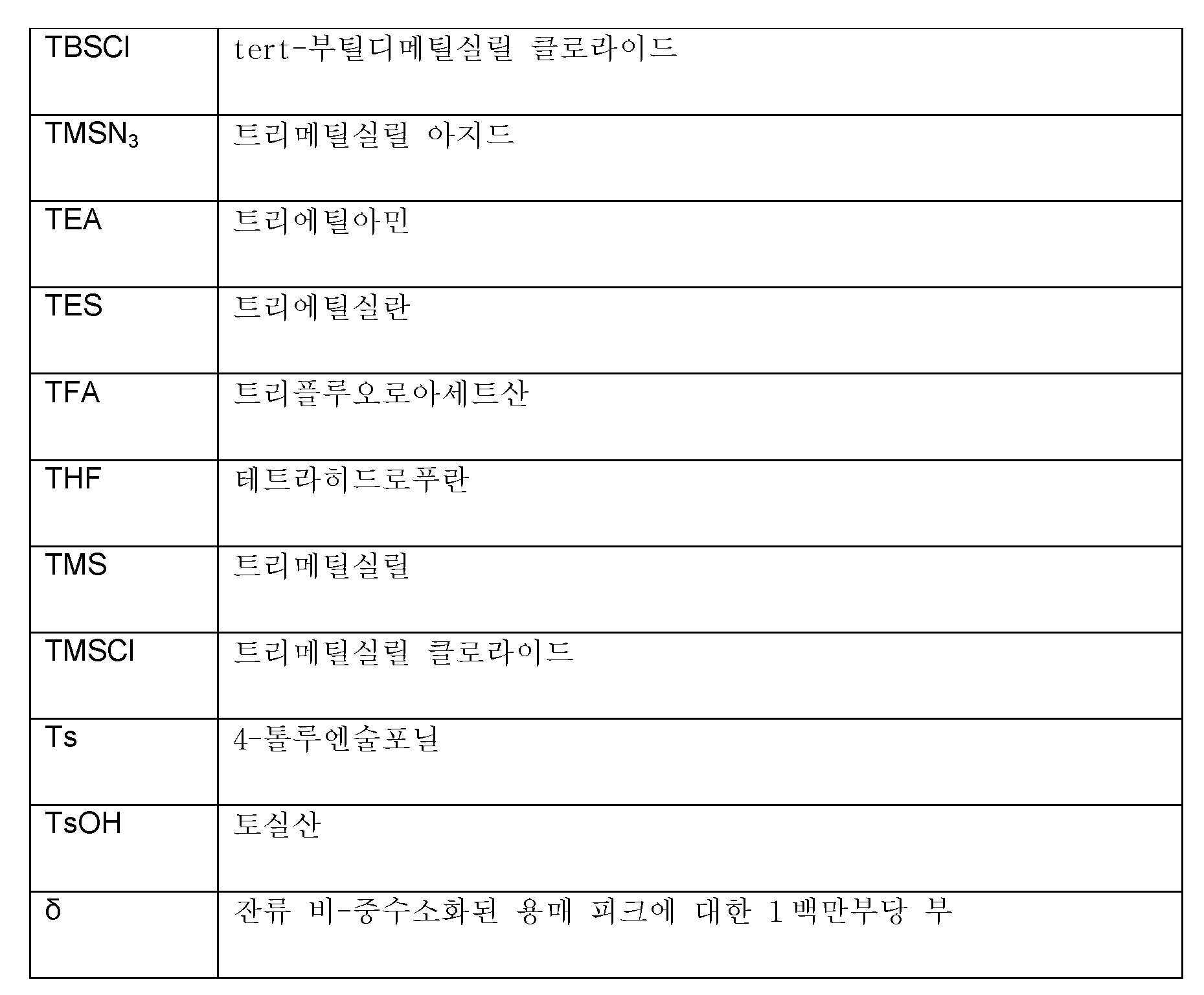
일반적인 반응식General reaction scheme
<반응식 1><Scheme 1>

반응식 1은 핵염기 S1b를 생성하기 위하여 아이오딘화 반응 (예, NIS)을 개시하는 중간체의 일반적인 합성을 나타낸다.Scheme 1 shows the general synthesis of an intermediate that initiates an iodination reaction (eg, NIS) to produce nucleobase S1b.
<반응식 2><Reaction Scheme 2>
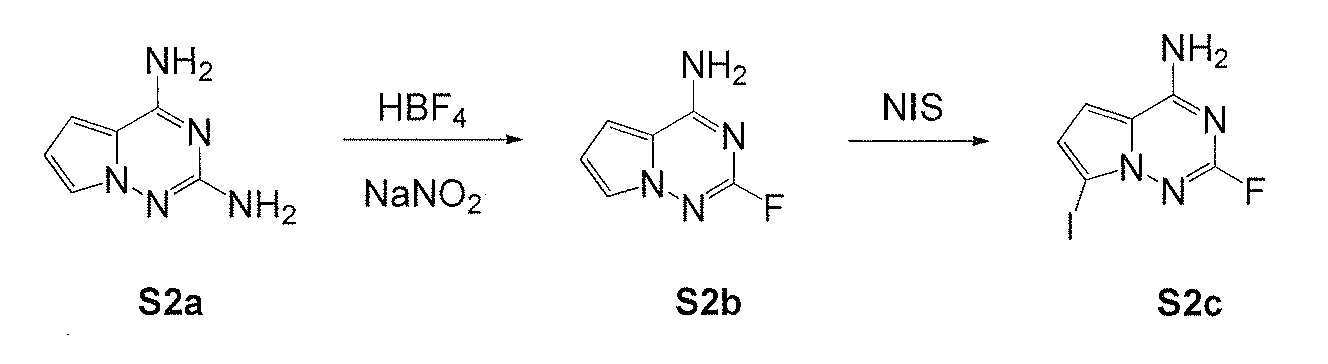
반응식 2는 중간체 S2b를 얻기 위하여 WO2012037038A1에 기재된 것과 유사한 방식으로 불소화 반응 (예, HBF4, NaNO2)으로 개시되는 중간체의 일반적인 합성을 나타낸다. 그 후, 중간체 S2b를 아이오딘화 (예, NIS)시켜 핵염기 S2c를 얻을 수 있다:Scheme 2 shows the general synthesis of intermediates initiated by fluorination reactions (eg HBF 4 , NaNO 2 ) in a manner similar to that described in WO2012037038A1 to obtain intermediate S2b. Thereafter, intermediate S2b can be iodinated (eg, NIS) to obtain nucleobase S2c:
<반응식 3><Scheme 3>
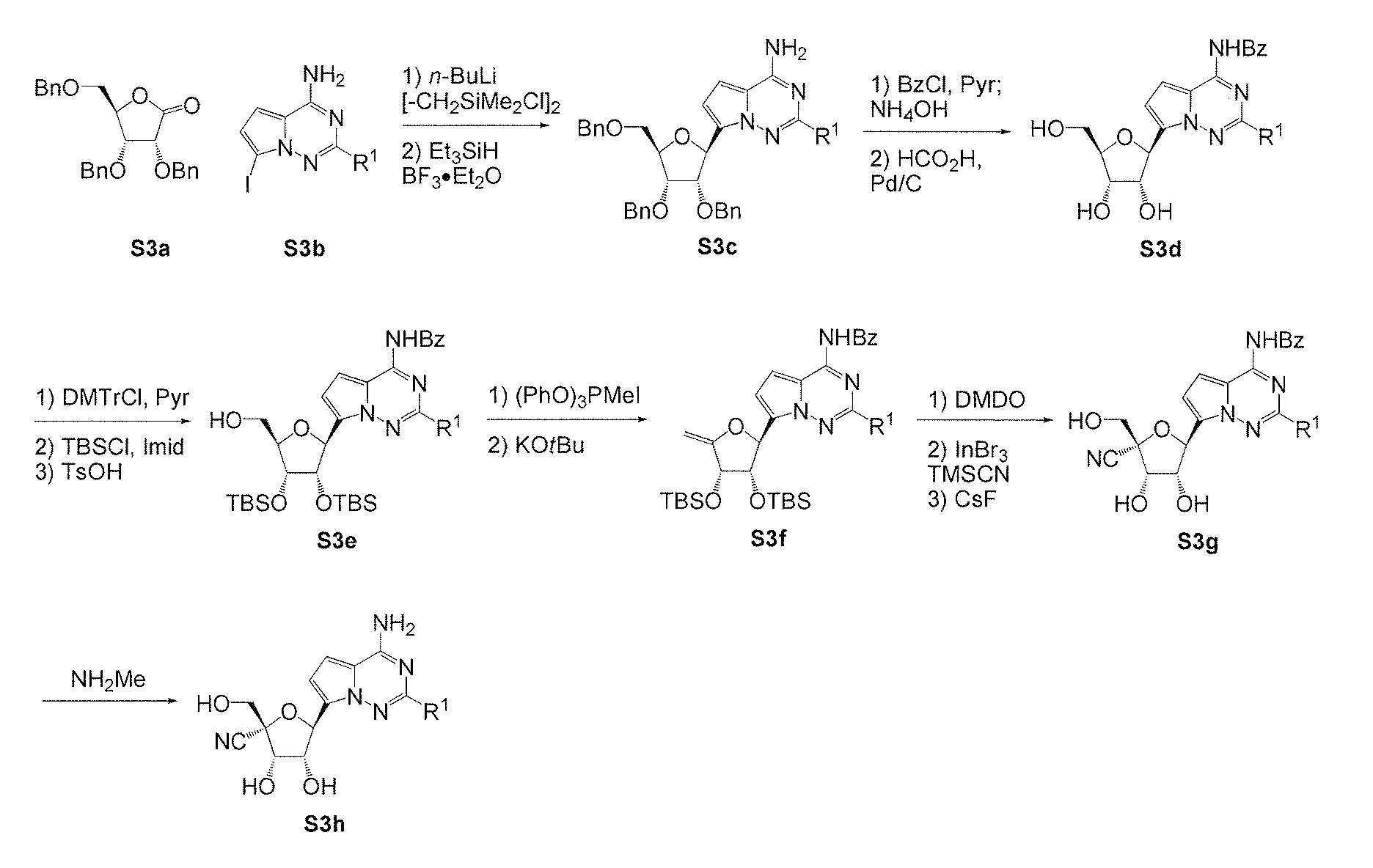
반응식 3은 적절한 핵염기 S3b를 사용한 리튬-할로겐 교환 (예, n-BuLi, [-CH2SiMe2Cl]2) 반응에 이어서 락톤 S3a로의 첨가로 개시되는 화합물의 일반적인 합성을 나타낸다. 루이스 산 조건 (예, BF3·Et2O, Et3SiH) 하에서 펜던트 1' 히드록실 기의 환원은 중간체 S3c를 생성한다. 중간체 S3c는 우선 질소 작용기에서 보호 (예, BzCl, Pyr; NH4OH)시킬 수 있으며, 그 후, 벤질 기는 환원 조건 (예, HCO2H, Pd/C, BCl3, BBr3) 하에서 제거하여 중간체 S3d를 얻을 수 있다. 우선 선택적 5' 히드록실 보호 (예, DMTrCl)에 이어서 2' 및 3' 히드록실 보호 (예, TBSCl), 그 후 산성 조건 (예, TsOH) 하에서 5' 히드록실 보호기의 선택적 제거를 포함하는 시퀀스는 중간체 S3e를 공급한다. 그 후, 5' 히드록실 기는 해당 아이오다이드 (예, (PhO)3PMeI)로 전환된 후, 이를 염기성 조건 (즉 KOtBu)에 노출시켜 제거 반응을 실시하여 중간체 S3f를 생성할 수 있다. 올레핀 S3f의 산화 (예, DMDO)에 이어서 루이스 산 조건 (예, InBr3) 하에서의 적절한 친핵체 (예, TMSCN)를 사용한 처리 및 히드록실 보호기의 제거 (예, CsF)에 의하여 중간체 S3g를 얻는다. 질소 보호기의 제거 (예, NH2Me)에 의하여 타입 S3h의 최종 화합물을 얻는다.Scheme 3 shows the general synthesis of a compound initiated by lithium-halogen exchange (eg, n-BuLi, [-CH 2 SiMe 2 Cl] 2 ) reaction using a suitable nucleobase S3b followed by addition to lactone S3a. Reduction of the pendant 1 'hydroxyl group under Lewis acid conditions (eg, BF 3 · Et 2 O, Et 3 SiH) produces intermediate S3c. Intermediate S3c can first be protected (eg, BzCl, Pyr; NH 4 OH) in a nitrogen functional group, after which the benzyl group is removed under reducing conditions (e.g. HCO 2 H, Pd / C, BCl 3 , BBr 3 ) Intermediate S3d can be obtained. A sequence comprising first selective 5 'hydroxyl protection (e.g. DMTrCl) followed by 2' and 3 'hydroxyl protection (e.g. TBSCl) followed by selective removal of 5' hydroxyl protecting group under acidic conditions (e.g. TsOH) Supplies intermediate S3e. Thereafter, the 5 'hydroxyl group can be converted to the corresponding iodide (e.g., (PhO) 3 PMeI), and then exposed to basic conditions (i.e., KOtBu) to carry out a removal reaction to generate intermediate S3f. Intermediate S3g is obtained by oxidation of olefin S3f (eg DMDO) followed by treatment with a suitable nucleophile (eg TMSCN) under Lewis acid conditions (eg InBr 3 ) and removal of hydroxyl protecting groups (eg CsF). The final compound of type S3h is obtained by removal of a nitrogen protecting group (eg NH 2 Me).
<반응식 4><Reaction Scheme 4>
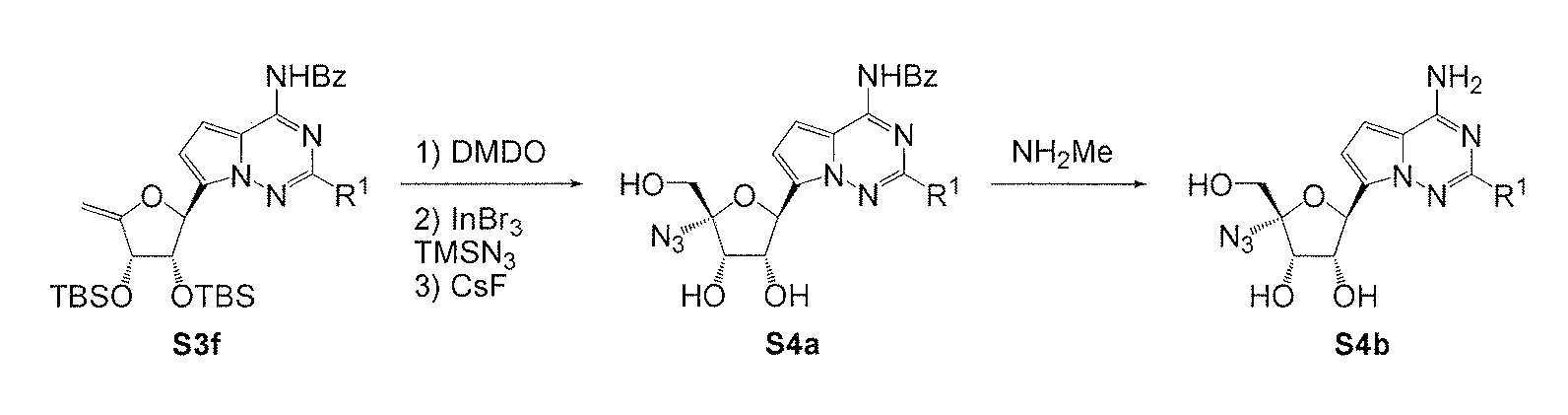
반응식 4는 (J. Med . Chem. 2007, 50, 5463-5470)에 기재된 바와 유사한 방식으로 올레핀 S3f의 산화 (예, DMDO)에 이어서 루이스 산 조건 (예, InBr3) 하에서 적절한 친핵체 (예, TMSN3)를 사용한 처리로 개시되는 화합물의 일반적인 합성을 나타낸다. 그 후, 히드록실 보호기의 제거 (예, CsF)는 중간체 S4a를 얻었다. 질소 보호기의 제거 (예, NH2Me)는 타입 S4b의 최종 화합물이 수득되었다.Scheme 4 is a suitable nucleophile (e.g., under Lewis acid conditions (e.g., InBr 3 )) followed by oxidation of olefin S3f (e.g., DMDO) in a similar manner as described in ( J. Med . Chem . 2007, 50, 5463-5470). The general synthesis of compounds initiated by treatment with TMSN 3 ) is shown. Subsequently, removal of the hydroxyl protecting group (eg, CsF) yielded intermediate S4a. Removal of the nitrogen protecting group (eg NH 2 Me) gave the final compound of type S4b.
<반응식 5><Reaction Scheme 5>

반응식 5는 적절한 알콜 HORa의 존재하에서 올레핀 S3f의 산화 (예, DMDO)에 이어서 히드록실 보호기의 제거 (예, CsF)로 개시하여 중간체 S5a를 얻는 화합물의 일반적인 합성을 나타낸다. 질소 보호기의 제거 (예, NH2Me)는 타입 S5b의 최종 화합물이 수득된다.Scheme 5 shows the general synthesis of compounds to obtain intermediate S5a by starting with oxidation of olefin S3f in the presence of a suitable alcohol HOR a (eg DMDO) followed by removal of hydroxyl protecting groups (eg CsF). Removal of the nitrogen protecting group (eg NH 2 Me) gives the final compound of type S5b.
<반응식 6><Scheme 6>

반응식 6은 (Nucleosides, Nucleotides and Nucleic Acids 2005, 24, 343-347)에 기재된 바와 유사한 방식으로 올레핀 S3f의 산화 (예, DMDO)에 이어서 적절한 친핵체 (예, (HC≡C)3Al)를 사용한 처리에 의하여 개시되는 화합물의 일반적인 합성을 나타낸다. 그 후, 히드록실 보호기의 제거 (예, CsF)는 중간체 S6a를 산출하였다. 질소 보호기의 제거 (예, NH2Me)는 타입 S6b의 최종 화합물이 수득된다. 수소화 조건 (예, H2, Pd/C 또는 린들러(Lindlar) 조건)을 통한 최종 화합물의 합성은 타입 S6c 및 S6d의 최종 화합물 각각을 선택적으로 산출할 수 있다. 시클로프로판화 조건 (예, CH2N2)을 통한 최종 화합물 S6d의 합성은 타입 S6e의 최종 화합물을 산출할 수 있다.Scheme 6 was prepared using the appropriate nucleophile (e.g., (HC≡C) 3 Al) followed by oxidation of the olefin S3f (e.g. DMDO) in a similar manner as described in ( Nucleosides, Nucleotides and Nucleic Acids 2005, 24, 343-347). The general synthesis of compounds initiated by treatment is shown. Subsequent removal of the hydroxyl protecting group (eg, CsF) yielded intermediate S6a. Removal of the nitrogen protecting group (eg NH 2 Me) gives the final compound of type S6b. Synthesis of the final compound via hydrogenation conditions (eg, H 2 , Pd / C or Lindlar conditions) can selectively yield each of the final compounds of types S6c and S6d. Synthesis of final compound S6d via cyclopropanation conditions (eg, CH 2 N 2 ) can yield a final compound of type S6e.
<반응식 7><Scheme 7>

반응식 7은 WO2012037038A1에 기재된 바와 유사한 방식으로 합성된 중간체 S7a의 질소를 보호하기 위한 합성 시퀀스 (예, TMSCl, Pyr; BzCl, Pyr; NH4OH)로 개시되는 화합물의 일반적인 합성을 나타낸다. 그 후, 5' 히드록실 기의 선택적 보호 (예, DMTrCl)는 중간체 S7b를 생성한다. 2' 히드록실 기의 보호 (예, TBSCl)에 이어서 산성 조건 (예, TsOH) 하에서 5' 히드록실 기의 제거는 중간체 S7e를 제공한다. 산화 조건 (예, EDCl·HCl, Pyr, TFA, DMSO) 하에서 5' 히드록실 기를 알데히드로 전환시킨 후, 해당 에놀레이트를 포름알데히드로 축합시키고, 환원 (예, NaBH4)시켜 중간체 S7f를 생성한다. 히드록실 모이어티를 오르토고날(orthogonal) 보호기로 순차적 선택적 보호 (예, DMTrCl 및 TBSCl)한 후, 산성 조건 (예, TsOH) 하에서 더 불안정한 보호기를 제거하여 중간체 S7g를 얻는다. 산화 조건 (예, EDCl·HCl, Pyr, TFA, DMSO) 하에서 히드록실 기를 알데히드로 전환시켜 중간체 S7h를 생성한다. 알데히드 S7h를 할로-올레핀 중간체 S7i로의 합성은 위티그(Wittig) 올레핀화 조건 (예, [Ph3PCH2Br]+Br-, KOtBu) 하에서 실시할 수 있다. 염기성 조건 (예, KOtBu) 하에서의 제거 반응은 알킨을 생성하며, 히드록실 보호기의 제거 (예, TBAF) 및 질소 보호기의 제거 (예, NH4OH)는 타입 S7j의 최종 화합물이 수득된다.Scheme 7 shows the general synthesis of compounds initiated with synthetic sequences (e.g., TMSCl, Pyr; BzCl, Pyr; NH 4 OH) to protect the nitrogen of intermediate S7a synthesized in a similar manner as described in WO2012037038A1. Then, selective protection of the 5 'hydroxyl group (eg DMTrCl) produces intermediate S7b. Protection of the 2 'hydroxyl group (e.g., TBSCl) followed by removal of the 5' hydroxyl group under acidic conditions (e.g., TsOH) gives the intermediate S7e. After converting the 5 'hydroxyl group to aldehyde under oxidizing conditions (e.g. EDCl.HCl, Pyr, TFA, DMSO), the corresponding enolate is condensed with formaldehyde and reduced (e.g. NaBH 4 ) to produce intermediate S7f. . The sequential selective protection (eg, DMTrCl and TBSCl) of the hydroxyl moiety with an orthogonal protecting group is followed by removal of more unstable protecting groups under acidic conditions (eg, TsOH) to obtain intermediate S7g. Conversion of hydroxyl groups to aldehydes under oxidizing conditions (eg, EDCl · HCl, Pyr, TFA, DMSO) produces intermediate S7h. Aldehyde S7h halo-olefin to synthetic intermediates S7i the Wittig (Wittig) olefination conditions can be carried out (for example, [Ph 3 PCH 2 Br] + Br, KOtBu). Removal reactions under basic conditions (e.g. KOtBu) produce alkynes, removal of hydroxyl protecting groups (e.g. TBAF) and removal of nitrogen protecting groups (e.g. NH 4 OH) to give the final compound of type S7j.
<반응식 8><Scheme 8>
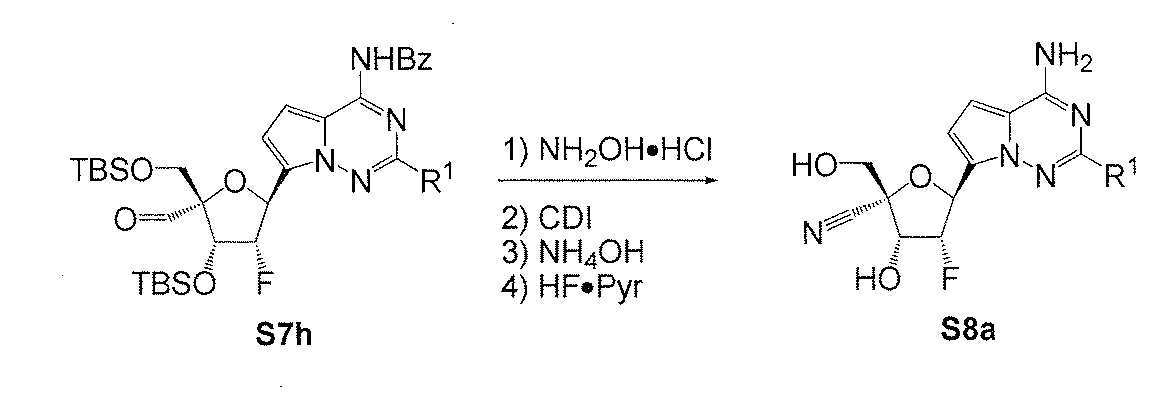
반응식 8은 옥심 형성 (예, NH2OH·HCl)에 이어서 옥심을 니트릴 기로의 전환 (예, CDI)을 개시하여 화합물의 일반적 합성을 나타낸다. 그 후, 질소 보호기의 제거 (예, NH4OH) 및 히드록실 보호기의 제거 (예, HF·Pyr)는 타입 S8a의 최종 화합물이 수득된다.Scheme 8 shows the general synthesis of compounds by initiating oxime formation (e.g. NH 2 OHHCl) followed by conversion of oxime to nitrile groups (e.g. CDI). Subsequently, removal of the nitrogen protecting group (eg NH 4 OH) and removal of the hydroxyl protecting group (eg HF · Pyr) gives the final compound of type S8a.
<반응식 9><Scheme 9>

반응식 9는 위티그 올레핀화 조건 (예, [Ph3PCH3]+Br-, KOtBu)을 사용한 알데히드 S7h의 올레핀으로의 합성으로 개시되는 화합물의 일반적인 합성을 나타낸다.히드록실 보호기의 제거 (예, TBAF) 및 질소 보호기의 제거 (예, NH4OH)는 타입 S9a의 최종 화합물이 수득된다. 그 후, 환원 조건 (예, H2, Pd/C)은 타입 S9b의 최종 화합물을 생성할 수 있으며, 시클로프로판화 조건 (예, CH2N2)은 타입 S9c의 최종 화합물을 생성할 수 있다Scheme 9 Wittig olefination conditions (for example, [Ph 3 PCH 3] + Br -, KOtBu) shows the general synthesis of the compounds disclosed in the synthesis of the aldehyde S7h olefins with the removal of the hydroxyl protecting group (for example, TBAF) and removal of nitrogen protecting groups (eg NH 4 OH) to give the final compound of type S9a. Subsequently, reducing conditions (eg, H 2 , Pd / C) can produce a final compound of type S9b, and cyclopropanation conditions (eg, CH 2 N 2 ) can produce a final compound of type S9c.
<반응식 10><Reaction Scheme 10>
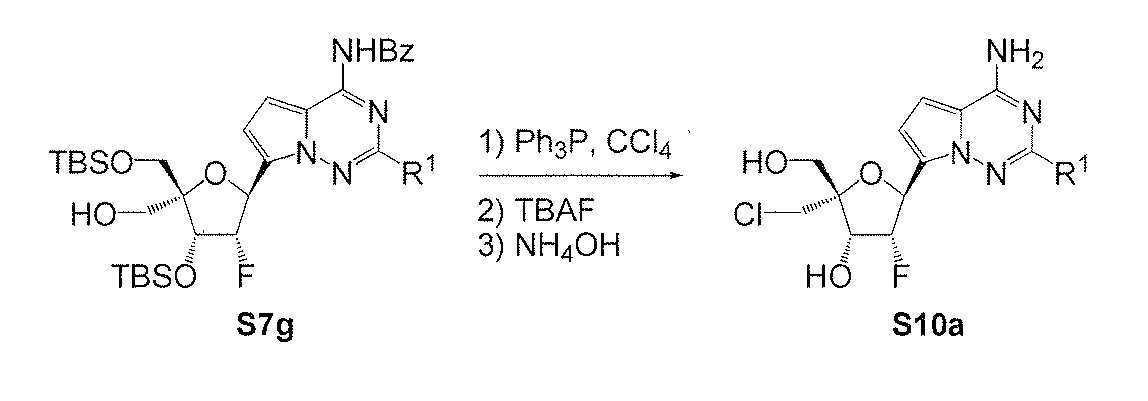
반응식 10은 히드록실 기를 클로라이드로 전환시키는 아펠(Appel) 반응 (예, Ph3P, CCl4)으로 개시되는 화합물의 일반적인 합성을 나타낸다. 히드록실 보호기의 제거 (예, TBAF) 및 질소 보호기의 제거 (예, NH4OH)는 타입 S10a의 최종 화합물이 수득된다.Scheme 10 shows the general synthesis of compounds initiated by an Appel reaction (eg, Ph 3 P, CCl 4 ) that converts hydroxyl groups to chloride. Removal of hydroxyl protecting groups (eg TBAF) and removal of nitrogen protecting groups (eg NH 4 OH) gives the final compound of type S10a.
<반응식 11><Scheme 11>

반응식 11은 불안정 보호기를 사용한 중간체 S7g의 유리 히드록실 기의 보호 (예, PMBCl, K2CO3)를 개시되는 화합물의 일반적인 합성을 나타낸다. 2' 및 5' 실릴옥시 보호기의 선택적 제거 (예, TBAF)에 이어서 강력한 보호기를 사용한 재보호 (예, BnBr, NaH) 및 산성 조건 (예, AcOH) 하에서 불안정 히드록실 보호기의 제거로 중간체 S11a를 얻는다. 히드록실 기를 불소로의 전환 (예, DAST)에 이어서 히드록실 보호기의 제거 (예, BBr3) 및 질소 보호기의 제거 (예, NH4OH)는 타입 S11b의 최종 화합물이 수득된다.Scheme 11 shows the general synthesis of a compound that initiates the protection of free hydroxyl groups of intermediate S7g (eg PMBCl, K 2 CO 3 ) with unstable protecting groups. Selective removal of the 2 'and 5' silyloxy protecting groups (e.g. TBAF) followed by re-protection with strong protecting groups (e.g. BnBr, NaH) and removal of labile hydroxyl protecting groups under acidic conditions (e.g. AcOH) to give intermediate S11a. Get Conversion of the hydroxyl group to fluorine (e.g. DAST) followed by removal of the hydroxyl protecting group (e.g. BBr 3 ) and removal of the nitrogen protecting group (e.g. NH 4 OH) gives the final compound of type S11b.
<화학식 12><Formula 12>
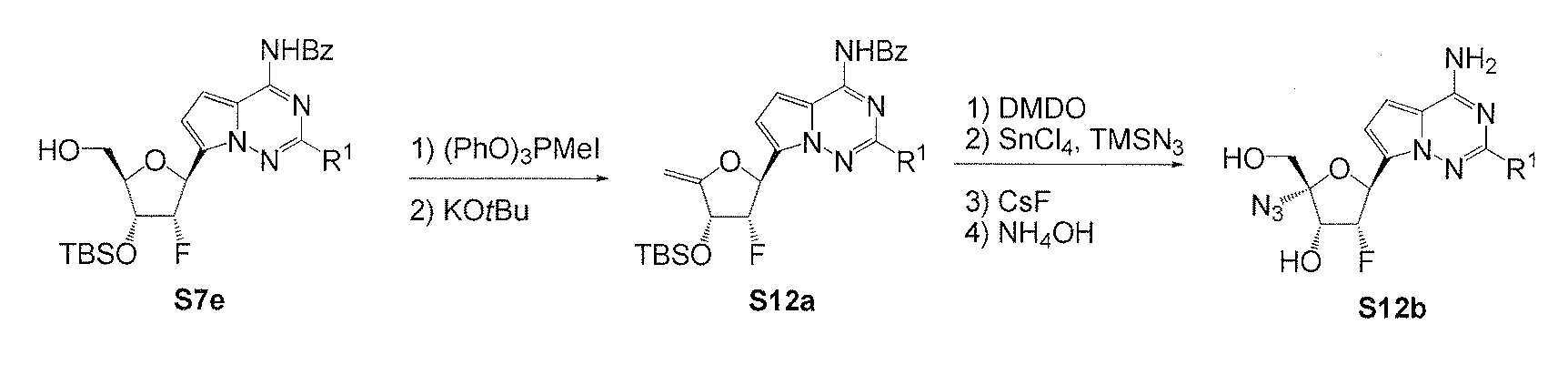
반응식 12는 5' 히드록실 기의 해당 아이오다이드로의 전환 (예, (PhO)3PMeI)에 이어서 염기성 조건 (즉 KOtBu)으로 처리하여 제거 반응을 실시하여 중간체 S12a를 생성하는 것으로 개시되는 화합물의 일반적인 합성을 나타낸다. 올레핀 S12a의 산화 (예, DMDO)에 이어서 (J. Med . Chem. 2007, 50, 5463-5470)에 기재된 바와 유사한 방식으로 루이스 산 조건 (예, SnCl4) 하에서 적절한 친핵체 (예, TMSN3)를 사용한 처리 및 히드록실 보호기의 제거 (예, CsF) 및 질소 보호기의 제거 (예, NH4OH)로 타입 S12b의 최종 화합물을 얻는다.Scheme 12 is a compound disclosed to produce an intermediate S12a by converting a 5 'hydroxyl group to the corresponding iodide (e.g., (PhO) 3 PMeI) followed by treatment with basic conditions (i.e.KOtBu) to carry out a removal reaction. General synthesis. Oxidation of olefin S12a (e.g. DMDO) followed by appropriate nucleophiles (e.g. TMSN 3 ) under Lewis acid conditions (e.g. SnCl 4 ) in a similar manner as described in ( J. Med . Chem . 2007, 50, 5463-5470). Treatment with and removal of hydroxyl protecting groups (e.g. CsF) and removal of nitrogen protecting groups (e.g. NH 4 OH) give the final compound of type S12b.
<반응식 13><Scheme 13>

반응식 13은 적절한 알콜 HORa의 존재하에서 올레핀 S12a의 산화 (예, DMDO) 및 히드록실 보호기의 제거 (예, CsF)로 개시되는 화합물의 일반적인 합성을 나타낸다. 질소 보호기의 제거 (예, NH2Me)로 타입 S13a의 최종 화합물이 수득된다.Scheme 13 shows the general synthesis of compounds initiated by oxidation of olefin S12a (eg, DMDO) and removal of hydroxyl protecting groups (eg, CsF) in the presence of a suitable alcohol HOR a . Removal of the nitrogen protecting group (eg NH 2 Me) gives the final compound of type S13a.
<반응식 14><Reaction Scheme 14>

반응식 14는 크산탄 형성 (예, PhOC(S)Cl, DMAP)에 이어서 바톤-맥콤비(Barton-McCombie) 탈산화 반응 (예, (TMS)3SiH, AIBN)으로 중간체 S14a를 생성하는 것으로 개시되는 화합물의 일반적인 합성을 나타낸다. 히드록실 보호기의 제거 (예, TBAF) 및 질소 보호기의 제거 (예, NH4OH)는 타입 S14b의 최종 화합물이 수득된다.Scheme 14 discloses the formation of intermediate S14a by xanthan formation (e.g. PhOC (S) Cl, DMAP) followed by Barton-McCombie deoxidation reaction (e.g. (TMS) 3 SiH, AIBN) It shows the general synthesis of the compound. Removal of hydroxyl protecting groups (eg TBAF) and removal of nitrogen protecting groups (eg NH 4 OH) gives the final compound of type S14b.
<반응식 15><Reaction Scheme 15>

반응식 15는 (Biosci . Biotech. Biochem. 1993, 57, 1433-1438)에 기재된 바와 유사한 방식으로 생성된 중간체 S15a로 개시되는 화합물의 일반적인 합성을 나타낸다. 가수분해 조건 (예, K2CO3, MeOH)을 사용한 아세테이트 보호기의 제거에 이어서, 화학적선택적 산화 조건 (예, NIS, Bu4NI) 및 2' 히드록실 기의 보호 (예, BnBr, Ag2O)는 중간체 S15b를 생성한다. 적절한 핵염기 S3b를 사용한 리튬-할로겐 교환 (예, n-BuLi, [-CH2SiMe2Cl]2) 및 락톤 S15b로의 첨가에 이어서, 루이스 산 조건 (예, BF3·Et2O, Et3SiH) 하에서 1' 히드록실 기의 환원 및 탈보호 (예, H2, Pd 블랙)는 타입 S15c의 최종 화합물을 생성한다,Scheme 15 shows the general synthesis of compounds initiated with intermediate S15a produced in a similar manner as described in ( Biosci . Biotech. Biochem . 1993, 57, 1433-1438). Removal of acetate protecting groups using hydrolysis conditions (eg K 2 CO 3 , MeOH) followed by chemically selective oxidation conditions (eg NIS, Bu 4 NI) and protection of 2 ′ hydroxyl groups (eg BnBr, Ag 2 O) produces intermediate S15b. Lithium-halogen exchange with an appropriate nucleobase S3b (eg, n-BuLi, [-CH 2 SiMe 2 Cl] 2 ) and addition to lactone S15b, followed by Lewis acid conditions (eg, BF 3 · Et 2 O, Et 3 Reduction and deprotection of 1 'hydroxyl groups under SiH) (e.g. H 2 , Pd black) results in a final compound of type S15c,
<반응식 16><Reaction Scheme 16>
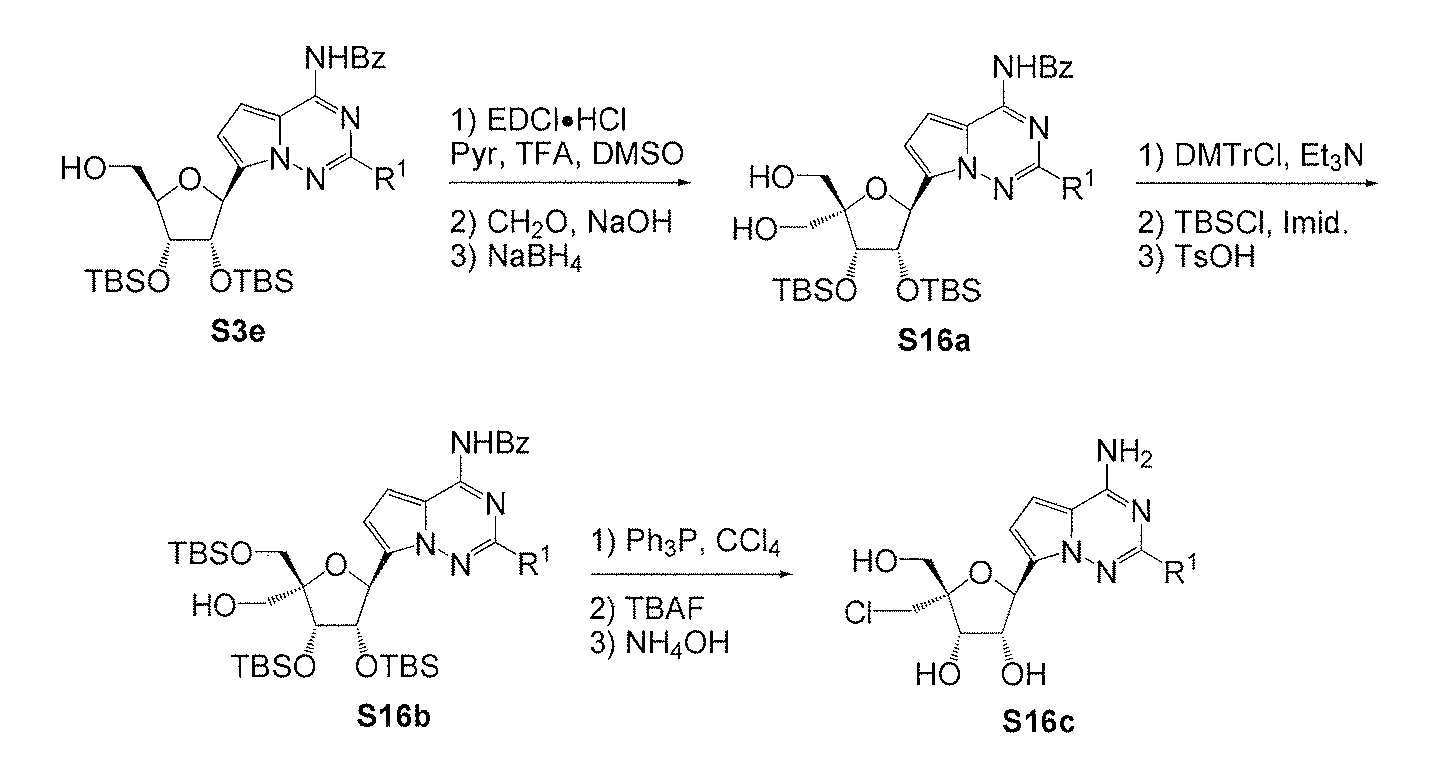
반응식 16은 산화 조건 (예, EDCl·HCl, Pyr, TFA, DMSO) 하에서 5' 히드록실 기의 알데히드로의 전환에 이어서 포름알데히드를 사용한 해당 에놀레이트의 축합 및 환원 (예, NaBH4)으로 중간체 S16a를 산출하는 것으로 개시되는 화합물의 일반적인 합성을 나타낸다. 오르토고날 보호기를 사용한 히드록실 모이어티의 순차적 선택적 보호 (예, DMTrCl 및 TBSCl)에 이어서 산성 조건 (예, TsOH) 하에서 더 불안정한 보호기의 제거로 중간체 S16b를 얻는다. 그 후, 아펠 반응 (예, Ph3P, CCl4)은 히드록실 기를 클로라이드로 전환시키고, 히드록실 보호기의 제거 (예, TBAF) 및 질소 보호기의 제거 (예, NH4OH)는 타입 S16c의 최종 화합물이 수득된다.Scheme 16 is an intermediate with the conversion of 5 'hydroxyl group to aldehyde under oxidizing conditions (e.g. EDCl.HCl, Pyr, TFA, DMSO) followed by condensation and reduction of the corresponding enolate with formaldehyde (e.g. NaBH 4 ). It shows the general synthesis of compounds disclosed to yield S16a. Intermediate S16b is obtained by sequential selective protection of hydroxyl moieties with orthogonal protecting groups (eg DMTrCl and TBSCl) followed by removal of more unstable protecting groups under acidic conditions (eg TsOH). Then, the Arpels reaction (e.g. Ph 3 P, CCl 4 ) converts the hydroxyl group to chloride, the removal of the hydroxyl protecting group (e.g. TBAF) and the removal of the nitrogen protecting group (e.g. NH 4 OH) of type S16c. The final compound is obtained.
<반응식 17><Reaction Scheme 17>
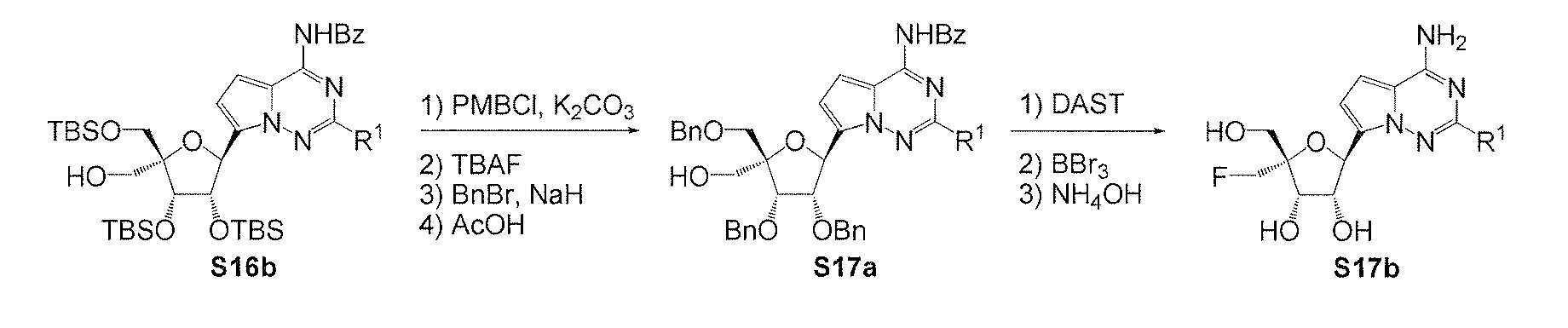
반응식 17은 불안정 보호기를 사용한 중간체 S16b의 유리 히드록실 기의 보호 (예, PMBCl, K2CO3)로 개시되는 화합물의 일반적인 합성을 나타낸다. 2', 3' 및 5' 실릴옥시 보호기의 선택적 제거 (예, TBAF)에 이어서 강력한 보호기를 사용한 재보호 (예, BnBr, NaH) 및 산성 조건 (예, AcOH) 하에서 불안정 히드록실 보호기의 제거로 중간체 S17a를 얻는다. 히드록실 기의 불소로의 전환 (예, DAST)에 이어서 히드록실 보호기의 제거 (예, BBr3) 및 질소 보호기의 제거 (예, NH4OH)는 타입 S17b의 최종 화합물을 얻는다.Scheme 17 shows the general synthesis of compounds initiated by the protection of free hydroxyl groups of intermediate S16b (eg PMBCl, K 2 CO 3 ) with labile protecting groups. Selective removal of 2 ', 3' and 5 'silyloxy protecting groups (e.g. TBAF) followed by reprotection with strong protecting groups (e.g. BnBr, NaH) and removal of unstable hydroxyl protecting groups under acidic conditions (e.g. AcOH) Intermediate S17a is obtained. The conversion of hydroxyl groups to fluorine (eg DAST) followed by removal of hydroxyl protecting groups (eg BBr 3 ) and removal of nitrogen protecting groups (eg NH 4 OH) gives the final compound of type S17b.
<반응식 18><Reaction Scheme 18>
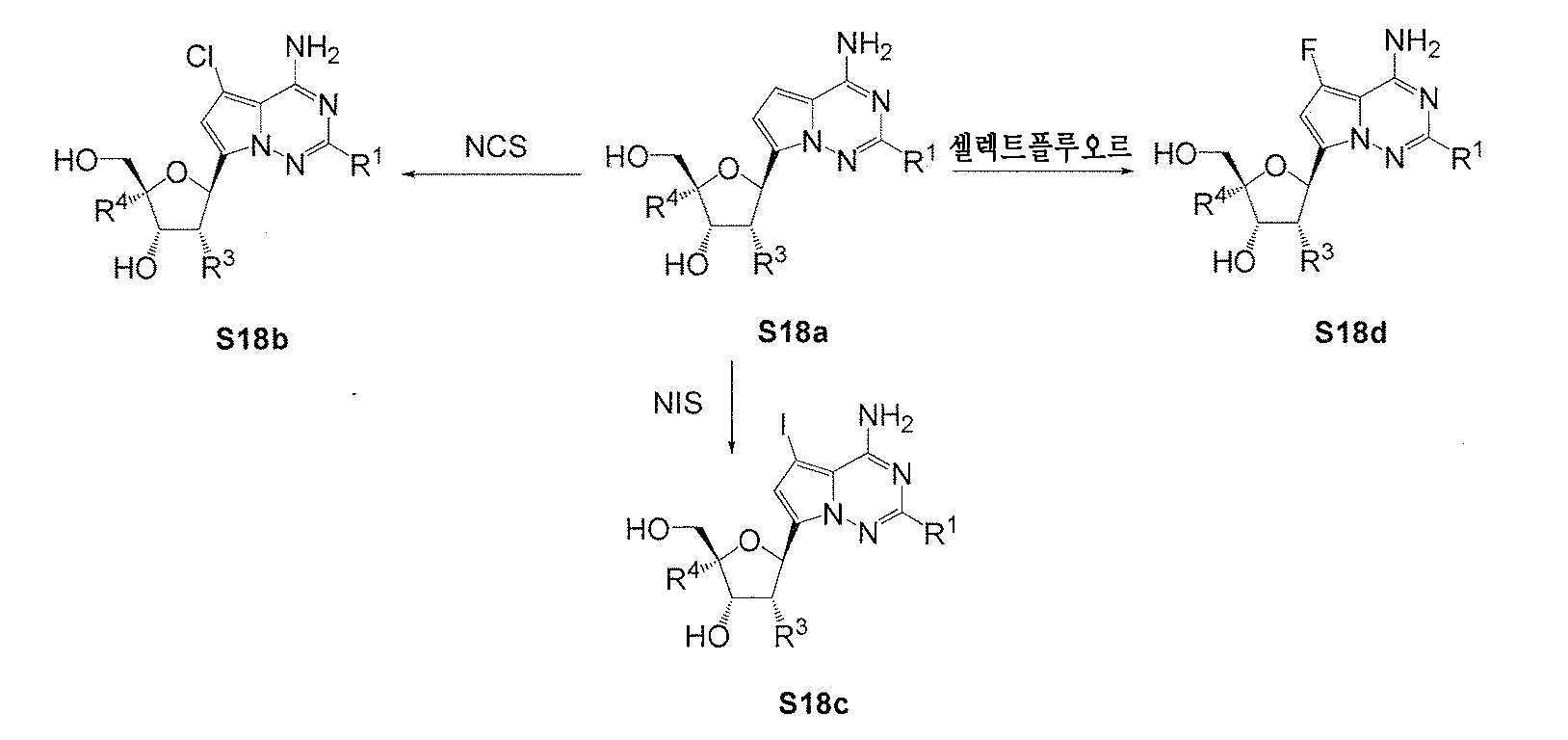
반응식 18은 중간체 S18a의 적절한 친전자성 할로겐화 반응에 의하여 타입 S18b (예, NCS), S18c (예, NIS) 및 S18d (예, 셀렉트플루오르(Selectfluor))의 최종 화합물을 얻는 화합물의 일반적인 합성을 나타낸다.Scheme 18 shows the general synthesis of compounds to obtain the final compounds of types S18b (e.g. NCS), S18c (e.g. NIS) and S18d (e.g. Selectfluor) by the appropriate electrophilic halogenation reaction of intermediate S18a. .
<반응식 19><Scheme 19>

반응식 19는 교차-커플링 반응 (예, Zn(CN)2, Pd(PtBu)3)에 의하여 타입 S19a의 최종 화합물을 얻는 것으로 개시되는 화합물의 일반적인 합성을 나타낸다. 그 후, 화합물 S19a는 니트릴의 가수분해 반응 (예, H2O2, NH4OH, H2O)에 의하여 타입 S19b의 화합물을 얻어서 합성될 수 있다.Scheme 19 shows the general synthesis of compounds disclosed as obtaining the final compound of type S19a by a cross-coupling reaction (eg, Zn (CN) 2 , Pd (PtBu) 3 ). Thereafter, compound S19a can be synthesized by obtaining a compound of type S19b by hydrolysis of nitrile (eg, H 2 O 2 , NH 4 OH, H 2 O).
<반응식 20><Reaction Scheme 20>

반응식 20은 소노가시라(Sonogashira) 반응 (예, CuI, PdCl2(PPh3)2)으로 타입 S20a의 최종 화합물을 산출하는 것으로 개시되는 화합물의 일반적인 합성을 나타낸다.Scheme 20 shows the general synthesis of compounds disclosed as yielding the final compound of type S20a with the Sonogashira reaction (eg, CuI, PdCl 2 (PPh 3 ) 2 ).
<반응식 21><Reaction Scheme 21>

반응식 21은 교차-커플링 반응 (예, Pd(dppf)Cl2, Cs2CO3)으로 타입 S21a의 최종 화합물을 생성하는 것으로 개시되는 화합물의 일반적인 합성을 나타낸다.Scheme 21 shows the general synthesis of compounds disclosed to produce the final compound of type S21a in a cross-coupling reaction (eg, Pd (dppf) Cl 2 , Cs 2 CO 3 ).
<반응식 22><Reaction Scheme 22>

반응식 22는 타입 S22b의 포스포릴화 유사체의 합성을 포함하는 화합물의 일반적인 합성을 나타낸다.Scheme 22 shows the general synthesis of compounds, including the synthesis of phosphorylated analogs of type S22b.
<반응식 23><Scheme 23>

반응식 23은 타입 S23b의 포스포릴화 유사체의 합성을 포함한 화합물의 일반적인 합성을 나타낸다.Scheme 23 shows the general synthesis of compounds, including the synthesis of phosphorylated analogs of type S23b.
<반응식 24><Reaction Scheme 24>
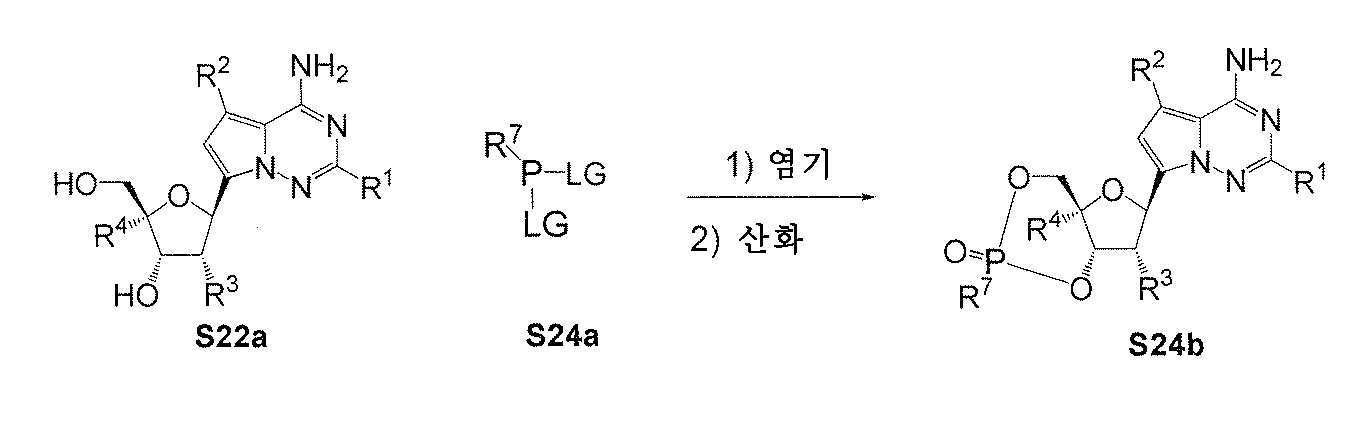
반응식 24는 타입 S24b의 포스포릴화 유사체의 합성을 포함한 화합물의 일반적인 합성을 나타낸다.Scheme 24 shows the general synthesis of compounds, including the synthesis of phosphorylated analogs of type S24b.
실험Experiment

중간체 1bIntermediate 1b
DMF (1 ㎖) 중의 중간체 1a (50 ㎎, 373 mmol)의 용액에 N-아이오도숙신이미드 (84 ㎎, 373 mmol)를 고체로서 실온에서 가하였다. 1.5 시간 후, 반응 혼합물을 1M NaOH 용액 (10 ㎖) 중에 희석하고, 생성된 슬러리를 실온에서 교반하였다. 1 시간 후, 고체를 진공 여과에 의하여 수집하고, 감압 하에서 건조시켜 중간체 1b를 얻었다.To a solution of intermediate 1a (50 mg, 373 mmol) in DMF (1 mL), N-iodosuccinimide (84 mg, 373 mmol) was added as a solid at room temperature. After 1.5 hours, the reaction mixture was diluted in 1M NaOH solution (10 mL), and the resulting slurry was stirred at room temperature. After 1 hour, the solid was collected by vacuum filtration and dried under reduced pressure to obtain intermediate 1b.
1H NMR (400 MHz, DMSO-d6) δ 7.89 (s, 1H), 7.78 (br-s, 1H), 6.98 (d, J=4.4 Hz, 1H), 6.82 (d, J=4.4 Hz, 1H), 3.30 (br-s, 1H). 1 H NMR (400 MHz, DMSO-d 6 ) δ 7.89 (s, 1H), 7.78 (br-s, 1H), 6.98 (d, J = 4.4 Hz, 1H), 6.82 (d, J = 4.4 Hz, 1H), 3.30 (br-s, 1H).
LC/MS: tR=1.21 min, MS m/z=261.02 [M+1]; LC 시스템: 써모 아셀라(Thermo Accela) 1250 UHPLCLC / MS: t R = 1.21 min, MS m / z = 261.02 [M + 1]; LC system: Thermo Accela 1250 UHPLC
MS 시스템: 써모(Thermo) LCQ 플리트(Fleet); 컬럼: 키네텍스(Kinetex) 2.6μ XB-C18 100A, 50×4.6 ㎜MS system: Thermo LCQ Fleet; Column: Kinetex 2.6 μ XB-C18 100A, 50 × 4.6 mm
용매: 0.1% 아세트산을 갖는 아세토니트릴, 0.1% 아세트산을 갖는 물; 구배: 2 ㎕/min으로 0 min-2.0 min 2-100% ACN, 2.0 min-3.05 min 100% ACN, 3.05 min-3.2 min 100%-2% ACN, 3.2 min-3.5 min 2% ACN.Solvent: acetonitrile with 0.1% acetic acid, water with 0.1% acetic acid; Gradient: 0 min-2.0 min 2-100% ACN, 2.0 min-3.05 min 100% ACN, 3.05 min-3.2 min 100% -2% ACN, 3.2 min-3.5 min 2% ACN at 2 μl / min.
HPLC: tr=1.536 min; HPLC 시스템: 아질런트(Agilent) 1100 시리즈; 컬럼: 제미니(Gemini) 5μ C18 110A, 50×4.6 ㎜; 용매: 0.1% TFA를 갖는 아세토니트릴, 0.1% TFA를 갖는 물; 구배: 2 ㎖/min으로 0 min-5.0 min 2-98% ACN, 5.0 min-6.0 min 98% ACN.HPLC: t r = 1.536 min; HPLC system: Agilent 1100 series; Column: Gemini 5μ C18 110A, 50 × 4.6 mm; Solvent: acetonitrile with 0.1% TFA, water with 0.1% TFA; Gradient: 0 min-5.0 min 2-98% ACN at 2 mL / min, 5.0 min-6.0 min 98% ACN.
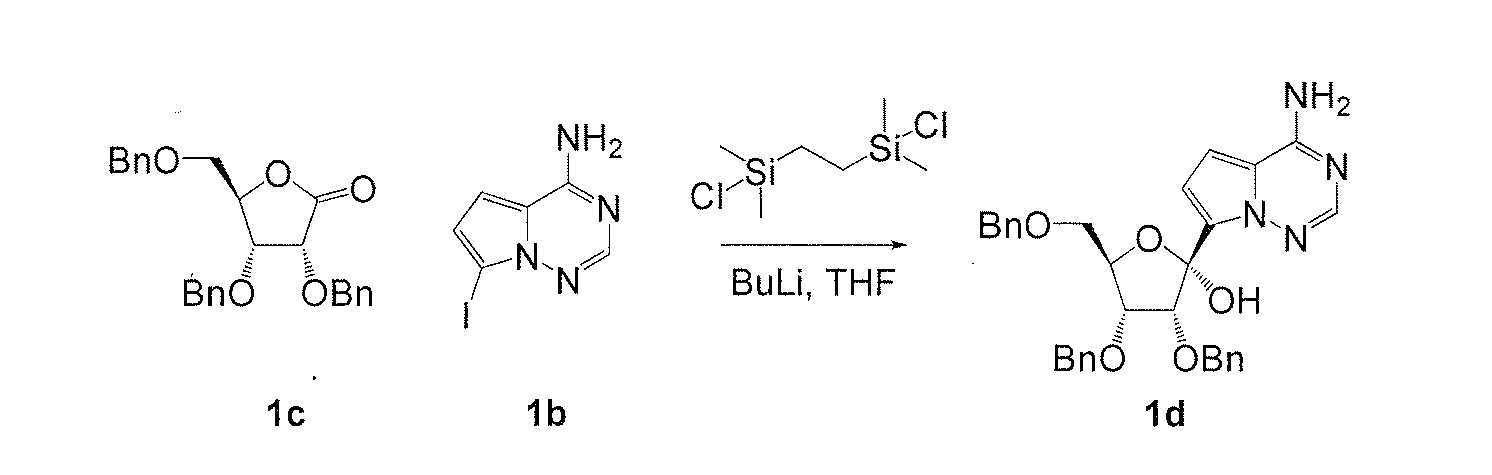
중간체 1d - (Intermediate 1d-( 2S,3R,4R,5R2S, 3R, 4R, 5R )-2-(4-) -2- (4- 아미노피롤로[1,2-f][1,2,4]트리아진Aminopyrrolo [1,2-f] [1,2,4] triazine -7-일)-3,4-비스(벤질옥시)-5-(벤질옥시메틸)테트라히드로푸란-2-올-7-yl) -3,4-bis (benzyloxy) -5- (benzyloxymethyl) tetrahydrofuran-2-ol
n-부틸리튬 (헥산 중의 2.5M, 34.4 ㎖, 86.0 mmol)을 THF (200 ㎖) 중의 7-아이오도피롤로[1,2-f][1,2,4]트리아진-4-아민 1b (6.84 g, 26.3 mmol) 및 1,2-비스(클로로디메틸실릴)에탄 (5.66 g, 26.3 mmol)의 현탁액에 -78℃에서 아르곤 대기 하에서 신속하게 첨가하였다. 첨가 중에 반응 혼합물의 내부 온도가 -40.5℃로 상승하였으며, 반응 혼합물은 맑은 갈색 용액이 되었다. 15 분 후, -78℃로 사전냉각시킨 테트라히드로푸란 (40 ㎖) 중의 (3R,4R,5R)-3,4-비스(벤질옥시)-5-(벤질옥시메틸)디히드로푸란-2(3H)-온 (1c, 카르보신쓰(Carbosynth)로부터 구입함, 10 g, 23.9 mmol)의 용액을 카뉼라를 통하여 신속하게 첨가하였다. 1 시간 후, 반응 혼합물을 아세트산 (15 ㎖)으로 켄칭시키고, 생성된 혼합물을 실온으로 가온되도록 하였다. 생성된 혼합물을 에틸 아세테이트 (800 ㎖)로 희석하고, 포화 중탄산나트륨 수용액 (500 ㎖) 및 염수 (500 ㎖)로 세정하였다. 유기층을 무수 황산나트륨 위에서 건조시키고, 감압 하에서 농축시켰다. 미정제 잔류물을 SiO2 컬럼 크로마토그래피 (220 g SiO2 콤비플래쉬 HP 골드 컬럼(Combiflash HP Gold Column), 0-100% 에틸 아세테이트/헥산)에 의하여 정제하여 중간체 1d를 얻었다.n-Butyllithium (2.5M in hexane, 34.4 mL, 86.0 mmol) was added with 7-iodopyrrolo [1,2-f] [1,2,4] triazine-4-amine 1b in THF (200 mL) ( To a suspension of 6.84 g, 26.3 mmol) and 1,2-bis (chlorodimethylsilyl) ethane (5.66 g, 26.3 mmol) was added rapidly at -78 ° C under an argon atmosphere. During the addition, the internal temperature of the reaction mixture rose to -40.5 ° C, and the reaction mixture became a clear brown solution. After 15 minutes, (3R, 4R, 5R) -3,4-bis (benzyloxy) -5- (benzyloxymethyl) dihydrofuran-2 () in tetrahydrofuran (40 mL) precooled to -78 ° C. A solution of 3H) -one (1c, purchased from Carbosynth, 10 g, 23.9 mmol) was quickly added via cannula. After 1 hour, the reaction mixture was quenched with acetic acid (15 mL), and the resulting mixture was allowed to warm to room temperature. The resulting mixture was diluted with ethyl acetate (800 mL) and washed with saturated aqueous sodium bicarbonate solution (500 mL) and brine (500 mL). The organic layer was dried over anhydrous sodium sulfate and concentrated under reduced pressure. The crude residue was purified by SiO 2 column chromatography (220 g SiO 2 Combiflash HP Gold Column, 0-100% ethyl acetate / hexane) to afford intermediate 1d.
LC/MS: tR=1.50 min, MS m/z=553.34 [M+1]; LC 시스템: 써모 아셀라 1250 UHPLCLC / MS: t R = 1.50 min, MS m / z = 553.34 [M + 1]; LC system: Thermo Acela 1250 UHPLC
MS 시스템: 써모 LCQ 플리트; 컬럼: 키네텍스 2.6μ XB-C18 100A, 50×4.6 ㎜MS system: Thermo LCQ pleats; Column: Kinetex 2.6 μ XB-C18 100A, 50 × 4.6 mm
용매: 0.1% 아세트산을 갖는 아세토니트릴, 0.1% 아세트산을 갖는 물; 구배: 0 min-1.5 min 2-100% ACN, 1.5 min-2.2 min 100% ACN, 2.2 min-2.4 min 100%-2% ACN, 2.4 min-2.5 min 2% ACN.Solvent: acetonitrile with 0.1% acetic acid, water with 0.1% acetic acid; Gradient: 0 min-1.5 min 2-100% ACN, 1.5 min-2.2 min 100% ACN, 2.2 min-2.4 min 100% -2% ACN, 2.4 min-2.5 min 2% ACN.
HPLC: tr=3.442 min; HPLC 시스템: 아질런트 1100 시리즈; 컬럼: 제미니 5μ C18 110A, 50×4.6 ㎜; 용매: 0.1% TFA를 갖는 아세토니트릴, 0.1% TFA를 갖는 물; 구배: 2 ㎖/min으로 0 min-5.0 min 2-98% ACN, 5.0 min-6.0 min 98% ACN.HPLC: t r = 3.442 min; HPLC system: Agilent 1100 series; Column: Gemini 5μ C18 110A, 50 × 4.6 mm; Solvent: acetonitrile with 0.1% TFA, water with 0.1% TFA; Gradient: 0 min-5.0 min 2-98% ACN at 2 mL / min, 5.0 min-6.0 min 98% ACN.
TLC: 용리제: 에틸 아세테이트, Rf=0.5 (UV)TLC: Eluent: ethyl acetate, R f = 0.5 (UV)

중간체 1e - 7-Intermediate 1e-7- ((2S,3S,4R,5R)-3,4-비스((2S, 3S, 4R, 5R) -3,4-bis (( 벤질옥시Benzyloxy )-5-() -5- ( 벤질옥시메틸Benzyloxymethyl )테트라히드로푸란-2-일)피롤로[1,2-f][1,2,4]트리아진-4-아민) Tetrahydrofuran-2-yl) pyrrolo [1,2-f] [1,2,4] triazine-4-amine
DCM (43 ㎖) 중의 중간체 1d (4.74 g, 8.58 mmol) 및 트리에틸실란 (3.56 ㎖, 22.3 mmol)의 용액에 삼불소화붕소 디에틸 에테레이트 (1.59 ㎖, 12.9 mmol)를 주사기에 의하여 서서히 0℃에서 아르곤 대기 하에서 첨가하였다. 2 시간 후, 반응 혼합물을 포화 중탄산나트륨 수용액 (100 ㎖)으로 서서히 희석하고, 생성된 혼합물을 에틸 아세테이트 (2×150 ㎖)로 추출하고, 무수 황산나트륨 위에서 건조시키고, 감압 하에서 농축시켰다. 미정제 잔류물을 SiO2 컬럼 크로마토그래피 (24 g SiO2 콤비플래쉬 HP 골드 컬럼, 0-100% 에틸 아세테이트/헥산)에 의하여 정제하여 중간체 1e를 얻었다.To a solution of intermediate 1d (4.74 g, 8.58 mmol) and triethylsilane (3.56 mL, 22.3 mmol) in DCM (43 mL) was boron trifluoride diethyl etherate (1.59 mL, 12.9 mmol) slowly by syringe with 0 ° C. In argon under the atmosphere. After 2 hours, the reaction mixture was slowly diluted with saturated aqueous sodium bicarbonate solution (100 mL), and the resulting mixture was extracted with ethyl acetate (2 × 150 mL), dried over anhydrous sodium sulfate, and concentrated under reduced pressure. The crude residue was purified by SiO 2 column chromatography (24 g SiO 2 Combiflash HP Gold column, 0-100% ethyl acetate / hexane) to afford intermediate 1e.
1H NMR (400 MHz, CDCl3) δ 7.88 (s, 1H), 7.37-7.22 (m, 15H), 6.73 (d, J=4.6 Hz, 1H), 6.71 (d, J=4.6 Hz, 1H), 5.66 (d, J=4.2 Hz, 1H), 4.71 (s, 2H), 4.60 (d, J=12.0 Hz, 1H), 4.54 (s, 2H), 4.45 (d, J=11.9 Hz, 1H), 4.39 (dt, J=7.1, 3.6 Hz, 1H), 4.25 (t, J=4.6 Hz, 1H), 4.14-4.10 (m, 1H), 3.78 (dd, J=10.7, 3.4 Hz, 1H), 3.65 (dd, J=10.7, 4.0 Hz, 1H). 1 H NMR (400 MHz, CDCl 3 ) δ 7.88 (s, 1H), 7.37-7.22 (m, 15H), 6.73 (d, J = 4.6 Hz, 1H), 6.71 (d, J = 4.6 Hz, 1H) , 5.66 (d, J = 4.2 Hz, 1H), 4.71 (s, 2H), 4.60 (d, J = 12.0 Hz, 1H), 4.54 (s, 2H), 4.45 (d, J = 11.9 Hz, 1H) , 4.39 (dt, J = 7.1, 3.6 Hz, 1H), 4.25 (t, J = 4.6 Hz, 1H), 4.14-4.10 (m, 1H), 3.78 (dd, J = 10.7, 3.4 Hz, 1H), 3.65 (dd, J = 10.7, 4.0 Hz, 1H).
LC/MS: tR=2.01 min, MS m/z=537.41 [M+1]; LC 시스템: 써모 아셀라 1250 UHPLCLC / MS: t R = 2.01 min, MS m / z = 537.41 [M + 1]; LC system: Thermo Acela 1250 UHPLC
MS 시스템: 써모 LCQ 플리트; 컬럼: 키네텍스 2.6μ XB-C18 100A, 50×4.6 ㎜; 용매: 0.1% 아세트산을 갖는 아세토니트릴, 0.1% 아세트산을 갖는 물; 구배: 2 ㎕/min으로 0 min-1.5 min 2-100% ACN, 1.5 min-2.2 min 100% ACN, 2.2 min-2.4 min 100%-2% ACN, 2.4 min-2.5 min 2% ACN.MS system: Thermo LCQ pleats; Column: Kinetex 2.6 μ XB-C18 100A, 50 × 4.6 mm; Solvent: acetonitrile with 0.1% acetic acid, water with 0.1% acetic acid; Gradient: 0 min-1.5 min 2-100% ACN, 1.5 min-2.2 min 100% ACN, 2.2 min-2.4 min 100% -2% ACN, 2.4 min-2.5 min 2% ACN at 2 μl / min.
HPLC: tR=3.596 min; HPLC 시스템: 아질런트 1100 시리즈; 컬럼: 제미니 5μ C18 110A, 50×4.6 ㎜; 용매: 0.1% TFA를 갖는 아세토니트릴, 0.1% TFA를 갖는 물; 구배: 2 ㎖/min으로 0 min-5.0 min 2-98% ACN, 5.0 min-6.0 min 98% ACN.HPLC: t R = 3.596 min; HPLC system: Agilent 1100 series; Column: Gemini 5μ C18 110A, 50 × 4.6 mm; Solvent: acetonitrile with 0.1% TFA, water with 0.1% TFA; Gradient: 0 min-5.0 min 2-98% ACN at 2 mL / min, 5.0 min-6.0 min 98% ACN.
TLC: 용리제: 에틸 아세테이트, Rf=0.3 (UV)TLC: Eluent: ethyl acetate, R f = 0.3 (UV)

중간체 1f - N-(7-Intermediate 1f-N- (7- ((2S,3S,4R,5R)-3,4-비스((2S, 3S, 4R, 5R) -3,4-bis (( 벤질옥시Benzyloxy )-5-() -5- ( 벤질옥시메틸Benzyloxymethyl )테트라히드로푸란-2-일)피롤로[1,2-f][1,2,4]트리아진-4-일)벤즈아미드) Tetrahydrofuran-2-yl) pyrrolo [1,2-f] [1,2,4] triazin-4-yl) benzamide
피리딘 (36.7 ㎖) 중의 중간체 1e (3.94 g, 7.34 mmol)의 용액에 벤조일 클로라이드 (1.69 ㎖, 14.68 mmol)를 서서히 실온에서 아르곤 대기 하에서 첨가하였다. 1 시간 후, 추가의 벤조일 클로라이드 (1.69 ㎖, 14.68 mmol)를 서서히 첨가하였다. 19 시간 후, 물 (20 ㎖)을 서서히 첨가하고, 반응 혼합물은 약간 뿌옇게 되었다. 그 후, 반응 혼합물이 pH=10에서 염기성이 될 때까지 수산화암모늄 (~10 ㎖)을 서서히 첨가하였다. 1 시간 후, 물 (150 ㎖)을 첨가 깔때기를 통하여 적가하고, 백색 고체가 첨가 동안 서서히 반응 혼합물로부터 침강되기 시작하였다. 생성된 혼합물을 24 시간 동안 교반하고, 백색 고체를 진공 여과에 의하여 수집하고, 톨루엔으로부터 공비 건조시켜 중간체 1f를 얻었다.To a solution of intermediate 1e (3.94 g, 7.34 mmol) in pyridine (36.7 mL), benzoyl chloride (1.69 mL, 14.68 mmol) was slowly added at room temperature under an argon atmosphere. After 1 hour, additional benzoyl chloride (1.69 mL, 14.68 mmol) was added slowly. After 19 hours, water (20 mL) was added slowly, and the reaction mixture became slightly cloudy. Thereafter, ammonium hydroxide (~ 10 mL) was slowly added until the reaction mixture became basic at pH = 10. After 1 hour, water (150 mL) was added dropwise through the addition funnel, and a white solid began to settle gradually from the reaction mixture during the addition. The resulting mixture was stirred for 24 hours, and a white solid was collected by vacuum filtration and azeotropically dried from toluene to obtain intermediate 1f.
1H NMR (400 MHz, CDCl3) δ 8.23 (br s, 1H), 7.62 (t, J=7.8 Hz, 1H), 7.53 (t, J=7.6 Hz, 2H), 7.38-7.21 (m, 18H), 7.17 (d, J=7.6 Hz, 1H), 5.69 (d, J=4.1 Hz, 1H), 4.71 (s, 2H), 4.63-4.44 (m, 4H), 4.43-4.39 (m, 1H), 4.22 (t, J=4.5 Hz, 1H), 4.15-4.10 (m, 1H), 3.79 (dd, J=10.8, 3.2 Hz, 1H), 3.65 (dd, J=10.7, 3.7 Hz, 1H). 1 H NMR (400 MHz, CDCl 3 ) δ 8.23 (br s, 1H), 7.62 (t, J = 7.8 Hz, 1H), 7.53 (t, J = 7.6 Hz, 2H), 7.38-7.21 (m, 18H ), 7.17 (d, J = 7.6 Hz, 1H), 5.69 (d, J = 4.1 Hz, 1H), 4.71 (s, 2H), 4.63-4.44 (m, 4H), 4.43-4.39 (m, 1H) , 4.22 (t, J = 4.5 Hz, 1H), 4.15-4.10 (m, 1H), 3.79 (dd, J = 10.8, 3.2 Hz, 1H), 3.65 (dd, J = 10.7, 3.7 Hz, 1H).
LC/MS: tR=1.91 min, MS m/z=641.18 [M+1]; LC 시스템: 써모 아셀라 1250 UHPLCLC / MS: t R = 1.91 min, MS m / z = 641.18 [M + 1]; LC system: Thermo Acela 1250 UHPLC
MS 시스템: 써모 LCQ 플리트; 컬럼: 키네텍스 2.6μ XB-C18 100A, 50×4.6 ㎜; 용매: 0.1% 아세트산을 갖는 아세토니트릴, 0.1% 아세트산을 갖는 물; 구배: 2 ㎕/min으로 0 min-1.5 min 2-100% ACN, 1.5 min-2.2 min 100% ACN, 2.2 min-2.4 min 100%-2% ACN, 2.4 min-2.5 min 2% ACN.MS system: Thermo LCQ pleats; Column: Kinetex 2.6 μ XB-C18 100A, 50 × 4.6 mm; Solvent: acetonitrile with 0.1% acetic acid, water with 0.1% acetic acid; Gradient: 0 min-1.5 min 2-100% ACN, 1.5 min-2.2 min 100% ACN, 2.2 min-2.4 min 100% -2% ACN, 2.4 min-2.5 min 2% ACN at 2 μl / min.
TLC: 용리제: 헥산 중의 50% 에틸 아세테이트, Rf=0.6 (UV)TLC: Eluent: 50% ethyl acetate in hexane, R f = 0.6 (UV)

중간체 1g - N-(7-Intermediate 1 g-N- (7- ((2S,3R,4S,5R)((2S, 3R, 4S, 5R) -3,4-디히드록시-5-(-3,4-dihydroxy-5- ( 히드록시메틸Hydroxymethyl )테트라히드로푸란-2-일)피롤로[1,2-f][1,2,4]트리아진-4-일)벤즈아미드) Tetrahydrofuran-2-yl) pyrrolo [1,2-f] [1,2,4] triazin-4-yl) benzamide
에탄올 (68.5 ㎖) 및 포름산 (51.7 ㎖, 1.37 mol)을 중간체 1f (4.39 g, 6.85 mmol) 및 탄소상 팔라듐 (10 중량%, 2.2 g)의 혼합물에 실온에서 아르곤 대기 하에서 순차적으로 첨가하였다. 3 일 후, 반응 혼합물을 셀라이트 패드를 통하여 여과하고, 여과액을 감압 하에서 농축시켰다. 미정제 잔류물을 톨루엔 (3×20 ㎖)와 함께 공비시켜 중간체 1g를 얻고, 이를 추가로 정제하지 않고 그 다음 단계에서 직접 사용하였다.Ethanol (68.5 mL) and formic acid (51.7 mL, 1.37 mol) were sequentially added to a mixture of intermediate 1f (4.39 g, 6.85 mmol) and palladium on carbon (10 wt%, 2.2 g) at room temperature under an argon atmosphere. After 3 days, the reaction mixture was filtered through a pad of celite, and the filtrate was concentrated under reduced pressure. The crude residue was azeotroped with toluene (3 x 20 mL) to give 1 g of intermediate, which was used directly in the next step without further purification.
1H NMR (400 MHz, CD3OD) δ 8.15 (s, 1H), 7.67-7.40 (m, 5H), 7.23 (d, J=4.7 Hz, 1H), 7.00 (d, J=4.7 Hz, 1H), 5.40 (d, J=6.0 Hz, 1H), 4.44 (t, J=5.7 Hz, 1H), 4.17 (t, J=5.1 Hz, 1H), 4.03 (q, J=4.3 Hz, 1H), 3.81 (dd, J=12.1, 3.5 Hz, 1H), 3.71 (dd, J=12.0, 4.5 Hz, 1H). 1 H NMR (400 MHz, CD 3 OD) δ 8.15 (s, 1H), 7.67-7.40 (m, 5H), 7.23 (d, J = 4.7 Hz, 1H), 7.00 (d, J = 4.7 Hz, 1H ), 5.40 (d, J = 6.0 Hz, 1H), 4.44 (t, J = 5.7 Hz, 1H), 4.17 (t, J = 5.1 Hz, 1H), 4.03 (q, J = 4.3 Hz, 1H), 3.81 (dd, J = 12.1, 3.5 Hz, 1H), 3.71 (dd, J = 12.0, 4.5 Hz, 1H).
LC/MS: tR=1.04 min, MS m/z=371.15 [M+1]; LC 시스템: 써모 아셀라 1250 UHPLCLC / MS: t R = 1.04 min, MS m / z = 371.15 [M + 1]; LC system: Thermo Acela 1250 UHPLC
MS 시스템: 써모 LCQ 플리트; 컬럼: 키네텍스 2.6μ XB-C18 100A, 50×4.6 ㎜MS system: Thermo LCQ pleats; Column: Kinetex 2.6 μ XB-C18 100A, 50 × 4.6 mm
용매: 0.1% 아세트산을 갖는 아세토니트릴, 0.1% 아세트산을 갖는 물; 구배: 2 ㎕/min으로 0 min-1.5 min 2-100% ACN, 1.5 min-2.2 min 100% ACN, 2.2 min-2.4 min 100%-2% ACN, 2.4 min-2.5 min 2% ACN;Solvent: acetonitrile with 0.1% acetic acid, water with 0.1% acetic acid; Gradient: 0 min-1.5 min 2-100% ACN, 1.5 min-2.2 min 100% ACN, 2.2 min-2.4 min 100% -2% ACN, 2.4 min-2.5 min 2% ACN at 2 μl / min;
HPLC: tR=2.055 min; HPLC 시스템: 아질런트 1100 시리즈; 컬럼: 제미니 5μ C18 110A, 50×4.6 ㎜; 용매: 0.1% TFA를 갖는 아세토니트릴, 0.1% TFA를 갖는 물; 구배: 2 ㎖/min으로 0 min-5.0 min 2-98% ACN, 5.0 min-6.0 min 98% ACN.HPLC: t R = 2.055 min; HPLC system: Agilent 1100 series; Column: Gemini 5μ C18 110A, 50 × 4.6 mm; Solvent: acetonitrile with 0.1% TFA, water with 0.1% TFA; Gradient: 0 min-5.0 min 2-98% ACN at 2 mL / min, 5.0 min-6.0 min 98% ACN.

중간체 1h - N-(7-((2S,3R,4S,5R)-5-((비스(4-메톡시페닐)(페닐)메톡시)메틸)-3,4-디히드록시테트라히드로푸란-2-일)피롤로[1,2-f][1,2,4]트리아진-4-일)벤즈아미드Intermediate 1h-N- (7-((2S, 3R, 4S, 5R) -5-((bis (4-methoxyphenyl) (phenyl) methoxy) methyl) -3,4-dihydroxytetrahydrofuran -2-yl) pyrrolo [1,2-f] [1,2,4] triazin-4-yl) benzamide
4,4'-디메톡시트리틸 클로라이드 (2.23 g, 6.59 mmol)를 고체로서 한번에 피리딘 (32.5 ㎖) 중의 중간체 1g (2.44 g, 6.59 mmol)의 용액에 실온에서 첨가하였다. 5.5 시간 후, 반응 혼합물을 에틸 아세테이트 (300 ㎖)로 희석하고, 생성된 혼합물을 염수 (3×200 ㎖)로 세정하였다. 유기층을 감압 하에서 농축시키고, 미정제 잔류물을 SiO2 컬럼 크로마토그래피 (80 g SiO2 콤비플래쉬 HP 골드 컬럼, 0-100% 에틸 아세테이트/헥산)에 의하여 정제하여 중간체 1h를 얻었다.4,4'-Dimethoxytrityl chloride (2.23 g, 6.59 mmol) was added as a solid to a solution of 1 g (2.44 g, 6.59 mmol) of intermediate in pyridine (32.5 mL) at a time. After 5.5 hours, the reaction mixture was diluted with ethyl acetate (300 mL), and the resulting mixture was washed with brine (3 × 200 mL). The organic layer was concentrated under reduced pressure, and the crude residue was purified by SiO 2 column chromatography (80 g SiO 2 Combiflash HP Gold column, 0-100% ethyl acetate / hexane) to obtain intermediate 1h.
LC/MS: tR=1.68 min, MS m/z=673.22 [M+1]; LC 시스템: 써모 아셀라 1250 UHPLCLC / MS: t R = 1.68 min, MS m / z = 673.22 [M + 1]; LC system: Thermo Acela 1250 UHPLC
MS 시스템: 써모 LCQ 플리트; 컬럼: 키네텍스 2.6μ XB-C18 100A, 50×4.6 m;MS system: Thermo LCQ pleats; Column: Kinetex 2.6 μ XB-C18 100A, 50 × 4.6 m;
용매: 0.1% 아세트산을 갖는 아세토니트릴, 0.1% 아세트산을 갖는 물; 구배: 2 ㎕/min으로 0 min-1.5 min 2-100% ACN, 1.5 min-2.2 min 100% ACN, 2.2 min-2.4 min 100%-2% ACN, 2.4 min-2.5 min 2% ACN.Solvent: acetonitrile with 0.1% acetic acid, water with 0.1% acetic acid; Gradient: 0 min-1.5 min 2-100% ACN, 1.5 min-2.2 min 100% ACN, 2.2 min-2.4 min 100% -2% ACN, 2.4 min-2.5 min 2% ACN at 2 μl / min.
HPLC: tR=4.270 min; HPLC 시스템: 아질런트 1100 시리즈; 컬럼: 제미니 5μ C18 110A, 50×4.6 ㎜; 용매: 0.1% TFA를 갖는 아세토니트릴, 0.1% TFA를 갖는 물; 구배: 2 ㎖/min으로 0 min-5.0 min 2-98% ACN, 5.0 min-6.0 min 98% ACN.HPLC: t R = 4.270 min; HPLC system: Agilent 1100 series; Column: Gemini 5μ C18 110A, 50 × 4.6 mm; Solvent: acetonitrile with 0.1% TFA, water with 0.1% TFA; Gradient: 0 min-5.0 min 2-98% ACN at 2 mL / min, 5.0 min-6.0 min 98% ACN.
TLC: 용리제: 헥산 중의 50% 에틸 아세테이트, Rf=0.15 (UV)TLC: Eluent: 50% ethyl acetate in hexane, R f = 0.15 (UV)

중간체 1i - N-(7-((2S,3S,4R,5R)-5-((비스(4-메톡시페닐)(페닐)메톡시)메틸)-3,4-비스(tert-부틸디메틸실릴옥시)테트라히드로푸란-2-일)피롤로[1,2-f][1,2,4]트리아진-4-일)벤즈아미드Intermediate 1i-N- (7-((2S, 3S, 4R, 5R) -5-((bis (4-methoxyphenyl) (phenyl) methoxy) methyl) -3,4-bis (tert-butyldimethyl Silyloxy) tetrahydrofuran-2-yl) pyrrolo [1,2-f] [1,2,4] triazin-4-yl) benzamide
tert-부틸디메틸실릴 클로라이드 (2.47 g, 16.4 mmol)를 N,N-디메틸포름아미드 (28.2 ㎖) 중의 중간체 1h (1.84 g, 2.74 mmol) 및 이미다졸 (2.23 g, 32.8 mmol)의 용액에 실온에서 첨가하였다. 17 시간 후, 포화 중탄산나트륨 수용액 (500 ㎖)을 서서히 반응 혼합물에 서서히 첨가하였다. 생성된 혼합물을 에틸 아세테이트 (500 ㎖)로 추출하고, 유기층을 염수 (2×400 ㎖)로 세정하고, 무수 황산나트륨 위에서 건조시키고, 감압 하에서 농축시켰다. 미정제 잔류물을 SiO2 컬럼 크로마토그래피 (80 g SiO2 콤비플래쉬 HP 골드 컬럼, 0-100% 에틸 아세테이트/헥산)에 의하여 정제하여 중간체 1i를 얻었다.tert-Butyldimethylsilyl chloride (2.47 g, 16.4 mmol) in a solution of intermediate 1h (1.84 g, 2.74 mmol) and imidazole (2.23 g, 32.8 mmol) in N, N-dimethylformamide (28.2 mL) at room temperature Was added. After 17 hours, saturated aqueous sodium bicarbonate solution (500 mL) was slowly added to the reaction mixture slowly. The resulting mixture was extracted with ethyl acetate (500 mL), and the organic layer was washed with brine (2 × 400 mL), dried over anhydrous sodium sulfate and concentrated under reduced pressure. The crude residue was purified by SiO 2 column chromatography (80 g SiO 2 Combiflash HP Gold column, 0-100% ethyl acetate / hexane) to afford intermediate 1i.
LC/MS: tR=3.43 min, MS m/z=901.37 [M+1]; LC 시스템: 써모 아셀라 1250 UHPLCLC / MS: t R = 3.43 min, MS m / z = 901.37 [M + 1]; LC system: Thermo Acela 1250 UHPLC
MS 시스템: 써모 LCQ 플리트; 컬럼: 키네텍스 2.6μ XB-C18 100A, 50×4.6 ㎜MS system: Thermo LCQ pleats; Column: Kinetex 2.6 μ XB-C18 100A, 50 × 4.6 mm
용매: 0.1% 아세트산을 갖는 아세토니트릴, 0.1% 아세트산을 갖는 물; 구배: 2 ㎕/min으로 0 min-2.0 min 2-100% ACN, 2.0 min-3.55 min 100% ACN, 3.55 min-4.2 min 100%-2% ACN.Solvent: acetonitrile with 0.1% acetic acid, water with 0.1% acetic acid; Gradient: 0 min-2.0 min 2-100% ACN, 2.0 min-3.55 min 100% ACN, 3.55 min-4.2 min 100% -2% ACN at 2 μl / min.
HPLC: tR=5.724 min; HPLC 시스템: 아질런트 1100 시리즈; 컬럼: 제미니 5μ C18 110A, 50×4.6 ㎜; 용매: 0.1% TFA를 갖는 아세토니트릴, 0.1% TFA를 갖는 물; 구배: 2 ㎖/min으로 0 min-5.0 min 2-98% ACN, 5.0 min-6.0 min 98% ACN.HPLC: t R = 5.724 min; HPLC system: Agilent 1100 series; Column: Gemini 5μ C18 110A, 50 × 4.6 mm; Solvent: acetonitrile with 0.1% TFA, water with 0.1% TFA; Gradient: 0 min-5.0 min 2-98% ACN at 2 mL / min, 5.0 min-6.0 min 98% ACN.
TLC: 용리제: 헥산 중의 50% 에틸 아세테이트, Rf=0.75 (UV)TLC: Eluent: 50% ethyl acetate in hexane, R f = 0.75 (UV)

중간체 1j - N-(7-Intermediate 1j-N- (7- ((2S,3S,4R,5R)-3,4-비스((2S, 3S, 4R, 5R) -3,4-bis (( terttert -- 부틸디메틸실릴옥시Butyldimethylsilyloxy )-5-() -5- ( 히드록시메틸Hydroxymethyl )테트라히드로푸란-2-일)피롤로[1,2-f][1,2,4]트리아진-4-일)벤즈아미드) Tetrahydrofuran-2-yl) pyrrolo [1,2-f] [1,2,4] triazin-4-yl) benzamide
메탄올 (3.7 ㎖) 중의 p-톨루엔술폰산 일수화물 (509 ㎎, 2.67 mmol)의 용액에 디클로로메탄 (22.3 ㎖) 중의 중간체 1i (2.41 g, 2.67 mmol)의 용액에 0℃에서 서서히 첨가하였다. 1.5 시간 후, 반응 혼합물을 포화 중탄산염 수용액 (100 ㎖)으로 희석하고, 생성된 혼합물을 디클로로메탄 (2×100 ㎖)으로 추출하였다. 합한 유기 추출물을 무수 황산나트륨 위에서 건조시키고, 감압 하에서 농축시켰다. 미정제 잔류물을 SiO2 컬럼 크로마토그래피 (120 g SiO2 콤비플래쉬 HP 골드 컬럼, 0-100% 에틸 아세테이트/헥산)에 의하여 정제하여 중간체 1j를 얻었다.To a solution of p-toluenesulfonic acid monohydrate (509 mg, 2.67 mmol) in methanol (3.7 mL) was added slowly to a solution of intermediate 1i (2.41 g, 2.67 mmol) in dichloromethane (22.3 mL) at 0 ° C. After 1.5 hours, the reaction mixture was diluted with saturated aqueous bicarbonate solution (100 mL), and the resulting mixture was extracted with dichloromethane (2 × 100 mL). The combined organic extracts were dried over anhydrous sodium sulfate and concentrated under reduced pressure. The crude residue was purified by SiO 2 column chromatography (120 g SiO 2 Combiflash HP Gold column, 0-100% ethyl acetate / hexane) to afford intermediate 1j.
1H NMR (400 MHz, CDCl3) δ 8.72 (br-s, 1H), 8.16 (br-t, J=7.1 Hz, 2H), 8.07 (br-t, J=7.7 Hz, 3H), 7.49-7.43 (m, 1H), 5.75 (d, J=8.2 Hz, 1H), 5.28 (dd, J=8.1, 4.7 Hz, 1H), 4.81 (d, J=5.0 Hz, 1H), 4.70-4.63 (m, 1H), 4.44 (d, J=12.3 Hz, 1H), 4.24 (d, J=12.4 Hz, 1H), 1.48 (s, 9H), 1.30 (s, 9H), 0.65 (s, 3H), 0.64 (s, 3H), 0.41 (s, 3H), 0.00 (s, 3H). 1 H NMR (400 MHz, CDCl 3 ) δ 8.72 (br-s, 1H), 8.16 (br-t, J = 7.1 Hz, 2H), 8.07 (br-t, J = 7.7 Hz, 3H), 7.49- 7.43 (m, 1H), 5.75 (d, J = 8.2 Hz, 1H), 5.28 (dd, J = 8.1, 4.7 Hz, 1H), 4.81 (d, J = 5.0 Hz, 1H), 4.70-4.63 (m , 1H), 4.44 (d, J = 12.3 Hz, 1H), 4.24 (d, J = 12.4 Hz, 1H), 1.48 (s, 9H), 1.30 (s, 9H), 0.65 (s, 3H), 0.64 (s, 3H), 0.41 (s, 3H), 0.00 (s, 3H).
LC/MS: tR=2.66 min, MS m/z=599.19 [M+1]; LC 시스템: 써모 아셀라 1250 UHPLCLC / MS: t R = 2.66 min, MS m / z = 599.19 [M + 1]; LC system: Thermo Acela 1250 UHPLC
MS 시스템: 써모 LCQ 플리트; 컬럼: 키네텍스 2.6μ XB-C18 100A, 50×4.6 ㎜MS system: Thermo LCQ pleats; Column: Kinetex 2.6 μ XB-C18 100A, 50 × 4.6 mm
용매: 0.1% 아세트산을 갖는 아세토니트릴, 0.1% 아세트산을 갖는 물; 구배: 2 ㎕/min으로 0 min-2.0 min 2-100% ACN, 2.0 min-3.05 min 100% ACN, 3.05 min-3.2 min 100%-2% ACN, 3.2 min-3.5 min 2% ACN.Solvent: acetonitrile with 0.1% acetic acid, water with 0.1% acetic acid; Gradient: 0 min-2.0 min 2-100% ACN, 2.0 min-3.05 min 100% ACN, 3.05 min-3.2 min 100% -2% ACN, 3.2 min-3.5 min 2% ACN at 2 μl / min.
HPLC: tR=5.622 min; HPLC 시스템: 아질런트 1100 시리즈; 컬럼: 제미니 5μ C18 110A, 50×4.6 ㎜; 용매: 0.1% TFA를 갖는 아세토니트릴, 0.1% TFA를 갖는 물; 구배: 2 ㎖/min으로 0 min-5.0 min 2-98% ACN, 5.0 min-6.0 min 98% ACN.HPLC: t R = 5.622 min; HPLC system: Agilent 1100 series; Column: Gemini 5μ C18 110A, 50 × 4.6 mm; Solvent: acetonitrile with 0.1% TFA, water with 0.1% TFA; Gradient: 0 min-5.0 min 2-98% ACN at 2 mL / min, 5.0 min-6.0 min 98% ACN.
TLC: 용리제: 헥산 중의 50% 에틸 아세테이트, Rf=0.55 (UV)TLC: Eluent: 50% ethyl acetate in hexane, R f = 0.55 (UV)

중간체 1k - N-(7-Intermediate 1k-N- (7- ((2S,3S,4R,5S)-3,4-비스((2S, 3S, 4R, 5S) -3,4-bis (( terttert -- 부틸디메틸실릴옥시Butyldimethylsilyloxy )-5-() -5- ( 아이오도메틸Iodomethyl )테트라히드로푸란-2-일)피롤로[1,2-f][1,2,4]트리아진-4-일)벤즈아미드) Tetrahydrofuran-2-yl) pyrrolo [1,2-f] [1,2,4] triazin-4-yl) benzamide
중간체 1j (1.19 g, 1.99 mmol)를 DMF (9.9 ㎖) 중의 메틸트리펜옥시포스포늄 아이오다이드 (0.99 g, 2.19 mmol)의 용액에 실온에서 첨가하였다. 3 시간 후, 메틸트리펜옥시포스포늄 아이오다이드 (0.99 g, 2.19 mmol)의 추가 부분을 첨가하였다. 1 시간 후, 반응 혼합물을 에틸 아세테이트 (200 ㎖)로 희석하고, 염수 (3×100 ㎖)로 세정하였다. 유기층을 무수 황산나트륨 위에서 건조시키고, 감압 하에서 농축시켰다. 미정제 잔류물을 SiO2 컬럼 크로마토그래피 (80 g SiO2 콤비플래쉬 HP 골드 컬럼, 0-100% 에틸 아세테이트/헥산)에 의하여 정제하여 중간체 1k를 얻었다.Intermediate 1j (1.19 g, 1.99 mmol) was added to a solution of methyltriphenoxyphosphonium iodide (0.99 g, 2.19 mmol) in DMF (9.9 mL) at room temperature. After 3 hours, an additional portion of methyltriphenoxyphosphonium iodide (0.99 g, 2.19 mmol) was added. After 1 hour, the reaction mixture was diluted with ethyl acetate (200 mL) and washed with brine (3 × 100 mL). The organic layer was dried over anhydrous sodium sulfate and concentrated under reduced pressure. The crude residue was purified by SiO 2 column chromatography (80 g SiO 2 Combiflash HP Gold column, 0-100% ethyl acetate / hexane) to give intermediate 1k.
1H NMR (400 MHz, CDCl3) δ 8.21 (br s, 1H), 7.61 (br t, J=7.2 Hz, 1H), 7.53 (br t, J=7.5 Hz, 3H), 7.05 (br s, 1H), 5.44 (d, J=4.5 Hz, 1H), 4.52 (t, J=4.3 Hz, 1H), 4.08-3.99 (m, 2H), 3.55 (dd, J=10.7, 5.2 Hz, 1H), 3.38 (dd, J=10.7, 5.0 Hz, 1H), 0.93 (s, 9H), 0.85 (s, 9H), 0.16 (s, 3H), 0.11 (s, 3H), -0.01 (s, 3H), -0.11 (s, 1H). 1 H NMR (400 MHz, CDCl 3 ) δ 8.21 (br s, 1H), 7.61 (br t, J = 7.2 Hz, 1H), 7.53 (br t, J = 7.5 Hz, 3H), 7.05 (br s, 1H), 5.44 (d, J = 4.5 Hz, 1H), 4.52 (t, J = 4.3 Hz, 1H), 4.08-3.99 (m, 2H), 3.55 (dd, J = 10.7, 5.2 Hz, 1H), 3.38 (dd, J = 10.7, 5.0 Hz, 1H), 0.93 (s, 9H), 0.85 (s, 9H), 0.16 (s, 3H), 0.11 (s, 3H), -0.01 (s, 3H), -0.11 (s, 1H).
LC/MS: tR=3.06 min, MS m/z=709.16 [M+1]; LC 시스템: 써모 아셀라 1250 UHPLCLC / MS: t R = 3.06 min, MS m / z = 709.16 [M + 1]; LC system: Thermo Acela 1250 UHPLC
MS 시스템: 써모 LCQ 플리트; 컬럼: 키네텍스 2.6μ XB-C18 100A, 50×4.6 ㎜MS system: Thermo LCQ pleats; Column: Kinetex 2.6 μ XB-C18 100A, 50 × 4.6 mm
용매: 0.1% 아세트산을 갖는 아세토니트릴, 0.1% 아세트산을 갖는 물; 구배: 2 ㎕/min으로 0 min-2.0 min 2-100% ACN, 2.0 min-3.05 min 100% ACN, 3.05 min-3.2 min 100%-2% ACN, 3.2 min-3.5 min 2% ACN.Solvent: acetonitrile with 0.1% acetic acid, water with 0.1% acetic acid; Gradient: 0 min-2.0 min 2-100% ACN, 2.0 min-3.05 min 100% ACN, 3.05 min-3.2 min 100% -2% ACN, 3.2 min-3.5 min 2% ACN at 2 μl / min.
HPLC: tR=5.837 min; HPLC 시스템: 아질런트 1100 시리즈; 컬럼: 제미니 5μ C18 110A, 50×4.6 ㎜; 용매: 0.1% TFA를 갖는 아세토니트릴, 0.1% TFA를 갖는 물; 구배: 2 ㎖/min으로 0 min-5.0 min 2-98% ACN, 5.0 min-6.0 min 98% ACN.HPLC: t R = 5.837 min; HPLC system: Agilent 1100 series; Column: Gemini 5μ C18 110A, 50 × 4.6 mm; Solvent: acetonitrile with 0.1% TFA, water with 0.1% TFA; Gradient: 0 min-5.0 min 2-98% ACN at 2 mL / min, 5.0 min-6.0 min 98% ACN.
TLC: 용리제: 헥산 중의 20% 에틸 아세테이트, Rf=0.45 (UV)TLC: Eluent: 20% ethyl acetate in hexane, R f = 0.45 (UV)

중간체 1l - N-(7-Intermediate 1l-N- (7- ((2S,3S,4S)-3,4-비스((2S, 3S, 4S) -3,4-bis (( terttert -- 부틸디메틸실릴옥시Butyldimethylsilyloxy )-5-) -5- 메틸렌테트라히드로푸란Methylenetetrahydrofuran -2-일)피롤로[1,2-f][1,2,4]트리아진-4-일)벤즈아미드-2-yl) pyrrolo [1,2-f] [1,2,4] triazin-4-yl) benzamide
포타슘 t-부톡시드 (700 ㎎, 6.24 mmol)를 피리딘 (25 ㎖) 중의 중간체 1k (1.77 g, 2.5 mmol)의 용액에 실온에서 첨가하였다. 2 시간 후, 반응 혼합물을 포화 중탄산나트륨 수용액 (25 ㎖) 및 염수 (200 ㎖)로 희석하였다. 생성된 혼합물을 에틸 아세테이트 (300 ㎖)로 추출하였다. 그 후, 유기층을 염수 (200 ㎖)로 세정하고, 무수 황산나트륨 위에서 건조시키고, 감압 하에서 농축시켰다. 미정제 잔류물을 SiO2 컬럼 크로마토그래피 (40 g SiO2 콤비플래쉬 HP 골드 컬럼, 0-100% 에틸 아세테이트/헥산)에 의하여 정제하여 중간체 1l을 얻었다.Potassium t-butoxide (700 mg, 6.24 mmol) was added to a solution of intermediate 1k (1.77 g, 2.5 mmol) in pyridine (25 mL) at room temperature. After 2 hours, the reaction mixture was diluted with saturated aqueous sodium bicarbonate solution (25 mL) and brine (200 mL). The resulting mixture was extracted with ethyl acetate (300 mL). Thereafter, the organic layer was washed with brine (200 mL), dried over anhydrous sodium sulfate, and concentrated under reduced pressure. The crude residue was purified by SiO 2 column chromatography (40 g SiO 2 Combiflash HP Gold column, 0-100% ethyl acetate / hexane) to give 1 l of intermediate.
LC/MS: tR=2.87 min, MS m/z=581.37 [M+1]; LC 시스템: 써모 아셀라 1250 UHPLCLC / MS: t R = 2.87 min, MS m / z = 581.37 [M + 1]; LC system: Thermo Acela 1250 UHPLC
MS 시스템: 써모 LCQ 플리트; 컬럼: 키네텍스 2.6μ XB-C18 100A, 50×4.6 ㎜MS system: Thermo LCQ pleats; Column: Kinetex 2.6 μ XB-C18 100A, 50 × 4.6 mm
용매: 0.1% 아세트산을 갖는 아세토니트릴, 0.1% 아세트산을 갖는 물Solvent: acetonitrile with 0.1% acetic acid, water with 0.1% acetic acid
구배: 2 ㎕/min으로 0 min-2.0 min 2-100% ACN, 2.0 min-3.05 min 100% ACN, 3.05 min-3.2 min 100%-2% ACN, 3.2 min-3.5 min 2% ACN.Gradient: 0 min-2.0 min 2-100% ACN, 2.0 min-3.05 min 100% ACN, 3.05 min-3.2 min 100% -2% ACN, 3.2 min-3.5 min 2% ACN at 2 μl / min.
HPLC: tR=5.750 min; HPLC 시스템: 아질런트 1100 시리즈; 컬럼: 제미니 5μ C18 110A, 50×4.6 ㎜; 용매: 0.1% TFA를 갖는 아세토니트릴, 0.1% TFA를 갖는 물; 구배: 2 ㎖/min으로 0 min-5.0 min 2-98% ACN, 5.0 min-6.0 min 98% ACN.HPLC: t R = 5.750 min; HPLC system: Agilent 1100 series; Column: Gemini 5μ C18 110A, 50 × 4.6 mm; Solvent: acetonitrile with 0.1% TFA, water with 0.1% TFA; Gradient: 0 min-5.0 min 2-98% ACN at 2 mL / min, 5.0 min-6.0 min 98% ACN.
TLC: 용리제: 헥산 중의 50% 에틸 아세테이트, Rf=0.20 (UV)TLC: Eluent: 50% ethyl acetate in hexane, R f = 0.20 (UV)
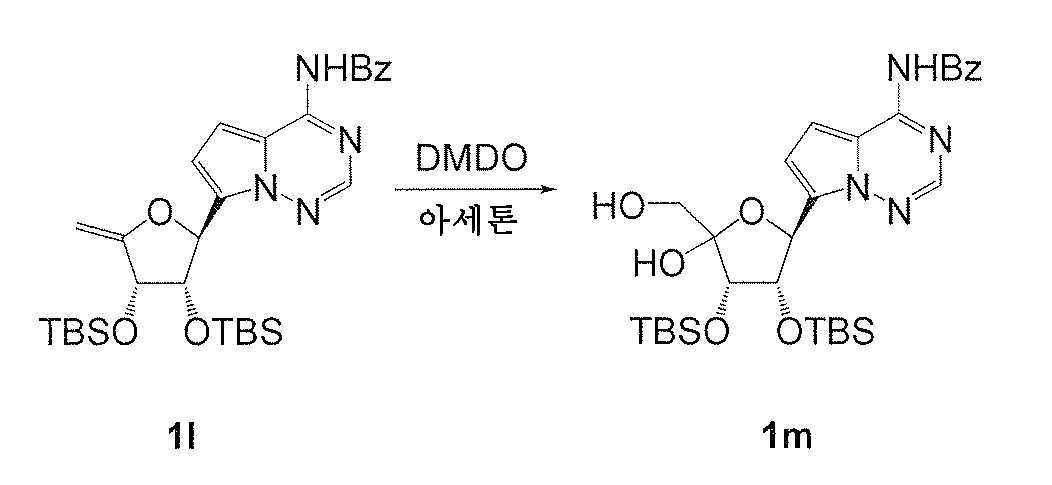
중간체 1m - N-(7-((2S,3S,4S)-3,4-비스(tert-부틸디메틸실릴옥시)-5-히드록시-5-(히드록시메틸)테트라히드로푸란-2-일)피롤로[1,2-f][1,2,4]트리아진-4-일)벤즈아미드Intermediate 1 m-N- (7-((2S, 3S, 4S) -3,4-bis (tert-butyldimethylsilyloxy) -5-hydroxy-5- (hydroxymethyl) tetrahydrofuran-2-yl ) Pyrrolo [1,2-f] [1,2,4] triazin-4-yl) benzamide
DMDO (아세톤 중의 0.07M 용액, 13.8 ㎖, 0.964 mmol)를 아세톤 (4.82 ㎖) 중의 중간체 1l (560 ㎎, 0.964 mmol)의 용액에 0℃에서 첨가하였다. 10 분 후, 반응 혼합물을 감압 하에서 농축시키고, 톨루엔 (2×1 ㎖)과 함께 공비 증류시켜 1m을 얻고, 이를 추가로 정제하지 않고 그 다음 단계에서 직접 사용하였다.DMDO (0.07M solution in acetone, 13.8 mL, 0.964 mmol) was added to a solution of 1 l (560 mg, 0.964 mmol) of intermediate in acetone (4.82 mL) at 0 ° C. After 10 minutes, the reaction mixture was concentrated under reduced pressure, and azeotropically distilled with toluene (2 x 1 mL) to obtain 1 m, which was used directly in the next step without further purification.
LC/MS: tR=2.57 min, MS m/z=615.14 [M+1]; LC 시스템: 써모 아셀라 1250 UHPLCLC / MS: t R = 2.57 min, MS m / z = 615.14 [M + 1]; LC system: Thermo Acela 1250 UHPLC
MS 시스템: 써모 LCQ 플리트; 컬럼: 키네텍스 2.6μ XB-C18 100A, 50×4.6 ㎜MS system: Thermo LCQ pleats; Column: Kinetex 2.6 μ XB-C18 100A, 50 × 4.6 mm
용매: 0.1% 아세트산을 갖는 아세토니트릴, 0.1% 아세트산을 갖는 물Solvent: acetonitrile with 0.1% acetic acid, water with 0.1% acetic acid
구배: 2 ㎕/min으로 0 min-2.0 min 2-100% ACN, 2.0 min-3.05 min 100% ACN, 3.05 min-3.2 min 100%-2% ACN, 3.2 min-3.5 min 2% ACN.Gradient: 0 min-2.0 min 2-100% ACN, 2.0 min-3.05 min 100% ACN, 3.05 min-3.2 min 100% -2% ACN, 3.2 min-3.5 min 2% ACN at 2 μl / min.
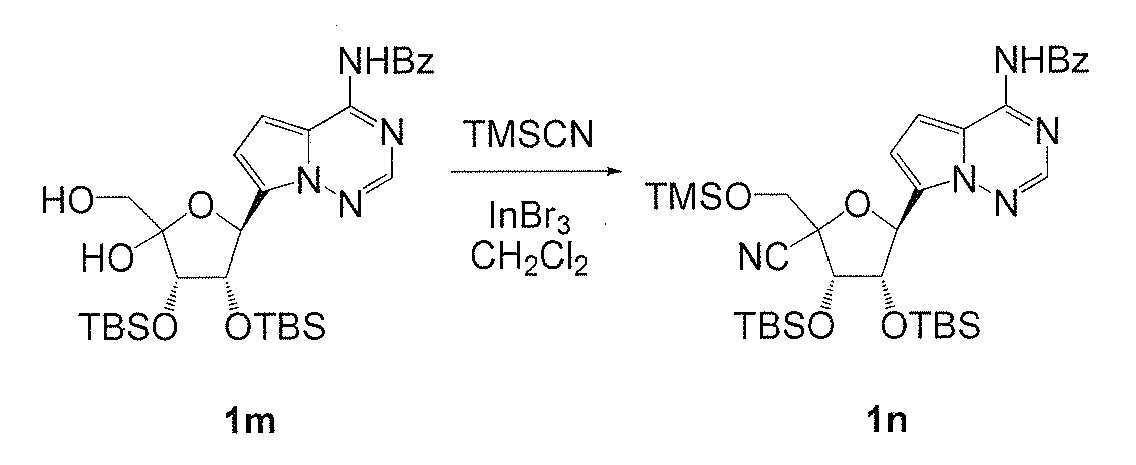
중간체 1n - N-(7-((2S,3S,4S)-3,4-비스(tert-부틸디메틸실릴옥시)-5-시아노-5-((트리메틸실릴옥시)메틸)테트라히드로푸란-2-일)피롤로[1,2-f][1,2,4]트리아진-4-일)벤즈아미드Intermediate 1n-N- (7-((2S, 3S, 4S) -3,4-bis (tert-butyldimethylsilyloxy) -5-cyano-5-((trimethylsilyloxy) methyl) tetrahydrofuran- 2-yl) pyrrolo [1,2-f] [1,2,4] triazin-4-yl) benzamide
디클로로메탄 (19.2 ㎖) 중의 미정제 중간체 1m (~592 ㎎, ~0.964 mmol) 및 트리메틸실릴 시아니드 (640 ㎕, 4.80 mmol)의 용액에 브롬화인듐 (III) (681 ㎎, 1.92 mmol)을 0℃에서 아르곤 대기 하에서 첨가하였다. 4.5 시간 후, 반응 혼합물을 포화 중탄산나트륨 수용액 (6 ㎖)으로 켄칭시키고, 실온으로 가온되도록 하였다. 생성된 혼합물을 디클로로메탄 (20 ㎖) 및 포화 중탄산나트륨 수용액 (20 ㎖) 사이에 분배시켰다. 상이 분할되고, 수성층을 디클로로메탄 (20 ㎖)으로 추출하였다. 합한 유기층을 무수 황산나트륨 위에서 건조시키고, 감압 하에서 농축시켜 중간체 1n (1:1 부분입체이성질체 혼합물) (710 ㎎)을 얻고, 이를 추가로 정제하지 않고 그 다음 단계에서 직접 사용하였다.To a solution of 1 m (~ 592 mg, ~ 0.964 mmol) of crude intermediate and trimethylsilyl cyanide (640 μl, 4.80 mmol) in dichloromethane (19.2 mL) was added indium bromide (III) (681 mg, 1.92 mmol) at 0 ° C. In argon under the atmosphere. After 4.5 hours, the reaction mixture was quenched with saturated aqueous sodium bicarbonate solution (6 mL) and allowed to warm to room temperature. The resulting mixture was partitioned between dichloromethane (20 mL) and saturated aqueous sodium bicarbonate solution (20 mL). The phases were partitioned, and the aqueous layer was extracted with dichloromethane (20 mL). The combined organic layer was dried over anhydrous sodium sulfate, and concentrated under reduced pressure to obtain intermediate 1n (1: 1 diastereomeric mixture) (710 mg), which was used directly in the next step without further purification.
LC/MS: 1차 용출 이성질체 tr=2.91 min, MS m/z=696.28 [M+1], 2차 용출 이성질체 tR=3.02 min, MS m/z=696.19 [M+1]; LC 시스템: 써모 아셀라 1250 UHPLCLC / MS: first elution isomer t r = 2.91 min, MS m / z = 696.28 [M + 1], second elution isomer t R = 3.02 min, MS m / z = 696.19 [M + 1]; LC system: Thermo Acela 1250 UHPLC
MS 시스템: 써모 LCQ 플리트; 컬럼: 키네텍스 2.6μ XB-C18 100A, 50×4.6 ㎜MS system: Thermo LCQ pleats; Column: Kinetex 2.6 μ XB-C18 100A, 50 × 4.6 mm
용매: 0.1% 아세트산을 갖는 아세토니트릴, 0.1% 아세트산을 갖는 물; 구배: 2 ㎕/min으로 0 min-2.0 min 2-100% ACN, 2.0 min-3.05 min 100% ACN, 3.05 min-3.2 min 100%-2% ACN, 3.2 min-3.5 min 2% ACN.Solvent: acetonitrile with 0.1% acetic acid, water with 0.1% acetic acid; Gradient: 0 min-2.0 min 2-100% ACN, 2.0 min-3.05 min 100% ACN, 3.05 min-3.2 min 100% -2% ACN, 3.2 min-3.5 min 2% ACN at 2 μl / min.

중간체 1o - N-(7-Intermediate 1o-N- (7- ((2S,3R,4S)((2S, 3R, 4S) -5--5- 시아노Cyano -3,4-디히드록시-5-(-3,4-dihydroxy-5- ( 히드록시메틸Hydroxymethyl )테트라히드로푸란-2-일)피롤로[1,2-f][1,2,4]트리아진-4-일)벤즈아미드) Tetrahydrofuran-2-yl) pyrrolo [1,2-f] [1,2,4] triazin-4-yl) benzamide
DMF (9.6 ㎖) 중의 미정제 중간체 1n (668.23 ㎎, 0.96 mmol)의 용액에 불소화세슘 (729 ㎎, 4.8 mmol)을 실온에서 첨가하였다. 5 시간 후, 반응 혼합물을 염수 (100 ㎖)로 희석하고, 생성된 혼합물을 디클로로메탄 (3×100 ㎖)으로 추출하였다. 합한 유기층을 무수 황산나트륨 위에서 건조시키고, 감압 하에서 농축시켜 중간체 1o (1:1 부분입체이성질체 혼합물)를 얻고, 이를 추가로 정제하지 않고 그 다음 단계에서 직접 사용하였다.To a solution of crude intermediate 1n (668.23 mg, 0.96 mmol) in DMF (9.6 mL) was added cesium fluoride (729 mg, 4.8 mmol) at room temperature. After 5 hours, the reaction mixture was diluted with brine (100 mL), and the resulting mixture was extracted with dichloromethane (3 × 100 mL). The combined organic layers were dried over anhydrous sodium sulfate, and concentrated under reduced pressure to give the intermediate 1o (1: 1 diastereomeric mixture), which was used directly in the next step without further purification.
LC/MS: 1차 용출 이성질체 tR=1.31 min, MS m/z=396.19 [M+1], 2차 용출 이성질체 tR=1.32 min, MS m/z=396.19 [M+1]; LC 시스템: 써모 아셀라 1250 UHPLCLC / MS: first elution isomer t R = 1.31 min, MS m / z = 396.19 [M + 1], second elution isomer t R = 1.32 min, MS m / z = 396.19 [M + 1]; LC system: Thermo Acela 1250 UHPLC
MS 시스템: 써모 LCQ 플리트; 컬럼: 키네텍스 2.6μ XB-C18 100A, 50×4.6 ㎜MS system: Thermo LCQ pleats; Column: Kinetex 2.6 μ XB-C18 100A, 50 × 4.6 mm
용매: 0.1% 아세트산을 갖는 아세토니트릴, 0.1% 아세트산을 갖는 물; 구배: 2 ㎕/min으로 0 min-2.0 min 2-100% ACN, 2.0 min-3.05 min 100% ACN, 3.05 min-3.2 min 100%-2% ACN, 3.2 min-3.5 min 2% ACN.Solvent: acetonitrile with 0.1% acetic acid, water with 0.1% acetic acid; Gradient: 0 min-2.0 min 2-100% ACN, 2.0 min-3.05 min 100% ACN, 3.05 min-3.2 min 100% -2% ACN, 3.2 min-3.5 min 2% ACN at 2 μl / min.

실시예Example 1 - ( One - ( 2R,3S,4R,5S2R, 3S, 4R, 5S )-5-(4-) -5- (4- 아미노피롤로[1,2-f][1,2,4]트리아진Aminopyrrolo [1,2-f] [1,2,4] triazine -7-일)-3,4-디히드록시-2-(히드록시메틸)테트라히드로푸란-2-카르보니트릴-7-yl) -3,4-dihydroxy-2- (hydroxymethyl) tetrahydrofuran-2-carbonitrile
메틸아민 (물 중의 40%, 0.3 ㎖)을 메탄올 (1 ㎖) 중의 미정제 중간체 1o의 용액에 실온에서 첨가하였다. 2.5 시간 후, 반응 혼합물을 감압 하에서 농축시키고, 분취용 HPLC (페노미넥스 루나(Phenominex Luna) 5u C18 100Å 100×30 ㎜ 컬럼, 5-15% 아세토니트릴/물 구배, 25 min)에 의하여 직접 정제하였다. 원하는 생성물 및 4' 아노머를 함유하는 분획을 합하고, 감압 하에서 농축시켰다. 그 후, 4' 아노머를 분취용 HPLC (페노미넥스 루나 5u C18 100Å 100×30 ㎜ 컬럼, 5-15% 아세토니트릴/물 구배, 25 min)에 의하여 분리하였다. 원하는 생성물을 함유하는 분획을 합하고, 동결건조시켜 실시예 1을 얻었다.Methylamine (40% in water, 0.3 mL) was added to a solution of crude intermediate 1o in methanol (1 mL) at room temperature. After 2.5 hours, the reaction mixture was concentrated under reduced pressure and purified directly by preparative HPLC (Phenominex Luna 5u C18 100 × 100 × 30 mm column, 5-15% acetonitrile / water gradient, 25 min). Did. Fractions containing the desired product and 4 'anomer were combined and concentrated under reduced pressure. The 4 'anomer was then separated by preparative HPLC (Phenominex Luna 5u C18 100 x 100 x 30 mm column, 5-15% acetonitrile / water gradient, 25 min). Fractions containing the desired product were combined and lyophilized to obtain Example 1.
1H NMR (400 MHz, CD3OD) δ 7.79 (s, 1H), 6.85 (d, J=4.5 Hz, 1H), 6.76 (d, J=4.5 Hz, 1H), 5.45 (d, J=5.9 Hz, 1H), 4.59 (t, J=5.7 Hz, 1H), 4.40 (d, J=5.6 Hz, 1H), 3.88 (d, J=12.0 Hz, 1H), 3.80 (d, J=12.0 Hz, 1H). 1 H NMR (400 MHz, CD 3 OD) δ 7.79 (s, 1H), 6.85 (d, J = 4.5 Hz, 1H), 6.76 (d, J = 4.5 Hz, 1H), 5.45 (d, J = 5.9 Hz, 1H), 4.59 (t, J = 5.7 Hz, 1H), 4.40 (d, J = 5.6 Hz, 1H), 3.88 (d, J = 12.0 Hz, 1H), 3.80 (d, J = 12.0 Hz, 1H).
LC/MS: tR=0.29 min, MS m/z=292.16 [M+1]; LC 시스템: 써모 아셀라 1250 UHPLCLC / MS: t R = 0.29 min, MS m / z = 292.16 [M + 1]; LC system: Thermo Acela 1250 UHPLC
MS 시스템: 써모 LCQ 플리트; 컬럼: 키네텍스 2.6μ XB-C18 100A, 50×4.6 ㎜MS system: Thermo LCQ pleats; Column: Kinetex 2.6 μ XB-C18 100A, 50 × 4.6 mm
용매: 0.1% 아세트산을 갖는 아세토니트릴, 0.1% 아세트산을 갖는 물; 구배: 2 ㎕/min으로 0 min-1.5 min 2-100% ACN, 1.5 min-2.2 min 100% ACN, 2.2 min-2.4 min 100%-2% ACN, 2.4 min-2.5 min 2% ACN.Solvent: acetonitrile with 0.1% acetic acid, water with 0.1% acetic acid; Gradient: 0 min-1.5 min 2-100% ACN, 1.5 min-2.2 min 100% ACN, 2.2 min-2.4 min 100% -2% ACN, 2.4 min-2.5 min 2% ACN at 2 μl / min.
HPLC: tR=0.377 min; HPLC 시스템: 아질런트 1100 시리즈; 컬럼: 제미니 5μ C18 110A, 50×4.6 ㎜; 용매: 0.1% TFA를 갖는 아세토니트릴, 0.1% TFA를 갖는 물; 구배: 2 ㎖/min으로 0 min-5.0 min 2-98% ACN, 5.0 min-6.0 min 98% ACN; HPLC: tR=6.643 min; HPLC 시스템: 아질런트 1100 시리즈; 컬럼: 루나(Luna) 5μ C18(2) 110A, 250×4.6 ㎜; 용매: 아세토니트릴, 물; 구배: 2 ㎖/min으로 10 분에 걸쳐 5-15% ACN.HPLC: t R = 0.377 min; HPLC system: Agilent 1100 series; Column: Gemini 5μ C18 110A, 50 × 4.6 mm; Solvent: acetonitrile with 0.1% TFA, water with 0.1% TFA; Gradient: 0 min-5.0 min 2-98% ACN at 2 mL / min, 5.0 min-6.0 min 98% ACN; HPLC: t R = 6.643 min; HPLC system: Agilent 1100 series; Column: Luna 5 μ C18 (2) 110A, 250 × 4.6 mm; Solvent: acetonitrile, water; Gradient: 5-15% ACN over 10 minutes at 2 ml / min.

중간체 2b - N-(7-Intermediate 2b-N- (7- ((2S,3R,4R,5R)((2S, 3R, 4R, 5R) -3--3- 플루오로Fluoro -4-히드록시-5-(-4-hydroxy-5- ( 히드록시메틸Hydroxymethyl )테트라히드로푸란-2-일)피롤로[1,2-f][1,2,4]트리아진-4-일)벤즈아미드) Tetrahydrofuran-2-yl) pyrrolo [1,2-f] [1,2,4] triazin-4-yl) benzamide
N2 퍼징된 플라스크에 중간체 2a, (2R,3R,4R,5S)-5-(4-아미노피롤로[1,2-f][1,2,4]트리아진-7-일)-4-플루오로-2-(히드록시메틸)테트라히드로푸란-3-올 (WO2012037038A1에 의하여 생성됨, 1.20 g, 4.01 mmol) (피리딘을 사용한 3회 동시 증류에 의하여 건조시킴)을 첨가한 후, 피리딘 (18 ㎖) 중에 용해시켰다. 클로로트리메틸실란 (1.54 ㎖, 13.13 mmol)을 한번에 0℃에서 첨가하고, 생성된 혼합물을 N2 대기 하에서 1 시간 동안 교반하였다. 벤조일 클로라이드 (675 ㎕, 5.82 mmol)를 적가하고, 반응 혼합물을 1 시간 동안 교반하였다. 벤조일 클로라이드의 추가의 부분 (100 ㎕)을 첨가하여 잔존하는 출발 물질을 소비하였다. 모노- 및 비스-Bz 보호된 생성물의 혼합물을 관찰하였다. 반응을 H2O (5 ㎖)로 켄칭시키고, 생성된 혼합물을 5 분 동안 교반하였다. 그 후, 진한 NH4OH(aq) (8 ㎖)를 한번에 첨가하고, 15 분 동안 교반하고, 이 시점에서 비스-Bz 생성물이 원하는 생성물로 전환되었다. 용매를 감압 하에서 제거한 후, 잔류물을 CH3OH와 함께 동시증발시켰다. 헥산 중의 50%-100% EtOAc의 용리제 램프를 사용하는 실리카 겔 크로마토그래피에 의한 분리후 중간체 2b를 분리하였다.Intermediate 2a, (2R, 3R, 4R, 5S) -5- (4-aminopyrrolo [1,2-f] [1,2,4] triazin-7-yl) -4 in an N 2 purged flask -Fluoro-2- (hydroxymethyl) tetrahydrofuran-3-ol (produced by WO2012037038A1, 1.20 g, 4.01 mmol) (dried by three simultaneous distillations with pyridine) was added, followed by pyridine ( 18 ml). Chlorotrimethylsilane (1.54 mL, 13.13 mmol) was added at 0 ° C. at once, and the resulting mixture was stirred under N 2 atmosphere for 1 hour. Benzoyl chloride (675 μl, 5.82 mmol) was added dropwise and the reaction mixture was stirred for 1 hour. An additional portion (100 μl) of benzoyl chloride was added to consume the remaining starting material. A mixture of mono- and bis-Bz protected products was observed. The reaction was quenched with H 2 O (5 mL), and the resulting mixture was stirred for 5 minutes. Then concentrated NH 4 OH (aq) (8 mL) was added at once, stirred for 15 minutes, at which point the bis-Bz product was converted to the desired product. After removing the solvent under reduced pressure, the residue was co-evaporated with CH 3 OH. Intermediate 2b was isolated after separation by silica gel chromatography using an eluent lamp of 50% -100% EtOAc in hexane.
1H NMR (400 MHz, DMSO-d6) δ 8.26-7.91 (m, 2H), 7.88-7.79 (m, 1H), 7.61 (t, J=7.5 Hz, 1H), 7.56-7.36 (m, 2H), 7.37-7.24 (m, 1H), 7.10 (d, J=4.6 Hz, 1H), 7.01 (s, 1H), 5.53 (d, J=23.4 Hz, 1H), 5.45 (d, J=6.5 Hz, 1H), 5.16-4.91 (m, 1H), 4.86 (t, J=5.6 Hz, 1H), 4.21-4.04 (m, 1H), 3.82 (dd, J=8.0, 3.9 Hz, 1H), 3.71 (ddd, J=12.3, 5.6, 2.6 Hz, 1H), 3.52 (ddd, J=12.2, 5.7, 4.5 Hz, 1H). 1 H NMR (400 MHz, DMSO-d 6 ) δ 8.26-7.91 (m, 2H), 7.88-7.79 (m, 1H), 7.61 (t, J = 7.5 Hz, 1H), 7.56-7.36 (m, 2H ), 7.37-7.24 (m, 1H), 7.10 (d, J = 4.6 Hz, 1H), 7.01 (s, 1H), 5.53 (d, J = 23.4 Hz, 1H), 5.45 (d, J = 6.5 Hz , 1H), 5.16-4.91 (m, 1H), 4.86 (t, J = 5.6 Hz, 1H), 4.21-4.04 (m, 1H), 3.82 (dd, J = 8.0, 3.9 Hz, 1H), 3.71 ( ddd, J = 12.3, 5.6, 2.6 Hz, 1H), 3.52 (ddd, J = 12.2, 5.7, 4.5 Hz, 1H).
19F NMR (376 MHz, DMSO-d6) δ -196.33 (dt, J=55.1, 22.5 Hz). 19 F NMR (376 MHz, DMSO-d 6 ) δ -196.33 (dt, J = 55.1, 22.5 Hz).
LC/MS: tR=0.77 min, MS m/z=373.14 [M+1]; LC 시스템: 써모 아셀라 1250 UHPLCLC / MS: t R = 0.77 min, MS m / z = 373.14 [M + 1]; LC system: Thermo Acela 1250 UHPLC
MS 시스템: 써모 LCQ 플리트; 컬럼: 키네텍스 2.6μ C18 100A, 50×3.00 ㎜MS system: Thermo LCQ pleats; Column: Kinetex 2.6 μ C18 100A, 50 × 3.00 mm
용매: 0.1% 포름산을 갖는 아세토니트릴, 0.1% 포름산을 갖는 물Solvent: acetonitrile with 0.1% formic acid, water with 0.1% formic acid
구배: 0 min-1.4 min 2-100% ACN, 1.4 min-1.80 min 100% ACN, 1.8 min-1.85 min 100%-2% ACN, 1.85 min-2 min 2% ACN.Gradient: 0 min-1.4 min 2-100% ACN, 1.4 min-1.80 min 100% ACN, 1.8 min-1.85 min 100% -2% ACN, 1.85 min-2 min 2% ACN.
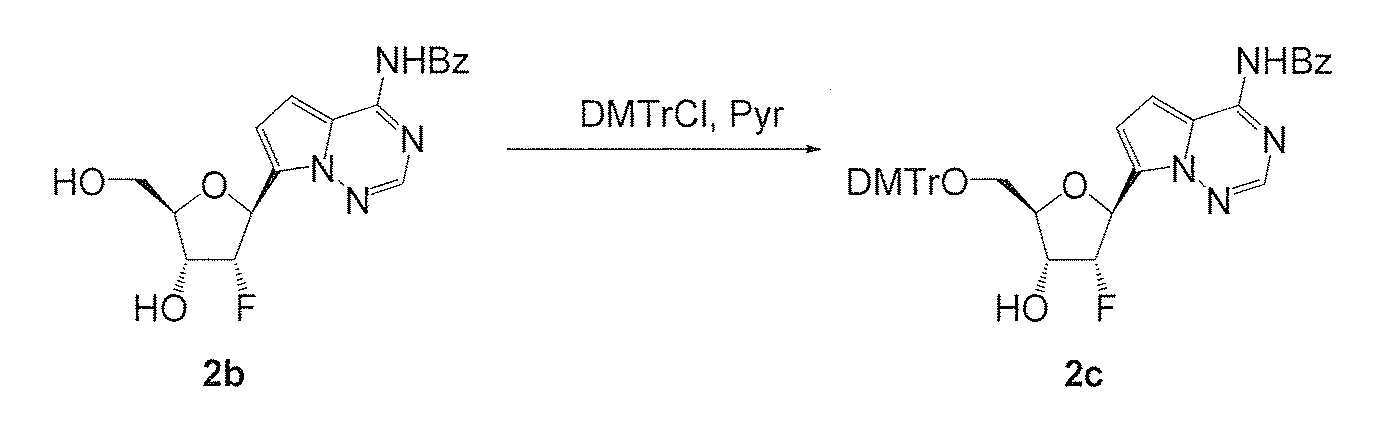
중간체 2c - N-(7-((2S,3R,4R,5R)-5-((비스(4-메톡시페닐)(페닐)메톡시)메틸)-3-플루오로-4-히드록시테트라히드로푸란-2-일)피롤로[1,2-f][1,2,4]트리아진-4-일)벤즈아미드Intermediate 2c-N- (7-((2S, 3R, 4R, 5R) -5-((bis (4-methoxyphenyl) (phenyl) methoxy) methyl) -3-fluoro-4-hydroxytetra Hydrofuran-2-yl) pyrrolo [1,2-f] [1,2,4] triazin-4-yl) benzamide
중간체 2b (1.3 g, 3.49 mmol)를 피리딘과 함께 동시증발에 의하여 건조시켰다. 그 후, 건조된 물질을 피리딘 (15 ㎖) 중에 N2 대기 하에서 용해시켰다. 4,4'-디메톡시트리틸 클로라이드 (1.71 g, 5.0 mmol)를 한번에 실온에서 첨가하고, 2 시간 동안 교반하였다. 에탄올 (2 ㎖)을 첨가하고, 생성된 용액을 5 분 동안 교반하였다. 용매를 감압 하에서 제거하였다. 잔류물을 헥산 중의 0%-100% EtOAc의 용리제 램프를 사용하는 실리카 겔 크로마토그래피에 의하여 정제하여 중간체 2c를 얻었다.Intermediate 2b (1.3 g, 3.49 mmol) was dried by co-evaporation with pyridine. Then, the dried material was dissolved in pyridine (15 mL) under N 2 atmosphere. 4,4'-Dimethoxytrityl chloride (1.71 g, 5.0 mmol) was added at one time at room temperature and stirred for 2 hours. Ethanol (2 mL) was added and the resulting solution was stirred for 5 minutes. The solvent was removed under reduced pressure. The residue was purified by silica gel chromatography using an eluent lamp of 0% -100% EtOAc in hexane to give intermediate 2c.
1H NMR (400 MHz, DMSO-d6) δ 8.28-8.02 (m, 2H), 7.61 (t, J=7.5 Hz, 1H), 7.51 (t, J=7.6 Hz, 2H), 7.36 (ddt, J=6.0, 4.7, 2.0 Hz, 2H), 7.31-7.04 (m, 7H), 6.90-6.73 (m, 4H), 5.62 (d, J=24.4 Hz, 1H), 5.49 (d, J=7.0 Hz, 1H), 5.27-5.01 (m, 1H), 4.32-4.13 (m, 1H), 4.06-3.95 (m, 1H), 3.69 (s, 4H), 3.28 (s, 3H), 3.12 (dd, J=10.4, 5.2 Hz, 1H). 1 H NMR (400 MHz, DMSO-d 6 ) δ 8.28-8.02 (m, 2H), 7.61 (t, J = 7.5 Hz, 1H), 7.51 (t, J = 7.6 Hz, 2H), 7.36 (ddt, J = 6.0, 4.7, 2.0 Hz, 2H), 7.31-7.04 (m, 7H), 6.90-6.73 (m, 4H), 5.62 (d, J = 24.4 Hz, 1H), 5.49 (d, J = 7.0 Hz , 1H), 5.27-5.01 (m, 1H), 4.32-4.13 (m, 1H), 4.06-3.95 (m, 1H), 3.69 (s, 4H), 3.28 (s, 3H), 3.12 (dd, J = 10.4, 5.2 Hz, 1H).
19F NMR (376 MHz, DMSO-d6) δ -195.58 (dt, J=52.1, 24.7 Hz). 19 F NMR (376 MHz, DMSO-d 6 ) δ -195.58 (dt, J = 52.1, 24.7 Hz).
LC/MS: tR=1.37 min, MS m/z=675.29 [M+1]; LC 시스템: 써모 아셀라 1250 UHPLCLC / MS: t R = 1.37 min, MS m / z = 675.29 [M + 1]; LC system: Thermo Acela 1250 UHPLC
MS 시스템: 써모 LCQ 플리트; 컬럼: 키네텍스 2.6μ C18 100A, 50×3.00 ㎜MS system: Thermo LCQ pleats; Column: Kinetex 2.6 μ C18 100A, 50 × 3.00 mm
용매: 0.1% 포름산을 갖는 아세토니트릴, 0.1% 포름산을 갖는 물Solvent: acetonitrile with 0.1% formic acid, water with 0.1% formic acid
구배: 0 min-1.4 min 2-100% ACN, 1.4 min-1.80 min 100% ACN, 1.8 min-1.85 min 100%-2% ACN, 1.85 min-2 min 2% ACN.Gradient: 0 min-1.4 min 2-100% ACN, 1.4 min-1.80 min 100% ACN, 1.8 min-1.85 min 100% -2% ACN, 1.85 min-2 min 2% ACN.

중간체 2d - N-(7-((2S,3S,4R,5R)-4-(tert-부틸디메틸실릴옥시)-3-플루오로-5-(히드록시메틸)테트라히드로푸란-2-일)피롤로[1,2-f][1,2,4]트리아진-4-일)벤즈아미드Intermediate 2d-N- (7-((2S, 3S, 4R, 5R) -4- (tert-butyldimethylsilyloxy) -3-fluoro-5- (hydroxymethyl) tetrahydrofuran-2-yl) Pyrrolo [1,2-f] [1,2,4] triazin-4-yl) benzamide
N2 대기 하에서 제조된 DMF (8 ㎖) 중의 중간체 2c (1.47 g, 2.18 mmol)의 용액에 이미다졸 (251 ㎎, 3.70 mmol)을 첨가한 후, tert-부틸클로로디메틸실란 (492 ㎎, 3.27 mmol)을 첨가하였다. 용액을 실온에서 16 시간 동안 교반하였다. 용액을 H2O (5 ㎖)로 희석한 후, 용매를 감압 하에서 제거하였다. 잔류물을 EtOAc 및 H2O 사이에 분배시켰다. 층을 분리한 후, 유기상을 염수로 세정하였다. 유기상을 Na2SO4 위에서 건조시키고, 이를 여과에 의하여 제거하고, 여과액을 감압 하에서 농축시켰다. 미정제 물질을 그 다음 단계에서 그 상태로 사용하였다.After adding imidazole (251 mg, 3.70 mmol) to a solution of intermediate 2c (1.47 g, 2.18 mmol) in DMF (8 mL) prepared under N 2 atmosphere, tert-butylchlorodimethylsilane (492 mg, 3.27 mmol) ) Was added. The solution was stirred at room temperature for 16 hours. After the solution was diluted with H 2 O (5 mL), the solvent was removed under reduced pressure. The residue was partitioned between EtOAc and H 2 O. After separating the layers, the organic phase was washed with brine. The organic phase was dried over Na 2 SO 4 , which was removed by filtration, and the filtrate was concentrated under reduced pressure. The crude material was used as such in the next step.
미정제 물질을 CHCl3 (15 ㎖) 중에 용해시키고, 0℃로 냉각시켰다. CH3OH (6 ㎖) 중에 용해된 p-톨루엔술폰산 수화물 (414 ㎎, 2.18 mmol)을 혼합물에 적가하고, 15 분 동안 교반하였다. 반응을 포화 NaHCO3(aq)로 켄칭하였다. 유기물을 염수로 세정하고, Na2SO4 위에서 건조시키고, 여과하고, 용매를 감압 하에서 제거하였다. 잔류물을 헥산 중의 0%-50% EtOAc의 용리제 램프를 사용하는 실리카 겔 크로마토그래피에 의하여 정제하여 중간체 2d를 얻었다.The crude material was dissolved in CHCl 3 (15 mL) and cooled to 0 ° C. P-Toluenesulfonic acid hydrate (414 mg, 2.18 mmol) dissolved in CH 3 OH (6 mL) was added dropwise to the mixture and stirred for 15 minutes. The reaction was quenched with saturated NaHCO 3 (aq) . The organic was washed with brine, dried over Na 2 SO 4 , filtered and the solvent was removed under reduced pressure. The residue was purified by silica gel chromatography using an eluent lamp of 0% -50% EtOAc in hexane to give intermediate 2d.
1H NMR (400 MHz, DMSO-d6) δ 8.21-7.98 (m, 2H), 7.51 (dt, J=39.9, 7.5 Hz, 3H), 7.12-6.86 (m, 2H), 5.48 (d, J=21.9 Hz, 1H), 5.07 (dt, J=54.6, 3.8 Hz, 1H), 4.86 (t, J=5.5 Hz, 1H), 4.28 (ddd, J=17.8, 7.1, 4.4 Hz, 1H), 3.83-3.72 (m, 1H), 3.63 (ddd, J=12.1, 5.2, 3.0 Hz, 1H), 3.43 (ddd, J=12.1, 6.0, 4.2 Hz, 1H), 0.80 (s, 9H), 0.01 (s, 3H), 0.00 (s, 3H). 1 H NMR (400 MHz, DMSO-d 6 ) δ 8.21-7.98 (m, 2H), 7.51 (dt, J = 39.9, 7.5 Hz, 3H), 7.12-6.86 (m, 2H), 5.48 (d, J = 21.9 Hz, 1H), 5.07 (dt, J = 54.6, 3.8 Hz, 1H), 4.86 (t, J = 5.5 Hz, 1H), 4.28 (ddd, J = 17.8, 7.1, 4.4 Hz, 1H), 3.83 -3.72 (m, 1H), 3.63 (ddd, J = 12.1, 5.2, 3.0 Hz, 1H), 3.43 (ddd, J = 12.1, 6.0, 4.2 Hz, 1H), 0.80 (s, 9H), 0.01 (s , 3H), 0.00 (s, 3H).
19F NMR (376 MHz, DMSO-d6) δ -198.05 (dt, J=54.2, 19.8 Hz). 19 F NMR (376 MHz, DMSO-d 6 ) δ -198.05 (dt, J = 54.2, 19.8 Hz).
LC/MS: tR=1.35 min, MS m/z=487.24 [M+1]; LC 시스템: 써모 아셀라 1250 UHPLCLC / MS: t R = 1.35 min, MS m / z = 487.24 [M + 1]; LC system: Thermo Acela 1250 UHPLC
MS 시스템: 써모 LCQ 플리트; 컬럼: 키네텍스 2.6μ C18 100A, 50×3.00 ㎜MS system: Thermo LCQ pleats; Column: Kinetex 2.6 μ C18 100A, 50 × 3.00 mm
용매: 0.1% 포름산을 갖는 아세토니트릴, 0.1% 포름산을 갖는 물Solvent: acetonitrile with 0.1% formic acid, water with 0.1% formic acid
구배: 0 min-1.4 min 2-100% ACN, 1.4 min-1.80 min 100% ACN, 1.8 min-1.85 min 100%-2% ACN, 1.85 min-2 min 2% ACN.Gradient: 0 min-1.4 min 2-100% ACN, 1.4 min-1.80 min 100% ACN, 1.8 min-1.85 min 100% -2% ACN, 1.85 min-2 min 2% ACN.

중간체 2e - N-(7-((2S,3S,4R)-4-(tert-부틸디메틸실릴옥시)-3-플루오로-5,5-비스(히드록시메틸)테트라히드로푸란-2-일)피롤로[1,2-f][1,2,4]트리아진-4-일)벤즈아미드Intermediate 2e-N- (7-((2S, 3S, 4R) -4- (tert-butyldimethylsilyloxy) -3-fluoro-5,5-bis (hydroxymethyl) tetrahydrofuran-2-yl ) Pyrrolo [1,2-f] [1,2,4] triazin-4-yl) benzamide
N2 대기 하에서 생성된 톨루엔 (4 ㎖) 및 DMSO (6 ㎖) 중의 중간체 2d (856 ㎎, 1.75 mmol)의 용액에 1-에틸-3-(3-디메틸아미노프로필)-카르보디이미드 염산염 (EDCl) (504 ㎎, 2.63 mmol)을 첨가하였다. 이 혼합물에 피리딘 (150 ㎕) 및 TFA (70 ㎕)를 첨가하고, 혼합물을 실온에서 15 분 동안 교반하였다. 추가의 EDCl (100 ㎎) 및 피리딘 (100 ㎕)을 첨가하고, 혼합물을 추가의 45 분 동안 교반하였다. 반응을 H2O (10 ㎖) 및 CH2Cl2 (10 ㎖)로 켄칭시켰다. 유기물을 염수로 세정하고, Na2SO4 위에서 건조시키고, 여과하고, 용매를 감압 하에서 제거하여 미정제 알데히드를 얻고, 이를 그 다음 단계에서 그 상태로 사용하였다.1-ethyl-3- (3-dimethylaminopropyl) -carbodiimide hydrochloride (EDCl) in a solution of intermediate 2d (856 mg, 1.75 mmol) in toluene (4 mL) and DMSO (6 mL) produced under N 2 atmosphere. ) (504 mg, 2.63 mmol). Pyridine (150 μl) and TFA (70 μl) were added to the mixture, and the mixture was stirred at room temperature for 15 minutes. Additional EDCl (100 mg) and pyridine (100 μl) were added and the mixture was stirred for an additional 45 minutes. The reaction was quenched with H 2 O (10 mL) and CH 2 Cl 2 (10 mL). The organic was washed with brine, dried over Na 2 SO 4 , filtered, and the solvent was removed under reduced pressure to obtain crude aldehyde, which was used as such in the next step.
미정제 알데히드를 디옥산 (5 ㎖) 중에 용해시키고, 37% 포름알데히드(aq) (925 ㎕)에 이어서 2N NaOH(aq) (925 ㎕)를 첨가하였다. 실온에서 3 시간 동안 교반한 후, 반응을 AcOH로 켄칭시키고, EtOAc로 희석하고, H2O로 세정하였다. 유기물을 Na2SO4 위에서 건조시키고, 여과하고, 용매를 감압 하에서 제거하여 미정제 알돌 생성물을 얻고, 이를 그 다음 단계에서 그 상태로 정방향으로 실시하였다.The crude aldehyde in dioxane (5 ㎖) was dissolved in 37% formaldehyde (aq) followed by 2N NaOH (aq) to (925 ㎕) (925 ㎕) was added. After stirring at room temperature for 3 hours, the reaction was quenched with AcOH, diluted with EtOAc and washed with H 2 O. The organic was dried over Na 2 SO 4 , filtered, and the solvent was removed under reduced pressure to obtain the crude aldol product, which was carried out forward in that state in the next step.
미정제 알돌 생성물을 N2 대기 하에서 EtOH (9 ㎖) 중에 용해시키고, 0℃로 냉각시켰다. NaBH4 (80 ㎎, 2.1 mmol)를 한번에 첨가하고, 반응을 10 분 동안 교반하였다. 반응을 AcOH로 켄칭시키고, CH2Cl2로 희석하고, 물 및 포화 NaHCO3(aq)의 1:1 용액으로 세정하였다. 유기 상을 Na2SO4 위에서 건조시키고, 여과하고, 용매를 감압 하에서 제거하였다. 잔류물을 헥산 중의 0%-100% EtOAc의 용리제 램프를 사용하는 실리카 겔 크로마토그래피에 의하여 정제하여 중간체 2e를 얻었다.The crude aldol product was dissolved in EtOH (9 mL) under N 2 atmosphere and cooled to 0 ° C. NaBH 4 (80 mg, 2.1 mmol) was added at once, and the reaction was stirred for 10 minutes. The reaction was quenched with AcOH, diluted with CH 2 Cl 2 and washed with a 1: 1 solution of water and saturated NaHCO 3 (aq) . The organic phase was dried over Na 2 SO 4 , filtered and the solvent was removed under reduced pressure. The residue was purified by silica gel chromatography using an eluent lamp of 0% -100% EtOAc in hexane to give intermediate 2e.
1H NMR (400 MHz, DMSO-d6) δ 8.20-7.99 (m, 2H), 7.51 (dt, J=39.5, 7.5 Hz, 3H), 7.15-6.93 (m, 2H), 5.50 (d, J=14.1 Hz, 1H), 5.24 (dt, J=54.2, 5.4 Hz, 1H), 4.78 (t, J=5.6 Hz, 1H), 4.48 (dd, J=10.7, 4.8 Hz, 1H), 4.34 (dd, J=6.7, 4.9 Hz, 1H), 3.62 (dd, J=11.9, 4.9 Hz, 1H), 3.55-3.35 (m, 3H), 0.82 (s, 9H), 0.07 (s, 3H), -0.09 (s, 3H). 1 H NMR (400 MHz, DMSO-d 6 ) δ 8.20-7.99 (m, 2H), 7.51 (dt, J = 39.5, 7.5 Hz, 3H), 7.15-6.93 (m, 2H), 5.50 (d, J = 14.1 Hz, 1H), 5.24 (dt, J = 54.2, 5.4 Hz, 1H), 4.78 (t, J = 5.6 Hz, 1H), 4.48 (dd, J = 10.7, 4.8 Hz, 1H), 4.34 (dd , J = 6.7, 4.9 Hz, 1H), 3.62 (dd, J = 11.9, 4.9 Hz, 1H), 3.55-3.35 (m, 3H), 0.82 (s, 9H), 0.07 (s, 3H), -0.09 (s, 3H).
19F NMR (376 MHz, DMSO-d6) δ -200.37 (d, J=51.1 Hz). 19 F NMR (376 MHz, DMSO-d 6 ) δ -200.37 (d, J = 51.1 Hz).
LC/MS: tR=1.25 min, MS m/z=517.21 [M+1]; LC 시스템: 써모 아셀라 1250 UHPLCLC / MS: t R = 1.25 min, MS m / z = 517.21 [M + 1]; LC system: Thermo Acela 1250 UHPLC
MS 시스템: 써모 LCQ 플리트; 컬럼: 키네텍스 2.6μ C18 100A, 50×3.00 ㎜MS system: Thermo LCQ pleats; Column: Kinetex 2.6 μ C18 100A, 50 × 3.00 mm
용매: 0.1% 포름산을 갖는 아세토니트릴, 0.1% 포름산을 갖는 물Solvent: acetonitrile with 0.1% formic acid, water with 0.1% formic acid
구배: 0 min-1.4 min 2-100% ACN, 1.4 min-1.80 min 100% ACN, 1.8 min-1.85 min 100%-2% ACN, 1.85 min-2 min 2% ACN.Gradient: 0 min-1.4 min 2-100% ACN, 1.4 min-1.80 min 100% ACN, 1.8 min-1.85 min 100% -2% ACN, 1.85 min-2 min 2% ACN.
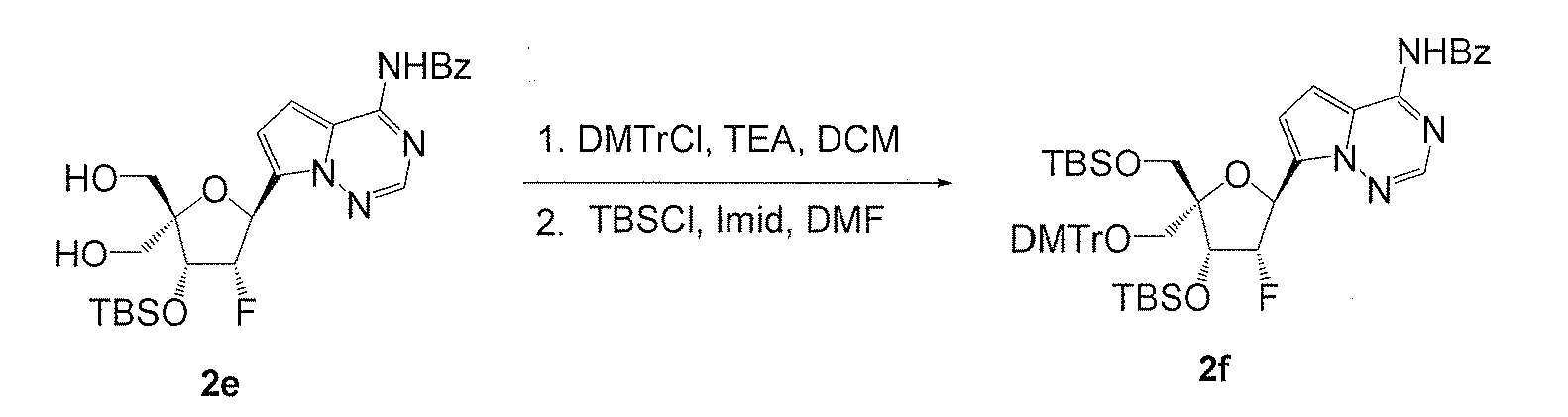
중간체 2f - N-(7-((2S,3S,4R,5R)-5-((비스(4-메톡시페닐)(페닐)메톡시)메틸)-4-(tert-부틸디메틸실릴옥시)-5-((tert-부틸디메틸실릴옥시)메틸)-3-플루오로테트라히드로푸란-2-일)피롤로[1,2-f][1,2,4]트리아진-4-일)벤즈아미드Intermediate 2f-N- (7-((2S, 3S, 4R, 5R) -5-((bis (4-methoxyphenyl) (phenyl) methoxy) methyl) -4- (tert-butyldimethylsilyloxy) -5-((tert-butyldimethylsilyloxy) methyl) -3-fluorotetrahydrofuran-2-yl) pyrrolo [1,2-f] [1,2,4] triazin-4-yl) Benzamide
중간체 2e (370 ㎎, 0.717 mmol)를 N2 대기 하에서 CH2Cl2 (10 ㎖) 및 TEA (200 ㎕) 중에 용해시킨 후, 0℃로 냉각시켰다. 4,4'-디메톡시트리틸 클로라이드 (0.364 g, 1.07 mmol)를 한번에 첨가하고, 반응 혼합물을 30 분 동안 교반시켰다. CH3OH (2 ㎖)를 첨가하고, 용액을 CH2Cl2 및 포화 NaHCO3(aq)로 희석하였다. 유기층을 염수로 세정하고, Na2SO4 위에서 건조시키고, 여과하고, 용매를 감압 하에서 제거하였다. 잔류물을 헥산 중의 5%-100% EtOAc의 용리제 램프를 사용하는 실리카 겔 크로마토그래피에 의하여 정제하여 비스-DMTr 및 4'β 생성물의 혼합물로서 미정제 생성물을 얻었다. 이러한 혼합물을 추가로 정제하지 않고 정방향으로 실시하였다.Intermediate 2e (370 mg, 0.717 mmol) was dissolved in CH 2 Cl 2 (10 mL) and TEA (200 μl) under N 2 atmosphere, then cooled to 0 ° C. 4,4'-Dimethoxytrityl chloride (0.364 g, 1.07 mmol) was added in one portion, and the reaction mixture was stirred for 30 minutes. CH 3 OH (2 mL) was added, and the solution was diluted with CH 2 Cl 2 and saturated NaHCO 3 (aq) . The organic layer was washed with brine, dried over Na 2 SO 4 , filtered and the solvent was removed under reduced pressure. The residue was purified by silica gel chromatography using an eluent lamp of 5% -100% EtOAc in hexane to give the crude product as a mixture of bis-DMTr and 4'β products. This mixture was run in the forward direction without further purification.
DMF (3 ㎖) 중의 미정제 생성물 (574 ㎎, 혼합물)에 N2 대기 하에서 이미다졸 (143 ㎎, 2.10 mmol)에 이어서 tert-부틸클로로디메틸실란 (158 ㎎, 1.05 mmol)을 첨가하였다. 용액을 실온에서 2 시간 동안 교반하였다. 용액을 CH3OH (1 ㎖) 및 EtOAc로 희석하였다. 유기층을 H2O에 이어서 염수로 세정하였다. 유기층을 Na2SO4 위에서 건조시키고, 여과하고, 용매를 감압 하에서 제거하였다. 잔류물을 헥산 중의 0%-50% EtOAc의 용리제 램프를 사용하는 실리카 겔 크로마토그래피에 의하여 정제하여 일부 비스-DMTr 물질을 함유하는 중간체 2f를 얻었다.To the crude product (574 mg, mixture) in DMF (3 mL) was added imidazole (143 mg, 2.10 mmol) under N 2 atmosphere followed by tert-butylchlorodimethylsilane (158 mg, 1.05 mmol). The solution was stirred at room temperature for 2 hours. The solution was diluted with CH 3 OH (1 mL) and EtOAc. The organic layer was washed with H 2 O followed by brine. The organic layer was dried over Na 2 SO 4 , filtered, and the solvent was removed under reduced pressure. The residue was purified by silica gel chromatography using an eluent lamp of 0% -50% EtOAc in hexane to give intermediate 2f containing some bis-DMTr material.
LC/MS: tR=2.25 min, MS m/z=933.52 [M+1]; LC 시스템: 써모 아셀라 1250 UHPLCLC / MS: t R = 2.25 min, MS m / z = 933.52 [M + 1]; LC system: Thermo Acela 1250 UHPLC
MS 시스템: 써모 LCQ 플리트; 컬럼: 키네텍스 2.6μ C18 100A, 50×3.00 ㎜MS system: Thermo LCQ pleats; Column: Kinetex 2.6 μ C18 100A, 50 × 3.00 mm
용매: 0.1% 포름산을 갖는 아세토니트릴, 0.1% 포름산을 갖는 물Solvent: acetonitrile with 0.1% formic acid, water with 0.1% formic acid
구배: 0 min-1.5 min 2-100% ACN, 1.5 min-2.8 min 100% ACN, 2.8 min-2.85 min 100%-2% ACN, 2.85 min-3 min 2% ACN.Gradient: 0 min-1.5 min 2-100% ACN, 1.5 min-2.8 min 100% ACN, 2.8 min-2.85 min 100% -2% ACN, 2.85 min-3 min 2% ACN.

중간체 2g - N-(7-((2S,3S,4R,5R)-4-(tert-부틸디메틸실릴옥시)-5-((tert-부틸디메틸실릴옥시)메틸)-3-플루오로-5-(히드록시메틸)테트라히드로푸란-2-일)피롤로[1,2-f][1,2,4]트리아진-4-일)벤즈아미드Intermediate 2g-N- (7-((2S, 3S, 4R, 5R) -4- (tert-butyldimethylsilyloxy) -5-((tert-butyldimethylsilyloxy) methyl) -3-fluoro-5 -(Hydroxymethyl) tetrahydrofuran-2-yl) pyrrolo [1,2-f] [1,2,4] triazin-4-yl) benzamide
중간체 2f를 CHCl3 (5 ㎖) 중에 용해시키고, 0℃로 냉각시켰다. CH3OH (4 ㎖) 중에 용해된 p-톨루엔술폰산 수화물 (90 ㎎, 0.474 mmol)을 혼합물에 적가하고, 반응 혼합물을 5 분 동안 교반하였다. 반응 혼합물을 포화 NaHCO3(aq)로 켄칭하였다. 유기물을 염수로 세정하고, Na2SO4 위에서 건조시키고, 여과하고, 용매를 감압 하에서 제거하였다. 잔류물을 헥산 중의 0%-40% EtOAc의 용리제 램프를 사용하는 실리카 겔 크로마토그래피에 의하여 정제하여 중간체 2g를 얻었다.Intermediate 2f was dissolved in CHCl 3 (5 mL) and cooled to 0 ° C. P-Toluenesulfonic acid hydrate (90 mg, 0.474 mmol) dissolved in CH 3 OH (4 mL) was added dropwise to the mixture, and the reaction mixture was stirred for 5 minutes. The reaction mixture was quenched with saturated NaHCO 3 (aq) . The organic was washed with brine, dried over Na 2 SO 4 , filtered and the solvent was removed under reduced pressure. The residue was purified by silica gel chromatography using an eluent lamp of 0% -40% EtOAc in hexane to give 2 g of intermediate.
1H NMR (400 MHz, CDCl3) δ 8.09-7.88 (m, 2H), 7.48 (dt, J=35.4, 7.4 Hz, 3H), 7.30 (d, J=4.6 Hz, 1H), 6.88 (s, 1H), 5.69 (dd, J=18.8, 4.2 Hz, 1H), 5.05 (dt, J=54.6, 4.7 Hz, 1H), 4.62 (dd, J=14.9, 5.1 Hz, 1H), 3.91-3.64 (m, 3H), 0.92-0.70 (m, 18H), 0.13-0.04 (m, 6H), 0.01 (m, 6H). 1 H NMR (400 MHz, CDCl 3 ) δ 8.09-7.88 (m, 2H), 7.48 (dt, J = 35.4, 7.4 Hz, 3H), 7.30 (d, J = 4.6 Hz, 1H), 6.88 (s, 1H), 5.69 (dd, J = 18.8, 4.2 Hz, 1H), 5.05 (dt, J = 54.6, 4.7 Hz, 1H), 4.62 (dd, J = 14.9, 5.1 Hz, 1H), 3.91-3.64 (m , 3H), 0.92-0.70 (m, 18H), 0.13-0.04 (m, 6H), 0.01 (m, 6H).
19F NMR (376 MHz, CDCl3) δ -196 (m) 19 F NMR (376 MHz, CDCl 3 ) δ -196 (m)
LC/MS: tR=2.61 min, MS m/z=631.43 [M+1]; LC 시스템: 써모 아셀라 1250 UHPLCLC / MS: t R = 2.61 min, MS m / z = 631.43 [M + 1]; LC system: Thermo Acela 1250 UHPLC
MS 시스템: 써모 LCQ 플리트; 컬럼: 키네텍스 2.6μ C18 100A, 50×3.00 ㎜MS system: Thermo LCQ pleats; Column: Kinetex 2.6 μ C18 100A, 50 × 3.00 mm
용매: 0.1% 포름산을 갖는 아세토니트릴, 0.1% 포름산을 갖는 물Solvent: acetonitrile with 0.1% formic acid, water with 0.1% formic acid
구배: 0 min-1.5 min 2-100% ACN, 1.5 min-2.8 min 100% ACN, 2.8 min-2.85 min 100%-2% ACN, 2.85 min-3 min 2% ACN.Gradient: 0 min-1.5 min 2-100% ACN, 1.5 min-2.8 min 100% ACN, 2.8 min-2.85 min 100% -2% ACN, 2.85 min-3 min 2% ACN.
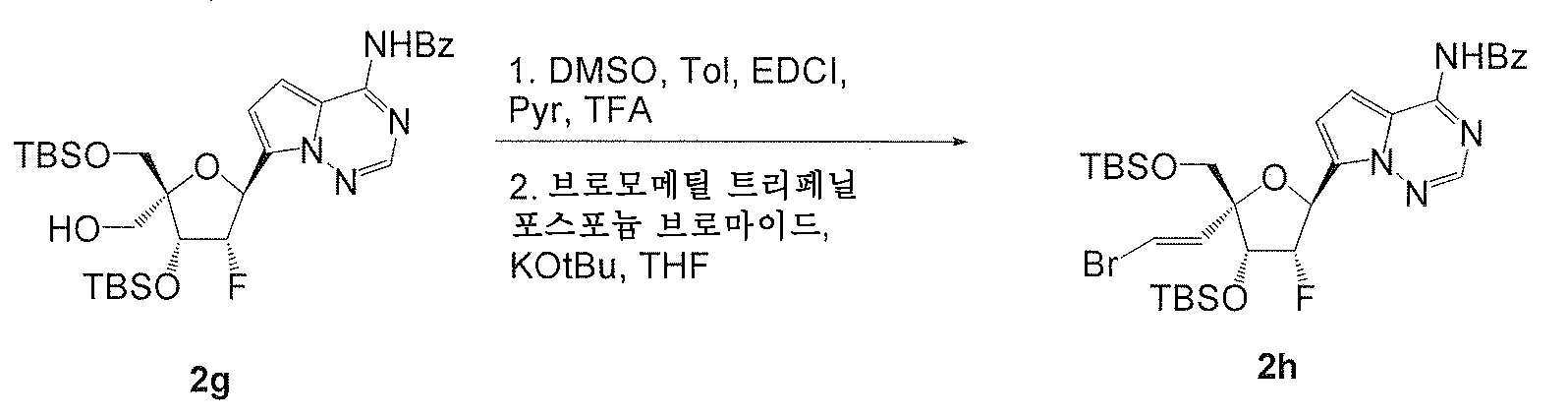
중간체 2h - N-(7-((2S,3S,4R,5R)-5-((E)-2-브로모비닐)-4-(tert-부틸디메틸실릴옥시)-5-((tert-부틸디메틸실릴옥시)메틸)-3-플루오로테트라히드로푸란-2-일)피롤로[1,2-f][1,2,4]트리아진-4-일)벤즈아미드Intermediate 2h-N- (7-((2S, 3S, 4R, 5R) -5-((E) -2-bromovinyl) -4- (tert-butyldimethylsilyloxy) -5-((tert- Butyldimethylsilyloxy) methyl) -3-fluorotetrahydrofuran-2-yl) pyrrolo [1,2-f] [1,2,4] triazin-4-yl) benzamide
톨루엔 (0.75 ㎖) 및 DMSO (0.15 ㎖) 중의 중간체 2g (228 ㎎, 0.361 mmol)의 용액에 1-에틸-3-(3-디메틸아미노프로필)카르보디이미드 염산염 (EDCl) (208 ㎎, 1.08 mmol)을 N2 대기 하에서 첨가하였다. 이 혼합물에 피리딘 (30 ㎕) 및 TFA (15 ㎕)를 첨가하고, 혼합물을 실온에서 30 분 동안 교반하였다. 반응을 EtOAc로 희석하고, H2O에 이어서 염수로 세정하였다. 유기물을 Na2SO4 위에서 건조시키고, 여과하고, 용매를 감압 하에서 제거하여 미정제 알데히드를 얻었다. 이 물질을 그 다음 단계에 그 상태로 사용하였다.1-ethyl-3- (3-dimethylaminopropyl) carbodiimide hydrochloride (EDCl) (208 mg, 1.08 mmol) in a solution of 2 g (228 mg, 0.361 mmol) of intermediate in toluene (0.75 mL) and DMSO (0.15 mL) ) Was added under N 2 atmosphere. Pyridine (30 μl) and TFA (15 μl) were added to the mixture, and the mixture was stirred at room temperature for 30 minutes. The reaction was diluted with EtOAc, washed with H 2 O then brine. The organics were dried over Na 2 SO 4 , filtered, and the solvent was removed under reduced pressure to give crude aldehyde. This material was used as such in the next step.
THF (4 ㎖) 중의 브로모메틸트리페닐포스포늄 브로마이드 (314 ㎎, 0.72 mmol)의 현탁액에 -40℃에서 KOtBu (THF 중의 1.0M, 1.08 ㎖, 1.08 mmol)를 첨가하고, 반응 혼합물을 2 시간 동안 N2 대기 하에서 교반하였다. 미정제 알데히드를 THF (4 ㎖) 중에 용해시키고, 적가하였다. 반응 혼합물을 저온 배쓰로부터 꺼내고, 10℃로 1 시간에 걸쳐 가온되도록 하였다. 반응 혼합물을 -40℃로 재냉각시키고, 반응 혼합물을 포화 NH4Cl(aq)로 켄칭시켰다. 층이 분리되고, 유기층을 Na2SO4 위에서 건조시키고, 여과하고, 용매를 감압 하에서 제거하였다. 잔류물을 헥산 중의 0%-50% EtOAc의 용리제를 사용하는 실리카 겔 크로마토그래피에 의하여 정제하여 중간체 2h를 얻었다.To a suspension of bromomethyltriphenylphosphonium bromide (314 mg, 0.72 mmol) in THF (4 mL) was added KOtBu (1.0M in THF, 1.08 mL, 1.08 mmol) at -40 ° C, and the reaction mixture was stirred for 2 hours. While stirring under N 2 atmosphere. The crude aldehyde was dissolved in THF (4 mL) and added dropwise. The reaction mixture was taken out from the cold bath and allowed to warm to 10 ° C. over 1 hour. The reaction mixture was re-cooled to -40 ° C, and the reaction mixture was quenched with saturated NH 4 Cl (aq) . The layers were separated, and the organic layer was dried over Na 2 SO 4 , filtered, and the solvent was removed under reduced pressure. The residue was purified by silica gel chromatography using eluent 0% -50% EtOAc in hexane to give intermediate 2h.
1H NMR (400 MHz, CDCl3) δ 8.08-7.85 (m, 2H), 7.62-7.36 (m, 2H), 7.34-7.01 (m, 3H), 6.92 (s, 1H), 6.60-6.45 (m, 1H), 6.35 (d, J=8.2 Hz, 1H), 5.61 (d, J=25.1 Hz, 1H), 4.82 (dd, J=56.3, 4.9 Hz, 1H), 4.69-4.46 (m, 1H), 3.97 (d, J=11.4 Hz, 1H), 3.53 (d, J=11.4 Hz, 1H), 0.84 (d, J=3.9 Hz, 18H), 0.13 - -0.10 (m, 12H). 1 H NMR (400 MHz, CDCl 3 ) δ 8.08-7.85 (m, 2H), 7.62-7.36 (m, 2H), 7.34-7.01 (m, 3H), 6.92 (s, 1H), 6.60-6.45 (m , 1H), 6.35 (d, J = 8.2 Hz, 1H), 5.61 (d, J = 25.1 Hz, 1H), 4.82 (dd, J = 56.3, 4.9 Hz, 1H), 4.69-4.46 (m, 1H) , 3.97 (d, J = 11.4 Hz, 1H), 3.53 (d, J = 11.4 Hz, 1H), 0.84 (d, J = 3.9 Hz, 18H), 0.13--0.10 (m, 12H).
19F NMR (376 MHz, CDCl3) δ -190.60 (m). 19 F NMR (376 MHz, CDCl 3 ) δ -190.60 (m).
LC/MS: tR=2.10 min, MS m/z=705.54/707.29 [M+1]; LC 시스템: 써모 아셀라 1250 UHPLC; MS 시스템: 써모 LCQ 플리트; 컬럼: 키네텍스 2.6μ C18 100A, 50×3.00 ㎜LC / MS: t R = 2.10 min, MS m / z = 705.54 / 707.29 [M + 1]; LC system: Thermo Acela 1250 UHPLC; MS system: Thermo LCQ pleats; Column: Kinetex 2.6 μ C18 100A, 50 × 3.00 mm
용매: 0.1% 포름산을 갖는 아세토니트릴, 0.1% 포름산을 갖는 물Solvent: acetonitrile with 0.1% formic acid, water with 0.1% formic acid
구배: 0 min-1.5 min 2-100% ACN, 1.5 min-2.8 min 100% ACN, 2.8 min-2.85 min 100%-2% ACN, 2.85 min-3 min 2% ACN.Gradient: 0 min-1.5 min 2-100% ACN, 1.5 min-2.8 min 100% ACN, 2.8 min-2.85 min 100% -2% ACN, 2.85 min-3 min 2% ACN.

중간체 2i - N-(7-((2S,3S,4R,5R)-4-(tert-부틸디메틸실릴옥시)-5-((tert-부틸디메틸실릴옥시)메틸)-5-에티닐-3-플루오로테트라히드로푸란-2-일)피롤로[1,2-f][1,2,4]트리아진-4-일)벤즈아미드 Intermediate 2i-N- (7-((2S, 3S, 4R, 5R) -4- (tert-butyldimethylsilyloxy) -5-((tert-butyldimethylsilyloxy) methyl) -5-ethynyl-3 -Fluorotetrahydrofuran-2-yl) pyrrolo [1,2- f] [ 1,2,4] triazin-4-yl) benzamide
중간체 2h (204 ㎎, 0.289 mmol)를 THF (8 ㎖) 중에 N2 대기 하에서 용해시키고, -40℃로 냉각시켰다. KOtBu (THF 중의 1.0M, 1.08 ㎖, 1.08 mmol)를 서서히 첨가하였다. 반응을 20 분 동안 교반되도록 하고, 포화 NH4Cl(aq)로 켄칭시켰다. 용액을 EtOAc로 희석하고, 염수로 세정하였다. 유기물을 Na2SO4 위에서 건조시키고, 여과하고, 용매를 감압 하에서 제거하였다. 잔류물을 헥산 중의 0%-50% EtOAc의 용리제 램프를 사용하는 실리카 겔 크로마토그래피에 의하여 정제하여 중간체 2i를 얻었다.Intermediate 2h (204 mg, 0.289 mmol) was dissolved in THF (8 mL) under N 2 atmosphere and cooled to -40 ° C. KOtBu (1.0M in THF, 1.08 mL, 1.08 mmol) was added slowly. The reaction was allowed to stir for 20 minutes and quenched with saturated NH 4 Cl (aq) . The solution was diluted with EtOAc and washed with brine. The organic was dried over Na 2 SO 4 , filtered, and the solvent was removed under reduced pressure. The residue was purified by silica gel chromatography using an eluent lamp of 0% -50% EtOAc in hexane to give intermediate 2i.
1H NMR (400 MHz, CDCl3) δ 8.12-7.88 (m, 2H), 7.51 (dt, J=36.5, 7.5 Hz, 2H), 7.32 (d, J=4.6 Hz, 1H), 6.88 (s, 1H), 5.79 (d, J=22.1 Hz, 1H), 5.02 (ddd, J=55.3, 5.1, 3.2 Hz, 1H), 4.56 (dd, J=18.1, 5.1 Hz, 1H), 3.91 (d, J=11.3 Hz, 1H), 3.83-3.62 (m, 1H), 2.55 (m, 1H), 0.90 (dd, J=25.3, 1.6 Hz, 18H), 0.20 - -0.08 (m, 12H). 1 H NMR (400 MHz, CDCl 3 ) δ 8.12-7.88 (m, 2H), 7.51 (dt, J = 36.5, 7.5 Hz, 2H), 7.32 (d, J = 4.6 Hz, 1H), 6.88 (s, 1H), 5.79 (d, J = 22.1 Hz, 1H), 5.02 (ddd, J = 55.3, 5.1, 3.2 Hz, 1H), 4.56 (dd, J = 18.1, 5.1 Hz, 1H), 3.91 (d, J = 11.3 Hz, 1H), 3.83-3.62 (m, 1H), 2.55 (m, 1H), 0.90 (dd, J = 25.3, 1.6 Hz, 18H), 0.20--0.08 (m, 12H).
19F NMR (376 MHz, CDCl3) δ -193.10 (broad-s). 19 F NMR (376 MHz, CDCl 3 ) δ -193.10 (broad-s).
LC/MS: tR=1.88 min, MS m/z=625.24 [M+1]; LC 시스템: 써모 아셀라 1250 UHPLCLC / MS: t R = 1.88 min, MS m / z = 625.24 [M + 1]; LC system: Thermo Acela 1250 UHPLC
MS 시스템: 써모 LCQ 플리트; 컬럼: 키네텍스 2.6μ C18 100A, 50×3.00 ㎜MS system: Thermo LCQ pleats; Column: Kinetex 2.6 μ C18 100A, 50 × 3.00 mm
용매: 0.1% 포름산을 갖는 아세토니트릴, 0.1% 포름산을 갖는 물Solvent: acetonitrile with 0.1% formic acid, water with 0.1% formic acid
구배: 0 min-1.5 min 2-100% ACN, 1.5 min-2.8 min 100% ACN, 2.8 min-2.85 min 100%-2% ACN, 2.85 min-3 min 2% ACN.Gradient: 0 min-1.5 min 2-100% ACN, 1.5 min-2.8 min 100% ACN, 2.8 min-2.85 min 100% -2% ACN, 2.85 min-3 min 2% ACN.

중간체 2j - N-(7-Intermediate 2j-N- (7- ((2S,3R,4R,5R)-5-에티닐((2S, 3R, 4R, 5R) -5-ethynyl -3--3- 플루오로Fluoro -4-히드록시-5-(-4-hydroxy-5- ( 히드록시메틸Hydroxymethyl )테트라히드로푸란-2-일)피롤로[1,2-f][1,2,4]트리아진-4-일)벤즈아미드) Tetrahydrofuran-2-yl) pyrrolo [1,2-f] [1,2,4] triazin-4-yl) benzamide
THF (3.5 ㎖) 중의 중간체 2i (152 ㎎, 0.243 mmol)의 용액에 N2 대기 하에서 TBAF (THF 중의 1.0M, 700 ㎕, 0.700 mmol)를 실온에서 첨가하고, 혼합물을 30 분 동안 교반시켰다. 용매를 감압 하에서 제거하였다. 잔류물을 헥산 중의 40%-100% EtOAc의 용리제 램프를 사용하는 실리카 겔 크로마토그래피에 의하여 정제하여 중간체 2j를 얻었다.To a solution of intermediate 2i (152 mg, 0.243 mmol) in THF (3.5 mL) was added TBAF (1.0M in THF, 700 μL, 0.700 mmol) under N 2 atmosphere at room temperature, and the mixture was stirred for 30 minutes. The solvent was removed under reduced pressure. The residue was purified by silica gel chromatography using an eluent lamp of 40% -100% EtOAc in hexane to give intermediate 2j.
LC/MS: tR=0.88 min, MS m/z=397.16 [M+1]; LC 시스템: 써모 아셀라 1250 UHPLCLC / MS: t R = 0.88 min, MS m / z = 397.16 [M + 1]; LC system: Thermo Acela 1250 UHPLC
MS 시스템: 써모 LCQ 플리트; 컬럼: 키네텍스 2.6μ C18 100A, 50×3.00 ㎜MS system: Thermo LCQ pleats; Column: Kinetex 2.6 μ C18 100A, 50 × 3.00 mm
용매: 0.1% 포름산을 갖는 아세토니트릴, 0.1% 포름산을 갖는 물Solvent: acetonitrile with 0.1% formic acid, water with 0.1% formic acid
구배: 0 min-1.5 min 2-100% ACN, 1.5 min-2.8 min 100% ACN, 2.8 min-2.85 min 100%-2% ACN, 2.85 min-3 min 2% ACN.Gradient: 0 min-1.5 min 2-100% ACN, 1.5 min-2.8 min 100% ACN, 2.8 min-2.85 min 100% -2% ACN, 2.85 min-3 min 2% ACN.

실시예Example 2 - ( 2 - ( 2R,3R,4R,5S2R, 3R, 4R, 5S )-5-(4-) -5- (4- 아미노피롤로[1,2-f][1,2,4]트리아진Aminopyrrolo [1,2-f] [1,2,4] triazine -7-일)-2-에티닐-4-플루오로-2-(히드록시메틸)테트라히드로푸란-3-올-7-yl) -2-ethynyl-4-fluoro-2- (hydroxymethyl) tetrahydrofuran-3-ol
CH3OH (2 ㎖) 중의 중간체 2j (71 ㎎, 0.179 mmol)의 용액에 진한 NH4OH(aq) (0.7 ㎖)를 첨가하고, 생성된 용액을 실온에서 16 시간 동안 교반하였다. 용매를 감압 하에서 제거하였다. 잔류물을 CH2Cl2 중의 0%-20% CH3OH의 용리제 램프를 사용하는 실리카 겔 크로마토그래피에 이어서 H2O 중의 0%-20% ACN의 용리제 램프를 사용하는 역상 HPLC에 의하여 정제하여 실시예 2를 얻었다.To a solution of intermediate 2j (71 mg, 0.179 mmol) in CH 3 OH (2 mL) was added concentrated NH 4 OH (aq) (0.7 mL), and the resulting solution was stirred at room temperature for 16 hours. The solvent was removed under reduced pressure. The residue was subjected to silica gel chromatography using an eluent lamp of 0% -20% CH 3 OH in CH 2 Cl 2 followed by reverse phase HPLC using an eluent lamp of 0% -20% ACN in H 2 O. Purification afforded Example 2.
1H NMR (400 MHz, CD3OD) δ 7.77 (s, 1H), 6.90-6.70 (m, 2H), 5.62 (dd, J=25.5, 2.6 Hz, 1H), 5.18 (ddd, J=56.0, 5.4, 2.7 Hz, 1H), 4.57 (dd, J=20.5, 5.4 Hz, 1H), 3.93-3.59 (m, 2H), 3.02 (d, J=0.7 Hz, 1H). 1 H NMR (400 MHz, CD 3 OD) δ 7.77 (s, 1H), 6.90-6.70 (m, 2H), 5.62 (dd, J = 25.5, 2.6 Hz, 1H), 5.18 (ddd, J = 56.0, 5.4, 2.7 Hz, 1H), 4.57 (dd, J = 20.5, 5.4 Hz, 1H), 3.93-3.59 (m, 2H), 3.02 (d, J = 0.7 Hz, 1H).
19F NMR (376 MHz, CD3OD) δ -193.76 (ddd, J=56.0, 25.5, 20.4 Hz). 19 F NMR (376 MHz, CD 3 OD) δ -193.76 (ddd, J = 56.0, 25.5, 20.4 Hz).
LC/MS: tR=0.45 min, MS m/z=293.13 [M+1]; LC 시스템: 써모 아셀라 1250 UHPLCLC / MS: t R = 0.45 min, MS m / z = 293.13 [M + 1]; LC system: Thermo Acela 1250 UHPLC
MS 시스템: 써모 LCQ 플리트; 컬럼: 키네텍스 2.6μ C18 100A, 50×3.00 ㎜MS system: Thermo LCQ pleats; Column: Kinetex 2.6 μ C18 100A, 50 × 3.00 mm
용매: 0.1% 포름산을 갖는 아세토니트릴, 0.1% 포름산을 갖는 물Solvent: acetonitrile with 0.1% formic acid, water with 0.1% formic acid
구배: 0 min-1.4 min 2-100% ACN, 1.4 min-1.80 min 100% ACN, 1.8 min-1.85 min 100%-2% ACN, 1.85 min-2 min 2% ACN.Gradient: 0 min-1.4 min 2-100% ACN, 1.4 min-1.80 min 100% ACN, 1.8 min-1.85 min 100% -2% ACN, 1.85 min-2 min 2% ACN.
HPLC: tR=3.112 min; HPLC 시스템: 아질런트 1100 시리즈.HPLC: t R = 3.112 min; HPLC system: Agilent 1100 series.
컬럼: 페노메넥스 키네텍스(Phenomenex Kinetex) C18 2.6 ㎛ 100A, 4.6×100 ㎜Column: Phenomenex Kinetex C18 2.6 μm 100A, 4.6 × 100 mm
용매: 0.1% TFA를 갖는 아세토니트릴, 0.1% TFA를 갖는 물Solvent: acetonitrile with 0.1% TFA, water with 0.1% TFA
구배: 1.5 ㎖/min으로 0 min-8.0 min 2-98% ACN.Gradient: 0 min-8.0 min 2-98% ACN at 1.5 ml / min.

중간체 3a - N-(7-((2S,3S,4R,5R)-4-(tert-부틸디메틸실릴옥시)-5-((tert-부틸디메틸실릴옥시)메틸)-3-플루오로-5-포르밀테트라히드로푸란-2-일)피롤로[1,2-f][1,2,4]트리아진-4-일)벤즈아미드Intermediate 3a-N- (7-((2S, 3S, 4R, 5R) -4- (tert-butyldimethylsilyloxy) -5-((tert-butyldimethylsilyloxy) methyl) -3-fluoro-5 -Formyltetrahydrofuran-2-yl) pyrrolo [1,2-f] [1,2,4] triazin-4-yl) benzamide
N2 대기 하에서 생성된 DMSO (1 ㎖) 및 톨루엔 (10 ㎖) 중의 중간체 2g (1.13 g, 1.79 mmol)의 용액에 EDCl·HCl (1.02 g, 5.36 mmol) 및 피리딘 (149 ㎕, 1.92 mmol)을 첨가하였다. TFA (74 ㎕, 0.97 mmol)를 첨가하였다. 1 시간 후, 반응을 LC/MS에 의하여 체크하였다. 1개의 피크가 관찰되었으며, 체류 시간은 출발 물질과 유사하기는 하나, 생성물에 대하여 예상되는 것에 해당하는 M+1 피크를 갖는다. 또 다른 50 ㎕의 피리딘을 첨가하고, 반응을 또 다른 15 분 동안 교반하였다. LC/MS에 의하면 변화가 없다. 반응을 EtOAc로 희석하고, 포화 NaHCO3 (aq.) 및 H2O의 1:1 혼합물로 켄칭시켰다. 혼합물을 EtOAc 및 더 많은 H2O 사이에 분배시켰다. 유기층이 분리되고, H2O, 염수로 세정한 후, Na2SO4 위에서 건조시켰다. 건조제를 진공 여과에 의하여 제거하고, 여과액을 농축시켰다. 잔류물을 CH2Cl2 중에서 취하고, 농축시키고, 생성된 물질을 고 진공 하에서 1 시간 동안 두었다. 생성물인 중간체 3a를 그 다음 반응에서 그 상태로 사용하였다.To a solution of 2 g (1.13 g, 1.79 mmol) of intermediate in DMSO (1 mL) and toluene (10 mL) produced under N 2 atmosphere, EDCl.HCl (1.02 g, 5.36 mmol) and pyridine (149 μl, 1.92 mmol) Was added. TFA (74 μl, 0.97 mmol) was added. After 1 hour, the reaction was checked by LC / MS. One peak was observed and the residence time was similar to the starting material, but with an M + 1 peak corresponding to that expected for the product. Another 50 μl of pyridine was added and the reaction was stirred for another 15 minutes. There is no change according to LC / MS. The reaction was diluted with EtOAc and quenched with a 1: 1 mixture of saturated NaHCO 3 (aq.) And H 2 O. The mixture was partitioned between EtOAc and more H 2 O. The organic layer was separated, washed with H 2 O, brine, and dried over Na 2 SO 4 . The desiccant was removed by vacuum filtration, and the filtrate was concentrated. The residue was taken up in CH 2 Cl 2 , concentrated, and the resulting material was placed under high vacuum for 1 hour. The product, intermediate 3a, was used as such in the next reaction.
LC/MS: tR=1.90 min, MS m/z=629.46 [M+1]; LC 시스템: 써모 아셀 1250 UHPLC LC / MS: t R = 1.90 min, MS m / z = 629.46 [M + 1]; LC system: Thermo Asher 1250 UHPLC
MS 시스템: 써모 LCQ 플리트; 컬럼: 키네텍스 2.6μ C18 100A, 50×3.00 ㎜MS system: Thermo LCQ pleats; Column: Kinetex 2.6 μ C18 100A, 50 × 3.00 mm
용매: 0.1% 포름산을 갖는 아세토니트릴, 0.1% 포름산을 갖는 물Solvent: acetonitrile with 0.1% formic acid, water with 0.1% formic acid
구배: 0 min-1.5 min 2-100% ACN, 1.5 min-2.8 min 100% ACN, 2.8 min-2.85 min 100%-2% ACN, 2.85 min-3 min 2% ACN.Gradient: 0 min-1.5 min 2-100% ACN, 1.5 min-2.8 min 100% ACN, 2.8 min-2.85 min 100% -2% ACN, 2.85 min-3 min 2% ACN.
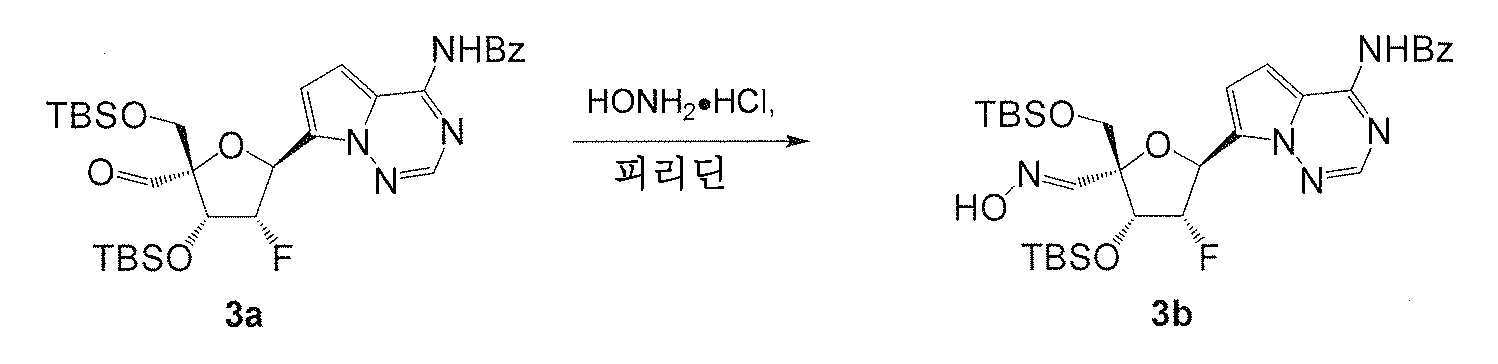
중간체 3b - N-(7-((2S,3S,4R,5R)-4-(tert-부틸디메틸실릴옥시)-5-((tert-부틸디메틸실릴옥시)메틸)-3-플루오로-5-((E)-(히드록시이미노)메틸)테트라히드로푸란-2-일)피롤로[1,2-f][1,2,4]트리아진-4-일)벤즈아미드Intermediate 3b-N- (7-((2S, 3S, 4R, 5R) -4- (tert-butyldimethylsilyloxy) -5-((tert-butyldimethylsilyloxy) methyl) -3-fluoro-5 -((E)-(hydroxyimino) methyl) tetrahydrofuran-2-yl) pyrrolo [1,2-f] [1,2,4] triazin-4-yl) benzamide
N2 대기 하에서 생성된 피리딘 (11 ㎖) 중의 중간체 3a (이전의 단계로부터의 미정제 물질, 1.79 mmol로 추정함)의 용액에 HONH2·HCl을 한번에 실온에서 첨가하였다. 반응을 LC/MS에 의하여 5 분 후 체크하고, 출발 물질이 소비되었다. 반응을 다시 25 분 후 체크하였다. 제1의 시점으로부터의 변화는 없었다. 반응을 농축시키고, 잔류물을 EtOAc 및 H2O 사이에 분배시켰다. 유기층을 분리시키고, 염수로 세정하고, Na2SO4 위에서 건조시키고, 여과하였다. 여과액을 농축시키고, CH2Cl2 중에서 취하고, 다시 농축시키고, 잔류물을 고 진공 하에 두었다. 생성물인 중간체 3b는 그 다음 반응에서 그 상태로 사용하였다.To a solution of intermediate 3a (crude material from the previous step, presumed to be 1.79 mmol) in pyridine (11 mL) produced under N 2 atmosphere, HONH 2 · HCl was added at one time at room temperature. The reaction was checked by LC / MS after 5 minutes and the starting material was consumed. The reaction was checked again after 25 minutes. There was no change from the first time point. The reaction was concentrated and the residue was partitioned between EtOAc and H 2 O. The organic layer was separated, washed with brine, dried over Na 2 SO 4 and filtered. The filtrate was concentrated, taken in CH 2 Cl 2 , concentrated again, and the residue was placed under high vacuum. The product, intermediate 3b, was used as such in the next reaction.
LC/MS: tR=1.83 min, MS m/z=644.55 [M+1]; LC 시스템: 써모 아셀라 1250 UHPLCLC / MS: t R = 1.83 min, MS m / z = 644.55 [M + 1]; LC system: Thermo Acela 1250 UHPLC
MS 시스템: 써모 LCQ 플리트; 컬럼: 키네텍스 2.6μ C18 100A, 50×3.00 ㎜MS system: Thermo LCQ pleats; Column: Kinetex 2.6 μ C18 100A, 50 × 3.00 mm
용매: 0.1% 포름산을 갖는 아세토니트릴, 0.1% 포름산을 갖는 물Solvent: acetonitrile with 0.1% formic acid, water with 0.1% formic acid
구배: 0 min-1.5 min 2-100% ACN, 1.5 min-2.8 min 100% ACN, 2.8 min-2.85 min 100%-2% ACN, 2.85 min-3 min 2% ACN.Gradient: 0 min-1.5 min 2-100% ACN, 1.5 min-2.8 min 100% ACN, 2.8 min-2.85 min 100% -2% ACN, 2.85 min-3 min 2% ACN.
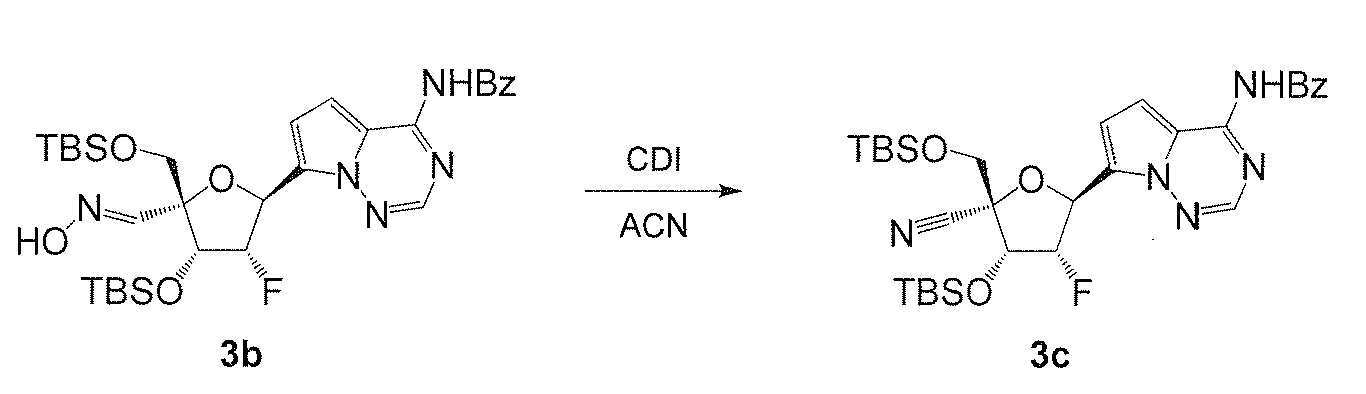
중간체 3c - N-(7-((2S,3S,4R,5R)-4-(tert-부틸디메틸실릴옥시)-5-((tert-부틸디메틸실릴옥시)메틸)-5-시아노-3-플루오로테트라히드로푸란-2-일)피롤로[1,2-f][1,2,4]트리아진-4-일)벤즈아미드Intermediate 3c-N- (7-((2S, 3S, 4R, 5R) -4- (tert-butyldimethylsilyloxy) -5-((tert-butyldimethylsilyloxy) methyl) -5-cyano-3 -Fluorotetrahydrofuran-2-yl) pyrrolo [1,2-f] [1,2,4] triazin-4-yl) benzamide
ACN (16 ㎖) 중의 중간체 3b (이전의 단계로부터의 미정제 물질, 1.79 mmol로 추정함)의 용액에 CDI (436 ㎎, 2.69 mmol)를 한번에 첨가하였다. 반응을 N2 대기 하에서 실시하였다. 반응을 LC/MS에 의하여 20 분 후 체크하였다. 출발 물질 및 생성물 대부분의 피크는 거의 시간 분해되지 않았다. 반응을 1.5 시간 후 체크하였다. 출발 물질에 해당하는 UV 피크는 거의 없어졌으며, 대부분의 피크의 강도는 사라졌다. 반응을 CH2Cl2로 희석하고, 포화 NaHCO3 (aq.) 및 H2O의 1:1 혼합물로 켄칭시켰다. 층이 분리되었으며, 수성층을 CH2Cl2로 역추출하고, 합한 유기층을 염수 및 H2O의 1:1 혼합물로 추출하고, Na2SO4 위에서 건조시키고, 여과하였다. 여과액을 농축시키고, 하기 용매 램프를 사용하는 실리카 겔 컬럼 크로마토그래피에 의하여 중간체 3c를 분리하였다: 헥산 중의 0% EtOAc로부터 헥산 중의 20% EtOAc로 상승되고, 헥산 중의 20% EtOAc에서 중지한 후, 헥산 중의 40% EtOAc로 상승되었다.To a solution of intermediate 3b in ACN (16 mL) (crude material from the previous step, presumed to be 1.79 mmol) was added CDI (436 mg, 2.69 mmol) at a time. The reaction was carried out under N 2 atmosphere. The reaction was checked after 20 minutes by LC / MS. The peaks of most of the starting material and product hardly decomposed in time. The reaction was checked after 1.5 hours. The UV peak corresponding to the starting material was almost disappeared, and the intensity of most peaks disappeared. The reaction was diluted with CH 2 Cl 2 and quenched with a 1: 1 mixture of saturated NaHCO 3 (aq.) And H 2 O. The layers were separated, the aqueous layer was back extracted with CH 2 Cl 2 , and the combined organic layers were extracted with a 1: 1 mixture of brine and H 2 O, dried over Na 2 SO 4 and filtered. The filtrate was concentrated and intermediate 3c was isolated by silica gel column chromatography using the following solvent lamp: rising from 0% EtOAc in hexane to 20% EtOAc in hexane, stopping in 20% EtOAc in hexane, Rose to 40% EtOAc in hexane.
1H NMR (400 MHz, DMSO-d6) δ 8.31 (s, 1H), 8.07 (s, 1H), 7.65 (t, J=8 Hz, 1H), 7.54 (t, J=8 Hz, 1H), 7.15 (d, 4 Hz, 1H), 7.02 (s, 1H), 5.82 (d, J=24 Hz, 1H), 5.51 (ddd, J=52, 4.8, 2.8 Hz, 1H), 4.70 (dd, J=18.4, 4.4 Hz, 1H), 3.94 (dd, J=53.2, 11.2 Hz, 2H), 0.93 (s, 9H,), 0.84 (s, 9H), 0.17 (s, 3H), 0.16 (s, 3H), 0.05 (s, 3H), 0.01 (s, 3H). 1 H NMR (400 MHz, DMSO-d 6 ) δ 8.31 (s, 1H), 8.07 (s, 1H), 7.65 (t, J = 8 Hz, 1H), 7.54 (t, J = 8 Hz, 1H) , 7.15 (d, 4 Hz, 1H), 7.02 (s, 1H), 5.82 (d, J = 24 Hz, 1H), 5.51 (ddd, J = 52, 4.8, 2.8 Hz, 1H), 4.70 (dd, J = 18.4, 4.4 Hz, 1H), 3.94 (dd, J = 53.2, 11.2 Hz, 2H), 0.93 (s, 9H,), 0.84 (s, 9H), 0.17 (s, 3H), 0.16 (s, 3H), 0.05 (s, 3H), 0.01 (s, 3H).
19F NMR (376 MHz, DMSO-d6) δ -194.658 (dt, J=53, 21.4 Hz). 19 F NMR (376 MHz, DMSO-d 6 ) δ -194.658 (dt, J = 53, 21.4 Hz).
LC/MS: tR=1.84 min, MS m/z=626.60 [M+1]; LC 시스템: 써모 아셀라 1250 UHPLCLC / MS: t R = 1.84 min, MS m / z = 626.60 [M + 1]; LC system: Thermo Acela 1250 UHPLC
MS 시스템: 써모 LCQ 플리트; 컬럼: 키네텍스 2.6μ C18 100A, 50×3.00 ㎜MS system: Thermo LCQ pleats; Column: Kinetex 2.6 μ C18 100A, 50 × 3.00 mm
용매: 0.1% 포름산을 갖는 아세토니트릴, 0.1% 포름산을 갖는 물Solvent: acetonitrile with 0.1% formic acid, water with 0.1% formic acid
구배: 0 min-1.5 min 2-100% ACN, 1.5 min-2.8 min 100% ACN, 2.8 min-2.85 min 100%-2% ACN, 2.85 min-3 min 2% ACN.Gradient: 0 min-1.5 min 2-100% ACN, 1.5 min-2.8 min 100% ACN, 2.8 min-2.85 min 100% -2% ACN, 2.85 min-3 min 2% ACN.

중간체 3d - (2R,3R,4S,5S)-5-(4-아미노피롤로[1,2-f][1,2,4]트리아진-7-일)-3-(tert-부틸디메틸실릴옥시)-2-((tert-부틸디메틸실릴옥시)메틸)-4-플루오로테트라히드로푸란-2-카르보니트릴Intermediate 3d-(2R, 3R, 4S, 5S) -5- (4-aminopyrrolo [1,2-f] [1,2,4] triazin-7-yl) -3- (tert-butyldimethyl Silyloxy) -2-((tert-butyldimethylsilyloxy) methyl) -4-fluorotetrahydrofuran-2-carbonitrile
빙수 배쓰내에서 냉각시킨 MeOH (11.2 ㎖) 중의 중간체 3c (770 ㎎, 1.23 mmol)의 용액에 진한 NH4OH(aq) (3.74 ㎖)를 첨가하였다. 저온 배쓰를 제거하고, 생성된 불균질 용액을 밤새 교반하였다. 그 다음날 반응은 LC/MS에 의하여 측정시 불완전하였다. 추가의 진한 NH4OH(aq) (4 ㎖) 및 2-MeTHF (12 ㎖)를 첨가하였다. 반응은 불균질하게 되었으나, 20 분 후, 추가의 반응 진행은 없었다. 반응을 농축시키고, 잔류물을 THF (15 ㎖) 중에 용해시켰다. 이 혼합물에 진한 NH4OH(aq) (5 ㎖) 및 충분한 MeOH (1.9 ㎖)를 첨가하여 용액이 균질하게 되었으며, 1상이 되었다. 반응을 실온에서 22 시간 동안 교반하였다. 반응을 거의 완료되었다 (출발 물질의 약 5%가 잔존함). 반응을 CH2Cl2 및 H2O로 희석하였다. 층이 분리되고, 수성층을 포화 NaHCO3(aq)로 희석하고, CH2Cl2로 추출하였다. 수성층을 2N HCl로 중화시킨 후, CH2Cl2로 추출하였다. 합한 유기층을 Na2SO4 위에서 건조시키고, 이를 여과에 의하여 제거하였다. 여과액을 농축시키고, 중간체 3d를 잔류물로부터 하기 용매 램프를 사용한 실리카 겔 컬럼 크로마토그래피에 의하여 분리하였다: 헥산 중의 0% EtOAc로부터 헥산 중의 50% EtOAc로 상승하고, 헥산 중의 50% EtOAc에서 중지한 후, 헥산 중의 100% EtOAc로 상승하였다.Concentrated NH 4 OH (aq) (3.74 mL) was added to a solution of intermediate 3c (770 mg, 1.23 mmol) in MeOH (11.2 mL) cooled in an ice water bath. The cold bath was removed and the resulting heterogeneous solution was stirred overnight. The next day the reaction was incomplete as measured by LC / MS. Additional concentrated NH 4 OH (aq) (4 mL) and 2-MeTHF (12 mL) were added. The reaction became heterogeneous, but after 20 minutes, no further reaction proceeded. The reaction was concentrated and the residue was dissolved in THF (15 mL). To the mixture was added concentrated NH 4 OH (aq) (5 mL) and sufficient MeOH (1.9 mL) to make the solution homogeneous and to phase 1. The reaction was stirred at room temperature for 22 hours. The reaction was almost complete (about 5% of the starting material remained). The reaction was diluted with CH 2 Cl 2 and H 2 O. The layers were separated, and the aqueous layer was diluted with saturated NaHCO 3 (aq) and extracted with CH 2 Cl 2 . The aqueous layer was neutralized with 2N HCl, and then extracted with CH 2 Cl 2 . The combined organic layers were dried over Na 2 SO 4 and removed by filtration. The filtrate was concentrated and the intermediate 3d was separated from the residue by silica gel column chromatography using the following solvent lamp: rising from 0% EtOAc in hexanes to 50% EtOAc in hexanes, stopped at 50% EtOAc in hexanes. Then, it was raised to 100% EtOAc in hexane.
LC/MS: tR=1.59 min, MS m/z=522.47 [M+1]; LC 시스템: 써모 아셀라 1250 UHPLCLC / MS: t R = 1.59 min, MS m / z = 522.47 [M + 1]; LC system: Thermo Acela 1250 UHPLC
MS 시스템: 써모 LCQ 플리트; 컬럼: 키네텍스 2.6μ C18 100A, 50×3.00 ㎜MS system: Thermo LCQ pleats; Column: Kinetex 2.6 μ C18 100A, 50 × 3.00 mm
용매: 0.1% 포름산을 갖는 아세토니트릴, 0.1% 포름산을 갖는 물Solvent: acetonitrile with 0.1% formic acid, water with 0.1% formic acid
구배: 0 min-1.4 min 2-100% ACN, 1.4 min-1.8 min 100% ACN, 1.8 min-1.85 min 100%-2% ACN, 1.85 min-2 min 2% ACN.Gradient: 0 min-1.4 min 2-100% ACN, 1.4 min-1.8 min 100% ACN, 1.8 min-1.85 min 100% -2% ACN, 1.85 min-2 min 2% ACN.
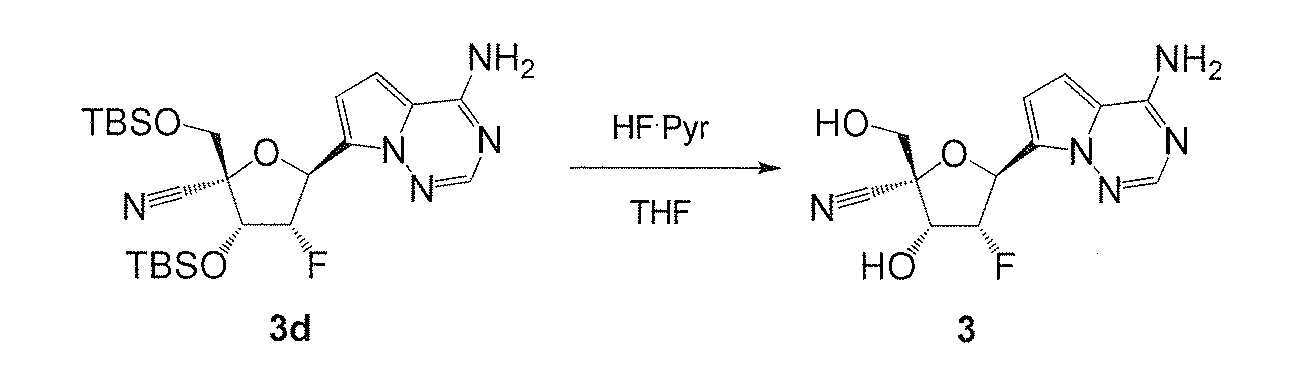
실시예Example 3 3
(( 2R,3R,4R,5S2R, 3R, 4R, 5S )-5-(4-) -5- (4- 아미노피롤로[1,2-f][1,2,4]트리아진Aminopyrrolo [1,2-f] [1,2,4] triazine -7-일)-4--7-day) -4- 플루오로Fluoro -3-히드록시-2-(히드록시메틸)테트라히드로푸란-2-카르보니트릴-3-hydroxy-2- (hydroxymethyl) tetrahydrofuran-2-carbonitrile
폴리프로필렌 시험관내에서 THF (2 ㎖) 중의 중간체 3d (100 ㎎, 0.191 mmol)의 용액에 0℃에서, N2 대기 하에서 피리딘 중의 70% HF·피리딘 (60 ㎕, 0.478 mmol)을 첨가하였다. 반응을 20 분 후 체크하고; 반응이 없었으며, 그래서, 피리딘 중의 추가의 70% HF·피리딘 (150 ㎕)을 첨가하고, 저온 배쓰를 제거하였다. 1 시간 50 분 후, 피리딘 중의 추가의 70% HF·피리딘 (150 ㎕)을 첨가하였다. 또 다른 2 시간 후, 피리딘 중의 추가의 70% HF·피리딘 (300 ㎕)을 첨가하였다. 또 다른 2 시간 15 분 후, 피리딘 중의 추가의 70% HF·피리딘 (1 ㎖)을 첨가하였다. 반응은 피리딘 중의 70% HF·피리딘의 최종 첨가시 맑고 균질하게 되었다. 반응을 밤새 교반하였다. 반응은 그 다음날 완료되었다. 반응을 얼음 배쓰 내에서 냉각시키고, H2O 및 소량의 포화 NaHCO3(aq)로 켄칭시켰다. 혼합물을 농축시키고, 잔류물을 DMSO 중에서 취하였다. 잔존하는 불용성 물질을 여과에 의하여 제거하고, 여과액을 HPLC에 의하여 반정제하였다. 분리된 물질을 DMF 중에 용해시키고, HPLC에 의하여 정제하였다. 실시예 3을 TFA 염으로서 0.5%로 분리하였다.To a solution of intermediate 3d (100 mg, 0.191 mmol) in THF (2 mL) in polypropylene in vitro, 70% HF · pyridine (60 μl, 0.478 mmol) in pyridine at 0 ° C. under N 2 atmosphere was added. The reaction was checked after 20 minutes; There was no reaction, so additional 70% HF · pyridine (150 μl) in pyridine was added and the cold bath was removed. After 1 hour and 50 minutes, additional 70% HF · pyridine (150 μl) in pyridine was added. After another 2 hours, additional 70% HF · pyridine (300 μl) in pyridine was added. After another 2 hours and 15 minutes, additional 70% HF · pyridine (1 mL) in pyridine was added. The reaction became clear and homogeneous upon the final addition of 70% HF · pyridine in pyridine. The reaction was stirred overnight. The reaction was completed the next day. The reaction was cooled in an ice bath and quenched with H 2 O and a small amount of saturated NaHCO 3 (aq) . The mixture was concentrated and the residue was taken up in DMSO. The remaining insoluble material was removed by filtration, and the filtrate was semi-purified by HPLC. The separated material was dissolved in DMF and purified by HPLC. Example 3 was isolated as 0.5% TFA salt.
1H NMR (400 MHz, DMF-d7) δ 7.92 (s, 1H), 6.99 (d, J=4.4 Hz, 1H), 6.89 (d, J=4.9 Hz, 1H), 6.64 (d, J=6 Hz, 1H), 5.92 (t, J=6.4 Hz, 1H), 5.83 (dd, J=25.2, 2 Hz, 1H), 5.40 (ddd, J=54.8, 4.8, 2.4 Hz, 1H), 4.75 (dt, J=22, 5.2 Hz, 1H), 4.02 (dd, J=12, 6.4 Hz, 1H), 3.87 (dd, J=12, 6.4 Hz, 1H). 1 H NMR (400 MHz, DMF-d 7 ) δ 7.92 (s, 1H), 6.99 (d, J = 4.4 Hz, 1H), 6.89 (d, J = 4.9 Hz, 1H), 6.64 (d, J = 6 Hz, 1H), 5.92 (t, J = 6.4 Hz, 1H), 5.83 (dd, J = 25.2, 2 Hz, 1H), 5.40 (ddd, J = 54.8, 4.8, 2.4 Hz, 1H), 4.75 ( dt, J = 22, 5.2 Hz, 1H), 4.02 (dd, J = 12, 6.4 Hz, 1H), 3.87 (dd, J = 12, 6.4 Hz, 1H).
19F NMR (376 MHz, DMF-d7) δ -74.92 (s), -193.726 (dt, J=54.5, 23.3 Hz). 19 F NMR (376 MHz, DMF-d 7 ) δ -74.92 (s), -193.726 (dt, J = 54.5, 23.3 Hz).
LC/MS: tR=0.56 min, MS m/z=294.10 [M+1]; LC 시스템: 써모 아셀라 1250 UHPLCLC / MS: t R = 0.56 min, MS m / z = 294.10 [M + 1]; LC system: Thermo Acela 1250 UHPLC
MS 시스템: 써모 LCQ 플리트; 컬럼: 키네텍스 2.6μ C18 100A, 50×3.00 ㎜MS system: Thermo LCQ pleats; Column: Kinetex 2.6 μ C18 100A, 50 × 3.00 mm
용매: 0.1% 포름산을 갖는 아세토니트릴, 0.1% 포름산을 갖는 물Solvent: acetonitrile with 0.1% formic acid, water with 0.1% formic acid
구배: 0 min-1.4 min 2-100% ACN, 1.4 min-1.8 min 100% ACN, 1.8 min-1.85 min 100%-2% ACN, 1.85 min-2 min 2% ACN.Gradient: 0 min-1.4 min 2-100% ACN, 1.4 min-1.8 min 100% ACN, 1.8 min-1.85 min 100% -2% ACN, 1.85 min-2 min 2% ACN.
HPLC: tR=3.220 min; HPLC 시스템: 아질런트 1100 시리즈; 컬럼: 페노메넥스 키네텍스 C18 2.6 ㎛ 100A, 4.6×100 ㎜; 용매: 0.1% TFA를 갖는 아세토니트릴, 0.1% TFA를 갖는 물HPLC: t R = 3.220 min; HPLC system: Agilent 1100 series; Column: Phenomenex Kinetex C18 2.6 μm 100A, 4.6 × 100 mm; Solvent: acetonitrile with 0.1% TFA, water with 0.1% TFA
구배: 1.5 ㎖/min으로 0 min-8.0 min 2-98% ACN.Gradient: 0 min-8.0 min 2-98% ACN at 1.5 ml / min.

중간체 4b - (Intermediate 4b-( 3aR,5R,6aS3aR, 5R, 6aS )-5-((R)-2,2-디메틸-1,3-) -5-((R) -2,2-dimethyl-1,3- 디옥솔란Dioxolan -4-일)-2,2--4-day) -2,2- 디메틸디히드로푸로[3,2-d][1,3]디옥솔Dimethyldihydrofuro [3,2-d] [1,3] dioxole -6(3aH)-온-6 (3aH) -on
10 ℓ 4목 둥근 바닥 플라스크에 디클로로메탄/물 (2.7 ℓ/2.3 ℓ) 중의 중간체 4a, (3aR,5S,6S,6aR)-5-((R)-2,2-디메틸-1,3-디옥솔란-4-일-2,2-디메틸테트라히드로푸로[3,2-d][1,3]디옥솔-6-올 (500 g, 1.90 mol)의 용액을 실온에서 넣었다. 이에 탄산나트륨 (290 g, 3.42 mol)을 첨가하였다. 탄산칼륨 (451 g, 3.24 mol)을 첨가하였다. 이에 이어서 2,2,6,6-테트라메틸피페리디노옥시 (TEMPO, 15.2 g, 96.31 mmol)를 첨가하였다. 혼합물에 테트라부틸암모늄 브로마이드 (31 g, 95.20 mmol)를 첨가하였다. 이에 N-브로모숙신이미드 (514 g, 2.86 mol)를 여러 부분으로 나누어 35℃에서 첨가하였다. 생성된 용액을 2 시간 동안 실온에서 교반하면서 반응하도록 하였다. 생성된 용액을 2×1 ℓ의 디클로로메탄으로 추출하고, 유기층을 합하였다. 생성된 혼합물을 1×1.5 ℓ의 물로 세정하였다. 혼합물을 무수 황산나트륨 위에서 건조시키고, 진공 하에서 농축시켰다. 이는 (미정제) 중간체 4b를 생성하였다.Intermediate 4a, (3aR, 5S, 6S, 6aR) -5-((R) -2,2-dimethyl-1,3- in dichloromethane / water (2.7 liter / 2.3 liter) in a 10 liter 4-neck round bottom flask A solution of dioxolan-4-yl-2,2-dimethyltetrahydrofuro [3,2-d] [1,3] dioxol-6-ol (500 g, 1.90 mol) was added at room temperature. 290 g, 3.42 mol) was added Potassium carbonate (451 g, 3.24 mol) was added followed by 2,2,6,6-tetramethylpiperidinooxy (TEMPO, 15.2 g, 96.31 mmol). To the mixture was added tetrabutylammonium bromide (31 g, 95.20 mmol), into which N-bromosuccinimide (514 g, 2.86 mol) was divided into portions and added at 35 ° C. The resulting solution was 2 The mixture was allowed to react with stirring at room temperature for an hour The resulting solution was extracted with 2 × 1 L of dichloromethane, and the organic layers were combined The resulting mixture was washed with 1 × 1.5 L of water The mixture was dried over anhydrous sodium sulfate , Concentrated in vacuo, resulting in (crude) intermediate 4b.

중간체 4c - (Intermediate 4c-( 3aR,5S,6R,6aR3aR, 5S, 6R, 6aR )-5-((R)-2,2-디메틸-1,3-) -5-((R) -2,2-dimethyl-1,3- 디옥솔란Dioxolan -4-일)-2,2--4-day) -2,2- 디메틸테트라히드로푸로[3,2-d][1,3]디옥솔Dimethyltetrahydrofuro [3,2-d] [1,3] dioxole -6-올-6-ol
2 ℓ 4목 둥근 바닥 플라스크에 메탄올 (1,300 ㎖) 중의 중간체 4b (370 g, 1.29 mol)의 용액을 넣었다. 이에 붕수소화나트륨 (26.4 g, 706.38 mmol)을 여러 부분으로 나누어 실온에서 첨가하였다. 생성된 용액을 2 시간 동안 실온에서 교반하면서 반응하도록 하였다. 생성된 혼합물을 진공 하에서 농축시켰다. 그 후, 반응을 1,000 ㎖의 5% 염화암모늄 수용액을 첨가하여 켄칭시켰다. 생성된 용액을 3×500 ㎖의 디클로로메탄으로 추출하고, 유기층을 합하였다. 생성된 용액을 2×300 ㎖의 물로 세정하였다. 혼합물을 무수 황산나트륨 위에서 건조시키고, 진공 하에서 농축시켰다. 미정제 생성물을 석유 에테르로부터의 재결정화에 의하여 정제하였다. 이는 중간체 4c를 생성하였다.A solution of intermediate 4b (370 g, 1.29 mol) in methanol (1,300 mL) was placed in a 2 L 4 neck round bottom flask. To this, sodium borohydride (26.4 g, 706.38 mmol) was divided into portions and added at room temperature. The resulting solution was allowed to react while stirring at room temperature for 2 hours. The resulting mixture was concentrated under vacuum. Then, the reaction was quenched by adding 1,000 ml of 5% aqueous ammonium chloride solution. The resulting solution was extracted with 3 × 500 ml of dichloromethane, and the organic layers were combined. The resulting solution was washed with 2x300 ml of water. The mixture was dried over anhydrous sodium sulfate and concentrated under vacuum. The crude product was purified by recrystallization from petroleum ether. This produced intermediate 4c.
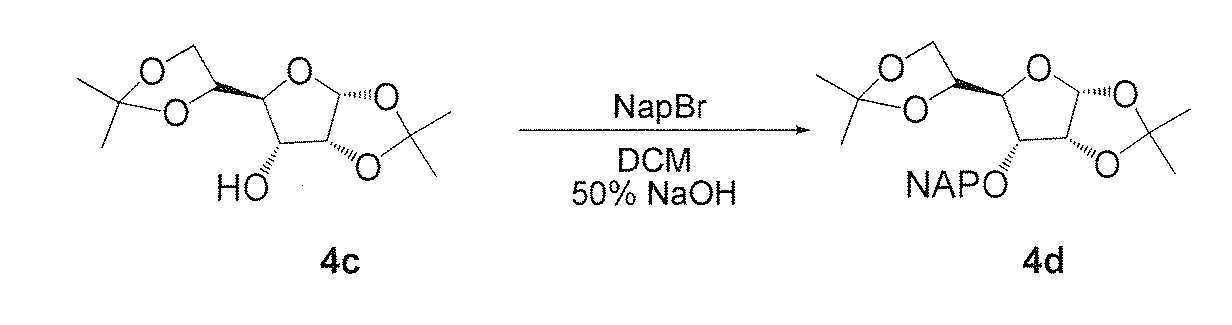
중간체 4dIntermediate 4d
5,000-㎖ 4목 둥근 바닥 플라스크에 디클로로메탄 (700 ㎖) 중의 중간체 4c (350 g, 1.34 mol)의 용액을 넣었다. 이에 테트라부틸암모늄 브로마이드 (476.8 g, 1.48 mol)를 첨가하였다. 혼합물에 50% 수산화나트륨/물 (700 g)을 첨가하였다. 이에 2-(브로모메틸) 나프탈렌 (340 g, 1.54 mol)을 여러 배취로 첨가하였다. 생성된 용액을 4 시간 동안 실온에서 교반하면서 반응하도록 하였다. 그 후, 반응을 1,800 ㎖의 디클로로메탄/물 (1:1)을 첨가하여 켄칭시켰다. 생성된 용액을 2×1 ℓ의 디클로로메탄으로 추출하고, 유기층을 합하였다. 생성된 혼합물을 1×1,000 ㎖의 물로 세정하였다. 잔류물을 1,000/1,000 ㎖의 석유 에테르/물 중에 용해시켰다. 미정제 생성물을 석유 에테르로부터 재결정시켜 정제하였다. 이는 중간체 4d를 생성하였다.A solution of intermediate 4c (350 g, 1.34 mol) in dichloromethane (700 mL) was placed in a 5,000-mL 4-neck round bottom flask. To this was added tetrabutylammonium bromide (476.8 g, 1.48 mol). To the mixture 50% sodium hydroxide / water (700 g) was added. To this 2- (bromomethyl) naphthalene (340 g, 1.54 mol) was added in several batches. The resulting solution was allowed to react while stirring at room temperature for 4 hours. Thereafter, the reaction was quenched by adding 1,800 ml of dichloromethane / water (1: 1). The resulting solution was extracted with 2 × 1 L of dichloromethane, and the organic layers were combined. The resulting mixture was washed with 1 × 1,000 ml of water. The residue was dissolved in 1,000 / 1,000 ml petroleum ether / water. The crude product was purified by recrystallization from petroleum ether. This produced intermediate 4d.

중간체 4e - (R)-1-((Intermediate 4e-(R) -1-(( 3aR,5R,6R,6aR3aR, 5R, 6R, 6aR )-2,2-디메틸-6-) -2,2-dimethyl-6- (나프탈렌-2-일메톡시)테트라히드로푸로(Naphthalene-2-ylmethoxy) tetrahydrofuro [3,2-d][1,3]디옥솔-5-일)에탄-1,2-디올[3,2-d] [1,3] dioxol-5-yl) ethane-1,2-diol
5 ℓ 4목 둥근 바닥 플라스크에 중간체 4d (500 g, 1.25 mol)를 넣었다. 이에 아세트산 (1.8 ℓ)을 첨가하였다. 혼합물에 물 (600 ㎖)을 첨가하였다. 생성된 용액을 밤새 실온에서 교반하면서 반응하도록 하였다. 고체를 여과하였다. 생성된 용액을 3×1 ℓ의 석유 에테르로 추출하고, 수성층을 합하였다. 생성된 용액을 2 ℓ의 에틸 아세테이트로 희석하였다. 생성된 혼합물을 2×2 ℓ의 염화나트륨(aq)으로 세정하였다. 용액의 pH값은 탄산나트륨 (50%)을 사용하여 8로 조절하였다. 생성된 용액을 2×1 ℓ의 에틸 아세테이트로 추출하고, 유기층을 합하고, 진공 하에서 농축시켰다. 이는 중간체 4e를 생성하였다.Intermediate 4d (500 g, 1.25 mol) was placed in a 5 ℓ 4 neck round bottom flask. To this was added acetic acid (1.8 L). Water (600 mL) was added to the mixture. The resulting solution was allowed to react while stirring at room temperature overnight. The solid was filtered. The resulting solution was extracted with 3x1 L of petroleum ether, and the aqueous layers were combined. The resulting solution was diluted with 2 L of ethyl acetate. The resulting mixture was washed with 2x2 L of sodium chloride (aq) . The pH value of the solution was adjusted to 8 with sodium carbonate (50%). The resulting solution was extracted with 2x1 L of ethyl acetate, and the organic layers were combined and concentrated under vacuum. This produced intermediate 4e.

중간체 4f - (Intermediate 4f-( 3aR,5S,6R,6aR3aR, 5S, 6R, 6aR )-2,2-디메틸-6-) -2,2-dimethyl-6- (나프탈렌-2-일메톡시)테트라히드로푸로(Naphthalene-2-ylmethoxy) tetrahydrofuro [3,2-d][1,3]디옥솔-5-카르브알데히드[3,2-d] [1,3] dioxol-5-carbaldehyde
10 ℓ 4목 둥근 바닥 플라스크에 1,4-디옥산 (2,100 ㎖) 중의 중간체 4e (300 g, 833.33 mmol)의 용액을 실온에서 넣었다. 이에 이어서 물 (4,000 ㎖) 중의 과아이오드산나트륨 (250 g)의 용액을 실온에서 0.5 시간 이내에 첨가하였다. 생성된 용액을 0.5 시간 동안 실온에서 교반하면서 반응하도록 하였다. 고체를 여과하였다. 생성된 용액을 3×1,000 ㎖의 에틸 아세테이트로 추출하고, 유기층을 합하였다. 생성된 혼합물을 2×1,000 ㎖의 염화나트륨(aq)으로 세정하였다. 생성된 혼합물을 진공 하에서 농축시켰다. 이는 중간체 4f를 생성하였다.To a 10 L 4-neck round bottom flask was added a solution of intermediate 4e (300 g, 833.33 mmol) in 1,4-dioxane (2,100 mL) at room temperature. Then a solution of sodium periodate (250 g) in water (4,000 mL) was added within 0.5 hour at room temperature. The resulting solution was allowed to react while stirring at room temperature for 0.5 hour. The solid was filtered. The resulting solution was extracted with 3 x 1,000 ml of ethyl acetate, and the organic layers were combined. The resulting mixture was washed with 2 × 1,000 ml of sodium chloride (aq) . The resulting mixture was concentrated under vacuum. This produced intermediate 4f.

중간체 4g - ((Intermediate 4 g-(( 3aR,6S,6aR3aR, 6S, 6aR )-2,2-디메틸-6-) -2,2-dimethyl-6- (나프탈렌-2-일메톡시)테트라히드로푸로(Naphthalene-2-ylmethoxy) tetrahydrofuro [3,2-d][1,3]디옥솔-5,5-디일)디메탄올[3,2-d] [1,3] dioxol-5,5-diyl) dimethanol
10 ℓ 4목 둥근 바닥 플라스크에 물/테트라히드로푸란 (1,250/1,250 ㎖) 중의 중간체 4f (250 g, 761.36 mmol)의 용액을 실온에서 넣었다. 이에 0-15℃에서 교반하면서 2N 수산화나트륨(aq) (1,500 ㎖)을 적가하였다. 혼합물에 포름알데히드 (620 ㎖)를 첨가하였다. 생성된 용액을 밤새 실온에서 교반하면서 반응하도록 하였다. 생성된 용액을 2×2,000 ㎖의 에틸 아세테이트로 추출하였다. 생성된 혼합물을 2×2,000 ㎖의 염화나트륨(aq)으로 세정하였다. 유기층을 합하고, 무수 황산나트륨 위에서 건조시켰다. 잔류물을 실리카 겔 컬럼에 석유 에테르:에틸 아세테이트 (2/1)와 함께 가하였다. 미정제 생성물을 에틸 아세테이트:에탄올로부터 1 g/(1 ㎖:1 ㎖)의 비로 재결정시켰다. 이는 중간체 4g를 생성하였다.A 10 L 4 neck round bottom flask was charged with a solution of intermediate 4f (250 g, 761.36 mmol) in water / tetrahydrofuran (1,250 / 1,250 mL) at room temperature. To this, 2N sodium hydroxide (aq) (1,500 mL) was added dropwise while stirring at 0-15 ° C. Formaldehyde (620 mL) was added to the mixture. The resulting solution was allowed to react while stirring at room temperature overnight. The resulting solution was extracted with 2x2,000 ml of ethyl acetate. The resulting mixture was washed with 2x2,000 ml of sodium chloride (aq) . The organic layers were combined and dried over anhydrous sodium sulfate. The residue was added to a silica gel column with petroleum ether: ethyl acetate (2/1). The crude product was recrystallized from ethyl acetate: ethanol at a ratio of 1 g / (1 mL: 1 mL). This produced 4 g of intermediate.

중간체 4h - ((Intermediate 4h-(( 3aR,5R,6S,6aR3aR, 5R, 6S, 6aR )-5-(() -5-(( terttert -- 부틸디페닐실릴옥시Butyldiphenylsilyloxy )) 메틸methyl )-2,2-디메틸-6-(나프탈렌-2-일메톡시)테트라히드로푸로[3,2-d][1,3]디옥솔-5-일)메탄올) -2,2-dimethyl-6- (naphthalen-2-ylmethoxy) tetrahydrofuro [3,2-d] [1,3] dioxol-5-yl) methanol
불활성 질소 대기로 퍼징 및 유지되는 5 ℓ 4목 둥근 바닥 플라스크에 디클로로메탄 (2,500 ㎖) 중의 중간체 4 g (125 g, 346.84 mmol)의 용액을 실온에서 넣었다. 혼합물에 트리에틸아민 (157.5 ㎖)을 실온에서 첨가하였다. 이에 tert-부틸디페닐실릴 클로라이드 (157.5 ㎖)를 0-10℃에서 교반하면서 적가하였다. 생성된 용액을 밤새 실온에서 교반하면서 반응하도록 하였다. 그 후, 반응을 37.5 ㎖의 메탄올을 첨가하여 켄칭시켰다. 생성된 혼합물을 2×500 ㎖의 5% 염화수소(aq) 및 2×500 ㎖의 중탄산나트륨(aq)으로 세정하였다. 생성된 혼합물을 2×500 ㎖의 1N 수산화나트륨(aq)으로 세정하였다. 혼합물을 무수 황산나트륨 위에서 건조시키고, 진공 하에서 농축시켰다. 미정제 생성물을 디클로로메탄/헥산으로부터 재결정화에 의하여 정제하였다. 이는 중간체 4h를 생성하였다.A solution of 4 g (125 g, 346.84 mmol) of intermediate in dichloromethane (2,500 mL) was placed in a 5 L 4 neck round bottom flask purged and maintained with an inert nitrogen atmosphere at room temperature. Triethylamine (157.5 mL) was added to the mixture at room temperature. To this, tert-butyldiphenylsilyl chloride (157.5 mL) was added dropwise while stirring at 0-10 ° C. The resulting solution was allowed to react while stirring at room temperature overnight. Thereafter, the reaction was quenched by adding 37.5 ml of methanol. The resulting mixture was washed with 2 × 500 mL of 5% hydrogen chloride (aq) and 2 × 500 mL of sodium bicarbonate (aq) . The resulting mixture was washed with 2 × 500 mL of 1N sodium hydroxide (aq) . The mixture was dried over anhydrous sodium sulfate and concentrated under vacuum. The crude product was purified by recrystallization from dichloromethane / hexane. This produced intermediate 4h.

중간체 4i - Intermediate 4i- terttert -부틸(-Butyl ( 3aR,5R,6S,6aR3aR, 5R, 6S, 6aR )-5-() -5- ( 아이오도메틸Iodomethyl )-2,2-디메틸-6-) -2,2-dimethyl-6- (나프탈렌-2-일메톡시)테트라히드로푸로(Naphthalene-2-ylmethoxy) tetrahydrofuro [3,2-d][1,3]디옥솔-5-일)메톡시)디페닐실란[3,2-d] [1,3] dioxol-5-yl) methoxy) diphenylsilane
불활성 질소 대기로 퍼징 및 유지된 1,000-㎖ 3목 둥근 바닥 플라스크에 톨루엔 (320 ㎖) 중의 중간체 4h (20 g, 31.73 mmol), 트리페닐포스핀 (35 g, 132.11 mmol), 이미다졸 (8.96 g, 132.26 mmol)의 용액을 넣었다. 이어서 아이오딘 (16.95 g, 66.8 mmol)를 여러 배취로 60℃에서 첨가하였다. 생성된 용액을 밤새 80℃에서 오일 배쓰 내에서 교반하였다. 반응 혼합물을 물/얼음 배쓰로 실온으로 냉각시켰다. 생성된 용액을 1,000 ㎖의 에틸 아세테이트로 희석하였다. 생성된 혼합물을 2×300 ㎖의 티오황산나트륨(aq)으로 세정하였다. 생성된 혼합물을 1×300 ㎖의 염화나트륨(aq)으로 세정하였다. 혼합물을 무수 황산나트륨 위에서 건조시키고, 진공 하에서 농축시켰다. 잔류물을 실리카 겔 컬럼 위에서 에틸 아세테이트/석유 에테르 (1:10)와 함께 가하였다. 이는 중간체 4i를 생성하였다.Intermediate 4h (20 g, 31.73 mmol), triphenylphosphine (35 g, 132.11 mmol), imidazole (8.96 g) in toluene (320 mL) in a 1,000-mL 3-neck round bottom flask purged and maintained with an inert nitrogen atmosphere , 132.26 mmol). Then iodine (16.95 g, 66.8 mmol) was added in several batches at 60 ° C. The resulting solution was stirred overnight at 80 ° C. in an oil bath. The reaction mixture was cooled to room temperature with a water / ice bath. The resulting solution was diluted with 1,000 ml of ethyl acetate. The resulting mixture was washed with 2x300 ml of sodium thiosulfate (aq) . The resulting mixture was washed with 1x300 ml of sodium chloride (aq) . The mixture was dried over anhydrous sodium sulfate and concentrated under vacuum. The residue was added on a silica gel column with ethyl acetate / petroleum ether (1:10). This resulted in intermediate 4i.

중간체 4j - Intermediate 4j- terttert -- 부틸디페닐(((3aR,5R,6S,6aR)Butyl Diphenyl (((3aR, 5R, 6S, 6aR) -2,2,5--2,2,5- 트리메틸Trimethyl -6--6- (나프탈렌-2-일메톡시)테트라히드로푸로(Naphthalene-2-ylmethoxy) tetrahydrofuro [3,2-d][1,3]디옥솔-5-일)메톡시)실란[3,2-d] [1,3] dioxol-5-yl) methoxy) silane
불활성 질소 대기로 퍼징 및 유지된 2,000-㎖ 둥근 바닥 플라스크에 에탄올/에틸 아세테이트 (600/600 ㎖) 중의 중간체 4i (66 g, 88.47 mmol), 트리에틸아민 (20.7 g, 202.52 mmol), 탄소상 팔라듐 (10 중량%, 24.8 g, 23.30 mmol)의 용액을 넣었다. 생성된 용액을 3 시간 동안 40℃에서 교반하였다. 고체를 여과하였다. 생성된 혼합물을 진공 하에서 농축시켰다. 생성된 용액을 1,500 ㎖의 에틸 아세테이트로 희석하였다. 생성된 혼합물을 1×500 ㎖의 염화나트륨(aq)으로 세정하였다. 혼합물을 무수 황산나트륨 위에서 건조시키고, 진공 하에서 농축시켰다. 이는 중간체 4j를 생성하였다.Intermediate 4i (66 g, 88.47 mmol) in ethanol / ethyl acetate (600/600 mL), triethylamine (20.7 g, 202.52 mmol), palladium on carbon in a 2,000-mL round bottom flask purged and maintained with an inert nitrogen atmosphere. (10 wt%, 24.8 g, 23.30 mmol) was added. The resulting solution was stirred at 40 ° C. for 3 hours. The solid was filtered. The resulting mixture was concentrated under vacuum. The resulting solution was diluted with 1,500 ml of ethyl acetate. The resulting mixture was washed with 1x500 ml of sodium chloride (aq) . The mixture was dried over anhydrous sodium sulfate and concentrated under vacuum. This produced intermediate 4j.

중간체 4k - (Intermediate 4k-( 3aR,5R,6S,6aR3aR, 5R, 6S, 6aR )-5-(() -5-(( terttert -- 부틸디페닐실릴옥시Butyldiphenylsilyloxy )) 메틸methyl )-2,2,5-트리메틸테트라히드로푸로[3,2-d][1,3]디옥솔-6-올) -2,2,5-trimethyltetrahydrofuro [3,2-d] [1,3] dioxol-6-ol
500-㎖ 둥근 바닥 플라스크에 디클로로메탄 (15 ㎖) 중의 중간체 4j (1.0 g, 1.63 mmol), 물 (1.25 ㎖) 및 2,3-디클로로-5,6-디시아노-1,4-벤조퀴논 (DDQ, 780 ㎎, 3.40 mmol)의 용액을 넣었다. 생성된 용액을 1 시간 동안 실온에서 교반하였다. 생성된 용액을 50 ㎖의 디클로로메탄으로 희석하였다. 생성된 혼합물을 1×30 ㎖의 물 및 2×30 ㎖의 중탄산나트륨(aq)으로 세정하였다. 생성된 혼합물을 1×30 ㎖의 염화나트륨(aq)으로 세정하였다. 혼합물을 무수 황산나트륨 위에서 건조시키고, 진공 하에서 농축시켰다. 잔류물을 실리카 겔 컬럼 위에서 에틸 아세테이트/석유 에테르 (1:20-1:10)와 함께 가하였다. 이는 중간체 4k를 생성하였다.Intermediate 4j (1.0 g, 1.63 mmol) in dichloromethane (15 mL), water (1.25 mL) and 2,3-dichloro-5,6-dicyano-1,4-benzoquinone ( DDQ, 780 mg, 3.40 mmol) was added. The resulting solution was stirred for 1 hour at room temperature. The resulting solution was diluted with 50 ml of dichloromethane. The resulting mixture was washed with 1 × 30 mL of water and 2 × 30 mL of sodium bicarbonate (aq) . The resulting mixture was washed with 1x30 ml of sodium chloride (aq) . The mixture was dried over anhydrous sodium sulfate and concentrated under vacuum. The residue was added on a silica gel column with ethyl acetate / petroleum ether (1: 20-1: 10). This produced intermediate 4k.

중간체 4l - (Intermediate 4l-( 3aR,5R,6S,6aR3aR, 5R, 6S, 6aR )-5-() -5- ( 히드록시메틸Hydroxymethyl )-2,2,5-트리메틸테트라히드로푸로[3,2-d][1,3]디옥솔-6-올) -2,2,5-trimethyltetrahydrofuro [3,2-d] [1,3] dioxol-6-ol
50-㎖ 둥근 바닥 플라스크에 테트라히드로푸란 (9 ㎖) 중의 중간체 4k (520 ㎎, 1.12 mmol), 테트라부틸암모늄 플루오라이드 (369 ㎎, 1.40 mmol)의 용액을 넣었다. 생성된 용액을 2 시간 동안 실온에서 교반하였다. 생성된 혼합물을 진공 하에서 농축시켰다. 잔류물을 실리카 겔 컬럼 위에서 디클로로메탄/메탄올 (100:1)과 함께 가하였다. 이는 중간체 4l을 생성하였다.A 50-mL round bottom flask was charged with a solution of intermediate 4k (520 mg, 1.12 mmol) and tetrabutylammonium fluoride (369 mg, 1.40 mmol) in tetrahydrofuran (9 mL). The resulting solution was stirred for 2 hours at room temperature. The resulting mixture was concentrated under vacuum. The residue was added on a silica gel column with dichloromethane / methanol (100: 1). This produced intermediate 4l.
1H NMR (300 MHz, DMSO-d6): δ 5.64 (d, J=3.9 Hz, 1H), 4.96 (d, J=6.6 Hz, 1H), 4.67 (m, 1H), 4.55 (m, 1H), 4.05 (m, 1H), 3.24-3.30 (m, 1H), 3.11-3.18 (m, 1H), 1.50 (s, 3H), 1.27 (s, 3H), 1.16 (s, 1H). 1 H NMR (300 MHz, DMSO-d 6 ): δ 5.64 (d, J = 3.9 Hz, 1H), 4.96 (d, J = 6.6 Hz, 1H), 4.67 (m, 1H), 4.55 (m, 1H ), 4.05 (m, 1H), 3.24-3.30 (m, 1H), 3.11-3.18 (m, 1H), 1.50 (s, 3H), 1.27 (s, 3H), 1.16 (s, 1H).

중간체 4m - (Intermediate 4m-( 3aR,5R,6S,6aR3aR, 5R, 6S, 6aR )-6-() -6- ( 벤질옥시Benzyloxy )-5-() -5- ( 벤질옥시메틸Benzyloxymethyl )-2,2,5-트리메틸테트라히드로푸로[3,2-d][1,3]디옥솔) -2,2,5-trimethyltetrahydrofuro [3,2-d] [1,3] dioxole
불활성 질소 대기로 퍼징 및 유지된 50-㎖ 3목 둥근 바닥 플라스크에 테트라히드로푸란 (4 ㎖) 중의 중간체 4l (180 ㎎, 0.84 mmol)의 용액을 넣었다. 이어서 수소화나트륨 (60 중량%, 140 ㎎, 3.50 mmol)을 여러 부분으로 나누어 0℃에서 첨가하였다. 생성된 용액을 30 분 동안 0℃에서 교반하였다. 생성된 용액을 추가의 30 분 동안 실온에서 반응하도록 하였다. 이에 0℃에서 교반하면서 벤질 브로마이드 (452 ㎎, 2.62 mmol)를 적가하였다. 생성된 용액을 추가의 3 시간 동안 실온에서 교반하면서 반응하도록 하였다. 그 후, 반응은 30 ㎖의 염화암모늄(aq)을 첨가하여 켄칭시켰다. 생성된 용액을 50 ㎖의 디클로로메탄으로 추출하고, 유기층을 합하고, 무수 황산나트륨 위에서 건조시키고, 진공 하에서 농축시켰다. 잔류물을 실리카 겔 컬럼 위에서 에틸 아세테이트/석유 에테르 (1:30-1:20)와 함께 가하였다. 이는 중간체 4m을 생성하였다.A 50-mL 3-neck round bottom flask purged and maintained with an inert nitrogen atmosphere was charged with a solution of 4 L (180 mg, 0.84 mmol) of intermediate in tetrahydrofuran (4 mL). Sodium hydride (60% by weight, 140 mg, 3.50 mmol) was then divided into portions and added at 0 ° C. The resulting solution was stirred at 0 ° C. for 30 minutes. The resulting solution was allowed to react at room temperature for an additional 30 minutes. To this, benzyl bromide (452 mg, 2.62 mmol) was added dropwise while stirring at 0 ° C. The resulting solution was allowed to react with stirring at room temperature for an additional 3 hours. Thereafter, the reaction was quenched by adding 30 ml of ammonium chloride (aq) . The resulting solution was extracted with 50 ml of dichloromethane, the organic layers were combined, dried over anhydrous sodium sulfate and concentrated in vacuo. The residue was added on a silica gel column with ethyl acetate / petroleum ether (1: 30-1: 20). This produced 4m intermediate.
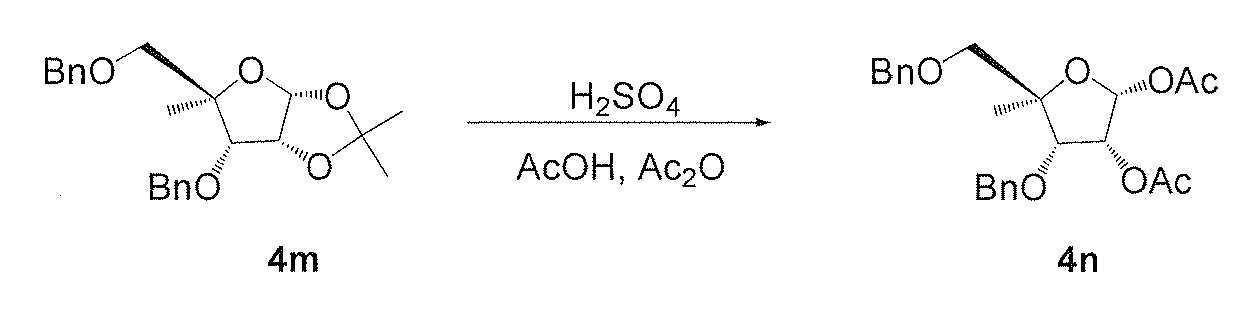
중간체 4n - (Intermediate 4n-( 2R,3R,4S,5R2R, 3R, 4S, 5R )-4-()-4-( 벤질옥시Benzyloxy )-5-() -5- ( 벤질옥시메틸Benzyloxymethyl )-5-) -5- 메틸테트라히드로푸란Methyltetrahydrofuran -2,3-디일 -2,3-diyl 디아세테이트Diacetate
1,000-㎖ 둥근 바닥 플라스크에 중간체 4m (또한, (Biosci . Biotech. Biochem. 1993, 57, 1433-1438)에 의하여 생성됨, 45 g, 111.19 mmol), 아세트산 (270 ㎖), 아세트산 무수물 (90 ㎖), 황산 (45 d)을 넣었다. 생성된 용액을 30 분 동안 실온에서 교반하였다. 그 후, 1,000 ㎖의 물/얼음을 첨가하여 반응을 켄칭시켰다. 생성된 용액을 3,000 ㎖의 에틸 아세테이트로 희석하였다. 생성된 혼합물을 2×1,000 ㎖의 물 및 4×1,000 ㎖의 중탄산나트륨(aq)으로 세정하였다. 생성된 혼합물을 2×1,000 ㎖의 염화나트륨(aq)으로 세정하였다. 혼합물을 무수 황산나트륨 위에서 건조시키고, 진공 하에서 농축시켰다. 잔류물을 실리카 겔 컬럼 위에서 에틸 아세테이트/석유 에테르 (1:30-1:20)와 함께 가하였다. 이는 중간체 4n을 생성하였다.Intermediate 4 m (also produced by ( Biosci . Biotech. Biochem . 1993, 57, 1433-1438), 45 g, 111.19 mmol), acetic acid (270 mL), acetic anhydride (90 mL) in a 1,000-mL round bottom flask , Sulfuric acid (45 d) was added. The resulting solution was stirred for 30 minutes at room temperature. Then, the reaction was quenched by adding 1,000 ml of water / ice. The resulting solution was diluted with 3,000 ml of ethyl acetate. The resulting mixture was washed with 2 × 1,000 ml of water and 4 × 1,000 ml of sodium bicarbonate (aq) . The resulting mixture was washed with 2 × 1,000 ml of sodium chloride (aq) . The mixture was dried over anhydrous sodium sulfate and concentrated under vacuum. The residue was added on a silica gel column with ethyl acetate / petroleum ether (1: 30-1: 20). This produced intermediate 4n.
1H NMR (300 MHz, CDCl3): δ 7.28-7.38 (m, 10H), 6.13 (s, 1H), 5.37 (d, J=4.8 Hz, 1H), 4.44-4.68 (m, 4H), 4.33 (d, J=5.1 Hz, 1H), 3.33-3.45 (m, 2H), 2.15 (s, 3H), 1.88 (s, 3H), 1.35 (s, 3H). 1 H NMR (300 MHz, CDCl 3 ): δ 7.28-7.38 (m, 10H), 6.13 (s, 1H), 5.37 (d, J = 4.8 Hz, 1H), 4.44-4.68 (m, 4H), 4.33 (d, J = 5.1 Hz, 1H), 3.33-3.45 (m, 2H), 2.15 (s, 3H), 1.88 (s, 3H), 1.35 (s, 3H).
MS m/z=451 [M+Na]MS m / z = 451 [M + Na]
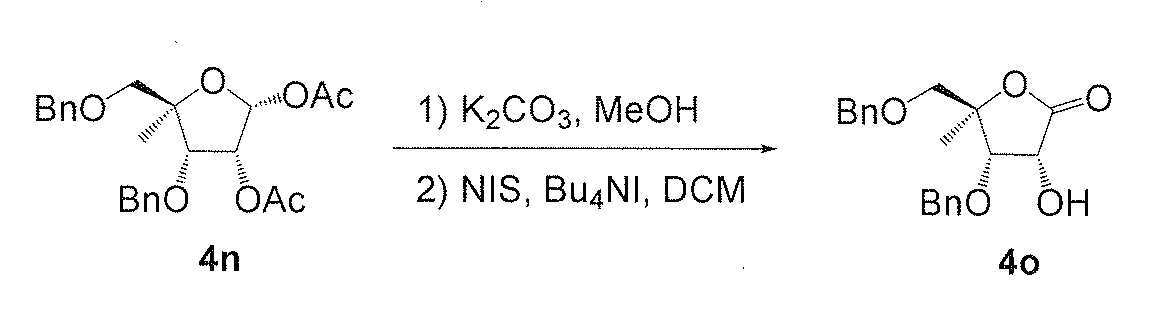
중간체 4o - (Intermediate 4o-( 3R,4S,5R3R, 4S, 5R )-4-()-4-( 벤질옥시Benzyloxy )-5-() -5- ( 벤질옥시메틸Benzyloxymethyl )-3-히드록시-5-) -3-hydroxy-5- 메틸디히드로푸란Methyldihydrofuran -2(3H)-온-2 (3H) -on
중간체 4n (1.3 g, 3 mmol)을 무수 MeOH (15 ㎖) 중에 용해시켰다. 탄산칼륨 분말 (456 ㎎, 3.3 mmol)을 첨가하고, 반응 혼합물을 1 시간 동안 교반하였다. 그 후, 반응 혼합물을 감압 하에서 농축시켰다. 아세토니트릴을 첨가하고, 5 분 동안 교반하였다. 불용물을 여과하고, 아세토니트릴로 세정하였다. 여과액을 감압 하에서 농축시켰다. 생성된 물질을 무수 DCM (20 ㎖) 중에 용해시켰다. 테트라부틸암모늄 아이오딘 (1.66 g, 4.5 mmol) 및 N-아이오도-숙신이미드 (NIS, 1.69 g, 2.5 mmol)를 첨가하였다. 반응 혼합물을 암실에서 16 시간 동안 교반하였다. 더 많은 NIS (0.85 g, 1.25 mmol)를 첨가하고, 4 시간 동안 교반하였다. 더 많은 NIS (0.85 g, 1.25 mmol)를 첨가하고, 2 일 동안 암실에서 교반하였다. 반응을 EtOAc로 희석하고, 티오황산나트륨 수용액으로 2회 세정한 후, 포화 염화나트륨 수용액으로 새정하였다. 유기 부분을 무수 황산나트륨 위에서 건조시키고, 감압 하에서 농축시켰다. 실리카 겔 컬럼 (헥산 중의 0-30% EtOAc)으로 정제하여 중간체 4o를 얻었다.Intermediate 4n (1.3 g, 3 mmol) was dissolved in anhydrous MeOH (15 mL). Potassium carbonate powder (456 mg, 3.3 mmol) was added and the reaction mixture was stirred for 1 hour. Thereafter, the reaction mixture was concentrated under reduced pressure. Acetonitrile was added and stirred for 5 minutes. The insoluble matter was filtered off and washed with acetonitrile. The filtrate was concentrated under reduced pressure. The resulting material was dissolved in anhydrous DCM (20 mL). Tetrabutylammonium iodine (1.66 g, 4.5 mmol) and N-iodo-succinimide (NIS, 1.69 g, 2.5 mmol) were added. The reaction mixture was stirred in the dark for 16 hours. More NIS (0.85 g, 1.25 mmol) was added and stirred for 4 hours. More NIS (0.85 g, 1.25 mmol) was added and stirred in the dark for 2 days. The reaction was diluted with EtOAc, washed twice with an aqueous sodium thiosulfate solution, and then refreshed with a saturated aqueous sodium chloride solution. The organic portion was dried over anhydrous sodium sulfate and concentrated under reduced pressure. Purification by silica gel column (0-30% EtOAc in hexanes) gave intermediate 4o.
1H NMR (400 MHz, CDCl3): δ 7.35-7.22 (m, 10H), 4.82 (bs, 1H), 4.75-4.66 (m, 2H), 4.55-4.44 (m, 2H), 4.13 (d, J=8 Hz, 1H), 3.70-3.45 (m, 2H), 1.38 (s, 3H). 1 H NMR (400 MHz, CDCl 3 ): δ 7.35-7.22 (m, 10H), 4.82 (bs, 1H), 4.75-4.66 (m, 2H), 4.55-4.44 (m, 2H), 4.13 (d, J = 8 Hz, 1H), 3.70-3.45 (m, 2H), 1.38 (s, 3H).
LC/MS: tR=2.58 min, MS m/z=342.9 [M+1], 360.0 [M+H2O]; LC/MS 시스템: 써모 LCQ 어드밴티지(Advantage); 페노메넥스 제미니(Phenomenex Gemini), C18, 5u, 110A, 30×4.6 ㎜; 완충액 A: 물 중의 0.1% 아세트산; 완충액 B: 아세토니트릴 중의 0.1% 아세트산LC / MS: t R = 2.58 min, MS m / z = 342.9 [M + 1], 360.0 [M + H 2 O]; LC / MS system: Thermo LCQ Advantage; Phenomenex Gemini, C 18 , 5u, 110A, 30 × 4.6 mm; Buffer A: 0.1% acetic acid in water; Buffer B: 0.1% acetic acid in acetonitrile
2.5 분 이내에 5-100% 완충액 B, 그 후 0.9 분 동안 2 ㎖/min으로 100%5-100% Buffer B within 2.5 min, then 100% at 2 ml / min for 0.9 min
HPLC: tR=3.78 min; HPLC 시스템: 아질런트 1100; 페노메넥스 제미니, C18, 5u, 110A, 50×4.6 ㎜; 완충액 A: 물 중의 0.05% TFA; 완충액 B: 아세토니트릴 중의 0.05% TFA; 5 분 이내에 2 ㎖/min으로 2-98% 완충액 B.HPLC: t R = 3.78 min; HPLC system: Agilent 1100; Phenomenex Gemini, C 18 , 5u, 110A, 50 × 4.6 mm; Buffer A: 0.05% TFA in water; Buffer B: 0.05% TFA in acetonitrile; 2-98% buffer B at 2 ml / min within 5 minutes.

중간체 4p - (Intermediate 4p-( 3R,4S,5R3R, 4S, 5R )-3,4-) -3,4- 비스Bis (( 벤질옥시Benzyloxy )-5-() -5- ( 벤질옥시메틸Benzyloxymethyl )-5-) -5- 메틸디히드로푸란Methyldihydrofuran -2(3H)-온-2 (3H) -on
중간체 4o (955 ㎎, 2.79 mmol)를 EtOAc (10 ㎖) 중에 용해시켰다. 벤질 브로마이드 (400 ㎕, 3.35 mmol) 및 산화은(I) (712 ㎎, 3.07 mmol)을 첨가하였다. 60℃에서 N2(g) 하에서 암실에서 3 시간 동안 교반하였다. 더 많은 벤질 브로마이드 (400 ㎕, 3.35 mmol)를 첨가하고, 60℃에서 N2(g) 하에서 암실에서 16 시간 동안 교반하였다. 더 많은 산화은(I) (350 ㎎, 1.5 mmol)을 첨가하고, 60℃에서 N2(g) 하에서 암실에서 8 시간 동안 교반하였다. 실온으로 냉각시켰다. 고체를 여과하고, EtOAc로 세정하였다. 여과액을 감압 하에서 농축시켜 오일을 얻었다. 헥산을 첨가하고, 2 시간 동안 교반하여 고체를 얻었다. 고체를 수집하고, 헥산으로 세정하였다. 고체를 고 진공 하에서 건조시켜 중간체 4p를 얻었다.Intermediate 4o (955 mg, 2.79 mmol) was dissolved in EtOAc (10 mL). Benzyl bromide (400 μl, 3.35 mmol) and silver (I) oxide (712 mg, 3.07 mmol) were added. The mixture was stirred at 60 ° C. under N 2 (g) for 3 hours in the dark. More benzyl bromide (400 μl, 3.35 mmol) was added and stirred at 60 ° C. under N 2 (g) in the dark for 16 hours. More silver (I) oxide (350 mg, 1.5 mmol) was added and stirred at 60 ° C. under N 2 (g) in the dark for 8 hours. Cooled to room temperature. The solid was filtered off and washed with EtOAc. The filtrate was concentrated under reduced pressure to give an oil. Hexane was added and stirred for 2 hours to obtain a solid. The solid was collected and washed with hexane. The solid was dried under high vacuum to give intermediate 4p.
1H NMR (400 MHz, CDCl3): δ 7.35-7.16 (m, 15H), 5.03 (d, J=12 Hz, 1H), 4.79-4.71 (m, 2H), 4.52-4.40 (m, 4H), 4.06 (d, J=6 Hz, 1H), 3.49-3.39 (m, 2H), 1.38 (s, 3H). 1 H NMR (400 MHz, CDCl 3 ): δ 7.35-7.16 (m, 15H), 5.03 (d, J = 12 Hz, 1H), 4.79-4.71 (m, 2H), 4.52-4.40 (m, 4H) , 4.06 (d, J = 6 Hz, 1H), 3.49-3.39 (m, 2H), 1.38 (s, 3H).
LC/MS: tR=2.91 min, MS m/z=433.1 [M+1], 450.1 [M+H2O]; LC/MS 시스템: 써모 LCQ 어드밴티지; 페노메넥스 제미니, C18, 5u, 110A, 30×4.6 ㎜; 완충액 A: 물 중의 0.1% 아세트산; 완충액 B: 아세토니트릴 중의 0.1% 아세트산; 2.5 분 이내에 5-100% 완충액 B에 이어서 0.9 분 동안 2 ㎖/min으로 100%.LC / MS: t R = 2.91 min, MS m / z = 433.1 [M + 1], 450.1 [M + H 2 O]; LC / MS system: Thermo LCQ Advantage; Phenomenex Gemini, C 18 , 5u, 110A, 30 × 4.6 mm; Buffer A: 0.1% acetic acid in water; Buffer B: 0.1% acetic acid in acetonitrile; 5-100% Buffer B within 2.5 min, then 100% at 2 ml / min for 0.9 min.
HPLC: tR=4.54 min; HPLC 시스템: 아질런트 1100; 페노메넥스 제미니, C18, 5u, 110A, 50×4.6 ㎜; 완충액 A: 물 중의 0.05% TFA; 완충액 B: 아세토니트릴 중의 0.05% TFAHPLC: t R = 4.54 min; HPLC system: Agilent 1100; Phenomenex Gemini, C 18 , 5u, 110A, 50 × 4.6 mm; Buffer A: 0.05% TFA in water; Buffer B: 0.05% TFA in acetonitrile
5 분 이내에 2 ㎖/min으로 2-98% 완충액 B.2-98% buffer B at 2 ml / min within 5 minutes.

중간체 4q - (Intermediate 4q-( 3R,4S,5R3R, 4S, 5R )-2-(4-) -2- (4- 아미노피롤로[1,2-f][1,2,4]트리아진Aminopyrrolo [1,2-f] [1,2,4] triazine -7-일)-3,4-비스(벤질옥시)-5-(벤질옥시메틸)-5-메틸테트라히드로푸란-2-올-7-yl) -3,4-bis (benzyloxy) -5- (benzyloxymethyl) -5-methyltetrahydrofuran-2-ol
중간체 1b (148 ㎎, 0.570 mmol) 및 1,2-비스(클로로디메틸실릴)에탄 (123 ㎎, 0.570 mmol)을 무수 THF (20 ㎖) 중에 용해시키고, Ar(g) 하에서 -70℃에서 교반하였다. 내부 온도를 -65℃ 미만으로 유지하면서 n-부틸리튬 (헥산 중의 2.5M 용액, 684 ㎕, 1.71 mmol)을 반응 혼합물에 적가하였다. 반응이 -40℃로 가온되도록 하고, 15 분 동안 유지하였다. 그 후, -70℃로 사전냉각된 THF (10 ㎖) 중의 중간체 4p (224 ㎎, 0.518 mmol)의 용액을 반응 혼합물에 Ar(g) 하에서 첨가하였다. 생성된 용액을 2 시간 동안 -40℃에서 교반하였다. 그 후, 반응 혼합물을 EtOAc 및 구연산(aq)의 교반 중인 혼합물에 부었다. 5 분 동안 교반하였다. 유기층을 합하고, 포화 NaCl(aq)로 세정하였다. 유기층을 무수 Na2SO4 위에서 건조시키고, 감압 하에서 농축시켰다. 분취용 HPLC로 정제하여 중간체 4q를 얻었다.Intermediate 1b (148 mg, 0.570 mmol) and 1,2-bis (chlorodimethylsilyl) ethane (123 mg, 0.570 mmol) were dissolved in anhydrous THF (20 mL) and stirred at -70 ° C under Ar (g). . While maintaining the internal temperature below -65 ° C, n-butyllithium (2.5M solution in hexane, 684 μL, 1.71 mmol) was added dropwise to the reaction mixture. The reaction was allowed to warm to -40 ° C and held for 15 minutes. Then, a solution of intermediate 4p (224 mg, 0.518 mmol) in THF (10 mL) precooled to -70 ° C was added to the reaction mixture under Ar (g). The resulting solution was stirred at -40 ° C for 2 hours. The reaction mixture was then poured into a stirring mixture of EtOAc and citric acid (aq) . Stir for 5 minutes. The organic layers were combined and washed with saturated NaCl (aq) . The organic layer was dried over anhydrous Na 2 SO 4 and concentrated under reduced pressure. Purification by preparative HPLC gave intermediate 4q.
LC/MS: tR=2.60 min, MS m/z=567.3 [M+1], 565.1 [M-1]; LC/MS 시스템: 써모 LCQ 어드밴티지; 페노메넥스 제미니, C18, 5u, 110A, 30×4.6 ㎜; 완충액 A: 물 중의 0.1% 아세트산; 완충액 B: 아세토니트릴 중의 0.1% 아세트산; 2.5 분 이내에 5-100% 완충액 B에 이어서 0.9 분 동안 2 ㎖/min으로 100%.LC / MS: t R = 2.60 min, MS m / z = 567.3 [M + 1], 565.1 [M-1]; LC / MS system: Thermo LCQ Advantage; Phenomenex Gemini, C 18 , 5u, 110A, 30 × 4.6 mm; Buffer A: 0.1% acetic acid in water; Buffer B: 0.1% acetic acid in acetonitrile; 5-100% Buffer B within 2.5 min, then 100% at 2 ml / min for 0.9 min.
HPLC: tR=3.22 min; HPLC 시스템: 아질런트 1100; 페노메넥스 제미니, C18, 5u, 110A, 50×4.6 ㎜; 완충액 A: 물 중의 0.05% TFA; 완충액 B: 아세토니트릴 중의 0.05% TFA; 5 분 이내에 2 ㎖/min으로 2-98% 완충액 B.HPLC: t R = 3.22 min; HPLC system: Agilent 1100; Phenomenex Gemini, C 18 , 5u, 110A, 50 × 4.6 mm; Buffer A: 0.05% TFA in water; Buffer B: 0.05% TFA in acetonitrile; 2-98% buffer B at 2 ml / min within 5 minutes.
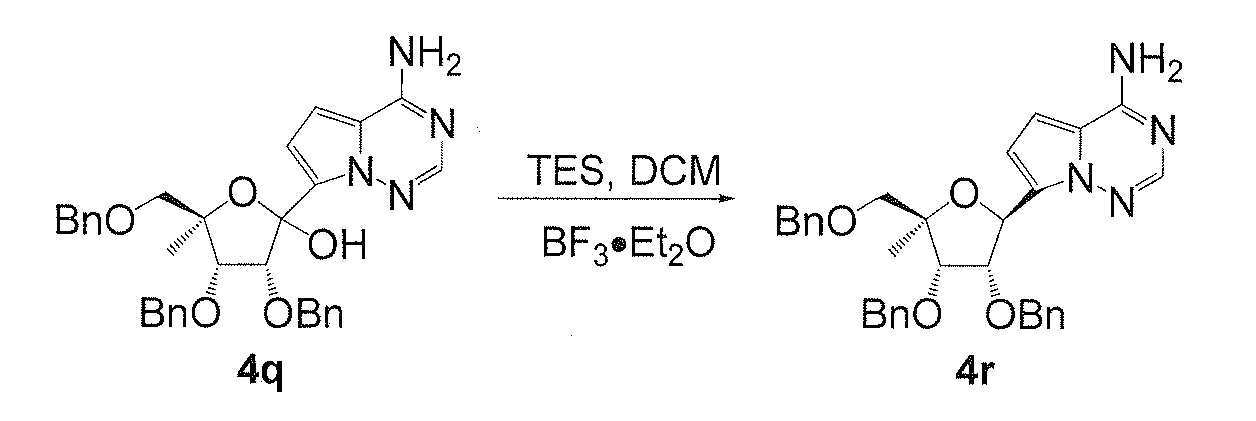
중간체 4r - 7-Intermediate 4r-7- ((2S,3S,4S,5R)-3,4-비스((2S, 3S, 4S, 5R) -3,4-bis (( 벤질옥시Benzyloxy )-5-() -5- ( 벤질옥시메틸Benzyloxymethyl )-5-) -5- 메틸테트라히드로푸란Methyltetrahydrofuran -2-일)피롤로[1,2-f][1,2,4]트리아진-4-아민-2-yl) pyrrolo [1,2-f] [1,2,4] triazine-4-amine
중간체 4q (81 ㎎, 0.143 mmol)를 무수 DCM (15 ㎖) 중에 용해시키고, N2(g) 하에서 얼음 배쓰 내에서 교반하였다. 트리에틸실란 (114 ㎕, 0.715 mmol)을 한번에 첨가하였다. 삼불소화붕소 디에틸 에테레이트 (27 ㎕, 0.215 mmol)를 적가하였다. 15 분 동안 교반한 후, 얼음 배쓰를 제거하였다. 60 분 동안 교반하였다. 트리에틸아민 (100 ㎕, 0.715 mmol)을 첨가하고, 감압 하에서 농축시켰다. EtOAc 중에 용해시키고, 포화 NaHCO3 (aq) (2×)로 세정한 후, NaCl(aq)로 포화시켰다. 유기층을 무수 Na2SO4 위에서 건조시키고, 감압 하에서 농축시켰다. 실리카 겔 컬럼 (헥산 중의 0-80% EtOAc)으로 정제하여 중간체 4r을 얻었다.Intermediate 4q (81 mg, 0.143 mmol) was dissolved in anhydrous DCM (15 mL) and stirred in an ice bath under N 2 (g). Triethylsilane (114 μl, 0.715 mmol) was added at once. Boron trifluoride diethyl etherate (27 μl, 0.215 mmol) was added dropwise. After stirring for 15 minutes, the ice bath was removed. Stir for 60 minutes. Triethylamine (100 μl, 0.715 mmol) was added and concentrated under reduced pressure. It was dissolved in EtOAc, washed with saturated NaHCO 3 (aq) (2 ×), and then saturated with NaCl (aq) . The organic layer was dried over anhydrous Na 2 SO 4 and concentrated under reduced pressure. Purification by silica gel column (0-80% EtOAc in hexanes) gave intermediate 4r.
1H NMR (400 MHz, CDCl3): δ 7.71 (s, 1H), 7.35-7.10 (m, 16H), 6.82-6.78 (m, 1H), 5.57 (d, J=4.4 Hz, 1H), 4.70-4.45 (m, 6H), 4.25-4.15 (m, 2H), 3.55-3.40 (m, 2H), 1.42 (s, 3H). 1 H NMR (400 MHz, CDCl 3 ): δ 7.71 (s, 1H), 7.35-7.10 (m, 16H), 6.82-6.78 (m, 1H), 5.57 (d, J = 4.4 Hz, 1H), 4.70 -4.45 (m, 6H), 4.25-4.15 (m, 2H), 3.55-3.40 (m, 2H), 1.42 (s, 3H).
LC/MS: tR=2.75 min, MS m/z=551.4 [M+1]; LC/MS 시스템: 써모 LCQ 어드밴티지LC / MS: t R = 2.75 min, MS m / z = 551.4 [M + 1]; LC / MS system: Thermo LCQ Advantage
페노메넥스 제미니, C18, 5u, 110A, 30×4.6 ㎜; 완충액 A: 물 중의 0.1% 아세트산; 완충액 B: 아세토니트릴 중의 0.1% 아세트산; 2.5 분 이내에 5-100% 완충액 B에 이어서 0.9 분 동안 2 ㎖/min으로 100%.Phenomenex Gemini, C 18 , 5u, 110A, 30 × 4.6 mm; Buffer A: 0.1% acetic acid in water; Buffer B: 0.1% acetic acid in acetonitrile; 5-100% Buffer B within 2.5 min, then 100% at 2 ml / min for 0.9 min.
HPLC: tR=3.57 min; HPLC 시스템: 아질런트 1100; 페노메넥스 제미니, C18, 5u, 110A, 50×4.6 ㎜; 완충액 A: 물 중의 0.05% TFA; 완충액 B: 아세토니트릴 중의 0.05% TFA; 5 분 이내에 2 ㎖/min으로 2-98% 완충액 B.HPLC: t R = 3.57 min; HPLC system: Agilent 1100; Phenomenex Gemini, C 18 , 5u, 110A, 50 × 4.6 mm; Buffer A: 0.05% TFA in water; Buffer B: 0.05% TFA in acetonitrile; 2-98% buffer B at 2 ml / min within 5 minutes.
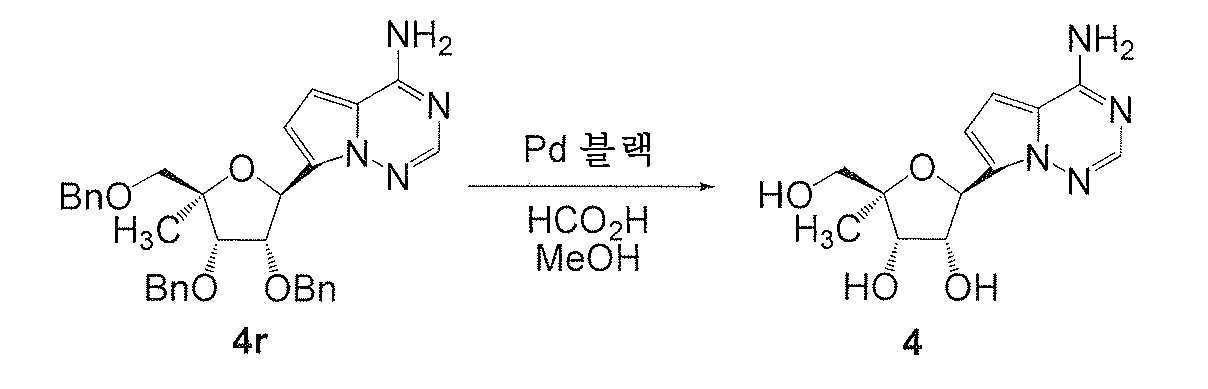
실시예Example 4 4
(( 2R,3S,4R,5S2R, 3S, 4R, 5S )-5-(4-) -5- (4- 아미노피롤로[1,2-f][1,2,4]트리아진Aminopyrrolo [1,2-f] [1,2,4] triazine -7-일)-2-(-7-day) -2- ( 히드록시메틸Hydroxymethyl )-2-메틸테트라히드로푸란-3,4-디올) -2-methyltetrahydrofuran-3,4-diol
중간체 4r (23 ㎎, 0.042 mmol)을 포름산/MeOH 용액 (1:9, 10 ㎖) 중에 용해시켰다. 팔라듐 블랙을 첨가하고, 60℃에서 90 분 동안 교반하였다. 실온으로 냉각시키고, 셀라이트(Celite)를 통하여 여과하였다. 여과액을 감압 하에서 농축시켰다. 분취용 HPLC로 정제하였다. 감압 하에서 농축시켰다. NaHCO3(aq) 중에 용해시키고, HPLC로 중성 조건 하에서 정제하여 실시예 4를 얻었다.Intermediate 4r (23 mg, 0.042 mmol) was dissolved in formic acid / MeOH solution (1: 9, 10 mL). Palladium black was added and stirred at 60 ° C. for 90 minutes. Cooled to room temperature and filtered through Celite. The filtrate was concentrated under reduced pressure. Purification by preparative HPLC. Concentrated under reduced pressure. It was dissolved in NaHCO 3 (aq) and purified under neutral conditions by HPLC to obtain Example 4.
분취용 HPLC 시스템: 길슨(Gilson) 215 분주기; 페노메넥스 제미니, C18 4u, 100×30.0 ㎜Preparative HPLC system: Gilson 215 dispenser; Phenomenex Gemini, C 18 4u, 100 × 30.0 mm
완충액 A: 물 중의 0.1% TFA; 완충액 B: 아세토니트릴 중의 0.1% TFA; 13 분 이내에 20 ㎖/min으로 5-100% 완충액 B.Buffer A: 0.1% TFA in water; Buffer B: 0.1% TFA in acetonitrile; 5-100% buffer B at 20 ml / min within 13 minutes.
1H NMR (400 MHz, CDCl3): δ 8.01 (s, 1H), 7.41 (d, J=4.8 Hz, 1H), 7.02 (d, J=4.8 Hz, 1H), 5.33 (d, J=8 Hz, 1H), 4.53-4.49 (m, 1H), 4.15 (d, J=5.6 Hz, 1H), 3.50 (m, 2H), 1.27 (s, 3H). 1 H NMR (400 MHz, CDCl 3 ): δ 8.01 (s, 1H), 7.41 (d, J = 4.8 Hz, 1H), 7.02 (d, J = 4.8 Hz, 1H), 5.33 (d, J = 8 Hz, 1H), 4.53-4.49 (m, 1H), 4.15 (d, J = 5.6 Hz, 1H), 3.50 (m, 2H), 1.27 (s, 3H).
LC/MS: tR=0.30 min, MS m/z=281.3 [M+1], 279.0 [M-1]; LC/MS 시스템: 써모 LCQ 어드밴티지; 페노메넥스 제미니, C18, 5u, 110A, 30×4.6 ㎜; 완충액 A: 물 중의 0.1% 아세트산; 완충액 B: 아세토니트릴 중의 0.1% 아세트산; 2.5 분 이내에 5-100% 완충액 B에 이어서 0.9 분 동안 2 ㎖/min으로 100%.LC / MS: t R = 0.30 min, MS m / z = 281.3 [M + 1], 279.0 [M-1]; LC / MS system: Thermo LCQ Advantage; Phenomenex Gemini, C 18 , 5u, 110A, 30 × 4.6 mm; Buffer A: 0.1% acetic acid in water; Buffer B: 0.1% acetic acid in acetonitrile; 5-100% Buffer B within 2.5 min, then 100% at 2 ml / min for 0.9 min.
HPLC: tR=0.42 min; HPLC 시스템: 아질런트 1100; 페노메넥스 제미니, C18, 5u, 110A, 50×4.6 ㎜; 완충액 A: 물 중의 0.05% TFA; 완충액 B: 아세토니트릴 중의 0.05% TFA; 5 분 이내에 2 ㎖/min으로 2-98% 완충액 B.HPLC: t R = 0.42 min; HPLC system: Agilent 1100; Phenomenex Gemini, C 18 , 5u, 110A, 50 × 4.6 mm; Buffer A: 0.05% TFA in water; Buffer B: 0.05% TFA in acetonitrile; 2-98% buffer B at 2 ml / min within 5 minutes.

중간체 5a - N-(7-((2S,3S,4S,5R)-5-아지도-3,4-비스(tert-부틸디메틸실릴옥시)-5-((트리메틸실릴옥시)메틸)테트라히드로푸란-2-일)피롤로[1,2-f][1,2,4]트리아진-4-일)벤즈아미드Intermediate 5a-N- (7-((2S, 3S, 4S, 5R) -5-azido-3,4-bis (tert-butyldimethylsilyloxy) -5-((trimethylsilyloxy) methyl) tetrahydro Furan-2-yl) pyrrolo [1,2-f] [1,2,4] triazin-4-yl) benzamide
디클로로메탄 (1.5 ㎖) 중의 미정제 중간체 1m, N-(7-((2S,3S,4S)-3,4-비스(tert-부틸디메틸실릴옥시)-5-히드록시-5-(히드록시메틸)테트라히드로푸란-2-일)피롤로[1,2-f][1,2,4]트리아진-4-일)벤즈아미드, (~110 ㎎, ~0.18 mmol) 및 아지도트리메틸실란 (242 ㎕, 1.84 mmol)의 용액에 브롬화인듐 (III) (130 ㎎, 0.369 mmol)을 실온에서 아르곤 대기 하에서 첨가하였다. 1 시간 후, 반응 혼합물을 포화 중탄산나트륨 수용액 (1 ㎖)으로 켄칭시켰다. 생성된 혼합물을 디클로로메탄 (20 ㎖) 및 포화 중탄산나트륨 수용액 (20 ㎖) 사이에 분배시켰다. 상이 분할되고, 수성층을 디클로로메탄 (20 ㎖)으로 추출하였다. 합한 유기층을 무수 황산나트륨 위에서 건조시키고, 감압 하에서 농축시켜 중간체 5a를 얻고, 이를 추가로 정제하지 않고 그 다음 단계에서 직접 사용하였다.1 m crude intermediate in dichloromethane (1.5 ml), N- (7-((2S, 3S, 4S) -3,4-bis (tert-butyldimethylsilyloxy) -5-hydroxy-5- (hydroxy Methyl) tetrahydrofuran-2-yl) pyrrolo [1,2-f] [1,2,4] triazin-4-yl) benzamide, (~ 110 mg, ~ 0.18 mmol) and azidotrimethylsilane To a solution of (242 μl, 1.84 mmol) indium bromide (III) (130 mg, 0.369 mmol) was added at room temperature under an argon atmosphere. After 1 hour, the reaction mixture was quenched with saturated aqueous sodium bicarbonate solution (1 mL). The resulting mixture was partitioned between dichloromethane (20 mL) and saturated aqueous sodium bicarbonate solution (20 mL). The phases were partitioned, and the aqueous layer was extracted with dichloromethane (20 mL). The combined organic layer was dried over anhydrous sodium sulfate, and concentrated under reduced pressure to obtain Intermediate 5a, which was used directly in the next step without further purification.
LC/MS: tR=3.52 min, MS m/z=712.16 [M+1]; LC 시스템: 써모 아셀라 1250 UHPLCLC / MS: t R = 3.52 min, MS m / z = 712.16 [M + 1]; LC system: Thermo Acela 1250 UHPLC
MS 시스템: 써모 LCQ 플리트; 컬럼: 키네텍스 2.6μ XB-C18 100A, 50×4.6 ㎜MS system: Thermo LCQ pleats; Column: Kinetex 2.6 μ XB-C18 100A, 50 × 4.6 mm
용매: 0.1% 아세트산을 갖는 아세토니트릴, 0.1% 아세트산을 갖는 물; 구배: 2 ㎕/min으로 0 min-2.0 min 2-100% ACN, 2.0 min-3.55 min 100% ACN, 3.55 min-4.2 min 100%-2% ACN.Solvent: acetonitrile with 0.1% acetic acid, water with 0.1% acetic acid; Gradient: 0 min-2.0 min 2-100% ACN, 2.0 min-3.55 min 100% ACN, 3.55 min-4.2 min 100% -2% ACN at 2 μl / min.

중간체 5b - N-(7-Intermediate 5b-N- (7- ((2S,3R,4S,5R)((2S, 3R, 4S, 5R) -5--5- 아지도Oh -3,4-디히드록시-5-(-3,4-dihydroxy-5- ( 히드록시메틸Hydroxymethyl )테트라히드로푸란-2-일)피롤로[1,2-f][1,2,4]트리아진-4-일)벤즈아미드) Tetrahydrofuran-2-yl) pyrrolo [1,2-f] [1,2,4] triazin-4-yl) benzamide
DMF (5 ㎖) 중의 미정제 중간체 5a (~120 ㎎, ~0.168 mmol)의 용액에 불소화세슘 (256 ㎎, 1.68 mmol)을 실온에서 첨가하였다. 25 시간 후, 반응 혼합물을 염수 (100 ㎖)로 희석하고, 생성된 혼합물을 에틸 아세테이트 (3×100 ㎖)로 추출하였다. 합한 유기층을 무수 황산나트륨 위에서 건조시키고, 감압 하에서 농축시켜 중간체 5b를 얻고, 이를 추가로 정제하지 않고 그 다음 단계에서 직접 사용하였다.To a solution of crude intermediate 5a (~ 120 mg, ~ 0.168 mmol) in DMF (5 mL) was added cesium fluoride (256 mg, 1.68 mmol) at room temperature. After 25 hours, the reaction mixture was diluted with brine (100 mL), and the resulting mixture was extracted with ethyl acetate (3 × 100 mL). The combined organic layer was dried over anhydrous sodium sulfate, and concentrated under reduced pressure to obtain Intermediate 5b, which was used directly in the next step without further purification.
LC/MS: tR=1.40 min, MS m/z=412.17 [M+1]; LC 시스템: 써모 아셀라 1250 UHPLCLC / MS: t R = 1.40 min, MS m / z = 412.17 [M + 1]; LC system: Thermo Acela 1250 UHPLC
MS 시스템: 써모 LCQ 플리트; 컬럼: 키네텍스 2.6μ XB-C18 100A, 50×4.6 ㎜; 용매: 0.1% 아세트산을 갖는 아세토니트릴, 0.1% 아세트산을 갖는 물; 구배: 2 ㎕/min으로 0 min-2.0 min 2-100% ACN, 2.0 min-3.05 min 100% ACN, 3.05 min-3.2 min 100%-2% ACN, 3.2 min-3.5 min 2% ACN.MS system: Thermo LCQ pleats; Column: Kinetex 2.6 μ XB-C18 100A, 50 × 4.6 mm; Solvent: acetonitrile with 0.1% acetic acid, water with 0.1% acetic acid; Gradient: 0 min-2.0 min 2-100% ACN, 2.0 min-3.05 min 100% ACN, 3.05 min-3.2 min 100% -2% ACN, 3.2 min-3.5 min 2% ACN at 2 μl / min.
HPLC: tR=2.46 min' HPLC 시스템: 아질런트 1100 시리즈; 컬럼: 제미니 5μ C18 110A, 50×4.6 ㎜; 용매: 0.1% TFA를 갖는 아세토니트릴, 0.1% TFA를 갖는 물; 구배: 2 ㎖/min으로 0 min-5.0 min 2-98% ACN, 5.0 min-6.0 min 98% ACN.HPLC: t R = 2.46 min 'HPLC system: Agilent 1100 series; Column: Gemini 5μ C18 110A, 50 × 4.6 mm; Solvent: acetonitrile with 0.1% TFA, water with 0.1% TFA; Gradient: 0 min-5.0 min 2-98% ACN at 2 mL / min, 5.0 min-6.0 min 98% ACN.

실시예Example 5 5
(( 2R,3S,4R,5S2R, 3S, 4R, 5S )-5-(4-) -5- (4- 아미노피롤로[1,2-f][1,2,4]트리아진Aminopyrrolo [1,2-f] [1,2,4] triazine -7-일)-2--7-day) -2- 아지도Oh -2-(히드록시메틸)테트라히드로푸란-3,4-디올-2- (hydroxymethyl) tetrahydrofuran-3,4-diol
진한 수산화암모늄 (1 ㎖)을 메탄올 (1 ㎖) 중의 미정제 중간체 5b의 용액에 실온에서 첨가하였다. 2 일 후, 반응 혼합물을 감압 하에서 농축시키고, 분취용 HPLC (페노미넥스 시너지(Phenominex Synergi) 4u 히드로(Hydro)-RR 80Å 150×30 ㎜ 컬럼, 5-100% 아세토니트릴/물 구배)에 의하여 직접 정제하였다. 원하는 물질을 함유하는 분획을 합하고, 감압 하에서 농축시켰다. 잔류물을 SiO2 컬럼 크로마토그래피 (4 g SiO2 콤비플래쉬 HP 골드 컬럼, 0-20% 메탄올/디클로로메탄)에 의하여 재정제하여 실시예 5를 얻었다.Concentrated ammonium hydroxide (1 mL) was added to a solution of crude intermediate 5b in methanol (1 mL) at room temperature. After 2 days, the reaction mixture was concentrated under reduced pressure and by preparative HPLC (Phenominex Synergi 4u Hydro-RR 80 Å 150 × 30 mm column, 5-100% acetonitrile / water gradient) Purified directly. Fractions containing the desired material were combined and concentrated under reduced pressure. The residue was re-purified by SiO 2 column chromatography (4 g SiO 2 CombiFlash HP Gold column, 0-20% methanol / dichloromethane) to obtain Example 5.
1H NMR (400 MHz, CD3OD) δ 7.79 (s, 1H), 6.86 (d, J=4.5 Hz, 1H), 6.77 (d, J=4.5 Hz, 1H), 5.51 (d, J=6.0 Hz, 1H), 4.63 (t, J=5.8 Hz, 1H), 4.37 (d, J=5.7 Hz, 1H), 3.69 (d, J=12.0 Hz, 1H), 3.59 (d, J=12.0 Hz, 1H). 1 H NMR (400 MHz, CD 3 OD) δ 7.79 (s, 1H), 6.86 (d, J = 4.5 Hz, 1H), 6.77 (d, J = 4.5 Hz, 1H), 5.51 (d, J = 6.0 Hz, 1H), 4.63 (t, J = 5.8 Hz, 1H), 4.37 (d, J = 5.7 Hz, 1H), 3.69 (d, J = 12.0 Hz, 1H), 3.59 (d, J = 12.0 Hz, 1H).
LC/MS: tR=0.76 min, MS m/z=308.08 [M+1]; LC 시스템: 써모 아셀라 1250 UHPLCLC / MS: t R = 0.76 min, MS m / z = 308.08 [M + 1]; LC system: Thermo Acela 1250 UHPLC
MS 시스템: 써모 LCQ 플리트; 컬럼: 키네텍스 2.6μ XB-C18 100A, 50×4.6 ㎜; 용매: 0.1% 아세트산을 갖는 아세토니트릴, 0.1% 아세트산을 갖는 물; 구배: 2 ㎕/min으로 0 min-1.5 min 2-100% ACN, 1.5 min-2.2 min 100% ACN, 2.2 min-2.4 min 100%-2% ACN, 2.4 min-2.5 min 2% ACN.MS system: Thermo LCQ pleats; Column: Kinetex 2.6 μ XB-C18 100A, 50 × 4.6 mm; Solvent: acetonitrile with 0.1% acetic acid, water with 0.1% acetic acid; Gradient: 0 min-1.5 min 2-100% ACN, 1.5 min-2.2 min 100% ACN, 2.2 min-2.4 min 100% -2% ACN, 2.4 min-2.5 min 2% ACN at 2 μl / min.
HPLC: tR=1.287 min; HPLC 시스템: 아질런트 1100 시리즈; 컬럼: 제미니 5μ C18 110A, 50×4.6 ㎜; 용매: 0.1% TFA를 갖는 아세토니트릴, 0.1% TFA를 갖는 물; 구배: 2 ㎖/min으로 0 min-5.0 min 2-98% ACN, 5.0 min-6.0 min 98% ACN;HPLC: t R = 1.287 min; HPLC system: Agilent 1100 series; Column: Gemini 5μ C18 110A, 50 × 4.6 mm; Solvent: acetonitrile with 0.1% TFA, water with 0.1% TFA; Gradient: 0 min-5.0 min 2-98% ACN at 2 mL / min, 5.0 min-6.0 min 98% ACN;
TLC: 용리제: 디클로로메탄 중의 20% 메탄올, Rf=0.4 (UV)TLC: eluent: 20% methanol in dichloromethane, R f = 0.4 (UV)
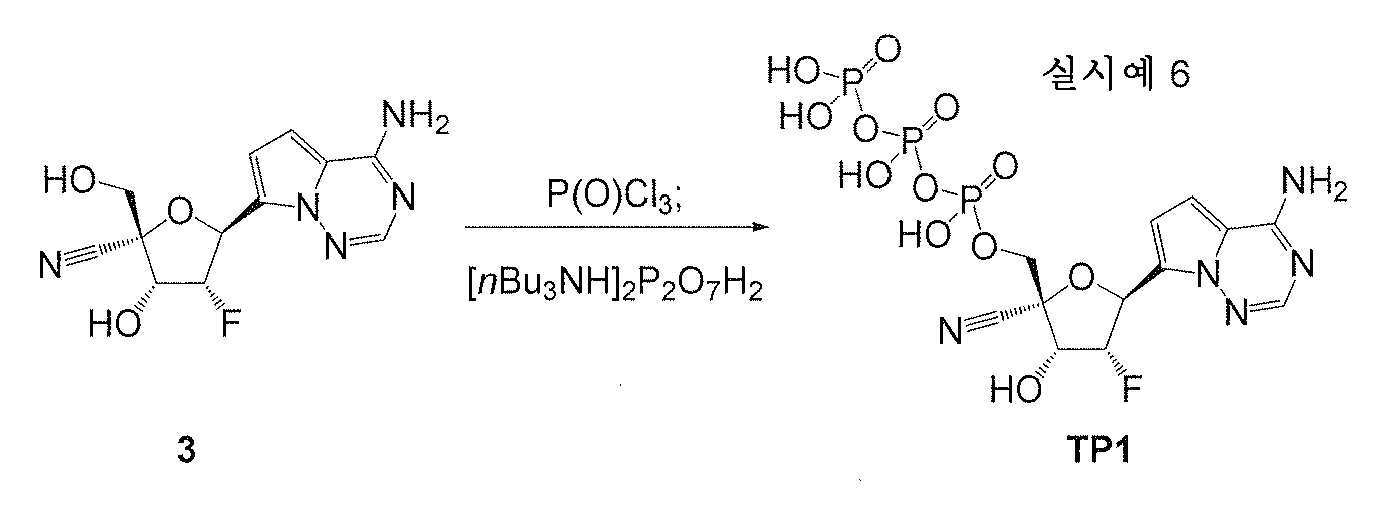
실시예Example 6 ( 6 ( 또한 TPAlso TP -1로서 지칭함) - ((2R,3R,4R,5S)-5-(4-아미노피롤로[1,2-f][1,2,4]트리아진-7-일)-2-시아노-4-플루오로-3-히드록시테트라히드로푸란-2-일)메틸 Referred to as -1)-((2R, 3R, 4R, 5S) -5- (4-aminopyrrolo [1,2-f] [1,2,4] triazin-7-yl) -2-sia No-4-fluoro-3-hydroxytetrahydrofuran-2-yl) methyl 테트라히드로겐Tetrahydrogen 트리포스페이트Triphosphate
실시예 3 (15.0 ㎎, 0.05 mmol)을 플라스크 내에서 진공 하에서 밤새 건조시켰다. 트리메틸포스페이트 (0.5 ㎖) 및 1,8-비스(디메틸아미노)나프탈렌 (25 ㎎, 0.12 mmol)을 플라스크에 첨가하고, 용액을 얼음/물 배쓰에 의하여 냉각된 N2 하에서 교반하였다. 증류된 옥시염화인 (10 ㎕, 0.11 mmol)을 첨가하고, 반응을 냉각하면서 4 시간 동안 교반하였다. 트리부틸아민 (0.1 ㎖, 0.42 mmol) 및 트리부틸암모늄 피로포스페이트 (DMF 중의 0.5 M 용액 0.8 ㎖, 0.4 mmol)를 첨가하고, 반응을 냉각하면서 추가의 45 분 동안 교반하였다. 반응을 트리에틸암모늄 바이카르보네이트 (0.5 M, 5 ㎖)로 켄칭시켰다. 용매를 회전 증발에 의하여 제거하고, 잔존하는 미정제 혼합물을 2 ㎖의 물 중에 용해시켰다. 생성물을 세파덱스(Sephadex) DEAE A-25 컬럼을 사용하여 0-1 M 트리에틸암모늄 바이카르보네이트의 선형 구배로 정제하였다. 생성물 함유 분획을 푸울링시키고, 농축시켜 실시예 6 (TP1)을 얻고, 이를 1 ㎖의 물 중에 용해시켜 10 mM 용액을 얻었다.Example 3 (15.0 mg, 0.05 mmol) was dried overnight in a flask under vacuum. Trimethylphosphate (0.5 mL) and 1,8-bis (dimethylamino) naphthalene (25 mg, 0.12 mmol) were added to the flask, and the solution was stirred under N 2 cooled by an ice / water bath. Distilled phosphorus oxychloride (10 μl, 0.11 mmol) was added and the reaction was stirred for 4 hours while cooling. Tributylamine (0.1 mL, 0.42 mmol) and tributylammonium pyrophosphate (0.8 mL of a 0.5 M solution in DMF, 0.4 mmol) were added and stirred for an additional 45 minutes while cooling the reaction. The reaction was quenched with triethylammonium bicarbonate (0.5 M, 5 mL). The solvent was removed by rotary evaporation, and the remaining crude mixture was dissolved in 2 ml of water. The product was purified using a Sephadex DEAE A-25 column with a linear gradient of 0-1 M triethylammonium bicarbonate. The product containing fractions were pooled and concentrated to give Example 6 (TP1), which was dissolved in 1 ml of water to give a 10 mM solution.
MS m/z=532.0 [M-1]MS m / z = 532.0 [M-1]
이온 교환 HPLC 체류 시간: 12.015 min; 컬럼: DNAPac PA-100 4×250 ㎜ SNIon exchange HPLC retention time: 12.015 min; Column: DNAPac PA-100 4 × 250 mm SN
용매 A: 밀리큐(milliQ) 물; 용매 B: 0.5 M 테트라에틸암모늄 브로마이드; 용매 구배 프로그램: 100% A를 사용하여 10 분 동안 평형화시킨 후, 14 분에 걸쳐 램프 0-80% B; 유속: 1 ㎖/min.Solvent A: milliQ water; Solvent B: 0.5 M tetraethylammonium bromide; Solvent gradient program: equilibrate with 100% A for 10 minutes, then ramp 0-80% B over 14 minutes; Flow rate: 1 ml / min.

실시예Example 7 ( 7 ( 또한 TP2Also TP2 ) - (()-(( 2R,3R,4R,5S2R, 3R, 4R, 5S )-5-(4-) -5- (4- 아미노피롤로[1,2-f][1,2,4]트리아진Aminopyrrolo [1,2-f] [1,2,4] triazine -7-일)-2-에티닐-4-플루오로-3-히드록시테트라히드로푸란-2-일)메틸 -7-yl) -2-ethynyl-4-fluoro-3-hydroxytetrahydrofuran-2-yl) methyl 테트라히드로겐Tetrahydrogen 트리포스페이트Triphosphate
실시예 2 (16.0 ㎎, 0.055 mmol)를 플라스크 내에서 진공 하에서 밤새 건조시켰다. 트리메틸포스페이트 (0.5 ㎖) 및 1,8-비스(디메틸아미노)나프탈렌 (28 ㎎, 0.13 mmol)을 플라스크에 첨가하고, 용액을 얼음/물 배쓰에 의하여 냉각된 N2 하에서 교반하였다. 증류된 옥시염화인 (11 ㎕, 0.12 mmol)을 첨가하고, 반응을 4 시간 동안 냉각하면서 교반하였다. 트리부틸아민 (0.11 ㎖, 0.42 mmol) 및 트리부틸암모늄 피로포스페이트 (DMF 중의 0.5 M 용액 0.9 ㎖, 0.45 mmol)를 첨가하고, 반응을 냉각하면서 추가의 45 분 동안 교반하였다. 반응을 트리에틸암모늄 바이카르보네이트 (0.5 M, 5 ㎖)로 켄칭시켰다. 용매를 회전 증발에 의하여 제거하고, 잔존하는 미정제 혼합물을 2 ㎖의 물 중에 용해시켰다. 생성물을 0-1 M 트리에틸암모늄 바이카르보네이트의 선형 구배를 갖는 세파덱스 DEAE A-25 컬럼을 사용하여 정제하였다. 생성물 함유 분획을 푸울링시키고, 농축시켜 실시예 7 (TP2)을 얻은 후, 이를 1.4 ㎖의 물 중에 용해시켜 10 mM 용액을 얻었다.Example 2 (16.0 mg, 0.055 mmol) was dried in a flask overnight under vacuum. Trimethylphosphate (0.5 mL) and 1,8-bis (dimethylamino) naphthalene (28 mg, 0.13 mmol) were added to the flask and the solution was stirred under N 2 cooled by an ice / water bath. Distilled phosphorus oxychloride (11 μl, 0.12 mmol) was added and the reaction was stirred while cooling for 4 hours. Tributylamine (0.11 mL, 0.42 mmol) and tributylammonium pyrophosphate (0.9 mL of 0.5 M solution in DMF, 0.45 mmol) were added and the reaction was stirred for an additional 45 minutes while cooling. The reaction was quenched with triethylammonium bicarbonate (0.5 M, 5 mL). The solvent was removed by rotary evaporation, and the remaining crude mixture was dissolved in 2 ml of water. The product was purified using a Sephadex DEAE A-25 column with a linear gradient of 0-1 M triethylammonium bicarbonate. The product-containing fraction was pooled and concentrated to give Example 7 (TP2), which was then dissolved in 1.4 ml of water to give a 10 mM solution.
MS m/z=531.0 [M-1]MS m / z = 531.0 [M-1]
이온 교환 HPLC 체류 시간: 19.829 min; 컬럼: DNAPac PA-100 4×250 ㎜ SN Ion exchange HPLC retention time: 19.829 min; Column: DNAPac PA-100 4 × 250 mm SN
용매 A: 밀리큐 물; 용매 B: 0.5 M 테트라에틸암모늄 브로마이드; 용매 구배 프로그램: 100% A를 사용하여 10 분 동안 평형화시킨 후, 14 분에 걸쳐 0-80% B로 상승시켰다; 유속: 1 ㎖/min Solvent A: milliQ water; Solvent B: 0.5 M tetraethylammonium bromide; Solvent gradient program: equilibrated with 100% A for 10 minutes, then raised to 0-80% B over 14 minutes; Flow rate: 1 ml / min

실시예Example 8 (TP3) - (( 8 (TP3)-(( 2R,3S,4R,5S2R, 3S, 4R, 5S )-5-(4-) -5- (4- 아미노피롤로[1,2-f][1,2,4]트리아진Aminopyrrolo [1,2-f] [1,2,4] triazine -7-일)-2-시아노-3,4-디히드록시테트라히드로푸란-2-일)메틸 -7-yl) -2-cyano-3,4-dihydroxytetrahydrofuran-2-yl) methyl 테트라히드로겐Tetrahydrogen 트리포스페이트Triphosphate
PO(OMe)3 (0.6 ㎖) 중의 실시예 1 (5.0 ㎎, 0.017 mmol)의 용액에 0℃에서 POCl3 (45 ㎎, 0.29 mmol)을 첨가하였다. 반응 혼합물을 0℃에서 10 시간 동안 교반하고, 이 때 이온-교환 HPLC는 대략 50% 전환율을 나타냈다. ACN (0.6 ㎖) 중의 피로포스페이트 트리부틸아민 염 (250 ㎎)의 용액을 첨가한 후, 트리부틸아민 (110 ㎎, 0.59 mmol)을 첨가하였다. 반응 혼합물을 0℃에서 0.5 시간 동안 교반하고, 이온-교환 HPLC는 반응이 완료되었다는 것을 나타냈다. 반응을 트리에틸암모늄 바이카르보네이트 완충액 (1 M, 5 ㎖)으로 켄칭시켰다. 반응 혼합물을 실온에서 0.5 시간 동안 교반한 후, 농축시키고, 물과 함께 2회 동시 증발시켰다. 잔류물을 H2O (5 ㎖) 중에 용해시키고, H2O에 이어서 5-35% 트리에틸암모늄 바이카르보네이트 완충액 (1 M)-H2O로 용출시키는 이온-교환 컬럼에 부었다. 생성물 분획을 합하고, 농축시키고, H2O와 함께 동시 증발시켰다. 잔류물을 이온-교환 컬럼에 의하여 다시 정제하여 미정제 물질을 얻었다. 31P NMR은 이러한 물질이 불순물을 함유하였으며, 그래서 이 물질은 0.05% TEA를 함유하는 0-15% ACN-H2O로 용출시키는 C-18 컬럼으로 재정제하고, 생성물 함유 분획을 합하고, 농축시켜 1H NMR 분석에 의하여 나타낸 바와 같이 1.5 당량의 TEA만을 함유하는 3.6 ㎎ 물질을 얻었다는 것을 나타냈다. 물질을 H2O (1 ㎖) 중에 용해시키고, 트리에틸암모늄 바이카르보네이트 완충액 (1 M, 0.1 ㎖)을 첨가하였다. 생성된 혼합물을 감압 하에서 농축시키고, H2O와 함께 감압 하에서 2회 동시 증발시켜 실시예 8 (TP3)을 테트라-TEA 염으로서 얻었다.To a solution of Example 1 (5.0 mg, 0.017 mmol) in PO (OMe) 3 (0.6 mL), POCl 3 (45 mg, 0.29 mmol) was added at 0 ° C. The reaction mixture was stirred at 0 ° C. for 10 hours, at which time ion-exchange HPLC showed approximately 50% conversion. A solution of the pyrophosphate tributylamine salt (250 mg) in ACN (0.6 mL) was added, followed by tributylamine (110 mg, 0.59 mmol). The reaction mixture was stirred at 0 ° C. for 0.5 hour, and ion-exchange HPLC indicated the reaction was complete. The reaction was quenched with triethylammonium bicarbonate buffer (1 M, 5 mL). The reaction mixture was stirred at room temperature for 0.5 hour, then concentrated and evaporated twice with water. The residue was dissolved in H 2 O (5 mL) and poured into an ion-exchange column eluting with H 2 O followed by 5-35% triethylammonium bicarbonate buffer (1 M) -H 2 O. The product fractions were combined, concentrated and co-evaporated with H 2 O. The residue was purified again by an ion-exchange column to obtain crude material. 31 P NMR indicated that this material contained impurities, so this material was re-purified with a C-18 column eluting with 0-15% ACN-H 2 O containing 0.05% TEA, and the product containing fractions were combined and concentrated. The results showed that a 3.6 mg substance containing only 1.5 equivalents of TEA was obtained as shown by 1 H NMR analysis. The material was dissolved in H 2 O (1 mL) and triethylammonium bicarbonate buffer (1 M, 0.1 mL) was added. The resulting mixture was concentrated under reduced pressure, and co-evaporated twice under reduced pressure with H 2 O to give Example 8 (TP3) as a tetra-TEA salt.
1H NMR (400 MHz, D2O): δ 7.78 (s, 1H), 6.85 (d, J=2.4 Hz, 1H), 6.82 (d, J=2.4 Hz, 1H), 5.51 (d, J=3.0 Hz, 1H), 4.65-4.55 (m, 2H), 4.20-4.08 (m, 2H), 3.15-3.00 (m, 24H), 1.18-1.08 (m, 36H). 1 H NMR (400 MHz, D 2 O): δ 7.78 (s, 1H), 6.85 (d, J = 2.4 Hz, 1H), 6.82 (d, J = 2.4 Hz, 1H), 5.51 (d, J = 3.0 Hz, 1H), 4.65-4.55 (m, 2H), 4.20-4.08 (m, 2H), 3.15-3.00 (m, 24H), 1.18-1.08 (m, 36H).
31P NMR (162 MHz, D2O): δ -6.25 (d, J=52 Hz), -12.21 (d, J=52 Hz), -22.32 (t, J=52 Hz). 31 P NMR (162 MHz, D 2 O): δ -6.25 (d, J = 52 Hz), -12.21 (d, J = 52 Hz), -22.32 (t, J = 52 Hz).
MS m/z=530.2 [M-1], 532.1 [M+1]MS m / z = 530.2 [M-1], 532.1 [M + 1]
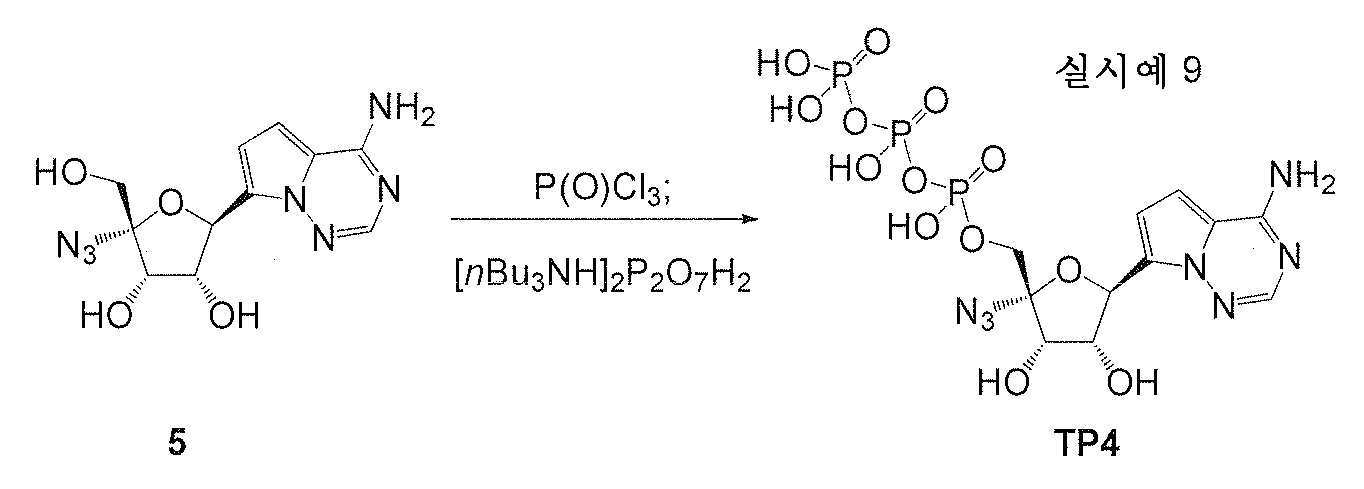
실시예Example 9 (TP4) - (( 9 (TP4)-(( 2R,3S,4R,5S2R, 3S, 4R, 5S )-5-(4-) -5- (4- 아미노피롤로[2,1-f][1,2,4]트리아진Aminopyrrolo [2,1-f] [1,2,4] triazine -7-일)-2-아지도-3,4-디히드록시테트라히드로푸란-2-일)메틸 -7-yl) -2-azido-3,4-dihydroxytetrahydrofuran-2-yl) methyl 테트라히드로겐Tetrahydrogen 트리포스페이트Triphosphate
PO(OMe)3 (0.6 ㎖) 중의 실시예 5 (6.0 ㎎, 0.019 mmol)의 용액에 0℃에서 POCl3 (45 ㎎, 0.29 mmol)을 첨가하였다. 반응 혼합물을 0℃에서 10 시간 동안 교반하고, 이때 이온-교환 HPLC는 약 50% 전환율을 나타냈다. ACN (0.6 ㎖) 중의 피로포스페이트 트리부틸아민 염 (250 ㎎)의 용액에 이어서 트리부틸아민 (110 ㎎, 0.59 mmol)을 첨가하였다. 반응 혼합물을 0℃에서 6 시간 동안 교반하였다. 반응을 트리에틸암모늄 바이카르보네이트 완충액 (1 M, 5 ㎖)으로 켄칭시켰다. 반응 혼합물을 실온에서 0.5 시간 동안 교반한 후, 농축시키고, 물과 함께 2회 동시 증발시켰다. 잔류물을 H2O (5 ㎖) 중에 용해시키고, 이온-교환 컬럼에 붓고, H2O에 이어서 5-35% 트리에틸암모늄 바이카르보네이트 완충액 (1 M)-H2O로 용출시켰다. 생성물 분획을 합하고, 농축시키고, H2O와 함께 동시 증발시켰다. 잔류물을 이온-교환 컬럼에 의하여 다시 정제하여 미정제 물질을 얻었다. 31P NMR은 이러한 물질이 불순물을 함유하였으며, 그래서 물질이 이온-교환 컬럼으로 다시 재정제하여 미정제 물질을 얻었다는 것을 나타냈다. 물질을 NaHCO3 (10 ㎎)로 처리하고, 혼합물을 감압 하에서 농축시켰다. 고체 잔류물을 0.5 ㎖의 H2O 중에 용해시키고, 40 ㎕의 NaOH (1N)를 첨가하였다. 생성된 혼합물을 H2O로 용출시키는 C-18 컬럼으로 정제하고, 생성물 함유 분획을 합하고, 감압 하에서 농축시켜 실시예 9 (TP4)를 테트라-나트륨 염으로서 얻었다.To a solution of Example 5 (6.0 mg, 0.019 mmol) in PO (OMe) 3 (0.6 mL), POCl 3 (45 mg, 0.29 mmol) was added at 0 ° C. The reaction mixture was stirred at 0 ° C. for 10 hours, at which time ion-exchange HPLC showed about 50% conversion. A solution of pyrophosphate tributylamine salt (250 mg) in ACN (0.6 mL) was added followed by tributylamine (110 mg, 0.59 mmol). The reaction mixture was stirred at 0 ° C. for 6 hours. The reaction was quenched with triethylammonium bicarbonate buffer (1 M, 5 mL). The reaction mixture was stirred at room temperature for 0.5 hour, then concentrated and evaporated twice with water. The residue was dissolved in H 2 O (5 mL), poured into an ion-exchange column, and eluted with H 2 O followed by 5-35% triethylammonium bicarbonate buffer (1 M) -H 2 O. The product fractions were combined, concentrated and co-evaporated with H 2 O. The residue was purified again by an ion-exchange column to obtain crude material. 31 P NMR indicated that this material contained impurities, so that the material was repurified again with an ion-exchange column to obtain the crude material. The material was treated with NaHCO 3 (10 mg), and the mixture was concentrated under reduced pressure. The solid residue was dissolved in 0.5 ml H 2 O, and 40 μl NaOH (1N) was added. The resulting mixture was purified by C-18 column eluting with H 2 O, product containing fractions were combined and concentrated under reduced pressure to give Example 9 (TP4) as a tetra-sodium salt.
1H NMR (400 MHz, D2O): δ 7.76 (s, 1H), 6.88 (d, J=4.3 Hz, 1H), 6.81 (d, J=4.6 Hz, 1H), 5.59 (d, J=5.5 Hz, 1H), 4.60 (t, J=5.6 Hz, 1H), 4.55 (d, J=5.8 Hz, 1H), 3.99 (qd, J=11.2, 5.5 Hz, 3H). 1 H NMR (400 MHz, D 2 O): δ 7.76 (s, 1H), 6.88 (d, J = 4.3 Hz, 1H), 6.81 (d, J = 4.6 Hz, 1H), 5.59 (d, J = 5.5 Hz, 1H), 4.60 (t, J = 5.6 Hz, 1H), 4.55 (d, J = 5.8 Hz, 1H), 3.99 (qd, J = 11.2, 5.5 Hz, 3H).
31P NMR (162 MHz, D2O): δ -8.13 (d, J=19.8 Hz), -14.04 (d, J=18.9 Hz), -24.00 (t, J=19.3 Hz). 31 P NMR (162 MHz, D 2 O): δ -8.13 (d, J = 19.8 Hz), -14.04 (d, J = 18.9 Hz), -24.00 (t, J = 19.3 Hz).
MS m/z=546.1 [M-1], 547.9 [M+1]MS m / z = 546.1 [M-1], 547.9 [M + 1]

중간체 Intermediate PD1aPD1a - S-2- -S-2- 히드록시에틸Hydroxyethyl 2,2- 2,2- 디메틸프로판티오에이트Dimethylpropanethioate
-78℃로 냉각시킨 CH2Cl2 중의 2-티오에탄올 (3.50 ㎖, 50.0 mmol) 및 트리에틸아민 (7.02 ㎖, 50.0 mmol)의 용액에 피발로일 클로라이드 (6.15 ㎖, 50.0 mmol)를 30 분에 걸쳐 적가하였다. 반응을 서서히 실온으로 가온되도록 하고, 진행을 TLC에 의하여 모니터하였다. 30 분 후, 반응은 완료된 것으로 결정되었으며, 물로 켄칭시켰다. 층이 분리되고, 수성상을 CH2Cl2로 세정하였다. 유기상을 합하고, 황산나트륨 위에서 건조시켰다. 고체를 여과하고, 용매를 감압 하에서 제거하였다. 미정제물을 실리카 겔 크로마토그래피 0-50% EtOAc/헥산에 의하여 정제하여 중간체 PD1a를 얻었다.To a solution of 2-thioethanol (3.50 mL, 50.0 mmol) and triethylamine (7.02 mL, 50.0 mmol) in CH 2 Cl 2 cooled to -78 ° C. was treated with pivaloyl chloride (6.15 mL, 50.0 mmol) for 30 min. Dropped over. The reaction was allowed to gradually warm to room temperature and progress was monitored by TLC. After 30 minutes, the reaction was determined to be complete and quenched with water. The layers separated and the aqueous phase was washed with CH 2 Cl 2 . The organic phases were combined and dried over sodium sulfate. The solid was filtered off and the solvent was removed under reduced pressure. The crude was purified by silica gel chromatography 0-50% EtOAc / hexane to give the intermediate PD1a.
1H NMR (400 MHz, DMSO-d6) δ 4.89 (t, J=5.5 Hz, 1H), 3.49-3.36 (m, 2H), 2.86 (t, J=6.7 Hz, 2H), 1.14 (s, 9H). 1 H NMR (400 MHz, DMSO-d 6 ) δ 4.89 (t, J = 5.5 Hz, 1H), 3.49-3.36 (m, 2H), 2.86 (t, J = 6.7 Hz, 2H), 1.14 (s, 9H).
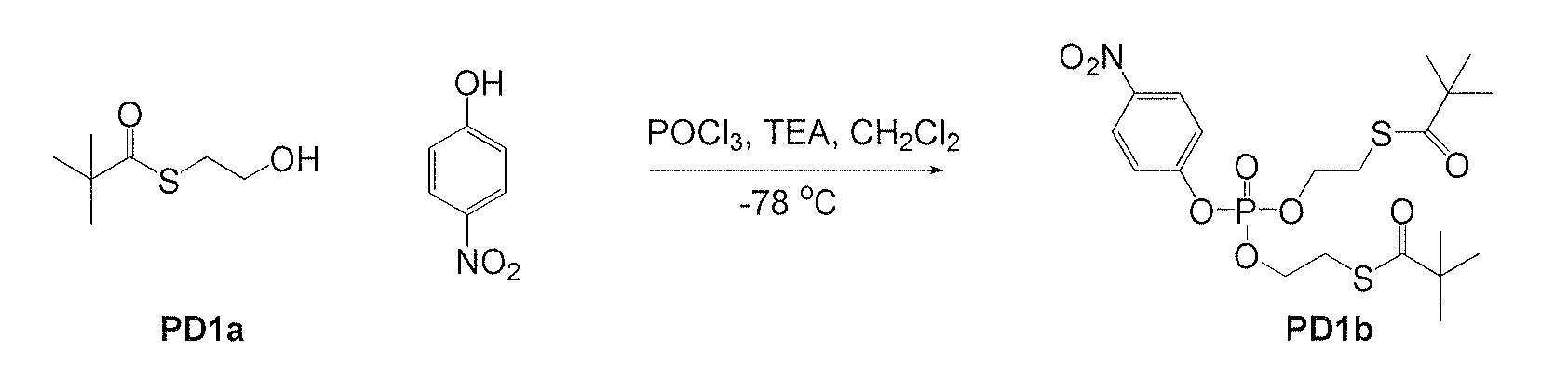
옥시염화인 (281 ㎕, 3.08 mmol)을 CH2Cl2 (5 ㎖) 중에서 취하고, 용액을 -78℃로 냉각시켰다. 티오에스테르 PD1a (1.00 g, 6.17 mmol)를 CH2Cl2 (5 ㎖) 중에서 취하고, POCl3 용액에 서서히 첨가하였다. 그 다음, TEA (891 ㎕, 6.16 mmol)를 적가하고, 30 분 동안 저온 상태에서 교반하였다. 그 후, 실온으로 가온시키고, 2 시간 동안 교반하였다. p-니트로페놀 (428 ㎎, 3.08 mmol)을 한번에 첨가한 후, TEA (449 ㎕, 3.08 mmol)를 서서히 첨가하였다. 실온에서 30 분 동안 교반하였다. TLC (70:30 헥산/EtOAC)는 단 하나의 스폿을 나타냈으나, LC/MS는 2개의 피크 (생성물 및 비스-p-니트로페놀레이트)를 가졌다. 용액을 에테르로 희석하고, 고체를 여과에 의하여 제거하고, 버렸다. 모액을 농축시키고, 실리카 겔 크로마토그래피에 의하여 정제하여 생성물 및 비스-p-니트로페놀레이트의 혼합물을 얻었다. 그 후, 혼합물을 HPLC에 의하여 재정제하여 중간체 PD1b, S,S'-2,2'-((4-니트로펜옥시)포스포릴)비스(옥시)비스(에탄-2,1-디일)비스(2,2-디메틸프로판티오에이트)를 얻었다.Phosphorous oxychloride (281 μl, 3.08 mmol) was taken in CH 2 Cl 2 (5 mL) and the solution was cooled to -78 ° C. Thioester PD1a (1.00 g, 6.17 mmol) was taken in CH 2 Cl 2 (5 mL) and added slowly to the POCl 3 solution. Then, TEA (891 μl, 6.16 mmol) was added dropwise and stirred for 30 minutes at low temperature. Then warmed to room temperature and stirred for 2 hours. After p-nitrophenol (428 mg, 3.08 mmol) was added at once, TEA (449 μl, 3.08 mmol) was added slowly. Stir at room temperature for 30 minutes. TLC (70:30 hexane / EtOAC) showed only one spot, but LC / MS had two peaks (product and bis-p-nitrophenolate). The solution was diluted with ether, and the solid was removed by filtration and discarded. The mother liquor was concentrated and purified by silica gel chromatography to obtain a mixture of product and bis-p-nitrophenolate. Then, the mixture was re-purified by HPLC to prepare intermediates PD1b, S, S'-2,2 '-((4-nitrophenoxy) phosphoryl) bis (oxy) bis (ethane-2,1-diyl) bis (2,2-dimethylpropanethioate).
1H NMR (400 MHz, CDCl3) δ 8.29-8.21 (m, 2H), 7.46-7.36 (m, 2H), 4.23 (br q, J=7.7 Hz, 4H), 3.16 (br t, J=6.7 Hz, 4H), 1.23 (s, 18H). 1 H NMR (400 MHz, CDCl 3 ) δ 8.29-8.21 (m, 2H), 7.46-7.36 (m, 2H), 4.23 (br q, J = 7.7 Hz, 4H), 3.16 (br t, J = 6.7 Hz, 4H), 1.23 (s, 18H).
31P NMR (162 MHz, CDCl3) δ -7.72 (s). 31 P NMR (162 MHz, CDCl 3 ) δ -7.72 (s).

실시예Example 10 ( 10 ( 또한 PD1로Also with PD1 지칭됨) - S,S'-2,2'-((((2R,3S,4R,5S)-5-(4-아미노피롤로[1,2-f][1,2,4]트리아진-7-일)-2-시아노-3,4-디히드록시테트라히드로푸란-2-일)메톡시)포스포릴)비스(옥시)비스(에탄-2,1-디일)비스(2,2-디메틸프로판티오에이트) Referred to)-S, S'-2,2 '-((((2R, 3S, 4R, 5S) -5- (4-aminopyrrolo [1,2-f] [1,2,4] tree Azin-7-yl) -2-cyano-3,4-dihydroxytetrahydrofuran-2-yl) methoxy) phosphoryl) bis (oxy) bis (ethane-2,1-diyl) bis (2 , 2-dimethylpropanethioate)
실시예 1 (6.0 ㎎, 0.02 mmol)을 NMP (0.1 ㎖) 중에 용해시키고, THF (0.2 ㎖)를 첨가하였다. 그 후, tert-부틸 마그네슘 클로라이드 (THF 중의 1.0 M 용액, 0.031 ㎖, 0.031 mmol)를 실온에서 아르곤 대기 하에서 첨가하였다. 10 분 후, THF (0.1 ㎖) 중의 중간체 PD1b (15.7 ㎎, 0.031 mmol)의 용액을 첨가하고, 생성된 혼합물을 50℃로 가온시켰다. 5 시간 후, 생성된 잔류물을 분취용 HPLC (페노미넥스 시너지 4u 히드로-RR 80Å 150×30 ㎜ 컬럼, 40-100% 아세토니트릴/물 구배)에 의하여 정제하였다. 원하는 생성물을 함유하는 분획을 합하고, 동결건조시켜 실시예 10 (PD1)을 얻었다.Example 1 (6.0 mg, 0.02 mmol) was dissolved in NMP (0.1 mL) and THF (0.2 mL) was added. Then tert-butyl magnesium chloride (1.0 M solution in THF, 0.031 mL, 0.031 mmol) was added at room temperature under an argon atmosphere. After 10 minutes, a solution of intermediate PD1b (15.7 mg, 0.031 mmol) in THF (0.1 mL) was added and the resulting mixture was warmed to 50 ° C. After 5 hours, the resulting residue was purified by preparative HPLC (Phenominex Synergy 4u Hydro-RR 80 Å 150 × 30 mm column, 40-100% acetonitrile / water gradient). Fractions containing the desired product were combined and lyophilized to give Example 10 (PD1).
1H NMR (400 MHz, CDCl3) δ 7.82 (s, 1H), 6.69 (d, J=4.5 Hz, 1H), 6.64 (d, J=4.5 Hz, 1H), 5.56 (d, J=3.4 Hz, 1H), 4.61 (br s, 2H), 4.45-4.32 (m, 2H), 4.22-4.06 (m, 4H), 3.13 (dt, J=11.7, 6.7 Hz, 4H), 1.23 (s, 9H), 1.21 (s, 9H). 1 H NMR (400 MHz, CDCl 3 ) δ 7.82 (s, 1H), 6.69 (d, J = 4.5 Hz, 1H), 6.64 (d, J = 4.5 Hz, 1H), 5.56 (d, J = 3.4 Hz , 1H), 4.61 (br s, 2H), 4.45-4.32 (m, 2H), 4.22-4.06 (m, 4H), 3.13 (dt, J = 11.7, 6.7 Hz, 4H), 1.23 (s, 9H) , 1.21 (s, 9H).
31P NMR (162 MHz, CDCl3) δ -2.34 (s). 31 P NMR (162 MHz, CDCl 3 ) δ -2.34 (s).
LC/MS: tR=1.70 min, MS m/z=660.02 [M+1]; LC 시스템: 써모 아셀라 1250 UHPLCLC / MS: t R = 1.70 min, MS m / z = 660.02 [M + 1]; LC system: Thermo Acela 1250 UHPLC
MS 시스템: 써모 LCQ 플리트; 컬럼: 키네텍스 2.6μ XB-C18 100A, 50×4.6 ㎜MS system: Thermo LCQ pleats; Column: Kinetex 2.6 μ XB-C18 100A, 50 × 4.6 mm
용매: 0.1% 아세트산을 갖는 아세토니트릴, 0.1% 아세트산을 갖는 물; 구배: 2 ㎕/min으로 0 min-2.0 min 2-100% ACN, 2.0 min-3.05 min 100% ACN, 3.05 min-3.2 min 100%-2% ACN, 3.2 min-3.5 min 2% ACN.Solvent: acetonitrile with 0.1% acetic acid, water with 0.1% acetic acid; Gradient: 0 min-2.0 min 2-100% ACN, 2.0 min-3.05 min 100% ACN, 3.05 min-3.2 min 100% -2% ACN, 3.2 min-3.5 min 2% ACN at 2 μl / min.
HPLC: tR=3.204 min; HPLC 시스템: 아질런트 1100 시리즈; 컬럼: 제미니 5μ C18 110A, 50×4.6 ㎜; 용매: 0.1% TFA를 갖는 아세토니트릴, 0.1% TFA를 갖는 물HPLC: t R = 3.204 min; HPLC system: Agilent 1100 series; Column: Gemini 5μ C18 110A, 50 × 4.6 mm; Solvent: acetonitrile with 0.1% TFA, water with 0.1% TFA
구배: 2 ㎖/min으로 0 min-5.0 min 2-98% ACN, 5.0 min-6.0 min 98% ACN.Gradient: 0 min-5.0 min 2-98% ACN at 2 mL / min, 5.0 min-6.0 min 98% ACN.

실시예Example 11 (PD2) - S,S'-2,2'-((((2R,3R,4R,5S)-5-(4-아미노피롤로[1,2-f][1,2,4]트리아진-7-일)-2-시아노-4-플루오로-3-히드록시테트라히드로푸란-2-일)메톡시)포스포릴)비스(옥시)비스(에탄-2,1-디일)비스(2,2-디메틸프로판티오에이트) 11 (PD2)-S, S'-2,2 '-(((((2R, 3R, 4R, 5S) -5- (4-aminopyrrolo [1,2-f] [1,2,4] Triazine-7-yl) -2-cyano-4-fluoro-3-hydroxytetrahydrofuran-2-yl) methoxy) phosphoryl) bis (oxy) bis (ethane-2,1-diyl) Bis (2,2-dimethylpropanethioate)
실시예 3 (10.5 ㎎, 0.036 mmol)을 NMP (0.1 ㎖) 중에 용해시키고, THF (0.1 ㎖)를 첨가하였다. 그 후, tert-부틸 마그네슘 클로라이드 (THF 중의 1.0 M 용액, 0.054 ㎖, 0.054 mmol)를 실온에서 아르곤 대기 하에서 첨가하였다. 10 분 후, THF (0.1 ㎖) 중의 중간체 PD1b (27.3 ㎎, 0.054 mmol)의 용액을 첨가하고, 생성된 혼합물을 50℃로 가온시켰다. 24 시간 후, 생성된 잔류물을 분취용 HPLC (페노미넥스 시너지 4u 히드로-RR 80Å 150×30 ㎜ 컬럼, 40-100% 아세토니트릴/물 구배)에 의하여 정제하였다. 원하는 생성물을 함유하는 분획을 합하고, 동결건조시켜 실시예 11 (PD2)을 얻었다.Example 3 (10.5 mg, 0.036 mmol) was dissolved in NMP (0.1 mL) and THF (0.1 mL) was added. Then tert-butyl magnesium chloride (1.0 M solution in THF, 0.054 mL, 0.054 mmol) was added at room temperature under an argon atmosphere. After 10 minutes, a solution of intermediate PD1b (27.3 mg, 0.054 mmol) in THF (0.1 mL) was added and the resulting mixture was warmed to 50 ° C. After 24 hours, the resulting residue was purified by preparative HPLC (Phenominex Synergy 4u Hydro-RR 80 Å 150 × 30 mm column, 40-100% acetonitrile / water gradient). Fractions containing the desired product were combined and lyophilized to give Example 11 (PD2).
1H NMR (400 MHz, CDCl3) δ 7.94 (s, 1H), 6.75 (d, J=4.5 Hz, 1H), 6.67 (d, J=4.5 Hz, 1H), 5.77 (dd, J=27.8, 1.4 Hz, 1H), 5.43 (ddd, J=55.2, 4.9, 1.3 Hz, 1H), 4.93 (dd, J=21.2, 4.9 Hz, 1H), 4.49 (dd, J=11.3, 7.8 Hz, 1H), 4.40 (dd, J=11.3, 7.8 Hz, 1H), 4.10 (ddt, J=15.9, 8.0, 6.7 Hz, 4H), 3.16-3.04 (m, 4H), 1.23 (s, 9H), 1.21 (s, 9H). 1 H NMR (400 MHz, CDCl 3 ) δ 7.94 (s, 1H), 6.75 (d, J = 4.5 Hz, 1H), 6.67 (d, J = 4.5 Hz, 1H), 5.77 (dd, J = 27.8, 1.4 Hz, 1H), 5.43 (ddd, J = 55.2, 4.9, 1.3 Hz, 1H), 4.93 (dd, J = 21.2, 4.9 Hz, 1H), 4.49 (dd, J = 11.3, 7.8 Hz, 1H), 4.40 (dd, J = 11.3, 7.8 Hz, 1H), 4.10 (ddt, J = 15.9, 8.0, 6.7 Hz, 4H), 3.16-3.04 (m, 4H), 1.23 (s, 9H), 1.21 (s, 9H).
31P NMR (162 MHz, CDCl3) δ -2.10 (s). 31 P NMR (162 MHz, CDCl 3 ) δ -2.10 (s).
19F NMR (376 MHz, CDCl3) δ -191.64 (ddd, J=55.0, 27.8, 21.3 Hz). 19 F NMR (376 MHz, CDCl 3 ) δ -191.64 (ddd, J = 55.0, 27.8, 21.3 Hz).
LC/MS: tR=1.85 min, MS m/z=662.03 [M+1]; LC 시스템: 써모 아셀라 1250 UHPLCLC / MS: t R = 1.85 min, MS m / z = 662.03 [M + 1]; LC system: Thermo Acela 1250 UHPLC
MS 시스템: 써모 LCQ 플리트; 컬럼: 키네텍스 2.6μ XB-C18 100A, 50×4.6 ㎜; 용매: 0.1% 아세트산을 갖는 아세토니트릴, 0.1% 아세트산을 갖는 물; 구배: 2 ㎕/min으로 0 min-2.0 min 2-100% ACN, 2.0 min-3.05 min 100% ACN, 3.05 min-3.2 min 100%-2% ACN, 3.2 min-3.5 min 2% ACN.MS system: Thermo LCQ pleats; Column: Kinetex 2.6 μ XB-C18 100A, 50 × 4.6 mm; Solvent: acetonitrile with 0.1% acetic acid, water with 0.1% acetic acid; Gradient: 0 min-2.0 min 2-100% ACN, 2.0 min-3.05 min 100% ACN, 3.05 min-3.2 min 100% -2% ACN, 3.2 min-3.5 min 2% ACN at 2 μl / min.
HPLC: tR=3.385 min; HPLC 시스템: 아질런트 1100 시리즈; 컬럼: 제미니 5μ C18 110A, 50×4.6 ㎜; 용매: 0.1% TFA를 갖는 아세토니트릴, 0.1% TFA를 갖는 물; 구배: 2 ㎖/min으로 0 min-5.0 min 2-98% ACN, 5.0 min-6.0 min 98% ACN.HPLC: t R = 3.385 min; HPLC system: Agilent 1100 series; Column: Gemini 5μ C18 110A, 50 × 4.6 mm; Solvent: acetonitrile with 0.1% TFA, water with 0.1% TFA; Gradient: 0 min-5.0 min 2-98% ACN at 2 mL / min, 5.0 min-6.0 min 98% ACN.
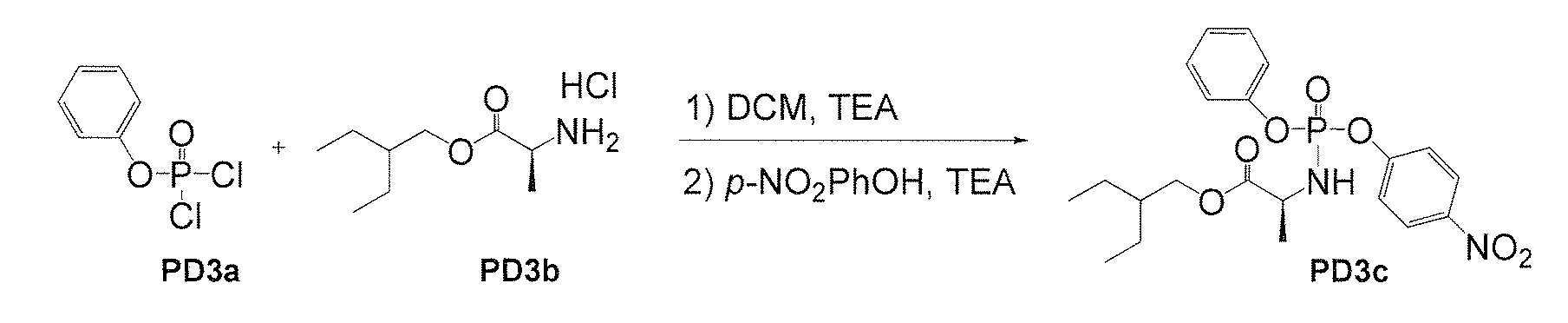
중간체 Intermediate PD3cPD3c - (2S)-2- -(2S) -2- 에틸부틸Ethyl butyl 2-((4- 2-((4- 니트로펜옥시Nitrofenoxy )() ( 펜옥시Penoxy )) 포스포릴아미노Phosphorylamino )프로파노에이트) Propanoate
페닐 디클로로포스페이트 PD3a (1.5 ㎖, 10 mmol)를 30 ㎖ 무수 DCM 중에 용해시키고, N2(g) 하에서 얼음 배쓰 내에서 교반하였다. 아미노 에스테르 HCl 염 PD3b, (S)-2-에틸부틸 2-아미노프로파노에이트 염산염 (Eur . J. Med . Chem . 2009, 44, 3765-3770에 의하여 생성됨, 2.1 g, 10 mmol)을 한번에 첨가하였다. TEA (3 ㎖, 22 mmol)를 적가하였다. 1 시간 동안 0℃에서 교반하였다. p-니트로페놀 (1.4 g, 10 mmol)을 한번에 및 TEA (1.5 ㎖, 11 mmol)를 첨가하였다. 그 후, 반응 혼합물을 실온에서 16 시간 동안 교반하였다. DCM으로 희석하고, 포화 NaHCO3(aq)로 세정하였다. 유기층을 무수 Na2SO4 위에서 건조시키고, 감압 하에서 농축시켰다. 실리카 겔 컬럼 (헥산 중의 0-15% EtOAc)으로 정제하여 중간체 PD3c를 얻었다.Phenyl dichlorophosphate PD3a (1.5 mL, 10 mmol) was dissolved in 30 mL dry DCM and stirred in an ice bath under N 2 (g). Add amino ester HCl salt PD3b, (S) -2-ethylbutyl 2-aminopropanoate hydrochloride (produced by Eur . J. Med . Chem . 2009, 44, 3765-3770, 2.1 g, 10 mmol) at one time Did. TEA (3 mL, 22 mmol) was added dropwise. Stir at 0 ° C. for 1 hour. p-Nitrophenol (1.4 g, 10 mmol) was added at once and TEA (1.5 mL, 11 mmol) was added. Thereafter, the reaction mixture was stirred at room temperature for 16 hours. Diluted with DCM and washed with saturated NaHCO 3 (aq) . The organic layer was dried over anhydrous Na 2 SO 4 and concentrated under reduced pressure. Purification by silica gel column (0-15% EtOAc in hexanes) gave the intermediate PD3c.
1H NMR (400 MHz, CDCl3) δ 8.23 (d, J=8.8 Hz, 2H), 7.41-7.30 (m, 4H), 7.25-7.19 (m, 3H), 4.10-4.00 (m, 3H), 3.90-3.83 (m, 1H), 1.55-1.45 (m, 1H), 1.42-1.31 (m, 7H), 0.87 (t, J=7.2 Hz, 6H). 1 H NMR (400 MHz, CDCl 3 ) δ 8.23 (d, J = 8.8 Hz, 2H), 7.41-7.30 (m, 4H), 7.25-7.19 (m, 3H), 4.10-4.00 (m, 3H), 3.90-3.83 (m, 1H), 1.55-1.45 (m, 1H), 1.42-1.31 (m, 7H), 0.87 (t, J = 7.2 Hz, 6H).
31P NMR (162 MHz, CDCl3) δ -3.04 (s), -3.10 (s). 31 P NMR (162 MHz, CDCl 3 ) δ -3.04 (s), -3.10 (s).
LC/MS: tR=2.87 min, MS m/z=451.1 [M+1], 449.0 [M-1]; LC/MS 시스템: 써모 LCQ 어드밴티지; 페노메넥스 제미니, C18, 5u, 110A, 30×4.6 ㎜; 완충액 A: 물 중의 0.1% 아세트산; 완충액 B: 아세토니트릴 중의 0.1% 아세트산; 2 ㎖/min으로 2.5 분 이내에 5-100% 완충액 B에 이어서 0.9 분 동안 100%.LC / MS: t R = 2.87 min, MS m / z = 451.1 [M + 1], 449.0 [M-1]; LC / MS system: Thermo LCQ Advantage; Phenomenex Gemini, C 18 , 5u, 110A, 30 × 4.6 mm; Buffer A: 0.1% acetic acid in water; Buffer B: 0.1% acetic acid in acetonitrile; 5-100% Buffer B within 2.5 min at 2 mL / min followed by 100% for 0.9 min.
HPLC: tR=4.40 min; HPLC 시스템: 아질런트 1100; 페노메넥스 제미니, C18, 5u, 110A, 50×4.6 ㎜; 완충액 A: 물 중의 0.05% TFA; 완충액 B: 아세토니트릴 중의 0.05% TFA; 5 분 이내에 2 ㎖/min으로 2-98% 완충액 B.HPLC: t R = 4.40 min; HPLC system: Agilent 1100; Phenomenex Gemini, C 18 , 5u, 110A, 50 × 4.6 mm; Buffer A: 0.05% TFA in water; Buffer B: 0.05% TFA in acetonitrile; 2-98% buffer B at 2 ml / min within 5 minutes.

실시예Example 12 (PD3) - (2S)-2- 12 (PD3)-(2S) -2- 에틸부틸Ethyl butyl 2-((((2R,3R,4R,5S)-5-(4-아미노피롤로[1,2-f][1,2,4]트리아진-7-일)-2-시아노-4-플루오로-3-히드록시테트라히드로푸란-2-일)메톡시)(펜옥시)포스포릴아미노)프로파노에이트 2-(((((2R, 3R, 4R, 5S) -5- (4-aminopyrrolo [1,2-f] [1,2,4] triazine-7-yl) -2-cyano- 4-fluoro-3-hydroxytetrahydrofuran-2-yl) methoxy) (phenoxy) phosphorylamino) propanoate
실시예 3 (15 ㎎, 0.051 mmol)을 무수 DMF (1 ㎖) 중에 용해시키고, N2(g) 하에 교반하였다. p-니트로페닐포스포아미데이트 PD3c (35 ㎎, 0.077 mmol)를 무수 DMF (0.5 ㎖) 중에 용해시키고, 반응 혼합물에 한번에 첨가한다. THF 중의 tBuMgCl (THF 중의 1M, 77 ㎕, 0.077 mmol)을 적가하였다. 2 시간 동안 교반하였다. 더 많은 p-니트로페닐포스포아미데이트 (0.5 ㎖ 무수 DMF 중의 35 ㎎) 및 더 많은 tBuMgCl (THF 중의 1 M, 50 ㎕, 0.050 mmol)을 첨가하였다. 2 시간 동안 교반하였다. 더 많은 p-니트로페닐포스포아미데이트 (0.5 ㎖ 무수 DMF 중의 35 ㎎) 및 더 많은 tBuMgCl 용액 (THF 중의 1 M, 50 ㎕, 0.050 mmol)을 첨가하였다. 16 시간 동안 교반하였다. EtOAc로 희석하고, 포화 NaHCO3(aq)로 세정하였다 (3×). 포화 NaCl(aq)로 세정하고, 유기층을 무수 Na2SO4 위에서 건조시켰다. 감압 하에서 농축시켰다. 실리카 겔 컬럼 (DCM 중의 0-5% MeOH)으로 정제하였다. 분획을 합하고, 감압 하에서 농축시켰다. 변형제로서 TFA를 사용하는 분취용 HPLC로 정제하여 실시예 12 (PD3)를 얻었다.Example 3 (15 mg, 0.051 mmol) was dissolved in anhydrous DMF (1 mL) and stirred under N 2 (g). p-Nitrophenylphosphoamidate PD3c (35 mg, 0.077 mmol) was dissolved in anhydrous DMF (0.5 mL) and added to the reaction mixture at once. TBuMgCl in THF (1M in THF, 77 μl, 0.077 mmol) was added dropwise. Stir for 2 hours. More p-nitrophenylphosphoamidate (35 mg in 0.5 ml dry DMF) and more tBuMgCl (1 M in THF, 50 μl, 0.050 mmol) were added. Stir for 2 hours. More p-nitrophenylphosphoamidate (35 mg in 0.5 ml dry DMF) and more tBuMgCl solution (1 M in THF, 50 μl, 0.050 mmol) were added. Stir for 16 hours. Diluted with EtOAc and washed with saturated NaHCO 3 (aq) (3 ×). Washed with saturated NaCl (aq) , and the organic layer was dried over anhydrous Na 2 SO 4 . Concentrated under reduced pressure. Purification by silica gel column (0-5% MeOH in DCM). Fractions were combined and concentrated under reduced pressure. Purification by preparative HPLC using TFA as modifier gave Example 12 (PD3).
분취용 HPLC 시스템: 길슨 215 분주기; 페노메넥스 제미니, C18 4u, 100×30.0 ㎜Preparative HPLC system: Gilson 215 dispenser; Phenomenex Gemini, C 18 4u, 100 × 30.0 mm
완충액 A: 물 중의 0.1% TFA; 완충액 B: 아세토니트릴 중의 0.1% TFA; 13 분 이내에 20 ㎖/min으로 5-100% 완충액 B.Buffer A: 0.1% TFA in water; Buffer B: 0.1% TFA in acetonitrile; 5-100% buffer B at 20 ml / min within 13 minutes.
1H NMR (400 MHz, CDCl3) δ 7.89 (s, 1H), 7.31-7.13 (m, 6H), 6.80-6.75 (m, 1H), 5.80-5.70 (m, 1H), 5.35-5.20 (m, 1H), 4.80-4.62 (m, 1H), 4.60-4.45 (m, 2H), 4.35-4.10 (m, 1H), 4.06-3.96 (m, 3H), 1.49-1.28 (m, 8H), 0.90-0.82 (m, 6H). 1 H NMR (400 MHz, CDCl 3 ) δ 7.89 (s, 1H), 7.31-7.13 (m, 6H), 6.80-6.75 (m, 1H), 5.80-5.70 (m, 1H), 5.35-5.20 (m , 1H), 4.80-4.62 (m, 1H), 4.60-4.45 (m, 2H), 4.35-4.10 (m, 1H), 4.06-3.96 (m, 3H), 1.49-1.28 (m, 8H), 0.90 -0.82 (m, 6H).
31P NMR (162 MHz, CDCl3) δ 2.36 (s), 2.22 (s). 31 P NMR (162 MHz, CDCl 3 ) δ 2.36 (s), 2.22 (s).
HPLC: tR=3.00 min; HPLC 시스템: 아질런트 1100; 페노메넥스 제미니, C18, 5u, 110A, 50×4.6 ㎜; 완충액 A: 물 중의 0.05% TFA; 완충액 B: 아세토니트릴 중의 0.05% TFA; 5 분 이내에 2 ㎖/min으로 2-98% 완충액 B.HPLC: t R = 3.00 min; HPLC system: Agilent 1100; Phenomenex Gemini, C 18 , 5u, 110A, 50 × 4.6 mm; Buffer A: 0.05% TFA in water; Buffer B: 0.05% TFA in acetonitrile; 2-98% buffer B at 2 ml / min within 5 minutes.
LC/MS: tR=2.39 min, MS m/z=605.1 [M+1], 603.0 [M-1]; LC/MS 시스템: 써모 LCQ 어드밴티지; 페노메넥스 제미니, C18, 5u, 110A, 30×4.6 ㎜; 완충액 A: 물 중의 0.1% 아세트산; 완충액 B: 아세토니트릴 중의 0.1% 아세트산; 2.5 분 이내에 5-100% 완충액 B에 이어서 0.9 분 동안 2 ㎖/min으로 100%.LC / MS: t R = 2.39 min, MS m / z = 605.1 [M + 1], 603.0 [M-1]; LC / MS system: Thermo LCQ Advantage; Phenomenex Gemini, C 18 , 5u, 110A, 30 × 4.6 mm; Buffer A: 0.1% acetic acid in water; Buffer B: 0.1% acetic acid in acetonitrile; 5-100% Buffer B within 2.5 min, then 100% at 2 ml / min for 0.9 min.

중간체 6a - N-(7-((2S,3S,4R,5R)-4-(tert-부틸디메틸실릴옥시)-5-((tert-부틸디메틸실릴옥시)메틸)-3-플루오로-5-비닐테트라히드로푸란-2-일)피롤로[1,2-f][1,2,4]트리아진-4-일)벤즈아미드Intermediate 6a-N- (7-((2S, 3S, 4R, 5R) -4- (tert-butyldimethylsilyloxy) -5-((tert-butyldimethylsilyloxy) methyl) -3-fluoro-5 -Vinyltetrahydrofuran-2-yl) pyrrolo [1,2-f] [1,2,4] triazin-4-yl) benzamide
중간체 2g, N-(7-((2S,3S,4R,5R)-4-(tert-부틸디메틸실릴옥시)-5-((tert-부틸디메틸실릴옥시)메틸)-3-플루오로-5-(히드록시메틸)테트라히드로푸란-2-일)피롤로[1,2-f][1,2,4]트리아진-4-일)벤즈아미드 (220 ㎎, 0.35 mmol)를 5 ㎖의 무수 DMSO 중에 용해시키고, N2(g) 하에서 교반하였다. EDCl (100 ㎎, 0.52 mmol)에 이어서 TFA-피리딘 (34 ㎎, 0.18 mmol)을 첨가하였다. 1 시간 동안 교반하였다. 더 많은 EDCl (100 ㎎, 0.52 mmol)을 첨가하고, 1 시간 동안 교반하였다. LC/MS에 의한 모니터링은 출발 물질 알콜이 잔존한다는 것을 나타냈다. 더 많은 EDCl (100 ㎎, 0.52 mmol)을 첨가하고, 1 시간 동안 교반하였다. LC/MS에 의한 모니터링은 반응이 완전 전환에 도달하였다는 것을 나타냈다. 에틸 아세테이트로 희석하고, 포화 NaHCO3(aq)로 세정하고 (2×), 그 후 포화 NaCl(aq)로 세정하였다. 유기층을 무수 Na2SO4 위에서 건조시키고, 감압 하에서 농축시켰다. 실리카 겔 컬럼 (헥산 중의 0-20% EtOAc)으로 정제하였다. 분획을 합하고, 감압 하에서 농축시켜 알데히드를 고체로서 얻었다. 메틸 트리페닐포스포늄 브로마이드 (500 ㎎, 1.40 mmol)를 10 ㎖ 무수 THF 중에 현탁시키고, -78℃에서 Ar(g) 하에서 교반하였다. 헥산 중의 2.5 M n-부틸리튬 용액 (560 ㎕, 1.40 mmol)을 적가하였다. 반응 혼합물을 얼음 배쓰 내에서 1 시간 동안 교반하여 황색 혼합물을 얻었다. 상기 생성된 알데히드를 5 ㎖의 무수 THF 중에 용해시키고, 반응에 적가하였다. 얼음 배쓰를 제거하고, 반응이 실온으로 가온되도록 하였다. 3 시간 동안 실온에서 교반하였다. 포화 NH4Cl 수용액을 첨가하고, 에틸 아세테이트로 추출하였다. 유기 추출물을 포화 NaHCO3(aq)로 세정한 후, 포화 NaCl(aq)로 세정하였다. 유기층을 무수 Na2SO4 위에서 건조시키고, 감압 하에서 농축시켰다. 실리카 겔 컬럼 (헥산 중의 0-20% EtOAc)으로 정제하여 중간체 6a를 얻었다.Intermediate 2g, N- (7-((2S, 3S, 4R, 5R) -4- (tert-butyldimethylsilyloxy) -5-((tert-butyldimethylsilyloxy) methyl) -3-fluoro-5 -(Hydroxymethyl) tetrahydrofuran-2-yl) pyrrolo [1,2-f] [1,2,4] triazin-4-yl) benzamide (220 mg, 0.35 mmol) in 5 ml It was dissolved in anhydrous DMSO and stirred under N 2 (g). EDCl (100 mg, 0.52 mmol) was added followed by TFA-pyridine (34 mg, 0.18 mmol). Stir for 1 hour. More EDCl (100 mg, 0.52 mmol) was added and stirred for 1 hour. Monitoring by LC / MS indicated the starting material alcohol remained. More EDCl (100 mg, 0.52 mmol) was added and stirred for 1 hour. Monitoring by LC / MS indicated that the reaction had reached complete conversion. Diluted with ethyl acetate, washed with saturated NaHCO 3 (aq) (2 ×), then washed with saturated NaCl (aq) . The organic layer was dried over anhydrous Na 2 SO 4 and concentrated under reduced pressure. Purified by silica gel column (0-20% EtOAc in hexane). Fractions were combined and concentrated under reduced pressure to give the aldehyde as a solid. Methyl triphenylphosphonium bromide (500 mg, 1.40 mmol) was suspended in 10 ml dry THF and stirred under Ar (g) at -78 ° C. A 2.5 M n-butyllithium solution in hexane (560 μl, 1.40 mmol) was added dropwise. The reaction mixture was stirred in an ice bath for 1 hour to give a yellow mixture. The resulting aldehyde was dissolved in 5 ml of anhydrous THF and added dropwise to the reaction. The ice bath was removed and the reaction was allowed to warm to room temperature. Stirred for 3 hours at room temperature. Saturated aqueous NH 4 Cl solution was added and extracted with ethyl acetate. The organic extract was washed with saturated NaHCO 3 (aq) , followed by saturated NaCl (aq) . The organic layer was dried over anhydrous Na 2 SO 4 and concentrated under reduced pressure. Purification by silica gel column (0-20% EtOAc in hexanes) gave intermediate 6a.
1H NMR (400 MHz, DMSO-d6) δ 8.22 (br s, 1H), 8.03 (br s, 2H), 7.58 (dt, J=40.4, 7.4 Hz, 3H), 7.12 (d, J=4.7 Hz, 1H), 6.97 (s, 1H), 6.01 (dd, J=17.5, 10.9 Hz, 1H), 5.58 (d, J=22.8 Hz, 1H), 5.46 (dd, J=17.5, 2.1 Hz, 1H), 5.25 (dd, J=11.0, 2.0 Hz, 1H), 5.14 (ddd, J=55.4, 4.9, 2.7 Hz, 1H), 4.61 (dd, J=20.8, 4.8 Hz, 1H), 3.63-3.40 (m, 2H), 0.89 (s, 9H), 0.84 (s, 9H), 0.09 (d, J=8.4 Hz, 6H), 0.00 (d, J=14.1 Hz, 6H). 1 H NMR (400 MHz, DMSO-d6) δ 8.22 (br s, 1H), 8.03 (br s, 2H), 7.58 (dt, J = 40.4, 7.4 Hz, 3H), 7.12 (d, J = 4.7 Hz , 1H), 6.97 (s, 1H), 6.01 (dd, J = 17.5, 10.9 Hz, 1H), 5.58 (d, J = 22.8 Hz, 1H), 5.46 (dd, J = 17.5, 2.1 Hz, 1H) , 5.25 (dd, J = 11.0, 2.0 Hz, 1H), 5.14 (ddd, J = 55.4, 4.9, 2.7 Hz, 1H), 4.61 (dd, J = 20.8, 4.8 Hz, 1H), 3.63-3.40 (m , 2H), 0.89 (s, 9H), 0.84 (s, 9H), 0.09 (d, J = 8.4 Hz, 6H), 0.00 (d, J = 14.1 Hz, 6H).
19F NMR (376 MHz, DMSO-d6) δ -191.86 (d, J=56.8 Hz). 19 F NMR (376 MHz, DMSO-d6) δ -191.86 (d, J = 56.8 Hz).
MS m/z=627.3 [M+1].MS m / z = 627.3 [M + 1].
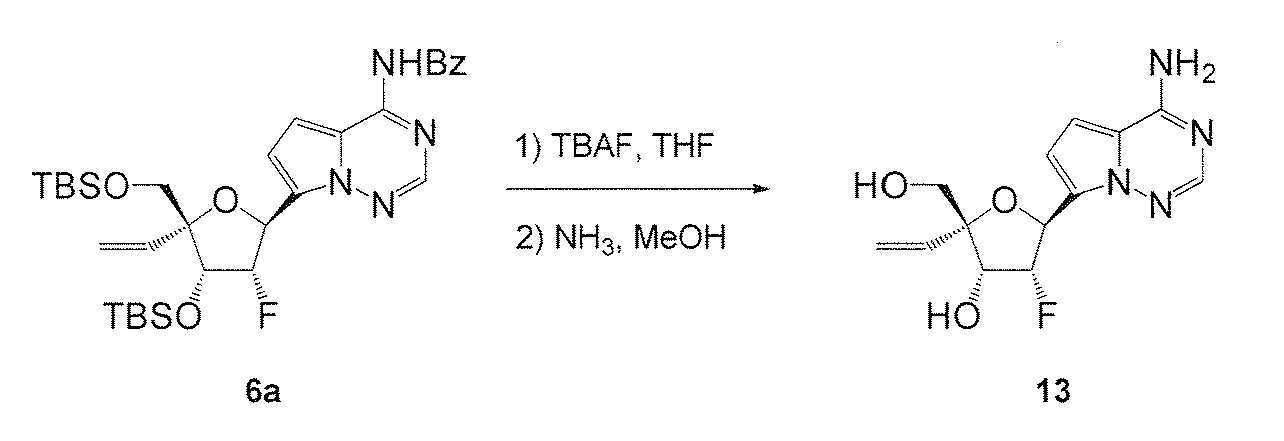
실시예Example 13 - ( 13-( 2R,3R,4R,5S2R, 3R, 4R, 5S )-5-(4-) -5- (4- 아미노피롤로[1,2-f][1,2,4]트리아진Aminopyrrolo [1,2-f] [1,2,4] triazine -7-일)-4-플루오로-2-(히드록시메틸)-2-비닐테트라히드로푸란-3-올-7-yl) -4-fluoro-2- (hydroxymethyl) -2-vinyltetrahydrofuran-3-ol
중간체 6a (146 ㎎, 0.23 mmol)를 THF (10 ㎖) 중에 용해시키고, 생성된 용액을 얼음 배쓰 내에서 교반하였다. 1M TBAF 용액을 THF (700 ㎕, 0.70 mmol) 중에 용해시키고, 2 시간 동안 교반하였다. EtOAc로 희석하고, 포화 NaCl(aq)로 세정하였다 (5×). 유기층을 무수 Na2SO4 위에서 건조시키고, 감압 하에서 농축시켰다. 7 M 암모니아를 MeOH (7 ㎖) 중에 용해시키고, 18 시간 동안 교반하였다. 반응을 감압 하에서 농축시켰다. 변형제로서 TFA를 사용하여 C18 분취용 HPLC로 정제하였다. 분획을 합하고, 감압 하에서 농축시켰다. NaHCO3(aq) 중에 용해시키고, 분취용 HPLC로 중성 조건 하에서 재정제시켰다. 분획을 합하고, 동결-건조시켜 실시예 13을 얻었다.Intermediate 6a (146 mg, 0.23 mmol) was dissolved in THF (10 mL) and the resulting solution was stirred in an ice bath. The 1M TBAF solution was dissolved in THF (700 μl, 0.70 mmol) and stirred for 2 hours. Diluted with EtOAc and washed with saturated NaCl (aq) (5 ×). The organic layer was dried over anhydrous Na 2 SO 4 and concentrated under reduced pressure. 7 M ammonia was dissolved in MeOH (7 mL) and stirred for 18 hours. The reaction was concentrated under reduced pressure. Purification by C 18 preparative HPLC using TFA as modifier. Fractions were combined and concentrated under reduced pressure. It was dissolved in NaHCO 3 (aq) and re-purified under neutral conditions by preparative HPLC. Fractions were combined and freeze-dried to give Example 13.
1H NMR (400 MHz, D2O) δ 7.54 (s, 1H), 6.62-6.49 (m, 2H), 5.98-5.79 (m, 1H), 5.55-5.36 (m, 2H), 5.31 (d, J=11.1 Hz, 1H), 5.11 (ddd, J=54.8, 5.2, 2.9 Hz, 1H), 4.42 (dd, J=20.6, 4.8 Hz, 1H), 3.62-3.43 (m, 2H). 1 H NMR (400 MHz, D 2 O) δ 7.54 (s, 1H), 6.62-6.49 (m, 2H), 5.98-5.79 (m, 1H), 5.55-5.36 (m, 2H), 5.31 (d, J = 11.1 Hz, 1H), 5.11 (ddd, J = 54.8, 5.2, 2.9 Hz, 1H), 4.42 (dd, J = 20.6, 4.8 Hz, 1H), 3.62-3.43 (m, 2H).
19F NMR (376 MHz, D2O) δ -193.23 (dd, J=54.7, 44.2 Hz). 19 F NMR (376 MHz, D 2 O) δ -193.23 (dd, J = 54.7, 44.2 Hz).
MS m/z=295.2 [M+1]MS m / z = 295.2 [M + 1]

실시예Example 14 - ( 14-( 2R,3R,4R,5S2R, 3R, 4R, 5S )-5-(4-) -5- (4- 아미노피롤로[1,2-f][1,2,4]트리아진Aminopyrrolo [1,2-f] [1,2,4] triazine -7-일)-2-에틸-4-플루오로-2-(히드록시메틸)테트라히드로푸란-3-올-7-yl) -2-ethyl-4-fluoro-2- (hydroxymethyl) tetrahydrofuran-3-ol
실시예 13 (5 ㎎, 0.017 mmol)을 메탄올 (2 ㎖) 중에 용해시켰다. 그 후, 10% Pd/C 데구싸(Degussa) 촉매 (2 ㎎)를 첨가하고, 생성된 혼합물을 수소 기체의 대기 하에서 교반하였다. 40 분 후, 생성된 혼합물을 여과하여 Pd/C를 제거하고, 여과액을 감압 하에서 농축시켰다. 잔류물을 물 중에 용해시키고, 동결건조시켜 실시예 14를 얻었다.Example 13 (5 mg, 0.017 mmol) was dissolved in methanol (2 mL). Thereafter, a 10% Pd / C Degussa catalyst (2 mg) was added, and the resulting mixture was stirred under an atmosphere of hydrogen gas. After 40 minutes, the resulting mixture was filtered to remove Pd / C, and the filtrate was concentrated under reduced pressure. The residue was dissolved in water and lyophilized to give Example 14.
1H NMR (400 MHz, D2O) δ 7.67 (s, 1H), 6.79-6.55 (m, 2H), 5.54-5.12 (m, 2H), 4.46 (dd, J=15.1, 5.5 Hz, 1H), 3.65-3.44 (m, 2H), 1.89-1.44 (m, 2H), 0.84 (t, J=7.6 Hz, 3H). 1 H NMR (400 MHz, D 2 O) δ 7.67 (s, 1H), 6.79-6.55 (m, 2H), 5.54-5.12 (m, 2H), 4.46 (dd, J = 15.1, 5.5 Hz, 1H) , 3.65-3.44 (m, 2H), 1.89-1.44 (m, 2H), 0.84 (t, J = 7.6 Hz, 3H).
19F NMR (376 MHz, D2O) δ -197.62 (ddd, J=54.5, 20.6, 15.0 Hz). 19 F NMR (376 MHz, D 2 O) δ -197.62 (ddd, J = 54.5, 20.6, 15.0 Hz).
MS m/z=297.3 [M+1].MS m / z = 297.3 [M + 1].

실시예Example 15 (PD4) - S,S'-2,2'-((((2R,3R,4R,5S)-5-(4-아미노피롤로[1,2-f][1,2,4]트리아진-7-일)-4-플루오로-3-히드록시-2-비닐테트라히드로푸란-2-일)메톡시)포스포릴)비스(옥시)비스(에탄-2,1-디일)비스(2,2-디메틸프로판티오에이트) 15 (PD4)-S, S'-2,2 '-(((((2R, 3R, 4R, 5S) -5- (4-aminopyrrolo [1,2-f] [1,2,4] Triazine-7-yl) -4-fluoro-3-hydroxy-2-vinyltetrahydrofuran-2-yl) methoxy) phosphoryl) bis (oxy) bis (ethane-2,1-diyl) bis (2,2-dimethylpropanethioate)
실시예 13 (5 ㎎, 0.017 mmol)을 무수 DMF (0.5 ㎖)에 용해시켰다. p-니트로-페노네이트 (13 ㎎, 0.026 mmol)를 한번에 첨가하였다. THF 중의 1M t-부틸마그네슘 클로라이드 (25 ㎕, 0.026 mmol)를 적가하였다. 1 시간 동안 교반하였다. 50℃로 가온시키고, 2 시간 동안 교반하였다. 더 많은 p-니트로-페노네이트 (13 ㎎, 0.026 mmol)를 첨가하고, 2 시간 동안 교반하였다. THF 중의 더 많은 1M t-부틸마그네슘 클로라이드 (25 ㎕, 0.026 mmol)를 첨가하고, 16 시간 동안 50℃에서 교반하였다. 실온으로 냉각시켰다. 생성된 혼합물을 물 중의 선형 구배 0-100% ACN으로 용출시키는 분취용 HPLC의 컬럼에 의하여 직접 정제하여 실시예 15 (PD4)를 얻었다.Example 13 (5 mg, 0.017 mmol) was dissolved in anhydrous DMF (0.5 mL). p-Nitro-phenonate (13 mg, 0.026 mmol) was added in one portion. 1M t-butylmagnesium chloride in THF (25 μl, 0.026 mmol) was added dropwise. Stir for 1 hour. Warmed to 50 ° C. and stirred for 2 hours. More p-nitro-phenonate (13 mg, 0.026 mmol) was added and stirred for 2 hours. More 1M t-butylmagnesium chloride in THF (25 μl, 0.026 mmol) was added and stirred at 50 ° C. for 16 hours. Cooled to room temperature. The resulting mixture was directly purified by preparative HPLC column eluting with a linear gradient 0-100% ACN in water to give Example 15 (PD4).
1H NMR (400 MHz, CD3OD) δ 7.84 (s, 1H), 6.92 (d, J=4.5 Hz, 1H), 6.80 (d, J=4.5 Hz, 1H), 6.10 (dd, J=17.4, 10.9 Hz, 1H), 5.67 (dd, J=5.8, 1.9 Hz, 1H), 5.61 (s, 1H), 5.45-5.35 (m, 1H), 5.15 (ddd, J=55.6, 5.0, 2.2 Hz, 1H), 4.65 (dd, J=22.5, 5.1 Hz, 1H), 4.13 (dd, J=11.1, 5.2 Hz, 1H), 4.08-3.95 (m, 5H), 3.06 (dd, J=7.0, 6.1 Hz, 4H), 1.21 (s, 9H), 1.18 (s, 9H). 1 H NMR (400 MHz, CD 3 OD) δ 7.84 (s, 1H), 6.92 (d, J = 4.5 Hz, 1H), 6.80 (d, J = 4.5 Hz, 1H), 6.10 (dd, J = 17.4 , 10.9 Hz, 1H), 5.67 (dd, J = 5.8, 1.9 Hz, 1H), 5.61 (s, 1H), 5.45-5.35 (m, 1H), 5.15 (ddd, J = 55.6, 5.0, 2.2 Hz, 1H), 4.65 (dd, J = 22.5, 5.1 Hz, 1H), 4.13 (dd, J = 11.1, 5.2 Hz, 1H), 4.08-3.95 (m, 5H), 3.06 (dd, J = 7.0, 6.1 Hz , 4H), 1.21 (s, 9H), 1.18 (s, 9H).
19F NMR (376 MHz, CD3OD) δ 192.99 (td, J=55.7, 23.6 Hz). 19 F NMR (376 MHz, CD 3 OD) δ 192.99 (td, J = 55.7, 23.6 Hz).
MS m/z=663.0 [M+1].MS m / z = 663.0 [M + 1].

실시예Example 16 (PD5) - (2S)-2- 16 (PD5)-(2S) -2- 에틸부틸Ethyl butyl 2-(((((2R,3S,4R,5S)-5-(4-아미노피롤로[2,1-f][1,2,4]트리아진-7-일)-2-아지도-3,4-디히드록시테트라히드로푸란-2-일)메톡시)(펜옥시)포스포릴)아미노)프로파노에이트 2-(((((2R, 3S, 4R, 5S) -5- (4-aminopyrrolo [2,1-f] [1,2,4] triazine-7-yl) -2-azido -3,4-dihydroxytetrahydrofuran-2-yl) methoxy) (phenoxy) phosphoryl) amino) propanoate
실시예 5 (5 ㎎, 0.016 mmol)를 무수 N-메틸-2-피롤리돈 (0.2 ㎖) 중에 용해시키고, THF (0.1 ㎖)를 아르곤 대기 하에서 첨가하였다. 그 후, tert-부틸 마그네슘 클로라이드 (THF 중의 1 M, 24 ㎕, 0.024 mmol)를 실온에서 첨가하고, 백색 고체가 침전되었다. 5 분 후, THF (0.1 ㎖) 중의 p-니트로페닐포스포아미데이트 PD3c (15 ㎎, 0.032 mmol)의 용액을 반응 혼합물에 한번에 첨가하고, 생성된 혼합물을 50℃로 가열하였다. 3.5 시간 후, 반응 혼합물을 실온으로 냉각되도록 하고, 18 시간 동안 교반하였다. 그 후, p-니트로페닐포스포아미데이트 PD3c (50 ㎎, 0.111 mmol) 및 tert-부틸 마그네슘 클로라이드 (THF 중의 1 M, 24 ㎕, 0.024 mmol)를 첨가하고, 반응 혼합물을 추가의 5 일 동안 교반하였다. 그 후, 생성된 잔류물을 분취용 HPLC (페노미넥스 시너지 4u 히드로-RR 80Å 150×30 ㎜ 컬럼, 40-100% 아세토니트릴/물 구배)에 의하여 직접 정제하였다. 원하는 생성물을 함유하는 분획을 합하고, 동결건조시켜 실시예 16 (PD5) (2:1 부분입체이성질체 혼합물)을 얻었다.Example 5 (5 mg, 0.016 mmol) was dissolved in anhydrous N-methyl-2-pyrrolidone (0.2 mL) and THF (0.1 mL) was added under an argon atmosphere. Thereafter, tert-butyl magnesium chloride (1 M in THF, 24 μl, 0.024 mmol) was added at room temperature, and a white solid precipitated. After 5 minutes, a solution of p-nitrophenylphosphoamidate PD3c (15 mg, 0.032 mmol) in THF (0.1 mL) was added to the reaction mixture at once, and the resulting mixture was heated to 50 ° C. After 3.5 hours, the reaction mixture was allowed to cool to room temperature and stirred for 18 hours. Then p-nitrophenylphosphoamidate PD3c (50 mg, 0.111 mmol) and tert-butyl magnesium chloride (1 M in THF, 24 μl, 0.024 mmol) were added and the reaction mixture was stirred for an additional 5 days Did. The resulting residue was then purified directly by preparative HPLC (Phenominex Synergy 4u Hydro-RR 80 Å 150 × 30 mm column, 40-100% acetonitrile / water gradient). Fractions containing the desired product were combined and lyophilized to give Example 16 (PD5) (2: 1 diastereomer mixture).
1H NMR (400 MHz, CDCl3) δ 7.88 (br s, 1H), 7.33-7.22 (br m, 2H), 7.22-7.10 (br m, 3H), 6.69 (br d, J=4.4 Hz, 1H), 6.61 (br d, J=4.5 Hz, 1H), 5.64-5.56 (m, 1H), 4.54 (d, J=6.3 Hz, 1H), 4.50-4.20 (m, 3H), 4.11-3.94 (m, 3H), 3.90-3.76 (m, 1H), 1.49 (s, J=6.2 Hz, 1H), 1.40-1.24 (m, 7H), 0.86 (t, J=7.4 Hz, 6H). 1 H NMR (400 MHz, CDCl 3 ) δ 7.88 (br s, 1H), 7.33-7.22 (br m, 2H), 7.22-7.10 (br m, 3H), 6.69 (br d, J = 4.4 Hz, 1H ), 6.61 (br d, J = 4.5 Hz, 1H), 5.64-5.56 (m, 1H), 4.54 (d, J = 6.3 Hz, 1H), 4.50-4.20 (m, 3H), 4.11-3.94 (m , 3H), 3.90-3.76 (m, 1H), 1.49 (s, J = 6.2 Hz, 1H), 1.40-1.24 (m, 7H), 0.86 (t, J = 7.4 Hz, 6H).
31P NMR (162 MHz, CDCl3) δ 2.68 (s), 2.56 (s). 31 P NMR (162 MHz, CDCl 3 ) δ 2.68 (s), 2.56 (s).
LC/MS: tR=1.70 min, MS m/z=619.09 [M+1]; LC 시스템: 써모 아셀라 1250 UHPLC.LC / MS: t R = 1.70 min, MS m / z = 619.09 [M + 1]; LC system: Thermo Acela 1250 UHPLC.
MS 시스템: 써모 LCQ 플리트; 컬럼: 키네텍스 2.6μ XB-C18 100A, 50×4.6 ㎜; 용매: 0.1% 아세트산을 갖는 아세토니트릴, 0.1% 아세트산을 갖는 물; 구배: 2 ㎕/min으로 0 min-2.0 min 2-100% ACN, 2.0 min-3.05 min 100% ACN, 3.05 min-3.2 min 100%-2% ACN, 3.2 min-3.5 min 2% ACN.MS system: Thermo LCQ pleats; Column: Kinetex 2.6 μ XB-C18 100A, 50 × 4.6 mm; Solvent: acetonitrile with 0.1% acetic acid, water with 0.1% acetic acid; Gradient: 0 min-2.0 min 2-100% ACN, 2.0 min-3.05 min 100% ACN, 3.05 min-3.2 min 100% -2% ACN, 3.2 min-3.5 min 2% ACN at 2 μl / min.
HPLC: tR=3.010 min; HPLC 시스템: 아질런트 1100 시리즈; 컬럼: 제미니 5μ C18 110A, 50×4.6 ㎜; 용매: 0.1% TFA를 갖는 아세토니트릴, 0.1% TFA를 갖는 물; 구배: 2 ㎖/min으로 0 min-5.0 min 2-98% ACN, 5.0 min-6.0 min 98% ACN.HPLC: t R = 3.010 min; HPLC system: Agilent 1100 series; Column: Gemini 5μ C18 110A, 50 × 4.6 mm; Solvent: acetonitrile with 0.1% TFA, water with 0.1% TFA; Gradient: 0 min-5.0 min 2-98% ACN at 2 mL / min, 5.0 min-6.0 min 98% ACN.

실시예Example 17 (TP5) - (( 17 (TP5)-(( 2R,3R,4R,5S2R, 3R, 4R, 5S )-5-(4-) -5- (4- 아미노피롤로[2,1-f][1,2,4]트리아진Aminopyrrolo [2,1-f] [1,2,4] triazine -7-일)-4-플루오로-3-히드록시-2-비닐테트라히드로푸란-2-일)메틸 -7-yl) -4-fluoro-3-hydroxy-2-vinyltetrahydrofuran-2-yl) methyl 테트라히드로겐Tetrahydrogen 트리포스페이트Triphosphate
PO(OMe)3 (0.6 ㎖) 중의 실시예 13 (6.0 ㎎, 0.020 mmol)의 용액에 0℃에서 POCl3 (50 ㎎, 0.32 mmol)을 첨가하였다. 반응 혼합물을 0℃에서 6 시간 동안 교반하고, 이 때 이온-교환 HPLC는 약 90% 전환율을 나타냈다. ACN (0.6 ㎖) 중의 피로포스페이트 트리부틸아민 염 (250 ㎎)의 용액에 이어서 트리부틸아민 (110 ㎎, 0.59 mmol)을 첨가하였다. 반응 혼합물을 0℃에서 1 시간 동안 교반하였다. 반응을 트리에틸암모늄 바이카르보네이트 완충액 (1 M, 5 ㎖)으로 켄칭시켰다. 반응 혼합물을 실온에서 0.5 시간 동안 교반한 후, 농축시키고, 물과 함께 2회 동시 증발시켰다. 잔류물을 H2O (5 ㎖) 중에 용해시키고, H2O에 이어서 5-35% 트리에틸암모늄 바이카르보네이트 완충액 (1 M)-H2O로 용출시키는 이온-교환 컬럼에 가하였다. 생성물 분획을 합하고, 농축시키고, H2O와 함께 동시 증발시켰다. 고체 잔류물을 3 ㎖의 H2O 중에 용해시키고, 100 ㎕의 NaOH (1 N)를 첨가하였다. 생성된 혼합물을 H2O로 용출시키는 C-18 컬럼으로 정제하고, 생성물 함유 분획을 합하고, 감압 하에서 농축시켜 실시예 17 (TP5)을 테트라-나트륨 염으로서 얻었다.To a solution of Example 13 (6.0 mg, 0.020 mmol) in PO (OMe) 3 (0.6 mL), POCl 3 (50 mg, 0.32 mmol) was added at 0 ° C. The reaction mixture was stirred at 0 ° C. for 6 hours, at which time ion-exchange HPLC showed about 90% conversion. A solution of pyrophosphate tributylamine salt (250 mg) in ACN (0.6 mL) was added followed by tributylamine (110 mg, 0.59 mmol). The reaction mixture was stirred at 0 ° C. for 1 hour. The reaction was quenched with triethylammonium bicarbonate buffer (1 M, 5 mL). The reaction mixture was stirred at room temperature for 0.5 hour, then concentrated and evaporated twice with water. The residue was dissolved in H 2 O (5 mL) and added to an ion-exchange column eluting with H 2 O followed by 5-35% triethylammonium bicarbonate buffer (1 M) -H 2 O. The product fractions were combined, concentrated and co-evaporated with H 2 O. The solid residue was dissolved in 3 ml H 2 O, and 100 μl NaOH (1 N) was added. The resulting mixture was purified by C-18 column eluting with H 2 O, product containing fractions were combined and concentrated under reduced pressure to give Example 17 (TP5) as the tetra-sodium salt.
1H NMR (400 MHz, D2O): δ 7.74 (s, 1H), 6.89 (d, J=4.4 Hz, 1H), 6.81 (d, J=4.6 Hz, 1H), 6.00 (dd, J=17.4, 11.1 Hz, 1H), 5.72 (d, J=23.3 Hz, 1H), 5.49 (d, J=16.9 Hz, 1H), 5.32 (d, J=11.1 Hz, 1H), 5.14 (dd, J=54.0, 4.6 Hz, 1H), 4.72 (dd, J=23.7, 4.5 Hz, 1H), 4.09 (dd, J=11.3, 5.8 Hz, 1H), 3.79 (dd, J=11.6, 3.8 Hz, 1H). 1 H NMR (400 MHz, D 2 O): δ 7.74 (s, 1H), 6.89 (d, J = 4.4 Hz, 1H), 6.81 (d, J = 4.6 Hz, 1H), 6.00 (dd, J = 17.4, 11.1 Hz, 1H), 5.72 (d, J = 23.3 Hz, 1H), 5.49 (d, J = 16.9 Hz, 1H), 5.32 (d, J = 11.1 Hz, 1H), 5.14 (dd, J = 54.0, 4.6 Hz, 1H), 4.72 (dd, J = 23.7, 4.5 Hz, 1H), 4.09 (dd, J = 11.3, 5.8 Hz, 1H), 3.79 (dd, J = 11.6, 3.8 Hz, 1H).
31P NMR (162 MHz, D2O): δ -8.38 (d, J=20.5 Hz), -13.67 (d, J=19.3 Hz), -24.20 (t, J=19.9 Hz). 31 P NMR (162 MHz, D 2 O): δ -8.38 (d, J = 20.5 Hz), -13.67 (d, J = 19.3 Hz), -24.20 (t, J = 19.9 Hz).
19F NMR (376 MHz, CDCl3) δ -194.58 (dt, J=55.0, 23.8 Hz). 19 F NMR (376 MHz, CDCl 3 ) δ -194.58 (dt, J = 55.0, 23.8 Hz).
MS m/z=533.0[M-1], 535.0 [M+1].MS m / z = 533.0 [M-1], 535.0 [M + 1].

실시예Example 18 (TP6) - (( 18 (TP6)-(( 2R,3R,4R,5S2R, 3R, 4R, 5S )-5-(4-) -5- (4- 아미노피롤로[2,1-f][1,2,4]트리아진Aminopyrrolo [2,1-f] [1,2,4] triazine -7-일)-2-에틸-4-플루오로-3-히드록시테트라히드로푸란-2-일)메틸 -7-yl) -2-ethyl-4-fluoro-3-hydroxytetrahydrofuran-2-yl) methyl 테트라히드로겐Tetrahydrogen 트리포스페이트Triphosphate
PO(OMe)3 (0.6 ㎖) 중의 실시예 14 (5.0 ㎎, 0.017 mmol)의 용액에 0℃에서 POCl3 (45 ㎎, 0.30 mmol)를 첨가하였다. 반응 혼합물을 0℃에서 6 시간 동안 교반하고, 이 때 이온-교환 HPLC는 약 90% 전환율을 나타냈다. ACN (0.6 ㎖) 중의 피로포스페이트 트리부틸아민 염 (250 ㎎)의 용액에 이어서 트리부틸아민 (110 ㎎, 0.59 mmol)을 첨가하였다. 반응 혼합물을 0℃에서 1 시간 동안 교반하였다. 반응을 트리에틸암모늄 바이카르보네이트 완충액 (1 M, 5 ㎖)으로 켄칭시켰다. 반응 혼합물을 실온에서 0.5 시간 동안 교반한 후, 농축시키고, 물과 함께 2회 동시 증발시켰다. 잔류물을 H2O (5 ㎖) 중에 용해시키고, H2O에 이어서 5-35% 트리에틸암모늄 바이카르보네이트 완충액 (1 M)-H2O으로 용출시키는 이온-교환 컬럼에 가하였다. 생성물 분획을 합하고, 농축시키고, H2O와 함께 동시 증발시켰다. 고체 잔류물을 3 ㎖의 H2O 중에 용해시키고, 100 ㎕의 NaOH (1 N)를 첨가하였다. 생성된 혼합물을 H2O로 용출시키는 C-18 컬럼으로 정제하고, 생성물 함유 분획을 합하고, 감압 하에서 농축시켜 18 (TP6)을 테트라-나트륨 염으로서 얻었다.To a solution of Example 14 (5.0 mg, 0.017 mmol) in PO (OMe) 3 (0.6 mL), POCl 3 (45 mg, 0.30 mmol) was added at 0 ° C. The reaction mixture was stirred at 0 ° C. for 6 hours, at which time ion-exchange HPLC showed about 90% conversion. A solution of pyrophosphate tributylamine salt (250 mg) in ACN (0.6 mL) was added followed by tributylamine (110 mg, 0.59 mmol). The reaction mixture was stirred at 0 ° C. for 1 hour. The reaction was quenched with triethylammonium bicarbonate buffer (1 M, 5 mL). The reaction mixture was stirred at room temperature for 0.5 hour, then concentrated and evaporated twice with water. The residue was dissolved in H 2 O (5 mL) and added to an ion-exchange column eluting with H 2 O followed by 5-35% triethylammonium bicarbonate buffer (1 M) -H 2 O. The product fractions were combined, concentrated and co-evaporated with H 2 O. The solid residue was dissolved in 3 ml H 2 O, and 100 μl NaOH (1 N) was added. The resulting mixture was purified by C-18 column eluting with H 2 O, product containing fractions were combined and concentrated under reduced pressure to give 18 (TP6) as a tetra-sodium salt.
1H NMR (400 MHz, D2O): δ 7.73 (s, 1H), 6.86 (d, J=4.6 Hz, 1H), 6.80 (d, J=4.6 Hz, 1H), 5.60 (dd, J=21.9, 3.5 Hz, 1H), 5.23 (dt, J=55.2, 4.2 Hz, 1H), 4.65 (dd, J=20.6, 5.3 Hz, 1H), 4.08-3.84 (m, 3H), 1.83 (dq, J=14.4, 7.4, 6.9 Hz, 1H), 1.62 (dq, J=15.0, 7.5 Hz, 1H), 0.87 (t, J=7.5 Hz, 3H). 1 H NMR (400 MHz, D 2 O): δ 7.73 (s, 1H), 6.86 (d, J = 4.6 Hz, 1H), 6.80 (d, J = 4.6 Hz, 1H), 5.60 (dd, J = 21.9, 3.5 Hz, 1H), 5.23 (dt, J = 55.2, 4.2 Hz, 1H), 4.65 (dd, J = 20.6, 5.3 Hz, 1H), 4.08-3.84 (m, 3H), 1.83 (dq, J = 14.4, 7.4, 6.9 Hz, 1H), 1.62 (dq, J = 15.0, 7.5 Hz, 1H), 0.87 (t, J = 7.5 Hz, 3H).
31P NMR (162 MHz, D2O): -5.72 (d, J=20.2 Hz), -10.81 (d, J=19.3 Hz), -21.60 (t, J=19.8 Hz). 31 P NMR (162 MHz, D 2 O): -5.72 (d, J = 20.2 Hz), -10.81 (d, J = 19.3 Hz), -21.60 (t, J = 19.8 Hz).
19F NMR (376 MHz, CDCl3) δ -194.77 (dt, J=55.2, 21.2 Hz). 19 F NMR (376 MHz, CDCl 3 ) δ -194.77 (dt, J = 55.2, 21.2 Hz).
MS m/z=535.1[M-1], 536.9.0 [M+1].MS m / z = 535.1 [M-1], 536.9.0 [M + 1].
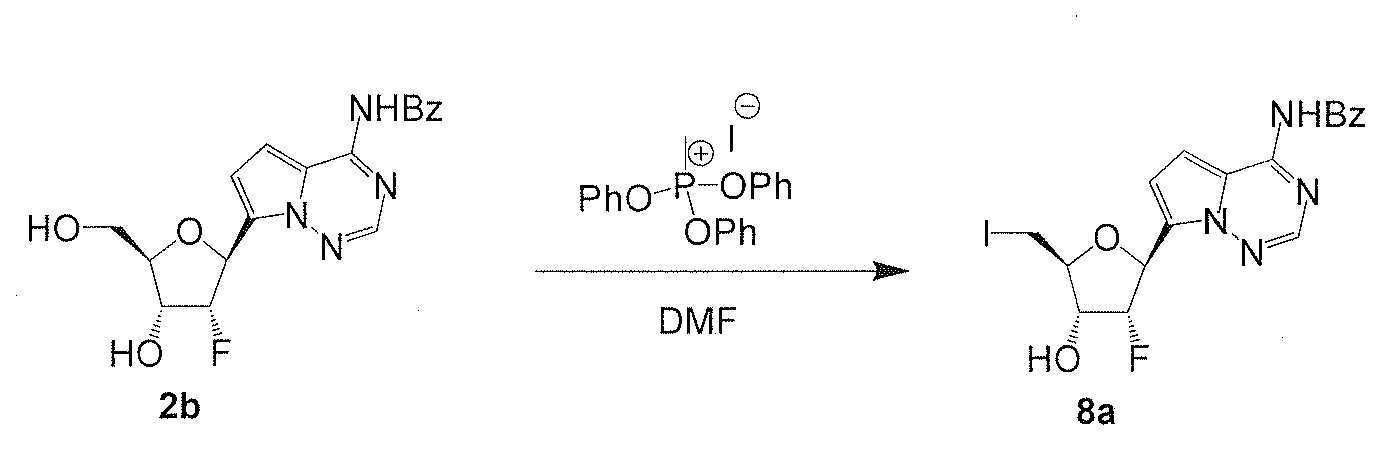
중간체 8a - N-(7-Intermediate 8a-N- (7- ((2S,3R,4R,5S)((2S, 3R, 4R, 5S) -3--3- 플루오로Fluoro -4-히드록시-5-(-4-hydroxy-5- ( 아이오도메틸Iodomethyl )테트라히드로푸란-2-일)피롤로[2,1-f][1,2,4]트리아진-4-일)벤즈아미드) Tetrahydrofuran-2-yl) pyrrolo [2,1-f] [1,2,4] triazin-4-yl) benzamide
아르곤 퍼징된 플라스크에 DMF (2 ㎖) 중의 2b (68 ㎎, 0.183 mmol)에 이어서 메틸트리펜옥시포스포늄 아이오다이드 (124 ㎎, 0.274 mmol)를 첨가하였다. 반응을 실온에서 5 분 동안 교반하고, 여기서 LCMS에 의하여 생성물로의 완전 전환이 관찰되었다. 반응을 메탄올로 켄칭시키고, 용매를 감압 하에서 제거하였다. 미정제 물질을 EtOAc 및 H2O 사이에 분배시켰다. 유기물을 분리하고, 염수로 세정하였다. 생성된 물질을 Na2SO4 위에서 건조시키고, 여과하고, 용매를 감압 하에서 제거하였다. 미정제 물질을 실리카 겔 크로마토그래피 (20-100% EtOAc/헥산)에 의하여 정제하여 중간체 8a를 얻었다.To an argon purged flask, 2b (68 mg, 0.183 mmol) in DMF (2 mL) was added followed by methyltriphenoxyphosphonium iodide (124 mg, 0.274 mmol). The reaction was stirred at room temperature for 5 minutes, where complete conversion to product was observed by LCMS. The reaction was quenched with methanol, and the solvent was removed under reduced pressure. The crude material was partitioned between EtOAc and H 2 O. The organics were separated and washed with brine. The resulting material was dried over Na 2 SO 4 , filtered, and the solvent was removed under reduced pressure. The crude material was purified by silica gel chromatography (20-100% EtOAc / hexane) to give intermediate 8a.
1H NMR (400 MHz, DMSO-d6) δ 8.17 (m, 3H), 7.63 (t, J=7.4 Hz, 1H), 7.53 (t, J=7.6 Hz, 2H), 7.17-6.96 (m, 2H), 5.74 (s, 1H), 5.60 (d, J=24.9 Hz, 1H), 5.19 (ddd, J=54.6, 4.5, 2.1 Hz, 1H), 4.09-3.92 (m, 1H), 3.72 (t, J=6.4 Hz, 1H), 3.63 (dd, J=11.0, 3.4 Hz, 1H), 3.44 (dd, J=11.0, 5.9 Hz, 1H). 1 H NMR (400 MHz, DMSO-d 6 ) δ 8.17 (m, 3H), 7.63 (t, J = 7.4 Hz, 1H), 7.53 (t, J = 7.6 Hz, 2H), 7.17-6.96 (m, 2H), 5.74 (s, 1H), 5.60 (d, J = 24.9 Hz, 1H), 5.19 (ddd, J = 54.6, 4.5, 2.1 Hz, 1H), 4.09-3.92 (m, 1H), 3.72 (t , J = 6.4 Hz, 1H), 3.63 (dd, J = 11.0, 3.4 Hz, 1H), 3.44 (dd, J = 11.0, 5.9 Hz, 1H).
19F NMR (376 MHz, DMSO-d6) δ -194.23 (m). 19 F NMR (376 MHz, DMSO-d 6 ) δ -194.23 (m).
LC/MS: tR=1.13 min, MS m/z=483.23 [M+1]LC / MS: t R = 1.13 min, MS m / z = 483.23 [M + 1]
LC 시스템: 써모 아셀라 1250 UHPLCLC system: Thermo Acela 1250 UHPLC
MS 시스템: 써모 LCQ 플리트; 컬럼: 키네텍스 2.6μ C18 100A, 50×3.00 ㎜MS system: Thermo LCQ pleats; Column: Kinetex 2.6 μ C18 100A, 50 × 3.00 mm
용매: 0.1% 포름산을 갖는 아세토니트릴, 0.1% 포름산을 갖는 물Solvent: acetonitrile with 0.1% formic acid, water with 0.1% formic acid
구배: 0 min-1.4 min 2-100% ACN, 1.4 min-1.80 min 100% ACN, 1.8 min-1.85 min 100%-2% ACN, 1.85 min-2 min 2% ACN.Gradient: 0 min-1.4 min 2-100% ACN, 1.4 min-1.80 min 100% ACN, 1.8 min-1.85 min 100% -2% ACN, 1.85 min-2 min 2% ACN.

중간체 8b - (Intermediate 8b-( 3R,4R,5S3R, 4R, 5S )-5-(4-) -5- (4- 아미노피롤로[2,1-f][1,2,4]트리아진Aminopyrrolo [2,1-f] [1,2,4] triazine -7-일)-4-플루오로-2-메틸렌테트라히드로푸란-3-올-7-yl) -4-fluoro-2-methylenetetrahydrofuran-3-ol
중간체 8a (80 ㎎, 0.166 mmol)를 THF 중에 용해시켰다. DBU (0.074 ㎖, 0.498 mmol)를 한번에 첨가하였다. 그 후, 반응을 60℃로 오일 배쓰 내에서 16 시간 동안 가열하였다. 반응을 실온으로 냉각시키고, 용매를 감압 하에서 제거하였다. 미정제 물질을 실리카 겔 크로마토그래피 (0-70% EtOAc/Hex)에 의하여 정제하여 중간체 8b를 얻었다.Intermediate 8a (80 mg, 0.166 mmol) was dissolved in THF. DBU (0.074 mL, 0.498 mmol) was added in one portion. The reaction was then heated to 60 ° C. in an oil bath for 16 hours. The reaction was cooled to room temperature, and the solvent was removed under reduced pressure. The crude material was purified by silica gel chromatography (0-70% EtOAc / Hex) to give intermediate 8b.
1H NMR (400 MHz, DMSO-d6) δ 8.34-8.05 (m, 3H), 7.63 (t, J=7.4 Hz, 1H), 7.53 (t, J=7.6 Hz, 2H), 7.13 (d, J=4.7 Hz, 1H), 6.85 (d, J=4.4 Hz, 1H), 5.97-5.82 (m, 2H), 5.39-5.13 (m, 1H), 4.89-4.69 (m, 1H), 4.38 (d, J=2.1 Hz, 1H), 4.16 (t, J=1.8 Hz, 1H). 1 H NMR (400 MHz, DMSO-d 6 ) δ 8.34-8.05 (m, 3H), 7.63 (t, J = 7.4 Hz, 1H), 7.53 (t, J = 7.6 Hz, 2H), 7.13 (d, J = 4.7 Hz, 1H), 6.85 (d, J = 4.4 Hz, 1H), 5.97-5.82 (m, 2H), 5.39-5.13 (m, 1H), 4.89-4.69 (m, 1H), 4.38 (d , J = 2.1 Hz, 1H), 4.16 (t, J = 1.8 Hz, 1H).
19F NMR (376 MHz, DMSO-d6) δ -198.14 (ddd, J=53.9, 24.7, 20.9 Hz). 19 F NMR (376 MHz, DMSO-d 6 ) δ -198.14 (ddd, J = 53.9, 24.7, 20.9 Hz).
LC/MS: tR=1.05 min, MS m/z=355.15 [M+1]LC / MS: t R = 1.05 min, MS m / z = 355.15 [M + 1]
LC 시스템: 써모 아셀라 1250 UHPLCLC system: Thermo Acela 1250 UHPLC
MS 시스템: 써모 LCQ 플리트; 컬럼: 키네텍스 2.6μ C18 100A, 50×3.00 ㎜MS system: Thermo LCQ pleats; Column: Kinetex 2.6 μ C18 100A, 50 × 3.00 mm
용매: 0.1% 포름산을 갖는 아세토니트릴, 0.1% 포름산을 갖는 물Solvent: acetonitrile with 0.1% formic acid, water with 0.1% formic acid
구배: 0 min-1.4 min 2-100% ACN, 1.4 min-1.80 min 100% ACN, 1.8 min-1.85 min 100%-2% ACN, 1.85 min-2 min 2% ACN.Gradient: 0 min-1.4 min 2-100% ACN, 1.4 min-1.80 min 100% ACN, 1.8 min-1.85 min 100% -2% ACN, 1.85 min-2 min 2% ACN.

중간체 8c - (Intermediate 8c-( 2S,3R,4R,5S2S, 3R, 4R, 5S )-5-(4-) -5- (4- 아미노피롤로[2,1-f][1,2,4]트리아진Aminopyrrolo [2,1-f] [1,2,4] triazine -7-일)-2-아지도-4-플루오로-2-(아이오도메틸)테트라히드로푸란-3-올-7-yl) -2-azido-4-fluoro-2- (iodomethyl) tetrahydrofuran-3-ol
벤질트리메틸암모늄 클로라이드 (55 ㎎, 0.296 mmol) 및 소듐 아지드 (19.3 ㎎, 0.296 mmol)를 ACN (1 ㎖) 중에 용해시켰다. 생성된 혼합물을 실온에서 밤새 교반한 후, 여과하고, 주사기에 의하여 THF (1 ㎖) 중의 중간체 8b (50 ㎎, 0.141 mmol)의 용액에 첨가하였다. 그 후, N-메틸모르폴린 (0.078 ㎖, 0.706 mmol)을 첨가한 후, THF (1 ㎖) 중의 아이오딘 (65 ㎎, 0.25 mmol)의 용액을 적가하였다. 15 분 후, 기체 발생이 더 이상 관찰되지 않을 때까지 N-아세틸 시스테인을 첨가하였다. 그 후, 용액이 담황색이 될 때까지 포화 수성 티오황산나트륨을 첨가하였다. 미정제 혼합물을 EtOAc 및 H2O 사이에 분배시켰다. 상이 분할되고, 유기층을 황산나트륨 위에서 건조시키고, 여과하고, 감압 하에서 농축시켰다. 미정제 물질을 실리카 겔 크로마토그래피 (0-60% EtOAc/Hex)에 의하여 정제하여 중간체 8c를 얻었다.Benzyltrimethylammonium chloride (55 mg, 0.296 mmol) and sodium azide (19.3 mg, 0.296 mmol) were dissolved in ACN (1 mL). The resulting mixture was stirred at room temperature overnight, then filtered and added to a solution of intermediate 8b (50 mg, 0.141 mmol) in THF (1 mL) by syringe. Then, after adding N-methylmorpholine (0.078 mL, 0.706 mmol), a solution of iodine (65 mg, 0.25 mmol) in THF (1 mL) was added dropwise. After 15 minutes, N-acetyl cysteine was added until no further gas evolution was observed. Thereafter, saturated aqueous sodium thiosulfate was added until the solution became pale yellow. The crude mixture was partitioned between EtOAc and H 2 O. The phases were partitioned, and the organic layer was dried over sodium sulfate, filtered and concentrated under reduced pressure. The crude material was purified by silica gel chromatography (0-60% EtOAc / Hex) to give intermediate 8c.
1H NMR (400 MHz, DMSO-d6) δ 8.31-8.05 (m, 3H), 7.63 (t, J=7.5 Hz, 1H), 7.53 (t, J=7.6 Hz, 2H), 7.14 (d, J=4.6 Hz, 1H), 7.04 (s, 1H), 6.34 (d, J=6.9 Hz, 1H), 5.80 (d, J=23.7 Hz, 1H), 5.55-5.31 (m, 1H), 4.62 (dt, J=21.9, 5.9 Hz, 1H), 3.78-3.56 (m, 2H). 1 H NMR (400 MHz, DMSO-d 6 ) δ 8.31-8.05 (m, 3H), 7.63 (t, J = 7.5 Hz, 1H), 7.53 (t, J = 7.6 Hz, 2H), 7.14 (d, J = 4.6 Hz, 1H), 7.04 (s, 1H), 6.34 (d, J = 6.9 Hz, 1H), 5.80 (d, J = 23.7 Hz, 1H), 5.55-5.31 (m, 1H), 4.62 ( dt, J = 21.9, 5.9 Hz, 1H), 3.78-3.56 (m, 2H).
19F NMR (376 MHz, DMSO-d6) δ -194.44 (dt, J=54.7, 22.8 Hz). 19 F NMR (376 MHz, DMSO-d 6 ) δ -194.44 (dt, J = 54.7, 22.8 Hz).
LC/MS: tR=1.19 min, MS m/z=524.09 [M+1]; LC 시스템: 써모 아셀라 1250 UHPLCLC / MS: t R = 1.19 min, MS m / z = 524.09 [M + 1]; LC system: Thermo Acela 1250 UHPLC
MS 시스템: 써모 LCQ 플리트; 컬럼: 키네텍스 2.6μ C18 100A, 50×3.00 ㎜MS system: Thermo LCQ pleats; Column: Kinetex 2.6 μ C18 100A, 50 × 3.00 mm
용매: 0.1% 포름산을 갖는 아세토니트릴, 0.1% 포름산을 갖는 물Solvent: acetonitrile with 0.1% formic acid, water with 0.1% formic acid
구배: 0 min-1.4 min 2-100% ACN, 1.4 min-1.80 min 100% ACN, 1.8 min-1.85 min 100%-2% ACN, 1.85 min-2 min 2% ACN.Gradient: 0 min-1.4 min 2-100% ACN, 1.4 min-1.80 min 100% ACN, 1.8 min-1.85 min 100% -2% ACN, 1.85 min-2 min 2% ACN.

중간체 8d - (Intermediate 8d-( 2S,3R,4S,5S2S, 3R, 4S, 5S )-5-(4-) -5- (4- 아미노피롤로[2,1-f][1,2,4]트리아진Aminopyrrolo [2,1-f] [1,2,4] triazine -7-일)-2-아지도-4-플루오로-2-(아이오도메틸)테트라히드로푸란-3-일 아세테이트-7-yl) -2-azido-4-fluoro-2- (iodomethyl) tetrahydrofuran-3-yl acetate
THF (1 ㎖) 중의 중간체 8c (40 ㎎, 0.076 mmol)의 용액에 아세트산 무수물 (0.009 ㎖, 0.092 mmol)에 이어서 DMAP (10 ㎎, 0.082 mmol)를 실온에서 첨가하였다. 15 분 후, 반응 혼합물을 메탄올로 켄칭시키고, 생성된 혼합물을 감압 하에서 농축시켰다. 미정제물을 실리카 겔 크로마토그래피 (0-50% EtOAc/Hex)에 의하여 정제하여 중간체 8d를 얻었다.To a solution of intermediate 8c (40 mg, 0.076 mmol) in THF (1 mL) acetic anhydride (0.009 mL, 0.092 mmol) was added followed by DMAP (10 mg, 0.082 mmol) at room temperature. After 15 minutes, the reaction mixture was quenched with methanol, and the resulting mixture was concentrated under reduced pressure. The crude was purified by silica gel chromatography (0-50% EtOAc / Hex) to give intermediate 8d.
1H NMR (400 MHz, CDCl3) δ 8.15-8.02 (m, 3H), 7.62 (t, J=7.3 Hz, 1H), 7.53 (t, J=7.6 Hz, 2H), 7.44 (d, J=4.6 Hz, 1H), 7.00 (d, J=4.6 Hz, 1H), 5.95-5.80 (m, 1H), 5.70-5.43 (m, 2H), 3.71 (d, J=11.3 Hz, 1H), 3.60 (d, J=11.3 Hz, 1H), 2.25 (s, 3H). 1 H NMR (400 MHz, CDCl 3 ) δ 8.15-8.02 (m, 3H), 7.62 (t, J = 7.3 Hz, 1H), 7.53 (t, J = 7.6 Hz, 2H), 7.44 (d, J = 4.6 Hz, 1H), 7.00 (d, J = 4.6 Hz, 1H), 5.95-5.80 (m, 1H), 5.70-5.43 (m, 2H), 3.71 (d, J = 11.3 Hz, 1H), 3.60 ( d, J = 11.3 Hz, 1H), 2.25 (s, 3H).
19F NMR (376 MHz, CDCl3) δ -192.78 (ddd, J=55.7, 24.6, 18.5 Hz). 19 F NMR (376 MHz, CDCl 3 ) δ -192.78 (ddd, J = 55.7, 24.6, 18.5 Hz).
LC/MS: tR=1.35 min, MS m/z=566.14 [M+1]; LC 시스템: 써모 아셀라 1250 UHPLCLC / MS: t R = 1.35 min, MS m / z = 566.14 [M + 1]; LC system: Thermo Acela 1250 UHPLC
MS 시스템: 써모 LCQ 플리트; 컬럼: 키네텍스 2.6μ C18 100A, 50×3.00 ㎜MS system: Thermo LCQ pleats; Column: Kinetex 2.6 μ C18 100A, 50 × 3.00 mm
용매: 0.1% 포름산을 갖는 아세토니트릴, 0.1% 포름산을 갖는 물Solvent: acetonitrile with 0.1% formic acid, water with 0.1% formic acid
구배: 0 min-1.4 min 2-100% ACN, 1.4 min-1.80 min 100% ACN, 1.8 min-1.85 min 100%-2% ACN, 1.85 min-2 min 2% ACN.Gradient: 0 min-1.4 min 2-100% ACN, 1.4 min-1.80 min 100% ACN, 1.8 min-1.85 min 100% -2% ACN, 1.85 min-2 min 2% ACN.
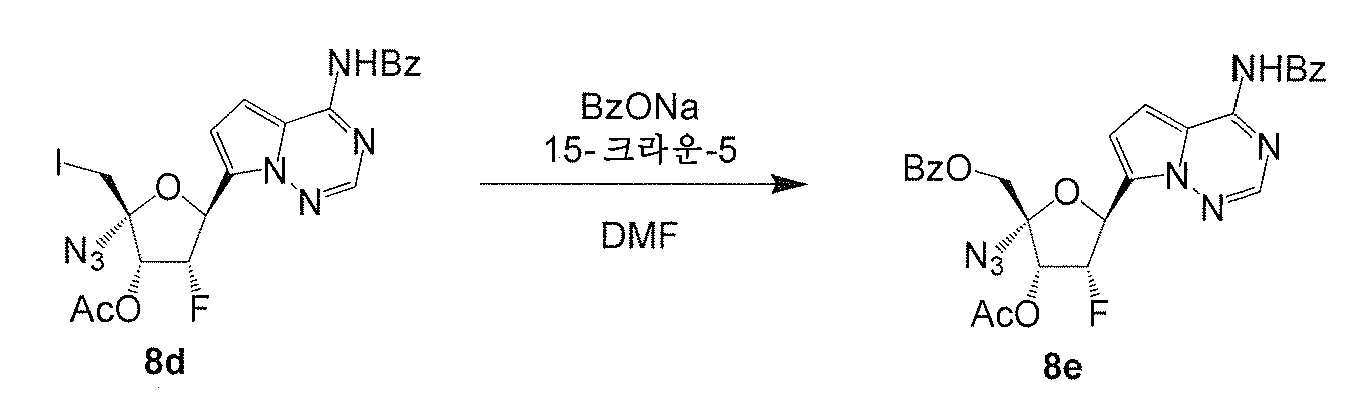
중간체 8e - ((Intermediate 8e-(( 2R,3R,4S,5S2R, 3R, 4S, 5S )-3-) -3- 아세톡시Acetoxy -2--2- 아지도Oh -5-(4--5- (4- 벤즈아미도피롤로[2,1-f][1,2,4]트리아진Benzamidopyrrolo [2,1-f] [1,2,4] triazine -7-일)-4-플루오로테트라히드로푸란-2-일)메틸 -7-yl) -4-fluorotetrahydrofuran-2-yl) methyl 벤조에이트Benzoate
DMF (2 ㎖) 중의 중간체 8d (30 ㎎s, 0.053 mmol)의 용액에 15-크라운-5 (0.105 ㎖, 0.531 mmol) 및 벤조산나트륨 (77 ㎎, 0.531 mmol)을 실온에서 첨가하였다. 그 후, 반응을 105℃로 가열하였다. 30 시간 후, 반응 혼합물이 실온이 되게 하고, 5% LiCl(aq) 및 EtOAc 사이에 분배시켰다. 상이 분할되고, 수성상을 EtOAc로 세정하였다 (2×). 합한 유기 추출물을 무수 황산나트륨 위에서 건조시키고, 감압 하에서 농축시켰다. 미정제 잔류물을 실리카 겔 크로마토그래피 (0-60% EtOAc/Hex)에 의하여 정제하여 중간체 8e를 얻었다.To a solution of intermediate 8d (30 mgs, 0.053 mmol) in DMF (2 mL) was added 15-crown-5 (0.105 mL, 0.531 mmol) and sodium benzoate (77 mg, 0.531 mmol) at room temperature. Thereafter, the reaction was heated to 105 ° C. After 30 hours, the reaction mixture was brought to room temperature and partitioned between 5% LiCl (aq) and EtOAc. The phases were partitioned and the aqueous phase was washed with EtOAc (2x). The combined organic extracts were dried over anhydrous sodium sulfate and concentrated under reduced pressure. The crude residue was purified by silica gel chromatography (0-60% EtOAc / Hex) to give intermediate 8e.
1H NMR (400 MHz, CDCl3) δ 8.25-7.97 (m, 4H), 7.69-7.40 (m, 6H), 7.36 (d, J=4.7 Hz, 1H), 6.95-6.80 (m, 1H), 5.90 (d, J=25.0 Hz, 1H), 5.65 (d, J=1.9 Hz, 1H), 5.62-5.48 (m, 1H), 4.69 (dd, J=79.3, 12.0 Hz, 2H), 2.20 (s, 3H). 1 H NMR (400 MHz, CDCl 3 ) δ 8.25-7.97 (m, 4H), 7.69-7.40 (m, 6H), 7.36 (d, J = 4.7 Hz, 1H), 6.95-6.80 (m, 1H), 5.90 (d, J = 25.0 Hz, 1H), 5.65 (d, J = 1.9 Hz, 1H), 5.62-5.48 (m, 1H), 4.69 (dd, J = 79.3, 12.0 Hz, 2H), 2.20 (s , 3H).
19F NMR (376 MHz, CDCl3) δ -192.57 (ddd, J=53.9, 25.1, 22.0 Hz). 19 F NMR (376 MHz, CDCl 3 ) δ -192.57 (ddd, J = 53.9, 25.1, 22.0 Hz).
LC/MS: tR=1.45 min, MS m/z=560.14 [M+1]; LC 시스템: 써모 아셀라 1250 UHPLCLC / MS: t R = 1.45 min, MS m / z = 560.14 [M + 1]; LC system: Thermo Acela 1250 UHPLC
MS 시스템: 써모 LCQ 플리트; 컬럼: 키네텍스 2.6μ C18 100A, 50×3.00 ㎜MS system: Thermo LCQ pleats; Column: Kinetex 2.6 μ C18 100A, 50 × 3.00 mm
용매: 0.1% 포름산을 갖는 아세토니트릴, 0.1% 포름산을 갖는 물Solvent: acetonitrile with 0.1% formic acid, water with 0.1% formic acid
구배: 0 min-1.4 min 2-100% ACN, 1.4 min-1.80 min 100% ACN, 1.8 min-1.85 min 100%-2% ACN, 1.85 min-2 min 2% ACN.Gradient: 0 min-1.4 min 2-100% ACN, 1.4 min-1.80 min 100% ACN, 1.8 min-1.85 min 100% -2% ACN, 1.85 min-2 min 2% ACN.

실시예Example 19 - ( 19-( 2R,3R,4R,5S2R, 3R, 4R, 5S )-5-(4-) -5- (4- 아미노피롤로[2,1-f][1,2,4]트리아진Aminopyrrolo [2,1-f] [1,2,4] triazine -7-일)-2-아지도-4-플루오로-2-(히드록시메틸)테트라히드로푸란-3-올-7-yl) -2-azido-4-fluoro-2- (hydroxymethyl) tetrahydrofuran-3-ol
중간체 8e (24 ㎎, 0.043 mmol)에 CH3OH (2 ㎖) 중의 7N NH3을 실온에서 첨가하였다. 16 시간 후, 생성된 혼합물을 감압 하에서 농축시켰다. 미정제 잔류물을 산 변형제를 사용하지 않고 역상 HPLC에 의하여 정제하여 실시예 19를 얻었다.7N NH 3 in CH 3 OH (2 mL) was added to intermediate 8e (24 mg, 0.043 mmol) at room temperature. After 16 hours, the resulting mixture was concentrated under reduced pressure. The crude residue was purified by reverse phase HPLC without using an acid modifier to give Example 19.
1H NMR (400 MHz, 메탄올-d4) δ 7.81 (s, 1H), 6.85 (d, J=4.5 Hz, 1H), 6.80 (d, J=4.5 Hz, 1H), 5.80 (dd, J=24.7, 1.9 Hz, 1H), 5.22 (ddd, J=55.6, 5.1, 1.9 Hz, 1H), 4.63 (dd, J=22.9, 5.1 Hz, 1H), 3.81 (d, J=12.1 Hz, 1H), 3.70 (d, J=12.2 Hz, 1H). 1 H NMR (400 MHz, methanol-d 4 ) δ 7.81 (s, 1H), 6.85 (d, J = 4.5 Hz, 1H), 6.80 (d, J = 4.5 Hz, 1H), 5.80 (dd, J = 24.7, 1.9 Hz, 1H), 5.22 (ddd, J = 55.6, 5.1, 1.9 Hz, 1H), 4.63 (dd, J = 22.9, 5.1 Hz, 1H), 3.81 (d, J = 12.1 Hz, 1H), 3.70 (d, J = 12.2 Hz, 1H).
19F NMR (376 MHz, 메탄올-d4) δ -195.30 (ddd, J=55.5, 24.6, 22.9 Hz). 19 F NMR (376 MHz, methanol-d 4 ) δ -195.30 (ddd, J = 55.5, 24.6, 22.9 Hz).
LC/MS: tR=0.61 min, MS m/z=310.02 [M+1]; LC 시스템: 써모 아셀라 1250 UHPLCLC / MS: t R = 0.61 min, MS m / z = 310.02 [M + 1]; LC system: Thermo Acela 1250 UHPLC
MS 시스템: 써모 LCQ 플리트; 컬럼: 키네텍스 2.6μ C18 100A, 50×3.00 ㎜MS system: Thermo LCQ pleats; Column: Kinetex 2.6 μ C18 100A, 50 × 3.00 mm
용매: 0.1% 포름산을 갖는 아세토니트릴, 0.1% 포름산을 갖는 물Solvent: acetonitrile with 0.1% formic acid, water with 0.1% formic acid
구배: 0 min-1.4 min 2-100% ACN, 1.4 min-1.80 min 100% ACN, 1.8 min-1.85 min 100%-2% ACN, 1.85 min-2 min 2% ACN.Gradient: 0 min-1.4 min 2-100% ACN, 1.4 min-1.80 min 100% ACN, 1.8 min-1.85 min 100% -2% ACN, 1.85 min-2 min 2% ACN.
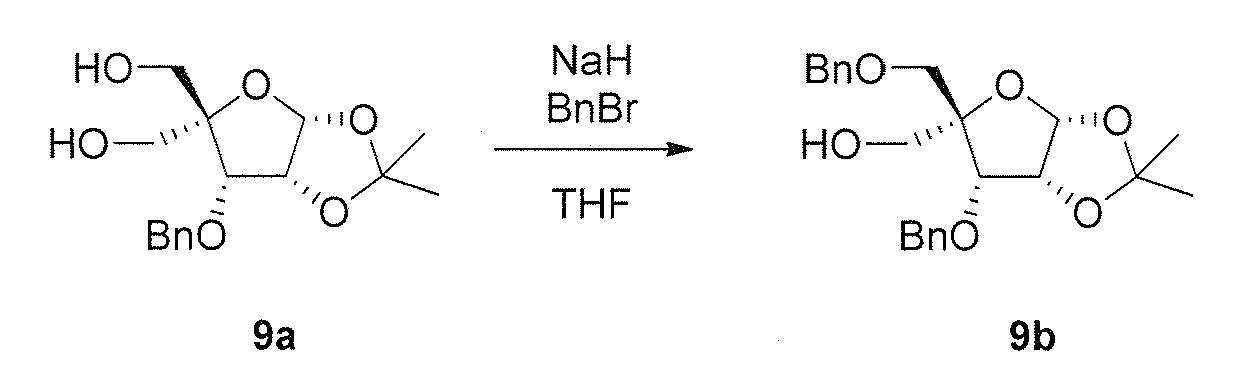
중간체 9b - ((Intermediate 9b-(( 3aR,5R,6S,6aR3aR, 5R, 6S, 6aR )-6-() -6- ( 벤질옥시Benzyloxy )-5-(() -5-(( 벤질옥시Benzyloxy )) 메틸methyl )-2,2-) -2,2- 디메틸테트라히드로푸로[2,3-d][1,3]디옥솔Dimethyltetrahydrofuro [2,3-d] [1,3] dioxole -5-일)메탄올-5-yl) methanol
((3aR,6S,6aR)-6-(벤질옥시)-2,2-디메틸테트라히드로푸로[2,3-d][1,3]디옥솔-5,5-디일)디메탄올 (9a, 카르보신쓰로부터 구입함, 10.0 g, 32.2 mmol)을 THF (100 ㎖) 중의 수소화나트륨 (60 중량%, 1.55 g, 38.7 mmol)의 용액에 0℃에서 아르곤 대기 하에서 첨가하였다. 10 분 후, 벤질 브로마이드 (4.54 ㎖, 38.6 mmol)를 첨가하고, 반응 혼합물을 실온으로 가온되도록 하였다. 2 시간 후, 반응을 포화 염화암모늄 수용액 (500 ㎖)으로 켄칭시켰다. 생성된 혼합물을 에틸 아세테이트 (500 ㎖)로 추출하였다. 그 후, 유기 상을 염수 (400 ㎖)로 세정하고, 무수 황산나트륨 위에서 건조시키고, 감압 하에서 농축시켜 무색 오일을 얻었다. 미정제 잔류물을 SiO2 컬럼 크로마토그래피 (220 g SiO2 콤비플래쉬 HP 골드 컬럼, 0-100% 에틸 아세테이트/헥산)에 의하여 정제하여 중간체 9a (9.49 g, 73%)를 무색 오일로서 얻었다.((3aR, 6S, 6aR) -6- (benzyloxy) -2,2-dimethyltetrahydrofuro [2,3-d] [1,3] dioxol-5,5-diyl) dimethanol (9a, To a solution of sodium hydride (60% by weight, 1.55 g, 38.7 mmol) in THF (100 mL) was added from Carbocinth, 10.0 g, 32.2 mmol) at 0 ° C. under an argon atmosphere. After 10 minutes, benzyl bromide (4.54 ml, 38.6 mmol) was added and the reaction mixture was allowed to warm to room temperature. After 2 hours, the reaction was quenched with saturated aqueous ammonium chloride solution (500 mL). The resulting mixture was extracted with ethyl acetate (500 mL). Thereafter, the organic phase was washed with brine (400 mL), dried over anhydrous sodium sulfate, and concentrated under reduced pressure to give a colorless oil. The crude residue was purified by SiO 2 column chromatography (220 g SiO 2 Combiflash HP Gold column, 0-100% ethyl acetate / hexane) to give Intermediate 9a (9.49 g, 73%) as a colorless oil.
1H NMR (400 MHz, DMSO-d6) δ 7.38-7.19 (m, 10H), 5.68 (app t, J=3.6 Hz, 1H), 4.73 (q, J=4.4 Hz, 1H), 4.63 (d, J=12.1 Hz, 1H), 4.49-4.36 (m, 3H), 4.24 (br s, 1H), 4.20-4.13 (m, 1H), 3.81 (d, J=11.9 Hz, 1H), 3.56 (d, J=11.9 Hz, 1H), 3.46 (q, J=10.3 Hz, 2H), 1.47 (s, 3H), 1.25 (s, 3H). 1 H NMR (400 MHz, DMSO-d 6 ) δ 7.38-7.19 (m, 10H), 5.68 (app t, J = 3.6 Hz, 1H), 4.73 (q, J = 4.4 Hz, 1H), 4.63 (d , J = 12.1 Hz, 1H), 4.49-4.36 (m, 3H), 4.24 (br s, 1H), 4.20-4.13 (m, 1H), 3.81 (d, J = 11.9 Hz, 1H), 3.56 (d , J = 11.9 Hz, 1H), 3.46 (q, J = 10.3 Hz, 2H), 1.47 (s, 3H), 1.25 (s, 3H).
LC/MS: tR=1.88 min, MS m/z=423.31 [M+Na]; LC 시스템: 써모 아셀라 1250 UHPLC; MS 시스템: 써모 LCQ 플리트; 컬럼: 키네텍스 2.6μ XB-C18 100A, 50×4.6 ㎜; 용매: 0.1% 아세트산을 갖는 아세토니트릴, 0.1% 아세트산을 갖는 물; 구배: 2 ㎕/min으로 0 min-2.0 min 2-100% ACN, 2.0 min-3.05 min 100% ACN, 3.05 min-3.2 min 100%-2% ACN, 3.2 min-3.5 min 2% ACN.LC / MS: t R = 1.88 min, MS m / z = 423.31 [M + Na]; LC system: Thermo Acela 1250 UHPLC; MS system: Thermo LCQ pleats; Column: Kinetex 2.6 μ XB-C18 100A, 50 × 4.6 mm; Solvent: acetonitrile with 0.1% acetic acid, water with 0.1% acetic acid; Gradient: 0 min-2.0 min 2-100% ACN, 2.0 min-3.05 min 100% ACN, 3.05 min-3.2 min 100% -2% ACN, 3.2 min-3.5 min 2% ACN at 2 μl / min.
HPLC: tR=3.79 min; HPLC 시스템: 아질런트 1100 시리즈; 컬럼: 제미니 5μ C18 110A, 50×4.6 ㎜; 용매: 0.1% TFA를 갖는 아세토니트릴, 0.1% TFA를 갖는 물; 구배: 2 ㎖/min으로 0 min-5.0 min 2-98% ACN, 5.0 min-6.0 min 98% ACN.HPLC: t R = 3.79 min; HPLC system: Agilent 1100 series; Column: Gemini 5μ C18 110A, 50 × 4.6 mm; Solvent: acetonitrile with 0.1% TFA, water with 0.1% TFA; Gradient: 0 min-5.0 min 2-98% ACN at 2 mL / min, 5.0 min-6.0 min 98% ACN.
TLC: 용리제: 헥산 중의 40% 에틸 아세테이트, Rf=0.4 (UV)TLC: Eluent: 40% ethyl acetate in hexane, R f = 0.4 (UV)
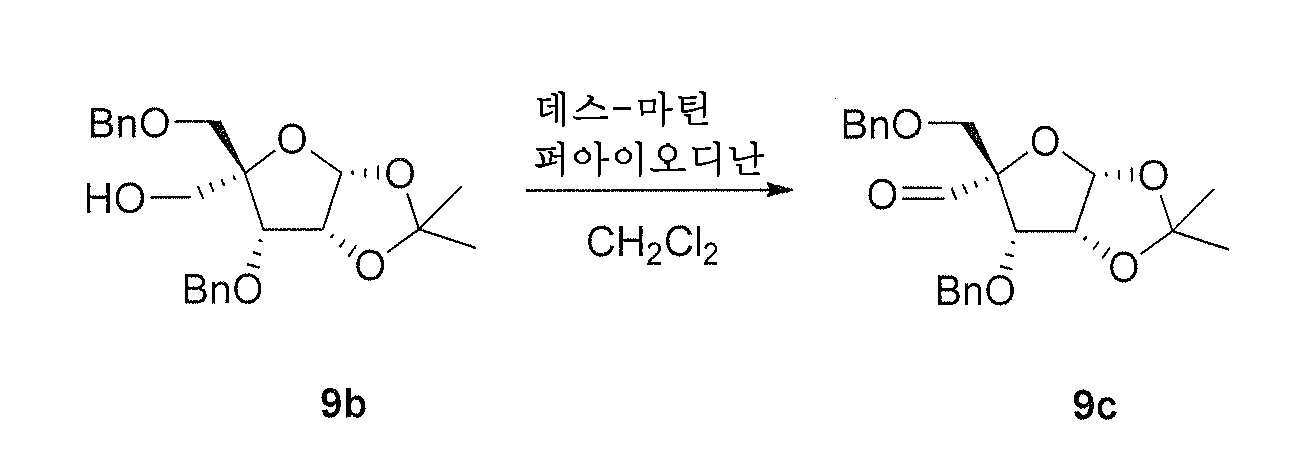
중간체 9c - (Intermediate 9c-( 3aR,5R,6S,6aR3aR, 5R, 6S, 6aR )-6-() -6- ( 벤질옥시Benzyloxy )-5-(() -5-(( 벤질옥시Benzyloxy )) 메틸methyl )-2,2-) -2,2- 디메틸테트라히드로푸로[2,3-d][1,3]디옥솔Dimethyltetrahydrofuro [2,3-d] [1,3] dioxole -5-카르브알데히드-5-carbaldehyde
데스-마틴 퍼아이오디난(Dess-Martin Periodinane) (3.1 g, 7.3 mmol)을 디클로로메탄 (24.5 ㎖) 중의 중간체 9b (1.95 g, 4.87 mmol)의 용액에 실온에서 첨가하였다. 1.5 시간 후, 반응 혼합물을 SiO2 컬럼 크로마토그래피 (80 g SiO2 콤비플래쉬 HP 골드 컬럼, 0-100% 에틸 아세테이트/헥산)에 의하여 정제하여 중간체 9c (1.94 g, 100%)를 무색 오일로서 얻었다.Dess-Martin Periodinane (3.1 g, 7.3 mmol) was added to a solution of intermediate 9b (1.95 g, 4.87 mmol) in dichloromethane (24.5 mL) at room temperature. After 1.5 hours, the reaction mixture was purified by SiO 2 column chromatography (80 g SiO 2 Combiflash HP Gold column, 0-100% ethyl acetate / hexane) to give intermediate 9c (1.94 g, 100%) as a colorless oil. .
1H NMR (400 MHz, CDCl3) δ 9.91 (s, 1H), 7.36-7.11 (m, 10H), 5.84 (d, J=3.4 Hz, 1H), 4.71 (d, J=12.1 Hz, 1H), 4.59 (d, J=12.2 Hz, 1H), 4.59-4.58 (m, 1H), 4.52 (d, J=12.0 Hz, 1H), 4.46 (d, J=12.0 Hz, 1H), 4.37 (d, J=4.4 Hz, 1H), 3.68 (d, J=11.0 Hz, 1H), 3.61 (d, J=11.0 Hz, 1H), 1.60 (s, 3H), 1.35 (s, 3H). 1 H NMR (400 MHz, CDCl 3 ) δ 9.91 (s, 1H), 7.36-7.11 (m, 10H), 5.84 (d, J = 3.4 Hz, 1H), 4.71 (d, J = 12.1 Hz, 1H) , 4.59 (d, J = 12.2 Hz, 1H), 4.59-4.58 (m, 1H), 4.52 (d, J = 12.0 Hz, 1H), 4.46 (d, J = 12.0 Hz, 1H), 4.37 (d, J = 4.4 Hz, 1H), 3.68 (d, J = 11.0 Hz, 1H), 3.61 (d, J = 11.0 Hz, 1H), 1.60 (s, 3H), 1.35 (s, 3H).
LC/MS: tR=1.99 min, MS m/z=421.25 [M+Na]; LC 시스템: 써모 아셀라 1250 UHPLC; MS 시스템: 써모 LCQ 플리트; 컬럼: 키네텍스 2.6μ XB-C18 100A, 50×4.6 ㎜; 용매: 0.1% 아세트산을 갖는 아세토니트릴, 0.1% 아세트산을 갖는 물; 구배: 2 ㎕/min으로 0 min-2.0 min 2-100% ACN, 2.0 min-3.05 min 100% ACN, 3.05 min-3.2 min 100%-2% ACN, 3.2 min-3.5 min 2% ACN.LC / MS: t R = 1.99 min, MS m / z = 421.25 [M + Na]; LC system: Thermo Acela 1250 UHPLC; MS system: Thermo LCQ pleats; Column: Kinetex 2.6 μ XB-C18 100A, 50 × 4.6 mm; Solvent: acetonitrile with 0.1% acetic acid, water with 0.1% acetic acid; Gradient: 0 min-2.0 min 2-100% ACN, 2.0 min-3.05 min 100% ACN, 3.05 min-3.2 min 100% -2% ACN, 3.2 min-3.5 min 2% ACN at 2 μl / min.
HPLC: tR=4.09 min; HPLC 시스템: 아질런트 1100 시리즈; 컬럼: 제미니 5μ C18 110A, 50×4.6 ㎜; 용매: 0.1% TFA를 갖는 아세토니트릴, 0.1% TFA를 갖는 물; 구배: 2 ㎖/min으로 0 min-5.0 min 2-98% ACN, 5.0 min-6.0 min 98% ACN.HPLC: t R = 4.09 min; HPLC system: Agilent 1100 series; Column: Gemini 5μ C18 110A, 50 × 4.6 mm; Solvent: acetonitrile with 0.1% TFA, water with 0.1% TFA; Gradient: 0 min-5.0 min 2-98% ACN at 2 mL / min, 5.0 min-6.0 min 98% ACN.
TLC: 용리제: 헥산 중의 40% 에틸 아세테이트, Rf=0.6 (UV)TLC: Eluent: 40% ethyl acetate in hexane, R f = 0.6 (UV)

중간체 9d - (Intermediate 9d-( 3aR,5R,6S,6aR3aR, 5R, 6S, 6aR )-6-() -6- ( 벤질옥시Benzyloxy )-5-(() -5-(( 벤질옥시Benzyloxy )) 메틸methyl )-2,2-디메틸-5-비닐테트라히드로푸로[2,3-d][1,3]디옥솔) -2,2-dimethyl-5-vinyltetrahydrofuro [2,3-d] [1,3] dioxole
2.5M n-부틸리튬 (6.02 ㎖)을 테트라히드로푸란 (20 ㎖) 중의 메틸트리페닐포스포늄 브로마이드 (5.38 g, 15.1 mmol)의 용액에 -78℃에서 첨가하였다. 반응을 0℃로 가온시키고, 테트라히드로푸란 (5 ㎖) 중의 중간체 9c (2.00 g, 5.02 mmol)의 용액을 주사기에 의하여 서서히 첨가하였다. 반응 혼합물을 실온으로 가온시키고, 4 시간 동안 교반하였다. 그 후, 반응 혼합물을 포화 염화암모늄 수용액 (10 ㎖)으로 켄칭시키고, 물 (200 ㎖) 및 에틸 아세테이트 (200 ㎖) 사이에 분배시켰다. 층이 분할되고, 유기층을 염수 (200 ㎖)로 세정하고, 무수 황산나트륨 위에서 건조시키고, 감압 하에서 농축시켰다. 미정제 잔류물을 SiO2 컬럼 크로마토그래피 (120 g SiO2 콤비플래쉬 HP 골드 컬럼, 0-50% 에틸 아세테이트/헥산)에 의하여 정제하여 중간체 9d (1.01 g, 51%)를 무색 오일로서 얻었다.2.5M n-butyllithium (6.02 mL) was added to a solution of methyltriphenylphosphonium bromide (5.38 g, 15.1 mmol) in tetrahydrofuran (20 mL) at -78 ° C. The reaction was warmed to 0 ° C. and a solution of intermediate 9c (2.00 g, 5.02 mmol) in tetrahydrofuran (5 mL) was added slowly by syringe. The reaction mixture was allowed to warm to room temperature and stirred for 4 hours. Then the reaction mixture was quenched with saturated aqueous ammonium chloride solution (10 mL) and partitioned between water (200 mL) and ethyl acetate (200 mL). The layers were partitioned, and the organic layer was washed with brine (200 mL), dried over anhydrous sodium sulfate, and concentrated under reduced pressure. The crude residue was purified by SiO 2 column chromatography (120 g SiO 2 Combiflash HP Gold column, 0-50% ethyl acetate / hexane) to give intermediate 9d (1.01 g, 51%) as a colorless oil.
1H NMR (400 MHz, CDCl3) δ 7.42-7.17 (m, 10H), 6.19 (dd, J=17.6, 11.0 Hz, 1H), 5.76 (d, J=3.9 Hz, 1H), 5.52 (dd, J=17.5, 1.9 Hz, 1H), 5.25 (dd, J=11.1, 1.8 Hz, 1H), 4.76 (d, J=12.3 Hz, 1H), 4.62-4.55 (m, 2H), 4.52 (d, J=12.1 Hz, 1H), 4.41 (d, J=12.1 Hz, 1H), 4.25 (d, J=4.9 Hz, 1H), 3.32 (d, J=1.5 Hz, 2H), 1.52 (s, 3H), 1.29 (s, 3H) 1 H NMR (400 MHz, CDCl 3 ) δ 7.42-7.17 (m, 10H), 6.19 (dd, J = 17.6, 11.0 Hz, 1H), 5.76 (d, J = 3.9 Hz, 1H), 5.52 (dd, J = 17.5, 1.9 Hz, 1H), 5.25 (dd, J = 11.1, 1.8 Hz, 1H), 4.76 (d, J = 12.3 Hz, 1H), 4.62-4.55 (m, 2H), 4.52 (d, J = 12.1 Hz, 1H), 4.41 (d, J = 12.1 Hz, 1H), 4.25 (d, J = 4.9 Hz, 1H), 3.32 (d, J = 1.5 Hz, 2H), 1.52 (s, 3H), 1.29 (s, 3H)
LC/MS: tR=2.13 min, MS m/z=419.24 [M+Na]; LC 시스템: 써모 아셀라 1250 UHPLC; MS 시스템: 써모 LCQ 플리트; 컬럼: 키네텍스 2.6μ XB-C18 100A, 50×4.6 ㎜; 용매: 0.1% 아세트산을 갖는 아세토니트릴, 0.1% 아세트산을 갖는 물; 구배: 2 ㎕/min으로 0 min-2.0 min 2-100% ACN, 2.0 min-3.05 min 100% ACN, 3.05 min-3.2 min 100%-2% ACN, 3.2 min-3.5 min 2% ACN.LC / MS: t R = 2.13 min, MS m / z = 419.24 [M + Na]; LC system: Thermo Acela 1250 UHPLC; MS system: Thermo LCQ pleats; Column: Kinetex 2.6 μ XB-C18 100A, 50 × 4.6 mm; Solvent: acetonitrile with 0.1% acetic acid, water with 0.1% acetic acid; Gradient: 0 min-2.0 min 2-100% ACN, 2.0 min-3.05 min 100% ACN, 3.05 min-3.2 min 100% -2% ACN, 3.2 min-3.5 min 2% ACN at 2 μl / min.
HPLC: tR=4.37 min; HPLC 시스템: 아질런트 1100 시리즈; 컬럼: 제미니 5μ C18 110A, 50×4.6 ㎜; 용매: 0.1% TFA를 갖는 아세토니트릴, 0.1% TFA를 갖는 물; 구배: 2 ㎖/min으로 0 min-5.0 min 2-98% ACN, 5.0 min-6.0 min 98% ACN.HPLC: t R = 4.37 min; HPLC system: Agilent 1100 series; Column: Gemini 5μ C18 110A, 50 × 4.6 mm; Solvent: acetonitrile with 0.1% TFA, water with 0.1% TFA; Gradient: 0 min-5.0 min 2-98% ACN at 2 mL / min, 5.0 min-6.0 min 98% ACN.
TLC: 용리제: 헥산 중의 50% 에틸 아세테이트, Rf=0.55 (UV)TLC: Eluent: 50% ethyl acetate in hexane, R f = 0.55 (UV)
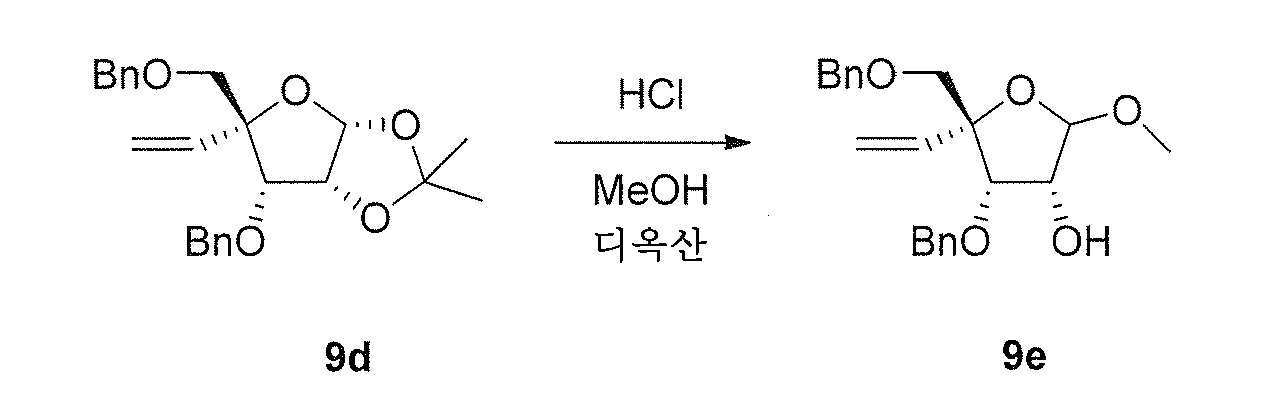
중간체 9e - (Intermediate 9e-( 3R,4S,5R3R, 4S, 5R )-4-()-4-( 벤질옥시Benzyloxy )-5-(() -5-(( 벤질옥시Benzyloxy )) 메틸methyl )-2-)-2- 메톡시Methoxy -5--5- 비닐테트라히드로푸란Vinyl tetrahydrofuran -3-올-3-all
디옥산 중의 4M HCl (320 ㎕)을 메탄올 (12.5 ㎖) 중의 중간체 9d (1.01 g, 2.55 mmol)의 용액에 실온에서 첨가하였다. 1.25 시간 후, 반응 혼합물을 에틸 아세테이트 (100 ㎖) 및 포화 중탄산나트륨 수용액 (100 ㎖) 사이에 분배시켰다. 상이 분할되고, 유기 상을 염수 (100 ㎖)로 세정하고, 무수 황산나트륨 위에서 건조시키고, 감압 하에서 농축시켜 미정제 중간체 9e (1.05 g, 1' 아노머의 ~2.5:1 혼합물)를 무색 오일로서 얻었다.4M HCl in dioxane (320 μl) was added to a solution of intermediate 9d (1.01 g, 2.55 mmol) in methanol (12.5 mL) at room temperature. After 1.25 hours, the reaction mixture was partitioned between ethyl acetate (100 mL) and saturated aqueous sodium bicarbonate solution (100 mL). The phases were partitioned, and the organic phase was washed with brine (100 mL), dried over anhydrous sodium sulfate and concentrated under reduced pressure to give crude intermediate 9e (1.05 g, ˜2.5: 1 mixture of 1 ′ anomer) as a colorless oil. .
LC/MS: 주요 아노머 tR=2.00 min, MS m/z=393.22 [M+Na], 소수의 아노머 tR=1.98 min, MS m/z=393.22 [M+Na]; LC 시스템: 써모 아셀라 1250 UHPLC; MS 시스템: 써모 LCQ 플리트; 컬럼: 키네텍스 2.6μ XB-C18 100A, 50×4.6 ㎜; 용매: 0.1% 아세트산을 갖는 아세토니트릴, 0.1% 아세트산을 갖는 물; 구배: 2 ㎕/min으로 0 min-2.0 min 2-100% ACN, 2.0 min-3.05 min 100% ACN, 3.05 min-3.2 min 100%-2% ACN, 3.2 min-3.5 min 2% ACN.LC / MS: major anomer t R = 2.00 min, MS m / z = 393.22 [M + Na], few anomer t R = 1.98 min, MS m / z = 393.22 [M + Na]; LC system: Thermo Acela 1250 UHPLC; MS system: Thermo LCQ pleats; Column: Kinetex 2.6 μ XB-C18 100A, 50 × 4.6 mm; Solvent: acetonitrile with 0.1% acetic acid, water with 0.1% acetic acid; Gradient: 0 min-2.0 min 2-100% ACN, 2.0 min-3.05 min 100% ACN, 3.05 min-3.2 min 100% -2% ACN, 3.2 min-3.5 min 2% ACN at 2 μl / min.
HPLC: 주요 아노머 tR=4.01 min, 소수의 아노머 tR=3.955 min; HPLC 시스템: 아질런트 1100 시리즈; 컬럼: 제미니 5μ C18 110A, 50×4.6 ㎜; 용매: 0.1% TFA를 갖는 아세토니트릴, 0.1% TFA를 갖는 물; 구배: 2 ㎖/min으로 0 min-5.0 min 2-98% ACN, 5.0 min-6.0 min 98% ACN.HPLC: major anomer t R = 4.01 min, few anomer t R = 3.955 min; HPLC system: Agilent 1100 series; Column: Gemini 5μ C18 110A, 50 × 4.6 mm; Solvent: acetonitrile with 0.1% TFA, water with 0.1% TFA; Gradient: 0 min-5.0 min 2-98% ACN at 2 mL / min, 5.0 min-6.0 min 98% ACN.
TLC: 용리제: 헥산 중의 25% 에틸 아세테이트, 주요 아노머 Rf=0.30 (UV), 소수의 아노머 Rf=0.25 (UV)TLC: Eluent: 25% ethyl acetate in hexane, major anomer R f = 0.30 (UV), few anomer R f = 0.25 (UV)
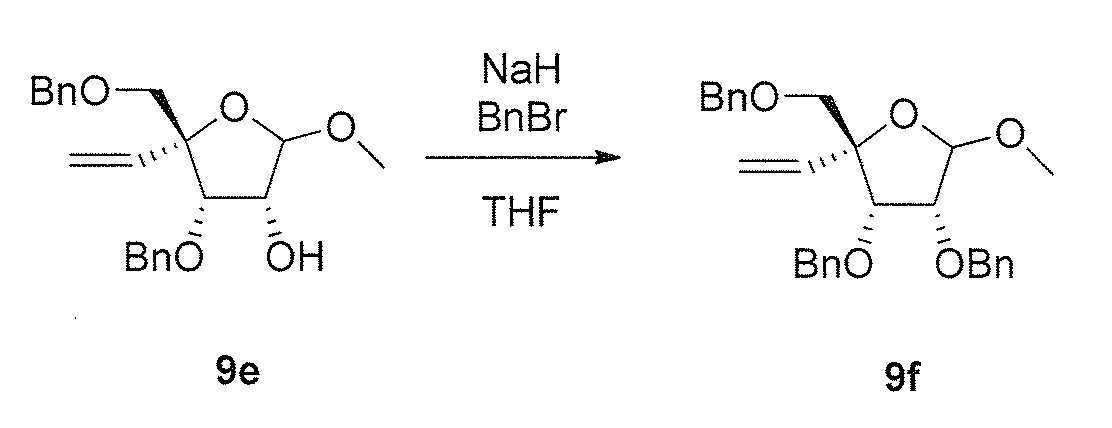
중간체 9f - (Intermediate 9f-( 2R,3S,4R2R, 3S, 4R )-3,4-) -3,4- 비스Bis (( 벤질옥시Benzyloxy )-2-(()-2-(( 벤질옥시Benzyloxy )) 메틸methyl )-5-) -5- 메톡시Methoxy -2-비닐테트라히드로푸란-2-vinyltetrahydrofuran
NaH (60 중량%, 130 ㎎, 3.2 mmol)를 고체로서 THF (13.5 ㎖) 중의 중간체 9e (1.0 g, 2.7 mmol)의 용액에 실온에서 아르곤 대기 하에서 첨가하였다. 15 분 후, 벤질 브로마이드 (0.38 ㎖, 3.2 mmol)를 첨가하고, 반응 혼합물을 4 시간 동안 교반하였다. 반응 혼합물을 포화 염화암모늄 수용액 (5 ㎖)으로 켄칭시키고, 에틸 아세테이트 (100 ㎖) 및 염수 (100 ㎖) 사이에 분배시켰다. 상이 분할되고, 유기층을 무수 황산나트륨 위에서 건조시키고, 감압 하에서 농축시켜 미정제 중간체 9f (1.57 g, 1' 아노머의 ~2:1 혼합물)를 무색 오일로서 얻었다.NaH (60% by weight, 130 mg, 3.2 mmol) was added to a solution of intermediate 9e (1.0 g, 2.7 mmol) in THF (13.5 mL) as a solid under argon atmosphere at room temperature. After 15 minutes, benzyl bromide (0.38 mL, 3.2 mmol) was added and the reaction mixture was stirred for 4 hours. The reaction mixture was quenched with saturated aqueous ammonium chloride solution (5 ml) and partitioned between ethyl acetate (100 ml) and brine (100 ml). The phases were partitioned, and the organic layer was dried over anhydrous sodium sulfate and concentrated under reduced pressure to give crude intermediate 9f (1.57 g, ˜2: 1 mixture of 1 ′ anomer) as a colorless oil.
LC/MS: 주요 아노머 tR=1.88 min, MS m/z=483.36 [M+Na], 소수의 아노머 tR=1.83 min, MS m/z=483.36 [M+Na]; LC 시스템: 써모 아셀라 1250 UHPLC; MS 시스템: 써모 LCQ 플리트; 컬럼: 키네텍스 2.6μ XB-C18 100A, 50×4.6 ㎜; 용매: 0.1% 아세트산을 갖는 아세토니트릴, 0.1% 아세트산을 갖는 물; 구배: 2 ㎕/min으로 0 min-1.5 min 2-100% ACN, 1.5 min-2.2 min 100% ACN, 2.2 min-2.4 min 100%-2% ACN, 2.4 min-2.5 min 2% ACN.LC / MS: major anomer t R = 1.88 min, MS m / z = 483.36 [M + Na], few anomer t R = 1.83 min, MS m / z = 483.36 [M + Na]; LC system: Thermo Acela 1250 UHPLC; MS system: Thermo LCQ pleats; Column: Kinetex 2.6 μ XB-C18 100A, 50 × 4.6 mm; Solvent: acetonitrile with 0.1% acetic acid, water with 0.1% acetic acid; Gradient: 0 min-1.5 min 2-100% ACN, 1.5 min-2.2 min 100% ACN, 2.2 min-2.4 min 100% -2% ACN, 2.4 min-2.5 min 2% ACN at 2 μl / min.
HPLC: 주요 아노머 tR=4.83 min, 소수의 아노머 tR=4.62 min; HPLC 시스템: 아질런트 1100 시리즈; 컬럼: 제미니 5μ C18 110A, 50×4.6 ㎜; 용매: 0.1% TFA를 갖는 아세토니트릴, 0.1% TFA를 갖는 물; 구배: 2 ㎖/min으로 0 min-5.0 min 2-98% ACN, 5.0 min-6.0 min 98% ACN.HPLC: major anomer t R = 4.83 min, few anomer t R = 4.62 min; HPLC system: Agilent 1100 series; Column: Gemini 5μ C18 110A, 50 × 4.6 mm; Solvent: acetonitrile with 0.1% TFA, water with 0.1% TFA; Gradient: 0 min-5.0 min 2-98% ACN at 2 mL / min, 5.0 min-6.0 min 98% ACN.

중간체 9g - (Intermediate 9 g-( 3R,4S,5R3R, 4S, 5R )-3,4-) -3,4- 비스Bis (( 벤질옥시Benzyloxy )-5-(() -5-(( 벤질옥시Benzyloxy )) 메틸methyl )-5-) -5- 비닐테트라히드로푸란Vinyl tetrahydrofuran -2-올-2-ol
TFA (16 ㎖) 및 물 (1.6 ㎖)의 용액을 중간체 9f (1.5 g, 3.2 mmol)에 0℃에서 첨가하고, 반응 혼합물을 실온으로 가온되도록 하였다. 9 시간 후, 물 (1 ㎖)을 첨가하고, 반응 혼합물을 추가의 10 시간 동안 교반하였다. 그 후, 반응 혼합물을 감압 하에서 농축시켰다. 미정제 잔류물을 에틸 아세테이트 (200 ㎖) 중에 용해시키고, 포화 중탄산나트륨 수용액 (2×150 ㎖) 및 염수 (150 ㎖)로 세정하였다. 유기층을 무수 황산나트륨 위에서 건조시키고, 감압 하에서 농축시켰다. 잔류물을 SiO2 컬럼 크로마토그래피 (24 g SiO2 콤비플래쉬 HP 골드 컬럼, 0-100% 에틸 아세테이트/헥산)에 의하여 정제하였다. 원하는 생성물을 함유하는 분획을 합하여 중간체 9g (580 ㎎)를 기타 불순물과의 혼합물인 무색 오일로서 얻었다. 혼합물을 하기 단계에서 직접 사용하였다.A solution of TFA (16 mL) and water (1.6 mL) was added to intermediate 9f (1.5 g, 3.2 mmol) at 0 ° C. and the reaction mixture was allowed to warm to room temperature. After 9 hours, water (1 ml) was added and the reaction mixture was stirred for an additional 10 hours. Thereafter, the reaction mixture was concentrated under reduced pressure. The crude residue was dissolved in ethyl acetate (200 mL) and washed with saturated aqueous sodium bicarbonate solution (2 × 150 mL) and brine (150 mL). The organic layer was dried over anhydrous sodium sulfate and concentrated under reduced pressure. The residue was purified by SiO 2 column chromatography (24 g SiO 2 Combiflash HP Gold column, 0-100% ethyl acetate / hexane). The fractions containing the desired product were combined to give 9 g (580 mg) of intermediate as a colorless oil in a mixture with other impurities. The mixture was used directly in the next step.
LC/MS: tR=3.13 min, MS m/z=463.88 [M+OH]; LC 시스템: 써모 아셀라 1250 UHPLC; MS 시스템: 써모 LCQ 플리트; 컬럼: 키네텍스 2.6μ XB-C18 100A, 50×4.6 ㎜; 용매: 0.1% 아세트산을 갖는 아세토니트릴, 0.1% 아세트산을 갖는 물; 구배: 2 ㎕/min으로 0 min-2.0 min 2-100% ACN, 2.0 min-3.05 min 100% ACN, 3.05 min-3.2 min 100%-2% ACN, 3.2 min-3.5 min 2% ACN.LC / MS: t R = 3.13 min, MS m / z = 463.88 [M + OH]; LC system: Thermo Acela 1250 UHPLC; MS system: Thermo LCQ pleats; Column: Kinetex 2.6 μ XB-C18 100A, 50 × 4.6 mm; Solvent: acetonitrile with 0.1% acetic acid, water with 0.1% acetic acid; Gradient: 0 min-2.0 min 2-100% ACN, 2.0 min-3.05 min 100% ACN, 3.05 min-3.2 min 100% -2% ACN, 3.2 min-3.5 min 2% ACN at 2 μl / min.
HPLC: tR=4.34 min; HPLC 시스템: 아질런트 1100 시리즈; 컬럼: 제미니 5μ C18 110A, 50×4.6 ㎜; 용매: 0.1% TFA를 갖는 아세토니트릴, 0.1% TFA를 갖는 물; 구배: 2 ㎖/min으로 0 min-5.0 min 2-98% ACN, 5.0 min-6.0 min 98% ACN.HPLC: t R = 4.34 min; HPLC system: Agilent 1100 series; Column: Gemini 5μ C18 110A, 50 × 4.6 mm; Solvent: acetonitrile with 0.1% TFA, water with 0.1% TFA; Gradient: 0 min-5.0 min 2-98% ACN at 2 mL / min, 5.0 min-6.0 min 98% ACN.
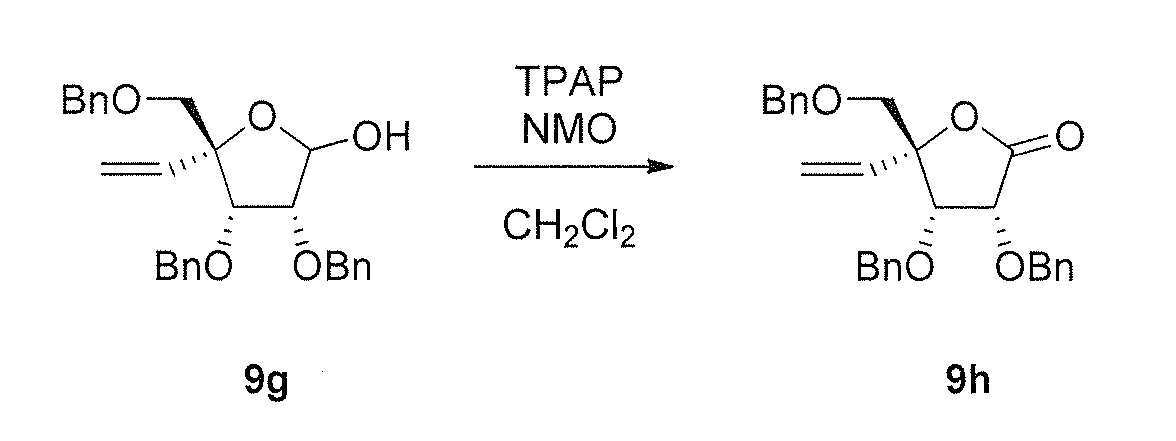
중간체 9h - (Intermediate 9h-( 3R,4S,5R3R, 4S, 5R )-3,4-) -3,4- 비스Bis (( 벤질옥시Benzyloxy )-5-(() -5-(( 벤질옥시Benzyloxy )) 메틸methyl )-5-) -5- 비닐디히드로푸란Vinyl dihydrofuran -2(3H)-온-2 (3H) -on
테트라프로필암모늄 퍼루테네이트 (45.7 ㎎, 130 ㎛ol) 및 4-메틸모르폴린 N-옥시드 (457 ㎎, 3.89 mmol)를 DCM (6.45 ㎖) 중의 중간체 9g (580 ㎎, 1.30 mmol) 및 4Å MS (100 ㎎)의 용액에 실온에서 첨가하였다. 1 시간 후, 실리카 겔 (~500 ㎎)을 반응 혼합물에 첨가하고, 생성된 슬러리를 실리카 겔 (~1 g)의 플러그를 통하여 여과하였다. 여과액을 감압 하에서 농축시켰다. 미정제 잔류물을 SiO2 컬럼 크로마토그래피 (12 g SiO2 콤비플래쉬 HP 골드 컬럼, 0-100% 에틸 아세테이트/헥산)에 의하여 정제하여 중간체 9h (254 ㎎, 2단계에 대하여 18%)를 무색 오일로서 얻었다.Tetrapropylammonium perutenate (45.7 mg, 130 μmol) and 4-methylmorpholine N-oxide (457 mg, 3.89 mmol) were intermediates in DCM (6.45 mL) 9 g (580 mg, 1.30 mmol) and 4 μs MS (100 mg) was added at room temperature. After 1 hour, silica gel (~ 500 mg) was added to the reaction mixture, and the resulting slurry was filtered through a plug of silica gel (~ 1 g). The filtrate was concentrated under reduced pressure. The crude residue was purified by SiO 2 column chromatography (12 g SiO 2 CombiFlash HP Gold column, 0-100% ethyl acetate / hexane) to give intermediate 9h (254 mg, 18% for 2 steps) as a colorless oil. As obtained.
1H NMR (400 MHz, CDCl3) δ 7.38-7.23 (m, 13H), 7.20-7.13 (m, 2H), 5.91 (dd, J=17.5, 11.2 Hz, 1H), 5.49 (dd, J=17.5, 0.9 Hz, 1H), 5.33 (dd, J=11.2, 0.9 Hz, 1H), 4.96 (d, J=12.0 Hz, 1H). 4.74-4.68 (m, 2H), 4.55-4.47 (m, 3H), 4.39 (d, J=11.9 Hz, 1H), 4.20 (d, J=6.0 Hz, 1H), 3.55 (d, J=10.8 Hz, 1H), 3.46 (d, J=10.8 Hz, 1H) 1 H NMR (400 MHz, CDCl 3 ) δ 7.38-7.23 (m, 13H), 7.20-7.13 (m, 2H), 5.91 (dd, J = 17.5, 11.2 Hz, 1H), 5.49 (dd, J = 17.5 , 0.9 Hz, 1H), 5.33 (dd, J = 11.2, 0.9 Hz, 1H), 4.96 (d, J = 12.0 Hz, 1H). 4.74-4.68 (m, 2H), 4.55-4.47 (m, 3H), 4.39 (d, J = 11.9 Hz, 1H), 4.20 (d, J = 6.0 Hz, 1H), 3.55 (d, J = 10.8 Hz , 1H), 3.46 (d, J = 10.8 Hz, 1H)
LC/MS: tR=2.19 min, MS m/z=444.78 [M+H]; LC 시스템: 써모 아셀라 1250 UHPLC; MS 시스템: 써모 LCQ 플리트; 컬럼: 키네텍스 2.6μ XB-C18 100A, 50×4.6 ㎜; 용매: 0.1% 아세트산을 갖는 아세토니트릴, 0.1% 아세트산을 갖는 물; 구배: 2 ㎕/min으로 0 min-2.0 min 2-100% ACN, 2.0 min-3.05 min 100% ACN, 3.05 min-3.2 min 100%-2% ACN, 3.2 min-3.5 min 2% ACN.LC / MS: t R = 2.19 min, MS m / z = 444.78 [M + H]; LC system: Thermo Acela 1250 UHPLC; MS system: Thermo LCQ pleats; Column: Kinetex 2.6 μ XB-C18 100A, 50 × 4.6 mm; Solvent: acetonitrile with 0.1% acetic acid, water with 0.1% acetic acid; Gradient: 0 min-2.0 min 2-100% ACN, 2.0 min-3.05 min 100% ACN, 3.05 min-3.2 min 100% -2% ACN, 3.2 min-3.5 min 2% ACN at 2 μl / min.
HPLC: tR=4.53 min; HPLC 시스템: 아질런트 1100 시리즈; 컬럼: 제미니 5μ C18 110A, 50×4.6 ㎜; 용매: 0.1% TFA를 갖는 아세토니트릴, 0.1% TFA를 갖는 물; 구배: 2 ㎖/min으로 0 min-5.0 min 2-98% ACN, 5.0 min-6.0 min 98% ACN.HPLC: t R = 4.53 min; HPLC system: Agilent 1100 series; Column: Gemini 5μ C18 110A, 50 × 4.6 mm; Solvent: acetonitrile with 0.1% TFA, water with 0.1% TFA; Gradient: 0 min-5.0 min 2-98% ACN at 2 mL / min, 5.0 min-6.0 min 98% ACN.
TLC: 용리제: 헥산 중의 25% 에틸 아세테이트, Rf=0.45 (UV)TLC: Eluent: 25% ethyl acetate in hexane, R f = 0.45 (UV)

중간체 9i - (Intermediate 9i-( 3R,4S,5R3R, 4S, 5R )-2-(4-) -2- (4- 아미노피롤로[2,1-f][1,2,4]트리아진Aminopyrrolo [2,1-f] [1,2,4] triazine -7-일)-3,4-비스(벤질옥시)-5-((벤질옥시)메틸)-5-비닐테트라히드로푸란-2-올-7-yl) -3,4-bis (benzyloxy) -5-((benzyloxy) methyl) -5-vinyltetrahydrofuran-2-ol
n-부틸리튬 (헥산 중의 2.5M, 1.0 ㎖, 2.5 mmol)을 THF (4 ㎖) 중의 중간체 1b (0.21 g, 0.81 mmol) 및 1,2-비스(클로로디메틸실릴)에탄 (0.17 g, 0.81 mmol)의 현탁액에 -78℃에서 아르곤 대기 하에서 신속하게 첨가하였다. 그 후, 생성된 혼합물을 카뉼라를 통하여 THF (1 ㎖) 중의 9h (0.18 g, 0.41 mmol)의 용액에 -78℃에서 아르곤 대기 하에서 옮겼다. 20 분 후, 반응 혼합물을 0℃로 가온시키고, 15 분 동안 교반하였다. 반응 혼합물을 포화 염화암모늄 수용액 (1 ㎖)으로 켄칭시켰다. 생성된 혼합물을 에틸 아세테이트 (100 ㎖)로 희석하고, 포화 중탄산나트륨 수용액 (100 ㎖) 및 염수 (100 ㎖)로 세정하였다. 유기층을 무수 황산나트륨 위에서 건조시키고, 감압 하에서 농축시켰다. 미정제 잔류물을 SiO2 컬럼 크로마토그래피 (12 g SiO2 콤비플래쉬 HP 골드 컬럼, 0-100% 에틸 아세테이트/헥산)에 의하여 정제하여 중간체 9i (11.1 ㎎, 5%, 이성질체의 혼합물)를 무색 오일로서 얻었다.Intermediate 1b (0.21 g, 0.81 mmol) and 1,2-bis (chlorodimethylsilyl) ethane (0.17 g, 0.81 mmol) in n-butyllithium (2.5M in hexane, 1.0 mL, 2.5 mmol) in THF (4 mL) ) Was quickly added under an argon atmosphere at -78 ° C. The resulting mixture was then transferred via cannula to a solution of 9h (0.18 g, 0.41 mmol) in THF (1 mL) at -78 ° C under an argon atmosphere. After 20 minutes, the reaction mixture was warmed to 0 ° C. and stirred for 15 minutes. The reaction mixture was quenched with saturated aqueous ammonium chloride solution (1 mL). The resulting mixture was diluted with ethyl acetate (100 mL), washed with saturated aqueous sodium bicarbonate solution (100 mL) and brine (100 mL). The organic layer was dried over anhydrous sodium sulfate and concentrated under reduced pressure. The crude residue was purified by SiO 2 column chromatography (12 g SiO 2 Combiflash HP Gold column, 0-100% ethyl acetate / hexane) to afford intermediate 9i (11.1 mg, 5%, mixture of isomers) as a colorless oil. As obtained.
LC/MS: tR=1.97 min, MS m/z=579.27 [M+H]; LC 시스템: 써모 아셀라 1250 UHPLC; MS 시스템: 써모 LCQ 플리트; 컬럼: 키네텍스 2.6μ XB-C18 100A, 50×4.6 ㎜; 용매: 0.1% 아세트산을 갖는 아세토니트릴, 0.1% 아세트산을 갖는 물; 구배: 2 ㎕/min으로 0 min-2.0 min 2-100% ACN, 2.0 min-3.05 min 100% ACN, 3.05 min-3.2 min 100%-2% ACN, 3.2 min-3.5 min 2% ACN.LC / MS: t R = 1.97 min, MS m / z = 579.27 [M + H]; LC system: Thermo Acela 1250 UHPLC; MS system: Thermo LCQ pleats; Column: Kinetex 2.6 μ XB-C18 100A, 50 × 4.6 mm; Solvent: acetonitrile with 0.1% acetic acid, water with 0.1% acetic acid; Gradient: 0 min-2.0 min 2-100% ACN, 2.0 min-3.05 min 100% ACN, 3.05 min-3.2 min 100% -2% ACN, 3.2 min-3.5 min 2% ACN at 2 μl / min.
HPLC: tR=3.37 min; HPLC 시스템: 아질런트 1100 시리즈; 컬럼: 제미니 5μ C18 110A, 50×4.6 ㎜; 용매: 0.1% TFA를 갖는 아세토니트릴, 0.1% TFA를 갖는 물; 구배: 2 ㎖/min으로 0 min-5.0 min 2-98% ACN, 5.0 min-6.0 min 98% ACN.HPLC: t R = 3.37 min; HPLC system: Agilent 1100 series; Column: Gemini 5μ C18 110A, 50 × 4.6 mm; Solvent: acetonitrile with 0.1% TFA, water with 0.1% TFA; Gradient: 0 min-5.0 min 2-98% ACN at 2 mL / min, 5.0 min-6.0 min 98% ACN.
TLC: 용리제: 에틸 아세테이트, Rf=0.3 (UV)TLC: Eluent: ethyl acetate, R f = 0.3 (UV)
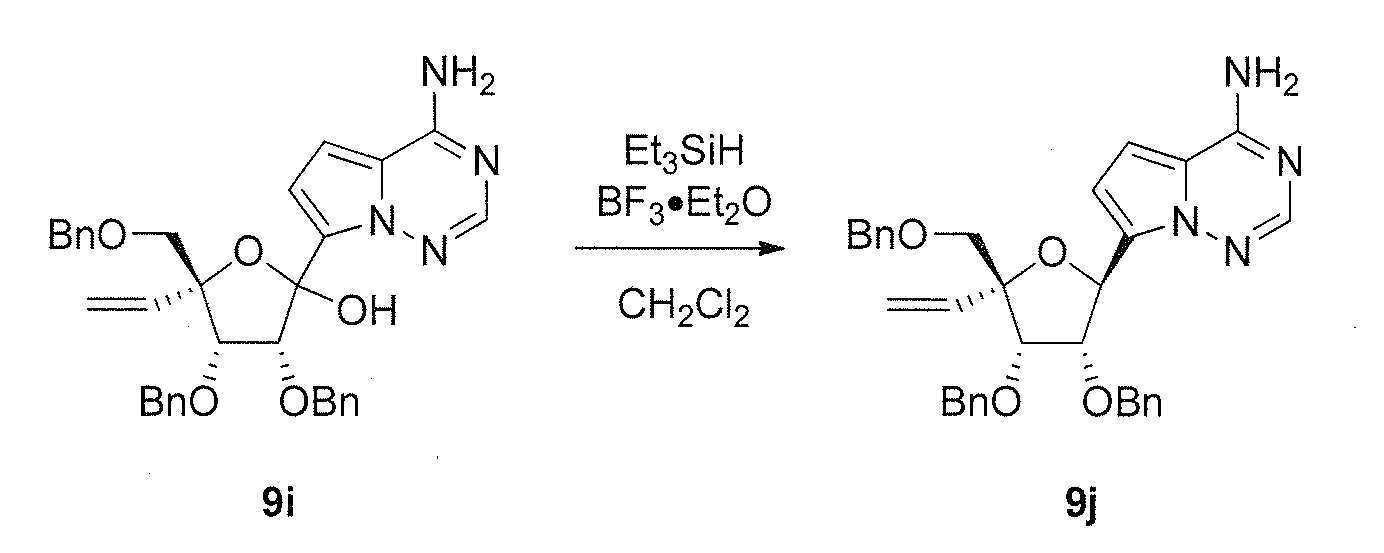
중간체 9j - 7-Intermediate 9j-7- ((2S,3S,4S,5R)-3,4-비스((2S, 3S, 4S, 5R) -3,4-bis (( 벤질옥시Benzyloxy )-5-(() -5-(( 벤질옥시Benzyloxy )) 메틸methyl )-5-) -5- 비닐테트라히드로푸란Vinyl tetrahydrofuran -2-일)피롤로[2,1-f][1,2,4]트리아진-4-아민-2-yl) pyrrolo [2,1-f] [1,2,4] triazine-4-amine
DCM (1 ㎖) 중의 중간체 9i (11.0 ㎎, 19.0 ㎛ol) 및 트리에틸실란 (0.5 ㎖)의 용액에 삼불소화붕소 디에틸 에테레이트 (0.1 ㎖)를 서서히 0℃에서 아르곤 대기 하에서 첨가하였다. 1 시간 후, 반응 혼합물을 포화 중탄산나트륨 수용액 (10 ㎖)으로 서서히 희석하고, 생성된 혼합물을 에틸 아세테이트 (2×10 ㎖)로 추출하고, 무수 황산나트륨 위에서 건조시키고, 감압 하에서 농축시켰다. 미정제 잔류물을 SiO2 컬럼 크로마토그래피 (4 g SiO2 콤비플래쉬 HP 골드 컬럼, 0-100% 에틸 아세테이트/헥산)에 의하여 정제하여 중간체 9j (7.7 ㎎, 72%)를 무색 필름으로서 얻었다.To a solution of intermediate 9i (11.0 mg, 19.0 μmol) and triethylsilane (0.5 mL) in DCM (1 mL) boron trifluoride diethyl etherate (0.1 mL) was slowly added at 0 ° C. under an argon atmosphere. After 1 hour, the reaction mixture was slowly diluted with saturated aqueous sodium bicarbonate solution (10 mL), and the resulting mixture was extracted with ethyl acetate (2 × 10 mL), dried over anhydrous sodium sulfate, and concentrated under reduced pressure. The crude residue was purified by SiO 2 column chromatography (4 g SiO 2 Combiflash HP Gold column, 0-100% ethyl acetate / hexane) to give Intermediate 9j (7.7 mg, 72%) as a colorless film.
1H NMR (400 MHz, CDCl3) δ 7.87 (s, 1H), 7.37-7.17 (m, 15H), 6.73 (d, J=4.5 Hz, 1H), 6.51 (d, J=4.5 Hz, 1H), 6.23 (dd, J=17.5, 10.9 Hz, 1H), 5.70 (d, J=3.9 Hz, 1H), 5.59 (dd, J=17.5, 1.8 Hz, 1H), 5.32 (dd, J=10.9, 1.7 Hz, 1H), 4.72-4.56 (m, 4H), 4.49 (d, J=11.9 Hz, 2H), 4.43 (d, J=5.6 Hz, 1H), 4.25 (dd, J=5.6, 4.0 Hz, 1H), 3.56 (s, 2H). 1 H NMR (400 MHz, CDCl 3 ) δ 7.87 (s, 1H), 7.37-7.17 (m, 15H), 6.73 (d, J = 4.5 Hz, 1H), 6.51 (d, J = 4.5 Hz, 1H) , 6.23 (dd, J = 17.5, 10.9 Hz, 1H), 5.70 (d, J = 3.9 Hz, 1H), 5.59 (dd, J = 17.5, 1.8 Hz, 1H), 5.32 (dd, J = 10.9, 1.7 Hz, 1H), 4.72-4.56 (m, 4H), 4.49 (d, J = 11.9 Hz, 2H), 4.43 (d, J = 5.6 Hz, 1H), 4.25 (dd, J = 5.6, 4.0 Hz, 1H ), 3.56 (s, 2H).
LC/MS: tR=2.32 min, MS m/z=563.33 [M+H]; LC 시스템: 써모 아셀라 1250 UHPLC; MS 시스템: 써모 LCQ 플리트; 컬럼: 키네텍스 2.6μ XB-C18 100A, 50×4.6 ㎜; 용매: 0.1% 아세트산을 갖는 아세토니트릴, 0.1% 아세트산을 갖는 물; 구배: 2 ㎕/min으로 0 min-2.0 min 2-100% ACN, 2.0 min-3.05 min 100% ACN, 3.05 min-3.2 min 100%-2% ACN, 3.2 min-3.5 min 2% ACN.LC / MS: t R = 2.32 min, MS m / z = 563.33 [M + H]; LC system: Thermo Acela 1250 UHPLC; MS system: Thermo LCQ pleats; Column: Kinetex 2.6 μ XB-C18 100A, 50 × 4.6 mm; Solvent: acetonitrile with 0.1% acetic acid, water with 0.1% acetic acid; Gradient: 0 min-2.0 min 2-100% ACN, 2.0 min-3.05 min 100% ACN, 3.05 min-3.2 min 100% -2% ACN, 3.2 min-3.5 min 2% ACN at 2 μl / min.
HPLC: tR=3.51 min; HPLC 시스템: 아질런트 1100 시리즈; 컬럼: 제미니 5μ C18 110A, 50×4.6 ㎜; 용매: 0.1% TFA를 갖는 아세토니트릴, 0.1% TFA를 갖는 물; 구배: 2 ㎖/min으로 0 min-5.0 min 2-98% ACN, 5.0 min-6.0 min 98% ACN.HPLC: t R = 3.51 min; HPLC system: Agilent 1100 series; Column: Gemini 5μ C18 110A, 50 × 4.6 mm; Solvent: acetonitrile with 0.1% TFA, water with 0.1% TFA; Gradient: 0 min-5.0 min 2-98% ACN at 2 mL / min, 5.0 min-6.0 min 98% ACN.
TLC: 용리제: 에틸 아세테이트, Rf=0.40 (UV)TLC: eluent: ethyl acetate, R f = 0.40 (UV)

실시예Example 20 - ( 20-( 2R,3S,4R,5S2R, 3S, 4R, 5S )-5-(4-) -5- (4- 아미노피롤로[2,1-f][1,2,4]트리아진Aminopyrrolo [2,1-f] [1,2,4] triazine -7-일)-2-(히드록시메틸)-2-비닐테트라히드로푸란-3,4-디올-7-yl) -2- (hydroxymethyl) -2-vinyltetrahydrofuran-3,4-diol
삼브롬화붕소 (1 M, 0.06 ㎖, 60 ㎛ol)를 디클로로메탄 (1 ㎖) 중의 중간체 9j (7.7 ㎎, 13.7 ㎛ol)의 용액에 -78℃에서 아르곤 대기 하에서 적가하였다. 1 시간 후, 반응 혼합물을 0℃로 가온되도록 하고, 추가의 1.5 시간 동안 교반하였다. 반응을 -78℃로 냉각시키고, 2:1 메탄올/피리딘 용액 (1.5 ㎖)으로 켄칭시켰다. 생성된 혼합물을 실온으로 가온시키고, 감압 하에서 농축시켰다. 미정제 잔류물을 분취용 HPLC (페노미넥스 시너지 4u 히드로-RR 80Å 150×30 ㎜ 컬럼, 0-100% 아세토니트릴/물 구배)에 의하여 정제하여 실시예 20 (0.5 ㎎, 13%)을 백색 고체로서 얻었다.Boron tribromide (1 M, 0.06 mL, 60 μmol) was added dropwise to a solution of intermediate 9j (7.7 mg, 13.7 μmol) in dichloromethane (1 mL) at -78 ° C. under an argon atmosphere. After 1 hour, the reaction mixture was allowed to warm to 0 ° C. and stirred for an additional 1.5 hours. The reaction was cooled to -78 ° C and quenched with a 2: 1 methanol / pyridine solution (1.5 mL). The resulting mixture was warmed to room temperature and concentrated under reduced pressure. The crude residue was purified by preparative HPLC (Phenominex Synergy 4u Hydro-RR 80 × 150 × 30 mm column, 0-100% acetonitrile / water gradient) to give Example 20 (0.5 mg, 13%) as white. Obtained as a solid.
1H NMR (400 MHz, CD3OD) δ 7.78 (s, 1H), 6.88 (d, J=4.5 Hz, 1H), 6.76 (d, J=4.5 Hz, 1H), 6.02 (dd, J=17.4, 11.0 Hz, 1H), 5.47 (dd, J=17.4, 2.0 Hz, 1H), 5.23 (dd, J=10.9, 2.1 Hz, 1H), 5.15 (d, J=8.3 Hz, 1H), 4.72 (dd, J=8.2, 5.7 Hz, 1H), 4.34 (d, J=5.7 Hz, 1H), 3.60 (d, J=11.8 Hz, 1H), 3.49 (d, J=11.8 Hz, 1H) 1 H NMR (400 MHz, CD 3 OD) δ 7.78 (s, 1H), 6.88 (d, J = 4.5 Hz, 1H), 6.76 (d, J = 4.5 Hz, 1H), 6.02 (dd, J = 17.4 , 11.0 Hz, 1H), 5.47 (dd, J = 17.4, 2.0 Hz, 1H), 5.23 (dd, J = 10.9, 2.1 Hz, 1H), 5.15 (d, J = 8.3 Hz, 1H), 4.72 (dd , J = 8.2, 5.7 Hz, 1H), 4.34 (d, J = 5.7 Hz, 1H), 3.60 (d, J = 11.8 Hz, 1H), 3.49 (d, J = 11.8 Hz, 1H)
LC/MS: tR=0.84 min, MS m/z=293.19 [M+H]; LC 시스템: 써모 아셀라 1250 UHPLC; MS 시스템: 써모 LCQ 플리트; 컬럼: 키네텍스 2.6μ XB-C18 100A, 50×4.6 ㎜; 용매: 0.1% 아세트산을 갖는 아세토니트릴, 0.1% 아세트산을 갖는 물; 구배: 2 ㎕/min으로 0 min-1.5 min 2-100% ACN, 1.5 min-2.2 min 100% ACN, 2.2 min-2.4 min 100%-2% ACN, 2.4 min-2.5 min 2% ACN.LC / MS: t R = 0.84 min, MS m / z = 293.19 [M + H]; LC system: Thermo Acela 1250 UHPLC; MS system: Thermo LCQ pleats; Column: Kinetex 2.6 μ XB-C18 100A, 50 × 4.6 mm; Solvent: acetonitrile with 0.1% acetic acid, water with 0.1% acetic acid; Gradient: 0 min-1.5 min 2-100% ACN, 1.5 min-2.2 min 100% ACN, 2.2 min-2.4 min 100% -2% ACN, 2.4 min-2.5 min 2% ACN at 2 μl / min.
HPLC: tR=2.181 min; HPLC 시스템: 아질런트 1100 시리즈; 컬럼: 제미니 5μ C18 110A, 50×4.6 ㎜; 용매: 0.1% TFA를 갖는 아세토니트릴, 0.1% TFA를 갖는 물; 구배: 2 ㎖/min으로 0 min-5.0 min 2-98% ACN, 5.0 min-6.0 min 98% ACN.HPLC: t R = 2.181 min; HPLC system: Agilent 1100 series; Column: Gemini 5μ C18 110A, 50 × 4.6 mm; Solvent: acetonitrile with 0.1% TFA, water with 0.1% TFA; Gradient: 0 min-5.0 min 2-98% ACN at 2 mL / min, 5.0 min-6.0 min 98% ACN.

실시예Example 21 21
(( 2R,3R,4R,5S2R, 3R, 4R, 5S )-5-(4-아미노-5-) -5- (4-amino-5- 플루오로피롤로[2,1-f][1,2,4]트리아진Fluoropyrrolo [2,1-f] [1,2,4] triazine -7-일)-2-아지도-4-플루오로-2-(히드록시메틸)테트라히드로푸란-3-올-7-yl) -2-azido-4-fluoro-2- (hydroxymethyl) tetrahydrofuran-3-ol
실시예 19 (237 ㎎, 0.766 mmol) 및 셀렉트플루오르 (407 ㎎, 1.15 mmol)를 아세토니트릴 (5 ㎖) 중에 현탁시키고, AcOH (0.2 ㎖)를 첨가하였다. 생성된 혼합물을 실온에서 30 분 동안 교반한 후, 중탄산나트륨 용액으로 중화시키고, 여과하여 고체를 제거하였다. 진공 하에서 농축시켜 잔류물을 분취용 HPLC (물 중의 아세토니트릴 0 내지 30%)에 의하여 정제하여 실시예 21 (27 ㎎, 11%)을 회백색 고체로서 얻었다.Example 19 (237 mg, 0.766 mmol) and selectfluor (407 mg, 1.15 mmol) were suspended in acetonitrile (5 mL) and AcOH (0.2 mL) was added. The resulting mixture was stirred at room temperature for 30 minutes, then neutralized with sodium bicarbonate solution and filtered to remove solids. Concentrated in vacuo, the residue was purified by preparative HPLC (acetonitrile in water 0-30%) to give Example 21 (27 mg, 11%) as an off-white solid.
1H NMR (400 MHz, CD3OD) δ 7.73 (s, 1H), 6.63 (s, 1H), 5.80 (dd, J=23.9, 1.7 Hz, 1H), 5.16 (ddd, J=55.3, 5.0, 1.7 Hz, 1H), 4.56 (dd, J=23.5, 5.0 Hz, 1H), 3.94-3.60 (m, 2H) 1 H NMR (400 MHz, CD 3 OD) δ 7.73 (s, 1H), 6.63 (s, 1H), 5.80 (dd, J = 23.9, 1.7 Hz, 1H), 5.16 (ddd, J = 55.3, 5.0, 1.7 Hz, 1H), 4.56 (dd, J = 23.5, 5.0 Hz, 1H), 3.94-3.60 (m, 2H)
19F NMR (376 MHz, CD3OD) δ -161.76 (s), -195.42 (d, J=55.4 Hz) 19 F NMR (376 MHz, CD 3 OD) δ -161.76 (s), -195.42 (d, J = 55.4 Hz)
MS m/z=328 [M+H]. MS 시스템: 써모 LCQ 플리트MS m / z = 328 [M + H]. MS System: Thermo LCQ Fleet

중간체 11b - 2-Intermediates 11b-2- 플루오로피롤로[2,1-f][1,2,4]트리아진Fluoropyrrolo [2,1-f] [1,2,4] triazine -4--4- 아민Amine
중간체 11a (2.0 g, 13.4 mmol)를 폴리튜브(polyTube) 용기에 가하였다. 그 후, 반응 용기를 얼음 배쓰에 넣고, 70% HF/Pyr (18 ㎖) 및 피리딘 (9 ㎖) 모두를 순차적으로 첨가하였다. 피리딘의 첨가 직후, tBuNO2 (2.07 ㎖, 17.43 mmol)를 20 분에 걸쳐 서서히 첨가하였다. 용액은 발열과 함께 황갈색으로부터 흑색이 되었으며, 기체가 방출되었다. 그 후, 반응을 추가의 20 분 동안 교반하고, 반응 혼합물을 물로 희석하고, 감압 하에서 농축시켰다. 미정제 잔류물을 에틸 아세테이트 및 물 사이에 분배하였다. 유기상을 분리하고, 수성상을 에틸 아세테이트로 3회 세정하였다. 유기상을 합하고, 염수로 세정하였다. 미정제물을 Na2SO4 위에서 건조시키고, 여과하고, 용매를 감압 하에서 제거하였다. 미정제 잔류물을 실리카 겔 크로마토그래피 (50-100% EtOAc/Hex)에 의하여 정제하여 중간체 11b (1.68 g, 82%)를 황갈색 고체로서 얻었다.Intermediate 11a (2.0 g, 13.4 mmol) was added to a polyTube container. Thereafter, the reaction vessel was placed in an ice bath, and both 70% HF / Pyr (18 mL) and pyridine (9 mL) were sequentially added. Immediately after the addition of pyridine, tBuNO 2 (2.07 mL, 17.43 mmol) was added slowly over 20 minutes. The solution turned from tan to black with exotherm and gas was released. Thereafter, the reaction was stirred for an additional 20 minutes, and the reaction mixture was diluted with water and concentrated under reduced pressure. The crude residue was partitioned between ethyl acetate and water. The organic phase was separated and the aqueous phase was washed 3 times with ethyl acetate. The organic phases were combined and washed with brine. The crude was dried over Na 2 SO 4 , filtered, and the solvent was removed under reduced pressure. The crude residue was purified by silica gel chromatography (50-100% EtOAc / Hex) to give Intermediate 11b (1.68 g, 82%) as a tan solid.
1H NMR (400 MHz, DMSO-d6) δ 8.49-8.09 (m, 2H), 7.58 (t, J=2.0 Hz, 1H), 6.95 (d, J=4.5, 1H), 6.59 (d, J=4.5, 1H). 1 H NMR (400 MHz, DMSO-d 6 ) δ 8.49-8.09 (m, 2H), 7.58 (t, J = 2.0 Hz, 1H), 6.95 (d, J = 4.5, 1H), 6.59 (d, J = 4.5, 1H).
19F NMR (376 MHz, DMSO-d6) δ -73.42 (s). 19 F NMR (376 MHz, DMSO-d 6 ) δ -73.42 (s).
LC/MS: tR=1.03 min, MS m/z=153.08 [M+H]; LC 시스템: 써모 아셀라 1250 UHPLC; MS 시스템: 써모 LCQ 플리트; 컬럼: 키네텍스 2.6μ XB-C18 100A, 50×3.00 ㎜; 용매: 0.1% 포름산을 갖는 아세토니트릴, 0.1% 포름산을 갖는 물; 구배: 1.8 ㎖/min으로 0 min-1.4 min 2-100% ACN, 1.4 min-1.80 min 100% ACN, 1.8 min-1.85 min 100%-2% ACN, 1.85 min-2 min 2% ACN.LC / MS: t R = 1.03 min, MS m / z = 153.08 [M + H]; LC system: Thermo Acela 1250 UHPLC; MS system: Thermo LCQ pleats; Column: Kinetex 2.6 μ XB-C18 100A, 50 × 3.00 mm; Solvent: acetonitrile with 0.1% formic acid, water with 0.1% formic acid; Gradient: 0 min-1.4 min 2-100% ACN at 1.8 mL / min, 1.4 min-1.80 min 100% ACN, 1.8 min-1.85 min 100% -2% ACN, 1.85 min-2 min 2% ACN.

중간체 11c - 7-Intermediates 11c-7- 브로모Bromo -2--2- 플루오로피롤로[2,1-f][1,2,4]트리아진Fluoropyrrolo [2,1-f] [1,2,4] triazine -4--4- 아민Amine
DMF (50 ㎖) 중의 11b (3.36 g, 22.1 mmol)의 용액을 0℃로 얼음 배쓰 내에서 냉각시켰다. DMF (50 ㎖) 중의 1,3-디브로모-5,5-디메틸히단토인 (3.16 g, 11.0 mmol)의 용액을 첨가 깔때기에 의하여 40 분에 걸쳐 적가하였다. 1 시간 후, 반응을 포화 Na2S2O3(aq)로 켄칭시키고, 미정제물을 EtOAc 및 5% LiCl(aq) 사이에 분배시켰다. 유기물을 5% LiCl(aq) (4×)에 이어서 염수로 추출하였다. 유기물을 Na2SO4 위에서 건조시키고, 고체를 여과에 의하여 제거하고, 여과액을 감압 하에서 농축시켰다. 미정제 잔류물을 CH2Cl2로 음파 처리하고, 고체를 여과에 의하여 수집하고,고 진공 하에서 건조시켜 중간체 11c (3.93 g, 77%)를 황색 고체로서 얻었다.A solution of 11b (3.36 g, 22.1 mmol) in DMF (50 mL) was cooled to 0 ° C. in an ice bath. A solution of 1,3-dibromo-5,5-dimethylhydantoin (3.16 g, 11.0 mmol) in DMF (50 mL) was added dropwise over 40 minutes by addition funnel. After 1 hour, the reaction was quenched with saturated Na 2 S 2 O 3 (aq) , and the crude was partitioned between EtOAc and 5% LiCl (aq) . The organic was extracted with 5% LiCl (aq) (4 ×) followed by brine. The organics were dried over Na 2 SO 4 , solids were removed by filtration, and the filtrate was concentrated under reduced pressure. The crude residue was sonicated with CH 2 Cl 2 , the solid was collected by filtration and dried under high vacuum to give Intermediate 11c (3.93 g, 77%) as a yellow solid.
1H NMR (400 MHz, DMSO-d6) δ 8.49-8.44 (m, 2H), 7.08 (d, J=4.6 Hz, 1H), 6.76 (d, J=4.6 Hz, 1H). 1 H NMR (400 MHz, DMSO-d 6 ) δ 8.49-8.44 (m, 2H), 7.08 (d, J = 4.6 Hz, 1H), 6.76 (d, J = 4.6 Hz, 1H).
19F NMR (376 MHz, DMSO-d6) δ -71.45 (s). 19 F NMR (376 MHz, DMSO-d 6 ) δ -71.45 (s).
LC/MS: tR=1.22 min, MS m/z=232.98 [M+H]; LC 시스템: 써모 아셀라 1250 UHPLC; MS 시스템: 써모 LCQ 플리트; 컬럼: 키네텍스 2.6μ XB-C18 100A, 50×3.00 ㎜; 용매: 0.1% 포름산을 갖는 아세토니트릴, 0.1% 포름산을 갖는 물; 구배: 1.8 ㎖/min으로 0 min-1.4 min 2-100% ACN, 1.4 min-1.80 min 100% ACN, 1.8 min-1.85 min 100%-2% ACN, 1.85 min-2 min 2% ACN.LC / MS: t R = 1.22 min, MS m / z = 232.98 [M + H]; LC system: Thermo Acela 1250 UHPLC; MS system: Thermo LCQ pleats; Column: Kinetex 2.6 μ XB-C18 100A, 50 × 3.00 mm; Solvent: acetonitrile with 0.1% formic acid, water with 0.1% formic acid; Gradient: 0 min-1.4 min 2-100% ACN at 1.8 mL / min, 1.4 min-1.80 min 100% ACN, 1.8 min-1.85 min 100% -2% ACN, 1.85 min-2 min 2% ACN.

중간체 11e - (Intermediate 11e-( 3R,4R,5R3R, 4R, 5R )-2-(4-아미노-2-) -2- (4-amino-2- 플루오로피롤로[2,1-f][1,2,4]트리아진Fluoropyrrolo [2,1-f] [1,2,4] triazine -7-일)-4-(벤질옥시)-5-((벤질옥시)메틸)-3-플루오로테트라히드로푸란-2-올-7-yl) -4- (benzyloxy) -5-((benzyloxy) methyl) -3-fluorotetrahydrofuran-2-ol
THF (30 ㎖) 중의 11c (2.09 g, 9.08 mmol)의 용액에 1,2-비스(클로로디메틸실릴)에탄 (STABASE, 1.96 g, 9.08 mmol)을 한번에 첨가하고, 생성된 혼합물을 상온에서 1 시간 동안 교반하였다. 그 후, 반응을 메탄올과 함께 드라이 아이스 배쓰를 사용하여 -78℃로 냉각시켰다. nBuLi (헥산 중의 2.5M, 10.9 ㎖, 27.2 mmol)를 -65℃의 내부 온도를 유지하는 방식으로 첨가하였다. 그 후, THF (25 ㎖) 중의 중간체 11d (WO2012012776에 의하여 생성됨, 2.5 g, 7.5 mmol)의 용액을 반응 혼합물에 1 분에 걸쳐 첨가하였다. 5 분 후, 반응 혼합물을 아세트산으로 켄칭시키고, 상온이 되게 하였다. 용매를 감압 하에서 제거하고, 잔류물을 에틸 아세테이트에서 취하였다. 유기물을 물에 이어서 염수로 세정하였다. 층이 분리되고, 유기물을 Na2SO4 위에서 건조시키고, 여과하고, 감압 하에서 농축시켜 미정제물 11e를 이성질체의 혼합물로서 얻었으며, 이를 그 다음 단계에서 그 상태로 사용하였다.To a solution of 11c (2.09 g, 9.08 mmol) in THF (30 mL), 1,2-bis (chlorodimethylsilyl) ethane (STABASE, 1.96 g, 9.08 mmol) was added at once, and the resulting mixture was stirred at room temperature for 1 hour. While stirring. Thereafter, the reaction was cooled to -78 ° C using a dry ice bath with methanol. nBuLi (2.5M in hexane, 10.9 mL, 27.2 mmol) was added in a manner to maintain an internal temperature of -65 ° C. Then a solution of intermediate 11d (produced by WO2012012776, 2.5 g, 7.5 mmol) in THF (25 mL) was added to the reaction mixture over 1 minute. After 5 minutes, the reaction mixture was quenched with acetic acid and brought to room temperature. The solvent was removed under reduced pressure, and the residue was taken up in ethyl acetate. The organic was washed with water followed by brine. The layers were separated and the organics were dried over Na 2 SO 4 , filtered and concentrated under reduced pressure to give crude 11e as a mixture of isomers, which was used as such in the next step.
LC/MS: tR=1.32 및 1.40 min, MS m/z=483.15 [M+H]; LC 시스템: 써모 아셀라 1250 UHPLC; MS 시스템: 써모 LCQ 플리트; 컬럼: 키네텍스 2.6μ XB-C18 100A, 50×3.00 ㎜; 용매: 0.1% 포름산을 갖는 아세토니트릴, 0.1% 포름산을 갖는 물; 구배: 1.8 ㎖/min으로 0 min-1.4 min 2-100% ACN, 1.4 min-1.80 min 100% ACN, 1.8 min-1.85 min 100%-2% ACN, 1.85 min-2 min 2% ACN.LC / MS: t R = 1.32 and 1.40 min, MS m / z = 483.15 [M + H]; LC system: Thermo Acela 1250 UHPLC; MS system: Thermo LCQ pleats; Column: Kinetex 2.6 μ XB-C18 100A, 50 × 3.00 mm; Solvent: acetonitrile with 0.1% formic acid, water with 0.1% formic acid; Gradient: 0 min-1.4 min 2-100% ACN at 1.8 mL / min, 1.4 min-1.80 min 100% ACN, 1.8 min-1.85 min 100% -2% ACN, 1.85 min-2 min 2% ACN.
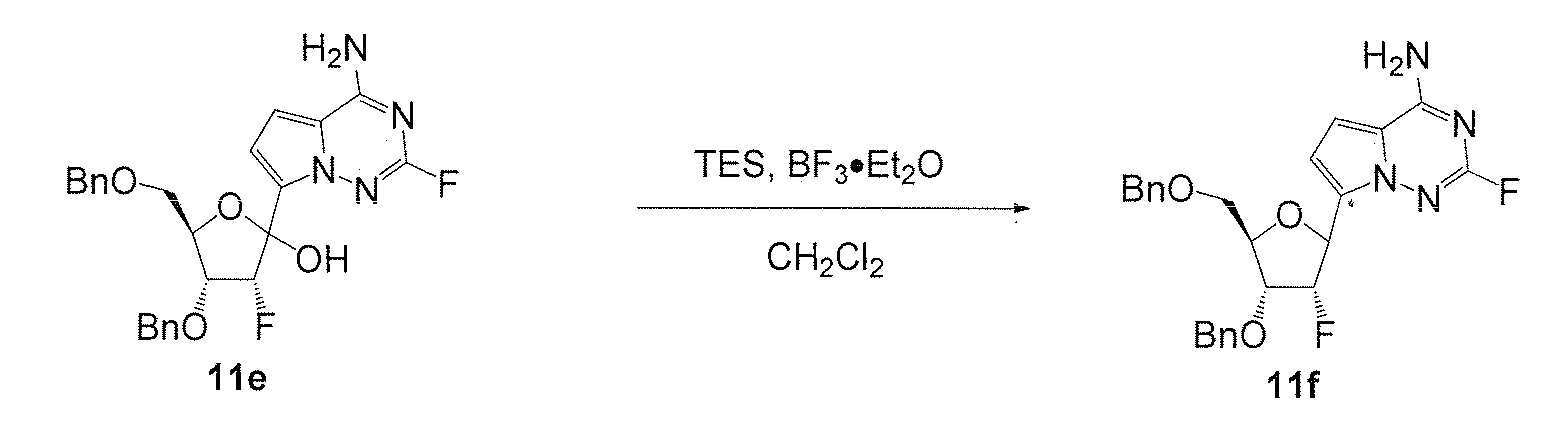
중간체 11f - 7-((Intermediate 11f-7-(( 2S,3S,4R,5R2S, 3S, 4R, 5R )-4-()-4-( 벤질옥시Benzyloxy )-5-(() -5-(( 벤질옥시Benzyloxy )) 메틸methyl )-3-) -3- 플루오로테트라히드로푸란Fluorotetrahydrofuran -2-일)-2-플루오로피롤로[2,1-f][1,2,4]트리아진-4-아민-2-yl) -2-fluoropyrrolo [2,1-f] [1,2,4] triazine-4-amine
중간체 11e (1.99 g, 3.72 mmol)를 CH2Cl2 (80 ㎖) 중에 용해시키고, TES (4.75 ㎖, 29.7 mmol)를 혼합물에 첨가하였다. 반응 혼합물을 0℃로 냉각시키고, BF3·Et2O (1.07 ㎖, 4.09 mmol)를 서서히 첨가하였다. 15 분 후, 반응 혼합물을 포화 NaHCO3(aq)로 켄칭시키고, 층이 분리되었다. 수성층을 CH2Cl2로 세정하였다. 유기층을 합하고, 포화 NaHCO3(aq)로 세정하였다. 유기층을 Na2SO4 위에서 건조시키고, 여과하고, 감압 하에서 농축시켰다. 미정제물을 실리카 겔 크로마토그래피 (0-60% EtOAc/Hex)에 의하여 정제하여 중간체 11f (1.12 g, 64%, 1' 아노머의 2:1 혼합물)를 얻었다.Intermediate 11e (1.99 g, 3.72 mmol) was dissolved in CH 2 Cl 2 (80 mL) and TES (4.75 mL, 29.7 mmol) was added to the mixture. The reaction mixture was cooled to 0 ° C., and BF 3 · Et 2 O (1.07 mL, 4.09 mmol) was added slowly. After 15 minutes, the reaction mixture was quenched with saturated NaHCO 3 (aq) and the layers separated. The aqueous layer was washed with CH 2 Cl 2 . The organic layers were combined and washed with saturated NaHCO 3 (aq) . The organic layer was dried over Na 2 SO 4 , filtered and concentrated under reduced pressure. The crude was purified by silica gel chromatography (0-60% EtOAc / Hex) to give intermediate 11f (1.12 g, 64%, 2: 1 mixture of 1 'anomer).
LC/MS: tR=1.55 min, MS m/z=467.47 [M+H]; LC 시스템: 써모 아셀라 1250 UHPLC; MS 시스템: 써모 LCQ 플리트; 컬럼: 키네텍스 2.6μ XB-C18 100A, 50×3.00 ㎜; 용매: 0.1% 포름산을 갖는 아세토니트릴, 0.1% 포름산을 갖는 물; 구배: 1.8 ㎖/min으로 0 min-1.4 min 2-100% ACN, 1.4 min-1.80 min 100% ACN, 1.8 min-1.85 min 100%-2% ACN, 1.85 min-2 min 2% ACN.LC / MS: t R = 1.55 min, MS m / z = 467.47 [M + H]; LC system: Thermo Acela 1250 UHPLC; MS system: Thermo LCQ pleats; Column: Kinetex 2.6 μ XB-C18 100A, 50 × 3.00 mm; Solvent: acetonitrile with 0.1% formic acid, water with 0.1% formic acid; Gradient: 0 min-1.4 min 2-100% ACN at 1.8 mL / min, 1.4 min-1.80 min 100% ACN, 1.8 min-1.85 min 100% -2% ACN, 1.85 min-2 min 2% ACN.

중간체 11g - (Intermediate 11 g-( 2R,3R,4R,5S2R, 3R, 4R, 5S )-5-(4-아미노-2-) -5- (4-amino-2- 플루오로피롤로[2,1-f][1,2,4]트리아진Fluoropyrrolo [2,1-f] [1,2,4] triazine -7-일)-4-플루오로-2-(히드록시메틸)테트라히드로푸란-3-올-7-yl) -4-fluoro-2- (hydroxymethyl) tetrahydrofuran-3-ol
중간체 11f (0.82 g, 1.76 mmol)를 아세트산 (25 ㎖) 중에 용해시켰다. 반응 용기를 아르곤으로 퍼징시키고, 10% Pd/C (468 ㎎, 0.439 mmol)를 첨가하였다. 용기를 비우고, H2(g)로 역충전하였다 (3×). 1 시간 후, 반응 용기를 질소로 퍼징시켰다. 생성된 혼합물을 셀라이트 패드를 통하여 여과하고, 필터 케이트를 CH3OH로 세정하였다. 여과액을 감압 하에서 농축시킨 후, 에틸 아세테이트에 이어서 헥산으로 동시 증발시켜 중간체 11g (503 ㎎, 98%, 1' 아노머의 2:1 혼합물)를 얻었다.Intermediate 11f (0.82 g, 1.76 mmol) was dissolved in acetic acid (25 mL). The reaction vessel was purged with argon, and 10% Pd / C (468 mg, 0.439 mmol) was added. The container was emptied and backfilled with H 2 (g) (3 ×). After 1 hour, the reaction vessel was purged with nitrogen. The resulting mixture was filtered through a pad of celite, and the filter case was washed with CH 3 OH. The filtrate was concentrated under reduced pressure, and then ethyl acetate followed by simultaneous evaporation with hexane to give 11 g of an intermediate (503 mg, 98%, 2: 1 mixture of 1 'anomer).
LC/MS: tR=0.81 min, MS m/z=286.97 [M+H]; LC 시스템: 써모 아셀라 1250 UHPLC; MS 시스템: 써모 LCQ 플리트; 컬럼: 키네텍스 2.6μ XB-C18 100A, 50×3.00 ㎜; 용매: 0.1% 포름산을 갖는 아세토니트릴, 0.1% 포름산을 갖는 물; 구배: 1.8 ㎖/min으로 0 min-1.4 min 2-100% ACN, 1.4 min-1.80 min 100% ACN, 1.8 min-1.85 min 100%-2% ACN, 1.85 min-2 min 2% ACN.LC / MS: t R = 0.81 min, MS m / z = 286.97 [M + H]; LC system: Thermo Acela 1250 UHPLC; MS system: Thermo LCQ pleats; Column: Kinetex 2.6 μ XB-C18 100A, 50 × 3.00 mm; Solvent: acetonitrile with 0.1% formic acid, water with 0.1% formic acid; Gradient: 0 min-1.4 min 2-100% ACN at 1.8 mL / min, 1.4 min-1.80 min 100% ACN, 1.8 min-1.85 min 100% -2% ACN, 1.85 min-2 min 2% ACN.
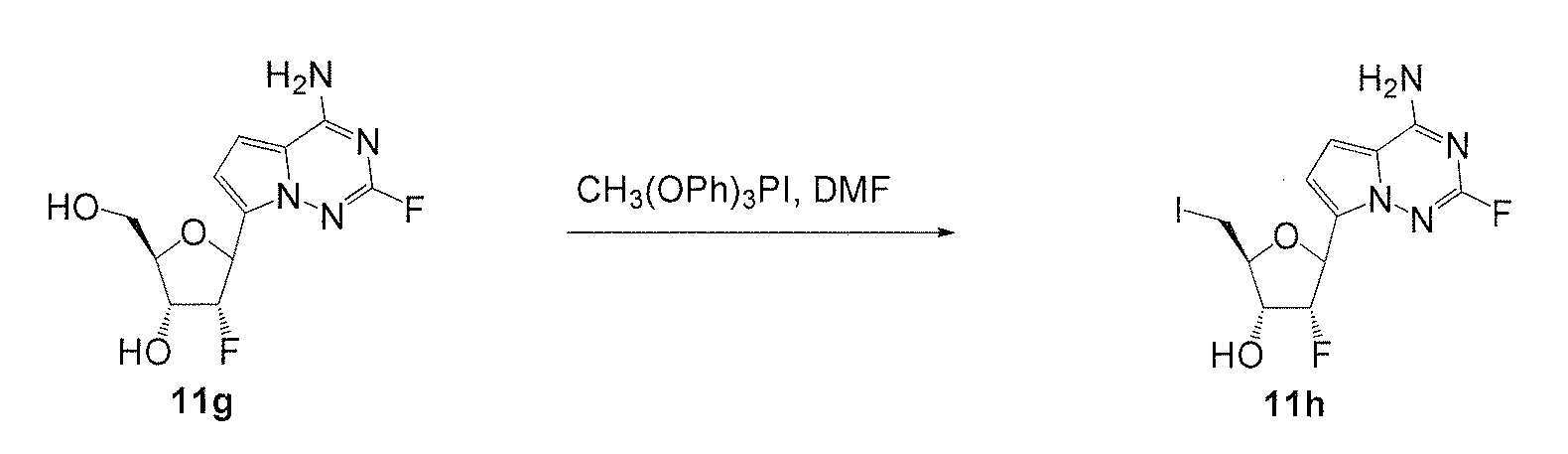
중간체 11h - (Intermediate 11h-( 2S,3R,4R,5S2S, 3R, 4R, 5S )-5-(4-아미노-2-) -5- (4-amino-2- 플루오로피롤로[2,1-f][1,2,4]트리아진Fluoropyrrolo [2,1-f] [1,2,4] triazine -7-일)-4-플루오로-2-(아이오도메틸)테트라히드로푸란-3-올-7-yl) -4-fluoro-2- (iodomethyl) tetrahydrofuran-3-ol
아르곤 퍼징된 플라스크에 DMF (10 ㎖) 중의 11g (283 ㎎, 0.989 mmol)의 용액에 이어서 4 ㎖ DMF 중의 메틸 트리펜옥시포스포늄 아이오다이드 (0.536 g, 1.19 mmol)의 용액을 첨가하였다. 반응 혼합물을 0℃에서 10 분 동안 교반한 후, 상온으로 가온시켰다. 30 분 후, 반응을 포화 Na2S2O3(aq)로 켄칭시켰다. 미정제 물질을 EtOAc 및 5% LiCl(aq) 사이에 분포시켰다. 유기물을 분리하고, 염수로 세정하였다. 유기물을 Na2SO4 위에서 건조시키고, 여과하고, 감압 하에서 농축시켰다. 미정제 잔류물을 ACN 중에서 취하고, 산 변형제를 사용하지 않고 HPLC에 의하여 정제하여 중간체 11h (201 ㎎, 52%, 1' 아노머의 2:1 혼합물)를 백색 고체로서 얻었다.To an argon purged flask was added a solution of 11 g (283 mg, 0.989 mmol) in DMF (10 mL) followed by a solution of methyl triphenoxyphosphonium iodide (0.536 g, 1.19 mmol) in 4 mL DMF. The reaction mixture was stirred at 0 ° C for 10 minutes, then warmed to room temperature. After 30 minutes, the reaction was quenched with saturated Na 2 S 2 O 3 (aq) . The crude material was distributed between EtOAc and 5% LiCl (aq) . The organics were separated and washed with brine. The organic was dried over Na 2 SO 4 , filtered and concentrated under reduced pressure. The crude residue was taken in ACN and purified by HPLC without acid modifier to give the intermediate 11h (201 mg, 52%, 2: 1 mixture of 1 'anomer) as a white solid.
LC/MS: tR=1.08 min, MS m/z=397.12 [M+H]; LC 시스템: 써모 아셀라 1250 UHPLC; MS 시스템: 써모 LCQ 플리트; 컬럼: 키네텍스 2.6μ XB-C18 100A, 50×3.00 ㎜; 용매: 0.1% 포름산을 갖는 아세토니트릴, 0.1% 포름산을 갖는 물; 구배: 1.8 ㎖/min으로 0 min-1.4 min 2-100% ACN, 1.4 min-1.80 min 100% ACN, 1.8 min-1.85 min 100%-2% ACN, 1.85 min-2 min 2% ACN.LC / MS: t R = 1.08 min, MS m / z = 397.12 [M + H]; LC system: Thermo Acela 1250 UHPLC; MS system: Thermo LCQ pleats; Column: Kinetex 2.6 μ XB-C18 100A, 50 × 3.00 mm; Solvent: acetonitrile with 0.1% formic acid, water with 0.1% formic acid; Gradient: 0 min-1.4 min 2-100% ACN at 1.8 mL / min, 1.4 min-1.80 min 100% ACN, 1.8 min-1.85 min 100% -2% ACN, 1.85 min-2 min 2% ACN.

중간체 11i - (Intermediate 11i-( 3R,4R,5S3R, 4R, 5S )-5-(4-아미노-2-) -5- (4-amino-2- 플루오로피롤로[2,1-f][1,2,4]트리아진Fluoropyrrolo [2,1-f] [1,2,4] triazine -7-일)-4-플루오로-2-메틸렌테트라히드로푸란-3-올-7-yl) -4-fluoro-2-methylenetetrahydrofuran-3-ol
THF (8 ㎖) 중의 11h (356 ㎎, 0.899 mmol)의 용액에 DBU (0.403 ㎖, 2.70 mmol)를 첨가하고, 생성된 혼합물을 60℃로 가열하였다. 3 시간 후, 반응 혼합물을 감압 하에서 농축시켰다. 미정제 잔류물을 실리카 겔 크로마토그래피 (40-100% EtOAc/Hex)에 의하여 정제하여 중간체 11i (201 ㎎, 83%, 1' 아노머의 2:1 혼합물)를 백색 고체로서 얻었다.To a solution of 11 h (356 mg, 0.899 mmol) in THF (8 mL) was added DBU (0.403 mL, 2.70 mmol), and the resulting mixture was heated to 60 ° C. After 3 hours, the reaction mixture was concentrated under reduced pressure. The crude residue was purified by silica gel chromatography (40-100% EtOAc / Hex) to give Intermediate 11i (201 mg, 83%, 2: 1 mixture of 1 'anomer) as a white solid.
LC/MS: tR=1.04 min, MS m/z=269.14 [M+1]; LC 시스템: 써모 아셀라 1250 UHPLC; MS 시스템: 써모 LCQ 플리트; 컬럼: 키네텍스 2.6μ XB-C18 100A, 50×3.00 ㎜; 용매: 0.1% 포름산을 갖는 아세토니트릴, 0.1% 포름산을 갖는 물; 구배: 1.8 ㎖/min으로 0 min-1.4 min 2-100% ACN, 1.4 min-1.80 min 100% ACN, 1.8 min-1.85 min 100%-2% ACN, 1.85 min-2 min 2% ACN.LC / MS: t R = 1.04 min, MS m / z = 269.14 [M + 1]; LC system: Thermo Acela 1250 UHPLC; MS system: Thermo LCQ pleats; Column: Kinetex 2.6 μ XB-C18 100A, 50 × 3.00 mm; Solvent: acetonitrile with 0.1% formic acid, water with 0.1% formic acid; Gradient: 0 min-1.4 min 2-100% ACN at 1.8 mL / min, 1.4 min-1.80 min 100% ACN, 1.8 min-1.85 min 100% -2% ACN, 1.85 min-2 min 2% ACN.
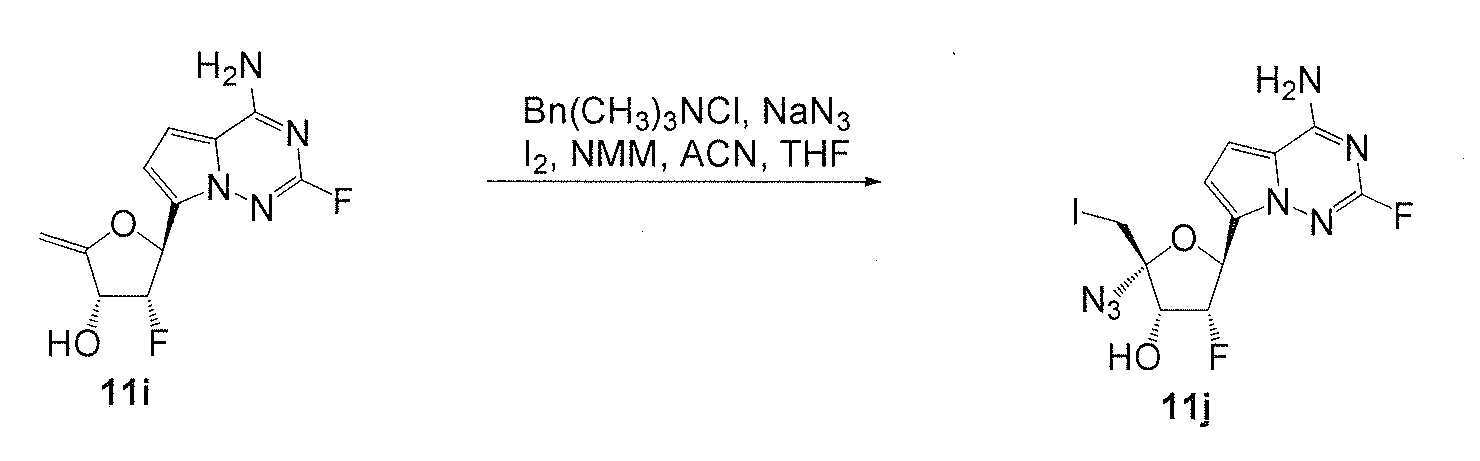
중간체 11j - (Intermediate 11j-( 2S,3R,4R,5S2S, 3R, 4R, 5S )-5-(4-아미노-2-) -5- (4-amino-2- 플루오로피롤로[2,1-f][1,2,4]트리아진Fluoropyrrolo [2,1-f] [1,2,4] triazine -7-일)-2-아지도-4-플루오로-2-(아이오도메틸)테트라히드로푸란-3-올-7-yl) -2-azido-4-fluoro-2- (iodomethyl) tetrahydrofuran-3-ol
벤질트리메틸암모늄 클로라이드 (292 ㎎, 1.57 mmol) 및 소듐 아지드 (102 ㎎, 1.57 mmol)를 ACN (4 ㎖) 중에 용해시키고, 생성된 혼합물을 상온에서 4 시간 동안 교반하였다. 혼합물을 여과하고, 여과액을 THF (4 ㎖) 중의 11i (0.201 g, 0.749 mmol)의 용액에 첨가하였다. NMM (0.412 ㎖, 3.75 mmol)을 첨가한 후, THF (4 ㎖) 중의 아이오딘 (0.342 g, 1.35 mmol)의 용액을 적가하였다. 15 분 후, 기체 발생이 관찰되지 않을 때까지 N-아세틸 시스테인을 일부분씩 나누어 첨가하였다. 용액이 담황색이 될 때까지 포화 Na2S2O3(aq)를 첨가하였다. 생성된 혼합물을 물 및 에틸 아세테이트 사이에 분배시켰다. 층이 분리되고, 유기층을 Na2SO4 위에서 건조시키고, 여과하고, 감압 하에서 농축시켰다. 미정제 잔류물을 실리카 겔 크로마토그래피 (20-100% EtOAc/Hex)에 의하여 정제하여 중간체 11j (183 ㎎, 56%)를 단일 이성질체로서 얻었다.Benzyltrimethylammonium chloride (292 mg, 1.57 mmol) and sodium azide (102 mg, 1.57 mmol) were dissolved in ACN (4 mL) and the resulting mixture was stirred at ambient temperature for 4 hours. The mixture was filtered and the filtrate was added to a solution of 11i (0.201 g, 0.749 mmol) in THF (4 mL). After adding NMM (0.412 mL, 3.75 mmol), a solution of iodine (0.342 g, 1.35 mmol) in THF (4 mL) was added dropwise. After 15 minutes, N-acetyl cysteine was added in portions until no gas evolution was observed. Saturated Na 2 S 2 O 3 (aq) was added until the solution became pale yellow. The resulting mixture was partitioned between water and ethyl acetate. The layers were separated, and the organic layer was dried over Na 2 SO 4 , filtered and concentrated under reduced pressure. The crude residue was purified by silica gel chromatography (20-100% EtOAc / Hex) to give the intermediate 11j (183 mg, 56%) as a single isomer.
1H NMR (400 MHz, DMSO-d6) δ 8.44 (d, J=28.6 Hz, 2H), 6.98 (d, J=4.6 Hz, 1H), 6.79 (d, J=4.6 Hz, 1H), 6.32 (d, J=6.9 Hz, 1H), 5.60 (dd, J=23.8, 2.5 Hz, 1H), 5.36 (ddd, J=54.9, 5.0, 2.6 Hz, 1H), 4.60 (ddd, J=21.5, 6.9, 5.0 Hz, 1H), 3.63 (ABq, Δδ=0.09 ppm, J=8 Hz, 2H). 1 H NMR (400 MHz, DMSO-d 6 ) δ 8.44 (d, J = 28.6 Hz, 2H), 6.98 (d, J = 4.6 Hz, 1H), 6.79 (d, J = 4.6 Hz, 1H), 6.32 (d, J = 6.9 Hz, 1H), 5.60 (dd, J = 23.8, 2.5 Hz, 1H), 5.36 (ddd, J = 54.9, 5.0, 2.6 Hz, 1H), 4.60 (ddd, J = 21.5, 6.9 , 5.0 Hz, 1H), 3.63 (ABq, Δδ = 0.09 ppm, J = 8 Hz, 2H).
19F NMR (376 MHz, DMSO-d6) δ -71.74 (s), -194.57 (ddd, J=54.9, 24.0, 21.7 Hz) 19 F NMR (376 MHz, DMSO-d 6 ) δ -71.74 (s), -194.57 (ddd, J = 54.9, 24.0, 21.7 Hz)
LC/MS: tR=1.71 min, MS m/z=437.93 [M+1]; LC 시스템: 써모 아셀라 1250 UHPLC; MS 시스템: 써모 LCQ 플리트; 컬럼: 키네텍스 2.6μ XB-C18 100A, 50×3.00 ㎜; 용매: 0.1% 포름산을 갖는 아세토니트릴, 0.1% 포름산을 갖는 물; 구배: 1.8 ㎖/min으로 0 min-2.4 min 2-100% ACN, 2.4 min-2.80 min 100% ACN, 2.8 min-2.85 min 100%-2% ACN, 2.85 min-3.0 min 2% ACN.LC / MS: t R = 1.71 min, MS m / z = 437.93 [M + 1]; LC system: Thermo Acela 1250 UHPLC; MS system: Thermo LCQ pleats; Column: Kinetex 2.6 μ XB-C18 100A, 50 × 3.00 mm; Solvent: acetonitrile with 0.1% formic acid, water with 0.1% formic acid; Gradient: 0 min-2.4 min 2-100% ACN at 1.8 mL / min, 2.4 min-2.80 min 100% ACN, 2.8 min-2.85 min 100% -2% ACN, 2.85 min-3.0 min 2% ACN.

중간체 11k - (Intermediate 11k-( 2S,3R,4S,5S2S, 3R, 4S, 5S )-5-(4-아미노-2-) -5- (4-amino-2- 플루오로피롤로[2,1-f][1,2,4]트리아진Fluoropyrrolo [2,1-f] [1,2,4] triazine -7-일)-2-아지도-4-플루오로-2-(아이오도메틸)테트라히드로푸란-3-일 -7-yl) -2-azido-4-fluoro-2- (iodomethyl) tetrahydrofuran-3-yl 이소부티레이트Isobutyrate
THF (10 ㎖) 중의 11j (0.183 g, 0.419 mmol)의 용액에 이소부티르산 무수물 (0.083 ㎖, 0.502 mmol), TEA (0.118 ㎖, 0.837 mmol) 및 DMAP (10 ㎎, 0.084 mmol)를 첨가하였다. 반응을 상온에서 15 분 동안 교반하고, 반응을 CH3OH로 켄칭시켰다. 반응 혼합물을 감압 하에서 농축시키고, 미정제 잔류물을 실리카 겔 크로마토그래피 (0-50% EtOAc/Hex)에 의하여 정제하여 중간체 11k (0.198 g, 93%)를 백색 고체로서 얻었다.To a solution of 11j (0.183 g, 0.419 mmol) in THF (10 mL) was added isobutyric anhydride (0.083 mL, 0.502 mmol), TEA (0.118 mL, 0.837 mmol) and DMAP (10 mg, 0.084 mmol). The reaction was stirred at room temperature for 15 minutes, and the reaction was quenched with CH 3 OH. The reaction mixture was concentrated under reduced pressure, and the crude residue was purified by silica gel chromatography (0-50% EtOAc / Hex) to give the intermediate 11k (0.198 g, 93%) as a white solid.
1H NMR (400 MHz, DMSO-d6) δ 8.48 (d, J=30.7 Hz, 2H), 6.99 (d, J=4.6 Hz, 1H), 6.84 (d, J=4.6 Hz, 1H), 5.77-5.47 (m, 3H), 3.69 (ABq, Δδ=0.05 ppm, J=12 Hz, 2H), 2.70 (p, J=7.0 Hz, 1H), 1.24-1.05 (d, J=7.0 Hz, 6H). 1 H NMR (400 MHz, DMSO-d 6 ) δ 8.48 (d, J = 30.7 Hz, 2H), 6.99 (d, J = 4.6 Hz, 1H), 6.84 (d, J = 4.6 Hz, 1H), 5.77 -5.47 (m, 3H), 3.69 (ABq, Δδ = 0.05 ppm, J = 12 Hz, 2H), 2.70 (p, J = 7.0 Hz, 1H), 1.24-1.05 (d, J = 7.0 Hz, 6H) .
19F NMR (376 MHz, DMSO-d6) δ -71.58 (s), -194.89 (ddd, J=55.0, 24.3, 16.8 Hz). 19 F NMR (376 MHz, DMSO-d 6 ) δ -71.58 (s), -194.89 (ddd, J = 55.0, 24.3, 16.8 Hz).
LC/MS: tR=1.56 min, MS m/z=508.13 [M+1]; LC 시스템: 써모 아셀라 1250 UHPLC; MS 시스템: 써모 LCQ 플리트; 컬럼: 키네텍스 2.6μ XB-C18 100A, 50×3.00 ㎜; 용매: 0.1% 포름산을 갖는 아세토니트릴, 0.1% 포름산을 갖는 물; 구배: 1.8 ㎖/min으로 0 min-2.4 min 2-100% ACN, 2.4 min-2.80 min 100% ACN, 2.8 min-2.85 min 100%-2% ACN, 2.85 min-3.0 min 2% ACN.LC / MS: t R = 1.56 min, MS m / z = 508.13 [M + 1]; LC system: Thermo Acela 1250 UHPLC; MS system: Thermo LCQ pleats; Column: Kinetex 2.6 μ XB-C18 100A, 50 × 3.00 mm; Solvent: acetonitrile with 0.1% formic acid, water with 0.1% formic acid; Gradient: 0 min-2.4 min 2-100% ACN at 1.8 mL / min, 2.4 min-2.80 min 100% ACN, 2.8 min-2.85 min 100% -2% ACN, 2.85 min-3.0 min 2% ACN.

중간체 11l - ((2R,3R,4S,5S)-5-(4-아미노-2-플루오로피롤로[2,1-f][1,2,4]트리아진-7-일)-2-아지도-4-플루오로-3-(이소부티릴옥시)테트라히드로푸란-2-일)메틸 3-Intermediate 11l-((2R, 3R, 4S, 5S) -5- (4-amino-2-fluoropyrrolo [2,1-f] [1,2,4] triazine-7-yl) -2 -Azido-4-fluoro-3- (isobutyryloxy) tetrahydrofuran-2-yl) methyl 3- 클로로벤조에이트Chlorobenzoate
중간체 11k (0.153 g, 0.302 mmol)를 CH2Cl2 (10 ㎖) 및 H2O (6 ㎖) 중에 용해시켰다. 2염기성 인산칼륨 (0.138 g, 0.603 mmol), 테트라부틸암모늄 바이술페이트 (0.210 g, 0.618 mmol) 및 3-클로로벤조산 (0.097 g, 0.618 mmol)을 순차적으로 첨가하였다. 생성된 혼합물을 0℃로 냉각하고, MCPBA (0.203 g, 0.905 mmol)를 첨가하였다. 반응 혼합물을 상온으로 가온시키고, 16 시간 동안 교반하였다. 그 후, 반응 혼합물을 포화 Na2S2O3(aq)로 켄칭시키고, 감압 하에서 농축시켰다. 미정제 수성 잔류물을 ACN으로 희석하고, 산 변형제를 사용하지 않고 분취용 HPLC에 의하여 정제하여 중간체 11l (20 ㎎, 13%)을 백색 고체로서 얻었다.Intermediate 11k (0.153 g, 0.302 mmol) was dissolved in CH 2 Cl 2 (10 mL) and H 2 O (6 mL). Dibasic potassium phosphate (0.138 g, 0.603 mmol), tetrabutylammonium bisulfate (0.210 g, 0.618 mmol) and 3-chlorobenzoic acid (0.097 g, 0.618 mmol) were added sequentially. The resulting mixture was cooled to 0 ° C. and MCPBA (0.203 g, 0.905 mmol) was added. The reaction mixture was allowed to warm to room temperature and stirred for 16 hours. Thereafter, the reaction mixture was quenched with saturated Na 2 S 2 O 3 (aq) , and concentrated under reduced pressure. The crude aqueous residue was diluted with ACN and purified by preparative HPLC without using an acid modifier to give 11l (20 mg, 13%) of the intermediate as a white solid.
1H NMR (400 MHz, DMSO-d6) δ 8.46 (d, J=26.4 Hz, 2H), 7.96-7.81 (m, 2H), 7.81-7.66 (m, 1H), 7.62-7.46 (m, 1H), 6.94 (d, J=4.5 Hz, 1H), 6.80 (d, J=4.5 Hz, 1H), 5.73 (s, 3H), 4.60 (ABq, Δδ=0.08 ppm, J=12 Hz, 2H), 2.66 (p, J=7.0 Hz, 1H), 1.20-1.01 (m, 6H). 1 H NMR (400 MHz, DMSO-d 6 ) δ 8.46 (d, J = 26.4 Hz, 2H), 7.96-7.81 (m, 2H), 7.81-7.66 (m, 1H), 7.62-7.46 (m, 1H ), 6.94 (d, J = 4.5 Hz, 1H), 6.80 (d, J = 4.5 Hz, 1H), 5.73 (s, 3H), 4.60 (ABq, Δδ = 0.08 ppm, J = 12 Hz, 2H), 2.66 (p, J = 7.0 Hz, 1H), 1.20-1.01 (m, 6H).
19F NMR (376 MHz, DMSO-d6) δ=-71.45 (s), -193.41 (ddd, J=54.4, 25.4, 21.2 Hz). 19 F NMR (376 MHz, DMSO-d 6 ) δ = -71.45 (s), -193.41 (ddd, J = 54.4, 25.4, 21.2 Hz).
LC/MS: tR=2.22 min, MS m/z=536.17 [M+1]; LC 시스템: 써모 아셀라 1250 UHPLC; MS 시스템: 써모 LCQ 플리트; 컬럼: 키네텍스 2.6μ XB-C18 100A, 50×3.00 ㎜; 용매: 0.1% 포름산을 갖는 아세토니트릴, 0.1% 포름산을 갖는 물; 구배: 1.8 ㎖/min으로 0 min-2.4 min 2-100% ACN, 2.4 min-2.80 min 100% ACN, 2.8 min-2.85 min 100%-2% ACN, 2.85 min-3.0 min 2% ACN.LC / MS: t R = 2.22 min, MS m / z = 536.17 [M + 1]; LC system: Thermo Acela 1250 UHPLC; MS system: Thermo LCQ pleats; Column: Kinetex 2.6 μ XB-C18 100A, 50 × 3.00 mm; Solvent: acetonitrile with 0.1% formic acid, water with 0.1% formic acid; Gradient: 0 min-2.4 min 2-100% ACN at 1.8 mL / min, 2.4 min-2.80 min 100% ACN, 2.8 min-2.85 min 100% -2% ACN, 2.85 min-3.0 min 2% ACN.
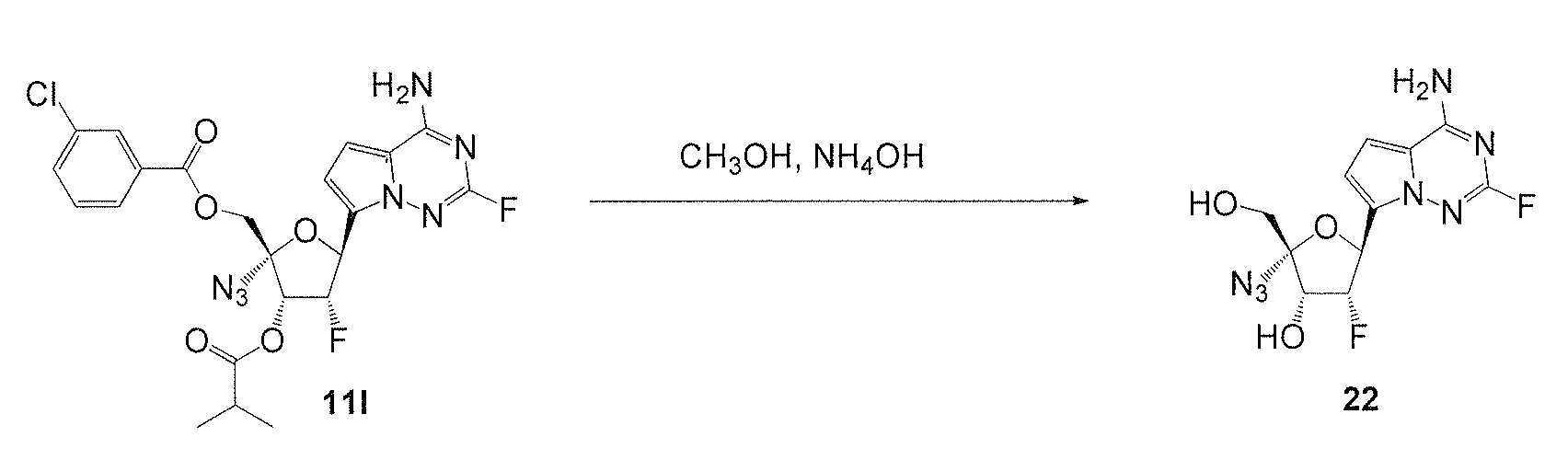
실시예Example 22 - ( 22-( 2R,3R,4R,5S2R, 3R, 4R, 5S )-5-(4-아미노-2-) -5- (4-amino-2- 플루오로피롤로[2,1-f][1,2,4]트리아진Fluoropyrrolo [2,1-f] [1,2,4] triazine -7-일)-2-아지도-4-플루오로-2-(히드록시메틸)테트라히드로푸란-3-올-7-yl) -2-azido-4-fluoro-2- (hydroxymethyl) tetrahydrofuran-3-ol
CH3OH (1 ㎖) 중의 중간체 11l (22 ㎎, 0.041 mmol)의 용액에 진한 NH4OH (1 ㎖)를 실온에서 첨가하였다. 30 분 후, 반응 혼합물을 감압 하에서 농축시켰다. 미정제 잔류물을 최소 H2O로 희석하고, 변형제를 사용하지 않고 분취용 HPLC에 의하여 정제하여 실시예 22 (10 ㎎, 77%)를 백색 고체로서 얻었다.To a solution of 11 l (22 mg, 0.041 mmol) of intermediate in CH 3 OH (1 mL) was added concentrated NH 4 OH (1 mL) at room temperature. After 30 minutes, the reaction mixture was concentrated under reduced pressure. The crude residue was diluted with minimal H 2 O and purified by preparative HPLC without the use of modifiers to give Example 22 (10 mg, 77%) as a white solid.
1H NMR (400 MHz, DMSO-d6) δ 8.40 (d, J=30.9 Hz, 2H), 6.95 (d, J=4.5 Hz, 1H), 6.78 (d, J=4.5 Hz, 1H), 5.89 (d, J=7.5 Hz, 1H), 5.61 (dd, J=23.8, 2.1 Hz, 1H), 5.44 (t, J=6.1 Hz, 1H), 5.18 (ddd, J=55.3, 5.1, 2.2 Hz, 1H), 4.44 (ddd, J=23.7, 7.5, 5.0 Hz, 1H), 3.59 (ddd, J=48.5, 12.0, 6.1 Hz, 2H). 1 H NMR (400 MHz, DMSO-d 6 ) δ 8.40 (d, J = 30.9 Hz, 2H), 6.95 (d, J = 4.5 Hz, 1H), 6.78 (d, J = 4.5 Hz, 1H), 5.89 (d, J = 7.5 Hz, 1H), 5.61 (dd, J = 23.8, 2.1 Hz, 1H), 5.44 (t, J = 6.1 Hz, 1H), 5.18 (ddd, J = 55.3, 5.1, 2.2 Hz, 1H), 4.44 (ddd, J = 23.7, 7.5, 5.0 Hz, 1H), 3.59 (ddd, J = 48.5, 12.0, 6.1 Hz, 2H).
19F NMR (376 MHz, DMSO-d6) δ -71.18 (s), -193.48 (dt, J=55.3, 23.8 Hz). 19 F NMR (376 MHz, DMSO-d 6 ) δ -71.18 (s), -193.48 (dt, J = 55.3, 23.8 Hz).
LC/MS: tR=1.13 min, MS m/z=327.86 [M+1]; LC 시스템: 써모 아셀라 1250 UHPLC; MS 시스템: 써모 LCQ 플리트; 컬럼: 키네텍스 2.6μ XB-C18 100A, 50×3.00 ㎜; 용매: 0.1% 포름산을 갖는 아세토니트릴, 0.1% 포름산을 갖는 물; 구배: 1.8 ㎖/min으로 0 min-2.4 min 2-100% ACN, 2.4 min-2.80 min 100% ACN, 2.8 min-2.85 min 100%-2% ACN, 2.85 min-3.0 min 2% ACN.LC / MS: t R = 1.13 min, MS m / z = 327.86 [M + 1]; LC system: Thermo Acela 1250 UHPLC; MS system: Thermo LCQ pleats; Column: Kinetex 2.6 μ XB-C18 100A, 50 × 3.00 mm; Solvent: acetonitrile with 0.1% formic acid, water with 0.1% formic acid; Gradient: 0 min-2.4 min 2-100% ACN at 1.8 mL / min, 2.4 min-2.80 min 100% ACN, 2.8 min-2.85 min 100% -2% ACN, 2.85 min-3.0 min 2% ACN.
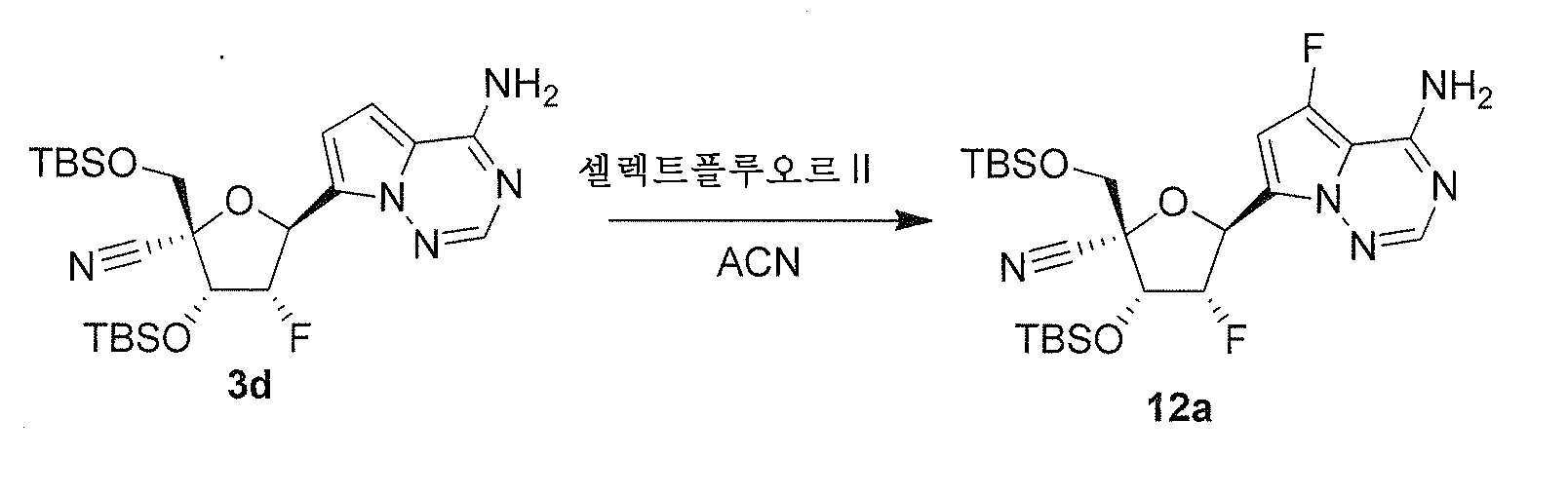
중간체 12a - (2R,3R,4S,5S)-5-(4-아미노-5-플루오로피롤로[2,1-f][1,2,4]트리아진-7-일)-3-((tert-부틸디메틸실릴)옥시)-2-(((tert-부틸디메틸실릴)옥시)메틸)-4-플루오로테트라히드로푸란-2-카르보니트릴Intermediate 12a-(2R, 3R, 4S, 5S) -5- (4-amino-5-fluoropyrrolo [2,1-f] [1,2,4] triazin-7-yl) -3- ((tert-butyldimethylsilyl) oxy) -2-(((terter-butyldimethylsilyl) oxy) methyl) -4-fluorotetrahydrofuran-2-carbonitrile
ACN (3 ㎖) 중의 중간체 3d (57 ㎎, 0.109 mmol)의 용액에 셀렉트플루오르 II (52 ㎎, 0.164 mmol)를 한번에 첨가하였다. 1.5 시간 후, 반응을 포화 NaHCO3(aq)을 첨가하여 켄칭시켰다. 에틸 아세테이트 (4 ㎖)를 첨가하고, 2상 혼합물을 5 분 동안 격렬하게 교반하였다. 반응을 EtOAc, 포화 NaHCO3(aq)로 추가로 희석하였다. 층이 분리되고, 유기 상을 물에 이어서 염수로 추출하였다. 유기층을 Na2SO4 위에서 건조시켰다. 건조제를 진공 여과에 의하여 제거하고, 여과액을 감압 하에서 농축시켰다. 중간체 12a (11 ㎎, 18.7%)를 하기 용매 램프를 사용하는 실리카 겔 컬럼 크로마토그래피에 의하여 농축된 미정제 물질로부터 분리하였다: 헥산 중의 0% EtOAc로부터 헥산 중의 70% EtOAc로 상승시키고, 출발 물질이 컬럼으로부터 용출되자마자 100% EtOAc로 신속하게 상승시켰다.To a solution of intermediate 3d (57 mg, 0.109 mmol) in ACN (3 mL), selectfluor II (52 mg, 0.164 mmol) was added in one portion. After 1.5 hours, the reaction was quenched by adding saturated NaHCO 3 (aq) . Ethyl acetate (4 mL) was added and the biphasic mixture was stirred vigorously for 5 minutes. The reaction was further diluted with EtOAc, saturated NaHCO 3 (aq) . The layers were separated and the organic phase was extracted with water followed by brine. The organic layer was dried over Na 2 SO 4 . The desiccant was removed by vacuum filtration, and the filtrate was concentrated under reduced pressure. Intermediate 12a (11 mg, 18.7%) was isolated from the crude material concentrated by silica gel column chromatography using the following solvent lamp: from 0% EtOAc in hexane to 70% EtOAc in hexane, starting material Upon eluting from the column, it was quickly raised to 100% EtOAc.
1H NMR (400 MHz, CD3OD) δ 7.72 (s, 1H), 7.55 (s, 1H), 5.65 (dd, J=24.8, 2.4 Hz, 1H), 5.38 (dq, J=54.4, 2 Hz, 1H), 4.88 (dd, J=19.2, 4.4 Hz, 1H), 3.96 (ABq, ΔδAB=0.141 ppm, J=11 Hz, 2H), 0.99 (s, 9H), 0.86 (s, 9H), 0.21 (s, 6H), 0.07 (s, 3H), -0.02 (s, 3H). 1 H NMR (400 MHz, CD 3 OD) δ 7.72 (s, 1H), 7.55 (s, 1H), 5.65 (dd, J = 24.8, 2.4 Hz, 1H), 5.38 (dq, J = 54.4, 2 Hz , 1H), 4.88 (dd, J = 19.2, 4.4 Hz, 1H), 3.96 (ABq, Δδ AB = 0.141 ppm, J = 11 Hz, 2H), 0.99 (s, 9H), 0.86 (s, 9H), 0.21 (s, 6H), 0.07 (s, 3H), -0.02 (s, 3H).
19F NMR (376 MHz, CD3OD) δ -161.795 (s), -194.806 (ddd, J=54.5, 19.2, 18.8 Hz). 19 F NMR (376 MHz, CD 3 OD) δ -161.795 (s), -194.806 (ddd, J = 54.5, 19.2, 18.8 Hz).
LC/MS: RT=2.06 min, MS m/z=540.64 [M+1]; LC 시스템: 써모 아셀라 1250 UHPLC; MS: 써모 LCQ 플리트; 컬럼: 키네텍스 2.6μ C18 100A, 50×3.00 ㎜; 용매: 0.1% 포름산을 갖는 아세토니트릴, 0.1% 포름산을 갖는 물; 구배: 0 min-2.4 min 2-100% ACN, 2.4 min-2.8 min 100% ACN, 2.8 min-2.85 min 100%-2% ACN, 2.85 min-3 min 2% ACN.LC / MS: R T = 2.06 min, MS m / z = 540.64 [M + 1]; LC system: Thermo Acela 1250 UHPLC; MS: Thermo LCQ pleats; Column: Kinetex 2.6 μ C18 100A, 50 × 3.00 mm; Solvent: acetonitrile with 0.1% formic acid, water with 0.1% formic acid; Gradient: 0 min-2.4 min 2-100% ACN, 2.4 min-2.8 min 100% ACN, 2.8 min-2.85 min 100% -2% ACN, 2.85 min-3 min 2% ACN.
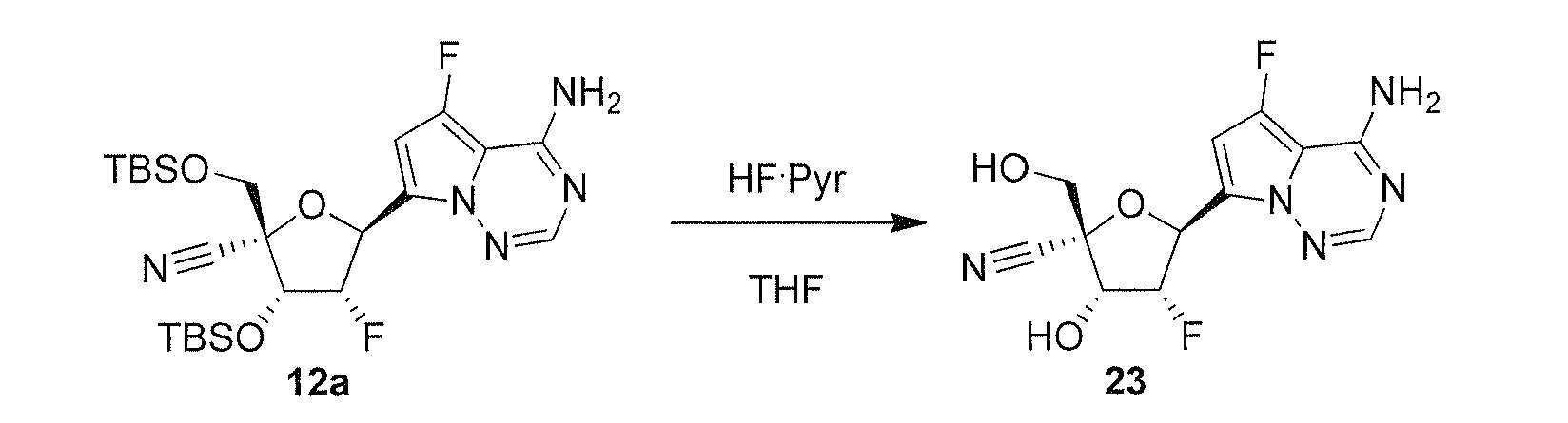
실시예Example 23 - (2R,3R,4R,5S)-5-(4-아미노-5-플루오로피롤로[2,1-f][1,2,4]트리아진-7-일)-4-플루오로-3-히드록시-2-(히드록시메틸)테트라히드로푸란-2-카르보니트릴 23-(2R, 3R, 4R, 5S) -5- (4-amino-5-fluoropyrrolo [2,1-f] [1,2,4] triazine-7-yl) -4-fluoro Rho-3-hydroxy-2- (hydroxymethyl) tetrahydrofuran-2-carbonitrile
폴리프로필렌 시험관내의 THF (2 ㎖) 중의 중간체 12a (29 ㎎, 0.054 mmol)의 용액에 피리딘 중의 70% HF·피리딘 (51 ㎕, 1.97 mmol)을 0℃에서 N2 대기 하에서 첨가하였다. 1.5 시간 후, 반응을 얼음 배쓰로부터 제거하였다. 피리딘 중의 3 시간 (150 ㎕), 5 시간 45 분 (200 ㎕) 및 21 시간 15 분 (0.7 ㎖) 후 추가의 70% HF·피리딘을 첨가하였다. 그 후, 반응 혼합물을 또 다른 24 시간 동안 교반하고, 이 때 반응 혼합물을 얼음 배쓰 내에서 냉각시키며, 그 후, 물 및 포화 NaHCO3(aq)로 켄칭시켰다. 혼합물을 감압 하에서 농축시키고, 잔류물을 DMF 중에서 취하였다. 생성된 용액/현탁액을 주사기 필터 (홧맨(Whatman) 0.45 ㎛ PTFE w/GMF)에 의하여 여과하였다. 여과액을 HPLC에 주입하고, 반-정제된 생성물을 하기 용매 램프를 사용한 실리카 겔 컬럼 크로마토그래피에 의하여 추가로 정제하였다: DCM 중의 0% MeOH로부터 DCM 중의 20% MeOH로 상승시킴. 생성물 함유 분획을 농축시키고, 잔류물을 동결건조시켜 실시예 23 (5 ㎎, 30%)을 백색 분말로서 얻었다.To a solution of intermediate 12a (29 mg, 0.054 mmol) in THF (2 mL) in polypropylene in vitro, 70% HF · pyridine (51 μl, 1.97 mmol) in pyridine was added at 0 ° C. under N 2 atmosphere. After 1.5 hours, the reaction was removed from the ice bath. Additional 70% HF · pyridine was added after 3 hours (150 μl) in pyridine, 5 hours 45 minutes (200 μl) and 21 hours 15 minutes (0.7 ml). The reaction mixture was then stirred for another 24 hours, at which time the reaction mixture was cooled in an ice bath, and then quenched with water and saturated NaHCO 3 (aq) . The mixture was concentrated under reduced pressure, and the residue was taken up in DMF. The resulting solution / suspension was filtered by a syringe filter (Whatman 0.45 μm PTFE w / GMF). The filtrate was injected into HPLC, and the semi-purified product was further purified by silica gel column chromatography using the following solvent lamp: rising from 0% MeOH in DCM to 20% MeOH in DCM. The product containing fractions were concentrated and the residue was lyophilized to give Example 23 (5 mg, 30%) as a white powder.
1H NMR (400 MHz, DMF-d7) δ 7.74 (s, 1H), 6.61 (s, 1H), 5.75 (dd, J=25.2, 1.6 Hz, 1H), 5.23 (ddd, J=54.8, 4.8, 1.6 Hz, 1H), 4.64 (dd, J=22, 4.4 Hz, 1H), 3.90 (ABq, ΔδAB=0.151 ppm, J=12 Hz, 2H). 1 H NMR (400 MHz, DMF-d 7 ) δ 7.74 (s, 1H), 6.61 (s, 1H), 5.75 (dd, J = 25.2, 1.6 Hz, 1H), 5.23 (ddd, J = 54.8, 4.8 , 1.6 Hz, 1H), 4.64 (dd, J = 22, 4.4 Hz, 1H), 3.90 (ABq, Δδ AB = 0.151 ppm, J = 12 Hz, 2H).
19F NMR (376 MHz, DMF-d7) δ -161.727 (s), -193.726 (ddd, J=54.5, 22.9, 21.8 Hz). 19 F NMR (376 MHz, DMF-d 7 ) δ -161.727 (s), -193.726 (ddd, J = 54.5, 22.9, 21.8 Hz).
LC/MS: RT=0.81 min, MS m/z=312.13 [M+1]; LC: 써모 아셀라 1250 UHPLC; MS: 써모 LCQ 플리트; 컬럼: 키네텍스 2.6μ C18 100A, 50×3.00 ㎜; 용매: 0.1% 포름산을 갖는 아세토니트릴, 0.1% 포름산을 갖는 물; 구배: 0 min-2.4 min 2-100% ACN, 2.4 min-2.8 min 100% ACN, 2.8 min-2.85 min 100%-2% ACN, 2.85 min-3 min 2% ACN.LC / MS: R T = 0.81 min, MS m / z = 312.13 [M + 1]; LC: Thermo Acela 1250 UHPLC; MS: Thermo LCQ pleats; Column: Kinetex 2.6 μ C18 100A, 50 × 3.00 mm; Solvent: acetonitrile with 0.1% formic acid, water with 0.1% formic acid; Gradient: 0 min-2.4 min 2-100% ACN, 2.4 min-2.8 min 100% ACN, 2.8 min-2.85 min 100% -2% ACN, 2.85 min-3 min 2% ACN.
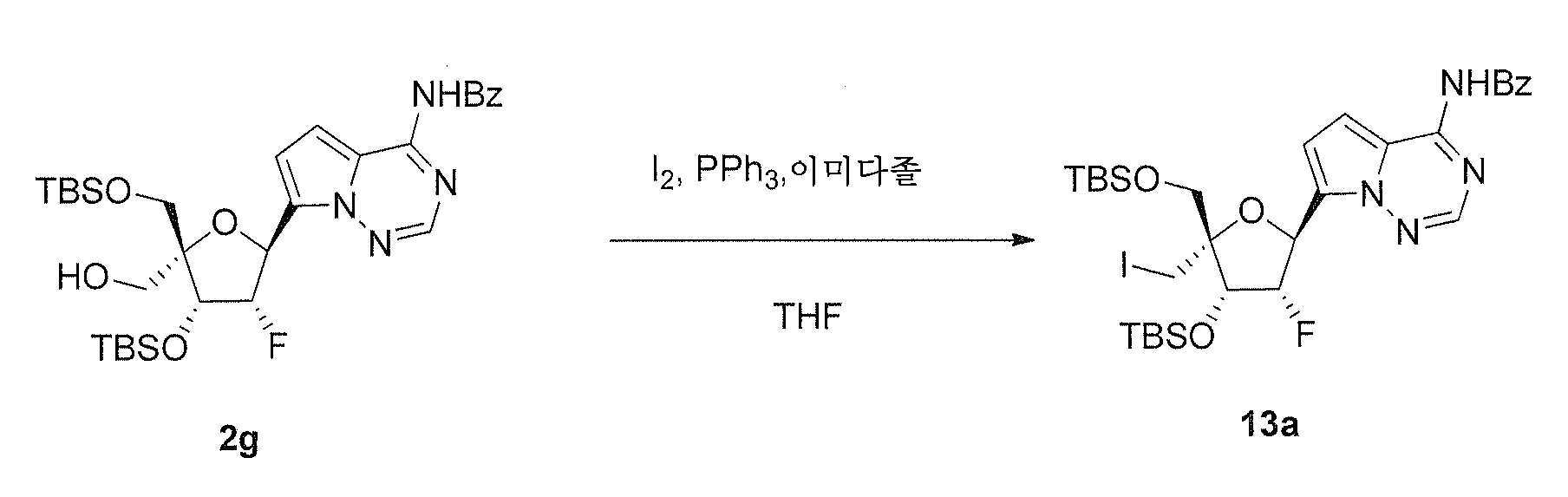
중간체 13a - N-(7-((2S,3S,4R,5R)-4-((tert-부틸디메틸실릴)옥시)-5-(((tert-부틸디메틸실릴)옥시)메틸)-3-플루오로-5-(아이오도메틸)테트라히드로푸란-2-일)피롤로[2,1-f][1,2,4]트리아진-4-일)벤즈아미드Intermediate 13a-N- (7-((2S, 3S, 4R, 5R) -4-((tert-butyldimethylsilyl) oxy) -5-(((tert-butyldimethylsilyl) oxy) methyl) -3- Fluoro-5- (iodomethyl) tetrahydrofuran-2-yl) pyrrolo [2,1-f] [1,2,4] triazin-4-yl) benzamide
THF (5 ㎖) 중의 트리페닐포스핀 (973 ㎎, 3.71 mmol) 및 이미다졸 (252 ㎎, 3.71 mmol)의 용액에 아이오딘 (253 ㎎, 1.86 mmol)를 실온에서 첨가하였다. 아이오딘이 완전히 용해되자마자, THF (5 ㎖) 중의 화합물 2g (650 ㎎, 0.93 mmol)의 용액을 서서히 적가하였다. 생성된 혼합물을 80℃에서 3 일 동안 교반한 후, 진공 하에서 농축시켰다. 잔류물을 실리카 겔 컬럼 크로마토그래피 (헥산 중의 0 내지 50% EtOAc)에 의하여 정제하여 중간체 13a (230 ㎎, 33%)를 오일로서 얻었다.To a solution of triphenylphosphine (973 mg, 3.71 mmol) and imidazole (252 mg, 3.71 mmol) in THF (5 mL) was added iodine (253 mg, 1.86 mmol) at room temperature. As soon as iodine was completely dissolved, a solution of 2 g (650 mg, 0.93 mmol) of compound in THF (5 mL) was slowly added dropwise. The resulting mixture was stirred at 80 ° C. for 3 days, then concentrated under vacuum. The residue was purified by silica gel column chromatography (0-50% EtOAc in hexane) to give the intermediate 13a (230 mg, 33%) as an oil.
MS m/z=742 [M+H]. MS 시스템: 써모 LCQ 플리트.MS m / z = 742 [M + H]. MS system: Thermo LCQ pleat.

중간체 13b - N-(7-((2S,3S,4R,5R)-4-((tert-부틸디메틸실릴)옥시)-5-(((tert-부틸디메틸실릴)옥시)메틸)-3-플루오로-5-메틸테트라히드로푸란-2-일)피롤로[2,1-f][1,2,4]트리아진-4-일)벤즈아미드Intermediate 13b-N- (7-((2S, 3S, 4R, 5R) -4-((tert-butyldimethylsilyl) oxy) -5-(((tert-butyldimethylsilyl) oxy) methyl) -3- Fluoro-5-methyltetrahydrofuran-2-yl) pyrrolo [2,1-f] [1,2,4] triazin-4-yl) benzamide
중간체 13a (200 ㎎, 0.243 mmol)를 메탄올 (10 ㎖) 중에 용해시키고, 질소 대기 하에서 10% Pd/C (100 ㎎, 0.094 mmol) 및 TEA (0.035 ㎖, 0.243 mmol)를 첨가하였다. 그 후, 생성된 혼합물을 H2 대기 (풍선) 하에서 실온에서 40 분 동안 교반하였다. 생성된 혼합물을 여과하고, 진공 하에서 농축시키고, 잔류물을 실리카 겔 컬럼 크로마토그래피 (헥산 중의 0 내지 40% EtOAc)에 의하여 정제하여 중간체 13b (145 ㎎, 72%)를 75% 순도의 백색 고체로서 얻었다.Intermediate 13a (200 mg, 0.243 mmol) was dissolved in methanol (10 mL) and 10% Pd / C (100 mg, 0.094 mmol) and TEA (0.035 mL, 0.243 mmol) were added under nitrogen atmosphere. The resulting mixture was then stirred under H 2 atmosphere (balloon) at room temperature for 40 minutes. The resulting mixture was filtered, concentrated in vacuo, and the residue was purified by silica gel column chromatography (0-40% EtOAc in hexane) to give Intermediate 13b (145 mg, 72%) as a 75% pure white solid. Got.
MS m/z=616 [M+H]. MS 시스템: 써모 LCQ 플리트MS m / z = 616 [M + H]. MS System: Thermo LCQ Fleet
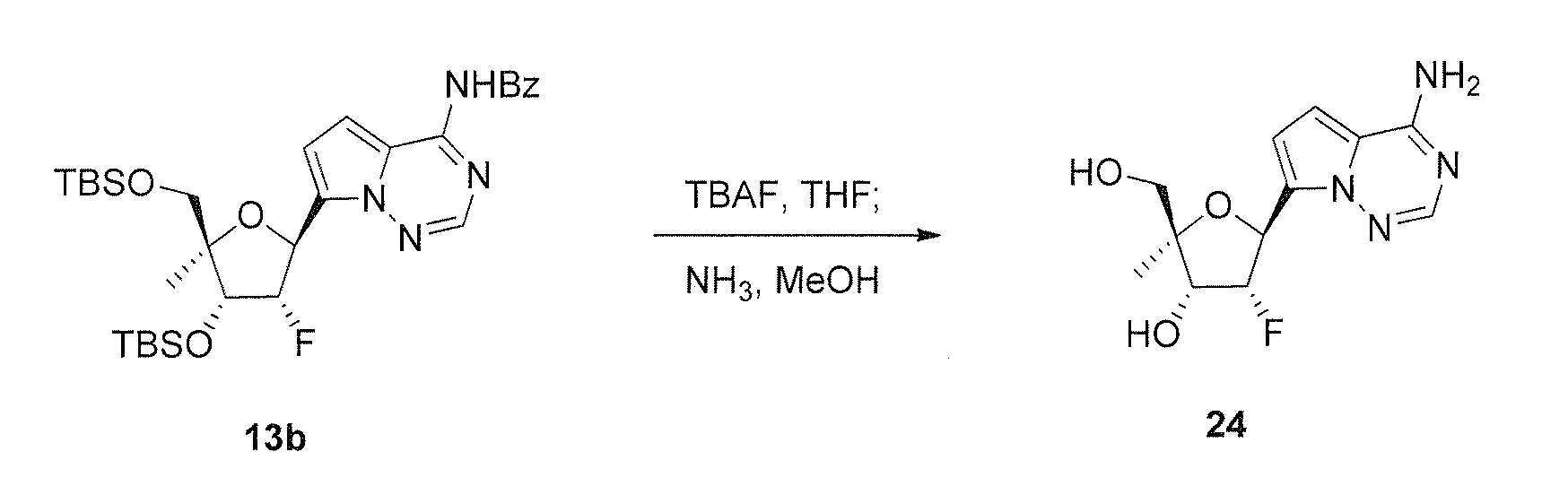
실시예Example 24 - ( 24-( 2R,3R,4R,5S2R, 3R, 4R, 5S )-5-(4-) -5- (4- 아미노피롤로[2,1-f][1,2,4]트리아진Aminopyrrolo [2,1-f] [1,2,4] triazine -7-일)-4-플루오로-2-(히드록시메틸)-2-메틸테트라히드로푸란-3-올-7-yl) -4-fluoro-2- (hydroxymethyl) -2-methyltetrahydrofuran-3-ol
중간체 13b (145 ㎎, 75% 순도, 0.177 mmol)를 THF (10 ㎖) 중에 용해시키고, TBAF (THF 중의 1 M, 0.53 ㎖, 0.531 mmol)를 첨가하였다. 생성된 혼합물을 실온에서 2 시간 동안 교반한 후, 메탄올성 암모니아 (7N, 10 ㎖)를 첨가하였다. 생성된 혼합물을 24 시간 동안 교반하고, 감압 하에서 농축시켰다. 미정제 잔류물을 분취용 HPLC (물 중의 0 내지 35% 아세토니트릴, 20 분 이내)에 의하여 정제하여 실시예 24 (30 ㎎, 60%)를 백색 고체로서 얻었다.Intermediate 13b (145 mg, 75% purity, 0.177 mmol) was dissolved in THF (10 mL) and TBAF (1 M in THF, 0.53 mL, 0.531 mmol) was added. The resulting mixture was stirred at room temperature for 2 hours, and then methanolic ammonia (7N, 10 mL) was added. The resulting mixture was stirred for 24 hours and concentrated under reduced pressure. The crude residue was purified by preparative HPLC (0-35% acetonitrile in water, within 20 minutes) to give Example 24 (30 mg, 60%) as a white solid.
1H NMR (400 MHz, CD3OD) δ 7.78 (s, 1H), 6.84 (d, J=4.5 Hz, 1H), 6.76 (d, J=4.5 Hz, 1H), 5.53 (dd, J=21.5, 4.0 Hz, 1H), 5.25 (ddd, J=55.5, 5.3, 4.1 Hz, 1H), 4.44 (dd, J=17.2, 5.2 Hz, 1H), 3.65-3.43 (m, 2H), 1.27 (s, 3H) 1 H NMR (400 MHz, CD 3 OD) δ 7.78 (s, 1H), 6.84 (d, J = 4.5 Hz, 1H), 6.76 (d, J = 4.5 Hz, 1H), 5.53 (dd, J = 21.5 , 4.0 Hz, 1H), 5.25 (ddd, J = 55.5, 5.3, 4.1 Hz, 1H), 4.44 (dd, J = 17.2, 5.2 Hz, 1H), 3.65-3.43 (m, 2H), 1.27 (s, 3H)
19F NMR (376 MHz, CD3OD) δ -197.08 (ddd, J=55.4, 21.5, 17.1 Hz) 19 F NMR (376 MHz, CD 3 OD) δ -197.08 (ddd, J = 55.4, 21.5, 17.1 Hz)
MS m/z=282 [M+H]. MS 시스템: 써모 LCQ 플리트.MS m / z = 282 [M + H]. MS system: Thermo LCQ pleat.

중간체 14a - (Intermediate 14a-( 2S,3R,4S,5R2S, 3R, 4S, 5R )-2-(4-) -2- (4- 아미노피롤로[2,1-f][1,2,4]트리아진Aminopyrrolo [2,1-f] [1,2,4] triazine -7-일)-5-(히드록시메틸)테트라히드로푸란-3,4-디올-7-yl) -5- (hydroxymethyl) tetrahydrofuran-3,4-diol
중간체 1e (2.64 g, 4.91 mmol)를 아세트산 (50 ㎖) 중에 용해시켰다. 플라스크를 아르곤으로 퍼징시키고, 10% Pd/C (1.05 g, 0.982 mmol)를 첨가하였다. 플라스크를 비우고, H2(g)로 3회 역충전하였다. 반응 혼합물을 H2(g)의 대기 하에서 교반하였다. 1 시간 후, 플라스크를 질소로 퍼징시키고, 반응 혼합물을 CH3OH 세정과 함께 셀라이트 패드를 통하여 여과하였다. 여과액을 감압 하에서 농축시킨 후, EtOAc에 이어서 헥산으로 동시 증발시켰다. 잔류물을 고 진공 하에 두어 중간체 14a (1.31 g, 99%)를 백색 고체로서 얻었다.Intermediate 1e (2.64 g, 4.91 mmol) was dissolved in acetic acid (50 mL). The flask was purged with argon and 10% Pd / C (1.05 g, 0.982 mmol) was added. The flask was emptied and backfilled 3 times with H 2 (g) . The reaction mixture was stirred under an atmosphere of H 2 (g) . After 1 hour, the flask was purged with nitrogen and the reaction mixture was filtered through a pad of Celite with CH 3 OH wash. The filtrate was concentrated under reduced pressure, and then co-evaporated with EtOAc followed by hexane. The residue was placed under high vacuum to give Intermediate 14a (1.31 g, 99%) as a white solid.
1H NMR (400 MHz, DMSO-d6) δ 7.80 (s, 1H), 7.66 (s, 2H), 6.82 (d, J=4.4 Hz, 1H), 6.66 (d, J=4.4 Hz, 1H), 5.09 (d, J=6.5 Hz, 1H), 5.06-4.56 (m, 3H), 4.21 (t, J=5.9 Hz, 1H), 3.93 (t, J=4.9 Hz, 1H), 3.77 (q, J=4.5 Hz, 1H), 3.48 (ddd, J=38.9, 11.8, 4.4 Hz, 2H). 1 H NMR (400 MHz, DMSO-d 6 ) δ 7.80 (s, 1H), 7.66 (s, 2H), 6.82 (d, J = 4.4 Hz, 1H), 6.66 (d, J = 4.4 Hz, 1H) , 5.09 (d, J = 6.5 Hz, 1H), 5.06-4.56 (m, 3H), 4.21 (t, J = 5.9 Hz, 1H), 3.93 (t, J = 4.9 Hz, 1H), 3.77 (q, J = 4.5 Hz, 1H), 3.48 (ddd, J = 38.9, 11.8, 4.4 Hz, 2H).
LC/MS: tR=0.47 min, MS m/z=267.13 [M+H]; LC 시스템: 써모 아셀라 1250 UHPLCLC / MS: t R = 0.47 min, MS m / z = 267.13 [M + H]; LC system: Thermo Acela 1250 UHPLC
MS 시스템: 써모 LCQ 플리트; 컬럼: 키네텍스 2.6μ XB-C18 100A, 50×3.00 ㎜; 용매: 0.1% 포름산을 갖는 아세토니트릴, 0.1% 포름산을 갖는 물; 구배: 1.8 ㎖/min으로 0 min-2.4 min 2-100% ACN, 2.4 min-2.80 min 100% ACN, 2.8 min-2.85 min 100%-2% ACN, 2.85 min-3.0 min 2% ACN.MS system: Thermo LCQ pleats; Column: Kinetex 2.6 μ XB-C18 100A, 50 × 3.00 mm; Solvent: acetonitrile with 0.1% formic acid, water with 0.1% formic acid; Gradient: 0 min-2.4 min 2-100% ACN at 1.8 mL / min, 2.4 min-2.80 min 100% ACN, 2.8 min-2.85 min 100% -2% ACN, 2.85 min-3.0 min 2% ACN.
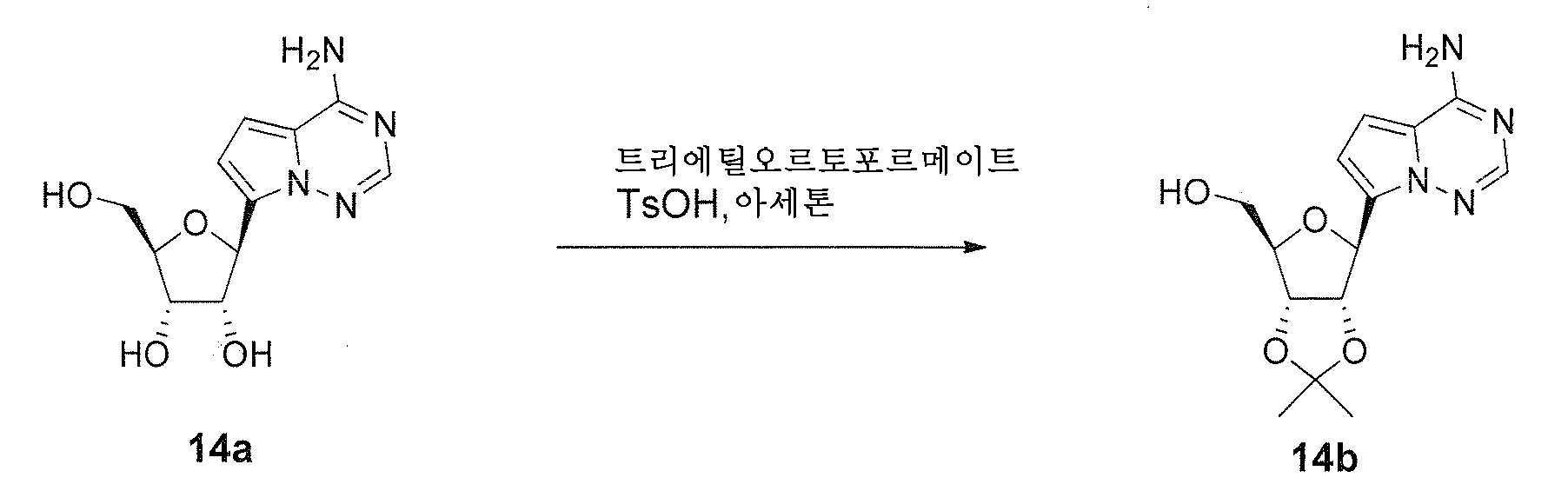
중간체 14b - ((Intermediate 14b-(( 3aR,4R,6S,6aS3aR, 4R, 6S, 6aS )-6-(4-) -6- (4- 아미노피롤로[2,1-f][1,2,4]트리아진Aminopyrrolo [2,1-f] [1,2,4] triazine -7-일)-2,2-디메틸테트라히드로푸로[3,4-d][1,3]디옥솔-4-일)메탄올-7-yl) -2,2-dimethyltetrahydrofuro [3,4-d] [1,3] dioxol-4-yl) methanol
중간체 14a (3.13 g, 11.7 mmol)를 아세톤 (80 ㎖) 중에 용해시키고, TsOH (6.00 g, 31.5 mmol)를 첨가하였다. 트리에틸오르토포르메이트 (6.0 ㎖, 36.1 mmol)를 10 분에 걸쳐 서서히 첨가하였다. 생성된 혼합물을 상온에서 밤새 교반하였다. 반응 혼합물이 pH=8이 될 때까지 포화 탄산나트륨 수용액을 첨가하였다. 고체를 여과에 의하여 제거하고, 여과액을 감압 하에서 농축시켰다. 미정제 잔류물을 EtOAc 및 염수 사이에 분배시켰다. 상이 분할되고, 유기물을 Na2SO4 위에서 건조시키고, 여과하고, 감압 하에서 농축시켰다. 미정제물을 실리카 겔 크로마토그래피 (60-100% EtOAc/Hex-20% MeOH/EtOAc)에 의하여 정제하여 중간체 14b (2.55 g, 71%)를 백색 고체로서 얻었다.Intermediate 14a (3.13 g, 11.7 mmol) was dissolved in acetone (80 mL) and TsOH (6.00 g, 31.5 mmol) was added. Triethylorthoformate (6.0 mL, 36.1 mmol) was added slowly over 10 min. The resulting mixture was stirred overnight at room temperature. Saturated aqueous sodium carbonate solution was added until the reaction mixture reached pH = 8. The solid was removed by filtration, and the filtrate was concentrated under reduced pressure. The crude residue was partitioned between EtOAc and brine. The phases were partitioned, and the organics were dried over Na 2 SO 4 , filtered and concentrated under reduced pressure. The crude was purified by silica gel chromatography (60-100% EtOAc / Hex-20% MeOH / EtOAc) to give Intermediate 14b (2.55 g, 71%) as a white solid.
1H NMR (400 MHz, DMSO-d6) δ 7.83 (s, 1H), 7.71 (s, 2H), 6.83 (d, J=4.4 Hz, 1H), 6.73 (d, J=4.5 Hz, 1H), 5.21 (d, J=4.9 Hz, 1H), 5.01 (dd, J=6.6, 4.9 Hz, 1H), 4.84 (t, J=5.7 Hz, 1H), 4.71 (dd, J=6.7, 3.7 Hz, 1H), 3.99-3.85 (m, 1H), 3.46 (t, J=5.5 Hz, 2H), 1.48 (s, 3H), 1.29 (s, 3H). 1 H NMR (400 MHz, DMSO-d 6 ) δ 7.83 (s, 1H), 7.71 (s, 2H), 6.83 (d, J = 4.4 Hz, 1H), 6.73 (d, J = 4.5 Hz, 1H) , 5.21 (d, J = 4.9 Hz, 1H), 5.01 (dd, J = 6.6, 4.9 Hz, 1H), 4.84 (t, J = 5.7 Hz, 1H), 4.71 (dd, J = 6.7, 3.7 Hz, 1H), 3.99-3.85 (m, 1H), 3.46 (t, J = 5.5 Hz, 2H), 1.48 (s, 3H), 1.29 (s, 3H).
LC/MS: tR=0.87 min, MS m/z=307.21 [M+H]; LC 시스템: 써모 아셀라 1250 UHPLC; MS 시스템: 써모 LCQ 플리트; 컬럼: 키네텍스 2.6μ XB-C18 100A, 50×3.00 ㎜; 용매: 0.1% 포름산을 갖는 아세토니트릴, 0.1% 포름산을 갖는 물; 구배: 1.8 ㎖/min으로 0 min-1.4 min 2-100% ACN, 1.4 min-1.80 min 100% ACN, 1.8 min-1.85 min 100%-2% ACN, 1.85 min-2 min 2% ACN.LC / MS: t R = 0.87 min, MS m / z = 307.21 [M + H]; LC system: Thermo Acela 1250 UHPLC; MS system: Thermo LCQ pleats; Column: Kinetex 2.6 μ XB-C18 100A, 50 × 3.00 mm; Solvent: acetonitrile with 0.1% formic acid, water with 0.1% formic acid; Gradient: 0 min-1.4 min 2-100% ACN at 1.8 mL / min, 1.4 min-1.80 min 100% ACN, 1.8 min-1.85 min 100% -2% ACN, 1.85 min-2 min 2% ACN.

중간체 14c - 7-((3aS,4S,6R,6aR)-6-(((tert-부틸디메틸실릴)옥시)메틸)-2,2-디메틸테트라히드로푸로[3,4-d][1,3]디옥솔-4-일)피롤로[2,1-f][1,2,4]트리아진-4-아민Intermediate 14c-7-((3aS, 4S, 6R, 6aR) -6-(((tert-butyldimethylsilyl) oxy) methyl) -2,2-dimethyltetrahydrofuro [3,4-d] [1, 3] dioxol-4-yl) pyrrolo [2,1-f] [1,2,4] triazine-4-amine
중간체 14b (2.55 g, 8.32 mmol)를 DCM (50 ㎖) 중에 용해시키고, 혼합물을 0℃로 냉각시켰다. 이미다졸 (1.70 g, 24.9 mmol)에 이어서 TBSCl (1.88 g, 12.5 mmol)을 첨가하였다. 16 시간 후, 반응을 메탄올로 켄칭시켰다. 생성된 혼합물을 감압 하에서 농축시키고, 미정제 잔류물을 물 및 EtOAc 사이에 분배시켰다. 유기물을 Na2SO4 위에서 건조시키고, 여과하고, 감압 하에서 농축시켰다. 미정제 잔류물을 실리카 겔 크로마토그래피 (50-100% EtOAc/Hex)에 의하여 정제하여 중간체 14c (2.60 g, 74%)를 백색 고체로서 얻었다.Intermediate 14b (2.55 g, 8.32 mmol) was dissolved in DCM (50 mL) and the mixture was cooled to 0 ° C. Imidazole (1.70 g, 24.9 mmol) was added followed by TBSCl (1.88 g, 12.5 mmol). After 16 hours, the reaction was quenched with methanol. The resulting mixture was concentrated under reduced pressure, and the crude residue was partitioned between water and EtOAc. The organic was dried over Na 2 SO 4 , filtered and concentrated under reduced pressure. The crude residue was purified by silica gel chromatography (50-100% EtOAc / Hex) to give Intermediate 14c (2.60 g, 74%) as a white solid.
1H NMR (400 MHz, DMSO-d6) δ 7.83 (s, 1H), 7.74 (s, 2H), 6.82 (d, J=4.4 Hz, 1H), 6.68 (d, J=4.4 Hz, 1H), 5.26 (d, J=4.4 Hz, 1H), 5.00 (dd, J=6.5, 4.5 Hz, 1H), 4.71 (dd, J=6.5, 3.7 Hz, 1H), 3.97 (td, J=5.1, 3.6 Hz, 1H), 3.64 (d, J=5.2 Hz, 2H), 1.48 (s, 3H), 1.28 (s, 3H), 0.83 (s, 9H), -0.02 (s, 6H). 1 H NMR (400 MHz, DMSO-d 6 ) δ 7.83 (s, 1H), 7.74 (s, 2H), 6.82 (d, J = 4.4 Hz, 1H), 6.68 (d, J = 4.4 Hz, 1H) , 5.26 (d, J = 4.4 Hz, 1H), 5.00 (dd, J = 6.5, 4.5 Hz, 1H), 4.71 (dd, J = 6.5, 3.7 Hz, 1H), 3.97 (td, J = 5.1, 3.6 Hz, 1H), 3.64 (d, J = 5.2 Hz, 2H), 1.48 (s, 3H), 1.28 (s, 3H), 0.83 (s, 9H), -0.02 (s, 6H).
LC/MS: tR=1.91 min, MS m/z=421.60 [M+H]; LC 시스템: 써모 아셀라 1250 UHPLC MS 시스템: 써모 LCQ 플리트; 컬럼: 키네텍스 2.6μ XB-C18 100A, 50×3.00 ㎜; 용매: 0.1% 포름산을 갖는 아세토니트릴, 0.1% 포름산을 갖는 물; 구배: 1.8 ㎖/min으로 0 min-2.4 min 2-100% ACN, 2.4 min-2.80 min 100% ACN, 2.8 min-2.85 min 100%-2% ACN, 2.85 min-3.0 min 2% ACN.LC / MS: t R = 1.91 min, MS m / z = 421.60 [M + H]; LC system: Thermo Acela 1250 UHPLC MS system: Thermo LCQ pleat; Column: Kinetex 2.6 μ XB-C18 100A, 50 × 3.00 mm; Solvent: acetonitrile with 0.1% formic acid, water with 0.1% formic acid; Gradient: 0 min-2.4 min 2-100% ACN at 1.8 mL / min, 2.4 min-2.80 min 100% ACN, 2.8 min-2.85 min 100% -2% ACN, 2.85 min-3.0 min 2% ACN.

중간체 14d - Intermediate 14d- terttert -부틸 (7-((3aS,4S,6R,6aR)-6-(((tert-부틸디메틸실릴)옥시)메틸)-2,2-디메틸테트라히드로푸로[3,4-d][1,3]디옥솔-4-일)피롤로[2,1-f][1,2,4]트리아진-4-일)카르바메이트-Butyl (7-((3aS, 4S, 6R, 6aR) -6-(((tert-butyldimethylsilyl) oxy) methyl) -2,2-dimethyltetrahydrofuro [3,4-d] [1, 3] dioxol-4-yl) pyrrolo [2,1-f] [1,2,4] triazin-4-yl) carbamate
중간체 14c (2.59 g, 6.16 mmol)를 THF (60 ㎖) 중에 용해시키고, 생성된 용액을 0℃로 냉각시켰다. 그 후, Boc2O (2.69 g, 12.3 mmol) 및 DMAP (0.3 g, 2.46 mmol)를 첨가하였다. TEA (2.56 ㎖, 18.3 mmol)를 서서히 첨가하고, 반응 혼합물을 실온으로 가온되도록 하였다. 3 시간 후, 반응 혼합물을 0℃로 냉각시키고, MeOH (10 ㎖)에 이어서 진한 NH4OH(aq)(50 ㎖)를 첨가하였다. 생성된 혼합물을 실온으로 가온시키고, 밤새 교반하였다. 반응 혼합물을 감압 하에서 농축시키고, 미정제 잔류물을 EtOAc 및 물 사이에 분배시켰다. 층이 분리되고, 유기층을 Na2SO4 위에서 건조시키고, 여과하고, 감압 하에서 농축시켰다. 미정제 잔류물을 실리카 겔 크로마토그래피 (0-100% EtOAc/Hex)에 의하여 정제하여 중간체 14d (2.82 g, 88%)를 백색 고체로서 얻었다.Intermediate 14c (2.59 g, 6.16 mmol) was dissolved in THF (60 mL) and the resulting solution was cooled to 0 ° C. Then Boc 2 O (2.69 g, 12.3 mmol) and DMAP (0.3 g, 2.46 mmol) were added. TEA (2.56 ml, 18.3 mmol) was added slowly and the reaction mixture was allowed to warm to room temperature. After 3 hours, the reaction mixture was cooled to 0 ° C. and MeOH (10 mL) was added followed by concentrated NH 4 OH (aq) (50 mL). The resulting mixture was warmed to room temperature and stirred overnight. The reaction mixture was concentrated under reduced pressure, and the crude residue was partitioned between EtOAc and water. The layers were separated, and the organic layer was dried over Na 2 SO 4 , filtered and concentrated under reduced pressure. The crude residue was purified by silica gel chromatography (0-100% EtOAc / Hex) to give Intermediate 14d (2.82 g, 88%) as a white solid.
1H NMR (400 MHz, DMSO-d6) δ 10.46 (s, 1H), 8.20 (s, 1H), 7.19 (d, J=4.6 Hz, 1H), 6.90 (d, J=4.6 Hz, 1H), 5.33 (d, J=4.2 Hz, 1H), 5.02 (dd, J=6.5, 4.3 Hz, 1H), 4.72 (dd, J=6.5, 3.6 Hz, 1H), 4.01 (q, J=5.0 Hz, 1H), 3.64 (d, J=5.1 Hz, 2H), 1.49 (s, 9H), 1.32 (d, J=22.7 Hz, 6H), 0.82 (s, 9H), -0.03 (s, 6H). 1 H NMR (400 MHz, DMSO-d 6 ) δ 10.46 (s, 1H), 8.20 (s, 1H), 7.19 (d, J = 4.6 Hz, 1H), 6.90 (d, J = 4.6 Hz, 1H) , 5.33 (d, J = 4.2 Hz, 1H), 5.02 (dd, J = 6.5, 4.3 Hz, 1H), 4.72 (dd, J = 6.5, 3.6 Hz, 1H), 4.01 (q, J = 5.0 Hz, 1H), 3.64 (d, J = 5.1 Hz, 2H), 1.49 (s, 9H), 1.32 (d, J = 22.7 Hz, 6H), 0.82 (s, 9H), -0.03 (s, 6H).
LC/MS: tR=1.89 min, MS m/z=521.27 [M+H]; LC 시스템: 써모 아셀라 1250 UHPLC; MS 시스템: 써모 LCQ 플리트; 컬럼: 키네텍스 2.6μ XB-C18 100A, 50×3.00 ㎜; 용매: 0.1% 포름산을 갖는 아세토니트릴, 0.1% 포름산을 갖는 물; 구배: 1.8 ㎖/min으로 0 min-2.4 min 2-100% ACN, 2.4 min-2.80 min 100% ACN, 2.8 min-2.85 min 100%-2% ACN, 2.85 min-3.0 min 2% ACN.LC / MS: t R = 1.89 min, MS m / z = 521.27 [M + H]; LC system: Thermo Acela 1250 UHPLC; MS system: Thermo LCQ pleats; Column: Kinetex 2.6 μ XB-C18 100A, 50 × 3.00 mm; Solvent: acetonitrile with 0.1% formic acid, water with 0.1% formic acid; Gradient: 0 min-2.4 min 2-100% ACN at 1.8 mL / min, 2.4 min-2.80 min 100% ACN, 2.8 min-2.85 min 100% -2% ACN, 2.85 min-3.0 min 2% ACN.

중간체 14e - Intermediate 14e- terttert -부틸 (7-((3aS,4S,6R,6aR)-6-(히드록시메틸)-2,2-디메틸테트라히드로푸로[3,4-d][1,3]디옥솔-4-일)피롤로[2,1-f][1,2,4]트리아진-4-일)카르바메이트-Butyl (7-((3aS, 4S, 6R, 6aR) -6- (hydroxymethyl) -2,2-dimethyltetrahydrofuro [3,4-d] [1,3] dioxol-4-yl ) Pyrrolo [2,1-f] [1,2,4] triazin-4-yl) carbamate
중간체 14d (2.8 g, 5.4 mmol)를 THF (50 ㎖) 중에 용해시키고, TBAF (THF 중의 1.0M, 5.92 ㎖, 5.92 mmol)를 첨가하였다. 30 분 후, 추가의 TBAF (THF 중의 1.0M, 5.92 ㎖, 5.92 mmol)를 첨가하였다. 또 다른 30 분 후, 반응 혼합물을 물로 켄칭시키고, 생성된 혼합물을 EtOAc로 추출하였다 (2×). 합한 유기층을 염수로 세정하고, Na2SO4 위에서 건조시키고, 여과하고, 감압 하에서 농축시켰다. 미정제 잔류물을 실리카 겔 크로마토그래피 (10-100% EtOAc/Hex)에 의하여 정제하여 중간체 14e (2.19 g, 86%)를 백색 고체로서 얻었다.Intermediate 14d (2.8 g, 5.4 mmol) was dissolved in THF (50 mL) and TBAF (1.0M in THF, 5.92 mL, 5.92 mmol) was added. After 30 minutes, additional TBAF (1.0M in THF, 5.92 mL, 5.92 mmol) was added. After another 30 minutes, the reaction mixture was quenched with water, and the resulting mixture was extracted with EtOAc (2x). The combined organic layers were washed with brine, dried over Na 2 SO 4 , filtered and concentrated under reduced pressure. The crude residue was purified by silica gel chromatography (10-100% EtOAc / Hex) to give Intermediate 14e (2.19 g, 86%) as a white solid.
1H NMR (400 MHz, DMSO-d6) δ 10.46 (s, 1H), 8.22 (s, 1H), 7.20 (s, 1H), 6.95 (s, 1H), 5.29 (d, J=4.6 Hz, 1H), 5.03 (dd, J=6.6, 4.7 Hz, 1H), 4.85 (t, J=5.7 Hz, 1H), 4.72 (dd, J=6.6, 3.6 Hz, 1H), 4.05-3.90 (m, 1H), 3.46 (t, J=5.6 Hz, 2H), 1.50 (s, 12H), 1.29 (s, 3H). 1 H NMR (400 MHz, DMSO-d 6 ) δ 10.46 (s, 1H), 8.22 (s, 1H), 7.20 (s, 1H), 6.95 (s, 1H), 5.29 (d, J = 4.6 Hz, 1H), 5.03 (dd, J = 6.6, 4.7 Hz, 1H), 4.85 (t, J = 5.7 Hz, 1H), 4.72 (dd, J = 6.6, 3.6 Hz, 1H), 4.05-3.90 (m, 1H ), 3.46 (t, J = 5.6 Hz, 2H), 1.50 (s, 12H), 1.29 (s, 3H).
LC/MS: tR=1.52 min, MS m/z=407.05 [M+H]; LC 시스템: 써모 아셀라 1250 UHPLC; MS 시스템: 써모 LCQ 플리트; 컬럼: 키네텍스 2.6μ XB-C18 100A, 50×3.00 ㎜; 용매: 0.1% 포름산을 갖는 아세토니트릴, 0.1% 포름산을 갖는 물; 구배: 1.8 ㎖/min으로 0 min-2.4 min 2-100% ACN, 2.4 min-2.80 min 100% ACN, 2.8 min-2.85 min 100%-2% ACN, 2.85 min-3.0 min 2% ACN.LC / MS: t R = 1.52 min, MS m / z = 407.05 [M + H]; LC system: Thermo Acela 1250 UHPLC; MS system: Thermo LCQ pleats; Column: Kinetex 2.6 μ XB-C18 100A, 50 × 3.00 mm; Solvent: acetonitrile with 0.1% formic acid, water with 0.1% formic acid; Gradient: 0 min-2.4 min 2-100% ACN at 1.8 mL / min, 2.4 min-2.80 min 100% ACN, 2.8 min-2.85 min 100% -2% ACN, 2.85 min-3.0 min 2% ACN.
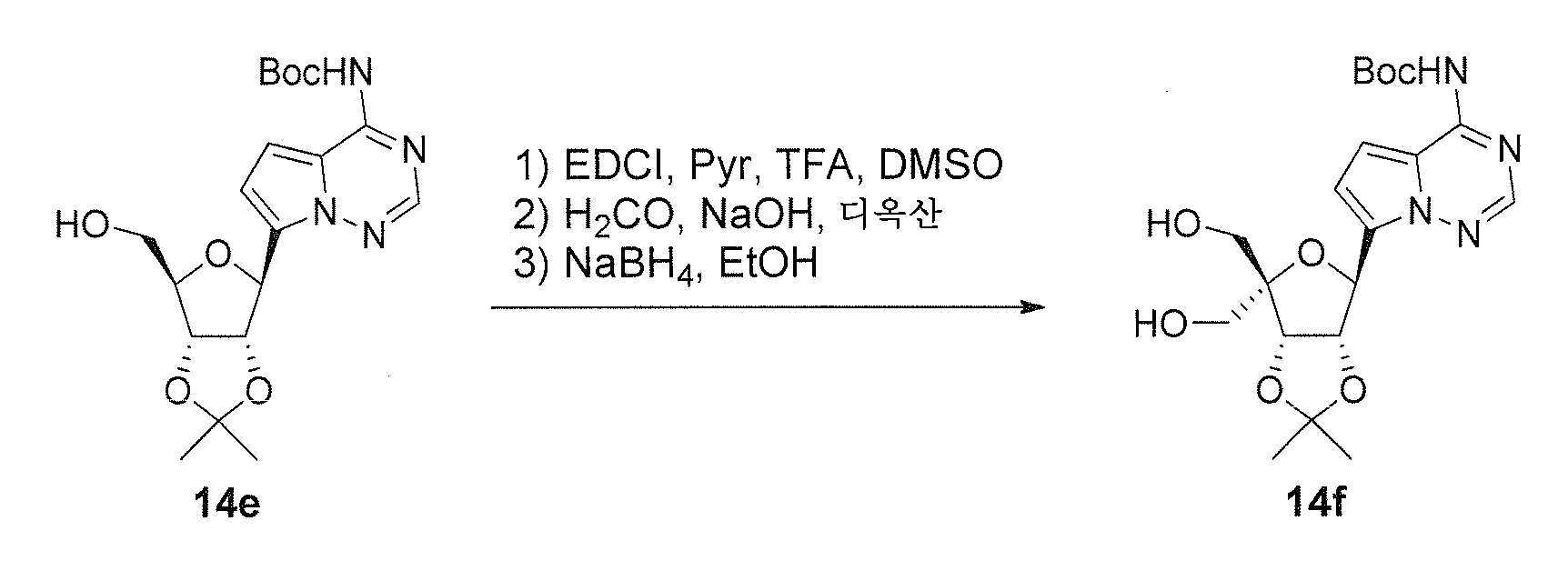
중간체 14f - Intermediate 14f- terttert -부틸 (7-((3aS,4S,6aS)-6,6-비스(히드록시메틸)-2,2-디메틸테트라히드로푸로[3,4-d][1,3]디옥솔-4-일)피롤로[2,1-f][1,2,4]트리아진-4-일)카르바메이트-Butyl (7-((3aS, 4S, 6aS) -6,6-bis (hydroxymethyl) -2,2-dimethyltetrahydrofuro [3,4-d] [1,3] dioxole-4- 1) pyrrolo [2,1-f] [1,2,4] triazin-4-yl) carbamate
중간체 14e (1.78 g, 4.38 mmol)를 DMSO (20 ㎖) 및 톨루엔 (15 ㎖) 중에 용해시켰다. 피리딘 (0.35 ㎖, 4.38 mmol) 및 EDCl (1.26 g, 6.56 mmol)에 이어서 TFA (0.178 ㎖, 2.39 mmol)를 첨가하였다. 90 분 후, 추가의 피리딘 (0.35 ㎖, 4.38 mmol) 및 EDCl (1.26 g, 6.56 mmol)을 첨가하고, 반응 혼합물을 추가의 30 분 동안 교반하였다. 반응을 물로 켄칭시키고, 생성된 혼합물을 CH2Cl2로 추출하였다. 수성층을 CH2Cl2로 역추출하였다. 유기층을 합하고, 염수로 세정하고, Na2SO4 위에서 건조시키고, 여과하고, 감압 하에서 농축시켰다. 미정제물을 고 진공 하에서 15 분 동안 둔 후, 그 다음 반응에 직접 사용하였다.Intermediate 14e (1.78 g, 4.38 mmol) was dissolved in DMSO (20 mL) and toluene (15 mL). Pyridine (0.35 mL, 4.38 mmol) and EDCl (1.26 g, 6.56 mmol) were added followed by TFA (0.178 mL, 2.39 mmol). After 90 minutes, additional pyridine (0.35 mL, 4.38 mmol) and EDCl (1.26 g, 6.56 mmol) were added and the reaction mixture was stirred for an additional 30 minutes. The reaction was quenched with water, and the resulting mixture was extracted with CH 2 Cl 2 . The aqueous layer was back extracted with CH 2 Cl 2 . The organic layers were combined, washed with brine, dried over Na 2 SO 4 , filtered and concentrated under reduced pressure. The crude was placed under high vacuum for 15 minutes, then used directly in the reaction.
미정제 잔류물을 디옥산 (15 ㎖) 중에 용해시키고, 포름알데히드 (물 중의 37%, 5.0 ㎖, 37.2 mmol) 및 2N NaOH (5.34 ㎖, 10.7 mmol)를 순차적으로 첨가하였다. 10 분 후, 반응을 AcOH로 켄칭시키고, 생성된 혼합물을 포화 NaHCO3 (aq) 및 CH2Cl2 사이에 분배시켰다. 수성층을 CH2Cl2로 역추출하였다. 유기층을 합하고, 염수로 세정하고, Na2SO4 위에서 건조시키고, 여과하고, 감압 하에서 농축시켰다. 미정제물을 고 진공 하에서 15 분 동안 둔 후, 그 다음 반응에 직접 사용하였다.The crude residue was dissolved in dioxane (15 mL) and formaldehyde (37% in water, 5.0 mL, 37.2 mmol) and 2N NaOH (5.34 mL, 10.7 mmol) were added sequentially. After 10 minutes, the reaction was quenched with AcOH, and the resulting mixture was partitioned between saturated NaHCO 3 (aq) and CH 2 Cl 2 . The aqueous layer was back extracted with CH 2 Cl 2 . The organic layers were combined, washed with brine, dried over Na 2 SO 4 , filtered and concentrated under reduced pressure. The crude was placed under high vacuum for 15 minutes, then used directly in the reaction.
미정제 잔류물을 EtOH (50 ㎖) 중에 용해시키고, NaBH4 (0.324 g, 8.76 mmol)를 작은 부분으로 나누어 첨가하였다. 20 분 후, 반응 혼합물을 AcOH로 켄칭시키고, 감압 하에서 농축시켰다. 미정제 잔류물을 EtOAc 및 포화 NaHCO3 (aq) 사이에 분배시켰다. 유기층이 분할되고, Na2SO4 위에서 건조시키고, 여과하고, 감압 하에서 농축시켰다. 미정제 잔류물을 실리카 겔 크로마토그래피 (50-100% EtOAc/Hex)에 의하여 정제하여 중간체 14f (1.91 g, 68%)를 백색 고체로서 얻었다.The crude residue was dissolved in EtOH (50 mL) and NaBH 4 (0.324 g, 8.76 mmol) was added in small portions. After 20 minutes, the reaction mixture was quenched with AcOH and concentrated under reduced pressure. The crude residue was partitioned between EtOAc and saturated NaHCO 3 (aq) . The organic layer was partitioned, dried over Na 2 SO 4 , filtered, and concentrated under reduced pressure. The crude residue was purified by silica gel chromatography (50-100% EtOAc / Hex) to give Intermediate 14f (1.91 g, 68%) as a white solid.
1H NMR (400 MHz, DMSO-d6) δ 10.45 (s, 1H), 8.20 (s, 1H), 7.19 (d, J=4.3 Hz, 1H), 6.95 (d, J=4.7 Hz, 1H), 5.35 (d, J=5.2 Hz, 1H), 5.06 (t, J=5.7 Hz, 1H), 4.79-4.74 (m, 2H), 4.45 (t, J=5.8 Hz, 1H), 3.73-3.46 (m, 3H), 3.40-3.30 (m, 1H), 1.50 (s, 12H), 1.27 (s, 3H). 1 H NMR (400 MHz, DMSO-d 6 ) δ 10.45 (s, 1H), 8.20 (s, 1H), 7.19 (d, J = 4.3 Hz, 1H), 6.95 (d, J = 4.7 Hz, 1H) , 5.35 (d, J = 5.2 Hz, 1H), 5.06 (t, J = 5.7 Hz, 1H), 4.79-4.74 (m, 2H), 4.45 (t, J = 5.8 Hz, 1H), 3.73-3.46 ( m, 3H), 3.40-3.30 (m, 1H), 1.50 (s, 12H), 1.27 (s, 3H).
LC/MS: tR=1.45 min, MS m/z=437.09 [M+H]; LC 시스템: 써모 아셀라 1250 UHPLC; MS 시스템: 써모 LCQ 플리트; 컬럼: 키네텍스 2.6μ XB-C18 100A, 50×3.00 ㎜; 용매: 0.1% 포름산을 갖는 아세토니트릴, 0.1% 포름산을 갖는 물; 구배: 1.8 ㎖/min으로 0 min-2.4 min 2-100% ACN, 2.4 min-2.80 min 100% ACN, 2.8 min-2.85 min 100%-2% ACN, 2.85 min-3.0 min 2% ACN.LC / MS: t R = 1.45 min, MS m / z = 437.09 [M + H]; LC system: Thermo Acela 1250 UHPLC; MS system: Thermo LCQ pleats; Column: Kinetex 2.6 μ XB-C18 100A, 50 × 3.00 mm; Solvent: acetonitrile with 0.1% formic acid, water with 0.1% formic acid; Gradient: 0 min-2.4 min 2-100% ACN at 1.8 mL / min, 2.4 min-2.80 min 100% ACN, 2.8 min-2.85 min 100% -2% ACN, 2.85 min-3.0 min 2% ACN.

중간체 14g - Intermediate 14 g- terttert -부틸 (7-((3aS,4S,6S,6aS)-6-((비스(4-메톡시페닐)(페닐)메톡시)메틸)-6-(히드록시메틸)-2,2-디메틸테트라히드로푸로[3,4-d][1,3]디옥솔-4-일)피롤로[2,1-f][1,2,4]트리아진-4-일)카르바메이트-Butyl (7-((3aS, 4S, 6S, 6aS) -6-((bis (4-methoxyphenyl) (phenyl) methoxy) methyl) -6- (hydroxymethyl) -2,2-dimethyl Tetrahydrofuro [3,4-d] [1,3] dioxol-4-yl) pyrrolo [2,1-f] [1,2,4] triazin-4-yl) carbamate
중간체 14f (1.15 g, 2.63 mmol)를 CH2Cl2 (50 ㎖) 중에 용해시키고, TEA (0.73 ㎖, 5.27 mmol)를 첨가하였다. 생성된 용액을 0℃로 냉각시키고, DMTrCl (1.35 g, 3.95 mmol)을 첨가하였다. 10 분 후, 반응 혼합물을 CH3OH로 켄칭시킨 후, CH2Cl2로 희석하였다. 생성된 혼합물을 포화 NaHCO3 (aq) 및 염수로 세정하였다. 유기층을 Na2SO4 위에서 건조시키고, 여과하고, 감압 하에서 농축시켰다. 미정제 잔류물을 실리카 겔 크로마토그래피 (0-100% EtOAc/Hex)에 의하여 정제하여 14g (1.95 g, 79%)를 회백색 고체로서 얻었다.Intermediate 14f (1.15 g, 2.63 mmol) was dissolved in CH 2 Cl 2 (50 mL) and TEA (0.73 mL, 5.27 mmol) was added. The resulting solution was cooled to 0 ° C., and DMTrCl (1.35 g, 3.95 mmol) was added. After 10 minutes, the reaction mixture was quenched with CH 3 OH, then diluted with CH 2 Cl 2 . The resulting mixture was washed with saturated NaHCO 3 (aq) and brine. The organic layer was dried over Na 2 SO 4 , filtered and concentrated under reduced pressure. The crude residue was purified by silica gel chromatography (0-100% EtOAc / Hex) to give 14 g (1.95 g, 79%) as an off-white solid.
1H NMR (400 MHz, DMSO-d6) δ 10.46 (s, 1H), 8.23 (s, 1H), 7.56-7.07 (m, 10H), 7.07-6.70 (m, 5H), 5.24 (d, J=5.2 Hz, 1H), 5.04 (t, J=5.9 Hz, 1H), 4.93-4.71 (m, 2H), 3.80-3.59 (m, 7H), 3.52 (dd, J=10.9, 4.8 Hz, 1H), 3.25 (d, J=9.9 Hz, 1H), 3.09 (d, J=9.9 Hz, 1H), 1.50 (s, 9H), 1.25 (s, 3H), 1.21 (s, 3H). 1 H NMR (400 MHz, DMSO-d 6 ) δ 10.46 (s, 1H), 8.23 (s, 1H), 7.56-7.07 (m, 10H), 7.07-6.70 (m, 5H), 5.24 (d, J = 5.2 Hz, 1H), 5.04 (t, J = 5.9 Hz, 1H), 4.93-4.71 (m, 2H), 3.80-3.59 (m, 7H), 3.52 (dd, J = 10.9, 4.8 Hz, 1H) , 3.25 (d, J = 9.9 Hz, 1H), 3.09 (d, J = 9.9 Hz, 1H), 1.50 (s, 9H), 1.25 (s, 3H), 1.21 (s, 3H).
LC/MS: tR=2.54 min, MS m/z=739.28 [M+H]; LC 시스템: 써모 아셀라 1250 UHPLC MS 시스템: 써모 LCQ 플리트; 컬럼: 키네텍스 2.6μ XB-C18 100A, 50×3.00 ㎜; 용매: 0.1% 포름산을 갖는 아세토니트릴, 0.1% 포름산을 갖는 물; 구배: 1.8 ㎖/min으로 0 min-2.4 min 2-100% ACN, 2.4 min-2.80 min 100% ACN, 2.8 min-2.85 min 100%-2% ACN, 2.85 min-3.0 min 2% ACN.LC / MS: t R = 2.54 min, MS m / z = 739.28 [M + H]; LC system: Thermo Acela 1250 UHPLC MS system: Thermo LCQ pleat; Column: Kinetex 2.6 μ XB-C18 100A, 50 × 3.00 mm; Solvent: acetonitrile with 0.1% formic acid, water with 0.1% formic acid; Gradient: 0 min-2.4 min 2-100% ACN at 1.8 mL / min, 2.4 min-2.80 min 100% ACN, 2.8 min-2.85 min 100% -2% ACN, 2.85 min-3.0 min 2% ACN.

중간체 14h - Intermediate 14h- terttert -부틸 (7-((3aS,4S,6R,6aS)-6-((비스(4-메톡시페닐)(페닐)메톡시)메틸)-6-(((tert-부틸디메틸실릴)옥시)메틸)-2,2-디메틸테트라히드로푸로[3,4-d][1,3]-디옥솔-4-일)피롤로[2,1-f][1,2,4]트리아진-4-일)카르바메이트-Butyl (7-((3aS, 4S, 6R, 6aS) -6-((bis (4-methoxyphenyl) (phenyl) methoxy) methyl) -6-(((tert-butyldimethylsilyl) oxy) Methyl) -2,2-dimethyltetrahydrofuro [3,4-d] [1,3] -dioxol-4-yl) pyrrolo [2,1-f] [1,2,4] triazine- 4-day) carbamate
중간체 14g (1.53 g, 2.08 mmol)를 DMF (10 ㎖) 중에 용해시키고, 이미다졸 (0.42 g, 6.23 mmol)에 이어서 TBSCl (0.47 g, 3.11 mmol)을 첨가하였다. 1 시간 후, 반응을 메탄올로 켄칭시키고, EtOAc 및 5% LiCl(aq) 사이에 분배시켰다. 상이 분할되고, 유기층을 염수로 세정하고, Na2SO4 위에서 건조시키고, 여과하고, 감압 하에서 농축시켰다. 미정제 잔류물을 실리카 겔 크로마토그래피 (0-50% EtOAc/Hex)에 의하여 정제하여 14h (1.77 g, 78%)를 회백색 고체로서 얻었다.Intermediate 14 g (1.53 g, 2.08 mmol) was dissolved in DMF (10 mL) and imidazole (0.42 g, 6.23 mmol) was added followed by TBSCl (0.47 g, 3.11 mmol). After 1 hour, the reaction was quenched with methanol and partitioned between EtOAc and 5% LiCl (aq) . The phases were partitioned, and the organic layer was washed with brine, dried over Na 2 SO 4 , filtered and concentrated under reduced pressure. The crude residue was purified by silica gel chromatography (0-50% EtOAc / Hex) to give 14h (1.77 g, 78%) as an off-white solid.
1H NMR (400 MHz, DMSO-d6) δ 10.47 (s, 1H), 8.23 (s, 1H), 7.56-6.66 (m, 15H), 5.31 (d, J=4.9 Hz, 1H), 5.14 (dd, J=6.5, 4.9 Hz, 1H), 4.73 (d, J=6.5 Hz, 1H), 3.87 (d, J=9.7 Hz, 1H), 3.72 (s, 6H), 3.53 (d, J=9.7 Hz, 1H), 3.31 (m, 1H), 3.08 (d, J=9.8 Hz, 1H), 1.50 (s, 9H), 1.25 (s, 3H), 1.22 (s, 3H), 0.75 (s, 9H), -0.04 (s, 3H), -0.08 (s, 3H). 1 H NMR (400 MHz, DMSO-d 6 ) δ 10.47 (s, 1H), 8.23 (s, 1H), 7.56-6.66 (m, 15H), 5.31 (d, J = 4.9 Hz, 1H), 5.14 ( dd, J = 6.5, 4.9 Hz, 1H), 4.73 (d, J = 6.5 Hz, 1H), 3.87 (d, J = 9.7 Hz, 1H), 3.72 (s, 6H), 3.53 (d, J = 9.7 Hz, 1H), 3.31 (m, 1H), 3.08 (d, J = 9.8 Hz, 1H), 1.50 (s, 9H), 1.25 (s, 3H), 1.22 (s, 3H), 0.75 (s, 9H) ), -0.04 (s, 3H), -0.08 (s, 3H).
LC/MS: tR=2.34 min, MS m/z=853.50 [M+H]; LC 시스템: 써모 아셀라 1250 UHPLC; MS 시스템: 써모 LCQ 플리트; 컬럼: 키네텍스 2.6μ XB-C18 100A, 50×3.00 ㎜; 용매: 0.1% 포름산을 갖는 아세토니트릴, 0.1% 포름산을 갖는 물; 구배: 1.8 ㎖/min으로 0 min-1.0 min 2-100% ACN, 1.0 min-2.80 min 100% ACN, 2.8 min-2.85 min 100%-2% ACN, 2.85 min-3.0 min 2% ACN.LC / MS: t R = 2.34 min, MS m / z = 853.50 [M + H]; LC system: Thermo Acela 1250 UHPLC; MS system: Thermo LCQ pleats; Column: Kinetex 2.6 μ XB-C18 100A, 50 × 3.00 mm; Solvent: acetonitrile with 0.1% formic acid, water with 0.1% formic acid; Gradient: 0 min-1.0 min 2-100% ACN at 1.8 mL / min, 1.0 min-2.80 min 100% ACN, 2.8 min-2.85 min 100% -2% ACN, 2.85 min-3.0 min 2% ACN.
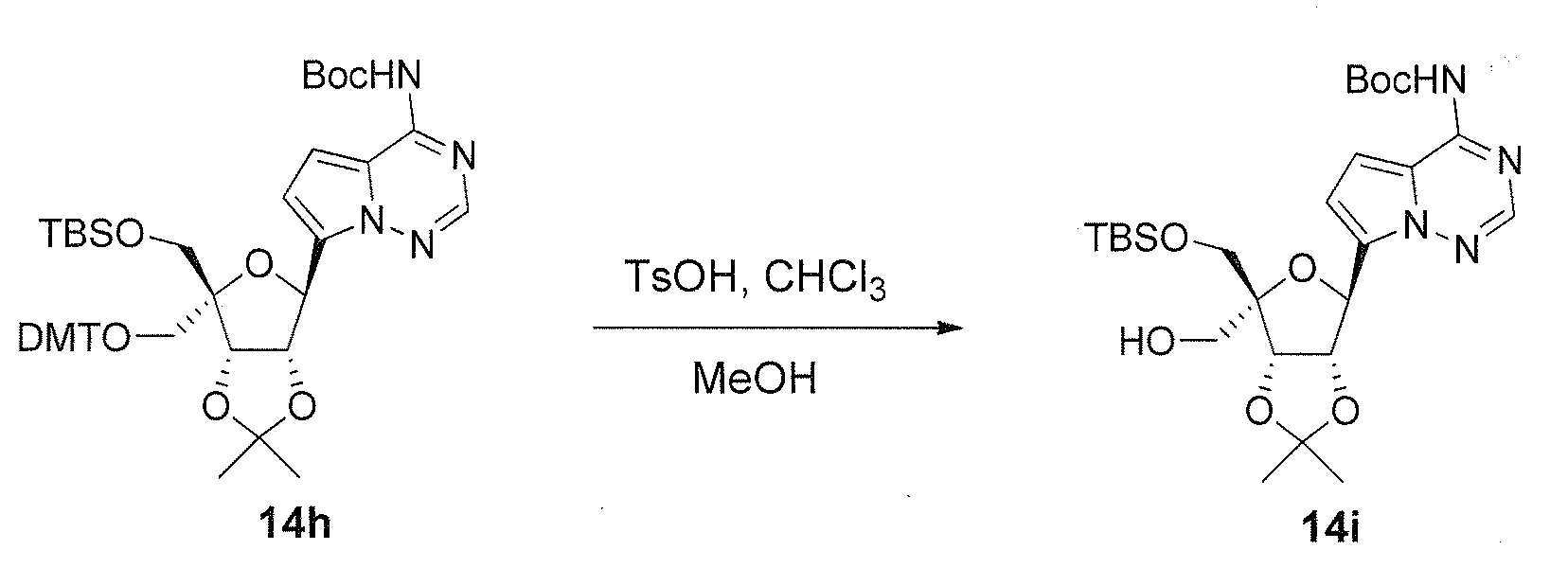
중간체 14i - Intermediate 14i- terttert -부틸 (7-((3aS,4S,6R,6aS)-6-(((tert-부틸디메틸실릴)옥시)메틸)-6-(히드록시메틸)-2,2-디메틸테트라히드로푸로[3,4-d][1,3]디옥솔-4-일)피롤로[2,1-f][1,2,4]트리아진-4-일)카르바메이트-Butyl (7-((3aS, 4S, 6R, 6aS) -6-(((tert-butyldimethylsilyl) oxy) methyl) -6- (hydroxymethyl) -2,2-dimethyltetrahydrofuro [3 , 4-d] [1,3] dioxol-4-yl) pyrrolo [2,1-f] [1,2,4] triazin-4-yl) carbamate
중간체 14h (1.38 g, 1.62 mmol)를 클로로포름 (20 ㎖) 중에 용해시키고, 생성된 용액을 0℃로 냉각시켰다. 그 후, CH3OH (16 ㎖) 중의 TsOH (0.34 g, 1.78 mmol)의 용액에 서서히 첨가하였다. 30 분 후, 반응을 포화 NaHCO3(aq)로 켄칭시키고, 생성된 혼합물을 EtOAc 및 염수 사이에 분배시켰다. 층이 분할되고, 유기층을 Na2SO4 위에서 건조시키고, 여과하고, 감압 하에서 농축시켰다. 미정제 잔류물을 실리카 겔 크로마토그래피 (0-100% EtOAc/Hex)에 의하여 정제하여 중간체 14i (0.84 g, 94%)를 백색 고체로서 얻었다.Intermediate 14h (1.38 g, 1.62 mmol) was dissolved in chloroform (20 mL) and the resulting solution was cooled to 0 ° C. Then it was added slowly to a solution of TsOH (0.34 g, 1.78 mmol) in CH 3 OH (16 mL). After 30 minutes, the reaction was quenched with saturated NaHCO 3 (aq) , and the resulting mixture was partitioned between EtOAc and brine. The layers were partitioned, and the organic layer was dried over Na 2 SO 4 , filtered, and concentrated under reduced pressure. The crude residue was purified by silica gel chromatography (0-100% EtOAc / Hex) to give Intermediate 14i (0.84 g, 94%) as a white solid.
1H NMR (400 MHz, DMSO-d6) δ 10.42 (s, 1H), 8.20 (s, 1H), 7.19 (s, 1H), 6.89 (s, 1H), 5.37 (d, J=4.8 Hz, 1H), 5.05 (dd, J=6.2, 4.8 Hz, 1H), 4.71 (d, J=6.2 Hz, 1H), 4.51 (t, J=5.5 Hz, 1H), 3.70 (d, J=10.2 Hz, 1H), 3.59 (d, J=5.5 Hz, 2H), 3.49 (d, J=10.2 Hz, 1H), 1.49 (s, 12H), 1.28 (s, 3H), 0.82 (s, 9H), -0.01 (s, 3H), -0.02 (s, 3H). 1 H NMR (400 MHz, DMSO-d 6 ) δ 10.42 (s, 1H), 8.20 (s, 1H), 7.19 (s, 1H), 6.89 (s, 1H), 5.37 (d, J = 4.8 Hz, 1H), 5.05 (dd, J = 6.2, 4.8 Hz, 1H), 4.71 (d, J = 6.2 Hz, 1H), 4.51 (t, J = 5.5 Hz, 1H), 3.70 (d, J = 10.2 Hz, 1H), 3.59 (d, J = 5.5 Hz, 2H), 3.49 (d, J = 10.2 Hz, 1H), 1.49 (s, 12H), 1.28 (s, 3H), 0.82 (s, 9H), -0.01 (s, 3H), -0.02 (s, 3H).
LC/MS: tR=1.88 min, MS m/z=551.25 [M+H]; LC 시스템: 써모 아셀라 1250 UHPLC MS 시스템: 써모 LCQ 플리트; 컬럼: 키네텍스 2.6μ XB-C18 100A, 50×3.00 ㎜; 용매: 0.1% 포름산을 갖는 아세토니트릴, 0.1% 포름산을 갖는 물; 구배: 1.8 ㎖/min으로 0 min-1.0 min 2-100% ACN, 1.0 min-2.80 min 100% ACN, 2.8 min-2.85 min 100%-2% ACN, 2.85 min-3.0 min 2% ACN.LC / MS: t R = 1.88 min, MS m / z = 551.25 [M + H]; LC system: Thermo Acela 1250 UHPLC MS system: Thermo LCQ pleat; Column: Kinetex 2.6 μ XB-C18 100A, 50 × 3.00 mm; Solvent: acetonitrile with 0.1% formic acid, water with 0.1% formic acid; Gradient: 0 min-1.0 min 2-100% ACN at 1.8 mL / min, 1.0 min-2.80 min 100% ACN, 2.8 min-2.85 min 100% -2% ACN, 2.85 min-3.0 min 2% ACN.

중간체 14j - Intermediate 14j- terttert -부틸 (7-((3aS,4S,6R,6aS)-6-(((tert-부틸디메틸실릴)옥시)메틸)-6-시아노-2,2-디메틸테트라히드로푸로[3,4-d][1,3]디옥솔-4-일)피롤로[2,1-f][1,2,4]트리아진-4-일)카르바메이트-Butyl (7-((3aS, 4S, 6R, 6aS) -6-(((tert-butyldimethylsilyl) oxy) methyl) -6-cyano-2,2-dimethyltetrahydrofuro [3,4- d] [1,3] dioxol-4-yl) pyrrolo [2,1-f] [1,2,4] triazin-4-yl) carbamate
중간체 14i (0.838 g, 1.52 mmol)를 DMSO (5 ㎖) 및 톨루엔 (3 ㎖) 중에 용해시켰다. 피리딘 (0.14 ㎖, 1.67 mmol) 및 EDCl (0.438 g, 2.28 mmol)에 이어서 TFA (0.057 ㎖, 0.761 mmol)를 첨가하였다. 30 분 후, 추가의 피리딘 (0.14 ㎖, 1.67 mmol) 및 EDCl (0.438 g, 2.28 mmol)을 첨가하였다. 1 시간 후, 추가의 피리딘 (0.14 ㎖, 1.67 mmol) 및 EDCl (0.438 g, 2.28 mmol)을 첨가하였다. 2 시간 후, 반응 혼합물을 1/2 포화 NaHCO3(aq)로 켄칭시키고, EtOAc 및 1/2 포화 NaHCO3 (aq) 사이에 분배시켰다. 층이 분리되고, 유기층을 Na2SO4 위에서 건조시키고, 여과하고, 감압 하에서 농축시켰다. 잔류물을 CH2Cl2 중에 용해시키고, 고 진공 하에서 1 시간 동안 농축시켜 잔류물을 얻고, 이를 그 다음 단계에서 직접 사용하였다.Intermediate 14i (0.838 g, 1.52 mmol) was dissolved in DMSO (5 mL) and toluene (3 mL). Pyridine (0.14 mL, 1.67 mmol) and EDCl (0.438 g, 2.28 mmol) were added followed by TFA (0.057 mL, 0.761 mmol). After 30 minutes, additional pyridine (0.14 mL, 1.67 mmol) and EDCl (0.438 g, 2.28 mmol) were added. After 1 hour, additional pyridine (0.14 mL, 1.67 mmol) and EDCl (0.438 g, 2.28 mmol) were added. After 2 hours, the reaction mixture was quenched with half-saturated NaHCO 3 (aq), then partitioned between EtOAc and half-saturated NaHCO 3 (aq). The layers were separated, and the organic layer was dried over Na 2 SO 4 , filtered and concentrated under reduced pressure. The residue was dissolved in CH 2 Cl 2 and concentrated under high vacuum for 1 hour to obtain a residue, which was used directly in the next step.
잔류물을 피리딘 (8 ㎖) 중에 용해시키고, 히드록실아민 염산염 (0.159 g, 2.28 mmol)을 한번에 첨가하였다. 15 분 후, 반응 혼합물을 감압 하에서 농축시키고, EtOAc 및 물 사이에 분배시켰다. 유기층을 Na2SO4 위에서 건조시키고, 여과하고, 감압 하에서 농축시켰다. 미정제 잔류물을 고 진공 하에서 30 분 동안 두고, 제3의 단계에 그 상태로 사용하였다.The residue was dissolved in pyridine (8 mL) and hydroxylamine hydrochloride (0.159 g, 2.28 mmol) was added in one portion. After 15 minutes, the reaction mixture was concentrated under reduced pressure and partitioned between EtOAc and water. The organic layer was dried over Na 2 SO 4 , filtered and concentrated under reduced pressure. The crude residue was placed under high vacuum for 30 minutes and used as such in the third step.
미정제 잔류물을 ACN (8 ㎖) 중에 용해시켰다. CDI (0.37 g, 2.28 mmol)를 한번에 첨가하였다. 45 분 후, 추가의 CDI (0.37 g, 2.28 mmol)를 첨가하였다. 1 시간 후, 반응을 1/2 포화 NaHCO3(aq)로 켄칭시켰다. 미정제물을 EtOAc 및 1/2 포화 NaHCO3(aq) 사이에 분배시켰다. 층이 분리되고, 유기층을 Na2SO4 위에서 건조시키고, 여과하고, 감압 하에서 농축시켰다. 미정제 잔류물을 실리카 겔 크로마토그래피 (0-50% EtOAc/Hex)에 의하여 정제하여 중간체 14j (0.72 g, 87%)를 백색 고체로서 얻었다.The crude residue was dissolved in ACN (8 mL). CDI (0.37 g, 2.28 mmol) was added in one portion. After 45 minutes, additional CDI (0.37 g, 2.28 mmol) was added. After 1 hour, the reaction was quenched with 1/2 saturated NaHCO 3 (aq) . The crude was partitioned between EtOAc and 1/2 saturated NaHCO 3 (aq) . The layers were separated, and the organic layer was dried over Na 2 SO 4 , filtered and concentrated under reduced pressure. The crude residue was purified by silica gel chromatography (0-50% EtOAc / Hex) to give Intermediate 14j (0.72 g, 87%) as a white solid.
1H NMR (400 MHz, DMSO-d6) δ 10.53 (s, 1H), 8.25 (s, 1H), 7.21 (s, 1H), 7.00 (d, J=4.6 Hz, 1H), 5.62 (d, J=3.6 Hz, 1H), 5.28 (dd, J=6.6, 3.7 Hz, 1H), 4.93 (d, J=6.6 Hz, 1H), 3.83 (s, 2H), 1.62 (s, 3H), 1.50 (s, 9H), 1.33 (s, 3H), 0.83 (s, 9H), 0.00 (s, 6H). 1 H NMR (400 MHz, DMSO-d 6 ) δ 10.53 (s, 1H), 8.25 (s, 1H), 7.21 (s, 1H), 7.00 (d, J = 4.6 Hz, 1H), 5.62 (d, J = 3.6 Hz, 1H), 5.28 (dd, J = 6.6, 3.7 Hz, 1H), 4.93 (d, J = 6.6 Hz, 1H), 3.83 (s, 2H), 1.62 (s, 3H), 1.50 ( s, 9H), 1.33 (s, 3H), 0.83 (s, 9H), 0.00 (s, 6H).
LC/MS: tR=2.50 min, MS m/z=546.15 [M+H]; LC 시스템: 써모 아셀라 1250 UHPLC; MS 시스템: 써모 LCQ 플리트; 컬럼: 키네텍스 2.6μ XB-C18 100A, 50×3.00 ㎜; 용매: 0.1% 포름산을 갖는 아세토니트릴, 0.1% 포름산을 갖는 물; 구배: 1.8 ㎖/min으로 0 min-2.4 min 2-100% ACN, 2.4 min-2.80 min 100% ACN, 2.8 min-2.85 min 100%-2% ACN, 2.85 min-3.0 min 2% ACN.LC / MS: t R = 2.50 min, MS m / z = 546.15 [M + H]; LC system: Thermo Acela 1250 UHPLC; MS system: Thermo LCQ pleats; Column: Kinetex 2.6 μ XB-C18 100A, 50 × 3.00 mm; Solvent: acetonitrile with 0.1% formic acid, water with 0.1% formic acid; Gradient: 0 min-2.4 min 2-100% ACN at 1.8 mL / min, 2.4 min-2.80 min 100% ACN, 2.8 min-2.85 min 100% -2% ACN, 2.85 min-3.0 min 2% ACN.

중간체 14k - (3aS,4R,6S,6aS)-6-(4-아미노피롤로[2,1-f][1,2,4]트리아진-7-일)-4-(((tert-부틸디메틸실릴)옥시)메틸)-2,2-디메틸테트라히드로푸로[3,4-d][1,3]디옥솔-4-카르보니트릴Intermediate 14k-(3aS, 4R, 6S, 6aS) -6- (4-aminopyrrolo [2,1-f] [1,2,4] triazine-7-yl) -4-(((tert- Butyldimethylsilyl) oxy) methyl) -2,2-dimethyltetrahydrofuro [3,4-d] [1,3] dioxole-4-carbonitrile
중간체 14j (0.688 g, 1.26 mmol)를 CH2Cl2 (15 ㎖) 중에 용해시켰다. 브롬화아연 (0.567 g, 2.52 mmol)을 한번에 첨가하고, 반응 혼합물을 상온에서 교반하였다. 3 시간 후, 반응 혼합물을 실리카 로드 카트리지에 첨가하고, 실리카 겔 크로마토그래피 (40-100% EtOAc/Hex)에 의하여 정제하여 중간체 14k (0.56 g, 99%)를 백색 고체로서 얻었다.Intermediate 14j (0.688 g, 1.26 mmol) was dissolved in CH 2 Cl 2 (15 mL). Zinc bromide (0.567 g, 2.52 mmol) was added at once, and the reaction mixture was stirred at room temperature. After 3 hours, the reaction mixture was added to a silica rod cartridge and purified by silica gel chromatography (40-100% EtOAc / Hex) to give the intermediate 14k (0.56 g, 99%) as a white solid.
1H NMR (400 MHz, DMSO-d6) δ 7.86 (s, 1H), 7.80 (s, 2H), 6.85 (d, J=4.5 Hz, 1H), 6.79 (d, J=4.5 Hz, 1H), 5.55 (d, J=3.7 Hz, 1H), 5.25 (dd, J=6.6, 3.8 Hz, 1H), 4.92 (d, J=6.6 Hz, 1H), 3.82 (s, 2H), 1.61 (s, 3H), 1.33 (s, 3H), 0.83 (s, 9H), -0.13 (s, 6H). 1 H NMR (400 MHz, DMSO-d 6 ) δ 7.86 (s, 1H), 7.80 (s, 2H), 6.85 (d, J = 4.5 Hz, 1H), 6.79 (d, J = 4.5 Hz, 1H) , 5.55 (d, J = 3.7 Hz, 1H), 5.25 (dd, J = 6.6, 3.8 Hz, 1H), 4.92 (d, J = 6.6 Hz, 1H), 3.82 (s, 2H), 1.61 (s, 3H), 1.33 (s, 3H), 0.83 (s, 9H), -0.13 (s, 6H).
LC/MS: tR=2.27 min, MS m/z=446.68 [M+H]; LC 시스템: 써모 아셀라 1250 UHPLC; MS 시스템: 써모 LCQ 플리트; 컬럼: 키네텍스 2.6μ XB-C18 100A, 50×3.00 ㎜; 용매: 0.1% 포름산을 갖는 아세토니트릴, 0.1% 포름산을 갖는 물; 구배: 1.8 ㎖/min으로 0 min-2.4 min 2-100% ACN, 2.4 min-2.80 min 100% ACN, 2.8 min-2.85 min 100%-2% ACN, 2.85 min-3.0 min 2% ACN.LC / MS: t R = 2.27 min, MS m / z = 446.68 [M + H]; LC system: Thermo Acela 1250 UHPLC; MS system: Thermo LCQ pleats; Column: Kinetex 2.6 μ XB-C18 100A, 50 × 3.00 mm; Solvent: acetonitrile with 0.1% formic acid, water with 0.1% formic acid; Gradient: 0 min-2.4 min 2-100% ACN at 1.8 mL / min, 2.4 min-2.80 min 100% ACN, 2.8 min-2.85 min 100% -2% ACN, 2.85 min-3.0 min 2% ACN.

중간체 14l - N-(7-((3aS,4S,6R,6aS)-6-(((tert-부틸디메틸실릴)옥시)메틸)-6-시아노-2,2-디메틸테트라히드로푸로[3,4-d][1,3]디옥솔-4-일)피롤로[2,1-f][1,2,4]-트리아진-4-일)아세트아미드Intermediate 14l-N- (7-((3aS, 4S, 6R, 6aS) -6-(((tert-butyldimethylsilyl) oxy) methyl) -6-cyano-2,2-dimethyltetrahydrofuro [3 , 4-d] [1,3] dioxol-4-yl) pyrrolo [2,1-f] [1,2,4] -triazin-4-yl) acetamide
중간체 14k (0.20 g, 0.449 mmol)를 피리딘 (2 ㎖) 중에 용해시킨 후, 아세트산 무수물 (0.21 ㎖, 2.24 mmol)을 첨가하고, 반응을 상온에서 교반하였다. 30 분 후, 반응 혼합물을 메탄올로 켄칭시키고, 감압 하에서 농축시켰다. 미정제 잔류물을 실리카 겔 크로마토그래피 (0-100% EtOAc/Hex)에 의하여 직접 정제하여 중간체 14l (0.185 g, 85%)을 백색 고체로서 얻었다.Intermediate 14k (0.20 g, 0.449 mmol) was dissolved in pyridine (2 mL), acetic anhydride (0.21 mL, 2.24 mmol) was added, and the reaction was stirred at room temperature. After 30 minutes, the reaction mixture was quenched with methanol and concentrated under reduced pressure. The crude residue was directly purified by silica gel chromatography (0-100% EtOAc / Hex) to give 14l (0.185 g, 85%) of the intermediate as a white solid.
1H NMR (400 MHz, DMSO-d6) δ 10.87 (s, 1H), 8.31 (s, 1H), 7.24 (d, J=4.7 Hz, 1H), 7.05 (d, J=4.7 Hz, 1H), 5.65 (d, J=3.6 Hz, 1H), 5.29 (dd, J=6.6, 3.6 Hz, 1H), 4.93 (d, J=6.6 Hz, 1H), 3.84 (s, 2H), 2.36 (s, 3H), 1.62 (s, 3H), 1.33 (s, 3H), 0.83 (s, 9H), 0.00 (s, 3H), -0.01 (s, 3H). 1 H NMR (400 MHz, DMSO-d 6 ) δ 10.87 (s, 1H), 8.31 (s, 1H), 7.24 (d, J = 4.7 Hz, 1H), 7.05 (d, J = 4.7 Hz, 1H) , 5.65 (d, J = 3.6 Hz, 1H), 5.29 (dd, J = 6.6, 3.6 Hz, 1H), 4.93 (d, J = 6.6 Hz, 1H), 3.84 (s, 2H), 2.36 (s, 3H), 1.62 (s, 3H), 1.33 (s, 3H), 0.83 (s, 9H), 0.00 (s, 3H), -0.01 (s, 3H).
LC/MS: tR=1.14 min, MS m/z=488.38 [M+1]; LC 시스템: 써모 아셀라 1250 UHPLC; MS 시스템: 써모 LCQ 플리트; 컬럼: 키네텍스 2.6μ XB-C18 100A, 50×3.00 ㎜; 용매: 0.1% 포름산을 갖는 아세토니트릴, 0.1% 포름산을 갖는 물; 구배: 1.8 ㎖/min으로 0 min-1.4 min 2-100% ACN, 1.4 min-1.80 min 100% ACN, 1.8 min-1.85 min 100%-2% ACN, 1.85 min-2 min 2% ACN.LC / MS: t R = 1.14 min, MS m / z = 488.38 [M + 1]; LC system: Thermo Acela 1250 UHPLC; MS system: Thermo LCQ pleats; Column: Kinetex 2.6 μ XB-C18 100A, 50 × 3.00 mm; Solvent: acetonitrile with 0.1% formic acid, water with 0.1% formic acid; Gradient: 0 min-1.4 min 2-100% ACN at 1.8 mL / min, 1.4 min-1.80 min 100% ACN, 1.8 min-1.85 min 100% -2% ACN, 1.85 min-2 min 2% ACN.

중간체 14m - N-(5-브로모-7-((3aS,4S,6R,6aS)-6-(((tert-부틸디메틸실릴)옥시)메틸)-6-시아노-2,2-디메틸테트라히드로푸로[3,4-d][1,3]디옥솔-4-일)피롤로[2,1-f][1,2,4]트리아진-4-일)아세트아미드Intermediate 14m-N- (5-bromo-7-((3aS, 4S, 6R, 6aS) -6-(((tert-butyldimethylsilyl) oxy) methyl) -6-cyano-2,2-dimethyl Tetrahydrofuro [3,4-d] [1,3] dioxol-4-yl) pyrrolo [2,1-f] [1,2,4] triazin-4-yl) acetamide
중간체 14l (80 ㎎, 0.164 mmol)을 DMF (2 ㎖) 중에 용해시키고, NBS (29 ㎎, 0.164 mmol)를 한번에 첨가하였다. 45 분 후, 반응을 메탄올로 희석하였다. 용매를 감압 하에서 제거하였다. 미정제 잔류물을 실리카 겔 크로마토그래피 (0-50% EtOAc/Hex)에 의하여 정제하여 중간체 14m (50 ㎎, 54%)을 회백색 고체로서 얻었다.Intermediate 14l (80 mg, 0.164 mmol) was dissolved in DMF (2 mL) and NBS (29 mg, 0.164 mmol) was added in one portion. After 45 minutes, the reaction was diluted with methanol. The solvent was removed under reduced pressure. The crude residue was purified by silica gel chromatography (0-50% EtOAc / Hex) to give 14m (50 mg, 54%) of the intermediate as an off-white solid.
1H NMR (400 MHz, DMSO-d6) δ 10.13 (s, 1H), 8.42 (s, 1H), 7.29 (s, 1H), 5.65 (d, J=3.2 Hz, 1H), 5.29 (dd, J=6.6, 3.2 Hz, 1H), 4.91 (d, J=6.5 Hz, 1H), 3.84 (d, J=1.6 Hz, 2H), 2.27 (s, 3H), 1.62 (s, 3H), 1.33 (s, 3H), 0.83 (s, 9H), 0.02 (s, 3H), 0.00 (s, 3H). 1 H NMR (400 MHz, DMSO-d 6 ) δ 10.13 (s, 1H), 8.42 (s, 1H), 7.29 (s, 1H), 5.65 (d, J = 3.2 Hz, 1H), 5.29 (dd, J = 6.6, 3.2 Hz, 1H), 4.91 (d, J = 6.5 Hz, 1H), 3.84 (d, J = 1.6 Hz, 2H), 2.27 (s, 3H), 1.62 (s, 3H), 1.33 ( s, 3H), 0.83 (s, 9H), 0.02 (s, 3H), 0.00 (s, 3H).
LC/MS: tR=1.79 min, MS m/z=566.40 [M+1]; LC 시스템: 써모 아셀라 1250 UHPLC; MS 시스템: 써모 LCQ 플리트; 컬럼: 키네텍스 2.6μ XB-C18 100A, 50×3.00 ㎜; 용매: 0.1% 포름산을 갖는 아세토니트릴, 0.1% 포름산을 갖는 물; 구배: 1.8 ㎖/min으로 0 min-1.4 min 2-100% ACN, 1.4 min-1.80 min 100% ACN, 1.8 min-1.85 min 100%-2% ACN, 1.85 min-2 min 2% ACN.LC / MS: t R = 1.79 min, MS m / z = 566.40 [M + 1]; LC system: Thermo Acela 1250 UHPLC; MS system: Thermo LCQ pleats; Column: Kinetex 2.6 μ XB-C18 100A, 50 × 3.00 mm; Solvent: acetonitrile with 0.1% formic acid, water with 0.1% formic acid; Gradient: 0 min-1.4 min 2-100% ACN at 1.8 mL / min, 1.4 min-1.80 min 100% ACN, 1.8 min-1.85 min 100% -2% ACN, 1.85 min-2 min 2% ACN.

중간체 14n - N-(7-((3aS,4S,6R,6aS)-6-(((tert-부틸디메틸실릴)옥시)메틸)-6-시아노-2,2-디메틸테트라히드로푸로[3,4-d][1,3]디옥솔-4-일)-5-플루오로피롤로[2,1-f][1,2,4]트리아진-4-일)아세트아미드Intermediate 14n-N- (7-((3aS, 4S, 6R, 6aS) -6-(((tert-butyldimethylsilyl) oxy) methyl) -6-cyano-2,2-dimethyltetrahydrofuro [3 , 4-d] [1,3] dioxol-4-yl) -5-fluoropyrrolo [2,1-f] [1,2,4] triazin-4-yl) acetamide
중간체 14m (50 ㎎, 0.088 mmol)을 THF (2 ㎖) 중에 용해시키고, 용액을 -78℃로 냉각하였다. nBuLi (헥산 중의 2.5M, 0.071 ㎖, 0.18 mmol)를 첨가하였다. 5 분 후, N-플루오로벤젠술폰이미드 (NSFI, 33.4 ㎎, 0.106 mmol)를 첨가하고, 반응 혼합물을 5 분 동안 교반하였다. 그 후 반응을 AcOH로 켄칭시켰다. 용매를 감압 하에서 제거하였다. 미정제 잔류물을 역상 HPLC에 의하여 정제하여 중간체 14n (10 ㎎, 22%)을 백색 고체로서 얻었다.Intermediate 14m (50 mg, 0.088 mmol) was dissolved in THF (2 mL) and the solution was cooled to -78 ° C. nBuLi (2.5M in hexane, 0.071 mL, 0.18 mmol) was added. After 5 minutes, N-fluorobenzenesulfonimide (NSFI, 33.4 mg, 0.106 mmol) was added and the reaction mixture was stirred for 5 minutes. Then the reaction was quenched with AcOH. The solvent was removed under reduced pressure. The crude residue was purified by reverse phase HPLC to give intermediate 14n (10 mg, 22%) as a white solid.
1H NMR (400 MHz, 메탄올-d4) δ 8.13 (s, 1H), 6.80 (s, 1H), 5.65 (d, J=3.5 Hz, 1H), 5.23 (dd, J=6.7, 3.6 Hz, 1H), 4.97 (d, J=6.7 Hz, 1H), 3.92 (d, J=1.7 Hz, 2H), 2.37 (s, 3H), 1.70 (s, 3H), 1.38 (s, 3H), 0.90 (s, 9H), 0.08 (s, 6H). 1 H NMR (400 MHz, methanol-d 4 ) δ 8.13 (s, 1H), 6.80 (s, 1H), 5.65 (d, J = 3.5 Hz, 1H), 5.23 (dd, J = 6.7, 3.6 Hz, 1H), 4.97 (d, J = 6.7 Hz, 1H), 3.92 (d, J = 1.7 Hz, 2H), 2.37 (s, 3H), 1.70 (s, 3H), 1.38 (s, 3H), 0.90 ( s, 9H), 0.08 (s, 6H).
19F NMR (376 MHz, 메탄올-d4) δ -156.43 (s). 19 F NMR (376 MHz, methanol-d 4 ) δ -156.43 (s).
LC/MS: tR=1.65 min, MS m/z=506.18 [M+H]; LC 시스템: 써모 아셀라 1250 UHPLC; MS 시스템: 써모 LCQ 플리트; 컬럼: 키네텍스 2.6μ XB-C18 100A, 50×3.00 ㎜; 용매: 0.1% 포름산을 갖는 아세토니트릴, 0.1% 포름산을 갖는 물; 구배: 1.8 ㎖/min으로 0 min-2.4 min 2-100% ACN, 2.4 min-2.80 min 100% ACN, 2.8 min-2.85 min 100%-2% ACN, 2.85 min-3.0 min 2% ACN.LC / MS: t R = 1.65 min, MS m / z = 506.18 [M + H]; LC system: Thermo Acela 1250 UHPLC; MS system: Thermo LCQ pleats; Column: Kinetex 2.6 μ XB-C18 100A, 50 × 3.00 mm; Solvent: acetonitrile with 0.1% formic acid, water with 0.1% formic acid; Gradient: 0 min-2.4 min 2-100% ACN at 1.8 mL / min, 2.4 min-2.80 min 100% ACN, 2.8 min-2.85 min 100% -2% ACN, 2.85 min-3.0 min 2% ACN.
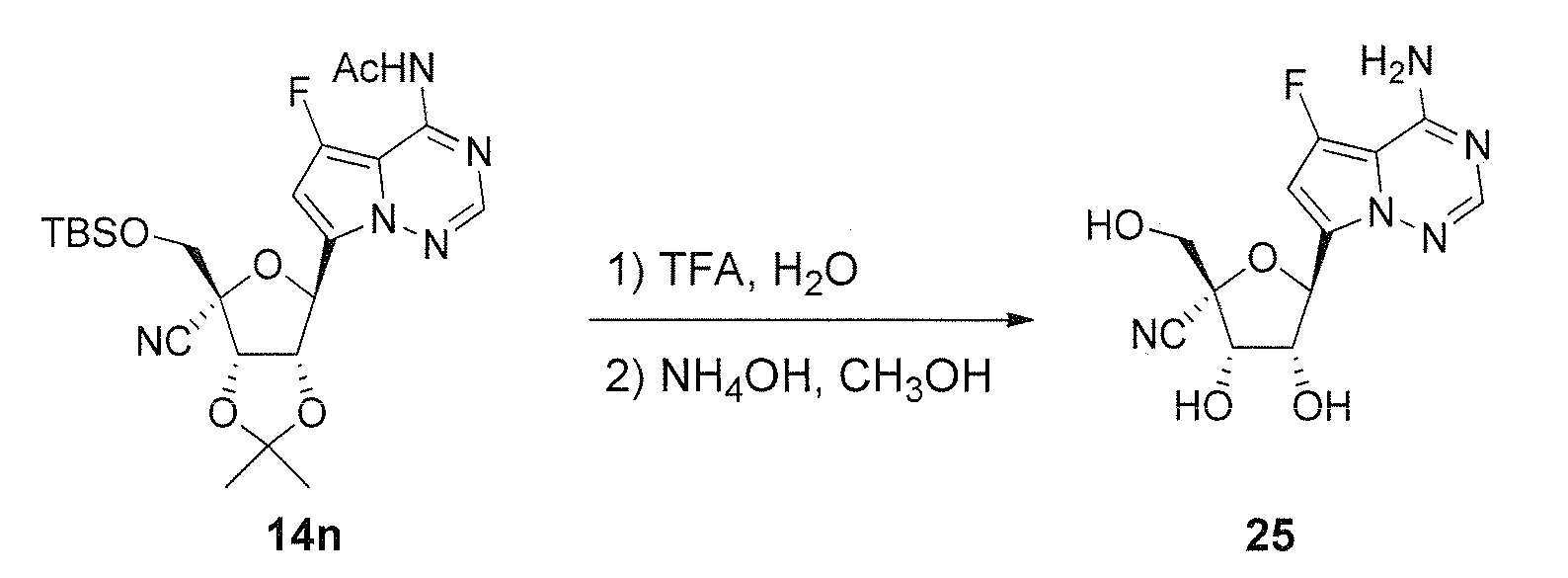
실시예Example 25 - ( 25-( 2R,3S,4R,5S2R, 3S, 4R, 5S )-5-(4-아미노-5-) -5- (4-amino-5- 플루오로피롤로[2,1-f][1,2,4]트리아진Fluoropyrrolo [2,1-f] [1,2,4] triazine -7-일)-3,4-디히드록시-2-(히드록시메틸)테트라히드로푸란-2-카르보니트릴-7-yl) -3,4-dihydroxy-2- (hydroxymethyl) tetrahydrofuran-2-carbonitrile
중간체 14n (11 ㎎, 0.022 mmol)을 물 중의 50% TFA의 용액에 상온에서 취하였다. 2 시간 후, 반응 혼합물을 고체 Na2CO3로 켄칭시켜 pH=8로 만들었다. 용매를 감압 하에서 제거하고, 미정제 잔류물을 역상 HPLC에 의하여 정제하였다. 실시예 25를 함유하는 분획을 합하고, 방치하고, N6-아실을 함유하는 분획을 합하고, 감압 하에서 농축시켰다. N6-아실 중간체 잔류물을 진한 NH4OH(aq) (1 ㎖) 중에서 취하고, 혼합물을 상온에서 교반하였다. 30 분 후, 생성된 혼합물을 감압 하에서 농축시키고, 미정제 잔류물을 HPLC에 의하여 정제하였다. 실시예 25를 함유하는 분획을 미리 방치한 실시예 25를 함유하는 분획과 합하여 실시예 25 (4 ㎎, 58%)를 백색 고체로서 얻었다.Intermediate 14n (11 mg, 0.022 mmol) was taken at room temperature in a solution of 50% TFA in water. After 2 hours, the reaction mixture was quenched with solid Na 2 CO 3 to pH = 8. The solvent was removed under reduced pressure, and the crude residue was purified by reverse phase HPLC. Fractions containing Example 25 were combined, allowed to stand, and fractions containing N6-acyl were combined and concentrated under reduced pressure. The N6-acyl intermediate residue was taken in concentrated NH 4 OH (aq) (1 mL) and the mixture was stirred at ambient temperature. After 30 minutes, the resulting mixture was concentrated under reduced pressure, and the crude residue was purified by HPLC. The fraction containing Example 25 was combined with the fraction containing Example 25 which had been left in advance to obtain Example 25 (4 mg, 58%) as a white solid.
1H NMR (400 MHz, 메탄올-d6) δ 7.71 (s, 1H), 6.56 (s, 1H), 5.44 (d, J=5.6 Hz, 1H), 4.48 (t, J=5.6 Hz, 1H), 4.36 (d, J=5.5 Hz, 1H), 3.83 ((ABq, Δδ=0.05 ppm, J=12 Hz, 2H). 1 H NMR (400 MHz, methanol-d 6 ) δ 7.71 (s, 1H), 6.56 (s, 1H), 5.44 (d, J = 5.6 Hz, 1H), 4.48 (t, J = 5.6 Hz, 1H) , 4.36 (d, J = 5.5 Hz, 1H), 3.83 ((ABq, Δδ = 0.05 ppm, J = 12 Hz, 2H).
19F NMR (376 MHz, 메탄올-d4) δ -161.81 (s) 19 F NMR (376 MHz, methanol-d 4 ) δ -161.81 (s)
LC/MS: tR=0.47 min, MS m/z=310.13 [M+H]; LC 시스템: 써모 아셀라 1250 UHPLC; MS 시스템: 써모 LCQ 플리트; 컬럼: 키네텍스 2.6μ XB-C18 100A, 50×3.00 ㎜; 용매: 0.1% 포름산을 갖는 아세토니트릴, 0.1% 포름산을 갖는 물; 구배: 1.8 ㎖/min으로 0 min-1.4 min 2-100% ACN, 1.4 min-1.80 min 100% ACN, 1.8 min-1.85 min 100%-2% ACN, 1.85 min-2 min 2% ACN.LC / MS: t R = 0.47 min, MS m / z = 310.13 [M + H]; LC system: Thermo Acela 1250 UHPLC; MS system: Thermo LCQ pleats; Column: Kinetex 2.6 μ XB-C18 100A, 50 × 3.00 mm; Solvent: acetonitrile with 0.1% formic acid, water with 0.1% formic acid; Gradient: 0 min-1.4 min 2-100% ACN at 1.8 mL / min, 1.4 min-1.80 min 100% ACN, 1.8 min-1.85 min 100% -2% ACN, 1.85 min-2 min 2% ACN.
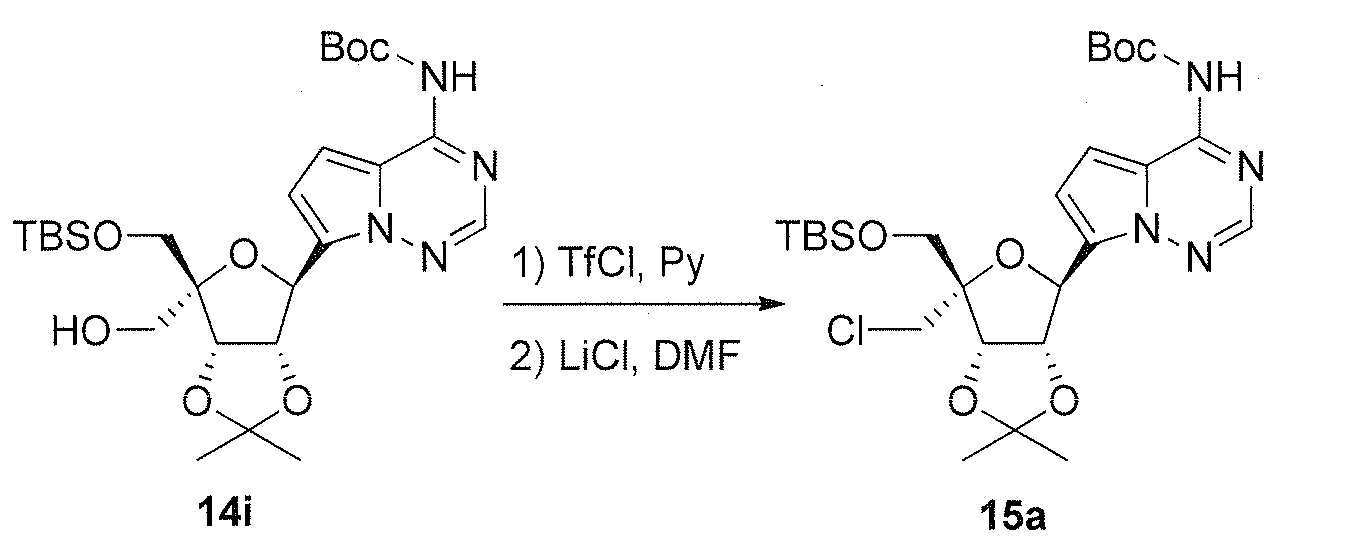
중간체 15a - Intermediate 15a- terttert -부틸 (7-((3aS,4S,6R,6aS)-6-(((tert-부틸디메틸실릴)옥시)메틸)-6-(클로로메틸)-2,2-디메틸테트라히드로푸로[3,4-d][1,3]디옥솔-4-일)피롤로[2,1-f][1,2,4]트리아진-4-일)카르바메이트-Butyl (7-((3aS, 4S, 6R, 6aS) -6-(((tert-butyldimethylsilyl) oxy) methyl) -6- (chloromethyl) -2,2-dimethyltetrahydrofuro [3, 4-d] [1,3] dioxol-4-yl) pyrrolo [2,1-f] [1,2,4] triazin-4-yl) carbamate
중간체 14i (100 ㎎, 0.18 mmol)를 무수 피리딘 (5 ㎖) 중에 용해시켰다. 트리플루오로메탄술포닐 클로라이드 (23 ㎕, 0.22 mmol)를 한번에 첨가하고, 반응 혼합물을 45 분 동안 실온에서 교반하였다. 그 후, 추가의 트리플루오로메탄술포닐 클로라이드 (100 ㎕)를 첨가하였다. 30 분 후, 추가의 트리플루오로메탄술포닐 클로라이드 (100 ㎕)를 첨가하였다. 추가의 30 분 후, 더 많은 트리플루오로메탄술포닐 클로라이드 (100 ㎕)를 첨가하고, 반응을 30 분 동안 교반하고, 이 때 반응 혼합물을 감압 하에서 농축시켰다. 미정제 잔류물을 무수 DMF (5 ㎖) 중에 용해시키고, 염화리튬 (153 ㎎, 3.6 mmol)을 한번에 첨가하였다. 생성된 혼합물을 실온에서 16 시간 동안 교반하였다. 반응 혼합물을 에틸 아세테이트 (50 ㎖)로 희석하고, 포화 염화나트륨 수용액 (3×20 ㎖)으로 세정하였다. 유기층을 무수 황산나트륨 위에서 건조시키고, 감압 하에서 농축시켰다. 미정제 잔류물을 실리카 겔 크로마토그래피 (헥산 중의 0-20% 에틸 아세테이트)로 정제하여 중간체 15a를 얻었다.Intermediate 14i (100 mg, 0.18 mmol) was dissolved in anhydrous pyridine (5 mL). Trifluoromethanesulfonyl chloride (23 μl, 0.22 mmol) was added in one portion, and the reaction mixture was stirred for 45 minutes at room temperature. Then additional trifluoromethanesulfonyl chloride (100 μl) was added. After 30 minutes, additional trifluoromethanesulfonyl chloride (100 μl) was added. After an additional 30 minutes, more trifluoromethanesulfonyl chloride (100 μl) was added, and the reaction was stirred for 30 minutes, at which time the reaction mixture was concentrated under reduced pressure. The crude residue was dissolved in anhydrous DMF (5 mL) and lithium chloride (153 mg, 3.6 mmol) was added at once. The resulting mixture was stirred at room temperature for 16 hours. The reaction mixture was diluted with ethyl acetate (50 mL) and washed with saturated aqueous sodium chloride solution (3 x 20 mL). The organic layer was dried over anhydrous sodium sulfate and concentrated under reduced pressure. The crude residue was purified by silica gel chromatography (0-20% ethyl acetate in hexane) to give intermediate 15a.
MS m/z=569.0 [M+H]. MS 시스템: 써모 LCQ 어드밴티지MS m / z = 569.0 [M + H]. MS System: Thermo LCQ Advantage

실시예Example 26 - ( 26-( 2R,3S,4R,5S2R, 3S, 4R, 5S )-5-(4-) -5- (4- 아미노피롤로[2,1-f][1,2,4]트리아진Aminopyrrolo [2,1-f] [1,2,4] triazine -7-일)-2-(클로로메틸)-2-(히드록시메틸)테트라히드로푸란-3,4-디올-7-yl) -2- (chloromethyl) -2- (hydroxymethyl) tetrahydrofuran-3,4-diol
중간체 15a를 TFA 및 물의 용액 (1:1, 5 ㎖) 중에 용해시키고, 생성된 혼합물을 16 시간 동안 교반하였다. 그 후, 반응 혼합물을 감압 하에서 농축시켰다. 미정제 잔류물을 중탄산나트륨 수용액 및 아세토니트릴 중에 용해시키고, 분취용 HPLC에 의하여 정제하여 실시예 26 (19 ㎎, 34%)을 백색 분말로서 얻었다.Intermediate 15a was dissolved in a solution of TFA and water (1: 1, 5 mL) and the resulting mixture was stirred for 16 hours. Thereafter, the reaction mixture was concentrated under reduced pressure. The crude residue was dissolved in aqueous sodium bicarbonate solution and acetonitrile and purified by preparative HPLC to give Example 26 (19 mg, 34%) as a white powder.
1H NMR (400 MHz, D2O) δ 7.61 (s, 1H), 6.72-6.64 (m, 2H), 5.19 (d, J=9.1 Hz, 1H), 4.73-4.66 (m, 1H), 4.28 (d, J=5.2 Hz, 1H), 3.78 (s, 2H), 3.72-3.57 (m, 2H). 1 H NMR (400 MHz, D 2 O) δ 7.61 (s, 1H), 6.72-6.64 (m, 2H), 5.19 (d, J = 9.1 Hz, 1H), 4.73-4.66 (m, 1H), 4.28 (d, J = 5.2 Hz, 1H), 3.78 (s, 2H), 3.72-3.57 (m, 2H).
MS m/z=315.3 [M+H]. MS 시스템: 써모 LCQ 어드밴티지MS m / z = 315.3 [M + H]. MS System: Thermo LCQ Advantage

실시예Example 27 ( 27 ( 또한 TP7Also TP7 ) - (()-(( 2R,3R,4R,5S2R, 3R, 4R, 5S )-5-(4-) -5- (4- 아미노피롤로[2,1-f][1,2,4]트리아진Aminopyrrolo [2,1-f] [1,2,4] triazine -7-일)-2-아지도-4-플루오로-3-히드록시테트라히드로푸란-2-일)메틸 -7-yl) -2-azido-4-fluoro-3-hydroxytetrahydrofuran-2-yl) methyl 테트라히드로겐Tetrahydrogen 트리포스페이트Triphosphate
실시예 27은 실시예 19를 출발 물질로 하여 실시예 TP4에 대하여 기재된 바와 유사한 방식으로 테트라-나트륨 염으로서 생성하였다.Example 27 was prepared as a tetra-sodium salt in a similar manner as described for Example TP4 using Example 19 as the starting material.
1H NMR (400 MHz, D2O) δ 7.76 (s, 1H), 6.83 (d, J=4.4 Hz, 1H), 6.80 (d, J=4.8 Hz, 1H), 5.94 (d, J=25.2 Hz, 1H), 5.24 (dd, J=55.2, 5.2 Hz, 1H), 4.78 (dd, J=26.8, 5.2 Hz, 1H), 4.08-4.18 (m, 2H). 1 H NMR (400 MHz, D 2 O) δ 7.76 (s, 1H), 6.83 (d, J = 4.4 Hz, 1H), 6.80 (d, J = 4.8 Hz, 1H), 5.94 (d, J = 25.2 Hz, 1H), 5.24 (dd, J = 55.2, 5.2 Hz, 1H), 4.78 (dd, J = 26.8, 5.2 Hz, 1H), 4.08-4.18 (m, 2H).
19F NMR (376 MHz, D2O) δ -193.74 - -194.02 (m). 19 F NMR (376 MHz, D 2 O) δ -193.74--194.02 (m).
31P NMR (162 MHz, D2O) δ -4.60 (d, J=53.2 Hz, 1P), -10.25 (d, J=48.4 Hz, 1P), -20.28 (t, J=48.4 Hz, 1P). 31 P NMR (162 MHz, D 2 O) δ -4.60 (d, J = 53.2 Hz, 1P), -10.25 (d, J = 48.4 Hz, 1P), -20.28 (t, J = 48.4 Hz, 1P) .

실시예Example 28 - (( 28-(( 2R,3R,4R,5S2R, 3R, 4R, 5S )-5-(4-아미노-5-) -5- (4-amino-5- 플루오로피롤로[2,1-f][1,2,4]트리아진Fluoropyrrolo [2,1-f] [1,2,4] triazine -7-일)-2-아지도-4-플루오로-3-히드록시테트라히드로푸란-2-일)메틸 -7-yl) -2-azido-4-fluoro-3-hydroxytetrahydrofuran-2-yl) methyl 테트라히드로겐Tetrahydrogen 트리포스페이트Triphosphate
실시예 28은 실시예 21을 출발 물질로 하여 실시예 TP4에 대하여 기재된 바와 유사한 방식으로 테트라-나트륨 염으로서 생성하였다.Example 28 was prepared as a tetra-sodium salt in a similar manner as described for Example TP4 using Example 21 as the starting material.
1H NMR (400 MHz, D2O) δ 7.64 (s, 1H), 6.60 (s, 1H), 5.90 (d, J=24.4 Hz, 1H), 5.20 (dd, J=54.8, 4.8 Hz, 1H), 4.72 (dd, J=27.2, 4.8 Hz, 1H), 4.05-4.18 (m, 2H). 1 H NMR (400 MHz, D 2 O) δ 7.64 (s, 1H), 6.60 (s, 1H), 5.90 (d, J = 24.4 Hz, 1H), 5.20 (dd, J = 54.8, 4.8 Hz, 1H ), 4.72 (dd, J = 27.2, 4.8 Hz, 1H), 4.05-4.18 (m, 2H).
19F NMR (376 MHz, D2O) δ -161.00 (s), -196.39 - -196.69 (m). 19 F NMR (376 MHz, D 2 O) δ -161.00 (s), -196.39--196.69 (m).
31P NMR (162 MHz, D2O) δ -8.24 (d, J=50.4 Hz), -14.20 (d, J=46.0 Hz), -24.08 (t, J=48.4 Hz). 31 P NMR (162 MHz, D 2 O) δ -8.24 (d, J = 50.4 Hz), -14.20 (d, J = 46.0 Hz), -24.08 (t, J = 48.4 Hz).
MS m/z=567.87 [M+1]. MS 시스템: 써모 LCQ 어드밴티지MS m / z = 567.87 [M + 1]. MS System: Thermo LCQ Advantage
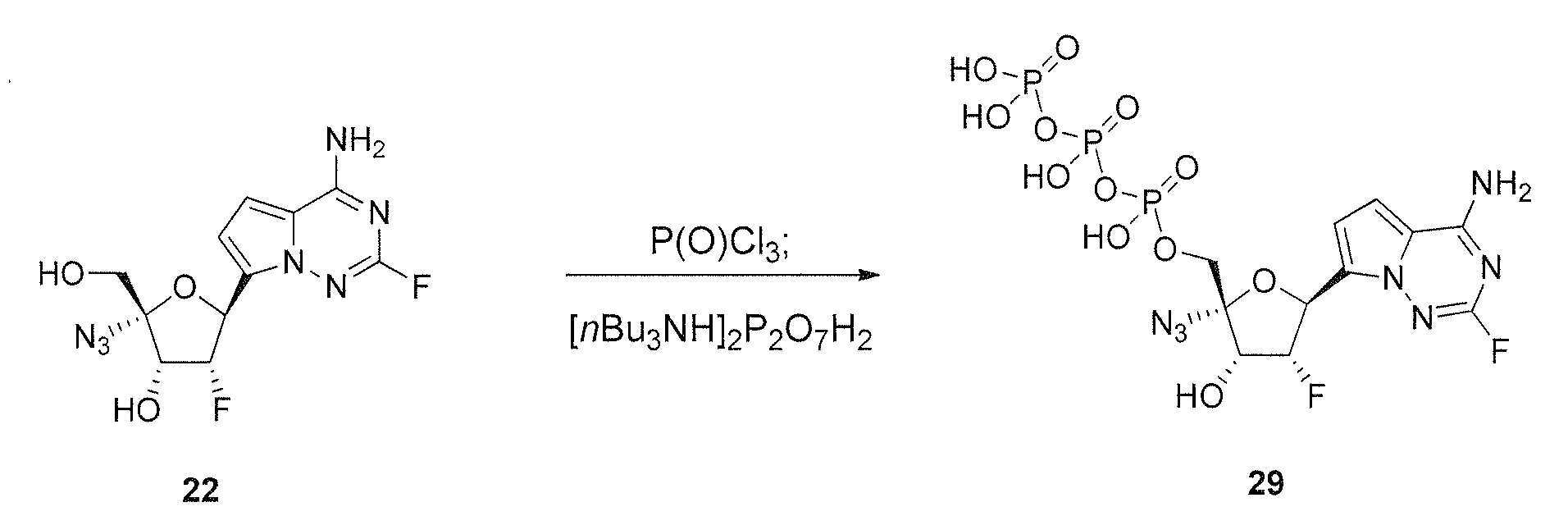
실시예Example 29 - (( 29-(( 2R,3R,4R,5S2R, 3R, 4R, 5S )-5-(4-아미노-2-) -5- (4-amino-2- 플루오로피롤로[2,1-f][1,2,4]트리아진Fluoropyrrolo [2,1-f] [1,2,4] triazine -7-일)-2-아지도-4-플루오로-3-히드록시테트라히드로푸란-2-일)메틸 -7-yl) -2-azido-4-fluoro-3-hydroxytetrahydrofuran-2-yl) methyl 테트라히드로겐Tetrahydrogen 트리포스페이트Triphosphate
실시예 29는 실시예 22를 출발 물질로 하여 실시예 TP4에 대하여 기재된 바와 유사한 방식으로 테트라-나트륨 염으로서 생성하였다.Example 29 was prepared as a tetra-sodium salt in a similar manner as described for Example TP4 using Example 22 as the starting material.
1H NMR (400 MHz, D2O) δ 6.81 (d, J=4.4 Hz, 1H), 6.75 (d, J=4.8 Hz, 1H), 5.81 (d, J=24.4 Hz, 1H), 5.16 (dd, J=54.4, 4.8 Hz, 1H), 4.70 (dd, J=26.8, 4.4 Hz, 1H), 4.02-4.12 (m, 2H). 1 H NMR (400 MHz, D 2 O) δ 6.81 (d, J = 4.4 Hz, 1H), 6.75 (d, J = 4.8 Hz, 1H), 5.81 (d, J = 24.4 Hz, 1H), 5.16 ( dd, J = 54.4, 4.8 Hz, 1H), 4.70 (dd, J = 26.8, 4.4 Hz, 1H), 4.02-4.12 (m, 2H).
19F NMR (376 MHz, D2O) δ -75.95 (s), -196.51 - -196.80 (m). 19 F NMR (376 MHz, D 2 O) δ -75.95 (s), -196.51--196.80 (m).
31P NMR (162 MHz, D2O) δ -8.29 (d, J=53.2 Hz), -14.22 (d, J=48.4 Hz), -24.09 (t, J=48.4 Hz). 31 P NMR (162 MHz, D 2 O) δ -8.29 (d, J = 53.2 Hz), -14.22 (d, J = 48.4 Hz), -24.09 (t, J = 48.4 Hz).
MS m/z=567.59 [M+1]. MS 시스템: 써모 LCQ 어드밴티지MS m / z = 567.59 [M + 1]. MS System: Thermo LCQ Advantage
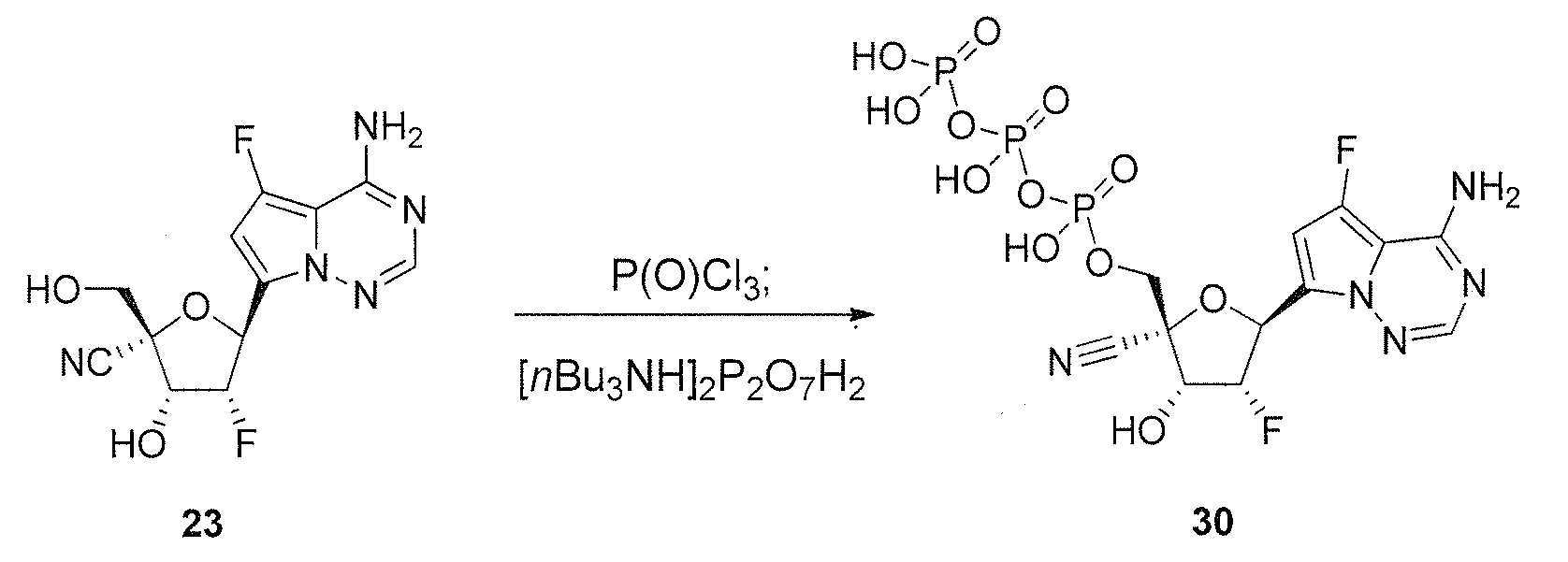
실시예Example 30 - (( 30-(( 2R,3R,4R,5S2R, 3R, 4R, 5S )-5-(4-아미노-5-) -5- (4-amino-5- 플루오로피롤로[2,1-f][1,2,4]트리아진Fluoropyrrolo [2,1-f] [1,2,4] triazine -7-일)-2-시아노-4-플루오로-3-히드록시테트라히드로푸란-2-일)메틸 -7-yl) -2-cyano-4-fluoro-3-hydroxytetrahydrofuran-2-yl) methyl 테트라히드로겐Tetrahydrogen 트리포스페이트Triphosphate
실시예 30은 실시예 23을 출발 물질로 하여 실시예 TP4에 대하여 기재된 바와 유사한 방식으로 테트라-나트륨 염으로서 생성하였다.Example 30 was prepared as a tetra-sodium salt in a similar manner as described for Example TP4 using Example 23 as the starting material.
1H NMR (400 MHz, D2O) δ 7.64 (s, 1H), 6.57 (s, 1H), 5.87 (d, J=24.8 Hz, 1H), 5.26 (dd, J=53.6, 4.0 Hz, 1H), 4.82 (dd, J=25.2, 4.4 Hz, 1H), 4.26-4.35 (m, 2H). 1 H NMR (400 MHz, D 2 O) δ 7.64 (s, 1H), 6.57 (s, 1H), 5.87 (d, J = 24.8 Hz, 1H), 5.26 (dd, J = 53.6, 4.0 Hz, 1H ), 4.82 (dd, J = 25.2, 4.4 Hz, 1H), 4.26-4.35 (m, 2H).
19F NMR (376 MHz, D2O) δ -161.05 (s), -194.92 - -195.19 (m). 19 F NMR (376 MHz, D 2 O) δ -161.05 (s), -194.92--195.19 (m).
31P NMR (162 MHz, D2O) δ -8.22 (d, J=50.8 Hz), -14.48 (d, J=48.4 Hz), -24.01 (t, J=48.4 Hz). 31 P NMR (162 MHz, D 2 O) δ -8.22 (d, J = 50.8 Hz), -14.48 (d, J = 48.4 Hz), -24.01 (t, J = 48.4 Hz).
MS m/z=551.91 [M+1]. MS 시스템: 써모 LCQ 어드밴티지MS m / z = 551.91 [M + 1]. MS System: Thermo LCQ Advantage
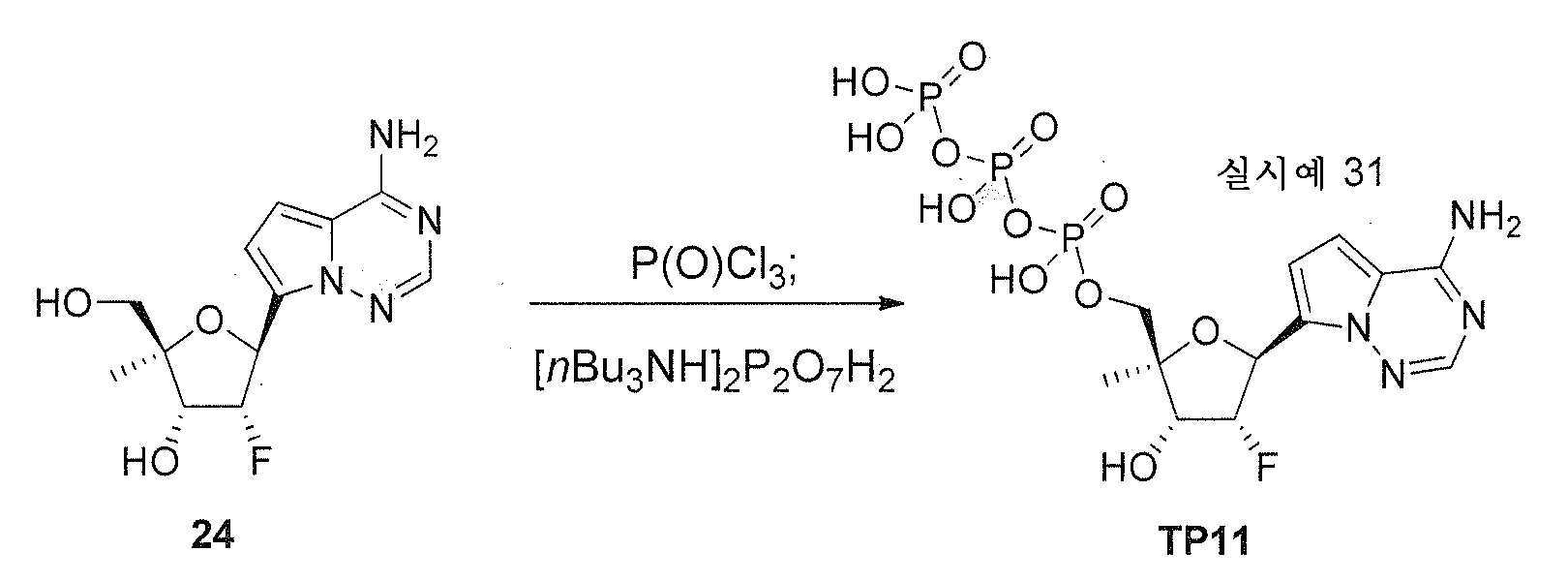
실시예Example 31 ( 31 ( 또한 TP11Also TP11 ) - (()-(( 2R,3R,4R,5S2R, 3R, 4R, 5S )-5-(4-) -5- (4- 아미노피롤로[2,1-f][1,2,4]트리아진Aminopyrrolo [2,1-f] [1,2,4] triazine -7-일)-4-플루오로-3-히드록시-2-메틸테트라히드로푸란-2-일)메틸 -7-yl) -4-fluoro-3-hydroxy-2-methyltetrahydrofuran-2-yl) methyl 테트라히드로겐Tetrahydrogen 트리포스페이트Triphosphate
실시예 31은 실시예 24를 출발 물질로 하여 실시예 TP4에 대하여 기재된 바와 유사한 방식으로 테트라-나트륨 염으로서 생성하였다.Example 31 was prepared as a tetra-sodium salt in a similar manner as described for Example TP4 using Example 24 as the starting material.
1H NMR (400 MHz, D2O) δ 7.66 (s, 1H), 6.78 (d, J=4.8 Hz, 1H), 6.72 (d, J=4.4 Hz, 1H), 5.58 (dd, J=23.6, 2.4 Hz, 1H), 5.16 (ddd, J=55.2, 5.2, 2.8 Hz, 1H), 4.51 (dd, J=23.2, 5.2 Hz, 1H), 3.88 (dd, J=11.6, 6.0 Hz, 1H), 3.78 (dd, J=10.8, 4.0 Hz, 1H), 1.2 (s, 3H). 1 H NMR (400 MHz, D 2 O) δ 7.66 (s, 1H), 6.78 (d, J = 4.8 Hz, 1H), 6.72 (d, J = 4.4 Hz, 1H), 5.58 (dd, J = 23.6 , 2.4 Hz, 1H), 5.16 (ddd, J = 55.2, 5.2, 2.8 Hz, 1H), 4.51 (dd, J = 23.2, 5.2 Hz, 1H), 3.88 (dd, J = 11.6, 6.0 Hz, 1H) , 3.78 (dd, J = 10.8, 4.0 Hz, 1H), 1.2 (s, 3H).
19F NMR (376 MHz, D2O) δ -195.74 - -196.01 (m). 19 F NMR (376 MHz, D 2 O) δ -195.74--196.01 (m).
31P NMR (162 MHz, D2O) δ -8.24 (d, J=50.4 Hz), -13.54 (d, J=45.6 Hz), -24.11 (t, J=48.0 Hz). 31 P NMR (162 MHz, D 2 O) δ -8.24 (d, J = 50.4 Hz), -13.54 (d, J = 45.6 Hz), -24.11 (t, J = 48.0 Hz).

실시예Example 32 ( 32 ( 또한 TP12Also TP12 ) - ((2R,3S,4R,5S)-5-(4-아미노-5-플루오로피롤로[2,1-f][1,2,4]트리아진-7-일)-2-시아노-3,4-디히드록시테트라히드로푸란-2-일)메틸 )-((2R, 3S, 4R, 5S) -5- (4-amino-5-fluoropyrrolo [2,1-f] [1,2,4] triazine-7-yl) -2- Cyano-3,4-dihydroxytetrahydrofuran-2-yl) methyl 테트라히드로겐Tetrahydrogen 트리포스페이트Triphosphate
실시예 32는 실시예 25를 출발 물질로 하여 실시예 TP4에 대하여 기재된 바와 유사한 방식으로 테트라-나트륨 염으로서 생성하였다.Example 32 was prepared as a tetra-sodium salt in a similar manner as described for Example TP4 using Example 25 as the starting material.
1H NMR (400 MHz, D2O) δ 7.59 (s, 1H), 6.57 (s, 1H), 5.44 (d, J=6.0 Hz, 1H), 4.56 (d, J=5.2 Hz, 1H), 4.48 (dd, J=5.6 Hz, 1H), 4.16 (dd, J=11.6, 6.0 Hz, 1H), 4.08 (dd, J=11.2, 5.2 Hz, 1H). 1 H NMR (400 MHz, D 2 O) δ 7.59 (s, 1H), 6.57 (s, 1H), 5.44 (d, J = 6.0 Hz, 1H), 4.56 (d, J = 5.2 Hz, 1H), 4.48 (dd, J = 5.6 Hz, 1H), 4.16 (dd, J = 11.6, 6.0 Hz, 1H), 4.08 (dd, J = 11.2, 5.2 Hz, 1H).
19F NMR (376 MHz, D2O) δ -161.25 (s). 19 F NMR (376 MHz, D 2 O) δ -161.25 (s).
31P NMR (162 MHz, D2O) δ -8.29 (d, J=48.4 Hz), -14.49 (d, J=53.2 Hz), -24.15 (t, J=48.4 Hz). 31 P NMR (162 MHz, D 2 O) δ -8.29 (d, J = 48.4 Hz), -14.49 (d, J = 53.2 Hz), -24.15 (t, J = 48.4 Hz).
MS m/z=549.90 [M+1]. MS 시스템: 써모 LCQ 어드밴티지 MS m / z = 549.90 [M + 1]. MS System: Thermo LCQ Advantage

실시예Example 33 ( 33 ( 또한 TP13Also TP13 ) - (()-(( 2R,3S,4R,5S2R, 3S, 4R, 5S )-5-(4-) -5- (4- 아미노피롤로[2,1-f][1,2,4]트리아진Aminopyrrolo [2,1-f] [1,2,4] triazine -7-일)-2-(클로로메틸)-3,4-디히드록시테트라히드로푸란-2-일)메틸 -7-yl) -2- (chloromethyl) -3,4-dihydroxytetrahydrofuran-2-yl) methyl 테트라히드로겐Tetrahydrogen 트리포스페이트Triphosphate
실시예 33은 실시예 26을 출발 물질로 하여 실시예 TP3에 대하여 기재된 바와 유사한 방식으로 테트라-나트륨 염으로서 생성하였다.Example 33 was prepared as a tetra-sodium salt in a similar manner as described for Example TP3 using Example 26 as the starting material.
1H NMR (400 MHz, D2O) δ 7.76 (s, 1H), 6.92 (br s, 1H), 6.85 (br s, 1H), 5.32 (d, J=9.6 Hz, 1H), 4.78 (dd, J=8, 6.4 Hz, 1H), 4.53 (d, J=5.6 Hz, 1H), 4.08 (dd, J=10.0, 4.0 Hz, 1H), 3.83-3.95 (m, 3H), 3.07 (q, J=7.6 Hz, 24H), 1.16 (t, J=7.6 Hz, 36H). 1 H NMR (400 MHz, D 2 O) δ 7.76 (s, 1H), 6.92 (br s, 1H), 6.85 (br s, 1H), 5.32 (d, J = 9.6 Hz, 1H), 4.78 (dd , J = 8, 6.4 Hz, 1H), 4.53 (d, J = 5.6 Hz, 1H), 4.08 (dd, J = 10.0, 4.0 Hz, 1H), 3.83-3.95 (m, 3H), 3.07 (q, J = 7.6 Hz, 24H), 1.16 (t, J = 7.6 Hz, 36H).
31P NMR (162 MHz, D2O) δ -9.44 (d, J=45.6 Hz), -11.51 (d, J=48.8 Hz), -22.95 (t, J=48.4 Hz). 31 P NMR (162 MHz, D 2 O) δ -9.44 (d, J = 45.6 Hz), -11.51 (d, J = 48.8 Hz), -22.95 (t, J = 48.4 Hz).
MS m/z=555.06 [M+1]. MS 시스템: 써모 LCQ 어드밴티지MS m / z = 555.06 [M + 1]. MS System: Thermo LCQ Advantage
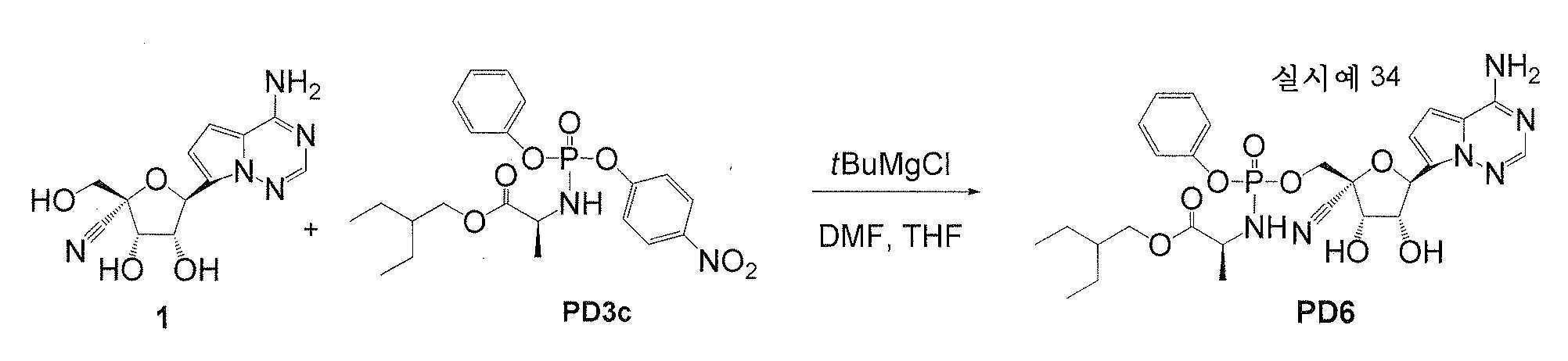
실시예Example 34 ( 34 ( 또한 PD6Also PD6 ) - (2S)-2-)-(2S) -2- 에틸부틸Ethyl butyl 2-(((((2R,3R,4R,5S)-5-(4-아미노피롤로[2,1-f][1,2,4]트리아진-7-일)-2-시아노-4-플루오로-3-히드록시테트라히드로푸란-2-일)메톡시)(펜옥시)포스포릴)아미노)프로파노에이트 2-((((((2R, 3R, 4R, 5S) -5- (4-aminopyrrolo [2,1-f] [1,2,4] triazine-7-yl) -2-cyano) -4-fluoro-3-hydroxytetrahydrofuran-2-yl) methoxy) (phenoxy) phosphoryl) amino) propanoate
실시예 1 (3.8 ㎎, 0.013 mmol)을 무수 N-메틸-2-피롤리돈 (0.2 ㎖) 중에 용해시키고, THF (0.1 ㎖)를 아르곤 대기 하에서 첨가하였다. 그 후, tert-부틸 마그네슘 클로라이드 (THF 중의 1 M, 20 ㎕, 0.024 mmol)를 실온에서 첨가하고, 백색 고체가 침전되었다. 5 분 후, THF (0.1 ㎖) 중의 p-니트로페닐포스포르아미데이트 PD3c (12 ㎎, 0.026 mmol)의 용액을 반응 혼합물에 한번에 첨가하고, 생성된 혼합물을 50℃로 가열하였다. 20 시간 후, 반응 혼합물을 실온으로 냉각되도록 한 후, 분취용 HPLC (페노미넥스 시너지 4u 히드로-RR 80Å 150×30 ㎜ 컬럼, 40-100% 아세토니트릴/물 구배)에 의하여 직접 정제하였다. 원하는 생성물을 함유하는 분획을 합하고, 동결건조시켜 실시예 34 (2.9 ㎎, 37%, 3:2 부분입체이성질체 혼합물)를 백색 고체로서 얻었다.Example 1 (3.8 mg, 0.013 mmol) was dissolved in anhydrous N-methyl-2-pyrrolidone (0.2 mL) and THF (0.1 mL) was added under an argon atmosphere. Thereafter, tert-butyl magnesium chloride (1 M in THF, 20 μl, 0.024 mmol) was added at room temperature, and a white solid precipitated. After 5 minutes, a solution of p-nitrophenylphosphoramidate PD3c (12 mg, 0.026 mmol) in THF (0.1 mL) was added to the reaction mixture at once, and the resulting mixture was heated to 50 ° C. After 20 hours, the reaction mixture was allowed to cool to room temperature, and then purified directly by preparative HPLC (Phenominex Synergy 4u Hydro-RR 80 × 150 × 30 mm column, 40-100% acetonitrile / water gradient). Fractions containing the desired product were combined and lyophilized to give Example 34 (2.9 mg, 37%, 3: 2 diastereomeric mixture) as a white solid.
1H NMR (400 MHz, CD3OD) δ 7.80 (s, 0.3H), 7.78 (s, 0.6H), 7.38-7.10 (m, 5H), 6.85 (br dd, J=4.7, 2.2 Hz, 1H), 6.75-6.71 (m, 1H), 5.54-5.46 (m, 1H), 4.65-4.58 (m, 1H), 4.53-4.31 (m, 3H), 4.07-3.84 (m, 3H), 1.54-1.39 (m, 1H), 1.38-1.19 (m, 7H), 0.92-0.81 (m, 6H) 29H 1 H NMR (400 MHz, CD 3 OD) δ 7.80 (s, 0.3H), 7.78 (s, 0.6H), 7.38-7.10 (m, 5H), 6.85 (br dd, J = 4.7, 2.2 Hz, 1H ), 6.75-6.71 (m, 1H), 5.54-5.46 (m, 1H), 4.65-4.58 (m, 1H), 4.53-4.31 (m, 3H), 4.07-3.84 (m, 3H), 1.54-1.39 (m, 1H), 1.38-1.19 (m, 7H), 0.92-0.81 (m, 6H) 29H
31P NMR (162 MHz, CD3OD) δ 3.25 (br s). 31 P NMR (162 MHz, CD 3 OD) δ 3.25 (br s).
LC/MS: tR=1.55 min, MS m/z=603.19 [M+H]; LC 시스템: 써모 아셀라 1250 UHPLC; MS 시스템: 써모 LCQ 플리트; 컬럼: 키네텍스 2.6μ XB-C18 100A, 50×4.6 ㎜; 용매: 0.1% 아세트산을 갖는 아세토니트릴, 0.1% 아세트산을 갖는 물; 구배: 2 ㎕/min으로 0 min-2.0 min 2-100% ACN, 2.0 min-3.05 min 100% ACN, 3.05 min-3.2 min 100%-2% ACN, 3.2 min-3.5 min 2% ACN.LC / MS: t R = 1.55 min, MS m / z = 603.19 [M + H]; LC system: Thermo Acela 1250 UHPLC; MS system: Thermo LCQ pleats; Column: Kinetex 2.6 μ XB-C18 100A, 50 × 4.6 mm; Solvent: acetonitrile with 0.1% acetic acid, water with 0.1% acetic acid; Gradient: 0 min-2.0 min 2-100% ACN, 2.0 min-3.05 min 100% ACN, 3.05 min-3.2 min 100% -2% ACN, 3.2 min-3.5 min 2% ACN at 2 μl / min.
HPLC: tR=2.98 min; HPLC 시스템: 아질런트 1100 시리즈; 컬럼: 제미니 5μ C18 110A, 50×4.6 ㎜; 용매: 0.1% TFA를 갖는 아세토니트릴, 0.1% TFA를 갖는 물; 구배: 2 ㎖/min으로 0 min-5.0 min 2-98% ACN, 5.0 min-6.0 min 98% ACN.HPLC: t R = 2.98 min; HPLC system: Agilent 1100 series; Column: Gemini 5μ C18 110A, 50 × 4.6 mm; Solvent: acetonitrile with 0.1% TFA, water with 0.1% TFA; Gradient: 0 min-5.0 min 2-98% ACN at 2 mL / min, 5.0 min-6.0 min 98% ACN.
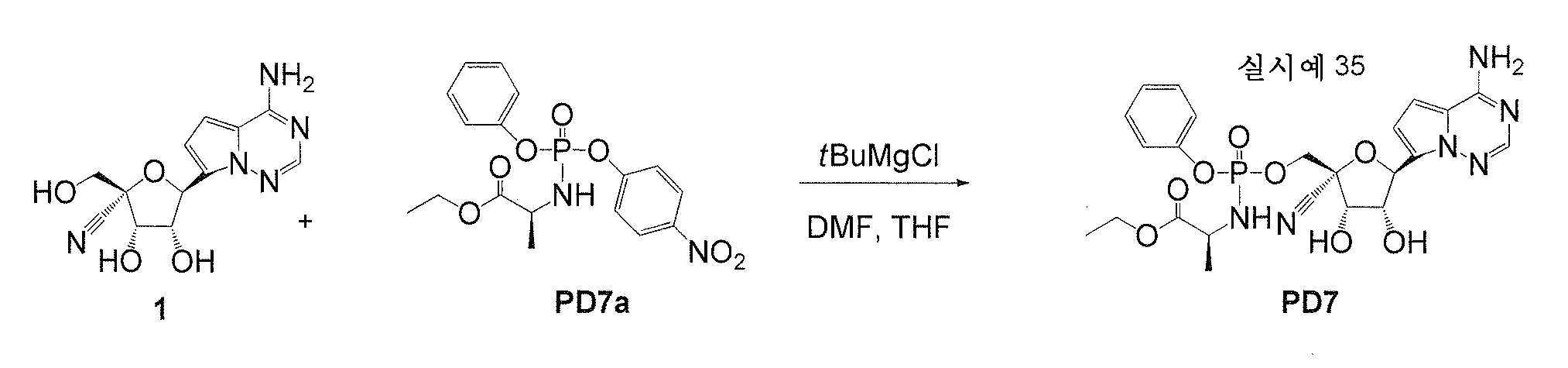
실시예Example 35 ( 35 ( 또한 PD7Also PD7 ) - (2S)-에틸 2-(((((2R,3S,4R,5S)-5-(4-아미노피롤로[2,1-f][1,2,4]트리아진-7-일)-2-시아노-3,4-디히드록시테트라히드로푸란-2-일)메톡시)(펜옥시)포스포릴)아미노) )-(2S) -ethyl 2-(((((2R, 3S, 4R, 5S) -5- (4-aminopyrrolo [2,1-f] [1,2,4] triazine-7- 1) -2-cyano-3,4-dihydroxytetrahydrofuran-2-yl) methoxy) (phenoxy) phosphoryl) amino) 프로파노에이트Propanoate
실시예 1 (19 ㎎, 65.3 ㎛ol)을 NMP (0.2 ㎖) 중에 용해시켰다. THF (0.1 ㎖)에 이어서 tert-부틸 마그네슘 클로라이드 (테트라히드로푸란 중의 1.0M 용액, 0.098 ㎖)를 실온에서 아르곤 대기 하에서 첨가하였다. 5 분 후, THF (0.1 ㎖) 중의 중간체 PD7a (US20120009147A1에 의하여 생성됨, 51.4 ㎎, 130 ㎛ol)의 용액을 첨가하고, 생성된 혼합물을 50℃로 가온시켰다. 1 시간 후, 반응 혼합물을 실온으로 냉각되도록 하고, 분취용 HPLC (페노미넥스 시너지 4u 히드로-RR 80Å 150×30 ㎜ 컬럼, 5-100% 아세토니트릴/물 구배)에 의하여 직접 정제하였다. 생성물 함유 분획을 합하고, 농축시키고, 생성된 잔류물을 분취용 HPLC (페노미넥스 루나 5u C18 100×30 ㎜ 컬럼, 5-100% 아세토니트릴/물 구배)에 의하여 재정제하여 실시예 35 (12 ㎎, 34%, 부분입체이성질체의 3:2 혼합물)를 백색 고체로서 얻었다.Example 1 (19 mg, 65.3 μmol) was dissolved in NMP (0.2 mL). THF (0.1 mL) was added followed by tert-butyl magnesium chloride (1.0M solution in tetrahydrofuran, 0.098 mL) at room temperature under an argon atmosphere. After 5 minutes, a solution of intermediate PD7a (produced by US20120009147A1, 51.4 mg, 130 μmol) in THF (0.1 mL) was added and the resulting mixture was warmed to 50 ° C. After 1 hour, the reaction mixture was allowed to cool to room temperature and purified directly by preparative HPLC (Phenominex Synergy 4u Hydro-RR 80 mm 150 × 30 mm column, 5-100% acetonitrile / water gradient). The product containing fractions were combined, concentrated, and the resulting residue was repurified by preparative HPLC (Phenominex Luna 5u C18 100 × 30 mm column, 5-100% acetonitrile / water gradient) to Example 35 (12 Mg, 34%, 3: 2 mixture of diastereomers) as a white solid.
1H NMR (400 MHz, CD3OD) δ 7.80 (d, J=2.3 Hz, 0.4H), 7.78 (d, J=2.3 Hz, 0.6H), 7.36-7.12 (m, 5H), 6.88-6.81 (m, 1H), 6.76-6.70 (m, 1H), 5.53-5.46 (m, 1H), 4.66-4.60 (m, 1H), 4.55-4.30 (m, 3H), 4.15-3.98 (m, 2H), 3.93-3.79 (m, 1H), 1.30-1.12 (m, 6H). 1 H NMR (400 MHz, CD 3 OD) δ 7.80 (d, J = 2.3 Hz, 0.4H), 7.78 (d, J = 2.3 Hz, 0.6H), 7.36-7.12 (m, 5H), 6.88-6.81 (m, 1H), 6.76-6.70 (m, 1H), 5.53-5.46 (m, 1H), 4.66-4.60 (m, 1H), 4.55-4.30 (m, 3H), 4.15-3.98 (m, 2H) , 3.93-3.79 (m, 1H), 1.30-1.12 (m, 6H).
31P NMR (162 MHz, CD3OD) δ 3.27 (br s). 31 P NMR (162 MHz, CD 3 OD) δ 3.27 (br s).
LC/MS: 주요 부분입체이성질체 tR=1.28 min, MS m/z=547.14 [M+H], 소수의 부분입체이성질체 tR=1.30 min, MS m/z=547.04 [M+H]; LC 시스템: 써모 아셀라 1250 UHPLC; MS 시스템: 써모 LCQ 플리트; 컬럼: 키네텍스 2.6μ XB-C18 100A, 50×4.6 mm; 용매: 0.1% 아세트산을 갖는 아세토니트릴, 0.1% 아세트산을 갖는 물; 구배: 2 ㎕/min으로 0 min-2.0 min 2-100% ACN, 2.0 min-3.05 min 100% ACN, 3.05 min-3.2 min 100%-2% ACN, 3.2 min-3.5 min 2% ACNLC / MS: major diastereomer t R = 1.28 min, MS m / z = 547.14 [M + H], few diastereomers t R = 1.30 min, MS m / z = 547.04 [M + H]; LC system: Thermo Acela 1250 UHPLC; MS system: Thermo LCQ pleats; Column: Kinetex 2.6 μ XB-C18 100A, 50 × 4.6 mm; Solvent: acetonitrile with 0.1% acetic acid, water with 0.1% acetic acid; Gradient: 0 min-2.0 min 2-100% ACN, 2.0 min-3.05 min 100% ACN, 3.05 min-3.2 min 100% -2% ACN, 3.2 min-3.5 min 2% ACN at 2 μl / min
HPLC: 주요 부분입체이성질체 tR=2.44 min, 소수의 부분입체이성질체 tR=2.46 min; HPLC 시스템: 아질런트 1100 시리즈; 컬럼: 제미니 5μ C18 110A, 50×4.6 ㎜; 용매: 0.1% TFA를 갖는 아세토니트릴, 0.1% TFA를 갖는 물; 구배: 2 ㎖/min으로 0 min-5.0 min 2-98% ACN, 5.0 min-6.0 min 98% ACN.HPLC: major diastereomer t R = 2.44 min, few diastereomer t R = 2.46 min; HPLC system: Agilent 1100 series; Column: Gemini 5μ C18 110A, 50 × 4.6 mm; Solvent: acetonitrile with 0.1% TFA, water with 0.1% TFA; Gradient: 0 min-5.0 min 2-98% ACN at 2 mL / min, 5.0 min-6.0 min 98% ACN.
또한, 하기 화학식 (A), 화학식 (B), 화학식 (C), 화학식 (D) 및 화학식 (E)의 화합물을 각각 포함하는 별도의 실시양태가 제공된다:In addition, separate embodiments are provided each comprising a compound of Formula (A), Formula (B), Formula (C), Formula (D), and Formula (E):

(상기 식에서, 각각의 경우에서 X1은 산소 보호기를 나타내며, X2는 아민 보호기를 나타냄).(In the formula, X 1 in each case represents an oxygen protecting group, X 2 represents an amine protecting group).
유용한 산소 보호기로는 실릴 에테르 보호기 또는, 메톡시벤질 기를 비롯한 벤질-타입 보호기를 들 수 있다.Useful oxygen protecting groups include silyl ether protecting groups or benzyl-type protecting groups including methoxybenzyl groups.
유용한 실릴 에테르 보호기로는 트리메틸실릴 (TMS), 트리에틸실릴 (TES), 디메틸이소프로필실릴 (IPDMS), 디에틸이소프로필실릴 (DEIPS), 디메틸헥실실릴 (TDS), t-부틸디메틸실릴 (TBS 또는 TBDMS), t-부틸디페닐실릴 (TBDPS), 트리벤질실릴, 트리-p-크실릴실릴, 트리이소프로필실릴 (TIPS), 디페닐메틸실릴 (DPMS), 디-t-부틸메틸실릴 (DTBMS), 트리페닐실릴 (TPS), 메틸디페닐실릴 (MDPS), t-부틸메톡시페닐실릴, 트리스(트리메틸실릴)실릴 (시실), (2-히드록시스티릴)디메틸실릴 (HSDMS), (2-히드록시스티릴)디이소프로필실릴(HSDIS). t-부틸메톡시페닐실릴 (TBMPS) 및 t-부톡시디페닐실릴 (DPTBOS) 보호기를 들 수 있다.Useful silyl ether protecting groups include trimethylsilyl (TMS), triethylsilyl (TES), dimethylisopropylsilyl (IPDMS), diethylisopropylsilyl (DEIPS), dimethylhexylsilyl (TDS), t-butyldimethylsilyl (TBS) Or TBDMS), t-butyldiphenylsilyl (TBDPS), tribenzylsilyl, tri-p-xylylsilyl, triisopropylsilyl (TIPS), diphenylmethylsilyl (DPMS), di-t-butylmethylsilyl ( DTBMS), triphenylsilyl (TPS), methyldiphenylsilyl (MDPS), t-butylmethoxyphenylsilyl, tris (trimethylsilyl) silyl (silyl), (2-hydroxystyryl) dimethylsilyl (HSDMS), (2-hydroxystyryl) diisopropylsilyl (HSDIS). t-butylmethoxyphenylsilyl (TBMPS) and t-butoxydiphenylsilyl (DPTBOS) protecting groups.
유용한 벤질-타입 보호기로는 벤질, 할로겐화 벤질, p-메톡시벤질, 벤질옥시메틸, 2,4-디메톡시벤질, 3,4-디메톡시벤질, 2,6-디메톡시벤질, p-CF3-벤질, p-메틸벤질, p-메톡실벤질, 3,5-디메틸벤질, p-tert-부틸벤질, o-니트로벤질, p-니트로벤질, p-Br-벤질을 비롯한 p-할로벤질, 2,6-디클로로벤질, p-시아노벤질, p-페닐벤질, 2,6-디플루오로벤질, p-아실아미노벤질 (PAB), p-아지도벤질 (Azb), 4-아지도-3-클로로벤질, 2-트리플루오로메틸벤질, p-(메틸술피닐)벤질, 2-피콜릴, 4-피콜릴, 3-메틸-2-피콜릴 N-옥시도, 2-퀴놀리닐메틸, 디페닐메틸 (DPM), p,p'-디니트로벤즈히드릴, 트리페닐메틸, α-나프틸디페닐메틸, p-메톡시페닐디페닐메틸, 디(p-메톡시페닐)페닐메틸, 트리(p-메톡시페닐)메틸, 4,4',4"-트리스(벤조일옥시페닐)메틸 및 2-나프틸메틸 보호기를 들 수 있다.Useful benzyl-type protecting groups include benzyl, benzyl halide, p-methoxybenzyl, benzyloxymethyl, 2,4-dimethoxybenzyl, 3,4-dimethoxybenzyl, 2,6-dimethoxybenzyl, p-CF 3 P-halobenzyl, including -benzyl, p-methylbenzyl, p-methoxybenzyl, 3,5-dimethylbenzyl, p-tert-butylbenzyl, o-nitrobenzyl, p-nitrobenzyl, p-Br-benzyl, 2,6-dichlorobenzyl, p-cyanobenzyl, p-phenylbenzyl, 2,6-difluorobenzyl, p-acylaminobenzyl (PAB), p-azidobenzyl (Azb), 4-azido- 3-chlorobenzyl, 2-trifluoromethylbenzyl, p- (methylsulfinyl) benzyl, 2-picolyl, 4-picolyl, 3-methyl-2-picolyl N-oxido, 2-quinolinyl Methyl, diphenylmethyl (DPM), p, p'-dinitrobenzhydryl, triphenylmethyl, α-naphthyldiphenylmethyl, p-methoxyphenyldiphenylmethyl, di (p-methoxyphenyl) phenylmethyl , Tri (p-methoxyphenyl) methyl, 4,4 ', 4 "-tris (benzoyloxyphenyl) methyl and 2-naphthylmethyl protecting groups.
유용한 아민 보호기로는 p-메톡시벤질 카르보닐 (Moz 또는 MeOZ), 아세틸 (Ac), 벤조일 (Bz), p-메톡시벤질 (PMB), 3,4-디메톡시벤질 (DMPM), p-메톡시페닐 (PMP), 토실 (Ts 또는 Tos), 트리플루오로아세트아미드 및 트리틸 보호기를 들 수 있다. 유용한 아민 보호기로는 또한 카르바메이트 및 아미드 보호기를 들 수 있다. 카르바메이트 보호기의 예로는 메틸 및 에틸 카르바메이트, 예컨대 9-플루오레닐메틸옥시카르보닐 (FMOC), 9-(2-술포)플루오레닐메틸, 9-(2,7-디브로모)플루오레닐메틸, 17-테트라벤조[a,c,g,i]플루오레닐메틸 (Tbfmoc), 2-클로로-3-인데닐메틸 (Climoc), 벤즈[f]인덴-3-일메틸 (Bimoc), 2,7-디-t-부틸[9-(10,10-디옥소-10,10,10,10-테트라히드로티옥사닐)]메틸 (DBD-Tmoc), [2-(1,3-디티아닐)메틸 (Dmoc) 및 1,1-디옥소벤조[b]티오펜-2-일메틸 (Bsmoc) 카르바메이트를 들 수 있다.Useful amine protecting groups include p-methoxybenzyl carbonyl (Moz or MeOZ), acetyl (Ac), benzoyl (Bz), p-methoxybenzyl (PMB), 3,4-dimethoxybenzyl (DMPM), p- Methoxyphenyl (PMP), tosyl (Ts or Tos), trifluoroacetamide and trityl protecting groups. Useful amine protecting groups also include carbamate and amide protecting groups. Examples of carbamate protecting groups are methyl and ethyl carbamate, such as 9-fluorenylmethyloxycarbonyl (FMOC), 9- (2-sulfo) fluorenylmethyl, 9- (2,7-dibromo ) Fluorenylmethyl, 17-tetrabenzo [a, c, g, i] fluorenylmethyl (Tbfmoc), 2-chloro-3-indenylmethyl (Climoc), benz [f] inden-3-ylmethyl (Bimoc), 2,7-di-t-butyl [9- (10,10-dioxo-10,10,10,10-tetrahydrothioxanyl)] methyl (DBD-Tmoc), [2- ( 1,3-dithianil) methyl (Dmoc) and 1,1-dioxobenzo [b] thiophen-2-ylmethyl (Bsmoc) carbamate.
유용한 치환된 에틸 카르바메이트의 예로는 1,1-디메틸-2-시아노에틸, 2-포스포니오에틸 (Peoc), 2-메틸티오에틸, 2-(p-톨루엔술포닐)에틸, 2,2,2,-트리클로로에틸 (Troc), 2-(트리메틸실릴)에틸 (Teoc), 2-페닐에틸 (hZ), 1-(1-아다만틸)-1-메틸에틸 (Adpoc), 1,1-디메틸-2-브로모에틸, 1,1-디메틸-2-클로로에틸, 1,1-디메틸-2,2-디브로모에틸 (DB-t-BOC), 1,1-디메틸-2,2,2-트리클로로에틸 (TCBOC), 1-메틸-1-(4-비페닐릴)에틸 (Bpoc), 1-(3,5-디-t-부틸페닐)-1-메틸에틸 (t-Bumeoc), 2-(2'피리딜)에틸, 2-(4'피리딜)에틸, 2,2-비스(4'-니트로페닐)에틸 (Bnpeoc), N-(2-피발로일아미노)-1,1,디메틸에틸, 2-[(2-니트로페닐)디티오]-1-페닐에틸 (NpSSPeoc), 2-(N,N-디시클로헥실카르복스아미도)에틸, t-부틸 (Boc 또는 BOC), 1-아다만틸 (1-Adoc), 2-아다만틸 (2-Adoc), 비닐 (Voc), 알릴 (Aloc 또는 alloc), 1-이소프로필알릴 (Ipaoc), 신나밀 (Coc), 4-니트로신나밀 (Noc), 3-(3'-피리딜)프로프-2-에닐 (Paloc), 8-퀴놀릴 및 N-히드록시피페리디닐, 카르바메이트뿐 아니라, 메틸디티오, 에틸디티오, 이소프로필디티오, t-부틸디티오 및 페닐디티오 카르바메이트를 비롯한 알킬디티오 카르바메이트를 들 수 있다.Examples of useful substituted ethyl carbamate are 1,1-dimethyl-2-cyanoethyl, 2-phosphonioethyl (Peoc), 2-methylthioethyl, 2- (p-toluenesulfonyl) ethyl, 2 , 2,2, -trichloroethyl (Troc), 2- (trimethylsilyl) ethyl (Teoc), 2-phenylethyl (hZ), 1- (1-adamantyl) -1-methylethyl (Adpoc), 1,1-dimethyl-2-bromoethyl, 1,1-dimethyl-2-chloroethyl, 1,1-dimethyl-2,2-dibromoethyl (DB-t-BOC), 1,1-dimethyl -2,2,2-trichloroethyl (TCBOC), 1-methyl-1- (4-biphenylyl) ethyl (Bpoc), 1- (3,5-di-t-butylphenyl) -1-methyl Ethyl (t-Bumeoc), 2- (2'pyridyl) ethyl, 2- (4'pyridyl) ethyl, 2,2-bis (4'-nitrophenyl) ethyl (Bnpeoc), N- (2-pi Valoylamino) -1,1, dimethylethyl, 2-[(2-nitrophenyl) dithio] -1-phenylethyl (NpSSPeoc), 2- (N, N-dicyclohexylcarboxamido) ethyl, t-butyl (Boc or BOC), 1-adamantyl (1-Adoc), 2-adamantyl (2-Adoc), vinyl (Voc), allyl (Aloc or alloc), 1-isopropylallyl (Ipaoc ), Cinnamil (Coc), 4-nitrocinnamyl (Noc), 3- (3'-pyridyl) prop-2-enyl (Paloc), 8-quinolyl and N-hydroxypiperidinyl, carb As well as barmates, alkyldithio carbamates, including methyldithio, ethyldithio, isopropyldithio, t-butyldithio and phenyldithio carbamate.
또한, 아릴-함유 및 치환된 아릴-함유 카르바메이트, 예컨대 벤질, p-메톡시벤질, p-니트로벤질, p-브로모벤질, p-클로로벤질, 2,4-디클로로벤질, 4-메틸술피닐벤질 (Msz), 9-안트릴메틸, 4-메틸티오페닐 (Mtpc), 1-메틸-1-(트리페닐포스포니오)에틸 (2-트리페닐포스포니오이소프로필) (Ppoc), 2-단실에틸 (Dnseoc), 2-(4-니트로페닐)에틸 (Npeoc), 4-페닐아세톡시벤질 (PhAcOZ), 4-아지도벤질 (ACBZ), 4-아지도메톡시벤질, m-클로로-p-아실옥시벤질, p-(디히드록시보릴)벤질, 카르보벤질옥시 (Cbz), 4-벤즈이속사졸릴메틸 (Bic), 2-(트리플루오로메틸)-6-크로모닐메틸 (Tcroc), 페닐 및 디페닐메틸 카르바메이트가 유용하다. 추가의 카르바메이트로는 부티닐, 시클로펜틸, 시클로헥실, 시클로프로필메틸, 1-메틸시클로부틸, 1-메틸시클로헥실, 1,1-디메틸프로피닐 및 1-메틸-1-시클로프로필메틸 카르바메이트를 들 수 있다.Also, aryl-containing and substituted aryl-containing carbamates such as benzyl, p-methoxybenzyl, p-nitrobenzyl, p-bromobenzyl, p-chlorobenzyl, 2,4-dichlorobenzyl, 4-methyl Sulfinylbenzyl (Msz), 9-anthrylmethyl, 4-methylthiophenyl (Mtpc), 1-methyl-1- (triphenylphosphonio) ethyl (2-triphenylphosphoniisopropyl) (Ppoc), 2-dansylethyl (Dnseoc), 2- (4-nitrophenyl) ethyl (Npeoc), 4-phenylacetoxybenzyl (PhAcOZ), 4-azidobenzyl (ACBZ), 4-azidomethoxybenzyl, m- Chloro-p-acyloxybenzyl, p- (dihydroxyboryl) benzyl, carbobenzyloxy (Cbz), 4-benzisoxazolylmethyl (Bic), 2- (trifluoromethyl) -6-chromonylmethyl (Tcroc), phenyl and diphenylmethyl carbamate are useful. Additional carbamates include butynyl, cyclopentyl, cyclohexyl, cyclopropylmethyl, 1-methylcyclobutyl, 1-methylcyclohexyl, 1,1-dimethylpropynyl and 1-methyl-1-cyclopropylmethyl carbohydrate. And barmate.
아민의 경우 유용한 아미드 보호기로는 N-포르밀, N-아세틸, N-클로로아세틸, N-트리클로로아세틸, N-트리플루오로아세틸 (TFA), N-페닐아세틸, N-3-페닐프로피오닐, N-4-펜테노일, N-피콜리노일, N-3-피리딜카르복스아미도, N-벤조일페닐알라닐, N-벤조일 및 N-p-페닐벤조일 아미드를 들 수 있다.Useful amide protecting groups for amines are N-formyl, N-acetyl, N-chloroacetyl, N-trichloroacetyl, N-trifluoroacetyl (TFA), N-phenylacetyl, N-3-phenylpropionyl , N-4-pentenoyl, N-picolinoyl, N-3-pyridylcarboxamido, N-benzoylphenylalanyl, N-benzoyl and Np-phenylbenzoyl amide.
항바이러스성Antiviral 활성 activation
또 다른 실시양태는 바이러스 감염의 억제를 필요로 할 것으로 의심되는 대상체 또는 샘플을 본원의 조성물로 처리하는 단계를 포함하는, 바이러스 감염의 억제 방법에 관한 것이다.Another embodiment relates to a method of inhibiting a viral infection, comprising treating a subject or sample suspected of requiring inhibition of a viral infection with a composition herein.
본원에서는 바이러스를 함유하는 것으로 의심되는 샘플이 천연 또는 인조 물질, 예컨대 살아있는 유기체; 조직 또는 세포 배양물; 생물학적 샘플, 예컨대 생물학적 물질 샘플 (혈액, 혈청, 소변, 뇌척수액, 눈물, 가래, 타액, 조직 샘플 등); 실험실 샘플; 음식, 물 또는 공기 샘플; 바이오생성물 샘플, 예컨대 원하는 당단백질을 합성하는 세포, 특히 재조합 세포의 추출물 등을 포함하는 것으로 간주된다. 통상적으로 샘플은 바이러스 감염을 유도하는 유기체, 종종 병원성 유기체, 예컨대 종양 바이러스를 함유하는 것으로 의심될 것이다. 샘플은 물 및 유기 용매/물 혼합물을 포함하는 임의의 매체 중에 함유될 수 있다. 샘플은 살아있는 유기체, 예컨대 인간 및 인조 물질, 예컨대 세포 배양물을 포함한다.Samples suspected of containing viruses herein include natural or artificial substances, such as living organisms; Tissue or cell culture; Biological samples, such as biological material samples (blood, serum, urine, cerebrospinal fluid, tears, sputum, saliva, tissue samples, etc.); Laboratory samples; Food, water or air samples; Bioproduct samples are considered to include, for example, cells that synthesize the desired glycoprotein, particularly extracts of recombinant cells, and the like. Samples will typically be suspected of containing organisms that induce viral infections, often pathogenic organisms such as tumor viruses. The sample can be contained in any medium including water and organic solvent / water mixtures. Samples include living organisms, such as human and artificial materials, such as cell cultures.
필요할 경우, 조성물의 적용후 화합물의 항바이러스 활성은 상기 활성을 측정하는 직접 및 간접 방법을 비롯한 임의의 방법에 의하여 관찰될 수 있다. 상기 활성을 측정하는 정량적, 정성적 및 반정량적 방법도 모두 고려한다. 통상적으로 그러나 상기 기재된 스크리닝 방법 중 하나는 임의의 기타 방법, 예컨대 살아있는 유기체의 생리학적 성질의 관찰도 또한 적용 가능하다.If necessary, the antiviral activity of the compound after application of the composition can be observed by any method, including direct and indirect methods of measuring the activity. Quantitative, qualitative and semiquantitative methods of measuring the activity are also considered. Typically, however, one of the screening methods described above is also applicable to any other method, such as observation of the physiological properties of a living organism.
화합물의 항바이러스성 활성은 공지되어 있는 표준 스크리닝 프로토콜을 사용하여 측정될 수 있다. 예를 들면, 화합물의 항바이러스성 활성은 하기 일반적인 프로토콜을 사용하여 측정될 수 있다.The antiviral activity of a compound can be measured using known standard screening protocols. For example, the antiviral activity of a compound can be measured using the following general protocol.
호흡기 세포융합 바이러스 (Respiratory syncytial virus ( RSVRSV ) ) 항바이러스성Antiviral 활성 및 세포독성 검정 Active and cytotoxicity assay
항-term- RSVRSV 활성 activation
RSV에 대한 항바이러스성 활성은 HEp-2 세포에서 전염성 세포병변 세포 보호 검정을 사용하여 측정된다. 이러한 검정에서, 바이러스 감염 및/또는 복제를 억제하는 화합물은 세포 생육성 시약 (cell viability reagent)을 사용하여 정량화될 수 있는, 바이러스-유도된 세포 사멸에 대한 세포보호 효과를 생성한다. 여기서 사용된 기법은 공개된 문헌에 기재된 방법의 신규한 변형이다 (Chapman et al., Antimicrob Agents Chemother. 2007, 51(9):3346-53).Antiviral activity against RSV is measured in HEp-2 cells using an infectious cytopathic cell protection assay. In this assay, compounds that inhibit viral infection and / or replication produce a cytoprotective effect against virus-induced cell death, which can be quantified using cell viability reagents. The technique used here is a new variant of the method described in the published literature (Chapman et al., Antimicrob Agents Chemother . 2007, 51 (9): 3346-53).
HEp-2 세포를 ATCC (미국 버지니아주 머내서스 소재)로부터 입수하고, 10% 태아 소 혈청 및 페니실린/스트렙토마이신이 보충된 MEM 매체 중에서 유지하였다. 세포를 주당 2회 계대접종하고, 전면생장률 미만(subconfluent) 단계에서 유지하였다. HEp-2 세포에서의 바람직한 세포병변 효과를 생성하는 바이러스 스톡의 적절한 희석률을 결정하기 위하여 화합물을 테스트하기 이전에 RSV 균주 A2 (어드밴스드 바이오테크놀로지즈(Advanced Biotechnologies), 미국 매릴랜드 컬럼비아 소재)의 시판 스톡을 적정하였다.HEp-2 cells were obtained from ATCC (Manassas, Va.) And maintained in MEM medium supplemented with 10% fetal bovine serum and penicillin / streptomycin. Cells were passaged twice per week and maintained at subconfluent stages. Commercial stock of RSV strain A2 (Advanced Biotechnologies, Columbia, Maryland) prior to testing the compound to determine the appropriate dilution rate of the viral stock that produces the desired cytopathic effect in HEp-2 cells. Was titrated.
항바이러스성 테스트의 경우, HEp-2 세포를 커다란 세포 배양 플라스크 내에서 완전하지는 않지만 거의 전면생장률까지 성장시킨다. 테스트하는 화합물을 DMSO 중에서 384-웰 화합물 희석 플레이트 내에서 플레이트 표준화된 용량 반응 포맷당 8 또는 40개의 샘플 중에서 사전희석한다. 각각의 테스트 화합물의 3-배 연속 희석 증분을 플레이트 내에서 제조하고, 테스트 샘플을 웰당 100 nl에서 음향 전달 장치 (에코(Echo), 랩사이트(Labcyte))에 의하여 세포 배양 검정 384-웰 플레이트로 전달하였다. 각각의 화합물 희석물은 단일 또는 4개의 샘플로 건조 검정 플레이트로 옮기고, 이를 검정이 진행될 준비가 될 때까지 보관한다. 양성 및 음성 대조군은 수직 블록으로 플레이트의 양단부에 반대편에 두었다 (1 컬럼).For antiviral tests, HEp-2 cells are grown in large, but not completely, cell culture flasks to near full growth. Compounds to be tested are prediluted in 8 or 40 samples per plate normalized dose response format in 384-well compound dilution plates in DMSO. Three-fold serial dilution increments of each test compound were prepared in plates, and test samples were prepared at 100 nl per well into a cell culture assay 384-well plate by an acoustic transfer device (Echo, Labcyte). Delivered. Each compound dilution is transferred to a dry assay plate as a single or four samples and stored until the assay is ready to proceed. Positive and negative controls were placed on opposite sides of the plate in vertical blocks (1 column).
그 후, 전염성 혼합물은 세포를 사용한 적정에 의하여 미리 결정한 바이러스 스톡의 적절한 희석물을 사용하여 50,000/㎖의 밀도로 제조하고, 20 ㎕/웰을 자동화 (유플로우(uFlow), 바이오텍(Biotek))에 의하여 테스트 플레이트 w/화합물에 첨가한다. 각각의 플레이트는 0% 및 100% 바이러스 억제 표준물질 각각을 생성하는 음성 및 양성 대조군을 포함한다 (각각 16개 반복물). RSV를 사용한 감염 후, 테스트 플레이트를 4 일 동안 37℃ 세포 배양물 배양기 내에서 배양한다. 배양 후, 세포 생육성 시약인 셀 타이터글로(Cell TiterGlo) (프로메가(Promega), 미국 위스컨신 매디슨 소재)를 검정 플레이트에 첨가하고, 간단히 배양하고, 검정 플레이트 모두에서 발광 판독을 측정한다 (인비젼(Envision), 퍼킨 엘머(Perkin Elmer)). RSV-유도된 세포병변 효과인 억제율은 잔류 세포 생육성의 레벨로부터 결정된다. 이들 수치는 0% 및 100% 억제 대조군에 대하여 각각 테스트한 농도에 대하여 계산하고, 각각의 화합물에 대한 EC50 값은 RSV-유도된 세포병변 효과를 50% 억제하는 농도로서 비선형 회귀에 의하여 측정한다. 다양한 유효 항-RSV 도구 화합물을 항바이러스성 활성에 대한 양성 대조군으로서 사용한다.Thereafter, infectious mixtures were prepared at a density of 50,000 / ml using appropriate dilutions of virus stocks predetermined by titration using cells and automated 20 μl / well (uFlow, Biotek). By adding to the test plate w / compound. Each plate contains negative and positive controls, each producing 0% and 100% virus inhibition standards (16 replicates each). After infection with RSV, the test plate is incubated in a 37 ° C. cell culture incubator for 4 days. After incubation, the cell viability reagent Cell TiterGlo (Promega, Madison, Wis., USA) is added to the assay plate, briefly incubated, and luminescence readings are measured on both assay plates (invisibility) Envision, Perkin Elmer. The inhibition rate, the RSV-induced cytopathic effect, is determined from the level of residual cell viability. These values are calculated for the concentrations tested for the 0% and 100% inhibition controls respectively, and the EC 50 value for each compound is determined by nonlinear regression as a concentration that inhibits the RSV-induced cytopathic effect by 50%. . Various effective anti-RSV instrument compounds are used as positive controls for antiviral activity.
HEpHEp -2 세포에서의 세포독성 검정Cytotoxicity assay in -2 cells
테스트한 화합물의 세포독성은, 기타 세포 유형에 대하여 상기 기재된 바와 유사한 방식으로 세포 생육성 시약을 사용하여 항바이러스성 활성과 동시에 감염되지 않은 HEp-2 세포에서 측정한다 (Cihlar et al., Antimicrob Agents Chemother. 2008, 52(2):655-65). 세포를 RSV로 감염시키지 않은 것을 제외하고, 화합물 세포독성의 측정에 항바이러스성 활성의 측정에 대하여서와 동일한 프로토콜을 사용한다. 그 대신, 동일한 밀도의 감염되지 않은 세포 혼합물을 또한 100 nl/샘플에서 사전희석된 화합물을 함유하는 플레이트에 20 ㎕/웰에서 첨가하였다. 그 후, 검정 플레이트를 4 일 동안 배양한 후, 동일한 셀타이터 글로 시약 첨가 및 발광 판독의 측정을 사용하여 세포 생육성을 테스트한다. 무처치 세포 및, 2 μM 푸로마이신 (시그마(Sigma), 미국 미주리주 세인트 루이스 소재)으로 처치한 세포가 100% 및 0% 세포 생육성 대조군 각각으로서 사용된다. 세포 생육성의 비율은 0% 및 100% 대조군을 기준으로 하여 각각 테스트한 화합물 농도에 대하여 계산하고, CC50 값은 세포 생육성을 50% 감소시키는 화합물의 농도로서 비-선형 회귀에 의하여 측정한다.Cytotoxicity of the tested compounds is measured in uninfected HEp-2 cells simultaneously with antiviral activity using cell viable reagents in a manner similar to that described above for other cell types (Cihlar et al., Antimicrob Agents) Chemother . 2008, 52 (2): 655-65). The same protocol was used for the measurement of antiviral activity in the measurement of compound cytotoxicity, except that the cells were not infected with RSV. Instead, an uninfected cell mixture of the same density was also added at 20 μl / well to a plate containing the prediluted compound at 100 nl / sample. The assay plate is then incubated for 4 days, and then cell viability is tested using the same CellTiter Glo reagent addition and measurement of luminescence readout. Untreated cells and cells treated with 2 μM furomycin (Sigma, St. Louis, Missouri, USA) are used as 100% and 0% cell growth controls, respectively. The percentage of cell viability is calculated for each tested compound concentration based on the 0% and 100% controls, and the CC 50 value is determined by non-linear regression as the concentration of the compound that reduces cell viability by 50%.
MT-4 세포에서의 세포독성 검정Cytotoxicity assay in MT-4 cells
MT-4 세포주는 NIH AIDS 리서치 앤 레퍼런스 리에이전트 프로그램(Research and Reference Reagent Program) (미국 매릴랜드주 제르맨타운)으로부터 입수하고, 10% FBS, 100 단위/㎖ 페니실린, 100 단위/㎖ 스트렙토마이신 및 2 mM L-글루타민이 보충된 RPMI-1640 배지 (어빈 사이언티픽(Irvine Scientific), 미국 캘리포니아주 산타 아나 소재, Cat #9160) 내에서 배양한다. MT-4 세포를 주당 2회 계대접종하여 0.6×10⁶ 세포/㎖ 미만의 세포 농도를 유지하였다. 26 nM 내지 530 μM 범위내의 3-배 연속 희석된 100배 농도의 화합물을 함유하는 완전 RPMI-1640 배지를 블랙 384-웰 플레이트로 4회 스탬핑 처리하였다. 화합물 첨가후, 마이크로플로(MicroFlo) 액체 분배기 (바이오텍(BioTek), 미국 버몬트주 위누스키 소재)를 사용하여 각각의 웰에 2×10³ MT-4 세포를 첨가하고, 세포를 5 일 동안 37℃에서 5% CO2 배양기 내에서 배양하였다. 배양 후, 세포가 25℃에서 평형을 이루도록 하고, 25 ㎕의 셀-타이터 글로 생육성 시약을 첨가하여 세포 생육성을 측정하였다. 혼합물을 10 분 동안 25℃에서 인큐베이션하고, 발광 신호를 빅터(Victor) 발광 플레이트 판독기에서 정량화하였다. CC50 값은 셀-타이터 글로 신호에 의하여 결정시 세포 생육성이 50% 감소되는 화합물의 농도로서 정의된다. 데이터는 파이프라인 파일럿 플레이트 데이타 분석 수집 소프트웨어 (버젼 7.0, 액셀리스(Accelrys), 미국 캘리포니아주 샌 디에고 소재)를 사용하여 분석하였다. CC50 값은 하기 4-파라미터 S자형 용량-반응 방정식을 사용하여 비선형 회귀 분석으로부터 계산하였다: Y=하부+(상부-하부)/(1+10^[(Log CC50-X)*힐슬로프(HillSlope)]) (여기서 상부(top) 및 하부(bottom)는 각각 100% 및 0% 세포 생육성에서 고정됨). CC50 값은 3회 독립 실험의 평균±표준 편차로서 계산하였다.The MT-4 cell line was obtained from the NIH AIDS Research and Reference Reagent Program (Germantown, MD), 10% FBS, 100 units / mL penicillin, 100 units / mL streptomycin and 2 Culture in RPMI-1640 medium supplemented with mM L-glutamine (Irvine Scientific, Santa Ana, CA, Cat # 9160). MT-4 cells were passaged twice per week to maintain a cell concentration of less than 0.6 × 10 6 cells / ml. Complete RPMI-1640 medium containing 3-fold serially diluted 100-fold concentrations in the range of 26 nM to 530 μM was stamped 4 times with a black 384-well plate. After compound addition, 2 × 10 3 MT-4 cells were added to each well using a MicroFlo liquid dispenser (BioTek, Winnuski, Vermont, USA), and the cells were placed at 37 ° C. for 5 days. Incubated in 5% CO 2 incubator. After incubation, the cells were brought to equilibrium at 25 ° C., and cell viability was measured by adding 25 μl of cell-titer glow viability reagent. The mixture was incubated at 25 ° C. for 10 minutes, and the luminescence signal was quantified in a Victor luminescence plate reader. The CC 50 value is defined as the concentration of the compound whose cell viability is reduced by 50% as determined by the cell-titer glow signal. Data were analyzed using a pipeline pilot plate data analysis collection software (version 7.0, Accelrys, San Diego, California, USA). CC 50 values were calculated from nonlinear regression analysis using the following 4-parameter S-shaped dose-response equation: Y = lower + (upper-lower) / (1 + 10 ^ [(Log CC50-X) * hillslope ( HillSlope)] (where the top and bottom are fixed at 100% and 0% cell viability, respectively). CC 50 values were calculated as the mean ± standard deviation of three independent experiments.
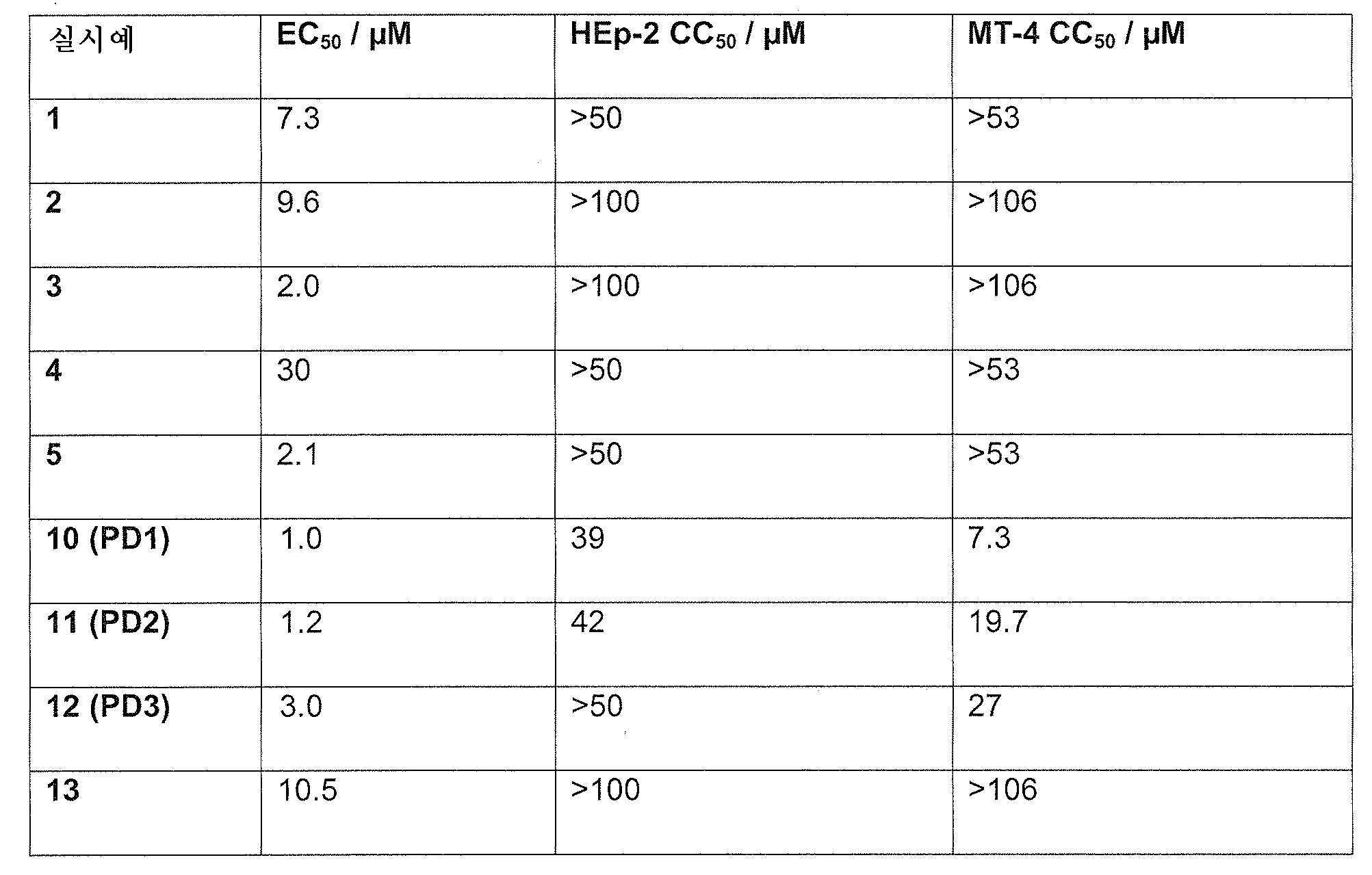

또 다른 잇점은 MT-4 세포독성에 관하여 R4 치환이 없는 화합물 (즉 R4=H인 것)에 비하여 R4 치환을 갖는 화합물이 제공하는 잇점에 관한 것이다. 예를 들면, 하기 구조를 갖는 화합물 (2S,3R,4S,5R)-2-(4-아미노피롤로[1,2-f][1,2,4]트리아진-7-일)-5-(히드록시메틸)테트라히드로푸란-3,4-디올 (Patil, S. A.; Otter, R. A.; Klein, R. S. Tetrahedron Lett . 1994, 35, 5339-5342)은 MT-4 CC50=0.007 μM을 나타내는 반면:Another advantage relates to the benefits provided by compounds with R 4 substitutions relative to compounds without R 4 substitutions (ie R 4 = H) with respect to MT-4 cytotoxicity. For example, a compound having the structure (2S, 3R, 4S, 5R) -2- (4-aminopyrrolo [1,2-f] [1,2,4] triazin-7-yl) -5 -(Hydroxymethyl) tetrahydrofuran-3,4-diol (Patil, SA; Otter, RA; Klein, RS Tetrahedron Lett . 1994, 35, 5339-5342) shows MT-4 CC 50 = 0.007 μM :
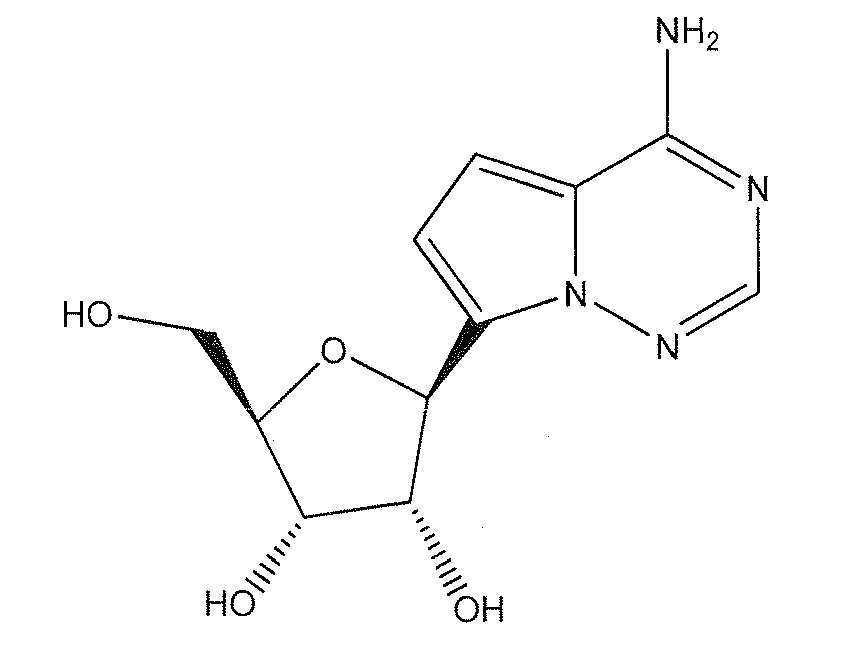
실시예 1, 4, 5, 20 및 26 모두는 MT-4 CC50>53 μM을 나타낸다. 게다가, 하기 구조를 갖는 화합물 (2R,3R,4R,5S)-5-(4-아미노피롤로[1,2-f][1,2,4]트리아진-7-일)-4-플루오로-2-(히드록시메틸)테트라히드로푸란-3-올 (WO2012037038A1)은 MT-4 CC50=30 μM을 나타내는 반면:All of Examples 1, 4, 5, 20 and 26 show MT-4 CC 50 > 53 μM. Moreover, compounds having the structure (2R, 3R, 4R, 5S) -5- (4-aminopyrrolo [1,2-f] [1,2,4] triazin-7-yl) -4-fluoro Low-2- (hydroxymethyl) tetrahydrofuran-3-ol (WO2012037038A1) showed MT-4 CC 50 = 30 μM:

실시예 2, 3, 13 및 14 모두는 MT-4 CC50>106 μM을 나타낸다.All of Examples 2, 3, 13 and 14 show MT-4 CC 50 > 106 μM.
또 다른 잇점은 HEp-2 항-RSV 활성에 관하여 R4 치환이 없는 화합물 (즉 R4=H인 것)에 비하여 R4 치환을 갖는 R3=F 화합물이 제공하는 잇점에 관한 것이다. 예를 들면, 상기 구조를 갖는 화합물 (2R,3R,4R,5S)-5-(4-아미노피롤로[1,2-f][1,2,4]트리아진-7-일)-4-플루오로-2-(히드록시메틸)테트라히드로푸란-3-올 (WO2012037038A1)은 HEp-2 EC50=>100 μM을 갖는 반면; 실시예 2, 3, 13, 14, 19, 21, 22, 23 및 24 모두는 EC50=<100 μM을 나타낸다.Another advantage relates to the benefits provided by R 3 = F compounds with R 4 substitutions relative to compounds without R 4 substitutions (ie R 4 = H) with respect to HEp-2 anti-RSV activity. For example, a compound having the above structure (2R, 3R, 4R, 5S) -5- (4-aminopyrrolo [1,2-f] [1,2,4] triazin-7-yl) -4 -Fluoro-2- (hydroxymethyl) tetrahydrofuran-3-ol (WO2012037038A1) has HEp-2 EC 50 => 100 μM; Examples 2, 3, 13, 14, 19, 21, 22, 23 and 24 all show EC 50 = <100 μM.
RSVRSV RNPRNP 제조 Produce
RSV 리보핵산단백질 (RNP) 복합체는 문헌 [Mason et al. (1)]로부터 변형된 방법으로부터 제조하였다. HEp-2 세포를 MEM+10% 태아 소 혈청 (FBS) 중의 7.1×10⁴ 세포/㎠의 밀도로 플레이팅시키고, 밤새 37℃에서 (5% CO2) 부착되도록 하였다. 부착 후, 세포를 35 ㎖ MEM+2% FBS 중의 RSV A2 (MOI=5)로 감염시켰다. 감염후 20 시간에, 배지를 2 ㎍/㎖ 악티노마이신 D가 보충된 MEM+2% FBS로 대체하고, 1 시간 동안 37℃가 되게 하였다. 그 후, 세포를 PBS로 1회 세정하고, 35 ㎖의 PBS+250 ㎍/㎖ 리소-레시틴으로 1 분 동안 처리한 후, 모든 액체를 흡입시켰다. 세포를 1.2 ㎖의 완충액 A [50 mM TRIS 아세테이트 (pH 8.0), 100 mM 아세트산칼륨, 1 mM DTT 및 2 ㎍/㎖ 악티노마이신 D]로 스크레이핑시켜 수거하고, 18 게이지 니들을 통하여 반복된 통과에 의하여 용해시켰다 (10회). 세포 용해물을 얼음에서 10 분 동안 둔 후, 2,400g에서 10 분 동안 4℃에서 원심분리하였다. 상청액 (S1)을 제거하고, 펠릿 (P1)을 18 게이지 니들을 통한 반복된 통과에 의하여 1% 트리톤(Triton) X-100이 보충된 600 ㎕의 완충액 B [10 mM TRIS 아세테이트 (pH 8.0), 10 mM 아세트산칼륨 및 1.5 mM MgCl2] 중에서 파괴시켰다 (10회). 재현탁된 펠릿을 얼음에 10 분 동안 둔 후, 2,400g에서 10 분 동안 4℃에서 원심분리하였다. 상청액 (S2)을 제거하고, 펠릿 (P2)을 0.5% 데옥시콜레이트 및 0.1% 트윈 40이 보충된 600 ㎕의 완충액 B 중에서 파괴시켰다. 재현탁된 펠릿을 얼음에서 10 분 동안 둔 후, 2,400g에서 10 분 동안 4℃에서 원심분리하였다. 농축된 RSV RNP 복합체를 함유하는 상청액 (S3) 분획을 수집하고, 단백질 농도를 280 ㎚에서의 UV 흡광도에 의하여 측정하였다. 분취된 RSV RNP S3 분획을 -80℃에서 저장하였다.RSV ribonucleoprotein (RNP) complex is described in Mason et al. (1)]. HEp-2 cells were plated at a density of 7.1 × 10 4 cells / cm 2 in MEM + 10% fetal bovine serum (FBS) and allowed to attach at 37 ° C. (5% CO 2 ) overnight. After attachment, cells were infected with RSV A2 (MOI = 5) in 35 ml MEM + 2% FBS. At 20 hours post infection, the medium was replaced with MEM + 2% FBS supplemented with 2 μg / ml actinomycin D and allowed to reach 37 ° C. for 1 hour. Thereafter, the cells were washed once with PBS, treated with 35 ml of PBS + 250 μg / ml lyso-lecithin for 1 minute, and then all liquids were aspirated. Cells were harvested by scraping with 1.2 ml of Buffer A [50 mM TRIS acetate (pH 8.0), 100 mM potassium acetate, 1 mM DTT and 2 μg / ml actinomycin D] and repeated through an 18 gauge needle. Dissolved by passage (10 times). The cell lysate was placed on ice for 10 min, then centrifuged at 2,400 g for 10 min at 4 ° C. Remove supernatant (S1) and pellet (P1) 600 μl of Buffer B [10 mM TRIS Acetate (pH 8.0), supplemented with 1% Triton X-100 by repeated passage through an 18 gauge needle. It was destroyed in 10 mM potassium acetate and 1.5 mM MgCl 2 ] (10 times). The resuspended pellet was placed on ice for 10 minutes, then centrifuged at 2,400 g for 10 minutes at 4 ° C. The supernatant (S2) was removed and the pellet (P2) was destroyed in 600 μl Buffer B supplemented with 0.5% deoxycholate and 0.1% Tween 40. The resuspended pellet was placed on ice for 10 minutes, then centrifuged at 4 ° C for 10 minutes at 2,400 g. The supernatant (S3) fraction containing the concentrated RSV RNP complex was collected and the protein concentration was measured by UV absorbance at 280 nm. Aliquoted RSV RNP S3 fraction was stored at -80 ° C.
RSVRSV RNPRNP 검정 black
전사 반응물은 30 ㎕의 반응 완충액 [50 mM TRIS-아세테이트 (pH 8.0), 120 mM 아세트산칼륨, 5% 글리세롤, 4.5 mM MgCl2, 3 mM DTT, 2 mM 에틸렌글리콜-비스(2-아미노에틸에테르)-테트라아세트산 (EGTA), 50 ㎍/㎖ BSA, 2.5 U RNasin (프로메가), ATP, GTP, UTP, CTP 및 1.5 μCi [α-32P] NTP (3,000 Ci/mmol)] 중의 25 ㎍의 미정제 RSV RNP 복합체를 함유하였다. 전사 검정에 사용된 방사선표지된 뉴클레오티드는 RSV RNP 전사의 억제에 대해 평가되는 뉴클레오티드 유사체와 매치되도록 선택하였다. 저온의 경쟁적 NTP를 그의 Km (ATP=20 μM, GTP=12.5 μM, UTP=6 μM 및 CTP=2 μM)의 절반의 최종 농도로 첨가하였다. 3개의 잔존하는 뉴클레오티드를 100 μM의 최종 농도로 첨가하였다.The transcription reaction was 30 μl of reaction buffer [50 mM TRIS-acetate (pH 8.0), 120 mM potassium acetate, 5% glycerol, 4.5 mM MgCl 2 , 3 mM DTT, 2 mM ethylene glycol-bis (2-aminoethyl ether). -25 μg undecided in tetraacetic acid (EGTA), 50 μg / ml BSA, 2.5 U RNasin (Promega), ATP, GTP, UTP, CTP and 1.5 μCi [α- 32 P] NTP (3,000 Ci / mmol)] The RSV RNP complex was contained. The radiolabeled nucleotides used in the transcription assay were selected to match the nucleotide analogs evaluated for inhibition of RSV RNP transcription. Cold competitive NTP was added to a final concentration of half of its K m (ATP = 20 μM, GTP = 12.5 μM, UTP = 6 μM and CTP = 2 μM). Three remaining nucleotides were added to a final concentration of 100 μM.
뉴클레오티드 유사체가 RSV RNP 전사를 억제하는지의 여부를 결정하기 위하여, 5-배 증분으로 6 단계 연속 희석을 사용하여 화합물을 첨가하였다. 30℃에서 90 분 인큐베이션 후, 350 ㎕의 키아겐(Qiagen) RLT 용해 완충액을 사용하여 RNP 반응을 중지시키고, 키아겐 RNeasy 96 키트를 사용하여 RNA를 정제하였다. 정제된 RNA를 RNA 샘플 로딩 완충액 (시그마) 중에서 65℃에서 10 분 동안 변성시키고, 2M 포름알데히드를 함유하는 1.2% 아가로스/MOPS 겔 위에서 전개시켰다. 아가로스 겔을 건조시키고, 스톰(Storm) 포스포르이미저 스크린(phosphorimager screen)에 노출시키고, 스톰 포스포르이미저 (GE 헬쓰케어(GE Healthcare))를 사용하여 현상하였다. 전체 방사선표지된 전사물을 50% 감소시키는 화합물의 농도 (IC50)는 2회 반복물의 비-선형 회귀 분석에 의하여 계산하였다.To determine whether the nucleotide analogues inhibit RSV RNP transcription, compounds were added using 6-step serial dilutions in 5-fold increments. After 90 min incubation at 30 ° C., the RNP reaction was stopped using 350 μl of Qiagen RLT lysis buffer and RNA was purified using the Qiagen RNeasy 96 kit. The purified RNA was denatured in RNA sample loading buffer (Sigma) at 65 ° C. for 10 minutes and developed on a 1.2% agarose / MOPS gel containing 2M formaldehyde. The agarose gel was dried, exposed to a Storm phosphorimager screen, and developed using a Storm phosphorimager (GE Healthcare). The concentration of compound (IC 50 ) that reduces the total radiolabeled transcript by 50% was calculated by non-linear regression analysis of 2 replicates.
문헌literature
Mason, S., Lawetz, C., Gaudette, Y., Do, F., Scouten, E., Lagace, L., Simoneau, B. and Liuzzi, M. (2004) Polyadenylation-dependent screening assay for respiratory syncytial virus RNA transcriptase activity and identification of an inhibitor. Nucleic Acids Research, 32, 4758-4767.Mason, S., Lawetz, C., Gaudette, Y., Do, F., Scouten, E., Lagace, L., Simoneau, B. and Liuzzi, M. (2004) Polyadenylation-dependent screening assay for respiratory syncytial virus RNA transcriptase activity and identification of an inhibitor. Nucleic Acids Research , 32, 4758-4767.

추가의 고려사항은 예시된 화합물이 2'CMe 치환을 갖는 화합물에 비하여 RSV RNP 전사의 유효한 억제를 나타낸다는 잇점에 관한 것이다. 예를 들면, 하기 구조를 갖는 ((2R,3R,4R,5S)-5-(4-아미노피롤로[2,1-f][1,2,4]트리아진-7-일)-3,4-디히드록시-4-메틸테트라히드로푸란-2-일)메틸 테트라히드로겐 트리포스페이트 (WO2008089105A2 및 WO2010002877A2)는 IC50=8.5 μM을 나타내는 반면:Additional considerations relate to the advantage that the exemplified compounds exhibit effective inhibition of RSV RNP transcription compared to compounds with 2'CMe substitutions. For example, ((2R, 3R, 4R, 5S) -5- (4-aminopyrrolo [2,1-f] [1,2,4] triazin-7-yl) -3 having the structure: , 4-Dihydroxy-4-methyltetrahydrofuran-2-yl) methyl tetrahydrogen triphosphate (WO2008089105A2 and WO2010002877A2) shows IC 50 = 8.5 μM:
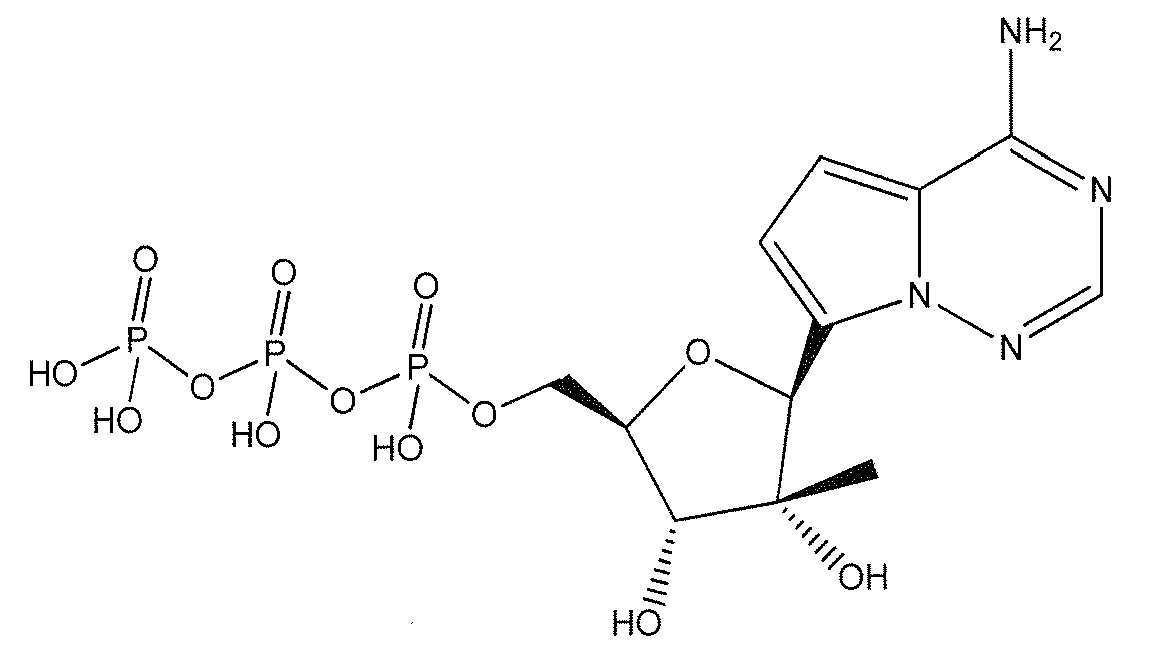
실시예 TP3은 IC50=0.025 μM을 나타낸다. 게다가, 하기 구조를 갖는 화합물 ((2R,3R,4R,5S)-5-(4-아미노피롤로[2,1-f][1,2,4]트리아진-7-일)-4-플루오로-3-히드록시-4-메틸테트라히드로푸란-2-일)메틸 테트라히드로겐 트리포스페이트 (WO 2011035231 A1)는 IC50=>100 μM을 나타내는 반면:Example TP3 shows IC 50 = 0.025 μM. Moreover, compounds having the structure ((2R, 3R, 4R, 5S) -5- (4-aminopyrrolo [2,1-f] [1,2,4] triazin-7-yl) -4- Fluoro-3-hydroxy-4-methyltetrahydrofuran-2-yl) methyl tetrahydrogen triphosphate (WO 2011035231 A1) shows IC 50 => 100 μM:
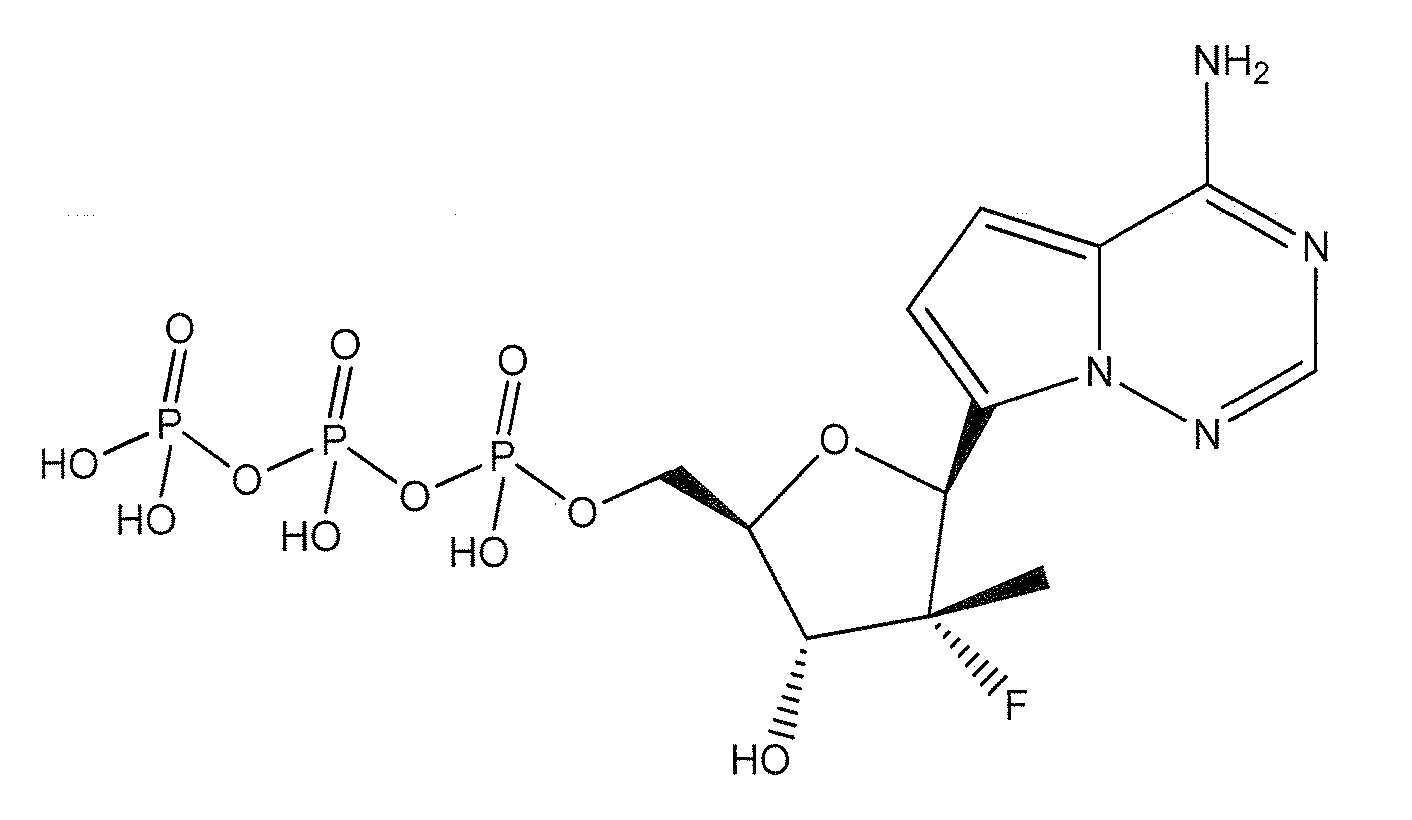
실시예 TP1는 IC50=0.086 μM을 나타내며, TP2는 IC50=1 μM을 나타낸다.Example TP1 represents IC 50 = 0.086 μM and TP2 represents IC 50 = 1 μM.
Claims (1)
<화학식 I>

<Formula I>
Priority Applications (1)
| Application Number | Priority Date | Filing Date | Title |
|---|---|---|---|
| KR1020217011476A KR102355881B1 (en) | 2013-11-11 | 2014-11-06 | Pyrrolo[1,2,f][1,2,4]triazines useful for treating respiratory syncitial virus infections |
Applications Claiming Priority (3)
| Application Number | Priority Date | Filing Date | Title |
|---|---|---|---|
| US201361902544P | 2013-11-11 | 2013-11-11 | |
| US61/902,544 | 2013-11-11 | ||
| PCT/US2014/064412 WO2015069939A1 (en) | 2013-11-11 | 2014-11-06 | Pyrrolo [1,2,f] [1,2,4] triazines useful for treating respiratory syncitial virus infections |
Related Parent Applications (1)
| Application Number | Title | Priority Date | Filing Date |
|---|---|---|---|
| KR1020187014999A Division KR102113705B1 (en) | 2013-11-11 | 2014-11-06 | Pyrrolo[1,2,f][1,2,4]triazines useful for treating respiratory syncitial virus infections |
Related Child Applications (1)
| Application Number | Title | Priority Date | Filing Date |
|---|---|---|---|
| KR1020217011476A Division KR102355881B1 (en) | 2013-11-11 | 2014-11-06 | Pyrrolo[1,2,f][1,2,4]triazines useful for treating respiratory syncitial virus infections |
Publications (2)
| Publication Number | Publication Date |
|---|---|
| KR20200057103A true KR20200057103A (en) | 2020-05-25 |
| KR102243724B1 KR102243724B1 (en) | 2021-04-23 |
Family
ID=52003049
Family Applications (4)
| Application Number | Title | Priority Date | Filing Date |
|---|---|---|---|
| KR1020217011476A Active KR102355881B1 (en) | 2013-11-11 | 2014-11-06 | Pyrrolo[1,2,f][1,2,4]triazines useful for treating respiratory syncitial virus infections |
| KR1020167015220A Active KR101864973B1 (en) | 2013-11-11 | 2014-11-06 | Pyrrolo[1,2,f][1,2,4]triazines useful for treating respiratory syncitial virus infections |
| KR1020207013948A Active KR102243724B1 (en) | 2013-11-11 | 2014-11-06 | Pyrrolo[1,2,f][1,2,4]triazines useful for treating respiratory syncitial virus infections |
| KR1020187014999A Active KR102113705B1 (en) | 2013-11-11 | 2014-11-06 | Pyrrolo[1,2,f][1,2,4]triazines useful for treating respiratory syncitial virus infections |
Family Applications Before (2)
| Application Number | Title | Priority Date | Filing Date |
|---|---|---|---|
| KR1020217011476A Active KR102355881B1 (en) | 2013-11-11 | 2014-11-06 | Pyrrolo[1,2,f][1,2,4]triazines useful for treating respiratory syncitial virus infections |
| KR1020167015220A Active KR101864973B1 (en) | 2013-11-11 | 2014-11-06 | Pyrrolo[1,2,f][1,2,4]triazines useful for treating respiratory syncitial virus infections |
Family Applications After (1)
| Application Number | Title | Priority Date | Filing Date |
|---|---|---|---|
| KR1020187014999A Active KR102113705B1 (en) | 2013-11-11 | 2014-11-06 | Pyrrolo[1,2,f][1,2,4]triazines useful for treating respiratory syncitial virus infections |
Country Status (36)
| Country | Link |
|---|---|
| US (5) | US9388208B2 (en) |
| EP (3) | EP4122932A1 (en) |
| JP (7) | JP6234571B2 (en) |
| KR (4) | KR102355881B1 (en) |
| CN (3) | CN114085243B (en) |
| AP (1) | AP2016009186A0 (en) |
| AU (5) | AU2014346665A1 (en) |
| BR (1) | BR112016010261B1 (en) |
| CA (1) | CA2928674C (en) |
| CL (1) | CL2016001120A1 (en) |
| CR (1) | CR20160220A (en) |
| CU (1) | CU20160065A7 (en) |
| CY (1) | CY1121948T1 (en) |
| DK (2) | DK3068405T3 (en) |
| DO (1) | DOP2016000107A (en) |
| EA (2) | EA039734B1 (en) |
| ES (2) | ES2743619T3 (en) |
| GT (1) | GT201600086A (en) |
| HR (2) | HRP20220920T1 (en) |
| HU (2) | HUE044960T2 (en) |
| IL (1) | IL245324B (en) |
| LT (2) | LT3068405T (en) |
| MD (1) | MD4596C1 (en) |
| MX (2) | MX376186B (en) |
| MY (2) | MY182986A (en) |
| NZ (1) | NZ719592A (en) |
| PE (1) | PE20160670A1 (en) |
| PH (1) | PH12016500867A1 (en) |
| PL (2) | PL3068405T3 (en) |
| PT (2) | PT3505173T (en) |
| SG (1) | SG11201603427XA (en) |
| SI (2) | SI3505173T1 (en) |
| TR (1) | TR201910961T4 (en) |
| UA (1) | UA119050C2 (en) |
| WO (1) | WO2015069939A1 (en) |
| ZA (1) | ZA201603123B (en) |
Families Citing this family (54)
| Publication number | Priority date | Publication date | Assignee | Title |
|---|---|---|---|---|
| CN102596979B (en) | 2009-09-21 | 2014-12-10 | 吉里德科学公司 | Processes and intermediates for the preparation of 1'-substituted carba-nucleoside analogs |
| BR112013001553B1 (en) | 2010-07-22 | 2021-01-12 | Gilead Sciences, Inc. | antiviral compounds for the treatment of paramyxoviridae infections and pharmaceutical compositions comprising them |
| UA119050C2 (en) * | 2013-11-11 | 2019-04-25 | Ґілеад Саєнсиз, Інк. | PYROL [1.2-f] [1.2.4] TRIASINES USED FOR TREATMENT OF RESPIRATORY-SYNCITAL VIRAL INFECTIONS |
| WO2015143712A1 (en) | 2014-03-28 | 2015-10-01 | Merck Sharp & Dohme Corp. | 4'-substituted nucleoside reverse transcriptase inhibitors |
| TWI678369B (en) | 2014-07-28 | 2019-12-01 | 美商基利科學股份有限公司 | Thieno[3,2-d]pyrimidine, furo[3,2-d]pyrimidine, and pyrrolo[3,2-d]pyrimidines useful for treating respiratory syncitial virus infections |
| JP6671355B2 (en) | 2014-09-26 | 2020-03-25 | リボサイエンス・エルエルシー | 4'-Vinyl-substituted nucleoside derivatives as inhibitors of respiratory syncytial virus RNA replication |
| TWI698444B (en) | 2014-10-29 | 2020-07-11 | 美商基利科學股份有限公司 | Methods for the preparation of ribosides |
| US20190022116A1 (en) | 2014-12-26 | 2019-01-24 | Emory University | N4-Hydroxycytidine and Derivatives and Anti-Viral Uses Related Thereto |
| ES2918585T3 (en) | 2015-09-16 | 2022-07-19 | Gilead Sciences Inc | Methods for treating Arenaviridae virus infections |
| US10953029B2 (en) | 2015-09-23 | 2021-03-23 | Merck Sharp & Dohme Corp. | 4′-Substituted nucleoside reverse transcriptase inhibitors and preparations thereof |
| JP6860585B2 (en) | 2016-03-09 | 2021-04-14 | ヤンセン バイオファーマ インク. | Incorporation by reference of acyclic antiviral priority application |
| CN110869028B (en) | 2017-03-14 | 2023-01-20 | 吉利德科学公司 | Method of treating feline coronavirus infection |
| AU2018262501B2 (en) | 2017-05-01 | 2020-12-10 | Gilead Sciences, Inc. | Crystalline forms of (S) 2 ethylbutyl 2 (((S) (((2R,3S,4R,5R) 5 (4 aminopyrrolo[2,1-f] [1,2,4]triazin-7-yl)-5-cyano-3,4-dihydroxytetrahydrofuran-2 yl)methoxy)(phenoxy) phosphoryl)amino)propanoate |
| CA3077489A1 (en) | 2017-07-11 | 2019-01-17 | Gilead Sciences, Inc. | Compositions comprising an rna polymerase inhibitor and cyclodextrin for treating viral infections |
| JP2020534361A (en) | 2017-09-18 | 2020-11-26 | ヤンセン・バイオファーマ・インコーポレイテッド | Substituted nucleosides, nucleotides, and analogs thereof |
| CN109748921B (en) * | 2017-11-03 | 2022-03-22 | 中国科学院上海药物研究所 | N-tert-butoxycarbonyl-protected heterocyclic compounds, methods for their preparation and methods for preparing C-nucleoside analogs |
| DK3706762T3 (en) | 2017-12-07 | 2024-12-16 | Univ Emory | N4-hydroxycytidine and derivatives and antiviral uses related thereto |
| US11040975B2 (en) | 2017-12-08 | 2021-06-22 | Merck Sharp & Dohme Corp. | Carbocyclic nucleoside reverse transcriptase inhibitors |
| CN108787177B (en) * | 2018-08-07 | 2024-03-15 | 中南大学 | Method and system for preparing xanthate by slurry method |
| WO2020232194A1 (en) * | 2019-05-14 | 2020-11-19 | The Regents Of The University Of Michigan | Methods for glycosylation |
| JP2023512656A (en) | 2020-01-27 | 2023-03-28 | ギリアード サイエンシーズ, インコーポレイテッド | Methods for treating SARS CoV-2 infection |
| TWI883391B (en) * | 2020-02-18 | 2025-05-11 | 美商基利科學股份有限公司 | Antiviral compounds |
| CN118598916A (en) * | 2020-02-18 | 2024-09-06 | 吉利德科学公司 | Antiviral compounds |
| TWI775313B (en) * | 2020-02-18 | 2022-08-21 | 美商基利科學股份有限公司 | Antiviral compounds |
| TWI884403B (en) * | 2020-02-18 | 2025-05-21 | 美商基利科學股份有限公司 | Antiviral compounds |
| CN111187269A (en) * | 2020-02-27 | 2020-05-22 | 江苏阿尔法药业有限公司 | Synthetic method of Reidesciclovir intermediate |
| CN113336758B (en) * | 2020-03-03 | 2022-08-19 | 北京桦冠医药科技有限公司 | Novel synthesis method of compound 7-iodopyrrolo [2, 1-f ] [1, 2, 4] triazin-4-amine |
| CN111233870A (en) * | 2020-03-11 | 2020-06-05 | 中国科学技术大学 | Method for rapidly preparing remdesivir pharmaceutical intermediates |
| AU2021234308C1 (en) | 2020-03-12 | 2024-02-22 | Gilead Sciences, Inc. | Methods of preparing 1'-cyano nucleosides |
| JP7482250B2 (en) | 2020-04-06 | 2024-05-13 | ギリアード サイエンシーズ, インコーポレイテッド | Inhalation formulations of 1'-cyano substituted carbanucleoside analogs |
| CN112778310B (en) | 2020-04-20 | 2025-05-30 | 中国科学院上海药物研究所 | Application of nucleoside analogs or combination preparations containing nucleoside analogs in antiviral treatment |
| CN113527303B (en) * | 2020-04-21 | 2022-06-10 | 浙江工业大学 | Preparation process of Rudexivirin nucleus intermediate |
| CN111440176B (en) * | 2020-04-28 | 2022-04-26 | 江苏大学 | Metal complex promoted synthesis method of Reidesciclovir intermediate |
| PL4157272T3 (en) | 2020-05-29 | 2025-10-20 | Gilead Sciences, Inc. | Remdesivir for the treatment of viral infections |
| CN111620903A (en) * | 2020-06-17 | 2020-09-04 | 安徽贝克联合制药有限公司 | C-nucleoside analogue, preparation method and application of nitrile-containing C-nucleoside compound for synthesizing Rudexilvir |
| TWI819321B (en) | 2020-06-24 | 2023-10-21 | 美商基利科學股份有限公司 | 1'-cyano nucleoside analogs and uses thereof |
| CN111732618A (en) * | 2020-07-03 | 2020-10-02 | 镇江巨杰新材料技术研发中心(有限合伙) | Synthesis method of key fragments of Remdesivir |
| CN111793101B (en) * | 2020-07-17 | 2022-09-30 | 四川大学 | Process for the synthesis of C-nucleoside compounds |
| RS67481B1 (en) | 2020-08-06 | 2025-12-31 | Richter Gedeon Nyrt | Remdesivir intermediates |
| WO2022046631A1 (en) | 2020-08-24 | 2022-03-03 | Gilead Sciences, Inc. | Phospholipid compounds and uses thereof |
| WO2022047065A2 (en) | 2020-08-27 | 2022-03-03 | Gilead Sciences, Inc. | Compounds and methods for treatment of viral infections |
| TW202344257A (en) * | 2020-10-16 | 2023-11-16 | 美商基利科學股份有限公司 | Phospholipid compounds and uses thereof |
| CN113880846B (en) * | 2020-12-31 | 2022-10-14 | 山东诚汇双达药业有限公司 | Preparation method of 7-iodopyrrolo [2,1-F ] [1,2,4] triazin-4-amine |
| CN117120444A (en) * | 2021-04-16 | 2023-11-24 | 吉利德科学公司 | Method for preparing carboside using amides |
| JP7719954B2 (en) * | 2021-08-18 | 2025-08-06 | ギリアード サイエンシーズ, インコーポレイテッド | Phospholipid compounds and methods for producing and using same |
| AU2022331233A1 (en) | 2021-08-20 | 2024-02-29 | Shionogi & Co., Ltd. | Nucleoside derivatives and prodrugs thereof having viral growth inhibitory action |
| TWI867455B (en) | 2022-03-02 | 2024-12-21 | 美商基利科學股份有限公司 | Compounds and methods for treatment of viral infections |
| EP4486455A1 (en) | 2022-03-03 | 2025-01-08 | Gilead Sciences, Inc. | Antiviral compounds and methods of making and using the same |
| IL315082A (en) * | 2022-03-03 | 2024-10-01 | Gilead Sciences Inc | Antiviral compounds and methods of making and using the same |
| US12357577B1 (en) | 2024-02-02 | 2025-07-15 | Gilead Sciences, Inc. | Pharmaceutical formulations and uses thereof |
| WO2024173458A1 (en) | 2023-02-16 | 2024-08-22 | Gilead Sciences, Inc. | Phospholipid compounds and methods of making and using the same |
| US20250090537A1 (en) | 2023-08-31 | 2025-03-20 | Gilead Sciences, Inc. | Antiviral compounds and methods of making and using the same |
| US20250084088A1 (en) | 2023-08-31 | 2025-03-13 | Gilead Sciences, Inc. | Antiviral compounds and methods of making and using the same |
| US20250109157A1 (en) | 2023-09-28 | 2025-04-03 | Gilead Sciences, Inc. | Compounds and methods for treatment of viral infections |
Citations (2)
| Publication number | Priority date | Publication date | Assignee | Title |
|---|---|---|---|---|
| WO2012037038A1 (en) * | 2010-09-13 | 2012-03-22 | Gilead Sciences, Inc. | 2' -fluoro substituted carba-nucleoside analogs for antiviral treatment |
| KR20130091743A (en) * | 2010-07-22 | 2013-08-19 | 길리애드 사이언시즈, 인코포레이티드 | Methods and compounds for treating paramyxoviridae virus infections |
Family Cites Families (42)
| Publication number | Priority date | Publication date | Assignee | Title |
|---|---|---|---|---|
| US3361306A (en) | 1966-03-31 | 1968-01-02 | Merck & Co Inc | Aerosol unit dispensing uniform amounts of a medically active ingredient |
| US3565070A (en) | 1969-02-28 | 1971-02-23 | Riker Laboratories Inc | Inhalation actuable aerosol dispenser |
| FR2224175B1 (en) | 1973-04-04 | 1978-04-14 | Isf Spa | |
| US4069819A (en) | 1973-04-13 | 1978-01-24 | Societa Farmaceutici S.P.A. | Inhalation device |
| IT1017153B (en) | 1974-07-15 | 1977-07-20 | Isf Spa | APPARATUS FOR INHALATIONS |
| SE438261B (en) | 1981-07-08 | 1985-04-15 | Draco Ab | USE IN A DOSHALATOR OF A PERFORED MEMBRANE |
| US4805811A (en) | 1985-03-29 | 1989-02-21 | Aktiebolaget Draco | Dosage device |
| SE448277B (en) | 1985-04-12 | 1987-02-09 | Draco Ab | INDICATOR DEVICE WITH A DOSAGE DEVICE FOR MEDICINAL PRODUCTS |
| IT1228459B (en) | 1989-02-23 | 1991-06-19 | Phidea S R L | INHALER WITH REGULAR AND COMPLETE EMPTYING OF THE CAPSULE. |
| US4955371A (en) | 1989-05-08 | 1990-09-11 | Transtech Scientific, Inc. | Disposable inhalation activated, aerosol device for pulmonary medicine |
| ES2141108T3 (en) | 1991-07-02 | 2000-03-16 | Inhale Inc | METHOD AND DEVICE FOR PROVIDING DRUGS IN AEROSOL. |
| US5261538A (en) | 1992-04-21 | 1993-11-16 | Glaxo Inc. | Aerosol testing method |
| US5785049A (en) | 1994-09-21 | 1998-07-28 | Inhale Therapeutic Systems | Method and apparatus for dispersion of dry powder medicaments |
| US5388572A (en) | 1993-10-26 | 1995-02-14 | Tenax Corporation (A Connecticut Corp.) | Dry powder medicament inhalator having an inhalation-activated piston to aerosolize dose and deliver same |
| US5522385A (en) | 1994-09-27 | 1996-06-04 | Aradigm Corporation | Dynamic particle size control for aerosolized drug delivery |
| US5544647A (en) | 1994-11-29 | 1996-08-13 | Iep Group, Inc. | Metered dose inhalator |
| US5622163A (en) | 1994-11-29 | 1997-04-22 | Iep Group, Inc. | Counter for fluid dispensers |
| US6116234A (en) | 1999-02-01 | 2000-09-12 | Iep Pharmaceutical Devices Inc. | Metered dose inhaler agitator |
| EP2251015B1 (en) * | 2000-10-18 | 2013-02-20 | Gilead Pharmasset LLC | Modified nucleosides for the treatment of viral infections and abnormal cellular proliferation |
| GB0114286D0 (en) | 2001-06-12 | 2001-08-01 | Hoffmann La Roche | Nucleoside Derivatives |
| JP2005504087A (en) | 2001-09-28 | 2005-02-10 | イデニクス(ケイマン)リミテツド | Methods and compositions for the treatment of hepatitis C virus using 4 'modified nucleosides |
| WO2005020885A2 (en) | 2003-05-21 | 2005-03-10 | Isis Pharmaceuticals, Inc. | Compositions and methods for the treatment of severe acute respiratory syndrome (sars) |
| AR046959A1 (en) * | 2003-12-18 | 2006-01-04 | Tibotec Pharm Ltd | MORFOLINILO CONTAINING BENCIMIDAZOLS AS INHIBITORS OF THE REPLICATION OF RESPIRATORY SYNTHETIC VIRUSES |
| PT2114980E (en) * | 2007-01-12 | 2012-09-25 | Biocryst Pharm Inc | Antiviral nucleoside analogs |
| ES2393038T3 (en) * | 2007-05-10 | 2012-12-18 | Biocryst Pharmaceuticals, Inc. | Tretrahydrofuro [3,4-D] dioxolane compounds for use in the treatment of viral infections and cancer |
| ATE515861T1 (en) | 2007-07-25 | 2011-07-15 | Nokia Siemens Networks Oy | METHOD FOR ADDRESSING ETHERNET STREAMS WITH STRUCTURED GPON GEM PORT ID |
| WO2009132135A1 (en) * | 2008-04-23 | 2009-10-29 | Gilead Sciences, Inc. | 1' -substituted carba-nucleoside analogs for antiviral treatment |
| EP2313102A2 (en) * | 2008-07-03 | 2011-04-27 | Biota Scientific Management | Bycyclic nucleosides and nucleotides as therapeutic agents |
| US8455451B2 (en) | 2009-09-21 | 2013-06-04 | Gilead Sciences, Inc. | 2'-fluoro substituted carba-nucleoside analogs for antiviral treatment |
| EA201200525A1 (en) | 2009-09-21 | 2012-09-28 | Гайлид Сайэнсиз, Инк. | 2'-FLUORINARY CARB-NUCLEOSIDE ANALOGUES FOR ANTI-VIRUS TREATMENT |
| CN102596979B (en) | 2009-09-21 | 2014-12-10 | 吉里德科学公司 | Processes and intermediates for the preparation of 1'-substituted carba-nucleoside analogs |
| TW201201815A (en) | 2010-05-28 | 2012-01-16 | Gilead Sciences Inc | 1'-substituted-carba-nucleoside prodrugs for antiviral treatment |
| WO2012012465A1 (en) * | 2010-07-19 | 2012-01-26 | Clarke, Michael, O'neil Hanrahan | Methods for the preparation of diasteromerically pure phosphoramidate prodrugs |
| JP2013538230A (en) * | 2010-09-20 | 2013-10-10 | ギリアード サイエンシーズ, インコーポレイテッド | 2'-Fluoro substituted carbanucleoside analogues for antiviral therapy |
| TW201306841A (en) | 2010-12-20 | 2013-02-16 | Gilead Sciences Inc | Methods for treating HCV |
| EP2697242B1 (en) | 2011-04-13 | 2018-10-03 | Merck Sharp & Dohme Corp. | 2'-azido substituted nucleoside derivatives and methods of use thereof for the treatment of viral diseases |
| US20130143835A1 (en) * | 2011-12-05 | 2013-06-06 | Medivir Ab | HCV Polymerase Inhibitors |
| GEP20166496B (en) * | 2011-12-22 | 2016-06-27 | Alios Biopharma Inc | Substituted nucleosides, nucleotides and analogs thereof |
| PL2834258T3 (en) * | 2012-03-13 | 2017-07-31 | Gilead Sciences, Inc. | 2'- substituted carba-nucleoside analogs for antiviral treatment |
| EA030189B8 (en) | 2012-10-08 | 2018-10-31 | Иденикс Фармасьютикалз Ллс | 2'-chloro nucleoside analogs for hcv infection |
| TWI582077B (en) | 2013-11-07 | 2017-05-11 | 必治妥美雅史谷比公司 | Alkyl-amide-substituted pyridyl compounds useful as modulators of il-12, il-23 and/or ifnα responses |
| UA119050C2 (en) * | 2013-11-11 | 2019-04-25 | Ґілеад Саєнсиз, Інк. | PYROL [1.2-f] [1.2.4] TRIASINES USED FOR TREATMENT OF RESPIRATORY-SYNCITAL VIRAL INFECTIONS |
-
2014
- 2014-06-11 UA UAA201606308A patent/UA119050C2/en unknown
- 2014-11-06 MX MX2016006066A patent/MX376186B/en active IP Right Grant
- 2014-11-06 MD MDA20160063A patent/MD4596C1/en not_active IP Right Cessation
- 2014-11-06 LT LTEP14806123.7T patent/LT3068405T/en unknown
- 2014-11-06 PT PT182092676T patent/PT3505173T/en unknown
- 2014-11-06 AU AU2014346665A patent/AU2014346665A1/en not_active Abandoned
- 2014-11-06 LT LTEP18209267.6T patent/LT3505173T/en unknown
- 2014-11-06 PE PE2016000605A patent/PE20160670A1/en unknown
- 2014-11-06 SI SI201431978T patent/SI3505173T1/en unknown
- 2014-11-06 KR KR1020217011476A patent/KR102355881B1/en active Active
- 2014-11-06 EA EA201792639A patent/EA039734B1/en unknown
- 2014-11-06 PT PT14806123T patent/PT3068405T/en unknown
- 2014-11-06 HR HRP20220920TT patent/HRP20220920T1/en unknown
- 2014-11-06 ES ES14806123T patent/ES2743619T3/en active Active
- 2014-11-06 CN CN202111444706.3A patent/CN114085243B/en active Active
- 2014-11-06 CN CN201910045494.8A patent/CN110003215B/en active Active
- 2014-11-06 KR KR1020167015220A patent/KR101864973B1/en active Active
- 2014-11-06 CA CA2928674A patent/CA2928674C/en active Active
- 2014-11-06 CN CN201480072871.2A patent/CN105899216B/en active Active
- 2014-11-06 ES ES18209267T patent/ES2926155T3/en active Active
- 2014-11-06 MY MYPI2016701599A patent/MY182986A/en unknown
- 2014-11-06 TR TR2019/10961T patent/TR201910961T4/en unknown
- 2014-11-06 EP EP22182880.9A patent/EP4122932A1/en active Pending
- 2014-11-06 EP EP14806123.7A patent/EP3068405B1/en active Active
- 2014-11-06 US US14/534,715 patent/US9388208B2/en active Active
- 2014-11-06 NZ NZ719592A patent/NZ719592A/en unknown
- 2014-11-06 EP EP18209267.6A patent/EP3505173B1/en active Active
- 2014-11-06 EA EA201690978A patent/EA029712B1/en unknown
- 2014-11-06 PL PL14806123T patent/PL3068405T3/en unknown
- 2014-11-06 PL PL18209267.6T patent/PL3505173T3/en unknown
- 2014-11-06 KR KR1020207013948A patent/KR102243724B1/en active Active
- 2014-11-06 HR HRP20191303TT patent/HRP20191303T1/en unknown
- 2014-11-06 MY MYPI2021000404A patent/MY197933A/en unknown
- 2014-11-06 JP JP2016528882A patent/JP6234571B2/en active Active
- 2014-11-06 DK DK14806123.7T patent/DK3068405T3/en active
- 2014-11-06 SG SG11201603427XA patent/SG11201603427XA/en unknown
- 2014-11-06 KR KR1020187014999A patent/KR102113705B1/en active Active
- 2014-11-06 AP AP2016009186A patent/AP2016009186A0/en unknown
- 2014-11-06 BR BR112016010261-4A patent/BR112016010261B1/en active IP Right Grant
- 2014-11-06 SI SI201431284T patent/SI3068405T1/en unknown
- 2014-11-06 HU HUE14806123A patent/HUE044960T2/en unknown
- 2014-11-06 WO PCT/US2014/064412 patent/WO2015069939A1/en not_active Ceased
- 2014-11-06 HU HUE18209267A patent/HUE059683T2/en unknown
- 2014-11-06 DK DK18209267.6T patent/DK3505173T3/en active
-
2016
- 2016-04-27 IL IL245324A patent/IL245324B/en active IP Right Grant
- 2016-05-09 DO DO2016000107A patent/DOP2016000107A/en unknown
- 2016-05-09 MX MX2020010628A patent/MX2020010628A/en unknown
- 2016-05-10 PH PH12016500867A patent/PH12016500867A1/en unknown
- 2016-05-10 ZA ZA2016/03123A patent/ZA201603123B/en unknown
- 2016-05-11 GT GT201600086A patent/GT201600086A/en unknown
- 2016-05-11 CU CUP2016000065A patent/CU20160065A7/en unknown
- 2016-05-11 CL CL2016001120A patent/CL2016001120A1/en unknown
- 2016-05-11 CR CR20160220A patent/CR20160220A/en unknown
- 2016-06-14 US US15/182,529 patent/US9701682B2/en active Active
-
2017
- 2017-05-31 US US15/610,104 patent/US10059716B2/en active Active
- 2017-08-23 JP JP2017160336A patent/JP6393380B2/en active Active
- 2017-09-18 AU AU2017232039A patent/AU2017232039C1/en active Active
-
2018
- 2018-01-05 JP JP2018000710A patent/JP2018070658A/en not_active Withdrawn
- 2018-07-25 US US16/045,371 patent/US10377761B2/en active Active
-
2019
- 2019-06-21 AU AU2019204381A patent/AU2019204381B2/en active Active
- 2019-07-30 CY CY20191100814T patent/CY1121948T1/en unknown
- 2019-12-09 JP JP2019222179A patent/JP7054394B2/en active Active
-
2020
- 2020-11-20 JP JP2020193294A patent/JP7247155B2/en active Active
-
2021
- 2021-03-11 AU AU2021201554A patent/AU2021201554B2/en active Active
-
2022
- 2022-04-07 JP JP2022063956A patent/JP2022088661A/en not_active Withdrawn
-
2023
- 2023-04-26 AU AU2023202506A patent/AU2023202506B2/en active Active
-
2024
- 2024-01-19 JP JP2024006714A patent/JP2024041986A/en not_active Withdrawn
- 2024-08-30 US US18/821,476 patent/US20250236623A1/en active Pending
Patent Citations (2)
| Publication number | Priority date | Publication date | Assignee | Title |
|---|---|---|---|---|
| KR20130091743A (en) * | 2010-07-22 | 2013-08-19 | 길리애드 사이언시즈, 인코포레이티드 | Methods and compounds for treating paramyxoviridae virus infections |
| WO2012037038A1 (en) * | 2010-09-13 | 2012-03-22 | Gilead Sciences, Inc. | 2' -fluoro substituted carba-nucleoside analogs for antiviral treatment |
Also Published As
Similar Documents
| Publication | Publication Date | Title |
|---|---|---|
| JP7247155B2 (en) | Pyrrolo[1,2-f][1,2,4]triazines Useful for Treating Respiratory Syncytial Virus Infections | |
| HK40085014A (en) | Pyrrolo[1,2-f][1,2,4]triazines useful for treating respiratory syncitial virus infections | |
| HK40010164B (en) | Pyrrolo[1,2-f][1,2,4]triazines useful for treating respiratory syncitial virus infections | |
| HK40010164A (en) | Pyrrolo[1,2-f][1,2,4]triazines useful for treating respiratory syncitial virus infections | |
| HK1227722B (en) | Pyrrolo [1,2,f][1,2,4]triazines useful for treating respiratory syncitial virus infections | |
| HK1227722A1 (en) | Pyrrolo [1,2,f][1,2,4]triazines useful for treating respiratory syncitial virus infections | |
| OA19704A (en) | Pyrrolo[1,2-f][1,2,4]Triazines useful for treating respiratory syncitial virus infections |
Legal Events
| Date | Code | Title | Description |
|---|---|---|---|
| A107 | Divisional application of patent | ||
| PA0104 | Divisional application for international application |
Comment text: Divisional Application for International Patent Patent event code: PA01041R01D Patent event date: 20200515 Application number text: 1020187014999 Filing date: 20180528 |
|
| PG1501 | Laying open of application | ||
| PA0201 | Request for examination |
Patent event code: PA02012R01D Patent event date: 20200612 Comment text: Request for Examination of Application |
|
| E902 | Notification of reason for refusal | ||
| PE0902 | Notice of grounds for rejection |
Comment text: Notification of reason for refusal Patent event date: 20200710 Patent event code: PE09021S01D |
|
| E701 | Decision to grant or registration of patent right | ||
| PE0701 | Decision of registration |
Patent event code: PE07011S01D Comment text: Decision to Grant Registration Patent event date: 20210119 |
|
| A107 | Divisional application of patent | ||
| GRNT | Written decision to grant | ||
| PA0104 | Divisional application for international application |
Comment text: Divisional Application for International Patent Patent event code: PA01041R01D Patent event date: 20210419 Application number text: 1020187014999 Filing date: 20180528 |
|
| PR0701 | Registration of establishment |
Comment text: Registration of Establishment Patent event date: 20210419 Patent event code: PR07011E01D |
|
| PR1002 | Payment of registration fee |
Payment date: 20210420 End annual number: 3 Start annual number: 1 |
|
| PG1601 | Publication of registration | ||
| PR1001 | Payment of annual fee |
Payment date: 20240319 Start annual number: 4 End annual number: 4 |
|
| PR1001 | Payment of annual fee |
Payment date: 20250317 Start annual number: 5 End annual number: 5 |