BR112016010261B1 - PYRROLLE [1,2-F] [1,2,4] TRIAZINE COMPOUNDS, PHARMACEUTICAL FORMULATION AND THEIR USE IN THE TREATMENT OF RESPIRATORY SYNCYTIAL VIRUS INFECTIONS - Google Patents
PYRROLLE [1,2-F] [1,2,4] TRIAZINE COMPOUNDS, PHARMACEUTICAL FORMULATION AND THEIR USE IN THE TREATMENT OF RESPIRATORY SYNCYTIAL VIRUS INFECTIONS Download PDFInfo
- Publication number
- BR112016010261B1 BR112016010261B1 BR112016010261-4A BR112016010261A BR112016010261B1 BR 112016010261 B1 BR112016010261 B1 BR 112016010261B1 BR 112016010261 A BR112016010261 A BR 112016010261A BR 112016010261 B1 BR112016010261 B1 BR 112016010261B1
- Authority
- BR
- Brazil
- Prior art keywords
- acn
- mmol
- added
- pharmaceutically acceptable
- alkyl
- Prior art date
Links
- 238000011282 treatment Methods 0.000 title claims abstract description 22
- 239000008194 pharmaceutical composition Substances 0.000 title claims description 21
- 206010061603 Respiratory syncytial virus infection Diseases 0.000 title abstract description 13
- FYADHXFMURLYQI-UHFFFAOYSA-N 1,2,4-triazine Chemical class C1=CN=NC=N1 FYADHXFMURLYQI-UHFFFAOYSA-N 0.000 title 1
- 150000001875 compounds Chemical class 0.000 claims abstract description 217
- 239000000203 mixture Substances 0.000 claims abstract description 199
- 238000009472 formulation Methods 0.000 claims abstract description 44
- 241000711904 Pneumoviridae Species 0.000 claims abstract description 26
- 230000009385 viral infection Effects 0.000 claims abstract description 24
- -1 -O-C1-C8 alkyl Chemical group 0.000 claims description 213
- 150000003839 salts Chemical class 0.000 claims description 84
- 239000003814 drug Substances 0.000 claims description 45
- 125000002496 methyl group Chemical group [H]C([H])([H])* 0.000 claims description 39
- 241000282414 Homo sapiens Species 0.000 claims description 35
- 239000000546 pharmaceutical excipient Substances 0.000 claims description 26
- 125000001495 ethyl group Chemical group [H]C([H])([H])C([H])([H])* 0.000 claims description 19
- 125000001797 benzyl group Chemical group [H]C1=C([H])C([H])=C(C([H])=C1[H])C([H])([H])* 0.000 claims description 18
- 125000004209 (C1-C8) alkyl group Chemical group 0.000 claims description 15
- 125000006239 protecting group Chemical group 0.000 claims description 15
- 208000030925 respiratory syncytial virus infectious disease Diseases 0.000 claims description 15
- 125000000999 tert-butyl group Chemical group [H]C([H])([H])C(*)(C([H])([H])[H])C([H])([H])[H] 0.000 claims description 15
- 125000004169 (C1-C6) alkyl group Chemical group 0.000 claims description 10
- 229910052731 fluorine Inorganic materials 0.000 claims description 10
- 125000000391 vinyl group Chemical group [H]C([*])=C([H])[H] 0.000 claims description 10
- 125000004178 (C1-C4) alkyl group Chemical group 0.000 claims description 9
- HSFWRNGVRCDJHI-UHFFFAOYSA-N alpha-acetylene Natural products C#C HSFWRNGVRCDJHI-UHFFFAOYSA-N 0.000 claims description 8
- 239000003937 drug carrier Substances 0.000 claims description 8
- 125000002534 ethynyl group Chemical group [H]C#C* 0.000 claims description 8
- 229910052736 halogen Inorganic materials 0.000 claims description 8
- 238000002360 preparation method Methods 0.000 claims description 8
- 125000002023 trifluoromethyl group Chemical group FC(F)(F)* 0.000 claims description 8
- 229920002554 vinyl polymer Chemical group 0.000 claims description 8
- 125000005913 (C3-C6) cycloalkyl group Chemical group 0.000 claims description 7
- 125000000852 azido group Chemical group *N=[N+]=[N-] 0.000 claims description 7
- 125000001188 haloalkyl group Chemical group 0.000 claims description 7
- 150000002367 halogens Chemical class 0.000 claims description 6
- 125000001997 phenyl group Chemical group [H]C1=C([H])C([H])=C(*)C([H])=C1[H] 0.000 claims description 6
- 125000006656 (C2-C4) alkenyl group Chemical group 0.000 claims description 5
- 125000006645 (C3-C4) cycloalkyl group Chemical group 0.000 claims description 5
- 150000001408 amides Chemical group 0.000 claims description 5
- 229910052801 chlorine Inorganic materials 0.000 claims description 5
- 125000004970 halomethyl group Chemical group 0.000 claims description 5
- 229910052739 hydrogen Inorganic materials 0.000 claims description 5
- 125000003903 2-propenyl group Chemical group [H]C([*])([H])C([H])=C([H])[H] 0.000 claims description 4
- 125000002774 3,4-dimethoxybenzyl group Chemical group [H]C1=C([H])C(=C([H])C(OC([H])([H])[H])=C1OC([H])([H])[H])C([H])([H])* 0.000 claims description 4
- 125000001584 benzyloxycarbonyl group Chemical group C(=O)(OCC1=CC=CC=C1)* 0.000 claims description 4
- 125000000113 cyclohexyl group Chemical group [H]C1([H])C([H])([H])C([H])([H])C([H])(*)C([H])([H])C1([H])[H] 0.000 claims description 4
- 125000001511 cyclopentyl group Chemical group [H]C1([H])C([H])([H])C([H])([H])C([H])(*)C1([H])[H] 0.000 claims description 4
- 125000006503 p-nitrobenzyl group Chemical group [H]C1=C([H])C(=C([H])C([H])=C1[N+]([O-])=O)C([H])([H])* 0.000 claims description 4
- 125000004076 pyridyl group Chemical group 0.000 claims description 4
- 125000000025 triisopropylsilyl group Chemical group C(C)(C)[Si](C(C)C)(C(C)C)* 0.000 claims description 4
- 125000002221 trityl group Chemical group [H]C1=C([H])C([H])=C([H])C([H])=C1C([*])(C1=C(C(=C(C(=C1[H])[H])[H])[H])[H])C1=C([H])C([H])=C([H])C([H])=C1[H] 0.000 claims description 4
- DCERHCFNWRGHLK-UHFFFAOYSA-N C[Si](C)C Chemical compound C[Si](C)C DCERHCFNWRGHLK-UHFFFAOYSA-N 0.000 claims description 3
- 125000006242 amine protecting group Chemical group 0.000 claims description 3
- QVGXLLKOCUKJST-UHFFFAOYSA-N atomic oxygen Chemical group [O] QVGXLLKOCUKJST-UHFFFAOYSA-N 0.000 claims description 3
- 125000005982 diphenylmethyl group Chemical group [H]C1=C([H])C([H])=C(C([H])=C1[H])C([H])(*)C1=C([H])C([H])=C([H])C([H])=C1[H] 0.000 claims description 3
- KPUWHANPEXNPJT-UHFFFAOYSA-N disiloxane Chemical group [SiH3]O[SiH3] KPUWHANPEXNPJT-UHFFFAOYSA-N 0.000 claims description 3
- 125000006527 (C1-C5) alkyl group Chemical group 0.000 claims description 2
- XIUQHVQLGXTGGN-UHFFFAOYSA-N 1-cyclopropylethyl carbamate Chemical class NC(=O)OC(C)C1CC1 XIUQHVQLGXTGGN-UHFFFAOYSA-N 0.000 claims description 2
- 125000001637 1-naphthyl group Chemical group [H]C1=C([H])C([H])=C2C(*)=C([H])C([H])=C([H])C2=C1[H] 0.000 claims description 2
- LJCZNYWLQZZIOS-UHFFFAOYSA-N 2,2,2-trichlorethoxycarbonyl chloride Chemical compound ClC(=O)OCC(Cl)(Cl)Cl LJCZNYWLQZZIOS-UHFFFAOYSA-N 0.000 claims description 2
- 125000006508 2,6-difluorobenzyl group Chemical group [H]C1=C([H])C(F)=C(C(F)=C1[H])C([H])([H])* 0.000 claims description 2
- 125000001622 2-naphthyl group Chemical group [H]C1=C([H])C([H])=C2C([H])=C(*)C([H])=C([H])C2=C1[H] 0.000 claims description 2
- 125000000094 2-phenylethyl group Chemical group [H]C1=C([H])C([H])=C(C([H])=C1[H])C([H])([H])C([H])([H])* 0.000 claims description 2
- 125000006494 2-trifluoromethyl benzyl group Chemical group [H]C1=C([H])C([H])=C(C(=C1[H])C([H])([H])*)C(F)(F)F 0.000 claims description 2
- 125000006186 3,5-dimethyl benzyl group Chemical group [H]C1=C(C([H])=C(C([H])=C1C([H])([H])[H])C([H])([H])*)C([H])([H])[H] 0.000 claims description 2
- 125000006281 4-bromobenzyl group Chemical group [H]C1=C([H])C(=C([H])C([H])=C1Br)C([H])([H])* 0.000 claims description 2
- 125000006283 4-chlorobenzyl group Chemical group [H]C1=C([H])C(=C([H])C([H])=C1Cl)C([H])([H])* 0.000 claims description 2
- 125000004172 4-methoxyphenyl group Chemical group [H]C1=C([H])C(OC([H])([H])[H])=C([H])C([H])=C1* 0.000 claims description 2
- KXDHJXZQYSOELW-UHFFFAOYSA-N Carbamic acid Chemical group NC(O)=O KXDHJXZQYSOELW-UHFFFAOYSA-N 0.000 claims description 2
- 125000003047 N-acetyl group Chemical group 0.000 claims description 2
- 239000007983 Tris buffer Substances 0.000 claims description 2
- 125000002777 acetyl group Chemical group [H]C([H])([H])C(*)=O 0.000 claims description 2
- 125000003670 adamantan-2-yl group Chemical group [H]C1([H])C(C2([H])[H])([H])C([H])([H])C3([H])C([*])([H])C1([H])C([H])([H])C2([H])C3([H])[H] 0.000 claims description 2
- 125000003236 benzoyl group Chemical group [H]C1=C([H])C([H])=C(C([H])=C1[H])C(*)=O 0.000 claims description 2
- 125000000480 butynyl group Chemical group [*]C#CC([H])([H])C([H])([H])[H] 0.000 claims description 2
- 125000000490 cinnamyl group Chemical group C(C=CC1=CC=CC=C1)* 0.000 claims description 2
- 125000004186 cyclopropylmethyl group Chemical group [H]C([H])(*)C1([H])C([H])([H])C1([H])[H] 0.000 claims description 2
- CZZYITDELCSZES-UHFFFAOYSA-N diphenylmethane Chemical compound C=1C=CC=CC=1CC1=CC=CC=C1 CZZYITDELCSZES-UHFFFAOYSA-N 0.000 claims description 2
- GPKUICFDWYEPTK-UHFFFAOYSA-N methoxycyclohexatriene Chemical compound COC1=CC=C=C[CH]1 GPKUICFDWYEPTK-UHFFFAOYSA-N 0.000 claims description 2
- SMMKTKILBQHSFL-UHFFFAOYSA-N n-[6-[2-cyanoethoxy-[di(propan-2-yl)amino]phosphanyl]oxyhexyl]-2,2,2-trifluoroacetamide Chemical compound N#CCCOP(N(C(C)C)C(C)C)OCCCCCCNC(=O)C(F)(F)F SMMKTKILBQHSFL-UHFFFAOYSA-N 0.000 claims description 2
- 125000006505 p-cyanobenzyl group Chemical group [H]C1=C([H])C(=C([H])C([H])=C1C#N)C([H])([H])* 0.000 claims description 2
- ILMRJRBKQSSXGY-UHFFFAOYSA-N tert-butyl(dimethyl)silicon Chemical group C[Si](C)C(C)(C)C ILMRJRBKQSSXGY-UHFFFAOYSA-N 0.000 claims description 2
- 125000001981 tert-butyldimethylsilyl group Chemical group [H]C([H])([H])[Si]([H])(C([H])([H])[H])[*]C(C([H])([H])[H])(C([H])([H])[H])C([H])([H])[H] 0.000 claims description 2
- 125000002088 tosyl group Chemical group [H]C1=C([H])C(=C([H])C([H])=C1C([H])([H])[H])S(*)(=O)=O 0.000 claims description 2
- 125000000026 trimethylsilyl group Chemical group [H]C([H])([H])[Si]([*])(C([H])([H])[H])C([H])([H])[H] 0.000 claims description 2
- ASQOUJPBTMRIHO-UHFFFAOYSA-N 16-heptacyclo[15.12.0.02,15.03,8.09,14.018,23.024,29]nonacosa-1(17),2(15),3,5,7,9,11,13,18,20,22,24,26,28-tetradecaenylmethyl carbamate Chemical class C12=CC=CC=C2C2=CC=CC=C2C2=C1C(C1=CC=CC=C1C1=CC=CC=C11)=C1C2COC(=O)N ASQOUJPBTMRIHO-UHFFFAOYSA-N 0.000 claims 1
- 108010081348 HRT1 protein Hairy Proteins 0.000 claims 1
- 102100021881 Hairy/enhancer-of-split related with YRPW motif protein 1 Human genes 0.000 claims 1
- 239000000543 intermediate Substances 0.000 abstract description 303
- 238000000034 method Methods 0.000 abstract description 46
- 230000015572 biosynthetic process Effects 0.000 abstract description 31
- 238000003786 synthesis reaction Methods 0.000 abstract description 28
- 150000003918 triazines Chemical class 0.000 abstract 1
- WEVYAHXRMPXWCK-UHFFFAOYSA-N Acetonitrile Chemical compound CC#N WEVYAHXRMPXWCK-UHFFFAOYSA-N 0.000 description 429
- XEKOWRVHYACXOJ-UHFFFAOYSA-N Ethyl acetate Chemical compound CCOC(C)=O XEKOWRVHYACXOJ-UHFFFAOYSA-N 0.000 description 373
- QTBSBXVTEAMEQO-UHFFFAOYSA-N Acetic acid Chemical compound CC(O)=O QTBSBXVTEAMEQO-UHFFFAOYSA-N 0.000 description 269
- XLYOFNOQVPJJNP-UHFFFAOYSA-N water Substances O XLYOFNOQVPJJNP-UHFFFAOYSA-N 0.000 description 251
- BDAGIHXWWSANSR-UHFFFAOYSA-N Formic acid Chemical compound OC=O BDAGIHXWWSANSR-UHFFFAOYSA-N 0.000 description 202
- 239000000243 solution Substances 0.000 description 195
- 235000019439 ethyl acetate Nutrition 0.000 description 153
- YMWUJEATGCHHMB-UHFFFAOYSA-N Dichloromethane Chemical compound ClCCl YMWUJEATGCHHMB-UHFFFAOYSA-N 0.000 description 151
- WYURNTSHIVDZCO-UHFFFAOYSA-N Tetrahydrofuran Chemical compound C1CCOC1 WYURNTSHIVDZCO-UHFFFAOYSA-N 0.000 description 138
- VLKZOEOYAKHREP-UHFFFAOYSA-N n-Hexane Chemical class CCCCCC VLKZOEOYAKHREP-UHFFFAOYSA-N 0.000 description 133
- 230000002829 reductive effect Effects 0.000 description 121
- 239000011541 reaction mixture Substances 0.000 description 108
- OKKJLVBELUTLKV-UHFFFAOYSA-N Methanol Chemical compound OC OKKJLVBELUTLKV-UHFFFAOYSA-N 0.000 description 106
- 238000006243 chemical reaction Methods 0.000 description 102
- 235000019253 formic acid Nutrition 0.000 description 101
- OSWFIVFLDKOXQC-UHFFFAOYSA-N 4-(3-methoxyphenyl)aniline Chemical compound COC1=CC=CC(C=2C=CC(N)=CC=2)=C1 OSWFIVFLDKOXQC-UHFFFAOYSA-N 0.000 description 100
- IAZDPXIOMUYVGZ-WFGJKAKNSA-N Dimethyl sulfoxide Chemical compound [2H]C([2H])([2H])S(=O)C([2H])([2H])[2H] IAZDPXIOMUYVGZ-WFGJKAKNSA-N 0.000 description 94
- 238000005160 1H NMR spectroscopy Methods 0.000 description 86
- 238000004128 high performance liquid chromatography Methods 0.000 description 83
- VYPSYNLAJGMNEJ-UHFFFAOYSA-N Silicium dioxide Chemical compound O=[Si]=O VYPSYNLAJGMNEJ-UHFFFAOYSA-N 0.000 description 76
- PMZURENOXWZQFD-UHFFFAOYSA-L Sodium Sulfate Chemical compound [Na+].[Na+].[O-]S([O-])(=O)=O PMZURENOXWZQFD-UHFFFAOYSA-L 0.000 description 74
- JUJWROOIHBZHMG-UHFFFAOYSA-N Pyridine Chemical compound C1=CC=NC=C1 JUJWROOIHBZHMG-UHFFFAOYSA-N 0.000 description 65
- UIIMBOGNXHQVGW-UHFFFAOYSA-M Sodium bicarbonate Chemical compound [Na+].OC([O-])=O UIIMBOGNXHQVGW-UHFFFAOYSA-M 0.000 description 64
- 239000007787 solid Substances 0.000 description 57
- ZMXDDKWLCZADIW-UHFFFAOYSA-N N,N-Dimethylformamide Chemical compound CN(C)C=O ZMXDDKWLCZADIW-UHFFFAOYSA-N 0.000 description 51
- HEDRZPFGACZZDS-MICDWDOJSA-N Trichloro(2H)methane Chemical compound [2H]C(Cl)(Cl)Cl HEDRZPFGACZZDS-MICDWDOJSA-N 0.000 description 48
- 239000012044 organic layer Substances 0.000 description 46
- 229910052938 sodium sulfate Inorganic materials 0.000 description 45
- 235000011152 sodium sulphate Nutrition 0.000 description 45
- 239000007832 Na2SO4 Substances 0.000 description 43
- 239000004480 active ingredient Substances 0.000 description 43
- 239000000047 product Substances 0.000 description 43
- 238000010898 silica gel chromatography Methods 0.000 description 42
- OKKJLVBELUTLKV-MZCSYVLQSA-N Deuterated methanol Chemical compound [2H]OC([2H])([2H])[2H] OKKJLVBELUTLKV-MZCSYVLQSA-N 0.000 description 41
- 238000001195 ultra high performance liquid chromatography Methods 0.000 description 40
- IAZDPXIOMUYVGZ-UHFFFAOYSA-N Dimethylsulphoxide Chemical compound CS(C)=O IAZDPXIOMUYVGZ-UHFFFAOYSA-N 0.000 description 38
- 239000012267 brine Substances 0.000 description 38
- 125000002887 hydroxy group Chemical group [H]O* 0.000 description 38
- HPALAKNZSZLMCH-UHFFFAOYSA-M sodium;chloride;hydrate Chemical compound O.[Na+].[Cl-] HPALAKNZSZLMCH-UHFFFAOYSA-M 0.000 description 38
- 238000003756 stirring Methods 0.000 description 37
- ZMANZCXQSJIPKH-UHFFFAOYSA-N Triethylamine Chemical compound CCN(CC)CC ZMANZCXQSJIPKH-UHFFFAOYSA-N 0.000 description 35
- 238000004293 19F NMR spectroscopy Methods 0.000 description 33
- UMJSCPRVCHMLSP-UHFFFAOYSA-N pyridine Natural products COC1=CC=CN=C1 UMJSCPRVCHMLSP-UHFFFAOYSA-N 0.000 description 32
- FAPWRFPIFSIZLT-UHFFFAOYSA-M Sodium chloride Chemical compound [Na+].[Cl-] FAPWRFPIFSIZLT-UHFFFAOYSA-M 0.000 description 30
- 150000002148 esters Chemical class 0.000 description 30
- 239000000377 silicon dioxide Substances 0.000 description 29
- 239000002904 solvent Substances 0.000 description 29
- 229910052681 coesite Inorganic materials 0.000 description 28
- 229910052906 cristobalite Inorganic materials 0.000 description 28
- 239000003480 eluent Substances 0.000 description 28
- 235000012239 silicon dioxide Nutrition 0.000 description 28
- 229910052682 stishovite Inorganic materials 0.000 description 28
- 229910052905 tridymite Inorganic materials 0.000 description 28
- YXFVVABEGXRONW-UHFFFAOYSA-N Toluene Chemical compound CC1=CC=CC=C1 YXFVVABEGXRONW-UHFFFAOYSA-N 0.000 description 27
- 229920006395 saturated elastomer Polymers 0.000 description 27
- 239000000843 powder Substances 0.000 description 25
- 239000012453 solvate Substances 0.000 description 25
- HEMHJVSKTPXQMS-UHFFFAOYSA-M Sodium hydroxide Chemical compound [OH-].[Na+] HEMHJVSKTPXQMS-UHFFFAOYSA-M 0.000 description 24
- 229940124597 therapeutic agent Drugs 0.000 description 24
- RTZKZFJDLAIYFH-UHFFFAOYSA-N Diethyl ether Chemical compound CCOCC RTZKZFJDLAIYFH-UHFFFAOYSA-N 0.000 description 22
- 235000017557 sodium bicarbonate Nutrition 0.000 description 22
- 229910000030 sodium bicarbonate Inorganic materials 0.000 description 22
- VHUUQVKOLVNVRT-UHFFFAOYSA-N Ammonium hydroxide Chemical compound [NH4+].[OH-] VHUUQVKOLVNVRT-UHFFFAOYSA-N 0.000 description 21
- LFQSCWFLJHTTHZ-UHFFFAOYSA-N Ethanol Chemical compound CCO LFQSCWFLJHTTHZ-UHFFFAOYSA-N 0.000 description 21
- KDLHZDBZIXYQEI-UHFFFAOYSA-N Palladium Chemical compound [Pd] KDLHZDBZIXYQEI-UHFFFAOYSA-N 0.000 description 21
- 235000011114 ammonium hydroxide Nutrition 0.000 description 21
- 239000012298 atmosphere Substances 0.000 description 21
- RAXXELZNTBOGNW-UHFFFAOYSA-N imidazole Natural products C1=CNC=N1 RAXXELZNTBOGNW-UHFFFAOYSA-N 0.000 description 21
- 239000010410 layer Substances 0.000 description 21
- 125000004432 carbon atom Chemical group C* 0.000 description 20
- 238000002953 preparative HPLC Methods 0.000 description 20
- 125000004192 tetrahydrofuran-2-yl group Chemical group [H]C1([H])OC([H])(*)C([H])([H])C1([H])[H] 0.000 description 20
- 238000004679 31P NMR spectroscopy Methods 0.000 description 19
- 239000000706 filtrate Substances 0.000 description 19
- 239000000463 material Substances 0.000 description 19
- 208000015181 infectious disease Diseases 0.000 description 18
- 239000002245 particle Substances 0.000 description 17
- FPQQSJJWHUJYPU-UHFFFAOYSA-N 3-(dimethylamino)propyliminomethylidene-ethylazanium;chloride Chemical compound Cl.CCN=C=NCCCN(C)C FPQQSJJWHUJYPU-UHFFFAOYSA-N 0.000 description 16
- 239000012300 argon atmosphere Substances 0.000 description 16
- 239000000872 buffer Substances 0.000 description 16
- NLXLAEXVIDQMFP-UHFFFAOYSA-N Ammonia chloride Chemical class [NH4+].[Cl-] NLXLAEXVIDQMFP-UHFFFAOYSA-N 0.000 description 15
- WSFSSNUMVMOOMR-UHFFFAOYSA-N Formaldehyde Chemical compound O=C WSFSSNUMVMOOMR-UHFFFAOYSA-N 0.000 description 15
- 238000004440 column chromatography Methods 0.000 description 15
- QJGQUHMNIGDVPM-UHFFFAOYSA-N nitrogen group Chemical group [N] QJGQUHMNIGDVPM-UHFFFAOYSA-N 0.000 description 15
- 230000008901 benefit Effects 0.000 description 14
- 239000012043 crude product Substances 0.000 description 14
- VNWKTOKETHGBQD-UHFFFAOYSA-N methane Natural products C VNWKTOKETHGBQD-UHFFFAOYSA-N 0.000 description 14
- 239000000741 silica gel Substances 0.000 description 14
- 229910002027 silica gel Inorganic materials 0.000 description 14
- 239000011780 sodium chloride Substances 0.000 description 14
- FPGGTKZVZWFYPV-UHFFFAOYSA-M tetrabutylammonium fluoride Chemical compound [F-].CCCC[N+](CCCC)(CCCC)CCCC FPGGTKZVZWFYPV-UHFFFAOYSA-M 0.000 description 14
- 239000000443 aerosol Substances 0.000 description 13
- 229940079593 drug Drugs 0.000 description 13
- MZRVEZGGRBJDDB-UHFFFAOYSA-N n-Butyllithium Substances [Li]CCCC MZRVEZGGRBJDDB-UHFFFAOYSA-N 0.000 description 13
- 239000003921 oil Substances 0.000 description 13
- 239000012071 phase Substances 0.000 description 13
- 239000013058 crude material Substances 0.000 description 12
- 239000007788 liquid Substances 0.000 description 12
- KWGKDLIKAYFUFQ-UHFFFAOYSA-M lithium chloride Chemical compound [Li+].[Cl-] KWGKDLIKAYFUFQ-UHFFFAOYSA-M 0.000 description 12
- 235000019198 oils Nutrition 0.000 description 12
- 239000000725 suspension Substances 0.000 description 12
- LQZMLBORDGWNPD-UHFFFAOYSA-N N-iodosuccinimide Substances IN1C(=O)CCC1=O LQZMLBORDGWNPD-UHFFFAOYSA-N 0.000 description 11
- 238000005481 NMR spectroscopy Methods 0.000 description 11
- 150000001299 aldehydes Chemical class 0.000 description 11
- 125000000956 methoxy group Chemical group [H]C([H])([H])O* 0.000 description 11
- XKRFYHLGVUSROY-UHFFFAOYSA-N Argon Chemical compound [Ar] XKRFYHLGVUSROY-UHFFFAOYSA-N 0.000 description 10
- 241000711920 Human orthopneumovirus Species 0.000 description 10
- SECXISVLQFMRJM-UHFFFAOYSA-N N-Methylpyrrolidone Chemical compound CN1CCCC1=O SECXISVLQFMRJM-UHFFFAOYSA-N 0.000 description 10
- CDBYLPFSWZWCQE-UHFFFAOYSA-L Sodium Carbonate Chemical compound [Na+].[Na+].[O-]C([O-])=O CDBYLPFSWZWCQE-UHFFFAOYSA-L 0.000 description 10
- 210000004027 cell Anatomy 0.000 description 10
- XJHCXCQVJFPJIK-UHFFFAOYSA-M cesium fluoride Substances [F-].[Cs+] XJHCXCQVJFPJIK-UHFFFAOYSA-M 0.000 description 10
- 230000000694 effects Effects 0.000 description 10
- CQRPUKWAZPZXTO-UHFFFAOYSA-M magnesium;2-methylpropane;chloride Chemical compound [Mg+2].[Cl-].C[C-](C)C CQRPUKWAZPZXTO-UHFFFAOYSA-M 0.000 description 10
- KJIFKLIQANRMOU-UHFFFAOYSA-N oxidanium;4-methylbenzenesulfonate Chemical compound O.CC1=CC=C(S(O)(=O)=O)C=C1 KJIFKLIQANRMOU-UHFFFAOYSA-N 0.000 description 10
- BWHMMNNQKKPAPP-UHFFFAOYSA-L potassium carbonate Chemical compound [K+].[K+].[O-]C([O-])=O BWHMMNNQKKPAPP-UHFFFAOYSA-L 0.000 description 10
- CSCPPACGZOOCGX-UHFFFAOYSA-N Acetone Chemical compound CC(C)=O CSCPPACGZOOCGX-UHFFFAOYSA-N 0.000 description 9
- 238000003556 assay Methods 0.000 description 9
- AGEZXYOZHKGVCM-UHFFFAOYSA-N benzyl bromide Chemical compound BrCC1=CC=CC=C1 AGEZXYOZHKGVCM-UHFFFAOYSA-N 0.000 description 9
- 239000012230 colorless oil Substances 0.000 description 9
- 239000003208 petroleum Substances 0.000 description 9
- 239000011734 sodium Substances 0.000 description 9
- 239000003826 tablet Substances 0.000 description 9
- BCNZYOJHNLTNEZ-UHFFFAOYSA-N tert-butyldimethylsilyl chloride Chemical compound CC(C)(C)[Si](C)(C)Cl BCNZYOJHNLTNEZ-UHFFFAOYSA-N 0.000 description 9
- JBWYRBLDOOOJEU-UHFFFAOYSA-N 1-[chloro-(4-methoxyphenyl)-phenylmethyl]-4-methoxybenzene Chemical compound C1=CC(OC)=CC=C1C(Cl)(C=1C=CC(OC)=CC=1)C1=CC=CC=C1 JBWYRBLDOOOJEU-UHFFFAOYSA-N 0.000 description 8
- VHYFNPMBLIVWCW-UHFFFAOYSA-N 4-Dimethylaminopyridine Chemical compound CN(C)C1=CC=NC=C1 VHYFNPMBLIVWCW-UHFFFAOYSA-N 0.000 description 8
- WFDIJRYMOXRFFG-UHFFFAOYSA-N Acetic anhydride Chemical compound CC(=O)OC(C)=O WFDIJRYMOXRFFG-UHFFFAOYSA-N 0.000 description 8
- IJGRMHOSHXDMSA-UHFFFAOYSA-N Atomic nitrogen Chemical compound N#N IJGRMHOSHXDMSA-UHFFFAOYSA-N 0.000 description 8
- PEDCQBHIVMGVHV-UHFFFAOYSA-N Glycerine Chemical compound OCC(O)CO PEDCQBHIVMGVHV-UHFFFAOYSA-N 0.000 description 8
- ZMXDDKWLCZADIW-YYWVXINBSA-N N,N-dimethylformamide-d7 Chemical compound [2H]C(=O)N(C([2H])([2H])[2H])C([2H])([2H])[2H] ZMXDDKWLCZADIW-YYWVXINBSA-N 0.000 description 8
- 208000036142 Viral infection Diseases 0.000 description 8
- 230000002378 acidificating effect Effects 0.000 description 8
- 125000000217 alkyl group Chemical group 0.000 description 8
- 230000000840 anti-viral effect Effects 0.000 description 8
- ILAHWRKJUDSMFH-UHFFFAOYSA-N boron tribromide Chemical compound BrB(Br)Br ILAHWRKJUDSMFH-UHFFFAOYSA-N 0.000 description 8
- NCGWKCHAJOUDHQ-UHFFFAOYSA-N n,n-diethylethanamine;formic acid Chemical compound OC=O.OC=O.CCN(CC)CC NCGWKCHAJOUDHQ-UHFFFAOYSA-N 0.000 description 8
- 239000006199 nebulizer Substances 0.000 description 8
- 230000003647 oxidation Effects 0.000 description 8
- 238000007254 oxidation reaction Methods 0.000 description 8
- 238000000746 purification Methods 0.000 description 8
- 150000003254 radicals Chemical class 0.000 description 8
- 239000007858 starting material Substances 0.000 description 8
- JKNHZOAONLKYQL-UHFFFAOYSA-K tribromoindigane Chemical compound Br[In](Br)Br JKNHZOAONLKYQL-UHFFFAOYSA-K 0.000 description 8
- XVMSFILGAMDHEY-UHFFFAOYSA-N 6-(4-aminophenyl)sulfonylpyridin-3-amine Chemical compound C1=CC(N)=CC=C1S(=O)(=O)C1=CC=C(N)C=N1 XVMSFILGAMDHEY-UHFFFAOYSA-N 0.000 description 7
- KXDHJXZQYSOELW-UHFFFAOYSA-M Carbamate Chemical compound NC([O-])=O KXDHJXZQYSOELW-UHFFFAOYSA-M 0.000 description 7
- BAVYZALUXZFZLV-UHFFFAOYSA-N Methylamine Chemical compound NC BAVYZALUXZFZLV-UHFFFAOYSA-N 0.000 description 7
- 150000001336 alkenes Chemical class 0.000 description 7
- 125000003342 alkenyl group Chemical group 0.000 description 7
- 235000019270 ammonium chloride Nutrition 0.000 description 7
- 239000003795 chemical substances by application Substances 0.000 description 7
- FFHWGQQFANVOHV-UHFFFAOYSA-N dimethyldioxirane Chemical compound CC1(C)OO1 FFHWGQQFANVOHV-UHFFFAOYSA-N 0.000 description 7
- 239000000839 emulsion Substances 0.000 description 7
- 239000000796 flavoring agent Substances 0.000 description 7
- 239000004615 ingredient Substances 0.000 description 7
- 238000005342 ion exchange Methods 0.000 description 7
- 238000004255 ion exchange chromatography Methods 0.000 description 7
- 125000001449 isopropyl group Chemical group [H]C([H])([H])C([H])(*)C([H])([H])[H] 0.000 description 7
- JRZJOMJEPLMPRA-UHFFFAOYSA-N olefin Natural products CCCCCCCC=C JRZJOMJEPLMPRA-UHFFFAOYSA-N 0.000 description 7
- LPNYRYFBWFDTMA-UHFFFAOYSA-N potassium tert-butoxide Chemical compound [K+].CC(C)(C)[O-] LPNYRYFBWFDTMA-UHFFFAOYSA-N 0.000 description 7
- AKHNMLFCWUSKQB-UHFFFAOYSA-L sodium thiosulfate Chemical compound [Na+].[Na+].[O-]S([O-])(=O)=S AKHNMLFCWUSKQB-UHFFFAOYSA-L 0.000 description 7
- YLQBMQCUIZJEEH-UHFFFAOYSA-N tetrahydrofuran Natural products C=1C=COC=1 YLQBMQCUIZJEEH-UHFFFAOYSA-N 0.000 description 7
- KZMGYPLQYOPHEL-UHFFFAOYSA-N Boron trifluoride etherate Chemical compound FB(F)F.CCOCC KZMGYPLQYOPHEL-UHFFFAOYSA-N 0.000 description 6
- HEDRZPFGACZZDS-UHFFFAOYSA-N Chloroform Chemical compound ClC(Cl)Cl HEDRZPFGACZZDS-UHFFFAOYSA-N 0.000 description 6
- 241000700605 Viruses Species 0.000 description 6
- PASDCCFISLVPSO-UHFFFAOYSA-N benzoyl chloride Chemical compound ClC(=O)C1=CC=CC=C1 PASDCCFISLVPSO-UHFFFAOYSA-N 0.000 description 6
- 125000000753 cycloalkyl group Chemical group 0.000 description 6
- 239000003995 emulsifying agent Substances 0.000 description 6
- 125000004435 hydrogen atom Chemical group [H]* 0.000 description 6
- 238000004519 manufacturing process Methods 0.000 description 6
- 239000003607 modifier Substances 0.000 description 6
- LFGREXWGYUGZLY-UHFFFAOYSA-N phosphoryl Chemical group [P]=O LFGREXWGYUGZLY-UHFFFAOYSA-N 0.000 description 6
- 229910000104 sodium hydride Inorganic materials 0.000 description 6
- 239000003765 sweetening agent Substances 0.000 description 6
- IMFACGCPASFAPR-UHFFFAOYSA-N tributylamine Chemical compound CCCCN(CCCC)CCCC IMFACGCPASFAPR-UHFFFAOYSA-N 0.000 description 6
- AQRLNPVMDITEJU-UHFFFAOYSA-N triethylsilane Chemical compound CC[SiH](CC)CC AQRLNPVMDITEJU-UHFFFAOYSA-N 0.000 description 6
- RIOQSEWOXXDEQQ-UHFFFAOYSA-N triphenylphosphine Chemical compound C1=CC=CC=C1P(C=1C=CC=CC=1)C1=CC=CC=C1 RIOQSEWOXXDEQQ-UHFFFAOYSA-N 0.000 description 6
- LMDZBCPBFSXMTL-UHFFFAOYSA-N 1-Ethyl-3-(3-dimethylaminopropyl)carbodiimide Substances CCN=C=NCCCN(C)C LMDZBCPBFSXMTL-UHFFFAOYSA-N 0.000 description 5
- DNIAPMSPPWPWGF-UHFFFAOYSA-N Propylene glycol Chemical group CC(O)CO DNIAPMSPPWPWGF-UHFFFAOYSA-N 0.000 description 5
- 241000725643 Respiratory syncytial virus Species 0.000 description 5
- 125000000304 alkynyl group Chemical group 0.000 description 5
- 229910052786 argon Inorganic materials 0.000 description 5
- 230000037396 body weight Effects 0.000 description 5
- 239000000969 carrier Substances 0.000 description 5
- 238000004113 cell culture Methods 0.000 description 5
- 239000000460 chlorine Substances 0.000 description 5
- 239000006071 cream Substances 0.000 description 5
- 235000014113 dietary fatty acids Nutrition 0.000 description 5
- 238000010790 dilution Methods 0.000 description 5
- 239000012895 dilution Substances 0.000 description 5
- 239000002270 dispersing agent Substances 0.000 description 5
- 229940112141 dry powder inhaler Drugs 0.000 description 5
- 239000003925 fat Substances 0.000 description 5
- 235000019197 fats Nutrition 0.000 description 5
- 239000000194 fatty acid Substances 0.000 description 5
- 229930195729 fatty acid Natural products 0.000 description 5
- 150000004665 fatty acids Chemical class 0.000 description 5
- 235000013355 food flavoring agent Nutrition 0.000 description 5
- 235000003599 food sweetener Nutrition 0.000 description 5
- 239000008187 granular material Substances 0.000 description 5
- AFQIYTIJXGTIEY-UHFFFAOYSA-N hydrogen carbonate;triethylazanium Chemical compound OC(O)=O.CCN(CC)CC AFQIYTIJXGTIEY-UHFFFAOYSA-N 0.000 description 5
- 229910052740 iodine Inorganic materials 0.000 description 5
- 230000000670 limiting effect Effects 0.000 description 5
- 229940057995 liquid paraffin Drugs 0.000 description 5
- 229910052757 nitrogen Inorganic materials 0.000 description 5
- 239000012074 organic phase Substances 0.000 description 5
- XHXFXVLFKHQFAL-UHFFFAOYSA-N phosphoryl trichloride Chemical compound ClP(Cl)(Cl)=O XHXFXVLFKHQFAL-UHFFFAOYSA-N 0.000 description 5
- 229910000027 potassium carbonate Inorganic materials 0.000 description 5
- 239000003755 preservative agent Substances 0.000 description 5
- 230000009467 reduction Effects 0.000 description 5
- 230000000241 respiratory effect Effects 0.000 description 5
- 229910000029 sodium carbonate Inorganic materials 0.000 description 5
- 235000017550 sodium carbonate Nutrition 0.000 description 5
- 239000000375 suspending agent Substances 0.000 description 5
- 208000024891 symptom Diseases 0.000 description 5
- 238000012360 testing method Methods 0.000 description 5
- 230000001225 therapeutic effect Effects 0.000 description 5
- 238000002560 therapeutic procedure Methods 0.000 description 5
- PUPZLCDOIYMWBV-UHFFFAOYSA-N (+/-)-1,3-Butanediol Chemical compound CC(O)CCO PUPZLCDOIYMWBV-UHFFFAOYSA-N 0.000 description 4
- RYHBNJHYFVUHQT-UHFFFAOYSA-N 1,4-Dioxane Chemical compound C1COCCO1 RYHBNJHYFVUHQT-UHFFFAOYSA-N 0.000 description 4
- VBICKXHEKHSIBG-UHFFFAOYSA-N 1-monostearoylglycerol Chemical compound CCCCCCCCCCCCCCCCCC(=O)OCC(O)CO VBICKXHEKHSIBG-UHFFFAOYSA-N 0.000 description 4
- HZNVUJQVZSTENZ-UHFFFAOYSA-N 2,3-dichloro-5,6-dicyano-1,4-benzoquinone Chemical compound ClC1=C(Cl)C(=O)C(C#N)=C(C#N)C1=O HZNVUJQVZSTENZ-UHFFFAOYSA-N 0.000 description 4
- HSJKGGMUJITCBW-UHFFFAOYSA-N 3-hydroxybutanal Chemical compound CC(O)CC=O HSJKGGMUJITCBW-UHFFFAOYSA-N 0.000 description 4
- 229960000549 4-dimethylaminophenol Drugs 0.000 description 4
- ZCYVEMRRCGMTRW-UHFFFAOYSA-N 7553-56-2 Chemical compound [I] ZCYVEMRRCGMTRW-UHFFFAOYSA-N 0.000 description 4
- QGZKDVFQNNGYKY-UHFFFAOYSA-N Ammonia Chemical compound N QGZKDVFQNNGYKY-UHFFFAOYSA-N 0.000 description 4
- CIWBSHSKHKDKBQ-JLAZNSOCSA-N Ascorbic acid Chemical compound OC[C@H](O)[C@H]1OC(=O)C(O)=C1O CIWBSHSKHKDKBQ-JLAZNSOCSA-N 0.000 description 4
- 206010006448 Bronchiolitis Diseases 0.000 description 4
- VEXZGXHMUGYJMC-UHFFFAOYSA-N Hydrochloric acid Chemical compound Cl VEXZGXHMUGYJMC-UHFFFAOYSA-N 0.000 description 4
- 206010061218 Inflammation Diseases 0.000 description 4
- PCLIMKBDDGJMGD-UHFFFAOYSA-N N-bromosuccinimide Chemical compound BrN1C(=O)CCC1=O PCLIMKBDDGJMGD-UHFFFAOYSA-N 0.000 description 4
- 229940123932 Phosphodiesterase 4 inhibitor Drugs 0.000 description 4
- XBDQKXXYIPTUBI-UHFFFAOYSA-M Propionate Chemical compound CCC([O-])=O XBDQKXXYIPTUBI-UHFFFAOYSA-M 0.000 description 4
- 206010062106 Respiratory tract infection viral Diseases 0.000 description 4
- PXIPVTKHYLBLMZ-UHFFFAOYSA-N Sodium azide Chemical compound [Na+].[N-]=[N+]=[N-] PXIPVTKHYLBLMZ-UHFFFAOYSA-N 0.000 description 4
- 229930006000 Sucrose Natural products 0.000 description 4
- CZMRCDWAGMRECN-UGDNZRGBSA-N Sucrose Chemical compound O[C@H]1[C@H](O)[C@@H](CO)O[C@@]1(CO)O[C@@H]1[C@H](O)[C@@H](O)[C@H](O)[C@@H](CO)O1 CZMRCDWAGMRECN-UGDNZRGBSA-N 0.000 description 4
- 239000002253 acid Substances 0.000 description 4
- 230000003110 anti-inflammatory effect Effects 0.000 description 4
- 239000007900 aqueous suspension Substances 0.000 description 4
- 239000002775 capsule Substances 0.000 description 4
- 150000004657 carbamic acid derivatives Chemical class 0.000 description 4
- VGQOKOYKFDUPPJ-UHFFFAOYSA-N chloro-[2-[chloro(dimethyl)silyl]ethyl]-dimethylsilane Chemical compound C[Si](C)(Cl)CC[Si](C)(C)Cl VGQOKOYKFDUPPJ-UHFFFAOYSA-N 0.000 description 4
- 239000003086 colorant Substances 0.000 description 4
- 238000002648 combination therapy Methods 0.000 description 4
- 238000009833 condensation Methods 0.000 description 4
- 230000005494 condensation Effects 0.000 description 4
- 238000001816 cooling Methods 0.000 description 4
- CSJLBAMHHLJAAS-UHFFFAOYSA-N diethylaminosulfur trifluoride Chemical compound CCN(CC)S(F)(F)F CSJLBAMHHLJAAS-UHFFFAOYSA-N 0.000 description 4
- 238000010828 elution Methods 0.000 description 4
- 239000003172 expectorant agent Substances 0.000 description 4
- 239000000284 extract Substances 0.000 description 4
- 238000001914 filtration Methods 0.000 description 4
- 230000004054 inflammatory process Effects 0.000 description 4
- 229940125369 inhaled corticosteroids Drugs 0.000 description 4
- 238000001990 intravenous administration Methods 0.000 description 4
- 239000011630 iodine Substances 0.000 description 4
- 239000002609 medium Substances 0.000 description 4
- 239000002207 metabolite Substances 0.000 description 4
- VKTOBGBZBCELGC-UHFFFAOYSA-M methyl(triphenoxy)phosphanium;iodide Chemical compound [I-].C=1C=CC=CC=1O[P+](OC=1C=CC=CC=1)(C)OC1=CC=CC=C1 VKTOBGBZBCELGC-UHFFFAOYSA-M 0.000 description 4
- 210000000214 mouth Anatomy 0.000 description 4
- WJFREWBMJPXLBS-UHFFFAOYSA-N n,n-dibutylbutan-1-amine;phosphono dihydrogen phosphate Chemical class OP(O)(=O)OP(O)(O)=O.CCCCN(CCCC)CCCC WJFREWBMJPXLBS-UHFFFAOYSA-N 0.000 description 4
- 125000004108 n-butyl group Chemical group [H]C([H])([H])C([H])([H])C([H])([H])C([H])([H])* 0.000 description 4
- 125000004123 n-propyl group Chemical group [H]C([H])([H])C([H])([H])C([H])([H])* 0.000 description 4
- 239000012038 nucleophile Substances 0.000 description 4
- 125000000951 phenoxy group Chemical group [H]C1=C([H])C([H])=C(O*)C([H])=C1[H] 0.000 description 4
- RLOWWWKZYUNIDI-UHFFFAOYSA-N phosphinic chloride Chemical compound ClP=O RLOWWWKZYUNIDI-UHFFFAOYSA-N 0.000 description 4
- 239000002587 phosphodiesterase IV inhibitor Substances 0.000 description 4
- 125000002924 primary amino group Chemical group [H]N([H])* 0.000 description 4
- 238000004007 reversed phase HPLC Methods 0.000 description 4
- 125000002914 sec-butyl group Chemical group [H]C([H])([H])C([H])([H])C([H])(*)C([H])([H])[H] 0.000 description 4
- 239000012279 sodium borohydride Substances 0.000 description 4
- 229910000033 sodium borohydride Inorganic materials 0.000 description 4
- 235000019345 sodium thiosulphate Nutrition 0.000 description 4
- 239000005720 sucrose Substances 0.000 description 4
- 229910052717 sulfur Inorganic materials 0.000 description 4
- 230000002195 synergetic effect Effects 0.000 description 4
- VZGDMQKNWNREIO-UHFFFAOYSA-N tetrachloromethane Chemical compound ClC(Cl)(Cl)Cl VZGDMQKNWNREIO-UHFFFAOYSA-N 0.000 description 4
- GRGCWBWNLSTIEN-UHFFFAOYSA-N trifluoromethanesulfonyl chloride Chemical compound FC(F)(F)S(Cl)(=O)=O GRGCWBWNLSTIEN-UHFFFAOYSA-N 0.000 description 4
- 238000003828 vacuum filtration Methods 0.000 description 4
- 239000000080 wetting agent Substances 0.000 description 4
- 125000006650 (C2-C4) alkynyl group Chemical group 0.000 description 3
- JHSXHKMJBWOMRU-UHFFFAOYSA-M 2,2-dimethylpropanethioate Chemical compound CC(C)(C)C([O-])=S JHSXHKMJBWOMRU-UHFFFAOYSA-M 0.000 description 3
- 241000416162 Astragalus gummifer Species 0.000 description 3
- 229910015845 BBr3 Inorganic materials 0.000 description 3
- 229940121786 Beta 2 adrenoreceptor agonist Drugs 0.000 description 3
- 206010006482 Bronchospasm Diseases 0.000 description 3
- 239000004215 Carbon black (E152) Substances 0.000 description 3
- IAYPIBMASNFSPL-UHFFFAOYSA-N Ethylene oxide Chemical compound C1CO1 IAYPIBMASNFSPL-UHFFFAOYSA-N 0.000 description 3
- WTDHULULXKLSOZ-UHFFFAOYSA-N Hydroxylamine hydrochloride Chemical compound Cl.ON WTDHULULXKLSOZ-UHFFFAOYSA-N 0.000 description 3
- GUBGYTABKSRVRQ-QKKXKWKRSA-N Lactose Natural products OC[C@H]1O[C@@H](O[C@H]2[C@H](O)[C@@H](O)C(O)O[C@@H]2CO)[C@H](O)[C@@H](O)[C@H]1O GUBGYTABKSRVRQ-QKKXKWKRSA-N 0.000 description 3
- 208000019693 Lung disease Diseases 0.000 description 3
- SJRJJKPEHAURKC-UHFFFAOYSA-N N-Methylmorpholine Chemical compound CN1CCOCC1 SJRJJKPEHAURKC-UHFFFAOYSA-N 0.000 description 3
- 235000019483 Peanut oil Nutrition 0.000 description 3
- 206010057190 Respiratory tract infections Diseases 0.000 description 3
- 229920001615 Tragacanth Polymers 0.000 description 3
- 239000003963 antioxidant agent Substances 0.000 description 3
- 235000006708 antioxidants Nutrition 0.000 description 3
- 239000011230 binding agent Substances 0.000 description 3
- 210000004369 blood Anatomy 0.000 description 3
- 239000008280 blood Substances 0.000 description 3
- 230000007885 bronchoconstriction Effects 0.000 description 3
- 229940124630 bronchodilator Drugs 0.000 description 3
- 239000000168 bronchodilator agent Substances 0.000 description 3
- 229910052799 carbon Inorganic materials 0.000 description 3
- IJOOHPMOJXWVHK-UHFFFAOYSA-N chlorotrimethylsilane Chemical compound C[Si](C)(C)Cl IJOOHPMOJXWVHK-UHFFFAOYSA-N 0.000 description 3
- 238000013270 controlled release Methods 0.000 description 3
- 230000000120 cytopathologic effect Effects 0.000 description 3
- 239000003085 diluting agent Substances 0.000 description 3
- 239000002552 dosage form Substances 0.000 description 3
- 238000003379 elimination reaction Methods 0.000 description 3
- 210000001035 gastrointestinal tract Anatomy 0.000 description 3
- 229920000159 gelatin Polymers 0.000 description 3
- 235000019322 gelatine Nutrition 0.000 description 3
- 235000011187 glycerol Nutrition 0.000 description 3
- 229930195733 hydrocarbon Natural products 0.000 description 3
- 150000002430 hydrocarbons Chemical class 0.000 description 3
- IXCSERBJSXMMFS-UHFFFAOYSA-N hydrogen chloride Substances Cl.Cl IXCSERBJSXMMFS-UHFFFAOYSA-N 0.000 description 3
- 229910000041 hydrogen chloride Inorganic materials 0.000 description 3
- 239000012535 impurity Substances 0.000 description 3
- 238000001727 in vivo Methods 0.000 description 3
- 230000005764 inhibitory process Effects 0.000 description 3
- 239000007924 injection Substances 0.000 description 3
- 238000002347 injection Methods 0.000 description 3
- 125000000959 isobutyl group Chemical group [H]C([H])([H])C([H])(C([H])([H])[H])C([H])([H])* 0.000 description 3
- 239000008101 lactose Substances 0.000 description 3
- 230000014759 maintenance of location Effects 0.000 description 3
- 230000002503 metabolic effect Effects 0.000 description 3
- LULAYUGMBFYYEX-UHFFFAOYSA-N metachloroperbenzoic acid Natural products OC(=O)C1=CC=CC(Cl)=C1 LULAYUGMBFYYEX-UHFFFAOYSA-N 0.000 description 3
- 229940071648 metered dose inhaler Drugs 0.000 description 3
- 239000002480 mineral oil Substances 0.000 description 3
- 239000001788 mono and diglycerides of fatty acids Substances 0.000 description 3
- 239000012299 nitrogen atmosphere Substances 0.000 description 3
- QIQXTHQIDYTFRH-UHFFFAOYSA-N octadecanoic acid Chemical compound CCCCCCCCCCCCCCCCCC(O)=O QIQXTHQIDYTFRH-UHFFFAOYSA-N 0.000 description 3
- 239000002674 ointment Substances 0.000 description 3
- 239000004006 olive oil Substances 0.000 description 3
- 235000008390 olive oil Nutrition 0.000 description 3
- 230000001590 oxidative effect Effects 0.000 description 3
- 230000036961 partial effect Effects 0.000 description 3
- 239000000312 peanut oil Substances 0.000 description 3
- 235000015320 potassium carbonate Nutrition 0.000 description 3
- VSPXQZSDPSOPRO-UHFFFAOYSA-N pyrrolo[2,1-f][1,2,4]triazin-4-amine Chemical compound NC1=NC=NN2C=CC=C12 VSPXQZSDPSOPRO-UHFFFAOYSA-N 0.000 description 3
- 238000001953 recrystallisation Methods 0.000 description 3
- 239000003381 stabilizer Substances 0.000 description 3
- 210000001519 tissue Anatomy 0.000 description 3
- SEDZOYHHAIAQIW-UHFFFAOYSA-N trimethylsilyl azide Chemical compound C[Si](C)(C)N=[N+]=[N-] SEDZOYHHAIAQIW-UHFFFAOYSA-N 0.000 description 3
- UNXRWKVEANCORM-UHFFFAOYSA-N triphosphoric acid Chemical compound OP(O)(=O)OP(O)(=O)OP(O)(O)=O UNXRWKVEANCORM-UHFFFAOYSA-N 0.000 description 3
- GJFNRSDCSTVPCJ-UHFFFAOYSA-N 1,8-bis(dimethylamino)naphthalene Chemical compound C1=CC(N(C)C)=C2C(N(C)C)=CC=CC2=C1 GJFNRSDCSTVPCJ-UHFFFAOYSA-N 0.000 description 2
- MTPVBMVUENFFLL-HXUWFJFHSA-N 1-(2-fluorophenyl)-3-[(3s)-2-oxo-5-phenyl-1,3-dihydro-1,4-benzodiazepin-3-yl]urea Chemical compound FC1=CC=CC=C1NC(=O)N[C@@H]1C(=O)NC2=CC=CC=C2C(C=2C=CC=CC=2)=N1 MTPVBMVUENFFLL-HXUWFJFHSA-N 0.000 description 2
- MOHYOXXOKFQHDC-UHFFFAOYSA-N 1-(chloromethyl)-4-methoxybenzene Chemical compound COC1=CC=C(CCl)C=C1 MOHYOXXOKFQHDC-UHFFFAOYSA-N 0.000 description 2
- BXGYYDRIMBPOMN-UHFFFAOYSA-N 2-(hydroxymethoxy)ethoxymethanol Chemical compound OCOCCOCO BXGYYDRIMBPOMN-UHFFFAOYSA-N 0.000 description 2
- BFSVOASYOCHEOV-UHFFFAOYSA-N 2-diethylaminoethanol Chemical compound CCN(CC)CCO BFSVOASYOCHEOV-UHFFFAOYSA-N 0.000 description 2
- IZHVBANLECCAGF-UHFFFAOYSA-N 2-hydroxy-3-(octadecanoyloxy)propyl octadecanoate Chemical compound CCCCCCCCCCCCCCCCCC(=O)OCC(O)COC(=O)CCCCCCCCCCCCCCCCC IZHVBANLECCAGF-UHFFFAOYSA-N 0.000 description 2
- 125000001494 2-propynyl group Chemical group [H]C#CC([H])([H])* 0.000 description 2
- XDPCNPCKDGQBAN-UHFFFAOYSA-N 3-hydroxytetrahydrofuran Chemical compound OC1CCOC1 XDPCNPCKDGQBAN-UHFFFAOYSA-N 0.000 description 2
- QSUSKMBNZQHHPA-UHFFFAOYSA-N 4-[4-(4-fluorophenyl)-1-(3-phenylpropyl)-5-pyridin-4-ylimidazol-2-yl]but-3-yn-1-ol Chemical compound C=1C=CC=CC=1CCCN1C(C#CCCO)=NC(C=2C=CC(F)=CC=2)=C1C1=CC=NC=C1 QSUSKMBNZQHHPA-UHFFFAOYSA-N 0.000 description 2
- BTJIUGUIPKRLHP-UHFFFAOYSA-N 4-nitrophenol Chemical compound OC1=CC=C([N+]([O-])=O)C=C1 BTJIUGUIPKRLHP-UHFFFAOYSA-N 0.000 description 2
- 244000215068 Acacia senegal Species 0.000 description 2
- 235000006491 Acacia senegal Nutrition 0.000 description 2
- 238000006677 Appel reaction Methods 0.000 description 2
- 101100296719 Caenorhabditis elegans pde-4 gene Proteins 0.000 description 2
- OYPRJOBELJOOCE-UHFFFAOYSA-N Calcium Chemical compound [Ca] OYPRJOBELJOOCE-UHFFFAOYSA-N 0.000 description 2
- OKTJSMMVPCPJKN-UHFFFAOYSA-N Carbon Chemical compound [C] OKTJSMMVPCPJKN-UHFFFAOYSA-N 0.000 description 2
- ZAMOUSCENKQFHK-UHFFFAOYSA-N Chlorine atom Chemical compound [Cl] ZAMOUSCENKQFHK-UHFFFAOYSA-N 0.000 description 2
- FBPFZTCFMRRESA-FSIIMWSLSA-N D-Glucitol Natural products OC[C@H](O)[C@H](O)[C@@H](O)[C@H](O)CO FBPFZTCFMRRESA-FSIIMWSLSA-N 0.000 description 2
- FBPFZTCFMRRESA-JGWLITMVSA-N D-glucitol Chemical compound OC[C@H](O)[C@@H](O)[C@H](O)[C@H](O)CO FBPFZTCFMRRESA-JGWLITMVSA-N 0.000 description 2
- 241001459693 Dipterocarpus zeylanicus Species 0.000 description 2
- JOYRKODLDBILNP-UHFFFAOYSA-N Ethyl urethane Chemical class CCOC(N)=O JOYRKODLDBILNP-UHFFFAOYSA-N 0.000 description 2
- 239000001828 Gelatine Substances 0.000 description 2
- 229920000084 Gum arabic Polymers 0.000 description 2
- 241000282412 Homo Species 0.000 description 2
- 206010020751 Hypersensitivity Diseases 0.000 description 2
- PWKSKIMOESPYIA-BYPYZUCNSA-N L-N-acetyl-Cysteine Chemical compound CC(=O)N[C@@H](CS)C(O)=O PWKSKIMOESPYIA-BYPYZUCNSA-N 0.000 description 2
- 235000010643 Leucaena leucocephala Nutrition 0.000 description 2
- 240000007472 Leucaena leucocephala Species 0.000 description 2
- 239000002841 Lewis acid Substances 0.000 description 2
- 239000012826 P38 inhibitor Substances 0.000 description 2
- 241000711504 Paramyxoviridae Species 0.000 description 2
- 206010035664 Pneumonia Diseases 0.000 description 2
- 239000004743 Polypropylene Substances 0.000 description 2
- 208000037656 Respiratory Sounds Diseases 0.000 description 2
- IWUCXVSUMQZMFG-AFCXAGJDSA-N Ribavirin Chemical compound N1=C(C(=O)N)N=CN1[C@H]1[C@H](O)[C@H](O)[C@@H](CO)O1 IWUCXVSUMQZMFG-AFCXAGJDSA-N 0.000 description 2
- RUOGJYKOQBFJIG-UHFFFAOYSA-N SCH-351591 Chemical compound C12=CC=C(C(F)(F)F)N=C2C(OC)=CC=C1C(=O)NC1=C(Cl)C=[N+]([O-])C=C1Cl RUOGJYKOQBFJIG-UHFFFAOYSA-N 0.000 description 2
- 229920005654 Sephadex Polymers 0.000 description 2
- 239000012507 Sephadex™ Substances 0.000 description 2
- GIIZNNXWQWCKIB-UHFFFAOYSA-N Serevent Chemical compound C1=C(O)C(CO)=CC(C(O)CNCCCCCCOCCCCC=2C=CC=CC=2)=C1 GIIZNNXWQWCKIB-UHFFFAOYSA-N 0.000 description 2
- 229910004298 SiO 2 Inorganic materials 0.000 description 2
- KEAYESYHFKHZAL-UHFFFAOYSA-N Sodium Chemical compound [Na] KEAYESYHFKHZAL-UHFFFAOYSA-N 0.000 description 2
- 235000021355 Stearic acid Nutrition 0.000 description 2
- QAOWNCQODCNURD-UHFFFAOYSA-N Sulfuric acid Chemical compound OS(O)(=O)=O QAOWNCQODCNURD-UHFFFAOYSA-N 0.000 description 2
- DTQVDTLACAAQTR-UHFFFAOYSA-N Trifluoroacetic acid Chemical compound OC(=O)C(F)(F)F DTQVDTLACAAQTR-UHFFFAOYSA-N 0.000 description 2
- 206010047924 Wheezing Diseases 0.000 description 2
- 238000007295 Wittig olefination reaction Methods 0.000 description 2
- 235000010489 acacia gum Nutrition 0.000 description 2
- 229960004308 acetylcysteine Drugs 0.000 description 2
- 239000011149 active material Substances 0.000 description 2
- 150000001345 alkine derivatives Chemical class 0.000 description 2
- 208000026935 allergic disease Diseases 0.000 description 2
- 230000007815 allergy Effects 0.000 description 2
- 239000000908 ammonium hydroxide Substances 0.000 description 2
- 238000004458 analytical method Methods 0.000 description 2
- 229940065524 anticholinergics inhalants for obstructive airway diseases Drugs 0.000 description 2
- 239000003443 antiviral agent Substances 0.000 description 2
- 239000008346 aqueous phase Substances 0.000 description 2
- 235000010323 ascorbic acid Nutrition 0.000 description 2
- 229960005070 ascorbic acid Drugs 0.000 description 2
- 239000011668 ascorbic acid Substances 0.000 description 2
- 125000004429 atom Chemical group 0.000 description 2
- KXDAEFPNCMNJSK-UHFFFAOYSA-N benzene carboxamide Natural products NC(=O)C1=CC=CC=C1 KXDAEFPNCMNJSK-UHFFFAOYSA-N 0.000 description 2
- KXHPPCXNWTUNSB-UHFFFAOYSA-M benzyl(trimethyl)azanium;chloride Chemical compound [Cl-].C[N+](C)(C)CC1=CC=CC=C1 KXHPPCXNWTUNSB-UHFFFAOYSA-M 0.000 description 2
- 125000000051 benzyloxy group Chemical group [H]C1=C([H])C([H])=C(C([H])=C1[H])C([H])([H])O* 0.000 description 2
- 239000012472 biological sample Substances 0.000 description 2
- 230000000903 blocking effect Effects 0.000 description 2
- 125000005997 bromomethyl group Chemical group 0.000 description 2
- 235000019437 butane-1,3-diol Nutrition 0.000 description 2
- FJDQFPXHSGXQBY-UHFFFAOYSA-L caesium carbonate Chemical compound [Cs+].[Cs+].[O-]C([O-])=O FJDQFPXHSGXQBY-UHFFFAOYSA-L 0.000 description 2
- 239000001506 calcium phosphate Substances 0.000 description 2
- 229910000389 calcium phosphate Inorganic materials 0.000 description 2
- 235000011010 calcium phosphates Nutrition 0.000 description 2
- 150000001721 carbon Chemical group 0.000 description 2
- 239000011203 carbon fibre reinforced carbon Substances 0.000 description 2
- 239000012876 carrier material Substances 0.000 description 2
- 239000012094 cell viability reagent Substances 0.000 description 2
- 229960000541 cetyl alcohol Drugs 0.000 description 2
- 230000008859 change Effects 0.000 description 2
- 239000000812 cholinergic antagonist Substances 0.000 description 2
- KRKNYBCHXYNGOX-UHFFFAOYSA-N citric acid Natural products OC(=O)CC(O)(C(O)=O)CC(O)=O KRKNYBCHXYNGOX-UHFFFAOYSA-N 0.000 description 2
- 238000010549 co-Evaporation Methods 0.000 description 2
- 238000011260 co-administration Methods 0.000 description 2
- 239000007859 condensation product Substances 0.000 description 2
- 239000012084 conversion product Substances 0.000 description 2
- 239000003246 corticosteroid Substances 0.000 description 2
- 229960001334 corticosteroids Drugs 0.000 description 2
- 238000006880 cross-coupling reaction Methods 0.000 description 2
- 125000001995 cyclobutyl group Chemical group [H]C1([H])C([H])([H])C([H])(*)C1([H])[H] 0.000 description 2
- 238000005888 cyclopropanation reaction Methods 0.000 description 2
- 125000001559 cyclopropyl group Chemical group [H]C1([H])C([H])([H])C1([H])* 0.000 description 2
- HXGBXQDTNZMWGS-RUZDIDTESA-N darifenacin Chemical compound C=1C=CC=CC=1C([C@H]1CN(CCC=2C=C3CCOC3=CC=2)CC1)(C(=O)N)C1=CC=CC=C1 HXGBXQDTNZMWGS-RUZDIDTESA-N 0.000 description 2
- 230000003247 decreasing effect Effects 0.000 description 2
- 239000002274 desiccant Substances 0.000 description 2
- 238000013461 design Methods 0.000 description 2
- NKLCNNUWBJBICK-UHFFFAOYSA-N dess–martin periodinane Chemical compound C1=CC=C2I(OC(=O)C)(OC(C)=O)(OC(C)=O)OC(=O)C2=C1 NKLCNNUWBJBICK-UHFFFAOYSA-N 0.000 description 2
- 201000010099 disease Diseases 0.000 description 2
- 208000037265 diseases, disorders, signs and symptoms Diseases 0.000 description 2
- 229940121647 egfr inhibitor Drugs 0.000 description 2
- 230000003419 expectorant effect Effects 0.000 description 2
- FEBLZLNTKCEFIT-VSXGLTOVSA-N fluocinolone acetonide Chemical compound C1([C@@H](F)C2)=CC(=O)C=C[C@]1(C)[C@]1(F)[C@@H]2[C@@H]2C[C@H]3OC(C)(C)O[C@@]3(C(=O)CO)[C@@]2(C)C[C@@H]1O FEBLZLNTKCEFIT-VSXGLTOVSA-N 0.000 description 2
- 239000011737 fluorine Substances 0.000 description 2
- 125000001153 fluoro group Chemical group F* 0.000 description 2
- 125000004216 fluoromethyl group Chemical group [H]C([H])(F)* 0.000 description 2
- 229960002848 formoterol Drugs 0.000 description 2
- BPZSYCZIITTYBL-UHFFFAOYSA-N formoterol Chemical compound C1=CC(OC)=CC=C1CC(C)NCC(O)C1=CC=C(O)C(NC=O)=C1 BPZSYCZIITTYBL-UHFFFAOYSA-N 0.000 description 2
- XGALLCVXEZPNRQ-UHFFFAOYSA-N gefitinib Chemical compound C=12C=C(OCCCN3CCOCC3)C(OC)=CC2=NC=NC=1NC1=CC=C(F)C(Cl)=C1 XGALLCVXEZPNRQ-UHFFFAOYSA-N 0.000 description 2
- 239000003862 glucocorticoid Substances 0.000 description 2
- 229940075507 glyceryl monostearate Drugs 0.000 description 2
- 125000005843 halogen group Chemical group 0.000 description 2
- BXWNKGSJHAJOGX-UHFFFAOYSA-N hexadecan-1-ol Chemical compound CCCCCCCCCCCCCCCCO BXWNKGSJHAJOGX-UHFFFAOYSA-N 0.000 description 2
- JYGXADMDTFJGBT-VWUMJDOOSA-N hydrocortisone Chemical compound O=C1CC[C@]2(C)[C@H]3[C@@H](O)C[C@](C)([C@@](CC4)(O)C(=O)CO)[C@@H]4[C@@H]3CCC2=C1 JYGXADMDTFJGBT-VWUMJDOOSA-N 0.000 description 2
- XMBWDFGMSWQBCA-UHFFFAOYSA-N hydrogen iodide Chemical compound I XMBWDFGMSWQBCA-UHFFFAOYSA-N 0.000 description 2
- SHFJWMWCIHQNCP-UHFFFAOYSA-M hydron;tetrabutylazanium;sulfate Chemical compound OS([O-])(=O)=O.CCCC[N+](CCCC)(CCCC)CCCC SHFJWMWCIHQNCP-UHFFFAOYSA-M 0.000 description 2
- XLYOFNOQVPJJNP-UHFFFAOYSA-M hydroxide Chemical compound [OH-] XLYOFNOQVPJJNP-UHFFFAOYSA-M 0.000 description 2
- KTUFNOKKBVMGRW-UHFFFAOYSA-N imatinib Chemical compound C1CN(C)CCN1CC1=CC=C(C(=O)NC=2C=C(NC=3N=C(C=CN=3)C=3C=NC=CC=3)C(C)=CC=2)C=C1 KTUFNOKKBVMGRW-UHFFFAOYSA-N 0.000 description 2
- 238000011534 incubation Methods 0.000 description 2
- 239000003701 inert diluent Substances 0.000 description 2
- 230000002458 infectious effect Effects 0.000 description 2
- 238000001802 infusion Methods 0.000 description 2
- 239000003112 inhibitor Substances 0.000 description 2
- 230000002401 inhibitory effect Effects 0.000 description 2
- 150000002596 lactones Chemical class 0.000 description 2
- 150000007517 lewis acids Chemical class 0.000 description 2
- DLEDOFVPSDKWEF-UHFFFAOYSA-N lithium butane Chemical compound [Li+].CCC[CH2-] DLEDOFVPSDKWEF-UHFFFAOYSA-N 0.000 description 2
- 230000007774 longterm Effects 0.000 description 2
- DMKSVUSAATWOCU-HROMYWEYSA-N loteprednol etabonate Chemical compound C1CC2=CC(=O)C=C[C@]2(C)[C@@H]2[C@@H]1[C@@H]1CC[C@@](C(=O)OCCl)(OC(=O)OCC)[C@@]1(C)C[C@@H]2O DMKSVUSAATWOCU-HROMYWEYSA-N 0.000 description 2
- 239000007937 lozenge Substances 0.000 description 2
- 210000004072 lung Anatomy 0.000 description 2
- LSEFCHWGJNHZNT-UHFFFAOYSA-M methyl(triphenyl)phosphanium;bromide Chemical compound [Br-].C=1C=CC=CC=1[P+](C=1C=CC=CC=1)(C)C1=CC=CC=C1 LSEFCHWGJNHZNT-UHFFFAOYSA-M 0.000 description 2
- 235000010446 mineral oil Nutrition 0.000 description 2
- 238000012544 monitoring process Methods 0.000 description 2
- 238000000465 moulding Methods 0.000 description 2
- 229940066491 mucolytics Drugs 0.000 description 2
- DPHDSIQHVGSITN-UHFFFAOYSA-N n-(3,5-dichloropyridin-4-yl)-2-[1-[(4-fluorophenyl)methyl]-5-hydroxyindol-3-yl]-2-oxoacetamide Chemical compound C1=C(C(=O)C(=O)NC=2C(=CN=CC=2Cl)Cl)C2=CC(O)=CC=C2N1CC1=CC=C(F)C=C1 DPHDSIQHVGSITN-UHFFFAOYSA-N 0.000 description 2
- OKFDRAHPFKMAJH-UHFFFAOYSA-N n-(3,5-dichloropyridin-4-yl)-4-(difluoromethoxy)-8-(methanesulfonamido)dibenzofuran-1-carboxamide Chemical compound C=12C3=CC(NS(=O)(=O)C)=CC=C3OC2=C(OC(F)F)C=CC=1C(=O)NC1=C(Cl)C=NC=C1Cl OKFDRAHPFKMAJH-UHFFFAOYSA-N 0.000 description 2
- SYSQUGFVNFXIIT-UHFFFAOYSA-N n-[4-(1,3-benzoxazol-2-yl)phenyl]-4-nitrobenzenesulfonamide Chemical class C1=CC([N+](=O)[O-])=CC=C1S(=O)(=O)NC1=CC=C(C=2OC3=CC=CC=C3N=2)C=C1 SYSQUGFVNFXIIT-UHFFFAOYSA-N 0.000 description 2
- 239000013642 negative control Substances 0.000 description 2
- 231100000252 nontoxic Toxicity 0.000 description 2
- 230000003000 nontoxic effect Effects 0.000 description 2
- 239000000346 nonvolatile oil Substances 0.000 description 2
- OQCDKBAXFALNLD-UHFFFAOYSA-N octadecanoic acid Natural products CCCCCCCC(C)CCCCCCCCC(O)=O OQCDKBAXFALNLD-UHFFFAOYSA-N 0.000 description 2
- 150000002923 oximes Chemical class 0.000 description 2
- SSYDTHANSGMJTP-UHFFFAOYSA-N oxolane-3,4-diol Chemical compound OC1COCC1O SSYDTHANSGMJTP-UHFFFAOYSA-N 0.000 description 2
- 229960000402 palivizumab Drugs 0.000 description 2
- 239000006072 paste Substances 0.000 description 2
- WRMXOVHLRUVREB-UHFFFAOYSA-N phosphono phosphate;tributylazanium Chemical compound OP(O)(=O)OP([O-])([O-])=O.CCCC[NH+](CCCC)CCCC.CCCC[NH+](CCCC)CCCC WRMXOVHLRUVREB-UHFFFAOYSA-N 0.000 description 2
- 235000010482 polyoxyethylene sorbitan monooleate Nutrition 0.000 description 2
- 239000000244 polyoxyethylene sorbitan monooleate Substances 0.000 description 2
- 229920001155 polypropylene Polymers 0.000 description 2
- 229920000053 polysorbate 80 Polymers 0.000 description 2
- 239000013641 positive control Substances 0.000 description 2
- 235000011181 potassium carbonates Nutrition 0.000 description 2
- 230000002335 preservative effect Effects 0.000 description 2
- 230000008569 process Effects 0.000 description 2
- 238000012545 processing Methods 0.000 description 2
- 239000000651 prodrug Substances 0.000 description 2
- 229940002612 prodrug Drugs 0.000 description 2
- 238000011321 prophylaxis Methods 0.000 description 2
- QELSKZZBTMNZEB-UHFFFAOYSA-N propylparaben Chemical compound CCCOC(=O)C1=CC=C(O)C=C1 QELSKZZBTMNZEB-UHFFFAOYSA-N 0.000 description 2
- 230000002685 pulmonary effect Effects 0.000 description 2
- 229960000329 ribavirin Drugs 0.000 description 2
- HZCAHMRRMINHDJ-DBRKOABJSA-N ribavirin Natural products O[C@@H]1[C@H](O)[C@@H](CO)O[C@H]1N1N=CN=C1 HZCAHMRRMINHDJ-DBRKOABJSA-N 0.000 description 2
- 230000000630 rising effect Effects 0.000 description 2
- MNDBXUUTURYVHR-UHFFFAOYSA-N roflumilast Chemical compound FC(F)OC1=CC=C(C(=O)NC=2C(=CN=CC=2Cl)Cl)C=C1OCC1CC1 MNDBXUUTURYVHR-UHFFFAOYSA-N 0.000 description 2
- 238000002390 rotary evaporation Methods 0.000 description 2
- 229960004017 salmeterol Drugs 0.000 description 2
- 239000000523 sample Substances 0.000 description 2
- 239000012363 selectfluor Substances 0.000 description 2
- 230000019491 signal transduction Effects 0.000 description 2
- 125000004469 siloxy group Chemical group [SiH3]O* 0.000 description 2
- VFWRGKJLLYDFBY-UHFFFAOYSA-N silver;hydrate Chemical compound O.[Ag].[Ag] VFWRGKJLLYDFBY-UHFFFAOYSA-N 0.000 description 2
- 239000002002 slurry Substances 0.000 description 2
- 239000012312 sodium hydride Substances 0.000 description 2
- JQWHASGSAFIOCM-UHFFFAOYSA-M sodium periodate Chemical compound [Na+].[O-]I(=O)(=O)=O JQWHASGSAFIOCM-UHFFFAOYSA-M 0.000 description 2
- 239000000600 sorbitol Substances 0.000 description 2
- 235000010356 sorbitol Nutrition 0.000 description 2
- 238000001694 spray drying Methods 0.000 description 2
- 239000008117 stearic acid Substances 0.000 description 2
- 150000003431 steroids Chemical class 0.000 description 2
- UCSJYZPVAKXKNQ-HZYVHMACSA-N streptomycin Chemical compound CN[C@H]1[C@H](O)[C@@H](O)[C@H](CO)O[C@H]1O[C@@H]1[C@](C=O)(O)[C@H](C)O[C@H]1O[C@@H]1[C@@H](NC(N)=N)[C@H](O)[C@@H](NC(N)=N)[C@H](O)[C@H]1O UCSJYZPVAKXKNQ-HZYVHMACSA-N 0.000 description 2
- 238000006467 substitution reaction Methods 0.000 description 2
- 239000006188 syrup Substances 0.000 description 2
- 235000020357 syrup Nutrition 0.000 description 2
- 230000009885 systemic effect Effects 0.000 description 2
- DPKBAXPHAYBPRL-UHFFFAOYSA-M tetrabutylazanium;iodide Chemical compound [I-].CCCC[N+](CCCC)(CCCC)CCCC DPKBAXPHAYBPRL-UHFFFAOYSA-M 0.000 description 2
- HWCKGOZZJDHMNC-UHFFFAOYSA-M tetraethylammonium bromide Chemical compound [Br-].CC[N+](CC)(CC)CC HWCKGOZZJDHMNC-UHFFFAOYSA-M 0.000 description 2
- 239000002562 thickening agent Substances 0.000 description 2
- 238000011200 topical administration Methods 0.000 description 2
- WVLBCYQITXONBZ-UHFFFAOYSA-N trimethyl phosphate Chemical compound COP(=O)(OC)OC WVLBCYQITXONBZ-UHFFFAOYSA-N 0.000 description 2
- LEIMLDGFXIOXMT-UHFFFAOYSA-N trimethylsilyl cyanide Chemical compound C[Si](C)(C)C#N LEIMLDGFXIOXMT-UHFFFAOYSA-N 0.000 description 2
- DUXYWXYOBMKGIN-UHFFFAOYSA-N trimyristin Chemical compound CCCCCCCCCCCCCC(=O)OCC(OC(=O)CCCCCCCCCCCCC)COC(=O)CCCCCCCCCCCCC DUXYWXYOBMKGIN-UHFFFAOYSA-N 0.000 description 2
- 210000002700 urine Anatomy 0.000 description 2
- 235000015112 vegetable and seed oil Nutrition 0.000 description 2
- 239000008158 vegetable oil Substances 0.000 description 2
- 239000001993 wax Substances 0.000 description 2
- VNDYJBBGRKZCSX-UHFFFAOYSA-L zinc bromide Chemical compound Br[Zn]Br VNDYJBBGRKZCSX-UHFFFAOYSA-L 0.000 description 2
- LNAZSHAWQACDHT-XIYTZBAFSA-N (2r,3r,4s,5r,6s)-4,5-dimethoxy-2-(methoxymethyl)-3-[(2s,3r,4s,5r,6r)-3,4,5-trimethoxy-6-(methoxymethyl)oxan-2-yl]oxy-6-[(2r,3r,4s,5r,6r)-4,5,6-trimethoxy-2-(methoxymethyl)oxan-3-yl]oxyoxane Chemical compound CO[C@@H]1[C@@H](OC)[C@H](OC)[C@@H](COC)O[C@H]1O[C@H]1[C@H](OC)[C@@H](OC)[C@H](O[C@H]2[C@@H]([C@@H](OC)[C@H](OC)O[C@@H]2COC)OC)O[C@@H]1COC LNAZSHAWQACDHT-XIYTZBAFSA-N 0.000 description 1
- LDHBSABBBAUMCZ-UBFVSLLYSA-N (3r,4r,5r)-3,4-bis(phenylmethoxy)-5-(phenylmethoxymethyl)oxolan-2-one Chemical compound C([C@H]1OC([C@@H]([C@@H]1OCC=1C=CC=CC=1)OCC=1C=CC=CC=1)=O)OCC1=CC=CC=C1 LDHBSABBBAUMCZ-UBFVSLLYSA-N 0.000 description 1
- DJGIFHJAWDEPNS-UHFFFAOYSA-N (4-nitroanilino)phosphonic acid Chemical compound OP(O)(=O)NC1=CC=C([N+]([O-])=O)C=C1 DJGIFHJAWDEPNS-UHFFFAOYSA-N 0.000 description 1
- VPMIAOSOTOODMY-KJAPKAAFSA-N (4r)-6-[(e)-2-[6-tert-butyl-4-(4-fluorophenyl)-2-propan-2-ylpyridin-3-yl]ethenyl]-4-hydroxyoxan-2-one Chemical compound C([C@H](O)C1)C(=O)OC1/C=C/C=1C(C(C)C)=NC(C(C)(C)C)=CC=1C1=CC=C(F)C=C1 VPMIAOSOTOODMY-KJAPKAAFSA-N 0.000 description 1
- KEJGAYKWRDILTF-XWKXPEBUSA-N (5s,6s)-5-(2,2-dimethyl-1,3-dioxolan-4-yl)-2,2-dimethyl-3a,5,6,6a-tetrahydrofuro[2,3-d][1,3]dioxol-6-ol Chemical compound O1C(C)(C)OCC1[C@@H]1[C@H](O)C2OC(C)(C)OC2O1 KEJGAYKWRDILTF-XWKXPEBUSA-N 0.000 description 1
- MORCTKYKWNHWLH-UHFFFAOYSA-N (8-methyl-8-propan-2-yl-8-azoniabicyclo[3.2.1]octan-3-yl) 3-[2-(diethylamino)acetyl]oxy-2-phenylpropanoate Chemical compound C1C([N+]2(C)C(C)C)CCC2CC1OC(=O)C(COC(=O)CN(CC)CC)C1=CC=CC=C1 MORCTKYKWNHWLH-UHFFFAOYSA-N 0.000 description 1
- CWVKNUVSRQRHKK-UHFFFAOYSA-N (9,9-dimethyl-3-oxa-9-azoniatricyclo[3.3.1.02,4]nonan-7-yl) 2-[2-(diethylamino)acetyl]oxy-2,2-dithiophen-2-ylacetate Chemical compound C1C([N+]2(C)C)C3OC3C2CC1OC(=O)C(OC(=O)CN(CC)CC)(C=1SC=CC=1)C1=CC=CS1 CWVKNUVSRQRHKK-UHFFFAOYSA-N 0.000 description 1
- 125000006526 (C1-C2) alkyl group Chemical group 0.000 description 1
- 125000006273 (C1-C3) alkyl group Chemical group 0.000 description 1
- 125000004191 (C1-C6) alkoxy group Chemical group 0.000 description 1
- 125000000171 (C1-C6) haloalkyl group Chemical group 0.000 description 1
- WRIDQFICGBMAFQ-UHFFFAOYSA-N (E)-8-Octadecenoic acid Natural products CCCCCCCCCC=CCCCCCCC(O)=O WRIDQFICGBMAFQ-UHFFFAOYSA-N 0.000 description 1
- DNIAPMSPPWPWGF-GSVOUGTGSA-N (R)-(-)-Propylene glycol Chemical compound C[C@@H](O)CO DNIAPMSPPWPWGF-GSVOUGTGSA-N 0.000 description 1
- MHGVXWLXURDFIE-UHFFFAOYSA-N (phenyldisulfanyl) carbamate Chemical class NC(=O)OSSC1=CC=CC=C1 MHGVXWLXURDFIE-UHFFFAOYSA-N 0.000 description 1
- KZPYGQFFRCFCPP-UHFFFAOYSA-N 1,1'-bis(diphenylphosphino)ferrocene Chemical compound [Fe+2].C1=CC=C[C-]1P(C=1C=CC=CC=1)C1=CC=CC=C1.C1=CC=C[C-]1P(C=1C=CC=CC=1)C1=CC=CC=C1 KZPYGQFFRCFCPP-UHFFFAOYSA-N 0.000 description 1
- ZORQXIQZAOLNGE-UHFFFAOYSA-N 1,1-difluorocyclohexane Chemical compound FC1(F)CCCCC1 ZORQXIQZAOLNGE-UHFFFAOYSA-N 0.000 description 1
- QMMJWQMCMRUYTG-UHFFFAOYSA-N 1,2,4,5-tetrachloro-3-(trifluoromethyl)benzene Chemical compound FC(F)(F)C1=C(Cl)C(Cl)=CC(Cl)=C1Cl QMMJWQMCMRUYTG-UHFFFAOYSA-N 0.000 description 1
- NPDFULBIQZLKSB-UHFFFAOYSA-N 1-[4-hydroxy-1-[3,3,3-tris(4-fluorophenyl)propanoyl]pyrrolidine-2-carbonyl]-n-[(1-methylpiperidin-4-yl)methyl]pyrrolidine-2-carboxamide Chemical compound C1CN(C)CCC1CNC(=O)C1N(C(=O)C2N(CC(O)C2)C(=O)CC(C=2C=CC(F)=CC=2)(C=2C=CC(F)=CC=2)C=2C=CC(F)=CC=2)CCC1 NPDFULBIQZLKSB-UHFFFAOYSA-N 0.000 description 1
- FCXWHPXCAHMELT-UHFFFAOYSA-N 1-azabicyclo[2.2.2]octan-3-yl 1-cyclohexyl-3,4-dihydro-1h-isoquinoline-2-carboxylate Chemical compound C1N(CC2)CCC2C1OC(=O)N1CCC2=CC=CC=C2C1C1CCCCC1 FCXWHPXCAHMELT-UHFFFAOYSA-N 0.000 description 1
- VGXACJMXDYPFDB-UHFFFAOYSA-N 1-azabicyclo[2.2.2]octan-3-yl 2-(hydroxymethyl)-4-methylsulfinyl-2-phenylbutanoate Chemical compound C1N(CC2)CCC2C1OC(=O)C(CO)(CCS(=O)C)C1=CC=CC=C1 VGXACJMXDYPFDB-UHFFFAOYSA-N 0.000 description 1
- 125000004973 1-butenyl group Chemical group C(=CCC)* 0.000 description 1
- 125000004972 1-butynyl group Chemical group [H]C([H])([H])C([H])([H])C#C* 0.000 description 1
- XELSLLUJXUXNOB-UHFFFAOYSA-N 1-cyclooctyl-3-(3-methoxy-1-azabicyclo[2.2.2]octan-3-yl)-1-phenylprop-2-yn-1-ol Chemical compound C1N(CC2)CCC2C1(OC)C#CC(O)(C=1C=CC=CC=1)C1CCCCCCC1 XELSLLUJXUXNOB-UHFFFAOYSA-N 0.000 description 1
- KSHJXDWYTZJUEI-UHFFFAOYSA-N 1-cyclopropyl-3-[[1-(4-hydroxybutyl)benzimidazol-2-yl]methyl]imidazo[4,5-c]pyridin-2-one Chemical compound N=1C2=CC=CC=C2N(CCCCO)C=1CN(C1=O)C2=CN=CC=C2N1C1CC1 KSHJXDWYTZJUEI-UHFFFAOYSA-N 0.000 description 1
- PZNPLUBHRSSFHT-RRHRGVEJSA-N 1-hexadecanoyl-2-octadecanoyl-sn-glycero-3-phosphocholine Chemical compound CCCCCCCCCCCCCCCCCC(=O)O[C@@H](COP([O-])(=O)OCC[N+](C)(C)C)COC(=O)CCCCCCCCCCCCCCC PZNPLUBHRSSFHT-RRHRGVEJSA-N 0.000 description 1
- IXPNQXFRVYWDDI-UHFFFAOYSA-N 1-methyl-2,4-dioxo-1,3-diazinane-5-carboximidamide Chemical compound CN1CC(C(N)=N)C(=O)NC1=O IXPNQXFRVYWDDI-UHFFFAOYSA-N 0.000 description 1
- IIZPXYDJLKNOIY-JXPKJXOSSA-N 1-palmitoyl-2-arachidonoyl-sn-glycero-3-phosphocholine Chemical compound CCCCCCCCCCCCCCCC(=O)OC[C@H](COP([O-])(=O)OCC[N+](C)(C)C)OC(=O)CCC\C=C/C\C=C/C\C=C/C\C=C/CCCCC IIZPXYDJLKNOIY-JXPKJXOSSA-N 0.000 description 1
- 125000006017 1-propenyl group Chemical group 0.000 description 1
- 125000000530 1-propynyl group Chemical group [H]C([H])([H])C#C* 0.000 description 1
- VFTFKUDGYRBSAL-UHFFFAOYSA-N 15-crown-5 Chemical compound C1COCCOCCOCCOCCO1 VFTFKUDGYRBSAL-UHFFFAOYSA-N 0.000 description 1
- JVSFQJZRHXAUGT-UHFFFAOYSA-N 2,2-dimethylpropanoyl chloride Chemical compound CC(C)(C)C(Cl)=O JVSFQJZRHXAUGT-UHFFFAOYSA-N 0.000 description 1
- OZAIFHULBGXAKX-UHFFFAOYSA-N 2-(2-cyanopropan-2-yldiazenyl)-2-methylpropanenitrile Chemical compound N#CC(C)(C)N=NC(C)(C)C#N OZAIFHULBGXAKX-UHFFFAOYSA-N 0.000 description 1
- RUHJZSZTSCSTCC-UHFFFAOYSA-N 2-(bromomethyl)naphthalene Chemical compound C1=CC=CC2=CC(CBr)=CC=C21 RUHJZSZTSCSTCC-UHFFFAOYSA-N 0.000 description 1
- VTDVDWDFUXABTM-UHFFFAOYSA-N 2-(diethylamino)ethyl 4-cyano-4-(3-cyclopentyloxy-4-methoxyphenyl)cyclohexane-1-carboxylate Chemical compound C1CC(C(=O)OCCN(CC)CC)CCC1(C#N)C1=CC=C(OC)C(OC2CCCC2)=C1 VTDVDWDFUXABTM-UHFFFAOYSA-N 0.000 description 1
- GASJAMXNMLWWGD-UHFFFAOYSA-N 2-[2-(diethylamino)acetyl]oxy-2,2-dithiophen-2-ylacetic acid Chemical compound C=1C=CSC=1C(C(O)=O)(OC(=O)CN(CC)CC)C1=CC=CS1 GASJAMXNMLWWGD-UHFFFAOYSA-N 0.000 description 1
- BLUJRJMLDHEMRX-UHFFFAOYSA-N 2-[[2-hydroxy-5-[(5-methyltetrazol-1-yl)iminomethyl]phenyl]-(4-hydroxyphenyl)methyl]-4-[(5-methyltetrazol-1-yl)iminomethyl]phenol Chemical compound Cc1nnnn1N=Cc1ccc(O)c(c1)C(c1ccc(O)cc1)c1cc(C=Nn2nnnc2C)ccc1O BLUJRJMLDHEMRX-UHFFFAOYSA-N 0.000 description 1
- DEAGOVGXNPHPIJ-FJXQXJEOSA-N 2-ethylbutyl (2s)-2-aminopropanoate;hydrochloride Chemical compound Cl.CCC(CC)COC(=O)[C@H](C)N DEAGOVGXNPHPIJ-FJXQXJEOSA-N 0.000 description 1
- AIMREYQYBFBEGQ-UHFFFAOYSA-N 2-methyl-2-nitropropane Chemical compound CC(C)(C)[N+]([O-])=O AIMREYQYBFBEGQ-UHFFFAOYSA-N 0.000 description 1
- LQJBNNIYVWPHFW-UHFFFAOYSA-N 20:1omega9c fatty acid Natural products CCCCCCCCCCC=CCCCCCCCC(O)=O LQJBNNIYVWPHFW-UHFFFAOYSA-N 0.000 description 1
- LULAYUGMBFYYEX-UHFFFAOYSA-M 3-chlorobenzoate Chemical compound [O-]C(=O)C1=CC=CC(Cl)=C1 LULAYUGMBFYYEX-UHFFFAOYSA-M 0.000 description 1
- NHQDETIJWKXCTC-UHFFFAOYSA-N 3-chloroperbenzoic acid Chemical compound OOC(=O)C1=CC=CC(Cl)=C1 NHQDETIJWKXCTC-UHFFFAOYSA-N 0.000 description 1
- HWCBLDPYKRZMKJ-UHFFFAOYSA-N 4,4-bis(4-fluorophenyl)-1-[1-[(3-fluorophenyl)methyl]piperidin-4-yl]imidazolidin-2-one Chemical compound C1=CC(F)=CC=C1C1(C=2C=CC(F)=CC=2)NC(=O)N(C2CCN(CC=3C=C(F)C=CC=3)CC2)C1 HWCBLDPYKRZMKJ-UHFFFAOYSA-N 0.000 description 1
- JMSDQUDVBLZSMZ-UHFFFAOYSA-O 4,4-bis(4-fluorophenyl)-1-[1-methyl-1-(2-oxo-2-pyridin-2-ylethyl)pyrrolidin-1-ium-3-yl]imidazolidin-2-one Chemical compound C1CC(N2C(NC(C2)(C=2C=CC(F)=CC=2)C=2C=CC(F)=CC=2)=O)C[N+]1(C)CC(=O)C1=CC=CC=N1 JMSDQUDVBLZSMZ-UHFFFAOYSA-O 0.000 description 1
- UTUUPXBCDMQYRR-HSZRJFAPSA-N 4-[(2r)-2-(3-cyclopentyloxy-4-methoxyphenyl)-2-phenylethyl]pyridine Chemical compound COC1=CC=C([C@H](CC=2C=CN=CC=2)C=2C=CC=CC=2)C=C1OC1CCCC1 UTUUPXBCDMQYRR-HSZRJFAPSA-N 0.000 description 1
- UTUUPXBCDMQYRR-UHFFFAOYSA-N 4-[2-(3-cyclopentyloxy-4-methoxyphenyl)-2-phenylethyl]pyridine Chemical compound COC1=CC=C(C(CC=2C=CN=CC=2)C=2C=CC=CC=2)C=C1OC1CCCC1 UTUUPXBCDMQYRR-UHFFFAOYSA-N 0.000 description 1
- HIQIXEFWDLTDED-UHFFFAOYSA-N 4-hydroxy-1-piperidin-4-ylpyrrolidin-2-one Chemical compound O=C1CC(O)CN1C1CCNCC1 HIQIXEFWDLTDED-UHFFFAOYSA-N 0.000 description 1
- IFGWYHGYNVGVRB-UHFFFAOYSA-N 5-(2,4-difluorophenoxy)-n-[2-(dimethylamino)ethyl]-1-(2-methylpropyl)indazole-6-carboxamide Chemical compound CN(C)CCNC(=O)C=1C=C2N(CC(C)C)N=CC2=CC=1OC1=CC=C(F)C=C1F IFGWYHGYNVGVRB-UHFFFAOYSA-N 0.000 description 1
- PXRKCOCTEMYUEG-UHFFFAOYSA-N 5-aminoisoindole-1,3-dione Chemical compound NC1=CC=C2C(=O)NC(=O)C2=C1 PXRKCOCTEMYUEG-UHFFFAOYSA-N 0.000 description 1
- QSBYPNXLFMSGKH-UHFFFAOYSA-N 9-Heptadecensaeure Natural products CCCCCCCC=CCCCCCCCC(O)=O QSBYPNXLFMSGKH-UHFFFAOYSA-N 0.000 description 1
- GJCOSYZMQJWQCA-UHFFFAOYSA-N 9H-xanthene Chemical compound C1=CC=C2CC3=CC=CC=C3OC2=C1 GJCOSYZMQJWQCA-UHFFFAOYSA-N 0.000 description 1
- OZAIFHULBGXAKX-VAWYXSNFSA-N AIBN Substances N#CC(C)(C)\N=N\C(C)(C)C#N OZAIFHULBGXAKX-VAWYXSNFSA-N 0.000 description 1
- GUBGYTABKSRVRQ-XLOQQCSPSA-N Alpha-Lactose Chemical compound O[C@@H]1[C@@H](O)[C@@H](O)[C@@H](CO)O[C@H]1O[C@@H]1[C@@H](CO)O[C@H](O)[C@H](O)[C@H]1O GUBGYTABKSRVRQ-XLOQQCSPSA-N 0.000 description 1
- 239000005995 Aluminium silicate Substances 0.000 description 1
- 208000031295 Animal disease Diseases 0.000 description 1
- 229910015844 BCl3 Inorganic materials 0.000 description 1
- 238000006822 Barton-McCombie deoxygenation reaction Methods 0.000 description 1
- KUVIULQEHSCUHY-XYWKZLDCSA-N Beclometasone Chemical compound C1CC2=CC(=O)C=C[C@]2(C)[C@]2(Cl)[C@@H]1[C@@H]1C[C@H](C)[C@@](C(=O)COC(=O)CC)(OC(=O)CC)[C@@]1(C)C[C@@H]2O KUVIULQEHSCUHY-XYWKZLDCSA-N 0.000 description 1
- BVKZGUZCCUSVTD-UHFFFAOYSA-M Bicarbonate Chemical compound OC([O-])=O BVKZGUZCCUSVTD-UHFFFAOYSA-M 0.000 description 1
- 108091003079 Bovine Serum Albumin Proteins 0.000 description 1
- PJFHZKIDENOSJB-UHFFFAOYSA-N Budesonide/formoterol Chemical compound C1=CC(OC)=CC=C1CC(C)NCC(O)C1=CC=C(O)C(NC=O)=C1.C1CC2=CC(=O)C=CC2(C)C2C1C1CC3OC(CCC)OC3(C(=O)CO)C1(C)CC2O PJFHZKIDENOSJB-UHFFFAOYSA-N 0.000 description 1
- 239000004358 Butane-1, 3-diol Substances 0.000 description 1
- 101100296726 Caenorhabditis elegans pde-5 gene Proteins 0.000 description 1
- CURLTUGMZLYLDI-UHFFFAOYSA-N Carbon dioxide Chemical compound O=C=O CURLTUGMZLYLDI-UHFFFAOYSA-N 0.000 description 1
- 208000002177 Cataract Diseases 0.000 description 1
- 241000700199 Cavia porcellus Species 0.000 description 1
- 206010065941 Central obesity Diseases 0.000 description 1
- 241000282693 Cercopithecidae Species 0.000 description 1
- KZBUYRJDOAKODT-UHFFFAOYSA-N Chlorine Chemical compound ClCl KZBUYRJDOAKODT-UHFFFAOYSA-N 0.000 description 1
- 244000060011 Cocos nucifera Species 0.000 description 1
- 235000013162 Cocos nucifera Nutrition 0.000 description 1
- 208000002330 Congenital Heart Defects Diseases 0.000 description 1
- 229920002261 Corn starch Polymers 0.000 description 1
- 206010011224 Cough Diseases 0.000 description 1
- FBPFZTCFMRRESA-KVTDHHQDSA-N D-Mannitol Chemical compound OC[C@@H](O)[C@@H](O)[C@H](O)[C@H](O)CO FBPFZTCFMRRESA-KVTDHHQDSA-N 0.000 description 1
- 229920002307 Dextran Polymers 0.000 description 1
- 206010013975 Dyspnoeas Diseases 0.000 description 1
- KCXVZYZYPLLWCC-UHFFFAOYSA-N EDTA Chemical compound OC(=O)CN(CC(O)=O)CCN(CC(O)=O)CC(O)=O KCXVZYZYPLLWCC-UHFFFAOYSA-N 0.000 description 1
- VGGSQFUCUMXWEO-UHFFFAOYSA-N Ethene Chemical compound C=C VGGSQFUCUMXWEO-UHFFFAOYSA-N 0.000 description 1
- 239000005977 Ethylene Substances 0.000 description 1
- 108010010803 Gelatin Proteins 0.000 description 1
- 208000010412 Glaucoma Diseases 0.000 description 1
- 208000002705 Glucose Intolerance Diseases 0.000 description 1
- 206010018429 Glucose tolerance impaired Diseases 0.000 description 1
- 102000003886 Glycoproteins Human genes 0.000 description 1
- 108090000288 Glycoproteins Proteins 0.000 description 1
- HSRJKNPTNIJEKV-UHFFFAOYSA-N Guaifenesin Chemical group COC1=CC=CC=C1OCC(O)CO HSRJKNPTNIJEKV-UHFFFAOYSA-N 0.000 description 1
- 229910004039 HBF4 Inorganic materials 0.000 description 1
- UFHFLCQGNIYNRP-UHFFFAOYSA-N Hydrogen Chemical compound [H][H] UFHFLCQGNIYNRP-UHFFFAOYSA-N 0.000 description 1
- CPELXLSAUQHCOX-UHFFFAOYSA-N Hydrogen bromide Chemical compound Br CPELXLSAUQHCOX-UHFFFAOYSA-N 0.000 description 1
- 206010020772 Hypertension Diseases 0.000 description 1
- DGAQECJNVWCQMB-PUAWFVPOSA-M Ilexoside XXIX Chemical compound C[C@@H]1CC[C@@]2(CC[C@@]3(C(=CC[C@H]4[C@]3(CC[C@@H]5[C@@]4(CC[C@@H](C5(C)C)OS(=O)(=O)[O-])C)C)[C@@H]2[C@]1(C)O)C)C(=O)O[C@H]6[C@@H]([C@H]([C@@H]([C@H](O6)CO)O)O)O.[Na+] DGAQECJNVWCQMB-PUAWFVPOSA-M 0.000 description 1
- 108010055717 JNK Mitogen-Activated Protein Kinases Proteins 0.000 description 1
- 102000019145 JUN kinase activity proteins Human genes 0.000 description 1
- 239000005517 L01XE01 - Imatinib Substances 0.000 description 1
- 239000005411 L01XE02 - Gefitinib Substances 0.000 description 1
- 206010024971 Lower respiratory tract infections Diseases 0.000 description 1
- 229940122696 MAP kinase inhibitor Drugs 0.000 description 1
- 241000124008 Mammalia Species 0.000 description 1
- 229930195725 Mannitol Natural products 0.000 description 1
- 241001465754 Metazoa Species 0.000 description 1
- FQISKWAFAHGMGT-SGJOWKDISA-M Methylprednisolone sodium succinate Chemical compound [Na+].C([C@@]12C)=CC(=O)C=C1[C@@H](C)C[C@@H]1[C@@H]2[C@@H](O)C[C@]2(C)[C@@](O)(C(=O)COC(=O)CCC([O-])=O)CC[C@H]21 FQISKWAFAHGMGT-SGJOWKDISA-M 0.000 description 1
- 241000699666 Mus <mouse, genus> Species 0.000 description 1
- 229940121948 Muscarinic receptor antagonist Drugs 0.000 description 1
- HSHXDCVZWHOWCS-UHFFFAOYSA-N N'-hexadecylthiophene-2-carbohydrazide Chemical compound CCCCCCCCCCCCCCCCNNC(=O)c1cccs1 HSHXDCVZWHOWCS-UHFFFAOYSA-N 0.000 description 1
- LFTLOKWAGJYHHR-UHFFFAOYSA-N N-methylmorpholine N-oxide Chemical compound CN1(=O)CCOCC1 LFTLOKWAGJYHHR-UHFFFAOYSA-N 0.000 description 1
- 206010028980 Neoplasm Diseases 0.000 description 1
- 239000005642 Oleic acid Substances 0.000 description 1
- ZQPPMHVWECSIRJ-UHFFFAOYSA-N Oleic acid Natural products CCCCCCCCC=CCCCCCCCC(O)=O ZQPPMHVWECSIRJ-UHFFFAOYSA-N 0.000 description 1
- 102000038030 PI3Ks Human genes 0.000 description 1
- 108091007960 PI3Ks Proteins 0.000 description 1
- 229910019213 POCl3 Inorganic materials 0.000 description 1
- YNHIGQDRGKUECZ-UHFFFAOYSA-L PdCl2(PPh3)2 Substances [Cl-].[Cl-].[Pd+2].C1=CC=CC=C1P(C=1C=CC=CC=1)C1=CC=CC=C1.C1=CC=CC=C1P(C=1C=CC=CC=1)C1=CC=CC=C1 YNHIGQDRGKUECZ-UHFFFAOYSA-L 0.000 description 1
- 229930182555 Penicillin Natural products 0.000 description 1
- JGSARLDLIJGVTE-MBNYWOFBSA-N Penicillin G Chemical compound N([C@H]1[C@H]2SC([C@@H](N2C1=O)C(O)=O)(C)C)C(=O)CC1=CC=CC=C1 JGSARLDLIJGVTE-MBNYWOFBSA-N 0.000 description 1
- 229920002565 Polyethylene Glycol 400 Polymers 0.000 description 1
- 239000002202 Polyethylene glycol Substances 0.000 description 1
- 206010036790 Productive cough Diseases 0.000 description 1
- 241000700159 Rattus Species 0.000 description 1
- 206010038731 Respiratory tract irritation Diseases 0.000 description 1
- 208000036071 Rhinorrhea Diseases 0.000 description 1
- 206010039101 Rhinorrhoea Diseases 0.000 description 1
- CDMGBJANTYXAIV-UHFFFAOYSA-N SB 203580 Chemical compound C1=CC(S(=O)C)=CC=C1C1=NC(C=2C=CC(F)=CC=2)=C(C=2C=CN=CC=2)N1 CDMGBJANTYXAIV-UHFFFAOYSA-N 0.000 description 1
- 241000872198 Serjania polyphylla Species 0.000 description 1
- DBMJMQXJHONAFJ-UHFFFAOYSA-M Sodium laurylsulphate Chemical compound [Na+].CCCCCCCCCCCCOS([O-])(=O)=O DBMJMQXJHONAFJ-UHFFFAOYSA-M 0.000 description 1
- 238000003477 Sonogashira cross-coupling reaction Methods 0.000 description 1
- QAOWNCQODCNURD-UHFFFAOYSA-L Sulfate Chemical compound [O-]S([O-])(=O)=O QAOWNCQODCNURD-UHFFFAOYSA-L 0.000 description 1
- 101150110875 Syk gene Proteins 0.000 description 1
- 229910021627 Tin(IV) chloride Inorganic materials 0.000 description 1
- 102000040945 Transcription factor Human genes 0.000 description 1
- 108091023040 Transcription factor Proteins 0.000 description 1
- VGXACJMXDYPFDB-SXMMONRFSA-N [(3r)-1-azabicyclo[2.2.2]octan-3-yl] (2s)-2-(hydroxymethyl)-4-[(r)-methylsulfinyl]-2-phenylbutanoate Chemical compound C1([C@@](CO)(C(=O)O[C@@H]2C3CCN(CC3)C2)CC[S@](=O)C)=CC=CC=C1 VGXACJMXDYPFDB-SXMMONRFSA-N 0.000 description 1
- YYAZJTUGSQOFHG-IAVNQIGZSA-N [(6s,8s,10s,11s,13s,14s,16r,17r)-6,9-difluoro-17-(fluoromethylsulfanylcarbonyl)-11-hydroxy-10,13,16-trimethyl-3-oxo-6,7,8,11,12,14,15,16-octahydrocyclopenta[a]phenanthren-17-yl] propanoate;2-(hydroxymethyl)-4-[1-hydroxy-2-[6-(4-phenylbutoxy)hexylamino]eth Chemical compound C1=C(O)C(CO)=CC(C(O)CNCCCCCCOCCCCC=2C=CC=CC=2)=C1.C1([C@@H](F)C2)=CC(=O)C=C[C@]1(C)C1(F)[C@@H]2[C@@H]2C[C@@H](C)[C@@](C(=O)SCF)(OC(=O)CC)[C@@]2(C)C[C@@H]1O YYAZJTUGSQOFHG-IAVNQIGZSA-N 0.000 description 1
- BZEFPLNVTDBXTM-UHFFFAOYSA-N [1-(3-phenoxypropyl)-1-azoniabicyclo[2.2.2]octan-3-yl] 2-[2-(diethylamino)acetyl]oxy-2,2-dithiophen-2-ylacetate Chemical compound C=1C=CSC=1C(C=1SC=CC=1)(OC(=O)CN(CC)CC)C(=O)OC(C(CC1)CC2)C[N+]21CCCOC1=CC=CC=C1 BZEFPLNVTDBXTM-UHFFFAOYSA-N 0.000 description 1
- ULCAFXOHVMHABN-UHFFFAOYSA-N [2-[3-[di(propan-2-yl)amino]-1-phenylpropyl]-4-methylphenyl] 2-(dimethylamino)acetate Chemical compound C=1C(C)=CC=C(OC(=O)CN(C)C)C=1C(CCN(C(C)C)C(C)C)C1=CC=CC=C1 ULCAFXOHVMHABN-UHFFFAOYSA-N 0.000 description 1
- 238000010521 absorption reaction Methods 0.000 description 1
- 230000001133 acceleration Effects 0.000 description 1
- 231100000230 acceptable toxicity Toxicity 0.000 description 1
- DPXJVFZANSGRMM-UHFFFAOYSA-N acetic acid;2,3,4,5,6-pentahydroxyhexanal;sodium Chemical compound [Na].CC(O)=O.OCC(O)C(O)C(O)C(O)C=O DPXJVFZANSGRMM-UHFFFAOYSA-N 0.000 description 1
- PBCJIPOGFJYBJE-UHFFFAOYSA-N acetonitrile;hydrate Chemical compound O.CC#N PBCJIPOGFJYBJE-UHFFFAOYSA-N 0.000 description 1
- 150000007513 acids Chemical class 0.000 description 1
- 230000009471 action Effects 0.000 description 1
- 230000006978 adaptation Effects 0.000 description 1
- 230000003044 adaptive effect Effects 0.000 description 1
- 230000000996 additive effect Effects 0.000 description 1
- 229940090167 advair Drugs 0.000 description 1
- 230000002411 adverse Effects 0.000 description 1
- 238000013019 agitation Methods 0.000 description 1
- NDAUXUAQIAJITI-UHFFFAOYSA-N albuterol Chemical compound CC(C)(C)NCC(O)C1=CC=C(O)C(CO)=C1 NDAUXUAQIAJITI-UHFFFAOYSA-N 0.000 description 1
- 235000010443 alginic acid Nutrition 0.000 description 1
- 239000000783 alginic acid Substances 0.000 description 1
- 229920000615 alginic acid Polymers 0.000 description 1
- 229960001126 alginic acid Drugs 0.000 description 1
- 150000004781 alginic acids Chemical class 0.000 description 1
- 150000001335 aliphatic alkanes Chemical class 0.000 description 1
- 125000001931 aliphatic group Chemical group 0.000 description 1
- 125000005907 alkyl ester group Chemical group 0.000 description 1
- 125000002947 alkylene group Chemical group 0.000 description 1
- 235000012211 aluminium silicate Nutrition 0.000 description 1
- JBDGDEWWOUBZPM-XYPYZODXSA-N ambroxol Chemical group NC1=C(Br)C=C(Br)C=C1CN[C@@H]1CC[C@@H](O)CC1 JBDGDEWWOUBZPM-XYPYZODXSA-N 0.000 description 1
- 229960005174 ambroxol Drugs 0.000 description 1
- 230000009435 amidation Effects 0.000 description 1
- 238000007112 amidation reaction Methods 0.000 description 1
- 150000001412 amines Chemical class 0.000 description 1
- 229910021529 ammonia Inorganic materials 0.000 description 1
- IMHBYKMAHXWHRP-UHFFFAOYSA-N anilazine Chemical compound ClC1=CC=CC=C1NC1=NC(Cl)=NC(Cl)=N1 IMHBYKMAHXWHRP-UHFFFAOYSA-N 0.000 description 1
- 229940121363 anti-inflammatory agent Drugs 0.000 description 1
- 239000002260 anti-inflammatory agent Substances 0.000 description 1
- 238000002832 anti-viral assay Methods 0.000 description 1
- 230000002155 anti-virotic effect Effects 0.000 description 1
- 230000003078 antioxidant effect Effects 0.000 description 1
- 208000008784 apnea Diseases 0.000 description 1
- 238000013459 approach Methods 0.000 description 1
- 239000013011 aqueous formulation Substances 0.000 description 1
- 239000007864 aqueous solution Substances 0.000 description 1
- 239000003125 aqueous solvent Substances 0.000 description 1
- 125000003118 aryl group Chemical group 0.000 description 1
- 208000006673 asthma Diseases 0.000 description 1
- CBHOOMGKXCMKIR-UHFFFAOYSA-N azane;methanol Chemical compound N.OC CBHOOMGKXCMKIR-UHFFFAOYSA-N 0.000 description 1
- IVRMZWNICZWHMI-UHFFFAOYSA-N azide group Chemical group [N-]=[N+]=[N-] IVRMZWNICZWHMI-UHFFFAOYSA-N 0.000 description 1
- 230000004888 barrier function Effects 0.000 description 1
- 229950000210 beclometasone dipropionate Drugs 0.000 description 1
- 235000013871 bee wax Nutrition 0.000 description 1
- 239000012166 beeswax Substances 0.000 description 1
- 229940092738 beeswax Drugs 0.000 description 1
- DUXANUSOCMOJSI-UHFFFAOYSA-N benzhydryl carbamate Chemical class C=1C=CC=CC=1C(OC(=O)N)C1=CC=CC=C1 DUXANUSOCMOJSI-UHFFFAOYSA-N 0.000 description 1
- WPYMKLBDIGXBTP-UHFFFAOYSA-N benzoic acid Chemical compound OC(=O)C1=CC=CC=C1 WPYMKLBDIGXBTP-UHFFFAOYSA-N 0.000 description 1
- 229960002537 betamethasone Drugs 0.000 description 1
- UREBDLICKHMUKA-DVTGEIKXSA-N betamethasone Chemical compound C1CC2=CC(=O)C=C[C@]2(C)[C@]2(F)[C@@H]1[C@@H]1C[C@H](C)[C@@](C(=O)CO)(O)[C@@]1(C)C[C@@H]2O UREBDLICKHMUKA-DVTGEIKXSA-N 0.000 description 1
- 239000012620 biological material Substances 0.000 description 1
- 239000012455 biphasic mixture Substances 0.000 description 1
- 210000000988 bone and bone Anatomy 0.000 description 1
- 229910052794 bromium Inorganic materials 0.000 description 1
- YFTMLUSIDVFTKU-UHFFFAOYSA-M bromomethyl(triphenyl)phosphanium;bromide Chemical compound [Br-].C=1C=CC=CC=1[P+](C=1C=CC=CC=1)(CBr)C1=CC=CC=C1 YFTMLUSIDVFTKU-UHFFFAOYSA-M 0.000 description 1
- 125000000484 butyl group Chemical group [H]C([*])([H])C([H])([H])C([H])([H])C([H])([H])[H] 0.000 description 1
- SLJXUJZUTPFXRJ-UHFFFAOYSA-N buzepide Chemical compound C=1C=CC=CC=1C(C=1C=CC=CC=1)(C(=O)N)CCN1CCCCCC1 SLJXUJZUTPFXRJ-UHFFFAOYSA-N 0.000 description 1
- 239000006227 byproduct Substances 0.000 description 1
- 229910000024 caesium carbonate Inorganic materials 0.000 description 1
- VTYYLEPIZMXCLO-UHFFFAOYSA-L calcium carbonate Substances [Ca+2].[O-]C([O-])=O VTYYLEPIZMXCLO-UHFFFAOYSA-L 0.000 description 1
- 229910000019 calcium carbonate Inorganic materials 0.000 description 1
- 125000004452 carbocyclyl group Chemical group 0.000 description 1
- 150000001720 carbohydrates Chemical class 0.000 description 1
- 235000014633 carbohydrates Nutrition 0.000 description 1
- CREMABGTGYGIQB-UHFFFAOYSA-N carbon carbon Chemical compound C.C CREMABGTGYGIQB-UHFFFAOYSA-N 0.000 description 1
- 235000011089 carbon dioxide Nutrition 0.000 description 1
- 239000001768 carboxy methyl cellulose Substances 0.000 description 1
- 229940082638 cardiac stimulant phosphodiesterase inhibitors Drugs 0.000 description 1
- 239000003054 catalyst Substances 0.000 description 1
- 230000030833 cell death Effects 0.000 description 1
- 238000012054 celltiter-glo Methods 0.000 description 1
- 210000001175 cerebrospinal fluid Anatomy 0.000 description 1
- 229940082500 cetostearyl alcohol Drugs 0.000 description 1
- 239000002738 chelating agent Substances 0.000 description 1
- 125000002603 chloroethyl group Chemical group [H]C([*])([H])C([H])([H])Cl 0.000 description 1
- 125000004218 chloromethyl group Chemical group [H]C([H])(Cl)* 0.000 description 1
- 230000001713 cholinergic effect Effects 0.000 description 1
- 230000001684 chronic effect Effects 0.000 description 1
- 229940110456 cocoa butter Drugs 0.000 description 1
- 235000019868 cocoa butter Nutrition 0.000 description 1
- 239000003240 coconut oil Substances 0.000 description 1
- 235000019864 coconut oil Nutrition 0.000 description 1
- 239000007891 compressed tablet Substances 0.000 description 1
- 238000007906 compression Methods 0.000 description 1
- 230000006835 compression Effects 0.000 description 1
- 208000028831 congenital heart disease Diseases 0.000 description 1
- 239000012050 conventional carrier Substances 0.000 description 1
- 238000007796 conventional method Methods 0.000 description 1
- 239000008120 corn starch Substances 0.000 description 1
- 239000002537 cosmetic Substances 0.000 description 1
- 239000013078 crystal Substances 0.000 description 1
- 125000004122 cyclic group Chemical group 0.000 description 1
- 125000001485 cycloalkadienyl group Chemical group 0.000 description 1
- 125000000392 cycloalkenyl group Chemical group 0.000 description 1
- 125000002100 cyclohexa-1,3-dienyl group Chemical group [H]C1([*])C([H])=C([H])C([H])=C([H])C1([H])[H] 0.000 description 1
- 230000001120 cytoprotective effect Effects 0.000 description 1
- 231100000135 cytotoxicity Toxicity 0.000 description 1
- 230000003013 cytotoxicity Effects 0.000 description 1
- 229960002677 darifenacin Drugs 0.000 description 1
- SASYSVUEVMOWPL-NXVVXOECSA-N decyl oleate Chemical compound CCCCCCCCCCOC(=O)CCCCCCC\C=C/CCCCCCCC SASYSVUEVMOWPL-NXVVXOECSA-N 0.000 description 1
- 238000007872 degassing Methods 0.000 description 1
- 238000010511 deprotection reaction Methods 0.000 description 1
- 231100000223 dermal penetration Toxicity 0.000 description 1
- 229960003957 dexamethasone Drugs 0.000 description 1
- UREBDLICKHMUKA-CXSFZGCWSA-N dexamethasone Chemical compound C1CC2=CC(=O)C=C[C@]2(C)[C@]2(F)[C@@H]1[C@@H]1C[C@@H](C)[C@@](C(=O)CO)(O)[C@@]1(C)C[C@@H]2O UREBDLICKHMUKA-CXSFZGCWSA-N 0.000 description 1
- 229960002344 dexamethasone sodium phosphate Drugs 0.000 description 1
- PLCQGRYPOISRTQ-FCJDYXGNSA-L dexamethasone sodium phosphate Chemical compound [Na+].[Na+].C1CC2=CC(=O)C=C[C@]2(C)[C@]2(F)[C@@H]1[C@@H]1C[C@@H](C)[C@@](C(=O)COP([O-])([O-])=O)(O)[C@@]1(C)C[C@@H]2O PLCQGRYPOISRTQ-FCJDYXGNSA-L 0.000 description 1
- 229940111685 dibasic potassium phosphate Drugs 0.000 description 1
- 125000006003 dichloroethyl group Chemical group 0.000 description 1
- TXFOLHZMICYNRM-UHFFFAOYSA-N dichlorophosphoryloxybenzene Chemical compound ClP(Cl)(=O)OC1=CC=CC=C1 TXFOLHZMICYNRM-UHFFFAOYSA-N 0.000 description 1
- 125000006001 difluoroethyl group Chemical group 0.000 description 1
- 125000001028 difluoromethyl group Chemical group [H]C(F)(F)* 0.000 description 1
- 230000001079 digestive effect Effects 0.000 description 1
- 210000002249 digestive system Anatomy 0.000 description 1
- ZPWVASYFFYYZEW-UHFFFAOYSA-L dipotassium hydrogen phosphate Chemical compound [K+].[K+].OP([O-])([O-])=O ZPWVASYFFYYZEW-UHFFFAOYSA-L 0.000 description 1
- 239000006185 dispersion Substances 0.000 description 1
- 238000004090 dissolution Methods 0.000 description 1
- 231100000673 dose–response relationship Toxicity 0.000 description 1
- 230000036267 drug metabolism Effects 0.000 description 1
- 241001493065 dsRNA viruses Species 0.000 description 1
- 238000003683 electrophilic halogenation reaction Methods 0.000 description 1
- 239000003974 emollient agent Substances 0.000 description 1
- 230000001804 emulsifying effect Effects 0.000 description 1
- 239000008387 emulsifying waxe Substances 0.000 description 1
- 238000005516 engineering process Methods 0.000 description 1
- 239000003623 enhancer Substances 0.000 description 1
- 230000002255 enzymatic effect Effects 0.000 description 1
- 102000052116 epidermal growth factor receptor activity proteins Human genes 0.000 description 1
- 108700015053 epidermal growth factor receptor activity proteins Proteins 0.000 description 1
- 230000032050 esterification Effects 0.000 description 1
- 238000005886 esterification reaction Methods 0.000 description 1
- 238000011156 evaluation Methods 0.000 description 1
- 229940066493 expectorants Drugs 0.000 description 1
- 239000003889 eye drop Substances 0.000 description 1
- 229940012356 eye drops Drugs 0.000 description 1
- 239000012091 fetal bovine serum Substances 0.000 description 1
- 239000000945 filler Substances 0.000 description 1
- 239000012065 filter cake Substances 0.000 description 1
- 239000010419 fine particle Substances 0.000 description 1
- 239000012530 fluid Substances 0.000 description 1
- 229960003469 flumetasone Drugs 0.000 description 1
- WXURHACBFYSXBI-GQKYHHCASA-N flumethasone Chemical compound C1([C@@H](F)C2)=CC(=O)C=C[C@]1(C)[C@]1(F)[C@@H]2[C@@H]2C[C@@H](C)[C@@](C(=O)CO)(O)[C@@]2(C)C[C@@H]1O WXURHACBFYSXBI-GQKYHHCASA-N 0.000 description 1
- 229940042902 flumethasone pivalate Drugs 0.000 description 1
- JWRMHDSINXPDHB-OJAGFMMFSA-N flumethasone pivalate Chemical compound C1([C@@H](F)C2)=CC(=O)C=C[C@]1(C)[C@]1(F)[C@@H]2[C@@H]2C[C@@H](C)[C@@](C(=O)COC(=O)C(C)(C)C)(O)[C@@]2(C)C[C@@H]1O JWRMHDSINXPDHB-OJAGFMMFSA-N 0.000 description 1
- 229960000676 flunisolide Drugs 0.000 description 1
- 229940043075 fluocinolone Drugs 0.000 description 1
- 229960001347 fluocinolone acetonide Drugs 0.000 description 1
- 238000003682 fluorination reaction Methods 0.000 description 1
- 229960001048 fluorometholone Drugs 0.000 description 1
- FAOZLTXFLGPHNG-KNAQIMQKSA-N fluorometholone Chemical compound C([C@@]12C)=CC(=O)C=C1[C@@H](C)C[C@@H]1[C@]2(F)[C@@H](O)C[C@]2(C)[C@@](O)(C(C)=O)CC[C@H]21 FAOZLTXFLGPHNG-KNAQIMQKSA-N 0.000 description 1
- 229960001629 fluorometholone acetate Drugs 0.000 description 1
- YRFXGQHBPBMFHW-SBTZIJSASA-N fluorometholone acetate Chemical compound C([C@@]12C)=CC(=O)C=C1[C@@H](C)C[C@@H]1[C@]2(F)[C@@H](O)C[C@]2(C)[C@@](OC(C)=O)(C(C)=O)CC[C@H]21 YRFXGQHBPBMFHW-SBTZIJSASA-N 0.000 description 1
- WMWTYOKRWGGJOA-CENSZEJFSA-N fluticasone propionate Chemical compound C1([C@@H](F)C2)=CC(=O)C=C[C@]1(C)[C@]1(F)[C@@H]2[C@@H]2C[C@@H](C)[C@@](C(=O)SCF)(OC(=O)CC)[C@@]2(C)C[C@@H]1O WMWTYOKRWGGJOA-CENSZEJFSA-N 0.000 description 1
- 229960000289 fluticasone propionate Drugs 0.000 description 1
- 239000006260 foam Substances 0.000 description 1
- 235000013305 food Nutrition 0.000 description 1
- 239000007789 gas Substances 0.000 description 1
- 230000002496 gastric effect Effects 0.000 description 1
- 210000004051 gastric juice Anatomy 0.000 description 1
- 229960002584 gefitinib Drugs 0.000 description 1
- 239000000499 gel Substances 0.000 description 1
- 239000008273 gelatin Substances 0.000 description 1
- 235000011852 gelatine desserts Nutrition 0.000 description 1
- 229940074045 glyceryl distearate Drugs 0.000 description 1
- 108700002314 gontivimab Proteins 0.000 description 1
- 229960002146 guaifenesin Drugs 0.000 description 1
- 230000026030 halogenation Effects 0.000 description 1
- 238000005658 halogenation reaction Methods 0.000 description 1
- 239000007902 hard capsule Substances 0.000 description 1
- 208000019622 heart disease Diseases 0.000 description 1
- IPCSVZSSVZVIGE-UHFFFAOYSA-M hexadecanoate Chemical compound CCCCCCCCCCCCCCCC([O-])=O IPCSVZSSVZVIGE-UHFFFAOYSA-M 0.000 description 1
- 229960000890 hydrocortisone Drugs 0.000 description 1
- 238000005984 hydrogenation reaction Methods 0.000 description 1
- 230000007062 hydrolysis Effects 0.000 description 1
- 238000006460 hydrolysis reaction Methods 0.000 description 1
- 230000003301 hydrolyzing effect Effects 0.000 description 1
- 239000008309 hydrophilic cream Substances 0.000 description 1
- 229920013821 hydroxy alkyl cellulose Polymers 0.000 description 1
- 235000010979 hydroxypropyl methyl cellulose Nutrition 0.000 description 1
- 239000001866 hydroxypropyl methyl cellulose Substances 0.000 description 1
- 229920003088 hydroxypropyl methyl cellulose Polymers 0.000 description 1
- 239000005457 ice water Substances 0.000 description 1
- 229960002411 imatinib Drugs 0.000 description 1
- 229940102223 injectable solution Drugs 0.000 description 1
- 229940102213 injectable suspension Drugs 0.000 description 1
- 229910052500 inorganic mineral Inorganic materials 0.000 description 1
- 239000002198 insoluble material Substances 0.000 description 1
- 239000013067 intermediate product Substances 0.000 description 1
- 230000000968 intestinal effect Effects 0.000 description 1
- 230000003834 intracellular effect Effects 0.000 description 1
- 238000007918 intramuscular administration Methods 0.000 description 1
- 238000007913 intrathecal administration Methods 0.000 description 1
- 238000006192 iodination reaction Methods 0.000 description 1
- PNDPGZBMCMUPRI-UHFFFAOYSA-N iodine Chemical compound II PNDPGZBMCMUPRI-UHFFFAOYSA-N 0.000 description 1
- LSACYLWPPQLVSM-UHFFFAOYSA-N isobutyric acid anhydride Chemical compound CC(C)C(=O)OC(=O)C(C)C LSACYLWPPQLVSM-UHFFFAOYSA-N 0.000 description 1
- QXJSBBXBKPUZAA-UHFFFAOYSA-N isooleic acid Natural products CCCCCCCC=CCCCCCCCCC(O)=O QXJSBBXBKPUZAA-UHFFFAOYSA-N 0.000 description 1
- XUGNVMKQXJXZCD-UHFFFAOYSA-N isopropyl palmitate Chemical compound CCCCCCCCCCCCCCCC(=O)OC(C)C XUGNVMKQXJXZCD-UHFFFAOYSA-N 0.000 description 1
- 238000010902 jet-milling Methods 0.000 description 1
- NLYAJNPCOHFWQQ-UHFFFAOYSA-N kaolin Chemical compound O.O.O=[Al]O[Si](=O)O[Si](=O)O[Al]=O NLYAJNPCOHFWQQ-UHFFFAOYSA-N 0.000 description 1
- 229940043355 kinase inhibitor Drugs 0.000 description 1
- 239000006101 laboratory sample Substances 0.000 description 1
- 235000010445 lecithin Nutrition 0.000 description 1
- 239000000787 lecithin Substances 0.000 description 1
- 229940067606 lecithin Drugs 0.000 description 1
- 150000002632 lipids Chemical class 0.000 description 1
- 238000004895 liquid chromatography mass spectrometry Methods 0.000 description 1
- 239000006193 liquid solution Substances 0.000 description 1
- 210000004185 liver Anatomy 0.000 description 1
- 238000011068 loading method Methods 0.000 description 1
- 229960001798 loteprednol Drugs 0.000 description 1
- 229960003744 loteprednol etabonate Drugs 0.000 description 1
- 239000000314 lubricant Substances 0.000 description 1
- 239000008176 lyophilized powder Substances 0.000 description 1
- QUXHCILOWRXCEO-UHFFFAOYSA-M magnesium;butane;chloride Chemical compound [Mg+2].[Cl-].CCC[CH2-] QUXHCILOWRXCEO-UHFFFAOYSA-M 0.000 description 1
- 235000010355 mannitol Nutrition 0.000 description 1
- 239000000594 mannitol Substances 0.000 description 1
- 230000007246 mechanism Effects 0.000 description 1
- 230000010534 mechanism of action Effects 0.000 description 1
- 238000002844 melting Methods 0.000 description 1
- 230000008018 melting Effects 0.000 description 1
- 230000004060 metabolic process Effects 0.000 description 1
- AFCCDDWKHLHPDF-UHFFFAOYSA-M metam-sodium Chemical class [Na+].CNC([S-])=S AFCCDDWKHLHPDF-UHFFFAOYSA-M 0.000 description 1
- 229920000609 methyl cellulose Polymers 0.000 description 1
- GDOPTJXRTPNYNR-UHFFFAOYSA-N methyl-cyclopentane Natural products CC1CCCC1 GDOPTJXRTPNYNR-UHFFFAOYSA-N 0.000 description 1
- 235000010981 methylcellulose Nutrition 0.000 description 1
- 239000001923 methylcellulose Substances 0.000 description 1
- 125000000325 methylidene group Chemical group [H]C([H])=* 0.000 description 1
- 229960004584 methylprednisolone Drugs 0.000 description 1
- 238000003801 milling Methods 0.000 description 1
- 235000010755 mineral Nutrition 0.000 description 1
- 239000011707 mineral Substances 0.000 description 1
- 239000002829 mitogen activated protein kinase inhibitor Substances 0.000 description 1
- 239000007932 molded tablet Substances 0.000 description 1
- 229960002744 mometasone furoate Drugs 0.000 description 1
- WOFMFGQZHJDGCX-ZULDAHANSA-N mometasone furoate Chemical compound O([C@]1([C@@]2(C)C[C@H](O)[C@]3(Cl)[C@@]4(C)C=CC(=O)C=C4CC[C@H]3[C@@H]2C[C@H]1C)C(=O)CCl)C(=O)C1=CC=CO1 WOFMFGQZHJDGCX-ZULDAHANSA-N 0.000 description 1
- 125000001620 monocyclic carbocycle group Chemical group 0.000 description 1
- 229960001521 motavizumab Drugs 0.000 description 1
- 239000012452 mother liquor Substances 0.000 description 1
- 239000002324 mouth wash Substances 0.000 description 1
- RLKHFSNWQCZBDC-UHFFFAOYSA-N n-(benzenesulfonyl)-n-fluorobenzenesulfonamide Chemical compound C=1C=CC=CC=1S(=O)(=O)N(F)S(=O)(=O)C1=CC=CC=C1 RLKHFSNWQCZBDC-UHFFFAOYSA-N 0.000 description 1
- YOHYSYJDKVYCJI-UHFFFAOYSA-N n-[3-[[6-[3-(trifluoromethyl)anilino]pyrimidin-4-yl]amino]phenyl]cyclopropanecarboxamide Chemical compound FC(F)(F)C1=CC=CC(NC=2N=CN=C(NC=3C=C(NC(=O)C4CC4)C=CC=3)C=2)=C1 YOHYSYJDKVYCJI-UHFFFAOYSA-N 0.000 description 1
- 238000002663 nebulization Methods 0.000 description 1
- 125000002560 nitrile group Chemical group 0.000 description 1
- 238000010641 nitrile hydrolysis reaction Methods 0.000 description 1
- 229910000069 nitrogen hydride Inorganic materials 0.000 description 1
- 231100000344 non-irritating Toxicity 0.000 description 1
- ZCYXXKJEDCHMGH-UHFFFAOYSA-N nonane Chemical compound CCCC[CH]CCCC ZCYXXKJEDCHMGH-UHFFFAOYSA-N 0.000 description 1
- BKIMMITUMNQMOS-UHFFFAOYSA-N normal nonane Natural products CCCCCCCCC BKIMMITUMNQMOS-UHFFFAOYSA-N 0.000 description 1
- 150000007523 nucleic acids Chemical class 0.000 description 1
- 102000039446 nucleic acids Human genes 0.000 description 1
- 108020004707 nucleic acids Proteins 0.000 description 1
- 239000002777 nucleoside Substances 0.000 description 1
- 229940127073 nucleoside analogue Drugs 0.000 description 1
- 125000003835 nucleoside group Chemical group 0.000 description 1
- 239000002773 nucleotide Substances 0.000 description 1
- 125000003729 nucleotide group Chemical group 0.000 description 1
- GYCKQBWUSACYIF-UHFFFAOYSA-N o-hydroxybenzoic acid ethyl ester Natural products CCOC(=O)C1=CC=CC=C1O GYCKQBWUSACYIF-UHFFFAOYSA-N 0.000 description 1
- GLDOVTGHNKAZLK-UHFFFAOYSA-N octadecan-1-ol Chemical compound CCCCCCCCCCCCCCCCCCO GLDOVTGHNKAZLK-UHFFFAOYSA-N 0.000 description 1
- 238000010943 off-gassing Methods 0.000 description 1
- 229950000175 oglemilast Drugs 0.000 description 1
- 239000012053 oil suspension Substances 0.000 description 1
- 239000003883 ointment base Substances 0.000 description 1
- ZQPPMHVWECSIRJ-KTKRTIGZSA-N oleic acid Chemical compound CCCCCCCC\C=C/CCCCCCCC(O)=O ZQPPMHVWECSIRJ-KTKRTIGZSA-N 0.000 description 1
- 210000000056 organ Anatomy 0.000 description 1
- 239000003960 organic solvent Substances 0.000 description 1
- 239000012188 paraffin wax Substances 0.000 description 1
- 238000007911 parenteral administration Methods 0.000 description 1
- 235000010603 pastilles Nutrition 0.000 description 1
- 244000052769 pathogen Species 0.000 description 1
- 230000035515 penetration Effects 0.000 description 1
- 229940049954 penicillin Drugs 0.000 description 1
- 229940124531 pharmaceutical excipient Drugs 0.000 description 1
- WVDDGKGOMKODPV-ZQBYOMGUSA-N phenyl(114C)methanol Chemical compound O[14CH2]C1=CC=CC=C1 WVDDGKGOMKODPV-ZQBYOMGUSA-N 0.000 description 1
- 239000002571 phosphodiesterase inhibitor Substances 0.000 description 1
- 150000003013 phosphoric acid derivatives Chemical class 0.000 description 1
- 239000003757 phosphotransferase inhibitor Substances 0.000 description 1
- 230000001766 physiological effect Effects 0.000 description 1
- 239000006187 pill Substances 0.000 description 1
- 229920001223 polyethylene glycol Polymers 0.000 description 1
- 229920000136 polysorbate Polymers 0.000 description 1
- 239000004810 polytetrafluoroethylene Substances 0.000 description 1
- 229920001343 polytetrafluoroethylene Polymers 0.000 description 1
- 229920006316 polyvinylpyrrolidine Polymers 0.000 description 1
- 239000011148 porous material Substances 0.000 description 1
- 230000003389 potentiating effect Effects 0.000 description 1
- 239000002244 precipitate Substances 0.000 description 1
- 238000001556 precipitation Methods 0.000 description 1
- 229960005205 prednisolone Drugs 0.000 description 1
- OIGNJSKKLXVSLS-VWUMJDOOSA-N prednisolone Chemical compound O=C1C=C[C@]2(C)[C@H]3[C@@H](O)C[C@](C)([C@@](CC4)(O)C(=O)CO)[C@@H]4[C@@H]3CCC2=C1 OIGNJSKKLXVSLS-VWUMJDOOSA-N 0.000 description 1
- 230000002028 premature Effects 0.000 description 1
- 230000000135 prohibitive effect Effects 0.000 description 1
- 125000001436 propyl group Chemical group [H]C([*])([H])C([H])([H])C([H])([H])[H] 0.000 description 1
- 235000013772 propylene glycol Nutrition 0.000 description 1
- 230000004800 psychological effect Effects 0.000 description 1
- 238000012383 pulmonary drug delivery Methods 0.000 description 1
- 239000012264 purified product Substances 0.000 description 1
- 150000004943 pyrrolo[2,3-d]pyrimidines Chemical class 0.000 description 1
- MIXMJCQRHVAJIO-TZHJZOAOSA-N qk4dys664x Chemical compound O.C1([C@@H](F)C2)=CC(=O)C=C[C@]1(C)[C@@H]1[C@@H]2[C@@H]2C[C@H]3OC(C)(C)O[C@@]3(C(=O)CO)[C@@]2(C)C[C@@H]1O.C1([C@@H](F)C2)=CC(=O)C=C[C@]1(C)[C@@H]1[C@@H]2[C@@H]2C[C@H]3OC(C)(C)O[C@@]3(C(=O)CO)[C@@]2(C)C[C@@H]1O MIXMJCQRHVAJIO-TZHJZOAOSA-N 0.000 description 1
- 238000004445 quantitative analysis Methods 0.000 description 1
- 239000002994 raw material Substances 0.000 description 1
- 238000006722 reduction reaction Methods 0.000 description 1
- 230000001105 regulatory effect Effects 0.000 description 1
- 230000029058 respiratory gaseous exchange Effects 0.000 description 1
- 210000002345 respiratory system Anatomy 0.000 description 1
- 229950000915 revatropate Drugs 0.000 description 1
- 238000012552 review Methods 0.000 description 1
- 229960002586 roflumilast Drugs 0.000 description 1
- CVHZOJJKTDOEJC-UHFFFAOYSA-N saccharin Chemical compound C1=CC=C2C(=O)NS(=O)(=O)C2=C1 CVHZOJJKTDOEJC-UHFFFAOYSA-N 0.000 description 1
- 229940081974 saccharin Drugs 0.000 description 1
- 235000019204 saccharin Nutrition 0.000 description 1
- 239000000901 saccharin and its Na,K and Ca salt Substances 0.000 description 1
- 229960002052 salbutamol Drugs 0.000 description 1
- YGSDEFSMJLZEOE-UHFFFAOYSA-M salicylate Chemical compound OC1=CC=CC=C1C([O-])=O YGSDEFSMJLZEOE-UHFFFAOYSA-M 0.000 description 1
- 229960001860 salicylate Drugs 0.000 description 1
- 210000003296 saliva Anatomy 0.000 description 1
- 229930195734 saturated hydrocarbon Natural products 0.000 description 1
- 230000028327 secretion Effects 0.000 description 1
- 238000011452 sequencing regimen Methods 0.000 description 1
- 210000002966 serum Anatomy 0.000 description 1
- 239000008159 sesame oil Substances 0.000 description 1
- 235000011803 sesame oil Nutrition 0.000 description 1
- 238000007493 shaping process Methods 0.000 description 1
- 229910000108 silver(I,III) oxide Inorganic materials 0.000 description 1
- 150000003384 small molecules Chemical class 0.000 description 1
- 206010041232 sneezing Diseases 0.000 description 1
- 229910052708 sodium Inorganic materials 0.000 description 1
- 235000010413 sodium alginate Nutrition 0.000 description 1
- 239000000661 sodium alginate Substances 0.000 description 1
- 229940005550 sodium alginate Drugs 0.000 description 1
- WXMKPNITSTVMEF-UHFFFAOYSA-M sodium benzoate Chemical compound [Na+].[O-]C(=O)C1=CC=CC=C1 WXMKPNITSTVMEF-UHFFFAOYSA-M 0.000 description 1
- 239000004299 sodium benzoate Substances 0.000 description 1
- 235000010234 sodium benzoate Nutrition 0.000 description 1
- 235000019812 sodium carboxymethyl cellulose Nutrition 0.000 description 1
- 229920001027 sodium carboxymethylcellulose Polymers 0.000 description 1
- 235000019333 sodium laurylsulphate Nutrition 0.000 description 1
- 239000001488 sodium phosphate Substances 0.000 description 1
- 229910000162 sodium phosphate Inorganic materials 0.000 description 1
- 239000007901 soft capsule Substances 0.000 description 1
- FBOUYBDGKBSUES-VXKWHMMOSA-N solifenacin Chemical compound C1([C@H]2C3=CC=CC=C3CCN2C(O[C@@H]2C3CCN(CC3)C2)=O)=CC=CC=C1 FBOUYBDGKBSUES-VXKWHMMOSA-N 0.000 description 1
- 229960003855 solifenacin Drugs 0.000 description 1
- 235000011069 sorbitan monooleate Nutrition 0.000 description 1
- 239000001593 sorbitan monooleate Substances 0.000 description 1
- 229940035049 sorbitan monooleate Drugs 0.000 description 1
- 238000001179 sorption measurement Methods 0.000 description 1
- 239000008347 soybean phospholipid Substances 0.000 description 1
- 239000007921 spray Substances 0.000 description 1
- 210000003802 sputum Anatomy 0.000 description 1
- 208000024794 sputum Diseases 0.000 description 1
- 238000010186 staining Methods 0.000 description 1
- 239000012258 stirred mixture Substances 0.000 description 1
- 229960005322 streptomycin Drugs 0.000 description 1
- 238000007920 subcutaneous administration Methods 0.000 description 1
- 125000001424 substituent group Chemical group 0.000 description 1
- 125000003107 substituted aryl group Chemical group 0.000 description 1
- 150000005846 sugar alcohols Polymers 0.000 description 1
- 239000000829 suppository Substances 0.000 description 1
- 239000004094 surface-active agent Substances 0.000 description 1
- 230000002459 sustained effect Effects 0.000 description 1
- 229940035073 symbicort Drugs 0.000 description 1
- 230000002194 synthesizing effect Effects 0.000 description 1
- 229940037128 systemic glucocorticoids Drugs 0.000 description 1
- 239000000454 talc Substances 0.000 description 1
- 229910052623 talc Inorganic materials 0.000 description 1
- 210000001138 tear Anatomy 0.000 description 1
- MHYGQXWCZAYSLJ-UHFFFAOYSA-N tert-butyl-chloro-diphenylsilane Chemical compound C=1C=CC=CC=1[Si](Cl)(C(C)(C)C)C1=CC=CC=C1 MHYGQXWCZAYSLJ-UHFFFAOYSA-N 0.000 description 1
- JRMUNVKIHCOMHV-UHFFFAOYSA-M tetrabutylammonium bromide Chemical compound [Br-].CCCC[N+](CCCC)(CCCC)CCCC JRMUNVKIHCOMHV-UHFFFAOYSA-M 0.000 description 1
- OSBSFAARYOCBHB-UHFFFAOYSA-N tetrapropylammonium Chemical compound CCC[N+](CCC)(CCC)CCC OSBSFAARYOCBHB-UHFFFAOYSA-N 0.000 description 1
- OULAJFUGPPVRBK-UHFFFAOYSA-N tetratriacontyl alcohol Natural products CCCCCCCCCCCCCCCCCCCCCCCCCCCCCCCCCCO OULAJFUGPPVRBK-UHFFFAOYSA-N 0.000 description 1
- 150000007970 thio esters Chemical class 0.000 description 1
- HPGGPRDJHPYFRM-UHFFFAOYSA-J tin(iv) chloride Chemical compound Cl[Sn](Cl)(Cl)Cl HPGGPRDJHPYFRM-UHFFFAOYSA-J 0.000 description 1
- 238000004448 titration Methods 0.000 description 1
- 229940100611 topical cream Drugs 0.000 description 1
- 230000000699 topical effect Effects 0.000 description 1
- 239000012049 topical pharmaceutical composition Substances 0.000 description 1
- 231100000419 toxicity Toxicity 0.000 description 1
- 230000001988 toxicity Effects 0.000 description 1
- 231100000440 toxicity profile Toxicity 0.000 description 1
- 235000010487 tragacanth Nutrition 0.000 description 1
- 239000000196 tragacanth Substances 0.000 description 1
- 229940116362 tragacanth Drugs 0.000 description 1
- 238000012546 transfer Methods 0.000 description 1
- 229960005294 triamcinolone Drugs 0.000 description 1
- GFNANZIMVAIWHM-OBYCQNJPSA-N triamcinolone Chemical compound O=C1C=C[C@]2(C)[C@@]3(F)[C@@H](O)C[C@](C)([C@@]([C@H](O)C4)(O)C(=O)CO)[C@@H]4[C@@H]3CCC2=C1 GFNANZIMVAIWHM-OBYCQNJPSA-N 0.000 description 1
- 229960002117 triamcinolone acetonide Drugs 0.000 description 1
- YNDXUCZADRHECN-JNQJZLCISA-N triamcinolone acetonide Chemical compound C1CC2=CC(=O)C=C[C@]2(C)[C@]2(F)[C@@H]1[C@@H]1C[C@H]3OC(C)(C)O[C@@]3(C(=O)CO)[C@@]1(C)C[C@@H]2O YNDXUCZADRHECN-JNQJZLCISA-N 0.000 description 1
- QORWJWZARLRLPR-UHFFFAOYSA-H tricalcium bis(phosphate) Chemical compound [Ca+2].[Ca+2].[Ca+2].[O-]P([O-])([O-])=O.[O-]P([O-])([O-])=O QORWJWZARLRLPR-UHFFFAOYSA-H 0.000 description 1
- FAQYAMRNWDIXMY-UHFFFAOYSA-N trichloroborane Chemical compound ClB(Cl)Cl FAQYAMRNWDIXMY-UHFFFAOYSA-N 0.000 description 1
- GKASDNZWUGIAMG-UHFFFAOYSA-N triethyl orthoformate Chemical compound CCOC(OCC)OCC GKASDNZWUGIAMG-UHFFFAOYSA-N 0.000 description 1
- CMSYDJVRTHCWFP-UHFFFAOYSA-N triphenylphosphane;hydrobromide Chemical compound Br.C1=CC=CC=C1P(C=1C=CC=CC=1)C1=CC=CC=C1 CMSYDJVRTHCWFP-UHFFFAOYSA-N 0.000 description 1
- 235000011178 triphosphate Nutrition 0.000 description 1
- 239000001226 triphosphate Substances 0.000 description 1
- RYFMWSXOAZQYPI-UHFFFAOYSA-K trisodium phosphate Chemical compound [Na+].[Na+].[Na+].[O-]P([O-])([O-])=O RYFMWSXOAZQYPI-UHFFFAOYSA-K 0.000 description 1
- 229950008396 ulobetasol propionate Drugs 0.000 description 1
- BDSYKGHYMJNPAB-LICBFIPMSA-N ulobetasol propionate Chemical compound C1([C@@H](F)C2)=CC(=O)C=C[C@]1(C)[C@]1(F)[C@@H]2[C@@H]2C[C@H](C)[C@@](C(=O)CCl)(OC(=O)CC)[C@@]2(C)C[C@@H]1O BDSYKGHYMJNPAB-LICBFIPMSA-N 0.000 description 1
- 229960005486 vaccine Drugs 0.000 description 1
- 239000003981 vehicle Substances 0.000 description 1
- 230000029812 viral genome replication Effects 0.000 description 1
- 239000008215 water for injection Substances 0.000 description 1
- 229920001285 xanthan gum Polymers 0.000 description 1
- 239000011701 zinc Substances 0.000 description 1
- 229940102001 zinc bromide Drugs 0.000 description 1
- DGVVWUTYPXICAM-UHFFFAOYSA-N β‐Mercaptoethanol Chemical compound OCCS DGVVWUTYPXICAM-UHFFFAOYSA-N 0.000 description 1
Classifications
-
- A—HUMAN NECESSITIES
- A61—MEDICAL OR VETERINARY SCIENCE; HYGIENE
- A61K—PREPARATIONS FOR MEDICAL, DENTAL OR TOILETRY PURPOSES
- A61K31/00—Medicinal preparations containing organic active ingredients
- A61K31/70—Carbohydrates; Sugars; Derivatives thereof
- A61K31/7042—Compounds having saccharide radicals and heterocyclic rings
- A61K31/7052—Compounds having saccharide radicals and heterocyclic rings having nitrogen as a ring hetero atom, e.g. nucleosides, nucleotides
- A61K31/706—Compounds having saccharide radicals and heterocyclic rings having nitrogen as a ring hetero atom, e.g. nucleosides, nucleotides containing six-membered rings with nitrogen as a ring hetero atom
-
- C—CHEMISTRY; METALLURGY
- C07—ORGANIC CHEMISTRY
- C07D—HETEROCYCLIC COMPOUNDS
- C07D487/00—Heterocyclic compounds containing nitrogen atoms as the only ring hetero atoms in the condensed system, not provided for by groups C07D451/00 - C07D477/00
- C07D487/02—Heterocyclic compounds containing nitrogen atoms as the only ring hetero atoms in the condensed system, not provided for by groups C07D451/00 - C07D477/00 in which the condensed system contains two hetero rings
- C07D487/04—Ortho-condensed systems
-
- A—HUMAN NECESSITIES
- A61—MEDICAL OR VETERINARY SCIENCE; HYGIENE
- A61K—PREPARATIONS FOR MEDICAL, DENTAL OR TOILETRY PURPOSES
- A61K31/00—Medicinal preparations containing organic active ingredients
- A61K31/16—Amides, e.g. hydroxamic acids
-
- A—HUMAN NECESSITIES
- A61—MEDICAL OR VETERINARY SCIENCE; HYGIENE
- A61K—PREPARATIONS FOR MEDICAL, DENTAL OR TOILETRY PURPOSES
- A61K31/00—Medicinal preparations containing organic active ingredients
- A61K31/33—Heterocyclic compounds
- A61K31/395—Heterocyclic compounds having nitrogen as a ring hetero atom, e.g. guanethidine or rifamycins
- A61K31/40—Heterocyclic compounds having nitrogen as a ring hetero atom, e.g. guanethidine or rifamycins having five-membered rings with one nitrogen as the only ring hetero atom, e.g. sulpiride, succinimide, tolmetin, buflomedil
- A61K31/407—Heterocyclic compounds having nitrogen as a ring hetero atom, e.g. guanethidine or rifamycins having five-membered rings with one nitrogen as the only ring hetero atom, e.g. sulpiride, succinimide, tolmetin, buflomedil condensed with other heterocyclic ring systems, e.g. ketorolac, physostigmine
-
- A—HUMAN NECESSITIES
- A61—MEDICAL OR VETERINARY SCIENCE; HYGIENE
- A61K—PREPARATIONS FOR MEDICAL, DENTAL OR TOILETRY PURPOSES
- A61K31/00—Medicinal preparations containing organic active ingredients
- A61K31/33—Heterocyclic compounds
- A61K31/395—Heterocyclic compounds having nitrogen as a ring hetero atom, e.g. guanethidine or rifamycins
- A61K31/53—Heterocyclic compounds having nitrogen as a ring hetero atom, e.g. guanethidine or rifamycins having six-membered rings with three nitrogens as the only ring hetero atoms, e.g. chlorazanil, melamine
-
- A—HUMAN NECESSITIES
- A61—MEDICAL OR VETERINARY SCIENCE; HYGIENE
- A61P—SPECIFIC THERAPEUTIC ACTIVITY OF CHEMICAL COMPOUNDS OR MEDICINAL PREPARATIONS
- A61P31/00—Antiinfectives, i.e. antibiotics, antiseptics, chemotherapeutics
- A61P31/12—Antivirals
- A61P31/14—Antivirals for RNA viruses
-
- A—HUMAN NECESSITIES
- A61—MEDICAL OR VETERINARY SCIENCE; HYGIENE
- A61P—SPECIFIC THERAPEUTIC ACTIVITY OF CHEMICAL COMPOUNDS OR MEDICINAL PREPARATIONS
- A61P31/00—Antiinfectives, i.e. antibiotics, antiseptics, chemotherapeutics
- A61P31/12—Antivirals
- A61P31/14—Antivirals for RNA viruses
- A61P31/16—Antivirals for RNA viruses for influenza or rhinoviruses
-
- C—CHEMISTRY; METALLURGY
- C07—ORGANIC CHEMISTRY
- C07D—HETEROCYCLIC COMPOUNDS
- C07D405/00—Heterocyclic compounds containing both one or more hetero rings having oxygen atoms as the only ring hetero atoms, and one or more rings having nitrogen as the only ring hetero atom
- C07D405/02—Heterocyclic compounds containing both one or more hetero rings having oxygen atoms as the only ring hetero atoms, and one or more rings having nitrogen as the only ring hetero atom containing two hetero rings
- C07D405/04—Heterocyclic compounds containing both one or more hetero rings having oxygen atoms as the only ring hetero atoms, and one or more rings having nitrogen as the only ring hetero atom containing two hetero rings directly linked by a ring-member-to-ring-member bond
-
- C—CHEMISTRY; METALLURGY
- C07—ORGANIC CHEMISTRY
- C07D—HETEROCYCLIC COMPOUNDS
- C07D405/00—Heterocyclic compounds containing both one or more hetero rings having oxygen atoms as the only ring hetero atoms, and one or more rings having nitrogen as the only ring hetero atom
- C07D405/14—Heterocyclic compounds containing both one or more hetero rings having oxygen atoms as the only ring hetero atoms, and one or more rings having nitrogen as the only ring hetero atom containing three or more hetero rings
-
- C—CHEMISTRY; METALLURGY
- C07—ORGANIC CHEMISTRY
- C07F—ACYCLIC, CARBOCYCLIC OR HETEROCYCLIC COMPOUNDS CONTAINING ELEMENTS OTHER THAN CARBON, HYDROGEN, HALOGEN, OXYGEN, NITROGEN, SULFUR, SELENIUM OR TELLURIUM
- C07F9/00—Compounds containing elements of Groups 5 or 15 of the Periodic Table
- C07F9/02—Phosphorus compounds
- C07F9/547—Heterocyclic compounds, e.g. containing phosphorus as a ring hetero atom
- C07F9/6561—Heterocyclic compounds, e.g. containing phosphorus as a ring hetero atom containing systems of two or more relevant hetero rings condensed among themselves or condensed with a common carbocyclic ring or ring system, with or without other non-condensed hetero rings
-
- C—CHEMISTRY; METALLURGY
- C07—ORGANIC CHEMISTRY
- C07H—SUGARS; DERIVATIVES THEREOF; NUCLEOSIDES; NUCLEOTIDES; NUCLEIC ACIDS
- C07H7/00—Compounds containing non-saccharide radicals linked to saccharide radicals by a carbon-to-carbon bond
- C07H7/06—Heterocyclic radicals
Landscapes
- Chemical & Material Sciences (AREA)
- Organic Chemistry (AREA)
- Health & Medical Sciences (AREA)
- Life Sciences & Earth Sciences (AREA)
- General Health & Medical Sciences (AREA)
- Molecular Biology (AREA)
- Virology (AREA)
- Public Health (AREA)
- Animal Behavior & Ethology (AREA)
- Veterinary Medicine (AREA)
- Pharmacology & Pharmacy (AREA)
- Medicinal Chemistry (AREA)
- Biochemistry (AREA)
- Epidemiology (AREA)
- Biotechnology (AREA)
- Engineering & Computer Science (AREA)
- Genetics & Genomics (AREA)
- Communicable Diseases (AREA)
- Oncology (AREA)
- Chemical Kinetics & Catalysis (AREA)
- General Chemical & Material Sciences (AREA)
- Nuclear Medicine, Radiotherapy & Molecular Imaging (AREA)
- Pulmonology (AREA)
- Pharmaceuticals Containing Other Organic And Inorganic Compounds (AREA)
- Nitrogen Condensed Heterocyclic Rings (AREA)
- Agricultural Chemicals And Associated Chemicals (AREA)
- Saccharide Compounds (AREA)
- Medicines That Contain Protein Lipid Enzymes And Other Medicines (AREA)
Abstract
pirrolo[pirrolo [1,2-f] [1,2,4] triazinas úteis para tratamento de infecções por vírus sincicial respiratório a presente invenção refere-se a formulações, métodos e compostos tetra-hidrofuranil-pirrolo[1,2-f][1,2,4]triazina-4-amina de fórmula (i) para tratamento de infecções por vírus pneumovirinae, inclu-indo infecções por vírus sincicial respiratório, bem como métodos e intermediários para síntese de compostos tetra-hidrofuranil-pirrolo[1,2-fj] [i,2,4]-triazina-4-amina.pyrrolo[pyrrolo[1,2-f][1,2,4]triazines useful for treating respiratory syncytial virus infections The present invention relates to formulations, methods and tetrahydrofuranyl-pyrrolo[1,2-f] compounds. ][1,2,4]triazine-4-amine of formula (i) for the treatment of pneumovirinae virus infections, including respiratory syncytial virus infections, as well as methods and intermediates for the synthesis of tetrahydrofuranyl-pyrrolo[ 1,2-fj][1,2,4]-triazine-4-amine.
Description
[0001] A presente invenção refere-se a compostos tetra-hidrofura- nil-pirrolo[1,2-f][1,2,4]triazina-4-amina substituídos, métodos e formulações farmacêuticas para tratamento de infecções por vírus Pneumovi- rinae, particularmente incluindo infecções por vírus sincicial respiratório, bem como métodos e intermediários úteis para preparação dos compostos.[0001] The present invention relates to substituted tetrahydrofuranyl-pyrrolo[1,2-f][1,2,4]triazine-4-amine compounds, methods and pharmaceutical formulations for treating Pneumovivirus infections. - rinae, particularly including respiratory syncytial virus infections, as well as methods and intermediates useful for preparing the compounds.
[0002] Vírus Pneumovirinae são vírus de RNA, de filamento único, de sentido negativo, que são responsáveis por muitas doenças humanas e animais prevalentes. A subfamília de vírus Pneumovirinae é uma parte da família Paramyxoviridae e inclui vírus sincicial respiratório humano (HRSV de Human Respiratory Syncytial Virus). Quase todas as crianças terão tido uma infecção por HRSV até dois anos. HRSV é a principal causa de infecções do trato respiratório inferior na primeira infância e infância com 0,5% a 2% das infectadas necessitando hospitalização. Os idosos e adultos com doença cardíaca, pulmonar crônica ou aqueles que são imunossuprimidos também têm um risco alto de desenvolver doença HRSV severa (http://www.cdc.gov/rsv/index.html). Nenhuma vacina para prevenir infecção por HRSV está atualmente disponível. O anticorpo monoclonal palivizumabe está disponível para imunoprofilaxia, mas seu uso é restrito a bebês sob risco alto, por exemplo, bebês prematuros ou aqueles com doença cardíaca ou pul-monar congênita, e o custo para uso geral é frequentemente proibitivo. Ainda, o análogo de nucleosídeo ribavirina foi aprovado como o único agente antiviral para tratar infecções por HRSV, mas tem eficácia limitada. Desta maneira, há a necessidade de agentes terapêuticos anti-[0002] Pneumovirinae viruses are negative-sense, single-stranded RNA viruses that are responsible for many prevalent human and animal diseases. The Pneumovirinae virus subfamily is a part of the Paramyxoviridae family and includes human respiratory syncytial virus (HRSV for Human Respiratory Syncytial Virus). Almost all children will have had an HRSV infection by age two. HRSV is the leading cause of lower respiratory tract infections in infancy and childhood with 0.5% to 2% of those infected requiring hospitalization. The elderly and adults with heart disease, chronic lung disease, or those who are immunosuppressed are also at high risk of developing severe HRSV disease (http://www.cdc.gov/rsv/index.html). No vaccine to prevent HRSV infection is currently available. The monoclonal antibody palivizumab is available for immunoprophylaxis, but its use is restricted to infants at high risk, for example, premature infants or those with congenital heart or pulmonary disease, and the cost for general use is often prohibitive. Also, the nucleoside analogue ribavirin has been approved as the only antiviral agent to treat HRSV infections, but it has limited efficacy. Thus, there is a need for anti-inflammatory therapeutic agents.
[0003] Exemplos de compostos pirrolo[2,3-d]pirimidina úteis para tratamento de infecções virais são descritos nas U.S. 2012/0009147 A1 (Cho e outros), U.S. 2012/0020921 A1 (Cho e outros), WO 2008/089105 A2 (Babu e outros), WO 2008/141079 A1 (Babu e outros), WO 2009/132135 A1 (Butler e outros), WO 2010/002877 A2 (Francom), WO 2011/035231 A1 (Cho e outros), WO 2011/035250 A1 (Butler e outros), WO 2011/150288 A1 (Cho e outros), WO 2012/012465 (Cho e outros), WO 2012/012776 A1 (Mackman e outros), WO2012/037038 (Clarke e outros), WO 2012/087596 A1 (Delaney e outros) e WO 2012/142075 A1 (Girijavallabhan e outros).[0003] Examples of pyrrolo[2,3-d]pyrimidine compounds useful for treating viral infections are described in the U.S. 2012/0009147 A1 (Cho and others), U.S. 2012/0020921 A1 (Cho et al.), WO 2008/089105 A2 (Babu et al.), WO 2008/141079 A1 (Babu et al.), WO 2009/132135 A1 (Butler et al.), WO 2010/002877 A2 (Francom ), WO 2011/035231 A1 (Cho et al.), WO 2011/035250 A1 (Butler et al.), WO 2011/150288 A1 (Cho et al.), WO 2012/012465 (Cho et al.), WO 2012/012776 A1 (Mackman et al.), WO2012/037038 (Clarke et al.), WO 2012/087596 A1 (Delaney et al.) and WO 2012/142075 A1 (Girijavallabhan et al.).
[0004] Permanece uma necessidade de novos agentes antivirais úteis em tratamento de infecções virais por Paramyxoviridae, incluindo infecções virais por Pneumovirinae, tais como infecções por HRSV, que são eficazes e têm perfis de toxidez aceitáveis.[0004] There remains a need for new antiviral agents useful in treating Paramyxoviridae viral infections, including Pneumovirinae viral infections, such as HRSV infections, that are effective and have acceptable toxicity profiles.
[0005] São providos compostos, métodos e formulações farmacêuticas para o tratamento de infecções causadas pela família de vírus Pneumovirinae, incluindo tratamento de infecções causadas por vírus sincicial respiratório humano.[0005] Compounds, methods and pharmaceutical formulations are provided for the treatment of infections caused by the Pneumovirinae virus family, including treatment of infections caused by human respiratory syncytial virus.
[0006] É provido aqui um composto de Fórmula (I) ou um sal far- maceuticamente aceitável do mesmo:


[0007] Uma modalidade da presente invenção compreende um composto de Fórmula (I), ou um sal farmaceuticamente aceitável do mesmo, onde R1 é H, e todas as outras variáveis, incluindo R2, R3, R4, R5 6 7 8 9 10 11 12, R , R , R , R , R , R , R e n são conforme acima definido para a Fórmula (I).[0007] An embodiment of the present invention comprises a compound of Formula (I), or a pharmaceutically acceptable salt thereof, where R1 is H, and all other variables, including R2, R3, R4, R5 6 7 8 9 10 11 12, R , R , R , R , R , R , R and n are as defined above for Formula (I).
[0008] Outra modalidade da presente invenção compreende um composto de Fórmula (I), ou um sal farmaceuticamente aceitável do mesmo, onde R2 é H, e todas as outras variáveis, incluindo R1, R3, R4, R5 6 7 8 9 10 11 12, R , R , R , R , R , R , R e n são conforme acima definido para a Fórmula (I).[0008] Another embodiment of the present invention comprises a compound of Formula (I), or a pharmaceutically acceptable salt thereof, where R2 is H, and all other variables, including R1, R3, R4, R5 6 7 8 9 10 11 12, R , R , R , R , R , R , R and n are as defined above for Formula (I).
[0009] Uma modalidade adicional da presente invenção compreende um composto de Fórmula (I), ou um sal farmaceuticamente aceitável do mesmo, onde ambos R1 e R2 são H, e todas as outras variá- 3 4 5 6 7 8 9 10 11 12veis, incluindo R , R , R , R , R , R , R , R , R , R e n são conforme acima definido para a Fórmula (I).[0009] A further embodiment of the present invention comprises a compound of Formula (I), or a pharmaceutically acceptable salt thereof, wherein both R1 and R2 are H, and all other variables are , including R , R , R , R , R , R , R , R , R , R , and n are as defined above for Formula (I).
[0010] Ainda outra modalidade da presente invenção compreende um composto de Fórmula (I), ou um sal farmaceuticamente aceitável do mesmo, onde R1, R2 e R5 são H, e todas as outras variáveis, inclu- 3 4 6 7 8 9 10 11 12indo R , R , R , R , R , R , R , R , R e n são conforme acima definido para a Fórmula (I).[0010] Yet another embodiment of the present invention comprises a compound of Formula (I), or a pharmaceutically acceptable salt thereof, wherein R1, R2 and R5 are H, and all other variables, including R, R, R, R, R, R, R, R, R and n are as defined above for Formula (I).
[0011] Outra modalidade separada da presente invenção compreende um composto de Fórmula (I), ou um sal farmaceuticamente aceitável do mesmo, onde ambos R1 e R2 são H, R3 é OH e todas as ou- 4 5 6 7 8 9 10 11 12tras variáveis, incluindo R , R , R , R , R , R , R , R , R e n são conforme acima definido para a Fórmula (I).[0011] Another separate embodiment of the present invention comprises a compound of Formula (I), or a pharmaceutically acceptable salt thereof, wherein both R1 and R2 are H, R3 is OH and all other - 4 5 6 7 8 9 10 11 Other variables, including R, R, R, R, R, R, R, R, R, and R and n are as defined above for Formula (I).
[0012] Outra modalidade separada da presente invenção compreende um composto de Fórmula (I), ou um sal farmaceuticamente aceitável do mesmo, onde ambos R1 e R2 são H, R3 é F, e todas as outras 4 5 6 7 8 9 10 11 12variáveis, incluindo R , R , R , R , R , R , R , R , R e n são conforme acima definido para a Fórmula (I).[0012] Another separate embodiment of the present invention comprises a compound of Formula (I), or a pharmaceutically acceptable salt thereof, wherein both R1 and R2 are H, R3 is F, and all others 4 5 6 7 8 9 10 11 12 variables, including R , R , R , R , R , R , R , R , R , and n are as defined above for Formula (I).
[0013] Outra modalidade provida aqui compreende um composto de Fórmula (II) ou um sal farmaceuticamente aceitável do mesmo:

[0014] Uma modalidade adicional compreende um composto de Fórmula (II), ou um sal farmaceuticamente aceitável do mesmo, onde: R3 é OH ou F;R4 é CN, metila, etila, etinila, etinila, azido, F, Cl, -CH2Cl, - CH2F, -CHF2 ou -CF3;e R5 e todos os outros grupos são conforme definido para a Fórmula (II).[0014] A further embodiment comprises a compound of Formula (II), or a pharmaceutically acceptable salt thereof, wherein: R3 is OH or F;R4 is CN, methyl, ethyl, ethynyl, ethynyl, azido, F, Cl, - CH2Cl, -CH2F, -CHF2 or -CF3; and R5 and all other groups are as defined for Formula (II).
[0015] É também provida uma modalidade compreendendo um composto de Fórmula (II) ou um sal farmaceuticamente aceitável do mesmo, conforme acima descrito, onde R3 é F.[0015] Also provided is an embodiment comprising a compound of Formula (II) or a pharmaceutically acceptable salt thereof, as described above, where R3 is F.
[0016] É também provida uma modalidade compreendendo um composto de Fórmula (II) ou um sal farmaceuticamente aceitável do mesmo, conforme acima descrito, onde R3 é OH.Also provided is an embodiment comprising a compound of Formula (II) or a pharmaceutically acceptable salt thereof, as described above, where R3 is OH.
[0017] É também provida uma modalidade compreendendo um composto de Fórmula (II) ou um sal farmaceuticamente aceitável do mesmo, conforme acima descrito, onde R3 é F e R4é CN.Also provided is an embodiment comprising a compound of Formula (II) or a pharmaceutically acceptable salt thereof, as described above, where R3 is F and R4 is CN.
[0018] É também provida uma modalidade compreendendo um composto de Fórmula (II) ou um sal farmaceuticamente aceitável do mesmo, conforme acima descrito, onde R3 é OH e R4 é CN.Also provided is an embodiment comprising a compound of Formula (II) or a pharmaceutically acceptable salt thereof, as described above, where R3 is OH and R4 is CN.
[0019] É também provida uma modalidade compreendendo um composto de Fórmula (II) ou um sal farmaceuticamente aceitável do mesmo, conforme acima descrito, onde ambos R1 e R2 são H, R3 is F, and R4 é metila, etila, vinila ou etinila.[0019] Also provided is an embodiment comprising a compound of Formula (II) or a pharmaceutically acceptable salt thereof, as described above, wherein both R1 and R2 are H, R3 is F, and R4 is methyl, ethyl, vinyl, or ethynyl. .
[0020] É também provida uma modalidade compreendendo um composto de Fórmula (II) ou um sal farmaceuticamente aceitável do mesmo, conforme acima descrito, onde R3 é OH e R4 é metila, etila, vinila ou etinila.Also provided is an embodiment comprising a compound of Formula (II) or a pharmaceutically acceptable salt thereof, as described above, where R3 is OH and R4 is methyl, ethyl, vinyl or ethynyl.
[0021] É também provida uma modalidade compreendendo um composto de Fórmula (II) ou um sal farmaceuticamente do mesmo, conforme acima descrito, onde R3 é F e R4é halometila.Also provided is an embodiment comprising a compound of Formula (II) or a pharmaceutically salt thereof, as described above, where R3 is F and R4 is halomethyl.
[0022] É também provida uma modalidade compreendendo um composto de Fórmula (II) ou um sal farmaceuticamente aceitável do mesmo, conforme acima descrito, onde R3 é OH e R4 é halometila.Also provided is an embodiment comprising a compound of Formula (II) or a pharmaceutically acceptable salt thereof, as described above, where R3 is OH and R4 is halomethyl.
[0023] É também provida uma modalidade compreendendo um composto de Fórmula (II) ou um sal farmaceuticamente aceitável do mesmo, conforme acima descrito, onde R5 é H.[0023] Also provided is an embodiment comprising a compound of Formula (II) or a pharmaceutically acceptable salt thereof, as described above, where R5 is H.
[0024] É também provida uma modalidade compreendendo um composto de Fórmula (II) ou um sal farmaceuticamente aceitável do mesmo, conforme acima descrito, onde cada um de R5 é H, R3 é OH e R4 é metila, etila, vinila ou etinila.Also provided is an embodiment comprising a compound of Formula (II) or a pharmaceutically acceptable salt thereof, as described above, wherein each of R5 is H, R3 is OH and R4 is methyl, ethyl, vinyl or ethynyl.
[0025] É também provida uma modalidade compreendendo um composto de Fórmula (II) ou um sal farmaceuticamente aceitável do mesmo, conforme acima descrito, onde R5 é H, R3 é F e R4 é halometi- la.Also provided is an embodiment comprising a compound of Formula (II) or a pharmaceutically acceptable salt thereof, as described above, where R5 is H, R3 is F and R4 is halomethyl.
[0026] É também provida uma modalidade compreendendo um composto de Fórmula (II) ou um sal farmaceuticamente aceitável do mesmo, conforme acima descrito, onde R5 é H, R3 é OH e R4 é halo- metila.Also provided is an embodiment comprising a compound of Formula (II) or a pharmaceutically acceptable salt thereof, as described above, where R5 is H, R3 is OH and R4 is halomethyl.
[0027] Dentro de cada uma das modalidades descritas acima compreendendo um composto de Fórmula (II), ou um sal farmaceuti- camente aceitável do mesmo, onde R5 pode ser outro que não H, há uma modalidade adicional onde todas as variáveis são conforme descrito para a modalidade e R5 é selecionado do grupo de: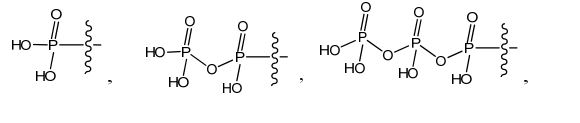

[0028] Dentro de cada uma das modalidades descritas imediatamente acima há uma modalidade adicional compreendendo um composto de Fórmula (II), ou um sal farmaceuticamente aceitável do mesmo, onde todas as outras variáveis são conforme imediatamente descrito acima, exceto que R8 e R9 são, cada um, selecionados de C1-C8 alquila. Dentro de cada uma das modalidades descritas na última frase há uma modalidade adicional compreendendo um composto de Fórmula (II), ou um sal farmaceuticamente aceitável do mesmo, onde todas as outras variáveis são conforme imediatamente descrito cima, exceto que R8 e R9 são, cada um, selecionados de C1-C6 alquila. Dentro de cada uma das modalidades descritas na última frase há uma modalidade adicional compreendendo um composto de Fórmula (II), ou um sal farmaceuticamente aceitável do mesmo, onde todas as outras variáveis são conforme imediatamente descrito acima, exceto que R8 e R9 são, cada um, selecionados de C1-C5 alquila. Dentro de cada uma das modalidades descritas na última frase há uma modalidade adicional compreendendo um composto de Fórmula (II), ou um sal farmaceuticamente aceitável do mesmo, onde todas as outras variáveis são conforme imediatamente descrito acima, exceto que R8 e R9 são, cada um, selecionados de C1-C4 alquila.[0028] Within each of the embodiments described immediately above there is an additional embodiment comprising a compound of Formula (II), or a pharmaceutically acceptable salt thereof, where all other variables are as immediately described above, except that R8 and R9 are , each selected from C1-C8 alkyl. Within each of the embodiments described in the last sentence is an additional embodiment comprising a compound of Formula (II), or a pharmaceutically acceptable salt thereof, wherein all other variables are as immediately described above, except that R8 and R9 are each one, selected from C1-C6 alkyl. Within each of the embodiments described in the last sentence is an additional embodiment comprising a compound of Formula (II), or a pharmaceutically acceptable salt thereof, wherein all other variables are as immediately described above, except that R8 and R9 are each one, selected from C1-C5 alkyl. Within each of the embodiments described in the last sentence is an additional embodiment comprising a compound of Formula (II), or a pharmaceutically acceptable salt thereof, wherein all other variables are as immediately described above, except that R8 and R9 are each one, selected from C1-C4 alkyl.
[0029] Dentro de cada uma das modalidades descritas aqui com-preendendo um composto de Fórmula (I) ou de Fórmula (II) há uma modalidade adicional onde todas as variáveis são conforme definido para a modalidade particular e compreendendo ainda a condição que quando R3 for F, R4 não seja metila.[0029] Within each of the embodiments described herein comprising a compound of Formula (I) or Formula (II) there is an additional embodiment where all variables are as defined for the particular embodiment and further comprising the condition that when R3 is F, R4 is not methyl.
[0030] Os termos halo e halogênio se referem a átomos de halo- gênio selecionados de F, Cl, Br e I.[0030] The terms halo and halogen refer to halogen atoms selected from F, Cl, Br and I.
[0031] "Azido" se refere a um grupo azida, isto é, o grupo -N3. O termo "n" conforme aqui usado se refere a um inteiro, tal como um inteiro selecionado de 1-166-176-17, 18, 19 e 20, i.e. 2 a 20 ou 2-20. Em alguns casos, "n" se refere a grupos de inteiros tais como 1 a 3, 1 a 4, 1 a 6, 1 a 8, 2 a 4, 2 a 6, 2 a 8, etc.[0031] "Azido" refers to an azide group, ie the -N3 group. The term "n" as used herein refers to an integer, such as an integer selected from 1-166-176-17, 18, 19 and 20, i.e. 2 to 20 or 2-20. In some cases, "n" refers to groups of integers such as 1 to 3, 1 to 4, 1 to 6, 1 to 8, 2 to 4, 2 to 6, 2 to 8, etc.
[0032] O termo "haloalquila" conforme aqui usado se refere a uma alquila conforme aqui definido, onde um ou mais átomos de hidrogênio são cada um substituídos por um substituinte halo. Por exemplo, uma (C1-C6)haloalquila é uma (C1-C6)alquila onde um ou mais dos átomos de hidrogênio foram substituídos por um substituinte halo. Tal faixa inclui um substituinte halo no grupo alquila para completar halogena- ção do grupo alquila.[0032] The term "haloalkyl" as used herein refers to an alkyl as defined herein, wherein one or more hydrogen atoms are each replaced by a halo substituent. For example, a (C1-C6)haloalkyl is a (C1-C6)alkyl where one or more of the hydrogen atoms have been replaced by a halo substituent. Such a band includes a halo substituent on the alkyl group to complete halogenation of the alkyl group.
[0033] O termo "(C1-n)haloalquila" conforme aqui usado, onde n é um inteiro, ou sozinho ou em combinação com um outro radical, pretende significar um radical alquila tendo 1 a n átomos de carbono conforme acima definido onde um ou mais átomos de hidrogênio são cada um substituídos por um substituinte halo. Exemplos de (C1-n)haloalquila, onde n é 2, incluem, mas não estão limitados a, clorometila, cloroetila, dicloroetila, bromometila, bromometila, dibromoetila, fluormetila, difluo- rmetila, trifluormetila, fluormetila e difluoretila.[0033] The term "(C1-n)haloalkyl" as used herein, where n is an integer, either alone or in combination with another radical, is intended to mean an alkyl radical having 1 n carbon atoms as defined above where one or more hydrogen atoms are each replaced by a halo substituent. Examples of (C1-n)haloalkyl, where n is 2, include, but are not limited to, chloromethyl, chloroethyl, dichloroethyl, bromomethyl, bromomethyl, dibromoethyl, fluoromethyl, difluoromethyl, trifluoromethyl, fluoromethyl and difluoroethyl.
[0034] O termo "(C1-n)alquila" conforme aqui usado, onde n é um inteiro, ou sozinho ou em combinação com um outro radical, pretende significar radicais alquila acíclicos, de cadeia reta ou ramificada, con-tendo de 1 a n átomos de carbono. "(C1-C4)alquila" inclui, mas não está limitado a, metila, etila, propila (n-propila), butila (n-butila), 1-metile- tila (iso-propila), 1-metilpropila (sec-butila), 2-metilpropila (iso-butila) e 1,1-dimetiletila (terc-butila ou t-butila). A abreviação Me significa um grupo metila; Et significa um grupo etila, Pr significa um grupo propila, iPr significa um grupo 1-metiletila, Bu significa um grupo butila e tBu significa um grupo 1,1-dimetiletila.[0034] The term "(C1-n)alkyl" as used herein, where n is an integer, either alone or in combination with another radical, is intended to mean straight-chain or branched acyclic alkyl radicals containing from 1 an carbon atoms. "(C1-C4)alkyl" includes, but is not limited to, methyl, ethyl, propyl (n-propyl), butyl (n-butyl), 1-methylethyl (iso-propyl), 1-methylpropyl (sec -butyl), 2-methylpropyl (iso-butyl) and 1,1-dimethylethyl (tert-butyl or t-butyl). The abbreviation Me means a methyl group; Et means an ethyl group, Pr means a propyl group, iPr means a 1-methylethyl group, Bu means a butyl group and tBu means a 1,1-dimethylethyl group.
[0035] O termo "alquila" se refere a um hidrocarboneto contendo átomos normais, secundários ou terciários. Por exemplo, um grupo alquila pode ter 1 a 4 átomos de carbono (isto é, (i.e, (C1-C4)alquila), 1 a 3 átomos de carbono (i.e., (C1-C3)alquila) ou 1 ou 2 átomos de carbono (i.e., (C1-C2)alquila). Exemplos de grupos alquila adequados incluem, mas não estão limitados a, (Me, -CH3), etila (Et, -CH2CH3), 1-propila (n-Pr, n-propila, -CH2CH2CH3), 2-propila (i-Pr, i-propila, -CH (CH3)2), 1- butila (n-Bu, n-butila, -CH2CH2CH2CH3), 2-metil-1-propila (i-Bu, i-butila, -CH2CH(CH3)2), 2-butila (s-Bu, s-butila, -CH(CH3)CH2CH3) e 2-metil-2- propila (t-Bu, t-butila, -C(CH3)3). "Alquila" se refere também a um radical hidrocarboneto saturado, de cadeia reta ou ramificada tendo dois centros de radical monovalentes derivados pela remoção de dois átomos de hidrogênio dos mesmos átomos de carbono ou de dois átomos de carbono diferentes de um alcano parental. Radicais alquila típicos in-cluem, mas não estão limitados a, metileno (-CH2-), 1,1-etila (-CH(CH3)-), 1,2-etila (-CH2CH2-), 1,1-propila (-CH(CH2CH3)-), 1,2-propila (-CH2CH (CH3)-), 1,3-propila (-CH2CH2CH2-), 1,4-butila (-CH2CH2CH2CH2-) e similar.[0035] The term "alkyl" refers to a hydrocarbon containing normal, secondary or tertiary atoms. For example, an alkyl group may have 1 to 4 carbon atoms (ie (ie, (C1-C4)alkyl), 1 to 3 carbon atoms (ie, (C1-C3)alkyl), or 1 or 2 carbon atoms (ie, (C1-C2)alkyl) Examples of suitable alkyl groups include, but are not limited to, (Me, -CH3), ethyl (Et, -CH2CH3), 1-propyl (n-Pr, n -propyl, -CH2CH2CH3), 2-propyl (i-Pr, i-propyl, -CH(CH3)2), 1-butyl (n-Bu, n-butyl, -CH2CH2CH2CH3), 2-methyl-1-propyl (i-Bu, i-butyl, -CH2CH(CH3)2), 2-butyl (s-Bu, s-butyl, -CH(CH3)CH2CH3) and 2-methyl-2-propyl (t-Bu, t -butyl, -C(CH3)3). "Alkyl" also refers to a straight-chain or branched saturated hydrocarbon radical having two monovalent radical centers derived by the removal of two hydrogen atoms from the same carbon atoms or from two carbon atoms other than a parent alkane. Typical alkyl radicals include, but are not limited to, methylene (-CH2-), 1,1-ethyl (-CH(CH3)-), 1,2-ethyl (- CH2CH2-), 1,1-propyl (-CH(CH2CH3)-), 1,2-propyl (-CH2CH(CH3)-), 1,3-propyl (-CH2CH2CH2-), 1,4-butyl (-CH2CH2CH2CH2-) and the like.
[0036] "Alquenila" é um hidrocarboneto reto ou ramificado contendo átomos de carbono normais, secundários ou terciários com pelo menos um sítio de insaturação, isto é, uma ligação dupla carbono-carbono sp2. Como exemplos, um grupo alquenila pode ter 2 a 4 átomos de carbono (isto é, C2-C4 alquenila) ou 2 a 3 átomos de carbono (isto é, C2-C3 alque- nila). Exemplos de grupos alquenila adequados incluem, mas não estão limitados a, etileno ou vinila (-CH=CH2) e alila (-CH2CH=CH2).[0036] "Alkenyl" is a straight or branched hydrocarbon containing normal, secondary or tertiary carbon atoms with at least one site of unsaturation, that is, a carbon-carbon sp2 double bond. As examples, an alkenyl group may have 2 to 4 carbon atoms (i.e., C2-C4 alkenyl) or 2 to 3 carbon atoms (i.e., C2-C3 alkenyl). Examples of suitable alkenyl groups include, but are not limited to, ethylene or vinyl (-CH=CH2) and allyl (-CH2CH=CH2).
[0037] O termo "(C2-n)alquenila", conforme aqui usado, onde n é um inteiro, ou sozinho ou em combinação com um outro radical, pretende significar um radical de cadeia insaturado, acíclico de cadeia reta ou ramificada contendo dois a n átomos de carbono, pelo menos dois dos quais são ligados um ao outro por uma ligação dupla. Exemplos de tais radicais incluem, mas não estão limitados a, etenila (vini- la), 1-propenila, 2-propenila e 1-butenila. A menos que de outro modo especificado, o termo "(C2-n)alquenila" é entendido compreender este- reoisômeros individuais onde possível, incluindo, mas não limitado a, isômeros (E) e (Z), e misturas dos mesmos. Quando um grupo (C2-n) alquenila é substituído, ele é compreendido ser substituído em qualquer átomo de carbono do mesmo que de outro modo carregaria um átomo de hidrogênio, a menos que especificado de outro modo, de maneira que a substituição daria origem a um composto quimicamente estável, de maneira que são reconhecidos por aqueles versados na técnica.[0037] The term "(C2-n)alkenyl", as used herein, where n is an integer, either alone or in combination with another radical, is intended to mean an unsaturated, straight-chain or branched-chain acyclic radical containing two an carbon atoms, at least two of which are bonded to each other by a double bond. Examples of such radicals include, but are not limited to, ethenyl (vinyl), 1-propenyl, 2-propenyl and 1-butenyl. Unless otherwise specified, the term "(C2-n)alkenyl" is intended to encompass individual stereoisomers where possible, including, but not limited to, (E) and (Z) isomers, and mixtures thereof. When a (C2-n) alkenyl group is substituted, it is understood to be substituted on any such carbon atom that would otherwise carry a hydrogen atom, unless otherwise specified, such that the substitution would give rise to a chemically stable compound such that they are recognized by those skilled in the art.
[0038] "Alquinila" é um hidrocarboneto reto ou ramificado contendo átomos de carbono normais, secundários ou terciários com pelo menos um sítio de insaturação, isto é, uma ligação tripla sp, carbono- carbono. Por exemplo, um grupo alquinila pode ter 2 a 4 átomos de carbono (isto é, C2-C4 alquinila) ou 2 a 3 átomos de carbono (isto é, C2-C3 alcina). Exemplos de grupos alquinila adequados incluem, mas não estão limitados a, acetilênico (-C=CH), propargila (-CH2C=CH) e similar.[0038] "Alkynyl" is a straight or branched hydrocarbon containing normal, secondary or tertiary carbon atoms with at least one site of unsaturation, that is, an sp, carbon-carbon triple bond. For example, an alkynyl group may have 2 to 4 carbon atoms (i.e., C2-C4 alkynyl) or 2 to 3 carbon atoms (i.e., C2-C3 alkyne). Examples of suitable alkynyl groups include, but are not limited to, acetylenic (-C=CH), propargyl (-CH 2 C=CH) and the like.
[0039] O termo "(C2-n)alquinila", conforme aqui usado, onde n é um inteiro, ou sozinho ou em combinação com um outro radical, pretende significar um radical insaturado, acíclico de cadeia reta ou ramificada contendo dois a n átomos de carbono, pelo menos dois dos quais são ligados uns aos outros por uma ligação tripla. Exemplos de tais radicais onde n é 4 incluem, mas não estão limitados a, etinila, 1-propinila, 2-propinila e 1-butinila. Quando (C2-n)alquinila é substituído, ele é compreendido ser substituído em qualquer átomo de carbono do mesmo que de outra maneira carregaria um átomo de hidrogênio, a menos que de outro modo especificado, de maneira que a substituição daria origem a um composto quimicamente estável, tal como reconhecido por aqueles versados na técnica.[0039] The term "(C2-n)alkynyl", as used herein, where n is an integer, either alone or in combination with another radical, is intended to mean a straight or branched chain unsaturated, acyclic radical containing two an atoms of carbon, at least two of which are linked to each other by a triple bond. Examples of such radicals where n is 4 include, but are not limited to, ethynyl, 1-propynyl, 2-propynyl and 1-butynyl. When (C2-n)alkynyl is substituted, it is understood to be substituted at any carbon atom of the same that would otherwise carry a hydrogen atom, unless otherwise specified, such that the substitution would give rise to a compound chemically stable, as recognized by those skilled in the art.
[0040] O termo cicloalquila se refere a um grupo alifático cíclico. Os grupos cicloalquila da presente invenção podem ser referidos pelo número de átomos de carbono no seu anel, tal como "C3-C4 cicloalqui- la" se referindo a um anel cicloalquila com 3 ou 4 átomos de carbono no anel ou "C3-C6 cicloalquila" indicando um anel cicloalquila com 3, 4, 5 ou 6 átomos de carbono no anel, isto é, um anel ciclopropila, ciclobu- tila, ciclopentila ou cicloexila.[0040] The term cycloalkyl refers to a cyclic aliphatic group. Cycloalkyl groups of the present invention may be referred to by the number of carbon atoms in their ring, such as "C3-C4 cycloalkyl" referring to a cycloalkyl ring with 3 or 4 ring carbon atoms or "C3-C6 cycloalkyl " indicating a cycloalkyl ring with 3, 4, 5 or 6 carbon atoms in the ring, i.e. a cyclopropyl, cyclobutyl, cyclopentyl or cyclohexyl ring.
[0041] O termo "carbociclo" ou "carbociclila" se refere a um anel saturado (isto é, cicloalquila) ou parcialmente insaturado (por exemplo, cicloalquenila, cicloalcadienila, etc) tendo o número de átomos de car-bono especificado, tal como 3 a 4 átomos de carbono ou 3 a 6 átomos de carbono como um sistema de anel monocíclico. Em uma modalidade, o carbociclo é um monociclo compreendendo 3-6 carbonos no anel (isto é, (C3-C6)carbociclo). Exemplos não limitantes de carbociclos mo- nocíclicos incluem anéis ciclopropila, ciclobutila, ciclopentila, 1-ciclo- pent-1-enila, 1-ciclopent-2-enila, 1-ciclopent-3-enila, cicloexila, 1-ciclo- ex-1-enila, 1-cicloex-2-enila, 1-cicloex-3-enila e cicloexa-1,3-dienila.[0041] The term "carbocycle" or "carbocyclyl" refers to a saturated (i.e., cycloalkyl) or partially unsaturated (e.g., cycloalkenyl, cycloalkadienyl, etc.) ring having the specified number of carbon atoms, such as 3 to 4 carbon atoms or 3 to 6 carbon atoms as a monocyclic ring system. In one embodiment, the carbocycle is a monocycle comprising 3-6 ring carbons (i.e., (C3-C6)carbocycle). Non-limiting examples of monocyclic carbocycles include cyclopropyl, cyclobutyl, cyclopentyl, 1-cyclopent-1-enyl, 1-cyclopent-2-enyl, 1-cyclopent-3-enyl, cyclohexyl, 1-cyclo-ex- 1-enyl, 1-cyclohex-2-enyl, 1-cyclohex-3-enyl and cyclohexa-1,3-dienyl.
[0042] Cada grupo carbociclo pode ser substituído por 0, 1, 2 ou 3 substituintes independentemente selecionados de halogênio, -OH, -CN, - NO2, -NH2, -NH(C1-C6 alquila), -N(C1-C6 alquila)2, C1-C6 alquila, C1-C6 alcóxi e -CF3.[0042] Each carbocycle group may be substituted by 0, 1, 2 or 3 substituents independently selected from halogen, -OH, -CN, -NO2, -NH2, -NH(C1-C6 alkyl), -N(C1-C6) alkyl)2, C1-C6 alkyl, C1-C6 alkoxy and -CF3.
[0043] É também provida aqui uma formulação farmacêutica com-preendendo uma quantidade farmaceuticamente eficaz de um composto de Fórmula (I) ou um sal farmaceuticamente aceitável, solvato e/ou éster do mesmo, e um carreador ou excipiente farmaceuticamen- te aceitável. São também providas formulações farmacêuticas separadas, cada uma compreendendo uma quantidade farmaceuticamente eficaz de um composto de Fórmula (II) ou um dos compostos específicos dos presentes exemplos, ou um sal farmaceuticamente aceitável, solvato e/ou éster do mesmo, e um carreador ou excipiente farmaceu- ticamente aceitável.Also provided herein is a pharmaceutical formulation comprising a pharmaceutically effective amount of a compound of Formula (I) or a pharmaceutically acceptable salt, solvate and/or ester thereof, and a pharmaceutically acceptable carrier or excipient. Separate pharmaceutical formulations are also provided, each comprising a pharmaceutically effective amount of a compound of Formula (II) or one of the specific compounds of the present examples, or a pharmaceutically acceptable salt, solvate and/or ester thereof, and a carrier or excipient. pharmaceutically acceptable.
[0044] Os presentes compostos são formulados com carreadores e excipientes convencionais, que serão selecionados de acordo com prática comum. Os comprimidos conterão excipientes, glidantes, cargas, ligantes e similar. Formulações aquosas são preparadas em forma estéril e quando pretendidas para administração através de outra que não administração oral geralmente serão isotônicaa. Todas as formulações conterão opcionalmente excipientes tais como aqueles mostrados no "Handbook of Pharmaceutical Excipients" (1986). Exci- pientes incluem ácido ascórbico e outros antioxidantes, agentes de quelação tal como EDTA, carboidratos tais como dextrano, hidroxial- quilcelulose, hidroxialquilmetilcelulose, ácido esteárico e similar. O pH das formulações varia de a partir de cerca de 3 a cerca de 11, mas é geralmente cerca de 7 a 10.[0044] The present compounds are formulated with conventional carriers and excipients, which will be selected according to common practice. Tablets will contain excipients, glidants, fillers, binders and the like. Aqueous formulations are prepared in sterile form and when intended for administration other than oral administration will generally be isotonic. All formulations will optionally contain excipients such as those shown in the "Handbook of Pharmaceutical Excipients" (1986). Excipients include ascorbic acid and other antioxidants, chelating agents such as EDTA, carbohydrates such as dextran, hydroxyalkylcellulose, hydroxyalkylmethylcellulose, stearic acid, and the like. The pH of formulations ranges from about 3 to about 11, but is generally about 7 to 10.
[0045] Embora seja possível que os ingredientes ativos sejam ad-ministrados sozinhos, pode ser preferível apresentá-los como formula-ções farmacêuticas. As formulações, para ambos os usos veterinário e humano, compreendem pelo menos um ingrediente ativo, conforme acima definido, junto com um ou mais carreadores aceitáveis e opcio- nalmente outros ingredientes terapêuticos, particularmente aqueles ingredientes terapêuticos adicionais conforme aqui discutido. O(s) car- reador(es) deve ser "aceitável" no sentido de ser compatível com os outros ingredientes da formulação e fisiologicamente inócuo para o seu recipiente.[0045] While it is possible for the active ingredients to be administered alone, it may be preferable to present them as pharmaceutical formulations. Formulations, for both veterinary and human uses, comprise at least one active ingredient, as defined above, together with one or more acceptable carriers and optionally other therapeutic ingredients, particularly those additional therapeutic ingredients as discussed herein. The carrier(s) must be "acceptable" in the sense of being compatible with the other ingredients of the formulation and physiologically innocuous to its recipient.
[0046] As formulações incluem aquelas adequadas para as vias de administração acima. As formulações podem ser convenientemente apresentadas em forma de dosagem unitária e podem ser preparadas através de qualquer um dos métodos bem conhecidos na técnica de farmácia. Técnicas e formulações geralmente são encontradas em Remington’s Pharmaceutical Sciences (Mack Publishing Co., Easton, PA). Tais métodos incluem a etapa de trazer em associação o ingredi-ente ativo com o carreador que constitui um ou mais ingredientes acessórios. Em geral as formulações são preparadas trazendo em as-sociação uniformemente e intimamente o ingrediente ativo com carre- adores líquidos ou carreadores sólidos finamente divididos ou ambos, e então, se necessário, modelagem do produto.[0046] The formulations include those suitable for the above routes of administration. The formulations may conveniently be presented in unit dosage form and may be prepared by any of the methods well known in the art of pharmacy. Techniques and formulations are generally found in Remington's Pharmaceutical Sciences (Mack Publishing Co., Easton, PA). Such methods include the step of bringing the active ingredient into association with the carrier constituting one or more accessory ingredients. In general, formulations are prepared by uniformly and intimately bringing into association the active ingredient with liquid carriers or finely divided solid carriers or both, and then, if necessary, shaping the product.
[0047] Formulações adequadas para administração oral podem ser apresentadas como unidades individuais tais como cápsulas, cachets ou comprimidos cada um contendo uma quantidade predeterminada do ingrediente ativo; como um pó ou grânulos; como uma solução ou uma suspensão em um líquido aquoso ou não aquoso; ou como emulsão líquida óleo-em-água ou uma emulsão líquida água-em- óleo. O ingrediente ativo pode também ser administrado como um bolo, eletuário ou pasta.[0047] Formulations suitable for oral administration may be presented as individual units such as capsules, cachets or tablets each containing a predetermined amount of the active ingredient; as a powder or granules; as a solution or suspension in an aqueous or non-aqueous liquid; or as an oil-in-water liquid emulsion or a water-in-oil liquid emulsion. The active ingredient may also be administered as a bolus, electuary or paste.
[0048] Um comprimido é feito através de compressão ou moldagem, opcionalmente com um ou mais ingredientes acessório. Comprimidos prensados podem ser preparados prensando em uma máquina adequada o ingrediente ativo em uma forma de fluxo livre tal como um pó ou grânulos, opcionalmente misturados com um ligante, lubrificante, diluente inerte, conservante, agente tensoativo ou de dispersão. Com-primidos moldados podem ser feitos através de moldagem em uma máquina adequada de uma mistura do ingrediente ativo em pó ume- decido com um diluente líquido inerte. Os comprimidos podem ser op-cionalmente revestidos ou entalhados e são opcionalmente formulados de modo a prover liberação lenta ou controlada do ingrediente ativo a partir do mesmo.[0048] A tablet is made by compression or molding, optionally with one or more accessory ingredients. Compressed tablets may be prepared by compressing in a suitable machine the active ingredient in a free-flowing form such as a powder or granules, optionally mixed with a binder, lubricant, inert diluent, preservative, surface-active or dispersing agent. Molded tablets can be made by molding in a suitable machine a mixture of the powdered active ingredient moistened with an inert liquid diluent. The tablets may optionally be coated or scored and are optionally formulated so as to provide slow or controlled release of the active ingredient therefrom.
[0049] Para infecções do olho ou outros tecidos externos, por exemplo, boca e pele, as formulações são preferivelmente aplicadas como um unguento ou creme tópico contendo o(s) ingrediente(s) ati- vo(s) em uma quantidade de, por exemplo, 0,075 a 20% p/p (incluindo o(s) ingrediente(s) ativo(s) em uma faixa entre 0,1% e 20% em incrementos de 0,1% p/p tal como 0,6% p/p, 0,7% p/p, etc), preferivelmente 0,2 a 15% p/p e, sobretudo, preferivelmente 0,5 a 10% p/p. Quando formulados em um unguento, os ingredientes ativos podem ser empregados com uma base de unguento ou parafínica ou miscível em água. Alternativamente, os ingredientes ativos podem ser formulados em um creme com uma base de creme óleo-em-água.[0049] For infections of the eye or other external tissues, e.g. mouth and skin, the formulations are preferably applied as an ointment or topical cream containing the active ingredient(s) in an amount of, for example, 0.075 to 20% w/w (including active ingredient(s) in a range between 0.1% and 20% in increments of 0.1% w/w such as 0.6 % w/w, 0.7% w/w, etc.), preferably 0.2 to 15% w/w, most preferably 0.5 to 10% w/w. When formulated in an ointment, the active ingredients may be employed with an ointment or paraffinic or water-miscible base. Alternatively, the active ingredients can be formulated into a cream with an oil-in-water cream base.
[0050] Se desejado, a fase aquosa da base de creme pode incluir, por exemplo, pelo menos 30% p/p de um álcool poli-hídrico, isto é, um álcool tendo dois ou mais grupos hidroxila tais como propileno glicol, butano 1,3-diol, manitol, sorbitol, glicerol e polietileno glicol (incluindo PEG 400) e misturas dos mesmos. As formulações tópicas podem incluir desejavelmente um composto que aumenta a absorção ou penetração do ingrediente ativo através da pele ou outras áreas afetadas. Exemplos de tais potencializadores de penetração dermal incluem sul- fóxido de dimetila e análogos relacionados.[0050] If desired, the aqueous phase of the cream base may include, for example, at least 30% w/w of a polyhydric alcohol, i.e. an alcohol having two or more hydroxyl groups such as propylene glycol, butane 1,3-diol, mannitol, sorbitol, glycerol and polyethylene glycol (including PEG 400) and mixtures thereof. Topical formulations may desirably include a compound that enhances absorption or penetration of the active ingredient through the skin or other affected areas. Examples of such dermal penetration enhancers include dimethyl sulfoxide and related analogs.
[0051] A fase oleosa das emulsões pode ser constituída de ingredientes conhecidos de uma maneira conhecida. Embora a fase possa compreender apenas um emulsificante (de outra maneira conhecido como um emulgente), é desejável compreender uma mistura de pelo menos um emulsificante com uma gordura ou um óleo ou com ambos uma gordura e um óleo. Preferivelmente, um emulsificante hidrofílico é incluído junto com um emulsificante lipofílico que age como um estabi- lizante. É também preferido incluir ambos um óleo e uma gordura. Juntos, o(s) emulsificante(s) com ou sem estabilizante(s), formam a chamada cera emulsificante, e a cera junto com o óleo e gordura formam a chamada base de unguento emulsificante que forma a fase dispersa oleosa das formulações de creme.[0051] The oil phase of emulsions can be made up of known ingredients in a known manner. While the phase may comprise only an emulsifier (otherwise known as an emulgent), it is desirable to comprise a mixture of at least one emulsifier with a fat or an oil or with both a fat and an oil. Preferably, a hydrophilic emulsifier is included together with a lipophilic emulsifier which acts as a stabilizer. It is also preferred to include both an oil and a fat. Together, the emulsifier(s) with or without stabilizer(s) form the so-called emulsifying wax, and the wax together with the oil and fat form the so-called emulsifying ointment base which forms the oil dispersed phase of cream formulations. .
[0052] Emulgentes e estabilizadores de emulsão adequados para uso na formulação incluem Tween®60, Span® 80, álcool de cetoeste- arila, álcool benzílico, álcool de miristina, monoestearato de glicerila e lauril sulfato de sódio.[0052] Emulgents and emulsion stabilizers suitable for use in the formulation include Tween® 60, Span® 80, cetostearyl alcohol, benzyl alcohol, myristin alcohol, glyceryl monostearate and sodium lauryl sulfate.
[0053] A escolha de óleos ou gorduras adequados para a formulação é baseada na obtenção das propriedades cosméticas desejadas. O creme deve ser preferivelmente um produto não gorduroso, que não manche e lavável com consistência adequada para evitar vazamento dos tubos ou outros recipientes. Ésteres de alquila de cadeia reta ou modificada, mono- ou dibásicos tais como di-isoadipato, estearato de isocetila, diéster de propileno glicol de ácidos graxos de coco, miristato de isopropila, oleato de decila, palmitato de isopropila, estearato de butila, palmitato de 2-etilexila ou uma mistura de ésteres de cadeia ramificada conhecidos como Crodamol CAP podem ser usados, os três últimos sendo ésteres preferidos. Estes podem ser sozinhos ou em combinação dependendo das propriedades requeridas. Alternativamente, lipídeos de ponto de fusão alto tais como parafina mole branca e/ou parafina líquida ou outros óleos minerais são usados.[0053] The choice of suitable oils or fats for the formulation is based on obtaining the desired cosmetic properties. The cream should preferably be a non-greasy, non-staining and washable product of adequate consistency to avoid leakage from tubes or other containers. Straight chain or modified alkyl esters, mono- or dibasic such as diisoadipate, isocethyl stearate, propylene glycol diester of coconut fatty acids, isopropyl myristate, decyl oleate, isopropyl palmitate, butyl stearate, palmitate of 2-ethylhexyl or a mixture of branched chain esters known as Crodamol CAP can be used, the latter three being preferred esters. These can be alone or in combination depending on the properties required. Alternatively, high melting point lipids such as white soft paraffin and/or liquid paraffin or other mineral oils are used.
[0054] Formulações farmacêuticas aqui compreendem uma combinação junto com um ou mais carreadores ou excipientes farmaceuti- camente acetáveis e opcionalmente outros agentes terapêuticos. For- mulações farmacêuticas contendo o ingrediente ativo podem estar em qualquer forma adequada para o método de administração pretendido. Quando usadas para uso oral, por exemplo, comprimidos, trociscos, pastilhas, suspensões aquosas ou oleosas, pós ou grânulos dispersá-veis, emulsões, cápsulas duras ou moles, soluções, xaropes ou elixires podem ser preparados. Composições pretendidas para uso oral podem ser preparadas de acordo com qualquer método conhecido na técnica para a fabricação de composições farmacêuticas e tais composições podem conter um ou mais agentes incluindo agentes adoçantes, agentes saborizantes, agentes de coloração e agentes de conservação, a fim de prover uma preparação palatável. Comprimidos contendo o ingrediente ativo em mistura com excipiente farmaceuticamen- te aceitável não tóxico que são adequados para fabricação de comprimidos são aceitáveis. Estes excipientes podem ser, por exemplo, diluentes inertes, tal como carbonato de cálcio ou sódio, lactose, fosfato de cálcio ou sódio; agentes de granulação e desintegração, tais como amido de milho ou ácido algínico; agentes de ligação; ácido esteárico ou talco. Os comprimidos podem ser não revestidos ou podem ser revestidos através de técnicas conhecidas incluindo microencapsula- ção para retardar desintegração e adsorção no trato gastrintestinal e desta maneira prover uma ação sustentada durante um período mais longo. Por exemplo, um material de retardo de tempo tal como mo- noestearato de glicerila ou diestearato de glicerila sozinho ou com uma cera pode ser empregado.[0054] Pharmaceutical formulations herein comprise a combination together with one or more pharmaceutically acceptable carriers or excipients and optionally other therapeutic agents. Pharmaceutical formulations containing the active ingredient may be in any form suitable for the intended method of administration. When used for oral use, for example, tablets, troches, lozenges, aqueous or oily suspensions, dispersible powders or granules, emulsions, hard or soft capsules, solutions, syrups or elixirs can be prepared. Compositions intended for oral use may be prepared according to any method known in the art for the manufacture of pharmaceutical compositions, and such compositions may contain one or more agents including sweetening agents, flavoring agents, coloring agents and preserving agents, in order to provide a palatable preparation. Tablets containing the active ingredient in admixture with a non-toxic pharmaceutically acceptable excipient which are suitable for tabletting purposes are acceptable. These excipients can be, for example, inert diluents, such as calcium or sodium carbonate, lactose, calcium or sodium phosphate; granulating and disintegrating agents such as corn starch or alginic acid; binding agents; stearic acid or talc. The tablets may be uncoated or they may be coated by known techniques including microencapsulation to delay disintegration and adsorption in the gastrointestinal tract and thus provide a sustained action over a longer period. For example, a time delay material such as glyceryl monostearate or glyceryl distearate alone or with a wax can be employed.
[0055] Formulações para uso oral podem ser também apresentadas como cápsulas de gelatina dura onde o ingrediente ativo é misturado com um diluente sólido inerte, por exemplo, fosfato de cálcio ou caulim, ou como cápsulas de gelatina macias onde o ingrediente ativo é misturado com água ou um meio de óleo, tal como óleo de amendoim, parafina líquida ou óleo de oliva.[0055] Formulations for oral use may also be presented as hard gelatine capsules where the active ingredient is mixed with an inert solid diluent, for example calcium phosphate or kaolin, or as soft gelatine capsules where the active ingredient is mixed with water or an oil medium such as peanut oil, liquid paraffin or olive oil.
[0056] Suspensões aquosas contêm os materiais ativos em mistura com excipientes adequados para a fabricação de suspensões aquosas. Tais excipientes incluem um agente de suspensão, tais como car- boximetilcelulose de sódio, metilcelulose, hidroxipropil metilcelulose, alginato de sódio, polivinilpirrolidina, goma tragacanto e goma acácia e agentes de dispersão ou umectantes tais como um fosfatídeos de ocorrência natural (por exemplo, lecitina), um produto de condensação de um óxido de alquileno com um ácido graxo (por exemplo, estearato de polioxietileno), um produto de condensação de óxido de etileno com um álcool alifático de cadeia longa (por exemplo, heptadecaetilenooxi- cetanol), um produto de condensação de óxido de etileno com um éster parcial derivado de um ácido graxo e um anidrido de hexitol (por exemplo, monooleato de polioxietileno sorbitano). A suspensão aquosa pode também conter um ou mais conservantes tal como p-hidroxi- benzoato de etila ou n-propila, um ou mais agentes de coloração, um ou mais agentes saborizantes e um ou mais agentes adoçantes, tal como sacarose ou sacarina.[0056] Aqueous suspensions contain the active materials in admixture with excipients suitable for the manufacture of aqueous suspensions. Such excipients include a suspending agent, such as sodium carboxymethyl cellulose, methyl cellulose, hydroxypropyl methyl cellulose, sodium alginate, polyvinylpyrrolidine, gum tragacanth, and gum acacia, and dispersing or wetting agents such as a naturally occurring phosphatide (e.g., lecithin). ), a condensation product of an alkylene oxide with a fatty acid (e.g., polyoxyethylene stearate), a condensation product of ethylene oxide with a long-chain aliphatic alcohol (e.g., heptadecaethyleneoxy-cetanol), a product of condensation of ethylene oxide with a partial ester derived from a fatty acid and a hexitol anhydride (e.g. polyoxyethylene sorbitan monooleate). The aqueous suspension may also contain one or more preservatives such as ethyl or n-propyl p-hydroxybenzoate, one or more coloring agents, one or more flavoring agents, and one or more sweetening agents, such as sucrose or saccharin.
[0057] Suspensões de óleo podem ser formuladas através de suspensão do ingrediente ativo em um óleo vegetal, tal como óleo de amendoim, óleo de oliva, óleo de sésamo ou óleo de coco ou em um óleo mineral tal como parafina líquida. As suspensões orais podem conter um agente de espessamento, tal como cera de abelha, parafina líquida ou álcool de cetila. Agentes adoçantes, tais como aqueles mostrados acima, e agentes saborizantes podem ser adicionados para prover uma preparação oral palatável. Estas composições podem ser preservadas através da adição de um antioxidante tal como ácido as- córbico.[0057] Oil suspensions can be formulated by suspending the active ingredient in a vegetable oil such as peanut oil, olive oil, sesame oil or coconut oil or in a mineral oil such as liquid paraffin. Oral suspensions may contain a thickening agent such as beeswax, liquid paraffin or cetyl alcohol. Sweetening agents, such as those shown above, and flavoring agents may be added to provide a palatable oral preparation. These compositions can be preserved by the addition of an antioxidant such as ascorbic acid.
[0058] Pós e grânulos dispersáveis adequados para preparação de uma suspensão aquosa através da adição de água proveem o ingrediente ativo em mistura com um agente de dispersão ou umectante, um agente de suspensão e um ou mais conservantes. Agentes de dis-persão ou umectantes e agentes de suspensão adequados são exem-plificados por aqueles revelados acima. Excipientes adicionais, por exemplo, agentes adoçantes, de saborização e coloração, podem também estar presentes.[0058] Dispersible powders and granules suitable for preparation of an aqueous suspension by the addition of water provide the active ingredient in admixture with a dispersing or wetting agent, a suspending agent and one or more preservatives. Suitable dispersing or wetting agents and suspending agents are exemplified by those disclosed above. Additional excipients, for example sweetening, flavoring and coloring agents, may also be present.
[0059] As composições farmacêuticas podem também estar na forma de emulsões óleo-em-água. A fase oleosa pode ser um óleo vegetal, tal como óleo de oliva ou óleo de amendoim, um óleo mineral, tal como parafina líquida ou uma mistura desses. Agentes emulsificantes adequados incluem gomas de ocorrência natural, tal como goma acácia e goma tragacanto, fosfatídeos de ocorrência natural, tal como lecitina de soja, ésteres ou ésteres parciais derivados de ácidos graxos e anidridos de hexitol, tal como monooleato de sorbitano, e produtos de condensação destes ésteres parciais com óxido de etileno, tal como monooleato de polioxietileno sorbitano. A emulsão pode também conter agentes adoçantes e saborizantes. Xaropes e elixires podem ser formulados com agentes adoçantes, tal como glicerol, sorbitol ou sacarose. Tais formulações podem também conter um agente demulcente, um conservante, um saborizante ou um de coloração.[0059] The pharmaceutical compositions may also be in the form of oil-in-water emulsions. The oily phase may be a vegetable oil such as olive oil or peanut oil, a mineral oil such as liquid paraffin or a mixture thereof. Suitable emulsifying agents include naturally occurring gums such as gum acacia and gum tragacanth, naturally occurring phosphatides such as soy lecithin, esters or partial esters derived from fatty acids and hexitol anhydrides such as sorbitan monooleate, and condensation of these partial esters with ethylene oxide, such as polyoxyethylene sorbitan monooleate. The emulsion may also contain sweetening and flavoring agents. Syrups and elixirs can be formulated with sweetening agents, such as glycerol, sorbitol or sucrose. Such formulations may also contain a demulcent, preservative, flavoring or coloring agent.
[0060] As composições farmacêuticas podem estar na forma de preparações injetáveis ou intravenosas estéreis, tal como suspensão aquosa ou oleaginosa injetável estéril. Esta suspensão pode ser for-mulada de acordo com a técnica conhecida usando aqueles agentes de dispersão ou umectantes e agentes de suspensão adequados que foram mencionados acima. A preparação injetável ou intravenosa estéril pode ser também uma solução ou suspensão injetável estéril em um diluente ou solvente parenteralmente aceitável não tóxico, tal como uma solução em 1,3-butano-diol ou preparada como um pó liofilizado. Dentre os veículos e solventes aceitáveis que podem ser empregados estão água, solução de Ringer e solução de cloreto de sódio isotônica. Ainda, óleos fixos estéreis podem ser convenientemente empregados como um solvente ou meio de suspensão. Para este propósito qualquer óleo fixo suave pode ser empregado incluindo mono- ou diglicerí- deos sintéticos. Ainda, ácidos graxos tal como ácido oleico podem da mesma maneira ser usados na preparação de injetáveis.[0060] The pharmaceutical compositions may be in the form of sterile injectable or intravenous preparations, such as sterile injectable aqueous or oleaginous suspension. This suspension can be formulated according to the known technique using those suitable dispersing or wetting agents and suspending agents which have been mentioned above. The sterile injectable or intravenous preparation may also be a sterile injectable solution or suspension in a non-toxic parenterally acceptable diluent or solvent, such as a solution in 1,3-butane-diol or prepared as a lyophilized powder. Among the acceptable vehicles and solvents that can be used are water, Ringer's solution and isotonic sodium chloride solution. In addition, sterile, fixed oils may conveniently be employed as a solvent or suspending medium. For this purpose any bland fixed oil may be employed including synthetic mono- or diglycerides. Furthermore, fatty acids such as oleic acid can likewise be used in the preparation of injectables.
[0061] A quantidade de ingrediente ativo que pode ser combinada com o material carreador para produzir uma forma de dosagem única variará dependendo do hospedeiro tratado e do modo de administração particular. Por exemplo, uma formulação de liberação com o tempo pretendida para administração oral a humanos pode conter aproximadamente 1 a 1000 mg de material ativo composto com uma quantidade apropriada e conveniente de material carreador que pode variar de a partir de cerca de 5 a cerca de 95% das composições totais (pe- so:peso). A composição farmacêutica pode ser preparada para prover quantidades facilmente mensuráveis para administração. Por exemplo, uma solução aquosa pretendida para infusão intravenosa pode conter de a partir de cerca de 3 a 500 μg do ingrediente ativo por mililitro de solução a fim de que infusão de um volume adequado em uma taxa de cerca de 30 mL/h possa ocorrer.[0061] The amount of active ingredient that can be combined with the carrier material to produce a single dosage form will vary depending on the host treated and the particular mode of administration. For example, a time-release formulation intended for oral administration to humans may contain approximately 1 to 1000 mg of active material compounded with an appropriate and convenient amount of carrier material which may range from from about 5 to about 95 mg. % of total compositions (weight:weight). The pharmaceutical composition can be prepared to provide readily measurable amounts for administration. For example, an aqueous solution intended for intravenous infusion may contain from about 3 to 500 μg of the active ingredient per milliliter of solution so that infusion of a suitable volume at a rate of about 30 mL/hr can occur. .
[0062] Formulações adequadas para administração tópica ao olho também incluem gotas para o olho onde o ingrediente ativo é dissolvido ou suspenso em um carreador adequado, especialmente um solvente aquoso para o ingrediente ativo. O ingrediente ativo está preferivelmente presente em tais formulações em uma concentração de 0,5 a 20%, vantajosamente 0,5 a 10% e particularmente cerca de 1,5% p/p.[0062] Formulations suitable for topical administration to the eye also include eye drops where the active ingredient is dissolved or suspended in a suitable carrier, especially an aqueous solvent for the active ingredient. The active ingredient is preferably present in such formulations in a concentration of 0.5 to 20%, advantageously 0.5 to 10% and particularly about 1.5% w/w.
[0063] Formulações adequadas para administração tópica na boca incluem pastilhas compreendendo o ingrediente ativo em uma base saborizada, geralmente sacarose e acácia ou tragacanto; pastilhas compreendendo o ingrediente ativo em uma base inerte tais como gelatina e glicerina ou sacarose e acácia; e enxaguatórios bucais com- preendendo o ingrediente ativo em um carreador líquido adequado.[0063] Formulations suitable for topical administration in the mouth include lozenges comprising the active ingredient in a flavored base, generally sucrose and acacia or tragacanth; pastilles comprising the active ingredient in an inert base such as gelatin and glycerin or sucrose and acacia; and mouthwashes comprising the active ingredient in a suitable liquid carrier.
[0064] Formulações para administração retal podem ser apresentadas como um supositório com uma base adequada compreendendo, por exemplo, manteiga de cacau ou um salicilato.[0064] Formulations for rectal administration may be presented as a suppository with a suitable base comprising, for example, cocoa butter or a salicylate.
[0065] Formulações adequadas para administração intrapulmonar ou nasal têm um tamanho de partícula, por exemplo, na faixa de 0,1 a 500 mícrons, tal como 0,5, 1, 30, 35, etc, que são administradas através de inalação rápida através da passagem nasal ou através de inalação pela boca de maneira a atingir os sacos alveolares. Formulações adequadas incluem soluções aquosas ou oleosas do ingrediente ativo. Formulações adequadas para administração com aerossol ou pó seco podem ser preparadas de acordo com métodos convencionais e podem ser administradas com outros agentes terapêuticos tais como compostos até agora usados no tratamento ou profilaxia de infecções por Pneumovirinae conforme descrito abaixo.[0065] Formulations suitable for intrapulmonary or nasal administration have a particle size, for example, in the range of 0.1 to 500 microns, such as 0.5, 1, 30, 35, etc., which are administered via rapid inhalation. through the nasal passage or through inhalation through the mouth in order to reach the alveolar sacs. Suitable formulations include aqueous or oily solutions of the active ingredient. Formulations suitable for aerosol or dry powder administration can be prepared according to conventional methods and can be administered with other therapeutic agents such as compounds hitherto used in the treatment or prophylaxis of Pneumovirinae infections as described below.
[0066] Outras modalidades proveem uma composição inalável nova, eficaz, segura, não irritante e fisiologicamente compatível compre-endendo um composto de Fórmula (I) ou Fórmula (II), ou um sal far- maceuticamente aceitável do mesmo, adequada para tratamento de infecções por Pneumovirinae e bronquiolite potencialmente associada. Sais farmaceuticamente aceitáveis preferidos são sais de ácido inor-gânicos incluindo sais de cloridrato, bromidrato, sulfato ou fosfato uma vez que eles causam menos irritação pulmonar. Preferivelmente, a formulação inalável é administrada ao espaço endobronquial em um aerossol compreendendo partículas com um diâmetro aerodinâmico médio de massa (MMAD) entre cerca de 1 e cerca de 5 μm. Preferi-velmente, o composto de Fórmula (I) ou Fórmula (II) é formulado para administração aerossol usando um nebulizador, inalador de dose medida pressurizado (pMDI) ou inalador de pó seco (DPI).[0066] Other embodiments provide a novel, effective, safe, non-irritating and physiologically compatible inhalable composition comprising a compound of Formula (I) or Formula (II), or a pharmaceutically acceptable salt thereof, suitable for the treatment of Pneumovirinae infections and potentially associated bronchiolitis. Preferred pharmaceutically acceptable salts are inorganic acid salts including hydrochloride, hydrobromide, sulfate or phosphate salts as they cause less lung irritation. Preferably, the inhalable formulation is delivered to the endobronchial space in an aerosol comprising particles having a mass median aerodynamic diameter (MMAD) of between about 1 and about 5 µm. Preferably, the compound of Formula (I) or Formula (II) is formulated for aerosol administration using a nebulizer, pressurized metered dose inhaler (pMDI) or dry powder inhaler (DPI).
[0067] Exemplos não limitantes de nebulizadores incluem nebuli- zadores de atomização, jato, ultrassônicos, pressurizados, placa porosa vibrante, incluindo aqueles nebulizadores utilizando tecnologia de administração aerossol adaptativa (Denyer, J. Aerosol medicine Pul-monary Drug Delivery 2010, 23 Suppl. 1, S1-S10). Um nebulizador a jato utiliza pressão a ar para quebrar uma solução líquida em gotículas de aerossol. Um nebulizador ultrassônico trabalha através de um cristal piezelétrico que quebra um líquido em gotículas aerossóis pequenas. Um sistema de nebulização pressurizado força solução sob pressão através de poros pequenos para gerar gotículas aerossóis. Um dispositivo de placa porosa vibrante utiliza vibração rápida para quebrar uma corrente de líquido em tamanhos de gotícula apropriados.[0067] Non-limiting examples of nebulizers include atomizing, jet, ultrasonic, pressurized, vibrating porous plate nebulizers, including those nebulizers utilizing adaptive aerosol delivery technology (Denyer, J. Aerosol medicine Pul-monary Drug Delivery 2010, 23 Suppl 1, S1-S10). A jet nebulizer uses air pressure to break a liquid solution into aerosol droplets. An ultrasonic nebulizer works through a piezoelectric crystal that breaks a liquid into small aerosol droplets. A pressurized nebulizer system forces solution under pressure through small pores to generate aerosol droplets. A vibrating porous plate device uses rapid vibration to break a stream of liquid into appropriate droplet sizes.
[0068] Em uma modalidade preferida, a formulação para nebuliza- ção é administrada ao espaço endobronquial em um aerossol compreendendo partículas com um MMAD predominantemente entre cerca de 1 μm e cerca de 5 μm usando um nebulizador capaz de aerossolizar a formulação do composto de Fórmula (I) ou Fórmula (II) em partículas do MMAD requerido. Para ser otimamente terapeuticamente eficaz e evitar efeitos colaterais respiratórios superiores e sistêmicos, a maioria das partículas aerossolizadas não deve ter um MMAD maior do que cerca de 5 μm, as partículas são depositadas nas vias aéreas superiores diminuindo a quantidade de fármaco administrado ao sítio de inflamação e broncoconstrição no trato respiratório inferior. Se o MMAD do aerossol for menor do que cerca de 1 μm, então as partículas têm uma tendência a permanecer suspensas no ar inalado e são subsequentemente exaladas durante a respiração.[0068] In a preferred embodiment, the formulation for nebulization is administered to the endobronchial space in an aerosol comprising particles with an MMAD predominantly between about 1 μm and about 5 μm using a nebulizer capable of aerosolizing the formulation of the compound of Formula (I) or Formula (II) in particles of the required MMAD. To be optimally therapeutically effective and to avoid upper respiratory and systemic side effects, most aerosolized particles should not have a MMAD greater than about 5 μm, the particles are deposited in the upper airways decreasing the amount of drug delivered to the site of inflammation. and bronchoconstriction in the lower respiratory tract. If the aerosol MMAD is less than about 1 μm, then the particles have a tendency to remain suspended in the inhaled air and are subsequently exhaled during breathing.
[0069] Quando formulada e administrada de acordo com o presente método, a formulação aerossol para nebulização administra uma dose terapeuticamente eficaz do composto de Fórmula (I) ou Fórmula (II) ao sítio de infecção por Pneumovirinae suficiente para tratar a infecção por Pneumovirinae. A quantidade de fármaco administrada de- ve ser ajustada para refletir a eficiência da administração de uma dose terapeuticamente eficaz do composto de Fórmula (I) ou Fórmula (II). Em uma modalidade preferida, uma combinação da formulação aerossol aquosa com o nebulizador de atomização, a jato, pressurizado, de placa porosa vibrante ou ultrassônico permite, dependendo do nebuli- zador, cerca de, pelo menos, 20, a cerca de 90%, tipicamente cerca de 70% de administração da dose administrada do composto de Fórmula (I) ou Fórmula (II) nas vias aéreas. Em uma modalidade preferida, pelo menos cerca de 30 a cerca de 50% do composto ativo são administrados. Mais preferivelmente, cerca de 70 a cerca de 90% do composto ativo são administrados.[0069] When formulated and administered in accordance with the present method, the aerosol nebulizer formulation delivers a therapeutically effective dose of the compound of Formula (I) or Formula (II) to the site of Pneumovirinae infection sufficient to treat the Pneumovirinae infection. The amount of drug administered should be adjusted to reflect the efficiency of administering a therapeutically effective dose of the compound of Formula (I) or Formula (II). In a preferred embodiment, a combination of the aqueous aerosol formulation with the atomizing, jet, pressurized, vibrating porous plate, or ultrasonic nebulizer allows, depending on the nebulizer, about at least 20, to about 90%, typically about 70% administration of the administered dose of the compound of Formula (I) or Formula (II) in the airways. In a preferred embodiment, at least about 30 to about 50% of the active compound is administered. More preferably, about 70 to about 90% of the active compound is administered.
[0070] Em outra modalidade, um composto de Fórmula (I) ou Fórmula (II) ou um sal farmaceuticamente aceitável do mesmo é administrado como um pó inalável seco. Os compostos são administrados en- dobronquialmente como uma formulação de pó seco para administração eficaz de partículas finas de composto ao espaço endobronquial usando inaladores de pó seco ou dose medida. Para administração através de DPI, o composto de Fórmula (I) ou Fórmula (II) é processado em partículas com, predominantemente, MMAD entre cerca de 1 μm e cerca de 5 μm através de secagem por pulverização de moagem, processamento de fluido supercrítico ou precipitação a partir da solução. Dispositivos e procedimentos de moagem de meio, moagem a jato e secagem por pulverização capazes de produção dos tamanhos de partícula com um MMAD entre cerca de 1 μm e cerca de 5 μm são bem conhecido na técnica. Em uma modalidade, excipientes são adicionados ao composto de Fórmula (I) ou Fórmula (II) antes do processamento em partículas dos tamanhos requeridos. Em outra modalidade, excipientes são misturados com as partículas do tamanho requerido para auxiliar na dispersão das partículas de fármaco, por exemplo, usando lactose como um excipiente.[0070] In another embodiment, a compound of Formula (I) or Formula (II) or a pharmaceutically acceptable salt thereof is administered as a dry inhalable powder. The compounds are administered endobronchial as a dry powder formulation for effective delivery of fine particles of compound to the endobronchial space using dry powder or metered dose inhalers. For administration via DPI, the compound of Formula (I) or Formula (II) is processed into particles with predominantly MMAD of between about 1 μm and about 5 μm via mill spray drying, supercritical fluid processing, or precipitation from the solution. Media milling, jet milling and spray drying devices and procedures capable of producing particle sizes with an MMAD between about 1 µm and about 5 µm are well known in the art. In one embodiment, excipients are added to the compound of Formula (I) or Formula (II) prior to processing into particles of the required sizes. In another embodiment, excipients are mixed with particles of the required size to aid in dispersing the drug particles, for example, using lactose as an excipient.
[0071] Determinações de tamanho de partícula são feitas usando dispositivos bem conhecidos na técnica. Por exemplo, um impactador de cascata Anderson de multiestágio ou outro meio adequado tais como aqueles especificados mencionados na US Pharmacopoeia Capítulo 601 como dispositivos caracterizantes para aerossóis dentro de inaladores de dose medida e de pó seco.[0071] Particle size determinations are made using devices well known in the art. For example, a multistage Anderson cascade impactor or other suitable means such as those specified mentioned in US Pharmacopoeia Chapter 601 as characterizing devices for aerosols within metered dose and dry powder inhalers.
[0072] Em outra modalidade preferida, um composto de Fórmula (I) ou Fórmula (II) é administrado como um pó seco usando um dispositivo tal como um inalador de pó seco ou outros dispositivos de dispersão de pó seco. Exemplos não limitantes de inaladores e dispositivos de pó seco incluem aqueles revelados nas US 5.458.135; US5.740.794; US5775320; US5.785.049; US3.906.950; US4.013.075; US4.069.819; US4.995.385; US5.522.385; US4.668.218; US4.667.668; US4.805.811 e US5.388.572. Há dois projetos principais de inaladores de pó seco. Um projeto é um dispositivo de medição onde um reservatório para o fármaco é posto dentro do dispositivo e o paciente adiciona uma dose do fármaco na câmara de inalação. O segundo projeto é um dispositivo medido na fábrica onde cada dose individual foi fabricada em um recipiente sepa-rado. Ambos os sistemas dependem da formulação do fármaco em partículas pequenas de MMAD de 1 μm e cerca de 5 μm e frequente-mente envolvem co-formulação com partículas excipientes grandes tal como, mas não limitado a, lactose. Fármaco em pó é posto na câmara de inalação (ou através de medição do dispositivo ou através de quebra de uma dose medida na fábrica) e o fluxo de inspiração do paciente acelera o pó para fora do dispositivo para a cavidade oral. Características de fluxo não laminar do curso de pó fazem com que o excipien- te-fármaco agregue para decompor, e a massa das partículas excipi- entes grandes causa sua impactação na parte posterior da garganta, enquanto as partículas de fármaco menores são depositadas mais profundamente nos pulmões. Em modalidades preferidas, um composto de Fórmula (I) ou Fórmula (II), ou um sal farmaceuticamente aceitável do mesmo, é administrado como um pó seco usando qualquer tipo de inalador de pó seco conforme aqui descrito, onde o MMAD do pó seco, exclusivo de quaisquer excipientes, está predominantemente na faixa de 1 μm a cerca de 5 μm.[0072] In another preferred embodiment, a compound of Formula (I) or Formula (II) is administered as a dry powder using a device such as a dry powder inhaler or other dry powder dispersion devices. Non-limiting examples of dry powder inhalers and devices include those disclosed in US 5,458,135; US5,740,794; US5775320; US5,785,049; US3,906,950; US4,013,075; US4,069,819; US4,995,385; US5,522,385; US4,668,218; US4,667,668; US4,805,811 and US5,388,572. There are two main designs of dry powder inhalers. One design is a metering device where a reservoir for the drug is placed inside the device and the patient adds a dose of the drug into the inhalation chamber. The second project is a factory metered device where each individual dose was manufactured in a separate container. Both systems depend on formulating the drug into small MMAD particles of 1 µm and about 5 µm and often involve co-formulation with large excipient particles such as, but not limited to, lactose. Powder drug is put into the inhalation chamber (either by metering the device or by breaking a factory metered dose) and the patient's inspiration flow accelerates the powder out of the device into the oral cavity. Non-laminar flow characteristics of the powder stream cause the excipient-drug to aggregate to decompose, and the mass of the large excipient particles causes their impaction at the back of the throat, while the smaller drug particles are deposited deeper. in the lungs. In preferred embodiments, a compound of Formula (I) or Formula (II), or a pharmaceutically acceptable salt thereof, is administered as a dry powder using any type of dry powder inhaler as described herein, wherein the MMAD of the dry powder, exclusive of any excipients, is predominantly in the range of 1 μm to about 5 μm.
[0073] Em outra modalidade, um composto de Fórmula (I) ou Fórmula (II) é administrado como um pó seco usando um inalador de dose medida. Exemplos não limitantes de inaladores e dispositivos de dose medida incluem aqueles revelados nas US5.261.538; US5.544.647; US5.622.163; US4.955.371; US3.565.070; US3.361.306 e US6.116.234. Em modalidades preferidas, um composto de Fórmula (I) ou Fórmula (II), ou um sal farmaceuticamente aceitável do mesmo, é administrado como um pó seco usando um inalador de dose medida onde o MMAD do pó seco, exclusivo de quaisquer excipientes, está predominantemente na faixa de cerca de 1-5 μm.[0073] In another embodiment, a compound of Formula (I) or Formula (II) is administered as a dry powder using a metered dose inhaler. Non-limiting examples of metered dose inhalers and devices include those disclosed in US5,261,538; US5,544,647; US5,622,163; US4,955,371; US3,565,070; US3,361,306 and US6,116,234. In preferred embodiments, a compound of Formula (I) or Formula (II), or a pharmaceutically acceptable salt thereof, is administered as a dry powder using a metered dose inhaler wherein the MMAD of the dry powder, exclusive of any excipients, is predominantly in the range of about 1-5 μm.
[0074] Formulações adequadas para administração vaginal podem ser apresentadas como pessários, tampões, cremes, géis, pastas, espumas ou formulações em spray contendo em adição ao ingrediente ativo tais carreadores como são conhecidos na técnica como sendo apropriado.[0074] Formulations suitable for vaginal administration may be presented as pessaries, tampons, creams, gels, pastes, foams or spray formulations containing in addition to the active ingredient such carriers as are known in the art to be appropriate.
[0075] Formulações adequadas para administração parenteral incluem soluções de injeção estéril aquosas e não aquosas que podem conter antioxidantes, tampões, bacteriostatos e solutos que tornam a formulação isotônica com o sangue do recipiente pretendido; e sus-pensões estéreis aquosas e não aquosas que podem incluir agentes de suspensão e agentes de espessamento.[0075] Formulations suitable for parenteral administration include aqueous and non-aqueous sterile injection solutions which may contain antioxidants, buffers, bacteriostats and solutes which render the formulation isotonic with the blood of the intended recipient; and aqueous and non-aqueous sterile suspensions which may include suspending agents and thickening agents.
[0076] As formulações são apresentadas em recipientes de dose unitária ou multidose, por exemplo, ampolas e frascos vedados, e podem ser armazenadas em condição seca por congelamento (liofiliza- da) necessitando apenas a adição do carreador líquido estéril, por exemplo, água para injeção, imediatamente antes do uso. Soluções e suspensões de injeção extemporâneas são preparadas a partir de pós estéreis, grânulos e comprimidos do tipo previamente descrito. Formu-lações de dosagem unitária preferidas são aquelas contendo uma dose diária ou subdose diária unitária, como aqui acima mencionado, ou uma fração apropriada da mesma, do ingrediente ativo.[0076] The formulations are presented in single-dose or multi-dose containers, for example, sealed ampoules and vials, and can be stored in a freeze-dried condition (lyophilized) requiring only the addition of sterile liquid carrier, for example, water for injection, immediately before use. Extemporaneous injection solutions and suspensions are prepared from sterile powders, granules and tablets of the type previously described. Preferred unit dosage formulations are those containing a daily dose or unit daily sub-dose, as mentioned above, or an appropriate fraction thereof, of the active ingredient.
[0077] Deve ser compreendido que em adição aos ingredientes particularmente mencionados acima as formulações podem incluir outros agentes convencionais na técnica com relação ao tipo de formulação em questão, por exemplo, aquelas adequadas para administração oral podem incluir agentes saborizantes.[0077] It should be understood that in addition to the ingredients particularly mentioned above the formulations may include other agents conventional in the art with respect to the type of formulation in question, for example those suitable for oral administration may include flavoring agents.
[0078] São ainda providas aqui composições veterinárias compreendendo pelo menos um ingrediente ativo conforme acima definido junto com um carreador veterinário para as mesmas.[0078] Further provided herein are veterinary compositions comprising at least one active ingredient as defined above together with a veterinary carrier therefor.
[0079] Carreadores veterinários são materiais úteis para o propósito de administração da composição e podem ser materiais sólidos, líquidos ou gasosos que são de outro modo inertes ou aceitáveis na técnica veterinária e são compatíveis com o ingrediente ativo. Estas composições veterinárias podem ser administradas oralmente, paren- teralmente ou através de qualquer outra via desejada.[0079] Veterinary carriers are materials useful for the purpose of administering the composition and can be solid, liquid or gaseous materials that are otherwise inert or acceptable in the veterinary art and are compatible with the active ingredient. These veterinary compositions may be administered orally, parenterally or via any other desired route.
[0080] Os presentes compostos são usados para prover formulações farmacêuticas de liberação controlada contendo como ingrediente ativo um ou mais dos compostos ("formulações de liberação controlada") onde a liberação do ingrediente ativo é controlada e regulada para permitir menos frequência de dosagem ou para aperfeiçoar o perfil farmacocinético ou de toxidez de um dado ingrediente ativo.[0080] The present compounds are used to provide controlled release pharmaceutical formulations containing as an active ingredient one or more of the compounds ("controlled release formulations") where the release of the active ingredient is controlled and regulated to allow for less frequent dosing or to improve the pharmacokinetic or toxicity profile of a given active ingredient.
[0081] Dose eficaz de ingrediente ativo depende pelo menos da natureza da condição sendo tratada, toxidez, seja o composto sendo usado profilaticamente (doses menores) ou contra uma infecção viral ativa, o método de administração e a formulação farmacêutica, e será determinada pelo médico usando estudos de escalonamento de dose convencionais. Ela pode ser esperada ser de a partir de cerca de 0,0001 a cerca de 100 mg/kg de peso corporal por dia; tipicamente de a partir de cerca de 0,01 a cerca de 10 mg/kg de peso corporal por dia; mais tipicamente de a partir de cerca de 0,01 a cerca de 5 mg/kg de peso corporal por dia; mais tipicamente de a partir de cerca de 0,005 a cerca de 0,5 mg/kg de peso corporal por dia. Por exemplo, a dose candidata diária para um humano adulto de aproximadamente 70 kg de peso corporal variará de 1 mg a 1000 mg, preferivelmente entre 5 mg e 500 mg e pode tomar a forma de doses únicas ou múltiplas.[0081] Effective dose of active ingredient depends at least on the nature of the condition being treated, toxicity, whether the compound is used prophylactically (lower doses) or against an active viral infection, the method of administration and the pharmaceutical formulation, and will be determined by the physician using conventional dose escalation studies. It can be expected to be from about 0.0001 to about 100 mg/kg of body weight per day; typically from about 0.01 to about 10 mg/kg of body weight per day; more typically from about 0.01 to about 5 mg/kg of body weight per day; more typically from about 0.005 to about 0.5 mg/kg of body weight per day. For example, the daily candidate dose for an adult human of approximately 70 kg body weight will range from 1 mg to 1000 mg, preferably between 5 mg and 500 mg, and may take the form of single or multiple doses.
[0082] Um ou mais dos compostos (aqui referidos como os ingredientes ativos) são administrados através de qualquer via apropriada para a condição a ser tratada. Vias adequadas incluem oral, retal, nasal, pulmonar, tópica (incluindo bucal e sublingual), vaginal e parenteral (incluindo subcutânea, intramuscular, intravenosa, intradermal, in- tratecal e epidural) e similar. Será compreendido que a via preferida pode variar com, por exemplo, a condição do recipiente. Uma vantagem dos compostos aqui é que eles são oralmente biodisponíveis e podem ser oralmente dosados.[0082] One or more of the compounds (referred to herein as the active ingredients) are administered via any route appropriate for the condition being treated. Suitable routes include oral, rectal, nasal, pulmonary, topical (including buccal and sublingual), vaginal and parenteral (including subcutaneous, intramuscular, intravenous, intradermal, intrathecal and epidural) and the like. It will be understood that the preferred route may vary with, for example, the condition of the recipient. An advantage of the compounds here is that they are orally bioavailable and can be orally dosed.
[0083] Composições são também usadas em combinação com outros ingredientes ativos. Para o tratamento de infecções por vírus Pneumoviridae, preferivelmente, o outro agente terapêutico ativo é ativo contra infecções por vírus Pneumoviridae, particularmente infecções por vírus sincicial respiratório. Exemplos não limitantes desses outros agentes terapêuticos ativos são ribavirina, palivizumabe, mota- vizumabe, RSV-IGIV (RespiGam®), MEDI-557, A-60444 (também co-nhecido como RSV604), MDT-637, BMS-433771, ALN-RSV0, ALX- 0171 e misturas dos mesmos.[0083] Compositions are also used in combination with other active ingredients. For the treatment of Pneumoviridae virus infections, preferably, the other active therapeutic agent is active against Pneumoviridae virus infections, particularly respiratory syncytial virus infections. Non-limiting examples of these other active therapeutic agents are ribavirin, palivizumab, motavizumab, RSV-IGIV (RespiGam®), MEDI-557, A-60444 (also known as RSV604), MDT-637, BMS-433771, ALN -RSV0, ALX-0171 and mixtures thereof.
[0084] Muitas das infecções dos vírus Pneumovirinae são infecções respiratórias. Desta maneira, agentes terapêuticos ativos adicionais usados para tratar sintomas respiratórios e sequelas de infecção podem ser usados em combinação com os compostos de Fórmula (I) ou Fórmula (II). Os agentes adicionais são preferivelmente administrados oralmente ou através de inalação direta. Por exemplo, outros agentes terapêuticos adicionais preferidos em combinação com os compostos de Fórmula (I) ou Fórmula (II) para o tratamento de infecções respiratórias virais incluem, mas não estão limitados a, broncodi- latadores e corticosteroides.[0084] Many of the Pneumovirinae virus infections are respiratory infections. In this manner, additional active therapeutic agents used to treat respiratory symptoms and sequelae of infection can be used in combination with the compounds of Formula (I) or Formula (II). Additional agents are preferably administered orally or by direct inhalation. For example, other preferred additional therapeutic agents in combination with compounds of Formula (I) or Formula (II) for the treatment of viral respiratory infections include, but are not limited to, bronchodilators and corticosteroids.
[0085] Glucocorticoides, que foram primeiro introduzidos como uma terapia para asma em 1950 (Carryer, Journal of Allergy, 21, 282287, 1950), permanecem a terapia mais potente e consistentemente eficaz para esta doença, embora seu mecanismo de ação não seja ainda completamente compreendido (Morris, J. Allergy Clin. Immunol., 75 (1 Pt) 1-13, 1985). Infelizmente, terapias com glucocorticoide oral estão associadas com efeitos colaterais indesejáveis profundos tais como obesidade truncal, hipertensão, glaucoma, intolerância à glicose, aceleração de formação de catarata, perda mineral óssea e efeitos psicológicos, todos eles limitam seu uso como agentes terapêuticos a longo prazo (Goodman e Gilman, 10a edição, 2001). Uma solução para efeitos colaterais sistêmicos é administrar fármacos esteroides direta-mente ao sítio de inflamação. Corticosteroides inalados (ICS) foram desenvolvidos para mitigar os efeitos adversos severos de esteroides orais. Exemplos não limitantes de corticosteroides que podem ser usados em combinação com os compostos de Formula (I) ou Fórmula (II) são dexametasona, fosfato de sódio de dexametasona, fluormeto- lona, acetato de fluormetolona, loteprednol, etabonato de loteprednol, hidrocortisona, prednisolona, fludrocortisonas, triamcinolona, triancino- lona acetonida, betametasona, dipropionato de beclometasona, metil- prednisolona, fluocinolona, fluocinolona acetonida, flunisolida, fluocor- tin-21-butilato, flumetasona, pivalato de flumetasona, budenosida, propionato de halobetasol, furoato de mometasona, propionato de flutica- sona, cicelsonida; ou sais farmaceuticamente aceitáveis dos mesmos.[0085] Glucocorticoids, which were first introduced as a therapy for asthma in the 1950s (Carryer, Journal of Allergy, 21, 282287, 1950), remain the most potent and consistently effective therapy for this disease, although their mechanism of action is not yet known. fully understood (Morris, J. Allergy Clin. Immunol., 75 (1 Pt) 1-13, 1985). Unfortunately, oral glucocorticoid therapies are associated with profound undesirable side effects such as truncal obesity, hypertension, glaucoma, glucose intolerance, acceleration of cataract formation, bone mineral loss, and psychological effects, all of which limit their use as long-term therapeutic agents. (Goodman and Gilman, 10th edition, 2001). One solution to systemic side effects is to administer steroid drugs directly to the site of inflammation. Inhaled corticosteroids (ICS) were developed to mitigate the severe adverse effects of oral steroids. Non-limiting examples of corticosteroids that can be used in combination with compounds of Formula (I) or Formula (II) are dexamethasone, dexamethasone sodium phosphate, fluorometholone, fluorometholone acetate, loteprednol, loteprednol etabonate, hydrocortisone, prednisolone , fludrocortisones, triamcinolone, triamcinolone acetonide, betamethasone, beclomethasone dipropionate, methylprednisolone, fluocinolone, fluocinolone acetonide, flunisolide, fluocortin-21-butylate, flumethasone, flumethasone pivalate, budenoside, halobetasol propionate, mometasone furoate , fluticasone propionate, cicelsonide; or pharmaceutically acceptable salts thereof.
[0086] Outros agentes anti-inflamatórios que funcionam através de mecanismos de cascata anti-inflamatórios são também úteis como agentes terapêuticos adicionais em combinação com os compostos de Fórmula (I) ou Fórmula (II) para o tratamento de infecções respiratórias virais. Aplicação de "moduladores de transdução de sinal anti-inflama- tórios" (referidos neste texto como AISTM), tais como inibidores de fos- fodiesterase (por exemplo, específico para PDE-4, PDE-5 ou PDE-7), inibidores de fator de transcrição (por exemplo, bloqueio de NFKB através de inibição de IKK) ou inibidores de cinase (por exemplo, bloqueio de P38 MAP, JNK, PI3K, EGFR ou Syk) é uma abordagem lógica para parar inflamação uma vez que essas moléculas pequenas se direcionam a um número limitado de cursos intracelulares comuns - aqueles cursos de transdução de sinal que são pontos críticos para a intervenção terapêutica anti-inflamatória (vide revisão de P.J. Barnes, 2006). Estes agentes terapêuticos adicionais não limitantes incluem: (2-dimetilamino-etil)-amida do ácido 5-(2,4-difluor-fenoxi)-1-isobutil-1H- indazol-6-carboxílico (inibidor de P38 Map cinase ARRY-797); 3-Ciclo- propilmetoxi-N-(3,5-dicloro-piridin-4-il)-4-difluorormetoxi-benzamida (inibidor de PDE-4 Roflumilaste); 4-[2-(3-ciclopentiloxi-4-metoxifenil)-2- fenil-etil]-piridina (inibidor de PDE-4 CDP-840); N-(3,5-dicloro-4-piridi- nil)-4-(difluormetoxi)-8-[(metilsulfonil)amino]-1-dibenzofurancarboxami- da (inibidor de PDE-4 Oglemilaste); N-(3,5-Dicloro-piridin-4-il)-2-[1-(4- fluorbenzil)-5-hidroxi-1H-indol-3-il]-2-oxo-acetamida (inibidor de PDE-4 AWD 12-281); (3,5-dicloro-1-oxi-piridin-4-il)-amida do ácido 8-Metoxi-2- trifluormetil-quinolino-5-carboxílico (inibidor de PDE-4 Sch 351591); 4- [5-(4-Fluorfenil)-2-(4-metanossulfinil-fenil)-1H-imidazol-4-il]-piridina (ini- bidor de P38 SB-203850); 4-[4-(4-Fluor-fenil)-1-(3-fenil-propil)-5-piridin- 4-il-1H-imidazol-2-il]-but-3-in-1-ol (inibidor de P38 RWJ-67657); 2-dieti- lamino-etil éster do ácido 4-Ciano-4-(3-ciclopentiloxi-4-metoxi-fenil)-ci- cloexanecarboxílico (produto de 2-dietil-etil éster de Cilomilaste, inibidor de PDE-4r); (3-Cloro-4-fluorfenil)-[7-metoxi-6-(3-morfolin-4-il-propo- xi)-quinazolin-4-il]-amina (Gefitinibe, inibidor de EGFR); e 4-(4-Metil- piperazin-1-ilmetil)-N-[4-metil-3-(4-piridin-3-il-pirimidin-2-ilamino)-fenil]- benzamida (Imatinibe, inibidor de EGFR).[0086] Other anti-inflammatory agents that function through anti-inflammatory cascade mechanisms are also useful as additional therapeutic agents in combination with the compounds of Formula (I) or Formula (II) for the treatment of viral respiratory infections. Application of "anti-inflammatory signal transduction modulators" (referred to in this text as AISTM), such as phosphodiesterase inhibitors (eg specific for PDE-4, PDE-5 or PDE-7), inhibitors of Transcription factor (e.g. blocking NFKB through IKK inhibition) or kinase inhibitors (e.g. blocking P38 MAP, JNK, PI3K, EGFR or Syk) is a logical approach to stopping inflammation once these small molecules target a limited number of common intracellular courses - those signal transduction courses that are critical points for anti-inflammatory therapeutic intervention (see review by PJ Barnes, 2006). These additional non-limiting therapeutic agents include: 5-(2,4-Difluoro-phenoxy)-1-isobutyl-1H-indazole-6-carboxylic acid (2-dimethylamino-ethyl)-amide (ARRY-P38 Map kinase inhibitor). 797); 3-Cyclopropylmethoxy-N-(3,5-dichloro-pyridin-4-yl)-4-difluoromethoxy-benzamide (PDE-4 inhibitor Roflumilast); 4-[2-(3-cyclopentyloxy-4-methoxyphenyl)-2-phenyl-ethyl]-pyridine (PDE-4 inhibitor CDP-840); N-(3,5-dichloro-4-pyridinyl)-4-(difluoromethoxy)-8-[(methylsulfonyl)amino]-1-dibenzofurancarboxamide (Oglemilast PDE-4 inhibitor); N-(3,5-Dichloro-pyridin-4-yl)-2-[1-(4-fluorobenzyl)-5-hydroxy-1H-indol-3-yl]-2-oxo-acetamide (PDE- 4 AWD 12-281); 8-Methoxy-2-trifluoromethyl-quinoline-5-carboxylic acid (3,5-dichloro-1-oxy-pyridin-4-yl)-amide (PDE-4 inhibitor Sch 351591); 4-[5-(4-Fluorphenyl)-2-(4-methanesulfinyl-phenyl)-1H-imidazol-4-yl]-pyridine (P38 inhibitor SB-203850); 4-[4-(4-Fluoro-phenyl)-1-(3-phenyl-propyl)-5-pyridin-4-yl-1H-imidazol-2-yl]-but-3-yn-1-ol ( P38 inhibitor RWJ-67657); 4-Cyano-4-(3-cyclopentyloxy-4-methoxy-phenyl)-cyclohexanecarboxylic acid 2-diethylamino-ethyl ester (2-diethyl-ethyl ester product of Cylomilast, PDE-4r inhibitor); (3-Chloro-4-fluorophenyl)-[7-methoxy-6-(3-morpholin-4-yl-propoxy)-quinazolin-4-yl]-amine (Gefitinib, EGFR inhibitor); and 4-(4-Methyl-piperazin-1-ylmethyl)-N-[4-methyl-3-(4-pyridin-3-yl-pyrimidin-2-ylamino)-phenyl]-benzamide (Imatinib, EGFR inhibitor ).
[0087] Combinações compreendendo broncodilatadores agonistas de β2-adrenorreceptor inalados tal como formoterol, albuterol ou sal- meterol com os compostos de Fórmula (I) ou Fórmula (II) são também combinações adequadas, mas não limitantes, úteis para o tratamento de infecções virais respiratórias.[0087] Combinations comprising inhaled β2-adrenoreceptor agonist bronchodilators such as formoterol, albuterol or salmeterol with the compounds of Formula (I) or Formula (II) are also suitable, but not limiting, combinations useful for the treatment of viral infections respiratory.
[0088] Combinações de broncodilatadores agonistas de β2-adre- norreceptor inalados tal como formoterol ou salmeterol com ICS’s são também usadas para tratar ambos a broncoconstrição e a inflamação (Symbicort® e Advair®, respectivamente). As combinações compreen-dendo esses ICS e combinações de agonista de β2-adrenorreceptor junto com os compostos de Fórmula (I) ou Fórmula (II) são também adequadas, mas combinações úteis, não limitantes, para o tratamento de infecções virais respiratórias.[0088] Combinations of inhaled β2-adrenoreceptor agonist bronchodilators such as formoterol or salmeterol with ICS's are also used to treat both bronchoconstriction and inflammation (Symbicort® and Advair®, respectively). Combinations comprising such ICS and β2-adrenoreceptor agonist combinations together with compounds of Formula (I) or Formula (II) are also suitable, but useful, non-limiting combinations for the treatment of respiratory viral infections.
[0089] Para o tratamento ou profilaxia de broncoconstrição pulmonar, anticolinérgicos são de uso potencial e, desta maneira, úteis como um agente terapêutico adicional em combinação com os compostos de Fórmula (I) ou Fórmula (II) para o tratamento de infecções respiratórias virais. Estes anticolinérgicos incluem, mas não estão limitados a, anta-gonistas do receptor muscarínico (particularmente do subtipo M3) que mostraram eficácia terapêutica em homens para o controle de tom co- linérgico em CPD (Witek, 1999); ácido 1-{4-Hidroxi-1-[3,3,3-tris-(4-fluor -fenil)-propionil]-pirrolidino-2-carbonil}-pirrolidino-2-carboxílico (1-metil- piperidin-4-ilmetil)-amida; 3-[3-(2-Dietilamino-acetoxi)-2-fenil-propioni- loxi]-8-isopropil-8-metil-8-azonia-biciclo[3.2.1]octano (Ipratrópio-N,N- dietilglicinato); 1-aza-biciclo[2.2.2]oct-3-il éster do ácido 1-cicloexil-3,4- di-hidro-1H-isoquinolino-2-carboxílico (Solifenacin); 1-aza-biciclo[2.2.2] oct-3-il éser do ácido 2-hidroximetil-4-metanossulfinil-2-fenil-butírico (Revatropato); 2-{1-[2-(2,3-Di-hidro-benzofuran-5-il)-etil]-pirrolidin-3-il}- 2,2-difenil-acetamida (Darifenacina); 4-Azepan-1-il-2,2-difenil-butirami- da (Buzepida); 7-[3-(2-Dietilamino-acetoxi)-2-fenil-propioniloxi]-9-etil-9- metil-3-oxa-9-azonia-triciclo[3.3.1.02,4]nonana (Oxitrópio-N,N-dietilgli- cinato); 7-[2-(2-Dietilamino-acetoxi)-2,2-di-tiophen-2-il-acetoxi]-9,9-di- metil-3-oxa-9-azonia-triciclo[3.3.1.02,4]nonana (Tiotrópio-N,N-dietilgli- cinato); 2-(3-di-isopropilamino-1-fenil-propil)-4-metil-fenil éster do ácido dimetilamino-acético (Tolterodina-N,N-dimetilglicinato); 3-[4,4-Bis-(4- fluor-fenil)-2-oxo-imidazolidin-1-il]-1-metil-1-(2-oxo-2-piridin-2-il-etil)- pirrolidínio; 1-[1-(3-Fluor-benzil)-piperidin-4-il]-4,4-bis-(4-fluor-fenil)-imi- dazolidin-2-ona; 1-Ciclooctil-3-(3-metoxi-1-aza-biciclo[2.2.2]oct-3-il)-1- fenil-prop-2-in-1-ol; 3-[2-(2-Dietilamino-acetoxi)-2,2-di-tiofen-2-il-aceto- xi]-1-(3-fenoxi-propil)-1-azonia-biciclo[2.2.2]octana (Aclidínio-N,N-die- tilglicinato); ou 1-metil-1-(2-fenoxi-etil)-piperidin-4-il éster do ácido (2- dietilamino-acetoxi)-di-tiofen-2-il-acético.[0089] For the treatment or prophylaxis of pulmonary bronchoconstriction, anticholinergics are of potential use and thus useful as an additional therapeutic agent in combination with compounds of Formula (I) or Formula (II) for the treatment of viral respiratory infections . These anticholinergics include, but are not limited to, muscarinic receptor antagonists (particularly of the M3 subtype) that have shown therapeutic efficacy in men for the control of cholinergic tone in CPD (Witek, 1999); 1-{4-Hydroxy-1-[3,3,3-tris-(4-fluoro-phenyl)-propionyl]-pyrrolidine-2-carbonyl}-pyrrolidine-2-carboxylic acid (1-methyl-piperidin-4 -ylmethyl)-amide; 3-[3-(2-Diethylamino-acetoxy)-2-phenyl-propionyloxy]-8-isopropyl-8-methyl-8-azonia-bicyclo[3.2.1]octane (Ipratropium-N,N-diethylglycinate) ; 1-Cyclohexyl-3,4-dihydro-1H-isoquinoline-2-carboxylic acid 1-aza-bicyclo[2.2.2]oct-3-yl ester (Solifenacin); 2-Hydroxymethyl-4-methanesulfinyl-2-phenyl-butyric acid 1-aza-bicyclo[2.2.2]oct-3-yl ester (Revatropate); 2-{1-[2-(2,3-Dihydro-benzofuran-5-yl)-ethyl]-pyrrolidin-3-yl}-2,2-diphenyl-acetamide (Darifenacin); 4-Azepan-1-yl-2,2-diphenyl-butyramide (Buzepida); 7-[3-(2-Diethylamino-acetoxy)-2-phenyl-propionyloxy]-9-ethyl-9-methyl-3-oxa-9-azonia-tricyclo[3.3.1.02.4]nonane (Oxitropium-N, N-diethylglycinate); 7-[2-(2-Diethylamino-acetoxy)-2,2-di-thiophen-2-yl-acetoxy]-9,9-dimethyl-3-oxa-9-azonia-tricyclo[3.3.1.02, 4]nonane (Tiotropium-N,N-diethylglycinate); Dimethylaminoacetic acid 2-(3-diisopropylamino-1-phenyl-propyl)-4-methyl-phenyl ester (Tolterodine-N,N-dimethylglycinate); 3-[4,4-Bis-(4-fluoro-phenyl)-2-oxo-imidazolidin-1-yl]-1-methyl-1-(2-oxo-2-pyridin-2-yl-ethyl)- pyrrolidinium; 1-[1-(3-Fluoro-benzyl)-piperidin-4-yl]-4,4-bis-(4-fluoro-phenyl)-imidazolidin-2-one; 1-Cyclooctyl-3-(3-methoxy-1-aza-bicyclo[2.2.2]oct-3-yl)-1-phenyl-prop-2-yn-1-ol; 3-[2-(2-Diethylamino-acetoxy)-2,2-di-thiophen-2-yl-acetoxy]-1-(3-phenoxy-propyl)-1-azonia-bicyclo[2.2.2] octane (Aclidinium-N,N-diethylglycinate); or (2-Diethylamino-acetoxy)-di-thiophen-2-yl-acetic acid 1-methyl-1-(2-phenoxy-ethyl)-piperidin-4-yl ester.
[0090] Os compostos de Fórmula (I) ou Fórmula (II) podem também ser combinados com agentes mucolíticos para tratar ambos a infecção e os sintomas de infecções respiratórias. Um exemplo não limi- tante de um agente mucolítico é ambroxol. Similarmente, os compostos de Fórmula (I) ou Fórmula (II) podem ser combinados com expec- torantes para tratar ambos a infecção e sintomas de infecções respiratórias. Um exemplo não limitante de um expectorante é guaifenesina.[0090] The compounds of Formula (I) or Formula (II) can also be combined with mucolytic agents to treat both the infection and the symptoms of respiratory infections. A non-limiting example of a mucolytic agent is ambroxol. Similarly, compounds of Formula (I) or Formula (II) can be combined with expectorants to treat both the infection and symptoms of respiratory infections. A non-limiting example of an expectorant is guaifenesin.
[0091] Solução salina hipertônica nebulizada é usada para melhorar eliminação imediata e a longo prazo das pequenas vias aéreas em pacientes com doenças pulmonares (Kuzik, J. Pedriatics 2007, 266). Os compostos de Fórmula (I) ou Fórmula (II) podem ser também com-binados com solução salina hipertônica nebulizada particularmente quando a infecção pelo vírus Pneumoviridae é complicada com bron- quiolite. A combinação dos compostos de Fórmula (I) ou Fórmula (II) com solução salina hipertônica pode também compreender qualquer um dos agentes adicionais discutidos acima. Em uma modalidade, solução salina hipertônica cerca de 3% nebulizada é usada.[0091] Nebulized hypertonic saline is used to improve immediate and long-term clearance of small airways in patients with lung disease (Kuzik, J. Pediriatics 2007, 266). Compounds of Formula (I) or Formula (II) may also be combined with nebulized hypertonic saline particularly when Pneumoviridae virus infection is complicated with bronchiolitis. The combination of compounds of Formula (I) or Formula (II) with hypertonic saline may also comprise any of the additional agents discussed above. In one embodiment, about 3% nebulized hypertonic saline is used.
[0092] É também possível combinar qualquer composto com um ou mais agentes terapêuticos ativos adicionais em uma forma de dosagem unitária para administração simultânea ou sequencial a um paciente. A terapia de combinação pode ser administrada como um regime simultâneo ou sequencial. Quando administrada sequencialmente, a combinação pode ser administrada em duas ou mais administrações.[0092] It is also possible to combine any compound with one or more additional active therapeutic agents in a unit dosage form for simultaneous or sequential administration to a patient. Combination therapy can be administered as a simultaneous or sequential regimen. When administered sequentially, the combination may be administered in two or more administrations.
[0093] Co-administração de um composto aqui com um ou mais outros agentes terapêuticos ativos geralmente se refere à administração simultânea ou sequencial de um composto e um ou mais outros agentes terapêuticos ativos, de maneira que quantidades terapeutica- mente eficazes do composto e um ou mais outros agentes terapêuticos ativos esejam ambos presentes no corpo do paciente.[0093] Co-administration of a compound herein with one or more other active therapeutic agents generally refers to the simultaneous or sequential administration of a compound and one or more other active therapeutic agents such that therapeutically effective amounts of the compound and a or more other active therapeutic agents and both are present in the patient's body.
[0094] Co-administração inclui administração de dosagens unitárias dos compostos antes ou após administração de dosagens unitárias de um ou mais outros agentes terapêuticos ativos, por exemplo, administração dos compostos dentro de segundos, minutos ou horas da administração de um ou mais outros agentes terapêuticos ativos. Por exemplo, uma dose unitária de um composto pode ser administrada primeiro, seguido dentro de segundos ou minutos pela administração de um dose unitária de um ou mais outros agentes terapêuticos ativos. Alternativamente, uma dose unitária de um ou mais outros agentes terapêuticos pode ser administrada primeiro, seguido pela administração de uma dose unitária de um composto dentro de segundos ou mi- nutos. Em alguns casos, pode ser desejável administrar uma dose uni-tária de um composto primeiro, seguido, após um período de horas (por exemplo, 1-12 horas), pela administração de uma dose unitária de um ou mais outros agentes terapêuticos ativos. Em outros casos, pode ser desejável administrar uma dose unitária de um ou mais outros agentes terapêuticos ativos primeiro, seguido, após um período de horas (por exemplo, 1-12 horas), pela administração de uma dose unitária de um composto da presente invenção.[0094] Co-administration includes administration of unit dosages of the compounds before or after administration of unit dosages of one or more other active therapeutic agents, for example, administration of the compounds within seconds, minutes, or hours of administration of one or more other agents. active therapeutics. For example, a unit dose of a compound can be administered first, followed within seconds or minutes by the administration of a unit dose of one or more other active therapeutic agents. Alternatively, a unit dose of one or more other therapeutic agents may be administered first, followed by administration of a unit dose of a compound within seconds or minutes. In some cases, it may be desirable to administer a unit dose of a compound first, followed, after a period of hours (e.g., 1-12 hours), by the administration of a unit dose of one or more other active therapeutic agents. In other cases, it may be desirable to administer a unit dose of one or more other active therapeutic agents first, followed, after a period of hours (e.g., 1-12 hours), by the administration of a unit dose of a compound of the present invention. .
[0095] A terapia de combinação pode prover "sinergia" e "sinergís- tico", isto é, o efeito obtido quando os ingredientes ativos usados juntos é maior do que a soma dos efeitos que resultam do uso de compostos separadamente. Um efeito sinergístico pode ser obtido quando os ingredientes ativos são: (1) co-formulados e administrados ou dis-tribuídos simultaneamente em formulação combinada; (2) distribuídos através de revezamento ou em paralelo como formulações separadas; ou (3) através de algum outro regime. Quando distribuídos em terapia de revezamento, um efeito sinergístico pode ser obtido quando os compostos são administrados ou distribuídos sequencialmente, por exemplo, em comprimidos, pílulas ou cápsulas separados, ou através de injeções diferentes em seringas separadas. Em geral, durante terapia de revezamento de fármaco, uma dosagem eficaz de cada ingrediente ativo é administrada sequencialmente, isto é, serialmente, enquanto em terapia de combinação, dosagens eficazes de dois ou mais ingredientes ativos são administradas juntas. Um efeito antiviral siner- gístico significa um efeito antiviral que é maior do que os efeitos puramente aditivos previstos dos compostos individuais da combinação.[0095] Combination therapy can provide "synergy" and "synergistic", that is, the effect obtained when the active ingredients used together is greater than the sum of the effects that result from using the compounds separately. A synergistic effect can be obtained when the active ingredients are: (1) co-formulated and administered or distributed simultaneously in a combined formulation; (2) delivered by relay or in parallel as separate formulations; or (3) through some other regime. When delivered in relay therapy, a synergistic effect can be obtained when the compounds are administered or delivered sequentially, for example, in separate tablets, pills or capsules, or by different injections in separate syringes. In general, during drug relay therapy, an effective dosage of each active ingredient is administered sequentially, i.e., serially, while in combination therapy, effective dosages of two or more active ingredients are administered together. A synergistic antiviral effect means an antiviral effect that is greater than the predicted purely additive effects of the individual compounds in the combination.
[0096] Em ainda outra modalidade, o presente pedido provê um método de tratamento de infecção pelo vírus Pneumoviridae em um humano, o método compreendendo administrar ao humano uma quantidade terapeuticamente eficaz de um composto de Fórmula (I), ou um sal farmaceuticamente aceitável, solvato ou éster do mesmo. São também providos métodos separados de tratamento de infecção pelo vírus Pneumovirinae em um humano, cada um compreendendo admi-nistrar ao humano uma quantidade terapeuticamente eficaz e uma farmaceuticamente eficaz de um composto de Fórmula (II) ou um dos compostos específicos dos presentes exemplos, ou um sal farmaceuti- camente aceitável, solvato e/ou éster do mesmo, e um carreador ou excipientes farmaceuticamente aceitável.[0096] In yet another embodiment, the present application provides a method of treating Pneumoviridae virus infection in a human, the method comprising administering to the human a therapeutically effective amount of a compound of Formula (I), or a pharmaceutically acceptable salt, solvate or ester thereof. Separate methods of treating Pneumovirinae virus infection in a human are also provided, each comprising administering to the human a therapeutically effective and a pharmaceutically effective amount of a compound of Formula (II) or one of the specific compounds of the present examples, or a pharmaceutically acceptable salt, solvate and/or ester thereof, and a pharmaceutically acceptable carrier or excipients.
[0097] Em outra modalidade, é provido aqui um método de tratamento de uma infecção por Pneumovirinae em um humano através da admi-nistração ao humano de uma quantidade terapeuticamente eficaz de um racemato, enantiômero, diastereômero, tautômero, polimorfo, pseudopo- limorfo, forma amorfa, hidrato ou solvato de um composto de Fórmula (I) ou um sal ou éster farmaceuticamente aceitável do mesmo.[0097] In another embodiment, provided herein is a method of treating a Pneumovirinae infection in a human by administering to the human a therapeutically effective amount of a racemate, enantiomer, diastereomer, tautomer, polymorph, pseudopolymorph, amorphous form, hydrate or solvate of a compound of Formula (I) or a pharmaceutically acceptable salt or ester thereof.
[0098] São ainda providos métodos separados de tratamento de uma infecção pelo vírus Pneumovirinae em um humano com necessidade do mesmo, cada método compreendendo administrar ao humano uma quantidade terapeuticamente eficaz de um racemato, enantiôme- ro, diastereômero, tautômero, polimorfo, pseudopolimorfo, forma amorfa, hidrato ou solvato de um composto de Fórmula (II) ou um dos compostos específicos dos presentes exemplos, ou um sal farmaceutica- mente aceitável, solvato e/ou éster do mesmo.[0098] Separate methods of treating a Pneumovirinae virus infection in a human in need thereof are further provided, each method comprising administering to the human a therapeutically effective amount of a racemate, enantiomer, diastereomer, tautomer, polymorph, pseudopolymorph, amorphous form, hydrate or solvate of a compound of Formula (II) or one of the specific compounds of the present examples, or a pharmaceutically acceptable salt, solvate and/or ester thereof.
[0099] Em ainda outra modalidade, o presente pedido provê um método de tratamento de infecção por vírus sincicial respiratório humano em um humano, o método compreendendo administrar ao humano uma quantidade terapeuticamente eficaz de um composto de Fórmula (I) ou um sal farmaceuticamente aceitável, solvato e/ou éster do mesmo.[0099] In yet another embodiment, the present application provides a method of treating human respiratory syncytial virus infection in a human, the method comprising administering to the human a therapeutically effective amount of a compound of Formula (I) or a pharmaceutically acceptable salt , solvate and/or ester thereof.
[00100] Em ainda outra modalidade, o presente pedido provê um método de tratamento de infecção por vírus sincicial respiratório hu- mano em um humano, o método compreendendo administrar ao humano uma quantidade terapeuticamente eficaz de um composto de Fórmula (I), ou um sal farmaceuticamente aceitável, solvato e/ou éster do mesmo, e pelo menos um agente terapêutico ativo adicional.[00100] In yet another embodiment, the present application provides a method of treating human respiratory syncytial virus infection in a human, the method comprising administering to the human a therapeutically effective amount of a compound of Formula (I), or a pharmaceutically acceptable salt, solvate and/or ester thereof, and at least one additional active therapeutic agent.
[00101] São ainda providos métodos separados de tratamento de uma infecção por vírus sincicial respiratório humano em um humano com necessidade do mesmo, cada método compreendendo administração ao humano de uma quantidade terapeuticamente eficaz de um composto de Fórmula (II) ou um dos compostos específicos dos presentes exemplos ou um sal farmaceuticamente aceitável, solvato e/ou éster do mesmo.[00101] Further provided are separate methods of treating a human respiratory syncytial virus infection in a human in need thereof, each method comprising administering to the human a therapeutically effective amount of a compound of Formula (II) or one of the specific compounds of the present examples or a pharmaceutically acceptable salt, solvate and/or ester thereof.
[00102] São também providos métodos separados de tratamento de uma infecção foi vírus sincicial respiratório humano em um humano com necessidade do mesmo, cada método compreendendo administrar ao humano uma quantidade terapeuticamente eficaz de um composto de Fórmula (II) ou um dos compostos específicos dos presentes exemplos, ou um sal farmaceuticamente aceitável, solvato e/ou éster do mesmo, e pelo menos um agente terapêutico ativo adicional.[00102] Separate methods of treating a human respiratory syncytial virus infection in a human in need thereof are also provided, each method comprising administering to the human a therapeutically effective amount of a compound of Formula (II) or one of the specific compounds of the present examples, or a pharmaceutically acceptable salt, solvate and/or ester thereof, and at least one additional active therapeutic agent.
[00103] São também providos métodos separados de tratamento de uma infecção por vírus sincicial respiratório humano em um humano com necessidade do mesmo, onde o humano também está sofrendo de bronquiolite, cada método compreendendo administrar ao humano uma quantidade terapeuticamente eficaz de um composto de Fórmula (I), Fórmula (II) ou um dos compostos específicos dos presentes exemplos ou um sal farmaceuticamente aceitável, solvato e/ou éster do mesmo.[00103] Separate methods of treating a human respiratory syncytial virus infection in a human in need thereof, where the human is also suffering from bronchiolitis, are also provided, each method comprising administering to the human a therapeutically effective amount of a compound of Formula (I), Formula (II) or one of the specific compounds of the present examples or a pharmaceutically acceptable salt, solvate and/or ester thereof.
[00104] São também providos métodos separados de tratamento de uma infecção por vírus sincicial respiratório humano em um humano com necessidade do mesmo, onde o humano está também sofrendo de pneumonia, cada método compreendendo administrar ao humano uma quantidade terapeuticamente eficaz de um composto de Fórmula (I), Fórmula (II), ou de um dos compostos específicos dos presentes exemplos, ou um sal farmaceuticamente aceitável, solvato e/ou éster do mesmo.[00104] Separate methods of treating a human respiratory syncytial virus infection in a human in need thereof, where the human is also suffering from pneumonia, are also provided, each method comprising administering to the human a therapeutically effective amount of a compound of Formula (I), Formula (II), or one of the specific compounds of the present examples, or a pharmaceutically acceptable salt, solvate and/or ester thereof.
[00105] São também providos métodos separados de aperfeiçoamento de sintomas respiratórios em um humano sofrendo de uma infecção pelo vírus sincicial respiratório humano, cada método compreendendo administrar ao humano uma quantidade terapeuticamente eficaz de um composto de Fórmula (I), Fórmula (II), ou um dos compostos específicos dos presentes exemplos, ou um sal farmaceutica- mente aceitável, solvato e/ou éster do mesmo.[00105] Separate methods of improving respiratory symptoms in a human suffering from a human respiratory syncytial virus infection are also provided, each method comprising administering to the human a therapeutically effective amount of a compound of Formula (I), Formula (II), or one of the specific compounds of the present examples, or a pharmaceutically acceptable salt, solvate and/or ester thereof.
[00106] Sintomas respiratórios em um humano sofrendo uma infecção por vírus sincicial respiratório podem incluir nariz congestionado ou escorrendo, tosse, chiado, espirros, respiração ofegante ou dificuldade para respirar, apneia, bronquiolite e pneumonia.[00106] Respiratory symptoms in a human suffering from a respiratory syncytial virus infection may include a runny or runny nose, coughing, wheezing, sneezing, wheezing or difficulty breathing, apnea, bronchiolitis, and pneumonia.
[00107] É também provida uma modalidade compreendendo o uso de um composto de Fórmula (I), ou um sal farmaceuticamente aceitável, solvato e/ou éster do mesmo, para a fabricação de um medicamento para o tratamento de infecção pelo vírus Pneumovirinae ou uma infecção pelo vírus sincicial respiratório.[00107] Also provided is an embodiment comprising the use of a compound of Formula (I), or a pharmaceutically acceptable salt, solvate and/or ester thereof, for the manufacture of a medicament for the treatment of Pneumovirinae virus infection or a respiratory syncytial virus infection.
[00108] É também provida uma modalidade compreendendo o uso de um composto de Fórmula (II) ou um dos compostos específicos dos presentes exemplos, ou um sal farmaceuticamente aceitável, solvato e/ou éster do mesmo, para a fabricação de um medicamento para o tratamento de uma infecção pelo vírus Pneumovirinae ou uma infecção pelo vírus sincicial respiratório.[00108] Also provided is an embodiment comprising the use of a compound of Formula (II) or one of the specific compounds of the present examples, or a pharmaceutically acceptable salt, solvate and/or ester thereof, for the manufacture of a medicament for the treating a Pneumovirinae virus infection or a respiratory syncytial virus infection.
[00109] É também provida uma formulação farmacêutica compreendendo uma quantidade farmaceuticamente eficaz de um composto de Fórmula (I), ou um sal farmaceuticamente aceitável, solvato e/ou éster do mesmo, e um carreador ou excipiente farmaceuticamente aceitável. É ainda provida uma formulação farmacêutica compreendendo uma quantidade farmaceuticamente eficaz de um composto de Fórmula (II) ou um dos compostos específicos dos presentes exemplos, ou um sal farmaceuticamente aceitável, solvato e/ou éster do mesmo, e um carreador ou excipiente farmaceuticamente aceitável.Also provided is a pharmaceutical formulation comprising a pharmaceutically effective amount of a compound of Formula (I), or a pharmaceutically acceptable salt, solvate and/or ester thereof, and a pharmaceutically acceptable carrier or excipient. There is further provided a pharmaceutical formulation comprising a pharmaceutically effective amount of a compound of Formula (II) or one of the specific compounds of the present examples, or a pharmaceutically acceptable salt, solvate and/or ester thereof, and a pharmaceutically acceptable carrier or excipient.
[00110] É também provida uma formulação farmacêutica compreendendo uma quantidade farmaceuticamente eficaz de um composto de Fórmula (I), ou um sal farmaceuticamente aceitável, solvato e/ou éster do mesmo, e um carreador ou excipiente farmaceuticamente aceitável e uma quantidade farmaceuticamente eficaz de pelo menos um agente terapêutico ativo adicional. É ainda provida uma formulação farmacêutica compreendendo uma quantidade farmaceuticamente eficaz de um composto de Fórmula (II) ou um dos compostos específicos dos presentes exemplos, ou um sal farmaceuticamente aceitável, sol- vato e/ou éster do mesmo, e um carreador ou excipiente farmaceuti- camente aceitável e uma quantidade farmaceuticamente eficaz de pelo menos um agente terapêutico ativo adicional.Also provided is a pharmaceutical formulation comprising a pharmaceutically effective amount of a compound of Formula (I), or a pharmaceutically acceptable salt, solvate and/or ester thereof, and a pharmaceutically acceptable carrier or excipient and a pharmaceutically effective amount of at least one additional active therapeutic agent. Further provided is a pharmaceutical formulation comprising a pharmaceutically effective amount of a compound of Formula (II) or one of the specific compounds of the present examples, or a pharmaceutically acceptable salt, solvate and/or ester thereof, and a pharmaceutical carrier or excipient. - a pharmaceutically acceptable amount and a pharmaceutically effective amount of at least one additional active therapeutic agent.
[00111] São também providas modalidades separadas compreendendo um composto de Fórmula (I), Fórmula (II), ou um dos compostos específicos dos presentes compostos, ou um sal farmaceuticamen- te aceitável, solvato e/ou éster do mesmo, para uso no tratamento de uma infecção pelo vírus Pneumovirinae ou uma infecção pelo vírus sincicial respiratório em um humano.Separate embodiments are also provided comprising a compound of Formula (I), Formula (II), or one of the specific compounds of the present compounds, or a pharmaceutically acceptable salt, solvate and/or ester thereof, for use in the treating a Pneumovirinae virus infection or a respiratory syncytial virus infection in a human.
[00112] São também providas modalidades separadas compreendendo um composto de Fórmula (I), Fórmula (II), ou um dos compostos específicos dos presentes compostos, ou um sal farmaceuticamen- te aceitável, solvato e/ou éster do mesmo, para uso como um medicamento.Separate embodiments are also provided comprising a compound of Formula (I), Formula (II), or one of the specific compounds of the present compounds, or a pharmaceutically acceptable salt, solvate and/or ester thereof, for use as a a medicine.
[00113] São também providas modalidades separadas compreendendo um método para fabricação de um medicamento pretendido pa ra tratamento de uma infecção pelo vírus Pneumovirinae ou uma infecção pelo vírus sincicial respiratório em um humano, caracterizado pelo fato de que o composto de Fórmula (I), Fórmula (II), ou um dos compostos específicos dos presentes exemplos, ou um sal farmaceuti- camente aceitável, solvato e/ou éster do mesmo, é usado.[00113] Separate embodiments are also provided comprising a method for manufacturing a medicament intended for treating a Pneumovirinae virus infection or a respiratory syncytial virus infection in a human, characterized in that the compound of Formula (I), Formula (II), or one of the specific compounds of the present examples, or a pharmaceutically acceptable salt, solvate and/or ester thereof, is used.
[00114] É também provido um composto de Fórmula (I), ou um sal farmaceuticamente aceitável, solvato e/ou éster do mesmo, para o tra-tamento de uma infecção pelo vírus Pneumovirinae ou uma infecção pelo vírus sincicial respiratório em um humano.[00114] Also provided is a compound of Formula (I), or a pharmaceutically acceptable salt, solvate and/or ester thereof, for the treatment of a Pneumovirinae virus infection or a respiratory syncytial virus infection in a human.
[00115] São também providas aqui modalidades separadas com-preendendo um composto de Fórmula (II), ou um dos compostos es-pecíficos dos presentes exemplos, ou um sal farmaceuticamente acei-tável, solvato e/ou éster do mesmo, para o tratamento de uma infecção pelo vírus Pneumovirinae ou uma infecção pelo vírus sincicial respiratório em um humano.Also provided herein are separate embodiments comprising a compound of Formula (II), or one of the specific compounds of the present examples, or a pharmaceutically acceptable salt, solvate and/or ester thereof, for the treatment of of a Pneumovirinae virus infection or a respiratory syncytial virus infection in a human.
[00116] É ainda provido um composto conforme descrito no presente pedido. É também provida uma composição farmacêutica conforme descrito no presente pedido. É também provido um método de uso de um composto de Fórmula (I), conforme descrito no presente pedido. É ainda provido um método de fabricação de um composto de Fórmula (I), conforme descrito no presente pedido.[00116] A compound is further provided as described in the present application. Also provided is a pharmaceutical composition as described in the present application. Also provided is a method of using a compound of Formula (I), as described in the present application. Further provided is a method of making a compound of Formula (I), as described in the present application.
[00117] Também dentro do escopo da presente invenção estão os produtos metabólicos in vivo dos compostos descritos aqui, até o ponto que tais produtos sejam novos e não óbvios com relação à técnica anterior. Tais produtos podem resultar, por exemplo, da oxidação, re-dução, hidrólise, amidação, esterificação e similar do composto admi-nistrado, principalmente devido a processos enzimáticos. Desta maneira, estão incluídos compostos novos e não óbvios produzidos através de um processo compreendendo contato de um composto com um mamífero por um período de tempo suficiente para fornecer um produto metabólico do mesmo. Tais produtos tipicamente são identificados através da preparação de um composto radiomarcado (por exemplo, 14C ou 3H), administrando-o parenteralmente em uma dose detectável (por exemplo, mais do que cerca de 0,5 mg/kg) a um animal tal como um rato, camundongo, porquinho-da-índia, macaco ou a um homem, dando tempo suficiente para que o metabolismo ocorra (tipicamente cerca de 30 segundos a 30 horas) e isolamento de seus produtos de conversão a partir da urina, sangue ou outras amostras biológicas. Esses produtos são facilmente isolados uma vez que eles são marcados (outros são isolados através do uso de anticorpos capazes de ligação a epítopos sobrevivendo no metabolito). As estruturas de metabolito são determinadas de maneira convencional, por exemplo, através de análise MS ou NMR. Em geral, análise de metabolitos é feita da mesma maneira que estudos de metabolismo de fármaco convencionais bem conhecidos daqueles versados na técnica. Os produtos de conversão, contanto que eles não sejam de outro modo encontrados in vivo, são úteis em ensaios de diagnóstico para dosagem terapêutica dos compostos mesmo se eles não possuírem nenhuma atividade antiviral HSV por si só.[00117] Also within the scope of the present invention are the in vivo metabolic products of the compounds described herein, to the extent that such products are new and not obvious with respect to the prior art. Such products can result, for example, from the oxidation, reduction, hydrolysis, amidation, esterification and the like of the administered compound, mainly due to enzymatic processes. In this manner, novel and non-obvious compounds produced by a process comprising contacting a compound with a mammal for a period of time sufficient to provide a metabolic product thereof are included. Such products are typically identified by preparing a radiolabeled compound (e.g., 14C or 3H) and administering it parenterally at a detectable dose (e.g., greater than about 0.5 mg/kg) to an animal such as a rat, mouse, guinea pig, monkey, or a man, allowing sufficient time for metabolism to occur (typically about 30 seconds to 30 hours) and isolating its conversion products from urine, blood, or other biological samples. These products are easily isolated once they are labeled (others are isolated using antibodies capable of binding to epitopes surviving on the metabolite). Metabolite structures are determined in a conventional manner, for example by MS or NMR analysis. In general, analysis of metabolites is done in the same manner as conventional drug metabolism studies well known to those skilled in the art. The conversion products, provided they are not otherwise found in vivo, are useful in diagnostic assays for therapeutic dosing of the compounds even if they do not possess any HSV antiviral activity per se.
[00118] Receitas e métodos para determinação da estabilidade de compostos em secreções gastrintestinais substitutas são conhecidos. Compostos são definidos aqui como estáveis no trato gastrintestinal onde menos do que cerca de 50 por cento em mol dos grupos protegidos são desprotegidos em suco intestinal ou gástrico substituto quando da incubação por 1 hora a 37°C. Simplesmente porque os compostos são estáveis no trato gastrintestinal não significa que eles não podem ser hidrolisados in vivo. Os profármacos serão tipicamente estáveis no sistema digestivo, mas podem ser substancialmente hidrolisa- dos para o fármaco parental no lúmen digestivo, fígado, pulmão ou ou- tro órgão metabólico, ou dentro de células em geral. Conforme aqui usado, um profármaco é compreendido ser um composto que é quimi-camente projetado para liberar eficientemente o fármaco parental após superação das barreiras biológicas para administração oral.[00118] Recipes and methods for determining the stability of compounds in surrogate gastrointestinal secretions are known. Compounds are defined herein as stable in the gastrointestinal tract where less than about 50 mole percent of the protected groups are unprotected in surrogate intestinal or gastric juice upon incubation for 1 hour at 37°C. Just because the compounds are stable in the gastrointestinal tract does not mean they cannot be hydrolyzed in vivo. Prodrugs will typically be stable in the digestive system, but may be substantially hydrolyzed to the parent drug in the digestive lumen, liver, lung or other metabolic organ, or within cells in general. As used herein, a prodrug is understood to be a compound that is chemically designed to efficiently release the parent drug after overcoming biological barriers to oral administration.
[00119] Certas abreviações e acrônimos são usados na descrição dos detalhes experimentais. Embora a maioria desses sejam compreendidos por um versado na técnica, a Tabela 1 contém uma lista de muitas dessas abreviações e acrônimos.Tabela 1. Lista de abreviações e acrônimos


[00120] O Esquema 1 mostra uma síntese geral de intermediários começando com uma reação de iodinação (por exemplo, NIS) paragerar nucleobase S1b.
[00121] O Esquema 2 mostra uma síntese geral de intermediários começando com uma reação de fluoração (por exemplo, HBF4, Na-NO2) de uma maneira similar àquela descrita no WO2012037038A1 para fornecer o intermediário S2b. O intermediário S2b pode ser entãoiodado (por exemplo, NIS) para gerar nucleobase S2c.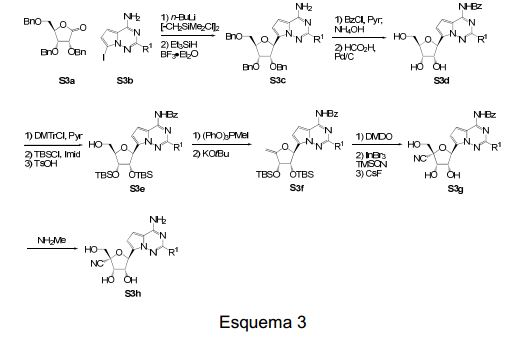
[00122] O Esquema 3 mostra uma síntese geral de compostos co- meçando com reação de troca de lítio-halogênio (por exemplo, n-BuLi, [-CH2SiMe2Cl]2) com uma nucleobase apropriada S3b, seguido pelaadição à lactona S3a. Redução do grupo hidroxila 1’ pendente sob condições ácidas Lewis (por exemplo, BF^Et2O, Et3SiH) gera interme-diário S3c. O intermediário S3c pode ser primeiro protegido (por exemplo, BzCl, Pyr; NH4OH) na funcionalidade nitrogênio, e os grupos benzila podem ser então removidos sob condições de redução (por exemplo, HCO2H, Pd/C, BCl3, BBr3) para fornecer o intermediário S3d. Uma sequência envolvendo primeiro proteção de hidroxila 5’ seletiva (por exemplo, DMTrCl) então proteção de hidroxila 2’ e 3’ (por exemplo, TBSCl), seguido por remoção seletiva do grupo de proteção hidro- xila 5’ sob condições ácidas (por exemplo, TsOH) fornece o intermediário S3e. O grupo hidroxila 5’ pode então ser convertido no iodeto correspondente (por exemplo, (PhO)3PMeI), que é então exposto a condições básicas (isto é, KOtBu) para realizar uma reação de eliminação gerando intermediário S3f. Oxidação da olefina S3f (por exemplo, DMDO) seguido por tratamento com um nucleófilo adequado (por exemplo, TMSCN) sob condições ácidas Lewis (por exemplo, InBr3) e remoção dos grupos de proteção de hidroxila (por exemplo, CsF) fornece intermediário S3g. Remoção do grupo de proteção de nitrogênio (por exemplo, NH2Me) fornece os compostos finais do tipo S3h.
[00123] O Esquema 4 mostra uma síntese geral de compostos co-meçando com oxidação da olefina S3f (por exemplo, DMDO) seguido por tratamento com um nucleófilo apropriado (por exemplo, TMSN3) sob condições ácidas Lewis (por exemplo, InBr3) de uma maneira similar àquela descrita em J. Med. Chem. 2007, 50, 5463-5470. Remoção dos grupos de proteção hidroxila (por exempl, CsF) então fornece o intermediário S4a. Remoção do grupo de proteção nitrogênio (por exemplo, NH2Me) fornece os compostos finais do tipo S4b.
[00124] O Esquema 5 mostra uma síntese geral de compostos co-meçando com oxidação da olefina S3f (por exemplo, DMDO) na presença do álcool apropriado HORa seguido por remoção dos grupos de proteção de hidroxila (por exemplo, CsF) para fornecer intermediárioS5a. Remoção do grupo de proteção de nitrogênio (por exemplo,NH2Me) fornece os compostos finais do tipo S5b.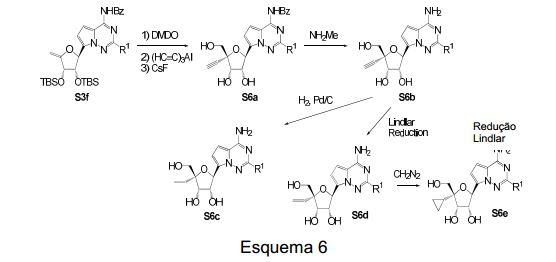
[00125] O Esquema 6 mostra uma síntese geral de compostos co- meçando com oxidação da olefina S3f (por exemplo, DMDO) seguidopor tratamento com um nucleófilo adequado (por exemplo, (HC=C)3Al) de uma maneira similar àquela descrita em Nucleosides, Nucleotides, and Nucleic Acids 2005, 24, 343-347. Remoção dos grupos de proteção hidroxila (por exemplo, CsF) então fornece intermediário S6a. Remoção do grupo de proteção de nitrogênio (por exemplo, NH2Me) fornece os compostos finais do tipo S6b. Elaboração do composto final através de condições de hidrogenação (por exemplo, H2, Pd/C ou con dições de Lindlar) pode seletivamente fornecer os compostos finais do tipo S6c e Sd6, respectivamente. Elaboração do composto final S6d através de condições de ciclopropanação (por exemplo, CH2N2) podefornecer o composto final do tipo S6e.
[00126] O Esquema 7 mostra uma síntese geral de compostos co-meçando com uma sequência sintética para proteger o nitrogênio (por exemplo, TMSCl, Pyr; BzCl, Pyr; NH4OH) de intermediário S7a, sinteti-zado de uma maneira similar à descrita no WO2012037038A1. Proteção seletiva do grupo hidroxila 5’ (por exemplo, DMTrCl) então gera in-termediário S7b. Proteção do grupo hidroxila 2’ (por exemplo, TBSCl) seguido por remoção do grupo hidroxila 5’ sob condições ácidas (por exemplo, TsOH) fornece intermediário S7e. Conversão do grupo hidroxi- la 5’ no aldeído sob condições oxidativas (por exemplo, EDCI-HCl, Pyr, TFA, DMSO) seguido por condensação do enolato correspondente com formaldeído e redução (por exemplo, NaBH4) fornece intermediário S7f. Proteção seletiva sequencial das porções hidroxila com grupos de proteção ortogonais (por exemplo, DMTrCl e TBSCl) seguido por remoção do grupo de proteção mais lábil sob condições ácidas (por exemplo, TsOH) então fornece o intermediário S7g. Conversão do grupo hidroxila no aldeído sob condições oxidativas (por exemplo, EDCI-HCl, Pyr, TFA, DMSO) gera intermediário S7h. Elaboração do aldeído S7h no intermediário halo-olefina S7i pode ser realizada sob condições de olefinação Wittig (por exemplo, [Ph3PCH2Br]+Br-, KOtBu). Uma reação de eliminação sob condições básicas (por exemplo, KOt- Bu) gera a alcina, e remoção dos grupos de proteção hidroxila (por exemplo, TBAF) e grupo de proteção de nitrogênio (por exemplo, NH4OH) fornece os compostos finais do tipo S7j.
[00127] O Esquema 8 mostra uma síntese geral de compostos co-meçando com formação de oxima (por exemplo, NH2OH^HCl), seguido por conversão da oxima em um grupo nitrila (por exemplo, CDl). Re-moção do grupo de proteção de nitrogênio (por exemplo, NH4OH) e grupos de proteção hidroxila (por exemplo, HF^Pyr) então fornece os compostos finais do tipo S8a.
[00128] O Esquema 9 mostra uma síntese geral de compostos começando com a elaboração do aldeído S7h para a olefina com condiPetição 870160018140, de 06/05/2016, pág. 58/219ções de olefinação Wittig (por exemplo, [Ph3PCH3]+Br-, KOtBu). Remo-ção dos grupos de proteção hidroxila (por exemplo, TBAF) e grupo deproteção de nitrogênio (por exemplo, NH4OH) fornece os compostosfinais do tipo S9a. Condições de redução (por exemplo, H2, Pd/C) então podem gerar os compostos finais do tipo S9b e condições de ciclopropanação (por exemplo, CH2N2) podem gerar os compostos finais dotipo S9c.
[00129] O Esquema 10 mostra uma síntese geral de compostoscomeçando com uma reação Appel (por exemplo, Ph3P, CCl4) paraconverter o grupo hidroxila em um cloro. Remoção dos grupos de proteção hidroxila (por exemplo, TBAF) e grupo de proteção de nitrogênio(por exemplo, NH4OH) fornece os compostos finais do tipo S10a
[00130] O Esquema 11 mostra uma síntese geral de compostoscomeçando com proteção do grupo hidroxila livre de intermediário S7g com um grupo de proteção lábil (por exemplo, PMBCl, K2CO3). Remoção seletiva dos grupos de proteção sililóxi 2’ e 5’ (por exemplo, TBAF), seguido por reproteção com grupos de proteção robustos (por exemplo, BnBr, NaH) e remoção do grupo de proteção hidroxila lábil sob condições ácidas (por exemplo, AcOH) fornece intermediário S11a. Conversão do grupo hidroxila no flúor (por exemplo, DAST) seguido por remoção dos grupos de proteção de hidroxila (por exemplo, BBr3) e grupo de proteção de nitrogênio (por exemplo, NH4OH) fornece os compostos finais do tipo S11b.
[00131] O Esquema 12 mostra uma síntese geral de compostos começando com conversão do grupo hidroxila 5’ no iodeto correspon-dente (por exemplo, (PhO)3PMeI), que é então tratado com condições básicas (isto é, KOtBu) para realizar uma reação de eliminação gerando intermediário S12a. Oxidação da olefina S12a (por exemplo, DMDO) seguido por tratamento com um nucleófilo apropriado (por exemplo, TMSN3) sob condições ácidas Lewis (por exemplo, SnCl4) de uma ma-neira similar àquela descrita em J. Med. Chem. 2007, 50, 5463-5470, e remoção dos grupos de proteção hidroxila (por exemplo, CsF) e grupo de proteção nitrogênio (por exemplo, NH4OH) fornece os compostos finais do tipo S12b.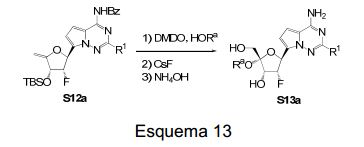
[00132] O Esquema 13 mostra uma síntese geral de compostos começando com oxidação da olefina S12a (por exemplo, DMDO) na presença do álcool apropriado HORa e remoção dos grupos de proteção hidroxila (por exemplo, CsF). Remoção do grupo de proteção de nitrogênio (por exemplo, NH2Me) fornece os compostos finais do tipo S13a.
[00133] O Esquema 14 mostra uma síntese geral de compostos começando com formação de xantana (por exemplo, PhOC(S)Cl,DMAP) seguido por uma reação de desoxigenação Barton-McCombie (por exemplo, (TMS)3SiH, AIBN) para gerar intermediários S14a. Re-moção dos grupos de proteção hidroxila (por exemplo, TBAF) e grupo de proteção de nitrogênio (por exemplo, NH4OH) fornece os compos-tos finais do tipo S14b.
[00134] O Esquema 15 mostra uma síntese geral de compostos começando com intermediário S15a preparado de uma maneira similar àquela descrita em Biosci. Biotech. Biochem. 1993, 57, 1433-1438. Remoção dos grupos de proteção de acetato usando condições hidro- líticas (por exemplo, K2CO3, MeOH), seguido por condições de oxidação quimiosseletivas (por exemplo, NIS, Bu4NI) e proteção do grupo hidroxila 2’ (por exemplo, BnBr, Ag2O) gera intermediário S15b. Troca de lítio-halogênio (por exemplo, n-BuLi, [-CH2SiMe2Cl]2) com uma nu- cleobase apropriada S3b e adição à lactona S15b, seguido por redução do grupo hidroxila 1’ sob condições ácidas Lewis (por exemplo, BF^Et2O, Et3SiH) e desproteção (por exemplo, H2, Pd negro), fornece os compostos finais do tipo S15c. Esquema 16
[00135] O Esquema 16 mostra uma síntese geral de compostos começando com conversão do grupo hidroxila 5’ no aldeído sob condi-ções oxidativas (por exemplo, EDCI-HCl, Pyr, TFA, DMSO) seguido por condensação do enolato correspondente com formaldeído e redução (por exemplo, NaBH4) para fornecer intermediário S16a. Proteção seletiva sequencial das porções hidroxila com grupos de proteção ortogonais (por exemplo, DMTrCl e TBSCl) seguido por remoção do grupo de proteção mais lábil sob condições ácidas (por exemplo, TsOH) então fornece intermediário S16b. Uma reação Appel (por exemplo, Ph3P, CCl4) então pode converter o grupo hidroxila em um cloro, e remoção dos grupos de proteção hidroxila (por exemplo, TBAF) e grupo de proteção nitrogênio (por exemplo, NH4OH) fornece os compostos finais do tipo S16c.
[00136] O Esquema 17 mostra uma síntese geral começando com proteção do grupo hidroxila livre de intermediário S16b com um grupo de proteção lábil (por exemplo, PMBCl, K2CO3). Remoção seletiva dos grupos de proteção sililóxi 2’, 3’ e 5’ (por exem- plo, TBAF), seguido por reproteção dos grupos de proteção robustos (por exemplo, BnBr, NaH) e remoção do grupo de proteção hidroxila lábil sob condições ácidas (por exemplo, AcOH) fornece intermediário S17a. Conversão do grupo hidroxila no flúor (por exemplo, DAST) seguido por remoção dos grupos de proteção hidroxila (por exemplo, BBr3) e grupo de proteção de nitrogênio (por exemplo, NH4OH) fornece os compostos finais do tipo S17b.
[00137] O Esquema 18 mostra uma síntese geral de compostos através de reações de halogenação eletrofílica apropriadas de intermediário S18a para fornecer os compostos finais do tipo S18b (por exemplo, NCS), S18c (por exemplo, NIS) e S18d (por exemplo, Select-fluor).
[00138] O Esquema 19 mostra uma síntese geral de compostos começando com uma reação de acoplamento cruzado (por exemplo, Zn(CN)2, Pd(PtBu)3) para fornecer os compostos finais do tipo S19a. O composto S19a pode ser então elaborado através de uma reação de hidrólise da nitrila (por exemplo, H2O2,compostos do tipo S19b.
[00139] O Esquema 20 mostra uma síntese geral de compostos começando com uma reação Sonogashira (por exemplo, CuI,PdCl2(PPh3)2) para fornecer os compostos finais do tipo S20a.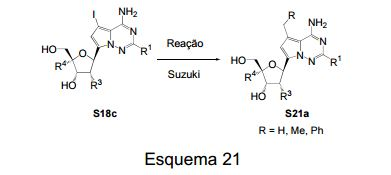
[00140] O Esquema 21 mostra uma síntese geral de compostos começando com uma reação de acoplamento cruzado (por exemplo,Pd(dppf)Cl2, Cs2CO3) para fornecer os compostos finais do tipo S21a.
[00141] O Esquema 22 mostra uma síntese geral de compostos en-volvendo síntese de análogos fosforilados do tipo S22b.
[00142] O Esquema 23 mostra uma síntese geral de compostos en-volvendo síntese de análogos fosforilados do tipo S23b.
[00143] O Esquema 24 mostra uma síntese geral de compostos en-volvendo síntese de análogos fosforilados do tipo S24b.Experimentais
[00144] A uma solução de intermediário 1a (50 mg, 373 mmol) emDMF (1 mL) foi carregada N-iodossuccinimida (84 mg, 373 mmol) como um sólido em RT. Após 1,5 h, a mistura de reação foi diluída com solução de NaOH 1M (10 mL) e a pasta fluida resultante foi agitada em RT. Após 1 h, os sólidos foram coletados através de filtragem a vácuo e secos sob pressão reduzida para fornecer intermediário 1b.1H NMR (400 MHz, DMSO-d6) δ 7,89 (s, 1H), 7,78 (s amplo, 1H), 6,98 (d, J = 4,4 Hz, 1H), 6,82 (d, J = 4,4 Hz, 1H), 3,30 (s amplo, 1H).LC/MS: tR = 1,21 min, MS m/z = 261,02 [M+1]; Sistema LC: Thermo Accela 1250 UHPLC Sistema MS: Thermo LCQ Fleet; Coluna: Kinetex 2,6μ XB- C18 100A, 50 x 4,6 mmSolventes: Acetonitrila com ácido acético 0,1%, Água com ácido acético 0,1%; Gradiente: 0 min-2,0 min ACN 2-100%, 2,0 min- 3,05 min ACN 100%, 3,05 min-3,2 min ACN 100%-2%, 3,2 min-3,5 min ACN 2% 2μl/min.HPLC: tr = 1,536 min; Sistema HPLC: série Agilent 1100; Coluna: Gemini 5μ C18 110A, 50 x 4,6 mm; Solventes: Acetonitrila com TFA 0,1%, Água com TFA 0,1%; Gradiente: 0 min-5,0 min ACN 298%, 5,0 min-6,0 min ACN 98% a 2 mL/min.
[00145] n-Butillítio (2,5M em hexanos, 34,4 mL, 86,0 mmol) foi adicionado rapidamente a uma suspensão de 7-iodopirrolo[pirrolo[1,2-f] [1,2,4]triazin-4-amina 1b (6,84 g, 26,3 mmol) e 1,2-bis(clorodimetilsilil) etano (5,66 g, 26,3 mmol) em THF (200 mL) a -78°C sob uma atmosfera de argônio. Durante o curso da adição a temperatura interna da mistura de reação aumentou para -40,5°C e a mistura de reação se tornou uma solução marrom claro. Depois de 15 minutos, uma solução de (3R,4R,5R)-3,4-bis(benziloxi)-5-(benziloximetil)di-hidrofuran-2(3H)-ona (1c, comprada da Carbosynth, 10 g, 23,9 mmol) em tetra-hidrofurano (40 mL) pré-esfriada para -78°C foi adicionada rapi damente através de cânula. Após 1 h, a mistura de reação foi extinta com ácido acético (15 mL) e a mistura resultante foi deixada aquecer para RT. A mistura resultante foi diluída com acetato de etila (800 mL) e foi lavada com solução de bicarbonato de sódio aquosa saturada (500 mL) e salmoura (500 mL). A camada orgânica foi seca em sulfato de sódio anidro e foi concentrada sob pressão reduzida. O resíduo bruto foi purificado através de cromatografia de coluna SiO2 (Combiflash HP Gold Column SiO2 220 g, acetato de etila/hexanos 0-100%) para intermediário 1d.LC/MS: tR = 1,50 min, MS m/z = 553,34 [M+1]; Sistema LC: Thermo Accela 1250 UHPLCSistema MS: Thermo LCQ Fleet; Coluna: Kinetex 2,6μ XB- C18 100A, 50 x 4,6 mmSolventes: Acetonitrila com ácido acético 0,1%, Água com ácido acético 0,1%; Gradiente: 0 min-1,5 min ACN 2-100%, 1,5 min- 2,2 min ACN 100%, 2,2 min-2,4 min ACN 100%-2%, 2,4 min-2,5 min ACN 2%.HPLC: tr = 3,442 min; Sistema HPLC: série Agilent 1100; Coluna: Gemini 5μ C18 110A, 50 x 4,6 mm; Solventes: Acetonitrila com TFA 0,1%, Água com TFA 0,1%; Gradiente: 0 min-5,0 min ACN 298%, 5,0 min-6,0 min ACN 98%a 2 mL/min.TLC: eluente: acetato de etila, Rf = 0,5 (UV)
[00146] A uma solução de intermediário 1d (4,74 g, 8,58 mmol) e trietilsilano (3,56 mL, 22,3 mmol) em DCM (43 mL) foi adicionado dietil eterato de trifluoreto de boro (1,59 ml, 12,9 mmol) lentamente através de seringa a 0°C sob uma atmosfera de argônio. Depo is de 2 h, a mistura de reação foi lentamente diluída com solução de bicarbonato de sódio aquosa saturada (100 mL) e a mistura resultante foi extraída com acetato de etila (2 x 150 mL), foi seca em sulfato de sódio anidro e foi concentrada sob pressão reduzida. O resíduo bruto foi purificado através de cromatografia de coluna SiO2 (Combiflash HP Gold Column SiO2 24 g, acetato de etila/hexanos 0-100%) para fornecer intermediário 1e.1H NMR (400 MHz, CDCl3) δ 7,88 (s, 1H), 7,37 - 7,22 (m, 15H), 6,73 (d, J = 4,6 Hz, 1H), 6,71 (d, J = 4,6 Hz, 1H), 5,66 (d, J = 4,2 Hz, 1H), 4,71 (s, 2H), 4,60 (d, J = 12,0 Hz, 1H), 4,54 (s, 2H), 4,45 (d, J = 11,9 Hz, 1H), 4,39 (dt, J = 7,1, 3,6 Hz, 1H), 4,25 (t, J = 4,6 Hz, 1H), 4,14 - 4,10 (m, 1H), 3,78 (dd, J = 10,7, 3,4 Hz, 1H), 3,65 (dd, J = 10,7, 4,0 Hz, 1H).LC/MS: tR = 2,01 min, MS m/z = 537,41 [M+1]; Sistema LC: Thermo Accela 1250 UHPLCSistema MS: Thermo LCQ Fleet; Coluna: Kinetex 2,6μ XB- C18 100A, 50 x 4,6 mm; Solventes: Acetonitrila com ácido acético 0,1%, Água com ácido acético 0,1%; Gradiente: 0 min-1,5 min ACN 2100%, 1,5 min-2,2 min ACN 100%, 2,2 min-2,4 min ACN 100%-2%, 2,4 min-2,5 min ACN 2%a 2μl/min.HPLC: tR = 3,596 min; Sistema HPLC: série Agilent 1100; Coluna: Gemini 5μ C18 110A, 50 x 4,6 mm; Solvenets: Acetonitrila com TFA 0,1%, Água com TFA 0,1%; Gradiente: 0 min-5,0 min ACN 298%, 5,0 min-6,0 min ACN 98%a 2 mL/min.TLC: eluente: acetato de etila, Rf = 0,3 (UV)
[00147] A uma solução de intermediário 1e (3,94 g, 7,34 mmol) em piridina (36,7 mL) foi adicionado cloreto de benzoíla (1,69 mL, 14,68 mmol) lentamente em RT sob uma atmosfera de argônio. Após 1 h, mais cloreto de benzoíla (1,69 ml, 14,68 mmol) foi adicionado lentamente. Após 19 h, água (20 mL) foi adicionada lentamente e a mistura de reação se tornou levemente nebulosa. Hidróxido de amônio (~10 mL) foi então lentamente adicionado até que a mistura de reação ficasse básica em pH=10. Depois de 1h, água (150 mL) foi adicionada em gotas através de funil de adição e sólidos brancos começaram a precipitar lentamente a partir da mistura de reação durante o curso da adição. A mistura resultante foi agitada por 24 h e os sólidos brancos foram coletados através de filtragem a vácuo e foram secos azeotropi- camente a partir de tolueno para fornecer intermediário 1f.1H NMR (400 MHz, CDCl3) δ 8,23 (s amplo, 1H), 7,62 (t, J = 7,8 Hz, 1H), 7,53 (t, J = 7,6 Hz, 2H), 7,38 - 7,21 (m, 18H), 7,17 (d, J = 7,6 Hz, 1H), 5,69 (d, J = 4,1 Hz, 1H), 4,71 (s, 2H), 4,63 - 4,44 (m, 4H), 4,43 - 4,39 (m, 1H), 4,22 (t, J = 4,5 Hz, 1H), 4,15 - 4,10 (m, 1H), 3,79 (dd, J = 10,8, 3,2 Hz, 1H), 3,65 (dd, J = 10,7, 3,7 Hz, 1H).LC/MS: tR = 1,91 min, MS m/z = 641,18 [M+1]; sistema LC: Thermo Accela 1250 UHPLCSistema MS: Thermo LCQ Fleet; Coluna: Kinetex 2,6μ XB-C18 100A, 50 x 4,6 mm; Solventes: Acetonitrila com ácido acético 0,1%, Água com ácido acético 0,1%; Gradiente: 0 min-1,5 min ACN 2-100%, 1,5 min-2,2 min ACN 100%, 2,2 min-2,4 min ACN 100%-2%, 2,4 min- 2,5 min ACN 2% a 2μl/min.TLC: eluente: acetato de etila 50% em hexanos, Rf= 0,6 (UV)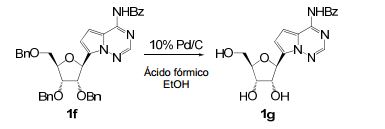
[00148] Etanol (68,5 mL) e ácido fórmico (51,7 mL, 1,37 mol) foram adicionados sequencialmente a uma mistura de intermediário 1f (4,39 g, 6,85 mmol) e paládio sobre carbono (10% em peso, 2,2 g) em RT sob uma atmosfera de argônio. Após 3 d, a mistura de reação foi filtrada em uma almofada de celite e o filtrado foi concentrado sob pressão reduzida. O resíduo bruto foi azeotropado com tolueno (3 x 20 mL) para fornecer intermediário 1g, que foi usado diretamente na etapa seguinte sem purificação adicional. 1H NMR (400 MHz, CD3OD) δ 8,15 (s, 1H), 7,67 - 7,40 (m, 5H), 7,23 (d, J = 4,7 Hz, 1H), 7,00 (d, J = 4,7 Hz, 1H), 5,40 (d, J = 6,0 Hz, 1H), 4,44 (t, J = 5,7 Hz, 1H), 4,17 (t, J = 5,1 Hz, 1H), 4,03 (q, J = 4,3 Hz, 1H), 3,81 (dd, J = 12,1, 3,5 Hz, 1H), 3,71 (dd, J = 12,0, 4,5 Hz, 1H).LC/MS: tR = 1,04 min, MS m/z = 371,15 [M+1]; sistema LC:Thermo Accela 1250 UHPLCSistema MS: Thermo LCQ Fleet; Coluna: Kinetex 2,6μ XB- C18 100A, 50 x 4,6 mmSolventes: Acetonitrila com ácido acético 0,1%, Água com ácido acético 0,1%; Gradiente: 0 min-1,5 min ACN 2-100%, 1,5 min- 2,2 min ACN 100%, 2,2 min-2,4 min ACN 100%-2%, 2,4 min-2,5 min ACN 2% a 2μl/min;HPLC: tR = 2,055 min; sistema HPLC: série Agilent 1100; Coluna: Gemini 5μ C18 110A, 50 x 4,6 mm; Solventes: Acetonitrila com TFA 0,1%, Água com TFA 0,1%; Gradiente: 0 min-5,0 min ACN 298%, 5,0 min-6,0 min ACN 98% a 2 mL/min.
[00149] Cloreto de 4,4’-dimetoxitritila (2,23 g, 6,59 mmol) foi adicionado como um sólido em uma porção a uma solução de intermediário 1g (2,44 g, 6,59 mmol) em piridina (32,5 mL) em RT. Após 5,5 h, a mistura de reação foi diluída com acetato de etila (300 mL) e a mistura resultante foi lavada com salmoura (3 x 200 mL). A camada orgânica foi concentrada sob pressão reduzida e o resíduo bruto foi purificado através de cromatografia de coluna de SiO2 (Combiflash HP Gold Column SiO2 80 g, acetato de etila/hexanos 0-100%) para fornecer intermediário 1h.LC/MS: tR = 1,68 min, MS m/z = 673,22 [M+1]; sistema LC: Thermo Accela 1250 UHPLCSistema MS: Thermo LCQ Fleet; Coluna: Kinetex 2,6μ XB- C18 100A, 50 x 4,6 m;Solventes: Acetonitrila com ácido acético 0,1%, Água com ácido acético 0,1%; Gradiente: 0 min-1,5 min ACN 2-100%, 1,5 min- 2,2 min ACN 100%, 2,2 min-2,4 min ACN 100%-2%, 2,4 min-2,5 min ACN 2% a 2μl/min.HPLC: tR = 4,270 min; sistema HPLC: série Agilent 1100; Coluna: Gemini 5μ C18 110A, 50 x 4,6 mm; Solventes: Acetonitrila com TFA 0,1%, Água com TFA 0,1%; Gradiente: 0 min-5,0 min ACN 298%, 5,0 min-6,0 min ACN 98% a 2 mL/min.TLC: eluente: acetato de etila 50% em hexanos, Rf = 0,15 (UV)
[00150] Cloreto de terc-butildimetilsilila (2,47 g, 16,4 mmol) foi adicionado a uma solução de intermediário 1h (1,84 g, 2,74 mmol) e imi- dazol (2,23 g, 32,8 mmol) em N,N-dimetilformamida (28,2 mL) em RT. Após 17 h, solução de bicarbonato de sódio aquosa saturada (500 mL) foi adicionada lentamente à mistura de reação. A mistura resultante foi extraída com acetato de etila (500 ml) e a camada orgânica foi lavada com salmoura (2 x 400 mL), foi seca em sulfato de sódio anidro e foi concentrada sob pressão reduzida. O resíduo bruto foi purificado através de cromatografia de coluna de SiO2 (Combiflash HP Gold Column SiO2 80 g, acetato de etila/hexanos 0-100%) para fornecer o intermediário 1i.LC/MS: tR = 3,43 min, MS m/z = 901,37 [M+1]; sistema LC: Thermo Accela 1250 UHPLCSistema MS: Thermo LCQ Fleet; Coluna: Kinetex 2,6μ XB- C18 100A, 50 x 4,6 mmSolventes: Acetonitrila com ácido acético 0,1%, Água com ácido acético 0,1%; Gradiente: 0 min-2,0 min ACN 2-100%, 2,0 min- 3,55 min ACN 100%, 3,55 min-4,2 min 100%-ACN 2% a 2μl/minHPLC: tR = 5,724 min; sistema HPLC: série Agilent 1100; Coluna: Gemini 5μ C18 110A, 50 x 4,6 mm; Solventes: Acetonitrila com TFA 0,1%, Água com TFA 0,1%; Gradiente: 0 min-5,0 min ACN 298%, 5,0 min-6,0 min ACN 98% a 2 mL/min.TLC: eluente: acetato de etila 50% em hexanos, Rf = 0,75 (UV)
[00151] Uma solução de monoidrato do ácido p-toluenossulfônico (509 mg, 2,67 mmol) em metanol (3,7 mL) foi lentamente adicionada a uma solução de intermediário 1i (2,41 g, 2,67 mmol) em diclorometano (22,3 mL) a 0°C. Após 1,5 h, a mistura de reação fo i diluída com solução de bicarbonato aquosa saturada (100 mL) e a mistura resultante foi extraída com diclorometano (2 x 100 mL). Os extratos orgânicos combinados foram secos em sulfato de sódio anidro e foram concentrados sob pressão reduzida. O resíduo bruto foi purificado através de cromatografia de coluna de SiO2 (Combiflash HP Gold Column SiO2 120 g, acetato de etila/hexanos 0-100%) para fornecer intermediário 1j.1H NMR (400 MHz, CDCl3) δ 8,72 (s amplo, 1H), 8,16 (t amplo, J = 7,1 Hz, 2H), 8,07 (t amplo, J = 7,7 Hz, 3H), 7,49 - 7,43 (m, 1H), 5,75 (d, J = 8,2 Hz, 1H), 5,28 (dd, J = 8,1, 4,7 Hz, 1H), 4,81 (d, J = 5,0 Hz, 1H), 4,70 - 4,63 (m, 1H), 4,44 (d, J = 12,3 Hz, 1H), 4,24 (d, J = 12,4 Hz, 1H), 1,48 (s, 9H), 1,30 (s, 9H), 0,65 (s, 3H), 0,64 (s, 3H), 0,41 (s, 3H), 0,00 (s, 3H).LC/MS: tR = 2,66 min, MS m/z = 599,19 [M+1]; sistema LC: Thermo Accela 1250 UHPLCSistema MS: Thermo LCQ Fleet; Coluna: Kinetex 2,6μ XB- C18 100A, 50 x 4,6 mmSolventes: Acetonitrila com ácido acético 0,1%, Água com ácido acético 0,1%; Gradiente: 0 min-2,0 min ACN 2-100%, 2,0 min- 3,05 min ACN 100%, 3,05 min-3,2 min ACN 100%-2%, 3,2 min-3,5 min ACN 2% a 2μl/min.HPLC: tR = 5,622 min; sistema HPLC: série Agilent 1100; Coluna: Gemini 5μ C18 110A, 50 x 4,6 mm; Solventes: Acetonitrila com TFA 0,1%, Água com TFA 0,1%; Gradiente: 0 min-5,0 min ACN 2- 98%, 5,0 min-6,0 min ACN 98% a 2 mL/min.TLC: eluente: acetato de etila 50% em hexanos, Rf = 0,55
[00152] O intermediário 1j (1,19 g, 1,99 mmol) foi adicionado a uma solução de iodeto de metiltrifenoxifosfônio (0,99 g, 2,19 mmol) em DMF (9,9 mL) em RT. Após 3 h, uma porção adicional de iodeto de metiltrifenoxifosfônio (0,99 g, 2,19 mmol) foi adicionada. Após 1 h, A mistura de reação foi diluída com acetato de etila (200 mL) e foi lavada com salmoura (3 x 100 mL). A camada orgânica foi seca em sulfato de sódio anidro e foi concentrada sob pressão reduzida. O resíduo bruto foi purificado através de cromatografia de coluna de SiO2 (Combiflash HP Gold Column SiO2 80 g, acetato de etila 0-100%/hexanos) para fornecer intermediário 1k.1H NMR (400 MHz, CDCl3) δ 8,21 (s amplo, 1H), 7,61 (t amplo, J = 7,2 Hz, 1H), 7,53 (t amplo, J = 7,5 Hz, 3H), 7,05 (s amplo, 1H), 5,44 (d, J = 4,5 Hz, 1H), 4,52 (t, J = 4,3 Hz, 1H), 4,08 - 3,99 (m, 2H), 3,55 (dd, J = 10,7, 5,2 Hz, 1H), 3,38 (dd, J = 10,7, 5,0 Hz, 1H), 0,93 (s, 9H), 0,85 (s, 9H), 0,16 (s, 3H), 0,11 (s, 3H), -0,01 (s, 3H), -0,11 (s, 1H).LC/MS: tR = 3,06 min, MS m/z = 709,16 [M+1]; sistema LC: Thermo Accela 1250 UHPLCSistema MS: Thermo LCQ Fleet; Coluna: Kinetex 2,6μ XB- C18 100A, 50 x 4,6 mm Solventes: Acetonitrila com ácido acético 0,1%, Água com ácido acético 0,1%; Gradiente: 0 min-2,0 min ACN 2-100%, 2,0 min- 3,05 min ACN 100%, 3,05 min-3,2 min ACN 100%-2%, 3,2 min-3,5 min ACN 2% a 2μl/min.HPLC: tR = 5,837 min; sistema HPLC: série Agilent 1100; Coluna: Gemini 5μ C18 110A, 50 x 4,6 mm; Solventes: Acetonitrila com TFA 0,1%, Água com TFA 0,1%; Gradiente: 0 min-5,0 min ACN 298%, 5,0 min-6,0 min ACN 98% a 2 mL/min.TLC: eluente: acetato de etila 20% em hexanos, Rf = 0,45 (UV)
[00153] t-Butóxido de potássio (700 mg, 6,24 mmol) foi adicionado a uma solução de intermediário 1k (1,77 g, 2,5 mmol) em piridina (25 mL) em RT. Após 2 h, a mistura de reação foi diluída com solução de bicarbonato de sódio aquosa saturada (25 mL) e salmoura (200 mL). A mistura resultante foi extraída com acetato de etila (300 mL). A camada orgânica foi então lavada com salmoura (200 mL), foi seca em sulfato de sódio anidro e foi concentrada sob pressão reduzida. O resíduo bruto foi purificado através de cromatografia de coluna de SiO2 (Com- biflash HP Gold Column SiO2 40 g, acetato de etila/hexanos 0-100%) para fornecer intermediário 1l.LC/MS: tR = 2,87 min, MS m/z = 581,37 [M+1]; sistema LC: Thermo Accela 1250 UHPLCSistema MS: Thermo LCQ Fleet; Coluna: Kinetex 2,6μ XB- C18 100A, 50 x 4,6 mmSolventes: Acetonitrila com ácido acético 0,1%, Água com ácido acético 0,1%Gradiente: 0 min-2,0 min ACN 2-100%, 2,0 min-3,05 min ACN 100%, 3,05 min-3,2 min ACN 100%-2%, 3,2 min-3,5 min ACN 2% a 2μl/min.HPLC: tR = 5,750 min; sistema HPLC: série Agilent 1100; Coluna: Gemini 5μ C18 110A, 50 x 4,6 mm; Solventes: Acetonitrila com TFA 0,1%, Água com TFA 0,1%; Gradiente: 0 min-5,0 min ACN 298%, 5,0 min-6,0 min ACN 98% a 2 mL/min.TLC: eluente: acetato de etila 50% em hexanos, Rf = 0,20 (UV)
[00154] DMDO (solução 0,07M em acetona, 13,8 mL, 0,964 mmol) foi adicionado a um solução de intermediário 1l (560 mg, 0,964 mmol) em acetona (4,82 mL) a 0°C. Após 10 min, a mistura de reação que foi concentrada sob pressão reduzida foi seca azeotropicamente com to- lueno (2 x 10 mL) para fornecer 1m que foi usado imediatamente na etapa seguinte sem purificação adicional.LC/MS: tR = 2,57 min, MS m/z = 615,14 [M+1]; sistema LC: Thermo Accela 1250 UHPLCSistema MS: Thermo LCQ Fleet; Coluna: Kinetex 2,6μ XB- C18 100A, 50 x 4,6 mm Solventes: Acetonitrila com ácido acético 0,1%, Água com ácido acético 0,1%Gradiente: 0 min-2,0 min ACN 2-100%, 2,0 min-3,05 minACN 100%, 3,05 min-3,2 min ACN 100%-2%, 3,2 min-3,5 min ACN 2% a 2μl/min.
[00155] A uma solução de intermediário bruto 1m (~592 mg, ~0,964 mmol) e cianida de trimetilsilila (640 μl, 4,80 mmol) em diclorometano (19,2 mL) foi adicionado brometo de índio (III) (681 mg, 1,92 mmol) a 0°C sob atmosfera de argônio. Após 4,5 h, a mistura de reação foi extinta com solução de bicarbonato de sódio aquosa saturada (6 mL) e foi deixada aquecer para temperatura ambiente. A mistura resultante foi dividida entre diclorometano (20 mL) e solução de bicarbonato de sódio aquosa saturada (20 mL). As fases foram separadas e a camada aquosa foi extraída com diclorometano (20 mL). As camadas orgânicas combinadas foram secas em sulfato de sódio anidro e foram con-centradas sob pressão reduzida para fornecer intermediário 1n (mistura diastereomérica 1:1) (710 mg) que foi usada diretamente na etapa seguinte sem purificação adicional.LC/MS: primeiro isomer de eluição tr = 2,91 min, MS m/z = 696,28 [M+1], segundo isômero de eluição tR = 3,02 min, MS m/z = 696,19 [M+1]; sistema LC: Thermo Accela 1250 UHPLCSistema MS: Thermo LCQ Fleet; Coluna: Kinetex 2,6μ XB- C18 100A, 50 x 4,6 mm Solventes: Acetonitrila com ácido acético 0,1%, Água com ácido acético 0,1%; Gradiente: 0 min-2,0 min ACN 2-100%, 2,0 min- 3,05 min ACN 100%, 3,05 min-3,2 min ACN 100%-2%, 3,2 min-3,5 min ACN 2% a 2 μl/min.
[00156] A uma solução de intermediário bruto 1n (668,23 mg, 0,96 mmol) em DMF (9,6 mL) foi adicionado fluoreto de césio (729 mg, 4,8 mmol) em RT. Depois de 5 h, a mistura de reação foi diluída com salmoura (100 mL) e a mistura resultante foi extraída com diclorometano (3 x 100 mL). As camadas orgânicas combinadas foram secas em sulfato de sódio anidro e foram concentradas sob pressão reduzida para fornecer intermediário 1o (mistura diastereomérica 1:1) que foi usado diretamente na etapa seguinte sem purificação adicional.LC/MS: primeiro isômero de eluição tR = 1,31 min, MS m/z = 396,19 [M+1], segundo isômero de eluição tR = 1,32 min, MS m/z = 396,19 [M+1]; sistema LC: Thermo Accela 1250 UHPLCSistema MS: Thermo LCQ Fleet; Coluna: Kinetex 2,6μ XB- C18 100A, 50 x 4,6 mmSolventes: Acetonitrila com ácido acético 0,1%, Água com ácido acético 0,1%; Gradiente: 0 min-2,0 min ACN 2-100%, 2,0 min- 3,05 min ACN 100%, 3,05 min-3,2 min ACN 100%-2%, 3,2 min-3,5 min ACN 2% a 2 μl/min.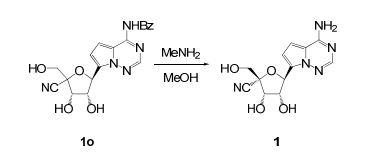
[00157] Metilamina (40% em água, 0,3 mL) foi adicionada a uma solução de intermediário 1o bruto em metanol (1 mL) em RT. Após 2,5 h, a mistura de reação foi concentrada sob pressão reduzida e foi diretamente purificada através de HPLC preparativa (coluna Phenominex Luna 5u C18 100Â 100 x 30 mm, gradiente acetonitrila/água 5-15%, 25 min). As frações contendo o produto desejado e o anômero 4’ foram combinados e foram concentrados sob pressão reduzida. Os anôme- ros 4’ foram então separados através de HPLC preparativa (coluna Phenominex Luna 5u C18 100Â 100 x 30 mm, gradiente acetonitri- la/água 5-15%, 25 min). As frações contendo o produto desejado foram combinadas e foram liofilizadas para fornecer Exemplo 1.1H NMR (400 MHz, CD3OD) δ 7,79 (s, 1H), 6,85 (d, J = 4,5 Hz, 1H), 6,76 (d, J = 4,5 Hz, 1H), 5,45 (d, J = 5,9 Hz, 1H), 4,59 (t, J = 5,7 Hz, 1H), 4,40 (d, J = 5,6 Hz, 1H), 3,88 (d, J = 12,0 Hz, 1H), 3,80 (d, J = 12,0 Hz, 1H).LC/MS: tR = 0,29 min, MS m/z = 292,16 [M+1]; sistema LC: Thermo Accela 1250 UHPLCSistema MS: Thermo LCQ Fleet; Coluna: Kinetex 2,6μ XB- C18 100A, 50 x 4,6 mmSolventes: Acetonitrila com ácido acético 0,1%, Água com ácido acético 0,1%; Gradiente: 0 min-1,5 min ACN 2-100%, 1,5 min- 2,2 min ACN 100%, 2,2 min-2,4 min ACN 100%-2%, 2,4 min-2,5 min ACN 2% a 2μl/min. HPLC: tR = 0,377 min; sistema HPLC: série Agilent 1100; Coluna: Gemini 5μ C18 110A, 50 x 4,6 mm; Solventes: Acetonitrila com TFA 0,1%, Água com TFA 0,1%; Gradiente: 0 min-5,0 min ACN 298%, 5,0 min-6,0 min ACN 98% a 2 mL/min.; HPLC: tR = 6,643 min; sistema HPLC: série Agilent 1100; Coluna: Luna 5μ C18(2) 110A, 250 x 4,6 mm; Solventes: Acetonitrila, Àgua; Gradiente: ACN 5-15% durante 10 min a 2 mL/min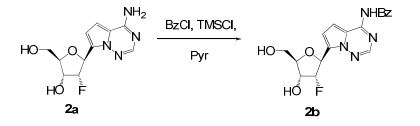
[00158] A um frasco purgado com N2 foi adicionado intermediário 2a, (2R,3R,4R,5S)-5-(4-aminopirrolo[pirrolo[1,2-f][1,2,4]triazin-7-il)-4-fluor-2-(hidroximetil)tetra-hidrofuran-3-ol (preparado de acordo com o WO2012037038A1, 1,20 g, 4,01 mmol) (seco através de co-evapora- ção com piridina 3 vezes), que foi então dissolvido em piridina (18 mL). Clorotrimetilsilano (1,54 mL, 13,13 mmol) foi adicionado em uma porção a 0°C e a mistura resultante foi agitada sob um a atmosfera de N2 por 1 h. Cloreto de benzoíla (675 μL, 5,82 mmol) foi adicionado em gotas e a mistura de reação foi agitada por 1 h. Uma porção adicional de cloreto de benzoíla (100 μL) foi adicionada para consumir o material de partida restante. Uma mistura de produtos mono- e bis-Bz protegidos foi observada. A reação foi extinta com H2O (5 mL) e a mistura resultante foi agitada por 5 min. Então NH4OH(aq) concentrado (8 mL) foi adicionado em uma porção e deixado agitar por 15 minutos ponto no qual o produto bis-Bz foi convertido no produto desejado. Os solventes foram removidos sob pressão reduzida e então o resíduo foi coevapo- rado com CH3OH. O intermediário 2b foi isolado após purificação atra- vés de cromatografia de sílica gel, usando um aumento de eluente de EtOAc 50%-100% em hexanos.1H NMR (400 MHz, DMSO-d6) δ 8,26 - 7,91 (m, 2H), 7,88 - 7,79 (m, 1H), 7,61 (t, J = 7,5 Hz, 1H), 7,56 - 7,36 (m, 2H), 7,37 - 7,24 (m, 1H), 7,10 (d, J = 4,6 Hz, 1H), 7,01 (s, 1H), 5,53 (d, J = 23,4 Hz, 1H), 5,45 (d, J = 6,5 Hz, 1H), 5,16 - 4,91 (m, 1H), 4,86 (t, J = 5,6 Hz, 1H), 4,21 - 4,04 (m, 1H), 3,82 (dd, J = 8,0, 3,9 Hz, 1H), 3,71 (ddd, J = 12,3, 5,6, 2,6 Hz, 1H), 3,52 (ddd, J = 12,2, 5,7, 4,5 Hz, 1H).19F NMR (376 MHz, DMSO-d6) δ -196,33 (dt, J = 55,1, 22,5 Hz).LC/MS: tR = 0,77 min, MS m/z = 373,14 [M+1]; sistema LC: Thermo Accela 1250 UHPLCSistema MS: Thermo LCQ Fleet; Coluna: Kinetex 2,6μ C18 100A, 50 x 3,00 mmSolventes: Acetonitrila com ácido fórmico 0,1%, Água com ácido fórmico 0,1%Gradiente: 0 min-1,4 min ACN 2-100%, 1,4 min-1,80 min ACN 100%, 1,8 min-1,85 min ACN 100%-2%, 1,85 min-2 min ACN 2%.
[00159] Intermediário 2b (1,3 g, 3,49 mmol) foi seco através de co- evaporação com piridina. O material seco foi então dissolvido em piri- dina (15 mL) sob uma atmosfera de N2. Cloreto de 4,4’-dimetoxitritila (1,71 g, 5,0 mmol) foi adicionado em uma porção em temperatura am-biente e deixado agitar por 2 h. Etanol (2 mL) foi adicionado e a solu ção resultante foi agitada por 5 min. Os solventes foram removidos sob pressão reduzida. O resíduo foi purificado através de cromatografia de sílica gel, usando um aumento de eluente de EtOAc 0%-100% em he- xanos, para fornecer intermediário 2c.1H NMR (400 MHz, DMSO-d6) δ 8,28 - 8,02 (m, 2H), 7,61 (t, J = 7,5 Hz, 1H), 7,51 (t, J = 7,6 Hz, 2H), 7,36 (ddt, J = 6,0, 4,7, 2,0 Hz, 2H), 7,31 - 7,04 (m, 7H), 6,90 - 6,73 (m, 4H), 5,62 (d, J = 24,4 Hz, 1H), 5,49 (d, J = 7,0 Hz, 1H), 5,27 - 5,01 (m, 1H), 4,32 - 4,13 (m, 1H), 4,06 - 3,95 (m, 1H), 3,69 (s, 4H), 3,28 (s, 3H), 3,12 (dd, J = 10,4, 5,2 Hz, 1H).19F NMR (376 MHz, DMSO-d6) δ -195,58 (dt, J = 52,1, 24,7 Hz).LC/MS: tR = 1,37 min, MS m/z = 675,29 [M+1]; sistema LC: Thermo Accela 1250 UHPLCSistema MS: Thermo LCQ Fleet; Coluna: Kinetex 2,6μ C18 100A, 50 x 3,00 mmSolventes: Acetonitrila com ácido fórmico 0,1%, Água com ácido fórmico 0,1%Gradiente: 0 min-1,4 min ACN 2-100%, 1,4 min-1,80 min ACN 100%, 1,8 min-1,85 min ACN 100%-2%, 1,85 min-2 min 2% ACN.
[00160] A uma solução de intermediário 2c (1,47 g, 2,18 mmol) em DMF (8 mL), preparada sob uma atmosfera de N2, foi adicionado imi- dazol (251 mg, 3,70 mmol), seguido por terc-butilclorodimetilsilano (492 mg, 3,27 mmol). A solução foi deixada agitar em temperatura ambiente por 16 h. A solução foi diluída com H2O (5 mL) e então os solventes foram removidos sob pressão reduzida. O resíduo foi dividido entre EtOAc e H2O. As camadas foram separadas e a fase orgânica foi então lavada com salmoura. Os orgânicos foram secos em Na2SO4, que foi removido através de filtragem, e o filtrado foi concentrado sob pressão reduzida. O material bruto foi usado como é na etapa seguinte.[00160] To a solution of intermediate 2c (1.47 g, 2.18 mmol) in DMF (8 mL), prepared under an atmosphere of N2, was added imidazole (251 mg, 3.70 mmol), followed by with tert-butylchlorodimethylsilane (492 mg, 3.27 mmol). The solution was allowed to stir at room temperature for 16 h. The solution was diluted with H 2 O (5 mL) and then the solvents were removed under reduced pressure. The residue was partitioned between EtOAc and H2O. The layers were separated and the organic phase was then washed with brine. The organics were dried over Na2SO4, which was filtered off, and the filtrate was concentrated under reduced pressure. The raw material was used as is in the next step.
[00161] O material bruto foi dissolvido em CHCl3 (15 mL) e esfriado para 0°C. Hidrato do ácido p-toluenossulfônico (414 mg, 2,18 mmol) dissolvido em CH3OH (6 mL) foi adicionado em gotas à mistura e foi deixado agitar por 15 min. A reação foi extinta com NaHCO3(aq) saturado. Os orgânicos foram lavados com salmoura e secos em Na2SO4, filtrados e o solvente foi removido sob pressão reduzida. O resíduo foi purificado através de cromatografia de sílica gel, usando um aumento de eluente de EtOAc 0%-5% em hexanos, para fornecer intermediário 2d.1H NMR (400 MHz, DMSO-d6) δ 8,21 - 7,98 (m, 2H), 7,51 (dt, J = 39,9, 7,5 Hz, 3H), 7,12 - 6,86 (m, 2H), 5,48 (d, J = 21,9 Hz, 1H), 5,07 (dt, J = 54,6, 3,8 Hz, 1H), 4,86 (t, J = 5,5 Hz, 1H), 4,28 (ddd, J = 17,8, 7,1,4,4 Hz, 1H), 3,83 - 3,72 (m, 1H), 3,63 (ddd, J = 12,1, 5,2, 3,0 Hz, 1H), 3,43 (ddd, J = 12,1, 6,0, 4,2 Hz, 1H), 0,80 (s, 9H), 0,01 (s, 3H), 0,00 (s, 3H).19F NMR (376 MHz, DMSO-d6) δ -198,05 (dt, J = 54,2, 19,8 Hz).LC/MS: tR = 1,35 min, MS m/z = 487,24 [M+1]; sistema LC: Thermo Accela 1250 UHPLCSistema MS: Thermo LCQ Fleet; Coluna: Kinetex 2,6μ C18 100A, 50 x 3,00 mmSolventes: Acetonitrila com ácido fórmico 0,1%, Água com ácido fórmico 0,1%Gradiente: 0 min-1,4 min ACN 2-100%, 1,4 min-1,80 minACN 100%, 1,8 min-1,85 min ACN 100%-2%, 1,85 min-2 min ACN 2%.1. DMSO, Tol, EDCI, Pyr, TFA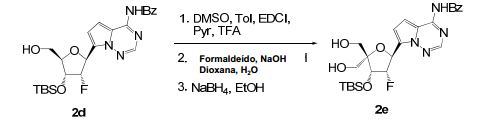
[00162] À solução de intermediário 2d (856 mg, 1,75 mmol) em to- lueno (4 mL) e DMSO (6 mL), preparada sob uma atmosfera de N2, foi adicionado cloridrato de 1-etil-3-(3-dimetilaminopropil)carbodi-imida (EDCl) (504 mg, 2,63 mmol). A esta mistura foram adicionados piridina (150 μl) e TFA (70 μL) e a mistura foi agitada em RT por 15 min. Mais EDCl (100 mg) e piridina (100 μL) foram adicionados e a mistura foi agitada por mais 45 min. A reação foi extinta com H2O (10 mL) e CH2Cl2 (10 mL). Os orgânicos foram lavados com salmoura e secos em Na2SO4, filtrados e o solvente foi removido sob pressão reduzida para fornecer o aldeído bruto, que foi usado como é para a etapa seguinte.[00162] To a solution of intermediate 2d (856 mg, 1.75 mmol) in toluene (4 mL) and DMSO (6 mL), prepared under an atmosphere of N2, was added 1-ethyl-3-( 3-dimethylaminopropyl)carbodiimide (EDCl) (504 mg, 2.63 mmol). To this mixture were added pyridine (150 µl) and TFA (70 µl) and the mixture was stirred at RT for 15 min. More EDCl (100 mg) and pyridine (100 µL) were added and the mixture was stirred for a further 45 min. The reaction was quenched with H2O (10 mL) and CH2Cl2 (10 mL). The organics were washed with brine and dried over Na2SO4, filtered and the solvent removed under reduced pressure to provide the crude aldehyde, which was used as is for the next step.
[00163] O aldeído bruto foi dissolvido em dioxana (5 mL) e formal- deído(aq) 37% (925 μL) foi adicionado seguido por NaOH 2N (925 μL). Após agitar em temperatura ambiente por 3 h, a reação foi extinta com AcOH, diluída com EtOAc e lavada com H2O. Os orgânicos foram secos em Na2SO4, filtrados e o solvente foi removido sob pressão reduzida para fornecer o produto aldol bruto, que foi levado adiante como é para a etapa seguinte.[00163] The crude aldehyde was dissolved in dioxane (5 mL) and 37% formaldehyde(aq) (925 μL) was added followed by 2N NaOH (925 μL). After stirring at room temperature for 3 h, the reaction was quenched with AcOH, diluted with EtOAc and washed with H2O. The organics were dried over Na2SO4, filtered and the solvent removed under reduced pressure to give the crude aldol product, which was carried on as is to the next step.
[00164] O produto aldol bruto foi dissolvido em EtOH (9 mL) sob uma atmosfera de N2 e esfriado para 0°C. NaBH 4 (80 mg, 2,1 mmol) foi adicionado em uma porção e a reação foi agitada por 10 min. A reação foi extinta com AcOH, diluída com CH2Cl2 e lavada com uma solução 1:1 de água e NaHCO3(aq) saturado. A fase orgânica foi seca em Na2SO4, filtrada e o solvente foi removido sob pressão reduzida. O resíduo foi purificado através de cromatografia de sílica gel, usando um aumento de eluente de EtOAc 0%-100% em hexanos, para fornecer intermediário 2.1H NMR (400 MHz, DMSO-d6) δ 8,20 - 7,99 (m, 2H), 7,51 (dt, J = 39,5, 7,5 Hz, 3H), 7,15 - 6,93 (m, 2H), 5,50 (d, J = 14,1 Hz, 1H), 5,24 (dt, J = 54,2, 5,4 Hz, 1H), 4,78 (t, J = 5,6 Hz, 1H), 4,48 (dd, J = 10,7, 4,8 Hz, 1H), 4,34 (dd, J = 6,7, 4,9 Hz, 1H), 3,62 (dd, J = 11,9, 4,9 Hz, 1H), 3,55 - 3,35 (m, 3H), 0,82 (s, 9H), 0,07 (s, 3H), -0,09 (s, 3H).19F NMR (376 MHz, DMSO-d6) δ -200,37 (d, J = 51,1 Hz).LC/MS: tR = 1,25 min, MS m/z = 517,21 [M+1]; sistema LC: Thermo Accela 1250 UHPLCSistema MS: Thermo LCQ Fleet; Coluna: Kinetex 2,6μ C18 100A, 50 x 3,00 mmSolventes: Acetonitrila com ácido fórmico 0,1%, Água com ácido fórmico 0,1%Gradiente: 0 min-1,4 min ACN 2-100%, 1,4 min-1,80 min ACN 100%, 1,8 min-1,85 min ACN 100%-2%, 1,85 min-2 min ACN 2%.
[00165] Intermediário 2e (370 mg, 0,717 mmol) foi dissolvido em CH2CI2 (10 mL) e TEA (200 μL) sob uma atmosfera de N2, e foi então esfriado para 0°C. Cloreto de 4,4’-dimetoxitritila (0,364 g, 1,07 mmol) foi adicionado em uma porção e a mistura de reação foi deixada agitar por 30 min. CH3OH (2 mL) foi adicionado e a solução foi diluída com CH2Cl2 e NaHCO3(aq) saturado. A camada orgânica foi lavada com salmoura, seca em Na2SO4, filtrada e os solventes foram removidos sob pressão reduzida. O resíduo foi purificado através de cromatografia de sílica gel, usando um aumento de eluente de EtOAc 5%-100% me he- xanos, para fornecer o produto bruto como uma mistura de produtos bis-DMTr e 4’β. Esta mistura foi levada adiante sem purificação adicional.[00165] Intermediate 2e (370 mg, 0.717 mmol) was dissolved in CH2Cl2 (10 mL) and TEA (200 μL) under an atmosphere of N2, and was then cooled to 0°C. 4,4'-Dimethoxytrityl chloride (0.364 g, 1.07 mmol) was added in one portion and the reaction mixture was allowed to stir for 30 min. CH3OH (2 mL) was added and the solution was diluted with CH2Cl2 and saturated NaHCO3(aq). The organic layer was washed with brine, dried over Na2SO4, filtered and the solvents removed under reduced pressure. The residue was purified by silica gel chromatography, using an eluent increase of 5%-100% EtOAc and hexanes, to provide the crude product as a mixture of bis-DMTr and 4'β products. This mixture was carried on without further purification.
[00166] Ao produto bruto (574 mg, mistura) em DMF (3 mL), sob uma atmosfera de N2, foi adicionado imidazol (143 mg, 2,10 mmol), seguido por terc-butilclorodimetilsilano (158 mg, 1,05 mmol). A solução foi deixada agitar em temperatura ambiente por 2 h. A solução foi diluída com CH3OH (1 mL) e EtOAc. Os orgânicos foram lavados com H2O e então com salmoura. A camada orgânica foi seca em Na2SO4, filtrada e o solvente foi removido sob pressão reduzida. O resíduo foi purificado através de cromatografia de sílica gel, usando um aumento de eluente de EtOAc 0%-50% em hexanos, para fornecer intermediário 2f que continha um pouco de material bis-DMTr.LC/MS: tR = 2,25 min, MS m/z = 933,52 [M+1]; sistema LC: Thermo Accela 1250 UHPLCSistema MS: Thermo LCQ Fleet; Coluna: Kinetex 2,6μ C18 100A, 50 x 3,00 mmSolventes: Acetonitrila com ácido fórmico 0,1%, Água com ácido fórmico 0,1%Gradiente: 0 min-1,5 min ACN 2-100%, 1,5 min-2,8 min ACN 100%, 2,8 min-2,85 min ACN 100%-2%, 2,85 min-3 min ACN 2%.
[00167] O intermediário 2f foi dissolvido em CHCl3 (5 mL) e foi esfriado para 0°C. Hidrato do ácido p-toluenossulfônico (90 mg, 0,474 mmol), dissolvido em CH3OH (4 mL), foi adicionado em gotas à mistura e a mistura de reação foi deixada agitar por 5 min. A mistura de reação foi extinta com NaHCO3(aq) saturado. Os orgânicos foram lavados com salmoura, secos em Na2SO4, filtrados e o solvente foi removido sob pressão reduzida. O resíduo foi purificado através de cromatogra- fia de sílica gel, usando um aumento de eluente de EtOAc 0%-40% em hexanos, para fornecer intermediário 2g.1H NMR (400 MHz, CDCI3) δ 8,09 - 7,88 (m, 2H), 7,48 (dt, J = 35,4, 7,4 Hz, 3H), 7,30 (d, J = 4,6 Hz, 1H), 6,88 (s, 1H), 5,69 (dd, J = 18,8, 4,2 Hz, 1H), 5,05 (dt, J = 54,6, 4,7 Hz, 1H), 4,62 (dd, J = 14,9, 5,1 Hz, 1H), 3,91 - 3,64 (m, 3H), 0,92 - 0,70 (m, 18H), 0,13 - 0,04 (m, 6H), 0,01 (m, 6H).19F NMR (376 MHz, CDCI3) δ -196 (m)LC/MS: tR = 2,61 min, MS m/z = 631,43 [M+1]; sistema LC: Thermo Accela 1250 UHPLCSistema MS: Thermo LCQ Fleet; Coluna: Kinetex 2,6μ C18 100A, 50 x 3,00 mmSolventes: Acetonitrile com ácido fórmico 0,1%, Água com ácido fórmico 0,1%Gradiente: 0 min-1,5 min ACN 2-100%, 1,5 min-2,8 min ACN 100%, 2,8 min-2,85 min ACN 100%-2%, 2,85 min-3 min ACN 2%. 2. brometo de bromo- lhenylmetil trifenil fosfônio, lide,
[00168] À solução de intermediário 2g (228 mg, 0,361 mmol) em to- lueno (0,75 mL) e DMSO (0,15 mL) foi adicionado cloridrato de 1-etil-3- (3-dimetilaminopropil)carbodi-imida (EDCl) (208 mg, 1,08 mmol) sob uma atmosfera de N2. A esta mistura foram adicionados piridina (30 μL) e TFA (15 μL) e a mistura foi agitada em RT por 30 min. A reação foi diluída com EtOAc e lavada com H2O seguido por salmoura. Os orgânicos foram secos em Na2SO4, filtrados e o solvente foi removido sob pressão reduzida para fornecer o aldeído bruto. Este material foi usado como é na etapa seguinte.[00168] To a solution of intermediate 2g (228 mg, 0.361 mmol) in toluene (0.75 mL) and DMSO (0.15 mL) was added 1-ethyl-3-(3-dimethylaminopropyl)carbodi- imide (EDCl) (208 mg, 1.08 mmol) under an atmosphere of N 2 . To this mixture were added pyridine (30 µL) and TFA (15 µL) and the mixture was stirred at RT for 30 min. The reaction was diluted with EtOAc and washed with H2O followed by brine. The organics were dried over Na2SO4, filtered and the solvent removed under reduced pressure to provide the crude aldehyde. This material was used as is in the next step.
[00169] A uma suspensão de brometo de bromometiltrifenilfosfônio (314 mg, 0,72 mmol) em THF (4 mL) a -40°C foi adici onado KOtBu (1,0M em THF, 1,08 mL, 1,08 mmol) e a mistura de reação foi agitada por 2 h sob uma atmosfera de N2. O aldeído bruto foi dissolvido em THF (4 mL) e adicionado em gotas. A mistura de reação foi removida do banho frio e deixada aquecer para 10°C durante 1 h. A mistura de reação foi novamente esfriada para -40°C e a mistura de reação foi extinta com NH4Cl(aq) saturado. As camadas foram separadas e os orgânicos foram secos em Na2SO4, filtrados e o solvente foi removido sob pressão reduzida. O resíduo foi purificado através de cromatogra- fia de sílica gel, usando um eluente de EtOAc 0-50% em hexanos, para fornecer intermediário 2h.1H NMR (400 MHz, CDCI3) δ 8,08 - 7,85 (m, 2H), 7,62 - 7,36 (m, 2H), 7,34 - 7,01 (m, 3H), 6,92 (s, 1H), 6,60 - 6,45 (m, 1H), 6,35 (d, J = 8,2 Hz, 1H), 5,61 (d, J = 25,1 Hz, 1H), 4,82 (dd, J = 56,3, 4,9 Hz, 1H), 4,69 - 4,46 (m, 1H), 3,97 (d, J = 11,4 Hz, 1H), 3,53 (d, J = 11,4 Hz, 1H), 0,84 (d, J = 3,9 Hz, 18H), 0,13 - -0,10 (m, 12H).19F NMR (376 MHz, CDCl3) δ -190,60 (m).LC/MS: tR = 2,10 min, MS m/z = 705,54/707,29 [M+1]; sistema LC: Thermo Accela 1250 UHPLC; Sistema MS: Thermo LCQ Fleet; Coluna: Kinetex 2,6μ C18 100A, 50 x 3,00 mmSolventes: Acetonitrila com ácido fórmico 0,1%, Água com ácido fórmico 0,1%Gradiente: 0 min-1,5 min ACN 2-100%, 1,5 min-2,8 minACN 100%, 2,8 min-2,85 min ACN 100%-2%, 2,85 min-3 min ACN 2%.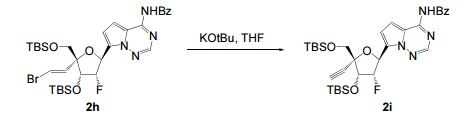
[00170] O intermediário 2h (204 mg, 0,289 mmol) foi dissolvido em THF (8 mL) sob uma atmosfera de N2 e esfriado para -40°C. KotBu (1,0M em THF, 1,08 mL, 1,08 mmol) foi lentamente adicionado. A reação foi deixada agitar por 20 min uma vez que foi esfriada com NH4Cl(aq) saturado. A solução foi diluída com EtOAc e lavada com salmoura. Os orgânicos foram secos em Na2SO4, filtrados e o solvente foi removido sob pressão reduzida. O resíduo foi purificado através de cromatografia de sílica gel, usando um aumento de eluente de EtOAc 0%-5% em hexanos, para fornecer intermediário 2i.1H NMR (400 MHz, CDCl3) δ 8,12 - 7,88 (m, 2H), 7,51 (dt, J = 36,5, 7,5 Hz, 2H), 7,32 (d, J = 4,6 Hz, 1H), 6,88 (s, 1H), 5,79 (d, J = 22,1 Hz, 1H), 5,02 (ddd, J = 55,3, 5,1, 3,2 Hz, 1H), 4,56 (dd, J = 18,1, 5,1 Hz, 1H), 3,91 (d, J = 11,3 Hz, 1H), 3,83 - 3,62 (m, 1H), 2,55 (m, 1H), 0,90 (dd, J = 25,3, 1,6 Hz, 18H), 0,20 - -0,08 (m, 12H).19F NMR (376 MHz, CDCl3) δ -193,10 (s amplo).LC/MS: tR = 1,88 min, MS m/z = 625,24 [M+1]; sistema LC: Thermo Accela 1250 UHPLCSistema MS: Thermo LCQ Fleet; Coluna: Kinetex 2,6μ C18 100A, 50 x 3,00 mmSolventes: Acetonitrila com ácido fórmico 0,1%, Água com ácido fórmico 0,1%Gradiente: 0 min-1,5 min ACN 2-100%, 1,5 min-2,8 min ACN 100%, 2,8 min-2,85 min ACN 100%-2%, 2,85 min-3 min ACN 2%.
[00171] A uma solução de intermediário 2i (152 mg, 0,243 mmol) em THF (3,5 mL) sob uma atmosfera de N2 foi adicionado TBAF (1,0M em THF, 700 μL, 0,700 mmol) em temperatura ambiente e a mistura foi deixada agitar por 30 min. Solventes foram removidos sob pressão reduzida. O resíduo foi purificado através de cromatografia de sílica gel, usando um aumento de eluente de EtOAc 40%-100% em hexa- nos, para fornecer intermediário 2j.LC/MS: tR = 0,88 min, MS m/z = 397,16 [M+1]; sistema LC: Thermo Accela 1250 UHPLCSistema MS: Thermo LCQ Fleet; Coluna: Kinetex 2,6μ C18 100A, 50 x 3,00 mm Solventes: Acetonitrila com ácido fórmico 0,1%, Água com ácido fórmico 0,1%Gradiente: 0 min-1,5 min ACN 2-100%, 1,5 min-2,8 min ACN 100%, 2,8 min-2,85 min ACN 100%-2%, 2,85 min-3 min ACN 2%.
[00172] A uma solução de intermediário 2j (71 mg, 0,179 mmol) em CH3OH (2 mL) foi adicionado NH4OH(aq) concentrado e a solução resul-tante foi agitada em temperatura ambiente por 16 h. Os solventes foram removidos sob pressão reduzida. O resíduo foi purificado através de cromatografia de sílica gel, usando um aumento de eluente de CH3OH 0%-20% em CH2Cl2, seguido por HPLC de fase reversa, usando um aumento de eluente de ACN 0%-20% em H2O, para fornecer o exemplo 2.1H NMR (400 MHz, CD3OD) δ 7,77 (s, 1H), 6,90 - 6,70 (m, 2H), 5,62 (dd, J = 25,5, 2,6 Hz, 1H), 5,18 (ddd, J = 56,0, 5,4, 2,7 Hz, 1H), 4,57 (dd, J = 20,5, 5,4 Hz, 1H), 3,93 - 3,59 (m, 2H), 3,02 (d, J = 0,7 Hz, 1H).19F NMR (376 MHz, CD3OD) δ -193,76 (ddd, J = 56,0, 25,5, 20,4 Hz).LC/MS: tR = 0,45 min, MS m/z = 293,13 [M+1]; sistema LC: Thermo Accela 1250 UHPLCSistema MS: Thermo LCQ Fleet; Coluna: Kinetex 2,6μ C18 100A, 50 x 3,00 mmSolventes: Acetonitrila com ácido fórmico 0,1%, Água com ácido fórmico 0,1% Gradiente: 0 min-1,4 min ACN 2-100%, 1,4 min-1,80 minACN 100%, 1,8 min-1,85 min ACN 100%-2%, 1,85 min-2 min ACN 2%.HPLC: tR = 3,112 min; sistema HPLC: Agilent 1100 series.Coluna: Phenomenex Kinetex C18 2,6 μm 100A, 4,6 x 100mmSolventes: Acetonitrila com TFA 0,1%, Água com TFA 0,1%Gradiente: 0 min-8,0 min 2-ACN 98% a 1,5 mL/min.
[00173] A uma solução de intermediário 2g (1,13 g, 1,79 mmol) em DMSO (1 mL) e tolueno (10 mL), preparada sob uma atmosfera de N2, foram adicionados EDCI.HCl (1,02 g, 5,36 mmol) e piridina (149 μL, 1,92 mmol). TFA (74 μL, 0,97 mmol) foi adicionado em gotas. Após 1 h a reação foi checada através de LC/MS. Um pico único foi observado, com um tempo de retenção similar ao do material de partida, mas com um pico M+1 igual àquele esperado para o produto. Outros 50 μL de piridina foram adicionados e a reação foi agitada por mais 15 min. Nenhuma mudança através de LC/MS. A reação foi diluída com EtOAc e extinta com uma mistura 1:1 de NaHCO3(aq) saturado. A mistura foi dividida entre EtOAc e mais H2O. A camada orgânica foi separada e lavada com H2O, salmoura e então seca em Na2SO4. O agente de secagem foi removido através de filtragem a vácuo e o filtrado foi concentrado. O resíduo foi absorvido em CH2Cl2, concentrado e o material resultante foi posto sob vácuo alto por 1 h. O produto, intermediário 3a, foi usado como é na reação seguinte.LC/MS: tR = 1,90 min, MS m/z = 629,46 [M+1]; sistema LC: Thermo Accela 1250 UHPLCSistema MS: Thermo LCQ Fleet; Coluna: Kinetex 2,6μ C18 100A, 50 x 3,00 mmSolventes: Acetonitrila com ácido fórmico 0,1%, Água com ácido fórmico 0,1%Gradiente: 0 min-1,5 min ACN 2-100%, 1,5 min-2,8 minACN 100%, 2,8 min-2,85 min ACN 100%-2%, 2,85 min-3 min ACN 2%.
[00174] A uma solução de intermediário 3a (material bruto da etapa anterior, suposto 1,79 mmol) em piridina (11 mL), preparada sob uma atmosfera de N2, foi adicionado HONH2.HCl em uma porção em tem-peratura ambiente. A reação foi checada através de LC/MS 5 minutos depois; material de partida foi consumido. A reação foi checada nova-mente 25 minutos depois. Não houve nenhuma mudança do primeiro ponto de tempo. A reação foi concentrada e o resíduo foi dividido entre EtOAc e H2O. A camada orgânica foi separada, lavada com salmoura, seca em Na2SO4 e filtrada. O filtrado foi concentrado, absorvido emCH2Cl2, concentrado novamente e o resíduo foi posto sob vácuo alto.O produto intermediário 3b foi usado como é na reação seguinte.LC/MS: tR = 1,83 min, MS m/z = 644,55 [M+1]; sistema LC:Thermo Accela 1250 UHPLCSistema MS: Thermo LCQ Fleet; Coluna: Kinetex 2,6μ C18 100A, 50 x 3,00 mmSolventes: Acetonitrila com ácido fórmico 0,1%, Água com ácido fórmico 0,1% Gradiente: 0 min-1,5 min ACN 2-100%, 1,5 min-2,8 minACN 100%, 2,8 min-2,85 min ACN 100%-2%, 2,85 min-3 min ACN 2%.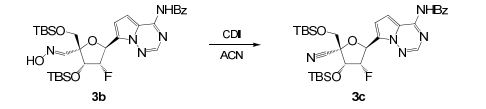
[00175] A uma solução de intermediário 3b (material bruto da etapa anterior, suposto 1,79 mmol) em ACN (16 mL) foi adicionado CDI (436 mg, 2,69 mmol) em uma porção única. A reação foi realizada sob uma atmosfera de N2. A reação foi checada através de LC/MS após 20 mi-nutos. Picos com a massa de material de partida e produto são escas-samente resolvidos no tempo. A reação foi checada 1,5 h depois. O pico de UV correspondendo ao material de partida estava quase desfeito e a intensidade do pico de massa foi diminuída. A reação foi diluída com CH2Cl2 e extinta com uma mistura 1:1 de NaHCO3(aq) saturado e H2O. As camadas foram separadas, a aquosa foi retroextraída com CH2Cl2 e as camadas orgânicas combinadas foram extraídas com uma mistura 1:1 de salmoure e H2O, secas em Na2SO4 e filtradas. O filtrado foi concentrado e intermediário 3c foi isolado através de cromatografia de coluna de sílica gel usando o aumento de solvente que segue: EtOAc 0% em hexanos aumentando para EtOAc 20% em hexanos, pausa em EtOAc 20% em hexanos e então aumento para EtOAc 40% em hexanos.1H NMR (400 MHz, DMSO-d6) δ 8,31 (s, 1H), 8,07 (s, 1H), 7,65 (t, J = 8 Hz, 1H), 7,54 (t, J = 8 Hz, 1H), 7,15 (d, 4 Hz, 1H), 7,02 (s, 1H), 5,82 (d, J = 24 Hz, 1H), 5,51 (ddd, J = 52, 4,8, 2,8 Hz, 1H), 4,70 (dd, J = 18,4, 4,4 Hz, 1H), 3,94 (dd, J = 53,2, 11,2 Hz, 2H), 0,93 (s, 9H, ), 0,84 (s, 9H), 0,17 (s, 3H), 0,16 (s, 3H), 0,05 (s, 3H), 0,01 (s, 3H). 19F NMR (376 MHz, DMSO-d6~) δ -194,658 (dt, J = 53, 21,4 Hz).LC/MS: tR = 1,84 min, MS m/z = 626,60 [M+1]; sistema LC: Thermo Accela 1250 UHPLCSistema MS: Thermo LCQ Fleet; Coluna: Kinetex 2,6μ C18 100A, 50 x 3,00 mmSolventes: Acetonitrila com ácido fórmico 0,1%, Água com ácido fórmico 0,1%Gradiente: 0 min-1,5 min ACN 2-100%, 1,5 min-2,8 min ACN 100%, 2,8 min-2,85 min ACN 100%-2%, 2,85 min-3 min ACN 2%.
[00176] A uma solução de intermediário 3c (770 mg, 1,23 mmol) em MeOH (11,2 mL), esfriada em um banho de água gelada, foi adicionado NH4OH(aq) concentrado (3,74 mL). O banho frio foi removido e a solução heterogênea resultante foi agitada de um dia para o outro. No dia seguinte a reação estava incompleta conforme determinado através de LC/MS. NH4OH(aq) concentrado adicional (4 mL) e 2-Me THF (12 mL) foram adicionados. A reação se tornou homogênea, mas após 20 minutos não havia nenhum progresso de reação adicional. A reação foi concentrada e o resíduo foi dissolvido em THF (15 mL). A esta mistura foi adicionado NH4OH(aq) concentrado (5 mL) e MeOH suficiente (1,9 mL) para tornar a solução homogênea e monofásica. A reação foi agitada em temperatura ambiente por 22 h. A reação estava quase completa (cerca de 5% do material de partida permanecem). A reação foi diluída com CH2Cl2 e H2O. As camadas foram separadas e a cama- da aquosa foi diluída com NaHCO2(aq) saturado e extraída com CH2Cl2. A camada aquosa foi neutralizada com HCl 2N e então extraída com CH2Cl2. As camadas orgânicas combinadas foram secas em Na2SO4, que foi removido através de filtragem. O filtrado foi concentrado e in-termediário 3d foi isolado do resíduo através de cromatografia de coluna de sílica gel usando o aumento de solvente que segue: EtOAc 0% em hexanos aumentando para EtOAc 50% em hexanos, pausa em EtOAc 50% em hexanos e então aumento para EtOAc 100% em he- xanos.LC/MS: tR = 1,59 min, MS m/z = 522,47 [M+1]; sistema LC: Thermo Accela 1250 UHPLCSistema MS: Thermo LCQ Fleet; Coluna: Kinetex 2,6μ C18 100A, 50 x 3,00 mmSolventes: Acetonitrila com ácido fórmico 0,1%, Água com ácido fórmico 0,1%Gradiente: 0 min-1,4 min ACN 2-100%, 1,4 min-1,8 min ACN 100%, 1,8 min-1,85 min ACN 100%-2%, 1,85 min-2 min ACN 2%.
[00177] A uma solução de intermediário 3d (100 mg, 0,191 mmol) em THF (2 mL), em um tubo de polipropileno, foi adicionado HF.Piridi- na 70% (60 μL, 0,478 mmol) a 0°C, sob uma atmosfera de N2. A reação foi checada após 20 minutos; não houve nenhuma reação, então mais HF.Piridina 70% em piridina (150 μL) foi adicionada e o banho frio foi removido. Após 1 hora e 50 minutos mais HF.Piridina 70% em piri- dina (150 μL) foi adicionada. Após mais 2 horas mais HF.Piridina 70% em piridina (300 μL) foi adicionado. Após mais 2 horas e 15 minutos mais HF.Piridina 70% em piridina (1 mL) foi adicionado. A reação fica transparente e homogênea quando desta adição final de HF.Piridina 70% em piridina. A reação foi agitada de um dia para ou outro. A reação estava completa no dia seguinte. A reação foi esfriada em um banho gelado e extinta com H2O e uma quantidade pequena de NaHCO3(aq) saturado. A mistura foi concentrada e o resíduo foi absorvido em DMSO. Material insolúvel restante foi removido através de filtragem e o filtrado foi semipurificados através de HPLC. O material isolado foi dissolvido em DMF e purificado através de HPLC. O Exemplo 3 foi isolado, com 0,5% como um sal de TFA.1H NMR (400 MHz, DMF-d7) δ 7,92 (s, 1H), 6,99 (d, J = 4,4 Hz, 1H), 6,89 (d, J = 4,9 Hz, 1H), 6,64 (d, J = 6 Hz, 1H), 5,92 (t, J = 6,4 Hz, 1H), 5,83 (dd, J = 25,2, 2 Hz, 1H), 5,40 (ddd, J = 54,8, 4,8, 2,4 Hz, 1H), 4,75 (dt, J = 22, 5,2 Hz, 1H), 4,02 (dd, J = 12, 6,4Hz, 1H), 3,87 (dd, J = 12, 6,4 Hz, 1H).19F NMR (376 MHz, DMF-d7) δ -74,92 (s), -193,726 (dt, J = 54,5, 23,3 Hz).LC/MS: tR = 0,56 min, MS m/z = 294,10 [M+1]; sistema LC: Thermo Accela 1250 UHPLCSistema MS: Thermo LCQ Fleet; Coluna: Kinetex 2,6μ C18 100A, 50 x 3,00 mmSolventes: Acetonitrila com ácido fórmico 0,1%, Água com ácido fórmico 0,1%Gradiente: 0 min-1,4 min ACN 2-100%, 1,4 min-1,8 min ACN 100%, 1,8 min-1,85 min ACN 100%-2%, 1,85 min-2 min ACN 2%.HPLC: tR = 3,220 min; sistema HPLC: série Agilent 1100.; Coluna: Phenomenex Kinetex C18 2,6 μm 100A, 4,6 x 100 mm; Sol-ventes: Acetonitrila com TFA 0,1%, Água com 0,1% TFAGradiente: 0 min-8,0 min 2-ACN 98% a 1,5 mL/min.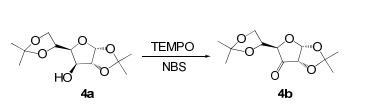
[00178] Em um frasco de fundo redondo de 4 gargalos e 10 L foi posta uma solução de intermediário 4a, (3aR,5S,6S,6aR)-5-((R)-2,2- dimetil-1,3-dioxolan-4-il)-2,2-dimetiltetra-hidrofuro[3,2-d][1,3]dioxol-6-ol (500 g, 1,90 mol) em diclorometano/água (2,7 L / 2,3 L) em temperatura ambiente. A isto foi adicionado carbonato de sódio (290 g, 3,42 mol). Adição de carbonato de potássio (451 g, 3,24 mol) foi em seguida. Isto foi seguido pela adição de 2,2,6,6-tetrametilpiperidinoóxi (TEMPO, 15,2 g, 96,31 mmol). À mistura foi adicionado brometo de tetrabutilamônio (31 g, 95,20 mmol). Ao acima foi adicionada N- bromossuccinimida (514 g, 2,86 mol), em porções a 35°C. A solução resultante foi deixada reagir, com agitação, por 2 h em temperatura ambiente. A solução resultante foi extraída com 2 x 1 L de diclorome- tano e as camadas orgânicas combinadas. A mistura resultante foi lavada com 1 x 1,5 L de água. A mistura foi seca em sulfato de sódio anidro e concentrada sob vácuo. Isto resultou em intermediário 4b (bruto).
[00179] A um frasco de fundo redondo de 4 gargalos 2 L foi posta uma solução de intermediário 4b (370 g. 1.29 mol) em metanol (1300 mL). Ao acima foi adicionado boroidreto de sódio (26.4 g. 706.38 mmol). em porções em temperatura ambiente. A solução resultante foi deixada reagir. com agitação. por 2 h em temperatura ambiente. A mistura resultante foi concentrada sob vácuo. A reação foi então extinta através da adição de 1000 mL de solução de cloreto de amônio aquosa 5%. A solução resultante foi extraída com 3 x 500 mL de diclo- rometano e as camadas orgânicas combinadas. A solução resultante foi lavada com 2 x 300 mL de água. A mistura foi seca em sulfato de sódio anidro e concentrada sob vácuo. O produto bruto foi purificado através de recristalização a partir de éter de petróleo. Isto resultou no intermediário 4c.
[00180] A um frasco de fundo redondo de 4 gargalos 5000 mL foi posta uma solução de intermediário 4c (350 g, 1,34 mol) em dicloro- metano (700 mL). À mistura foi adicionado hidróxido de sódio/água 50% (700 g). Ao acima foi adicionado 2-(bromometil)naftaleno (340 g, 1,54 mol) em várias bateladas. A solução resultante foi deixada reagir, com agitação, por 4 h em temperatura ambiente. A reação foi então extinta através da adição de 1800 mL de diclorometano/água (1:1). A solução resultante foi extraída com 2 x 1 L de diclorometano e as camadas orgânicas combinadas. A mistura resultante foi lavada com 1 x 1000 mL de água. O resíduo foi dissolvido em 1000/1000 mL de éter de petróleo/água. O produto bruto foi purificado através de recristaliza- ção a partir de éter de petróleo. Isto resultou em intermediário 4d.
[00181] A um frasco de fundo redondo de 4 gargalos 5 L foi posto intermediário 4d (500 g, 1,25 mol). A isto foi adicionado ácido acético (1,8 L). À mistura foi adicionada água (600 mL). A solução resultante foi deixada reagir, com agitação, de um dia para o outro em temperatura ambiente. Os sólidos foram filtrados. A solução resultante foi extraída com 3 x 1 L de éter de petróleo e as camadas aquosas combinadas. A solução resultante foi diluída com 2 L de acetato de etila. A mistura resultante foi lavada com 2 x 2 L de cloreto de sódio(aq). O valor do pH da solução foi ajustado para 8 com carbonato de sódio (50%). A solução resultante foi extraída com 2 x 1 L de acetato de etila e as camadas orgânicas combinadas e concentradas sob vácuo. Isto resultou em intermediário 4e.
[00182] A um frasco de fundo redondo de 4 gargalos 10 L foi posta uma solução de intermediário 4e (300 g, 833,33 mmol) em 1,4-dioxana (2100 mL) em temperatura ambiente. Isto foi seguido pela adição de uma solução de periodato de sódio (250 g) em água (4000 mL) em temperatura ambiente em 0,5 h. A solução resultante foi deixada reagir, com agitação, por 0,5 h em temperatura ambiente. Os sólidos foram filtrados. A solução resultante foi extraída com 3 x 1000 mL de acetato de etila e as camadas orgânicas combinadas. A mistura resultante foi lavada com 2 x 1000 mL de cloreto de sódio(aq). A mistura resultante foi concentrada sob vácuo. Isto resultou em intermediário 4f.
[00183] Em um frasco de fundo redondo de 4 gargalos 10 L foi posta uma solução de intermediário 4f (250 g, 761,36 mmol) em água/tetra -hidrofurano (1250/1250 mL) em temperatura ambiente. Ao acima foi adicionado hidróxido de sódio(aq) 2N (1500 mL) em gotas com agitação a 0-15°C. À mistura foi adicionado formaldeído (620 mL). A solução resultante foi deixada reagir, com agitação, de um dia para o outro em temperatura ambiente. A solução resultante foi extraída com 2 x 2000 mL de acetato de etila. A mistura resultante foi lavada com 2 x 2000 mL de cloreto de sódio(aq). As camadas orgânicas combinadas e secas em sulfato de sódio anidro. O resíduo foi aplicado em uma coluna de sílica gel com éter de petróleo:acetato de etila (2/1). O produto bruto foi recristalizado a partir de acetato de etila:etanol na razão de 1g/(1 mL:1 mL). Isto resultou em intermediário 4g. Intermediário 4h - ((3aR,5R,6S,6aR)-5-((terc-butildifenilsililoxi)metil)- 2,2-dimetil-6-(naftalen-2-ilmetoxi)tetra-hidrofuro[3,2-d][1,3]dioxol-5-il) metanol.
[00184] A um frasco de fundo redondo de 4 gargalos 5L purgado e mantido com uma atmosfera de nitrogênio inerte foi posta uma solução de intermediário 4g (125 g, 346,84 mmol) em diclorometano (2500 mL) em temperatura ambiente. À mistura foi adicionada trietilamina (157,5 mL) em temperatura ambiente. Ao acima foi adicionado cloreto de terc- butildifenilsilila (157,5 mL) em gotas com agitação a 0-10°C. A solução resultante foi deixada reagir, com agitação, de um dia para o outro em temperatura ambiente. A reação foi então extinta através da adição de 37,5 mL de metanol. A mistura resultante foi lavada com 2 x 500 mL de cloreto de hidrogênio(aq) 5% e 2 x 500 mL de bicarbonato de só- dio(aq). A mistura resultante foi lavada com 2 x 500 mL de hidróxido de sódio(aq) 1N. A mistura foi seca em sulfato de sódio anidro e concentrada sob vácuo. O produto bruto foi purificado através de recristaliza- ção a partir de diclorometano/hexano. Isto resultou em intermediário 4h.
[00185] A um frasco de fundo redondo de 3 gargalos 1000 mL purgado e mantido com uma atmosfera inerte de nitrogênio foi posta uma solução de intermediário 4h (20 g, 31,73 mmol) em tolueno (320 mL), trifenilfosfina (35 g, 132,11 mmol), imidazol (8,96 g, 132,26 mmol). Isto foi seguido pela adição de iodo (16,95 g, 66,8 mmol) em várias bateladas a 60°C. A solução resultante foi agitada de um dia para o outro a 80°C em um banho de óleo. A mistura de reação foi e sfriada para temperatura ambiente com um banho de água/gelo. A solução resultante foi diluída com 1000 mL de acetato de etila. A mistura resultante foi lavada com 2 x 300 mL de tiossulfato de sódio(aq). A mistura resultante foi lavada com 1 x 3000 mL de cloreto de sódio(aq). A mistura foi seca em sulfato de sódio anidro e concentrada sob vácuo. O resíduo foi aplicado em uma coluna de sílica gel com acetato de etila/éter de petróleo (1:10). Isto resultou em intermediário 4i.
[00186] A um frasco de fundo redondo de 2000 mL purgado e mantido com uma atmosfera de nitrogênio inerte foi posta uma solução de intermediário 4i (66 g, 88,47 mmol) em etanol/acetato de etila (600/600 mL), trietilamina (20,7 g, 202,52 mmol), paládio sobre carbono (10% em peso, 24,8 g, 23,30 mmol). A solução resultante foi agitada por 3 horas a 40°C. Os sólidos foram filtrados. A mistura resultante foi concentrada sob vácuo. A solução resultante foi diluída com 1500 mL de acetato de etila. A mistura resultante foi lavada com 1 x 500 mL de cloreto de sódio(aq). A mistura foi seca em sulfato de sódio anidro e concentrada sob vácuo. Isto resultou em intermediário 4j.
[00187] A um frasco de fundo redondo de 500 mL foi posta uma solução de intermediário 4j (1,0 g, 1,63 mmol) em diclorometano (15 mL), água (1,25 mL) e 2,3-dicloro-5,6-diciano-1,4-benzoquinona (DDQ, 780 mg, 3,40 mmol). A solução resultante foi agitada por 1 h em temperatura ambiente. A solução resultante foi diluída com 50 mL de dicloro- metano. A mistura resultante foi lavada com 1 x 30 mL de água e 2 x 30 mL de bicarbonato de sódio(aq). A mistura resultante foi lavada com 1 x 30 mL de cloreto de sódio(aq). A mistura foi seca em sulfato de sódio anidro e concentrada sob vácuo. O resíduo foi aplicado em uma coluna de sílica gel com acetato de etila/éter de petróleo (1:20~1:10).Isto resultou em intermediário 4k.
[00188] A um frasco de fundo redondo de 50 mL foi posta uma solução de intermediário 4k (520 mg, 1,12 mmol) em tetra-hidrofurano (9 mL), fluoreto de tetrabutilamônio (369 mg, 1,40 mmol). A solução resultante foi agitada por 2 h em temperatura ambiente. A mistura resultante foi concentrada sob vácuo. O resíduo foi aplicado em coluna de sílica gel com diclorometano/metanol (100:1). Isto resultou em intermediário 4l.1H NMR (300 MHz, DMSO-d6): δ 5,64 (d, J = 3,9Hz, 1H), 4,96 (d, J = 6,6Hz, 1H), 4,67 (m, 1H), 4,55 (m, 1H), 4,05 (m, 1H), 3,24 - 3,30 (m, 1H), 3,11 - 3,18 (m, 1H), 1,50 (s, 3H), 1,27 (s, 3H), 1,16 (s, 1H).BnBr,NaH Bn° O
[00189] A um frasco de fundo redondo de 3 gargalos 50 mL purgado e mantido com uma atmosfera inerte de nitrogênio foi posta uma solução de intermediário 4l (180 mg, 0,84 mmol) em tetra-hidrofurano (4 mL). Isto foi seguido pela adição de hidreto de sódio (60% em peso, 140 mg, 3,50 mmol), em porões a 0°C. A solução resu ltante foi agitada por 30 minutos a 0°C. A solução resultante foi deixada reagir, com agitação, por mais 30 min em temperatura ambiente. A isto foi adicionado brometo de benzila (452 mg, 2,62 mmol) em gotas com agitação a 0°C. A solução resultante foi deixada reagir, com a gitação, por mais 3 h em temperatura ambiente. A reação foi então extinta através da adição de 30 mL de cloreto de amônio(aq). A solução resultante foi extraída com 50 mL de diclorometano e as camadas orgânicas foram combinadas e secas em sulfato de sódio anidro e concentradas sob vácuo. O resíduo foi aplicado em uma coluna de sílica gel com acetato de eti- la/éter de petróleo (1:30-1:20). Isto resultou em intermediário 4m.
[00190] A um frasco de fundo redondo de 1000 mL foi posto intermediário 4m (também preparado de acordo com Biosci. Biotech. Bio- chem. 1993, 57, 1433-1438, 45 g, 111,19 mmol), ácido acético (270 mL), anidrido acético (90 mL), ácido sulfúrico (45 d). A solução resultante foi agitada por 30 min em temperatura ambiente. A reação foi então extinta através da adição de 1000 mL de água/gelo. A solução resultante foi diluída com 3000 mL de acetato de etila. A mistura resultante foi lavada com 2 x 1000 mL de água e 4 x 10000 mL de bicarbonato de sódio(aq). A mistura resultante foi lavada com 2 x 1000 mL de cloreto de sódio(aq). A mistura foi seca em sulfato de sódio anidro e concentrada sob vácuo. O resíduo foi aplicado em uma coluna de sílica gel com acetato de etila/éter de petróleo (1:30-1:20). Isto resultou em intermediário 4n.1H NMR (300 MHz, CDCl3): δ 7,28 - 7,38 (m, 10H), 6,13 (s, 1H), 5,37 (d, J = 4,8Hz, 1H), 4,44 - 4,68 (m, 4H), 4,33 (d, J = 5,1Hz, 1H), 3,33 - 3,45 (m, 2H), 2,15 (s, 3H), 1,88 (s, 3H), 1,35 (s, 3H).MS m/z = 451[M+Na]
[00191] O intermediário 4n (1,3 g, 3 mmol) foi dissolvido em MeOH anidro (15 mL). Pó de carbonato de potássio (456 mg, 3,3 mmol) foi adicionado e a mistura de reação foi agitada por 1 h. A mistura de reação foi então concentrada sob pressão reduzida. Acetonitrila adicionada e agitada por 5 minutos. Filtrado o insolúvel e lavado com acetoni- trila. Filtrado concentrado sob pressão reduzida. Material resultante dissolvido em DCM anidro (20 mL). Iodeto de tetrabutilamônio adicionado (1,66 g, 4,5 mmol) e N-iodo-succinimida (NIS, 1,69 g, 2,5 mmol). Agitada a mistura de reação no escuro por 16 h. Adicionado mais NIS (0,85 g, 1,25 mmol) e agitado por 4 horas. Adicionado mais NIS (0,85 g, 1,25 mmol) e agitado por 2 dias no escuro. Diluída a reação com EtOAc e lavada com solução de tiossulfato de sódio aquosa duas vezes e então com solução de cloreto de sódio aquosa saturada. A porção orgânica seca em sulfato de sódio anidro e concentrada sob pressão reduzida. Purificada com coluna de sílica gel (EtOAc 0-30% em hexanos) para fornecer intermediário 4o.1H NMR (400 MHz, CDCI3): δ 7,35 - 7,22 (m, 10H), 4,82 (bs, 1H), 4,75 - 4,66 (m, 2H), 4,55 - 4,44 (m, 2H), 4,13 (d, J = 8Hz, 1H), 3,70-3,45 (m, 2H), 1,38 (s, 3H).LC/MS: tR = 2,58 min, MS m/z = 342,9 [M+1], 360,0 [M+H2O]; LC/Sistema MS: Thermo LCQ Advantage; Phenomenex Gemini, C18, 5u, 110A, 30 x 4,6 mm; Tampão A: Ácido acético em Água 0,1%; Tampão B: Ácido acético 0,1% em Acetonitrila Tampão B 5-100% em 2,5 min então 100% para 0,9 min @ 2 mL/min.HPLC: tR = 3,78 min; sistema HPLC: Agilent 1100; Phenome- nex Gemini, C18, 5u, 110A, 50 x 4,6 mm; Tampão A: TFA 0,05% em Água; Tampão B: TFA 0,05% em Acetonitrila; Tampão B 2-98% em 5 minutos @ 2mL/min.
[00192] Intermediário 4o dissolvido (955 mg, 2,79 mmol) em EtOAc (10 mL). Adicionados brometo de benzila (400 μL, 3,35 mmol) e óxido de prata(I) (712 mg, 3,07 mmol). Agitado a 60°C sob N2(g) no escuro por 3 h. Adicionado mais brometo de benzila (400 μL, 3,35 mmol) e agitado a 60°C sob N 2(g) no escuro por 16 h. Adicionado mais óxido de prata(I) (350 mg, 1,5 mmol) e agitado a 60°C sob N2(g) no escuro por 8 h. Esfriado para temperatura ambiente. Sólidos filtrados e lavados com EtOAc. Filtrado concentrado sob pressão reduzida para fornecer um óleo. Hexanos adicionados e agitados por 2 h para fornecer sólido. Sólido coletado e lavado com hexanos. Sólido seco sob vácuo alto para fornecer intermediário 4p.1H NMR (400 MHz, CDCI3): δ 7,35 - 7,16 (m, 15H), 5,03 (d, J = 12Hz, 1H), 4,79 - 4,71 (m, 2H), 4,52 - 4,40 (m, 4H), 4,06 (d, J = 6Hz, 1H), 3,49 - 3,39 (m, 2H), 1,38 (s, 3H).LC/MS: tR = 2,91 min, MS m/z = 433,1 [M+1], 450,1 [M+H2O]; LC/Sistema MS: Thermo LCQ Advantage; Phenomenex Gemini, C18, 5u, 110A, 30 x 4,6 mm; Tampão A: Ácido acético 0,1% em Água; Tampão B: Ácido acético 0,1% em Acetonitrila; Tampão B 5-100% em 2,5 mins então 100% para 0,9min @ 2 mL/min. HPLC: tR = 4,54 min; sistema HPLC: Agilent 1100; Phenome- nex Gemini, C18, 5u, 110A, 50 x 4,6 mm; Tampão A: TFA 0,05% em Água; Tampão B: TFA 0,05% em AcetonitrilaTampão B 2-98% em 5 minutos @ 2mL/min.
[00193] O intermediário 1b (148 mg, 0,570 mmol) e 1,2-bis(clorodi- metilsilil)etano (123 mg, 0,570 mmol) foram dissolvidos em THF anidro (20 mL) e agitados sob Ar(g) a -70°C. n-Butillítio adicionado (solução 2,5M em hexanos, 684 μL, 1,71 mmol) em gotas à mistura de reação enquanto mantendo a temperatura interna abaixo de -65°C. A reação foi deixada aquecer para -40°C e mantida por 15 min . Uma solução de intermediário 4p (224 mg, 0,518 mmol) em THF (10 mL) pré-esfriada para -70°C foi então adicionada à mistura de reação sob Ar(g). A solução resultante foi agitada por 2 h a -40°C. A mistu ra de reação foi então despejada em uma mistura em agitação de EtOAc e ácido cítri- co(aq). Agitada por 5 min. A camada orgânica coletada e lavada com NaCl(aq) saturado. A camada orgânica seca em Na2SO4 anidro e concentrada sob pressão reduzida. Purificada com HPLC preparativa para fornecer intermediário 4q.LC/MS: tR = 2,60 min, MS m/z = 567,3 [M+1], 565,1 [M-1]; sis-tema LC/MS: Thermo LCQ Advantage; Phenomenex Gemini, C18, 5u, 110A, 30 x 4,6 mm; Tampão A: Ácido acético 0,1% em água; Tampão B: Ácido acético 0,1% em Acetonitrila; Tampão B 5-100% em 2,5 mins então 100% para 0,9min @ 2 mL/min. HPLC: tR = 3,22 min; sistema HPLC: Agilent 1100; Phenome- nex Gemini, C18, 5u, 110A, 50 x 4,6 mm; Tampão A: TFA 0,05% em Água; Tampão B: TFA 0,05% em Acetonitrila; Tampão B 2-98% em 5 minutos @ 2mL/min.
[00194] Intermediário 4q (81 mg, 0,143 mmol) foi dissolvido em DCM anidro (15 mL) e agitado sob N2(g) em um banho gelado. Trietil- silano adicionado (114 μL, 0,715 mmol) em uma porção. Dietil eterato de trifluoreto de boro adicionado (27 μL, 0,215 mmol) em gotas. Agitado por 15 min e então removido banho gelado. Agitado por 60 min. Adicionada trietilamina (100 μL, 0,715 mmol) e concentrada sob pressão reduzida. Dissolvida em EtOAc e lavada com NaHCO3(aq) (2x) e então saturada com NaCl(aq). Orgânico seco em Na2SO4 anidro e concentrado sob pressão reduzida. Purificado com coluna de sílica gel (EtOAc 0-80% em hexanos) para fornecer intermediário 4r.1H NMR (400 MHz, CDCl3): δ 7,71 (s, 1H), 7,35 - 7,10 (m, 16H), 6,82-6,78 (m, 1H), 5,57 (d, J=4,4Hz, 1H), 4,70 - 4,45 (m, 6H), 4,25 - 4,15 (m, 2H), 3,55 - 3,40 (m, 2H), 1,42 (s, 3H).LC/MS: tR = 2,75min, MS m/z = 551,4 [M+1]; sistema LC/MS: Thermo LCQ AdvantagePhenomenex Gemini, C18, 5u, 110A, 30 x 4,6 mm; Tampão A: Ácido acético 0,1% em Água; Tampão B: Ácido acético 0,1% em Ace- tonitrila; Tampão B 5-100% em 2,5 mins então 100% para 0,9min @ 2 mL/min.HPLC: tR = 3,57min; sistema HPLC: Agilent 1100; Phenomenex Gemini, C18, 5u, 110A, 50 x 4,6 mm; Tampão A: TFA 0,05% em Água; Tampão B: TFA 0,05% em Acetonitrila; Tampão B 2-98% em 5 minutos @ 2mL/min.
[00195] O intermediário 4r (230 mg, 0,042 mmol) foi dissolvido em uma solução de ácido fórmico/MeOH (1:9, 10 mL). Negro de paládio adicionado e agitado a 60°C por 90 min. Esfriado pa ra temperatura ambiente e filtrado em Celite. O filtrado foi concentrado sob pressão reduzida. Purificado através de HPLC preparativa. Concentrado sob pressão reduzida. Dissolvido em NaHCO3(aq) e purificado com HPLC sob condição natural para fornecer Exemplo 4.Sistema HPLC Prep: Gilson 215 Liquid Handler; Phenomenex Gemini, C18 4u, 100 x 30,0 mmTampão A: TFA 0,1% em Água; Tampão B: TFA 0,1% em Ace- tonitrila; Tampão B 5-100% em 13 minutos @ 20 mL/min.1H NMR (400 MHz, CDCl3): δ 8,01 (s, 1H), 7,41 (d, J = 4,8 Hz, 1H), 7,02 (d, J = 4,8 Hz, 1H), 5,33 (d, J = 8 Hz, 1H), 4,53-4,49 (m, 1H), 4,15 (d, J = 5,6 Hz, 1H), 3,50 (m, 2H), 1,27 (s, 3H).LC/MS: tR = 0,30min, MS m/z = 281,3 [M+1], 279,0 [M-1]; LC/Sistema MS: Thermo LCQ Advantage; Phenomenex Gemini, C18, 5u, 110A, 30 x 4,6 mm; Tampão A: Ácido acético 0,1% em Água; Tampão B: Ácido acético 0,1% em Acetonitrila; 5-Tampão B 100% em 2,5 min então 100% para 0,9min @ 2 mL/min.HPLC: tR = 0,42 min; HPsistema LC: Agilent 1100; Phenome- nex Gemini, C18, 5u, 110A, 50 x 4,6 mm; Tampão A: TFA 0,05% em Água; Tampão B: TFA 0,05% em Acetonitrila; Tampão B 2-98% em 5 minutos @ 2mL/min.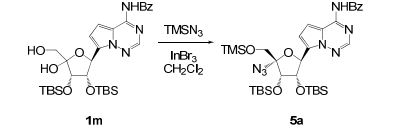
[00196] A uma solução de intermediário bruto 1m, N-(7-((2S,3S,4S)- 3,4-bis(terc-butildimetilsililoxi)-5-hidroxi-5-(hidroximetil)tetra-hidrofuran- 2-il)pirrolo[pirrolo[1,2-f][1,2,4]triazin-4-il)benzamida, (~110 mg, ~0,18 mmol) e azidotrimetilsilano (242 μl, 1,84 mmol) em diclorometano (1,5 mL) foi adicionado brometo de índio (III) (130 mg, 0,369 mmol) em temperatura ambiente sob uma atmosfera de argônio. Após 1 h, a mistura de reação foi extinta com solução de bicarbonato de sódio aquosa saturada (1 mL). A mistura resultante foi dividida entre diclorometano (20 mL) e solução de bicarbonato de sódio aquosa saturada (20 mL). As fases foram separadas e a camada aquosa foi extraída com diclo- rometano (20 mL). As camadas orgânicas combinadas foram secas em sulfato de sódio anidro e foram concentradas sob pressão reduzida para fornecer intermediário 5a que foi usado diretamente na etapa seguinte sem purificação adicional.LC/MS: tR = 3,52 min, MS m/z = 712,16 [M+1]; sistema LC: Thermo Accela 1250 UHPLCSistema MS: Thermo LCQ Fleet; Coluna: Kinetex 2,6μ XB-C18 100A, 50 x 4,6 mmSolventes: Acetonitrila com ácido acético 0,1%, Água com ácido acético 0,1%; Gradiente: 0 min-2,0 min ACN 2-100%, 2,0 min-3,55 min ACN 100%, 3,55 min-4,2 min ACN 100%-2% a 2μl/min.
[00197] A uma solução de intermediário bruto 5a (~120 mg, ~0,168 mmol) em DMF (5 mL) foi adicionado fluoreto de césio (256 mg, 1,68 mmol) em temperatura ambiente. Após 25 h, a mistura de reação foi diluída com salmoura (100 mL) e a mistura resultante foi extraída com acetato de etila (3 x 100 mL). As camadas orgânicas combinadas foram secas em sulfato de sódio anidro e foram concentradas sob pressão reduzida para fornecer intermediário 5b que foi usado diretamente na etapa seguinte sem purificação adicional.LC/MS: tR = 1,40 min, MS m/z = 412,17 [M+1]; sistema LC: Thermo Accela 1250 UHPLCSistema MS: Thermo LCQ Fleet; Coluna: Kinetex 2,6μ XB-C18 100A, 50 x 4,6 mm; Solventes: Acetonitrila com ácido acético 0,1%, Água com ácido acético 0,1%; Gradiente: 0 min-2,0 min ACN 2-100%, 2,0 min-3,05 min ACN 100%, 3,05 min-3,2 min ACN 100%-2%, 3,2 min-3,5 min ACN 2% a 2μl/min.HPLC: tR = 2,46 min’ sistema HPLC: série Agilent 1100; Coluna: Gemini 5μ C18 110A, 50 x 4,6 mm; Solventes: Acetonitrila com TFA 0,1%, Água com TFA 0,1%; Gradiente: 0 min-5,0 min ACN 298%, 5,0 min-6,0 min ACN 98% a 2 mL/min.
[00198] Hidróxido de amônio concentrado (1 mL) foi adicionado a uma solução de intermediário 5b bruto em metanol (1 mL) em temperatura ambiente. Após 2 dias, a mistura de reação foi concentrada sob pressão reduzida e foi diretamente purificada através de HPLC preparativa (coluna Phenominex Synergi 4u Hydro-RR 80Â 150 x 30 mm, gradiente de acetonitrila/água 5-100%). As frações contendo o desejado foram combinadas e foram concentradas sob pressão reduzida. O resíduo novamente purificado através de cromatografia de coluna de SiO2 (coluna Combiflash HP Gold de SiO2 4g, metanol/diclorometano 0-20%) para fornecer o Exemplo 5.1H NMR (400 MHz, CD3OD) δ 7,79 (s, 1H), 6,86 (d, J = 4,5 Hz, 1H), 6,77 (d, J = 4,5 Hz, 1H), 5,51 (d, J = 6,0 Hz, 1H), 4,63 (t, J = 5,8 Hz, 1H), 4,37 (d, J = 5,7 Hz, 1H), 3,69 (d, J = 12,0 Hz, 1H), 3,59 (d, J = 12,0 Hz, 1H).LC/MS: tR = 0,76 min, MS m/z = 308,08 [M+1]; sistema LC: Thermo Accela 1250 UHPLCSistema MS: Thermo LCQ Fleet; Coluna: Kinetex 2,6μ XB-C18 100A, 50 x 4,6 mm; Solventes: Acetonitrila com ácido acético 0,1%, Água com ácido acético 0,1%; Gradiente: 0 min-1,5 min ACN 2-100%, 1,5 min-2,2 min ACN 100%, 2,2 min-2,4 min ACN 100%-2%, 2,4 min- 2,5 min ACN 2% a 2μl/min.HPLC: tR = 1,287 min; sistema HPLC: série Agilent 1100; Coluna: Gemini 5μ C18 110A, 50 x 4,6 mm; Solventes: Acetonitrila com TFA 0,1%, Água com TFA 0,1%; Gradiente: 0 min-5,0 min ACN 2- 98%, 5,0 min-6,0 min ACN 98% a 2 mL/min.;TLC: eluente: metanol 20% em diclorometano, Rf= 0,4 (UV)
[00199] O Exemplo 3 (15,0 mg, 0,05 mmol) foi seco em um frasco sob vácuo de um dia para o outro. Trimetilfosfato (0,5 mL) e 1,8-bis(di- metilamino)naftaleno (25 mg, 0,12 mmol) foram adicionados ao frasco e a solução foi d eixada agitar sob N2 esfriado por um banho de ge- lo/água. Oxicloreto fosforoso destilado (10 μL, 0,11 mmol) foi adicionado e a reação foi deixada agitar por 4 h com esfriamento. Tributilamina (0,1 ml, 0,42 mmol) e pirofosfato de tributilamônio (0,8 mL de uma solução 0,5M em DMF, 0,4 mmol) foram adicionados e a reação foi deixada agitar por mais 45 min com esfriamento. A reação foi extinta com bicarbonato de trietilamônio (0,5 M, 5 mL). Os solventes foram removidos através de evaporação giratória e a mistura bruta restante foi dissolvida em 2 mL de água. O produto foi purificado usando uma coluna Sephadex DEAE A-25 com um gradiente linear de bicarbonato de trie- tilamônio 0-1 M. As frações contendo produto foram agrupadas e concentradas para fornecer o Exemplo 6 (TP1), que foi então dissolvido em 1 mL de água para fornecer uma solução 10 M.MS m/z = 532,0 [M-1]Tempo de retenção de HPLC de Troca de Íon: 12,015 min; Co-luna: DNAPac PA-100 4 x 250 mm SNSolvente A: água milliQ; Solvente B: brometo de tetraetilamônio 0,5 M; Programa de gradietne de sovlente: equilibrar usando A 100% por 10 min, então aumentar B 0-80% durante 14min; Fluxo: 1 mL/min.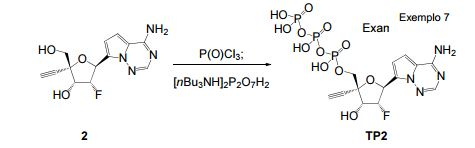
[00200] O Exemplo 2 (16,0 mg, 0,055 mmol) foi seco em um frasco sob vácuo de um dia para o outro. Trimetilfosfato (0,5 mL) e 1,8- bis(dimetilamino)naftaleno (28 mg, 0,13 mmol) foram adicionados ao frasco e a solução foi deixada agitar sob N2 esfriado por um banho de gelo/água. Oxicloreto fosforoso destilado (11 μL, 0,12 mmol) foi adicio-nado e a reação foi deixada agitar por 4 h com esfriamento. Tributila- mina (0,11 mL, 0,42 mmol) e pirofosfato de tributilamônio (0,9 mL de uma solução 0,5m em DMF, 0,45 mmol) foram adicionados e a reação foi deixada agitar por mais 45 min com esfriamento. A reação foi extinta com bicarbonato de trietilamônio (0,5 M, 5 mL). Os solventes foram removidos através de evaporação giratória e a mistura bruta resultante foi dissolvida em 2 mL de água. O produto foi purificado usando uma coluna Sephadex DEAE A-25 com um gradiente linear de bicarbonato de trietilamônio 0-1 M. As frações contendo produto foram agrupadas a concentradas para fornecer o Exemplo 7 (TP2), que foi então dissolvido em 1,4 mL de água para fornecer uma solução 10 mM.MS m/z = 531,0 [M-1]Tempo de Retenção de HPLC de Troca de Íon: 19,829 min; Coluna: DNAPac PA-100 4 x 250 mm SNSolvente A: água milliQ; Solvente B: brometo de tetraetilamônio 0,5 M; Programa de gradiente de solvente: equilibrar usando A 100% por 10 min, então aumentar B 0-80% durante 14 min.; Fluxo: 1 mL/min
[00201] A uma solução de Exemplo 1 (5,0 mg, 0,017 mmol) em PO(OMe)3 (0,6 mL) a 0°C foi adicionado POCl 3 (45 mg, 0,29 mmol). A mistura de reação foi agitada a 0°C por 10 h, ponto quando HPLC de troca de íon mostrou aproximadamente 50% de conversão. Uma solução de sais de pirofosfato de tributilamina (250 mg) em ACN (0,6 mL) foi adicionada, seguido por tributilamina (110 mg, 0,59 mmol). A mistura de reação foi agitada a 0°C por 0,5 h e HPLC de troca de íon mostrou que a reação estava completa. A reação foi extinta com tampão de bicarbonato de trietilamônio (1 M, 5 mL). A mistura de reação foi agitada em temperatura ambiente por 0,5 h, então concentrada e coe- vaporada com água duas vezes. O resíduo foi dissolvido em H2O (5 mL) e carregado em uma coluna de troca de íon, eluído com H2O, então tampão de bicarbonato de trietilamônio 5-35% (1M)-H2O. As frações de produto foram combinadas, concentradas e coevaporadas com H2O. O resíduo foi purificado através de coluna de troca de íon novamente para fornecer material bruto. 31P NMR mostrou que este material continha impurezas, então o material foi novamente purificado com coluna C-18, eluído com ACN-H2O 0-15% contendo TEA 0,05% e as frações contendo produto foram combinadas e concentradas para fornecer 3,6 mg de material, que continha apenas 1,5 equiv. de TEA conforme indicado por análise de 1H NMR. O material foi dissolvido em H2O (1 mL) e tampão de bicarbonato de trietilamônio (1 M, 0,1 mL) foi adicionado. A mistura resultante foi concentrada sob pressão reduzida e coevaporada com H2O duas vezes sob pressão reduzida para fornecer o Exemplo 8 (TP3) como um sal de tetra-TEA.1H NMR (400 MHz, D2O): δ 7,78 (s, 1H), 6,85 (d, J = 2,4 Hz, 1H), 6,82 (d, J = 2,4 Hz, 1H), 5,51 (d, J = 3,0 Hz, 1H), 4,65 - 4,55 (m, 2H), 4,20 - 4,08 (m, 2H), 3,15 - 3,00 (m, 24H), 1,18 - 1,08 (m, 36H).31P NMR (162 MHz, D2O): δ -6,25 (d, J = 52 Hz), -12,21 (d, J = 52 Hz), -22,32 (t, J = 52 Hz).MS m/z = 530,2 [M-1], 532,1 [M+1]
[00202] A uma solução do Exemplo 5 (6,0 mg, 0,019 mmol) em PO(OMe)3 (0,6 mL) a 0°C foi adicionado POCl 3 (45 mg, 0,29 mmol). A mistura de reação foi agitada a 0°C por 10 h, ponto quando HPLC de troca de íon mostrou aproximadamente 50% de conversão. Uma solução de sais de pirofosfato de tributilamina (250 mg) em ACN (0,6 mL) foi adicionada, seguido por tributilamina (110 mg, 0,59 mmol). A mistura de reação foi agitada a 0°C por 6 h. A reação fo i extinta com tampão de bicarbonato de trietilamônio (1 M, 5 mL). A mistura de reação foi agitada em temperatura ambiente por 0,5 h, então concentrada e coe- vaporada com água duas vezes. O resíduo foi dissolvido em H2O (5 mL) e carregado em uma coluna de troca de íon, eluído com H2O, en- tão tampão de bicarbonato de trietilamônio 5-35% (1M)-H2O. As frações de produto foram combinadas, concentradas e coevaporadas com H2O. O resíduo foi purificado através de coluna de troca de íon novamente para fornecer material bruto. 31P NMR mostrou que este material continha impurezas, então o material foi novamente purificado com coluna de troca de íon para fornecer material bruto. O material foi tratado com NaHCO3 (10 mg) e a mistura foi concentrada sob pressão reduzida. O resíduo sólido foi dissolvido em 0,5 mL de H2O e 40 μL de NaOH (1N) foram adicionados. A mistura resultante foi purificada com coluna C-18, eluída com H2O e as frações contendo produto foram combinadas e concentradas sob pressão reduzida para fornecer o Exemplo 9 (TP4) como o sal de tetrassódio.1H NMR (400 MHz, D2O): δ 7,76 (s, 1H), 6,88 (d, J = 4,3 Hz, 1H), 6,81 (d, J = 4,6 Hz, 1H), 5,59 (d, J = 5,5 Hz, 1H), 4,60 (t, J = 5,6 Hz, 1H), 4,55 (d, J = 5,8 Hz, 1H), 3,99 (qd, J = 11,2, 5,5 Hz, 3H).31P NMR (162 MHz, D2O): δ -8,13 (d, J = 19,8 Hz), -14,04 (d, J = 18,9 Hz), -24,00 (t, J = 19,3 Hz).MS m/z = 546,1 [M-1], 547,9 [M+1]
[00203] A uma solução de 2-tioetanol (3,50 mL, 50,0 mmol) e trieti- lamina (7,02 mL, 50,0 mmol) em CH2Cl2, que tinha sido esfriada para - 78°C, foi adicionado cloreto de pivalila (6,15 mL, 50,0 mmol) em gotas durantes 30 min. A reação foi deixada aquecer lentamente para a tem-peratura ambiente e progressão foi monitorada através de TLC. Após 30 min, a reação foi determinada estar completa e foi extinta com água. As camadas foram separadas e a aquosa foi lavada com CH2Cl2. Os orgânicos foram combinados e secos em sulfato de sódio. Os sólidos foram filtrados e o solvente foi removido sob pressão redu- zida. O produto bruto foi purificado através de cromatografia de sílica gel EtOAc/hexanos 0-50% para fornecer intermediário PD1a.1H NMR (400 MHz, DMSO-d6) δ 4,89 (t, J = 5,5 Hz, 1H), 3,49 -3,36 (m, 2H), 2,86 (t, J = 6,7 Hz, 2H), 1,14 (s, 9H).
[00204] Obter oxicloreto fosforoso (281 μL, 3,08 mmol) em CH2Cl2 (5 mL) e esfriar a solução para -78°C. Obter o tioéster PD1a (1,00 g, 6,17 mmol) em CH2Cl2 (5 mL) e adicionar lentamente à solução de POCl3. Em seguida adicionar TEA (891 μL, 6,16 mmol) em gotas e deixar agitar frio por 30 min. Então aquecer para a temperatura ambiente e deixar agitar por 2 h. Adicionar o p-nitrofenol (428 mg, 3,08 mmol) em uma porção seguido por uma adição lenta de TEA (449 μL, 3,08 mmol). Agitar em temperatura ambiente por 30 min. TLC (Hexa- nos/EtOAc 70:30) mostrou apenas um ponto, mas LC/MS tinha dois picos (produto e bis-p-nitrofenolato). A solução foi diluída com éter e os sólidos foram removidos através de filtragem e descartados. O licor- mãe foi concentrado e purificado através de cromatografia de sílica gel para fornecer uma mistura de produto e bis-p-nitrofenolato. A mistura foi então novamente purificada através de HPLC para fornecer intermediário PD1b, bis(2,2-dimetilpropanotioato) de S,S'-2,2'-((4- nitrofenoxi)fosforil)bis(oxi)bis(etano-2,1-di-ila).1H NMR (400 MHz, CDCl3) δ 8,29 - 8,21 (m, 2H), 7,46 - 7,36 (m, 2H), 4,23 (q amplo,, J = 7,7 Hz, 4H), 3,16 (t amplo, J = 6,7 Hz, 4H), 1,23 (s, 18H).31P NMR (162 MHz, CDCl3) δ -7,72 (s).
[00205] O Exemplo 1 (6,0 mg, 0,02 mmol) foi dissolvido em NMP (0,1 mL) e THF (0,2 mL) foi adicionado. Cloreto de terc-butil magnésio (solução 1,0 M em THF, 0,031 mL, 0,031 mmol) foi então adicionado em temperatura ambiente sob uma atmosfera de argônio. Após 10 min, uma solução de intermediário PD1b (15,7 mg, 0,031 mmol) em THF (0,1 mL) foi adicionada e a mistura resultante foi aquecida para 50°C. Após 5 h, o resíduo resultante foi purificado através de HPLC preparativa (coluna Phenominex Synergi 4u Hydro-RR 80Â 150 x 30 mm, gradiente de acetonitrila/água 40-100%). As frações contendo o produto desejado foram combinadas e foram liofilizadas para fornecer o Exemplo 10 (PD1).1H NMR (400 MHz, CDCl3) δ 7,82 (s, 1H), 6,69 (d, J = 4,5 Hz, 1H), 6,64 (d, J = 4,5 Hz, 1H), 5,56 (d, J = 3,4 Hz, 1H), 4,61 (s amplo, 2H), 4,45 - 4,32 (m, 2H), 4,22 - 4,06 (m, 4H), 3,13 (dt, J = 11,7, 6,7 Hz, 4H), 1,23 (s, 9H), 1,21 (s, 9H).31P NMR (162 MHz, CDCl3) δ -2,34 (s).LC/MS: tR = 1,70 min, MS m/z = 660,02 [M+1]; sistema LC: Thermo Accela 1250 UHPLCSistema MS: Thermo LCQ Fleet; Coluna: Kinetex 2,6μ XB-C18 100A, 50 x 4,6 mmSolventes: Acetonitrila com ácido acético 0,1%, Água com ácido acético 0,1%; Gradiente: 0 min-2,0 min ACN 2-100%, 2,0 min-3,05 min ACN 100%, 3,05 min-3,2 min ACN 100%-2%, 3,2 min-3,5 min ACN 2% a 2μl/min.HPLC: tR = 3,204 min; sistema HPLC: Série Agilent 1100; Coluna: Gemini 5μ C18 110A, 50 x 4,6 mm; Solventes: Acetonitrila com TFA 0,1%, Água com TFA 0,1%Gradiente: 0 min-5,0 min ACN 2-98%, 5,0 min-6,0 min ACN98% a 2 mL/min.
[00206] Exemplo 3 (10,5 mg, 0,036 mmol) foi dissolvido em NMP (0,1 mL) e THF (0,1 mL) foi adicionado. Cloreto de terc-butil magnésio (solução 1,0 M em THF, 0,054 mL, 0,054 mmol) foi então adicionado em temperatura ambiente sob uma atmosfera de argônio. Após 10 min, uma solução de intermediário PD1b (27,3 mg, 0,054 mmol) em THF (0,1 ml) foi adicionada e a mistura resultante foi aquecida para 50°C. Após 24 h, o resíduo resultante foi purificad o através de HPLC preparativa (coluna Phenominex Synergi 4u Hydro-RR 80Â 150 x 30 mm, gradiente de acetonitrila/água 40-100%). As frações contendo o produto desejado foram combinadas e foram liofilizadas para fornecer Exemplo 11 (PD2).1H NMR (400 MHz, CDCl3) δ 7,94 (s, 1H), 6,75 (d, J = 4,5 Hz, 1H), 6,67 (d, J = 4,5 Hz, 1H), 5,77 (dd, J = 27,8, 1,4 Hz, 1H), 5,43 (ddd, J = 55,2, 4,9, 1,3 Hz, 1H), 4,93 (dd, J = 21,2, 4,9 Hz, 1H), 4,49 (dd, J = 11,3, 7,8 Hz, 1H), 4,40 (dd, J = 11,3, 7,8 Hz, 1H), 4,10 (ddt, J = 15,9, 8,0, 6,7 Hz, 4H), 3,16 - 3,04 (m, 4H), 1,23 (s, 9H), 1,21 (s, 9H).31P NMR (162 MHz, CDCl3) δ -2,10 (s).19F NMR (376 MHz, CDCl3) δ -191,64 (ddd, J = 55,0, 27,8, 21,3 Hz).LC/MS: tR = 1,85 min, MS m/z = 662,03 [M+1]; sistema LC: Thermo Accela 1250 UHPLCSistema MS: Thermo LCQ Fleet; Coluna: Kinetex 2,6μ XB-C18 100A, 50 x 4,6 mm; Solventes: Acetonitrila com ácido acético 0,1%, Água com ácido acético 0,1%; Gradiente: 0 min-2,0 min ACN 2-100%, 2,0 min-3,05 min ACN 100%, 3,05 min-3,2 min ACN 100%-2%, 3,2 min-3,5 min ACN 2% a 2μl/min.HPLC: tR = 3,385 min; sistema HPLC: Série Agilent 1100; Co- luna: Gemini 5μ C18 110A, 50 x 4,6 mm; Solventes: Acetonitrila comTFA 0,1%, Água com TFA 0,1%; Gradiente: 0 min-5,0 min ACN 2-98%, 5,0 min-6,0 min ACN 98% a 2 mL/min.
[00207] Diclorofosfato de fenila dissolvido PD3a (1,5 mL, 10 mmol) em 30 mL de DCM anidro e agitado sob N2(g) em um banho gelado. Sal de HCl de amino éster PD3b, cloridrato de 2-aminopropanoato de (S)-2-etilbutila (preparado de acordo com Eur. J. Med. Chem. 2009,44, 3765-3770, 2,1 g, 10 mmol) em uma porção. TEA adicionado (3 mL, 22 mmol) em gotas. Agitado por 1 h a 0°C. Adicionad o p-nitrofenol (1,4 g, 10 mmol) em uma porção e TEA (1,5 mL, 11 mmol). A mistura de reação foi então agitada em temperatura ambiente por 16 h. Diluída com DCM e lavada com NaHCO3(aq) saturado. Orgânico seco em Na2SO4 anidro e concentrado sob pressão reduzida. Purificado com coluna de sílica gel (EtOAc 0-15% em hexanos) para fornecer inter-mediário PD3c.1H NMR (400 MHz, CDCI3) δ 8,23 (d, J = 8,8 Hz, 2H), 7,41 - 7,30 (m, 4H), 7,25 - 7,19 (m, 3H), 4,10 - 4,00 (m, 3H), 3,90-3,83 (m, 1H), 1,55 - 1,45 (m, 1H), 1,42 - 1,31 (m, 7H), 0,87 (t, J = 7,2Hz, 6H).31P NMR (162 MHz, CDCl3) δ -3,04 (s), -3,10 (s).LC/MS: tR = 2,87min, MS m/z = 451,1 [M+1], 449,0 [M-1]; sistema LC/MS: Thermo LCQ Advantage; Phenomenex Gemini, C18, 5u, 110A, 30 x 4,6 mm; Tampão A: Ácido acético 0,1% em Água; Tampão B: Ácido acético 0,1% em Acetonitrila; Tampão B 5-100% em 2,5 min então 100% para 0,9min @ 2 mL/min.HPLC: tR = 4,40min; sistema HPLC: Agilent 1100; Phenomenex Gemini, C18, 5u, 110A, 50 x 4,6 mm; Tampão A: TFA 0,05% em Água; Tampão B: TFA 0,05% em Acetonitrila; Tampão B 2-98% em 5 minutos @ 2mL/min.Example 12
[00208] O Exemplo 3 foi dissolvido (15 mg, 0,051 mmol) em DMF anidro (1 mL) e agitado sob N2(g). p-nitrofenilfosfoamidato PD3c foi dissolvido (35 mg, 0,077 mmol) em DMF anidro (0,5 mL) e adicionado à mistura de reação em uma porção. tBuMgCl em THF foi adicionado (1 M em THF, 77 μL, 0,077 mmol) em gotas. Agitado por 2 h. Mais p- nitrofenilfosfoamidato foi adicionado (35 mg em DMF anidro 0,5 mL) e mais tBuMgCl (1 M em THF, 50 μL, 0,050 mmol). Agitado por 2 h. Adi- cionado mais p-nitrofenilfosfoamidato (35 mg em DMF anidro 0,5 mL) e mais solução de t BuMgCl (1M em THF, 50 μL, 0,050 mmol). Agitado por 16 horas. Diluído com EtOAc e lavado com NaHCO3(aq) saturado (3x). Lavado com NaCl(aq) saturado e o orgânico seco em Na2SO4 anidro. Concentrado sob pressão reduzida. Purificado com coluna de sílica gel (MeOH 0-5% em DCM). As frações combinadas e concentradas sob pressão reduzida. Purificadas com HPLC preparatória com TFA como modificador para fornecer Exemplo 12 (PD3).Sistema HPLC prep: Gilson 215 Liquid Handler; Phenomenex Gemini, C18 4u, 100 x 30,0 mmTampão A: TFA 0,1% em Água; Tampão B: TFA 0,1% em Ace- tonitrila; Tampão B 5-100% em 13 minutos @ 20 mL/min.1H NMR (400 MHz, CDCI3) δ 7,89 (s, 1H), 7,31 - 7,13 (m, 6H), 6,80-6,75 (m, 1H), 5,80 - 5,70 (m, 1H), 5,35 - 5,20 (m, 1H), 4,80 - 4,62 (m, 1H), 4,60 - 4,45 (m, 2H), 4,35 - 4,10 (m, 1H), 4,06 - 3,96 (m, 3H), 1,49 - 1,28 (m, 8H), 0,90 - 0,82 (m, 6H).31P NMR (162 MHz, CDCl3) δ 2,36 (s), 2,22 (s).HPLC: tR = 3,00min; sistema HPLC: Agilent 1100; Phenomenex Gemini, C18, 5u, 110A, 50 x 4,6 mm; Tampão A: TFA 0,05% em Água; Tampão B: TFA 0,05% em Acetonitrila; Tampão B 2-98% em 5 minutos @ 2mL/min.LC/MS: tR = 2,39min, MS m/z = 605,1 [M+1], 603,0 [M-1]; sistema LC/MS: Thermo LCQ Advantage; Phenomenex Gemini, C18, 5u, 110A, 30 x 4,6 mm; Tampão A: Ácido acético 0,1% em Água; Tampão B: Ácido acético 0,1% em Acetonitrila; Tampão B 5-100% em 2,5 min então 100% para 0,9min @ 2 mL/min.
[00209] Intermediário 2g N-(7-((2S,3S,4R,5R)-4-(terc-butildimetilsili- loxi)-5-((terc-butildimetilsililoxi)metil)-3-fluor-5-(hidroximetil)tetra-hidro- furan-2-il)pirrolo[pirrolo[1,2-f][1,2,4]triazin-4-il)benzamida (220 mg, 0,35 mmol) foi dissolvido em 5 mL de DMSO anidro e agitado sob N2(g). EDCl foi adicionado (100 mg, 0,52 mmol) e então TFA-Piridina (34 mg, 0,18 mmol). Agitado por 1 h. Mais EDCl adicionado (100 mg, 0,52 mmol) e agitado por 1 h. Monitoramento através de LC/MS mostrou que material de partida álcool permaneceu. Mais EDCl foi adicionado (100 mg, 0,52 mmol) e agitado por 1 h. Monitoramento através de LC/MS mostrou que a reação atingiu conversão completa. Diluído com acetato de etila e lavado com NaHCO3(aq) saturado (2x) e então NaCl(aq) saturado. A camada orgânica seca em Na2SO4 anidro e concentrada sob pressão reduzida. Purificada com coluna de sílica gel (EtOAc 0-20% em hexanos). As frações foram combinadas e concentradas sob pressão reduzida para fornecer aldeído como sólido. Brometo de metil trifenilfosfônio (500 mg, 1,40 mmol) em THF anidro 10 mL e agitado a -78°C sob Ar (g). Solução de n-butillítio 2,5 M foi adicionada (560 μL, 1,40 mmol) em gotas. A mistura de reação foi agitada em um banho gelado por 1 h para fornecer uma mistura amarela. O aldeído preparado acima foi dissolvido em 5 mL de THF anidro e adicionado à reação em gotas. O banho gelado foi removido e a reação deixada aquecer para RT. Agitada por 3 h em temperatura ambiente. Solução de NH4Cl aquosa saturada foi adicionada e extraída com acetato de etila. O extrato orgânico foi lavado com NaHCO3(aq) e então NaCl(aq) saturado. O orgânico foi seco em Na2SO4 anidro e concentrado sob pressão reduzida. Purificado com coluna de sílica gel (EtOAc 020% em hexanos) para fornecer intermediário 6a. 1H NMR (400 MHz, DMSO-d6) δ 8,22 (s amplo, 1H), 8,03 (s amplo, 2H), 7,58 (dt, J = 40,4, 7,4 Hz, 3H), 7,12 (d, J = 4,7 Hz, 1H), 6,97 (s, 1H), 6,01 (dd, J = 17,5, 10,9 Hz, 1H), 5,58 (d, J = 22,8 Hz, 1H), 5,46 (dd, J = 17,5, 2,1 Hz, 1H), 5,25 (dd, J = 11,0, 2,0 Hz, 1H), 5,14 (ddd, J = 55,4, 4,9, 2,7 Hz, 1H), 4,61 (dd, J = 20,8, 4,8 Hz, 1H), 3,63 - 3,40 (m, 2H), 0,89 (s, 9H), 0,84 (s, 9H), 0,09 (d, J = 8,4 Hz, 6H), 0,00 (d, J = 14,1 Hz, 6H).19F NMR (376 MHz, DMSO-d6) δ -191,86 (d, J = 56,8 Hz).Exemplo 13 - (2R,3R,4R,5S)-5-(4-aminopirrolo[pirrolo[1,2-f][1,2,4] tria- zin-7-il)-4-fluor-2-(hidroximetil)-2-viniltetra-hidrofuran-3-ol[00209] Intermediate 2g N-(7-((2S,3S,4R,5R)-4-(tert-butyldimethylsilyloxy)-5-((tert-butyldimethylsilyloxy)methyl)-3-fluoro-5-(hydroxymethyl )tetrahydrofuran-2-yl)pyrrolo[pyrrolo[1,2-f][1,2,4]triazin-4-yl)benzamide (220 mg, 0.35 mmol) was dissolved in 5 mL of anhydrous DMSO and stirred under N2(g). EDCl was added (100 mg, 0.52 mmol) and then TFA-Pyridine (34 mg, 0.18 mmol). Stirred for 1 h. More EDCl is added (100 mg, 0.52 mmol) and stirred for 1 h. Monitoring by LC/MS showed that alcohol starting material remained. More EDCl was added (100 mg, 0.52 mmol) and stirred for 1 h. Monitoring through LC/MS showed that the reaction reached complete conversion. Diluted with ethyl acetate and washed with saturated NaHCO3(aq) (2x) and then saturated NaCl(aq). The organic layer is dried over anhydrous Na2SO4 and concentrated under reduced pressure. Purified with silica gel column (0-20% EtOAc in hexanes). The fractions were combined and concentrated under reduced pressure to provide the aldehyde as a solid. Methyl triphenylphosphonium bromide (500 mg, 1.40 mmol) in anhydrous THF 10 mL and stirred at -78°C under Ar (g). 2.5M n-butyllithium solution (560 µL, 1.40 mmol) was added dropwise. The reaction mixture was stirred in an ice bath for 1 h to give a yellow mixture. The aldehyde prepared above was dissolved in 5 ml of anhydrous THF and added to the reaction dropwise. The ice bath was removed and the reaction allowed to warm to RT. Stirred for 3 h at room temperature. Saturated aqueous NH4Cl solution was added and extracted with ethyl acetate. The organic extract was washed with NaHCO3(aq) and then saturated NaCl(aq). The organic was dried over anhydrous Na2SO4 and concentrated under reduced pressure. Purified with silica gel column (020% EtOAc in hexanes) to provide intermediate 6a. 1H NMR (400 MHz, DMSO-d6) δ 8.22 (broad s, 1H), 8.03 (broad s, 2H), 7.58 (dt, J = 40.4, 7.4 Hz, 3H) , 7.12 (d, J = 4.7 Hz, 1H), 6.97 (s, 1H), 6.01 (dd, J = 17.5, 10.9 Hz, 1H), 5.58 ( d, J = 22.8 Hz, 1H), 5.46 (dd, J = 17.5, 2.1 Hz, 1H), 5.25 (dd, J = 11.0, 2.0 Hz, 1H ), 5.14 (ddd, J = 55.4, 4.9, 2.7 Hz, 1H), 4.61 (dd, J = 20.8, 4.8 Hz, 1H), 3.63 - 3.40 (m, 2H), 0.89 (s, 9H), 0.84 (s, 9H), 0.09 (d, J = 8.4 Hz, 6H), 0.00 (d, J = 14.1 Hz, 6H). 19F NMR (376 MHz, DMSO-d6) δ -191.86 (d, J = 56.8 Hz).Example 13 - (2R,3R,4R,5S)-5- (4-aminopyrrolo[pyrrolo[1,2-f][1,2,4]triazin-7-yl)-4-fluoro-2-(hydroxymethyl)-2-vinyltetrahydrofuran-3-ol
[00210] O intermediário 6a (146 mg, 0,23 mmol) foi dissolvido em THF (10 mL) e a solução resultante foi agitada em um banho gelado. Solução de TBAF 1 M foi adicionada em THF (700 μL, 0,70 mmol) e agitada por 2 h. Diluída com EtOAc e lavada com NaCl(aq) saturado (5x). A camada orgânica foi seca em Na2SO4 anidro e concentrada sob pressão reduzida. Dissolvida em amônia 7M em MeOH (7 mL) e agitada por 18 h. A reação foi concentrada sob pressão reduzida. Purificada com HPLC preparativa C18 com TFA como modificador. As frações foram combinadas e concentradas sob pressão reduzida. Dissolvidas em NaHCO3(aq) e novamente purificadas com HPLC preparativa sob condição normal. As frações foram combinadas e secas por congelamento para fornecer o Exemplo 13.1H NMR (400 MHz, D2O) δ 7,54 (s, 1H), 6,62 - 6,49 (m, 2H), 5,98 - 5,79 (m, 1H), 5,55 - 5,36 (m, 2H), 5,31 (d, J = 11,1 Hz, 1H), 5,11 (ddd, J = 54,8, 5,2, 2,9 Hz, 1H), 4,42 (dd, J = 20,6, 4,8 Hz, 1H), 3,62 - 3,43 (m, 2H).
[00211] O Exemplo 13 (5 mg, 0,017 mmol) foi dissolvido em metanol (2 mL). Catalisador Degussa Pd/C 10% (2 mg) foi então adicionado e a mistura resultante foi agitada sob atmosfera de gás hidrogênio. Após 40 min, a mistura resultante foi filtrada para remover Pd/C e o filtrado foi concentrado sob pressão reduzida. O resíduo foi dissolvido em água e seco por congelamento para fornecer Exemplo 14.1H NMR (400 MHz, D2O) δ 7,67 (s, 1H), 6,79 - 6,55 (m, 2H), 5,54 - 5,12 (m, 2H), 4,46 (dd, J = 15,1, 5,5 Hz, 1H), 3,65 - 3,44 (m, 2H), 1,89 - 1,44 (m, 2H), 0,84 (t, J = 7,6 Hz, 3H).19F NMR (376 MHz, D2O) δ -197,62 (ddd, J = 54,5, 20,6, 15,0Hz).
[00212] O Exemplo 13 (5 mg, 0,017 mmol) foi dissolvido em DMF anidro (0,5 mL). p-nitro-fenonato (13 mg, 0,026 mmol) foi adicionado em uma porção. Cloreto de t-butilmagnésio 1M foi adicionado em THF (25 μL, 0,026 mmol) em gotas. Agitado por 1 h. Aquecido para 50°C e agitado por 2 h. Mais p-nitro-fenonato foi adicionado (13 mg, 0,026 mmol) e agitado por 2 h. Mais cloreto de t-butilmagnésio 1M em THF foi adicionado (25 μL, 0,026 mmol) e agitado por 16 h a 50°C. Esfriado para temperatura ambiente. A mistura resultante foi purificada diretamente através de coluna de HPLC preparatória e eluída com gradiente linear ACN 0-100% em água para fornecer Exemplo 15 (PD4).1H NMR (400 MHz, CD3OD) δ 7,84 (s, 1H), 6,92 (d, J = 4,5 Hz, 1H), 6,80 (d, J = 4,5 Hz, 1H), 6,10 (dd, J = 17,4, 10,9 Hz, 1H), 5,67 (dd, J = 5,8, 1,9 Hz, 1H), 5,61 (s, 1H), 5,45 - 5,35 (m, 1H), 5,15 (ddd, J = 55,6, 5,0, 2,2 Hz, 1H), 4,65 (dd, J = 22,5, 5,1 Hz, 1H), 4,13 (dd, J = 11,1, 5,2 Hz, 1H), 4,08 - 3,95 (m, 5H), 3,06 (dd, J = 7,0, 6,1 Hz, 4H), 1,21 (s, 9H), 1,18 (s, 9H).19F NMR (376 MHz, CD3OD) δ 192,99 (td, J = 55,7, 23,6 Hz). MS m/z = 663,0 [M+1].
[00213] O Exemplo 5 (5 mg, 0,016 mmol) foi dissolvido em N-metil- 2-pirrolidona anidra (0,2 mL) em THF (0,1 mL) foi adicionado sob uma atmosfera de argônio. Cloreto de terc-butil magnésio (1M em THF, 24 μL, 0,024 mmol) foi então adicionado em temperatura ambiente e sólidos brancos precipitaram. Depois de 5 min, uma solução de p- nitrofenilfosfoamidato PD3c (15 mg, 0,032 mmol) em THF (0,1 mL) foi adicionada à mistura de reação em uma porção, e a mistura resultante foi aquecida para 50°C. Depois de 3,5 h, a mistura de reação foi deixada ir para a temperatura ambiente e foi agitada por 18 h. p- Nitrofenilfosfoamidato PD3c (50 mg, 0,111 mmol) e cloreto de terc-butil magnésio (1M em THF, 24 μL, 0,024 mmol) foram então adicionados e a mistura de reação foi agitada por mais 5 dias. O resíduo resultante foi então purificado diretamente através de HPLC preparativa (coluna Phenominex Synergi 4u Hydro-RR 80Â 150 x 30 mm, gradiente de acetonitrila/água 40-100%). As frações contendo o produto desejado foram combinadas e foram liofilizadas para fornecer o Exemplo 16 (PD5) (mistura diastereomérica 2:1).1H NMR (400 MHz, CDCl3) δ 7,88 (s amplo, 1H), 7,33 - 7,22 (m amplo,, 2H), 7,22 - 7,10 (m amplo,, 3H), 6,69 (d amplo, J = 4,4 Hz, 1H), 6,61 (d amplo, J = 4,5 Hz, 1H), 5,64 - 5,56 (m, 1H), 4,54 (d, J = 6,3 Hz, 1H), 4,50 - 4,20 (m, 3H), 4,11 - 3,94 (m, 3H), 3,90 - 3,76 (m, 1H), 1,49 (s, J = 6,2 Hz, 1H), 1,40 - 1,24 (m, 7H), 0,86 (t, J = 7,4 Hz, 6H).31P NMR (162 MHz, CDCl3) δ 2,68 (s), 2,56 (s).LC/MS: tR = 1,70 min, MS m/z = 619,09 [M+1]; sistema LC: Thermo Accela 1250 UHPLC.Sistema MS: Thermo LCQ Fleet; Coluna: Kinetex 2,6μ XB-C18 100A, 50 x 4,6 mm; Solventes: Acetonitrila com ácido acético 0,1%, Água com ácido acético 0,1%; Gradiente: 0 min-2,0 min ACN 2-100%, 2,0 min-3,05 min ACN 100%, 3,05 min-3,2 min ACN 100%-2%, 3,2 min-3,5 min ACN 2% a 2μl/min.HPLC: tR = 3,010 min; sistema HPLC: Série Agilent 1100; Coluna: Gemini 5μ C18 110A, 50 x 4,6 mm; Solventes: Acetonitrila com TFA 0,1%, Água com TFA 0,1%; Gradiente: 0 min-5,0 min ACN 298%, 5,0 min-6,0 min ACN 98% a 2 mL/min.
[00214] A uma solução do Exemplo 13 (6,0 mg, 0,020 mmol) em PO(OMe)3 (0,6 mL) a 0°C foi adicionado POCl 3 (50 mg, 0,32 mmol). A mistura de reação foi agitada a 0°C por 6 h, ponto quando HPLC de troca de íon mostrou aproximadamente 90% de conversão. Uma solução de sais de pirofosfato de tributilamina (250 mg) em ACN (0,6 mL) foi adicionada, seguido por tributilamina (110 mg, 0,59 mmol). A mistura de reação foi agitada a 0°C por 1h. A reação foi extinta com tampão de bicarbonato de trietilamônio (1 M, 5 mL). A mistura de reação foi agitada em temperatura ambiente pro 0,5 h, então concentrada e coe- vaporada com água duas vezes. O resíduo foi dissolvido em H2O (5 mL) e carregado em uma coluna de troca de íon, eluído com H2O, então tampão de bicarbonato de trietilamônio 5-35% (1M)-H2O. As frações de produto foram combinadas, concentradas e coevaporadas com H2O. O resíduo sólido foi dissolvido em 3 mL de H2O e 100 μL de NaOH (1N) foram adicionados. A mistura resultante foi purificada com coluna C-18, eluída com H2O e as frações contendo produto foram combinadas e concentradas sob pressão reduzida para fornecer Exemplo 17 (TP5) como o sal de tetrassódio.1H NMR (400 MHz, D2O): δ 7,74 (s, 1H), 6,89 (d, J = 4,4 Hz, 1H), 6,81 (d, J = 4,6 Hz, 1H), 6,00 (dd, J = 17,4, 11,1 Hz, 1H), 5,72 (d, J = 23,3 Hz, 1H), 5,49 (d, J = 16,9 Hz, 1H), 5,32 (d, J = 11,1 Hz, 1H), 5,14 (dd, J = 54,0, 4,6 Hz, 1H), 4,72 (dd, J = 23,7, 4,5 Hz, 1H), 4,09 (dd, J = 11,3, 5,8 Hz, 1H), 3,79 (dd, J = 11,6, 3,8 Hz, 1H).31P NMR (162 MHz, D2O): δ -8,38 (d, J = 20,5 Hz), -13,67 (d, J = 19,3 Hz), -24,20 (t, J = 19,9 Hz).19F NMR (376 MHz, CDCI3) δ -194,58 (dt, J = 55,0, 23,8 Hz).MS m/z = 533,0[M-1], 535,0 [M+1].
[00215] A uma solução de Exemplo 14 (5,0 mg, 0,017 mmol) em PO(OMe)3 (0,6 mL) a 0°C foi adicionado POCl3 (45 mg , 0,30 mmol). A mistura de reação foi agitada a 0°C por 6 h, ponto quando HPLC de troca de íon mostrou aproximadamente 90% de conversão. Uma solução de sais de pirofosfato de tributilamina (250 mg) em ACN (0,6 mL) foi adicionada, seguido por tributilamina (110 mg, 0,59 mmol). A mistura de reação foi agitada a 0°C por 1 h. A reação fo i extinta com tampão de bicarbonato de trietilamônio (1 M, 5 mL). A mistura de reação foi agitada em temperatura ambiente por 0,5 h, então concentrada e coe- vaporada com água duas vezes. O resíduo foi dissolvido em H2O (5 mL) e carregado em uma coluna de troca de íon, eluído com H2O, então tampão de bicarbonato de trietilamônio 5-35% (1M)-H2O. As frações de produto foram combinadas, concentradas e coevaporadas com H2O. O resíduo sólido foi dissolvido em 3 mL de H2O e 100 μL de NaOH (1N) foram adicionados. A mistura resultante foi purificada com coluna C-18, eluída com H2O e as frações contendo produto foram combinadas e concentradas sob pressão reduzida para fornecer 18 (TP6) como o sal de tetrassódio.1H NMR (400 MHz, D2O): δ 7,73 (s, 1H), 6,86 (d, J = 4,6 Hz, 1H), 6,80 (d, J = 4,6 Hz, 1H), 5,60 (dd, J = 21,9, 3,5 Hz, 1H), 5,23 (dt, J = 55,2, 4,2 Hz, 1H), 4,65 (dd, J = 20,6, 5,3 Hz, 1H), 4,08 - 3,84 (m, 3H), 1,83 (dq, J = 14,4, 7,4, 6,9 Hz, 1H), 1,62 (dq, J = 15,0, 7,5 Hz, 1H), 0,87 (t, J = 7,5 Hz, 3H).31P NMR (162 MHz, D2O): -5,72 (d, J = 20,2 Hz), -10,81 (d, J = 19,3 Hz), -21,60 (t, J = 19,8 Hz).19F NMR (376 MHz, CDCI3) δ -194,77 (dt, J = 55,2, 21,2 Hz).MS m/z = 535,1[M-1], 536,9,0 [M+1].
[00216] A um frasco purgado com argônio foi adicionado 2b (68 mg, 0,183 mmol) em DMF (2 mL) seguido iodeto de metiltrifenoxifosfônio (124 mg, 0,274 mmol). A reação foi deixada agitar em temperatura ambiente por 5 minutos onde conversão completa em produto foi observada através de LCMS. A reação foi extinta com metanol e solventes foram removidos sob pressão reduzida. O material bruto foi dividido entre EtOAc e H2O. Os orgânicos foram separados e lavados com salmoura. O material resultante foi seco em Na2SO4, filtrado e solvente removido sob pressão reduzida. O material bruto foi purificado através de cromatografia de sílica gel (EtOAc 20-10%/hexanos) para fornecer intermediário 8a.1H NMR (400 MHz, DMSO-d6) δ 8,17 (m, 3H), 7,63 (t, J = 7,4 Hz, 1H), 7,53 (t, J = 7,6 Hz, 2H), 7,17 - 6,96 (m, 2H), 5,74 (s, 1H), 5,60 (d, J = 24,9 Hz, 1H), 5,19 (ddd, J = 54,6, 4,5, 2,1 Hz, 1H), 4,09 - 3,92 (m, 1H), 3,72 (t, J = 6,4 Hz, 1H), 3,63 (dd, J = 11,0, 3,4 Hz, 1H), 3,44 (dd, J = 11,0, 5,9 Hz, 1H).19F NMR (376 MHz, DMSO-d6) δ -194,23 (m).LC/MS: tR = 1,13 min, MS m/z = 483,23 [M+1]Sistema LC: Thermo Accela 1250 UHPLCSistema MS: Thermo LCQ Fleet; Coluna: Kinetex 2,6μ C18 100A, 50 x 3,00 mmSolventes: Acetonitrila com ácido fórmico 0,1%, Água com ácido fórmico 0,1%Gradiente: 0 min-1,4 min ACN 2-100%, 1,4 min-1,80 min ACN 100%, 1,8 min-1,85 min ACN 100%-2%, 1,85 min-2 min ACN 2%.
[00217] O intermediário 8a (80 mg, 0,166 mmol) foi dissolvido em THF. DBU (0,074 mL, 0,498 mmol) foi adicionado em uma porção. A reação foi então aquecida para 60°C em um banho de óleo por 16 h. A reação foi esfriada para a temperatura ambiente e o solvente foi removido sob pressão reduzida. O material bruto foi purificado através de cromatografia de sílica gel (EtOAc 0-70%/Hex) para fornecer intermediário 8b.1H NMR (400 MHz, DMSO-d6) δ 8,34-8,05 (m, 3H), 7,63 (t, J = 7,4 Hz, 1H), 7,53 (t, J = 7,6 Hz, 2H), 7,13 (d, J = 4,7 Hz, 1H), 6,85 (d, J = 4,4 Hz, 1H), 5,97 - 5,82 (m, 2H), 5,39 - 5,13 (m, 1H), 4,89 - 4,69 (m, 1H), 4,38 (d, J = 2,1 Hz, 1H), 4,16 (t, J = 1,8 Hz, 1H).19F NMR (376 MHz, DMSO-d6) δ -198,14 (ddd, J = 53,9, 24,7, 20,9 Hz). LC/MS: tR = 1,05 min, MS m/z = 355,15 [M+1]Sistema LC: Thermo Accela 1250 UHPLCSistema MS: Thermo LCQ Fleet; Coluna: Kinetex 2,6μ C18 100A, 50 x 3,00 mmSolventes: Acetonitrila com ácido fórmico 0,1%, Água com ácido fórmico 0,1%Gradiente: 0 min-1,4 min ACN 2-100%, 1,4 min-1,80 min ACN 100%, 1,8 min-1,85 min ACN 100%-2%, 1,85 min-2 min ACN 2%.
[00218] Cloreto de benziltrimetilamônio (55 mg, 0,296 mmol) e azi- da de sódio (19,3 mg, 0,296 mmol) foram dissolvidos em ACN (1 mL). A mistura resultante foi agitada em temperatura ambiente de um dia para o outro e foi então filtrada e adicionada através de seringa a uma solução de intermediário 8b (50 mg, 0,141 mmol) em THF (1 mL). N- Metilmorfolina (0,078 mL, 0,706 mmol) foi então adicionada seguido pela adição em gotas de uma solução de iodo (65 mg, 0,25 mmol) em THF (1 mL). Após 15 minutos, N-acetil cisteína foi adicionada até que a evolução do gás não fosse mais observável. Então tiossulfato de sódio aquoso saturado foi adicionado até que a solução fosse amarelo claro. A mistura bruta foi dividida entre EtOAc e H2O. As fases foram separadas e a camada orgânica foi seca em sulfato de sódio, filtrada e concentrada sob pressão reduzida. O material bruto foi purificado através de cromatografia de sílica gel (EtOAc 0-60%/Hex) para fornecer intermediário 8c.1H NMR (400 MHz, DMSO-d6) δ 8,31-8,05 (m, 3H), 7,63 (t, J = 7,5 Hz, 1H), 7,53 (t, J = 7,6 Hz, 2H), 7,14 (d, J = 4,6 Hz, 1H), 7,04 (s, 1H), 6,34 (d, J = 6,9 Hz, 1H), 5,80 (d, J = 23,7 Hz, 1H), 5,55 - 5,31 (m, 1H), 4,62 (dt, J = 21,9, 5,9 Hz, 1H), 3,78 - 3,56 (m, 2H).19F NMR (376 MHz, DMSO-d6) δ -194,44 (dt, J = 54,7, 22,8 Hz).LC/MS: tR = 1,19 min, MS m/z = 524,09 [M+1]; sistema LC: Thermo Accela 1250 UHPLCSistema MS: Thermo LCQ Fleet; Coluna: Kinetex 2,6μ C18 100A, 50 x 3,00 mmSolventes: Acetonitrila com ácido fórmico 0,1%, Água com ácido fórmico 0,1%Gradiente: 0 min-1,4 min ACN 2-100%, 1,4 min-1,80 min ACN 100%, 1,8 min-1,85 min ACN 100%-2%, 1,85 min-2 min ACN 2%.
[00219] A uma solução de intermediário 8c (40 mg, 0,076 mmol) em THF (1 mL) foi adicionado anidrido de ácido acético (0,009 mL, 0,092 mmol) seguido por DMAP (10 mg, 0,082 mmol) em temperatura ambiente. Após 15 min, a mistura de reação foi extinta com metanol e a mistura resultante concentrada sob pressão reduzida. O produto bruto foi purificado através de cromatografia de sílica gel (EtOAc 0-50%/Hex) pa-ra fornecer intermediário 8d.1H NMR (400 MHz, CDCl3) δ 8,15-8,02 (m, 3H), 7,62 (t, J = 7,3 Hz, 1H), 7,53 (t, J = 7,6 Hz, 2H), 7,44 (d, J = 4,6 Hz, 1H), 7,00 (d, J = 4,6 Hz, 1H), 5,95 - 5,80 (m, 1H), 5,70 - 5,43 (m, 2H), 3,71 (d, J = 11,3 Hz, 1H), 3,60 (d, J = 11,3 Hz, 1H), 2,25 (s, 3H). 19F NMR (376 MHz, CDCI3) δ -192,78 (ddd, J = 55,7, 24,6, 18,5 Hz).LC/MS: tR = 1,35 min, MS m/z = 566,14 [M+1]; sistema LC: Thermo Accela 1250 UHPLCSistema MS: Thermo LCQ Fleet; Coluna: Kinetex 2,6μ C18 100A, 50 x 3,00 mmSolventes: Acetonitrila com ácido fórmico 0,1%, Água com ácido fórmico 0,1%Gradiente: 0 min-1,4 min ACN 2-100%, 1,4 min-1,80 min ACN 100%, 1,8 min-1,85 min ACN 100%-2%, 1,85 min-2 min ACN 2%.
[00220] A uma solução de intermediário 8d (30 mg, 0,053 mmol) em DMF (2 mL) foram adicionados 15-Coroa-5 (0,105 mL, 0,531 mmol) e benzoato de sódio (77 mg, 0,531 mmol) em temperatura ambiente. A reação foi então aquecida para 105°C. Após 30 h, a mistura de reação foi deixada ir para a temperatura ambiente e foi dividida entre LiCl(aq) 5% e EtOAc. As fases foram separadas e a fase aquosa foi lavada com EtOAc (2x). Os extratos orgânicos combinados foram secos em sulfato de sódio anidro e foram concentrados sob pressão reduzida. O resíduo bruto foi purificado através de cromatografia de sílica gel (EtOAc 0-60%/Hex) para fornecer intermediário 8e.1H NMR (400 MHz, CDCl3) δ 8,25 - 7,97 (m, 4H), 7,69 - 7,40 (m, 6H), 7,36 (d, J = 4,7 Hz, 1H), 6,95 - 6,80 (m, 1H), 5,90 (d, J = 25,0 Hz, 1H), 5,65 (d, J = 1,9 Hz, 1H), 5,62 - 5,48 (m, 1H), 4,69 (dd, J = 79,3, 12,0 Hz, 2H), 2,20 (s, 3H).19F NMR (376 MHz, CDCl3) δ -192,57 (ddd, J = 53,9, 25,1, 22,0 Hz).LC/MS: tR = 1,45 min, MS m/z = 560,14 [M+1]; sistema LC: Thermo Accela 1250 UHPLCSistema MS: Thermo LCQ Fleet; Coluna: Kinetex 2,6μ C18 100A, 50 x 3,00 mmSolventes: Acetonitrila com ácido fórmico 0,1%, Água com ácido fórmico 0,1%Gradiente: 0 min-1,4 min ACN 2-100%, 1,4 min-1,80 min ACN 100%, 1,8 min-1,85 min ACN 100%-2%, 1,85 min-2 min ACN 2%.
[00221] A um intermediário 8e (24 mg, 0,043 mmol) foi adicionado NH3 7N em CH3OH (2 mL) em temperatura ambiente. Após 16 h, a mistura resultante foi concentrada sob pressão reduzida. O resíduo bruto foi purificado através de HPLC de fase reversa sem modificador ácido para fornecer Exemplo 1H NMR (400 MHz, Methanol-d4) δ 7,81 (s, 1H), 6,85 (d, J = 4,5 Hz, 1H), 6,80 (d, J = 4,5 Hz, 1H), 5,80 (dd, J = 24,7, 1,9 Hz, 1H), 5,22 (ddd, J = 55,6, 5,1, 1,9 Hz, 1H), 4,63 (dd, J = 22,9, 5,1 Hz, 1H), 3,81 (d, J = 12,1 Hz, 1H), 3,70 (d, J = 12,2 Hz, 1H).19F NMR (376 MHz, Metanol-d4) δ -195,30 (ddd, J = 55,5, 24,6, 22,9 Hz).LC/MS: tR = 0,61 min, MS m/z = 310,02 [M+1]; sistema LC: Thermo Accela 1250 UHPLC Sistema MS: Thermo LCQ Fleet; Coluna: Kinetex 2,6μ C18 100A, 50 x 3,00 mmSolventes: Acetonitrila com ácido fórmico 0,1%, Água com ácido fórmico 0,1%Gradiente: 0 min-1,4 min ACN 2-100%, 1,4 min-1,80 min ACN 100%, 1,8 min-1,85 min ACN 100%-2%, 1,85 min-2 min ACN 2%.
[00222] ((3aR,6S,6aR)-6-(benziloxi)-2,2-dimetiltetra-hidrofuro[2,3- d][1,3]dioxol-5,5-di-il)dimetanol (9a, comprado da Carbosynth, 10,0 g, 32,2 mmol) foi adicionado a uma solução de hidreto de sódio (60% em peso, 1,55 g, 38,7 mmol) em THF (100 mL) a 0°C sob uma atmosfera de argônio. Após 10 min, brometo de benzila (4,54 mL, 38,6 mmol) foi adicionado e a mistura de reação foi deixada aquecer para temperatura ambiente. Após 2 h, a reação foi extinta com solução de cloreto de amônio aquosa saturada (500 mL). A mistura resultante foi extraída com acetato de etila (500 mL). A fase orgânica foi então lavada com salmoura (400 mL), foi seca em sulfato de sódio anidro e foi concentrada sob pressão reduzida para fornecer um óleo incolor. O resíduo bruto foi purificado através de cromatografia de coluna de SiO2 (coluna Combiflash HP Gold SiO2 220 g, acetato de etila 0-100%/hexanos) para fornecer intermediário 9a (9,49 g, 73%) como um óleo incolor.1H NMR (400 MHz, DMSO-d6) δ 7,38 - 7,19 (m, 10H), 5,68 (app t, J = 3,6 Hz, 1H), 4,73 (q, J = 4,4 Hz, 1H), 4,63 (d, J = 12,1 Hz, 1H), 4,49 - 4,36 (m, 3H), 4,24 (s amplo, 1H), 4,20 - 4,13 (m, 1H), 3,81 (d, J = 11,9 Hz, 1H), 3,56 (d, J = 11,9 Hz, 1H), 3,46 (q, J = 10,3 Hz, 2H), 1,47 (s, 3H), 1,25 (s, 3H). LC/MS: tR = 1,88 min, MS m/z = 423,31 [M+Na]; sistema LC: Thermo Accela 1250 UHPLC; Sistema MS: Thermo LCQ Fleet; Coluna: Kinetex 2,6μ XB-C18 100A, 50 x 4,6 mm; Solventes: Acetonitrila com ácido acético 0,1%, Água com ácido acético 0,1%; Gradiente: 0 min-2,0 min ACN 2-100%, 2,0 min-3,05 min ACN 100%, 3,05 min-3,2 min ACN 100%-2%, 3,2 min-3,5 min ACN 2% a 2μl/min.HPLC: tR = 3,79 min; sistema HPLC: Série Agilent 1100; Coluna: Gemini 5μ C18 110A, 50 x 4,6 mm; Solventes: Acetonitrila com TFA 0,1%, Água com TFA 0,1%; Gradiente: 0 min-5,0 min ACN 298%, 5,0 min-6,0 min ACN 98% a 2 mL/min.TLC: eluente: acetato de etila 40% em hexanos, Rf = 0,4 (UV)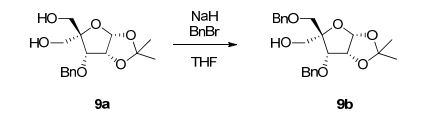
[00223] Periodinana Dess-Martin (3,1 g, 7,3 mmol) foi adicionada a a uma solução de intermediário 9b (1,95 g, 4,87 mmol) em diclorome- tano (24,5 mL) em temperatura ambiente. Após 1,5 h, a mistura de reação foi purificada através de cromatografia de coluna de SiO2 (Coluna Combiflash HP Gold de SiO2 80 g, acetato de etila 0-100%/hexanos) para fornecer intermediário 9c (1,94 g, 100%) como um óleo incolor.1H NMR (400 MHz, CDCl3) δ 9,91 (s, 1H), 7,36 - 7,11 (m, 10H), 5,84 (d, J = 3,4 Hz, 1H), 4,71 (d, J = 12,1 Hz, 1H), 4,59 (d, J = 12,2 Hz, 1H), 4,59 - 4,58 (m, 1H), 4,52 (d, J = 12,0 Hz, 1H), 4,46 (d, J = 12,0 Hz, 1H), 4,37 (d, J = 4,4 Hz, 1H), 3,68 (d, J = 11,0 Hz, 1H), 3,61 (d, J = 11,0 Hz, 1H), 1,60 (s, 3H), 1,35 (s, 3H).LC/MS: tR = 1,99 min, MS m/z = 421,25 [M+Na]; sistema LC: Thermo Accela 1250 UHPLC; Sistema MS: Thermo LCQ Fleet; Colu- na: Kinetex 2,6μ XB-C18 100A, 50 x 4,6 mm; Solventes: Acetonitrila com ácido acético 0,1%, Água com ácido acético 0,1%; Gradiente: 0 min-2,0 min ACN 2-100%, 2,0 min-3,05 min ACN 100%, 3,05 min-3,2 min ACN 100%-2%, 3,2 min-3,5 min ACN 2% a 2μl/min.HPLC: tR = 4,09 min; sistema HPLC: Série Agilent 1100; Coluna: Gemini 5μ C18 110A, 50 x 4,6 mm; Solventes: Acetonitrila com TFA 0,1%, Água com TFA 0,1%; Gradiente: 0 min-5,0 min ACN 298%, 5,0 min-6,0 min ACN 98% a 2 mL/min.TLC: eluente: acetato de etial 40% em hexanos, Rf = 0,6 (UV)
[00224] n -Butillítio 2,5M (6,02 mL) foi adicionado a uma solução de brometo de metiltrifenilfosfônio (5,38 g, 15,1 mmol) em tetra-hidrofura- no (20 mL) a -78°C. A reação foi deixada aquecer pa ra 0°C e uma solução de intermediário 9c (2,00 g, 5,02 mmol) em tetra-hidrofurano (5 mL) foi lentamente adicionada através de seringa. A mistura de reação foi deixada aquecer para a temperatura ambiente e agitada por 4 h. A mistura de reação foi então extinta com solução de cloreto de amônio aquosa saturada (10 mL) e foi dividida entre água (200 mL) e acetato de etila (200 mL). As camadas foram separadas e a camada orgânica foi lavada com salmoura (200 mL), seca em sulfato de sódio anidro e foi concentrada sob pressão reduzida. O resíduo bruto foi purificado através de cromatografia de coluna de SiO2 (Coluna Combiflash HP Gold SiO2 120 g, acetato de etila 0-50%/hexanos) para fornecer intermediário 9d (1,01 g, 51%) como um óleo incolor.1H NMR (400 MHz, CDCl3) δ 7,42 - 7,17 (m, 10H), 6,19 (dd, J = 17,6, 11,0 Hz, 1H), 5,76 (d, J = 3,9 Hz, 1H), 5,52 (dd, J = 17,5, 1,9 Hz, 1H), 5,25 (dd, J = 11,1, 1,8 Hz, 1H), 4,76 (d, J = 12,3 Hz, 1H), 4,62 - 4,55 (m, 2H), 4,52 (d, J = 12,1 Hz, 1H), 4,41 (d, J = 12,1 Hz, 1H), 4,25 (d, J = 4,9 Hz, 1H), 3,32 (d, J = 1,5 Hz, 2H), 1,52 (s, 3H), 1,29 (s, 3H)LC/MS: tR = 2,13 min, MS m/z = 419,24 [M+Na]; sistema LC: Thermo Accela 1250 UHPLC; Sistema MS: Thermo LCQ Fleet; Coluna: Kinetex 2,6μ XB-C18 100A, 50 x 4,6 mm; Solventes: Acetonitrila com ácido acético 0,1%, Água com ácido acético 0,1%; Gradiente: 0 min-2,0 min ACN 2-100%, 2,0 min-3,05 min ACN 100%, 3,05 min-3,2 min ACN 100%-2%, 3,2 min-3,5 min ACN 2% a 2μl/min.HPLC: tR = 4,37 min; sistema HPLC: Série Agilent 1100; Coluna: Gemini 5μ C18 110A, 50 x 4,6 mm; Solventes: Acetonitrila com TFA 0,1%, Água com TFA 0,1%; Gradiente: 0 min-5,0 min ACN 298%, 5,0 min-6,0 min ACN 98% a 2 mL/min.TLC: eluente: acetato de etila 50% em hexanos, Rf = 0,55 (UV)
[00225] HCl 4M em dioxana (320 μL) foi adicionado a uma solução de intermediário 9d (1,01 g, 2,55 mmol) em metanol (12,5 mL) em temperatura ambiente. Depois de 1,25 h, a mistura de reação foi dividida entre acetato de etila (100 mL) e solução de bicarbonato de sódio aquosa saturada (100 mL). As fases foram separadas e a fase orgânica foi lavada com salmoura (100 mL), foi seca em sulfato de sódio anidro e foi concentrada sob pressão reduzida para fornecer intermediário bruto 9e (1,05 g, mistura ~2,5:1 de anômeros 1’) como um óleo incolor. LC/MS: anômero maior tR = 2,00 min, MS m/z = 393,22 [M+Na], anômero menor tR = 1,98 min, MS m/z = 393,22 [M+Na]; sistema LC: Thermo Accela 1250 UHPLC; Sistema MS: Thermo LCQ Fleet; Coluna: Kinetex 2,6μ XB-C18 100A, 50 x 4,6 mm; Solventes: Acetonitrila com ácido acético 0,1%, Água com ácido acético 0,1%; Gradiente: 0 min-2,0 min ACN 2-100%, 2,0 min-3,05 min ACN 100%, 3,05 min-3,2 min ACN 100%-2%, 3,2 min-3,5 min ACN 2% a 2μl/min.HPLC: anômero maior tR = 4,01 min, anômero menor tR = 3,955 min; sistema HPLC: Série Agilent 1100; Coluna: Gemini 5μ C18 110A, 50 x 4,6 mm; Solventes: Acetonitrila com TFA 0,1%, Água com TFA 0,1%; Gradiente: 0 min-5,0 min ACN 2-98%, 5,0 min-6,0 min ACN 98% a 2 mL/min.TLC: eluente: acetato de etila 25% em hexanos, Anômero maior Rf= 0,30 (UV), Anômero menor Rf= 0,25 (UV)
[00226] NaH (60% em peso, 130 mg, 3,2 mmol) foi adicionado como um sólido a uma solução de intermediário 9e (1,0 g, 2,7 mmol) em THF (13,5 mL) em temperatura ambiente sob uma atmosfera de argô- nio. Depois de 15 min, brometo de benzila (0,38 mL, 3,2 mmol) foi adicionado e a mistura de reação foi agitada por 4 h. A mistura de reação foi extinta com solução de cloreto de amônio aquosa saturada (5 mL) e foi dividida entre acetato de etila (100 mL) e salmoura (100 mL). As fases foram separadas e a camada orgânica foi seca em sulfato de sódio anidro e foi concentrada sob pressão reduzida para fornecer intermediário bruto 9f (1,57 g, mistura ~2:1 de anômeros 1’) como um óleo incolor.LC/MS: anômero maior tR = 1,88 min, MS m/z = 483,36 [M+Na], anômero menor tR = 1,83 min, MS m/z = 483,36 [M+Na]; sistema LC: Thermo Accela 1250 UHPLC; Sistema MS: Thermo LCQ Fleet; Coluna: Kinetex 2,6μ XB-C18 100A, 50 x 4,6 mm; Solventes: Acetonitrila com ácido acético 0,1%, Água com ácido acético 0,1%; Gradiente: 0 min-1,5 min ACN 2-100%, 1,5 min-2,2 min ACN 100%, 2,2 min-2,4 min ACN 100%-2%, 2,4 min-2,5 min ACN 2% a 2μl/min.HPLC: anômero maior tR = 4,83 min, anômero menor tR = 4,62 min; sistema HPLC: Série Agilent 1100; Coluna: Gemini 5μ C18 110A, 50 x 4,6 mm; Solventes: Acetonitrila com TFA 0,1%, Água com TFA 0,1%; Gradiente: 0 min-5,0 min ACN 2-98%, 5,0 min-6,0 min ACN 98% a 2 mL/min.
[00227] Uma solução de TFA (16 mL) e água (1,6 mL) foi adicionada a intermediário 9f (1,5 g, 3,2 mmol) a 0°C e a m istura de reação foi deixada aquecer para temperatura ambiente. Após 9 h, água (1 mL) foi adicionada e a mistura de reação foi deixada agitar mais 10 h. A mistura de reação foi então concentrada sob pressão reduzida. O resíduo bruto foi dissolvido em acetato de etila (200 mL) e foi lavado com solução de bicarbonato de sódio aquosa saturada (2 x 150 mL) e salmoura (150 mL). A camada orgânica foi seca em sulfato de sódio anidro e foi concentrada sob pressão reduzida. O resíduo foi purificado através de cromatografia de coluna de SiO2 (Coluna Combiflash HP Gold SiO2 24 g, acetato de etila 0-100%/hexanos). As frações contendo o produto desejado foram combinadas para fornecer intermediário 9g (580 mg) como um óleo incolor que era uma mistura com outras impurezas. A mistura foi usada diretamente na etapa seguinte.LC/MS: tR = 3,13 min, MS m/z = 463,88 [M+OH]; sistema LC: Thermo Accela 1250 UHPLC; Sistema MS: Thermo LCQ Fleet; Coluna: Kinetex 2,6μ XB-C18 100A, 50 x 4,6 mm; Solventes: Acetonitrila com ácido acético 0,1%, Água com ácido acético 0,1%; Gradiente: 0 min-2,0 min ACN 2-100%, 2,0 min-3,05 min ACN 100%, 3,05 min-3,2 min ACN 100%-2%, 3,2 min-3,5 min ACN 2% a 2μl/min.HPLC: tR = 4,34 min; sistema HPLC: Série Agilent 1100; Coluna: Gemini 5μ C18 110A, 50 x 4,6 mm; Solventes: Acetonitrila com TFA 0,1%, Água com TFA 0,1%; Gradiente: 0 min-5,0 min ACN 298%, 5,0 min-6,0 min ACN 98% a 2 mL/min.
[00228] Perrutenato de tetrapropilamônio (45,7 mg, 130 μmol) e N- óxido de 4-metilmorfolina (457 mg, 3,89 mmol) foram adicionados a uma solução de intermediário 9g (580 mg, 1,30 mmol) e MS 4Â (100 mg) em DCM (6,45 mL) em temperatura ambiente. Depois de 1h, sílica gel (~500 mg) foi adicionada à mistura de reação e a pasta fluida resultante foi filtrada em uma almofada de sílica gel (~1 g). O filtrado foi concentrado sob pressão reduzida. O resíduo bruto foi purificado através de cromatografia de coluna de SiO2 (Coluna Combiflash HP Gold SiO2 12 g, acetato de etila 0-100%/hexanos) para fornecer intermediário 9h (254 mg, 18% em duas etapas) como um óleo incolor.1H NMR (400 MHz, CDCl3) δ 7,38 - 7,23 (m, 13H), 7,20 - 7,13 (m, 2H), 5,91 (dd, J = 17,5, 11,2 Hz, 1H), 5,49 (dd, J = 17,5, 0,9 Hz, 1H), 5,33 (dd, J = 11,2, 0,9 Hz, 1H), 4,96 (d, J = 12,0 Hz, 1H). 4,74 - 4,68 (m, 2H), 4,55 - 4,47 (m, 3H), 4,39 (d, J = 11,9 Hz, 1H), 4,20 (d, J = 6,0 Hz, 1H), 3,55 (d, J = 10,8 Hz, 1H), 3,46 (d, J = 10,8 Hz, 1H)LC/MS: tR = 2,19 min, MS m/z = 444,78 [M+H]; sistema LC: Thermo Accela 1250 UHPLC; Sistema MS: Thermo LCQ Fleet; Coluna: Kinetex 2,6μ XB-C18 100A, 50 x 4,6 mm; Solventes: Acetonitrila com ácido acético 0,1%, Água com ácido acético 0,1%; Gradiente: 0 min-2,0 min ACN 2-100%, 2,0 min-3,05 min ACN 100%, 3,05 min-3,2 min ACN 100%-2%, 3,2 min-3,5 min ACN 2% a 2μl/min.HPLC: tR = 4,53 min; sistema HPLC: Série Agilent 1100; Coluna: Gemini 5μ C18 110A, 50 x 4,6 mm; Solventes: Acetonitrila com TFA 0,1%, Água com TFA 0,1%; Gradiente: 0 min-5,0 min ACN 298%, 5,0 min-6,0 min ACN 98% a 2 mL/min.TLC: eluente: acetato de etila 25% em hexanos, Rf = 0,45 (UV)
[00229] n -Butillítio (2,5M em hexanos, 1,0 mL, 2,5 mmol) foi adicionado rapidamente a uma suspensão de intermediário 1b (0,21 g, 0,81 mmol) e 1,2-bis(clorodimetilsilil)etano (0,17 g, 0,81 mmol) em THF (4 mL) a -78°C sob uma atmosfera de argônio. A mistura resultante foi então transferida através de cânula a uma solução de 9h (0,18 g, 0,41 mmol) em THF (1 mL) a -78°C sob uma atmosfera de ar gônio. Após 20 min, a mistura de reação foi deixada aquecer para 0°C e foi agitada por 15 min. A mistura de reação foi extinta com solução de cloreto de amônio aquosa saturada (1 mL). A mistura resultante foi diluída com acetato de etila (100 mL) e foi lavada com solução de bicarbonato de sódio aquosa saturada (100 mL) e salmoura (100 mL). A camada or-gânica foi seca em sulfato de sódio anidro e foi concentrada sob pressão reduzida. O resíduo bruto foi purificado através de cromatografia de coluna de SiO2 (Coluna Combiflash HP Gold SiO2 12 g, acetato de etila 0-100%/hexanos) para fornecer intermediário 9i (11,1 mg, 5%, mistura de isômeros) como um óleo incolor.LC/MS: tR = 1,97 min, MS m/z = 579,27 [M+H]; sistema LC: Thermo Accela 1250 UHPLC; Sistema MS: Thermo LCQ Fleet; Coluna: Kinetex 2,6μ XB-C18 100A, 50 x 4,6 mm; Solventes: Acetonitrila com ácido acético 0,1%, Água com ácido acético 0,1%; Gradiente: 0 min-2,0 min ACN 2-100%, 2,0 min-3,05 min ACN 100%, 3,05 min-3,2 min ACN 100%-2%, 3,2 min-3,5 min ACN 2% a 2μl/min.HPLC: tR = 3,37 min; sistema HPLC: Série Agilent 1100; Coluna: Gemini 5μ C18 110A, 50 x 4,6 mm; Solventes: Acetonitrila com TFA 0,1%, Água com TFA 0,1%; Gradiente: 0 min-5,0 min ACN 298%, 5,0 min-6,0 min ACN 98% a 2 mL/min.TLC: eluente: acetato de etila, Rf= 0,3 (UV)
[00230] A uma solução de intermediário 9i (11,0 mg, 19,0 μmol) e trietilsilano (0,5 mL) em DCM (1 mL) foi adicionado dietil eterato de tri- fluoreto de boro (0,1 mL) lentamente a 0°C sob uma atmosfera de ar- gônio. Depois de 1 h, a mistura de reação foi lentamente diluída com solução de bicarbonato de sódio aquosa saturada (10 mL) e a mistura resultante foi extraída com acetato de etila (2 x 10 mL), foi seca em sulfato de sódio anidro e foi concentrada sob pressão reduzida. O resíduo bruto foi purificado através de cromatografia de coluna de SiO2 (Coluna Combiflash HP Gold SiO2 4 g, acetato de etila 0-100%/hexanos) para fornecer intermediário 9j (7,7 mg, 72%) como uma película incolor.1H NMR (400 MHz, CDCl3) δ 7,87 (s, 1H), 7,37 - 7,17 (m, 15H), 6,73 (d, J = 4,5 Hz, 1H), 6,51 (d, J = 4,5 Hz, 1H), 6,23 (dd, J = 17,5, 10,9 Hz, 1H), 5,70 (d, J = 3,9 Hz, 1H), 5,59 (dd, J = 17,5, 1,8 Hz, 1H), 5,32 (dd, J = 10,9, 1,7 Hz, 1H), 4,72 - 4,56 (m, 4H), 4,49 (d, J = 11,9 Hz, 2H), 4,43 (d, J = 5,6 Hz, 1H), 4,25 (dd, J = 5,6, 4,0 Hz, 1H), 3,56 (s, 2H).LC/MS: tR = 2,32 min, MS m/z = 563,33 [M+H]; sistema LC: Thermo Accela 1250 UHPLC; Sistema MS: Thermo LCQ Fleet; Coluna: Kinetex 2,6μ XB-C18 100A, 50 x 4,6 mm; Solventes: Acetonitrila com ácido acético 0,1%, Água com ácido acético 0,1%; Gradiente: 0 min-2,0 min ACN 2-100%, 2,0 min-3,05 min ACN 100%, 3,05 min-3,2 min ACN 100%-2%, 3,2 min-3,5 min ACN 2% a 2μl/min.HPLC: tR = 3,51 min; sistema HPLC: Série Agilent 1100; Coluna: Gemini 5μ C18 110A, 50 x 4,6 mm; Solventes: Acetonitrila com TFA 0,1%, Água com TFA 0,1%; Gradiente: 0 min-5,0 min ACN 298%, 5,0 min-6,0 min ACN 98% a 2 mL/min.TLC: eluente: acetato de etila, Rf = 0,40 (UV)
[00231] Tribrometo de boro (1M, 0,06 mL, 60 μmol) foi adicionado em gotas a uma solução de intermediário 9j (7,7 mg, 13,7 μmol) em diclorometano (1 mL) a -78°C sob uma atmosfera de a rgônio. Após 1 h, a mistura de reação foi deixada aquecer para 0°C e foi agitada mais 1,5 h. A reação foi esfriada para -78°C e foi extinta com uma solução de metanol/piridina 2:1 (1,5 mL). A mistura resultante foi deixada aquecer para temperatura ambiente e foi concentrada sob pressão reduzida. O resíduo bruto foi purificado através de HPLC preparativa (coluna Phenominex Synergi 4u Hydro-RR 80Â 150 x 30 mm, gradiente de acetonitrila 0-100%/água) para fornecer Exemplo 20 (0,5 mg, 13%) como um sólido branco.1H NMR (400 MHz, CD3OD) δ 7,78 (s, 1H), 6,88 (d, J = 4,5 Hz, 1H), 6,76 (d, J = 4,5 Hz, 1H), 6,02 (dd, J = 17,4, 11,0 Hz, 1H), 5,47 (dd, J = 17,4, 2,0 Hz, 1H), 5,23 (dd, J = 10,9, 2,1 Hz, 1H), 5,15 (d, J = 8,3 Hz, 1H), 4,72 (dd, J = 8,2, 5,7 Hz, 1H), 4,34 (d, J = 5,7 Hz, 1H), 3,60 (d, J = 11,8 Hz, 1H), 3,49 (d, J = 11,8 Hz, 1H)LC/MS: tR = 0,84 min, MS m/z = 293,19 [M+H]; sistema LC: Thermo Accela 1250 UHPLC; Sistema MS: Thermo LCQ Fleet; Coluna: Kinetex 2,6μ XB-C18 100A, 50 x 4,6 mm; Solventes: Acetonitrila com ácido acético 0,1%, Água com ácido acético 0,1%; Gradiente: 0 min-1,5 min ACN 2-100%, 1,5 min-2,2 min ACN 100%, 2,2 min-2,4 min ACN 100%-2%, 2,4 min-2,5 min ACN 2% a 2μl/minHPLC: tR = 2,181 min; sistema HPLC: Série Agilent 1100; Coluna: Gemini 5μ C18 110A, 50 x 4,6 mm; Solventes: Acetonitrila com TFA 0,1%, Água com TFA 0,1%; Gradiente: 0 min-5,0 min ACN 298%, 5,0 min-6,0 min ACN 98% a 2 mL/min.
[00232] O Exemplo 19 (237 mg, 0,766 mmol) e selectfluor (407 mg, 1,15 mmol) foram suspensos em acetonitrila (5 mL) e AcOH (0,2 mL) foi adicionado. A mistura resultante foi agitada em temperatura ambiente por 30 min e foi então neutralizada com solução de bicarbonato de sódio e filtrada para remover sólidos. Quando da concentração a vácuo, o resíduo foi purificado através de HPLC preparativa (acetonitri- la 0 a 30% em água) para fornecer o Exemplo 21 (27 mg, 11%) como um sólido esbranquiçado.1H NMR (400 MHz, CD3OD) δ 7,73 (s, 1H), 6,63 (s, 1H), 5,80 (dd, J = 23,9, 1,7 Hz, 1H), 5,16 (ddd, J = 55,3, 5,0, 1,7 Hz, 1H), 4,56 (dd, J = 23,5, 5,0 Hz, 1H), 3,94 - 3,60 (m, 2H)19F NMR (376 MHz, CD3OD) δ -161,76 (s), -195,42 (d, J = 55,4 Hz)MS m/z = 328 [M+H]. Sistema MS: Thermo LCQ Fleet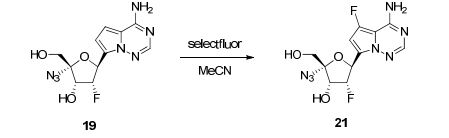
[00233] O intermediário 11a (2,0 g, 13,4 mmoLl) foi carregado em um tubo polyTube. O recipiente de reação foi então posto em um banho gelado e ambos HF 70%/Pyr (18 mL) e piridina (9 mL) foram adicionados sequencialmente. Imediatamente após a adição de piridina, tBuNO2 (2,07 mL, 17,43 mmol) foi então adicionado lentamente durante 20 min. A solução vai de castanho para preto com um exoterma e desgaseificação. A reação foi então agitada por mais 20 min e a mistura de reação foi então diluída com água e foi concentrada sob pressão reduzida. O resíduo bruto foi dividido entre acetato de etila e água. Os orgânicos foram separados e a aquosa foi lavada com acetato de etila três vezes. Os orgânicos foram combinados e lavados com salmoura. O produto bruto foi seco em Na2SO4, filtrado e o solvente foi removido sob pressão reduzida. O resíduo bruto foi purificado através de croma- tografia de sílica gel (EtOAc 50-100%/Hex) para fornecer intermediário 11b (1,68 g, 82%) como um sólido castanho. 1H NMR (400 MHz, DMSO-d6) δ 8,49 - 8,09 (m, 2H), 7,58 (t, J = 2,0 Hz, 1H), 6,95 (d, J = 4,5, 1H), 6,59 (d, J = 4,5, 1H).19F NMR (376 MHz, DMSO-d6) δ -73,42 (s).LC/MS: tR = 1,03 min, MS m/z = 153,08 [M+H]; sistema LC: Thermo Accela 1250 UHPLC; Sistema MS: Thermo LCQ Fleet; Coluna: Kinetex 2,6μ XB-C18 100A, 50 x 3,00 mm; Solventes: Acetonitrila com ácido fórmico 0,1%, Água com ácido fórmico 0,1%; Gradiente: 0 min-1,4 min ACN 2-100%, 1,4 min-1,80 min ACN 100%, 1,8 min-1,85 min ACN 100%-2%, 1,85 min-2 min ACN 2% a 1,8mL/min.
[00234] Uma solução de 11b (3,36 g, 22,1 mmol) em DMF (50 mL) foi esfriada para 0°C em um banho gelado. Uma solução de 1,3- dibromo-5,5-dimetilidantoína (3,16 g, 11,0 mmol) em DMF (50 mL) foi adicionada em gotas através de funil de adição durante 40 min. Após 1 h, a reação foi extinta com Na2S2O3(aq) saturado e o bruto foi dividido entre EtOAc e LiCl(aq) 5%. Os orgânicos foram extraídos com LiCl(aq) 5% (4x) seguido por salmoura. Os orgânicos foram secos em Na2SO4, os sólidos foram removidos através de filtragem e o filtrado foi concentrado sob pressão reduzida. O resíduo bruto foi sonificado com CH2Cl2 e os sólidos foram coletados através de filtragem e foram secos sob vácuo alto para fornecer intermediário 11c (3,93 g, 77%) como um sólido amarelo. 1H NMR (400 MHz, DMSO-d6) δ 8,49-8,44 (m, 2H), 7,08 (d, J = 4,6 Hz, 1H), 6,76 (d, J = 4,6 Hz, 1H).19F NMR (376 MHz, DMSO-d6) δ -71,45 (s).LC/MS: tR = 1,22 min, MS m/z = 232,98 [M+H]; sistema LC: Thermo Accela 1250 UHPLC; Sistema MS: Thermo LCQ Fleet; Coluna: Kinetex 2,6μ XB-C18 100A, 50 x 3,00 mm; Solventes: Acetonitrila com ácido fórmico 0,1%, Água com ácido fórmico 0,1%; Gradiente: 0 min-1,4 min ACN 2-100%, 1,4 min-1,80 min ACN 100%, 1,8 min-1,85 min ACN 100%-2%, 1,85 min-2 min ACN 2% a 1,8mL/min.
[00235] A uma solução de 11c (2,09 g, 9,08 mmol) em THF (30 mL) foi adicionado 1,2-bis(clorodimetilsilil)etano (STABASE, 1,96 g, 9,08 mmol) em uma porção e a mistura resultante foi deixada agitar em temperatura ambiente por 1 h. A reação foi então esfriada para -78°C usando um banho de gelo seco com metanol. nBuLi (2,5M em hexa- nos, 10,9 mL, 27,2 mmol) foi adicionado de uma maneira para manter uma temperatura interna de -65°C. Uma solução de in termediário 11d (Preparado de acordo com WO2012012776, 2,5 g, 7,5 mmol) em THF (25 mL) foi então adicionada à mistura de reação durante 1 min. Após 5 min, a mistura de reação foi extinta com ácido acético e foi deixada ir para a temperatura ambiente. Os solventes foram removidos sob pressão reduzida e o resíduo foi absorvido em acetato de etila. Os orgânicos foram lavados com água seguido por salmoura. As camadas foram separadas e os orgânicos foram secos em Na2SO4, filtrados e concentrados sob pressão reduzida para fornecer 11e bruto como uma mistu- ra de isômeros, que foi usada como é na etapa seguinte.LC/MS: tR = 1,32 e 1,40 min, MS m/z = 483,15 [M+H]; sistema LC: Thermo Accela 1250 UHPLC; Sistema MS: Thermo LCQ Fleet; Coluna: Kinetex 2,6μ XB-C18 100A, 50 x 3,00 mm; Solventes: Acetoni- trila com ácido fórmico 0,1%, Água com ácido fórmico 0,1%; Gradiente: 0 min-1,4 min ACN 2-100%, 1,4 min-1,80 min ACN 100%, 1,8 min- 1,85 min ACN 100%-2%, 1,85 min-2 min ACN 2% a 1,8mL/min.
[00236] O intermediário 11e (1,99 g, 3,72 mmol) foi dissolvido em CH2Cl2 (80 mL) e TES (4,75 mL, 29,7 mmol) foi adicionado à mistura. A mistura de reação foi esfriada para 0°C e BF3^Et2O (1,07 mL, 4,09 mmol) foi lentamente adicionado. Depois de 15 minutos, a mistura de reação foi extinta com NaHCO3(aq) saturado e as camadas foram separadas. A camada aquosa foi lavada com CH2Cl2. As camadas orgânicas foram combinadas e foram lavadas com NaHCO3(aq) saturado. Os orgânicos foram secos em Na2SO4, filtrados e foram concentrados sob pressão reduzida. O produto bruto foi purificado através de cromato- grafia de sílica gel (EtOAc 0-60%/Hex) para fornecer intermediário 11f (1,12 g, 64%, mistura 2:1 de anômeros 1’).LC/MS: tR = 1,55 min, MS m/z = 467,47 [M+H]; sistema LC: Thermo Accela 1250 UHPLC; Sistema MS: Thermo LCQ Fleet; Coluna: Kinetex 2,6μ XB-C18 100A, 50 x 3,00 mm; Solventes: Acetonitrila com ácido fórmico 0,1%, Água com ácido fórmico 0,1%; Gradiente: 0 min-1,4 min ACN 2-100%, 1,4 min-1,80 min ACN 100%, 1,8 min-1,85 min ACN 100%-2%, 1,85 min-2 min ACN 2% a 1,8mL/min.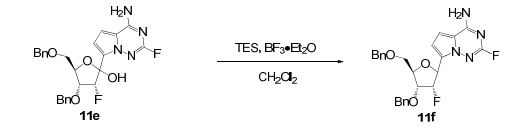
[00237] O intermediário 11f (0,82 g, 1,76 mmol) foi dissolvido em ácido acético (25 mL). O recipiente de reação foi purgado com Argônio e Pd/C 10% (468 mg, 0,439 mmol) foi adicionado. O recipiente foi evacuado e retrocheio com H2(g) (3x). Após 1 h, o recipiente de reação foi purgado com nitrogênio. A mistura resultante foi filtrada em uma almofada de celite e a torta de filtro foi lavada com CH3OH. O filtrado foi concentrado sob pressão reduzida e então evaporado com acetato de etila seguido por hexanos para fornecer intermediário 11g (503 mg, 98%, mistura 2:1 de anômeros 1’).LC/MS: tR = 0,81 min, MS m/z = 286,97 [M+H]; sistema LC: Thermo Accela 1250 UHPLC; Sistema MS: Thermo LCQ Fleet; Coluna: Kinetex 2,6μ XB-C18 100A, 50 x 3,00 mm; Solventes: Acetonitrila com ácido fórmico 0,1%, Água com ácido fórmico 0,1%; Gradiente: 0 min-1,4 min ACN 2-100%, 1,4 min-1,80 min ACN 100%, 1,8 min-1,85 min ACN 100%-2%, 1,85 min-2 min ACN 2% a 1,8mL/min.
[00238] A um frasco purgado com argônio foi adicionada uma solução de 11g (283 mg, 0,989 mmol) em DMF (10 mL) seguido por uma solução de iodeto de metil trifenoxifosfônio (0,536 g, 1,19 mmol) em 4 mL de DMF. A mistura de reação foi deixada agitar a 0°C por 10 min e foi então aquecida para temperatura ambiente. Depois de 30 minutos, a reação foi extinta com Na2S2O3(aq) saturado. O material bruto foi dividido entre EtOAc e LiCl(aq) 5%. Os orgânicos foram separados e lavados com salmoura. Os orgânicos foram secos em Na2SO4, filtrados e concentrados sob pressão reduzida. O resíduo bruto foi absorvido em ACN e purificado através de HPLC sem modificador ácido para fornecer intermediário 11h (201 mg, 52%, mistura 2:1 de anômeros 1’) como um sólido branco.LC/MS: tR = 1,08 min, MS m/z = 397,12 [M+H]; sistema LC: Thermo Accela 1250 UHPLC; Sistema MS: Thermo LCQ Fleet; Coluna: Kinetex 2,6μ XB-C18 100A, 50 x 3,00 mm; Solventes: Acetonitrila com ácido fórmico 0,1%, Água com ácido fórmico 0,1%; Gradiente: 0 min-1,4 min ACN 2-100%, 1,4 min-1,80 min ACN 100%, 1,8 min-1,85 min ACN 100%-2%, 1,85 min-2 min ACN 2% a1,8mL/min.
[00239] A uma solução de 11h (356 mg, 0,899 mmol) em THF (8 mL) foi adicionado DBU (0,403 mL, 2,70 mmol) e a mistura resultante foi aquecida para 60°C. Depois de 3 h, a mistura de reação foi concentrada sob pressão reduzida. O resíduo bruto foi purificado através de cromatografia de sílica gel (EtOAc 40-100%/Hex) para fornecer inter-mediário 11i (201 mg, 83%, mistura 2:1 de anômeros 1’) como um sólido branco.LC/MS: tR = 1,04 min, MS m/z = 269,14 [M+1]; sistema LC: Thermo Accela 1250 UHPLC; Sistema MS: Thermo LCQ Fleet; Coluna: Kinetex 2,6μ XB-C18 100A, 50 x 3,00 mm; Solventes: Acetonitrila com ácido fórmico 0,1%, Água com ácido fórmico 0,1%; Gradiente: 0 min-1,4 min ACN 2-100%, 1,4 min-1,80 min ACN 100%, 1,8 min-1,85 min ACN 100%-2%, 1,85 min-2 min ACN 2% a 1,8mL/min.
[00240] Cloreto de benziltrimetilamônio (292 mg, 1,57 mmol) e azi- da de sódio (102 mg, 1,57 mmol) foram dissolvidos em ACN (4 mL) e a mistura resultante foi agitada em temperatura ambiente por 4 h. A mistura foi filtrada e o filtrado foi adicionado a uma solução de 11i (0,201 g, 0,749 mmol) em THF (4 mL). NMM (0,412 mL, 3,75 mmol) foi adicionado seguido pela adição em gotas de uma solução de iodo (0,342 g, 1,35 mmol) em THF (4 mL). Após 15 minutos, N-acetil cisteína foi adicionada em porções até que nenhuma desgaseificação fosse observada. Na2S2O3(aq) foi adicionado até que a solução fosse um amarelo claro. A mistura resultante foi dividida entre água e acetato de etila. As camadas foram separadas e a camada orgânica foi seca em Na2SO4, filtrada e concentrada sob pressão reduzida. O resíduo bruto foi purificado através de cromatografia de sílica gel (EtOAc 20-100%/Hex) para fornecer intermediário 11j (183 mg, 56%) como um isômero único.1H NMR (400 MHz, DMSO-d6) δ 8,44 (d, J = 28,6 Hz, 2H), 6,98 (d, J = 4,6 Hz, 1H), 6,79 (d, J = 4,6 Hz, 1H), 6,32 (d, J = 6,9 Hz, 1H), 5,60 (dd, J = 23,8, 2,5 Hz, 1H), 5,36 (ddd, J = 54,9, 5,0, 2,6 Hz, 1H), 4,60 (ddd, J = 21,5, 6,9, 5,0 Hz, 1H), 3,63 (ABq, Δδ = 0,09ppm, J = 8Hz, 2H). 19F NMR (376 MHz, DMSO-d6) δ -71,74 (s), -194,57 (ddd, J = 54,9, 24,0, 21,7 Hz)LC/MS: tR = 1,71 min, MS m/z = 437,93 [M+1]; sistema LC: Thermo Accela 1250 UHPLC; Sistema MS: Thermo LCQ Fleet; Coluna: Kinetex 2,6μ XB-C18 100A, 50 x 3,00 mm; Solventes: Acetonitrila com ácido fórmico 0,1%, Água com ácido fórmico 0,1%; Gradiente: 0 min-2,4 min ACN 2-100%, 2,4 min-2,80 min ACN 100%, 2,8 min-2,85 min ACN 100%-2%, 2,85 min-3,0 min ACN 2% a 1,8mL/min.
[00241] A uma solução de 11j (0,183 g, 0,419 mmol) em THF (10 mL) foram adicionados anidrido isobutírico (0,083 mL, 0,502 mmol), TEA (0,118 mL, 0,837 mmol) e DMAP (10 mg, 0,084 mmol). A reação foi deixada agitar em temperatura ambiente por 15 minutos e a reação foi extinta com CH3OH. A mistura de reação foi concentrada sob pressão reduzida e o resíduo bruto foi purificado através de cromatografia de sílica gel (EtOAc 0-50%/Hex) para fornecer intermediário 11k (0,198 g, 93%) como um sólido branco.1H NMR (400 MHz, DMSO-d6) δ 8,48 (d, J = 30,7 Hz, 2H), 6,99 (d, J = 4,6 Hz, 1H), 6,84 (d, J = 4,6 Hz, 1H), 5,77 - 5,47 (m, 3H), 3,69 (ABq, Δδ = 0,05ppm, J = 12 Hz, 2H), 2,70 (p, J = 7,0 Hz, 1H), 1,24 - 1,05 (d, J = 7,0 Hz, 6H).19F NMR (376 MHz, DMSO-d6) δ -71,58 (s), -194,89 (ddd, J = 55,0, 24,3, 16,8 Hz).LC/MS: tR = 1,56 min, MS m/z = 508,13 [M+1]; sistema LC: Thermo Accela 1250 UHPLC; Sistema MS: Thermo LCQ Fleet; Coluna: Kinetex 2,6μ XB-C18 100A, 50 x 3,00 mm; Solventes: Acetonitrila com ácido fórmico 0,1%, Água com ácido fórmico 0,1%; Gradiente: 0 min-2,4 min ACN 2-100%, 2,4 min-2,80 min ACN 100%, 2,8 min-2,85 min ACN 100%-2%, 2,85 min-3,0 min ACN 2% a 1,8mL/min.
[00242] O intermediário 11k (0,153 g, 0,302 mmol) foi dissolvido em CH2Cl2 (10 mL) e H2O (6 mL). Fosfato de potássio dibásico (0,138 g, 0,603 mmol), bissulfato de tetrabutilamônio (0,210 g, 0,618 mmol) e ácido 3-clorobenzoico (0,097 g, 0,618 mmol) foram adicionados se-quencialmente. A mistura resultante foi esfriada para 0°C e MCPBA (0,203 g, 0,905 mmol) foi adicionado. A mistura de reação foi deixada aquecer para temperatura ambiente e foi agitada por 16 h. A mistura de reação foi então extinta com Na2S2O3(aq) saturado e foi concentrada sob pressão reduzida. O resíduo aquoso bruto foi diluído com ACN e purificado através de HPLC preparativa sem modificador ácido para fornecer intermediário 11l (20 mg, 13%) como um sólido branco.1H NMR (400 MHz, DMSO-d6) δ 8,46 (d, J = 26,4 Hz, 2H), 7,96 - 7,81 (m, 2H), 7,81 - 7,66 (m, 1H), 7,62 - 7,46 (m, 1H), 6,94 (d, J = 4,5 Hz, 1H), 6,80 (d, J = 4,5 Hz, 1H), 5,73 (s, 3H), 4,60 (ABq, Δδ = 0,08ppm, J = 12 Hz, 2H), 2,66 (p, J = 7,0 Hz, 1H), 1,20 - 1,01 (m, 6H).19F NMR (376 MHz, DMSO-d6) δ = -71,45 (s), -193,41 (ddd, J = 54,4, 25,4, 21,2 Hz,). LC/MS: tR = 2,22 min, MS m/z = 536,17 [M+1]; sistema LC: Thermo Accela 1250 UHPLC; Sistema MS: Thermo LCQ Fleet; Coluna: Kinetex 2,6μ XB-C18 100A, 50 x 3,00 mm; Solventes: Acetonitrila com ácido fórmico 0,1%, Água com ácido fórmico 0,1%; Gradiente: 0 min-2,4 min ACN 2-100%, 2,4 min-2,80 min ACN 100%, 2,8 min-2,85 min ACN 100%-2%, 2,85 min-3,0 min ACN 2% a 1,8mL/min.
[00243] A uma solução de intermediário 11l (22 mg, 0,041 mmol) em CH3OH (1 mL) foi adicionado NH4OH concentrado (1 mL) em tem-peratura ambiente. Após 30 min, a mistura de reação foi concentrada sob pressão reduzida. O resíduo bruto foi diluído com H2O mínima e foi purificado através de HPLC preparativa sem modificador para fornecer Exemplo 22 (10 mg, 77%) como um sólido branco.1H NMR (400 MHz, DMSO-d6) δ 8,40 (d, J = 30,9 Hz, 2H), 6,95 (d, J = 4,5 Hz, 1H), 6,78 (d, J = 4,5 Hz, 1H), 5,89 (d, J = 7,5 Hz, 1H), 5,61 (dd, J = 23,8, 2,1 Hz, 1H), 5,44 (t, J = 6,1 Hz, 1H), 5,18 (ddd, J = 55,3, 5,1, 2,2 Hz, 1H), 4,44 (ddd, J = 23,7, 7,5, 5,0 Hz, 1H), 3,59 (ddd, J = 48,5, 12,0, 6,1 Hz, 2H).19F NMR (376 MHz, DMSO-d6) δ -71,18 (s), -193,48 (dt, J = 55,3, 23,8 Hz).LC/MS: tR = 1,13 min, MS m/z = 327,86 [M+1]; sistema LC: Thermo Accela 1250 UHPLC; Sistema MS: Thermo LCQ Fleet; Coluna: Kinetex 2,6μ XB-C18 100A, 50 x 3,00 mm; Solventes: Acetonitrila com ácido fórmico 0,1%, Água com ácido fórmico 0,1%; Gradiente: 0 min-2,4 min ACN 2-100%, 2,4 min-2,80 min ACN 100%, 2,8 min-2,85 min ACN 100%-2%, 2,85 min-3,0 min ACN 2% a 1,8mL/min.
[00244] A uma solução de intermediário 3d (57 mg, 0,109 mmol) em ACN (3 mL) foi adicionado Selecfluor II em uma porção (52 mg, 0,164 mmol). Após 1,5 h, a reação foi extinta através da adição de NaHCO3(aq) saturado. Acetato de etila (4 mL) foi adicionado e a mistura bifásica foi agitada vigorosamente por 5 min. A reação foi diluída mais com EtOAc e NaHCO3(aq) saturado. As camadas foram separadas e a fase orgânica foi extraída com água e então salmoura. A camada orgânica foi seca em Na2SO4. O agente de secagem foi removido através de filtragem a vácuo e o filtrado foi concentrado sob pressão reduzida. Intermediário 12a (11 mg, 18,7%) foi isolado do material bruto concentrado através de cromatografia de coluna de sílica gel usando o aumento de solvente que segue: EtOAc 0% em hexanos aumentando para EtOAc 70% em hexanos, aumentando rapidamente para EtOAc 100% uma vez o material de partida eluindo da coluna.1H NMR (400 MHz, CD3OD) δ 7,72 (s, 1H), 7,55 (s, 1H), 5,65 (dd, J = 24,8, 2,4 Hz, 1H), 5,38 (dq, J = 54,4, 2 Hz, 1H), 4,88 (dd, J = 19,2, 4,4 Hz, 1H), 3,96 (ABq, ΔδAB= 0,141ppm, J = 11 Hz, 2H), 0,99 (s, 9H), 0,86 (s, 9H), 0,21 (s, 6H), 0,07 (s, 3H), -0,02 (s, 3H).19F NMR (376 MHz, CD3OD) δ -161,795 (s), -194,806 (ddd, J = 54,5, 19,2, 18,8 Hz).LC/MS: RT = 2,06 min, MS m/z = 540,64 [M+1]; sistema LC: Thermo Accela 1250 UHPLC; MS: Thermo LCQ Fleet; Coluna: Kinetex 2,6μ C18 100A, 50 x 3,00 mm; Solventes: Acetonitrila com ácido fórmico 0,1%, Água com ácido fórmico 0,1%; Gradiente: 0 min-2,4 min ACN 2-100%, 2,4 min-2,8 min ACN 100%, 2,8 min-2,85 min ACN 100%-2%, 2,85 min-3 min ACN 2%.
[00245] A uma solução de intermediário 12a (29 mg, 0,054 mmol) em THF (2 mL) em um tubo de polipropileno foi adicionado HF.Piridina 70% em piridina (51 μL, 1,97 mmol) a 0°C, sob uma atmosfera de N2. Após 1,5 h, A reação foi removida do banho gelado. Mais HF.Piridina 70% em piridina foi adicionado após 3 h (150 μL), 5 h 45 min (200 μL) e 21 h 15 min (0,7 mL). A mistura de reação foi então agitada por mais 24 h ponto onde a mistura de reação foi esfriada em um banho gelado e então extinta com água e NaHCO3(aq) saturado. A mistura foi concentrada sob pressão reduzida e o resíduo foi absorvido em DMF. A solu- ção/suspensão resultante foi filtrada em um filtro de seringa (Whatman 0,45 μm PTFE w/GMF). O filtrado foi injetado em uma HPLC e o produto semipurificado foi purificado adicionalmente através de cromato- grafia de coluna de sílica gel usando o aumento de solvente que segue: MeOH 0% em DCM aumentando para MeOH 20% em DCM. Frações contendo produto foram concentradas e o resíduo foi liofilizado para fornecer Exemplo 23 (5 mg, 30%) como um pó branco.1H NMR (400 MHz, DMF-d7) δ 7,74 (s, 1H), 6,61 (s, 1H), 5,75 (dd, J = 25,2, 1,6 Hz, 1H), 5,23 (ddd, J = 54,8, 4,8, 1,6 Hz, 1H), 4,64 (dd, J = 22, 4,4 Hz, 1H), 3,90 (ABq, ΔδAB = 0,151ppm, J = 12 Hz, 2H) . 19F NMR (376 MHz, DMF-d7) δ -161,727 (s), -193,726 (ddd, J =54,5, 22,9, 21,8 Hz).LC/MS: RT = 0,81 min, MS m/z = 312,13 [M+1]; LC: ThermoAccela 1250 UHPLC; MS: Thermo LCQ Fleet; Coluna: Kinetex 2,6μ C18 100A, 50 x 3,00 mm; Solventes: Acetonitrila com ácido fórmico 0,1%, Água com ácido fórmico 0,1%; Gradiente: 0 min-2,4 min ACN 2-100%, 2,4 min-2,8 min ACN 100%, 2,8 min-2,85 min ACN 100%-2%,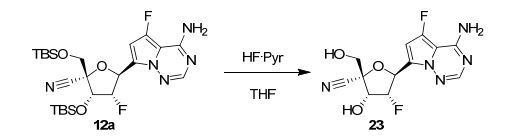
[00246] A uma solução de trifenilfosfina (973 mg, 3,71 mmol) e imi- dazol (252 mg, 3,71 mmol) em THF (5 mL) foi adicionado iodo (253 mg, 1,86 mmol) em temperatura ambiente. Quando da dissolução completa do iodo, uma solução de composto 2g (650 mg, 0,93 mmol) em THF (5 mL) foi adicionada em gotas lentamente. A mistura resultante foi agitada a 80°C por 3 dias e foi então con centrada a vácuo. O resíduo foi purificado através de cromatografia de coluna de sílica gel (EtOAc 0 a 50% em hexanos) para fornecer intermediário 13a (230 mg, 33%) como um óleo.MS m/z = 742 [M+H]. Sistema MS: Thermo LCQ Fleet.
[00247] O intermediário 13a (200 mg, 0,243 mmol) foi dissolvido em metanol (10 mL) e sob atmosfera de nitrogênio, Pd/C 10% (100 mg, 0,094 mmol) e TEA (0,035 mL, 0,243 mmol) foram adicionados. A mistura resultante foi então agitada sob atmosfera de H2 (balão) em temperatura ambiente por 40 minutos. A mistura resultante foi filtrada e concentrada a vácuo e o resíduo foi purificado através de cromatogra- fia de coluna de sílica gel (EtOAc 0 a 40% em hexanos) para fornecer intermediário 13b (145 mg, 72%) como um sólido branco com 75% de pureza.MS m/z = 616 [M+H]. Sistema MS: Thermo LCQ Fleet
[00248] O intermediário 13b (145 mg, 75% de pureza, 0,177 mmol) foi dissolvido em THF (10 mL) e TBAF (1M em THF, 0,53 mL, 0,531 mmol) foi adicionado. A mistura resultante foi agitada em temperatura ambiente por 2 h e então amônia metanólica (7N, 10 mL) foi adicionada. A mistura resultante foi agitada por 24 h e foi concentrada sob pressão reduzida. O resíduo bruto foi purificado através de HPLC pre-parativa (acetonitrila 0 a 35% em água em 20 min) para fornecer Exemplo 24 (30 mg, 60%) como um sólido branco.1H NMR (400 MHz, CD3OD) δ 7,78 (s, 1H), 6,84 (d, J = 4,5 Hz, 1H), 6,76 (d, J = 4,5 Hz, 1H), 5,53 (dd, J = 21,5, 4,0 Hz, 1H), 5,25 (ddd, J = 55,5, 5,3, 4,1 Hz, 1H), 4,44 (dd, J = 17,2, 5,2 Hz, 1H), 3,65 - 3,43 (m, 2H), 1,27 (s, 3H)19F NMR (376 MHz, CD3OD) δ -197,08 (ddd, J = 55,4, 21,5, 17,1 Hz)MS m/z = 282 [M+H]. Sistema MS: Thermo LCQ Fleet.
[00249] O intermediário 1e (2,64 g, 4,91 mmol) foi dissolvido em ácido acético (50 mL). O frasco foi purgado com Argônio e Pd/C 10% (1,05 g, 0,982 mmol) foi adicionado. O frasco foi evacuado e retrocheio com H2(g) três vezes. A mistura de reação foi agitada sob uma atmosfera de H2(g). Após 1 h, o frasco foi purgado com nitrogênio e a mistura de reação foi filtrada em uma almofada de celite com lavagens com CH3OH. O filtrado foi concentrado sob pressão reduzida e então coe- vaporado com EtOAc seguido por hexanos. O resíduo foi posto sob vácuo alto para fornecer intermediário 14a (1,31 g, 99%) como um sólido branco.1H NMR (400 MHz, DMSO-d6) δ 7,80 (s, 1H), 7,66 (s, 2H), 6,82 (d, J = 4,4 Hz, 1H), 6,66 (d, J = 4,4 Hz, 1H), 5,09 (d, J = 6,5 Hz, 1H), 5,06-4,56 (m, 3H), 4,21 (t, J = 5,9 Hz, 1H), 3,93 (t, J = 4,9 Hz, 1H), 3,77 (q, J = 4,5 Hz, 1H), 3,48 (ddd, J = 38,9, 11,8, 4,4 Hz, 2H).LC/MS: tR = 0,47 min, MS m/z = 267,13 [M+H]; sistema LC: Thermo Accela 1250 UHPLCSistema MS: Thermo LCQ Fleet; Coluna: Kinetex 2,6μ XB-C18 100A, 50 x 3,00 mm; Solventes: Acetonitrila com ácido fórmico 0,1%, Água com ácido fórmico 0,1%; Gradiente: 0 min-2,4 min ACN 2-100%, 2,4 min-2,80 min ACN 100%, 2,8 min-2,85 min ACN 100%-2%, 2,85 min-3,0 min ACN 2% a 1,8mL/min.
[00250] O intermediário 14a (3,13 g, 11,7 mmol) foi dissolvido em acetona (80 mL) e TsOH (6,00 g, 31,5 mmol) foi adicionado. Trietilorto- formato (6,0 mL, 36,1 mmol) foi lentamente adicionado durante 10 min. A mistura resultante foi deixada agitar em temperatura ambiente de um dia para o outro. Solução de carbonato de sódio aquosa saturada foi adicionada até que a mistura de reação tivesse pH=8. Os sólidos foram removidos através de filtragem e o filtrado foi concentrado sob pressão reduzida. O resíduo bruto foi dividido entre EtOAc e salmoura. As fases foram separadas e os orgânicos foram secos em Na2SO4, foram filtrados e foram concentrados sob pressão reduzida. O produto bruto foi purificado através de cromatografia de sílica gel (EtOAc 60- 100%/Hex - MeOH 20%/EtOAc) para fornecer intermediário 14b (2,55 g, 71%) como um sólido branco.1H NMR (400 MHz, DMSO-d6) δ 7,83 (s, 1H), 7,71 (s, 2H), 6,83 (d, J = 4,4 Hz, 1H), 6,73 (d, J = 4,5 Hz, 1H), 5,21 (d, J = 4,9 Hz, 1H), 5,01 (dd, J = 6,6, 4,9 Hz, 1H), 4,84 (t, J = 5,7 Hz, 1H), 4,71 (dd, J = 6,7, 3,7 Hz, 1H), 3,99 - 3,85 (m, 1H), 3,46 (t, J = 5,5 Hz, 2H), 1,48 (s, 3H), 1,29 (s, 3H).LC/MS: tR = 0,87 min, MS m/z = 307,21 [M+H]; sistema LC: Thermo Accela 1250 UHPLC; Sistema MS: Thermo LCQ Fleet; Coluna: Kinetex 2,6μ XB-C18 100A, 50 x 3,00 mm; Solventes: Acetonitrila com ácido fórmico 0,1%, Água com ácido fórmico 0,1%; Gradiente: 0 min-1,4 min ACN 2-100%, 1,4 min-1,80 min ACN 100%, 1,8 min-1,85 min ACN 100%-2%, 1,85 min-2 min ACN 2% a 1,8mL/min.H2N H2N
[00251] O intermediário 14b (2,55 g, 8,32 mmol) foi dissolvido em DMC (50 mL) e a mistura foi esfriada para 0°C. Imid azol (1,70 g, 24,9 mmol) foi adicionado seguido por TBSCl (1,88 g, 12,5 mmol). Depois de 16 h, A reação foi extinta com metanol. A mistura resultante foi concentrada sob pressão reduzida e o resíduo bruto foi dividido entre água e EtOAc. Os orgânicos foram secos em Na2SO4, foram filtrados e foram concentrados sob pressão reduzida. O resíduo bruto foi purificado através de cromatografia de sílica gel (EtOAc 50-100%/Hex) para fornecer intermediário 14c (2,60 g, 74%) como um sólido branco.1H NMR (400 MHz, DMSO-d6) δ 7,83 (s, 1H), 7,74 (s, 2H), 6,82 (d, J = 4,4 Hz, 1H), 6,68 (d, J = 4,4 Hz, 1H), 5,26 (d, J = 4,4 Hz, 1H), 5,00 (dd, J = 6,5, 4,5 Hz, 1H), 4,71 (dd, J = 6,5, 3,7 Hz, 1H), 3,97 (td, J = 5,1, 3,6 Hz, 1H), 3,64 (d, J = 5,2 Hz, 2H), 1,48 (s, 3H), 1,28 (s, 3H), 0,83 (s, 9H), -0,02 (s, 6H).LC/MS: tR = 1,91 min, MS m/z = 421,60 [M+H]; sistema LC: Thermo Accela 1250 UHPLCSistema MS: Thermo LCQ Fleet; Coluna: Kinetex 2,6μ XB-C18 100A, 50 x 3,00 mm; Solventes: Acetonitrila com ácido fórmico 0,1%, Água com ácido fórmico 0,1%; Gradiente: 0 min-2,4 min ACN 2-100%, 2,4 min-2,80 min ACN 100%, 2,8 min-2,85 min ACN 100%-2%, 2,85min-3,0 min ACN 2% a 1,8mL/min.
[00252] O intermediário 14c (2,59 g, 6,16 mmol) foi dissolvido em THF (60 mL) e a solução resultante foi esfriada para 0°C. Boc 2O (2,69 g, 12,3 mmol) e DMAP (0,3 g, 2,46 mmol) foram então adicionados. TEA (2,56 mL, 18,3 mmol) foi adicionado lentamente e a mistura de reação foi deixada aquecer para temperatura ambiente. Após 3 h, a mistura de reação foi esfriada para 0°C e MeOH (10 mL) foi adicionado seguido por NH4OH(aq) concenctrado. A mistura resultante foi deixada aquecer para a temperatura ambiente e foi agitada de um dia para o outro. A mistura de reação foi concentrada sob pressão reduzida e o resíduo bruto foi dividido entre EtOAc e água. As camadas foram separadas e a camada orgânica foi seca em Na2SO4, foi filtrada e foi concentrada sob pressão reduzida. O resíduo bruto foi purificado através de cromatografia de sílica gel (EtOAc 0-100%/Hex) para fornecer intermediário 14d (2,82 g, 88%) como um sólido branco.1H NMR (400 MHz, DMSO-d6) δ 10,46 (s, 1H), 8,20 (s, 1H), 7,19 (d, J = 4,6 Hz, 1H), 6,90 (d, J = 4,6 Hz, 1H), 5,33 (d, J = 4,2 Hz, 1H), 5,02 (dd, J = 6,5, 4,3 Hz, 1H), 4,72 (dd, J = 6,5, 3,6 Hz, 1H), 4,01 (q, J = 5,0 Hz, 1H), 3,64 (d, J = 5,1 Hz, 2H), 1,49 (s, 9H), 1,32 (d, J = 22,7 Hz, 6H), 0,82 (s, 9H), -0,03 (s, 6H).LC/MS: tR = 1,89 min, MS m/z = 521,27 [M+H]; sistema LC: Thermo Accela 1250 UHPLC; Sistema MS: Thermo LCQ Fleet; Coluna: Kinetex 2,6μ XB-C18 100A, 50 x 3,00 mm; Solventes: Acetonitrila com ácido fórmico 0,1%, Água com ácido fórmico 0,1%; Gradiente: 0 min-2,4 min ACN 2-100%, 2,4 min-2,80 min ACN 100%, 2,8 min-2,85 min ACN 100%-2%, 2,85 min-3,0 min ACN 2% a 1,8mL/min.
[00253] O intermediário 14 (2,8 g, 5,4 mmol) foi dissolvido em THF (50 mL) e TBAF (1,0M em THF, 5,92 mL, 5,92 mmol) foi adicionado. Após 30 min, mais TBAF (1,0M em THF, 5,92 mL, 5,92 mmol) foi adicionado. Após mais 30 minutos, a mistura de reação foi extinta com água e a mistura resultante foi extraída com EtOAc (2x). As camadas orgânicas combinadas foram lavadas com salmoura, foram secas em Na2SO4, foram filtradas e foram concentradas sob pressão reduzida. O resíduo bruto foi purificado através de cromatografia de sílica gel (EtOAc 10-100%/Hex) para fornecer intermediário 14e (2,19 g, 86%) como um sólido branco). 1H NMR (400 MHz, DMSO-d6) δ 10,46 (s, 1H), 8,22 (s, 1H), 7,20 (s, 1H), 6,95 (s, 1H), 5,29 (d, J = 4,6 Hz, 1H), 5,03 (dd, J = 6,6, 4,7 Hz, 1H), 4,85 (t, J = 5,7 Hz, 1H), 4,72 (dd, J = 6,6, 3,6 Hz, 1H), 4,05 - 3,90 (m, 1H), 3,46 (t, J = 5,6 Hz, 2H), 1,50 (s, 12H), 1,29 (s, 3H).LC/MS: tR = 1,52 min, MS m/z = 407,05 [M+H]; sistema LC: Thermo Accela 1250 UHPLC; Sistema MS: Thermo LCQ Fleet; Coluna: Kinetex 2,6μ XB-C18 100A, 50 x 3,00 mm; Solventes: Acetonitrila com ácido fórmico 0,1%, Água com ácido fórmico 0,1%; Gradiente: 0 min-2,4 min ACN 2-100%, 2,4 min-2,80 min ACN 100%, 2,8 min-2,85min ACN 100%-2%, 2,85 min-3,0 min ACN 2% a 1,8mL/min.
[00254] O intermediário 14e (1,78 g, 4,38 mmol) foi dissolvido em DMSO (20 mL) e tolueno (15 mL). Piridina (0,35 mL, 4,38 mmol) e EDCl (1,26 g, 6,56 mmol) foram adicionados seguido por TFA (0,178 mL, 2,39 mmol). Após 90 minutos, mais piridina (0,35 mL, 4,38 mmol) e EDCl (1,26 g, 6,56 mmol) foram adicionados e a mistura de reação foi agitada por mais 30 minutos. A reação foi extinta com água e a mistura resultante foi extraída com CH2Cl2. A aquosa foi retroextraída com CH2Cl2. As camadas orgânicas foram combinadas e foram lavadas com salmoura, foram secas em Na2SO4, foram filtradas e foram concentradas sob pressão reduzida. O produto bruto foi posto sob vácuo alto por 15 minutos, então foi usado como é para a etapa seguinte.[00254] Intermediate 14e (1.78 g, 4.38 mmol) was dissolved in DMSO (20 mL) and toluene (15 mL). Pyridine (0.35 mL, 4.38 mmol) and EDCl (1.26 g, 6.56 mmol) were added followed by TFA (0.178 mL, 2.39 mmol). After 90 minutes, more pyridine (0.35 mL, 4.38 mmol) and EDCl (1.26 g, 6.56 mmol) were added and the reaction mixture was stirred for a further 30 minutes. The reaction was quenched with water and the resulting mixture was extracted with CH2Cl2. The aqueous was back-extracted with CH2Cl2. The organic layers were combined and washed with brine, dried over Na2SO4, filtered and concentrated under reduced pressure. The crude product was placed under high vacuum for 15 minutes, then used as is for the next step.
[00255] O resíduo bruto foi dissolvido em dioxana (15 mL) e formal- deído (37% em água, 5,0 mL, 37,2 mmol) e NaOH 2N (5,34 mL, 10,7 mmol) foram adicionados sequencialmente. Após 10 minutos, a reação foi extinta com AcOH e a mistura resultante foi dividida entre NaHCO3(aq) saturado e CH2Cl2. A camada aquosa foi retroextraída com CH2Cl2. As camadas orgânicas foram combinadas e foram lavadas com salmoura, foram secas em Na2SO4, foram filtradas e foram concentradas sob pressão reduzida. O produto bruto foi posto sob vácuo alto por 15 minutos, então foi levado diretamente para a reação seguinte.[00255] The crude residue was dissolved in dioxane (15 mL) and formaldehyde (37% in water, 5.0 mL, 37.2 mmol) and 2N NaOH (5.34 mL, 10.7 mmol) were added sequentially. After 10 minutes, the reaction was quenched with AcOH and the resulting mixture was partitioned between saturated NaHCO3(aq) and CH2Cl2. The aqueous layer was back-extracted with CH2Cl2. The organic layers were combined and washed with brine, dried over Na2SO4, filtered and concentrated under reduced pressure. The crude product was placed under high vacuum for 15 minutes, then taken directly to the next reaction.
[00256] O resíduo bruto foi dissolvido em EtOH (50 mL) e NaBH4 (0,324 g, 8,76 mmol) foi adicionado em pequenas porções. Após 20 minutos, a mistura de reação foi extinta com AcOH e foi concentrada sob pressão reduzida. O resíduo bruto foi dividido entre EtOAc e NaHCO3(aq) saturado. A camada orgânica foi separada, foi seca em Na2SO4, foi filtrada e foi concentrada sob pressão reduzida. O resíduo bruto foi purificado através de cromatografia de sílica gel (EtOAc 50- 100%/Hex) para fornecer intermediário 14f (1,91 g, 68%) como um sólido branco.1H NMR (400 MHz, DMSO-d6) δ 10,45 (s, 1H), 8,20 (s, 1H), 7,19 (d, J = 4,3 Hz, 1H), 6,95 (d, J = 4,7 Hz, 1H), 5,35 (d, J = 5,2 Hz, 1H), 5,06 (t, J = 5,7 Hz, 1H), 4,79-4,74 (m, 2H), 4,45 (t, J = 5,8 Hz, 1H), 3,73 - 3,46 (m, 3H), 3,40 - 3,30 (m, 1H), 1,50 (s, 12H), 1,27 (s, 3H).LC/MS: tR = 1,45 min, MS m/z = 437,09 [M+H]; sistema LC: Thermo Accela 1250 UHPLC; Sistema MS: Thermo LCQ Fleet; Coluna: Kinetex 2,6μ XB-C18 100A, 50 x 3,00 mm; Solventes: Acetonitrila com ácido fórmico 0,1%, Água com ácido fórmico 0,1%; Gradiente: 0 min-2,4 min ACN 2-100%, 2,4 min-2,80 min ACN 100%, 2,8 min-2,85 min ACN 100%-2%, 2,85 min-3,0 min ACN 2% a 1,8mL/min. BocHN BocHN
[00257] O intermediário 14f (1,15 g, 2,63 mmol) foi dissolvido em CH2Cl2 (50 mL) e TEA (0,73 mL, 5,27 mmol) foi adicionado. A solução resultante foi esfriada para 0°C e DMTrCl (1,35 g, 3,95 mmol) foi adicionado. Após 10 minutos, a mistura de reação foi extinta com CH3OH e foi então diluída com CH2Cl2. A mistura resultante foi lavada com NaHCO3(aq) saturado e salmoura. A camada orgânica foi seca em Na2SO4, foi filtrada e foi concentrada sob pressão reduzida. O resíduo bruto foi purificado através de cromatografia de sílica gel (EtOAc 0- 100%/Hex) para fornecer 14 g (1,95 g, 79%) como um sólido esbranquiçado.1H NMR (400 MHz, DMSO-d6) δ10,46 (s, 1H), 8,23 (s, 1H), 7,56 - 7,07 (m, 10H), 7,07 - 6,70 (m, 5H), 5,24 (d, J = 5,2 Hz, 1H), 5,04 (t, J = 5,9 Hz, 1H), 4,93 - 4,71 (m, 2H), 3,80 - 3,59 (m, 7H), 3,52 (dd, J = 10,9, 4,8 Hz, 1H), 3,25 (d, J = 9,9 Hz, 1H), 3,09 (d, J = 9,9 Hz, 1H), 1,50 (s, 9H), 1,25 (s, 3H), 1,21 (s, 3H).LC/MS: tR = 2,54 min, MS m/z = 739,28 [M+H]; sistema LC: Thermo Accela 1250 UHPLCSistema MS: Thermo LCQ Fleet; Coluna: Kinetex 2,6μ XB-C18 100A, 50 x 3,00 mm; Solventes: Acetonitrila com ácido fórmico 0,1%, Água com ácido fórmico 0,1%; Gradiente: 0 min-2,4 min ACN 2-100%, 2,4 min-2,80 min ACN 100%, 2,8 min-2,85 min ACN 100%-2%, 2,85 min-3,0 min ACN 2% a 1,8mL/min.
[00258] O intermediário 14g (1,53 g, 2,08 mmol) foi dissolvido em DMF (10 mL) e imidazol (0,42 g, 6,23 mmol) foi adicionado seguido por TBSCl (0,47 g, 3,11 mmol). Após 1 h, a reação foi extinta com metanol e dividida entre EtOAc e LiCl(aq) 5%. As fases foram separadas e a camada orgânica foi lavada com salmoura, foi seca em Na2SO4, foi filtrada e foi concentrada sob pressão reduzida. O resíduo bruto foi purificado através de cromatografia de sílica gel (EtOAc 0-50%/Hex) para fornecer 14h (1,77 g, 78%) como um sólido esbranquiçado.1H NMR (400 MHz, DMSO-d6) δ 10,47 (s, 1H), 8,23 (s, 1H), 7,56 - 6,66 (m, 15H), 5,31 (d, J = 4,9 Hz, 1H), 5,14 (dd, J = 6,5, 4,9 Hz, 1H), 4,73 (d, J = 6,5 Hz, 1H), 3,87 (d, J = 9,7 Hz, 1H), 3,72 (s, 6H), 3,53 (d, J = 9,7 Hz, 1H), 3,31 (m, 1H), 3,08 (d, J = 9,8 Hz, 1H), 1,50 (s, 9H), 1,25 (s, 3H), 1,22 (s, 3H), 0,75 (s, 9H), -0,04 (s, 3H), -0,08 (s, 3H).LC/MS: tR = 2,34 min, MS m/z = 853,50 [M+H]; sistema LC: Thermo Accela 1250 UHPLC; Sistema MS: Thermo LCQ Fleet; Coluna: Kinetex 2,6μ XB-C18 100A, 50 x 3,00 mm; Solventes: Acetonitrila com ácido fórmico 0,1%, Água com ácido fórmico 0,1%; Gradiente: 0 min-1,0 min ACN 2-100%,1,0 min-2,80 min ACN 100%, 2,8 min-2,85 min ACN 100%-2%, 2,85 min-3,0 min ACN 2% a 1,8mL/min.
[00259] O intermediário 14h (1,38 g, 1,62 mmol) foi dissolvido em clorofórmio (20 mL) e a solução resultante foi esfriada para 0°C. Uma solução de TsOH (0,34 g, 1,78 mmol) em CH3OH (16 mL) foi então adicionada lentamente. Após 30 min, a reação foi extinta com NaHCO3(aq) saturado e a mistura resultante foi dividida entre EtOAc e salmoura. As camadas foram separadas e a camada orgânica foi seca em Na2SO4, foi filtrada e foi concentrada sob pressão reduzida. O resíduo bruto foi purificado através de cromatografia de sílica gel (EtOAc 0-100%/Hex) para fornecer intermediário 14i (0,84 g, 94%) como um sólido branco.1H NMR (400 MHz, DMSO-d6) δ 10,42 (s, 1H), 8,20 (s, 1H), 7,19 (s, 1H), 6,89 (s, 1H), 5,37 (d, J = 4,8 Hz, 1H), 5,05 (dd, J = 6,2, 4,8 Hz, 1H), 4,71 (d, J = 6,2 Hz, 1H), 4,51 (t, J = 5,5 Hz, 1H), 3,70 (d, J = 10,2 Hz, 1H), 3,59 (d, J = 5,5 Hz, 2H), 3,49 (d, J = 10,2 Hz, 1H), 1,49 (s, 12H), 1,28 (s, 3H), 0,82 (s, 9H), -0,01 (s, 3H), -0,02 (s, 3H).LC/MS: tR = 1,88 min, MS m/z = 551,25 [M+H]; sistema LC: Thermo Accela 1250 UHPLCSistema MS: Thermo LCQ Fleet; Coluna: Kinetex 2,6μ XB-C18 100A, 50 x 3,00 mm; Solventes: Acetonitrila com ácido fórmico 0,1%, Água com ácido fórmico 0,1%; Gradiente: 0 min-1,0 min ACN 2- 100%,1,0 min-2,80 min ACN 100%, 2,8 min-2,85 min ACN 100%-2%, 2,85 min-3,0 min ACN 2% a 1,8mL/min.
[00260] O intermediário 14i (0,838 g, 1,52 mmol) foi dissolvido em DMSO (5 mL) e tolueno (3 mL). Piridina (0,14 mL, 1,67 mmol) e EDCl (0,438 g, 2,28 mmol) foram adicionados seguido por TFA (0,057 mL, 0,761 mmol). Após 30 minutos, mais piridina (0,14 mL, 1,67 mmol) e EDCl (0,438 g, 2,28 mmol) foram adicionados. Após 1 h, mais piridina (0,14 mL, 1,67 mmol) e EDCl (0,438 g, 2,28 mmol) foram adicionados. Após 2 h, a mistura de reação foi extinta com NaHCO3(aq) ^ saturado e foi dividida entre EtOAc e NaHCO3(aq) ^ sat. As camadas foram separadas e a camada orgânica foi seca em Na2SO4, foi filtrada e foi concentrada sob pressão reduzida. O resíduo foi dissolvido em CH2Cl2, foi concentrado sob vácuo alto por 1 h para fornecer um resíduo que foi usado diretamente na etapa seguinte.[00260] Intermediate 14i (0.838 g, 1.52 mmol) was dissolved in DMSO (5 mL) and toluene (3 mL). Pyridine (0.14 mL, 1.67 mmol) and EDCl (0.438 g, 2.28 mmol) were added followed by TFA (0.057 mL, 0.761 mmol). After 30 minutes, more pyridine (0.14 mL, 1.67 mmol) and EDCl (0.438 g, 2.28 mmol) were added. After 1 h, more pyridine (0.14 mL, 1.67 mmol) and EDCl (0.438 g, 2.28 mmol) were added. After 2 h, the reaction mixture was quenched with saturated NaHCO 3 (aq) ^ and partitioned between EtOAc and NaHCO 3 (aq) ^ sat. The layers were separated and the organic layer was dried over Na2SO4, filtered and concentrated under reduced pressure. The residue was dissolved in CH2Cl2, concentrated under high vacuum for 1 h to provide a residue that was used directly in the next step.
[00261] O resíduo foi dissolvido em piridina (8 mL) e cloridrato de hidroxilamina (0,159 g, 2,28 mmol) foi adicionado em uma porção. Após 15 minutos, a mistura de reação foi concentrada sob pressão reduzida e foi dividida entre EtOAc e água. A camada orgânica foi seca em Na2SO4, foi filtrada e foi concentrada sob pressão reduzida. O resíduo bruto foi posto sob vácuo alto por 30 minutos e usado como é para a terceira etapa.[00261] The residue was dissolved in pyridine (8 mL) and hydroxylamine hydrochloride (0.159 g, 2.28 mmol) was added in one portion. After 15 minutes, the reaction mixture was concentrated under reduced pressure and partitioned between EtOAc and water. The organic layer was dried over Na2SO4, filtered and concentrated under reduced pressure. The crude residue was placed under high vacuum for 30 minutes and used as is for the third step.
[00262] O resíduo bruto foi dissolvido em ACN (8 mL). CDl (0,37 g, 2,28 mmol) foi adicionado em uma porção. Após 45 minutos, mais CDl (0,37 g, 2,28 mmol) foi adicionado. Após 1 h, a reação foi extinta com NaHCO3(aq) ^ saturado. O produto bruto foi dividido entre EtOAc e NaHCO3(aq) 1Z> saturado. As camadas foram separadas e a camada orgânica foi seca em Na2SO4, foi filtrada e foi concentrada sob pressão reduzida. O resíduo bruto foi purificado através de cromatografia de sílica gel (EtOAc 0-50%/Hex) para fornecer intermediário 14j (0,72 g, 87%) como um sólido branco.1H NMR (400 MHz, DMSO-d6) δ 10,53 (s, 1H), 8,25 (s, 1H), 7,21 (s, 1H), 7,00 (d, J = 4,6 Hz, 1H), 5,62 (d, J = 3,6 Hz, 1H), 5,28 (dd, J = 6,6, 3,7 Hz, 1H), 4,93 (d, J = 6,6 Hz, 1H), 3,83 (s, 2H), 1,62 (s, 3H), 1,50 (s, 9H), 1,33 (s, 3H), 0,83 (s, 9H), 0,00 (s, 6H).LC/MS: tR = 2,50 min, MS m/z = 546,15 [M+H]; sistema LC: Thermo Accela 1250 UHPLC; Sistema MS: Thermo LCQ Fleet; Coluna: Kinetex 2,6μ XB-C18 100A, 50 x 3,00 mm; Solventes: Acetonitrila com ácido fórmico 0,1%, Água com ácido fórmico 0,1%; Gradiente: 0 min-2,4 min ACN 2-100%, 2,4 min-2,80 min ACN 100%, 2,8 min-2,85 min ACN 100%-2%, 2,85 min-3,0 min ACN 2% a 1,8mL/min.
[00263] O intermediário 14j (0,688 g, 1,26 mmol) foi dissolvido em CH2Cl2 (15 mL). Brometo de zinco (0,567 g, 2,52 mmol) foi adicionado em uma porção e a mistura de reação foi agitada em temperatura ambiente. Após 3 h, a mistura de reação foi adicionada a um cartucho de carga de sílica e foi purificada através de cromatografia de sílica gel (EtOAc 40-100%/Hex) para fornecer intermediário 14k (0,56 g, 99%) como um sólido branco.1H NMR (400 MHz, DMSO-d6) δ 7,86 (s, 1H), 7,80 (s, 2H), 6,85 (d, J = 4,5 Hz, 1H), 6,79 (d, J = 4,5 Hz, 1H), 5,55 (d, J = 3,7 Hz, 1H), 5,25 (dd, J = 6,6, 3,8 Hz, 1H), 4,92 (d, J = 6,6 Hz, 1H), 3,82 (s, 2H), 1,61 (s, 3H), 1,33 (s, 3H), 0,83 (s, 9H), -0,13 (s, 6H).LC/MS: tR = 2,27 min, MS m/z = 446,68 [M+H]; sistema LC: Thermo Accela 1250 UHPLC; Sistema MS: Thermo LCQ Fleet; Coluna: Kinetex 2,6μ XB-C18 100A, 50 x 3,00 mm; Solventes: Acetonitrila com ácido fórmico 0,1%, Água com ácido fórmico 0,1%; Gradiente: 0 min-2,4 min ACN 2-100%, 2,4 min-2,80 min ACN 100%, 2,8 min-2,85 min ACN 100%-2%, 2,85 min-3,0 min ACN 2% a 1,8mL/min.
[00264] O intermediário 14k (0,20 g, 0,449 mmol) foi dissolvido em piridina (2 mL), então anidrido acético (0,21 mL, 2,24 mmol) foi adicio-nado e a reação foi agitada em temperatura ambiente. Após 30 minutos, a mistura de reação foi extinta com metanol e foi concentrada sob pressão reduzida. O resíduo bruto foi purificado diretamente através de cromatografia de sílica gel (EtOAc 0-100%/Hex) para fornecer in-termediário 14I (0,185 g, 85%) como um sólido branco.1H NMR (400 MHz, DMSO-d6) δ 10,87 (s, 1H), 8,31 (s, 1H), 7,24 (d, J = 4,7 Hz, 1H), 7,05 (d, J = 4,7 Hz, 1H), 5,65 (d, J = 3,6 Hz, 1H), 5,29 (dd, J = 6,6, 3,6 Hz, 1H), 4,93 (d, J = 6,6 Hz, 1H), 3,84 (s, 2H), 2,36 (s, 3H), 1,62 (s, 3H), 1,33 (s, 3H), 0,83 (s, 9H), 0,00 (s, 3H), - 0,01 (s, 3H).LC/MS: tR = 1,14 min, MS m/z = 488,38 [M+1]; sistema LC: Thermo Accela 1250 UHPLC; Sistema MS: Thermo LCQ Fleet; Coluna: Kinetex 2,6μ XB-C18 100A, 50 x 3,00 mm; Solventes: Acetonitrila com ácido fórmico 0,1%, Água com ácido fórmico 0,1%; Gradiente: 0 min-1,4 min ACN 2-100%, 1,4 min-1,80 min ACN 100%, 1,8 min-1,85 min ACN 100%-2%, 1,85 min-2 min ACN 2% a 1,8mL/min.
[00265] O intermediário 14l (80 mg, 0,164 mmol) foi dissolvido em DMF (2 mL) e NBS (29 mg, 0,164 mmol) foi adicionado em uma porção. Após 45 minutos, a reação foi diluída com metanol. O solvente foi removido sob pressão reduzida. O resíduo bruto foi purificado através de cromatografia de sílica gel (EtOAc 0-50%/Hex) para fornecer inter-mediário 14m (50 mg, 54%) como um sólido esbranquiçado.1H NMR (400 MHz, DMSO-d6) δ 10,13 (s, 1H), 8,42 (s, 1H), 7,29 (s, 1H), 5,65 (d, J = 3,2 Hz, 1H), 5,29 (dd, J = 6,6, 3,2 Hz, 1H), 4,91 (d, J = 6,5 Hz, 1H), 3,84 (d, J = 1,6 Hz, 2H), 2,27 (s, 3H), 1,62 (s, 3H), 1,33 (s, 3H), 0,83 (s, 9H), 0,02 (s, 3H), 0,00 (s, 3H).LC/MS: tR = 1,79 min, MS m/z = 566,40 [M+1]; sistema LC: Thermo Accela 1250 UHPLC; Sistema MS: Thermo LCQ Fleet; Colu- na: Kinetex 2,6μ XB-C18 100A, 50 x 3,00 mm; Solventes: Acetonitrila com ácido fórmico 0,1%, Água com ácido fórmico 0,1%; Gradiente: 0 min-1,4 min ACN 2-100%, 1,4 min-1,80 min ACN 100%, 1,8 min-1,85 min ACN 100%-2%, 1,85 min-2 min ACN 2% a 1,8mL/min.
[00266] O intermediário 14m (50 mg, 0,088 mmol) foi dissolvido em THF (2 mL) e a solução foi esfriada para -78°C. nBuLI (2,5M em hexa- nos, 0,071 mL, 0,18 mmol) foi adicionado. Após 5 minutos, N- fluorbenzenossulfonimida (NSFI, 33,4 mg, 0,106 mmol) foi adicionada e a mistura de reação foi agitada por 5 min. A reação foi então extinta com AcOH. Os solventes foram removidos sob pressão reduzida. O resíduo bruto foi purificado através de HPLC de fase reversa para fornecer intermediário 14n (10 mg, 22%) como um sólido branco.1H NMR (400 MHz, Metanol-d4) δ 8,13 (s, 1H), 6,80 (s, 1H), 5,65 (d, J = 3,5 Hz, 1H), 5,23 (dd, J = 6,7, 3,6 Hz, 1H), 4,97 (d, J = 6,7 Hz, 1H), 3,92 (d, J = 1,7 Hz, 2H), 2,37 (s, 3H), 1,70 (s, 3H), 1,38 (s, 3H), 0,90 (s, 9H), 0,08 (s, 6H).19F NMR (376 MHz, Metanol-d4) δ -156,43 (s).LC/MS: tR = 1,65 min, MS m/z = 506,18 [M+H]; sistema LC: Thermo Accela 1250 UHPLC; Sistema MS: Thermo LCQ Fleet; Coluna: Kinetex 2,6μ XB-C18 100A, 50 x 3,00 mm; Solventes: Acetonitrila com ácido fórmico 0,1%, Água com ácido fórmico 0,1%; Gradiente: 0 min-2,4 min ACN 2-100%, 2,4 min-2,80 min ACN 100%, 2,8 min-2,85 min ACN 100%-2%, 2,85 min-3,0 min ACN 2% a 1,8mL/min.
[00267] O intermediário 14n (11 mg, 0,022 mmol) foi posto em uma solução de TFA 50% em água em temperatura ambiente. Após 2 h, a mistura de reação foi extinta com Na2CO3 sólido para atingir um pH = 8. O solvente foi removido sob pressão reduzida e o resíduo bruto foi purificado através de HPLC de fase reversa. As frações contendo Exemplo 25 foram combinadas e reservadas e as frações contendo a N6-Acila foram combinadas e concentradas sob pressão reduzida. O resíduo intermediário N6-Acila foi posto em NH4OH(aq) concentrado (1 mL) e a mistura foi deixada agitar em temperatura ambiente. Após 30 minutos, a mistura resultante foi concentrada sob pressão reduzida e o resíduo bruto foi purificado através de HPLC. As frações contendo Exemplo 25 foram combinadas com as frações anteriormente reservadas contendo Exemplo 25 para fornecer Exemplo 25 (4 mg, 58%) como um sólido branco.1H NMR (400 MHz, Metanol-d6) δ 7,71 (s, 1H), 6,56 (s, 1H), 5,44 (d, J = 5,6 Hz, 1H), 4,48 (t, J = 5,6 Hz, 1H), 4,36 (d, J = 5,5 Hz, 1H), 3,83 ((ABq, Δδ = 0,05ppm, J = 12 Hz, 2H).19F NMR (376 MHz, Metanol-d4) δ -161,81 (s).LC/MS: tR = 0,47 min, MS m/z = 310,13 [M+H]; sistema LC: Thermo Accela 1250 UHPLC; Sistema MS: Thermo LCQ Fleet; Coluna: Kinetex 2,6μ XB-C18 100A, 50 x 3,00 mm; Solventes: Acetonitrila com ácido fórmico 0,1%, Água com ácido fórmico 0,1%; Gradiente: 0 min-1,4 min ACN 2-100%, 1,4 min-1,80 min ACN 100%, 1,8 min-1,85 min ACN 100%-2%, 1,85 min-2 min ACN 2% a 1,8mL/min.
[00268] O intermediário 14i (100 mg, 0,18 mmol) foi dissolvido em piridina anidra (5 mL). Cloreto de trifluormetanossulfonila (23 μL, 0,22 mmol) foi adicionado em uma porção e a mistura de reação foi agitada por 45 minutos em temperatura ambiente. Mais cloreto de trifluormeta- nossulfonila (100 μL) foi então adicionado. Após 30 minutos, mais cloreto de trifluormetanossulfonila (100 μL) foi adicionado. Após mais 30 minutos, mais cloreto de trifluormetanossulfonila (100 μL) foi adicionado e a reação foi agitada por 30 minutos, ponto onde a mistura de reação foi concentrada sob pressão reduzida. O resíduo bruto foi dissolvido em DMF anidro (5 mL) e cloreto de lítio (153 mg, 3,6 mmol) foi então adicionado em uma porção. A mistura resultante foi agitada em temperatura ambiente por 16 h. A mistura de reação foi diluída com acetato de etila (50 mL) e foi lavada com solução de cloreto de sódio aquosa saturada (3 x 20 mL). A camada orgânica foi seca em sulfato de sódio anidro e foi concentrada sob pressão reduzida. O resíduo bruto foi purificado com cromatografia de sílica gel (acetato de etila 020% em hexanos) para fornecer intermediário 15a.MS m/z = 569,0 [M+H]. Sistema MS: Thermo LCQ Advantage
[00269] O intermediário 15a foi dissolvido em uma solução de TFA e água (1:1, 5 mL) e a mistura resultante foi agitada por 16 h. A mistura de reação foi então concentrada sob pressão reduzida. O resíduo bruto foi dissolvido em solução de bicarbonato de sódio aquosa e ace- tonitrila e foi purificada através de HPLC preparativa para fornecer o Exemplo 26 (19 mg, 34%) como pó branco.1H NMR (400 MHz, D2O) δ 7,61 (s, 1H), 6,72 - 6,64 (m, 2H), 5,19 (d, J = 9,1 Hz, 1H), 4,73 - 4,66 (m, 1H), 4,28 (d, J = 5,2 Hz, 1H), 3,78 (s, 2H), 3,72 - 3,57 (m, 2H).MS m/z = 315,3 [M+H]. Sistema MS: Thermo LCQ Advantage
[00270] O Exemplo 27 foi preparado como o sal de tetrassódio de uma maneira similar àquela descrita para o Exemplo TP4 começando com o Exemplo 19. 1H NMR (400 MHz, D2O) δ 7,76 (s, 1H), 6,83 (d, J = 4,4 Hz, 1H), 6,80 (d, J = 4,8 Hz, 1H), 5,94 (d, J = 25,2 Hz, 1H), 5,24 (dd, J = 55,2, 5,2 Hz, 1H), 4,78 (dd, J = 26,8, 5,2 Hz, 1H), 4,08 - 4,18 (m, 2H).19F NMR (376 MHz, D2O) δ -193,74 - -194,02 (m).31P NMR (162 MHz, D2O) δ -4,60 (d, J = 53,2 Hz, 1P), -10,25 (d, J = 48,4 Hz, 1P), -20,28 (t, J = 48,4 Hz, 1P).
[00271] O Exemplo 28 foi preparado como o sal de tetrassódio de uma maneira similar àquela descrita para o Exemplo TP4 começando com Exemplo 21.1H NMR (400 MHz, D2O) δ 7,64 (s, 1H), 6,60 (s, 1H), 5,90 (d, J = 24,4 Hz, 1H), 5,20 (dd, J = 54,8, 4,8 Hz, 1H), 4,72 (dd, J = 27,2, 4,8 Hz, 1H), 4,05 - 4,18 (m, 2H).19F NMR (376 MHz, D2O) δ -161,00 (s), -196,39 - -196,69 (m).31P NMR (162 MHz, D2O) δ -8,24 (d, J = 50,4 Hz), -14,20 (d, J = 46,0 Hz), -24,08 (t, J = 48,4 Hz).MS m/z = 567,87 [M+1]. Sistema MS: Thermo LCQ Advantage Exemplo 29 - trifosfato de tetra-hidrogênio de ((2R,3R,4R,5S)-5-(4- amino-2-fluorpirrolo[2,1 -f][ 1,2,41triazin-7-il)-2-azido-4-fluor-3-hidroxite- tra-hidrofuran-2-il)metila.
[00272] O Exemplo 29 foi preparado como o sal de tetrassódio de uma maneira similar àquela descrita para o Exemplo TP4 começando com Exemplo 22.1H NMR (400 MHz, D2O) δ 6,81 (d, J = 4,4 Hz, 1H), 6,75 (d, J = 4,8 Hz, 1H), 5,81 (d, J = 24,4 Hz, 1H), 5,16 (dd, J = 54,4, 4,8 Hz, 1H), 4,70 (dd, J = 26,8, 4,4 Hz, 1H), 4,02-4,12 (m, 2H).19F NMR (376 MHz, D2O) δ -75,95 (s), -196,51 - -196,80 (m).31P NMR (162 MHz, D2O) δ -8,29 (d, J = 53,2 Hz), -14,22 (d, J = 48,4 Hz), -24,09 (t, J = 48,4 Hz).MS m/z = 567,59 [M+1]. Sistema MS: Thermo LCQ Advantage
[00273] O Exemplo 30 foi preparado como o sal de tetrassódio de uma maneira similar àquela descrita para o Exemplo TP4 comecando com o Exemplo 23.1H NMR (400 MHz, D2O) δ 7,64 (s, 1H), 6,57 (s, 1H), 5,87 (d, J = 24,8 Hz, 1H), 5,26 (dd, J = 53,6, 4,0 Hz, 1H), 4,82 (dd, J = 25,2, 4,4 Hz, 1H), 4,26-4,35 (m, 2H).19F NMR (376 MHz, D2O) δ -161,05 (s), -194,92 - -195,19 (m).31P NMR (162 MHz, D2O) δ -8,22 (d, J = 50,8 Hz), -14,48 (d, J = 48,4 Hz), -24,01 (t, J = 48,4 Hz). MS m/z = 551,91 [M+1]. Sistema MS: Thermo LCQ Advantage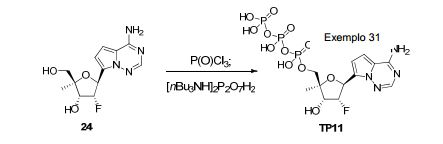
[00274] O Exemplo 31 foi preparado como o sal de tetrassódio de uma maneira similar àquela descrita para o Exemplo TP4 começando com o Exemplo 24.1H NMR (400 MHz, D2O) δ 7,66 (s, 1H), 6,78 (d, J = 4,8 Hz, 1H), 6,72 (d, J = 4,4 Hz, 1H), 5,58 (dd, J = 23,6, 2,4 Hz, 1H), 5,16 (ddd,J = 55,2, 5,2, 2,8 Hz, 1H), 4,51 (dd, J = 23,2, 5,2 Hz, 1H), 3,88 (dd, J = 11,6, 6,0 Hz, 1H), 3,78 (dd, J = 10,8, 4,0 Hz, 1H), 1,2 (s, 3H).19F NMR (376 MHz, D2O) δ -195,74 - -196,01 (m).31P NMR (162 MHz, D2O) δ -8,24 (d, J = 50,4 Hz), -13,54 (d, J =45,6 Hz), -24,11 (t, J = 48,0 Hz).
[00275] O Exemplo 32 foi preparado como o sal de tetrassódio de uma maneira similar àquela descrita para o Exemplo TP4 começando com o Exemplo 25. 1H NMR (400 MHz, D2O) δ 7,59 (s, 1H), 6,57 (s, 1H), 5,44 (d, J = 6,0 Hz, 1H), 4,56 (d, J = 5,2 Hz, 1H), 4,48 (dd, J = 5,6 Hz, 1H), 4,16 (dd, J = 11,6, 6,0 Hz, 1H), 4,08 (dd, J = 11,2, 5,2 Hz, 1H).19F NMR (376 MHz, D2O) δ -161,25 (s).31P NMR (162 MHz, D2O) δ -8,29 (d, J = 48,4 Hz), -14,49 (d, J = 53,2 Hz), -24,15 (t, J = 48,4 Hz).MS m/z = 549,90 [M+1]. Sistema MS: Thermo LCQ Advantage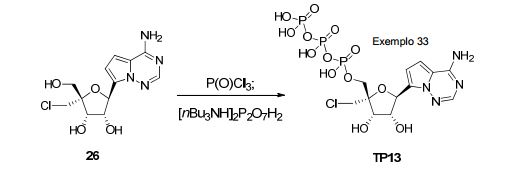
[00276] O Exemplo 33 foi preparado como o sal de tetra-trietilamina de uma maneira similar àquela descrita para o Exemplo TP3 começando com o Exemplo 26.1H NMR (400 MHz, D2O) δ 7,76 (s, 1H), 6,92 (s amplo, 1H), 6,85 (s amplo, 1H), 5,32 (d, J = 9,6 Hz, 1H), 4,78 (dd, J =8, 6,4 Hz, 1H), 4,53 (d, J = 5,6 Hz, 1H), 4,08 (dd, J = 10,0, 4,0 Hz, 1H), 3,83 - 3,95 (m, 3H), 3,07 (q, J = 7,6 Hz, 24 H), 1,16 (t, J = 7,6 Hz, 36 H).31P NMR (162 MHz, D2O) δ -9,44 (d, J = 45,6 Hz), -11,51 (d, J = 48,8 Hz), -22,95 (t, J = 48,4 Hz).MS m/z = 555,06 [M+1l. Sistema MS: Thermo LCQ Advantage
[00277] O Exemplo 1 (3,8 mg, 0,013 mmol) foi dissolvido em N-metil -2-pirrolidona anidra (0,2 mL) e THF (0,1 mL) foi adicionado sob uma atmosfera de argônio. Cloreto de terc-butil magnésio (1M em THF, 20 μL, 0,024 mmol) foi então adicionado em temperatura ambiente e sólidos brancos precipitaram. Após 5 minutos, uma solução de p-nitrofe- nilfosforamidato PD3c (12 mg, 0,026 mmol) em THF (0,1 mL) foi adici-onada à mistura de reação em uma porção e a mistura resultante foi aquecida para 50°C. Após 20 h, A mistura de reação foi deixada esfriar para a temperatura ambiente e foi então purificada diretamente através de HPLC preparativa (coluna Phenominex Synergi 4u Hydro-RR 80Â 150 x 30 mm, gradiente de acetonitrila 40-100%/água). As frações contendo o produto desejado foram combinadas e foram liofilizadas para fornecer o Exemplo 34 (2,9 mg, 37%, mistura diastereomérica 3:2) como um sólido branco.1H NMR (400 MHz, CD3OD) δ 7,80 (s, 0,3H), 7,78 (s, 0,6H), 7,38 - 7,10 (m, 5H), 6,85 (dd amplo, J = 4,7, 2,2 Hz, 1H), 6,75 - 6,71 (m, 1H), 5,54 - 5,46 (m, 1H), 4,65 - 4,58 (m, 1H), 4,53 - 4,31 (m, 3H), 4,07 - 3,84 (m, 3H), 1,54 - 1,39 (m, 1H), 1,38 - 1,19 (m, 7H), 0,92 - 0,81 (m, 6H) 29H31P NMR (162 MHz, CD3OD) δ 3,25 (s amplo).LC/MS: tR = 1,55 min, MS m/z = 603,19 [M+H]; sistema LC: Thermo Accela 1250 UHPLC; Sistema MS: Thermo LCQ Fleet; Coluna: Kinetex 2,6μ XB-C18 100A, 50 x 4,6 mm; Solventes: Acetonitrila com ácido acético 0,1%, Água com ácido acético 0,1%; Gradiente: 0 min-2,0 min ACN 2-100%, 2,0 min-3,05 min ACN 100%, 3,05 min-3,2 min ACN 100%-2%, 3,2 min-3,5 min ACN 2% a 2μl/min.HPLC: tR = 2,98 min; sistema HPLC: Série Agilent 1100; Coluna: Gemini 5μ C18 110A, 50 x 4,6 mm; Solventes: Acetonitrila com TFA 0,1%, Água com TFA 0,1%; Gradiente: 0 min-5,0 min ACN 298%, 5,0 min-6,0 min ACN 98% a 2 mL/min.
[00278] O Exemplo 1 (19 mg, 65,3 μmol) foi dissolvido em NMP (0,2 mL). THF (0,1 mL) foi adicionado seguido por cloreto de terc-butil magnésio (solução 1,0M em tetra-hidrofurano, 0,098 mL) em temperatura ambiente sob uma atmosfera de argônio. Após 5 minutos, uma solução de intermediário PD7a (Preparada de acordo com US20120009147A1, 51,4 mg, 130 μmol) em THF (0,1 mL) foi adicionada e a mistura resultante foi aquecida para 50°C. Após 1 h, a mistura d e reação foi deixada esfriar para temperatura ambiente e foi purificada diretamente através de HPLC preparativa (coluna Phenominex Synergi 4u Hydro-RR 80 150 x 30 mm, gradiente de acetonitrila/água). As frações contendo produto foram combinadas e concentradas e o resíduo resultante foi novamente purificado através de HPLC preparativa (coluna Phenomi- nex Luna 5u C18 100 x 30 mm, gradiente de acetonitrila 5-100%/água) para fornecer Exemplo 35 (12 mg, 34%, mistura de diastereômeros 3:2) como um sólido branco.1H NMR (400 MHz, CD3OD) δ 7,80 (d, J = 2,3 Hz, 0,4H), 7,78 (d, J = 2,3 Hz, 0,6H), 7,36 - 7,12 (m, 5H), 6,88 - 6,81 (m, 1H), 6,76 - 6,70 (m, 1H), 5,53 - 5,46 (m, 1H), 4,66 - 4,60 (m, 1H), 4,55 - 4,30 (m, 3H), 4,15 - 3,98 (m, 2H), 3,93 - 3,79 (m, 1H), 1,30 - 1,12 (m, 6H).31P NMR (162 MHz, CD3OD) δ 3,27 (s amplo).LC/MS: diastereômero maior tR = 1,28 min, MS m/z = 547,14 [M+H], diastereômero menor tR = 1,30 min, MS m/z = 547,04 [M+H]; sistema LC: Thermo Accela 1250 UHPLC; Sistema MS: Thermo LCQ Fleet; Coluna: Kinetex 2,6μ XB-C18 100A, 50 x 4,6 mm; Solventes: Acetonitrila com ácido acético 0,1%, Água com ácido acético 0,1%; Gradiente: 0 min-2,0 min ACN 2-100%, 2,0 min-3,05 min ACN 100%, 3,05 min-3,2 min ACN 100%-2%, 3,2 min-3,5 min ACN 2% a 2μl/min.HPLC: diastereômero maior tR = 2,44 min, diastereômero menor tR = 2,46 min; sistema HPLC: Série Agilent 1100; Coluna: Gemini 5μ C18 110A, 50 x 4,6 mm; Solventes: Acetonitrila com TFA 0,1%, Água com TFA 0,1%; Gradiente: 0 min-5,0 min ACN 2-98%, 5,0 min- 6,0 min ACN 98% a 2 mL/min.[00278] Example 1 (19 mg, 65.3 µmol) was dissolved in NMP (0.2 mL). THF (0.1 mL) was added followed by tert-butyl magnesium chloride (1.0M solution in tetrahydrofuran, 0.098 mL) at room temperature under an argon atmosphere. After 5 minutes, a solution of intermediate PD7a (Prepared according to US20120009147A1, 51.4 mg, 130 µmol) in THF (0.1 mL) was added and the resulting mixture was heated to 50°C. After 1 h, the reaction mixture was allowed to cool to room temperature and was purified directly via preparative HPLC (Phenominex Synergi 4u Hydro-RR 80® 150 x 30 mm column, acetonitrile/water gradient). The product-containing fractions were combined and concentrated and the resulting residue was further purified by preparative HPLC (Phenomenex Luna 5u C18 100 x 30 mm column, 5-100% acetonitrile/water gradient) to provide Example 35 (12 mg, 34%, 3:2 mixture of diastereomers) as a white solid. 1H NMR (400 MHz, CD3OD) δ 7.80 (d, J = 2.3 Hz, 0.4H), 7.78 (d, J = 2.3 Hz, 0.6H), 7.36 - 7.12 (m, 5H), 6.88 - 6.81 (m, 1H), 6.76 - 6.70 (m, 1H), 5 .53 - 5.46 (m, 1H), 4.66 - 4.60 (m, 1H), 4.55 - 4.30 (m, 3H), 4.15 - 3.98 (m, 2H) , 3.93 - 3.79 (m, 1H), 1.30 - 1.12 (m, 6H).31P NMR (162MHz, CD3OD) δ 3.27 (broad s).LC/MS: major diastereomer tR = 1.28 min, MS m/z = 547.14 [M+H], minor diastereomer tR = 1.30 min, MS m/z = 547.04 [M+H]; LC system: Thermo Accela 1250 UHPLC; MS System: Thermo LCQ Fleet; Column: Kinetex 2.6μ XB-C18 100A, 50 x 4.6 mm; Solvents: Acetonitrile with 0.1% acetic acid, Water with 0.1% acetic acid; Gradient: 0 min-2.0 min ACN 2-100%, 2.0 min-3.05 min ACN 100%, 3.05 min-3.2 min ACN 100%-2%, 3.2 min-3 .5 min 2% ACN at 2μl/min.HPLC: major diastereomer tR = 2.44 min, minor diastereomer tR = 2.46 min; HPLC system: Agilent 1100 Series; Column: Gemini 5μ C18 110A, 50 x 4.6 mm; Solvents: Acetonitrile with 0.1% TFA, Water with 0.1% TFA; Gradient: 0 min-5.0 min 2-98% ACN, 5.0 min-6.0 min 98% ACN at 2 mL/min.
[00279] São também providas modalidades separadas compreendendo, respectivamente, compostos de Fórmula (A), Fórmula (B), Fórmula (C), Fórmula (D) e Fórmula (E):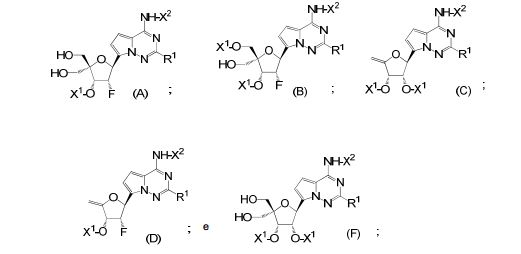
[00280] Grupos de proteção de oxigênio úteis incluem um grupo de proteção de éter de silila ou um grupo de proteção do tipo benzila, in-cluindo grupos metoxibenzila.[00280] Useful oxygen protecting groups include a silyl ether protecting group or a benzyl-type protecting group, including methoxybenzyl groups.
[00281] Grupos de proteção de éter de silila úteis incluem grupos de proteção de Trimetilsilila (TMS), Trietilsilila (TES), Dimetilisopropilsilila (IPDMS), Dietilisopropilsilila (DEIPS), Dimetiltexilsilila (TDS), t-Butildi- metilsilila (TBS ou TBDMS), t-Butildifenilsilila (TBDPS), Tribenzilsilila, Tri-p-xililxilila, Tri-isopropilsilila (TIPS), Difenilmetilsilila (DPMS), Di-t- butilmetilsilila (DTBMS), Trifenilsilila (TPS), Metildifenilsilila (MDPS), t- butilmetoxifenilsilila, Tris(trimetilsilil)silila (sisila), (2-Hidroxiestiril) dime- tilsilila (HSDMS), (2-Hidroxistiril)di-isopropilsilila (HSDIS). t-Butilme- toxifenilsilila (TBMPS) e t-Butoxidifenilsilila (DPTBOS).[00281] Useful silyl ether protecting groups include Trimethylsilyl (TMS), Triethylsilyl (TES), Dimethylisopropylsilyl (IPDMS), Diethylisopropylsilyl (DEIPS), Dimethyltexylsilyl (TDS), t-Butyldimethylsilyl (TBS or TBDMS) protecting groups ), t-Butyldiphenylsilyl (TBDPS), Tribenzylsilyl, Tri-p-xylylxylyl, Triisopropylsilyl (TIPS), Diphenylmethylsilyl (DPMS), Di-t-butylmethylsilyl (DTBMS), Triphenylsilyl (TPS), Methyldiphenylsilyl (MDPS), t- butylmethoxyphenylsilyl, Tris(trimethylsilyl)silyl (sisyl), (2-Hydroxystyryl)dimethylsilyl (HSDMS), (2-Hydroxystyryl)diisopropylsilyl (HSDIS). t-Butylmethoxyphenylsilyl (TBMPS) and t-Butoxydiphenylsilyl (DPTBOS).
[00282] Grupos de proteção do tipo benzila úteis incluem benzila, benzila halogenada, p-metoxibenzila, benziloximetila, 2,4-dimetoxiben- zila, 3,4-dimetoxibenzila, 2,6-dimetoxibenzila, p-CF3-benzila, p-metil- benzila, p-metoxilbenzila, 3,5-dimetilbenzila, p-terc-butilbenzila, o-nitro- benzila, p-nitrobenzila, p-halobenzila, incluindo p-Br-benzila, 2,6-diclo- robenzila, p-cianobenzila, p-fenilbenzila, 2,6-difluorbenzila, p-acilami- nobenzila (PAB), p-azidobenzila (Azb), 4-azido-3-clorobenzila, 2-triflu- ormetilbenzila, p-(metilsulfinil)benzila, 2-picolila, 4-picolila, N-óxido de 3-metil-2-picolila, 2-quinolinilmetila, difenilmetila (DPM), p,p’-dinitroben- zidrila, trifenilmetila, alfa-naftildifenilmetila, p-metoxifenildifenilmetila, di(p-metoxifenil)fenilmetila, tri(p-metoxifenil)metila, 4,4’,4"-tris(benzoilo- xifenil)metila e 2-naftilmetila.[00282] Useful benzyl-type protecting groups include benzyl, halogenated benzyl, p-methoxybenzyl, benzyloxymethyl, 2,4-dimethoxybenzyl, 3,4-dimethoxybenzyl, 2,6-dimethoxybenzyl, p-CF3-benzyl, p- methylbenzyl, p-methoxylbenzyl, 3,5-dimethylbenzyl, p-tert-butylbenzyl, o-nitrobenzyl, p-nitrobenzyl, p-halobenzyl, including p-Br-benzyl, 2,6-dichlorobenzyl, p -cyanobenzyl, p-phenylbenzyl, 2,6-difluorobenzyl, p-acylaminobenzyl (PAB), p-azidobenzyl (Azb), 4-azido-3-chlorobenzyl, 2-trifluoromethylbenzyl, p-(methylsulfinyl)benzyl, 2-picolyl, 4-picolyl, 3-methyl-2-picolyl N-oxide, 2-quinolinylmethyl, diphenylmethyl (DPM), p,p'-dinitrobenzhydryl, triphenylmethyl, alpha-naphthyldiphenylmethyl, p-methoxyphenyldiphenylmethyl, di( p-methoxyphenyl)phenylmethyl, tri(p-methoxyphenyl)methyl, 4,4',4"-tris(benzoyloxyphenyl)methyl and 2-naphthylmethyl.
[00283] Grupos de proteção amina úteis incluem grupos de proteção p-metoxibenzil carbonila (Moz ou MeOZ), acetila (Ac), benzoíla (Bz), p-metoxibenzila (PMB), 3,4-dimetoxibenzila (DMPM), p-metoxi- fenila (PMP), tosila (Ts ou Tos), trifluoracetamida e tritila. Grupos de proteção amina úteis também incluem grupos de proteção carbamato e amida. Exemplos de grupos de proteção de carbamato incluem car- bamatos de metila e etila tais como carbamatos de 9-fluorenilme- tiloxicarbonila (FMOC), 9-(2-sulfo)fluorenilmetila, 9-(2,7-dibromo)fluore- nilmetila, 17-tetrabenzo[a,c,g,i]fluorenilmetila (Tbfmoc), 2-cloro-3-inde- nilmetila (Climoc), benz[f]inden-3-ilmetila (Bimoc), 2,7-di-t-butil[9-(10,10- dioxo-10,10,10,10-tetra-hidrotioxanil)]metila (DBD-Tmoc), [2-(1,3-ditia- nil)metila (Dmoc) e 1,1-dioxobenzo[b]tiofeno-2-ilmetila (Bsmoc).[00283] Useful amine protecting groups include p-methoxybenzyl carbonyl (Moz or MeOZ), acetyl (Ac), benzoyl (Bz), p-methoxybenzyl (PMB), 3,4-dimethoxybenzyl (DMPM), p- methoxyphenyl (PMP), tosyl (Ts or Tos), trifluoracetamide and trityl. Useful amine protecting groups also include carbamate and amide protecting groups. Examples of carbamate protecting groups include methyl and ethyl carbamates such as 9-fluorenylmethyloxycarbonyl (FMOC), 9-(2-sulfo)fluorenylmethyl, 9-(2,7-dibromo)fluorenylmethyl carbamates, 17-Tetrabenzo[a,c,g,i]fluorenylmethyl (Tbfmoc), 2-chloro-3-indenylmethyl (Climoc), benz[f]inden-3-ylmethyl (Bimoc), 2,7-di-t -butyl[9-(10,10-dioxo-10,10,10,10-tetrahydrothioxanyl)]methyl (DBD-Tmoc), [2-(1,3-dithianyl)methyl (Dmoc) and 1 ,1-dioxobenzo[b]thiophene-2-ylmethyl (Bsmoc).
[00284] Exemplos de carbamatos de etila substituídos úteis incluem 1,1-dimetil-2-cianoetila, 2-fosfonioetila (Peoc), 2-metiltioetila, 2-(p-tolu- enossulfonil)etila, 2,2,2,-tricloroetila (Troc), 2-(trimetilsilil)etila (Teoc), 2- feniletila (hZ), 1-(1-adamantil)-1-metiletila (Adpoc), 1,1-dimetil-2-bro- moetila, 1,1-dimetil-2-cloroetila, 1,1-dimetil-2,2-dibromoetila (DB-t- BOC), 1,1-dimetil-2,2,2-tricloroetila (TCBOC), 1-metil-1-(4-bifenilil)etila (Bpoc), 1-(3,5-di-t-butilfenil)-1-metiletila (t-Bumeoc), 2-(2’piridil)etila, 2- (4’piridil)etila, 2,2-bis(4’-nitrofenil)etila (Bnpeoc), N-(2-pivaloilamino)- 1,1,dimetiletila, 2-[(2-nitrofenil)ditio]-1-feniletila (NpSSPeoc), 2-(N,N- dicicloexilcarboxamido)etila, t-butila (Boc ou BOC), 1-adamantila (1- Adoc), 2-adamantila (2-Adoc), vinila (Voc), alila (Aloc ou alloc), 1-isso- propilalila (Ipaoc), cinamila (Coc), 4-nitrocinamila (Noc), 3-(3’-piridil) prop-2-enila (Paloc), 8-quinolila e N-hidroxipiperidinila, carbamatos, bem como alquilditio carbamatos, incluindo metilditio, etilditio, isopropi- lditio, t-butilditio e fenilditio carbamatos.[00284] Examples of useful substituted ethyl carbamates include 1,1-dimethyl-2-cyanoethyl, 2-phosphonioethyl (Peoc), 2-methylthioethyl, 2-(p-toluenesulfonyl)ethyl, 2,2,2,- trichloroethyl (Troc), 2-(trimethylsilyl)ethyl (Teoc), 2-phenylethyl (hZ), 1-(1-adamantyl)-1-methylethyl (Adpoc), 1,1-dimethyl-2-bromoethyl, 1 ,1-Dimethyl-2-chloroethyl, 1,1-dimethyl-2,2-dibromoethyl (DB-t-BOC), 1,1-dimethyl-2,2,2-trichloroethyl (TCBOC), 1-methyl-1 -(4-Biphenylyl)ethyl (Bpoc), 1-(3,5-di-t-butylphenyl)-1-methylethyl (t-Bumeoc), 2-(2'pyridyl)ethyl, 2-(4'pyridyl) ethyl, 2,2-bis(4'-nitrophenyl)ethyl (Bnpeoc), N-(2-pivaloylamino)-1,1,dimethylethyl, 2-[(2-nitrophenyl)dithio]-1-phenylethyl (NpSSPeoc), 2-(N,N-dicyclohexylcarboxamido)ethyl, t-butyl (Boc or BOC), 1-adamantyl (1-Adoc), 2-adamantyl (2-Adoc), vinyl (Voc), allyl (Aloc or alloc), 1-isopropylallyl (Ipaoc), cinnamyl (Coc), 4-nitrocinnamyl (Noc), 3-(3'-pyridyl)prop-2-enyl (Paloc), 8-quinolyl and N-hydroxypiperidinyl, carbamates, as well as alkyldithio carbam compounds, including methyldithio, ethyldithio, isopropyldithio, t-butyldithio and phenyldithio carbamates.
[00285] Também úteis são carbamatos contendo arila e contendo arila substituída tais como benzila, p-metoxibenzila, p-nitrobenzila, p- bromobenzila, p-clorobenzila, 2,4-diclorobenzila, 4-metilsulfinilbenzila (Msz), 9-antrilmetila, 4-metiltiofenila (Mtpc), 1-metil-1-(trifenilfosfo- nio)etila (2-trifenilfosfonioisopropila) (Ppoc), 2-dansiletila (Dnseoc), 2- (4-nitrofenil)etila (Npeoc), 4-fenilacetoxibenzila (FAcOZ), 4-azidoben- zila (ACBZ), 4-azidometoxibenzila, m-cloro-p-aciloxibenzila, p-(di- hidroxiboril)benzila, carbobenzilóxi (Cbz), 4-benzisoxazolilmetila (Bic), 2-(trifluormetil)-6-cromonilmetila (Tcroc), fenil e difenilmetil carbamatos. Carbamatos adicionais incluem butinil, ciclopentil, cicloexil, ciclopropi- lmetil, 1-metilciclobutil, 1-metilcicloexil, 1,1-dimetilpropinil e 1-metil-1- ciclopropilmetil carbamatos.[00285] Also useful are aryl-containing and substituted aryl-containing carbamates such as benzyl, p-methoxybenzyl, p-nitrobenzyl, p-bromobenzyl, p-chlorobenzyl, 2,4-dichlorobenzyl, 4-methylsulfinylbenzyl (Msz), 9-anthrylmethyl, 4-methylthiophenyl (Mtpc), 1-methyl-1-(triphenylphosphonium)ethyl (2-triphenylphosphoniumisopropyl) (Ppoc), 2-dansylethyl (Dnseoc), 2-(4-nitrophenyl)ethyl (Npeoc), 4-phenylacetoxybenzyl (FAcOZ), 4-azidobenzyl (ACBZ), 4-azidomethoxybenzyl, m-chloro-p-acyloxybenzyl, p-(dihydroxyboryl)benzyl, carbobenzyloxy (Cbz), 4-benzisoxazolylmethyl (Bic), 2-(trifluoromethyl) )-6-chromonylmethyl (Tcroc), phenyl and diphenylmethyl carbamates. Additional carbamates include butynyl, cyclopentyl, cyclohexyl, cyclopropylmethyl, 1-methylcyclobutyl, 1-methylcyclohexyl, 1,1-dimethylpropynyl and 1-methyl-1-cyclopropylmethyl carbamates.
[00286] Grupos de proteção amida úteis para aminas incluem N- formil, N-acetil, N-cloroacetil, N-tricloroacetil, N-trifluoracetil (TFA), N- fenilacetil, N-3-fenilpropionil, N-4-pentenoil, N-picolinoil, N-3-piridilcar- boxamido, N-benzoilfenilalanil, N-benzoil e N-p-fenilbenzoil amidas. Atividade Antiviral[00286] Useful amide protecting groups for amines include N-formyl, N-acetyl, N-chloroacetyl, N-trichloroacetyl, N-trifluoroacetyl (TFA), N-phenylacetyl, N-3-phenylpropionyl, N-4-pentenoyl, N-picolinoyl, N-3-pyridylcarboxamido, N-benzoylphenylalanyl, N-benzoyl and Np-phenylbenzoyl amides. Antiviral Activity
[00287] Outra modalidade se refere a métodos de inibição de infecções virais compreendendo a etapa de tratamento de uma amostra ou indivíduo suspeito necessitar tal inibição com uma composição da pre-sente invenção.[00287] Another embodiment relates to methods of inhibiting viral infections comprising the step of treating a sample or individual suspected of needing such inhibition with a composition of the present invention.
[00288] São consideradas aqui amostras suspeitas conter um vírus incluindo materiais naturais ou feitos pelo homem tais como organismos vivos; culturas de tecido ou célula; amostras biológicas tais como amostras de material biológico (sangue, soro, urina, fluido cerebroes- pinhal, lágrimas, esputo, saliva, amostras de tecido e similar); amostras de laboratório; amostras de alimento, água ou ar; amostras de bi- oproduto tais como extratos de células, particularmente células recom- binantes sintetizando uma glicoproteína desejada; e similar. Tipicamente a amostra será suspeita conter um organismo que induz uma infecção viral, frequentemente um organismo patogênico tal como um vírus de tumor. As amostras podem estar contidas em qualquer meio incluindo água e misturas de solvente orgânico/água. Amostras incluem organismos vivos tais como humanos e materiais feitos pelo homem tais como culturas de célula.[00288] Samples suspected to contain a virus including natural or man-made materials such as living organisms are considered here; tissue or cell cultures; biological samples such as samples of biological material (blood, serum, urine, cerebrospinal fluid, tears, sputum, saliva, tissue samples and the like); laboratory samples; samples of food, water or air; by-product samples such as cell extracts, particularly recombinant cells synthesizing a desired glycoprotein; It's similar. Typically the sample will be suspected to contain an organism that induces a viral infection, often a pathogenic organism such as a tumor virus. Samples may be contained in any medium including water and organic solvent/water mixtures. Samples include living organisms such as humans and man-made materials such as cell cultures.
[00289] Se desejado, a atividade antivírus de um composto após aplicação da composição pode ser observada através de qualquer mé-todo incluindo métodos diretos e indiretos de detecção de tal atividade. Métodos quantitativos, qualitativos e semiquantitativos de determinação de tal atividade são compreendidos. Tipicamente um dos métodos de avaliação descritos acima é aplicado, no entanto, qualquer outro método tal como observação das propriedades fisiológicas de um organismo vivo é também aplicável.[00289] If desired, the antivirus activity of a compound after application of the composition may be observed by any method including direct and indirect methods of detecting such activity. Quantitative, qualitative and semi-quantitative methods of determining such activity are understood. Typically one of the evaluation methods described above is applied, however any other method such as observation of the physiological properties of a living organism is also applicable.
[00290] A atividade antiviral de um composto pode ser medida usando protocolos de avaliação padrão que são conhecidos. Por exemplo, a atividade antiviral de um composto pode ser medida usando os protocolos gerais que seguem.Ensaios de atividade antiviral e citotoxicidade de vírus sincicial respira-tório (RSV)[00290] The antiviral activity of a compound can be measured using standard assessment protocols that are known. For example, the antiviral activity of a compound can be measured using the general protocols that follow. Assays for antiviral activity and respiratory syncytial virus (RSV) cytotoxicity
[00291] Atividade antiviral contra RSV é determinada usando um ensaio de proteção de célula citopática infecciosa em células HEp-2. Neste ensaio, compostos inibindo infecção e/ou replicação viral produzem um efeito citoprotetor contra a morte de célula induzida por vírus que pode ser quantificado usando um reagente de viabilidade de célula. As técnicas usadas aqui são adaptações novas de métodos descritos na literatura publicada (Chapman e outros, Antimicrob Agents Chemother. 2007, 51(9):3346-53).[00291] Antiviral activity against RSV is determined using an infectious cytopathic cell protection assay on HEp-2 cells. In this assay, compounds inhibiting viral infection and/or replication produce a cytoprotective effect against virus-induced cell death that can be quantified using a cell viability reagent. The techniques used here are novel adaptations of methods described in the published literature ( Chapman et al., Antimicrob Agents Chemother. 2007, 51(9):3346-53 ).
[00292] Células HEp-2 são obtidas da ATCC (Manassas, VI) e mantidas em meio MEM suplementado com soro bovino fetal 10% e penici- lina/estreptomicina. As células são passadas duas vezes por semana e mantidas em estágio subconfluente. Estoque comercial de cepa RSV A2 (Advanced Biotechnologies, Columbia, MD) é titulado antes do teste de composto para determinar a diluição apropriada do estoque de vírus que gera efeito citopático desejável em células HEp-2.[00292] HEp-2 cells are obtained from ATCC (Manassas, VI) and maintained in MEM medium supplemented with 10% fetal bovine serum and penicillin/streptomycin. Cells are passaged twice a week and maintained in a subconfluent stage. Commercial stock of RSV A2 strain (Advanced Biotechnologies, Columbia, MD) is titrated prior to compound testing to determine the appropriate dilution of virus stock that generates desirable cytopathic effect on HEp-2 cells.
[00293] Para testes antivirais, células HEp-2 são cultivadas em frascos de cultura de célula grandes para próximo da confluência, mas não total. Os compostos a serem testados são pré-diluídos em DMSO em placas de diluição de composto de 384 cavidades, ou em um formato de resposta de dose padronizado de 8 ou 40 amostras por placa. Aumentos de diluição serial de 3 vezes de cada composto de teste são preparados nas placas e amostras de teste são transferidas através de aparelho de transferência acústico (Echo, Labcyte) a 100 nl por cavidade nas placas de 384 cavidades de ensaio de cultura de célula. Cada diluição de composto é transferida para amostras simples ou em quadruplicata para placas de ensaio secas, que são armazenadas até que o ensaio esteja pronto para ser realizado. Os controles positivos e negativos são postos em extremidades opostas da placa em blocos verticais (1 coluna).[00293] For antiviral testing, HEp-2 cells are grown in large cell culture flasks to near, but not full, confluence. Compounds to be tested are prediluted in DMSO in 384-well compound dilution plates, or in a standardized dose response format of 8 or 40 samples per plate. Serial 3-fold dilution increments of each test compound are prepared on the plates and test samples are transferred through acoustic transfer apparatus (Echo, Labcyte) at 100 nl per well into the 384-well cell culture assay plates. Each compound dilution is transferred to single or quadruplicate samples onto dry assay plates, which are stored until the assay is ready to be performed. Positive and negative controls are placed at opposite ends of the board in vertical blocks (1 column).
[00294] Subsequentemente, uma mistura infecciosa é preparada usando uma diluição apropriada de estoque de vírus previamente determinada através de titulação com células em uma densidade de 50.000/ml e 20 uL/cavidade são adicionados a placas de teste com compostos através de automação (uFlow, Biotek). Cada placa inclui controles negativos e positivos (16 réplicas cada uma) para criar padrões de inibição de vírus de 0% e 100%, respectivamente. Seguindo a infecção com RSV, as placas de teste são incubadas por 4 dias em uma incubadora de cultura de célula a 37°C. Após a incubação, um reagente de viabilidade de célula, Cell TiterGlo (Promega, Madison, WI), é adicionado às placas de ensaio, que são incubadas rapidamente, e uma leitura luminescente é medida (Envision, PerkinElmer) em todas as placas de ensaio. O efeito citopático induzido por RSV, inibição percentual, é determinado a partir dos níveis de viabilidade de célula restante. Esses números são calculados para cada concentração testada com relação aos controles de inibição de 0% e 100%, e o valor EC50 para cada composto é determinado através de regressão não linear como uma concentração inibindo o efeito citopático induzido por RSV em 50%. Vários compostos-ferramenta anti-RSV potentes são usados como controles positivos para atividade antiviral.Ensaio de Citotoxidez em Células HEp-2[00294] Subsequently, an infectious mixture is prepared using an appropriate dilution of virus stock previously determined by titration with cells at a density of 50,000/ml and 20 uL/well are added to test plates with compounds via automation (uFlow , Biotek). Each plate includes negative and positive controls (16 replicates each) to create 0% and 100% virus inhibition patterns, respectively. Following RSV infection, test plates are incubated for 4 days in a cell culture incubator at 37°C. After incubation, a cell viability reagent, Cell TiterGlo (Promega, Madison, WI), is added to the assay plates, which are rapidly incubated, and a luminescent reading is measured (Envision, PerkinElmer) on all assay plates. . The RSV-induced cytopathic effect, percent inhibition, is determined from the remaining cell viability levels. These numbers are calculated for each concentration tested with respect to the 0% and 100% inhibition controls, and the EC50 value for each compound is determined by non-linear regression as a concentration inhibiting the RSV-induced cytopathic effect by 50%. Several potent anti-RSV tool compounds are used as positive controls for antiviral activity.HEp-2 Cell Cytotoxicity Assay
[00295] A citotoxidez de compostos testados é determinada em células HEp-2 não infectadas em paralelo com a atividade antiviral usando o reagente de viabilidade celular de uma maneira similar àquela descrita antes para outros tipos de célula (Cihlar e outros, Antimicrob Agents Chemother. 2008,52(2):655-65). O mesmo protocolo que aque- le para a determinação de antividade antiviral é usado para a medição de citotoxidez de composto exceto que as células não são infectadas com RSV. Ao invés disso, uma mistura de célula não infectada na mesma densidade é adicionada a 20 ul/cavidade a placas contendo compostos pré-diluídos, também em 100 nl/amostra. Placas de ensaio são então incubadas por 4 dias seguido por um teste de viabilidade de célula usando as mesmas adição de reagente CellTiter Glo e medição de leituras luminescentes. Célula não tratada e células tratadas a 2 uM de puromicina (Sigma, St. Louis, MO) servem como controle de viabilidade de célula 100% e 0%, respectivamente. A porcentagem de viabilidade de célula é calculada para cada concentração de composto testado com relação aos controles 0% e 100% e o valor CC50 é determinado através de regressão não linear como uma concentração de composto reduzindo a viabilidade de célula em 50%.Ensaio de Citotoxidez em Células MT-4[00295] The cytotoxicity of tested compounds is determined in uninfected HEp-2 cells in parallel with antiviral activity using the Cell Viability Reagent in a manner similar to that described above for other cell types (Cihlar et al., Antimicrob Agents Chemother. 2008,52(2):655-65 ). The same protocol as that for the determination of antiviral activity is used for the measurement of compound cytotoxicity except that the cells are not infected with RSV. Instead, a mixture of uninfected cells at the same density is added at 20 µl/well to plates containing prediluted compounds, also at 100 µl/sample. Assay plates are then incubated for 4 days followed by a cell viability test using the same addition of CellTiter Glo reagent and measurement of luminescent readings. Untreated cell and cells treated at 2 µM puromycin (Sigma, St. Louis, MO) serve as 100% and 0% cell viability controls, respectively. The percentage of cell viability is calculated for each concentration of compound tested with respect to the 0% and 100% controls and the CC50 value is determined through non-linear regression as a concentration of compound reducing cell viability by 50%. Cytotoxicity in MT-4 Cells
[00296] A linhagem de célula MT-4 foi obtida da NIH AIDS Researc and Reference Reagent Program (Germantown, MD) e culturada em meio RPMI-1640 (Irvine Scientific, Santa Ana, CA, No. Cat. 9160) su-plementado com FBS 10%, 100 unidades/mL de penicilina, 100 unida- des/mL de estreptomicina e L-Glutamina 2 mM. As células MT-4 foram passadas duas vezes por semana para manter as densidades de célula abaixo de 0,6 x 10⁶ células/mL. Meio RPMI-1640 completo contendo concentrações 100x de composto serialmente diluído 3 vezes, variando de 26 nM a 530 μM, foi pulverizado em quadruplicata em placas de 384 cavidades pretas. Após adição de composto, 2 x 10³ células MT-4 foram adicionadas a cada cavidade usando um aplicador de líquido MicroFlo (BioTek, Winooski, VT) e as células foram culturadas por 5 dias a 37°C em uma incubadora de CO 2 5%. Seguindo a incubação as células foram deixadas equilibrar para 25°C e viabi lidade de célula foi determinada através da adição de 25 μL de reagente de viabilidade Cell-Titer Glo. A mistura foi incubada por 10 minutos a 25°C e o sinal luminescente foi quantificado em uma leitura de placa Victor Lumines-cence. O valor de CC50 é definido como a concentração de composto que reduz a viabilidade de célula em 50% conforme determinado pelo sinal Cell-Titer Glo. Os dados foram analisados usando software Pipeline Pilot Plate Data Analytics Collection (Versão 7.0, Accelrys, San Diego, CA). Valores de CC50 foram calculados a partir de uma análise de regressão não linear usando uma equação de dose-resposta sigmoidal de 4 parâmetros: Y = Parte Inferior + (Parte Superior-Parte Infe- rior)/(1+10A[(LogCC50-X)*HillSlope]) onde a Parte Superior e a Parte Inferior foram fixadas em viabilidade de célula de 100% e 0%, respec-tivamente. Valores de CC50 foram calculados como a média ± desvio padrão de 3 experimentos independentes.

[00297] Um outro benefício se refere à vantagem que compostos carregando substituição de R4 proveem em comparação com compostos sem substituição de R4 (isto é, aqueles onde R4 = H) com relação à citotoxicidade de MT-4. Por exemplo, o composto (2S,3R,4S,5R)-2-(4- aminopirrolo[pirrolo[1,2-f][1,2,4]triazin-7-il)-5-(hidroximetil)tetra-hidrofu- ran-3,4-diol (Patil, S. A.; Otter, R. A.; Klein, R. S. Tetrahedron Lett. 1994, 35, 5339-5342) tendo a estrutura:

[00298] Um outro benefício se refere à vantagem que compostos R3 = F carregando substituição R4 proveem em comparação com com- postos sem substituição R4 (isto é, aqueles onde R4 = H) com relação à atividade anti-RSV HEp-2. Por exemplo, o composto (2R,3R,4R,5S)- 5-(4-aminopirrolo[pirrolo[1,2-f][1,2,4]triazin-7-il)-4-fluor-2-(hidroximetil)tetra-hidrofuran-3-ol (WO2012037038A1) tendo a estrutura cima tem uma EC50 = >100 μM HEp-2; enquanto os exemplos 2, 3, 13, 14, 19, 21, 22, 23 e 24 todos exibem EC50 = <100uM.Preparação de RSV RNP[00298] A further benefit relates to the advantage that R3 = F compounds carrying R4 substitution provide compared to compounds without R4 substitution (ie those where R4 = H) with respect to anti-RSV HEp-2 activity. For example, the compound (2R,3R,4R,5S)-5-(4-aminopyrrolo[pyrrolo[1,2-f][1,2,4]triazin-7-yl)-4-fluoro-2- (hydroxymethyl)tetrahydrofuran-3-ol (WO2012037038A1) having the above structure has an EC50 = >100 µM HEp-2; while examples 2, 3, 13, 14, 19, 21, 22, 23 and 24 all exhibit EC50 = <100uM. RSV RNP Preparation
[00299] Complexos de ribonucleoproteína RSV (RNP) foram preparados a partir de um método modificado de Mason e outros (1). Células HEp-2 foram plaqueadas em uma densidade de 7,1 x 10⁴ célu- las/cm2 em MEM + soro bovino fetal 10% (FBS) e deixadas se ligar de um dia para o outro a 37°C (CO 2 5%). Seguindo a ligação, as células foram infectadas com RSV A2 (MOI=5) em 35 mL de MEM + FBS 2%. 20 horas pós-infecção, o meio foi substituído com MEM + FBS 2% suplementado com 2 μg/mL de actinomicina D e retornou para 37°C por uma hora. As células foram então lavadas uma vez com PBS e tratadas com 35 mL de PBS + 250 μg/mL de liso-lecitina por um minuto, após o que todo o líquido tinha aspirado. As células foram coletadas raspando-as em 1,2 mL de tampão A [TRIS acetato 50 mM (pH 8,0), acetato de potássio 100 mM, DTT 1 mM e 2 μg/mL de actinomicina D] e lisadas através de passagem repetida por uma agulha de 18 gauge (10 vezes). O lisato de célula foi posto em gelo por 10 minutos e então centrifugado a 2400 g por 10 minutos a 4°C. O sobre nadante (S1) foi removido e o pelete (P1) foi rompido em 600 uL de Tampão B [acetato Tris 10 mM (pH 8,0), acetato de potássio 10 mM e MgCl2 1,5 mm] suplementado com Triton X-100 1% através de passagem repetida por uma agulha de 18 gauge (10 vezes). O pelete ressuspenso foi posto em gelo por 10 minutos e então centrifugado a 2400 g por 10 minutos a 4°C. O sobrenadante (S2) foi removido e o pelete (P2) foi rompido em 600 uL de Tampão B suplementado com desoxicolato 0,5% e Tween 40 0,1%. O pelete ressuspenso foi posto em gelo por 10 minutos e então centrifugado a 24000 g por 10 minutos a 4°C. A fração de sobrenadante (S3), contendo os complexos de RSV RNP enriquecidos, foi coletada e a concentração de proteína determinada através de absorbância UV a 280 nm. Frações de RSV RNP S3 separadas em alíquotas foram removidas a -80°C.Ensaio de RSV RNP[00299] RSV ribonucleoprotein (RNP) complexes were prepared from a modified method of Mason et al. (1). HEp-2 cells were plated at a density of 7.1 x 10⁴ cells/cm2 in MEM + 10% fetal bovine serum (FBS) and allowed to bind overnight at 37°C (5% CO 2 ). Following ligation, cells were infected with RSV A2 (MOI=5) in 35 ml of MEM + 2% FBS. 20 hours post-infection, the medium was replaced with MEM + 2% FBS supplemented with 2 μg/mL actinomycin D and returned to 37°C for one hour. The cells were then washed once with PBS and treated with 35 ml PBS + 250 µg/ml lyso-lecithin for one minute, after which all the liquid had been aspirated. Cells were collected by scraping them in 1.2 mL of buffer A [50 mM TRIS acetate (pH 8.0), 100 mM potassium acetate, 1 mM DTT and 2 μg/mL actinomycin D] and lysed by passage repeated by an 18 gauge needle (10 times). The cell lysate was placed on ice for 10 minutes and then centrifuged at 2400 g for 10 minutes at 4°C. The supernatant (S1) was removed and the pellet (P1) was disrupted in 600 uL of Buffer B [10 mM Tris acetate (pH 8.0), 10 mM potassium acetate and 1.5 mm MgCl2] supplemented with Triton X -100 1% through repeated passage through an 18 gauge needle (10 times). The resuspended pellet was placed on ice for 10 minutes and then centrifuged at 2400 g for 10 minutes at 4°C. The supernatant (S2) was removed and the pellet (P2) was disrupted in 600 µl of Buffer B supplemented with 0.5% deoxycholate and 0.1% Tween 40. The resuspended pellet was placed on ice for 10 minutes and then centrifuged at 24000 g for 10 minutes at 4°C. The supernatant fraction (S3), containing the enriched RSV RNP complexes, was collected and the protein concentration determined by UV absorbance at 280 nm. Aliquoted fractions of RSV RNP S3 were removed at -80°C. Assay of RSV RNP
[00300] Reações de transcrição continham 25 μg de complexos de RSV RNP brutos em 30 μL de tampão de reação [TRIS-acetato 50 mM (pH 8,0), acetato de potássio 120 mM, glicerol 5%, MgCl2 4,5 mM, DTT 3 mM, ácido etilenoglicol-bis(2-aminoetileter)-tetraacético 2 mM (EG- TA), BSA 50 μg/mL, Rnasin 2,5 U (Promega), ATP, GTP, UTP, CTP e 1,5 uCi [α-32P] NTP (3000 Ci/mmol)]. O nucleotídeo radiomarcado usado no ensaio de transcrição foi selecionado para ser compatível com o análogo de nucleotídeo sendo avaliado quanto à inibição de transcrição de RSV RNP. NTP competitivo, frio, foi adicionado em uma concentração final de metade de sua Km (ATP=20 μM, GTP=12,5 μM, UTP=6 μM e CTP=2 μM). Os três nucleotídeos restantes foram adicionados em uma concentração final de 100 μM.[00300] Transcription reactions contained 25 μg of crude RSV RNP complexes in 30 μL of reaction buffer [50 mM TRIS-acetate (pH 8.0), 120 mM potassium acetate, 5% glycerol, 4.5 mM MgCl2 , 3 mM DTT, 2 mM ethylene glycol-bis(2-aminoethylether)-tetraacetic acid (EG-TA), 50 μg/mL BSA, 2.5 U Rnasin (Promega), ATP, GTP, UTP, CTP and 1.5 uCi [α-32P] NTP (3000 Ci/mmol)]. The radiolabeled nucleotide used in the transcription assay was selected to be compatible with the nucleotide analog being evaluated for inhibition of RSV RNP transcription. Cold competitive NTP was added at a final concentration of half its Km (ATP=20 μM, GTP=12.5 μM, UTP=6 μM and CTP=2 μM). The remaining three nucleotides were added to a final concentration of 100 μM.
[00301] Para determinar se análogos de nucleotídeo inibiram transcrição de RSV RNP, compostos foram adicionados usando uma diluição serial de 6 etapas em aumentos de 5 vezes. Seguindo uma incubação de 90 minutos a 30°C, as reações de RNP foram paradas com 350 μL de tampão de lise Qiagen RLT e o RNA foi purificado usando um Qiagen Rneasy 96 kit. RNA purificado foi desnaturado em tampão de carregamento de amostra de RNA (Sigma) a 65°C po r 10 minutos e alimentado em um gel de agarose 1,2%/MOPS contendo formaldeído 2M. O gel de agarose foi seco e exposto à avaliação de Storm phos-phorimager e desenvolvido usando um Storm phospohimager (GE Healthcare). A concentração de composto que reduziu os transcritos radiomarcados totais em 50% (IC50) foi calculada através de análise de regressão não linear de duas réplicas.Referência Mason, S., Lawetz, C., Gaudette, Y., Do, F., Scouten, E., Lagace, L., Simoneau, B. e Liuzzi, M. (2004) Polyadenylation-dependent screening assay for respiratory syncytial virus RNA transcriptase activity and identification of an inhibitor. Nucleic Acids Research, 32, 4758-4767.
[00302] Uma consideração adicional se refere à vantagem que compostos exemplificados exibem inibição potente de transcrição de RSV RNP em comparação com compostos com substituição de 2’CME. Por exemplo, trifosfato de tetra-hidrogênio de ((2R,3R,4R,5S)- 5-(4-aminopirrolo[2,1-f][1,2,4]triazin-7-il)-3,4-di-hidroxi-4-metiltetra- hidrofuran-2-il)metila (WO2008089105A2 e WO2010002877A2), tendo a estrutura:

Claims (20)


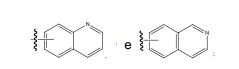


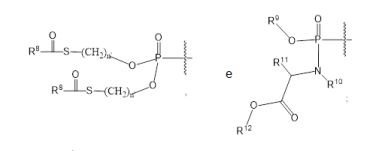


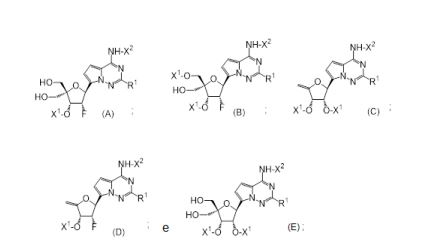

Applications Claiming Priority (3)
| Application Number | Priority Date | Filing Date | Title |
|---|---|---|---|
| US201361902544P | 2013-11-11 | 2013-11-11 | |
| US61/902,544 | 2013-11-11 | ||
| PCT/US2014/064412 WO2015069939A1 (en) | 2013-11-11 | 2014-11-06 | Pyrrolo [1,2,f] [1,2,4] triazines useful for treating respiratory syncitial virus infections |
Publications (2)
| Publication Number | Publication Date |
|---|---|
| BR112016010261A2 BR112016010261A2 (en) | 2017-08-08 |
| BR112016010261B1 true BR112016010261B1 (en) | 2022-02-08 |
Family
ID=52003049
Family Applications (1)
| Application Number | Title | Priority Date | Filing Date |
|---|---|---|---|
| BR112016010261-4A BR112016010261B1 (en) | 2013-11-11 | 2014-11-06 | PYRROLLE [1,2-F] [1,2,4] TRIAZINE COMPOUNDS, PHARMACEUTICAL FORMULATION AND THEIR USE IN THE TREATMENT OF RESPIRATORY SYNCYTIAL VIRUS INFECTIONS |
Country Status (36)
| Country | Link |
|---|---|
| US (5) | US9388208B2 (en) |
| EP (3) | EP4122932A1 (en) |
| JP (7) | JP6234571B2 (en) |
| KR (4) | KR102355881B1 (en) |
| CN (3) | CN114085243B (en) |
| AP (1) | AP2016009186A0 (en) |
| AU (5) | AU2014346665A1 (en) |
| BR (1) | BR112016010261B1 (en) |
| CA (1) | CA2928674C (en) |
| CL (1) | CL2016001120A1 (en) |
| CR (1) | CR20160220A (en) |
| CU (1) | CU20160065A7 (en) |
| CY (1) | CY1121948T1 (en) |
| DK (2) | DK3068405T3 (en) |
| DO (1) | DOP2016000107A (en) |
| EA (2) | EA039734B1 (en) |
| ES (2) | ES2743619T3 (en) |
| GT (1) | GT201600086A (en) |
| HR (2) | HRP20220920T1 (en) |
| HU (2) | HUE044960T2 (en) |
| IL (1) | IL245324B (en) |
| LT (2) | LT3068405T (en) |
| MD (1) | MD4596C1 (en) |
| MX (2) | MX376186B (en) |
| MY (2) | MY182986A (en) |
| NZ (1) | NZ719592A (en) |
| PE (1) | PE20160670A1 (en) |
| PH (1) | PH12016500867A1 (en) |
| PL (2) | PL3068405T3 (en) |
| PT (2) | PT3505173T (en) |
| SG (1) | SG11201603427XA (en) |
| SI (2) | SI3505173T1 (en) |
| TR (1) | TR201910961T4 (en) |
| UA (1) | UA119050C2 (en) |
| WO (1) | WO2015069939A1 (en) |
| ZA (1) | ZA201603123B (en) |
Families Citing this family (54)
| Publication number | Priority date | Publication date | Assignee | Title |
|---|---|---|---|---|
| CN102596979B (en) | 2009-09-21 | 2014-12-10 | 吉里德科学公司 | Processes and intermediates for the preparation of 1'-substituted carba-nucleoside analogs |
| BR112013001553B1 (en) | 2010-07-22 | 2021-01-12 | Gilead Sciences, Inc. | antiviral compounds for the treatment of paramyxoviridae infections and pharmaceutical compositions comprising them |
| UA119050C2 (en) * | 2013-11-11 | 2019-04-25 | Ґілеад Саєнсиз, Інк. | PYROL [1.2-f] [1.2.4] TRIASINES USED FOR TREATMENT OF RESPIRATORY-SYNCITAL VIRAL INFECTIONS |
| WO2015143712A1 (en) | 2014-03-28 | 2015-10-01 | Merck Sharp & Dohme Corp. | 4'-substituted nucleoside reverse transcriptase inhibitors |
| TWI678369B (en) | 2014-07-28 | 2019-12-01 | 美商基利科學股份有限公司 | Thieno[3,2-d]pyrimidine, furo[3,2-d]pyrimidine, and pyrrolo[3,2-d]pyrimidines useful for treating respiratory syncitial virus infections |
| JP6671355B2 (en) | 2014-09-26 | 2020-03-25 | リボサイエンス・エルエルシー | 4'-Vinyl-substituted nucleoside derivatives as inhibitors of respiratory syncytial virus RNA replication |
| TWI698444B (en) | 2014-10-29 | 2020-07-11 | 美商基利科學股份有限公司 | Methods for the preparation of ribosides |
| US20190022116A1 (en) | 2014-12-26 | 2019-01-24 | Emory University | N4-Hydroxycytidine and Derivatives and Anti-Viral Uses Related Thereto |
| ES2918585T3 (en) | 2015-09-16 | 2022-07-19 | Gilead Sciences Inc | Methods for treating Arenaviridae virus infections |
| US10953029B2 (en) | 2015-09-23 | 2021-03-23 | Merck Sharp & Dohme Corp. | 4′-Substituted nucleoside reverse transcriptase inhibitors and preparations thereof |
| JP6860585B2 (en) | 2016-03-09 | 2021-04-14 | ヤンセン バイオファーマ インク. | Incorporation by reference of acyclic antiviral priority application |
| CN110869028B (en) | 2017-03-14 | 2023-01-20 | 吉利德科学公司 | Method of treating feline coronavirus infection |
| AU2018262501B2 (en) | 2017-05-01 | 2020-12-10 | Gilead Sciences, Inc. | Crystalline forms of (S) 2 ethylbutyl 2 (((S) (((2R,3S,4R,5R) 5 (4 aminopyrrolo[2,1-f] [1,2,4]triazin-7-yl)-5-cyano-3,4-dihydroxytetrahydrofuran-2 yl)methoxy)(phenoxy) phosphoryl)amino)propanoate |
| CA3077489A1 (en) | 2017-07-11 | 2019-01-17 | Gilead Sciences, Inc. | Compositions comprising an rna polymerase inhibitor and cyclodextrin for treating viral infections |
| JP2020534361A (en) | 2017-09-18 | 2020-11-26 | ヤンセン・バイオファーマ・インコーポレイテッド | Substituted nucleosides, nucleotides, and analogs thereof |
| CN109748921B (en) * | 2017-11-03 | 2022-03-22 | 中国科学院上海药物研究所 | N-tert-butoxycarbonyl-protected heterocyclic compounds, methods for their preparation and methods for preparing C-nucleoside analogs |
| DK3706762T3 (en) | 2017-12-07 | 2024-12-16 | Univ Emory | N4-hydroxycytidine and derivatives and antiviral uses related thereto |
| US11040975B2 (en) | 2017-12-08 | 2021-06-22 | Merck Sharp & Dohme Corp. | Carbocyclic nucleoside reverse transcriptase inhibitors |
| CN108787177B (en) * | 2018-08-07 | 2024-03-15 | 中南大学 | Method and system for preparing xanthate by slurry method |
| WO2020232194A1 (en) * | 2019-05-14 | 2020-11-19 | The Regents Of The University Of Michigan | Methods for glycosylation |
| JP2023512656A (en) | 2020-01-27 | 2023-03-28 | ギリアード サイエンシーズ, インコーポレイテッド | Methods for treating SARS CoV-2 infection |
| TWI883391B (en) * | 2020-02-18 | 2025-05-11 | 美商基利科學股份有限公司 | Antiviral compounds |
| CN118598916A (en) * | 2020-02-18 | 2024-09-06 | 吉利德科学公司 | Antiviral compounds |
| TWI775313B (en) * | 2020-02-18 | 2022-08-21 | 美商基利科學股份有限公司 | Antiviral compounds |
| TWI884403B (en) * | 2020-02-18 | 2025-05-21 | 美商基利科學股份有限公司 | Antiviral compounds |
| CN111187269A (en) * | 2020-02-27 | 2020-05-22 | 江苏阿尔法药业有限公司 | Synthetic method of Reidesciclovir intermediate |
| CN113336758B (en) * | 2020-03-03 | 2022-08-19 | 北京桦冠医药科技有限公司 | Novel synthesis method of compound 7-iodopyrrolo [2, 1-f ] [1, 2, 4] triazin-4-amine |
| CN111233870A (en) * | 2020-03-11 | 2020-06-05 | 中国科学技术大学 | Method for rapidly preparing remdesivir pharmaceutical intermediates |
| AU2021234308C1 (en) | 2020-03-12 | 2024-02-22 | Gilead Sciences, Inc. | Methods of preparing 1'-cyano nucleosides |
| JP7482250B2 (en) | 2020-04-06 | 2024-05-13 | ギリアード サイエンシーズ, インコーポレイテッド | Inhalation formulations of 1'-cyano substituted carbanucleoside analogs |
| CN112778310B (en) | 2020-04-20 | 2025-05-30 | 中国科学院上海药物研究所 | Application of nucleoside analogs or combination preparations containing nucleoside analogs in antiviral treatment |
| CN113527303B (en) * | 2020-04-21 | 2022-06-10 | 浙江工业大学 | Preparation process of Rudexivirin nucleus intermediate |
| CN111440176B (en) * | 2020-04-28 | 2022-04-26 | 江苏大学 | Metal complex promoted synthesis method of Reidesciclovir intermediate |
| PL4157272T3 (en) | 2020-05-29 | 2025-10-20 | Gilead Sciences, Inc. | Remdesivir for the treatment of viral infections |
| CN111620903A (en) * | 2020-06-17 | 2020-09-04 | 安徽贝克联合制药有限公司 | C-nucleoside analogue, preparation method and application of nitrile-containing C-nucleoside compound for synthesizing Rudexilvir |
| TWI819321B (en) | 2020-06-24 | 2023-10-21 | 美商基利科學股份有限公司 | 1'-cyano nucleoside analogs and uses thereof |
| CN111732618A (en) * | 2020-07-03 | 2020-10-02 | 镇江巨杰新材料技术研发中心(有限合伙) | Synthesis method of key fragments of Remdesivir |
| CN111793101B (en) * | 2020-07-17 | 2022-09-30 | 四川大学 | Process for the synthesis of C-nucleoside compounds |
| RS67481B1 (en) | 2020-08-06 | 2025-12-31 | Richter Gedeon Nyrt | Remdesivir intermediates |
| WO2022046631A1 (en) | 2020-08-24 | 2022-03-03 | Gilead Sciences, Inc. | Phospholipid compounds and uses thereof |
| WO2022047065A2 (en) | 2020-08-27 | 2022-03-03 | Gilead Sciences, Inc. | Compounds and methods for treatment of viral infections |
| TW202344257A (en) * | 2020-10-16 | 2023-11-16 | 美商基利科學股份有限公司 | Phospholipid compounds and uses thereof |
| CN113880846B (en) * | 2020-12-31 | 2022-10-14 | 山东诚汇双达药业有限公司 | Preparation method of 7-iodopyrrolo [2,1-F ] [1,2,4] triazin-4-amine |
| CN117120444A (en) * | 2021-04-16 | 2023-11-24 | 吉利德科学公司 | Method for preparing carboside using amides |
| JP7719954B2 (en) * | 2021-08-18 | 2025-08-06 | ギリアード サイエンシーズ, インコーポレイテッド | Phospholipid compounds and methods for producing and using same |
| AU2022331233A1 (en) | 2021-08-20 | 2024-02-29 | Shionogi & Co., Ltd. | Nucleoside derivatives and prodrugs thereof having viral growth inhibitory action |
| TWI867455B (en) | 2022-03-02 | 2024-12-21 | 美商基利科學股份有限公司 | Compounds and methods for treatment of viral infections |
| EP4486455A1 (en) | 2022-03-03 | 2025-01-08 | Gilead Sciences, Inc. | Antiviral compounds and methods of making and using the same |
| IL315082A (en) * | 2022-03-03 | 2024-10-01 | Gilead Sciences Inc | Antiviral compounds and methods of making and using the same |
| US12357577B1 (en) | 2024-02-02 | 2025-07-15 | Gilead Sciences, Inc. | Pharmaceutical formulations and uses thereof |
| WO2024173458A1 (en) | 2023-02-16 | 2024-08-22 | Gilead Sciences, Inc. | Phospholipid compounds and methods of making and using the same |
| US20250090537A1 (en) | 2023-08-31 | 2025-03-20 | Gilead Sciences, Inc. | Antiviral compounds and methods of making and using the same |
| US20250084088A1 (en) | 2023-08-31 | 2025-03-13 | Gilead Sciences, Inc. | Antiviral compounds and methods of making and using the same |
| US20250109157A1 (en) | 2023-09-28 | 2025-04-03 | Gilead Sciences, Inc. | Compounds and methods for treatment of viral infections |
Family Cites Families (44)
| Publication number | Priority date | Publication date | Assignee | Title |
|---|---|---|---|---|
| US3361306A (en) | 1966-03-31 | 1968-01-02 | Merck & Co Inc | Aerosol unit dispensing uniform amounts of a medically active ingredient |
| US3565070A (en) | 1969-02-28 | 1971-02-23 | Riker Laboratories Inc | Inhalation actuable aerosol dispenser |
| FR2224175B1 (en) | 1973-04-04 | 1978-04-14 | Isf Spa | |
| US4069819A (en) | 1973-04-13 | 1978-01-24 | Societa Farmaceutici S.P.A. | Inhalation device |
| IT1017153B (en) | 1974-07-15 | 1977-07-20 | Isf Spa | APPARATUS FOR INHALATIONS |
| SE438261B (en) | 1981-07-08 | 1985-04-15 | Draco Ab | USE IN A DOSHALATOR OF A PERFORED MEMBRANE |
| US4805811A (en) | 1985-03-29 | 1989-02-21 | Aktiebolaget Draco | Dosage device |
| SE448277B (en) | 1985-04-12 | 1987-02-09 | Draco Ab | INDICATOR DEVICE WITH A DOSAGE DEVICE FOR MEDICINAL PRODUCTS |
| IT1228459B (en) | 1989-02-23 | 1991-06-19 | Phidea S R L | INHALER WITH REGULAR AND COMPLETE EMPTYING OF THE CAPSULE. |
| US4955371A (en) | 1989-05-08 | 1990-09-11 | Transtech Scientific, Inc. | Disposable inhalation activated, aerosol device for pulmonary medicine |
| ES2141108T3 (en) | 1991-07-02 | 2000-03-16 | Inhale Inc | METHOD AND DEVICE FOR PROVIDING DRUGS IN AEROSOL. |
| US5261538A (en) | 1992-04-21 | 1993-11-16 | Glaxo Inc. | Aerosol testing method |
| US5785049A (en) | 1994-09-21 | 1998-07-28 | Inhale Therapeutic Systems | Method and apparatus for dispersion of dry powder medicaments |
| US5388572A (en) | 1993-10-26 | 1995-02-14 | Tenax Corporation (A Connecticut Corp.) | Dry powder medicament inhalator having an inhalation-activated piston to aerosolize dose and deliver same |
| US5522385A (en) | 1994-09-27 | 1996-06-04 | Aradigm Corporation | Dynamic particle size control for aerosolized drug delivery |
| US5544647A (en) | 1994-11-29 | 1996-08-13 | Iep Group, Inc. | Metered dose inhalator |
| US5622163A (en) | 1994-11-29 | 1997-04-22 | Iep Group, Inc. | Counter for fluid dispensers |
| US6116234A (en) | 1999-02-01 | 2000-09-12 | Iep Pharmaceutical Devices Inc. | Metered dose inhaler agitator |
| EP2251015B1 (en) * | 2000-10-18 | 2013-02-20 | Gilead Pharmasset LLC | Modified nucleosides for the treatment of viral infections and abnormal cellular proliferation |
| GB0114286D0 (en) | 2001-06-12 | 2001-08-01 | Hoffmann La Roche | Nucleoside Derivatives |
| JP2005504087A (en) | 2001-09-28 | 2005-02-10 | イデニクス(ケイマン)リミテツド | Methods and compositions for the treatment of hepatitis C virus using 4 'modified nucleosides |
| WO2005020885A2 (en) | 2003-05-21 | 2005-03-10 | Isis Pharmaceuticals, Inc. | Compositions and methods for the treatment of severe acute respiratory syndrome (sars) |
| AR046959A1 (en) * | 2003-12-18 | 2006-01-04 | Tibotec Pharm Ltd | MORFOLINILO CONTAINING BENCIMIDAZOLS AS INHIBITORS OF THE REPLICATION OF RESPIRATORY SYNTHETIC VIRUSES |
| PT2114980E (en) * | 2007-01-12 | 2012-09-25 | Biocryst Pharm Inc | Antiviral nucleoside analogs |
| ES2393038T3 (en) * | 2007-05-10 | 2012-12-18 | Biocryst Pharmaceuticals, Inc. | Tretrahydrofuro [3,4-D] dioxolane compounds for use in the treatment of viral infections and cancer |
| ATE515861T1 (en) | 2007-07-25 | 2011-07-15 | Nokia Siemens Networks Oy | METHOD FOR ADDRESSING ETHERNET STREAMS WITH STRUCTURED GPON GEM PORT ID |
| WO2009132135A1 (en) * | 2008-04-23 | 2009-10-29 | Gilead Sciences, Inc. | 1' -substituted carba-nucleoside analogs for antiviral treatment |
| EP2313102A2 (en) * | 2008-07-03 | 2011-04-27 | Biota Scientific Management | Bycyclic nucleosides and nucleotides as therapeutic agents |
| US8455451B2 (en) | 2009-09-21 | 2013-06-04 | Gilead Sciences, Inc. | 2'-fluoro substituted carba-nucleoside analogs for antiviral treatment |
| EA201200525A1 (en) | 2009-09-21 | 2012-09-28 | Гайлид Сайэнсиз, Инк. | 2'-FLUORINARY CARB-NUCLEOSIDE ANALOGUES FOR ANTI-VIRUS TREATMENT |
| CN102596979B (en) | 2009-09-21 | 2014-12-10 | 吉里德科学公司 | Processes and intermediates for the preparation of 1'-substituted carba-nucleoside analogs |
| TW201201815A (en) | 2010-05-28 | 2012-01-16 | Gilead Sciences Inc | 1'-substituted-carba-nucleoside prodrugs for antiviral treatment |
| WO2012012465A1 (en) * | 2010-07-19 | 2012-01-26 | Clarke, Michael, O'neil Hanrahan | Methods for the preparation of diasteromerically pure phosphoramidate prodrugs |
| BR112013001553B1 (en) * | 2010-07-22 | 2021-01-12 | Gilead Sciences, Inc. | antiviral compounds for the treatment of paramyxoviridae infections and pharmaceutical compositions comprising them |
| TW201305185A (en) * | 2010-09-13 | 2013-02-01 | Gilead Sciences Inc | 2'-fluoro substituted carbon-nucleoside analog for antiviral therapy |
| JP2013538230A (en) * | 2010-09-20 | 2013-10-10 | ギリアード サイエンシーズ, インコーポレイテッド | 2'-Fluoro substituted carbanucleoside analogues for antiviral therapy |
| TW201306841A (en) | 2010-12-20 | 2013-02-16 | Gilead Sciences Inc | Methods for treating HCV |
| EP2697242B1 (en) | 2011-04-13 | 2018-10-03 | Merck Sharp & Dohme Corp. | 2'-azido substituted nucleoside derivatives and methods of use thereof for the treatment of viral diseases |
| US20130143835A1 (en) * | 2011-12-05 | 2013-06-06 | Medivir Ab | HCV Polymerase Inhibitors |
| GEP20166496B (en) * | 2011-12-22 | 2016-06-27 | Alios Biopharma Inc | Substituted nucleosides, nucleotides and analogs thereof |
| PL2834258T3 (en) * | 2012-03-13 | 2017-07-31 | Gilead Sciences, Inc. | 2'- substituted carba-nucleoside analogs for antiviral treatment |
| EA030189B8 (en) | 2012-10-08 | 2018-10-31 | Иденикс Фармасьютикалз Ллс | 2'-chloro nucleoside analogs for hcv infection |
| TWI582077B (en) | 2013-11-07 | 2017-05-11 | 必治妥美雅史谷比公司 | Alkyl-amide-substituted pyridyl compounds useful as modulators of il-12, il-23 and/or ifnα responses |
| UA119050C2 (en) * | 2013-11-11 | 2019-04-25 | Ґілеад Саєнсиз, Інк. | PYROL [1.2-f] [1.2.4] TRIASINES USED FOR TREATMENT OF RESPIRATORY-SYNCITAL VIRAL INFECTIONS |
-
2014
- 2014-06-11 UA UAA201606308A patent/UA119050C2/en unknown
- 2014-11-06 MX MX2016006066A patent/MX376186B/en active IP Right Grant
- 2014-11-06 MD MDA20160063A patent/MD4596C1/en not_active IP Right Cessation
- 2014-11-06 LT LTEP14806123.7T patent/LT3068405T/en unknown
- 2014-11-06 PT PT182092676T patent/PT3505173T/en unknown
- 2014-11-06 AU AU2014346665A patent/AU2014346665A1/en not_active Abandoned
- 2014-11-06 LT LTEP18209267.6T patent/LT3505173T/en unknown
- 2014-11-06 PE PE2016000605A patent/PE20160670A1/en unknown
- 2014-11-06 SI SI201431978T patent/SI3505173T1/en unknown
- 2014-11-06 KR KR1020217011476A patent/KR102355881B1/en active Active
- 2014-11-06 EA EA201792639A patent/EA039734B1/en unknown
- 2014-11-06 PT PT14806123T patent/PT3068405T/en unknown
- 2014-11-06 HR HRP20220920TT patent/HRP20220920T1/en unknown
- 2014-11-06 ES ES14806123T patent/ES2743619T3/en active Active
- 2014-11-06 CN CN202111444706.3A patent/CN114085243B/en active Active
- 2014-11-06 CN CN201910045494.8A patent/CN110003215B/en active Active
- 2014-11-06 KR KR1020167015220A patent/KR101864973B1/en active Active
- 2014-11-06 CA CA2928674A patent/CA2928674C/en active Active
- 2014-11-06 CN CN201480072871.2A patent/CN105899216B/en active Active
- 2014-11-06 ES ES18209267T patent/ES2926155T3/en active Active
- 2014-11-06 MY MYPI2016701599A patent/MY182986A/en unknown
- 2014-11-06 TR TR2019/10961T patent/TR201910961T4/en unknown
- 2014-11-06 EP EP22182880.9A patent/EP4122932A1/en active Pending
- 2014-11-06 EP EP14806123.7A patent/EP3068405B1/en active Active
- 2014-11-06 US US14/534,715 patent/US9388208B2/en active Active
- 2014-11-06 NZ NZ719592A patent/NZ719592A/en unknown
- 2014-11-06 EP EP18209267.6A patent/EP3505173B1/en active Active
- 2014-11-06 EA EA201690978A patent/EA029712B1/en unknown
- 2014-11-06 PL PL14806123T patent/PL3068405T3/en unknown
- 2014-11-06 PL PL18209267.6T patent/PL3505173T3/en unknown
- 2014-11-06 KR KR1020207013948A patent/KR102243724B1/en active Active
- 2014-11-06 HR HRP20191303TT patent/HRP20191303T1/en unknown
- 2014-11-06 MY MYPI2021000404A patent/MY197933A/en unknown
- 2014-11-06 JP JP2016528882A patent/JP6234571B2/en active Active
- 2014-11-06 DK DK14806123.7T patent/DK3068405T3/en active
- 2014-11-06 SG SG11201603427XA patent/SG11201603427XA/en unknown
- 2014-11-06 KR KR1020187014999A patent/KR102113705B1/en active Active
- 2014-11-06 AP AP2016009186A patent/AP2016009186A0/en unknown
- 2014-11-06 BR BR112016010261-4A patent/BR112016010261B1/en active IP Right Grant
- 2014-11-06 SI SI201431284T patent/SI3068405T1/en unknown
- 2014-11-06 HU HUE14806123A patent/HUE044960T2/en unknown
- 2014-11-06 WO PCT/US2014/064412 patent/WO2015069939A1/en not_active Ceased
- 2014-11-06 HU HUE18209267A patent/HUE059683T2/en unknown
- 2014-11-06 DK DK18209267.6T patent/DK3505173T3/en active
-
2016
- 2016-04-27 IL IL245324A patent/IL245324B/en active IP Right Grant
- 2016-05-09 DO DO2016000107A patent/DOP2016000107A/en unknown
- 2016-05-09 MX MX2020010628A patent/MX2020010628A/en unknown
- 2016-05-10 PH PH12016500867A patent/PH12016500867A1/en unknown
- 2016-05-10 ZA ZA2016/03123A patent/ZA201603123B/en unknown
- 2016-05-11 GT GT201600086A patent/GT201600086A/en unknown
- 2016-05-11 CU CUP2016000065A patent/CU20160065A7/en unknown
- 2016-05-11 CL CL2016001120A patent/CL2016001120A1/en unknown
- 2016-05-11 CR CR20160220A patent/CR20160220A/en unknown
- 2016-06-14 US US15/182,529 patent/US9701682B2/en active Active
-
2017
- 2017-05-31 US US15/610,104 patent/US10059716B2/en active Active
- 2017-08-23 JP JP2017160336A patent/JP6393380B2/en active Active
- 2017-09-18 AU AU2017232039A patent/AU2017232039C1/en active Active
-
2018
- 2018-01-05 JP JP2018000710A patent/JP2018070658A/en not_active Withdrawn
- 2018-07-25 US US16/045,371 patent/US10377761B2/en active Active
-
2019
- 2019-06-21 AU AU2019204381A patent/AU2019204381B2/en active Active
- 2019-07-30 CY CY20191100814T patent/CY1121948T1/en unknown
- 2019-12-09 JP JP2019222179A patent/JP7054394B2/en active Active
-
2020
- 2020-11-20 JP JP2020193294A patent/JP7247155B2/en active Active
-
2021
- 2021-03-11 AU AU2021201554A patent/AU2021201554B2/en active Active
-
2022
- 2022-04-07 JP JP2022063956A patent/JP2022088661A/en not_active Withdrawn
-
2023
- 2023-04-26 AU AU2023202506A patent/AU2023202506B2/en active Active
-
2024
- 2024-01-19 JP JP2024006714A patent/JP2024041986A/en not_active Withdrawn
- 2024-08-30 US US18/821,476 patent/US20250236623A1/en active Pending
Also Published As
Similar Documents
| Publication | Publication Date | Title |
|---|---|---|
| AU2023202506B2 (en) | Pyrrolo [1,2,f] [1,2,4] triazines useful for treating respiratory syncitial virus infections | |
| HK40085014A (en) | Pyrrolo[1,2-f][1,2,4]triazines useful for treating respiratory syncitial virus infections | |
| HK40010164A (en) | Pyrrolo[1,2-f][1,2,4]triazines useful for treating respiratory syncitial virus infections | |
| HK40010164B (en) | Pyrrolo[1,2-f][1,2,4]triazines useful for treating respiratory syncitial virus infections | |
| HK1227722B (en) | Pyrrolo [1,2,f][1,2,4]triazines useful for treating respiratory syncitial virus infections | |
| HK1227722A1 (en) | Pyrrolo [1,2,f][1,2,4]triazines useful for treating respiratory syncitial virus infections | |
| OA19704A (en) | Pyrrolo[1,2-f][1,2,4]Triazines useful for treating respiratory syncitial virus infections |
Legal Events
| Date | Code | Title | Description |
|---|---|---|---|
| B07D | Technical examination (opinion) related to article 229 of industrial property law [chapter 7.4 patent gazette] | ||
| B07E | Notification of approval relating to section 229 industrial property law [chapter 7.5 patent gazette] | ||
| B06U | Preliminary requirement: requests with searches performed by other patent offices: procedure suspended [chapter 6.21 patent gazette] | ||
| B06A | Patent application procedure suspended [chapter 6.1 patent gazette] | ||
| B09A | Decision: intention to grant [chapter 9.1 patent gazette] | ||
| B16A | Patent or certificate of addition of invention granted [chapter 16.1 patent gazette] |
Free format text: PRAZO DE VALIDADE: 20 (VINTE) ANOS CONTADOS A PARTIR DE 06/11/2014, OBSERVADAS AS CONDICOES LEGAIS. |