KR20200019865A - IL-1beta binding antibody for use in cancer treatment - Google Patents
IL-1beta binding antibody for use in cancer treatment Download PDFInfo
- Publication number
- KR20200019865A KR20200019865A KR1020197035726A KR20197035726A KR20200019865A KR 20200019865 A KR20200019865 A KR 20200019865A KR 1020197035726 A KR1020197035726 A KR 1020197035726A KR 20197035726 A KR20197035726 A KR 20197035726A KR 20200019865 A KR20200019865 A KR 20200019865A
- Authority
- KR
- South Korea
- Prior art keywords
- cancer
- functional fragment
- patient
- canakinumab
- treatment
- Prior art date
- Legal status (The legal status is an assumption and is not a legal conclusion. Google has not performed a legal analysis and makes no representation as to the accuracy of the status listed.)
- Ceased
Links
Images


Classifications
-
- C—CHEMISTRY; METALLURGY
- C07—ORGANIC CHEMISTRY
- C07K—PEPTIDES
- C07K16/00—Immunoglobulins [IGs], e.g. monoclonal or polyclonal antibodies
- C07K16/18—Immunoglobulins [IGs], e.g. monoclonal or polyclonal antibodies against material from animals or humans
- C07K16/24—Immunoglobulins [IGs], e.g. monoclonal or polyclonal antibodies against material from animals or humans against cytokines, lymphokines or interferons
- C07K16/244—Interleukins [IL]
- C07K16/245—IL-1
-
- A—HUMAN NECESSITIES
- A61—MEDICAL OR VETERINARY SCIENCE; HYGIENE
- A61K—PREPARATIONS FOR MEDICAL, DENTAL OR TOILETRY PURPOSES
- A61K39/00—Medicinal preparations containing antigens or antibodies
- A61K39/0005—Vertebrate antigens
- A61K39/0011—Cancer antigens
- A61K39/001136—Cytokines
- A61K39/00114—Interleukins [IL]
-
- A—HUMAN NECESSITIES
- A61—MEDICAL OR VETERINARY SCIENCE; HYGIENE
- A61K—PREPARATIONS FOR MEDICAL, DENTAL OR TOILETRY PURPOSES
- A61K9/00—Medicinal preparations characterised by special physical form
- A61K9/0012—Galenical forms characterised by the site of application
- A61K9/0019—Injectable compositions; Intramuscular, intravenous, arterial, subcutaneous administration; Compositions to be administered through the skin in an invasive manner
-
- A—HUMAN NECESSITIES
- A61—MEDICAL OR VETERINARY SCIENCE; HYGIENE
- A61P—SPECIFIC THERAPEUTIC ACTIVITY OF CHEMICAL COMPOUNDS OR MEDICINAL PREPARATIONS
- A61P35/00—Antineoplastic agents
-
- G01N33/5752—
-
- A—HUMAN NECESSITIES
- A61—MEDICAL OR VETERINARY SCIENCE; HYGIENE
- A61K—PREPARATIONS FOR MEDICAL, DENTAL OR TOILETRY PURPOSES
- A61K39/00—Medicinal preparations containing antigens or antibodies
- A61K2039/505—Medicinal preparations containing antigens or antibodies comprising antibodies
-
- A—HUMAN NECESSITIES
- A61—MEDICAL OR VETERINARY SCIENCE; HYGIENE
- A61K—PREPARATIONS FOR MEDICAL, DENTAL OR TOILETRY PURPOSES
- A61K39/00—Medicinal preparations containing antigens or antibodies
- A61K2039/54—Medicinal preparations containing antigens or antibodies characterised by the route of administration
-
- A—HUMAN NECESSITIES
- A61—MEDICAL OR VETERINARY SCIENCE; HYGIENE
- A61K—PREPARATIONS FOR MEDICAL, DENTAL OR TOILETRY PURPOSES
- A61K39/00—Medicinal preparations containing antigens or antibodies
- A61K2039/545—Medicinal preparations containing antigens or antibodies characterised by the dose, timing or administration schedule
-
- A—HUMAN NECESSITIES
- A61—MEDICAL OR VETERINARY SCIENCE; HYGIENE
- A61K—PREPARATIONS FOR MEDICAL, DENTAL OR TOILETRY PURPOSES
- A61K39/00—Medicinal preparations containing antigens or antibodies
- A61K2039/80—Vaccine for a specifically defined cancer
- A61K2039/82—Colon
-
- A—HUMAN NECESSITIES
- A61—MEDICAL OR VETERINARY SCIENCE; HYGIENE
- A61K—PREPARATIONS FOR MEDICAL, DENTAL OR TOILETRY PURPOSES
- A61K39/00—Medicinal preparations containing antigens or antibodies
- A61K2039/80—Vaccine for a specifically defined cancer
- A61K2039/828—Stomach
-
- A—HUMAN NECESSITIES
- A61—MEDICAL OR VETERINARY SCIENCE; HYGIENE
- A61K—PREPARATIONS FOR MEDICAL, DENTAL OR TOILETRY PURPOSES
- A61K39/00—Medicinal preparations containing antigens or antibodies
- A61K2039/80—Vaccine for a specifically defined cancer
- A61K2039/836—Intestine
-
- A—HUMAN NECESSITIES
- A61—MEDICAL OR VETERINARY SCIENCE; HYGIENE
- A61K—PREPARATIONS FOR MEDICAL, DENTAL OR TOILETRY PURPOSES
- A61K39/00—Medicinal preparations containing antigens or antibodies
- A61K2039/80—Vaccine for a specifically defined cancer
- A61K2039/86—Lung
-
- A—HUMAN NECESSITIES
- A61—MEDICAL OR VETERINARY SCIENCE; HYGIENE
- A61K—PREPARATIONS FOR MEDICAL, DENTAL OR TOILETRY PURPOSES
- A61K39/00—Medicinal preparations containing antigens or antibodies
- A61K2039/80—Vaccine for a specifically defined cancer
- A61K2039/868—Vaccine for a specifically defined cancer kidney
-
- A—HUMAN NECESSITIES
- A61—MEDICAL OR VETERINARY SCIENCE; HYGIENE
- A61K—PREPARATIONS FOR MEDICAL, DENTAL OR TOILETRY PURPOSES
- A61K2300/00—Mixtures or combinations of active ingredients, wherein at least one active ingredient is fully defined in groups A61K31/00 - A61K41/00
-
- A—HUMAN NECESSITIES
- A61—MEDICAL OR VETERINARY SCIENCE; HYGIENE
- A61K—PREPARATIONS FOR MEDICAL, DENTAL OR TOILETRY PURPOSES
- A61K31/00—Medicinal preparations containing organic active ingredients
- A61K31/28—Compounds containing heavy metals
- A61K31/282—Platinum compounds
-
- C—CHEMISTRY; METALLURGY
- C07—ORGANIC CHEMISTRY
- C07K—PEPTIDES
- C07K16/00—Immunoglobulins [IGs], e.g. monoclonal or polyclonal antibodies
- C07K16/18—Immunoglobulins [IGs], e.g. monoclonal or polyclonal antibodies against material from animals or humans
- C07K16/28—Immunoglobulins [IGs], e.g. monoclonal or polyclonal antibodies against material from animals or humans against receptors, cell surface antigens or cell surface determinants
- C07K16/2896—Immunoglobulins [IGs], e.g. monoclonal or polyclonal antibodies against material from animals or humans against receptors, cell surface antigens or cell surface determinants against molecules with a "CD"-designation, not provided for elsewhere
Landscapes
- Health & Medical Sciences (AREA)
- Chemical & Material Sciences (AREA)
- Life Sciences & Earth Sciences (AREA)
- General Health & Medical Sciences (AREA)
- Medicinal Chemistry (AREA)
- Organic Chemistry (AREA)
- Veterinary Medicine (AREA)
- Pharmacology & Pharmacy (AREA)
- Public Health (AREA)
- Animal Behavior & Ethology (AREA)
- Immunology (AREA)
- Epidemiology (AREA)
- Molecular Biology (AREA)
- Biochemistry (AREA)
- Proteomics, Peptides & Aminoacids (AREA)
- Genetics & Genomics (AREA)
- Biophysics (AREA)
- Microbiology (AREA)
- Oncology (AREA)
- Nuclear Medicine, Radiotherapy & Molecular Imaging (AREA)
- Chemical Kinetics & Catalysis (AREA)
- General Chemical & Material Sciences (AREA)
- Mycology (AREA)
- Dermatology (AREA)
- Medicines Containing Antibodies Or Antigens For Use As Internal Diagnostic Agents (AREA)
- Medicines That Contain Protein Lipid Enzymes And Other Medicines (AREA)
- Pharmaceuticals Containing Other Organic And Inorganic Compounds (AREA)
- Engineering & Computer Science (AREA)
- Peptides Or Proteins (AREA)
- Biomedical Technology (AREA)
- Hematology (AREA)
- Urology & Nephrology (AREA)
- Hospice & Palliative Care (AREA)
- Biotechnology (AREA)
- Cell Biology (AREA)
- Food Science & Technology (AREA)
- Physics & Mathematics (AREA)
- Analytical Chemistry (AREA)
- General Physics & Mathematics (AREA)
- Pathology (AREA)
Abstract
적어도 부분적인 염증 기반을 가진 암의 치료 및/또는 예방을 위한, IL-1β 결합 항체 또는 이의 기능성 단편, 특히 카나키누맙(canakinumab) 또는 이의 기능성 단편, 또는 게보키주맙(gevokizumab) 또는 이의 기능성 단편, 및 바이오마커의 용도.IL-1β binding antibodies or functional fragments thereof, in particular canakinumab or functional fragments thereof, or gevokizumab or functional fragments thereof, for the treatment and / or prophylaxis of cancers having at least a partial inflammation base , And the use of biomarkers.
Description
본 발명은 폐암을 포함하여, 적어도 부분적인 염증 기반을 가진 암의 치료 및/또는 예방을 위한 IL-1β 결합 항체 또는 이의 기능성 단편의 용도에 관한 것이다.The present invention relates to the use of an IL-1β binding antibody or functional fragment thereof for the treatment and / or prophylaxis of a cancer having at least a partial inflammation base, including lung cancer.
폐암은 세계적으로 남성과 여성 둘 모두에서 가장 보편적인 암 중 하나이다. 폐암은 2가지 유형: 소세포폐암(SCLC) 및 비-소세포폐암(NSCLC)으로 분류된다. 이러한 유형은 조직학적 및 세포학적 관찰에 기반하여 구별되며, NSCLC가 폐암 사례 중 대략 85%를 차지한다. 비-소세포폐암은 비제한적으로, 편평세포암종, 선암종, 세기관지폐포암종 및 대세포(미분화) 암종을 포함하는 하위유형으로 더 분류된다. 여러 가지 치료 옵션에도 불구하고, 5년 생존율은 10% 내지 17%에 불과하다. 따라서, 폐암에 대한 새로운 치료 옵션을 개발할 지속적인 필요성이 남아 있다.Lung cancer is one of the most common cancers in both men and women worldwide. Lung cancers are classified into two types: small cell lung cancer (SCLC) and non-small cell lung cancer (NSCLC). This type is distinguished based on histological and cytological observations, with NSCLC accounting for approximately 85% of lung cancer cases. Non-small cell lung cancers are further classified into subtypes, including but not limited to squamous cell carcinoma, adenocarcinoma, bronchoalveolar carcinoma and large cell (undifferentiated) carcinoma. Despite several treatment options, 5-year survival is only 10% to 17%. Thus, there remains a continuing need to develop new treatment options for lung cancer.
유사하게, 현재의 표준 치료가 적어도 부분적인 염증 기반을 가진 다른 암에 대해 유의한 결과 향상을 제공하였지만, 대다수의 환자는 불치병을 갖고 화학치료법에서 진전이 있었던 환자만이 제한적으로 생존한다.Similarly, although current standard treatments have provided significant outcome improvements for other cancers that have at least a partial inflammation base, the vast majority of patients are incurable and only patients who have made progress in chemotherapy have limited survival.
본 개시내용은 폐암을 포함하여, 적어도 부분적인 염증 기반을 가진 암의 치료 및/또는 예방을 위한 IL-1β 결합 항체 또는 이의 기능성 단편의 용도에 관한 것이다. 전형적으로, 적어도 부분적인 염증 기반을 가진 다른 암은 결장직장암(CRC), 흑색종, 위암(식도암 포함), 신세포암종(RCC), 유방암, 전립선암, 두경부암, 방광암, 간세포암종(HCC), 난소암, 자궁경부암, 자궁내막암, 췌장암, 신경내분비암, 다발성 골수종, 급성 골수구성 백혈병(AML) 및 담관암을 포함한다.The present disclosure relates to the use of IL-1β binding antibodies or functional fragments thereof for the treatment and / or prevention of cancers having at least a partial inflammation base, including lung cancer. Typically, other cancers with at least a partial inflammation base are colorectal cancer (CRC), melanoma, gastric cancer (including esophageal cancer), renal cell carcinoma (RCC), breast cancer, prostate cancer, head and neck cancer, bladder cancer, hepatocellular carcinoma (HCC) , Ovarian cancer, cervical cancer, endometrial cancer, pancreatic cancer, neuroendocrine cancer, multiple myeloma, acute myeloid leukemia (AML) and cholangiocarcinoma.
본 발명의 목적은 폐암을 포함하여, 적어도 부분적인 염증 기반을 가진 암의 치료를 향상시키는 치료법을 제공하는 것이다. 따라서, 본 발명은 폐암을 포함하여, 적어도 부분적인 염증 기반을 가진 암의 치료 및/또는 예방을 위한 IL-1β 결합 항체 또는 이의 기능성 단편, 적합하게는 카나키누맙(canakinumab), 적합하게는 게보키주맙(gevokizumab)의 신규 용도에 관한 것이다. 또 다른 양태에서, 본 발명은 적어도 부분적인 염증 기반을 가진 암의 치료 및/또는 예방을 위해 IL-1β 결합 항체 또는 이의 기능성 단편을 투여하기 위한 특정 임상 투약 요법에 관한 것이다. 또 다른 양태에서, 폐암을 포함하여, 적어도 부분적인 염증 기반을 가진 암을 가진 대상체는 IL-1β 결합 항체 또는 이의 기능성 단편의 투여 외에도 하나 이상의 화학치료제를 투여받고/받거나 감량 시술(debulking procedure)을 받았으며/받을 것이다.It is an object of the present invention to provide a therapy that improves the treatment of cancer, including lung cancer, having at least a partial inflammation base. Accordingly, the present invention provides an IL-1β binding antibody or functional fragment thereof, suitably canakinumab, suitably for treating and / or preventing cancer with at least a partial inflammation base, including lung cancer. It relates to a novel use of bovozumab. In another aspect, the invention relates to certain clinical dosage regimens for administering IL-1β binding antibodies or functional fragments thereof for the treatment and / or prevention of cancers having at least a partial inflammation base. In another embodiment, a subject having a cancer with at least a partial inflammation base, including lung cancer, receives and / or undergoes a debulking procedure in addition to administration of an IL-1β binding antibody or functional fragment thereof Received / will receive.
치료 또는 예방이 필요한 인간 대상체에서 폐암을 포함하여, 적어도 부분적인 염증 기반을 가진 암을 치료하거나 예방하는 방법이 제공되며, 상기 방법은 치료적 유효량의 IL-1β 결합 항체 또는 이의 기능성 단편을 이러한 대상체에게 투여하는 단계를 포함한다.Methods are provided for treating or preventing cancer, including lung cancer, in a human subject in need of treatment or prophylaxis, wherein the method comprises treating a therapeutically effective amount of an IL-1β binding antibody or functional fragment thereof. Administering to the.
본 발명의 또 다른 양태는 폐암을 포함하여, 적어도 부분적인 염증 기반을 가진 암의 치료용 약제의 제조를 위한, IL-1β 결합 항체 또는 이의 기능성 단편의 용도이다.Another aspect of the invention is the use of an IL-1β binding antibody or functional fragment thereof for the manufacture of a medicament for the treatment of a cancer having at least a partial inflammation base, including lung cancer.
본 개시내용은 또한, 환자에서 적어도 부분적인 염증 기반을 가진 암의 치료 및/또는 예방에 사용하기 위한, 치료적 유효량의 IL-1β 결합 항체 또는 이의 기능성 단편, 적합하게는 카나키누맙을 포함하는 약제학적 조성물을 제공한다.The present disclosure also includes a therapeutically effective amount of an IL-1β binding antibody or functional fragment thereof, suitably kanakinumab, for use in the treatment and / or prophylaxis of a cancer having at least a partial inflammation base in a patient. It provides a pharmaceutical composition.
본 발명은 또한, 환자에서 적어도 부분적인 염증 기반을 가진 암의 치료 및/또는 예방에서 바이오마커로서 사용하기 위한 고 민감성 C-반응성 단백질(hsCRP)에 관한 것이다. 추가의 양태에서, 본 발명은 환자에서 적어도 부분적인 염증 기반을 가진 암의 치료 및/또는 예방에서 바이오마커로서 사용하기 위한 고 민감성 C-반응성 단백질(hsCRP)에 관한 것이며, 여기서, 상기 환자는 IL-1β 저해제, IL-1β 결합 항체 또는 이의 기능성 단편으로 치료받는다.The invention also relates to a highly sensitive C-reactive protein (hsCRP) for use as a biomarker in the treatment and / or prophylaxis of cancer with at least a partial inflammation base in a patient. In a further aspect, the invention relates to a highly sensitive C-reactive protein (hsCRP) for use as a biomarker in the treatment and / or prophylaxis of cancer with at least a partial inflammation base in a patient, wherein the patient is IL Is treated with an -1β inhibitor, an IL-1β binding antibody, or a functional fragment thereof.
일 양태에서, 본 발명은 폐암을 포함하는, 적어도 부분적인 염증 기반을 가진 암의 치료 및/또는 예방에서 IL-1β 결합 항체 또는 이의 기능성 단편을 필요로 하는 남성 환자에서 사용하기 위한 IL-1β 결합 항체 또는 이의 기능성 단편을 제공한다.In one aspect, the invention provides an IL-1β binding for use in a male patient in need of an IL-1β binding antibody or functional fragment thereof in the treatment and / or prophylaxis of a cancer having at least a partial inflammation base, including lung cancer. An antibody or functional fragment thereof is provided.
일 양태에서, 본 발명은 폐암을 제외한, 적어도 부분적인 염증 기반을 가진 암의 치료 및/또는 예방에서 IL-1β 결합 항체 또는 이의 기능성 단편을 필요로 하는 환자에서 사용하기 위한 IL-1β 결합 항체 또는 이의 기능성 단편을 제공한다. 본 출원에 개시된 모든 구현예는 이러한 양태에 별도로 적용되거나 조합되어 적용된다.In one aspect, the invention provides an IL-1β binding antibody for use in a patient in need of an IL-1β binding antibody or functional fragment thereof in the treatment and / or prophylaxis of a cancer having at least a partial inflammation base, except lung cancer, or It provides a functional fragment thereof. All embodiments disclosed in this application apply separately or in combination to these aspects.
일 양태에서, 본 발명은 유방암을 제외한, 적어도 부분적인 염증 기반을 가진 암의 치료 및/또는 예방에서 IL-1β 결합 항체 또는 이의 기능성 단편을 필요로 하는 환자에서 사용하기 위한 IL-1β 결합 항체 또는 이의 기능성 단편을 제공한다. 본 출원에 개시된 모든 구현예는 이러한 양태에 별도로 적용되거나 조합되어 적용된다.In one aspect, the invention provides an IL-1β binding antibody for use in a patient in need of an IL-1β binding antibody or functional fragment thereof in the treatment and / or prophylaxis of a cancer with at least a partial inflammation base, except breast cancer, or It provides a functional fragment thereof. All embodiments disclosed in this application apply separately or in combination to these aspects.
일 양태에서, 본 발명은 폐암 및 결장직장암을 제외한, 적어도 부분적인 염증 기반을 가진 암의 치료 및/또는 예방에서 IL-1β 결합 항체 또는 이의 기능성 단편을 필요로 하는 환자에서 사용하기 위한 IL-1β 결합 항체 또는 이의 기능성 단편을 제공한다. 본 출원에 개시된 모든 구현예는 이러한 양태에 별도로 적용되거나 조합되어 적용된다.In one aspect, the invention provides an IL-1β for use in a patient in need of an IL-1β binding antibody or functional fragment thereof in the treatment and / or prophylaxis of a cancer with at least a partial inflammation base, except lung and colorectal cancer. Binding antibodies or functional fragments thereof are provided. All embodiments disclosed in this application apply separately or in combination to these aspects.
도 1. CANTOS 시험 프로파일이다.
도 2 내지 도 4c. 위약, 카나키누맙 50 mg, 카나키누맙 150 mg 또는 카나키누맙 300 mg에 무작위로 할당된 CANTOS 참가자 중에서 치사암(도 2), 폐암(도 3) 및 치사 폐암(도 4)의 누적 발생률이다.
도 5. 위험비(확인된 폐암 환자)에 대한 포레스트 플롯(forest plot)이다 - 300 mg 대 위약.
도 6. 치료 아암에 따른 3개월째 hsCRP에서 기준선으로부터의 중앙값 변화이다(확인된 폐암 분석 세트).
도 7aa 내지 도 7c. 인간 뼈로의 자발적 인간 유방암 전이의 생체내 모델은 유방암 뼈 전이에서 IL-1β 신호전달에 중요한 역할을 예측한다. 2개의 0.5 cm3 대퇴골 조각을 8-주령의 암컷 NOD SCID 마우스(n=10/그룹)에게 피하 이식하였다. 4주 이후에, 루시퍼라제 표지된 MDA-MB-231-luc2-TdTomato 또는 T47D 세포를 뒷 유선 지방체(hind mammary fat pad) 내에 주사하였다. 각각의 실험은 독립적으로 3회 수행되었으며 반복될 때마다 상이한 환자로부터의 뼈를 사용하였다. 히스토그램은 조직 배양 플라스크에서 성장한 것들과 비교하여 생체내에서 성장한 종양 조직 (도 7aa의 i); 전이되지 않는 유선 종양 조직과 비교하여 전이되는 유선 종양 (도 7ab의 ii); 지방체에 잔존하는 종양 세포와 비교하여 순환성 종양 세포 (도 7ac의 iii) 및 매칭된 1차 종양과 비교하여 뼈 전이 (도 7ad의 iv) 내에서 GAPDH와 비교하여 IL-1B, IL-1R1, 카스파제 1 및 IL-1Ra의 복사 수(copy number)(dCT)를 보여준다. IL-1β 단백질 발현의 배수 변화는 도 7b에 제시되어 있고, GAPDH와 비교하여 EMT(E-카드헤린, N-카드헤린 및 JUP)와 연관된 유전자의 복사 수의 배수 변화는 도 7c에 제시되어 있다. 나이브(na
도 8a 내지 도 8d. IL-1B에 의한 유방암 세포의 안정한 형질감염이다. MDA-MB-231, MCF7 및 T47D 유방암 세포를, C-말단 GFP 태그를 갖는 인간 cDNA ORF 플라스미드 또는 대조군 플라스미드를 사용하여 IL-1B로 안정하게 형질감염시켰다. 도 8a는 스크램블(scramble) 서열 대조군과 비교하여 IL-1β-양성 종양 세포 용해물로부터의 pg/ng IL-1β 단백질을 보여준다. 도 8b는 ELISA에 의해 측정된 바와 같이, 10,000 IL-1β+ 및 대조군 세포로부터의 분비된 IL-1β의 pg/ml을 보여준다. MDA-MB-231 및 MCF7 세포의 IL-1B 과발현 또는 증식이 각각 제시되어 있다(도 8c 및 도 8d). 제시된 데이터는 평균 +/- SEM이며, 스크램블 서열 대조군과 비교하여 * = P < 0.01, ** = P < 0.001, *** = P < 0.0001이다.
도 9a 내지 도 9d. 종양-유래 IL-1β는 시험관내에서 상피로부터 간엽(mesenchymal)으로의 이행(transition)을 유도한다. MDA-MB-231, MCF7 및 T47D 세포를 높은 수준의 IL-1B를 발현하도록 안정하게 형질감염시키거나, 이행과 연관된 매개변수에 대한 내인성 IL-1B의 효과를 평가하기 위해 스크램블 서열(대조군)로 안정하게 형질감염시켰다. 증가된 내인성 IL-1B는 상피로부터 간엽 표현형으로 변하는 종양 세포를 초래하였다(도 9a). 도 9b는 GAPDH 및 β-카테닌 각각과 비교하여 IL-1B, IL-1R1, E-카드헤린, N-카드헤린 및 JUP의 복사 수 및 단백질 발현의 배수-변화를 보여준다. 마트리겔(Matrigel) 및/또는 8 μM 공극을 통해 골아세포로 침범하는 종양 세포의 능력은 도 9c에 제시되고, 24시간 및 48시간에 걸쳐 이동하는 세포의 능력은 상처 봉합 검정법(wound closure assay)을 사용하여 제시된다(도 9d). 데이터는 평균 +/- SEM으로 제시되며, * = P < 0.01, ** = P < 0.001, *** = P < 0.0001이다.
도 10a 및 도 10b. IL-1B의 약물학적 차단은 생체내에서 인간 뼈로의 자발적 전이를 저해한다. 2개의 0.5 cm3 인간 대퇴골 조각을 갖는 암컷 NOD-SCID 마우스에 MDA-MB-231Luc2-TdTomato 세포를 유선내로 주사하였다. 종양 세포 주사 후 1주째에, 마우스를 1 mg/kg/일 IL-1Ra, 20 mg/kg/14-일 카나키누맙, 또는 위약(대조군)(n=10/그룹)으로 치료하였다. 종양 세포 주사 후 35일째에 모든 동물을 도태시켰다(cull). 뼈 전이에 대한 효과(도 10a)를 생체내에서 사후(post-mortem)에 즉시 루시퍼라제 이미징에 의해 평가하고, 생체외에서 조직학적 절편 상에서 확인하였다. 데이터는 D-루시페린의 피하 주사 후 2분째에 방출된, 1초 당 광자의 수로서 제시된다. 순환에서 검출된 종양 세포의 수에 대한 효과는 도 10b에서 제시된다. * = P < 0.01, ** = P < 0.001, *** = P < 0.0001.
도 11a 내지 도 11c. 종양-유래 IL-1B는 생체내에서 유방암 뼈 귀소(homing)를 촉진한다. 8-주령 암컷 BALB/c 누드 마우스에게 대조군(스크램블 서열) 또는 IL-1B 과발현 MDA-MB-231-IL-1B+ 세포를 측면 꼬리 정맥을 통해 주사하였다. 뼈 및 폐에서 종양 성장을 생체내에서 GFP 이미징에 의해 측정하고, 발견 사항을 생체외에서 조직학적 절편 상에서 확인하였다. 도 11a는 뼈에서 종양 성장을 보여주며; 도 11b는 종양을 가진 경골의 대표적인 μCT 이미지를 보여주고, 그래프는 종양-유도 뼈 파괴에 대한 효과를 나타내는 뼈 용적(BV)/조직 용적(TV) 비를 보여주고; 도 11c는 각각의 세포주로부터 폐에서 검출된 종양의 수 및 크기를 보여준다. * = P < 0.01, ** = P < 0.001, *** = P < 0.0001(B = 뼈, T = 종양, L = 폐).
도 12a 내지 도 12d. 종양 세포-뼈 세포 상호작용은 IL-1B 생성 세포 증식을 자극한다. MDA-MB-231 또는 T47D 인간 유방암 세포주를 단독으로, 또는 살아 있는 인간 뼈, HS5 골수 세포 또는 OB1 1차 골아세포와 조합하여 배양하였다. 도 12a는 살아 있는 인간 뼈 추간판에서 MDA-MB-231 또는 T47D 세포의 배양이, 배지 내로 분비되는 IL-1β 농도에 미치는 효과를 보여준다. MDA-MB-231 또는 T47D 세포와 HS5 뼈 세포의 공동-배양이, 이들 세포의 세포 소팅 및 증식 후 개별 세포 유형으로부터 유래된 IL-1β에 미치는 효과는 도 12b 및 도 12c에 제시된다. MDA-MB-231 또는 T47D 세포와 OB1(골아세포) 세포의 공동-배양이 증식에 미치는 효과는 d)에 제시된다. 데이터는 평균 +/- SEM으로 제시되며, * = P < 0.01, ** = P < 0.001, *** = P < 0.0001이다.
도 13a 내지 도 13f. 뼈 미세환경에서 IL-1β는 뼈 전이 적소(niche)의 확장을 자극한다. 40 pg/ml 또는 5 ng/ml 재조합 IL-1β를 MDA-MB-231 또는 T47D 유방암 세포에 첨가한 효과는 도 13a에 제시되고, 20 pg/ml, 40 pg/ml 또는 5 ng/ml IL-1B의 첨가가 HS5, 골수, 또는 OB1, 골아세포의 증식에 미치는 효과는 각각 도 13b 및 도 13c에 제시된다. (도 13d) 10 내지 12-주령 암컷 IL-1R1 녹아웃 마우스로부터 경골의 섬유주(trabecular) 영역에서 CD34 염색 후, 뼈 맥관 구조에 대한 IL-1 구동 변경을 측정하였다. (도 13e) 31일 동안 1 mg/ml/일 IL-1Ra로 치료받은 BALB/c 누드 마우스 및 (도 13f) 4 내지 96시간 동안 10 μM 카나키누맙으로 치료받은 C57BL/6 마우스이다. 데이터는 평균 +/- SEM으로 제시되며, * = P < 0.01, ** = P < 0.001, *** = P < 0.0001이다.
도 14a 내지 도 14c. IL-1 신호전달의 억제는 뼈 온전성(integrity) 및 맥관 구조에 영향을 준다. IL-1R1을 발현하지 않는 마우스(IL-1R1 KO), 21 및 31일 동안 매일 1 mg/kg/일의 IL-1R 길항제로 치료받은 BALB/c 누드 마우스 및 0 내지 96시간 동안 10 mg/kg의 카나키누맙(일라리스(Ilaris))으로 치료받은 C57BL/6 마우스로부터의 경골 및 혈청을, μCT에 의해 뼈 온전성 및 엔도텔린 1과 pan VEGF에 대한 ELISA를 사용하여 맥관 구조에 대해 분석하였다. 도 14a는, 조직 용적과 비교하여 뼈 용적 (i), 엔도텔린 1의 농도 (ii) 및 혈청 내로 분비된 VEGF의 농도에 미치는 IL-1R1 KO의 효과를 보여주며; 도 14b는 아나킨라(Anakinra)의 효과, 및 도 14c는 카나키누맙의 효과를 보여준다. 데이터는 평균 +/- SEM으로 제시되며, 대조군과 비교하여 * = P < 0.01, ** = P < 0.001, *** = P < 0.0001이다.
도 15. 종양-유래 IL-1β는 II기 및 III기 유방암 환자에서 향후 재발(recurrence) 및 뼈 재발(replase)을 예측한다. 전이의 증거가 없는 II기 및 III기 유방암 환자로부터의 약 1300개의 1차 유방암 시료를 17 kD 활성 IL-1β에 대해 염색하였다. 종양을 종양 세포 집단에서 IL-1β에 대해 채점하였다. 제시된 데이터는 종양-유래 IL-1β와 a) 임의의 부위에서의 또는 b) 뼈 내에서의 후속적인 재발 사이의 10년 기간에 걸친 상관관계를 나타내는 카플란 마이어 곡선이다.
도 16a 내지 도 16d. 카나키누맙 PK 프로파일 및 hsCRP 프로파일의 자극이다. 도 16a는 카나키누맙 농도 시간 프로파일을 보여준다. 실선 및 밴드: 2.5% 내지 97.5% 예측 구간(300 mg Q12W(하부 선), 200 mg Q3W(중간 선) 및 300 mg Q4W(상부 선))을 갖는 개별 시뮬레이션된 농도의 중앙값이다. 도 16b는 3개의 상이한 집단에 대한 1.8 mg/L의 절단점 미만의 3개월째 hsCRP의 비율을 보여준다: 모든 CANTOS 환자(시나리오 1), 확인된 폐암 환자(시나리오 2), 및 진행성(advanced) 폐암 환자(시나리오 3) 및 3개의 상이한 용량 요법. 도 16c는 도 16b와 유사하고, 이때 절단점은 2 mg/L이다. 도 16d는 3개의 상이한 용량에 대한 시간에 걸친 중앙값 hsCRP 농도를 보여준다. 도 16e는 단회 용량 후 기준선 hsCRP로부터의 퍼센트 감소를 보여준다.
도 17. 카나키누맙과 조합된 PDR001, 에베롤리무스(everolimus)와 조합된 PDR001, 및 다른 것들과 조합된 PDR001을 투여받고 있는 결장직장암 환자에서 RNA 시퀀싱에 의한 유전자 발현 분석이다. 히트맵 도면에서, 각각의 열(row)은 표지된 유전자에 대한 RNA 수준을 나타낸다. 환자 시료는 수직선에 의해 묘사되고, 이때 스크리닝(치료-전) 시료는 좌측 컬럼에 있고, 사이클 3(치료-중) 시료는 우측 컬럼에 있다. RNA 수준은 각각의 유전자에 대해 열-표준화되고, 이때 검정색은 더 높은 RNA 수준을 갖는 시료를 의미하고, 백색은 더 낮은 RNA 수준을 갖는 시료를 의미한다. 호중구-특이적인 유전자 FCGR3B, CXCR2, FFAR2, OSM 및 G0S2는 박스로 표시되어 있다.
도 18a 내지 도 18d. 게보키주맙 치료 후 임상 데이터(도 18a의 패널 a), 및 더 높은 용량으로의 이의 외삽(도 18b의 패널 b, 도 18c의 패널 c 및 도 18d의 패널 d)이다. 도 18a에서 환자에서 hsCRP에서 기준선으로부터의 조정된 퍼센트 변화. hsCRP 노출-반응 관계는 도 18b에 6개의 상이한 hsCRP 기준선 농도에 대해 제시되어 있다. 2개의 상이한 용량의 게보키주맙의 시뮬레이션은 도 18b 및 도 18c에 제시되어 있다.
도 19 a 내지 도 19e. 암의 2개의 마우스 모델에서 항-IL-1베타 치료의 효과이다. 도 19a, 도 19b 및 도 19c는 MC38 마우스 모델로부터의 데이터를 보여주고, 도 19d 및 도 19e는 LL2 마우스 모델로부터의 데이터를 보여준다. 1 . CANTOS test profile.
2-4C. Cumulative incidence of lethal cancer (FIG. 2), lung cancer (FIG. 3) and lethal lung cancer (FIG. 4) among CANTOS participants randomly assigned to placebo,
5 . It is a forest plot for the risk ratio (identified lung cancer patients)-300 mg versus placebo.
6 . Median change from baseline in hsCRP at 3 months following treatment arm (Identified Lung Cancer Assay Set).
Figures 7aa-7c. An in vivo model of spontaneous human breast cancer metastasis to human bone predicts an important role in IL-1β signaling in breast cancer bone metastasis. 2 0.5 cm 3 Femur pieces were implanted subcutaneously into 8-week old female NOD SCID mice (n = 10 / group). After 4 weeks, luciferase labeled MDA-MB-231-luc2-TdTomato or T47D cells were injected into the hind mammary fat pad. Each experiment was performed three times independently and each time bones from different patients were used. Histograms show tumor tissue grown in vivo as compared to those grown in tissue culture flasks (FIG. 7A i); Mammary tumors that metastasize compared to mammary tumor tissues that do not metastasize (ii in FIG. 7ab); IL-1B , IL-1R1 in comparison with GAPDH in circulating tumor cells (iii in FIG. 7ac) and matched primary tumors compared to tumor cells remaining in fat body (iv in FIG. 7ad) , Copy number (dCT) of
8A-8D . Stable transfection of breast cancer cells by IL-1B . MDA-MB-231, MCF7 and T47D breast cancer cells were stably transfected with IL-1B using human cDNA ORF plasmids or control plasmids with C-terminal GFP tags. 8A shows pg / ng IL-1β protein from IL-1β-positive tumor cell lysate compared to scramble sequence control. 8B shows pg / ml of secreted IL-1β from 10,000 IL-1β + and control cells, as measured by ELISA. IL-1B overexpression or proliferation of MDA-MB-231 and MCF7 cells is shown, respectively (FIGS. 8C and 8D). Data presented are mean +/- SEM and * = P <0.01, ** = P <0.001, *** = P <0.0001 compared to scrambled sequence control.
9A-9D. Tumor-derived IL-1β induces a transition from epithelium to mesenchymal in vitro. MDA-MB-231, MCF7 and T47D Cells were stably transfected to express high levels of IL-1B or stably transfected with scrambled sequences (control) to assess the effect of endogenous IL-1B on parameters associated with migration. Increased endogenous IL-1B resulted in tumor cells changing from epithelium to mesenchymal phenotype (FIG. 9A). 9B shows fold-changes in the copy number and protein expression of IL-1B, IL-1R1 , E - cadherin , N-cadherin and JUP compared to GAPDH and β-catenin, respectively. The ability of tumor cells to invade osteoblasts through Matrigel and / or 8 μM pores is shown in FIG. 9C, and the ability of cells to migrate over 24 and 48 hours is shown in the wound closure assay. Is presented using (Fig. 9D). Data are presented as mean +/- SEM, where * = P <0.01, ** = P <0.001, *** = P <0.0001.
10A and 10B. Pharmacological blockade of IL-1B inhibits spontaneous metastasis to human bone in vivo. Female NOD-SCID mice with two 0.5 cm 3 human femur pieces were injected intramammary with MDA-MB-231Luc2-TdTomato cells. One week after tumor cell injection, mice were treated with 1 mg / kg / day IL-1Ra, 20 mg / kg / 14-day canakinumab, or placebo (control) (n = 10 / group). All animals were culled 35 days after tumor cell injection. The effect on bone metastasis (FIG. 10A) was assessed by luciferase imaging immediately post-mortem in vivo and confirmed on histological sections in vitro. Data are presented as the number of photons per second released 2 minutes after subcutaneous injection of D-luciferin. The effect on the number of tumor cells detected in the circulation is shown in FIG. 10B. * = P <0.01, ** = P <0.001, *** = P <0.0001.
11A-11C. Tumor-derived IL-1B promotes breast cancer bone homing in vivo. 8-week old female BALB / c nude mice were injected with control (scrambled sequences) or IL-1B overexpressing MDA-MB-231-IL-1B + cells through the lateral tail vein. Tumor growth in bone and lung was measured by GFP imaging in vivo and findings confirmed on histological sections in vitro. 11A shows tumor growth in bone; FIG. 11B shows a representative μCT image of the tibia with tumor, and the graph shows the bone volume (BV) / tissue volume (TV) ratio showing the effect on tumor-induced bone destruction; FIG. 11C shows the number and size of tumors detected in the lungs from each cell line. * = P <0.01, ** = P <0.001, *** = P <0.0001 (B = Bone, T = Tumor, L = Lung).
12A-12D. Tumor cell-bone cell interactions stimulate IL-1B producing cell proliferation. MDA-MB-231 or T47D human breast cancer cell lines were cultured alone or in combination with living human bone, HS5 bone marrow cells or OB1 primary osteoblasts. 12A shows the effect of culturing MDA-MB-231 or T47D cells in living human bone intervertebral discs on IL-1β concentration secreted into the medium. The effect of co-culture of MDA-MB-231 or T47D cells with HS5 bone cells on IL-1β derived from individual cell types after cell sorting and proliferation of these cells is shown in FIGS. 12B and 12C. The effect of co-culture of MDA-MB-231 or T47D cells with OB1 (osteoblast) cells on proliferation is shown in d). Data are presented as mean +/- SEM, where * = P <0.01, ** = P <0.001, *** = P <0.0001.
13A-13F. In the bone microenvironment, IL-1β stimulates the expansion of bone metastasis niche. The effect of adding 40 pg / ml or 5 ng / ml recombinant IL-1β to MDA-MB-231 or T47D breast cancer cells is shown in FIG. 13A, and 20 pg / ml, 40 pg / ml or 5 ng / ml IL- The effect of the addition of 1B on the proliferation of HS5, bone marrow, or OB1, osteoblasts is shown in Figures 13B and 13C, respectively. (FIG. 13D) After CD34 staining in the trabecular region of the tibia from 10-12-week old female IL-1R1 knockout mice, IL-1 actuation alterations to bone vasculature were measured. (FIG. 13E) BALB / c nude mice treated with 1 mg / ml / day IL-1Ra for 31 days (FIG. 13F) and C57BL / 6 mice treated with 10 μM canakinumab for 4 to 96 hours. Data are presented as mean +/- SEM, where * = P <0.01, ** = P <0.001, *** = P <0.0001.
14A-14C. Inhibition of IL-1 signaling affects bone integrity and vasculature. Mice that do not express IL-1R1 (IL-1R1 KO), BALB / c nude mice treated with 1 mg / kg / day of IL-1R antagonist daily for 21 and 31 days and 10 mg / kg for 0-96 hours Tibia and serum from C57BL / 6 mice treated with Kanakinumab (Ilaris) were analyzed for vasculature by μCT using bone integrity and ELISAs for
15. Tumor-derived IL-1β predicts future recurrence and bone replase in stage II and III breast cancer patients. About 1300 primary breast cancer samples from stage II and III breast cancer patients without evidence of metastasis were stained for 17 kD active IL-1β. Tumors were scored for IL-1β in tumor cell populations. Data presented is a Kaplan Meier curve showing the correlation over the 10-year period between tumor-derived IL-1β and a) subsequent recurrence at any site or b) in bone.
16A-16D. Kanakinumab PK profile and hsCRP profile. 16A shows the canakinumab concentration time profile. Solid and Band: Median of individual simulated concentrations with 2.5% to 97.5% prediction intervals (300 mg Q12W (bottom line), 200 mg Q3W (midline) and 300 mg Q4W (top line)). FIG. 16B shows the rate of hsCRP at 3 months below the cut point of 1.8 mg / L for three different populations: all CANTOS patients (Scenario 1), confirmed lung cancer patients (Scenario 2), and advanced lung cancer Patient (scenario 3) and three different dose regimens. FIG. 16C is similar to FIG. 16B with a cut point of 2 mg / L. 16D shows median hsCRP concentrations over time for three different doses. 16E shows the percent decrease from baseline hsCRP after single dose.
17. Gene expression analysis by RNA sequencing in colorectal cancer patients receiving PDR001 in combination with canakinumab, PDR001 in combination with everolimus, and PDR001 in combination with others. In the heatmap plot, each row represents the RNA level for the labeled gene. Patient samples are depicted by vertical lines, with the screening (pre-treatment) sample in the left column and the Cycle 3 (in-treatment) sample in the right column. RNA levels are heat-standardized for each gene, where black means a sample with a higher RNA level and white means a sample with a lower RNA level. Neutrophil-specific genes FCGR3B , CXCR2 , FFAR2 , OSM and G0S2 are boxed.
18A-18D . Clinical data after gebokizumab treatment (panel a of FIG. 18A), and its extrapolation to higher doses (panel b of FIG. 18B, panel c of FIG. 18C and panel d of FIG. 18D). 18A Adjusted percent change from baseline in hsCRP in patients. The hsCRP exposure-response relationship is shown for six different hsCRP baseline concentrations in FIG. 18B. Simulations of two different doses of gebozumab are shown in FIGS. 18B and 18C.
19A-19E . Effect of anti-IL-1beta treatment in two mouse models of cancer. 19A, 19B and 19C show data from the MC38 mouse model and FIGS. 19D and 19E show data from the LL2 mouse model.
많은 악성 종양이 만성 염증 영역에서 생겨나고(1), 염증의 부적절한 해소는 종양 침범, 진전 및 전이에서 주요한 역할을 하는 것으로 가정된다(2 내지 4). 염증은 특히, 석면, 실리카, 흡연 및 다른 외부 흡입된 독수에 의해 유발된 만성 기관지염이 전염증성(pro-inflammatory) 반응을 초래하는 폐암에 대해 병리생리학적 관련성을 가진다(5, 6). 폐에서 염증성 활성화는 부분적으로는, Nod-유사 수용체 단백질 3(NLRP3) 인플라마좀(inflammasome)의 활성화와 함께, 만성 섬유증과 암 둘 모두를 야기할 수 있는 과정인 인터루킨-1β(IL-1β)의 결과적인 국소 생성을 통해 매개된다(7, 8). 뮤린 모델에서, 인플라마좀 활성화 및 IL-1β 생성은 종양 침범성, 성장 및 전이적 확산을 가속화시킬 수 있다(2). 예를 들어, IL-1β-/- 마우스에서, 흑색종 세포주의 국소화된 접종 또는 정맥내 접종 후, 국소 종양 또는 폐 전이 중 어느 것도 발생하지 않으며, 데이터는 IL-1β가 기존 악성 종양의 침범성에 필수적일 수 있음을 시사한다(9). 따라서, IL-1β의 저해는 적어도 부분적인 염증 기반을 가진 암의 치료에서 보조적인 역할을 할 것으로 가정되어 왔다(10 내지 13).Many malignant tumors arise in the area of chronic inflammation (1) and improper resolution of inflammation is assumed to play a major role in tumor invasion, progression and metastasis (2-4). Inflammation has a pathophysiological relationship, in particular, for lung cancer in which chronic bronchitis caused by asbestos, silica, smoking and other externally inhaled venom causes a pro-inflammatory response (5, 6). Inflammatory activation in the lung, in combination with activation of the Nod-like receptor protein 3 (NLRP3) inflammasome, is an interleukin-1β (IL-1β) process that can lead to both chronic fibrosis and cancer Is mediated through the resulting local production of (7, 8). In murine models, inflammasome activation and IL-1β production can accelerate tumor invasiveness, growth and metastatic spread (2). For example, in IL-1β − / − mice, neither local tumor nor lung metastasis occurs after localized or intravenous inoculation of melanoma cell lines, and the data indicate that IL-1β may affect the invasiveness of existing malignant tumors. It may be necessary (9). Thus, it has been assumed that inhibition of IL-1β will play a complementary role in the treatment of cancers that have at least a partial inflammation base (10-13).
본 발명은 무작위화된, 이중-맹검, 위약-대조, 사건-구동(event-driven) 시험인 CANTOS 시험으로부터 발생된 데이터의 분석으로부터 생겨났다. CANTOS는, 분기별(quarterly) 피하 카나키누맙의 투여가, 상승된 hsCRP를 갖는 안정한 심근경색-후(post-myocardial infarction) 환자 중에서 재발되는 심혈관 사건을 예방할 수 있는지 평가하기 위해 설계되었다. 등록된 10,061명의 심근경색 및 염증성 아테롬성 동맥경화증 환자는 이전에 진단받은 암이 없었고, 2 mg/L 이상의 고 민감성 C-반응성 단백질(hsCRP)을 가졌다. 3개의 상승하는 카나키누맙 용량(3개월마다 피하로 주어지는 50 mg, 150 mg 및 300 mg)을 위약과 비교하였다. 참가자는 3.7년의 중앙값 추적조사 기간에 걸쳐 부수적 암(incident cancer) 진단을 따랐다.The present invention arises from the analysis of data generated from the CANTOS test, which is a randomized, double-blind, placebo-controlled, event-driven test. CANTOS was designed to evaluate whether quarterly subcutaneous canakinumab administration could prevent cardiovascular events recurring in stable post-myocardial infarction patients with elevated hsCRP. 10,061 registered myocardial infarction and inflammatory atherosclerosis patients had no previously diagnosed cancer and had a high sensitivity C-reactive protein (hsCRP) of at least 2 mg / L. Three rising canakinumab doses (50 mg, 150 mg and 300 mg given subcutaneously every 3 months) were compared to placebo. Participants followed the diagnosis of incident cancer over a median follow-up period of 3.7 years.
환자 집단 환자가 심근경색의 과거 이력을 가졌고 공격적인 2차 예방 전략의 사용에도 불구하고 2 mg/L 이상의 혈중 hsCRP 수준을 가졌다면, 이러한 환자들은 CANTOS에 등록될 자격이 있었다. 카나키누맙이 전신성 면역조정제이기 때문에, 시험은, 만성 또는 재발되는 감염의 이력, 기저 세포 피부 암종 이외의 이전의(prior) 악성 종양, 의심되거나 공지된 면역손상(immunocompromised) 상태, 결핵 또는 HIV-관련 질병의 이력 또는 이에 대한 높은 위험도, 또는 전신성 항염증 치료의 진행중인 사용을 갖는 대상체는 등록으로부터 배제하도록 설계되었다.Patient population If patients had a past history of myocardial infarction and had blood hsCRP levels above 2 mg / L despite the use of aggressive secondary prevention strategies, these patients were eligible for enrollment in CANTOS. Because canakinumab is a systemic immunomodulatory agent, the test includes a history of chronic or recurrent infections, prior malignancies other than basal cell skin carcinoma, suspected or known immunocompromised conditions, tuberculosis or HIV- Subjects with a history of, or high risk for, or ongoing use of systemic anti-inflammatory treatments are designed to exclude from enrollment.
무작위화(도 1)
IIb상 연구(19)로부터의 경험에 기초하여, "앵커 용량"을 처음에, 3개월마다 150 mg SC의 카나키누맙으로 선정하였다. 또한, IL-1β 자가-유도에 관한 이론적 염려를 해결하기 위해 처음에, 2주 기간에 걸쳐, 그 후에 3개월마다 2회 주어지는 300 mg의 더 높은 용량을 선별하였다. 이와 같이, 최초의 환자가 2011년 4월 11일에 스크리닝되었을 때, CANTOS는 표준 치료 + 위약을 표준 치료 + 카나키누맙 150 mg 또는 카나키누맙 300 mg과 비교하는 3-아암 시험으로서 개시하였으며, 이때, 참가자는 각각의 연구 아암에 1:1:1의 비로 할당되었다. 그러나, 더 광범위한 용량-반응 데이터를 필요로 하는 보건 당국 피드백 후, 더 낮은 용량의 카나키누맙 아암을 시험(3개월마다 50 mg SC)에 도입하였다. 따라서, 프로토콜이 보정되었고, 형식적인 4 아암 구조가 2011년 7월에 승인되었으나, 이의 채택 시점에서 지역 및 장소에 의해 달라졌다.Randomization (Figure 1)
Based on the experience from Phase IIb study (19), the “anchor dose” was initially selected to be Kanakinumab of 150 mg SC every three months. In addition, a higher dose of 300 mg was initially selected to address the theoretical concerns regarding IL-1β self-induction, over a two week period and then twice every three months. As such, when the first patient was screened on April 11, 2011, CANTOS initiated as a 3-arm test comparing standard treatment + placebo to standard treatment +
이러한 구조적 변화를 수용하기 위해, 궁극적으로 위약에 할당될 개체의 비율은, 이러한 비율이 50 mg 용량에 무작위로 할당될 개체 쪽으로 이동함에 따라 증가되었다. 따라서, 치료 할당비(allocation ratio)는 최초의 741명의 동원된 참가자에 대해 위약: 150 mg 카나키누맙: 300 mg 카나키누맙에 대해 1:1:1로부터 나머지 9,320명의 참가자에 대해 각각 위약: 50 mg 카나키누맙: 150 mg 카나키누맙: 300 mg 카나키누맙에 대해 2:1.4:1.3:1.3으로 변경되었다. 시험 등록은 2014년 3월에 완료되었고, 모든 참가자는 2017년 5월까지 추적되었다.To accommodate this structural change, the proportion of individuals ultimately assigned to placebo increased as these ratios moved towards individuals to be randomly assigned to the 50 mg dose. Thus, the treatment allocation ratio ranged from 1: 1: 1 for the first 741 recruited participants to 1: 1 for the 300 mg canakinumab: 300 mg canakinumab, respectively for the remaining 9,320 participants. mg canakinumab: 150 mg canakinumab: 300 mg was changed to 2: 1.4: 1.3: 1.3 for canakinumab. Exam registration was completed in March 2014 and all participants were tracked until May 2017.
1개 프로토콜 당, 모든 CANTOS 참가자는 기준선 및 무작위화 후 3, 6, 9, 12, 24, 36 및 48개월째에 수행된 온혈구계산(complete blood count), 지질 패널, hsCRP, 및 신장 및 간 기능의 측정을 완료했다.Per protocol, all CANTOS participants completed baseline and complete blood count, lipid panel, hsCRP, and kidney and liver performed at 3, 6, 9, 12, 24, 36 and 48 months after randomization. The measurement of the function was completed.
종점 분석에 대한 관심 임상 종점은 시험 추적조사 동안 진단되고 보고된 임의의 부수적 암이었다. 임의의 이러한 사건에 대해, 의료 기록이 수득되었고, 암 진단은 연구 약물 할당을 모르는 종양학자 패널에 의해 검토되었다. 가능한 경우, 1차 공급원은 부위-특이적 전이의 임의의 증거가 있는 것으로 주지되었다. 암은 또한, 시험 종점 위원회에 의해 치사 또는 비-치사로서 분류되었다.terminal The clinical endpoint of interest for the analysis was any incidental cancer diagnosed and reported during the study follow-up. For any such event, medical records were obtained and cancer diagnosis reviewed by a panel of oncologists who did not know the study drug assignment. Where possible, it is noted that the primary source has any evidence of site-specific metastasis. Cancers were also classified as lethal or non-lethal by the Trial Endpoint Committee.
통계학적 분석 콕스 비례 위험 모델을 사용하여, 카나키누맙 및 위약 그룹에서 전체 암 발생률, 뿐만 아니라 치사 및 비-치사 암의 발생률, 및 부위 특이성에 기반한 암 발생률을 분석하였다. 개념 증명 목적을 위해, 및 모든 데이터에 대한 시험 전반에서 수행된 분석 및 안전성 모니터링 위원회 회의(Safety Monitoring Board meeting)와 일관되게, 위약에 대한 발생률과 상승적인 카나키누맙 용량(점수는 용량에 비례하여 0, 1, 3 및 6이었음)에 걸쳐 각각의 개별 카나키누맙 용량 및 조합된 활성 카나키누맙 치료군에 대한 발생률 사이에서 비교를 수행하였다.Statistical analysis Cox proportional hazard models were used to analyze the overall incidence of cancer in the canakinumab and placebo groups, as well as the incidence of lethal and non-lethal cancers, and cancer incidence based on site specificity. The incidence rate and synergistic cannakinumab dose (scores are proportional to dose) for proof of concept purposes and consistent with safety and monitoring board meetings conducted throughout the trial for all data. Comparisons were made between each individual canakinumab dose and incidence for the combined active canakinumab treatment groups across 0, 1, 3, and 6).
결과result
CANTOS는 1차 종점을 충족시키는 것으로 제시되었고, 이는, 표준 치료와 조합되어 사용된 경우, ACZ885가 과거 심장마비 및 염증성 아테롬성 동맥경화증을 가진 환자에서 주요 유해 심혈관 사건(MACE; major adverse cardiovascular event)의 위험도를 감소시킨다. MACE는 심혈관 사망, 비-치사 심근경색 및 비-치사 뇌졸중의 복합형이다. ACZ885는 염증을 선택적으로 표적화함으로써, 과거 심장마비를 가진 사람에서 심혈관 위험도를 감소시키는 것으로 제시되었다.CANTOS has been shown to meet the primary endpoint, which, when used in combination with standard therapies, indicates that ACZ885 is a major adverse cardiovascular event (MACE) in patients with past heart attacks and inflammatory atherosclerosis. Reduce the risk MACE is a combination of cardiovascular death, non-fatal myocardial infarction, and non-fatal stroke. ACZ885 has been shown to reduce cardiovascular risk in people with past heart attacks by selectively targeting inflammation.
환자 10,061명의 CANTOS 참가자의 기준선 임상 특징은 표 1에서 시험 추적조사 동안 암의 진단이 발생한 참가자 또는 발생하지 않은 참가자에 대해 제공된다.patient Baseline clinical characteristics of 10,061 CANTOS participants are provided in Table 1 for participants with or without diagnosis of cancer during the study follow-up.
암을 진단받지 않은 참가자와 비교하여, 부수적 폐암이 발생한 참가자는 더 나이가 많았으며(P<0.001), 현재 흡연자인 경향이 더 컸다(P<0.001). 소정의 암에 대한 강한 염증성 구성성분을 나타내는 이전의 연구와 일관되게, 중앙값 hsCRP 수준은 임의의 암 진단으로부터 자유로웠던 참가자와 비교하여, 추적조사 동안 폐암을 진단받은 참가자 중에서 기준선에서 상승되었다(6.0 대 4.2 mg/L, P< 0.001). 유사한 데이터는 인터루킨-6에 대해서 관찰되었다(3.2 대 2.6 ng/L, P<0.0001).Compared to participants who were not diagnosed with cancer, participants with incidental lung cancer were older (P <0.001) and were more likely to be current smokers (P <0.001). Consistent with previous studies showing strong inflammatory components for certain cancers, median hsCRP levels were elevated at baseline among participants diagnosed with lung cancer during follow-up, compared to participants who were free from any cancer diagnosis (6.0 vs. 4.2 mg / L, P <0.001). Similar data were observed for interleukin-6 (3.2 vs 2.6 ng / L, P <0.0001).
시험 추적조사 동안, 위약과 비교하여, 카나키누맙은 hsCRP에서 27 내지 40 퍼센트의 용량-의존적 감소와 연관있었고(모든 P-값 < 0.0001), IL-6에서 25 내지 43 퍼센트의 용량-의존적 감소와 연관있었다(모든 P-값 < 0.0001). 카나키누맙은 LDL 또는 HDL 콜레스테롤에 어떠한 효과를 갖지 않았다.During trial follow-up, canakinumab was associated with a 27-40% dose-dependent decrease in hsCRP (all P-values <0.0001) and a dose-dependent decrease of 25-43% in IL-6, compared to placebo. (All P-values <0.0001). Kanakinumab had no effect on LDL or HDL cholesterol.
총 암 사건 및 치사암 사건에 대한 효과 위약, 50 mg, 150 mg 및 300 mg 카나키누맙 그룹에서 임의의 암에 대한 발생률은 100 인년 당 각각 1.84, 1.82, 1.68 및 1.72이었다(위약과 비교하여 카나키누맙 용량 그룹에 걸친 P = 0.34). 대조적으로, 통계학적으로 유의한 용량-의존적 효과는 치사암에 대해서 관찰되었고, 여기서, 위약, 50 mg, 150 mg 및 300 mg 그룹에서의 발생률은 100 인년 당 각각 0.64, 0.55, 0.50 및 0.31이었다(위약과 비교하여 카나키누맙 용량 그룹에 걸친 P = 0.001)(표 2).Effects on total and fatal cancer cases The incidence for any cancer in the placebo, 50 mg, 150 mg and 300 mg canakinumab groups was 1.84, 1.82, 1.68 and 1.72 per 100 human years, respectively (P = 0.34 over the canakinumab dose group compared to placebo). . In contrast, statistically significant dose-dependent effects were observed for lethal cancer, where the incidence in the placebo, 50 mg, 150 mg and 300 mg groups was 0.64, 0.55, 0.50 and 0.31 per 100 human years, respectively ( P = 0.001 across the canakinumab dose group compared to placebo) (Table 2).
폐암에 대한 효과 중앙값 3.7년의 추적조사 기간에 걸쳐, 카나키누맙에 무작위로 할당하는 것은 총 암 사망률(mortality)에서 통계학적으로 유의한 용량-의존적 감소와 연관있었다. 이러한 종점(N=196)에 대해 위약을 참조로 하여, 위험비(95% 신뢰 구간, P-값)는 카나키누맙 50 mg, 150 mg 및 300 mg 그룹에 대해 각각 0.86(0.59 내지 1.24, P=0.42), 0.78(0.54 내지 1.13, P=0.19) 및 0.49(0.31 내지 0.75, P=0.0009)이었다. 이들 데이터는 위약, 50 mg, 150 mg 및 300 mg 그룹에서 100 인년 당 각각 0.64, 0.55, 0.50 및 0.31의 발생률에 상응한다(위약과 비교하여 활성 용량 그룹에 걸친 P-경향 = 0.0007)(표 2 및 도 2).Effects on Lung Cancer Over the median 3.7 year follow-up period, random assignment of canakinumab was associated with a statistically significant dose-dependent decrease in total cancer mortality. With reference to placebo for this endpoint (N = 196), the risk ratio (95% confidence interval, P-value) was 0.86 (0.59-1.24, P, respectively) for the 50 mg, 150 mg and 300 mg groups of canakinumab. = 0.42), 0.78 (0.54-1.13, P = 0.19) and 0.49 (0.31-0.75, P = 0.0009). These data correspond to an incidence of 0.64, 0.55, 0.50 and 0.31 per 100 human years in the placebo, 50 mg, 150 mg and 300 mg groups, respectively (P-trend over the active dose group compared to placebo = 0.0007) (Table 2 And FIG. 2).
이러한 효과는 대체로 폐암 감소로 인한 것이었으며; 위약에 배정된 개체 중에서, 모든 암의 26.0% 및 모든 암 사망의 47%는 폐암인 반면, 카나키누맙에 배정된 개체 중에서, 모든 암의 16% 및 암 사망의 34%가 폐암이었다. 부수적 폐암(N=129)의 경우, 위약을 참조로 하여, 위험비(95% 신뢰 구간, P-값)는 카나키누맙 50 mg, 150 mg 및 300 mg 그룹에 대해 각각 0.74(0.47 내지 1.17, P=0.20), 0.61(0.39 내지 0.97, P=0.034) 및 0.33(0.18 내지 0.59, P=0.0001)이었다. 이들 데이터는 위약, 50 mg, 150 mg 및 300 mg 그룹에서 100 인년 당 각각 0.49, 0.35, 0.30 및 0.16의 발생률에 상응한다(위약과 비교하여 활성 용량 그룹에 걸친 P-경향 < 0.0001)(표 2 및 도 3).This effect was largely due to lung cancer reduction; Of the individuals assigned to placebo, 26.0% of all cancers and 47% of all cancer deaths were lung cancer, while among individuals assigned to canakinumab, 16% of all cancers and 34% of cancer deaths were lung cancer. For incidental lung cancer (N = 129), with reference to placebo, the risk ratio (95% confidence interval, P-value) was 0.74 (0.47 to 1.17, respectively) for the canakinumab 50 mg, 150 mg and 300 mg groups, respectively. P = 0.20), 0.61 (0.39 to 0.97, P = 0.034) and 0.33 (0.18 to 0.59, P = 0.0001). These data correspond to an incidence of 0.49, 0.35, 0.30 and 0.16 per 100 human years in the placebo, 50 mg, 150 mg and 300 mg groups, respectively (P-trend <0.0001 across active dose groups compared to placebo) (Table 2 And FIG. 3).
흡연에 따른 계층화는 과거 흡연자와 비교하여, 카나키누맙이 폐암에 미치는 이득이 현재 흡연자들 사이에서 상대적으로 약간 더 크다는 것을 나타냈다(현재 흡연자에 대해 HR 0.50, P=0.005; 과거 흡연자에 대해 HR 0.61, P=0.006). 이러한 효과는 최고 카나키누맙 용량에 대해 더 두드러졌다(현재 흡연자에 대해 HR 0.25, P=0.002; 과거 흡연자에 대해 HR 0.44, P=0.025, 표 S2).The stratification by smoking indicated that the benefits of canakinumab to lung cancer were slightly greater among current smokers compared to past smokers (HR 0.50, P = 0.005 for current smokers; HR 0.61 for past smokers). , P = 0.006). This effect was more pronounced for the highest canakinumab dose (HR 0.25, P = 0.002 for current smokers; HR 0.44, P = 0.025 for past smokers, Table S2).
폐암 사망률(N=77)에 대해 위약을 참조로 하여, 위험비(95% 신뢰 구간, P=값)는 카나키누맙 50 mg, 150 mg 및 300 mg 그룹에 대해 각각 0.67(0.37 내지 1.20, P=0.18), 0.64(0.36 내지 1.14, P=0.13) 및 0.23(0.10 내지 0.54, P=0.0002)이었다. 이들 데이터는 위약, 50 mg, 150 mg 및 300 mg 그룹에서 100 인년 당 각각 0.30, 0.20, 0.19 및 0.07의 발생률에 상응한다(위약과 비교하여 활성 용량 그룹에 걸친 P-경향 = 0.0002)(표 2 및 도 4).Referring to placebo for lung cancer mortality (N = 77), the risk ratio (95% confidence interval, P = value) was 0.67 (0.37-1.20, P, respectively) for the 50 mg, 150 mg and 300 mg groups of canakinumab, respectively. = 0.18), 0.64 (0.36-1.14, P = 0.13) and 0.23 (0.10-0.54, P = 0.0002). These data correspond to an incidence of 0.30, 0.20, 0.19 and 0.07 per 100 human years in the placebo, 50 mg, 150 mg and 300 mg groups, respectively (P-trend over the active dose group compared to placebo = 0.0002) (Table 2 And FIG. 4).
카나키누맙의 이득은, 폐암 유형이 상세불명이었거나 조직학이 선암종 또는 불량하게 분화된 대세포암을 나타내는 환자에서 명백하였다(위약, 카나키누맙 50 mg, 150 mg 및 300 mg 용량 그룹에서의 발생률은 각각 0.41, 0.33, 0.27 및 0.12이었음[위약과 비교하여 용량 그룹에 걸친 P-경향 = 0.0004]). 검정력(power)은, 조직학이 소세포폐암 또는 편평세포암종을 나타내는 경우의 카나키누맙의 효과를 결정적으로 해결하는 데에만 제한되었다(표 S3).The benefits of canakinumab were evident in patients with lung cancer type unspecified or histology indicating adenocarcinoma or poorly differentiated large cell cancer (the incidence in placebo, canakinumab 50 mg, 150 mg and 300 mg dose groups was 0.41, 0.33, 0.27 and 0.12, respectively (P-trend over dose group compared to placebo = 0.0004). Power was limited only to decisively resolve the effects of canakinumab in histology indicating small cell lung cancer or squamous cell carcinoma (Table S3).
조합된 카나키누맙 용량의 분석에서, 총 폐암에 대한 위험도 감소는 3개월에서 중앙값보다 크거나 동일한 hsCRP의 감소를 가진 개체에 대해 더 컸다. 구체적으로, 위약과 비교하여, 3개월에서 1.8 mg/L의 중앙값보다 큰 hsCRP를 달성한 개체 중에서 폐암에 대해 관찰된 위험비는 0.29(95%CI 0.17 내지 0.51, P <0.0001)이었고, 중앙값보다 작은 hsCRP 감소를 달성한 개체에 대해 관찰된 효과보다 양호하였다(HR 0.83, 95%CI 0.56 내지 1.22, P=0.34). 유사한 효과는 3개월에서 달성된 중앙값 IL-6 수준에 대해 관찰되었다.In the analysis of the combined canakinumab dose, the risk reduction for total lung cancer was greater for individuals with a reduction in hsCRP greater than or equal to median at 3 months. Specifically, compared to placebo, the risk ratio observed for lung cancer among individuals who achieved hsCRP greater than the median of 1.8 mg / L at 3 months was 0.29 (95% CI 0.17 to 0.51, P <0.0001) and was higher than the median. It was better than the effect observed for individuals who achieved a small hsCRP reduction (HR 0.83, 95% CI 0.56-1.22, P = 0.34). Similar effects were observed for median IL-6 levels achieved at 3 months.
CANTOS 프로토콜이 과거 비-기저세포 악성 종양을 가진 개체를 배제하도록 설계된 한편, 10,061명 중 76명(0.8%)은 상세한 기록 검토에서, 과거 암을 가졌던 것으로 확인되었다. 이러한 개체들의 사후 배제(post-hoc exclusion)는 상기 결과에 아무런 영향을 갖지 않았다.While the CANTOS protocol was designed to exclude individuals with past non-basal cell malignancies, 76 of 10,061 (0.8%) confirmed that they had past cancer in a detailed record review. Post-hoc exclusion of these individuals had no effect on the results.
유해 사건 골수 기능과 관련하여, 혈소판감소증 및 호중구감소증은 드물었으나, 카나키누맙에 할당된 개체 중에서는 더 흔하였다(표 3). 어디에서나 보고된 바와 같이(20), 총 감염률에서 증가는 없었지만, 3개의 카나키누맙 그룹을 풀링(pool)하고 위약과 비교하였을 때, 봉와직염 및 클로스트리듐 디피실레(Clostridium difficile) 결장염의 증가된 비율, 및 감염 또는 패혈증에 기인한 치사 사건의 증가가 존재하였다(발생률 100 인년 당 0.31 대 0.18, P=0.023). 감염에 걸린 참가자는 나이가 더 많고 당뇨병을 가질 가능성이 더 큰 경향이 있었다. 이러한 유해 효과에도 불구하고, 비-심혈관 사망률(HR 0.97, 95%CI 0.79 내지 1.19, P=0.80)과 전-원인(all-cause) 사망률(HR 0.94, 95%CI 0.83 내지 1.06, P=0.31)은 유의하지 않게 감소되었다. 중증 결핵 감염은 카나키누맙 및 위약 치료군에서 드물었고, 유사한 비율로 발생하였다(0.06%). 주사 부위 반응은 카나키누맙 및 위약 그룹에서 유사한 빈도로 발생하였다. IL-1β 저해의 공지된 효과와 일관되게, 카나키누맙은 관절염, 통풍 및 골관절염의 유해성 보고서에서 유의한 감소를 초래하였다(표 4).With respect to adverse event bone marrow function, thrombocytopenia and neutropenia were rare, but more common among individuals assigned to canakinumab (Table 3). As anywhere report 20, eopeotjiman increases the total infection rate, pooled (pool) three Kana Kinugawa Thank groups, compared to placebo, cellulitis, and Clostridium difficile silane (Clostridium difficile) colitis increase in There was an increase in the rate, and mortality due to infection or sepsis (0.31 vs. 0.18 per 100 incidences, P = 0.023). Participants with the infection tended to be older and more likely to have diabetes. Despite these adverse effects, non-cardiovascular mortality (HR 0.97, 95% CI 0.79 to 1.19, P = 0.80) and all-cause mortality (HR 0.94, 95% CI 0.83 to 1.06, P = 0.31 ) Was not significantly reduced. Severe tuberculosis infection was rare in the canakinumab and placebo treatment groups and occurred at a similar rate (0.06%). Injection site reactions occurred at similar frequencies in the canakinumab and placebo groups. Consistent with the known effects of IL-1β inhibition, canakinumab resulted in a significant reduction in the hazard reports of arthritis, gout and osteoarthritis (Table 4).
이러한 무작위화된 이중-맹검, 위약-대조 시험 데이터들에서, 3.7년의 중앙값 기간에 걸쳐 카나키누맙을 이용한 IL-1β의 저해는, 암의 과거 진단을 갖지 않은 상승된 hsCRP를 가진 아테롬성 동맥경화증 환자 중에서 치사 및 비-치사 폐암의 비율을 현저하게 감소시켰다. 효과는 최고 카나키누맙 용량(3개월마다 300 mg SC)에 무작위로 할당된 개체 중에서 총 폐암 및 치사 폐암에 대해 각각 67%(P=0.0001) 및 77%(P=0.0002)의 상대 위험 감소와 함께 용량 의존적이었다. 카나키누맙의 유익한 효과는 치료법을 개시하는 주(week) 내에서 부수적 폐암에서, 또한 특히 최고 카나키누맙 용량에서 관찰되었다. 상승된 수준의 염증성 바이오마커 hsCRP 및 인터루킨-6를 가진 환자는 부수적 폐암에 대해 최고 위험도에 있었고, 또한 현재 흡연자와 마찬가지로 가장 큰 이득을 얻는 것으로 나타났다. 대조적으로, 카나키누맙은 폐암 이외의 부위-특이적 암에 대해서는 유의한 효과를 갖지 않았다. 또한, 카나키누맙 300 mg SC에 무작위로 할당된 개체에 대해서, 총 암 사망률은 1/2만큼 하락하였다(P=0.0009).In these randomized double-blind, placebo-controlled trial data, inhibition of IL-1β with canakinumab over a median period of 3.7 years was associated with atherosclerosis with elevated hsCRP without a previous diagnosis of cancer. The proportion of lethal and non-fatal lung cancer among patients was significantly reduced. The effect was a relative risk reduction of 67% (P = 0.0001) and 77% (P = 0.0002) for total lung and lethal lung cancer, among individuals randomly assigned to the highest canakinumab dose (300 mg SC every 3 months). Together was dose dependent. The beneficial effect of canakinumab has been observed in incidental lung cancer, especially at the highest canakinumab dose, within the week of initiating therapy. Patients with elevated levels of inflammatory biomarker hsCRP and interleukin-6 were at the highest risk for collateral lung cancer and also showed the greatest benefit as are current smokers. In contrast, canakinumab had no significant effect on site-specific cancers other than lung cancer. In addition, for individuals randomly assigned to
CANTOS는 상승된 hsCRP 및 높은 비율의 현재 또는 과거 흡연을 가진 심근경색-후 환자 중에서 수행된 염증 감소 시험이었다(17). 이들 특징은 CANTOS 집단을 폐암에 대해 평균보다 높은 위험에 처하게 했고, 암에 대한 인터루킨-1β 저해의 효과를 해결하기 위해 본원에서 보고된 부가적인 기회를 제공하였다. 그러나, 의도적으로, 아테롬성 동맥경화 질병이 없거나 낮은 수준의 hsCRP를 가진 개체에 대해서는 어떠한 데이터도 없다.CANTOS was an inflammation reduction test performed in post-myocardial infarction patients with elevated hsCRP and high rates of current or past smoking (17). These features put the CANTOS population at higher than average risk for lung cancer and provided additional opportunities reported herein to address the effects of interleukin-1β inhibition on cancer. Intentionally, however, there is no data for individuals without atherosclerotic disease or with low levels of hsCRP.
카나키누맙이 종양 발생 및 새로운 폐암의 발생에 임의의 직접적인 효과를 가질 가능성은 있으나, 아마도 가지지 않는 것으로 보인다. 추적조사 동안 폐암이 발생된 환자는 연구 투입 시 평균 연령이 65세였고, 90% 초과는 현재 또는 과거 흡연자였다. 나아가, 평균 추적조사 시간은 새로운 암에서 감소를 실증하기에 적절한 것 같지 않다.Kanakinumab is likely to have any direct effect on the development of tumors and the development of new lung cancers, but probably does not seem to have. Patients who developed lung cancer during the follow-up were 65 years of age at study entry and more than 90% were current or past smokers. Furthermore, mean follow-up time does not seem to be adequate to demonstrate the reduction in new cancers.
그보다는, 카나키누맙 - 인터루킨-1β의 강력한 저해제 - 이 시험 투입 시에 만연하지만 진단되지 않은 폐암의 진전 속도, 침범성 및 전이적 확산을 실질적으로 감소시켰음이 훨씬 가능성 있게 보인다. 이러한 측면에서, 임상 데이터는, IL-1β와 같은 사이토카인이 혈관신생 및 종양 성장을 촉진할 수 있고 IL-1β가 기존 악성 세포의 종양 침범성에 필요함을 보여주는 이전의 실험 작업과 일관된다(2 내지 4, 9). 뮤린 모델에서, 종양 미세환경 내에서 높은 IL-1β 농도는 보다 치명적인 표현형과 연관이 있고(13), 이러한 미세환경으로부터(또는 악성 세포로부터 직접적으로) 유래된 분비된 IL-1β는 종양 침범성을 촉진하고 일부 경우 종양-매개 억제를 유도할 수 있다(2, 9, 21).Rather, it appears much more likely that canakinumab-a potent inhibitor of interleukin-1β-has substantially reduced the rate of development, invasiveness and metastatic spread of pervasive but undiagnosed lung cancer at the time of this trial. In this regard, clinical data are consistent with previous experimental work showing that cytokines such as IL-1β can promote angiogenesis and tumor growth and that IL-1β is required for tumor invasion of existing malignant cells (2 to 2). 4, 9). In the murine model, high IL-1β concentration in the tumor microenvironment is associated with a more lethal phenotype (13), and secreted IL-1β derived from this microenvironment (or directly from malignant cells) is associated with tumor invasion. Promote and in some cases induce tumor-mediated inhibition (2, 9, 21).
유방암 뼈 전이는 불치성이고, 환자에서 불량한 예후와 연관이 있다. 뼈 전이는, 종양 세포가 골수 내로 산재되고 뼈 전이 적소에서 체류를 정할 때 발생한다. 이러한 적소는 3개의 상호작용 적소로 이루어진 것으로 생각된다: 골아세포성, 혈관성 및 조혈모성 줄기세포 적소(문헌(Massague and Obenauf, 2016; Weilbaecher et al., 2011)에 의해 검토됨). 다른 기관에서의 전이로부터의 증거는 혈관 내피 세포의 증식을 예측하고, 새로운 혈관의 발아(sprouting) 또한, 뼈 구동 전이 형성에서 종양 세포의 증식을 촉진할 수 있다(Carbonell et al., 2009; Kienast et al., 2010). 뼈 탐색(bone seeking) 유방암 세포주, MDA-IV는 부모 MDA-MB-231 세포와 비교하여 높은 농도의 IL-1β를 생성하는 것으로 이전에 제시되었다(Nutter et al., 2014). 유사하게는, 전립선암의 PC3 모델에서, IL-1β의 유전자 과발현은 심장 내에 주사된 종양 세포로부터의 뼈 전이를 증가시킨 반면, 이러한 분자의 유전자 녹다운은 뼈 전이를 감소시켰다(Liu et al., 2013).Breast cancer bone metastasis is incurable and is associated with poor prognosis in patients. Bone metastasis occurs when tumor cells are scattered into the bone marrow and settle in place of bone metastasis. Such places are thought to consist of three interacting places: osteoblastic, vascular and hematopoietic stem cell loci (reviewed by Massague and Obenauf, 2016; Weilbaecher et al., 2011). Evidence from metastasis in other organs can predict the proliferation of vascular endothelial cells, promote the growth of new blood vessels, and also promote the proliferation of tumor cells in bone-driven metastasis formation (Carbonell et al., 2009; et al., 2010). The bone seeking breast cancer cell line, MDA-IV, was previously suggested to produce higher concentrations of IL-1β as compared to parental MDA-MB-231 cells (Nutter et al., 2014). Similarly, in the PC3 model of prostate cancer, gene overexpression of IL-1β increased bone metastasis from tumor cells injected into the heart, while gene knockdown of these molecules reduced bone metastasis (Liu et al., 2013).
Virchow 이후로, 염증은 암과 연관지어져 왔으며; Balkwill 및 Mantovani가 작성한 바와 같이, '유전적 손상이 암의 "불을 밝히는 성냥"이라면, 일부 유형의 염증은 "불꽃을 타오르게 하는 연료"를 제공할 수 있다"'(22). 이러한 가설은 부분적으로는, 왜 아스피린뿐만 아니라 다른 비-스테로이드성 항염증제의 만성 사용이 결장직장암 및 폐 선암종으로부터의 감소된 치사율과 연관있는지 설명하는 것을 돕는다(23, 24). 그러나, 효능을 보이기 위해 10년 이상 사용할 것을 필요로 하는 이러한 작용제들과는 대조적으로, 폐암 발생률 및 폐암 사망률에 대한 카나키누맙의 유익한 효과는 훨씬 더 짧은 시간 프레임을 갖는 시험에서 관찰되었다. 카나키누맙의 분명한 유익 효과는 치료법을 개시하는 주 내에서 관찰되었다. 폐암에 대한 데이터에서 카나키누맙의 특이성 및 현재 흡연자 중에서 이의 증강된 효과는, IL-1β의 인플라마좀 매개 생성이 국소 폐 염증뿐만 아니라 암을 유도하는 것으로 공지된 다수의 흡입된 환경 독소에 의해 촉발된다는 사실을 고려하면 특히 흥미롭다(7, 8).Since Virchow, inflammation has been associated with cancer; As Balkwill and Mantovani wrote, 'If genetic damage is a "lighting match" of cancer, some types of inflammation can provide "fuel burning fuels" (22). In part, it helps explain why chronic use of aspirin as well as other non-steroidal anti-inflammatory drugs is associated with reduced mortality from colorectal cancer and lung adenocarcinoma (23, 24), but more than 10 years to show efficacy. In contrast to these agents which need to be used, the beneficial effects of canakinumab on lung cancer incidence and lung cancer mortality have been observed in trials with a much shorter time frame. The specificity of canakinumab and its enhanced effects among current smokers in the data on lung cancer, were IL-1β. If you get influenza Lama parameter generation considering the fact that triggered by a number of inhaled environmental toxins known to induce cancer, as well as local inflammation is particularly interesting (7, 8).
시험은 암 치료 연구로서 설계되지 않았다. 그보다는, 설계에 따르면, 시험은 암의 과거 이력이 없는 아테롬성 동맥경화증 환자를 등록시켰다. 다른 암 유형에 대한 이러한 IL-1 표적화된 사이토카인 접근법에 대한 선례가 존재한다. 예를 들어, IL-1 수용체 길항제 아나킨라는 47명의 환자의 사례 시리즈에서 무증상 또는 무통성 골수종의 진전을 온건하게(modestly) 감소시키는 것으로 보고되었다(25). 다양한 전이성 암을 가진 52명의 환자의 제2 사례 시리즈에서, IL-1α를 표적화하는 인간 모노클로날 항체는 양호하게 관용되었고, 제지방체중(lean body mass), 식욕 및 통증에서 중간 정도의 향상을 보여주었다(26).The trial was not designed as a cancer treatment study. Rather, by design, the trial enrolled patients with atherosclerosis who had no history of cancer. There is precedent for this IL-1 targeted cytokine approach to other cancer types. For example, the IL-1 receptor antagonist anakin has been reported to moderately reduce the progression of asymptomatic or painless myeloma in a series of 47 patients (25). In a second case series of 52 patients with various metastatic cancers, human monoclonal antibodies targeting IL-1α were well tolerated and showed moderate improvement in lean body mass, appetite and pain. (26).
결론적으로, 이러한 무작위화된 위약-대조 시험 데이터들은, IL-1β를 표적화하는 모노클로날 항체인 카나키누맙을 이용하여 내재성 면역 기능을 저해하는 것이 부수적 폐암 및 폐암 치사율을 실질적으로 감소시킨다는 증거를 제공한다.In conclusion, these randomized placebo-controlled test data demonstrate that inhibiting endogenous immune function with canacinumab, a monoclonal antibody targeting IL-1β, substantially reduces incidental lung and lung cancer mortality. To provide.
따라서 일 양태에서, 본 발명은 적어도 부분적인 염증 기반을 가진 암, 특히 폐암의 치료 및/또는 예방을 위한, IL-1β 결합 항체 또는 이의 기능성 단편(본 발명의 약물), 적합하게는 카나키누맙 또는 이의 기능성 단편(본 발명의 약물에 포함됨), 게보키주맙 또는 이의 기능성 단편(본 발명의 약물에 포함됨)의 용도를 제공한다.Thus, in one aspect, the invention relates to IL-1β binding antibodies or functional fragments thereof (drugs of the invention), suitably canakinumab, for the treatment and / or prophylaxis of cancer, in particular lung cancer, having at least a partial inflammation base Or functional fragments thereof (included in the drug of the present invention), gebozumab or functional fragments thereof (included in the drug of the present invention).
일 구현예에서, 폐암은 부분적으로 Nod-유사 수용체 단백질 3(NLRP3) 인플라마좀의 활성화와 함께 인터루킨-1β의 결과적인 국소 생성을 통해 활성화되거나 매개되는 수반성 염증을 가진다.In one embodiment, the lung cancer has concomitant inflammation that is activated or mediated through the resulting local production of interleukin-1β, in part with activation of the Nod-like receptor protein 3 (NLRP3) inflamasome.
종양과 종양 미세환경 사이의 상호작용을 묘사하는 데 있어서 진전된 연구는, 만성 염증이 종양 발달을 촉진할 수 있고, 종양이 종양 진전 및 전이를 용이하게 하기 위해 염증에 연료를 제공함을 밝혀냈다. 세포성 및 비-세포성 분비 인자를 갖는 염증성 미세환경은 혈관신생을 유도하고, 종양 촉진성, 면역 억제 세포를 동원하고, 면역 효과기 세포 매개 항-종양 면역 반응을 저해함으로써 종양 진전에 대한 보호 구역을 제공한다. 종양 발달 및 진전을 돕는 주요 염증성 경로 중 하나는 종양 미세환경에서 종양 및 호중구와 대식세포를 포함한 종양 연관 면역 억제 세포에 의해 생성되는 전염증성 사이토카인인 IL-1β이다.Advanced studies in describing the interaction between tumors and the tumor microenvironment have revealed that chronic inflammation can promote tumor development and that tumors fuel inflammation to facilitate tumor progression and metastasis. Inflammatory microenvironment with cellular and non-cellular secretory factors protects tumor progression by inducing angiogenesis, mobilizing tumor promoting, immunosuppressive cells, and inhibiting immune effector cell mediated anti-tumor immune responses To provide. One of the major inflammatory pathways that aid tumor development and progression is IL-1β, a proinflammatory cytokine produced by tumors and tumor associated immune suppressor cells, including neutrophils and macrophages, in the tumor microenvironment.
"적어도 부분적인 염증 기반을 가진 암" 또는 "적어도 부분적인 염증 기반을 갖는 암"의 의미는 당업계에 잘 공지되어 있다. 일 구현예에서, 본원에 사용된 바와 같은 용어는, IL-1β 매개 염증 반응이, 전이를 포함하지만 반드시 이로 제한되는 것은 아닌 종양 발달 및/또는 전파에 기여하는 임의의 암을 지칭한다. 이러한 암이, 부분적으로 Nod-유사 수용체 단백질 3(NLRP3) 인플라마좀의 활성화와 함께 인터루킨-1β의 결과적인 국소 생성을 통해 활성화되거나 매개되는 수반성 염증을 갖는 것은 꽤 보편적이다. 이러한 암을 가진 환자에서, IL-1β의 발현 또는 심지어 과발현이 보편적으로 종양 부위에서, 특히 정상 조직과 비교하여 종양의 주변 조직에서 검출될 수 있는 것은 꽤 보편적이다. IL-1β의 발현은 종양에서뿐만 아니라 혈청/혈장에서 면역염색, ELISA 기반 검정법, ISH, RNA 시퀀싱 또는 RT-PCR과 같은 일상적인 방법에 의해 검출될 수 있다. IL-1β의 발현 또는 더 높은 발현은 음성 대조군, 통상 동일한 부위에서의 정상 조직과 대비되어(against) 결론지어지거나, IL-1β의 정상 수준보다 높게 결론지어질 수 있다. 동시에 또는 대안적으로, 이러한 암을 가진 환자가, 전형적으로 정상 수준보다 높은 CRP 또는 hsCRP, IL-6 및 TNFα에 의해 명시되는 만성 염증을 가진다는 것은 꽤 보편적이다. 적어도 부분적인 염증 기반을 가진 암은 폐암, 특히 NSCLC, 결장직장암, 흑색종, 위암(위 및 장의 암, 식도, 특히 식도 하부의 암 포함), 신세포암종(RCC), 유방암, 전립선암, 두경부암(HPV, EBV 및 담배/알코올 유도 두경부암 포함), 방광암, 간세포암종(HCC), 췌장암, 난소암, 자궁경부암, 자궁내막암, 신경내분비암 및 담관암(담관 및 담낭 암 포함), 뿐만 아니라 혈액암, 예컨대 급성 골수구성 백혈병(AML), 골수섬유증 및 다발성 골수종(MM)을 포함하지만, 이들로 한정되는 것은 아니다.The meaning of "cancer with at least a partial inflammation base" or "cancer with at least a partial inflammation base" is well known in the art. In one embodiment, the term as used herein refers to any cancer in which an IL-1β mediated inflammatory response contributes to tumor development and / or spread, including but not limited to metastasis. It is quite common for such cancers to have concomitant inflammation that is activated or mediated, in part through the resulting local production of interleukin-1β, in combination with activation of Nod-like receptor protein 3 (NLRP3) inflammasomes. In patients with such cancers, it is quite common that expression or even overexpression of IL-1β can be commonly detected at the tumor site, especially in the surrounding tissues of the tumor as compared to normal tissue. Expression of IL-1β can be detected by routine methods such as immunostaining, ELISA based assays, ISH, RNA sequencing or RT-PCR in tumors as well as in serum / plasma. The expression or higher expression of IL-1β can be concluded as a negative control, usually at normal sites at the same site, or at higher than normal levels of IL-1β. At the same time or alternatively, it is quite common that patients with such cancers have chronic inflammation, which is typically manifested by CRP or hsCRP, IL-6 and TNFα, which are above normal levels. Cancers that have at least a partial inflammation base are lung cancers, especially NSCLC, colorectal cancer, melanoma, gastric cancer (including stomach and intestinal cancers, esophagus, especially cancers of the lower esophagus), renal cell carcinoma (RCC), breast cancer, prostate cancer, two Cervical cancer (including HPV, EBV and tobacco / alcohol-induced head and neck cancer), bladder cancer, hepatocellular carcinoma (HCC), pancreatic cancer, ovarian cancer, cervical cancer, endometrial cancer, neuroendocrine cancer and bile duct cancer (including bile duct and gallbladder cancer), Hematological cancers such as, but not limited to, acute myeloid leukemia (AML), myeloid fibrosis and multiple myeloma (MM).
이용 가능한 기술은 특히, IL-1β가 정상 수준보다 높은 수준까지 발현되는 경우, 조직에서뿐만 아니라 혈청/혈장에서 IL-1β의 검출 및 정량화를 허용한다. 예를 들어, R&D Systems 고 민감성 IL-1b ELISA 키트를 사용하여, IL-1β는 대부분의 건강한 공여자 혈청 시료에서 검출될 수 없다.The available techniques allow for the detection and quantification of IL-1β in serum / plasma as well as in tissues, especially when IL-1β is expressed to levels above normal levels. For example, using the R & D Systems high sensitivity IL-1b ELISA kit, IL-1β cannot be detected in most healthy donor serum samples.

따라서, 건강한 사람에서, IL-1β 수준은 거의 검출 가능하지 않거나, 고 민감성 R&D IL-1β ELISA 키트를 이용한 검출 한계를 약간 상회한다. 적어도 부분적인 염증 기반을 가진 암을 가진 환자에서, IL-1β 수준은 정상보다 높을 것이고 동일한 키트에 의해 검출될 수 있는 것으로 예상된다. 건강한 사람에서의 IL-1β 발현 수준을 정상 수준(기준 수준)으로서 이해하면, 용어 "IL-1β의 정상 수준보다 높은"은, 기준 수준보다 높은 IL-1β 수준으로서 이해된다. 통상 기준 수준의 적어도 2배, 적어도 5배, 적어도 10배, 적어도 15배, 적어도 20배는 정상 수준보다 높은 것으로 여겨진다. IL-1β 경로의 차단은 통상, 보상 기전을 촉발시켜, IL-1β의 더 많은 생성을 야기한다. 따라서, 용어 "IL-1β의 정상 수준보다 높은"은, IL-1β 저해제, 바람직하게는 IL-1β 결합 항체 또는 이의 단편의 투여 이전 또는 이후의 IL-1β의 수준을 지칭한다. 바람직하게는 용어 "IL-1β의 정상 수준보다 높은"은, IL-1β 저해제의 투여 이전의 IL-1β의 수준을 지칭한다. 또한, IL-1β 저해제 이외의 작용제를 이용한 암 치료가 IL-1β의 더 많은 생성을 초래할 수 있을 것으로 관찰된다. 따라서, 용어 "IL-1β의 정상 수준보다 높은"은, 상기 작용제의 투여 이전 또는 이후의 IL-1β의 수준을 지칭한다.Thus, in healthy people, IL-1β levels are rarely detectable, or slightly above the limit of detection with the highly sensitive R & D IL-1β ELISA kit. In patients with cancer having at least a partial inflammation base, it is expected that IL-1β levels will be higher than normal and can be detected by the same kit. When the level of IL-1β expression in a healthy person is understood as the normal level (reference level), the term "higher than the normal level of IL-1β" is understood as an IL-1β level above the reference level. Usually at least 2 times, at least 5 times, at least 10 times, at least 15 times, at least 20 times the reference level is considered to be above the normal level. Blocking the IL-1β pathway usually triggers a compensatory mechanism, resulting in more production of IL-1β. Thus, the term “higher than normal levels of IL-1β” refers to the level of IL-1β before or after administration of an IL-1β inhibitor, preferably an IL-1β binding antibody or fragment thereof. Preferably the term “higher than normal levels of IL-1β” refers to the level of IL-1β prior to administration of the IL-1β inhibitor. It is also observed that cancer treatment with agents other than IL-1β inhibitors may result in more production of IL-1β. Thus, the term “higher than normal levels of IL-1β” refers to the level of IL-1β before or after administration of the agent.
염색, 예컨대 면역염색을 사용하는 경우, 조직 조제물에서 IL-1β 발현을 검출하기 위해, 용어 "IL-1β의 정상 수준보다 높은"은, 특이적인 IL-1β 단백질 또는 IL-1β RNA 검출 분자에 의해 발생된 염색 신호가 IL-1β를 발현하지 않는 주변 조직의 염색 신호보다 명백하게 더 강함을 지칭한다.When staining, such as immunostaining, is used to detect IL-1β expression in tissue preparations, the term “above normal levels of IL-1β” refers to a specific IL-1β protein or IL-1β RNA detection molecule. Refers to the staining signal generated is clearly stronger than the staining signal of surrounding tissues that do not express IL-1β.
염증 구성성분은 암 발달에서 보편적으로, 그러나 상이한 정도로 존재한다. 추가의 암은 혈액 악성 종양, 뇌종양, 골암 및 이비인후암(nose and throat cancer)을 포함하지만, 이들로 한정되는 것은 아니다. 혈액 악성 종양은 혈액, 골수 및 림프절에 영향을 주는 암 유형이다. 이들은 영향을 받는 세포의 유형에 따라 백혈병, 림프종 및 골수종으로 지칭된다. 백혈병은 급성 림프아구성 백혈병(성인 또는 아동), 급성 골수성 백혈병(성인 및 아동), 만성 림프구성 백혈병, 만성 골수형성 백혈병 및 털세포 백혈병을 포함한다. 림프종은 AIDS-관련 림프종, 피부 T-세포 림프종(균상 식육종(Mycosis Fungoides) 및 세자리 증후군(Sezary Syndrome)), 호지킨 림프종(성인 또는 아동), 균상 식육종, 비-호지킨 림프종(성인 또는 아동), 1차 중추신경계 림프종, 세자리 증후군, T-세포 림프종, 피부(균상 식육종 및 세자리 증후군) 및 발덴스트롬 마크로글로불린혈증(Waldenstrom Macroglobulinemia)(비-호지킨 림프종)을 포함한다. 다른 혈액 악성 종양은 만성 골수증식성 신생물, 랑게르한스 세포 조직구증, 다발성 골수종/혈장 세포 신생물, 골수형성이상 증후군 및 골수형성이상/골수증식성 신생물을 포함한다.Inflammatory components are present universally but in different degrees in cancer development. Additional cancers include, but are not limited to, hematologic malignancies, brain tumors, bone cancers, and nose and throat cancers. Hematologic malignancies are cancer types that affect the blood, bone marrow and lymph nodes. These are called leukemias, lymphomas and myeloma, depending on the type of cells affected. Leukemias include acute lymphoblastic leukemia (adult or child), acute myeloid leukemia (adult and child), chronic lymphocytic leukemia, chronic myelogenous leukemia and hairy cell leukemia. Lymphomas include AIDS-related lymphomas, cutaneous T-cell lymphomas (Mycosis Fungoides and Sezary Syndrome), Hodgkin's lymphomas (adults or children), mycelial sarcomas, non-Hodgkin's lymphomas (adult or Children), primary central nervous system lymphoma, Cervical syndrome, T-cell lymphoma, skin (normal sarcoma and Cervical syndrome) and Waldenstrom Macroglobulinemia (non-Hodgkin's lymphoma). Other hematologic malignancies include chronic myeloproliferative neoplasia, Langerhans cell histiocytosis, multiple myeloma / plasma cell neoplasia, myelodysplastic syndromes and myelodysplastic / myeloproliferative neoplasms.
1차 뇌종양은 역형성 성상세포종 및 신경교아종, 수막종 및 다른 간엽 종양, 뇌하수체 종양, 슈반종(Schwannoma), CNS 림프종, 희소돌기아교세포종, 뇌실막종, 저등급 성상세포종, 수모세포종을 포함한다. 1차 척추 종양은 슈반종, 수막종 및 뇌실막종, 육종, 성상세포종, 혈관 종양, 척색종 및 신경아세포종을 포함한다.Primary brain tumors include anaplastic astrocytoma and glioblastoma, Meningiomas and other mesenchymal tumors, pituitary tumors, Schwannoma, CNS lymphomas, oligodendrocytes, ventricular melanoma, low grade astrocytoma, medulloblastoma. Primary vertebral tumors include Schwanoma, meningioma and ventricular meningoma, sarcoma, astrocytoma, vascular tumor, chordoma and neuroblastoma.
간암은 간세포암종, 간내 담도암종(담관암), 혈관육종(angiosarcoma) 및 혈관육종(hemangiosarcoma) 및 간아세포종을 포함한다.Liver cancers include hepatocellular carcinoma, intrahepatic biliary carcinoma (biliary duct cancer), angiosarcoma and hemangiosarcoma and hepatoblastoma.
이비인후암은 통상적으로 머리와 목 내부(예를 들어 입, 코 및 인후 내부)의 축축한 점막 표면을 덮는 편평 세포에서 시작되므로 두경부암으로 포괄적으로 공지되어 있다. 이들 편평세포암은 종종 두경부의 편평세포암종으로 지칭된다. 두경부의 암은 추가로, 이들이 시작되는 머리 또는 목의 영역: 구강, 인두, 후두, 부비동 및 비강, 침샘에 의해 범주화된다.Otolaryngology is commonly known as head and neck cancer because it begins on squamous cells that typically cover the moist mucosal surfaces inside the head and neck (eg inside the mouth, nose and throat). These squamous cell carcinomas are often referred to as squamous cell carcinomas of the head and neck. Cancer of the head and neck is further categorized by the area of the head or neck where they begin: oral cavity, pharynx, larynx, sinus and nasal cavity, salivary glands.
일 구현예에서, 본 발명은 폐암의 치료 및/또는 예방에 사용하기 위한 IL-1β 결합 항체 또는 이의 기능성 단편을 제공하며, 여기서, 폐암에 대한 발생률은 이러한 치료를 받지 않는 환자와 비교하여 적어도 30%, 적어도 40% 또는 적어도 50%만큼 감소된다.In one embodiment, the invention provides an IL-1β binding antibody or functional fragment thereof for use in the treatment and / or prophylaxis of lung cancer, wherein the incidence for lung cancer is at least 30 compared to patients who do not receive such treatment %, At least 40% or at least 50%.
폐암은 소세포폐암 및 비-소세포폐암(NSCLC)/비-소세포폐암종(NSCLC)을 포함한다. NSCLC는 소세포폐암종(SCLC) 이외의 임의의 유형의 상피 폐암이고, 편평(약 30%) 또는 비-편평(약 70%; 선암종 및 대세포 조직학 포함) 조직학적 유형으로서 하위분류될 수 있다. 용어 "NSCLC"는 폐의 선암종(본원에서 "선암종"으로 지칭됨), 불량하게 분화된 대세포 암종, 편평 세포(유표피(epidermoid)) 폐암종, 선편평 암종 및 육종양 암종 및 세기관지폐포 암종을 포함하지만, 이들로 한정되는 것은 아니다. 폐암은 또한, 폐로의 전이 및 소세포폐암을 포함한다. 본 발명의 일 구현예에서, 폐암은 소세포폐암이다. 또 다른 구현예에서, 폐암은 NSCLC이다. 일 구현예에서, 폐암은 폐의 선암종이다. 또 다른 구현예에서, 폐암은 폐에서 불량하게 분화된 대세포 암종이다. 또 다른 구현예에서, 폐암은 비-편평 폐암이다. 본 발명의 또 다른 구현예에서, 폐암은 편평 세포(유표피) 폐암종이다. 보다 다른 구현예에서, 폐암은 선편평 암종, 육종양 암종, 또는 폐로의 전이로 구성된 군으로부터 선택된다.Lung cancers include small cell lung cancer and non-small cell lung cancer (NSCLC) / non-small cell lung carcinoma (NSCLC). NSCLC is any type of epithelial lung cancer other than small cell lung carcinoma (SCLC) and can be subclassed as squamous (about 30%) or non-squamous (about 70%; including adenocarcinoma and large cell histology) histological type. The term "NSCLC" refers to adenocarcinoma of the lung (herein referred to as "adenocarcinoma"), poorly differentiated large cell carcinoma, squamous cell (epidermoid) lung carcinoma, adenosquamous carcinoma and sarcoma carcinoma and bronchoalveolar carcinoma It includes, but is not limited to these. Lung cancer also includes metastasis to the lung and small cell lung cancer. In one embodiment of the invention, the lung cancer is small cell lung cancer. In another embodiment, the lung cancer is NSCLC. In one embodiment, the lung cancer is adenocarcinoma of the lung. In another embodiment, the lung cancer is large cell carcinoma poorly differentiated in the lung. In another embodiment, the lung cancer is non-squamous lung cancer. In another embodiment of the invention, the lung cancer is squamous cell (epidermal) lung carcinoma. In still other embodiments, the lung cancer is selected from the group consisting of linear squamous carcinoma, sarcoma carcinoma, or metastasis to the lung.
본원에 사용된 바와 같이, 용어 "치료하다", "치료" 및 "치료하는"은 하나 이상의 치료법의 투여로 인한, 장애, 예를 들어 증식성 장애의 진전, 중증도 및/또는 기간의 감소 또는 완화, 또는 장애의 하나 이상의 증상, 적합하게는 하나 이상의 식별 가능한 증상의 완화를 지칭한다. 구체적인 구현예에서, 용어 "치료하다", "치료" 및 "치료하는"은 환자에 의해 반드시 식별 가능한 것은 아닌, 증식성 장애의 적어도 하나의 측정 가능한 물리적 매개변수, 예컨대 종양 성장의 완화를 지칭한다. 다른 구현예에서, 용어 "치료하다", "치료" 및 "치료하는"은 예를 들어 식별 가능한 증상의 안정화에 의해 물리적으로 증식성 장애의 진전을 저해하는 것, 예를 들어 물리적 매개변수의 안정화에 의해 생리학적으로 증식성 장애의 진전을 저해하는 것, 또는 둘 모두에 의해 증식성 장애의 진전을 저해하는 것을 지칭한다. 다른 구현예에서, 용어 "치료하다", "치료" 및 "치료하는"은 종양 크기 또는 암세포 수의 감소 또는 안정화를 지칭한다. 적어도 부분적인 염증 기반을 가진 암이 관련이 있는 한, 폐암을 일례로 들어, 용어 치료는 하기 중 적어도 하나: 폐암의 하나 이상의 증상의 경감, 폐암의 진전의 지연, 폐암 환자에서 종양 크기의 축소, 폐암 종양 성장의 저해, 전체 생존율 연장, 무진행 생존율 연장, 폐암 종양 전이의 예방 또는 지연, 기존의 폐암 종양 전이의 감소(예컨대 근절(eradiating)), 기존의 폐암 종양 전이의 발생률 또는 부담 감소, 또는 폐암의 재발 예방을 지칭한다.As used herein, the terms “treat”, “treatment” and “treating” refer to the reduction or alleviation of the progress, severity and / or duration of a disorder, eg, a proliferative disorder, due to the administration of one or more therapies. , Or alleviation of one or more symptoms of a disorder, suitably one or more identifiable symptoms. In specific embodiments, the terms “treat”, “treatment” and “treating” refer to at least one measurable physical parameter of a proliferative disorder, such as alleviation of tumor growth, which is not necessarily identifiable by the patient. . In other embodiments, the terms “treat”, “treatment” and “treating” impede the progression of a proliferative disorder physically, for example by stabilizing identifiable symptoms, eg stabilization of physical parameters. By physiologically inhibiting the development of a proliferative disorder, or by both. In other embodiments, the terms “treat”, “treatment” and “treating” refer to the reduction or stabilization of tumor size or cancer cell numbers. As long as cancer with at least partial inflammation is relevant, lung cancer is taken as an example, and the term treatment includes at least one of the following: alleviation of one or more symptoms of lung cancer, delayed progression of lung cancer, reduction of tumor size in lung cancer patients, Inhibition of lung cancer tumor growth, prolonged overall survival, prolonged progression-free survival, prevention or delay of lung cancer tumor metastasis, reduction of existing lung cancer tumor metastasis (eg eradication), reduction of the incidence or burden of existing lung cancer tumor metastasis, or Refers to prevention of recurrence of lung cancer.
NSCLC는 확립된 가이드라인, 예를 들어 Goldstraw P. 등에 의해 요약된 문헌[AJCC Cancer Staging Manual. 8th ed. New York: Springer; 2017]에 따라 병기결정된다. IASLC 폐암 병기결정 프로젝트: 폐암에 대한 TNM 분류의 공개 예정 (제8) 판에서 TNM 병기 그룹화의 수정에 대한 제안. 문헌[Journal of Thoracic Oncology 2016;11(1):39-51)]. I기는 임의의 림프절로 확산되지 않은 국소화된 종양을 특징으로 한다. II기는 폐의 주변 부분 내에 함유된 림프절로 확산된 국소화된 종양을 특징으로 한다. 일반적으로, I기 또는 II기는, 이들이 수술적 제거를 받기 쉬운 크기 및 장소를 나타내기 때문에 조기 단계로서 간주된다.NSCLC is an established guideline, for example, as summarized by Goldstraw P. et al. AJCC Cancer Staging Manual. 8th ed. New York: Springer; 2017]. IASLC Lung Cancer Staging Project: Proposal for modification of TNM staging grouping in the forthcoming (8) edition of TNM Classification for Lung Cancer. Journal of Thoracic Oncology 2016; 11 (1): 39-51. Stage I is characterized by localized tumors that have not spread to any lymph nodes. Stage II is characterized by localized tumors that have spread to lymph nodes contained within the peripheral part of the lung. Generally, stages I or II are considered as early stages because they indicate the size and location where they are susceptible to surgical removal.
III기는 폐 내에 함유되지 않은 지역적 림프절, 예를 들어 종격 림프절(mediastinal lymph node)로 확산된 국소화된 종양을 특징으로 한다. III기는 추가로, 2개의 하위기: 림프절 전이가 1차 종양과 폐의 동일한 측면(side) 상에 존재하는 IIIA기, 및 암이 반대쪽 폐로, 쇄골 위의 림프절로, 폐 주변의 유체로 확산되었거나 암이 흉부의 필수적인 구조 내로 성장하는 IIIB기로 세분된다. IV기는, 암이 폐의 상이한 절편(엽)으로, 또는 신체 내의 동떨어진 부위로, 예를 들어 뇌, 뼈, 간으로, 및/또는 부신에서 확산되는 것을 특징으로 한다.Stage III is characterized by localized tumors that have spread to regional lymph nodes that are not contained in the lung, for example, mediastinal lymph nodes. Phase III additionally includes two subgroups: stage IIIA, where lymph node metastasis is present on the same side of the primary tumor and lung, and cancer has spread to the opposite lung, lymph nodes above the clavicle, into fluid around the lung, or Cancer is subdivided into IIIB phases that grow into the essential structure of the thorax. Stage IV is characterized by the spread of cancer to different segments of the lung (lobes), or to distant parts of the body, such as to the brain, bones, liver, and / or adrenal glands.
바람직한 구현예에서, 환자는 조기 단계의 폐암, 특히 NSCLC를 가진다. 바람직한 구현예에서, 환자는 이미징 기반 폐암 스크리닝(imaging based lung cancer screening) 후 폐암을 진단받았다. 또 다른 구현예에서, 폐암은 진행성 폐암, 전이성 폐암, 재발된 폐암, 및/또는 불응성 폐암이다. 일 구현예에서, 환자는 IA기 NSCLC를 가진다. 일 구현예에서, 환자는 IB기 NSCLC를 가진다. 일 구현예에서, 환자는 IIA기 NSCLC를 가진다. 일 구현예에서, 환자는 IIB기 NSCLC를 가진다. 일 구현예에서, 환자는 IIIA기 NSCLC를 가진다. 일 구현예에서, 환자는 IIIB기 NSCLC를 가진다. 추가의 구현예에서, 환자는 IV기 NSCLC를 가진다.In a preferred embodiment, the patient has early stage lung cancer, in particular NSCLC. In a preferred embodiment, the patient has been diagnosed with lung cancer after imaging based lung cancer screening. In another embodiment, the lung cancer is advanced lung cancer, metastatic lung cancer, relapsed lung cancer, and / or refractory lung cancer. In one embodiment, the patient has stage IA NSCLC. In one embodiment, the patient has stage IB NSCLC. In one embodiment, the patient has stage IIA NSCLC. In one embodiment, the patient has stage IIB NSCLC. In one embodiment, the patient has stage IIIA NSCLC. In one embodiment, the patient has stage IIIB NSCLC. In further embodiments, the patient has stage IV NSCLC.
일 구현예에서, 환자는 현재 흡연자 및 과거 흡연자를 포함하여 흡연자이다. CANTOS 시험 데이터는, 비-흡연자보다 흡연자 중에서 더 높은 폐암 발생률이 존재한다는 일반적인 개념과 일관된다. 현재 흡연자와 과거 흡연자 둘 모두가 위약과 비교하여 치료군에서 감소된 위험비를 가진 한편, 흡연에 따른 계층화는 과거 흡연자와 비교하여 현재 흡연자 중에서 폐암에 대한 카나키누맙의 더 큰 상대 이득을 나타냈다(현재 흡연자에 대해 HR 0.50, P=0.005; 과거 흡연자에 대해 HR 0.61, P=0.006). CANTOS 시험에서, 구체적으로 현재 흡연자는 스크리닝 당시 마지막 30일 이내에 흡연을 한 사람으로서 정의된다. 과거 흡연자의 정의는 과거에는 흡연하였으나 스크리닝 당시 마지막 30일 이내에는 흡연하지 않은 사람이다.In one embodiment, the patient is a smoker, including current smokers and past smokers. The CANTOS test data is consistent with the general concept that there is a higher incidence of lung cancer among smokers than non-smokers. Both current and past smokers had a reduced risk ratio in the treatment group compared to placebo, while stratification by smoking showed a greater relative benefit of canakinumab over lung cancer among current smokers compared to past smokers (current HR 0.50, P = 0.005 for smokers; HR 0.61, P = 0.006 for past smokers). In the CANTOS test, specifically the current smoker is defined as the person who smoked within the last 30 days at the time of screening. The past definition of smoker is a person who has smoked in the past but has not smoked within the last 30 days at the time of screening.
따라서, 일 구현예에서, 대상체는 흡연자이다. 추가의 일 구현예에서, 대상체는 과거 흡연자이다. 일 구현예에서, 본 발명은 폐암의 치료 및/또는 예방에 사용하기 위한 IL-1β 결합 항체 또는 이의 기능성 단편을 제공하며, 여기서, 폐암에 대한 발생률은 이러한 치료를 받지 않는 흡연자와 비교하여, 흡연자에 대해 적어도 30%, 적어도 40% 또는 적어도 50%만큼 감소된다.Thus, in one embodiment, the subject is a smoker. In a further embodiment, the subject is a past smoker. In one embodiment, the present invention provides an IL-1β binding antibody or functional fragment thereof for use in the treatment and / or prevention of lung cancer, wherein the incidence for lung cancer is compared to smokers who do not receive such treatment For at least 30%, at least 40% or at least 50%.
일 구현예에서, 대상체는 폐암을 가진 남성 환자이다. 일 구현예에서, 상기 남성 환자는 현재 또는 과거 흡연자이다.In one embodiment, the subject is a male patient with lung cancer. In one embodiment, the male patient is a current or past smoker.
일 구현예에서, 본 발명은 정상 수준보다 높은 C-반응성 단백질(hsCRP)을 가진 환자에서 적어도 부분적인 염증 기반을 가진 암의 치료 및/또는 예방에서 IL-1β 결합 항체 또는 이의 기능성 단편, 적합하게는 카나키누맙 또는 이의 기능성 단편, 게보키주맙 또는 이의 기능성 단편의 용도를 제공한다. 추가의 일 구현예에서, 이 환자는 흡연자이다. 추가의 일 구현예에서, 이 환자는 현재 흡연자이다. 전형적으로, 적어도 부분적인 염증 기반을 가진 암은 폐암, 특히 NSCLC, 결장직장암(CRC), 흑색종, 위암(식도암 포함), 신세포암종(RCC), 유방암, 전립선암, 두경부암, 방광암, 간세포암종(HCC), 난소암, 자궁경부암, 자궁내막암, 췌장암, 신경내분비암, 다발성 골수종, 급성 골수구성 백혈병(AML) 및 담관암을 포함하지만, 이들로 한정되는 것은 아니다.In one embodiment, the invention provides an IL-1β binding antibody or functional fragment thereof, suitably in the treatment and / or prophylaxis of cancer with at least partial inflammation base in patients with higher than normal levels of C-reactive protein (hsCRP) Provides the use of kanakinumab or a functional fragment thereof, gebozumab or a functional fragment thereof. In a further embodiment, the patient is a smoker. In a further embodiment, the patient is a current smoker. Typically, cancers that have at least a partial inflammation base are lung cancers, especially NSCLC, colorectal cancer (CRC), melanoma, gastric cancer (including esophageal cancer), renal cell carcinoma (RCC), breast cancer, prostate cancer, head and neck cancer, bladder cancer, hepatocytes Carcinoma (HCC), ovarian cancer, cervical cancer, endometrial cancer, pancreatic cancer, neuroendocrine cancer, multiple myeloma, acute myeloid leukemia (AML) and cholangiocarcinoma.
정상 수준보다 높은 C-반응성 단백질(hsCRP)은 특히, 비제한적으로 폐암, 특히 NSCLC, 결장직장암, 흑색종, 위암(식도암 포함), 신세포암종(RCC), 유방암, 간세포암종(HCC), 전립선암, 방광암, AML, 다발성 골수종 및 췌장암을 포함하여 보고된 바 있다.C-reactive protein (hsCRP) above normal levels is particularly important for, but not limited to, lung cancer, especially NSCLC, colorectal cancer, melanoma, gastric cancer (including esophageal cancer), renal cell carcinoma (RCC), breast cancer, hepatocellular carcinoma (HCC), prostate Cancer, bladder cancer, AML, multiple myeloma and pancreatic cancer have been reported.
본원에 사용된 바와 같이, "C-반응성 단백질" 및 "CRP"는 혈청 또는 혈장 C-반응성 단백질을 지칭하며, 이러한 단백질은 전형적으로 염증에 대한 급성기 반응의 지표로서 사용된다. 그렇지만, CRP 수준은 암과 같은 만성 병에서 상승될 수 있다. 혈청 또는 혈장에서 CRP 수준은 임의의 농도, 예를 들어, mg/dl, mg/L, nmol/L에 의해 주어질 수 있다. CRP 수준은 여러 가지 잘 공지된 방법, 예를 들어, 방사형 면역확산법, 전자면역검정법, 면역비탁법(예를 들어 입자(예를 들어 라텍스)-증강 비탁 면역검정법), ELISA, 비탁 방법, 형광 편광 면역검정법 및 레이저 혼탁법(laser nephelometry)에 의해 측정될 수 있다. CRP에 대한 시험은 표준 CRP 시험 또는 고 민감성 CRP(hsCRP) 시험(즉, 시료에서 더 낮은 수준의 CRP를 예를 들어 면역검정법 또는 레이저 혼탁법을 사용하여 측정할 수 있는 고 민감성 시험)을 이용할 수 있다. CRP 수준을 검정하기 위한 키트는 다양한 회사, 예를 들어, Calbiotech, Inc, Cayman Chemical, Roche Diagnostics Corporation, Abazyme, DADE Behring, Abnova Corporation, Aniara Corporation, Bio-Quant Inc., Siemens Healthcare Diagnostics, Abbott Laboratories 등으로부터 구매될 수 있다.As used herein, "C-reactive protein" and "CRP" refer to serum or plasma C-reactive protein, which proteins are typically used as an indicator of the acute phase response to inflammation. However, CRP levels can be elevated in chronic diseases such as cancer. CRP levels in serum or plasma can be given by any concentration, eg, mg / dl, mg / L, nmol / L. CRP levels can be determined by a number of well known methods, such as radial immunodiffusion, electroimmunoassays, immunoreticular (eg particle (eg latex) -enhanced turbidity immunoassays), ELISA, turbidity methods, fluorescence polarization It can be measured by immunoassay and laser nephelometry. Tests for CRP may use standard CRP tests or high sensitivity CRP (hsCRP) tests (i.e., high sensitivity tests that can measure lower levels of CRP in a sample, for example using immunoassay or laser turbidity). have. Kits for assaying CRP levels are various companies, such as Calbiotech, Inc, Cayman Chemical, Roche Diagnostics Corporation, Abazyme, DADE Behring, Abnova Corporation, Aniara Corporation, Bio-Quant Inc., Siemens Healthcare Diagnostics, Abbott Laboratories, etc. Can be purchased from.
본원에 사용된 바와 같이, 용어 "hsCRP"는 고 민감성 CRP 시험에 의해 측정된 바와 같이 혈액(혈청 또는 혈장) 내에서 CRP의 수준을 지칭한다. 예를 들어, Tina-quant C-반응성 단백질(라텍스) 고 민감성 검정법(Roche Diagnostics Corporation)이 대상체의 hsCRP 수준의 정량화에 사용될 수 있다. 이러한 라텍스-증강 비탁 면역검정법은 Cobas® 플랫폼(Roche Diagnostics Corporation) 또는 Roche/Hitachi(예를 들어 Modular P) 분석기 상에서 분석될 수 있다. CANTOS 시험에서, hsCRP 수준은 Roche/Hitachi Modular P 분석기 상에서 Tina-quant C-반응성 단백질(라텍스) 고 민감성 검정법(Roche Diagnostics Corporation)에 의해 측정되었으며, 이러한 검정법은 전형적으로 그리고 바람직하게는 hsCRP 수준을 측정하는 방법으로서 사용될 수 있다. 대안적으로, hsCRP 수준은 또 다른 방법에 의해, 예를 들어 또 다른 승인된 동반 진단 키트에 의해 측정될 수 있으며, 이의 값은 Tina-quant 방법에 의해 측정된 값에 대비되어 보정될 수 있다.As used herein, the term “hsCRP” refers to the level of CRP in blood (serum or plasma) as measured by a high sensitivity CRP test. For example, Tina-quant C-reactive protein (latex) high sensitivity assay (Roche Diagnostics Corporation) can be used for quantification of hsCRP levels in a subject. Such latex-enhanced non-hazard immunoassays can be analyzed on Cobas® platforms (Roche Diagnostics Corporation) or Roche / Hitachi (eg Modular P) analyzers. In the CANTOS test, hsCRP levels were measured by Tina-quant C-reactive protein (latex) high sensitivity assay (Roche Diagnostics Corporation) on a Roche / Hitachi Modular P analyzer, which assays typically and preferably measure hsCRP levels. It can be used as a method. Alternatively, hsCRP levels can be measured by another method, for example by another approved companion diagnostic kit, the value of which can be corrected against the value measured by the Tina-quant method.
각각의 지역 실험실은 정상 최대 CRP를 계산하기 위한 실험실의 규칙에 기초하여, 즉, 실험실의 기준 표준에 기초하여 비정상(높은) CRP 또는 hasCRP에 대한 컷오프 값을 이용한다. 의사는 일반적으로, 지역 실험실로부터의 CRP 시험을 명하고, 지역 실험실은 CRP 또는 hsCRP 값을 결정하고, 특정 실험실이 정상 CRP을 즉 이의 기준 표준에 기초하여 계산하기 위해 이용하는 규칙을 사용해서 정상 또는 비정상(낮거나 높은) CRP를 보고한다. 따라서, 환자가 정상 수준보다 높은 C-반응성 단백질(hsCRP)을 갖는지의 여부는 이러한 시험이 수행되는 지역 실험실에 의해 결정될 수 있다.Each local laboratory uses a cutoff value for an abnormal (high) CRP or hasCRP based on the laboratory's rules for calculating the normal maximum CRP, ie based on the laboratory's reference standard. Physicians generally order a CRP test from a local laboratory, which determines the CRP or hsCRP value and is normal or abnormal using the rules that a particular laboratory uses to calculate a normal CRP, ie based on its reference standard. Report CRP (low or high). Thus, whether a patient has a higher than normal level of C-reactive protein (hsCRP) can be determined by the local laboratory where this test is performed.
본 발명은 시험된 투약 범위를 이용한 임상 설정에서, 카나키누맙이 총 폐암 및 치사 폐암의 위험 감소에 효과적임을 처음으로 보여주었다. 그 효과는 최고 카나키누맙 용량(2주 기간에 걸쳐 300 mg 2회, 그 후에 3개월마다)에 할당된 코호트에서 가장 두드러진다.The present invention has shown for the first time that canakinumab is effective in reducing the risk of total lung cancer and lethal lung cancer in a clinical setting using the tested dosage range. The effect is most pronounced in the cohort assigned to the highest kanakinumab dose (300 mg twice over a two week period, then every three months).
더욱이, 본 발명은 임상 설정에서, IL-1β 항체, 카나키누맙이 hsCRP 수준을 감소시키는 데 효과적이고 hsCRP의 감소가 폐암을 치료하고/하거나 예방하는 효과와 연관이 있음을 처음으로 보여주었다. 따라서, IL-1β 항체 또는 이의 단편, 예컨대 카나키누맙 또는 게보키주맙이 환자에서, 특히 상기 환자가 정상 수준보다 높은 hsCRP를 갖는 경우, 적어도 부분적으로 염증 기반을 가진 다른 암을 치료하고/하거나 예방하는 데 효과적이라는 것은 타당하다.Moreover, the present invention has shown for the first time in a clinical setting that the IL-1β antibody, canakinumab, is effective in reducing hsCRP levels and that the reduction of hsCRP is associated with the effect of treating and / or preventing lung cancer. Thus, an IL-1β antibody or fragment thereof, such as kanakinumab or gebozumab, is treated in a patient, particularly when the patient has hsCRP higher than normal levels, and / or prevents and / or prevents other cancers that are at least partially inflammatory based It is reasonable to be effective in doing so.
더욱이, 본 발명은 효과적인 투약 범위를 제공하고, 이러한 투약 범위 내에서 HsCRP 수준은 소정의 역치까지 감소될 수 있으며, 이러한 역치 미만에서 적어도 부분적으로 염증 기반을 가진 암을 갖는 더 많은 환자가 반응자가 될 수 있거나 이러한 역치 미만에서 동일한 환자가 무시할 만한 또는 관용될 만한 부작용과 함께 본 발명의 약물의 큰 치료 효과로부터 더 많은 이득을 얻을 수 있다.Moreover, the present invention provides an effective dosage range, within which HsCRP levels may be reduced to a predetermined threshold, where more patients with cancer with at least partially an inflammation base below this threshold will become responders. More benefit can be obtained from the large therapeutic effects of the drugs of the present invention, with side effects that can be or be less than or equal to this threshold for the same patient.
일 구현예에서, 본 발명은 바람직하게는 상기 IL-1β 결합 항체 또는 이의 기능성 단편의 제1 투여 전에 2 mg/L 이상, 3 mg/L 이상, 4 mg/L 이상, 5 mg/L 이상, 6 mg/L 이상, 7 mg/L 이상, 8 mg/L 이상, 9 mg/L 이상, 10 mg/L 이상, 12 mg/L 이상, 15 mg/L 이상, 20 mg/L 이상 또는 25 mg/L 이상의 고 민감성 C-반응성 단백질(hsCRP) 수준을 가진 환자에서 폐암을 포함하여 적어도 부분적인 염증 기반을 가진 암의 치료 및/또는 예방을 위한, IL-1β 결합 항체 또는 이의 기능성 단편, 적합하게는 카나키누맙 또는 게보키주맙의 용도를 제공한다. 바람직하게는 상기 환자는 4 mg/L 이상의 hsCRP 수준을 가진다. 바람직하게는 상기 환자는 6 mg/L 이상의 hsCRP 수준을 가진다. 바람직하게는 상기 환자는 10 mg/L 이상의 hsCRP 수준을 가진다. 바람직하게는 상기 환자는 20 mg/L 이상의 hsCRP 수준을 가진다. 추가의 일 구현예에서, 이 환자는 흡연자이다. 추가의 일 구현예에서, 이 환자는 현재 흡연자이다.In one embodiment, the present invention preferably provides at least 2 mg / L, at least 3 mg / L, at least 4 mg / L, at least 5 mg / L, prior to the first administration of the IL-1β binding antibody or functional fragment thereof, 6 mg / L or more, 7 mg / L or more, 8 mg / L or more, 9 mg / L or more, 10 mg / L or more, 12 mg / L or more, 15 mg / L or more, 20 mg / L or more, or 25 mg IL-1β binding antibody or functional fragment thereof, suitably for the treatment and / or prophylaxis of cancer with at least partial inflammation base including lung cancer in patients with high sensitivity C-reactive protein (hsCRP) levels of at least L / L, suitably Provides the use of canakinumab or gebozumab. Preferably the patient has a hsCRP level of at least 4 mg / L. Preferably the patient has a hsCRP level of at least 6 mg / L. Preferably the patient has a hsCRP level of at least 10 mg / L. Preferably the patient has a hsCRP level of at least 20 mg / L. In a further embodiment, the patient is a smoker. In a further embodiment, the patient is a current smoker.
일 구현예에서, 본 발명은 바람직하게는 본 발명의 약물의 제1 투여 전에 2 mg/L 이상, 6 mg/L 초과, 10 mg/L 이상 또는 20 mg/L 이상의 고 민감성 C-반응성 단백질(hsCRP) 수준을 가진 환자에서 적어도 부분적인 염증 기반을 가진 암의 치료를 위한, IL-1β 결합 항체 또는 이의 기능성 단편, 적합하게는 카나키누맙 또는 게보키주맙의 용도를 제공한다. 바람직한 구현예에서, 적어도 부분적인 염증 기반을 가진 암은 폐암, 특히 NSCLC, 결장직장암, 흑색종, 위암(식도암 포함), 신세포암종(RCC), 유방암, 간세포암종(HCC), 전립선암, 방광암, AML, 다발성 골수종 및 췌장암으로 구성된 목록으로부터 선택된다.In one embodiment, the present invention preferably comprises at least 2 mg / L, more than 6 mg / L, at least 10 mg / L or at least 20 mg / L or more highly sensitive C-reactive protein prior to the first administration of the drug of the present invention. Provided is the use of an IL-1β binding antibody or functional fragment thereof, suitably canakinumab or gebozumab, for the treatment of cancer with at least partial inflammation base in patients with hsCRP) levels. In a preferred embodiment, the cancer with at least partial inflammation base is lung cancer, in particular NSCLC, colorectal cancer, melanoma, gastric cancer (including esophageal cancer), renal cell carcinoma (RCC), breast cancer, hepatocellular carcinoma (HCC), prostate cancer, bladder cancer , AML, multiple myeloma and pancreatic cancer.
일 구현예에서, 본 발명은 바람직하게는 본 발명의 약물의 제1 투여 전에 2 mg/L 이상, 6 mg/L 초과, 10 mg/L 이상 또는 20 mg/L 이상의 고 민감성 C-반응성 단백질(hsCRP) 수준을 가진 환자에서 CRC의 치료를 위한, IL-1β 결합 항체 또는 이의 기능성 단편, 적합하게는 카나키누맙 또는 게보키주맙의 용도를 제공한다.In one embodiment, the present invention preferably comprises at least 2 mg / L, more than 6 mg / L, at least 10 mg / L or at least 20 mg / L or more highly sensitive C-reactive protein prior to the first administration of the drug of the present invention. for the treatment of CRC in patients with hsCRP) levels, the use of an IL-1β binding antibody or functional fragment thereof, suitably canacinumab or gebozumab.
일 구현예에서, 본 발명은 바람직하게는 본 발명의 약물의 제1 투여 전에 2 mg/L 이상, 6 mg/L 초과, 10 mg/L 이상 또는 20 mg/L 이상의 고 민감성 C-반응성 단백질(hsCRP) 수준을 가진 환자에서 RCC의 치료를 위한, IL-1β 결합 항체 또는 이의 기능성 단편, 적합하게는 카나키누맙 또는 게보키주맙의 용도를 제공한다.In one embodiment, the present invention preferably comprises at least 2 mg / L, more than 6 mg / L, at least 10 mg / L or at least 20 mg / L or more highly sensitive C-reactive protein prior to the first administration of the drug of the present invention. for the treatment of RCCs in patients with hsCRP) levels, the use of an IL-1β binding antibody or functional fragment thereof, suitably canacinumab or gebozumab.
일 구현예에서, 본 발명은 바람직하게는 본 발명의 약물의 제1 투여 전에 2 mg/L 이상, 6 mg/L 초과, 10 mg/L 이상 또는 20 mg/L 이상의 고 민감성 C-반응성 단백질(hsCRP) 수준을 가진 환자에서 췌장암의 치료를 위한, IL-1β 결합 항체 또는 이의 기능성 단편, 적합하게는 카나키누맙 또는 게보키주맙의 용도를 제공한다.In one embodiment, the present invention preferably comprises at least 2 mg / L, more than 6 mg / L, at least 10 mg / L or at least 20 mg / L or more highly sensitive C-reactive protein prior to the first administration of the drug of the present invention. for the treatment of pancreatic cancer in patients with hsCRP) levels, the use of an IL-1β binding antibody or functional fragment thereof, suitably canacinumab or gebozumab.
일 구현예에서, 본 발명은 바람직하게는 본 발명의 약물의 제1 투여 전에 2 mg/L 이상, 6 mg/L 초과, 10 mg/L 이상 또는 20 mg/L 이상의 고 민감성 C-반응성 단백질(hsCRP) 수준을 가진 환자에서 흑색종의 치료를 위한, IL-1β 결합 항체 또는 이의 기능성 단편, 적합하게는 카나키누맙 또는 게보키주맙의 용도를 제공한다.In one embodiment, the present invention preferably comprises at least 2 mg / L, more than 6 mg / L, at least 10 mg / L or at least 20 mg / L or more highly sensitive C-reactive protein prior to the first administration of the drug of the present invention. for the treatment of melanoma in patients with hsCRP) levels, the use of an IL-1β binding antibody or functional fragment thereof, suitably canacinumab or gebozumab.
일 구현예에서, 본 발명은 바람직하게는 본 발명의 약물의 제1 투여 전에 2 mg/L 이상, 6 mg/L 초과, 10 mg/L 이상 또는 20 mg/L 이상의 고 민감성 C-반응성 단백질(hsCRP) 수준을 가진 환자에서 HCC의 치료를 위한, IL-1β 결합 항체 또는 이의 기능성 단편, 적합하게는 카나키누맙 또는 게보키주맙의 용도를 제공한다.In one embodiment, the present invention preferably comprises at least 2 mg / L, more than 6 mg / L, at least 10 mg / L or at least 20 mg / L or more highly sensitive C-reactive protein prior to the first administration of the drug of the present invention. for the treatment of HCC in patients with hsCRP) levels, the use of an IL-1β binding antibody or functional fragment thereof, suitably canakinumab or gebozumab.
일 구현예에서, 본 발명은 바람직하게는 본 발명의 약물의 제1 투여 전에 2 mg/L 이상, 6 mg/L 초과, 10 mg/L 이상 또는 20 mg/L 이상의 고 민감성 C-반응성 단백질(hsCRP) 수준을 가진 환자에서 위암(식도암 포함)의 치료를 위한, IL-1β 결합 항체 또는 이의 기능성 단편, 적합하게는 카나키누맙 또는 게보키주맙의 용도를 제공한다.In one embodiment, the present invention preferably comprises at least 2 mg / L, more than 6 mg / L, at least 10 mg / L or at least 20 mg / L or more highly sensitive C-reactive protein prior to the first administration of the drug of the present invention. hsCRP) is provided for the use of IL-1β binding antibodies or functional fragments thereof, suitably canakinumab or gebozumab, for the treatment of gastric cancer (including esophageal cancer) in patients with hsCRP).
일 구현예에서, 본 발명은 환자에서 폐암의 치료 및/또는 예방에서 IL-1β 결합 항체 또는 이의 기능성 단편, 적합하게는 카나키누맙의 용도를 제공하며, 여기서, 상기 환자는 아테롬성 동맥경화증을 가진다.In one embodiment, the present invention provides the use of an IL-1β binding antibody or functional fragment thereof, suitably canakinumab, in the treatment and / or prevention of lung cancer in a patient, wherein the patient has atherosclerosis. .
일 구현예에서, 본 발명은 환자에서 폐암의 치료 및/또는 예방에서 카나키누맙의 용도를 제공하며, 여기서, 상기 환자는 정성화 CV 사건(qualifying CV event)을 앓았다.In one embodiment, the present invention provides the use of canakinumab in the treatment and / or prevention of lung cancer in a patient, wherein the patient suffered from a qualifying CV event.
본원에 사용된 바와 같이, 용어 "정성화 CV 사건"은 IL-1β 결합 항체 또는 이의 기능성 단편 치료법의 시작 이전에 발생한, 심근경색(MI), 뇌졸중, 불안정 협심증, 혈관재건술, 스텐트 혈전증, 급성 관상동맥 증후군 또는 임의의 다른 CV 사건(심혈관 사망 배제)을 포함하는 군으로부터 선택된다.As used herein, the term “qualified CV event” refers to myocardial infarction (MI), stroke, unstable angina, angioplasty, stent thrombosis, acute coronary artery, which occurs prior to the initiation of an IL-1β binding antibody or functional fragment therapy thereof. Syndrome or any other CV event (excluding cardiovascular death).
일 구현예에서, 본 발명은 환자에서 폐암의 치료 및/또는 예방에서 카나키누맙의 용도를 제공하며, 여기서, 상기 환자는 과거 심근경색을 앓았다. 추가의 구현예에서, 상기 환자는 안정한 심근경색-후 환자이다.In one embodiment, the present invention provides the use of canakinumab in the treatment and / or prevention of lung cancer in a patient, wherein the patient has had a past myocardial infarction. In further embodiments, the patient is a stable post-myocardial infarction patient.
IL-1β 저해제는 카나키누맙 또는 이의 기능성 단편, 게보키주맙 또는 이의 기능성 단편, 아나킨라, 디아세레인(diacerein), 릴로나셉트(Rilonacept), IL-1 아피바디(Affibody)(SOBI 006, Z-FC(Swedish Orphan Biovitrum/아피바디)) 및 루티키주맙(Lutikizumab)(ABT-981)(Abbott), CDP-484(Celltech), LY-2189102(Lilly)를 포함하지만 이들로 한정되는 것은 아니다.IL-1β inhibitors include canakinumab or functional fragments thereof, gebozumab or functional fragments thereof, anakinra, diacerein, Rilonacept, IL-1 Affibody (SOBI 006, Swedish Orphan Biovitrum (Affibody) and Lutikizumab (ABT-981) (Abbott), CDP-484 (Celltech), LY-2189102 (Lilly), but are not limited to these. .
본 발명의 임의의 용도 또는 방법의 일 구현예에서, 상기 IL-1β 결합 항체는 카나키누맙이다. 카나키누맙(ACZ885)은 IL-1β 구동 염증 질병의 치료를 위해 개발된, 인터루킨-1β에 대한 IgG1/k의 고-친화성, 완전 인간 모노클로날 항체이다. 카나키누맙은 인간 IL-1β에 결합하도록 설계되므로, 이러한 사이토카인과 이의 수용체의 상호작용을 차단한다. 카나키누맙은 WO02/16436에 개시되어 있고, 이 문헌은 그 전문이 참조로 본 명세서에 포함된다.In one embodiment of any use or method of the invention, the IL-1β binding antibody is canakinumab. Canakinumab (ACZ885) is a high-affinity, fully human monoclonal antibody of IgG1 / k against interleukin-1β, developed for the treatment of IL-1β driven inflammatory diseases. Kanakinumab is designed to bind human IL-1β, thus blocking the interaction of these cytokines with their receptors. Kanakinumab is disclosed in WO02 / 16436, which is incorporated herein by reference in its entirety.
본 발명의 임의의 용도 또는 방법의 다른 구현예에서, 상기 IL-1β 결합 항체는 게보키주맙이다. 게보키주맙(XOMA-052)은 IL-1β 구동 염증 질병의 치료를 위해 개발된, 인터루킨-1β에 대한 IgG2 이소타입(isotype)의 고-친화성, 인간화 모노클로날 항체이다. 게보키주맙은 IL-1β가 이의 신호전달 수용체에 결합하는 것을 조정한다. 게보키주맙은 WO2007/002261에 개시되어 있고, 이 문헌은 그 전문이 참조로 본 명세서에 포함된다.In another embodiment of any use or method of the invention, the IL-1β binding antibody is gebozumab. Gebokizumab (XOMA-052) is a high-affinity, humanized monoclonal antibody of the IgG2 isotype for interleukin-1β, developed for the treatment of IL-1β driven inflammatory diseases. Gebozumab modulates the binding of IL-1β to its signaling receptor. Gebozumab is disclosed in WO2007 / 002261, which is incorporated herein by reference in its entirety.
일 구현예에서, 상기 IL-1β 결합 항체는 LY-2189102이며, 이는 인간화 인터루킨-1 베타(IL-1β) 모노클로날 항체이다.In one embodiment, the IL-1β binding antibody is LY-2189102, which is a humanized interleukin-1 beta (IL-1β) monoclonal antibody.
일 구현예에서, 상기 IL-1β 결합 항체 또는 이의 기능성 단편은 CDP-484(Celltech)이며, 이는 IL-1β를 차단하는 항체 단편이다.In one embodiment, the IL-1β binding antibody or functional fragment thereof is CDP-484 (Celltech), which is an antibody fragment that blocks IL-1β.
일 구현예에서, 상기 IL-1β 결합 항체 또는 이의 기능성 단편은 IL-1 아피바디(SOBI 006, Z-FC(Swedish Orphan Biovitrum/아피바디))이다.In one embodiment, the IL-1β binding antibody or functional fragment thereof is IL-1 affibody (SOBI 006, Z-FC (Swedish Orphan Biovitrum / Affibody)).
일 구현예에서, 상기 IL-1β 결합 항체 또는 이의 기능성 단편은 루티키주맙(ABT-981)(Abbott)이며, 이는 인터루킨 1 알파(IL-1α) 및 인터루킨 1 베타(IL-1β)를 표적화하는 이중-가변성 도메인 항체이다.In one embodiment, the IL-1β binding antibody or functional fragment thereof is ruticizumab (ABT-981) (Abbott), which targets
본 발명은 임상 설정에서, IL-1β 항체, 카나키누맙이 hsCRP 수준을 감소시키는 데 효과적이고 hsCRP의 감소가 폐암을 치료하고/하거나 예방하는 효과와 연관이 있음을 처음으로 보여주었다. IL-1β 저해제, 예컨대 IL-1β 항체 또는 이의 기능성 단편이 적어도 부분적인 염증 기반을 가진 암 환자에서 hsCRP 수준을 효과적으로 감소시킬 수 있다면, 상기 암의 치료 효과는 가능하게 달성될 수 있다. hsCRP 수준을 효과적으로 감소시킬 수 있는 특정 IL-1β 저해제, 바람직하게는 IL-1β 항체 또는 이의 기능성 단편의 용량 범위는 공지되어 있거나 임상 설정에서 시험될 수 있다.The present invention has shown for the first time in the clinical setting that the IL-1β antibody, canakinumab is effective in reducing hsCRP levels and that the reduction of hsCRP is associated with the effect of treating and / or preventing lung cancer. If an IL-1β inhibitor, such as an IL-1β antibody or functional fragment thereof, can effectively reduce hsCRP levels in cancer patients with at least a partial inflammation base, the therapeutic effect of the cancer can possibly be achieved. Dose ranges of certain IL-1β inhibitors, preferably IL-1β antibodies or functional fragments thereof, which can effectively reduce hsCRP levels, are known or can be tested in clinical settings.
따라서, 일 구현예에서, 본 발명은 폐암을 포함하여 적어도 부분적인 염증 기반을 가진 암을 갖는 환자에게 1회 치료 당 약 30 mg 내지 약 750 mg 범위, 바람직하게는 1회 치료 당 약 60 mg 내지 약 400 mg 범위, 대안적으로, 1회 치료 당 100 mg 내지 600 mg, 100 mg 내지 450 mg, 100 mg 내지 300 mg, 대안적으로 150 mg 내지 600 mg, 150 mg 내지 450 mg, 150 mg 내지 300 mg, 바람직하게는 150 mg 내지 300 mg; 대안적으로 1회 치료 당 약 90 mg 내지 약 300 mg, 또는 약 90 mg 내지 약 200 mg, 대안적으로 1회 치료 당 적어도 150 mg, 적어도 180 mg, 적어도 300 mg, 적어도 250 mg, 적어도 300 mg의 IL-1β 결합 항체 또는 이의 기능성 단편을 투여하는 단계를 포함한다. 일 구현예에서, 폐암을 포함하여 적어도 부분적인 염증 기반을 가진 암을 갖는 환자는 각각의 치료를 2주마다, 3주마다, 4주마다(매달), 6주마다, 격월로(2개월마다) 또는 분기별로(3개월마다) 받는다. 본 출원에서, 특히 이러한 맥락에서 사용된 바와 같이 용어 "1회 치료 당"은 1회 내원 당, 1회 자가 투여 당, 또는 의료 관계자의 도움을 받은 1회 투여 당 투여받는 약물의 총 양으로서 이해되어야 한다. 통상 그리고 바람직하게는, 1회 치료 당 투여받는 약물의 총 양은 환자에게 1일 이내에, 바람직하게는 1/2일 이내에, 바람직하게는 4일 이내에, 바람직하게는 2시간 이내에 투여된다. 전형적으로, 적어도 부분적인 염증 기반을 가진 암은 폐암, 특히 NSCLC, 결장직장암, 흑색종, 위암(식도암 포함), 신세포암종(RCC), 유방암, 간세포암종(HCC), 전립선암, 방광암, AML, 다발성 골수종 및 췌장암을 포함하지만 이들로 한정되는 것은 아니다.Thus, in one embodiment, the present invention provides a patient with cancer having at least a partial inflammation base, including lung cancer, in the range of about 30 mg to about 750 mg per treatment, preferably from about 60 mg per treatment In the range of about 400 mg, alternatively 100 mg to 600 mg, 100 mg to 450 mg, 100 mg to 300 mg, alternatively 150 mg to 600 mg, 150 mg to 450 mg, 150 mg to 300 per treatment mg, preferably 150 mg to 300 mg; Alternatively between about 90 mg and about 300 mg per treatment, or between about 90 mg and about 200 mg, alternatively at least 150 mg, at least 180 mg, at least 300 mg, at least 250 mg, at least 300 mg per treatment Administering the IL-1β binding antibody or functional fragment thereof. In one embodiment, patients with cancer having at least a partial inflammation base, including lung cancer, receive each treatment every two weeks, every three weeks, every four weeks (monthly), every six weeks, every other month (every two months). ) Or quarterly (every three months). In the present application, especially as used in this context, the term “per treatment” is understood as the total amount of drug administered per visit, per self administration, or per administration with the help of a medical practitioner. Should be. Usually and preferably, the total amount of drug administered per treatment is administered to the patient within 1 day, preferably within 1/2 day, preferably within 4 days, preferably within 2 hours. Typically, cancers with at least partial inflammation base are lung cancers, especially NSCLC, colorectal cancer, melanoma, gastric cancer (including esophageal cancer), renal cell carcinoma (RCC), breast cancer, hepatocellular carcinoma (HCC), prostate cancer, bladder cancer, AML , Multiple myeloma and pancreatic cancer.
바람직한 일 구현예에서, 폐암을 포함하여 적어도 부분적인 염증 기반을 가진 암을 갖는 환자는 1회 치료 당 약 90 mg 내지 약 450 mg 용량의 IL-1β 결합 항체 또는 이의 기능성 단편을 투여받는다. 일 구현예에서, 적어도 부분적인 염증 기반을 가진 암을 갖는 환자는 본 발명의 약물을 매달 투여받는다. 일 구현예에서, 적어도 부분적인 염증 기반을 가진 암을 갖는 환자는 본 발명의 약물을 3주마다 투여받는다. 일 구현예에서, 폐암 환자는 본 발명의 약물을 매달 투여받는다. 일 구현예에서, 폐암 환자는 본 발명의 약물을 3주마다 투여받는다. 일 구현예에서, 본 발명의 약물의 범위는 적어도 150 mg 또는 적어도 200 mg이다. 일 구현예에서, 본 발명의 약물의 범위는 180 mg 내지 450 mg이다.In one preferred embodiment, a patient with cancer having at least a partial inflammation base, including lung cancer, is administered a dose of about 90 mg to about 450 mg of IL-1β binding antibody or functional fragment thereof per treatment. In one embodiment, a patient with cancer having at least a partial inflammation base receives monthly medication of the present invention. In one embodiment, a patient with cancer having at least a partial inflammation base receives the drug of the invention every three weeks. In one embodiment, the lung cancer patient receives monthly medication of the present invention. In one embodiment, the lung cancer patient receives the drug of the present invention every three weeks. In one embodiment, the range of drug of the invention is at least 150 mg or at least 200 mg. In one embodiment, the range of drug of the present invention is 180 mg to 450 mg.
일 구현예에서, 적어도 부분적인 염증 기반을 가진 상기 암은 유방암이다. 일 구현예에서, 상기 암은 결장직장암이다. 일 구현예에서, 상기 암은 위암이다. 일 구현예에서, 상기 암은 RCC이다. 일 구현예에서, 상기 암은 흑색종이다. 일 구현예에서, 상기 암은 췌장암이다.In one embodiment, the cancer having at least a partial inflammation base is breast cancer. In one embodiment, the cancer is colorectal cancer. In one embodiment, the cancer is gastric cancer. In one embodiment, the cancer is RCC. In one embodiment, the cancer is melanoma. In one embodiment, the cancer is pancreatic cancer.
실제로는 때때로, 시간 간격은 의사, 환자 또는 약물/시설의 이용 가능성의 한계로 인해 엄격하게 유지될 수 없다. 따라서, 시간 간격은 약간, 통상 ±5일, ±4일, ±3일, ±2일 또는 바람직하게는 ±1일 사이에서 달라질 수 있다.In practice sometimes, time intervals cannot be kept strictly due to limitations of the availability of physicians, patients or drugs / facilities. Thus, the time interval may vary slightly, typically between ± 5 days, ± 4 days, ± 3 days, ± 2 days or preferably ± 1 days.
일 구현예에서, 본 발명은 폐암을 포함하여 적어도 부분적인 염증 기반을 가진 암을 가진 환자에게 100 mg 내지 약 750 mg, 대안적으로 100 mg 내지 600 mg, 100 mg 내지 450 mg, 100 mg 내지 300 mg의 총 용량, 대안적으로 150 mg 내지 600 mg, 150 mg 내지 450 mg, 150 mg 내지 300 mg의 총 용량, 대안적으로 적어도 150 mg, 적어도 180 mg, 적어도 250 mg, 적어도 300 mg의 총 용량의 IL-1β 결합 항체 또는 이의 기능성 단편을 2주, 3주, 4주, 6주, 8주 또는 12주, 바람직하게는 4주의 기간에 걸쳐 투여하는 단계를 포함한다. 일 구현예에서, 본 발명의 약물의 총 용량은 180 mg 내지 450 mg이다.In one embodiment, the present invention relates to 100 mg to about 750 mg, alternatively 100 mg to 600 mg, 100 mg to 450 mg, 100 mg to 300 to a patient with cancer having at least a partial inflammation base, including lung cancer. total dose of mg, alternatively 150 mg to 600 mg, 150 mg to 450 mg, total dose of 150 mg to 300 mg, alternatively at least 150 mg, at least 180 mg, at least 250 mg, at least 300 mg Administering an IL-1β binding antibody or functional fragment thereof over a period of two, three, four, six, eight, or twelve weeks, preferably four weeks. In one embodiment, the total dose of drug of the invention is 180 mg to 450 mg.
일 구현예에서, 본 발명의 약물의 총 용량은 상기 정의된 기간에 걸쳐 다수의 횟수, 바람직하게는 2, 3 또는 4회 투여된다. 일 구현예에서, 본 발명의 약물은 상기 정의된 기간에 걸쳐 1회 투여된다.In one embodiment, the total dose of drug of the invention is administered a number of times, preferably 2, 3 or 4 times over the period defined above. In one embodiment, the drug of the present invention is administered once over the period defined above.
이따금, 폐암을 포함하여 적어도 부분적으로 염증 기반을 가진 암을 진단받은 환자의 염증을 신속하게 감소시키는 것이 바람직하다. IL-1β 자가-유도는 시험관내에서 인간 단핵구 혈액, 인간 혈관 내피, 및 혈관 평활근 세포에서, 그리고 생체내에서는 토끼에서 나타났으며, 여기서, IL-1은 그 자체의 유전자 발현 및 순환성 IL-1β 수준을 유도하는 것으로 나타났다(Dinarello et al. 1987, Warner et al. 1987a 및 Warner et al. 1987b).Occasionally, it is desirable to rapidly reduce inflammation in a patient who has been diagnosed with cancer that has at least partially an inflammation base, including lung cancer. IL-1β self-induction has been shown in vitro in human monocyte blood, human vascular endothelial, and vascular smooth muscle cells, and in rabbits, where IL-1 has its own gene expression and circulating IL- Induced 1β levels (Dinarello et al. 1987, Warner et al. 1987a and Warner et al. 1987b).
2주에 걸쳐 제1 용량, 뒤이어 제1 용량의 투여 후 2주째에 제2 용량의 투여에 의한 이러한 유도 기간은, IL-1β 경로의 자가-유도가 치료의 개시 시 적절하게 저해됨을 보장하는 것이다. CANTOS에서 사용된 전체 분기별 투약 기간을 지속시키는 것으로 입증된 연속 카나키누맙 치료 효과와 커플링된 이러한 조기 고용량 투여에 의해 달성된 IL-1β 관련 유전자 발현의 완전한 억제는 IL-1β 반등(rebound)에 대한 잠재력을 최소화하는 것이다. 또한, 급성 염증의 설정에서의 데이터는, 유도를 통해 달성될 수 있는 더 높은 초기 용량의 카나키누맙이 안전하고, IL-1β의 잠재적인 자가-유도에 관한 염려를 개선하고 IL-1β 관련 유전자 발현의 더 큰 조기 억제를 달성하는 기회를 제공함을 시사한다.This induction period by administration of the first dose over two weeks, followed by the second dose two weeks after the administration of the first dose, is to ensure that self-induction of the IL-1β pathway is appropriately inhibited at the start of treatment. . The complete inhibition of IL-1β related gene expression achieved by this early high dose administration coupled with the continuous canakinumab therapeutic effect demonstrated to sustain the full quarterly dosing period used in CANTOS is a rebound of IL-1β. Minimize the potential for In addition, data in the setting of acute inflammation indicate that higher initial doses of canakinumab that can be achieved through induction are safe, improve concerns about potential self-induction of IL-1β, and IL-1β related genes. Suggests an opportunity to achieve greater early inhibition of expression.
따라서, 일 구현예에서, 본 발명은 상기 기재된 투약 스케쥴을 지키면서도, 특히 본 발명의 약물의 제2 투여가 제1 투여로부터 최대 2주, 바람직하게는 2주 이격되어 있음을 예상한다. 그 후에, 제3 및 추가의 투여는 2주마다, 3주마다, 4주마다(매달), 6주마다, 격월로(2개월마다) 또는 분기별로(3개월마다)의 스케쥴을 따를 것이다.Thus, in one embodiment, the present invention contemplates that, while adhering to the dosing schedule described above, in particular, a second administration of the drug of the invention is at most two weeks, preferably two weeks apart from the first administration. Thereafter, the third and further administrations will follow a schedule every two weeks, every three weeks, every four weeks (monthly), every six weeks, every other month (every two months) or quarterly (every three months).
일 구현예에서, IL-1β 결합 항체는 카나키누맙이며, 여기서, 카나키누맙은 폐암을 포함하여 적어도 부분적인 염증 기반을 가진 암을 가진 환자에게, 1회 치료 당 약 100 mg 내지 약 750 mg, 대안적으로 100 mg 내지 600 mg, 100 mg 내지 450 mg, 100 mg 내지 300 mg, 대안적으로 1회 치료 당 150 mg 내지 600 mg, 150 mg 내지 450 mg, 150 mg 내지 300 mg, 대안적으로 약 200 mg 내지 400 mg, 200 mg 내지 300 mg의 범위, 대안적으로 1회 치료 당 적어도 150 mg, 적어도 200 mg, 적어도 250 mg, 적어도 300 mg로 투여된다. 일 구현예에서, 폐암을 포함하여 적어도 부분적인 염증 기반을 가진 암을 가진 환자는 각각의 치료를 2주마다, 3주마다, 4주마다(매달), 6주마다, 격월로(2개월마다) 또는 분기별로(3개월마다) 받는다. 전형적으로, 적어도 부분적인 염증 기반을 가진 암은 폐암, 특히 NSCLC, 결장직장암, 흑색종, 위암(식도암 포함), 신세포암종(RCC), 유방암, 간세포암종(HCC), 전립선암, 방광암, AML, 다발성 골수종 및 췌장암을 포함하지만 이들로 한정되는 것은 아니다. 일 구현예에서, 폐암 환자는 카나키누맙을 매달 또는 3주마다 투여받는다. 일 구현예에서, 카나키누맙의 바람직한 용량 범위는 1회 치료 당 200 mg 내지 450 mg, 더 바람직하게는 300 mg 내지 450 mg, 더 바람직하게는 350 mg 내지 450 mg이다. 일 구현예에서, 폐암 환자에 대한 카나키누맙의 바람직한 용량 범위는 3주마다 또는 매달 200 mg 내지 450 mg이다. 일 구현예에서, 폐암 환자에 대한 카나키누맙의 바람직한 용량은 3주마다 200 mg이다. 일 구현예에서, 폐암 환자에 대한 카나키누맙의 바람직한 용량은 매달 200 mg이다. 일 구현예에서, 적어도 부분적인 염증 기반을 가진 암을 갖는 환자는 카나키누맙 매달 또는 3주마다 투여받는다. 일 구현예에서, 적어도 부분적인 염증 기반을 가진 암을 갖는 환자는 200 mg 내지 450 mg 용량 범위의 카나키누맙을 매달 또는 3주마다 투여받는다. 일 구현예에서, 적어도 부분적인 염증 기반을 가진 암을 갖는 환자는 200 mg 용량의 카나키누맙을 매달 또는 3주마다 투여받는다In one embodiment, the IL-1β binding antibody is canakinumab, wherein the canakinumab is from about 100 mg to about 750 mg per treatment to a patient with cancer having at least a partial inflammation base, including lung cancer Alternatively 100 mg to 600 mg, 100 mg to 450 mg, 100 mg to 300 mg, alternatively 150 mg to 600 mg, 150 mg to 450 mg, 150 mg to 300 mg, alternatively per treatment From about 200 mg to 400 mg, from 200 mg to 300 mg, alternatively at least 150 mg, at least 200 mg, at least 250 mg, at least 300 mg per treatment. In one embodiment, patients with cancer having at least a partial inflammation base, including lung cancer, receive each treatment every two weeks, every three weeks, every four weeks (monthly), every six weeks, every other month (every two months). ) Or quarterly (every three months). Typically, cancers with at least partial inflammation base are lung cancers, especially NSCLC, colorectal cancer, melanoma, gastric cancer (including esophageal cancer), renal cell carcinoma (RCC), breast cancer, hepatocellular carcinoma (HCC), prostate cancer, bladder cancer, AML , Multiple myeloma and pancreatic cancer. In one embodiment, the lung cancer patient receives canakinumab every month or every three weeks. In one embodiment, the preferred dose range of canakinumab is 200 mg to 450 mg, more preferably 300 mg to 450 mg, more preferably 350 mg to 450 mg per treatment. In one embodiment, the preferred dose range of canakinumab for lung cancer patients is 200 mg to 450 mg every three weeks or monthly. In one embodiment, the preferred dose of canakinumab for lung cancer patients is 200 mg every three weeks. In one embodiment, the preferred dose of canakinumab for lung cancer patients is 200 mg monthly. In one embodiment, patients with cancer having at least a partial inflammation base are administered canakinumab monthly or every three weeks. In one embodiment, a patient with cancer having at least a partial inflammation base receives canakinumab in a range of 200 mg to 450 mg every month or every three weeks. In one embodiment, a patient with cancer with at least a partial inflammation base receives 200 mg dose of canakinumab every month or every three weeks
적합한 상기 용량 및 투약은 본 발명에 따른 카나키누맙의 기능성 단편의 용도에 적용된다.Suitable such doses and dosages apply to the use of the functional fragment of canakinumab according to the invention.
일 구현예에서, 본 발명은 폐암을 포함하여 적어도 부분적인 염증 기반을 가진 암을 갖는 환자에게, 100 mg 내지 약 750 mg, 대안적으로 100 mg 내지 600 mg, 100 mg 내지 450 mg, 100 mg 내지 300 mg, 대안적으로 150 mg 내지 600 mg, 150 mg 내지 450 mg, 150 mg 내지 300 mg, 바람직하게는 150 mg 내지 300 mg, 바람직하게는 300 mg 내지 450 mg; 대안적으로 적어도 150 mg, 적어도 200 mg, 적어도 250 mg, 적어도 300 mg, 바람직하게는 적어도 300 mg의 총 용량의 카나키누맙을 2주, 3주, 4주, 6주, 8주 또는 12주, 바람직하게는 4주의 기간에 걸쳐 투여하는 단계를 포함한다. 일 구현예에서, 카나키누맙은 상기 정의된 기간에 걸쳐 다수의 횟수, 바람직하게는 2, 3 또는 4회 투여된다. 일 구현예에서, 카나키누맙은 상기 정의된 기간에 걸쳐 1회 투여된다. 일 구현예에서, 카나키누맙의 바람직한 총 용량은 200 mg 내지 450 mg, 더 바람직하게는 300 mg 내지 450 mg, 더 바람직하게는 350 mg 내지 450 mg이다.In one embodiment, the present invention relates to a patient with cancer having at least a partial inflammation base, including lung cancer, from 100 mg to about 750 mg, alternatively from 100 mg to 600 mg, 100 mg to 450 mg, 100 mg to 300 mg, alternatively 150 mg to 600 mg, 150 mg to 450 mg, 150 mg to 300 mg, preferably 150 mg to 300 mg, preferably 300 mg to 450 mg; Alternatively a total dose of canacinumab of at least 150 mg, at least 200 mg, at least 250 mg, at least 300 mg, preferably at least 300 mg at 2, 3, 4, 6, 8 or 12 weeks. Preferably, over a four week period. In one embodiment, kanakinumab is administered a plurality of times, preferably 2, 3 or 4 times, over the period defined above. In one embodiment, canakinumab is administered once over the period defined above. In one embodiment, the preferred total dose of canakinumab is 200 mg to 450 mg, more preferably 300 mg to 450 mg, more preferably 350 mg to 450 mg.
일 구현예에서, 본 발명은 상기 기재된 투약 스케쥴을 지키면서도, 특히 카나키누맙의 제2 투여가 제1 투여로부터 최대 2주, 바람직하게는 2주 이격되는 것을 예상한다.In one embodiment, the present invention contemplates a second administration of canakinumab up to two weeks, preferably two weeks apart from the first administration, in particular while still following the dosing schedule described above.
일 구현예에서, 본 발명은 150 mg 용량의 카나키누맙을 2주마다, 3주마다 또는 매달 투여하는 단계를 포함한다.In one embodiment, the invention comprises administering a 150 mg dose of canakinumab every two weeks, every three weeks or monthly.
일 구현예에서, 본 발명은 300 mg 용량의 카나키누맙을 2주마다, 3주마다, 매달, 6주마다, 격월로(2개월마다) 또는 분기별로(3개월마다) 투여하는 단계를 포함한다.In one embodiment, the present invention comprises administering a 300 mg dose of kanakinumab every two weeks, every three weeks, monthly, every six weeks, every other month (every two months) or quarterly (every three months). do.
일 구현예에서, 본 발명은 300 mg 용량의 카나키누맙을 1개월 당(매달) 1회 투여하는 단계를 포함한다. 추가의 일 구현예에서, 본 발명은 상기 기재된 투약 스케쥴을 지키면서도, 특히 300 mg에서 카나키누맙의 제2 투여가 제1 투여로부터 최대 2주, 바람직하게는 2주 이격되는 것을 예상한다.In one embodiment, the present invention comprises administering a 300 mg dose of canakinumab once per month (monthly). In a further embodiment, the present invention envisages a second administration of canakinumab up to two weeks, preferably two weeks, from the first administration, in particular while adhering to the dosing schedule described above.
본 발명의 일 구현예에서, 카나키누맙은 이를 필요로 하는 환자에게 300 mg에서 2주의 기간에 걸쳐 2회, 그 후에 3개월마다 투여된다.In one embodiment of the present invention, canakinumab is administered to a patient in need thereof at 300 mg twice over a two week period, followed by every three months.
일 구현예에서, 적어도 부분적인 염증 기반을 가진 상기 암은 유방암이다. 일 구현예에서, 상기 암은 결장직장암이다. 일 구현예에서, 상기 암은 위암이다. 일 구현예에서, 상기 암은 신암종이다. 일 구현예에서, 상기 암은 흑색종이다.In one embodiment, the cancer having at least a partial inflammation base is breast cancer. In one embodiment, the cancer is colorectal cancer. In one embodiment, the cancer is gastric cancer. In one embodiment, the cancer is renal carcinoma. In one embodiment, the cancer is melanoma.
일 구현예에서, 본 발명은 폐암을 포함하여 적어도 부분적인 염증 기반을 가진 암을 갖는 환자에게, 1회 치료 당 약 30 mg 내지 약 450 mg, 대안적으로 1회 치료 당 90 mg 내지 450 mg, 90 mg 내지 360 mg, 90 mg 내지 270 mg, 90 mg 내지 180 mg; 대안적으로 1회 치료 당 120 mg 내지 450 mg, 120 mg 내지 360 mg, 120 mg 내지 270 mg, 120 mg 내지 180 mg, 대안적으로 1회 치료 당 150 mg 내지 450 mg, 150 mg 내지 360 mg, 150 mg 내지 270 mg, 150 mg 내지 180 mg, 대안적으로 1회 치료 당 180 mg 내지 450 mg, 180 mg 내지 360 mg, 180 mg 내지 270 mg; 대안적으로 1회 치료 당 약 60 mg 내지 약 360 mg, 약 60 mg 내지 180 mg의 범위; 대안적으로 1회 치료 당 적어도 150 mg, 적어도 180 mg, 적어도 240 mg, 적어도 270 mg의 게보키주맙을 투여하는 단계를 포함한다. 일 구현예에서, 폐암을 포함하여 적어도 부분적인 염증 기반을 가진 암을 갖는 환자는 치료를 2주마다, 3주마다, 매달(4주마다), 6주마다, 격월로(2개월마다) 또는 분기별로(3개월마다) 받는다. 일 구현예에서, 폐암을 포함하여 적어도 부분적인 염증 기반을 가진 암을 갖는 환자는 1개월 당 적어도 하나, 바람직하게는 하나의 치료를 받는다. 전형적으로, 적어도 부분적인 염증 기반을 가진 암은 폐암, 특히 NSCLC, 결장직장암, 흑색종, 위암(식도암 포함), 신세포암종(RCC), 유방암, 간세포암종(HCC), 전립선암, 방광암, AML, 다발성 골수종 및 췌장암을 포함하지만 이들로 한정되는 것은 아니다. 일 구현예에서, 게보키주맙의 바람직한 범위는 150 mg 내지 270 mg이다. 일 구현예에서, 게보키주맙의 바람직한 범위는 60 mg 내지 180 mg, 더 바람직하게는 60 mg 내지 90 mg이다. 일 구현예에서, 게보키주맙의 바람직한 범위는 90 mg 내지 270 mg, 더 바람직하게는 90 mg 내지 180 mg이다. 일 구현예에서, 바람직한 스케쥴은 3주마다 또는 매달이다. 일 구현예에서, 환자는 60 mg 내지 90 mg의 게보키주맙을 3주마다 투여받는다. 일 구현예에서, 환자는 60 mg 내지 90 mg의 게보키주맙을 매달 투여받는다. 일 구현예에서, 적어도 부분적인 염증 기반을 가진 암을 갖는 환자는 약 90 mg 내지 약 360 mg, 90 mg 내지 약 270 mg, 120 mg 내지 270 mg, 90 mg 내지 180 mg, 120 mg 내지 180 mg, 120 mg 또는 90 mg의 게보키주맙을 3주마다 투여받는다. 일 구현예에서, 적어도 부분적인 염증 기반을 가진 암을 갖는 환자는 약 90 mg 내지 약 360 mg, 90 mg 내지 약 270 mg, 120 mg 내지 270 mg, 90 mg 내지 180 mg, 120 mg 내지 180 mg, 120 mg 또는 90 mg의 게보키주맙을 매달 투여받는다.In one embodiment, the present invention provides a patient with cancer with at least a partial inflammation base, including lung cancer, from about 30 mg to about 450 mg per treatment, alternatively 90 mg to 450 mg per treatment, 90 mg to 360 mg, 90 mg to 270 mg, 90 mg to 180 mg; Alternatively 120 mg to 450 mg, 120 mg to 360 mg, 120 mg to 270 mg, 120 mg to 180 mg per treatment, alternatively 150 mg to 450 mg, 150 mg to 360 mg, per
일 구현예에서, 적어도 부분적인 염증 기반을 가진 암을 갖는 환자는 약 120 mg의 게보키주맙을 3주마다 투여받는다. 일 구현예에서, 환자는 약 120 mg의 게보키주맙을 매달 투여받는다. 일 구현예에서, 적어도 부분적인 염증 기반을 가진 암을 갖는 환자는 약 90 mg의 게보키주맙을 3주마다 투여받는다. 일 구현예에서, 환자는 약 90 mg의 게보키주맙을 매달 투여받는다. 일 구현예에서, 적어도 부분적인 염증 기반을 가진 암을 갖는 환자는 약 180 mg의 게보키주맙을 3주마다 투여받는다. 일 구현예에서, 환자는 약 180 mg의 게보키주맙을 매달 투여받는다. 일 구현예에서, 적어도 부분적인 염증 기반을 가진 암을 갖는 환자는 약 200 mg의 게보키주맙을 3주마다 투여받는다. 일 구현예에서, 환자는 약 200 mg의 게보키주맙을 매달 투여받는다.In one embodiment, a patient with cancer having at least a partial inflammation base receives about 120 mg of gebozumab every three weeks. In one embodiment, the patient is administered about 120 mg of gebokizumab monthly. In one embodiment, a patient with cancer having at least a partial inflammation base receives about 90 mg of gebozumab every three weeks. In one embodiment, the patient is administered about 90 mg of gebokizumab monthly. In one embodiment, a patient with cancer having at least a partial inflammation base receives about 180 mg of gebozumab every three weeks. In one embodiment, the patient is administered about 180 mg of gebokizumab monthly. In one embodiment, a patient with cancer having at least a partial inflammation base receives about 200 mg of gebozumab every three weeks. In one embodiment, the patient is administered about 200 mg of gebokizumab monthly.
적합한 상기 용량 및 투약은 본 발명에 따른 게보키주맙의 기능성 단편의 용도에 적용된다.Suitable such doses and dosages apply to the use of the functional fragments of gebozumab according to the invention.
일 구현예에서, 본 발명은 폐암 환자에게 90 mg 내지 450 mg, 90 mg 내지 360 mg, 90 mg 내지 270 mg, 90 mg 내지 180 mg, 대안적으로 120 mg 내지 450 mg, 120 mg 내지 360 mg, 120 mg 내지 270 mg, 120 mg 내지 180 mg, 대안적으로 150 mg 내지 450 mg, 150 mg 내지 360 mg, 150 mg 내지 270 mg, 150 mg 내지 180 mg, 대안적으로 180 mg 내지 450 mg, 180 mg 내지 360 mg, 180 mg 내지 270 mg, 대안적으로 적어도 90 mg, 적어도 120 mg, 적어도 150 mg, 적어도 180 mg의 총 용량의 게보키주맙을 2주, 3주, 4주, 6주, 8주 또는 12주, 바람직하게는 4주의 기간에 걸쳐 투여하는 단계를 포함한다. 일 구현예에서, 게보키주맙은 상기 정의된 기간에 걸쳐 다수의 횟수, 바람직하게는 2, 3 또는 4회 투여된다. 일 구현예에서, 게보키주맙은 상기 정의된 기간에 걸쳐 1회 투여된다. 일 구현예에서, 게보키주맙의 바람직한 총 용량은 180 mg 내지 360 mg이다. 일 구현예에서, 폐암 환자는 게보키주맙을 1개월 당 적어도 하나, 바람직하게는 하나의 치료를 받는다.In one embodiment, the invention provides 90 mg to 450 mg, 90 mg to 360 mg, 90 mg to 270 mg, 90 mg to 180 mg, alternatively 120 mg to 450 mg, 120 mg to 360 mg, 120 mg to 270 mg, 120 mg to 180 mg, alternatively 150 mg to 450 mg, 150 mg to 360 mg, 150 mg to 270 mg, 150 mg to 180 mg, alternatively 180 mg to 450 mg, 180 mg From 2 weeks, 3 weeks, 4 weeks, 6 weeks, 8 weeks to a total dose of gebozumab at 360 mg, 180 mg to 270 mg, alternatively at least 90 mg, at least 120 mg, at least 150 mg, at least 180 mg. Or administration over a period of 12 weeks, preferably 4 weeks. In one embodiment, gebozumab is administered a plurality of times, preferably 2, 3 or 4 times, over the period defined above. In one embodiment, gebozumab is administered once over the period defined above. In one embodiment, the preferred total dose of gebozumab is 180 mg to 360 mg. In one embodiment, the lung cancer patient receives at least one, preferably one, treatment of gebozumab per month.
일 구현예에서, 본 발명은 상기 기재된 투약 스케쥴을 지키면서도, 특히 게보키주맙의 제2 투여가 제1 투여로부터 최대 2주, 바람직하게는 2주 이격되어 있음을 예상한다.In one embodiment, the present invention contemplates that, in keeping with the dosing schedule described above, in particular, the second administration of gebozumab is at most two weeks, preferably two weeks apart from the first administration.
일 구현예에서, 본 발명은 60 mg 용량의 게보키주맙을 2주마다, 3주마다 또는 매달 투여하는 단계를 포함한다.In one embodiment, the invention comprises administering a 60 mg dose of gebokizumab every two weeks, every three weeks, or monthly.
일 구현예에서, 본 발명은 90 mg 용량의 게보키주맙을 2주마다, 3주마다 또는 매달 투여하는 단계를 포함한다.In one embodiment, the present invention comprises administering a 90 mg dose of gebokizumab every two weeks, every three weeks or monthly.
일 구현예에서, 본 발명은 180 mg 용량의 게보키주맙을 2주마다, 3주마다(±3일), 매달, 6주마다, 격월로(2개월마다) 또는 분기별로(3개월마다) 투여하는 단계를 포함한다.In one embodiment, the invention provides a 180 mg dose of gebokizumab every two weeks, every three weeks (± 3 days), monthly, every six weeks, every other month (every two months) or quarterly (every three months). Administering.
일 구현예에서, 본 발명은 180 mg 용량의 게보키주맙을 1개월 당(매달) 1회 투여하는 단계를 포함한다. 추가의 일 구현예에서, 본 발명은 상기 기재된 투약 스케쥴을 지키면서도, 180 mg에서 게보키주맙의 제2 투여가 제1 투여로부터 최대 2주, 바람직하게는 2주 이격되어 있음을 예상한다.In one embodiment, the invention comprises administering a 180 mg dose of gebozumab once per month (monthly). In a further embodiment, the present invention contemplates that a second administration of gebozumab at 180 mg is at most two weeks apart, preferably two weeks apart from the first administration, while adhering to the dosing schedule described above.
일 구현예에서, 적어도 부분적인 염증 기반을 가진 상기 암은 유방암이다. 일 구현예에서, 상기 암은 결장직장암이다. 일 구현예에서, 상기 암은 위암이다. 일 구현예에서, 상기 암은 신암종이다. 일 구현예에서, 상기 암은 흑색종이다.In one embodiment, the cancer having at least a partial inflammation base is breast cancer. In one embodiment, the cancer is colorectal cancer. In one embodiment, the cancer is gastric cancer. In one embodiment, the cancer is renal carcinoma. In one embodiment, the cancer is melanoma.
일 구현예에서, 본 발명은 폐암을 포함하여 적어도 부분적인 염증 기반을 가진 암의 치료 및/또는 예방에 사용하기 위한 IL-1β 결합 항체 또는 이의 기능성 단편, 적합하게는 카나키누맙을 제공하며, 여기서, 폐암을 포함하여 적어도 부분적인 염증 기반을 가진 암에 대한 위험도는 치료를 받지 않는 환자와 비교하여 제1 투여로부터 3개월째에 적어도 30%, 적어도 40%, 적어도 50%만큼 감소된다. 바람직한 일 구현예에서, 제1 투여의 용량은 300 mg이다. 더 바람직한 일 구현예에서, 제1 투여의 용량은 300 mg이고, 뒤이어 2주 이내에 300 mg의 제2 용량이 존재한다. 바람직하게는, 결과는 3주마다 투여된 200 mg 용량의 카나키누맙에서 달성된다. 바람직하게는, 결과는 매달 투여된 200 mg 용량의 카나키누맙에서 달성된다.In one embodiment, the present invention provides an IL-1β binding antibody or functional fragment thereof, suitably canakinumab, for use in the treatment and / or prophylaxis of a cancer having at least a partial inflammation base including lung cancer, Here, the risk for cancers with at least partially inflammatory bases, including lung cancer, is reduced by at least 30%, at least 40%, at least 50% at 3 months from the first administration compared to patients not receiving treatment. In one preferred embodiment, the dose of the first administration is 300 mg. In a more preferred embodiment, the dose of the first dose is 300 mg, followed by a second dose of 300 mg within two weeks. Preferably, the result is achieved at a 200 mg dose of canakinumab administered every three weeks. Preferably, the result is at a 200 mg dose of kanakinumab administered monthly.
일 구현예에서, 본 발명은 폐암을 포함하여 적어도 부분적인 염증 기반을 가진 암의 치료 및/또는 예방에 사용하기 위한 IL-1β 결합 항체 또는 이의 기능성 단편, 적합하게는 카나키누맙을 제공하며, 여기서, 폐암 사망률에 대한 위험도는 치료를 받지 않는 환자와 비교하여 적어도 30%, 적어도 40%, 적어도 50%만큼 감소된다. 바람직하게는, 결과는 바람직하게는 적어도 1년 동안, 바람직하게는 3년 이하 동안, 3주마다 투여된 200 mg 용량의 카나키누맙 또는 매달 투여된 300 mg 용량의 카나키누맙에서 달성된다.In one embodiment, the present invention provides an IL-1β binding antibody or functional fragment thereof, suitably canakinumab, for use in the treatment and / or prophylaxis of a cancer having at least a partial inflammation base including lung cancer, Here, the risk for lung cancer mortality is reduced by at least 30%, at least 40% and at least 50% compared to untreated patients. Preferably, the result is achieved in a 200 mg dose of canakinumab administered every three weeks or 300 mg dose of canakinumab administered monthly, preferably for at least one year, preferably up to three years.
일 구현예에서, 본 발명은 폐암의 치료 및/또는 예방에 사용하기 위한 IL-1β 결합 항체 또는 이의 기능성 단편, 적합하게는 카나키누맙을 제공하며, 여기서, 선암종 또는 불량하게 분화된 대세포 암종에 대한 발생률은 이러한 치료를 받지 않는 환자와 비교하여 적어도 30%, 적어도 40%, 적어도 50%만큼 감소된다. 바람직하게는, 결과는 바람직하게는 적어도 1년 동안, 바람직하게는 3년 이하 동안, 매달 300 mg 용량의 카나키누맙 투여 또는 3주마다 또는 매달 투여된 200 mg 용량의 카나키누맙에서 달성된다.In one embodiment, the present invention provides an IL-1β binding antibody or functional fragment thereof, suitably canakinumab, for use in the treatment and / or prevention of lung cancer, wherein the adenocarcinoma or poorly differentiated large cell carcinoma The incidence for is reduced by at least 30%, at least 40%, at least 50% compared to patients not receiving this treatment. Preferably, the results are achieved at a 300 mg dose of canakinumab monthly or at a 200 mg dose of canakinumab administered every 3 weeks or monthly, preferably for at least 1 year, preferably 3 years or less.
일 구현예에서, 본 발명은 암의 치료 및/또는 예방에 사용하기 위한 IL-1β 결합 항체 또는 이의 기능성 단편, 적합하게는 카나키누맙을 제공하며, 여기서, 총 암 사망률에 대한 위험도는 이러한 치료를 받지 않는 환자와 비교하여 적어도 30%, 적어도 40%, 적어도 50%만큼 감소된다. 바람직하게는, 결과는 바람직하게는 적어도 1년 동안, 바람직하게는 3년 이하 동안, 바람직하게는 피하로, 매달 투여된 300 mg 또는 200 mg 용량의 카나키누맙 또는 3주마다 투여된 200 mg 용량의 카나키누맙에서 달성된다.In one embodiment, the present invention provides an IL-1β binding antibody or functional fragment thereof, suitably canakinumab, for use in the treatment and / or prophylaxis of cancer, wherein the risk for total cancer mortality is such treatment Reduction by at least 30%, at least 40%, and at least 50% compared to patients who do not. Preferably, the result is 300 mg or 200 mg of canacinumab administered every month or 200 mg dose administered every three weeks, preferably for at least 1 year, preferably up to 3 years, preferably subcutaneously At canakinumab.
일 구현예에서, 본 발명은 적어도 부분적인 염증 기반을 가진 암의 치료에 사용하기 위한 IL-1β 결합 항체 또는 이의 기능성 단편, 적합하게는 카나키누맙 또는 이의 기능성 단편, 적합하게는 게보키주맙 또는 이의 기능성 단편을 제공하며, 여기서, 상기 암 사망률에 대한 위험도는 치료를 받지 않는 환자와 비교하여 적어도 30%, 적어도 40%, 적어도 50%만큼 감소된다. 바람직하게는, 결과는 바람직하게는 적어도 1년 동안, 바람직하게는 3년 이하 동안, 3주마다 또는 매달 투여된 200 mg 용량의 카나키누맙에서 달성된다. 바람직하게는, 결과는 바람직하게는 적어도 1년 동안, 바람직하게는 3년 이하 동안, 3주마다 또는 매달 투여된 120 mg 용량의 게보키주맙에서 달성된다. 바람직하게는, 결과는 바람직하게는 적어도 1년 동안, 바람직하게는 3년 이하 동안, 3주마다 또는 매달 투여된 90 mg 용량의 게보키주맙에서 달성된다.In one embodiment, the invention provides an IL-1β binding antibody or functional fragment thereof, suitably canakinumab or a functional fragment thereof, suitably gebozumab or for use in the treatment of a cancer having at least a partial inflammation base. Functional fragments thereof, wherein the risk for cancer mortality is reduced by at least 30%, at least 40%, at least 50% compared to untreated patients. Preferably, the result is achieved in a 200 mg dose of kanakinumab, preferably administered every three weeks or monthly, for at least one year, preferably up to three years. Preferably, the result is achieved at a 120 mg dose of gebozumab administered preferably every three weeks or monthly, for at least one year, preferably up to three years. Preferably, the result is achieved at a 90 mg dose of gebozumab administered preferably every three weeks or monthly, for at least one year, preferably up to three years.
일 구현예에서, 본 발명은 폐암의 치료 및/또는 예방에 사용하기 위한 카나키누맙을 제공하며, 여기서, 효과는 최고 카나키누맙 용량(2주의 기간에 걸쳐 300 mg 2회, 그 후에 3개월마다)에 무작위로 할당된 개체 중에서, 총 폐암 및 치사 폐암에 대해 각각 67% 및 77%의 상대 위험 감소를 가지며 용량 의존적이었다.In one embodiment, the present invention provides cannakinumab for use in the treatment and / or prevention of lung cancer, wherein the effect is the highest canakinumab dose (300 mg twice over a two week period, then 3 months thereafter). Among individuals randomly assigned to each patient, were dose dependent and had a relative risk reduction of 67% and 77% for total lung and lethal lung cancer, respectively.
일 구현예에서, 본 발명은 폐암의 치료 및/또는 예방에 사용하기 위한 카나키누맙을 제공하며, 여기서, 카나키누맙의 유익한 효과는 제1 투여로부터 수 주 이내에 부수적 폐암에서 관찰된다. 바람직한 일 구현예에서, 제1 투여의 용량은 300 mg이다. 더 바람직한 일 구현예에서, 제1 투여의 용량은 300 mg, 뒤이어 2주의 기간 이내에 300 mg의 제2 용량이 존재한다. 더 바람직한 일 구현예에서, 200 mg 용량의 카나키누맙이 3주마다 또는 매달 투여된다.In one embodiment, the present invention provides kanakinumab for use in the treatment and / or prevention of lung cancer, wherein the beneficial effect of kanakinumab is observed in incidental lung cancer within a few weeks from the first administration. In one preferred embodiment, the dose of the first administration is 300 mg. In a more preferred embodiment, the dose of the first administration is 300 mg, followed by a second dose of 300 mg within a two week period. In a more preferred embodiment, a 200 mg dose of canakinumab is administered every three weeks or monthly.
일 양태에서, 본 발명은 환자에서 폐암, 특히 NSCLC를 포함하여 적어도 부분적인 염증 기반을 가진 암의 치료에 사용하기 위한 IL-1β 결합 항체 또는 이의 기능성 단편을 제공하며, 여기서, 치료의 효능은 이전의 치료와 비교하여 상기 환자에서 hsCRP의 감소와 상관관계가 있다. 일 구현예에서, 본 발명은 환자에서 폐암, 특히 NSCLC를 포함하여 적어도 부분적인 염증 기반을 가진 암의 치료에 사용하기 위한 IL-1β 결합 항체 또는 이의 기능성 단편을 제공하며, 여기서, 상기 환자의 CRP 수준, 보다 정확하게는 hsCRP 수준은 바람직하게는 본 발명의 투약 요법에 따라 적당한 용량의 상기 IL-1β 결합 항체 또는 이의 기능성 단편의 제1 투여로부터 약 6개월 또는 바람직하게는 약 3개월째에 15 mg/L 미만, 10 mg/L 미만까지, 바람직하게는 6 mg/L 미만까지, 바람직하게는 4 mg/L 미만까지, 바람직하게는 3 mg/L 미만까지, 바람직하게는 2.3 mg/L 미만까지, 바람직하게는 2 mg/L 미만까지, 1.8 mg/L 미만까지 감소되었다. 전형적으로, 적어도 부분적인 염증 기반을 가진 암은 폐암, 특히 NSCLC, 결장직장암, 흑색종, 위암(식도암 포함), 신세포암종(RCC), 유방암, 간세포암종(HCC), 전립선암, 방광암, AML, 다발성 골수종 및 췌장암을 포함하지만 이들로 한정되는 것은 아니다.In one aspect, the invention provides an IL-1β binding antibody or functional fragment thereof for use in the treatment of lung cancer in a patient, in particular cancer with at least partial inflammation, including NSCLC, wherein the efficacy of the treatment is Correlates with a decrease in hsCRP in the patient as compared to treatment with. In one embodiment, the present invention provides an IL-1β binding antibody or functional fragment thereof for use in the treatment of lung cancer in a patient, in particular cancer with at least partial inflammation, including NSCLC, wherein the patient's CRP Levels, more precisely hsCRP levels, are preferably 15 mg at about 6 months or preferably about 3 months from the first administration of an appropriate dose of the IL-1β binding antibody or functional fragment thereof according to the dosage regimen of the present invention. Less than / L, less than 10 mg / L, preferably less than 6 mg / L, preferably less than 4 mg / L, preferably less than 3 mg / L, preferably less than 2.3 mg / L Reduced to less than 1.8 mg / L, preferably to less than 2 mg / L. Typically, cancers with at least partial inflammation base are lung cancers, especially NSCLC, colorectal cancer, melanoma, gastric cancer (including esophageal cancer), renal cell carcinoma (RCC), breast cancer, hepatocellular carcinoma (HCC), prostate cancer, bladder cancer, AML , Multiple myeloma and pancreatic cancer.
일 구현예에서, 상기 IL-1β 결합 항체는 카나키누맙 또는 이의 기능성 단편이다. 바람직한 일 구현예에서, 카나키누맙의 제1 투여의 적당한 용량은 300 mg이다. 바람직한 일 구현예에서, 카나키누맙은 300 mg의 용량으로 매달 투여된다. 바람직한 일 구현예에서, 카나키누맙은 제1 투여로부터 2주 간격에서 부가적인 용량과 함께 300 mg의 용량으로 매달 투여된다. 바람직한 일 구현예에서, 카나키누맙은 200 mg의 용량으로 투여된다. 바람직한 일 구현예에서, 카나키누맙은 200 mg의 용량으로 3주마다 또는 매달 투여된다. 바람직한 일 구현예에서, 카나키누맙은 200 mg의 용량으로 3주마다 또는 매달 피하 투여된다.In one embodiment, the IL-1β binding antibody is canakinumab or a functional fragment thereof. In one preferred embodiment, the suitable dose of the first administration of canakinumab is 300 mg. In a preferred embodiment, canakinumab is administered monthly at a dose of 300 mg. In a preferred embodiment, canakinumab is administered monthly at a dose of 300 mg with additional dose at two week intervals from the first administration. In a preferred embodiment, canakinumab is administered at a dose of 200 mg. In a preferred embodiment, canakinumab is administered every three weeks or monthly at a dose of 200 mg. In a preferred embodiment, canakinumab is administered subcutaneously every three weeks or monthly at a dose of 200 mg.
일 구현예에서, 상기 IL-1β 결합 항체는 게보키주맙 또는 이의 기능성 단편이다. 바람직한 일 구현예에서, 게보키주맙의 제1 투여의 적당한 용량은 180 mg이다. 바람직한 일 구현예에서, 게보키주맙은 60 mg 내지 90 mg의 용량으로 투여된다. 바람직한 일 구현예에서, 게보키주맙은 60 mg 내지 90 mg의 용량으로 3주마다 또는 매달 투여된다. 바람직한 일 구현예에서, 게보키주맙은 120 mg의 용량으로 3주마다 또는 4주마다(매달) 투여된다. 바람직한 일 구현예에서, 게보키주맙은 정맥내 투여된다. 바람직한 일 구현예에서, 게보키주맙은 90 mg의 용량으로 3주마다 또는 4주마다(매달) 정맥내 투여된다. 일 구현예에서, 적어도 부분적인 염증 기반을 가진 암을 갖는 환자는 약 120 mg의 게보키주맙을 3주마다 투여받는다. 일 구현예에서, 적어도 부분적인 염증 기반을 가진 암을 갖는 환자는 약 180 mg의 게보키주맙을 3주마다 투여받는다. 일 구현예에서, 환자는 약 180 mg의 게보키주맙을 매달 투여받는다. 일 구현예에서, 적어도 부분적인 염증 기반을 가진 암을 갖는 환자는 약 200 mg의 게보키주맙을 3주마다 투여받는다. 일 구현예에서, 환자는 약 200 mg의 게보키주맙을 매달 투여받는다. 게보키주맙은 피하로, 또는 바람직하게는 정맥내 투여된다.In one embodiment, the IL-1β binding antibody is gebozumab or a functional fragment thereof. In one preferred embodiment, the suitable dose of the first administration of gebozumab is 180 mg. In a preferred embodiment, gebozumab is administered at a dose of 60 mg to 90 mg. In a preferred embodiment, gebozumab is administered every three weeks or monthly at a dose of 60 mg to 90 mg. In a preferred embodiment, gebokizumab is administered at a dose of 120 mg every three weeks or every four weeks (monthly). In a preferred embodiment, gebozumab is administered intravenously. In a preferred embodiment, gebozumab is administered intravenously every three weeks or every four weeks (monthly) at a dose of 90 mg. In one embodiment, a patient with cancer having at least a partial inflammation base receives about 120 mg of gebozumab every three weeks. In one embodiment, a patient with cancer having at least a partial inflammation base receives about 180 mg of gebozumab every three weeks. In one embodiment, the patient is administered about 180 mg of gebokizumab monthly. In one embodiment, a patient with cancer having at least a partial inflammation base receives about 200 mg of gebozumab every three weeks. In one embodiment, the patient is administered about 200 mg of gebokizumab monthly. Gebozumab is administered subcutaneously, or preferably intravenously.
더 바람직하게는, 상기 환자의 hsCRP 수준은 본 발명의 용량 요법에 따라 본 발명의 약물의 제1 투여 후, 10 mg/L 미만까지, 바람직하게는 6 mg/L 미만까지, 바람직하게는 4 mg/L 미만까지, 바람직하게는 3 mg/L 미만까지, 바람직하게는 2.3 mg/L 미만까지, 바람직하게는 2 mg/L 미만까지, 1.8 mg/L 미만까지 감소되었다. 바람직한 일 구현예에서, 카나키누맙의 제1 투여의 적당한 용량은 적어도 150 mg, 바람직하게는 적어도 200 mg이다. 바람직한 일 구현예에서, 게보키주맙의 제1 투여의 적당한 용량은 90 mg이다. 바람직한 일 구현예에서, 게보키주맙의 제1 투여의 적당한 용량은 120 mg이다. 바람직한 일 구현예에서, 게보키주맙의 제1 투여의 적당한 용량은 180 mg이다. 바람직한 일 구현예에서, 게보키주맙의 제1 투여의 적당한 용량은 200 mg이다.More preferably, the patient's hsCRP level is less than 10 mg / L, preferably less than 6 mg / L, preferably 4 mg after the first administration of the drug of the present invention according to the dose regimen of the present invention. Reduced to less than / L, preferably less than 3 mg / L, preferably less than 2.3 mg / L, preferably less than 2 mg / L, less than 1.8 mg / L. In one preferred embodiment, the suitable dose of the first administration of canakinumab is at least 150 mg, preferably at least 200 mg. In one preferred embodiment, the suitable dose of the first administration of gebozumab is 90 mg. In a preferred embodiment, the suitable dose of the first administration of gebozumab is 120 mg. In one preferred embodiment, the suitable dose of the first administration of gebozumab is 180 mg. In one preferred embodiment, the suitable dose of the first administration of gebozumab is 200 mg.
일 구현예에서, 적어도 부분적인 염증 기반을 가진 상기 암은 유방암이다. 일 구현예에서, 상기 암은 결장직장암이다. 일 구현예에서, 상기 암은 위암이다. 일 구현예에서, 상기 암은 신암종이다. 일 구현예에서, 상기 암은 흑색종이다.In one embodiment, the cancer having at least a partial inflammation base is breast cancer. In one embodiment, the cancer is colorectal cancer. In one embodiment, the cancer is gastric cancer. In one embodiment, the cancer is renal carcinoma. In one embodiment, the cancer is melanoma.
일 양태에서, 본 발명은 환자에서 폐암, 특히 NSCLC를 포함하여 적어도 부분적인 염증 기반을 가진 암의 치료에 사용하기 위한 IL-1β 결합 항체 또는 이의 기능성 단편을 제공하며, 여기서, 상기 환자의 hsCRP 수준은 바람직하게는 본 발명의 투약 요법에 따라 적당한 용량의 상기 IL-1β 결합 항체 또는 이의 기능성 단편의 제1 투여로부터 약 6개월 또는 바람직하게는 약 3개월째에, IL-1β 결합 항체 또는 이의 기능성 단편의 제1 투여 직전의 hsCRP 수준과 비교하여 적어도 15%, 적어도 20%, 적어도 30% 또는 적어도 40%만큼 감소되었다. 더 바람직하게는, 상기 환자의 hsCRP 수준은 본 발명의 용량 요법에 따른 본 발명의 약물의 제1 투여 후 적어도 15%, 적어도 20%, 적어도 30%만큼 감소되었다.In one aspect, the invention provides an IL-1β binding antibody or functional fragment thereof for use in the treatment of lung cancer in a patient, in particular cancer with at least partial inflammation, including NSCLC, wherein the hsCRP level of the patient Is preferably about 6 months or preferably about 3 months from the first administration of the appropriate dose of the IL-1β binding antibody or functional fragment thereof according to the dosage regimen of the invention, the IL-1β binding antibody or functional thereof It was reduced by at least 15%, at least 20%, at least 30% or at least 40% compared to the hsCRP level immediately before the first administration of the fragment. More preferably, the patient's hsCRP level was reduced by at least 15%, at least 20%, at least 30% after the first administration of the drug of the present invention according to the dose regimen of the present invention.
일 양태에서, 본 발명은 환자에서 폐암, 특히 NSCLC를 포함하여 적어도 부분적인 염증 기반을 가진 암의 치료에 사용하기 위한 IL-1β 결합 항체 또는 이의 기능성 단편을 제공하며, 여기서, 상기 환자의 IL-6 수준은 바람직하게는 본 발명의 투약 요법에 따라 적당한 용량의 상기 IL-1β 결합 항체 또는 이의 기능성 단편의 제1 투여로부터 약 6개월 또는 바람직하게는 약 3개월째에, 제1 투여 직전의 IL-6 수준과 비교하여 적어도 15%, 적어도 20%, 적어도 30% 또는 적어도 40%만큼 감소되었다. 본원에서 사용된 용어 "약"은 3개월로부터 ±10일의 변량 또는 6개월로부터 ±15일의 변량을 포함한다. 전형적으로 적어도 부분적인 염증 기반을 가진 암은 폐암, 특히 NSCLC, 결장직장암, 흑색종, 위암(식도암 포함), 신세포암종(RCC), 유방암, 간세포암종(HCC), 전립선암, 방광암, AML, 다발성 골수종 및 췌장암을 포함하지만 이들로 한정되는 것은 아니다. 일 구현예에서, 상기 IL-1β 결합 항체는 카나키누맙 또는 이의 기능성 단편이다. 바람직한 일 구현예에서, 카나키누맙의 제1 투여의 적당한 용량은 300 mg이다. 바람직한 일 구현예에서, 카나키누맙은 300 mg의 용량으로 매달 투여된다. 바람직한 일 구현예에서, 카나키누맙은 제1 투여로부터 2주째에 부가적인 용량과 함께 300 mg의 용량으로 매달 투여된다. 바람직한 일 구현예에서, 카나키누맙은 200 mg의 용량으로 투여된다. 바람직한 일 구현예에서, 카나키누맙은 200 mg의 용량으로 3주마다 또는 매달 투여된다. 바람직한 일 구현예에서, 카나키누맙은 200 mg의 용량으로 3주마다 또는 매달 피하 투여된다. 또 다른 구현예에서, 상기 IL-1β 결합 항체는 게보키주맙 또는 이의 기능성 단편이다. 바람직한 일 구현예에서, 게보키주맙의 제1 투여의 적당한 용량은 180 mg이다. 바람직한 일 구현예에서, 게보키주맙은 60 mg 내지 90 mg의 용량으로 투여된다. 바람직한 일 구현예에서, 게보키주맙은 60 mg 내지 90 mg의 용량으로 3주마다 또는 매달 투여된다. 바람직한 일 구현예에서, 게보키주맙은 120 mg의 용량으로 3주마다 또는 4주마다(매달) 투여된다. 바람직한 일 구현예에서, 게보키주맙은 정맥내 투여된다. 바람직한 일 구현예에서, 게보키주맙은 120 mg의 용량으로 3주마다 또는 4주마다(매달) 정맥내 투여된다. 바람직한 일 구현예에서, 게보키주맙은 90 mg의 용량으로 3주마다 또는 4주마다(매달) 정맥내 투여된다.In one aspect, the invention provides an IL-1β binding antibody or functional fragment thereof for use in the treatment of lung cancer in a patient, in particular a cancer having at least a partial inflammation base including NSCLC, wherein the IL- of the
hsCRP 수준의 감소 및 IL-6 수준의 감소는 별도로 또는 조합하여 사용되어, 치료 또는 예후 마커의 효능을 나타낼 수 있다.Reduction of hsCRP levels and reduction of IL-6 levels can be used separately or in combination to indicate the efficacy of a therapeutic or prognostic marker.
일 구현예에서, 적어도 부분적인 염증 기반을 가진 상기 암은 유방암이다. 일 구현예에서, 상기 암은 결장직장암이다. 일 구현예에서, 상기 암은 위암이다. 일 구현예에서, 상기 암은 신암종이다. 일 구현예에서, 상기 암은 흑색종이다.In one embodiment, the cancer having at least a partial inflammation base is breast cancer. In one embodiment, the cancer is colorectal cancer. In one embodiment, the cancer is gastric cancer. In one embodiment, the cancer is renal carcinoma. In one embodiment, the cancer is melanoma.
일 양태에서, 본 발명은 환자에서 2 mg/L 이상의 고 민감성 C-반응성 단백질(hsCRP)을 갖는 폐암, 특히 NSCLC를 포함하여 적어도 부분적인 염증 기반을 가진 암의 치료 및/또는 예방에 사용하기 위한 IL-1β 결합 항체 또는 이의 기능성 단편을 제공하며, 여기서, 항체는 카나키누맙이고, 환자가 적어도 5년의 기간에 걸쳐 암으로 사망할 가능성이 감소된다. 추가의 일 구현예에서, 환자가 적어도 5년의 기간에 걸쳐 암으로 사망할 가능성이 적어도 51% 감소된다.In one aspect, the present invention provides for use in the treatment and / or prophylaxis of lung cancer with at least 2 mg / L highly sensitive C-reactive protein (hsCRP) in a patient, particularly cancers having at least a partial inflammation base including NSCLC IL-1β binding antibodies or functional fragments thereof, wherein the antibody is kanakinumab and the likelihood of the patient dying from cancer over a period of at least 5 years is reduced. In a further embodiment, the likelihood of a patient dying of cancer over a period of at least 5 years is reduced by at least 51%.
일 양태에서, 본 발명은 환자에서 폐암을 예방하는 데 있어, IL-1β 결합 항체 또는 이의 기능성 단편의 용도를 제공한다. 그 외에, 본원에 사용된 바와 같이 용어 "예방하다", "예방하는" 또는 "예방"은, 폐암 발병의 위험도가 높은 대상체에서 폐암의 발병을 예방하거나 지연시키는 것을 의미한다. 바람직한 일 구현예에서, 카나키누맙은 200 mg의 용량으로 투여된다. 바람직한 일 구현예에서, 카나키누맙은 100 mg 내지 200 mg, 바람직하게는 200 mg의 용량으로, 3주마다, 매달, 6주마다, 격월로 또는 분기별로, 바람직하게는 피하 투여된다. 또 다른 구현예에서, 상기 IL-1β 결합 항체는 게보키주맙 또는 이의 기능성 단편이다. 바람직한 일 구현예에서, 게보키주맙은 30 mg 내지 90 mg의 용량으로 투여된다. 바람직한 일 구현예에서, 게보키주맙은 30 mg 내지 90 mg의 용량으로 3주마다, 매달, 6주마다, 격월로 또는 분기별로 투여된다. 바람직한 일 구현예에서, 게보키주맙은 60 mg 내지 120 mg의 용량으로 3주마다, 매달, 6주마다, 격월로 또는 분기별로, 바람직하게는 정맥내 투여된다. 바람직한 일 구현예에서, 게보키주맙은 90 mg의 용량으로 3주마다, 매달, 6주마다, 격월로 또는 분기별로, 바람직하게는 정맥내 투여된다. 바람직한 일 구현예에서, 게보키주맙은 120 mg의 용량으로 3주마다, 매달, 6주마다, 격월로 또는 분기별로, 바람직하게는 피하 투여된다.In one aspect, the present invention provides the use of an IL-1β binding antibody or functional fragment thereof in preventing lung cancer in a patient. In addition, as used herein, the terms “prevent”, “preventing” or “prevention” means preventing or delaying the development of lung cancer in a subject at high risk of developing lung cancer. In a preferred embodiment, canakinumab is administered at a dose of 200 mg. In a preferred embodiment, canakinumab is administered at a dose of 100 mg to 200 mg, preferably 200 mg, every three weeks, monthly, every six weeks, bimonthly or quarterly, preferably subcutaneously. In another embodiment, the IL-1β binding antibody is gebozumab or a functional fragment thereof. In one preferred embodiment, gebozumab is administered at a dose of 30 mg to 90 mg. In a preferred embodiment, gebozumab is administered every three weeks, monthly, every six weeks, bimonthly or quarterly at a dose of 30 mg to 90 mg. In a preferred embodiment, gebozumab is administered every three weeks, monthly, every six weeks, bimonthly or quarterly, preferably intravenously, at a dose of 60 mg to 120 mg. In one preferred embodiment, gebozumab is administered at a dose of 90 mg every three weeks, monthly, six weeks, bimonthly or quarterly, preferably intravenously. In a preferred embodiment, gebozumab is administered at a dose of 120 mg every three weeks, monthly, every six weeks, bimonthly or quarterly, preferably subcutaneously.
위험 인자는 연령, 유전적 돌연변이, 흡연, 예를 들어 직업으로 인한 흡입 위험에 대한 장기간 노출 등을 포함하지만 이들로 한정되는 것은 아니다.Risk factors include, but are not limited to, age, genetic mutations, smoking, prolonged exposure to inhalation risks due to occupation, for example.
일 구현예에서, 상기 환자는 60세 이상, 62세 이상, 65세 이상 또는 70세 이상이다. 일 구현예에서, 상기 환자는 남성이다. 또 다른 구현예에서, 상기 환자는 여성이다. 일 구현예에서, 상기 환자는 흡연자, 특히 현재 흡연자이다. 흡연자는 CANTOS 시험의 정의보다 더 광범위하게, 하루에 5 개피 초과의 담배를 피우는 사람(현재 흡연자) 또는 흡연 이력을 가진 사람(과거 흡연자)으로 이해될 수 있다. 통상, 흡연 이력은 총 5년 초과 또는 10년 초과이다. 통상, 흡연 기간 동안 하루에 10 개피 초과 또는 20 개피 초과의 담배를 피웠다.In one embodiment, the patient is at least 60 years old, at least 62 years old, at least 65 years old, or at least 70 years old. In one embodiment, the patient is male. In another embodiment, the patient is female. In one embodiment, the patient is a smoker, in particular a current smoker. A smoker can be understood more broadly than the definition of the CANTOS test as a person who smokes more than 5 cigarettes per day (current smoker) or a person with a smoking history (past smoker). Typically, smoking history is more than 5 years or more than 10 years in total. Typically, more than 10 cigarettes or more than 20 cigarettes were smoked per day during the smoking period.
일 구현예에서, 상기 환자는 만성 기관지염을 가진다. 일 구현예에서, 상기 환자는 예를 들어 직업으로 인해 석면, 실리카, 흡연, 및 다른 외부적으로 흡입된 독소와 같은 외부적으로 흡입된 독소에 장기간(5년 초과 또는 심지어 10년 초과) 동안 노출되었거나, 노출되어 왔거나, 노출되고 있다. 환자가 상기 언급된 하나, 또는 임의의 2가지, 임의의 3가지, 임의의 4가지, 임의의 5가지 또는 임의의 6가지 조건의 조합을 갖는다면, 이러한 환자는 폐암이 발병할 더 높은 가능성을 갖고 있을 만하다. 본 발명은 이러한 환자에서 폐암을 예방하는 데 있어, IL-1β 결합 항체 또는 이의 기능성 단편, 적합하게는 카나키누맙 또는 이의 기능성 단편, 또는 게보키주맙 또는 이의 기능성 단편의 용도를 예상한다. 바람직한 일 구현예에서, 이러한 남성 환자는 65세 이상 또는 70세 이상으로서 흡연자이다. 일 구현예에서, 이러한 남성 환자는 65세 이상 또는 70세 이상으로서 현재 또는 과거 흡연자이다. 일 구현예에서, 이러한 여성 환자는 65세 이상 또는 70세 이상으로서 흡연자이다. 추가의 일 구현예에서, 상기 환자는 하루에 10 개피 초과, 20 개피 초과, 30 개피 초과 또는 40 개피 초과의 담배를 피우거나 과거에 피웠다.In one embodiment, the patient has chronic bronchitis. In one embodiment, the patient is exposed to externally inhaled toxins, such as for example asbestos, silica, smoking, and other externally inhaled toxins for prolonged periods of time (more than 5 years or even more than 10 years) due to occupation. Has been, has been, or has been exposed. If the patient has a combination of one, or any two, any three, any four, any five or any six conditions mentioned above, such patient has a higher likelihood of developing lung cancer. Deserve The present invention contemplates the use of IL-1β binding antibodies or functional fragments thereof, suitably canakinumab or functional fragments thereof, or gebozumab or functional fragments thereof in preventing lung cancer in such patients. In one preferred embodiment, such male patient is a smoker as 65 years or older or 70 years or older. In one embodiment, such male patient is at least 65 years old or 70 years old and is a current or past smoker. In one embodiment, such female patient is a smoker as 65 years or older or 70 years or older. In a further embodiment, the patient has smoked or smoked more than 10, more than 20, more than 30 or more than 40 cigarettes per day.
일 구현예에서, 본 발명은 IL-1β 결합 항체 또는 이의 기능성 단편의 투여 전에 평가된 바와 같이 2 mg/L 이상, 3 mg/L 이상, 4 mg/L 이상, 5 mg/L 이상, 6 mg/L 이상, 8 mg/L 이상, 9 mg/L 이상, 10 mg/L 이상의 고 민감성 C-반응성 단백질(hsCRP)을 갖는 대상체에서 폐암의 예방에 사용하기 위한, IL-1β 결합 항체 또는 이의 기능성 단편, 적합하게는 카나키누맙, 또는 이의 기능성 단편, 또는 게보키주맙 또는 이의 기능성 단편을 제공한다. 바람직한 일 구현예에서, 상기 대상체는 IL-1β 결합 항체 또는 이의 기능성 단편의 투여 전에 평가된 바와 같이 6 mg/L 이상의 hsCRP 수준을 가진다. 바람직한 일 구현예에서, 상기 대상체는 IL-1β 결합 항체 또는 이의 기능성 단편의 투여 전에 평가된 바와 같이 10 mg/L 이상의 hsCRP 수준을 가진다. 일 구현예에서, 상기 IL-1β 결합 항체는 카나키누맙 또는 이의 기능성 단편, 또는 게보키주맙 또는 이의 기능성 단편이다. 추가의 일 구현예에서, 상기 대상체는 흡연자이다. 추가의 일 구현예에서, 상기 대상체는 65세 이상이다. 추가의 일 구현예에서, 상기 대상체는 흡입된 독소, 예컨대 석면, 실리카 또는 흡연을 10년 초과 동안 가진다.In one embodiment, the invention provides at least 2 mg / L, at least 3 mg / L, at least 4 mg / L, at least 5 mg / L, 6 mg, as assessed prior to administration of the IL-1β binding antibody or functional fragment thereof. IL-1β binding antibody or functional thereof for use in the prevention of lung cancer in subjects having at least / L, at least 8 mg / L, at least 9 mg / L, at least 10 mg / L, high sensitivity C-reactive protein (hsCRP) Fragments, suitably kanakinumab, or functional fragments thereof, or gebozumab or functional fragments thereof. In one preferred embodiment, the subject has a hsCRP level of at least 6 mg / L as assessed prior to administration of the IL-1β binding antibody or functional fragment thereof. In a preferred embodiment, the subject has a hsCRP level of at least 10 mg / L as assessed prior to administration of the IL-1β binding antibody or functional fragment thereof. In one embodiment, the IL-1β binding antibody is canakinumab or a functional fragment thereof, or gebozumab or a functional fragment thereof. In a further embodiment, the subject is a smoker. In a further embodiment, the subject is at least 65 years old. In a further embodiment, the subject has inhaled toxins such as asbestos, silica or smoking for more than 10 years.
일 구현예에서, 본 발명은 대상체에서 폐암을 포함하여, 적어도 부분적인 염증 기반을 가진 암의 재발(recurrence 또는 relapse)의 예방에 사용하기 위한, IL-1β 결합 항체 또는 이의 기능성 단편, 적합하게는 카나키누맙 또는 이의 기능성 단편, 또는 게보키주맙 또는 이의 기능성 단편을 제공하며, 여기서, 상기 대상체는 수술적으로 제거되었던(절제되었던) 암 또는 폐암을 가졌다. 전형적으로 적어도 부분적인 염증 기반을 가진 암은 폐암, 특히 NSCLC, 결장직장암, 흑색종, 위암(식도암 포함), 신세포암종(RCC), 유방암, 간세포암종(HCC), 전립선암, 방광암, 다발성 골수종 및 췌장암을 포함하지만 이들로 한정되는 것은 아니다. 바람직한 구현예에서, 상기 환자는 (본 발명의 약물의 치료 이외의) 수술-후 표준 화학치료법 치료를 완료하였고/하였거나 표준 방사선치료법 치료를 완료하였다. 용어 수술-후 표준 화학치료법은 표준 저분자 화학치료제 및/또는 항체, 특히 체크포인트 저해제를 포함한다. 더 바람직한 일 구현예에서, 카나키누맙 또는 게보키주맙은 폐암을 포함하여, 적어도 부분적인 염증 기반을 가진 암의 재발의 예방에서 단독치료법으로서 투여된다. 일 구현예에서, 카나키누맙 또는 게보키주맙은 수술-후 상기 환자에게 방사선치료법과 조합하여 또는 화학치료법, 특히 표준 화학치료법과 조합하여 투여된다. 일 구현예에서, 카나키누맙은 특히 단독치료법으로서 투여될 때 200 mg의 용량으로 매달 바람직하게는 피하 투여된다. 일 구현예에서, 카나키누맙은 화학치료법, 특히 표준 치료 화학치료법과 조합하여, 특히 체크포인트 저해제, 예컨대 PD-1 또는 PD-L1 저해제와 조합하여 투여될 때 200 mg의 용량으로 3주마다 또는 매달 바람직하게는 피하 투여된다. 일 구현예에서, 게보키주맙은 특히 폐암 또는 결장직장암, RCC 또는 위암을 포함하여, 적어도 부분적인 염증 기반을 가진 암의 재발의 예방에서 단독치료법으로서 투여될 때 매달 60 mg 내지 180 mg의 용량으로, 매달 90 mg 내지 120 mg, 또는 60 mg 내지 90 mg, 바람직하게는 120 mg의 용량으로 바람직하게는 정맥내 투여된다. 일 구현예에서, 게보키주맙은 특히 화학치료법, 특히 표준 화학치료법과 조합하여, 특히 체크포인트 저해제, 예컨대 PD-1 또는 PD-L1 저해제와 조합하여 투여될 때 3주마다 60 mg 내지 180 mg, 90 mg 내지 120 mg, 또는 60 mg 내지 90 mg, 바람직하게는 120 mg의 용량으로 바람직하게는 정맥내 투여된다.In one embodiment, the present invention provides an IL-1β binding antibody or functional fragment thereof, suitably for use in the prevention of recurrence or relapse of cancer with at least a partial inflammation base, including lung cancer in a subject, suitably Canakinumab or a functional fragment thereof, or gebozumab or a functional fragment thereof, wherein the subject has cancer or lung cancer that has been surgically removed (resected). Cancers with at least partial inflammation baseline typically include lung cancer, especially NSCLC, colorectal cancer, melanoma, gastric cancer (including esophageal cancer), renal cell carcinoma (RCC), breast cancer, hepatocellular carcinoma (HCC), prostate cancer, bladder cancer, multiple myeloma And pancreatic cancer. In a preferred embodiment, the patient has completed post-surgical standard chemotherapy treatment (other than the treatment of the drug of the present invention) and / or completed standard radiotherapy treatment. The term post-surgical standard chemotherapy includes standard small molecule chemotherapeutic agents and / or antibodies, in particular checkpoint inhibitors. In a more preferred embodiment, canakinumab or gebozumab is administered as monotherapy in the prevention of recurrence of cancer with at least a partial inflammation base, including lung cancer. In one embodiment, canacinumab or gebozumab is administered post-operatively to the patient in combination with radiotherapy or in combination with chemotherapy, in particular standard chemotherapy. In one embodiment, canakinumab is preferably administered subcutaneously monthly, at a dose of 200 mg, especially when administered as monotherapy. In one embodiment, canakinumab is administered every 3 weeks or at a dose of 200 mg when administered in combination with chemotherapy, in particular standard therapeutic chemotherapy, in particular in combination with a checkpoint inhibitor such as PD-1 or PD-L1 inhibitor. Monthly, preferably subcutaneously. In one embodiment, gebokizumab is administered at a dose of 60 mg to 180 mg per month when administered as monotherapy in the prevention of recurrence of cancer with at least partially inflammatory basis, particularly lung cancer or colorectal cancer, RCC or gastric cancer , Preferably at a dose of 90 mg to 120 mg, or 60 mg to 90 mg, preferably 120 mg, preferably intravenously. In one embodiment, gebozumab is 60 mg to 180 mg every 3 weeks, especially when administered in combination with chemotherapy, in particular standard chemotherapy, especially in combination with checkpoint inhibitors such as PD-1 or PD-L1 inhibitors, It is preferably administered intravenously at a dose of 90 mg to 120 mg, or 60 mg to 90 mg, preferably 120 mg.
일 구현예에서, 적어도 부분적인 염증 기반을 가진 상기 암은 유방암이다. 일 구현예에서, 상기 암은 결장직장암이다. 일 구현예에서, 상기 암은 위암이다. 일 구현예에서, 상기 암은 신암종이다. 일 구현예에서, 상기 암은 흑색종이다.In one embodiment, the cancer having at least a partial inflammation base is breast cancer. In one embodiment, the cancer is colorectal cancer. In one embodiment, the cancer is gastric cancer. In one embodiment, the cancer is renal carcinoma. In one embodiment, the cancer is melanoma.
일 구현예에서, 카나키누맙은 3개월마다 50 mg 내지 300 mg, 50 내지 150 mg, 75 mg 내지 150 mg, 100 mg 내지 150 mg, 50 mg, 150 mg 또는 300 mg의 용량으로 투여된다. 예방의 양태에서, 카나키누맙은 이를 필요로 하는 환자에게 50 mg, 150 mg 또는 300 mg, 바람직하게는 150 mg의 용량으로 매달, 격월로 또는 3개월마다 투여된다. 일 구현예에서, 카나키누맙은 이를 필요로 하는 환자에게 폐암의 예방을 위해 150 mg의 용량으로 3개월마다 투여된다.In one embodiment, canakinumab is administered at a dose of 50 mg to 300 mg, 50 to 150 mg, 75 mg to 150 mg, 100 mg to 150 mg, 50 mg, 150 mg or 300 mg every three months. In a prophylactic embodiment, canakinumab is administered to a patient in need thereof at a dose of 50 mg, 150 mg or 300 mg, preferably 150 mg every month, every other month or every three months. In one embodiment, canakinumab is administered every three months to a patient in need thereof at a dose of 150 mg for the prevention of lung cancer.
일 구현예에서, 상기 게보키주맙은 3개월마다 30 mg 내지 180 mg, 30 mg 내지 120 mg, 30 mg 내지 90 mg, 60 mg 내지 120 mg, 60 mg 내지 90 mg, 30 mg, 60 mg, 90 mg 또는 180 mg의 용량으로 투여된다.In one embodiment, the gebokizumab is 30 mg to 180 mg, 30 mg to 120 mg, 30 mg to 90 mg, 60 mg to 120 mg, 60 mg to 90 mg, 30 mg, 60 mg, 90 every three months. mg or 180 mg.
일 구현예에서, IL-1β 결합 항체 또는 이의 기능성 단편, 적합하게는 카나키누맙 또는 게보키주맙은 적어도 부분적인 염증 기반을 가진 암을 갖는 상기 환자에게 수술 전에(신생보조 화학치료법) 또는 수술 후에(보조 화학치료법) 투여된다. 일 구현예에서, IL-1β 결합 항체 또는 이의 기능성 단편은 방사선치료법 전에, 이와 수반하여, 또는 이후에 상기 환자에게 투여된다.In one embodiment, the IL-1β binding antibody or functional fragment thereof, suitably canakinumab or gebokizumab, is administered before or after surgery (adjuvant chemotherapy) to the patient with a cancer having at least a partial inflammation base. (Adjuvant chemotherapy). In one embodiment, the IL-1β binding antibody or functional fragment thereof is administered to the patient before, with or after radiotherapy.
일 양태에서, 본 발명은 적어도 부분적인 염증 기반을 가진 암의 치료에서 IL-1β 결합 항체 또는 이의 기능성 단편, 적합하게는 카나키누맙 또는 게보키주맙을 필요로 하는 환자에게 사용하기 위한 IL-1β 결합 항체 또는 이의 기능성 단편, 적합하게는 카나키누맙 또는 게보키주맙을 제공하며, 여기서, 상기 IL-1β 결합 항체 또는 이의 기능성 단편은 하나 이상의 화학치료제와 조합되어 투여된다. 전형적으로, 적어도 부분적인 염증 기반을 가진 암은 폐암, 특히 NSCLC, 결장직장암, 흑색종, 위암(식도암 포함), 신세포암종(RCC), 유방암, 간세포암종(HCC), 전립선암, 방광암, AML, 다발성 골수종 및 췌장암을 포함하지만 이들로 한정되는 것은 아니다.In one aspect, the invention provides an IL-1β for use in a patient in need of an IL-1β binding antibody or functional fragment thereof, suitably canakinumab or gebozumab, in the treatment of a cancer with at least a partial inflammation base. A binding antibody or functional fragment thereof, suitably canakinumab or gebozumab is provided, wherein the IL-1β binding antibody or functional fragment thereof is administered in combination with one or more chemotherapeutic agents. Typically, cancers with at least partial inflammation base are lung cancers, especially NSCLC, colorectal cancer, melanoma, gastric cancer (including esophageal cancer), renal cell carcinoma (RCC), breast cancer, hepatocellular carcinoma (HCC), prostate cancer, bladder cancer, AML , Multiple myeloma and pancreatic cancer.
일 구현예에서, IL-1β 결합 항체 또는 이의 기능성 단편, 적합하게는 카나키누맙 또는 게보키주맙은 하나 이상의 화학치료제와 조합되어 투여된다.In one embodiment, the IL-1β binding antibody or functional fragment thereof, suitably canakinumab or gebozumab, is administered in combination with one or more chemotherapeutic agents.
이론으로 결부시키고자 하는 것은 아니지만, 전형적인 암 발병은 2개 단계를 필요로 하는 것으로 여겨진다. 첫째로, 유전자 변경은 세포 성장 및 증식이 더 이상 제어되지 않게 한다. 둘째로, 비정상적인 종양 세포는 면역계의 감시를 모면한다. 염증은 제2 단계에서 중요한 역할을 한다. 따라서, CANTOS 시험으로부터의 임상 데이터에 의해 처음으로 지지된 바와 같이 염증의 조절은 조기 또는 더 조기 단계에서 암 발병을 중단시킬 수 있다. 따라서, 염증을 감소시키기 위한 IL-1β 경로의 차단은 일반적인 이득, 특히 표준 치료 외에도 치료 효능의 향상을 가질 것으로 예상되며, 이러한 이득은 주로 악성 세포의 성장 및 증식을 직접적으로 저해하는 것이다. 일 구현예에서, 하나 이상의 화학치료제는 적어도 부분적인 염증 기반을 가진 상기 암의 표준 치료제이다.While not wishing to be bound by theory, it is believed that typical cancer development requires two stages. First, genetic alterations cause cell growth and proliferation to no longer be controlled. Second, abnormal tumor cells evade surveillance of the immune system. Inflammation plays an important role in the second stage. Thus, as first supported by clinical data from the CANTOS trial, regulation of inflammation can stop cancer development at an early or earlier stage. Thus, blocking the IL-1β pathway to reduce inflammation is expected to have improved therapeutic efficacy, in addition to general benefits, especially standard treatment, which is primarily to directly inhibit the growth and proliferation of malignant cells. In one embodiment, one or more chemotherapeutic agents are standard therapeutics for the cancer having at least a partial inflammation base.
체크포인트 저해제는 IL-1β 저해제와 상이한 기전을 통해 면역계를 탈-억제(de-suppress)시킨다. 따라서, 표준 체크포인트 저해제 치료법으로 IL-1β 저해제, 특히 IL-1β 결합 항체 또는 이의 기능성 단편을 첨가하는 것은 특히 종양 미세환경에서 면역 반응을 더 활성화시킬 것이다.Checkpoint inhibitors de-suppress the immune system through different mechanisms than IL-1β inhibitors. Thus, addition of IL-1β inhibitors, in particular IL-1β binding antibodies or functional fragments thereof, as standard checkpoint inhibitor therapy will further activate the immune response, particularly in the tumor microenvironment.
일 구현예에서, 하나 이상의 화학치료제는 니볼루맙 및 이필리무맙이다.In one embodiment, the one or more chemotherapeutic agents are nivolumab and ipilimumab.
일 구현예에서, 하나 이상의 화학치료제는 카보잔티닙 또는 이의 약제학적으로 허용 가능한 염이다.In one embodiment, the one or more chemotherapeutic agents is carboxanthib or a pharmaceutically acceptable salt thereof.
일 구현예에서, 하나 이상의 화학치료제는 아테졸리주맙 + 베바시주맙이다.In one embodiment, the one or more chemotherapeutic agents is atezolizumab + bevacizumab.
일 구현예에서, 하나 이상의 화학치료제는 FOLFIRI + 베바시주맙 또는 FOLFOX + 베바시주맙이다.In one embodiment, the one or more chemotherapeutic agents is FOLFIRI + Bevacizumab or FOLFOX + Bevacizumab.
화학치료제는 세포독성 및/또는 세포정지성 약물(각각 악성 세포를 사멸화시키거나 이들 세포의 증식을 저해하는 약물), 뿐만 아니라 체크포인트 저해제이다. 보편적으로 공지된 화학치료제는 백금 작용제(예를 들어 시스플라틴(cisplatin), 카르보플라틴(carboplatin), 옥살리플라틴, 네다플라틴(nedaplatin), 트리플라틴(triplatin), 리포플라틴(lipoplatin), 사트라플라틴(satraplatin), 피코플라틴(picoplatin)), 항대사물질(예를 들어 메토트렉세이트(methotrexate) 5-플루오로우라실, 겜시타빈(gemcitabine), 페메트렉세드(pemetrexed), 에다트렉세이트(edatrexate)), 유사분열 저해제(예를 들어 파클리탁셀, 알부민-결합 파클리탁셀, 도세탁셀, 탁소테레(taxotere), 도세카드(docecad)), 알킬화제(예를 들어 사이클로포스파미드, 메클로레타민 하이드로클로라이드, 이포스파미드, 멜팔란, 티오테파), 빈카 알칼로이드(vinca alkaloid)(예를 들어 빈블라스틴, 빈크리스틴, 빈데신(vindesine), 비노렐빈(vinorelbine)), 토포이소머라제 저해제(예를 들어 에토포사이드, 테니포사이드, 토포테칸, 이리노테칸, 캄프토테신, 독소루비신), 항종양 항생제(예를 들어 미토마이신 C) 및/또는 호르몬-조정제(예를 들어 아나스트로졸(anastrozole), 타목시펜(tamoxifen))를 포함하지만 이들로 한정되는 것은 아니다. 화학치료법에 사용된 항암제의 예는 사이클로포스파미드(Cytoxan®), 메토트렉세이트, 5-플루오로우라실(5-FU), 독소루비신(Adriamycin®), 프레드니손(Prednisone), 타목시펜(Nolvadex®), 파클리탁셀(Taxol®), 알부민-결합 파클리탁셀(나브-파클리탁셀, 아브락산(abraxane)®), 류코보린(Leucovorin), 티오테파(Thioplex®), 아나스트로졸(Arimidex®), 도세탁셀(Taxotere®), 비노렐빈(Navelbine®), 겜시타빈(Gemzar®), 이포스파미드(Ifex®), 페메트렉세드(Alimta®), 토포테칸, 멜팔란(L-Pam®), 시스플라틴(Cisplatinum®, Platinol®), 카르보플라틴(Paraplatin®), 옥살리플라틴(Eloxatin®), 네다플라틴(Aqupla®), 트리플라틴, 리포플라틴(Nanoplatin®), 사트라플라틴, 피코플라틴, 카르무스틴(Carmustine)(BCNU; BiCNU®), 메토트렉세이트(Folex®, Mexate®), 에다트렉세이트, 미토마이신 C(Mutamycin®), 미톡산트론(Mitoxantrone)(Novantrone®), 빈크리스틴(Oncovin®), 빈블라스틴(Velban®), 비노렐빈(Navelbine®), 빈데신(Eldisine®), 펜레티나이드(Fenretinide), 토포테칸, 이리노테칸(Camptosar®), 9-아미노-캄프토테신[9-AC], 비안트라졸(Biantrazole), 로속산트론(Losoxantrone), 에토포사이드 및 테니포사이드를 포함한다.Chemotherapeutic agents are cytotoxic and / or cytostatic drugs (drugs that kill or inhibit the proliferation of malignant cells, respectively), as well as checkpoint inhibitors. Commonly known chemotherapeutic agents are platinum agents (e.g. cisplatin, carboplatin, oxaliplatin, nedaplatin, triplelatin, lipoplatin, satraplatin (satraplatin, picoplatin), anti-metabolites (e.g. methotrexate 5-fluorouracil, gemcitabine, pemetrexed, edatrexate), Mitotic inhibitors (eg paclitaxel, albumin-binding paclitaxel, docetaxel, taxotere, docecard), alkylating agents (eg cyclophosphamide, mechlorethamine hydrochloride, ifosfamide, Melphalan, thiotepa), vinca alkaloids (e.g. vinblastine, vincristine, vindesine, vinorelbine), topoisomerase inhibitors (e.g. etoposide, tefepa) Forside, topotecan, irinotecan, camptothecin, doxorubicin), antitumor antibiotics (eg mitomycin C) and / or hormone-modulators (eg anastrozole, tamoxifen) It is not limited to these. Examples of anticancer agents used in chemotherapy include cyclophosphamide®, methotrexate, 5-fluorouracil (5-FU), doxorubicin (Adriamycin®), prednisone, tamoxifen (Nolvadex®), paclitaxel ( Taxol®), albumin-binding paclitaxel (nav-paclitaxel, abraxane®), leucovorin, Thioteplex (Thioplex®), anastrozole (Arimidex®), docetaxel®, vinorelbine (Navelbine®), gemcitabine (Gemzar®), ifosfamide (Ifex®), pemetrexed (Alimta®), topotecan, melphalan (L-Pam®), cisplatin (Cisplatinum®, Platinol®) Boplatin®, Oxaliplatin, Edaxatin®, Aqupla®, Triplelatin, Lipoplatin®, Satraplatin, Picoplatin, Carmustine (BCNU; BiCNU ®), methotrexate (Folex®, Mexate®), eddatrexate, mitomycin C (Mutamycin®), Mitoxantrone (Novantrone®), Vincristine (Oncovin®), Vinblastine (Velban®), vinorelbine (Navelbine®), Bindesin (Eldisine®), Penretinide, Topotecan, Camptosar®, 9-Amino-Cam Protothecin [9-AC], Biantrazole, Lossoxantrone, etoposide and teniposide.
일 구현예에서, IL-1β 결합 항체 또는 이의 기능성 단편에 대한 바람직한 조합 파트너는 유사분열 저해제, 바람직하게는 도세탁셀이다. 일 구현예에서, 카나키누맙에 대한 바람직한 조합 파트너는 유사분열 저해제, 바람직하게는 도세탁셀이다. 일 구현예에서, 게보키주맙에 바람직한 조합 파트너는 유사분열 저해제, 바람직하게는 도세탁셀이다. 일 구현예에서, 상기 조합은 폐암, 특히 NSCLC의 치료에 사용된다.In one embodiment, the preferred combination partner for the IL-1β binding antibody or functional fragment thereof is a mitosis inhibitor, preferably docetaxel. In one embodiment, the preferred combination partner for canakinumab is a mitosis inhibitor, preferably docetaxel. In one embodiment, the preferred combination partner for gebokizumab is a mitosis inhibitor, preferably docetaxel. In one embodiment, the combination is used for the treatment of lung cancer, in particular NSCLC.
일 구현예에서, IL-1β 결합 항체 또는 이의 기능성 단편에 대한 바람직한 조합 파트너는 백금 작용제, 바람직하게는 시스플라틴이다. 일 구현예에서, 카나키누맙에 바람직한 조합 파트너는 백금 작용제, 바람직하게는 시스플라틴이다. 일 구현예에서, 게보키주맙에 바람직한 조합 파트너는 백금 작용제, 바람직하게는 시스플라틴이다. 일 구현예에서, 하나 이상의 화학치료제는 백금계 이중 화학치료법(PT-DC)이다.In one embodiment, the preferred combination partner for the IL-1β binding antibody or functional fragment thereof is a platinum agent, preferably cisplatin. In one embodiment, the preferred combination partner for canakinumab is a platinum agent, preferably cisplatin. In one embodiment, the preferred combination partner for gebozumab is a platinum agent, preferably cisplatin. In one embodiment, the one or more chemotherapeutic agents are platinum-based dual chemotherapy (PT-DC).
화학치료법은 단일 항암제(약물)의 투여, 또는 항암제(약물), 예를 들어 하기 중 하나의 조합, 하기의 보편적으로 투여되는 조합: 카르보플라틴 및 탁솔; 겜시타빈 및 시스플라틴; 겜시타빈 및 비노렐빈; 겜시타빈 및 파클리탁셀; 시스플라틴 및 비노렐빈; 시스플라틴 및 겜시타빈; 시스플라틴 및 파클리탁셀(탁솔); 시스플라틴 및 도세탁셀(탁소테레); 시스플라틴 및 에토포사이드; 시스플라틴 및 페메트렉세드; 카르보플라틴 및 비노렐빈; 카르보플라틴 및 겜시타빈; 카르보플라틴 및 파클리탁셀(탁솔); 카르보플라틴 및 도세탁셀(탁소테레); 카르보플라틴 및 에토포사이드; 카르보플라틴 및 페메트렉세드의 투여를 포함할 수 있다. 일 구현예에서, 하나 이상의 화학치료제는 백금계 이중 화학치료법(PT-DC)이다.Chemotherapy may be administered with a single anticancer agent (drug), or with an anticancer agent (drug), for example one of the following, commonly administered combinations of: carboplatin and taxol; Gemcitabine and cisplatin; Gemcitabine and vinorelbine; Gemcitabine and paclitaxel; Cisplatin and vinorelbine; Cisplatin and gemcitabine; Cisplatin and paclitaxel (taxol); Cisplatin and docetaxel (taxotere); Cisplatin and etoposide; Cisplatin and pemetrexed; Carboplatin and vinorelbine; Carboplatin and gemcitabine; Carboplatin and paclitaxel (taxol); Carboplatin and docetaxel (taxotere); Carboplatin and etoposide; Administration of carboplatin and pemetrexed. In one embodiment, the one or more chemotherapeutic agents are platinum-based dual chemotherapy (PT-DC).
또 다른 부류의 화학치료제는, 신호 전달 경로의 수용체, 특히 VEGF-R, EGFR, PFGF-R 및 ALK, 또는 이들의 다운스트림 구성원의 돌연변이 또는 과다생성이 부위에서 종양의 종양발생을 초래하거나 기여하는, 이들을 촉진하는 성장을 특이적으로 표적화하는 저해제, 특히 티로신 키나제 저해제이다(표적화된 치료법). 폐암의 표적화된 치료에 대해 식품 의약국(FDA)에 의해 승인된 표적화된 치료법 약물의 예시는 베바시주맙(Avastin®), 크리조티닙(crizotinib)(Xalkori®), 에를로티닙(erlotinib)(Tarceva®), 게피티닙(gefitinib)(Iressa®), 아파티닙 디말레에이트(afatinib dimaleate)(Gilotrif®), 세리티닙(ceritinib)(LDK378/Zykadia™), 에베롤리무스(Afinitor®), 라무시루맙(Cyramza®), 오시메르티닙(osimertinib)(Tagrisso™), 네시투무맙(necitumumab)(Portrazza™), 알렉티닙(alectinib)(Alecensa®), 아테졸리주맙(Tecentriq™), 브리가티닙(brigatinib)(Alunbrig™), 트라메티닙(trametinib)(Mekinist®), 다브라페닙(dabrafenib)(Tafinlar®), 수니티닙(sunitinib)(Sutent®) 및 세툭시맙(cetuximab)(Erbitux®)을 포함하지만 이들로 한정되는 것은 아니다.Another class of chemotherapeutic agents is that mutation or overproduction of receptors in the signal transduction pathway, in particular VEGF-R, EGFR, PFGF-R and ALK, or their downstream members, results in or contributes to tumor tumorigenicity at the site. And inhibitors that specifically target growth that promotes them, particularly tyrosine kinase inhibitors (targeted therapies). Examples of targeted therapeutic drugs approved by the Food and Drug Administration (FDA) for targeted treatment of lung cancer include bevacizumab (Avastin®), crizotinib (Xalkori®), erlotinib ( Tarceva®, gefitinib (Iressa®), apatinib dimaleate (Gilotrif®), ceritinib (LDK378 / Zykadia ™), Everolimus (Afinitor®) , Ramusumab (Cyramza®), osimertinib (Tagrisso ™), necitumumab (Portrazza ™), selectinib (Alecensa®), atezolizumab (Tecentriq ™), brie Brigatinib (Alunbrig ™), trametinib (Mekinist®), dabrafenib (Tafinlar®), sunitinib (Sutent®) and cetuximab (cetuximab) ( Erbitux®), but not limited to these.
일 구현예에서, IL-1β 결합 항체 또는 이의 단편, 적합하게는 카나키누맙 또는 게보키주맙과 조합되는 하나 이상의 화학치료제는 NSCLC 및 SCLC를 포함하여 폐암에 대한 표준 치료제인 작용제이다. 표준 치료는 예를 들어, IV기 비-소세포폐암(NSCLC) 환자의 전신 치료에 대한 미국 임상 종양 협회(ASCO) 가이드라인 또는 I 내지 IIIA기 절제 가능한 비-소세포폐암에 대한 보조 화학치료법 및 보조 방사선 치료법에 대한 미국 임상 종양 협회(ASCO) 가이드라인으로부터 확인될 수 있다.In one embodiment, the one or more chemotherapeutic agents in combination with an IL-1β binding antibody or fragment thereof, suitably canakinumab or gebozumab, are agents that are standard therapeutics for lung cancer, including NSCLC and SCLC. Standard treatment is, for example, the American Clinical Tumor Association (ASCO) guidelines for systemic treatment of patients with stage IV non-small cell lung cancer (NSCLC) or adjuvant chemotherapy and adjuvant radiation for stage I to IIIA resectable non-small cell lung cancer. It can be identified from the American Clinical Tumor Association (ASCO) guidelines for therapy.
일 구현예에서, IL-1β 결합 항체 또는 이의 단편, 적합하게는 카나키누맙 또는 게보키주맙과 조합되는 하나 이상의 화학치료제는 백금-함유 작용제 또는 백금계 이중 화학치료법(PT-DC)이다. 일 구현예에서, 상기 조합은 폐암, 특히 NSCLC의 치료에 사용된다. 일 구현예에서, 하나 이상의 화학치료제는 티로신 키나제 저해제이다. 바람직한 일 구현예에서, 상기 티로신 키나제 저해제는 VEGF 경로 저해제 또는 EGF 경로 저해제이다. 일 구현예에서, 상기 조합은 폐암, 특히 NSCLC의 치료에 사용된다.In one embodiment, the at least one chemotherapeutic agent in combination with an IL-1β binding antibody or fragment thereof, suitably canakinumab or gebozumab, is a platinum-containing agent or platinum-based dual chemotherapy (PT-DC). In one embodiment, the combination is used for the treatment of lung cancer, in particular NSCLC. In one embodiment, the one or more chemotherapeutic agents are tyrosine kinase inhibitors. In a preferred embodiment, the tyrosine kinase inhibitor is a VEGF pathway inhibitor or an EGF pathway inhibitor. In one embodiment, the combination is used for the treatment of lung cancer, in particular NSCLC.
일 구현예에서, IL-1β 결합 항체 또는 이의 단편, 적합하게는 카나키누맙 또는 게보키주맙과 조합되는 하나 이상의 화학치료제는 체크포인트 저해제이다. 추가의 일 구현예에서, 상기 체크포인트 저해제는 니볼루맙 또는 펨브롤리주맙이다. 추가의 일 구현예에서, 상기 체크포인트 저해제는 아테졸리주맙이다. 추가의 일 구현예에서, 상기 체크포인트 저해제는 PDR-001(스파르탈리주맙)이다. 일 구현예에서, 상기 체크포인트 저해제는 두르발루맙이다. 일 구현예에서, 상기 체크포인트 저해제는 아벨루맙이다. 체크포인트 저해제로도 공지된, 면역 체크포인트를 표적화하는 면역치료법은 현재 암 치료법에서 주된 작용제로서 출현하고 있다. 면역 체크포인트 저해제는 수용체의 저해제 또는 리간드의 저해제일 수 있다. 저해 표적의 예는 공동-저해 분자(예를 들어 PD-1 저해제(예를 들어 항-PD-1 항체 분자), PD-L1 저해제(예를 들어 항-PD-L1 항체 분자), PD-L2 저해제(예를 들어 항-PD-L2 항체 분자), LAG-3 저해제(예를 들어 항-LAG-3 항체 분자), TIM-3 저해제(예를 들어 항-TIM-3 항체 분자)), 공동-자극 분자의 활성제(예를 들어 GITR 효능제(agonist)(예를 들어 항-GITR 항체 분자)), 사이토카인(예를 들어 가용성 형태의 IL-15 수용체 알파(IL-15Ra)와 복합체화된 IL-15), 세포독성 T-림프구-연관 단백질 4의 저해제(예를 들어 항-CTLA-4 항체 분자) 또는 이들의 임의의 조합을 포함하지만 이들로 한정되는 것은 아니다.In one embodiment, the one or more chemotherapeutic agents in combination with an IL-1β binding antibody or fragment thereof, suitably canakinumab or gebozumab, is a checkpoint inhibitor. In a further embodiment, the checkpoint inhibitor is nivolumab or pembrolizumab. In a further embodiment, the checkpoint inhibitor is atezolizumab. In a further embodiment, said checkpoint inhibitor is PDR-001 (spartalizumab). In one embodiment, the checkpoint inhibitor is Durvalumab. In one embodiment, the checkpoint inhibitor is avelumab. Immunotherapy targeting immune checkpoints, also known as checkpoint inhibitors, is now emerging as a major agent in cancer therapy. Immune checkpoint inhibitors may be inhibitors of receptors or inhibitors of ligands. Examples of inhibitory targets include co-inhibitory molecules (eg PD-1 inhibitors (eg anti-PD-1 antibody molecules), PD-L1 inhibitors (eg anti-PD-L1 antibody molecules), PD-L2 Inhibitors (eg anti-PD-L2 antibody molecules), LAG-3 inhibitors (eg anti-LAG-3 antibody molecules), TIM-3 inhibitors (eg anti-TIM-3 antibody molecules)), co Activators of stimulatory molecules (eg GITR agonists (eg anti-GITR antibody molecules)), cytokines (eg complexed with soluble form of IL-15 receptor alpha (IL-15Ra) IL-15), inhibitors of cytotoxic T-lymphocyte-associated protein 4 (eg, anti-CTLA-4 antibody molecules) or any combination thereof.
PD-1 저해제PD-1 inhibitor
본 발명의 일 양태에서, IL-1β 저해제 또는 이의 기능성 단편은 PD-1 저해제와 함께 투여된다. 하나의 일부 구현예에서, PD-1 저해제는 PDR001(스파르탈리주맙)(Novartis), 니볼루맙(Bristol-Myers Squibb), 펨브롤리주맙(Merck & Co), 피딜리주맙(Pidilizumab)(CureTech), MEDI0680(Medimmune), REGN2810(Regeneron), TSR-042(Tesaro), PF-06801591(Pfizer), BGB-A317(Beigene), BGB-108(Beigene), INCSHR1210(Incyte) 또는 AMP-224(Amplimmune)로부터 선택된다.In one aspect of the invention, the IL-1β inhibitor or functional fragment thereof is administered with a PD-1 inhibitor. In some embodiments, the PD-1 inhibitor is PDR001 (spartalizumab) (Novartis), nivolumab (Bristol-Myers Squibb), pembrolizumab (Merck & Co), Pidilizumab (CureTech) , MEDI0680 (Medimmune), REGN2810 (Regeneron), TSR-042 (Tesaro), PF-06801591 (Pfizer), BGB-A317 (Beigene), BGB-108 (Beigene), INCSHR1210 (Incyte), or AMP-224 (Amplimmune) Is selected from.
일 구현예에서, PD-1 저해제는 항-PD-1 항체이다. 일 구현예에서, PD-1 저해제는 2015년 7월 30일에 공개되고 그 전문이 참조로 포함된 "PD-1에 대한 항체 분자 및 이의 용도"라는 명칭의 US 2015/0210769에 기재된 바와 같은 항-PD-1 항체 분자이다.In one embodiment, the PD-1 inhibitor is an anti-PD-1 antibody. In one embodiment, the PD-1 inhibitor is described in US 2015/0210769 entitled “Antibody Molecules Against PD-1 and Uses thereof” published July 30, 2015 and incorporated by reference in its entirety. -PD-1 antibody molecule.
일 구현예에서, 항-PD-1 항체 분자는 SEQ ID NO: 506의 아미노산 서열을 포함하는 VH 및 SEQ ID NO: 520의 아미노산 서열을 포함하는 VL을 포함한다. 일 구현예에서, 항-PD-1 항체 분자는 SEQ ID NO: 506의 아미노산 서열을 포함하는 VH 및 SEQ ID NO: 516의 아미노산 서열을 포함하는 VL을 포함한다.In one embodiment, the anti-PD-1 antibody molecule comprises a VH comprising the amino acid sequence of SEQ ID NO: 506 and a VL comprising the amino acid sequence of SEQ ID NO: 520. In one embodiment, the anti-PD-1 antibody molecule comprises a VH comprising the amino acid sequence of SEQ ID NO: 506 and a VL comprising the amino acid sequence of SEQ ID NO: 516.
[표 A]TABLE A
예시적인 항-PD-1 항체 분자의 아미노산 및 뉴클레오타이드 서열Amino Acid and Nucleotide Sequences of Exemplary Anti-PD-1 Antibody Molecules

일 구현예에서, 항-PD-1 항체는 스파르탈리주맙이다.In one embodiment, the anti-PD-1 antibody is spartazumab.
일 구현예에서, 항-PD-1 항체는 니볼루맙이다.In one embodiment, the anti-PD-1 antibody is nivolumab.
일 구현예에서, 항-PD-1 항체 분자는 펨브롤리주맙이다.In one embodiment, the anti-PD-1 antibody molecule is pembrolizumab.
일 구현예에서, 항-PD-1 항체 분자는 피딜리주맙이다.In one embodiment, the anti-PD-1 antibody molecule is pidilizumab.
일 구현예에서, 항-PD-1 항체 분자는 AMP-514로도 공지된 MEDI0680(Medimmune)이다. MEDI0680 및 다른 항-PD-1 항체는 그 전문이 참조로 포함된 US 9,205,148 및 WO 2012/145493에 개시되어 있다. 다른 예시적인 항-PD-1 분자는 REGN2810(Regeneron), PF-06801591(Pfizer), BGB-A317/BGB-108(Beigene), INCSHR1210(Incyte) 및 TSR-042(Tesaro)를 포함한다.In one embodiment, the anti-PD-1 antibody molecule is MEDI0680 (Medimmune), also known as AMP-514. MEDI0680 and other anti-PD-1 antibodies are disclosed in US 9,205,148 and WO 2012/145493, which are incorporated by reference in their entirety. Other exemplary anti-PD-1 molecules include REGN2810 (Regeneron), PF-06801591 (Pfizer), BGB-A317 / BGB-108 (Beigene), INCSHR1210 (Incyte), and TSR-042 (Tesaro).
추가의 공지된 항-PD-1 항체는 예를 들어, 그 전문이 참조로 포함된 WO 2015/112800, WO 2016/092419, WO 2015/085847, WO 2014/179664, WO 2014/194302, WO 2014/209804, WO 2015/200119, US 8,735,553, US 7,488,802, US 8,927,697, US 8,993,731 및 US 9,102,727에 기재된 것들을 포함한다.Additional known anti-PD-1 antibodies are described, for example, in WO 2015/112800, WO 2016/092419, WO 2015/085847, WO 2014/179664, WO 2014/194302, WO 2014 / 209804, WO 2015/200119, US 8,735,553, US 7,488,802, US 8,927,697, US 8,993,731 and US 9,102,727.
일 구현예에서, 항-PD-1 항체는 PD-1 상의, 본원에 기재된 항-PD-1 항체 중 하나와 동일한 에피토프와 결합하기 위해 경쟁하고/하거나 결합하는 항체이다.In one embodiment, the anti-PD-1 antibody is an antibody that competes and / or binds to bind the same epitope on PD-1 as one of the anti-PD-1 antibodies described herein.
일 구현예에서, PD-1 저해제는 예를 들어, 그 전문이 참조로 포함된 US 8,907,053에 기재된 바와 같은 PD-1 신호전달 경로를 저해하는 펩타이드이다. 일 구현예에서, PD-1 저해제는 면역접합체(immunoadhesin)(예를 들어 불변 영역(예를 들어 면역글로불린 서열의 Fc 영역)에 융합된 PD-L1 또는 PD-L2의 세포외 또는 PD-1 결합부를 포함하는 면역접합체)이다. 일 구현예에서, PD-1 저해제는 AMP-224(B7-DCIg(Amplimmune), 예를 들어 그 전문이 참조로 포함된 WO 2010/027827 및 WO 2011/066342에 개시됨)이다.In one embodiment, the PD-1 inhibitor is a peptide that inhibits the PD-1 signaling pathway, as described, for example, in US 8,907,053, which is incorporated by reference in its entirety. In one embodiment, the PD-1 inhibitor is an extracellular or PD-1 binding of PD-L1 or PD-L2 fused to an immunoadhesin (eg, a constant region (eg, an Fc region of an immunoglobulin sequence) Immunoconjugates comprising a moiety). In one embodiment, the PD-1 inhibitor is AMP-224 (B7-DCIg (Amplimmune), for example disclosed in WO 2010/027827 and WO 2011/066342, which is incorporated by reference in its entirety).
PD-L1 저해제PD-L1 Inhibitor
본 발명의 일 양태에서, IL-1β 저해제 또는 이의 기능성 단편은 PD-L1 저해제와 함께 투여된다. 일부 구현예에서, PD-L1 저해제는 FAZ053(Novartis), 아테졸리주맙(Genentech/Roche), 아벨루맙(Merck Serono and Pfizer), 두르발루맙(Medimmune/AstraZeneca) 또는 BMS-936559(Bristol-Myers Squibb)로부터 선택된다.In one aspect of the invention, the IL-1β inhibitor or functional fragment thereof is administered with a PD-L1 inhibitor. In some embodiments, the PD-L1 inhibitor is FAZ053 (Novartis), atezolizumab (Genentech / Roche), Mercel Serono and Pfizer, Durvalumab (Medimmune / AstraZeneca) or BMS-936559 (Bristol-Myers Squibb ).
일 구현예에서, PD-L1 저해제는 항-PD-L1 항체 분자이다. 일 구현예에서, PD-L1 저해제는 2016년 4월 21일에 공개되고 그 전문이 참조로 포함된 "PD-L1에 대한 항체 분자 및 이의 용도"라는 명칭의 US 2016/0108123에 기재된 바와 같은 항-PD-L1 항체 분자이다.In one embodiment, the PD-L1 inhibitor is an anti-PD-L1 antibody molecule. In one embodiment, the PD-L1 inhibitor is described in US 2016/0108123 entitled “Antibody Molecules Against PD-L1 and Uses thereof” published on April 21, 2016 and incorporated by reference in its entirety. -PD-L1 antibody molecule.
일 구현예에서, 항-PD-L1 항체 분자는 SEQ ID NO: 606의 아미노산 서열을 포함하는 VH 및 SEQ ID NO: 616의 아미노산 서열을 포함하는 VL을 포함한다. 일 구현예에서, 항-PD-L1 항체 분자는 SEQ ID NO: 620의 아미노산 서열을 포함하는 VH 및 SEQ ID NO: 624의 아미노산 서열을 포함하는 VL을 포함한다.In one embodiment, the anti-PD-L1 antibody molecule comprises a VH comprising the amino acid sequence of SEQ ID NO: 606 and a VL comprising the amino acid sequence of SEQ ID NO: 616. In one embodiment, the anti-PD-L1 antibody molecule comprises a VH comprising the amino acid sequence of SEQ ID NO: 620 and a VL comprising the amino acid sequence of SEQ ID NO: 624.
[표 B]TABLE B
예시적인 항-PD-L1 항체 분자의 아미노산 및 뉴클레오타이드 서열Amino Acid and Nucleotide Sequences of Exemplary Anti-PD-L1 Antibody Molecules

일 구현예에서, 항-PD-L1 항체 분자는 MPDL3280A, RG7446, RO5541267, YW243.55.S70 또는 TECENTRIQ™로도 공지된 아테졸리주맙(Genentech/Roche)이다. 아테졸리주맙 및 다른 항-PD-L1 항체는 그 전문이 참조로 포함된 US 8,217,149에 개시되어 있다.In one embodiment, the anti-PD-L1 antibody molecule is atezlizumab (Genentech / Roche), also known as MPDL3280A, RG7446, RO5541267, YW243.55.S70 or TECENTRIQ ™. Atezolizumab and other anti-PD-L1 antibodies are disclosed in US 8,217,149, which is incorporated by reference in its entirety.
일 구현예에서, 항-PD-L1 항체 분자는 MSB0010718C로도 공지된 아벨루맙(Merck Serono 및 Pfizer)이다. 아벨루맙 및 다른 항-PD-L1 항체는 그 전문이 참조로 포함된 WO 2013/079174에 개시되어 있다.In one embodiment, the anti-PD-L1 antibody molecule is avelumab (Merck Serono and Pfizer), also known as MSB0010718C. Avelumab and other anti-PD-L1 antibodies are disclosed in WO 2013/079174, which is incorporated by reference in its entirety.
일 구현예에서, 항-PD-L1 항체 분자는 MEDI4736으로도 공지된 두르발루맙(Medimmune/AstraZeneca)이다. 두르발루맙 및 다른 항-PD-L1 항체는 그 전문이 참조로 포함된 US 8,779,108에 개시되어 있다.In one embodiment, the anti-PD-L1 antibody molecule is Durvalumab (Medimmune / AstraZeneca), also known as MEDI4736. Durvalumab and other anti-PD-L1 antibodies are disclosed in US 8,779,108, which is incorporated by reference in its entirety.
일 구현예에서, 항-PD-L1 항체 분자는 MDX-1105 또는 12A4로도 공지된 BMS-936559(Bristol-Myers Squibb)이다. BMS-936559 및 다른 항-PD-L1 항체는 그 전문이 참조로 포함된 US 7,943,743 및 WO 2015/081158에 개시되어 있다.In one embodiment, the anti-PD-L1 antibody molecule is BMS-936559 (Bristol-Myers Squibb), also known as MDX-1105 or 12A4. BMS-936559 and other anti-PD-L1 antibodies are disclosed in US 7,943,743 and WO 2015/081158, which are incorporated by reference in their entirety.
추가의 공지된 항-PD-L1 항체는 예를 들어, 그 전문이 참조로 포함된 WO 2015/181342, WO 2014/100079, WO 2016/000619, WO 2014/022758, WO 2014/055897, WO 2015/061668, WO 2013/079174, WO 2012/145493, WO 2015/112805, WO 2015/109124, WO 2015/195163, US 8,168,179, US 8,552,154, US 8,460,927 및 US 9,175,082에 기재된 것들을 포함한다.Additional known anti-PD-L1 antibodies are described, for example, in WO 2015/181342, WO 2014/100079, WO 2016/000619, WO 2014/022758, WO 2014/055897, WO 2015 / 061668, WO 2013/079174, WO 2012/145493, WO 2015/112805, WO 2015/109124, WO 2015/195163, US 8,168,179, US 8,552,154, US 8,460,927 and US 9,175,082.
일 구현예에서, 항-PD-L1 항체는 PD-L1 상의, 본원에 기재된 항-PD-L1 항체 중 하나와 동일한 에피토프와 결합하기 위해 경쟁하고/하거나 결합하는 항체이다.In one embodiment, the anti-PD-L1 antibody is an antibody that competes and / or binds to bind the same epitope on PD-L1 as one of the anti-PD-L1 antibodies described herein.
LAG-3 저해제LAG-3 Inhibitors
본 발명의 일 양태에서, IL-1β 저해제 또는 이의 기능성 단편은 LAG-3 저해제와 함께 투여된다. 일부 구현예에서, LAG-3 저해제는 LAG525(Novartis), BMS-986016(Bristol-Myers Squibb), TSR-033(Tesaro), IMP731 또는 GSK2831781 및 IMP761(Prima BioMed)로부터 선택된다.In one aspect of the invention, the IL-1β inhibitor or functional fragment thereof is administered with a LAG-3 inhibitor. In some embodiments, the LAG-3 inhibitor is selected from LAG525 (Novartis), BMS-986016 (Bristol-Myers Squibb), TSR-033 (Tesaro), IMP731 or GSK2831781 and IMP761 (Prima BioMed).
일 구현예에서, LAG-3 저해제는 항-LAG-3 항체 분자이다. 일 구현예에서, LAG-3 저해제는 2015년 9월 17일에 공개되고 그 전문이 참조로 포함된 "LAG-3에 대한 항체 분자 및 이의 용도"라는 명칭의 US 2015/0259420에 기재된 바와 같은 항-LAG-3 항체 분자이다.In one embodiment, the LAG-3 inhibitor is an anti-LAG-3 antibody molecule. In one embodiment, the LAG-3 inhibitor is described in US 2015/0259420, entitled “Antibody Molecules for LAG-3 and Uses thereof,” which is published on September 17, 2015 and incorporated by reference in its entirety. -LAG-3 antibody molecule.
일 구현예에서, 항-LAG-3 항체 분자는 SEQ ID NO: 706의 아미노산 서열을 포함하는 VH 및 SEQ ID NO: 718의 아미노산 서열을 포함하는 VL을 포함한다. 일 구현예에서, 항-LAG-3 항체 분자는 SEQ ID NO: 724의 아미노산 서열을 포함하는 VH 및 SEQ ID NO: 730의 아미노산 서열을 포함하는 VL을 포함한다.In one embodiment, the anti-LAG-3 antibody molecule comprises a VH comprising the amino acid sequence of SEQ ID NO: 706 and a VL comprising the amino acid sequence of SEQ ID NO: 718. In one embodiment, the anti-LAG-3 antibody molecule comprises a VH comprising the amino acid sequence of SEQ ID NO: 724 and a VL comprising the amino acid sequence of SEQ ID NO: 730.
[표 C]TABLE C
예시적인 항-LAG-3 항체 분자의 아미노산 및 뉴클레오타이드 서열Amino Acid and Nucleotide Sequences of Exemplary Anti-LAG-3 Antibody Molecules

일 구현예에서, 항-LAG-3 항체 분자는 BMS986016으로도 공지된 BMS-986016(Bristol-Myers Squibb)이다. BMS-986016 및 다른 항-LAG-3 항체는 그 전문이 참조로 포함된 WO 2015/116539 및 US 9,505,839에 개시된다. 일 구현예에서, 항-LAG-3 항체 분자는 예를 들어 표 D에 개시된 바와 같은 BMS-986016의 CDR 서열(또는 포괄적으로 모든 CDR 서열), 중쇄 또는 경쇄 가변 영역 서열, 또는 중쇄 또는 경쇄 서열 중 하나 이상을 포함한다.In one embodiment, the anti-LAG-3 antibody molecule is BMS-986016 (Bristol-Myers Squibb), also known as BMS986016. BMS-986016 and other anti-LAG-3 antibodies are disclosed in WO 2015/116539 and US 9,505,839, which are incorporated by reference in their entirety. In one embodiment, the anti-LAG-3 antibody molecule is selected from the CDR sequences (or all CDR sequences inclusive), heavy or light chain variable region sequences, or heavy or light chain sequences of BMS-986016 as disclosed, for example, in Table D. It includes one or more.
일 구현예에서, 항-LAG-3 항체 분자는 IMP731 또는 GSK2831781(GSK 및 Prima BioMed)이다. IMP731 및 다른 항-LAG-3 항체는 그 전문이 참조로 포함된 WO 2008/132601 및 US 9,244,059에 개시된다. 일 구현예에서, 항-LAG-3 항체 분자는 예를 들어 표 D에 개시된 바와 같은 IMP731의 CDR 서열(또는 포괄적으로 모든 CDR 서열), 중쇄 또는 경쇄 가변 영역 서열, 또는 중쇄 또는 경쇄 서열 중 하나 이상을 포함한다.In one embodiment, the anti-LAG-3 antibody molecule is IMP731 or GSK2831781 (GSK and Prima BioMed). IMP731 and other anti-LAG-3 antibodies are disclosed in WO 2008/132601 and US 9,244,059, which are incorporated by reference in their entirety. In one embodiment, the anti-LAG-3 antibody molecule is one or more of, for example, the CDR sequences (or all CDR sequences inclusive), heavy or light chain variable region sequences, or heavy or light chain sequences of IMP731 as disclosed in Table D. It includes.
추가의 공지된 항-LAG-3 항체는 예를 들어, 그 전문이 참조로 포함된 WO 2008/132601, WO 2010/019570, WO 2014/140180, WO 2015/116539, WO 2015/200119, WO 2016/028672, US 9,244,059, US 9,505,839에 기재된 것들을 포함한다.Additional known anti-LAG-3 antibodies are described, for example, in WO 2008/132601, WO 2010/019570, WO 2014/140180, WO 2015/116539, WO 2015/200119, WO 2016 / 028672, US 9,244,059, US 9,505,839.
일 구현예에서, 항-LAG-3 항체는 LAG-3 상의, 본원에 기재된 항-LAG-3 항체 중 하나와 동일한 에피토프와 결합하기 위해 경쟁하고/하거나 결합하는 항체이다.In one embodiment, the anti-LAG-3 antibody is an antibody that competes and / or binds to bind the same epitope on one of the anti-LAG-3 antibodies described herein on LAG-3.
일 구현예에서, 항-LAG-3 저해제는 예를 들어 그 전문이 참조로 포함된 WO 2009/044273에 개시된 바와 같은 가용성 LAG-3 단백질, 예를 들어 IMP321(Prima BioMed)이다.In one embodiment, the anti-LAG-3 inhibitor is a soluble LAG-3 protein, eg, IMP321 (Prima BioMed) as disclosed in WO 2009/044273, which is incorporated by reference in its entirety.
[표 D]TABLE D
예시적인 항-LAG-3 항체 분자의 아미노산 서열Amino Acid Sequences of Exemplary Anti-LAG-3 Antibody Molecules

TIM-3 저해제TIM-3 inhibitor
본 발명의 일 양태에서, IL-1β 저해제 또는 이의 기능성 단편은 TIM-3 저해제와 함께 투여된다. 일부 구현예에서, TIM-3 저해제는 MGB453(Novartis) 또는 TSR-022(Tesaro)이다.In one aspect of the invention, the IL-1β inhibitor or functional fragment thereof is administered with a TIM-3 inhibitor. In some embodiments, the TIM-3 inhibitor is MGB453 (Novartis) or TSR-022 (Tesaro).
일 구현예에서, TIM-3 저해제는 항-TIM-3 항체 분자이다. 일 구현예에서, TIM-3 저해제는 2015년 8월 6일에 공개되고 그 전문이 참조로 포함된 "TIM-3에 대한 항체 분자 및 이의 용도"라는 명칭의 US 2015/0218274에 기재된 바와 같은 항-TIM-3 항체 분자이다.In one embodiment, the TIM-3 inhibitor is an anti-TIM-3 antibody molecule. In one embodiment, the TIM-3 inhibitor is a drug as described in US 2015/0218274 entitled “Antibody Molecules for TIM-3 and Uses thereof” published August 6, 2015 and incorporated by reference in its entirety. -TIM-3 antibody molecule.
일 구현예에서, 항-TIM-3 항체 분자는 SEQ ID NO: 806의 아미노산 서열을 포함하는 VH 및 SEQ ID NO: 816의 아미노산 서열을 포함하는 VL을 포함한다. 일 구현예에서, 항-TIM-3 항체 분자는 SEQ ID NO: 822의 아미노산 서열을 포함하는 VH 및 SEQ ID NO: 826의 아미노산 서열을 포함하는 VL을 포함한다.In one embodiment, the anti-TIM-3 antibody molecule comprises a VH comprising the amino acid sequence of SEQ ID NO: 806 and a VL comprising the amino acid sequence of SEQ ID NO: 816. In one embodiment, the anti-TIM-3 antibody molecule comprises a VH comprising the amino acid sequence of SEQ ID NO: 822 and a VL comprising the amino acid sequence of SEQ ID NO: 826.
본원에 기재된 항체 분자는 그 전문이 참조로 포함된 US 2015/0218274에 기재된 벡터, 숙주 세포 및 방법에 의해 제조될 수 있다.The antibody molecules described herein can be prepared by the vectors, host cells and methods described in US 2015/0218274, which is incorporated by reference in its entirety.
[표 E]TABLE E
예시적인 항-TIM-3 항체 분자의 아미노산 및 뉴클레오타이드 서열Amino Acid and Nucleotide Sequences of Exemplary Anti-TIM-3 Antibody Molecules

일 구현예에서, 항-TIM-3 항체 분자는 TSR-022(AnaptysBio/Tesaro)이다. 일 구현예에서, 항-TIM-3 항체 분자는 TSR-022의 CDR 서열(또는 포괄적으로 모든 CDR 서열), 중쇄 또는 경쇄 가변 영역 서열, 또는 중쇄 또는 경쇄 서열 중 하나 이상을 포함한다. 일 구현예에서, 항-TIM-3 항체 분자는 예를 들어 표 F에 개시된 바와 같은 APE5137 또는 APE5121의 CDR 서열(또는 포괄적으로 모든 CDR 서열), 중쇄 또는 경쇄 가변 영역 서열, 또는 중쇄 또는 경쇄 서열 중 하나 이상을 포함한다. APE5137, APE5121, 및 다른 항-TIM-3 항체는 그 전문이 참조로 포함된 WO 2016/161270에 개시되어 있다.In one embodiment, the anti-TIM-3 antibody molecule is TSR-022 (AnaptysBio / Tesaro). In one embodiment, the anti-TIM-3 antibody molecule comprises one or more of the CDR sequences (or all CDR sequences inclusive), heavy or light chain variable region sequences, or heavy or light chain sequences of TSR-022. In one embodiment, the anti-TIM-3 antibody molecule is selected from the CDR sequences of APE5137 or APE5121 (or generically all CDR sequences), heavy or light chain variable region sequences, or heavy or light chain sequences, for example, as disclosed in Table F. It includes one or more. APE5137, APE5121, and other anti-TIM-3 antibodies are disclosed in WO 2016/161270, which is incorporated by reference in its entirety.
일 구현예에서, 항-TIM-3 항체 분자는 항체 클론 F38-2E2이다. 일 구현예에서, 항-TIM-3 항체 분자는 F38-2E2의 CDR 서열(또는 포괄적으로 모든 CDR 서열), 중쇄 또는 경쇄 가변 영역 서열, 또는 중쇄 또는 경쇄 서열 중 하나 이상을 포함한다.In one embodiment, the anti-TIM-3 antibody molecule is antibody clone F38-2E2. In one embodiment, the anti-TIM-3 antibody molecule comprises one or more of the CDR sequences (or all CDR sequences inclusive), heavy or light chain variable region sequences, or heavy or light chain sequences of F38-2E2.
추가의 공지된 항-TIM-3 항체는 예를 들어, 그 전문이 참조로 포함된 WO 2016/111947, WO 2016/071448, WO 2016/144803, US 8,552,156, US 8,841,418 및 US 9,163,087에 기재된 것들을 포함한다.Additional known anti-TIM-3 antibodies include, for example, those described in WO 2016/111947, WO 2016/071448, WO 2016/144803, US 8,552,156, US 8,841,418 and US 9,163,087, which are incorporated by reference in their entirety. .
일 구현예에서, 항-TIM-3 항체는 TIM-3 상의, 본원에 기재된 항-TIM-3 항체 중 하나와 동일한 에피토프와 결합하기 위해 경쟁하고/하거나 결합하는 항체이다.In one embodiment, the anti-TIM-3 antibody is an antibody that competes and / or binds to bind the same epitope on one of the anti-TIM-3 antibodies described herein on TIM-3.
[표 F]TABLE F
예시적인 항-TIM-3 항체 분자의 아미노산 서열Amino Acid Sequences of Exemplary Anti-TIM-3 Antibody Molecules

GITR 효능제GITR agonists
본 발명의 일 양태에서, IL-1β 저해제 또는 이의 기능성 단편은 GITR 효능제와 함께 투여된다. 일부 구현예에서, GITR 효능제는 GWN323(NVS), BMS-986156, MK-4166 또는 MK-1248(Merck), TRX518(Leap Therapeutics), INCAGN1876(Incyte/Agenus), AMG 228(Amgen) 또는 INBRX-110(Inhibrx)이다.In one aspect of the invention, the IL-1β inhibitor or functional fragment thereof is administered with a GITR agonist. In some embodiments, the GITR agonist is GWN323 (NVS), BMS-986156, MK-4166 or MK-1248 (Merck), TRX518 (Leap Therapeutics), INCAGN1876 (Incyte / Agenus), AMG 228 (Amgen) or INBRX- 110 (Inhibrx).
일 구현예에서, GITR 효능제는 항-GITR 항체 분자이다. 일 구현예에서, GITR 효능제는 2016년 4월 14일에 공개되고 그 전문이 참조로 포함된 "증강된 면역 반응 및 암 치료법을 위한 조성물 및 사용 방법"이라는 명칭의 WO 2016/057846에 기재된 바와 같은 항-GITR 항체 분자이다.In one embodiment, the GITR agonist is an anti-GITR antibody molecule. In one embodiment, the GITR agonist is described in WO 2016/057846, entitled “Compositions and Methods for Use in Enhanced Immune Response and Cancer Therapies,” published on April 14, 2016 and incorporated by reference in its entirety. Same anti-GITR antibody molecule.
일 구현예에서, 항-GITR 항체 분자는 SEQ ID NO: 901의 아미노산 서열을 포함하는 VH 및 SEQ ID NO: 902의 아미노산 서열을 포함하는 VL을 포함한다.In one embodiment, the anti-GITR antibody molecule comprises a VH comprising the amino acid sequence of SEQ ID NO: 901 and a VL comprising the amino acid sequence of SEQ ID NO: 902.
[표 G]TABLE G
예시적인 항-GITR 항체 분자의 아미노산 및 뉴클레오타이드 서열Amino Acid and Nucleotide Sequences of Exemplary Anti-GITR Antibody Molecules
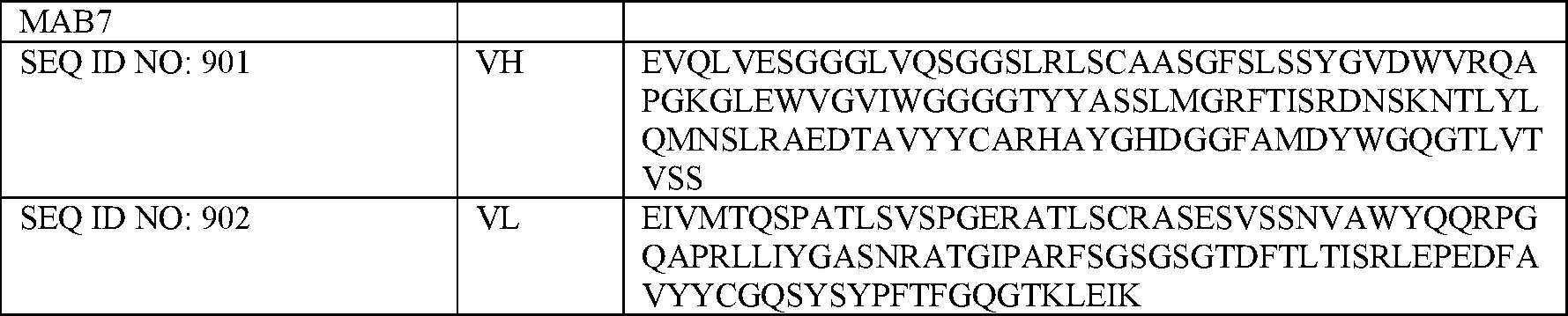
일 구현예에서, 항-GITR 항체 분자는 BMS 986156 또는 BMS986156으로도 공지된 BMS-986156(Bristol-Myers Squibb)이다. BMS-986156 및 다른 항-GITR 항체는 예를 들어, 그 전문이 참조로 포함된 US 9,228,016 및 WO 2016/196792에 개시되어 있다. 일 구현예에서, 항-GITR 항체 분자는 예를 들어 표 H에 개시된 바와 같은 BMS-986156의 CDR 서열(또는 포괄적으로 모든 CDR 서열), 중쇄 또는 경쇄 가변 영역 서열, 또는 중쇄 또는 경쇄 서열 중 하나 이상을 포함한다.In one embodiment, the anti-GITR antibody molecule is BMS-986156 (Bristol-Myers Squibb), also known as BMS 986156 or BMS986156. BMS-986156 and other anti-GITR antibodies are disclosed, for example, in US 9,228,016 and WO 2016/196792, which are incorporated by reference in their entirety. In one embodiment, the anti-GITR antibody molecule is one or more of, for example, the CDR sequences (or all CDR sequences inclusive), heavy or light chain variable region sequences, or heavy or light chain sequences of BMS-986156 as disclosed in Table H. It includes.
일 구현예에서, 항-GITR 항체 분자는 MK-4166 또는 MK-1248(Merck)이다. MK-4166, MK-1248, 및 다른 항-GITR 항체는 예를 들어, 그 전문이 참조로 포함된 US 8,709,424, WO 2011/028683, WO 2015/026684 및 문헌[Mahne et al. Cancer Res. 2017; 77(5):1108-1118]에 개시되어 있다.In one embodiment, the anti-GITR antibody molecule is MK-4166 or MK-1248 (Merck). MK-4166, MK-1248, and other anti-GITR antibodies For example, US 8,709,424, WO 2011/028683, WO 2015/026684 and Mahne et al. Cancer Res. 2017; 77 (5): 1108-1118.
일 구현예에서, 항-GITR 항체 분자는 TRX518(Leap Therapeutics)이다. TRX518 및 다른 항-GITR 항체는 예를 들어, 그 전문이 참조로 포함된 US 7,812,135, US 8,388,967, US 9,028,823, WO 2006/105021 및 문헌[Ponte J et al. (2010) Clinical Immunology; 135:S96]에 개시되어 있다.In one embodiment, the anti-GITR antibody molecule is TRX518 (Leap Therapeutics). TRX518 and other anti-GITR antibodies are described, for example, in US 7,812,135, US 8,388,967, US 9,028,823, WO 2006/105021 and Ponte J et al. (2010) Clinical Immunology ; 135: S96.
일 구현예에서, 항-GITR 항체 분자는 INCAGN1876(Incyte/Agenus)이다. INCAGN1876 및 다른 항-GITR 항체는 예를 들어, 그 전문이 참조로 포함된 US 2015/0368349 및 WO 2015/184099에 개시되어 있다.In one embodiment, the anti-GITR antibody molecule is INCAGN1876 (Incyte / Agenus). INCAGN1876 and other anti-GITR antibodies are disclosed, for example, in US 2015/0368349 and WO 2015/184099, which are incorporated by reference in their entirety.
일 구현예에서, 항-GITR 항체 분자는 AMG 228(Amgen)이다. AMG 228 및 다른 항-GITR 항체는 예를 들어, 그 전문이 참조로 포함된 US 9,464,139 및 WO 2015/031667에 개시되어 있다.In one embodiment, the anti-GITR antibody molecule is AMG 228 (Amgen). AMG 228 and other anti-GITR antibodies are disclosed, for example, in US 9,464,139 and WO 2015/031667, which are incorporated by reference in their entirety.
일 구현예에서, 항-GITR 항체 분자는 INBRX-110(Inhibrx)이다. INBRX-110 및 다른 항-GITR 항체는 예를 들어, 그 전문이 참조로 포함된 US 2017/0022284 및 WO 2017/015623에 개시되어 있다.In one embodiment, the anti-GITR antibody molecule is INBRX-110 (Inhibrx). INBRX-110 and other anti-GITR antibodies are disclosed, for example, in US 2017/0022284 and WO 2017/015623, which are incorporated by reference in their entirety.
일 구현예에서, GITR 효능제(예를 들어 융합 단백질)는 MEDI1873으로도 공지된 MEDI 1873(Medimmune)이다. MEDI 1873 및 다른 GITR 효능제는 예를 들어, 그 전문이 참조로 포함된 US 2017/0073386, WO 2017/025610 및 문헌[Ross et al. Cancer Res 2016; 76(14 Suppl): Abstract nr 561]에 개시되어 있다. 일 구현예에서, GITR 효능제는 MEDI 1873의 IgG Fc 도메인, 기능성 다량체화 도메인, 및 글루코코티코이드-유도 TNF 수용체 리간드(GITRL)의 수용체 결합 도메인 중 하나 이상을 포함한다.In one embodiment, the GITR agonist (eg fusion protein) is MEDI 1873 (Medimmune), also known as MEDI1873. MEDI 1873 and other GITR agonists are described, for example, in US 2017/0073386, WO 2017/025610 and Ross et al. Cancer Res 2016; 76 (14 Suppl): Abstract nr 561. In one embodiment, the GITR agonist comprises one or more of an IgG Fc domain of MEDI 1873, a functional multimerization domain, and a receptor binding domain of a glucocorticoid-induced TNF receptor ligand (GITRL).
추가의 공지된 GITR 효능제(예를 들어 항-GITR 항체)는 예를 들어, 그 전문이 참조로 포함된 WO 2016/054638에 기재된 것들을 포함한다.Additional known GITR agonists (eg anti-GITR antibodies) include, for example, those described in WO 2016/054638, which is incorporated by reference in its entirety.
일 구현예에서, 항-GITR 항체는 GITR 상의, 본원에 기재된 항-GITR 항체 중 하나와 동일한 에피토프와 결합하기 위해 경쟁하고/하거나 결합하는 항체이다.In one embodiment, the anti-GITR antibody is an antibody that competes and / or binds to bind the same epitope on one of the anti-GITR antibodies described herein on the GITR.
일 구현예에서, GITR 효능제는 GITR 신호전달 경로를 활성화시키는 펩타이드이다. 일 구현예에서, GITR 효능제는 영역(예를 들어 면역글로불린 서열의 Fc 영역)에 융합된 면역접합체 결합 단편(예를 들어 GITRL의 세포외 또는 GITR 결합 부분을 포함하는 면역접합체 결합 단편)이다.In one embodiment, the GITR agonist is a peptide that activates the GITR signaling pathway. In one embodiment, the GITR agonist is an immunoconjugate binding fragment (eg, an immunoconjugate binding fragment comprising an extracellular or GITR binding portion of GITRL) fused to a region (eg, an Fc region of an immunoglobulin sequence).
[표 H]TABLE H
예시적인 항-GITR 항체 분자의 아미노산 서열Amino Acid Sequences of Exemplary Anti-GITR Antibody Molecules

IL15/IL-15Ra 복합체IL15 / IL-15Ra Complex
본 발명의 일 양태에서, IL-1β 저해제 또는 이의 기능성 단편은 IL-15/IL-15Ra 복합체와 함께 투여된다. 일부 구현예에서, IL-15/IL-15Ra 복합체는 NIZ985(Novartis), ATL-803(Altor) 또는 CYP0150(Cytune)으로부터 선택된다.In one aspect of the invention, the IL-1β inhibitor or functional fragment thereof is administered in combination with an IL-15 / IL-15Ra complex. In some embodiments, the IL-15 / IL-15Ra complex is selected from NIZ985 (Novartis), ATL-803 (Altor) or CYP0150 (Cytune).
일 구현예에서, IL-15/IL-15Ra 복합체는 가용성 형태의 인간 IL-15Ra와 복합체화된 인간 IL-15를 포함한다. 이러한 복합체는 가용성 형태의 IL-15Ra에 공유적 또는 비공유적으로 결합된 IL-15를 포함할 수 있다. 특정 구현예에서, 인간 IL-15는 가용성 형태의 IL-15Ra에 비공유적으로 결합된다. 특정 구현예에서, 조성물의 인간 IL-15는 그 전문이 참조로 포함된 WO 2014/066527에 기재된 바와 같은 표 I에서 SEQ ID NO: 1001의 아미노산 서열을 포함하고, 가용성 형태의 인간 IL-15Ra는 표 I에서 SEQ ID NO:1002의 아미노산 서열을 포함한다. 본원에 기재된 분자는 그 전문이 참조로 포함된 WO 2007/084342에 기재된 벡터, 숙주 세포 및 방법에 의해 제조될 수 있다.In one embodiment, the IL-15 / IL-15Ra complex comprises human IL-15 complexed with soluble form of human IL-15Ra. Such complexes may comprise IL-15 covalently or non-covalently bound to soluble forms of IL-15Ra. In certain embodiments, human IL-15 is noncovalently bound to the soluble form of IL-15Ra. In certain embodiments, human IL-15 of the composition comprises the amino acid sequence of SEQ ID NO: 1001 in Table I as described in WO 2014/066527, which is incorporated by reference in its entirety, and the soluble form of human IL-15Ra is In Table I comprises the amino acid sequence of SEQ ID NO: 1002. The molecules described herein can be prepared by the vectors, host cells and methods described in WO 2007/084342, which is incorporated by reference in its entirety.
[표 I]TABLE I
예시적인 IL-15/IL-15Ra 복합체의 아미노산 및 뉴클레오타이드 서열Amino Acid and Nucleotide Sequences of Exemplary IL-15 / IL-15Ra Complexes

일 구현예에서, IL-15/IL-15Ra 복합체는 ALT-803, IL-15/IL-15Ra Fc 융합 단백질(IL-15N72D:IL-15RaSu/Fc 가용성 복합체)이다. ALT-803은 그 전문이 참조로 포함된 WO 2008/143794에 개시되어 있다. 일 구현예에서, IL-15/IL-15Ra Fc 융합 단백질은 표 J에 개시된 바와 같은 서열을 포함한다.In one embodiment, the IL-15 / IL-15Ra complex is ALT-803, IL-15 / IL-15Ra Fc fusion protein (IL-15N72D: IL-15RaSu / Fc soluble complex). ALT-803 is disclosed in WO 2008/143794, which is incorporated by reference in its entirety. In one embodiment, the IL-15 / IL-15Ra Fc fusion protein comprises a sequence as disclosed in Table J.
일 구현예에서, IL-15/IL-15Ra 복합체는 IL-15Ra(CYP0150, Cytune)의 스시 도메인에 융합된 IL-15를 포함한다. IL-15Ra의 스시 도메인은 IL-15Ra의 신호 펩타이드 후 제1 시스테인 잔기에서 시작하고 상기 신호 펩타이드 후 제4 시스테인 잔기에서 끝나는 도메인을 지칭한다. IL-15Ra의 스시 도메인에 융합된 IL-15의 복합체는 그 전문이 참조로 포함된 WO 2007/04606 및 WO 2012/175222에 개시되어 있다. 일 구현예에서, IL-15/IL-15Ra 스시 도메인 융합은 표 J에 개시된 바와 같은 서열을 포함한다.In one embodiment, the IL-15 / IL-15Ra complex comprises IL-15 fused to the sushi domain of IL-15Ra (CYP0150, Cytune). The sushi domain of IL-15Ra refers to the domain starting at the first cysteine residue after the signal peptide of IL-15Ra and ending at the fourth cysteine residue after the signal peptide. Complexes of IL-15 fused to the sushi domain of IL-15Ra are disclosed in WO 2007/04606 and WO 2012/175222, which are incorporated by reference in their entirety. In one embodiment, the IL-15 / IL-15Ra sushi domain fusion comprises a sequence as disclosed in Table J.
[표 J]TABLE J
다른 예시적인 IL-15/IL-15Ra 복합체의 아미노산 서열Amino Acid Sequences of Other Exemplary IL-15 / IL-15Ra Complexes

CTLA-4 저해제CTLA-4 inhibitor
본 발명의 일 양태에서, IL-1β 저해제 또는 이의 기능성 단편은 CTLA-4의 저해제와 함께 투여된다. 일부 구현예에서, CTLA-4 저해제는 항-CTLA-4 항체 또는 이의 단편이다. 예시적인 항-CTLA-4 항체는 트레멜리무맙(Tremelimumab)(이전에 티실리무맙(ticilimumab), CP-675,206); 및 이필리무맙(MDX-010, Yervoy®)을 포함한다.In one aspect of the invention, the IL-1β inhibitor or functional fragment thereof is administered with an inhibitor of CTLA-4. In some embodiments, the CTLA-4 inhibitor is an anti-CTLA-4 antibody or fragment thereof. Exemplary anti-CTLA-4 antibodies include Tremelimumab (formerly ticilimumab, CP-675,206); And Ipilimumab (MDX-010, Yervoy®).
일 구현예에서, 본 발명은 폐암, 특히 NSCLC의 치료에 사용하기 위한 IL-1β 항체 또는 이의 기능성 단편을 제공하며, 여기서, 상기 IL-1β 항체 또는 이의 기능성 단편은 하나 이상의 화학치료제와 조합되어 투여되며, 상기 하나 이상의 화학치료제는 바람직하게는 니볼루맙, 펨브롤리주맙, 아테졸리주맙, 아벨루맙, 두르발루맙, PDR-001(스파르탈리주맙) 및 이필리무맙으로 구성된 군으로부터 선택되는 체크포인트 저해제이다. 일 구현예에서, 하나 이상의 화학치료제는 바람직하게는 니볼루맙, 펨브롤리주맙, 아테졸리주맙, 아벨루맙, 두르발루맙, PDR-001(스파르탈리주맙)로 구성된 군으로부터 선택되는 PD-1 또는 PD-L-1 저해제이다. 전형적으로, 적어도 부분적인 염증 기반을 가진 암은 폐암, 특히 NSCLC, 결장직장암, 흑색종, 위암(식도암 포함), 신세포암종(RCC), 유방암, 간세포암종(HCC), 전립선암, 방광암, AML, 다발성 골수종 및 췌장암을 포함하지만 이들로 한정되는 것은 아니다. 추가의 일 구현예에서, IL-1β 항체는 카나키누맙 또는 이의 기능성 단편이다. 추가의 일 구현예에서, IL-1β 항체는 카나키누맙 또는 이의 기능성 단편이다. 일 구현예에서, 카나키누맙은 300 mg의 용량으로 매달 투여된다. 일 구현예에서, 카나키누맙은 200 mg의 용량으로 3주마다 또는 매달 투여된다. 일 구현예에서, 카나키누맙은 피하 투여된다. 추가의 일 구현예에서, IL-1β 항체는 카나키누맙 또는 이의 기능성 단편이고, 바람직하게는 니볼루맙, 펨브롤리주맙, 아테졸리주맙, 아벨루맙, 두르발루맙 및 PDR-001(스파르탈리주맙)로부터 선택되는 PD-1 또는 PD-L1 저해제와, 특히 아테졸리주맙과 조합되어 투여되며, 여기서, 카나키누맙은 PD-1 또는 PD-L1 저해제와 동시에 투여된다. 추가의 일 구현예에서, IL-1β 항체는 게보키주맙 또는 이의 기능성 단편이다. 일 구현예에서, 게보키주맙은 90 mg 내지 약 360 mg, 90 mg 내지 약 270 mg, 120 mg 내지 270 mg, 90 mg 내지 180 mg, 120 mg 내지 180 mg, 120 mg 또는 90 mg 또는 60 mg 내지 90 mg의 용량으로 3주마다 투여된다. 일 구현예에서, 게보키주맙 또는 이의 기능성 단편은 120 mg의 용량으로 3주마다 투여된다. 일 구현예에서, 게보키주맙은 90 mg 내지 약 360 mg, 90 mg 내지 약 270 mg, 120 mg 내지 270 mg, 90 mg 내지 180 mg, 120 mg 내지 180 mg, 120 mg 또는 90 mg 또는 60 mg 내지 90 mg의 용량으로 매달 투여된다. 일 구현예에서, 게보키주맙 또는 이의 기능성 단편은 120 mg의 용량으로 4주마다(매달) 투여된다. 일 구현예에서, 게보키주맙은 피하 또는 바람직하게는 정맥내 투여된다.In one embodiment, the invention provides an IL-1β antibody or functional fragment thereof for use in the treatment of lung cancer, in particular NSCLC, wherein the IL-1β antibody or functional fragment thereof is administered in combination with one or more chemotherapeutic agents Wherein said at least one chemotherapeutic agent is preferably a checkpoint selected from the group consisting of nivolumab, pembrolizumab, atezolizumab, avelumab, Durvalumab, PDR-001 (spartalizumab) and Ipilimumab Inhibitors. In one embodiment, the one or more chemotherapeutic agents are preferably PD-1 selected from the group consisting of nivolumab, pembrolizumab, atezolizumab, avelumab, duvalumab, PDR-001 (spartalizumab) or PD-L-1 inhibitors. Typically, cancers with at least partial inflammation base are lung cancers, especially NSCLC, colorectal cancer, melanoma, gastric cancer (including esophageal cancer), renal cell carcinoma (RCC), breast cancer, hepatocellular carcinoma (HCC), prostate cancer, bladder cancer, AML , Multiple myeloma and pancreatic cancer. In a further embodiment, the IL-1β antibody is canakinumab or a functional fragment thereof. In a further embodiment, the IL-1β antibody is canakinumab or a functional fragment thereof. In one embodiment, canakinumab is administered monthly at a dose of 300 mg. In one embodiment, canakinumab is administered every three weeks or monthly at a dose of 200 mg. In one embodiment, canakinumab is administered subcutaneously. In a further embodiment, the IL-1β antibody is canakinumab or a functional fragment thereof, preferably nivolumab, pembrolizumab, atezolizumab, avelumab, Durvalumab and PDR-001 (spartalizumab) And a PD-1 or PD-L1 inhibitor, in particular in combination with atezolizumab, wherein canakinumab is administered simultaneously with the PD-1 or PD-L1 inhibitor. In a further embodiment, the IL-1β antibody is gebozumab or a functional fragment thereof. In one embodiment, the gebokizumab is from 90 mg to about 360 mg, 90 mg to about 270 mg, 120 mg to 270 mg, 90 mg to 180 mg, 120 mg to 180 mg, 120 mg or 90 mg or 60 mg to It is administered every three weeks at a dose of 90 mg. In one embodiment, gebozumab or a functional fragment thereof is administered every three weeks at a dose of 120 mg. In one embodiment, the gebokizumab is from 90 mg to about 360 mg, 90 mg to about 270 mg, 120 mg to 270 mg, 90 mg to 180 mg, 120 mg to 180 mg, 120 mg or 90 mg or 60 mg to It is administered monthly at a dose of 90 mg. In one embodiment, gevozumab or a functional fragment thereof is administered every four weeks (monthly) at a dose of 120 mg. In one embodiment, gebozumab is administered subcutaneously or preferably intravenously.
추가의 일 구현예에서, IL-1β 항체는 게보키주맙 또는 이의 기능성 단편이고, 바람직하게는 니볼루맙, 펨브롤리주맙, 아테졸리주맙, 아벨루맙, 두르발루맙 및 PDR-001/스파르탈리주맙으로부터 선택되는 PD-1 또는 PD-L1 저해제와, 특히 아테졸리주맙과 조합되어 투여되며, 여기서, 게보키주맙은 PD-1 또는 PD-L1 저해제와 동시에 투여된다.In a further embodiment, the IL-1β antibody is gebozumab or a functional fragment thereof, preferably nivolumab, pembrolizumab, atezolizumab, avelumab, Durvalumab and PDR-001 / spartalumab A PD-1 or PD-L1 inhibitor selected from is administered, in particular in combination with atezolizumab, wherein the gebozumab is administered simultaneously with the PD-1 or PD-L1 inhibitor.
일 구현예에서, 상기 환자는 EGFR 또는 ALK 게놈 종양 변이(aberration)가 있거나 없이, FDA-승인 시험에 의해 결정된 바와 같은 높은 PD-L1 발현 [50% 이상의 종양 비율 점수(TPS)]을 갖는 종양을 가진다. 일 구현예에서, 상기 환자는 FDA-승인 시험에 의해 결정된 바와 같은 PD-L1 발현(1% 이상의 TPS)을 갖는 종양을 가진다.In one embodiment, the patient has a tumor with high PD-L1 expression [tumor ratio score (TPS) of at least 50%) as determined by the FDA-approval test, with or without EGFR or ALK genomic tumor aberration. Have In one embodiment, the patient has a tumor with PD-L1 expression (at least 1% TPS) as determined by the FDA-approval test.
용어 "~와 조합된"은 2개 이상의 약물이 순차적으로 투여되거나 동시에 투여되는 것으로서 이해된다. 대안적으로, 용어 "~와 조합된"은 2개 이상의 약물이, 유효적 치료 농도의 약물이 환자의 신체 내에서 대부분의 기간 동안 중첩되는 것으로 예상되는 방식으로 투여되는 것으로 이해된다. 본 발명의 약물 및 하나 이상의 조합 파트너(예를 들어 "치료제" 또는 "공동-작용제"로도 지칭되는 또 다른 약물)는 시간 간격 내에서 독립적으로 동시에 또는 별도로 투여될 수 있으며, 특히 이들 시간 간격은 조합 파트너가 공동협력적, 예를 들어 상승적 효과를 보여주는 것을 허용한다. 본원에 사용된 바와 같은 용어 "공동-투여" 또는 "조합된 투여" 등은 선택된 조합 파트너를 이를 필요로 하는 단일 대상체(예를 들어 환자)에게 투여하는 것을 포괄함을 의미하고, 작용제가 반드시 동일한 투여 경로에 의해 투여되거나 동시에 투여되는 것은 아닌 치료 요법을 포함하고자 한다. 약물은 특이적인 시간 한계 없이 동시에, 수반적 또는 순차적으로 별도의 엔티티(entity)로서 환자에게 투여되며, 여기서, 이러한 투여는 환자의 신체에서 치료적 유효 수준의 2개 화합물을 제공하고, 치료 요법은 본원에 기재된 질환 또는 장애를 치료하는 데 있어서 약물 조합의 유익한 효과를 제공할 것이다. 후자는 또한, 칵테일 치료법, 예를 들어 3개 이상의 활성 성분의 투여에 적용된다.The term “in combination with” is understood as two or more drugs being administered sequentially or simultaneously. Alternatively, the term “in combination with” is understood that two or more drugs are administered in such a way that an effective therapeutic concentration of drug is expected to overlap for most of the time in the patient's body. Drugs of the invention and one or more combination partners (eg, another drug, also referred to as “therapeutic agent” or “co-agent”) may be administered independently simultaneously or separately within a time interval, in particular these time intervals being combined Allow partners to show collaborative, eg synergistic effects. As used herein, the terms “co-administration” or “combined administration,” and the like, mean that the administration of a selected combination partner encompasses administration to a single subject (eg, a patient) in need thereof, and the agent is necessarily It is intended to include therapeutic regimens which are not administered or concurrently administered by the route of administration. The drug is administered to the patient at the same time, concomitantly or sequentially, as a separate entity without specific time limits, where such administration provides a therapeutically effective level of two compounds in the patient's body and the treatment regimen is It will provide a beneficial effect of the drug combination in treating the diseases or disorders described herein. The latter also applies to cocktail therapy, eg the administration of three or more active ingredients.
일 구현예에서, 본 발명은 폐암의 치료에 사용하기 위한 IL-1β 항체 또는 이의 기능성 단편, 적합하게는 카나키누맙 또는 이의 기능성 단편, 또는 게보키주맙 또는 이의 기능성 단편을 제공하며, 여기서, 폐암은 진행성 폐암, 전이성 폐암, 악화된 폐암, 및/또는 불응성 폐암이다. 일 구현예에서, 폐암은 전이성 NSCLC이다.In one embodiment, the present invention provides an IL-1β antibody or functional fragment thereof, suitably canakinumab or a functional fragment thereof, or gebozumab or a functional fragment thereof, for use in the treatment of lung cancer, wherein the lung cancer Are advanced lung cancer, metastatic lung cancer, exacerbated lung cancer, and / or refractory lung cancer. In one embodiment, the lung cancer is metastatic NSCLC.
일 구현예에서, 본 발명은 적어도 부분적인 염증 기반을 가진 암의 제1선 치료로서 사용하기 위한 IL-1β 항체 또는 이의 기능성 단편, 적합하게는 카나키누맙 또는 이의 기능성 단편, 또는 게보키주맙 또는 이의 기능성 단편을 제공한다. 전형적으로, 적어도 부분적인 염증 기반을 가진 암은 폐암, 특히 NSCLC, 결장직장암, 흑색종, 위암(식도암 포함), 신세포암종(RCC), 유방암, 간세포암종(HCC), 전립선암, 방광암, AML, 다발성 골수종 및 췌장암을 포함하지만 이들로 한정되는 것은 아니다. 일 구현예에서, 본 발명은 폐암, 특히 NSCLC를 포함하여 적어도 부분적인 염증 기반을 가진 암의 제1선 치료로서 사용하기 위한 IL-1β 항체 또는 이의 기능성 단편, 적합하게는 카나키누맙 또는 이의 기능성 단편, 또는 게보키주맙 또는 이의 기능성 단편을 제공한다. 용어 "제1선 치료"는 환자가 하나 이상의 다른 화학치료제에 대해 내성을 발달시키기 전에 상기 환자에게 IL-1β 항체 또는 이의 기능성 단편이 주어지는 것을 의미한다. 바람직하게는, 하나 이상의 다른 화학치료제는 백금계 단독 또는 조합 치료법, 표적화된 치료법, 예컨대 티로신 저해제 치료법, 체크포인트 저해제 치료법 또는 이들의 임의의 조합이다. 제1선 치료에 있어서, IL-1β 항체 또는 이의 기능성 단편, 예컨대 카나키누맙 또는 게보키주맙은 환자에게 단독치료법으로서 투여되거나 바람직하게는 하나 이상의 저분자 화학치료제와 함께 또는 하나 이상의 저분자 화학치료제 없이, 체크포인트 저해제, 특히 PD-1 또는 PD-L1 저해제, 특히 아테졸리주맙과 조합되어 투여될 수 있다.In one embodiment, the invention provides an IL-1β antibody or functional fragment thereof, suitably canakinumab or a functional fragment thereof, or gebozumab, for use as first-line treatment of a cancer having at least a partial inflammation base or It provides a functional fragment thereof. Typically, cancers with at least partial inflammation base are lung cancers, especially NSCLC, colorectal cancer, melanoma, gastric cancer (including esophageal cancer), renal cell carcinoma (RCC), breast cancer, hepatocellular carcinoma (HCC), prostate cancer, bladder cancer, AML , Multiple myeloma and pancreatic cancer. In one embodiment, the present invention relates to an IL-1β antibody or functional fragment thereof, suitably canakinumab or functional thereof, for use as first-line treatment of lung cancer, particularly cancers with at least partially inflammatory bases, including NSCLC. Fragments, or gebokizumab or functional fragments thereof. The term "first line treatment" means that the patient is given an IL-1β antibody or functional fragment thereof before the patient develops resistance to one or more other chemotherapeutic agents. Preferably, the one or more other chemotherapeutic agents are platinum based alone or in combination therapies, targeted therapies such as tyrosine inhibitor therapies, checkpoint inhibitor therapies or any combination thereof. In first-line treatment, the IL-1β antibody or functional fragment thereof, such as canakinumab or gebozumab, is administered to a patient as monotherapy or preferably with or without one or more small molecule chemotherapeutic agents, It may be administered in combination with a checkpoint inhibitor, in particular a PD-1 or PD-L1 inhibitor, in particular atezolizumab.
바람직한 일 구현예에서, 카나키누맙 또는 이의 단편은 하나의 체크포인트 저해제와 조합되어 폐암, 특히 NSCLC의 제1선 치료로서 사용된다. 제1선 치료에 있어서, IL-1β 항체 또는 이의 기능성 단편은 환자에게 단독치료법 또는 바람직하게는 폐암, 특히 NSCLC에 대한 표준 치료, 예컨대 하나 이상의 화학치료제, 특히 FDA-승인된 치료법과 조합되어 투여될 수 있다. 바람직한 일 구현예에서, 카나키누맙 또는 이의 단편은 하나의 체크포인트 저해제, 바람직하게는 니볼루맙, 펨브롤리주맙 및 PDR-001/스파르탈리주맙 아벨루맙, 두르발루맙 및 아테졸리주맙, 바람직하게는 아테졸리주맙으로부터 선택되는 체크포인트 저해제와 조합되어 폐암, 특히 NSCLC의 제1선 치료로서 사용된다. 바람직한 일 구현예에서, 상기 체크포인트 저해제는 펨브롤리주맙이다. 바람직한 일 구현예에서, 상기 체크포인트 저해제는 스파르탈리주맙이다. 더 바람직한 일 구현예에서, 상기 조합 외에도 적어도 하나 이상의 화학치료제, 바람직하게는 백금 작용제, 예컨대 시스플라틴 또는 유사분열 저해제, 예컨대 도세탁셀이 첨가된다. 일 구현예에서, 카나키누맙은 200 mg의 용량으로 3주마다, 바람직하게는 피하로 투여되거나, 체크포인트 저해제에 후속하여 투여되거나 바람직하게는 체크포인트 저해제와 동시에 투여된다.In a preferred embodiment, kanakinumab or a fragment thereof is used in combination with one checkpoint inhibitor as first-line treatment of lung cancer, in particular NSCLC. In first-line treatment, the IL-1β antibody or functional fragment thereof is administered to a patient either monotherapy or preferably in combination with standard treatments for lung cancer, in particular NSCLC, such as one or more chemotherapeutic agents, in particular FDA-approved therapies Can be. In a preferred embodiment, canakinumab or a fragment thereof is a checkpoint inhibitor, preferably nivolumab, pembrolizumab and PDR-001 / spartazumab avelumab, Durvalumab and Atezolizumab, preferably Is used as a first line treatment of lung cancer, in particular NSCLC, in combination with a checkpoint inhibitor selected from atezolizumab. In a preferred embodiment, the checkpoint inhibitor is pembrolizumab. In a preferred embodiment, the checkpoint inhibitor is spartalizumab. In a more preferred embodiment, in addition to the combination above at least one or more chemotherapeutic agents, preferably platinum agents such as cisplatin or mitosis inhibitors such as docetaxel, are added. In one embodiment, canakinumab is administered every three weeks, preferably subcutaneously, at a dose of 200 mg, following the checkpoint inhibitor, or preferably simultaneously with the checkpoint inhibitor.
바람직한 일 구현예에서, 게보키주맙 또는 이의 단편은 하나의 체크포인트 저해제, 바람직하게는 니볼루맙, 펨브롤리주맙 및 PDR-001/스파르탈리주맙, 아벨루맙, 두르발루맙 및 아테졸리주맙, 바람직하게는 아테졸리주맙으로부터 선택되는 PD-1/PD-L1 저해제와 조합되어 폐암, 특히 NSCLC의 제1선 치료로서 사용된다. 바람직한 일 구현예에서, 상기 체크포인트 저해제는 펨브롤리주맙이다. 바람직한 일 구현예에서, 상기 체크포인트 저해제는 스파르탈리주맙이다. 더 바람직한 일 구현예에서, 상기 조합 외에도 적어도 하나 이상의 화학치료제, 바람직하게는 백금 작용제, 예컨대 시스플라틴 또는 유사분열 저해제, 예컨대 도세탁셀이 첨가된다. 일 구현예에서, 게보키주맙은 60 mg 내지 90 mg의 용량으로 3주마다 또는 120 mg의 용량으로 3주 또는 4주마다 또는 90 mg의 용량으로 3주 또는 4주마다, 바람직하게는 정맥내로 투여되거나, 체크포인트 저해제에 후속하여 투여되거나 바람직하게는 체크포인트 저해제와 동시에 투여된다.In one preferred embodiment, the gebokizumab or fragment thereof is one checkpoint inhibitor, preferably nivolumab, pembrolizumab and PDR-001 / spartazumab, avelumab, duvalumab and atezolizumab, preferably Preferably used in combination with a PD-1 / PD-L1 inhibitor selected from atezolizumab as a first line treatment of lung cancer, in particular NSCLC. In a preferred embodiment, the checkpoint inhibitor is pembrolizumab. In a preferred embodiment, the checkpoint inhibitor is spartalizumab. In a more preferred embodiment, in addition to the combination above at least one or more chemotherapeutic agents, preferably platinum agents such as cisplatin or mitosis inhibitors such as docetaxel, are added. In one embodiment, gebozumab is administered every three weeks at a dose of 60 mg to 90 mg or every three or four weeks at a dose of 120 mg or every three or four weeks at a dose of 90 mg, preferably intravenously. It is administered, followed by a checkpoint inhibitor or preferably concurrently with the checkpoint inhibitor.
일 구현예에서, 본 발명은 폐암, 특히 NSCLC를 포함하여 적어도 부분적인 염증 기반을 가진 암의 제2선 또는 제3선 치료로서 사용하기 위한 IL-1β 항체 또는 이의 기능성 단편, 적합하게는 카나키누맙 또는 이의 기능성 단편, 또는 게보키주맙 또는 이의 기능성 단편을 제공한다. 용어 "제2선 또는 제3선 치료"는, IL-1β 항체 또는 이의 기능성 단편이 하나 이상의 다른 화학치료제 치료 시 또는 그 후에 암 진전, 특히 폐암, 특히 NSCLC에 대한 FDA-승인된 치료법 시 또는 그 후의 질병 진전을 갖는 환자에게 투여됨을 의미한다. 바람직하게는, 하나 이상의 다른 화학치료제는 백금계 단독 또는 조합 치료법, 표적화된 치료법, 예컨대 티로신 저해제 치료법, 체크포인트 저해제 치료법 또는 이들의 임의의 조합이다. 제2선 또는 제3선 치료에 있어서, IL-1β 항체 또는 이의 기능성 단편은 환자에게 단독치료법으로서 또는 바람직하게는 동일한 하나 이상의 화학치료제를 이용한 조기 치료의 계속을 포함하여 하나 이상의 화학치료제와 조합되어 투여될 수 있다.In one embodiment, the present invention provides an IL-1β antibody or functional fragment thereof, suitably Kanakinu, for use as a second-line or third-line treatment of lung cancer, particularly cancers with at least partial inflammation base including NSCLC. Mab or a functional fragment thereof, or Gebozumab or a functional fragment thereof. The term “second- or third-line treatment” means that when the IL-1β antibody or functional fragment thereof is treated with or after one or more other chemotherapeutic agents or when FDA-approved therapy for cancer progression, in particular lung cancer, in particular NSCLC Administration to patients with later disease progression. Preferably, the one or more other chemotherapeutic agents are platinum based alone or in combination therapies, targeted therapies such as tyrosine inhibitor therapies, checkpoint inhibitor therapies or any combination thereof. In the second or third line treatment, the IL-1β antibody or functional fragment thereof is combined with one or more chemotherapeutic agents, including monotherapy to the patient or preferably continuing continual treatment with the same one or more chemotherapeutic agents. May be administered.
제2선 또는 제3선 치료로서 사용하기 위해, IL-1β 항체 또는 이의 기능성 단편, 예컨대 카나키누맙 또는 게보키주맙은 환자에게 단독치료법으로서 투여되거나 바람직하게는 하나 이상의 저분자 화학치료제와 함께 또는 하나 이상의 저분자 화학치료제 없이, 체크포인트 저해제, 특히 PD-1 또는 PD-L1 저해제, 특히 아테졸리주맙과 조합되어 투여될 수 있다.For use as second line or third line treatment, an IL-1β antibody or functional fragment thereof, such as canacinumab or gebozumab, is administered to a patient as monotherapy or preferably in combination with one or more small molecule chemotherapeutic agents Without the above small molecule chemotherapeutic agents, it may be administered in combination with a checkpoint inhibitor, in particular a PD-1 or PD-L1 inhibitor, in particular atezolizumab.
바람직한 일 구현예에서, 카나키누맙 또는 이의 단편은 하나의 체크포인트 저해제, 바람직하게는 니볼루맙, 펨브롤리주맙 및 PDR-001/스파르탈리주맙(Novartis), 이필리무맙 및 아테졸리주맙, 바람직하게는 아테졸리주맙으로부터 선택되는 체크포인트 저해제와 조합되어 폐암, 특히 NSCLC의 제2선 또는 제3선 치료로서 사용된다. 바람직한 일 구현예에서, 상기 체크포인트 저해제는 펨브롤리주맙이다. 바람직한 일 구현예에서, 상기 체크포인트 저해제는 스파르탈리주맙이다. 더 바람직한 일 구현예에서, 상기 조합 외에도 적어도 하나 이상의 화학치료제, 바람직하게는 백금 작용제, 예컨대 시스플라틴 또는 유사분열 저해제, 예컨대 도세탁셀이 첨가된다. 일 구현예에서, 카나키누맙은 200 mg의 용량으로 3주마다 바람직하게는 피하로 투여되거나, 체크포인트 저해제에 후속하여 투여되거나 바람직하게는 체크포인트 저해제와 동시에 투여된다.In one preferred embodiment, canakinumab or a fragment thereof is one checkpoint inhibitor, preferably nivolumab, pembrolizumab and PDR-001 / spartalizumab (Novartis), ipilimumab and atezolizumab, preferably Preferably used in combination with a checkpoint inhibitor selected from atezolizumab as second or third line treatment of lung cancer, in particular NSCLC. In a preferred embodiment, the checkpoint inhibitor is pembrolizumab. In a preferred embodiment, the checkpoint inhibitor is spartalizumab. In a more preferred embodiment, in addition to the combination above at least one or more chemotherapeutic agents, preferably platinum agents such as cisplatin or mitosis inhibitors such as docetaxel, are added. In one embodiment, canakinumab is preferably administered subcutaneously every three weeks at a dose of 200 mg, subsequent to a checkpoint inhibitor, or preferably concurrently with a checkpoint inhibitor.
바람직한 일 구현예에서, 게보키주맙 또는 이의 단편은 하나의 체크포인트 저해제, 바람직하게는 니볼루맙, 펨브롤리주맙 및 PDR-001/스파르탈리주맙(Novartis) 및 아테졸리주맙, 바람직하게는 아테졸리주맙으로부터 선택되는 PD-1/PD-L1 저해제와 조합되어 폐암, 특히 NSCLC 또는 결장직장암의 제2선 또는 제3선 치료로서 사용된다. 더 바람직한 일 구현예에서, 상기 조합 외에도 적어도 하나 이상의 화학치료제, 바람직하게는 백금 작용제, 예컨대 시스플라틴 또는 유사분열 저해제, 예컨대 도세탁셀이 첨가된다. 일 구현예에서, 게보키주맙은 60 mg 내지 90 mg의 용량으로 3주마다 또는 120 mg의 용량으로 3주 또는 4주마다, 바람직하게는 정맥내로 투여되거나, 체크포인트 저해제에 후속하여 투여되거나 바람직하게는 체크포인트 저해제와 동시에 투여된다.In a preferred embodiment, the gebokizumab or fragment thereof is one checkpoint inhibitor, preferably nivolumab, pembrolizumab and PDR-001 / spartalizumab (Novartis) and atezolizumab, preferably atezoli It is used in combination with PD-1 / PD-L1 inhibitors selected from zumab as second or third line treatment of lung cancer, in particular NSCLC or colorectal cancer. In a more preferred embodiment, in addition to the combination above at least one or more chemotherapeutic agents, preferably platinum agents such as cisplatin or mitosis inhibitors such as docetaxel, are added. In one embodiment, gebozumab is administered every three weeks at a dose of 60 mg to 90 mg or every three or four weeks at a dose of 120 mg, preferably intravenously, or is subsequently administered or preferably following a checkpoint inhibitor. Preferably at the same time as the checkpoint inhibitor.
일 구현예에서, 본 발명은 각각의 기(stage)를 위한 표준 치료 후 보조 치료법으로서 환자에서 폐암의 치료에 사용하기 위한 IL-1β 항체 또는 이의 기능성 단편을 제공하며, 여기서, 환자는 높은 위험도 NSCLC(IB기, 2기 또는 3A기)를 가지고, 폐암은 수술적으로 제거되었다(수술적 절제). 일 구현예에서, 상기 보조 치료는 적어도 6개월, 바람직하게는 적어도 1년, 바람직하게는 1년 동안 지속될 것이다. 일 구현예에서, 상기 IL-1β 항체 또는 이의 기능성 단편은 게보키주맙이다. 일 구현예에서, 상기 IL-1β 항체 또는 이의 기능성 단편은 카나키누맙이다. 일 구현예에서, 카나키누맙은 300 mg의 용량으로 매달, 바람직하게는 적어도 1년 동안 투여된다. 일 구현예에서, 카나키누맙은 200 mg의 용량으로 3주마다 또는 매달, 바람직하게는 피하로, 바람직하게는 적어도 1년 동안 투여된다.In one embodiment, the present invention provides an IL-1β antibody or functional fragment thereof for use in the treatment of lung cancer in a patient as a standard post-treatment adjuvant therapy for each stage, wherein the patient is at high risk NSCLC (Phase IB,
일 구현예에서, 본 발명은 폐암의 수술적 제거 후 보조 치료법으로서 환자에서 폐암의 치료에 사용하기 위한 카나키누맙 또는 이의 기능성 단편을 제공한다. 바람직하게는, 상기 환자는 표준 화학치료법 치료, 예를 들어 4 사이클의 시스플라틴계 화학치료법을 완료하였다. 일 구현예에서, 카나키누맙은 매달 200 mg의 용량으로, 바람직하게는 적어도 1년 동안 투여된다. 일 구현예에서, 카나키누맙은 200 mg의 용량으로 3주마다 또는 매달, 바람직하게는 피하로, 바람직하게는 적어도 1년 동안 투여된다. 일 구현예에서, 본 발명은 환자에서 단독으로 또는 바람직하게는 표준 치료와 조합되어, NSCLC의 제1선 치료로서 사용하기 위한 IL-1β 항체 또는 이의 기능성 단편을 제공하며, 여기서, 상기 환자는 3B기(화학/방사선을 잘 받아들이지 않음) 또는 4기 질병을 갖고 있다. 일 구현예에서, 상기 IL-1β 항체 또는 이의 기능성 단편은 게보키주맙이다. 일 구현예에서, 상기 IL-1β 항체 또는 이의 기능성 단편은 카나키누맙이다. 일 구현예에서, 카나키누맙은 매달 적어도 300 mg의 용량으로, 바람직하게는 매달 300 mg의 용량으로 투여된다. 일 구현예에서, 카나키누맙은 200 mg의 용량으로 3주마다 또는 매달, 바람직하게는 피하로 투여된다. 일 구현예에서, 본 발명은 환자에서 NSCLC의 치료에 사용하기 위한 IL-1β 항체 또는 이의 기능성 단편을 제공하며, 여기서, 상기 환자는 하나 이상의 체크포인트 저해제, 바람직하게는 PD-1/PD-L1 저해제, 바람직하게는 아테졸리주맙을 이용한 치료 시 또는 그 후에 질병 진전을 가진다. 일 구현예에서, 상기 환자는 하나 이상의 체크포인트 저해제, 바람직하게는 PD-1 저해제, 바람직하게는 아테졸리주맙 이외의 하나 이상의 화학치료제를 이용한 치료 후 질병 진전을 가진다. 일 구현예에서, 상기 PD-1 저해제는 니볼루맙, 펨브롤리주맙, 아테졸리주맙, 아벨루맙, 두르발루맙 및 PDR-001(스파르탈리주맙)로부터 선택된다. 일 구현예에서, 상기 IL-1β 항체 또는 이의 기능성 단편은 게보키주맙이다. 일 구현예에서, 상기 IL-1β 항체 또는 이의 기능성 단편은 카나키누맙이다. 일 구현예에서, 카나키누맙은 매달 적어도 300 mg의 용량으로, 바람직하게는 매달 300 mg의 용량으로 투여된다. 일 구현예에서, 카나키누맙은 1회 치료 당 200 mg 내지 300 mg의 용량으로 투여되며, 여기서, 카나키누맙은 바람직하게는 3주마다 또는 바람직하게는 매달 투여된다. 일 구현예에서, 카나키누맙은 200 mg의 용량으로 3주마다 투여된다. IL-1β 항체 또는 이의 기능성 단편, 특히 카나키누맙 또는 게보키주맙은 단독치료법으로서 또는 바람직하게는 동일한 하나 이상의 화학치료제를 이용한 더 조기 치료의 계속을 포함하여 하나 이상의 화학치료제와 조합되어 투여될 수 있다.In one embodiment, the present invention provides cannakinumab or a functional fragment thereof for use in the treatment of lung cancer in a patient as an adjuvant therapy after surgical removal of lung cancer. Preferably, the patient has completed standard chemotherapy treatment, for example four cycles of cisplatin-based chemotherapy. In one embodiment, canakinumab is administered at a dose of 200 mg monthly, preferably for at least 1 year. In one embodiment, canakinumab is administered every three weeks or monthly, preferably subcutaneously, preferably for at least one year, at a dose of 200 mg. In one embodiment, the invention provides an IL-1β antibody or functional fragment thereof for use as a first line treatment of NSCLC, alone or in combination with standard treatment in a patient, wherein the patient is a 3B Have stage (not well received chemical / radiation) or stage IV disease. In one embodiment, the IL-1β antibody or functional fragment thereof is gebozumab. In one embodiment, the IL-1β antibody or functional fragment thereof is canakinumab. In one embodiment, canakinumab is administered at a dose of at least 300 mg monthly, preferably at a dose of 300 mg monthly. In one embodiment, canakinumab is administered every three weeks or monthly, preferably subcutaneously, at a dose of 200 mg. In one embodiment, the invention provides an IL-1β antibody or functional fragment thereof for use in the treatment of NSCLC in a patient, wherein the patient is one or more checkpoint inhibitors, preferably PD-1 / PD-L1 Disease progression upon or after treatment with an inhibitor, preferably atezolizumab. In one embodiment, the patient has disease progression after treatment with one or more checkpoint inhibitors, preferably one or more chemotherapeutic agents other than PD-1 inhibitors, preferably atezolizumab. In one embodiment, the PD-1 inhibitor is selected from nivolumab, pembrolizumab, atezolizumab, avelumab, duvalumab, and PDR-001 (spartalizumab). In one embodiment, the IL-1β antibody or functional fragment thereof is gebozumab. In one embodiment, the IL-1β antibody or functional fragment thereof is canakinumab. In one embodiment, canakinumab is administered at a dose of at least 300 mg monthly, preferably at a dose of 300 mg monthly. In one embodiment, kanakinumab is administered at a dose of 200 mg to 300 mg per treatment, wherein kanakinumab is preferably administered every three weeks or preferably monthly. In one embodiment, canakinumab is administered every three weeks at a dose of 200 mg. The IL-1β antibody or functional fragment thereof, in particular canakinumab or gebozumab, may be administered as a monotherapy or in combination with one or more chemotherapeutic agents, preferably including continuing the earlier treatment with the same one or more chemotherapeutic agents. have.
일 구현예에서, 본 발명은 환자에서 결장직장암(CRC) 또는 위장암의 치료에 단독치료법으로서 또는 바람직하게는 표준 치료와 조합되어 사용하기 위한 IL-1β 항체 또는 이의 기능성 단편을 제공한다. 일 구현예에서, 상기 IL-1β 항체 또는 이의 기능성 단편은 게보키주맙이다. 일 구현예에서, 게보키주맙은 1회 치료 당 60 mg 내지 90 mg의 용량으로 투여되며, 여기서, 게보키주맙은 바람직하게는 3주마다 또는 바람직하게는 매달 투여된다. 일 구현예에서, 게보키주맙은 1회 치료 당 120 mg의 용량으로 투여되며, 여기서, 게보키주맙은 바람직하게는 3주마다 또는 바람직하게는 매달 투여된다. 일 구현예에서, 상기 IL-1β 항체 또는 이의 기능성 단편은 카나키누맙이다. 일 구현예에서, 카나키누맙은 매달 적어도 300 mg의 용량으로, 바람직하게는 매달 300 mg의 용량으로 투여된다. 일 구현예에서, 카나키누맙은 1회 치료 당 200 mg 내지 300 mg의 용량으로 투여되며, 여기서, 카나키누맙은 바람직하게는 3주마다 또는 바람직하게는 매달 투여된다. 일 구현예에서, 카나키누맙은 200 mg에서 3주마다 투여된다.In one embodiment, the present invention provides an IL-1β antibody or functional fragment thereof for use as monotherapy or in combination with standard therapies for the treatment of colorectal cancer (CRC) or gastrointestinal cancer in a patient. In one embodiment, the IL-1β antibody or functional fragment thereof is gebozumab. In one embodiment, gevocizumab is administered at a dose of 60 mg to 90 mg per treatment, wherein the gevocizumab is preferably administered every three weeks or preferably monthly. In one embodiment, gevocizumab is administered at a dose of 120 mg per treatment, wherein the gevocizumab is preferably administered every three weeks or preferably monthly. In one embodiment, the IL-1β antibody or functional fragment thereof is canakinumab. In one embodiment, canakinumab is administered at a dose of at least 300 mg monthly, preferably at a dose of 300 mg monthly. In one embodiment, kanakinumab is administered at a dose of 200 mg to 300 mg per treatment, wherein kanakinumab is preferably administered every three weeks or preferably monthly. In one embodiment, canakinumab is administered at 200 mg every three weeks.
바람직한 구현예에서, 항-PD-1 항체 분자는 PDR001/스파르탈리주맙이다.In a preferred embodiment, the anti-PD-1 antibody molecule is PDR001 / spartalizumab.
바람직한 구현예에서, 항-PD-1 항체 분자는 펨브롤리주맙이다.In a preferred embodiment, the anti-PD-1 antibody molecule is pembrolizumab.
바람직한 구현예에서, 항-PD-1 항체 분자는 아테졸리주맙이다.In a preferred embodiment, the anti-PD-1 antibody molecule is atezolizumab.
바람직한 구현예에서, 항-PD-1 항체 분자는 니볼루맙이다.In a preferred embodiment, the anti-PD-1 antibody molecule is nivolumab.
소정의 구현예에서, 본 발명은 신세포암종(RCC)의 치료에 사용하기 위한 IL-1β 항체 또는 이의 기능성 단편, 적합하게는 게보키주맙 또는 이의 기능성 단편, 적합하게는 카나키누맙 또는 이의 기능성 단편을 제공한다. 본원에 사용된 바와 같이 용어 "신세포암종(RCC)"은 신피질(renal cortex) 내의 세뇨관 상피로부터 발생하는 신장암을 지칭하고, 1차 신세포암종, 국소 진행성 신세포암종, 절제 불가능한 신세포암종, 전이성 신세포암종, 불응성 신세포암종, 및/또는 암 약물 내성 신세포암종을 포함한다.In certain embodiments, the present invention provides an IL-1β antibody or functional fragment thereof, suitably gebokizumab or a functional fragment thereof, suitably canakinumab or a functional fragment thereof for use in the treatment of renal cell carcinoma (RCC). Provide fragments. As used herein, the term "renal cell carcinoma (RCC)" refers to renal cancer arising from tubular epithelium in the renal cortex, and is a primary renal cell carcinoma, locally advanced renal cell carcinoma, unresectable renal cell carcinoma. Metastatic renal cell carcinoma, refractory renal cell carcinoma, and / or cancer drug resistant renal cell carcinoma.
비제한적으로 용량 및 투약 요법, 조합, 투여 경로 및 바이오마커를 포함하여 본 출원 전체에 개시된 용도 모두는 신세포암종의 치료에 적용될 수 있다. 일 구현예에서, 카나키누맙은 1회 치료 당 200 mg 내지 400 mg의 용량으로 투여되며, 여기서, 카나키누맙은 바람직하게는 3주마다 또는 바람직하게는 매달 투여된다. 일 구현예에서, 카나키누맙은 200 mg의 용량으로 3주마다, 바람직하게는 피하로 투여된다. 일 구현예에서, 게보키주맙은 1회 치료 당 90 mg 내지 200 mg의 용량으로 투여되며, 여기서, 게보키주맙은 바람직하게는 3주마다 또는 바람직하게는 매달 투여된다. 일 구현예에서, 게보키주맙은 120 mg의 용량으로 3주마다 또는 매달, 바람직하게는 정맥내로 투여된다.All of the uses disclosed throughout this application, including but not limited to dose and dosage regimens, combinations, routes of administration and biomarkers, can be applied to the treatment of renal cell carcinoma. In one embodiment, kanakinumab is administered at a dose of 200 mg to 400 mg per treatment, wherein kanakinumab is preferably administered every three weeks or preferably monthly. In one embodiment, canakinumab is administered every three weeks, preferably subcutaneously, at a dose of 200 mg. In one embodiment, gevocizumab is administered at a dose of 90 mg to 200 mg per treatment, wherein the gevocizumab is preferably administered every three weeks or preferably monthly. In one embodiment, gebozumab is administered every three weeks or every month, preferably intravenously, at a dose of 120 mg.
일 구현예에서, 본 발명은 신세포암종(RCC)의 치료에 사용하기 위한 게보키주맙 또는 이의 기능성 단편을 제공하며, 여기서, 게보키주맙 또는 이의 기능성 단편은 하나 이상의 화학치료제와 조합되어 투여된다. 일 구현예에서, 화학치료제는 신세포암종(RCC)에 대한 표준 치료제이다. 일 구현예에서, 하나 이상의 화학치료제는 에베롤리무스(Afinitor®), 알데스류킨(aldesleukin)(proleukin®), 베바시주맙(Avastin®), 악시티닙(axitinib)(Inlyta®), 카보잔티닙(Cabometyx®), 렌바티닙 메실레이트(lenvatinib mesylate)(Lenvima®), 소라페닙 토실레이트(sorafenib tosylate)(Nexavar®), 니볼루맙(Opdivo®), 파조파닙 하이드로클로라이드(pazopanib hydrochloride)(Votrient®), 수니티닙 말레이트(Sutent®), 템시롤리무스(temsirolimus)(Torisel®), 이필리무맙 및 티보자닙(tivozanib)(FOTIVDA®)으로부터 선택된다. 환자 질환에 따라, 적어도 1개, 적어도 2개 또는 적어도 3개의 화학치료제가 게보키주맙과 조합되기 위해 상기 목록으로부터 선택될 수 있다.In one embodiment, the present invention provides gebozumab or functional fragments thereof for use in the treatment of renal cell carcinoma (RCC), wherein the gebozumab or functional fragments thereof are administered in combination with one or more chemotherapeutic agents. . In one embodiment, the chemotherapeutic agent is a standard treatment for renal cell carcinoma (RCC). In one embodiment, the one or more chemotherapeutic agents are Averitormus, aldesleukin (proleukin®), bevacizumab (Avastin®), axitinib (Inlyta®), cabozan Tinib (Cabometyx®), lenvatinib mesylate (Lenvima®), sorafenib tosylate (Nexavar®), nivolumab (Opdivo®), pazopanib hydrochloride ( Votrient®), Sunitinib malate (Sutent®), temsirolimus (Torisel®), Ipilimumab and tivozanib (FOTIVDA®). Depending on the patient's disease, at least one, at least two or at least three chemotherapeutic agents may be selected from the above list for combination with gebozumab.
일 구현예에서, 하나 이상의 화학치료제는 CTLA-4 체크포인트 저해제이며, 여기서, 바람직하게는 상기 CTLA-4 체크포인트 저해제는 이필리무맙이다. 일 구현예에서, 하나 이상의 화학치료제는 에베롤리무스이다.In one embodiment, the at least one chemotherapeutic agent is a CTLA-4 checkpoint inhibitor, wherein preferably the CTLA-4 checkpoint inhibitor is Ipilimumab. In one embodiment, the one or more chemotherapeutic agents is everolimus.
일 구현예에서, 하나 이상의 화학치료제는 체크포인트 저해제이며, 여기서, 바람직하게는 PD-1 또는 PD-L1 저해제이고, 바람직하게는 볼루맙, 펨브롤리주맙, 아테졸리주맙, 아벨루맙, 두르발루맙 및 스파르탈리주맙(PDR-001)으로 구성된 군으로부터 선택된다.In one embodiment, the at least one chemotherapeutic agent is a checkpoint inhibitor, preferably a PD-1 or PD-L1 inhibitor, preferably bolumab, pembrolizumab, atezlizumab, avelumab, durvalumab And spartazumab (PDR-001).
일 구현예에서, 하나 이상의 화학치료제는 니볼루맙이다. 일 구현예에서, 하나 이상의 화학치료제는 니볼루맙 + 이필리무맙이다.In one embodiment, the one or more chemotherapeutic agents is nivolumab. In one embodiment, the one or more chemotherapeutic agents is nivolumab + ipilimumab.
일 구현예에서, 하나 이상의 화학치료제는 카보잔티닙이다.In one embodiment, the one or more chemotherapeutic agents is carbozantinib.
일 구현예에서, 하나 이상의 화학치료제는 아테졸리주맙 + 베바시주맙이다.In one embodiment, the one or more chemotherapeutic agents is atezolizumab + bevacizumab.
일 구현예에서, 게보키주맙 또는 이의 기능성 단편은 상기 암이 수술적으로 제거된 후 환자에서 신세포암종(RCC)의 재발의 예방에 단독으로 또는 바람직하게는 조합되어 사용된다. 일 구현예에서, 게보키주맙 또는 이의 기능성 단편은 신세포암종(RCC)의 제1선 치료에서 단독으로 또는 바람직하게는 조합되어 사용된다. 일 구현예에서, 게보키주맙 또는 이의 기능성 단편은 신세포암종(RCC)의 제2선 또는 제3선에서 단독으로 또는 바람직하게는 조합되어 사용된다.In one embodiment, gevocizumab or a functional fragment thereof is used alone or in combination in the prevention of relapse of renal cell carcinoma (RCC) in a patient after the cancer has been surgically removed. In one embodiment, gevocizumab or functional fragments thereof are used alone or in combination in first-line treatment of renal cell carcinoma (RCC). In one embodiment, gebozizumab or functional fragments thereof are used alone or preferably in combination in the second or third lines of renal cell carcinoma (RCC).
게보키주맙 또는 이의 기능성 단편에 대한 상기 개시된 구현예는 적합하게는, 카나키누맙 또는 이의 기능성 단편에 적용 가능하다.The above-described embodiments of gebozumab or functional fragments thereof are suitably applicable to canakinumab or functional fragments thereof.
소정의 구현예에서, 본 발명은 결장직장암(CRC)의 치료에 사용하기 위한 IL-1β 항체 또는 이의 기능성 단편, 적합하게는 게보키주맙 또는 이의 기능성 단편, 적합하게는 카나키누맙 또는 이의 기능성 단편을 제공한다. 본원에 사용된 바와 같이 창자암(bowel cancer) 및 결장암으로도 공지된 용어 "결장직장암(CRC)"은 결장 및/또는 직장으로부터, 특히 결장 및/또는 직장의 상피로부터 발생하는 신생물을 의미하고, 결장 선암종, 직장 선암종, 전이성 결장직장암(mCRC), 진행성 결장직장암, 불응성 결장직장암, 불응성 전이성 미소부수체 안정한(MSS) 결장직장암 절제 불가능한 결장직장암, 및/또는 암 약물 내성 결장직장암을 포함한다. 환자 중 25% 이하는 증상 확인 시 전이성 질병을 진단받고, 환자 중 50%는 생애 중 일부 지점에서 전이 발생까지 진행될 수 있다.In certain embodiments, the present invention provides an IL-1β antibody or functional fragment thereof, suitably gebozumab or a functional fragment thereof, suitably canakinumab or a functional fragment thereof for use in the treatment of colorectal cancer (CRC). To provide. As used herein, the term "colon cancer" (CRC), also known as bowel cancer and colon cancer, refers to neoplasms arising from the colon and / or rectum, in particular from the epithelium of the colon and / or rectum and , Colorectal adenocarcinoma, rectal adenocarcinoma, metastatic colorectal cancer (mCRC), advanced colorectal cancer, refractory colorectal cancer, refractory metastatic microsatellite stable (MSS) colorectal cancer, non-resectable colorectal cancer, and / or cancer drug resistant colorectal cancer do. Less than 25% of patients are diagnosed with metastatic disease when symptoms are identified, and 50% of patients may progress to metastasis at some point in their lives.
비제한적으로 용량 및 투약 요법, 조합, 투여 경로 및 바이오마커를 포함하여 본 출원 전체에 개시된 모든 개시된 용도는 CRC의 치료에 적용될 수 있다. 일 구현예에서, 카나키누맙은 1회 치료 당 200 mg 내지 400 mg의 용량으로 투여되며, 여기서, 카나키누맙은 바람직하게는 3주마다 또는 바람직하게는 매달 투여된다. 일 구현예에서, 카나키누맙은 200 mg의 용량으로 3주마다, 바람직하게는 피하로 투여된다. 일 구현예에서, 게보키주맙은 1회 치료 당 90 mg 내지 200 mg의 용량으로 투여되며, 여기서, 게보키주맙은 바람직하게는 3주마다 또는 바람직하게는 매달 투여된다. 일 구현예에서, 게보키주맙은 120 mg의 용량으로 3주마다 또는 매달, 바람직하게는 정맥내로 투여된다.All disclosed uses disclosed throughout this application, including but not limited to dose and dosage regimens, combinations, routes of administration and biomarkers, can be applied to the treatment of CRC. In one embodiment, kanakinumab is administered at a dose of 200 mg to 400 mg per treatment, wherein kanakinumab is preferably administered every three weeks or preferably monthly. In one embodiment, canakinumab is administered every three weeks, preferably subcutaneously, at a dose of 200 mg. In one embodiment, gevocizumab is administered at a dose of 90 mg to 200 mg per treatment, wherein the gevocizumab is preferably administered every three weeks or preferably monthly. In one embodiment, gebozumab is administered every three weeks or every month, preferably intravenously, at a dose of 120 mg.
일 구현예에서, 본 발명은 결장직장암(CRC)의 치료에 사용하기 위한 게보키주맙 또는 이의 기능성 단편을 제공하며, 여기서, 게보키주맙 또는 이의 기능성 단편은 하나 이상의 화학치료제와 조합되어 투여된다. 일 구현예에서, 화학치료제는 CRC에 대한 표준 치료제이다. 일 구현예에서, 하나 이상의 화학치료제는 이리노테칸 하이드로클로라이드(Camptosar®), 카페시타빈(Xeloda®), 옥살리플라틴(Eloxatin®), 5-FU(플루오로우라실), 류코보린 칼슘(폴린산), FU-LV/FL(5-FU + 류코보린), 트리플루리딘 / 티피라실 하이드로클로라이드(Lonsurf®), 니볼루맙(Opdivo®), 레고라페닙(regorafenib)(Stivarga®), FOLFOXIRI(류코보린, 5-플루오로우라실[5-FU], 옥살리플라틴, 이리노테칸), FOLFOX(류코보린, 5-FU, 옥살리플라틴), FOLFIRI(류코보린, 5-FU, 이리노테칸), CapeOx(카페시타빈 + 옥살리플라틴), XELIRI(카페시타빈(Xeloda®) + 이리노테칸 하이드로클로라이드), XELOX(카페시타빈(Xeloda®) + 옥살리플라틴), FOLFOX + 베바시주맙(Avastin®), 세툭시맙(Erbitux®), 파니투무맙(panitumumab)(Vectibix®), FOLFIRI + 라무시루맙(Cyramza®), FOLFIRI + 세툭시맙(Erbitux®), 및 FOLFIRI + 지브-아플리베르셉트(Zaltrap)로부터 선택된다. 환자 질환에 따라, 적어도 1개, 적어도 2개 또는 적어도 3개의 화학치료제가 게보키주맙과 조합되기 위해 상기 목록으로부터 선택될 수 있다.In one embodiment, the present invention provides gebokizumab or a functional fragment thereof for use in the treatment of colorectal cancer (CRC), wherein the gebozumab or functional fragment thereof is administered in combination with one or more chemotherapeutic agents. In one embodiment, the chemotherapeutic agent is a standard therapeutic for CRC. In one embodiment, the one or more chemotherapeutic agents is irinotecan hydrochloride (Camptosar®), capecitabine (Xeloda®), oxaliplatin (Eloxatin®), 5-FU (fluorouracil), leucoborin calcium (folic acid), FU -LV / FL (5-FU + Leucovorin), Trifluridine / Tipyracil Hydrochloride (Lonsurf®), Nivolumab (Opdivo®), Regorafenib (Stivarga®), FOLFOXIRI (Leukovorin, 5 -Fluorouracil [5-FU], Oxaliplatin, Irinotecan), FOLFOX (Leukovorin, 5-FU, Oxaliplatin), FOLFIRI (Leukovorin, 5-FU, Irinotecan), CapeOx (Capecitabine + Oxaliplatin), XELIRI ( Capecitabine (Xeloda® + irinotecan hydrochloride), XELOX (capecitabine (Xeloda®) + oxaliplatin), FOLFOX + bevacizumab (Avastin®), cetuximab (Erbitux®), panitumumab (Vectibix®), FOLFIRI + Ramusumab (Cyramza®), FOLFIRI + Cetuximab (Erbitux®), and FOLFIRI + Zib-Aplibercept (Zaltr) ap). Depending on the patient's disease, at least one, at least two or at least three chemotherapeutic agents may be selected from the above list for combination with gebozumab.
일 구현예에서, 하나 이상의 화학치료제는 일반적인 세포독성제이며, 여기서, 바람직하게는 상기 일반적인 세포독성제는 FOLFOX, FOLFIRI, 카페시타빈, 5-플루오로우라실, 이리노테칸 및 옥살리플라틴으로 구성된 군으로부터 선택된다.In one embodiment, the one or more chemotherapeutic agents is a general cytotoxic agent, wherein preferably the general cytotoxic agent is selected from the group consisting of FOLFOX, FOLFIRI, capecitabine, 5-fluorouracil, irinotecan and oxaliplatin. .
통상적으로, CRC의 초기 치료법은 플루오로우라실과 옥살리플라틴(FOLFOX), 플루오로우라실과 이리노테칸(FOLFIRI), 또는 카페시타빈과 옥살리플라틴(XELOX)을 조합하는 이중 화학치료법 요법의 세포독성 백본을 수반한다. 베바시주맙은 전형적으로 솔직히 화학치료법과 조합되어 권고된다. 야생형 RAS 종양 환자에 대해, 항-EGFR 작용제(세툭시맙 및/또는 파니투무맙)는 백본 화학치료법와 조합된 초기 생물학적 치료법에 대한 대안적인 옵션을 나타낸다.Typically, initial treatment of CRC involves the cytotoxic backbone of dual chemotherapy regimens combining fluorouracil and oxaliplatin (FOLFOX), fluorouracil and irinotecan (FOLFIRI), or capecitabine and oxaliplatin (XELOX). Bevacizumab is typically recommended in combination with chemotherapy. For wild type RAS tumor patients, anti-EGFR agonists (cetuximab and / or panitumumab) represent an alternative option for initial biological therapy in combination with backbone chemotherapy.
본원에 사용된 바와 같이 용어 "FOLFOX"는 옥살리플라틴, 이의 약제학적으로 허용 가능한 염, 상기 중 임의의 용매화물로부터 선택되는 적어도 하나 옥살리플라틴 화합물; 5-플루오로우라실, 이의 약제학적으로 허용 가능한 염, 상기 중 임의의 용매화물로부터 선택되는 적어도 하나의 5-플루오로우라실(5-FU로도 공지됨) 화합물; 및 폴린산(류코보린으로도 공지됨), 레보폴리네이트(levofolinate)(폴린산의 레보(levo) 이소형(isoform)), 상기 중 임의의 약제학적으로 허용 가능한 염, 상기 중 임의의 용매화물로부터 선택되는 적어도 하나 폴린산 화합물을 포함하는 조합 치료법(예를 들어 화학치료법)을 지칭한다. 본원에 사용된 바와 같이 용어 "FOLFOX"는 이들 구성성분에 대한 임의의 특정한 양 또는 투약 요법으로 한정되지 않게 하고자 한다.As used herein, the term “FOLFOX” refers to oxaliplatin, a pharmaceutically acceptable salt thereof, at least one oxaliplatin compound selected from any of the above solvates; 5-fluorouracil, a pharmaceutically acceptable salt thereof, at least one 5-fluorouracil (also known as 5-FU) compound selected from any of the above solvates; And folic acid (also known as leucovorin), levoolinate (levo isoform of folic acid), pharmaceutically acceptable salts of any of the above, solvates of any of the above Refers to a combination therapy (eg chemotherapy) comprising at least one foline acid compound selected from. As used herein, the term “FOLFOX” is not intended to be limited to any particular amount or dosage regimen for these ingredients.
본원에 사용된 바와 같이 용어 "FOLFIRI"는 이리노테칸, 이의 약제학적으로 허용 가능한 염, 상기 중 임의의 용매화물로부터 선택되는 적어도 하나 이리노테칸 화합물; 5-플루오로우라실, 이의 약제학적으로 허용 가능한 염, 상기 중 임의의 용매화물로부터 선택되는 적어도 하나 5-플루오로우라실(5-FU로도 공지됨) 화합물; 및 폴린산(류코보린으로도 공지됨), 레보폴리네이트(폴린산의 레보 이소형으로도 공지됨), 상기 중 임의의 약제학적으로 허용 가능한 염, 상기 중 임의의 용매화물로부터 선택되는 적어도 하나 화합물을 포함하는 조합 치료법(예를 들어 화학치료법)을 지칭한다. 본원에 사용된 바와 같이 용어 "FOLFIRI"는 이들 구성성분의 임의의 특정 양 또는 이에 대한 투약 요법으로 한정되지 않고자 한다. 그보다는 본원에 사용된 바와 같이, "FOLFIRI"는 임의의 양 및 투약 요법에서 이들 구성성분의 모든 조합을 포함한다.As used herein, the term “FOLFIRI” refers to at least one irinotecan compound selected from irinotecan, pharmaceutically acceptable salts thereof, and solvates of any of the above; 5-fluorouracil, a pharmaceutically acceptable salt thereof, at least one 5-fluorouracil (also known as 5-FU) compound selected from any of the above solvates; And at least one selected from folic acid (also known as leucovorin), lebopolynate (also known as the levo isoform of folic acid), pharmaceutically acceptable salts of any of the above, and solvates of any of the above Refers to a combination therapy (eg chemotherapy) comprising the compound. As used herein, the term “FOLFIRI” is not intended to be limited to any particular amount or dosage regimen for these components. Rather, as used herein, “FOLFIRI” includes all combinations of these components in any amount and dosage regimen.
일 구현예에서, 하나 이상의 화학치료제는 VEGF 저해제(예를 들어 VEGFR(예를 들어 VEGFR-1, VEGFR-2 또는 VEGFR-3) 중 하나 이상 또는 VEGF의 저해제)이다.In one embodiment, the one or more chemotherapeutic agents are VEGF inhibitors (eg, one or more of VEGFR (eg, VEGFR-1, VEGFR-2 or VEGFR-3) or inhibitors of VEGF).
부분적인 염증 기반을 가진 암의 치료에 사용하기 위한 IL-1β 결합 항체 또는 이의 기능성 단편, 적합하게는 게보키주맙과 조합되어 사용될 수 있는 예시적인 VEGFR 경로 저해제는 예를 들어, 베바시주맙(rhuMAb VEGF 또는 AVASTIN®으로도 공지됨), 라무시루맙(Cyramza®), 지브-아플리베르셉트(Zaltrap®), 세디라닙(cediranib)(RECENTINTM, AZD2171), 렌바티닙(lenvatinib)(Lenvima®), 바탈라닙 숙시네이트(vatalanib succinate), 악시티닙(INLYTA®); 브리바닙 알라니네이트(BMS-582664, (S)-((R)-1-(4-(4-플루오로-2-메틸-1H-인돌-5-일옥시)-5-메틸피롤로[2,1-f][1,2,4]트리아진-6-일옥시)프로판-2-일)2-아미노프로파노에이트); 소라페닙(NEXAVAR®); 파조파닙(VOTRIENT®); 수니티닙 말레이트(SUTENT®); 세디라닙(AZD2171, CAS 288383-20-1); 바르가테프(vargatef)(BIBF1120, CAS 928326-83-4); 포레티닙(Foretinib)(GSK1363089); 텔라티닙(telatinib)(BAY57-9352, CAS 332012-40-5); 아파티닙(apatinib)(YN968D1, CAS 811803-05-1); 이마티닙(imatinib)(GLEEVEC®); 포나티닙(ponatinib)(AP24534, CAS 943319-70-8); 티보자닙(AV951, CAS 475108-18-0); 레고라페닙(BAY73-4506, CAS 755037-03-7); 브리바닙(brivanib)(BMS-540215, CAS 649735-46-6); 반데타닙(vandetanib)(CAPRELSA® 또는 AZD6474); 모테사닙 디포스페이트(PCT 공개 WO 02/066470에 기재된 AMG706, CAS 857876-30-3, N-(2,3-디하이드로-3,3-디메틸-1H-인돌-6-일)-2-[(4-피리디닐메틸)아미노]-3-피리딘카르복사미드); 세막사닙(semaxanib)(SU5416), 린파닙(linfanib)(ABT869, CAS 796967-16-3); 카보잔티닙(XL184, CAS 849217-68-1); 레스타우르티닙(lestaurtinib)(CAS 111358-88-4); N-[5-[[[5-(1,1-디메틸에틸)-2-옥사졸릴]메틸]티오]-2-티아졸릴]-4-피페리딘카르복사미드(BMS38703, CAS 345627-80-7); (3R,4R)-4-아미노-1-((4-((3-메톡시페닐)아미노)피롤로[2,1-f][1,2,4]트리아진-5-일)메틸)피페리딘-3-올(BMS690514); N-(3,4-디클로로-2-플루오로페닐)-6-메톡시-7-[[(3aα,5β,6aα)-옥타하이드로-2-메틸사이클로펜타[c]피롤-5-일]메톡시]-4-퀴나졸린아민(XL647, CAS 781613-23-8); 4-메틸-3-[[1-메틸-6-(3-피리디닐)-1H-피라졸로[3,4-d]피리미딘-4-일]아미노]-N-[3-(트리플루오로메틸)페닐]-벤즈아미드(BHG712, CAS 940310-85-0); 및 엔도스타틴(ENDOSTAR®)을 포함한다.Exemplary VEGFR pathway inhibitors that can be used in combination with an IL-1β binding antibody or functional fragment thereof, suitably gebokizumab, for use in the treatment of cancer with a partial inflammation baseline are described, for example, bevacizumab (rhuMAb). as VEGF or AVASTIN® also known), Lamb silk Thank (Cyramza®), Ziv-sick Liber septeu (Zaltrap®), Cedi ranip (cediranib) (RECENTIN TM, AZD2171), alkylene BATIE nip (lenvatinib) (Lenvima®) Vatalanib succinate, axitinib (INLYTA®); Brivanib alanate (BMS-582664, (S)-((R) -1- (4- (4-fluoro-2-methyl-1H-indol-5-yloxy) -5-methylpyrrolo [ 2,1-f] [1,2,4] triazin-6-yloxy) propan-2-yl) 2-aminopropanoate); Sorafenib (NEXAVAR®); Fazopanib (VOTRIENT®); Sunitinib malate (SUTENT®); Cediranib (AZD2171, CAS 288383-20-1); Vargatef (BIBF1120, CAS 928326-83-4); Foretinib (GSK1363089); Telatinib (BAY57-9352, CAS 332012-40-5); Apatinib (YN968D1, CAS 811803-05-1); Imatinib (GLEEVEC®); Ponatinib (AP24534, CAS 943319-70-8); Tibozanib (AV951, CAS 475108-18-0); Legorafenib (BAY73-4506, CAS 755037-03-7); Brivanib (BMS-540215, CAS 649735-46-6); Vandetanib (CAPRELSA® or AZD6474); Motesanib diphosphate (AMG706, CAS 857876-30-3, N- (2,3-dihydro-3,3-dimethyl-1H-indol-6-yl) -2- [described in PCT Publication WO 02/066470] -2- [ (4-pyridinylmethyl) amino] -3-pyridinecarboxamide); Semaxanib (SU5416), linfanib (ABT869, CAS 796967-16-3); Carbozantinib (XL184, CAS 849217-68-1); Lestaurtinib (CAS 111358-88-4); N- [5-[[[5- (1,1-dimethylethyl) -2-oxazolyl] methyl] thio] -2-thiazolyl] -4-piperidinecarboxamide (BMS38703, CAS 345627-80 -7); (3R, 4R) -4-amino-1-((4-((3-methoxyphenyl) amino) pyrrolo [2,1-f] [1,2,4] triazin-5-yl) methyl ) Piperidin-3-ol (BMS690514); N- (3,4-dichloro-2-fluorophenyl) -6-methoxy-7-[[(3aα, 5β, 6aα) -octahydro-2-methylcyclopenta [c] pyrrole-5-yl] Methoxy] -4-quinazolinamine (XL647, CAS 781613-23-8); 4-methyl-3-[[1-methyl-6- (3-pyridinyl) -1H-pyrazolo [3,4-d] pyrimidin-4-yl] amino] -N- [3- (trifluoro Rhomethyl) phenyl] -benzamide (BHG712, CAS 940310-85-0); And endostatin (ENDOSTAR®).
일 구현예에서, 하나 이상의 화학치료제는 항-VEGF 항체이다. 일 구현예에서, 하나 이상의 화학치료제는 저분자량의 항-VEGF 저해제이다.In one embodiment, the one or more chemotherapeutic agents are anti-VEGF antibodies. In one embodiment, the one or more chemotherapeutic agents are low molecular weight anti-VEGF inhibitors.
일 구현예에서, 하나 이상의 화학치료제는 베바시주맙, 라무시루맙 및 지브-아플리베르셉트로 구성된 목록으로부터 선택되는 VEGF 저해제이다. 바람직한 일 구현예에서, VEGF 저해제는 베바시주맙이다.In one embodiment, the one or more chemotherapeutic agents are VEGF inhibitors selected from the list consisting of bevacizumab, ramusumab, and jib-aplibercept. In one preferred embodiment, the VEGF inhibitor is bevacizumab.
일 구현예에서, 하나 이상의 화학치료제는 FOLFIRI + 베바시주맙 또는 FOLFOX + 베바시주맙이다.In one embodiment, the one or more chemotherapeutic agents is FOLFIRI + Bevacizumab or FOLFOX + Bevacizumab.
일 구현예에서, 하나 이상의 화학치료제는 바람직하게는 니볼루맙, 펨브롤리주맙, 아테졸리주맙, 아벨루맙, 두르발루맙 및 스파르탈리주맙(PDR-001)으로 구성된 군으로부터 선택되는 체크포인트 저해제, 바람직하게는 PD-1 또는 PD-L1 저해제이다. 바람직한 일 구현예에서, 구현예에서, 하나 이상의 화학치료제는 펨브롤리주맙이다. 바람직한 일 구현예에서, 구현예에서, 하나 이상의 화학치료제는 니볼루맙이다.In one embodiment, the one or more chemotherapeutic agents are preferably checkpoint inhibitors selected from the group consisting of nivolumab, pembrolizumab, atezolizumab, avelumab, duvalumab and spartazumab (PDR-001), Preferably a PD-1 or PD-L1 inhibitor. In one preferred embodiment, in one embodiment, the at least one chemotherapeutic agent is pembrolizumab. In one preferred embodiment, in one embodiment, the at least one chemotherapeutic agent is nivolumab.
바람직한 일 구현예에서, 구현예에서, 하나 이상의 화학치료제는 아테졸리주맙이다. 더 바람직한 일 구현예에서, 하나 이상의 화학치료제는 아테졸리주맙 및 코비메티닙(cobimetinib)이다.In one preferred embodiment, in one embodiment, the at least one chemotherapeutic agent is atezolizumab. In a more preferred embodiment, the one or more chemotherapeutic agents are atezlizumab and cobimetinib.
바람직한 일 구현예에서, 구현예에서, 하나 이상의 화학치료제는 라무시루맙이다. 바람직한 일 구현예에서, 상기 환자는 전이성 CRC를 가진다.In one preferred embodiment, in one embodiment, the at least one chemotherapeutic agent is ramusumab. In one preferred embodiment, the patient has metastatic CRC.
바람직한 일 구현예에서, 구현예에서, 하나 이상의 화학치료제는 지브-아플리베르셉트이다. 바람직한 일 구현예에서, 상기 환자는 전이성 CRC를 가진다.In one preferred embodiment, in one embodiment, the at least one chemotherapeutic agent is jib-aplibercept. In one preferred embodiment, the patient has metastatic CRC.
바람직한 일 구현예에서, 구현예에서, 하나 이상의 화학치료제는 티로신 키나제 저해제이다. 일 구현예에서, 상기 티로신 키나제 저해제는 EGF 경로 저해제, 바람직하게는 상피 성장 인자 수용체(EGFR)의 저해제이다. 바람직하게는, EGFR 저해제는 에를로티닙(Tarceva®), 게피티닙(Iressa®), 세툭시맙(Erbitux®), 파니투무맙(Vectibix®), 네시투무맙(Portrazza®), 다코미티닙(dacomitinib), 니모투주맙(nimotuzumab), 임가투주맙(imgatuzumab), 오시메르티닙(Tagrisso®), 라파티닙(TYKERB®, TYVERB®) 중 하나 이상으로부터 선택된다. 일 구현예에서, 상기 EGFR 저해제는 세툭시맙이다. 일 구현예에서, 상기 EGFR 저해제는 파니투무맙이다.In one preferred embodiment, in embodiments, the one or more chemotherapeutic agents are tyrosine kinase inhibitors. In one embodiment, the tyrosine kinase inhibitor is an EGF pathway inhibitor, preferably an inhibitor of epidermal growth factor receptor (EGFR). Preferably, the EGFR inhibitor is erlotinib (Tarceva®), gefitinib (Iressa®), cetuximab (Erbitux®), panitumumab (Vectibix®), necitumumab (Portrazza®), dacomitinib (dacomitinib), nimotuzumab, imgatuzumab, oshimertinib (Tagrisso®), lapatinib (TYKERB®, TYVERB®). In one embodiment, the EGFR inhibitor is cetuximab. In one embodiment, the EGFR inhibitor is panitumumab.
일 구현예에서, EGFR 저해제는 (R,E)-N-(7-클로로-1-(1-(4-(디메틸아미노)부트-2-에노일)아제판-3-일)-1H-벤조[d]이미다졸-2-일)-2-메틸이소니코틴아미드(화합물 A40) 또는 PCT 공개 WO 2013/184757에 개시된 화합물이다.In one embodiment, the EGFR inhibitor is (R, E) -N- (7-chloro-1- (1- (4- (dimethylamino) but-2-enoyl) azepan-3-yl) -1H- Benzo [d] imidazol-2-yl) -2-methylisonicotinamide (Compound A40) or a compound disclosed in PCT publication WO 2013/184757.
일 구현예에서, 게보키주맙 또는 이의 기능성 단편은 CRC가 수술적으로 제거된 후 환자에서 상기 CRC의 재발의 예방에 단독으로 또는 바람직하게는 조합되어 사용된다. 일 구현예에서, 게보키주맙 또는 이의 기능성 단편은 CRC의 제1선 치료에서 단독으로 또는 바람직하게는 조합되어 사용된다. 일 구현예에서, 게보키주맙 또는 이의 기능성 단편은 CRC의 제2선 또는 제3선에서 단독으로 또는 바람직하게는 조합되어 사용된다.In one embodiment, gebozumab or a functional fragment thereof is used alone or in combination in the prevention of recurrence of the CRC in a patient after the CRC has been surgically removed. In one embodiment, gebozumab or functional fragments thereof are used alone or in combination in first-line treatment of CRC. In one embodiment, gebozumab or functional fragments thereof are used alone or preferably in combination in the second or third lines of the CRC.
게보키주맙 또는 이의 기능성 단편에 대한 상기 개시된 구현예는 적합하게는 카나키누맙 또는 이의 기능성 단편에 적용 가능하다.The above-described embodiments of gebozumab or functional fragments thereof are suitably applicable to canakinumab or functional fragments thereof.
소정의 구현예에서, 본 발명은 위암의 치료에 사용하기 위한 IL-1β 항체 또는 이의 기능성 단편, 적합하게는 게보키주맙 또는 이의 기능성 단편, 적합하게는 카나키누맙 또는 이의 기능성 단편을 제공한다.In certain embodiments, the invention provides an IL-1β antibody or functional fragment thereof, suitably gebozumab or a functional fragment thereof, suitably kanakinumab or a functional fragment thereof for use in the treatment of gastric cancer.
본원에 사용된 바와 같이, 용어 "위암"은 위와 장의 암 및 식도, 특히 식도의 하부의 암(위식도암)을 포괄하고, 1차 위암, 전이성 위암, 불응성 위암, 절제 불가능한 위암, 및/또는 암 약물 내성 위암을 지칭한다. 용어 "위암"은 원위부 식도(distal esophagus), 위식도 접합부 및/또는 위의 선암종, 위장 암양종 종양 및 위장 간질 종양을 포함한다. 바람직한 구현예에서, 위암은 위식도암이다.As used herein, the term "gastric cancer" encompasses cancers of the stomach and intestine and esophagus, particularly cancers of the lower part of the esophagus (gastroesophageal cancer) and includes primary gastric cancer, metastatic gastric cancer, refractory gastric cancer, unresectable gastric cancer, and / or Cancer Drug resistant gastric cancer. The term "gastric cancer" includes distal esophagus, gastroesophageal junction and / or gastric adenocarcinoma, gastrointestinal carcinoma tumor and gastrointestinal stromal tumor. In a preferred embodiment, the gastric cancer is gastroesophageal cancer.
비제한적으로 용량 및 투약 요법, 조합, 투여 경로 및 바이오마커를 포함하여 본 출원 전체에 개시된 용도 모두는 위암의 치료에 적용될 수 있다. 일 구현예에서, 카나키누맙은 1회 치료 당 200 mg 내지 400 mg의 용량으로 투여되며, 여기서, 카나키누맙은 바람직하게는 3주마다 또는 바람직하게는 매달 투여된다. 일 구현예에서, 카나키누맙은 200 mg의 용량으로 3주마다, 바람직하게는 피하로 투여된다. 일 구현예에서, 게보키주맙은 1회 치료 당 90 mg 내지 200 mg의 용량으로 투여되며, 여기서, 게보키주맙은 바람직하게는 3주마다 또는 바람직하게는 매달 투여된다. 일 구현예에서, 게보키주맙은 120 mg의 용량으로 3주마다 또는 매달, 바람직하게는 정맥내로 투여된다.All of the uses disclosed throughout this application, including but not limited to dose and dosage regimens, combinations, routes of administration and biomarkers, can be applied to the treatment of gastric cancer. In one embodiment, kanakinumab is administered at a dose of 200 mg to 400 mg per treatment, wherein kanakinumab is preferably administered every three weeks or preferably monthly. In one embodiment, canakinumab is administered every three weeks, preferably subcutaneously, at a dose of 200 mg. In one embodiment, gevocizumab is administered at a dose of 90 mg to 200 mg per treatment, wherein the gevocizumab is preferably administered every three weeks or preferably monthly. In one embodiment, gebozumab is administered every three weeks or every month, preferably intravenously, at a dose of 120 mg.
일 구현예에서, 본 발명은 위암의 치료에 사용하기 위한 게보키주맙 또는 이의 기능성 단편을 제공하며, 여기서, 게보키주맙 또는 이의 기능성 단편은 하나 이상의 화학치료제와 조합되어 투여된다. 일 구현예에서, 화학치료제는 위암에 대한 표준 치료제이다. 일 구현예에서, 하나 이상의 화학치료제는 카르보플라틴 + 파클리탁셀(Taxol®), 시스플라틴 + 5-플루오로우라실(5-FU), ECF(에피루비신(Ellence®), 시스플라틴, 및 5-FU), DCF(도세탁셀(Taxotere®), 시스플라틴, 및 5-FU), 시스플라틴 + 카페시타빈(Xeloda®), 옥살리플라틴 + 5-FU, 옥살리플라틴 + 카페시타빈, 이리노테칸(Camptosar®) 라무시루맙(Cyramza®), 도세탁셀(Taxotere®), 트라스투주맙(trastuzumab)(Herceptin®), FU-LV/FL(5-플루오로우라실 + 류코보린) 및 XELIRI(카페시타빈(Xeloda®) + 이리노테칸 하이드로클로라이드)로부터 선택된다. 환자 질환에 따라, 적어도 1개, 적어도 2개 또는 적어도 3개의 화학치료제가 게보키주맙과 조합되기 위해 상기 목록으로부터 선택될 수 있다.In one embodiment, the present invention provides gebokizumab or a functional fragment thereof for use in the treatment of gastric cancer, wherein the gebokizumab or functional fragment thereof is administered in combination with one or more chemotherapeutic agents. In one embodiment, the chemotherapeutic agent is a standard treatment for gastric cancer. In one embodiment, the one or more chemotherapeutic agents carboplatin + paclitaxel (Taxol®), cisplatin + 5-fluorouracil (5-FU), ECF (Ellence®, cisplatin, and 5-FU) , DCF (Taxotere®, Cisplatin, and 5-FU), Cisplatin + Capecitabine (Xeloda®), Oxaliplatin + 5-FU, Oxaliplatin + Capecitabine, Camptosar® Ramuslumab (Cyramza® ), Docetaxel (Taxotere®), trastuzumab (Herceptin®), FU-LV / FL (5-fluorouracil + leucovorin) and XELIRI (capecitabine (Xeloda® + irinotecan hydrochloride) Is selected. Depending on the patient's disease, at least one, at least two or at least three chemotherapeutic agents may be selected from the above list for combination with gebozumab.
일 구현예에서, 하나 이상의 화학치료제는 파클리탁셀 및 라무시루맙이다. 추가의 일 구현예에서, 상기 조합은 전이성 위식도암의 제2선 치료를 위해 사용된다.In one embodiment, the one or more chemotherapeutic agents are paclitaxel and ramusumab. In a further embodiment, the combination is used for second line treatment of metastatic gastroesophageal cancer.
일 구현예에서, 하나 이상의 화학치료제는 체크포인트 저해제이며, 여기서, 바람직하게는 PD-1 또는 PD-L1 저해제이고, 바람직하게는 니볼루맙, 펨브롤리주맙, 아테졸리주맙, 아벨루맙, 두르발루맙 및 스파르탈리주맙(PDR-001)으로 구성된 군으로부터 선택된다.In one embodiment, the one or more chemotherapeutic agents are checkpoint inhibitors, preferably a PD-1 or PD-L1 inhibitor, preferably nivolumab, pembrolizumab, atezolizumab, avelumab, durvalumab And spartazumab (PDR-001).
일 구현예에서, 하나 이상의 화학치료제는 니볼루맙이다. 일 구현예에서, 하나 이상의 화학치료제는 니볼루맙 + 이필리무맙이다. 추가의 일 구현예에서, 상기 조합은 전이성 위식도암의 제1선 또는 제2선 치료를 위해 사용된다.In one embodiment, the one or more chemotherapeutic agents is nivolumab. In one embodiment, the one or more chemotherapeutic agents is nivolumab + ipilimumab. In a further embodiment, the combination is used for the first or second line treatment of metastatic gastroesophageal cancer.
일 구현예에서, 게보키주맙 또는 이의 기능성 단편은 위암이 수술적으로 제거된 후 환자에서 상기 위암의 재발의 예방에 단독으로 또는 바람직하게는 조합되어 사용된다. 일 구현예에서, 게보키주맙 또는 이의 기능성 단편은 위암의 제1선 치료에서 단독으로 또는 바람직하게는 조합되어 사용된다. 일 구현예에서, 게보키주맙 또는 이의 기능성 단편은 위암의 제2선 또는 제3선 치료에서 단독으로 또는 바람직하게는 조합되어 사용된다.In one embodiment, gebokizumab or a functional fragment thereof is used alone or in combination in the prevention of recurrence of gastric cancer in a patient after gastric cancer has been surgically removed. In one embodiment, gebozumab or functional fragments thereof are used alone or in combination in first-line treatment of gastric cancer. In one embodiment, gebokizumab or functional fragments thereof are used alone or in combination in the second or third line treatment of gastric cancer.
게보키주맙 또는 이의 기능성 단편에 대한 상기 개시된 구현예는 적합하게는 카나키누맙 또는 이의 기능성 단편에 적용 가능하다.The above-described embodiments of gebozumab or functional fragments thereof are suitably applicable to canakinumab or functional fragments thereof.
소정의 구현예에서, 본 발명은 흑색종의 치료에 사용하기 위한 IL-1β 항체 또는 이의 기능성 단편, 적합하게는 게보키주맙 또는 이의 기능성 단편, 적합하게는 카나키누맙 또는 이의 기능성 단편을 제공한다. 용어 "흑색종"은 "악성 흑색종" 및 "피부 흑색종"을 포함하고, 본원에 사용된 바와 같이 신경관(neural crest)으로부터 유래된 멜라닌세포로부터 생겨나는 악성 종양을 지칭한다. 대부분의 흑색종이 피부에서 생기더라도, 이러한 흑색종들은 또한, 점막 표면으로부터, 또는 신경관 세포가 이동하는 다른 부위에서 생길 수도 있다. 본원에 사용된 바와 같이, 용어 "흑색종"은 1차 흑색종, 국소 진행성 흑색종, 절제 불가능한 흑색종, BRAF V600 돌연변이화된 흑색종, NRAS-돌연변이 흑색종, 전이성 흑색종(절제 불가능한 또는 전이성 BRAF V600 돌연변이화된 흑색종 포함), 불응성 흑색종(재발된 또는 불응성 BRAF V600-돌연변이 흑색종 포함(예를 들어 상기 흑색종은 BRAFi/MEKi 조합 치료법의 실패 후에 재발되거나 BRAFi/MEKi 조합 치료법에 불응성임)), 암 약물 내성 흑색종(BRAFi/MEKi 조합 치료에 내성인 BRAF-돌연변이 흑색종 포함) 및/또는 면역-종양학(IO; immuno-oncolocy) 불응성 흑색종을 포함한다.In certain embodiments, the present invention provides IL-1β antibodies or functional fragments thereof, suitably gebozumab or functional fragments thereof, suitably canakinumab or functional fragments thereof for use in the treatment of melanoma. . The term “melanoma” includes “malignant melanoma” and “skin melanoma” and as used herein refers to a malignant tumor resulting from melanocytes derived from neural crest. Although most melanoma occurs in the skin, these melanoma may also occur from the mucosal surface or at other sites where neural tube cells migrate. As used herein, the term “melanoma” refers to primary melanoma, locally advanced melanoma, unresectable melanoma, BRAF V600 mutated melanoma, NRAS -mutant melanoma, metastatic melanoma (unresectable or metastatic) BRAF V600 including mutated melanoma), refractory melanoma (including relapsed or refractory BRAF V600-mutant melanoma (e.g., the melanoma relapses after failure of the BRAFi / MEKi combination therapy or BRAFi / MEKi combination therapy) ), Cancer drug resistant melanoma (including BRAF -mutant melanoma resistant to BRAFi / MEKi combination treatment) and / or immuno-oncolocy (IO) refractory melanoma.
비제한적으로 용량 및 투약 요법, 조합, 투여 경로 및 바이오마커를 포함하여 본 출원 전체에 개시된 용도 모두는 흑색종의 치료에 적용될 수 있다. 일 구현예에서, 카나키누맙은 1회 치료 당 200 mg 내지 400 mg의 용량으로 투여되며, 여기서 카나키누맙은 3주마다 또는 바람직하게는 매달, 바람직하게는 피하로 투여된다. 일 구현예에서, 카나키누맙은 200 mg의 용량으로 3주마다 투여되며, 일 구현예에서, 게보키주맙은 1회 치료 당 90 mg 내지 200 mg의 용량으로 투여되며, 여기서, 게보키주맙은 바람직하게는 3주마다 또는 바람직하게는 매달, 바람직하게는 정맥내로 투여된다. 일 구현예에서, 게보키주맙은 90 mg의 용량으로 3주마다 또는 매달 투여된다. 일 구현예에서, 게보키주맙은 120 mg의 용량으로 3주마다 또는 매달 투여된다.All of the uses disclosed throughout this application, including but not limited to dose and dosage regimens, combinations, routes of administration and biomarkers, can be applied to the treatment of melanoma. In one embodiment, canakinumab is administered at a dose of 200 mg to 400 mg per treatment, wherein canakinumab is administered every three weeks or preferably monthly, preferably subcutaneously. In one embodiment, canakinumab is administered every three weeks at a dose of 200 mg, and in one embodiment, gebozumab is administered at a dose of 90 mg to 200 mg per treatment, wherein Preferably every three weeks or preferably monthly, preferably intravenously. In one embodiment, gebozumab is administered every three weeks or monthly at a dose of 90 mg. In one embodiment, gebozumab is administered every three weeks or monthly at a dose of 120 mg.
일 구현예에서, 본 발명은 흑색종의 치료에 사용하기 위한 게보키주맙 또는 이의 기능성 단편을 제공하며, 여기서, 게보키주맙 또는 이의 기능성 단편은 하나 이상의 화학치료제와 조합되어 투여된다. 일 구현예에서, 화학치료제는 흑색종에 대한 표준 치료제이다. 일 구현예에서, 하나 이상의 화학치료제는 테모졸로마이드, 나브-파클리탁셀, 파클리탁셀, 시스플라틴, 카르보플라틴, 빈블라스틴, 알데스류킨(Proleukin®), 코비메티닙(Cotellic®), 다카르바진, 탈리모겐 라헤르파렙벡(Talimogene Laherparepvec)(Imlygic®), (페그)인터페론 알파-2b(Intron A®/Sylatron™), 트라메티닙(Mekinist®), 다브라페닙(Tafinlar®), 트라메티닙(Mekinist®) + 다브라페닙(Tafinlar®), 펨브롤리주맙(Keytruda®), 니볼루맙(Opdivo®), 이필리무맙(Yervoy®), 니볼루맙(Opdivo®) + 이필리무맙(Yervoy®) 및 베무라페닙(Vemurafenib)(Zelboraf®)으로부터 선택된다. 흑색종의 치료를 위해 현재 개발되고 있는 다른 약제는 아테졸리주맙(Tecentriq®) 및 아테졸리주맙(Tecentriq®) + 베바시주맙(Avastin®)을 포함한다. 환자 질환에 따라, 적어도 1개, 적어도 2개 또는 적어도 3개의 화학치료제가 게보키주맙과 조합되기 위해 상기 목록으로부터 선택될 수 있다.In one embodiment, the present invention provides gebokizumab or a functional fragment thereof for use in the treatment of melanoma, wherein the gebokizumab or functional fragment thereof is administered in combination with one or more chemotherapeutic agents. In one embodiment, the chemotherapeutic agent is a standard treatment for melanoma. In one embodiment, the one or more chemotherapeutic agents are temozolomide, nav-paclitaxel, paclitaxel, cisplatin, carboplatin, vinblastine, aldoleukin (Proleukin®), cobimetinib (Cotellic®), dacarbazine, tally Mogen Laherparepvec (Imlygic®), (PEG) interferon alfa-2b (Intron A® / Sylatron ™), trametinib (Mekinist®), dabrafenib®, trametinib ( Mekinist®) + dabrafenib (Tafinlar®), pembrolizumab (Keytruda®), nivolumab (Opdivo®), ipilimumab (Yervoy®), nivolumab (Opdivo®) + ipilimumab (Yervoy®) and Vemurafenib (Zelboraf®). Other agents currently being developed for the treatment of melanoma include Atezolizumab (Tecentriq®) and Atezolizumab (Tecentriq®) + Bevacizumab (Avastin®). Depending on the patient's disease, at least one, at least two or at least three chemotherapeutic agents may be selected from the above list for combination with gebozumab.
현재 개발중인 면역치료법은 종래의 치료가 비효과적인 환자를 포함하여 흑색종 암 환자에게 유의한 이득을 제공하기 시작하였다. 최근, PD-1/PD-L1 상호작용의 2개 저해제인 펨브롤리주맙(Keytruda®) 및 니볼루맙(Opdivo®)은 흑색종에 사용되는 것으로 승인되었다. 그러나, 결과는, 단일 작용제 PD-1 저해제로 치료받은 많은 환자가 치료로부터 적절하게 이득을 얻지 않음을 나타낸다.Currently developing immunotherapies have begun to provide significant benefits for patients with melanoma cancer, including patients where conventional treatments are ineffective. Recently, two inhibitors of PD-1 / PD-L1 interaction, pembrolizumab (Keytruda®) and nivolumab (Opdivo®), have been approved for use in melanoma. However, the results indicate that many patients treated with single agent PD-1 inhibitors do not adequately benefit from treatment.
일 구현예에서, 하나 이상의 화학치료제는 니볼루맙이다.In one embodiment, the one or more chemotherapeutic agents is nivolumab.
일 구현예에서, 하나 이상의 화학치료제는 이필리무맙이다.In one embodiment, the one or more chemotherapeutic agents is ipilimumab.
일 구현예에서, 하나 이상의 화학치료제는 니볼루맙 및 이필리무맙이다.In one embodiment, the one or more chemotherapeutic agents are nivolumab and ipilimumab.
일 구현예에서, 하나 이상의 화학치료제는 트라메티닙이다.In one embodiment, the one or more chemotherapeutic agents is trametinib.
일 구현예에서, 하나 이상의 화학치료제는 다브라페닙이다.In one embodiment, the one or more chemotherapeutic agents is dabrafenib.
일 구현예에서, 하나 이상의 화학치료제는 트라메티닙 및 다브라페닙이다.In one embodiment, the one or more chemotherapeutic agents is trametinib and dabrafenib.
일 구현예에서, 하나 이상의 화학치료제는 펨브롤리주맙이다.In one embodiment, the one or more chemotherapeutic agents is pembrolizumab.
일 구현예에서, 하나 이상의 화학치료제는 아테졸리주맙이다.In one embodiment, the one or more chemotherapeutic agents is atezolizumab.
일 구현예에서, 하나 이상의 화학치료제는 아테졸리주맙(Tecentriq®) + 베바시주맙이다.In one embodiment, the one or more chemotherapeutic agents is atezolizumab (Tecentriq®) + bevacizumab.
일 구현예에서, 게보키주맙 또는 이의 기능성 단편은 흑색종이 수술적으로 제거된 후 환자에서 상기 흑색종의 재발의 예방에 단독으로 또는 바람직하게는 조합되어 사용된다. 일 구현예에서, 게보키주맙 또는 이의 기능성 단편은 흑색종의 제1선 치료에 단독으로 또는 바람직하게는 조합되어 사용된다. 일 구현예에서, 게보키주맙 또는 이의 기능성 단편은 흑색종의 제2선 또는 제3선 치료에 단독으로 또는 바람직하게는 조합되어 사용된다.In one embodiment, gebozumab or a functional fragment thereof is used alone or in combination in the prevention of recurrence of the melanoma in a patient after melanoma is surgically removed. In one embodiment, gebozumab or functional fragments thereof are used alone or in combination in the first line treatment of melanoma. In one embodiment, gebozumab or functional fragments thereof are used alone or in combination in the second or third line treatment of melanoma.
게보키주맙 또는 이의 기능성 단편에 대한 상기 개시된 구현예는 적합하게는 카나키누맙 또는 이의 기능성 단편에 적용 가능하다.The above-described embodiments of gebozumab or functional fragments thereof are suitably applicable to canakinumab or functional fragments thereof.
폐암의 발병에서 IL-1β에 관하여 관찰된 것과 유사하게, IL-1β는 흑색종의 발병에서 유사한 역할을 하는 것이 타당하다.Similar to that observed for IL-1β in the development of lung cancer, it is reasonable that IL-1β plays a similar role in the development of melanoma.
IL-1β 전구체를 발현하는 종양 세포는 불활성 전구체를 활성 사이토카인으로 가공하기 위해 우선 카스파제-1을 활성화시켜야 한다. 카스파제-1의 활성화는 뉴클레오타이드-결합 도메인 및 류신-풍부 반복 함유 단백질 3(NLRP3) 인플라마좀에 의한 프로카스파제-1의 자가촉매화를 필요로 한다(문헌[Dinarello, C. A. (2009). Ann Rev Immunol, 27, 519-550]). 후기 인간 흑색종 세포에서, 자발적 분비 활성 IL-1β는 NLRP3 인플라마좀의 구성적 활성화를 통해 관찰된다(문헌[Okamoto, M. et al The Journal of Biological Chemistry, 285, 6477-6488]). 인간 혈액 단핵구와는 달리, 이러한 흑색종 세포들은 외인성 자극을 필요로 하지 않는다. 대조적으로, 중기 흑색종 세포에서 NLRP3 기능성은 활성 IL-1β를 분비하기 위해 IL-1α에 의한 IL-1 수용체의 활성화를 필요로 한다. 흑색종 세포로부터 IL-1β의 자발적 분비는 카스파제-1의 저해, 또는 인플라마좀 구성성분 ASC에 대비된 저분자 간섭 RNA의 사용에 의해 감소되었다. 흑색종 세포 배양물로부터의 상층액은 대식세포 화학주성을 증강시켰고 시험관내에서 혈관신생을 촉진하였으며, 이들 둘 모두는 흑색종 세포를 카스파제-1의 저해제 또는 IL-1 수용체 차단으로 전처리함으로써 예방되었다(문헌[Okamoto, M. et al The Journal of Biological Chemistry, 285, 6477-6488]). 더욱이, 인간 흑색종 종양 시료의 스크린에서, IL-1β에 대해 1,000 초과의 복사 수는 16개의 생검 중 14개에 존재한 반면, 어떤 것도 IL-1α를 발현하지 않았다(문헌[Elaraj, D. M. et al, Clinical Cancer Research, 12, 1088-1096]). 이들을 종합하면, 발견 사항은 IL-1-매개 자가염증, 특히 IL-1β를 인간 흑색종의 발병 및 진전에 기여함을 시사한다.Tumor cells expressing IL-1β precursors must first activate caspase-1 in order to process the inactive precursors into active cytokines. Activation of caspase-1 requires autocatalysis of procaspase-1 by nucleotide-binding domains and leucine-rich repeat containing protein 3 (NLRP3) inflammasomes (Dinarello, CA (2009). Ann Rev Immunol, 27, 519-550]. In late human melanoma cells, spontaneous secretory activity IL-1β is observed through constitutive activation of NLRP3 inflammasomes (Okamoto, M. et al The Journal of Biological Chemistry, 285, 6477-6488). Unlike human blood monocytes, these melanoma cells do not require exogenous stimulation. In contrast, NLRP3 functionality in intermediate melanoma cells requires the activation of IL-1 receptor by IL-1α to secrete active IL-1β. Spontaneous secretion of IL-1β from melanoma cells was reduced by inhibition of caspase-1 or the use of small molecule interfering RNAs as opposed to the inflamasome component ASC. Supernatants from melanoma cell cultures enhanced macrophage chemotaxis and promoted angiogenesis in vitro, both of which were prevented by pretreatment of melanoma cells with caspase-1 inhibitors or IL-1 receptor blockade (Okamoto, M. et al The Journal of Biological Chemistry, 285, 6477-6488). Moreover, on screens of human melanoma tumor samples, more than 1,000 copies of IL-1β were present in 14 of 16 biopsies, while none expressed IL-1α (Elaraj, DM et al. , Clinical Cancer Research, 12, 1088-1096]. Taken together, the findings suggest that IL-1-mediated autoinflammatory, especially IL-1β, contributes to the development and progression of human melanoma.
따라서 일 양태에서, 본 발명은 환자에서 흑색종의 치료 및/또는 예방에 사용하기 위한 IL-1β 결합 항체 또는 이의 기능성 단편을 제공한다. 일 구현예에서, 이러한 환자는 2 mg/L 이상 또는 4 mg/L 이상의 고 민감성 C-반응성 단백질(hsCRP)을 가진다.Thus, in one aspect, the present invention provides an IL-1β binding antibody or functional fragment thereof for use in the treatment and / or prevention of melanoma in a patient. In one embodiment, such patients have at least 2 mg / L or at least 4 mg / L of high sensitivity C-reactive protein (hsCRP).
일 구현예에서, 1회 치료 당 약 90 mg 내지 약 450 mg의 IL-1β 결합 항체 또는 이의 기능성 단편이 흑색종 환자에게, 바람직하게는 2주, 3주 또는 4주마다(매달) 투여된다.In one embodiment, about 90 mg to about 450 mg of IL-1β binding antibody or functional fragment thereof is administered to a melanoma patient, preferably every two, three or four weeks (monthly) per treatment.
일 구현예에서, IL-1β 결합 항체는 카나키누맙이다. 바람직하게는 300 mg의 카나키누맙이 매달 투여된다. 더욱이, 카나키누맙의 제2 투여는 제1 투여로부터 최대 2주, 바람직하게는 2주 이격되어 있다. 더욱이, 카나키누맙은 피하로 투여된다. 더욱이, 카나키누맙은 사전충전형 주사기에 함유된 액체 형태로 투여되거나 재구성을 위해 동결건조된 형태로 투여된다.In one embodiment, the IL-1β binding antibody is canakinumab. Preferably, 300 mg of canakinumab is administered monthly. Moreover, the second administration of canakinumab is at most two weeks apart, preferably two weeks apart from the first administration. Moreover, canakinumab is administered subcutaneously. Moreover, canakinumab is administered in the liquid form contained in a prefilled syringe or in lyophilized form for reconstitution.
일 구현예에서, IL-1β 결합 항체는 게보키주맙(XOMA-052)이다. 더욱이, 게보키주맙은 피하로 또는 정맥내로 투여된다.In one embodiment, the IL-1β binding antibody is gebozumab (XOMA-052). Moreover, gevozumab is administered subcutaneously or intravenously.
처음으로 폐암, 적어도 부분적인 염증 기반을 가진 암의 치료에서 IL-1β의 효과의 임상 증거를 제공한 것은 CANTOS로부터 생긴 데이터이다. 더욱이, 폐암은 부분적으로 Nod-유사 수용체 단백질 3(NLRP3) 인플라마좀의 활성화와 함께 인터루킨-1β의 결과적인 국소 생성을 통해 활성화되거나 매개되는 수반성 염증을 가진다. 흑색종이 암 발병에서 IL-1β의 관여의 측면에서 유사한 기전을 공유한다는 것은 타당하다. 따라서, IL-1β 결합 항체 또는 이의 기능성 단편, 특히 카나키누맙이 흑색종의 치료에 효과적이라는 것이 타당하다.For the first time, data from CANTOS provided clinical evidence of the effects of IL-1β in the treatment of lung cancer, a cancer with at least partially inflammatory base. Moreover, lung cancer has concomitant inflammation that is activated or mediated, in part, through the local production of interleukin-1β, along with activation of Nod-like receptor protein 3 (NLRP3) inflammasomes. It is reasonable that melanoma shares a similar mechanism in terms of the involvement of IL-1β in cancer development. Therefore, it is reasonable that IL-1β binding antibodies or functional fragments thereof, in particular canakinumab, are effective in the treatment of melanoma.
폐암의 치료 및/또는 예방에서 IL-1β 결합 항체 또는 이의 기능성 단편, 특히 카나키누맙 또는 게보키주맙의 용도에 관하여, 특히 카나키누맙 또는 게보키주맙의 투약 요법에 관하여, 특히 환자의 hsCRP 수준 및 치료에 의한 이의 감소에 관하여, 특히 바이오마커로서의 hsCRP의 용도에 관하여 본 출원에 개시된 모든 교시는 흑색종의 치료 및/또는 예방에 동일하게 적용 가능하거나, 당업자에 의해 쉽게 변형될 수 있다.With regard to the use of IL-1β binding antibodies or functional fragments thereof, in particular canacinumab or gebozumab, in particular for the dosing regimen of canakinumab or gebozumab, in particular in patients with hsCRP levels in the treatment and / or prevention of lung cancer And with respect to its reduction by treatment, in particular with respect to the use of hsCRP as a biomarker, is equally applicable to the treatment and / or prevention of melanoma or can be readily modified by those skilled in the art.
소정의 구현예에서, 본 발명은 방광암의 치료에 사용하기 위한 IL-1β 항체 또는 이의 기능성 단편, 적합하게는 게보키주맙 또는 이의 기능성 단편, 적합하게는 카나키누맙 또는 이의 기능성 단편을 제공한다. 본원에 사용된 바와 같이 용어 "방광암"은 방광의 편평세포암종, 방광의 선암종, 방광의 소세포암종 및 요로상피(세포) 암종, 즉, 방광, 수뇨관, 신우 및 요도의 암종을 지칭한다. 이러한 용어는 비 근육-침범성(NMI) 또는 피상적(superficial) 형태, 뿐만 아니라 근육 침범적(MI) 유형에 대한 참조를 포함한다. 또한, 이러한 용어에 1차 방광암, 국소 진행성 방광암, 절제 불가능한 방광암, 전이성 방광암, 불응성 방광암, 재발된 방광암 및/또는 암 약물 내성 방광암에 대한 참조가 포함된다. 비제한적으로 용량 및 투약 요법, 조합, 투여 경로 및 바이오마커를 포함하여 본 출원 전체에 개시된 용도 모두는 방광암의 치료에 적용될 수 있다. 일 구현예에서, 카나키누맙은 1회 치료 당 200 mg 내지 400 mg의 용량으로 투여되며, 카나키누맙은 바람직하게는 3주마다 또는 바람직하게는 매달 투여된다. 일 구현예에서, 카나키누맙은 200 mg의 용량으로 3주마다, 바람직하게는 피하로 투여된다. 일 구현예에서, 게보키주맙은 1회 치료 당 90 mg 내지 200 mg의 용량으로 투여되며, 여기서, 게보키주맙은 바람직하게는 3주마다 또는 바람직하게는 매달 투여된다. 일 구현예에서, 게보키주맙은 120 mg의 용량으로 3주마다 또는 매달, 바람직하게는 정맥내로 투여된다.In certain embodiments, the present invention provides IL-1β antibodies or functional fragments thereof, suitably gebozumab or functional fragments thereof, suitably canakinumab or functional fragments thereof for use in the treatment of bladder cancer. As used herein, the term “bladder cancer” refers to squamous cell carcinoma of the bladder, adenocarcinoma of the bladder, small cell carcinoma of the bladder, and carcinoma of the urinary tract (cell), ie carcinoma of the bladder, ureter, renal pelvis and urethra. Such terms include references to non-muscle-invasive (NMI) or superficial forms, as well as muscle invasive (MI) types. Also included in these terms are references to primary bladder cancer, locally advanced bladder cancer, unresectable bladder cancer, metastatic bladder cancer, refractory bladder cancer, relapsed bladder cancer and / or cancer drug resistant bladder cancer. All of the uses disclosed throughout this application, including but not limited to dose and dosage regimens, combinations, routes of administration and biomarkers, can be applied to the treatment of bladder cancer. In one embodiment, canakinumab is administered at a dose of 200 mg to 400 mg per treatment, and canakinumab is preferably administered every three weeks or preferably monthly. In one embodiment, canakinumab is administered every three weeks, preferably subcutaneously, at a dose of 200 mg. In one embodiment, gevocizumab is administered at a dose of 90 mg to 200 mg per treatment, wherein the gevocizumab is preferably administered every three weeks or preferably monthly. In one embodiment, gebozumab is administered every three weeks or every month, preferably intravenously, at a dose of 120 mg.
방광암의 치료 요법은 초기 방광암에 대한 방광내(intravesical) 치료법, 뿐만 아니라 방사선 치료법이 있는 및 없는 화학치료법을 포함한다.Treatment regimens for bladder cancer include intravesical treatment for early bladder cancer, as well as chemotherapy with and without radiation therapy.
일 구현예에서, 본 발명은 방광암의 치료에 사용하기 위한 게보키주맙 또는 이의 기능성 단편을 제공하며, 여기서, 게보키주맙 또는 이의 기능성 단편은 하나 이상의 화학치료제와 조합되어 투여된다. 일 구현예에서, 화학치료제는 방광암에 대한 표준 치료제이다. 일 구현예에서, 하나 이상의 화학치료제는 시스플라틴, 시스플라틴 + 플루오로우라실(5-FU), 미토마이신 + 5-FU, 겜시타빈 + 시스플라틴, MVAC(메토트렉세이트, 빈블라스틴, 독소루비신(아드리아마이신(adriamycin)), + 시스플라틴), CMV(시스플라틴, 메토트렉세이트 및 빈블라스틴), 카르보플라틴 + 파클리탁셀 또는 도세탁셀, 겜시타빈, 시스플라틴, 카르보플라틴, 도세탁셀, 파클리탁셀, 독소루비신, 5-FU, 메토트렉세이트, 빈블라스틴, 이포스파미드, 페메트렉세드, 티오테파, 발루비신(valrubicin), 아테졸리주맙(Tecentriq®), 아벨루맙(Bavencio®), 두르발루맙(Imfinzi®), 펨브롤리주맙(Keytruda®) 및 니볼루맙(Opdivo®)으로부터 선택된다.In one embodiment, the present invention provides gebokizumab or a functional fragment thereof for use in the treatment of bladder cancer, wherein the gebokizumab or functional fragment thereof is administered in combination with one or more chemotherapeutic agents. In one embodiment, the chemotherapeutic agent is a standard treatment for bladder cancer. In one embodiment, the one or more chemotherapeutic agents are cisplatin, cisplatin + fluorouracil (5-FU), mitomycin + 5-FU, gemcitabine + cisplatin, MVAC (methotrexate, vinblastine, doxorubicin (adriamycin) ), + Cisplatin), CMV (cisplatin, methotrexate and vinblastine), carboplatin + paclitaxel or docetaxel, gemcitabine, cisplatin, carboplatin, docetaxel, paclitaxel, doxorubicin, 5-FU, methotrexate, vinblastine, Ifosfamide, pemetrexed, thiotepa, valrubicin, atezolizumab (Tecentriq®), avelumab (Bavencio®), Durvalumab (Imfinzi®), fembrolizumab (Keytruda®) and nivolumab (Opdivo®).
환자 질환에 따라, 적어도 1개, 적어도 2개 또는 적어도 3개의 화학치료제가 게보키주맙과 조합되기 위해 상기 목록으로부터 선택될 수 있다.Depending on the patient's disease, at least one, at least two or at least three chemotherapeutic agents may be selected from the above list for combination with gebozumab.
일 구현예에서, 하나 이상의 화학치료제는 체크포인트 저해제이며, 여기서, 바람직하게는 PD-1 또는 PD-L1 저해제이며, 바람직하게는 니볼루맙, 펨브롤리주맙, 아테졸리주맙, 아벨루맙, 두르발루맙 및 스파르탈리주맙(PDR-001)으로 구성된 군으로부터 선택된다.In one embodiment, the one or more chemotherapeutic agents are checkpoint inhibitors, preferably PD-1 or PD-L1 inhibitors, preferably nivolumab, pembrolizumab, atezolizumab, avelumab, durvalumab And spartazumab (PDR-001).
일 구현예에서, 게보키주맙 또는 이의 기능성 단편은 방광암이 수술적으로 제거된 후 환자에서 상기 방광암의 재발의 예방에 사용된다. 일 구현예에서, 게보키주맙 또는 이의 기능성 단편은 방광암의 제1선 치료에 사용된다. 일 구현예에서, 게보키주맙 또는 이의 기능성 단편은 방광암의 제2선 또는 제3선 치료에 사용된다In one embodiment, gebozizumab or a functional fragment thereof is used to prevent recurrence of bladder cancer in a patient after bladder cancer is surgically removed. In one embodiment, gebozumab or a functional fragment thereof is used for the first line treatment of bladder cancer. In one embodiment, gebokizumab or a functional fragment thereof is used for second or third line treatment of bladder cancer
게보키주맙 또는 이의 기능성 단편에 대한 상기 개시된 구현예는 적합하게는 카나키누맙 또는 이의 기능성 단편에 적용 가능하다.The above-described embodiments of gebozumab or functional fragments thereof are suitably applicable to canakinumab or functional fragments thereof.
소정의 구현예에서, 본 발명은 전립선암의 치료에 사용하기 위한 IL-1β 항체 또는 이의 기능성 단편, 적합하게는 게보키주맙 또는 이의 기능성 단편, 적합하게는 카나키누맙 또는 이의 기능성 단편을 제공한다. 본원에 사용된 바와 같이 용어 "전립선암"은 선방(acinar) 선암종, 췌관(ductal) 선암종, 편평 세포 전립선암, 소세포 전립선암을 지칭하고, 안드로겐-부족/거세-민감성 전립선암, 안드로겐-부족/거세-내성 전립선암, 1차 전립선암, 국소 진행성 전립선암, 절제 불가능한 전립선암, 전이성 전립선암, 불응성 전립선암, 재발된 전립선암 및/또는 암 약물 내성 전립선암을 포함한다.In certain embodiments, the present invention provides IL-1β antibodies or functional fragments thereof, suitably gebozumab or functional fragments thereof, suitably canakinumab or functional fragments thereof for use in the treatment of prostate cancer. . As used herein, the term “prostate cancer” refers to acinar adenocarcinoma, ductal adenocarcinoma, squamous cell prostate cancer, small cell prostate cancer, androgen-deficient / castration-sensitive prostate cancer, androgen-deficient / Castration-resistant prostate cancer, primary prostate cancer, locally advanced prostate cancer, non-resectable prostate cancer, metastatic prostate cancer, refractory prostate cancer, relapsed prostate cancer and / or cancer drug resistant prostate cancer.
비제한적으로 용량 및 투약 요법, 조합, 투여 경로 및 바이오마커를 포함하여 본 출원 전체에 개시된 용도 모두는 전립선암의 치료에 적용될 수 있다. 일 구현예에서, 카나키누맙은 1회 치료 당 200 mg 내지 400 mg의 용량으로 투여되며, 여기서, 카나키누맙은 바람직하게는 3주마다 또는 바람직하게는 매달 투여된다. 일 구현예에서, 카나키누맙은 200 mg의 용량으로 3주마다, 바람직하게는 피하로 투여된다. 일 구현예에서, 게보키주맙은 1회 치료 당 90 mg 내지 200 mg의 용량으로 투여되며, 여기서, 게보키주맙은 바람직하게는 3주마다 또는 바람직하게는 매달 투여된다. 일 구현예에서, 게보키주맙은 120 mg의 용량으로 3주마다 또는 매달, 바람직하게는 정맥내로 투여된다.All of the uses disclosed throughout this application, including but not limited to dose and dosage regimens, combinations, routes of administration and biomarkers, can be applied to the treatment of prostate cancer. In one embodiment, kanakinumab is administered at a dose of 200 mg to 400 mg per treatment, wherein kanakinumab is preferably administered every three weeks or preferably monthly. In one embodiment, canakinumab is administered every three weeks, preferably subcutaneously, at a dose of 200 mg. In one embodiment, gevocizumab is administered at a dose of 90 mg to 200 mg per treatment, wherein the gevocizumab is preferably administered every three weeks or preferably monthly. In one embodiment, gebozumab is administered every three weeks or every month, preferably intravenously, at a dose of 120 mg.
일 구현예에서, 본 발명은 전립선암의 치료에 사용하기 위한 게보키주맙 또는 이의 기능성 단편을 제공하며, 여기서, 게보키주맙 또는 이의 기능성 단편은 하나 이상의 화학치료제와 조합되어 투여된다. 일 구현예에서, 화학치료제는 전립선암에 대한 표준 치료제이다. 일 구현예에서, 하나 이상의 화학치료제는 아비라테론(abiraterone), 아팔루타미드(apalutamide), 비칼루타미드(bicalutamide), 카바지탁셀(cabazitaxel), 데가렐릭스(degarelix), 도세탁셀, 도세탁셀 + 프레드니손, 엔잘루타미드(enzalutamide)(Xtandi®), 플루타미드(flutamide), 고세렐린 아세테이트(goserelin acetate), 류프롤리드 아세테이트(leuprolide acetate), 케토코나졸(ketoconazole), 아미노글루테타미드(aminoglutethamide), 미톡산트론 하이드로클로라이드, 닐루타미드(nilutamide), 시풀류셀-T(sipuleucel-T), 라듐 223 디클로라이드, 에스트라무스틴(estramustine), 릴리모겐 갈박시렙벡(rilimogene galvacirepvec)/릴리모겐 글라폴리벡(rilimogene glafolivec)(PROSTVAC®), 펨브롤리주맙(Keytruda®), 펨브롤리주맙 + 엔잘루타미드로부터 선택된다.In one embodiment, the invention provides gebozumab or a functional fragment thereof for use in the treatment of prostate cancer, wherein the gebozumab or functional fragment thereof is administered in combination with one or more chemotherapeutic agents. In one embodiment, the chemotherapeutic agent is a standard treatment for prostate cancer. In one embodiment, the one or more chemotherapeutic agents are abiraterone, apalutamide, bicalutamide, cabazitaxel, degarelix, docetaxel, docetaxel + prednisone, Enzalutamide (Xtandi®), flutamide, goserelin acetate, leuprolide acetate, ketoconazole, aminoglutethamide, mitoxane Tron hydrochloride, nilutamide, sipuleucel-T, radium 223 dichloride, estramustine, lilimogen galvacirepvec / rilimogen glapolybeck glafolivec) (PROSTVAC®), pembrolizumab (Keytruda®), pembrolizumab + enzalutamide.
환자 질환에 따라, 적어도 1개, 적어도 2개 또는 적어도 3개의 화학치료제가 게보키주맙과 조합되기 위해 상기 목록으로부터 선택될 수 있다.Depending on the patient's disease, at least one, at least two or at least three chemotherapeutic agents may be selected from the above list for combination with gebozumab.
일 구현예에서, 하나 이상의 화학치료제는 체크포인트 저해제이며, 여기서, 바람직하게는 PD-1 또는 PD-L1 저해제이고, 바람직하게는 니볼루맙, 펨브롤리주맙, 아테졸리주맙, 아벨루맙, 두르발루맙 및 스파르탈리주맙(PDR-001)으로 구성된 군으로부터 선택된다.In one embodiment, the one or more chemotherapeutic agents are checkpoint inhibitors, preferably a PD-1 or PD-L1 inhibitor, preferably nivolumab, pembrolizumab, atezolizumab, avelumab, durvalumab And spartazumab (PDR-001).
일 구현예에서, 게보키주맙 또는 이의 기능성 단편은 전립선암이 수술적으로 제거된 후 환자에서 상기 전립선암의 재발의 예방에 사용된다. 일 구현예에서, 게보키주맙 또는 이의 기능성 단편은 전립선암의 제1선 치료에 사용된다. 일 구현예에서, 게보키주맙 또는 이의 기능성 단편은 전립선암의 제2선 또는 제3선 치료에 사용된다In one embodiment, gebozumab or a functional fragment thereof is used to prevent recurrence of the prostate cancer in a patient after prostate cancer has been surgically removed. In one embodiment, gebozumab or a functional fragment thereof is used for the first line treatment of prostate cancer. In one embodiment, gebozumab or a functional fragment thereof is used for second or third line treatment of prostate cancer
게보키주맙 또는 이의 기능성 단편에 대한 상기 개시된 구현예는 적합하게는 카나키누맙 또는 이의 기능성 단편에 적용 가능하다.The above-described embodiments of gebozumab or functional fragments thereof are suitably applicable to canakinumab or functional fragments thereof.
소정의 구현예에서, 본 발명은 유방암의 치료에 사용하기 위한 IL-1β 항체 또는 이의 기능성 단편, 적합하게는 게보키주맙 또는 이의 기능성 단편, 적합하게는 카나키누맙 또는 이의 기능성 단편을 제공한다. 본원에 사용된 바와 같이 용어 "유방암"은 췌관(침범성 췌관 암종 및 인 시추 췌관 암종(DCIS)을 포함한 췌관 암종), 선(gland)(침범성 소엽(lobular) 암종 및 인 시추 소엽 암종(LCIS)을 포함한 소엽 암종)에서 생기는 유방암, 염증성 유방암, 혈관육종, 및 비제한적으로 에스트로겐-수용체-양성(ER+) 유방암, 프로게스테론-수용체-양성(PR+) 유방암, 허셉틴-수용체-양성(HER2+) 유방암, 허셉틴-수용체-음성(HER2-) 유방암, ER-양성/HER2-음성 유방암 및 삼중-음성 유방암(TNBC; HER2-, ER- 및 PR-인 유방암 포함)을 포함한다.In certain embodiments, the present invention provides IL-1β antibodies or functional fragments thereof, suitably gebozumab or functional fragments thereof, suitably canakinumab or functional fragments thereof for use in the treatment of breast cancer. As used herein, the term "breast cancer" refers to the pancreatic duct (pancreatic duct carcinoma, including invasive pancreatic carcinoma and human drilling pancreatic duct carcinoma (DCIS)), gland (invasive lobular carcinoma and reciprocal lobular carcinoma (LCIS) Breast cancer, inflammatory breast cancer, angiosarcoma, including but not limited to estrogen-receptor-positive (ER +) breast cancer, progesterone-receptor-positive (PR +) breast cancer, Herceptin-receptor-positive (HER2 +) breast cancer, Herceptin-receptor-negative (HER2-) breast cancer, ER-positive / HER2-negative breast cancer and triple-negative breast cancer (TNBC; including HER2-, ER- and PR-in breast cancer).
비제한적으로 용량 및 투약 요법, 조합, 투여 경로 및 바이오마커를 포함하여 본 출원 전체에 개시된 용도 모두는 유방암의 치료에 적용될 수 있다. 일 구현예에서, 카나키누맙은 1회 치료 당 200 mg 내지 400 mg의 용량으로 투여되며, 여기서, 카나키누맙은 바람직하게는 3주마다 또는 바람직하게는 매달 투여된다. 일 구현예에서, 카나키누맙은 200 mg의 용량으로 3주마다, 바람직하게는 피하로 투여된다. 일 구현예에서, 게보키주맙은 1회 치료 당 90 mg 내지 200 mg의 용량으로 투여되며, 여기서, 게보키주맙은 바람직하게는 3주마다 또는 바람직하게는 매달 투여된다. 일 구현예에서, 게보키주맙은 120 mg의 용량으로 3주마다 또는 매달, 바람직하게는 정맥내로 투여된다.All of the uses disclosed throughout this application, including but not limited to dose and dosage regimens, combinations, routes of administration and biomarkers, can be applied to the treatment of breast cancer. In one embodiment, kanakinumab is administered at a dose of 200 mg to 400 mg per treatment, wherein kanakinumab is preferably administered every three weeks or preferably monthly. In one embodiment, canakinumab is administered every three weeks, preferably subcutaneously, at a dose of 200 mg. In one embodiment, gevocizumab is administered at a dose of 90 mg to 200 mg per treatment, wherein the gevocizumab is preferably administered every three weeks or preferably monthly. In one embodiment, gebozumab is administered every three weeks or every month, preferably intravenously, at a dose of 120 mg.
유방암의 치료 요법은 초기 유방암에 대한 방광내 치료법, 뿐만 아니라 방사선 치료법이 있는 및 없는 화학치료법을 포함한다.Treatment regimens for breast cancer include intra-bladder therapies for early breast cancer, as well as chemotherapy with and without radiation therapy.
일 구현예에서, 본 발명은 유방암의 치료에 사용하기 위한 게보키주맙 또는 이의 기능성 단편을 제공하며, 여기서, 게보키주맙 또는 이의 기능성 단편은 하나 이상의 화학치료제와 조합되어 투여된다. 일 구현예에서, 화학치료제는 유방암에 대한 표준 치료제이다. 일 구현예에서, 하나 이상의 화학치료제는 아베마시클립(abemaciclib), 메토트렉세이트, 아브락산(abraxane)(파클리탁셀 알부민-안정화된 나노입자 제제), 아도-트라스투주맙 엠탄신(emtansine), 아나스트로졸, 파미드로네이트 디소듐로졸(pamidronate disodiumrozole), 카페시타빈, 사이클로포스파미드, 도세탁셀, 독소루비신 하이드로클로라이드, 에피루비신 하이드로클로라이드, 에리불린 메실레이트(eribulin mesylate), 엑세메스탄(exemestane), 플루오로우라실 주사, 풀베스트란트(fulvestrant), 겜시타빈 하이드로클로라이드, 고세렐린 아세테이트(goserelin acetate), 익사베필론(ixabepilone), 라파티닙 디토실레이트, 레트로졸(letrozole), 메게스트롤 아세테이트(megestrol acetate), 메토트렉세이트, 네라티닙 말레에이트(neratinib maleate), 올라파립(olaparib), 파클리탁셀, 파미드로네이트 디소듐(pamidronate disodium), 타목시펜, 티오테파, 토레미펜(toremifene), 빈블라스틴 설페이트, AC(독소루비신 하이드로클로라이드(아드리아마이신) 및 사이클로포스파미드), AC-T(독소루비신 하이드로클로라이드(아드리아마이신), 사이클로포스파미드 및 파클리탁셀), CAF(사이클로포스파미드, 독소루비신 하이드로클로라이드(아드리아마이신) 및 플루오로우라실), CMF(사이클로포스파미드, 메토트렉세이트 및 플루오로우라실), FEC(플루오로우라실, 에피루비신 하이드로클로라이드, 사이클로포스파미드), TAC(도세탁셀(탁소테레), 독소루비신 하이드로클로라이드(아드리아마이신), 사이클로포스파미드), 팔보시클립(palbociclib), 아베마시클립(abemaciclib), 리보시클립(ribociclib), 에베롤리무스, 트라스투주맙(Herceptin®), 아도-트라스투주맙 엠탄신(emtansine)(kadcyla®), 보리노스탓(vorinostat)(zolinza®), 로미뎁신(romidepsin)(istodax®), 치다미드(chidamide)(epidaza®), 파노비노스탓(panobinostat)(farydak®), 벨리노스탓(belinostat)(beleodaq®, pxd101), 발프로산(depakote®, depakene®, stavzor®), 모세티노스탓(mocetinostat)(mgcd0103), 아벡시노스탓(abexinostat)(pci-24781), 엔티노스탓(entinostat)(ms-275), 프라시노스탓(pracinostat)(sb939), 레스미노스탓(resminostat)(4sc-201), 기비노스탓(givinostat)(itf2357), 퀴시노스탓(quisinostat)(jnj-26481585), 케베튼(kevetnn), cudc-101, ar-42, 테피노스탓(tefinostat)(chr-2835), chr-3996, 4sc202, cg200745, 로실리노스탓(rocilinostat)(acy-1215), 설포라판(sulforaphane), 또는 체크포인트 저해제, 예컨대 니볼루맙, 펨브롤리주맙, 아테졸리주맙, 아벨루맙, 두르발루맙 스파르탈리주맙(PDR-001) 및 이필리무맙으로부터 선택된다.In one embodiment, the present invention provides gebokizumab or a functional fragment thereof for use in the treatment of breast cancer, wherein the gebokizumab or functional fragment thereof is administered in combination with one or more chemotherapeutic agents. In one embodiment, the chemotherapeutic agent is a standard treatment for breast cancer. In one embodiment, the one or more chemotherapeutic agents are abemaciclib, methotrexate, abraxane (paclitaxel albumin-stabilized nanoparticle formulations), ado-trastuzumab emtansine, anastrozole, Pamidronate disodiumrozole, capecitabine, cyclophosphamide, docetaxel, doxorubicin hydrochloride, epirubicin hydrochloride, eribulin mesylate, exemestane, fluorine Louracil injection, fulvestrant, gemcitabine hydrochloride, goserelin acetate, ixabepilone, lapatinib ditosylate, letrozole, megestrol acetate ), Methotrexate, neratinib maleate, olaparib, paclitaxel, pamideronate disodium (p) amidronate disodium, tamoxifen, thiotepa, toremfene, vinblastine sulfate, AC (doxorubicin hydrochloride (Adriamycin) and cyclophosphamide), AC-T (doxorubicin hydrochloride (Adriamycin), cyclophosphate Pamide and paclitaxel), CAF (cyclophosphamide, doxorubicin hydrochloride (Adriamycin) and fluorouracil), CMF (cyclophosphamide, methotrexate and fluorouracil), FEC (fluorouracil, epirubicin hydro) Chloride, cyclophosphamide), TAC (docetaxel (taxotere), doxorubicin hydrochloride (adriamycin), cyclophosphamide), palbociclib, abemaciclib, ribociclib , Everolimus, trastuzumab (Herceptin®), ado-trastuzumab emtansine (kadcyla®), vorinostat nostat (zolinza®), romidepsin (istodax®), chidamide (epidaza®), panobinostat (farydak®), belinostat (beleodaq®, pxd101 ), Valproic acid (depakote®, depakene®, stavzor®), mocetinostat (mgcd0103), abexinostat (pci-24781), entinostat (ms-275) , Pracinostat (sb939), resminostat (4sc-201), givinostat (itf2357), quisinostat (jnj-26481585), kevetnn ), cudc-101, ar-42, tefinostat (chr-2835), chr-3996, 4sc202, cg200745, rocilinostat (acy-1215), sulforaphane, or check Point inhibitors such as nivolumab, pembrolizumab, atezolizumab, avelumab, duvalumab spartalizumab (PDR-001) and ipilimumab.
환자 질환에 따라, 적어도 1개, 적어도 2개 또는 적어도 3개의 화학치료제가 게보키주맙과 조합되기 위해 상기 목록으로부터 선택될 수 있다.Depending on the patient's disease, at least one, at least two or at least three chemotherapeutic agents may be selected from the above list for combination with gebozumab.
일 구현예에서, 하나 이상의 화학치료제는 체크포인트 저해제이며, 여기서, 바람직하게는 PD-1 또는 PD-L1 저해제이고, 바람직하게는 니볼루맙, 펨브롤리주맙, 아테졸리주맙, 아벨루맙, 두르발루맙 및 스파르탈리주맙(PDR-001)으로 구성된 군으로부터 선택된다.In one embodiment, the one or more chemotherapeutic agents are checkpoint inhibitors, preferably a PD-1 or PD-L1 inhibitor, preferably nivolumab, pembrolizumab, atezolizumab, avelumab, durvalumab And spartazumab (PDR-001).
바람직한 일 구현예에서, IL-1β 항체 또는 이의 기능성 단편, 바람직하게는 카나키누맙 또는 게보키주맙은 하나 이상의 화학치료제와 조합되어 사용되며, 여기서, 상기 작용제는 항-Wnt 저해제, 바람직하게는 반틱투맙(Vantictumab)이다. 이러한 구현예는 특히 유방 종양 전이의 저해에 유용하다.In a preferred embodiment, the IL-1β antibody or functional fragment thereof, preferably canakinumab or gebozumab, is used in combination with one or more chemotherapeutic agents, wherein the agent is an anti-Wnt inhibitor, preferably bantic Toumab (Vantictumab). Such embodiments are particularly useful for the inhibition of breast tumor metastasis.
일 구현예에서, 게보키주맙 또는 이의 기능성 단편은 유방암이 수술적으로 제거된 후 환자에서 상기 유방암의 재발의 예방에 단독으로 또는 바람직하게는 조합되어 사용된다. 일 구현예에서, 게보키주맙 또는 이의 기능성 단편은 유방암의 제1선 치료에 단독으로 또는 바람직하게는 조합되어 사용된다. 일 구현예에서, 게보키주맙 또는 이의 기능성 단편은 유방암의 제2선 또는 제3선 치료에 단독으로 또는 바람직하게는 조합되어 사용된다. 일 구현예에서, 게보키주맙 또는 이의 기능성 단편은 TNBC의 치료에 단독으로 또는 바람직하게는 조합되어 사용된다.In one embodiment, gebozumab or a functional fragment thereof is used alone or in combination in the prevention of recurrence of the breast cancer in a patient after the breast cancer has been surgically removed. In one embodiment, gebozumab or functional fragments thereof are used alone or in combination in first-line treatment of breast cancer. In one embodiment, gebokizumab or a functional fragment thereof is used alone or in combination in the second or third line treatment of breast cancer. In one embodiment, gebozumab or a functional fragment thereof is used alone or in combination in the treatment of TNBC.
게보키주맙 또는 이의 기능성 단편에 대한 상기 개시된 구현예는 적합하게는 카나키누맙 또는 이의 기능성 단편에 적용 가능하다.The above-described embodiments of gebozumab or functional fragments thereof are suitably applicable to canakinumab or functional fragments thereof.
소정의 구현예에서, 본 발명은 췌장암의 치료에 사용하기 위한 IL-1β 항체 또는 이의 기능성 단편, 적합하게는 게보키주맙 또는 이의 기능성 단편, 적합하게는 카나키누맙 또는 이의 기능성 단편을 제공한다.In certain embodiments, the present invention provides IL-1β antibodies or functional fragments thereof, suitably gebozumab or functional fragments thereof, suitably canakinumab or functional fragments thereof for use in the treatment of pancreatic cancer.
본원에 사용된 바와 같이, 용어 "췌장암"은 췌장 내분비 및 췌장 외분비 종양을 지칭하고, 췌장 췌관 상피로부터 생기는 선암종, 적합하게는 췌장 췌관 선암종(PDAC) 또는 췌장 섬세포로부터 생기는 신생물을 포함하고, 췌장 신경내분비 종양(pNET), 예컨대 가스트린종(gastrinoma), 인슐린종(insulinoma), 글루카곤종(glucagonoma), 비포마(VIPoma) 및 소마토스타틴종(somatostatinoma)을 포함한다. 췌장암은 1차 췌장암, 국소 진행성 췌장암, 절제 불가능한 췌장암, 전이성 췌장암, 불응성 췌장암, 및/또는 암 약물 내성 췌장암일 수 있다.As used herein, the term “pancreatic cancer” refers to pancreatic endocrine and pancreatic exocrine tumors and includes adenocarcinomas arising from pancreatic pancreatic duct epithelium, suitably neoplasms resulting from pancreatic pancreatic adenocarcinoma (PDAC) or pancreatic islet cells, Neuroendocrine tumors (pNET), such as gastrinoma, insulinoma, glucagonoma, Vipoma and somatostatinoma. The pancreatic cancer may be primary pancreatic cancer, locally advanced pancreatic cancer, unresectable pancreatic cancer, metastatic pancreatic cancer, refractory pancreatic cancer, and / or cancer drug resistant pancreatic cancer.
비제한적으로 용량 및 투약 요법, 조합, 투여 경로 및 바이오마커를 포함하여 본 출원 전체에 개시된 용도 모두는 췌장암의 치료에 적용될 수 있다. 일 구현예에서, 카나키누맙은 1회 치료 당 200 mg 내지 400 mg의 용량으로 투여되며, 여기서, 카나키누맙은 바람직하게는 3주마다 또는 바람직하게는 매달 투여된다. 일 구현예에서, 카나키누맙은 200 mg의 용량으로 3주마다, 바람직하게는 피하로 투여된다. 일 구현예에서, 게보키주맙은 1회 치료 당 90 mg 내지 200 mg의 용량으로 투여되며, 여기서, 게보키주맙은 바람직하게는 3주마다 또는 바람직하게는 매달 투여된다. 일 구현예에서, 게보키주맙은 120 mg의 용량으로 3주마다 또는 매달, 바람직하게는 정맥내로 투여된다.All of the uses disclosed throughout the present application, including but not limited to dose and dosage regimens, combinations, routes of administration and biomarkers, can be applied to the treatment of pancreatic cancer. In one embodiment, kanakinumab is administered at a dose of 200 mg to 400 mg per treatment, wherein kanakinumab is preferably administered every three weeks or preferably monthly. In one embodiment, canakinumab is administered every three weeks, preferably subcutaneously, at a dose of 200 mg. In one embodiment, gevocizumab is administered at a dose of 90 mg to 200 mg per treatment, wherein the gevocizumab is preferably administered every three weeks or preferably monthly. In one embodiment, gebozumab is administered every three weeks or every month, preferably intravenously, at a dose of 120 mg.
일 구현예에서, 본 발명은 췌장암의 치료에 사용하기 위한 게보키주맙 또는 이의 기능성 단편을 제공하며, 여기서, 게보키주맙 또는 이의 기능성 단편은 하나 이상의 화학치료제와 조합되어 투여된다. 일 구현예에서, 화학치료제는 위암에 대한 표준 치료제이다. 일 구현예에서, 하나 이상의 화학치료제는 나브-파클리탁셀(파클리탁셀 알부민-안정화된 나노입자 제제; Abraxane®), 도세탁셀, 카페시타빈, 에베롤리무스(Afinitor®), 에를로티닙 하이드로클로라이드(Tarceva®), 수니티닙 말레이트(Sutent®), 플루오로우라실(5-FU), 겜시타빈 하이드로클로라이드, 이리노테칸, 미토마이신 C, FOLFIRINOX(류코보린 칼슘(폴린산), 플루오로우라실, 이리노테칸 하이드로클로라이드 및 옥살리플라틴), 겜시타빈 + 시스플라틴, 겜시타빈 + 옥살리플라틴, 겜시타빈 + 나브-파클리탁셀, 및 OFF(옥살리플라틴, 플루오로우라실 및 류코보린 칼슘(폴린산))로부터 선택된다. 환자 질환에 따라, 적어도 1개, 적어도 2개 또는 적어도 3개의 화학치료제가 게보키주맙과 조합되기 위해 상기 목록으로부터 선택될 수 있다.In one embodiment, the present invention provides gebokizumab or a functional fragment thereof for use in the treatment of pancreatic cancer, wherein the gebokizumab or functional fragment thereof is administered in combination with one or more chemotherapeutic agents. In one embodiment, the chemotherapeutic agent is a standard treatment for gastric cancer. In one embodiment, the one or more chemotherapeutic agents is nav-paclitaxel (paclitaxel albumin-stabilized nanoparticle formulation; Abraxane®), docetaxel, capecitabine, Afinitor®, erlotinib hydrochloride (Tarceva®) Sunitinib malate (Sutent®), fluorouracil (5-FU), gemcitabine hydrochloride, irinotecan, mitomycin C, FOLFIRINOX (leucoborin calcium (folic acid), fluorouracil, irinotecan hydrochloride and oxaliplatin ), Gemcitabine + cisplatin, gemcitabine + oxaliplatin, gemcitabine + nav-paclitaxel, and OFF (oxaliplatin, fluorouracil and leucoborin calcium (pololinic acid)). Depending on the patient's disease, at least one, at least two or at least three chemotherapeutic agents may be selected from the above list for combination with gebozumab.
일 구현예에서, 하나 이상의 화학치료제는 체크포인트 저해제이며, 여기서, 바람직하게는 PD-1 또는 PD-L1 저해제이고, 바람직하게는 니볼루맙, 펨브롤리주맙, 아테졸리주맙, 아벨루맙, 두르발루맙 및 스파르탈리주맙(PDR-001)으로 구성된 군으로부터 선택된다.In one embodiment, the one or more chemotherapeutic agents are checkpoint inhibitors, preferably a PD-1 or PD-L1 inhibitor, preferably nivolumab, pembrolizumab, atezolizumab, avelumab, durvalumab And spartazumab (PDR-001).
일 구현예에서, 게보키주맙 또는 이의 기능성 단편은 췌장암이 수술적으로 제거된 후 환자에서 상기 췌장암의 재발의 예방에 단독으로 또는 바람직하게는 조합되어 사용된다. 일 구현예에서, 게보키주맙 또는 이의 기능성 단편은 췌장암의 제1선 치료에 단독으로 또는 바람직하게는 조합되어 사용된다. 일 구현예에서, 게보키주맙 또는 이의 기능성 단편은 췌장암의 제2선 또는 제3선 치료에 단독으로 또는 바람직하게는 조합되어 사용된다.In one embodiment, gebokizumab or a functional fragment thereof is used alone or preferably in combination in the prevention of recurrence of the pancreatic cancer in a patient after the pancreatic cancer is surgically removed. In one embodiment, gebozumab or functional fragments thereof are used alone or in combination in the first line treatment of pancreatic cancer. In one embodiment, gebozumab or functional fragments thereof are used alone or in combination in the second or third line treatment of pancreatic cancer.
게보키주맙 또는 이의 기능성 단편에 대한 상기 개시된 구현예는 적합하게는 카나키누맙 또는 이의 기능성 단편에 적용 가능하다.The above-described embodiments of gebozumab or functional fragments thereof are suitably applicable to canakinumab or functional fragments thereof.
일 양태에서, 본 발명은 환자에서 적어도 부분적인 염증 기반을 가진 암의 치료 및/또는 예방에 사용하기 위한 IL-1β 결합 항체 또는 이의 기능성 단편 및 적어도 하나 약제학적으로 허용 가능한 담체를 포함하는 약제학적 조성물을 제공한다. 바람직하게는, 약제학적 조성물은 치료적 유효량의 IL-1β 결합 항체 또는 이의 기능성 단편을 포함한다.In one aspect, the invention provides a pharmaceutical comprising an IL-1β binding antibody or functional fragment thereof and at least one pharmaceutically acceptable carrier for use in the treatment and / or prophylaxis of a cancer having at least a partial inflammation base in a patient. To provide a composition. Preferably, the pharmaceutical composition comprises a therapeutically effective amount of an IL-1β binding antibody or functional fragment thereof.
본 발명의 일 양태에서, 카나키누맙 또는 이의 기능성 단편은 정맥내로 투여된다. 본 발명의 일 양태에서, 카나키누맙 또는 이의 기능성 단편은 바람직하게는 피하로 투여된다.In one aspect of the invention, kanakinumab or functional fragment thereof is administered intravenously. In one aspect of the invention, kanakinumab or functional fragment thereof is preferably administered subcutaneously.
본 발명의 일 양태에서, 게보키주맙 또는 이의 기능성 단편은 피하로 투여된다. 본 발명의 일 양태에서, 게보키주맙 또는 이의 기능성 단편은 바람직하게는 정맥내로 투여된다.In one aspect of the invention, gebozumab or a functional fragment thereof is administered subcutaneously. In one aspect of the invention, gebozumab or a functional fragment thereof is preferably administered intravenously.
카나키누맙은 50 내지 200 mg/ml 농도의 카나키누맙, 50 내지 300 mM의 수크로스, 10 내지 50 mM의 히스티딘 및 0.01% 내지 0.1%의 계면활성제를 포함하는 재구성된 제제로 투여될 수 있고, 여기서, 제제의 pH는 5.5 내지 7.0이다. 카나키누맙은 50 내지 200 mg/ml 농도의 카나키누맙, 270 mM의 수크로스, 30 mM의 히스티딘 및 0.06%의 폴리소르베이트 20 또는 80을 포함하는 재구성된 제제로 투여될 수 있으며, 여기서, 제제의 pH는 6.5이다.Canakinumab can be administered in a reconstituted formulation comprising canakinumab at a concentration of 50-200 mg / ml, 50-300 mM sucrose, 10-50 mM histidine and 0.01% -0.1% surfactant Wherein the pH of the formulation is from 5.5 to 7.0. Canakinumab can be administered in a reconstituted formulation comprising canakinumab at a concentration of 50-200 mg / ml, 270 mM sucrose, 30 mM histidine and 0.06
카나키누맙은 또한, 50 내지 200 mg/ml 농도의 카나키누맙, 시트레이트, 히스티딘 및 소듐 숙시네이트로 구성된 군으로부터 선택되는 완충제 시스템, 수크로스, 만니톨, 소르비톨, 아르기닌 하이드로클로라이드로 구성된 군으로부터 선택되는 안정화제 및 계면활성제를 포함하는 액체 제제로 투여될 수 있고, 여기서, 제제의 pH는 5.5 내지 7.0이다. 카나키누맙은 또한, 50 내지 200 mg/ml 농도의 카나키누맙, 50 내지 300 mM의 만니톨, 10 내지 50 mM의 히스티딘 및 0.01% 내지 0.1%의 계면활성제를 포함하는 액체 제제로 투여될 수 있고, 제제의 pH는 5.5 내지 7.0이다. 카나키누맙은 또한, 50 내지 200 mg/ml 농도의 카나키누맙, 270 mM의 만니톨, 20 mM의 히스티딘 및 0.04%의 폴리소르베이트 20 또는 80을 포함하는 액체 제제로 투여될 수 있고, 제제의 pH는 6.5이다.Canakinumab is also selected from the group consisting of sucrose, mannitol, sorbitol, arginine hydrochloride, a buffer system selected from the group consisting of canakinumab, citrate, histidine and sodium succinate at a concentration of 50 to 200 mg / ml And stabilizers and surfactants, wherein the pH of the formulation is from 5.5 to 7.0. Canakinumab can also be administered in a liquid formulation comprising canakinumab at a concentration of 50 to 200 mg / ml, 50 to 300 mM mannitol, 10 to 50 mM histidine and 0.01% to 0.1% surfactant , The pH of the formulation is from 5.5 to 7.0. Canakinumab can also be administered as a liquid formulation comprising canakinumab at a concentration of 50 to 200 mg / ml, 270 mM mannitol, 20 mM histidine and 0.04
피하 투여되는 경우, 카나키누맙은 사전충전형 주사기에 함유된 액체 형태로 투여되거나 재구성을 위해 동결건조된 형태로 투여될 수 있다.When administered subcutaneously, canakinumab can be administered in liquid form contained in a prefilled syringe or in lyophilized form for reconstitution.
일 양태에서, 본 발명은 적어도 부분적인 염증 기반을 가진 암의 치료 및/또는 예방에서 IL-1β 저해제, IL-1β 결합 항체 또는 이의 기능성 단편과 함께 바이오마커로서 사용하기 위한 고 민감성 C-반응성 단백질(hsCRP)을 제공한다. 전형적으로, 적어도 부분적인 염증 기반을 가진 암은 폐암, 특히 NSCLC, 결장직장암, 흑색종, 위암(식도암 포함), 신세포암종(RCC), 유방암, 간세포암종(HCC), 전립선암, 방광암, AML, 다발성 골수종 및 췌장암을 포함하지만 이들로 한정되는 것은 아니다. 소정의 암에 대한 강한 염증성 구성성분을 나타내는 이전의 연구와 일관되게, CANTOS 시험 집단에서 hsCRP 수준은, 임의의 암 진단에서 자유로운 채로 남아 있는 개체와 비교하여 추적조사 동안 폐암을 진단받은 개체 중에서 기준선에서 상승되었다(6.0 대 4.2 mg/L, P < 0.001). 따라서, hsCRP의 수준은 가능하게는, 진단받은 폐암, 진단받지 않은 폐암, 또는 폐암이 발병할 위험도에 있는 환자가 IL-1β 저해제, IL-1β 결합 항체 또는 이의 기능성 단편으로 치료되어야 하는지의 여부를 결정하는 데 관련있다. 바람직한 구현예에서, 상기 IL-1β 결합 항체 또는 이의 단편은 카나키누맙 또는 이의 단편, 또는 게보키주맙 또는 이의 단편이다. 유사하게는, hsCRP의 수준은 가능하게는, 적어도 부분적인 염증 기반을 가지거나, 진단받았거나 진단받지 않은 암을 가진 환자가 IL-1β 저해제, IL-1β 결합 항체 또는 이의 기능성 단편으로 치료되어야 하는지의 여부를 결정하는 데 관련있다. 바람직한 구현예에서, 상기 IL-1β 결합 항체는 카나키누맙 또는 게보키주맙이다.In one aspect, the invention provides a highly sensitive C-reactive protein for use as a biomarker in combination with an IL-1β inhibitor, IL-1β binding antibody or functional fragment thereof in the treatment and / or prevention of cancer with at least a partial inflammation base. (hsCRP). Typically, cancers with at least partial inflammation base are lung cancers, especially NSCLC, colorectal cancer, melanoma, gastric cancer (including esophageal cancer), renal cell carcinoma (RCC), breast cancer, hepatocellular carcinoma (HCC), prostate cancer, bladder cancer, AML , Multiple myeloma and pancreatic cancer. Consistent with previous studies showing strong inflammatory constituents for certain cancers, hsCRP levels in the CANTOS test population remained at baseline among individuals diagnosed with lung cancer during follow-up compared to subjects that remained free from any cancer diagnosis. Elevated (6.0 vs 4.2 mg / L, P <0.001). Thus, the level of hsCRP may possibly determine whether a patient at risk of developing diagnosed lung cancer, undiagnosed lung cancer, or lung cancer should be treated with an IL-1β inhibitor, an IL-1β binding antibody, or a functional fragment thereof. It is related to the decision. In a preferred embodiment, the IL-1β binding antibody or fragment thereof is canakinumab or a fragment thereof, or gebozumab or a fragment thereof. Similarly, the level of hsCRP should possibly be treated with an IL-1β inhibitor, IL-1β binding antibody, or functional fragment thereof, at least partially in patients with an inflammation base, or with diagnosed or undiagnosed cancer. Is involved in determining whether or not. In a preferred embodiment, the IL-1β binding antibody is canakinumab or gebozumab.
따라서, 본 발명은 환자에서 적어도 부분적인 염증 기반을 가진 암의 치료 및/또는 예방에서 IL-1β 저해제, IL-1β 결합 항체 또는 이의 기능성 단편과 함께 바이오마커로서 사용하기 위한 고 민감성 C-반응성 단백질(hsCRP)을 제공하며, 여기서, 상기 환자는, 고 민감성 C-반응성 단백질(hsCRP)의 수준이 IL-1β 결합 항체 또는 이의 기능성 단편의 투여 전에 평가된 바와 같이 2 mg/L 이상, 3 mg/L 이상, 4 mg/L 이상, 5 mg/L 이상, 6 mg/L 이상, 7 mg/L 이상, 8 mg/L 이상, 9 mg/L 이상, 10 mg/L 이상, 12 mg/L 이상, 15 mg/L 이상, 20 mg/L 이상 또는 25 mg/L 이상이면, 치료 및/또는 예방에 적격이다. 바람직한 구현예에서, 상기 환자는 4 mg/L 이상의 hsCRP 수준을 가진다. 바람직한 구현예에서, 상기 환자는 6 mg/L 이상의 hsCRP 수준을 가진다. 바람직한 구현예에서, 상기 환자는 10 mg/L 이상의 hsCRP 수준을 가진다.Accordingly, the present invention provides a highly sensitive C-reactive protein for use as a biomarker in combination with an IL-1β inhibitor, an IL-1β binding antibody or a functional fragment thereof in the treatment and / or prevention of cancer with at least a partial inflammation base in a patient. (hsCRP), wherein the patient has at least 2 mg / L, 3 mg / L, as the level of high sensitive C-reactive protein (hsCRP) is assessed prior to administration of the IL-1β binding antibody or functional fragment thereof L or more, 4 mg / L or more, 5 mg / L or more, 6 mg / L or more, 7 mg / L or more, 8 mg / L or more, 9 mg / L or more, 10 mg / L or more, 12 mg / L or more At least 15 mg / L, at least 20 mg / L, or at least 25 mg / L is eligible for treatment and / or prophylaxis. In a preferred embodiment, the patient has a hsCRP level of at least 4 mg / L. In a preferred embodiment, the patient has a hsCRP level of at least 6 mg / L. In a preferred embodiment, the patient has a hsCRP level of at least 10 mg / L.
위약과 비교하여, 조합된 카나키누맙 용량의 분석에서, 3개월째에 1.8 mg/L의 중앙값을 초과한 hsCRP 감소를 달성한 개체 중에서 폐암에 대해 관찰된 위험비는 0.29(95%CI 0.17 내지 0.51, P < 0.0001)이었고, 중앙값 미만의 hsCRP 감소를 달성한 개체에서 관찰된 효과보다 양호하였다(HR 0.83, 95%CI 0.56 내지 1.22, P=0.34).Compared with placebo, the risk ratio observed for lung cancer among individuals who achieved hsCRP reduction exceeding the median of 1.8 mg / L at
따라서 일 양태에서, 본 발명은, IL-1β 저해제, IL-1β 결합 항체 또는 이의 기능성 단편, 특히 카나키누맙 또는 게보키주맙의 치료를 계속할 것인지 또는 중단할 것인지를 의사에게 가이드하기 위한 예후 바이오마커로서, hsCRP의 감소도(degree of reduction)의 용도에 관한 것이다. 일 구현예에서, 본 발명은 적어도 부분적인 염증 기반을 가진 암의 치료 및/또는 예방에서 IL-1β 저해제, IL-1β 결합 항체 또는 이의 기능성 단편의 용도를 제공하며, 여기서, 이러한 치료 또는 예방은, hsCRP의 수준이 IL-1β 결합 항체 또는 이의 기능성 단편의 제1 투여 후 적어도 3개월, 바람직하게는 3개월째에 적어도 0.8 mg/L, 적어도 1 mg/L, 적어도 1.2 mg/L, 적어도 1.4 mg/L, 적어도 1.6 mg/L, 적어도 1.8 mg/L, 적어도 3 mg/L 또는 적어도 4 mg/L만큼 감소될 때 계속된다. 일 구현예에서, 본 발명은 적어도 부분적인 염증 기반을 가진 암의 치료 및/또는 예방에서 IL-1β 저해제, IL-1β 결합 항체 또는 이의 기능성 단편의 용도를 제공하며, 여기서, 이러한 치료 또는 예방은, hsCRP의 수준이 IL-1β 결합 항체 또는 이의 기능성 단편을 이용한 적절한 투약에서 치료의 시작으로부터 약 3개월째에 0.8 mg/L 미만, 1 mg/L 미만, 1.2 mg/L 미만, 1.4 mg/L 미만, 1.6 mg/L 미만, 1.8 mg/L 미만만큼 감소된 때 중단된다. 추가의 구현예에서, 카나키누맙의 적절한 투약은 50 mg, 150 mg 또는 300 mg이고, 이는 3개월마다 투여된다. 추가의 구현예에서, 카나키누맙의 적절한 투약은 2주 기간에 걸쳐 2회, 그 후에 3개월마다 투여되는 300 mg이다. 일 구현예에서, IL-1β 결합 항체 또는 이의 기능성 단편은 카나키누맙 또는 이의 기능성 단편이며, 여기서, 상기 카나키누맙은 200 mg의 용량으로 3주마다 또는 200 mg에서 매달 투여된다. 일 구현예에서, IL-1β 결합 항체 또는 이의 기능성 단편은 게보키주맙 또는 이의 기능성 단편이며, 여기서, 상기 게보키주맙은 60 mg 내지 90 mg 또는 120 mg의 용량으로 3주마다 또는 매달 투여된다.Thus, in one aspect, the present invention provides a prognostic biomarker for guiding a physician whether to continue or stop treatment of an IL-1β inhibitor, an IL-1β binding antibody or a functional fragment thereof, particularly canakinumab or gebozumab. As an example, the present invention relates to the use of a degree of reduction of hsCRP. In one embodiment, the present invention provides the use of an IL-1β inhibitor, an IL-1β binding antibody or a functional fragment thereof in the treatment and / or prophylaxis of a cancer having at least a partial inflammation base, wherein such treatment or prevention is , the level of hsCRP is at least 0.8 mg / L, at least 1 mg / L, at least 1.2 mg / L, at least 1.4 at least 3 months, preferably at least 3 months after the first administration of the IL-1β binding antibody or functional fragment thereof Continue when reduced by mg / L, at least 1.6 mg / L, at least 1.8 mg / L, at least 3 mg / L or at least 4 mg / L. In one embodiment, the present invention provides the use of an IL-1β inhibitor, an IL-1β binding antibody or a functional fragment thereof in the treatment and / or prophylaxis of a cancer having at least a partial inflammation base, wherein such treatment or prevention is , the level of hsCRP is less than 0.8 mg / L, less than 1 mg / L, less than 1.2 mg / L, 1.4 mg / L at about 3 months from the start of treatment in appropriate dosing with IL-1β binding antibody or functional fragment thereof Is stopped when less than, less than 1.6 mg / L, less than 1.8 mg / L. In a further embodiment, a suitable dose of canakinumab is 50 mg, 150 mg or 300 mg, which is administered every three months. In a further embodiment, the appropriate dose of canakinumab is 300 mg administered twice over a two week period, followed by every three months. In one embodiment, the IL-1β binding antibody or functional fragment thereof is canakinumab or a functional fragment thereof, wherein the canakinumab is administered every three weeks or at 200 mg monthly at a dose of 200 mg. In one embodiment, the IL-1β binding antibody or functional fragment thereof is gebozumab or a functional fragment thereof, wherein the gebozumab is administered every three weeks or monthly at a dose of 60 mg to 90 mg or 120 mg.
일 양태에서, 본 발명은, IL-1β 결합 항체 또는 이의 기능성 단편, 특히 카나키누맙 또는 게보키주맙의 치료를 계속할 것인지 또는 중단할 것인지를 의사에게 안내하기 위한 예후 바이오마커로서, 감소된 hsCRP 수준의 용도를 제공한다. 일 구현예에서, IL-1β 결합 항체 또는 이의 기능성 단편을 이용한 이러한 치료 및/또는 예방은, hsCRP의 수준이 IL-1β 결합 항체 또는 이의 기능성 단편의 제1 투여로부터 적어도 3개월째에 평가 시 10 mg/L 미만으로 감소되거나, 8 mg/L 미만으로 감소되거나, 5 mg/L 미만으로 감소되거나, 3.5 mg/L 미만, 3 mg/L 미만, 2.3 mg/L 미만, 2 mg/L 미만 또는 1.8 mg/L 미만으로 감소될 때 계속된다. 일 구현예에서, IL-1β 결합 항체 또는 이의 기능성 단편을 이용한 이러한 치료 및/또는 예방은, hsCRP의 수준이 IL-1β 결합 항체 또는 이의 기능성 단편의 제1 투여로부터 적어도 3개월째에 평가 시 3.5 mg/ml 미만, 3 mg/L 미만, 2.3 mg/L 미만, 2 mg/L 미만 또는 1.8 mg/L 미만으로 감소될 때 중단된다. 추가의 구현예에서, 카나키누맙의 적절한 투약은 2주 기간에 걸쳐 2회, 그 후에 3개월마다 투여되는 300 mg이다. 일 구현예에서, IL-1β 결합 항체 또는 이의 기능성 단편은 카나키누맙 또는 이의 기능성 단편이며, 여기서, 상기 카나키누맙은 200 mg의 용량으로 3주마다 또는 200 mg에서 매달 또는 300 mg에서 매달 투여된다. 일 구현예에서, IL-1β 결합 항체 또는 이의 기능성 단편은 게보키주맙 또는 이의 기능성 단편이며, 여기서, 상기 게보키주맙은 60 mg 내지 90 mg 또는 120 mg의 용량으로 3주마다 또는 매달 투여된다.In one aspect, the present invention provides a reduced prognostic biomarker for guiding a physician whether to continue or stop treatment of an IL-1β binding antibody or functional fragment thereof, in particular canakinumab or gebozumab, with reduced hsCRP levels. Provides use. In one embodiment, such treatment and / or prophylaxis with an IL-1β binding antibody or functional fragment thereof is 10 when the level of hsCRP is assessed at least three months after the first administration of the IL-1β binding antibody or functional fragment thereof. reduced to less than mg / L, reduced to less than 8 mg / L, reduced to less than 5 mg / L, less than 3.5 mg / L, less than 3 mg / L, less than 2.3 mg / L, less than 2 mg / L or Continue when reduced to less than 1.8 mg / L. In one embodiment, such treatment and / or prevention with an IL-1β binding antibody or functional fragment thereof is 3.5 when the level of hsCRP is assessed at least three months from the first administration of the IL-1β binding antibody or functional fragment thereof. Abort when reduced to less than mg / ml, less than 3 mg / L, less than 2.3 mg / L, less than 2 mg / L or less than 1.8 mg / L. In a further embodiment, the appropriate dose of canakinumab is 300 mg administered twice over a two week period, followed by every three months. In one embodiment, the IL-1β binding antibody or functional fragment thereof is canakinumab or a functional fragment thereof, wherein the canakinumab is administered at a dose of 200 mg every three weeks or monthly at 200 mg or monthly at 300 mg do. In one embodiment, the IL-1β binding antibody or functional fragment thereof is gebozumab or a functional fragment thereof, wherein the gebozumab is administered every three weeks or monthly at a dose of 60 mg to 90 mg or 120 mg.
일 양태에서, 본 발명은 적어도 부분적인 염증 기반을 가진 암의 치료에서 IL-1β 결합 항체 또는 이의 기능성 단편을 필요로 하는 환자에게 사용하기 위한 IL-1β 결합 항체 또는 이의 기능성 단편을 제공하며, 여기서, 상기 IL-1β 결합 항체 또는 이의 기능성 단편은 상기 환자에서 혈관신생을 저해하기에 충분한 용량으로 투여된다. 이론으로 결부시키고자 하는 것은 아니지만, IL-1β 경로의 저해는, 종양 성장 및 종양 전이에 대한 주된 사건인 혈관신생의 저해 또는 감소를 야기할 수 있는 것으로 가정된다. 따라서, 임상 설정에서, 혈관신생의 저해는 종양 수축, 종양 성장이 없음(안정한 질병), 전이의 예방 또는 전이의 지연에 의해 측정될 수 있다. 전형적으로, 적어도 부분적인 염증 기반을 가진 암은 폐암, 특히 NSCLC, 결장직장암, 흑색종, 위암(식도암 포함), 신세포암종(RCC), 유방암, 간세포암종(HCC), 전립선암, 방광암, 다발성 골수종 및 췌장암을 포함하지만 이들로 한정되는 것은 아니다.In one aspect, the invention provides an IL-1β binding antibody or functional fragment thereof for use in a patient in need of an IL-1β binding antibody or functional fragment thereof in the treatment of a cancer having at least a partial inflammation base, wherein The IL-1β binding antibody or functional fragment thereof is administered at a dose sufficient to inhibit angiogenesis in the patient. Without wishing to be bound by theory, it is hypothesized that inhibition of the IL-1β pathway can lead to inhibition or reduction of angiogenesis, a major event for tumor growth and tumor metastasis. Thus, in clinical settings, inhibition of angiogenesis can be measured by tumor contraction, no tumor growth (stable disease), prevention of metastasis or delayed metastasis. Typically, cancers with at least partial inflammation base are lung cancers, especially NSCLC, colorectal cancer, melanoma, gastric cancer (including esophageal cancer), renal cell carcinoma (RCC), breast cancer, hepatocellular carcinoma (HCC), prostate cancer, bladder cancer, multiple Myeloma and pancreatic cancer include but are not limited to these.
일 구현예에서, 상기 암은 폐암, 특히 NSCLC이다. 일 구현예에서, 상기 암은 유방암이다. 일 구현예에서, 상기 암은 결장직장암이다. 일 구현예에서, 상기 암은 위암이다. 일 구현예에서, 상기 암은 신암종이다. 일 구현예에서, 상기 암은 흑색종이다.In one embodiment, the cancer is lung cancer, in particular NSCLC. In one embodiment, the cancer is breast cancer. In one embodiment, the cancer is colorectal cancer. In one embodiment, the cancer is gastric cancer. In one embodiment, the cancer is renal carcinoma. In one embodiment, the cancer is melanoma.
일 구현예에서, 혈관신생을 저해하기에 충분한 상기 용량은 1회 치료 당 약 30 mg 내지 약 750 mg, 대안적으로 100 mg 내지 600 mg, 100 mg 내지 450 mg, 100 mg 내지 300 mg, 대안적으로 150 mg 내지 600 mg, 150 mg 내지 450 mg, 150 mg 내지 300 mg, 바람직하게는 150 mg 내지 300 mg의 범위; 대안적으로 1회 치료 당 적어도 150 mg, 적어도 180 mg, 적어도 250 mg, 적어도 300 mg으로 투여되는 IL-1β 결합 항체 또는 이의 기능성 단편을 포함한다. 일 구현예에서, 폐암을 포함하여 적어도 부분적인 염증 기반을 가진 암을 갖는 환자는 각각의 치료를 2주마다, 3주마다, 4주마다(매달), 6주마다, 격월로(2개월마다) 또는 분기별로(3개월마다) 받는다. 일 구현예에서, 본 발명의 약물의 범위는 90 mg 내지 450 mg이다. 일 구현예에서, 본 발명의 상기 약물은 매달 투여된다. 일 구현예에서, 본 발명의 상기 약물은 3주마다 투여된다.In one embodiment, the dose sufficient to inhibit angiogenesis is about 30 mg to about 750 mg, alternatively 100 mg to 600 mg, 100 mg to 450 mg, 100 mg to 300 mg, alternative per treatment In the range of 150 mg to 600 mg, 150 mg to 450 mg, 150 mg to 300 mg, preferably 150 mg to 300 mg; Alternatively an IL-1β binding antibody or functional fragment thereof administered at least 150 mg, at least 180 mg, at least 250 mg, at least 300 mg per treatment. In one embodiment, patients with cancer having at least a partial inflammation base, including lung cancer, receive each treatment every two weeks, every three weeks, every four weeks (monthly), every six weeks, every other month (every two months). ) Or quarterly (every three months). In one embodiment, the range of drug of the invention is 90 mg to 450 mg. In one embodiment, the drug of the invention is administered monthly. In one embodiment, the drug of the invention is administered every three weeks.
일 구현예에서, IL-1β 결합 항체는 혈관신생을 저해하기에 충분한 용량으로 투여되는 카나키누맙이며, 여기서, 상기 용량은 1회 치료 당 약 100 mg 내지 약 750 mg, 대안적으로 100 mg 내지 600 mg, 100 mg 내지 450 mg, 100 mg 내지 300 mg, 대안적으로 150 mg 내지 600 mg, 150 mg 내지 450 mg, 150 mg 내지 300 mg의 범위, 대안적으로 1회 치료 당 적어도 150 mg, 적어도 200 mg, 적어도 250 mg, 적어도 300 mg이다. 일 구현예에서, 폐암을 포함하여 적어도 부분적인 염증 기반을 가진 암을 가진 환자는 각각의 치료를 2주마다, 3주마다, 4주마다(매달), 6주마다, 격월로(2개월마다) 또는 분기별로(3개월마다) 받는다. 일 구현예에서, 폐암 환자는 카나키누맙을 매달 받는다. 일 구현예에서, 카나키누맙의 바람직한 용량 범위는 200 mg 내지 450 mg, 더 바람직하게는 300 mg 내지 450 mg, 더 바람직하게는 350 mg 내지 450 mg이다. 일 구현예에서, 카나키누맙의 바람직한 용량 범위는 3주마다 또는 매달 200 mg 내지 450 mg이다. 일 구현예에서, 카나키누맙의 바람직한 용량은 3주마다 200 mg이다. 일 구현예에서, 카나키누맙의 바람직한 용량은 매달 200 mg이다. 일 구현예에서, 카나키누맙은 피하로 또는 정맥내로, 바람직하게는 피하로 투여된다.In one embodiment, the IL-1β binding antibody is canakinumab administered at a dose sufficient to inhibit angiogenesis, wherein the dose is about 100 mg to about 750 mg, alternatively 100 mg to one
일 구현예에서, IL-1β 결합 항체는 혈관신생을 저해하기에 충분한 용량으로 투여되는 게보키주맙이며, 여기서, 상기 용량은 1회 치료 당 약 30 mg 내지 약 450 mg, 대안적으로 90 mg 내지 450 mg, 90 mg 내지 360 mg, 90 mg 내지 270 mg, 90 mg 내지 180 mg; 대안적으로 120 mg 내지 450 mg, 120 mg 내지 360 mg, 120 mg 내지 270 mg, 120 mg 내지 180 mg, 대안적으로 150 mg 내지 450 mg, 150 mg 내지 360 mg, 150 mg 내지 270 mg, 150 mg 내지 180 mg; 대안적으로 180 mg 내지 450 mg, 180 mg 내지 360 mg, 180 mg 내지 270 mg의 범위; 대안적으로 1회 치료 당 적어도 150 mg, 적어도 180 mg, 적어도 240 mg, 적어도 270 mg이다. 일 구현예에서, 폐암을 포함하여 적어도 부분적인 염증 기반을 가진 암을 갖는 환자는 치료를 2주마다, 3주마다, 매달, 6주마다, 격월로(2개월마다) 또는 분기별로(3개월마다) 받는다. 일 구현예에서, 폐암을 포함하여 적어도 부분적인 염증 기반을 가진 암을 갖는 환자는 1개월 당 적어도 하나, 바람직하게는 하나의 치료를 받는다. 일 구현예에서, 게보키주맙의 바람직한 범위는 150 mg 내지 270 mg이다. 일 구현예에서, 게보키주맙의 바람직한 범위는 60 mg 내지 180 mg, 더 바람직하게는 60 mg 내지 90 mg이다. 일 구현예에서, 바람직한 스케쥴은 3주마다이다. 일 구현예에서, 바람직한 스케쥴은 매달이다. 일 구현예에서, 환자는 60 mg 내지 90 mg의 게보키주맙을 3주마다 투여받는다. 일 구현예에서, 환자는 60 mg 내지 90 mg의 게보키주맙을 매달 투여받는다. 일 구현예에서, 적어도 부분적인 염증 기반을 가진 암을 갖는 환자는 약 90 mg 내지 약 360 mg, 90 mg 내지 약 270 mg, 120 mg 내지 270 mg, 90 mg 내지 180 mg, 120 mg 내지 180 mg, 120 mg 또는 90 mg의 게보키주맙을 3주마다 투여받는다. 일 구현예에서, 적어도 부분적인 염증 기반을 가진 암을 갖는 환자는 약 90 mg 내지 약 360 mg, 90 mg 내지 약 270 mg, 120 mg 내지 270 mg, 90 mg 내지 180 mg, 120 mg 내지 180 mg, 120 mg 또는 90 mg의 게보키주맙을 매달 투여받는다. 일 구현예에서, 환자는 90 mg, 매 180 mg, 190 mg 또는 200 mg의 게보키주맙을 3주마다 투여받는다. 일 구현예에서, 환자는 90 mg, 매 180 mg, 190 mg 또는 200 mg의 게보키주맙을 매달 투여받는다. 일 구현예에서, 환자는 120 mg의 게보키주맙을 매달 또는 3주마다 투여받는다. 일 구현예에서, 게보키주맙은 피하로 또는 정맥내로, 바람직하게는 정맥내로 투여된다.In one embodiment, the IL-1β binding antibody is gebozumab administered at a dose sufficient to inhibit angiogenesis, wherein the dose is about 30 mg to about 450 mg, alternatively 90 mg to one treatment 450 mg, 90 mg to 360 mg, 90 mg to 270 mg, 90 mg to 180 mg; Alternatively 120 mg to 450 mg, 120 mg to 360 mg, 120 mg to 270 mg, 120 mg to 180 mg, alternatively 150 mg to 450 mg, 150 mg to 360 mg, 150 mg to 270 mg, 150 mg To 180 mg; Alternatively 180 mg to 450 mg, 180 mg to 360 mg, 180 mg to 270 mg; Alternatively at least 150 mg, at least 180 mg, at least 240 mg, at least 270 mg per treatment. In one embodiment, patients with cancer having at least a partial inflammation base, including lung cancer, receive treatment every two weeks, every three weeks, monthly, every six weeks, every other month (every two months) or quarterly (three months). Every time). In one embodiment, a patient with cancer having at least a partial inflammation base, including lung cancer, receives at least one, preferably one treatment per month. In one embodiment, the preferred range of gebokizumab is 150 mg to 270 mg. In one embodiment, the preferred range of gebokizumab is 60 mg to 180 mg, more preferably 60 mg to 90 mg. In one embodiment, the preferred schedule is every three weeks. In one embodiment, the preferred schedule is monthly. In one embodiment, the patient receives between 60 mg and 90 mg of gebozumab every three weeks. In one embodiment, the patient is administered 60 mg to 90 mg of gebokizumab monthly. In one embodiment, a patient having a cancer with at least a partial inflammation base comprises about 90 mg to about 360 mg, 90 mg to about 270 mg, 120 mg to 270 mg, 90 mg to 180 mg, 120 mg to 180 mg, 120 mg or 90 mg of gebokizumab is administered every three weeks. In one embodiment, a patient having a cancer with at least a partial inflammation base comprises about 90 mg to about 360 mg, 90 mg to about 270 mg, 120 mg to 270 mg, 90 mg to 180 mg, 120 mg to 180 mg, 120 mg or 90 mg of gebokizumab is administered monthly. In one embodiment, the patient receives 90 mg, every 180 mg, 190 mg or 200 mg of gebozumab every three weeks. In one embodiment, the patient receives 90 mg, every 180 mg, 190 mg or 200 mg of gebozumab monthly. In one embodiment, the patient receives 120 mg of gebozumab every month or every three weeks. In one embodiment, gebozumab is administered subcutaneously or intravenously, preferably intravenously.
비제한적으로 용량 및 투약 요법, 조합, 투여 경로 및 바이오마커를 포함하여 본 출원 전체에 개시된 용도 모두는 혈관신생 저해의 구현예에 적용될 수 있다. 바람직한 일 구현예에서, IL-1β 항체 또는 이의 기능성 단편은 하나 이상의 화학치료제의 조합에서 사용되고, 여기서, 상기 작용제는 항-Wnt 저해제, 바람직하게는 반틱투맙이다.All of the uses disclosed throughout this application, including but not limited to dose and dosage regimens, combinations, routes of administration and biomarkers, can be applied to embodiments of angiogenesis inhibition. In a preferred embodiment, the IL-1β antibody or functional fragment thereof is used in a combination of one or more chemotherapeutic agents, wherein the agent is an anti-Wnt inhibitor, preferably vantictumab.
이론으로 결부시키고자 하는 것은 아니지만, IL-1β 경로의 저해는 종양 전이의 저해 또는 감소를 야기할 수 있는 것으로 가정된다. 현재까지, 전이에 대한 카나키누맙의 효과와 관련된 보고서가 없었다. 실시예 3에서 제시된 데이터는, IL-1β가 전이 부위와 비교하여 원발성 부위에서 전이 촉진(pro-metastatic) 기전을 활성화시키며: 유방암 세포에 의한 IL-1β의 내인성 생성이 상피로부터 간엽으로의 전이(EMT), 침범, 이동 및 기관 특이적 귀소를 촉진함을 실증한다. 일단 종양 세포가 뼈 환경에 도달하면, 종양 세포와 골아세포 또는 골수 세포 사이의 접촉은 모든 3개 세포 유형으로부터 IL-1β 분비를 증가시킨다. 이러한 고농도의 IL-1β는 명백한 전이로의 산재된 종양 세포의 성장을 자극함으로써 뼈 전이 적소의 증식을 유발한다. 이들 전이 촉진 과정은 항-IL-1β 치료, 예컨대 카나키누맙의 투여에 의해 저해된다.Without wishing to be bound by theory, it is assumed that inhibition of the IL-1β pathway can lead to inhibition or reduction of tumor metastasis. To date, there are no reports related to the effects of canakinumab on metastasis. The data presented in Example 3 indicate that IL-1β activates a pro-metastatic mechanism at the primary site compared to the site of metastasis: endogenous production of IL-1β by breast cancer cells may result in metastasis from epithelium to mesenchyme. EMT), invasion, migration and organ specific homing. Once tumor cells reach the bone environment, contact between tumor cells and osteoblasts or bone marrow cells increases IL-1β secretion from all three cell types. This high concentration of IL-1β stimulates the growth of interspersed tumor cells to apparent metastasis, leading to the proliferation of bone metastasis sites. These metastasis promoting processes are inhibited by anti-IL-1β treatment, such as administration of canakinumab.
따라서, IL-1β 결합 항체를 이용한 IL-1β의 표적화는 확립된 종양으로부터 새로운 전이의 파종(seeding)을 예방하고 휴면(dormancy) 상태의 뼈에 이미 산재된 종양 세포를 보유함으로써 전이로 진행되는 위험도에 있는 암 환자에 대한 신규 치료 접근법을 나타낸다. 기재된 모델은 뼈 전이를 조사하기 위해 설계되었고, 데이터가 IL-1β 발현과 뼈 귀소 사이의 강한 연관성을 보여주고 있긴 하지만, 다른 부위로의 전이에서 IL-1β 관여를 배제하지 않는다.Thus, targeting IL-1β with an IL-1β binding antibody is a risk of progressing to metastasis by preventing seeding of new metastases from established tumors and retaining tumor cells already scattered in dormant bone. A novel therapeutic approach for cancer patients in The model described is designed to investigate bone metastasis and does not rule out IL-1β involvement in metastasis to other sites, although the data shows a strong association between IL-1β expression and bone homing.
따라서, 일 양태에서, 본 발명은 적어도 부분적인 염증 기반을 가진 암의 치료에서 IL-1β 결합 항체 또는 이의 기능성 단편을 필요로 하는 환자에게 사용하기 위한 IL-1β 결합 항체 또는 이의 기능성 단편을 제공하며, 여기서, 상기 IL-1β 결합 항체 또는 이의 기능성 단편은 상기 환자에서 전이를 저해하기에 충분한 용량으로 투여된다. 전형적으로, 적어도 부분적인 염증 기반을 가진 암은 폐암, 특히 NSCLC, 결장직장암, 흑색종, 위암(식도암 포함), 신세포암종(RCC), 유방암, 간세포암종(HCC), 전립선암, 방광암, 다발성 골수종 및 췌장암을 포함하지만 이들로 한정되는 것은 아니다.Thus, in one aspect, the invention provides an IL-1β binding antibody or functional fragment thereof for use in a patient in need of an IL-1β binding antibody or functional fragment thereof in the treatment of a cancer with at least a partial inflammation base. Wherein the IL-1β binding antibody or functional fragment thereof is administered at a dose sufficient to inhibit metastasis in the patient. Typically, cancers with at least partial inflammation base are lung cancers, especially NSCLC, colorectal cancer, melanoma, gastric cancer (including esophageal cancer), renal cell carcinoma (RCC), breast cancer, hepatocellular carcinoma (HCC), prostate cancer, bladder cancer, multiple Myeloma and pancreatic cancer include but are not limited to these.
일 구현예에서, 전이를 저해하기에 충분한 상기 용량은 1회 치료 당 약 30 mg 내지 약 750 mg, 대안적으로 100 mg 내지 600 mg, 100 mg 내지 450 mg, 100 mg 내지 300 mg, 대안적으로 150 mg 내지 600 mg, 150 mg 내지 450 mg, 150 mg 내지 300 mg, 바람직하게는 150 mg 내지 300 mg의 범위; 대안적으로 1회 치료 당 적어도 150 mg, 적어도 180 mg, 적어도 250 mg, 적어도 300 mg으로 투여되는 IL-1β 결합 항체 또는 이의 기능성 단편을 포함한다. 일 구현예에서, 폐암을 포함하여 적어도 부분적인 염증 기반을 가진 암을 갖는 환자는 각각의 치료를 2주마다, 3주마다, 4주마다(매달), 6주마다, 격월로(2개월마다) 또는 분기별로(3개월마다) 받는다. 일 구현예에서, 본 발명의 약물의 범위는 90 mg 내지 450 mg이다. 일 구현예에서, 본 발명의 상기 약물은 매달 투여된다. 일 구현예에서, 본 발명의 상기 약물은 3주마다 투여된다.In one embodiment, the dose sufficient to inhibit metastasis is from about 30 mg to about 750 mg, alternatively 100 mg to 600 mg, 100 mg to 450 mg, 100 mg to 300 mg, alternatively per treatment The range of 150 mg to 600 mg, 150 mg to 450 mg, 150 mg to 300 mg, preferably 150 mg to 300 mg; Alternatively an IL-1β binding antibody or functional fragment thereof administered at least 150 mg, at least 180 mg, at least 250 mg, at least 300 mg per treatment. In one embodiment, patients with cancer having at least a partial inflammation base, including lung cancer, receive each treatment every two weeks, every three weeks, every four weeks (monthly), every six weeks, every other month (every two months). ) Or quarterly (every three months). In one embodiment, the range of drug of the invention is 90 mg to 450 mg. In one embodiment, the drug of the invention is administered monthly. In one embodiment, the drug of the invention is administered every three weeks.
일 구현예에서, IL-1β 결합 항체는 전이를 저해하기에 충분한 용량으로 투여되는 카나키누맙이며, 여기서, 상기 용량은 1회 치료 당 약 100 mg 내지 약 750 mg, 대안적으로 100 mg 내지 600 mg, 100 mg 내지 450 mg, 100 mg 내지 300 mg, 대안적으로 150 mg 내지 600 mg, 150 mg 내지 450 mg, 150 mg 내지 300 mg의 범위, 대안적으로 1회 치료 당 적어도 150 mg, 적어도 200 mg, 적어도 250 mg, 적어도 300 mg이다. 일 구현예에서, 폐암을 포함하여 적어도 부분적인 염증 기반을 가진 암을 가진 환자는 각각의 치료를 2주마다, 3주마다, 4주마다(매달), 6주마다, 격월로(2개월마다) 또는 분기별로(3개월마다) 받는다. 일 구현예에서, 암 환자는 카나키누맙을 매달 받는다. 일 구현예에서, 카나키누맙의 바람직한 용량 범위는 200 mg 내지 450 mg, 더 바람직하게는 300 mg 내지 450 mg, 더 바람직하게는 350 mg 내지 450 mg이다. 일 구현예에서, 카나키누맙의 바람직한 용량 범위는 3주마다 또는 매달 200 mg 내지 450 mg이다. 일 구현예에서, 카나키누맙의 바람직한 용량은 3주마다 200 mg이다. 일 구현예에서, 카나키누맙의 바람직한 용량은 매달 200 mg이다. 일 구현예에서, 카나키누맙은 피하로 또는 정맥내로, 바람직하게는 피하로 투여된다.In one embodiment, the IL-1β binding antibody is canakinumab administered at a dose sufficient to inhibit metastasis, wherein the dose is about 100 mg to about 750 mg, alternatively 100 mg to 600 per treatment mg, 100 mg to 450 mg, 100 mg to 300 mg, alternatively 150 mg to 600 mg, 150 mg to 450 mg, 150 mg to 300 mg, alternatively at least 150 mg per treatment, at least 200 mg, at least 250 mg, at least 300 mg. In one embodiment, patients with cancer having at least a partial inflammation base, including lung cancer, receive each treatment every two weeks, every three weeks, every four weeks (monthly), every six weeks, every other month (every two months). ) Or quarterly (every three months). In one embodiment, the cancer patient receives canakinumab monthly. In one embodiment, the preferred dosage range of canakinumab is 200 mg to 450 mg, more preferably 300 mg to 450 mg, more preferably 350 mg to 450 mg. In one embodiment, the preferred dose range of canakinumab is 200 mg to 450 mg every three weeks or monthly. In one embodiment, the preferred dose of canakinumab is 200 mg every three weeks. In one embodiment, the preferred dose of canakinumab is 200 mg monthly. In one embodiment, canakinumab is administered subcutaneously or intravenously, preferably subcutaneously.
일 구현예에서, IL-1β 결합 항체는 전이를 저해하기에 충분한 용량으로 투여되는 게보키주맙이며, 여기서, 상기 용량은 1회 치료 당 약 30 mg 내지 약 450 mg, 대안적으로 90 mg 내지 450 mg, 90 mg 내지 360 mg, 90 mg 내지 270 mg, 90 mg 내지 180 mg; 대안적으로 120 mg 내지 450 mg, 120 mg 내지 360 mg, 120 mg 내지 270 mg, 120 mg 내지 180 mg, 대안적으로 150 mg 내지 450 mg, 150 mg 내지 360 mg, 150 mg 내지 270 mg, 150 mg 내지 180 mg; 대안적으로 180 mg 내지 450 mg, 180 mg 내지 360 mg, 180 mg 내지 270 mg의 범위; 대안적으로 1회 치료 당 적어도 150 mg, 적어도 180 mg, 적어도 240 mg, 적어도 270 mg이다. 일 구현예에서, 폐암을 포함하여 적어도 부분적인 염증 기반을 가진 암을 갖는 환자는 치료를 2주마다, 3주마다, 매달, 6주마다, 격월로(2개월마다) 또는 분기별로(3개월마다) 받는다. 일 구현예에서, 폐암을 포함하여 적어도 부분적인 염증 기반을 가진 암을 갖는 환자는 1개월 당 적어도 하나, 바람직하게는 하나의 치료를 받는다. 일 구현예에서, 게보키주맙의 바람직한 범위는 150 mg 내지 270 mg이다. 일 구현예에서, 게보키주맙의 바람직한 범위는 60 mg 내지 180 mg, 더 바람직하게는 60 mg 내지 90 mg이다. 일 구현예에서, 바람직한 스케쥴은 3주마다이다. 일 구현예에서, 바람직한 스케쥴은 매달이다. 일 구현예에서, 환자는 60 mg 내지 90 mg의 게보키주맙을 3주마다 투여받는다. 일 구현예에서, 환자는 60 mg 내지 90 mg의 게보키주맙을 매달 투여받는다. 일 구현예에서, 적어도 부분적인 염증 기반을 가진 암을 갖는 환자는 약 90 mg 내지 약 360 mg, 90 mg 내지 약 270 mg, 120 mg 내지 270 mg, 90 mg 내지 180 mg, 120 mg 내지 180 mg, 120 mg 또는 90 mg의 게보키주맙을 3주마다 투여받는다. 일 구현예에서, 적어도 부분적인 염증 기반을 가진 암을 갖는 환자는 약 90 mg 내지 약 360 mg, 90 mg 내지 약 270 mg, 120 mg 내지 270 mg, 90 mg 내지 180 mg, 120 mg 내지 180 mg, 120 mg 또는 90 mg의 게보키주맙을 매달 투여받는다. 일 구현예에서, 환자는 90 mg, 매 180 mg, 190 mg 또는 200 mg의 게보키주맙을 3주마다 투여받는다. 일 구현예에서, 환자는 90 mg, 매 180 mg, 190 mg 또는 200 mg의 게보키주맙을 매달 투여받는다. 일 구현예에서, 환자는 120 mg의 게보키주맙을 매달 또는 3주마다 투여받는다. 일 구현예에서, 게보키주맙은 피하로 또는 정맥내로, 바람직하게는 정맥내로 투여된다.In one embodiment, the IL-1β binding antibody is gebozumab administered at a dose sufficient to inhibit metastasis, wherein the dose is about 30 mg to about 450 mg, alternatively 90 mg to 450 per treatment mg, 90 mg to 360 mg, 90 mg to 270 mg, 90 mg to 180 mg; Alternatively 120 mg to 450 mg, 120 mg to 360 mg, 120 mg to 270 mg, 120 mg to 180 mg, alternatively 150 mg to 450 mg, 150 mg to 360 mg, 150 mg to 270 mg, 150 mg To 180 mg; Alternatively 180 mg to 450 mg, 180 mg to 360 mg, 180 mg to 270 mg; Alternatively at least 150 mg, at least 180 mg, at least 240 mg, at least 270 mg per treatment. In one embodiment, patients with cancer having at least a partial inflammation base, including lung cancer, receive treatment every two weeks, every three weeks, monthly, every six weeks, every other month (every two months) or quarterly (three months). Every time). In one embodiment, a patient with cancer having at least a partial inflammation base, including lung cancer, receives at least one, preferably one treatment per month. In one embodiment, the preferred range of gebokizumab is 150 mg to 270 mg. In one embodiment, the preferred range of gebokizumab is 60 mg to 180 mg, more preferably 60 mg to 90 mg. In one embodiment, the preferred schedule is every three weeks. In one embodiment, the preferred schedule is monthly. In one embodiment, the patient receives between 60 mg and 90 mg of gebozumab every three weeks. In one embodiment, the patient is administered 60 mg to 90 mg of gebokizumab monthly. In one embodiment, a patient having a cancer with at least a partial inflammation base comprises about 90 mg to about 360 mg, 90 mg to about 270 mg, 120 mg to 270 mg, 90 mg to 180 mg, 120 mg to 180 mg, 120 mg or 90 mg of gebokizumab is administered every three weeks. In one embodiment, a patient having a cancer with at least a partial inflammation base comprises about 90 mg to about 360 mg, 90 mg to about 270 mg, 120 mg to 270 mg, 90 mg to 180 mg, 120 mg to 180 mg, 120 mg or 90 mg of gebokizumab is administered monthly. In one embodiment, the patient receives 90 mg, every 180 mg, 190 mg or 200 mg of gebozumab every three weeks. In one embodiment, the patient receives 90 mg, every 180 mg, 190 mg or 200 mg of gebozumab monthly. In one embodiment, the patient receives 120 mg of gebozumab every month or every three weeks. In one embodiment, gebozumab is administered subcutaneously or intravenously, preferably intravenously.
비제한적으로 용량 및 투약 요법, 조합, 투여 경로 및 바이오마커를 포함하여 본 출원 전체에 개시된 용도 모두는 전이 저해의 구현예에 적용될 수 있다. 바람직한 일 구현예에서, IL-1β 항체 또는 이의 기능성 단편은 하나 이상의 화학치료제의 조합에서 사용되며, 여기서, 상기 작용제는 항-Wnt 저해제, 바람직하게는 반틱투맙이다.All of the uses disclosed throughout this application, including but not limited to dose and dosage regimens, combinations, routes of administration and biomarkers, can be applied to embodiments of metastasis inhibition. In a preferred embodiment, the IL-1β antibody or functional fragment thereof is used in a combination of one or more chemotherapeutic agents, wherein the agent is an anti-Wnt inhibitor, preferably vantictumab.
IL-1β는 여러 가지 전염증성 사이토카인, 예컨대 IL-6 및 TNF-α의 유전자 발현의 유도를 구동하는 것으로 공지되어 있다. CANTOS 시험에서, 카나키누맙의 투여는 25 내지 43 퍼센트(모든 P-값 < 0.0001)의 IL-6의 용량-의존적 감소와 연관있는 것으로 관찰되었다. 따라서, 본 발명은 비제한적으로 폐암을 포함하여 적어도 부분적인 염증 기반을 가진 암의 치료 및/또는 예방에 사용하기 위한 IL-6 저해제를 제공한다. 일부 구현예에서, IL-6 저해제는: IL-6에 대비한 안티-센스 올리고뉴클레오타이드, IL-6 항체, 예컨대 실툭시맙(siltuximab)(Sylvant®), 시루쿠맙(sirukumab), 클라자키주맙(clazakizumab), 올로키주맙(olokizumab), 엘실리모맙(elsilimomab), 게릴림주맙(gerilimzumab), WBP216(MEDI 5117로도 공지되어 있음), 또는 이의 단편, EBI-031(Eleven Biotherapeutics), FB-704A(Fountain BioPharma Inc), OP-R003(Vaccinex Inc), IG61, BE-8, PPV-06(Peptinov), SBP002(Solbec), Trabectedin(Yondelis®), C326/AMG-220, 올람키셉트(olamkicept), PGE1 및 이의 유도체, PGI2 및 이의 유도체, 및 사이클로포스파미드로 구성된 군으로부터 선택된다. 본 발명의 또 다른 구현예는 적어도 부분적인 염증 기반을 가진 암의 치료 및/또는 예방에 사용하기 위한 IL-6 수용체(IL-6R) (CD126) 저해제를 제공한다. 일부 구현예에서, IL-6R 저해제는: IL-6R에 대비한 안티-센스 올리고뉴클레오타이드, 토실리주맙(tocilizumab)(Actemra®), 사릴루맙(sarilumab)(Kevzara®), 보바릴리주맙(vobarilizumab), PM1, AUK12-20, AUK64-7, AUK146-15, MRA, 사트랄리주맙(satralizumab), SL-1026(SomaLogic), LTA-001(Common Pharma), BCD-089(Biocad Ltd), APX007(Apexigen/Epitomics), TZLS-501(Novimmune), LMT-28, WO2007143168 및 WO2012118813에 개시된 항-IL-6R 항체, 마딘돌린(Madindoline) A, 마딘돌린 B 및 AB-227-NA로 구성된 군으로부터 선택된다.IL-1β is known to drive the induction of gene expression of various proinflammatory cytokines such as IL-6 and TNF-α. In the CANTOS test, the administration of canakinumab was observed to be associated with a dose-dependent decrease in IL-6 of 25 to 43 percent (all P-values <0.0001). Accordingly, the present invention provides, but is not limited to, IL-6 inhibitors for use in the treatment and / or prophylaxis of cancers having at least a partial inflammation base, including lung cancer. In some embodiments, the IL-6 inhibitor is: anti-sense oligonucleotides against IL-6, IL-6 antibodies such as siltuximab (Sylvant®), sirukumab, clazazimab ( clazakizumab), olokizumab, elsilimomab, gerilimzumab, WBP216 (also known as MEDI 5117), or fragments thereof, EBI-031 (Eleven Biotherapeutics), FB-704A ( Fountain BioPharma Inc), OP-R003 (Vaccinex Inc), IG61, BE-8, PPV-06 (Peptinov), SBP002 (Solbec), Trabectedin (Yondelis®), C326 / AMG-220, olamkicept, PGE1 and derivatives thereof, PGI2 and derivatives thereof, and cyclophosphamide. Another embodiment of the invention provides an IL-6 receptor (IL-6R) (CD126) inhibitor for use in the treatment and / or prophylaxis of cancer with at least a partial inflammation base. In some embodiments, the IL-6R inhibitor is: anti-sense oligonucleotide, tocilizumab (Actemra®), sarilumab (Kevzara®), vobarilizumab against IL-6R ), PM1, AUK12-20, AUK64-7, AUK146-15, MRA, satralizumab, SL-1026 (SomaLogic), LTA-001 (Common Pharma), BCD-089 (Biocad Ltd), APX007 ( Apexigen / Epitomics), TZLS-501 (Novimmune), LMT-28, anti-IL-6R antibodies disclosed in WO2007143168 and WO2012118813, Madindoline A, Madindoline B and AB-227-NA .
본원에 사용된 바와 같이, 카나키누맙은 INN 번호 8836 하에 정의되고, 하기 서열을 가진다:As used herein, canakinumab is defined under INN number 8836 and has the following sequence:
경쇄Light chain

중쇄:Heavy chain:


본원에 사용된 바와 같이 INN 번호 9310 하에 정의된 게보키주맙은 하기 서열을 가진다Gebozumab, defined under INN No. 9310 as used herein, has the following sequence

"IL-1b 결합 항체"는 IL-1b에 특이적으로 결합하고 결과적으로 IL-1b가 이의 수용체에 결합하는 것을 저해하거나 조정하고 추가로 결과적으로 IL-1b 기능을 저해할 수 있는 임의의 항체를 의미한다.An "IL-1b binding antibody" refers to any antibody that specifically binds to IL-1b and consequently inhibits or modulates the binding of IL-1b to its receptor and further inhibits IL-1b function. it means.
본원에 사용된 바와 같이, 용어 본원에 사용된 바와 같은 항체의 "기능성 단편"은 항원(예를 들어 IL-1β)에 특이적으로 결합하는 능력을 보유한 항체의 부분 또는 단편을 지칭한다. 용어 항체의 "기능성 단편" 내에 포괄되는 결합 단편의 예는 단쇄 Fv(scFv), Fab 단편, VL, VH, CL 및 CH1 도메인으로 구성된 1가 단편; F(ab)2 단편, 힌지 영역에서 이황화 가교에 의해 연결된 2개의 Fab 단편을 포함하는 2가 단편; VH 및 CH1 도메인으로 구성된 Fd 단편; 항체의 단일 아암의 VL 및 VH 도메인으로 구성된 Fv 단편; VH 도메인으로 구성된 dAb 단편(Ward et al., 1989); 및 단리된 상보성 결정 영역(CDR)을 포함한다.As used herein, the term “functional fragment” of an antibody as used herein refers to a portion or fragment of an antibody that retains the ability to specifically bind an antigen (eg, IL-1β). Examples of binding fragments encompassed within the term “functional fragment” of an antibody include monovalent fragments consisting of single chain Fv (scFv), Fab fragments, V L , V H , CL and CH1 domains; F (ab) 2 fragment, a bivalent fragment comprising two Fab fragments linked by disulfide bridges in the hinge region; Fd fragment consisting of the V H and CH1 domains; Fv fragments consisting of the V L and V H domains of a single arm of an antibody; DAb fragment consisting of the V H domain (Ward et al., 1989); And an isolated complementarity determining region (CDR).
본 발명의 다른 특징, 목적 및 이점은 상세한 설명 및 도면으로부터, 그리고 청구항으로부터 분명해질 것이다.Other features, objects, and advantages of the invention will be apparent from the description and drawings, and from the claims.
하기 실시예는 상기 기재된 본 발명을 예시하지만; 이 실시예들은 본 발명의 범위를 어떠한 방식으로도 제한하려는 것이 아니다.The following examples illustrate the invention described above; These examples are not intended to limit the scope of the invention in any way.
실시예Example
하기 실시예는 본 발명의 이해를 돕기 위해 제시되지만, 이의 범위를 어떠한 방식으로도 제한하려는 것이 아니고, 그렇게 간주되어서도 안 된다.The following examples are presented to aid the understanding of the present invention, but are not intended to limit the scope thereof in any way and should not be considered as such.
실시예 1Example 1
II기 내지 IIIA기 및 IIIB기(T > 5 cm N2) 완전히 절제된(R0) 비-소세포폐암(NSCLC)을 가진 성인 대상체에서 보조 치료법으로서의 카나키누맙 대 위약의 효능 및 안전성을 평가하는 III상, 다기관, 무작위, 이중 맹검, 위약-대조 연구Phase III to evaluate the efficacy and safety of canakinumab versus placebo as adjuvant therapy in adult subjects with stage II to IIIA and IIIB (T> 5 cm N2) fully resected (R0) non-small cell lung cancer (NSCLC), Multicenter, Randomized, Double-blind, Placebo-Controlled Study
이러한 예측적, 다기관, 무작위, 이중 맹검, 위약-대조 III상 연구의 목적은 완전히 절제된(R0) AJCC/UICC v. 8 II기 내지 IIIA기 및 IIIB기(T > 5 cm N2) NSCLC 대상체에 대한 표준 치료 후, 보조 치료법으로서의 카나키누맙의 효능 및 안전성을 평가하는 것이다.The purpose of this predictive, multi-center, randomized, double-blind, placebo-controlled Phase III study was to determine a fully resected (R0) AJCC / UICC v. 8 Standard II to IIIA and IIIB (T> 5 cm N2) NSCLC Subjects After standard treatment, the efficacy and safety of canakinumab as an adjuvant therapy is evaluated.
연구 설계Study design
이러한 III상 연구 CACZ885T2301은 완전히 절제된(R0) NSCLC AJCC/UICC v. 8 II기 내지 IIIA기 및 IIIB기(T > 5 cm 및 N2) 질병을 가진 성인 대상체를 등록할 것이다. 대상체는 이러한 연구를 위해 스크리닝되거나 무작위화되기 전에, 시스플라틴계 화학치료법 및 종격 방사선 치료법(적용 가능하다면)을 포함하여 이들의 NSCLC에 대한 표준 치료 보조 치료를 완료할 것이다. 대상체는 이들의 NSCLC의 완전 수술적 절제를 수행하고 R0 상태를 확인받은 후(병리학적 검토에서 음성 절제연(negative margin)), 적용 가능하다면 보조 시스플라틴계 이중 화학치료법(및 적용 가능하다면 IIIA기 N2 또는 IIIB기 N2 질병에 대한 방사선 치료법)을 완료한 후, 및 모든 투입 기준이 충족된 후 스크리닝될 수 있다. 대상체는 R0 상태를 달성하기 위해 수술전 신규-보조 화학치료법 또는 방사선치료법을 받지 않았어야 한다. 대략 1500명의 대상체가 카나키누맙 또는 매칭 위약에 1:1 무작위화될 것이다.This phase III study, CACZ885T2301, is a fully resected (R0) NSCLC AJCC / UICC v. 8 Adult subjects with stage II to IIIA and IIIB (T> 5 cm and N2) disease will be enrolled. Subjects will complete standard treatment adjuvant therapy for their NSCLC, including cisplatin-based chemotherapy and mediate radiation therapy (if applicable) prior to being screened or randomized for this study. Subjects underwent complete surgical resection of their NSCLC and confirmed R0 status (negative margin in pathological review), if applicable adjuvant cisplatin-based dual chemotherapy (and stage IIIA N2, if applicable) Or radiation therapy for stage IIIB N2 disease) and after all input criteria have been met. Subjects should not have received preoperative new-adjuvant chemotherapy or radiotherapy to achieve a R0 status. Approximately 1500 subjects will be 1: 1 randomized to canakinumab or a matching placebo.
투약 요법Dosing regimen
연구는 이중 맹검이다. 모든 적격의 대상체는 하기 2개의 치료 아암 중 하나에 1:1 비로 무작위화될 것이다.The study is double blind. All eligible subjects will be randomized in a 1: 1 ratio to one of the following two treatment arms.
●
18 사이클 동안 모든 21-일 사이클의 제1일에 카나키누맙 200 mg s.c.●
●
18 사이클 동안 모든 21-일 사이클의 제1일에 위약 s.c.●
Placebo s.c. on

무작위화를 AJCC/UICC v. 8 기: IIA 대 IIB 대 IIIA 대 T가 5 cm 초과인 IIIB, N2 질병; 조직학: 편평 대 비-편평; 및 지역: 서유럽 및 북아메리카 대 동아시아 대 세계의 나머지 지역(RoW)에 의해 계층화할 것이다. 대상체는 이들이 18 사이클을 완료하거나 하기 중 임의의 하나를 경험할 때까지 이들의 배정된 치료를 계속할 것이다: 어느 것이 먼저 발생하든지 간에, 조사자에 의해 결정된 바와 같은 질병 재발, 추가의 치료를 배제하는 허용 불가능한 독성, 조사자 또는 대상체의 재량에 따른 치료 중단, 또는 사망, 또는 추적조사 실패. 1년 기간의 보조 치료는 질병 재발이 발생할 중간 또는 높은 위험도를 가진 대상체에서 허용 가능한 이득을 제공할 것으로 상정된다. 질병 재발이 치료상(treatment phase) 동안에 관찰되지 않는다면, 대상체는 질병이 재발하거나, 대상체가 동의를 철회하거나, 대상체가 추적조사에서 실패하거나, 사망하거나, 스폰서가 5년 이하 동안의 연구를 종료할 때까지 추적될 것이다. 연구 치료로부터 중단한 모든 대상체는, 최종적인 전체 생존율(OS) 분석 또는 사망, 추적조사 실패 또는 생존율 추적조사에 대한 동의의 철회때까지 생존율에 대해 12주마다 추적될 것이다. 표준 치료는 암이 없는 절제연을 갖는 NSCLC의 완전 절제를 포함한다. 시스플라틴계 이중 화학치료법의 4 사이클은 모든 IIB기 내지 IIIA기 및 IIIB기(T > 5 cm N2) 질병 대상체에 필요하며(적어도 2 사이클의 보조 화학치료법이 필요한 경우인 관용되지 않는 경우를 제외);화학치료법이 권고되나, T(4 내지 5 cm 초과)를 가진 IIA기에 대해서는 의무사항은 아니다.종격 절(mediastinal node)에 대한 방사선 치료법이 제안되나, 모든 IIIA기 N2 및 IIIB기(T > 5 cm N2) 질병 대상체에 대해서는 불필요하다. 모든 대상체는 연구 투입에 적격성을 갖추도록 이들의 NSCLC의 완전한 수술적 절제를 거쳐야 했고; 절제연은 병리학적으로 검토되고 음성인 것으로 문서화되어야 한다. 아암 사이에서 효능(DFS, OS, LCSS 및 생활의 질 측정(EQ-5D-5L 및 EORTC QLQ-C30/LC13) 및 안전성)에 대해 비교를 수행할 것이다.Randomization to AJCC / UICC v. Stage 8: IIIB, N2 disease with IIA vs IIB vs IIIA vs T greater than 5 cm; Histology: squamous versus non-squamous; And region: Western Europe and North America versus East Asia versus the rest of the world (RoW). Subjects will continue their assigned treatment until they complete 18 cycles or experience any one of the following: Whichever happens first, disease recurrence as determined by the investigator, unacceptable to exclude further treatment Toxicity, discontinuation of treatment, or death, or failure to follow up at the discretion of the investigator or subject. One year of adjuvant therapy is expected to provide acceptable benefits in subjects with a moderate or high risk of developing disease recurrence. If disease recurrence is not observed during the treatment phase, the subject may have a disease recurrence, the subject withdraws consent, the subject fails the follow-up, or dies, or the sponsor ends the study for up to five years. Will be tracked until. All subjects discontinued from study treatment will be followed every 12 weeks for survival until final OS survival or death, follow-up failure or withdrawal of consent to survival follow-up. Standard treatment includes complete resection of NSCLC with a margin without cancer. Four cycles of cisplatin-based dual chemotherapy are required for all stage IIB to IIIA and IIIB (T> 5 cm N2) disease subjects (except when not tolerated when at least two cycles of adjuvant chemotherapy are required); Chemotherapy is recommended, but not mandatory for IIA stages with T (greater than 4 to 5 cm). Radiation therapy for mediastinal nodes is proposed, but all stages IIIA N2 and IIIB (T> 5 cm) are recommended. N2) unnecessary for diseased subjects. All subjects had to undergo complete surgical resection of their NSCLC to be eligible for study input; Resection should be reviewed pathologically and documented as negative. Comparisons will be made between efficacy (DFS, OS, LCSS and quality of life measures (EQ-5D-5L and EORTC QLQ-C30 / LC13) and safety between arms).
제1 질병 재발의 검출은, 신체 검사 및 조사자에 의해 결정된 바와 같은 방사선 종양 측정을 포함하는 임상 평가에 의해 수행될 것이다. 결정적이지 않은 방사선 증거의 경우, 생검은 재발을 확증하기 위해 수행되어야 한다. 하기 평가는 스크리닝/기준선에서 필요하다: 임상적으로 지시된다면, 흉부, 복부 및 골반 CT 또는 MRI, 뇌 MRI 및 전신 뼈 스캔. 후속적인 이미징 평가는 제1 사이클 제1일 후 첫 1년 동안(치료상) 12주(± 7일)마다, 그 후에 2년째 및 3년째 동안 26주마다, 그리고 4년째 및 5년째 동안 매년(치료-후 감시상(surveillance phase)) 수행될 것이다. 모든 연구상에 걸친 이미징 평가 사이의 간격은, 제18 사이클 제1일에 마지막의 스케쥴된 용량 투여 전에 연구 치료를 일시적으로 철회하거나 영구적으로 중단할 것인지, 또는 스케쥴에 없는 평가를 수행하는지에 상관없이 상기 기재된 바와 같이 존중되어야 한다. 대상체가 재발 이외의 이유로 연구 치료를 중단한다면, 질병이 재발하거나, 대상체가 동의를 철회하거나, 대상체가 추적조사에서 실패하거나, 사망하거나, 스폰서가 연구를 종료할 때까지, 재발 평가는 스케쥴된 방문에 따라 계속되어야 한다.Detection of the first disease recurrence will be performed by clinical assessment, including physical examination and radiographic tumor measurement as determined by the investigator. In the case of noncritical radiological evidence, biopsies should be performed to confirm relapse. The following assessments are needed at screening / baseline: chest, abdominal and pelvic CT or MRI, brain MRI, and systemic bone scans if clinically directed. Subsequent imaging assessments were performed every 12 weeks (± 7 days) for the first year after the first day of the first cycle (therapeutic), every 26 weeks for the second and third years thereafter, and every year for the fourth and fifth years ( A post-treatment surveillance phase will be performed. The interval between imaging evaluations across all study studies is irrelevant whether to temporarily withdraw the study treatment or permanently discontinue prior to the last scheduled dose administration on day 18 of cycle 18, or perform an unscheduled evaluation. Should be respected as described above. If a subject stops study treatment for reasons other than relapse, the recurrence assessment is a scheduled visit until the disease recurs, the subject withdraws consent, the subject fails the follow-up, dies, or the sponsor ends the study. Should continue according to
1차 목적 및 주된 2차 목적:Primary and Main Secondary Purposes:
1차 목적Primary purpose
1차 목적은 지역 조사자 평가에 의해 결정된 바와 같이 카나키누맙 대 위약 아암에서 무질병 생존율(DFS)을 비교하는 것이다.The primary objective is to compare disease free survival (DFS) in canakinumab versus placebo arms as determined by local investigator assessment.
통계학적 가설, 모델, 및 분석 방법Statistical hypotheses, models, and methods of analysis
DFS에 대한 비례 위험 모델을 추정하면서, 하기 통계학적 가설을 시험하여 1차 효능 목적을 해결할 것이다:While estimating the proportional risk model for DFS, the following statistical hypotheses will be tested to address the primary efficacy objectives:
H01(귀무 가설): Θ1≥0 대 Ha1(대립 가설): Θ1 < 0H01 (Null Hypothesis): Θ1≥0 vs Ha1 (Alternative Hypothesis): Θ1 <0
여기서, Θ1은 카나키누맙(조사용) 아암 대 위약(대조군) 아암에서 DFS의 로그 위험비이다.Where Θ1 is the logarithmic risk ratio of DFS in the canakinumab (investigational) arm versus the placebo (control) arm.
이러한 가설을 시험하고 2개의 치료군을 비교하기 위한 1차 효능 분석은 전체 일측(one-sided) 2.5% 수준의 유의성에서 계층화된 로그-순위 검정으로 구성될 것이다. 계층화는 하기 무작위화 계층화 인자에 기초할 것이다: AJCC/UICC v. 8 IIA기 대 IIB기 대 IIIA기 대 5 cm 초과의 T N2 질병을 갖는 IIIB기; 조직학: 편평 대 비-편평; 및 지역: 서유럽 및 북아메리카 대 동유럽 대 세계의 나머지 지역(RoW)에 의해 계층화할 것이다. DFS에 대한 위험비는 이의 95% 신뢰 구간과 함께, 로그-순위 검정에 대한 것과 동일한 계층화 인자를 사용하여 계층화된 콕스 모델로부터 계산될 것이다.The primary efficacy analysis to test this hypothesis and to compare the two treatment groups will consist of a stratified log-rank test at a level of significance of the overall one-sided 2.5%. The stratification will be based on the following randomization stratification factor: AJCC / UICC v. 8 stages IIIB to IIB versus IIIA to stage IIIB with greater than 5 cm of T N2 disease; Histology: squamous versus non-squamous; And region: Western Europe and North America versus Eastern Europe versus the rest of the world (RoW). The risk ratio for DFS, along with its 95% confidence interval, will be calculated from the layered Cox model using the same stratification factor as for the log-rank test.
주된 2차 목적Primary secondary purpose
주된 2차 목적은 카나키누맙을 이용한 치료가 위약 아암과 비교하여 전체 생존율 OS를 연장시키는지의 여부를 결정하는 것이다. OS는 무작위화 일자로부터 임의의 이유로 인한 사망 일자까지의 시간으로서 정의된다. 대상체가 사망한 것으로 공지되지 않는다면, OS는 대상체가 살아 있는 것으로 공지된 최근 일자(종료일에 또는 그 전에)에 검열될 것이다. OS에 대한 비례 위험 모델을 추정하여, 하기 통계학적 가설은 DFS가 통계학적으로 유의한 경우에만 시험될 것이다:The primary secondary goal is to determine whether treatment with canakinumab prolongs overall survival OS compared to placebo arms. OS is defined as the time from the date of randomization to the date of death for any reason. If the subject is not known to die, the OS will be inspected on the latest date (on or before the end date) when the subject is known to be alive. By estimating the proportional risk model for the OS, the following statistical hypothesis will be tested only if DFS is statistically significant:
H02(귀무 가설): Θ2 ≥ 0 대 Ha2(대립 가설): Θ2 < 0H02 (null hypothesis): Θ2 ≥ 0 vs Ha2 (alternative hypothesis): Θ2 <0
여기서, Θ2는 카나키누맙(조사용) 아암 대 위약(대조군) 아암에서 OS의 로그 위험비이다. 이러한 가설들을 시험하기 위한 분석은 전체 일측 2.5% 수준의 유의성에서 계층화된 로그-순위 검정으로 구성될 것이다. 계층화는 하기 무작위화 계층화 인자에 기초할 것이다: AJCC/UICC v. 8 IIA기 대 IIB기 대 IIIA기 대 5 cm 초과의 T N2 질병을 갖는 IIIB기; 조직학: 편평 대 비-편평; 및 지역: 서유럽 및 북아메리카 대 동유럽 대 세계의 나머지 지역(RoW)에 의해 계층화할 것이다.Where Θ2 is the log risk ratio of the OS in the canakinumab (investigational) arm versus the placebo (control) arm. The analysis to test these hypotheses will consist of a stratified log-rank test at a one-sided 2.5% level of significance. The stratification will be based on the following randomization stratification factor: AJCC / UICC v. 8 stages IIIB to IIB versus IIIA to stage IIIB with greater than 5 cm of T N2 disease; Histology: squamous versus non-squamous; And region: Western Europe and North America versus Eastern Europe versus the rest of the world (RoW).
OS 분포는 카플란-마이어 방법 및 카플란-마이어 곡선을 사용하여 추산될 것이고, 중앙값 및 이러한 중앙값의 95% 신뢰 구간은 각각의 치료군에 대해 제시될 것이다. OS에 대한 위험비는 이의 95% 신뢰 구간과 함께 계층화된 콕스 모델을 사용하여 계산될 것이다.The OS distribution will be estimated using the Kaplan-Meier method and the Kaplan-Meier curve, and the median and 95% confidence interval of this median will be presented for each treatment group. The risk ratio for the OS will be calculated using a layered Cox model with its 95% confidence interval.
2차 목적Secondary purpose
1. 카나키누맙 아암 대 위약 아암에서 폐암 특이적 생존율을 비교하기 위해:1. To compare lung cancer specific survival rates in the canakinumab arm versus the placebo arm:
폐암 특이적 생존율(LCSS)은 무작위화 일자로부터 폐암으로 인한 사망 일자까지의 시간으로서 정의된다. 분석은 무작위화된 치료군 및 무작위화 시 배정된 계층에 따라 FAS 집단에 기초할 것이다. LCSS 분포는 카플란-마이어 방법 및 카플란-마이어 곡선을 사용하여 추산될 것이고, 중앙값 및 이러한 중앙값의 95% 신뢰 구간은 각각의 치료군에 대해 제시될 것이다. LCSS에 대한 위험비는 이의 95% 신뢰 구간과 함께 계층화된 콕스 모델을 사용하여 계산될 것이다. Lung cancer specific survival rate (LCSS) is defined as the time from the date of randomization to the date of death due to lung cancer. The analysis will be based on the FAS population according to the randomized treatment group and the strata assigned at randomization. The LCSS distribution will be estimated using the Kaplan-Meier method and the Kaplan-Meier curve, and the median and 95% confidence interval of this median will be presented for each treatment group. The risk ratio for LCSS will be calculated using a layered Cox model with its 95% confidence interval.
2. 카나키누맙의 안전성 프로파일을 특징화하기 위해2. To Characterize the Safety Profile of Kanakinumab
AE, ECG 및 실험실 비정상의 빈도 Frequency of AEs, ECGs, and Laboratory Abnormalities
3. 카나키누맙 치료법의 약물동력학을 특징화하기 위해3. To characterize the pharmacokinetics of canakinumab therapy
카나키누맙의 혈청 농도-시간 프로파일 및 집단 PK 모델에 기초한 적절한 개별 PK 매개변수 Appropriate individual PK parameters based on serum concentration-time profile of canakinumab and population PK model
4. 카나키누맙의 면역원성(항약물 항체, ADA)의 유병률 및 발생률을 특징화하기 위해4. To characterize the prevalence and incidence of immunogenicity (antidrug antibodies, ADA) of canakinumab
항-카나키누맙 항체의 혈청 농도 Serum Concentration of Anti-Kanakinumab Antibodies
5. 기능 및 건강-관련 생활의 질을 포함하여 PRO(QLQ-LC13 혼입된 EORTC QLQ-C30 및 EQ-5D)에 대한 카나키누맙 대 위약의 효과를 평가하기 위해5. To evaluate the effect of canakinumab versus placebo on PRO (QLQ-LC13 incorporated EORTC QLQ-C30 and EQ-5D), including function and health-related quality of life.
QLQ-LC13 설문조사 당 통증, 기침 및 호흡 곤란의 결정적 10점 악화 증상까지의 시간은 관심 1차 PRO 변수이다. EQ-5D-5L로부터 유래된 유틸리티(utility)와 함께 QLQ-C30 당 전반적인 건강 상태/QoL에서의 결정적 악화, 숨가쁨 및 통증까지의 시간은 관심 2차 PRO 변수이다. The time to decisive 10-point exacerbation of pain, cough and dyspnea per QLQ-LC13 survey is the primary PRO variable of interest. Deterministic exacerbation, shortness of breath and pain in overall health status / QoL per QLQ-C30 with utility derived from EQ-5D-5L are the secondary PRO variables of interest.
암 연구 및 치료에 대한 유럽 기관의 삶의 코어 질 설문조사 EORTC-QLQC30(버전 3.0) 및 이의 폐암 특이적 모듈 QLQLC13(버전 1.0)은 대상체의 기능, 질병-관련 증상, 건강-관련 생활의 질, 및 건강 상태에 대한 데이터를 수합하는 데 사용될 것이다. EQ-5D-5L은 건강 경제적 연구에 사용될 수 있는 유틸리티의 계산을 위해 사용될 것이다. EORTC QLQ-C30/LC13, 뿐만 아니라 EQ-5D-5L은 폐암 대상체의 임상 시험에 빈번하게 사용되고 보조 설정에서 이전에 사용된 신뢰할 만하고 유효한 측정이다(Bezjak et al 2008).European Core Quality Survey of Life EORTC-QLQC30 (Version 3.0) and its Lung Cancer Specific Module QLQLC13 (Version 1.0) for Cancer Research and Treatment is based on the subject's function, disease-related symptoms, health-related quality of life, And data on health status. EQ-5D-5L will be used for the calculation of utilities that can be used for health and economic research. EORTC QLQ-C30 / LC13, as well as EQ-5D-5L, is a reliable and effective measure frequently used in clinical trials of lung cancer subjects and previously used in adjuvant settings (Bezjak et al 2008).
실시예 2AExample 2A
IL-1β 신호전달의 차단은 뼈 미세환경에서 혈관을 변경시킨다Blocking IL-1β Signaling Alters Blood Vessels in the Bone Microenvironment
배경: 본 발명자들은 최근, 인터루킨-1β(IL-1β)를 뼈 전이 발생의 위험도가 증가된 유방암 환자를 예측하기 위한 잠재적인 바이오마커로서 식별하였다. 또한, 본 발명자들은, IL-1β 활성의 차단이 뼈에 산재된 유방암 세포로부터의 뼈 전이의 발생을 저해하고 종양 혈관신생을 감소시킴을 보여주었다. 본 발명자들은, IL-1β와 IL-1R 사이의 상호작용이 또한, 뼈 미세환경에서 새로운 혈관의 형성을 촉진하여 이러한 부위에서 전이의 발생을 자극한다고 가설을 제기한다.BACKGROUND: We recently identified interleukin-1β (IL-1β) as a potential biomarker for predicting breast cancer patients with an increased risk of developing bone metastases. In addition, the present inventors, IL-1β Blockade of activity has been shown to inhibit the development of bone metastasis from breast cancer cells interspersed with bone and reduce tumor angiogenesis. We hypothesize that the interaction between IL-1β and IL-1R also promotes the formation of new blood vessels in the bone microenvironment, stimulating the development of metastases at these sites.
목적: IL-1β 활성 차단이 뼈 내에서 혈관 형성에 미치는 효과를 조사한다.Purpose: Blocking IL-1β activity Investigate the effect on blood vessel formation in bone.
방법: 섬유주 뼈에서 맥관 구조에 대한 IL-1R 저해의 효과를, 1 mg/kg의 IL-1R 길항제(아나킨라)로 21/31일 동안, IL-1β 항체 카나키누맙(일라리스)으로 0 내지 96시간 동안 치료한 마우스에서, 또는 유전적으로 조작된 IL-1R1 넉아웃(KO) 마우스에서 결정하였다. CD34 및 엔도뮤신 면역조직화학 후 맥관 구조를 시각화하고, 혈청 및/또는 골수에서 혈관 내피 성장 인자(VEGF) 및 엔도텔린-1의 농도를 ELISA에 의해 결정하였다. 뼈 용적에 대한 효과를 미세 컴퓨터 단층촬영(uCT; Micro computed tomography)에 의해 측정하였다.Methods: The effect of IL-1R inhibition on vasculature in trabecular bone was zeroed with IL-1β antibody canakinumab (Iraris) for 21/31 days with 1 mg / kg of IL-1R antagonist (Anakilla). Determined in mice treated for from 96 hours, or in genetically engineered IL-1R1 knockout (KO) mice. Vascular structures were visualized after CD34 and endomucin immunohistochemistry and concentrations of vascular endothelial growth factor (VEGF) and endothelin-1 in serum and / or bone marrow were determined by ELISA. The effect on bone volume was measured by micro computed tomography (uCT).
결과: 카나키누맙(일라리스)은 새로운 혈관의 길이를 0.09 mm(대조군)로부터 0.06 mm(24시간 일라리스)(P=0.0319)까지 유의하게 감소시켰다. IL-1R1 KO 마우스 및 아나킨라로 치료받은 마우스는 새로운 혈관의 평균 길이에서 하향 트렌드를 실증하였다. IL-1R의 저해는 증가된 섬유주 뼈 용적을 초래하였다. 아나킨라는 31일(P=0.0269) 동안 치료받은 마우스에서 엔도텔린-1의 농도를 69% 저하시켰고 21일(P=0.0104) 동안 치료받은 마우스에서 VEGF 농도를 22% 저하시켰다. 카나키누맙(일라리스)은 96시간 동안 치료받은 마우스에서 VEGF 농도의 46%를 감소시켰고 엔도텔린-1 농도를 47% 감소시켰다.Results: Canakinumab (Ilaris) significantly reduced the length of new blood vessels from 0.09 mm (control) to 0.06 mm (24 hour Ilaris) (P = 0.0319). IL-1R1 KO mice and mice treated with Anakinra demonstrated a downward trend in the average length of new blood vessels. Inhibition of IL-1R resulted in increased trabecular bone volume. Anakinra reduced the concentration of endothelin-1 by 69% in mice treated for 31 days (P = 0.0269) and decreased VEGF levels by 22% in mice treated for 21 days (P = 0.0104). Kanakinumab (Ilias) reduced 46% of VEGF concentration and 47% of endothelin-1 concentration in mice treated for 96 hours.
결론: 이러한 데이터들은, IL-1R 활성이 뼈에서 새로운 맥관 구조의 형성에 중요한 역할을 하고, 이의 활성을 약물학적으로 저해하는 것은 유방암 뼈 전이에 대한 신규 치료로서 잠재성을 가짐을 실증한다.Conclusion: These data demonstrate that IL-1R activity plays an important role in the formation of new vasculature in bone, and pharmacological inhibition of its activity has potential as a novel treatment for breast cancer bone metastasis.
실시예 2BExample 2B
IL-1B 신호전달은 유방암 뼈 전이를 제어한다IL-1B Signaling Controls Breast Cancer Bone Metastasis
유방암 뼈 전이는 불치성이고 환자에서 불량한 예후와 연관이 있다. 뼈의 귀소 및 콜로니화(colonisation) 후, 유방암 세포는 미세환경으로부터의 신호가 이러한 산재된 세포들의 증식을 자극하여 명백한 전이를 형성할 때까지 휴면 상태로 남아 있는다. 본 발명자들은 최근, 인터루킨 1B(IL-1B)를, 전이 발생의 위험도가 증가된 유방암 환자를 예측하기 위한 잠재적인 마커로서 식별하였고, 뼈의 종양 세포 휴면에서의 IL-1 신호전달에 대한 역할을 확립하였다. 본 발명자들은, 종양-유래 및 미세환경 의존적 IL-1B가 뼈에서의 유방암 전이 및 성장에서 주요한 역할을 한다고 가설을 제기한다.Breast cancer bone metastasis is incurable and is associated with poor prognosis in patients. After homing and colonization of bone, breast cancer cells remain dormant until a signal from the microenvironment stimulates the proliferation of these interspersed cells to form a clear metastasis. We have recently identified
본원에서, 본 발명자들은 유방암 뼈 전이에서 IL-1B 신호전달의 역할에 대한 본 발명자들의 발견 사항을 보고한다: 인간 뼈로의 자발적 인간 유방암 전이의 뮤린 모델을 사용하여, 본 발명자들은, 임상적으로 이용 가능한 항-IL-1B 모노클로날 항체, 일라리스의 투여가 1차 종양 성장을 증가시키는 한편 뼈 전이를 유의하게 감소시켰음을 발견하였다. 반면, 재조합 형태의 수용체 길항제, 아나킨라를 사용한 IL1R1의 차단은 1차 유방암의 발병에 영향을 주지 않으면서, 인간 뼈에서 유방암 전이의 시작을 지연시켰다. 이러한 발견 사항들은, IL1 신호전달이 1차 및 전이성 부위에서의 유방암 진전에서 상이한 기능을 발휘할 것임을 시사한다. 본 발명자들의 데이터는, 종양 세포 산재 및 뼈에서의 성장에서 종양-유래 및 미세환경-유래 IL-1 신호전달 둘 모두에 대한 역할을 추가로 강조한다: 일라리스 또는 아나킨라를 이용한 IL-1B/IL-1R1의 저해는 뼈 턴오버 및 신혈관형성을 감소시켜 뼈 미세환경이 유방암 세포의 성장에 대해 덜 허용적이도록 만들었다. 또한, 인간 유방암 세포에서 IL1B 또는 IL1R의 과발현은 생체내 순환 내로 직접적으로 주입된 종양 세포로부터의 뼈 전이를 증가시켰다. 이러한 데이터들은, IL-1B/IL-1R1 신호전달이 뼈 전이의 형성에 중요한 역할을 하고 이의 활성을 약물학적으로 저해하는 것이 유방암 뼈 전이에 대한 신규 치료로서 잠재성을 가짐을 실증한다.Here, we report our findings on the role of IL-1B signaling in breast cancer bone metastasis: Using a murine model of spontaneous human breast cancer metastasis to human bone, we have clinically utilized It has been found that administration of the possible anti-IL-1B monoclonal antibody, Ilias, increased primary tumor growth while significantly reducing bone metastasis. In contrast, blocking IL1R1 using a recombinant form of the receptor antagonist, Anakinra, delayed the onset of breast cancer metastasis in human bone without affecting the development of primary breast cancer. These findings suggest that IL1 signaling will exert different functions in breast cancer progression at primary and metastatic sites. Our data further highlights a role for both tumor-derived and microenvironment-derived IL-1 signaling in tumor cell scatter and growth in bone: IL-1B / with Ilaris or Anakinra Inhibition of IL-1R1 reduced bone turnover and neovascularization, making the bone microenvironment less tolerant to the growth of breast cancer cells. In addition, overexpression of IL1B or IL1R in human breast cancer cells increased bone metastasis from tumor cells injected directly into the in vivo circulation. These data demonstrate that IL-1B / IL-1R1 signaling plays an important role in the formation of bone metastasis and that pharmacologically inhibiting its activity has potential as a novel treatment for breast cancer bone metastasis.
실시예 2CExample 2C
IL1b-Wnt 신호전달의 표적화는 뼈 미세환경에서 유방암 콜로니화를 예방한다Targeting IL1b-Wnt Signaling Prevents Breast Cancer Colonization in the Bone Microenvironment
골수로의 종양 세포의 산재는 유방암에서 조기 사건이지만, 이러한 세포들은 궁극적인 콜로니화 전에 수년 동안 뼈 미세환경에서 휴면 상태로 있을 수 있다. 뼈 전이에 대한 치료는 치유 가능하지 않으므로, 산재된 세포가 전이성 병변이 되는 것을 예방하는 새로운 보조 치료법은 임상 결과를 향상시키기 위한 효과적인 치료 옵션일 수 있다. 유방 종양 내에서 암 줄기세포(CSC)가 전이할 수 있는 세포라는 증거는 존재하지만; 골수-유래 인자가 휴면 CSC 생존율 및 궁극적인 콜로니화를 지지한다는 것은 거의 공지되어 있지 않다. 1차 인간 골수 및 환자-유래 유방암 세포의 시험관내 배양, 및 마우스 내에 이식된 인간 유방암 세포의 생체내 전이 모델을 사용하여, 본 발명자들은 뼈에서 CSC 콜로니 형성을 제어하는 신호전달 경로를 조사하였다.The scattering of tumor cells into the bone marrow is an early event in breast cancer, but these cells may remain dormant in the bone microenvironment for many years before ultimate colonization. Since treatments for bone metastases are not curable, new adjuvant therapies that prevent scattered cells from becoming metastatic lesions may be an effective treatment option to improve clinical outcomes. There is evidence that cancer stem cells (CSCs) can metastasize within breast tumors; Little is known that bone marrow-derived factors support dormant CSC survival and ultimate colonization. Using in vitro culture of primary human bone marrow and patient-derived breast cancer cells, and an in vivo metastasis model of human breast cancer cells transplanted into mice, we investigated the signaling pathways that control CSC colony formation in bone.
본 발명자들은, 뼈 미세환경에 대한 노출이 시험관내에서 15/17 환자-유래 조기 유방암에서 유방 CSC 콜로니 형성을 자극하고, 생체내에서 대퇴부내로 주사된 유방암 세포에서 콜로니 형성의 3 내지 4배의 증가를 촉진함을 실증한다(p\0.05). 나아가, 본 발명자들은, 인간 골수에 의해 분비된 IL1b가, Wnt 분비를 유도하는 세포내 NFkB 신호전달을 통해 유방 CSC 콜로니 형성을 유도한다는 것을 확립한다. 결정적으로, 본 발명자들은, IL1b(IL1b 중화 항체 또는 IL1R 길항제 아나킨라를 사용함) 또는 Wnt 신호전달(5/10 프리즐드(Frizzled) 수용체에 결합하는 치료 항체, 반틱투맙을 사용함)의 저해가 시험관내에서 골수에 의한 CSC 활성의 유도를 역전시키고(아나킨라; p\0.0001, 반틱투맙; p\0.01), 생체내에서 자발적 뼈 전이를 예방함(IL1b 중화 항체; p\0.02, 반틱투맙; p\0.01)을 보여준다. 이러한 데이터들은, IL-1b-Wnt 저해제가, 뼈에서 산재된 CSC가 전이성 콜로니를 형성하는 것을 예방할 것임을 나타내고, 유방암에서의 매력적인 보조 치료 기회를 나타낸다. IL-1b를 표적화하는 약물(아나킨라 및 카나키누맙)은 다른 적응증에 대해 FDA-승인되어 있고, 항-Wnt 치료(반틱투맙)는 암에 대해 임상 시험 중에 있으며, 이는 이를 유방암 환자에서 실행 가능한 치료 표적으로 만든다.We found that exposure to the bone microenvironment stimulates breast CSC colony formation in 15/17 patient-derived early breast cancers in vitro, and a three to four fold increase in colony formation in breast cancer cells injected into the thigh in vivo. It is demonstrated that it promotes (p\0.05). Furthermore, we establish that IL1b secreted by human bone marrow induces mammary CSC colony formation through intracellular NFkB signaling that induces Wnt secretion. Crucially, we found that inhibition of IL1b (using either IL1b neutralizing antibody or IL1R antagonist Anakinra) or Wnt signaling (using therapeutic antibody binding to 5/10 frizzled receptor, vantictumab) in vitro Reverses the induction of CSC activity by the bone marrow (anakinra; p\0.0001, vantictumab; p\0.01) and prevents spontaneous bone metastasis in vivo (IL1b neutralizing antibody; p\0.02, vantictuma; p\ 0.01). These data indicate that IL-1b-Wnt inhibitors will prevent the CSCs scattered in bone from forming metastatic colonies and represent an attractive adjuvant treatment opportunity in breast cancer. Drugs targeting IL-1b (anakinra and canakinumab) are FDA-approved for other indications, and anti-Wnt treatment (vanticumab) is in clinical trials for cancer, which is feasible in breast cancer patients Makes it a therapeutic target.
실시예 2CExample 2C
뼈 미세환경에서 유방암 콜로니화를 예방하기 위한 IL-1β-Wnt 신호전달의 표적화Targeting IL-1β-Wnt Signaling to Prevent Breast Cancer Colonization in the Bone Microenvironment
골수로의 종양 세포의 산재는 유방암에서 조기 사건이지만, 이러한 세포들은 임상적 뼈 전이의 발생 전에 수년 동안 뼈 환경에서 휴면 상태로 있을 수 있다. 유방 종양 내에서 암 줄기세포(CSC)가 전이할 수 있는 세포라는 증거가 존재하지만, CSC의 제어에 대한 뼈 환경의 효과는 조사되지 않았다. 본 발명자들은 이를 연구하기 위해 2개 모델: 1차 인간 골수 및 환자-유래 유방암 세포의 시험관내 배양물, 및 면역-부족 마우스 내로의 루시퍼라제/tdTomato-표지 유방암 세포의 생체내 대퇴부내 주사를 사용하였다. 뼈 환경으로부터의 단리 후 CSC 활성을 맘모스피어(mammosphere) 콜로니 형성을 사용하여 측정하였다.Spreading of tumor cells into the bone marrow is an early event in breast cancer, but these cells may remain dormant in the bone environment for years before the development of clinical bone metastasis. Evidence exists that cancer stem cells (CSCs) can metastasize within breast tumors, but the effect of the bone environment on the control of CSCs has not been investigated. We used two models: in vitro culture of primary human bone marrow and patient-derived breast cancer cells, and in vivo femoral injection of luciferase / tdTomato-labeled breast cancer cells into immune-deficient mice. It was. CSC activity after isolation from the bone environment was measured using mammosphere colony formation.
본 발명자들은, 뼈 미세환경에 대한 노출이 시험관내에서 15/17 환자-유래 조기 유방암에서 유방 CSC 콜로니 형성을 자극하고, 생체내에서 마우스의 대퇴골수 내로 주사된 유방암 세포에서 콜로니 형성의 3 내지 4배의 증가를 촉진함을 실증한다(p<0.05). 더욱이, 본 발명자들은, 인간 골수에 의해 분비된 IL1b가, 유방암 세포에서 Wnt 신호전달의 유도를 통해 유방 CSC 콜로니 형성을 유도한다는 것을 확립한다. 본 발명자들은, IL1b(IL1b 중화 항체 또는 IL1R 길항제 아나킨라를 사용함) 또는 Wnt 신호전달(5/10 프리즐드 수용체에 결합하는 치료 항체, 반틱투맙을 사용함)의 저해가 시험관내에서 골수에 의한 CSC 활성의 유도를 역전시키고(아나킨라; p<0.0001, 반틱투맙; p<0.01), 생체내에서 자발적 뼈 전이를 예방함(IL1b 중화 항체; p<0.02, 반틱투맙; p<0.01)을 보여준다.We found that exposure to the bone microenvironment stimulates breast CSC colony formation in 15/17 patient-derived early breast cancers in vitro, and 3 to 4 of colony formation in breast cancer cells injected into the femoral bone marrow of mice in vivo. Demonstrates promoting pear growth (p <0.05). Furthermore, we establish that IL1b secreted by human bone marrow induces breast CSC colony formation through the induction of Wnt signaling in breast cancer cells. We found that inhibition of IL1b (using either IL1b neutralizing antibody or IL1R antagonist Anakinra) or Wnt signaling (using therapeutic antibody binding to 5/10 frizzled receptor, Vantictumab) caused CSC activity by bone marrow in vitro. Reverses the induction of (Aquina; p <0.0001, Vantictumab; p <0.01) and prevents spontaneous bone metastasis in vivo (IL1b neutralizing antibody; p <0.02, Vantictumab; p <0.01).
이러한 데이터들은, IL-1β-Wnt 저해제가, 뼈에서 산재된 CSC가 전이성 콜로니를 형성하는 것을 예방할 수 있음을 나타내고, 유방암에서의 보조 치료 기회로서 여겨져야 함을 나타낸다. IL-1β에 대비한 임상적으로 이용 가능한 약물(아나킨라 및 카나키누맙)은 다른 적응증에 대해 허가되어 있고, 항-Wnt 치료(반틱투맙)는 임상 시험 중에 있으며, 이는 이러한 경로를 유방암 환자에서 실행 가능한 치료 표적으로 만든다.These data indicate that IL-1β-Wnt inhibitors can prevent the CSCs scattered in bone from forming metastatic colonies and should be considered as an opportunity for adjuvant treatment in breast cancer. Clinically available drugs (anakinra and canakinumab) against IL-1β are licensed for other indications, and anti-Wnt therapy (vantictumab) is in clinical trials, which route this pathway in breast cancer patients. Makes it a viable therapeutic target.
실시예 2DExample 2D
항-IL1B 치료법 및 표준 치료제: 유방암 뼈 전이를 멈추기 위한 양날의 검Anti-IL1B Therapies and Standards: Double-edged Swords to Stop Breast Cancer Bone Metastasis
유방암 뼈 전이는 불치성이고 환자에서 불량한 예후와 연관이 있다. 뼈의 귀소 및 콜로니화 후, 유방암 세포는 미세환경으로부터의 신호가 이러한 산재된 세포들의 증식을 자극하여 명백한 전이를 형성할 때까지 휴면 상태로 남아 있는다. 본 발명자들은 최근, 인터루킨 1B(IL-1B)를, 전이 발생의 위험도가 증가된 유방암 환자를 예측하기 위한 잠재적인 마커로서 식별하였고, 뼈의 종양 세포 휴면에서의 IL-1 신호전달에 대한 역할을 확립하였다. 본 발명자들은, 종양-유래 및 미세환경 의존적 IL-1B가 뼈에서의 유방암 전이 및 성장에서 주요한 역할을 한다는 가설을 세웠다.Breast cancer bone metastasis is incurable and is associated with poor prognosis in patients. After homing and colonization of bone, breast cancer cells remain dormant until a signal from the microenvironment stimulates the proliferation of these interspersed cells to form a clear metastasis. We have recently identified
본원에서, 본 발명자들은 유방암 뼈 전이에서 IL-1B 신호전달의 역할에 대한 본 발명자들의 발견 사항을 보고한다: 인간 뼈로의 자발적 인간 유방암 전이의 뮤린 모델을 사용하여, 본 발명자들은, 임상적으로 이용 가능한 항-IL-1B 모노클로날 항체, 일라리스, 또는 임상적으로 이용 가능한 재조합 형태의 수용체 길항제, 아나킨라의 투여가 뼈 전이를 감소시켰음을 발견하였다(광자/초 평균값: 3.60E+06 위약, 4.83E+04 아나킨라, 6.01E+04 일라리스). 이러한 발견 사항에 따라, 인간 유방암 세포에서 IL-1B 또는 IL-1R1 과발현은 뼈에서 증강된 종양 세포 산재 및 성장을 초래하였다(대조군, IL-1B 및 IL-1R-과발현 세포에서 종양을 가진 동물은 각각 12.5%, 75% 및 50%임). 표준 치료제 및/또는 항-재흡수 약물의 사용은 유방암에 의해 영향을 받는 환자에 대한 치료 전략이다. 본원에서, 본 발명자들은 유방암 전이의 상승작용 모델에서 IL1B 치료(아나킨라)를 표준 치료제(독소루비신) 및/또는 항-재흡수제(졸레드론산)를 조합한다. 본 발명자들의 실험은, 삼중 치료가 유방암 전이를 유의하게 약화시킴을 보여준다(p = 0.0084).Here, we report our findings on the role of IL-1B signaling in breast cancer bone metastasis: Using a murine model of spontaneous human breast cancer metastasis to human bone, we have clinically utilized It has been found that administration of possible anti-IL-1B monoclonal antibodies, ILARIs, or clinically available recombinant forms of receptor antagonists, Anakinra, reduced bone metastasis (photon / sec average: 3.60E + 06 placebo) , 4.83E + 04 Anakinra, 6.01E + 04 Ilaris). According to these findings, IL-1B or IL-1R1 overexpression in human breast cancer cells This resulted in enhanced tumor cell scattering and growth in bone (animals with tumors in control, IL-1B and IL-1R-overexpressing cells were 12.5%, 75% and 50%, respectively). The use of standard therapeutic and / or anti-resorbable drugs is a treatment strategy for patients affected by breast cancer. Here, we combine the IL1B treatment (anakinra) with standard therapies (doxorubicin) and / or anti-absorbents (zoledronic acid) in a synergistic model of breast cancer metastasis. Our experiments show that triple treatment significantly attenuates breast cancer metastasis (p = 0.004).
결론적으로, 이러한 데이터들은, IL-1B/IL-1R1 신호전달이 뼈 전이의 형성에서 중요한 역할을 하고 이의 활성을 단독으로 또는 표준 치료 치료법과 조합하여 약물학적으로 저해하는 것이 뼈 전이에 대한 신규 치료로서 잠재성을 가짐을 실증한다.In conclusion, these data indicate that IL-1B / IL-1R1 signaling plays an important role in the formation of bone metastasis and that pharmacological inhibition of its activity alone or in combination with standard therapies is a novel treatment for bone metastasis. It demonstrates the potential as
실시예 3Example 3
종양-유래 IL-1β는 전이에서 차별적인 종양 촉진 기전을 유도한다.Tumor-derived IL-1β induces differential tumor promoting mechanisms in metastasis.
재료 및 방법Materials and methods
세포 배양Cell culture
인간 유방암 MDA-MB-231-Luc2-TdTomato(Calliper Life Sciences, 영국 맨체스터 소재), MDA-MB-231(부모) MCF7, T47D(European Collection of Authenticated Cell Cultures(ECACC)), MDA-MB-231-IV(Nutter et al., 2014), 뿐만 아니라 골수 HS5(ECACC) 및 인간 1차 골아세포 OB1을 DMEM + 10% FCS(Gibco, Invitrogen, 영국 페이즐리 소재)에서 배양하였다. 모든 세포주를 5% C02 하에 가습 인큐베이터 내에서 배양하고, 20회 초과의 낮은 계대배양에서 사용하였다.Human Breast Cancer MDA-MB-231-Luc2-TdTomato (Calliper Life Sciences, Manchester, UK), MDA-MB-231 (Parent) MCF7, T47D (European Collection of Authenticated Cell Cultures (ECACC)), MDA-MB-231- IV (Nutter et al., 2014), as well as bone marrow HS5 (ECACC) and human primary osteoblasts OB1 were incubated in DMEM + 10% FCS (Gibco, Invitrogen, Paisley, UK). All cell lines were cultured in a humidified incubator under 5% C02 and used in more than 20 low passages.
종양 세포의 형질감염:Transfection of Tumor Cells:
인간 MDA-MB-231, MCF 7 및 T47D 세포를, 인간 IL1B 또는 IL1R1(수탁 번호는 각각 NM_000576 및 NM_0008777.2임)을 C-말단 GFP 태그(OriGene Technologies Inc. 미국 메릴랜드주 록빌 소재)와 함께 함유하는 ORF 플라스미드를 형질도입한 컴피턴트(competent) 이. 콜라이로부터 정제된 플라스미드 DNA를 사용하여 유전자 IL1B 또는 IL1R1을 과발현하도록 안정하게 형질감염시켰다. 플라스미드 DNA 정제를 PureLink™ HiPure 플라스미드 미니프렙 키트(ThemoFisher)를 사용하여 수행하고, DNA를 인간 세포 내로 도입하기 전에 리포펙타민 II(ThermoFisher)의 도움을 받아 UV 분광법에 의해 정량화하였다. 대조군 세포를, IL-1B 또는 IL-1R1 인코딩 서열이 없는 동일한 플라스미드로부터 단리된 DNA로 형질감염시켰다.Human MDA-MB-231, MCF 7 and T47D cells containing human IL1B or IL1R1 (accession numbers are NM_000576 and NM_0008777.2, respectively) with C-terminal GFP tags (OriGene Technologies Inc., Rockville, MD) Competent E. transfected with an ORF plasmid . Plasmid DNA purified from E. coli was used to stably transfect to overexpress gene IL1B or IL1R1 . Plasmid DNA purification was performed using PureLink ™ HiPure Plasmid Miniprep Kit (ThemoFisher) and quantified by UV spectroscopy with the help of Lipofectamine II (ThermoFisher) prior to introducing DNA into human cells. Control cells were transfected with DNA isolated from the same plasmid without the IL-1B or IL-1R1 encoding sequence.
시험관내 연구In vitro studies
시험관내 연구를 0 내지 5 ng/ml 재조합 IL-1β(R&D systems, 독일 비스바덴 소재) +/- 50 μM IL-1Ra(Amgen, 영국 캠브리지 소재)의 첨가와 함께 수행하고, 이의 첨가 없이 수행하였다.In vitro studies were performed with the addition of 0-5 ng / ml recombinant IL-1β (R & D systems, Wiesbaden, Germany) +/- 50 μM IL-1Ra (Amgen, Cambridge, UK) and without addition. .
세포를 10% 또는 1% FCS가 있는 신선한 배지 내로 옮겼다. 세포 증식을 최대 120시간까지 24시간마다 1/400 mm2 혈구계(Hawkley, 영국 랜싱 소재)를 사용하여 수동 세포 계수에 의해 모니터링하거나 72시간의 기간에 걸쳐 Xcelligence RTCA DP 장비(Acea Biosciences, Inc)를 사용하여 모니터링하였다. 종양 세포 침범을 기저막(basement membrane)(20% 마트리겔; Invitrogen)이 있거나 없는 8 μm 공극 크기를 갖는 6 mm 트랜스웰 플레이트(Corning Inc)를 사용하여 평가하였다. 종양 세포를 DMEM + 1% FCS에서, 부모 및 MDA-MB-231 유도체의 경우 2.5x10⁵, 그리고 T47D의 경우 5x10⁵의 밀도에서 내부 챔버 내에 접종하였고, 5% FCS가 보충된 5x10⁵ OB1 골아세포를 외부 챔버에 첨가하였다. 접종 후 24시간 및 48시간째에 막의 상부 표면으로부터 세포를 제거하고, 공극을 통해 침범하였던 세포를 헤마톡실린 및 에오신(H&E)으로 염색한 후, Leica DM7900 광학 현미경 상에서 이미지화하고, 수동으로 계수하였다.Cells were transferred into fresh medium with 10% or 1% FCS. Cell proliferation can be monitored by manual cell counting using a 1/400 mm 2 hemocytometer (Hawkley, Lansing, UK) every 24 hours up to 120 hours or over a 72 hour period using the Xcelligence RTCA DP instrument (Acea Biosciences, Inc) Was monitored using. Tumor cell invasion was assessed using 6 mm transwell plates (Corning Inc) with 8 μm pore size with or without basement membrane (20% Matrigel; Invitrogen). Tumor cells were seeded in an internal chamber at a density of DMEM + 1% FCS, 2.5x10 5 for parental and MDA-MB-231 derivatives, and 5x10 5 for T47D, and 5x10 5 OB1 osteoblasts supplemented with 5% FCS Was added to the outer chamber. 24 and 48 hours after inoculation, cells were removed from the upper surface of the membrane, and cells that had been infiltrated through the pores were stained with hematoxylin and eosin (H & E), then imaged on a Leica DM7900 optical microscope and counted manually. .
상처 봉합을 분석함으로써 세포의 이동을 조사하였다: 세포를 6-웰 조직 배양 플레이트(Costar; Corning, Inc)에서 0.2% 젤라틴 상으로 접종하고, 일단 융합성(confluent)이 되면, 10 μg/ml 미토마이신 C를 첨가하여 세포 증식을 저해하고, 단층에 걸쳐 50 μm 스크래치를 만들었다. 상처 봉합의 퍼센트를 24시간 및 48시간째에 CTR7000 도립 현미경 및 LAS-AF v2.1.1 소프트웨어(Leica Applications Suite; Leica Microsystems, 독일 베츨라어 소재)를 사용하여 측정하였다. 모든 증식, 침범 및 이동 실험을 Xcelligence RTCA DP 장비 및 RCTA 소프트웨어(Acea Biosystems, Inc)를 사용하여 반복하였다.Cell migration was examined by analyzing wound closure: cells were seeded on 0.2% gelatin in 6-well tissue culture plates (Costar; Corning, Inc), and once confluent, 10 μg / ml mito Mycin C was added to inhibit cell proliferation and make 50 μm scratches over the monolayer. The percentage of wound closure was measured at 24 and 48 hours using CTR7000 inverted microscope and LAS-AF v2.1.1 software (Leica Applications Suite; Leica Microsystems, Wetzlar, Germany). All proliferation, invasion and migration experiments were repeated using the Xcelligence RTCA DP instrument and RCTA software (Acea Biosystems, Inc).
인간 뼈를 이용한 공동-배양 연구를 위해, 5x10⁵개의 MDA-MB-231 또는 T47D 세포를 조직 배양 플라스틱 상으로 또는 0.5 cm3 인간 뼈 추간판 내로 24시간 동안 접종하였다. 배지를 제거하고, IL-1β의 농도에 대해 ELISA에 의해 분석하였다. HS5 또는 OB1 세포와의 공동-배양을 위해, 1x10⁵개의 MDA-MB-231 또는 T47D 세포를 2x10⁵개의 HS5 또는 OB1 세포와 함께 플라스틱 상으로 배양하였다. 24시간 후에 세포를 FACS에 의해 소팅하고, 계수하고, IL-1β 농도의 분석을 위해 용해시켰다. 세포를 수합하고, 소팅하고, 120시간 동안 24시간마다 계수하였다.For co-culture studies with human bone, 5 × 10 5 MDA-MB-231 or T47D cells were seeded for 24 hours onto tissue culture plastic or into 0.5 cm 3 human bone intervertebral discs. The medium was removed and analyzed by ELISA for the concentration of IL-1β. For co-culture with HS5 or OB1 cells, 1 × 10 5 MDA-MB-231 or T47D cells were incubated with plastic on 2 × 10 5 HS5 or OB1 cells. After 24 hours cells were sorted by FACS, counted and lysed for analysis of IL-1β concentration. Cells were harvested, sorted and counted every 24 hours for 120 hours.
동물animal
인간 뼈 이식물을 사용한 실험을 10-주령 암컷 NOD SCID 마우스에서 수행하였다. IL-1β/IL-1R1 과발현 뼈 귀소 실험에서, 6 내지 8-주령 암컷 BALB/c 누드 마우스를 사용하였다. 뼈 미세환경에 대한 IL-1β의 효과를 조사하기 위해, 10-주령 암컷 C57BL/6 마우스(Charles River, 영국 켄트 소재) 또는 IL-1R1-/- 마우스(Abdulaal et al., 2016)를 사용하였다. 마우스를 먹이 및 물에 자유롭게 접근하게 하면서 12시간:12시간 명/암 사이클 상에서 유지시켰다. 실험을 영국 소재의 셰필드 대학교의 프로젝트 라이센스 40/3531 하에 영국 정부 기관의 승인을 받아 수행하였다.Experiments with human bone grafts were performed in 10-week old female NOD SCID mice. In IL-1β / IL-1R1 overexpressing bone homing experiments, 6-8 week old female BALB / c nude mice were used. To investigate the effect of IL-1β on the bone microenvironment, 10-week old female C57BL / 6 mice (Charles River, Kent, UK) or IL-1R1 − / − mice (Abdulaal et al., 2016) were used. . Mice were maintained on a 12 hour: 12 hour light / dark cycle with free access to food and water. The experiment was performed with the approval of a British government agency under
환자 동의 및 뼈 추간판의 준비Patient consent and preparation of bone intervertebral discs
모든 환자는 이 연구에 참가하기 전에 작성되고 정보가 고지된 동의서를 제공하였다. 인간 뼈 시료를 영국 소재의 셰필드 대학교의 셰필드 근골격 바이오뱅크(Sheffield Musculoskeletal Biobank)에서 HTA 라이센스 12182 하에 수합하였다. 섬유주 뼈 코어를, 정밀 다이아몬드 웨어퍼링 블레이드(Precision diamond wafering blade)(Buehler)를 이용하는 Isomat 4000 프리시전 톱(Precision saw)(Buehler)을 사용하여 고관절 치환 수술(hip replacement surgery)을 받은 여성 환자의 대퇴골두로부터 준비하였다. 후속하여, 5 mm 직경의 추간판을 뼈 관상톱(trephine)을 사용하여 절단한 후, 주위 온도에서 멸균 PBS에 저장하였다.All patients provided informed informed consent prior to entering this study. Human bone samples were collected under HTA license 12182 at Sheffield Musculoskeletal Biobank of Sheffield University, England. Femoral head of female patient undergoing hip replacement surgery using an Isomat 4000 Precision saw (Buehler) using a fibrous bone core as a precision diamond wafering blade (Buehler) Prepared from. Subsequently, a 5 mm diameter intervertebral disc was cut using a bone trephine and then stored in sterile PBS at ambient temperature.
생체내 연구In vivo research
인간 뼈 이식물로의 인간 유방암 전이를 모델링하기 위해, 2개의 인간 뼈 추간판을 이소플루오란 마취 하에 10-주령 암컷 NOD SCID 마우스(n=10/그룹) 내로 피하 이식하였다. 마우스에 0.003 mg의 베터제식(vetergesic)을 주사했고, 뼈 이식 후 1주 동안 셉트린(Septrin)을 식수에 첨가하였다. 마우스를 4주 동안 방치한 후, 20% 마트리겔/79% PBS/1% 톨루엔 블루 중 1x10⁵개의 MDA-MB-231 Luc2-TdTomato, MCF7 Luc2 또는 T47D Luc2 세포를 2개의 뒷 유선 지방체 내로 주사하였다. 1차 종양 성장 및 전이의 발생을, 30 mg/ml D-루시페린(Invitrogen)의 피하 주사 후 IVIS(Luminol) 시스템(Caliper Life Sciences)을 사용하여 매주 모니터링하였다. 실험의 종료 시, 유선 종양, 순환성 종양 세포, 혈청 및 뼈 전이를 절제하였다. RNA를 실시간 PCR에 의한 다운스트림 분석을 위해 가공하고, 이전에 기재된 바와 같이 단백질 분석을 위해 세포 용해물을 취하고, 조직학을 위해 전체 조직을 취하였다(Nutter et al., 2014; Ottewell et al., 2014a).To model human breast cancer metastasis to human bone implants, two human bone intervertebral discs were implanted subcutaneously into 10-week old female NOD SCID mice (n = 10 / group) under isofluorane anesthesia. Mice were injected with 0.003 mg of vetergesic, and Septrin was added to drinking water for 1 week after bone transplantation. After 4 weeks of mice, 1 × 10 5 MDA-MB-231 Luc2-TdTomato, MCF7 Luc2, or T47D Luc2 cells in 20% Matrigel / 79% PBS / 1% toluene blue were injected into two posterior mammary fat pads. It was. The incidence of primary tumor growth and metastasis was monitored weekly using a Luminol (IVIS) system (Caliper Life Sciences) following subcutaneous injection of 30 mg / ml D-luciferin (Invitrogen). At the end of the experiment, mammary tumors, circulating tumor cells, serum and bone metastases were excised. RNA was processed for downstream analysis by real-time PCR, cell lysates were taken for protein analysis as described previously, and whole tissues were taken for histology (Nutter et al., 2014; Ottewell et al., 2014a).
NOD SCID 마우스에서의 치료 연구를 위해, 위약(대조군), 매일 1 mg/kg IL-1Ra(아나킨라®) 또는 14일마다 피하 10 mg/kg 카나키누맙을 종양 세포의 주사 후 7일째부터 투여하였다. BALB/c 마우스 및 C57BL/6 마우스에서, 1 mg/kg IL-1Ra를 21일 또는 31일 동안 매일 투여하거나, 10 mg/kg 카나키누맙을 단회 피하 주사로서 투여하였다. 후속하여, 다운스트림 분석을 위해 종양 세포, 혈청 및 뼈를 절제하였다.For treatment studies in NOD SCID mice, placebo (control), daily 1 mg / kg IL-1Ra (Anakilla®) or subcutaneous 10 mg / kg canakinumab every 14 days from day 7 post injection of tumor cells It was. In BALB / c mice and C57BL / 6 mice, 1 mg / kg IL-1Ra was administered daily for 21 or 31 days, or 10 mg / kg canakinumab as a single subcutaneous injection. Subsequently, tumor cells, serum and bone were excised for downstream analysis.
5x10⁵개의 MDA-MB-231 GFP(대조군), MDA-MB-231-IV, MDA-MB-231-IL-1B-양성 또는 MDA-MB-231-IL-1R1-양성 세포를 6 내지 8-주령 암컷 BALB/c 누드 마우스(n=12/그룹)의 측면 꼬리 정맥 내로 주사한 후 뼈 전이를 조사하였다. 뼈 및 폐에서의 종양 성장을 살아 있는 동물에서 GFP 이미징에 의해 매주 모니터링하였다. 종양 세포 주사 후 28일째에 마우스를 도태시켰으며, 이 시점에서, 기재된 바와 같이 뼈 턴오버 마커 및 순환성 사이토카인의 미세컴퓨터 단층촬영 이미징(μCT), 조직학 및 ELISA 분석을 위해 뒷다리, 폐 및 혈청을 절제하고 가공하였다(Holen et al., 2016).5x10 5 MDA-MB-231 GFP (control), MDA-MB-231-IV, MDA-MB-231-IL-1B-positive or MDA-MB-231-IL-1R1-positive cells 6-8- Bone metastasis was examined after injection into the lateral tail vein of the aged female BALB / c nude mice (n = 12 / group). Tumor growth in bone and lung was monitored weekly by GFP imaging in living animals. Mice were culled 28 days after tumor cell injection, at which point hind limb, lung and serum for microcomputer tomographic imaging (μCT), histology and ELISA analysis of bone turnover markers and circulating cytokines as described. Was excised and processed (Holen et al., 2016).
순환성 종양 세포의 단리Isolation of Circulating Tumor Cells
전혈을 10,000 g에서 5분 동안 원심분리하고, ELISA 검정법을 위해 혈청을 제거하였다. 세포 펠렛을 5 ml의 FSM 용해 용액(Sigma-Aldrich, 영국 풀 소재)에 재현탁시켜, 적혈구를 용해시켰다. 잔여 세포를 재펠렛화시키고, PBS에서 3회 세척하고, PBS/10% FCS 용액에 재현탁시켰다. 1개 그룹 당 10마리의 마우스로부터의 시료를 풀링시킨 후, Coherent I-90C 테너블 아르곤 이온(tenable argon ion)(Coherent, 미국 캘리포니아주 산타 클라라 소재)으로부터의 470 nM 레이저 라인이 있는 MoFlow 고성능 세포 소터(Beckman Coulter, 영국 캠브리지 소재)를 사용하여 TdTomato 양성 종양 세포를 단리하였다. TdTomato 형광을 555LP 다이크로익 롱 패스(dichroic long pass) 및 580/30 nm 밴드 패스 필터(band pass filter)에 의해 검출하였다. 세포의 획득 및 분석을 Summit 4.3 소프트웨어를 사용하여 수행하였다. 소팅 후, 세포를 즉시 RNA 보호 세포 시약(Ambion, 영국 렌프류셔 페이즐리 소재)에 넣고, -80℃에서 저장한 후 RNA 추출하였다.Whole blood was centrifuged at 10,000 g for 5 minutes and serum was removed for ELISA assay. Cell pellets were resuspended in 5 ml of FSM lysis solution (Sigma-Aldrich, Poole, UK) to lyse red blood cells. Residual cells were repelletized, washed three times in PBS and resuspended in PBS / 10% FCS solution. Mopool high performance cells with 470 nM laser line from Coherent I-90C tenable argon ion (Coherent, Santa Clara, CA) after pooling samples from 10 mice per group Sorter (Beckman Coulter, Cambridge, UK) was used to isolate TdTomato positive tumor cells. TdTomato fluorescence was detected by 555LP dichroic long pass and 580/30 nm band pass filter. Acquisition and analysis of cells were performed using Summit 4.3 software. After sorting, the cells were immediately placed in RNA protection cell reagent (Ambion, Paisley, Renfrewshire, UK), stored at −80 ° C., and RNA extracted.
미세컴퓨터 단층촬영 이미징:Microcomputer tomography imaging:
미세컴퓨터 단층촬영(μCT) 분석을 x-선 튜브(전압, 49 kV; 전류, 200 uA) 및 0.5-mm 알루미늄 필터가 장착된 Skyscan 1172 x-선-컴퓨터 μCT 스캐너(Skyscan, 벨기에 아아트르셀라 소재)를 사용하여 수행하였다. 픽셀 크기를 5.86 μm로 설정하였고, 스캐닝은 이전에 기재된 바와 같이 근위 경골의 상부로부터 개시하였다(Ottewell et al., 2008a; Ottewell et al., 2008b).Microcomputer tomography (μCT) analysis was performed on an X-ray tube (voltage, 49 kV; current, 200 uA) and a Skyscan 1172 x-ray computer μCT scanner (Skyscan, Belgium) Material). The pixel size was set to 5.86 μm and scanning was started from the top of the proximal tibia as described previously (Ottewell et al., 2008a; Ottewell et al., 2008b).
뼈 조직학 및 종양 용적의 측정:Measurement of Bone Histology and Tumor Volume:
뼈 종양 면적을, 1마리의 마우스 당 탈칼슘화된(decalcified) 경골의 3개의 비-일련적인, H&E 염색된, 5 μm 조직학적 절편 상에서 이전에 기재된 바와 같이 Leica RMRB 정립 현미경 및 Osteomeasure 소프트웨어(Osteometrics, Inc. 미국 디케이터 소재) 및 컴퓨터화된 이미지 분석 시스템을 사용하여 측정하였다(Ottewell et al., 2008a).Bone tumor area was analyzed by Leica RMRB upright microscopy and Osteomeasure software (Osteometrics) as previously described on three non-serial, H & E stained, 5 μm histological sections of decalcified tibia per mouse. , Inc., Decatur, USA) and computerized image analysis systems (Ottewell et al., 2008a).
웨스턴 블로팅:Western blotting:
단백질을 포유류 세포 용해 키트(Sigma-Aldrich, 영국 풀 소재)를 사용하여 추출하였다. 30 μg의 단백질을 4% 내지 15% 프리캐스트 폴리아크릴아미드 겔(BioRad, 영국 왓퍼드 소재) 상에서 진행시키고, Immobilon 니트로셀룰로스 막(Millipore) 상으로 옮겼다. 비-특이적 결합을 1% 카제인(Vector Laboratories)을 이용하여 차단시킨 후, 1:1000의 희석비에서 인간 N-카드헤린(D4R1H), 1:500의 희석비에서 E-카드헤린(24E10) 또는 1:500의 희석비에서 감마-카테닌(2303)(Cell signaling) 또는 1:1000의 희석비에서 마우스 모노클로날 GAPDH(ab8245)(AbCam, 영국 캠브리지 소재)에 대한 토끼 모노클로날 항체와 함께 4℃에서 16시간 동안 인큐베이션하였다. 2차 항체는 항-토끼 또는 항-마우스 호스 래디쉬 퍼옥시다제(HRP; 1:15,000)이었고, HRP를 Supersignal 화학발광 검출 키트(Pierce)를 이용하여 검출하였다. 밴드 정량화를 Quantity Once 소프트웨어(BioRad)를 사용하여 수행하고, GAPDH에 대해 정규화하였다(normalise).Proteins were extracted using Mammalian Cell Lysis Kit (Sigma-Aldrich, Poole, UK). 30 μg of protein was run on 4% to 15% precast polyacrylamide gel (BioRad, Watford, UK) and transferred onto Immobilon nitrocellulose membrane (Millipore). After blocking non-specific binding with 1% casein (Vector Laboratories), human N-cadherin (D4R1H) at a dilution of 1: 1000, E-cadherin (24E10) at a dilution of 1: 500 Or with rabbit monoclonal antibodies against mouse monoclonal GAPDH (ab8245) (AbCam, Cambridge, UK) at a dilution of 1: 500 (Cell signaling) or at a dilution of 1: 1000. Incubate at 4 ° C. for 16 hours. Secondary antibodies were anti-rabbit or anti-mouse horse radish peroxidase (HRP; 1: 15,000) and HRP was detected using a Supersignal chemiluminescence detection kit (Pierce). Band quantification was performed using Quantity Once software (BioRad) and normalized to GAPDH.
유전자 분석Genetic analysis
총 RNA를 RNeasy 키트(Qiagen)를 사용하여 추출하고, Superscript III(Invitrogen AB)를 사용하여 cDNA 내로 역전사시켰다. IL-1B(Hs02786624), IL-1R1(Hs00174097), CASP(카스파제 1)(Hs00354836), IL1RN(Hs00893626), JUP(연접 플라코글로빈(junction plakoglobin)/감마-카테닌)(Hs00984034), N-카드헤린(Hs01566408) 및 E-카드헤린(Hs1013933)의 상대 mRNA 발현을 하우스키핑 유전자 글리세르알데하이드-3-포스페이트 데하이드로게나제(GAPDH; Hs02786624)와 비교하고, ABI 7900 PCR 시스템(Perkin Elmer, 미국 캘리포니아주 포스터 시티 소재) 및 Taqman 유니버셜 마스터 믹스(Thermofisher, 영국 소재)를 사용하여 평가하였다. 치료군 사이에서 유전자 발현의 배수 변화를, CT 값을 데이터 Assist V3.01 소프트웨어(Applied Biosystems) 내로 삽입함으로써 분석하였으며, 유전자 발현의 변화를 25 이하의 CT 값을 갖는 유전자에 대해서만 분석하였다.Total RNA was extracted using the RNeasy kit (Qiagen) and reverse transcribed into cDNA using Superscript III (Invitrogen AB). IL-1B (Hs02786624), IL-1R1 (Hs00174097), CASP (Caspase 1) (Hs00354836), IL1RN (Hs00893626), JUP (junction plakoglobin / gamma-catenin) (Hs00984034), N- cadherin (Hs01566408) and E- cadherin (Hs1013933) relative to mRNA expressed housekeeping genes glyceraldehyde-3-phosphate dehydrogenase to a Comparative and (GAPDH Hs02786624) and, ABI 7900 PCR system (Perkin Elmer, USA Foster City, Calif.) And Taqman Universal Master Mix (Thermofisher, UK). The fold change in gene expression between treatment groups was analyzed by inserting CT values into Data Assist V3.01 software (Applied Biosystems), and changes in gene expression were analyzed only for genes with CT values of 25 or less.
유방암 환자로부터의 종양에서 IL-1β 및 IL-1R1의 평가Evaluation of IL-1β and IL-1R1 in Tumors from Breast Cancer Patients
IL-1β 및 IL-1R1 발현을 임상 시험, AZURE(Coleman et al. 2011)에 포함된 1,300명의 환자로부터 취한 1차 유방 종양 코어를 함유하는 조직 마이크로어레이(tissue microarray, TMA) 상에서 평가하였다. 시료를 전이의 증거가 없는 II기 및 III기 유방암 환자로부터 치료-전에 취하였다. 후속하여, 환자를 10년 동안 졸레드론산의 첨가가 있거나 없는 표준 보조 치료법에 대해 무작위화하였다(Coleman et al 2011). TMA를 IL-1β(ab2105, 1:200 희석비, Abcam) 및 IL-1R1(ab59995, 1:25 희석비, Abcam)에 대해 염색하고, 종양 세포 내 또는 연관된 기질(stroma) 내에서 IL-1β/IL-1R1에 대해 조직병리학자의 지도 하에 맹검 채점하였다. 그 후에, 종양 또는 기질 IL-1β 또는 IL-1R1을 질병 재발(임의의 부위) 또는 특이적으로 뼈(+/- 다른 부위)에서의 질병 재발과 연관시켰다.IL-1β and IL-1R1 expression was evaluated on tissue microarrays (TMAs) containing primary breast tumor cores taken from 1,300 patients included in clinical trials, AZURE (Coleman et al. 2011). Samples were taken pre-treatment from stage II and III breast cancer patients without evidence of metastasis. Subsequently, patients were randomized to standard adjuvant therapy with or without addition of zoledronic acid for 10 years (Coleman et al 2011). TMA was stained for IL-1β (ab2105, 1: 200 dilution ratio, Abcam) and IL-1R1 (ab59995, 1:25 dilution ratio, Abcam) and IL-1β in tumor cells or in associated stroma / IL-1R1 was blinded under the guidance of a histopathologist. Thereafter, the tumor or stroma IL-1β or IL-1R1 was associated with disease recurrence (any site) or specifically with disease relapse in bone (+/- other areas).
IL-1β 경로는 인간 뼈로의 인간 유방암 전이 과정 동안 상향조절된다.The IL-1β pathway is upregulated during the course of human breast cancer metastasis to human bone.
인간 뼈로의 자발적 인간 유방암 전이의 마우스 모델을 이용하여, IL-1β 경로가 전이의 상이한 기를 통해 어떻게 변하는지 조사하였다. 이 모델을 사용하여, IL-1β 경로와 연관된 유전자의 발현 수준은 삼중 음성(MDA-MB-231)과 에스트로겐 수용체 양성(ER +ve)(T47D) 유방암 세포 둘 모두의 전이 과정의 각 기에서 계단식으로 증가하였다: IL-1β 신호전달 경로와 연관된 유전자(IL-1B, IL-1R1, CASP(카스파제 1) 및 IL-1Ra)는 시험관내에서 성장한 MDA-MB-231 세포와 T47D 세포 둘 모두에서 매우 낮은 수준으로 발현되었고, 이러한 유전자들의 발현은 생체내에서 전이하지 않은 동일한 세포로부터의 1차 유선 종양에서는 변경되지 않았다(도 7aa 내지 도 7ad). A mouse model of spontaneous human breast cancer metastasis to human bone was used to investigate how the IL-1β pathway changes through different phases of metastasis. Using this model, expression levels of genes associated with the IL-1β pathway cascade at each stage of the metastasis process of both triple negative (MDA-MB-231) and estrogen receptor positive (ER + ve) (T47D) breast cancer cells. Increased by: genes associated with IL-1β signaling pathways ( IL-1B, IL-1R1, CASP (Caspase 1) And IL-1Ra ) were expressed at very low levels in both in vitro grown MDA-MB-231 cells and T47D cells, and expression of these genes was altered in primary mammary tumors from the same cells that did not metastasize in vivo. (FIGS. 7aa-7ad) .
IL-1B, IL-1R1 및 CASP는 모두, 전이하지 않은 유선 종양과 비교하여 후속적으로 인간 뼈로 전이한 유선 종양에서 유의하게 증가되었으며(두 세포주 모두에 대해 p < 0.01), 이는 17 kD IL-1β에 대한 ELISA에 의해 제시된 바와 같이 IL-1β 신호전달의 활성화를 야기하였다(도 7b; 도 8a 내지 도 8d). IL-1B 유전자 발현은 전이성 유선 종양과 비교하여 순환성 종양 세포에서 증가하였고(두 세포주 모두에 대해 p < 0.01), IL-1B(p < 0.001), IL-1R1(p < 0.01), CASP(p < 0.001) 및 IL-1Ra(p < 0.01)는 이들의 상응하는 유선 종양과 비교하여 인간 뼈에서의 전이로부터 단리된 종양 세포에서 더 증가되었으며, 이는 IL-1β 단백질의 추가의 활성화를 야기하였다(도 7aa 내지 도 7c; 도 8a 내지 도 8d). 이 데이터들은, IL-1β 신호전달이 원발성 부위로부터의 전이의 개시, 뿐만 아니라 뼈에서의 유방암 전이의 발생 둘 모두를 촉진할 수 있음을 시사한다. IL-1B, IL-1R1 and CASP were all significantly increased in mammary tumors that subsequently metastasized to human bone as compared to non-metastatic mammary tumors (p <0.01 for both cell lines), which was 17 kD IL- It caused activation of IL-1β signaling as shown by ELISA for 1β (FIG. 7B; FIGS. 8A-8D). IL-1B gene expression was increased in circulating tumor cells compared to metastatic mammary tumors (p <0.01 for both cell lines), IL-1B (p <0.001), IL-1R1 (p <0.01), CASP ( p <0.001) and IL-1Ra (p <0.01) were further increased in tumor cells isolated from metastasis in human bone compared to their corresponding mammary tumors, which resulted in further activation of the IL-1β protein. (FIGS. 7A-7C; FIGS. 8A-8D). These data suggest that IL-1β signaling can promote both the onset of metastasis from the primary site, as well as the development of breast cancer metastasis in bone.
종양 유래 IL-1β는 EMT 및 유방암 전이를 촉진한다.Tumor derived IL-1β promotes EMT and breast cancer metastasis.
종양 세포 접착 및 상피로부터 간엽으로의 전이(EMT)와 연관된 유전자의 발현 수준은 전이하지 않은 종양과 비교하여 뼈로 전이한 1차 종양에서 유의하게 변경되었다(도 7c). IL-1β-과발현 세포를 발생시켜(MDA-MB-231-IL-1B+, T47D-IL-1B+ 및 MCF7-IL-1B+), 종양-유래 IL-1β가 EMT 및 뼈로의 전이를 담당하는지 조사하였다. 모든 IL-1β+ 세포주는 상피로부터 간엽 표현형으로의 형태학적 변화(도 9a), 뿐만 아니라 E-카드헤린과 JUP(연접 플라코글로빈/감마-카테닌)의 감소된 발현, 및 N-카드헤린 유전자와 단백질의 증가된 발현을 나타내는 증가된 EMT를 실증하였다(도 9b). 상처 봉합(MDA-MB-231-IL-1β+에서 p < 0.0001(도 9d); MCF7-IL-1β+ 및 T47D-IL-1β+에서 p < 0.001) 및 마트리겔을 통한 골아세포 쪽으로의 이동 및 침범은 이들 각각의 대조군과 비교하여 증가된 IL-1β 신호전달을 갖는 종양 세포에서 증가하였다(MDA-MB-231-IL-1β+(도 9c) p < 0.0001; MCF7-IL-1β+ 및 T47D-IL-1β+ p < 0.001). 증가된 IL-1β 생성은, 비-전이성 유방암 세포와 비교하여 생체내에서 인간 뼈 이식물로 자발적으로 전이한 ER-양성 및 ER-음성 유방암 세포에서 나타났다(도 7aa 내지 도 7c). IL-1β와 전이 사이의 동일한 연관성은, 10년의 기간에 걸쳐 암 재발을 경험한 AZURE 연구(Coleman et al., 2011)에 등록된 II기 및 III기 유방암 환자로부터의 1차 종양 시료에서 이루어졌다. AZURE 환자로부터의 1차 종양에서 IL-1β 발현은 뼈에서의 재발과 임의의 장소에서의 재발 둘 모두와 상관관계가 있었으며, 이는 이 사이토카인의 존재가 일반적으로 전이에서 역할을 할 것임을 시사한다. 이와 일치하여, IL-1β를 인공적으로 과발현시키기 위한 유방암 세포의 유전자 조작은 시험관내에서 유방암 세포의 이동 및 침범 능력을 증가시켰다(도 9a 내지 도 9d).Expression levels of genes associated with tumor cell adhesion and metastasis from epithelium to mesenchyme (EMT) were significantly altered in primary tumors that metastasized to bone as compared to tumors that did not metastasize (FIG. 7C). IL-1β-overexpressing cells were generated (MDA-MB-231-IL-1B +, T47D-IL-1B + and MCF7-IL-1B +) to investigate whether tumor-derived IL-1β is responsible for metastasis to EMT and bone. . All IL-1β + cell lines morphological changes from epithelium to mesenchymal phenotype (FIG. 9A), as well as reduced expression of E-cadherin and JUP (conjugated flacoglobin / gamma-catenin), and the N-cadherin gene And demonstrated increased EMT indicating increased expression of proteins (FIG. 9B). Wound closure (p <0.0001 in MDA-MB-231-IL-1β +; p <0.001 in MCF7-IL-1β + and T47D-IL-1β +) and migration to osteoblasts through Matrigel And involvement was increased in tumor cells with increased IL-1β signaling compared to their respective controls (MDA-MB-231-IL-1β + (FIG. 9C) p <0.0001; MCF7-IL-1β + and T47D-IL-1β + p <0.001). Increased IL-1β production was seen in ER-positive and ER-negative breast cancer cells that spontaneously metastasized to human bone grafts in vivo compared to non-metastatic breast cancer cells (FIGS. 7A-7C). The same association between IL-1β and metastasis is made in primary tumor samples from stage II and III breast cancer patients enrolled in the AZURE study (Coleman et al., 2011) who experienced cancer relapse over a 10-year period. lost. IL-1β expression in primary tumors from AZURE patients was correlated with both relapse in bone and relapse at any place, suggesting that the presence of this cytokine will generally play a role in metastasis. In line with this, genetic engineering of breast cancer cells to artificially overexpress IL-1β increased the ability to migrate and invade breast cancer cells in vitro (FIGS. 9A-9D).
IL-1β 신호전달의 저해는 인간 뼈로의 자발적 전이를 감소시킨다.Inhibition of IL-1β signaling reduces spontaneous metastasis to human bone.
종양 유래 IL-1β는 EMT의 유도를 통해 전이의 개시를 촉진하는 것으로 보이기 때문에, 인간 뼈 이식물로의 자발적 전이에 대한 IL-1Ra(아나킨라) 또는 인간 항-IL-1β-결합 항체(카나키누맙)를 이용한 IL-1β 신호전달의 저해 효과를 조사하였다: IL-1Ra와 카나키누맙 둘 모두는 인간 뼈로의 전이를 감소시켰고: 전이는 10마리의 대조군 마우스 중 7마리에서 인간 뼈 이식물에서 검출되었으나, IL-1Ra로 치료받은 10마리의 마우스에서는 4마리에서만, 그리고 카나키누맙으로 치료받은 10마리의 마우스에서는 1마리에서만 검출되었다. IL-1Ra 및 카나키누맙 치료군으로부터의 뼈 전이는 또한, 대조군에서 검출된 것보다 작았다(도 10a). 카나키누맙 또는 IL-1Ra로 치료받은 마우스의 순환에서 검출된 세포의 수는 위약 치료군에서 검출된 것보다 유의하게 낮았으며: 위약으로 치료받은 마우스로부터의 혈액에서 계수된 108개 종양 세포/ml과 비교하여, 3개 및 3개 종양 세포/ml가 카나키누맙 및 아나킨라 치료받은 마우스로부터의 전혈에서 각각 계수되었고(도 10b), 이는 IL-1 신호전달의 저해가, 종양 세포가 원발성 부위로부터 순환 내로 흘러 들어가는 것을 예방함을 시사한다. 따라서, 항-IL-1β 항체 카나키누맙을 이용한 IL-1β 신호전달의 저해 또는 IL-1R1의 저해는 순환 내로 흘러 들어가는 유방암 세포의 수를 감소시켰고, 인간 뼈 이식물에서 전이를 감소시켰다(도 10a 및 도 10b).Since tumor-derived IL-1β appears to promote the onset of metastasis through the induction of EMT, IL-1Ra (anakinra) or human anti-IL-1β-binding antibodies (cana) against spontaneous metastasis to human bone grafts. Kinumab) was used to investigate the inhibitory effect of IL-1β signaling: both IL-1Ra and canakinumab reduced metastasis to human bone: metastasis was a human bone graft in 7 of 10 control mice. Was detected in 4 mice in 10 mice treated with IL-1Ra and only in 1 mouse in 10 treated with canakinumab. Bone metastases from IL-1Ra and kanakinumab treatment groups were also smaller than those detected in the control group (FIG. 10A). The number of cells detected in the circulation of mice treated with kanakinumab or IL-1Ra was significantly lower than that detected in the placebo treatment group: 108 tumor cells / ml counted in blood from mice treated with placebo and In comparison, three and three tumor cells / ml were counted in whole blood from mice treated with canakinumab and anakinla (FIG. 10B), indicating that inhibition of IL-1 signaling caused tumor cells from the primary site. It suggests preventing the flow into the circulation. Thus, inhibition of IL-1β signaling or inhibition of IL-1R1 with anti-IL-1β antibody canakinumab reduced the number of breast cancer cells flowing into the circulation and reduced metastasis in human bone grafts (FIG. 10a and 10b).
종양 유래 IL-1B는 유방암 세포의 뼈 귀소 및 콜로니화를 촉진한다.Tumor derived IL-1B promotes bone homing and colonization of breast cancer cells.
마우스의 꼬리 정맥 내로의 유방암 세포의 주사는 통상적으로, 종양 세포가 폐 모세혈관에 포획되도록 하기 때문에 폐 전이를 초래한다. 정맥내 주사 후 뼈 미세환경으로 우선적으로 귀소하는 유방암 세포가 높은 수준의 IL-1β를 발현한다는 것은 이전에 제시되었으며, 이는 이 사이토카인이 뼈로의 유방암 세포의 조직 특이적인 귀소에 관여할 수 있음을 시사한다. 현재의 연구에서, BALB/c 누드 마우스 내로의 MDA-MB-231-IL-1β+ 세포의 정맥내 주사는 대조군 세포(12%)(p< 0.001) 세포와 비교하여 뼈 전이(75%)를 발생시키는 동물의 수를 유의하게 증가시켰다(도 11a). MDA-MB-231-IL-1β+ 종양은 대조군 세포와 비교하여 마우스 뼈에서 유의하게 더 큰 골용해 병변의 발생을 유발하였고(p=0.03; 도 11b), 대조군 세포와 비교하여 MDA-MB-231-IL-1β+ 세포가 주사된 마우스에서 폐 전이가 더 적은 경향이 존재하였다(p = 0.16; 도 11c). 이 데이터들은, 내인성 IL-1β가 뼈 환경으로의 종양 세포 귀소 및 이 부위에서 전이의 발생을 촉진할 수 있음을 시사한다.Injection of breast cancer cells into the tail vein of mice typically results in lung metastasis because it causes tumor cells to be captured in pulmonary capillaries. Breast cancer cells preferentially returning to the bone microenvironment following intravenous injection have previously been shown to express high levels of IL-1β, suggesting that this cytokine may be involved in tissue specific homing of breast cancer cells into bone. Suggest. In the present study, intravenous injection of MDA-MB-231-IL-1β + cells into BALB / c nude mice resulted in bone metastasis (75%) compared to control cells (12%) (p <0.001) cells. The number of animals developing was significantly increased (FIG. 11A). MDA-MB-231-IL-1β + tumors induced the development of significantly larger osteolytic lesions in mouse bone compared to control cells (p = 0.03; FIG. 11B) and MDA-MB- compared to control cells. There was a tendency for less lung metastasis in mice injected with 231-IL-1β + cells (p = 0.16; FIG. 11C). These data suggest that endogenous IL-1β may promote tumor cell homing to the bone environment and the development of metastases at this site.
종양 세포-뼈 세포 상호작용은 IL-1B를 추가로 유도하고, 명백한 전이의 발생을 촉진한다.Tumor cell-bone cell interactions further induce IL-1B and promote the development of apparent metastasis.
인간 뼈 이식물로의 인간 유방암 전이의 마우스 모델로부터의 유전자 분석 데이터는, 유방암 세포가 원발성 부위에서의 전이성 세포 또는 순환에서의 전이성 세포와 비교하여 뼈 환경에서 성장하고 있을 때, IL-1β 경로가 추가로 증가되었음을 시사한다(도 7aa 내지 도 7ad). 따라서, 종양 세포가 뼈 세포와 접촉하게 될 때 IL-1β 생성이 어떻게 변하는지, 그리고 IL-1β가 뼈 미세환경을 어떻게 변경시켜 종양 성장에 영향을 주는지를 조사하였다(도 12a 내지 도 12d). 48시간 동안 전체 인간 뼈 조각 내로의 인간 유방암 세포의 배양은 배지 내로의 IL-1β의 증가된 분비를 초래하였다(MDA-MB-231 및 T47D 세포에 대해 p < 0.0001; 도 12a). 인간 HS5 골수 세포와의 공동-배양은 암 세포(p < 0.001) 및 골수 세포(p < 0.001) 둘 모두로부터 비롯된, 증가된 IL-1β 농도를 드러내었으며, 이때 공동-배양 후 종양 세포로부터의 IL-1β는 약 1000배 증가하였고, HS5 세포로부터의 IL-1B는 약 100배 증가하였다(도 12b).Genetic analysis data from a mouse model of human breast cancer metastasis to human bone grafts suggest that the IL-1β pathway may not Further increased (FIGS. 7aa-7ad). Thus, we investigated how IL-1β production changes when tumor cells come into contact with bone cells and how IL-1β alters the bone microenvironment and affects tumor growth (FIGS. 12A-12D). Incubation of human breast cancer cells into whole human bone fragments for 48 hours resulted in increased secretion of IL-1β into the medium (p <0.0001 for MDA-MB-231 and T47D cells; FIG. 12A). Co-culture with human HS5 bone marrow cells revealed increased IL-1β concentrations resulting from both cancer cells (p <0.001) and bone marrow cells (p <0.001), wherein IL from tumor cells after co-culture -1β increased about 1000-fold and IL-1B from HS5 cells increased about 100-fold (Figure 12b).
외인성 IL-1β는 심지어 IL-1R1을 과발현하는 세포에서도 종양 세포 증식을 증가시키지 않았다. 대신에, IL-1β는 골수 세포, 골아세포 및 혈관의 증식을 자극하였으며, 이는 다시 종양 세포의 증식을 유도하였다(도 11a 내지 도 11c). 따라서, 고농도의 IL-1β를 발현하는 종양 세포의 도달은 전이 적소 구성성분의 확장을 자극하고, IL-1β를 발현하는 종양 세포와 골아세포/혈관 사이의 접촉은 뼈의 종양 콜로니화를 구동하는 것 같다. 종양 세포, 골아세포, 골수 세포 및 CD34+ 혈관의 증식에 대한 외인성 IL-1β의 효과뿐만 아니라 종양 세포로부터의 IL-1β의 효과를 조사하였으며: HS5 골수 또는 OB1 1차 골아세포와 유방암 세포의 공동-배양은 모든 세포 유형의 증가된 증식을 유발하였다(HS5, MDA-MB-231 또는 T47D에 대해 P< 0.001, 도 12c)(B1, MDA-MB-231 또는 T47D에 대해 P < 0.001, 도 12d). 종양 세포, 1차 인간 뼈 시료, 골수 세포 또는 골아세포 사이의 직접적인 접촉은 종양과 뼈 세포 둘 모두로부터의 IL-1β의 방출을 촉진하였다(도 12a 내지 도 12d). 더욱이, IL-1β의 투여는 유방암 세포가 아니라 HS5 또는 OB1 세포의 증식을 증가시켰으며(도 13a 및 도 13b), 이는 종양 세포-뼈 세포 상호작용이, 적소의 확장을 구동하고 명백한 전이의 형성을 자극할 수 있는 IL-1β의 생성을 촉진함을 시사한다.Exogenous IL-1β did not increase tumor cell proliferation even in cells overexpressing IL-1R1. Instead, IL-1β stimulated proliferation of bone marrow cells, osteoblasts and blood vessels, which in turn induced the proliferation of tumor cells (FIGS. 11A-11C). Thus, the arrival of tumor cells expressing high concentrations of IL-1β stimulates expansion of metastatic constituents, and the contact between the IL-1β-expressing tumor cells and osteoblasts / vessels drives tumor colonization of bone. It seems. The effects of exogenous IL-1β on the proliferation of tumor cells, osteoblasts, bone marrow cells, and CD34 + blood vessels, as well as the effects of IL-1β from tumor cells, were examined: joint of HS5 bone marrow or OB1 primary osteoblasts and breast cancer cells Culture induced increased proliferation of all cell types (P <0.001, FIG. 12C for HS5, MDA-MB-231 or T47D) (P <0.001 for B1, MDA-MB-231 or T47D, FIG. 12D ). Direct contact between tumor cells, primary human bone samples, bone marrow cells or osteoblasts promoted the release of IL-1β from both tumor and bone cells (FIGS. 12A-12D). Moreover, administration of IL-1β increased the proliferation of HS5 or OB1 cells but not breast cancer cells (FIGS. 13A and 13B), which suggests that tumor cell-bone cell interactions drive expansion of place and formation of apparent metastases. Suggests promoting the production of IL-1β that can stimulate
IL-1β 신호전달은 또한, 뼈 미세맥관 구조에 상당한 효과를 갖는 것으로 확인되었으며: IL-1R1을 넉아웃시킴으로써 뼈에서 IL-1β 신호전달의 방지, IL-1Ra를 이용한 IL-1R의 약물학적 차단, 또는 항-IL-1β 결합 항체 카나키누맙의 투여에 의한 IL-1β의 순환 농도의 감소는, 종양 콜로니화가 발생하는 섬유주 뼈에서 CD34+ 혈관의 평균 길이를 감소시켰다(IL-1Ra 및 카나키누맙 치료받은 마우스에 대해 p < 0.01)(도 13c). 이러한 발견 사항들은 엔도뮤신 염색에 의해 확인되었으며, 이러한 염색은 IL-1β 신호전달이 간섭을 받았을 때 혈관, 뿐만 아니라 뼈에서 혈관 길이의 저하된 수를 보여주었다. 엔도텔린 1 및 VEGF에 대한 ELISA 분석은 대조군과 비교하여 IL-1R1-/- 마우스(p < 0.001 엔도텔린 1; p < 0.001 VEGF) 및 IL-1R 길항제(p < 0.01 엔도텔린 1; p < 0.01 VEGF) 또는 카나키누맙으로 치료받은 마우스(p < 0.01 엔도텔린 1; p < 0.001 VEGF)에 대해 골수에서 이들 내피 세포 마커 둘 모두의 감소된 농도를 보여주었다(도 14a 내지 도 14c). 이 데이터들은, IL-1β에서 종양 세포-뼈 세포 연관된 증가 및 종양 세포에서 IL-1β의 높은 수준이 또한 혈관 신생을 촉진할 수 있으며, 추가로 전이를 자극할 수 있음을 시사한다.IL-1β signaling has also been shown to have a significant effect on bone microvessel structure: prevention of IL-1β signaling in bone by knocking out IL-1R1, pharmacological blockade of IL-1R with IL-1Ra. , Or decreasing the circulating concentration of IL-1β by administration of the anti-IL-1β binding antibody canakinumab, decreased the average length of CD34 + blood vessels in the trabecular bone where tumor colonization occurs (IL-1Ra and canakinu P <0.01) for Mab treated mice (FIG. 13C). These findings were confirmed by endomucin staining, which showed a reduced number of blood vessel lengths in blood vessels as well as bone when IL-1β signaling was interrupted. ELISA assays for
종양 유래 IL-1β는 환자 재료에서 뼈 및 다른 기관에서의 향후 유방암 악화를 예측한다Tumor-derived IL-1β Predicts Future Breast Cancer Deterioration in Bone and Other Organs in Patient Materials
임상 설정에서 발견 사항의 관련성을 확립하기 위해, 환자 시료에서 IL-1β와 이의 수용체 IL-1R1 사이의 상관관계를 조사하였다. 전이의 증거가 없는 II기/III기 유방암 환자로부터의 약 1300개의 1차 종양 시료(AZURE 연구(Coleman et al., 2011)로부터)를 IL-1R1 또는 활성(17 kD) 형태의 IL-1β에 대해 염색하고, 생검을 종양 세포 및 종양 연관 기질에서의 이들 분자의 발현에 대해 별도로 채점하였다. 환자는 생검 후 10년 동안 추적되었고, IL-1β/IL-1R1 발현과 뼈에서의 원위부 재발 사이의 상관관계를 다변량 콕스 모델을 사용하여 평가하였다. 종양 세포에서 IL-1β는 임의의 부위에서의 원위부 재발(p = 0.0016), 뼈에서만의 재발(p = 0.017) 또는 임의의 시기에서 뼈에서의 재발(p = 0.0387)과 강하게 상관관계가 있었다(도 15). 환자의 종양 세포에 IL-1β 및 종양 연관 기질에 IL-1R1을 갖는 환자는, 이들의 종양 세포에 IL-1β를 갖지 않은 환자와 비교하여 원위 부위에서 향후 재발을 더 잘 경험할 것 같았으며(p = 0.042), 종양 유래 IL-1β는 전이를 직접적으로 촉진할 수 있을 뿐만 아니라 이 과정을 촉진하기 위해 기질에서 IL-1R1과 상호작용할 수도 있음을 나타낸다. 따라서, IL-1β는 유방암 재발의 위험도를 예측하는 데 사용될 수 있는 신규 바이오마커이다.To establish the relevance of findings in the clinical setting, the correlation between IL-1β and its receptor IL-1R1 in patient samples was investigated. Approximately 1300 primary tumor samples (from AZURE studies (Coleman et al., 2011)) from stage II / III breast cancer patients without evidence of metastasis were transferred to IL-1R1 or IL-1β in the active (17 kD) form. Staining and biopsy were scored separately for expression of these molecules in tumor cells and tumor associated substrates. Patients were followed for 10 years after biopsy and the correlation between IL-1β / IL-1R1 expression and distal recurrence in bone was assessed using a multivariate Cox model. IL-1β in tumor cells was strongly correlated with distal recurrence at any site (p = 0.0016), relapse only in bone (p = 0.017), or relapse in bone at any time (p = 0.0387) ( 15). Patients with IL-1β in the patient's tumor cells and IL-1R1 in the tumor associated matrix were more likely to experience future relapse at the distal site compared to patients who did not have IL-1β in their tumor cells (p = 0.042), indicating that tumor-derived IL-1β may not only directly promote metastasis but also interact with IL-1R1 in the substrate to promote this process. Thus, IL-1β is a novel biomarker that can be used to predict the risk of breast cancer recurrence.
실시예 4Example 4
폐암 환자에 대한 카나키누맙 PK 프로파일 및 hsCRP 프로파일의 시뮬레이션.Simulation of canakinumab PK profile and hsCRP profile for lung cancer patients.
CANTOS 연구로부터의 데이터에 기초하여 카나키누맙 약물동력학(PK)과 hsCRP 사이의 관계를 특징화하기 위해 모델을 생성하였다.Models were created to characterize the relationship between canakinumab pharmacokinetics (PK) and hsCRP based on data from the CANTOS study.
하기 방법을 이 연구에 사용하였다: 상호작용 방법과 함께 1차 조건부 추정 방법(first-order conditional estimation)을 사용하여 모델 구축을 수행하였다. 모델은 시간 분해(time resolved) hsCRP의 로그를 다음과 같이 기재하였다:The following methods were used in this study: Model construction was performed using first-order conditional estimation along with the interaction method. The model describes the log of time resolved hsCRP as follows:

식 중, y 0,1 은 정상 상태 값이고, y eff (tij)는 치료 효과를 나타내고, 전신 노출에 의해 좌우된다. 치료 효과는 E최대-유형 모델에 의해 기재되었으며,In the formula, y 0,1 is the steady state value, y eff (tij) shows the therapeutic effect and depends on systemic exposure. Therapeutic effect was described by the E max -type model,

식 중, E 최대,i 는 고 노출에서 가능한 최대 반응이고, IC50 i 는 최대 반응의 1/2이 수득될 때의 농도이다.Where E max, i is the maximum response possible at high exposures and IC50 i is the concentration when half of the maximum response is obtained.
개별 매개변수, E 최대,i 와 y 0,1 및 IC50 i 의 로그는 전형적인 값, 공변량 효과 covpar * cov i 의 합계로서 추산되었으며, 일반적으로 대상체 가변성 사이에 분포하였다. 공변량 효과에 대한 용어에서, covpar는 추산되는 공변량 효과 매개변수를 지칭하고, cov i 는 대상체 i의 공변량의 값이다. 포함될 공변량은 eta 플롯 대 공변량의 조사에 기초하여 선택되었다. 잔차 오차(residual error)는 비례 및 첨가 용어의 조합으로서 기재되었다.The logarithms of the individual parameters, E max, i and y 0,1 and IC50 i , were estimated as the sum of typical values, covariate effect covpar * cov i , and were generally distributed between subject variability. In terms of covariate effect, covpar refers to the estimated covariate effect parameter and cov i is the value of the covariate of subject i . The covariates to be included were chosen based on an investigation of the eta plot versus covariates. Residual error is described as a combination of proportional and additive terms.
기준선 hsCRP에 대한 로그는 모든 3개의 매개변수(E최대,i, y0,1 및 IC50i) 상에서 공변량으로서 포함되었다. 어떠한 다른 공변량도 모델 내에 포함되지 않았다. 모든 매개변수는 양호한 정밀도로 추산되었다. 정상 상태 값에 대한 기준선 hsCRP의 로그의 효과는 1 미만(0.67)이었다. 이는, 기준선 hsCRP가 정상 상태 값에 대한 불완전한 측정이고, 정상 상태 값이 기준선 값에 비한 평균으로의 회귀를 노출시킴을 가리킨다. IC50 및 Emax에 대한 기준선 hsCRP의 로그의 효과는 둘 모두 음성이었다. 따라서, 기준선에서 높은 hsCRP를 갖는 환자는 낮은 IC50 및 큰 최대 감소를 갖는 것으로 예상된다. 일반적으로, 모델 진단은, 이러한 모델이 이용 가능한 hsCRP 데이터를 양호하게 기재하고 있음을 확인시켜 주었다.Logs for baseline hsCRP were included as covariates on all three parameters (E max, i , y 0,1 and IC50 i ). No other covariates were included in the model. All parameters were estimated with good precision. The logarithm of baseline hsCRP on steady state values was less than 1 (0.67). This indicates that baseline hsCRP is an incomplete measure of steady state values, and that steady state values expose regression to the mean relative to baseline values. The effect of the logarithm of baseline hsCRP on IC50 and Emax was both negative. Thus, patients with high hsCRP at baseline are expected to have low IC50 and large maximum reduction. In general, model diagnostics confirmed that this model well describes the available hsCRP data.
그 후에, 이러한 모델을 사용하여, 폐암 환자 집단에서 상이한 투약 요법의 선택에 대한 예상된 hsCRP 반응을 시뮬레이션하였다. 자동 처리(bootstrapping)를 적용하여, 잠재적인 폐암 환자 집단을 나타내는 의도된 포함/배제 기준을 이용하여 집단을 구축하였다. 기준선 hsCRP 분포 단독에 의해 기재된 3개의 상이한 폐암 환자 집단: 모든 CANTOS 환자(시나리오 1), 확인된 폐암 환자(시나리오 2) 및 진행성 폐암 환자(시나리오 3)를 조사하였다.This model was then used to simulate the expected hsCRP response to the selection of different dosage regimens in the lung cancer patient population. Bootstrapping was applied to build up the population using the intended inclusion / exclusion criteria indicative of the potential lung cancer patient population. Three different lung cancer patient populations described by baseline hsCRP distribution alone: all CANTOS patients (scenario 1), confirmed lung cancer patients (scenario 2) and advanced lung cancer patients (scenario 3) were investigated.
모델의 집단 매개변수 및 환자간 가변성은 모든 3개의 시나리오에 대해 동일한 것으로 추정되었다. 전체 CANTOS 집단에서 관찰된 hsCRP에 대한 PK/PD 관계는 폐암 환자를 대표하는 것으로 추정되었다.Population parameters and inter-patient variability of the model were estimated to be the same for all three scenarios. The PK / PD relationship for hsCRP observed in the entire CANTOS population was estimated to represent lung cancer patients.
관심 추정치(estimator)는 3개월의 종료 시 hsCRP가 절단점 미만에 있을 확률이고, 이러한 절단점은 2 mg/L 또는 1.8 mg/L일 수 있을 것이다. 1.8 mg/L은 CANTOS 연구에서 3개월의 종료 시 hsCRP 수준의 중앙값이었다. 2 mg/L 초과의 기준선 hsCRP는 포함 기준 중 하나였으므로, 3개월의 종료 시 hsCRP 수준이 2 mg/L 미만이 되었는지 알아볼 가치가 있다.The estimate of interest is the probability that the hsCRP will be below the cut point at the end of 3 months, and this cut point may be 2 mg / L or 1.8 mg / L. 1.8 mg / L was the median of hsCRP levels at the end of 3 months in the CANTOS study. Baseline hsCRP above 2 mg / L was one of the inclusion criteria, so it is worth checking whether the hsCRP level was below 2 mg / L at the end of 3 months.
1차 흡수 및 제거를 갖는 1-구획(one-compartment) 모델을 CANTOS PK 데이터에 대해 구축하였다. 이 모델은 상미분 방정식(ordinary differential equation)으로서 표현하고, RxODE를 사용하여 주어진 개별 PK 매개변수에서 카나키누맙 농도 시간 경로를 시뮬레이션하였다. 관심 피하 카나키누맙 용량 요법은 300 mg Q12W, 200 mg Q3W, 및 300 mg Q4W이었다. 상이한 선택된 기간에 걸친 Cmin, Cmax, AUC를 포함하는 노출 척도 및 정상 상태에서의 평균 농도 C평균을 시뮬레이션된 농도 시간 프로파일로부터 추론하였다.A one-compartment model with primary uptake and removal was built on CANTOS PK data. This model was expressed as an ordinary differential equation and RxODE was used to simulate the canakinumab concentration time path at a given individual PK parameter. Subcutaneous canakinumab dose regimens of interest were 300 mg Q12W, 200 mg Q3W, and 300 mg Q4W. Exposure measures including C min , C max , AUC, and mean concentration C mean at steady state over different selected periods were deduced from the simulated concentration time profile.
시나리오 1에서 시뮬레이션은 하기 정보에 기초하였다:The simulation in
RxODE를 사용하여 시뮬레이션된 개별 카나키누맙 노출Individual canakinumab exposures simulated using RxODE
y 0,1 , E 최대,i 및 IC50 i 의 구성성분인 PD 매개변수: 전형적인 값(THETA(3), THETA(5), THETA(6)), covpars(THETA(4), THETA(7), THETA(8)) 및 대상체 사이의 가변성(ETA(1), ETA(2), ETA(3)) y 0,1 , PD parameters that are components of E max, i and IC 50 i : typical values (THETA (3), THETA (5), THETA (6)), covpars (THETA (4), THETA (7), THETA (8) )) And variability between subjects (ETA (1), ETA (2), ETA (3))
CANTOS 연구 환자 10,059명 모두로부터의 기준선 hsCRP(기준선 hsCRP: 평균 6.18 mg/L, 평균의 표준 오차(SEM)=0.10 mg/L)Baseline hsCRP from all 10,059 CANTOS study patients (baseline hsCRP: mean 6.18 mg / L, standard error of the mean (SEM) = 0.10 mg / L)
우선, 집단 PK/PD 모델로부터 추산된 고정된 평균 및 표준 편차를 갖는 정규 분포로부터 1000 THETA(3) 내지 (8)을 무작위로 시료화하고; 그 후에, THETA(3) 내지 (8)의 각각의 세트에 대해 2000 PK 노출, PD 매개변수 ETA(1) 내지 (3), 및 기준선 hsCRP를 모든 CANTOS 환자로부터 자동 처리함으로써 관심 추정치의 예측 구간을 생성하였다. 1000개의 추산치의 2.5%, 50% 및 97.5% 백분위수를 점추정치(point estimator)로서 보고할 뿐만 아니라 95% 예측 구간을 보고하였다.First, randomly sample 1000 THETA (3) to (8) from a normal distribution with fixed mean and standard deviation estimated from population PK / PD model; Thereafter, the prediction intervals of the estimate of interest are automatically processed by automatically processing 2000 PK exposure, PD parameters ETA (1) to (3), and baseline hsCRP from all CANTOS patients for each set of THETA (3) to (8). Generated. The 2.5%, 50% and 97.5% percentiles of the 1000 estimates were reported as point estimators as well as the 95% prediction intervals.
시나리오 2에서의 시뮬레이션은 하기 정보에 기초하였다:The simulation in
RxODE를 사용하여 시뮬레이션된 개별 카나키누맙 PK 노출Individual canakinumab PK exposure simulated using RxODE
PD 매개변수 THETA(3) 내지 (8) 및 ETA(1) 내지 (3)PD parameters THETA (3) to (8) and ETA (1) to (3)
확인된 폐암을 갖는 116명의 CANTOS 환자로부터의 기준선 hsCRP(기준선 hsCRP: 평균=9.75 mg/L, SEM=1.14 mg/L).Baseline hsCRP (baseline hsCRP: mean = 9.75 mg / L, SEM = 1.14 mg / L) from 116 CANTOS patients with confirmed lung cancer.
우선, 집단 PKPD 모델로부터 추산된 고정된 평균 및 표준 편차를 갖는 정규 분포로부터 1000 THETA(3) 내지 (8)을 무작위로 시료화하고; 그 후에, 모든 환자에 대해 2000 PK 노출, PD 매개변수 ETA(1) 내지 (3)을 자동 처리하고, 확인된 폐암을 갖는 116명의 CANTOS 환자로부터 2000 기준선 hsCRP를 자동 처리함으로써 관심 추정치의 예측 구간을 생성하였다. 1000개의 추산치의 2.5%, 50% 및 97.5% 백분위수를 점추정치로서 보고할 뿐만 아니라 95% 예측 구간을 보고하였다.First, randomly sample 1000 THETA (3) to (8) from a normal distribution with a fixed mean and standard deviation estimated from a population PKPD model; The prediction interval of the estimate of interest is then subtracted by automatically processing 2000 PK exposure, PD parameters ETA (1) to (3) for all patients, and automatically processing 2000 baseline hsCRP from 116 CANTOS patients with confirmed lung cancer. Generated. The 2.5%, 50%, and 97.5% percentiles of the 1000 estimates were reported as point estimates as well as the 95% prediction interval.
시나리오 3에서, 점추정치 및 95% 예측 구간을 시나리오 2에 대해서와 유사한 방식으로 수득하였다. 유일한 차이는 진행성 폐암 집단으로부터의 2000 기준선 hsCRP 값을 자동 처리하는 것이었다. 진행성 폐암 집단에서 공개된 어떠한 개별 기준선 hsCRP 데이터가 없다. 진행성 폐암에서 이용 가능한 집단 수준 추정치는 1.93 mg/L의 SEM과 함께 23.94 mg/L의 기준선 hsCRP의 평균이다[Vaguliene 2011]. 이러한 추정치를 사용하여, 진행성 폐암 집단은 평균값을 23.94 mg/L로 조정하기 위해 부가 상수(additive constant)를 사용하여, 확인된 폐암을 갖는 116명의 CANTOS 환자로부터 추론하였다.In
이러한 모델과 함께, 시뮬레이션된 카나키누맙 PK는 선형이었다. 농도 시간 프로파일의 중앙값 및 95% 예측 구간은 6개월에 걸친 자연 로그 스케일에서 플롯화되고, 도 16a에 제시된다.With this model, the simulated canakinumab PK was linear. The median and 95% prediction interval of the concentration time profile is plotted on a natural logarithmic scale over 6 months and is shown in FIG. 16A.
1.8 mg/L 및 2 mg/L mhsCRP의 절단점 미만의 3개월째 hsCRP 반응을 갖는 대상체의 비율의 1000 추정치의 중앙값 및 95% 예측 구간이 도 16b 및 도 16c에 보고된다. 시뮬레이션 데이터로부터 판단하건대, 3개월째의 hsCRP를 저하시킨다는 측면에서 200 mg Q3W 및 300 mg Q4W는 유사하게 거동하며, 300 mg Q12W(CANTOS에서 상부 투약 요법)보다 양호하게 거동한다. 시나리오 1로부터 시나리오 3까지 보다 중증의 폐암 환자로 가면서, 더 높은 기준선 hsCRP 수준이 추정되고, 3개월째 hsCRP가 절단점 미만일 확률이 더 적어진다. 도 16d는 중앙값 hsCRP 농도가 3개의 상이한 용량에 대해 시간에 걸쳐 어떻게 변하는지 보여주고, 도 16e는 단회 용량 후 기준선 hsCRP로부터의 퍼센트 감소를 보여준다.Median and 95% prediction intervals for 1000 estimates of the proportion of subjects with hsCRP responses at 3 months below the cut point of 1.8 mg / L and 2 mg / L mhsCRP are reported in FIGS. 16B and 16C. Judging from the simulation data, 200 mg Q3W and 300 mg Q4W behave similarly in terms of lowering hsCRP at 3 months and behave better than 300 mg Q12W (top dose therapy in CANTOS). Going from
실시예 5AExample 5A
PDR001 + 카나키누맙 치료는 결장직장 종양에서 효과기 호중구를 증가시킨다.PDR001 + canakinumab treatment increases effector neutrophils in colorectal tumors.
암에서 카나키누맙(ACZ885)의 작용 기전을 이해하기 위해 RNA 시퀀싱을 사용하였다. CPDR001X2102 및 CPDR001X2103 임상 시험은 부가적인 치료법과 조합된 스파르탈리주맙(PDR001)의 안전성, 관용성 및 약물역학을 평가한다. 각각의 환자에 대해, 종양 생검을 치료 전, 뿐만 아니라 3 사이클의 치료 전에 수득하였다. 간단히 말해, 시료를 RNA 추출, 리보좀 RNA 고갈(depletion), 라이브러리 구축 및 시퀀싱에 의해 가공하였다. 서열 판독을 STAR에 의해 hg19 기준 게놈 및 Refseq 기준 전사체에 정렬시키고, 유전자-수준 계수를 HTSeq에 의해 편집하고, M-값의 절사 평균을 사용한 시료-수준 정규화를 edgeR에 의해 수행하였다.RNA sequencing was used to understand the mechanism of action of canakinumab (ACZ885) in cancer. The CPDR001X2102 and CPDR001X2103 clinical trials assess the safety, tolerability and pharmacodynamics of spartalizumab (PDR001) in combination with additional therapies. For each patient, tumor biopsies were obtained before treatment as well as before 3 cycles of treatment. In short, samples were processed by RNA extraction, ribosomal RNA depletion, library construction and sequencing. Sequence reads were aligned to hg19 reference genome and Refseq reference transcript by STAR, gene-level coefficients were edited by HTSeq, and sample-level normalization using truncated mean of M-values was performed by edgeR.
도 17은 PDR001 + 카나키누맙(ACZ885)으로 치료받은 결장직장 종양에서 평균적으로 증가되었으나, PDR001 + 에베롤리무스(RAD001)로 치료받은 결장직장 종양에서는 그렇지 않은 21개의 유전자를 보여준다. PDR001 + 카나키누맙을 이용한 치료는 IL1B, 뿐만 아니라 이의 수용체, IL1R2의 RNA 수준을 증가시켰다. 이러한 관찰은 IL-1β 단백질 차단에 반응하여 IL1B RNA 수준을 증가시키기 위한, 종양에 의한 표적-상 보상 피드백을 시사한다.FIG. 17 shows 21 genes that were increased on average in colorectal tumors treated with PDR001 + canakinumab (ACZ885), but not in colorectal tumors treated with PDR001 + everolimus (RAD001). Treatment with PDR001 + canakinumab increased the RNA levels of IL1B , as well as its receptor, IL1R2 . This observation suggests on-target reward feedback by the tumor to increase IL1B RNA levels in response to IL-1β protein blocking.
주목할 점은, FCGR3B, CXCR2, FFAR2, OSM 및 G0S2를 포함하여 몇몇 호중구-특이적 유전자가 PDR001 + 카나키누맙 상에서 증가되었다는 것이다(도 17의 박스에 나타남). FCGR3B 유전자는 CD16 단백질의 호중구-특이적 이소형이다. FCGR3B에 의해 인코딩되는 단백질은, 효과기 호중구의 기능과 일관되게 면역 복합체에 반응하여 반응성 산소종의 분비에 중추적인 역할을 한다(문헌[Fossati G 2002 Arthritis Rheum 46: 1351]). CXCR2에 결합하는 케모카인은 호중구를 골수 밖으로, 그리고 주변 부위 내로 동원시킨다. 또한, 증가된 CCL3 RNA는 PDR001 + 카나키누맙을 이용한 치료에서 관찰되었다. CCL3은 호중구에 대한 화학주성인자이다(문헌[Reichel CA 2012 Blood 120: 880]).Note that several neutrophil-specific genes, including FCGR3B , CXCR2 , FFAR2 , OSM and G0S2 , were increased on PDR001 + canakinumab (shown in box in FIG. 17). The FCGR3B gene is a neutrophil-specific isotype of the CD16 protein. Proteins encoded by FCGR3B play a central role in the secretion of reactive oxygen species in response to immune complexes consistent with the function of effector neutrophils (Fossati G 2002 Arthritis Rheum 46: 1351). Chemokines that bind CXCR2 recruit neutrophils out of the bone marrow and into the surrounding area. In addition, increased CCL3 RNA was observed in treatment with PDR001 + canakinumab. CCL3 is a chemotactic factor for neutrophils (Reichel CA 2012 Blood 120: 880).
요약하면, RNA-seq 데이터를 사용한 구성성분 분석은, PDR001 + 카나키누맙 치료가 결장직장 종양에서 효과기 호중구를 증가시키고, 이러한 증가가 PDR001 + 에베롤리무스 치료에서는 관찰되지 않았음을 실증한다는 점에 기여한다.In summary, component analysis using RNA-seq data demonstrates that PDR001 + canakinumab treatment increases effector neutrophils in colorectal tumors and that this increase was not observed in PDR001 + everolimus treatment. Contribute.
실시예 5BExample 5B
암 치료에서 스파르탈리주맙(PDR001)과 조합된 카나키누맙(ACZ885)의 효능.Efficacy of canakinumab (ACZ885) in combination with spartalizumab (PDR001) in cancer treatment.
환자 5002-004는 2012년 6월 12에 처음으로 진단받은, 상행 결장의 IIC기, 미소부수체-안정한, 중간 정도로 분화된 선암종(MSS-CRC)을 갖고, 이전의 요법으로 치료받은 56세 남성이다.Patient 5002-004 was a 56-year-old male who had been diagnosed with previous therapy with an IIC stage, microsatellite-stable, moderately differentiated adenocarcinoma (MSS-CRC) of ascending colon, first diagnosed on 12 June 2012 to be.
이전의 치료 요법은 하기를 포함하였다:Previous treatment regimens included:
1. 보조 설정에서 폴린산/5-플우오로우라실/옥살리플라틴One. Folic Acid / 5-Fluorouracil / Oxaliplatin in Auxiliary Settings
2. 카페시타빈을 이용한 화학방사선(전이성 설정)2. Chemical Radiation Using Capecitabine
3. 5-플루오로우라실/베바시주맙/폴린산/이리노테칸3. 5-fluorouracil / bevacizumab / folic acid / irinotecan
4. 트리플루리딘 및 티피라실4. Trifluidine and Tipirasil
5. 이리노테칸5. Irinotecan
6. 옥살리플라틴/5-플루오로우라실6. Oxaliplatin / 5-Fluorouracil
7. 5-플루오로우라실/베바시주맙/류코보린7. 5-fluorouracil / bevacizumab / leucoborin
8. 5-플루오로우라실.8. 5-fluorouracil.
연구 투입 시, 환자는 다발성 간 및 양측 폐 전이를 포함한 광범위 전이성 질병, 및 식도곁 림프절, 후복막강 및 복막에서의 질병을 가졌다.At study entry, patients had extensive metastatic disease, including multiple liver and bilateral lung metastases, and diseases in the paraesophageal lymph nodes, retroperitoneal cavity and peritoneum.
이 환자를 PDR001 400 mg 4주마다(Q4W) + 100 mg 8주마다(Q8W) ACZ885로 치료하였다. 환자는 6개월의 치료법 동안 안정한 질병을 가졌으며, 그 후에 실질적인 질병 감소가 있었고, 10개월째에 치료에 대한 RECIST 부분 반응을 확인하였다. 후속하여, 환자에게서 진행성 질병이 발병했고, 용량을 300 mg까지, 그 후에 600 mg까지 증가시켰다.This patient was treated with
실시예 6Example 6
암 환자에 대한 게보키주맙 용량을 선택하기 위한 계산.Calculations for selecting gebokizumab doses for cancer patients.
적어도 부분적인 염증 기반을 가진 암의 치료에서 게보키주맙에 대한 용량 선택은, 게보키주맙(약 2 내지 5 pM의 IC50)이 카나키누맙(약 42 ± 3.4 pM의 IC50)과 비교하여 시험관내에서 약 10배 더 높은 약효를 보여준다는 것을 고려하여, 게보키주맙의 이용 가능한 PK 데이터와 조합된 CANTOS 시험에 의한 임상적 유효 투약 발견(reveal)에 기초한다. 0.3 mg/kg(약 20 mg) Q4W의 게보키주맙 상부 용량은 환자에서 hsCRP의 감소를 보여주었으며, 이는 비-포화적(non-saturating)이다(도 18a 참조).Dose selection for gebokizumab in the treatment of cancer with at least partial inflammation is based on the in vitro comparison of gebokizumab (IC50 of about 2 to 5 pM) with canakinumab (IC50 of about 42 ± 3.4 pM). Based on the clinically effective dose finding by the CANTOS test in combination with the available PK data of gebozumab, taking into account that it shows about 10-fold higher efficacy. A gebokizumab upper dose of 0.3 mg / kg (about 20 mg) Q4W showed a decrease in hsCRP in the patient, which is non-saturating (see FIG. 18A).
다음으로, 계량약리학적 모델을 사용하여, hsCRP 노출-반응 관계를 탐구하고, 임상 데이터를 더 높은 범위까지 외삽시켰다. 임상 데이터가 hsCRP 농도와 게보키주맙 농도 사이에서 선형의 상관관계(둘 모두 로그-공간에서)를 보여주므로, 선형 모델을 사용하였다. 그 결과를 도 18b에 제시한다. 해당 시뮬레이션에 기초하여, 10000 ng/ml 내지 25000 ng/ml의 게보키주맙 농도는, hsCRP가 이 범위에서 크게 감소되기 때문에 최적이고, 15000 ng/ml 초과의 게보키주맙 농도에서는 수확 체감(diminishing return)만 존재한다.Next, a pharmacological model was used to explore the hsCRP exposure-response relationship and extrapolate clinical data to a higher range. Since the clinical data showed a linear correlation (both in log-space) between the hsCRP concentration and the gebokizumab concentration, a linear model was used. The results are shown in Figure 18b. Based on the simulations, gebokizumab concentrations of 10000 ng / ml to 25000 ng / ml are optimal because hsCRP is greatly reduced in this range, diminishing return at gebokizumab concentrations above 15000 ng / ml. ) Exists only.
임상 데이터는, 게보키주맙 약물동력학이 피하 투여 후 1차 흡수와 함께 선형 2-구획 모델을 따름을 보여주었다. 게보키주맙의 생체이용률은 피하로 투여되었을 때 약 56%이다. 다중-용량 게보키주맙의 시뮬레이션을 100 mg 4주마다(도 18c 참조) 및 200 mg 4주마다(도 18d 참조)에 대해 수행하였다. 시뮬레이션은, 4주마다 주어지는 100 mg 게보키주맙의 트로프 농도가 약 10700 ng/ml임을 보여주었다. 게보키주맙의 반감기는 약 35일이다. 4주마다 주어지는 200 mg 게보키주맙의 트로프 농도는 약 21500 ng/ml이다.Clinical data showed that gebozumab pharmacokinetics followed a linear two-compartment model with first uptake after subcutaneous administration. The bioavailability of gebozumab is about 56% when administered subcutaneously. Simulations of multi-dose gebokizumab were performed for every 100 mg every 4 weeks (see FIG. 18C) and for 200 mg every 4 weeks (see FIG. 18D). The simulation showed that the trough concentration of 100 mg gebozumab given every four weeks was about 10700 ng / ml. Gevokizumab has a half-life of about 35 days. The trough concentration of 200 mg gebozumab given every four weeks is about 21500 ng / ml.
실시예 7Example 7
항-IL-1베타 치료의 효과에 대한 전임상 데이터.Preclinical data on the effectiveness of anti-IL-1beta treatment.
카나키누맙, 항-IL-1베타 인간 IgG1 항체는, 이 항체가 마우스 IL-1베타와 교차-반응하지 않는다는 사실로 인해 암의 마우스 모델에서 직접적으로 평가될 수 없다. 마우스 대용물 항-IL-1베타 항체가 개발되었으며, 암의 마우스 모델에서 IL-1베타를 차단하는 효과를 평가하는 데 사용되고 있다. 대용물 항체의 이러한 이소타입은 IgG2a이며, 이는 인간 IgG1과 밀접한 관련이 있다.Kanakinumab, an anti-IL-1beta human IgG1 antibody cannot be evaluated directly in a mouse model of cancer due to the fact that this antibody does not cross-react with mouse IL-1beta. Mouse surrogate anti-IL-1beta antibodies have been developed and used to evaluate the effects of blocking IL-1beta in mouse models of cancer. This isotype of a surrogate antibody is IgG2a, which is closely related to human IgG1.
결장암의 MC38 마우스 모델에서, 종양 침윤 림프구(TIL)의 조정은 항 IL-1베타 항체의 1회 투여 후에 확인할 수 있다(도 19a, 도 19b 및 도 19c). MC38 종양을 C57BL/6 마우스의 옆구리에 피하 이식하였으며, 종양이 100 내지 150 mm3였을 때, 마우스를 이소타입 항체 또는 항 IL-1베타 항체의 1회 투여로 치료하였다. 그 후에, 상기 용량 후 5일째에 종양을 수합하고, 가공시켜, 면역 세포의 단일 세포 현탁액을 수득하였다. 그 후에, 세포를 생체외 염색시키고, 유세포분석을 통해 분석하였다. 단회 용량의 IL-1베타 차단 항체 후, 종양에 침윤하는 CD4+ T 세포에서 증가가 존재하고, CD8+ T 세포에서도 약간의 증가가 존재한다(도 19a). CD8+ T 세포 증가는 약간이지만, 종양 미세환경에서 보다 활성의 면역 반응을 암시할 수 있으며, 이는 조합 치료법을 이용하여 잠재적으로 증가될 수 있을 것이다. CD4+ T 세포는 FoxP3+ 제어 T 세포(Treg)로 추가로 세분되었고, 이 하위세트는 IL-1베타의 차단 후 저하된다(도 19b). 골수성 세포 집단 중에서, IL-1베타의 차단은 호중구 및 대식세포의 M2 하위세트, TAM2에서 저하를 초래한다(도 19c). 호중구와 M2 대식세포 둘 모두는 다른 면역 세포, 예컨대 활성화된 T 세포에 억제성일 수 있다(Pillay et al, 2013; Hao et al, 2013; Oishi et al 2016). 종합하자면, IL-1베타 차단 후 MC38 종양 미세환경에서 Treg, 호중구 및 M2 대식세포의 저하는, 종양 미세환경이 덜 면역 억제성으로 되고 있음을 논증한다.In the MC38 mouse model of colon cancer, adjustment of tumor infiltrating lymphocytes (TIL) can be confirmed after a single administration of anti IL-1beta antibody (FIGS. 19A, 19B and 19C). MC38 tumors were implanted subcutaneously in the flanks of C57BL / 6 mice, and when tumors were 100-150 mm 3 , mice were treated with one dose of isotype antibody or anti IL-1beta antibody. Thereafter, tumors were harvested and processed 5 days after the dose to obtain a single cell suspension of immune cells. Thereafter, cells were stained ex vivo and analyzed via flow cytometry. After a single dose of IL-1beta blocking antibody, there is an increase in CD4 + T cells infiltrating the tumor and a slight increase in CD8 + T cells (FIG. 19A). The increase in CD8 + T cells is slight, but may suggest a more active immune response in the tumor microenvironment, which could potentially be increased using combination therapy. CD4 + T cells were further subdivided into FoxP3 + control T cells (Treg) and this subset degraded after blocking of IL-1beta (FIG. 19B). Among myeloid cell populations, blocking of IL-1beta results in a decrease in the M2 subset of neutrophils and macrophages, TAM2 (FIG. 19C). Both neutrophils and M2 macrophages can be inhibitory to other immune cells, such as activated T cells (Pillay et al, 2013; Hao et al, 2013; Oishi et al 2016). Taken together, the degradation of Tregs, neutrophils and M2 macrophages in the MC38 tumor microenvironment following IL-1beta blockade demonstrates that the tumor microenvironment is becoming less immunosuppressive.
폐암의 LL2 마우스 모델에서, 덜 억제성인 면역 미세환경을 향한 유사한 경향은 항-IL-1베타 항체의 1회 투여 후 나타날 수 있다(도 19d 및 도 19e). LL2 종양을 C57BL/6 마우스의 옆구리에 피하 이식하였으며, 종양이 100 내지 150 mm3였을 때, 마우스를 이소타입 항체 또는 항 IL-1베타 항체의 1회 투여로 치료하였다. 그 후에, 상기 용량 후 5일째에 종양을 수합하고, 가공시켜, 면역 세포의 단일 세포 현탁액을 수득하였다. 그 후에, 세포를 생체외 염색시키고, 유세포분석을 통해 분석하였다. FoxP3 및 Helios의 발현에 의해 평가된 바와 같이 Treg 집단에서 저하가 존재한다(도 19d). FoxP3 및 Helios 둘 모두는 제어 T 세포의 마커로서 사용되는 한편, 이들은 Treg의 상이한 하위세트를 정의할 수 있다(Thornton et al, 2016). MC38 모델과 유사하게, IL-1베타 차단 후, 호중구와 M2 대식세포(TAM2) 둘 모두에서 저하가 존재한다(도 19e). IL-1베타 차단 후 LL2 모델에서 Treg, 호중구 및 M2 대식세포의 저하는, 종양 미세환경이 덜 면역 억제성으로 되고 있음을 한번 더 논증한다.In the LL2 mouse model of lung cancer, a similar trend towards a less inhibitory immune microenvironment can be seen after a single dose of anti-IL-1beta antibody (FIGS. 19D and 19E). LL2 tumors were implanted subcutaneously in the flanks of C57BL / 6 mice, and when tumors were 100-150 mm 3 , mice were treated with a single dose of isotype antibody or anti IL-1beta antibody. Thereafter, tumors were harvested and processed 5 days after the dose to obtain a single cell suspension of immune cells. Thereafter, cells were stained ex vivo and analyzed via flow cytometry. There is a degradation in the Treg population as assessed by the expression of FoxP3 and Helios (FIG. 19D). Both FoxP3 and Helios are used as markers of control T cells, while they can define different subsets of Tregs (Thornton et al, 2016). Similar to the MC38 model, after IL-1beta blockage, there is a decrease in both neutrophils and M2 macrophages (TAM2) (FIG. 19E). Once again, the degradation of Tregs, neutrophils and M2 macrophages in the LL2 model after IL-1beta blockade demonstrates that the tumor microenvironment is becoming less immunosuppressive.
마우스 대 인간에서 암의 기원의 유전적 차이로 인해, 마우스 모델이 항상, 인간에서 동일한 유형의 암과 상관관계가 있는 것은 아니다. 그러나, 침윤성 면역 세포를 검사할 때, 면역 세포가 더 관련있기 때문에, 암 유형이 항상 중요한 것은 아니다. 이러한 경우, 2개의 상이한 마우스 모델이 종양의 억제성 미세환경에서 유사한 저하를 보여줌에 따라, IL-1베타의 차단이 덜 억제성인 종양 미세환경을 야기하는 것으로 보인다.Due to genetic differences in the origin of cancer in mice versus humans, mouse models do not always correlate with the same type of cancer in humans. However, when examining invasive immune cells, cancer types are not always important because immune cells are more relevant. In this case, as two different mouse models show similar degradation in the inhibitory microenvironment of the tumor, it appears that blocking of IL-1beta results in a less inhibitory tumor microenvironment.
[표 1]TABLE 1
추적조사 동안 부수적 암이 발병한 대상체와 발병하지 않은 대상체 중 CANTOS 참여자의 기준선 임상 특징.Baseline clinical characteristics of CANTOS participants among subjects who did not develop incidental cancer during follow-up and those who did not.

* 연속 변량에 대한 그룹 수준의 특징, 및 이분 변수에 대한 퍼센트 내에서의 중앙값이 제시되어 있음* Group-level characteristics for continuous variables, and median within percentages for bivariate
[표 2]TABLE 2
CANTOS에서 모든 부수적 암, 폐암 및 비-폐암에 대한 발생률(100 인년 당) 및 위험비.Incidence (per 100 people) and risk ratios for all incidental, lung and non-lung cancers in CANTOS.
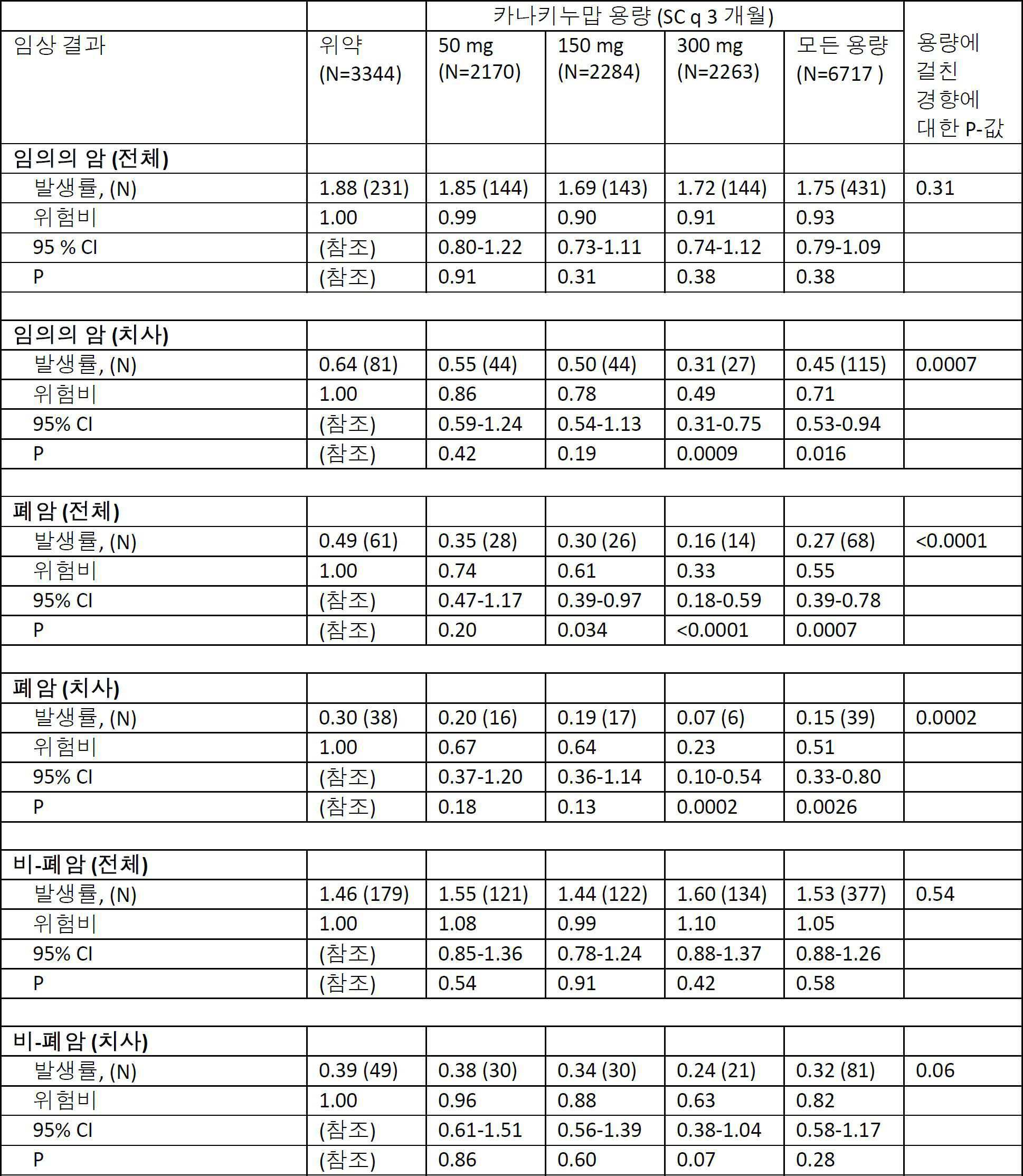
[표 3]TABLE 3
CANTOS 동안 연구 약물로 12개월 치료한 후, 위약과 비교하여, 유해 사건으로서 보고된 혈소판, 백혈구, 호중구 및 적혈구에 대한 카나키누맙의 효과.Effect of canakinumab on platelets, leukocytes, neutrophils and erythrocytes reported as adverse events after 12 months of treatment with study medication during CANTOS.

+ 표준화된 MedDRA 질문지+ Standardized MedDRA Questionnaire
* 1 세제곱 mm 당 값* Value per cubic mm
** x1012 ** x10 12
[표 4]TABLE 4
연구 그룹에 의해 계층화된 발생률(100 인년 당), 중증 유해 사건의 수(N), 및 선택된 치료-시 안전성 실험 데이터(%, N).Incidence stratified by study group (per 100 people), number of severe adverse events (N), and selected treatment-on-safety safety data (%, N).

+ 표준화된 MedDRA 질문지+ Standardized MedDRA Questionnaire
++ 특수 관심의 유해 사건의 스폰서 범주화++ Sponsor categorization of adverse events of special interest
[표 5]TABLE 5
절단점 미만의 3개월째 hsCRP의 비율(중앙값 및 95% 예측 구간).Percentage of hsCRP at 3 months below the cut point (median and 95% prediction interval).

## 시나리오 1로부터 시나리오 3까지, 폐암의 중증도가 증가하였음. 기준선 hsCRP의 평균은 각각 6.18 mg/L, 9.75 mg/L 및 23.94 mg/L임.## From
[표 S1]TABLE S1
치료 상태에 따른 CANTOS 참여자의 기준선 임상 특징.Baseline clinical characteristics of CANTOS participants according to treatment status.

STEMI= ST 상승 심근경색; PCI=경피적 관상동맥 중재술; CABG=관상동맥 우회 이식 수술; hsCRP=고 민감성 C-반응성 단백질; HDL=고밀도 지질단백질 콜레스테롤; LDL=저밀도 지질단백질 콜레스테롤; eGFR=추정된 사구체 여과율STEMI = ST elevated myocardial infarction; PCI = percutaneous coronary intervention; CABG = coronary artery bypass graft surgery; hsCRP = highly sensitive C-reactive protein; HDL = high density lipoprotein cholesterol; LDL = low density lipoprotein cholesterol; eGFR = estimated glomerular filtration rate
* 베타-차단제, 니트레이트, 또는 칼슘 채널 차단제Beta-blockers, nitrates, or calcium channel blockers
중앙값은 모든 측정된 혈장 변수 및 체질량 지수에 대해 제시됨Median values are given for all measured plasma variables and body mass index
[표 S2]TABLE S2
현재 흡연자 및 과거 흡연자 중의 폐암에 대한 발생률(100 인년 당) 및 위험비.Incidence (per 100 people) and risk for lung cancer among current and past smokers.

[표 S3]TABLE S3
CANTOS에서 폐암 유형 및 다른 부위-특이적 비-폐암에 대한 100 인년 당 발생률 및 (수).Incidence per 100 people per year for lung cancer type and other site-specific non-lung cancer in CANTOS and (number).

NA - 사건 수가 10 미만이면 유의성에 대한 시험이 수행되지 않음.NA-No test for significance if the number of events is less than 10.
[표 S4]TABLE S4
판정암(adjudicated cancer) 이외의, CANTOS에서 보고된 모든 암에 기초한 발생률(100 인년 당) 및 위험비의 민감성 분석.Sensitivity analysis of incidence (per 100 people) and risk ratios based on all cancers reported in CANTOS, other than adjudicated cancer.

참조문헌Reference


SEQUENCE LISTING <110> NOVARTIS AG <120> USE OF IL-1-BETA BINDING ANTIBODIES <130> PAT057789-WO-PCT <140> PCT/IB2018/053096 <141> 2018-05-03 <150> 62/649,631 <151> 2018-03-29 <150> 62/596,054 <151> 2017-12-07 <150> 62/550,325 <151> 2017-08-25 <150> 62/550,307 <151> 2017-08-25 <150> 62/529,515 <151> 2017-07-07 <150> 62/523,458 <151> 2017-06-22 <160> 1010 <170> PatentIn version 3.5 <210> 1 <400> 1 000 <210> 2 <400> 2 000 <210> 3 <400> 3 000 <210> 4 <400> 4 000 <210> 5 <400> 5 000 <210> 6 <400> 6 000 <210> 7 <400> 7 000 <210> 8 <400> 8 000 <210> 9 <400> 9 000 <210> 10 <400> 10 000 <210> 11 <400> 11 000 <210> 12 <400> 12 000 <210> 13 <400> 13 000 <210> 14 <400> 14 000 <210> 15 <400> 15 000 <210> 16 <400> 16 000 <210> 17 <400> 17 000 <210> 18 <400> 18 000 <210> 19 <400> 19 000 <210> 20 <400> 20 000 <210> 21 <400> 21 000 <210> 22 <400> 22 000 <210> 23 <400> 23 000 <210> 24 <400> 24 000 <210> 25 <400> 25 000 <210> 26 <400> 26 000 <210> 27 <400> 27 000 <210> 28 <400> 28 000 <210> 29 <400> 29 000 <210> 30 <400> 30 000 <210> 31 <400> 31 000 <210> 32 <400> 32 000 <210> 33 <400> 33 000 <210> 34 <400> 34 000 <210> 35 <400> 35 000 <210> 36 <400> 36 000 <210> 37 <400> 37 000 <210> 38 <400> 38 000 <210> 39 <400> 39 000 <210> 40 <400> 40 000 <210> 41 <400> 41 000 <210> 42 <400> 42 000 <210> 43 <400> 43 000 <210> 44 <400> 44 000 <210> 45 <400> 45 000 <210> 46 <400> 46 000 <210> 47 <400> 47 000 <210> 48 <400> 48 000 <210> 49 <400> 49 000 <210> 50 <400> 50 000 <210> 51 <400> 51 000 <210> 52 <400> 52 000 <210> 53 <400> 53 000 <210> 54 <400> 54 000 <210> 55 <400> 55 000 <210> 56 <400> 56 000 <210> 57 <400> 57 000 <210> 58 <400> 58 000 <210> 59 <400> 59 000 <210> 60 <400> 60 000 <210> 61 <400> 61 000 <210> 62 <400> 62 000 <210> 63 <400> 63 000 <210> 64 <400> 64 000 <210> 65 <400> 65 000 <210> 66 <400> 66 000 <210> 67 <400> 67 000 <210> 68 <400> 68 000 <210> 69 <400> 69 000 <210> 70 <400> 70 000 <210> 71 <400> 71 000 <210> 72 <400> 72 000 <210> 73 <400> 73 000 <210> 74 <400> 74 000 <210> 75 <400> 75 000 <210> 76 <400> 76 000 <210> 77 <400> 77 000 <210> 78 <400> 78 000 <210> 79 <400> 79 000 <210> 80 <400> 80 000 <210> 81 <400> 81 000 <210> 82 <400> 82 000 <210> 83 <400> 83 000 <210> 84 <400> 84 000 <210> 85 <400> 85 000 <210> 86 <400> 86 000 <210> 87 <400> 87 000 <210> 88 <400> 88 000 <210> 89 <400> 89 000 <210> 90 <400> 90 000 <210> 91 <400> 91 000 <210> 92 <400> 92 000 <210> 93 <400> 93 000 <210> 94 <400> 94 000 <210> 95 <400> 95 000 <210> 96 <400> 96 000 <210> 97 <400> 97 000 <210> 98 <400> 98 000 <210> 99 <400> 99 000 <210> 100 <400> 100 000 <210> 101 <400> 101 000 <210> 102 <400> 102 000 <210> 103 <400> 103 000 <210> 104 <400> 104 000 <210> 105 <400> 105 000 <210> 106 <400> 106 000 <210> 107 <400> 107 000 <210> 108 <400> 108 000 <210> 109 <400> 109 000 <210> 110 <400> 110 000 <210> 111 <400> 111 000 <210> 112 <400> 112 000 <210> 113 <400> 113 000 <210> 114 <400> 114 000 <210> 115 <400> 115 000 <210> 116 <400> 116 000 <210> 117 <400> 117 000 <210> 118 <400> 118 000 <210> 119 <400> 119 000 <210> 120 <400> 120 000 <210> 121 <400> 121 000 <210> 122 <400> 122 000 <210> 123 <400> 123 000 <210> 124 <400> 124 000 <210> 125 <400> 125 000 <210> 126 <400> 126 000 <210> 127 <400> 127 000 <210> 128 <400> 128 000 <210> 129 <400> 129 000 <210> 130 <400> 130 000 <210> 131 <400> 131 000 <210> 132 <400> 132 000 <210> 133 <400> 133 000 <210> 134 <400> 134 000 <210> 135 <400> 135 000 <210> 136 <400> 136 000 <210> 137 <400> 137 000 <210> 138 <400> 138 000 <210> 139 <400> 139 000 <210> 140 <400> 140 000 <210> 141 <400> 141 000 <210> 142 <400> 142 000 <210> 143 <400> 143 000 <210> 144 <400> 144 000 <210> 145 <400> 145 000 <210> 146 <400> 146 000 <210> 147 <400> 147 000 <210> 148 <400> 148 000 <210> 149 <400> 149 000 <210> 150 <400> 150 000 <210> 151 <400> 151 000 <210> 152 <400> 152 000 <210> 153 <400> 153 000 <210> 154 <400> 154 000 <210> 155 <400> 155 000 <210> 156 <400> 156 000 <210> 157 <400> 157 000 <210> 158 <400> 158 000 <210> 159 <400> 159 000 <210> 160 <400> 160 000 <210> 161 <400> 161 000 <210> 162 <400> 162 000 <210> 163 <400> 163 000 <210> 164 <400> 164 000 <210> 165 <400> 165 000 <210> 166 <400> 166 000 <210> 167 <400> 167 000 <210> 168 <400> 168 000 <210> 169 <400> 169 000 <210> 170 <400> 170 000 <210> 171 <400> 171 000 <210> 172 <400> 172 000 <210> 173 <400> 173 000 <210> 174 <400> 174 000 <210> 175 <400> 175 000 <210> 176 <400> 176 000 <210> 177 <400> 177 000 <210> 178 <400> 178 000 <210> 179 <400> 179 000 <210> 180 <400> 180 000 <210> 181 <400> 181 000 <210> 182 <400> 182 000 <210> 183 <400> 183 000 <210> 184 <400> 184 000 <210> 185 <400> 185 000 <210> 186 <400> 186 000 <210> 187 <400> 187 000 <210> 188 <400> 188 000 <210> 189 <400> 189 000 <210> 190 <400> 190 000 <210> 191 <400> 191 000 <210> 192 <400> 192 000 <210> 193 <400> 193 000 <210> 194 <400> 194 000 <210> 195 <400> 195 000 <210> 196 <400> 196 000 <210> 197 <400> 197 000 <210> 198 <400> 198 000 <210> 199 <400> 199 000 <210> 200 <400> 200 000 <210> 201 <400> 201 000 <210> 202 <400> 202 000 <210> 203 <400> 203 000 <210> 204 <400> 204 000 <210> 205 <400> 205 000 <210> 206 <400> 206 000 <210> 207 <400> 207 000 <210> 208 <400> 208 000 <210> 209 <400> 209 000 <210> 210 <400> 210 000 <210> 211 <400> 211 000 <210> 212 <400> 212 000 <210> 213 <400> 213 000 <210> 214 <400> 214 000 <210> 215 <400> 215 000 <210> 216 <400> 216 000 <210> 217 <400> 217 000 <210> 218 <400> 218 000 <210> 219 <400> 219 000 <210> 220 <400> 220 000 <210> 221 <400> 221 000 <210> 222 <400> 222 000 <210> 223 <400> 223 000 <210> 224 <400> 224 000 <210> 225 <400> 225 000 <210> 226 <400> 226 000 <210> 227 <400> 227 000 <210> 228 <400> 228 000 <210> 229 <400> 229 000 <210> 230 <400> 230 000 <210> 231 <400> 231 000 <210> 232 <400> 232 000 <210> 233 <400> 233 000 <210> 234 <400> 234 000 <210> 235 <400> 235 000 <210> 236 <400> 236 000 <210> 237 <400> 237 000 <210> 238 <400> 238 000 <210> 239 <400> 239 000 <210> 240 <400> 240 000 <210> 241 <400> 241 000 <210> 242 <400> 242 000 <210> 243 <400> 243 000 <210> 244 <400> 244 000 <210> 245 <400> 245 000 <210> 246 <400> 246 000 <210> 247 <400> 247 000 <210> 248 <400> 248 000 <210> 249 <400> 249 000 <210> 250 <400> 250 000 <210> 251 <400> 251 000 <210> 252 <400> 252 000 <210> 253 <400> 253 000 <210> 254 <400> 254 000 <210> 255 <400> 255 000 <210> 256 <400> 256 000 <210> 257 <400> 257 000 <210> 258 <400> 258 000 <210> 259 <400> 259 000 <210> 260 <400> 260 000 <210> 261 <400> 261 000 <210> 262 <400> 262 000 <210> 263 <400> 263 000 <210> 264 <400> 264 000 <210> 265 <400> 265 000 <210> 266 <400> 266 000 <210> 267 <400> 267 000 <210> 268 <400> 268 000 <210> 269 <400> 269 000 <210> 270 <400> 270 000 <210> 271 <400> 271 000 <210> 272 <400> 272 000 <210> 273 <400> 273 000 <210> 274 <400> 274 000 <210> 275 <400> 275 000 <210> 276 <400> 276 000 <210> 277 <400> 277 000 <210> 278 <400> 278 000 <210> 279 <400> 279 000 <210> 280 <400> 280 000 <210> 281 <400> 281 000 <210> 282 <400> 282 000 <210> 283 <400> 283 000 <210> 284 <400> 284 000 <210> 285 <400> 285 000 <210> 286 <400> 286 000 <210> 287 <400> 287 000 <210> 288 <400> 288 000 <210> 289 <400> 289 000 <210> 290 <400> 290 000 <210> 291 <400> 291 000 <210> 292 <400> 292 000 <210> 293 <400> 293 000 <210> 294 <400> 294 000 <210> 295 <400> 295 000 <210> 296 <400> 296 000 <210> 297 <400> 297 000 <210> 298 <400> 298 000 <210> 299 <400> 299 000 <210> 300 <400> 300 000 <210> 301 <400> 301 000 <210> 302 <400> 302 000 <210> 303 <400> 303 000 <210> 304 <400> 304 000 <210> 305 <400> 305 000 <210> 306 <400> 306 000 <210> 307 <400> 307 000 <210> 308 <400> 308 000 <210> 309 <400> 309 000 <210> 310 <400> 310 000 <210> 311 <400> 311 000 <210> 312 <400> 312 000 <210> 313 <400> 313 000 <210> 314 <400> 314 000 <210> 315 <400> 315 000 <210> 316 <400> 316 000 <210> 317 <400> 317 000 <210> 318 <400> 318 000 <210> 319 <400> 319 000 <210> 320 <400> 320 000 <210> 321 <400> 321 000 <210> 322 <400> 322 000 <210> 323 <400> 323 000 <210> 324 <400> 324 000 <210> 325 <400> 325 000 <210> 326 <400> 326 000 <210> 327 <400> 327 000 <210> 328 <400> 328 000 <210> 329 <400> 329 000 <210> 330 <400> 330 000 <210> 331 <400> 331 000 <210> 332 <400> 332 000 <210> 333 <400> 333 000 <210> 334 <400> 334 000 <210> 335 <400> 335 000 <210> 336 <400> 336 000 <210> 337 <400> 337 000 <210> 338 <400> 338 000 <210> 339 <400> 339 000 <210> 340 <400> 340 000 <210> 341 <400> 341 000 <210> 342 <400> 342 000 <210> 343 <400> 343 000 <210> 344 <400> 344 000 <210> 345 <400> 345 000 <210> 346 <400> 346 000 <210> 347 <400> 347 000 <210> 348 <400> 348 000 <210> 349 <400> 349 000 <210> 350 <400> 350 000 <210> 351 <400> 351 000 <210> 352 <400> 352 000 <210> 353 <400> 353 000 <210> 354 <400> 354 000 <210> 355 <400> 355 000 <210> 356 <400> 356 000 <210> 357 <400> 357 000 <210> 358 <400> 358 000 <210> 359 <400> 359 000 <210> 360 <400> 360 000 <210> 361 <400> 361 000 <210> 362 <400> 362 000 <210> 363 <400> 363 000 <210> 364 <400> 364 000 <210> 365 <400> 365 000 <210> 366 <400> 366 000 <210> 367 <400> 367 000 <210> 368 <400> 368 000 <210> 369 <400> 369 000 <210> 370 <400> 370 000 <210> 371 <400> 371 000 <210> 372 <400> 372 000 <210> 373 <400> 373 000 <210> 374 <400> 374 000 <210> 375 <400> 375 000 <210> 376 <400> 376 000 <210> 377 <400> 377 000 <210> 378 <400> 378 000 <210> 379 <400> 379 000 <210> 380 <400> 380 000 <210> 381 <400> 381 000 <210> 382 <400> 382 000 <210> 383 <400> 383 000 <210> 384 <400> 384 000 <210> 385 <400> 385 000 <210> 386 <400> 386 000 <210> 387 <400> 387 000 <210> 388 <400> 388 000 <210> 389 <400> 389 000 <210> 390 <400> 390 000 <210> 391 <400> 391 000 <210> 392 <400> 392 000 <210> 393 <400> 393 000 <210> 394 <400> 394 000 <210> 395 <400> 395 000 <210> 396 <400> 396 000 <210> 397 <400> 397 000 <210> 398 <400> 398 000 <210> 399 <400> 399 000 <210> 400 <400> 400 000 <210> 401 <400> 401 000 <210> 402 <400> 402 000 <210> 403 <400> 403 000 <210> 404 <400> 404 000 <210> 405 <400> 405 000 <210> 406 <400> 406 000 <210> 407 <400> 407 000 <210> 408 <400> 408 000 <210> 409 <400> 409 000 <210> 410 <400> 410 000 <210> 411 <400> 411 000 <210> 412 <400> 412 000 <210> 413 <400> 413 000 <210> 414 <400> 414 000 <210> 415 <400> 415 000 <210> 416 <400> 416 000 <210> 417 <400> 417 000 <210> 418 <400> 418 000 <210> 419 <400> 419 000 <210> 420 <400> 420 000 <210> 421 <400> 421 000 <210> 422 <400> 422 000 <210> 423 <400> 423 000 <210> 424 <400> 424 000 <210> 425 <400> 425 000 <210> 426 <400> 426 000 <210> 427 <400> 427 000 <210> 428 <400> 428 000 <210> 429 <400> 429 000 <210> 430 <400> 430 000 <210> 431 <400> 431 000 <210> 432 <400> 432 000 <210> 433 <400> 433 000 <210> 434 <400> 434 000 <210> 435 <400> 435 000 <210> 436 <400> 436 000 <210> 437 <400> 437 000 <210> 438 <400> 438 000 <210> 439 <400> 439 000 <210> 440 <400> 440 000 <210> 441 <400> 441 000 <210> 442 <400> 442 000 <210> 443 <400> 443 000 <210> 444 <400> 444 000 <210> 445 <400> 445 000 <210> 446 <400> 446 000 <210> 447 <400> 447 000 <210> 448 <400> 448 000 <210> 449 <400> 449 000 <210> 450 <400> 450 000 <210> 451 <400> 451 000 <210> 452 <400> 452 000 <210> 453 <400> 453 000 <210> 454 <400> 454 000 <210> 455 <400> 455 000 <210> 456 <400> 456 000 <210> 457 <400> 457 000 <210> 458 <400> 458 000 <210> 459 <400> 459 000 <210> 460 <400> 460 000 <210> 461 <400> 461 000 <210> 462 <400> 462 000 <210> 463 <400> 463 000 <210> 464 <400> 464 000 <210> 465 <400> 465 000 <210> 466 <400> 466 000 <210> 467 <400> 467 000 <210> 468 <400> 468 000 <210> 469 <400> 469 000 <210> 470 <400> 470 000 <210> 471 <400> 471 000 <210> 472 <400> 472 000 <210> 473 <400> 473 000 <210> 474 <400> 474 000 <210> 475 <400> 475 000 <210> 476 <400> 476 000 <210> 477 <400> 477 000 <210> 478 <400> 478 000 <210> 479 <400> 479 000 <210> 480 <400> 480 000 <210> 481 <400> 481 000 <210> 482 <400> 482 000 <210> 483 <400> 483 000 <210> 484 <400> 484 000 <210> 485 <400> 485 000 <210> 486 <400> 486 000 <210> 487 <400> 487 000 <210> 488 <400> 488 000 <210> 489 <400> 489 000 <210> 490 <400> 490 000 <210> 491 <400> 491 000 <210> 492 <400> 492 000 <210> 493 <400> 493 000 <210> 494 <400> 494 000 <210> 495 <400> 495 000 <210> 496 <400> 496 000 <210> 497 <400> 497 000 <210> 498 <400> 498 000 <210> 499 <400> 499 000 <210> 500 <400> 500 000 <210> 501 <400> 501 000 <210> 502 <400> 502 000 <210> 503 <400> 503 000 <210> 504 <400> 504 000 <210> 505 <400> 505 000 <210> 506 <211> 117 <212> PRT <213> Artificial Sequence <220> <221> source <223> /note="Description of Artificial Sequence: Synthetic polypeptide" <400> 506 Glu Val Gln Leu Val Gln Ser Gly Ala Glu Val Lys Lys Pro Gly Glu 1 5 10 15 Ser Leu Arg Ile Ser Cys Lys Gly Ser Gly Tyr Thr Phe Thr Thr Tyr 20 25 30 Trp Met His Trp Val Arg Gln Ala Thr Gly Gln Gly Leu Glu Trp Met 35 40 45 Gly Asn Ile Tyr Pro Gly Thr Gly Gly Ser Asn Phe Asp Glu Lys Phe 50 55 60 Lys Asn Arg Val Thr Ile Thr Ala Asp Lys Ser Thr Ser Thr Ala Tyr 65 70 75 80 Met Glu Leu Ser Ser Leu Arg Ser Glu Asp Thr Ala Val Tyr Tyr Cys 85 90 95 Thr Arg Trp Thr Thr Gly Thr Gly Ala Tyr Trp Gly Gln Gly Thr Thr 100 105 110 Val Thr Val Ser Ser 115 <210> 507 <400> 507 000 <210> 508 <400> 508 000 <210> 509 <400> 509 000 <210> 510 <400> 510 000 <210> 511 <400> 511 000 <210> 512 <400> 512 000 <210> 513 <400> 513 000 <210> 514 <400> 514 000 <210> 515 <400> 515 000 <210> 516 <211> 113 <212> PRT <213> Artificial Sequence <220> <221> source <223> /note="Description of Artificial Sequence: Synthetic polypeptide" <400> 516 Glu Ile Val Leu Thr Gln Ser Pro Ala Thr Leu Ser Leu Ser Pro Gly 1 5 10 15 Glu Arg Ala Thr Leu Ser Cys Lys Ser Ser Gln Ser Leu Leu Asp Ser 20 25 30 Gly Asn Gln Lys Asn Phe Leu Thr Trp Tyr Gln Gln Lys Pro Gly Lys 35 40 45 Ala Pro Lys Leu Leu Ile Tyr Trp Ala Ser Thr Arg Glu Ser Gly Val 50 55 60 Pro Ser Arg Phe Ser Gly Ser Gly Ser Gly Thr Asp Phe Thr Phe Thr 65 70 75 80 Ile Ser Ser Leu Gln Pro Glu Asp Ile Ala Thr Tyr Tyr Cys Gln Asn 85 90 95 Asp Tyr Ser Tyr Pro Tyr Thr Phe Gly Gln Gly Thr Lys Val Glu Ile 100 105 110 Lys <210> 517 <400> 517 000 <210> 518 <400> 518 000 <210> 519 <400> 519 000 <210> 520 <211> 113 <212> PRT <213> Artificial Sequence <220> <221> source <223> /note="Description of Artificial Sequence: Synthetic polypeptide" <400> 520 Glu Ile Val Leu Thr Gln Ser Pro Ala Thr Leu Ser Leu Ser Pro Gly 1 5 10 15 Glu Arg Ala Thr Leu Ser Cys Lys Ser Ser Gln Ser Leu Leu Asp Ser 20 25 30 Gly Asn Gln Lys Asn Phe Leu Thr Trp Tyr Gln Gln Lys Pro Gly Gln 35 40 45 Ala Pro Arg Leu Leu Ile Tyr Trp Ala Ser Thr Arg Glu Ser Gly Val 50 55 60 Pro Ser Arg Phe Ser Gly Ser Gly Ser Gly Thr Asp Phe Thr Phe Thr 65 70 75 80 Ile Ser Ser Leu Glu Ala Glu Asp Ala Ala Thr Tyr Tyr Cys Gln Asn 85 90 95 Asp Tyr Ser Tyr Pro Tyr Thr Phe Gly Gln Gly Thr Lys Val Glu Ile 100 105 110 Lys <210> 521 <400> 521 000 <210> 522 <400> 522 000 <210> 523 <400> 523 000 <210> 524 <400> 524 000 <210> 525 <400> 525 000 <210> 526 <400> 526 000 <210> 527 <400> 527 000 <210> 528 <400> 528 000 <210> 529 <400> 529 000 <210> 530 <400> 530 000 <210> 531 <400> 531 000 <210> 532 <400> 532 000 <210> 533 <400> 533 000 <210> 534 <400> 534 000 <210> 535 <400> 535 000 <210> 536 <400> 536 000 <210> 537 <400> 537 000 <210> 538 <400> 538 000 <210> 539 <400> 539 000 <210> 540 <400> 540 000 <210> 541 <400> 541 000 <210> 542 <400> 542 000 <210> 543 <400> 543 000 <210> 544 <400> 544 000 <210> 545 <400> 545 000 <210> 546 <400> 546 000 <210> 547 <400> 547 000 <210> 548 <400> 548 000 <210> 549 <400> 549 000 <210> 550 <400> 550 000 <210> 551 <400> 551 000 <210> 552 <400> 552 000 <210> 553 <400> 553 000 <210> 554 <400> 554 000 <210> 555 <400> 555 000 <210> 556 <400> 556 000 <210> 557 <400> 557 000 <210> 558 <400> 558 000 <210> 559 <400> 559 000 <210> 560 <400> 560 000 <210> 561 <400> 561 000 <210> 562 <400> 562 000 <210> 563 <400> 563 000 <210> 564 <400> 564 000 <210> 565 <400> 565 000 <210> 566 <400> 566 000 <210> 567 <400> 567 000 <210> 568 <400> 568 000 <210> 569 <400> 569 000 <210> 570 <400> 570 000 <210> 571 <400> 571 000 <210> 572 <400> 572 000 <210> 573 <400> 573 000 <210> 574 <400> 574 000 <210> 575 <400> 575 000 <210> 576 <400> 576 000 <210> 577 <400> 577 000 <210> 578 <400> 578 000 <210> 579 <400> 579 000 <210> 580 <400> 580 000 <210> 581 <400> 581 000 <210> 582 <400> 582 000 <210> 583 <400> 583 000 <210> 584 <400> 584 000 <210> 585 <400> 585 000 <210> 586 <400> 586 000 <210> 587 <400> 587 000 <210> 588 <400> 588 000 <210> 589 <400> 589 000 <210> 590 <400> 590 000 <210> 591 <400> 591 000 <210> 592 <400> 592 000 <210> 593 <400> 593 000 <210> 594 <400> 594 000 <210> 595 <400> 595 000 <210> 596 <400> 596 000 <210> 597 <400> 597 000 <210> 598 <400> 598 000 <210> 599 <400> 599 000 <210> 600 <400> 600 000 <210> 601 <400> 601 000 <210> 602 <400> 602 000 <210> 603 <400> 603 000 <210> 604 <400> 604 000 <210> 605 <400> 605 000 <210> 606 <211> 120 <212> PRT <213> Artificial Sequence <220> <221> source <223> /note="Description of Artificial Sequence: Synthetic polypeptide" <400> 606 Glu Val Gln Leu Val Gln Ser Gly Ala Glu Val Lys Lys Pro Gly Ala 1 5 10 15 Thr Val Lys Ile Ser Cys Lys Val Ser Gly Tyr Thr Phe Thr Ser Tyr 20 25 30 Trp Met Tyr Trp Val Arg Gln Ala Arg Gly Gln Arg Leu Glu Trp Ile 35 40 45 Gly Arg Ile Asp Pro Asn Ser Gly Ser Thr Lys Tyr Asn Glu Lys Phe 50 55 60 Lys Asn Arg Phe Thr Ile Ser Arg Asp Asn Ser Lys Asn Thr Leu Tyr 65 70 75 80 Leu Gln Met Asn Ser Leu Arg Ala Glu Asp Thr Ala Val Tyr Tyr Cys 85 90 95 Ala Arg Asp Tyr Arg Lys Gly Leu Tyr Ala Met Asp Tyr Trp Gly Gln 100 105 110 Gly Thr Thr Val Thr Val Ser Ser 115 120 <210> 607 <400> 607 000 <210> 608 <400> 608 000 <210> 609 <400> 609 000 <210> 610 <400> 610 000 <210> 611 <400> 611 000 <210> 612 <400> 612 000 <210> 613 <400> 613 000 <210> 614 <400> 614 000 <210> 615 <400> 615 000 <210> 616 <211> 107 <212> PRT <213> Artificial Sequence <220> <221> source <223> /note="Description of Artificial Sequence: Synthetic polypeptide" <400> 616 Ala Ile Gln Leu Thr Gln Ser Pro Ser Ser Leu Ser Ala Ser Val Gly 1 5 10 15 Asp Arg Val Thr Ile Thr Cys Lys Ala Ser Gln Asp Val Gly Thr Ala 20 25 30 Val Ala Trp Tyr Leu Gln Lys Pro Gly Gln Ser Pro Gln Leu Leu Ile 35 40 45 Tyr Trp Ala Ser Thr Arg His Thr Gly Val Pro Ser Arg Phe Ser Gly 50 55 60 Ser Gly Ser Gly Thr Asp Phe Thr Phe Thr Ile Ser Ser Leu Glu Ala 65 70 75 80 Glu Asp Ala Ala Thr Tyr Tyr Cys Gln Gln Tyr Asn Ser Tyr Pro Leu 85 90 95 Thr Phe Gly Gln Gly Thr Lys Val Glu Ile Lys 100 105 <210> 617 <400> 617 000 <210> 618 <400> 618 000 <210> 619 <400> 619 000 <210> 620 <211> 120 <212> PRT <213> Artificial Sequence <220> <221> source <223> /note="Description of Artificial Sequence: Synthetic polypeptide" <400> 620 Glu Val Gln Leu Val Gln Ser Gly Ala Glu Val Lys Lys Pro Gly Ala 1 5 10 15 Thr Val Lys Ile Ser Cys Lys Val Ser Gly Tyr Thr Phe Thr Ser Tyr 20 25 30 Trp Met Tyr Trp Val Arg Gln Ala Thr Gly Gln Gly Leu Glu Trp Met 35 40 45 Gly Arg Ile Asp Pro Asn Ser Gly Ser Thr Lys Tyr Asn Glu Lys Phe 50 55 60 Lys Asn Arg Val Thr Ile Thr Ala Asp Lys Ser Thr Ser Thr Ala Tyr 65 70 75 80 Met Glu Leu Ser Ser Leu Arg Ser Glu Asp Thr Ala Val Tyr Tyr Cys 85 90 95 Ala Arg Asp Tyr Arg Lys Gly Leu Tyr Ala Met Asp Tyr Trp Gly Gln 100 105 110 Gly Thr Thr Val Thr Val Ser Ser 115 120 <210> 621 <400> 621 000 <210> 622 <400> 622 000 <210> 623 <400> 623 000 <210> 624 <211> 107 <212> PRT <213> Artificial Sequence <220> <221> source <223> /note="Description of Artificial Sequence: Synthetic polypeptide" <400> 624 Asp Val Val Met Thr Gln Ser Pro Leu Ser Leu Pro Val Thr Leu Gly 1 5 10 15 Gln Pro Ala Ser Ile Ser Cys Lys Ala Ser Gln Asp Val Gly Thr Ala 20 25 30 Val Ala Trp Tyr Gln Gln Lys Pro Gly Gln Ala Pro Arg Leu Leu Ile 35 40 45 Tyr Trp Ala Ser Thr Arg His Thr Gly Val Pro Ser Arg Phe Ser Gly 50 55 60 Ser Gly Ser Gly Thr Glu Phe Thr Leu Thr Ile Ser Ser Leu Gln Pro 65 70 75 80 Asp Asp Phe Ala Thr Tyr Tyr Cys Gln Gln Tyr Asn Ser Tyr Pro Leu 85 90 95 Thr Phe Gly Gln Gly Thr Lys Val Glu Ile Lys 100 105 <210> 625 <400> 625 000 <210> 626 <400> 626 000 <210> 627 <400> 627 000 <210> 628 <400> 628 000 <210> 629 <400> 629 000 <210> 630 <400> 630 000 <210> 631 <400> 631 000 <210> 632 <400> 632 000 <210> 633 <400> 633 000 <210> 634 <400> 634 000 <210> 635 <400> 635 000 <210> 636 <400> 636 000 <210> 637 <400> 637 000 <210> 638 <400> 638 000 <210> 639 <400> 639 000 <210> 640 <400> 640 000 <210> 641 <400> 641 000 <210> 642 <400> 642 000 <210> 643 <400> 643 000 <210> 644 <400> 644 000 <210> 645 <400> 645 000 <210> 646 <400> 646 000 <210> 647 <400> 647 000 <210> 648 <400> 648 000 <210> 649 <400> 649 000 <210> 650 <400> 650 000 <210> 651 <400> 651 000 <210> 652 <400> 652 000 <210> 653 <400> 653 000 <210> 654 <400> 654 000 <210> 655 <400> 655 000 <210> 656 <400> 656 000 <210> 657 <400> 657 000 <210> 658 <400> 658 000 <210> 659 <400> 659 000 <210> 660 <400> 660 000 <210> 661 <400> 661 000 <210> 662 <400> 662 000 <210> 663 <400> 663 000 <210> 664 <400> 664 000 <210> 665 <400> 665 000 <210> 666 <400> 666 000 <210> 667 <400> 667 000 <210> 668 <400> 668 000 <210> 669 <400> 669 000 <210> 670 <400> 670 000 <210> 671 <400> 671 000 <210> 672 <400> 672 000 <210> 673 <400> 673 000 <210> 674 <400> 674 000 <210> 675 <400> 675 000 <210> 676 <400> 676 000 <210> 677 <400> 677 000 <210> 678 <400> 678 000 <210> 679 <400> 679 000 <210> 680 <400> 680 000 <210> 681 <400> 681 000 <210> 682 <400> 682 000 <210> 683 <400> 683 000 <210> 684 <400> 684 000 <210> 685 <400> 685 000 <210> 686 <400> 686 000 <210> 687 <400> 687 000 <210> 688 <400> 688 000 <210> 689 <400> 689 000 <210> 690 <400> 690 000 <210> 691 <400> 691 000 <210> 692 <400> 692 000 <210> 693 <400> 693 000 <210> 694 <400> 694 000 <210> 695 <400> 695 000 <210> 696 <400> 696 000 <210> 697 <400> 697 000 <210> 698 <400> 698 000 <210> 699 <400> 699 000 <210> 700 <400> 700 000 <210> 701 <400> 701 000 <210> 702 <400> 702 000 <210> 703 <400> 703 000 <210> 704 <400> 704 000 <210> 705 <400> 705 000 <210> 706 <211> 125 <212> PRT <213> Artificial Sequence <220> <221> source <223> /note="Description of Artificial Sequence: Synthetic polypeptide" <400> 706 Gln Val Gln Leu Val Gln Ser Gly Ala Glu Val Lys Lys Pro Gly Ala 1 5 10 15 Ser Val Lys Val Ser Cys Lys Ala Ser Gly Phe Thr Leu Thr Asn Tyr 20 25 30 Gly Met Asn Trp Val Arg Gln Ala Arg Gly Gln Arg Leu Glu Trp Ile 35 40 45 Gly Trp Ile Asn Thr Asp Thr Gly Glu Pro Thr Tyr Ala Asp Asp Phe 50 55 60 Lys Gly Arg Phe Val Phe Ser Leu Asp Thr Ser Val Ser Thr Ala Tyr 65 70 75 80 Leu Gln Ile Ser Ser Leu Lys Ala Glu Asp Thr Ala Val Tyr Tyr Cys 85 90 95 Ala Arg Asn Pro Pro Tyr Tyr Tyr Gly Thr Asn Asn Ala Glu Ala Met 100 105 110 Asp Tyr Trp Gly Gln Gly Thr Thr Val Thr Val Ser Ser 115 120 125 <210> 707 <400> 707 000 <210> 708 <400> 708 000 <210> 709 <400> 709 000 <210> 710 <400> 710 000 <210> 711 <400> 711 000 <210> 712 <400> 712 000 <210> 713 <400> 713 000 <210> 714 <400> 714 000 <210> 715 <400> 715 000 <210> 716 <400> 716 000 <210> 717 <400> 717 000 <210> 718 <211> 107 <212> PRT <213> Artificial Sequence <220> <221> source <223> /note="Description of Artificial Sequence: Synthetic polypeptide" <400> 718 Asp Ile Gln Met Thr Gln Ser Pro Ser Ser Leu Ser Ala Ser Val Gly 1 5 10 15 Asp Arg Val Thr Ile Thr Cys Ser Ser Ser Gln Asp Ile Ser Asn Tyr 20 25 30 Leu Asn Trp Tyr Leu Gln Lys Pro Gly Gln Ser Pro Gln Leu Leu Ile 35 40 45 Tyr Tyr Thr Ser Thr Leu His Leu Gly Val Pro Ser Arg Phe Ser Gly 50 55 60 Ser Gly Ser Gly Thr Glu Phe Thr Leu Thr Ile Ser Ser Leu Gln Pro 65 70 75 80 Asp Asp Phe Ala Thr Tyr Tyr Cys Gln Gln Tyr Tyr Asn Leu Pro Trp 85 90 95 Thr Phe Gly Gln Gly Thr Lys Val Glu Ile Lys 100 105 <210> 719 <400> 719 000 <210> 720 <400> 720 000 <210> 721 <400> 721 000 <210> 722 <400> 722 000 <210> 723 <400> 723 000 <210> 724 <211> 125 <212> PRT <213> Artificial Sequence <220> <221> source <223> /note="Description of Artificial Sequence: Synthetic polypeptide" <400> 724 Gln Val Gln Leu Val Gln Ser Gly Ala Glu Val Lys Lys Pro Gly Ala 1 5 10 15 Ser Val Lys Val Ser Cys Lys Ala Ser Gly Phe Thr Leu Thr Asn Tyr 20 25 30 Gly Met Asn Trp Val Arg Gln Ala Pro Gly Gln Gly Leu Glu Trp Met 35 40 45 Gly Trp Ile Asn Thr Asp Thr Gly Glu Pro Thr Tyr Ala Asp Asp Phe 50 55 60 Lys Gly Arg Phe Val Phe Ser Leu Asp Thr Ser Val Ser Thr Ala Tyr 65 70 75 80 Leu Gln Ile Ser Ser Leu Lys Ala Glu Asp Thr Ala Val Tyr Tyr Cys 85 90 95 Ala Arg Asn Pro Pro Tyr Tyr Tyr Gly Thr Asn Asn Ala Glu Ala Met 100 105 110 Asp Tyr Trp Gly Gln Gly Thr Thr Val Thr Val Ser Ser 115 120 125 <210> 725 <400> 725 000 <210> 726 <400> 726 000 <210> 727 <400> 727 000 <210> 728 <400> 728 000 <210> 729 <400> 729 000 <210> 730 <211> 107 <212> PRT <213> Artificial Sequence <220> <221> source <223> /note="Description of Artificial Sequence: Synthetic polypeptide" <400> 730 Asp Ile Gln Met Thr Gln Ser Pro Ser Ser Leu Ser Ala Ser Val Gly 1 5 10 15 Asp Arg Val Thr Ile Thr Cys Ser Ser Ser Gln Asp Ile Ser Asn Tyr 20 25 30 Leu Asn Trp Tyr Gln Gln Lys Pro Gly Lys Ala Pro Lys Leu Leu Ile 35 40 45 Tyr Tyr Thr Ser Thr Leu His Leu Gly Ile Pro Pro Arg Phe Ser Gly 50 55 60 Ser Gly Tyr Gly Thr Asp Phe Thr Leu Thr Ile Asn Asn Ile Glu Ser 65 70 75 80 Glu Asp Ala Ala Tyr Tyr Phe Cys Gln Gln Tyr Tyr Asn Leu Pro Trp 85 90 95 Thr Phe Gly Gln Gly Thr Lys Val Glu Ile Lys 100 105 <210> 731 <400> 731 000 <210> 732 <400> 732 000 <210> 733 <400> 733 000 <210> 734 <400> 734 000 <210> 735 <400> 735 000 <210> 736 <400> 736 000 <210> 737 <400> 737 000 <210> 738 <400> 738 000 <210> 739 <400> 739 000 <210> 740 <400> 740 000 <210> 741 <400> 741 000 <210> 742 <400> 742 000 <210> 743 <400> 743 000 <210> 744 <400> 744 000 <210> 745 <400> 745 000 <210> 746 <400> 746 000 <210> 747 <400> 747 000 <210> 748 <400> 748 000 <210> 749 <400> 749 000 <210> 750 <400> 750 000 <210> 751 <400> 751 000 <210> 752 <400> 752 000 <210> 753 <400> 753 000 <210> 754 <400> 754 000 <210> 755 <400> 755 000 <210> 756 <400> 756 000 <210> 757 <400> 757 000 <210> 758 <400> 758 000 <210> 759 <400> 759 000 <210> 760 <400> 760 000 <210> 761 <400> 761 000 <210> 762 <211> 447 <212> PRT <213> Artificial Sequence <220> <221> source <223> /note="Description of Artificial Sequence: Synthetic polypeptide" <400> 762 Gln Val Gln Leu Gln Gln Trp Gly Ala Gly Leu Leu Lys Pro Ser Glu 1 5 10 15 Thr Leu Ser Leu Thr Cys Ala Val Tyr Gly Gly Ser Phe Ser Asp Tyr 20 25 30 Tyr Trp Asn Trp Ile Arg Gln Pro Pro Gly Lys Gly Leu Glu Trp Ile 35 40 45 Gly Glu Ile Asn His Arg Gly Ser Thr Asn Ser Asn Pro Ser Leu Lys 50 55 60 Ser Arg Val Thr Leu Ser Leu Asp Thr Ser Lys Asn Gln Phe Ser Leu 65 70 75 80 Lys Leu Arg Ser Val Thr Ala Ala Asp Thr Ala Val Tyr Tyr Cys Ala 85 90 95 Phe Gly Tyr Ser Asp Tyr Glu Tyr Asn Trp Phe Asp Pro Trp Gly Gln 100 105 110 Gly Thr Leu Val Thr Val Ser Ser Ala Ser Thr Lys Gly Pro Ser Val 115 120 125 Phe Pro Leu Ala Pro Cys Ser Arg Ser Thr Ser Glu Ser Thr Ala Ala 130 135 140 Leu Gly Cys Leu Val Lys Asp Tyr Phe Pro Glu Pro Val Thr Val Ser 145 150 155 160 Trp Asn Ser Gly Ala Leu Thr Ser Gly Val His Thr Phe Pro Ala Val 165 170 175 Leu Gln Ser Ser Gly Leu Tyr Ser Leu Ser Ser Val Val Thr Val Pro 180 185 190 Ser Ser Ser Leu Gly Thr Lys Thr Tyr Thr Cys Asn Val Asp His Lys 195 200 205 Pro Ser Asn Thr Lys Val Asp Lys Arg Val Glu Ser Lys Tyr Gly Pro 210 215 220 Pro Cys Pro Pro Cys Pro Ala Pro Glu Phe Leu Gly Gly Pro Ser Val 225 230 235 240 Phe Leu Phe Pro Pro Lys Pro Lys Asp Thr Leu Met Ile Ser Arg Thr 245 250 255 Pro Glu Val Thr Cys Val Val Val Asp Val Ser Gln Glu Asp Pro Glu 260 265 270 Val Gln Phe Asn Trp Tyr Val Asp Gly Val Glu Val His Asn Ala Lys 275 280 285 Thr Lys Pro Arg Glu Glu Gln Phe Asn Ser Thr Tyr Arg Val Val Ser 290 295 300 Val Leu Thr Val Leu His Gln Asp Trp Leu Asn Gly Lys Glu Tyr Lys 305 310 315 320 Cys Lys Val Ser Asn Lys Gly Leu Pro Ser Ser Ile Glu Lys Thr Ile 325 330 335 Ser Lys Ala Lys Gly Gln Pro Arg Glu Pro Gln Val Tyr Thr Leu Pro 340 345 350 Pro Ser Gln Glu Glu Met Thr Lys Asn Gln Val Ser Leu Thr Cys Leu 355 360 365 Val Lys Gly Phe Tyr Pro Ser Asp Ile Ala Val Glu Trp Glu Ser Asn 370 375 380 Gly Gln Pro Glu Asn Asn Tyr Lys Thr Thr Pro Pro Val Leu Asp Ser 385 390 395 400 Asp Gly Ser Phe Phe Leu Tyr Ser Arg Leu Thr Val Asp Lys Ser Arg 405 410 415 Trp Gln Glu Gly Asn Val Phe Ser Cys Ser Val Met His Glu Ala Leu 420 425 430 His Asn His Tyr Thr Gln Lys Ser Leu Ser Leu Ser Leu Gly Lys 435 440 445 <210> 763 <211> 214 <212> PRT <213> Artificial Sequence <220> <221> source <223> /note="Description of Artificial Sequence: Synthetic polypeptide" <400> 763 Glu Ile Val Leu Thr Gln Ser Pro Ala Thr Leu Ser Leu Ser Pro Gly 1 5 10 15 Glu Arg Ala Thr Leu Ser Cys Arg Ala Ser Gln Ser Ile Ser Ser Tyr 20 25 30 Leu Ala Trp Tyr Gln Gln Lys Pro Gly Gln Ala Pro Arg Leu Leu Ile 35 40 45 Tyr Asp Ala Ser Asn Arg Ala Thr Gly Ile Pro Ala Arg Phe Ser Gly 50 55 60 Ser Gly Ser Gly Thr Asp Phe Thr Leu Thr Ile Ser Ser Leu Glu Pro 65 70 75 80 Glu Asp Phe Ala Val Tyr Tyr Cys Gln Gln Arg Ser Asn Trp Pro Leu 85 90 95 Thr Phe Gly Gln Gly Thr Asn Leu Glu Ile Lys Arg Thr Val Ala Ala 100 105 110 Pro Ser Val Phe Ile Phe Pro Pro Ser Asp Glu Gln Leu Lys Ser Gly 115 120 125 Thr Ala Ser Val Val Cys Leu Leu Asn Asn Phe Tyr Pro Arg Glu Ala 130 135 140 Lys Val Gln Trp Lys Val Asp Asn Ala Leu Gln Ser Gly Asn Ser Gln 145 150 155 160 Glu Ser Val Thr Glu Gln Asp Ser Lys Asp Ser Thr Tyr Ser Leu Ser 165 170 175 Ser Thr Leu Thr Leu Ser Lys Ala Asp Tyr Glu Lys His Lys Val Tyr 180 185 190 Ala Cys Glu Val Thr His Gln Gly Leu Ser Ser Pro Val Thr Lys Ser 195 200 205 Phe Asn Arg Gly Glu Cys 210 <210> 764 <211> 446 <212> PRT <213> Artificial Sequence <220> <221> source <223> /note="Description of Artificial Sequence: Synthetic polypeptide" <400> 764 Gln Val Gln Leu Lys Glu Ser Gly Pro Gly Leu Val Ala Pro Ser Gln 1 5 10 15 Ser Leu Ser Ile Thr Cys Thr Val Ser Gly Phe Ser Leu Thr Ala Tyr 20 25 30 Gly Val Asn Trp Val Arg Gln Pro Pro Gly Lys Gly Leu Glu Trp Leu 35 40 45 Gly Met Ile Trp Asp Asp Gly Ser Thr Asp Tyr Asn Ser Ala Leu Lys 50 55 60 Ser Arg Leu Ser Ile Ser Lys Asp Asn Ser Lys Ser Gln Val Phe Leu 65 70 75 80 Lys Met Asn Ser Leu Gln Thr Asp Asp Thr Ala Arg Tyr Tyr Cys Ala 85 90 95 Arg Glu Gly Asp Val Ala Phe Asp Tyr Trp Gly Gln Gly Thr Thr Leu 100 105 110 Thr Val Ser Ser Ala Ser Thr Lys Gly Pro Ser Val Phe Pro Leu Ala 115 120 125 Pro Ser Ser Lys Ser Thr Ser Gly Gly Thr Ala Ala Leu Gly Cys Leu 130 135 140 Val Lys Asp Tyr Phe Pro Glu Pro Val Thr Val Ser Trp Asn Ser Gly 145 150 155 160 Ala Leu Thr Ser Gly Val His Thr Phe Pro Ala Val Leu Gln Ser Ser 165 170 175 Gly Leu Tyr Ser Leu Ser Ser Val Val Thr Val Pro Ser Ser Ser Leu 180 185 190 Gly Thr Gln Thr Tyr Ile Cys Asn Val Asn His Lys Pro Ser Asn Thr 195 200 205 Lys Val Asp Lys Lys Val Glu Pro Lys Ser Cys Asp Lys Thr His Thr 210 215 220 Cys Pro Pro Cys Pro Ala Pro Glu Leu Leu Gly Gly Pro Ser Val Phe 225 230 235 240 Leu Phe Pro Pro Lys Pro Lys Asp Thr Leu Met Ile Ser Arg Thr Pro 245 250 255 Glu Val Thr Cys Val Val Val Asp Val Ser His Glu Asp Pro Glu Val 260 265 270 Lys Phe Asn Trp Tyr Val Asp Gly Val Glu Val His Asn Ala Lys Thr 275 280 285 Lys Pro Arg Glu Glu Gln Tyr Asn Ser Thr Tyr Arg Val Val Ser Val 290 295 300 Leu Thr Val Leu His Gln Asp Trp Leu Asn Gly Lys Glu Tyr Lys Cys 305 310 315 320 Lys Val Ser Asn Lys Ala Leu Pro Ala Pro Ile Glu Lys Thr Ile Ser 325 330 335 Lys Ala Lys Gly Gln Pro Arg Glu Pro Gln Val Tyr Thr Leu Pro Pro 340 345 350 Ser Arg Asp Glu Leu Thr Lys Asn Gln Val Ser Leu Thr Cys Leu Val 355 360 365 Lys Gly Phe Tyr Pro Ser Asp Ile Ala Val Glu Trp Glu Ser Asn Gly 370 375 380 Gln Pro Glu Asn Asn Tyr Lys Thr Thr Pro Pro Val Leu Asp Ser Asp 385 390 395 400 Gly Ser Phe Phe Leu Tyr Ser Lys Leu Thr Val Asp Lys Ser Arg Trp 405 410 415 Gln Gln Gly Asn Val Phe Ser Cys Ser Val Met His Glu Ala Leu His 420 425 430 Asn His Tyr Thr Gln Lys Ser Leu Ser Leu Ser Pro Gly Lys 435 440 445 <210> 765 <211> 220 <212> PRT <213> Artificial Sequence <220> <221> source <223> /note="Description of Artificial Sequence: Synthetic polypeptide" <400> 765 Asp Ile Val Met Thr Gln Ser Pro Ser Ser Leu Ala Val Ser Val Gly 1 5 10 15 Gln Lys Val Thr Met Ser Cys Lys Ser Ser Gln Ser Leu Leu Asn Gly 20 25 30 Ser Asn Gln Lys Asn Tyr Leu Ala Trp Tyr Gln Gln Lys Pro Gly Gln 35 40 45 Ser Pro Lys Leu Leu Val Tyr Phe Ala Ser Thr Arg Asp Ser Gly Val 50 55 60 Pro Asp Arg Phe Ile Gly Ser Gly Ser Gly Thr Asp Phe Thr Leu Thr 65 70 75 80 Ile Ser Ser Val Gln Ala Glu Asp Leu Ala Asp Tyr Phe Cys Leu Gln 85 90 95 His Phe Gly Thr Pro Pro Thr Phe Gly Gly Gly Thr Lys Leu Glu Ile 100 105 110 Lys Arg Thr Val Ala Ala Pro Ser Val Phe Ile Phe Pro Pro Ser Asp 115 120 125 Glu Gln Leu Lys Ser Gly Thr Ala Ser Val Val Cys Leu Leu Asn Asn 130 135 140 Phe Tyr Pro Arg Glu Ala Lys Val Gln Trp Lys Val Asp Asn Ala Leu 145 150 155 160 Gln Ser Gly Asn Ser Gln Glu Ser Val Thr Glu Gln Asp Ser Lys Asp 165 170 175 Ser Thr Tyr Ser Leu Ser Ser Thr Leu Thr Leu Ser Lys Ala Asp Tyr 180 185 190 Glu Lys His Lys Val Tyr Ala Cys Glu Val Thr His Gln Gly Leu Ser 195 200 205 Ser Pro Val Thr Lys Ser Phe Asn Arg Gly Glu Cys 210 215 220 <210> 766 <400> 766 000 <210> 767 <400> 767 000 <210> 768 <400> 768 000 <210> 769 <400> 769 000 <210> 770 <400> 770 000 <210> 771 <400> 771 000 <210> 772 <400> 772 000 <210> 773 <400> 773 000 <210> 774 <400> 774 000 <210> 775 <400> 775 000 <210> 776 <400> 776 000 <210> 777 <400> 777 000 <210> 778 <400> 778 000 <210> 779 <400> 779 000 <210> 780 <400> 780 000 <210> 781 <400> 781 000 <210> 782 <400> 782 000 <210> 783 <400> 783 000 <210> 784 <400> 784 000 <210> 785 <400> 785 000 <210> 786 <400> 786 000 <210> 787 <400> 787 000 <210> 788 <400> 788 000 <210> 789 <400> 789 000 <210> 790 <400> 790 000 <210> 791 <400> 791 000 <210> 792 <400> 792 000 <210> 793 <400> 793 000 <210> 794 <400> 794 000 <210> 795 <400> 795 000 <210> 796 <400> 796 000 <210> 797 <400> 797 000 <210> 798 <400> 798 000 <210> 799 <400> 799 000 <210> 800 <400> 800 000 <210> 801 <400> 801 000 <210> 802 <400> 802 000 <210> 803 <400> 803 000 <210> 804 <400> 804 000 <210> 805 <400> 805 000 <210> 806 <211> 118 <212> PRT <213> Artificial Sequence <220> <221> source <223> /note="Description of Artificial Sequence: Synthetic polypeptide" <400> 806 Gln Val Gln Leu Val Gln Ser Gly Ala Glu Val Lys Lys Pro Gly Ser 1 5 10 15 Ser Val Lys Val Ser Cys Lys Ala Ser Gly Tyr Thr Phe Thr Ser Tyr 20 25 30 Asn Met His Trp Val Arg Gln Ala Pro Gly Gln Gly Leu Glu Trp Met 35 40 45 Gly Asp Ile Tyr Pro Gly Asn Gly Asp Thr Ser Tyr Asn Gln Lys Phe 50 55 60 Lys Gly Arg Val Thr Ile Thr Ala Asp Lys Ser Thr Ser Thr Val Tyr 65 70 75 80 Met Glu Leu Ser Ser Leu Arg Ser Glu Asp Thr Ala Val Tyr Tyr Cys 85 90 95 Ala Arg Val Gly Gly Ala Phe Pro Met Asp Tyr Trp Gly Gln Gly Thr 100 105 110 Thr Val Thr Val Ser Ser 115 <210> 807 <400> 807 000 <210> 808 <400> 808 000 <210> 809 <400> 809 000 <210> 810 <400> 810 000 <210> 811 <400> 811 000 <210> 812 <400> 812 000 <210> 813 <400> 813 000 <210> 814 <400> 814 000 <210> 815 <400> 815 000 <210> 816 <211> 111 <212> PRT <213> Artificial Sequence <220> <221> source <223> /note="Description of Artificial Sequence: Synthetic polypeptide" <400> 816 Ala Ile Gln Leu Thr Gln Ser Pro Ser Ser Leu Ser Ala Ser Val Gly 1 5 10 15 Asp Arg Val Thr Ile Thr Cys Arg Ala Ser Glu Ser Val Glu Tyr Tyr 20 25 30 Gly Thr Ser Leu Met Gln Trp Tyr Gln Gln Lys Pro Gly Lys Ala Pro 35 40 45 Lys Leu Leu Ile Tyr Ala Ala Ser Asn Val Glu Ser Gly Val Pro Ser 50 55 60 Arg Phe Ser Gly Ser Gly Ser Gly Thr Asp Phe Thr Leu Thr Ile Ser 65 70 75 80 Ser Leu Gln Pro Glu Asp Phe Ala Thr Tyr Phe Cys Gln Gln Ser Arg 85 90 95 Lys Asp Pro Ser Thr Phe Gly Gly Gly Thr Lys Val Glu Ile Lys 100 105 110 <210> 817 <400> 817 000 <210> 818 <400> 818 000 <210> 819 <400> 819 000 <210> 820 <400> 820 000 <210> 821 <400> 821 000 <210> 822 <211> 118 <212> PRT <213> Artificial Sequence <220> <221> source <223> /note="Description of Artificial Sequence: Synthetic polypeptide" <400> 822 Gln Val Gln Leu Val Gln Ser Gly Ala Glu Val Lys Lys Pro Gly Ala 1 5 10 15 Ser Val Lys Val Ser Cys Lys Ala Ser Gly Tyr Thr Phe Thr Ser Tyr 20 25 30 Asn Met His Trp Val Arg Gln Ala Pro Gly Gln Gly Leu Glu Trp Ile 35 40 45 Gly Asp Ile Tyr Pro Gly Gln Gly Asp Thr Ser Tyr Asn Gln Lys Phe 50 55 60 Lys Gly Arg Ala Thr Met Thr Ala Asp Lys Ser Thr Ser Thr Val Tyr 65 70 75 80 Met Glu Leu Ser Ser Leu Arg Ser Glu Asp Thr Ala Val Tyr Tyr Cys 85 90 95 Ala Arg Val Gly Gly Ala Phe Pro Met Asp Tyr Trp Gly Gln Gly Thr 100 105 110 Leu Val Thr Val Ser Ser 115 <210> 823 <400> 823 000 <210> 824 <400> 824 000 <210> 825 <400> 825 000 <210> 826 <211> 111 <212> PRT <213> Artificial Sequence <220> <221> source <223> /note="Description of Artificial Sequence: Synthetic polypeptide" <400> 826 Asp Ile Val Leu Thr Gln Ser Pro Asp Ser Leu Ala Val Ser Leu Gly 1 5 10 15 Glu Arg Ala Thr Ile Asn Cys Arg Ala Ser Glu Ser Val Glu Tyr Tyr 20 25 30 Gly Thr Ser Leu Met Gln Trp Tyr Gln Gln Lys Pro Gly Gln Pro Pro 35 40 45 Lys Leu Leu Ile Tyr Ala Ala Ser Asn Val Glu Ser Gly Val Pro Asp 50 55 60 Arg Phe Ser Gly Ser Gly Ser Gly Thr Asp Phe Thr Leu Thr Ile Ser 65 70 75 80 Ser Leu Gln Ala Glu Asp Val Ala Val Tyr Tyr Cys Gln Gln Ser Arg 85 90 95 Lys Asp Pro Ser Thr Phe Gly Gly Gly Thr Lys Val Glu Ile Lys 100 105 110 <210> 827 <400> 827 000 <210> 828 <400> 828 000 <210> 829 <400> 829 000 <210> 830 <211> 114 <212> PRT <213> Artificial Sequence <220> <221> source <223> /note="Description of Artificial Sequence: Synthetic polypeptide" <400> 830 Glu Val Gln Leu Leu Glu Ser Gly Gly Gly Leu Val Gln Pro Gly Gly 1 5 10 15 Ser Leu Arg Leu Ser Cys Ala Ala Ala Ser Gly Phe Thr Phe Ser Ser 20 25 30 Tyr Asp Met Ser Trp Val Arg Gln Ala Pro Gly Lys Gly Leu Asp Trp 35 40 45 Val Ser Thr Ile Ser Gly Gly Gly Thr Tyr Thr Tyr Tyr Gln Asp Ser 50 55 60 Val Lys Gly Arg Phe Thr Ile Ser Arg Asp Asn Ser Lys Asn Thr Leu 65 70 75 80 Tyr Leu Gln Met Asn Ser Leu Arg Ala Glu Asp Thr Ala Val Tyr Tyr 85 90 95 Cys Ala Ser Met Asp Tyr Trp Gly Gln Gly Thr Thr Val Thr Val Ser 100 105 110 Ser Ala <210> 831 <211> 108 <212> PRT <213> Artificial Sequence <220> <221> source <223> /note="Description of Artificial Sequence: Synthetic polypeptide" <400> 831 Asp Ile Gln Met Thr Gln Ser Pro Ser Ser Leu Ser Ala Ser Val Gly 1 5 10 15 Asp Arg Val Thr Ile Thr Cys Arg Ala Ser Gln Ser Ile Arg Arg Tyr 20 25 30 Leu Asn Trp Tyr His Gln Lys Pro Gly Lys Ala Pro Lys Leu Leu Ile 35 40 45 Tyr Gly Ala Ser Thr Leu Gln Ser Gly Val Pro Ser Arg Phe Ser Gly 50 55 60 Ser Gly Ser Gly Thr Asp Phe Thr Leu Thr Ile Ser Ser Leu Gln Pro 65 70 75 80 Glu Asp Phe Ala Val Tyr Tyr Cys Gln Gln Ser His Ser Ala Pro Leu 85 90 95 Thr Phe Gly Gly Gly Thr Lys Val Glu Ile Lys Arg 100 105 <210> 832 <211> 120 <212> PRT <213> Artificial Sequence <220> <221> source <223> /note="Description of Artificial Sequence: Synthetic polypeptide" <400> 832 Glu Val Gln Val Leu Glu Ser Gly Gly Gly Leu Val Gln Pro Gly Gly 1 5 10 15 Ser Leu Arg Leu Tyr Cys Val Ala Ser Gly Phe Thr Phe Ser Gly Ser 20 25 30 Tyr Ala Met Ser Trp Val Arg Gln Ala Pro Gly Lys Gly Leu Glu Trp 35 40 45 Val Ser Ala Ile Ser Gly Ser Gly Gly Ser Thr Tyr Tyr Ala Asp Ser 50 55 60 Val Lys Gly Arg Phe Thr Ile Ser Arg Asp Asn Ser Lys Asn Thr Leu 65 70 75 80 Tyr Leu Gln Met Asn Ser Leu Arg Ala Glu Asp Thr Ala Val Tyr Tyr 85 90 95 Cys Ala Lys Lys Tyr Tyr Val Gly Pro Ala Asp Tyr Trp Gly Gln Gly 100 105 110 Thr Leu Val Thr Val Ser Ser Gly 115 120 <210> 833 <211> 113 <212> PRT <213> Artificial Sequence <220> <221> source <223> /note="Description of Artificial Sequence: Synthetic polypeptide" <400> 833 Asp Ile Val Met Thr Gln Ser Pro Asp Ser Leu Ala Val Ser Leu Gly 1 5 10 15 Glu Arg Ala Thr Ile Asn Cys Lys Ser Ser Gln Ser Val Leu Tyr Ser 20 25 30 Ser Asn Asn Lys Asn Tyr Leu Ala Trp Tyr Gln His Lys Pro Gly Gln 35 40 45 Pro Pro Lys Leu Leu Ile Tyr Trp Ala Ser Thr Arg Glu Ser Gly Val 50 55 60 Pro Asp Arg Phe Ser Gly Ser Gly Ser Gly Thr Asp Phe Thr Leu Thr 65 70 75 80 Ile Ser Ser Leu Gln Ala Glu Asp Val Ala Val Tyr Tyr Cys Gln Gln 85 90 95 Tyr Tyr Ser Ser Pro Leu Thr Phe Gly Gly Gly Thr Lys Ile Glu Val 100 105 110 Lys <210> 834 <400> 834 000 <210> 835 <400> 835 000 <210> 836 <400> 836 000 <210> 837 <400> 837 000 <210> 838 <400> 838 000 <210> 839 <400> 839 000 <210> 840 <400> 840 000 <210> 841 <400> 841 000 <210> 842 <400> 842 000 <210> 843 <400> 843 000 <210> 844 <400> 844 000 <210> 845 <400> 845 000 <210> 846 <400> 846 000 <210> 847 <400> 847 000 <210> 848 <400> 848 000 <210> 849 <400> 849 000 <210> 850 <400> 850 000 <210> 851 <400> 851 000 <210> 852 <400> 852 000 <210> 853 <400> 853 000 <210> 854 <400> 854 000 <210> 855 <400> 855 000 <210> 856 <400> 856 000 <210> 857 <400> 857 000 <210> 858 <400> 858 000 <210> 859 <400> 859 000 <210> 860 <400> 860 000 <210> 861 <400> 861 000 <210> 862 <400> 862 000 <210> 863 <400> 863 000 <210> 864 <400> 864 000 <210> 865 <400> 865 000 <210> 866 <400> 866 000 <210> 867 <400> 867 000 <210> 868 <400> 868 000 <210> 869 <400> 869 000 <210> 870 <400> 870 000 <210> 871 <400> 871 000 <210> 872 <400> 872 000 <210> 873 <400> 873 000 <210> 874 <400> 874 000 <210> 875 <400> 875 000 <210> 876 <400> 876 000 <210> 877 <400> 877 000 <210> 878 <400> 878 000 <210> 879 <400> 879 000 <210> 880 <400> 880 000 <210> 881 <400> 881 000 <210> 882 <400> 882 000 <210> 883 <400> 883 000 <210> 884 <400> 884 000 <210> 885 <400> 885 000 <210> 886 <400> 886 000 <210> 887 <400> 887 000 <210> 888 <400> 888 000 <210> 889 <400> 889 000 <210> 890 <400> 890 000 <210> 891 <400> 891 000 <210> 892 <400> 892 000 <210> 893 <400> 893 000 <210> 894 <400> 894 000 <210> 895 <400> 895 000 <210> 896 <400> 896 000 <210> 897 <400> 897 000 <210> 898 <400> 898 000 <210> 899 <400> 899 000 <210> 900 <400> 900 000 <210> 901 <211> 121 <212> PRT <213> Artificial Sequence <220> <221> source <223> /note="Description of Artificial Sequence: Synthetic polypeptide" <400> 901 Glu Val Gln Leu Val Glu Ser Gly Gly Gly Leu Val Gln Ser Gly Gly 1 5 10 15 Ser Leu Arg Leu Ser Cys Ala Ala Ser Gly Phe Ser Leu Ser Ser Tyr 20 25 30 Gly Val Asp Trp Val Arg Gln Ala Pro Gly Lys Gly Leu Glu Trp Val 35 40 45 Gly Val Ile Trp Gly Gly Gly Gly Thr Tyr Tyr Ala Ser Ser Leu Met 50 55 60 Gly Arg Phe Thr Ile Ser Arg Asp Asn Ser Lys Asn Thr Leu Tyr Leu 65 70 75 80 Gln Met Asn Ser Leu Arg Ala Glu Asp Thr Ala Val Tyr Tyr Cys Ala 85 90 95 Arg His Ala Tyr Gly His Asp Gly Gly Phe Ala Met Asp Tyr Trp Gly 100 105 110 Gln Gly Thr Leu Val Thr Val Ser Ser 115 120 <210> 902 <211> 107 <212> PRT <213> Artificial Sequence <220> <221> source <223> /note="Description of Artificial Sequence: Synthetic polypeptide" <400> 902 Glu Ile Val Met Thr Gln Ser Pro Ala Thr Leu Ser Val Ser Pro Gly 1 5 10 15 Glu Arg Ala Thr Leu Ser Cys Arg Ala Ser Glu Ser Val Ser Ser Asn 20 25 30 Val Ala Trp Tyr Gln Gln Arg Pro Gly Gln Ala Pro Arg Leu Leu Ile 35 40 45 Tyr Gly Ala Ser Asn Arg Ala Thr Gly Ile Pro Ala Arg Phe Ser Gly 50 55 60 Ser Gly Ser Gly Thr Asp Phe Thr Leu Thr Ile Ser Arg Leu Glu Pro 65 70 75 80 Glu Asp Phe Ala Val Tyr Tyr Cys Gly Gln Ser Tyr Ser Tyr Pro Phe 85 90 95 Thr Phe Gly Gln Gly Thr Lys Leu Glu Ile Lys 100 105 <210> 903 <400> 903 000 <210> 904 <400> 904 000 <210> 905 <400> 905 000 <210> 906 <400> 906 000 <210> 907 <400> 907 000 <210> 908 <400> 908 000 <210> 909 <400> 909 000 <210> 910 <400> 910 000 <210> 911 <400> 911 000 <210> 912 <400> 912 000 <210> 913 <400> 913 000 <210> 914 <400> 914 000 <210> 915 <400> 915 000 <210> 916 <400> 916 000 <210> 917 <400> 917 000 <210> 918 <400> 918 000 <210> 919 <400> 919 000 <210> 920 <211> 124 <212> PRT <213> Artificial Sequence <220> <221> source <223> /note="Description of Artificial Sequence: Synthetic polypeptide" <400> 920 Gln Val Gln Leu Val Glu Ser Gly Gly Gly Val Val Gln Pro Gly Arg 1 5 10 15 Ser Leu Arg Leu Ser Cys Ala Ala Ser Gly Phe Thr Phe Ser Ser Tyr 20 25 30 Gly Met His Trp Val Arg Gln Ala Pro Gly Lys Gly Leu Glu Trp Val 35 40 45 Ala Val Ile Trp Tyr Glu Gly Ser Asn Lys Tyr Tyr Ala Asp Ser Val 50 55 60 Lys Gly Arg Phe Thr Ile Ser Arg Asp Asn Ser Lys Asn Thr Leu Tyr 65 70 75 80 Leu Gln Met Asn Ser Leu Arg Ala Glu Asp Thr Ala Val Tyr Tyr Cys 85 90 95 Ala Arg Gly Gly Ser Met Val Arg Gly Asp Tyr Tyr Tyr Gly Met Asp 100 105 110 Val Trp Gly Gln Gly Thr Thr Val Thr Val Ser Ser 115 120 <210> 921 <211> 107 <212> PRT <213> Artificial Sequence <220> <221> source <223> /note="Description of Artificial Sequence: Synthetic polypeptide" <400> 921 Ala Ile Gln Leu Thr Gln Ser Pro Ser Ser Leu Ser Ala Ser Val Gly 1 5 10 15 Asp Arg Val Thr Ile Thr Cys Arg Ala Ser Gln Gly Ile Ser Ser Ala 20 25 30 Leu Ala Trp Tyr Gln Gln Lys Pro Gly Lys Ala Pro Lys Leu Leu Ile 35 40 45 Tyr Asp Ala Ser Ser Leu Glu Ser Gly Val Pro Ser Arg Phe Ser Gly 50 55 60 Ser Gly Ser Gly Thr Asp Phe Thr Leu Thr Ile Ser Ser Leu Gln Pro 65 70 75 80 Glu Asp Phe Ala Thr Tyr Tyr Cys Gln Gln Phe Asn Ser Tyr Pro Tyr 85 90 95 Thr Phe Gly Gln Gly Thr Lys Leu Glu Ile Lys 100 105 <210> 922 <400> 922 000 <210> 923 <400> 923 000 <210> 924 <400> 924 000 <210> 925 <400> 925 000 <210> 926 <400> 926 000 <210> 927 <400> 927 000 <210> 928 <400> 928 000 <210> 929 <400> 929 000 <210> 930 <400> 930 000 <210> 931 <400> 931 000 <210> 932 <400> 932 000 <210> 933 <400> 933 000 <210> 934 <400> 934 000 <210> 935 <400> 935 000 <210> 936 <400> 936 000 <210> 937 <400> 937 000 <210> 938 <400> 938 000 <210> 939 <400> 939 000 <210> 940 <400> 940 000 <210> 941 <400> 941 000 <210> 942 <400> 942 000 <210> 943 <400> 943 000 <210> 944 <400> 944 000 <210> 945 <400> 945 000 <210> 946 <400> 946 000 <210> 947 <400> 947 000 <210> 948 <400> 948 000 <210> 949 <400> 949 000 <210> 950 <400> 950 000 <210> 951 <400> 951 000 <210> 952 <400> 952 000 <210> 953 <400> 953 000 <210> 954 <400> 954 000 <210> 955 <400> 955 000 <210> 956 <400> 956 000 <210> 957 <400> 957 000 <210> 958 <400> 958 000 <210> 959 <400> 959 000 <210> 960 <400> 960 000 <210> 961 <400> 961 000 <210> 962 <400> 962 000 <210> 963 <400> 963 000 <210> 964 <400> 964 000 <210> 965 <400> 965 000 <210> 966 <400> 966 000 <210> 967 <400> 967 000 <210> 968 <400> 968 000 <210> 969 <400> 969 000 <210> 970 <400> 970 000 <210> 971 <400> 971 000 <210> 972 <400> 972 000 <210> 973 <400> 973 000 <210> 974 <400> 974 000 <210> 975 <400> 975 000 <210> 976 <400> 976 000 <210> 977 <400> 977 000 <210> 978 <400> 978 000 <210> 979 <400> 979 000 <210> 980 <400> 980 000 <210> 981 <400> 981 000 <210> 982 <400> 982 000 <210> 983 <400> 983 000 <210> 984 <400> 984 000 <210> 985 <400> 985 000 <210> 986 <400> 986 000 <210> 987 <400> 987 000 <210> 988 <400> 988 000 <210> 989 <400> 989 000 <210> 990 <400> 990 000 <210> 991 <400> 991 000 <210> 992 <400> 992 000 <210> 993 <400> 993 000 <210> 994 <400> 994 000 <210> 995 <400> 995 000 <210> 996 <400> 996 000 <210> 997 <400> 997 000 <210> 998 <400> 998 000 <210> 999 <400> 999 000 <210> 1000 <400> 1000 000 <210> 1001 <211> 114 <212> PRT <213> Homo sapiens <400> 1001 Asn Trp Val Asn Val Ile Ser Asp Leu Lys Lys Ile Glu Asp Leu Ile 1 5 10 15 Gln Ser Met His Ile Asp Ala Thr Leu Tyr Thr Glu Ser Asp Val His 20 25 30 Pro Ser Cys Lys Val Thr Ala Met Lys Cys Phe Leu Leu Glu Leu Gln 35 40 45 Val Ile Ser Leu Glu Ser Gly Asp Ala Ser Ile His Asp Thr Val Glu 50 55 60 Asn Leu Ile Ile Leu Ala Asn Asn Ser Leu Ser Ser Asn Gly Asn Val 65 70 75 80 Thr Glu Ser Gly Cys Lys Glu Cys Glu Glu Leu Glu Glu Lys Asn Ile 85 90 95 Lys Glu Phe Leu Gln Ser Phe Val His Ile Val Gln Met Phe Ile Asn 100 105 110 Thr Ser <210> 1002 <211> 170 <212> PRT <213> Homo sapiens <400> 1002 Ile Thr Cys Pro Pro Pro Met Ser Val Glu His Ala Asp Ile Trp Val 1 5 10 15 Lys Ser Tyr Ser Leu Tyr Ser Arg Glu Arg Tyr Ile Cys Asn Ser Gly 20 25 30 Phe Lys Arg Lys Ala Gly Thr Ser Ser Leu Thr Glu Cys Val Leu Asn 35 40 45 Lys Ala Thr Asn Val Ala His Trp Thr Thr Pro Ser Leu Lys Cys Ile 50 55 60 Arg Asp Pro Ala Leu Val His Gln Arg Pro Ala Pro Pro Ser Thr Val 65 70 75 80 Thr Thr Ala Gly Val Thr Pro Gln Pro Glu Ser Leu Ser Pro Ser Gly 85 90 95 Lys Glu Pro Ala Ala Ser Ser Pro Ser Ser Asn Asn Thr Ala Ala Thr 100 105 110 Thr Ala Ala Ile Val Pro Gly Ser Gln Leu Met Pro Ser Lys Ser Pro 115 120 125 Ser Thr Gly Thr Thr Glu Ile Ser Ser His Glu Ser Ser His Gly Thr 130 135 140 Pro Ser Gln Thr Thr Ala Lys Asn Trp Glu Leu Thr Ala Ser Ala Ser 145 150 155 160 His Gln Pro Pro Gly Val Tyr Pro Gln Gly 165 170 <210> 1003 <211> 114 <212> PRT <213> Artificial Sequence <220> <221> source <223> /note="Description of Artificial Sequence: Synthetic polypeptide" <400> 1003 Asn Trp Val Asn Val Ile Ser Asp Leu Lys Lys Ile Glu Asp Leu Ile 1 5 10 15 Gln Ser Met His Ile Asp Ala Thr Leu Tyr Thr Glu Ser Asp Val His 20 25 30 Pro Ser Cys Lys Val Thr Ala Met Lys Cys Phe Leu Leu Glu Leu Gln 35 40 45 Val Ile Ser Leu Glu Ser Gly Asp Ala Ser Ile His Asp Thr Val Glu 50 55 60 Asn Leu Ile Ile Leu Ala Asn Asp Ser Leu Ser Ser Asn Gly Asn Val 65 70 75 80 Thr Glu Ser Gly Cys Lys Glu Cys Glu Glu Leu Glu Glu Lys Asn Ile 85 90 95 Lys Glu Phe Leu Gln Ser Phe Val His Ile Val Gln Met Phe Ile Asn 100 105 110 Thr Ser <210> 1004 <211> 297 <212> PRT <213> Artificial Sequence <220> <221> source <223> /note="Description of Artificial Sequence: Synthetic polypeptide" <400> 1004 Ile Thr Cys Pro Pro Pro Met Ser Val Glu His Ala Asp Ile Trp Val 1 5 10 15 Lys Ser Tyr Ser Leu Tyr Ser Arg Glu Arg Tyr Ile Cys Asn Ser Gly 20 25 30 Phe Lys Arg Lys Ala Gly Thr Ser Ser Leu Thr Glu Cys Val Leu Asn 35 40 45 Lys Ala Thr Asn Val Ala His Trp Thr Thr Pro Ser Leu Lys Cys Ile 50 55 60 Arg Glu Pro Lys Ser Cys Asp Lys Thr His Thr Cys Pro Pro Cys Pro 65 70 75 80 Ala Pro Glu Leu Leu Gly Gly Pro Ser Val Phe Leu Phe Pro Pro Lys 85 90 95 Pro Lys Asp Thr Leu Met Ile Ser Arg Thr Pro Glu Val Thr Cys Val 100 105 110 Val Val Asp Val Ser His Glu Asp Pro Glu Val Lys Phe Asn Trp Tyr 115 120 125 Val Asp Gly Val Glu Val His Asn Ala Lys Thr Lys Pro Arg Glu Glu 130 135 140 Gln Tyr Asn Ser Thr Tyr Arg Val Val Ser Val Leu Thr Val Leu His 145 150 155 160 Gln Asp Trp Leu Asn Gly Lys Glu Tyr Lys Cys Lys Val Ser Asn Lys 165 170 175 Ala Leu Pro Ala Pro Ile Glu Lys Thr Ile Ser Lys Ala Lys Gly Gln 180 185 190 Pro Arg Glu Pro Gln Val Tyr Thr Leu Pro Pro Ser Arg Asp Glu Leu 195 200 205 Thr Lys Asn Gln Val Ser Leu Thr Cys Leu Val Lys Gly Phe Tyr Pro 210 215 220 Ser Asp Ile Ala Val Glu Trp Glu Ser Asn Gly Gln Pro Glu Asn Asn 225 230 235 240 Tyr Lys Thr Thr Pro Pro Val Leu Asp Ser Asp Gly Ser Phe Phe Leu 245 250 255 Tyr Ser Lys Leu Thr Val Asp Lys Ser Arg Trp Gln Gln Gly Asn Val 260 265 270 Phe Ser Cys Ser Val Met His Glu Ala Leu His Asn His Tyr Thr Gln 275 280 285 Lys Ser Leu Ser Leu Ser Pro Gly Lys 290 295 <210> 1005 <211> 114 <212> PRT <213> Artificial Sequence <220> <221> source <223> /note="Description of Artificial Sequence: Synthetic polypeptide" <220> <221> VARIANT <222> (93)..(93) <223> /replace="Lys" <220> <221> MISC_FEATURE <222> (1)..(114) <223> /note="Variant residues given in the sequence have no preference with respect to those in the annotations for variant positions" <400> 1005 Asn Trp Val Asn Val Ile Ser Asp Leu Lys Lys Ile Glu Asp Leu Ile 1 5 10 15 Gln Ser Met His Ile Asp Ala Thr Leu Tyr Thr Glu Ser Asp Val His 20 25 30 Pro Ser Cys Lys Val Thr Ala Met Lys Cys Phe Leu Leu Glu Leu Gln 35 40 45 Val Ile Ser Leu Glu Ser Gly Asp Ala Ser Ile His Asp Thr Val Glu 50 55 60 Asn Leu Ile Ile Leu Ala Asn Asn Ser Leu Ser Ser Asn Gly Asn Val 65 70 75 80 Thr Glu Ser Gly Cys Lys Glu Cys Glu Glu Leu Glu Glu Lys Asn Ile 85 90 95 Lys Glu Phe Leu Gln Ser Phe Val His Ile Val Gln Met Phe Ile Asn 100 105 110 Thr Ser <210> 1006 <211> 77 <212> PRT <213> Artificial Sequence <220> <221> source <223> /note="Description of Artificial Sequence: Synthetic polypeptide" <400> 1006 Ile Thr Cys Pro Pro Pro Met Ser Val Glu His Ala Asp Ile Trp Val 1 5 10 15 Lys Ser Tyr Ser Leu Tyr Ser Arg Glu Arg Tyr Ile Cys Asn Ser Gly 20 25 30 Phe Lys Arg Lys Ala Gly Thr Ser Ser Leu Thr Glu Cys Val Leu Asn 35 40 45 Lys Ala Thr Asn Val Ala His Trp Thr Thr Pro Ser Leu Lys Cys Ile 50 55 60 Arg Asp Pro Ala Leu Val His Gln Arg Pro Ala Pro Pro 65 70 75 <210> 1007 <211> 214 <212> PRT <213> Artificial Sequence <220> <221> source <223> /note="Description of Artificial Sequence: Synthetic polypeptide" <400> 1007 Glu Ile Val Leu Thr Gln Ser Pro Asp Phe Gln Ser Val Thr Pro Lys 1 5 10 15 Glu Lys Val Thr Ile Thr Cys Arg Ala Ser Gln Ser Ile Gly Ser Ser 20 25 30 Leu His Trp Tyr Gln Gln Lys Pro Asp Gln Ser Pro Lys Leu Leu Ile 35 40 45 Lys Tyr Ala Ser Gln Ser Phe Ser Gly Val Pro Ser Arg Phe Ser Gly 50 55 60 Ser Gly Ser Gly Thr Asp Phe Thr Leu Thr Ile Asn Ser Leu Glu Ala 65 70 75 80 Glu Asp Ala Ala Ala Tyr Tyr Cys His Gln Ser Ser Ser Leu Pro Phe 85 90 95 Thr Phe Gly Pro Gly Thr Lys Val Asp Ile Lys Arg Thr Val Ala Ala 100 105 110 Pro Ser Val Phe Ile Phe Pro Pro Ser Asp Glu Gln Leu Lys Ser Gly 115 120 125 Thr Ala Ser Val Val Cys Leu Leu Asn Asn Phe Tyr Pro Arg Glu Ala 130 135 140 Lys Val Gln Trp Lys Val Asp Asn Ala Leu Gln Ser Gly Asn Ser Gln 145 150 155 160 Glu Ser Val Thr Glu Gln Asp Ser Lys Asp Ser Thr Tyr Ser Leu Ser 165 170 175 Ser Thr Leu Thr Leu Ser Lys Ala Asp Tyr Glu Lys His Lys Val Tyr 180 185 190 Ala Cys Glu Val Thr His Gln Gly Leu Ser Ser Pro Val Thr Lys Ser 195 200 205 Phe Asn Arg Gly Glu Cys 210 <210> 1008 <211> 448 <212> PRT <213> Artificial Sequence <220> <221> source <223> /note="Description of Artificial Sequence: Synthetic polypeptide" <400> 1008 Gln Val Gln Leu Val Glu Ser Gly Gly Gly Val Val Gln Pro Gly Arg 1 5 10 15 Ser Leu Arg Leu Ser Cys Ala Ala Ser Gly Phe Thr Phe Ser Val Tyr 20 25 30 Gly Met Asn Trp Val Arg Gln Ala Pro Gly Lys Gly Leu Glu Trp Val 35 40 45 Ala Ile Ile Trp Tyr Asp Gly Asp Asn Gln Tyr Tyr Ala Asp Ser Val 50 55 60 Lys Gly Arg Phe Thr Ile Ser Arg Asp Asn Ser Lys Asn Thr Leu Tyr 65 70 75 80 Leu Gln Met Asn Gly Leu Arg Ala Glu Asp Thr Ala Val Tyr Tyr Cys 85 90 95 Ala Arg Asp Leu Arg Thr Gly Pro Phe Asp Tyr Trp Gly Gln Gly Thr 100 105 110 Leu Val Thr Val Ser Ser Ala Ser Thr Lys Gly Pro Ser Val Phe Pro 115 120 125 Leu Ala Pro Ser Ser Lys Ser Thr Ser Gly Gly Thr Ala Ala Leu Gly 130 135 140 Cys Leu Val Lys Asp Tyr Phe Pro Glu Pro Val Thr Val Ser Trp Asn 145 150 155 160 Ser Gly Ala Leu Thr Ser Gly Val His Thr Phe Pro Ala Val Leu Gln 165 170 175 Ser Ser Gly Leu Tyr Ser Leu Ser Ser Val Val Thr Val Pro Ser Ser 180 185 190 Ser Leu Gly Thr Gln Thr Tyr Ile Cys Asn Val Asn His Lys Pro Ser 195 200 205 Asn Thr Lys Val Asp Lys Arg Val Glu Pro Lys Ser Cys Asp Lys Thr 210 215 220 His Thr Cys Pro Pro Cys Pro Ala Pro Glu Leu Leu Gly Gly Pro Ser 225 230 235 240 Val Phe Leu Phe Pro Pro Lys Pro Lys Asp Thr Leu Met Ile Ser Arg 245 250 255 Thr Pro Glu Val Thr Cys Val Val Val Asp Val Ser His Glu Asp Pro 260 265 270 Glu Val Lys Phe Asn Trp Tyr Val Asp Gly Val Glu Val His Asn Ala 275 280 285 Lys Thr Lys Pro Arg Glu Glu Gln Tyr Asn Ser Thr Tyr Arg Val Val 290 295 300 Ser Val Leu Thr Val Leu His Gln Asp Trp Leu Asn Gly Lys Glu Tyr 305 310 315 320 Lys Cys Lys Val Ser Asn Lys Ala Leu Pro Ala Pro Ile Glu Lys Thr 325 330 335 Ile Ser Lys Ala Lys Gly Gln Pro Arg Glu Pro Gln Val Tyr Thr Leu 340 345 350 Pro Pro Ser Arg Glu Glu Met Thr Lys Asn Gln Val Ser Leu Thr Cys 355 360 365 Leu Val Lys Gly Phe Tyr Pro Ser Asp Ile Ala Val Glu Trp Glu Ser 370 375 380 Asn Gly Gln Pro Glu Asn Asn Tyr Lys Thr Thr Pro Pro Val Leu Asp 385 390 395 400 Ser Asp Gly Ser Phe Phe Leu Tyr Ser Lys Leu Thr Val Asp Lys Ser 405 410 415 Arg Trp Gln Gln Gly Asn Val Phe Ser Cys Ser Val Met His Glu Ala 420 425 430 Leu His Asn His Tyr Thr Gln Lys Ser Leu Ser Leu Ser Pro Gly Lys 435 440 445 <210> 1009 <211> 445 <212> PRT <213> Artificial Sequence <220> <221> source <223> /note="Description of Artificial Sequence: Synthetic polypeptide" <400> 1009 Gln Val Gln Leu Gln Glu Ser Gly Pro Gly Leu Val Lys Pro Ser Gln 1 5 10 15 Thr Leu Ser Leu Thr Cys Ser Phe Ser Gly Phe Ser Leu Ser Thr Ser 20 25 30 Gly Met Gly Val Gly Trp Ile Arg Gln Pro Ser Gly Lys Gly Leu Glu 35 40 45 Trp Leu Ala His Ile Trp Trp Asp Gly Asp Glu Ser Tyr Asn Pro Ser 50 55 60 Leu Lys Ser Arg Leu Thr Ile Ser Lys Asp Thr Ser Lys Asn Gln Val 65 70 75 80 Ser Leu Lys Ile Thr Ser Val Thr Ala Ala Asp Thr Ala Val Tyr Phe 85 90 95 Cys Ala Arg Asn Arg Tyr Asp Pro Pro Trp Phe Val Asp Trp Gly Gln 100 105 110 Gly Thr Leu Val Thr Val Ser Ser Ala Ser Thr Lys Gly Pro Ser Val 115 120 125 Phe Pro Leu Ala Pro Cys Ser Arg Ser Thr Ser Glu Ser Thr Ala Ala 130 135 140 Leu Gly Cys Leu Val Lys Asp Tyr Phe Pro Glu Pro Val Thr Val Ser 145 150 155 160 Trp Asn Ser Gly Ala Leu Thr Ser Gly Val His Thr Phe Pro Ala Val 165 170 175 Leu Gln Ser Ser Gly Leu Tyr Ser Leu Ser Ser Val Val Thr Val Thr 180 185 190 Ser Ser Asn Phe Gly Thr Gln Thr Tyr Thr Cys Asn Val Asp His Lys 195 200 205 Pro Ser Asn Thr Lys Val Asp Lys Thr Val Glu Arg Lys Cys Cys Val 210 215 220 Glu Cys Pro Pro Cys Pro Ala Pro Pro Val Ala Gly Pro Ser Val Phe 225 230 235 240 Leu Phe Pro Pro Lys Pro Lys Asp Thr Leu Met Ile Ser Arg Thr Pro 245 250 255 Glu Val Thr Cys Val Val Val Asp Val Ser His Glu Asp Pro Glu Val 260 265 270 Gln Phe Asn Trp Tyr Val Asp Gly Met Glu Val His Asn Ala Lys Thr 275 280 285 Lys Pro Arg Glu Glu Gln Phe Asn Ser Thr Phe Arg Val Val Ser Val 290 295 300 Leu Thr Val Val His Gln Asp Trp Leu Asn Gly Lys Glu Tyr Lys Cys 305 310 315 320 Lys Val Ser Asn Lys Gly Leu Pro Ala Pro Ile Glu Lys Thr Ile Ser 325 330 335 Lys Thr Lys Gly Gln Pro Arg Glu Pro Gln Val Tyr Thr Leu Pro Pro 340 345 350 Ser Arg Glu Glu Met Thr Lys Asn Gln Val Ser Leu Thr Cys Leu Val 355 360 365 Lys Gly Phe Tyr Pro Ser Asp Ile Ala Val Glu Trp Glu Ser Asn Gly 370 375 380 Gln Pro Glu Asn Asn Tyr Lys Thr Thr Pro Pro Met Leu Asp Ser Asp 385 390 395 400 Gly Ser Phe Phe Leu Tyr Ser Lys Leu Thr Val Asp Lys Ser Arg Trp 405 410 415 Gln Gln Gly Asn Val Phe Ser Cys Ser Val Met His Glu Ala Leu His 420 425 430 Asn His Tyr Thr Gln Lys Ser Leu Ser Leu Ser Pro Gly 435 440 445 <210> 1010 <211> 214 <212> PRT <213> Artificial Sequence <220> <221> source <223> /note="Description of Artificial Sequence: Synthetic polypeptide" <400> 1010 Asp Ile Gln Met Thr Gln Ser Thr Ser Ser Leu Ser Ala Ser Val Gly 1 5 10 15 Asp Arg Val Thr Ile Thr Cys Arg Ala Ser Gln Asp Ile Ser Asn Tyr 20 25 30 Leu Ser Trp Tyr Gln Gln Lys Pro Gly Lys Ala Val Lys Leu Leu Ile 35 40 45 Tyr Tyr Thr Ser Lys Leu His Ser Gly Val Pro Ser Arg Phe Ser Gly 50 55 60 Ser Gly Ser Gly Thr Asp Tyr Thr Leu Thr Ile Ser Ser Leu Gln Gln 65 70 75 80 Glu Asp Phe Ala Thr Tyr Phe Cys Leu Gln Gly Lys Met Leu Pro Trp 85 90 95 Thr Phe Gly Gln Gly Thr Lys Leu Glu Ile Lys Arg Thr Val Ala Ala 100 105 110 Pro Ser Val Phe Ile Phe Pro Pro Ser Asp Glu Gln Leu Lys Ser Gly 115 120 125 Thr Ala Ser Val Val Cys Leu Leu Asn Asn Phe Tyr Pro Arg Glu Ala 130 135 140 Lys Val Gln Trp Lys Val Asp Asn Ala Leu Gln Ser Gly Asn Ser Gln 145 150 155 160 Glu Ser Val Thr Glu Gln Asp Ser Lys Asp Ser Thr Tyr Ser Leu Ser 165 170 175 Ser Thr Leu Thr Leu Ser Lys Ala Asp Tyr Glu Lys His Lys Val Tyr 180 185 190 Ala Cys Glu Val Thr His Gln Gly Leu Ser Ser Pro Val Thr Lys Ser 195 200 205 Phe Asn Arg Gly Glu Cys 210 SEQUENCE LISTING <110> NOVARTIS AG <120> USE OF IL-1-BETA BINDING ANTIBODIES <130> PAT057789-WO-PCT <140> PCT / IB2018 / 053096 <141> 2018-05-03 <150> 62 / 649,631 <151> 2018-03-29 <150> 62 / 596,054 <151> 2017-12-07 <150> 62 / 550,325 <151> 2017-08-25 <150> 62 / 550,307 <151> 2017-08-25 <150> 62 / 529,515 <151> 2017-07-07 <150> 62 / 523,458 <151> 2017-06-22 <160> 1010 <170> PatentIn version 3.5 <210> 1 <400> 1 000 <210> 2 <400> 2 000 <210> 3 <400> 3 000 <210> 4 <400> 4 000 <210> 5 <400> 5 000 <210> 6 <400> 6 000 <210> 7 <400> 7 000 <210> 8 <400> 8 000 <210> 9 <400> 9 000 <210> 10 <400> 10 000 <210> 11 <400> 11 000 <210> 12 <400> 12 000 <210> 13 <400> 13 000 <210> 14 <400> 14 000 <210> 15 <400> 15 000 <210> 16 <400> 16 000 <210> 17 <400> 17 000 <210> 18 <400> 18 000 <210> 19 <400> 19 000 <210> 20 <400> 20 000 <210> 21 <400> 21 000 <210> 22 <400> 22 000 <210> 23 <400> 23 000 <210> 24 <400> 24 000 <210> 25 <400> 25 000 <210> 26 <400> 26 000 <210> 27 <400> 27 000 <210> 28 <400> 28 000 <210> 29 <400> 29 000 <210> 30 <400> 30 000 <210> 31 <400> 31 000 <210> 32 <400> 32 000 <210> 33 <400> 33 000 <210> 34 <400> 34 000 <210> 35 <400> 35 000 <210> 36 <400> 36 000 <210> 37 <400> 37 000 <210> 38 <400> 38 000 <210> 39 <400> 39 000 <210> 40 <400> 40 000 <210> 41 <400> 41 000 <210> 42 <400> 42 000 <210> 43 <400> 43 000 <210> 44 <400> 44 000 <210> 45 <400> 45 000 <210> 46 <400> 46 000 <210> 47 <400> 47 000 <210> 48 <400> 48 000 <210> 49 <400> 49 000 <210> 50 <400> 50 000 <210> 51 <400> 51 000 <210> 52 <400> 52 000 <210> 53 <400> 53 000 <210> 54 <400> 54 000 <210> 55 <400> 55 000 <210> 56 <400> 56 000 <210> 57 <400> 57 000 <210> 58 <400> 58 000 <210> 59 <400> 59 000 <210> 60 <400> 60 000 <210> 61 <400> 61 000 <210> 62 <400> 62 000 <210> 63 <400> 63 000 <210> 64 <400> 64 000 <210> 65 <400> 65 000 <210> 66 <400> 66 000 <210> 67 <400> 67 000 <210> 68 <400> 68 000 <210> 69 <400> 69 000 <210> 70 <400> 70 000 <210> 71 <400> 71 000 <210> 72 <400> 72 000 <210> 73 <400> 73 000 <210> 74 <400> 74 000 <210> 75 <400> 75 000 <210> 76 <400> 76 000 <210> 77 <400> 77 000 <210> 78 <400> 78 000 <210> 79 <400> 79 000 <210> 80 <400> 80 000 <210> 81 <400> 81 000 <210> 82 <400> 82 000 <210> 83 <400> 83 000 <210> 84 <400> 84 000 <210> 85 <400> 85 000 <210> 86 <400> 86 000 <210> 87 <400> 87 000 <210> 88 <400> 88 000 <210> 89 <400> 89 000 <210> 90 <400> 90 000 <210> 91 <400> 91 000 <210> 92 <400> 92 000 <210> 93 <400> 93 000 <210> 94 <400> 94 000 <210> 95 <400> 95 000 <210> 96 <400> 96 000 <210> 97 <400> 97 000 <210> 98 <400> 98 000 <210> 99 <400> 99 000 <210> 100 <400> 100 000 <210> 101 <400> 101 000 <210> 102 <400> 102 000 <210> 103 <400> 103 000 <210> 104 <400> 104 000 <210> 105 <400> 105 000 <210> 106 <400> 106 000 <210> 107 <400> 107 000 <210> 108 <400> 108 000 <210> 109 <400> 109 000 <210> 110 <400> 110 000 <210> 111 <400> 111 000 <210> 112 <400> 112 000 <210> 113 <400> 113 000 <210> 114 <400> 114 000 <210> 115 <400> 115 000 <210> 116 <400> 116 000 <210> 117 <400> 117 000 <210> 118 <400> 118 000 <210> 119 <400> 119 000 <210> 120 <400> 120 000 <210> 121 <400> 121 000 <210> 122 <400> 122 000 <210> 123 <400> 123 000 <210> 124 <400> 124 000 <210> 125 <400> 125 000 <210> 126 <400> 126 000 <210> 127 <400> 127 000 <210> 128 <400> 128 000 <210> 129 <400> 129 000 <210> 130 <400> 130 000 <210> 131 <400> 131 000 <210> 132 <400> 132 000 <210> 133 <400> 133 000 <210> 134 <400> 134 000 <210> 135 <400> 135 000 <210> 136 <400> 136 000 <210> 137 <400> 137 000 <210> 138 <400> 138 000 <139> <400> 139 000 <210> 140 <400> 140 000 <210> 141 <400> 141 000 <210> 142 <400> 142 000 <210> 143 <400> 143 000 <210> 144 <400> 144 000 <210> 145 <400> 145 000 <210> 146 <400> 146 000 <210> 147 <400> 147 000 <210> 148 <400> 148 000 <210> 149 <400> 149 000 <210> 150 <400> 150 000 <210> 151 <400> 151 000 <210> 152 <400> 152 000 <210> 153 <400> 153 000 <210> 154 <400> 154 000 <210> 155 <400> 155 000 <210> 156 <400> 156 000 <210> 157 <400> 157 000 <210> 158 <400> 158 000 <210> 159 <400> 159 000 <210> 160 <400> 160 000 <210> 161 <400> 161 000 <210> 162 <400> 162 000 <210> 163 <400> 163 000 <210> 164 <400> 164 000 <210> 165 <400> 165 000 <210> 166 <400> 166 000 <210> 167 <400> 167 000 <210> 168 <400> 168 000 <210> 169 <400> 169 000 <210> 170 <400> 170 000 <210> 171 <400> 171 000 <210> 172 <400> 172 000 <210> 173 <400> 173 000 <210> 174 <400> 174 000 <175> 175 <400> 175 000 <210> 176 <400> 176 000 <210> 177 <400> 177 000 <210> 178 <400> 178 000 <210> 179 <400> 179 000 <210> 180 <400> 180 000 <210> 181 <400> 181 000 <210> 182 <400> 182 000 <210> 183 <400> 183 000 <210> 184 <400> 184 000 <210> 185 <400> 185 000 <210> 186 <400> 186 000 <210> 187 <400> 187 000 <210> 188 <400> 188 000 <210> 189 <400> 189 000 <210> 190 <400> 190 000 <210> 191 <400> 191 000 <210> 192 <400> 192 000 <210> 193 <400> 193 000 <210> 194 <400> 194 000 <210> 195 <400> 195 000 <210> 196 <400> 196 000 <210> 197 <400> 197 000 <210> 198 <400> 198 000 <210> 199 <400> 199 000 <210> 200 <400> 200 000 <210> 201 <400> 201 000 <210> 202 <400> 202 000 <210> 203 <400> 203 000 <210> 204 <400> 204 000 <210> 205 <400> 205 000 <206> 206 <400> 206 000 <210> 207 <400> 207 000 <210> 208 <400> 208 000 <210> 209 <400> 209 000 <210> 210 <400> 210 000 <210> 211 <400> 211 000 <210> 212 <400> 212 000 <210> 213 <400> 213 000 <210> 214 <400> 214 000 <210> 215 <400> 215 000 <210> 216 <400> 216 000 <210> 217 <400> 217 000 <210> 218 <400> 218 000 <210> 219 <400> 219 000 <210> 220 <400> 220 000 <210> 221 <400> 221 000 <210> 222 <400> 222 000 <210> 223 <400> 223 000 <210> 224 <400> 224 000 <210> 225 <400> 225 000 <210> 226 <400> 226 000 <210> 227 <400> 227 000 <210> 228 <400> 228 000 <210> 229 <400> 229 000 <210> 230 <400> 230 000 <210> 231 <400> 231 000 <210> 232 <400> 232 000 <210> 233 <400> 233 000 <210> 234 <400> 234 000 <210> 235 <400> 235 000 <210> 236 <400> 236 000 <210> 237 <400> 237 000 <210> 238 <400> 238 000 <210> 239 <400> 239 000 <210> 240 <400> 240 000 <210> 241 <400> 241 000 <210> 242 <400> 242 000 <210> 243 <400> 243 000 <210> 244 <400> 244 000 <210> 245 <400> 245 000 <210> 246 <400> 246 000 <210> 247 <400> 247 000 <210> 248 <400> 248 000 <210> 249 <400> 249 000 <210> 250 <400> 250 000 <210> 251 <400> 251 000 <210> 252 <400> 252 000 <210> 253 <400> 253 000 <210> 254 <400> 254 000 <210> 255 <400> 255 000 <210> 256 <400> 256 000 <210> 257 <400> 257 000 <210> 258 <400> 258 000 <210> 259 <400> 259 000 <210> 260 <400> 260 000 <210> 261 <400> 261 000 <210> 262 <400> 262 000 <210> 263 <400> 263 000 <210> 264 <400> 264 000 <210> 265 <400> 265 000 <210> 266 <400> 266 000 <210> 267 <400> 267 000 <210> 268 <400> 268 000 <210> 269 <400> 269 000 <210> 270 <400> 270 000 <210> 271 <400> 271 000 <210> 272 <400> 272 000 <210> 273 <400> 273 000 <210> 274 <400> 274 000 <210> 275 <400> 275 000 <210> 276 <400> 276 000 <210> 277 <400> 277 000 <210> 278 <400> 278 000 <210> 279 <400> 279 000 <210> 280 <400> 280 000 <210> 281 <400> 281 000 <210> 282 <400> 282 000 <210> 283 <400> 283 000 <210> 284 <400> 284 000 <210> 285 <400> 285 000 <210> 286 <400> 286 000 <210> 287 <400> 287 000 <210> 288 <400> 288 000 <210> 289 <400> 289 000 <210> 290 <400> 290 000 <210> 291 <400> 291 000 <210> 292 <400> 292 000 <210> 293 <400> 293 000 <210> 294 <400> 294 000 <210> 295 <400> 295 000 <210> 296 <400> 296 000 <210> 297 <400> 297 000 <210> 298 <400> 298 000 <210> 299 <400> 299 000 <210> 300 <400> 300 000 <210> 301 <400> 301 000 <210> 302 <400> 302 000 <210> 303 <400> 303 000 <210> 304 <400> 304 000 <210> 305 <400> 305 000 <210> 306 <400> 306 000 <210> 307 <400> 307 000 <210> 308 <400> 308 000 <210> 309 <400> 309 000 <210> 310 <400> 310 000 <210> 311 <400> 311 000 <210> 312 <400> 312 000 <210> 313 <400> 313 000 <210> 314 <400> 314 000 <210> 315 <400> 315 000 <210> 316 <400> 316 000 <210> 317 <400> 317 000 <210> 318 <400> 318 000 <210> 319 <400> 319 000 <210> 320 <400> 320 000 <210> 321 <400> 321 000 <210> 322 <400> 322 000 <210> 323 <400> 323 000 <210> 324 <400> 324 000 <210> 325 <400> 325 000 <210> 326 <400> 326 000 <210> 327 <400> 327 000 <210> 328 <400> 328 000 <210> 329 <400> 329 000 <210> 330 <400> 330 000 <210> 331 <400> 331 000 <210> 332 <400> 332 000 <210> 333 <400> 333 000 <210> 334 <400> 334 000 <210> 335 <400> 335 000 <210> 336 <400> 336 000 <210> 337 <400> 337 000 <210> 338 <400> 338 000 <210> 339 <400> 339 000 <210> 340 <400> 340 000 <210> 341 <400> 341 000 <210> 342 <400> 342 000 <210> 343 <400> 343 000 <210> 344 <400> 344 000 <210> 345 <400> 345 000 <210> 346 <400> 346 000 <210> 347 <400> 347 000 <210> 348 <400> 348 000 <210> 349 <400> 349 000 <210> 350 <400> 350 000 <210> 351 <400> 351 000 <352> 352 <400> 352 000 <210> 353 <400> 353 000 <210> 354 <400> 354 000 <210> 355 <400> 355 000 <210> 356 <400> 356 000 <210> 357 <400> 357 000 <210> 358 <400> 358 000 <210> 359 <400> 359 000 <210> 360 <400> 360 000 <210> 361 <400> 361 000 <210> 362 <400> 362 000 <210> 363 <400> 363 000 <210> 364 <400> 364 000 <210> 365 <400> 365 000 <210> 366 <400> 366 000 <210> 367 <400> 367 000 <210> 368 <400> 368 000 <210> 369 <400> 369 000 <210> 370 <400> 370 000 <210> 371 <400> 371 000 <210> 372 <400> 372 000 <210> 373 <400> 373 000 <210> 374 <400> 374 000 <210> 375 <400> 375 000 <210> 376 <400> 376 000 <210> 377 <400> 377 000 <210> 378 <400> 378 000 <210> 379 <400> 379 000 <210> 380 <400> 380 000 <210> 381 <400> 381 000 <210> 382 <400> 382 000 <210> 383 <400> 383 000 <210> 384 <400> 384 000 <210> 385 <400> 385 000 <210> 386 <400> 386 000 <210> 387 <400> 387 000 <210> 388 <400> 388 000 <210> 389 <400> 389 000 <210> 390 <400> 390 000 <210> 391 <400> 391 000 <210> 392 <400> 392 000 <210> 393 <400> 393 000 <210> 394 <400> 394 000 <210> 395 <400> 395 000 <210> 396 <400> 396 000 <210> 397 <400> 397 000 <210> 398 <400> 398 000 <210> 399 <400> 399 000 <210> 400 <400> 400 000 <210> 401 <400> 401 000 <210> 402 <400> 402 000 <210> 403 <400> 403 000 <210> 404 <400> 404 000 <210> 405 <400> 405 000 <210> 406 <400> 406 000 <210> 407 <400> 407 000 <210> 408 <400> 408 000 <210> 409 <400> 409 000 <210> 410 <400> 410 000 <210> 411 <400> 411 000 <210> 412 <400> 412 000 <210> 413 <400> 413 000 <210> 414 <400> 414 000 <210> 415 <400> 415 000 <210> 416 <400> 416 000 <210> 417 <400> 417 000 <210> 418 <400> 418 000 <210> 419 <400> 419 000 <210> 420 <400> 420 000 <210> 421 <400> 421 000 <210> 422 <400> 422 000 <210> 423 <400> 423 000 <210> 424 <400> 424 000 <210> 425 <400> 425 000 <210> 426 <400> 426 000 <210> 427 <400> 427 000 <210> 428 <400> 428 000 <210> 429 <400> 429 000 <210> 430 <400> 430 000 <210> 431 <400> 431 000 <210> 432 <400> 432 000 <210> 433 <400> 433 000 <210> 434 <400> 434 000 <210> 435 <400> 435 000 <210> 436 <400> 436 000 <210> 437 <400> 437 000 <210> 438 <400> 438 000 <210> 439 <400> 439 000 <210> 440 <400> 440 000 <210> 441 <400> 441 000 <210> 442 <400> 442 000 <210> 443 <400> 443 000 <210> 444 <400> 444 000 <210> 445 <400> 445 000 <210> 446 <400> 446 000 <210> 447 <400> 447 000 <210> 448 <400> 448 000 <210> 449 <400> 449 000 <210> 450 <400> 450 000 <210> 451 <400> 451 000 <210> 452 <400> 452 000 <210> 453 <400> 453 000 <210> 454 <400> 454 000 <210> 455 <400> 455 000 <210> 456 <400> 456 000 <210> 457 <400> 457 000 <210> 458 <400> 458 000 <210> 459 <400> 459 000 <210> 460 <400> 460 000 <210> 461 <400> 461 000 <210> 462 <400> 462 000 <210> 463 <400> 463 000 <210> 464 <400> 464 000 <210> 465 <400> 465 000 <210> 466 <400> 466 000 <210> 467 <400> 467 000 <210> 468 <400> 468 000 <210> 469 <400> 469 000 <210> 470 <400> 470 000 <210> 471 <400> 471 000 <210> 472 <400> 472 000 <210> 473 <400> 473 000 <210> 474 <400> 474 000 <210> 475 <400> 475 000 <210> 476 <400> 476 000 <210> 477 <400> 477 000 <210> 478 <400> 478 000 <210> 479 <400> 479 000 <210> 480 <400> 480 000 <210> 481 <400> 481 000 <210> 482 <400> 482 000 <210> 483 <400> 483 000 <210> 484 <400> 484 000 <210> 485 <400> 485 000 <210> 486 <400> 486 000 <210> 487 <400> 487 000 <210> 488 <400> 488 000 <210> 489 <400> 489 000 <210> 490 <400> 490 000 <210> 491 <400> 491 000 <210> 492 <400> 492 000 <210> 493 <400> 493 000 <210> 494 <400> 494 000 <210> 495 <400> 495 000 <210> 496 <400> 496 000 <210> 497 <400> 497 000 <210> 498 <400> 498 000 <210> 499 <400> 499 000 <210> 500 <400> 500 000 <210> 501 <400> 501 000 <210> 502 <400> 502 000 <210> 503 <400> 503 000 <210> 504 <400> 504 000 <210> 505 <400> 505 000 <210> 506 <211> 117 <212> PRT <213> Artificial Sequence <220> <221> source <223> / note = "Description of Artificial Sequence: Synthetic polypeptide " <400> 506 Glu Val Gln Leu Val Gln Ser Gly Ala Glu Val Lys Lys Pro Gly Glu 1 5 10 15 Ser Leu Arg Ile Ser Cys Lys Gly Ser Gly Tyr Thr Phe Thr Thr Tyr 20 25 30 Trp Met His Trp Val Arg Gln Ala Thr Gly Gln Gly Leu Glu Trp Met 35 40 45 Gly Asn Ile Tyr Pro Gly Thr Gly Gly Ser Asn Phe Asp Glu Lys Phe 50 55 60 Lys Asn Arg Val Thr Ile Thr Ala Asp Lys Ser Thr Ser Thr Ala Tyr 65 70 75 80 Met Glu Leu Ser Ser Leu Arg Ser Glu Asp Thr Ala Val Tyr Tyr Cys 85 90 95 Thr Arg Trp Thr Thr Gly Thr Gly Ala Tyr Trp Gly Gln Gly Thr Thr 100 105 110 Val Thr Val Ser Ser 115 <210> 507 <400> 507 000 <210> 508 <400> 508 000 <210> 509 <400> 509 000 <210> 510 <400> 510 000 <210> 511 <400> 511 000 <210> 512 <400> 512 000 <210> 513 <400> 513 000 <210> 514 <400> 514 000 <210> 515 <400> 515 000 <210> 516 <211> 113 <212> PRT <213> Artificial Sequence <220> <221> source <223> / note = "Description of Artificial Sequence: Synthetic polypeptide " <400> 516 Glu Ile Val Leu Thr Gln Ser Pro Ala Thr Leu Ser Leu Ser Pro Gly 1 5 10 15 Glu Arg Ala Thr Leu Ser Cys Lys Ser Ser Gln Ser Leu Leu Asp Ser 20 25 30 Gly Asn Gln Lys Asn Phe Leu Thr Trp Tyr Gln Gln Lys Pro Gly Lys 35 40 45 Ala Pro Lys Leu Leu Ile Tyr Trp Ala Ser Thr Arg Glu Ser Gly Val 50 55 60 Pro Ser Arg Phe Ser Gly Ser Gly Ser Gly Thr Asp Phe Thr Phe Thr 65 70 75 80 Ile Ser Ser Leu Gln Pro Glu Asp Ile Ala Thr Tyr Tyr Cys Gln Asn 85 90 95 Asp Tyr Ser Tyr Pro Tyr Thr Phe Gly Gln Gly Thr Lys Val Glu Ile 100 105 110 Lys <210> 517 <400> 517 000 <210> 518 <400> 518 000 <210> 519 <400> 519 000 <210> 520 <211> 113 <212> PRT <213> Artificial Sequence <220> <221> source <223> / note = "Description of Artificial Sequence: Synthetic polypeptide " <400> 520 Glu Ile Val Leu Thr Gln Ser Pro Ala Thr Leu Ser Leu Ser Pro Gly 1 5 10 15 Glu Arg Ala Thr Leu Ser Cys Lys Ser Ser Gln Ser Leu Leu Asp Ser 20 25 30 Gly Asn Gln Lys Asn Phe Leu Thr Trp Tyr Gln Gln Lys Pro Gly Gln 35 40 45 Ala Pro Arg Leu Leu Ile Tyr Trp Ala Ser Thr Arg Glu Ser Gly Val 50 55 60 Pro Ser Arg Phe Ser Gly Ser Gly Ser Gly Thr Asp Phe Thr Phe Thr 65 70 75 80 Ile Ser Ser Leu Glu Ala Glu Asp Ala Ala Thr Tyr Tyr Cys Gln Asn 85 90 95 Asp Tyr Ser Tyr Pro Tyr Thr Phe Gly Gln Gly Thr Lys Val Glu Ile 100 105 110 Lys <210> 521 <400> 521 000 <210> 522 <400> 522 000 <210> 523 <400> 523 000 <210> 524 <400> 524 000 <210> 525 <400> 525 000 <210> 526 <400> 526 000 <210> 527 <400> 527 000 <210> 528 <400> 528 000 <210> 529 <400> 529 000 <210> 530 <400> 530 000 <210> 531 <400> 531 000 <210> 532 <400> 532 000 <210> 533 <400> 533 000 <210> 534 <400> 534 000 <210> 535 <400> 535 000 <210> 536 <400> 536 000 <210> 537 <400> 537 000 <210> 538 <400> 538 000 <210> 539 <400> 539 000 <540> 540 <540> 540 000 <210> 541 <400> 541 000 <210> 542 <400> 542 000 <210> 543 <400> 543 000 <210> 544 <400> 544 000 <210> 545 <400> 545 000 <210> 546 <400> 546 000 <210> 547 <400> 547 000 <210> 548 <400> 548 000 <210> 549 <400> 549 000 <210> 550 <400> 550 000 <210> 551 <400> 551 000 <210> 552 <400> 552 000 <210> 553 <400> 553 000 <210> 554 <400> 554 000 <210> 555 <400> 555 000 <210> 556 <400> 556 000 <210> 557 <400> 557 000 <210> 558 <400> 558 000 <210> 559 <400> 559 000 <210> 560 <400> 560 000 <210> 561 <400> 561 000 <210> 562 <400> 562 000 <210> 563 <400> 563 000 <210> 564 <400> 564 000 <210> 565 <400> 565 000 <210> 566 <400> 566 000 <210> 567 <400> 567 000 <210> 568 <400> 568 000 <210> 569 <400> 569 000 <210> 570 <400> 570 000 <210> 571 <400> 571 000 <210> 572 <400> 572 000 <210> 573 <400> 573 000 <210> 574 <400> 574 000 <210> 575 <400> 575 000 <210> 576 <400> 576 000 <210> 577 <400> 577 000 <210> 578 <400> 578 000 <210> 579 <400> 579 000 <210> 580 <400> 580 000 <210> 581 <400> 581 000 <210> 582 <400> 582 000 <210> 583 <400> 583 000 <210> 584 <400> 584 000 <210> 585 <400> 585 000 <210> 586 <400> 586 000 <210> 587 <400> 587 000 <210> 588 <400> 588 000 <210> 589 <400> 589 000 <210> 590 <400> 590 000 <210> 591 <400> 591 000 <210> 592 <400> 592 000 <210> 593 <400> 593 000 <210> 594 <400> 594 000 <210> 595 <400> 595 000 <210> 596 <400> 596 000 <210> 597 <400> 597 000 <210> 598 <400> 598 000 <210> 599 <400> 599 000 <210> 600 <400> 600 000 <210> 601 <400> 601 000 <210> 602 <400> 602 000 <210> 603 <400> 603 000 <210> 604 <400> 604 000 <210> 605 <400> 605 000 <210> 606 <211> 120 <212> PRT <213> Artificial Sequence <220> <221> source <223> / note = "Description of Artificial Sequence: Synthetic polypeptide " <400> 606 Glu Val Gln Leu Val Gln Ser Gly Ala Glu Val Lys Lys Pro Gly Ala 1 5 10 15 Thr Val Lys Ile Ser Cys Lys Val Ser Gly Tyr Thr Phe Thr Ser Tyr 20 25 30 Trp Met Tyr Trp Val Arg Gln Ala Arg Gly Gln Arg Leu Glu Trp Ile 35 40 45 Gly Arg Ile Asp Pro Asn Ser Gly Ser Thr Lys Tyr Asn Glu Lys Phe 50 55 60 Lys Asn Arg Phe Thr Ile Ser Arg Asp Asn Ser Lys Asn Thr Leu Tyr 65 70 75 80 Leu Gln Met Asn Ser Leu Arg Ala Glu Asp Thr Ala Val Tyr Tyr Cys 85 90 95 Ala Arg Asp Tyr Arg Lys Gly Leu Tyr Ala Met Asp Tyr Trp Gly Gln 100 105 110 Gly Thr Thr Val Thr Val Ser Ser 115 120 <210> 607 <400> 607 000 <210> 608 <400> 608 000 <210> 609 <400> 609 000 <210> 610 <400> 610 000 <210> 611 <400> 611 000 <210> 612 <400> 612 000 <210> 613 <400> 613 000 <210> 614 <400> 614 000 <210> 615 <400> 615 000 <210> 616 <211> 107 <212> PRT <213> Artificial Sequence <220> <221> source <223> / note = "Description of Artificial Sequence: Synthetic polypeptide " <400> 616 Ala Ile Gln Leu Thr Gln Ser Pro Ser Ser Leu Ser Ala Ser Val Gly 1 5 10 15 Asp Arg Val Thr Ile Thr Cys Lys Ala Ser Gln Asp Val Gly Thr Ala 20 25 30 Val Ala Trp Tyr Leu Gln Lys Pro Gly Gln Ser Pro Gln Leu Leu Ile 35 40 45 Tyr Trp Ala Ser Thr Arg His Thr Gly Val Pro Ser Arg Phe Ser Gly 50 55 60 Ser Gly Ser Gly Thr Asp Phe Thr Phe Thr Ile Ser Ser Leu Glu Ala 65 70 75 80 Glu Asp Ala Ala Thr Tyr Tyr Cys Gln Gln Tyr Asn Ser Tyr Pro Leu 85 90 95 Thr Phe Gly Gln Gly Thr Lys Val Glu Ile Lys 100 105 <210> 617 <400> 617 000 <210> 618 <400> 618 000 <210> 619 <400> 619 000 <210> 620 <211> 120 <212> PRT <213> Artificial Sequence <220> <221> source <223> / note = "Description of Artificial Sequence: Synthetic polypeptide " <400> 620 Glu Val Gln Leu Val Gln Ser Gly Ala Glu Val Lys Lys Pro Gly Ala 1 5 10 15 Thr Val Lys Ile Ser Cys Lys Val Ser Gly Tyr Thr Phe Thr Ser Tyr 20 25 30 Trp Met Tyr Trp Val Arg Gln Ala Thr Gly Gln Gly Leu Glu Trp Met 35 40 45 Gly Arg Ile Asp Pro Asn Ser Gly Ser Thr Lys Tyr Asn Glu Lys Phe 50 55 60 Lys Asn Arg Val Thr Ile Thr Ala Asp Lys Ser Thr Ser Thr Ala Tyr 65 70 75 80 Met Glu Leu Ser Ser Leu Arg Ser Glu Asp Thr Ala Val Tyr Tyr Cys 85 90 95 Ala Arg Asp Tyr Arg Lys Gly Leu Tyr Ala Met Asp Tyr Trp Gly Gln 100 105 110 Gly Thr Thr Val Thr Val Ser Ser 115 120 <210> 621 <400> 621 000 <622> 622 <400> 622 000 <210> 623 <400> 623 000 <210> 624 <211> 107 <212> PRT <213> Artificial Sequence <220> <221> source <223> / note = "Description of Artificial Sequence: Synthetic polypeptide " <400> 624 Asp Val Val Met Thr Gln Ser Pro Leu Ser Leu Pro Val Thr Leu Gly 1 5 10 15 Gln Pro Ala Ser Ile Ser Cys Lys Ala Ser Gln Asp Val Gly Thr Ala 20 25 30 Val Ala Trp Tyr Gln Gln Lys Pro Gly Gln Ala Pro Arg Leu Leu Ile 35 40 45 Tyr Trp Ala Ser Thr Arg His Thr Gly Val Pro Ser Arg Phe Ser Gly 50 55 60 Ser Gly Ser Gly Thr Glu Phe Thr Leu Thr Ile Ser Ser Leu Gln Pro 65 70 75 80 Asp Asp Phe Ala Thr Tyr Tyr Cys Gln Gln Tyr Asn Ser Tyr Pro Leu 85 90 95 Thr Phe Gly Gln Gly Thr Lys Val Glu Ile Lys 100 105 <210> 625 <400> 625 000 <210> 626 <400> 626 000 <210> 627 <400> 627 000 <210> 628 <400> 628 000 <210> 629 <400> 629 000 <210> 630 <400> 630 000 <210> 631 <400> 631 000 <210> 632 <400> 632 000 <210> 633 <400> 633 000 <210> 634 <400> 634 000 <210> 635 <400> 635 000 <210> 636 <400> 636 000 <637> 637 <400> 637 000 <210> 638 <400> 638 000 <210> 639 <400> 639 000 <210> 640 <400> 640 000 <210> 641 <400> 641 000 <210> 642 <400> 642 000 <210> 643 <400> 643 000 <210> 644 <400> 644 000 <210> 645 <400> 645 000 <210> 646 <400> 646 000 <210> 647 <400> 647 000 <210> 648 <400> 648 000 <210> 649 <400> 649 000 <210> 650 <400> 650 000 <210> 651 <400> 651 000 <210> 652 <400> 652 000 <210> 653 <400> 653 000 <654> 654 <400> 654 000 <210> 655 <400> 655 000 <210> 656 <400> 656 000 <210> 657 <400> 657 000 <210> 658 <400> 658 000 <210> 659 <400> 659 000 <210> 660 <400> 660 000 <210> 661 <400> 661 000 <210> 662 <400> 662 000 <210> 663 <400> 663 000 <210> 664 <400> 664 000 <665> 665 <400> 665 000 <210> 666 <400> 666 000 <210> 667 <400> 667 000 <210> 668 <400> 668 000 <210> 669 <400> 669 000 <210> 670 <400> 670 000 <210> 671 <400> 671 000 <210> 672 <400> 672 000 <210> 673 <400> 673 000 <210> 674 <400> 674 000 <210> 675 <400> 675 000 <210> 676 <400> 676 000 <210> 677 <400> 677 000 <210> 678 <400> 678 000 <210> 679 <400> 679 000 <210> 680 <400> 680 000 <210> 681 <400> 681 000 <210> 682 <400> 682 000 <210> 683 <400> 683 000 <210> 684 <400> 684 000 <210> 685 <400> 685 000 <210> 686 <400> 686 000 <210> 687 <400> 687 000 <210> 688 <400> 688 000 <210> 689 <400> 689 000 <210> 690 <400> 690 000 <210> 691 <400> 691 000 <210> 692 <400> 692 000 <210> 693 <400> 693 000 <210> 694 <400> 694 000 <210> 695 <400> 695 000 <210> 696 <400> 696 000 <210> 697 <400> 697 000 <210> 698 <400> 698 000 <210> 699 <400> 699 000 <210> 700 <400> 700 000 <210> 701 <400> 701 000 <210> 702 <400> 702 000 <210> 703 <400> 703 000 <210> 704 <400> 704 000 <210> 705 <400> 705 000 <210> 706 <211> 125 <212> PRT <213> Artificial Sequence <220> <221> source <223> / note = "Description of Artificial Sequence: Synthetic polypeptide " <400> 706 Gln Val Gln Leu Val Gln Ser Gly Ala Glu Val Lys Lys Pro Gly Ala 1 5 10 15 Ser Val Lys Val Ser Cys Lys Ala Ser Gly Phe Thr Leu Thr Asn Tyr 20 25 30 Gly Met Asn Trp Val Arg Gln Ala Arg Gly Gln Arg Leu Glu Trp Ile 35 40 45 Gly Trp Ile Asn Thr Asp Thr Gly Glu Pro Thr Tyr Ala Asp Asp Phe 50 55 60 Lys Gly Arg Phe Val Phe Ser Leu Asp Thr Ser Val Ser Thr Ala Tyr 65 70 75 80 Leu Gln Ile Ser Ser Leu Lys Ala Glu Asp Thr Ala Val Tyr Tyr Cys 85 90 95 Ala Arg Asn Pro Pro Tyr Tyr Tyr Gly Thr Asn Asn Ala Glu Ala Met 100 105 110 Asp Tyr Trp Gly Gln Gly Thr Thr Val Val Thr Val Ser Ser 115 120 125 <210> 707 <400> 707 000 <210> 708 <400> 708 000 <210> 709 <400> 709 000 <210> 710 <400> 710 000 <210> 711 <400> 711 000 <210> 712 <400> 712 000 <210> 713 <400> 713 000 <210> 714 <400> 714 000 <210> 715 <400> 715 000 <210> 716 <400> 716 000 <210> 717 <400> 717 000 <210> 718 <211> 107 <212> PRT <213> Artificial Sequence <220> <221> source <223> / note = "Description of Artificial Sequence: Synthetic polypeptide " <400> 718 Asp Ile Gln Met Thr Gln Ser Pro Ser Ser Leu Ser Ala Ser Val Gly 1 5 10 15 Asp Arg Val Thr Ile Thr Cys Ser Ser Ser Gln Asp Ile Ser Asn Tyr 20 25 30 Leu Asn Trp Tyr Leu Gln Lys Pro Gly Gln Ser Pro Gln Leu Leu Ile 35 40 45 Tyr Tyr Thr Ser Thr Leu His Leu Gly Val Pro Ser Arg Phe Ser Gly 50 55 60 Ser Gly Ser Gly Thr Glu Phe Thr Leu Thr Ile Ser Ser Leu Gln Pro 65 70 75 80 Asp Asp Phe Ala Thr Tyr Tyr Cys Gln Gln Tyr Tyr Asn Leu Pro Trp 85 90 95 Thr Phe Gly Gln Gly Thr Lys Val Glu Ile Lys 100 105 <210> 719 <400> 719 000 <210> 720 <400> 720 000 <210> 721 <400> 721 000 <210> 722 <400> 722 000 <210> 723 <400> 723 000 <210> 724 <211> 125 <212> PRT <213> Artificial Sequence <220> <221> source <223> / note = "Description of Artificial Sequence: Synthetic polypeptide " <400> 724 Gln Val Gln Leu Val Gln Ser Gly Ala Glu Val Lys Lys Pro Gly Ala 1 5 10 15 Ser Val Lys Val Ser Cys Lys Ala Ser Gly Phe Thr Leu Thr Asn Tyr 20 25 30 Gly Met Asn Trp Val Arg Gln Ala Pro Gly Gln Gly Leu Glu Trp Met 35 40 45 Gly Trp Ile Asn Thr Asp Thr Gly Glu Pro Thr Tyr Ala Asp Asp Phe 50 55 60 Lys Gly Arg Phe Val Phe Ser Leu Asp Thr Ser Val Ser Thr Ala Tyr 65 70 75 80 Leu Gln Ile Ser Ser Leu Lys Ala Glu Asp Thr Ala Val Tyr Tyr Cys 85 90 95 Ala Arg Asn Pro Pro Tyr Tyr Tyr Gly Thr Asn Asn Ala Glu Ala Met 100 105 110 Asp Tyr Trp Gly Gln Gly Thr Thr Val Val Thr Val Ser Ser 115 120 125 <210> 725 <400> 725 000 <210> 726 <400> 726 000 <210> 727 <400> 727 000 <210> 728 <400> 728 000 <210> 729 <400> 729 000 <210> 730 <211> 107 <212> PRT <213> Artificial Sequence <220> <221> source <223> / note = "Description of Artificial Sequence: Synthetic polypeptide " <400> 730 Asp Ile Gln Met Thr Gln Ser Pro Ser Ser Leu Ser Ala Ser Val Gly 1 5 10 15 Asp Arg Val Thr Ile Thr Cys Ser Ser Ser Gln Asp Ile Ser Asn Tyr 20 25 30 Leu Asn Trp Tyr Gln Gln Lys Pro Gly Lys Ala Pro Lys Leu Leu Ile 35 40 45 Tyr Tyr Thr Ser Thr Leu His Leu Gly Ile Pro Pro Arg Phe Ser Gly 50 55 60 Ser Gly Tyr Gly Thr Asp Phe Thr Leu Thr Ile Asn Asn Ile Glu Ser 65 70 75 80 Glu Asp Ala Ala Tyr Tyr Phe Cys Gln Gln Tyr Tyr Asn Leu Pro Trp 85 90 95 Thr Phe Gly Gln Gly Thr Lys Val Glu Ile Lys 100 105 <210> 731 <400> 731 000 <210> 732 <400> 732 000 <210> 733 <400> 733 000 <210> 734 <400> 734 000 <210> 735 <400> 735 000 <210> 736 <400> 736 000 <210> 737 <400> 737 000 <210> 738 <400> 738 000 <210> 739 <400> 739 000 <210> 740 <400> 740 000 <210> 741 <400> 741 000 <210> 742 <400> 742 000 <210> 743 <400> 743 000 <210> 744 <400> 744 000 <210> 745 <400> 745 000 <746> 746 <400> 746 000 <210> 747 <400> 747 000 <210> 748 <400> 748 000 <210> 749 <400> 749 000 <210> 750 <400> 750 000 <210> 751 <400> 751 000 <210> 752 <400> 752 000 <210> 753 <400> 753 000 <210> 754 <400> 754 000 <210> 755 <400> 755 000 <210> 756 <400> 756 000 <210> 757 <400> 757 000 <210> 758 <400> 758 000 <210> 759 <400> 759 000 <210> 760 <400> 760 000 <210> 761 <400> 761 000 <210> 762 <211> 447 <212> PRT <213> Artificial Sequence <220> <221> source <223> / note = "Description of Artificial Sequence: Synthetic polypeptide " <400> 762 Gln Val Gln Leu Gln Gln Trp Gly Ala Gly Leu Leu Lys Pro Ser Glu 1 5 10 15 Thr Leu Ser Leu Thr Cys Ala Val Tyr Gly Gly Ser Phe Ser Asp Tyr 20 25 30 Tyr Trp Asn Trp Ile Arg Gln Pro Pro Gly Lys Gly Leu Glu Trp Ile 35 40 45 Gly Glu Ile Asn His Arg Gly Ser Thr Asn Ser Asn Pro Ser Leu Lys 50 55 60 Ser Arg Val Thr Leu Ser Leu Asp Thr Ser Lys Asn Gln Phe Ser Leu 65 70 75 80 Lys Leu Arg Ser Val Thr Ala Ala Asp Thr Ala Val Tyr Tyr Cys Ala 85 90 95 Phe Gly Tyr Ser Asp Tyr Glu Tyr Asn Trp Phe Asp Pro Trp Gly Gln 100 105 110 Gly Thr Leu Val Thr Val Ser Ser Ala Ser Thr Lys Gly Pro Ser Val 115 120 125 Phe Pro Leu Ala Pro Cys Ser Arg Ser Thr Ser Glu Ser Thr Ala Ala 130 135 140 Leu Gly Cys Leu Val Lys Asp Tyr Phe Pro Glu Pro Val Thr Val Ser 145 150 155 160 Trp Asn Ser Gly Ala Leu Thr Ser Gly Val His Thr Phe Pro Ala Val 165 170 175 Leu Gln Ser Ser Gly Leu Tyr Ser Leu Ser Ser Val Val Thr Val Pro 180 185 190 Ser Ser Ser Leu Gly Thr Lys Thr Tyr Thr Cys Asn Val Asp His Lys 195 200 205 Pro Ser Asn Thr Lys Val Asp Lys Arg Val Glu Ser Lys Tyr Gly Pro 210 215 220 Pro Cys Pro Pro Cys Pro Ala Pro Glu Phe Leu Gly Gly Pro Ser Val 225 230 235 240 Phe Leu Phe Pro Pro Lys Pro Lys Asp Thr Leu Met Ile Ser Arg Thr 245 250 255 Pro Glu Val Thr Cys Val Val Val Asp Val Ser Gln Glu Asp Pro Glu 260 265 270 Val Gln Phe Asn Trp Tyr Val Asp Gly Val Glu Val His Asn Ala Lys 275 280 285 Thr Lys Pro Arg Glu Glu Gln Phe Asn Ser Thr Tyr Arg Val Val Ser 290 295 300 Val Leu Thr Val Leu His Gln Asp Trp Leu Asn Gly Lys Glu Tyr Lys 305 310 315 320 Cys Lys Val Ser Asn Lys Gly Leu Pro Ser Ser Ile Glu Lys Thr Ile 325 330 335 Ser Lys Ala Lys Gly Gln Pro Arg Glu Pro Gln Val Tyr Thr Leu Pro 340 345 350 Pro Ser Gln Glu Glu Met Thr Lys Asn Gln Val Ser Leu Thr Cys Leu 355 360 365 Val Lys Gly Phe Tyr Pro Ser Asp Ile Ala Val Glu Trp Glu Ser Asn 370 375 380 Gly Gln Pro Glu Asn Asn Tyr Lys Thr Thr Pro Pro Val Leu Asp Ser 385 390 395 400 Asp Gly Ser Phe Phe Leu Tyr Ser Arg Leu Thr Val Asp Lys Ser Arg 405 410 415 Trp Gln Glu Gly Asn Val Phe Ser Cys Ser Val Met His Glu Ala Leu 420 425 430 His Asn His Tyr Thr Gln Lys Ser Leu Ser Leu Ser Leu Gly Lys 435 440 445 <210> 763 <211> 214 <212> PRT <213> Artificial Sequence <220> <221> source <223> / note = "Description of Artificial Sequence: Synthetic polypeptide " <400> 763 Glu Ile Val Leu Thr Gln Ser Pro Ala Thr Leu Ser Leu Ser Pro Gly 1 5 10 15 Glu Arg Ala Thr Leu Ser Cys Arg Ala Ser Gln Ser Ile Ser Ser Tyr 20 25 30 Leu Ala Trp Tyr Gln Gln Lys Pro Gly Gln Ala Pro Arg Leu Leu Ile 35 40 45 Tyr Asp Ala Ser Asn Arg Ala Thr Gly Ile Pro Ala Arg Phe Ser Gly 50 55 60 Ser Gly Ser Gly Thr Asp Phe Thr Leu Thr Ile Ser Ser Leu Glu Pro 65 70 75 80 Glu Asp Phe Ala Val Tyr Tyr Cys Gln Gln Arg Ser Asn Trp Pro Leu 85 90 95 Thr Phe Gly Gln Gly Thr Asn Leu Glu Ile Lys Arg Thr Val Ala Ala 100 105 110 Pro Ser Val Phe Ile Phe Pro Pro Ser Asp Glu Gln Leu Lys Ser Gly 115 120 125 Thr Ala Ser Val Val Cys Leu Leu Asn Asn Phe Tyr Pro Arg Glu Ala 130 135 140 Lys Val Gln Trp Lys Val Asp Asn Ala Leu Gln Ser Gly Asn Ser Gln 145 150 155 160 Glu Ser Val Thr Glu Gln Asp Ser Lys Asp Ser Thr Tyr Ser Leu Ser 165 170 175 Ser Thr Leu Thr Leu Ser Lys Ala Asp Tyr Glu Lys His Lys Val Tyr 180 185 190 Ala Cys Glu Val Thr His Gln Gly Leu Ser Ser Pro Val Thr Lys Ser 195 200 205 Phe Asn Arg Gly Glu Cys 210 <210> 764 <211> 446 <212> PRT <213> Artificial Sequence <220> <221> source <223> / note = "Description of Artificial Sequence: Synthetic polypeptide " <400> 764 Gln Val Gln Leu Lys Glu Ser Gly Pro Gly Leu Val Ala Pro Ser Gln 1 5 10 15 Ser Leu Ser Ile Thr Cys Thr Val Ser Gly Phe Ser Leu Thr Ala Tyr 20 25 30 Gly Val Asn Trp Val Arg Gln Pro Pro Gly Lys Gly Leu Glu Trp Leu 35 40 45 Gly Met Ile Trp Asp Asp Gly Ser Thr Asp Tyr Asn Ser Ala Leu Lys 50 55 60 Ser Arg Leu Ser Ile Ser Lys Asp Asn Ser Lys Ser Gln Val Phe Leu 65 70 75 80 Lys Met Asn Ser Leu Gln Thr Asp Asp Thr Ala Arg Tyr Tyr Cys Ala 85 90 95 Arg Glu Gly Asp Val Ala Phe Asp Tyr Trp Gly Gln Gly Thr Thr Leu 100 105 110 Thr Val Ser Ser Ala Ser Thr Lys Gly Pro Ser Val Phe Pro Leu Ala 115 120 125 Pro Ser Ser Lys Ser Thr Ser Gly Gly Thr Ala Ala Leu Gly Cys Leu 130 135 140 Val Lys Asp Tyr Phe Pro Glu Pro Val Thr Val Ser Trp Asn Ser Gly 145 150 155 160 Ala Leu Thr Ser Gly Val His Thr Phe Pro Ala Val Leu Gln Ser Ser 165 170 175 Gly Leu Tyr Ser Leu Ser Ser Val Val Thr Val Pro Ser Ser Ser Leu 180 185 190 Gly Thr Gln Thr Tyr Ile Cys Asn Val Asn His Lys Pro Ser Asn Thr 195 200 205 Lys Val Asp Lys Lys Val Glu Pro Lys Ser Cys Asp Lys Thr His Thr 210 215 220 Cys Pro Pro Cys Pro Ala Pro Glu Leu Leu Gly Gly Pro Ser Val Phe 225 230 235 240 Leu Phe Pro Pro Lys Pro Lys Asp Thr Leu Met Ile Ser Arg Thr Pro 245 250 255 Glu Val Thr Cys Val Val Val Asp Val Ser His Glu Asp Pro Glu Val 260 265 270 Lys Phe Asn Trp Tyr Val Asp Gly Val Glu Val His Asn Ala Lys Thr 275 280 285 Lys Pro Arg Glu Glu Gln Tyr Asn Ser Thr Tyr Arg Val Val Ser Val 290 295 300 Leu Thr Val Leu His Gln Asp Trp Leu Asn Gly Lys Glu Tyr Lys Cys 305 310 315 320 Lys Val Ser Asn Lys Ala Leu Pro Ala Pro Ile Glu Lys Thr Ile Ser 325 330 335 Lys Ala Lys Gly Gln Pro Arg Glu Pro Gln Val Tyr Thr Leu Pro Pro 340 345 350 Ser Arg Asp Glu Leu Thr Lys Asn Gln Val Ser Leu Thr Cys Leu Val 355 360 365 Lys Gly Phe Tyr Pro Ser Asp Ile Ala Val Glu Trp Glu Ser Asn Gly 370 375 380 Gln Pro Glu Asn Asn Tyr Lys Thr Thr Pro Pro Val Leu Asp Ser Asp 385 390 395 400 Gly Ser Phe Phe Leu Tyr Ser Lys Leu Thr Val Asp Lys Ser Arg Trp 405 410 415 Gln Gln Gly Asn Val Phe Ser Cys Ser Val Met His Glu Ala Leu His 420 425 430 Asn His Tyr Thr Gln Lys Ser Leu Ser Leu Ser Pro Gly Lys 435 440 445 <210> 765 <211> 220 <212> PRT <213> Artificial Sequence <220> <221> source <223> / note = "Description of Artificial Sequence: Synthetic polypeptide " <400> 765 Asp Ile Val Met Thr Gln Ser Pro Ser Ser Leu Ala Val Ser Val Gly 1 5 10 15 Gln Lys Val Thr Met Ser Cys Lys Ser Ser Gln Ser Leu Leu Asn Gly 20 25 30 Ser Asn Gln Lys Asn Tyr Leu Ala Trp Tyr Gln Gln Lys Pro Gly Gln 35 40 45 Ser Pro Lys Leu Leu Val Tyr Phe Ala Ser Thr Arg Asp Ser Gly Val 50 55 60 Pro Asp Arg Phe Ile Gly Ser Gly Ser Gly Thr Asp Phe Thr Leu Thr 65 70 75 80 Ile Ser Ser Val Gln Ala Glu Asp Leu Ala Asp Tyr Phe Cys Leu Gln 85 90 95 His Phe Gly Thr Pro Pro Thr Phe Gly Gly Gly Thr Lys Leu Glu Ile 100 105 110 Lys Arg Thr Val Ala Ala Pro Ser Val Phe Ile Phe Pro Pro Ser Asp 115 120 125 Glu Gln Leu Lys Ser Gly Thr Ala Ser Val Val Cys Leu Leu Asn Asn 130 135 140 Phe Tyr Pro Arg Glu Ala Lys Val Gln Trp Lys Val Asp Asn Ala Leu 145 150 155 160 Gln Ser Gly Asn Ser Gln Glu Ser Val Thr Glu Gln Asp Ser Lys Asp 165 170 175 Ser Thr Tyr Ser Leu Ser Ser Thr Leu Thr Leu Ser Lys Ala Asp Tyr 180 185 190 Glu Lys His Lys Val Tyr Ala Cys Glu Val Thr His Gln Gly Leu Ser 195 200 205 Ser Pro Val Thr Lys Ser Phe Asn Arg Gly Glu Cys 210 215 220 <210> 766 <400> 766 000 <210> 767 <400> 767 000 <210> 768 <400> 768 000 <210> 769 <400> 769 000 <210> 770 <400> 770 000 <210> 771 <400> 771 000 <210> 772 <400> 772 000 <210> 773 <400> 773 000 <210> 774 <400> 774 000 <210> 775 <400> 775 000 <210> 776 <400> 776 000 <210> 777 <400> 777 000 <210> 778 <400> 778 000 <210> 779 <400> 779 000 <210> 780 <400> 780 000 <210> 781 <400> 781 000 <210> 782 <400> 782 000 <210> 783 <400> 783 000 <210> 784 <400> 784 000 <210> 785 <400> 785 000 <210> 786 <400> 786 000 <210> 787 <400> 787 000 <210> 788 <400> 788 000 <210> 789 <400> 789 000 <210> 790 <400> 790 000 <210> 791 <400> 791 000 <210> 792 <400> 792 000 <210> 793 <400> 793 000 <210> 794 <400> 794 000 <210> 795 <400> 795 000 <210> 796 <400> 796 000 <210> 797 <400> 797 000 <210> 798 <400> 798 000 <210> 799 <400> 799 000 <210> 800 <400> 800 000 <210> 801 <400> 801 000 <210> 802 <400> 802 000 <210> 803 <400> 803 000 <210> 804 <400> 804 000 <210> 805 <400> 805 000 <210> 806 <211> 118 <212> PRT <213> Artificial Sequence <220> <221> source <223> / note = "Description of Artificial Sequence: Synthetic polypeptide " <400> 806 Gln Val Gln Leu Val Gln Ser Gly Ala Glu Val Lys Lys Pro Gly Ser 1 5 10 15 Ser Val Lys Val Ser Cys Lys Ala Ser Gly Tyr Thr Phe Thr Ser Tyr 20 25 30 Asn Met His Trp Val Arg Gln Ala Pro Gly Gln Gly Leu Glu Trp Met 35 40 45 Gly Asp Ile Tyr Pro Gly Asn Gly Asp Thr Ser Tyr Asn Gln Lys Phe 50 55 60 Lys Gly Arg Val Thr Ile Thr Ala Asp Lys Ser Thr Ser Thr Val Tyr 65 70 75 80 Met Glu Leu Ser Ser Leu Arg Ser Glu Asp Thr Ala Val Tyr Tyr Cys 85 90 95 Ala Arg Val Gly Gly Ala Phe Pro Met Asp Tyr Trp Gly Gln Gly Thr 100 105 110 Thr Val Thr Val Ser Ser 115 <210> 807 <400> 807 000 <210> 808 <400> 808 000 <210> 809 <400> 809 000 <210> 810 <400> 810 000 <210> 811 <400> 811 000 <210> 812 <400> 812 000 <210> 813 <400> 813 000 <210> 814 <400> 814 000 <210> 815 <400> 815 000 <210> 816 <211> 111 <212> PRT <213> Artificial Sequence <220> <221> source <223> / note = "Description of Artificial Sequence: Synthetic polypeptide " <400> 816 Ala Ile Gln Leu Thr Gln Ser Pro Ser Ser Leu Ser Ala Ser Val Gly 1 5 10 15 Asp Arg Val Thr Ile Thr Cys Arg Ala Ser Glu Ser Val Glu Tyr Tyr 20 25 30 Gly Thr Ser Leu Met Gln Trp Tyr Gln Gln Lys Pro Gly Lys Ala Pro 35 40 45 Lys Leu Leu Ile Tyr Ala Ala Ser Asn Val Glu Ser Gly Val Pro Ser 50 55 60 Arg Phe Ser Gly Ser Gly Ser Gly Thr Asp Phe Thr Leu Thr Ile Ser 65 70 75 80 Ser Leu Gln Pro Glu Asp Phe Ala Thr Tyr Phe Cys Gln Gln Ser Arg 85 90 95 Lys Asp Pro Ser Thr Phe Gly Gly Gly Thr Lys Val Glu Ile Lys 100 105 110 <210> 817 <400> 817 000 <210> 818 <400> 818 000 <210> 819 <400> 819 000 <210> 820 <400> 820 000 <210> 821 <400> 821 000 <210> 822 <211> 118 <212> PRT <213> Artificial Sequence <220> <221> source <223> / note = "Description of Artificial Sequence: Synthetic polypeptide " <400> 822 Gln Val Gln Leu Val Gln Ser Gly Ala Glu Val Lys Lys Pro Gly Ala 1 5 10 15 Ser Val Lys Val Ser Cys Lys Ala Ser Gly Tyr Thr Phe Thr Ser Tyr 20 25 30 Asn Met His Trp Val Arg Gln Ala Pro Gly Gln Gly Leu Glu Trp Ile 35 40 45 Gly Asp Ile Tyr Pro Gly Gln Gly Asp Thr Ser Tyr Asn Gln Lys Phe 50 55 60 Lys Gly Arg Ala Thr Met Thr Ala Asp Lys Ser Thr Ser Thr Val Tyr 65 70 75 80 Met Glu Leu Ser Ser Leu Arg Ser Glu Asp Thr Ala Val Tyr Tyr Cys 85 90 95 Ala Arg Val Gly Gly Ala Phe Pro Met Asp Tyr Trp Gly Gln Gly Thr 100 105 110 Leu Val Thr Val Ser Ser 115 <210> 823 <400> 823 000 <210> 824 <400> 824 000 <210> 825 <400> 825 000 <210> 826 <211> 111 <212> PRT <213> Artificial Sequence <220> <221> source <223> / note = "Description of Artificial Sequence: Synthetic polypeptide " <400> 826 Asp Ile Val Leu Thr Gln Ser Pro Asp Ser Leu Ala Val Ser Leu Gly 1 5 10 15 Glu Arg Ala Thr Ile Asn Cys Arg Ala Ser Glu Ser Val Glu Tyr Tyr 20 25 30 Gly Thr Ser Leu Met Gln Trp Tyr Gln Gln Lys Pro Gly Gln Pro Pro 35 40 45 Lys Leu Leu Ile Tyr Ala Ala Ser Asn Val Glu Ser Gly Val Pro Asp 50 55 60 Arg Phe Ser Gly Ser Gly Ser Gly Thr Asp Phe Thr Leu Thr Ile Ser 65 70 75 80 Ser Leu Gln Ala Glu Asp Val Ala Val Tyr Tyr Cys Gln Gln Ser Arg 85 90 95 Lys Asp Pro Ser Thr Phe Gly Gly Gly Thr Lys Val Glu Ile Lys 100 105 110 <210> 827 <400> 827 000 <210> 828 <400> 828 000 <210> 829 <400> 829 000 <210> 830 <211> 114 <212> PRT <213> Artificial Sequence <220> <221> source <223> / note = "Description of Artificial Sequence: Synthetic polypeptide " <400> 830 Glu Val Gln Leu Leu Glu Ser Gly Gly Gly Leu Val Gln Pro Gly Gly 1 5 10 15 Ser Leu Arg Leu Ser Cys Ala Ala Ala Ser Gly Phe Thr Phe Ser Ser 20 25 30 Tyr Asp Met Ser Trp Val Arg Gln Ala Pro Gly Lys Gly Leu Asp Trp 35 40 45 Val Ser Thr Ile Ser Gly Gly Gly Thr Tyr Thr Tyr Tyr Gln Asp Ser 50 55 60 Val Lys Gly Arg Phe Thr Ile Ser Arg Asp Asn Ser Lys Asn Thr Leu 65 70 75 80 Tyr Leu Gln Met Asn Ser Leu Arg Ala Glu Asp Thr Ala Val Tyr Tyr 85 90 95 Cys Ala Ser Met Asp Tyr Trp Gly Gln Gly Thr Thr Val Thr Val Ser 100 105 110 Ser ala <210> 831 <211> 108 <212> PRT <213> Artificial Sequence <220> <221> source <223> / note = "Description of Artificial Sequence: Synthetic polypeptide " <400> 831 Asp Ile Gln Met Thr Gln Ser Pro Ser Ser Leu Ser Ala Ser Val Gly 1 5 10 15 Asp Arg Val Thr Ile Thr Cys Arg Ala Ser Gln Ser Ile Arg Arg Tyr 20 25 30 Leu Asn Trp Tyr His Gln Lys Pro Gly Lys Ala Pro Lys Leu Leu Ile 35 40 45 Tyr Gly Ala Ser Thr Leu Gln Ser Gly Val Pro Ser Arg Phe Ser Gly 50 55 60 Ser Gly Ser Gly Thr Asp Phe Thr Leu Thr Ile Ser Ser Leu Gln Pro 65 70 75 80 Glu Asp Phe Ala Val Tyr Tyr Cys Gln Gln Ser His Ser Ala Pro Leu 85 90 95 Thr Phe Gly Gly Gly Thr Lys Val Glu Ile Lys Arg 100 105 <210> 832 <211> 120 <212> PRT <213> Artificial Sequence <220> <221> source <223> / note = "Description of Artificial Sequence: Synthetic polypeptide " <400> 832 Glu Val Gln Val Leu Glu Ser Gly Gly Gly Leu Val Gln Pro Gly Gly 1 5 10 15 Ser Leu Arg Leu Tyr Cys Val Ala Ser Gly Phe Thr Phe Ser Gly Ser 20 25 30 Tyr Ala Met Ser Trp Val Arg Gln Ala Pro Gly Lys Gly Leu Glu Trp 35 40 45 Val Ser Ala Ile Ser Gly Ser Gly Gly Ser Thr Tyr Tyr Ala Asp Ser 50 55 60 Val Lys Gly Arg Phe Thr Ile Ser Arg Asp Asn Ser Lys Asn Thr Leu 65 70 75 80 Tyr Leu Gln Met Asn Ser Leu Arg Ala Glu Asp Thr Ala Val Tyr Tyr 85 90 95 Cys Ala Lys Lys Tyr Tyr Val Gly Pro Ala Asp Tyr Trp Gly Gln Gly 100 105 110 Thr Leu Val Thr Val Ser Ser Gly 115 120 <210> 833 <211> 113 <212> PRT <213> Artificial Sequence <220> <221> source <223> / note = "Description of Artificial Sequence: Synthetic polypeptide " <400> 833 Asp Ile Val Met Thr Gln Ser Pro Asp Ser Leu Ala Val Ser Leu Gly 1 5 10 15 Glu Arg Ala Thr Ile Asn Cys Lys Ser Ser Gln Ser Val Leu Tyr Ser 20 25 30 Ser Asn Asn Lys Asn Tyr Leu Ala Trp Tyr Gln His Lys Pro Gly Gln 35 40 45 Pro Pro Lys Leu Leu Ile Tyr Trp Ala Ser Thr Arg Glu Ser Gly Val 50 55 60 Pro Asp Arg Phe Ser Gly Ser Gly Ser Gly Thr Asp Phe Thr Leu Thr 65 70 75 80 Ile Ser Ser Leu Gln Ala Glu Asp Val Ala Val Tyr Tyr Cys Gln Gln 85 90 95 Tyr Tyr Ser Ser Pro Leu Thr Phe Gly Gly Gly Thr Lys Ile Glu Val 100 105 110 Lys <210> 834 <400> 834 000 <210> 835 <400> 835 000 <210> 836 <400> 836 000 <210> 837 <400> 837 000 <210> 838 <400> 838 000 <210> 839 <400> 839 000 <210> 840 <400> 840 000 <210> 841 <400> 841 000 <210> 842 <400> 842 000 <210> 843 <400> 843 000 <210> 844 <400> 844 000 <210> 845 <400> 845 000 <210> 846 <400> 846 000 <210> 847 <400> 847 000 <210> 848 <400> 848 000 <210> 849 <400> 849 000 <210> 850 <400> 850 000 <210> 851 <400> 851 000 <210> 852 <400> 852 000 <210> 853 <400> 853 000 <210> 854 <400> 854 000 <210> 855 <400> 855 000 <210> 856 <400> 856 000 <210> 857 <400> 857 000 <210> 858 <400> 858 000 <210> 859 <400> 859 000 <210> 860 <400> 860 000 <210> 861 <400> 861 000 <210> 862 <400> 862 000 <210> 863 <400> 863 000 <210> 864 <400> 864 000 <210> 865 <400> 865 000 <210> 866 <400> 866 000 <210> 867 <400> 867 000 <210> 868 <400> 868 000 <210> 869 <400> 869 000 <210> 870 <400> 870 000 <210> 871 <400> 871 000 <210> 872 <400> 872 000 <210> 873 <400> 873 000 <210> 874 <400> 874 000 <210> 875 <400> 875 000 <210> 876 <400> 876 000 <210> 877 <400> 877 000 <210> 878 <400> 878 000 <210> 879 <400> 879 000 <210> 880 <400> 880 000 <210> 881 <400> 881 000 <210> 882 <400> 882 000 <210> 883 <400> 883 000 <210> 884 <400> 884 000 <210> 885 <400> 885 000 <210> 886 <400> 886 000 <210> 887 <400> 887 000 <210> 888 <400> 888 000 <210> 889 <400> 889 000 <210> 890 <400> 890 000 <210> 891 <400> 891 000 <210> 892 <400> 892 000 <210> 893 <400> 893 000 <210> 894 <400> 894 000 <210> 895 <400> 895 000 <210> 896 <400> 896 000 <210> 897 <400> 897 000 <210> 898 <400> 898 000 <210> 899 <400> 899 000 <210> 900 <400> 900 000 <210> 901 <211> 121 <212> PRT <213> Artificial Sequence <220> <221> source <223> / note = "Description of Artificial Sequence: Synthetic polypeptide " <400> 901 Glu Val Gln Leu Val Glu Ser Gly Gly Gly Leu Val Gln Ser Gly Gly 1 5 10 15 Ser Leu Arg Leu Ser Cys Ala Ala Ser Gly Phe Ser Leu Ser Ser Tyr 20 25 30 Gly Val Asp Trp Val Arg Gln Ala Pro Gly Lys Gly Leu Glu Trp Val 35 40 45 Gly Val Ile Trp Gly Gly Gly Gly Thr Tyr Tyr Ala Ser Ser Leu Met 50 55 60 Gly Arg Phe Thr Ile Ser Arg Asp Asn Ser Lys Asn Thr Leu Tyr Leu 65 70 75 80 Gln Met Asn Ser Leu Arg Ala Glu Asp Thr Ala Val Tyr Tyr Cys Ala 85 90 95 Arg His Ala Tyr Gly His Asp Gly Gly Phe Ala Met Asp Tyr Trp Gly 100 105 110 Gln Gly Thr Leu Val Thr Val Ser Ser 115 120 <210> 902 <211> 107 <212> PRT <213> Artificial Sequence <220> <221> source <223> / note = "Description of Artificial Sequence: Synthetic polypeptide " <400> 902 Glu Ile Val Met Thr Gln Ser Pro Ala Thr Leu Ser Val Ser Pro Gly 1 5 10 15 Glu Arg Ala Thr Leu Ser Cys Arg Ala Ser Glu Ser Val Ser Ser Asn 20 25 30 Val Ala Trp Tyr Gln Gln Arg Pro Gly Gln Ala Pro Arg Leu Leu Ile 35 40 45 Tyr Gly Ala Ser Asn Arg Ala Thr Gly Ile Pro Ala Arg Phe Ser Gly 50 55 60 Ser Gly Ser Gly Thr Asp Phe Thr Leu Thr Ile Ser Arg Leu Glu Pro 65 70 75 80 Glu Asp Phe Ala Val Tyr Tyr Cys Gly Gln Ser Tyr Ser Tyr Pro Phe 85 90 95 Thr Phe Gly Gln Gly Thr Lys Leu Glu Ile Lys 100 105 <210> 903 <400> 903 000 <210> 904 <400> 904 000 <210> 905 <400> 905 000 <210> 906 <400> 906 000 <210> 907 <400> 907 000 <210> 908 <400> 908 000 <210> 909 <400> 909 000 <210> 910 <400> 910 000 <210> 911 <400> 911 000 <210> 912 <400> 912 000 <210> 913 <400> 913 000 <210> 914 <400> 914 000 <210> 915 <400> 915 000 <210> 916 <400> 916 000 <210> 917 <400> 917 000 <210> 918 <400> 918 000 <210> 919 <400> 919 000 <210> 920 <211> 124 <212> PRT <213> Artificial Sequence <220> <221> source <223> / note = "Description of Artificial Sequence: Synthetic polypeptide " <400> 920 Gln Val Gln Leu Val Glu Ser Gly Gly Gly Val Val Gln Pro Gly Arg 1 5 10 15 Ser Leu Arg Leu Ser Cys Ala Ala Ser Gly Phe Thr Phe Ser Ser Tyr 20 25 30 Gly Met His Trp Val Arg Gln Ala Pro Gly Lys Gly Leu Glu Trp Val 35 40 45 Ala Val Ile Trp Tyr Glu Gly Ser Asn Lys Tyr Tyr Ala Asp Ser Val 50 55 60 Lys Gly Arg Phe Thr Ile Ser Arg Asp Asn Ser Lys Asn Thr Leu Tyr 65 70 75 80 Leu Gln Met Asn Ser Leu Arg Ala Glu Asp Thr Ala Val Tyr Tyr Cys 85 90 95 Ala Arg Gly Gly Ser Met Val Arg Gly Asp Tyr Tyr Tyr Gly Met Asp 100 105 110 Val Trp Gly Gln Gly Thr Thr Val Thr Val Ser Ser 115 120 <210> 921 <211> 107 <212> PRT <213> Artificial Sequence <220> <221> source <223> / note = "Description of Artificial Sequence: Synthetic polypeptide " <400> 921 Ala Ile Gln Leu Thr Gln Ser Pro Ser Ser Leu Ser Ala Ser Val Gly 1 5 10 15 Asp Arg Val Thr Ile Thr Cys Arg Ala Ser Gln Gly Ile Ser Ser Ala 20 25 30 Leu Ala Trp Tyr Gln Gln Lys Pro Gly Lys Ala Pro Lys Leu Leu Ile 35 40 45 Tyr Asp Ala Ser Ser Leu Glu Ser Gly Val Pro Ser Arg Phe Ser Gly 50 55 60 Ser Gly Ser Gly Thr Asp Phe Thr Leu Thr Ile Ser Ser Leu Gln Pro 65 70 75 80 Glu Asp Phe Ala Thr Tyr Tyr Cys Gln Gln Phe Asn Ser Tyr Pro Tyr 85 90 95 Thr Phe Gly Gln Gly Thr Lys Leu Glu Ile Lys 100 105 <210> 922 <400> 922 000 <210> 923 <400> 923 000 <210> 924 <400> 924 000 <210> 925 <400> 925 000 <210> 926 <400> 926 000 <210> 927 <400> 927 000 <210> 928 <400> 928 000 <210> 929 <400> 929 000 <210> 930 <400> 930 000 <210> 931 <400> 931 000 <210> 932 <400> 932 000 <210> 933 <400> 933 000 <210> 934 <400> 934 000 <210> 935 <400> 935 000 <210> 936 <400> 936 000 <210> 937 <400> 937 000 <210> 938 <400> 938 000 <210> 939 <400> 939 000 <210> 940 <400> 940 000 <210> 941 <400> 941 000 <210> 942 <400> 942 000 <210> 943 <400> 943 000 <210> 944 <400> 944 000 <210> 945 <400> 945 000 <210> 946 <400> 946 000 <210> 947 <400> 947 000 <210> 948 <400> 948 000 <210> 949 <400> 949 000 <210> 950 <400> 950 000 <210> 951 <400> 951 000 <210> 952 <400> 952 000 <210> 953 <400> 953 000 <210> 954 <400> 954 000 <210> 955 <400> 955 000 <210> 956 <400> 956 000 <210> 957 <400> 957 000 <210> 958 <400> 958 000 <959> 959 <400> 959 000 <210> 960 <400> 960 000 <210> 961 <400> 961 000 <210> 962 <400> 962 000 <210> 963 <400> 963 000 <210> 964 <400> 964 000 <210> 965 <400> 965 000 <210> 966 <400> 966 000 <210> 967 <400> 967 000 <210> 968 <400> 968 000 <210> 969 <400> 969 000 <210> 970 <400> 970 000 <210> 971 <400> 971 000 <210> 972 <400> 972 000 <210> 973 <400> 973 000 <210> 974 <400> 974 000 <210> 975 <400> 975 000 <210> 976 <400> 976 000 <210> 977 <400> 977 000 <210> 978 <400> 978 000 <210> 979 <400> 979 000 <980> 980 <400> 980 000 <210> 981 <400> 981 000 <210> 982 <400> 982 000 <210> 983 <400> 983 000 <210> 984 <400> 984 000 <210> 985 <400> 985 000 <210> 986 <400> 986 000 <210> 987 <400> 987 000 <210> 988 <400> 988 000 <210> 989 <400> 989 000 <210> 990 <400> 990 000 <210> 991 <400> 991 000 <210> 992 <400> 992 000 <210> 993 <400> 993 000 <210> 994 <400> 994 000 <210> 995 <400> 995 000 <210> 996 <400> 996 000 <210> 997 <400> 997 000 <210> 998 <400> 998 000 <210> 999 <400> 999 000 <210> 1000 <400> 1000 000 <210> 1001 <211> 114 <212> PRT <213> Homo sapiens <400> 1001 Asn Trp Val Asn Val Ile Ser Asp Leu Lys Lys Ile Glu Asp Leu Ile 1 5 10 15 Gln Ser Met His Ile Asp Ala Thr Leu Tyr Thr Glu Ser Asp Val His 20 25 30 Pro Ser Cys Lys Val Thr Ala Met Lys Cys Phe Leu Leu Glu Leu Gln 35 40 45 Val Ile Ser Leu Glu Ser Gly Asp Ala Ser Ile His Asp Thr Val Glu 50 55 60 Asn Leu Ile Ile Leu Ala Asn Asn Ser Leu Ser Ser Asn Gly Asn Val 65 70 75 80 Thr Glu Ser Gly Cys Lys Glu Cys Glu Glu Leu Glu Glu Lys Asn Ile 85 90 95 Lys Glu Phe Leu Gln Ser Phe Val His Ile Val Gln Met Phe Ile Asn 100 105 110 Thr ser <210> 1002 <211> 170 <212> PRT <213> Homo sapiens <400> 1002 Ile Thr Cys Pro Pro Pro Met Ser Val Glu His Ala Asp Ile Trp Val 1 5 10 15 Lys Ser Tyr Ser Leu Tyr Ser Arg Glu Arg Tyr Ile Cys Asn Ser Gly 20 25 30 Phe Lys Arg Lys Ala Gly Thr Ser Ser Leu Thr Glu Cys Val Leu Asn 35 40 45 Lys Ala Thr Asn Val Ala His Trp Thr Thr Pro Ser Leu Lys Cys Ile 50 55 60 Arg Asp Pro Ala Leu Val His Gln Arg Pro Ala Pro Pro Ser Thr Val 65 70 75 80 Thr Thr Ala Gly Val Thr Pro Gln Pro Glu Ser Leu Ser Pro Ser Gly 85 90 95 Lys Glu Pro Ala Ala Ser Ser Pro Ser Ser Asn Asn Thr Ala Ala Thr 100 105 110 Thr Ala Ala Ile Val Pro Gly Ser Gln Leu Met Pro Ser Lys Ser Pro 115 120 125 Ser Thr Gly Thr Thr Glu Ile Ser Ser His Glu Ser Ser His Gly Thr 130 135 140 Pro Ser Gln Thr Thr Ala Lys Asn Trp Glu Leu Thr Ala Ser Ala Ser 145 150 155 160 His Gln Pro Pro Gly Val Tyr Pro Gln Gly 165 170 <210> 1003 <211> 114 <212> PRT <213> Artificial Sequence <220> <221> source <223> / note = "Description of Artificial Sequence: Synthetic polypeptide " <400> 1003 Asn Trp Val Asn Val Ile Ser Asp Leu Lys Lys Ile Glu Asp Leu Ile 1 5 10 15 Gln Ser Met His Ile Asp Ala Thr Leu Tyr Thr Glu Ser Asp Val His 20 25 30 Pro Ser Cys Lys Val Thr Ala Met Lys Cys Phe Leu Leu Glu Leu Gln 35 40 45 Val Ile Ser Leu Glu Ser Gly Asp Ala Ser Ile His Asp Thr Val Glu 50 55 60 Asn Leu Ile Ile Leu Ala Asn Asp Ser Leu Ser Ser Asn Gly Asn Val 65 70 75 80 Thr Glu Ser Gly Cys Lys Glu Cys Glu Glu Leu Glu Glu Lys Asn Ile 85 90 95 Lys Glu Phe Leu Gln Ser Phe Val His Ile Val Gln Met Phe Ile Asn 100 105 110 Thr ser <210> 1004 <211> 297 <212> PRT <213> Artificial Sequence <220> <221> source <223> / note = "Description of Artificial Sequence: Synthetic polypeptide " <400> 1004 Ile Thr Cys Pro Pro Pro Met Ser Val Glu His Ala Asp Ile Trp Val 1 5 10 15 Lys Ser Tyr Ser Leu Tyr Ser Arg Glu Arg Tyr Ile Cys Asn Ser Gly 20 25 30 Phe Lys Arg Lys Ala Gly Thr Ser Ser Leu Thr Glu Cys Val Leu Asn 35 40 45 Lys Ala Thr Asn Val Ala His Trp Thr Thr Pro Ser Leu Lys Cys Ile 50 55 60 Arg Glu Pro Lys Ser Cys Asp Lys Thr His Thr Cys Pro Pro Cys Pro 65 70 75 80 Ala Pro Glu Leu Leu Gly Gly Pro Ser Val Phe Leu Phe Pro Pro Lys 85 90 95 Pro Lys Asp Thr Leu Met Ile Ser Arg Thr Pro Glu Val Thr Cys Val 100 105 110 Val Val Asp Val Ser His Glu Asp Pro Glu Val Lys Phe Asn Trp Tyr 115 120 125 Val Asp Gly Val Glu Val His Asn Ala Lys Thr Lys Pro Arg Glu Glu 130 135 140 Gln Tyr Asn Ser Thr Tyr Arg Val Val Ser Val Leu Thr Val Leu His 145 150 155 160 Gln Asp Trp Leu Asn Gly Lys Glu Tyr Lys Cys Lys Val Ser Asn Lys 165 170 175 Ala Leu Pro Ala Pro Ile Glu Lys Thr Ile Ser Lys Ala Lys Gly Gln 180 185 190 Pro Arg Glu Pro Gln Val Tyr Thr Leu Pro Pro Ser Arg Asp Glu Leu 195 200 205 Thr Lys Asn Gln Val Ser Leu Thr Cys Leu Val Lys Gly Phe Tyr Pro 210 215 220 Ser Asp Ile Ala Val Glu Trp Glu Ser Asn Gly Gln Pro Glu Asn Asn 225 230 235 240 Tyr Lys Thr Thr Pro Pro Val Leu Asp Ser Asp Gly Ser Phe Phe Leu 245 250 255 Tyr Ser Lys Leu Thr Val Asp Lys Ser Arg Trp Gln Gln Gly Asn Val 260 265 270 Phe Ser Cys Ser Val Met His Glu Ala Leu His Asn His Tyr Thr Gln 275 280 285 Lys Ser Leu Ser Leu Ser Pro Gly Lys 290 295 <210> 1005 <211> 114 <212> PRT <213> Artificial Sequence <220> <221> source <223> / note = "Description of Artificial Sequence: Synthetic polypeptide " <220> <221> VARIANT (222) (93) .. (93) <223> / replace = "Lys" <220> <221> MISC_FEATURE (222) (1) .. (114) <223> / note = "Variant residues given in the sequence have no preference with respect to those in the annotations for variant positions " <400> 1005 Asn Trp Val Asn Val Ile Ser Asp Leu Lys Lys Ile Glu Asp Leu Ile 1 5 10 15 Gln Ser Met His Ile Asp Ala Thr Leu Tyr Thr Glu Ser Asp Val His 20 25 30 Pro Ser Cys Lys Val Thr Ala Met Lys Cys Phe Leu Leu Glu Leu Gln 35 40 45 Val Ile Ser Leu Glu Ser Gly Asp Ala Ser Ile His Asp Thr Val Glu 50 55 60 Asn Leu Ile Ile Leu Ala Asn Asn Ser Leu Ser Ser Asn Gly Asn Val 65 70 75 80 Thr Glu Ser Gly Cys Lys Glu Cys Glu Glu Leu Glu Glu Lys Asn Ile 85 90 95 Lys Glu Phe Leu Gln Ser Phe Val His Ile Val Gln Met Phe Ile Asn 100 105 110 Thr ser <210> 1006 <211> 77 <212> PRT <213> Artificial Sequence <220> <221> source <223> / note = "Description of Artificial Sequence: Synthetic polypeptide " <400> 1006 Ile Thr Cys Pro Pro Pro Met Ser Val Glu His Ala Asp Ile Trp Val 1 5 10 15 Lys Ser Tyr Ser Leu Tyr Ser Arg Glu Arg Tyr Ile Cys Asn Ser Gly 20 25 30 Phe Lys Arg Lys Ala Gly Thr Ser Ser Leu Thr Glu Cys Val Leu Asn 35 40 45 Lys Ala Thr Asn Val Ala His Trp Thr Thr Pro Ser Leu Lys Cys Ile 50 55 60 Arg Asp Pro Ala Leu Val His Gln Arg Pro Ala Pro Pro 65 70 75 <210> 1007 <211> 214 <212> PRT <213> Artificial Sequence <220> <221> source <223> / note = "Description of Artificial Sequence: Synthetic polypeptide " <400> 1007 Glu Ile Val Leu Thr Gln Ser Pro Asp Phe Gln Ser Val Thr Pro Lys 1 5 10 15 Glu Lys Val Thr Ile Thr Cys Arg Ala Ser Gln Ser Ile Gly Ser Ser 20 25 30 Leu His Trp Tyr Gln Gln Lys Pro Asp Gln Ser Pro Lys Leu Leu Ile 35 40 45 Lys Tyr Ala Ser Gln Ser Phe Ser Gly Val Pro Ser Arg Phe Ser Gly 50 55 60 Ser Gly Ser Gly Thr Asp Phe Thr Leu Thr Ile Asn Ser Leu Glu Ala 65 70 75 80 Glu Asp Ala Ala Ala Tyr Tyr Cys His Gln Ser Ser Ser Leu Pro Phe 85 90 95 Thr Phe Gly Pro Gly Thr Lys Val Asp Ile Lys Arg Thr Val Ala Ala 100 105 110 Pro Ser Val Phe Ile Phe Pro Pro Ser Asp Glu Gln Leu Lys Ser Gly 115 120 125 Thr Ala Ser Val Val Cys Leu Leu Asn Asn Phe Tyr Pro Arg Glu Ala 130 135 140 Lys Val Gln Trp Lys Val Asp Asn Ala Leu Gln Ser Gly Asn Ser Gln 145 150 155 160 Glu Ser Val Thr Glu Gln Asp Ser Lys Asp Ser Thr Tyr Ser Leu Ser 165 170 175 Ser Thr Leu Thr Leu Ser Lys Ala Asp Tyr Glu Lys His Lys Val Tyr 180 185 190 Ala Cys Glu Val Thr His Gln Gly Leu Ser Ser Pro Val Thr Lys Ser 195 200 205 Phe Asn Arg Gly Glu Cys 210 <210> 1008 <211> 448 <212> PRT <213> Artificial Sequence <220> <221> source <223> / note = "Description of Artificial Sequence: Synthetic polypeptide " <400> 1008 Gln Val Gln Leu Val Glu Ser Gly Gly Gly Val Val Gln Pro Gly Arg 1 5 10 15 Ser Leu Arg Leu Ser Cys Ala Ala Ser Gly Phe Thr Phe Ser Val Tyr 20 25 30 Gly Met Asn Trp Val Arg Gln Ala Pro Gly Lys Gly Leu Glu Trp Val 35 40 45 Ala Ile Ile Trp Tyr Asp Gly Asp Asn Gln Tyr Tyr Ala Asp Ser Val 50 55 60 Lys Gly Arg Phe Thr Ile Ser Arg Asp Asn Ser Lys Asn Thr Leu Tyr 65 70 75 80 Leu Gln Met Asn Gly Leu Arg Ala Glu Asp Thr Ala Val Tyr Tyr Cys 85 90 95 Ala Arg Asp Leu Arg Thr Gly Pro Phe Asp Tyr Trp Gly Gln Gly Thr 100 105 110 Leu Val Thr Val Ser Ser Ala Ser Thr Lys Gly Pro Ser Val Phe Pro 115 120 125 Leu Ala Pro Ser Ser Lys Ser Thr Ser Gly Gly Thr Ala Ala Leu Gly 130 135 140 Cys Leu Val Lys Asp Tyr Phe Pro Glu Pro Val Thr Val Ser Trp Asn 145 150 155 160 Ser Gly Ala Leu Thr Ser Gly Val His Thr Phe Pro Ala Val Leu Gln 165 170 175 Ser Ser Gly Leu Tyr Ser Leu Ser Ser Val Val Thr Val Pro Ser Ser 180 185 190 Ser Leu Gly Thr Gln Thr Tyr Ile Cys Asn Val Asn His Lys Pro Ser 195 200 205 Asn Thr Lys Val Asp Lys Arg Val Glu Pro Lys Ser Cys Asp Lys Thr 210 215 220 His Thr Cys Pro Pro Cys Pro Ala Pro Glu Leu Leu Gly Gly Pro Ser 225 230 235 240 Val Phe Leu Phe Pro Pro Lys Pro Lys Asp Thr Leu Met Ile Ser Arg 245 250 255 Thr Pro Glu Val Thr Cys Val Val Asp Val Ser His Glu Asp Pro 260 265 270 Glu Val Lys Phe Asn Trp Tyr Val Asp Gly Val Glu Val His Asn Ala 275 280 285 Lys Thr Lys Pro Arg Glu Glu Gln Tyr Asn Ser Thr Tyr Arg Val Val 290 295 300 Ser Val Leu Thr Val Leu His Gln Asp Trp Leu Asn Gly Lys Glu Tyr 305 310 315 320 Lys Cys Lys Val Ser Asn Lys Ala Leu Pro Ala Pro Ile Glu Lys Thr 325 330 335 Ile Ser Lys Ala Lys Gly Gln Pro Arg Glu Pro Gln Val Tyr Thr Leu 340 345 350 Pro Pro Ser Arg Glu Glu Met Thr Lys Asn Gln Val Ser Leu Thr Cys 355 360 365 Leu Val Lys Gly Phe Tyr Pro Ser Asp Ile Ala Val Glu Trp Glu Ser 370 375 380 Asn Gly Gln Pro Glu Asn Asn Tyr Lys Thr Thr Pro Pro Val Leu Asp 385 390 395 400 Ser Asp Gly Ser Phe Phe Leu Tyr Ser Lys Leu Thr Val Asp Lys Ser 405 410 415 Arg Trp Gln Gln Gly Asn Val Phe Ser Cys Ser Val Met His Glu Ala 420 425 430 Leu His Asn His Tyr Thr Gln Lys Ser Leu Ser Leu Ser Pro Gly Lys 435 440 445 <210> 1009 <211> 445 <212> PRT <213> Artificial Sequence <220> <221> source <223> / note = "Description of Artificial Sequence: Synthetic polypeptide " <400> 1009 Gln Val Gln Leu Gln Glu Ser Gly Pro Gly Leu Val Lys Pro Ser Gln 1 5 10 15 Thr Leu Ser Leu Thr Cys Ser Phe Ser Gly Phe Ser Leu Ser Thr Ser 20 25 30 Gly Met Gly Val Gly Trp Ile Arg Gln Pro Ser Gly Lys Gly Leu Glu 35 40 45 Trp Leu Ala His Ile Trp Trp Asp Gly Asp Glu Ser Tyr Asn Pro Ser 50 55 60 Leu Lys Ser Arg Leu Thr Ile Ser Lys Asp Thr Ser Lys Asn Gln Val 65 70 75 80 Ser Leu Lys Ile Thr Ser Val Thr Ala Ala Asp Thr Ala Val Tyr Phe 85 90 95 Cys Ala Arg Asn Arg Tyr Asp Pro Pro Trp Phe Val Asp Trp Gly Gln 100 105 110 Gly Thr Leu Val Thr Val Ser Ser Ala Ser Thr Lys Gly Pro Ser Val 115 120 125 Phe Pro Leu Ala Pro Cys Ser Arg Ser Thr Ser Glu Ser Thr Ala Ala 130 135 140 Leu Gly Cys Leu Val Lys Asp Tyr Phe Pro Glu Pro Val Thr Val Ser 145 150 155 160 Trp Asn Ser Gly Ala Leu Thr Ser Gly Val His Thr Phe Pro Ala Val 165 170 175 Leu Gln Ser Ser Gly Leu Tyr Ser Leu Ser Ser Val Val Thr Val Thr 180 185 190 Ser Ser Asn Phe Gly Thr Gln Thr Tyr Thr Cys Asn Val Asp His Lys 195 200 205 Pro Ser Asn Thr Lys Val Asp Lys Thr Val Glu Arg Lys Cys Cys Val 210 215 220 Glu Cys Pro Pro Cys Pro Ala Pro Pro Val Ala Gly Pro Ser Val Phe 225 230 235 240 Leu Phe Pro Pro Lys Pro Lys Asp Thr Leu Met Ile Ser Arg Thr Pro 245 250 255 Glu Val Thr Cys Val Val Val Asp Val Ser His Glu Asp Pro Glu Val 260 265 270 Gln Phe Asn Trp Tyr Val Asp Gly Met Glu Val His Asn Ala Lys Thr 275 280 285 Lys Pro Arg Glu Glu Gln Phe Asn Ser Thr Phe Arg Val Val Ser Val 290 295 300 Leu Thr Val Val His Gln Asp Trp Leu Asn Gly Lys Glu Tyr Lys Cys 305 310 315 320 Lys Val Ser Asn Lys Gly Leu Pro Ala Pro Ile Glu Lys Thr Ile Ser 325 330 335 Lys Thr Lys Gly Gln Pro Arg Glu Pro Gln Val Tyr Thr Leu Pro Pro 340 345 350 Ser Arg Glu Glu Met Thr Lys Asn Gln Val Ser Leu Thr Cys Leu Val 355 360 365 Lys Gly Phe Tyr Pro Ser Asp Ile Ala Val Glu Trp Glu Ser Asn Gly 370 375 380 Gln Pro Glu Asn Asn Tyr Lys Thr Thr Pro Pro Met Leu Asp Ser Asp 385 390 395 400 Gly Ser Phe Phe Leu Tyr Ser Lys Leu Thr Val Asp Lys Ser Arg Trp 405 410 415 Gln Gln Gly Asn Val Phe Ser Cys Ser Val Met His Glu Ala Leu His 420 425 430 Asn His Tyr Thr Gln Lys Ser Leu Ser Leu Ser Pro Gly 435 440 445 <210> 1010 <211> 214 <212> PRT <213> Artificial Sequence <220> <221> source <223> / note = "Description of Artificial Sequence: Synthetic polypeptide " <400> 1010 Asp Ile Gln Met Thr Gln Ser Thr Ser Ser Leu Ser Ala Ser Val Gly 1 5 10 15 Asp Arg Val Thr Ile Thr Cys Arg Ala Ser Gln Asp Ile Ser Asn Tyr 20 25 30 Leu Ser Trp Tyr Gln Gln Lys Pro Gly Lys Ala Val Lys Leu Leu Ile 35 40 45 Tyr Tyr Thr Ser Lys Leu His Ser Gly Val Pro Ser Arg Phe Ser Gly 50 55 60 Ser Gly Ser Gly Thr Asp Tyr Thr Leu Thr Ile Ser Ser Leu Gln Gln 65 70 75 80 Glu Asp Phe Ala Thr Tyr Phe Cys Leu Gln Gly Lys Met Leu Pro Trp 85 90 95 Thr Phe Gly Gln Gly Thr Lys Leu Glu Ile Lys Arg Thr Val Ala Ala 100 105 110 Pro Ser Val Phe Ile Phe Pro Pro Ser Asp Glu Gln Leu Lys Ser Gly 115 120 125 Thr Ala Ser Val Val Cys Leu Leu Asn Asn Phe Tyr Pro Arg Glu Ala 130 135 140 Lys Val Gln Trp Lys Val Asp Asn Ala Leu Gln Ser Gly Asn Ser Gln 145 150 155 160 Glu Ser Val Thr Glu Gln Asp Ser Lys Asp Ser Thr Tyr Ser Leu Ser 165 170 175 Ser Thr Leu Thr Leu Ser Lys Ala Asp Tyr Glu Lys His Lys Val Tyr 180 185 190 Ala Cys Glu Val Thr His Gln Gly Leu Ser Ser Pro Val Thr Lys Ser 195 200 205 Phe Asn Arg Gly Glu Cys 210
Claims (82)
Applications Claiming Priority (13)
| Application Number | Priority Date | Filing Date | Title |
|---|---|---|---|
| US201762523458P | 2017-06-22 | 2017-06-22 | |
| US62/523,458 | 2017-06-22 | ||
| US201762529515P | 2017-07-07 | 2017-07-07 | |
| US62/529,515 | 2017-07-07 | ||
| US201762550307P | 2017-08-25 | 2017-08-25 | |
| US201762550325P | 2017-08-25 | 2017-08-25 | |
| US62/550,325 | 2017-08-25 | ||
| US62/550,307 | 2017-08-25 | ||
| US201762596054P | 2017-12-07 | 2017-12-07 | |
| US62/596,054 | 2017-12-07 | ||
| US201862649631P | 2018-03-29 | 2018-03-29 | |
| US62/649,631 | 2018-03-29 | ||
| PCT/IB2018/053096 WO2018234879A1 (en) | 2017-06-22 | 2018-05-03 | Il-1beta binding antibodies for use in treating cancer |
Publications (1)
| Publication Number | Publication Date |
|---|---|
| KR20200019865A true KR20200019865A (en) | 2020-02-25 |
Family
ID=62530267
Family Applications (2)
| Application Number | Title | Priority Date | Filing Date |
|---|---|---|---|
| KR1020197035726A Ceased KR20200019865A (en) | 2017-06-22 | 2018-05-03 | IL-1beta binding antibody for use in cancer treatment |
| KR1020207001676A Ceased KR20200021086A (en) | 2017-06-22 | 2018-06-22 | IL-1beta binding antibody for use in cancer treatment |
Family Applications After (1)
| Application Number | Title | Priority Date | Filing Date |
|---|---|---|---|
| KR1020207001676A Ceased KR20200021086A (en) | 2017-06-22 | 2018-06-22 | IL-1beta binding antibody for use in cancer treatment |
Country Status (18)
| Country | Link |
|---|---|
| US (3) | US20190048072A1 (en) |
| EP (1) | EP3642234A1 (en) |
| JP (4) | JP2020524694A (en) |
| KR (2) | KR20200019865A (en) |
| CN (1) | CN110831967A (en) |
| AU (4) | AU2018287519B2 (en) |
| BR (1) | BR112019027558A2 (en) |
| CA (2) | CA3061874A1 (en) |
| CL (1) | CL2019003799A1 (en) |
| CO (1) | CO2019014433A2 (en) |
| IL (1) | IL271221A (en) |
| JO (1) | JOP20190292A1 (en) |
| MX (1) | MX2019015516A (en) |
| PH (1) | PH12019502857A1 (en) |
| RU (1) | RU2020102237A (en) |
| SG (1) | SG11201911283UA (en) |
| TW (3) | TW201904993A (en) |
| WO (1) | WO2018234879A1 (en) |
Families Citing this family (19)
| Publication number | Priority date | Publication date | Assignee | Title |
|---|---|---|---|---|
| SG11201404850SA (en) | 2012-02-13 | 2014-09-26 | Agency Science Tech & Res | IL-1β NEUTRALIZING HUMAN MONOCLONAL ANTIBODIES |
| KR20200019865A (en) * | 2017-06-22 | 2020-02-25 | 노파르티스 아게 | IL-1beta binding antibody for use in cancer treatment |
| JP2021523894A (en) * | 2018-05-09 | 2021-09-09 | ノバルティス アーゲー | Use of canakinumab |
| CA3119582A1 (en) * | 2018-12-21 | 2020-06-25 | Novartis Ag | Use of il-1.beta. binding antibodies |
| EP3947449A4 (en) * | 2019-04-01 | 2022-09-07 | Immetas Therapeutics, Inc. | B-SPECIFIC BINDING MOLECULES TARGETING THE TUMOR MICROENVIRONMENT AND AN IMMUNE CHECKPOINT PROTEIN |
| WO2020245402A1 (en) * | 2019-06-06 | 2020-12-10 | Cardioforecast Ltd | Compositions and methods for treating lung, colorectal and breast cancer |
| TW202120544A (en) * | 2019-07-09 | 2021-06-01 | 中國大陸商拓維創新生物科技(香港)有限公司 | Bispecific antibodies to tnf-alpha and il-1beta and uses thereof |
| EP4119156A4 (en) * | 2020-03-12 | 2024-05-08 | Toray Industries, Inc. | Medicament for treatment and/or prevention of cancer |
| RU2745814C1 (en) * | 2020-06-05 | 2021-04-01 | Закрытое Акционерное Общество "Биокад" | Aqueous pharmaceutical composition of levilimab and the use thereof |
| EP3970727A1 (en) * | 2020-09-16 | 2022-03-23 | Johann Wolfgang Goethe-Universität Frankfurt | Means for reducing radiotherapy resistance and adverse effects |
| JP7679038B2 (en) | 2020-10-30 | 2025-05-19 | 国立研究開発法人国立循環器病研究センター | Peripartum cardiomyopathy treatment |
| WO2022167916A1 (en) * | 2021-02-03 | 2022-08-11 | Novartis Ag | Use of il-1b binding antibodies for treating neuroinflammatory disorders |
| WO2023038619A1 (en) * | 2021-09-08 | 2023-03-16 | Board Of Regents, The University Of Texas System | USE OF IL-1β BINDING ANTIBODIES |
| CN115125303B (en) * | 2022-06-07 | 2023-02-24 | 北京大学第一医院 | Application of Apatinib Drug Sensitivity Markers and Related Reagents |
| CN116139268A (en) * | 2023-03-13 | 2023-05-23 | 上海交通大学医学院附属仁济医院 | Use of antibody targeting IL-1β in the preparation and treatment of castration-resistant prostate cancer |
| CN116688130A (en) * | 2023-06-08 | 2023-09-05 | 桂林医学院附属医院 | The application of antagonists targeting IL-1β/IL-1R1 pathway in inhibiting the pre-metastatic microenvironment or lung metastasis of liver cancer |
| WO2024258943A1 (en) * | 2023-06-13 | 2024-12-19 | Merck Sharp & Dohme Llc | Methods of using cyclic peptides for trapping interleukin-1 beta |
| WO2025235276A1 (en) * | 2024-05-06 | 2025-11-13 | Icahn School Of Medicine At Mount Sinai | Combination of il-1 receptor inhibitors, anti pd-1, and il-4 inhibitors in the treatment of cancer |
| WO2025242806A1 (en) | 2024-05-23 | 2025-11-27 | Universität Duisburg-Essen | A METHOD FOR PREDICTING THE RESPONSE OF A PATIENT WITH DLBCL TO ANTI-IL-1ß THERAPY |
Family Cites Families (82)
| Publication number | Priority date | Publication date | Assignee | Title |
|---|---|---|---|---|
| CA3016482A1 (en) | 1999-11-30 | 2001-06-07 | Mayo Foundation For Medical Education And Research | B7-h1, a novel immunoregulatory molecule |
| GB0020685D0 (en) | 2000-08-22 | 2000-10-11 | Novartis Ag | Organic compounds |
| US6995162B2 (en) | 2001-01-12 | 2006-02-07 | Amgen Inc. | Substituted alkylamine derivatives and methods of use |
| EP2206517B1 (en) | 2002-07-03 | 2023-08-02 | Ono Pharmaceutical Co., Ltd. | Immunopotentiating compositions comprising anti-PD-L1 antibodies |
| JP4511943B2 (en) | 2002-12-23 | 2010-07-28 | ワイス エルエルシー | Antibody against PD-1 and use thereof |
| CA2602777C (en) | 2005-03-25 | 2018-12-11 | Tolerrx, Inc. | Gitr binding molecules and uses therefor |
| ES2335232T3 (en) | 2005-06-21 | 2010-03-23 | Xoma Technology Ltd. | ANTIBODIES AND FRAGMENTS OF THE SAME THAT JOIN THE IL-1 BETA. |
| CN104356236B (en) | 2005-07-01 | 2020-07-03 | E.R.施贵宝&圣斯有限责任公司 | Human monoclonal antibody against programmed death ligand 1 (PD-L1) |
| JP5411430B2 (en) | 2005-07-04 | 2014-02-12 | 株式会社 ニコンビジョン | Ranging device |
| WO2007084342A2 (en) | 2006-01-13 | 2007-07-26 | The Government Of The United States, As Represented By The Secretary Of The Department Of Health And Human Services, National Institutes Of Health | Codon optimi zed il- 15 and il- 15r-alpha genes for expression in mammalian cells |
| MX2008014804A (en) | 2006-06-02 | 2009-01-27 | Regeneron Pharma | High affinity antibodies to human il-6 receptor. |
| EP1987839A1 (en) | 2007-04-30 | 2008-11-05 | I.N.S.E.R.M. Institut National de la Sante et de la Recherche Medicale | Cytotoxic anti-LAG-3 monoclonal antibody and its use in the treatment or prevention of organ transplant rejection and autoimmune disease |
| US9244059B2 (en) | 2007-04-30 | 2016-01-26 | Immutep Parc Club Orsay | Cytotoxic anti-LAG-3 monoclonal antibody and its use in the treatment or prevention of organ transplant rejection and autoimmune disease |
| CN101743249B (en) | 2007-05-11 | 2017-08-08 | 阿尔托生物科学有限公司 | Fusion molecules and IL‑15 variants |
| EP2044949A1 (en) | 2007-10-05 | 2009-04-08 | Immutep | Use of recombinant lag-3 or the derivatives thereof for eliciting monocyte immune response |
| US20090258020A1 (en) * | 2008-01-07 | 2009-10-15 | Patrys Limited | Antibody designated barb3, barb3 related antibodies, and methods of making and using same |
| AR072999A1 (en) | 2008-08-11 | 2010-10-06 | Medarex Inc | HUMAN ANTIBODIES THAT JOIN GEN 3 OF LYMPHOCYTARY ACTIVATION (LAG-3) AND THE USES OF THESE |
| EP2328919A2 (en) | 2008-08-25 | 2011-06-08 | Amplimmune, Inc. | Pd-i antagonists and methods for treating infectious disease |
| CA2736829C (en) | 2008-09-12 | 2018-02-27 | Isis Innovation Limited | Pd-1 specific antibodies and uses thereof |
| CA2998281C (en) | 2008-09-26 | 2022-08-16 | Dana-Farber Cancer Institute, Inc. | Human anti-pd-1 antobodies and uses therefor |
| EP4331604B9 (en) | 2008-12-09 | 2025-07-23 | F. Hoffmann-La Roche AG | Anti-pd-l1 antibodies and their use to enhance t-cell function |
| EP2196476A1 (en) * | 2008-12-10 | 2010-06-16 | Novartis Ag | Antibody formulation |
| CA2772613C (en) | 2009-09-03 | 2020-03-10 | Schering Corporation | Anti-gitr antibodies |
| US20130017199A1 (en) | 2009-11-24 | 2013-01-17 | AMPLIMMUNE ,Inc. a corporation | Simultaneous inhibition of pd-l1/pd-l2 |
| CA2778714C (en) | 2009-11-24 | 2018-02-27 | Medimmune Limited | Targeted binding agents against b7-h1 |
| US8993731B2 (en) | 2010-03-11 | 2015-03-31 | Ucb Biopharma Sprl | PD-1 antibody |
| JP6158511B2 (en) | 2010-06-11 | 2017-07-05 | 協和発酵キリン株式会社 | Anti-TIM-3 antibody |
| CA2802344C (en) | 2010-06-18 | 2023-06-13 | The Brigham And Women's Hospital, Inc. | Bi-specific antibodies against tim-3 and pd-1 for immunotherapy in chronic immune conditions |
| US8907053B2 (en) | 2010-06-25 | 2014-12-09 | Aurigene Discovery Technologies Limited | Immunosuppression modulating compounds |
| CN103502274B (en) | 2011-03-03 | 2016-01-06 | 埃派斯进有限公司 | Anti-IL-6 receptor antibodies and methods of use thereof |
| WO2012121679A1 (en) * | 2011-03-09 | 2012-09-13 | Agency For Science, Technology And Research | Method of modulating phenotype of a renal cell cancer-associated monocyte or macrophage |
| PT2699264T (en) | 2011-04-20 | 2018-05-23 | Medimmune Llc | ANTIBODIES AND OTHER MOLECULES CONNECTING B7-H1 AND PD-1 |
| EP2537933A1 (en) | 2011-06-24 | 2012-12-26 | Institut National de la Santé et de la Recherche Médicale (INSERM) | An IL-15 and IL-15Ralpha sushi domain based immunocytokines |
| WO2013006490A2 (en) | 2011-07-01 | 2013-01-10 | Cellerant Therapeutics, Inc. | Antibodies that specifically bind to tim3 |
| ES2808152T3 (en) | 2011-11-28 | 2021-02-25 | Merck Patent Gmbh | Anti-PD-L1 antibodies and their uses |
| SG11201404850SA (en) * | 2012-02-13 | 2014-09-26 | Agency Science Tech & Res | IL-1β NEUTRALIZING HUMAN MONOCLONAL ANTIBODIES |
| JP2015519375A (en) | 2012-05-31 | 2015-07-09 | ソレント・セラピューティクス・インコーポレイテッドSorrento Therapeutics, Inc. | Antigen binding protein that binds to PD-L1 |
| JO3300B1 (en) | 2012-06-06 | 2018-09-16 | Novartis Ag | Compounds and compositions for modulating egfr activity |
| UY34887A (en) | 2012-07-02 | 2013-12-31 | Bristol Myers Squibb Company Una Corporacion Del Estado De Delaware | OPTIMIZATION OF ANTIBODIES THAT FIX THE LYMPHOCYTE ACTIVATION GEN 3 (LAG-3) AND ITS USES |
| WO2014022758A1 (en) | 2012-08-03 | 2014-02-06 | Dana-Farber Cancer Institute, Inc. | Single agent anti-pd-l1 and pd-l2 dual binding antibodies and methods of use |
| CN114507282B (en) | 2012-10-04 | 2025-05-16 | 达纳-法伯癌症研究所公司 | Human monoclonal anti-PD-L1 antibodies and methods of use |
| NZ630790A (en) | 2012-10-24 | 2016-11-25 | Admune Therapeutics Llc | Il-15r alpha forms, cells expressing il-15r alpha forms, and therapeutic uses of il-15r alpha and il-15/il-15r alpha complexes |
| AR093984A1 (en) | 2012-12-21 | 2015-07-01 | Merck Sharp & Dohme | ANTIBODIES THAT JOIN LEGEND 1 OF SCHEDULED DEATH (PD-L1) HUMAN |
| ES2808654T3 (en) | 2013-03-15 | 2021-03-01 | Glaxosmithkline Ip Dev Ltd | Anti-LAG-3 binding proteins |
| HUE053069T2 (en) | 2013-05-02 | 2021-06-28 | Anaptysbio Inc | Antibodies to programmed death-1 (PD-1) |
| CA2913977C (en) | 2013-05-31 | 2022-11-29 | Sorrento Therapeutics, Inc. | Antigen binding proteins that bind pd-1 |
| WO2014209804A1 (en) | 2013-06-24 | 2014-12-31 | Biomed Valley Discoveries, Inc. | Bispecific antibodies |
| AR097306A1 (en) | 2013-08-20 | 2016-03-02 | Merck Sharp & Dohme | MODULATION OF TUMOR IMMUNITY |
| TW201605896A (en) | 2013-08-30 | 2016-02-16 | 安美基股份有限公司 | GITR antigen binding proteins |
| PT3702373T (en) | 2013-09-13 | 2022-09-27 | Beigene Switzerland Gmbh | Anti-pd1 antibodies and their use as therapeutics and diagnostics |
| US10202454B2 (en) | 2013-10-25 | 2019-02-12 | Dana-Farber Cancer Institute, Inc. | Anti-PD-L1 monoclonal antibodies and fragments thereof |
| WO2015081158A1 (en) | 2013-11-26 | 2015-06-04 | Bristol-Myers Squibb Company | Method of treating hiv by disrupting pd-1/pd-l1 signaling |
| WO2015083120A1 (en) * | 2013-12-04 | 2015-06-11 | Novartis Ag | USE OF IL-1β BINDING ANTIBODIES |
| SG10201804945WA (en) | 2013-12-12 | 2018-07-30 | Shanghai hengrui pharmaceutical co ltd | Pd-1 antibody, antigen-binding fragment thereof, and medical application thereof |
| US10407502B2 (en) | 2014-01-15 | 2019-09-10 | Kadmon Corporation, Llc | Immunomodulatory agents |
| TWI680138B (en) | 2014-01-23 | 2019-12-21 | 美商再生元醫藥公司 | Human antibodies to pd-l1 |
| TWI681969B (en) | 2014-01-23 | 2020-01-11 | 美商再生元醫藥公司 | Human antibodies to pd-1 |
| JOP20200094A1 (en) | 2014-01-24 | 2017-06-16 | Dana Farber Cancer Inst Inc | Antibody molecules to pd-1 and uses thereof |
| KR20160106762A (en) | 2014-01-28 | 2016-09-12 | 브리스톨-마이어스 스큅 컴퍼니 | Anti-lag-3 antibodies to treat hematological malignancies |
| JOP20200096A1 (en) | 2014-01-31 | 2017-06-16 | Children’S Medical Center Corp | TIM-3 Antibody Molecules and Their Uses |
| LT3116909T (en) | 2014-03-14 | 2020-02-10 | Novartis Ag | ANTI-BODY MOLECULES AGAINST LAG-3 AND THEIR USE |
| SMT202100116T1 (en) | 2014-05-28 | 2021-05-07 | Agenus Inc | Anti-gitr antibodies and methods of use thereof |
| EP3149042B1 (en) | 2014-05-29 | 2019-08-28 | Spring Bioscience Corporation | Pd-l1 antibodies and uses thereof |
| PT3151921T (en) | 2014-06-06 | 2019-11-21 | Bristol Myers Squibb Co | ANTIBODIES AGAINST GLUCOCORTICOID-INDUCED TUMOR NECROSIS FACTOR RECEIVER AND USES OF THE SAME |
| WO2015195163A1 (en) | 2014-06-20 | 2015-12-23 | R-Pharm Overseas, Inc. | Pd-l1 antagonist fully human antibody |
| TWI693232B (en) | 2014-06-26 | 2020-05-11 | 美商宏觀基因股份有限公司 | Covalently bonded diabodies having immunoreactivity with pd-1 and lag-3, and methods of use thereof |
| CN110156892B (en) | 2014-07-03 | 2023-05-16 | 百济神州有限公司 | anti-PD-L1 antibodies and their use as therapeutic and diagnostic agents |
| JO3663B1 (en) | 2014-08-19 | 2020-08-27 | Merck Sharp & Dohme | Anti-lag3 antibodies and antigen-binding fragments |
| MX2017004311A (en) | 2014-10-03 | 2017-12-07 | Dana Farber Cancer Inst Inc | Glucocorticoid-induced tumor necrosis factor receptor (gitr) antibodies and methods of use thereof. |
| MA41044A (en) | 2014-10-08 | 2017-08-15 | Novartis Ag | COMPOSITIONS AND METHODS OF USE FOR INCREASED IMMUNE RESPONSE AND CANCER TREATMENT |
| JP6877339B2 (en) | 2014-10-14 | 2021-05-26 | ノバルティス アーゲー | Antibody molecule against PD-L1 and its use |
| CA2964830C (en) | 2014-11-06 | 2024-01-02 | F. Hoffmann-La Roche Ag | Anti-tim3 antibodies and methods of use |
| TWI595006B (en) | 2014-12-09 | 2017-08-11 | 禮納特神經系統科學公司 | Anti-PD-1 antibodies and methods of using same |
| WO2016111947A2 (en) | 2015-01-05 | 2016-07-14 | Jounce Therapeutics, Inc. | Antibodies that inhibit tim-3:lilrb2 interactions and uses thereof |
| TW201639888A (en) | 2015-03-06 | 2016-11-16 | 索倫多醫療公司 | Antibody therapeutics that bind TIM3 |
| SMT202400420T1 (en) | 2015-04-01 | 2024-11-15 | Anaptysbio Inc | Antibodies directed against t cell immunoglobulin and mucin protein 3 (tim-3) |
| EP3294301A4 (en) * | 2015-05-12 | 2019-01-09 | Drexel University | COMPOUNDS AND COMPOSITIONS USEFUL IN TREATING OR PREVENTING CANCER METASTASES, AND METHODS IN WHICH THEY ARE EMPLOYED |
| BR112017025297A2 (en) | 2015-06-03 | 2018-08-14 | Bristol-Myers Squibb Company | anti-gitr antibodies for cancer diagnosis |
| US10093742B2 (en) | 2015-07-23 | 2018-10-09 | Inhibrx, Inc. | Multispecific GITR-binding fusion proteins and methods of use thereof |
| WO2017019896A1 (en) * | 2015-07-29 | 2017-02-02 | Novartis Ag | Combination therapies comprising antibody molecules to pd-1 |
| CA2994346A1 (en) | 2015-08-12 | 2017-02-16 | Medimmune Limited | Gitrl fusion proteins and uses thereof |
| KR20200019865A (en) * | 2017-06-22 | 2020-02-25 | 노파르티스 아게 | IL-1beta binding antibody for use in cancer treatment |
-
2018
- 2018-05-03 KR KR1020197035726A patent/KR20200019865A/en not_active Ceased
- 2018-05-03 AU AU2018287519A patent/AU2018287519B2/en not_active Ceased
- 2018-05-03 WO PCT/IB2018/053096 patent/WO2018234879A1/en not_active Ceased
- 2018-05-03 TW TW107115136A patent/TW201904993A/en unknown
- 2018-05-03 US US15/970,542 patent/US20190048072A1/en not_active Abandoned
- 2018-05-03 JP JP2019570897A patent/JP2020524694A/en not_active Withdrawn
- 2018-05-03 CA CA3061874A patent/CA3061874A1/en active Pending
- 2018-06-22 MX MX2019015516A patent/MX2019015516A/en unknown
- 2018-06-22 CA CA3066045A patent/CA3066045A1/en active Pending
- 2018-06-22 PH PH1/2019/502857A patent/PH12019502857A1/en unknown
- 2018-06-22 BR BR112019027558-4A patent/BR112019027558A2/en not_active Application Discontinuation
- 2018-06-22 TW TW112108903A patent/TW202400641A/en unknown
- 2018-06-22 AU AU2018288060A patent/AU2018288060B2/en not_active Ceased
- 2018-06-22 CN CN201880041546.8A patent/CN110831967A/en active Pending
- 2018-06-22 SG SG11201911283UA patent/SG11201911283UA/en unknown
- 2018-06-22 EP EP18749503.1A patent/EP3642234A1/en not_active Withdrawn
- 2018-06-22 TW TW107121619A patent/TW201904995A/en unknown
- 2018-06-22 KR KR1020207001676A patent/KR20200021086A/en not_active Ceased
- 2018-06-22 JP JP2019571038A patent/JP2020524698A/en not_active Withdrawn
- 2018-06-22 US US16/624,130 patent/US20230220063A1/en not_active Abandoned
- 2018-06-22 RU RU2020102237A patent/RU2020102237A/en unknown
- 2018-12-22 JO JOP/2019/0292A patent/JOP20190292A1/en unknown
-
2019
- 2019-12-05 IL IL271221A patent/IL271221A/en unknown
- 2019-12-19 CO CONC2019/0014433A patent/CO2019014433A2/en unknown
- 2019-12-20 CL CL2019003799A patent/CL2019003799A1/en unknown
-
2021
- 2021-10-07 AU AU2021245184A patent/AU2021245184A1/en not_active Abandoned
- 2021-10-19 AU AU2021254559A patent/AU2021254559A1/en not_active Abandoned
-
2022
- 2022-01-10 US US17/572,228 patent/US20220389090A1/en not_active Abandoned
- 2022-09-15 JP JP2022146790A patent/JP2022181214A/en active Pending
-
2023
- 2023-02-01 JP JP2023014125A patent/JP2023071657A/en not_active Withdrawn
Also Published As
Similar Documents
| Publication | Publication Date | Title |
|---|---|---|
| US20220389090A1 (en) | Use of il-1beta binding antibodies | |
| US20230088070A1 (en) | Use of il-1beta binding antibodies | |
| JP2024028805A (en) | Combination therapy using anti-IL-8 and anti-PD-1 antibodies for cancer treatment | |
| US20220056123A1 (en) | Use of il-1beta binding antibodies | |
| US20220025036A1 (en) | Use of il-1beta binding antibodies | |
| WO2018235056A1 (en) | IL-1BETA BINDING ANTIBODIES FOR USE IN THE TREATMENT OF CANCER | |
| WO2020128637A1 (en) | Use of il-1 binding antibodies in the treatment of a msi-h cancer | |
| JP2024516818A (en) | Methods for enabling immune cell infiltration into tumors | |
| TW202408573A (en) | Treatment of lung cancer using a combination of an anti-pd-1 antibody and an anti-ctla-4 antibody |
Legal Events
| Date | Code | Title | Description |
|---|---|---|---|
| PA0105 | International application |
St.27 status event code: A-0-1-A10-A15-nap-PA0105 |
|
| P11-X000 | Amendment of application requested |
St.27 status event code: A-2-2-P10-P11-nap-X000 |
|
| P13-X000 | Application amended |
St.27 status event code: A-2-2-P10-P13-nap-X000 |
|
| PG1501 | Laying open of application |
St.27 status event code: A-1-1-Q10-Q12-nap-PG1501 |
|
| R18-X000 | Changes to party contact information recorded |
St.27 status event code: A-3-3-R10-R18-oth-X000 |
|
| A201 | Request for examination | ||
| E13-X000 | Pre-grant limitation requested |
St.27 status event code: A-2-3-E10-E13-lim-X000 |
|
| P11-X000 | Amendment of application requested |
St.27 status event code: A-2-2-P10-P11-nap-X000 |
|
| P13-X000 | Application amended |
St.27 status event code: A-2-2-P10-P13-nap-X000 |
|
| PA0201 | Request for examination |
St.27 status event code: A-1-2-D10-D11-exm-PA0201 |
|
| E902 | Notification of reason for refusal | ||
| PE0902 | Notice of grounds for rejection |
St.27 status event code: A-1-2-D10-D21-exm-PE0902 |
|
| T11-X000 | Administrative time limit extension requested |
St.27 status event code: U-3-3-T10-T11-oth-X000 |
|
| T11-X000 | Administrative time limit extension requested |
St.27 status event code: U-3-3-T10-T11-oth-X000 |
|
| E601 | Decision to refuse application | ||
| PE0601 | Decision on rejection of patent |
St.27 status event code: N-2-6-B10-B15-exm-PE0601 |
|
| P22-X000 | Classification modified |
St.27 status event code: A-2-2-P10-P22-nap-X000 |
|
| P22-X000 | Classification modified |
St.27 status event code: A-2-2-P10-P22-nap-X000 |