KR20190092478A - Preservation of Immune Response During Chemotherapy Regimen - Google Patents
Preservation of Immune Response During Chemotherapy Regimen Download PDFInfo
- Publication number
- KR20190092478A KR20190092478A KR1020197019110A KR20197019110A KR20190092478A KR 20190092478 A KR20190092478 A KR 20190092478A KR 1020197019110 A KR1020197019110 A KR 1020197019110A KR 20197019110 A KR20197019110 A KR 20197019110A KR 20190092478 A KR20190092478 A KR 20190092478A
- Authority
- KR
- South Korea
- Prior art keywords
- inhibitor
- cdk4
- cancer
- immune checkpoint
- administered
- Prior art date
- Legal status (The legal status is an assumption and is not a legal conclusion. Google has not performed a legal analysis and makes no representation as to the accuracy of the status listed.)
- Ceased
Links
- 230000028993 immune response Effects 0.000 title description 10
- 238000004321 preservation Methods 0.000 title description 3
- 238000009104 chemotherapy regimen Methods 0.000 title description 2
- 229940124297 CDK 4/6 inhibitor Drugs 0.000 claims abstract description 358
- 206010028980 Neoplasm Diseases 0.000 claims abstract description 264
- 229940076838 Immune checkpoint inhibitor Drugs 0.000 claims abstract description 247
- 239000012274 immune-checkpoint protein inhibitor Substances 0.000 claims abstract description 247
- 201000011510 cancer Diseases 0.000 claims abstract description 116
- 238000011282 treatment Methods 0.000 claims abstract description 100
- 210000002865 immune cell Anatomy 0.000 claims abstract description 59
- 238000002512 chemotherapy Methods 0.000 claims abstract description 44
- RZVAJINKPMORJF-UHFFFAOYSA-N Acetaminophen Chemical compound CC(=O)NC1=CC=C(O)C=C1 RZVAJINKPMORJF-UHFFFAOYSA-N 0.000 claims abstract description 7
- 239000002246 antineoplastic agent Substances 0.000 claims description 228
- 229940127089 cytotoxic agent Drugs 0.000 claims description 227
- 108091008026 Inhibitory immune checkpoint proteins Proteins 0.000 claims description 221
- 102000037984 Inhibitory immune checkpoint proteins Human genes 0.000 claims description 221
- 238000000034 method Methods 0.000 claims description 171
- 150000001875 compounds Chemical class 0.000 claims description 136
- 210000004027 cell Anatomy 0.000 claims description 135
- 238000012423 maintenance Methods 0.000 claims description 93
- 230000006698 induction Effects 0.000 claims description 87
- 239000003112 inhibitor Substances 0.000 claims description 84
- 210000001744 T-lymphocyte Anatomy 0.000 claims description 69
- 229940121656 pd-l1 inhibitor Drugs 0.000 claims description 61
- 238000011285 therapeutic regimen Methods 0.000 claims description 61
- 108010025464 Cyclin-Dependent Kinase 4 Proteins 0.000 claims description 59
- 230000002601 intratumoral effect Effects 0.000 claims description 59
- 239000012271 PD-L1 inhibitor Substances 0.000 claims description 58
- 229940121354 immunomodulator Drugs 0.000 claims description 54
- 239000012642 immune effector Substances 0.000 claims description 53
- 229960001756 oxaliplatin Drugs 0.000 claims description 53
- DWAFYCQODLXJNR-BNTLRKBRSA-L oxaliplatin Chemical compound O1C(=O)C(=O)O[Pt]11N[C@@H]2CCCC[C@H]2N1 DWAFYCQODLXJNR-BNTLRKBRSA-L 0.000 claims description 53
- 229940045513 CTLA4 antagonist Drugs 0.000 claims description 47
- GHASVSINZRGABV-UHFFFAOYSA-N Fluorouracil Chemical compound FC1=CNC(=O)NC1=O GHASVSINZRGABV-UHFFFAOYSA-N 0.000 claims description 44
- VSRXQHXAPYXROS-UHFFFAOYSA-N azanide;cyclobutane-1,1-dicarboxylic acid;platinum(2+) Chemical group [NH2-].[NH2-].[Pt+2].OC(=O)C1(C(O)=O)CCC1 VSRXQHXAPYXROS-UHFFFAOYSA-N 0.000 claims description 44
- 229960004562 carboplatin Drugs 0.000 claims description 44
- 229960002949 fluorouracil Drugs 0.000 claims description 44
- 230000001965 increasing effect Effects 0.000 claims description 37
- 210000003289 regulatory T cell Anatomy 0.000 claims description 37
- 229940121655 pd-1 inhibitor Drugs 0.000 claims description 36
- VJJPUSNTGOMMGY-MRVIYFEKSA-N etoposide Chemical compound COC1=C(O)C(OC)=CC([C@@H]2C3=CC=4OCOC=4C=C3[C@@H](O[C@H]3[C@@H]([C@@H](O)[C@@H]4O[C@H](C)OC[C@H]4O3)O)[C@@H]3[C@@H]2C(OC3)=O)=C1 VJJPUSNTGOMMGY-MRVIYFEKSA-N 0.000 claims description 34
- 239000012275 CTLA-4 inhibitor Substances 0.000 claims description 33
- 239000012270 PD-1 inhibitor Substances 0.000 claims description 33
- 239000012668 PD-1-inhibitor Substances 0.000 claims description 33
- 229960003852 atezolizumab Drugs 0.000 claims description 33
- 229960005420 etoposide Drugs 0.000 claims description 33
- DQLATGHUWYMOKM-UHFFFAOYSA-L cisplatin Chemical compound N[Pt](N)(Cl)Cl DQLATGHUWYMOKM-UHFFFAOYSA-L 0.000 claims description 32
- 239000000411 inducer Substances 0.000 claims description 32
- 208000000587 small cell lung carcinoma Diseases 0.000 claims description 32
- 229960004316 cisplatin Drugs 0.000 claims description 30
- 230000000770 proinflammatory effect Effects 0.000 claims description 27
- 206010041067 Small cell lung cancer Diseases 0.000 claims description 26
- 201000000582 Retinoblastoma Diseases 0.000 claims description 25
- 230000035755 proliferation Effects 0.000 claims description 24
- RCINICONZNJXQF-MZXODVADSA-N taxol Chemical compound O([C@@H]1[C@@]2(C[C@@H](C(C)=C(C2(C)C)[C@H](C([C@]2(C)[C@@H](O)C[C@H]3OC[C@]3([C@H]21)OC(C)=O)=O)OC(=O)C)OC(=O)[C@H](O)[C@@H](NC(=O)C=1C=CC=CC=1)C=1C=CC=CC=1)O)C(=O)C1=CC=CC=C1 RCINICONZNJXQF-MZXODVADSA-N 0.000 claims description 21
- 239000002168 alkylating agent Substances 0.000 claims description 20
- 229940100198 alkylating agent Drugs 0.000 claims description 20
- 206010033128 Ovarian cancer Diseases 0.000 claims description 19
- 206010061535 Ovarian neoplasm Diseases 0.000 claims description 19
- 208000002154 non-small cell lung carcinoma Diseases 0.000 claims description 19
- 230000001419 dependent effect Effects 0.000 claims description 18
- 206010009944 Colon cancer Diseases 0.000 claims description 17
- 102100039498 Cytotoxic T-lymphocyte protein 4 Human genes 0.000 claims description 17
- 101000889276 Homo sapiens Cytotoxic T-lymphocyte protein 4 Proteins 0.000 claims description 17
- 229960005277 gemcitabine Drugs 0.000 claims description 17
- SDUQYLNIPVEERB-QPPQHZFASA-N gemcitabine Chemical compound O=C1N=C(N)C=CN1[C@H]1C(F)(F)[C@H](O)[C@@H](CO)O1 SDUQYLNIPVEERB-QPPQHZFASA-N 0.000 claims description 17
- 229960002621 pembrolizumab Drugs 0.000 claims description 17
- 150000003839 salts Chemical class 0.000 claims description 17
- 229960000303 topotecan Drugs 0.000 claims description 17
- 229960001592 paclitaxel Drugs 0.000 claims description 16
- 206010005003 Bladder cancer Diseases 0.000 claims description 15
- 208000007097 Urinary Bladder Neoplasms Diseases 0.000 claims description 15
- 201000005112 urinary bladder cancer Diseases 0.000 claims description 15
- 229930012538 Paclitaxel Natural products 0.000 claims description 14
- 229960003301 nivolumab Drugs 0.000 claims description 14
- 208000029729 tumor suppressor gene on chromosome 11 Diseases 0.000 claims description 14
- 206010061902 Pancreatic neoplasm Diseases 0.000 claims description 13
- 206010039491 Sarcoma Diseases 0.000 claims description 13
- 230000001093 anti-cancer Effects 0.000 claims description 13
- 231100000433 cytotoxic Toxicity 0.000 claims description 13
- 230000001472 cytotoxic effect Effects 0.000 claims description 13
- 208000015486 malignant pancreatic neoplasm Diseases 0.000 claims description 13
- 210000003071 memory t lymphocyte Anatomy 0.000 claims description 13
- 201000002528 pancreatic cancer Diseases 0.000 claims description 13
- 208000008443 pancreatic carcinoma Diseases 0.000 claims description 13
- 210000000952 spleen Anatomy 0.000 claims description 13
- 108010025468 Cyclin-Dependent Kinase 6 Proteins 0.000 claims description 12
- 239000011230 binding agent Substances 0.000 claims description 12
- 229960004768 irinotecan Drugs 0.000 claims description 12
- 230000002829 reductive effect Effects 0.000 claims description 12
- 208000001333 Colorectal Neoplasms Diseases 0.000 claims description 11
- 229960005386 ipilimumab Drugs 0.000 claims description 11
- 238000004519 manufacturing process Methods 0.000 claims description 11
- 210000001185 bone marrow Anatomy 0.000 claims description 10
- 239000003534 dna topoisomerase inhibitor Substances 0.000 claims description 10
- UYTPUPDQBNUYGX-UHFFFAOYSA-N guanine Chemical compound O=C1NC(N)=NC2=C1N=CN2 UYTPUPDQBNUYGX-UHFFFAOYSA-N 0.000 claims description 10
- 229940044693 topoisomerase inhibitor Drugs 0.000 claims description 10
- NWIBSHFKIJFRCO-WUDYKRTCSA-N Mytomycin Chemical compound C1N2C(C(C(C)=C(N)C3=O)=O)=C3[C@@H](COC(N)=O)[C@@]2(OC)[C@@H]2[C@H]1N2 NWIBSHFKIJFRCO-WUDYKRTCSA-N 0.000 claims description 9
- ZDZOTLJHXYCWBA-VCVYQWHSSA-N N-debenzoyl-N-(tert-butoxycarbonyl)-10-deacetyltaxol Chemical compound O([C@H]1[C@H]2[C@@](C([C@H](O)C3=C(C)[C@@H](OC(=O)[C@H](O)[C@@H](NC(=O)OC(C)(C)C)C=4C=CC=CC=4)C[C@]1(O)C3(C)C)=O)(C)[C@@H](O)C[C@H]1OC[C@]12OC(=O)C)C(=O)C1=CC=CC=C1 ZDZOTLJHXYCWBA-VCVYQWHSSA-N 0.000 claims description 9
- 208000021712 Soft tissue sarcoma Diseases 0.000 claims description 9
- 208000003721 Triple Negative Breast Neoplasms Diseases 0.000 claims description 9
- 230000002401 inhibitory effect Effects 0.000 claims description 9
- 208000022679 triple-negative breast carcinoma Diseases 0.000 claims description 9
- 206010008342 Cervix carcinoma Diseases 0.000 claims description 8
- 208000006105 Uterine Cervical Neoplasms Diseases 0.000 claims description 8
- 201000010881 cervical cancer Diseases 0.000 claims description 8
- 229960003668 docetaxel Drugs 0.000 claims description 8
- 230000006870 function Effects 0.000 claims description 8
- 229960004857 mitomycin Drugs 0.000 claims description 8
- GAGWJHPBXLXJQN-UORFTKCHSA-N Capecitabine Chemical compound C1=C(F)C(NC(=O)OCCCCC)=NC(=O)N1[C@H]1[C@H](O)[C@H](O)[C@@H](C)O1 GAGWJHPBXLXJQN-UORFTKCHSA-N 0.000 claims description 7
- GAGWJHPBXLXJQN-UHFFFAOYSA-N Capecitabine Natural products C1=C(F)C(NC(=O)OCCCCC)=NC(=O)N1C1C(O)C(O)C(C)O1 GAGWJHPBXLXJQN-UHFFFAOYSA-N 0.000 claims description 7
- 229930192392 Mitomycin Natural products 0.000 claims description 7
- 229960004117 capecitabine Drugs 0.000 claims description 7
- 229950009791 durvalumab Drugs 0.000 claims description 7
- 229950007217 tremelimumab Drugs 0.000 claims description 7
- 229940123573 Protein synthesis inhibitor Drugs 0.000 claims description 6
- 102000004243 Tubulin Human genes 0.000 claims description 6
- 108090000704 Tubulin Proteins 0.000 claims description 6
- 235000019152 folic acid Nutrition 0.000 claims description 6
- 102000006495 integrins Human genes 0.000 claims description 6
- 108010044426 integrins Proteins 0.000 claims description 6
- 239000000007 protein synthesis inhibitor Substances 0.000 claims description 6
- 230000010076 replication Effects 0.000 claims description 6
- 150000007944 thiolates Chemical class 0.000 claims description 6
- FDKXTQMXEQVLRF-ZHACJKMWSA-N (E)-dacarbazine Chemical compound CN(C)\N=N\c1[nH]cnc1C(N)=O FDKXTQMXEQVLRF-ZHACJKMWSA-N 0.000 claims description 5
- 108010012934 Albumin-Bound Paclitaxel Proteins 0.000 claims description 5
- CMSMOCZEIVJLDB-UHFFFAOYSA-N Cyclophosphamide Chemical compound ClCCN(CCCl)P1(=O)NCCCO1 CMSMOCZEIVJLDB-UHFFFAOYSA-N 0.000 claims description 5
- 229940127399 DNA Polymerase Inhibitors Drugs 0.000 claims description 5
- 102000004190 Enzymes Human genes 0.000 claims description 5
- 108090000790 Enzymes Proteins 0.000 claims description 5
- 229940123752 RNA synthesis inhibitor Drugs 0.000 claims description 5
- 102100022122 Ras-related C3 botulinum toxin substrate 1 Human genes 0.000 claims description 5
- 230000006044 T cell activation Effects 0.000 claims description 5
- BPEGJWRSRHCHSN-UHFFFAOYSA-N Temozolomide Chemical compound O=C1N(C)N=NC2=C(C(N)=O)N=CN21 BPEGJWRSRHCHSN-UHFFFAOYSA-N 0.000 claims description 5
- 229940028652 abraxane Drugs 0.000 claims description 5
- 230000003432 anti-folate effect Effects 0.000 claims description 5
- 230000000340 anti-metabolite Effects 0.000 claims description 5
- 229940127074 antifolate Drugs 0.000 claims description 5
- 229940100197 antimetabolite Drugs 0.000 claims description 5
- 239000002256 antimetabolite Substances 0.000 claims description 5
- 229950002916 avelumab Drugs 0.000 claims description 5
- 208000006990 cholangiocarcinoma Diseases 0.000 claims description 5
- 229960004397 cyclophosphamide Drugs 0.000 claims description 5
- 239000004052 folic acid antagonist Substances 0.000 claims description 5
- HOMGKSMUEGBAAB-UHFFFAOYSA-N ifosfamide Chemical compound ClCCNP1(=O)OCCCN1CCCl HOMGKSMUEGBAAB-UHFFFAOYSA-N 0.000 claims description 5
- 229960001101 ifosfamide Drugs 0.000 claims description 5
- 229960005079 pemetrexed Drugs 0.000 claims description 5
- 229960004964 temozolomide Drugs 0.000 claims description 5
- 230000001225 therapeutic effect Effects 0.000 claims description 5
- 239000003734 thymidylate synthase inhibitor Substances 0.000 claims description 5
- 206010062878 Gastrooesophageal cancer Diseases 0.000 claims description 4
- 201000006974 gastroesophageal cancer Diseases 0.000 claims description 4
- 230000001506 immunosuppresive effect Effects 0.000 claims description 4
- 230000002757 inflammatory effect Effects 0.000 claims description 4
- 230000007774 longterm Effects 0.000 claims description 4
- 108010062302 rac1 GTP Binding Protein Proteins 0.000 claims description 4
- 210000004369 blood Anatomy 0.000 claims description 2
- 239000008280 blood Substances 0.000 claims description 2
- 102000013701 Cyclin-Dependent Kinase 4 Human genes 0.000 claims 18
- 102000013698 Cyclin-Dependent Kinase 6 Human genes 0.000 claims 8
- UCFGDBYHRUNTLO-QHCPKHFHSA-N topotecan Chemical compound C1=C(O)C(CN(C)C)=C2C=C(CN3C4=CC5=C(C3=O)COC(=O)[C@]5(O)CC)C4=NC2=C1 UCFGDBYHRUNTLO-QHCPKHFHSA-N 0.000 claims 6
- 150000002224 folic acids Chemical class 0.000 claims 2
- UWKQSNNFCGGAFS-XIFFEERXSA-N irinotecan Chemical compound C1=C2C(CC)=C3CN(C(C4=C([C@@](C(=O)OC4)(O)CC)C=4)=O)C=4C3=NC2=CC=C1OC(=O)N(CC1)CCC1N1CCCCC1 UWKQSNNFCGGAFS-XIFFEERXSA-N 0.000 claims 2
- QOFFJEBXNKRSPX-ZDUSSCGKSA-N pemetrexed Chemical compound C1=N[C]2NC(N)=NC(=O)C2=C1CCC1=CC=C(C(=O)N[C@@H](CCC(O)=O)C(O)=O)C=C1 QOFFJEBXNKRSPX-ZDUSSCGKSA-N 0.000 claims 2
- 230000000694 effects Effects 0.000 abstract description 40
- 238000011295 triple combination therapy Methods 0.000 abstract description 4
- 230000003466 anti-cipated effect Effects 0.000 abstract 1
- -1 isotope analogs Substances 0.000 description 57
- 241000699666 Mus <mouse, genus> Species 0.000 description 51
- 102100036252 Cyclin-dependent kinase 4 Human genes 0.000 description 41
- 241000699670 Mus sp. Species 0.000 description 41
- 108010074708 B7-H1 Antigen Proteins 0.000 description 37
- 102100024216 Programmed cell death 1 ligand 1 Human genes 0.000 description 37
- 230000000973 chemotherapeutic effect Effects 0.000 description 32
- 208000037265 diseases, disorders, signs and symptoms Diseases 0.000 description 30
- 108090000623 proteins and genes Proteins 0.000 description 28
- 230000014509 gene expression Effects 0.000 description 27
- 206010025323 Lymphomas Diseases 0.000 description 26
- AOJJSUZBOXZQNB-TZSSRYMLSA-N Doxorubicin Chemical compound O([C@H]1C[C@@](O)(CC=2C(O)=C3C(=O)C=4C=CC=C(C=4C(=O)C3=C(O)C=21)OC)C(=O)CO)[C@H]1C[C@H](N)[C@H](O)[C@H](C)O1 AOJJSUZBOXZQNB-TZSSRYMLSA-N 0.000 description 25
- 208000035475 disorder Diseases 0.000 description 24
- 108010016672 Syk Kinase Proteins 0.000 description 20
- 102100038183 Tyrosine-protein kinase SYK Human genes 0.000 description 20
- 206010006187 Breast cancer Diseases 0.000 description 19
- 230000001394 metastastic effect Effects 0.000 description 19
- 206010061289 metastatic neoplasm Diseases 0.000 description 19
- 102100040678 Programmed cell death protein 1 Human genes 0.000 description 18
- 102100034922 T-cell surface glycoprotein CD8 alpha chain Human genes 0.000 description 18
- 230000005764 inhibitory process Effects 0.000 description 18
- 238000001990 intravenous administration Methods 0.000 description 17
- 208000026310 Breast neoplasm Diseases 0.000 description 16
- 239000003795 chemical substances by application Substances 0.000 description 16
- 239000003814 drug Substances 0.000 description 16
- 102000008070 Interferon-gamma Human genes 0.000 description 15
- 108010074328 Interferon-gamma Proteins 0.000 description 15
- 101710089372 Programmed cell death protein 1 Proteins 0.000 description 15
- 201000001441 melanoma Diseases 0.000 description 15
- 102000004169 proteins and genes Human genes 0.000 description 15
- 230000002159 abnormal effect Effects 0.000 description 14
- 230000000306 recurrent effect Effects 0.000 description 14
- JXLYSJRDGCGARV-WWYNWVTFSA-N Vinblastine Natural products O=C(O[C@H]1[C@](O)(C(=O)OC)[C@@H]2N(C)c3c(cc(c(OC)c3)[C@]3(C(=O)OC)c4[nH]c5c(c4CCN4C[C@](O)(CC)C[C@H](C3)C4)cccc5)[C@@]32[C@H]2[C@@]1(CC)C=CCN2CC3)C JXLYSJRDGCGARV-WWYNWVTFSA-N 0.000 description 13
- 238000011161 development Methods 0.000 description 13
- 230000018109 developmental process Effects 0.000 description 13
- 208000032839 leukemia Diseases 0.000 description 13
- 230000002062 proliferating effect Effects 0.000 description 13
- 230000003827 upregulation Effects 0.000 description 13
- DGHHQBMTXTWTJV-BQAIUKQQSA-N 119413-54-6 Chemical compound Cl.C1=C(O)C(CN(C)C)=C2C=C(CN3C4=CC5=C(C3=O)COC(=O)[C@]5(O)CC)C4=NC2=C1 DGHHQBMTXTWTJV-BQAIUKQQSA-N 0.000 description 12
- 208000003950 B-cell lymphoma Diseases 0.000 description 12
- 229960004679 doxorubicin Drugs 0.000 description 12
- 229960003130 interferon gamma Drugs 0.000 description 12
- 210000000130 stem cell Anatomy 0.000 description 12
- 239000003981 vehicle Substances 0.000 description 12
- 229960003048 vinblastine Drugs 0.000 description 12
- JXLYSJRDGCGARV-XQKSVPLYSA-N vincaleukoblastine Chemical compound C([C@@H](C[C@]1(C(=O)OC)C=2C(=CC3=C([C@]45[C@H]([C@@]([C@H](OC(C)=O)[C@]6(CC)C=CCN([C@H]56)CC4)(O)C(=O)OC)N3C)C=2)OC)C[C@@](C2)(O)CC)N2CCC2=C1NC1=CC=CC=C21 JXLYSJRDGCGARV-XQKSVPLYSA-N 0.000 description 12
- 108020004414 DNA Proteins 0.000 description 11
- 230000022131 cell cycle Effects 0.000 description 11
- GURKHSYORGJETM-WAQYZQTGSA-N irinotecan hydrochloride (anhydrous) Chemical compound Cl.C1=C2C(CC)=C3CN(C(C4=C([C@@](C(=O)OC4)(O)CC)C=4)=O)C=4C3=NC2=CC=C1OC(=O)N(CC1)CCC1N1CCCCC1 GURKHSYORGJETM-WAQYZQTGSA-N 0.000 description 11
- CZPWVGJYEJSRLH-UHFFFAOYSA-N Pyrimidine Chemical compound C1=CN=CN=C1 CZPWVGJYEJSRLH-UHFFFAOYSA-N 0.000 description 10
- 229940079593 drug Drugs 0.000 description 10
- 230000000670 limiting effect Effects 0.000 description 10
- BASFCYQUMIYNBI-UHFFFAOYSA-N platinum Chemical group [Pt] BASFCYQUMIYNBI-UHFFFAOYSA-N 0.000 description 10
- 125000002924 primary amino group Chemical group [H]N([H])* 0.000 description 10
- 230000004083 survival effect Effects 0.000 description 10
- 210000001519 tissue Anatomy 0.000 description 10
- DRSHXJFUUPIBHX-UHFFFAOYSA-N COc1ccc(cc1)N1N=CC2C=NC(Nc3cc(OC)c(OC)c(OCCCN4CCN(C)CC4)c3)=NC12 Chemical compound COc1ccc(cc1)N1N=CC2C=NC(Nc3cc(OC)c(OC)c(OCCCN4CCN(C)CC4)c3)=NC12 DRSHXJFUUPIBHX-UHFFFAOYSA-N 0.000 description 9
- 108010024986 Cyclin-Dependent Kinase 2 Proteins 0.000 description 9
- 102100036239 Cyclin-dependent kinase 2 Human genes 0.000 description 9
- 208000031671 Large B-Cell Diffuse Lymphoma Diseases 0.000 description 9
- 208000006265 Renal cell carcinoma Diseases 0.000 description 9
- 206010042971 T-cell lymphoma Diseases 0.000 description 9
- 208000027585 T-cell non-Hodgkin lymphoma Diseases 0.000 description 9
- 230000002354 daily effect Effects 0.000 description 9
- 206010012818 diffuse large B-cell lymphoma Diseases 0.000 description 9
- 238000003364 immunohistochemistry Methods 0.000 description 9
- 238000011269 treatment regimen Methods 0.000 description 9
- 102100039619 Granulocyte colony-stimulating factor Human genes 0.000 description 8
- 102100039620 Granulocyte-macrophage colony-stimulating factor Human genes 0.000 description 8
- 108010002386 Interleukin-3 Proteins 0.000 description 8
- 102100039064 Interleukin-3 Human genes 0.000 description 8
- FBOZXECLQNJBKD-ZDUSSCGKSA-N L-methotrexate Chemical compound C=1N=C2N=C(N)N=C(N)C2=NC=1CN(C)C1=CC=C(C(=O)N[C@@H](CCC(O)=O)C(O)=O)C=C1 FBOZXECLQNJBKD-ZDUSSCGKSA-N 0.000 description 8
- 206010060862 Prostate cancer Diseases 0.000 description 8
- 208000000236 Prostatic Neoplasms Diseases 0.000 description 8
- NKANXQFJJICGDU-QPLCGJKRSA-N Tamoxifen Chemical compound C=1C=CC=CC=1C(/CC)=C(C=1C=CC(OCCN(C)C)=CC=1)/C1=CC=CC=C1 NKANXQFJJICGDU-QPLCGJKRSA-N 0.000 description 8
- 238000004458 analytical method Methods 0.000 description 8
- 230000004663 cell proliferation Effects 0.000 description 8
- 230000012010 growth Effects 0.000 description 8
- 201000010536 head and neck cancer Diseases 0.000 description 8
- 208000014829 head and neck neoplasm Diseases 0.000 description 8
- 229960000485 methotrexate Drugs 0.000 description 8
- 230000004044 response Effects 0.000 description 8
- 238000012360 testing method Methods 0.000 description 8
- 102100033793 ALK tyrosine kinase receptor Human genes 0.000 description 7
- 101710168331 ALK tyrosine kinase receptor Proteins 0.000 description 7
- 201000009030 Carcinoma Diseases 0.000 description 7
- 230000010190 G1 phase Effects 0.000 description 7
- 241001465754 Metazoa Species 0.000 description 7
- 108010040002 Tumor Suppressor Proteins Proteins 0.000 description 7
- 102000001742 Tumor Suppressor Proteins Human genes 0.000 description 7
- 230000004913 activation Effects 0.000 description 7
- 229940043378 cyclin-dependent kinase inhibitor Drugs 0.000 description 7
- 230000000254 damaging effect Effects 0.000 description 7
- 102000015694 estrogen receptors Human genes 0.000 description 7
- 108010038795 estrogen receptors Proteins 0.000 description 7
- 210000000987 immune system Anatomy 0.000 description 7
- 230000001976 improved effect Effects 0.000 description 7
- 210000004698 lymphocyte Anatomy 0.000 description 7
- 230000002688 persistence Effects 0.000 description 7
- 230000001105 regulatory effect Effects 0.000 description 7
- 210000003491 skin Anatomy 0.000 description 7
- 239000000225 tumor suppressor protein Substances 0.000 description 7
- 108010024976 Asparaginase Proteins 0.000 description 6
- IJGRMHOSHXDMSA-UHFFFAOYSA-N Atomic nitrogen Chemical compound N#N IJGRMHOSHXDMSA-UHFFFAOYSA-N 0.000 description 6
- UHDGCWIWMRVCDJ-CCXZUQQUSA-N Cytarabine Chemical compound O=C1N=C(N)C=CN1[C@H]1[C@@H](O)[C@H](O)[C@@H](CO)O1 UHDGCWIWMRVCDJ-CCXZUQQUSA-N 0.000 description 6
- 108010074604 Epoetin Alfa Proteins 0.000 description 6
- 101001057504 Homo sapiens Interferon-stimulated gene 20 kDa protein Proteins 0.000 description 6
- 101001055144 Homo sapiens Interleukin-2 receptor subunit alpha Proteins 0.000 description 6
- 102100027268 Interferon-stimulated gene 20 kDa protein Human genes 0.000 description 6
- 108010002350 Interleukin-2 Proteins 0.000 description 6
- 102000000588 Interleukin-2 Human genes 0.000 description 6
- MUMGGOZAMZWBJJ-DYKIIFRCSA-N Testostosterone Chemical compound O=C1CC[C@]2(C)[C@H]3CC[C@](C)([C@H](CC4)O)[C@@H]4[C@@H]3CCC2=C1 MUMGGOZAMZWBJJ-DYKIIFRCSA-N 0.000 description 6
- 208000013056 classic Hodgkin lymphoma Diseases 0.000 description 6
- 230000006378 damage Effects 0.000 description 6
- 201000010099 disease Diseases 0.000 description 6
- VSJKWCGYPAHWDS-UHFFFAOYSA-N dl-camptothecin Natural products C1=CC=C2C=C(CN3C4=CC5=C(C3=O)COC(=O)C5(O)CC)C4=NC2=C1 VSJKWCGYPAHWDS-UHFFFAOYSA-N 0.000 description 6
- 238000000684 flow cytometry Methods 0.000 description 6
- 238000000338 in vitro Methods 0.000 description 6
- 125000002496 methyl group Chemical group [H]C([H])([H])* 0.000 description 6
- 229910052757 nitrogen Inorganic materials 0.000 description 6
- 230000036961 partial effect Effects 0.000 description 6
- OBTZDIRUQWFRFZ-UHFFFAOYSA-N 2-(5-methylfuran-2-yl)-n-(4-methylphenyl)quinoline-4-carboxamide Chemical compound O1C(C)=CC=C1C1=CC(C(=O)NC=2C=CC(C)=CC=2)=C(C=CC=C2)C2=N1 OBTZDIRUQWFRFZ-UHFFFAOYSA-N 0.000 description 5
- CSCPPACGZOOCGX-UHFFFAOYSA-N Acetone Chemical compound CC(C)=O CSCPPACGZOOCGX-UHFFFAOYSA-N 0.000 description 5
- 206010055113 Breast cancer metastatic Diseases 0.000 description 5
- 102000016736 Cyclin Human genes 0.000 description 5
- 108050006400 Cyclin Proteins 0.000 description 5
- YZCKVEUIGOORGS-OUBTZVSYSA-N Deuterium Chemical compound [2H] YZCKVEUIGOORGS-OUBTZVSYSA-N 0.000 description 5
- 101150083678 IL2 gene Proteins 0.000 description 5
- 206010027480 Metastatic malignant melanoma Diseases 0.000 description 5
- 208000015914 Non-Hodgkin lymphomas Diseases 0.000 description 5
- 206010035226 Plasma cell myeloma Diseases 0.000 description 5
- 238000013459 approach Methods 0.000 description 5
- 238000003556 assay Methods 0.000 description 5
- KVUAALJSMIVURS-ZEDZUCNESA-L calcium folinate Chemical compound [Ca+2].C1NC=2NC(N)=NC(=O)C=2N(C=O)C1CNC1=CC=C(C(=O)N[C@@H](CCC([O-])=O)C([O-])=O)C=C1 KVUAALJSMIVURS-ZEDZUCNESA-L 0.000 description 5
- 208000029742 colonic neoplasm Diseases 0.000 description 5
- 229910052805 deuterium Inorganic materials 0.000 description 5
- 239000000328 estrogen antagonist Substances 0.000 description 5
- NLFBCYMMUAKCPC-KQQUZDAGSA-N ethyl (e)-3-[3-amino-2-cyano-1-[(e)-3-ethoxy-3-oxoprop-1-enyl]sulfanyl-3-oxoprop-1-enyl]sulfanylprop-2-enoate Chemical compound CCOC(=O)\C=C\SC(=C(C#N)C(N)=O)S\C=C\C(=O)OCC NLFBCYMMUAKCPC-KQQUZDAGSA-N 0.000 description 5
- OVBPIULPVIDEAO-LBPRGKRZSA-N folic acid Chemical compound C=1N=C2NC(N)=NC(=O)C2=NC=1CNC1=CC=C(C(=O)N[C@@H](CCC(O)=O)C(O)=O)C=C1 OVBPIULPVIDEAO-LBPRGKRZSA-N 0.000 description 5
- 208000005017 glioblastoma Diseases 0.000 description 5
- 210000003958 hematopoietic stem cell Anatomy 0.000 description 5
- 229910052738 indium Inorganic materials 0.000 description 5
- 239000003446 ligand Substances 0.000 description 5
- 208000021039 metastatic melanoma Diseases 0.000 description 5
- AHJRHEGDXFFMBM-UHFFFAOYSA-N palbociclib Chemical compound N1=C2N(C3CCCC3)C(=O)C(C(=O)C)=C(C)C2=CN=C1NC(N=C1)=CC=C1N1CCNCC1 AHJRHEGDXFFMBM-UHFFFAOYSA-N 0.000 description 5
- 230000026731 phosphorylation Effects 0.000 description 5
- 238000006366 phosphorylation reaction Methods 0.000 description 5
- 229950010773 pidilizumab Drugs 0.000 description 5
- KASDHRXLYQOAKZ-XDSKOBMDSA-N pimecrolimus Chemical compound C/C([C@H]1OC(=O)[C@@H]2CCCCN2C(=O)C(=O)[C@]2(O)O[C@@H]([C@H](C[C@H]2C)OC)[C@@H](OC)C[C@@H](C)C/C(C)=C/[C@H](C(C[C@H](O)[C@H]1C)=O)CC)=C\[C@@H]1CC[C@H](Cl)[C@H](OC)C1 KASDHRXLYQOAKZ-XDSKOBMDSA-N 0.000 description 5
- 229910052697 platinum Inorganic materials 0.000 description 5
- 229940002612 prodrug Drugs 0.000 description 5
- 239000000651 prodrug Substances 0.000 description 5
- 230000004224 protection Effects 0.000 description 5
- 230000009467 reduction Effects 0.000 description 5
- 108010038379 sargramostim Proteins 0.000 description 5
- 239000007787 solid Substances 0.000 description 5
- 230000002459 sustained effect Effects 0.000 description 5
- 230000008685 targeting Effects 0.000 description 5
- 230000002381 testicular Effects 0.000 description 5
- 238000002560 therapeutic procedure Methods 0.000 description 5
- 230000001052 transient effect Effects 0.000 description 5
- 230000004614 tumor growth Effects 0.000 description 5
- 229960004528 vincristine Drugs 0.000 description 5
- OGWKCGZFUXNPDA-UHFFFAOYSA-N vincristine Natural products C1C(CC)(O)CC(CC2(C(=O)OC)C=3C(=CC4=C(C56C(C(C(OC(C)=O)C7(CC)C=CCN(C67)CC5)(O)C(=O)OC)N4C=O)C=3)OC)CN1CCC1=C2NC2=CC=CC=C12 OGWKCGZFUXNPDA-UHFFFAOYSA-N 0.000 description 5
- XLYOFNOQVPJJNP-UHFFFAOYSA-N water Substances O XLYOFNOQVPJJNP-UHFFFAOYSA-N 0.000 description 5
- 230000003442 weekly effect Effects 0.000 description 5
- IAKHMKGGTNLKSZ-INIZCTEOSA-N (S)-colchicine Chemical compound C1([C@@H](NC(C)=O)CC2)=CC(=O)C(OC)=CC=C1C1=C2C=C(OC)C(OC)=C1OC IAKHMKGGTNLKSZ-INIZCTEOSA-N 0.000 description 4
- VVIAGPKUTFNRDU-UHFFFAOYSA-N 6S-folinic acid Natural products C1NC=2NC(N)=NC(=O)C=2N(C=O)C1CNC1=CC=C(C(=O)NC(CCC(O)=O)C(O)=O)C=C1 VVIAGPKUTFNRDU-UHFFFAOYSA-N 0.000 description 4
- 208000031261 Acute myeloid leukaemia Diseases 0.000 description 4
- 102100029822 B- and T-lymphocyte attenuator Human genes 0.000 description 4
- 101710144268 B- and T-lymphocyte attenuator Proteins 0.000 description 4
- KXDAEFPNCMNJSK-UHFFFAOYSA-N Benzamide Chemical compound NC(=O)C1=CC=CC=C1 KXDAEFPNCMNJSK-UHFFFAOYSA-N 0.000 description 4
- 108010034798 CDC2 Protein Kinase Proteins 0.000 description 4
- KLWPJMFMVPTNCC-UHFFFAOYSA-N Camptothecin Natural products CCC1(O)C(=O)OCC2=C1C=C3C4Nc5ccccc5C=C4CN3C2=O KLWPJMFMVPTNCC-UHFFFAOYSA-N 0.000 description 4
- 102100032857 Cyclin-dependent kinase 1 Human genes 0.000 description 4
- 102100026804 Cyclin-dependent kinase 6 Human genes 0.000 description 4
- 102000003903 Cyclin-dependent kinases Human genes 0.000 description 4
- 108090000266 Cyclin-dependent kinases Proteins 0.000 description 4
- 108010092160 Dactinomycin Proteins 0.000 description 4
- ZBNZXTGUTAYRHI-UHFFFAOYSA-N Dasatinib Chemical compound C=1C(N2CCN(CCO)CC2)=NC(C)=NC=1NC(S1)=NC=C1C(=O)NC1=C(C)C=CC=C1Cl ZBNZXTGUTAYRHI-UHFFFAOYSA-N 0.000 description 4
- 206010014733 Endometrial cancer Diseases 0.000 description 4
- 206010014759 Endometrial neoplasm Diseases 0.000 description 4
- 108090000394 Erythropoietin Proteins 0.000 description 4
- 102000003951 Erythropoietin Human genes 0.000 description 4
- 208000021309 Germ cell tumor Diseases 0.000 description 4
- 108010017080 Granulocyte Colony-Stimulating Factor Proteins 0.000 description 4
- 108010017213 Granulocyte-Macrophage Colony-Stimulating Factor Proteins 0.000 description 4
- 208000017604 Hodgkin disease Diseases 0.000 description 4
- 208000021519 Hodgkin lymphoma Diseases 0.000 description 4
- 208000010747 Hodgkins lymphoma Diseases 0.000 description 4
- 101150093076 IL18 gene Proteins 0.000 description 4
- SIKJAQJRHWYJAI-UHFFFAOYSA-N Indole Chemical compound C1=CC=C2NC=CC2=C1 SIKJAQJRHWYJAI-UHFFFAOYSA-N 0.000 description 4
- 102000015696 Interleukins Human genes 0.000 description 4
- 108010063738 Interleukins Proteins 0.000 description 4
- 102100020880 Kit ligand Human genes 0.000 description 4
- 102000017578 LAG3 Human genes 0.000 description 4
- 101150073396 LTA gene Proteins 0.000 description 4
- 101150030213 Lag3 gene Proteins 0.000 description 4
- HLFSDGLLUJUHTE-SNVBAGLBSA-N Levamisole Chemical compound C1([C@H]2CN3CCSC3=N2)=CC=CC=C1 HLFSDGLLUJUHTE-SNVBAGLBSA-N 0.000 description 4
- 102000007651 Macrophage Colony-Stimulating Factor Human genes 0.000 description 4
- 108010046938 Macrophage Colony-Stimulating Factor Proteins 0.000 description 4
- AFVFQIVMOAPDHO-UHFFFAOYSA-N Methanesulfonic acid Chemical compound CS(O)(=O)=O AFVFQIVMOAPDHO-UHFFFAOYSA-N 0.000 description 4
- 208000034578 Multiple myelomas Diseases 0.000 description 4
- 102100038895 Myc proto-oncogene protein Human genes 0.000 description 4
- 241001467552 Mycobacterium bovis BCG Species 0.000 description 4
- 208000034176 Neoplasms, Germ Cell and Embryonal Diseases 0.000 description 4
- 241000283973 Oryctolagus cuniculus Species 0.000 description 4
- 108091000080 Phosphotransferase Proteins 0.000 description 4
- 206010038389 Renal cancer Diseases 0.000 description 4
- 108050002653 Retinoblastoma protein Proteins 0.000 description 4
- 206010043276 Teratoma Diseases 0.000 description 4
- 208000002495 Uterine Neoplasms Diseases 0.000 description 4
- RJURFGZVJUQBHK-UHFFFAOYSA-N actinomycin D Natural products CC1OC(=O)C(C(C)C)N(C)C(=O)CN(C)C(=O)C2CCCN2C(=O)C(C(C)C)NC(=O)C1NC(=O)C1=C(N)C(=O)C(C)=C2OC(C(C)=CC=C3C(=O)NC4C(=O)NC(C(N5CCCC5C(=O)N(C)CC(=O)N(C)C(C(C)C)C(=O)OC4C)=O)C(C)C)=C3N=C21 RJURFGZVJUQBHK-UHFFFAOYSA-N 0.000 description 4
- 229940046836 anti-estrogen Drugs 0.000 description 4
- 230000001833 anti-estrogenic effect Effects 0.000 description 4
- 239000003886 aromatase inhibitor Substances 0.000 description 4
- 210000003719 b-lymphocyte Anatomy 0.000 description 4
- 229960000190 bacillus calmette–guérin vaccine Drugs 0.000 description 4
- 230000008901 benefit Effects 0.000 description 4
- 230000000903 blocking effect Effects 0.000 description 4
- 229940127093 camptothecin Drugs 0.000 description 4
- VSJKWCGYPAHWDS-FQEVSTJZSA-N camptothecin Chemical compound C1=CC=C2C=C(CN3C4=CC5=C(C3=O)COC(=O)[C@]5(O)CC)C4=NC2=C1 VSJKWCGYPAHWDS-FQEVSTJZSA-N 0.000 description 4
- 229940105423 erythropoietin Drugs 0.000 description 4
- 230000001076 estrogenic effect Effects 0.000 description 4
- 239000011724 folic acid Substances 0.000 description 4
- 235000008191 folinic acid Nutrition 0.000 description 4
- 239000011672 folinic acid Substances 0.000 description 4
- 229910052739 hydrogen Inorganic materials 0.000 description 4
- 239000001257 hydrogen Substances 0.000 description 4
- XYFPWWZEPKGCCK-GOSISDBHSA-N ibrutinib Chemical compound C1=2C(N)=NC=NC=2N([C@H]2CN(CCC2)C(=O)C=C)N=C1C(C=C1)=CC=C1OC1=CC=CC=C1 XYFPWWZEPKGCCK-GOSISDBHSA-N 0.000 description 4
- 230000003993 interaction Effects 0.000 description 4
- 229960001691 leucovorin Drugs 0.000 description 4
- 229960001614 levamisole Drugs 0.000 description 4
- 208000014018 liver neoplasm Diseases 0.000 description 4
- GLVAUDGFNGKCSF-UHFFFAOYSA-N mercaptopurine Chemical compound S=C1NC=NC2=C1NC=N2 GLVAUDGFNGKCSF-UHFFFAOYSA-N 0.000 description 4
- 230000004060 metabolic process Effects 0.000 description 4
- 239000000203 mixture Substances 0.000 description 4
- 210000001616 monocyte Anatomy 0.000 description 4
- 210000000822 natural killer cell Anatomy 0.000 description 4
- 201000008968 osteosarcoma Diseases 0.000 description 4
- 125000001997 phenyl group Chemical group [H]C1=C([H])C([H])=C(*)C([H])=C1[H] 0.000 description 4
- 102000020233 phosphotransferase Human genes 0.000 description 4
- OXCMYAYHXIHQOA-UHFFFAOYSA-N potassium;[2-butyl-5-chloro-3-[[4-[2-(1,2,4-triaza-3-azanidacyclopenta-1,4-dien-5-yl)phenyl]phenyl]methyl]imidazol-4-yl]methanol Chemical compound [K+].CCCCC1=NC(Cl)=C(CO)N1CC1=CC=C(C=2C(=CC=CC=2)C2=N[N-]N=N2)C=C1 OXCMYAYHXIHQOA-UHFFFAOYSA-N 0.000 description 4
- 239000012453 solvate Substances 0.000 description 4
- 239000002904 solvent Substances 0.000 description 4
- 230000000638 stimulation Effects 0.000 description 4
- 229960001603 tamoxifen Drugs 0.000 description 4
- NRUKOCRGYNPUPR-QBPJDGROSA-N teniposide Chemical compound COC1=C(O)C(OC)=CC([C@@H]2C3=CC=4OCOC=4C=C3[C@@H](O[C@H]3[C@@H]([C@@H](O)[C@@H]4O[C@@H](OC[C@H]4O3)C=3SC=CC=3)O)[C@@H]3[C@@H]2C(OC3)=O)=C1 NRUKOCRGYNPUPR-QBPJDGROSA-N 0.000 description 4
- WYWHKKSPHMUBEB-UHFFFAOYSA-N tioguanine Chemical compound N1C(N)=NC(=S)C2=C1N=CN2 WYWHKKSPHMUBEB-UHFFFAOYSA-N 0.000 description 4
- 231100000331 toxic Toxicity 0.000 description 4
- 230000002588 toxic effect Effects 0.000 description 4
- 206010046766 uterine cancer Diseases 0.000 description 4
- OGWKCGZFUXNPDA-XQKSVPLYSA-N vincristine Chemical compound C([N@]1C[C@@H](C[C@]2(C(=O)OC)C=3C(=CC4=C([C@]56[C@H]([C@@]([C@H](OC(C)=O)[C@]7(CC)C=CCN([C@H]67)CC5)(O)C(=O)OC)N4C=O)C=3)OC)C[C@@](C1)(O)CC)CC1=C2NC2=CC=CC=C12 OGWKCGZFUXNPDA-XQKSVPLYSA-N 0.000 description 4
- 102100025573 1-alkyl-2-acetylglycerophosphocholine esterase Human genes 0.000 description 3
- CQOQDQWUFQDJMK-SSTWWWIQSA-N 2-methoxy-17beta-estradiol Chemical compound C([C@@H]12)C[C@]3(C)[C@@H](O)CC[C@H]3[C@@H]1CCC1=C2C=C(OC)C(O)=C1 CQOQDQWUFQDJMK-SSTWWWIQSA-N 0.000 description 3
- NZNTWOVDIXCHHS-LSDHHAIUSA-N 2-{[(1r,2s)-2-aminocyclohexyl]amino}-4-[(3-methylphenyl)amino]pyrimidine-5-carboxamide Chemical compound CC1=CC=CC(NC=2C(=CN=C(N[C@H]3[C@H](CCCC3)N)N=2)C(N)=O)=C1 NZNTWOVDIXCHHS-LSDHHAIUSA-N 0.000 description 3
- 208000016683 Adult T-cell leukemia/lymphoma Diseases 0.000 description 3
- 102000015790 Asparaginase Human genes 0.000 description 3
- MLDQJTXFUGDVEO-UHFFFAOYSA-N BAY-43-9006 Chemical compound C1=NC(C(=O)NC)=CC(OC=2C=CC(NC(=O)NC=3C=C(C(Cl)=CC=3)C(F)(F)F)=CC=2)=C1 MLDQJTXFUGDVEO-UHFFFAOYSA-N 0.000 description 3
- 229940124291 BTK inhibitor Drugs 0.000 description 3
- DLGOEMSEDOSKAD-UHFFFAOYSA-N Carmustine Chemical compound ClCCNC(=O)N(N=O)CCCl DLGOEMSEDOSKAD-UHFFFAOYSA-N 0.000 description 3
- QMBJSIBWORFWQT-DFXBJWIESA-N Chlormadinone acetate Chemical compound C1=C(Cl)C2=CC(=O)CC[C@]2(C)[C@@H]2[C@@H]1[C@@H]1CC[C@@](C(C)=O)(OC(=O)C)[C@@]1(C)CC2 QMBJSIBWORFWQT-DFXBJWIESA-N 0.000 description 3
- 108010068192 Cyclin A Proteins 0.000 description 3
- 102100025191 Cyclin-A2 Human genes 0.000 description 3
- PMATZTZNYRCHOR-CGLBZJNRSA-N Cyclosporin A Chemical compound CC[C@@H]1NC(=O)[C@H]([C@H](O)[C@H](C)C\C=C\C)N(C)C(=O)[C@H](C(C)C)N(C)C(=O)[C@H](CC(C)C)N(C)C(=O)[C@H](CC(C)C)N(C)C(=O)[C@@H](C)NC(=O)[C@H](C)NC(=O)[C@H](CC(C)C)N(C)C(=O)[C@H](C(C)C)NC(=O)[C@H](CC(C)C)N(C)C(=O)CN(C)C1=O PMATZTZNYRCHOR-CGLBZJNRSA-N 0.000 description 3
- 108010036949 Cyclosporine Proteins 0.000 description 3
- IAZDPXIOMUYVGZ-UHFFFAOYSA-N Dimethylsulphoxide Chemical compound CS(C)=O IAZDPXIOMUYVGZ-UHFFFAOYSA-N 0.000 description 3
- 238000002965 ELISA Methods 0.000 description 3
- 208000002460 Enteropathy-Associated T-Cell Lymphoma Diseases 0.000 description 3
- LFQSCWFLJHTTHZ-UHFFFAOYSA-N Ethanol Chemical compound CCO LFQSCWFLJHTTHZ-UHFFFAOYSA-N 0.000 description 3
- VWUXBMIQPBEWFH-WCCTWKNTSA-N Fulvestrant Chemical compound OC1=CC=C2[C@H]3CC[C@](C)([C@H](CC4)O)[C@@H]4[C@@H]3[C@H](CCCCCCCCCS(=O)CCCC(F)(F)C(F)(F)F)CC2=C1 VWUXBMIQPBEWFH-WCCTWKNTSA-N 0.000 description 3
- 102100034458 Hepatitis A virus cellular receptor 2 Human genes 0.000 description 3
- 101710083479 Hepatitis A virus cellular receptor 2 homolog Proteins 0.000 description 3
- 101000834898 Homo sapiens Alpha-synuclein Proteins 0.000 description 3
- 101000611936 Homo sapiens Programmed cell death protein 1 Proteins 0.000 description 3
- 101000738771 Homo sapiens Receptor-type tyrosine-protein phosphatase C Proteins 0.000 description 3
- 101000652359 Homo sapiens Spermatogenesis-associated protein 2 Proteins 0.000 description 3
- 241000701044 Human gammaherpesvirus 4 Species 0.000 description 3
- 208000022361 Human papillomavirus infectious disease Diseases 0.000 description 3
- 102000037982 Immune checkpoint proteins Human genes 0.000 description 3
- 108091008036 Immune checkpoint proteins Proteins 0.000 description 3
- 239000005517 L01XE01 - Imatinib Substances 0.000 description 3
- 239000005411 L01XE02 - Gefitinib Substances 0.000 description 3
- 239000005551 L01XE03 - Erlotinib Substances 0.000 description 3
- 239000002147 L01XE04 - Sunitinib Substances 0.000 description 3
- 239000002067 L01XE06 - Dasatinib Substances 0.000 description 3
- 239000002136 L01XE07 - Lapatinib Substances 0.000 description 3
- 239000003798 L01XE11 - Pazopanib Substances 0.000 description 3
- 239000002118 L01XE12 - Vandetanib Substances 0.000 description 3
- 239000002177 L01XE27 - Ibrutinib Substances 0.000 description 3
- XNRVGTHNYCNCFF-UHFFFAOYSA-N Lapatinib ditosylate monohydrate Chemical compound O.CC1=CC=C(S(O)(=O)=O)C=C1.CC1=CC=C(S(O)(=O)=O)C=C1.O1C(CNCCS(=O)(=O)C)=CC=C1C1=CC=C(N=CN=C2NC=3C=C(Cl)C(OCC=4C=C(F)C=CC=4)=CC=3)C2=C1 XNRVGTHNYCNCFF-UHFFFAOYSA-N 0.000 description 3
- 206010027406 Mesothelioma Diseases 0.000 description 3
- 208000033776 Myeloid Acute Leukemia Diseases 0.000 description 3
- 102100037422 Receptor-type tyrosine-protein phosphatase C Human genes 0.000 description 3
- 208000015634 Rectal Neoplasms Diseases 0.000 description 3
- 208000005718 Stomach Neoplasms Diseases 0.000 description 3
- 241000282887 Suidae Species 0.000 description 3
- 230000006052 T cell proliferation Effects 0.000 description 3
- 229940126547 T-cell immunoglobulin mucin-3 Drugs 0.000 description 3
- NAVMQTYZDKMPEU-UHFFFAOYSA-N Targretin Chemical compound CC1=CC(C(CCC2(C)C)(C)C)=C2C=C1C(=C)C1=CC=C(C(O)=O)C=C1 NAVMQTYZDKMPEU-UHFFFAOYSA-N 0.000 description 3
- 208000024313 Testicular Neoplasms Diseases 0.000 description 3
- 206010057644 Testis cancer Diseases 0.000 description 3
- FOCVUCIESVLUNU-UHFFFAOYSA-N Thiotepa Chemical compound C1CN1P(N1CC1)(=S)N1CC1 FOCVUCIESVLUNU-UHFFFAOYSA-N 0.000 description 3
- 208000009956 adenocarcinoma Diseases 0.000 description 3
- 201000006966 adult T-cell leukemia Diseases 0.000 description 3
- 108010080146 androgen receptors Proteins 0.000 description 3
- 230000000259 anti-tumor effect Effects 0.000 description 3
- 239000000051 antiandrogen Substances 0.000 description 3
- 229960003272 asparaginase Drugs 0.000 description 3
- 230000027455 binding Effects 0.000 description 3
- BLMPQMFVWMYDKT-NZTKNTHTSA-N carfilzomib Chemical compound C([C@@H](C(=O)N[C@@H](CC(C)C)C(=O)N[C@@H](CC=1C=CC=CC=1)C(=O)N[C@@H](CC(C)C)C(=O)[C@]1(C)OC1)NC(=O)CN1CCOCC1)CC1=CC=CC=C1 BLMPQMFVWMYDKT-NZTKNTHTSA-N 0.000 description 3
- 108010021331 carfilzomib Proteins 0.000 description 3
- 230000032823 cell division Effects 0.000 description 3
- 230000036755 cellular response Effects 0.000 description 3
- 238000011342 chemoimmunotherapy Methods 0.000 description 3
- 239000012829 chemotherapy agent Substances 0.000 description 3
- BSMCAPRUBJMWDF-KRWDZBQOSA-N cobimetinib Chemical compound C1C(O)([C@H]2NCCCC2)CN1C(=O)C1=CC=C(F)C(F)=C1NC1=CC=C(I)C=C1F BSMCAPRUBJMWDF-KRWDZBQOSA-N 0.000 description 3
- 238000002648 combination therapy Methods 0.000 description 3
- 239000002875 cyclin dependent kinase inhibitor Substances 0.000 description 3
- 229960000684 cytarabine Drugs 0.000 description 3
- 210000001151 cytotoxic T lymphocyte Anatomy 0.000 description 3
- 231100000599 cytotoxic agent Toxicity 0.000 description 3
- 229960003901 dacarbazine Drugs 0.000 description 3
- 238000001514 detection method Methods 0.000 description 3
- 239000002552 dosage form Substances 0.000 description 3
- 230000002708 enhancing effect Effects 0.000 description 3
- 229940088598 enzyme Drugs 0.000 description 3
- 108010002601 epoetin beta Proteins 0.000 description 3
- AAKJLRGGTJKAMG-UHFFFAOYSA-N erlotinib Chemical compound C=12C=C(OCCOC)C(OCCOC)=CC2=NC=NC=1NC1=CC=CC(C#C)=C1 AAKJLRGGTJKAMG-UHFFFAOYSA-N 0.000 description 3
- 239000000262 estrogen Substances 0.000 description 3
- 238000010195 expression analysis Methods 0.000 description 3
- 229940014144 folate Drugs 0.000 description 3
- 229960002258 fulvestrant Drugs 0.000 description 3
- 210000004475 gamma-delta t lymphocyte Anatomy 0.000 description 3
- 206010017758 gastric cancer Diseases 0.000 description 3
- XGALLCVXEZPNRQ-UHFFFAOYSA-N gefitinib Chemical compound C=12C=C(OCCCN3CCOCC3)C(OC)=CC2=NC=NC=1NC1=CC=C(F)C(Cl)=C1 XGALLCVXEZPNRQ-UHFFFAOYSA-N 0.000 description 3
- 239000003102 growth factor Substances 0.000 description 3
- 230000003394 haemopoietic effect Effects 0.000 description 3
- 210000002768 hair cell Anatomy 0.000 description 3
- 230000002489 hematologic effect Effects 0.000 description 3
- 150000002431 hydrogen Chemical class 0.000 description 3
- 229960001507 ibrutinib Drugs 0.000 description 3
- YLMAHDNUQAMNNX-UHFFFAOYSA-N imatinib methanesulfonate Chemical compound CS(O)(=O)=O.C1CN(C)CCN1CC1=CC=C(C(=O)NC=2C=C(NC=3N=C(C=CN=3)C=3C=NC=CC=3)C(C)=CC=2)C=C1 YLMAHDNUQAMNNX-UHFFFAOYSA-N 0.000 description 3
- 238000011493 immune profiling Methods 0.000 description 3
- 229940043355 kinase inhibitor Drugs 0.000 description 3
- 150000003951 lactams Chemical class 0.000 description 3
- 206010024627 liposarcoma Diseases 0.000 description 3
- 201000007270 liver cancer Diseases 0.000 description 3
- 210000004072 lung Anatomy 0.000 description 3
- 208000020816 lung neoplasm Diseases 0.000 description 3
- 230000000527 lymphocytic effect Effects 0.000 description 3
- 230000001404 mediated effect Effects 0.000 description 3
- KBOPZPXVLCULAV-UHFFFAOYSA-N mesalamine Chemical compound NC1=CC=C(O)C(C(O)=O)=C1 KBOPZPXVLCULAV-UHFFFAOYSA-N 0.000 description 3
- KKZJGLLVHKMTCM-UHFFFAOYSA-N mitoxantrone Chemical compound O=C1C2=C(O)C=CC(O)=C2C(=O)C2=C1C(NCCNCCO)=CC=C2NCCNCCO KKZJGLLVHKMTCM-UHFFFAOYSA-N 0.000 description 3
- 229960001156 mitoxantrone Drugs 0.000 description 3
- 238000001565 modulated differential scanning calorimetry Methods 0.000 description 3
- 210000003887 myelocyte Anatomy 0.000 description 3
- 210000004985 myeloid-derived suppressor cell Anatomy 0.000 description 3
- CDOOFZZILLRUQH-GDLZYMKVSA-N n-[3-[6-[4-[(2r)-1,4-dimethyl-3-oxopiperazin-2-yl]anilino]-4-methyl-5-oxopyrazin-2-yl]-2-methylphenyl]-4,5,6,7-tetrahydro-1-benzothiophene-2-carboxamide Chemical compound CN1CCN(C)C(=O)[C@H]1C(C=C1)=CC=C1NC1=NC(C=2C(=C(NC(=O)C=3SC=4CCCCC=4C=3)C=CC=2)C)=CN(C)C1=O CDOOFZZILLRUQH-GDLZYMKVSA-N 0.000 description 3
- 239000003865 nucleic acid synthesis inhibitor Substances 0.000 description 3
- 208000021284 ovarian germ cell tumor Diseases 0.000 description 3
- 229960001972 panitumumab Drugs 0.000 description 3
- CUIHSIWYWATEQL-UHFFFAOYSA-N pazopanib Chemical compound C1=CC2=C(C)N(C)N=C2C=C1N(C)C(N=1)=CC=NC=1NC1=CC=C(C)C(S(N)(=O)=O)=C1 CUIHSIWYWATEQL-UHFFFAOYSA-N 0.000 description 3
- 108010044644 pegfilgrastim Proteins 0.000 description 3
- WBXPDJSOTKVWSJ-ZDUSSCGKSA-N pemetrexed Chemical compound C=1NC=2NC(N)=NC(=O)C=2C=1CCC1=CC=C(C(=O)N[C@@H](CCC(O)=O)C(O)=O)C=C1 WBXPDJSOTKVWSJ-ZDUSSCGKSA-N 0.000 description 3
- SZFPYBIJACMNJV-UHFFFAOYSA-N perifosine Chemical compound CCCCCCCCCCCCCCCCCCOP([O-])(=O)OC1CC[N+](C)(C)CC1 SZFPYBIJACMNJV-UHFFFAOYSA-N 0.000 description 3
- 229960002087 pertuzumab Drugs 0.000 description 3
- 239000003757 phosphotransferase inhibitor Substances 0.000 description 3
- 230000003389 potentiating effect Effects 0.000 description 3
- 238000001243 protein synthesis Methods 0.000 description 3
- 150000004944 pyrrolopyrimidines Chemical class 0.000 description 3
- 230000005855 radiation Effects 0.000 description 3
- 229960004622 raloxifene Drugs 0.000 description 3
- GZUITABIAKMVPG-UHFFFAOYSA-N raloxifene Chemical compound C1=CC(O)=CC=C1C1=C(C(=O)C=2C=CC(OCCN3CCCCC3)=CC=2)C2=CC=C(O)C=C2S1 GZUITABIAKMVPG-UHFFFAOYSA-N 0.000 description 3
- 239000003642 reactive oxygen metabolite Substances 0.000 description 3
- 206010038038 rectal cancer Diseases 0.000 description 3
- 201000001275 rectum cancer Diseases 0.000 description 3
- 229960002530 sargramostim Drugs 0.000 description 3
- QFJCIRLUMZQUOT-HPLJOQBZSA-N sirolimus Chemical compound C1C[C@@H](O)[C@H](OC)C[C@@H]1C[C@@H](C)[C@H]1OC(=O)[C@@H]2CCCCN2C(=O)C(=O)[C@](O)(O2)[C@H](C)CC[C@H]2C[C@H](OC)/C(C)=C/C=C/C=C/[C@@H](C)C[C@@H](C)C(=O)[C@H](OC)[C@H](O)/C(C)=C/[C@@H](C)C(=O)C1 QFJCIRLUMZQUOT-HPLJOQBZSA-N 0.000 description 3
- 229960002256 spironolactone Drugs 0.000 description 3
- LXMSZDCAJNLERA-ZHYRCANASA-N spironolactone Chemical compound C([C@@H]1[C@]2(C)CC[C@@H]3[C@@]4(C)CCC(=O)C=C4C[C@H]([C@@H]13)SC(=O)C)C[C@@]21CCC(=O)O1 LXMSZDCAJNLERA-ZHYRCANASA-N 0.000 description 3
- 230000003393 splenic effect Effects 0.000 description 3
- 210000004988 splenocyte Anatomy 0.000 description 3
- 201000011549 stomach cancer Diseases 0.000 description 3
- 238000006467 substitution reaction Methods 0.000 description 3
- 229950007866 tanespimycin Drugs 0.000 description 3
- AYUNIORJHRXIBJ-TXHRRWQRSA-N tanespimycin Chemical compound N1C(=O)\C(C)=C\C=C/[C@H](OC)[C@@H](OC(N)=O)\C(C)=C\[C@H](C)[C@@H](O)[C@@H](OC)C[C@H](C)CC2=C(NCC=C)C(=O)C=C1C2=O AYUNIORJHRXIBJ-TXHRRWQRSA-N 0.000 description 3
- 229960001278 teniposide Drugs 0.000 description 3
- 201000003120 testicular cancer Diseases 0.000 description 3
- 229960003604 testosterone Drugs 0.000 description 3
- 230000004797 therapeutic response Effects 0.000 description 3
- 230000001988 toxicity Effects 0.000 description 3
- 231100000419 toxicity Toxicity 0.000 description 3
- 230000014616 translation Effects 0.000 description 3
- 229960001727 tretinoin Drugs 0.000 description 3
- 210000004881 tumor cell Anatomy 0.000 description 3
- 206010046885 vaginal cancer Diseases 0.000 description 3
- 208000013139 vaginal neoplasm Diseases 0.000 description 3
- UHTHHESEBZOYNR-UHFFFAOYSA-N vandetanib Chemical compound COC1=CC(C(/N=CN2)=N/C=3C(=CC(Br)=CC=3)F)=C2C=C1OCC1CCN(C)CC1 UHTHHESEBZOYNR-UHFFFAOYSA-N 0.000 description 3
- AQTQHPDCURKLKT-JKDPCDLQSA-N vincristine sulfate Chemical compound OS(O)(=O)=O.C([C@@H](C[C@]1(C(=O)OC)C=2C(=CC3=C([C@]45[C@H]([C@@]([C@H](OC(C)=O)[C@]6(CC)C=CCN([C@H]56)CC4)(O)C(=O)OC)N3C=O)C=2)OC)C[C@@](C2)(O)CC)N2CCC2=C1NC1=CC=CC=C21 AQTQHPDCURKLKT-JKDPCDLQSA-N 0.000 description 3
- WAEXFXRVDQXREF-UHFFFAOYSA-N vorinostat Chemical compound ONC(=O)CCCCCCC(=O)NC1=CC=CC=C1 WAEXFXRVDQXREF-UHFFFAOYSA-N 0.000 description 3
- XMAYWYJOQHXEEK-OZXSUGGESA-N (2R,4S)-ketoconazole Chemical compound C1CN(C(=O)C)CCN1C(C=C1)=CC=C1OC[C@@H]1O[C@@](CN2C=NC=C2)(C=2C(=CC(Cl)=CC=2)Cl)OC1 XMAYWYJOQHXEEK-OZXSUGGESA-N 0.000 description 2
- STUWGJZDJHPWGZ-LBPRGKRZSA-N (2S)-N1-[4-methyl-5-[2-(1,1,1-trifluoro-2-methylpropan-2-yl)-4-pyridinyl]-2-thiazolyl]pyrrolidine-1,2-dicarboxamide Chemical compound S1C(C=2C=C(N=CC=2)C(C)(C)C(F)(F)F)=C(C)N=C1NC(=O)N1CCC[C@H]1C(N)=O STUWGJZDJHPWGZ-LBPRGKRZSA-N 0.000 description 2
- YOVVNQKCSKSHKT-HNNXBMFYSA-N (2s)-1-[4-[[2-(2-aminopyrimidin-5-yl)-7-methyl-4-morpholin-4-ylthieno[3,2-d]pyrimidin-6-yl]methyl]piperazin-1-yl]-2-hydroxypropan-1-one Chemical compound C1CN(C(=O)[C@@H](O)C)CCN1CC1=C(C)C2=NC(C=3C=NC(N)=NC=3)=NC(N3CCOCC3)=C2S1 YOVVNQKCSKSHKT-HNNXBMFYSA-N 0.000 description 2
- CVCLJVVBHYOXDC-IAZSKANUSA-N (2z)-2-[(5z)-5-[(3,5-dimethyl-1h-pyrrol-2-yl)methylidene]-4-methoxypyrrol-2-ylidene]indole Chemical compound COC1=C\C(=C/2N=C3C=CC=CC3=C\2)N\C1=C/C=1NC(C)=CC=1C CVCLJVVBHYOXDC-IAZSKANUSA-N 0.000 description 2
- OYYVWNDMOQPMGE-SDQBBNPISA-N (5z)-5-[[5-(4-fluoro-2-hydroxyphenyl)furan-2-yl]methylidene]-1,3-thiazolidine-2,4-dione Chemical compound OC1=CC(F)=CC=C1C(O1)=CC=C1\C=C/1C(=O)NC(=O)S\1 OYYVWNDMOQPMGE-SDQBBNPISA-N 0.000 description 2
- DWZAEMINVBZMHQ-UHFFFAOYSA-N 1-[4-[4-(dimethylamino)piperidine-1-carbonyl]phenyl]-3-[4-(4,6-dimorpholin-4-yl-1,3,5-triazin-2-yl)phenyl]urea Chemical compound C1CC(N(C)C)CCN1C(=O)C(C=C1)=CC=C1NC(=O)NC1=CC=C(C=2N=C(N=C(N=2)N2CCOCC2)N2CCOCC2)C=C1 DWZAEMINVBZMHQ-UHFFFAOYSA-N 0.000 description 2
- YABJJWZLRMPFSI-UHFFFAOYSA-N 1-methyl-5-[[2-[5-(trifluoromethyl)-1H-imidazol-2-yl]-4-pyridinyl]oxy]-N-[4-(trifluoromethyl)phenyl]-2-benzimidazolamine Chemical compound N=1C2=CC(OC=3C=C(N=CC=3)C=3NC(=CN=3)C(F)(F)F)=CC=C2N(C)C=1NC1=CC=C(C(F)(F)F)C=C1 YABJJWZLRMPFSI-UHFFFAOYSA-N 0.000 description 2
- HAWSQZCWOQZXHI-FQEVSTJZSA-N 10-Hydroxycamptothecin Chemical compound C1=C(O)C=C2C=C(CN3C4=CC5=C(C3=O)COC(=O)[C@]5(O)CC)C4=NC2=C1 HAWSQZCWOQZXHI-FQEVSTJZSA-N 0.000 description 2
- 108010058566 130-nm albumin-bound paclitaxel Proteins 0.000 description 2
- MVXVYAKCVDQRLW-UHFFFAOYSA-N 1h-pyrrolo[2,3-b]pyridine Chemical compound C1=CN=C2NC=CC2=C1 MVXVYAKCVDQRLW-UHFFFAOYSA-N 0.000 description 2
- QMVPQBFHUJZJCS-NTKFZFFISA-N 1v8x590xdp Chemical compound O=C1N(NC(CO)CO)C(=O)C(C2=C3[CH]C=C(O)C=C3NC2=C23)=C1C2=C1C=CC(O)=C[C]1N3[C@@H]1O[C@H](CO)[C@@H](O)[C@H](O)[C@H]1O QMVPQBFHUJZJCS-NTKFZFFISA-N 0.000 description 2
- RWEVIPRMPFNTLO-UHFFFAOYSA-N 2-(2-fluoro-4-iodoanilino)-N-(2-hydroxyethoxy)-1,5-dimethyl-6-oxo-3-pyridinecarboxamide Chemical compound CN1C(=O)C(C)=CC(C(=O)NOCCO)=C1NC1=CC=C(I)C=C1F RWEVIPRMPFNTLO-UHFFFAOYSA-N 0.000 description 2
- IUVCFHHAEHNCFT-INIZCTEOSA-N 2-[(1s)-1-[4-amino-3-(3-fluoro-4-propan-2-yloxyphenyl)pyrazolo[3,4-d]pyrimidin-1-yl]ethyl]-6-fluoro-3-(3-fluorophenyl)chromen-4-one Chemical compound C1=C(F)C(OC(C)C)=CC=C1C(C1=C(N)N=CN=C11)=NN1[C@@H](C)C1=C(C=2C=C(F)C=CC=2)C(=O)C2=CC(F)=CC=C2O1 IUVCFHHAEHNCFT-INIZCTEOSA-N 0.000 description 2
- RMNLLPXCNDZJMJ-IDVLALEDSA-N 2-[[(1r,2s)-2-aminocyclohexyl]amino]-4-[3-(triazol-2-yl)anilino]pyrimidine-5-carboxamide;hydrochloride Chemical compound Cl.N[C@H]1CCCC[C@H]1NC1=NC=C(C(N)=O)C(NC=2C=C(C=CC=2)N2N=CC=N2)=N1 RMNLLPXCNDZJMJ-IDVLALEDSA-N 0.000 description 2
- KBPYMFSSFLOJPH-UONOGXRCSA-N 2-[[(3r,4r)-3-aminooxan-4-yl]amino]-4-(4-methylanilino)pyrimidine-5-carboxamide Chemical compound C1=CC(C)=CC=C1NC1=NC(N[C@H]2[C@H](COCC2)N)=NC=C1C(N)=O KBPYMFSSFLOJPH-UONOGXRCSA-N 0.000 description 2
- INYSELGLAAADNH-UHFFFAOYSA-N 2-bromo-1,5,6,7-tetrahydropyrrolo[2,3-c]azepine-4,8-dione Chemical compound O=C1NCCC(=O)C2=C1NC(Br)=C2 INYSELGLAAADNH-UHFFFAOYSA-N 0.000 description 2
- YCNCRLKXSLARFT-UHFFFAOYSA-N 2-hydroxy-2-methyl-n-[4-nitro-3-(trifluoromethyl)phenyl]-3-[(2,2,2-trifluoroacetyl)amino]propanamide Chemical compound FC(F)(F)C(=O)NCC(O)(C)C(=O)NC1=CC=C([N+]([O-])=O)C(C(F)(F)F)=C1 YCNCRLKXSLARFT-UHFFFAOYSA-N 0.000 description 2
- BEUQXVWXFDOSAQ-UHFFFAOYSA-N 2-methyl-2-[4-[2-(5-methyl-2-propan-2-yl-1,2,4-triazol-3-yl)-5,6-dihydroimidazo[1,2-d][1,4]benzoxazepin-9-yl]pyrazol-1-yl]propanamide Chemical compound CC(C)N1N=C(C)N=C1C1=CN(CCOC=2C3=CC=C(C=2)C2=CN(N=C2)C(C)(C)C(N)=O)C3=N1 BEUQXVWXFDOSAQ-UHFFFAOYSA-N 0.000 description 2
- FIMYFEGKMOCQKT-UHFFFAOYSA-N 3,4-difluoro-2-(2-fluoro-4-iodoanilino)-n-(2-hydroxyethoxy)-5-[(3-oxooxazinan-2-yl)methyl]benzamide Chemical compound FC=1C(F)=C(NC=2C(=CC(I)=CC=2)F)C(C(=O)NOCCO)=CC=1CN1OCCCC1=O FIMYFEGKMOCQKT-UHFFFAOYSA-N 0.000 description 2
- ZGBGPEDJXCYQPH-UHFFFAOYSA-N 3-(2-cyanopropan-2-yl)-N-[4-methyl-3-[(3-methyl-4-oxo-6-quinazolinyl)amino]phenyl]benzamide Chemical compound C1=C(NC=2C=C3C(=O)N(C)C=NC3=CC=2)C(C)=CC=C1NC(=O)C1=CC=CC(C(C)(C)C#N)=C1 ZGBGPEDJXCYQPH-UHFFFAOYSA-N 0.000 description 2
- JDQNYWYMNFRKNQ-UHFFFAOYSA-N 3-ethyl-4-methylpyridine Chemical compound CCC1=CN=CC=C1C JDQNYWYMNFRKNQ-UHFFFAOYSA-N 0.000 description 2
- AOJJSUZBOXZQNB-VTZDEGQISA-N 4'-epidoxorubicin Chemical compound O([C@H]1C[C@@](O)(CC=2C(O)=C3C(=O)C=4C=CC=C(C=4C(=O)C3=C(O)C=21)OC)C(=O)CO)[C@H]1C[C@H](N)[C@@H](O)[C@H](C)O1 AOJJSUZBOXZQNB-VTZDEGQISA-N 0.000 description 2
- VVLHQJDAUIPZFH-UHFFFAOYSA-N 4-[4-[[5-fluoro-4-[3-(prop-2-enoylamino)anilino]pyrimidin-2-yl]amino]phenoxy]-n-methylpyridine-2-carboxamide Chemical compound C1=NC(C(=O)NC)=CC(OC=2C=CC(NC=3N=C(NC=4C=C(NC(=O)C=C)C=CC=4)C(F)=CN=3)=CC=2)=C1 VVLHQJDAUIPZFH-UHFFFAOYSA-N 0.000 description 2
- XSMSNFMDVXXHGJ-UHFFFAOYSA-N 6-(1h-indazol-6-yl)-n-(4-morpholin-4-ylphenyl)imidazo[1,2-a]pyrazin-8-amine Chemical compound C1COCCN1C(C=C1)=CC=C1NC1=NC(C=2C=C3NN=CC3=CC=2)=CN2C1=NC=C2 XSMSNFMDVXXHGJ-UHFFFAOYSA-N 0.000 description 2
- XJZVCDVZCRLIKN-QWHCGFSZSA-N 6-[[(1r,2s)-2-aminocyclohexyl]amino]-4-[(5,6-dimethylpyridin-2-yl)amino]pyridazine-3-carboxamide Chemical compound N1=C(C)C(C)=CC=C1NC1=CC(N[C@H]2[C@H](CCCC2)N)=NN=C1C(N)=O XJZVCDVZCRLIKN-QWHCGFSZSA-N 0.000 description 2
- ZTUJNJAKTLHBEX-UHFFFAOYSA-N 6-cyclopropyl-8-fluoro-2-[2-(hydroxymethyl)-3-[1-methyl-5-[[5-(4-methylpiperazin-1-yl)pyridin-2-yl]amino]-6-oxopyridin-3-yl]phenyl]isoquinolin-1-one Chemical compound C1CN(C)CCN1C(C=N1)=CC=C1NC1=CC(C=2C(=C(C=CC=2)N2C(C3=C(F)C=C(C=C3C=C2)C2CC2)=O)CO)=CN(C)C1=O ZTUJNJAKTLHBEX-UHFFFAOYSA-N 0.000 description 2
- FJHBVJOVLFPMQE-QFIPXVFZSA-N 7-Ethyl-10-Hydroxy-Camptothecin Chemical compound C1=C(O)C=C2C(CC)=C(CN3C(C4=C([C@@](C(=O)OC4)(O)CC)C=C33)=O)C3=NC2=C1 FJHBVJOVLFPMQE-QFIPXVFZSA-N 0.000 description 2
- CPRAGQJXBLMUEL-UHFFFAOYSA-N 9-(1-anilinoethyl)-7-methyl-2-(4-morpholinyl)-4-pyrido[1,2-a]pyrimidinone Chemical compound C=1C(C)=CN(C(C=C(N=2)N3CCOCC3)=O)C=2C=1C(C)NC1=CC=CC=C1 CPRAGQJXBLMUEL-UHFFFAOYSA-N 0.000 description 2
- RTRNJQOBEOISFQ-UHFFFAOYSA-N 9-(1-methyl-4-pyrazolyl)-1-[1-(1-oxoprop-2-enyl)-2,3-dihydroindol-6-yl]-2-benzo[h][1,6]naphthyridinone Chemical compound C1=NN(C)C=C1C1=CC=C(N=CC2=C3N(C=4C=C5N(C(=O)C=C)CCC5=CC=4)C(=O)C=C2)C3=C1 RTRNJQOBEOISFQ-UHFFFAOYSA-N 0.000 description 2
- SHGAZHPCJJPHSC-ZVCIMWCZSA-N 9-cis-retinoic acid Chemical compound OC(=O)/C=C(\C)/C=C/C=C(/C)\C=C\C1=C(C)CCCC1(C)C SHGAZHPCJJPHSC-ZVCIMWCZSA-N 0.000 description 2
- HPLNQCPCUACXLM-PGUFJCEWSA-N ABT-737 Chemical compound C([C@@H](CCN(C)C)NC=1C(=CC(=CC=1)S(=O)(=O)NC(=O)C=1C=CC(=CC=1)N1CCN(CC=2C(=CC=CC=2)C=2C=CC(Cl)=CC=2)CC1)[N+]([O-])=O)SC1=CC=CC=C1 HPLNQCPCUACXLM-PGUFJCEWSA-N 0.000 description 2
- QTBSBXVTEAMEQO-UHFFFAOYSA-M Acetate Chemical compound CC([O-])=O QTBSBXVTEAMEQO-UHFFFAOYSA-M 0.000 description 2
- 208000036762 Acute promyelocytic leukaemia Diseases 0.000 description 2
- 102100032187 Androgen receptor Human genes 0.000 description 2
- 201000003076 Angiosarcoma Diseases 0.000 description 2
- BFYIZQONLCFLEV-DAELLWKTSA-N Aromasine Chemical compound O=C1C=C[C@]2(C)[C@H]3CC[C@](C)(C(CC4)=O)[C@@H]4[C@@H]3CC(=C)C2=C1 BFYIZQONLCFLEV-DAELLWKTSA-N 0.000 description 2
- 229940122815 Aromatase inhibitor Drugs 0.000 description 2
- 208000032791 BCR-ABL1 positive chronic myelogenous leukemia Diseases 0.000 description 2
- 108010006654 Bleomycin Proteins 0.000 description 2
- 241000283690 Bos taurus Species 0.000 description 2
- 235000003351 Brassica cretica Nutrition 0.000 description 2
- 235000003343 Brassica rupestris Nutrition 0.000 description 2
- 241000219193 Brassicaceae Species 0.000 description 2
- 208000011691 Burkitt lymphomas Diseases 0.000 description 2
- 102100038078 CD276 antigen Human genes 0.000 description 2
- 108091007914 CDKs Proteins 0.000 description 2
- 210000003967 CLP Anatomy 0.000 description 2
- HAWSQZCWOQZXHI-UHFFFAOYSA-N CPT-OH Natural products C1=C(O)C=C2C=C(CN3C4=CC5=C(C3=O)COC(=O)C5(O)CC)C4=NC2=C1 HAWSQZCWOQZXHI-UHFFFAOYSA-N 0.000 description 2
- 101100005789 Caenorhabditis elegans cdk-4 gene Proteins 0.000 description 2
- 241000282472 Canis lupus familiaris Species 0.000 description 2
- OKTJSMMVPCPJKN-UHFFFAOYSA-N Carbon Chemical compound [C] OKTJSMMVPCPJKN-UHFFFAOYSA-N 0.000 description 2
- 206010007953 Central nervous system lymphoma Diseases 0.000 description 2
- 208000010833 Chronic myeloid leukaemia Diseases 0.000 description 2
- GVOUFPWUYJWQSK-UHFFFAOYSA-N Cyclofenil Chemical group C1=CC(OC(=O)C)=CC=C1C(C=1C=CC(OC(C)=O)=CC=1)=C1CCCCC1 GVOUFPWUYJWQSK-UHFFFAOYSA-N 0.000 description 2
- 229930105110 Cyclosporin A Natural products 0.000 description 2
- 102000004127 Cytokines Human genes 0.000 description 2
- 108090000695 Cytokines Proteins 0.000 description 2
- 230000005778 DNA damage Effects 0.000 description 2
- 231100000277 DNA damage Toxicity 0.000 description 2
- 230000006820 DNA synthesis Effects 0.000 description 2
- QXNVGIXVLWOKEQ-UHFFFAOYSA-N Disodium Chemical compound [Na][Na] QXNVGIXVLWOKEQ-UHFFFAOYSA-N 0.000 description 2
- 239000012824 ERK inhibitor Substances 0.000 description 2
- HTIJFSOGRVMCQR-UHFFFAOYSA-N Epirubicin Natural products COc1cccc2C(=O)c3c(O)c4CC(O)(CC(OC5CC(N)C(=O)C(C)O5)c4c(O)c3C(=O)c12)C(=O)CO HTIJFSOGRVMCQR-UHFFFAOYSA-N 0.000 description 2
- ULGZDMOVFRHVEP-RWJQBGPGSA-N Erythromycin Chemical compound O([C@@H]1[C@@H](C)C(=O)O[C@@H]([C@@]([C@H](O)[C@@H](C)C(=O)[C@H](C)C[C@@](C)(O)[C@H](O[C@H]2[C@@H]([C@H](C[C@@H](C)O2)N(C)C)O)[C@H]1C)(C)O)CC)[C@H]1C[C@@](C)(OC)[C@@H](O)[C@H](C)O1 ULGZDMOVFRHVEP-RWJQBGPGSA-N 0.000 description 2
- 108010008165 Etanercept Proteins 0.000 description 2
- HKVAMNSJSFKALM-GKUWKFKPSA-N Everolimus Chemical compound C1C[C@@H](OCCO)[C@H](OC)C[C@@H]1C[C@@H](C)[C@H]1OC(=O)[C@@H]2CCCCN2C(=O)C(=O)[C@](O)(O2)[C@H](C)CC[C@H]2C[C@H](OC)/C(C)=C/C=C/C=C/[C@@H](C)C[C@@H](C)C(=O)[C@H](OC)[C@H](O)/C(C)=C/[C@@H](C)C(=O)C1 HKVAMNSJSFKALM-GKUWKFKPSA-N 0.000 description 2
- 108010029961 Filgrastim Proteins 0.000 description 2
- 230000035519 G0 Phase Effects 0.000 description 2
- 230000006370 G0 arrest Effects 0.000 description 2
- 230000037057 G1 phase arrest Effects 0.000 description 2
- 102100037858 G1/S-specific cyclin-E1 Human genes 0.000 description 2
- 102100037854 G1/S-specific cyclin-E2 Human genes 0.000 description 2
- 208000022072 Gallbladder Neoplasms Diseases 0.000 description 2
- 208000032320 Germ cell tumor of testis Diseases 0.000 description 2
- 206010018852 Haematoma Diseases 0.000 description 2
- 208000001258 Hemangiosarcoma Diseases 0.000 description 2
- 102100031573 Hematopoietic progenitor cell antigen CD34 Human genes 0.000 description 2
- 206010019842 Hepatomegaly Diseases 0.000 description 2
- 241000282412 Homo Species 0.000 description 2
- 101000738568 Homo sapiens G1/S-specific cyclin-E1 Proteins 0.000 description 2
- 101000738575 Homo sapiens G1/S-specific cyclin-E2 Proteins 0.000 description 2
- 101000777663 Homo sapiens Hematopoietic progenitor cell antigen CD34 Proteins 0.000 description 2
- 101001046686 Homo sapiens Integrin alpha-M Proteins 0.000 description 2
- 101000666896 Homo sapiens V-type immunoglobulin domain-containing suppressor of T-cell activation Proteins 0.000 description 2
- VEXZGXHMUGYJMC-UHFFFAOYSA-N Hydrochloric acid Chemical compound Cl VEXZGXHMUGYJMC-UHFFFAOYSA-N 0.000 description 2
- MHAJPDPJQMAIIY-UHFFFAOYSA-N Hydrogen peroxide Chemical compound OO MHAJPDPJQMAIIY-UHFFFAOYSA-N 0.000 description 2
- XDXDZDZNSLXDNA-TZNDIEGXSA-N Idarubicin Chemical compound C1[C@H](N)[C@H](O)[C@H](C)O[C@H]1O[C@@H]1C2=C(O)C(C(=O)C3=CC=CC=C3C3=O)=C3C(O)=C2C[C@@](O)(C(C)=O)C1 XDXDZDZNSLXDNA-TZNDIEGXSA-N 0.000 description 2
- 102100022338 Integrin alpha-M Human genes 0.000 description 2
- 102000003815 Interleukin-11 Human genes 0.000 description 2
- 108090000177 Interleukin-11 Proteins 0.000 description 2
- 102000002698 KIR Receptors Human genes 0.000 description 2
- 108010043610 KIR Receptors Proteins 0.000 description 2
- 208000008839 Kidney Neoplasms Diseases 0.000 description 2
- 239000005511 L01XE05 - Sorafenib Substances 0.000 description 2
- 239000005536 L01XE08 - Nilotinib Substances 0.000 description 2
- 239000002137 L01XE24 - Ponatinib Substances 0.000 description 2
- UVSVTDVJQAJIFG-VURMDHGXSA-N LFM-A13 Chemical compound C\C(O)=C(/C#N)C(=O)NC1=CC(Br)=CC=C1Br UVSVTDVJQAJIFG-VURMDHGXSA-N 0.000 description 2
- 108010062867 Lenograstim Proteins 0.000 description 2
- GQYIWUVLTXOXAJ-UHFFFAOYSA-N Lomustine Chemical compound ClCCN(N=O)C(=O)NC1CCCCC1 GQYIWUVLTXOXAJ-UHFFFAOYSA-N 0.000 description 2
- 206010058467 Lung neoplasm malignant Diseases 0.000 description 2
- 208000028018 Lymphocytic leukaemia Diseases 0.000 description 2
- 208000030289 Lymphoproliferative disease Diseases 0.000 description 2
- 241000124008 Mammalia Species 0.000 description 2
- 210000002361 Megakaryocyte Progenitor Cell Anatomy 0.000 description 2
- 208000002030 Merkel cell carcinoma Diseases 0.000 description 2
- 241001529936 Murinae Species 0.000 description 2
- 201000003793 Myelodysplastic syndrome Diseases 0.000 description 2
- 208000033761 Myelogenous Chronic BCR-ABL Positive Leukemia Diseases 0.000 description 2
- 208000014767 Myeloproliferative disease Diseases 0.000 description 2
- VIUAUNHCRHHYNE-JTQLQIEISA-N N-[(2S)-2,3-dihydroxypropyl]-3-(2-fluoro-4-iodoanilino)-4-pyridinecarboxamide Chemical compound OC[C@@H](O)CNC(=O)C1=CC=NC=C1NC1=CC=C(I)C=C1F VIUAUNHCRHHYNE-JTQLQIEISA-N 0.000 description 2
- PQAPVTKIEGUPRN-UHFFFAOYSA-N N-[4-(2-tert-butylphenyl)sulfonylphenyl]-2,3,4-trihydroxy-5-[(2-propan-2-ylphenyl)methyl]benzamide Chemical compound CC(C)C1=CC=CC=C1CC1=CC(C(=O)NC=2C=CC(=CC=2)S(=O)(=O)C=2C(=CC=CC=2)C(C)(C)C)=C(O)C(O)=C1O PQAPVTKIEGUPRN-UHFFFAOYSA-N 0.000 description 2
- 206010029266 Neuroendocrine carcinoma of the skin Diseases 0.000 description 2
- 229910019142 PO4 Inorganic materials 0.000 description 2
- PBBRWFOVCUAONR-UHFFFAOYSA-N PP2 Chemical compound C12=C(N)N=CN=C2N(C(C)(C)C)N=C1C1=CC=C(Cl)C=C1 PBBRWFOVCUAONR-UHFFFAOYSA-N 0.000 description 2
- SHGAZHPCJJPHSC-UHFFFAOYSA-N Panrexin Chemical compound OC(=O)C=C(C)C=CC=C(C)C=CC1=C(C)CCCC1(C)C SHGAZHPCJJPHSC-UHFFFAOYSA-N 0.000 description 2
- 208000000821 Parathyroid Neoplasms Diseases 0.000 description 2
- 208000027190 Peripheral T-cell lymphomas Diseases 0.000 description 2
- 208000006664 Precursor Cell Lymphoblastic Leukemia-Lymphoma Diseases 0.000 description 2
- RJKFOVLPORLFTN-LEKSSAKUSA-N Progesterone Chemical compound C1CC2=CC(=O)CC[C@]2(C)[C@@H]2[C@@H]1[C@@H]1CC[C@H](C(=O)C)[C@@]1(C)CC2 RJKFOVLPORLFTN-LEKSSAKUSA-N 0.000 description 2
- 208000033759 Prolymphocytic T-Cell Leukemia Diseases 0.000 description 2
- REFJWTPEDVJJIY-UHFFFAOYSA-N Quercetin Chemical compound C=1C(O)=CC(O)=C(C(C=2O)=O)C=1OC=2C1=CC=C(O)C(O)=C1 REFJWTPEDVJJIY-UHFFFAOYSA-N 0.000 description 2
- 229940078123 Ras inhibitor Drugs 0.000 description 2
- 102100038042 Retinoblastoma-associated protein Human genes 0.000 description 2
- 208000004337 Salivary Gland Neoplasms Diseases 0.000 description 2
- 206010061934 Salivary gland cancer Diseases 0.000 description 2
- 108010039445 Stem Cell Factor Proteins 0.000 description 2
- 208000031673 T-Cell Cutaneous Lymphoma Diseases 0.000 description 2
- 208000031672 T-Cell Peripheral Lymphoma Diseases 0.000 description 2
- 208000026651 T-cell prolymphocytic leukemia Diseases 0.000 description 2
- 102000036693 Thrombopoietin Human genes 0.000 description 2
- 108010041111 Thrombopoietin Proteins 0.000 description 2
- 201000009365 Thymic carcinoma Diseases 0.000 description 2
- 208000024770 Thyroid neoplasm Diseases 0.000 description 2
- ISAKRJDGNUQOIC-UHFFFAOYSA-N Uracil Chemical compound O=C1C=CNC(=O)N1 ISAKRJDGNUQOIC-UHFFFAOYSA-N 0.000 description 2
- 102100038282 V-type immunoglobulin domain-containing suppressor of T-cell activation Human genes 0.000 description 2
- 208000027418 Wounds and injury Diseases 0.000 description 2
- HJSSPYJVWLTYHG-UHFFFAOYSA-N XL765 Chemical compound COC1=CC(OC)=CC(NC=2C(=NC3=CC=CC=C3N=2)NS(=O)(=O)C=2C=CC(NC(=O)C=3C=C(OC)C(C)=CC=3)=CC=2)=C1 HJSSPYJVWLTYHG-UHFFFAOYSA-N 0.000 description 2
- IBXPAFBDJCXCDW-MHFPCNPESA-A [Na+].[Na+].[Na+].[Na+].[Na+].[Na+].[Na+].[Na+].[Na+].[Na+].[Na+].[Na+].[Na+].[Na+].[Na+].[Na+].[Na+].Cc1cn([C@H]2C[C@H](O)[C@@H](COP([S-])(=O)O[C@H]3C[C@@H](O[C@@H]3COP([O-])(=S)O[C@H]3C[C@@H](O[C@@H]3COP([O-])(=S)O[C@H]3C[C@@H](O[C@@H]3COP([O-])(=S)O[C@H]3C[C@@H](O[C@@H]3COP([O-])(=S)O[C@H]3C[C@@H](O[C@@H]3COP([O-])(=S)O[C@H]3C[C@@H](O[C@@H]3COP([O-])(=S)O[C@H]3C[C@@H](O[C@@H]3COP([O-])(=S)O[C@H]3C[C@@H](O[C@@H]3COP([O-])(=S)O[C@H]3C[C@@H](O[C@@H]3COP([O-])(=S)O[C@H]3C[C@@H](O[C@@H]3COP([O-])(=S)O[C@H]3C[C@@H](O[C@@H]3COP([O-])(=S)O[C@H]3C[C@@H](O[C@@H]3COP([O-])(=S)O[C@H]3C[C@@H](O[C@@H]3COP([O-])(=S)O[C@H]3C[C@@H](O[C@@H]3COP([O-])(=S)O[C@H]3C[C@@H](O[C@@H]3COP([O-])(=S)O[C@H]3C[C@@H](O[C@@H]3COP([O-])(=S)O[C@H]3C[C@@H](O[C@@H]3CO)n3cc(C)c(=O)[nH]c3=O)n3ccc(N)nc3=O)n3cc(C)c(=O)[nH]c3=O)n3ccc(N)nc3=O)n3ccc(N)nc3=O)n3ccc(N)nc3=O)n3cnc4c(N)ncnc34)n3cnc4c3nc(N)[nH]c4=O)n3ccc(N)nc3=O)n3cnc4c3nc(N)[nH]c4=O)n3cc(C)c(=O)[nH]c3=O)n3cnc4c3nc(N)[nH]c4=O)n3ccc(N)nc3=O)n3cnc4c3nc(N)[nH]c4=O)n3ccc(N)nc3=O)n3ccc(N)nc3=O)n3cnc4c(N)ncnc34)O2)c(=O)[nH]c1=O Chemical compound [Na+].[Na+].[Na+].[Na+].[Na+].[Na+].[Na+].[Na+].[Na+].[Na+].[Na+].[Na+].[Na+].[Na+].[Na+].[Na+].[Na+].Cc1cn([C@H]2C[C@H](O)[C@@H](COP([S-])(=O)O[C@H]3C[C@@H](O[C@@H]3COP([O-])(=S)O[C@H]3C[C@@H](O[C@@H]3COP([O-])(=S)O[C@H]3C[C@@H](O[C@@H]3COP([O-])(=S)O[C@H]3C[C@@H](O[C@@H]3COP([O-])(=S)O[C@H]3C[C@@H](O[C@@H]3COP([O-])(=S)O[C@H]3C[C@@H](O[C@@H]3COP([O-])(=S)O[C@H]3C[C@@H](O[C@@H]3COP([O-])(=S)O[C@H]3C[C@@H](O[C@@H]3COP([O-])(=S)O[C@H]3C[C@@H](O[C@@H]3COP([O-])(=S)O[C@H]3C[C@@H](O[C@@H]3COP([O-])(=S)O[C@H]3C[C@@H](O[C@@H]3COP([O-])(=S)O[C@H]3C[C@@H](O[C@@H]3COP([O-])(=S)O[C@H]3C[C@@H](O[C@@H]3COP([O-])(=S)O[C@H]3C[C@@H](O[C@@H]3COP([O-])(=S)O[C@H]3C[C@@H](O[C@@H]3COP([O-])(=S)O[C@H]3C[C@@H](O[C@@H]3COP([O-])(=S)O[C@H]3C[C@@H](O[C@@H]3CO)n3cc(C)c(=O)[nH]c3=O)n3ccc(N)nc3=O)n3cc(C)c(=O)[nH]c3=O)n3ccc(N)nc3=O)n3ccc(N)nc3=O)n3ccc(N)nc3=O)n3cnc4c(N)ncnc34)n3cnc4c3nc(N)[nH]c4=O)n3ccc(N)nc3=O)n3cnc4c3nc(N)[nH]c4=O)n3cc(C)c(=O)[nH]c3=O)n3cnc4c3nc(N)[nH]c4=O)n3ccc(N)nc3=O)n3cnc4c3nc(N)[nH]c4=O)n3ccc(N)nc3=O)n3ccc(N)nc3=O)n3cnc4c(N)ncnc34)O2)c(=O)[nH]c1=O IBXPAFBDJCXCDW-MHFPCNPESA-A 0.000 description 2
- UVIQSJCZCSLXRZ-UBUQANBQSA-N abiraterone acetate Chemical compound C([C@@H]1[C@]2(C)CC[C@@H]3[C@@]4(C)CC[C@@H](CC4=CC[C@H]31)OC(=O)C)C=C2C1=CC=CN=C1 UVIQSJCZCSLXRZ-UBUQANBQSA-N 0.000 description 2
- 229960004103 abiraterone acetate Drugs 0.000 description 2
- 229940022663 acetate Drugs 0.000 description 2
- 239000002253 acid Substances 0.000 description 2
- 229930183665 actinomycin Natural products 0.000 description 2
- RJURFGZVJUQBHK-IIXSONLDSA-N actinomycin D Chemical compound C[C@H]1OC(=O)[C@H](C(C)C)N(C)C(=O)CN(C)C(=O)[C@@H]2CCCN2C(=O)[C@@H](C(C)C)NC(=O)[C@H]1NC(=O)C1=C(N)C(=O)C(C)=C2OC(C(C)=CC=C3C(=O)N[C@@H]4C(=O)N[C@@H](C(N5CCC[C@H]5C(=O)N(C)CC(=O)N(C)[C@@H](C(C)C)C(=O)O[C@@H]4C)=O)C(C)C)=C3N=C21 RJURFGZVJUQBHK-IIXSONLDSA-N 0.000 description 2
- 239000002671 adjuvant Substances 0.000 description 2
- 229960001445 alitretinoin Drugs 0.000 description 2
- SHGAZHPCJJPHSC-YCNIQYBTSA-N all-trans-retinoic acid Chemical compound OC(=O)\C=C(/C)\C=C\C=C(/C)\C=C\C1=C(C)CCCC1(C)C SHGAZHPCJJPHSC-YCNIQYBTSA-N 0.000 description 2
- 230000003321 amplification Effects 0.000 description 2
- 229960002932 anastrozole Drugs 0.000 description 2
- YBBLVLTVTVSKRW-UHFFFAOYSA-N anastrozole Chemical compound N#CC(C)(C)C1=CC(C(C)(C#N)C)=CC(CN2N=CN=C2)=C1 YBBLVLTVTVSKRW-UHFFFAOYSA-N 0.000 description 2
- 239000003098 androgen Substances 0.000 description 2
- MWPLVEDNUUSJAV-UHFFFAOYSA-N anthracene Chemical compound C1=CC=CC2=CC3=CC=CC=C3C=C21 MWPLVEDNUUSJAV-UHFFFAOYSA-N 0.000 description 2
- 230000002280 anti-androgenic effect Effects 0.000 description 2
- 230000000118 anti-neoplastic effect Effects 0.000 description 2
- 230000001028 anti-proliverative effect Effects 0.000 description 2
- 239000000427 antigen Substances 0.000 description 2
- 108091007433 antigens Proteins 0.000 description 2
- 102000036639 antigens Human genes 0.000 description 2
- 229940034982 antineoplastic agent Drugs 0.000 description 2
- 229940046844 aromatase inhibitors Drugs 0.000 description 2
- 206010003246 arthritis Diseases 0.000 description 2
- DCXYFEDJOCDNAF-UHFFFAOYSA-M asparaginate Chemical compound [O-]C(=O)C(N)CC(N)=O DCXYFEDJOCDNAF-UHFFFAOYSA-M 0.000 description 2
- 125000004429 atom Chemical group 0.000 description 2
- QVGXLLKOCUKJST-UHFFFAOYSA-N atomic oxygen Chemical compound [O] QVGXLLKOCUKJST-UHFFFAOYSA-N 0.000 description 2
- 230000005784 autoimmunity Effects 0.000 description 2
- 230000009286 beneficial effect Effects 0.000 description 2
- WPYMKLBDIGXBTP-UHFFFAOYSA-N benzoic acid Chemical compound OC(=O)C1=CC=CC=C1 WPYMKLBDIGXBTP-UHFFFAOYSA-N 0.000 description 2
- 229960000397 bevacizumab Drugs 0.000 description 2
- 229960002938 bexarotene Drugs 0.000 description 2
- ACWZRVQXLIRSDF-UHFFFAOYSA-N binimetinib Chemical compound OCCONC(=O)C=1C=C2N(C)C=NC2=C(F)C=1NC1=CC=C(Br)C=C1F ACWZRVQXLIRSDF-UHFFFAOYSA-N 0.000 description 2
- 210000000481 breast Anatomy 0.000 description 2
- BMQGVNUXMIRLCK-OAGWZNDDSA-N cabazitaxel Chemical compound O([C@H]1[C@@H]2[C@]3(OC(C)=O)CO[C@@H]3C[C@@H]([C@]2(C(=O)[C@H](OC)C2=C(C)[C@@H](OC(=O)[C@H](O)[C@@H](NC(=O)OC(C)(C)C)C=3C=CC=CC=3)C[C@]1(O)C2(C)C)C)OC)C(=O)C1=CC=CC=C1 BMQGVNUXMIRLCK-OAGWZNDDSA-N 0.000 description 2
- 229960001573 cabazitaxel Drugs 0.000 description 2
- 238000002619 cancer immunotherapy Methods 0.000 description 2
- 229960005057 canrenone Drugs 0.000 description 2
- UJVLDDZCTMKXJK-WNHSNXHDSA-N canrenone Chemical compound C([C@H]1[C@H]2[C@@H]([C@]3(CCC(=O)C=C3C=C2)C)CC[C@@]11C)C[C@@]11CCC(=O)O1 UJVLDDZCTMKXJK-WNHSNXHDSA-N 0.000 description 2
- 229910052799 carbon Inorganic materials 0.000 description 2
- 229960002438 carfilzomib Drugs 0.000 description 2
- 229960005243 carmustine Drugs 0.000 description 2
- 230000025084 cell cycle arrest Effects 0.000 description 2
- 230000005779 cell damage Effects 0.000 description 2
- 208000037887 cell injury Diseases 0.000 description 2
- 230000011748 cell maturation Effects 0.000 description 2
- 229960005395 cetuximab Drugs 0.000 description 2
- 230000008859 change Effects 0.000 description 2
- 239000003153 chemical reaction reagent Substances 0.000 description 2
- 229940044683 chemotherapy drug Drugs 0.000 description 2
- 229960001616 chlormadinone acetate Drugs 0.000 description 2
- 229960001265 ciclosporin Drugs 0.000 description 2
- 229960001380 cimetidine Drugs 0.000 description 2
- CCGSUNCLSOWKJO-UHFFFAOYSA-N cimetidine Chemical compound N#CNC(=N/C)\NCCSCC1=NC=N[C]1C CCGSUNCLSOWKJO-UHFFFAOYSA-N 0.000 description 2
- 229960002271 cobimetinib Drugs 0.000 description 2
- 229960001338 colchicine Drugs 0.000 description 2
- 210000001072 colon Anatomy 0.000 description 2
- OFEZSBMBBKLLBJ-BAJZRUMYSA-N cordycepin Chemical compound C1=NC=2C(N)=NC=NC=2N1[C@@H]1O[C@H](CO)C[C@H]1O OFEZSBMBBKLLBJ-BAJZRUMYSA-N 0.000 description 2
- OFEZSBMBBKLLBJ-UHFFFAOYSA-N cordycepine Natural products C1=NC=2C(N)=NC=NC=2N1C1OC(CO)CC1O OFEZSBMBBKLLBJ-UHFFFAOYSA-N 0.000 description 2
- POADTFBBIXOWFJ-VWLOTQADSA-N cositecan Chemical compound C1=CC=C2C(CC[Si](C)(C)C)=C(CN3C4=CC5=C(C3=O)COC(=O)[C@]5(O)CC)C4=NC2=C1 POADTFBBIXOWFJ-VWLOTQADSA-N 0.000 description 2
- 208000017763 cutaneous neuroendocrine carcinoma Diseases 0.000 description 2
- 229960002944 cyclofenil Drugs 0.000 description 2
- YPHMISFOHDHNIV-FSZOTQKASA-N cycloheximide Chemical compound C1[C@@H](C)C[C@H](C)C(=O)[C@@H]1[C@H](O)CC1CC(=O)NC(=O)C1 YPHMISFOHDHNIV-FSZOTQKASA-N 0.000 description 2
- OPTASPLRGRRNAP-UHFFFAOYSA-N cytosine Chemical compound NC=1C=CNC(=O)N=1 OPTASPLRGRRNAP-UHFFFAOYSA-N 0.000 description 2
- 239000000824 cytostatic agent Substances 0.000 description 2
- 230000001085 cytostatic effect Effects 0.000 description 2
- 239000002254 cytotoxic agent Substances 0.000 description 2
- 229960000640 dactinomycin Drugs 0.000 description 2
- 229960002448 dasatinib Drugs 0.000 description 2
- 229960000975 daunorubicin Drugs 0.000 description 2
- STQGQHZAVUOBTE-VGBVRHCVSA-N daunorubicin Chemical compound O([C@H]1C[C@@](O)(CC=2C(O)=C3C(=O)C=4C=CC=C(C=4C(=O)C3=C(O)C=21)OC)C(C)=O)[C@H]1C[C@H](N)[C@H](O)[C@H](C)O1 STQGQHZAVUOBTE-VGBVRHCVSA-N 0.000 description 2
- 230000007423 decrease Effects 0.000 description 2
- 230000003247 decreasing effect Effects 0.000 description 2
- 230000007812 deficiency Effects 0.000 description 2
- 229960003957 dexamethasone Drugs 0.000 description 2
- UREBDLICKHMUKA-CXSFZGCWSA-N dexamethasone Chemical compound C1CC2=CC(=O)C=C[C@]2(C)[C@]2(F)[C@@H]1[C@@H]1C[C@@H](C)[C@@](C(=O)CO)(O)[C@@]1(C)C[C@@H]2O UREBDLICKHMUKA-CXSFZGCWSA-N 0.000 description 2
- METQSPRSQINEEU-UHFFFAOYSA-N dihydrospirorenone Natural products CC12CCC(C3(CCC(=O)C=C3C3CC33)C)C3C1C1CC1C21CCC(=O)O1 METQSPRSQINEEU-UHFFFAOYSA-N 0.000 description 2
- 230000008034 disappearance Effects 0.000 description 2
- 229930188854 dolastatin Natural products 0.000 description 2
- 229960004845 drospirenone Drugs 0.000 description 2
- METQSPRSQINEEU-HXCATZOESA-N drospirenone Chemical compound C([C@]12[C@H]3C[C@H]3[C@H]3[C@H]4[C@@H]([C@]5(CCC(=O)C=C5[C@@H]5C[C@@H]54)C)CC[C@@]31C)CC(=O)O2 METQSPRSQINEEU-HXCATZOESA-N 0.000 description 2
- 230000009977 dual effect Effects 0.000 description 2
- 229940020485 elidel Drugs 0.000 description 2
- 229960001904 epirubicin Drugs 0.000 description 2
- 108010067416 epoetin delta Proteins 0.000 description 2
- 229950002109 epoetin delta Drugs 0.000 description 2
- 108010090921 epoetin omega Proteins 0.000 description 2
- 229950008767 epoetin omega Drugs 0.000 description 2
- 108010030868 epoetin zeta Proteins 0.000 description 2
- 229950005185 epoetin zeta Drugs 0.000 description 2
- 229940089118 epogen Drugs 0.000 description 2
- 229930013356 epothilone Natural products 0.000 description 2
- 229960001433 erlotinib Drugs 0.000 description 2
- 210000003743 erythrocyte Anatomy 0.000 description 2
- 229940011871 estrogen Drugs 0.000 description 2
- 125000001495 ethyl group Chemical group [H]C([H])([H])C([H])([H])* 0.000 description 2
- 229960005167 everolimus Drugs 0.000 description 2
- 229960000255 exemestane Drugs 0.000 description 2
- 229960004177 filgrastim Drugs 0.000 description 2
- 238000001943 fluorescence-activated cell sorting Methods 0.000 description 2
- 229910052731 fluorine Inorganic materials 0.000 description 2
- 239000011737 fluorine Substances 0.000 description 2
- IJJVMEJXYNJXOJ-UHFFFAOYSA-N fluquinconazole Chemical compound C=1C=C(Cl)C=C(Cl)C=1N1C(=O)C2=CC(F)=CC=C2N=C1N1C=NC=N1 IJJVMEJXYNJXOJ-UHFFFAOYSA-N 0.000 description 2
- 201000003444 follicular lymphoma Diseases 0.000 description 2
- 201000010175 gallbladder cancer Diseases 0.000 description 2
- 229960002584 gefitinib Drugs 0.000 description 2
- 230000002068 genetic effect Effects 0.000 description 2
- 229940080856 gleevec Drugs 0.000 description 2
- 210000003714 granulocyte Anatomy 0.000 description 2
- 239000003481 heat shock protein 90 inhibitor Substances 0.000 description 2
- 206010073071 hepatocellular carcinoma Diseases 0.000 description 2
- 231100000844 hepatocellular carcinoma Toxicity 0.000 description 2
- 125000001072 heteroaryl group Chemical group 0.000 description 2
- 229960000908 idarubicin Drugs 0.000 description 2
- 230000037449 immunogenic cell death Effects 0.000 description 2
- 230000006872 improvement Effects 0.000 description 2
- PZOUSPYUWWUPPK-UHFFFAOYSA-N indole Natural products CC1=CC=CC2=C1C=CN2 PZOUSPYUWWUPPK-UHFFFAOYSA-N 0.000 description 2
- 102000006639 indoleamine 2,3-dioxygenase Human genes 0.000 description 2
- 108020004201 indoleamine 2,3-dioxygenase Proteins 0.000 description 2
- RKJUIXBNRJVNHR-UHFFFAOYSA-N indolenine Natural products C1=CC=C2CC=NC2=C1 RKJUIXBNRJVNHR-UHFFFAOYSA-N 0.000 description 2
- CGIGDMFJXJATDK-UHFFFAOYSA-N indomethacin Chemical compound CC1=C(CC(O)=O)C2=CC(OC)=CC=C2N1C(=O)C1=CC=C(Cl)C=C1 CGIGDMFJXJATDK-UHFFFAOYSA-N 0.000 description 2
- 208000027866 inflammatory disease Diseases 0.000 description 2
- 230000000977 initiatory effect Effects 0.000 description 2
- 208000014674 injury Diseases 0.000 description 2
- 210000005007 innate immune system Anatomy 0.000 description 2
- 229940074383 interleukin-11 Drugs 0.000 description 2
- 229940076264 interleukin-3 Drugs 0.000 description 2
- MWDZOUNAPSSOEL-UHFFFAOYSA-N kaempferol Natural products OC1=C(C(=O)c2cc(O)cc(O)c2O1)c3ccc(O)cc3 MWDZOUNAPSSOEL-UHFFFAOYSA-N 0.000 description 2
- 229960004125 ketoconazole Drugs 0.000 description 2
- 201000010982 kidney cancer Diseases 0.000 description 2
- 229960004891 lapatinib Drugs 0.000 description 2
- VHOGYURTWQBHIL-UHFFFAOYSA-N leflunomide Chemical compound O1N=CC(C(=O)NC=2C=CC(=CC=2)C(F)(F)F)=C1C VHOGYURTWQBHIL-UHFFFAOYSA-N 0.000 description 2
- 229960002618 lenograstim Drugs 0.000 description 2
- 229960003881 letrozole Drugs 0.000 description 2
- HPJKCIUCZWXJDR-UHFFFAOYSA-N letrozole Chemical compound C1=CC(C#N)=CC=C1C(N1N=CN=C1)C1=CC=C(C#N)C=C1 HPJKCIUCZWXJDR-UHFFFAOYSA-N 0.000 description 2
- 229940087875 leukine Drugs 0.000 description 2
- 230000004132 lipogenesis Effects 0.000 description 2
- 239000002502 liposome Substances 0.000 description 2
- 201000005202 lung cancer Diseases 0.000 description 2
- RVFGKBWWUQOIOU-NDEPHWFRSA-N lurtotecan Chemical compound O=C([C@]1(O)CC)OCC(C(N2CC3=4)=O)=C1C=C2C3=NC1=CC=2OCCOC=2C=C1C=4CN1CCN(C)CC1 RVFGKBWWUQOIOU-NDEPHWFRSA-N 0.000 description 2
- 201000011649 lymphoblastic lymphoma Diseases 0.000 description 2
- 208000003747 lymphoid leukemia Diseases 0.000 description 2
- 230000003211 malignant effect Effects 0.000 description 2
- 201000009020 malignant peripheral nerve sheath tumor Diseases 0.000 description 2
- 208000014982 malignant testicular germ cell tumor Diseases 0.000 description 2
- 201000000271 mature teratoma Diseases 0.000 description 2
- RQZAXGRLVPAYTJ-GQFGMJRRSA-N megestrol acetate Chemical compound C1=C(C)C2=CC(=O)CC[C@]2(C)[C@@H]2[C@@H]1[C@@H]1CC[C@@](C(C)=O)(OC(=O)C)[C@@]1(C)CC2 RQZAXGRLVPAYTJ-GQFGMJRRSA-N 0.000 description 2
- 229960004296 megestrol acetate Drugs 0.000 description 2
- 229960001428 mercaptopurine Drugs 0.000 description 2
- HPNSFSBZBAHARI-UHFFFAOYSA-N micophenolic acid Natural products OC1=C(CC=C(C)CCC(O)=O)C(OC)=C(C)C2=C1C(=O)OC2 HPNSFSBZBAHARI-UHFFFAOYSA-N 0.000 description 2
- CFCUWKMKBJTWLW-BKHRDMLASA-N mithramycin Chemical compound O([C@@H]1C[C@@H](O[C@H](C)[C@H]1O)OC=1C=C2C=C3C[C@H]([C@@H](C(=O)C3=C(O)C2=C(O)C=1C)O[C@@H]1O[C@H](C)[C@@H](O)[C@H](O[C@@H]2O[C@H](C)[C@H](O)[C@H](O[C@@H]3O[C@H](C)[C@@H](O)[C@@](C)(O)C3)C2)C1)[C@H](OC)C(=O)[C@@H](O)[C@@H](C)O)[C@H]1C[C@@H](O)[C@H](O)[C@@H](C)O1 CFCUWKMKBJTWLW-BKHRDMLASA-N 0.000 description 2
- 239000002829 mitogen activated protein kinase inhibitor Substances 0.000 description 2
- 235000010460 mustard Nutrition 0.000 description 2
- 230000035772 mutation Effects 0.000 description 2
- 208000025113 myeloid leukemia Diseases 0.000 description 2
- 210000003643 myeloid progenitor cell Anatomy 0.000 description 2
- KSERXGMCDHOLSS-LJQANCHMSA-N n-[(1s)-1-(3-chlorophenyl)-2-hydroxyethyl]-4-[5-chloro-2-(propan-2-ylamino)pyridin-4-yl]-1h-pyrrole-2-carboxamide Chemical compound C1=NC(NC(C)C)=CC(C=2C=C(NC=2)C(=O)N[C@H](CO)C=2C=C(Cl)C=CC=2)=C1Cl KSERXGMCDHOLSS-LJQANCHMSA-N 0.000 description 2
- RDSACQWTXKSHJT-UHFFFAOYSA-N n-[3,4-difluoro-2-(2-fluoro-4-iodoanilino)-6-methoxyphenyl]-1-(2,3-dihydroxypropyl)cyclopropane-1-sulfonamide Chemical compound C1CC1(CC(O)CO)S(=O)(=O)NC=1C(OC)=CC(F)=C(F)C=1NC1=CC=C(I)C=C1F RDSACQWTXKSHJT-UHFFFAOYSA-N 0.000 description 2
- UZWDCWONPYILKI-UHFFFAOYSA-N n-[5-[(4-ethylpiperazin-1-yl)methyl]pyridin-2-yl]-5-fluoro-4-(7-fluoro-2-methyl-3-propan-2-ylbenzimidazol-5-yl)pyrimidin-2-amine Chemical compound C1CN(CC)CCN1CC(C=N1)=CC=C1NC1=NC=C(F)C(C=2C=C3N(C(C)C)C(C)=NC3=C(F)C=2)=N1 UZWDCWONPYILKI-UHFFFAOYSA-N 0.000 description 2
- 229960005027 natalizumab Drugs 0.000 description 2
- JLYAXFNOILIKPP-KXQOOQHDSA-N navitoclax Chemical compound C([C@@H](NC1=CC=C(C=C1S(=O)(=O)C(F)(F)F)S(=O)(=O)NC(=O)C1=CC=C(C=C1)N1CCN(CC1)CC1=C(CCC(C1)(C)C)C=1C=CC(Cl)=CC=1)CSC=1C=CC=CC=1)CN1CCOCC1 JLYAXFNOILIKPP-KXQOOQHDSA-N 0.000 description 2
- 230000009826 neoplastic cell growth Effects 0.000 description 2
- 208000029974 neurofibrosarcoma Diseases 0.000 description 2
- HHZIURLSWUIHRB-UHFFFAOYSA-N nilotinib Chemical compound C1=NC(C)=CN1C1=CC(NC(=O)C=2C=C(NC=3N=C(C=CN=3)C=3C=NC=CC=3)C(C)=CC=2)=CC(C(F)(F)F)=C1 HHZIURLSWUIHRB-UHFFFAOYSA-N 0.000 description 2
- 238000003199 nucleic acid amplification method Methods 0.000 description 2
- 102000039446 nucleic acids Human genes 0.000 description 2
- 108020004707 nucleic acids Proteins 0.000 description 2
- 150000007523 nucleic acids Chemical group 0.000 description 2
- 229960005554 obatoclax mesylate Drugs 0.000 description 2
- 229960000435 oblimersen Drugs 0.000 description 2
- CGBJSGAELGCMKE-UHFFFAOYSA-N omipalisib Chemical compound COC1=NC=C(C=2C=C3C(C=4C=NN=CC=4)=CC=NC3=CC=2)C=C1NS(=O)(=O)C1=CC=C(F)C=C1F CGBJSGAELGCMKE-UHFFFAOYSA-N 0.000 description 2
- 238000001543 one-way ANOVA Methods 0.000 description 2
- 230000002611 ovarian Effects 0.000 description 2
- 210000001672 ovary Anatomy 0.000 description 2
- 230000002018 overexpression Effects 0.000 description 2
- 229910052760 oxygen Inorganic materials 0.000 description 2
- 239000001301 oxygen Substances 0.000 description 2
- 229960000639 pazopanib Drugs 0.000 description 2
- HQQSBEDKMRHYME-UHFFFAOYSA-N pefloxacin mesylate Chemical compound [H+].CS([O-])(=O)=O.C1=C2N(CC)C=C(C(O)=O)C(=O)C2=CC(F)=C1N1CCN(C)CC1 HQQSBEDKMRHYME-UHFFFAOYSA-N 0.000 description 2
- 108010001564 pegaspargase Proteins 0.000 description 2
- 229960001373 pegfilgrastim Drugs 0.000 description 2
- 229950010632 perifosine Drugs 0.000 description 2
- 239000010452 phosphate Substances 0.000 description 2
- 235000021317 phosphate Nutrition 0.000 description 2
- LHNIIDJUOCFXAP-UHFFFAOYSA-N pictrelisib Chemical compound C1CN(S(=O)(=O)C)CCN1CC1=CC2=NC(C=3C=4C=NNC=4C=CC=3)=NC(N3CCOCC3)=C2S1 LHNIIDJUOCFXAP-UHFFFAOYSA-N 0.000 description 2
- 229960005330 pimecrolimus Drugs 0.000 description 2
- 229960003171 plicamycin Drugs 0.000 description 2
- PHXJVRSECIGDHY-UHFFFAOYSA-N ponatinib Chemical compound C1CN(C)CCN1CC(C(=C1)C(F)(F)F)=CC=C1NC(=O)C1=CC=C(C)C(C#CC=2N3N=CC=CC3=NC=2)=C1 PHXJVRSECIGDHY-UHFFFAOYSA-N 0.000 description 2
- 238000002600 positron emission tomography Methods 0.000 description 2
- 208000016800 primary central nervous system lymphoma Diseases 0.000 description 2
- CPTBDICYNRMXFX-UHFFFAOYSA-N procarbazine Chemical compound CNNCC1=CC=C(C(=O)NC(C)C)C=C1 CPTBDICYNRMXFX-UHFFFAOYSA-N 0.000 description 2
- 229960000624 procarbazine Drugs 0.000 description 2
- 229940029359 procrit Drugs 0.000 description 2
- AQHHHDLHHXJYJD-UHFFFAOYSA-N propranolol Chemical compound C1=CC=C2C(OCC(O)CNC(C)C)=CC=CC2=C1 AQHHHDLHHXJYJD-UHFFFAOYSA-N 0.000 description 2
- RXWNCPJZOCPEPQ-NVWDDTSBSA-N puromycin Chemical compound C1=CC(OC)=CC=C1C[C@H](N)C(=O)N[C@H]1[C@@H](O)[C@H](N2C3=NC=NC(=C3N=C2)N(C)C)O[C@@H]1CO RXWNCPJZOCPEPQ-NVWDDTSBSA-N 0.000 description 2
- LJXQPZWIHJMPQQ-UHFFFAOYSA-N pyrimidin-2-amine Chemical compound NC1=NC=CC=N1 LJXQPZWIHJMPQQ-UHFFFAOYSA-N 0.000 description 2
- 238000012205 qualitative assay Methods 0.000 description 2
- ZAHRKKWIAAJSAO-UHFFFAOYSA-N rapamycin Natural products COCC(O)C(=C/C(C)C(=O)CC(OC(=O)C1CCCCN1C(=O)C(=O)C2(O)OC(CC(OC)C(=CC=CC=CC(C)CC(C)C(=O)C)C)CCC2C)C(C)CC3CCC(O)C(C3)OC)C ZAHRKKWIAAJSAO-UHFFFAOYSA-N 0.000 description 2
- 102000027426 receptor tyrosine kinases Human genes 0.000 description 2
- 108091008598 receptor tyrosine kinases Proteins 0.000 description 2
- 201000010174 renal carcinoma Diseases 0.000 description 2
- OHRURASPPZQGQM-GCCNXGTGSA-N romidepsin Chemical compound O1C(=O)[C@H](C(C)C)NC(=O)C(=C/C)/NC(=O)[C@H]2CSSCC\C=C\[C@@H]1CC(=O)N[C@H](C(C)C)C(=O)N2 OHRURASPPZQGQM-GCCNXGTGSA-N 0.000 description 2
- OHRURASPPZQGQM-UHFFFAOYSA-N romidepsin Natural products O1C(=O)C(C(C)C)NC(=O)C(=CC)NC(=O)C2CSSCCC=CC1CC(=O)NC(C(C)C)C(=O)N2 OHRURASPPZQGQM-UHFFFAOYSA-N 0.000 description 2
- 108010091666 romidepsin Proteins 0.000 description 2
- 229940095743 selective estrogen receptor modulator Drugs 0.000 description 2
- 239000000333 selective estrogen receptor modulator Substances 0.000 description 2
- CYOHGALHFOKKQC-UHFFFAOYSA-N selumetinib Chemical compound OCCONC(=O)C=1C=C2N(C)C=NC2=C(F)C=1NC1=CC=C(Br)C=C1Cl CYOHGALHFOKKQC-UHFFFAOYSA-N 0.000 description 2
- 210000002966 serum Anatomy 0.000 description 2
- 238000002603 single-photon emission computed tomography Methods 0.000 description 2
- 229960002930 sirolimus Drugs 0.000 description 2
- 238000010186 staining Methods 0.000 description 2
- 230000004936 stimulating effect Effects 0.000 description 2
- UCSJYZPVAKXKNQ-HZYVHMACSA-N streptomycin Chemical compound CN[C@H]1[C@H](O)[C@@H](O)[C@H](CO)O[C@H]1O[C@@H]1[C@](C=O)(O)[C@H](C)O[C@H]1O[C@@H]1[C@@H](NC(N)=N)[C@H](O)[C@@H](NC(N)=N)[C@H](O)[C@H]1O UCSJYZPVAKXKNQ-HZYVHMACSA-N 0.000 description 2
- ZSJLQEPLLKMAKR-GKHCUFPYSA-N streptozocin Chemical compound O=NN(C)C(=O)N[C@H]1[C@@H](O)O[C@H](CO)[C@@H](O)[C@@H]1O ZSJLQEPLLKMAKR-GKHCUFPYSA-N 0.000 description 2
- 229960001796 sunitinib Drugs 0.000 description 2
- WINHZLLDWRZWRT-ATVHPVEESA-N sunitinib Chemical compound CCN(CC)CCNC(=O)C1=C(C)NC(\C=C/2C3=CC(F)=CC=C3NC\2=O)=C1C WINHZLLDWRZWRT-ATVHPVEESA-N 0.000 description 2
- 125000000999 tert-butyl group Chemical group [H]C([H])([H])C(*)(C([H])([H])[H])C([H])([H])[H] 0.000 description 2
- 208000002918 testicular germ cell tumor Diseases 0.000 description 2
- 229960001196 thiotepa Drugs 0.000 description 2
- 208000008732 thymoma Diseases 0.000 description 2
- 201000002510 thyroid cancer Diseases 0.000 description 2
- 229960003087 tioguanine Drugs 0.000 description 2
- 229950010529 topilutamide Drugs 0.000 description 2
- 229960005026 toremifene Drugs 0.000 description 2
- XFCLJVABOIYOMF-QPLCGJKRSA-N toremifene Chemical compound C1=CC(OCCN(C)C)=CC=C1C(\C=1C=CC=CC=1)=C(\CCCl)C1=CC=CC=C1 XFCLJVABOIYOMF-QPLCGJKRSA-N 0.000 description 2
- 230000007704 transition Effects 0.000 description 2
- 206010044412 transitional cell carcinoma Diseases 0.000 description 2
- 229960000575 trastuzumab Drugs 0.000 description 2
- RYFMWSXOAZQYPI-UHFFFAOYSA-K trisodium phosphate Chemical compound [Na+].[Na+].[Na+].[O-]P([O-])([O-])=O RYFMWSXOAZQYPI-UHFFFAOYSA-K 0.000 description 2
- 238000007492 two-way ANOVA Methods 0.000 description 2
- 230000002485 urinary effect Effects 0.000 description 2
- 229960000241 vandetanib Drugs 0.000 description 2
- GPXBXXGIAQBQNI-UHFFFAOYSA-N vemurafenib Chemical compound CCCS(=O)(=O)NC1=CC=C(F)C(C(=O)C=2C3=CC(=CN=C3NC=2)C=2C=CC(Cl)=CC=2)=C1F GPXBXXGIAQBQNI-UHFFFAOYSA-N 0.000 description 2
- GBABOYUKABKIAF-IELIFDKJSA-N vinorelbine Chemical compound C1N(CC=2C3=CC=CC=C3NC=22)CC(CC)=C[C@H]1C[C@]2(C(=O)OC)C1=CC([C@]23[C@H]([C@@]([C@H](OC(C)=O)[C@]4(CC)C=CCN([C@H]34)CC2)(O)C(=O)OC)N2C)=C2C=C1OC GBABOYUKABKIAF-IELIFDKJSA-N 0.000 description 2
- 229960002066 vinorelbine Drugs 0.000 description 2
- 238000012800 visualization Methods 0.000 description 2
- 229960000237 vorinostat Drugs 0.000 description 2
- 238000001262 western blot Methods 0.000 description 2
- AADVCYNFEREWOS-UHFFFAOYSA-N (+)-DDM Natural products C=CC=CC(C)C(OC(N)=O)C(C)C(O)C(C)CC(C)=CC(C)C(O)C(C)C=CC(O)CC1OC(=O)C(C)C(O)C1C AADVCYNFEREWOS-UHFFFAOYSA-N 0.000 description 1
- PJPGMULJEYSZBS-UHFFFAOYSA-N (+)-streptol Natural products OCC1=CC(O)C(O)C(O)C1O PJPGMULJEYSZBS-UHFFFAOYSA-N 0.000 description 1
- QHARDGMPGYZGKH-YCUNKVRLSA-N (19S)-10,19-diethyl-19-hydroxy-7-(1-piperidin-4-ylpiperidin-2-yl)-17-oxa-3,13-diazapentacyclo[11.8.0.02,11.04,9.015,20]henicosa-1(21),2,4(9),5,7,10,15(20)-heptaene-14,18-dione Chemical compound C1=C2C(CC)=C3CN(C(C4=C([C@@](C(=O)OC4)(O)CC)C=4)=O)C=4C3=NC2=CC=C1C1CCCCN1C1CCNCC1 QHARDGMPGYZGKH-YCUNKVRLSA-N 0.000 description 1
- GRZXWCHAXNAUHY-NSISKUIASA-N (2S)-2-(4-chlorophenyl)-1-[4-[(5R,7R)-7-hydroxy-5-methyl-6,7-dihydro-5H-cyclopenta[d]pyrimidin-4-yl]-1-piperazinyl]-3-(propan-2-ylamino)-1-propanone Chemical compound C1([C@H](C(=O)N2CCN(CC2)C=2C=3[C@H](C)C[C@@H](O)C=3N=CN=2)CNC(C)C)=CC=C(Cl)C=C1 GRZXWCHAXNAUHY-NSISKUIASA-N 0.000 description 1
- ZADWXFSZEAPBJS-SNVBAGLBSA-N (2r)-2-amino-3-(1-methylindol-3-yl)propanoic acid Chemical compound C1=CC=C2N(C)C=C(C[C@@H](N)C(O)=O)C2=C1 ZADWXFSZEAPBJS-SNVBAGLBSA-N 0.000 description 1
- KGWWHPZQLVVAPT-STTJLUEPSA-N (2r,3r)-2,3-dihydroxybutanedioic acid;6-(4-methylpiperazin-1-yl)-n-(5-methyl-1h-pyrazol-3-yl)-2-[(e)-2-phenylethenyl]pyrimidin-4-amine Chemical compound OC(=O)[C@H](O)[C@@H](O)C(O)=O.C1CN(C)CCN1C1=CC(NC2=NNC(C)=C2)=NC(\C=C\C=2C=CC=CC=2)=N1 KGWWHPZQLVVAPT-STTJLUEPSA-N 0.000 description 1
- SVNJBEMPMKWDCO-KCHLEUMXSA-N (2s)-2-[[(2s)-3-carboxy-2-[[2-[[(2s)-5-(diaminomethylideneamino)-2-[[4-oxo-4-[[4-(4-oxo-8-phenylchromen-2-yl)morpholin-4-ium-4-yl]methoxy]butanoyl]amino]pentanoyl]amino]acetyl]amino]propanoyl]amino]-3-hydroxypropanoate Chemical compound C=1C(=O)C2=CC=CC(C=3C=CC=CC=3)=C2OC=1[N+]1(COC(=O)CCC(=O)N[C@@H](CCCNC(=N)N)C(=O)NCC(=O)N[C@@H](CC(O)=O)C(=O)N[C@@H](CO)C([O-])=O)CCOCC1 SVNJBEMPMKWDCO-KCHLEUMXSA-N 0.000 description 1
- ZVAGBRFUYHSUHA-LZOXOEDVSA-N (2z)-2-[(5z)-5-[(3,5-dimethyl-1h-pyrrol-2-yl)methylidene]-4-methoxypyrrol-2-ylidene]indole;methanesulfonic acid Chemical compound CS(O)(=O)=O.COC1=C\C(=C/2N=C3C=CC=CC3=C\2)N\C1=C/C=1NC(C)=CC=1C ZVAGBRFUYHSUHA-LZOXOEDVSA-N 0.000 description 1
- DKSZLDSPXIWGFO-BLOJGBSASA-N (4r,4ar,7s,7ar,12bs)-9-methoxy-3-methyl-2,4,4a,7,7a,13-hexahydro-1h-4,12-methanobenzofuro[3,2-e]isoquinoline-7-ol;phosphoric acid;hydrate Chemical compound O.OP(O)(O)=O.OP(O)(O)=O.C([C@H]1[C@H](N(CC[C@@]112)C)C3)=C[C@H](O)[C@@H]1OC1=C2C3=CC=C1OC.C([C@H]1[C@H](N(CC[C@@]112)C)C3)=C[C@H](O)[C@@H]1OC1=C2C3=CC=C1OC DKSZLDSPXIWGFO-BLOJGBSASA-N 0.000 description 1
- DTZABKRGTMUGCV-FQEVSTJZSA-N (4s)-4-ethyl-4,9-dihydroxy-10-nitro-1h-pyrano[3',4':6,7]indolizino[1,2-b]quinoline-3,14(4h,12h)-dione Chemical compound C1=C(O)C([N+]([O-])=O)=C2C=C(CN3C4=CC5=C(C3=O)COC(=O)[C@]5(O)CC)C4=NC2=C1 DTZABKRGTMUGCV-FQEVSTJZSA-N 0.000 description 1
- QDITZBLZQQZVEE-YBEGLDIGSA-N (5z)-5-[(4-pyridin-4-ylquinolin-6-yl)methylidene]-1,3-thiazolidine-2,4-dione Chemical compound S1C(=O)NC(=O)\C1=C\C1=CC=C(N=CC=C2C=3C=CN=CC=3)C2=C1 QDITZBLZQQZVEE-YBEGLDIGSA-N 0.000 description 1
- VNTHYLVDGVBPOU-QQYBVWGSSA-N (7s,9s)-9-acetyl-7-[(2r,4s,5s,6s)-4-amino-5-hydroxy-6-methyloxan-2-yl]oxy-6,9,11-trihydroxy-4-methoxy-8,10-dihydro-7h-tetracene-5,12-dione;2-hydroxypropane-1,2,3-tricarboxylic acid Chemical compound OC(=O)CC(O)(C(O)=O)CC(O)=O.O([C@H]1C[C@@](O)(CC=2C(O)=C3C(=O)C=4C=CC=C(C=4C(=O)C3=C(O)C=21)OC)C(C)=O)[C@H]1C[C@H](N)[C@H](O)[C@H](C)O1 VNTHYLVDGVBPOU-QQYBVWGSSA-N 0.000 description 1
- FPVKHBSQESCIEP-UHFFFAOYSA-N (8S)-3-(2-deoxy-beta-D-erythro-pentofuranosyl)-3,6,7,8-tetrahydroimidazo[4,5-d][1,3]diazepin-8-ol Natural products C1C(O)C(CO)OC1N1C(NC=NCC2O)=C2N=C1 FPVKHBSQESCIEP-UHFFFAOYSA-N 0.000 description 1
- LKJPYSCBVHEWIU-KRWDZBQOSA-N (R)-bicalutamide Chemical compound C([C@@](O)(C)C(=O)NC=1C=C(C(C#N)=CC=1)C(F)(F)F)S(=O)(=O)C1=CC=C(F)C=C1 LKJPYSCBVHEWIU-KRWDZBQOSA-N 0.000 description 1
- PAEZRCINULFAGO-OAQYLSRUSA-N (R)-homocamptothecin Chemical compound CC[C@@]1(O)CC(=O)OCC(C2=O)=C1C=C1N2CC2=CC3=CC=CC=C3N=C21 PAEZRCINULFAGO-OAQYLSRUSA-N 0.000 description 1
- AGNGYMCLFWQVGX-AGFFZDDWSA-N (e)-1-[(2s)-2-amino-2-carboxyethoxy]-2-diazonioethenolate Chemical compound OC(=O)[C@@H](N)CO\C([O-])=C\[N+]#N AGNGYMCLFWQVGX-AGFFZDDWSA-N 0.000 description 1
- UTCOUOISVRSLSH-UHFFFAOYSA-N 1,2-Anthracenediol Chemical compound C1=CC=CC2=CC3=C(O)C(O)=CC=C3C=C21 UTCOUOISVRSLSH-UHFFFAOYSA-N 0.000 description 1
- RZUOCXOYPYGSKL-GOSISDBHSA-N 1-[(1s)-1-(4-chloro-3-fluorophenyl)-2-hydroxyethyl]-4-[2-[(2-methylpyrazol-3-yl)amino]pyrimidin-4-yl]pyridin-2-one Chemical compound CN1N=CC=C1NC1=NC=CC(C2=CC(=O)N([C@H](CO)C=3C=C(F)C(Cl)=CC=3)C=C2)=N1 RZUOCXOYPYGSKL-GOSISDBHSA-N 0.000 description 1
- IDINUJSAMVOPCM-UHFFFAOYSA-N 15-Deoxyspergualin Natural products NCCCNCCCCNC(=O)C(O)NC(=O)CCCCCCN=C(N)N IDINUJSAMVOPCM-UHFFFAOYSA-N 0.000 description 1
- GCKMFJBGXUYNAG-UHFFFAOYSA-N 17alpha-methyltestosterone Natural products C1CC2=CC(=O)CCC2(C)C2C1C1CCC(C)(O)C1(C)CC2 GCKMFJBGXUYNAG-UHFFFAOYSA-N 0.000 description 1
- VOXZDWNPVJITMN-ZBRFXRBCSA-N 17β-estradiol Chemical compound OC1=CC=C2[C@H]3CC[C@](C)([C@H](CC4)O)[C@@H]4[C@@H]3CCC2=C1 VOXZDWNPVJITMN-ZBRFXRBCSA-N 0.000 description 1
- BAXOFTOLAUCFNW-UHFFFAOYSA-N 1H-indazole Chemical compound C1=CC=C2C=NNC2=C1 BAXOFTOLAUCFNW-UHFFFAOYSA-N 0.000 description 1
- UEJJHQNACJXSKW-UHFFFAOYSA-N 2-(2,6-dioxopiperidin-3-yl)-1H-isoindole-1,3(2H)-dione Chemical compound O=C1C2=CC=CC=C2C(=O)N1C1CCC(=O)NC1=O UEJJHQNACJXSKW-UHFFFAOYSA-N 0.000 description 1
- XKZQKPRCPNGNFR-UHFFFAOYSA-N 2-(3-hydroxyphenyl)phenol Chemical compound OC1=CC=CC(C=2C(=CC=CC=2)O)=C1 XKZQKPRCPNGNFR-UHFFFAOYSA-N 0.000 description 1
- ONWSGYLUQOADOP-UHFFFAOYSA-N 2-(pyridin-2-ylamino)-6H-pyrido[3,2-d]pyrimidin-7-one Chemical class N=1C2=CC(=O)CN=C2C=NC=1NC1=CC=CC=N1 ONWSGYLUQOADOP-UHFFFAOYSA-N 0.000 description 1
- QXLQZLBNPTZMRK-UHFFFAOYSA-N 2-[(dimethylamino)methyl]-1-(2,4-dimethylphenyl)prop-2-en-1-one Chemical compound CN(C)CC(=C)C(=O)C1=CC=C(C)C=C1C QXLQZLBNPTZMRK-UHFFFAOYSA-N 0.000 description 1
- DDTPGANIPBKTNU-UHFFFAOYSA-N 2-[2-methoxy-4-(4-methyl-1-piperazinyl)anilino]-5,11-dimethyl-6-pyrimido[4,5-b][1,4]benzodiazepinone Chemical compound C=1C=C(NC=2N=C3N(C)C4=CC=CC=C4C(=O)N(C)C3=CN=2)C(OC)=CC=1N1CCN(C)CC1 DDTPGANIPBKTNU-UHFFFAOYSA-N 0.000 description 1
- PYTMYKVIJXPNBD-OQKDUQJOSA-N 2-[4-[(z)-2-chloro-1,2-diphenylethenyl]phenoxy]-n,n-diethylethanamine;hydron;2-hydroxypropane-1,2,3-tricarboxylate Chemical compound OC(=O)CC(O)(C(O)=O)CC(O)=O.C1=CC(OCCN(CC)CC)=CC=C1C(\C=1C=CC=CC=1)=C(/Cl)C1=CC=CC=C1 PYTMYKVIJXPNBD-OQKDUQJOSA-N 0.000 description 1
- GECUEJGEJLAXQA-UHFFFAOYSA-N 2-[6-(1h-indol-4-yl)-1h-indazol-4-yl]-5-[(4-propan-2-ylpiperazin-1-yl)methyl]-1,3-oxazole;hydrochloride Chemical compound Cl.C1CN(C(C)C)CCN1CC1=CN=C(C=2C=3C=NNC=3C=C(C=2)C=2C=3C=CNC=3C=CC=2)O1 GECUEJGEJLAXQA-UHFFFAOYSA-N 0.000 description 1
- IRTDIKMSKMREGO-OAHLLOKOSA-N 2-[[(1R)-1-[7-methyl-2-(4-morpholinyl)-4-oxo-9-pyrido[1,2-a]pyrimidinyl]ethyl]amino]benzoic acid Chemical compound N([C@H](C)C=1C=2N(C(C=C(N=2)N2CCOCC2)=O)C=C(C)C=1)C1=CC=CC=C1C(O)=O IRTDIKMSKMREGO-OAHLLOKOSA-N 0.000 description 1
- FSPQCTGGIANIJZ-UHFFFAOYSA-N 2-[[(3,4-dimethoxyphenyl)-oxomethyl]amino]-4,5,6,7-tetrahydro-1-benzothiophene-3-carboxamide Chemical compound C1=C(OC)C(OC)=CC=C1C(=O)NC1=C(C(N)=O)C(CCCC2)=C2S1 FSPQCTGGIANIJZ-UHFFFAOYSA-N 0.000 description 1
- JWQOJVOKBAAAAR-UHFFFAOYSA-N 2-[[7-(3,4-dimethoxyphenyl)-5-imidazo[1,2-c]pyrimidinyl]amino]-3-pyridinecarboxamide Chemical compound C1=C(OC)C(OC)=CC=C1C1=CC2=NC=CN2C(NC=2C(=CC=CN=2)C(N)=O)=N1 JWQOJVOKBAAAAR-UHFFFAOYSA-N 0.000 description 1
- HLYFDKZWVIBYKL-UHFFFAOYSA-N 2-[[7-(3,4-dimethoxyphenyl)imidazo[1,2-c]pyrimidin-5-yl]amino]pyridine-3-carboxamide;hydrochloride Chemical compound Cl.C1=C(OC)C(OC)=CC=C1C1=CC2=NC=CN2C(NC=2C(=CC=CN=2)C(N)=O)=N1 HLYFDKZWVIBYKL-UHFFFAOYSA-N 0.000 description 1
- SXJDCULZDFWMJC-UHFFFAOYSA-N 2-amino-6-bromo-4-(1-cyano-2-ethoxy-2-oxoethyl)-4H-1-benzopyran-3-carboxylic acid ethyl ester Chemical compound C1=C(Br)C=C2C(C(C#N)C(=O)OCC)C(C(=O)OCC)=C(N)OC2=C1 SXJDCULZDFWMJC-UHFFFAOYSA-N 0.000 description 1
- RGHYDLZMTYDBDT-UHFFFAOYSA-N 2-amino-8-ethyl-4-methyl-6-(1H-pyrazol-5-yl)-7-pyrido[2,3-d]pyrimidinone Chemical compound O=C1N(CC)C2=NC(N)=NC(C)=C2C=C1C=1C=CNN=1 RGHYDLZMTYDBDT-UHFFFAOYSA-N 0.000 description 1
- MWBWWFOAEOYUST-UHFFFAOYSA-N 2-aminopurine Chemical compound NC1=NC=C2N=CNC2=N1 MWBWWFOAEOYUST-UHFFFAOYSA-N 0.000 description 1
- WXJLXRNWMLWVFB-UHFFFAOYSA-N 2-chloro-5-(2-phenyl-5-pyridin-4-yl-1H-imidazol-4-yl)phenol Chemical compound C1=C(Cl)C(O)=CC(C2=C(NC(=N2)C=2C=CC=CC=2)C=2C=CN=CC=2)=C1 WXJLXRNWMLWVFB-UHFFFAOYSA-N 0.000 description 1
- XTKLTGBKIDQGQL-UHFFFAOYSA-N 2-methyl-1-[[2-methyl-3-(trifluoromethyl)phenyl]methyl]-6-morpholin-4-ylbenzimidazole-4-carboxylic acid Chemical compound CC1=NC2=C(C(O)=O)C=C(N3CCOCC3)C=C2N1CC1=CC=CC(C(F)(F)F)=C1C XTKLTGBKIDQGQL-UHFFFAOYSA-N 0.000 description 1
- VDEKRYFLVUQCDF-UHFFFAOYSA-N 2-methyl-1-[[2-methyl-3-(trifluoromethyl)phenyl]methyl]-6-morpholin-4-ylbenzimidazole-4-carboxylic acid dihydrochloride Chemical compound Cl.Cl.Cc1nc2c(cc(cc2n1Cc1cccc(c1C)C(F)(F)F)N1CCOCC1)C(O)=O VDEKRYFLVUQCDF-UHFFFAOYSA-N 0.000 description 1
- CTRPRMNBTVRDFH-UHFFFAOYSA-N 2-n-methyl-1,3,5-triazine-2,4,6-triamine Chemical class CNC1=NC(N)=NC(N)=N1 CTRPRMNBTVRDFH-UHFFFAOYSA-N 0.000 description 1
- RCLQNICOARASSR-SECBINFHSA-N 3-[(2r)-2,3-dihydroxypropyl]-6-fluoro-5-(2-fluoro-4-iodoanilino)-8-methylpyrido[2,3-d]pyrimidine-4,7-dione Chemical compound FC=1C(=O)N(C)C=2N=CN(C[C@@H](O)CO)C(=O)C=2C=1NC1=CC=C(I)C=C1F RCLQNICOARASSR-SECBINFHSA-N 0.000 description 1
- UZFPOOOQHWICKY-UHFFFAOYSA-N 3-[13-[1-[1-[8,12-bis(2-carboxyethyl)-17-(1-hydroxyethyl)-3,7,13,18-tetramethyl-21,24-dihydroporphyrin-2-yl]ethoxy]ethyl]-18-(2-carboxyethyl)-8-(1-hydroxyethyl)-3,7,12,17-tetramethyl-22,23-dihydroporphyrin-2-yl]propanoic acid Chemical compound N1C(C=C2C(=C(CCC(O)=O)C(C=C3C(=C(C)C(C=C4N5)=N3)CCC(O)=O)=N2)C)=C(C)C(C(C)O)=C1C=C5C(C)=C4C(C)OC(C)C1=C(N2)C=C(N3)C(C)=C(C(O)C)C3=CC(C(C)=C3CCC(O)=O)=NC3=CC(C(CCC(O)=O)=C3C)=NC3=CC2=C1C UZFPOOOQHWICKY-UHFFFAOYSA-N 0.000 description 1
- JUSFANSTBFGBAF-IRXDYDNUSA-N 3-[2,4-bis[(3s)-3-methylmorpholin-4-yl]pyrido[2,3-d]pyrimidin-7-yl]-n-methylbenzamide Chemical compound CNC(=O)C1=CC=CC(C=2N=C3N=C(N=C(C3=CC=2)N2[C@H](COCC2)C)N2[C@H](COCC2)C)=C1 JUSFANSTBFGBAF-IRXDYDNUSA-N 0.000 description 1
- WUIABRMSWOKTOF-OYALTWQYSA-N 3-[[2-[2-[2-[[(2s,3r)-2-[[(2s,3s,4r)-4-[[(2s,3r)-2-[[6-amino-2-[(1s)-3-amino-1-[[(2s)-2,3-diamino-3-oxopropyl]amino]-3-oxopropyl]-5-methylpyrimidine-4-carbonyl]amino]-3-[(2r,3s,4s,5s,6s)-3-[(2r,3s,4s,5r,6r)-4-carbamoyloxy-3,5-dihydroxy-6-(hydroxymethyl)ox Chemical compound OS([O-])(=O)=O.N([C@H](C(=O)N[C@H](C)[C@@H](O)[C@H](C)C(=O)N[C@@H]([C@H](O)C)C(=O)NCCC=1SC=C(N=1)C=1SC=C(N=1)C(=O)NCCC[S+](C)C)[C@@H](O[C@H]1[C@H]([C@@H](O)[C@H](O)[C@H](CO)O1)O[C@@H]1[C@H]([C@@H](OC(N)=O)[C@H](O)[C@@H](CO)O1)O)C=1NC=NC=1)C(=O)C1=NC([C@H](CC(N)=O)NC[C@H](N)C(N)=O)=NC(N)=C1C WUIABRMSWOKTOF-OYALTWQYSA-N 0.000 description 1
- 125000003974 3-carbamimidamidopropyl group Chemical group C(N)(=N)NCCC* 0.000 description 1
- PXSGRWNXASCGTJ-UHFFFAOYSA-N 3-methyl-5-propan-2-yl-2-(1,4,6,7-tetrahydroxy-3-methyl-5-propan-2-ylnaphthalen-2-yl)naphthalene-1,4,6,7-tetrone Chemical compound CC(C)c1c(O)c(O)cc2c(O)c(c(C)c(O)c12)-c1c(C)c(=O)c2c(C(C)C)c(=O)c(=O)cc2c1=O PXSGRWNXASCGTJ-UHFFFAOYSA-N 0.000 description 1
- WUTVMXLIGHTZJC-OAQYLSRUSA-N 4-[2-(2-chloro-4-fluoroanilino)-5-methyl-4-pyrimidinyl]-N-[(1S)-1-(3-chlorophenyl)-2-hydroxyethyl]-1H-pyrrole-2-carboxamide Chemical compound N1=C(C=2C=C(NC=2)C(=O)N[C@H](CO)C=2C=C(Cl)C=CC=2)C(C)=CN=C1NC1=CC=C(F)C=C1Cl WUTVMXLIGHTZJC-OAQYLSRUSA-N 0.000 description 1
- BQAZCCVUZDIZDC-FIBGUPNXSA-N 4-[4-[[4-chloro-3-(trifluoromethyl)phenyl]carbamoylamino]phenoxy]-1-oxido-n-(trideuteriomethyl)pyridin-1-ium-2-carboxamide Chemical compound C1=[N+]([O-])C(C(=O)NC([2H])([2H])[2H])=CC(OC=2C=CC(NC(=O)NC=3C=C(C(Cl)=CC=3)C(F)(F)F)=CC=2)=C1 BQAZCCVUZDIZDC-FIBGUPNXSA-N 0.000 description 1
- ZWCMEEMLCZYNGT-UHFFFAOYSA-N 4-acetyl-8-cyclopentyl-5-methyl-2-[(5-piperazin-1-ylpyridin-2-yl)amino]pyrido[2,3-d]pyrimidin-7-one Chemical compound N=1C=2N(C3CCCC3)C(=O)C=C(C)C=2C(C(=O)C)=NC=1NC(N=C1)=CC=C1N1CCNCC1 ZWCMEEMLCZYNGT-UHFFFAOYSA-N 0.000 description 1
- KISUPFXQEHWGAR-RRKCRQDMSA-N 4-amino-5-bromo-1-[(2r,4s,5r)-4-hydroxy-5-(hydroxymethyl)oxolan-2-yl]pyrimidin-2-one Chemical compound C1=C(Br)C(N)=NC(=O)N1[C@@H]1O[C@H](CO)[C@@H](O)C1 KISUPFXQEHWGAR-RRKCRQDMSA-N 0.000 description 1
- IDYKCXHJJGMAEV-RRKCRQDMSA-N 4-amino-5-fluoro-1-[(2r,4s,5r)-4-hydroxy-5-(hydroxymethyl)oxolan-2-yl]pyrimidin-2-one Chemical compound C1=C(F)C(N)=NC(=O)N1[C@@H]1O[C@H](CO)[C@@H](O)C1 IDYKCXHJJGMAEV-RRKCRQDMSA-N 0.000 description 1
- JDUBGYFRJFOXQC-KRWDZBQOSA-N 4-amino-n-[(1s)-1-(4-chlorophenyl)-3-hydroxypropyl]-1-(7h-pyrrolo[2,3-d]pyrimidin-4-yl)piperidine-4-carboxamide Chemical compound C1([C@H](CCO)NC(=O)C2(CCN(CC2)C=2C=3C=CNC=3N=CN=2)N)=CC=C(Cl)C=C1 JDUBGYFRJFOXQC-KRWDZBQOSA-N 0.000 description 1
- TVZGACDUOSZQKY-LBPRGKRZSA-N 4-aminofolic acid Chemical compound C1=NC2=NC(N)=NC(N)=C2N=C1CNC1=CC=C(C(=O)N[C@@H](CCC(O)=O)C(O)=O)C=C1 TVZGACDUOSZQKY-LBPRGKRZSA-N 0.000 description 1
- HHZIURLSWUIHRB-BMSJAHLVSA-N 4-methyl-3-[(4-pyridin-3-ylpyrimidin-2-yl)amino]-n-[3-[4-(trideuteriomethyl)imidazol-1-yl]-5-(trifluoromethyl)phenyl]benzamide Chemical compound C1=NC(C([2H])([2H])[2H])=CN1C1=CC(NC(=O)C=2C=C(NC=3N=C(C=CN=3)C=3C=NC=CC=3)C(C)=CC=2)=CC(C(F)(F)F)=C1 HHZIURLSWUIHRB-BMSJAHLVSA-N 0.000 description 1
- ZCCPLJOKGAACRT-UHFFFAOYSA-N 4-methyl-3-[[1-methyl-6-(3-pyridinyl)-4-pyrazolo[3,4-d]pyrimidinyl]amino]-N-[3-(trifluoromethyl)phenyl]benzamide Chemical compound CC1=CC=C(C(=O)NC=2C=C(C=CC=2)C(F)(F)F)C=C1NC(C=1C=NN(C)C=1N=1)=NC=1C1=CC=CN=C1 ZCCPLJOKGAACRT-UHFFFAOYSA-N 0.000 description 1
- 125000004195 4-methylpiperazin-1-yl group Chemical group [H]C([H])([H])N1C([H])([H])C([H])([H])N(*)C([H])([H])C1([H])[H] 0.000 description 1
- JIFCFQDXHMUPGP-UHFFFAOYSA-N 4-tert-butyl-n-[2-methyl-3-[4-methyl-6-[4-(morpholine-4-carbonyl)anilino]-5-oxopyrazin-2-yl]phenyl]benzamide Chemical compound C1=CC=C(C=2N=C(NC=3C=CC(=CC=3)C(=O)N3CCOCC3)C(=O)N(C)C=2)C(C)=C1NC(=O)C1=CC=C(C(C)(C)C)C=C1 JIFCFQDXHMUPGP-UHFFFAOYSA-N 0.000 description 1
- XHSQDZXAVJRBMX-DDHJBXDOSA-N 5,6-dichloro-1-β-d-ribofuranosylbenzimidazole Chemical compound O[C@@H]1[C@H](O)[C@@H](CO)O[C@H]1N1C2=CC(Cl)=C(Cl)C=C2N=C1 XHSQDZXAVJRBMX-DDHJBXDOSA-N 0.000 description 1
- XVECMUKVOMUNLE-UHFFFAOYSA-N 5-(2-phenyl-3-pyrazolo[1,5-a]pyridinyl)-2H-pyrazolo[3,4-c]pyridazin-3-amine Chemical compound C1=C2C(N)=NNC2=NN=C1C(=C1C=CC=CN1N=1)C=1C1=CC=CC=C1 XVECMUKVOMUNLE-UHFFFAOYSA-N 0.000 description 1
- NMUSYJAQQFHJEW-KVTDHHQDSA-N 5-azacytidine Chemical compound O=C1N=C(N)N=CN1[C@H]1[C@H](O)[C@H](O)[C@@H](CO)O1 NMUSYJAQQFHJEW-KVTDHHQDSA-N 0.000 description 1
- SEJLPXCPMNSRAM-GOSISDBHSA-N 6-amino-9-[(3r)-1-but-2-ynoylpyrrolidin-3-yl]-7-(4-phenoxyphenyl)purin-8-one Chemical compound C1N(C(=O)C#CC)CC[C@H]1N1C(=O)N(C=2C=CC(OC=3C=CC=CC=3)=CC=2)C2=C(N)N=CN=C21 SEJLPXCPMNSRAM-GOSISDBHSA-N 0.000 description 1
- SSPYSWLZOPCOLO-UHFFFAOYSA-N 6-azauracil Chemical compound O=C1C=NNC(=O)N1 SSPYSWLZOPCOLO-UHFFFAOYSA-N 0.000 description 1
- STQGQHZAVUOBTE-UHFFFAOYSA-N 7-Cyan-hept-2t-en-4,6-diinsaeure Natural products C1=2C(O)=C3C(=O)C=4C(OC)=CC=CC=4C(=O)C3=C(O)C=2CC(O)(C(C)=O)CC1OC1CC(N)C(O)C(C)O1 STQGQHZAVUOBTE-UHFFFAOYSA-N 0.000 description 1
- BSSBAJKNZOHHCA-UHFFFAOYSA-N 7-benzyl-1-(3-piperidin-1-ylpropyl)-2-(4-pyridin-4-ylphenyl)-5h-imidazo[4,5-g]quinoxalin-6-one Chemical compound C1CCCCN1CCCN1C=2C=C3N=C(CC=4C=CC=CC=4)C(=O)NC3=CC=2N=C1C(C=C1)=CC=C1C1=CC=NC=C1 BSSBAJKNZOHHCA-UHFFFAOYSA-N 0.000 description 1
- YKWPDJQXUDYJND-UHFFFAOYSA-N 7-cyclopentyl-n,n-dimethyl-2-[(5-piperidin-4-ylpyridin-2-yl)amino]pyrrolo[2,3-d]pyrimidine-6-carboxamide Chemical compound N1=C2N(C3CCCC3)C(C(=O)N(C)C)=CC2=CN=C1NC(N=C1)=CC=C1C1CCNCC1 YKWPDJQXUDYJND-UHFFFAOYSA-N 0.000 description 1
- ZCYVEMRRCGMTRW-UHFFFAOYSA-N 7553-56-2 Chemical compound [I] ZCYVEMRRCGMTRW-UHFFFAOYSA-N 0.000 description 1
- LPXQRXLUHJKZIE-UHFFFAOYSA-N 8-azaguanine Chemical compound NC1=NC(O)=C2NN=NC2=N1 LPXQRXLUHJKZIE-UHFFFAOYSA-N 0.000 description 1
- 229960005508 8-azaguanine Drugs 0.000 description 1
- WDHAAJIGSXNPFO-UHFFFAOYSA-N 8h-pyrido[2,3-d]pyrimidin-7-one Chemical compound N1=CN=C2NC(=O)C=CC2=C1 WDHAAJIGSXNPFO-UHFFFAOYSA-N 0.000 description 1
- 102100031585 ADP-ribosyl cyclase/cyclic ADP-ribose hydrolase 1 Human genes 0.000 description 1
- 208000002008 AIDS-Related Lymphoma Diseases 0.000 description 1
- 229960005531 AMG 319 Drugs 0.000 description 1
- 108010066676 Abrin Proteins 0.000 description 1
- HSFWRNGVRCDJHI-UHFFFAOYSA-N Acetylene Chemical compound C#C HSFWRNGVRCDJHI-UHFFFAOYSA-N 0.000 description 1
- 206010000830 Acute leukaemia Diseases 0.000 description 1
- 208000024893 Acute lymphoblastic leukemia Diseases 0.000 description 1
- GFFGJBXGBJISGV-UHFFFAOYSA-N Adenine Chemical compound NC1=NC=NC2=C1N=CN2 GFFGJBXGBJISGV-UHFFFAOYSA-N 0.000 description 1
- 229930024421 Adenine Natural products 0.000 description 1
- ATXHVCQZZJYMCF-XUDSTZEESA-N Allylestrenol Chemical compound C1CC[C@@H]2[C@H]3CC[C@](C)([C@](CC4)(O)CC=C)[C@@H]4[C@@H]3CCC2=C1 ATXHVCQZZJYMCF-XUDSTZEESA-N 0.000 description 1
- 101800002638 Alpha-amanitin Proteins 0.000 description 1
- 208000012791 Alpha-heavy chain disease Diseases 0.000 description 1
- 231100000729 Amatoxin Toxicity 0.000 description 1
- 229940124011 Androgen receptor agonist Drugs 0.000 description 1
- 206010002412 Angiocentric lymphomas Diseases 0.000 description 1
- 208000007860 Anus Neoplasms Diseases 0.000 description 1
- 102100021569 Apoptosis regulator Bcl-2 Human genes 0.000 description 1
- NOWKCMXCCJGMRR-UHFFFAOYSA-N Aziridine Chemical compound C1CN1 NOWKCMXCCJGMRR-UHFFFAOYSA-N 0.000 description 1
- 208000010839 B-cell chronic lymphocytic leukemia Diseases 0.000 description 1
- 208000032568 B-cell prolymphocytic leukaemia Diseases 0.000 description 1
- 206010003908 B-cell small lymphocytic lymphoma Diseases 0.000 description 1
- 102100022005 B-lymphocyte antigen CD20 Human genes 0.000 description 1
- 239000012664 BCL-2-inhibitor Substances 0.000 description 1
- CWHUFRVAEUJCEF-UHFFFAOYSA-N BKM120 Chemical compound C1=NC(N)=CC(C(F)(F)F)=C1C1=CC(N2CCOCC2)=NC(N2CCOCC2)=N1 CWHUFRVAEUJCEF-UHFFFAOYSA-N 0.000 description 1
- 229940125565 BMS-986016 Drugs 0.000 description 1
- 229940123711 Bcl2 inhibitor Drugs 0.000 description 1
- 229940118364 Bcr-Abl inhibitor Drugs 0.000 description 1
- FMMWHPNWAFZXNH-UHFFFAOYSA-N Benz[a]pyrene Chemical compound C1=C2C3=CC=CC=C3C=C(C=C3)C2=C2C3=CC=CC2=C1 FMMWHPNWAFZXNH-UHFFFAOYSA-N 0.000 description 1
- 239000005711 Benzoic acid Substances 0.000 description 1
- 206010005006 Bladder cancer stage 0, with cancer in situ Diseases 0.000 description 1
- 208000019838 Blood disease Diseases 0.000 description 1
- 206010005949 Bone cancer Diseases 0.000 description 1
- 206010065553 Bone marrow failure Diseases 0.000 description 1
- 208000018084 Bone neoplasm Diseases 0.000 description 1
- 208000003174 Brain Neoplasms Diseases 0.000 description 1
- 206010006143 Brain stem glioma Diseases 0.000 description 1
- 206010006417 Bronchial carcinoma Diseases 0.000 description 1
- COVZYZSDYWQREU-UHFFFAOYSA-N Busulfan Chemical compound CS(=O)(=O)OCCCCOS(C)(=O)=O COVZYZSDYWQREU-UHFFFAOYSA-N 0.000 description 1
- 102100024217 CAMPATH-1 antigen Human genes 0.000 description 1
- GTEBGKZZGCBLNT-RVWNTZLHSA-N CC(O)=O.C1CC2=CC(=O)CC[C@]2(C)[C@@H]2[C@@H]1[C@@H]1CC(OC)[C@H](C(C)=O)[C@@]1(C)CC2 Chemical compound CC(O)=O.C1CC2=CC(=O)CC[C@]2(C)[C@@H]2[C@@H]1[C@@H]1CC(OC)[C@H](C(C)=O)[C@@]1(C)CC2 GTEBGKZZGCBLNT-RVWNTZLHSA-N 0.000 description 1
- 101150013553 CD40 gene Proteins 0.000 description 1
- 108010065524 CD52 Antigen Proteins 0.000 description 1
- 201000004085 CLL/SLL Diseases 0.000 description 1
- 101150093802 CXCL1 gene Proteins 0.000 description 1
- HFOBENSCBRZVSP-LKXGYXEUSA-N C[C@@H](O)[C@H](NC(=O)N[C@@H](CC(N)=O)c1nc(no1)[C@@H](N)CO)C(O)=O Chemical compound C[C@@H](O)[C@H](NC(=O)N[C@@H](CC(N)=O)c1nc(no1)[C@@H](N)CO)C(O)=O HFOBENSCBRZVSP-LKXGYXEUSA-N 0.000 description 1
- 101100463133 Caenorhabditis elegans pdl-1 gene Proteins 0.000 description 1
- OYPRJOBELJOOCE-UHFFFAOYSA-N Calcium Chemical compound [Ca] OYPRJOBELJOOCE-UHFFFAOYSA-N 0.000 description 1
- 208000005024 Castleman disease Diseases 0.000 description 1
- 108010067225 Cell Adhesion Molecules Proteins 0.000 description 1
- 241000282693 Cercopithecidae Species 0.000 description 1
- 101710163595 Chaperone protein DnaK Proteins 0.000 description 1
- JWBOIMRXGHLCPP-UHFFFAOYSA-N Chloditan Chemical compound C=1C=CC=C(Cl)C=1C(C(Cl)Cl)C1=CC=C(Cl)C=C1 JWBOIMRXGHLCPP-UHFFFAOYSA-N 0.000 description 1
- ZAMOUSCENKQFHK-UHFFFAOYSA-N Chlorine atom Chemical compound [Cl] ZAMOUSCENKQFHK-UHFFFAOYSA-N 0.000 description 1
- XCDXSSFOJZZGQC-UHFFFAOYSA-N Chlornaphazine Chemical compound C1=CC=CC2=CC(N(CCCl)CCCl)=CC=C21 XCDXSSFOJZZGQC-UHFFFAOYSA-N 0.000 description 1
- MKQWTWSXVILIKJ-LXGUWJNJSA-N Chlorozotocin Chemical compound OC[C@@H](O)[C@@H](O)[C@H](O)[C@H](C=O)NC(=O)N(N=O)CCCl MKQWTWSXVILIKJ-LXGUWJNJSA-N 0.000 description 1
- 208000005243 Chondrosarcoma Diseases 0.000 description 1
- 201000009047 Chordoma Diseases 0.000 description 1
- 208000006332 Choriocarcinoma Diseases 0.000 description 1
- 208000033816 Chronic lymphoproliferative disorder of natural killer cells Diseases 0.000 description 1
- KRKNYBCHXYNGOX-UHFFFAOYSA-K Citrate Chemical compound [O-]C(=O)CC(O)(CC([O-])=O)C([O-])=O KRKNYBCHXYNGOX-UHFFFAOYSA-K 0.000 description 1
- PTOAARAWEBMLNO-KVQBGUIXSA-N Cladribine Chemical compound C1=NC=2C(N)=NC(Cl)=NC=2N1[C@H]1C[C@H](O)[C@@H](CO)O1 PTOAARAWEBMLNO-KVQBGUIXSA-N 0.000 description 1
- 206010052358 Colorectal cancer metastatic Diseases 0.000 description 1
- KQLDDLUWUFBQHP-UHFFFAOYSA-N Cordycepin Natural products C1=NC=2C(N)=NC=NC=2N1C1OCC(CO)C1O KQLDDLUWUFBQHP-UHFFFAOYSA-N 0.000 description 1
- 102000003909 Cyclin E Human genes 0.000 description 1
- 108090000257 Cyclin E Proteins 0.000 description 1
- 102100021906 Cyclin-O Human genes 0.000 description 1
- 229940083347 Cyclin-dependent kinase 4 inhibitor Drugs 0.000 description 1
- 102100024458 Cyclin-dependent kinase inhibitor 2A Human genes 0.000 description 1
- INQUULPXCZAKMS-XKZIYDEJSA-N DEL-22379 Chemical compound C12=CC(OC)=CC=C2NC=C1\C=C(C1=C2)/C(=O)NC1=CC=C2NC(=O)CCN1CCCCC1 INQUULPXCZAKMS-XKZIYDEJSA-N 0.000 description 1
- 239000012623 DNA damaging agent Substances 0.000 description 1
- 239000012625 DNA intercalator Substances 0.000 description 1
- 229940123780 DNA topoisomerase I inhibitor Drugs 0.000 description 1
- 230000004568 DNA-binding Effects 0.000 description 1
- 206010012289 Dementia Diseases 0.000 description 1
- 108010053187 Diphtheria Toxin Proteins 0.000 description 1
- 102000016607 Diphtheria Toxin Human genes 0.000 description 1
- AADVCYNFEREWOS-OBRABYBLSA-N Discodermolide Chemical compound C=C\C=C/[C@H](C)[C@H](OC(N)=O)[C@@H](C)[C@H](O)[C@@H](C)C\C(C)=C/[C@H](C)[C@@H](O)[C@@H](C)\C=C/[C@@H](O)C[C@@H]1OC(=O)[C@H](C)[C@@H](O)[C@H]1C AADVCYNFEREWOS-OBRABYBLSA-N 0.000 description 1
- OFDNQWIFNXBECV-UHFFFAOYSA-N Dolastatin 10 Natural products CC(C)C(N(C)C)C(=O)NC(C(C)C)C(=O)N(C)C(C(C)CC)C(OC)CC(=O)N1CCCC1C(OC)C(C)C(=O)NC(C=1SC=CN=1)CC1=CC=CC=C1 OFDNQWIFNXBECV-UHFFFAOYSA-N 0.000 description 1
- CYQFCXCEBYINGO-DLBZAZTESA-N Dronabinol Natural products C1=C(C)CC[C@H]2C(C)(C)OC3=CC(CCCCC)=CC(O)=C3[C@H]21 CYQFCXCEBYINGO-DLBZAZTESA-N 0.000 description 1
- 108010093502 E2F Transcription Factors Proteins 0.000 description 1
- 102000001388 E2F Transcription Factors Human genes 0.000 description 1
- 101150029707 ERBB2 gene Proteins 0.000 description 1
- 208000001976 Endocrine Gland Neoplasms Diseases 0.000 description 1
- 206010014950 Eosinophilia Diseases 0.000 description 1
- 206010015108 Epstein-Barr virus infection Diseases 0.000 description 1
- 241000283086 Equidae Species 0.000 description 1
- 241000588698 Erwinia Species 0.000 description 1
- 241000588724 Escherichia coli Species 0.000 description 1
- 208000000461 Esophageal Neoplasms Diseases 0.000 description 1
- 229940122880 Estrogen receptor agonist Drugs 0.000 description 1
- BFPYWIDHMRZLRN-SLHNCBLASA-N Ethinyl estradiol Chemical compound OC1=CC=C2[C@H]3CC[C@](C)([C@](CC4)(O)C#C)[C@@H]4[C@@H]3CCC2=C1 BFPYWIDHMRZLRN-SLHNCBLASA-N 0.000 description 1
- DBVJJBKOTRCVKF-UHFFFAOYSA-N Etidronic acid Chemical compound OP(=O)(O)C(O)(C)P(O)(O)=O DBVJJBKOTRCVKF-UHFFFAOYSA-N 0.000 description 1
- 208000016937 Extranodal nasal NK/T cell lymphoma Diseases 0.000 description 1
- 241000282326 Felis catus Species 0.000 description 1
- 201000008808 Fibrosarcoma Diseases 0.000 description 1
- KRHYYFGTRYWZRS-UHFFFAOYSA-M Fluoride anion Chemical compound [F-] KRHYYFGTRYWZRS-UHFFFAOYSA-M 0.000 description 1
- PXGOKWXKJXAPGV-UHFFFAOYSA-N Fluorine Chemical compound FF PXGOKWXKJXAPGV-UHFFFAOYSA-N 0.000 description 1
- 241000233866 Fungi Species 0.000 description 1
- IECPWNUMDGFDKC-UHFFFAOYSA-N Fusicsaeure Natural products C12C(O)CC3C(=C(CCC=C(C)C)C(O)=O)C(OC(C)=O)CC3(C)C1(C)CCC1C2(C)CCC(O)C1C IECPWNUMDGFDKC-UHFFFAOYSA-N 0.000 description 1
- KGPGFQWBCSZGEL-ZDUSSCGKSA-N GSK690693 Chemical compound C=12N(CC)C(C=3C(=NON=3)N)=NC2=C(C#CC(C)(C)O)N=CC=1OC[C@H]1CCCNC1 KGPGFQWBCSZGEL-ZDUSSCGKSA-N 0.000 description 1
- 208000012841 Gamma-heavy chain disease Diseases 0.000 description 1
- 208000003098 Ganglion Cysts Diseases 0.000 description 1
- JRZJKWGQFNTSRN-UHFFFAOYSA-N Geldanamycin Natural products C1C(C)CC(OC)C(O)C(C)C=C(C)C(OC(N)=O)C(OC)CCC=C(C)C(=O)NC2=CC(=O)C(OC)=C1C2=O JRZJKWGQFNTSRN-UHFFFAOYSA-N 0.000 description 1
- 201000010915 Glioblastoma multiforme Diseases 0.000 description 1
- 108010069236 Goserelin Proteins 0.000 description 1
- UQABYHGXWYXDTK-UUOKFMHZSA-N GppNP Chemical compound C1=2NC(N)=NC(=O)C=2N=CN1[C@@H]1O[C@H](COP(O)(=O)OP(O)(=O)NP(O)(O)=O)[C@@H](O)[C@H]1O UQABYHGXWYXDTK-UUOKFMHZSA-N 0.000 description 1
- 208000017891 HER2 positive breast carcinoma Diseases 0.000 description 1
- 101710178376 Heat shock 70 kDa protein Proteins 0.000 description 1
- 101710152018 Heat shock cognate 70 kDa protein Proteins 0.000 description 1
- 206010019695 Hepatic neoplasm Diseases 0.000 description 1
- BYTORXDZJWWIKR-UHFFFAOYSA-N Hinokiol Natural products CC(C)c1cc2CCC3C(C)(CO)C(O)CCC3(C)c2cc1O BYTORXDZJWWIKR-UHFFFAOYSA-N 0.000 description 1
- 101000777636 Homo sapiens ADP-ribosyl cyclase/cyclic ADP-ribose hydrolase 1 Proteins 0.000 description 1
- 101000971171 Homo sapiens Apoptosis regulator Bcl-2 Proteins 0.000 description 1
- 101000897405 Homo sapiens B-lymphocyte antigen CD20 Proteins 0.000 description 1
- 101000897441 Homo sapiens Cyclin-O Proteins 0.000 description 1
- 101000980932 Homo sapiens Cyclin-dependent kinase inhibitor 2A Proteins 0.000 description 1
- 101000599951 Homo sapiens Insulin-like growth factor I Proteins 0.000 description 1
- 101001015004 Homo sapiens Integrin beta-3 Proteins 0.000 description 1
- 101000946889 Homo sapiens Monocyte differentiation antigen CD14 Proteins 0.000 description 1
- 101001012157 Homo sapiens Receptor tyrosine-protein kinase erbB-2 Proteins 0.000 description 1
- 101000914514 Homo sapiens T-cell-specific surface glycoprotein CD28 Proteins 0.000 description 1
- 101000914484 Homo sapiens T-lymphocyte activation antigen CD80 Proteins 0.000 description 1
- 101000835093 Homo sapiens Transferrin receptor protein 1 Proteins 0.000 description 1
- 101000830565 Homo sapiens Tumor necrosis factor ligand superfamily member 10 Proteins 0.000 description 1
- 101000610604 Homo sapiens Tumor necrosis factor receptor superfamily member 10B Proteins 0.000 description 1
- 101000851376 Homo sapiens Tumor necrosis factor receptor superfamily member 8 Proteins 0.000 description 1
- 101000733249 Homo sapiens Tumor suppressor ARF Proteins 0.000 description 1
- 241001502974 Human gammaherpesvirus 8 Species 0.000 description 1
- UFHFLCQGNIYNRP-UHFFFAOYSA-N Hydrogen Chemical compound [H][H] UFHFLCQGNIYNRP-UHFFFAOYSA-N 0.000 description 1
- VSNHCAURESNICA-UHFFFAOYSA-N Hydroxyurea Chemical compound NC(=O)NO VSNHCAURESNICA-UHFFFAOYSA-N 0.000 description 1
- 101150106931 IFNG gene Proteins 0.000 description 1
- 101150085950 IL10 gene Proteins 0.000 description 1
- XDXDZDZNSLXDNA-UHFFFAOYSA-N Idarubicin Natural products C1C(N)C(O)C(C)OC1OC1C2=C(O)C(C(=O)C3=CC=CC=C3C3=O)=C3C(O)=C2CC(O)(C(C)=O)C1 XDXDZDZNSLXDNA-UHFFFAOYSA-N 0.000 description 1
- 108060003951 Immunoglobulin Proteins 0.000 description 1
- 102100037852 Insulin-like growth factor I Human genes 0.000 description 1
- 102100032999 Integrin beta-3 Human genes 0.000 description 1
- 102100040018 Interferon alpha-2 Human genes 0.000 description 1
- 108010079944 Interferon-alpha2b Proteins 0.000 description 1
- 102000014150 Interferons Human genes 0.000 description 1
- 108010050904 Interferons Proteins 0.000 description 1
- 102100030694 Interleukin-11 Human genes 0.000 description 1
- 108010038501 Interleukin-6 Receptors Proteins 0.000 description 1
- 102100037792 Interleukin-6 receptor subunit alpha Human genes 0.000 description 1
- 206010061252 Intraocular melanoma Diseases 0.000 description 1
- SNDPXSYFESPGGJ-BYPYZUCNSA-N L-2-aminopentanoic acid Chemical compound CCC[C@H](N)C(O)=O SNDPXSYFESPGGJ-BYPYZUCNSA-N 0.000 description 1
- GGLZPLKKBSSKCX-YFKPBYRVSA-N L-ethionine Chemical compound CCSCC[C@H](N)C(O)=O GGLZPLKKBSSKCX-YFKPBYRVSA-N 0.000 description 1
- KDXKERNSBIXSRK-YFKPBYRVSA-N L-lysine Chemical compound NCCCC[C@H](N)C(O)=O KDXKERNSBIXSRK-YFKPBYRVSA-N 0.000 description 1
- SNDPXSYFESPGGJ-UHFFFAOYSA-N L-norVal-OH Natural products CCCC(N)C(O)=O SNDPXSYFESPGGJ-UHFFFAOYSA-N 0.000 description 1
- OUYCCCASQSFEME-QMMMGPOBSA-N L-tyrosine Chemical compound OC(=O)[C@@H](N)CC1=CC=C(O)C=C1 OUYCCCASQSFEME-QMMMGPOBSA-N 0.000 description 1
- 239000002145 L01XE14 - Bosutinib Substances 0.000 description 1
- 239000002146 L01XE16 - Crizotinib Substances 0.000 description 1
- 239000002176 L01XE26 - Cabozantinib Substances 0.000 description 1
- 208000006404 Large Granular Lymphocytic Leukemia Diseases 0.000 description 1
- 208000018142 Leiomyosarcoma Diseases 0.000 description 1
- 108010000817 Leuprolide Proteins 0.000 description 1
- NNJVILVZKWQKPM-UHFFFAOYSA-N Lidocaine Chemical compound CCN(CC)CC(=O)NC1=C(C)C=CC=C1C NNJVILVZKWQKPM-UHFFFAOYSA-N 0.000 description 1
- KDXKERNSBIXSRK-UHFFFAOYSA-N Lysine Natural products NCCCCC(N)C(O)=O KDXKERNSBIXSRK-UHFFFAOYSA-N 0.000 description 1
- 239000004472 Lysine Substances 0.000 description 1
- 108091054455 MAP kinase family Proteins 0.000 description 1
- 102000043136 MAP kinase family Human genes 0.000 description 1
- 229940125568 MGD013 Drugs 0.000 description 1
- 229940124640 MK-2206 Drugs 0.000 description 1
- ULDXWLCXEDXJGE-UHFFFAOYSA-N MK-2206 Chemical compound C=1C=C(C=2C(=CC=3C=4N(C(NN=4)=O)C=CC=3N=2)C=2C=CC=CC=2)C=CC=1C1(N)CCC1 ULDXWLCXEDXJGE-UHFFFAOYSA-N 0.000 description 1
- 208000004059 Male Breast Neoplasms Diseases 0.000 description 1
- 208000006644 Malignant Fibrous Histiocytoma Diseases 0.000 description 1
- 208000032506 Malignant teratoma of ovary Diseases 0.000 description 1
- 208000025205 Mantle-Cell Lymphoma Diseases 0.000 description 1
- 102000008135 Mechanistic Target of Rapamycin Complex 1 Human genes 0.000 description 1
- 108010035196 Mechanistic Target of Rapamycin Complex 1 Proteins 0.000 description 1
- 102000009308 Mechanistic Target of Rapamycin Complex 2 Human genes 0.000 description 1
- 108010034057 Mechanistic Target of Rapamycin Complex 2 Proteins 0.000 description 1
- 208000000172 Medulloblastoma Diseases 0.000 description 1
- 206010027193 Meningioma malignant Diseases 0.000 description 1
- XOGTZOOQQBDUSI-UHFFFAOYSA-M Mesna Chemical compound [Na+].[O-]S(=O)(=O)CCS XOGTZOOQQBDUSI-UHFFFAOYSA-M 0.000 description 1
- 206010050513 Metastatic renal cell carcinoma Diseases 0.000 description 1
- GCKMFJBGXUYNAG-HLXURNFRSA-N Methyltestosterone Chemical compound C1CC2=CC(=O)CC[C@]2(C)[C@@H]2[C@@H]1[C@@H]1CC[C@](C)(O)[C@@]1(C)CC2 GCKMFJBGXUYNAG-HLXURNFRSA-N 0.000 description 1
- 241000890423 Microdera Species 0.000 description 1
- 102100035877 Monocyte differentiation antigen CD14 Human genes 0.000 description 1
- YXOLAZRVSSWPPT-UHFFFAOYSA-N Morin Chemical compound OC1=CC(O)=CC=C1C1=C(O)C(=O)C2=C(O)C=C(O)C=C2O1 YXOLAZRVSSWPPT-UHFFFAOYSA-N 0.000 description 1
- 208000012799 Mu-heavy chain disease Diseases 0.000 description 1
- 101100125858 Mus musculus Il19 gene Proteins 0.000 description 1
- 101100407308 Mus musculus Pdcd1lg2 gene Proteins 0.000 description 1
- RTGDFNSFWBGLEC-UHFFFAOYSA-N Mycophenolate mofetil Chemical compound COC1=C(C)C=2COC(=O)C=2C(O)=C1CC=C(C)CCC(=O)OCCN1CCOCC1 RTGDFNSFWBGLEC-UHFFFAOYSA-N 0.000 description 1
- FBKMWOJEPMPVTQ-UHFFFAOYSA-N N'-(3-bromo-4-fluorophenyl)-N-hydroxy-4-[2-(sulfamoylamino)ethylamino]-1,2,5-oxadiazole-3-carboximidamide Chemical compound NS(=O)(=O)NCCNC1=NON=C1C(=NO)NC1=CC=C(F)C(Br)=C1 FBKMWOJEPMPVTQ-UHFFFAOYSA-N 0.000 description 1
- OVBPIULPVIDEAO-UHFFFAOYSA-N N-Pteroyl-L-glutaminsaeure Natural products C=1N=C2NC(N)=NC(=O)C2=NC=1CNC1=CC=C(C(=O)NC(CCC(O)=O)C(O)=O)C=C1 OVBPIULPVIDEAO-UHFFFAOYSA-N 0.000 description 1
- URCVCIZFVQDVPM-UHFFFAOYSA-N N-[2-(4-hydroxyanilino)-3-pyridinyl]-4-methoxybenzenesulfonamide Chemical compound C1=CC(OC)=CC=C1S(=O)(=O)NC1=CC=CN=C1NC1=CC=C(O)C=C1 URCVCIZFVQDVPM-UHFFFAOYSA-N 0.000 description 1
- 229930193140 Neomycin Natural products 0.000 description 1
- 206010061309 Neoplasm progression Diseases 0.000 description 1
- 206010029260 Neuroblastoma Diseases 0.000 description 1
- SYNHCENRCUAUNM-UHFFFAOYSA-N Nitrogen mustard N-oxide hydrochloride Chemical compound Cl.ClCC[N+]([O-])(C)CCCl SYNHCENRCUAUNM-UHFFFAOYSA-N 0.000 description 1
- 206010029461 Nodal marginal zone B-cell lymphomas Diseases 0.000 description 1
- YJQPYGGHQPGBLI-UHFFFAOYSA-N Novobiocin Natural products O1C(C)(C)C(OC)C(OC(N)=O)C(O)C1OC1=CC=C(C(O)=C(NC(=O)C=2C=C(CC=C(C)C)C(O)=CC=2)C(=O)O2)C2=C1C YJQPYGGHQPGBLI-UHFFFAOYSA-N 0.000 description 1
- FYCWLJLGIAUCCL-DMTCNVIQSA-N O-methyl-L-threonine Chemical compound CO[C@H](C)[C@H](N)C(O)=O FYCWLJLGIAUCCL-DMTCNVIQSA-N 0.000 description 1
- 108010016076 Octreotide Proteins 0.000 description 1
- 206010030155 Oesophageal carcinoma Diseases 0.000 description 1
- 108700020796 Oncogene Proteins 0.000 description 1
- VRSLTNZJOUZKLX-UHFFFAOYSA-N Ondansetron hydrochloride Chemical compound O.O.Cl.CC1=NC=CN1CC1C(=O)C(C=2C(=CC=CC=2)N2C)=C2CC1 VRSLTNZJOUZKLX-UHFFFAOYSA-N 0.000 description 1
- 208000001715 Osteoblastoma Diseases 0.000 description 1
- 102000004316 Oxidoreductases Human genes 0.000 description 1
- 108090000854 Oxidoreductases Proteins 0.000 description 1
- KYGZCKSPAKDVKC-UHFFFAOYSA-N Oxolinic acid Chemical compound C1=C2N(CC)C=C(C(O)=O)C(=O)C2=CC2=C1OCO2 KYGZCKSPAKDVKC-UHFFFAOYSA-N 0.000 description 1
- CFEPZGVZKRPAKK-UHFFFAOYSA-M P(=O)(ON1C2=C(OC(C1=O)(C)C)C=CC(=N2)NC2=NC(=NC=C2F)NC2=CC(=C(C(=C2)OC)OC)OC)(OC)[O-].[Na+] Chemical compound P(=O)(ON1C2=C(OC(C1=O)(C)C)C=CC(=N2)NC2=NC(=NC=C2F)NC2=CC(=C(C(=C2)OC)OC)OC)(OC)[O-].[Na+] CFEPZGVZKRPAKK-UHFFFAOYSA-M 0.000 description 1
- 239000012272 PD-L2 inhibitor Substances 0.000 description 1
- 239000012828 PI3K inhibitor Substances 0.000 description 1
- 101150000187 PTGS2 gene Proteins 0.000 description 1
- QIUASFSNWYMDFS-NILGECQDSA-N PX-866 Chemical compound CC(=O)O[C@@H]1C[C@]2(C)C(=O)CC[C@H]2C2=C1[C@@]1(C)[C@@H](COC)OC(=O)\C(=C\N(CC=C)CC=C)C1=C(O)C2=O QIUASFSNWYMDFS-NILGECQDSA-N 0.000 description 1
- 206010033733 Papule Diseases 0.000 description 1
- UOZODPSAJZTQNH-UHFFFAOYSA-N Paromomycin II Natural products NC1C(O)C(O)C(CN)OC1OC1C(O)C(OC2C(C(N)CC(N)C2O)OC2C(C(O)C(O)C(CO)O2)N)OC1CO UOZODPSAJZTQNH-UHFFFAOYSA-N 0.000 description 1
- 208000002471 Penile Neoplasms Diseases 0.000 description 1
- 206010034299 Penile cancer Diseases 0.000 description 1
- OAICVXFJPJFONN-UHFFFAOYSA-N Phosphorus Chemical compound [P] OAICVXFJPJFONN-UHFFFAOYSA-N 0.000 description 1
- 208000007913 Pituitary Neoplasms Diseases 0.000 description 1
- 201000005746 Pituitary adenoma Diseases 0.000 description 1
- 206010061538 Pituitary tumour benign Diseases 0.000 description 1
- 208000007452 Plasmacytoma Diseases 0.000 description 1
- 206010065857 Primary Effusion Lymphoma Diseases 0.000 description 1
- 108700030875 Programmed Cell Death 1 Ligand 2 Proteins 0.000 description 1
- 102100024213 Programmed cell death 1 ligand 2 Human genes 0.000 description 1
- 208000035416 Prolymphocytic B-Cell Leukemia Diseases 0.000 description 1
- 208000033826 Promyelocytic Acute Leukemia Diseases 0.000 description 1
- 229940079156 Proteasome inhibitor Drugs 0.000 description 1
- 102000009516 Protein Serine-Threonine Kinases Human genes 0.000 description 1
- 108010009341 Protein Serine-Threonine Kinases Proteins 0.000 description 1
- 102000004022 Protein-Tyrosine Kinases Human genes 0.000 description 1
- 108090000412 Protein-Tyrosine Kinases Proteins 0.000 description 1
- 201000004681 Psoriasis Diseases 0.000 description 1
- ZVOLCUVKHLEPEV-UHFFFAOYSA-N Quercetagetin Natural products C1=C(O)C(O)=CC=C1C1=C(O)C(=O)C2=C(O)C(O)=C(O)C=C2O1 ZVOLCUVKHLEPEV-UHFFFAOYSA-N 0.000 description 1
- 101150058540 RAC1 gene Proteins 0.000 description 1
- 230000006819 RNA synthesis Effects 0.000 description 1
- 241000700159 Rattus Species 0.000 description 1
- 101150002130 Rb1 gene Proteins 0.000 description 1
- 102100030086 Receptor tyrosine-protein kinase erbB-2 Human genes 0.000 description 1
- 102100020718 Receptor-type tyrosine-protein kinase FLT3 Human genes 0.000 description 1
- 101710151245 Receptor-type tyrosine-protein kinase FLT3 Proteins 0.000 description 1
- 108700025701 Retinoblastoma Genes Proteins 0.000 description 1
- HWTZYBCRDDUBJY-UHFFFAOYSA-N Rhynchosin Natural products C1=C(O)C(O)=CC=C1C1=C(O)C(=O)C2=CC(O)=C(O)C=C2O1 HWTZYBCRDDUBJY-UHFFFAOYSA-N 0.000 description 1
- NCDNCNXCDXHOMX-UHFFFAOYSA-N Ritonavir Natural products C=1C=CC=CC=1CC(NC(=O)OCC=1SC=NC=1)C(O)CC(CC=1C=CC=CC=1)NC(=O)C(C(C)C)NC(=O)N(C)CC1=CSC(C(C)C)=N1 NCDNCNXCDXHOMX-UHFFFAOYSA-N 0.000 description 1
- 241000282849 Ruminantia Species 0.000 description 1
- 230000018199 S phase Effects 0.000 description 1
- RXGJTYFDKOHJHK-UHFFFAOYSA-N S-deoxo-amaninamide Natural products CCC(C)C1NC(=O)CNC(=O)C2Cc3c(SCC(NC(=O)CNC1=O)C(=O)NC(CC(=O)N)C(=O)N4CC(O)CC4C(=O)NC(C(C)C(O)CO)C(=O)N2)[nH]c5ccccc35 RXGJTYFDKOHJHK-UHFFFAOYSA-N 0.000 description 1
- HDAJDNHIBCDLQF-RUZDIDTESA-N SCH772984 Chemical compound O=C([C@@H]1CCN(C1)CC(=O)N1CCN(CC1)C=1C=CC(=CC=1)C=1N=CC=CN=1)NC(C=C12)=CC=C1NN=C2C1=CC=NC=C1 HDAJDNHIBCDLQF-RUZDIDTESA-N 0.000 description 1
- RYMZZMVNJRMUDD-UHFFFAOYSA-N SJ000286063 Natural products C12C(OC(=O)C(C)(C)CC)CC(C)C=C2C=CC(C)C1CCC1CC(O)CC(=O)O1 RYMZZMVNJRMUDD-UHFFFAOYSA-N 0.000 description 1
- IRHXGOXEBNJUSN-YOXDLBRISA-N Saquinavir mesylate Chemical compound CS(O)(=O)=O.C([C@@H]([C@H](O)CN1C[C@H]2CCCC[C@H]2C[C@H]1C(=O)NC(C)(C)C)NC(=O)[C@H](CC(N)=O)NC(=O)C=1N=C2C=CC=CC2=CC=1)C1=CC=CC=C1 IRHXGOXEBNJUSN-YOXDLBRISA-N 0.000 description 1
- 108010079723 Shiga Toxin Proteins 0.000 description 1
- 208000000453 Skin Neoplasms Diseases 0.000 description 1
- 208000033749 Small cell carcinoma of the bladder Diseases 0.000 description 1
- 102000011011 Sphingosine 1-phosphate receptors Human genes 0.000 description 1
- 108050001083 Sphingosine 1-phosphate receptors Proteins 0.000 description 1
- 229930184317 Streptovaricin Natural products 0.000 description 1
- ZSJLQEPLLKMAKR-UHFFFAOYSA-N Streptozotocin Natural products O=NN(C)C(=O)NC1C(O)OC(CO)C(O)C1O ZSJLQEPLLKMAKR-UHFFFAOYSA-N 0.000 description 1
- NINIDFKCEFEMDL-UHFFFAOYSA-N Sulfur Chemical compound [S] NINIDFKCEFEMDL-UHFFFAOYSA-N 0.000 description 1
- 208000005400 Synovial Cyst Diseases 0.000 description 1
- 208000000389 T-cell leukemia Diseases 0.000 description 1
- 208000028530 T-cell lymphoblastic leukemia/lymphoma Diseases 0.000 description 1
- 102100027213 T-cell-specific surface glycoprotein CD28 Human genes 0.000 description 1
- 102100027222 T-lymphocyte activation antigen CD80 Human genes 0.000 description 1
- CYQFCXCEBYINGO-UHFFFAOYSA-N THC Natural products C1=C(C)CCC2C(C)(C)OC3=CC(CCCCC)=CC(O)=C3C21 CYQFCXCEBYINGO-UHFFFAOYSA-N 0.000 description 1
- QJJXYPPXXYFBGM-LFZNUXCKSA-N Tacrolimus Chemical compound C1C[C@@H](O)[C@H](OC)C[C@@H]1\C=C(/C)[C@@H]1[C@H](C)[C@@H](O)CC(=O)[C@H](CC=C)/C=C(C)/C[C@H](C)C[C@H](OC)[C@H]([C@H](C[C@H]2C)OC)O[C@@]2(O)C(=O)C(=O)N2CCCC[C@H]2C(=O)O1 QJJXYPPXXYFBGM-LFZNUXCKSA-N 0.000 description 1
- CBPNZQVSJQDFBE-FUXHJELOSA-N Temsirolimus Chemical compound C1C[C@@H](OC(=O)C(C)(CO)CO)[C@H](OC)C[C@@H]1C[C@@H](C)[C@H]1OC(=O)[C@@H]2CCCCN2C(=O)C(=O)[C@](O)(O2)[C@H](C)CC[C@H]2C[C@H](OC)/C(C)=C/C=C/C=C/[C@@H](C)C[C@@H](C)C(=O)[C@H](OC)[C@H](O)/C(C)=C/[C@@H](C)C(=O)C1 CBPNZQVSJQDFBE-FUXHJELOSA-N 0.000 description 1
- 239000004098 Tetracycline Substances 0.000 description 1
- NSFFHOGKXHRQEW-UHFFFAOYSA-N Thiostrepton B Natural products N1C(=O)C(C)NC(=O)C(=C)NC(=O)C(C)NC(=O)C(C(C)CC)NC(C(C2=N3)O)C=CC2=C(C(C)O)C=C3C(=O)OC(C)C(C=2SC=C(N=2)C2N=3)NC(=O)C(N=4)=CSC=4C(C(C)(O)C(C)O)NC(=O)C(N=4)CSC=4C(=CC)NC(=O)C(C(C)O)NC(=O)C(N=4)=CSC=4C21CCC=3C1=NC(C(=O)NC(=C)C(=O)NC(=C)C(N)=O)=CS1 NSFFHOGKXHRQEW-UHFFFAOYSA-N 0.000 description 1
- 239000000365 Topoisomerase I Inhibitor Substances 0.000 description 1
- IWEQQRMGNVVKQW-OQKDUQJOSA-N Toremifene citrate Chemical compound OC(=O)CC(O)(C(O)=O)CC(O)=O.C1=CC(OCCN(C)C)=CC=C1C(\C=1C=CC=CC=1)=C(\CCCl)C1=CC=CC=C1 IWEQQRMGNVVKQW-OQKDUQJOSA-N 0.000 description 1
- 102100026144 Transferrin receptor protein 1 Human genes 0.000 description 1
- FYAMXEPQQLNQDM-UHFFFAOYSA-N Tris(1-aziridinyl)phosphine oxide Chemical compound C1CN1P(N1CC1)(=O)N1CC1 FYAMXEPQQLNQDM-UHFFFAOYSA-N 0.000 description 1
- YZCKVEUIGOORGS-NJFSPNSNSA-N Tritium Chemical compound [3H] YZCKVEUIGOORGS-NJFSPNSNSA-N 0.000 description 1
- 102100040112 Tumor necrosis factor receptor superfamily member 10B Human genes 0.000 description 1
- 102100040245 Tumor necrosis factor receptor superfamily member 5 Human genes 0.000 description 1
- 102100036857 Tumor necrosis factor receptor superfamily member 8 Human genes 0.000 description 1
- 108090000848 Ubiquitin Proteins 0.000 description 1
- 102000044159 Ubiquitin Human genes 0.000 description 1
- 208000015778 Undifferentiated pleomorphic sarcoma Diseases 0.000 description 1
- 208000023915 Ureteral Neoplasms Diseases 0.000 description 1
- 206010046392 Ureteric cancer Diseases 0.000 description 1
- 206010046431 Urethral cancer Diseases 0.000 description 1
- 206010046458 Urethral neoplasms Diseases 0.000 description 1
- 201000005969 Uveal melanoma Diseases 0.000 description 1
- 201000003761 Vaginal carcinoma Diseases 0.000 description 1
- 241000251539 Vertebrata <Metazoa> Species 0.000 description 1
- 108010067390 Viral Proteins Proteins 0.000 description 1
- 241000700605 Viruses Species 0.000 description 1
- 208000008383 Wilms tumor Diseases 0.000 description 1
- QAPAJIZPZGWAND-UHFFFAOYSA-N XMD8-92 Chemical compound C=1C=C(NC=2N=C3N(C)C4=CC=CC=C4C(=O)N(C)C3=CN=2)C(OCC)=CC=1N1CCC(O)CC1 QAPAJIZPZGWAND-UHFFFAOYSA-N 0.000 description 1
- HGVNLRPZOWWDKD-UHFFFAOYSA-N ZSTK-474 Chemical compound FC(F)C1=NC2=CC=CC=C2N1C(N=1)=NC(N2CCOCC2)=NC=1N1CCOCC1 HGVNLRPZOWWDKD-UHFFFAOYSA-N 0.000 description 1
- OUUYBRCCFUEMLH-YDALLXLXSA-N [(1s)-2-[4-[bis(2-chloroethyl)amino]phenyl]-1-carboxyethyl]azanium;chloride Chemical compound Cl.OC(=O)[C@@H](N)CC1=CC=C(N(CCCl)CCCl)C=C1 OUUYBRCCFUEMLH-YDALLXLXSA-N 0.000 description 1
- NOECSYBNZHIVHW-LKADTRSGSA-N [(2r,3as,3bs,5as,6r,8as,8br,10as)-2,6-diethynyl-3a,5a-dimethyl-2-propanoyloxy-1,3,3b,4,5,7,8,8a,8b,9,10,10a-dodecahydroindeno[5,4-e]inden-6-yl] propanoate Chemical compound C([C@]1(C)[C@](OC(=O)CC)(C#C)CC[C@H]1[C@@H]1CC2)C[C@@H]1[C@]1(C)[C@@H]2C[C@@](C#C)(OC(=O)CC)C1 NOECSYBNZHIVHW-LKADTRSGSA-N 0.000 description 1
- CFASDUOKNNDYAT-PFQKEVSBSA-N [(2r,3s,6s,7r,8r)-8-butyl-3-[(3-formamido-2-methoxybenzoyl)amino]-2,6-dimethyl-4,9-dioxo-1,5-dioxonan-7-yl] 3-methylbutanoate Chemical compound C[C@H]1OC(=O)[C@H](CCCC)[C@@H](OC(=O)CC(C)C)[C@H](C)OC(=O)[C@H]1NC(=O)C1=CC=CC(NC=O)=C1OC CFASDUOKNNDYAT-PFQKEVSBSA-N 0.000 description 1
- RTJVUHUGTUDWRK-CSLCKUBZSA-N [(2r,4ar,6r,7r,8s,8ar)-6-[[(5s,5ar,8ar,9r)-9-(3,5-dimethoxy-4-phosphonooxyphenyl)-8-oxo-5a,6,8a,9-tetrahydro-5h-[2]benzofuro[6,5-f][1,3]benzodioxol-5-yl]oxy]-2-methyl-7-[2-(2,3,4,5,6-pentafluorophenoxy)acetyl]oxy-4,4a,6,7,8,8a-hexahydropyrano[3,2-d][1,3]d Chemical compound COC1=C(OP(O)(O)=O)C(OC)=CC([C@@H]2C3=CC=4OCOC=4C=C3[C@@H](O[C@H]3[C@@H]([C@@H](OC(=O)COC=4C(=C(F)C(F)=C(F)C=4F)F)[C@@H]4O[C@H](C)OC[C@H]4O3)OC(=O)COC=3C(=C(F)C(F)=C(F)C=3F)F)[C@@H]3[C@@H]2C(OC3)=O)=C1 RTJVUHUGTUDWRK-CSLCKUBZSA-N 0.000 description 1
- LVBMFPUTQOHXQE-UHFFFAOYSA-N [2-[6-(diaminomethylideneamino)hexylamino]-2-oxoethyl] n-[4-(3-aminopropylamino)butyl]carbamate Chemical compound NCCCNCCCCNC(=O)OCC(=O)NCCCCCCN=C(N)N LVBMFPUTQOHXQE-UHFFFAOYSA-N 0.000 description 1
- USDJGQLNFPZEON-UHFFFAOYSA-N [[4,6-bis(hydroxymethylamino)-1,3,5-triazin-2-yl]amino]methanol Chemical compound OCNC1=NC(NCO)=NC(NCO)=N1 USDJGQLNFPZEON-UHFFFAOYSA-N 0.000 description 1
- 229950001573 abemaciclib Drugs 0.000 description 1
- 230000005856 abnormality Effects 0.000 description 1
- WDENQIQQYWYTPO-IBGZPJMESA-N acalabrutinib Chemical compound CC#CC(=O)N1CCC[C@H]1C1=NC(C=2C=CC(=CC=2)C(=O)NC=2N=CC=CC=2)=C2N1C=CN=C2N WDENQIQQYWYTPO-IBGZPJMESA-N 0.000 description 1
- XQEJFZYLWPSJOV-XJQYZYIXSA-N acetic acid;(4r,7s,10s,13r,16s,19r)-10-(4-aminobutyl)-19-[[(2r)-2-amino-3-phenylpropanoyl]amino]-16-benzyl-n-[(2r,3r)-1,3-dihydroxybutan-2-yl]-7-[(1r)-1-hydroxyethyl]-13-(1h-indol-3-ylmethyl)-6,9,12,15,18-pentaoxo-1,2-dithia-5,8,11,14,17-pentazacycloicosa Chemical compound CC(O)=O.C([C@@H](N)C(=O)N[C@H]1CSSC[C@H](NC(=O)[C@H]([C@@H](C)O)NC(=O)[C@H](CCCCN)NC(=O)[C@@H](CC=2C3=CC=CC=C3NC=2)NC(=O)[C@H](CC=2C=CC=CC=2)NC1=O)C(=O)N[C@H](CO)[C@H](O)C)C1=CC=CC=C1 XQEJFZYLWPSJOV-XJQYZYIXSA-N 0.000 description 1
- 229960004150 aciclovir Drugs 0.000 description 1
- 239000000999 acridine dye Substances 0.000 description 1
- 230000003213 activating effect Effects 0.000 description 1
- 230000001154 acute effect Effects 0.000 description 1
- 229960002964 adalimumab Drugs 0.000 description 1
- 229960000643 adenine Drugs 0.000 description 1
- 210000004100 adrenal gland Anatomy 0.000 description 1
- 201000005188 adrenal gland cancer Diseases 0.000 description 1
- 208000024447 adrenal gland neoplasm Diseases 0.000 description 1
- 229940009456 adriamycin Drugs 0.000 description 1
- 108010081667 aflibercept Proteins 0.000 description 1
- 206010064930 age-related macular degeneration Diseases 0.000 description 1
- 208000015230 aggressive NK-cell leukemia Diseases 0.000 description 1
- 108700025316 aldesleukin Proteins 0.000 description 1
- 229960005310 aldesleukin Drugs 0.000 description 1
- 229960002459 alefacept Drugs 0.000 description 1
- 229960000548 alemtuzumab Drugs 0.000 description 1
- 229940045714 alkyl sulfonate alkylating agent Drugs 0.000 description 1
- 150000008052 alkyl sulfonates Chemical class 0.000 description 1
- 230000029936 alkylation Effects 0.000 description 1
- 238000005804 alkylation reaction Methods 0.000 description 1
- 229960003459 allopurinol Drugs 0.000 description 1
- OFCNXPDARWKPPY-UHFFFAOYSA-N allopurinol Chemical compound OC1=NC=NC2=C1C=NN2 OFCNXPDARWKPPY-UHFFFAOYSA-N 0.000 description 1
- 229960003235 allopurinol sodium Drugs 0.000 description 1
- 229960002692 allylestrenol Drugs 0.000 description 1
- 229950010482 alpelisib Drugs 0.000 description 1
- 239000004007 alpha amanitin Substances 0.000 description 1
- CIORWBWIBBPXCG-SXZCQOKQSA-N alpha-amanitin Chemical compound O=C1N[C@@H](CC(N)=O)C(=O)N2C[C@H](O)C[C@H]2C(=O)N[C@@H]([C@@H](C)[C@@H](O)CO)C(=O)N[C@@H](C2)C(=O)NCC(=O)N[C@@H]([C@@H](C)CC)C(=O)NCC(=O)N[C@H]1C[S@@](=O)C1=C2C2=CC=C(O)C=C2N1 CIORWBWIBBPXCG-SXZCQOKQSA-N 0.000 description 1
- CIORWBWIBBPXCG-UHFFFAOYSA-N alpha-amanitin Natural products O=C1NC(CC(N)=O)C(=O)N2CC(O)CC2C(=O)NC(C(C)C(O)CO)C(=O)NC(C2)C(=O)NCC(=O)NC(C(C)CC)C(=O)NCC(=O)NC1CS(=O)C1=C2C2=CC=C(O)C=C2N1 CIORWBWIBBPXCG-UHFFFAOYSA-N 0.000 description 1
- 229960000473 altretamine Drugs 0.000 description 1
- 229960003437 aminoglutethimide Drugs 0.000 description 1
- ROBVIMPUHSLWNV-UHFFFAOYSA-N aminoglutethimide Chemical compound C=1C=C(N)C=CC=1C1(CC)CCC(=O)NC1=O ROBVIMPUHSLWNV-UHFFFAOYSA-N 0.000 description 1
- 229960003896 aminopterin Drugs 0.000 description 1
- 102000001307 androgen receptors Human genes 0.000 description 1
- 238000010171 animal model Methods 0.000 description 1
- 239000003242 anti bacterial agent Substances 0.000 description 1
- 229940121363 anti-inflammatory agent Drugs 0.000 description 1
- 239000002260 anti-inflammatory agent Substances 0.000 description 1
- 230000003110 anti-inflammatory effect Effects 0.000 description 1
- 230000001399 anti-metabolic effect Effects 0.000 description 1
- 229940088710 antibiotic agent Drugs 0.000 description 1
- 229940045719 antineoplastic alkylating agent nitrosoureas Drugs 0.000 description 1
- 229940045713 antineoplastic alkylating drug ethylene imines Drugs 0.000 description 1
- 229940041181 antineoplastic drug Drugs 0.000 description 1
- 230000005975 antitumor immune response Effects 0.000 description 1
- OVDSPTSBIQCAIN-UHFFFAOYSA-N ap26113 Chemical compound COC1=CC(N2CCC(CC2)N(C)C)=CC=C1NC(N=1)=NC=C(Cl)C=1NC1=CC=CC=C1P(C)(C)=O OVDSPTSBIQCAIN-UHFFFAOYSA-N 0.000 description 1
- HJBWBFZLDZWPHF-UHFFFAOYSA-N apalutamide Chemical compound C1=C(F)C(C(=O)NC)=CC=C1N1C2(CCC2)C(=O)N(C=2C=C(C(C#N)=NC=2)C(F)(F)F)C1=S HJBWBFZLDZWPHF-UHFFFAOYSA-N 0.000 description 1
- 229950007511 apalutamide Drugs 0.000 description 1
- XADJWCRESPGUTB-UHFFFAOYSA-N apigenin Natural products C1=CC(O)=CC=C1C1=CC(=O)C2=CC(O)=C(O)C=C2O1 XADJWCRESPGUTB-UHFFFAOYSA-N 0.000 description 1
- 235000008714 apigenin Nutrition 0.000 description 1
- KZNIFHPLKGYRTM-UHFFFAOYSA-N apigenin Chemical compound C1=CC(O)=CC=C1C1=CC(=O)C2=C(O)C=C(O)C=C2O1 KZNIFHPLKGYRTM-UHFFFAOYSA-N 0.000 description 1
- 229940117893 apigenin Drugs 0.000 description 1
- 230000001640 apoptogenic effect Effects 0.000 description 1
- 229940059756 arava Drugs 0.000 description 1
- 229940072224 asacol Drugs 0.000 description 1
- ZDQSOHOQTUFQEM-PKUCKEGBSA-N ascomycin Chemical compound C/C([C@H]1OC(=O)[C@@H]2CCCCN2C(=O)C(=O)[C@]2(O)O[C@@H]([C@H](C[C@H]2C)OC)[C@@H](OC)C[C@@H](C)C\C(C)=C/[C@H](C(C[C@H](O)[C@H]1C)=O)CC)=C\[C@@H]1CC[C@@H](O)[C@H](OC)C1 ZDQSOHOQTUFQEM-PKUCKEGBSA-N 0.000 description 1
- ZDQSOHOQTUFQEM-XCXYXIJFSA-N ascomycin Natural products CC[C@H]1C=C(C)C[C@@H](C)C[C@@H](OC)[C@H]2O[C@@](O)([C@@H](C)C[C@H]2OC)C(=O)C(=O)N3CCCC[C@@H]3C(=O)O[C@H]([C@H](C)[C@@H](O)CC1=O)C(=C[C@@H]4CC[C@@H](O)[C@H](C4)OC)C ZDQSOHOQTUFQEM-XCXYXIJFSA-N 0.000 description 1
- 229940092117 atgam Drugs 0.000 description 1
- GIXWDMTZECRIJT-UHFFFAOYSA-N aurintricarboxylic acid Chemical compound C1=CC(=O)C(C(=O)O)=CC1=C(C=1C=C(C(O)=CC=1)C(O)=O)C1=CC=C(O)C(C(O)=O)=C1 GIXWDMTZECRIJT-UHFFFAOYSA-N 0.000 description 1
- 229940120638 avastin Drugs 0.000 description 1
- 229960002756 azacitidine Drugs 0.000 description 1
- 229950011321 azaserine Drugs 0.000 description 1
- 229960002170 azathioprine Drugs 0.000 description 1
- LMEKQMALGUDUQG-UHFFFAOYSA-N azathioprine Chemical compound CN1C=NC([N+]([O-])=O)=C1SC1=NC=NC2=C1NC=N2 LMEKQMALGUDUQG-UHFFFAOYSA-N 0.000 description 1
- 239000002585 base Substances 0.000 description 1
- 229960004669 basiliximab Drugs 0.000 description 1
- 239000011324 bead Substances 0.000 description 1
- 229960003094 belinostat Drugs 0.000 description 1
- NCNRHFGMJRPRSK-MDZDMXLPSA-N belinostat Chemical compound ONC(=O)\C=C\C1=CC=CC(S(=O)(=O)NC=2C=CC=CC=2)=C1 NCNRHFGMJRPRSK-MDZDMXLPSA-N 0.000 description 1
- 150000001556 benzimidazoles Chemical class 0.000 description 1
- 235000010233 benzoic acid Nutrition 0.000 description 1
- 229960002537 betamethasone Drugs 0.000 description 1
- UREBDLICKHMUKA-DVTGEIKXSA-N betamethasone Chemical compound C1CC2=CC(=O)C=C[C@]2(C)[C@]2(F)[C@@H]1[C@@H]1C[C@H](C)[C@@](C(=O)CO)(O)[C@@]1(C)C[C@@H]2O UREBDLICKHMUKA-DVTGEIKXSA-N 0.000 description 1
- 229960004648 betamethasone acetate Drugs 0.000 description 1
- AKUJBENLRBOFTD-QZIXMDIESA-N betamethasone acetate Chemical compound C1CC2=CC(=O)C=C[C@]2(C)[C@]2(F)[C@@H]1[C@@H]1C[C@H](C)[C@@](C(=O)COC(C)=O)(O)[C@@]1(C)C[C@@H]2O AKUJBENLRBOFTD-QZIXMDIESA-N 0.000 description 1
- 229960000997 bicalutamide Drugs 0.000 description 1
- 230000004071 biological effect Effects 0.000 description 1
- 230000033228 biological regulation Effects 0.000 description 1
- 238000001574 biopsy Methods 0.000 description 1
- 230000015572 biosynthetic process Effects 0.000 description 1
- 229960001561 bleomycin Drugs 0.000 description 1
- OYVAGSVQBOHSSS-UAPAGMARSA-O bleomycin A2 Chemical compound N([C@H](C(=O)N[C@H](C)[C@@H](O)[C@H](C)C(=O)N[C@@H]([C@H](O)C)C(=O)NCCC=1SC=C(N=1)C=1SC=C(N=1)C(=O)NCCC[S+](C)C)[C@@H](O[C@H]1[C@H]([C@@H](O)[C@H](O)[C@H](CO)O1)O[C@@H]1[C@H]([C@@H](OC(N)=O)[C@H](O)[C@@H](CO)O1)O)C=1N=CNC=1)C(=O)C1=NC([C@H](CC(N)=O)NC[C@H](N)C(N)=O)=NC(N)=C1C OYVAGSVQBOHSSS-UAPAGMARSA-O 0.000 description 1
- 229960004395 bleomycin sulfate Drugs 0.000 description 1
- RSIHSRDYCUFFLA-DYKIIFRCSA-N boldenone Chemical compound O=C1C=C[C@]2(C)[C@H]3CC[C@](C)([C@H](CC4)O)[C@@H]4[C@@H]3CCC2=C1 RSIHSRDYCUFFLA-DYKIIFRCSA-N 0.000 description 1
- 210000000988 bone and bone Anatomy 0.000 description 1
- GXJABQQUPOEUTA-RDJZCZTQSA-N bortezomib Chemical compound C([C@@H](C(=O)N[C@@H](CC(C)C)B(O)O)NC(=O)C=1N=CC=NC=1)C1=CC=CC=C1 GXJABQQUPOEUTA-RDJZCZTQSA-N 0.000 description 1
- 229960001467 bortezomib Drugs 0.000 description 1
- 229940083476 bosulif Drugs 0.000 description 1
- UBPYILGKFZZVDX-UHFFFAOYSA-N bosutinib Chemical compound C1=C(Cl)C(OC)=CC(NC=2C3=CC(OC)=C(OCCCN4CCN(C)CC4)C=C3N=CC=2C#N)=C1Cl UBPYILGKFZZVDX-UHFFFAOYSA-N 0.000 description 1
- PZOHOALJQOFNTB-UHFFFAOYSA-M brequinar sodium Chemical compound [Na+].N1=C2C=CC(F)=CC2=C(C([O-])=O)C(C)=C1C(C=C1)=CC=C1C1=CC=CC=C1F PZOHOALJQOFNTB-UHFFFAOYSA-M 0.000 description 1
- 229950004272 brigatinib Drugs 0.000 description 1
- 208000003362 bronchogenic carcinoma Diseases 0.000 description 1
- 229960002092 busulfan Drugs 0.000 description 1
- NHANOMFABJQAAH-UHFFFAOYSA-N butanedioic acid;7-cyclopentyl-n,n-dimethyl-2-[(5-piperazin-1-ylpyridin-2-yl)amino]pyrrolo[2,3-d]pyrimidine-6-carboxamide Chemical compound OC(=O)CCC(O)=O.N1=C2N(C3CCCC3)C(C(=O)N(C)C)=CC2=CN=C1NC(N=C1)=CC=C1N1CCNCC1 NHANOMFABJQAAH-UHFFFAOYSA-N 0.000 description 1
- HFCFMRYTXDINDK-WNQIDUERSA-N cabozantinib malate Chemical compound OC(=O)[C@@H](O)CC(O)=O.C=12C=C(OC)C(OC)=CC2=NC=CC=1OC(C=C1)=CC=C1NC(=O)C1(C(=O)NC=2C=CC(F)=CC=2)CC1 HFCFMRYTXDINDK-WNQIDUERSA-N 0.000 description 1
- 229940046731 calcineurin inhibitors Drugs 0.000 description 1
- 239000011575 calcium Substances 0.000 description 1
- 229960005069 calcium Drugs 0.000 description 1
- 229910052791 calcium Inorganic materials 0.000 description 1
- 235000008207 calcium folinate Nutrition 0.000 description 1
- 239000011687 calcium folinate Substances 0.000 description 1
- 229930195731 calicheamicin Natural products 0.000 description 1
- HXCHCVDVKSCDHU-LULTVBGHSA-N calicheamicin Chemical compound C1[C@H](OC)[C@@H](NCC)CO[C@H]1O[C@H]1[C@H](O[C@@H]2C\3=C(NC(=O)OC)C(=O)C[C@](C/3=C/CSSSC)(O)C#C\C=C/C#C2)O[C@H](C)[C@@H](NO[C@@H]2O[C@H](C)[C@@H](SC(=O)C=3C(=C(OC)C(O[C@H]4[C@@H]([C@H](OC)[C@@H](O)[C@H](C)O4)O)=C(I)C=3C)OC)[C@@H](O)C2)[C@@H]1O HXCHCVDVKSCDHU-LULTVBGHSA-N 0.000 description 1
- 230000004611 cancer cell death Effects 0.000 description 1
- 229940056434 caprelsa Drugs 0.000 description 1
- 125000002915 carbonyl group Chemical group [*:2]C([*:1])=O 0.000 description 1
- 125000002057 carboxymethyl group Chemical group [H]OC(=O)C([H])([H])[*] 0.000 description 1
- 230000015556 catabolic process Effects 0.000 description 1
- 230000003197 catalytic effect Effects 0.000 description 1
- 229960000590 celecoxib Drugs 0.000 description 1
- RZEKVGVHFLEQIL-UHFFFAOYSA-N celecoxib Chemical compound C1=CC(C)=CC=C1C1=CC(C(F)(F)F)=NN1C1=CC=C(S(N)(=O)=O)C=C1 RZEKVGVHFLEQIL-UHFFFAOYSA-N 0.000 description 1
- 102000008395 cell adhesion mediator activity proteins Human genes 0.000 description 1
- 230000010261 cell growth Effects 0.000 description 1
- 239000006285 cell suspension Substances 0.000 description 1
- 229940107810 cellcept Drugs 0.000 description 1
- 230000007541 cellular toxicity Effects 0.000 description 1
- 210000003169 central nervous system Anatomy 0.000 description 1
- 201000007455 central nervous system cancer Diseases 0.000 description 1
- 201000010353 central nervous system germ cell tumor Diseases 0.000 description 1
- 208000025997 central nervous system neoplasm Diseases 0.000 description 1
- 229960001602 ceritinib Drugs 0.000 description 1
- VERWOWGGCGHDQE-UHFFFAOYSA-N ceritinib Chemical compound CC=1C=C(NC=2N=C(NC=3C(=CC=CC=3)S(=O)(=O)C(C)C)C(Cl)=CN=2)C(OC(C)C)=CC=1C1CCNCC1 VERWOWGGCGHDQE-UHFFFAOYSA-N 0.000 description 1
- 208000019065 cervical carcinoma Diseases 0.000 description 1
- XDLYKKIQACFMJG-WKILWMFISA-N chembl1234354 Chemical compound C1=NC(OC)=CC=C1C(C1=O)=CC2=C(C)N=C(N)N=C2N1[C@@H]1CC[C@@H](OCCO)CC1 XDLYKKIQACFMJG-WKILWMFISA-N 0.000 description 1
- JDECNKBYILMOLE-CJQFIEQYSA-N chembl1255887 Chemical compound O1COC(=C(C)C2=O)C3=C1\C(C)=C\[C@@](C)(O)[C@H](O)[C@@H](C)[C@@H](O)[C@H](C(=O)OC)[C@H](O)[C@H](C)[C@H](O)[C@H](C)\C=C/C=C(C)/C(=O)NC1=C(C)C(OC(C)=O)=C3C2=C1O JDECNKBYILMOLE-CJQFIEQYSA-N 0.000 description 1
- JQXXHWHPUNPDRT-YOPQJBRCSA-N chembl1332716 Chemical compound O([C@](C1=O)(C)O\C=C/[C@@H]([C@H]([C@@H](OC(C)=O)[C@H](C)[C@H](O)[C@H](C)[C@@H](O)[C@@H](C)/C=C\C=C(C)/C(=O)NC=2C(O)=C3C(O)=C4C)C)OC)C4=C1C3=C(O)C=2\C=N\N1CCN(C)CC1 JQXXHWHPUNPDRT-YOPQJBRCSA-N 0.000 description 1
- 231100001157 chemotherapeutic toxicity Toxicity 0.000 description 1
- 229960004630 chlorambucil Drugs 0.000 description 1
- JCKYGMPEJWAADB-UHFFFAOYSA-N chlorambucil Chemical compound OC(=O)CCCC1=CC=C(N(CCCl)CCCl)C=C1 JCKYGMPEJWAADB-UHFFFAOYSA-N 0.000 description 1
- 229960005091 chloramphenicol Drugs 0.000 description 1
- WIIZWVCIJKGZOK-RKDXNWHRSA-N chloramphenicol Chemical compound ClC(Cl)C(=O)N[C@H](CO)[C@H](O)C1=CC=C([N+]([O-])=O)C=C1 WIIZWVCIJKGZOK-RKDXNWHRSA-N 0.000 description 1
- 229910052801 chlorine Inorganic materials 0.000 description 1
- 239000000460 chlorine Substances 0.000 description 1
- 229950008249 chlornaphazine Drugs 0.000 description 1
- 229960001480 chlorozotocin Drugs 0.000 description 1
- 230000001684 chronic effect Effects 0.000 description 1
- 208000037976 chronic inflammation Diseases 0.000 description 1
- 230000006020 chronic inflammation Effects 0.000 description 1
- 208000024207 chronic leukemia Diseases 0.000 description 1
- 208000023738 chronic lymphocytic leukemia/small lymphocytic lymphoma Diseases 0.000 description 1
- 208000014620 chronic lymphoproliferative disorder of NK-cells Diseases 0.000 description 1
- 229960002436 cladribine Drugs 0.000 description 1
- 210000000078 claw Anatomy 0.000 description 1
- GKIRPKYJQBWNGO-OCEACIFDSA-N clomifene Chemical compound C1=CC(OCCN(CC)CC)=CC=C1C(\C=1C=CC=CC=1)=C(\Cl)C1=CC=CC=C1 GKIRPKYJQBWNGO-OCEACIFDSA-N 0.000 description 1
- 229940046989 clomiphene citrate Drugs 0.000 description 1
- 229960004415 codeine phosphate Drugs 0.000 description 1
- 238000011284 combination treatment Methods 0.000 description 1
- 229940034568 cometriq Drugs 0.000 description 1
- 229940035811 conjugated estrogen Drugs 0.000 description 1
- PZBCKZWLPGJMAO-UHFFFAOYSA-N copanlisib Chemical compound C1=CC=2C3=NCCN3C(NC(=O)C=3C=NC(N)=NC=3)=NC=2C(OC)=C1OCCCN1CCOCC1 PZBCKZWLPGJMAO-UHFFFAOYSA-N 0.000 description 1
- 229950002415 cositecan Drugs 0.000 description 1
- 229960005061 crizotinib Drugs 0.000 description 1
- KTEIFNKAUNYNJU-GFCCVEGCSA-N crizotinib Chemical compound O([C@H](C)C=1C(=C(F)C=CC=1Cl)Cl)C(C(=NC=1)N)=CC=1C(=C1)C=NN1C1CCNCC1 KTEIFNKAUNYNJU-GFCCVEGCSA-N 0.000 description 1
- 201000007241 cutaneous T cell lymphoma Diseases 0.000 description 1
- 208000030381 cutaneous melanoma Diseases 0.000 description 1
- 229940044533 cyclin-dependent kinase 4/6 inhibitor Drugs 0.000 description 1
- 239000012643 cyclin-dependent kinase 4/6 inhibitor Substances 0.000 description 1
- 125000006317 cyclopropyl amino group Chemical group 0.000 description 1
- 229930182912 cyclosporin Natural products 0.000 description 1
- UWFYSQMTEOIJJG-FDTZYFLXSA-N cyproterone acetate Chemical compound C1=C(Cl)C2=CC(=O)[C@@H]3C[C@@H]3[C@]2(C)[C@@H]2[C@@H]1[C@@H]1CC[C@@](C(C)=O)(OC(=O)C)[C@@]1(C)CC2 UWFYSQMTEOIJJG-FDTZYFLXSA-N 0.000 description 1
- 229960000978 cyproterone acetate Drugs 0.000 description 1
- 229940104302 cytosine Drugs 0.000 description 1
- 230000001086 cytosolic effect Effects 0.000 description 1
- 238000011393 cytotoxic chemotherapy Methods 0.000 description 1
- 239000002619 cytotoxin Substances 0.000 description 1
- 229950007409 dacetuzumab Drugs 0.000 description 1
- 229960002806 daclizumab Drugs 0.000 description 1
- 229950006418 dactolisib Drugs 0.000 description 1
- JOGKUKXHTYWRGZ-UHFFFAOYSA-N dactolisib Chemical compound O=C1N(C)C2=CN=C3C=CC(C=4C=C5C=CC=CC5=NC=4)=CC3=C2N1C1=CC=C(C(C)(C)C#N)C=C1 JOGKUKXHTYWRGZ-UHFFFAOYSA-N 0.000 description 1
- 229960003334 daunorubicin citrate Drugs 0.000 description 1
- 230000002950 deficient Effects 0.000 description 1
- 238000006731 degradation reaction Methods 0.000 description 1
- RSIHSRDYCUFFLA-UHFFFAOYSA-N dehydrotestosterone Natural products O=C1C=CC2(C)C3CCC(C)(C(CC4)O)C4C3CCC2=C1 RSIHSRDYCUFFLA-UHFFFAOYSA-N 0.000 description 1
- 230000003111 delayed effect Effects 0.000 description 1
- 230000002939 deleterious effect Effects 0.000 description 1
- CGBCCZZJVKUAMX-DFXBJWIESA-N delmadinone acetate Chemical compound C1=C(Cl)C2=CC(=O)C=C[C@]2(C)[C@@H]2[C@@H]1[C@@H]1CC[C@@](C(C)=O)(OC(=O)C)[C@@]1(C)CC2 CGBCCZZJVKUAMX-DFXBJWIESA-N 0.000 description 1
- 229950006075 delmadinone acetate Drugs 0.000 description 1
- CYQFCXCEBYINGO-IAGOWNOFSA-N delta1-THC Chemical compound C1=C(C)CC[C@H]2C(C)(C)OC3=CC(CCCCC)=CC(O)=C3[C@@H]21 CYQFCXCEBYINGO-IAGOWNOFSA-N 0.000 description 1
- 210000004443 dendritic cell Anatomy 0.000 description 1
- 108010017271 denileukin diftitox Proteins 0.000 description 1
- 229960002923 denileukin diftitox Drugs 0.000 description 1
- 230000030609 dephosphorylation Effects 0.000 description 1
- 238000006209 dephosphorylation reaction Methods 0.000 description 1
- 230000001627 detrimental effect Effects 0.000 description 1
- 206010012601 diabetes mellitus Diseases 0.000 description 1
- 238000010586 diagram Methods 0.000 description 1
- 229960001259 diclofenac Drugs 0.000 description 1
- DCOPUUMXTXDBNB-UHFFFAOYSA-N diclofenac Chemical compound OC(=O)CC1=CC=CC=C1NC1=C(Cl)C=CC=C1Cl DCOPUUMXTXDBNB-UHFFFAOYSA-N 0.000 description 1
- LFQCJSBXBZRMTN-OAQYLSRUSA-N diflomotecan Chemical compound CC[C@@]1(O)CC(=O)OCC(C2=O)=C1C=C1N2CC2=CC3=CC(F)=C(F)C=C3N=C21 LFQCJSBXBZRMTN-OAQYLSRUSA-N 0.000 description 1
- 238000007865 diluting Methods 0.000 description 1
- VAYGXNSJCAHWJZ-UHFFFAOYSA-N dimethyl sulfate Chemical compound COS(=O)(=O)OC VAYGXNSJCAHWJZ-UHFFFAOYSA-N 0.000 description 1
- FDPIMTJIUBPUKL-UHFFFAOYSA-N dimethylacetone Natural products CCC(=O)CC FDPIMTJIUBPUKL-UHFFFAOYSA-N 0.000 description 1
- AMRJKAQTDDKMCE-UHFFFAOYSA-N dolastatin Chemical compound CC(C)C(N(C)C)C(=O)NC(C(C)C)C(=O)N(C)C(C(C)C)C(OC)CC(=O)N1CCCC1C(OC)C(C)C(=O)NC(C=1SC=CN=1)CC1=CC=CC=C1 AMRJKAQTDDKMCE-UHFFFAOYSA-N 0.000 description 1
- OFDNQWIFNXBECV-VFSYNPLYSA-N dolastatin 10 Chemical compound CC(C)[C@H](N(C)C)C(=O)N[C@@H](C(C)C)C(=O)N(C)[C@@H]([C@@H](C)CC)[C@H](OC)CC(=O)N1CCC[C@H]1[C@H](OC)[C@@H](C)C(=O)N[C@H](C=1SC=CN=1)CC1=CC=CC=C1 OFDNQWIFNXBECV-VFSYNPLYSA-N 0.000 description 1
- 108010045524 dolastatin 10 Proteins 0.000 description 1
- 230000003828 downregulation Effects 0.000 description 1
- 229960004242 dronabinol Drugs 0.000 description 1
- 229950000317 dulanermin Drugs 0.000 description 1
- JGMOKGBVKVMRFX-HQZYFCCVSA-N dydrogesterone Chemical compound C1=CC2=CC(=O)CC[C@@]2(C)[C@H]2[C@@H]1[C@@H]1CC[C@H](C(=O)C)[C@@]1(C)CC2 JGMOKGBVKVMRFX-HQZYFCCVSA-N 0.000 description 1
- 229950001287 edotecarin Drugs 0.000 description 1
- 239000012636 effector Substances 0.000 description 1
- 229940056913 eftilagimod alfa Drugs 0.000 description 1
- 229940121647 egfr inhibitor Drugs 0.000 description 1
- 229940073038 elspar Drugs 0.000 description 1
- XDXWLKQMMKQXPV-QYQHSDTDSA-N eltrombopag Chemical compound CC1=NN(C=2C=C(C)C(C)=CC=2)C(=O)\C1=N/NC(C=1O)=CC=CC=1C1=CC=CC(C(O)=O)=C1 XDXWLKQMMKQXPV-QYQHSDTDSA-N 0.000 description 1
- 229960001069 eltrombopag Drugs 0.000 description 1
- 210000002308 embryonic cell Anatomy 0.000 description 1
- 229940073621 enbrel Drugs 0.000 description 1
- 230000002124 endocrine Effects 0.000 description 1
- 201000003914 endometrial carcinoma Diseases 0.000 description 1
- HKSZLNNOFSGOKW-UHFFFAOYSA-N ent-staurosporine Natural products C12=C3N4C5=CC=CC=C5C3=C3CNC(=O)C3=C2C2=CC=CC=C2N1C1CC(NC)C(OC)C4(C)O1 HKSZLNNOFSGOKW-UHFFFAOYSA-N 0.000 description 1
- 229950004136 entospletinib Drugs 0.000 description 1
- 229960004671 enzalutamide Drugs 0.000 description 1
- WXCXUHSOUPDCQV-UHFFFAOYSA-N enzalutamide Chemical compound C1=C(F)C(C(=O)NC)=CC=C1N1C(C)(C)C(=O)N(C=2C=C(C(C#N)=CC=2)C(F)(F)F)C1=S WXCXUHSOUPDCQV-UHFFFAOYSA-N 0.000 description 1
- 201000005616 epidermal appendage tumor Diseases 0.000 description 1
- 102000052116 epidermal growth factor receptor activity proteins Human genes 0.000 description 1
- 108700015053 epidermal growth factor receptor activity proteins Proteins 0.000 description 1
- 208000037828 epithelial carcinoma Diseases 0.000 description 1
- 210000002919 epithelial cell Anatomy 0.000 description 1
- 229960004579 epoetin beta Drugs 0.000 description 1
- HESCAJZNRMSMJG-KKQRBIROSA-N epothilone A Chemical class C/C([C@@H]1C[C@@H]2O[C@@H]2CCC[C@@H]([C@@H]([C@@H](C)C(=O)C(C)(C)[C@@H](O)CC(=O)O1)O)C)=C\C1=CSC(C)=N1 HESCAJZNRMSMJG-KKQRBIROSA-N 0.000 description 1
- 150000003883 epothilone derivatives Chemical class 0.000 description 1
- 229940082789 erbitux Drugs 0.000 description 1
- 229960003276 erythromycin Drugs 0.000 description 1
- 201000004101 esophageal cancer Diseases 0.000 description 1
- 229960005309 estradiol Drugs 0.000 description 1
- 229930182833 estradiol Natural products 0.000 description 1
- 229960001842 estramustine Drugs 0.000 description 1
- FRPJXPJMRWBBIH-RBRWEJTLSA-N estramustine Chemical group ClCCN(CCCl)C(=O)OC1=CC=C2[C@H]3CC[C@](C)([C@H](CC4)O)[C@@H]4[C@@H]3CCC2=C1 FRPJXPJMRWBBIH-RBRWEJTLSA-N 0.000 description 1
- 201000007280 estrogen-receptor negative breast cancer Diseases 0.000 description 1
- 229960000403 etanercept Drugs 0.000 description 1
- CCGKOQOJPYTBIH-UHFFFAOYSA-N ethenone Chemical group C=C=O CCGKOQOJPYTBIH-UHFFFAOYSA-N 0.000 description 1
- 229960005542 ethidium bromide Drugs 0.000 description 1
- ZMMJGEGLRURXTF-UHFFFAOYSA-N ethidium bromide Chemical compound [Br-].C12=CC(N)=CC=C2C2=CC=C(N)C=C2[N+](CC)=C1C1=CC=CC=C1 ZMMJGEGLRURXTF-UHFFFAOYSA-N 0.000 description 1
- 229960002568 ethinylestradiol Drugs 0.000 description 1
- 229960004585 etidronic acid Drugs 0.000 description 1
- ZVYVPGLRVWUPMP-FYSMJZIKSA-N exatecan Chemical compound C1C[C@H](N)C2=C(CN3C4=CC5=C(C3=O)COC(=O)[C@]5(O)CC)C4=NC3=CC(F)=C(C)C1=C32 ZVYVPGLRVWUPMP-FYSMJZIKSA-N 0.000 description 1
- 229950009429 exatecan Drugs 0.000 description 1
- 201000001343 fallopian tube carcinoma Diseases 0.000 description 1
- 230000002349 favourable effect Effects 0.000 description 1
- 210000004996 female reproductive system Anatomy 0.000 description 1
- ZPAKPRAICRBAOD-UHFFFAOYSA-N fenbufen Chemical compound C1=CC(C(=O)CCC(=O)O)=CC=C1C1=CC=CC=C1 ZPAKPRAICRBAOD-UHFFFAOYSA-N 0.000 description 1
- 229960001395 fenbufen Drugs 0.000 description 1
- 229960000556 fingolimod Drugs 0.000 description 1
- SWZTYAVBMYWFGS-UHFFFAOYSA-N fingolimod hydrochloride Chemical compound Cl.CCCCCCCCC1=CC=C(CCC(N)(CO)CO)C=C1 SWZTYAVBMYWFGS-UHFFFAOYSA-N 0.000 description 1
- ODKNJVUHOIMIIZ-RRKCRQDMSA-N floxuridine Chemical compound C1[C@H](O)[C@@H](CO)O[C@H]1N1C(=O)NC(=O)C(F)=C1 ODKNJVUHOIMIIZ-RRKCRQDMSA-N 0.000 description 1
- 229960000961 floxuridine Drugs 0.000 description 1
- 229960004884 fluconazole Drugs 0.000 description 1
- RFHAOTPXVQNOHP-UHFFFAOYSA-N fluconazole Chemical compound C1=NC=NN1CC(C=1C(=CC(F)=CC=1)F)(O)CN1C=NC=N1 RFHAOTPXVQNOHP-UHFFFAOYSA-N 0.000 description 1
- GIUYCYHIANZCFB-FJFJXFQQSA-N fludarabine phosphate Chemical compound C1=NC=2C(N)=NC(F)=NC=2N1[C@@H]1O[C@H](COP(O)(O)=O)[C@@H](O)[C@@H]1O GIUYCYHIANZCFB-FJFJXFQQSA-N 0.000 description 1
- 229960005304 fludarabine phosphate Drugs 0.000 description 1
- MKXKFYHWDHIYRV-UHFFFAOYSA-N flutamide Chemical compound CC(C)C(=O)NC1=CC=C([N+]([O-])=O)C(C(F)(F)F)=C1 MKXKFYHWDHIYRV-UHFFFAOYSA-N 0.000 description 1
- 229960002074 flutamide Drugs 0.000 description 1
- 229960000304 folic acid Drugs 0.000 description 1
- 238000009472 formulation Methods 0.000 description 1
- 230000002538 fungal effect Effects 0.000 description 1
- 229960004675 fusidic acid Drugs 0.000 description 1
- IECPWNUMDGFDKC-MZJAQBGESA-N fusidic acid Chemical compound O[C@@H]([C@@H]12)C[C@H]3\C(=C(/CCC=C(C)C)C(O)=O)[C@@H](OC(C)=O)C[C@]3(C)[C@@]2(C)CC[C@@H]2[C@]1(C)CC[C@@H](O)[C@H]2C IECPWNUMDGFDKC-MZJAQBGESA-N 0.000 description 1
- 108020001507 fusion proteins Proteins 0.000 description 1
- 102000037865 fusion proteins Human genes 0.000 description 1
- 229950008209 gedatolisib Drugs 0.000 description 1
- QTQAWLPCGQOSGP-GBTDJJJQSA-N geldanamycin Chemical compound N1C(=O)\C(C)=C/C=C\[C@@H](OC)[C@H](OC(N)=O)\C(C)=C/[C@@H](C)[C@@H](O)[C@H](OC)C[C@@H](C)CC2=C(OC)C(=O)C=C1C2=O QTQAWLPCGQOSGP-GBTDJJJQSA-N 0.000 description 1
- UIVFUQKYVFCEKJ-OPTOVBNMSA-N gimatecan Chemical compound C1=CC=C2C(\C=N\OC(C)(C)C)=C(CN3C4=CC5=C(C3=O)COC(=O)[C@]5(O)CC)C4=NC2=C1 UIVFUQKYVFCEKJ-OPTOVBNMSA-N 0.000 description 1
- 229950009073 gimatecan Drugs 0.000 description 1
- 239000003862 glucocorticoid Substances 0.000 description 1
- 229960001743 golimumab Drugs 0.000 description 1
- 229960003690 goserelin acetate Drugs 0.000 description 1
- 208000026436 grade III glioma Diseases 0.000 description 1
- 208000030316 grade III meningioma Diseases 0.000 description 1
- ZWCXYZRRTRDGQE-SORVKSEFSA-N gramicidina Chemical compound C1=CC=C2C(C[C@H](NC(=O)[C@@H](CC(C)C)NC(=O)[C@H](CC=3C4=CC=CC=C4NC=3)NC(=O)[C@@H](CC(C)C)NC(=O)[C@H](CC=3C4=CC=CC=C4NC=3)NC(=O)[C@@H](CC(C)C)NC(=O)[C@H](CC=3C4=CC=CC=C4NC=3)NC(=O)[C@H](C(C)C)NC(=O)[C@H](C(C)C)NC(=O)[C@@H](C(C)C)NC(=O)[C@H](C)NC(=O)[C@H](NC(=O)[C@H](C)NC(=O)CNC(=O)[C@@H](NC=O)C(C)C)CC(C)C)C(=O)NCCO)=CNC2=C1 ZWCXYZRRTRDGQE-SORVKSEFSA-N 0.000 description 1
- MFWNKCLOYSRHCJ-BTTYYORXSA-N granisetron Chemical compound C1=CC=C2C(C(=O)N[C@H]3C[C@H]4CCC[C@@H](C3)N4C)=NN(C)C2=C1 MFWNKCLOYSRHCJ-BTTYYORXSA-N 0.000 description 1
- 229960003727 granisetron Drugs 0.000 description 1
- PHBDHXOBFUBCJD-KQYNXXCUSA-N guanosine 5'-[beta,gamma-methylene]triphosphate Chemical compound C1=NC=2C(=O)NC(N)=NC=2N1[C@@H]1O[C@H](COP(O)(=O)OP(O)(=O)CP(O)(O)=O)[C@@H](O)[C@H]1O PHBDHXOBFUBCJD-KQYNXXCUSA-N 0.000 description 1
- 230000009931 harmful effect Effects 0.000 description 1
- 208000025750 heavy chain disease Diseases 0.000 description 1
- 208000014951 hematologic disease Diseases 0.000 description 1
- 208000018706 hematopoietic system disease Diseases 0.000 description 1
- 230000002440 hepatic effect Effects 0.000 description 1
- 229940022353 herceptin Drugs 0.000 description 1
- UUVWYPNAQBNQJQ-UHFFFAOYSA-N hexamethylmelamine Chemical compound CN(C)C1=NC(N(C)C)=NC(N(C)C)=N1 UUVWYPNAQBNQJQ-UHFFFAOYSA-N 0.000 description 1
- 231100000086 high toxicity Toxicity 0.000 description 1
- 210000003630 histaminocyte Anatomy 0.000 description 1
- 210000002766 histoblast Anatomy 0.000 description 1
- 239000003276 histone deacetylase inhibitor Substances 0.000 description 1
- VVOAZFWZEDHOOU-UHFFFAOYSA-N honokiol Natural products OC1=CC=C(CC=C)C=C1C1=CC(CC=C)=CC=C1O VVOAZFWZEDHOOU-UHFFFAOYSA-N 0.000 description 1
- FVYXIJYOAGAUQK-UHFFFAOYSA-N honokiol Chemical compound C1=C(CC=C)C(O)=CC=C1C1=CC(CC=C)=CC=C1O FVYXIJYOAGAUQK-UHFFFAOYSA-N 0.000 description 1
- 102000044949 human TNFSF10 Human genes 0.000 description 1
- 229940048921 humira Drugs 0.000 description 1
- 229960002163 hydrogen peroxide Drugs 0.000 description 1
- 229960001330 hydroxycarbamide Drugs 0.000 description 1
- 125000004029 hydroxymethyl group Chemical group [H]OC([H])([H])* 0.000 description 1
- 230000003463 hyperproliferative effect Effects 0.000 description 1
- 229940061301 ibrance Drugs 0.000 description 1
- 229940049235 iclusig Drugs 0.000 description 1
- 229960003445 idelalisib Drugs 0.000 description 1
- 229940121569 ieramilimab Drugs 0.000 description 1
- 238000003384 imaging method Methods 0.000 description 1
- KTUFNOKKBVMGRW-UHFFFAOYSA-N imatinib Chemical compound C1CN(C)CCN1CC1=CC=C(C(=O)NC=2C=C(NC=3N=C(C=CN=3)C=3C=NC=CC=3)C(C)=CC=2)C=C1 KTUFNOKKBVMGRW-UHFFFAOYSA-N 0.000 description 1
- 229960002411 imatinib Drugs 0.000 description 1
- 229960003685 imatinib mesylate Drugs 0.000 description 1
- 208000030027 immature ovarian teratoma Diseases 0.000 description 1
- 230000036737 immune function Effects 0.000 description 1
- 208000026278 immune system disease Diseases 0.000 description 1
- 102000018358 immunoglobulin Human genes 0.000 description 1
- 230000002055 immunohistochemical effect Effects 0.000 description 1
- 230000003259 immunoinhibitory effect Effects 0.000 description 1
- 239000002955 immunomodulating agent Substances 0.000 description 1
- 229960003444 immunosuppressant agent Drugs 0.000 description 1
- 239000003018 immunosuppressive agent Substances 0.000 description 1
- 238000009169 immunotherapy Methods 0.000 description 1
- 239000007943 implant Substances 0.000 description 1
- 229960001936 indinavir Drugs 0.000 description 1
- NUBQKPWHXMGDLP-BDEHJDMKSA-N indinavir sulfate Chemical compound OS(O)(=O)=O.C([C@H](N(CC1)C[C@@H](O)C[C@@H](CC=2C=CC=CC=2)C(=O)N[C@H]2C3=CC=CC=C3C[C@H]2O)C(=O)NC(C)(C)C)N1CC1=CC=CN=C1 NUBQKPWHXMGDLP-BDEHJDMKSA-N 0.000 description 1
- 229960000905 indomethacin Drugs 0.000 description 1
- 229950009034 indoximod Drugs 0.000 description 1
- 229960000598 infliximab Drugs 0.000 description 1
- 108091006086 inhibitor proteins Proteins 0.000 description 1
- 238000002347 injection Methods 0.000 description 1
- 239000007924 injection Substances 0.000 description 1
- 230000015788 innate immune response Effects 0.000 description 1
- 239000000138 intercalating agent Substances 0.000 description 1
- 238000009830 intercalation Methods 0.000 description 1
- 230000002687 intercalation Effects 0.000 description 1
- 230000002452 interceptive effect Effects 0.000 description 1
- 229940079322 interferon Drugs 0.000 description 1
- PNDPGZBMCMUPRI-UHFFFAOYSA-N iodine Chemical compound II PNDPGZBMCMUPRI-UHFFFAOYSA-N 0.000 description 1
- 229910052740 iodine Inorganic materials 0.000 description 1
- 239000011630 iodine Substances 0.000 description 1
- 230000005865 ionizing radiation Effects 0.000 description 1
- 229940084651 iressa Drugs 0.000 description 1
- 125000001449 isopropyl group Chemical group [H]C([H])([H])C([H])(*)C([H])([H])[H] 0.000 description 1
- 229940011083 istodax Drugs 0.000 description 1
- 230000000366 juvenile effect Effects 0.000 description 1
- 201000005992 juvenile myelomonocytic leukemia Diseases 0.000 description 1
- 229960000318 kanamycin Drugs 0.000 description 1
- 229930027917 kanamycin Natural products 0.000 description 1
- SBUJHOSQTJFQJX-NOAMYHISSA-N kanamycin Chemical compound O[C@@H]1[C@@H](O)[C@H](O)[C@@H](CN)O[C@@H]1O[C@H]1[C@H](O)[C@@H](O[C@@H]2[C@@H]([C@@H](N)[C@H](O)[C@@H](CO)O2)O)[C@H](N)C[C@@H]1N SBUJHOSQTJFQJX-NOAMYHISSA-N 0.000 description 1
- 229930182823 kanamycin A Natural products 0.000 description 1
- PVTHJAPFENJVNC-MHRBZPPQSA-N kasugamycin Chemical compound N[C@H]1C[C@H](NC(=N)C(O)=O)[C@@H](C)O[C@@H]1O[C@H]1[C@H](O)[C@@H](O)[C@@H](O)[C@H](O)[C@@H]1O PVTHJAPFENJVNC-MHRBZPPQSA-N 0.000 description 1
- 230000002147 killing effect Effects 0.000 description 1
- 238000010983 kinetics study Methods 0.000 description 1
- 229940000764 kyprolis Drugs 0.000 description 1
- 229960000681 leflunomide Drugs 0.000 description 1
- 229960004942 lenalidomide Drugs 0.000 description 1
- GOTYRUGSSMKFNF-UHFFFAOYSA-N lenalidomide Chemical compound C1C=2C(N)=CC=CC=2C(=O)N1C1CCC(=O)NC1=O GOTYRUGSSMKFNF-UHFFFAOYSA-N 0.000 description 1
- 230000003902 lesion Effects 0.000 description 1
- 229960002293 leucovorin calcium Drugs 0.000 description 1
- RGLRXNKKBLIBQS-XNHQSDQCSA-N leuprolide acetate Chemical compound CC(O)=O.CCNC(=O)[C@@H]1CCCN1C(=O)[C@H](CCCNC(N)=N)NC(=O)[C@H](CC(C)C)NC(=O)[C@@H](CC(C)C)NC(=O)[C@@H](NC(=O)[C@H](CO)NC(=O)[C@H](CC=1C2=CC=CC=C2NC=1)NC(=O)[C@H](CC=1N=CNC=1)NC(=O)[C@H]1NC(=O)CC1)CC1=CC=C(O)C=C1 RGLRXNKKBLIBQS-XNHQSDQCSA-N 0.000 description 1
- 229960004338 leuprorelin Drugs 0.000 description 1
- 229960004194 lidocaine Drugs 0.000 description 1
- 239000007788 liquid Substances 0.000 description 1
- 244000144972 livestock Species 0.000 description 1
- 229960002247 lomustine Drugs 0.000 description 1
- 229950004563 lucatumumab Drugs 0.000 description 1
- LRDGATPGVJTWLJ-UHFFFAOYSA-N luteolin Natural products OC1=CC(O)=CC(C=2OC3=CC(O)=CC(O)=C3C(=O)C=2)=C1 LRDGATPGVJTWLJ-UHFFFAOYSA-N 0.000 description 1
- 235000009498 luteolin Nutrition 0.000 description 1
- IQPNAANSBPBGFQ-UHFFFAOYSA-N luteolin Chemical compound C=1C(O)=CC(O)=C(C(C=2)=O)C=1OC=2C1=CC=C(O)C(O)=C1 IQPNAANSBPBGFQ-UHFFFAOYSA-N 0.000 description 1
- 208000012804 lymphangiosarcoma Diseases 0.000 description 1
- 210000003563 lymphoid tissue Anatomy 0.000 description 1
- 229960003646 lysine Drugs 0.000 description 1
- 229940124302 mTOR inhibitor Drugs 0.000 description 1
- 210000002540 macrophage Anatomy 0.000 description 1
- 208000002780 macular degeneration Diseases 0.000 description 1
- 201000003175 male breast cancer Diseases 0.000 description 1
- 208000010907 male breast carcinoma Diseases 0.000 description 1
- 210000004995 male reproductive system Anatomy 0.000 description 1
- 208000029559 malignant endocrine neoplasm Diseases 0.000 description 1
- 208000023736 malignant teratoma of testis Diseases 0.000 description 1
- 208000026045 malignant tumor of parathyroid gland Diseases 0.000 description 1
- 210000001161 mammalian embryo Anatomy 0.000 description 1
- 239000003628 mammalian target of rapamycin inhibitor Substances 0.000 description 1
- 238000007726 management method Methods 0.000 description 1
- 229950001869 mapatumumab Drugs 0.000 description 1
- 229950002736 marizomib Drugs 0.000 description 1
- 229940034322 marqibo Drugs 0.000 description 1
- 239000011159 matrix material Substances 0.000 description 1
- 208000020968 mature T-cell and NK-cell non-Hodgkin lymphoma Diseases 0.000 description 1
- 230000007246 mechanism Effects 0.000 description 1
- 208000023356 medullary thyroid gland carcinoma Diseases 0.000 description 1
- 210000003593 megakaryocyte Anatomy 0.000 description 1
- 210000000135 megakaryocyte-erythroid progenitor cell Anatomy 0.000 description 1
- 229960001924 melphalan Drugs 0.000 description 1
- SGDBTWWWUNNDEQ-LBPRGKRZSA-N melphalan Chemical compound OC(=O)[C@@H](N)CC1=CC=C(N(CCCl)CCCl)C=C1 SGDBTWWWUNNDEQ-LBPRGKRZSA-N 0.000 description 1
- 239000012528 membrane Substances 0.000 description 1
- 210000001806 memory b lymphocyte Anatomy 0.000 description 1
- 206010027191 meningioma Diseases 0.000 description 1
- 210000000716 merkel cell Anatomy 0.000 description 1
- 229960004963 mesalazine Drugs 0.000 description 1
- 229960004635 mesna Drugs 0.000 description 1
- 238000010197 meta-analysis Methods 0.000 description 1
- 230000002503 metabolic effect Effects 0.000 description 1
- 239000002207 metabolite Substances 0.000 description 1
- 229940098779 methanesulfonic acid Drugs 0.000 description 1
- SULMJWJPVDSFFN-SNVBAGLBSA-N methyl-oxo-[(2r)-1-phenoxybutan-2-yl]oxyphosphanium Chemical compound C[P+](=O)O[C@H](CC)COC1=CC=CC=C1 SULMJWJPVDSFFN-SNVBAGLBSA-N 0.000 description 1
- 125000000325 methylidene group Chemical group [H]C([H])=* 0.000 description 1
- 125000004170 methylsulfonyl group Chemical group [H]C([H])([H])S(*)(=O)=O 0.000 description 1
- 229960001566 methyltestosterone Drugs 0.000 description 1
- QTFKTBRIGWJQQL-UHFFFAOYSA-N meturedepa Chemical compound C1C(C)(C)N1P(=O)(NC(=O)OCC)N1CC1(C)C QTFKTBRIGWJQQL-UHFFFAOYSA-N 0.000 description 1
- 229950009847 meturedepa Drugs 0.000 description 1
- 229960003793 midazolam Drugs 0.000 description 1
- DDLIGBOFAVUZHB-UHFFFAOYSA-N midazolam Chemical compound C12=CC(Cl)=CC=C2N2C(C)=NC=C2CN=C1C1=CC=CC=C1F DDLIGBOFAVUZHB-UHFFFAOYSA-N 0.000 description 1
- 229960003775 miltefosine Drugs 0.000 description 1
- PQLXHQMOHUQAKB-UHFFFAOYSA-N miltefosine Chemical compound CCCCCCCCCCCCCCCCOP([O-])(=O)OCC[N+](C)(C)C PQLXHQMOHUQAKB-UHFFFAOYSA-N 0.000 description 1
- 230000000116 mitigating effect Effects 0.000 description 1
- 230000011278 mitosis Effects 0.000 description 1
- 229960000350 mitotane Drugs 0.000 description 1
- 230000000394 mitotic effect Effects 0.000 description 1
- 108010032806 molgramostim Proteins 0.000 description 1
- 229960003063 molgramostim Drugs 0.000 description 1
- VYGYNVZNSSTDLJ-HKCOAVLJSA-N monorden Natural products CC1CC2OC2C=C/C=C/C(=O)CC3C(C(=CC(=C3Cl)O)O)C(=O)O1 VYGYNVZNSSTDLJ-HKCOAVLJSA-N 0.000 description 1
- UXOUKMQIEVGVLY-UHFFFAOYSA-N morin Natural products OC1=CC(O)=CC(C2=C(C(=O)C3=C(O)C=C(O)C=C3O2)O)=C1 UXOUKMQIEVGVLY-UHFFFAOYSA-N 0.000 description 1
- 235000007708 morin Nutrition 0.000 description 1
- RTGDFNSFWBGLEC-SYZQJQIISA-N mycophenolate mofetil Chemical compound COC1=C(C)C=2COC(=O)C=2C(O)=C1C\C=C(/C)CCC(=O)OCCN1CCOCC1 RTGDFNSFWBGLEC-SYZQJQIISA-N 0.000 description 1
- 229960004866 mycophenolate mofetil Drugs 0.000 description 1
- 229960000951 mycophenolic acid Drugs 0.000 description 1
- HPNSFSBZBAHARI-RUDMXATFSA-N mycophenolic acid Chemical compound OC1=C(C\C=C(/C)CCC(O)=O)C(OC)=C(C)C2=C1C(=O)OC2 HPNSFSBZBAHARI-RUDMXATFSA-N 0.000 description 1
- 201000005962 mycosis fungoides Diseases 0.000 description 1
- 201000000050 myeloid neoplasm Diseases 0.000 description 1
- KWRYMZHCQIOOEB-LBPRGKRZSA-N n-[(1s)-1-(7-fluoro-2-pyridin-2-ylquinolin-3-yl)ethyl]-7h-purin-6-amine Chemical compound C1([C@@H](NC=2C=3N=CNC=3N=CN=2)C)=CC2=CC=C(F)C=C2N=C1C1=CC=CC=N1 KWRYMZHCQIOOEB-LBPRGKRZSA-N 0.000 description 1
- BLUYEPLOXLPVCJ-INIZCTEOSA-N n-[(1s)-2-[4-(3-aminopropylamino)butylamino]-1-hydroxyethyl]-7-(diaminomethylideneamino)heptanamide Chemical compound NCCCNCCCCNC[C@H](O)NC(=O)CCCCCCNC(N)=N BLUYEPLOXLPVCJ-INIZCTEOSA-N 0.000 description 1
- BLCLNMBMMGCOAS-UHFFFAOYSA-N n-[1-[[1-[[1-[[1-[[1-[[1-[[1-[2-[(carbamoylamino)carbamoyl]pyrrolidin-1-yl]-5-(diaminomethylideneamino)-1-oxopentan-2-yl]amino]-4-methyl-1-oxopentan-2-yl]amino]-3-[(2-methylpropan-2-yl)oxy]-1-oxopropan-2-yl]amino]-3-(4-hydroxyphenyl)-1-oxopropan-2-yl]amin Chemical compound C1CCC(C(=O)NNC(N)=O)N1C(=O)C(CCCN=C(N)N)NC(=O)C(CC(C)C)NC(=O)C(COC(C)(C)C)NC(=O)C(NC(=O)C(CO)NC(=O)C(CC=1C2=CC=CC=C2NC=1)NC(=O)C(CC=1NC=NC=1)NC(=O)C1NC(=O)CC1)CC1=CC=C(O)C=C1 BLCLNMBMMGCOAS-UHFFFAOYSA-N 0.000 description 1
- LBWFXVZLPYTWQI-IPOVEDGCSA-N n-[2-(diethylamino)ethyl]-5-[(z)-(5-fluoro-2-oxo-1h-indol-3-ylidene)methyl]-2,4-dimethyl-1h-pyrrole-3-carboxamide;(2s)-2-hydroxybutanedioic acid Chemical compound OC(=O)[C@@H](O)CC(O)=O.CCN(CC)CCNC(=O)C1=C(C)NC(\C=C/2C3=CC(F)=CC=C3NC\2=O)=C1C LBWFXVZLPYTWQI-IPOVEDGCSA-N 0.000 description 1
- RDSACQWTXKSHJT-NSHDSACASA-N n-[3,4-difluoro-2-(2-fluoro-4-iodoanilino)-6-methoxyphenyl]-1-[(2s)-2,3-dihydroxypropyl]cyclopropane-1-sulfonamide Chemical compound C1CC1(C[C@H](O)CO)S(=O)(=O)NC=1C(OC)=CC(F)=C(F)C=1NC1=CC=C(I)C=C1F RDSACQWTXKSHJT-NSHDSACASA-N 0.000 description 1
- IJMHHZDBRUGXNO-UHFFFAOYSA-N n-[3-(8-anilinoimidazo[1,2-a]pyrazin-6-yl)phenyl]-4-tert-butylbenzamide Chemical compound C1=CC(C(C)(C)C)=CC=C1C(=O)NC1=CC=CC(C=2N=C(NC=3C=CC=CC=3)C3=NC=CN3C=2)=C1 IJMHHZDBRUGXNO-UHFFFAOYSA-N 0.000 description 1
- CDOOFZZILLRUQH-UHFFFAOYSA-N n-[3-[6-[4-(1,4-dimethyl-3-oxopiperazin-2-yl)anilino]-4-methyl-5-oxopyrazin-2-yl]-2-methylphenyl]-4,5,6,7-tetrahydro-1-benzothiophene-2-carboxamide Chemical compound CN1CCN(C)C(=O)C1C(C=C1)=CC=C1NC1=NC(C=2C(=C(NC(=O)C=3SC=4CCCCC=4C=3)C=CC=2)C)=CN(C)C1=O CDOOFZZILLRUQH-UHFFFAOYSA-N 0.000 description 1
- KEDAVYHDQWPBEY-UHFFFAOYSA-N n-[3-[[3-(3,5-dimethoxyanilino)quinoxalin-2-yl]sulfamoyl]phenyl]-3-methoxy-4-methylbenzamide Chemical compound COC1=CC(OC)=CC(NC=2C(=NC3=CC=CC=C3N=2)NS(=O)(=O)C=2C=C(NC(=O)C=3C=C(OC)C(C)=CC=3)C=CC=2)=C1 KEDAVYHDQWPBEY-UHFFFAOYSA-N 0.000 description 1
- KXBDTLQSDKGAEB-UHFFFAOYSA-N n-[3-[[5-fluoro-2-[4-(2-methoxyethoxy)anilino]pyrimidin-4-yl]amino]phenyl]prop-2-enamide Chemical compound C1=CC(OCCOC)=CC=C1NC1=NC=C(F)C(NC=2C=C(NC(=O)C=C)C=CC=2)=N1 KXBDTLQSDKGAEB-UHFFFAOYSA-N 0.000 description 1
- YOHYSYJDKVYCJI-UHFFFAOYSA-N n-[3-[[6-[3-(trifluoromethyl)anilino]pyrimidin-4-yl]amino]phenyl]cyclopropanecarboxamide Chemical compound FC(F)(F)C1=CC=CC(NC=2N=CN=C(NC=3C=C(NC(=O)C4CC4)C=CC=3)C=2)=C1 YOHYSYJDKVYCJI-UHFFFAOYSA-N 0.000 description 1
- GDCJHDUWWAKBIW-UHFFFAOYSA-N n-[4-[4-[2-(difluoromethyl)-4-methoxybenzimidazol-1-yl]-6-morpholin-4-yl-1,3,5-triazin-2-yl]phenyl]-2-(dimethylamino)ethanesulfonamide Chemical compound FC(F)C1=NC=2C(OC)=CC=CC=2N1C(N=1)=NC(N2CCOCC2)=NC=1C1=CC=C(NS(=O)(=O)CCN(C)C)C=C1 GDCJHDUWWAKBIW-UHFFFAOYSA-N 0.000 description 1
- JOWXJLIFIIOYMS-UHFFFAOYSA-N n-hydroxy-2-[[2-(6-methoxypyridin-3-yl)-4-morpholin-4-ylthieno[3,2-d]pyrimidin-6-yl]methyl-methylamino]pyrimidine-5-carboxamide Chemical compound C1=NC(OC)=CC=C1C1=NC(N2CCOCC2)=C(SC(CN(C)C=2N=CC(=CN=2)C(=O)NO)=C2)C2=N1 JOWXJLIFIIOYMS-UHFFFAOYSA-N 0.000 description 1
- MHWLWQUZZRMNGJ-UHFFFAOYSA-N nalidixic acid Chemical compound C1=C(C)N=C2N(CC)C=C(C(O)=O)C(=O)C2=C1 MHWLWQUZZRMNGJ-UHFFFAOYSA-N 0.000 description 1
- 229960000210 nalidixic acid Drugs 0.000 description 1
- 229930014626 natural product Natural products 0.000 description 1
- 229950004847 navitoclax Drugs 0.000 description 1
- 229960004927 neomycin Drugs 0.000 description 1
- 229940063121 neoral Drugs 0.000 description 1
- 229940071846 neulasta Drugs 0.000 description 1
- 229940080607 nexavar Drugs 0.000 description 1
- 229960001346 nilotinib Drugs 0.000 description 1
- XWXYUMMDTVBTOU-UHFFFAOYSA-N nilutamide Chemical compound O=C1C(C)(C)NC(=O)N1C1=CC=C([N+]([O-])=O)C(C(F)(F)F)=C1 XWXYUMMDTVBTOU-UHFFFAOYSA-N 0.000 description 1
- 229960002653 nilutamide Drugs 0.000 description 1
- HYWYRSMBCFDLJT-UHFFFAOYSA-N nimesulide Chemical compound CS(=O)(=O)NC1=CC=C([N+]([O-])=O)C=C1OC1=CC=CC=C1 HYWYRSMBCFDLJT-UHFFFAOYSA-N 0.000 description 1
- KPMKNHGAPDCYLP-UHFFFAOYSA-N nimustine hydrochloride Chemical compound Cl.CC1=NC=C(CNC(=O)N(CCCl)N=O)C(N)=N1 KPMKNHGAPDCYLP-UHFFFAOYSA-N 0.000 description 1
- OSTGTTZJOCZWJG-UHFFFAOYSA-N nitrosourea Chemical compound NC(=O)N=NO OSTGTTZJOCZWJG-UHFFFAOYSA-N 0.000 description 1
- IIVBFTNIGYRNQY-YQLZSBIMSA-N nomegestrol acetate Chemical compound C1=C(C)C2=CC(=O)CC[C@@H]2[C@@H]2[C@@H]1[C@@H]1CC[C@@](C(C)=O)(OC(=O)C)[C@@]1(C)CC2 IIVBFTNIGYRNQY-YQLZSBIMSA-N 0.000 description 1
- 229960004190 nomegestrol acetate Drugs 0.000 description 1
- 229960002950 novobiocin Drugs 0.000 description 1
- YJQPYGGHQPGBLI-KGSXXDOSSA-N novobiocin Chemical compound O1C(C)(C)[C@H](OC)[C@@H](OC(N)=O)[C@@H](O)[C@@H]1OC1=CC=C(C(O)=C(NC(=O)C=2C=C(CC=C(C)C)C(O)=CC=2)C(=O)O2)C2=C1C YJQPYGGHQPGBLI-KGSXXDOSSA-N 0.000 description 1
- 229960001494 octreotide acetate Drugs 0.000 description 1
- 201000002575 ocular melanoma Diseases 0.000 description 1
- 210000004248 oligodendroglia Anatomy 0.000 description 1
- 229940099216 oncaspar Drugs 0.000 description 1
- 238000011275 oncology therapy Methods 0.000 description 1
- 229960005343 ondansetron Drugs 0.000 description 1
- 108010046821 oprelvekin Proteins 0.000 description 1
- 229960001840 oprelvekin Drugs 0.000 description 1
- 210000000056 organ Anatomy 0.000 description 1
- 239000003960 organic solvent Substances 0.000 description 1
- 229940029358 orthoclone okt3 Drugs 0.000 description 1
- 229960003552 other antineoplastic agent in atc Drugs 0.000 description 1
- 201000004228 ovarian endometrial cancer Diseases 0.000 description 1
- 229960000321 oxolinic acid Drugs 0.000 description 1
- 125000006353 oxyethylene group Chemical group 0.000 description 1
- 125000003854 p-chlorophenyl group Chemical group [H]C1=C([H])C(*)=C([H])C([H])=C1Cl 0.000 description 1
- 229960004390 palbociclib Drugs 0.000 description 1
- NFHFRUOZVGFOOS-UHFFFAOYSA-N palladium;triphenylphosphane Chemical compound [Pd].C1=CC=CC=C1P(C=1C=CC=CC=1)C1=CC=CC=C1.C1=CC=CC=C1P(C=1C=CC=CC=1)C1=CC=CC=C1.C1=CC=CC=C1P(C=1C=CC=CC=1)C1=CC=CC=C1.C1=CC=CC=C1P(C=1C=CC=CC=1)C1=CC=CC=C1 NFHFRUOZVGFOOS-UHFFFAOYSA-N 0.000 description 1
- 201000002530 pancreatic endocrine carcinoma Diseases 0.000 description 1
- 229960005184 panobinostat Drugs 0.000 description 1
- FWZRWHZDXBDTFK-ZHACJKMWSA-N panobinostat Chemical compound CC1=NC2=CC=C[CH]C2=C1CCNCC1=CC=C(\C=C\C(=O)NO)C=C1 FWZRWHZDXBDTFK-ZHACJKMWSA-N 0.000 description 1
- 229940096763 panretin Drugs 0.000 description 1
- 201000003913 parathyroid carcinoma Diseases 0.000 description 1
- 208000017954 parathyroid gland carcinoma Diseases 0.000 description 1
- UOZODPSAJZTQNH-LSWIJEOBSA-N paromomycin Chemical compound N[C@@H]1[C@@H](O)[C@H](O)[C@H](CN)O[C@@H]1O[C@H]1[C@@H](O)[C@H](O[C@H]2[C@@H]([C@@H](N)C[C@@H](N)[C@@H]2O)O[C@@H]2[C@@H]([C@@H](O)[C@H](O)[C@@H](CO)O2)N)O[C@@H]1CO UOZODPSAJZTQNH-LSWIJEOBSA-N 0.000 description 1
- 229960001914 paromomycin Drugs 0.000 description 1
- 230000037361 pathway Effects 0.000 description 1
- 229940121654 pd-l2 inhibitor Drugs 0.000 description 1
- 201000009612 pediatric lymphoma Diseases 0.000 description 1
- 229960001744 pegaspargase Drugs 0.000 description 1
- 229940072223 pentasa Drugs 0.000 description 1
- 229960002340 pentostatin Drugs 0.000 description 1
- FPVKHBSQESCIEP-JQCXWYLXSA-N pentostatin Chemical compound C1[C@H](O)[C@@H](CO)O[C@H]1N1C(N=CNC[C@H]2O)=C2N=C1 FPVKHBSQESCIEP-JQCXWYLXSA-N 0.000 description 1
- 230000000737 periodic effect Effects 0.000 description 1
- 210000005259 peripheral blood Anatomy 0.000 description 1
- 239000011886 peripheral blood Substances 0.000 description 1
- 210000003819 peripheral blood mononuclear cell Anatomy 0.000 description 1
- 230000000144 pharmacologic effect Effects 0.000 description 1
- 230000009038 pharmacological inhibition Effects 0.000 description 1
- JTJMJGYZQZDUJJ-UHFFFAOYSA-N phencyclidine Chemical compound C1CCCCN1C1(C=2C=CC=CC=2)CCCCC1 JTJMJGYZQZDUJJ-UHFFFAOYSA-N 0.000 description 1
- 125000000951 phenoxy group Chemical group [H]C1=C([H])C([H])=C(O*)C([H])=C1[H] 0.000 description 1
- NBIIXXVUZAFLBC-UHFFFAOYSA-K phosphate Chemical compound [O-]P([O-])([O-])=O NBIIXXVUZAFLBC-UHFFFAOYSA-K 0.000 description 1
- 239000002935 phosphatidylinositol 3 kinase inhibitor Substances 0.000 description 1
- 229940043441 phosphoinositide 3-kinase inhibitor Drugs 0.000 description 1
- 229910052698 phosphorus Inorganic materials 0.000 description 1
- 239000011574 phosphorus Substances 0.000 description 1
- 238000003566 phosphorylation assay Methods 0.000 description 1
- 229950004941 pictilisib Drugs 0.000 description 1
- RNAICSBVACLLGM-GNAZCLTHSA-N pilocarpine hydrochloride Chemical compound Cl.C1OC(=O)[C@@H](CC)[C@H]1CC1=CN=CN1C RNAICSBVACLLGM-GNAZCLTHSA-N 0.000 description 1
- 125000004194 piperazin-1-yl group Chemical group [H]N1C([H])([H])C([H])([H])N(*)C([H])([H])C1([H])[H] 0.000 description 1
- 208000021310 pituitary gland adenoma Diseases 0.000 description 1
- 229940068196 placebo Drugs 0.000 description 1
- 239000000902 placebo Substances 0.000 description 1
- 230000036470 plasma concentration Effects 0.000 description 1
- 210000003720 plasmablast Anatomy 0.000 description 1
- 208000007525 plasmablastic lymphoma Diseases 0.000 description 1
- 229960000688 pomalidomide Drugs 0.000 description 1
- UVSMNLNDYGZFPF-UHFFFAOYSA-N pomalidomide Chemical compound O=C1C=2C(N)=CC=CC=2C(=O)N1C1CCC(=O)NC1=O UVSMNLNDYGZFPF-UHFFFAOYSA-N 0.000 description 1
- 229960001131 ponatinib Drugs 0.000 description 1
- 229960004293 porfimer sodium Drugs 0.000 description 1
- LZMJNVRJMFMYQS-UHFFFAOYSA-N poseltinib Chemical compound C1CN(C)CCN1C(C=C1)=CC=C1NC1=NC(OC=2C=C(NC(=O)C=C)C=CC=2)=C(OC=C2)C2=N1 LZMJNVRJMFMYQS-UHFFFAOYSA-N 0.000 description 1
- 244000144977 poultry Species 0.000 description 1
- OGSBUKJUDHAQEA-WMCAAGNKSA-N pralatrexate Chemical compound C1=NC2=NC(N)=NC(N)=C2N=C1CC(CC#C)C1=CC=C(C(=O)N[C@@H](CCC(O)=O)C(O)=O)C=C1 OGSBUKJUDHAQEA-WMCAAGNKSA-N 0.000 description 1
- 229960000214 pralatrexate Drugs 0.000 description 1
- 238000002360 preparation method Methods 0.000 description 1
- 208000025638 primary cutaneous T-cell non-Hodgkin lymphoma Diseases 0.000 description 1
- 230000037452 priming Effects 0.000 description 1
- 229960004919 procaine Drugs 0.000 description 1
- MFDFERRIHVXMIY-UHFFFAOYSA-N procaine Chemical compound CCN(CC)CCOC(=O)C1=CC=C(N)C=C1 MFDFERRIHVXMIY-UHFFFAOYSA-N 0.000 description 1
- 230000008569 process Effects 0.000 description 1
- 229960003387 progesterone Drugs 0.000 description 1
- 239000000186 progesterone Substances 0.000 description 1
- 201000007282 progesterone-receptor negative breast cancer Diseases 0.000 description 1
- 201000007283 progesterone-receptor positive breast cancer Diseases 0.000 description 1
- XJMOSONTPMZWPB-UHFFFAOYSA-M propidium iodide Chemical compound [I-].[I-].C12=CC(N)=CC=C2C2=CC=C(N)C=C2[N+](CCC[N+](C)(CC)CC)=C1C1=CC=CC=C1 XJMOSONTPMZWPB-UHFFFAOYSA-M 0.000 description 1
- 229960003712 propranolol Drugs 0.000 description 1
- 210000002307 prostate Anatomy 0.000 description 1
- 239000003207 proteasome inhibitor Substances 0.000 description 1
- 230000001681 protective effect Effects 0.000 description 1
- 229940121649 protein inhibitor Drugs 0.000 description 1
- 239000012268 protein inhibitor Substances 0.000 description 1
- 239000003197 protein kinase B inhibitor Substances 0.000 description 1
- 230000017854 proteolysis Effects 0.000 description 1
- 208000008128 pulmonary tuberculosis Diseases 0.000 description 1
- 229950010131 puromycin Drugs 0.000 description 1
- ALVVERXWBOWPKK-UHFFFAOYSA-N pyrimidine-5-carboxamide hydrochloride Chemical compound Cl.NC(=O)C1=CN=CN=C1 ALVVERXWBOWPKK-UHFFFAOYSA-N 0.000 description 1
- 229960001285 quercetin Drugs 0.000 description 1
- 235000005875 quercetin Nutrition 0.000 description 1
- 125000004549 quinolin-4-yl group Chemical group N1=CC=C(C2=CC=CC=C12)* 0.000 description 1
- AECPBJMOGBFQDN-YMYQVXQQSA-N radicicol Chemical compound C1CCCC(=O)C[C@H]2[C@H](Cl)C(=O)CC(=O)[C@H]2C(=O)O[C@H](C)C[C@H]2O[C@@H]21 AECPBJMOGBFQDN-YMYQVXQQSA-N 0.000 description 1
- 229930192524 radicicol Natural products 0.000 description 1
- 230000002285 radioactive effect Effects 0.000 description 1
- 229940099538 rapamune Drugs 0.000 description 1
- 239000002464 receptor antagonist Substances 0.000 description 1
- 102000005962 receptors Human genes 0.000 description 1
- 108020003175 receptors Proteins 0.000 description 1
- 238000011084 recovery Methods 0.000 description 1
- 201000001281 rectum adenocarcinoma Diseases 0.000 description 1
- 229950008933 refametinib Drugs 0.000 description 1
- 229940116176 remicade Drugs 0.000 description 1
- 239000005871 repellent Substances 0.000 description 1
- 230000002940 repellent Effects 0.000 description 1
- 230000004043 responsiveness Effects 0.000 description 1
- 230000002441 reversible effect Effects 0.000 description 1
- 238000012552 review Methods 0.000 description 1
- 201000009410 rhabdomyosarcoma Diseases 0.000 description 1
- 229950003687 ribociclib Drugs 0.000 description 1
- 229960001225 rifampicin Drugs 0.000 description 1
- NCDNCNXCDXHOMX-XGKFQTDJSA-N ritonavir Chemical compound N([C@@H](C(C)C)C(=O)N[C@H](C[C@H](O)[C@H](CC=1C=CC=CC=1)NC(=O)OCC=1SC=NC=1)CC=1C=CC=CC=1)C(=O)N(C)CC1=CSC(C(C)C)=N1 NCDNCNXCDXHOMX-XGKFQTDJSA-N 0.000 description 1
- 229960000311 ritonavir Drugs 0.000 description 1
- 229960004641 rituximab Drugs 0.000 description 1
- 229960003452 romidepsin Drugs 0.000 description 1
- 108010017584 romiplostim Proteins 0.000 description 1
- 229960004262 romiplostim Drugs 0.000 description 1
- JORFMKUBMHCFKA-UHFFFAOYSA-N rosettacin Chemical compound C1=CC=C2C(=O)N(CC=3C4=NC5=CC=CC=C5C=3)C4=CC2=C1 JORFMKUBMHCFKA-UHFFFAOYSA-N 0.000 description 1
- VHXNKPBCCMUMSW-FQEVSTJZSA-N rubitecan Chemical compound C1=CC([N+]([O-])=O)=C2C=C(CN3C4=CC5=C(C3=O)COC(=O)[C@]5(O)CC)C4=NC2=C1 VHXNKPBCCMUMSW-FQEVSTJZSA-N 0.000 description 1
- 229950009213 rubitecan Drugs 0.000 description 1
- NGWSFRIPKNWYAO-SHTIJGAHSA-N salinosporamide A Chemical compound C([C@@H]1[C@H](O)[C@]23C(=O)O[C@]2([C@H](C(=O)N3)CCCl)C)CCC=C1 NGWSFRIPKNWYAO-SHTIJGAHSA-N 0.000 description 1
- NGWSFRIPKNWYAO-UHFFFAOYSA-N salinosporamide A Natural products N1C(=O)C(CCCl)C2(C)OC(=O)C21C(O)C1CCCC=C1 NGWSFRIPKNWYAO-UHFFFAOYSA-N 0.000 description 1
- 229960003542 saquinavir mesylate Drugs 0.000 description 1
- 230000002784 sclerotic effect Effects 0.000 description 1
- 239000000849 selective androgen receptor modulator Substances 0.000 description 1
- 230000008684 selective degradation Effects 0.000 description 1
- 229950010746 selumetinib Drugs 0.000 description 1
- WUWDLXZGHZSWQZ-WQLSENKSSA-N semaxanib Chemical compound N1C(C)=CC(C)=C1\C=C/1C2=CC=CC=C2NC\1=O WUWDLXZGHZSWQZ-WQLSENKSSA-N 0.000 description 1
- 238000000926 separation method Methods 0.000 description 1
- BLGWHBSBBJNKJO-UHFFFAOYSA-N serabelisib Chemical compound C=1C=C2OC(N)=NC2=CC=1C(=CN12)C=CC1=NC=C2C(=O)N1CCOCC1 BLGWHBSBBJNKJO-UHFFFAOYSA-N 0.000 description 1
- 230000000405 serological effect Effects 0.000 description 1
- 230000001568 sexual effect Effects 0.000 description 1
- 229940115586 simulect Drugs 0.000 description 1
- RYMZZMVNJRMUDD-HGQWONQESA-N simvastatin Chemical compound C([C@H]1[C@@H](C)C=CC2=C[C@H](C)C[C@@H]([C@H]12)OC(=O)C(C)(C)CC)C[C@@H]1C[C@@H](O)CC(=O)O1 RYMZZMVNJRMUDD-HGQWONQESA-N 0.000 description 1
- 229960002855 simvastatin Drugs 0.000 description 1
- 201000000849 skin cancer Diseases 0.000 description 1
- 201000003708 skin melanoma Diseases 0.000 description 1
- 201000002314 small intestine cancer Diseases 0.000 description 1
- 150000003384 small molecules Chemical class 0.000 description 1
- 239000001488 sodium phosphate Substances 0.000 description 1
- 229910000162 sodium phosphate Inorganic materials 0.000 description 1
- 229960003339 sodium phosphate Drugs 0.000 description 1
- 159000000000 sodium salts Chemical class 0.000 description 1
- RMLUKZWYIKEASN-UHFFFAOYSA-M sodium;2-amino-9-(2-hydroxyethoxymethyl)purin-6-olate Chemical compound [Na+].O=C1[N-]C(N)=NC2=C1N=CN2COCCO RMLUKZWYIKEASN-UHFFFAOYSA-M 0.000 description 1
- PTJRZVJXXNYNLN-UHFFFAOYSA-M sodium;2h-pyrazolo[3,4-d]pyrimidin-1-id-4-one Chemical compound [Na+].[O-]C1=NC=NC2=C1C=NN2 PTJRZVJXXNYNLN-UHFFFAOYSA-M 0.000 description 1
- 229960003787 sorafenib Drugs 0.000 description 1
- IVDHYUQIDRJSTI-UHFFFAOYSA-N sorafenib tosylate Chemical compound [H+].CC1=CC=C(S([O-])(=O)=O)C=C1.C1=NC(C(=O)NC)=CC(OC=2C=CC(NC(=O)NC=3C=C(C(Cl)=CC=3)C(F)(F)F)=CC=2)=C1 IVDHYUQIDRJSTI-UHFFFAOYSA-N 0.000 description 1
- 229960000487 sorafenib tosylate Drugs 0.000 description 1
- 229950007213 spartalizumab Drugs 0.000 description 1
- UNFWWIHTNXNPBV-WXKVUWSESA-N spectinomycin Chemical compound O([C@@H]1[C@@H](NC)[C@@H](O)[C@H]([C@@H]([C@H]1O1)O)NC)[C@]2(O)[C@H]1O[C@H](C)CC2=O UNFWWIHTNXNPBV-WXKVUWSESA-N 0.000 description 1
- 229960000268 spectinomycin Drugs 0.000 description 1
- 208000037959 spinal tumor Diseases 0.000 description 1
- 206010062113 splenic marginal zone lymphoma Diseases 0.000 description 1
- 229940068117 sprycel Drugs 0.000 description 1
- 206010041823 squamous cell carcinoma Diseases 0.000 description 1
- 238000012289 standard assay Methods 0.000 description 1
- 238000011255 standard chemotherapy Methods 0.000 description 1
- 238000010561 standard procedure Methods 0.000 description 1
- HKSZLNNOFSGOKW-FYTWVXJKSA-N staurosporine Chemical compound C12=C3N4C5=CC=CC=C5C3=C3CNC(=O)C3=C2C2=CC=CC=C2N1[C@H]1C[C@@H](NC)[C@@H](OC)[C@]4(C)O1 HKSZLNNOFSGOKW-FYTWVXJKSA-N 0.000 description 1
- 150000003431 steroids Chemical class 0.000 description 1
- 229960005322 streptomycin Drugs 0.000 description 1
- 229960001052 streptozocin Drugs 0.000 description 1
- 239000000126 substance Substances 0.000 description 1
- 125000000472 sulfonyl group Chemical group *S(*)(=O)=O 0.000 description 1
- 229910052717 sulfur Inorganic materials 0.000 description 1
- 239000011593 sulfur Substances 0.000 description 1
- 230000001629 suppression Effects 0.000 description 1
- 229940034785 sutent Drugs 0.000 description 1
- 208000024891 symptom Diseases 0.000 description 1
- 208000011580 syndromic disease Diseases 0.000 description 1
- 238000003786 synthesis reaction Methods 0.000 description 1
- 230000009885 systemic effect Effects 0.000 description 1
- 229950003999 tafluposide Drugs 0.000 description 1
- UXXQOJXBIDBUAC-UHFFFAOYSA-N tandutinib Chemical compound COC1=CC2=C(N3CCN(CC3)C(=O)NC=3C=CC(OC(C)C)=CC=3)N=CN=C2C=C1OCCCN1CCCCC1 UXXQOJXBIDBUAC-UHFFFAOYSA-N 0.000 description 1
- 229940120982 tarceva Drugs 0.000 description 1
- 229940099419 targretin Drugs 0.000 description 1
- 229950001269 taselisib Drugs 0.000 description 1
- 229940069905 tasigna Drugs 0.000 description 1
- 229940063683 taxotere Drugs 0.000 description 1
- 229940066453 tecentriq Drugs 0.000 description 1
- 239000003277 telomerase inhibitor Substances 0.000 description 1
- 230000002123 temporal effect Effects 0.000 description 1
- 229960000235 temsirolimus Drugs 0.000 description 1
- QFJCIRLUMZQUOT-UHFFFAOYSA-N temsirolimus Natural products C1CC(O)C(OC)CC1CC(C)C1OC(=O)C2CCCCN2C(=O)C(=O)C(O)(O2)C(C)CCC2CC(OC)C(C)=CC=CC=CC(C)CC(C)C(=O)C(OC)C(O)C(C)=CC(C)C(=O)C1 QFJCIRLUMZQUOT-UHFFFAOYSA-N 0.000 description 1
- 229960002372 tetracaine Drugs 0.000 description 1
- GKCBAIGFKIBETG-UHFFFAOYSA-N tetracaine Chemical compound CCCCNC1=CC=C(C(=O)OCCN(C)C)C=C1 GKCBAIGFKIBETG-UHFFFAOYSA-N 0.000 description 1
- 229960002180 tetracycline Drugs 0.000 description 1
- 229930101283 tetracycline Natural products 0.000 description 1
- 235000019364 tetracycline Nutrition 0.000 description 1
- 150000003522 tetracyclines Chemical class 0.000 description 1
- 229960003433 thalidomide Drugs 0.000 description 1
- 229940124597 therapeutic agent Drugs 0.000 description 1
- DENPQNAWGQXKCU-UHFFFAOYSA-N thiophene-2-carboxamide Chemical compound NC(=O)C1=CC=CS1 DENPQNAWGQXKCU-UHFFFAOYSA-N 0.000 description 1
- 229940063214 thiostrepton Drugs 0.000 description 1
- NSFFHOGKXHRQEW-AIHSUZKVSA-N thiostrepton Chemical compound C([C@]12C=3SC=C(N=3)C(=O)N[C@H](C(=O)NC(/C=3SC[C@@H](N=3)C(=O)N[C@H](C=3SC=C(N=3)C(=O)N[C@H](C=3SC=C(N=3)[C@H]1N=1)[C@@H](C)OC(=O)C3=CC(=C4C=C[C@H]([C@@H](C4=N3)O)N[C@H](C(N[C@@H](C)C(=O)NC(=C)C(=O)N[C@@H](C)C(=O)N2)=O)[C@@H](C)CC)[C@H](C)O)[C@](C)(O)[C@@H](C)O)=C\C)[C@@H](C)O)CC=1C1=NC(C(=O)NC(=C)C(=O)NC(=C)C(N)=O)=CS1 NSFFHOGKXHRQEW-AIHSUZKVSA-N 0.000 description 1
- 229930188070 thiostrepton Natural products 0.000 description 1
- NSFFHOGKXHRQEW-OFMUQYBVSA-N thiostrepton A Natural products CC[C@H](C)[C@@H]1N[C@@H]2C=Cc3c(cc(nc3[C@H]2O)C(=O)O[C@H](C)[C@@H]4NC(=O)c5csc(n5)[C@@H](NC(=O)[C@H]6CSC(=N6)C(=CC)NC(=O)[C@@H](NC(=O)c7csc(n7)[C@]8(CCC(=N[C@@H]8c9csc4n9)c%10nc(cs%10)C(=O)NC(=C)C(=O)NC(=C)C(=O)N)NC(=O)[C@H](C)NC(=O)C(=C)NC(=O)[C@H](C)NC1=O)[C@@H](C)O)[C@](C)(O)[C@@H](C)O)[C@H](C)O NSFFHOGKXHRQEW-OFMUQYBVSA-N 0.000 description 1
- 229940107955 thymoglobulin Drugs 0.000 description 1
- 210000001541 thymus gland Anatomy 0.000 description 1
- 208000013818 thyroid gland medullary carcinoma Diseases 0.000 description 1
- 238000003354 tissue distribution assay Methods 0.000 description 1
- 229960003989 tocilizumab Drugs 0.000 description 1
- JOXIMZWYDAKGHI-UHFFFAOYSA-M toluene-4-sulfonate Chemical compound CC1=CC=C(S([O-])(=O)=O)C=C1 JOXIMZWYDAKGHI-UHFFFAOYSA-M 0.000 description 1
- 229960004167 toremifene citrate Drugs 0.000 description 1
- 239000003053 toxin Substances 0.000 description 1
- 231100000765 toxin Toxicity 0.000 description 1
- 108700012359 toxins Proteins 0.000 description 1
- 229960004066 trametinib Drugs 0.000 description 1
- LIRYPHYGHXZJBZ-UHFFFAOYSA-N trametinib Chemical compound CC(=O)NC1=CC=CC(N2C(N(C3CC3)C(=O)C3=C(NC=4C(=CC(I)=CC=4)F)N(C)C(=O)C(C)=C32)=O)=C1 LIRYPHYGHXZJBZ-UHFFFAOYSA-N 0.000 description 1
- 238000013518 transcription Methods 0.000 description 1
- 230000035897 transcription Effects 0.000 description 1
- 229950007229 tresperimus Drugs 0.000 description 1
- IUCJMVBFZDHPDX-UHFFFAOYSA-N tretamine Chemical compound C1CN1C1=NC(N2CC2)=NC(N2CC2)=N1 IUCJMVBFZDHPDX-UHFFFAOYSA-N 0.000 description 1
- 229950001353 tretamine Drugs 0.000 description 1
- 125000002023 trifluoromethyl group Chemical group FC(F)(F)* 0.000 description 1
- IEDVJHCEMCRBQM-UHFFFAOYSA-N trimethoprim Chemical compound COC1=C(OC)C(OC)=CC(CC=2C(=NC(N)=NC=2)N)=C1 IEDVJHCEMCRBQM-UHFFFAOYSA-N 0.000 description 1
- 229960001082 trimethoprim Drugs 0.000 description 1
- 229910052722 tritium Inorganic materials 0.000 description 1
- 230000005751 tumor progression Effects 0.000 description 1
- 210000003171 tumor-infiltrating lymphocyte Anatomy 0.000 description 1
- 229940094060 tykerb Drugs 0.000 description 1
- OUYCCCASQSFEME-UHFFFAOYSA-N tyrosine Natural products OC(=O)C(N)CC1=CC=C(O)C=C1 OUYCCCASQSFEME-UHFFFAOYSA-N 0.000 description 1
- 229940035893 uracil Drugs 0.000 description 1
- SPDZFJLQFWSJGA-UHFFFAOYSA-N uredepa Chemical compound C1CN1P(=O)(NC(=O)OCC)N1CC1 SPDZFJLQFWSJGA-UHFFFAOYSA-N 0.000 description 1
- 229950006929 uredepa Drugs 0.000 description 1
- 201000011294 ureter cancer Diseases 0.000 description 1
- 201000007710 urinary bladder small cell neuroendocrine carcinoma Diseases 0.000 description 1
- 210000004291 uterus Anatomy 0.000 description 1
- 229960005486 vaccine Drugs 0.000 description 1
- PJPGMULJEYSZBS-VZFHVOOUSA-N valienol Chemical compound OCC1=C[C@H](O)[C@H](O)[C@@H](O)[C@@H]1O PJPGMULJEYSZBS-VZFHVOOUSA-N 0.000 description 1
- 208000019553 vascular disease Diseases 0.000 description 1
- 239000002525 vasculotropin inhibitor Substances 0.000 description 1
- 229960001183 venetoclax Drugs 0.000 description 1
- LQBVNQSMGBZMKD-UHFFFAOYSA-N venetoclax Chemical compound C=1C=C(Cl)C=CC=1C=1CC(C)(C)CCC=1CN(CC1)CCN1C(C=C1OC=2C=C3C=CNC3=NC=2)=CC=C1C(=O)NS(=O)(=O)C(C=C1[N+]([O-])=O)=CC=C1NCC1CCOCC1 LQBVNQSMGBZMKD-UHFFFAOYSA-N 0.000 description 1
- KDQAABAKXDWYSZ-PNYVAJAMSA-N vinblastine sulfate Chemical compound OS(O)(=O)=O.C([C@H](C[C@]1(C(=O)OC)C=2C(=CC3=C([C@]45[C@H]([C@@]([C@H](OC(C)=O)[C@]6(CC)C=CCN([C@H]56)CC4)(O)C(=O)OC)N3C)C=2)OC)C[C@@](C2)(O)CC)N2CCC2=C1NC1=CC=CC=C21 KDQAABAKXDWYSZ-PNYVAJAMSA-N 0.000 description 1
- 229960004982 vinblastine sulfate Drugs 0.000 description 1
- 229960002110 vincristine sulfate Drugs 0.000 description 1
- 229960002166 vinorelbine tartrate Drugs 0.000 description 1
- GBABOYUKABKIAF-IWWDSPBFSA-N vinorelbinetartrate Chemical compound C1N(CC=2C3=CC=CC=C3NC=22)CC(CC)=C[C@H]1C[C@]2(C(=O)OC)C1=CC(C23[C@H]([C@@]([C@H](OC(C)=O)[C@]4(CC)C=CCN([C@H]34)CC2)(O)C(=O)OC)N2C)=C2C=C1OC GBABOYUKABKIAF-IWWDSPBFSA-N 0.000 description 1
- BICRTLVBTLFLRD-PTWUADNWSA-N voclosporin Chemical compound CC[C@@H]1NC(=O)[C@H]([C@H](O)[C@H](C)C\C=C\C=C)N(C)C(=O)[C@H](C(C)C)N(C)C(=O)[C@H](CC(C)C)N(C)C(=O)[C@H](CC(C)C)N(C)C(=O)[C@@H](C)NC(=O)[C@H](C)NC(=O)[C@H](CC(C)C)N(C)C(=O)[C@H](C(C)C)NC(=O)[C@H](CC(C)C)N(C)C(=O)CN(C)C1=O BICRTLVBTLFLRD-PTWUADNWSA-N 0.000 description 1
- 229940069559 votrient Drugs 0.000 description 1
- 201000004916 vulva carcinoma Diseases 0.000 description 1
- 208000013013 vulvar carcinoma Diseases 0.000 description 1
- QDLHCMPXEPAAMD-UHFFFAOYSA-N wortmannin Natural products COCC1OC(=O)C2=COC(C3=O)=C2C1(C)C1=C3C2CCC(=O)C2(C)CC1OC(C)=O QDLHCMPXEPAAMD-UHFFFAOYSA-N 0.000 description 1
- QDLHCMPXEPAAMD-QAIWCSMKSA-N wortmannin Chemical compound C1([C@]2(C)C3=C(C4=O)OC=C3C(=O)O[C@@H]2COC)=C4[C@@H]2CCC(=O)[C@@]2(C)C[C@H]1OC(C)=O QDLHCMPXEPAAMD-QAIWCSMKSA-N 0.000 description 1
- 229940055760 yervoy Drugs 0.000 description 1
- 229940036061 zaltrap Drugs 0.000 description 1
- 229940034727 zelboraf Drugs 0.000 description 1
- 229940061261 zolinza Drugs 0.000 description 1
- 229950009819 zotarolimus Drugs 0.000 description 1
- CGTADGCBEXYWNE-JUKNQOCSSA-N zotarolimus Chemical compound N1([C@H]2CC[C@@H](C[C@@H](C)[C@H]3OC(=O)[C@@H]4CCCCN4C(=O)C(=O)[C@@]4(O)[C@H](C)CC[C@H](O4)C[C@@H](/C(C)=C/C=C/C=C/[C@@H](C)C[C@@H](C)C(=O)[C@H](OC)[C@H](O)/C(C)=C/[C@@H](C)C(=O)C3)OC)C[C@H]2OC)C=NN=N1 CGTADGCBEXYWNE-JUKNQOCSSA-N 0.000 description 1
- 229960005502 α-amanitin Drugs 0.000 description 1
Images


Classifications
-
- A—HUMAN NECESSITIES
- A61—MEDICAL OR VETERINARY SCIENCE; HYGIENE
- A61K—PREPARATIONS FOR MEDICAL, DENTAL OR TOILETRY PURPOSES
- A61K31/00—Medicinal preparations containing organic active ingredients
- A61K31/33—Heterocyclic compounds
- A61K31/395—Heterocyclic compounds having nitrogen as a ring hetero atom, e.g. guanethidine or rifamycins
- A61K31/495—Heterocyclic compounds having nitrogen as a ring hetero atom, e.g. guanethidine or rifamycins having six-membered rings with two or more nitrogen atoms as the only ring heteroatoms, e.g. piperazine or tetrazines
- A61K31/505—Pyrimidines; Hydrogenated pyrimidines, e.g. trimethoprim
- A61K31/519—Pyrimidines; Hydrogenated pyrimidines, e.g. trimethoprim ortho- or peri-condensed with heterocyclic rings
-
- A—HUMAN NECESSITIES
- A61—MEDICAL OR VETERINARY SCIENCE; HYGIENE
- A61K—PREPARATIONS FOR MEDICAL, DENTAL OR TOILETRY PURPOSES
- A61K45/00—Medicinal preparations containing active ingredients not provided for in groups A61K31/00 - A61K41/00
- A61K45/06—Mixtures of active ingredients without chemical characterisation, e.g. antiphlogistics and cardiaca
-
- A—HUMAN NECESSITIES
- A61—MEDICAL OR VETERINARY SCIENCE; HYGIENE
- A61K—PREPARATIONS FOR MEDICAL, DENTAL OR TOILETRY PURPOSES
- A61K31/00—Medicinal preparations containing organic active ingredients
- A61K31/33—Heterocyclic compounds
- A61K31/335—Heterocyclic compounds having oxygen as the only ring hetero atom, e.g. fungichromin
- A61K31/337—Heterocyclic compounds having oxygen as the only ring hetero atom, e.g. fungichromin having four-membered rings, e.g. taxol
-
- A—HUMAN NECESSITIES
- A61—MEDICAL OR VETERINARY SCIENCE; HYGIENE
- A61K—PREPARATIONS FOR MEDICAL, DENTAL OR TOILETRY PURPOSES
- A61K31/00—Medicinal preparations containing organic active ingredients
- A61K31/33—Heterocyclic compounds
- A61K31/335—Heterocyclic compounds having oxygen as the only ring hetero atom, e.g. fungichromin
- A61K31/365—Lactones
-
- A—HUMAN NECESSITIES
- A61—MEDICAL OR VETERINARY SCIENCE; HYGIENE
- A61K—PREPARATIONS FOR MEDICAL, DENTAL OR TOILETRY PURPOSES
- A61K31/00—Medicinal preparations containing organic active ingredients
- A61K31/33—Heterocyclic compounds
- A61K31/395—Heterocyclic compounds having nitrogen as a ring hetero atom, e.g. guanethidine or rifamycins
- A61K31/435—Heterocyclic compounds having nitrogen as a ring hetero atom, e.g. guanethidine or rifamycins having six-membered rings with one nitrogen as the only ring hetero atom
- A61K31/47—Quinolines; Isoquinolines
- A61K31/4738—Quinolines; Isoquinolines ortho- or peri-condensed with heterocyclic ring systems
- A61K31/4745—Quinolines; Isoquinolines ortho- or peri-condensed with heterocyclic ring systems condensed with ring systems having nitrogen as a ring hetero atom, e.g. phenantrolines
-
- A—HUMAN NECESSITIES
- A61—MEDICAL OR VETERINARY SCIENCE; HYGIENE
- A61K—PREPARATIONS FOR MEDICAL, DENTAL OR TOILETRY PURPOSES
- A61K31/00—Medicinal preparations containing organic active ingredients
- A61K31/33—Heterocyclic compounds
- A61K31/395—Heterocyclic compounds having nitrogen as a ring hetero atom, e.g. guanethidine or rifamycins
- A61K31/495—Heterocyclic compounds having nitrogen as a ring hetero atom, e.g. guanethidine or rifamycins having six-membered rings with two or more nitrogen atoms as the only ring heteroatoms, e.g. piperazine or tetrazines
- A61K31/505—Pyrimidines; Hydrogenated pyrimidines, e.g. trimethoprim
- A61K31/513—Pyrimidines; Hydrogenated pyrimidines, e.g. trimethoprim having oxo groups directly attached to the heterocyclic ring, e.g. cytosine
-
- A—HUMAN NECESSITIES
- A61—MEDICAL OR VETERINARY SCIENCE; HYGIENE
- A61K—PREPARATIONS FOR MEDICAL, DENTAL OR TOILETRY PURPOSES
- A61K31/00—Medicinal preparations containing organic active ingredients
- A61K31/33—Heterocyclic compounds
- A61K31/395—Heterocyclic compounds having nitrogen as a ring hetero atom, e.g. guanethidine or rifamycins
- A61K31/535—Heterocyclic compounds having nitrogen as a ring hetero atom, e.g. guanethidine or rifamycins having six-membered rings with at least one nitrogen and one oxygen as the ring hetero atoms, e.g. 1,2-oxazines
- A61K31/5375—1,4-Oxazines, e.g. morpholine
- A61K31/5377—1,4-Oxazines, e.g. morpholine not condensed and containing further heterocyclic rings, e.g. timolol
-
- A—HUMAN NECESSITIES
- A61—MEDICAL OR VETERINARY SCIENCE; HYGIENE
- A61K—PREPARATIONS FOR MEDICAL, DENTAL OR TOILETRY PURPOSES
- A61K31/00—Medicinal preparations containing organic active ingredients
- A61K31/33—Heterocyclic compounds
- A61K31/555—Heterocyclic compounds containing heavy metals, e.g. hemin, hematin, melarsoprol
-
- A—HUMAN NECESSITIES
- A61—MEDICAL OR VETERINARY SCIENCE; HYGIENE
- A61K—PREPARATIONS FOR MEDICAL, DENTAL OR TOILETRY PURPOSES
- A61K31/00—Medicinal preparations containing organic active ingredients
- A61K31/66—Phosphorus compounds
- A61K31/675—Phosphorus compounds having nitrogen as a ring hetero atom, e.g. pyridoxal phosphate
-
- A—HUMAN NECESSITIES
- A61—MEDICAL OR VETERINARY SCIENCE; HYGIENE
- A61K—PREPARATIONS FOR MEDICAL, DENTAL OR TOILETRY PURPOSES
- A61K31/00—Medicinal preparations containing organic active ingredients
- A61K31/70—Carbohydrates; Sugars; Derivatives thereof
- A61K31/7028—Compounds having saccharide radicals attached to non-saccharide compounds by glycosidic linkages
- A61K31/7034—Compounds having saccharide radicals attached to non-saccharide compounds by glycosidic linkages attached to a carbocyclic compound, e.g. phloridzin
- A61K31/704—Compounds having saccharide radicals attached to non-saccharide compounds by glycosidic linkages attached to a carbocyclic compound, e.g. phloridzin attached to a condensed carbocyclic ring system, e.g. sennosides, thiocolchicosides, escin, daunorubicin
-
- A—HUMAN NECESSITIES
- A61—MEDICAL OR VETERINARY SCIENCE; HYGIENE
- A61K—PREPARATIONS FOR MEDICAL, DENTAL OR TOILETRY PURPOSES
- A61K31/00—Medicinal preparations containing organic active ingredients
- A61K31/70—Carbohydrates; Sugars; Derivatives thereof
- A61K31/7042—Compounds having saccharide radicals and heterocyclic rings
- A61K31/7048—Compounds having saccharide radicals and heterocyclic rings having oxygen as a ring hetero atom, e.g. leucoglucosan, hesperidin, erythromycin, nystatin, digitoxin or digoxin
-
- A—HUMAN NECESSITIES
- A61—MEDICAL OR VETERINARY SCIENCE; HYGIENE
- A61K—PREPARATIONS FOR MEDICAL, DENTAL OR TOILETRY PURPOSES
- A61K31/00—Medicinal preparations containing organic active ingredients
- A61K31/70—Carbohydrates; Sugars; Derivatives thereof
- A61K31/7042—Compounds having saccharide radicals and heterocyclic rings
- A61K31/7052—Compounds having saccharide radicals and heterocyclic rings having nitrogen as a ring hetero atom, e.g. nucleosides, nucleotides
- A61K31/706—Compounds having saccharide radicals and heterocyclic rings having nitrogen as a ring hetero atom, e.g. nucleosides, nucleotides containing six-membered rings with nitrogen as a ring hetero atom
- A61K31/7064—Compounds having saccharide radicals and heterocyclic rings having nitrogen as a ring hetero atom, e.g. nucleosides, nucleotides containing six-membered rings with nitrogen as a ring hetero atom containing condensed or non-condensed pyrimidines
- A61K31/7068—Compounds having saccharide radicals and heterocyclic rings having nitrogen as a ring hetero atom, e.g. nucleosides, nucleotides containing six-membered rings with nitrogen as a ring hetero atom containing condensed or non-condensed pyrimidines having oxo groups directly attached to the pyrimidine ring, e.g. cytidine, cytidylic acid
-
- A—HUMAN NECESSITIES
- A61—MEDICAL OR VETERINARY SCIENCE; HYGIENE
- A61K—PREPARATIONS FOR MEDICAL, DENTAL OR TOILETRY PURPOSES
- A61K33/00—Medicinal preparations containing inorganic active ingredients
- A61K33/24—Heavy metals; Compounds thereof
- A61K33/243—Platinum; Compounds thereof
-
- A—HUMAN NECESSITIES
- A61—MEDICAL OR VETERINARY SCIENCE; HYGIENE
- A61K—PREPARATIONS FOR MEDICAL, DENTAL OR TOILETRY PURPOSES
- A61K38/00—Medicinal preparations containing peptides
- A61K38/16—Peptides having more than 20 amino acids; Gastrins; Somatostatins; Melanotropins; Derivatives thereof
- A61K38/17—Peptides having more than 20 amino acids; Gastrins; Somatostatins; Melanotropins; Derivatives thereof from animals; from humans
- A61K38/177—Receptors; Cell surface antigens; Cell surface determinants
- A61K38/1774—Immunoglobulin superfamily (e.g. CD2, CD4, CD8, ICAM molecules, B7 molecules, Fc-receptors, MHC-molecules)
-
- A—HUMAN NECESSITIES
- A61—MEDICAL OR VETERINARY SCIENCE; HYGIENE
- A61K—PREPARATIONS FOR MEDICAL, DENTAL OR TOILETRY PURPOSES
- A61K39/00—Medicinal preparations containing antigens or antibodies
- A61K39/395—Antibodies; Immunoglobulins; Immune serum, e.g. antilymphocytic serum
-
- A—HUMAN NECESSITIES
- A61—MEDICAL OR VETERINARY SCIENCE; HYGIENE
- A61K—PREPARATIONS FOR MEDICAL, DENTAL OR TOILETRY PURPOSES
- A61K39/00—Medicinal preparations containing antigens or antibodies
- A61K39/395—Antibodies; Immunoglobulins; Immune serum, e.g. antilymphocytic serum
- A61K39/39533—Antibodies; Immunoglobulins; Immune serum, e.g. antilymphocytic serum against materials from animals
- A61K39/39541—Antibodies; Immunoglobulins; Immune serum, e.g. antilymphocytic serum against materials from animals against normal tissues, cells
-
- A—HUMAN NECESSITIES
- A61—MEDICAL OR VETERINARY SCIENCE; HYGIENE
- A61K—PREPARATIONS FOR MEDICAL, DENTAL OR TOILETRY PURPOSES
- A61K39/00—Medicinal preparations containing antigens or antibodies
- A61K39/395—Antibodies; Immunoglobulins; Immune serum, e.g. antilymphocytic serum
- A61K39/39533—Antibodies; Immunoglobulins; Immune serum, e.g. antilymphocytic serum against materials from animals
- A61K39/3955—Antibodies; Immunoglobulins; Immune serum, e.g. antilymphocytic serum against materials from animals against proteinaceous materials, e.g. enzymes, hormones, lymphokines
-
- A—HUMAN NECESSITIES
- A61—MEDICAL OR VETERINARY SCIENCE; HYGIENE
- A61P—SPECIFIC THERAPEUTIC ACTIVITY OF CHEMICAL COMPOUNDS OR MEDICINAL PREPARATIONS
- A61P35/00—Antineoplastic agents
-
- C—CHEMISTRY; METALLURGY
- C07—ORGANIC CHEMISTRY
- C07K—PEPTIDES
- C07K16/00—Immunoglobulins [IGs], e.g. monoclonal or polyclonal antibodies
- C07K16/18—Immunoglobulins [IGs], e.g. monoclonal or polyclonal antibodies against material from animals or humans
- C07K16/28—Immunoglobulins [IGs], e.g. monoclonal or polyclonal antibodies against material from animals or humans against receptors, cell surface antigens or cell surface determinants
- C07K16/2803—Immunoglobulins [IGs], e.g. monoclonal or polyclonal antibodies against material from animals or humans against receptors, cell surface antigens or cell surface determinants against the immunoglobulin superfamily
- C07K16/2827—Immunoglobulins [IGs], e.g. monoclonal or polyclonal antibodies against material from animals or humans against receptors, cell surface antigens or cell surface determinants against the immunoglobulin superfamily against B7 molecules, e.g. CD80, CD86
-
- A—HUMAN NECESSITIES
- A61—MEDICAL OR VETERINARY SCIENCE; HYGIENE
- A61K—PREPARATIONS FOR MEDICAL, DENTAL OR TOILETRY PURPOSES
- A61K39/00—Medicinal preparations containing antigens or antibodies
- A61K2039/505—Medicinal preparations containing antigens or antibodies comprising antibodies
-
- A—HUMAN NECESSITIES
- A61—MEDICAL OR VETERINARY SCIENCE; HYGIENE
- A61K—PREPARATIONS FOR MEDICAL, DENTAL OR TOILETRY PURPOSES
- A61K39/00—Medicinal preparations containing antigens or antibodies
- A61K2039/545—Medicinal preparations containing antigens or antibodies characterised by the dose, timing or administration schedule
-
- A—HUMAN NECESSITIES
- A61—MEDICAL OR VETERINARY SCIENCE; HYGIENE
- A61K—PREPARATIONS FOR MEDICAL, DENTAL OR TOILETRY PURPOSES
- A61K2300/00—Mixtures or combinations of active ingredients, wherein at least one active ingredient is fully defined in groups A61K31/00 - A61K41/00
Landscapes
- Health & Medical Sciences (AREA)
- Life Sciences & Earth Sciences (AREA)
- Chemical & Material Sciences (AREA)
- Medicinal Chemistry (AREA)
- General Health & Medical Sciences (AREA)
- Pharmacology & Pharmacy (AREA)
- Veterinary Medicine (AREA)
- Public Health (AREA)
- Animal Behavior & Ethology (AREA)
- Epidemiology (AREA)
- Immunology (AREA)
- Organic Chemistry (AREA)
- Engineering & Computer Science (AREA)
- Chemical Kinetics & Catalysis (AREA)
- Nuclear Medicine, Radiotherapy & Molecular Imaging (AREA)
- General Chemical & Material Sciences (AREA)
- Molecular Biology (AREA)
- Bioinformatics & Cheminformatics (AREA)
- Inorganic Chemistry (AREA)
- Proteomics, Peptides & Aminoacids (AREA)
- Cell Biology (AREA)
- Zoology (AREA)
- Gastroenterology & Hepatology (AREA)
- Mycology (AREA)
- Microbiology (AREA)
- Biomedical Technology (AREA)
- Biochemistry (AREA)
- Genetics & Genomics (AREA)
- Biophysics (AREA)
- Endocrinology (AREA)
- Medicines That Contain Protein Lipid Enzymes And Other Medicines (AREA)
- Pharmaceuticals Containing Other Organic And Inorganic Compounds (AREA)
- Acyclic And Carbocyclic Compounds In Medicinal Compositions (AREA)
- Medicines Containing Antibodies Or Antigens For Use As Internal Diagnostic Agents (AREA)
- Medicinal Preparation (AREA)
Abstract
화학요법과 체크포인트 억제제의 조합에 선택적, 신속 작용형, 짧은 반감기 CDK 4/6 억제제를 매우 특정한 투약 레지멘으로 추가하면 종양 또는 암의 치료에 대한 우월한 결과가 제공된다. 상기 삼중 조합 요법 중 화학요법 부분의 투여 동안에 선택적, 신속 작용형, 짧은 반감기 CDK 4/6 억제제의 짧은 펄스형의 특정하게 시간설정된 투여가 암 미세환경에서 면역 세포에 대해 엄청난 효과를 갖는다는 것은 예상치 못한 발견이다.Addition of a selective, fast acting, short half-life CDK 4/6 inhibitor as a very specific dosage regimen to the combination of chemotherapy and checkpoint inhibitors provides superior results for the treatment of tumors or cancers. It is anticipated that the short, timed administration of selective, rapid action, short half-life CDK 4/6 inhibitors during the administration of the chemotherapy portion of the triple combination therapy will have a tremendous effect on immune cells in the cancer microenvironment. It is a discovery.
Description
관련 출원의 진술Statement of related application
본 출원은 2016년 12월 5일에 출원한 미국 가출원 번호 62/430,302 및 2017년 3월 31일에 출원한 미국 가출원 번호 62/479,605를 우선권으로 주장하며, 이들의 전문은 모든 목적을 위해 본원에 포함된다.This application claims priority to US Provisional Application No. 62 / 430,302, filed December 5, 2016 and US Provisional Application No. 62 / 479,605, filed March 31, 2017, the entirety of which is incorporated herein for all purposes. Included.
본 발명의 기술분야FIELD OF THE INVENTION
본 발명은 염증유발 미세환경을 촉진시키는 방식으로 종양 미세환경을 변경시키는 항암 및 항종양 치료 레지멘을 개선시키는 분야에 관한 것이다.The present invention relates to the field of improving anticancer and antitumor treatment regimes that alter the tumor microenvironment in a manner that promotes the pro-inflammatory microenvironment.
암 면역요법은 숙주의 선천성 면역계를 이용하여, 더욱 열심히 더욱 스마트하게 작동하도록 상기 면역계를 자극함으로써 암 또는 종양과 싸우게 한다. 면역계의 중요한 부분은 정상 세포와 외래 세포를 구별하는 능력이다. 이를 위해, 면역계는 반응을 개시하기 위해 활성화되어야 (또는 불활성화되어야) 하는 특정한 세포 상의 분자인 "체크포인트"를 이용한다. 암 및 종양은 면역계에 의한 공격을 피하기 위해 이들 체크포인트를 사용하는 방식을 찾을 수 있다. "오프-스위치"의 예는 단백질 PD-1, PDL-1 및 CTLA-4이다. 암 치료에서의 최근의 진보는 이들 체크포인트 "오프-스위치" 중 하나에 대한 항체를 투여하여 오프-스위치를 탈활성화시키는 것을 포함하며, 숙주의 면역계가 발병한 세포를 공격하는 능력을 증가시키는 것을 가능하게 한다.Cancer immunotherapy uses the host's innate immune system to fight cancer or tumors by stimulating the immune system to work smarter and smarter. An important part of the immune system is the ability to distinguish between normal and foreign cells. To this end, the immune system uses "checkpoints" which are molecules on specific cells that must be activated (or inactivated) to initiate a response. Cancers and tumors may find a way to use these checkpoints to avoid attacks by the immune system. Examples of "off-switches" are proteins PD-1, PDL-1 and CTLA-4. Recent advances in cancer treatment include administering antibodies to one of these checkpoint "off-switches" to deactivate the off-switches, and increase the host's immune system's ability to attack the developing cells. Make it possible.
몇몇 면역 체크포인트 억제제가 식품 의약품국 (FDA)에 의해 승인된 바 있다. 이러한 승인을 받은 최초의 약물인, 진행된 흑색종의 치료를 위한 이필리무맙 (예르보이(Yervoy)®, 브리스톨-마이어스 스큅(Bristol-Myers Squibb))은 세포독성 T 림프구로 불리는 활성화된 면역 세포의 표면 상에서 발현되는 체크포인트 단백질인 세포독성 T-림프구-연관 단백질 4 (CTLA-4)의 활성을 차단한다. CTLA-4는 이들 T 세포를 불활성화시켜 면역 반응의 강도를 저하시키기 위한 "스위치"로서 작용하며; 이필리무맙은 CTLA-4에 결합하여, 그의 억제 신호를 보내는 것을 방지한다.Several immune checkpoint inhibitors have been approved by the Food and Drug Administration (FDA). The first drug to receive this approval, Ipilimumab (Yervoy®, Bristol-Myers Squibb), for the treatment of advanced melanoma, is known as an activated immune cell called cytotoxic T lymphocytes. Blocks the activity of the cytotoxic T-lymphocyte-associated protein 4 (CTLA-4), a checkpoint protein expressed on the surface. CTLA-4 acts as a "switch" to inactivate these T cells to lower the strength of the immune response; Ipilimumab binds to CTLA-4, preventing it from sending its suppression signal.
2가지 다른 FDA-승인된 체크포인트 억제제인 니볼루맙 (옵디보(Opdivo)®, 브리스톨-마이어스 스큅) 및 펨브롤리주맙 (키트루다(Keytruda)®, 머크(Merck))은 유사한 방식으로 작용하지만, 활성화된 T 세포 상의 상이한 체크포인트 단백질인 프로그래밍된 세포 사멸 단백질 1 (PD-1)을 표적으로 한다. 니볼루맙은 진행된 흑색종 또는 진행된 폐암을 가진 일부 환자를 치료하기 위해 승인되어 있고, 펨브롤리주맙은 진행된 흑색종을 가진 일부 환자를 치료하기 위해 승인되어 있다. 현재 개발중인 PD-1을 표적으로 하는 추가적인 억제제에는 피둘리주맙 (메디베이션(Medivation)), MGA012 (마크로제닉스(MacroGenics)), 및 BGB-A317 (베이진(BeiGene))이 포함된다. PD-1 억제제는 또한 노파르티스 아게(Novartis AG)에 의해 미국 특허 번호 9,683,048 및 9,683,048에서 기재되어 있다. PD-1과 PD-L1 및 PD-L2로 공지된 암 세포 표면 상의 그의 리간드의 상호작용을 방해하여 PD-1의 활성을 하향조절하는 체크포인트 억제제, 즉, 두르발루맙 (임핀지(Imfinzi)®, 아스트라제네카(Astrazeneca)), 아벨루맙 (바벤시오(Bavencio)®, 화이자(Pfizer)) 및 아테졸리주맙 (테센트리크(Tecentriq)®, 제넨테크(Genentech)/로쉐(Roche)))이 또한 개발되어 있다. 현재 개발중인 PD-L1을 표적으로 하는 추가적인 억제제에는 Ca-170 (쿠리스(Curis)) 및 LY3300054 (일라이 릴리(Eli Lilly))가 포함된다. PD-L1 억제제는 또한 노파르티스 아게에 의해 US 2017/0296659 및 WO 2016/040892에서 기재되어 있다.Two other FDA-approved checkpoint inhibitors, nivolumab (Opdivo®, Bristol-Myers Squibb) and Pembrolizumab (Keytruda®, Merck) work in a similar manner, Target programmed cell death protein 1 (PD-1), a different checkpoint protein on activated T cells. Nivolumab is approved to treat some patients with advanced melanoma or advanced lung cancer, and Pembrolizumab is approved to treat some patients with advanced melanoma. Additional inhibitors targeting PD-1 currently under development include pidulizumab (Medivation), MGA012 (MacroGenics), and BGB-A317 (BeiGene). PD-1 inhibitors are also described in US Pat. Nos. 9,683,048 and 9,683,048 by Novartis AG. Checkpoint inhibitors, i.e., Durvalumab (Imfinzi), which down-regulate PD-1 activity by interfering with the interaction of PD-1 with its ligands on the surface of cancer cells known as PD-L1 and PD-L2 ®, Astrazeneca), Avelumab (Bavencio®, Pfizer) and Atezolizumab (Tecentriq®, Genentech / Roche) It is also developed. Additional inhibitors currently targeting PD-L1 include Ca-170 (Curis) and LY3300054 (Eli Lilly). PD-L1 inhibitors are also described in US 2017/0296659 and WO 2016/040892 by Novartis AG.
일부 면역 체크포인트 억제제가 다양한 암을 가진 환자에서 효능이 있고 지속성 있는 반응을 유도하는 것으로 제시되어 있지만, 단지 소수의 환자만이 반응한다. 또한, 수많은 체크포인트 면역 억제제, 예를 들어 항-PD-L1 화합물 BMS-936559는 불량한 반응률로 인해 추가로 개발되어 있지 않다. 면역 체크포인트 억제제의 반응률을 증가시키기 위한 접근법은 면역원성 세포 사멸을 강화시키고 면역계를 "프라이밍"하기 위해 이들을 화학요법과 조합한다. 그러나, 화학요법 자체는 면역계의 다양한 세포 유형, 예컨대 조혈 줄기 선조 세포 (HSPC) 및 면역 이펙터 세포, 예컨대 T-림프구에 대해 손상을 일으켜서, 화학요법/체크포인트 억제제 조합의 효능을 감소시킬 수 있다.Although some immune checkpoint inhibitors have been shown to elicit potent and sustained responses in patients with various cancers, only a few patients respond. In addition, numerous checkpoint immunosuppressants, such as the anti-PD-L1 compound BMS-936559, are not further developed due to poor response rates. Approaches to increase the response rate of immune checkpoint inhibitors combine them with chemotherapy to enhance immunogenic cell death and “prime” the immune system. However, chemotherapy itself can cause damage to various cell types of the immune system such as hematopoietic stem progenitor cells (HSPC) and immune effector cells such as T-lymphocytes, thereby reducing the efficacy of the chemotherapy / checkpoint inhibitor combination.
본 발명의 목적은, 신체가 그 자신의 면역 기구를 이용하여 단기간 및/또는 장기간 기준으로 발병한 세포를 파괴하는 능력을 강화시키는 방식으로, 화학요법 동안에 및/또는 이후에 숙주의 선천성 면역계의 보존을 증가시키는, 암 또는 종양을 가진 숙주를 치료하기 위한 치료적 접근법을 제공하는 것이다.It is an object of the present invention to preserve the host's innate immune system during and / or after chemotherapy in a manner that enhances the body's ability to destroy onset cells on a short and / or long term basis using its own immune apparatus. To provide a therapeutic approach for treating a host with cancer or a tumor.
화학요법과 체크포인트 억제제의 조합에 선택적, 신속 작용형, 짧은 반감기 CDK 4/6 억제제를 매우 특정한 투약 레지멘으로 추가하면 종양 또는 암의 치료에 대한 우월한 결과가 제공되는 것으로 놀랍고도 예상치 못하게 발견하였다. 상기 삼중 조합 요법 중 화학요법 부분의 각각의 투여 전에 CDK 4/6 억제제의 특정하게 시간설정된 투여가 암 미세환경에서 면역 세포에 대해 엄청난 효과를 갖는다는 것은 예상치 못한 발견이다. 본원에 기재된 바와 같은 CDK 4/6 억제제의 투여가 (i) 손상으로부터 면역 종양 세포 침윤물의 보호, (ii) 더 높은 빈도의 종양-특이적 기억 T-세포를 통한 면역 반응의 증가된 지속성, (iii) 면역 저해자 종양내 Treg 세포에서의 더 큰 감소; 및/또는 (iv) 염증유발 작용제의 유전자 발현에서의 변화 중 하나 이상을 제공한다는 결과는 주목할 만하다. 림프구 활성화 및 염증유발 시토카인 인터페론-γ의 상향조절을 기능적으로 강화시키는 유전자의 발현이 유의하게 개선된다. 그와 동시에, 면역저해성 반응성 산소 종 대사 과정에 수반되는 몇몇 유전자가 하향조절된다. 이들 발견은, CDK 4/6 억제제의 투여 시기가 유전자 발현을 조절하여, 화학요법의 유해한 효과를 감소시키면서 체크포인트 억제제 활성의 효능을 증가시키는데 우호적인 염증유발 종양 미세환경을 생성함을 나타낸다. 이러한 개선은 암 치료 분야의 상태에서 유의한 진보를 제공한다.It was surprisingly and unexpectedly found that adding a selective, fast acting, short half-
종양의 미세환경에 대한 이러한 효과의 순수한 결과는, 숙주의 선천성 면역 반응이 암 또는 종양과 효과적으로 싸우는 능력을 개선시켜서, 단기간 (최대 대략 1, 2, 3, 4, 5 또는 6개월), 장기간 (최대 7, 8, 9, 10, 11 또는 12개월 또는 그 초과) 또는 완전 반응을 달성하는 능력을 증가시키는 것이다.The net result of this effect on the microenvironment of the tumor is that the host's innate immune response improves the ability to effectively fight cancer or tumors, resulting in short-term (up to approximately 1, 2, 3, 4, 5 or 6 months), long-term ( Up to 7, 8, 9, 10, 11 or 12 months or more) or the ability to achieve a complete response.
대조적으로, 화학요법제, 체크포인트 억제제 및 CDK 4/6 억제제의 삼중 조합 요법에서 이러한 특정한 투약 레지멘의 엄청난 이익이, CDK 4/6 억제제를 지속적인 또는 실질적으로 지속적인 방식으로 투여하여 면역 이펙터 세포의 지속적인 CDK4/6 억제를 일으키는 경우에는 (여기서 종양 미세환경의 면역 이펙터 세포가 발병한 세포를 파괴하는 능력을 현저하게 감소시키기에 충분한 시간 동안 저해된 채로 유지됨) 달성되지 않는다는 것이 발견되었다.In contrast, the tremendous benefit of this particular dosing regimen in triple combination therapy of chemotherapeutic agents, checkpoint inhibitors and
이 요법의 구체적인 이익에는 다음 중 하나 이상이 포함된다:Specific benefits of this therapy include one or more of the following:
ㆍ 단기간 종양내 면역 세포 유형 (CD4+T, CD8+T, Treg, NK, 및 MDSC 하위집합)이 고도로 증식성이고, CDK4/6 억제에 대해 민감성이어서, CDK 4/6 억제제에 의한 일시적인 세포-주기 정지를 가능하게 하여, 골수에서 조혈 선조세포와 유사하게 면역 침윤물을 화학요법에 의한 손상으로부터 보호한다. 본 발명에 따른 특정하게 시간설정된 투여에 의해, 이들 세포 유형 중 하나 이상의 증식은 예를 들어 대략 6 내지 24시간 내에 최대 약 50, 60, 70, 75 또는 80% 또는 그 초과만큼 억제될 수 있고, 약 30, 40, 45, 48, 50 또는 60시간 이하 내에 회복될 수 있다.Short-term intratumoral immune cell types (CD4 + T, CD8 + T, Tregs, NK, and MDSC subsets) are highly proliferative and susceptible to CDK4 / 6 inhibition, resulting in transient cell-by-
ㆍ CDK 4/6 억제제의 특정하게 시간설정된 투여에 의한 종양내 면역 세포의 보존이 화학요법/체크포인트 억제제 조합에 추가될 때, 치료 반응의 지속성이 증가된다. 더 높은 빈도의 종양-특이적 기억 T 세포가 관찰될 수 있다. 일부 예에서, 치료후 제50일에 중앙 빈도는 화학요법/체크포인트 억제제 레지멘 단독에 비해 특정하게 시간설정된 CDK 4/6 억제제/화학요법/체크포인트 억제제 레지멘에서 적어도 대략 1.2, 1.4, 1.6, 1.8, 2.0, 2.2, 2.4 또는 2.6배 또는 그 초과 배수 더 높을 수 있다. 기억 T-세포의 더 긴 지속성은 발병한 세포로부터 숙주의 보다 장기간 보호를 제공한다.When preservation of intratumoral immune cells by specific timed administration of
ㆍ 화학요법/체크포인트 억제제 조합 레지멘에 CDK 4/6 억제제의 특정하게 시간설정된 투여의 추가는 종양내 Treg 집단을 크게 감소시킨다. 특정한 실시양태에서, 이러한 개선된 레지멘을 이용한 CD4+ T 세포 집단 내 종양내 Treg의 비율은 치료한지 적어도 7, 8, 9, 10 또는 15일 또는 그 초과 후에 화학요법/체크포인트 억제제 요법 단독에 비해 최대 약 10, 20, 25, 30, 35, 40 또는 50% 더 낮을 수 있다. 특정한 실시양태에서, Treg 증식에서 억제 반응속도론은 CD8+ T 세포에 비해 지연되며, 이는 CD8+ T 세포가 더 우수하게 보호됨을 나타낸다.The addition of specifically timed administration of the
비제한적인 한 실시양태에서, CDK 4/6 억제제의 특정하게 시간설정된 투여는 선택적, 신속 작용형, 짧은 반감기 CDK 4/6 억제제 화합물 I (하기 참조), 면역 이펙터 세포에 대해 세포독성인 화학요법제, 예를 들어 옥살리플라틴, 및 PD1, PD-L1 또는 CTLA4에 대한 항체를 포함한다. 또 다른 실시양태에서, CDK 4/6 억제제의 특정하게 시간설정된 투여는 화합물 I, 카르보플라틴, 및 PD1, PD-L1 또는 CTLA4에 대한 항체를 포함한다. 본 발명의 한 측면에서, 상기 암은 소세포 폐 암종 (SCLC)이다. 여전히 또 다른 실시양태에서, CDK 4/6 억제제의 특정하게 시간설정된 투여는 화합물 I, 에토포시드, 및 PD1, PD-L1 또는 CTLA4에 대한 항체를 포함한다. 이들 실시양태의 한 측면에서, 상기 암은 소세포 폐 암종이다. 또 다른 측면에서, 카르보플라틴 및 에토포시드가 조합으로 사용된다.In one non-limiting embodiment, the particular timed administration of the
본 발명의 실시양태의 개요가 하기에 더욱 상세하게 기재된다.An overview of embodiments of the present invention is described in more detail below.
측면에서, 본 발명은 화학요법제, 예를 들어 면역 이펙터 세포에 대해 세포독성인 화학요법제 및 면역 체크포인트 억제제와 조합한 CDK4/6 억제제, 예를 들어 선택적, 신속 작용형, 짧은 반감기 CDK4/6 억제제의 특정하게 시간설정된 투여를 포함하는 레지멘 적용된 치료 프로토콜의 사용을 통해 염증유발 미세환경을 강화시킴으로써 대상체에서 암 또는 종양을 치료하는 방법을 제공한다. 화학요법제/면역 체크포인트 억제제 조합 요법 레지멘 동안에 CDK4/6 억제제를 사용함으로써, CDK4/6 억제제를 사용하지 않을 때에 비해 항암 면역 반응의 프라이밍 및 활성화 및 항암 효과를 유의하게 개선시키는 방식으로, 면역 이펙터 세포, 예컨대 T 림프구가 화학요법제 독성으로부터 보호되고, 화학요법-유도된 면역원성 세포 사멸의 존재하에 일시적인 세포-주기 정지로부터 방출될 수 있음을 발견하였다. 또한, 화학요법제/면역 체크포인트 억제제 요법 레지멘 동안에 CDK4/6 억제제를 사용함으로써, 종양내 Treg 집단의 선택적인 저하, 염증유발 면역 이펙터 세포, 예컨대 종양 침윤물 림프구의 보존, 및 치료 반응에서의 증가된 지속성을 비롯한 항종양 활성이 세포 주기 비의존성 및 의존성 메카니즘에 의해 개선됨을 발견하였다. 본원에 기재된 바와 같은 화학요법제 및 면역 체크포인트 억제제와 조합한 CDK4/6 억제제, 예를 들어 선택적, 짧은 반감기 CDK4/6 억제제에 의한 CDK4/6의 조절된 억제는, 화학요법제 및 면역 체크포인트 억제제 단독 투여에 비해, 또는 면역 체크포인트 억제제와 조합한, 매일 투여되는 CDK4/6 억제제, 예컨대 보다 장기 작용형 CDK4/6 억제제에 의한 CDK4/6의 지속적인 억제에 비해 항종양 효과에서의 유의한 증가를 제공한다.In an aspect, the present invention provides a CDK4 / 6 inhibitor, eg, a selective, fast acting, short half-life CDK4 / in combination with a chemotherapeutic agent, for example a chemotherapeutic agent and an immune checkpoint inhibitor that is cytotoxic to immune effector cells. 6 A method of treating cancer or a tumor in a subject by enhancing the pro-inflammatory microenvironment through the use of a regimen applied treatment protocol comprising specifically timed administration of the inhibitor. The use of CDK4 / 6 inhibitors during the chemotherapeutic / immune checkpoint inhibitor combination therapy regimen significantly improves the priming and activation of the anticancer immune response and the anticancer effects as compared to the absence of CDK4 / 6 inhibitors. It has been found that effector cells, such as T lymphocytes, are protected from chemotherapeutic toxicity and can be released from transient cell-cycle arrest in the presence of chemotherapy-induced immunogenic cell death. In addition, by using CDK4 / 6 inhibitors during the chemotherapeutic / immune checkpoint inhibitor therapy regimen, selective degradation of intratumoral Treg populations, preservation of pro-inflammatory immune effector cells such as tumor infiltrating lymphocytes, and therapeutic response It has been found that anti-tumor activity, including increased persistence, is improved by cell cycle independent and dependent mechanisms. Modulated inhibition of CDK4 / 6 by CDK4 / 6 inhibitors, such as selective, short half-life CDK4 / 6 inhibitors, in combination with chemotherapeutic agents and immune checkpoint inhibitors as described herein, may include chemotherapeutic and immune checkpoints. Significant increase in antitumor effect compared to sustained inhibition of CDK4 / 6 inhibitors, such as longer-acting CDK4 / 6 inhibitors administered daily, compared to administration of the inhibitor alone or in combination with immune checkpoint inhibitors To provide.
여러 화학요법제, 예를 들어 비제한적으로 단백질 합성 억제 또는 DNA-손상 화학요법제는 비-특이적이고, 급속히 분열하는 정상 세포, 예컨대 면역 이펙터 세포에 대해 독성을 갖는 경향이 있으며, 혈액학적 독성, 예컨대 골수억제는 화학요법제 치료의 흔한 부작용이다. 면역 이펙터 세포는 일반적으로 증식을 위해 CDK4/6의 활성을 필요로 하며, 즉, 이들은 CDK4/6-복제 의존성이다 (Roberts et al. Multiple Roles of Cyclin-Dependent Kinase 4/6 Inhibitors in Cancer Therapy. JNCI 2012;104(6):476-487 참조). 모든 주요 종양내 면역 세포 유형, 예를 들어 CD4+ T-세포, CD8+ T-세포, 천연 킬러 (NK) 세포, 및 골수 유래된 저해자 세포 (MDSC)는 CDK4/6 억제에 대해 민감성이다. 화학요법 치료 동안에 선택적, 신속 작용형, 짧은 반감기 CDK4/6 억제제를 사용함으로써, 증식 동안에 화학요법제의 손상 효과에 대해 민감성인 면역 이펙터 세포가 세포 주기의 G0/G1 기에서 일시적으로 정지된다. 이들 세포를 화학요법제의 손상 효과로부터 보호함으로써, CDK4/6 억제제의 특정하게 시간설정된 투여의 사용은 면역 기능을 보존하고, T-세포 활성화를 강화시키고, 면역 체크포인트 억제제의 효능을 증가시켜, 항암 면역 반응을 유의하게 개선시킨다.Many chemotherapeutic agents, such as but not limited to protein synthesis inhibition or DNA-damaging chemotherapeutic agents, tend to be toxic to non-specific, rapidly dividing normal cells such as immune effector cells, Myelosuppression, for example, is a common side effect of chemotherapy treatment. Immune effector cells generally require the activity of CDK4 / 6 for proliferation, ie they are CDK4 / 6-replicate dependent (Roberts et al. Multiple Roles of Cyclin-
비제한적 예시적인 실시양태에서, 실시예 5 및 9, 도 10, 11, 19, 20은, 화학요법제 및 면역 체크포인트 억제제와 조합한 CDK4/6 억제제의 특정하게 시간설정된 투여가 선택적으로 염증유발 종양내 면역 세포 침윤물을 보호하면서, 선택적으로 항염증성 침윤물, 예컨대 CD4+/CD25+ Treg 세포의 종양내 집단을 감소시킨다는 것을 확인하였다. 이는 CDK4/6 경로의 조절된 억제가 Treg 세포에서 저해 기능의 상실을 유도하고, T-세포 증식을 억제하는 그들의 능력을 변경시킴을 나타낸다. 또한, 예시적인 실시양태로서, 실시예 5, 도 11은, 종양내 Treg 세포의 비율이 CDK4/6 억제제의 특정하게 시간설정된 투여 없이 화학요법제 및 면역 체크포인트 억제제를 제공받은 동물에 비해 특정하게 시간설정된 CDK4/6 억제제/화학요법제/면역 체크포인트 억제제 조합을 제공받은 동물에서 40% 더 낮았음을 제시한다. 따라서, 본원에 기재된 바와 같은 선택적, 신속 작용형, 짧은 반감기 CDK4/6 억제제의 특정하게 시간설정된 투여는, 바람직하지 않은 Treg 세포를 제거하고 염증유발 면역 이펙터 세포 침윤물을 증가시키는 표적화된 접근법을 제공한다.In a non-limiting exemplary embodiment, Examples 5 and 9, FIGS. 10, 11, 19, and 20, wherein specific timed administration of CDK4 / 6 inhibitors in combination with chemotherapeutic agents and immune checkpoint inhibitors is optionally induced While protecting intratumoral immune cell infiltrates, it has been found to selectively reduce the intratumoral population of anti-inflammatory infiltrates such as CD4 + / CD25 + Treg cells. This indicates that controlled inhibition of the CDK4 / 6 pathway induces loss of inhibitory function in Treg cells and alters their ability to inhibit T-cell proliferation. In addition, as an exemplary embodiment, Example 5, FIG. 11 shows that the proportion of Treg cells in the tumor is specifically compared to animals that received chemotherapeutic and immune checkpoint inhibitors without specific timed administration of CDK4 / 6 inhibitors. 40% lower in the animals receiving the timed CDK4 / 6 inhibitor / chemotherapy / immune checkpoint inhibitor combination. Thus, specifically timed administration of selective, rapid action, short half-life CDK4 / 6 inhibitors as described herein provides a targeted approach to eliminate undesirable Treg cells and increase pro-inflammatory immune effector cell infiltrates. do.
CDK4/6 억제제의 특정하게 시간설정된 투여는 면역 세포 증식을 초기에 유의하게 저하시키는 반면에 (실시예 10 참조, 75% 초과의 저하), 동물 모델에서 유익한 T 세포의 증식을 전형적으로 적어도 1.5, 2, 2.5 또는 3일 이후에 완전히 복구시킨다. 또한, 림프구 활성화 및 염증유발 시토카인 인터페론 γ의 상향조절과 연관된 유전자의 전체 발현을 유의하게 개선시킨다 (비제한적 예시적인 실시예 12 및 13, 도 25-31 참조). 상대적으로, 면역저해성 산소 종 대사 과정과 연관된 유전자는 하향조절되고, 이는 종양 면역 침윤물에서 일시적인 세포-주기 정지가 유전자 발현을 조절하여, 면역 체크포인트 억제제 활성을 증가시키는데 우호적인 염증유발 종양 미세환경을 생성할 수 있음을 나타낸다 (비제한적 예시적인 실시예 14, 도 32 내지 37 참조).Particularly timed administration of a CDK4 / 6 inhibitor significantly lowers immune cell proliferation initially (see Example 10, more than 75% degradation), whereas, in animal models, proliferation of beneficial T cells is typically at least 1.5, Complete recovery after 2, 2.5 or 3 days. In addition, it significantly improves the overall expression of genes associated with lymphocyte activation and upregulation of proinflammatory cytokine interferon γ (see non-limiting exemplary Examples 12 and 13, FIGS. 25-31). Relatively, genes associated with immunosuppressive oxygen species metabolic processes are downregulated, which suggests that transient cell-cycle arrest in tumor immune infiltrates modulates gene expression, favoring pro-inflammatory tumor micromata to increase immune checkpoint inhibitor activity. Environment can be created (see non-limiting exemplary embodiment 14, FIGS. 32-37).
중요하게는, 화학요법제 및 면역 체크포인트 억제제와 조합한 선택적, 신속 작용형, 짧은 반감기 CDK4/6 억제제의 특정하게 시간설정된 투여는 치료 반응의 지속성을 증가시킨다. 비제한적 예시적인 예가 실시예 11, 도 23 및 24에 제공되며, 이 예시적인 예에서 CDK4/6 억제제가 화학요법제/면역 체크포인트 억제제 조합 요법에 추가될 때 종양 모델에서 더 높은 빈도의 종양-특이적 기억 T-세포가 관찰되고, 따라서 CDK4/6 억제제를 사용하지 않는 화학요법제/면역 체크포인트 억제제 조합 치료에 비해 종양 특이적 기억 T 세포의 집단이 2배 증가됨이 확인된다. 또한, 화학요법제 및 면역 체크포인트 억제제와 조합한 선택적, 신속 작용형, 짧은 반감기 CDK4/6 억제제의 특정하게 시간설정된 투여를 이용하면, CDK4/6 억제제 없이 화학요법제 및 면역 체크포인트 억제제의 치료에 비해 또는 면역 체크포인트 억제제와 조합한, 매일 투여되는 CDK4/6 억제제에 의한 CDK4/6의 지속적인 억제에 비해, 종양 진행 지연이 유의하게 개선된다. (실시예 7 및 16, 도 14, 15 및 38 참조).Importantly, the specifically timed administration of selective, fast acting, short half-life CDK4 / 6 inhibitors in combination with chemotherapeutic agents and immune checkpoint inhibitors increases the persistence of the therapeutic response. Non-limiting illustrative examples are provided in Examples 11, FIGS. 23 and 24, in which higher frequency of tumors in tumor models when CDK4 / 6 inhibitors are added to chemotherapeutic / immune checkpoint inhibitor combination therapy. Specific memory T-cells are observed, thus confirming a two-fold increase in the population of tumor specific memory T cells compared to chemotherapy / immune checkpoint inhibitor combination treatment without the use of CDK4 / 6 inhibitors. In addition, the use of specifically timed administration of selective, fast-acting, short half-life CDK4 / 6 inhibitors in combination with chemotherapeutic agents and immune checkpoint inhibitors allows the treatment of chemotherapeutic agents and immune checkpoint inhibitors without CDK4 / 6 inhibitors. Compared to the sustained inhibition of CDK4 / 6 by CDK4 / 6 inhibitors administered daily, compared to or in combination with immune checkpoint inhibitors, tumor progression delay is significantly improved. (See Examples 7 and 16, FIGS. 14, 15 and 38).
따라서, 본 발명의 한 측면에서, 본 발명은 화학요법제 및 면역 체크포인트 억제제의 치료 레지멘과 조합한 선택적 CDK4/6 억제제의 특정하게 시간설정된 투여를 대상체에게 제공하는 것을 포함하는, 암 또는 종양을 가진 숙주, 예를 들어 인간을 치료하는 개선된 방법을 제공한다. 한 실시양태에서, 선택적 CDK4/6 억제제의 투여는 화학요법제 투여 이전에 또는 그와 동시에 특정하게 시간설정된다. 한 실시양태에서, CDK4/6 억제제는 단지 화학요법제 투여 이전에만 또는 그와 동시에만 투여된다. 한 실시양태에서, 치료는 유도기 및 유지기를 포함하는 다중-일 치료 주기를 포함하며, 여기서 유도기는 선택적 CDK4/6 억제제, 화학요법제 및 체크포인트 억제제의 특정하게 시간설정된 투여를 포함하며, 여기서 선택적 CDK4/6 억제제는 단지 화학요법제와 동시에만 또는 예를 들어 그의 투여 약 8시간 미만, 약 7시간 미만, 약 6시간 미만, 약 5시간 미만, 약 4시간 미만, 약 3시간 미만, 약 2시간 미만, 약 1시간 미만, 또는 약 30분 전에만 투여되고; 여기서 유지기는 체크포인트 억제제 단독 투여를 포함하고, 여기서 유지기는 1회 이상의 유도기 이후에 일어난다. 한 실시양태에서, 유지기는 면역 체크포인트 억제제를 1회 이상 투여하는 것을 포함한다. 한 실시양태에서, CDK4/6 억제제는 선택적, 신속 작용형, 짧은 반감기 억제제이고, 이는 면역 이펙터 세포의 일시적인 보호를 제공하며, 유도기 동안에 화학요법제 효과가 소멸된 후에 면역 이펙터 세포가 세포 주기로 신속히 재진입하여 활성화되고 증식할 수 있게 한다. 한 실시양태에서, 화학요법제는 면역 이펙터 세포에 대해 세포독성 또는 세포정지성인 작용제, 예를 들어 비제한적으로, 단백질 합성 억제제, DNA-손상 화학요법제, 알킬화제, 토포이소머라제 억제제, RNA 합성 억제제, DNA 복합체 결합제, 티올레이트 알킬화제, 구아닌 알킬화제, 튜불린 결합제, DNA 폴리머라제 억제제, 항암 효소, RAC1 억제제, 티미딜레이트 신타제 억제제, 옥사조포스포린 화합물, 인테그린 억제제 예컨대 실렌기티드, 캄프토테신 또는 호모캄프토테신, 항폴레이트제 또는 폴레이트 항대사물, 또는 이들의 조합물이다.Accordingly, in one aspect of the invention, the invention includes providing a subject with a specifically timed administration of a selective CDK4 / 6 inhibitor in combination with a therapeutic regimen of chemotherapeutic agents and immune checkpoint inhibitors, cancer or tumors Provided are improved methods for treating a host, eg, a human. In one embodiment, administration of the selective CDK4 / 6 inhibitor is specifically timed prior to or concurrent with the administration of the chemotherapeutic agent. In one embodiment, the CDK4 / 6 inhibitor is administered only prior to or concurrent with chemotherapeutic administration. In one embodiment, the treatment comprises a multi-day treatment cycle comprising an induction phase and a maintenance phase, wherein the induction phase comprises specifically timed administration of selective CDK4 / 6 inhibitors, chemotherapeutic agents and checkpoint inhibitors, wherein the selective CDK4 / 6 inhibitors may be used only concurrently with chemotherapeutic agents or for example less than about 8 hours, less than about 7 hours, less than about 6 hours, less than about 5 hours, less than about 4 hours, less than about 3 hours, about 2 Administered only less than an hour, less than about 1 hour, or about 30 minutes ago; Wherein the maintenance phase comprises administration of a checkpoint inhibitor alone, wherein the maintenance phase occurs after one or more induction phases. In one embodiment, the maintenance phase comprises administering one or more immune checkpoint inhibitors. In one embodiment, the CDK4 / 6 inhibitor is a selective, fast acting, short half-life inhibitor, which provides temporary protection of immune effector cells, and rapidly reintroduces immune effector cells into the cell cycle after the chemotherapeutic effect disappears during the induction phase. To activate and proliferate. In one embodiment, the chemotherapeutic agent is an agent that is cytotoxic or cytostatic to immune effector cells, such as, but not limited to, protein synthesis inhibitors, DNA-damaging chemotherapy agents, alkylating agents, topoisomerase inhibitors, RNA synthesis Inhibitors, DNA complex binders, thiolate alkylating agents, guanine alkylating agents, tubulin binders, DNA polymerase inhibitors, anticancer enzymes, RAC1 inhibitors, thymidylate synthase inhibitors, oxazophosphorin compounds, integrin inhibitors such as silengitides, camptothecins Or homocamptothecins, antifolates or folate anti metabolites, or combinations thereof.
본 발명의 또 다른 측면에서, 본 발명은 본원에 기재된 바와 같은 화학요법제 및 면역 체크포인트 억제제로 치료하는 과정에서 암 또는 종양을 가진 대상체, 예컨대 인간에게 유효량의 선택적 CDK4/6 억제제의 특정하게 시간설정된 투여를 포함하는, 암 또는 종양을 가진 대상체에서의 종양내 면역 세포 침윤물 집단 내 염증유발 면역 이펙터 세포 집단을 증가시키는 방법을 제공한다. 한 실시양태에서, 선택적 CDK4/6 억제제의 특정하게 시간설정된 투여 없는 종양내 면역 세포 침윤물 집단 내 염증유발 면역 이펙터 세포 집단에 비해 염증유발 면역 이펙터 세포 집단을 최대 10%, 20%, 30%, 40%, 50% 또는 그 초과만큼 증가시킨다. 한 실시양태에서, 선택적 CDK4/6 억제제는 신속 작용형, 짧은 반감기 CDK4/6 억제제이다.In another aspect of the invention, the invention provides a particular time for an effective amount of a selective CDK4 / 6 inhibitor to a subject, such as a human, having a cancer or tumor in the course of treatment with a chemotherapeutic agent and immune checkpoint inhibitor as described herein Provided is a method of increasing an inflammatory immune effector cell population in an intratumoral immune cell infiltrate population in a subject having cancer or a tumor, comprising set administration. In one embodiment, the pro-inflammatory immune effector cell population is up to 10%, 20%, 30%, as compared to the pro-inflammatory immune effector cell population in the intratumoral immune cell infiltrates population without specific timed administration of the selective CDK4 / 6 inhibitor. Increase by 40%, 50% or more. In one embodiment, the selective CDK4 / 6 inhibitor is a fast acting, short half-life CDK4 / 6 inhibitor.
본 발명의 또 다른 측면에서, 본 발명은 본원에서 기재된 바와 같은 선택적 CDK4/6 억제제, 화학요법제 및 면역 체크포인트 억제제의 유효량을 암 또는 종양을 가진 대상체에게 투여하는 것을 포함하는, 암 또는 종양을 가진 대상체에서의 종양내 면역 세포 침윤물 집단 내 T-세포 활성화를 증가시키는 방법을 제공한다. 한 실시양태에서, 활성화된 T-세포는 CD4+ T-세포이다. 한 실시양태에서, 활성화된 T-세포는 CD8+ T-세포이다. 한 실시양태에서, 활성화된 T-세포는 인터페론 γ를 생성한다. 한 실시양태에서, 종양내 면역 세포 침윤물 집단 내 활성화된 T 세포의 퍼센트는 약 5%, 10%, 15%, 20% 또는 그 초과이다. 한 실시양태에서, 인터페론 γ의 생성은 INFG 유전자의 상향조절로 인해 증가한다. 한 실시양태에서, 인터페론 γ의 생성은 IL2 유전자의 상향조절로 인해 증가한다. 한 실시양태에서, 인터페론 γ의 생성은 IL18 유전자의 상향조절로 인해 증가한다. 한 실시양태에서, 인터페론 γ의 생성은 LTA 유전자의 상향조절로 인해 증가한다. 한 실시양태에서, 선택적 CDK4/6 억제제는 신속 작용형, 짧은 반감기 CDK4/6 억제제이다.In another aspect of the invention, the invention relates to a cancer or tumor comprising administering to a subject having cancer or a tumor an effective amount of a selective CDK4 / 6 inhibitor, a chemotherapeutic agent and an immune checkpoint inhibitor as described herein. Provided are methods for increasing T-cell activation in an intratumoral immune cell infiltrate population in subjects. In one embodiment, the activated T-cells are CD4 + T-cells. In one embodiment, the activated T-cells are CD8 + T-cells. In one embodiment, the activated T-cells produce interferon γ. In one embodiment, the percentage of activated T cells in the intratumoral immune cell infiltrate population is about 5%, 10%, 15%, 20% or more. In one embodiment, the production of interferon γ is increased due to upregulation of the INFG gene. In one embodiment, the production of interferon γ is increased due to upregulation of the IL2 gene. In one embodiment, the production of interferon γ is increased due to upregulation of the IL18 gene. In one embodiment, the production of interferon γ is increased due to upregulation of the LTA gene. In one embodiment, the selective CDK4 / 6 inhibitor is a fast acting, short half-life CDK4 / 6 inhibitor.
본 발명의 한 측면에서, 본원에 기재된 바와 같은 CDK4/6 억제제, 화학요법제 및 면역 체크포인트 억제제의 유효량을 암으로 고통받고 있는 대상체에게 투여하는 것을 포함하는, 암으로 고통받고 있는 대상체에서의 종양내 면역 세포 침윤물 집단 내 조절성 T-세포 (Treg) 집단을 저하시키는 방법이 본원에 제공된다. 한 실시양태에서, Treg는 CD4+CD25+ Treg이다. 한 실시양태에서, 종양내 세포 침윤물 집단 내 조절성 T 세포 집단을 본원에 기재된 바와 같은 치료적 레지멘으로 CDK4/6 억제제, 화학요법제 및 면역 체크포인트 억제제를 제공받지 않은 대상체로부터의 종양내 세포 침윤물 집단에 비해 약 10%, 20%, 30%, 40% 또는 그 초과만큼 감소시킨다. 한 실시양태에서, 선택적 CDK4/6 억제제는 신속 작용형, 짧은 반감기 CDK4/6 억제제이다.In one aspect of the invention, a tumor in a subject suffering from cancer comprising administering to a subject suffering from cancer an effective amount of a CDK4 / 6 inhibitor, a chemotherapeutic agent, and an immune checkpoint inhibitor as described herein. Provided herein are methods of lowering a regulatory T-cell (Treg) population in an immune cell infiltrate population. In one embodiment, the Tregs are CD4 + CD25 + Tregs. In one embodiment, the regulatory T cell population in the intratumoral cell infiltrates population is intratumorally from a subject not receiving a CDK4 / 6 inhibitor, a chemotherapeutic agent, and an immune checkpoint inhibitor with a therapeutic regimen as described herein. Decrease by about 10%, 20%, 30%, 40% or more relative to the cell infiltrate population. In one embodiment, the selective CDK4 / 6 inhibitor is a fast acting, short half-life CDK4 / 6 inhibitor.
본 발명의 한 측면에서, 본 발명은 본원에 기재된 바와 같은 선택적 CDK4/6 억제제, 화학요법제 및 면역 체크포인트 억제제의 유효량을 암 또는 종양을 가진 대상체에게 투여하는 것을 포함하는, 암 또는 종양을 가진 대상체에서의 종양내 면역 세포 침윤물 집단 내 조절성 T-세포의 면역-저해 기능을 억제하는 방법을 제공한다. 한 실시양태에서, Treg는 CD4+CD25+ Treg이다. 한 실시양태에서, 조절성 T 세포의 감소된 면역-저해 기능은 포스포-Rb의 감소에 의해 측정된다. 한 실시양태에서, 조절성 T 세포 내 포스포-Rb의 수준을 비치료된 조절성 T 세포에 비해 적어도 대략 5%, 10%, 15%, 20% 또는 그 초과만큼 감소시킨다. 한 실시양태에서, 조절성 T 세포의 감소된 면역-저해 기능은, 본원에 기재된 바와 같은 치료적 레지멘으로 특정하게 시간설정된, 선택적 CDK4/6 억제제, 화학요법제 및 면역 체크포인트 억제제를 제공받지 않은 대상체로부터의 종양내 세포 침윤물 집단에 비해, 예를 들어, 적어도 10%, 20%, 30%, 40%, 50% 또는 그 초과만큼의 증가된 CD8+ T 세포의 증식을 유도한다. 한 실시양태에서, 선택적 CDK4/6 억제제는 신속 작용형, 짧은 반감기 CDK4/6 억제제이다.In one aspect of the invention, the invention includes administering an effective amount of a selective CDK4 / 6 inhibitor, a chemotherapeutic agent, and an immune checkpoint inhibitor to a subject having cancer or a tumor, as described herein. Provided are methods for inhibiting the immune-inhibiting function of regulatory T-cells in a population of intratumoral immune cell infiltrates in a subject. In one embodiment, the Tregs are CD4 + CD25 + Tregs. In one embodiment, the reduced immune-inhibiting function of regulatory T cells is measured by the reduction of phospho-Rb. In one embodiment, the level of phospho-Rb in regulatory T cells is reduced by at least approximately 5%, 10%, 15%, 20% or more relative to untreated regulatory T cells. In one embodiment, the reduced immune-inhibiting function of regulatory T cells is not provided with selective CDK4 / 6 inhibitors, chemotherapeutic agents and immune checkpoint inhibitors, specifically timed with therapeutic regimens as described herein. Compared to the population of intratumoral cell infiltrates from non-subjects, for example, increased proliferation of CD8 + T cells by at least 10%, 20%, 30%, 40%, 50% or more. In one embodiment, the selective CDK4 / 6 inhibitor is a fast acting, short half-life CDK4 / 6 inhibitor.
본 발명의 한 측면에서, 본 발명은 본원에 기재된 바와 같은 특정하게 시간설정된, 선택적 CDK4/6 억제제, 화학요법제 및 면역 체크포인트 억제제의 유효량을 암 또는 종양을 가진 대상체에게 투여하는 것을 포함하는, 암 또는 종양을 가진 대상체에서의 종양-특이적 기억 T-세포의 생성을 강화시키는 방법을 제공한다. 한 실시양태에서, 대상체의 비장에서 발견되는 종양-특이적 기억 T 세포의 백분율을 총 T 세포 집단 중 적어도 대략 0.25%, 0.5%, 0.75%, 1% 또는 그 초과만큼 증가시킨다. 한 실시양태에서, 대상체의 혈액에서 발견되는 종양-특이적 기억 T 세포의 백분율을 총 T 세포 집단 중 적어도 대략 0.5%, 1%, 1.5% 또는 그 초과만큼 증가시킨다. 한 실시양태에서, 선택적 CDK4/6 억제제는 신속 작용형, 짧은 반감기 CDK4/6 억제제이다.In one aspect of the invention, the invention comprises administering to a subject having cancer or a tumor an effective amount of a specifically timed, selective CDK4 / 6 inhibitor, chemotherapeutic agent and immune checkpoint inhibitor, as described herein, Provided are methods for enhancing the production of tumor-specific memory T-cells in a subject with cancer or a tumor. In one embodiment, the percentage of tumor-specific memory T cells found in the spleen of the subject is increased by at least approximately 0.25%, 0.5%, 0.75%, 1% or more of the total T cell population. In one embodiment, the percentage of tumor-specific memory T cells found in the subject's blood is increased by at least approximately 0.5%, 1%, 1.5% or more of the total T cell population. In one embodiment, the selective CDK4 / 6 inhibitor is a fast acting, short half-life CDK4 / 6 inhibitor.
본 발명의 한 측면에서, 본 발명은 본원에 기재된 바와 같은 특정하게 시간설정된, 선택적 CDK4/6 억제제, 화학요법제 및 면역 체크포인트 억제제의 유효량을 암 또는 종양을 가진 대상체에게 투여하는 것을 포함하는, 암 또는 종양을 가진 대상체에서 종양내 면역 세포를 화학요법으로부터 보호하는 방법을 제공한다. 화학요법의 독성으로부터 종양내 면역 세포의 보호는 강화된 항종양 면역 반응을 유도한다. 한 실시양태에서, 보호된 종양내 면역 세포는 CD8+ T 세포, CD4+ T 세포, 천연 킬러 (NK) 세포, 단핵구성 골수 유래된 저해자 세포 (mMDSC), 및 과립구성 골수 유래된 저해자 세포 (gMDSC)로부터 선택된다. 한 실시양태에서, 종양내 면역 세포의 퍼센트 증식은 비장에서 발견되는 면역 세포의 증식에 비해 적어도 대략 5%, 10%, 15%, 20%, 25% 또는 30% 더 높다. 한 실시양태에서, 선택적 CDK4/6 억제제는 신속 작용형, 짧은 반감기 CDK4/6 억제제이다.In one aspect of the invention, the invention comprises administering to a subject having cancer or a tumor an effective amount of a specifically timed, selective CDK4 / 6 inhibitor, chemotherapeutic agent and immune checkpoint inhibitor, as described herein, Provided are methods for protecting intratumoral immune cells from chemotherapy in a subject with cancer or a tumor. The protection of intratumoral immune cells from the toxicity of chemotherapy induces an enhanced anti-tumor immune response. In one embodiment, the protected intratumoral immune cells are CD8 + T cells, CD4 + T cells, natural killer (NK) cells, mononuclear bone marrow derived inhibitor cells (mMDSC), and granulative bone marrow derived inhibitor cells (gMDSC). ) Is selected. In one embodiment, the percent proliferation of immune cells in the tumor is at least approximately 5%, 10%, 15%, 20%, 25% or 30% higher than the proliferation of immune cells found in the spleen. In one embodiment, the selective CDK4 / 6 inhibitor is a fast acting, short half-life CDK4 / 6 inhibitor.
이러한 치료 레지멘에서 사용되는 CDK4/6 억제제는 원하는 목적을 달성하는 임의의 선택적 CDK4/6 억제제, 예를 들어 비제한적으로 트릴라시클립 (쥐원 쎄라퓨틱스, 인크.(G1 Therapeutics, Inc.)), 리보시클립 (노파르티스), 팔보시클립 (화이자), 또는 아베마시클립 (일라이 릴리)일 수 있다. 한 실시양태에서, CDK4/6 억제제는 선택적, 신속 작용형, 짧은 반감기의 일시적인 CDK4/6 억제제이며, 예를 들어 본원에 기재된 바와 같은 화합물 I (트릴라시클립), II, III 또는 IV, 또는 그의 제약상 허용가능한 조성물, 염, 동위원소 유사체, 또는 전구약물로부터 선택된다:The CDK4 / 6 inhibitors used in these therapeutic regimens can be selected from any selective CDK4 / 6 inhibitors, such as but not limited to trilaciclip (G1 Therapeutics, Inc.). , Riboseclip (nopartis), palbociclip (Pfizer), or abemacicclip (Eli Lily). In one embodiment, the CDK4 / 6 inhibitor is a selective, fast acting, short half-life transient CDK4 / 6 inhibitor, for example Compound I (Trilaciclip), II, III or IV, as described herein, or Pharmaceutically acceptable compositions, salts, isotope analogs, or prodrugs:


한 실시양태에서, 선택적, 신속 작용형, 짧은 반감기 CDK4/6 억제제는 화합물 I (트릴라시클립), 또는 그의 제약상 허용가능한 조성물, 염, 동위원소 유사체, 또는 전구약물이다.In one embodiment, the selective, fast acting, short half-life CDK4 / 6 inhibitor is Compound I (trilaciclip), or a pharmaceutically acceptable composition, salt, isotope analog, or prodrug thereof.
본원에서 제공된 바와 같이, 선택적 CDK4/6 억제제는 화학요법제 및 면역 체크포인트 억제제를 포함하는 특정하게 시간설정된 치료적 레지멘으로 투여된다. 화학요법제는 암, 종양, 또는 비정상적인 세포 증식의 치료에 효과적인 또는 유용한 임의의 화학요법제일 수 있다. 한 실시양태에서, 화학요법제의 치료 기간 동안에 면역 이펙터 세포가 정지되도록, 선택적 CDK4/6 억제제를 화학요법제의 투여 이전에 또는 그와 동시에만 투여하여, 면역 이펙터 세포에 대한 화학요법제의 독성 효과를 저하시키거나 제거한다. 한 실시양태에서, 화학요법제로 치료하기 약 24시간, 약 20시간, 약 16시간, 약 12시간, 약 8시간, 약 4시간, 약 2.5시간, 약 2시간, 약 1시간, 약 ½시간 미만 또는 그 미만 전에 선택적 CDK4/6 억제제를 대상체에게 투여한다. 특별한 실시양태에서, 화학요법제를 투여하기 약 ½시간 전에 선택적 CDK4/6 억제제를 투여한다. 전형적으로, 화학요법제로 치료하기 전에 또는 그 동안에 CDK4/6 억제제가 피크 혈청 수준에 도달하도록, 화학요법제로 치료하기 전에 선택적 CDK4/6 억제제를 대상체에게 투여하여, 면역 이펙터 세포의 증식을 억제하고, 이로써 화학요법의 유해한 효과로부터 이들을 보호한다. 한 실시양태에서, CDK4/6 억제제를 화학요법제 노출과 동시에 또는 그와 가깝게 투여한다. 대안적으로, 본원에 기재된 CDK4/6 억제제를 원하는 경우 화학요법제 노출 이후에 투여하여, 화학요법제 노출과 연관된 면역 이펙터 세포 손상을 완화시킬 수 있다. 한 실시양태에서, 선택적 CDK4/6 억제제는 신속 작용형, 짧은 반감기 CDK4/6 억제제이다.As provided herein, the selective CDK4 / 6 inhibitor is administered in a specifically timed therapeutic regimen comprising a chemotherapeutic agent and an immune checkpoint inhibitor. The chemotherapeutic agent can be any chemotherapeutic agent that is effective or useful for the treatment of cancer, tumors, or abnormal cell proliferation. In one embodiment, the toxicity of the chemotherapeutic agent to immune effector cells by administering a selective CDK4 / 6 inhibitor only prior to or concurrent with the chemotherapeutic agent such that the immune effector cells are stopped during the treatment period of the chemotherapeutic agent. To reduce or eliminate the effect. In one embodiment, less than about 24 hours, about 20 hours, about 16 hours, about 12 hours, about 8 hours, about 4 hours, about 2.5 hours, about 2 hours, about 1 hour, about ½ hour of treatment with a chemotherapeutic agent Or prior to that, the selective CDK4 / 6 inhibitor is administered to the subject. In a particular embodiment, the selective CDK4 / 6 inhibitor is administered about 1/2 hour prior to the chemotherapeutic agent. Typically, a selective CDK4 / 6 inhibitor is administered to a subject prior to or during treatment with the chemotherapeutic agent to inhibit the proliferation of immune effector cells, such that the CDK4 / 6 inhibitor reaches a peak serum level before or during treatment with the chemotherapeutic agent, This protects them from the harmful effects of chemotherapy. In one embodiment, the CDK4 / 6 inhibitor is administered concurrently with or close to chemotherapeutic exposure. Alternatively, the CDK4 / 6 inhibitors described herein can be administered after chemotherapeutic exposure if desired to mitigate immune effector cell damage associated with chemotherapeutic exposure. In one embodiment, the selective CDK4 / 6 inhibitor is a fast acting, short half-life CDK4 / 6 inhibitor.
본원에서 고려되는 바와 같이, 본원에 기재된 바와 같은 선택적, 신속 작용형, 짧은 반감기 CDK4/6 억제제의 특정하게 시간설정된 투여는 임의의 화학요법제/면역 체크포인트 억제제 조합 요법 프로토콜에 추가될 수 있다. 예를 들어, CDK4/6-복제 의존성 HSPC 및 면역 이펙터 세포가 화학요법제 노출 동안에 G1 기에서 정지되도록 선택적, 신속 작용형, 짧은 반감기 CDK4/6-억제제를 투여할 수 있으며, 여기서 본원에 기재된 선택적, 신속 작용형, 짧은 반감기 CDK4/6 억제제의 G1-정지 효과의 신속한 소멸로 인해 유의한 개수의 면역 이펙터 세포가 세포-주기에 재진입하여, 화학요법제 노출 직후에 화학요법제 유도된 암 세포 사멸 및 종양 항원 노출이 가장 높을 때 복제할 수 있고 활성화될 수 있다. 특정한 실시양태에서, 선택적, 신속 작용형, 짧은 반감기 CDK4/6-억제제를 화학요법제의 투여 이전에 또는 그와 동시에 투여하며, 여기서 화학요법제를 예를 들어 21일마다 제1-3일에; 28일마다 제1-3일에; 3주마다 제1일에; 28일마다 제1일, 제8일 및 제15일에, 28일마다 제1일 및 제8일에; 21일마다 제1일 및 제8일에; 21일마다 제1-5일에; 6-8주 동안 주의 제1일에; 제1일, 제22일 및 제43일에; 매주 제1일 및 제2일에; 제1-4일 및 제22-25일에; 제1-4일; 제22-25일, 및 제43-46일에; 및 유사한 유형의 화학요법 레지멘으로 투여한다. 한 실시양태에서, 화학요법제 치료 레지멘 동안에 화학요법제의 적어도 하나의 투여 이전에 또는 그와 동시에 선택적, 신속 작용형, 짧은 반감기 CDK4/6 억제제를 투여한다. 한 실시양태에서, 화학요법제 치료 레지멘 동안에 화학요법제의 하나 이상의 투여 이전에 또는 그와 동시에 선택적, 신속 작용형, 짧은 반감기 CDK4/6을 투여한다. 한 실시양태에서, 화학요법제 치료 레지멘 동안에 화학요법제의 각각의 투여 이전에 또는 그와 동시에 선택적, 신속 작용형, 짧은 반감기 CDK4/6 억제제를 투여한다.As contemplated herein, specifically timed administration of the selective, rapid acting, short half-life CDK4 / 6 inhibitors as described herein may be added to any chemotherapeutic / immune checkpoint inhibitor combination therapy protocol. For example, a selective, rapid acting, short half-life CDK4 / 6-inhibitor may be administered such that CDK4 / 6-replicate dependent HSPC and immune effector cells are stopped at G1 phase during chemotherapeutic exposure, wherein the selective herein described The rapid disappearance of the G1-stopping effect of the fast-acting, short half-life CDK4 / 6 inhibitors resulted in significant numbers of immune effector cells reentering into the cell-cycle, resulting in chemotherapeutic-induced cancer cell death immediately after chemotherapeutic exposure. And can be replicated and activated when tumor antigen exposure is highest. In certain embodiments, the selective, rapid acting, short half-life CDK4 / 6-inhibitor is administered prior to or concurrent with the administration of the chemotherapeutic agent, wherein the chemotherapeutic agent is administered on
본 발명은 면역 체크포인트 억제제의 투여를 포함한다. 면역 체크포인트 억제제는 관련 기술분야에 공지되어 있으며, 예를 들어 본원에 기재된 바와 같은 PD-1 억제제, PD-L1 억제제, 및 CTLA-4 억제제 등이 포함되나 이에 제한되지는 않으며, 여기서 억제제는 소분자, 항체, 다른 단백질, 또는 생물학적 물질일 수 있다. 한 실시양태에서, 면역 체크포인트 억제제를 CDK4/6 억제제 및 화학요법제의 투여와 동시에 투여한다. 한 실시양태에서, 면역 체크포인트 억제제를 CDK4/6 억제제 및 화학요법제의 투여와 동시에 투여한 다음, 그 후에 면역 체크포인트 억제제 효과를 유지하기 위해 규칙적인 간격으로, 예를 들어 주 1회, 주 2회, 주 3회 또는 그 초과 회 투여한다. 다른 실시양태에서, 면역 체크포인트 억제제를 미리 결정된 치료 주기에 따라, 예를 들어 21-일 주기의 제1일, 21-일 주기의 제1일, 제8일 및 제15일 등에 투여할 수 있다.The present invention includes the administration of an immune checkpoint inhibitor. Immune checkpoint inhibitors are known in the art and include, for example, but are not limited to, PD-1 inhibitors, PD-L1 inhibitors, CTLA-4 inhibitors, and the like, as described herein, wherein the inhibitors are small molecules. , Antibodies, other proteins, or biological substances. In one embodiment, the immune checkpoint inhibitor is administered concurrently with the administration of the CDK4 / 6 inhibitor and the chemotherapeutic agent. In one embodiment, the immune checkpoint inhibitor is administered concurrently with the administration of the CDK4 / 6 inhibitor and the chemotherapeutic agent, and then thereafter at regular intervals, eg, once a week, to maintain the immune checkpoint inhibitor effect. Administration twice, three times a week or more. In other embodiments, the immune checkpoint inhibitor may be administered according to a predetermined treatment cycle, eg, on
본 발명의 한 측면에서, CDK4/6 억제제 및 면역 체크포인트 억제제와 조합하여 화학요법제를 대상체에게 투여하는 것을 포함하는, 대상체에서 암을 치료하는 방법이 제공된다. CDK4/6 억제제를 화학요법제의 투여 이전에 또는 그와 동시에만 특정하게 시간설정된 방식으로 투여한다. 한 실시양태에서, 면역 체크포인트 억제제를 화학요법제의 각각의 투여 이전에 또는 그와 동시에 투여한다. 한 실시양태에서, 면역 체크포인트 억제제를 화학요법제 및 CDK4/6 억제제의 적어도 하나의 투여 이전에 또는 그와 동시에 투여한다. 한 실시양태에서, 면역 체크포인트 억제제를 화학요법제의 각각의 투여 이전에 또는 그와 동시에 투여한다. 한 실시양태에서, 면역 체크포인트 억제제를 초기 유도기 동안에 화학요법제 및 CDK4/6 억제제와 조합하여 대상체에게 1회 이상 투여한다. 한 실시양태에서, 면역 체크포인트 억제제를 유도기 동안에 화학요법제 및 CDK4/6 억제제와 조합하여 대상체에게 1회 이상 투여하고, 유지기 동안에 단독으로, 예를 들어 화학요법제 및 CDK4/6 억제제의 동시 투여 없이 1회 이상 투여한다. 한 실시양태에서, 선택적 CDK4/6 억제제는 신속 작용형, 짧은 반감기 CDK4/6 억제제이다.In one aspect of the invention, there is provided a method of treating cancer in a subject comprising administering a chemotherapeutic agent to the subject in combination with a CDK4 / 6 inhibitor and an immune checkpoint inhibitor. The CDK4 / 6 inhibitor is administered in a specific timed manner only prior to or concurrent with the administration of the chemotherapeutic agent. In one embodiment, the immune checkpoint inhibitor is administered prior to or concurrent with each administration of the chemotherapeutic agent. In one embodiment, the immune checkpoint inhibitor is administered before or concurrently with at least one administration of the chemotherapeutic agent and the CDK4 / 6 inhibitor. In one embodiment, the immune checkpoint inhibitor is administered prior to or concurrent with each administration of the chemotherapeutic agent. In one embodiment, the immune checkpoint inhibitor is administered to the subject at least once in combination with the chemotherapeutic agent and the CDK4 / 6 inhibitor during the early induction phase. In one embodiment, the immune checkpoint inhibitor is administered to the subject at least once in combination with the chemotherapeutic agent and the CDK4 / 6 inhibitor during the induction phase, and during maintenance phase alone, eg, simultaneous with the chemotherapeutic agent and the CDK4 / 6 inhibitor. It is administered one or more times without administration. In one embodiment, the selective CDK4 / 6 inhibitor is a fast acting, short half-life CDK4 / 6 inhibitor.
한 실시양태에서, CDK4/6 억제제를 예를 들어 표준 화학요법 프로토콜 동안에, 예를 들어 21-일 주기 동안에 화학요법제의 각각의 투여 이전에 또는 그와 동시에 투여하고, 체크포인트 억제제는 제1일에 투여한다. 표준 화학요법제 프로토콜의 중단 이후, 면역 체크포인트 억제제 단독을 유지 용량으로 추가로 투여한다. 한 실시양태에서, 면역 체크포인트 억제제를 적어도 3, 4, 5, 6, 7, 8, 9, 10, 11, 12, 13, 14, 15 또는 16주 또는 그 초과 동안 주 1회, 2회, 3회 또는 그 초과 회 추가로 투여한다. 한 실시양태에서, 체크포인트 억제제를 21일마다 1회 투여한다. 한 실시양태에서, 유도기 및 유지기 둘 다를 적어도 2회, 적어도 3회, 적어도 4회 또는 그 초과 회 반복한다. 한 실시양태에서, 유도기를 적어도 4회 반복하고, 유지기를 4회 이상, 예를 들어 4, 5, 6, 7, 8, 9, 10, 11, 12회 또는 그 초과 회 반복한다. 한 실시양태에서, 선택적 CDK4/6 억제제는 신속 작용형, 짧은 반감기 CDK4/6 억제제이다.In one embodiment, the CDK4 / 6 inhibitor is administered prior to or concurrent with each administration of the chemotherapeutic agent, eg, during a standard chemotherapy protocol, eg, during a 21-day cycle, and the checkpoint inhibitor is administered on
본원에서 고려되는 바와 같이, 본원에 기재된 바와 같은 특정하게 시간설정된 CDK4/6 억제제, 예를 들어 신속 작용형, 짧은 반감기 CDK4/6 억제제를 화학요법제 및 면역 체크포인트 억제제와 조합하여 투여한다. 한 실시양태에서, 면역 체크포인트 억제제는 PD-L1 억제제, PD-1 억제제 또는 CTLA-4 억제제이다. 한 실시양태에서, 면역 체크포인트 억제제를 화학요법제의 투여와 동시에 투여한다. 한 실시양태에서, 면역 체크포인트 억제제를 CDK4/6 억제제 및 화학요법제의 투여 이후에 투여한다. 한 실시양태에서, 면역 체크포인트 억제제를 화학요법제 주기 동안에 1회, 2회, 3회 또는 그 초과 회 투여한다. 한 실시양태에서, 선택적 CDK4/6 억제제는 신속 작용형, 짧은 반감기 CDK4/6 억제제이다.As contemplated herein, certain timed CDK4 / 6 inhibitors as described herein, eg, fast acting, short half-life CDK4 / 6 inhibitors, are administered in combination with chemotherapeutic agents and immune checkpoint inhibitors. In one embodiment, the immune checkpoint inhibitor is a PD-L1 inhibitor, PD-1 inhibitor or CTLA-4 inhibitor. In one embodiment, the immune checkpoint inhibitor is administered concurrently with the administration of the chemotherapeutic agent. In one embodiment, the immune checkpoint inhibitor is administered after administration of the CDK4 / 6 inhibitor and the chemotherapeutic agent. In one embodiment, the immune checkpoint inhibitor is administered one, two, three or more times during the chemotherapeutic cycle. In one embodiment, the selective CDK4 / 6 inhibitor is a fast acting, short half-life CDK4 / 6 inhibitor.
면역 체크포인트 억제제, 예컨대 PD-L1 억제제, PD-1 억제제 또는 CTLA-4 억제제와 조합한 CDK4/6 억제제의 특정하게 시간설정된 투여가 또한 본원에서 고려되며, 여기서 CDK4/6 억제제/화학요법제/면역 체크포인트 억제제 치료 레지멘의 종료 이후 면역 이펙터 세포 반응을 유지하기 위해 CDK4/6 억제제/면역 체크포인트 억제제 조합을 투여한다. 예를 들어, CDK4/6 억제제/화학요법제/면역 체크포인트 억제제 치료 레지멘 (즉, 유도기)의 완료 후에, 면역 이펙터 세포 반응의 유지를 위해 (즉, 유지기) 면역 체크포인트 억제제와 조합한 CDK4/6 억제제를 주기적인 간격으로 대상체에게 투여할 수 있다. 한 실시양태에서, 원래의 치료적 레지멘의 중단 이후 CDK4/6 억제제/면역 체크포인트 억제제 조합의 유지 레지멘을 적어도 1회 이상 투여한다. 한 실시양태에서, 유지 레지멘을 주 1회, 월 2회, 월 1회, 6주마다 1회, 또는 필요에 따라 때때로 투여한다. 한 실시양태에서, 선택적 CDK4/6 억제제는 신속 작용형, 짧은 반감기 CDK4/6 억제제이다.Particularly timed administration of CDK4 / 6 inhibitors in combination with immune checkpoint inhibitors, such as PD-L1 inhibitors, PD-1 inhibitors or CTLA-4 inhibitors, is also contemplated herein, where CDK4 / 6 inhibitors / chemotherapy agents / Immune Checkpoint Inhibitor Treatment The CDK4 / 6 inhibitor / immune checkpoint inhibitor combination is administered to maintain immune effector cell responses after termination of the treatment regimen. For example, after completion of a CDK4 / 6 inhibitor / chemotherapeutic agent / immune checkpoint inhibitor treatment regimen (ie, inducer), in combination with an immune checkpoint inhibitor (ie, maintenance phase) for the maintenance of an immune effector cell response CDK4 / 6 inhibitors may be administered to the subject at periodic intervals. In one embodiment, the maintenance regimen of the CDK4 / 6 inhibitor / immune checkpoint inhibitor combination is administered at least once after discontinuation of the original therapeutic regimen. In one embodiment, the maintenance regimen is administered once a week, twice a month, once a month, once every six weeks, or occasionally as needed. In one embodiment, the selective CDK4 / 6 inhibitor is a fast acting, short half-life CDK4 / 6 inhibitor.
특정한 측면에서, CDK4/6 억제제/화학요법제/면역 체크포인트 억제제 치료 레지멘 (즉, 유도기)의 완료 후에, 면역 이펙터 세포 반응의 유지를 위해 (즉, 유지기) 면역 체크포인트 억제제 단독을 주기적인 간격으로 대상체에게 투여할 수 있다.In certain aspects, after completion of the CDK4 / 6 inhibitor / chemotherapy / immune checkpoint inhibitor treatment regimen (ie, inducer), give an immune checkpoint inhibitor alone to maintain the immune effector cell response (ie, maintenance phase) The subject may be administered at regular intervals.
본원에서 고려되는 바와 같이, 대상체는 임의의 유형의 암, 종양, 또는 비정상적인 세포 증식을 가질 수 있다. 한 실시양태에서, 대상체는 CDK4/6-복제 비의존성 암을 갖는다. CDK4/6 복제 비의존성 암은 소세포 폐암, 삼중-음성 유방암, HPV-양성 두경부암, 망막모세포종, Rb-음성 방광암, Rb 음성 전립선암, 골육종, 또는 자궁경부암 중 하나일 수 있으나 이에 제한되지는 않는다. 한 실시양태에서, 대상체는 소세포 폐 암종을 갖는다.As contemplated herein, a subject may have any type of cancer, tumor, or abnormal cell proliferation. In one embodiment, the subject has a CDK4 / 6-replicate independent cancer. CDK4 / 6 replication-independent cancers can be, but are not limited to, small cell lung cancer, triple-negative breast cancer, HPV-positive head and neck cancer, retinoblastoma, Rb-negative bladder cancer, Rb-negative prostate cancer, osteosarcoma, or cervical cancer. . In one embodiment, the subject has small cell lung carcinoma.
한 실시양태에서, 대상체는 CDK4/6-복제 의존성 암을 갖는다. CDK4/6-복제 의존성 암은 비소세포 폐 암종, Rb-양성 유방암, 결장암, 난소암, 비소세포 폐암, 전립선암, 및 교모세포종 중 하나일 수 있으나 이에 제한되지는 않는다. 한 실시양태에서, CDK4/6-복제 의존성 암은 Rb-양성 유방암이다. 한 실시양태에서, CDK4/6-복제 의존성 암은 비소세포 폐 암종이다.In one embodiment, the subject has a CDK4 / 6-replicate dependent cancer. CDK4 / 6-replicate dependent cancer may be one of, but is not limited to, non-small cell lung carcinoma, Rb-positive breast cancer, colon cancer, ovarian cancer, non-small cell lung cancer, prostate cancer, and glioblastoma. In one embodiment, the CDK4 / 6-replicate dependent cancer is Rb-positive breast cancer. In one embodiment, the CDK4 / 6-replicate dependent cancer is non-small cell lung carcinoma.
한 실시양태에서, 대상체는 PD-L1을 발현하는 암을 갖는다. 한 실시양태에서, PD-L1 발현 암은 소세포 폐 암종, 비소세포 폐 암종, 방광암, 신장 세포 암종, 위암, 두경부암, 중피종, 메르켈-세포 암종, 난소, 흑색종, 또는 다른 고형 종양으로부터 선택된다.In one embodiment, the subject has a cancer that expresses PD-L1. In one embodiment, the PD-L1 expressing cancer is selected from small cell lung carcinoma, non-small cell lung carcinoma, bladder cancer, renal cell carcinoma, gastric cancer, head and neck cancer, mesothelioma, Merkel-cell carcinoma, ovary, melanoma, or other solid tumors. .
한 실시양태에서, 대상체는 방광암, 위식도암, 연부 조직 육종, 담관암/담낭암, 난소암, 또는 자궁경부암을 갖는다.In one embodiment, the subject has bladder cancer, gastroesophageal cancer, soft tissue sarcoma, cholangiocarcinoma / gallbladder cancer, ovarian cancer, or cervical cancer.
한 실시양태에서, 대상체는 소세포 폐암을 가지며, 카르보플라틴, 시스플라틴, 에토포시드 및 토포테칸으로 이루어진 군으로부터 선택된 화학요법제 또는 이들의 조합물을 CDK4/6 억제제의 특정하게 시간설정된 투여 및 또한 면역 체크포인트 억제제와 조합하여 투여받는다. 한 실시양태에서, CDK4/6 억제제는 화합물 I이고, 면역 체크포인트 억제제는 PD-L1 억제제, PD-1 억제제 또는 CTLA-4 억제제로부터 선택된다. 한 실시양태에서, 면역 체크포인트 억제제는 PD-L1 억제제이다. 한 실시양태에서, PD-L1 억제제는 아테졸리주맙이다. 한 실시양태에서, 화학요법제는 에토포시드이다. 한 실시양태에서, 화학요법제는 카르보플라틴이다. 한 실시양태에서, 화학요법제는 카르보플라틴 및 에토포시드를 포함하는 조합 치료적 레지멘이다. 한 실시양태에서, 화학요법제는 시스플라틴이다. 한 실시양태에서, 화학요법제는 토포테칸이다.In one embodiment, the subject has small cell lung cancer and the specific timed administration of a CDK4 / 6 inhibitor and a chemotherapeutic agent selected from the group consisting of carboplatin, cisplatin, etoposide and topotecan, and also It is administered in combination with an immune checkpoint inhibitor. In one embodiment, the CDK4 / 6 inhibitor is Compound I and the immune checkpoint inhibitor is selected from a PD-L1 inhibitor, a PD-1 inhibitor or a CTLA-4 inhibitor. In one embodiment, the immune checkpoint inhibitor is a PD-L1 inhibitor. In one embodiment, the PD-L1 inhibitor is atezolizumab. In one embodiment, the chemotherapeutic agent is etoposide. In one embodiment, the chemotherapeutic agent is carboplatin. In one embodiment, the chemotherapeutic agent is a combination therapeutic regimen comprising carboplatin and etoposide. In one embodiment, the chemotherapeutic agent is cisplatin. In one embodiment, the chemotherapeutic agent is topotecan.
한 실시양태에서, 대상체는 흑색종을 갖고, 다카르바진, 테모졸로미드, nab-파클리탁셀, 파클리탁셀, 시스플라틴, 옥살리플라틴, 카르보플라틴, 빈블라스틴으로 이루어진 군으로부터 선택된 화학요법제 또는 이들의 조합물을 CDK4/6 억제제 및 면역 체크포인트 억제제와 조합하여 투여받는다. 한 실시양태에서, CDK4/6 억제제는 화합물 I이다. 한 실시양태에서, 면역 체크포인트 억제제는 PD-L1 억제제, PD-1 억제제 또는 CTLA-4 억제제이다. 한 실시양태에서, 면역 체크포인트 억제제는 PD-L1 억제제이다. 한 실시양태에서, PD-L1 억제제는 아테졸리주맙이다. 한 실시양태에서, 화학요법제는 다카르바진이다. 한 실시양태에서, 화학요법제는 테모졸로미드이다. 한 실시양태에서, 화학요법제는 nab-파클리탁셀이다. 한 실시양태에서, 화학요법제는 파클리탁셀이다. 한 실시양태에서, 화학요법제는 시스플라틴이다. 한 실시양태에서, 화학요법제는 카르보플라틴이다. 한 실시양태에서, 화학요법제는 빈블라스틴이다. 한 실시양태에서, 화학요법제는 백금 약물이다.In one embodiment, the subject has melanoma and the chemotherapeutic agent selected from the group consisting of dacarbazine, temozolomide, nab-paclitaxel, paclitaxel, cisplatin, oxaliplatin, carboplatin, vinblastine, or a combination thereof It is administered in combination with a CDK4 / 6 inhibitor and an immune checkpoint inhibitor. In one embodiment, the CDK4 / 6 inhibitor is compound I. In one embodiment, the immune checkpoint inhibitor is a PD-L1 inhibitor, PD-1 inhibitor or CTLA-4 inhibitor. In one embodiment, the immune checkpoint inhibitor is a PD-L1 inhibitor. In one embodiment, the PD-L1 inhibitor is atezolizumab. In one embodiment, the chemotherapeutic agent is dacarbazine. In one embodiment, the chemotherapeutic agent is temozolomide. In one embodiment, the chemotherapeutic agent is nab-paclitaxel. In one embodiment, the chemotherapeutic agent is paclitaxel. In one embodiment, the chemotherapeutic agent is cisplatin. In one embodiment, the chemotherapeutic agent is carboplatin. In one embodiment, the chemotherapeutic agent is vinblastine. In one embodiment, the chemotherapeutic agent is a platinum drug.
한 실시양태에서, 대상체는 신장 세포 암종을 가지며, 빈블라스틴, 플록수리딘, 5-플루오로우라실 (5-FU), 카페시타빈 및 겜시타빈으로 이루어진 군으로부터 선택된 화학요법제 또는 이들의 조합물을 CDK4/6 억제제 및 면역 체크포인트 억제제와 조합하여 투여받는다. 한 실시양태에서, CDK4/6 억제제는 화합물 I이다. 한 실시양태에서, 면역 체크포인트 억제제는 PD-L1 억제제, PD-1 억제제 및 CTLA-4 억제제로부터 선택된다. 한 실시양태에서, 면역 체크포인트 억제제는 PD-L1 억제제이다. 한 실시양태에서, PD-L1 억제제는 아테졸리주맙이다. 한 실시양태에서, 화학요법제는 빈블라스틴이다. 한 실시양태에서, 화학요법제는 플록수리딘이다. 한 실시양태에서, 화학요법제는 5-플루오로우라실이다. 한 실시양태에서, 화학요법제는 카페시타빈이다. 한 실시양태에서, 화학요법제는 겜시타빈이다.In one embodiment, the subject has renal cell carcinoma and a chemotherapeutic agent selected from the group consisting of vinblastine, phloxuridine, 5-fluorouracil (5-FU), capecitabine and gemcitabine, or a combination thereof Water is administered in combination with CDK4 / 6 inhibitors and immune checkpoint inhibitors. In one embodiment, the CDK4 / 6 inhibitor is compound I. In one embodiment, the immune checkpoint inhibitor is selected from a PD-L1 inhibitor, a PD-1 inhibitor and a CTLA-4 inhibitor. In one embodiment, the immune checkpoint inhibitor is a PD-L1 inhibitor. In one embodiment, the PD-L1 inhibitor is atezolizumab. In one embodiment, the chemotherapeutic agent is vinblastine. In one embodiment, the chemotherapeutic agent is phloxuridine. In one embodiment, the chemotherapeutic agent is 5-fluorouracil. In one embodiment, the chemotherapeutic agent is capecitabine. In one embodiment, the chemotherapeutic agent is gemcitabine.
한 실시양태에서, 대상체는 방광암을 가지며, 카르보플라틴, 옥살리플라틴, 시스플라틴, 플루오로우라실, 미토마이신, 메토트렉세이트, 빈블라스틴, 독소루비신, 겜시타빈, 파클리탁셀로 이루어진 군으로부터 선택된 화학요법제 또는 이들의 조합물을 CDK4/6 억제제 및 면역 체크포인트 억제제와 조합하여 투여받는다. 한 실시양태에서, CDK4/6 억제제는 화합물 I이다. 한 실시양태에서, 면역 체크포인트 억제제는 PD-L1, PD-1 억제제 및 CTLA-4 억제제로부터 선택된다. 한 실시양태에서, 면역 체크포인트 억제제는 PD-L1 억제제이다. 한 실시양태에서, PD-L1 억제제는 아테졸리주맙이다. 한 실시양태에서, 화학요법제는 시스플라틴이다. 한 실시양태에서, 화학요법제는 시스플라틴 및 5-플루오로우라실을 포함하는 조합 치료적 레지멘이다. 한 실시양태에서, 화학요법제는 미토마이신 및 5-플루오로우라실을 포함하는 조합 치료적 레지멘이다. 한 실시양태에서, 화학요법제는 시스플라틴 및 겜시타빈을 포함하는 조합 치료적 레지멘이다. 한 실시양태에서, 화학요법제는 시스플라틴, 메토트렉세이트, 빈블라스틴 및 독소루비신을 포함하는 조합 치료적 레지멘이다. 한 실시양태에서, 화학요법제는 시스플라틴, 메토트렉세이트 및 빈블라스틴을 포함하는 조합 치료적 레지멘이다. 한 실시양태에서, 화학요법제는 카르보플라틴 및 파클리탁셀을 포함하는 조합 치료적 레지멘이다. 한 실시양태에서, 화학요법제는 옥살리플라틴이다.In one embodiment, the subject has bladder cancer and a chemotherapeutic agent selected from the group consisting of carboplatin, oxaliplatin, cisplatin, fluorouracil, mitomycin, methotrexate, vinblastine, doxorubicin, gemcitabine, paclitaxel, or a combination thereof Water is administered in combination with CDK4 / 6 inhibitors and immune checkpoint inhibitors. In one embodiment, the CDK4 / 6 inhibitor is compound I. In one embodiment, the immune checkpoint inhibitor is selected from PD-L1, PD-1 inhibitors and CTLA-4 inhibitors. In one embodiment, the immune checkpoint inhibitor is a PD-L1 inhibitor. In one embodiment, the PD-L1 inhibitor is atezolizumab. In one embodiment, the chemotherapeutic agent is cisplatin. In one embodiment, the chemotherapeutic agent is a combination therapeutic regimen comprising cisplatin and 5-fluorouracil. In one embodiment, the chemotherapeutic agent is a combination therapeutic regimen comprising mitomycin and 5-fluorouracil. In one embodiment, the chemotherapeutic agent is a combination therapeutic regimen comprising cisplatin and gemcitabine. In one embodiment, the chemotherapeutic agent is a combination therapeutic regimen comprising cisplatin, methotrexate, vinblastine and doxorubicin. In one embodiment, the chemotherapeutic agent is a combination therapeutic regimen comprising cisplatin, methotrexate and vinblastine. In one embodiment, the chemotherapeutic agent is a combination therapeutic regimen comprising carboplatin and paclitaxel. In one embodiment, the chemotherapeutic agent is oxaliplatin.
한 실시양태에서, 대상체는 요로상피세포 암종을 가지며, 카르보플라틴, 시스플라틴, 옥살리플라틴, 플루오로우라실, 미토마이신, 메토트렉세이트, 빈블라스틴, 독소루비신, 겜시타빈, 파클리탁셀로 이루어진 군으로부터 선택된 화학요법제 또는 이들의 조합물을 CDK4/6 억제제 및 면역 체크포인트 억제제와 조합하여 투여받는다. 한 실시양태에서, CDK4/6 억제제는 화합물 I이다. 한 실시양태에서, 면역 체크포인트 억제제는 PD-L1 억제제, PD-1 억제제 또는 CTLA-4 억제제로부터 선택된다. 한 실시양태에서, 면역 체크포인트 억제제는 PD-L1 억제제이다. 한 실시양태에서, PD-L1 억제제는 아테졸리주맙이다. 한 실시양태에서, 화학요법제는 시스플라틴이다. 한 실시양태에서, 화학요법제는 시스플라틴 및 5-플루오로우라실을 포함하는 조합 치료적 레지멘이다. 한 실시양태에서, 화학요법제는 미토마이신 및 5-플루오로우라실을 포함하는 조합 치료적 레지멘이다. 한 실시양태에서, 화학요법제는 시스플라틴 및 겜시타빈을 포함하는 조합 치료적 레지멘이다. 한 실시양태에서, 화학요법제는 시스플라틴, 메토트렉세이트, 빈블라스틴 및 독소루비신을 포함하는 조합 치료적 레지멘이다. 한 실시양태에서, 화학요법제는 시스플라틴, 메토트렉세이트, 및 빈블라스틴을 포함하는 조합 치료적 레지멘이다. 한 실시양태에서, 화학요법제는 카르보플라틴 및 파클리탁셀을 포함하는 조합 치료적 레지멘이다. 한 실시양태에서, 화학요법제는 옥살리플라틴이다.In one embodiment, the subject has a urinary epithelial carcinoma and a chemotherapeutic agent selected from the group consisting of carboplatin, cisplatin, oxaliplatin, fluorouracil, mitomycin, methotrexate, vinblastine, doxorubicin, gemcitabine, paclitaxel, or Combinations of these are administered in combination with CDK4 / 6 inhibitors and immune checkpoint inhibitors. In one embodiment, the CDK4 / 6 inhibitor is compound I. In one embodiment, the immune checkpoint inhibitor is selected from a PD-L1 inhibitor, a PD-1 inhibitor or a CTLA-4 inhibitor. In one embodiment, the immune checkpoint inhibitor is a PD-L1 inhibitor. In one embodiment, the PD-L1 inhibitor is atezolizumab. In one embodiment, the chemotherapeutic agent is cisplatin. In one embodiment, the chemotherapeutic agent is a combination therapeutic regimen comprising cisplatin and 5-fluorouracil. In one embodiment, the chemotherapeutic agent is a combination therapeutic regimen comprising mitomycin and 5-fluorouracil. In one embodiment, the chemotherapeutic agent is a combination therapeutic regimen comprising cisplatin and gemcitabine. In one embodiment, the chemotherapeutic agent is a combination therapeutic regimen comprising cisplatin, methotrexate, vinblastine and doxorubicin. In one embodiment, the chemotherapeutic agent is a combination therapeutic regimen comprising cisplatin, methotrexate, and vinblastine. In one embodiment, the chemotherapeutic agent is a combination therapeutic regimen comprising carboplatin and paclitaxel. In one embodiment, the chemotherapeutic agent is oxaliplatin.
한 실시양태에서, 대상체는 유방암을 가지며, 카르보플라틴, 옥살리플라틴, 시스플라틴, 독소루비신, 5-플루오로우라실, 파클리탁셀, 시클로포스파미드, 겜시타빈 또는 이들의 조합물로 이루어진 군으로부터 선택된 화학요법제를 CDK4/6 억제제 및 체크포인트 억제제와 조합하여 투여받는다. 한 실시양태에서, CDK4/6 억제제는 화합물 I이다. 한 실시양태에서, 면역 체크포인트 억제제는 PD-L1 억제제, PD-1 억제제 또는 CTLA-4 억제제이다. 한 실시양태에서, 면역 체크포인트 억제제는 PD-L1 억제제이다. 한 실시양태에서, PD-L1 억제제는 아테졸리주맙이다. 한 실시양태에서, 화학요법제는 카르보플라틴이다. 한 실시양태에서, 화학요법제는 시스플라틴이다. 한 실시양태에서, 화학요법제는 시스플라틴 및 5-플루오로우라실을 포함하는 조합 치료적 레지멘이다. 한 실시양태에서, 화학요법제는 시스플라틴 및 겜시타빈을 포함하는 조합 치료적 레지멘이다. 한 실시양태에서, 화학요법제는 독소루비신이다. 한 실시양태에서, 화학요법제는 시클로포스파미드이다. 한 실시양태에서, 화학요법제는 파클리탁셀이다. 한 실시양태에서, 화학요법제는 옥살리플라틴이다.In one embodiment, the subject has breast cancer and has a chemotherapeutic agent selected from the group consisting of carboplatin, oxaliplatin, cisplatin, doxorubicin, 5-fluorouracil, paclitaxel, cyclophosphamide, gemcitabine or combinations thereof Administration in combination with a CDK4 / 6 inhibitor and a checkpoint inhibitor. In one embodiment, the CDK4 / 6 inhibitor is compound I. In one embodiment, the immune checkpoint inhibitor is a PD-L1 inhibitor, PD-1 inhibitor or CTLA-4 inhibitor. In one embodiment, the immune checkpoint inhibitor is a PD-L1 inhibitor. In one embodiment, the PD-L1 inhibitor is atezolizumab. In one embodiment, the chemotherapeutic agent is carboplatin. In one embodiment, the chemotherapeutic agent is cisplatin. In one embodiment, the chemotherapeutic agent is a combination therapeutic regimen comprising cisplatin and 5-fluorouracil. In one embodiment, the chemotherapeutic agent is a combination therapeutic regimen comprising cisplatin and gemcitabine. In one embodiment, the chemotherapeutic agent is doxorubicin. In one embodiment, the chemotherapeutic agent is cyclophosphamide. In one embodiment, the chemotherapeutic agent is paclitaxel. In one embodiment, the chemotherapeutic agent is oxaliplatin.
한 실시양태에서, 대상체는 결장직장암을 가지며, 5-플루오로우라실, 카페시타빈, 이리노테칸, 옥살리플라틴, 트리플루리디넨 및 티피라실로 이루어진 군으로부터 선택된 화학요법제 또는 이들의 조합물을 CDK4/6 억제제 및 면역 체크포인트 억제제와 조합하여 투여받는다. 한 실시양태에서, CDK4/6 억제제는 화합물 I이다. 한 실시양태에서, 면역 체크포인트 억제제는 PD-L1 억제제, PD-1 억제제 또는 CTLA-4 억제제이다. 한 실시양태에서, 면역 체크포인트 억제제는 PD-L1 억제제이다. 한 실시양태에서, PD-L1 억제제는 아테졸리주맙이다. 한 실시양태에서, 화학요법제는 5-플루오로우라실이다. 한 실시양태에서, 화학요법제는 카페시타빈이다. 한 실시양태에서, 화학요법제는 트리플루리디넨 및 티피라실을 포함하는 조합 치료적 레지멘이다. 한 실시양태에서, 화학요법제는 이리노테칸이다. 한 실시양태에서, 화학요법제는 옥살리플라틴이다.In one embodiment, the subject has colorectal cancer, and the chemotherapeutic agent selected from the group consisting of 5-fluorouracil, capecitabine, irinotecan, oxaliplatin, trifluridinene and tipyracil, or a combination thereof, is a CDK4 / 6 inhibitor And in combination with immune checkpoint inhibitors. In one embodiment, the CDK4 / 6 inhibitor is compound I. In one embodiment, the immune checkpoint inhibitor is a PD-L1 inhibitor, PD-1 inhibitor or CTLA-4 inhibitor. In one embodiment, the immune checkpoint inhibitor is a PD-L1 inhibitor. In one embodiment, the PD-L1 inhibitor is atezolizumab. In one embodiment, the chemotherapeutic agent is 5-fluorouracil. In one embodiment, the chemotherapeutic agent is capecitabine. In one embodiment, the chemotherapeutic agent is a combination therapeutic regimen comprising trifluridinene and tipyracil. In one embodiment, the chemotherapeutic agent is irinotecan. In one embodiment, the chemotherapeutic agent is oxaliplatin.
한 실시양태에서, 대상체는 거세-저항성 전립선암을 가지며, 도세탁셀, 카바지탁셀, 미톡산트론 및 에스트라무스틴으로 이루어진 군으로부터 선택된 화학요법제 또는 이들의 조합물을 CDK4/6 억제제 및 면역 체크포인트 억제제와 조합하여 투여받는다. 한 실시양태에서, CDK4/6 억제제는 화합물 I이다. 한 실시양태에서, 면역 체크포인트 억제제는 PD-L1 억제제, PD-1 억제제 또는 CTLA-4 억제제이다. 한 실시양태에서, 면역 체크포인트 억제제는 PD-L1 억제제이다. 한 실시양태에서, PD-L1 억제제는 아테졸리주맙이다. 한 실시양태에서, 화학요법제는 도세탁셀이다. 한 실시양태에서, 화학요법제는 카바지탁셀이다. 한 실시양태에서, 화학요법제는 미톡산트론이다. 한 실시양태에서, 화학요법제는 에스트라무스틴이다.In one embodiment, the subject has castration-resistant prostate cancer and the chemotherapeutic agent or combination thereof selected from the group consisting of docetaxel, cabazitaxel, mitoxantrone and esturamustine is a CDK4 / 6 inhibitor and an immune checkpoint inhibitor. In combination with In one embodiment, the CDK4 / 6 inhibitor is compound I. In one embodiment, the immune checkpoint inhibitor is a PD-L1 inhibitor, PD-1 inhibitor or CTLA-4 inhibitor. In one embodiment, the immune checkpoint inhibitor is a PD-L1 inhibitor. In one embodiment, the PD-L1 inhibitor is atezolizumab. In one embodiment, the chemotherapeutic agent is docetaxel. In one embodiment, the chemotherapeutic agent is cabazitaxel. In one embodiment, the chemotherapeutic agent is mitoxantrone. In one embodiment, the chemotherapeutic agent is estramustine.
한 실시양태에서, 대상체는 PD-L1-발현 종양을 가지며, 카르보플라틴, 시스플라틴, 겜시타빈, 에토포시드, 5-플루오로우라실, 파클리탁셀, 옥살리플라틴 및 토포테칸으로 이루어진 군으로부터 선택된 화학요법제 또는 이들의 조합물을 화합물 I 및 아테졸리주맙과 조합하여 투여받는다. 한 실시양태에서, 화학요법제는 에토포시드이다. 한 실시양태에서, 화학요법제는 카르보플라틴이다. 한 실시양태에서, 화학요법제는 카르보플라틴 및 에토포시드를 포함하는 조합 치료적 레지멘이다. 한 실시양태에서, 화학요법제는 시스플라틴이다. 한 실시양태에서, 화학요법제는 토포테칸이다. 한 실시양태에서, 화학요법제는 옥살리플라틴이다. 한 실시양태에서, 화학요법제는 시스플라틴 및 5-플루오로우라실을 포함하는 조합 치료적 레지멘이다. 한 실시양태에서, 화학요법제는 독소루비신이다.In one embodiment, the subject has a PD-L1-expressing tumor and a chemotherapeutic agent selected from the group consisting of carboplatin, cisplatin, gemcitabine, etoposide, 5-fluorouracil, paclitaxel, oxaliplatin and topotecan Combinations of these are administered in combination with Compound I and atezolizumab. In one embodiment, the chemotherapeutic agent is etoposide. In one embodiment, the chemotherapeutic agent is carboplatin. In one embodiment, the chemotherapeutic agent is a combination therapeutic regimen comprising carboplatin and etoposide. In one embodiment, the chemotherapeutic agent is cisplatin. In one embodiment, the chemotherapeutic agent is topotecan. In one embodiment, the chemotherapeutic agent is oxaliplatin. In one embodiment, the chemotherapeutic agent is a combination therapeutic regimen comprising cisplatin and 5-fluorouracil. In one embodiment, the chemotherapeutic agent is doxorubicin.
본 발명의 한 측면에서, 유도기 및 유지기를 포함하는 치료적 레지멘을 암을 가진 대상체에게 투여하는 것을 포함하는, 암을 가진 대상체를 치료하는 방법이 제공되며, 유도기는 유효량의 선택적 CDK4/6 억제제를 대상체에게 투여하고, 유효량의 화학요법제를 대상체에게 투여하고, 유효량의 면역 체크포인트 억제제를 대상체에게 투여하는 것을 포함하며; 여기서 CDK4/6 억제제를 화학요법제의 투여 이전에 또는 그와 동시에 투여하고; 여기서 화학요법제는 면역 이펙터 세포에 대해 세포독성이고; 유지기는 유효량의 면역 체크포인트 억제제의 적어도 하나의 용량을 대상체에게 투여하는 것을 포함하며, 여기서 유지기는 유도기의 중단 이후에 투여된다. 한 실시양태에서, 선택적 CDK4/6 억제제는 신속 작용형, 짧은 반감기 CDK4/6 억제제이다.In one aspect of the invention, there is provided a method of treating a subject with cancer comprising administering a therapeutic regimen comprising an inducer and a maintenance phase to the subject with cancer, wherein the inducer is an effective amount of a selective CDK4 / 6 inhibitor To the subject, an effective amount of a chemotherapeutic agent to the subject, and an effective amount of an immune checkpoint inhibitor to the subject; Wherein the CDK4 / 6 inhibitor is administered prior to or concurrent with the administration of the chemotherapeutic agent; Wherein the chemotherapeutic agent is cytotoxic to immune effector cells; The maintenance phase comprises administering to the subject an effective amount of at least one dose of an immune checkpoint inhibitor, wherein the maintenance phase is administered after discontinuation of the induction phase. In one embodiment, the selective CDK4 / 6 inhibitor is a fast acting, short half-life CDK4 / 6 inhibitor.
한 실시양태에서, 21-일 유도기 및 21-일 유지기를 포함하는 치료적 레지멘을 소세포 폐암을 가진 대상체에게 투여하는 것을 포함하는, 소세포 폐암을 가진 대상체를 치료하는 방법이 제공되며, 유도기는 유효량의 카르보플라틴을 21-일 주기의 제1일에 대상체에게 투여하고; 유효량의 에토포시드를 21-일 주기의 제1일, 제2일 및 제3일에 대상체에게 투여하고; 유효량의 선택적 CDK4/6 억제제를 21-일 주기의 제1일, 제2일 및 제3일에 대상체에게 투여하고; 유효량의 면역 체크포인트 억제제를 21-일 주기의 제1일에 대상체에게 투여하는 것을 포함하고; 유지기는 유효량의 면역 체크포인트 억제제를 21-일 주기의 제1일에 대상체에게 투여하는 것을 포함하며, 여기서 유지기는 유도기의 중단 이후에 투여된다. 한 실시양태에서, 선택적 CDK4/6 억제제는 신속 작용형, 짧은 반감기 CDK4/6 억제제이다.In one embodiment, a method is provided for treating a subject with small cell lung cancer, the method comprising administering to the subject with small cell lung cancer a therapeutic regimen comprising a 21-day induction phase and a 21-day maintenance phase, the inducer being an effective amount Carboplatin is administered to the subject on
한 실시양태에서, 21-일 유도기 및 21-일 유지기를 포함하는 치료적 레지멘을 소세포 폐암을 가진 대상체에게 투여하는 것을 포함하는, 소세포 폐암을 가진 대상체를 치료하는 방법이 제공되며, 유도기는 유효량의 카르보플라틴을 21-일 주기의 제2일에 대상체에게 투여하고; 유효량의 에토포시드를 21-일 주기의 제2일, 제3일 및 제4일에 대상체에게 투여하고; 유효량의 선택적 CDK4/6 억제제를 21-일 주기의 제1일 내지 제4일에 대상체에게 투여하고; 유효량의 면역 체크포인트 억제제를 21-일 주기의 제1일에 대상체에게 투여하는 것을 포함하고; 유지기는 유효량의 면역 체크포인트 억제제를 21-일 주기의 제1일에 대상체에게 투여하는 것을 포함하며, 여기서 유지기는 유도기의 중단 이후에 투여된다. 한 실시양태에서, 선택적 CDK4/6 억제제는 신속 작용형, 짧은 반감기 CDK4/6 억제제이다.In one embodiment, a method is provided for treating a subject with small cell lung cancer, the method comprising administering to the subject with small cell lung cancer a therapeutic regimen comprising a 21-day induction phase and a 21-day maintenance phase, the inducer being an effective amount Carboplatin is administered to the subject on
한 실시양태에서, 21-일 유도기 및 21-일 유지기를 포함하는 치료적 레지멘을 소세포 폐암을 가진 대상체에게 투여하는 것을 포함하는, 소세포 폐암을 가진 대상체를 치료하는 방법이 제공되며, 유도기는 유효량의 토포테칸을 21-일 주기의 제1일 내지 제5일에 대상체에게 투여하고; 유효량의 선택적 CDK4/6 억제제를 21-일 주기의 제1일 내지 제5일에 대상체에게 투여하고; 유효량의 면역 체크포인트 억제제를 21-일 주기의 제1일에 대상체에게 투여하는 것을 포함하고; 유지기는 유효량의 면역 체크포인트 억제제를 21-일 주기의 제1일에 대상체에게 투여하는 것을 포함하며, 여기서 유지기는 유도기의 중단 이후에 투여된다. 한 실시양태에서, 선택적 CDK4/6 억제제는 신속 작용형, 짧은 반감기 CDK4/6 억제제이다.In one embodiment, a method is provided for treating a subject with small cell lung cancer, the method comprising administering to the subject with small cell lung cancer a therapeutic regimen comprising a 21-day induction phase and a 21-day maintenance phase, the inducer being an effective amount Topotecan of is administered to a subject on days 1-5 of a 21-day cycle; An effective amount of a selective CDK4 / 6 inhibitor is administered to the subject on days 1-5 of a 21-day cycle; Administering an effective amount of an immune checkpoint inhibitor to the subject on
한 실시양태에서, 21-일 유도기 및 21-일 유지기를 포함하는 치료적 레지멘을 소세포 폐암을 가진 대상체에게 투여하는 것을 포함하는, 소세포 폐암을 가진 대상체를 치료하는 방법이 제공되며, 유도기는 유효량의 토포테칸을 21-일 주기의 제2일 내지 제6일에 대상체에게 투여하고; 유효량의 CDK4/6 억제제를 21-일 주기의 제1일 내지 제6일에 대상체에게 투여하고; 유효량의 면역 체크포인트 억제제를 21-일 주기의 제1일에 대상체에게 투여하는 것을 포함하고; 유지기는 유효량의 면역 체크포인트 억제제를 21-일 주기의 제1일에 대상체에게 투여하는 것을 포함하며, 여기서 유지기는 유도기의 중단 이후에 투여된다. 한 실시양태에서, 선택적 CDK4/6 억제제는 신속 작용형, 짧은 반감기 CDK4/6 억제제이다. 한 실시양태에서, CDK4/6 억제제는 화합물 I이다.In one embodiment, a method is provided for treating a subject with small cell lung cancer, the method comprising administering to the subject with small cell lung cancer a therapeutic regimen comprising a 21-day induction phase and a 21-day maintenance phase, the inducer being an effective amount Topotecan of is administered to a subject on days 2-6 of a 21-day cycle; An effective amount of a CDK4 / 6 inhibitor is administered to the subject on days 1-6 of a 21-day cycle; Administering an effective amount of an immune checkpoint inhibitor to the subject on
한 실시양태에서, 21-일 유도기 및 21-일 유지기를 포함하는 치료적 레지멘을 IV 단계 삼중-음성 유방암을 가진 대상체에게 투여하는 것을 포함하는, IV 단계 삼중-음성 유방암을 가진 대상체를 치료하는 방법이 제공되며, 유도기는 유효량의 카르보플라틴을 21-일 주기의 제1일 및 제8일에 대상체에게 투여하고; 유효량의 겜시타빈을 21-일 주기의 제1일 및 제8일에 대상체에게 투여하고; 유효량의 선택적 CDK4/6 억제제를 21-일 주기의 제1일 및 제8일에 대상체에게 투여하는 것을 포함하고; 유지기는 유효량의 면역 체크포인트 억제제를 21-일 주기의 제1일에 대상체에게 투여하는 것을 포함하며, 여기서 유지기는 유도기의 중단 이후에 투여된다. 한 실시양태에서, 선택적 CDK4/6 억제제는 신속 작용형, 짧은 반감기 CDK4/6 억제제이다.In one embodiment, a method of treating a subject with stage IV triple-negative breast cancer comprising administering a therapeutic regimen comprising a 21-day induction stage and a 21-day maintenance phase to a subject with stage IV triple-negative breast cancer. A method is provided wherein the inducer administers an effective amount of carboplatin to a subject on
한 실시양태에서, 21-일 유도기 및 21-일 유지기를 포함하는 치료적 레지멘을 IV 단계 삼중-음성 유방암을 가진 대상체에게 투여하는 것을 포함하는, IV 단계 삼중-음성 유방암을 가진 대상체를 치료하는 방법이 제공되며, 유도기는 유효량의 카르보플라틴을 21-일 주기의 제2일 및 제9일에 대상체에게 투여하고; 유효량의 겜시타빈을 21-일 주기의 제2일 및 제9일에 대상체에게 투여하고; 유효량의 CDK4/6 억제제를 21-일 주기의 제1일, 제2일, 제8일 및 제9일에 대상체에게 투여하는 것을 포함하고; 유지기는 유효량의 면역 체크포인트 억제제를 21-일 주기의 제1일에 대상체에게 투여하는 것을 포함하며, 여기서 유지기는 유도기의 중단 이후에 투여된다. 한 실시양태에서, 선택적 CDK4/6 억제제는 신속 작용형, 짧은 반감기 CDK4/6 억제제이다.In one embodiment, a method of treating a subject with stage IV triple-negative breast cancer comprising administering a therapeutic regimen comprising a 21-day induction stage and a 21-day maintenance phase to a subject with stage IV triple-negative breast cancer. A method is provided wherein the inducer administers an effective amount of carboplatin to a subject on
한 실시양태에서, 21-일 유도기 및 21-일 유지기를 포함하는 치료적 레지멘을 소세포 폐암을 가진 대상체에게 투여하는 것을 포함하는, 소세포 폐암을 가진 대상체를 치료하는 방법이 제공되며, 여기서 유도기를 4회까지 반복할 수 있고, 유도기는 유효량의 카르보플라틴을 각각의 21-일 주기의 제1일에 대상체에게 투여하고; 유효량의 에토포시드를 각각의 21-일 주기의 제1일, 제2일 및 제3일에 대상체에게 투여하고; 아테졸리주맙을 각각의 21-일 주기의 제1일에 투여하고; CDK4/6 억제제를 각각의 21-일 주기의 제1일, 제2일 및 제3일에 투여하는 것을 포함하고; 유지기는 아테졸리주맙을 21-일 주기의 제1일에 투여하는 것을 포함하며, 여기서 유지기는 최종 유도기의 중단 이후에 투여된다. 한 실시양태에서, 선택적 CDK4/6 억제제는 신속 작용형, 짧은 반감기 CDK4/6 억제제이다.In one embodiment, a method of treating a subject with small cell lung cancer is provided, comprising administering a therapeutic regimen comprising a 21-day induction phase and a 21-day maintenance phase to a subject with small cell lung cancer. Can be repeated up to four times, and the inducer administers an effective amount of carboplatin to the subject on
한 실시양태에서, 21-일 유도기 및 21-일 유지기를 포함하는 치료적 레지멘을 소세포 폐암을 가진 대상체에게 투여하는 것을 포함하는, 소세포 폐암을 가진 대상체를 치료하는 방법이 제공되며, 여기서 유도기를 4회까지 반복할 수 있고, 유도기는 유효량의 카르보플라틴을 각각의 21-일 주기의 제2일에 대상체에게 투여하고; 유효량의 에토포시드를 각각의 21-일 주기의 제2일, 제3일 및 제4일에 대상체에게 투여하고; 아테졸리주맙을 각각의 21-일 주기의 제1일에 투여하고; CDK4/6 억제제를 각각의 21-일 주기의 제1일 내지 제4일에 투여하는 것을 포함하고; 유지기는 아테졸리주맙을 21-일 주기의 제1일에 투여하는 것을 포함하며, 여기서 유지기는 최종 유도기의 중단 이후에 투여된다. 한 실시양태에서, 선택적 CDK4/6 억제제는 신속 작용형, 짧은 반감기 CDK4/6 억제제이다.In one embodiment, a method of treating a subject with small cell lung cancer is provided, comprising administering a therapeutic regimen comprising a 21-day induction phase and a 21-day maintenance phase to a subject with small cell lung cancer. Can be repeated up to four times, and the inducer administers an effective amount of carboplatin to the subject on
한 실시양태에서, 21-일 유도기 및 21-일 유지기를 포함하는 치료적 레지멘을 진행된 또는 전이성 비편평 소세포 폐암을 가진 대상체에게 투여하는 것을 포함하는, 진행된 또는 전이성 비편평 소세포 폐암을 가진 대상체를 치료하는 방법이 제공되며, 여기서 유도기를 4회까지 반복할 수 있고, 유도기는 유효량의 카르보플라틴을 각각의 21-일 주기의 제1일에 대상체에게 투여하고; 유효량의 페메트렉세드를 각각의 21-일 주기의 제1일에 대상체에게 투여하고; 유효량의 펨브롤리주맙을 각각의 21-일 주기의 제1일에 대상체에게 투여하고; 유효량의 CDK4/6 억제제를 각각의 21-일 주기의 제1일에 대상체에게 투여하는 것을 포함하고; 유지기는 유효량의 펨브롤리주맙을 각각의 21-일 주기의 제1일에 대상체에게 투여하는 것을 포함하며, 여기서 유지기는 최종 유도기의 중단 이후에 투여된다. 한 실시양태에서, 선택적 CDK4/6 억제제는 신속 작용형, 짧은 반감기 CDK4/6 억제제이다.In one embodiment, a subject with advanced or metastatic non-squamous small cell lung cancer, comprising administering a therapeutic regimen comprising a 21-day induction phase and a 21-day maintenance phase to a subject with advanced or metastatic non-squamous small cell lung cancer Methods of treatment are provided wherein the induction phase can be repeated up to four times, wherein the induction phase is administered to the subject an effective amount of carboplatin on the first day of each 21-day cycle; An effective amount of pemetrexed is administered to the subject on
한 실시양태에서, 21-일 유도기 및 21-일 유지기를 포함하는 치료적 레지멘을 표적화가능한 EGFR 또는 ALK 유전적 이상이 없이 IIIB 단계 또는 IV 단계 비편평 소세포 폐암을 가진 대상체에게 투여하는 것을 포함하는, 상기 대상체를 치료하는 방법이 제공되며, 여기서 유도기를 4회까지 반복할 수 있고, 유도기는 유효량의 카르보플라틴을 각각의 21-일 주기의 제2일에 대상체에게 투여하고; 유효량의 페메트렉세드를 각각의 21-일 주기의 제2일에 대상체에게 투여하고; 유효량의 펨브롤리주맙을 각각의 21-일 주기의 제1일에 대상체에게 투여하고; 유효량의 CDK4/6 억제제를 각각의 21-일 주기의 제1일 및 제2일에 대상체에게 투여하는 것을 포함하고; 유지기는 유효량의 펨브롤리주맙을 각각의 21-일 주기의 제1일에 대상체에게 투여하는 것을 포함하며, 여기서 유지기는 최종 유도기의 중단 이후에 투여된다. 한 실시양태에서, 선택적 CDK4/6 억제제는 신속 작용형, 짧은 반감기 CDK4/6 억제제이다.In one embodiment, the method comprises administering a therapeutic regimen comprising a 21-day inducer and a 21-day maintainer to a subject having stage IIIB or stage IV squamous small cell lung cancer without targetable EGFR or ALK genetic abnormalities. A method of treating a subject is provided, wherein the inducer can be repeated up to four times, wherein the inducer administers an effective amount of carboplatin to the subject on the second day of each 21-day cycle; An effective amount of pemetrexed is administered to the subject on
한 실시양태에서, 21-일 유도기 및 21-일 유지기를 포함하는 치료적 레지멘을 전이성의 재발된 또는 불응성 결장직장암을 가진 대상체에게 투여하는 것을 포함하는, 전이성의 재발된 또는 불응성 결장직장암을 가진 대상체를 치료하는 방법이 제공되며, 유도기는 유효량의 이리노테칸을 21-일 주기의 제1일에 대상체에게 투여하고; 유효량의 CDK4/6 억제제를 21-일 주기의 제1일에 대상체에게 투여하고; 유효량의 면역 체크포인트 억제제를 21-일 주기의 제1일에 대상체에게 투여하는 것을 포함하고; 유지기는 유효량의 면역 체크포인트 억제제를 21-일 주기의 제1일에 대상체에게 투여하는 것을 포함하며, 여기서 유지기는 유도기의 중단 이후에 투여된다. 한 실시양태에서, 선택적 CDK4/6 억제제는 신속 작용형, 짧은 반감기 CDK4/6 억제제이다.In one embodiment, the metastatic recurrent or refractory colorectal cancer comprising administering a therapeutic regimen comprising a 21-day induction phase and a 21-day maintenance phase to a subject with metastatic relapsed or refractory colorectal cancer Provided is a method of treating a subject having an inducer, wherein the inducer administers an effective amount of irinotecan to the subject on
한 실시양태에서, 21-일 유도기 및 21-일 유지기를 포함하는 치료적 레지멘을 전이성의 재발된 또는 불응성 결장직장암을 가진 대상체에게 투여하는 것을 포함하는, 전이성의 재발된 또는 불응성 결장직장암을 가진 대상체를 치료하는 방법이 제공되며, 유도기는 유효량의 이리노테칸을 21-일 주기의 제2일에 대상체에게 투여하고; 유효량의 CDK4/6 억제제를 21-일 주기의 제1일 및 제2일에 대상체에게 투여하고; 유효량의 면역 체크포인트 억제제를 21-일 주기의 제1일에 대상체에게 투여하는 것을 포함하고; 유지기는 유효량의 면역 체크포인트 억제제를 21-일 주기의 제1일에 대상체에게 투여하는 것을 포함하며, 여기서 유지기는 유도기의 중단 이후에 투여된다. 한 실시양태에서, 선택적 CDK4/6 억제제는 신속 작용형, 짧은 반감기 CDK4/6 억제제이다.In one embodiment, the metastatic recurrent or refractory colorectal cancer comprising administering a therapeutic regimen comprising a 21-day induction phase and a 21-day maintenance phase to a subject with metastatic relapsed or refractory colorectal cancer Provided is a method of treating a subject having an inducer administering an effective amount of irinotecan to a subject on
한 실시양태에서, 6주 유도기 및 6주 유지기를 포함하는 치료적 레지멘을 전이성의 재발된 또는 불응성 결장직장암을 가진 대상체에게 투여하는 것을 포함하는, 전이성의 재발된 또는 불응성 결장직장암을 가진 대상체를 치료하는 방법이 제공되며, 유도기는 유효량의 이리노테칸을 6주 주기의 제1일, 제8일, 제15일 및 제22일에 대상체에게 투여하고; 유효량의 CDK4/6 억제제를 6주 주기의 제1일, 제8일, 제15일 및 제22일에 대상체에게 투여하고; 면역 체크포인트 억제제를 6주 주기의 제1일 및 제22일에 투여하는 것을 포함하고, 유지기는 유효량의 체크포인트를 6주 주기의 제1일 및 제22일에 투여하는 것을 포함하며, 여기서 유지기는 유도기의 중단 이후에 투여된다. 한 실시양태에서, 선택적 CDK4/6 억제제는 신속 작용형, 짧은 반감기 CDK4/6 억제제이다.In one embodiment, a therapeutic regimen comprising a six-week induction phase and a six-week maintenance phase is administered to a subject with metastatic relapsed or refractory colorectal cancer. A method of treating a subject is provided, wherein the inducer administers an effective amount of irinotecan to the subject on
한 실시양태에서, 6주 유도기 및 6주 유지기를 포함하는 치료적 레지멘을 전이성의 재발된 또는 불응성 결장직장암을 가진 대상체에게 투여하는 것을 포함하는, 전이성의 재발된 또는 불응성 결장직장암을 가진 대상체를 치료하는 방법이 제공되며, 유도기는 유효량의 이리노테칸을 6주 주기의 제2일, 제9일, 제16일 및 제23일에 대상체에게 투여하고; 유효량의 CDK4/6 억제제를 6주 주기의 제1일, 제2일, 제8일, 제9일, 제15일, 제16일, 제22일 및 제23일에 대상체에게 투여하고; 면역 체크포인트 억제제를 6주 주기의 제1일 및 제22일에 투여하는 것을 포함하고, 유지기는 유효량의 체크포인트를 6주 주기의 제1일 및 제22일에 투여하는 것을 포함하며, 여기서 유지기는 유도기의 중단 이후에 투여된다. 한 실시양태에서, 선택적 CDK4/6 억제제는 신속 작용형, 짧은 반감기 CDK4/6 억제제이다.In one embodiment, a therapeutic regimen comprising a six-week induction phase and a six-week maintenance phase is administered to a subject with metastatic relapsed or refractory colorectal cancer, with metastatic relapsed or refractory colorectal cancer. A method of treating a subject is provided, wherein the inducer administers an effective amount of irinotecan to the subject on
한 실시양태에서, 21-일 유도기 및 21-일 유지기를 포함하는 치료적 레지멘을 재발성 백금-민감성 난소암을 가진 대상체에게 투여하는 것을 포함하는, 재발성 백금-민감성 난소암을 가진 대상체를 치료하는 방법이 제공되며, 여기서 유도기를 6회까지 반복할 수 있고, 유도기는 유효량의 카르보플라틴을 각각의 21-일 주기의 제1일에 대상체에게 투여하고; 유효량의 도세탁셀을 각각의 21-일 주기의 제1일에 대상체에게 투여하고; 유효량의 CDK4/6 억제제를 각각의 21-일 주기의 제1일에 대상체에게 투여하고; 유효량의 면역 체크포인트 억제제를 각각의 21-일 주기의 제1일에 대상체에게 투여하는 것을 포함하고; 유지기는 유효량의 면역 체크포인트 억제제를 21-일 주기의 제1일에 대상체에게 투여하는 것을 포함하며, 여기서 유지기는 최종 유도기의 중단 이후에 투여된다. 한 실시양태에서, 선택적 CDK4/6 억제제는 신속 작용형, 짧은 반감기 CDK4/6 억제제이다.In one embodiment, a subject having recurrent platinum-sensitive ovarian cancer comprising administering a therapeutic regimen comprising a 21-day induction phase and a 21-day maintenance phase to a subject with recurrent platinum-sensitive ovarian cancer. Methods of treatment are provided wherein the induction phase can be repeated up to six times, wherein the induction phase is administered to the subject an effective amount of carboplatin on the first day of each 21-day cycle; An effective amount of docetaxel is administered to the subject on
한 실시양태에서, 21-일 유도기 및 21-일 유지기를 포함하는 치료적 레지멘을 재발성 백금-민감성 난소암을 가진 대상체에게 투여하는 것을 포함하는, 재발성 백금-민감성 난소암을 가진 대상체를 치료하는 방법이 제공되며, 여기서 유도기를 6회까지 반복할 수 있고, 유도기는 유효량의 카르보플라틴을 각각의 21-일 주기의 제2일에 대상체에게 투여하고; 유효량의 도세탁셀을 각각의 21-일 주기의 제2일에 대상체에게 투여하고; 유효량의 CDK4/6 억제제를 각각의 21-일 주기의 제1일 및 제2일에 대상체에게 투여하고; 유효량의 면역 체크포인트 억제제를 각각의 21-일 주기의 제1일에 대상체에게 투여하는 것을 포함하고; 유지기는 유효량의 면역 체크포인트 억제제를 21-일 주기의 제1일에 대상체에게 투여하는 것을 포함하며, 여기서 유지기는 최종 유도기의 중단 이후에 투여된다. 한 실시양태에서, 선택적 CDK4/6 억제제는 신속 작용형, 짧은 반감기 CDK4/6 억제제이다.In one embodiment, a subject having recurrent platinum-sensitive ovarian cancer comprising administering a therapeutic regimen comprising a 21-day induction phase and a 21-day maintenance phase to a subject with recurrent platinum-sensitive ovarian cancer. Methods of treatment are provided wherein the inducer can be repeated up to six times, wherein the inducer administers an effective amount of carboplatin to the subject on
한 실시양태에서, 14-일 유도기 및 14-일 유지기를 포함하는 치료적 레지멘을 전이성 췌장암을 가진 대상체에게 투여하는 것을 포함하는, 전이성 췌장암을 가진 대상체를 치료하는 방법이 제공되며, 유도기는 유효량의 5-FU 및 류코보린의 조합을 14-일 주기의 제1일 및 제2일에 대상체에게 투여하고; 유효량의 옥살리플라틴을 14-일 주기의 제1일에 대상체에게 투여하고; 유효량의 이리노테칸을 14-일 주기의 제1일에 대상체에게 투여하고; 유효량의 CDK4/6 억제제를 14-일 주기의 제1일 및 제2일에 대상체에게 투여하고; 유효량의 면역 체크포인트 억제제를 14-일 주기의 제1일에 대상체에게 투여하는 것을 포함하고; 유지기는 유효량의 면역 체크포인트 억제제를 14-일 주기의 제1일에 대상체에게 투여하는 것을 포함하며, 여기서 유지기는 유도기의 중단 이후에 투여된다. 한 실시양태에서, 선택적 CDK4/6 억제제는 신속 작용형, 짧은 반감기 CDK4/6 억제제이다.In one embodiment, a method is provided for treating a subject with metastatic pancreatic cancer, the method comprising administering to the subject with metastatic pancreatic cancer a therapeutic regimen comprising a 14-day induction phase and a 14-day maintenance phase, wherein the inducer is an effective amount The combination of 5-FU and leucovorin at 1st and 2nd day of the 14-day cycle is administered to the subject; An effective amount of oxaliplatin is administered to the subject on
한 실시양태에서, 14-일 유도기 및 14-일 유지기를 포함하는 치료적 레지멘을 전이성 췌장암을 가진 대상체에게 투여하는 것을 포함하는, 전이성 췌장암을 가진 대상체를 치료하는 방법이 제공되며, 유도기는 유효량의 5-FU 및 류코보린의 조합을 14-일 주기의 제2일 및 제3일에 대상체에게 투여하고; 유효량의 옥살리플라틴을 14-일 주기의 제2일에 대상체에게 투여하고; 유효량의 이리노테칸을 14-일 주기의 제2일에 대상체에게 투여하고; 유효량의 CDK4/6 억제제를 14-일 주기의 제1일 내지 제3일에 대상체에게 투여하고; 유효량의 면역 체크포인트 억제제를 14-일 주기의 제1일에 대상체에게 투여하는 것을 포함하고; 유지기는 유효량의 면역 체크포인트 억제제를 14-일 주기의 제1일에 대상체에게 투여하는 것을 포함하며, 여기서 유지기는 유도기의 중단 이후에 투여된다. 한 실시양태에서, 선택적 CDK4/6 억제제는 신속 작용형, 짧은 반감기 CDK4/6 억제제이다.In one embodiment, a method is provided for treating a subject with metastatic pancreatic cancer, the method comprising administering to the subject with metastatic pancreatic cancer a therapeutic regimen comprising a 14-day induction phase and a 14-day maintenance phase, wherein the inducer is an effective amount The combination of 5-FU and leucovorin of is administered to the subject on
한 실시양태에서, 28-일 유도기 및 28-일 유지기를 포함하는 치료적 레지멘을 전이성 췌장암을 가진 대상체에게 투여하는 것을 포함하는, 전이성 췌장암을 가진 대상체를 치료하는 방법이 제공되며, 유도기는 유효량의 겜시타빈을 28-일 주기의 제1일, 제8일 및 제15일에 대상체에게 투여하고; 유효량의 아브락산을 28-일 주기의 제1일, 제8일 및 제15일에 대상체에게 투여하고; 유효량의 CDK4/6 억제제를 28-일 주기의 제1일, 제8일 및 제15일에 대상체에게 투여하고; 유효량의 면역 체크포인트 억제제를 28-일 주기의 제1일에 대상체에게 투여하는 것을 포함하고; 유지기는 유효량의 면역 체크포인트 억제제를 28-일 주기의 제1일에 대상체에게 투여하는 것을 포함하며, 여기서 유지기는 유도기의 중단 이후에 투여된다. 한 실시양태에서, 선택적 CDK4/6 억제제는 신속 작용형, 짧은 반감기 CDK4/6 억제제이다.In one embodiment, a method is provided for treating a subject with metastatic pancreatic cancer, the method comprising administering to the subject with metastatic pancreatic cancer a therapeutic regimen comprising a 28-day induction phase and a 28-day maintenance phase Gemcitabine is administered to the subject on
한 실시양태에서, 28-일 유도기 및 28-일 유지기를 포함하는 치료적 레지멘을 전이성 췌장암을 가진 대상체에게 투여하는 것을 포함하는, 전이성 췌장암을 가진 대상체를 치료하는 방법이 제공되며, 유도기는 유효량의 겜시타빈을 28-일 주기의 제2일, 제9일 및 제16일에 대상체에게 투여하고; 유효량의 아브락산을 28-일 주기의 제2일, 제9일 및 제16일에 대상체에게 투여하고; 유효량의 CDK4/6 억제제를 28-일 주기의 제1일, 제2일, 제8일, 제9일, 제15일 및 제16일에 대상체에게 투여하고; 유효량의 면역 체크포인트 억제제를 28-일 주기의 제1일에 대상체에게 투여하는 것을 포함하고; 유지기는 유효량의 면역 체크포인트 억제제를 28-일 주기의 제1일에 대상체에게 투여하는 것을 포함하며, 여기서 유지기는 유도기의 중단 이후에 투여된다. 한 실시양태에서, 선택적 CDK4/6 억제제는 신속 작용형, 짧은 반감기 CDK4/6 억제제이다.In one embodiment, a method is provided for treating a subject with metastatic pancreatic cancer comprising administering a therapeutic regimen comprising a 28-day induction phase and a 28-day maintenance phase to a subject with metastatic pancreatic cancer, wherein the inducer is an effective amount Gemcitabine is administered to a subject on
한 실시양태에서, 21-일 유도기 및 21-일 유지기를 포함하는 치료적 레지멘을 연부 조직 육종을 가진 대상체에게 투여하는 것을 포함하는, 연부 조직 육종을 가진 대상체를 치료하는 방법이 제공되며, 유도기는 유효량의 독소루비신을 21-일 주기의 제1일에 대상체에게 투여하고; 유효량의 이포스파미드를 21-일 주기의 제1일 내지 제4일에 대상체에게 투여하고; 유효량의 CDK4/6 억제제를 21-일 주기의 제1일 내지 제4일에 대상체에게 투여하고; 유효량의 면역 체크포인트 억제제를 21-일 주기의 제1일에 대상체에게 투여하는 것을 포함하고; 유지기는 유효량의 면역 체크포인트 억제제를 21-일 주기의 제1일에 대상체에게 투여하는 것을 포함하며, 여기서 유지기는 유도기의 중단 이후에 투여된다. 한 실시양태에서, 선택적 CDK4/6 억제제는 신속 작용형, 짧은 반감기 CDK4/6 억제제이다.In one embodiment, a method of treating a subject with soft tissue sarcoma is provided comprising administering to a subject with soft tissue sarcoma a therapeutic regimen comprising a 21-day inducer and a 21-day maintainer. Administers an effective amount of doxorubicin to the subject on
한 실시양태에서, 21-일 유도기 및 21-일 유지기를 포함하는 치료적 레지멘을 연부 조직 육종을 가진 대상체에게 투여하는 것을 포함하는, 연부 조직 육종을 가진 대상체를 치료하는 방법이 제공되며, 유도기는 유효량의 독소루비신을 21-일 주기의 제2일에 대상체에게 투여하고; 유효량의 이포스파미드를 21-일 주기의 제2일 내지 제5일에 대상체에게 투여하고; 유효량의 CDK4/6 억제제를 21-일 주기의 제1일 내지 제5일에 대상체에게 투여하고; 유효량의 면역 체크포인트 억제제를 21-일 주기의 제1일에 대상체에게 투여하는 것을 포함하고; 유지기는 유효량의 면역 체크포인트 억제제를 21-일 주기의 제1일에 대상체에게 투여하는 것을 포함하며, 여기서 유지기는 유도기의 중단 이후에 투여된다. 한 실시양태에서, 선택적 CDK4/6 억제제는 신속 작용형, 짧은 반감기 CDK4/6 억제제이다. 한 실시양태에서, CDK4/6 억제제는 화합물 I이다.In one embodiment, a method of treating a subject with soft tissue sarcoma is provided comprising administering a therapeutic regimen comprising a 21-day inducer and a 21-day maintenance phase to a subject with soft tissue sarcoma. Administers an effective amount of doxorubicin to the subject on
한 실시양태에서, 본원에 기재된 바와 같이 투여되는 선택적, 신속 작용형, 짧은 반감기 CDK4/6 억제제는 면역 체크포인트 억제제와 단일 투약 형태로 조합된다. 한 실시양태에서, 면역 체크포인트 억제제는 PD-L1 억제제이다. 한 실시양태에서, PD-L1 억제제는 아테졸리주맙이다.In one embodiment, the selective, rapid acting, short half-life CDK4 / 6 inhibitor administered as described herein is combined with an immune checkpoint inhibitor in a single dosage form. In one embodiment, the immune checkpoint inhibitor is a PD-L1 inhibitor. In one embodiment, the PD-L1 inhibitor is atezolizumab.
한 실시양태에서, 선택적, 신속 작용형, 짧은 반감기 CDK4/6 억제제는 CTLA-4 억제제와 단일 투약 형태로 조합된다. 한 실시양태에서, CTLA-4 억제제는 이필리무맙 (예르보이)®이다.In one embodiment, the selective, fast acting, short half-life CDK4 / 6 inhibitor is combined with the CTLA-4 inhibitor in a single dosage form. In one embodiment, the CTLA-4 inhibitor is Ipilimumab (Yerboy) ®.
한 실시양태에서, 선택적, 신속 작용형, 짧은 반감기 CDK4/6 억제제는 PD-1 억제제와 단일 투약 형태로 조합된다. 한 실시양태에서, PD-1 억제제는 니볼루맙 (옵디보)®이다. 한 실시양태에서, PD-1 억제제는 펨브롤리주맙 (키트루다®)이다.In one embodiment, the selective, fast acting, short half-life CDK4 / 6 inhibitor is combined in a single dosage form with the PD-1 inhibitor. In one embodiment, the PD-1 inhibitor is nivolumab (Odvibo) ®. In one embodiment, the PD-1 inhibitor is pembrolizumab (Kitruda®).
한 실시양태에서, 대상체 또는 숙주는 포유류, 예컨대 인간이다.In one embodiment, the subject or host is a mammal, such as a human.
도 1은 공통 유전자형 MC38 마우스 종양 모델에서 (1) 비히클, (2) 화합물 I (100 mg/kg), (3) 옥살리플라틴, (4) 항-마우스 PD-L1, (5) 화합물 I + 옥살리플라틴, (6) 옥살리플라틴 (제1일, 제8일 및 제15일에 투여됨) 및 항-마우스 PD-L1 (제1일, 제4일, 제8일 및 제11일에 투여됨), 및 (7) 화합물 I + 옥살리플라틴 (제1일, 제8일, 제15일에 투여됨) + 항-마우스 PD-L1 (제1일, 제4일, 제8일 및 제11일에 투여됨)로 치료한 후에 100일에 걸친 종양 성장률을 도시한다. x-축은 일수로 측정된 연구 길이를 나타내고, y-축은 ㎣으로 측정된 종양 부피를 나타낸다.
도 2는 공통 유전자형 MC38 마우스 종양 모델에서 (1) 비히클, (2) 화합물 I (100 mg/kg), (3) 옥살리플라틴, (4) 항-마우스 PD-L1, (5) 화합물 I + 옥살리플라틴, (6) 옥살리플라틴 (제1일, 제8일 및 제15일에 투여됨) 및 항-마우스 PD-L1 (제1일, 제4일, 제8일 및 제11일에 투여됨), 및 (7) 화합물 I + 옥살리플라틴 (제1일, 제8일, 제15일에 투여됨) + 항-마우스 PD-L1 (제1일, 제4일, 제8일 및 제11일에 투여됨)로 치료한 후에 100일에 걸친 전체 생존을 도시한다. x-축은 일수로 측정된 연구 길이를 나타내고, y-축은 퍼센트 생존을 나타낸다.
도 3은 실시예 2 및 실시예 3에 기재된 이종이식 연구에 대한 투여 스케줄을 도시한다. 마우스에게 화합물 I이 있거나 없이 화학요법/체크포인트 억제제의 투여 스케줄 중 하나를 제공하였다. 구체적으로, 체크포인트 억제제를 완전 반응 또는 동물 종료 때까지 단지 화학요법 치료 동안에만 (I), 단지 화학요법 치료 이후에만 (M) 또는 화학요법 치료 동안 및 이후에 (IM) 제공하였다. 실험 코호트에서, 화합물 I을 화학요법 치료 30분 전에 제공하였다.
도 4는 공통 유전자형 MC38 마우스 종양 모델에서 실시예 2에 기재된 바와 같이 (1) 비히클, (2) (IM) 투여 스케줄 동안에 옥살리플라틴 + 마우스 항-PD-LI, (3) (IM) 투여 스케줄 동안에 화합물 I + 옥살리플라틴 + 마우스 항-PD-LI, (4) (M) 투여 스케줄 동안에 옥살리플라틴 + 마우스 항-PD-LI, (5) (M) 투여 스케줄 동안에 화합물 I + 옥살리플라틴 + 마우스 항-PD-LI, (6) (I) 투여 스케줄 동안에 옥살리플라틴 + 마우스 항-PD-LI, 및 (7) (I) 투여 스케줄 동안에 화합물 I + 옥살리플라틴 + 마우스 항-PD-LI로 치료한 후에 100일에 걸친 종양 성장률을 도시한다. x-축은 일수로 측정된 연구 길이를 나타내고, y-축은 ㎣으로 측정된 종양 부피를 나타낸다.
도 5는 공통 유전자형 MC38 마우스 종양 모델에서 실시예 2에 기재된 바와 같이 (1) 비히클, (2) (IM) 투여 스케줄 동안에 옥살리플라틴 + 마우스 항-PD-LI, (3) (IM) 투여 스케줄 동안에 화합물 I + 옥살리플라틴 + 마우스 항-PD-LI, (4) (M) 투여 스케줄 동안에 옥살리플라틴 + 마우스 항-PD-LI, (5) (M) 투여 스케줄 동안에 화합물 I + 옥살리플라틴 + 마우스 항-PD-LI, (6) (I) 투여 스케줄 동안에 옥살리플라틴 + 마우스 항-PD-LI, 및 (7) (I) 투여 스케줄 동안에 화합물 I + 옥살리플라틴 + 마우스 항-PD-LI로 치료한 후에 100일에 걸친 전체 생존을 도시한다. x-축은 일수로 측정된 연구 길이를 나타내고, y-축은 퍼센트 생존을 나타낸다. *는 p ≤ 0.05이다.
도 6은 공통 유전자형 MC38 마우스 종양 모델에서 실시예 3에 기재된 바와 같이 (1) 비히클, (2) (IM) 투여 스케줄 동안에 옥살리플라틴 + 마우스 항-PD-I, 및 (3) (IM) 투여 스케줄 동안에 화합물 I + 옥살리플라틴 + 마우스 항-PD-I로 치료한 후에 60일에 걸친 종양 성장률을 도시한다. x-축은 일수로 측정된 연구 길이를 나타내고, y-축은 ㎣으로 측정된 종양 부피를 나타낸다.
도 7은 공통 유전자형 MC38 마우스 종양 모델에서 실시예 3에 기재된 바와 같이 (1) 비히클, (2) (IM) 투여 스케줄 동안에 옥살리플라틴 + 마우스 항-PD-I, 및 (3) (IM) 투여 스케줄 동안에 화합물 I + 옥살리플라틴 + 마우스 항-PD-I로 치료한 후에 60일에 걸친 전체 생존을 도시한다. x-축은 일수로 측정된 연구 길이를 나타내고, y-축은 퍼센트 생존을 나타낸다.
도 8은 공통 유전자형 MC38 마우스 종양 모델에서 실시예 4에 기재된 바와 같이 (1) 비히클, (2) (IM) 투여 스케줄 동안에 5-FU + 마우스 항-PD-LI, (3) (IM) 투여 스케줄 동안에 화합물 I + 5-FU + 마우스 항-PD-LI, (4) (M) 투여 스케줄 동안에 5-FU + 마우스 항-PD-LI, (5) (M) 투여 스케줄 동안에 화합물 I + 5-FU + 마우스 항-PD-LI, (6) (I) 투여 스케줄 동안에 5-FU + 마우스 항-PD-LI, 및 (7) (I) 투여 스케줄 동안에 화합물 I + 5-FU + 마우스 항-PD-LI로 치료한 후에 30일에 걸친 종양 성장률을 도시한다. x-축은 일수로 측정된 연구 길이를 나타내고, y-축은 ㎣으로 측정된 종양 부피를 나타낸다.
도 9는 공통 유전자형 MC38 마우스 종양 모델에서 실시예 4에 기재된 바와 같이 (1) 비히클, (2) (IM) 투여 스케줄 동안에 5-FU + 마우스 항-PD-LI, (3) (IM) 투여 스케줄 동안에 화합물 I + 5-FU + 마우스 항-PD-LI, (4) (M) 투여 스케줄 동안에 5-FU + 마우스 항-PD-LI, (5) (M) 투여 스케줄 동안에 화합물 I + 5-FU + 마우스 항-PD-LI, (6) (I) 투여 스케줄 동안에 5-FU + 마우스 항-PD-LI, 및 (7) (I) 투여 스케줄 동안에 화합물 I + 5-FU + 마우스 항-PD-LI로 치료한 후에 30일에 걸친 전체 생존을 도시한다. x-축은 일수로 측정된 연구 길이를 나타내고, y-축은 퍼센트 생존을 나타낸다.
도 10은 MC38 종양-보유 마우스를 비히클, 옥살리플라틴 + 항-PPD-L1, 또는 옥살리플라틴 + 마우스 항-PD-L1 + 화합물 I로 치료하였을 때 유세포 측정 분석에 의해 분석되는 CD4+ T 세포의 퍼센트를 도시한다. 실시예 5에 기재된 바와 같이 분석을 위해 최종 치료 5일 후에 면역 세포 침윤물에서 종양을 수확하였다. 오차 막대는 SEM (평균의 표준 오차)을 나타내고, 통계를 일원 ANOVA를 이용하여 평가하였다 (**p<0.01 및 ****p<0.0001). x-축은 치료 조건을 나타내고, y-축은 백분율로 측정된 CD4+ T 세포를 나타낸다.
도 11은 MC38 종양-보유 마우스를 비히클, 옥살리플라틴 + 마우스 항-PPD-L1, 또는 옥살리플라틴 + 마우스 항-PD-L1 + 화합물 I로 치료하였을 때 유세포 측정 분석에 의해 분석되는 CD4+ T 세포의 퍼센트를 도시한다. 실시예 5에 기재된 바와 같이 분석을 위해 최종 치료 9일 후에 면역 세포 침윤물에서 종양을 수확하였다. 오차 막대는 SEM (평균의 표준 오차)을 나타내고, 통계를 일원 ANOVA를 이용하여 평가하였다 (**p<0.01, ***p<0.001, ****p<0.0001). x-축은 치료 조건을 나타내고, y-축은 백분율로 측정된 CD4+ T 세포를 나타낸다.
도 12는 실시예 6에 기재된 바와 같이 C57BL/6 마우스에서 생체외 비장세포 자극 이후 IL-2의 농도를 도시한다. 마우스에게 비히클, 5-FU, 또는 5-FU + 화합물 I의 IP 용량을 3일간 매일 투여하였고, 최종 치료 2일 및 7일 후에, 마우스를 안락사시키고, 비장을 수확하였다. 오차 막대는 SEM (평균의 표준 오차)을 나타내고, 통계를 이원 ANOVA를 이용하여 평가하였다 (*p<0.05). x-축은 치료 조건을 나타내고, y-축은 pg/mL로 측정된 IL-2 농도를 나타낸다.
도 13은 실시예 6에 기재된 바와 같이 C57BL/6 마우스에서 생체외 비장세포 자극 이후 IFNγ의 농도를 도시한다. 마우스에게 비히클, 5-FU, 또는 5-FU + 화합물 I의 IP 용량을 3일간 매일 투여하였고, 최종 치료 2일 및 7일 후에, 마우스를 안락사시키고, 비장을 수확하였다. 오차 막대는 SEM (평균의 표준 오차)을 나타내고, 통계를 이원 ANOVA를 이용하여 평가하였다 (*p<0.05 및 **p<0.01). x-축은 치료 조건을 나타내고, y-축은 pg/mL로 측정된 IFNγ 농도를 나타낸다.
도 14 및 도 15는 실시예 7에 기재된 바와 같이 마우스에서 CT26 종양의 성장을 도시한다. 마우스를 화합물 I (IP, 100 mg/kg, 매주 x 3), 항-PD-L1 (IP, 5 mg/동물, 종료 시까지 격주로), 및/또는 옥살리플라틴 (IP 10 mg/kg, 매주 x 3)으로 치료하고, 종양을 평가하였다. x-축은 연구 길이 (일수)를 나타내고, y-축은 종양 부피 (㎣)를 나타낸다.
도 16은 실시예 8에 기재된 바와 같이 MC38 종양-보유 C5BL/6 마우스에서 CD4+ T 세포의 활성화를 도시한다. 마우스를 (1) 화합물 I과 함께 (100 mg/kg, IP) (TOP) 또는 (2) 화합물 I이 없이 (OP) 옥살리플라틴 (10 mg/kg, IP) 및 마우스 항-PD-L1 (클론 10F.9G2, 100 μg/마우스, IP)로 4일 동안 치료하였다. 마지막 투여 24시간 후에, 마우스를 안락사시키고, 그들의 비장을 수확하였다. 오차 막대는 SEM (평균의 표준 오차)을 나타낸다. x-축은 치료 조건을 나타내고, y-축은 백분율로 측정된 활성화된 CD4+ T 세포를 나타낸다.
도 17은 실시예 8에 기재된 바와 같이 MC38 종양-보유 C5BL/6 마우스에서 CD8+ T 세포의 활성화를 도시한다. 마우스를 (1) 화합물 I과 함께 (100 mg/kg, IP) (TOP) 또는 (2) 화합물 I이 없이 (OP) 옥살리플라틴 (10 mg/kg, IP) 및 마우스 항-PD-L1 (클론 10F.9G2, 100 μg/마우스, IP)로 4일 동안 치료하였다. 마지막 투여 24시간 후에, 마우스를 안락사시키고, 그들의 비장을 수확하였다. 오차 막대는 SEM (평균의 표준 오차)을 나타낸다. x-축은 치료 조건을 나타내고, y-축은 백분율로 측정된 활성화된 CD8+ T 세포를 나타낸다.
도 18은 실시예 8에 기재된 바와 같이 Treg의 존재 또는 부재 하에 CD8+ T 세포의 증식 퍼센트를 도시한다. 마우스를 (1) 화합물 I과 함께 (100 mg/kg, IP) (TOP) 또는 (2) 화합물 I이 없이 (OP) 옥살리플라틴 (10 mg/kg, IP) 및 마우스 항-PD-L1 (클론 10F.9G2, 100 μg/마우스, IP)로 4일 동안 치료하였다. 마지막 투여 24시간 후에, 마우스를 안락사시키고, 그들의 비장을 수확하였다. 비장세포를 생체 외에서 항-CD3/CD28 항체로 72시간 동안 자극시킨 다음, 유세포 측정 분석을 위해 IL-2 항체에 의해 염색하였다. 오차 막대는 SEM (평균의 표준 오차)을 나타낸다. x-축은 치료 조건을 나타내고, y-축은 백분율로 측정된 Il-2 발현 세포를 나타낸다.
도 19는 실시예 9에 기재된 바와 같이 C57BL/6 마우스로부터 단리된 Treg에서 Rb의 생체외 인산화를 도시한다. 2-단계 자성 비드 분리 공정 - 모든 비-CD4+ 세포의 고갈에 이어 CD25+ 세포의 양성 선별을 이용하여 CD4+CD25+ Treg를 비장으로부터 정제하였다. 정제된 Treg를 생체 외에서 0, 250 또는 1000 nm의 화합물 I에서 항-CD3/CD8 항체 및 IL-2와 함께 48시간 동안 배양하였다. 이어서, 배양된 Treg를 유세포 측정 분석을 위해 CD4, Foxp3 및 포스포-Rb 항체에 의해 염색하였다. 오차 막대는 SEM (평균의 표준 오차)을 나타낸다. x-축은 화합물 I의 나노몰 농도를 나타내고, y-축은 백분율로 측정된 포스포-Rb+ 세포를 나타낸다.
도 20은 실시예 9에 기재된 바와 같이 화합물 I로 치료된 Treg의 존재 하에 CD8+ T 세포의 생체외 증식을 도시한다. 마우스를 (1) 화합물 I과 함께 (100 mg/kg, IP) (TOP) 또는 (2) 화합물 I이 없이 (OP) 옥살리플라틴 (10 mg/kg, IP) 및 마우스 항-PD-L1 (클론 10F.9G2, 100 μg/마우스, IP)로 4일 동안 치료하였다. 마지막 투여 24시간 후에, 마우스를 안락사시키고, 그들의 비장을 수확하였다. 세포를 항-CD4 및 CD8 항체에 의해 염색하고, 유세포 측정 분석에 의해 CD4-CD8+ T 세포에서 CFSE의 평균 형광 강도를 희석함으로써 T 세포 증식을 평가하였다. 오차 막대는 SEM (평균의 표준 오차)을 나타낸다. x-축은 화합물 I의 나노몰 농도를 나타내고, y-축은 백분율로 측정된 CD8+ T 세포의 증식을 나타낸다.
도 21 및 도 22는 실시예 10에 기재된 바와 같이 MC38 종양-보유 C57BL/6 마우스에서 종양내 면역 세포의 증식의 일시적인 억제를 도시한다. 마우스를 화합물 I (100 mg/kg, IP)의 1회 용량으로 치료한 후, 화합물 I로 치료한지 6 내지 48시간 후에 EdU (200 μg/마우스, IP) 도입으로 치료하였다. 마우스를 안락사시키고, 분석을 위해 종양을 수확하였다. 면역 세포를 하기 면역 세포 집단: (1) CD8+ T 세포; (2) CD4+ T 세포; (3) Treg; (4) NK; (5) 단핵구성 골수-유래된 저해자 세포 (mMDSC); (6) 과립구성 골수-유래된 저해자 세포 (gMDSC); 및 (7) 대식세포에 대해 항체 표지화하였다. EdU 도입을 클릭 화학에 이어 유세포 측정 분석에 의해 검출하였다. 오차 막대는 SEM (평균의 표준 오차)을 나타낸다. x-축은 치료 시간 (hr)을 나타내고, y-축은 백분율로 측정된 EdU+ 세포를 나타낸다.
도 23 및 도 24는 실시예 11에 기재된 바와 같이 MC38 종양-보유 C57BL/6 마우스에서 종양-특이적 T 세포의 강화된 생성을 나타낸다. 도 3에 제시된 IM 스케줄에 따라 마우스를 화합물 I (100 mg/kg, IP)과 함께 (TOP) 또는 없이 (OP) 옥살리플라틴 (10 mg/kg, IP) 및 마우스 항-PD-L1 (클론 10F.9G2, 100 μg/마우스, IP)로 58일 동안 치료하였다. 마우스를 안락사시키고, 분석을 위해 그들의 비장 (도 23) 및 말초 혈액 (도 24)을 수집하였다. 오차 막대는 SEM (평균의 표준 오차)을 나타낸다. x-축은 치료 조건을 나타내고, y-축은 백분율로 측정된 종양-특이적 T 세포를 나타낸다.
도 25, 도 26 및 도 27은 실시예 12에 기재된 바와 같이 MC38 종양-보유 C57BL/6 마우스에서 인터페론-감마 발현을 양성으로 조절하는 유전자의 상향조절을 도시한다. 마우스를 화합물 I (100 mg/kg, IP)로 주 2회 용량으로 치료하였다. 마지막 투여 1일 후에, 마우스를 안락사시키고, 분석을 위해 종양을 수확하였다. Il2 (도 25), Il18 (도 26) 및 Lta (도 27)에 대한 유전자 발현 분석을 팬캔서(PanCancer) 면역 프로파일링 패널을 이용하여 전체 종양에 대해 수행하였다. 오차 막대는 SEM (평균의 표준 오차)을 나타낸다. x-축은 치료 조건을 나타내고, y-축은 선택된 유전자에 대해 정규화되고 Log2 변환된 발현 값을 나타낸다.
도 28, 도 29, 도 30 및 도 31은 실시예 13에 기재된 바와 같이 MC38 종양-보유 C57BL/6 마우스에서 인터페론-감마 유전자 발현의 상향조절을 도시한다. 마우스를 화합물 I (100 mg/kg, IP) (도 28); 화합물 I (100 mg/kg, IP)과 함께 (TO) 또는 없이 (O) 옥살리플라틴 (100 mg/kg, IP) (도 29); 화합물 I (100 mg/kg, IP)과 함께 (TP) 또는 없이 (P) 항-PD-L1 (클론 10F.9G2, 100 μg/마우스, IP) (도 30); 및 화합물 I (100 mg/kg, IP)과 함께 (TOP) 또는 없이 (OP) 옥살리플라틴 (100 mg/kg, IP) 및 항-PD-L1 (클론 10F.9G2, 100 μg/마우스, IP) 둘 다 (도 31)로 8일 동안 치료하였다. 최종 투여 24시간 후, 마우스를 안락사시키고, 분석을 위해 종양을 수확하였다. 유전자 발현 분석을 팬캔서 면역 프로파일링 패널을 이용하여 전체 종양에 대해 수행하였다. 오차 막대는 SEM (평균의 표준 오차)을 나타낸다. x-축은 치료 조건을 나타내고, y-축은 Ifng에 대해 정규화되고 Log2 변환된 발현 값을 나타낸다.
도 32, 도 33, 도 34, 도 35, 도 36 및 도 37은 실시예 14에 기재된 바와 같이 MC38 종양-보유 C57BL/6 마우스에서 반응성 산소 종 대사와 관련된 유전자의 하향조절을 도시한다. 마우스를 화합물 I (100 mg/kg, IP)로 주 2회 용량으로 치료하였다. 마지막 투여 1일 후에, 마우스를 안락사시키고, 분석을 위해 종양을 수확하였다. Cdku1a (도 32), Cxcl1 (도 33), Il6 (도 34), Il10 (도 35), Il19 (도 36) 및 Ptgs2 (도 37)에 대한 유전자 발현 분석을 팬캔서 면역 프로파일링 패널을 이용하여 전체 종양에 대해 수행하였다. 오차 막대는 SEM (평균의 표준 오차)을 나타낸다. x-축은 치료 조건을 나타내고, y-축은 선택된 유전자에 대해 정규화되고 Log2 변환된 발현 값을 나타낸다.
도 38은 항-PD-L1 (격주 x 2)과 함께 또는 없이 화합물 I (매일 x 28)로 지속적으로 치료된 마우스에서 MC38 종양의 성장을 도시한다. x-축은 연구 길이 (일수)를 나타내고, y-축은 종양 부피 (㎣)를 나타낸다.
도 39 및 도 40은 실시예 15에 기재된 바와 같이 화합물 I로 치료된 MC38 종양-보유 C57BL/6 마우스에서 종양내 면역 세포 증식을 도시한다. 오차 막대는 SEM (평균의 표준 오차)을 나타낸다. x-축은 종양내 면역 세포 유형을 나타내고, y-축은 백분율로 측정된 증식을 나타낸다.
도 41은 실시예 17에 설명된 임상 연구의 조직화된 구조를 설명하는 절차도를 도시한다. 임상 시험은 2가지 기: 4회까지 반복될 수 있는 유도기, 및 유지기로 조직화된다. 유도기 동안에 화합물 I 또는 위약은 에토포시드/카르보플라틴/아테졸리주맙 (E/P/A) 요법과 조합된다. 유지기 동안에는 단지 아테졸리주맙만을 투여한다.1 shows (1) vehicle, (2) Compound I (100 mg / kg), (3) oxaliplatin, (4) anti-mouse PD-L1, (5) Compound I + oxaliplatin, in a common genotype MC38 mouse tumor model. (6) Oxaliplatin (administered on
FIG. 2 shows (1) vehicle, (2) Compound I (100 mg / kg), (3) oxaliplatin, (4) anti-mouse PD-L1, (5) Compound I + oxaliplatin, in a common genotype MC38 mouse tumor model. (6) Oxaliplatin (administered on
3 shows dosing schedules for the xenograft studies described in Examples 2 and 3. FIG. Mice were given one of the dosing schedules of chemotherapy / checkpoint inhibitors with or without Compound I. Specifically, checkpoint inhibitors were given only during chemotherapy treatment (I), only after chemotherapy treatment (M) or during and after chemotherapy treatment until complete response or animal termination (IM). In an experimental cohort, Compound I was given 30 minutes prior to chemotherapy treatment.
Figure 4 Compounds during (1) vehicle, (2) oxaliplatin + mouse anti-PD-LI, (3) (IM) dosing schedule as described in Example 2 in a common genotype MC38 mouse tumor model. I + Oxaliplatin + Mouse Anti-PD-LI, (4) Oxaliplatin + Mouse Anti-PD-LI During (M) Dosing Schedule, (5) Compound I + Oxaliplatin + Mouse Anti-PD-LI, During (M) Dosing Schedule, Tumor growth rate over 100 days after treatment with (6) oxaliplatin + mouse anti-PD-LI during (I) dosing schedule, and (7) (I) compound I + oxaliplatin + mouse anti-PD-LI during dosing schedule Illustrated. The x-axis represents study length measured in days and the y-axis represents tumor volume measured in mm.
Figure 5 Compounds during (1) vehicle, (2) oxaliplatin + mouse anti-PD-LI, (3) (IM) dosing schedule as described in Example 2 in a common genotype MC38 mouse tumor model. I + Oxaliplatin + Mouse Anti-PD-LI, (4) Oxaliplatin + Mouse Anti-PD-LI During (M) Dosing Schedule, (5) Compound I + Oxaliplatin + Mouse Anti-PD-LI, During (M) Dosing Schedule, (6) overall survival over 100 days after treatment with (I) Oxaliplatin + mouse anti-PD-LI during the dosing schedule, and (7) (I) Compound I + Oxaliplatin + mouse anti-PD-LI during the dosing schedule. Illustrated. The x-axis represents study length measured in days and the y-axis represents percent survival. * Is p <0.05.
FIG. 6 shows (1) vehicle, (2) oxaliplatin + mouse anti-PD-I during (IM) dosing schedule, and (3) (IM) dosing schedule as described in Example 3 in a common genotype MC38 mouse tumor model. Tumor growth rate is shown over 60 days after treatment with Compound I + Oxaliplatin + Mouse anti-PD-I. The x-axis represents study length measured in days and the y-axis represents tumor volume measured in mm.
7 shows (1) vehicle, (2) oxaliplatin + mouse anti-PD-I during (IM) dosing schedule, and (3) (IM) dosing schedule as described in Example 3 in a common genotype MC38 mouse tumor model. Overall survival over 60 days after treatment with Compound I + Oxaliplatin + Mouse anti-PD-I is shown. The x-axis represents study length measured in days and the y-axis represents percent survival.
FIG. 8 shows 5-FU + mouse anti-PD-LI, (3) (IM) dosing schedule during (1) vehicle, (2) (IM) dosing schedule as described in Example 4 in a common genotype MC38 mouse tumor model. During Compound I + 5-FU + Mouse Anti-PD-LI, (4) (M) Dose Schedule During 5-FU + Mouse Anti-PD-LI, (5) (M) Dose Schedule During Compound I + 5-FU + Mouse anti-PD-LI, (6) 5-FU during (I) dosing schedule, and (7) compound I + 5-FU + mouse anti-PD- during (I) dosing schedule Tumor growth rate is shown over 30 days after treatment with LI. The x-axis represents study length measured in days and the y-axis represents tumor volume measured in mm.
9 shows 5-FU + mouse anti-PD-LI, (3) (IM) dosing schedule during (1) vehicle, (2) (IM) dosing schedule as described in Example 4 in a common genotype MC38 mouse tumor model. During Compound I + 5-FU + Mouse Anti-PD-LI, (4) (M) Dose Schedule During 5-FU + Mouse Anti-PD-LI, (5) (M) Dose Schedule During Compound I + 5-FU + Mouse anti-PD-LI, (6) 5-FU during (I) dosing schedule, and (7) compound I + 5-FU + mouse anti-PD- during (I) dosing schedule Overall survival over 30 days after treatment with LI is shown. The x-axis represents study length measured in days and the y-axis represents percent survival.
FIG. 10 depicts the percentage of CD4 + T cells analyzed by flow cytometric analysis when MC38 tumor-bearing mice were treated with vehicle, oxaliplatin + anti-PPD-L1, or oxaliplatin + mouse anti-PD-L1 + Compound I. . Tumors were harvested in immune cell infiltrates 5 days after the last treatment for analysis as described in Example 5. Error bars represent SEM (standard error of the mean) and statistics were evaluated using one-way ANOVA (** p <0.01 and **** p <0.0001). The x-axis represents the treatment condition and the y-axis represents CD4 + T cells measured in percentage.
FIG. 11 depicts the percentage of CD4 + T cells analyzed by flow cytometry assay when MC38 tumor-bearing mice were treated with vehicle, oxaliplatin + mouse anti-PPD-L1, or oxaliplatin + mouse anti-PD-L1 + Compound I. do. Tumors were harvested in immune cell infiltrates 9 days after the last treatment for analysis as described in Example 5. Error bars represent SEM (standard error of the mean) and statistics were evaluated using one-way ANOVA (** p <0.01, *** p <0.001, **** p <0.0001). The x-axis represents the treatment condition and the y-axis represents CD4 + T cells measured in percentage.
12 shows the concentration of IL-2 after ex vivo splenocyte stimulation in C57BL / 6 mice as described in Example 6. FIG. Mice were dosed daily with an IP dose of vehicle, 5-FU, or 5-FU + Compound I, and 2 and 7 days after the last treatment, the mice were euthanized and the spleens were harvested. Error bars represent SEM (standard error of the mean) and statistics were evaluated using two-way ANOVA (* p <0.05). The x-axis represents the treatment condition and the y-axis represents IL-2 concentration measured in pg / mL.
FIG. 13 shows the concentration of IFNγ following ex vivo splenocyte stimulation in C57BL / 6 mice as described in Example 6. FIG. Mice were dosed daily with an IP dose of vehicle, 5-FU, or 5-FU + Compound I, and 2 and 7 days after the last treatment, the mice were euthanized and the spleens were harvested. Error bars represent SEM (standard error of the mean) and statistics were evaluated using two-way ANOVA (* p <0.05 and ** p <0.01). The x-axis represents the treatment condition and the y-axis represents the IFNγ concentration measured in pg / mL.
14 and 15 show the growth of CT26 tumors in mice as described in Example 7. Mice were treated with Compound I (IP, 100 mg / kg, weekly x 3), anti-PD-L1 (IP, 5 mg / animal, every other week until termination), and / or oxaliplatin (
FIG. 16 depicts activation of CD4 + T cells in MC38 tumor-bearing C5BL / 6 mice as described in Example 8. FIG. Mice were treated with (1) Compound I (100 mg / kg, IP) (TOP) or (2) without Compound I (OP) oxaliplatin (10 mg / kg, IP) and mouse anti-PD-L1 (clone 10F). .9G2, 100 μg / mouse, IP) for 4 days. 24 hours after the last dose, mice were euthanized and their spleens were harvested. Error bars represent SEM (standard error of the mean). The x-axis represents the treatment condition and the y-axis represents activated CD4 + T cells measured in percentage.
17 depicts activation of CD8 + T cells in MC38 tumor-bearing C5BL / 6 mice as described in Example 8. FIG. Mice were treated with (1) Compound I (100 mg / kg, IP) (TOP) or (2) without Compound I (OP) oxaliplatin (10 mg / kg, IP) and mouse anti-PD-L1 (clone 10F). .9G2, 100 μg / mouse, IP) for 4 days. 24 hours after the last dose, mice were euthanized and their spleens were harvested. Error bars represent SEM (standard error of the mean). The x-axis represents the treatment condition and the y-axis represents activated CD8 + T cells measured in percentage.
18 shows the percent proliferation of CD8 + T cells in the presence or absence of Tregs as described in Example 8. FIG. Mice were treated with (1) Compound I (100 mg / kg, IP) (TOP) or (2) without Compound I (OP) oxaliplatin (10 mg / kg, IP) and mouse anti-PD-L1 (clone 10F). .9G2, 100 μg / mouse, IP) for 4 days. 24 hours after the last dose, mice were euthanized and their spleens were harvested. Splenocytes were stimulated in vitro with anti-CD3 / CD28 antibody for 72 hours and then stained with IL-2 antibody for flow cytometry analysis. Error bars represent SEM (standard error of the mean). The x-axis represents treatment conditions and the y-axis represents Il-2 expressing cells measured in percentage.
FIG. 19 shows ex vivo phosphorylation of Rb in Tregs isolated from C57BL / 6 mice as described in Example 9. FIG. Two-Stage Magnetic Bead Separation Process—CD4 + CD25 + Tregs were purified from the spleen using depletion of all non-CD4 + cells followed by positive selection of CD25 + cells. Purified Tregs were incubated with anti-CD3 / CD8 antibody and IL-2 for 48 hours in vitro at 0, 250 or 1000 nm. Cultured Tregs were then stained with CD4, Foxp3 and phospho-Rb antibodies for flow cytometric analysis. Error bars represent SEM (standard error of the mean). The x-axis represents the nanomolar concentration of Compound I and the y-axis represents the phospho-Rb + cells measured in percentage.
20 shows ex vivo proliferation of CD8 + T cells in the presence of Tregs treated with Compound I as described in Example 9. FIG. Mice were treated with (1) Compound I (100 mg / kg, IP) (TOP) or (2) without Compound I (OP) oxaliplatin (10 mg / kg, IP) and mouse anti-PD-L1 (clone 10F). .9G2, 100 μg / mouse, IP) for 4 days. 24 hours after the last dose, mice were euthanized and their spleens were harvested. Cells were stained with anti-CD4 and CD8 antibodies and T cell proliferation was assessed by diluting the mean fluorescence intensity of CFSE in CD4-CD8 + T cells by flow cytometry analysis. Error bars represent SEM (standard error of the mean). The x-axis represents the nanomolar concentration of Compound I and the y-axis represents the proliferation of CD8 + T cells measured in percentage.
21 and 22 show transient inhibition of proliferation of immune cells in tumors in MC38 tumor-bearing C57BL / 6 mice as described in Example 10. Mice were treated with one dose of Compound I (100 mg / kg, IP) followed by introduction of EdU (200 μg / mouse, IP) 6-48 hours after treatment with Compound I. Mice were euthanized and tumors were harvested for analysis. Immune cells include the following immune cell populations: (1) CD8 + T cells; (2) CD4 + T cells; (3) Tregs; (4) NK; (5) mononuclear bone marrow-derived inhibitor cells (mMDSC); (6) granulative bone marrow-derived inhibitor cells (gMDSC); And (7) antibody labeled for macrophages. EdU introduction was detected by click chemistry followed by flow cytometry analysis. Error bars represent SEM (standard error of the mean). The x-axis represents treatment time (hr) and the y-axis represents EdU + cells measured in percentage.
23 and 24 show enhanced production of tumor-specific T cells in MC38 tumor-bearing C57BL / 6 mice as described in Example 11. FIG. According to the IM schedule shown in FIG. 3, mice were treated with compound I (100 mg / kg, IP) (TOP) or without (OP) oxaliplatin (10 mg / kg, IP) and mouse anti-PD-L1 (clone 10F. 9G2, 100 μg / mouse, IP) for 58 days. Mice were euthanized and their spleen (FIG. 23) and peripheral blood (FIG. 24) collected for analysis. Error bars represent SEM (standard error of the mean). The x-axis represents treatment conditions and the y-axis represents tumor-specific T cells measured in percentage.
25, 26 and 27 show upregulation of genes that positively regulate interferon-gamma expression in MC38 tumor-bearing C57BL / 6 mice as described in Example 12. Mice were treated with Compound I (100 mg / kg, IP) at twice weekly doses. One day after the last dose, mice were euthanized and tumors were harvested for analysis. Gene expression analysis for Il2 (FIG. 25), Il18 (FIG. 26) and Lta (FIG. 27) was performed on whole tumors using the PanCancer immune profiling panel. Error bars represent SEM (standard error of the mean). The x-axis represents treatment conditions and the y-axis represents normalized and Log2 transformed expression values for the selected gene.
28, 29, 30 and 31 show upregulation of interferon-gamma gene expression in MC38 tumor-bearing C57BL / 6 mice as described in Example 13. FIG. Mice received Compound I (100 mg / kg, IP) (FIG. 28); (O) oxaliplatin (100 mg / kg, IP) with or without compound I (100 mg / kg, IP) (FIG. 29); (P) anti-PD-L1 (clone 10F.9G2, 100 μg / mouse, IP) with (TP) with or without Compound I (100 mg / kg, IP) (FIG. 30); And both (OP) oxaliplatin (100 mg / kg, IP) and anti-PD-L1 (clone 10F.9G2, 100 μg / mouse, IP) with (TOP) or without Compound I (100 mg / kg, IP) (FIG. 31) for 8 days. Twenty four hours after the last dose, mice were euthanized and tumors were harvested for analysis. Gene expression analysis was performed on the entire tumor using a pancancer immune profiling panel. Error bars represent SEM (standard error of the mean). The x-axis represents treatment conditions and the y-axis represents normalized and Log2 transformed expression values for Ifng.
32, 33, 34, 35, 36, and 37 show downregulation of genes involved in reactive oxygen species metabolism in MC38 tumor-bearing C57BL / 6 mice as described in Example 14. FIG. Mice were treated with Compound I (100 mg / kg, IP) at twice weekly doses. One day after the last dose, mice were euthanized and tumors were harvested for analysis. Gene expression analysis for Cdku1a (FIG. 32), Cxcl1 (FIG. 33), Il6 (FIG. 34), Il10 (FIG. 35), Il19 (FIG. 36) and Ptgs2 (FIG. 37) using a pancancer immune profiling panel. It was performed on whole tumors. Error bars represent SEM (standard error of the mean). The x-axis represents treatment conditions and the y-axis represents normalized and Log2 transformed expression values for the selected gene.
FIG. 38 depicts the growth of MC38 tumors in mice continuously treated with Compound I (daily x 28) with or without anti-PD-L1 (weekly x 2). The x-axis represents study length (days) and the y-axis represents tumor volume (iii).
39 and 40 show intratumor immune cell proliferation in MC38 tumor-bearing C57BL / 6 mice treated with Compound I as described in Example 15. Error bars represent SEM (standard error of the mean). The x-axis represents the immune cell type in the tumor and the y-axis represents the proliferation measured in percentage.
FIG. 41 shows a procedure diagram illustrating the organized structure of the clinical study described in Example 17. Clinical trials are organized into two phases: the induction phase, which can be repeated up to four times, and the maintenance phase. Compound I or placebo during induction phase is combined with etoposide / carboplatin / atezolizumab (E / P / A) therapy. Only the atezolizumab is administered during the maintenance phase.
화학요법과 체크포인트 억제제의 조합에 CDK 4/6 억제제를 매우 특정한 투약 레지멘으로 추가하면 종양 또는 암의 치료에 대한 우월한 결과가 제공되는 것으로 놀랍고도 예상치 못하게 발견하였다. 상기 삼중 조합 요법 중 화학요법 부분의 투여 동안에 선택적 CDK 4/6 억제제의 특정하게 시간설정된 투여가 암 미세환경에서 면역 세포에 대해 엄청난 효과를 갖는다는 것은 예상치 못한 발견이다. 선택적, 신속 작용형, 짧은 반감기 CDK 4/6 억제제의 매우 특정하게 시간설정된 투여가 손상으로부터 면역 종양 세포 침윤물의 보호, 더 높은 빈도의 종양-특이적 기억 T-세포를 통한 면역 반응의 증가된 지속성, 면역 저해자 종양내 Treg 세포에서의 더 큰 감소; 및/또는 염증유발 작용제의 유전자 발현에서의 변화 중 하나 이상을 제공한다는 결과는 주목할 만하다. 림프구 활성화 및 염증유발 시토카인 인터페론-γ의 상향조절을 기능적으로 강화시키는 유전자의 발현이 유의하게 개선된다. 그와 동시에, 면역저해성 반응성 산소 종 대사 과정에 수반되는 몇몇 유전자가 하향조절된다. 이들 발견은, CDK 4/6 억제제, 예를 들어 신속 작용형, 짧은 반감기 CDK4/6 억제제의 특정하게 시간설정된 투여가 유전자 발현을 조절하여, 체크포인트 억제제 활성을 증가시키는데 우호적인 염증유발 종양 미세환경을 생성한다. 이러한 개선은 암 치료 분야의 상태에서 유의한 진보를 제공한다.It was surprisingly and unexpectedly found that adding a
본원에서 사용하기 위해 고려되는 CDK4/6 억제제의 비제한적 예는 예를 들어 비제한적으로, HSPC 및 면역 이펙터 세포의 G0/G1 세포 주기 정지를 일시적으로 생성하는, 매우 강력하고 선택적이며 가역적인 시클린-의존성 키나제 (CDK)4/6 억제제인 화합물 I, II, III 및 IV이다. 이들 세포는 증식을 위해 CDK4/6에 의존성이고, 예를 들어 화합물 I에 노출 시 세포 주기의 G0/G1 기에서 정지된다. HSPCS 및 다른 면역 이펙터 세포가 G0/G1에서 일시적으로 정지될 때, 이들은 화학요법의 DNA 손상 효과에 대해 더욱 내성이 되고, 따라서 후속적인 면역 세포 독성을 저하시킨다. 또한, 암 치료를 위해 화학요법제 및 면역 체크포인트 억제제와 조합한 CDK4/6 억제제의 사용이 항암 면역 반응을 증가시키는 것으로 확인되었다. CDK4/6 억제제의 특정하게 시간설정된 투여에 의해, 면역 이펙터 세포를 화학요법제 손상으로부터 보호하고, 화학요법제의 DNA-손상 효과가 소멸된 직후에 세포 복제에 재진입하는 것이 가능하여, 매일 방식으로 투여되는 CDK4/6 억제제를 이용하여 CDK4/6을 완전하게 지속적으로 억제하는 전략에 비해 개선된 면역 반응성을 제공한다.Non-limiting examples of CDK4 / 6 inhibitors contemplated for use herein include, but are not limited to, very potent, selective and reversible cyclins that temporarily produce G0 / G1 cell cycle arrest of HSPC and immune effector cells. Compounds I, II, III and IV, which are dependent kinase (CDK) 4/6 inhibitors. These cells are dependent on CDK4 / 6 for proliferation and are stopped at the G0 / G1 phase of the cell cycle, for example upon exposure to compound I. When HSPCS and other immune effector cells are temporarily stopped at G0 / G1, they are more resistant to the DNA damaging effects of chemotherapy, thus lowering subsequent immune cell toxicity. In addition, the use of CDK4 / 6 inhibitors in combination with chemotherapeutic agents and immune checkpoint inhibitors for cancer treatment has been shown to increase anticancer immune responses. By specific timed administration of the CDK4 / 6 inhibitor, it is possible to protect immune effector cells from chemotherapeutic damage and to reenter cell replication immediately after the DNA-damaging effect of the chemotherapeutic agent is extinguished, in a daily manner. The CDK4 / 6 inhibitor administered provides an improved immune responsiveness over the strategy of completely and permanently inhibiting CDK4 / 6.
면역요법에서의 초기 시도는 화학요법, 소위 "화학면역요법"과 조합하여 시토카인을 사용하는 것에 중점을 두었다. 그러나, 이러한 시도는 생존 결과를 유의하게 개선시키지 않으면서 높은 독성에 의해 방해되었다 (Atzpodien, J.; Kirchner, H.; Rebmann, U.; Soder, M.; Gertenbach, U.; Siebels, M.; Roigas, J.; Raschke, R.; Salm, S.; Schwindi, B.; et al. Interleukin-2/interferon-alpha2a/13-retinoic acid-based chemoimmunotherapy in advanced renal cell carcinoma: Results of a prospectively randomised trial of the German Cooperative Renal Carcinoma Chemoimmunotherapy Group (DGCIN). Br. J. Cancer 2006, 95, 463-469). 흥미롭게도, 시토카인 요법은 단지 환자의 하위집합에서만 확고한 이익을 제공하였고, 이들 중 대부분은 자가면역의 임상적 또는 혈청학적 증거가 있었다 (Gogas, H.; Ioannovich, J.; Dafni, U.; Stavropoulou-Giokas, C.; Frangia, K.; Tsoutsos, D.; Panagiotou, P.; Polyzos, A.; Papadopoulos, O.; Stratigios, A.; et al. Prognostic significance of autoimmunity during treatment of melanoma with interferon. N. Engl. J. Med. 2006, 354, 709-718). 다른 면역조절제가 투여되었고 혼합된 결과를 나타내었다. 예를 들어, 구충약인 레바미솔은 면역 강화 성질을 가진 것으로 확인되었고, 5-플루오로우라실 (5-FU)과의 부가물로서 결장직장암에 대해 승인되었지만, 후속 연구에서 이익을 제시하지 않은 것 같다. (Wolmark, N.; Rockette, H.; Mamounas, E.; Jones, J.; Wieand, S.; Wickerham, D.L.; Bear, H.D.; Atkins, J.N.; Dimitrov, N.V.; Glass, A.G.; et al. Clinical trial to assess the relative efficacy of fluorouracil and leucovorin, fluorouracil and levamisole, and fluorouracil, leucovorin, and levamisole in patients with Dukes' B and C Carcinoma of the colon: Results from National Surgical Adjuvant Breast and Bowel Project C-04. J. Clin. Oncol. 1999, 17, 3553-3559). 바실러스 칼메테-게랭 (Bacillus Calmette-Guerin, BCG)은 폐결핵에 대한 백신으로서 개발되었지만, 방광암에서 방광내로 제공하였을 때 확고한 항암 반응을 제공하였고, 이러한 징후에 대해 1990년도에 최초로 승인된 이래로 계속해서 표면상 침윤성인 방광암의 관리에 대한 표준이 되고 있다. (Mungan, N.A.; Witjes, J.A. Bacille Calmette-Guerin in superficial transitional cell carcinoma. Br. J. Urol. 1998, 82, 213-223; Sylvester, R.J.; van der Meijden, A.P.; Witjes, J.A.; Kurth, K. Bacillus calmette-guerin versus chemotherapy for the intravesical treatment of patients with carcinoma in situ of the bladder: A meta-analysis of the published results of randomized clinical trials. J. Urol. 2005, 174, 86-91).Early attempts at immunotherapy focused on the use of cytokines in combination with chemotherapy, so-called "chemoimmunotherapy". However, these attempts have been hampered by high toxicity without significantly improving survival outcomes (Atzpodien, J .; Kirchner, H .; Rebmann, U .; Soder, M .; Gertenbach, U .; Siebels, M. ; Roigas, J .; Raschke, R .; Salm, S .; Schwindi, B .; et al.Interleukin-2 / interferon-alpha2a / 13-retinoic acid-based chemoimmunotherapy in advanced renal cell carcinoma: Results of a prospectively randomised trial of the German Cooperative Renal Carcinoma Chemoimmunotherapy Group (DGCIN) .Br. J. Cancer 2006, 95, 463-469). Interestingly, cytokine therapy provided firm benefits only in a subset of patients, most of which had clinical or serological evidence of autoimmunity (Gogas, H .; Ioannovich, J .; Dafni, U .; Stavropoulou). -Giokas, C .; Frangia, K .; Tsoutsos, D .; Panagiotou, P .; Polyzos, A .; Papadopoulos, O .; Stratigios, A .; et al. Prognostic significance of autoimmunity during treatment of melanoma with interferon. N. Engl. J. Med. 2006, 354, 709-718). Other immunomodulators were administered and showed mixed results. For example, the repellent levamisol has been found to have immune enhancing properties and has been approved for colorectal cancer as an adjunct with 5-fluorouracil (5-FU), but does not appear to benefit from subsequent studies. . (Wolmark, N .; Rockette, H .; Mamounas, E .; Jones, J .; Wieand, S .; Wickerham, DL; Bear, HD; Atkins, JN; Dimitrov, NV; Glass, AG; et al. trial to assess the relative efficacy of fluorouracil and leucovorin, fluorouracil and levamisole, and fluorouracil, leucovorin, and levamisole in patients with Dukes' B and C Carcinoma of the colon: Results from National Surgical Adjuvant Breast and Bowel Project C-04.J. Clin.Oncol. 1999, 17, 3553-3559). Bacillus Calmette-Guerin (BCG) was developed as a vaccine against pulmonary tuberculosis, but provided a firm anti-cancer response when given intra bladder from bladder cancer, and has continued to surface since it was first approved in 1990 for these indications. It has become the standard for management of bladder cancer that is invasive. (Mungan, NA; Witjes, JA Bacille Calmette-Guerin in superficial transitional cell carcinoma.Br. J. Urol. 1998, 82, 213-223; Sylvester, RJ; van der Meijden, AP; Witjes, JA; Kurth, K. Bacillus calmette-guerin versus chemotherapy for the intravesical treatment of patients with carcinoma in situ of the bladder: A meta-analysis of the published results of randomized clinical trials.J. Urol. 2005, 174, 86-91).
더욱 최근의 접근법은 면역 체크포인트 단백질로 불리는 특정한 단백질이 면역 반응의 강도 및 지속성을 제한하는 능력에 중점을 두었다. 이들 단백질은 일반적으로 정상적인 세포 뿐만 아니라 비정상적인 세포를 손상시킬 수 있는 과도하게 강력한 반응을 방지함으로써 면역 반응을 억제하지만, 이들 단백질을 발현하는 암은 면역 반응을 저해할 수 있다 (Menon, S.; Shin, S.; Dy, G.; Advances in Cancer Immunotherapy in Solid Tumors, Cancers 2016, 8(12), 106 참조). 면역 체크포인트 단백질의 활성을 차단하면 면역 이펙터 세포가 암 세포를 파괴하는 능력이 증가한다.More recent approaches have focused on the ability of certain proteins, called immune checkpoint proteins, to limit the strength and persistence of the immune response. These proteins generally suppress the immune response by preventing excessively strong responses that can damage normal cells as well as abnormal cells, but cancers expressing these proteins can inhibit the immune response (Menon, S .; Shin , S .; Dy, G .; Advances in Cancer Immunotherapy in Solid Tumors, Cancers 2016, 8 (12), 106). Blocking the activity of immune checkpoint proteins increases the ability of immune effector cells to destroy cancer cells.
용어Terms
화합물은 표준 명명법을 이용하여 기재된다. 달리 정의되지 않는다면, 본원에서 사용된 모든 기술적 및 과학적 용어들은 본 발명이 속하는 기술분야의 기술자에 의해 흔히 이해되는 것과 동일한 의미를 갖는다.Compounds are described using standard nomenclature. Unless defined otherwise, all technical and scientific terms used herein have the same meaning as commonly understood by one of ordinary skill in the art to which this invention belongs.
단수 용어는 수량의 제한을 나타내지 않으며, 오히려 언급된 용어의 적어도 한번의 존재를 나타낸다. 용어 "또는"은 "및/또는"을 의미한다. 수치 범위에 대한 언급은 본원에서 달리 나타내지 않는다면 단순히 상기 범위 내에 속하는 각각의 별개의 값을 개별적으로 언급하는 약칭 방법으로 작용하는 것으로 의도되고, 각각의 별개의 값은 본원에 개별적으로 언급된 것과 같이 본 명세서에 포함된다. 모든 범위의 종점은 상기 범위 내에 포함되고, 독립적으로 조합가능하다. 본원에 기재된 모든 방법은 본원에서 달리 나타내지 않거나 또는 문맥상 명백하게 모순되지 않는다면 적합한 방식으로 수행될 수 있다. 예 또는 예시적인 용어 (예를 들어, "예컨대")의 사용은 단순히 본 발명을 더 잘 설명하기 위해 의도되고, 달리 청구되지 않는다면 본 발명의 범위를 제한하지 않는다. 달리 정의되지 않는다면, 본원에서 사용된 모든 기술적 및 과학적 용어들은 본 발명이 속하는 기술분야의 기술자에 의해 흔히 이해되는 것과 동일한 의미를 갖는다.The singular terms do not represent a limitation of the quantity, but rather the presence of at least one of the mentioned terms. The term "or" means "and / or". Reference to a numerical range is intended to serve as an abbreviated method of simply referring to each distinct value within the range, unless otherwise indicated herein, with each distinct value being viewed as individually referred to herein. Included in the specification. All range endpoints are included within the range and may be combined independently. All of the methods described herein may be performed in a suitable manner unless otherwise indicated herein or otherwise clearly contradicted by context. The use of examples or exemplary terms (eg, “such as”) is intended merely to better illustrate the invention and does not limit the scope of the invention unless otherwise claimed. Unless defined otherwise, all technical and scientific terms used herein have the same meaning as commonly understood by one of ordinary skill in the art to which this invention belongs.
비제한적인 실시양태에서, CDK4/6 억제제, 예를 들어 비제한적으로 화합물 I, 화합물 II, 화합물 III 또는 화합물 IV, 화학요법, 또는 체크포인트 억제제는 천연적으로 존재하는 것보다 많은, 즉, 풍부한 동위원소의 양으로 소정의 원자가 적어도 하나의 바람직한 동위원소로 치환된 형태로 사용될 수 있다. 동위원소는 동일한 원자 번화를 갖지만 상이한 질량수를 갖는, 즉, 동일한 개수의 양성자를 갖지만 상이한 개수의 중성자를 갖는 원자이다.In a non-limiting embodiment, CDK4 / 6 inhibitors, such as but not limited to Compound I, Compound II, Compound III or Compound IV, chemotherapy, or checkpoint inhibitor, are more, ie, abundant, than those present naturally. Isotopes can be used in the form in which a given atom is substituted with at least one preferred isotope. Isotopes are atoms that have the same atomic number but have different mass numbers, that is, have the same number of protons but different numbers of neutrons.
본 발명에서 사용되는 CDK4/6 억제제, 화학요법 또는 체크포인트 억제제에 도입될 수 있는 동위원소의 예에는 수소, 탄소, 질소, 산소, 인, 플루오린, 염소 및 아이오딘의 동위원소, 예컨대 각각 2H, 3H, 11C, 13C, 14C, 15N, 18F 31P, 32P, 35S, 36CI, 및 125I가 포함된다. 비제한적인 한 실시양태에서, 동위원소 표지된 화합물은 대사 연구 (14C 이용), 반응속도론 연구 (예를 들어, 2H 또는 3H 이용), 검출 또는 영상화 기술, 예컨대 양전자 방출 단층 촬영 (PET) 또는 단일 광자 방출 컴퓨터 단층 촬영 (SPECT), 예컨대 약물 또는 기질 조직 분포 검정, 또는 환자의 방사선 치료에서 사용될 수 있다. 특히, 18F 표지된 화합물은 PET 또는 SPECT 연구에서 특히 바람직할 수 있다. 본 발명의 동위원소 표지된 화합물 및 그의 전구약물은 일반적으로 비-동위원소 표지된 시약을 용이하게 입수가능한 동위원소 표지된 시약으로 치환시킴으로써 하기 기재된 반응식 또는 실시예 및 제조예에서 개시된 절차를 수행하여 제조될 수 있다.Examples of isotopes that may be incorporated into CDK4 / 6 inhibitors, chemotherapy or checkpoint inhibitors used in the present invention include isotopes of hydrogen, carbon, nitrogen, oxygen, phosphorus, fluorine, chlorine and iodine, such as 2 each. H, 3 H, 11 C, 13 C, 14 C, 15 N, 18 F 31 P, 32 P, 35 S, 36 CI, and 125 I. In one non-limiting embodiment, the isotopically labeled compound can be used for metabolic studies (using 14 C), kinetics studies (eg, using 2 H or 3 H), detection or imaging techniques such as positron emission tomography (PET). ) Or single photon emission computed tomography (SPECT), such as drug or matrix tissue distribution assays, or radiation treatment of patients. In particular, 18 F labeled compounds may be particularly desirable in PET or SPECT studies. Isotope labeled compounds and prodrugs thereof of the present invention are generally subjected to the procedures described in the schemes or examples and preparations described below by substituting non-isotopically labeled reagents with readily available isotopically labeled reagents. Can be prepared.
일반적인 예로서 비제한적으로, 수소의 동위원소, 예를 들어 중수소 (2H) 및 삼중수소 (3H)는 원하는 결과를 달성하는 기재된 구조체에서 어디에서나 사용될 수 있다. 대안적으로 또는 추가로, 탄소의 동위원소, 예를 들어 13C 및 14C가 사용될 수 있다.As a general example, but not limited to, isotopes of hydrogen, such as deuterium ( 2 H) and tritium ( 3 H), can be used anywhere in the described structures to achieve the desired results. Alternatively or additionally, isotopes of carbon can be used, for example 13 C and 14 C.
동위원소 치환, 예를 들어 중수소 치환은 부분적이거나 완전할 수 있다. 부분적인 중수소 치환은 적어도 하나의 수소가 중수소로 치환된 것을 의미한다. 특정한 실시양태에서, 동위원소는 임의의 관심 위치에서 90, 95 또는 99% 또는 그 초과로 풍부한 동위원소이다. 비제한적인 한 실시양태에서, 중수소는 원하는 위치에서 90, 95 또는 99% 풍부하다.Isotope substitutions, such as deuterium substitutions, can be partial or complete. Partial deuterium substitution means that at least one hydrogen is replaced with deuterium. In certain embodiments, the isotope is 90, 95 or 99% or more abundant isotopes at any location of interest. In one non-limiting embodiment, the deuterium is 90, 95 or 99% rich in the desired position.
본 발명에서 사용되는 CDK4/6 억제제는 용매 (예컨대, 물)와 용매화물을 형성할 수 있다. 따라서, 비제한적인 한 실시양태에서, 본 발명은 화합물의 용매화된 형태를 포함한다. 용어 "용매화물"은 본 발명의 화합물 (예컨대, 그의 염)과 하나 이상의 용매 분자의 분자 복합체를 지칭한다. 용매의 비제한적 예는 물, 에탄올, 디메틸 술폭시드, 아세톤 및 다른 흔한 유기 용매이다. 용어 "수화물"은 본 발명의 화합물 및 물을 포함하는 분자 복합체를 지칭한다. 본 발명에 따른 제약상 허용가능한 용매화물에는 용매가 동위원소 치환될 수 있는 것들, 예를 들어 D2O, d6-아세톤, d6-DMSO가 포함된다. 용매화물은 액체 또는 고체 형태일 수 있다.CDK4 / 6 inhibitors used in the present invention may form solvates with solvents (eg, water). Thus, in one non-limiting embodiment, the present invention includes solvated forms of compounds. The term “solvate” refers to a molecular complex of a compound of the invention (eg, a salt thereof) with one or more solvent molecules. Non-limiting examples of solvents are water, ethanol, dimethyl sulfoxide, acetone and other common organic solvents. The term "hydrate" refers to a molecular complex comprising a compound of the invention and water. Include pharmaceutically acceptable solvates in accordance with the present invention, those solvents which may be isotopically substituted, for example D 2 O, d 6 - include acetone, d 6 -DMSO. Solvates may be in liquid or solid form.
본원에서 일반적으로 고려되는 바와 같이, 용어 조혈 줄기 선조 세포 (HSPC)에는 장기간 조혈 줄기 세포 (LT-HSC), 단기간 조혈 줄기 세포 (ST-HSC), 조혈 선조세포 (HPC), 다능성 선조세포 (MPP), 희소돌기아교세포 전구-선조세포 (OPP), 단핵구 선조세포, 과립구 선조세포, 공통 골수성 선조세포 (CMP), 공통 림프구 선조세포 (CLP), 과립구-단핵구 선조세포 (GMP), 과립구 선조세포, 단핵구 선조세포, 및 거핵구-적혈구 선조세포 (MEP), 거핵구 선조세포, 적혈구 선조세포, HSC/MPP (CD45dim/CD34+/CD38-), OPP (CD45dim/CD34+/CD38+), 단핵구 선조세포 (CD45+/CD14+/CD11b+), 과립구 선조세포 (CD45+/CD14-/CD11b+), 적혈구 선조세포 (CD45-/CD71+), 및 거핵구 선조세포 (CD45+/CD61+)가 포함되나 이에 제한되지는 않는다.As generally considered herein, the term hematopoietic stem progenitor cells (HSPC) include long-term hematopoietic stem cells (LT-HSC), short-term hematopoietic stem cells (ST-HSC), hematopoietic progenitor cells (HPC), pluripotent progenitor cells ( MPP), oligodendrocyte progenitor cells (OPP), monocyte progenitor cells, granulocyte progenitor cells, common myeloid progenitor cells (CMP), common lymphocyte progenitor cells (CLP), granulocyte-monocyte progenitor cells (GMP), granulocyte progenitors Cells, monocyte progenitor cells, and megakaryocyte-erythrocyte progenitor cells (MEP), megakaryocyte progenitor cells, erythrocyte progenitor cells, HSC / MPP (CD45dim / CD34 + / CD38-), OPP (CD45dim / CD34 + / CD38 +), monocyte progenitor cells (CD45 + / CD14 + / CD11b +), granulocyte progenitor cells (CD45 + / CD14− / CD11b +), erythrocyte progenitor cells (CD45− / CD71 +), and megakaryocyte progenitor cells (CD45 + / CD61 +).
용어 "면역 이펙터 세포"는 일반적으로 하나 이상의 특이적 기능을 수행하는 면역 세포를 지칭한다. 면역 이펙터 세포는 관련 기술분야에 공지되어 있고, 예를 들어 T-세포, 예컨대 나이브 T-세포, 기억 T-세포, 활성화된 T-세포 (T헬퍼 (CD4+) 및 세포독성 T 세포 (CD8+)), TH1 활성화된 T-세포, TH2 활성화된 T-세포, TH17 활성화된 T-세포, 나이브 B 세포, 기억 B 세포, 형질모세포, 수지상 세포, 단핵구, 골수 유래된 저해자 세포 (MDSC), 및 천연 킬러 (NK) 세포가 포함되나 이에 제한되지는 않는다.The term “immune effector cell” generally refers to immune cells that perform one or more specific functions. Immune effector cells are known in the art and include, for example, T-cells such as naïve T-cells, memory T-cells, activated T-cells (Thelpers (CD4 +) and cytotoxic T cells (CD8 +)). , TH1 activated T-cells, TH2 activated T-cells, TH17 activated T-cells, naïve B cells, memory B cells, plasmablasts, dendritic cells, monocytes, bone marrow derived inhibitor cells (MDSC), and natural Killer (NK) cells include, but are not limited to.
본원에 기재된 화합물의 문맥에서 사용되는 바와 같이, 용어 "선택적 CDK4/6 억제제"에는 표준 인산화 검정에서 동일한 정도의 CDK2 활성을 억제하는데 필요한 IC50 몰 농도보다 적어도 약 50, 100, 200, 300, 400, 500, 1000, 1500, 1800, 2000, 5000 또는 10,000배 더 적은 IC50 몰 농도에서 CDK4 활성, CDK6 활성, 또는 CDK4 및 CDK6 활성 둘 다를 억제하는 화합물이 포함된다.As used in the context of the compounds described herein, the term “selective CDK4 / 6 inhibitor” includes at least about 50, 100, 200, 300, 400 above the IC 50 molar concentration required to inhibit the same degree of CDK2 activity in a standard phosphorylation assay. Compounds that inhibit CDK4 activity, CDK6 activity, or both CDK4 and CDK6 activity at IC 50 molar concentrations of 500, 1000, 1500, 1800, 2000, 5000 or 10,000 times less.
용어 "신속 작용형 CDK4/6 억제제"는 화합물 투여 시 생물학적 활성의 신속한 개시 및 Cmax 도달까지의 짧은 시간을 지칭한다. 예를 들어, 신속 작용형 CDK4/6 억제제는 투여 개시후 약 2시간, 약 1시간, 약 30분 또는 약 15분 미만 또는 그 미만의 Tmax를 가질 수 있다.The term “rapid acting CDK4 / 6 inhibitor” refers to the rapid onset of biological activity upon administration of a compound and a short time to reaching C max . For example, a fast acting CDK4 / 6 inhibitor may have a T max of less than or about 2 hours, about 1 hour, about 30 minutes, or about 15 minutes after initiation of administration.
용어 "짧은 반감기 CDK4/6 억제제"는 예를 들어 약 16시간, 15시간, 14시간, 13시간, 12시간, 11시간, 10시간, 9시간 또는 약 8시간 미만의 반감기를 갖는 화합물을 지칭한다. 의학 용어에서, 약물의 반감기는 약물의 혈장 농도가 그의 원래의 농도의 절반에 도달하는데 걸리는 시간이다.The term “short half-life CDK4 / 6 inhibitor” refers to a compound having a half-life of, for example, less than about 16 hours, 15 hours, 14 hours, 13 hours, 12 hours, 11 hours, 10 hours, 9 hours, or about 8 hours. . In medical terminology, the half-life of a drug is the time it takes for the plasma concentration of the drug to reach half its original concentration.
치료되는 대상체는 전형적으로 인간 대상체이지만, 본원에 기재된 방법이 다른 동물, 예컨대 포유류 및 척추동물 종에 대해 효과적임을 이해해야 한다. 더욱 구체적으로, 용어 대상체에는 검정에서 사용되는 동물, 예컨대 전임상 시험에서 사용되는 동물, 예컨대 비제한적으로 마우스, 래트, 원숭이, 개, 돼지 및 토끼; 뿐만 아니라 가축용 돼지류 (집돼지 및 비육돈), 반추류, 말, 가금류, 고양이, 소, 뮤린, 개 등이 포함될 수 있다.The subject to be treated is typically a human subject, but it should be understood that the methods described herein are effective against other animals, such as mammals and vertebrate species. More specifically, the term subjects includes animals used in the assay, such as animals used in preclinical testing such as, but not limited to, mice, rats, monkeys, dogs, pigs, and rabbits; In addition, livestock pigs (pig and hogs), ruminants, horses, poultry, cats, cattle, murines, dogs and the like can be included.
일부 실시양태에서, 용어 "CDK4/6-복제 비의존성 암"은 복제를 위해 CDK4/6의 활성을 유의하게 필요로 하지 않는 암을 지칭한다. 이러한 유형의 암은 종종 CDK2 활성의 증가된 수준 또는 망막모세포종 종양 저해자 단백질 또는 망막모세포종 패밀리 일원 단백질(들), 예컨대 비제한적으로 p107 및 p130의 저하된 발현 (예를 들어, 이를 나타내는 세포를 갖는 것)을 특징으로 하지만 항상 그런 것은 아니다. CDK2 활성의 증가된 수준 또는 망막모세포종 종양 저해자 단백질 또는 망막모세포종 패밀리 일원 단백질(들)의 저하된 또는 부족한 발현은 예를 들어 정상적인 세포에 비해 증가되거나 저하될 수 있다. 일부 실시양태에서, CDK2 활성의 증가된 수준은 MYC 원발암유전자 증폭 또는 과발현과 연관이 있을 수 있다 (예들 들어, 그를 일으킬 수 있거나 또는 그와 함께 발견될 수 있다). 일부 실시양태에서, CDK2 활성의 증가된 수준은 시클린 E1, 시클린 E2 또는 시클린 A의 과발현과 연관이 있을 수 있다.In some embodiments, the term “CDK4 / 6-replicate independent cancer” refers to a cancer that does not significantly require the activity of CDK4 / 6 for replication. This type of cancer often has increased levels of CDK2 activity or reduced expression of (eg, but not limited to) cells of the retinoblastoma tumor suppressor protein or retinoblastoma family member protein (s), such as, but not limited to p107 and p130. But not always. Increased levels of CDK2 activity or decreased or poor expression of retinoblastoma tumor suppressor protein or retinoblastoma family member protein (s) can be increased or decreased compared to normal cells, for example. In some embodiments, the increased level of CDK2 activity may be associated with (eg, may cause or be found with) MYC primary oncogene amplification or overexpression. In some embodiments, the increased level of CDK2 activity may be associated with overexpression of cyclin E1, cyclin E2 or cyclin A.
일부 실시양태에서, 용어 "CDK4/6-복제 의존성 암"은 복제 또는 증식을 위해 CDK4/6의 활성을 필요로 하거나 또는 선택적 CDK4/6 억제제의 활성을 통해 성장이 억제될 수 있는 암을 지칭한다. 이러한 유형의 암 및 장애는 기능성 망막모세포종 (Rb) 단백질의 존재 (예를 들어, 이를 나타내는 세포를 갖는 것)를 특징으로 할 수 있다. 이러한 암 및 장애는 Rb-양성인 것으로 분류된다. Rb-양성인 비정상적인 세포 증식 장애 및 본원에서 사용된 상기 용어의 변형어는 기능성 망막모세포종 단백질의 존재를 특징으로 하는 비조절된 또는 비정상적인 세포 분열에 의해 야기되는 장애 또는 질환 (암을 포함할 수 있음)을 지칭한다.In some embodiments, the term “CDK4 / 6-replication dependent cancer” refers to a cancer that requires the activity of CDK4 / 6 for replication or proliferation or whose growth may be inhibited through the activity of a selective CDK4 / 6 inhibitor. . Cancers and disorders of this type can be characterized by the presence of a functional retinoblastoma (Rb) protein (eg, having cells showing it). Such cancers and disorders are classified as being Rb-positive. Abnormal cell proliferative disorders that are Rb-positive and variations of the term used herein are used to refer to disorders or diseases caused by unregulated or abnormal cell division characterized by the presence of functional retinoblastoma proteins (which may include cancer). Refers to.
CDK4/6 억제제CDK4 / 6 inhibitor
본 발명은 암을 가진 대상체를 치료하기 위해 화학요법제 및 면역 체크포인트 억제제, 예를 들어 PD-1 억제제, PD-L1 억제제 또는 CTLA-4 억제제와 조합한 CDK4/6-특이적 억제제의 특정하게 시간설정된 투여를 이용하는 것에 관한 것이다.The present invention specifically relates to CDK4 / 6-specific inhibitors in combination with chemotherapeutic agents and immune checkpoint inhibitors such as PD-1 inhibitors, PD-L1 inhibitors or CTLA-4 inhibitors for treating a subject with cancer. It relates to using timed administration.
세포 주기의 조절은 정확하게 시간설정된 방식으로 주로 인산화/탈인산화 과정을 통해 활성화 및 탈활성화되는 특이적 단백질에 의해 관리되고 조절된다. 세포-주기 프로그램의 개시, 진행 및 완료를 조정하는 주요 단백질은 시클린 의존성 키나제 (CDK)이다. 시클린-의존성 키나제는 세린-트레오닌 단백질 키나제 패밀리에 속한다. 이들은 촉매성 키나제 아단위 및 조절성 시클린 아단위로 구성된 이종이합체성 복합체이다. CDK 활성은 그들의 상응하는 조절성 아단위 (시클린) 및 CDK 억제제 단백질 (Cip & Kip 단백질, INK4)과의 회합에 의해, 그들의 인산화 상태에 의해, 및 유비퀴틴-매개된 단백분해성 분해에 의해 조절된다 (D.G. Johnson, C.L. Walker, Annu. Rev. Pharmacol. Toxicol 39 (1999) 295-312; D.O. Morgan, Annu. Rev. Cell Dev. Biol. 13 (1997) 261-291; C.J. Sherr, Science 274 (1996) 1672-1677; T. Shimamura et al., Bioorg. Med. Chem. Lett. 16 (2006) 3751-3754 참조).Regulation of the cell cycle is managed and regulated by specific proteins that are activated and deactivated primarily through phosphorylation / dephosphorylation processes in a precisely timed manner. The main protein that regulates the initiation, progression and completion of cell-cycle programs is cyclin dependent kinase (CDK). Cycline-dependent kinases belong to the serine-threonine protein kinase family. These are heterodimeric complexes composed of catalytic kinase subunits and regulatory cyclin subunits. CDK activity is regulated by association with their corresponding regulatory subunits (cyclin) and CDK inhibitor proteins (Cip & Kip protein, INK4), by their phosphorylation status, and by ubiquitin-mediated proteolytic degradation (DG Johnson, CL Walker, Annu. Rev. Pharmacol. Toxicol 39 (1999) 295-312; DO Morgan, Annu. Rev. Cell Dev. Biol. 13 (1997) 261-291; CJ Sherr, Science 274 (1996) 1672-1677; T. Shimamura et al., Bioorg.Med.Chem.Lett. 16 (2006) 3751-3754).
세포 증식에 유의하게 수반되는 4가지 CDK가 있다: G2 기에서 M 기로의 전이를 주로 조절하는 CDK1, 및 G1 기에서 S 기로의 전이를 조절하는 CDK2, CDK4 및 CDK6 (Malumbres M, Barbacid M. Cell cycle, CDKs and cancer: a changing paradigm. Nat. Rev. Cancer 2009;9(3):153-166). 초기 내지 중기 G1 기에서, 세포가 유사분열촉진 자극에 반응성일 때, CDK4-시클린 D 및 CDK6-시클린 D의 활성화는 망막모세포종 단백질 (pRb)의 인산화를 유도한다. pRb의 인산화는 전사 인자 E2F를 방출하고, 이는 핵에 진입하여 세포 주기의 추가의 진행을 촉진시키는 다른 시클린의 전사를 활성화시킨다 (J.A. Diehl, Cancer Biol. Ther. 1 (2002) 226-231; C.J. Sherr, Cell 73 (1993) 1059-1065 참조). CDK4 및 CDK6은 근본적으로 구분이 안되는 생화학적 성질을 갖는 밀접하게 관련된 단백질이다 (M. Malumbres, M. Barbacid, Trends Biochem. Sci. 30 (2005) 630-641 참조).There are four CDKs that are significantly involved in cell proliferation: CDK1, which mainly regulates the transition from G2 to M phase, and CDK2, CDK4, and CDK6, which regulates the transition from G1 to S phase (Malumbres M, Barbacid M. Cell) cycle, CDKs and cancer: a changing paradigm.Nat. Rev. Cancer 2009; 9 (3): 153-166). In early to mid G1 phase, when cells are reactive to mitotic stimulation, activation of CDK4-cyclin D and CDK6-cyclin D induces phosphorylation of retinoblastoma protein (pRb). Phosphorylation of pRb releases transcription factor E2F, which activates the transcription of other cyclins that enter the nucleus and promote further progression of the cell cycle (JA Diehl, Cancer Biol. Ther. 1 (2002) 226-231; CJ Sherr, Cell 73 (1993) 1059-1065). CDK4 and CDK6 are closely related proteins with fundamentally indistinguishable biochemical properties (see M. Malumbres, M. Barbacid, Trends Biochem. Sci. 30 (2005) 630-641).
다양한 피리미딘-기재 작용제는 과증식성 질환의 치료를 위해 개발되었다. 미국 특허 번호 8,822,683; 8,598,197; 8,598,186, 8,691,830, 8,829,102, 9,102,683 및 9,260,442 및 상응하는 WO 2012/061156 (타바레스(Tavares) 및 스트럼(Strum)에 의해 출원되고 쥐원 쎄라퓨틱스에게 양도됨)는 N-(헤테로아릴)-피롤로[3,2-d]피리미딘-2-아민 시클린 의존성 키나제 억제제, 예컨대 하기 화학식을 갖는 것들 (가변기는 그에 정의된 바와 같음)의 부류를 기재한다:Various pyrimidine-based agents have been developed for the treatment of hyperproliferative diseases. US Patent No. 8,822,683; 8,598,197; 8,598,186, 8,691,830, 8,829,102, 9,102,683 and 9,260,442 and the corresponding WO 2012/061156 (filed by Tavares and Strum and assigned to the sham source Cerrafutic) are N- (heteroaryl) -pyrrolo [ 3,2-d] pyrimidin-2-amine cyclin dependent kinase inhibitors, such as those having the formula: where the variable is as defined therein:

WO 2013/148748 (U.S.S.N. 61/617,657, 발명의 명칭: "락탐 키나제 억제제"), WO 2013/163239 (U.S.S.N. 61/638,491, 발명의 명칭: "락탐의 합성") 및 WO 2015/061407 (타바레스에 의해 출원되고 또한 쥐원 쎄라퓨틱스에게 양도됨)은 N-(헤테로아릴)-피롤로[3,2-d]피리미딘-2-아민의 합성 및 락탐 키나제 억제제로서 그의 용도를 기재한다.WO 2013/148748 (USSN 61 / 617,657, titled “lactam kinase inhibitor”), WO 2013/163239 (USSN 61 / 638,491, titled “Synthesis of lactam”) and WO 2015/061407 (by Tavares) Filed and also assigned to murine cerafutics describes the use of N- (heteroaryl) -pyrrolo [3,2-d] pyrimidin-2-amines and their use as lactam kinase inhibitors.
다른 공보에는 다음이 포함된다: WO 2014/144326 (스트럼 등에 의해 출원되고 쥐원 쎄라퓨틱스에게 양도됨)은 화학요법 동안에 피리미딘-기재 CDK4/6 억제제를 이용하여 정상적인 세포를 보호하기 위한 화합물 및 방법을 기재하고; WO 2014/144596 (스트럼 등에 의해 출원되고 쥐원 쎄라퓨틱스에게 양도됨)은 피리미딘-기재 CDK4/6 억제제를 이용하여 이온화 방사선으로부터 조혈 줄기 선조 세포를 보호하기 위한 화합물 및 방법을 기재하고; WO 2014/144847 (스트럼 등에 의해 출원되고 쥐원 쎄라퓨틱스에게 양도됨)은 피리미딘-기재 CDK4/6 억제제를 이용하여 비정상적인 세포 증식의 HSPC-부족 치료를 기재하고; WO 2014/144740 (스트럼 등에 의해 출원되고 쥐원 쎄라퓨틱스에게 양도됨)은 고도로 활성인 항신생물성 및 항증식성 피리미딘-기재 CDK 4/6 억제제를 기재하고; WO 2015/161285 (스트럼 등에 의해 출원되고 쥐원 쎄라퓨틱스에게 양도됨)은 방사선 보호에 사용되는 트리시클릭 피리미딘-기재 CDK 억제제를 기재하고; WO 2015/161287 (스트럼 등에 의해 출원되고 쥐원 쎄라퓨틱스에게 양도됨)은 화학요법 동안에 세포의 보호를 위해 유사한 트리시클릭 피리미딘-기재 CDK 억제제를 기재하고; WO 2015/161283 (스트럼 등에 의해 출원되고 쥐원 쎄라퓨틱스에게 양도됨)은 RB-양성인 비정상적인 세포 증식의 HSPC-부족 치료에 사용되는 유사한 트리시클릭 피리미딘-기재 CDK 억제제를 기재하고; WO 2015/161288 (스트럼 등에 의해 출원되고 쥐원 쎄라퓨틱스에게 양도됨)은 항신생물제 및 항증식제로서 사용되는 유사한 트리시클릭 피리미딘-기재 CDK 억제제를 기재하고; WO 2016/040858 (스트럼 등에 의해 출원되고 쥐원 쎄라퓨틱스에게 양도됨)은 피리미딘-기재 CDK4/6 억제제와 다른 항신생물제의 조합물의 용도를 기재하고; WO 2016/040848 (스트럼 등에 의해 출원되고 쥐원 쎄라퓨틱스에게 양도됨)은 CDK4/6 억제제 및 토포이소머라제 억제제를 사용하여 특정한 Rb-음성 암을 치료하기 위한 화합물 및 방법을 기재하고; WO 2016/126889 (스트럼 등에 의해 출원되고 쥐원 쎄라퓨틱스에게 양도됨)는 CDK4/6 억제제를 사용하여 암을 치료하기 위한 특이적인 투약 제형을 기재한다.Other publications include: WO 2014/144326 (filed by Strum et al. And assigned to Murogen Ceraputix) contains compounds for protecting normal cells using pyrimidine-based CDK4 / 6 inhibitors during chemotherapy and Describe the method; WO 2014/144596 (filed by Strum et al. And assigned to Murogen Ceraputix) describes compounds and methods for protecting hematopoietic stem progenitor cells from ionizing radiation using pyrimidine-based CDK4 / 6 inhibitors; WO 2014/144847 (filed by Strum et al. And assigned to Murogen Ceratutix) describes HSPC-deficiency treatment of abnormal cell proliferation with pyrimidine-based CDK4 / 6 inhibitors; WO 2014/144740 (filed by Strum et al. And assigned to Murogen Ceraputix) describes highly active anti-neoplastic and anti-proliferative pyrimidine-based CDK 4/6 inhibitors; WO 2015/161285 (filed by Strum et al. And assigned to Murogen Ceraputix) describes tricyclic pyrimidine-based CDK inhibitors used for radiation protection; WO 2015/161287 (filed by Strum et al. And assigned to Murogen Ceraputix) describes similar tricyclic pyrimidine-based CDK inhibitors for protection of cells during chemotherapy; WO 2015/161283 (filed by Strum et al. And assigned to Murogen Ceraputix) describes a similar tricyclic pyrimidine-based CDK inhibitor used for the HSPC-deficiency treatment of abnormal cell proliferation that is RB-positive; WO 2015/161288 (filed by Strum et al. And assigned to Murogen Ceraputix) describes similar tricyclic pyrimidine-based CDK inhibitors used as anti-neoplastic and anti-proliferative agents; WO 2016/040858 (filed by Strum et al. And assigned to Murogen Ceraputix) describes the use of a combination of pyrimidine-based CDK4 / 6 inhibitors and other anti-neoplastic agents; WO 2016/040848 (filed by Strum et al. And assigned to Murogen Ceraputix) describes compounds and methods for treating certain Rb-negative cancers using CDK4 / 6 inhibitors and topoisomerase inhibitors; WO 2016/126889 (filed by Strum et al. And assigned to Murogen Ceraputix) describes specific dosage formulations for treating cancer using CDK4 / 6 inhibitors.
WO 2003/062236은 CDK4/6에 대해 선택성을 제시하는 Rb 양성 암의 치료를 위한 일련의 2-(피리딘-2-일아미노-피리도[2,3]피리미딘-7-온, 예컨대 6-아세틸-8-시클로펜틸-5-메틸-2-(5-피페라진-1-일-피리딘-2-일아미노)-8H-피리도-[2,3-d]-피리미딘-7-온 (PD0332991)을 확인하였고, 이들은 FDA에 의해 신속히 승인되어, 현재 전이성 유방암의 치료를 위해 이브란스(Ibrance)® (팔보시클립)로서 화이자에 의해 판매되고 있다.WO 2003/062236 describes a series of 2- (pyridin-2-ylamino-pyrido [2,3] pyrimidin-7-ones, such as 6-, for the treatment of Rb positive cancers that show selectivity for CDK4 / 6. Acetyl-8-cyclopentyl-5-methyl-2- (5-piperazin-1-yl-pyridin-2-ylamino) -8H-pyrido- [2,3- d ] -pyrimidin-7-one (PD0332991), which was quickly approved by the FDA and is currently sold by Pfizer as Ibrance® (palbociclib) for the treatment of metastatic breast cancer.

반더웰(VanderWel) 등은 강력하고 선택적 CDK4 억제제로서 아이오딘-함유피리도[2,3-d]피리미딘-7-온 (CKIA)을 기재한다 (VanderWel et al., J. Med. Chem. 48 (2005) 2371-2387 참조).VanderWel et al describe iodine-containing pyrido [2,3-d] pyrimidin-7-one (CKIA) as a potent and selective CDK4 inhibitor (VanderWel et al., J. Med. Chem. 48 (2005) 2371-2387).
WO 2010/020675 (노파르티스 아게에 의해 출원됨)는 CDK 억제제로서 피롤로피리미딘 화합물을 기재한다. WO 2011/101409 (또한 노파르티스에 의해 출원됨)는 CDK 4/6 억제 활성을 갖는 피롤로피리미딘을 기재한다. 미국 특허 번호 8,324,225; 8,415,355; 8,685,980; 9,962,630; 9,193,732; 및 9,416,136 (노파르티스 아게 및 아스텍스 테라퓨틱스 리미티드(Astex Therapeutics Limited)에 의해 출원됨)은 CDK 억제제로서 피롤로피리미딘 화합물, 예컨대 7-시클로펜틸-N,N-디메틸-2-((5-(피페리딘-4-일)피리딘-2-일)아미노)-7H-피롤로[2,3-d]피리미딘-6-카르복사미드를 기재하고, 이는 전이성 유방암의 치료를 위해 FDA 승인되었으며, 현재 키스칼리(Kisqali)® (리보시클립)로 판매되고 있다.WO 2010/020675 (filed by Nopartis AG) describes pyrrolopyrimidine compounds as CDK inhibitors. WO 2011/101409 (also filed by Nopartis) describes

미국 특허 번호 7,855,211은 CDK4/6 억제제로서 유용한 벤즈이미다졸 화합물, 예컨대 N-(5-((4-에틸피페라진-1-일)메틸)피리딘-2-일)-5-플루오로-4-(4-플루오로-1-이소프로필-2-메틸-1H-벤조[d]이미다졸-6-일)피리미딘-2-아민을 기재하고, 이는 특정한 유형의 유방암의 치료를 위해 FDA 승인되었고, 현재 베르제니오(Verzenio)® (아베마시클립)로서 일라이 릴리 앤 캄파니(Eli Lilly and Company)에 의해 판매되고 있다.US Pat. No. 7,855,211 discloses benzimidazole compounds useful as CDK4 / 6 inhibitors, such as N- (5-((4-ethylpiperazin-1-yl) methyl) pyridin-2-yl) -5-fluoro-4- (4-fluoro-1-isopropyl-2-methyl-1 H -benzo [ d ] imidazol-6-yl) pyrimidin-2-amine, which is FDA approved for the treatment of certain types of breast cancer It is currently marketed by Eli Lilly and Company as Verzenio® (Avemasic).

존슨(Johnson) 등은 CDK4/6 억제제 6-아세틸-8-시클로펜틸-5-메틸-2-(5-피페라진-1-일-피리딘-2-일아미노)-8H-피리도-[2,3-d]-피리미딘-7-온 (PD0332991) 및 2-브로모-12,13-디히드로-5H-인돌로[2,3-a]피롤로[3,4]카르바졸-5,6-디온 (2BrIC)을 이용한 CDK4/6의 약리학적 억제가 CDK4/6-의존성 세포주에서 IR 보호 특징을 나타내었음을 보고하였다. (Johnson et al. Mitigation of hematological radiation toxicity in mice through pharmacological quiescence induced by CDK4/6 inhibition. J Clin. Invest. 2010; 120(7): 2528-2536).Johnson et al. Described the CDK4 / 6 inhibitor 6-acetyl-8-cyclopentyl-5-methyl-2- (5-piperazin-1-yl-pyridin-2-ylamino) -8H-pyrido- [2 , 3-d] -pyrimidin-7-one (PD0332991) and 2-bromo-12,13-dihydro-5H-indolo [2,3-a] pyrrolo [3,4] carbazole-5 It has been reported that pharmacological inhibition of CDK4 / 6 with, 6-dione (2BrIC) showed IR protective features in CDK4 / 6-dependent cell lines. (Johnson et al. Mitigation of hematological radiation toxicity in mice through pharmacological quiescence induced by CDK4 / 6 inhibition. J Clin. Invest. 2010; 120 (7): 2528-2536).
화합물 I, II, III 및 IV는 WO 2014/144326 (그의 전문이 본원에 포함됨)에서 이전에 기재된 바와 같이 제조될 수 있다.Compounds I, II, III and IV can be prepared as previously described in WO 2014/144326, which is incorporated herein in its entirety.
특정한 실시양태에서, 본원에서 고려되는 바와 같이, CDK4/6 억제제는 임의의 공지된 CDK4/6 억제제, 예를 들어 트릴라시클립, 팔보시클립, 아베마시클립, 및 리보시클립으로부터 선택된다. 한 실시양태에서, 선택적 CDK4/6 억제제는 신속 작용형, 짧은 반감기 CDK4/6 억제제이다. 한 실시양태에서, 신속 작용형, 짧은 반감기 CDK4/6 억제제는 화합물 I (트릴라시클립), 화합물 II, 화합물 III 또는 화합물 IV, 또는 그의 제약상 허용가능한 조성물, 염, 동위원소 유사체, 또는 전구약물로부터 선택된다. 특정한 실시양태에서, CDK4/6 억제제는 화합물 I이다. 특정한 실시양태에서, CDK4/6 억제제는 화합물 II이다. 특정한 실시양태에서, CDK4/6 억제제는 화합물 III이다. 특정한 실시양태에서, CDK4/6 억제제는 화합물 IV이다.In a particular embodiment, as contemplated herein, the CDK4 / 6 inhibitor is selected from any known CDK4 / 6 inhibitor, eg, trilaciclip, palbociclip, abemashicclip, and riboclip. In one embodiment, the selective CDK4 / 6 inhibitor is a fast acting, short half-life CDK4 / 6 inhibitor. In one embodiment, the fast acting, short half-life CDK4 / 6 inhibitor is Compound I (trilaciclipe), Compound II, Compound III or Compound IV, or a pharmaceutically acceptable composition, salt, isotope analog, or prodrug thereof Is selected from. In a particular embodiment, the CDK4 / 6 inhibitor is Compound I. In a particular embodiment, the CDK4 / 6 inhibitor is compound II. In a particular embodiment, the CDK4 / 6 inhibitor is compound III. In a particular embodiment, the CDK4 / 6 inhibitor is Compound IV.
면역 체크포인트 억제제Immune checkpoint inhibitor
본원에 기재된 방법에서 사용되는 면역 체크포인트 억제제에는 PD-1 억제제, PD-L1 억제제, PD-L2 억제제, CTLA-4 억제제, LAG-3 억제제, TIM-3 억제제, 및 T-세포 활성화의 V-도메인 Ig 저해자 (VISTA) 억제제, 또는 이들의 조합물이 포함되나 이에 제한되지는 않는다.Immune checkpoint inhibitors used in the methods described herein include PD-1 inhibitors, PD-L1 inhibitors, PD-L2 inhibitors, CTLA-4 inhibitors, LAG-3 inhibitors, TIM-3 inhibitors, and V- of T-cell activation. Domain Ig inhibitor (VISTA) inhibitors, or combinations thereof, including but not limited to.
한 실시양태에서, 면역 체크포인트 억제제는 PD-1 수용체에 결합함으로써 PD-1과 PD-L1의 상호작용을 차단하여 면역 저해를 억제하는 PD-1 억제제이다. 한 실시양태에서, 면역 체크포인트 억제제는 니볼루맙 (옵디보®), 펨브롤리주맙 (키트루다®), 피딜리주맙, AMP-224 (아스트라제네카 및 메드이뮨(MedImmune)), PF-06801591 (화이자), MEDI0680 (아스트라제네카), PDR001 (노파르티스), REGN2810 (리제너론(Regeneron)), MGA012 (마크로제닉스), BGB-A317 (베이진) SHR-12-1 (지앙수 헹루이 메디신 캄파니(Jiangsu Hengrui Medicine Company) 및 인사이트 코퍼레이션(Incyte Corporation)), TSR-042 (테사로(Tesaro)), 및 PD-L1/VISTA 억제제 CA-170 (쿠리스 인크.(Curis Inc.))로부터 선택된 PD-1 면역 체크포인트 억제제이다. 한 실시양태에서, PD-1 억제제는 화합물 I 또는 화합물 II로부터 선택된 CDK4/6 억제제와 조합하여 사용된다. 한 실시양태에서, CDK4/6 억제제는 화합물 I이다.In one embodiment, the immune checkpoint inhibitor is a PD-1 inhibitor that inhibits immune inhibition by blocking the interaction of PD-1 with PD-L1 by binding to the PD-1 receptor. In one embodiment, the immune checkpoint inhibitor is nivolumab (Odivibo®), pembrolizumab (Kitruda®), Pidilizumab, AMP-224 (AstraZeneca and MedImmune), PF-06801591 (Pfizer ), MEDI0680 (AstraZeneca), PDR001 (Nopartis), REGN2810 (Regeneron), MGA012 (Macrogenix), BGB-A317 (Beigin) SHR-12-1 (Jiang Suh Hlui Medicine Campa) Selected from Jiangsu Hengrui Medicine Company and Insight Corporation, TSR-042 (Tesaro), and PD-L1 / VISTA inhibitor CA-170 (Curis Inc.) PD-1 immune checkpoint inhibitor. In one embodiment, the PD-1 inhibitor is used in combination with a CDK4 / 6 inhibitor selected from Compound I or Compound II. In one embodiment, the CDK4 / 6 inhibitor is compound I.
한 실시양태에서, 면역 체크포인트 억제제는 호지킨 림프종, 흑색종, 비소세포 폐암, 간세포 암종, 또는 난소암의 치료를 위해 유효량으로 투여되는 PD-1 면역 체크포인트 억제제 니볼루맙 (옵디보®)이다. 니볼루맙은 전이성 흑색종, 비소세포 폐암, 및 신장 세포 암종에 사용하기 위해 FDA 승인되었다. 이 실시양태의 또 다른 측면에서, 면역 체크포인트 억제제는 흑색종, 비소세포 폐암, 소세포 폐암, 두경부암, 또는 요로상피세포암의 치료를 위해 유효량으로 투여되는 PD-1 면역 체크포인트 억제제 펨브롤리주맙 (키트루다®)이다. 이 실시양태의 추가적인 측면에서, 면역 체크포인트 억제제는 불응성 미만성 거대 B-세포 림프종 (DLBCL) 또는 전이성 흑색종을 위해 유효량으로 투여되는 PD-1 면역 체크포인트 억제제 피딜리주맙 (메디베이션)이다.In one embodiment, the immune checkpoint inhibitor is a PD-1 immune checkpoint inhibitor nivolumab (Odivibo®) administered in an effective amount for the treatment of Hodgkin's lymphoma, melanoma, non-small cell lung cancer, hepatocellular carcinoma, or ovarian cancer. . Nivolumab is FDA approved for use in metastatic melanoma, non-small cell lung cancer, and renal cell carcinoma. In another aspect of this embodiment, the immune checkpoint inhibitor is a PD-1 immune checkpoint inhibitor pembrolizumab administered in an effective amount for the treatment of melanoma, non-small cell lung cancer, small cell lung cancer, head and neck cancer, or urinary epithelial cell cancer. (Kitruda®). In a further aspect of this embodiment, the immune checkpoint inhibitor is a PD-1 immune checkpoint inhibitor Pidilizumab (medivation) administered in an effective amount for refractory diffuse large B-cell lymphoma (DLBCL) or metastatic melanoma.
한 실시양태에서, 면역 체크포인트 억제제는 PD-L1 수용체에 결합함으로써 PD-1과 PD-L1의 상호작용을 차단하여 면역 저해를 억제하는 PD-L1 억제제이다. PD-L1 억제제에는 아테졸리주맙, 두르발루맙, KN035CA-170 (쿠리스 인크.), 및 LY3300054 (일라이 릴리)가 포함되나 이에 제한되지는 않는다. 한 실시양태에서, PD-L1 억제제는 화합물 I 또는 화합물 II로부터 선택된 CDK4/6 억제제와 조합하여 사용된다. 한 실시양태에서, CDK4/6 억제제는 화합물 I이다. 한 실시양태에서, PD-L1 억제제는 아테졸리주맙이다. 한 실시양태에서, PD-L1 억제제는 PD-L1과 CD80 사이의 상호작용을 차단하여 면역 저해를 억제한다.In one embodiment, the immune checkpoint inhibitor is a PD-L1 inhibitor that inhibits immune inhibition by blocking the interaction of PD-1 with PD-L1 by binding to the PD-L1 receptor. PD-L1 inhibitors include, but are not limited to, atezolizumab, Durvalumab, KN035CA-170 (Curis Inc.), and LY3300054 (Eli Lily). In one embodiment, the PD-L1 inhibitor is used in combination with a CDK4 / 6 inhibitor selected from Compound I or Compound II. In one embodiment, the CDK4 / 6 inhibitor is compound I. In one embodiment, the PD-L1 inhibitor is atezolizumab. In one embodiment, the PD-L1 inhibitor inhibits immune inhibition by blocking the interaction between PD-L1 and CD80.
한 실시양태에서, 면역 체크포인트 억제제는 전이성 방광암, 전이성 흑색종, 전이성 비소세포 폐암, 또는 전이성 신장 세포 암종의 치료를 위해 유효량으로 투여되는 PD-L1 면역 체크포인트 억제제 아테졸리주맙 (테센트리크®)이다. 이 실시양태의 또 다른 측면에서, 면역 체크포인트 억제제는 비소세포 폐암 또는 방광암의 치료를 위해 유효량으로 투여되는 두르발루맙 (아스트라제네카 및 메드이뮨)이다. 상기 실시양태의 여전히 또 다른 측면에서, 면역 체크포인트 억제제는 PD-L1 양성 고형 종양의 치료를 위해 유효량으로 투여되는 KN035 (알파맙)이다. PD-L1 면역 체크포인트 억제제의 추가적인 예는 BMS-936559 (브리스톨-마이어스 스큅)이지만, 이 억제제를 사용하는 임상 시험이 2015년도 이래로 유보되었다.In one embodiment, the immune checkpoint inhibitor is a PD-L1 immune checkpoint inhibitor atezolizumab (Tecentrik®) administered in an effective amount for the treatment of metastatic bladder cancer, metastatic melanoma, metastatic non-small cell lung cancer, or metastatic renal cell carcinoma. )to be. In another aspect of this embodiment, the immune checkpoint inhibitor is Durvalumab (AstraZeneca and Medjic) administered in an effective amount for the treatment of non-small cell lung cancer or bladder cancer. In yet another aspect of this embodiment, the immune checkpoint inhibitor is KN035 (alphamab) administered in an effective amount for the treatment of PD-L1 positive solid tumor. A further example of a PD-L1 immune checkpoint inhibitor is BMS-936559 (Bristol-Myers Squibb), but clinical trials using this inhibitor have been withheld since 2015.
이 실시양태의 한 측면에서, 면역 체크포인트 억제제는 CTLA-4에 결합하여 면역 저해를 억제하는 CTLA-4 면역 체크포인트 억제제이다. CTLA-4 억제제에는 이필리무맙, 트레멜리무맙 (아스트라제네카 및 메드이뮨), AGEN1884 및 AGEN2041 (아게누스(Agenus))이 포함되나 이에 제한되지는 않는다. 한 실시양태에서, CTLA-4 억제제는 화합물 I 또는 화합물 II로부터 선택된 CDK4/6 억제제와 조합하여 사용된다. 한 실시양태에서, CDK4/6 억제제는 화합물 I이다.In one aspect of this embodiment, the immune checkpoint inhibitor is a CTLA-4 immune checkpoint inhibitor that binds to CTLA-4 and inhibits immune inhibition. CTLA-4 inhibitors include, but are not limited to, Ipilimumab, Tremelimumab (AstraZeneca and Medison), AGEN1884 and AGEN2041 (Agenus). In one embodiment, the CTLA-4 inhibitor is used in combination with a CDK4 / 6 inhibitor selected from Compound I or Compound II. In one embodiment, the CDK4 / 6 inhibitor is compound I.
한 실시양태에서, CTLA-4 면역 체크포인트 억제제는 전이성 흑색종, 보조성 흑색종, 또는 비소세포 폐암의 치료를 위해 유효량으로 투여되는 이필리무맙 (예르보이®)이다. 한 실시양태에서, CTLA-4 억제제는 화합물 I 또는 화합물 II로부터 선택된 CDK4/6 억제제와 조합하여 사용된다. 한 실시양태에서, CDK4/6 억제제는 화합물 I이다.In one embodiment, the CTLA-4 immune checkpoint inhibitor is Ipilimumab (Yerboy®) administered in an effective amount for the treatment of metastatic melanoma, adjuvant melanoma, or non-small cell lung cancer. In one embodiment, the CTLA-4 inhibitor is used in combination with a CDK4 / 6 inhibitor selected from Compound I or Compound II. In one embodiment, the CDK4 / 6 inhibitor is compound I.
또 다른 실시양태에서, 면역 체크포인트 억제제는 LAG-3 면역 체크포인트 억제제이다. LAG-3 면역 체크포인트 억제제의 예에는 BMS-986016 (브리스톨-마이어스 스큅), GSK2831781 (글락스스미스클라인(GlaxoSmithKline)), IMP321 (프리마 바이오메드(Prima BioMed)), LAG525 (노파르티스), 및 이중 PD-1 및 LAG-3 억제제 MGD013 (마크로제닉스)이 포함되나 이에 제한되지는 않는다. 이 실시양태의 여전히 또 다른 측면에서, 면역 체크포인트 억제제는 TIM-3 면역 체크포인트 억제제이다. 특이적인 TIM-3 억제제에는 TSR-022 (테사로)가 포함되나 이에 제한되지는 않는다.In another embodiment, the immune checkpoint inhibitor is a LAG-3 immune checkpoint inhibitor. Examples of LAG-3 immune checkpoint inhibitors include BMS-986016 (Bristol-Myers Squibb), GSK2831781 (GlaxoSmithKline), IMP321 (Prima BioMed), LAG525 (Nopartis), and Dual PD-1 and LAG-3 inhibitors MGD013 (macrogenics) include but are not limited to. In yet another aspect of this embodiment, the immune checkpoint inhibitor is a TIM-3 immune checkpoint inhibitor. Specific TIM-3 inhibitors include, but are not limited to, TSR-022 (Tesaro).
본원에 기재된 본 발명에서 사용되는 다른 면역 체크포인트 억제제에는 B7-H3/CD276 면역 체크포인트 억제제, 예컨대 MGA217, 인돌아민 2,3-디옥시게나제 (IDO) 면역 체크포인트 억제제, 예컨대 인독시모드 및 INCB024360, 킬러 면역글로불린-유사 수용체 (KIR) 면역 체크포인트 억제제, 예컨대 리릴루맙 (BMS-986015), 암배아 항원 세포 부착 분자 (CEACAM) 억제제 (예를 들어, CEACAM-1, -3 및/또는 -5)가 포함되나 이에 제한되지는 않는다. 예시적인 항-CEACAM-1 항체는 WO 2010/125571, WO 2013/082366 및 WO 2014/022332에 기재되어 있고, 예를 들어 모노클로날 항체 34B1, 26H7 및 5F4; 또는 그의 재조합 형태는 예를 들어 US 2004/0047858, 미국 특허 번호 7,132,255 및 WO 99/052552에 기재되어 있다. 다른 실시양태에서, 항-CEACAM 항체는 예를 들어 Zheng et al. PLoS One. 2010 September 2; 5(9). pii: e12529 (DOI:10:1371/journal.pone.0021146)에 기재된 바와 같이 CEACAM-5에 결합하거나, 또는 예를 들어 WO 2013/054331 및 US 2014/0271618에 기재된 바와 같이 CEACAM-1 및 CEACAM-5와 교차 반응한다. 여전히 다른 체크포인트 억제제는 B 및 T 림프구 감쇠자 분자 (BTLA)로 향하는 분자일 수 있으며, 예를 들어 문헌 [Zhang et al., Monoclonal antibodies to B and T lymphocyte attenuator (BTLA) have no effect on in vitro B cell proliferation and act to inhibit in vitro T cell proliferation when presented in a cis, but not trans, format relative to the activating stimulus, Clin Exp Immunol. 2011 Jan; 163(1): 77-87]에 기재되어 있다.Other immune checkpoint inhibitors used in the present invention described herein include B7-H3 / CD276 immune checkpoint inhibitors such as MGA217,
화학요법제Chemotherapy
본원에서 고려되는 바와 같이, 선택적, 신속 작용형, 짧은 반감기 CDK4/6 억제제의 특정하게 시간설정된 투여는 임의의 표준 화학요법제 치료 방식과 조합되고, 면역 체크포인트 억제제와 추가로 조합될 수 있다.As contemplated herein, the specifically timed administration of the selective, fast acting, short half-life CDK4 / 6 inhibitor can be combined with any standard chemotherapeutic treatment regimen and further combined with an immune checkpoint inhibitor.
한 실시양태에서, 화학요법제는 면역 이펙터 세포에 대해 독성이다. 한 실시양태에서, 화학요법제는 세포 성장을 억제한다. 한 실시양태에서, 투여된 세포독성 화학요법제는 DNA 손상 화학요법제이다. 한 실시양태에서, 화학요법제는 단백질 합성 억제제, DNA-손상 화학요법제, 알킬화제, 토포이소머라제 억제제, RNA 합성 억제제, DNA 복합체 결합제, 티올레이트 알킬화제, 구아닌 알킬화제, 튜불린 결합제, DNA 폴리머라제 억제제, 항암 효소, RAC1 억제제, 티미딜레이트 신타제 억제제, 옥사조포스포린 화합물, 인테그린 억제제 예컨대 실렌기티드, 캄프토테신 또는 호모캄프토테신, 항폴레이트제 또는 폴레이트 항대사물이다.In one embodiment, the chemotherapeutic agent is toxic to immune effector cells. In one embodiment, the chemotherapeutic agent inhibits cell growth. In one embodiment, the administered cytotoxic chemotherapeutic agent is a DNA damage chemotherapeutic agent. In one embodiment, the chemotherapeutic agent is a protein synthesis inhibitor, DNA-damaging chemotherapeutic agent, alkylating agent, topoisomerase inhibitor, RNA synthesis inhibitor, DNA complex binder, thiolate alkylating agent, guanine alkylating agent, tubulin binder, DNA polymerase Inhibitors, anticancer enzymes, RAC1 inhibitors, thymidylate synthase inhibitors, oxazophosphorin compounds, integrin inhibitors such as silenzitide, camptothecin or homocamptothecin, antifolate or folate antimetabolic.
세포독성 화학요법제Cytotoxic Chemotherapy
세포독성인 DNA-손상 화학요법제는 비-특이적인 경향이 있고, 특히 고용량에서는 신속하게 분열하는 정상적인 세포, 예컨대 HSPC 및 면역 이펙터 세포에 대해 독성이다. 본원에 사용된 바와 같이, 용어 "DNA-손상" 화학요법 또는 화학요법제는 바람직하지 않은 세포, 예를 들어 암 세포의 성장 또는 증식을 저하시키거나 제거하기 위해 세포정지제 또는 세포독성제 (즉, 화합물)에 의한 치료를 지칭하며, 여기서 작용제의 세포독성 효과는 핵산 인터칼레이션 또는 결합, DNA 또는 RNA 알킬화, RNA 또는 DNA 합성의 억제, 또 다른 핵산-관련 활성 (예를 들어, 단백질 합성)의 억제, 또는 임의의 다른 세포독성 효과 중 하나 이상의 결과일 수 있다. 이러한 화합물에는 세포를 사멸시킬 수 있는 DNA 손상 화합물이 포함되나 이에 제한되지는 않는다. "DNA 손상" 화학요법제에는 알킬화제, DNA 인터칼레이터, 단백질 합성 억제제, DNA 또는 RNA 합성의 억제제, DNA 염기 유사체, 토포이소머라제 억제제, 텔로머라제 억제제, 및 텔로머형 DNA 결합 화합물이 포함되나 이에 제한되지는 않는다. 예를 들어, 알킬화제에는 알킬 술포네이트, 예컨대 부술판, 임프로술판, 및 피포술판; 아지리딘, 예컨대 벤조디제파, 카르보쿠온, 메투레데파, 및 우레데파; 에틸렌이민 및 메틸멜라민, 예컨대 알트레타민, 트리에틸렌멜라민, 트리에틸렌포스포르아미드, 트리에틸렌티오포스포르아미드, 및 트리메틸올 멜라민; 질소 머스타드, 예컨대 클로람부실, 클로르나파진, 시클로포스파미드, 에스트라무스틴, 메클로레타민, 메클로레타민 옥시드 히드로클로라이드, 멜팔란, 노벰비킨, 페네스테린, 프레드니무스틴, 트로포스파미드, 및 우라실 머스타드; 및 니트로소 우레아, 예컨대 카르무스틴, 클로로조토신, 포테무스틴, 로무스틴, 니무스틴, 및 라니무스틴이 포함된다. 다른 DNA-손상 화학요법제에는 다우노루비신, 독소루비신, 이다루비신, 에피루비신, 미토마이신, 및 스트렙토조신이 포함된다. 화학요법제 항대사물에는 겜시타빈, 머캅토퓨린, 티오구아닌, 클라드리빈, 플루다라빈 포스페이트, 플루오로우라실 (5-FU), 플록수리딘, 시타라빈, 펜토스타틴, 메토트렉세이트, 아자티오프린, 아시클로비르, 아데닌 β-1-D-아라비노시드, 아메토프테린, 아미노프테린, 2-아미노퓨린, 아피디콜린, 8-아자구아닌, 아자세린, 6-아자우라실, 2'-아지도-2'-데옥시뉴클레오시드, 5-브로모데옥시시티딘, 시토신 β-1-D-아라비노시드, 디아조옥시노르류신, 디데옥시뉴클레오시드, 5-플루오로데옥시시티딘, 5-플루오로데옥시우리딘, 및 히드록시우레아가 포함된다.Cytotoxic DNA-damaging chemotherapeutic agents tend to be non-specific, and particularly toxic to rapidly dividing normal cells such as HSPC and immune effector cells at high doses. As used herein, the term “DNA-damaged” chemotherapy or chemotherapeutic agent is a cytostatic or cytotoxic agent (ie, to reduce or eliminate the growth or proliferation of undesirable cells, eg cancer cells). , Compounds), wherein the cytotoxic effect of the agent is nucleic acid intercalation or binding, DNA or RNA alkylation, inhibition of RNA or DNA synthesis, another nucleic acid-related activity (eg, protein synthesis) Inhibition, or any other cytotoxic effect. Such compounds include, but are not limited to, DNA damaging compounds capable of killing cells. "DNA damage" chemotherapeutic agents include alkylating agents, DNA intercalators, protein synthesis inhibitors, inhibitors of DNA or RNA synthesis, DNA base analogs, topoisomerase inhibitors, telomerase inhibitors, and telomerized DNA binding compounds. But is not limited thereto. For example, alkylating agents include alkyl sulfonates such as busulfan, impprosulfan, and pifosulfan; Aziridine such as benzodizepa, carbocuone, meturedepa, and uredepa; Ethyleneimines and methylmelamines such as altretamine, triethylenemelamine, triethylenephosphoramide, triethylenethiophosphoramide, and trimethylol melamine; Nitrogen mustards such as chlorambucil, chlornaphazine, cyclophosphamide, esturamustine, mechloretamine, mechlorethamine oxide hydrochloride, melphalan, normovicin, fensterrin, prednisostin, tropo Spamides, and uracil mustards; And nitroso ureas such as carmustine, chlorozotocin, fortemustine, lomustine, nimusstin, and rannimustine. Other DNA-damaging chemotherapeutic agents include daunorubicin, doxorubicin, idarubicin, epirubicin, mitomycin, and streptozosin. Chemotherapeutic drug metabolites include gemcitabine, mercaptopurine, thioguanine, cladribine, fludarabine phosphate, fluorouracil (5-FU), phloxuridine, cytarabine, pentostatin, methotrexate, azathioprine , Acyclovir, adenine β-1-D-arabinoside, amethopterine, aminopterin, 2-aminopurine, apidicholine, 8-azaguanine, azaserine, 6-azauracil, 2'-azide Fig. 2'-Deoxynucleoside, 5-bromodeoxycytidine, cytosine β-1-D-arabinoside, diazooxynorleucine, dideoxynucleoside, 5-fluorodeoxycytidine , 5-fluorodeoxyuridine, and hydroxyurea.
화학요법제 단백질 합성 억제제에는 아브린, 아우린트리카르복실산, 클로람페니콜, 콜리신 E3, 시클로헥시미드, 디프테리아 독소, 에데인 A, 에메틴, 에리트로마이신, 에티오닌, 플루오리드, 5-플루오로트립토판, 푸시딘산, 구아닐릴 메틸렌 디포스포네이트 및 구아닐릴 이미도디포스페이트, 카나마이신, 카수가마이신, 키로마이신, 및 O-메틸 트레오닌이 포함된다. 추가적인 단백질 합성 억제제에는 모데신, 네오마이신, 노르발린, 파크타마이신, 파로모마이신, 퓨로마이신, 리신, 시가 독소, 쇼우도마이신, 스파르소마이신, 스펙티노마이신, 스트렙토마이신, 테트라시클린, 티오스트렙톤, 및 트리메토프림이 포함된다.Chemotherapeutic protein synthesis inhibitors include abrin, aurintricarboxylic acid, chloramphenicol, cholysine E3, cycloheximide, diphtheria toxin, edane A, emethine, erythromycin, ethionine, fluoride, 5-fluorine Rottryptophan, fusidic acid, guanylyl methylene diphosphonate and guanylyl imidodiphosphate, kanamycin, kasugamycin, chiromycin, and O-methyl threonine. Additional inhibitors of protein synthesis include: Modesine, Neomycin, Norvaline, Phammycin, Paromomycin, Puromycin, Lysine, Shiga Toxin, Showomycin, Spartosomycin, Spectinomycin, Streptomycin, Tetracycline, Thiostrepton, and trimethoprim.
DNA 합성 억제제에는 알킬화제, 예컨대 디메틸 술페이트, 질소 및 황 머스타드; 인터칼레이팅제, 예컨대 아크리딘 염료, 악티노마이신, 안트라센, 벤조피렌, 에티듐 브로마이드, 프로피듐 디아이오다이드-얽힘제; 및 다른 작용제, 예컨대 디스타마이신 및 네트롭신이 포함된다. 토포이소머라제 억제제, 예컨대 이리노테칸, 테니포시드, 코우머마이신, 날리딕스산, 노보바이오신, 및 옥솔린산; 세포 분열 억제제, 예컨대 콜세미드, 미톡산트론, 콜히친, 빈블라스틴, 및 빈크리스틴; 및 RNA 합성 억제제, 예컨대 악티노마이신 D, α-아마니틴 및 다른 진균 아마톡신, 코르디세핀 (3'-데옥시아데노신), 디클로로리보푸라노실 벤즈이미다졸, 리팜피신, 스트렙토바리신, 및 스트렙톨리디긴 또한 DNA 손상 화합물로서 사용될 수 있다.DNA synthesis inhibitors include alkylating agents such as dimethyl sulphate, nitrogen and sulfur mustards; Intercalating agents such as acridine dyes, actinomycin, anthracene, benzopyrene, ethidium bromide, propidium diiodide-entanglement agents; And other agents such as disamycin and netlopsin. Topoisomerase inhibitors such as irinotecan, teniposide, coumaycin, nalidixic acid, Novobiocin, and oxolinic acid; Cell division inhibitors such as colsemid, mitoxantrone, colchicine, vinblastine, and vincristine; And RNA synthesis inhibitors such as actinomycin D, α-amanitin and other fungi amatoxins, cordycepin (3′-deoxyadenosine), dichlororibofuranosyl benzimidazole, rifampicin, streptovaricin, and streptol Ridigine can also be used as a DNA damaging compound.
한 실시양태에서, 화학요법제는 DNA 복합체 결합제, 예컨대 캄프토테신, 또는 에토포시드; 티올레이트 알킬화제, 예컨대 니트로소우레아, BCNU, CCNU, ACNU, 또는 포테스무스틴; 구아닌 알킬화제, 예컨대 테모졸로미드, 튜불린 결합제, 예컨대 빈블라스틴, 빈크리스틴, 비노렐빈, 빈플루닌, 크립토피신 52, 할리콘드린, 예컨대 할리콘드린 B, 돌라스타틴, 예컨대 돌라스타틴 10 및 돌라스타틴 15, 헤미아스테를린, 예컨대 헤미아스테를린 A 및 헤미아스테를린 B, 콜히친, 콤브레스타틴, 2-메톡시에스트라디올, E7010, 파클리탁셀, 도세탁셀, 에포틸론, 디스코데르몰리드; DNA 폴리머라제 억제제, 예컨대 시타라빈; 항암 효소, 예컨대 아스파라기나제; Rac1 억제제, 예컨대 6-티오구아닌; 티미딜레이트 신타제 억제제, 예컨대 카페시타빈 또는 5-FU; 옥사조포스포린 화합물, 예컨대 시톡산; 인테그린 억제제 예컨대 실렌기티드; 항폴레이트제, 예컨대 프랄라트렉세이트; 폴레이트 항대사물, 예컨대 페메트렉세드; 또는 캄프토테신 또는 호모캄프토테신, 예컨대 디플로모테칸이 포함된다.In one embodiment, the chemotherapeutic agent is a DNA complex binder such as camptothecin, or etoposide; Thiolate alkylating agents such as nitrosourea, BCNU, CCNU, ACNU, or potessmustine; Guanine alkylating agents such as temozolomide, tubulin binders such as vinblastine, vincristine, vinorelbine, vinflunin, kryptophycin 52, halicondrins such as halicondrin B, dolastatin such as
한 실시양태에서, 토포이소머라제 억제제는 유형 I 억제제이다. 또 다른 실시양태에서, 토포이소머라제 억제제는 유형 II 억제제이다.In one embodiment, the topoisomerase inhibitor is a type I inhibitor. In another embodiment, the topoisomerase inhibitor is a type II inhibitor.
독성 효과가 본원에 개시된 선택적 CDK4/6 억제제에 의해 완화될 수 있는 다른 DNA-손상 화학요법제에는 시스플라틴, 과산화수소, 카르보플라틴, 프로카르바진, 이포스파미드, 블레오마이신, 플리카마이신, 탁솔, 트랜스플래티넘, 티오테파, 옥살리플라틴 등 및 유사한 작용-유형제가 포함되나 이에 제한되지는 않는다. 한 실시양태에서, DNA 손상 화학요법제는 시스플라틴, 카르보플라틴, 캄프토테신 및 에토포시드로 이루어진 군으로부터 선택된다.Other DNA-damaging chemotherapeutic agents whose toxic effects may be alleviated by the selective CDK4 / 6 inhibitors disclosed herein include cisplatin, hydrogen peroxide, carboplatin, procarbazine, ifosfamide, bleomycin, plicamycin, taxol, Transplatinum, thiotepa, oxaliplatin and the like and similar action-type agents. In one embodiment, the DNA damaging chemotherapeutic agent is selected from the group consisting of cisplatin, carboplatin, camptothecin and etoposide.
다른 적합한 화학요법제에는 방사성 분자, 독소 (세포독소 또는 세포독성제로도 지칭되고, 세포의 생존에 유해한 임의의 작용제가 포함됨), 작용제, 및 화학요법제 화합물을 함유하는 리포좀 또는 다른 소포가 포함되나 이에 제한되지는 않는다. 일반적인 항암 약제에는 빈크리스틴 (온코빈(Oncovin)®), 리포좀성 빈크리스틴 (마르퀴보(Marqibo)®), 독소루비신 (아드리아마이신(Adriamycin)®), 시타라빈 (시토신 아라비노시드, ara-C, 또는 시토사르(Cytosar)®), L-아스파라기나제 (엘스파르(Elspar)®) 또는 PEG-L-아스파라기나제 (페가스파르가제 또는 온카스파르(Oncaspar)®), 에토포시드 (VP-16), 테니포시드 (부몬(Vumon)®), 6-머캅토퓨린 (6-MP 또는 푸리네톨(Purinethol)®), 프리드니손, 및 덱사메타손 (데카드론)이 포함된다. 추가적인 적합한 화학요법제의 예에는 5-플루오로우라실, 다카르바진, 알킬화제, 안트라마이신 (AMC)), 유사분열 억제제, 시스-디클로로디아민 백금 (II) (DDP) 시스플라틴), 디아미노 디클로로 백금, 안트라시클린, 항생제, 항대사물, 아스파라기나제, 생 BCG (방광내), 블레오마이신 술페이트, 칼리케아미신, 시토칼라신 B, 닥티노마이신 (이전에는 악티노마이신), 다우노루비신 HCl, 다우노루비신 시트레이트, 데니류킨 디프티톡스, 디히드록시 안트라신 다온, 도세탁셀, 독소루비신 HCl, 이 콜라이 L-아스파라기나제, 에르위니아 L-아스파라기나제, 에토포시드 시트로보룸 인자, 에토포시드 포스페이트, 겜시타빈 HCl, 이다루비신 HCl, 인터페론 α-2b, 이리노테칸 HCl, 메이탄시노이드, 메클로레타민 HCl, 멜팔란 HCl, 미트라마이신, 미토마이신 C, 미토탄, 파클리탁셀, 폴리페브로산 20과 카르무스틴 임플란트, 프로카르바진 HCl, 스트렙토조토신, 테니포시드, 티오테파, 토포테칸 HCl, 발루비신, 빈블라스틴 술페이트, 빈크리스틴 술페이트, 및 비노렐빈 타르트레이트가 포함되나 이에 제한되지는 않는다.Other suitable chemotherapeutic agents include liposomes or other vesicles containing radioactive molecules, toxins (also referred to as cytotoxins or cytotoxic agents, including any agent detrimental to cell survival), agents, and chemotherapeutic compounds. It is not limited to this. Common anticancer drugs include vincristine (Oncovin®), liposome vincristine (Marqibo®), doxorubicin (Adriamycin®), cytarabine (cytosine arabinoside, ara-C, Or Cytosar®, L-asparaginase (Elspar®) or PEG-L-asparaginase (pegaspargase or Oncaspar®), etoposide (VP- 16), teniposide (Vumon®), 6-mercaptopurine (6-MP or Purinetol®), pridnisone, and dexamethasone (decadlon). Examples of additional suitable chemotherapeutic agents include 5-fluorouracil, dacarbazine, alkylating agents, anthracycin (AMC), mitosis inhibitors, cis-dichlorodiamine platinum (II) (DDP) cisplatin), diamino dichloro platinum, anthra Cyclins, antibiotics, anti-metabolites, asparaginase, raw BCG (in bladder), bleomycin sulfate, calicheamicin, cytokalcin B, dactinomycin (formerly actinomycin), daunorubicin HCl, Daunorubicin citrate, denileukin diftitox, dihydroxy anthracene daone, docetaxel, doxorubicin HCl, E. coli L-asparaginase, erwinia L-asparaginase, etoposide citroborum factor, etoposide Seed phosphate, gemcitabine HCl, idarubicin HCl, interferon α-2b, irinotecan HCl, maytansinoid, mechloretamine HCl, melphalan HCl, mitramycin, mitomycin C, mitotan, paclitaxel,
본 발명에 사용되는 추가적인 세포독성 화학요법제에는 에피루비신, 아브락산, 탁소테레, 에포틸론, 타플루포시드, 비스모데깁, 아자시티딘, 독시플루리딘, 빈데신, 및 비노렐빈이 포함된다.Additional cytotoxic chemotherapeutic agents used in the present invention include epirubicin, abraxane, taxotere, epothilones, tafluposide, bismodibib, azacytidine, doxyfluridine, binddecine, and vinorelbine. Included.
한 실시양태에서, 화학요법제는 아로마타제 억제제가 아니다. 한 실시양태에서, 화학요법제는 스테로이드가 아니다. 한 실시양태에서, 화학요법제는 BCR-ABL 억제제가 아니다.In one embodiment, the chemotherapeutic agent is not an aromatase inhibitor. In one embodiment, the chemotherapeutic agent is not a steroid. In one embodiment, the chemotherapeutic agent is not a BCR-ABL inhibitor.
한 실시양태에서, 화학요법제는 DNA 복합체 결합제이다. 한 실시양태에서, 화학요법제는 튜불린 결합제이다. 한 실시양태에서, 화학요법제는 알킬화제이다. 한 실시양태에서, 화학요법제는 티올레이트 알킬화제이다.In one embodiment, the chemotherapeutic agent is a DNA complex binder. In one embodiment, the chemotherapeutic agent is a tubulin binder. In one embodiment, the chemotherapeutic agent is an alkylating agent. In one embodiment, the chemotherapeutic agent is a thiolate alkylating agent.
추가적인 화학요법제Additional Chemotherapy
본원에 기재된 바와 같이 사용될 수 있는 추가적인 화학요법제에는 2-메톡시에스트라디올 또는 2ME2, 피나수네이트, 에타라시주맙 (MEDI-522), HLL1, huN901-DM1, 아티프리모드, 사퀴나비르 메실레이트, 리토나비르, 넬피나비르 메실레이트, 인디나비르 술페이트, 플리티뎁신, P276-00, 티피파르닙, 레날리도미드, 탈리도미드, 포말리도미드, 심바스타틴, 및 셀레콕시브가 포함될 수 있다. 본 발명에서 유용한 화학요법제에는 트라스투주맙 (헤르셉틴(Herceptin)®), 페르투주맙 (페르제타(Perjeta)™), 라파티닙 (티케르브(Tykerb)®), 게피티닙 (이레싸(Iressa)®), 에를로티닙 (타르세바(Tarceva)®), 세툭시맙 (에르비툭스(Erbitux)®), 파니투무맙 (벡티빅스(Vectibix)®), 반데타닙 (카프렐사(Caprelsa)®), 베무라페닙 (젤보라프(Zelboraf)®), 보리노스타트 (졸린자(Zolinza)®), 로미뎁신 (이스토닥스(Istodax)®), 벡사로텐 (타르그레틴(Targretin)®), 알리트레티노인 (판레틴(Panretin)®), 트레티노인 (베사노이드(Vesanoid)®), 카르필조밉 (키프롤리스(Kyprolis)™), 프랄라트렉세이트 (폴로틴®), 베바시주맙 (아바스틴(Avastin)®), 지브-아플리베르셉트 (잘트랩(Zaltrap)®), 소라페닙 (넥사바르(Nexavar)®), 수니티닙 (수텐트(Sutent)®), 파조파닙 (보트리엔트(Votrient)®), 레고라페닙 (스티바르가(Stivarga)®), 및 카보잔티닙 (코메트리크(Cometriq)™)이 포함되나 이에 제한되지는 않는다.Additional chemotherapeutic agents that can be used as described herein include 2-methoxyestradiol or 2ME2, pinasunate, etarachizumab (MEDI-522), HLL1, huN901-DM1, afotomod, saquinavir mesylate , Ritonavir, nelpinavir mesylate, indinavir sulphate, plepidepsin, P276-00, tipiparnib, lenalidomide, thalidomide, pomalidomide, simvastatin, and celecoxib Can be. Chemotherapeutic agents useful in the present invention include Trastuzumab (Herceptin®), Pertuzumab (Perjeta ™), Lapatinib (Tykerb®), Gefitinib (Iresa ( Iressa)), erlotinib (Tarceva®), cetuximab (Erbitux®), panitumumab (Vectibix®), vandetanib (Caprelsa) ®), bemurafenib (Zelboraf®), vorinostat (Zolinza®), romidepsin (Istodax®), bexarotene (Targretin) ®), alitretinoin (Panretin®), tretinoin (Vesanoid®), carfilzomib (Kyprolis ™), pralatraxate (polotin®), bevacizumab ( Avastin®, Jib-Aplibercept (Zaltrap®), Sorafenib (Nexavar®), Sunitinib (Sutent®), Pazopanib (Botri Votrient®, legorafenib (Stivarg a) ®), and carboxanthinib (Cometriq ™).
고려되는 추가적인 화학요법제에는 칼시뉴린 억제제, 예를 들어 시클로스포린 또는 아스코마이신, 예를 들어 시클로스포린 A (네오랄(Neoral)®), FK506 (타크롤리무스), 피메크롤리무스, mTOR 억제제, 예를 들어 라파마이신 또는 그들의 유도체, 예를 들어 시롤리무스 (라파뮨(Rapamune)®), 에베롤리무스 (세르티칸(Certican)®), 템시롤리무스, 조타롤리무스, 바이올리무스-7, 바이올리무스-9, 라파로그, 예를 들어 리다포롤리무스, 캄파트 1H, S1P 수용체 조절인자, 이중 mTORC1 및 mTORC2 억제제, 예를 들어 비스투세르팁 (AZD2014), 예를 들어 핀골리모드 또는 그의 유사체, 항-IL-8 항체, 마이코페놀산 또는 그의 염, 예를 들어 나트륨 염, 또는 그의 전구약물, 예를 들어 마이코페놀레이트 모페틸 (셀셉트(CellCept)®), OKT3 (오르토클론 OKT3(Orthoclone OKT3)®), 프리드니손, ATGAM®, 티모글로불린(Thymoglobulin)®, 브레퀴나르 나트륨, OKT4, T10B9.A-3A, 33B3.1, 15-데옥시스페르구알린, 트레스페리무스, 레플루노미드 아라바(Leflunomide Arava)®, 항-CD25, 항-IL2R, 바실릭시맙 (시물렉트(Simulect)®), 다클리주맙 (제나팍스(Zenapax)®), 미조리빈, 덱사메타손, ISAtx-247, SDZ ASM 981 (피메크롤리무스, 엘리델(Elidel)®), 아바타셉트, 벨라타셉트, LFA3lg, 에타너셉트 (이뮨엑시트(ImmuneXcite)에 의해 엔브렐(Enbrel)®로 판매됨), 아달리무맙 (휴미라(Humira)®), 인플릭시맙 (레미카데(Remicade)®), 항-LFA-1 항체, 나탈리주맙 (안테그렌(Antegren)®), 엔리모맙, 가빌리모맙, 골리무맙, 안티티모사이트 면역글로불린, 시플리주맙, 알레파셉트, 에팔리주맙, 펜타사, 메살라진, 아사콜, 코데인 포스페이트, 베노릴레이트, 펜부펜, 나프로신, 디클로페낙, 에토돌락, 인도메타신, 다사티닙 (스프리셀(Sprycel)®) 닐로티닙 (타시그나(Tasigna)®), 보수티닙 (보술리프(Bosulif)®), 이마티닙 메실레이트 (글리벡(Gleevec)®) 및 포나티닙 (이클루시그(Iclusig)™) 아미포스틴, 돌라세트론 메실레이트, 드로나비놀, 에포에틴-α, 에티드로네이트, 필그라스팀, 플루코나졸, 고세렐린 아세테이트, 그라미시딘 D, 그라니세트론, 류코보린 칼슘, 리도카인, 메스나, 온단세트론 HCl, 필로카르핀 HCl, 포르피머 나트륨, 바탈라닙, 1-데히드로테스토스테론, 알로퓨리놀 나트륨, 베타메타손, 인산나트륨 및 베타메타손 아세테이트, 칼슘 류코보린, 접합된 에스트로겐, 덱스라족산, 디브로모만니톨, 에스테르화 에스트로겐, 에스트라디올, 에스트라무스틴 포스페이트 나트륨, 에티닐 에스트라디올, 플루타미드, 폴린산, 글루코코르티코이드, 류프롤리드 아세테이트, 레바미솔 HCl, 메드록시프로게스테론 아세테이트, 메게스트롤 아세테이트, 메틸테스토스테론, 닐루타미드, 옥트레오티드 아세테이트, 파미드로네이트 이나트륨, 프로카인, 프로프라놀롤, 테스토락톤, 테트라카인, 토레미펜 시트레이트, 및 사르그라모스팀이 포함되나 이에 제한되지는 않는다.Additional chemotherapeutic agents contemplated include, but are not limited to, calcineurin inhibitors such as cyclosporin or ascomycin, for example cyclosporin A (Neoral®), FK506 (tacrolimus), pimecrolimus, mTOR inhibitors, For example rapamycin or derivatives thereof such as sirolimus (Rapamune®), everolimus (Certican®), temsirolimus, zotarolimus, biolimus-7, bio Mousse-9, rapalogs such as lidapololmus, campapart 1H, S1P receptor modulators, dual mTORC1 and mTORC2 inhibitors, such as bistusertip (AZD2014), for example fingolimod or analogs thereof , Anti-IL-8 antibody, mycophenolic acid or a salt thereof, for example sodium salt, or a prodrug thereof, such as mycophenolate mofetil (CellCept®), OKT3 (Orthoclone OKT3) ®), Friedison, ATGAM®, Timogle Thymoglobulin®, Brequinar sodium, OKT4, T10B9.A-3A, 33B3.1, 15-deoxyspergualin, tresperimus, Leflunomide Arava®, anti-CD25 , Anti-IL2R, basiliximab (Simulect®), daclizumab (Zenapax®), mizoribin, dexamethasone, ISAtx-247, SDZ ASM 981 (Pimecrolimus, Elidel) (Elidel®), Avatarcept, Bellatacept, LFA3lg, Etanercept (sold as Enbrel® by ImuneXcite), Adalimumab (Humira®), Infliximab (Remi Remicade®, anti-LFA-1 antibody, Natalizumab (Antegren®), Enrimabumab, Gabilimumab, Golimumab, Antithymosite Immunoglobulin, Ciplizumab, Alefacept, Epalizumab, pentasa, mesalazine, asacol, codeine phosphate, benoleate, fenbufen, naprosin, diclofenac, etodolak, indomethacin, dasatinib (Sprycel) ) Nilotinib (Tasigna®), Conservinib (Bosulif®), Imatinib Mesylate (Gleevec®) and Ponatinib (Iclusig ™) Amipostin , Dolacetron mesylate, dronabinol, epoetin-α, ethidronate, filgrastim, fluconazole, goserelin acetate, gramicidine D, granisetron, leucovorin calcium, lidocaine, mesna, Ondansetron HCl, pilocarpine HCl, porfimer sodium, batalanib, 1-dehydrotestosterone, allopurinol sodium, betamethasone, sodium phosphate and betamethasone acetate, calcium leukoborin, conjugated estrogens, dexraoxanes, dibromomanitol, Esterified estrogens, estradiol, esturamustine phosphate sodium, ethynyl estradiol, flutamide, folic acid, glucocorticoid, leuprolide acetate, levamisol HCl, methoxyproge Include teron acetate, megestrol acetate, methyltestosterone, nilutamide, octreotide acetate, pamideronide disodium, procaine, propranolol, testosterone, tetracaine, toremifene citrate, and sargramostim It is not limited to this.
한 실시양태에서, 화학요법제는 에스트로겐 수용체 리간드, 예컨대 타목시펜, 랄록시펜, 풀베스트란트, 아노르드린, 바제독시펜, 브로파레스트리올, 클로로트리아니센, 클로미펜 시트레이트, 시클로페닐, 라소폭시펜, 오르멜록시펜, 또는 토레미펜; 안드로겐 수용체 리간드, 예컨대 비칼루타미드, 엔잘루타미드, 아팔루타미드, 시프로테론 아세테이트, 클로르마디논 아세테이트, 스피로노락톤, 칸레논, 드로스피레논, 케토코나졸, 토필루타미드, 아비라테론 아세테이트, 또는 시메티딘; 아로마타제 억제제, 예컨대 레트로졸, 아나스트로졸, 또는 엑세메스탄; 항염증제, 예컨대 프리드니손; 옥시다제 억제제, 예컨대 알로퓨리놀; 항암 항체; 항암 모노클로날 항체; CD40에 대한 항체, 예컨대 루카투무맙 또는 다세투주맙; CD20에 대한 항체, 예컨대 리툭시맙; CD52에 결합하는 항체, 예컨대 알렘투주맙; 인테그린에 결합하는 항체, 예컨대 볼로식시맙 또는 나탈리주맙; 인터류킨-6 수용체에 대한 항체, 예컨대 토실리주맙; 인터류킨-2 모방체, 예컨대 알데스류킨; IGF1을 표적으로 하는 항체, 예컨대 피기투무맙; DR4를 표적으로 하는 항체, 예컨대 마파투무맙; TRAIL-R2를 표적으로 하는 항체, 예컨대 렉사투무맙 또는 둘라네르민; 융합 단백질, 예컨대 아타시셉트; B 세포 억제제, 예컨대 아타시셉트; 프로테아좀 억제제, 예컨대 카르필조밉, 보르테조밉, 또는 마리조밉; HSP90 억제제, 예컨대 타네스피마이신; HDAC 억제제, 예컨대 보리노스타트, 벨리노스타트 또는 파노비노스타트; MAPK 리간드, 예컨대 탈마피모드; PKC 억제제, 예컨대 엔자스타우린; HER2 수용체 리간드, 예컨대 트라스투주맙, 라파티닙, 또는 페르투주맙; EGFR 억제제, 예컨대 게피티닙, 에를로티닙, 세툭시맙, 파니투무맙, 또는 반데타닙; 천연 생성물, 예컨대 로미뎁신; 레티노이드, 예컨대 벡사로텐, 트레티노인, 또는 알리트레티노인; 수용체 티로신 키나제 (RTK) 억제제, 예컨대 수니티닙, 레고라페닙, 또는 파조파닙; 또는 VEGF 억제제, 예컨대 지브-아플리베르셉트, 베바시주맙 또는 도비티닙이다.In one embodiment, the chemotherapeutic agent is an estrogen receptor ligand, such as tamoxifen, raloxifene, fulvestrant, anorthrin, bazedoxifen, brofarestoliol, chlorotriacene, clomifen citrate, cyclophenyl, lasopoxi Pens, ormelloxyphene, or toremifene; Androgen receptor ligands such as bicalutamide, enzalutamide, apalutamide, cyproterone acetate, chlormadinone acetate, spironolactone, canrenone, drospirenone, ketoconazole, topilutamide, abiraterone acetate, or Cimetidine; Aromatase inhibitors such as letrozole, anastrozole, or exemestane; Anti-inflammatory agents such as pridnisone; Oxidase inhibitors such as allopurinol; Anticancer antibodies; Anticancer monoclonal antibodies; Antibodies to CD40, such as lucatumumab or dacetuzumab; Antibodies against CD20, such as rituximab; Antibodies that bind CD52, such as alemtuzumab; Antibodies that bind to integrins, such as boloximab or natalizumab; Antibodies to the interleukin-6 receptor, such as tocilizumab; Interleukin-2 mimetics such as aldesleukin; Antibodies targeting IGF1, such as piggitumab; Antibodies targeting DR4, such as mapatumumab; Antibodies targeting TRAIL-R2, such as rexatumumab or dulanermin; Fusion proteins such as ataccept; B cell inhibitors such as ataccept; Proteasome inhibitors such as carfilzomib, bortezomib, or marizomib; HSP90 inhibitors such as tanespimycin; HDAC inhibitors such as vorinostat, belinostat or panobinostat; MAPK ligands such as talafimod; PKC inhibitors such as enzastaurine; HER2 receptor ligands such as trastuzumab, lapatinib, or pertuzumab; EGFR inhibitors such as gefitinib, erlotinib, cetuximab, panitumumab, or vandetanib; Natural products such as lomidepsin; Retinoids such as bexarotene, tretinoin, or alitretinoin; Receptor tyrosine kinase (RTK) inhibitors such as sunitinib, legorafenib, or pazopanib; Or VEGF inhibitors such as jib-aplibercept, bevacizumab or dobitinib.
한 실시양태에서, CDK4/6 억제제, 화학요법제 및 면역 체크포인트 억제제의 조합은 조혈 성장 인자, 예컨대 비제한적으로, 과립구 콜로니 자극 인자 (G-CSF, 예를 들어 뉴포겐(Neupogen)® (필그라스팀), 뉴라스타(Neulasta)® (peg-필그라스팀), 또는 레노그라스팀으로 판매됨), 과립구-대식세포 콜로니 자극 인자 (GM-CSF, 예를 들어 몰그라모스팀 및 사르그라모스팀 (류카인(Leukine)®)으로 판매됨), M-CSF (대식세포 콜로니 자극 인자), 트롬보포이에틴 (거핵구 성장 발달 인자 (MGDF), 예를 들어 로미플로스팀(Romiplostim)® 및 엘트롬보파그(Eltrombopag)®로 판매됨), 인터류킨 (IL)-12, 인터류킨-3, 인터류킨-11 (지방형성 억제 인자 또는 오프렐베킨), SCF (줄기 세포 인자, 스틸 인자, kit-리간드, 또는 KL) 및 에리트로포이에틴 (EPO), 및 그들의 유도체 (예를 들어, 다르브에포에틴(Darbepoetin), 에포셉트(Epocept), 나노카인(Nanokine), 에포피트(Epofit), 에포겐(Epogen), 에프렉스(Eprex), 및 프로크릿(Procrit)으로 판매되는 에포에틴-α; 예를 들어 네오레코르몬(NeoRecormon), 레코르몬(Recormon) 및 미세라(Micera)로 판매되는 에포에틴-β), 에포에틴-델타 (예를 들어, 다이네포(Dynepo)로 판매됨), 에포에틴-오메가 (예를 들어, 에포맥스(Epomax)로 판매됨), 에포에틴 제타 (예를 들어, 실라포(Silapo) 및 레타크릿(Retacrit)로 판매됨), 뿐만 아니라 예를 들어 에포셉트, 에포트러스트(Epotrust), 에리프로 세이프(Erypro Safe), 레포이틴(Repoitin), 빈토르(Vintor), 에포피트, 에리카인(Erykine), 웨폭스(Wepox), 에스포겐(Espogen), 렐리포이에틴(Relipoietin), 샨포이에틴(Shanpoietin), 자이롭(Zyrop) 및 EPIAO)의 사용과 추가로 조합된다. 한 실시양태에서, 화합물 I, 화합물 II, 화합물 III 또는 화합물 IV를 조혈 성장 인자의 투여 전에 투여한다. 한 실시양태에서, 조혈 성장 인자 투여는 HSPC에 대한 CDK4/6 억제제의 효과가 소멸되도록 시간설정된다. 한 실시양태에서, 상기 성장 인자를 CDK4/6 억제제의 투여 적어도 20시간 후에 투여한다.In one embodiment, the combination of CDK4 / 6 inhibitor, chemotherapeutic agent and immune checkpoint inhibitor is a hematopoietic growth factor such as, but not limited to, granulocyte colony stimulating factor (G-CSF, for example Neuupogen® (Phil) Grasstim), Neulasta® (peg-filgrastim), or sold as Lenograstim), granulocyte-macrophage colony stimulating factor (GM-CSF, eg, morphamostim and sargramostim) (Sold as Leukine®), M-CSF (macrophage colony stimulating factor), thrombopoietin (megakaryocytic growth development factor (MGDF), such as Romiplostim® and elthrom Sold as Eltrombopag®), interleukin (IL) -12, interleukin-3, interleukin-11 (lipogenesis inhibitor or oprelbeckin), SCF (stem cell factor, still factor, kit-ligand, or KL) and erythropoietin (EPO), and derivatives thereof (e.g. Darbepoetin, Epoetin-α sold as Epocept, Nanokine, Epofit, Epogen, Eprex, and Procrit; e.g. neocormones Epoetin-β sold as NeoRecormon, Recormon and Micera, epoetin-delta (e.g., sold as Dynepo), epoetin-omega (e.g. For example, sold as Epomax, Epoetin Zeta (e.g., sold as Silapo and Retacrit), as well as, for example, Epocept, Epotrust. , Erypro Safe, Repoitin, Vintor, Epopit, Erykine, Wepox, Espogen, Relipoietin, Shan In combination with the use of Shanpoietin, Zyrop and EPIAO). In one embodiment, Compound I, Compound II, Compound III or Compound IV is administered prior to administration of hematopoietic growth factor. In one embodiment, hematopoietic growth factor administration is timed such that the effect of the CDK4 / 6 inhibitor on HSPC is extinguished. In one embodiment, said growth factor is administered at least 20 hours after administration of the CDK4 / 6 inhibitor.
특히 여성 생식계의 비정상적인 조직, 예컨대 유방암, 난소암, 자궁내막암 또는 자궁암의 치료를 위해 본원에서 고려되는 추가적인 화학요법제에는 에스트로겐 억제제, 예컨대 비제한적으로 SERM (선택적 에스트로겐 수용체 조절인자), SERD (선택적 에스트로겐 수용체 분해자), 완전한 에스트로겐 수용체 분해자, 또는 또 다른 형태의 부분적인 또는 완전한 에스트로겐 길항제가 포함된다. 부분적인 항-에스트로겐, 예컨대 랄록시펜 및 타목시펜은 일부 에스트로겐-유사 효과, 예컨대 자궁 성장의 에스트로겐-유사 자극, 및 또한 일부 경우에 유방암 진행 동안에 에스트로겐-유사 작용을 보유하여, 종양 성장을 실제적으로 자극한다. 대조적으로, 완전한 항-에스트로겐인 풀베스트란트는 자궁에 대한 에스트로겐-유사 작용이 없으며, 타목시펜-내성 종양에서 효과적이다. 항-에스트로겐 화합물의 비제한적 예가 WO 2014/19176 (아스트라 제네카에 양도됨), WO2013/090921, WO 2014/203129, WO 2014/203132, 및 US2013/0178445 (올레마 파마슈티컬즈(Olema Pharmaceuticals)에 양도됨), 및 미국 특허 번호 9,078,871, 8,853,423, 및 8,703,810, 뿐만 아니라 US 2015/0005286, WO 2014/205136, 및 WO 2014/205138에 제공되어 있다. 항-에스트로겐 화합물의 추가적인 비제한적 예에는 SERMS, 예컨대 아노르드린, 바제독시펜, 브로파레스트리올, 클로미펜 시트레이트, 시클로페닐, 라소폭시펜, 오르멜록시펜, 랄록시펜, 타목시펜, 토레미펜, 및 풀베스트란트; 아로마타제 억제제, 예컨대 아미노글루테티미드, 테스토락톤, 아나스트로졸, 엑세메스탄, 파드로졸, 포르메스탄, 및 레트로졸; 및 안티고나도트로핀, 예컨대 류프로렐린, 세트로렉릭스, 알릴에스트레놀, 클로로마디논 아세테이트, 델마디논 아세테이트, 디드로게스테론, 메드록시프로게스테론 아세테이트, 메게스트롤 아세테이트, 노메게스트롤 아세테이트, 노레티스테론 아세테이트, 프로게스테론, 및 스피로노락톤이 포함된다.In particular, additional chemotherapeutic agents contemplated herein for the treatment of abnormal tissues of the female reproductive system, such as breast cancer, ovarian cancer, endometrial cancer or uterine cancer, include but are not limited to estrogen inhibitors such as SERM (selective estrogen receptor modulator), SERD (selective Estrogen receptor decomposers), complete estrogen receptor decomposers, or another form of partial or complete estrogen antagonist. Partial anti-estrogens, such as raloxifene and tamoxifen, have some estrogen-like effects, such as estrogen-like stimulation of uterine growth, and also in some cases estrogen-like action during breast cancer progression, thereby substantially stimulating tumor growth. In contrast, fulvestrant, a complete anti-estrogen, has no estrogen-like action on the uterus and is effective in tamoxifen-resistant tumors. Non-limiting examples of anti-estrogen compounds are assigned to WO 2014/19176 (assigned to Astra Geneca), WO2013 / 090921, WO 2014/203129, WO 2014/203132, and US2013 / 0178445 (Olema Pharmaceuticals). And US Pat. Nos. 9,078,871, 8,853,423, and 8,703,810, as well as US 2015/0005286, WO 2014/205136, and WO 2014/205138. Additional non-limiting examples of anti-estrogen compounds include SERMS such as anordrin, bazedoxifen, broparestriol, clomiphene citrate, cyclophenyl, lasopoxifen, ormelloxyphene, raloxifene, tamoxifen, toremifene, And fulvestrant; Aromatase inhibitors such as aminoglutetimide, testosterone, anastrozole, exemestane, padrosol, formestan, and letrozole; And antigonadotropins such as leuprolelin, setrorex, allylestrenol, chloromadinone acetate, delmadinone acetate, didrogesterone, methoxyprogesterone acetate, megestrol acetate, nomegestrol acetate, Noretysterone acetate, progesterone, and spironolactone.
특히 남성 생식계의 비정상적인 조직, 예컨대 전립선암 또는 고환암의 치료를 위해 본원에서 고려되는 추가적인 화학요법제에는 안드로겐 (예컨대 테스토스테론) 억제제, 예컨대 비제한적으로 선택적 안드로겐 수용체 조절인자, 선택적 안드로겐 수용체 분해자, 완전한 안드로겐 수용체 분해자, 또는 또 다른 형태의 부분적인 또는 완전한 안드로겐 길항제가 포함되나 이에 제한되지는 않는다. 한 실시양태에서, 전립선암 또는 고환암은 안드로겐-내성이다. 항-안드로겐 화합물의 비제한적 예는 WO 2011/156518 및 미국 특허 번호 8,455,534 및 8,299,112에 제공된다. 항-안드로겐 화합물의 추가적인 비제한적 예에는 클로르마디논 아세테이트, 스피로노락톤, 칸레논, 드로스피레논, 케토코나졸, 토필루타미드, 아비라테론 아세테이트, 및 시메티딘이 포함된다.In particular, additional chemotherapeutic agents contemplated herein for the treatment of abnormal tissues of the male reproductive system such as prostate or testicular cancer include androgen (such as testosterone) inhibitors such as, but not limited to, selective androgen receptor modulators, selective androgen receptor decomposers, complete androgen receptors Decomposers, or other forms of partial or complete androgen antagonists, are included. In one embodiment, the prostate cancer or testicular cancer is androgen-resistant. Non-limiting examples of anti-androgen compounds are provided in WO 2011/156518 and US Pat. Nos. 8,455,534 and 8,299,112. Additional non-limiting examples of anti-androgen compounds include chlormadinone acetate, spironolactone, canrenone, drospirenone, ketoconazole, topilutamide, abiraterone acetate, and cimetidine.
화학요법제에는 키나제 억제제, 예컨대 비제한적으로 포스포이노시티드 3-키나제 (PI3K) 억제제, 버튼(Bruton) 티로신 키나제 (BTK) 억제제, 또는 비장 티로신 키나제 (Syk) 억제제, 또는 이들의 조합물이 포함될 수 있다.Chemotherapeutic agents include, but are not limited to, kinase inhibitors, such as, but not limited to, phosphoinositiated 3-kinase (PI3K) inhibitors, Burton tyrosine kinase (BTK) inhibitors, or spleen tyrosine kinase (Syk) inhibitors, or combinations thereof. Can be.
PI3k 억제제는 널리 공지되어 있다. PI3 키나제 억제제의 예에는 워트만닌, 데메톡시비리딘, 페리포신, 이델랄리시브, 피크틸리시브, 팔로미드 529, ZSTK474, PWT33597, CUDC-907, 및 AEZS-136, 두벨리시브, GS-9820, GDC-0032 (2-[4-[2-(2-이소프로필-5-메틸-1,2,4-트리아졸-3-일)-5,6-디히드로이미다조[1,2-d][1,4]벤족사제핀-9-일]피라졸-1-일]-2-메틸프로판아미드), MLN-1117 ((2R)-1-페녹시-2-부타닐 히드로겐 (S)-메틸포스포네이트; 또는 메틸(옥소) {[(2R)-1-페녹시-2-부타닐]옥시}포스포늄)), BYL-719 ((2S)-N1-[4-메틸-5-[2-(2,2,2-트리플루오로-1,1-디메틸에틸)-4-피리디닐]-2-티아졸릴]-1,2-피롤리딘디카르복사미드), GSK2126458 (2,4-디플루오로-N-{2-(메틸옥시)-5-[4-(4-피리다지닐)-6-퀴놀리닐]-3-피리디닐}벤젠술폰아미드), TGX-221 ((±)-7-메틸-2-(모르폴린-4-일)-9-(1-페닐아미노에틸)-피리도[1,2-a]-피리미딘-4-온), GSK2636771 (2-메틸-1-(2-메틸-3-(트리플루오로메틸)벤질)-6-모르폴리노-1H-벤조[d]이미다졸-4-카르복실산 디히드로클로라이드), KIN-193 ((R)-2-((1-(7-메틸-2-모르폴리노-4-옥소-4H-피리도[1,2-a]피리미딘-9-일)에틸)아미노)벤조산), TGR-1202/RP5264, GS-9820 ((S)-1-(4-((2-(2-아미노피리미딘-5-일)-7-메틸-4-모히드록시프로판-1-온), GS-1101 (5-플루오로-3-페닐-2-([S)]-1-[9H-퓨린-6-일아미노]-프로필)-3H-퀴나졸린-4-온), AMG-319, GSK-2269557, SAR245409 (N-(4-(N-(3-((3,5-디메톡시페닐)아미노)퀴녹살린-2-일)술파모일)페닐)-3-메톡시-4-메틸벤즈아미드), BAY80-6946 (2-아미노-N-(7-메톡시-8-(3-모르폴리노프로폭시)-2,3-디히드로이미다조[1,2-c]퀴나즈), AS 252424 (5-[1-[5-(4-플루오로-2-히드록시-페닐)-푸란-2-일]-메트-(Z)-일리덴]-티아졸리딘-2,4-디온), CZ 24832 (5-(2-아미노-8-플루오로-[1,2,4]트리아졸로[1,5-a]피리딘-6-일)-N-tert-부틸피리딘-3-술폰아미드), 부파를리시브 (5-[2,6-디(4-모르폴리닐)-4-피리미디닐]-4-(트리플루오로메틸)-2-피리딘아민), GDC-0941 (2-(1H-인다졸-4-일)-6-[[4-(메틸술포닐)-1-피페라지닐]메틸]-4-(4-모르폴리닐)티에노[3,2-d]피리미딘), GDC-0980 ((S)-1-(4-((2-(2-아미노피리미딘-5-일)-7-메틸-4-모르폴리노티에노[3,2-d]피리미딘-6-일)메틸)피페라진-1-일)-2-히드록시프로판-1-온 (RG7422로도 공지됨)), SF1126 ((8S,14S,17S)-14-(카르복시메틸)-8-(3-구아니디노프로필)-17-(히드록시메틸)-3,6,9,12,15-펜타옥소-1-(4-(4-옥소-8-페닐-4H-크로멘-2-일)모르폴리노-4-이움)-2-옥사-7,10,13,16-테트라아자옥타데칸-18-오에이트), PF-05212384 (N-[4-[[4-(디메틸아미노)-1-피페리디닐]카르보닐]페닐]-N'-[4-(4,6-디-4-모르폴리닐-1,3,5-트리아진-2-일)페닐]우레아), LY3023414, BEZ235 (2-메틸-2-{4-[3-메틸-2-옥소-8-(퀴놀린-3-일)-2,3-디히드로-1H-이미다조[4,5-c]퀴놀린-1-일]페닐}프로판니트릴), XL-765 (N-(3-(N-(3-(3,5-디메톡시페닐아미노)퀴녹살린-2-일)술파모일)페닐)-3-메톡시-4-메틸벤즈아미드), 및 GSK1059615 (5-[[4-(4-피리디닐)-6-퀴놀리닐]메틸렌]-2,4-티아졸리덴디온), PX886 ([(3aR,6E,9S,9aR,10R,11aS)-6-[[비스(프로프-2-에닐)아미노]메틸리덴]-5-히드록시-9-(메톡시메틸)-9a,11a-디메틸-1,4,7-트리옥소-2,3,3a,9,10,11-헥사히드로인데노[4,5h]이소크로멘-10-일] 아세테이트 (소놀리시브로도 공지됨)), 및 화학식을 갖는 WO2014/071109에 기재된 구조체가 포함되나 이에 제한되지는 않는다.PI3k inhibitors are well known. Examples of PI3 kinase inhibitors include wortmannin, demethoxybiridine, perifosine, idellalisib, pictilisib, palamide 529, ZSTK474, PWT33597, CUDC-907, and AEZS-136, Dubelibib, GS-9820 , GDC-0032 (2- [4- [2- (2-isopropyl-5-methyl-1,2,4-triazol-3-yl) -5,6-dihydroimidazo [1,2- d] [1,4] benzoxazepin-9-yl] pyrazol-1-yl] -2-methylpropanamide), MLN-1117 ((2R) -1-phenoxy-2-butanyl hydrogen ( S) -methylphosphonate; or methyl (oxo) {[(2R) -1-phenoxy-2-butanyl] oxy} phosphonium)), BYL-719 ((2S) -N1- [4-methyl -5- [2- (2,2,2-trifluoro-1,1-dimethylethyl) -4-pyridinyl] -2-thiazolyl] -1,2-pyrrolidinedicarboxamide), GSK2126458 (2,4-difluoro-N- {2- (methyloxy) -5- [4- (4-pyridazinyl) -6-quinolinyl] -3-pyridinyl} benzenesulfonamide), TGX-221 ((±) -7-methyl-2- (morpholin-4-yl) -9- (1-phenylaminoethyl) -pyrido [1,2-a] -pyrimidin-4-one) , GSK2636771 (2-methyl-1- (2-methyl-3- (trifluoro) Methyl) benzyl) -6-morpholino-1H-benzo [d] imidazole-4-carboxylic acid dihydrochloride), KIN-193 ((R) -2-((1- (7-methyl-2) -Morpholino-4-oxo-4H-pyrido [1,2-a] pyrimidin-9-yl) ethyl) amino) benzoic acid), TGR-1202 / RP5264, GS-9820 ((S) -1- (4-((2- (2-aminopyrimidin-5-yl) -7-methyl-4-mohydroxypropan-1-one), GS-1101 (5-fluoro-3-phenyl-2- ([S)]-1- [9H-Purin-6-ylamino] -propyl) -3H-quinazolin-4-one), AMG-319, GSK-2269557, SAR245409 (N- (4- (N- (3-((3,5-dimethoxyphenyl) amino) quinoxalin-2-yl) sulfamoyl) phenyl) -3-methoxy-4-methylbenzamide), BAY80-6946 (2-amino-N- (7-methoxy-8- (3-morpholinopropoxy) -2,3-dihydroimidazo [1,2-c] quinaz), AS 252424 (5- [1- [5- (4 -Fluoro-2-hydroxy-phenyl) -furan-2-yl] -meth- (Z) -ylidene] -thiazolidine-2,4-dione), CZ 24832 (5- (2-amino-) 8-fluoro- [1,2,4] triazolo [1,5-a] pyridin-6-yl) -N-tert-butylpyridine-3-sulfonamide), buparrisib ( 5- [2,6-di (4-morpholinyl) -4-pyrimidinyl] -4- (trifluoromethyl) -2-pyridinamine), GDC-0941 (2- (1H-indazole-) 4-yl) -6-[[4- (methylsulfonyl) -1-piperazinyl] methyl] -4- (4-morpholinyl) thieno [3,2-d] pyrimidine), GDC- 0980 ((S) -1- (4-((2- (2-aminopyrimidin-5-yl) -7-methyl-4-morpholinothieno [3,2-d] pyrimidine-6- Yl) methyl) piperazin-1-yl) -2-hydroxypropan-1-one (also known as RG7422)), SF1126 ((8S, 14S, 17S) -14- (carboxymethyl) -8- (3 -Guanidinopropyl) -17- (hydroxymethyl) -3,6,9,12,15-pentaoxo-1- (4- (4-oxo-8-phenyl-4H-chromen-2-yl ) Morpholino-4-ium) -2-oxa-7,10,13,16-tetraazaoctadecane-18-oate), PF-05212384 (N- [4-[[4- (dimethylamino) -1-piperidinyl] carbonyl] phenyl] -N '-[4- (4,6-di-4-morpholinyl-1,3,5-triazin-2-yl) phenyl] urea), LY3023414, BEZ235 (2-methyl-2- {4- [3-methyl-2-oxo-8- (quinolin-3-yl) -2,3-dihydro-1H-imidazo [4,5-c] Quinolin-1-yl] phenyl} propane Reel), XL-765 (N- (3- (N- (3- (3,5-dimethoxyphenylamino) quinoxalin-2-yl) sulfamoyl) phenyl) -3-methoxy-4-methylbenz Amide), and GSK1059615 (5-[[4- (4-pyridinyl) -6-quinolinyl] methylene] -2,4-thiazolidendione), PX886 ([(3aR, 6E, 9S, 9aR, 10R, 11aS) -6-[[bis (prop-2-enyl) amino] methylidene] -5-hydroxy-9- (methoxymethyl) -9a, 11a-dimethyl-1,4,7-tri Oxo-2,3,3a, 9,10,11-hexahydroindeno [4,5h] isochromen-10-yl] acetate (also known as sonolib), and WO2014 / 071109 having the formula The described structures include, but are not limited to.
BTK 억제제는 널리 공지되어 있다. BTK 억제제의 예에는 이브루티닙 (PCI-32765로도 공지됨) (임브루비카™) (1-[(3R)-3-[4-아미노-3-(4-페녹시-페닐)피라졸로[3,4-d]피리미딘-1-일]피페리딘-1-일]프로프-2-엔-1-온), 디아닐리노피리미딘-기재 억제제, 예컨대 AVL-101 및 AVL-291/292 (N-(3-((5-플루오로-2-((4-(2-메톡시에톡시)페닐)아미노)피리미딘-4-일)아미노)페닐)아크릴아미드) (아빌라 테라퓨틱스(Avila Therapeutics)) (미국 특허 공보 번호 2011/0117073 참조, 그의 전문이 본원에 포함됨), 다사티닙 ([N-(2-클로로-6-메틸페닐)-2-(6-(4-(2-히드록시에틸)피페라진-1-일)-2-메틸피리미딘-4-일아미노)티아졸-5-카르복사미드], LFM-A13 (알파-시아노-베타-히드록시-베타-메틸-N-(2,5-디브로모페닐) 프로펜아미드), GDC-0834 ([R-N-(3-(6-(4-(1,4-디메틸-3-옥소피페라진-2-일)페닐아미노)-4-메틸-5-옥소-4,5-디히드로피라진-2-일)-2-메틸페닐)-4,5,6,7-테트라히드로벤조[b]티오펜-2-카르복사미드], CGI-560 4-(tert-부틸)-N-(3-(8-(페닐아미노)이미다조[1,2-a]피라진-6-일)페닐)벤즈아미드, CGI-1746 (4-(tert-부틸)-N-(2-메틸-3-(4-메틸-6-((4-(모르폴린-4-카르보닐)페닐)아미노)-5-옥소-4,5-디히드로피라진-2-일)페닐)벤즈아미드), CNX-774 (4-(4-((4-((3-아크릴아미도페닐)아미노)-5-플루오로피리미딘-2-일)아미노)페녹시)-N-메틸피콜린아미드), CTA056 (7-벤질-1-(3-(피페리딘-1-일)프로필)-2-(4-(피리딘-4-일)페닐)-1H-이미다조[4,5-g]퀴녹살린-6(5H)-온), GDC-0834 ((R)-N-(3-(6-((4-(1,4-디메틸-3-옥소피페라진-2-일)페닐)아미노)-4-메틸-5-옥소-4,5-디히드로피라진-2-일)-2-메틸페닐)-4,5,6,7-테트라히드로벤조[b]티오펜-2-카르복사미드), GDC-0837 ((R)-N-(3-(6-((4-(1,4-디메틸-3-옥소피페라진-2-일)페닐)아미노)-4-메틸-5-옥소-4,5-디히드로피라진-2-일)-2-메틸페닐)-4,5,6,7-테트라히드로벤조[b]티오펜-2-카르복사미드), HM-71224, ACP-196, ONO-4059 (오노 파마슈티컬즈(Ono Pharmaceuticals)), PRT062607 (4-((3-(2H-1,2,3-트리아졸-2-일)페닐)아미노)-2-(((1R,2S)-2-아미노시클로헥실)아미노)피리미딘-5-카르복사미드 히드로클로라이드), QL-47 (1-(1-아크릴로일인돌린-6-일)-9-(1-메틸-1H-피라졸-4-일)벤조[h][1,6]나프티리딘-2(1H)-온), 및 RN486 (6-시클로프로필-8-플루오로-2-(2-히드록시메틸-3-{1-메틸-5-[5-(4-메틸-피페라진-1-일)-피리딘-2-일아미노]-6-옥소-1,6-디히드로-피리딘-3-일}-페닐)-2H-이소퀴놀린-1-온), 및 BTK 활성을 억제할 수 있는 다른 분자, 예를 들어 Akinleye et ah, Journal of Hematology & Oncology, 2013, 6:59 (그의 전문이 본원에 참조로 포함됨)에 기재된 BTK 억제제가 포함된다.BTK inhibitors are well known. Examples of BTK inhibitors include ibrutinib (also known as PCI-32765) (imbruvica ™) (1-[(3R) -3- [4-amino-3- (4-phenoxy-phenyl) pyrazolo [ 3,4-d] pyrimidin-1-yl] piperidin-1-yl] prop-2-en-1-one), dianilinpyrimidine-based inhibitors such as AVL-101 and AVL-291 / 292 (N- (3-((5-fluoro-2-((4- (2-methoxyethoxy) phenyl) amino) pyrimidin-4-yl) amino) phenyl) acrylamide) (avila terra Putina Therapeutics (see US Patent Publication No. 2011/0117073, incorporated herein in its entirety), Dasatinib ([N- (2-chloro-6-methylphenyl) -2- (6- (4- (2-hydroxyethyl) piperazin-1-yl) -2-methylpyrimidin-4-ylamino) thiazole-5-carboxamide], LFM-A13 (alpha-cyano-beta-hydroxy- Beta-methyl-N- (2,5-dibromophenyl) propenamide), GDC-0834 ([RN- (3- (6- (4- (1,4-dimethyl-3-oxopiperazin- 2-yl) phenylamino) -4-methyl-5-oxo-4,5-dihydropyrazin-2-yl) -2-methylphenyl) -4,5,6,7-tetra Hydrobenzo [b] thiophene-2-carboxamide], CGI-560 4- (tert-butyl) -N- (3- (8- (phenylamino) imidazo [1,2-a] pyrazine-6 -Yl) phenyl) benzamide, CGI-1746 (4- (tert-butyl) -N- (2-methyl-3- (4-methyl-6-((4- (morpholine-4-carbonyl) phenyl) ) Amino) -5-oxo-4,5-dihydropyrazin-2-yl) phenyl) benzamide), CNX-774 (4- (4-((4-((3-acrylamidophenyl) amino) -5-fluoropyrimidin-2-yl) amino) phenoxy) -N-methylpicolinamide), CTA056 (7-benzyl-1- (3- (piperidin-1-yl) propyl) -2 -(4- (pyridin-4-yl) phenyl) -1H-imidazo [4,5-g] quinoxalin-6 (5H) -one), GDC-0834 ((R) -N- (3- ( 6-((4- (1,4-dimethyl-3-oxopiperazin-2-yl) phenyl) amino) -4-methyl-5-oxo-4,5-dihydropyrazin-2-yl) -2 -Methylphenyl) -4,5,6,7-tetrahydrobenzo [b] thiophene-2-carboxamide), GDC-0837 ((R) -N- (3- (6-((4- (1 , 4-dimethyl-3-oxopiperazin-2-yl) phenyl) amino) -4-methyl-5-oxo-4,5-dihydropyrazin-2-yl) -2-methylphenyl) -4,5, 6,7-tetrahydro Crude [b] thiophene-2-carboxamide), HM-71224, ACP-196, ONO-4059 (Ono Pharmaceuticals), PRT062607 (4-((3- (2H-1,2) , 3-triazol-2-yl) phenyl) amino) -2-(((1R, 2S) -2-aminocyclohexyl) amino) pyrimidine-5-carboxamide hydrochloride), QL-47 (1 -(1-acryloylindolin-6-yl) -9- (1-methyl-1H-pyrazol-4-yl) benzo [h] [1,6] naphthyridin-2 (1H) -one), And RN486 (6-cyclopropyl-8-fluoro-2- (2-hydroxymethyl-3- {1-methyl-5- [5- (4-methyl-piperazin-1-yl) -pyridine-2 -Ylamino] -6-oxo-1,6-dihydro-pyridin-3-yl} -phenyl) -2H-isoquinolin-1-one), and other molecules capable of inhibiting BTK activity, for example BTK inhibitors described in Akinleye et ah, Journal of Hematology & Oncology, 2013, 6:59, the entire contents of which are incorporated herein by reference.
Syk 억제제는 널리 공지되어 있고, 예를 들어 세르둘라티닙 (4-(시클로프로필아미노)-2-((4-(4-(에틸술포닐)피페라진-1-일)페닐)아미노)피리미딘-5-카르복사미드), 엔토스플레티닙 (6-(1H-인다졸-6-일)-N-(4-모르폴리노페닐)이미다조[1,2-a]피라진-8-아민), 포스타마티닙 ([6-({5-플루오로-2-[(3,4,5-트리메톡시페닐)아미노]-4-피리미디닐}아미노)-2,2-디메틸-3-옥소-2,3-디히드로-4H-피리도[3,2-b][1,4]옥사진-4-일]메틸 디히드로겐 포스페이트), 포스타마티닙 이나트륨 염 (나트륨 (6-((5-플루오로-2-((3,4,5-트리메톡시페닐)아미노)피리미딘-4-일)아미노)-2,2-디메틸-3-옥소-2H-피리도[3,2-b][1,4]옥사진-4(3H)-일)메틸 포스페이트), BAY 61-3606 (2-(7-(3,4-디메톡시페닐)-이미다조[1,2-c]피리미딘-5-일아미노)-니코틴아미드 HCl), RO9021 (6-[(1R,2S)-2-아미노-시클로헥실아미노]-4-(5,6-디메틸-피리딘-2-일아미노)-피리다진-3-카르복실산 아미드), 이마티닙 (글리벡; 4-[(4-메틸피페라진-1-일)메틸]-N-(4-메틸-3-{[4-(피리딘-3-일)피리미딘-2-일]아미노}페닐)벤즈아미드), 스타우로스포린, GSK143 (2-(((3R,4R)-3-아미노테트라히드로-2H-피란-4-일)아미노)-4-(p-톨릴아미노)피리미딘-5-카르복사미드), PP2 (1-(tert-부틸)-3-(4-클로로페닐)-1H-피라졸로[3,4-d]피리미딘-4-아민), PRT-060318 (2-(((1R,2S)-2-아미노시클로헥실)아미노)-4-(m-톨릴아미노)피리미딘-5-카르복사미드), PRT-062607 (4-((3-(2H-1,2,3-트리아졸-2-일)페닐)아미노)-2-(((1R,2S)-2-아미노시클로헥실)아미노)피리미딘-5-카르복사미드 히드로클로라이드), R112 (3,3'-((5-플루오로피리미딘-2,4-디일)비스(아잔디일))디페놀), R348 (3-에틸-4-메틸피리딘), R406 (6-((5-플루오로-2-((3,4,5-트리메톡시페닐)아미노)피리미딘-4-일)아미노)-2,2-디메틸-2H-피리도[3,2-b][1,4]옥사진-3(4H)-온), YM193306 (Singh et al. Discovery and Development of Spleen Tyrosine Kinase (SYK) Inhibitors, J. Med. Chem. 2012, 55, 3614-3643 참조), 7-아자인돌, 피세아탄놀, ER-27319 (Singh et al. Discovery and Development of Spleen Tyrosine Kinase (SYK) Inhibitors, J. Med. Chem. 2012, 55, 3614-3643 참조, 그의 전문이 본원에 포함됨), 화합물 D (Singh et al. Discovery and Development of Spleen Tyrosine Kinase (SYK) Inhibitors, J. Med. Chem. 2012, 55, 3614-3643 참조, 그의 전문이 본원에 포함됨), PRT060318 (Singh et al. Discovery and Development of Spleen Tyrosine Kinase (SYK) Inhibitors, J. Med. Chem. 2012, 55, 3614-3643 참조, 그의 전문이 본원에 포함됨), 루테올린 (Singh et al. Discovery and Development of Spleen Tyrosine Kinase (SYK) Inhibitors, J. Med. Chem. 2012, 55, 3614-3643 참조, 그의 전문이 본원에 포함됨), 아피게닌 (Singh et al. Discovery and Development of Spleen Tyrosine Kinase (SYK) Inhibitors, J. Med. Chem. 2012, 55, 3614-3643 참조, 그의 전문이 본원에 포함됨), 쿠에르세틴 (Singh et al. Discovery and Development of Spleen Tyrosine Kinase (SYK) Inhibitors, J. Med. Chem. 2012, 55, 3614-3643 참조, 그의 전문이 본원에 포함됨), 피세틴 (Singh et al. Discovery and Development of Spleen Tyrosine Kinase (SYK) Inhibitors, J. Med. Chem. 2012, 55, 3614-3643 참조, 그의 전문이 본원에 포함됨), 미리세틴 (Singh et al. Discovery and Development of Spleen Tyrosine Kinase (SYK) Inhibitors, J. Med. Chem. 2012, 55, 3614-3643 참조, 그의 전문이 본원에 포함됨), 모린 (Singh et al. Discovery and Development of Spleen Tyrosine Kinase (SYK) Inhibitors, J. Med. Chem. 2012, 55, 3614-3643 참조, 그의 전문이 본원에 포함됨)이 포함된다.Syk inhibitors are well known, for example cerdullatinib (4- (cyclopropylamino) -2-((4- (4- (ethylsulfonyl) piperazin-1-yl) phenyl) amino) pyri) Midine-5-carboxamide), entospletinib (6- (1H-indazol-6-yl) -N- (4-morpholinophenyl) imidazo [1,2-a] pyrazine-8- Amines), postamatinib ([6-({5-fluoro-2-[(3,4,5-trimethoxyphenyl) amino] -4-pyrimidinyl} amino) -2,2-dimethyl- 3-oxo-2,3-dihydro-4H-pyrido [3,2-b] [1,4] oxazin-4-yl] methyl dihydrogen phosphate), phosphatatinib disodium salt (sodium ( 6-((5-fluoro-2-((3,4,5-trimethoxyphenyl) amino) pyrimidin-4-yl) amino) -2,2-dimethyl-3-oxo-2H-pyrido [3,2-b] [1,4] oxazin-4 (3H) -yl) methyl phosphate), BAY 61-3606 (2- (7- (3,4-dimethoxyphenyl) -imidazo [1 , 2-c] pyrimidin-5-ylamino) -nicotinamide HCl), RO9021 (6-[(1R, 2S) -2-amino-cyclohexylamino] -4- (5,6-dimethyl-pyridine- 2-ylamino ) -Pyridazine-3-carboxylic acid amide), imatinib (gleevec; 4-[(4-methylpiperazin-1-yl) methyl] -N- (4-methyl-3-{[4- (pyridine- 3-yl) pyrimidin-2-yl] amino} phenyl) benzamide), staurosporin, GSK143 (2-(((3R, 4R) -3-aminotetrahydro-2H-pyran-4-yl) amino ) -4- (p-tolylamino) pyrimidine-5-carboxamide), PP2 (1- (tert-butyl) -3- (4-chlorophenyl) -1H-pyrazolo [3,4-d] Pyrimidin-4-amine), PRT-060318 (2-(((1R, 2S) -2-aminocyclohexyl) amino) -4- (m-tolylamino) pyrimidine-5-carboxamide), PRT -062607 (4-((3- (2H-1,2,3-triazol-2-yl) phenyl) amino) -2-(((1R, 2S) -2-aminocyclohexyl) amino) pyrimidine -5-Carboxamide hydrochloride), R112 (3,3 '-((5-fluoropyrimidine-2,4-diyl) bis (azandidiyl)) diphenol), R348 (3-ethyl-4 -Methylpyridine), R406 (6-((5-fluoro-2-((3,4,5-trimethoxyphenyl) amino) pyrimidin-4-yl) amino) -2,2-dimethyl-2H -Pyrido [3,2-b] [1,4] oxa -3 (4H) - one), YM193306 (Singh et al. Discovery and Development of Spleen Tyrosine Kinase (SYK) Inhibitors, J. Med. Chem. 2012, 55, 3614-3643), 7-azaindole, piaceanol, ER-27319 (Singh et al. Discovery and Development of Spleen Tyrosine Kinase (SYK) Inhibitors, J. Med. Chem. 2012, 55, 3614 -3643, incorporated herein in its entirety, by Compound D (Singh et al. Discovery and Development of Spleen Tyrosine Kinase (SYK) Inhibitors, J. Med. Chem. 2012, 55, 3614-3643, the disclosures thereof) PRT060318 (Singh et al. Discovery and Development of Spleen Tyrosine Kinase (SYK) Inhibitors, J. Med. Chem. 2012, 55, 3614-3643, incorporated herein in its entirety), luteolin (Singh et. al. Discovery and Development of Spleen Tyrosine Kinase (SYK) Inhibitors, J. Med. Chem. 2012, 55, 3614-3643, the entirety of which is incorporated herein by reference, apigenin (Singh et al. Discovery and Development of Spleen Tyrosine) Kinase (SYK) Inhibitors, J. Med. Chem. 2012, 55, 3614-3643, incorporated herein in its entirety, Quercetin (Singh et al. Discovery and Development) of Spleen Tyrosine Kinase (SYK) Inhibitors, see J. Med. Chem. 2012, 55, 3614-3643, incorporated herein in its entirety, by Singh et al. Discovery and Development of Spleen Tyrosine Kinase (SYK) Inhibitors , J. Med. Chem. 2012, 55, 3614-3643, incorporated herein in its entirety, by singer et al. Discovery and Development of Spleen Tyrosine Kinase (SYK) Inhibitors, J. Med. Chem. 2012, 55, 3614-3643 , The full text of which is incorporated herein), and Morin (see, eg, Singh et al. Discovery and Development of Spleen Tyrosine Kinase (SYK) Inhibitors, J. Med. Chem. 2012, 55, 3614-3643, the entirety of which is incorporated herein). Included.
화학요법제는 또한 B-세포 림프종 2 (Bcl-2) 단백질 억제제일 수 있다. BCL-2 억제제는 관련 기술분야에 공지되어 있고, 예를 들어 ABT-199 (4-[4-[[2-(4-클로로페닐)-4,4-디메틸시클로헥스-1-엔-1-일]메틸]피페라진-1-일]-N-[[3-니트로-4-[[(테트라히드로-2H-피란-4-일)메틸]아미노]페닐]술포닐]-2-[(1H-피롤로[2,3-b]피리딘-5-일)옥시]벤즈아미드), ABT-737 (4-[4-[[2-(4-클로로페닐)페닐]메틸]피페라진-1-일]-N-[4-[[(2R)-4-(디메틸아미노)-1-페닐술파닐부탄-2-일] 아미노]-3-니트로페닐]술포닐벤즈아미드), ABT-263 ((R)-4-(4-((4'-클로로-4,4-디메틸-3,4,5,6-테트라히드로-[1,1'-비페닐]-2-일)메틸)피페라진-1-일)-N-((4-((4-모르폴리노-1-(페닐티오)부탄-2-일)아미노)-3((트리플루오로메틸)술포닐)페닐)술포닐)벤즈아미드), GX15-070 (오바토클락스 메실레이트, (2Z)-2-[(5Z)-5-[(3,5-디메틸-1H-피롤-2-일)메틸리덴]-4-메톡시피롤-2-일리덴]인돌; 메탄술폰산))), 2-메톡시-안티마이신 A3, YC137 (4-(4,9-디옥소-4,9-디히드로나프토[2,3-d]티아졸-2-일아미노)-페닐 에스테르), 포고신, 에틸 2-아미노-6-브로모-4-(1-시아노-2-에톡시-2-옥소에틸)-4H-크로멘-3-카르복실레이트, 닐로티닙-d3, TW-37 (N-[4-[[2-(1,1-디메틸에틸)페닐]술포닐]페닐]-2,3,4-트리히드록시-5-[[2-(1-메틸에틸)페닐]메틸]벤즈아미드), 아포고씨폴론 (Apogossypolone, ApoG2), 또는 G3139 (오블리메르센(Oblimersen))가 포함된다.The chemotherapeutic agent may also be a B-cell lymphoma 2 (Bcl-2) protein inhibitor. BCL-2 inhibitors are known in the art and are described, for example, in ABT-199 (4- [4-[[2- (4-chlorophenyl) -4,4-dimethylcyclohex-1-ene-1- Yl] methyl] piperazin-1-yl] -N-[[3-nitro-4-[[(tetrahydro-2H-pyran-4-yl) methyl] amino] phenyl] sulfonyl] -2-[( 1H-pyrrolo [2,3-b] pyridin-5-yl) oxy] benzamide), ABT-737 (4- [4-[[2- (4-chlorophenyl) phenyl] methyl] piperazin-1 -Yl] -N- [4-[[(2R) -4- (dimethylamino) -1-phenylsulfanylbutan-2-yl] amino] -3-nitrophenyl] sulfonylbenzamide), ABT-263 ((R) -4- (4-((4'-chloro-4,4-dimethyl-3,4,5,6-tetrahydro- [1,1'-biphenyl] -2-yl) methyl) Piperazin-1-yl) -N-((4-((4-morpholino-1- (phenylthio) butan-2-yl) amino) -3 ((trifluoromethyl) sulfonyl) phenyl) Sulfonyl) benzamide), GX15-070 (obatoclax mesylate, (2Z) -2-[(5Z) -5-[(3,5-dimethyl-1H-pyrrol-2-yl) methylidene] -4-methoxypyrrole-2-ylidene] indole; methanesulfonic acid))), 2-methoxy-antimycin A3, YC137 (4- (4,9-dioxo-4,9-dihydronaphtho [2,3-d] thiazol-2-ylamino) -phenyl ester), pogosine, ethyl 2-amino-6-bromo-4 -(1-cyano-2-ethoxy-2-oxoethyl) -4H-chromen-3-carboxylate, nilotinib-d3, TW-37 (N- [4-[[2- (1 , 1-dimethylethyl) phenyl] sulfonyl] phenyl] -2,3,4-trihydroxy-5-[[2- (1-methylethyl) phenyl] methyl] benzamide), Apogossypolone, ApoG2), or G3139 (Oblimersen).
본원에서 고려되는 방법에서 사용하기 위한 추가적인 화학요법제에는 미다졸람, MEK 억제제, RAS 억제제, ERK 억제제, ALK 억제제, HSP 억제제 (예를 들어, HSP70 및 HSP 90 억제제, 또는 이들의 조합물), RAF 억제제, 아폽토시스성 화합물, 토포이소머라제 억제제, AKT 억제제, 예컨대 비제한적으로, MK-2206, GSK690693, 페리포신, (KRX-0401), GDC-0068, 트리시리빈, AZD5363, 호노키올, PF-04691502, 및 밀테포신, 또는 FLT-3 억제제, 예컨대 비제한적으로, P406, 도비티닙, 퀴자르티닙 (AC220), 아무바티닙 (MP-470), 탄두티닙 (MLN518), ENMD-2076, 및 KW-2449, 또는 이들의 조합물이 포함되나 이에 제한되지는 않는다. MEK 억제제의 예에는 트라메티닙 /GSKl120212 (N-(3-{3-시클로프로필-5-[(2-플루오로-4-아이오도페닐)아미노]-6,8-디메틸-2,4,7-트리옥소-3,4,6,7-테트라히드로피리도[4,3-d]피리미딘-l(2H-일}페닐)아세트아미드), 셀루메티닙 (6-(4-브로모-2-클로로아닐리노)-7-플루오로-N-(2-히드록시에톡시)-3-메틸벤즈이미다졸-5-카르복사미드), 피마세르팁/AS703026/MSC1935369 ((S)-N-(2,3-디히드록시프로필)-3-((2-플루오로-4-아이오도페닐)아미노)이소니코틴아미드), XL-518/GDC-0973 (1-({3,4-디플루오로-2-[(2-플루오로-4-아이오도페닐)아미노]페닐}카르보닐)-3-[(2S)-피페리딘-2-일]아제티딘-3-올), 레파메티닙/BAY869766/RDEAl19 (N-(3,4-디플루오로-2-(2-플루오로-4-아이오도페닐아미노)-6-메톡시페닐)-1-(2,3-디히드록시프로필)시클로프로판-1-술폰아미드), PD-0325901 (N-[(2R)-2,3-디히드록시프로폭시]-3,4-디플루오로-2-[(2-플루오로-4-아이오도페닐)아미노]-벤즈아미드), TAK733 ((R)-3-(2,3-디히드록시프로필)-6-플루오로-5-(2-플루오로-4-아이오도페닐아미노)-8-메틸피리도[2,3d]피리미딘-4,7(3H,8H)-디온), MEK162/ARRY438162 (5-[(4-브로모-2-플루오로페닐)아미노]-4-플루오로-N-(2-히드록시에톡시)-1-메틸-1H-벤즈이미다졸-6 카르복사미드), R05126766 (3-[[3-플루오로-2-(메틸술파모일아미노)-4-피리딜]메틸]-4-메틸-7-피리미딘-2-일옥시크로멘-2-온), WX-554, R04987655/CH4987655 (3,4-디플루오로-2-((2-플루오로-4-아이오도페닐)아미노)-N-(2-히드록시에톡시)-5-((3-옥소-1,2-옥사지난-2-일)메틸)벤즈아미드), 또는 AZD8330 (2-((2-플루오로-4-아이오도페닐)아미노)-N-(2-히드록시에톡시)-1,5-디메틸-6-옥소-1,6-디히드로피리딘-3-카르복사미드)가 포함되나 이에 제한되지는 않는다. RAS 억제제의 예에는 레올리신 및 siG12D LODER이 포함되나 이에 제한되지는 않는다. ALK 억제제의 예에는 크리조티닙, AP26113, 및 LDK378이 포함되나 이에 제한되지는 않는다. HSP 억제제에는 겔다나마이신 또는 17-N-알릴아미노-17-데메톡시겔다나마이신 (17AAG), 및 라디시콜이 포함되나 이에 제한되지는 않는다.Additional chemotherapeutic agents for use in the methods contemplated herein include midazolam, MEK inhibitors, RAS inhibitors, ERK inhibitors, ALK inhibitors, HSP inhibitors (eg, HSP70 and
공지된 ERK 억제제에는 SCH772984 (머크/쉐링-플로우(Schering-Plough)), VTX-11e (버텍스(Vertex)), DEL-22379, 울릭세르티닙 (BVD-523, VRT752271), GDC-0994, FR 180204, XMD8-92, 및 ERK5-IN-1이 포함된다.Known ERK inhibitors include SCH772984 (Merck / Schering-Plough), VTX-11e (Vertex), DEL-22379, Ullixertinib (BVD-523, VRT752271), GDC-0994, FR 180204 , XMD8-92, and ERK5-IN-1.
Raf 억제제는 널리 공지되어 있고, 예를 들어 베무라피닙 (N-[3-[[5-(4-클로로페닐)-1H-피롤로[2,3-b]피리딘-3-일]카르보닐]-2,4-디플루오로페닐]-1-프로판술폰아미드), 소라페닙 토실레이트 (4-[4-[[4-클로로-3-(트리플루오로메틸)페닐]카르바모일아미노]페녹시]-N-메틸피리딘-2-카르복사미드; 4-메틸벤젠술포네이트), AZ628 (3-(2-시아노프로판-2-일)-N-(4-메틸-3-(3-메틸-4-옥소-3,4-디히드로퀴나졸린-6-일아미노)페닐)벤즈아미드), NVP-BHG712 (4-메틸-3-(1-메틸-6-(피리딘-3-일)-1H-피라졸로[3,4-d]피리미딘-4-일아미노)-N-(3-(트리플루오로메틸)페닐)벤즈아미드), RAF-265 (1-메틸-5-[2-[5-(트리플루오로메틸)-1H-이미다졸-2-일]피리딘-4-일]옥시-N-[4-(트리플루오로메틸)페닐]벤즈이미다졸-2-아민), 2-브로모알디신 (2-브로모-6,7-디히드로-1H,5H-피롤로[2,3-c]아제핀-4,8-디온), Raf 키나제 억제제 IV (2-클로로-5-(2-페닐-5-(피리딘-4-일)-1H-이미다졸-4-일)페놀), 및 소라페닙 N-옥시드 (4-[4-[[[[4-클로로-3(트리플루오로메틸)페닐]아미노]카르보닐]아미노]페녹시]-N-메틸-2피리딘카르복사미드 1-옥시드)가 포함된다.Raf inhibitors are well known and for example bemurafinib (N- [3-[[5- (4-chlorophenyl) -1H-pyrrolo [2,3-b] pyridin-3-yl] carbonyl ] -2,4-difluorophenyl] -1-propanesulfonamide), sorafenib tosylate (4- [4-[[4-chloro-3- (trifluoromethyl) phenyl] carbamoylamino] Phenoxy] -N-methylpyridine-2-carboxamide; 4-methylbenzenesulfonate), AZ628 (3- (2-cyanopropan-2-yl) -N- (4-methyl-3- (3 -Methyl-4-oxo-3,4-dihydroquinazolin-6-ylamino) phenyl) benzamide), NVP-BHG712 (4-methyl-3- (1-methyl-6- (pyridin-3-yl) ) -1H-pyrazolo [3,4-d] pyrimidin-4-ylamino) -N- (3- (trifluoromethyl) phenyl) benzamide), RAF-265 (1-methyl-5- [ 2- [5- (trifluoromethyl) -1H-imidazol-2-yl] pyridin-4-yl] oxy-N- [4- (trifluoromethyl) phenyl] benzimidazol-2-amine) , 2-bromoaldicin (2-bromo-6,7-dihydro-1H, 5H-pyrrolo [2,3-c] azepine-4,8-dione), Raf kinase inhibitor IV (2- Claw Rho-5- (2-phenyl-5- (pyridin-4-yl) -1H-imidazol-4-yl) phenol), and sorafenib N-oxide (4- [4-[[[4- Chloro-3 (trifluoromethyl) phenyl] amino] carbonyl] amino] phenoxy] -N-methyl-2pyridinecarboxamide 1-oxide).
본 발명에서 유용한 공지된 토포이소머라제 I 억제제에는 (S)-10-[(디메틸아미노)메틸]-4-에틸-4,9-디히드록시-1H-피라노[3',4':6,7]인돌리지노[1,2-b]퀴놀린-3,14(4H,12H)-디온 모노히드로클로라이드 (토포테칸), (S)-4-에틸-4-히드록시-1H-피라노[3',4':6,7]인돌리지노[1,2-b]퀴놀린-3,14-(4H,12H)-디온 (캄프토테신), (1S,9S)-1-아미노-9-에틸-5-플루오로-1,2,3,9,12,15-헥사히드로-9-히드록시-4-메틸-10H,13H-벤조(데)피라노(3',4':6,7)인돌리지노(1,2-b)퀴놀린-10,13-디온 (엑사테칸), (7-(4-메틸피페라지노메틸렌)-10,11-에틸렌디옥시-20(S)-캄프토테신 (루토테칸), 또는 (S)-4,11-디에틸-3,4,12,14-테트라히드로-4-히드록시-3,14-디옥소1H-피라노[3',4':6,7]-인돌리지노[1,2-b]퀴놀린-9-일-[1,4'-비피페리딘]-1'-카르복실레이트 (이리노테칸), (R)-5-에틸-9,10-디플루오로-5-히드록시-4,5-디히드로옥세피노[3',4':6,7]인돌리지노[1,2-b]퀴놀린-3,15(1H,13H)-디온 (디플로모테칸), (4S)-11-((E)-((1,1-디메틸에톡시)이미노)메틸)-4-에틸-4-히드록시-1,12-디히드로-14H-피라노(3',4':6,7)인돌리지노(1,2-b)퀴놀린-3,14(4H)-디온 (기마테칸), (S)-8-에틸-8-히드록시-15-((4-메틸피페라진-1-일)메틸)-11,14-디히드로-2H-[1,4]디옥시노[2,3-g]피라노[3',4':6,7]인돌리지노[1,2-b]퀴놀린-9,12(3H,8H)-디온 (루토테칸), (4S)-4-에틸-4-히드록시-11-[2-[(1-메틸에틸)아미노]에틸]-1H-피라노[3',4':6,7]인돌리지노[1,2-b]퀴놀린-3,14(4H,12H)-디온 (벨로테칸), 6-((1,3-디히드록시프로판-2-일)아미노)-2,10-디히드록시-12-((2R,3R,4S,5S,6R)-3,4,5-트리히드록시-6-(히드록시메틸)테트라히드로-2H-피란-2-일)-12,13-디히드로-5H-인돌로[2,3-a]피롤로[3,4-c]카르바졸-5,7(6H)-디온 (에도테카린), 8,9-디메톡시-5-(2-N,N-디메틸아미노에틸)-2,3-메틸렌디옥시-5H-디벤조(c,h)(1,6)나프티리딘-6-온 (토포베일), 벤조[6,7]인돌리지노[1,2-b]퀴놀린-11(13H)-온 (로세타신), (S)-4-에틸-4-히드록시-11-(2-(트리메틸실릴)에틸)-1H-피라노[3',4':6,7]인돌리지노[1,2-b]퀴놀린-3,14(4H,12H)-디온 (코시테칸), 테트라키스{(4S)-9-[([1,4'-비피페리디닐]-1'-카르보닐)옥시]-4,11-디에틸-3,14-디옥소-3,4,12,14-테트라히드로-1H-피라노[3',4':6,7]인돌리지노[1,2-b]퀴놀린-4-일} N,N',N",N"'-{메탄테트라일테트라키스[메틸렌폴리(옥시에틸렌)옥시(1-옥소에틸렌)]}테트라글리시네이트 테트라히드로클로라이드 (에티리노테칸 페골), 10-히드록시-캄프토테신 (HOCPT), 9-니트로캄프토테신 (루비테칸), SN38 (7-에틸-10-히드록시캄프토테신), 및 10-히드록시-9-니트로캄프토테신 (CPT109), (R)-9-클로로-5-에틸-5-히드록시-10-메틸-12-((4-메틸피페리딘-1-일)메틸)-4,5-디히드로옥세피노[3',4':6,7]인돌리지노[1,2-b]퀴놀린-3,15(1H,13H)-디온 (엘모테칸)이 포함된다.Known topoisomerase I inhibitors useful in the present invention include (S) -10-[(dimethylamino) methyl] -4-ethyl-4,9-dihydroxy-1H-pyrano [3 ', 4': 6,7] indolizino [1,2-b] quinoline-3,14 (4H, 12H) -dione monohydrochloride (topotecan), (S) -4-ethyl-4-hydroxy-1H-P Lano [3 ', 4': 6,7] indoligino [1,2-b] quinoline-3,14- (4H, 12H) -dione (camptothecin), (1S, 9S) -1-amino -9-ethyl-5-fluoro-1,2,3,9,12,15-hexahydro-9-hydroxy-4-methyl-10H, 13H-benzo (de) pyrano (3 ', 4' : 6,7) Indolinino (1,2-b) quinoline-10,13-dione (exatecan), (7- (4-methylpiperazinomethylene) -10,11-ethylenedioxy-20 (S) -camptothecin (rutothecan), or (S) -4,11-diethyl-3,4,12,14-tetrahydro-4-hydroxy-3,14-dioxo1H-pyrano [3 ', 4': 6,7] -indolizino [1,2-b] quinolin-9-yl- [1,4'-bipiperidine] -1'-carboxylate (irinotecan), ( R) -5-ethyl-9,10-difluoro-5-hydroxy-4,5-dihydrooxepino [3 ', 4': 6,7] indoridge [1,2-b] quinoline-3,15 (1H, 13H) -dione (diflomothecan), (4S) -11-((E)-((1,1-dimethylethoxy) imino) Methyl) -4-ethyl-4-hydroxy-1,12-dihydro-14H-pyrano (3 ', 4': 6,7) indolinino (1,2-b) quinoline-3,14 ( 4H) -dione (gimatecan), (S) -8-ethyl-8-hydroxy-15-((4-methylpiperazin-1-yl) methyl) -11,14-dihydro-2H- [ 1,4] dioxino [2,3-g] pyrano [3 ', 4': 6,7] indolizino [1,2-b] quinoline-9,12 (3H, 8H) -dione ( Rutothecan), (4S) -4-ethyl-4-hydroxy-11- [2-[(1-methylethyl) amino] ethyl] -1H-pyrano [3 ', 4': 6,7] indole Lignono [1,2-b] quinoline-3,14 (4H, 12H) -dione (velotecan), 6-((1,3-dihydroxypropan-2-yl) amino) -2,10- Dihydroxy-12-((2R, 3R, 4S, 5S, 6R) -3,4,5-trihydroxy-6- (hydroxymethyl) tetrahydro-2H-pyran-2-yl) -12, 13-dihydro-5H-indolo [2,3-a] pyrrolo [3,4-c] carbazole-5,7 (6H) -dione (edotecarin), 8,9-dimethoxy-5 -(2-N, N-dimethylaminoethyl) -2,3-methylenedioxy-5H-dibenzo (c, h) (1,6) naphthyridine-6- On (topobale), benzo [6,7] indolizino [1,2-b] quinolin-11 (13H) -one (rosececin), (S) -4-ethyl-4-hydroxy-11- (2- (trimethylsilyl) ethyl) -1H-pyrano [3 ', 4': 6,7] indolizino [1,2-b] quinoline-3,14 (4H, 12H) -dione (cositecan ), Tetrakis {(4S) -9-[([1,4'-bipiperidinyl] -1'-carbonyl) oxy] -4,11-diethyl-3,14-dioxo-3,4 , 12,14-tetrahydro-1H-pyrano [3 ', 4': 6,7] indolizino [1,2-b] quinolin-4-yl} N, N ', N ", N"' -{Methanetetratetrakis [methylenepoly (oxyethylene) oxy (1-oxoethylene)]} tetraglycinate tetrahydrochloride (ethirinotecan pegol), 10-hydroxy-camptothecin (HOCPT), 9 -Nitrocamptothecin (rubitane), SN38 (7-ethyl-10-hydroxycamptothecin), and 10-hydroxy-9-nitrocamptothecin (CPT109), (R) -9-chloro-5 -Ethyl-5-hydroxy-10-methyl-12-((4-methylpiperidin-1-yl) methyl) -4,5-dihydrooxepino [3 ', 4': 6,7] indole Lignono [1,2-b] quinoline-3,15 (1H, 13H)- Dione (elmotecan) is included.
한 실시양태에서, 화학요법제는 아로마타제 억제제가 아니다. 한 실시양태에서, 화학요법제는 에스트로겐 또는 안드로겐 수용체 효능제 또는 길항제가 아니다.In one embodiment, the chemotherapeutic agent is not an aromatase inhibitor. In one embodiment, the chemotherapeutic agent is not an estrogen or androgen receptor agonist or antagonist.
성장 인자Growth factor
한 실시양태에서, CDK4/6 억제제, 화학요법제 및 체크포인트 억제제의 조합은 조혈 성장 인자, 예컨대 비제한적으로, 과립구 콜로니 자극 인자 (G-CSF, 예를 들어 뉴포겐 (필그라스팀), 뉴라스타 (peg-필그라스팀), 또는 레노그라스팀으로 판매됨), 과립구-대식세포 콜로니 자극 인자 (GM-CSF, 예를 들어 몰그라모스팀 및 사르그라모스팀 (류카인)으로 판매됨), M-CSF (대식세포 콜로니 자극 인자), 트롬보포이에틴 (거핵구 성장 발달 인자 (MGDF), 예를 들어 로미플로스팀 및 엘트롬보파그로 판매됨), 인터류킨 (IL)-12, 인터류킨-3, 인터류킨-11 (지방형성 억제 인자 또는 오프렐베킨), SCF (줄기 세포 인자, 스틸 인자, kit-리간드, 또는 KL) 및 에리트로포이에틴 (EPO), 및 그들의 유도체 (예를 들어, 다르브에포에틴, 에포셉트, 나노카인, 에포피트, 에포겐, 에프렉스, 및 프로크릿으로 판매되는 에포에틴-α; 예를 들어 네오레코르몬, 레코르몬 및 미세라로 판매되는 에포에틴-β), 에포에틴-델타 (예를 들어, 다이네포로 판매됨), 에포에틴-오메가 (예를 들어, 에포맥스로 판매됨), 에포에틴 제타 (예를 들어, 실라포 및 레타크릿으로 판매됨), 뿐만 아니라 예를 들어 에포셉트, 에포트러스트, 에리프로 세이프, 레포이틴, 빈토르, 에포피트, 에리카인, 웨폭스, 에스포겐, 렐리포이에틴, 샨포이에틴, 자이롭 및 EPIAO)의 사용과 추가로 조합된다. 한 실시양태에서, 화합물 I, 화합물 II, 화합물 III 또는 화합물 IV를 조혈 성장 인자의 투여 전에 투여한다. 한 실시양태에서, 조혈 성장 인자 투여는 HSPC에 대한 CDK4/6 억제제의 효과가 소멸되도록 시간설정된다. 한 실시양태에서, 상기 성장 인자를 CDK4/6 억제제 투여 적어도 20시간 후에 투여한다.In one embodiment, the combination of CDK4 / 6 inhibitor, chemotherapeutic agent and checkpoint inhibitor is a hematopoietic growth factor such as, but not limited to, granulocyte colony stimulating factor (G-CSF, for example nufogen (filgrastim), neura). Star (sold as peg-filgrastim), or lenograstim), granulocyte-macrophage colony stimulating factor (sold as GM-CSF, for example molgramostim and sargramostim (leukine)), M-CSF (macrophage colony stimulating factor), thrombopoietin (sold as megakaryocyte growth development factor (MGDF), for example Lomiflosteam and elthrombopag), interleukin (IL) -12, interleukin-3, Interleukin-11 (lipogenesis inhibitor or oprelvekin), SCF (stem cell factor, stil factor, kit-ligand, or KL) and erythropoietin (EPO), and derivatives thereof (e.g., Darvefo Ethin, Epocept, Nanocaine, Epopit, Epogen, Eprex, and Procrit Epoetin-α sold as e.g. neorecortone, echoetrine-β sold as recortone and microdera), epoetin-delta (e.g., sold as dynepo), epoetin-omega ( For example, sold as Epomax), Epoetin Zeta (e.g., sold as Silapo and Retacret), as well as, for example, Epocept, Epothest, Erypro Safe, Lepoitine, Bintor, In combination with the use of epopites, erycaine, wepox, espogens, relipoitin, shanpoietin, gyro and EPIAO). In one embodiment, Compound I, Compound II, Compound III or Compound IV is administered prior to administration of hematopoietic growth factor. In one embodiment, hematopoietic growth factor administration is timed such that the effect of the CDK4 / 6 inhibitor on HSPC is extinguished. In one embodiment, said growth factor is administered at least 20 hours after administration of the CDK4 / 6 inhibitor.
암 또는 종양 유형Cancer or tumor type
본원에서 고려되는 바와 같이, 화학요법제 및 면역 체크포인트 억제제와 조합한 CDK4/6 억제제의 특정하게 시간설정된 사용은 암 또는 종양을 가진 대상체의 치료를 위해 사용될 수 있다. 한 실시양태에서, 암 또는 종양은 CDK4/6-복제 의존성 암 또는 종양이다. 한 실시양태에서, 암 또는 종양은 CDK4/6-복제 비의존성 암 또는 종양이다. 한 실시양태에서, 암은 고형 암 또는 종양이다. 한 실시양태에서, 암 또는 종양은 비-고형 암 또는 종양이다. 한 실시양태에서, 고형 종양은 PD-L1을 발현한다. 한 실시양태에서, 암은 혈액암이다. 특정한 측면에서, 상기 암은 백혈병, 림프종, 또는 다발성 골수종이다.As contemplated herein, certain timed use of CDK4 / 6 inhibitors in combination with chemotherapeutic agents and immune checkpoint inhibitors may be used for the treatment of subjects with cancer or tumors. In one embodiment, the cancer or tumor is a CDK4 / 6-replicate dependent cancer or tumor. In one embodiment, the cancer or tumor is a CDK4 / 6-replicate independent cancer or tumor. In one embodiment, the cancer is a solid cancer or a tumor. In one embodiment, the cancer or tumor is a non-solid cancer or tumor. In one embodiment, the solid tumor expresses PD-L1. In one embodiment, the cancer is hematological cancer. In certain aspects, the cancer is leukemia, lymphoma, or multiple myeloma.
특히, 본원에 기재된 방법을 이용하여 Rb-양성 암 또는 다른 Rb-양성인 비정상적인 세포 증식성 장애를 가진 대상체를 치료할 수 있다. 일부 실시양태에서, 암 또는 세포 증식 장애는 CDK4/6-복제 의존성 암 또는 세포 증식 장애이며, 복제 또는 증식을 위해 CDK4/6의 활성을 필요로 하거나 또는 CDK4/6 억제제의 활성을 통해 성장이 억제될 수 있는 암 또는 세포 증식 장애를 지칭한다. 이러한 유형의 암 및 장애는 기능성 망막모세포종 단백질의 존재 (예를 들어, 이를 나타내는 세포를 갖는 것)를 특징으로 할 수 있다. 이러한 암 및 장애는 Rb-양성인 것으로 분류된다. Rb-양성인 비정상적인 세포 증식 장애 및 본원에서 사용된 상기 용어의 변형어는 기능성 망막모세포종 단백질의 존재를 특징으로 하는 비조절된 또는 비정상적인 세포 분열에 의해 야기되는 장애 또는 질환 (암을 포함할 수 있음)을 지칭한다. 본 발명의 한 측면에서, 본원에 기재된 추가적인 치료제 및 방법과 조합하여 CDK4/6 억제제를 사용하여 비암성 Rb-양성인 비정상적인 세포 증식 장애를 치료할 수 있다. 이러한 장애의 예에는 비악성 림프증식, 비악성 유방 신생물, 건선, 관절염, 치매, 전암성 결장 병변 또는 펄프, 혈관혈성 장애, 면역 매개된 및 비-면역 매개된 염증성 질환, 관절염, 연령-관련 황반 변성, 당뇨, 및 다른 비암성 또는 양성 세포 증식 장애가 포함될 수 있다.In particular, the methods described herein can be used to treat subjects with abnormal cell proliferative disorders that are Rb-positive cancer or other Rb-positive. In some embodiments, the cancer or cell proliferative disorder is a CDK4 / 6-replicate dependent cancer or cell proliferative disorder and requires the activity of CDK4 / 6 for replication or proliferation or inhibits growth through the activity of a CDK4 / 6 inhibitor Refers to cancer or cell proliferative disorders. Cancers and disorders of this type can be characterized by the presence of a functional retinoblastoma protein (eg, having cells showing it). Such cancers and disorders are classified as being Rb-positive. Abnormal cell proliferative disorders that are Rb-positive and variations of the term used herein are used to refer to disorders or diseases caused by unregulated or abnormal cell division characterized by the presence of functional retinoblastoma proteins (which may include cancer). Refers to. In one aspect of the invention, CDK4 / 6 inhibitors can be used in combination with the additional therapeutic agents and methods described herein to treat abnormal cell proliferative disorders that are noncancerous Rb-positive. Examples of such disorders include nonmalignant lymphoid proliferation, nonmalignant breast neoplasia, psoriasis, arthritis, dementia, precancerous colon lesions or pulp, vascular disorders, immune mediated and non-immune mediated inflammatory diseases, arthritis, age-related Macular degeneration, diabetes, and other noncancerous or benign cell proliferative disorders may be included.
본원에 기재된 화합물의 투여에 적합한 표적화된 암에는 Rb-양성: 에스트로겐-수용체 양성 암, HER2-음성 진행된 유방암, 말기 전이성 유방암, 지방육종, 비소세포 폐암, 간암, 난소암, 교모세포종, 불응성 고형 종양, 망막모세포종 양성 유방암 뿐만 아니라 망막모세포종 양성 자궁내막암, 질암 및 난소암 및 폐암 및 기관지암, 결장의 선암종, 직장의 선암종, 중추신경계 생식 세포 종양, 기형종, 에스트로겐 수용체-음성 유방암, 에스트로겐 수용체-양성 유방암, 가족성 고환 생식 세포 종양, HER2-음성 유방암, HER2-양성 유방암, 남성 유방암, 난소 미성숙 기형종, 난소 성숙 기형종, 난소 단배엽성 및 고도로 특화된 기형종, 프로게스테론 수용체-음성 유방암, 프로게스테론 수용체-양성 유방암, 재발성 유방암, 재발성 결장암, 재발성 고환외 생식 세포 종양, 재발성 고환외 비-정상피종성 생식 세포 종양, 재발성 고환외 정상피종, 재발성 악성 고환 생식 세포 종양, 재발성 흑색종, 재발성 난소 생식 세포 종양, 재발성 직장암, III 단계 고환외 비-정상피종성 생식 세포 종양, III 단계 고환외 정상피종, III 단계 악성 고환 생식 세포 종양, III 단계 난소 생식 세포 종양, IV 단계 유방암, IV 단계 결장암, IV 단계 고환외 비-정상피종성 생식 세포 종양, IV 단계 고환외 정상피종, IV 단계 흑색종, IV 단계 난소 생식 세포 종양, IV 단계 직장암, 고환 미성숙 기형종, 고환 성숙 기형종이 포함될 수 있다. 특정한 실시양태에서, 표적화된 암에는 에스트로겐-수용체 양성, HER2-음성 진행된 유방암, 말기 전이성 유방암, 지방육종, 비소세포 폐암, 간암, 난소암, 교모세포종, 불응성 고형 종양, 망막모세포종 양성 유방암, 뿐만 아니라 망막모세포종 양성 자궁내막암, 질암 및 난소암 및 폐암 및 기관지암, 전이성 결장직장암, CDK4 돌연변이 또는 증폭을 갖는 전이성 흑색종, 또는 시스플라틴-불응성의 절제불가능 생식 세포 종양이 포함된다.Targeted cancers suitable for administration of the compounds described herein include Rb-positive: estrogen-receptor positive cancer, HER2-negative advanced breast cancer, terminal metastatic breast cancer, liposarcoma, non-small cell lung cancer, liver cancer, ovarian cancer, glioblastoma, refractory solids Tumor, retinoblastoma-positive breast cancer, as well as retinoblastoma-positive endometrial cancer, vaginal and ovarian cancer and lung and bronchial cancer, adenocarcinoma of the colon, adenocarcinoma of the rectum, central nervous system germ cell tumor, teratoma, estrogen receptor-negative breast cancer, estrogen receptor Benign breast cancer, familial testicular germ cell tumor, HER2-negative breast cancer, HER2-positive breast cancer, male breast cancer, ovarian immature teratoma, ovarian mature teratoma, ovarian monoploid and highly specialized teratoma, progesterone receptor-negative breast cancer, progesterone Receptor-positive breast cancer, recurrent breast cancer, recurrent colon cancer, recurrent extra testicular germ cell tumor, re Sexual testicular non-normal epithelial germ cell tumor, recurrent extra testicular hematoma, recurrent malignant testicular germ cell tumor, recurrent melanoma, recurrent ovarian germ cell tumor, recurrent rectal cancer, stage III testicular non-normal Hepatomatous germ cell tumor, stage III extraecdymal normal carcinoma, stage III malignant testicular germ cell tumor, stage III ovarian germ cell tumor, stage IV breast cancer, stage IV colon cancer, stage IV extragonadal non-normal epithelial germ cell tumor, IV Stage extra testicular hematoma, stage IV melanoma, stage IV ovarian germ cell tumor, stage IV rectal cancer, testicular immature teratoma, testicular mature teratoma. In particular embodiments, targeted cancers include estrogen-receptor positive, HER2-negative advanced breast cancer, terminal metastatic breast cancer, liposarcoma, non-small cell lung cancer, liver cancer, ovarian cancer, glioblastoma, refractory solid tumor, retinoblastoma positive breast cancer, as well as But also retinoblastoma positive endometrial cancer, vaginal cancer and ovarian cancer and lung and bronchial cancer, metastatic colorectal cancer, metastatic melanoma with CDK4 mutation or amplification, or cisplatin-refractory germ cell tumor.
한 실시양태에서, 대상체는 방광암, 위식도암, 연부 조직 육종, 담관암/담낭암, 난소암, 또는 자궁경부암을 갖는다.In one embodiment, the subject has bladder cancer, gastroesophageal cancer, soft tissue sarcoma, cholangiocarcinoma / gallbladder cancer, ovarian cancer, or cervical cancer.
한 실시양태에서, Rb-양성 암은 Rb-양성 암종, 육종, 예컨대 비제한적으로, 폐암, 골암, 췌장암, 피부암, 두경부암, 피부 또는 안구내 흑색종, 자궁암, 난소암, 직장암, 항문부의 암, 위암, 결장암, 유방암, 자궁암, 나팔관 암종, 자궁내막 암종, 자궁경부 암종, 질 암종, 음문 암종, 식도암, 소장암, 내분비계암, 갑상선암, 부갑상선암, 부신암, 연부 조직 육종, 요도암, 음경암, 전립선암, 방광암, 신장암 또는 수뇨관암, 신장 세포 암종, 신우 암종, 중추신경계 (CNS)의 신생물, 원발성 CNS 림프종, 척추 종양, 뇌간 신경교종, 뇌하수체선종, 또는 상기 암 중 하나 이상의 조합으로부터 선택된다.In one embodiment, the Rb-positive cancer is Rb-positive carcinoma, sarcoma, such as but not limited to lung cancer, bone cancer, pancreatic cancer, skin cancer, head and neck cancer, skin or intraocular melanoma, uterine cancer, ovarian cancer, rectal cancer, cancer of the anus , Stomach cancer, colon cancer, breast cancer, uterine cancer, fallopian tube carcinoma, endometrial carcinoma, cervical carcinoma, vaginal carcinoma, vulva carcinoma, esophageal cancer, small intestine cancer, endocrine cancer, thyroid cancer, parathyroid cancer, adrenal cancer, soft tissue sarcoma, urethral cancer, penis Cancer, prostate cancer, bladder cancer, kidney cancer or ureter cancer, renal cell carcinoma, renal carcinoma, neoplasm of central nervous system (CNS), primary CNS lymphoma, spinal tumor, brain stem glioma, pituitary adenoma, or a combination of one or more of the above cancers Is selected from.
한 실시양태에서, Rb-양성 암은 Rb-양성: 섬유육종, 점액육종, 연골육종, 골육종, 척삭종, 악성 섬유 조직구종, 혈관육종, 맥관육종, 림프관육종, 중피종, 평활근육종, 횡문근육종, 편평상피 세포 암종; 유표피 암종, 악성 피부 부속기 종양, 선암종, 간종양, 간세포 암종, 신장 세포 암종, 부신종, 담관암종, 이행 세포 암종, 융모암종, 정상피종, 배아성 세포 암종, 역형성 신경교종; 다형성 교모세포종, 신경모세포종, 수모세포종, 악성 수막종, 악성 슈반세포종, 신경섬유육종, 부갑상선 암종, 갑상선의 수질 암종, 기관지 암양종, 크롬 친화성 세포종, 섬 세포 암종, 악성 암양종, 악성 곁신경절종, 흑색종, 메르켈 세포 신생물, 엽상육종, 침샘암, 흉선 암종, 방광암, 및 윌름스 종양으로 이루어진 군으로부터 선택된다.In one embodiment, the Rb-positive cancer comprises Rb-positive: fibrosarcoma, myxarcoma, chondrosarcoma, osteosarcoma, chordoma, malignant fibrous histiocytoma, angiosarcoma, angiosarcoma, lymphangiosarcoma, mesothelioma, leiomyosarcoma, rhabdomyosarcoma, Squamous cell carcinoma; Epidermal carcinoma, malignant skin appendage tumor, adenocarcinoma, liver tumor, hepatocellular carcinoma, renal cell carcinoma, adrenal gland, cholangiocarcinoma, transitional cell carcinoma, choriocarcinoma, normal carcinoma, embryonic cell carcinoma, anaplastic glioma; Glioblastoma multiforme, neuroblastoma, medulloblastoma, malignant meningioma, malignant schwannoma, neurofibrosarcoma, parathyroid carcinoma, medullary carcinoma of the thyroid gland, bronchial carcinoma, chromaffin adenocarcinoma, islet cell carcinoma, malignant carcinoma, malignant lateral ganglion , Melanoma, Merkel cell neoplasia, filamentous sarcoma, salivary gland cancer, thymic carcinoma, bladder cancer, and Wilms' tumor.
추가의 실시양태에서, Rb-양성 암 또는 장애에는 혈액 장애 또는 혈액암, 예컨대 비제한적으로, 골수성 장애, 림프구성 장애, 백혈병, 림프종, 골수이형성 증후군 (MDS), 골수증식성 질환 (MPD), 비만 세포 장애, 및 골수종 (예를 들어, 다발성 골수종) 등이 포함된다. T-세포, B-세포, 및/또는 NK-세포의 비정상적인 증식은 광범위한 질환, 예컨대 암, 증식성 장애 및 염증성/면역 질환을 일으킬 수 있다. 이러한 임의의 장애에 걸린 숙주, 예를 들어 인간을 본원에 기재된 조합물의 유효량으로 치료하여, 증상의 감소 (완화제) 또는 근본적인 질환의 감소 (질환 조절제)를 달성할 수 있다.In a further embodiment, the Rb-positive cancer or disorder comprises a blood disorder or hematological cancer such as but not limited to myeloid disorder, lymphocytic disorder, leukemia, lymphoma, myelodysplastic syndrome (MDS), myeloproliferative disease (MPD), Mast cell disorders, and myeloma (eg, multiple myeloma) and the like. Abnormal proliferation of T-cells, B-cells, and / or NK-cells can lead to a wide range of diseases such as cancer, proliferative disorders and inflammatory / immune diseases. Hosts with any of these disorders, such as humans, can be treated with an effective amount of the combinations described herein to achieve a reduction in symptoms (alleviation) or a reduction in underlying disease (disease modulators).
예에는 T-세포 또는 NK-세포 림프종, 예를 들어 비제한적으로, 말초 T-세포 림프종; 역형성 거대 세포 림프종, 예를 들어 역형성 림프종 키나제 (ALK) 양성, ALK 음성 역형성 거대 세포 림프종, 또는 원발성 피부 역형성 거대 세포 림프종; 혈관면역모세포 림프종; 피부 T-세포 림프종, 예를 들어 균상 식육종, 세자리 증후군, 원발성 피부 역형성 거대 세포 림프종, 원발성 피부 CD30+ T-세포 림프증식성 장애; 원발성 피부 공격성 표피향성 CD8+ 세포독성 T-세포 림프종; 원발성 피부 감마-델타 T-세포 림프종; 원발성 피부 소/중간 CD4+ T-세포 림프종, 및 림프종양 구진증; 성인 T-세포 백혈병/림프종 (ATLL); 모구성 NK-세포 림프종; 장병증-유형 T-세포 림프종; 간비장 감마-델타 T-세포 림프종; 림프모구성 림프종; 코의 NK/T-세포 림프종; 치료-관련 T-세포 림프종; 예를 들어 고형 장기 또는 골수 이식 이후에 나타나는 림프종; T-세포 전림프구성 백혈병; T-세포 거대 과립구 림프구성 백혈병; NK-세포의 만성 림프증식성 장애; 공격성 NK 세포 백혈병; 소아의 전신 EBV+ T-세포 림프증식성 질환 (만성 활성 EBV 감염과 연관이 있음); 종두상 수포증-유사 림프종; 성인 T-세포 백혈병/ 림프종; 장병증-연관 T-세포 림프종; 간비장 T-세포 림프종; 또는 피부하 지방층염-유사 T-세포 림프종이 포함된다.Examples include T-cell or NK-cell lymphomas such as but not limited to peripheral T-cell lymphomas; Anaplastic giant cell lymphoma such as anaplastic lymphoma kinase (ALK) positive, ALK negative anaplastic giant cell lymphoma, or primary skin anaplastic giant cell lymphoma; Hemangioimmune lymphoma; Cutaneous T-cell lymphomas such as fungal sarcoma, tridentary syndrome, primary skin anaplastic giant cell lymphoma, primary cutaneous CD30 + T-cell lymphoproliferative disorders; Primary skin aggressive epidermal CD8 + cytotoxic T-cell lymphoma; Primary skin gamma-delta T-cell lymphoma; Primary cutaneous bovine / medium CD4 + T-cell lymphoma, and lymphoma papules; Adult T-cell leukemia / lymphoma (ATLL); Parental NK-cell lymphoma; Enteropathy-type T-cell lymphoma; Hepatomegaly gamma-delta T-cell lymphoma; Lymphoblastic lymphoma; Nasal NK / T-cell lymphoma; Treatment-related T-cell lymphoma; Lymphomas that appear after a solid organ or bone marrow transplant, for example; T-cell prolymphocytic leukemia; T-cell giant granulocyte lymphocytic leukemia; Chronic lymphoproliferative disorder of NK-cells; Aggressive NK cell leukemia; Systemic EBV + T-cell lymphoproliferative disease in children (associated with chronic active EBV infection); Temporal bullous-like lymphoma; Adult T-cell leukemia / lymphoma; Enteropathy-associated T-cell lymphoma; Hepatic splenic T-cell lymphoma; Or subdermal stratitis-like T-cell lymphoma.
한 실시양태에서, 본원에 기재된 방법을 이용하여 림프종 또는 림프구성 또는 골수구성 증식 장애 또는 이상을 가진 숙주, 예를 들어 인간을 치료할 수 있다. 예를 들어, 본원에 기재된 방법을 호지킨 림프종 또는 비-호지킨 림프종을 가진 숙주에게 투여할 수 있다. 예를 들어, 숙주는 비-호지킨 림프종, 예컨대 비제한적으로 AIDS-관련 림프종; 역형성 거대-세포 림프종; 혈관면역모세포 림프종; 모구성 NK-세포 림프종; 버킷 림프종; 버킷-유사 림프종 (소형 비절단된 세포 림프종); 만성 림프구성 백혈병/소형 림프구성 림프종; 피부 T-세포 림프종; 미만성 거대 B-세포 림프종; 장병증-유형 T-세포 림프종; 여포성 림프종; 간비장 감마-델타 T-세포 림프종; 림프모구성 림프종; 외투 세포 림프종; 변연부 림프종; 코의 T-세포 림프종; 소아과 림프종; 말초 T-세포 림프종; 원발성 중추신경계 림프종; T-세포 백혈병; 형질전환된 림프종; 치료-관련 T-세포 림프종; 또는 발덴스트롬 거대글로불린혈증을 가질 수 있다.In one embodiment, the methods described herein can be used to treat a host, eg, a human, with lymphoma or lymphocytic or myeloid proliferative disorder or condition. For example, the methods described herein can be administered to a host with Hodgkin's lymphoma or non-Hodgkin's lymphoma. For example, hosts may include, but are not limited to, non-Hodgkin's lymphomas such as, but not limited to, AIDS-associated lymphomas; Anaplastic macro-cell lymphoma; Hemangioimmune lymphoma; Parental NK-cell lymphoma; Burkitt's lymphoma; Bucket-like lymphoma (small non-cleaved cell lymphoma); Chronic lymphocytic leukemia / small lymphocytic lymphoma; Cutaneous T-cell lymphoma; Diffuse large B-cell lymphoma; Enteropathy-type T-cell lymphoma; Follicular lymphoma; Hepatomegaly gamma-delta T-cell lymphoma; Lymphoblastic lymphoma; Mantle cell lymphoma; Marginal lymphoma; Nasal T-cell lymphoma; Pediatric lymphoma; Peripheral T-cell lymphoma; Primary central nervous system lymphoma; T-cell leukemia; Transformed lymphoma; Treatment-related T-cell lymphoma; Or Waldenstrom megaglobulinemia.
대안적으로, 본원에 기재된 방법을 이용하여 호지킨 림프종, 예컨대 비제한적으로, 결절성 경화성 고전형 호지킨 림프종 (CHL); 혼합 세포형 CHL; 림프구-고갈 CHL; 림프구-풍부 CHL; 림프구 우세형 호지킨 림프종; 또는 결절성 림프구 우세형 HL을 가진 대상체, 예를 들어 인간을 치료할 수 있다.Alternatively, Hodgkin's lymphoma, such as, but not limited to, nodular sclerotic classical Hodgkin's lymphoma (CHL) using the methods described herein; Mixed cell type CHL; Lymphocyte-depleted CHL; Lymphocyte-rich CHL; Lymphocyte predominant Hodgkin's lymphoma; Or subjects with nodular lymphocyte predominant HL, eg, humans.
대안적으로, 본원에 기재된 방법을 이용하여 특이적 B-세포 림프종 또는 증식성 장애, 예컨대 비제한적으로, 다발성 골수종; 미만성 거대 B 세포 림프종; 여포성 림프종; 점막-연관 림프 조직 림프종 (MALT); 소세포 림프구성 림프종; 종격 거대 B 세포 림프종; 결절 변연부 B 세포 림프종 (NMZL); 비장 변연부 림프종 (SMZL); 혈관내 거대 B-세포 림프종; 원발성 삼출액 림프종; 또는 림프종양 육아종증; B-세포 전림프구성 백혈병; 모발 세포 백혈병; 분류할 수 없는 비장 림프종/백혈병; 비장 미만성 적색 속질 소형 B-세포 림프종; 모발 세포 백혈병-변종; 림프형질세포성 림프종; 중쇄 질환, 예를 들어 알파 중쇄 질환, 감마 중쇄 질환, 뮤 중쇄 질환; 혈장 세포 골수종; 골의 고립성 형질세포종; 골외 형질세포종; 원발성 피부 여포 중심 림프종; T 세포/조직구 풍부 거대 B-세포 림프종; 만성 염증과 연관 있는 DLBCL; 노인의 엡스타인-바르 바이러스 (EBV)+ DLBCL; 원발성 종격 (흉선) 거대 B-세포 림프종; 원발성 피부 DLBCL, 다리 유형; ALK+ 거대 B-세포 림프종; 형질모세포성 림프종; HHV8-연관 다중심에서 발생하는 거대 B-세포 림프종; 캐슬맨 질환; 미만성 거대 B-세포 림프종의 중간 특징을 갖는, 분류할 수 없는 B-세포 림프종; 또는 미만성 거대 B-세포 림프종과 고전형 호지킨 림프종 사이의 중간 특징을 갖는, 분류할 수 없는 B-세포 림프종을 치료할 수 있다.Alternatively, specific B-cell lymphomas or proliferative disorders, such as, but not limited to, multiple myeloma using the methods described herein; Diffuse large B-cell lymphoma; Follicular lymphoma; Mucosal-associated lymphoid tissue lymphoma (MALT); Small cell lymphocytic lymphoma; Mediastinal B-cell lymphoma; Nodular marginal B cell lymphoma (NMZL); Splenic marginal lymphoma (SMZL); Intravascular giant B-cell lymphoma; Primary effusion lymphoma; Or lymphoma granulomatosis; B-cell prolymphocytic leukemia; Hair cell leukemia; Unclassified splenic lymphoma / leukemia; Splenic diffuse red stromal small B-cell lymphoma; Hair cell leukemia-variation; Lymphoid cytoplasmic lymphoma; Heavy chain diseases such as alpha heavy chain disease, gamma heavy chain disease, mu heavy chain disease; Plasma cell myeloma; Isolated plasmacytoma of the bone; Extra osteoblastoma; Primary skin follicle centric lymphoma; T cell / histoblast-rich giant B-cell lymphoma; DLBCL associated with chronic inflammation; Epstein-Barr virus (EBV) + DLBCL in the elderly; Primary mediastinal (thymus) giant B-cell lymphoma; Primary skin DLBCL, leg type; ALK + giant B-cell lymphoma; Plasmablastic lymphoma; Giant B-cell lymphoma occurring in HHV8-associated multicenter; Castleman's disease; Unclassifiable B-cell lymphoma with intermediate characteristics of diffuse large B-cell lymphoma; Or an unclassifiable B-cell lymphoma having an intermediate characteristic between diffuse large B-cell lymphoma and classic Hodgkin's lymphoma.
한 실시양태에서, 본원에 기재된 방법을 이용하여 백혈병을 치료할 수 있다. 예를 들어, 대상체는 림프구성 또는 골수성 기원의 급성 또는 만성 백혈병, 예컨대 비제한적으로, 급성 림프모구성 백혈병 (ALL); 급성 골수성 백혈병 (AML); 만성 림프구성 백혈병 (CLL); 만성 골수성 백혈병 (CML); 청소년 골수단핵구성 백혈병 (JMML); 모발 세포 백혈병 (HCL); 급성 전골수구성 백혈병 (AML의 아형); 거대 과립구 림프구성 백혈병; 또는 성인 T-세포 만성 백혈병으로 고통받고 있을 수 있다. 한 실시양태에서, 환자는 급성 골수성 백혈병, 예를 들어 미분화된 AML (M0); 골수모구성 백혈병 (M1; 최소 세포 성숙이 있음/없음); 골수모구성 백혈병 (M2; 세포 성숙 있음); 전골수구성 백혈병 (M3 또는 M3 변종 [M3V]); 골수단핵구성 백혈병 (호산구증가증을 갖는 M4 또는 M4 변종 [M4E]); 단핵구성 백혈병 (M5); 적백혈병 (M6); 또는 거대핵모구성 백혈병 (M7)을 갖는다.In one embodiment, the methods described herein can be used to treat leukemia. For example, the subject may be acute or chronic leukemia of lymphocytic or myeloid origin, such as but not limited to acute lymphoblastic leukemia (ALL); Acute myeloid leukemia (AML); Chronic lymphocytic leukemia (CLL); Chronic myeloid leukemia (CML); Juvenile osteosarcoma leukemia (JMML); Hair cell leukemia (HCL); Acute promyelocytic leukemia (subtype of AML); Giant granulocyte lymphocytic leukemia; Or adult T-cell chronic leukemia. In one embodiment, the patient is acute myeloid leukemia, eg, undifferentiated AML (M0); Myeloid leukemia (M1; with / without minimal cell maturation); Myeloid leukemia (M2; with cell maturation); Promyelocytic leukemia (M3 or M3 variant [M3V]); Osteomyeloid leukemia (M4 or M4 variant with eosinophilia [M4E]); Mononuclear leukemia (M5); Red leukemia (M6); Or megaloblastic leukemia (M7).
일부 실시양태에서, 치료되는 암은 에스트로겐-수용체 양성, HER2-음성 진행된 유방암, 말기 전이성 유방암, 지방육종, 비소세포 폐암, 간암, 난소암, 교모세포종, 불응성 고형 종양, 망막모세포종 양성 유방암 뿐만 아니라 망막모세포종 양성 자궁내막암, 질암 및 난소암 및 폐암 및 기관지암으로부터 선택된다.In some embodiments, the cancer to be treated is estrogen-receptor positive, HER2-negative advanced breast cancer, terminal metastatic breast cancer, liposarcoma, non-small cell lung cancer, liver cancer, ovarian cancer, glioblastoma, refractory solid tumor, retinoblastoma positive breast cancer, as well as Retinoblastoma positive endometrial cancer, vaginal cancer and ovarian cancer and lung and bronchial cancer.
예를 들어 특정한 유형의 암에서 발견되는 CDK 4/6-복제 비의존성 세포 증식 장애는 시클린-의존성 키나제 1 (CDK1)의 증가된 활성, 시클린-의존성 키나제 2 (CDK2)의 증가된 활성, 망막모세포종 종양 저해자 단백질 (Rb)의 손실, 결핍 또는 부재 (Rb-널), 높은 수준의 MYC 발현, 증가된 시클린 E1, E2, 및 증가된 시클린 A 중 하나 또는 조합을 특징으로 할 수 있다. 상기 암은 망막모세포종 종양 저해자 단백질 또는 망막모세포종 패밀리 일원 단백질 또는 단백질들 (예컨대 비제한적으로 p107 및 p130)의 저하된 발현을 특징으로 할 수 있다. 한 실시양태에서, 대상체는 Rb-널 또는 Rb-결핍 암, 예컨대 비제한적으로 소세포 폐암, 삼중-음성 유방암, HPV-양성 두경부암, 망막모세포종, Rb-음성 방광암, Rb 음성 전립선암, 골육종, 또는 자궁경부암을 갖는다.For example,
CDK4/6-복제 의존성 암은 표준 기술을 이용하여 종양 유형 및 분자 유전학을 기반으로 하여 추정될 수 있고, 예컨대 비제한적으로, CDK1 또는 CDK2의 증가된 활성, 망막모세포종 종양 저해자 단백질 (Rb)의 손실, 결핍 또는 부재, 높은 수준의 MYC 발현, 증가된 시클린 E (예를 들어, E1 또는 E2) 및 증가된 시클린 A, 또는 Rb-불활성화 단백질 (예컨대, HPV-코딩된 E7)의 발현의 군 중 하나 이상을 특징으로 할 수 있다. 이러한 암에는 소세포 폐암, 망막모세포종, HPV 양성 암, 예컨대 자궁경부암 및 특정한 두경부암, MYC 증폭된 종양, 예컨대 버킷 림프종, 및 삼중 음성 유방암; 특정한 부류의 육종, 특정한 부류의 비소세포 폐 암종, 특정한 부류의 흑색종, 특정한 부류의 췌장암, 특정한 부류의 백혈병, 특정한 부류의 림프종, 특정한 부류의 뇌암, 특정한 부류의 결장암, 특정한 부류의 전립선암, 특정한 부류의 난소암, 특정한 부류의 자궁암, 특정한 부류의 갑상선암 및 다른 내분비 조직암, 특정한 부류의 침샘암, 특정한 부류의 흉선 암종, 특정한 부류의 신장암, 특정한 부류의 방광암, 및 특정한 부류의 고환암이 포함될 수 있으나 이에 제한되지는 않는다.CDK4 / 6-replicate dependent cancers can be estimated based on tumor type and molecular genetics using standard techniques, such as, but not limited to, increased activity of CDK1 or CDK2, of retinoblastoma tumor suppressor protein (Rb). Loss, deficiency or absence, high levels of MYC expression, increased cyclin E (eg, E1 or E2) and increased cyclin A, or expression of Rb-inactivated proteins (eg, HPV-coded E7) It may be characterized by one or more of the group of. Such cancers include small cell lung cancer, retinoblastoma, HPV positive cancers such as cervical cancer and certain head and neck cancers, MYC amplified tumors such as Burkitt's lymphoma, and triple negative breast cancer; Certain classes of sarcomas, certain classes of non-small cell lung carcinomas, certain classes of melanoma, certain classes of pancreatic cancer, certain classes of leukemia, certain classes of lymphomas, certain classes of brain cancer, certain classes of colon cancer, certain classes of prostate cancer, Certain classes of ovarian cancer, certain classes of uterine cancer, certain classes of thyroid cancer and other endocrine tissue cancers, certain classes of salivary gland cancer, certain classes of thymic carcinoma, certain classes of kidney cancer, certain classes of bladder cancer, and certain classes of testicular cancer It may include, but is not limited to.
일부 실시양태에서, 암은 소세포 폐암, 망막모세포종, 및 삼중 음성 (ER/PR/Her2 음성) 또는 "기저양" 유방암으로부터 선택되고, 이들은 거의 항상 불활성화된 망막모세포종 종양 저해자 단백질 (Rb)을 가지며, 따라서 증식을 위해 CDK4/6 활성을 필요로 하지 않는다. 삼중 음성 (기저양) 유방암은 또한 거의 항상 유전적으로 또는 기능적으로 Rb-널이다. 또한, 특정한 바이러스 유도된 암 (예를 들어, 자궁경부암 및 두경부암 하위집합)은 바이러스 단백질 (E7)을 발현하며, 이는 Rb가 이들 종양을 기능적으로 Rb-널로 만드는 것을 불활성화시킨다. 일부 폐암은 또한 HPV에 의해 유발되는 것으로 믿어진다. 한 특별한 실시양태에서, 상기 암은 소세포 폐암이고, 환자를 에토포시드, 카르보플라틴 및 시스플라틴, 또는 이들의 조합물로 이루어진 군으로부터 선택된 DNA-손상제로 치료한다.In some embodiments, the cancer is selected from small cell lung cancer, retinoblastoma, and triple negative (ER / PR / Her2 negative) or “basal” breast cancer, which almost always inactivated retinoblastoma tumor suppressor protein (Rb). And therefore does not require CDK4 / 6 activity for proliferation. Triple negative (basal) breast cancer is also almost always genetically or functionally Rb-null. In addition, certain virus-induced cancers (eg, cervical cancer and head and neck cancer subsets) express viral proteins (E7), which inactivates Rb functionally making these tumors Rb-null. Some lung cancers are also believed to be caused by HPV. In one particular embodiment, the cancer is small cell lung cancer and the patient is treated with a DNA-damaging agent selected from the group consisting of etoposide, carboplatin and cisplatin, or a combination thereof.
망막모세포종 (Rb) 종양 저해자 단백질 (Rb-양성)의 존재 또는 부재는 관련 기술분야의 통상의 기술자에게 공지된 임의의 표준 검정, 예컨대 비제한적으로 웨스턴 블롯, ELISA (효소 결합 면역흡착 검정), IHC (면역조직화학), 및 FACS (형광 활성화된 세포 분류)에 따라 결정될 수 있다. 검정의 선택은 예를 들어 사용되는 조직, 세포주 또는 대리 조직 샘플에 따라 좌우될 것이고, 예를 들어 웨스턴 블롯 및 ELISA는 임의의 또는 모든 유형의 조직, 세포주 또는 대리 조직에서 이용될 수 있는 반면에, 여기서 본 발명의 방법에서 사용되는 조직이 종양 생검이었기 때문에 IHC 방법이 더욱 적절할 것이다. 단일 세포 현탁액, 예컨대 세포주 및 단리된 말초 혈액 단핵 세포인 샘플의 경우에는 FAC 분석이 가장 적절할 것이다. 예를 들어, 문헌 [US 20070212736 "Functional Immunohistochemical Cell Cycle Analysis as a Prognostic Indicator for Cancer"]를 참조한다. 대안적으로, 분자 유전자 시험은 망막모세포종 유전자 상태를 결정하기 위해 사용될 수 있다. 망막모세포종에 대한 분자 유전자 시험에는 문헌 [Lohmann and Gallie "Retinoblastoma. Gene Reviews" (2010): "A comprehensive, sensitive and economical approach for the detection of mutations in the RB1 gene in retinoblastoma" Journal of Genetics, 88(4), 517-527 (2009)]에 기재된 것들이 포함된다.The presence or absence of retinoblastoma (Rb) tumor suppressor protein (Rb-positive) can be determined by any standard assay known to those skilled in the art, such as but not limited to Western blot, ELISA (enzyme linked immunosorbent assay), IHC (immunohistochemistry), and FACS (fluorescence activated cell sorting). The choice of assay will depend, for example, on the tissue, cell line or surrogate tissue sample used, for example Western blot and ELISA can be used in any or all types of tissue, cell line or surrogate tissue, The IHC method will be more suitable here because the tissue used in the method of the present invention was a tumor biopsy. For samples that are single cell suspensions such as cell lines and isolated peripheral blood mononuclear cells, the FAC assay will be most appropriate. See, eg, US 20070212736 "Functional Immunohistochemical Cell Cycle Analysis as a Prognostic Indicator for Cancer". Alternatively, molecular genetic testing can be used to determine retinoblastoma gene status. Molecular gene testing for retinoblastoma is described in Lohmann and Gallie "Retinoblastoma. Gene Reviews" (2010): "A comprehensive, sensitive and economical approach for the detection of mutations in the RB1 gene in retinoblastoma" Journal of Genetics, 88 (4 ), 517-527 (2009).
한 실시양태에서, 대상체는 PD-L1을 발현하는 암을 갖는다. PD-L1 발현은 관련 기술분야에 공지된 방법에 의해 결정될 수 있다. 예를 들어, PD-L1 발현은 펨브롤리주맙을 이용하여 치료하기 위한 동반 시험으로서 다코(Dako) 및 브리스톨-마이어스 스큅에 의해 개발되고 FDA-승인된 시험관내 진단적 면역조직화학 (IHC) 시험인 PD-L1 IHC 22C3 팜디엑스(pharmDx)를 이용하여 검출할 수 있다. 이는 포르말린-고정되고 파라핀-매립된 (FFPE) 인간 비소세포 폐암 조직에서 PD-L1을 검출하기 위해 오토스테이너 린(Autostainer Lin) 48 상에서 모노클로날 마우스 항-PD-L1, 클론 22C3 PD-L1 및 엔비젼(EnVision) FLEX 가시화 시스템을 이용하는 정성적인 검정이다. 발현 수준은 종양 비율 점수 (TPS)를 이용하여 측정될 수 있으며, 이는 부분적인 또는 완전한 막 염색을 제시하는 생존가능한 종양 세포의 백분율을 측정한다. 염색은 1% 내지 100%의 PD-L1 발현을 제시할 수 있다.In one embodiment, the subject has a cancer that expresses PD-L1. PD-L1 expression can be determined by methods known in the art. For example, PD-L1 expression is an in vitro diagnostic immunohistochemistry (IHC) test developed and tested by Dako and Bristol-Myers Squirk as a companion test for treatment with pembrolizumab. PD-L1 IHC 22C3 pharmDx can be detected. It is a monoclonal mouse anti-PD-L1, clone 22C3 PD-L1 on
PD-L1 발현은 또한 니볼루맙을 이용하여 치료하기 위한 동반 시험으로서 다코 및 머크에 의해 개발되고 FDA-승인된 시험관내 진단적 면역조직화학 (IHC) 시험인 PD-L1 IHC 28-8 팜디엑스를 이용하여 검출한 수 있다. 이 정성적인 검정은 포르말린-고정되고 파라핀-매립된 (FFPE) 인간 비소세포 폐암 조직에서 PD-L1을 검출하기 위해 오토스테이너 린 48 상에서 모노클로날 토끼 항-PD-L1, 클론 28-8 및 엔비젼 FLEX 가시화 시스템을 이용한다.PD-L1 expression is also used as a companion test for treatment with nivolumab, PD-L1 IHC 28-8 PalmDix, an in vitro diagnostic immunohistochemistry (IHC) test developed by Daco and Merck. Can be detected. This qualitative assay was performed on monoclonal rabbit anti-PD-L1, clones 28-8 and on
PD-L1 검출을 위한 다른 상업적으로 입수가능한 시험에는 모노클로날 토끼 항-PD-L1, 클론 SP263을 이용하는 벤타나(Ventana) SP263 검정 (아스트라제네카와의 공동 작업으로 벤타나에 의해 개발됨), 및 토끼 모노클로날 항-PD-L1 클론 SP142를 이용하는 벤타나 SP142 검정 (제넨테크/로쉐와의 공동 작업으로 벤타나에 의해 개발됨)이 포함된다.Other commercially available tests for PD-L1 detection include the Ventana SP263 assay (developed by Ventana in collaboration with AstraZeneca) using monoclonal rabbit anti-PD-L1, clone SP263, And Ventana SP142 assay (developed by Ventana in collaboration with Genentech / Roche) using rabbit monoclonal anti-PD-L1 clone SP142.
한 실시양태에서, PD-L1 발현 암은 소세포 폐 암종, 비소세포 폐 암종, 방광암, 신장 세포 암종, 위암, 두경부암, 중피종, 메르켈-세포 암종, 난소, 흑색종, 췌장암, 또는 다른 고형 종양으로부터 선택된다.In one embodiment, the PD-L1 expressing cancer is from small cell lung carcinoma, non-small cell lung carcinoma, bladder cancer, renal cell carcinoma, gastric cancer, head and neck cancer, mesothelioma, Merkel-cell carcinoma, ovary, melanoma, pancreatic cancer, or other solid tumors. Is selected.
치료 레지멘Treatment regimen
본원에서 고려되는 바와 같이, 화학요법제, 예를 들어 DNA-손상 화학요법제, 및 면역 체크포인트 억제제와 조합한 CDK4/6 억제제의 투여는, CDK4/6 억제제에 의해 유도된 G0/G1 정지가 단기간이고 일시적이도록 본원에 기재된 용량으로 특정하게 시간설정된다. 세포 주기의 G1 기 내에서 휴지기에 있는 세포는 세포를 증식하기 보다는 화학요법제의 손상 효과에 대해 더욱 내성을 갖는다.As contemplated herein, administration of a chemotherapeutic agent, such as a DNA-damaging chemotherapeutic agent, and an CDK4 / 6 inhibitor in combination with an immune checkpoint inhibitor, may result in a G0 / G1 arrest induced by the CDK4 / 6 inhibitor. It is specifically timed to the doses described herein to be short term and temporary. Cells at rest within the G1 phase of the cell cycle are more resistant to the damaging effects of chemotherapeutic agents than to proliferate the cells.
본원에 기재된 바와 같이, CDK4/6 억제제는 화학요법제로 치료하기 전에, 화학요법제로 치료하는 동안에, 화학요법제에 노출된 후에, 또는 이들의 조합에서 대상체에게 투여될 수 있다. 본원에서 고려되는 바와 같이, CDK4/6 억제제는 전형적으로 약물이 예를 들어 정맥내 (IV) 주사를 통해 혈류로 손쉽게 들어가게 하는 방식으로 투여된다. 한 실시양태에서, 화학요법제로 치료하기 약 24시간, 20시간, 16시간, 12시간, 8시간, 또는 4시간, 2.5시간, 2시간, 1시간, ½시간 미만 또는 그 미만 전에 CDK4/6 억제제를 대상체에게 투여한다. 대안적인 실시양태에서, 화학요법제로 치료하기 약 48시간, 40시간, 36시간 또는 32시간 미만 또는 그 미만 전에 화합물을 대상체에게 투여한다. 한 실시양태에서, 선택적 CDK4/6 억제제는 신속 작용형, 짧은 반감기 CDK4/6 억제제이다. 한 실시양태에서, CDK4/6 억제제는 화합물 I이다.As described herein, a CDK4 / 6 inhibitor may be administered to a subject prior to treatment with the chemotherapeutic agent, during treatment with the chemotherapeutic agent, after exposure to the chemotherapeutic agent, or in a combination thereof. As contemplated herein, CDK4 / 6 inhibitors are typically administered in a manner that allows the drug to readily enter the bloodstream, eg, via intravenous (IV) injection. In one embodiment, a CDK4 / 6 inhibitor about 24 hours, 20 hours, 16 hours, 12 hours, 8 hours, or 4 hours, 2.5 hours, 2 hours, 1 hour, ½ hour or less prior to treatment with the chemotherapeutic agent Is administered to the subject. In alternative embodiments, the compound is administered to the subject less than or less than about 48 hours, 40 hours, 36 hours, or 32 hours prior to treatment with the chemotherapeutic agent. In one embodiment, the selective CDK4 / 6 inhibitor is a fast acting, short half-life CDK4 / 6 inhibitor. In one embodiment, the CDK4 / 6 inhibitor is compound I.
전형적으로, CDK4/6 억제제가 화학요법제로 치료하기 전에 또는 그 동안에 피크 혈청 수준에 도달하도록, 화학요법제로 치료하기 전에 상기 화합물을 대상체에게 투여한다. 한 실시양태에서, 화학요법제의 투여 약 30분 전에 CDK4/6 억제제를 대상체에게 투여한다. 한 실시양태에서, CDK4/6 억제제를 약 30분의 기간에 걸쳐 대상체에게 투여한 다음, 대상체에게 화학요법제를 투여한다. 한 실시양태에서, CDK4/6 억제제를 화학요법제 노출과 동시에 또는 그와 가깝게 투여한다. 특히 화학요법제 약물을 장기간에 걸쳐 투여하거나 상기 약물이 긴 반감기를 갖는 경우에는, 원하는 경우 억제를 최대화하기 위해 화학요법제 치료 동안에 상기 화합물을 다수회 투여할 수 있다. 대안적인 실시양태에서, 원하는 경우 화학요법제 노출과 연관된 건강한 세포 손상을 완화시키기 위해 화학요법제에 노출된 후에 CDK4/6 억제제를 투여할 수 있다. 특정한 실시양태에서, 화학요법제 노출 이후 약 ½시간까지, 약 1시간까지, 약 2시간까지, 약 4시간까지, 약 8시간까지, 약 10시간까지, 약 12시간까지, 약 14시간까지, 약 16시간까지, 또는 약 20시간까지 또는 더 오래 CDK4/6 억제제를 투여한다. 특별한 실시양태에서, 화학요법제 노출 이후 약 12시간 내지 20시간까지 CDK4/6 억제제를 투여한다. 한 실시양태에서, 선택적 CDK4/6 억제제는 신속 작용형, 짧은 반감기 CDK4/6 억제제이다. 한 실시양태에서, CDK4/6 억제제는 화합물 I이다.Typically, the compound is administered to the subject before treatment with the chemotherapeutic agent such that the CDK4 / 6 inhibitor reaches peak serum levels before or during treatment with the chemotherapeutic agent. In one embodiment, the CDK4 / 6 inhibitor is administered to the subject about 30 minutes prior to administration of the chemotherapeutic agent. In one embodiment, the CDK4 / 6 inhibitor is administered to the subject over a period of about 30 minutes, and then the subject is administered a chemotherapeutic agent. In one embodiment, the CDK4 / 6 inhibitor is administered concurrently with or close to chemotherapeutic exposure. In particular, if the chemotherapeutic drug is administered over a long period of time or if the drug has a long half-life, the compound may be administered multiple times during chemotherapeutic treatment if desired to maximize inhibition. In alternative embodiments, a CDK4 / 6 inhibitor may be administered after exposure to the chemotherapeutic agent if desired to mitigate healthy cell damage associated with chemotherapeutic agent exposure. In certain embodiments, up to about ½ hour, up to about 1 hour, up to about 2 hours, up to about 4 hours, up to about 8 hours, up to about 10 hours, up to about 12 hours, up to about 14 hours after chemotherapeutic exposure, The CDK4 / 6 inhibitor is administered up to about 16 hours, or up to about 20 hours or longer. In a particular embodiment, the CDK4 / 6 inhibitor is administered until about 12-20 hours after chemotherapeutic exposure. In one embodiment, the selective CDK4 / 6 inhibitor is a fast acting, short half-life CDK4 / 6 inhibitor. In one embodiment, the CDK4 / 6 inhibitor is compound I.
한 측면에서, CDK4/6 억제제의 사용은 다중-일 주기 동안에 면역 체크포인트 억제제와 조합하여 표준 화학요법제 투약 스케줄 또는 레지멘을 이용하는 유도 투여 스케줄에서 투여될 수 있다. 한 실시양태에서, 다중-일 주기는 21일이다. 추가의 실시양태에서, 21-일 주기를 1, 2, 3, 4 또는 5회 또는 그 초과 회 반복한다. 예를 들어, CDK4/6-복제 의존성 HSPC 및 면역 이펙터 세포가 화학요법제 노출 동안에 G1 기에서 정지하도록 CDK4/6 억제제를 투여할 수 있으며, 여기서 상기 화합물의 G1-정지 효과의 신속한 소멸로 인해, 화학요법제 노출 직후에, 예를 들어 약 24, 30, 40 또는 약 48시간 미만 내에, 상당수의 건강한 세포가 세포-주기로 재진입하여 활성화되기 시작하고/거나 복제할 수 있다. 한 실시양태에서, CDK4/6 억제제를 화학요법제 및 면역 체크포인트 억제제와 조합하여 투여하며, 예컨대 비제한적으로 화학요법제를 21일마다 제1-3일에; 28일마다 제1-3일에; 3주마다 제1일에; 28일마다 제1일, 제8일 및 제15일에, 28일마다 제1일 및 제8일에; 21일마다 제1일 및 제8일에; 21일마다 제1-5일에; 6-8주 동안 주의 제1일에; 제1일, 제22일 및 제43일에; 매주 제1일 및 제2일에; 제1-4일 및 제22-25일에; 제1-4일, 제22-25일, 및 제43-46일에 투여하는 치료 레지멘; 및 유사한 유형-레지멘으로 투여하고, 화학요법제 노출 동안에 CDK4/6-복제 의존성 세포는 G1 기에서 정지한다. 추가의 실시양태에서, 면역 체크포인트 억제제를 매일, 격일로, 3일마다, 주 1회, 또는 주 2회 투여한다. 한 실시양태에서, CDK4/6 억제제는 화합물 I이고, 면역 체크포인트 억제제는 PD-1, PD-L1 또는 CTLA-4 억제제이다. 한 실시양태에서, 면역 체크포인트 억제제는 PD-L1 억제제이다. 한 실시양태에서, PD-L1 억제제는 아테졸리주맙이다. 한 실시양태에서, 화학요법제는 카르보플라틴 및 에토포시드이다. 한 실시양태에서, 화학요법제는 토포테칸이다.In one aspect, the use of a CDK4 / 6 inhibitor may be administered in a standard chemotherapeutic dosing schedule or induction dosing schedule using a regimen in combination with an immune checkpoint inhibitor during a multi-day cycle. In one embodiment, the multi-day cycle is 21 days. In further embodiments, the 21-day cycle is repeated one, two, three, four or five or more times. For example, a CDK4 / 6 inhibitor can be administered such that CDK4 / 6-replicate dependent HSPC and immune effector cells stop at G1 phase during chemotherapeutic exposure, where the rapid disappearance of the G1-stopping effect of the compound, Immediately after exposure to the chemotherapeutic agent, for example, within about 24, 30, 40 or less than about 48 hours, a number of healthy cells can reenter the cell-cycle and begin to activate and / or replicate. In one embodiment, a CDK4 / 6 inhibitor is administered in combination with a chemotherapeutic agent and an immune checkpoint inhibitor, such as but not limited to chemotherapeutic agents every 1 to 21 days; On days 1-3 every 28 days; On the first day every three weeks; On the first, eighth and fifteenth days every 28 days, on the first and eighth days every 28 days; On the first and eighth days every 21 days; On days 1-5 every 21 days; On the first day of the week for 6-8 weeks; On
한 측면에서, CDK4/6 억제제의 사용은 표준 화학요법제 투약 스케줄 또는 레지멘 및 면역 체크포인트 억제제를 이용하는 유지 투여 스케줄에서 투여될 수 있으며, 여기서 CDK4/6 억제제 및 화학요법제는 다중-일 주기 동안에 단독으로 투여되고, 다중-일 주기가 완료되면, 면역 체크포인트 억제제를 투여한다. 한 실시양태에서, CDK4/6 억제제 및 화학요법제를 21-일 주기 동안 투여하고, 제22일에 시작하여 면역 체크포인트 억제제를 적어도 21일, 적어도 42일 적어도 63일, 적어도 84일 또는 적어도 105일 동안 투여한다. 한 실시양태에서, 면역 체크포인트 억제제를 투여하기 전에, CDK4/6 억제제 및 화학요법 투여의 21-일 주기를 1, 2, 3, 4 또는 5회 또는 그 초과 회 반복한다. 한 실시양태에서, 면역 체크포인트 억제제를 매일 1회 투여한다. 한 실시양태에서, 면역 체크포인트 억제제를 격일로 투여한다. 한 실시양태에서, 면역 체크포인트 억제제를 3일마다 투여한다. 한 실시양태에서, 면역 체크포인트 억제제를 주 1회 투여한다. 한 실시양태에서, CDK4/6 억제제는 화합물 I이고, 면역 체크포인트 억제제는 PD-1 억제제, PD-L1 억제제 또는 CTLA-4 억제제이다. 한 실시양태에서, 체크포인트 억제제는 PD-L1 억제제이다. 한 실시양태에서, PD-L1 억제제는 아테졸리주맙이고, 화학요법제는 카르보플라틴 및 에토포시드이다. 한 실시양태에서, CDK4/6 억제제는 화합물 I이고, 면역 체크포인트 억제제는 아테졸리주맙이고, 화학요법제는 토포테칸이다.In one aspect, the use of a CDK4 / 6 inhibitor may be administered in a standard chemotherapeutic dosing schedule or a maintenance dosing schedule using a regimen and immune checkpoint inhibitor, wherein the CDK4 / 6 inhibitor and chemotherapeutic agent are multi-day cycles. Alone, and upon completion of the multi-day cycle, an immune checkpoint inhibitor is administered. In one embodiment, the CDK4 / 6 inhibitor and the chemotherapeutic agent are administered for a 21-day cycle and the immune checkpoint inhibitor is administered at least 21 days, at least 42 days at least 63 days, at least 84 days or at least 105 beginning on day 22 Administered for days. In one embodiment, the 21-day cycle of CDK4 / 6 inhibitor and chemotherapy administration is repeated one, two, three, four or five or more times prior to administering the immune checkpoint inhibitor. In one embodiment, the immune checkpoint inhibitor is administered once daily. In one embodiment, the immune checkpoint inhibitor is administered every other day. In one embodiment, the immune checkpoint inhibitor is administered every three days. In one embodiment, the immune checkpoint inhibitor is administered once a week. In one embodiment, the CDK4 / 6 inhibitor is Compound I and the immune checkpoint inhibitor is a PD-1 inhibitor, PD-L1 inhibitor or CTLA-4 inhibitor. In one embodiment, the checkpoint inhibitor is a PD-L1 inhibitor. In one embodiment, the PD-L1 inhibitor is atezolizumab and the chemotherapeutic agent is carboplatin and etoposide. In one embodiment, the CDK4 / 6 inhibitor is Compound I, the immune checkpoint inhibitor is atezolizumab and the chemotherapeutic agent is topotecan.
한 측면에서, CDK4/6 억제제의 사용은 표준 화학요법제 투약 스케줄 또는 레지멘 및 면역 체크포인트 억제제를 이용하는 유도 및 유지 투여 스케줄에서 투여될 수 있으며, 여기서 CDK4/6 억제제, 화학요법제 및 면역 체크포인트 억제제를 유도기에서 다중-일 주기 동안 투여하고, 다중-일 주기가 완료되면, 면역 체크포인트 억제제를 유지기에 추가로 투여한다. 한 실시양태에서, 유도기는 21-일 주기이다. 추가의 실시양태에서, 21-일 유도기를 1, 2, 3, 4 또는 5회까지 반복한다. 한 실시양태에서, 유지기는 적어도 21일, 적어도 42일, 적어도 63일, 적어도 84일 또는 적어도 105일이다. 한 실시양태에서, 면역 체크포인트 억제제를 매일 1회 투여한다. 한 실시양태에서, 면역 체크포인트 억제제를 격일로 투여한다. 한 실시양태에서, 면역 체크포인트 억제제를 3일마다 투여한다. 한 실시양태에서, 면역 체크포인트 억제제를 주 1회 투여한다. 한 실시양태에서, CDK4/6 억제제는 화합물 I이고, 면역 체크포인트 억제제는 PD-1 억제제, PD-L1 억제제 또는 CTLA-4 억제제로부터 선택된다. 한 실시양태에서, 면역 체크포인트 억제제는 PD-L1 억제제이다. 한 실시양태에서, PD-L1 억제제는 아테졸리주맙이고, 화학요법제는 카르보플라틴 및 에토포시드이다. 한 실시양태에서, CDK4/6 억제제는 화합물 I이고, 면역 체크포인트 억제제는 아테졸리주맙이고, 화학요법제는 토포테칸이다.In one aspect, the use of a CDK4 / 6 inhibitor may be administered in a standard chemotherapeutic dosing schedule or induction and maintenance dosing schedule using a regimen and immune checkpoint inhibitor, wherein the CDK4 / 6 inhibitor, chemotherapeutic agent and immune check The point inhibitor is administered during the multi-day cycle in the induction phase, and upon completion of the multi-day cycle, the immune checkpoint inhibitor is further administered in the maintenance phase. In one embodiment, the induction group is a 21-day cycle. In further embodiments, the 21-day inducer is repeated 1, 2, 3, 4 or 5 times. In one embodiment, the maintenance phase is at least 21 days, at least 42 days, at least 63 days, at least 84 days, or at least 105 days. In one embodiment, the immune checkpoint inhibitor is administered once daily. In one embodiment, the immune checkpoint inhibitor is administered every other day. In one embodiment, the immune checkpoint inhibitor is administered every three days. In one embodiment, the immune checkpoint inhibitor is administered once a week. In one embodiment, the CDK4 / 6 inhibitor is Compound I and the immune checkpoint inhibitor is selected from a PD-1 inhibitor, a PD-L1 inhibitor or a CTLA-4 inhibitor. In one embodiment, the immune checkpoint inhibitor is a PD-L1 inhibitor. In one embodiment, the PD-L1 inhibitor is atezolizumab and the chemotherapeutic agent is carboplatin and etoposide. In one embodiment, the CDK4 / 6 inhibitor is Compound I, the immune checkpoint inhibitor is atezolizumab and the chemotherapeutic agent is topotecan.
한 실시양태에서, 면역 체크포인트 억제제 및 화학요법제와 조합한 CDK4/6 억제제를 사용하여, 암 또는 종양을 가진 대상체에서의 종양내 면역 침윤물 집단 내 염증유발 면역 이펙터 세포 집단을 증가시킬 수 있다. 한 실시양태에서, 염증유발 면역 이펙터 세포 집단을 CDK4/6 억제제의 특정하게 시간설정된 투여 없는 종양내 면역 세포 침윤물 집단에서의 염증유발 면역 이펙터 세포 집단에 비해 최대 10%, 20%, 30%, 40%, 50% 또는 그 초과만큼 증가시킨다. 한 실시양태에서, 종양내 면역 세포 침윤물 집단 내 염증유발 면역 이펙터 세포 집단을 CDK4/6 억제제의 특정하게 시간설정된 투여 없는 종양내 면역 세포 침윤물 집단에서의 염증유발 면역 이펙터 세포 집단에 비해 약 10%만큼 증가시킨다. 한 실시양태에서, 종양내 면역 세포 침윤물 집단 내 염증유발 면역 이펙터 세포 집단을 CDK4/6 억제제의 특정하게 시간설정된 투여 없는 종양내 면역 세포 침윤물 집단에서의 염증유발 면역 이펙터 세포 집단에 비해 약 20%만큼 증가시킨다. 한 실시양태에서, 종양내 면역 세포 침윤물 집단 내 염증유발 면역 이펙터 세포 집단을 CDK4/6 억제제의 특정하게 시간설정된 투여 없는 종양내 면역 세포 침윤물 집단에서의 염증유발 면역 이펙터 세포 집단에 비해 약 30%만큼 증가시킨다. 한 실시양태에서, 종양내 면역 세포 침윤물 집단 내 염증유발 면역 이펙터 세포 집단을 CDK4/6 억제제의 특정하게 시간설정된 투여 없는 종양내 면역 세포 침윤물 집단에서의 염증유발 면역 이펙터 세포 집단에 비해 약 40%만큼 증가시킨다. 한 실시양태에서, 종양내 면역 세포 침윤물 집단 내 염증유발 면역 이펙터 세포 집단을 CDK4/6 억제제의 특정하게 시간설정된 투여 없는 종양내 면역 세포 침윤물 집단에서의 염증유발 면역 이펙터 세포 집단에 비해 약 50%만큼 증가시킨다. 한 실시양태에서, CDK4/6 억제제는 화합물 I이다. 한 실시양태에서, 면역 체크포인트 억제제는 CTLA-4 억제제, PD-1 억제제 또는 PD-L1 억제제이다. 한 실시양태에서, PD-L1 억제제는 아테졸리주맙이다. 한 실시양태에서, 면역 체크포인트 억제제는 이필리무맙 (예르보이®), 트레멜리무맙, AGEN1884 및 AGEN2041로 이루어진 군으로부터 선택된 CTLA-4 억제제이다. 한 실시양태에서, 면역 체크포인트 억제제는 니볼루맙 (옵디보®), 펨브롤리주맙 (키트루다®) 및 피딜리주맙으로 이루어진 군으로부터 선택된 PD-1 억제제이다.In an embodiment, a CDK4 / 6 inhibitor in combination with an immune checkpoint inhibitor and a chemotherapeutic agent can be used to increase the pro-inflammatory immune effector cell population in an intratumoral immune infiltrates population in a subject with cancer or a tumor. . In one embodiment, the pro-inflammatory immune effector cell population is up to 10%, 20%, 30%, compared to the pro-inflammatory immune effector cell population in the intratumoral immune cell infiltrates population without specific timed administration of CDK4 / 6 inhibitors. Increase by 40%, 50% or more. In one embodiment, the pro-inflammatory immune effector cell population in the intratumoral immune cell infiltrate population is about 10 compared to the pro-inflammatory immune effector cell population in the intratumoral immune cell infiltrate population without specific timed administration of the CDK4 / 6 inhibitor. Increase by% In one embodiment, the pro-inflammatory immune effector cell population in the intratumoral immune cell infiltrate population is about 20 compared to the pro-inflammatory immune effector cell population in the intratumoral immune cell infiltrate population without specific timed administration of the CDK4 / 6 inhibitor. Increase by% In one embodiment, the proinflammatory immune effector cell population in the intratumoral immune cell infiltrate population is about 30 compared to the proinflammatory immune effector cell population in the intratumoral immune cell infiltrate population without specific timed administration of the CDK4 / 6 inhibitor. Increase by% In one embodiment, the pro-inflammatory immune effector cell population in the intratumoral immune cell infiltrate population is about 40 compared to the pro-inflammatory immune effector cell population in the intratumoral immune cell infiltrate population without specific timed administration of the CDK4 / 6 inhibitor. Increase by% In one embodiment, the proinflammatory immune effector cell population in the intratumoral immune cell infiltrate population is about 50 compared to the proinflammatory immune effector cell population in the intratumoral immune cell infiltrate population without specific timed administration of the CDK4 / 6 inhibitor. Increase by% In one embodiment, the CDK4 / 6 inhibitor is compound I. In one embodiment, the immune checkpoint inhibitor is a CTLA-4 inhibitor, PD-1 inhibitor or PD-L1 inhibitor. In one embodiment, the PD-L1 inhibitor is atezolizumab. In one embodiment, the immune checkpoint inhibitor is a CTLA-4 inhibitor selected from the group consisting of Ipilimumab (Yerboy®), Tremelimumab, AGEN1884 and AGEN2041. In one embodiment, the immune checkpoint inhibitor is a PD-1 inhibitor selected from the group consisting of nivolumab (Odivibo®), pembrolizumab (Kitruda®), and pidilizumab.
한 실시양태에서, 면역 체크포인트 억제제 및 화학요법제와 조합한 CDK4/6 억제제를 사용하여, 암 또는 종양을 가진 대상체에서의 종양내 면역 세포 침윤물 집단 내 T-세포 활성화를 증가시킬 수 있다. 한 실시양태에서, 활성화된 T-세포는 CD4+ T-세포이다. 한 실시양태에서, 활성화된 T-세포는 CD8+ T-세포이다. 한 실시양태에서, 활성화된 T-세포는 인터페론 γ를 생성한다. 한 실시양태에서, 종양내 면역 세포 침윤물 집단 내 활성화된 T-세포의 퍼센트는 약 5%, 10%, 15%, 20% 또는 그 초과이다. 한 실시양태에서, 종양내 면역 세포 침윤물 집단 내 활성화된 T-세포의 퍼센트는 약 5%이다. 한 실시양태에서, 종양내 면역 세포 침윤물 집단 내 활성화된 T-세포의 퍼센트는 약 10%이다. 한 실시양태에서, 종양내 면역 세포 침윤물 집단 내 활성화된 T-세포의 퍼센트는 약 15%이다. 한 실시양태에서, 종양내 면역 세포 침윤물 집단 내 활성화된 T-세포의 퍼센트는 약 20%이다. 한 실시양태에서, 인터페론 γ의 생성은 IL2 유전자, IL18 유전자 또는 LTA 유전자의 상향조절로 인해 증가한다. 한 실시양태에서, 인터페론 γ의 생성은 IL2 유전자의 상향조절로 인해 증가한다. 한 실시양태에서, 인터페론 γ의 생성은 IL18 유전자의 상향조절로 인해 증가한다. 한 실시양태에서, 인터페론 γ의 생성은 LTA 유전자의 상향조절로 인해 증가한다. 한 실시양태에서, CDK4/6 억제제는 화합물 I이다. 한 실시양태에서, 면역 체크포인트 억제제는 CTLA-4 억제제, PD-1 억제제 또는 PD-L1 억제제이다. 한 실시양태에서, PD-L1 억제제는 아테졸리주맙이다. 한 실시양태에서, 면역 체크포인트 억제제는 이필리무맙 (예르보이®), 트레멜리무맙, AGEN1884 및 AGEN2041로 이루어진 군으로부터 선택된 CTLA-4 억제제이다. 한 실시양태에서, 면역 체크포인트 억제제는 니볼루맙 (옵디보®), 펨브롤리주맙 (키트루다®) 및 피딜리주맙으로 이루어진 군으로부터 선택된 PD-1 억제제이다.In one embodiment, CDK4 / 6 inhibitors in combination with immune checkpoint inhibitors and chemotherapeutic agents can be used to increase T-cell activation in a population of intratumoral immune cell infiltrates in a subject with cancer or a tumor. In one embodiment, the activated T-cells are CD4 + T-cells. In one embodiment, the activated T-cells are CD8 + T-cells. In one embodiment, the activated T-cells produce interferon γ. In one embodiment, the percent of activated T-cells in the intratumoral immune cell infiltrate population is about 5%, 10%, 15%, 20% or more. In one embodiment, the percent of activated T-cells in the intratumoral immune cell infiltrate population is about 5%. In one embodiment, the percent of activated T-cells in the intratumoral immune cell infiltrate population is about 10%. In one embodiment, the percent of activated T-cells in the intratumoral immune cell infiltrate population is about 15%. In one embodiment, the percentage of activated T-cells in the intratumoral immune cell infiltrate population is about 20%. In one embodiment, the production of interferon γ is increased due to upregulation of the IL2 gene, IL18 gene or LTA gene. In one embodiment, the production of interferon γ is increased due to upregulation of the IL2 gene. In one embodiment, the production of interferon γ is increased due to upregulation of the IL18 gene. In one embodiment, the production of interferon γ is increased due to upregulation of the LTA gene. In one embodiment, the CDK4 / 6 inhibitor is compound I. In one embodiment, the immune checkpoint inhibitor is a CTLA-4 inhibitor, PD-1 inhibitor or PD-L1 inhibitor. In one embodiment, the PD-L1 inhibitor is atezolizumab. In one embodiment, the immune checkpoint inhibitor is a CTLA-4 inhibitor selected from the group consisting of Ipilimumab (Yerboy®), Tremelimumab, AGEN1884 and AGEN2041. In one embodiment, the immune checkpoint inhibitor is a PD-1 inhibitor selected from the group consisting of nivolumab (Odivibo®), pembrolizumab (Kitruda®), and pidilizumab.
한 실시양태에서, 면역 체크포인트 억제제 및 화학요법제와 조합한 CDK4/6 억제제를 사용하여, 암 또는 종양으로 고통받고 있는 대상체에서의 종양내 면역 세포 침윤물 집단 내 조절성 T-세포 (Treg) 집단을 저하시킬 수 있다. 한 실시양태에서, Treg는 CD4+CD25+ Treg이다. 한 실시양태에서, 종양내 세포 침윤물 집단 내 조절성 T-세포 집단을 CDK4/6 억제제를 제공받지 않은 대상체로부터의 종양내 세포 침윤물 집단에 비해 약 10%, 20%, 30%, 40% 그 초과만큼 감소시킨다. 한 실시양태에서, 종양내 세포 침윤물 내 집단 조절성 T-세포 집단을 CDK4/6 억제제를 제공받지 않은 대상체로부터의 종양내 세포 침윤물 집단에 비해 약 10%만큼 감소시킨다. 한 실시양태에서, 종양내 세포 침윤물 내 집단 조절성 T-세포 집단을 CDK4/6 억제제를 제공받지 않은 대상체로부터의 종양내 세포 침윤물 집단에 비해 약 20%만큼 감소시킨다. 한 실시양태에서, 종양내 세포 침윤물 내 집단 조절성 T-세포 집단을 CDK4/6 억제제를 제공받지 않은 대상체로부터의 종양내 세포 침윤물 집단에 비해 약 30%만큼 감소시킨다. 한 실시양태에서, 종양내 세포 침윤물 내 집단 조절성 T-세포 집단을 CDK4/6 억제제를 제공받지 않은 대상체로부터의 종양내 세포 침윤물 집단에 비해 약 40%만큼 감소시킨다. 한 실시양태에서, CDK4/6 억제제는 화합물 I이다. 한 실시양태에서, 면역 체크포인트 억제제는 CTLA-4 억제제, PD-1 억제제 또는 PD-L1 억제제이다. 한 실시양태에서, PD-L1 억제제는 아테졸리주맙이다. 한 실시양태에서, 면역 체크포인트 억제제는 이필리무맙 (예르보이®), 트레멜리무맙, AGEN1884 및 AGEN2041로 이루어진 군으로부터 선택된 CTLA-4 억제제이다. 한 실시양태에서, 면역 체크포인트 억제제는 니볼루맙 (옵디보®), 펨브롤리주맙 (키트루다®) 및 피딜리주맙으로 이루어진 군으로부터 선택된 PD-1 억제제이다. 한 실시양태에서, 선택적 CDK4/6 억제제는 신속 작용형, 짧은 반감기 CDK4/6 억제제이다. 한 실시양태에서, CDK4/6 억제제는 화합물 I이다.In one embodiment, a regulatory T-cell (Treg) in an intratumoral immune cell infiltrate population in a subject suffering from cancer or a tumor, using a CDK4 / 6 inhibitor in combination with an immune checkpoint inhibitor and a chemotherapeutic agent Can degrade the population. In one embodiment, the Tregs are CD4 + CD25 + Tregs. In one embodiment, the regulatory T-cell population in the intratumoral cell infiltrate population is about 10%, 20%, 30%, 40% compared to the intratumoral cell infiltrate population from a subject not receiving a CDK4 / 6 inhibitor. Decrease by more. In one embodiment, the population regulatory T-cell population in intratumoral cell infiltrates is reduced by about 10% compared to the intratumoral cell infiltrates population from subjects not receiving a CDK4 / 6 inhibitor. In one embodiment, the population regulating T-cell population in intratumoral cell infiltrates is reduced by about 20% compared to the intratumoral cell infiltrates population from subjects not receiving a CDK4 / 6 inhibitor. In one embodiment, the population regulating T-cell population in intratumoral cell infiltrates is reduced by about 30% compared to the intratumoral cell infiltrates population from subjects not receiving a CDK4 / 6 inhibitor. In one embodiment, the population regulating T-cell population in intratumoral cell infiltrates is reduced by about 40% compared to the intratumoral cell infiltrates population from subjects not receiving a CDK4 / 6 inhibitor. In one embodiment, the CDK4 / 6 inhibitor is compound I. In one embodiment, the immune checkpoint inhibitor is a CTLA-4 inhibitor, PD-1 inhibitor or PD-L1 inhibitor. In one embodiment, the PD-L1 inhibitor is atezolizumab. In one embodiment, the immune checkpoint inhibitor is a CTLA-4 inhibitor selected from the group consisting of Ipilimumab (Yerboy®), Tremelimumab, AGEN1884 and AGEN2041. In one embodiment, the immune checkpoint inhibitor is a PD-1 inhibitor selected from the group consisting of nivolumab (Odivibo®), pembrolizumab (Kitruda®), and pidilizumab. In one embodiment, the selective CDK4 / 6 inhibitor is a fast acting, short half-life CDK4 / 6 inhibitor. In one embodiment, the CDK4 / 6 inhibitor is compound I.
한 실시양태에서, 면역 체크포인트 억제제 및 화학요법제와 조합한 CDK4/6 억제제를 사용하여, 암 또는 종양을 가진 대상체에서의 종양내 세포 침윤물 집단 내 조절성 T-세포의 면역-저해 기능을 억제할 수 있다. 한 실시양태에서, Treg는 CD4+CD25+ Treg이다. 한 실시양태에서, CD4+ T 세포 집단 내 종양내 Treg의 비율은, 치료후 적어도 7, 8, 9, 10 또는 15일 또는 그 초과 후에, 화학요법제/체크포인트 억제제 단독에 비해 최대 10, 20, 25, 30, 35, 40 또는 50% 더 낮다. 한 실시양태에서, 조절성 T 세포의 면역-저해 기능은 포스포-Rb에서의 감소에 의해 측정된다. 한 실시양태에서, 조절성 T-세포 내 포스포-Rb의 수준을 CDK4/6 억제제를 제공받지 않은 대상체로부터의 종양내 면역 세포 침윤물 집단에 비해 적어도 10%, 20%, 30%, 40%, 50% 또는 그 초과만큼 감소시킨다. 한 실시양태에서, 조절성 T-세포 내 포스포-Rb의 수준을 CDK4/6 억제제를 제공받지 않은 대상체로부터의 종양내 면역 세포 침윤물 집단에 비해 약 10%만큼 감소시킨다. 한 실시양태에서, 조절성 T-세포 내 포스포-Rb의 수준을 CDK4/6 억제제를 제공받지 않은 대상체로부터의 종양내 면역 세포 침윤물 집단에 비해 약 20%만큼 감소시킨다. 한 실시양태에서, 조절성 T-세포 내 포스포-Rb의 수준을 CDK4/6 억제제를 제공받지 않은 대상체로부터의 종양내 면역 세포 침윤물 집단에 비해 약 30%만큼 감소시킨다. 한 실시양태에서, 조절성 T-세포 내 포스포-Rb의 수준을 CDK4/6 억제제를 제공받지 않은 대상체로부터의 종양내 면역 세포 침윤물 집단에 비해 약 40%만큼 감소시킨다. 한 실시양태에서, 조절성 T-세포 내 포스포-Rb의 수준을 CDK4/6 억제제를 제공받지 않은 대상체로부터의 종양내 면역 세포 침윤물 집단에 비해 약 50%만큼 감소시킨다. 한 실시양태에서, CDK4/6 억제제는 화합물 I이다. 한 실시양태에서, 면역 체크포인트 억제제는 CTLA-4 억제제, PD-1 억제제 또는 PD-L1 억제제이다. 한 실시양태에서, PD-L1 억제제는 아테졸리주맙이다. 한 실시양태에서, 면역 체크포인트 억제제는 이필리무맙 (예르보이®), 트레멜리무맙, AGEN1884 및 AGEN2041로 이루어진 군으로부터 선택된 CTLA-4 억제제이다. 한 실시양태에서, 면역 체크포인트 억제제는 니볼루맙 (옵디보®), 펨브롤리주맙 (키트루다®) 및 피딜리주맙으로 이루어진 군으로부터 선택된 PD-1 억제제이다. 한 실시양태에서, 선택적 CDK4/6 억제제는 신속 작용형, 짧은 반감기 CDK4/6 억제제이다. 한 실시양태에서, CDK4/6 억제제는 화합물 I이다.In one embodiment, CDK4 / 6 inhibitors in combination with immune checkpoint inhibitors and chemotherapeutic agents are used to modulate the immuno-inhibitory function of regulatory T-cells in an intratumoral cell infiltrate population in a subject with cancer or a tumor. It can be suppressed. In one embodiment, the Tregs are CD4 + CD25 + Tregs. In one embodiment, the ratio of intratumor Tregs in the CD4 + T cell population is at most 10, 20, compared to chemotherapeutic / checkpoint inhibitors alone, at least 7, 8, 9, 10 or 15 days or more after treatment. 25, 30, 35, 40 or 50% lower. In one embodiment, the immune-inhibiting function of regulatory T cells is measured by a decrease in phospho-Rb. In one embodiment, the level of phospho-Rb in regulatory T-cells is at least 10%, 20%, 30%, 40% compared to an intratumoral immune cell infiltrates population from a subject not receiving a CDK4 / 6 inhibitor. , 50% or more. In one embodiment, the level of phospho-Rb in regulatory T-cells is reduced by about 10% compared to the population of intratumoral immune cell infiltrates from subjects not receiving a CDK4 / 6 inhibitor. In one embodiment, the level of phospho-Rb in regulatory T-cells is reduced by about 20% compared to the population of intratumoral immune cell infiltrates from subjects not receiving a CDK4 / 6 inhibitor. In one embodiment, the level of phospho-Rb in regulatory T-cells is reduced by about 30% compared to the population of intratumoral immune cell infiltrates from subjects not receiving a CDK4 / 6 inhibitor. In one embodiment, the level of phospho-Rb in regulatory T-cells is reduced by about 40% compared to the population of intratumoral immune cell infiltrates from subjects not receiving a CDK4 / 6 inhibitor. In one embodiment, the level of phospho-Rb in regulatory T-cells is reduced by about 50% compared to the population of intratumoral immune cell infiltrates from subjects not receiving a CDK4 / 6 inhibitor. In one embodiment, the CDK4 / 6 inhibitor is compound I. In one embodiment, the immune checkpoint inhibitor is a CTLA-4 inhibitor, PD-1 inhibitor or PD-L1 inhibitor. In one embodiment, the PD-L1 inhibitor is atezolizumab. In one embodiment, the immune checkpoint inhibitor is a CTLA-4 inhibitor selected from the group consisting of Ipilimumab (Yerboy®), Tremelimumab, AGEN1884 and AGEN2041. In one embodiment, the immune checkpoint inhibitor is a PD-1 inhibitor selected from the group consisting of nivolumab (Odivibo®), pembrolizumab (Kitruda®), and pidilizumab. In one embodiment, the selective CDK4 / 6 inhibitor is a fast acting, short half-life CDK4 / 6 inhibitor. In one embodiment, the CDK4 / 6 inhibitor is compound I.
한 실시양태에서, 면역 체크포인트 억제제 및 화학요법제와 조합한 CDK4/6 억제제를 사용하여, 암 또는 종양을 가진 대상체에서의 종양-특이적 기억 T-세포의 생성을 강화시킬 수 있다. 한 실시양태에서, 대상체의 비장에서 발견되는 종양-특이적 기억 T 세포의 백분율을 총 T 세포 집단 중 적어도 대략 0.25%, 0.5%, 0.75%, 1% 또는 그 초과만큼 증가시킨다. 한 실시양태에서, 대상체의 비장에서 발견되는 종양-특이적 기억 T 세포의 백분율을 총 T 세포 집단 중 약 0.25%만큼 증가시킨다. 한 실시양태에서, 대상체의 비장에서 발견되는 종양-특이적 기억 T 세포의 백분율을 총 T 세포 집단 중 약 0.5%만큼 증가시킨다. 한 실시양태에서, 대상체의 비장에서 발견되는 종양-특이적 기억 T 세포의 백분율을 총 T 세포 집단 중 약 0.75%만큼 증가시킨다. 한 실시양태에서, 대상체의 비장에서 발견되는 종양-특이적 기억 T 세포의 백분율을 총 T 세포 집단 중 약 1%만큼 증가시킨다. 한 실시양태에서, 대상체의 혈액에서 발견되는 종양-특이적 기억 T 세포의 백분율을 총 T 세포 집단 중 적어도 대략 0.5%, 1%, 1.5% 또는 그 초과만큼 증가시킨다. 한 실시양태에서, 대상체의 혈액에서 발견되는 종양-특이적 기억 T 세포의 백분율을 총 T 세포 집단 중 약 0.5%만큼 증가시킨다. 한 실시양태에서, 대상체의 혈액에서 발견되는 종양-특이적 기억 T 세포의 백분율을 총 T 세포 집단 중 약 1%만큼 증가시킨다. 한 실시양태에서, 대상체의 혈액에서 발견되는 종양-특이적 기억 T 세포의 백분율을 총 T 세포 집단 중 약 1.5%만큼 증가시킨다. 한 실시양태에서, CDK4/6 억제제는 화합물 I이다. 한 실시양태에서, 면역 체크포인트 억제제는 CTLA-4 억제제, PD-1 억제제 또는 PD-L1 억제제이다. 한 실시양태에서, PD-L1 억제제는 아테졸리주맙이다. 한 실시양태에서, 면역 체크포인트 억제제는 이필리무맙 (예르보이®), 트레멜리무맙, AGEN1884 및 AGEN2041로 이루어진 군으로부터 선택된 CTLA-4 억제제이다. 한 실시양태에서, 면역 체크포인트 억제제는 니볼루맙 (옵디보®), 펨브롤리주맙 (키트루다®) 및 피딜리주맙으로 이루어진 군으로부터 선택된 PD-1 억제제이다. 한 실시양태에서, 선택적 CDK4/6 억제제는 신속 작용형, 짧은 반감기 CDK4/6 억제제이다. 한 실시양태에서, CDK4/6 억제제는 화합물 I이다.In one embodiment, CDK4 / 6 inhibitors in combination with immune checkpoint inhibitors and chemotherapeutic agents can be used to enhance the production of tumor-specific memory T-cells in a subject with cancer or a tumor. In one embodiment, the percentage of tumor-specific memory T cells found in the spleen of the subject is increased by at least approximately 0.25%, 0.5%, 0.75%, 1% or more of the total T cell population. In one embodiment, the percentage of tumor-specific memory T cells found in the spleen of the subject is increased by about 0.25% of the total T cell population. In one embodiment, the percentage of tumor-specific memory T cells found in the spleen of the subject is increased by about 0.5% of the total T cell population. In one embodiment, the percentage of tumor-specific memory T cells found in the spleen of the subject is increased by about 0.75% of the total T cell population. In one embodiment, the percentage of tumor-specific memory T cells found in the spleen of the subject is increased by about 1% of the total T cell population. In one embodiment, the percentage of tumor-specific memory T cells found in the subject's blood is increased by at least approximately 0.5%, 1%, 1.5% or more of the total T cell population. In one embodiment, the percentage of tumor-specific memory T cells found in the subject's blood is increased by about 0.5% of the total T cell population. In one embodiment, the percentage of tumor-specific memory T cells found in the subject's blood is increased by about 1% of the total T cell population. In one embodiment, the percentage of tumor-specific memory T cells found in the subject's blood is increased by about 1.5% of the total T cell population. In one embodiment, the CDK4 / 6 inhibitor is compound I. In one embodiment, the immune checkpoint inhibitor is a CTLA-4 inhibitor, PD-1 inhibitor or PD-L1 inhibitor. In one embodiment, the PD-L1 inhibitor is atezolizumab. In one embodiment, the immune checkpoint inhibitor is a CTLA-4 inhibitor selected from the group consisting of Ipilimumab (Yerboy®), Tremelimumab, AGEN1884 and AGEN2041. In one embodiment, the immune checkpoint inhibitor is a PD-1 inhibitor selected from the group consisting of nivolumab (Odivibo®), pembrolizumab (Kitruda®), and pidilizumab. In one embodiment, the selective CDK4 / 6 inhibitor is a fast acting, short half-life CDK4 / 6 inhibitor. In one embodiment, the CDK4 / 6 inhibitor is compound I.
한 실시양태에서, 면역 체크포인트 억제제 및 화학요법제와 조합한 CDK4/6 억제제를 사용하여, 암 또는 종양을 가진 대상체에서 종양내 면역 세포를 화학요법으로부터 보호할 수 있다. 한 실시양태에서, 화학요법의 독성으로부터 종양내 면역 세포의 보호는 강화된 항종양 면역 반응을 유도한다. 한 실시양태에서, 보호된 종양내 면역 세포는 CD8+ T 세포, CD4+ T 세포, 천연 킬러 세포, 단핵구성 골수 유래된 저해자 세포 (mMDSC), 및 과립구성 골수 유래된 저해자 세포 (gMDSC)로부터 선택된다. 한 실시양태에서, 보호된 종양내 면역 세포는 CD8+ T 세포이다. 한 실시양태에서, 보호된 종양내 면역 세포는 CD4+ T 세포이다. 한 실시양태에서, 보호된 종양내 면역 세포는 천연 킬러 세포이다. 한 실시양태에서, 보호된 종양내 면역 세포는 mMDSC이다. 한 실시양태에서, 보호된 종양내 면역 세포는 gMDSC이다. 한 실시양태에서, 종양내 면역 세포의 퍼센트 증식은 비장에서 발견되는 면역 세포의 증식에 비해 적어도 대략 5%, 10%, 15% 20%, 25% 또는 30% 더 높다. 한 실시양태에서, 종양내 면역 세포의 퍼센트 증식은 비장에서 발견되는 면역 세포의 증식에 비해 약 5% 더 높다. 한 실시양태에서, 종양내 면역 세포의 퍼센트 증식은 비장에서 발견되는 면역 세포의 증식에 비해 약 10% 더 높다. 한 실시양태에서, 종양내 면역 세포의 퍼센트 증식은 비장에서 발견되는 면역 세포의 증식에 비해 약 15% 더 높다. 한 실시양태에서, 종양내 면역 세포의 퍼센트 증식은 비장에서 발견되는 면역 세포의 증식에 비해 약 20% 더 높다. 한 실시양태에서, 종양내 면역 세포의 퍼센트 증식은 비장에서 발견되는 면역 세포의 증식에 비해 약 25% 더 높다. 한 실시양태에서, 종양내 면역 세포의 퍼센트 증식은 비장에서 발견되는 면역 세포의 증식에 비해 약 30% 더 높다. 한 실시양태에서, CDK4/6 억제제는 화합물 I이다. 한 실시양태에서, 면역 체크포인트 억제제는 CTLA-4 억제제, PD-1 억제제 또는 PD-L1 억제제이다. 한 실시양태에서, PD-L1 억제제는 아테졸리주맙이다. 한 실시양태에서, 면역 체크포인트 억제제는 이필리무맙 (예르보이®), 트레멜리무맙, AGEN1884 및 AGEN2041로 이루어진 군으로부터 선택된 CTLA-4 억제제이다. 한 실시양태에서, 면역 체크포인트 억제제는 니볼루맙 (옵디보®), 펨브롤리주맙 (키트루다®) 및 피딜리주맙으로 이루어진 군으로부터 선택된 PD-1 억제제이다. 한 실시양태에서, 종양내 면역 세포의 증식을 대략 6 내지 24시간 내에 최대 대략 50%, 60%, 70%, 75%, 80% 또는 그 초과만큼 억제할 수 있다. 한 실시양태에서, 종양내 면역 세포의 증식을 대략 6 내지 24시간 내에 약 50%만큼 억제할 수 있다. 한 실시양태에서, 종양내 면역 세포의 증식을 대략 6 내지 24시간 내에 약 60%만큼 억제할 수 있다. 한 실시양태에서, 종양내 면역 세포의 증식을 대략 6 내지 24시간 내에 약 70%만큼 억제할 수 있다. 한 실시양태에서, 종양내 면역 세포의 증식을 대략 6 내지 24시간 내에 약 75%만큼 억제할 수 있다. 한 실시양태에서, 종양내 면역 세포의 증식을 대략 6 내지 24시간 내에 약 80%만큼 억제할 수 있다. 한 실시양태에서, 종양내 면역 세포는 대략 30, 40, 45, 48, 50 또는 60시간 이하 내에 회복할 수 있다. 한 실시양태에서, 종양내 면역 세포는 약 30시간 내에 회복한다. 한 실시양태에서, 종양내 면역 세포는 약 40시간 내에 회복한다. 한 실시양태에서, 종양내 면역 세포는 약 45시간 내에 회복한다. 한 실시양태에서, 종양내 면역 세포는 약 48시간 내에 회복한다. 한 실시양태에서, 종양내 면역 세포는 약 50시간 내에 회복한다. 한 실시양태에서, 종양내 면역 세포는 약 60시간 내에 회복한다. 한 실시양태에서, 선택적 CDK4/6 억제제는 신속 작용형, 짧은 반감기 CDK4/6 억제제이다. 한 실시양태에서, CDK4/6 억제제는 화합물 I이다.In one embodiment, CDK4 / 6 inhibitors in combination with immune checkpoint inhibitors and chemotherapeutic agents can be used to protect intratumoral immune cells from chemotherapy in a subject with cancer or a tumor. In one embodiment, protection of intratumoral immune cells from the toxicity of chemotherapy induces an enhanced anti-tumor immune response. In one embodiment, the protected intratumoral immune cells are selected from CD8 + T cells, CD4 + T cells, natural killer cells, mononuclear bone marrow derived inhibitor cells (mMDSC), and granulative bone marrow derived inhibitor cells (gMDSC). do. In one embodiment, the protected intratumoral immune cells are CD8 + T cells. In one embodiment, the protected intratumoral immune cells are CD4 + T cells. In one embodiment, the protected intratumoral immune cells are natural killer cells. In one embodiment, the protected intratumoral immune cell is mMDSC. In one embodiment, the protected intratumoral immune cell is gMDSC. In one embodiment, the percent proliferation of immune cells in the tumor is at least approximately 5%, 10%, 15% 20%, 25% or 30% higher than the proliferation of immune cells found in the spleen. In one embodiment, the percent proliferation of immune cells in the tumor is about 5% higher than the proliferation of immune cells found in the spleen. In one embodiment, the percent proliferation of immune cells in the tumor is about 10% higher than the proliferation of immune cells found in the spleen. In one embodiment, the percent proliferation of immune cells in the tumor is about 15% higher than the proliferation of immune cells found in the spleen. In one embodiment, the percent proliferation of immune cells in the tumor is about 20% higher than the proliferation of immune cells found in the spleen. In one embodiment, the percent proliferation of immune cells in the tumor is about 25% higher than the proliferation of immune cells found in the spleen. In one embodiment, the percent proliferation of immune cells in the tumor is about 30% higher than the proliferation of immune cells found in the spleen. In one embodiment, the CDK4 / 6 inhibitor is compound I. In one embodiment, the immune checkpoint inhibitor is a CTLA-4 inhibitor, PD-1 inhibitor or PD-L1 inhibitor. In one embodiment, the PD-L1 inhibitor is atezolizumab. In one embodiment, the immune checkpoint inhibitor is a CTLA-4 inhibitor selected from the group consisting of Ipilimumab (Yerboy®), Tremelimumab, AGEN1884 and AGEN2041. In one embodiment, the immune checkpoint inhibitor is a PD-1 inhibitor selected from the group consisting of nivolumab (Odivibo®), pembrolizumab (Kitruda®), and pidilizumab. In one embodiment, proliferation of immune cells in the tumor can be inhibited by up to approximately 50%, 60%, 70%, 75%, 80% or more within approximately 6 to 24 hours. In one embodiment, proliferation of immune cells in the tumor can be inhibited by about 50% within approximately 6 to 24 hours. In one embodiment, proliferation of immune cells in tumors can be inhibited by about 60% within approximately 6 to 24 hours. In one embodiment, proliferation of immune cells in the tumor can be inhibited by about 70% within approximately 6 to 24 hours. In one embodiment, proliferation of immune cells in tumors can be inhibited by about 75% within approximately 6 to 24 hours. In one embodiment, proliferation of immune cells in the tumor can be inhibited by about 80% within approximately 6 to 24 hours. In an embodiment, intratumoral immune cells can recover within about 30, 40, 45, 48, 50 or 60 hours or less. In one embodiment, the intratumoral immune cells recover within about 30 hours. In one embodiment, the intratumoral immune cells recover within about 40 hours. In one embodiment, the intratumoral immune cells recover within about 45 hours. In one embodiment, the intratumoral immune cells recover within about 48 hours. In one embodiment, the intratumoral immune cells recover within about 50 hours. In one embodiment, the intratumoral immune cells recover within about 60 hours. In one embodiment, the selective CDK4 / 6 inhibitor is a fast acting, short half-life CDK4 / 6 inhibitor. In one embodiment, the CDK4 / 6 inhibitor is compound I.
한 실시양태에서, 면역 체크포인트 억제제 및 화학요법제와 조합한 CDK4/6 억제제를 사용하여, 암 또는 종양을 가진 대상체에서의 종양내 면역 침윤물 집단 내 염증유발 면역 이펙터 세포 집단을 증가시킬 수 있다. 한 실시양태에서, 염증유발 면역 이펙터 세포 집단을 선택적, 신속 작용형, 짧은 반감기 CDK4/6 억제제의 특정하게 시간설정된 투여 없는 종양내 면역 세포 침윤물 집단에서의 염증유발 면역 이펙터 세포 집단에 비해 최대 10%, 20%, 30%, 40%, 50% 또는 그 초과만큼 증가시킨다. 한 실시양태에서, 종양내 면역 세포 침윤물 집단 내 염증유발 면역 이펙터 세포 집단을 CDK4/6 억제제의 특정하게 시간설정된 투여 없는 종양내 면역 세포 침윤물 집단에서의 염증유발 면역 이펙터 세포 집단에 비해 약 10%만큼 증가시킨다. 한 실시양태에서, 종양내 면역 세포 침윤물 집단 내 염증유발 면역 이펙터 세포 집단을 CDK4/6 억제제의 특정하게 시간설정된 투여 없는 종양내 면역 세포 침윤물 집단에서의 염증유발 면역 이펙터 세포 집단에 비해 약 20%만큼 증가시킨다. 한 실시양태에서, 종양내 면역 세포 침윤물 집단 내 염증유발 면역 이펙터 세포 집단을 CDK4/6 억제제의 특정하게 시간설정된 투여 없는 종양내 면역 세포 침윤물 집단에서의 염증유발 면역 이펙터 세포 집단에 비해 약 30%만큼 증가시킨다. 한 실시양태에서, 종양내 면역 세포 침윤물 집단 내 염증유발 면역 이펙터 세포 집단을 CDK4/6 억제제의 특정하게 시간설정된 투여 없는 종양내 면역 세포 침윤물 집단에서의 염증유발 면역 이펙터 세포 집단에 비해 약 40%만큼 증가시킨다. 한 실시양태에서, 종양내 면역 세포 침윤물 집단 내 염증유발 면역 이펙터 세포 집단을 CDK4/6 억제제의 특정하게 시간설정된 투여 없는 종양내 면역 세포 침윤물 집단에서의 염증유발 면역 이펙터 세포 집단에 비해 약 50%만큼 증가시킨다. 한 실시양태에서, CDK4/6 억제제는 화합물 I이다. 한 실시양태에서, 면역 체크포인트 억제제는 CTLA-4 억제제, PD-1 억제제 또는 PD-L1 억제제이다. 한 실시양태에서, PD-L1 억제제는 아테졸리주맙이다. 한 실시양태에서, 면역 체크포인트 억제제는 이필리무맙 (예르보이®), 트레멜리무맙, AGEN1884 및 AGEN2041로 이루어진 군으로부터 선택된 CTLA-4 억제제이다. 한 실시양태에서, 면역 체크포인트 억제제는 니볼루맙 (옵디보®), 펨브롤리주맙 (키트루다®) 및 피딜리주맙으로 이루어진 군으로부터 선택된 PD-1 억제제이다. 한 실시양태에서, 선택적 CDK4/6 억제제는 신속 작용형, 짧은 반감기 CDK4/6 억제제이다. 한 실시양태에서, CDK4/6 억제제는 화합물 I이다.In an embodiment, a CDK4 / 6 inhibitor in combination with an immune checkpoint inhibitor and a chemotherapeutic agent can be used to increase the pro-inflammatory immune effector cell population in an intratumoral immune infiltrates population in a subject with cancer or a tumor. . In one embodiment, the pro-inflammatory immune effector cell population is up to 10 compared to the pro-inflammatory immune effector cell population in the intratumoral immune cell infiltrate population without specific timed administration of the selective, rapid acting, short half-life CDK4 / 6 inhibitor. Increase by%, 20%, 30%, 40%, 50% or more. In one embodiment, the pro-inflammatory immune effector cell population in the intratumoral immune cell infiltrate population is about 10 compared to the pro-inflammatory immune effector cell population in the intratumoral immune cell infiltrate population without specific timed administration of the CDK4 / 6 inhibitor. Increase by% In one embodiment, the pro-inflammatory immune effector cell population in the intratumoral immune cell infiltrate population is about 20 compared to the pro-inflammatory immune effector cell population in the intratumoral immune cell infiltrate population without specific timed administration of the CDK4 / 6 inhibitor. Increase by% In one embodiment, the proinflammatory immune effector cell population in the intratumoral immune cell infiltrate population is about 30 compared to the proinflammatory immune effector cell population in the intratumoral immune cell infiltrate population without specific timed administration of the CDK4 / 6 inhibitor. Increase by% In one embodiment, the pro-inflammatory immune effector cell population in the intratumoral immune cell infiltrate population is about 40 compared to the pro-inflammatory immune effector cell population in the intratumoral immune cell infiltrate population without specific timed administration of the CDK4 / 6 inhibitor. Increase by% In one embodiment, the proinflammatory immune effector cell population in the intratumoral immune cell infiltrate population is about 50 compared to the proinflammatory immune effector cell population in the intratumoral immune cell infiltrate population without specific timed administration of the CDK4 / 6 inhibitor. Increase by% In one embodiment, the CDK4 / 6 inhibitor is compound I. In one embodiment, the immune checkpoint inhibitor is a CTLA-4 inhibitor, PD-1 inhibitor or PD-L1 inhibitor. In one embodiment, the PD-L1 inhibitor is atezolizumab. In one embodiment, the immune checkpoint inhibitor is a CTLA-4 inhibitor selected from the group consisting of Ipilimumab (Yerboy®), Tremelimumab, AGEN1884 and AGEN2041. In one embodiment, the immune checkpoint inhibitor is a PD-1 inhibitor selected from the group consisting of nivolumab (Odivibo®), pembrolizumab (Kitruda®), and pidilizumab. In one embodiment, the selective CDK4 / 6 inhibitor is a fast acting, short half-life CDK4 / 6 inhibitor. In one embodiment, the CDK4 / 6 inhibitor is compound I.
한 실시양태에서, 면역 체크포인트 억제제 및 화학요법제와 조합한 CDK4/6 억제제를 사용하여, 암 또는 종양을 가진 대상체에서의 종양내 면역 세포 침윤물 집단 내 T-세포 활성화를 증가시킬 수 있다. 한 실시양태에서, 활성화된 T-세포는 CD4+ T-세포이다. 한 실시양태에서, 활성화된 T-세포는 CD8+ T-세포이다. 한 실시양태에서, 활성화된 T-세포는 인터페론 γ를 생성한다. 한 실시양태에서, 종양내 면역 세포 침윤물 집단 내 활성화된 T-세포의 퍼센트는 약 5%, 10%, 15%, 20% 또는 그 초과이다. 한 실시양태에서, 종양내 면역 세포 침윤물 집단 내 활성화된 T-세포의 퍼센트는 약 5%이다. 한 실시양태에서, 종양내 면역 세포 침윤물 집단 내 활성화된 T-세포의 퍼센트는 약 10%이다. 한 실시양태에서, 종양내 면역 세포 침윤물 집단 내 활성화된 T-세포의 퍼센트는 약 15%이다. 한 실시양태에서, 종양내 면역 세포 침윤물 집단 내 활성화된 T-세포의 퍼센트는 약 20%이다. 한 실시양태에서, 인터페론 γ의 생성은 IL2 유전자, IL18 유전자 또는 LTA 유전자의 상향조절로 인해 증가한다. 한 실시양태에서, 인터페론 γ의 생성은 IL2 유전자의 상향조절로 인해 증가한다. 한 실시양태에서, 인터페론 γ의 생성은 IL18 유전자의 상향조절로 인해 증가한다. 한 실시양태에서, 인터페론 γ의 생성은 LTA 유전자의 상향조절로 인해 증가한다. 한 실시양태에서, CDK4/6 억제제는 화합물 I이다. 한 실시양태에서, 면역 체크포인트 억제제는 CTLA-4 억제제, PD-1 억제제 또는 PD-L1 억제제이다. 한 실시양태에서, PD-L1 억제제는 아테졸리주맙이다. 한 실시양태에서, 면역 체크포인트 억제제는 이필리무맙 (예르보이®), 트레멜리무맙, AGEN1884 및 AGEN2041로 이루어진 군으로부터 선택된 CTLA-4 억제제이다. 한 실시양태에서, 면역 체크포인트 억제제는 니볼루맙 (옵디보®), 펨브롤리주맙 (키트루다®) 및 피딜리주맙으로 이루어진 군으로부터 선택된 PD-1 억제제이다.In one embodiment, CDK4 / 6 inhibitors in combination with immune checkpoint inhibitors and chemotherapeutic agents can be used to increase T-cell activation in a population of intratumoral immune cell infiltrates in a subject with cancer or a tumor. In one embodiment, the activated T-cells are CD4 + T-cells. In one embodiment, the activated T-cells are CD8 + T-cells. In one embodiment, the activated T-cells produce interferon γ. In one embodiment, the percent of activated T-cells in the intratumoral immune cell infiltrate population is about 5%, 10%, 15%, 20% or more. In one embodiment, the percent of activated T-cells in the intratumoral immune cell infiltrate population is about 5%. In one embodiment, the percent of activated T-cells in the intratumoral immune cell infiltrate population is about 10%. In one embodiment, the percent of activated T-cells in the intratumoral immune cell infiltrate population is about 15%. In one embodiment, the percentage of activated T-cells in the intratumoral immune cell infiltrate population is about 20%. In one embodiment, the production of interferon γ is increased due to upregulation of the IL2 gene, IL18 gene or LTA gene. In one embodiment, the production of interferon γ is increased due to upregulation of the IL2 gene. In one embodiment, the production of interferon γ is increased due to upregulation of the IL18 gene. In one embodiment, the production of interferon γ is increased due to upregulation of the LTA gene. In one embodiment, the CDK4 / 6 inhibitor is compound I. In one embodiment, the immune checkpoint inhibitor is a CTLA-4 inhibitor, PD-1 inhibitor or PD-L1 inhibitor. In one embodiment, the PD-L1 inhibitor is atezolizumab. In one embodiment, the immune checkpoint inhibitor is a CTLA-4 inhibitor selected from the group consisting of Ipilimumab (Yerboy®), Tremelimumab, AGEN1884 and AGEN2041. In one embodiment, the immune checkpoint inhibitor is a PD-1 inhibitor selected from the group consisting of nivolumab (Odivibo®), pembrolizumab (Kitruda®), and pidilizumab.
한 실시양태에서, 면역 체크포인트 억제제 및 화학요법제와 조합한 CDK4/6 억제제를 사용하여, 암 또는 종양으로 고통받고 있는 대상체에서의 종양내 면역 세포 침윤물 집단 내 조절성 T-세포 (Treg) 집단을 저하시킬 수 있다. 한 실시양태에서, Treg는 CD4+CD25+ Treg이다. 한 실시양태에서, 종양내 세포 침윤물 내 집단 조절성 T-세포 집단을 선택적, 신속 작용형, 짧은 반감기 CDK4/6 억제제를 제공받지 않은 대상체로부터의 종양내 세포 침윤물 집단에 비해 약 10%, 20%, 30%, 40% 또는 그 초과만큼 감소시킨다. 한 실시양태에서, 종양내 세포 침윤물 내 집단 조절성 T-세포 집단을 선택적, 신속 작용형, 짧은 반감기 CDK4/6 억제제를 제공받지 않은 대상체로부터의 종양내 세포 침윤물 집단에 비해 약 10%만큼 감소시킨다. 한 실시양태에서, 종양내 세포 침윤물 내 집단 조절성 T-세포 집단을 선택적, 신속 작용형, 짧은 반감기 CDK4/6 억제제를 제공받지 않은 대상체로부터의 종양내 세포 침윤물 집단에 비해 약 20%만큼 감소시킨다. 한 실시양태에서, 종양내 세포 침윤물 내 집단 조절성 T-세포 집단을 선택적, 신속 작용형, 짧은 반감기 CDK4/6 억제제를 제공받지 않은 대상체로부터의 종양내 세포 침윤물 집단에 비해 약 30%만큼 감소시킨다. 한 실시양태에서, 종양내 세포 침윤물 내 집단 조절성 T-세포 집단을 CDK4/6 억제제를 제공받지 않은 대상체로부터의 종양내 세포 침윤물 집단에 비해 약 40%만큼 감소시킨다. 한 실시양태에서, CDK4/6 억제제는 화합물 I이다. 한 실시양태에서, 면역 체크포인트 억제제는 CTLA-4 억제제, PD-1 억제제 또는 PD-L1 억제제이다. 한 실시양태에서, PD-L1 억제제는 아테졸리주맙이다. 한 실시양태에서, 면역 체크포인트 억제제는 이필리무맙 (예르보이®), 트레멜리무맙, AGEN1884 및 AGEN2041로 이루어진 군으로부터 선택된 CTLA-4 억제제이다. 한 실시양태에서, 면역 체크포인트 억제제는 니볼루맙 (옵디보®), 펨브롤리주맙 (키트루다®) 및 피딜리주맙으로 이루어진 군으로부터 선택된 PD-1 억제제이다.In one embodiment, a regulatory T-cell (Treg) in an intratumoral immune cell infiltrate population in a subject suffering from cancer or a tumor, using a CDK4 / 6 inhibitor in combination with an immune checkpoint inhibitor and a chemotherapeutic agent Can degrade the population. In one embodiment, the Tregs are CD4 + CD25 + Tregs. In one embodiment, the population regulating T-cell population in intratumoral cell infiltrates is about 10% compared to the intratumoral cell infiltrates population from a subject not receiving a selective, fast acting, short half-life CDK4 / 6 inhibitor, Decrease by 20%, 30%, 40% or more. In one embodiment, the population regulatory T-cell population in intratumoral cell infiltrates is about 10% compared to the intratumoral cell infiltrates population from a subject not receiving a selective, fast acting, short half-life CDK4 / 6 inhibitor Decrease. In one embodiment, the population regulating T-cell population in intratumoral cell infiltrates is about 20% compared to the intratumoral cell infiltrates population from a subject not receiving a selective, fast acting, short half-life CDK4 / 6 inhibitor Decrease. In one embodiment, the population regulating T-cell population in intratumoral cell infiltrates is about 30% as compared to the intratumoral cell infiltrates population from a subject not receiving a selective, fast acting, short half-life CDK4 / 6 inhibitor. Decrease. In one embodiment, the population regulating T-cell population in intratumoral cell infiltrates is reduced by about 40% compared to the intratumoral cell infiltrates population from subjects not receiving a CDK4 / 6 inhibitor. In one embodiment, the CDK4 / 6 inhibitor is compound I. In one embodiment, the immune checkpoint inhibitor is a CTLA-4 inhibitor, PD-1 inhibitor or PD-L1 inhibitor. In one embodiment, the PD-L1 inhibitor is atezolizumab. In one embodiment, the immune checkpoint inhibitor is a CTLA-4 inhibitor selected from the group consisting of Ipilimumab (Yerboy®), Tremelimumab, AGEN1884 and AGEN2041. In one embodiment, the immune checkpoint inhibitor is a PD-1 inhibitor selected from the group consisting of nivolumab (Odivibo®), pembrolizumab (Kitruda®), and pidilizumab.
한 실시양태에서, 면역 체크포인트 억제제 및 화학요법제와 조합한 CDK4/6 억제제를 사용하여, 암 또는 종양을 가진 대상체에서의 종양내 세포 침윤물 집단 내 조절성 T-세포의 면역-저해 기능을 억제할 수 있다. 한 실시양태에서, Treg는 CD4+CD25+ Treg이다. 한 실시양태에서, CD4+ T 세포 집단 내 종양내 Treg의 비율은, 치료후 적어도 7, 8, 9, 10 또는 15일 또는 그 초과 후에, 화학요법제/체크포인트 억제제 단독에 비해 최대 10, 20, 25, 30, 35, 40 또는 50% 더 낮다. 한 실시양태에서, 조절성 T 세포의 면역-저해 기능은 포스포-Rb에서의 감소에 의해 측정된다. 한 실시양태에서, 조절성 T-세포 내 포스포-Rb의 수준을 CDK4/6 억제제를 제공받지 않은 대상체로부터의 종양내 면역 세포 침윤물 집단에 비해 적어도 10%, 20%, 30%, 40%, 50% 또는 그 초과만큼 감소시킨다. 한 실시양태에서, 조절성 T-세포 내 포스포-Rb의 수준을 CDK4/6 억제제를 제공받지 않은 대상체로부터의 종양내 면역 세포 침윤물 집단에 비해 약 10%만큼 감소시킨다. 한 실시양태에서, 조절성 T-세포 내 포스포-Rb의 수준을 CDK4/6 억제제를 제공받지 않은 대상체로부터의 종양내 면역 세포 침윤물 집단에 비해 약 20%만큼 감소시킨다. 한 실시양태에서, 조절성 T-세포 내 포스포-Rb의 수준을 CDK4/6 억제제를 제공받지 않은 대상체로부터의 종양내 면역 세포 침윤물 집단에 비해 약 30%만큼 감소시킨다. 한 실시양태에서, 조절성 T-세포 내 포스포-Rb의 수준을 CDK4/6 억제제를 제공받지 않은 대상체로부터의 종양내 면역 세포 침윤물 집단에 비해 약 40%만큼 감소시킨다. 한 실시양태에서, 조절성 T-세포 내 포스포-Rb의 수준을 CDK4/6 억제제를 제공받지 않은 대상체로부터의 종양내 면역 세포 침윤물 집단에 비해 약 50%만큼 감소시킨다. 한 실시양태에서, CDK4/6 억제제는 화합물 I이다. 한 실시양태에서, 면역 체크포인트 억제제는 CTLA-4 억제제, PD-1 억제제 또는 PD-L1 억제제이다. 한 실시양태에서, PD-L1 억제제는 아테졸리주맙이다. 한 실시양태에서, 면역 체크포인트 억제제는 이필리무맙 (예르보이®), 트레멜리무맙, AGEN1884 및 AGEN2041로 이루어진 군으로부터 선택된 CTLA-4 억제제이다. 한 실시양태에서, 면역 체크포인트 억제제는 니볼루맙 (옵디보®), 펨브롤리주맙 (키트루다®) 및 피딜리주맙으로 이루어진 군으로부터 선택된 PD-1 억제제이다.In one embodiment, CDK4 / 6 inhibitors in combination with immune checkpoint inhibitors and chemotherapeutic agents are used to modulate the immuno-inhibitory function of regulatory T-cells in an intratumoral cell infiltrate population in a subject with cancer or a tumor. It can be suppressed. In one embodiment, the Tregs are CD4 + CD25 + Tregs. In one embodiment, the ratio of intratumor Tregs in the CD4 + T cell population is at most 10, 20, compared to chemotherapeutic / checkpoint inhibitors alone, at least 7, 8, 9, 10 or 15 days or more after treatment. 25, 30, 35, 40 or 50% lower. In one embodiment, the immune-inhibiting function of regulatory T cells is measured by a decrease in phospho-Rb. In one embodiment, the level of phospho-Rb in regulatory T-cells is at least 10%, 20%, 30%, 40% compared to an intratumoral immune cell infiltrates population from a subject not receiving a CDK4 / 6 inhibitor. , 50% or more. In one embodiment, the level of phospho-Rb in regulatory T-cells is reduced by about 10% compared to the population of intratumoral immune cell infiltrates from subjects not receiving a CDK4 / 6 inhibitor. In one embodiment, the level of phospho-Rb in regulatory T-cells is reduced by about 20% compared to the population of intratumoral immune cell infiltrates from subjects not receiving a CDK4 / 6 inhibitor. In one embodiment, the level of phospho-Rb in regulatory T-cells is reduced by about 30% compared to the population of intratumoral immune cell infiltrates from subjects not receiving a CDK4 / 6 inhibitor. In one embodiment, the level of phospho-Rb in regulatory T-cells is reduced by about 40% compared to the population of intratumoral immune cell infiltrates from subjects not receiving a CDK4 / 6 inhibitor. In one embodiment, the level of phospho-Rb in regulatory T-cells is reduced by about 50% compared to the population of intratumoral immune cell infiltrates from subjects not receiving a CDK4 / 6 inhibitor. In one embodiment, the CDK4 / 6 inhibitor is compound I. In one embodiment, the immune checkpoint inhibitor is a CTLA-4 inhibitor, PD-1 inhibitor or PD-L1 inhibitor. In one embodiment, the PD-L1 inhibitor is atezolizumab. In one embodiment, the immune checkpoint inhibitor is a CTLA-4 inhibitor selected from the group consisting of Ipilimumab (Yerboy®), Tremelimumab, AGEN1884 and AGEN2041. In one embodiment, the immune checkpoint inhibitor is a PD-1 inhibitor selected from the group consisting of nivolumab (Odivibo®), pembrolizumab (Kitruda®), and pidilizumab.
한 실시양태에서, 면역 체크포인트 억제제 및 화학요법제와 조합한 CDK4/6 억제제를 사용하여, 암 또는 종양을 가진 대상체에서의 종양-특이적 기억 T-세포의 생성을 강화시킬 수 있다. 한 실시양태에서, 대상체의 비장에서 발견되는 종양-특이적 기억 T 세포의 백분율을 총 T 세포 집단 중 적어도 대략 0.25%, 0.5%, 0.75%, 1% 또는 그 초과만큼 증가시킨다. 한 실시양태에서, 대상체의 비장에서 발견되는 종양-특이적 기억 T 세포의 백분율을 총 T 세포 집단 중 약 0.25%만큼 증가시킨다. 한 실시양태에서, 대상체의 비장에서 발견되는 종양-특이적 기억 T 세포의 백분율을 총 T 세포 집단 중 약 0.5%만큼 증가시킨다. 한 실시양태에서, 대상체의 비장에서 발견되는 종양-특이적 기억 T 세포의 백분율을 총 T 세포 집단 중 약 0.75%만큼 증가시킨다. 한 실시양태에서, 대상체의 비장에서 발견되는 종양-특이적 기억 T 세포의 백분율을 총 T 세포 집단 중 약 1%만큼 증가시킨다. 한 실시양태에서, 대상체의 혈액에서 발견되는 종양-특이적 기억 T 세포의 백분율을 총 T 세포 집단 중 적어도 대략 0.5%, 1%, 1.5% 또는 그 초과만큼 증가시킨다. 한 실시양태에서, 대상체의 혈액에서 발견되는 종양-특이적 기억 T 세포의 백분율을 총 T 세포 집단 중 약 0.5%만큼 증가시킨다. 한 실시양태에서, 대상체의 혈액에서 발견되는 종양-특이적 기억 T 세포의 백분율을 총 T 세포 집단 중 약 1%만큼 증가시킨다. 한 실시양태에서, 대상체의 혈액에서 발견되는 종양-특이적 기억 T 세포의 백분율을 총 T 세포 집단 중 약 1.5%만큼 증가시킨다. 한 실시양태에서, CDK4/6 억제제는 화합물 I이다. 한 실시양태에서, 면역 체크포인트 억제제는 CTLA-4 억제제, PD-1 억제제 또는 PD-L1 억제제이다. 한 실시양태에서, PD-L1 억제제는 아테졸리주맙이다. 한 실시양태에서, 면역 체크포인트 억제제는 이필리무맙 (예르보이®), 트레멜리무맙, AGEN1884 및 AGEN2041로 이루어진 군으로부터 선택된 CTLA-4 억제제이다. 한 실시양태에서, 면역 체크포인트 억제제는 니볼루맙 (옵디보®), 펨브롤리주맙 (키트루다®) 및 피딜리주맙으로 이루어진 군으로부터 선택된 PD-1 억제제이다.In one embodiment, CDK4 / 6 inhibitors in combination with immune checkpoint inhibitors and chemotherapeutic agents can be used to enhance the production of tumor-specific memory T-cells in a subject with cancer or a tumor. In one embodiment, the percentage of tumor-specific memory T cells found in the spleen of the subject is increased by at least approximately 0.25%, 0.5%, 0.75%, 1% or more of the total T cell population. In one embodiment, the percentage of tumor-specific memory T cells found in the spleen of the subject is increased by about 0.25% of the total T cell population. In one embodiment, the percentage of tumor-specific memory T cells found in the spleen of the subject is increased by about 0.5% of the total T cell population. In one embodiment, the percentage of tumor-specific memory T cells found in the spleen of the subject is increased by about 0.75% of the total T cell population. In one embodiment, the percentage of tumor-specific memory T cells found in the spleen of the subject is increased by about 1% of the total T cell population. In one embodiment, the percentage of tumor-specific memory T cells found in the subject's blood is increased by at least approximately 0.5%, 1%, 1.5% or more of the total T cell population. In one embodiment, the percentage of tumor-specific memory T cells found in the subject's blood is increased by about 0.5% of the total T cell population. In one embodiment, the percentage of tumor-specific memory T cells found in the subject's blood is increased by about 1% of the total T cell population. In one embodiment, the percentage of tumor-specific memory T cells found in the subject's blood is increased by about 1.5% of the total T cell population. In one embodiment, the CDK4 / 6 inhibitor is compound I. In one embodiment, the immune checkpoint inhibitor is a CTLA-4 inhibitor, PD-1 inhibitor or PD-L1 inhibitor. In one embodiment, the PD-L1 inhibitor is atezolizumab. In one embodiment, the immune checkpoint inhibitor is a CTLA-4 inhibitor selected from the group consisting of Ipilimumab (Yerboy®), Tremelimumab, AGEN1884 and AGEN2041. In one embodiment, the immune checkpoint inhibitor is a PD-1 inhibitor selected from the group consisting of nivolumab (Odivibo®), pembrolizumab (Kitruda®), and pidilizumab.
한 실시양태에서, 면역 체크포인트 억제제 및 화학요법제와 조합한 CDK4/6 억제제를 사용하여, 암 또는 종양을 가진 대상체에서 종양내 면역 세포를 화학요법으로부터 보호할 수 있다. 한 실시양태에서, 화학요법의 독성으로부터 종양내 면역 세포의 보호는 강화된 항종양 면역 반응을 유도한다. 한 실시양태에서, 보호된 종양내 면역 세포는 CD8+ T 세포, CD4+ T 세포, 천연 킬러 세포, 단핵구성 골수 유래된 저해자 세포 (mMDSC), 및 과립구성 골수 유래된 저해자 세포 (gMDSC)로부터 선택된다. 한 실시양태에서, 보호된 종양내 면역 세포는 CD8+ T 세포이다. 한 실시양태에서, 보호된 종양내 면역 세포는 CD4+ T 세포이다. 한 실시양태에서, 보호된 종양내 면역 세포는 천연 킬러 세포이다. 한 실시양태에서, 보호된 종양내 면역 세포는 mMDSC이다. 한 실시양태에서, 보호된 종양내 면역 세포는 gMDSC이다. 한 실시양태에서, 종양내 면역 세포의 퍼센트 증식은 비장에서 발견되는 면역 세포의 증식에 비해 적어도 대략 5%, 10%, 15% 20%, 25% 또는 30% 더 높다. 한 실시양태에서, 종양내 면역 세포의 퍼센트 증식은 비장에서 발견되는 면역 세포의 증식에 비해 약 5% 더 높다. 한 실시양태에서, 종양내 면역 세포의 퍼센트 증식은 비장에서 발견되는 면역 세포의 증식에 비해 약 10% 더 높다. 한 실시양태에서, 종양내 면역 세포의 퍼센트 증식은 비장에서 발견되는 면역 세포의 증식에 비해 약 15% 더 높다. 한 실시양태에서, 종양내 면역 세포의 퍼센트 증식은 비장에서 발견되는 면역 세포의 증식에 비해 약 20% 더 높다. 한 실시양태에서, 종양내 면역 세포의 퍼센트 증식은 비장에서 발견되는 면역 세포의 증식에 비해 약 25% 더 높다. 한 실시양태에서, 종양내 면역 세포의 퍼센트 증식은 비장에서 발견되는 면역 세포의 증식에 비해 약 30% 더 높다. 한 실시양태에서, CDK4/6 억제제는 화합물 I이다. 한 실시양태에서, 면역 체크포인트 억제제는 CTLA-4 억제제, PD-1 억제제 또는 PD-L1 억제제이다. 한 실시양태에서, PD-L1 억제제는 아테졸리주맙이다. 한 실시양태에서, 면역 체크포인트 억제제는 이필리무맙 (예르보이®), 트레멜리무맙, AGEN1884 및 AGEN2041로 이루어진 군으로부터 선택된 CTLA-4 억제제이다. 한 실시양태에서, 면역 체크포인트 억제제는 니볼루맙 (옵디보®), 펨브롤리주맙 (키트루다®) 및 피딜리주맙으로 이루어진 군으로부터 선택된 PD-1 억제제이다. 한 실시양태에서, 종양내 면역 세포의 증식을 대략 6 내지 24시간 내에 최대 대략 50%, 60%, 70%, 75%, 80% 또는 그 초과만큼 억제할 수 있다. 한 실시양태에서, 종양내 면역 세포의 증식을 대략 6 내지 24시간 내에 약 50%만큼 억제할 수 있다. 한 실시양태에서, 종양내 면역 세포의 증식을 대략 6 내지 24시간 내에 약 60%만큼 억제할 수 있다. 한 실시양태에서, 종양내 면역 세포의 증식을 대략 6 내지 24시간 내에 약 70%만큼 억제할 수 있다. 한 실시양태에서, 종양내 면역 세포의 증식을 대략 6 내지 24시간 내에 약 75%만큼 억제할 수 있다. 한 실시양태에서, 종양내 면역 세포의 증식을 대략 6 내지 24시간 내에 약 80%만큼 억제할 수 있다. 한 실시양태에서, 종양내 면역 세포는 대략 30, 40, 45, 48, 50 또는 60시간 이하 내에 회복할 수 있다. 한 실시양태에서, 종양내 면역 세포는 약 30시간 내에 회복한다. 한 실시양태에서, 종양내 면역 세포는 약 40시간 내에 회복한다. 한 실시양태에서, 종양내 면역 세포는 약 45시간 내에 회복한다. 한 실시양태에서, 종양내 면역 세포는 약 48시간 내에 회복한다. 한 실시양태에서, 종양내 면역 세포는 약 50시간 내에 회복한다. 한 실시양태에서, 종양내 면역 세포는 약 60시간 내에 회복한다.In one embodiment, CDK4 / 6 inhibitors in combination with immune checkpoint inhibitors and chemotherapeutic agents can be used to protect intratumoral immune cells from chemotherapy in a subject with cancer or a tumor. In one embodiment, protection of intratumoral immune cells from the toxicity of chemotherapy induces an enhanced anti-tumor immune response. In one embodiment, the protected intratumoral immune cells are selected from CD8 + T cells, CD4 + T cells, natural killer cells, mononuclear bone marrow derived inhibitor cells (mMDSC), and granulative bone marrow derived inhibitor cells (gMDSC). do. In one embodiment, the protected intratumoral immune cells are CD8 + T cells. In one embodiment, the protected intratumoral immune cells are CD4 + T cells. In one embodiment, the protected intratumoral immune cells are natural killer cells. In one embodiment, the protected intratumoral immune cell is mMDSC. In one embodiment, the protected intratumoral immune cell is gMDSC. In one embodiment, the percent proliferation of immune cells in the tumor is at least approximately 5%, 10%, 15% 20%, 25% or 30% higher than the proliferation of immune cells found in the spleen. In one embodiment, the percent proliferation of immune cells in the tumor is about 5% higher than the proliferation of immune cells found in the spleen. In one embodiment, the percent proliferation of immune cells in the tumor is about 10% higher than the proliferation of immune cells found in the spleen. In one embodiment, the percent proliferation of immune cells in the tumor is about 15% higher than the proliferation of immune cells found in the spleen. In one embodiment, the percent proliferation of immune cells in the tumor is about 20% higher than the proliferation of immune cells found in the spleen. In one embodiment, the percent proliferation of immune cells in the tumor is about 25% higher than the proliferation of immune cells found in the spleen. In one embodiment, the percent proliferation of immune cells in the tumor is about 30% higher than the proliferation of immune cells found in the spleen. In one embodiment, the CDK4 / 6 inhibitor is compound I. In one embodiment, the immune checkpoint inhibitor is a CTLA-4 inhibitor, PD-1 inhibitor or PD-L1 inhibitor. In one embodiment, the PD-L1 inhibitor is atezolizumab. In one embodiment, the immune checkpoint inhibitor is a CTLA-4 inhibitor selected from the group consisting of Ipilimumab (Yerboy®), Tremelimumab, AGEN1884 and AGEN2041. In one embodiment, the immune checkpoint inhibitor is a PD-1 inhibitor selected from the group consisting of nivolumab (Odivibo®), pembrolizumab (Kitruda®), and pidilizumab. In one embodiment, proliferation of immune cells in the tumor can be inhibited by up to approximately 50%, 60%, 70%, 75%, 80% or more within approximately 6 to 24 hours. In one embodiment, proliferation of immune cells in the tumor can be inhibited by about 50% within approximately 6 to 24 hours. In one embodiment, proliferation of immune cells in tumors can be inhibited by about 60% within approximately 6 to 24 hours. In one embodiment, proliferation of immune cells in the tumor can be inhibited by about 70% within approximately 6 to 24 hours. In one embodiment, proliferation of immune cells in tumors can be inhibited by about 75% within approximately 6 to 24 hours. In one embodiment, proliferation of immune cells in the tumor can be inhibited by about 80% within approximately 6 to 24 hours. In an embodiment, intratumoral immune cells can recover within about 30, 40, 45, 48, 50 or 60 hours or less. In one embodiment, the intratumoral immune cells recover within about 30 hours. In one embodiment, the intratumoral immune cells recover within about 40 hours. In one embodiment, the intratumoral immune cells recover within about 45 hours. In one embodiment, the intratumoral immune cells recover within about 48 hours. In one embodiment, the intratumoral immune cells recover within about 50 hours. In one embodiment, the intratumoral immune cells recover within about 60 hours.
한 실시양태에서, 대상체는 소세포 폐암을 가지며, 21-일 치료 주기 동안에 제1일에 에토포시드 또는 카르보플라틴 및 제2일 및 제3일에 에토포시드의 투여 약 30분 전에 CDK4/6 억제제 화합물 I을 약 30분 기간에 걸쳐 정맥내로 투여받으며, 여기서 대상체는 21-일 주기 제1선 치료 프로토콜 동안에 제1일에 에토포시드 및 카르보플라틴 둘 다 및 제2일 및 제3일에 에토포시드를 투여받으며, 여기서 대상체는 면역 체크포인트 억제제를 추가로 투여받는다. 한 실시양태에서, 면역 체크포인트 억제제는 PD-1, CTLA-4 억제제 또는 PD-L1 억제제이다. 한 실시양태에서, 면역 체크포인트 억제제는 PD-L1 억제제, 예컨대 아테졸리주맙이다. 한 실시양태에서, 면역 체크포인트 억제제는 이필리무맙 (예르보이®), 트레멜리무맙, AGEN1884 및 AGEN2041로 이루어진 군으로부터 선택된 CTLA-4 억제제이다. 한 실시양태에서, 면역 체크포인트 억제제는 니볼루맙 (옵디보®), 펨브롤리주맙 (키트루다®) 및 피딜리주맙으로 이루어진 군으로부터 선택된 PD-1 억제제이다.In one embodiment, the subject has small cell lung cancer and CDK4 / 6 about 30 minutes prior to administration of etoposide or carboplatin on
한 실시양태에서, 대상체는 소세포 폐암을 가지며, 21-일 치료 주기 동안에 토포테칸의 투여 약 30분 전에 CDK4/6 억제제 화합물 I을 약 30분의 기간에 걸쳐 정맥내로 투여받으며, 여기서 대상체는 21-일 주기 제2선 또는 제3선 치료 프로토콜 동안에 제1일, 제2일, 제3일, 제4일 및 제5일에 토포테칸을 투여받으며, 여기서 대상체는 면역 체크포인트 억제제를 추가로 투여받는다. 한 실시양태에서, 면역 체크포인트 억제제는 CTLA-4 억제제, PD-1 억제제 또는 PD-L1 억제제이다. 한 실시양태에서, 면역 체크포인트 억제제는 PD-L1 억제제, 예컨대 아테졸리주맙이다. 한 실시양태에서, 면역 체크포인트 억제제는 이필리무맙 (예르보이®), 트레멜리무맙, AGEN1884 및 AGEN2041로 이루어진 군으로부터 선택된 CTLA-4 억제제이다. 한 실시양태에서, 면역 체크포인트 억제제는 니볼루맙 (옵디보®), 펨브롤리주맙 (키트루다®) 및 피딜리주맙으로 이루어진 군으로부터 선택된 PD-1 억제제이다.In one embodiment, the subject has small cell lung cancer and receives CDK4 / 6 inhibitor Compound I intravenously over a period of about 30 minutes about 30 minutes prior to the administration of Topotecan during the 21-day treatment cycle, wherein the subject is 21- Topotecan is administered on
한 실시양태에서, 대상체는 소세포 폐암을 가지며, 21-일 치료 주기 동안에 토포테칸의 투여 약 30분 전에 CDK4/6 억제제 화합물 I을 약 30분의 기간에 걸쳐 정맥내로 투여받으며, 여기서 대상체는 21-일 주기 제2선 또는 제3선 치료 프로토콜 동안에 제1일, 제2일 및 제3일에 토포테칸을 투여받으며, 여기서 대상체는 면역 체크포인트 억제제를 추가로 투여한다. 한 실시양태에서, 면역 체크포인트 억제제는 CTLA-4 억제제, PD-1 억제제 또는 PD-L1 억제제이다. 한 실시양태에서, 면역 체크포인트 억제제는 PD-L1 억제제, 예컨대 아테졸리주맙이다. 한 실시양태에서, 면역 체크포인트 억제제는 이필리무맙 (예르보이®), 트레멜리무맙, AGEN1884 및 AGEN2041로 이루어진 군으로부터 선택된 CTLA-4 억제제이다. 한 실시양태에서, 면역 체크포인트 억제제는 니볼루맙 (옵디보®), 펨브롤리주맙 (키트루다®) 및 피딜리주맙으로 이루어진 군으로부터 선택된 PD-1 억제제이다.In one embodiment, the subject has small cell lung cancer and receives CDK4 / 6 inhibitor Compound I intravenously over a period of about 30 minutes about 30 minutes prior to the administration of Topotecan during the 21-day treatment cycle, wherein the subject is 21- Topotecan is administered on
한 실시양태에서, 대상체는 소세포 폐암을 가지며, CDK4/6 억제제 화합물 I을 유도 및 유지 투여 스케줄로 투여하며, 여기서 카르보플라틴, 에토포시드 및 면역 체크포인트 억제제의 투여 약 30분 전에 화합물 I을 약 30분의 기간에 걸쳐 정맥내로 투여하며, 여기서 21-일 유도기 화학요법제 주기의 제1일에 카르보플라틴을 투여하고, 제1일, 제2일 및 제3일에 에토포시드를 투여하고, 21-일 주기를 1, 2, 3, 4 또는 5회 반복하며, 여기서 유도기가 완료되었을 때 시작하는 유지기에서 대상체는 단지 면역 체크포인트 억제제만을 추가로 투여받는다. 한 실시양태에서, 면역 체크포인트 억제제를 유지기에서 적어도 21일, 적어도 42일, 적어도 63일, 적어도 84일 또는 적어도 105일 동안 추가로 투여한다. 한 실시양태에서, 면역 체크포인트 억제제를 매일 1회 투여한다. 한 실시양태에서, 면역 체크포인트 억제제를 격일로 투여한다. 한 실시양태에서, 면역 체크포인트 억제제를 3일마다 투여한다. 한 실시양태에서, 면역 체크포인트 억제제를 주 1회 투여한다. 한 실시양태에서, 면역 체크포인트 억제제는 아테졸리주맙이다.In one embodiment, the subject has small cell lung cancer and administers CDK4 / 6 inhibitor Compound I on an induction and maintenance dosing schedule, wherein Compound I is administered about 30 minutes prior to administration of the carboplatin, etoposide and immune checkpoint inhibitor Intravenously over a period of about 30 minutes, wherein carboplatin is administered on
한 실시양태에서, 대상체는 소세포 폐암을 가지며, CDK4/6 억제제 화합물 I을 유도 및 유지 투여 스케줄로 투여하며, 여기서 21-일 유도기 화학요법제 주기의 제1일, 제2일, 제3일, 제4일 및 제5일 각각에 토포테칸 및 면역 체크포인트 억제제의 투여 약 30분 전에 화합물 I을 약 30분 기간에 걸쳐 정맥내로 투여하고, 21-일 주기를 4회 반복하며, 여기서 유도기가 완료되었을 때 시작하는 유지기에서 대상체는 단지 면역 체크포인트 억제제만을 추가로 투여받는다. 한 실시양태에서, 면역 체크포인트 억제제를 유지기에서 적어도 21일, 적어도 42일, 적어도 63일, 적어도 84일 또는 적어도 105일 동안 추가로 투여한다. 한 실시양태에서, 면역 체크포인트 억제제를 매일 1회 투여한다. 한 실시양태에서, 면역 체크포인트 억제제를 격일로 투여한다. 한 실시양태에서, 면역 체크포인트 억제제를 3일마다 투여한다. 한 실시양태에서, 면역 체크포인트 억제제를 주 1회 투여한다. 한 실시양태에서, 면역 체크포인트 억제제는 아테졸리주맙이다.In one embodiment, the subject has small cell lung cancer and administers CDK4 / 6 inhibitor Compound I on an induction and maintenance dosing schedule, wherein the first, second, third, and third days of the 21-day induction chemotherapy cycle Compound I is administered intravenously over a period of about 30 minutes, about 30 minutes prior to administration of the topotecan and immune checkpoint inhibitors on
본원에서 고려되는 바와 같이, 면역 체크포인트 억제제와 조합한 CDK4/6 억제제를 수많은 표준 관리 화학요법제 치료 레지멘, 예를 들어 비제한적으로, 소세포 폐암 요법 프로토콜, 예컨대 비제한적으로, 4 주기 동안 21일마다 제1일에 시스플라틴 60 mg/㎡ IV + 제1-3일에 에토포시드 120 mg/㎡ IV; 4 주기 동안 28일마다 제1일에 시스플라틴 80 mg/㎡ IV + 제1-3일에 에토포시드 100 mg/㎡ IV; 21-28일마다 제1일에 시스플라틴 60-80 mg/㎡ IV + 제1-3일에 에토포시드 80-120 mg/㎡ IV (최대 4 주기); 28일마다 제1일에 카르보플라틴 AUC 5-6 min*mg/mL IV + 제1-3일에 에토포시드 80-100 mg/㎡ IV (최대 4 주기); 21-28일마다 제1일에 시스플라틴 60-80 mg/㎡ IV + 제1-3일에 에토포시드 80-120 mg/㎡ IV; 28일마다 제1일에 카르보플라틴 AUC 5-6 min*mg/mL IV + 제1-3일에 에토포시드 80-100 mg/㎡ IV (최대 6 주기); 28일마다 제1일에 시스플라틴 60 mg/㎡ IV + 제1일, 제8일 및 제15일에 이리노테칸 60 mg/㎡ IV (최대 6 주기); 21일마다 시스플라틴 제1일 및 제8일에 30 mg/㎡ IV 또는 제1일에 80 mg/㎡ IV + 제1일 및 제8일에 이리노테칸 65 mg/㎡ IV (최대 6 주기); 28일마다 제1일에 카르보플라틴 AUC 5 min*mg/mL IV + 제1일, 제8일 및 제15일에 이리노테칸 50 mg/㎡ IV (최대 6 주기); 21일마다 제1일에 카르보플라틴 AUC 4-5 IV + 제1일에 이리노테칸 150-200 mg/㎡ IV (최대 6 주기); 21-28일마다 제1일에 시클로포스파미드 800-1000 mg/㎡ IV + 제1일에 독소루비신 40-50 mg/㎡ IV + 제1일에 빈크리스틴 1-1.4 mg/㎡ IV (최대 6 주기); 에토포시드 50 mg/㎡ PO 4주마다 3주 동안 매일; 21일마다 제1-5일에 토포테칸 2.3 mg/㎡ PO; 21일마다 제1-5일에 토포테칸 1.5 mg/㎡ IV; 28일마다 제1일에 카르보플라틴 AUC 5 min*mg/mL IV + 제1일, 제8일 및 제15일에 이리노테칸 50 mg/㎡ IV; 21일마다 제1일에 카르보플라틴 AUC 4 - 5 IV + 제1일에 이리노테칸 150-200 mg/㎡ IV; 28일마다 제1일, 제8일 및 제15일에 시스플라틴 30 mg/㎡ IV + 제1일, 제8일 및 제15일에 이리노테칸 60 mg/㎡ IV; 28일마다 제1일에 시스플라틴 60 mg/㎡ IV + 제1일, 제8일 및 제15일에 이리노테칸 60 mg/㎡ IV; 21일마다 시스플라틴 제1일 및 제8일에 30 mg/㎡ IV 또는 제1일에 80 mg/㎡ IV + 제1일 및 제8일에 이리노테칸 65 mg/㎡ IV; 파클리탁셀 80 mg/㎡ IV 8주마다 6주 동안 매주; 3주마다 제1일에 파클리탁셀 175 mg/㎡ IV; 에토포시드 50 mg/㎡ PO 4주마다 3주 동안 매일; 21일마다 제1-5일에 토포테칸 2.3 mg/㎡ PO; 21일마다 제1-5일에 토포테칸 1.5 mg/㎡ IV; 28일마다 제1일에 카르보플라틴 AUC 5 min*mg/mL IV + 제1일, 제8일 및 제15일에 이리노테칸 50 mg/㎡ IV; 21일마다 제1일에 카르보플라틴 AUC 4-5 IV + 제1일에 이리노테칸 150-200 mg/㎡ IV; 28일마다 제1일, 제8일 및 제15일에 시스플라틴 30 mg/㎡ IV + 제1일, 제8일 및 제15일에 이리노테칸 60 mg/㎡ IV; 28일마다 제1일에 시스플라틴 60 mg/㎡ IV + 제1일, 제8일 및 제15일에 이리노테칸 60 mg/㎡ IV; 21일마다 시스플라틴 제1일 및 제8일에 30 mg/㎡ IV 또는 제1일에 80 mg/㎡ IV + 제1일 및 제8일에 이리노테칸 65 mg/㎡ IV; 파클리탁셀 80 mg/㎡ IV 8주마다 6주 동안 매주; 및 3주마다 제1일에 파클리탁셀 175 mg/㎡ IV와 함께 사용할 수 있다. 대안적인 실시양태에서, 화합물 I을 소세포 폐암 요법 프로토콜, 예컨대 비제한적으로, 21일마다 제1-5일에 토포테칸 2.0 mg/㎡ PO; 21일마다 제1-5일에 토포테칸 1.5 - 2.3 mg/㎡ PO; 제1일 내지 제3일에 에토포시드 100 mg/㎡ 정맥내로 (IV) + 제1일 및 제2일에 시스플라틴 50 mg/㎡ IV (최대 6 주기까지 3주마다 투여되는 치료 주기); 제1일 내지 제3일에 에토포시드 100 mg/㎡ 정맥내로 (IV) + 제1일에 카르보플라틴 300 mg/㎡ IV (최대 6 주기까지 3주마다 투여되는 치료 주기); 카르보플라틴 (300 mg/㎡ IV 제1일에) 및 제1-3일에 80 mg/㎡ IV로 시작하는 에토포시드의 증가하는 용량; 3일 동안 카르보플라틴 125 mg/㎡/일 및 에토포시드 200 mg/㎡/일 조합 투여; 제1일 내지 제3일에 에토포시드 80 - 200 mg/㎡ 정맥내로 (IV) + 제1일에 카르보플라틴 125 - 450 mg/㎡ IV (21-28일마다 투여되는 치료 주기); 28일마다 제1일에 카르보플라틴 AUC 5-6 min*mg/mL IV + 제1-3일에 에토포시드 80-200 mg/㎡ IV (최대 4 주기)로 투여하여 화학보호를 제공한다. 한 실시양태에서, CDK4/6 억제제는 화합물 I이다. 한 실시양태에서, 면역 체크포인트 억제제는 CTLA-4 억제제, PD-1 억제제 또는 PD-L1 억제제이다. 한 실시양태에서, PD-L1 억제제는 아테졸리주맙이다. 한 실시양태에서, 면역 체크포인트 억제제는 이필리무맙 (예르보이®), 트레멜리무맙, AGEN1884 및 AGEN2041로 이루어진 군으로부터 선택된 CTLA-4 억제제이다. 한 실시양태에서, 면역 체크포인트 억제제는 니볼루맙 (옵디보®), 펨브롤리주맙 (키트루다®) 및 피딜리주맙으로 이루어진 군으로부터 선택된 PD-1 억제제이다.As contemplated herein, CDK4 / 6 inhibitors in combination with immune checkpoint inhibitors can be applied to a number of standard controlled chemotherapeutic therapeutic regimens, such as, but not limited to, small cell lung cancer therapy protocols such as, but not limited to, 21 cycles over 4 cycles. Cisplatin 60 mg / m 2 IV on day 1 every day + etoposide 120 mg / m 2 IV on days 1-3; Cisplatin 80 mg / m 2 IV on day 1 every 28 days for 4 cycles + etoposide 100 mg / m 2 IV on days 1-3; Cisplatin 60-80 mg / m 2 IV on day 1 every 21-28 days + etoposide 80-120 mg / m 2 IV on days 1-3 (up to 4 cycles); Carboplatin AUC 5-6 min * mg / mL IV on day 1 every 28 days + etoposide 80-100 mg / m 2 IV on days 1-3 (up to 4 cycles); Cisplatin 60-80 mg / m 2 IV on day 1 every 21-28 days + etoposide 80-120 mg / m 2 IV on days 1-3; Carboplatin AUC 5-6 min * mg / mL IV on day 1 every 28 days + etoposide 80-100 mg / m 2 IV on days 1-3 (up to 6 cycles); Cisplatin 60 mg / m 2 IV on day 1 every 28 days + irinotecan 60 mg / m 2 IV on days 1, 8 and 15 (up to 6 cycles); 30 mg / m 2 IV on Days 1 and 8 of Cisplatin every 21 days or on Day 1 80 mg / m 2 IV + irinotecan 65 mg / m 2 IV on days 1 and 8 (up to 6 cycles); Carboplatin AUC 5 min * mg / mL IV on Day 1 every 28 days + Irinotecan 50 mg / m 2 IV on Days 1, 8 and 15 (up to 6 cycles); Carboplatin AUC 4-5 IV on day 1 every 21 days + irinotecan 150-200 mg / m 2 IV on day 1 (up to 6 cycles); Every 21-28 days cyclophosphamide 800-1000 mg / m 2 IV on day 1 + doxorubicin 40-50 mg / m 2 IV on day 1 and vincristine 1-1.4 mg / m 2 IV on day 1 (up to 6 Cycle); Etoposide 50 mg / m 2 PO every 4 weeks for 3 weeks every day; Topotecan 2.3 mg / m 2 PO on days 1-5 every 21 days; Topotecan 1.5 mg / m 2 IV on days 1-5 every 21 days; Carboplatin AUC 5 min * mg / mL IV on Day 1 every 28 days + Irinotecan 50 mg / m 2 IV on Days 1, 8 and 15; Carboplatin AUC 4-5 IV on Day 1 every 21 days + Irinotecan 150-200 mg / m 2 IV on Day 1; Cisplatin 30 mg / m 2 IV on Days 1, 8 and 15 every 28 days + Irinotecan 60 mg / m 2 IV on Days 1, 8 and 15; Cisplatin 60 mg / m 2 IV on Day 1 every 28 days + Irinotecan 60 mg / m 2 IV on Days 1, 8 and 15; Cisplatin every 21 days 30 mg / m 2 IV on days 1 and 8 or 80 mg / m 2 IV on day 1 plus irinotecan 65 mg / m 2 IV on days 1 and 8; Paclitaxel 80 mg / m 2 IV every 8 weeks for 6 weeks; Paclitaxel 175 mg / m 2 IV on day 1 every three weeks; Etoposide 50 mg / m 2 PO every 4 weeks for 3 weeks every day; Topotecan 2.3 mg / m 2 PO on days 1-5 every 21 days; Topotecan 1.5 mg / m 2 IV on days 1-5 every 21 days; Carboplatin AUC 5 min * mg / mL IV on Day 1 every 28 days + Irinotecan 50 mg / m 2 IV on Days 1, 8 and 15; Every 21 days in the irinotecan carboplatin AUC 4-5 + IV day 1 per day 150 - 200 mg / ㎡ IV; Cisplatin 30 mg / m 2 IV on Days 1, 8 and 15 every 28 days + Irinotecan 60 mg / m 2 IV on Days 1, 8 and 15; Cisplatin 60 mg / m 2 IV on Day 1 every 28 days + Irinotecan 60 mg / m 2 IV on Days 1, 8 and 15; Cisplatin every 21 days 30 mg / m 2 IV on days 1 and 8 or 80 mg / m 2 IV on day 1 plus irinotecan 65 mg / m 2 IV on days 1 and 8; Paclitaxel 80 mg / m 2 IV every 8 weeks for 6 weeks; And paclitaxel 175 mg / m 2 IV on day 1 every three weeks. In an alternative embodiment, Compound I is a small cell lung cancer therapy protocol, such as but not limited to Topotecan 2.0 mg / m 2 PO on days 1-5 every 21 days; Topotecan 1.5-2.3 mg / m 2 PO on days 1-5 every 21 days; Etoposide 100 mg / m 2 intravenously on days 1 to 3 (IV) + cisplatin 50 mg / m 2 IV on days 1 and 2 (treatment cycle administered every 3 weeks up to 6 cycles); Etoposide 100 mg / m 2 intravenously on day 1 to day 3 (IV) + carboplatin 300 mg / m 2 IV on day 1 (treatment cycle administered every 3 weeks up to 6 cycles); Increasing doses of carboplatin (300 mg / m 2 IV on day 1) and etoposide starting at 80 mg / m 2 IV on days 1-3; Combination administration of carboplatin 125 mg / m 2 / day and etoposide 200 mg / m 2 / day for 3 days; Etoposide 80-200 mg / m 2 intravenously (IV) on days 1 to 3 + carboplatin 125-450 mg / m 2 IV on day 1 (treatment cycle administered every 21-28 days); Chemoprotection is given by carboplatin AUC 5-6 min * mg / mL IV every 28 days plus etoposide 80-200 mg / m 2 IV (up to 4 cycles) on days 1-3 . In one embodiment, the CDK4 / 6 inhibitor is compound I. In one embodiment, the immune checkpoint inhibitor is a CTLA-4 inhibitor, PD-1 inhibitor or PD-L1 inhibitor. In one embodiment, the PD-L1 inhibitor is atezolizumab. In one embodiment, the immune checkpoint inhibitor is a CTLA-4 inhibitor selected from the group consisting of Ipilimumab (Yerboy®), Tremelimumab, AGEN1884 and AGEN2041. In one embodiment, the immune checkpoint inhibitor is a PD-1 inhibitor selected from the group consisting of nivolumab (Odivibo®), pembrolizumab (Kitruda®), and pidilizumab.
한 실시양태에서, 면역 체크포인트 억제제와 조합한 CDK4/6 억제제를 수많은 표준 관리 화학요법제 치료 레지멘, 예를 들어 비제한적으로, CDK4/6-복제 비의존성 두경부암 치료 프로토콜, 예컨대 비제한적으로, 6-7주 동안 시스플라틴 제1일, 제22일 및 제43일에 100 mg/㎡ IV 또는 매주 40-50 mg/㎡ IV; 세툭시맙 400 mg/㎡ IV 방사선 요법의 시작 1주 전에 로딩 용량에 이어서 매주 250 mg/㎡ (덱사메타손, 디페닐히드라민 및 라니티딘 사전 투약); 7주까지 동안 매주 제2일에 시스플라틴 20 mg/㎡ IV + 7주까지 동안 매주 제1일에 파클리탁셀 30 mg/㎡ IV; 제1-4일 및 제22-25일에 시스플라틴 20 mg/㎡/일 IV + 제1-4일 및 제22-25일에 5-FU 1000 mg/㎡/일 지속적인 IV 주입; 방사선 날짜에 제공되는 제1-5일에 5-FU 800 mg/㎡ 지속적인 IV 주입 + 히드록시우레아 1 g PO q12h (주기당 11 용량); 총 13주 동안 격주마다 제공되는 화학요법 및 방사선; 제1-4일, 제22-25일 및 제43-46일에 카르보플라틴 70 mg/㎡/일 IV + 제1-4일, 제22-25일 및 제43-46일에 5-FU 600 mg/㎡/일 지속적인 IV 주입; 매주 제1일에 카르보플라틴 AUC 1.5 IV + 매주 제1일에 파클리탁셀 45 mg/㎡ IV; 6-7주 동안 시스플라틴 제1일, 제22일 및 제43일에 100 mg/㎡ IV 또는 매주 40-50 mg/㎡ IV; 3 주기 동안 3주마다 제1일에 도세탁셀 75 mg/㎡ IV + 제1일에 시스플라틴 100 mg/㎡ IV +제1-4일에 5-FU 100 mg/㎡/일 지속적인 IV 주입, 이어서 3-8주 후에, 7주까지 동안 매주 카르보플라틴 AUC 1.5 IV 방사선 요법 동안에; 4 주기 동안 3주마다 제1일에 도세탁셀 75 mg/㎡ IV + 제1일에 시스플라틴 75 mg/㎡ IV +제1-4일에 5-FU 750 mg/㎡/일 지속적인 IV 주입; 6 주기 동안 3주마다 제1일에 시스플라틴 100 mg/㎡ IV + 6 주기 동안 3주마다제1-4일에 5-FU 1000 mg/㎡/일 지속적인 IV 주입 + 제1일에 세툭시맙 400 mg/㎡ IV 로딩 용량에 이어서 질환 진행까지 매주 250 mg/㎡ IV (덱사메타손, 디페닐히드라민 및 라니티딘 사전 투약); 6 주기 동안 3주마다 제1일에 카르보플라틴 AUC 5 min*mg/mL IV + 6 주기 동안 3주마다제1-4일에 5-FU 1000 mg/㎡/일 지속적인 IV 주입 + 제1일에 세툭시맙 400 mg/㎡ IV 로딩 용량에 이어서 질환 진행까지 매주 250 mg/㎡ IV (덱사메타손, 디페닐히드라민 및 라니티딘 사전 투약); 3주마다 제1일에 시스플라틴 75 mg/㎡ IV + 제1일에 도세탁셀 75 mg/㎡ IV; 3주마다 제1일에 시스플라틴 75 mg/㎡ IV + 제1일에 파클리탁셀 175 mg/㎡ IV; 3주마다 제1일에 카르보플라틴 AUC 6 IV + 제1일에 도세탁셀 65 mg/㎡ IV; 3주마다 제1일에 카르보플라틴 AUC 6 IV + 제1일에 파클리탁셀 200 mg/㎡ IV; 3-4주마다 제1일에 시스플라틴 75-100 mg/㎡ IV + 제1일에 세툭시맙 400 mg/㎡ IV 로딩 용량에 이어서 매주 250 mg/㎡ IV (덱사메타손, 디페닐히드라민 및 라니티딘 사전 투약); 3주마다 제1일에 시스플라틴 100 mg/㎡ IV +제1-4일에 5-FU 1000 mg/㎡/일 지속적인 IV 주입; 매주 메토트렉세이트 40 mg/㎡ IV (3주가 1 주기임); 3주마다 파클리탁셀 200 mg/㎡ IV; 3주마다 도세탁셀 75 mg/㎡ IV; 제1일에 세툭시맙 400 mg/㎡ IV 로딩 용량에 이어서 질환 진행까지 매주 250 mg/㎡ IV (덱사메타손, 디페닐히드라민 및 라니티딘 사전 투약); 6 주기 동안 3주마다 제1일에 시스플라틴 100 mg/㎡ IV + 6 주기 동안 3주마다제1-4일에 5-FU 1000 mg/㎡/일 지속적인 IV 주입 + 제1일에 세툭시맙 400 mg/㎡ IV 로딩 용량에 이어서 매주 250 mg/㎡ IV (덱사메타손, 디페닐히드라민 및 라니티딘 사전 투약); 6 주기 동안 3주마다 제1일에 카르보플라틴 AUC 5 min*mg/mL IV + 6 주기 동안 3주마다제1-4일에 5-FU 1000 mg/㎡/일 지속적인 IV 주입 + 제1일에 세툭시맙 400 mg/㎡ IV 로딩 용량에 이어서 매주 250 mg/㎡ IV (덱사메타손, 디페닐히드라민 및 라니티딘 사전 투약); 3주마다 제1일에 시스플라틴 75 mg/㎡ IV + 제1일에 도세탁셀 75 mg/㎡ IV; 3주마다 제1일에 시스플라틴 75 mg/㎡ IV + 제1일에 파클리탁셀 175 mg/㎡ IV; 3주마다 제1일에 카르보플라틴 AUC 6 IV + 제1일에 도세탁셀 65 mg/㎡ IV; 3주마다 제1일에 카르보플라틴 AUC 6 IV + 제1일에 파클리탁셀 200 mg/㎡ IV; 3-4주마다 제1일에 시스플라틴 75-100 mg/㎡ IV + 제1일에 세툭시맙 400 mg/㎡ IV 로딩 용량에 이어서 매주 250 mg/㎡ IV (덱사메타손, 디페닐히드라민 및 라니티딘 사전 투약); 3주마다 제1일에 시스플라틴 100 mg/㎡ IV +제1-4일에 5-FU 1000 mg/㎡/일 지속적인 IV 주입; 매주 메토트렉세이트 40 mg/㎡ IV (3주가 1 주기임); 3주마다 파클리탁셀 200 mg/㎡ IV; 3주마다 도세탁셀 75 mg/㎡ IV; 제1일에 세툭시맙 400 mg/㎡ IV 로딩 용량에 이어서 질환 진행까지 매주 250 mg/㎡ IV (덱사메타손, 디페닐히드라민 및 라니티딘 사전 투약); 방사선과 함께 제1일, 제22일 및 제43일에 시스플라틴 100 mg/㎡ IV, 이어서 3 주기 동안 4주마다 제1일에 시스플라틴 80 mg/㎡ IV +제1-4일에 5-FU 1000 mg/㎡/일 지속적인 IV 주입; 3주마다 제1일에 시스플라틴 75 mg/㎡ IV + 제1일에 도세탁셀 75 mg/㎡ IV; 3주마다 제1일에 시스플라틴 75 mg/㎡ IV + 제1일에 파클리탁셀 175 mg/㎡ IV; 3주마다 제1일에 카르보플라틴 AUC 6 IV + 제1일에 도세탁셀 65 mg/㎡ IV; 3주마다 제1일에 카르보플라틴 AUC 6 IV + 제1일에 파클리탁셀 200 mg/㎡ IV; 3주마다 제1일에 시스플라틴 100 mg/㎡ IV +제1-4일에 5-FU 1000 mg/㎡/일 지속적인 IV 주입; 4주마다 제1일에 시스플라틴 50-70 mg/㎡ IV + 제1일, 제8일 및 제15일에 겜시타빈 1000 mg/㎡ IV; 4주마다 제1일, 제8일 및 제15일에 겜시타빈 1000 mg/㎡ IV 또는 3주마다 제1일 및 제8일에 겜시타빈 1250 mg/㎡ IV; 매주 메토트렉세이트 40 mg/㎡ IV (3주가 1 주기임); 3주마다 파클리탁셀 200 mg/㎡ IV; 3주마다 도세탁셀 75 mg/㎡ IV; 3주마다 제1일에 시스플라틴 75 mg/㎡ IV + 제1일에 도세탁셀 75 mg/㎡ IV; 3주마다 제1일에 시스플라틴 75 mg/㎡ IV + 제1일에 파클리탁셀 175 mg/㎡ IV; 3주마다 제1일에 카르보플라틴 AUC 6 IV + 제1일에 도세탁셀 65 mg/㎡ IV; 3주마다 제1일에 카르보플라틴 AUC 6 IV + 제1일에 파클리탁셀 200 mg/㎡ IV; 3주마다 제1일에 시스플라틴 100 mg/㎡ IV +제1-4일에 5-FU 1000 mg/㎡/일 지속적인 IV 주입; 4주마다 제1일에 시스플라틴 50-70 mg/㎡ IV + 제1일, 제8일 및 제15일에 겜시타빈 1000 mg/㎡ IV; 4주마다 제1일, 제8일 및 제15일에 겜시타빈 1000 mg/㎡ IV 또는 3주마다 제1일 및 제8일에 겜시타빈 1250 mg/㎡ IV; 매주 메토트렉세이트 40 mg/㎡ IV (3주가 1 주기임); 3주마다 파클리탁셀 200 mg/㎡ IV; 및 3주마다 도세탁셀 75 mg/㎡ IV와 함께 사용할 수 있다. 한 실시양태에서, CDK4/6 억제제는 화합물 I이다. 한 실시양태에서, 면역 체크포인트 억제제는 CTLA-4 억제제, PD-1 억제제 또는 PD-L1 억제제이다. 한 실시양태에서, PD-L1 억제제는 아테졸리주맙이다. 한 실시양태에서, 면역 체크포인트 억제제는 이필리무맙 (예르보이®), 트레멜리무맙, AGEN1884 및 AGEN2041로 이루어진 군으로부터 선택된 CTLA-4 억제제이다. 한 실시양태에서, 면역 체크포인트 억제제는 니볼루맙 (옵디보®), 펨브롤리주맙 (키트루다®) 및 피딜리주맙으로 이루어진 군으로부터 선택된 PD-1 억제제이다.In one embodiment, a CDK4 / 6 inhibitor in combination with an immune checkpoint inhibitor is applied to a number of standard managed chemotherapeutic treatment regimens, such as, but not limited to, CDK4 / 6-replicate independent head and neck cancer treatment protocols, such as but not limited to 100 mg / m 2 IV or 40-50 mg / m 2 IV weekly on Cisplatin Days 1, 22 and 43 for 6-7 weeks; Cetuximab 400 mg / m 2 Loading dose 1 week prior to the start of IV radiation therapy followed by 250 mg / m 2 weekly (dexamethasone, diphenylhydramine and ranitidine predosing); Cisplatin 20 mg / m 2 IV on week 2 weekly for up to 7 weeks + paclitaxel 30 mg / m 2 IV on week 1 of weekly for up to 7 weeks; Cisplatin 20 mg / m 2 / day IV on days 1-4 and 22-25 + 5-FU 1000 mg / m 2 / day continuous IV infusion on days 1-4 and 22-25; 5-FU 800 mg / m 2 continuous IV infusion + 1 g of hydroxyurea PO q12h (11 doses per cycle) on days 1-5 given on the radiation date; Chemotherapy and radiation given every other week for a total of 13 weeks; Carboplatin 70 mg / m 2 / day IV on days 1-4, 22-25 and 43-46 + 5-FU on days 1-4, 22-25 and 43-46 600 mg / m 2 / day continuous IV infusion; Carboplatin AUC 1.5 IV on week 1 of week + paclitaxel 45 mg / m 2 IV on week 1 of week; 100 mg / m 2 IV or 40-50 mg / m 2 IV weekly on Cisplatin Days 1, 22 and 43 for 6-7 weeks; Docetaxel 75 mg / m 2 IV every 3 weeks for 3 cycles + cisplatin 100 mg / m 2 IV on Day 1 + 5-FU 100 mg / m 2 / day on Days 1-4 Continuous IV infusion followed by 3- After 8 weeks, during weekly carboplatin AUC 1.5 IV radiation therapy for up to 7 weeks; Docetaxel 75 mg / m 2 IV on day 1 plus cisplatin 75 mg / m 2 IV on day 1 plus 5-FU 750 mg / m 2 / day on days 1-4 continued IV infusion every three weeks for 4 cycles; Cisplatin 100 mg / m 2 IV on day 1 every 3 weeks for 6 cycles + 5-FU 1000 mg / m 2 / day continuous IV infusion on day 1-4 every 3 weeks for 6 cycles + cetuximab 400 on day 1 250 mg / m 2 IV weekly (mg of dexamethasone, diphenylhydramine and ranitidine predose) to mg / m 2 IV loading dose followed by disease progression; Carboplatin AUC 5 min * mg / mL IV on Day 1 every 3 weeks for 6 cycles + 5-FU 1000 mg / m 2 / day continuous IV infusion on Days 1-4 every 3 weeks for 6 cycles + Day 1 Ecetuximab 400 mg / m 2 IV loading dose followed by 250 mg / m 2 IV weekly until disease progression (dexamethasone, diphenylhydramine and ranitidine predosing); Cisplatin 75 mg / m 2 IV on Day 1 every 3 weeks + Docetaxel 75 mg / m 2 IV on Day 1; Cisplatin 75 mg / m 2 IV on Day 1 every 3 weeks + Paclitaxel on Day 1 175 mg / m 2 IV; Carboplatin AUC 6 IV every 3 weeks + 65 mg / m 2 IV docetaxel IV on day 1; Carboplatin AUC 6 IV every 3 weeks + paclitaxel 200 mg / m 2 IV on day 1; Cisplatin 75-100 mg / m 2 IV every 3-4 weeks plus cetuximab 400 mg / m 2 IV loading dose on day 1 followed by 250 mg / m 2 IV weekly (dexamethasone, diphenylhydramine and ranitidine dictionaries dosage); Cisplatin 100 mg / m 2 IV every three weeks + 5-FU 1000 mg / m 2 / day continuous IV infusion on days 1-4; Methotrexate 40 mg / m 2 IV weekly (3 weeks for 1 cycle); Paclitaxel 200 mg / m 2 IV every three weeks; Docetaxel 75 mg / m 2 IV every three weeks; Cetuximab on Day 1 400 mg / m 2 IV loading dose followed by 250 mg / m 2 IV weekly until disease progression (dexamethasone, diphenylhydramine and ranitidine predosing); Cisplatin 100 mg / m 2 IV on day 1 every 3 weeks for 6 cycles + 5-FU 1000 mg / m 2 / day continuous IV infusion on day 1-4 every 3 weeks for 6 cycles + cetuximab on day 1 400 mg / m 2 IV loading dose followed by 250 mg / m 2 IV weekly (dexamethasone, diphenylhydramine and ranitidine predosing); Carboplatin AUC 5 min * mg / mL IV on Day 1 every 3 weeks for 6 cycles + 5-FU 1000 mg / m 2 / day continuous IV infusion on Days 1-4 every 3 weeks for 6 cycles + Day 1 Cetuximab on 400 mg / m 2 IV loading dose followed by 250 mg / m 2 IV weekly (dexamethasone, diphenylhydramine and ranitidine predosing); Cisplatin 75 mg / m 2 IV on Day 1 every 3 weeks + Docetaxel 75 mg / m 2 IV on Day 1; Cisplatin 75 mg / m 2 IV on Day 1 every 3 weeks + Paclitaxel on Day 1 175 mg / m 2 IV; Carboplatin AUC 6 IV every 3 weeks + 65 mg / m 2 IV docetaxel IV on day 1; Carboplatin AUC 6 IV every 3 weeks + paclitaxel 200 mg / m 2 IV on day 1; Cisplatin 75-100 mg / m 2 IV every 3-4 weeks + Cetuximab on Day 1 400 mg / m 2 IV loading dose followed by 250 mg / m 2 IV weekly (dexamethasone, diphenylhydramine and ranitidine predosing); Cisplatin on Day 1 every 3 weeks 100 mg / m 2 IV + 5-FU 1000 mg / m 2 / day continuous IV infusion on Days 1-4; Methotrexate 40 mg / m 2 IV weekly (3 weeks for 1 cycle); Paclitaxel 200 mg / m 2 IV every three weeks; Docetaxel 75 mg / m 2 IV every three weeks; Cetuximab on Day 1 400 mg / m 2 IV loading dose followed by 250 mg / m 2 IV weekly until disease progression (dexamethasone, diphenylhydramine and ranitidine predosing); Cisplatin 100 mg / m 2 IV on days 1, 22 and 43 with radiation, followed by 80 mg / m 2 IV cisplatin on day 1 every 4 weeks for 3 cycles plus 5-FU 1000 mg on days 1-4 Continuous IV injection / m 2 / day; Cisplatin 75 mg / m 2 IV on Day 1 every 3 weeks + Docetaxel 75 mg / m 2 IV on Day 1; Cisplatin 75 mg / m 2 IV on Day 1 every 3 weeks + Paclitaxel on Day 1 175 mg / m 2 IV; Carboplatin AUC 6 IV every 3 weeks + 65 mg / m 2 IV docetaxel IV on day 1; Carboplatin AUC 6 IV on Day 1 every 3 weeks + Paclitaxel on Day 1 200 mg / m 2 IV; Cisplatin on Day 1 every 3 weeks 100 mg / m 2 IV + 5-FU 1000 mg / m 2 / day continuous IV infusion on Days 1-4; Cisplatin 50-70 mg / m 2 IV every four weeks plus gemcitabine 1000 mg / m 2 IV on days 1, 8 and 15; Gemcitabine 1000 mg / m 2 IV on days 1, 8 and 15 every 4 weeks or gemcitabine 1250 mg / m 2 IV on days 1 and 8 every 3 weeks; Methotrexate 40 mg / m 2 IV weekly (3 weeks for 1 cycle); Paclitaxel 200 mg / m 2 IV every three weeks; Docetaxel 75 mg / m 2 IV every three weeks; Cisplatin 75 mg / m 2 IV on Day 1 every 3 weeks + Docetaxel 75 mg / m 2 IV on Day 1; Cisplatin 75 mg / m 2 IV on Day 1 every 3 weeks + Paclitaxel on Day 1 175 mg / m 2 IV; Carboplatin AUC 6 IV every 3 weeks + 65 mg / m 2 IV docetaxel IV on day 1; Carboplatin AUC 6 IV on Day 1 every 3 weeks + Paclitaxel on Day 1 200 mg / m 2 IV; Cisplatin on Day 1 every 3 weeks 100 mg / m 2 IV + 5-FU 1000 mg / m 2 / day continuous IV infusion on Days 1-4; Cisplatin 50-70 mg / m 2 IV every four weeks plus gemcitabine 1000 mg / m 2 IV on days 1, 8 and 15; Gemcitabine 1000 mg / m 2 IV on days 1, 8 and 15 every 4 weeks or gemcitabine 1250 mg / m 2 IV on days 1 and 8 every 3 weeks; Methotrexate 40 mg / m 2 IV weekly (3 weeks for 1 cycle); Paclitaxel 200 mg / m 2 IV every three weeks; And docetaxel 75 mg / m 2 IV every three weeks. In one embodiment, the CDK4 / 6 inhibitor is compound I. In one embodiment, the immune checkpoint inhibitor is a CTLA-4 inhibitor, PD-1 inhibitor or PD-L1 inhibitor. In one embodiment, the PD-L1 inhibitor is atezolizumab. In one embodiment, the immune checkpoint inhibitor is a CTLA-4 inhibitor selected from the group consisting of Ipilimumab (Yerboy®), Tremelimumab, AGEN1884 and AGEN2041. In one embodiment, the immune checkpoint inhibitor is a PD-1 inhibitor selected from the group consisting of nivolumab (Odivibo®), pembrolizumab (Kitruda®), and pidilizumab.
한 실시양태에서, 면역 체크포인트 억제제와 조합한 CDK4/6 억제제를 수많은 표준 관리 화학요법제 치료 레지멘, 예를 들어 비제한적으로, CDK4/6-복제 비의존성 삼중 음성 유방암 치료 프로토콜, 예컨대 비제한적으로, 4 주기 동안 2주마다 용량-집중 독소루비신 (아드리아마이신) 및 시클로포스파미드 (시톡산), 이어서 4 주기 동안 2주마다 용량-집중 파클리탁셀 (탁솔(Taxol)®); 총 4 주기 동안 3주마다 아드리아마이신/파클리탁셀/시클로포스파미드; 총 4 주기 동안 2주마다 아드리아마이신/파클리탁셀/시클로포스파미드; 각각의 4 주기 동안 3주마다 아드리아마이신/시클로포스파미드에 이어서 파클리탁셀 (탁솔®); 및 각각의 4 주기 동안 2주마다 아드리아마이신/시클로포스파미드에 이어서 파클리탁셀 (탁솔®)과 함께 사용할 수 있다. 한 실시양태에서, CDK4/6 억제제는 화합물 I이다. 한 실시양태에서, 면역 체크포인트 억제제는 CTLA-4 억제제, PD-1 억제제 또는 PD-L1 억제제이다. 한 실시양태에서, PD-L1 억제제는 아테졸리주맙이다. 한 실시양태에서, 면역 체크포인트 억제제는 이필리무맙 (예르보이®), 트레멜리무맙, AGEN1884 및 AGEN2041로 이루어진 군으로부터 선택된 CTLA-4 억제제이다. 한 실시양태에서, 면역 체크포인트 억제제는 니볼루맙 (옵디보®), 펨브롤리주맙 (키트루다®) 및 피딜리주맙으로 이루어진 군으로부터 선택된 PD-1 억제제이다.In one embodiment, a CDK4 / 6 inhibitor in combination with an immune checkpoint inhibitor is applied to a number of standard management chemotherapeutic treatment regimens, such as, but not limited to, CDK4 / 6-replicating triple negative breast cancer treatment protocols such as, but not limited to Dose-intensive doxorubicin (Adriamycin) and cyclophosphamide (cytosan) every two weeks for four cycles, followed by dose-intensive paclitaxel (Taxol®) every two weeks for four cycles; Adriamycin / paclitaxel / cyclophosphamide every three weeks for a total of four cycles; Adriamycin / paclitaxel / cyclophosphamide every two weeks for a total of four cycles; Adriamycin / cyclophosphamide, followed by paclitaxel (Taxol®) every three weeks for each of four cycles; And adriamycin / cyclophosphamide, followed by paclitaxel (Taxol®) every two weeks for each of four cycles. In one embodiment, the CDK4 / 6 inhibitor is compound I. In one embodiment, the immune checkpoint inhibitor is a CTLA-4 inhibitor, PD-1 inhibitor or PD-L1 inhibitor. In one embodiment, the PD-L1 inhibitor is atezolizumab. In one embodiment, the immune checkpoint inhibitor is a CTLA-4 inhibitor selected from the group consisting of Ipilimumab (Yerboy®), Tremelimumab, AGEN1884 and AGEN2041. In one embodiment, the immune checkpoint inhibitor is a PD-1 inhibitor selected from the group consisting of nivolumab (Odivibo®), pembrolizumab (Kitruda®), and pidilizumab.
한 실시양태에서, 면역 체크포인트 억제제와 조합한 CDK4/6 억제제를 수많은 표준 관리 화학요법제 치료 레지멘, 예를 들어 비제한적으로, CDK4/6-복제 비의존성 방광암 치료 프로토콜, 예컨대 비제한적으로, 비-근육 침습성 방광암에 대한 수술후 보조적 방광내 화학요법, 근육-침습성 방광암에 대한 제1선 화학요법, 및 근육 침습성 방광암에 대한 제2선 화학요법과 함께 사용할 수 있다. 방광암에 대한 수술후 화학요법의 비제한적 예에는 하나의 용량 또는 미토마이신 (40 mg), 에피루비신 (80 mg), 티오테파 (30 mg), 또는 독소루비신 (50 mg)이 포함된다. 방광암에 대한 제1선 화학요법의 비제한적 예에는 제1일, 제8일 및 제15일에 겜시타빈 1000 mg/㎡ + 제1일 또는 제2일에 시스플라틴 70 mg/㎡, 총 4 주기 동안 28일마다 주기 반복; 제1일, 제15일 및 제22일에 메토트렉세이트 30 mg/㎡ IV + 제2일, 제15일 및 제22일에 빈블라스틴 3 mg/㎡ IV + 제2일에 독소루비신 30 mg/㎡ IV + 제2일에 시스플라틴 70 mg/㎡ IV, 총 3 주기 동안 28일마다 주기 반복; 및 성장 인자 자극제의 투여와 함께 투여되는 상기 용량-집중 레지멘이 포함된다. 한 실시양태에서, CDK4/6 억제제는 화합물 I이다. 한 실시양태에서, 면역 체크포인트 억제제는 CTLA-4 억제제, PD-1 억제제 또는 PD-L1 억제제이다. 한 실시양태에서, PD-L1 억제제는 아테졸리주맙이다. 한 실시양태에서, 면역 체크포인트 억제제는 이필리무맙 (예르보이®), 트레멜리무맙, AGEN1884 및 AGEN2041로 이루어진 군으로부터 선택된 CTLA-4 억제제이다. 한 실시양태에서, 면역 체크포인트 억제제는 니볼루맙 (옵디보®), 펨브롤리주맙 (키트루다®) 및 피딜리주맙으로 이루어진 군으로부터 선택된 PD-1 억제제이다.In one embodiment, a CDK4 / 6 inhibitor in combination with an immune checkpoint inhibitor is applied to a number of standard managed chemotherapeutic treatment regimens, such as, but not limited to, CDK4 / 6-replicated independent bladder cancer treatment protocols such as, but not limited to, It may be used in conjunction with postoperative adjuvant bladder chemotherapy for non-muscular invasive bladder cancer, first line chemotherapy for muscle-invasive bladder cancer, and second line chemotherapy for muscle-invasive bladder cancer. Non-limiting examples of postoperative chemotherapy for bladder cancer include one dose or mitomycin (40 mg), epirubicin (80 mg), thiotepa (30 mg), or doxorubicin (50 mg). Non-limiting examples of first-line chemotherapy for bladder cancer include
한 실시양태에서, 면역 체크포인트 억제제와 조합한 CDK4/6 억제제를 수많은 표준 관리 화학요법제 치료 레지멘, 예를 들어 비제한적으로, CDK4/6-복제 비의존성 망막모세포종 치료 프로토콜, 예컨대 비제한적으로 카르보플라틴, 빈크리스틴 또는 에토포시드의 투여와 함께, 수술, 방사선요법, 냉동요법, 온열요법, 또는 다른 국소 요법 기술과 함께 사용할 수 있다. 한 실시양태에서, CDK4/6 억제제는 화합물 I이다. 한 실시양태에서, 면역 체크포인트 억제제는 CTLA-4 억제제, PD-1 억제제 또는 PD-L1 억제제이다. 한 실시양태에서, PD-L1 억제제는 아테졸리주맙이다. 한 실시양태에서, 면역 체크포인트 억제제는 이필리무맙 (예르보이®), 트레멜리무맙, AGEN1884 및 AGEN2041로 이루어진 군으로부터 선택된 CTLA-4 억제제이다. 한 실시양태에서, 면역 체크포인트 억제제는 니볼루맙 (옵디보®), 펨브롤리주맙 (키트루다®) 및 피딜리주맙으로 이루어진 군으로부터 선택된 PD-1 억제제이다.In one embodiment, a CDK4 / 6 inhibitor in combination with an immune checkpoint inhibitor is applied to a number of standard managed chemotherapeutic treatment regimens, such as, but not limited to, CDK4 / 6-replicate independent retinoblastoma treatment protocols, such as but not limited to In combination with administration of carboplatin, vincristine or etoposide, it may be used in combination with surgery, radiotherapy, cryotherapy, thermotherapy, or other topical therapy techniques. In one embodiment, the CDK4 / 6 inhibitor is compound I. In one embodiment, the immune checkpoint inhibitor is a CTLA-4 inhibitor, PD-1 inhibitor or PD-L1 inhibitor. In one embodiment, the PD-L1 inhibitor is atezolizumab. In one embodiment, the immune checkpoint inhibitor is a CTLA-4 inhibitor selected from the group consisting of Ipilimumab (Yerboy®), Tremelimumab, AGEN1884 and AGEN2041. In one embodiment, the immune checkpoint inhibitor is a PD-1 inhibitor selected from the group consisting of nivolumab (Odivibo®), pembrolizumab (Kitruda®), and pidilizumab.
한 실시양태에서, 면역 체크포인트 억제제와 조합한 CDK4/6 억제제를 수많은 표준 관리 화학요법제 치료 레지멘, 예를 들어 비제한적으로 CDK4/6-복제 비의존성 자궁경부암 치료 프로토콜, 예컨대 비제한적으로 주 1회 시스플라틴 40 mg/㎡ IV의 투여, 제1일에 시스플라틴 50-75 mg/㎡ IV + 제2-5일 및 제30-33일에 5-플루오로우라실 (5-FU) 1000 mg/㎡ 지속적인 IV 주입, 3-4 주기 동안 3주마다 제1일에 시스플라틴 50-75 mg/㎡ IV +제1-4일에 5-FU 1000 mg/㎡ IV 24시간에 걸쳐 주입, 3주마다 베바시주맙 15 mg/kg IV 30-90분에 걸쳐 + 제1일 또는 제2일에 시스플라틴 + 제1일에 파클리탁셀, 3주마다 베바시주맙 + 제1일에 파클리탁셀 + 제1-3일에 토포테칸, 파클리탁셀에 이어서 3주마다 제1일에 시스플라틴, 제1-3일에 토포테칸에 이어서 3주마다 제1일에 시스플라틴, 및 3주마다 제1일에 파클리탁셀과 함께 사용할 수 있다. 또 다른 실시양태에서, 자궁경부암 요법 프로토콜은 방사선, 수술 또는 또 다른 절차 외에도 상기와 같다. 한 실시양태에서, CDK4/6 억제제는 화합물 I이다. 한 실시양태에서, 면역 체크포인트 억제제는 CTLA-4 억제제, PD-1 억제제 또는 PD-L1 억제제이다. 한 실시양태에서, PD-L1 억제제는 아테졸리주맙이다. 한 실시양태에서, 면역 체크포인트 억제제는 이필리무맙 (예르보이®), 트레멜리무맙, AGEN1884 및 AGEN2041로 이루어진 군으로부터 선택된 CTLA-4 억제제이다. 한 실시양태에서, 면역 체크포인트 억제제는 니볼루맙 (옵디보®), 펨브롤리주맙 (키트루다®) 및 피딜리주맙으로 이루어진 군으로부터 선택된 PD-1 억제제이다.In one embodiment, a CDK4 / 6 inhibitor in combination with an immune checkpoint inhibitor is administered in a number of standard managed chemotherapeutic treatment regimens, such as but not limited to CDK4 / 6-replicate independent cervical cancer treatment protocols, such as but not limited to Single administration of
한 실시양태에서, 면역 체크포인트 억제제와 조합한 CDK4/6 억제제를 삼중-음성 유방암 (TNBC)에 대한 수많은 표준 관리 화학요법제 치료 레지멘과 함께 사용할 수 있다. TNBC는 에스트로겐 수용체, 프로게스테론 수용체, 및 HER2/neu에 대한 염색의 부재로서 정의된다. TNBC는 HER2-관련 요법, 예컨대 트라스투주맙 및 내분비 요법, 예컨대 타목시펜 또는 아로마타제 억제제를 비롯하여 유방암 치료에 이용가능한 가장 효과적인 방법 중 일부에 대해 둔감성이다. 용량-집중 또는 규칙적인 스케줄로 투여되는 조합 세포독성 화학요법은 초기-단계 TNBC에 대한 표준 요법이다. 최근에 백금 작용제가 신보조 설정에서 파클리탁셀 및 아드리아마이신 + 시클로포스파미드 화학요법에 추가하여 카르보플라틴을 이용하는 TNBC의 치료에 대한 관심 약물로서 나타났다. 폴리 (ADP-리보스) 폴리머라제 (PARP) 억제제, 예컨대 니라파립 (테사로)은 TNBC의 치료를 위한 유망한 치료제로서 나타났다. PARP는 DNA 복구를 비롯하여 다중 세포 과정에 수반되는 효소의 패밀리이다. 한 실시양태에서, TNBC 요법을 CDK4/6 억제제 및 면역 체크포인트 억제제와 조합한다. 한 실시양태에서, TNBC 요법은 PARP 억제제 니라파립이다. 한 실시양태에서, CDK4/6 억제제는 화합물 I이다. 한 실시양태에서, 면역 체크포인트 억제제는 CTLA-4 억제제, PD-1 억제제 또는 PD-L1 억제제이다. 한 실시양태에서, PD-L1 억제제는 아테졸리주맙이다. 한 실시양태에서, 면역 체크포인트 억제제는 이필리무맙 (예르보이®), 트레멜리무맙, AGEN1884 및 AGEN2041로 이루어진 군으로부터 선택된 CTLA-4 억제제이다. 한 실시양태에서, 면역 체크포인트 억제제는 니볼루맙 (옵디보®), 펨브롤리주맙 (키트루다®) 및 피딜리주맙으로 이루어진 군으로부터 선택된 PD-1 억제제이다.In one embodiment, a CDK4 / 6 inhibitor in combination with an immune checkpoint inhibitor can be used in conjunction with a number of standard managed chemotherapeutic treatment regimens for triple-negative breast cancer (TNBC). TNBC is defined as the absence of staining for estrogen receptors, progesterone receptors, and HER2 / neu. TNBC is insensitive to some of the most effective methods available for treating breast cancer, including HER2-related therapies such as trastuzumab and endocrine therapies such as tamoxifen or aromatase inhibitors. Combination cytotoxic chemotherapy administered at a dose-intensive or regular schedule is standard therapy for early-stage TNBC. Platinum agonists have recently emerged as drugs of interest for the treatment of TNBC with carboplatin in addition to paclitaxel and adriamycin plus cyclophosphamide chemotherapy in neoadjuvant settings. Poly (ADP-ribose) polymerase (PARP) inhibitors such as niripap (Tesaro) have emerged as promising therapeutics for the treatment of TNBC. PARP is a family of enzymes involved in multicellular processes, including DNA repair. In one embodiment, TNBC therapy is combined with a CDK4 / 6 inhibitor and an immune checkpoint inhibitor. In one embodiment, the TNBC therapy is a PARP inhibitor niraprip. In one embodiment, the CDK4 / 6 inhibitor is compound I. In one embodiment, the immune checkpoint inhibitor is a CTLA-4 inhibitor, PD-1 inhibitor or PD-L1 inhibitor. In one embodiment, the PD-L1 inhibitor is atezolizumab. In one embodiment, the immune checkpoint inhibitor is a CTLA-4 inhibitor selected from the group consisting of Ipilimumab (Yerboy®), Tremelimumab, AGEN1884 and AGEN2041. In one embodiment, the immune checkpoint inhibitor is a PD-1 inhibitor selected from the group consisting of nivolumab (Odivibo®), pembrolizumab (Kitruda®), and pidilizumab.
한 실시양태에서, 면역 체크포인트 억제제와 조합하여 CDK4/6 억제제를 AML에 대한 수많은 표준 관리 화학요법제 치료 레지멘과 함께 사용할 수 있다. AML 치료에는 시타라빈 (시토신 아라비노시드 또는 ara-C) 및 안트라시클린 약물 (예컨대, 다우노루비신/다우노마이신, 이다루비신, 및 미톡산트론)이 포함된다. AML의 치료에 사용될 수 있는 다른 화학약물에는 클라드리빈 (류스타틴(Leustatin)®, 2-CdA), 플루다라빈 (플루다라(Fludara)®), 토포테칸, 에토포시드 (VP-16), 6-티오구아닌 (6-TG), 히드록시우레아 (히드레아(Hydrea)®), 코르티코스테로이드 약물, 예컨대 프리드니손 또는 덱사메타손 (데카드론®), 메토트렉세이트 (MTX), 6-머캅토퓨린 (6-MP), 아자시티딘 (비다자(Vidaza)®), 데시타빈 (다코겐(Dacogen)®)이 포함된다. 한 실시양태에서, AML 요법을 CDK4/6 억제제 및 면역 체크포인트 억제제와 조합한다. 한 실시양태에서, CDK4/6 억제제는 화합물 I이다. 한 실시양태에서, 면역 체크포인트 억제제는 CTLA-4 억제제, PD-1 억제제 또는 PD-L1 억제제이다. 한 실시양태에서, PD-L1 억제제는 아테졸리주맙이다. 한 실시양태에서, 면역 체크포인트 억제제는 이필리무맙 (예르보이®), 트레멜리무맙, AGEN1884 및 AGEN2041로 이루어진 군으로부터 선택된 CTLA-4 억제제이다. 한 실시양태에서, 면역 체크포인트 억제제는 니볼루맙 (옵디보®), 펨브롤리주맙 (키트루다®) 및 피딜리주맙으로 이루어진 군으로부터 선택된 PD-1 억제제이다.In an embodiment, a CDK4 / 6 inhibitor can be used in combination with a number of standard management chemotherapeutic treatment regimens for AML in combination with an immune checkpoint inhibitor. AML treatments include cytarabine (cytosine arabinoside or ara-C) and anthracycline drugs (eg daunorubicin / daunomycin, idarubicin, and mitoxantrone). Other chemicals that can be used to treat AML include cladribine (Leustatin®, 2-CdA), fludarabine (Fludara®), topotecan, etoposide (VP-16) , 6-thioguanine (6-TG), hydroxyurea (Hydrea®), corticosteroid drugs such as pridnisone or dexamethasone (Decadron®), methotrexate (MTX), 6-mercaptopurine ( 6-MP), azacytidine (Vidaza®), decitabine (Dacogen®). In one embodiment, AML therapy is combined with a CDK4 / 6 inhibitor and an immune checkpoint inhibitor. In one embodiment, the CDK4 / 6 inhibitor is compound I. In one embodiment, the immune checkpoint inhibitor is a CTLA-4 inhibitor, PD-1 inhibitor or PD-L1 inhibitor. In one embodiment, the PD-L1 inhibitor is atezolizumab. In one embodiment, the immune checkpoint inhibitor is a CTLA-4 inhibitor selected from the group consisting of Ipilimumab (Yerboy®), Tremelimumab, AGEN1884 and AGEN2041. In one embodiment, the immune checkpoint inhibitor is a PD-1 inhibitor selected from the group consisting of nivolumab (Odivibo®), pembrolizumab (Kitruda®), and pidilizumab.
한 실시양태에서, 면역 체크포인트 억제제와 조합한 CDK4/6 억제제를 CLL 및 다른 림프종에 대한 수많은 표준 관리 화학요법제 치료 레지멘과 함께 사용할 수 있다. CLL 치료에는 퓨린 유사체, 예컨대 플루다라빈 (플루다라®), 펜토스타틴 (니펜트(Nipent)®), 및 클라드리빈 (2-CdA, 류스타틴®), 및 알킬화제, 예컨대 클로람부실 (류케란(Leukeran)®) 및 시클로포스파미드 (시톡산®) 및 벤다무스틴 (트레안다(Treanda)®)이 포함된다. CLL을 위해 때때로 사용되는 다른 약물에는 독소루비신 (아드리아마이신®), 메토트렉세이트, 옥살리플라틴, 빈크리스틴 (온코빈®), 에토포시드 (VP-16), 및 시타라빈 (ara-C)이 포함된다. 다른 약물에는 리툭시맙 (리툭산®), 오비누투주맙 (가지바(Gazyva)™), 오파투무맙 (아르제라(Arzerra)®), 알렘투주맙 (캄파트®) 및 이브루티닙 (임브루비카™)이 포함된다. 한 실시양태에서, CLL 요법을 CDK4/6 억제제 및 면역 체크포인트 억제제와 조합한다. 한 실시양태에서, CDK4/6 억제제는 화합물 I이다. 한 실시양태에서, 면역 체크포인트 억제제는 CTLA-4 억제제, PD-1 억제제 또는 PD-L1 억제제이다. 한 실시양태에서, PD-L1 억제제는 아테졸리주맙이다. 한 실시양태에서, 면역 체크포인트 억제제는 이필리무맙 (예르보이®), 트레멜리무맙, AGEN1884 및 AGEN2041로 이루어진 군으로부터 선택된 CTLA-4 억제제이다. 한 실시양태에서, 면역 체크포인트 억제제는 니볼루맙 (옵디보®), 펨브롤리주맙 (키트루다®) 및 피딜리주맙으로 이루어진 군으로부터 선택된 PD-1 억제제이다.In one embodiment, a CDK4 / 6 inhibitor in combination with an immune checkpoint inhibitor can be used in conjunction with a number of standard management chemotherapeutic treatment regimens for CLL and other lymphomas. Treatment with CLL includes purine analogs such as fludarabine (Fludara®), pentostatin (Nipent®), and cladribine (2-CdA, leustatin®), and alkylating agents such as chlorambucil (leuque) Leukeran® and cyclophosphamide (citosan®) and bendamustine (Treanda®). Other drugs that are sometimes used for CLL include doxorubicin (Adriamycin®), methotrexate, oxaliplatin, vincristine (oncovin®), etoposide (VP-16), and cytarabine (ara-C). Other drugs include rituximab (rituxan®), obinutuzumab (Gazyva ™), opatumumab (Arzerra®), alemtuzumab (camppart®), and ibrutinib Bruvica ™). In one embodiment, the CLL therapy is combined with a CDK4 / 6 inhibitor and an immune checkpoint inhibitor. In one embodiment, the CDK4 / 6 inhibitor is compound I. In one embodiment, the immune checkpoint inhibitor is a CTLA-4 inhibitor, PD-1 inhibitor or PD-L1 inhibitor. In one embodiment, the PD-L1 inhibitor is atezolizumab. In one embodiment, the immune checkpoint inhibitor is a CTLA-4 inhibitor selected from the group consisting of Ipilimumab (Yerboy®), Tremelimumab, AGEN1884 and AGEN2041. In one embodiment, the immune checkpoint inhibitor is a PD-1 inhibitor selected from the group consisting of nivolumab (Odivibo®), pembrolizumab (Kitruda®), and pidilizumab.
한 실시양태에서, 면역 체크포인트 억제제와 조합한 CDK4/6 억제제를 CML에 대한 수많은 표준 관리 화학요법제 치료 레지멘과 함께 사용할 수 있다. CML 치료에는 인터페론, 이마티닙 (글리벡®), 화학약물 히드록시우레아 (히드레아®), 시타라빈 (Ara-C), 부술판, 시클로포스파미드 (시톡산®), 및 빈크리스틴 (온코빈®)이 포함된다. 오마세탁신 (신리보(Synribo)®)은 현재 사용중인 일부 TKI에 대해 내성인 CML을 치료하기 위해 승인된 화학약물이다. 한 실시양태에서, CML 요법을 CDK4/6 억제제 및 면역 체크포인트 억제제와 조합한다. 한 실시양태에서, CDK4/6 억제제는 화합물 I이다. 한 실시양태에서, 면역 체크포인트 억제제는 CTLA-4 억제제, PD-1 억제제 또는 PD-L1 억제제이다. 한 실시양태에서, PD-L1 억제제는 아테졸리주맙이다. 한 실시양태에서, 면역 체크포인트 억제제는 이필리무맙 (예르보이®), 트레멜리무맙, AGEN1884 및 AGEN2041로 이루어진 군으로부터 선택된 CTLA-4 억제제이다. 한 실시양태에서, 면역 체크포인트 억제제는 니볼루맙 (옵디보®), 펨브롤리주맙 (키트루다®) 및 피딜리주맙으로 이루어진 군으로부터 선택된 PD-1 억제제이다.In one embodiment, a CDK4 / 6 inhibitor in combination with an immune checkpoint inhibitor can be used in conjunction with a number of standard management chemotherapeutic treatment regimens for CML. CML treatments include interferon, imatinib (gleevec®), chemical hydroxyurea (hydra®), cytarabine (Ara-C), busulfan, cyclophosphamide (cytosan®), and vincristine (oncovin® ) Is included. Omacetaxin (Synribo®) is a chemical approved for the treatment of CML that is resistant to some TKIs currently in use. In one embodiment, the CML therapy is combined with a CDK4 / 6 inhibitor and an immune checkpoint inhibitor. In one embodiment, the CDK4 / 6 inhibitor is compound I. In one embodiment, the immune checkpoint inhibitor is a CTLA-4 inhibitor, PD-1 inhibitor or PD-L1 inhibitor. In one embodiment, the PD-L1 inhibitor is atezolizumab. In one embodiment, the immune checkpoint inhibitor is a CTLA-4 inhibitor selected from the group consisting of Ipilimumab (Yerboy®), Tremelimumab, AGEN1884 and AGEN2041. In one embodiment, the immune checkpoint inhibitor is a PD-1 inhibitor selected from the group consisting of nivolumab (Odivibo®), pembrolizumab (Kitruda®), and pidilizumab.
한 실시양태에서, 면역 체크포인트 억제제와 조합한 CDK4/6 억제제를 CMML에 대한 수많은 표준 관리 화학요법제 치료 레지멘과 함께 사용할 수 있다. CMML 치료에는 데페라시록스 (엑스자데(Exjade)®), 시타라빈과 이다루비신, 시타라빈과 토포테칸, 및 시타라빈과 플루다라빈, 히드록시우레아 (히드록시카르바메이트, 히드레아®), 아자시티딘 (비다자®) 및 데시타빈 (다코겐®)이 포함된다. 한 실시양태에서, CMML 요법을 CDK4/6 억제제 및 면역 체크포인트 억제제와 조합한다. 한 실시양태에서, CDK4/6 억제제는 화합물 I이다. 한 실시양태에서, 면역 체크포인트 억제제는 CTLA-4 억제제, PD-1 억제제 또는 PD-L1 억제제이다. 한 실시양태에서, PD-L1 억제제는 아테졸리주맙이다. 한 실시양태에서, 면역 체크포인트 억제제는 이필리무맙 (예르보이®), 트레멜리무맙, AGEN1884 및 AGEN2041로 이루어진 군으로부터 선택된 CTLA-4 억제제이다. 한 실시양태에서, 면역 체크포인트 억제제는 니볼루맙 (옵디보®), 펨브롤리주맙 (키트루다®) 및 피딜리주맙으로 이루어진 군으로부터 선택된 PD-1 억제제이다.In one embodiment, a CDK4 / 6 inhibitor in combination with an immune checkpoint inhibitor can be used in conjunction with a number of standard management chemotherapeutic treatment regimens for CMML. Treatment with CMML includes deferasirox (Exjade®), cytarabine and idarubicin, cytarabine and topotecan, and cytarabine and fludarabine, hydroxyurea (hydroxycarbamate, hydria®). , Azacytidine (Vidaza®) and decitabine (dacogen®). In one embodiment, CMML therapy is combined with a CDK4 / 6 inhibitor and an immune checkpoint inhibitor. In one embodiment, the CDK4 / 6 inhibitor is compound I. In one embodiment, the immune checkpoint inhibitor is a CTLA-4 inhibitor, PD-1 inhibitor or PD-L1 inhibitor. In one embodiment, the PD-L1 inhibitor is atezolizumab. In one embodiment, the immune checkpoint inhibitor is a CTLA-4 inhibitor selected from the group consisting of Ipilimumab (Yerboy®), Tremelimumab, AGEN1884 and AGEN2041. In one embodiment, the immune checkpoint inhibitor is a PD-1 inhibitor selected from the group consisting of nivolumab (Odivibo®), pembrolizumab (Kitruda®), and pidilizumab.
한 실시양태에서, 면역 체크포인트 억제제와 조합한 CDK4/6 억제제를 다발성 골수종에 대한 수많은 표준 관리 화학요법제 치료 레지멘과 함께 사용할 수 있다. 다발성 골수종 치료에는 포말리도미드 (포말리스트(Pomalyst)®), 카르필조밉 (키프롤리스TM), 에베롤리무스 (아피니토르®), 덱사메타손 (데카드론®), 프리드니손 및 메틸프레드니솔론 (솔루-메드롤(Solu-medrol)®) 및 히드로코르티손이 포함된다. 한 실시양태에서, 다발성 골수종 요법을 CDK4/6 억제제 및 면역 체크포인트 억제제와 조합한다. 한 실시양태에서, CDK4/6 억제제는 화합물 I이다. 한 실시양태에서, 면역 체크포인트 억제제는 CTLA-4 억제제, PD-1 억제제 또는 PD-L1 억제제이다. 한 실시양태에서, PD-L1 억제제는 아테졸리주맙이다. 한 실시양태에서, 면역 체크포인트 억제제는 이필리무맙 (예르보이®), 트레멜리무맙, AGEN1884 및 AGEN2041로 이루어진 군으로부터 선택된 CTLA-4 억제제이다. 한 실시양태에서, 면역 체크포인트 억제제는 니볼루맙 (옵디보®), 펨브롤리주맙 (키트루다®) 및 피딜리주맙으로 이루어진 군으로부터 선택된 PD-1 억제제이다.In one embodiment, a CDK4 / 6 inhibitor in combination with an immune checkpoint inhibitor can be used in conjunction with a number of standard management chemotherapeutic therapeutic regimens for multiple myeloma. Treatment of multiple myeloma includes pomalidomide (Pomalyst®), carfilzomib (Cyprolis TM ), everolimus (Apinitor®), dexamethasone (Decadlon®), prednisone and methylprednisolone (sollu -Solu-medrol®) and hydrocortisone. In one embodiment, the multiple myeloma therapy is combined with a CDK4 / 6 inhibitor and an immune checkpoint inhibitor. In one embodiment, the CDK4 / 6 inhibitor is compound I. In one embodiment, the immune checkpoint inhibitor is a CTLA-4 inhibitor, PD-1 inhibitor or PD-L1 inhibitor. In one embodiment, the PD-L1 inhibitor is atezolizumab. In one embodiment, the immune checkpoint inhibitor is a CTLA-4 inhibitor selected from the group consisting of Ipilimumab (Yerboy®), Tremelimumab, AGEN1884 and AGEN2041. In one embodiment, the immune checkpoint inhibitor is a PD-1 inhibitor selected from the group consisting of nivolumab (Odivibo®), pembrolizumab (Kitruda®), and pidilizumab.
한 실시양태에서, 면역 체크포인트 억제제와 조합한 CDK4/6 억제제를 호지킨 질환에 대한 수많은 표준 관리 화학요법제 치료 레지멘과 함께 사용할 수 있다. 호지킨 질환 치료에는 브렌툭시맙 베도틴 (아드세트리스(Adcetris)™): 항-CD-30, 리툭시맙, 아드리아마이신® (독소루비신), 블레오마이신, 빈블라스틴, 다카르바진 (DTIC)이 포함된다. 한 실시양태에서, 호지킨 질환 요법을 CDK4/6 억제제 및 면역 체크포인트 억제제와 조합한다. 한 실시양태에서, CDK4/6 억제제는 화합물 I이다. 한 실시양태에서, 면역 체크포인트 억제제는 CTLA-4 억제제, PD-1 억제제 또는 PD-L1 억제제이다. 한 실시양태에서, PD-L1 억제제는 아테졸리주맙이다. 한 실시양태에서, 면역 체크포인트 억제제는 이필리무맙 (예르보이®), 트레멜리무맙, AGEN1884 및 AGEN2041로 이루어진 군으로부터 선택된 CTLA-4 억제제이다. 한 실시양태에서, 면역 체크포인트 억제제는 니볼루맙 (옵디보®), 펨브롤리주맙 (키트루다®) 및 피딜리주맙으로 이루어진 군으로부터 선택된 PD-1 억제제이다.In one embodiment, a CDK4 / 6 inhibitor in combination with an immune checkpoint inhibitor can be used in conjunction with a number of standard management chemotherapeutic therapeutic regimens for Hodgkin's disease. Brentuximab bedotin (Adcetris ™): anti-CD-30, rituximab, Adriamycin® (doxorubicin), bleomycin, vinblastine, dacarbazine (DTIC) ) Is included. In one embodiment, Hodgkin's disease therapy is combined with a CDK4 / 6 inhibitor and an immune checkpoint inhibitor. In one embodiment, the CDK4 / 6 inhibitor is compound I. In one embodiment, the immune checkpoint inhibitor is a CTLA-4 inhibitor, PD-1 inhibitor or PD-L1 inhibitor. In one embodiment, the PD-L1 inhibitor is atezolizumab. In one embodiment, the immune checkpoint inhibitor is a CTLA-4 inhibitor selected from the group consisting of Ipilimumab (Yerboy®), Tremelimumab, AGEN1884 and AGEN2041. In one embodiment, the immune checkpoint inhibitor is a PD-1 inhibitor selected from the group consisting of nivolumab (Odivibo®), pembrolizumab (Kitruda®), and pidilizumab.
한 실시양태에서, 면역 체크포인트 억제제와 조합한 CDK4/6 억제제를 비-호지킨 질환에 대한 수많은 표준 관리 화학요법제 치료 레지멘과 함께 사용할 수 있다. 비-호지킨 질환 치료에는 리툭시맙 (리툭산®), 이브리투모맙 (제발린(Zevalin)®), 토시투모맙 (벡사르(Bexxar)®), 알렘투주맙 (캄파트®) (CD52 항원), 오파투무맙 (아르제라®), 브렌툭시맙 베도틴 (아드세트리스®) 및 레날리도미드 (레블리미드(Revlimid)®)가 포함된다. 한 실시양태에서, 비-호지킨 질환 요법을 CDK4/6 억제제 및 면역 체크포인트 억제제와 조합한다. 한 실시양태에서, CDK4/6 억제제는 화합물 I이다. 한 실시양태에서, 면역 체크포인트 억제제는 CTLA-4 억제제, PD-1 억제제 또는 PD-L1 억제제이다. 한 실시양태에서, PD-L1 억제제는 아테졸리주맙이다. 한 실시양태에서, 면역 체크포인트 억제제는 이필리무맙 (예르보이®), 트레멜리무맙, AGEN1884 및 AGEN2041로 이루어진 군으로부터 선택된 CTLA-4 억제제이다. 한 실시양태에서, 면역 체크포인트 억제제는 니볼루맙 (옵디보®), 펨브롤리주맙 (키트루다®) 및 피딜리주맙으로 이루어진 군으로부터 선택된 PD-1 억제제이다.In one embodiment, a CDK4 / 6 inhibitor in combination with an immune checkpoint inhibitor can be used in conjunction with a number of standard management chemotherapeutic therapeutic regimens for non-Hodgkin's disease. Treatment of non-Hodgkin's disease includes Rituximab (Rituxan®), Ibritumomab (Zevalin®), Tositumomab (Bexxar®), Alemtuzumab (Campart®) (CD52) Antigen), opatumumab (Argera®), brentuximab bedotin (adsetris®) and lenalidomide (Revlimid®). In one embodiment, the non-Hodgkin's disease therapy is combined with a CDK4 / 6 inhibitor and an immune checkpoint inhibitor. In one embodiment, the CDK4 / 6 inhibitor is compound I. In one embodiment, the immune checkpoint inhibitor is a CTLA-4 inhibitor, PD-1 inhibitor or PD-L1 inhibitor. In one embodiment, the PD-L1 inhibitor is atezolizumab. In one embodiment, the immune checkpoint inhibitor is a CTLA-4 inhibitor selected from the group consisting of Ipilimumab (Yerboy®), Tremelimumab, AGEN1884 and AGEN2041. In one embodiment, the immune checkpoint inhibitor is a PD-1 inhibitor selected from the group consisting of nivolumab (Odivibo®), pembrolizumab (Kitruda®), and pidilizumab.
한 실시양태에서, 면역 체크포인트 억제제와 조합한 CDK4/6 억제제를 미만성 거대 B-세포 림프종 (DLBCL)에 대한 수많은 표준 관리 화학요법제 치료 레지멘과 함께 사용할 수 있다. DLBCL 치료에는 CHOP (시클로포스파미드, 독소루비신, 빈크리스틴, 및 프리드니손) + 모노클로날 항체 리툭시맙 (리툭산®)이 포함된다. R-CHOP로 공지된 이 레지멘은 보통 약 6개월 동안 제공된다. 한 실시양태에서, DLBCL 요법을 CDK4/6 억제제 및 면역 체크포인트 억제제와 조합한다. 한 실시양태에서, CDK4/6 억제제는 화합물 I이다. 한 실시양태에서, 면역 체크포인트 억제제는 CTLA-4 억제제, PD-1 억제제 또는 PD-L1 억제제이다. 한 실시양태에서, PD-L1 억제제는 아테졸리주맙이다. 한 실시양태에서, 면역 체크포인트 억제제는 이필리무맙 (예르보이®), 트레멜리무맙, AGEN1884 및 AGEN2041로 이루어진 군으로부터 선택된 CTLA-4 억제제이다. 한 실시양태에서, 면역 체크포인트 억제제는 니볼루맙 (옵디보®), 펨브롤리주맙 (키트루다®) 및 피딜리주맙으로 이루어진 군으로부터 선택된 PD-1 억제제이다.In one embodiment, a CDK4 / 6 inhibitor in combination with an immune checkpoint inhibitor can be used in conjunction with a number of standard management chemotherapeutic treatment regimens for diffuse large B-cell lymphoma (DLBCL). DLBCL treatment includes CHOP (cyclophosphamide, doxorubicin, vincristine, and pridnisone) + monoclonal antibody Rituximab (Rituxan®). This regimen, known as R-CHOP, is usually provided for about six months. In one embodiment, DLBCL therapy is combined with a CDK4 / 6 inhibitor and an immune checkpoint inhibitor. In one embodiment, the CDK4 / 6 inhibitor is compound I. In one embodiment, the immune checkpoint inhibitor is a CTLA-4 inhibitor, PD-1 inhibitor or PD-L1 inhibitor. In one embodiment, the PD-L1 inhibitor is atezolizumab. In one embodiment, the immune checkpoint inhibitor is a CTLA-4 inhibitor selected from the group consisting of Ipilimumab (Yerboy®), Tremelimumab, AGEN1884 and AGEN2041. In one embodiment, the immune checkpoint inhibitor is a PD-1 inhibitor selected from the group consisting of nivolumab (Odivibo®), pembrolizumab (Kitruda®), and pidilizumab.
한 실시양태에서, 면역 체크포인트 억제제와 조합한 CDK4/6 억제제를 원발성 종격 B-세포 림프종에 대한 수많은 표준 관리 화학요법제 치료 레지멘과 함께 사용할 수 있다. 원발성 종격 B-세포 림프종 치료에는 R-CHOP가 포함된다. 한 실시양태에서, 원발성 종격 B-세포 림프종 요법을 CDK4/6 억제제 및 면역 체크포인트 억제제와 조합한다. 한 실시양태에서, CDK4/6 억제제는 화합물 I이다. 한 실시양태에서, 면역 체크포인트 억제제는 CTLA-4 억제제, PD-1 억제제 또는 PD-L1 억제제이다. 한 실시양태에서, PD-L1 억제제는 아테졸리주맙이다. 한 실시양태에서, 면역 체크포인트 억제제는 이필리무맙 (예르보이®), 트레멜리무맙, AGEN1884 및 AGEN2041로 이루어진 군으로부터 선택된 CTLA-4 억제제이다. 한 실시양태에서, 면역 체크포인트 억제제는 니볼루맙 (옵디보®), 펨브롤리주맙 (키트루다®) 및 피딜리주맙으로 이루어진 군으로부터 선택된 PD-1 억제제이다.In one embodiment, a CDK4 / 6 inhibitor in combination with an immune checkpoint inhibitor can be used in conjunction with a number of standard management chemotherapeutic treatment regimens for primary median B-cell lymphoma. Primary mediastinal B-cell lymphoma treatment includes R-CHOP. In one embodiment, primary median B-cell lymphoma therapy is combined with a CDK4 / 6 inhibitor and an immune checkpoint inhibitor. In one embodiment, the CDK4 / 6 inhibitor is compound I. In one embodiment, the immune checkpoint inhibitor is a CTLA-4 inhibitor, PD-1 inhibitor or PD-L1 inhibitor. In one embodiment, the PD-L1 inhibitor is atezolizumab. In one embodiment, the immune checkpoint inhibitor is a CTLA-4 inhibitor selected from the group consisting of Ipilimumab (Yerboy®), Tremelimumab, AGEN1884 and AGEN2041. In one embodiment, the immune checkpoint inhibitor is a PD-1 inhibitor selected from the group consisting of nivolumab (Odivibo®), pembrolizumab (Kitruda®), and pidilizumab.
한 실시양태에서, 면역 체크포인트 억제제와 조합한 CDK4/6 억제제를 여포성 림프종에 대한 수많은 표준 관리 화학요법제 치료 레지멘과 함께 사용할 수 있다. 여포성 림프종 치료에는 단일 화학약물 (예컨대, 벤다무스틴 또는 플루다라빈) 또는 약물 조합물, 예컨대 CHOP 또는 CVP (시클로포스파미드, 빈크리스틴, 프리드니손 레지멘)을 이용하는 화학약물과 조합한 리툭시맙 (리툭산®)이 포함된다. 방사성 모노클로날 항체, 이브리투모맙 (제발린®) 및 토시투모맙 (벡사르®) 또는 가능한 치료 대안이다. 보다 강력한 화학 레지멘을 견딜 수 없는 환자의 경우에는, 리툭시맙 단독, 보다 온화한 화학약물 (예컨대, 클로람부실 또는 시클로포스파미드)을 투여한다. 한 실시양태에서, 여포성 림프종 요법을 CDK4/6 억제제 및 면역 체크포인트 억제제와 조합한다. 한 실시양태에서, CDK4/6 억제제는 화합물 I이다. 한 실시양태에서, 면역 체크포인트 억제제는 CTLA-4 억제제, PD-1 억제제 또는 PD-L1 억제제이다. 한 실시양태에서, PD-L1 억제제는 아테졸리주맙이다. 한 실시양태에서, 면역 체크포인트 억제제는 이필리무맙 (예르보이®), 트레멜리무맙, AGEN1884 및 AGEN2041로 이루어진 군으로부터 선택된 CTLA-4 억제제이다. 한 실시양태에서, 면역 체크포인트 억제제는 니볼루맙 (옵디보®), 펨브롤리주맙 (키트루다®) 및 피딜리주맙으로 이루어진 군으로부터 선택된 PD-1 억제제이다.In one embodiment, a CDK4 / 6 inhibitor in combination with an immune checkpoint inhibitor can be used in conjunction with a number of standard management chemotherapeutic therapeutic regimens for follicular lymphoma. Treatment of follicular lymphoma involves combining a single chemical (eg, bendamustine or fludarabine) or a drug combination, such as a chemical using CHOP or CVP (cyclophosphamide, vincristine, pridnisone regimen). Rituximab (Rituxan®) is included. Radio monoclonal antibodies, ibritumomab (Zevalin®) and tocitumomab (Vexar®) or possible therapeutic alternatives. In patients who cannot tolerate a stronger chemical regimen, rituximab alone, a milder chemical (eg chlorambucil or cyclophosphamide) is administered. In one embodiment, the follicular lymphoma therapy is combined with a CDK4 / 6 inhibitor and an immune checkpoint inhibitor. In one embodiment, the CDK4 / 6 inhibitor is compound I. In one embodiment, the immune checkpoint inhibitor is a CTLA-4 inhibitor, PD-1 inhibitor or PD-L1 inhibitor. In one embodiment, the PD-L1 inhibitor is atezolizumab. In one embodiment, the immune checkpoint inhibitor is a CTLA-4 inhibitor selected from the group consisting of Ipilimumab (Yerboy®), Tremelimumab, AGEN1884 and AGEN2041. In one embodiment, the immune checkpoint inhibitor is a PD-1 inhibitor selected from the group consisting of nivolumab (Odivibo®), pembrolizumab (Kitruda®), and pidilizumab.
한 실시양태에서, 면역 체크포인트 억제제와 조합한 CDK4/6 억제제를 만성 림프구성 백혈병/소형 림프구성 림프종에 대한 수많은 표준 관리 화학요법제 치료 레지멘과 함께 사용할 수 있다. 만성 림프구성 백혈병/소형 림프구성 림프종 치료에는 R-CHOP가 포함된다. 한 실시양태에서, 만성 림프구성 백혈병/소형 림프구성 림프종 요법을 CDK4/6 억제제 및 면역 체크포인트 억제제와 조합한다. 한 실시양태에서, CDK4/6 억제제는 화합물 I이다. 한 실시양태에서, 면역 체크포인트 억제제는 CTLA-4 억제제, PD-1 억제제 또는 PD-L1 억제제이다. 한 실시양태에서, PD-L1 억제제는 아테졸리주맙이다. 한 실시양태에서, 면역 체크포인트 억제제는 이필리무맙 (예르보이®), 트레멜리무맙, AGEN1884 및 AGEN2041로 이루어진 군으로부터 선택된 CTLA-4 억제제이다. 한 실시양태에서, 면역 체크포인트 억제제는 니볼루맙 (옵디보®), 펨브롤리주맙 (키트루다®) 및 피딜리주맙으로 이루어진 군으로부터 선택된 PD-1 억제제이다.In one embodiment, a CDK4 / 6 inhibitor in combination with an immune checkpoint inhibitor can be used in conjunction with a number of standard managed chemotherapeutic treatment regimens for chronic lymphocytic leukemia / small lymphocytic lymphoma. Treatment of chronic lymphocytic leukemia / small lymphocytic lymphoma includes R-CHOP. In one embodiment, chronic lymphocytic leukemia / small lymphocytic lymphoma therapy is combined with a CDK4 / 6 inhibitor and an immune checkpoint inhibitor. In one embodiment, the CDK4 / 6 inhibitor is compound I. In one embodiment, the immune checkpoint inhibitor is a CTLA-4 inhibitor, PD-1 inhibitor or PD-L1 inhibitor. In one embodiment, the PD-L1 inhibitor is atezolizumab. In one embodiment, the immune checkpoint inhibitor is a CTLA-4 inhibitor selected from the group consisting of Ipilimumab (Yerboy®), Tremelimumab, AGEN1884 and AGEN2041. In one embodiment, the immune checkpoint inhibitor is a PD-1 inhibitor selected from the group consisting of nivolumab (Odivibo®), pembrolizumab (Kitruda®), and pidilizumab.
한 실시양태에서, 면역 체크포인트 억제제와 조합한 CDK4/6 억제제를 외투 세포 림프종에 대한 수많은 표준 관리 화학요법제 치료 레지멘과 함께 사용할 수 있다. 외투 세포 림프종 치료에는 플루다라빈, 클라드리빈, 또는 펜토스타틴; 보르테조밉 (벨카데(Velcade)®) 및 레날리도미드 (레블리미드®) 및 이브루티닙 (임브루비카®)이 포함된다. 한 실시양태에서, 외투 세포 림프종 요법을 CDK4/6 억제제 및 면역 체크포인트 억제제와 조합한다. 한 실시양태에서, CDK4/6 억제제는 화합물 I이다. 한 실시양태에서, 면역 체크포인트 억제제는 CTLA-4 억제제, PD-1 억제제 또는 PD-L1 억제제이다. 한 실시양태에서, PD-L1 억제제는 아테졸리주맙이다. 한 실시양태에서, 면역 체크포인트 억제제는 이필리무맙 (예르보이®), 트레멜리무맙, AGEN1884 및 AGEN2041로 이루어진 군으로부터 선택된 CTLA-4 억제제이다. 한 실시양태에서, 면역 체크포인트 억제제는 니볼루맙 (옵디보®), 펨브롤리주맙 (키트루다®) 및 피딜리주맙으로 이루어진 군으로부터 선택된 PD-1 억제제이다.In one embodiment, a CDK4 / 6 inhibitor in combination with an immune checkpoint inhibitor can be used in conjunction with a number of standard management chemotherapeutic therapeutic regimens for mantle cell lymphoma. Treatment of mantle cell lymphoma includes fludarabine, cladribine, or pentostatin; Bortezomib (Velcade®) and Lenalidomide (Levlimide®) and Ibrutinib (Imbruvica®) are included. In one embodiment, mantle cell lymphoma therapy is combined with a CDK4 / 6 inhibitor and an immune checkpoint inhibitor. In one embodiment, the CDK4 / 6 inhibitor is compound I. In one embodiment, the immune checkpoint inhibitor is a CTLA-4 inhibitor, PD-1 inhibitor or PD-L1 inhibitor. In one embodiment, the PD-L1 inhibitor is atezolizumab. In one embodiment, the immune checkpoint inhibitor is a CTLA-4 inhibitor selected from the group consisting of Ipilimumab (Yerboy®), Tremelimumab, AGEN1884 and AGEN2041. In one embodiment, the immune checkpoint inhibitor is a PD-1 inhibitor selected from the group consisting of nivolumab (Odivibo®), pembrolizumab (Kitruda®), and pidilizumab.
한 실시양태에서, 면역 체크포인트 억제제와 조합한 CDK4/6 억제제를 결절외 변연부 B-세포 림프종 - 점막-연관 림프구성 조직 (MALT) 림프종에 대한 수많은 표준 관리 화학요법제 치료 레지멘과 함께 사용할 수 있다. 결절외 변연부 B-세포 림프종- 점막-연관 림프구성 조직 (MALT) 림프종 치료에는 리툭시맙; 클로람부실 또는 플루다라빈 또는 조합물, 예컨대 CVP (종종 리툭시맙과 함께)가 포함된다. 한 실시양태에서, 결절외 변연부 B-세포 림프종 - 점막-연관 림프구성 조직 (MALT) 림프종 요법을 CDK4/6 억제제 및 면역 체크포인트 억제제와 조합한다. 한 실시양태에서, CDK4/6 억제제는 화합물 I이다. 한 실시양태에서, 면역 체크포인트 억제제는 CTLA-4 억제제, PD-1 억제제 또는 PD-L1 억제제이다. 한 실시양태에서, PD-L1 억제제는 아테졸리주맙이다. 한 실시양태에서, 면역 체크포인트 억제제는 이필리무맙 (예르보이®), 트레멜리무맙, AGEN1884 및 AGEN2041로 이루어진 군으로부터 선택된 CTLA-4 억제제이다. 한 실시양태에서, 면역 체크포인트 억제제는 니볼루맙 (옵디보®), 펨브롤리주맙 (키트루다®) 및 피딜리주맙으로 이루어진 군으로부터 선택된 PD-1 억제제이다.In one embodiment, a CDK4 / 6 inhibitor in combination with an immune checkpoint inhibitor can be used in conjunction with a number of standard managed chemotherapeutic treatment regimens for extranodal marginal B-cell lymphoma-mucosal-associated lymphocytic tissue (MALT) lymphoma. have. Rituximab for the treatment of extranodal marginal B-cell lymphoma-mucosal-associated lymphocytic tissue (MALT) lymphoma; Chlorambucil or fludarabine or combinations such as CVP (often with rituximab). In one embodiment, the extranodal marginal B-cell lymphoma-mucosal-associated lymphocytic tissue (MALT) lymphoma therapy is combined with a CDK4 / 6 inhibitor and an immune checkpoint inhibitor. In one embodiment, the CDK4 / 6 inhibitor is compound I. In one embodiment, the immune checkpoint inhibitor is a CTLA-4 inhibitor, PD-1 inhibitor or PD-L1 inhibitor. In one embodiment, the PD-L1 inhibitor is atezolizumab. In one embodiment, the immune checkpoint inhibitor is a CTLA-4 inhibitor selected from the group consisting of Ipilimumab (Yerboy®), Tremelimumab, AGEN1884 and AGEN2041. In one embodiment, the immune checkpoint inhibitor is a PD-1 inhibitor selected from the group consisting of nivolumab (Odivibo®), pembrolizumab (Kitruda®), and pidilizumab.
한 실시양태에서, 면역 체크포인트 억제제와 조합한 CDK4/6 억제제를 결절 변연부 B-세포 림프종에 대한 수많은 표준 관리 화학요법제 치료 레지멘과 함께 사용할 수 있다. 결절 변연부 B-세포 림프종 치료에는 단일 화학약물 (예컨대, 벤다무스틴 또는 플루다라빈) 또는 약물 조합물, 예컨대 CHOP 또는 CVP (시클로포스파미드, 빈크리스틴, 프리드니손 레지멘)를 이용하는 화학약물과 조합한 리툭시맙 (리툭산®)이 포함된다. 방사성 모노클로날 항체, 이브리투모맙 (제발린®) 및 토시투모맙 (벡사르®)이 또한 가능한 치료 대안이다. 보다 강력한 화학 레지멘을 견딜 수 없는 환자의 경우에는, 리툭시맙 단독, 보다 온화한 화학약물 (예컨대 클로람부실 또는 시클로포스파미드)을 투여한다. 한 실시양태에서, 결절 변연부 B-세포 림프종 요법을 CDK4/6 억제제 및 면역 체크포인트 억제제와 조합한다. 한 실시양태에서, CDK4/6 억제제는 화합물 I이다. 한 실시양태에서, 면역 체크포인트 억제제는 CTLA-4 억제제, PD-1 억제제 또는 PD-L1 억제제이다. 한 실시양태에서, PD-L1 억제제는 아테졸리주맙이다. 한 실시양태에서, 면역 체크포인트 억제제는 이필리무맙 (예르보이®), 트레멜리무맙, AGEN1884 및 AGEN2041로 이루어진 군으로부터 선택된 CTLA-4 억제제이다. 한 실시양태에서, 면역 체크포인트 억제제는 니볼루맙 (옵디보®), 펨브롤리주맙 (키트루다®) 및 피딜리주맙으로 이루어진 군으로부터 선택된 PD-1 억제제이다.In one embodiment, a CDK4 / 6 inhibitor in combination with an immune checkpoint inhibitor can be used in conjunction with a number of standard management chemotherapeutic treatment regimens for nodular marginal B-cell lymphoma. Treatment of nodular marginal B-cell lymphoma involves the use of a single chemical (eg, bendamustine or fludarabine) or a combination of drugs, such as CHOP or CVP (cyclophosphamide, vincristine, pridnisone regimen). Rituximab (Rituxan®) in combination with Radioactive monoclonal antibodies, ibritumomab (Zevalin®) and tocitumomab (Vexar®) are also possible therapeutic alternatives. In patients who cannot tolerate a stronger chemical regimen, rituximab alone, a milder chemical (eg chlorambucil or cyclophosphamide) is administered. In one embodiment, nodular marginal B-cell lymphoma therapy is combined with a CDK4 / 6 inhibitor and an immune checkpoint inhibitor. In one embodiment, the CDK4 / 6 inhibitor is compound I. In one embodiment, the immune checkpoint inhibitor is a CTLA-4 inhibitor, PD-1 inhibitor or PD-L1 inhibitor. In one embodiment, the PD-L1 inhibitor is atezolizumab. In one embodiment, the immune checkpoint inhibitor is a CTLA-4 inhibitor selected from the group consisting of Ipilimumab (Yerboy®), Tremelimumab, AGEN1884 and AGEN2041. In one embodiment, the immune checkpoint inhibitor is a PD-1 inhibitor selected from the group consisting of nivolumab (Odivibo®), pembrolizumab (Kitruda®), and pidilizumab.
한 실시양태에서, 면역 체크포인트 억제제와 조합한 CDK4/6 억제제를 비장 변연부 B-세포 림프종에 대한 수많은 표준 관리 화학요법제 치료 레지멘과 함께 사용할 수 있다. 비장 변연부 B-세포 림프종 치료에는 리툭시맙이 포함된다. 한 실시양태에서, 비장 변연부 B-세포 림프종 요법을 CDK4/6 억제제 및 면역 체크포인트 억제제와 조합한다. 한 실시양태에서, CDK4/6 억제제는 화합물 I이다. 한 실시양태에서, 면역 체크포인트 억제제는 CTLA-4 억제제, PD-1 억제제 또는 PD-L1 억제제이다. 한 실시양태에서, PD-L1 억제제는 아테졸리주맙이다. 한 실시양태에서, 면역 체크포인트 억제제는 이필리무맙 (예르보이®), 트레멜리무맙, AGEN1884 및 AGEN2041로 이루어진 군으로부터 선택된 CTLA-4 억제제이다. 한 실시양태에서, 면역 체크포인트 억제제는 니볼루맙 (옵디보®), 펨브롤리주맙 (키트루다®) 및 피딜리주맙으로 이루어진 군으로부터 선택된 PD-1 억제제이다.In one embodiment, a CDK4 / 6 inhibitor in combination with an immune checkpoint inhibitor can be used in conjunction with a number of standard management chemotherapeutic treatment regimens for splenic marginal B-cell lymphoma. Treatment of splenic marginal B-cell lymphoma includes rituximab. In one embodiment, splenic marginal B-cell lymphoma therapy is combined with a CDK4 / 6 inhibitor and an immune checkpoint inhibitor. In one embodiment, the CDK4 / 6 inhibitor is compound I. In one embodiment, the immune checkpoint inhibitor is a CTLA-4 inhibitor, PD-1 inhibitor or PD-L1 inhibitor. In one embodiment, the PD-L1 inhibitor is atezolizumab. In one embodiment, the immune checkpoint inhibitor is a CTLA-4 inhibitor selected from the group consisting of Ipilimumab (Yerboy®), Tremelimumab, AGEN1884 and AGEN2041. In one embodiment, the immune checkpoint inhibitor is a PD-1 inhibitor selected from the group consisting of nivolumab (Odivibo®), pembrolizumab (Kitruda®), and pidilizumab.
한 실시양태에서, 면역 체크포인트 억제제와 조합한 CDK4/6 억제제를 버킷 림프종에 대한 수많은 표준 관리 화학요법제 치료 레지멘과 함께 사용할 수 있다. 버킷 림프종 치료에는 메토트렉세이트; 하이퍼-CVAD - 시클로포스파미드, 빈크리스틴, 독소루비신 (아드리아마이신®으로도 공지됨), 및 덱사메타손이 포함된다. 코스 B는 메토트렉세이트 및 시타라빈; CODOX-M - 시클로포스파미드, 독소루비신, 고용량 메토트렉세이트/이포스파미드, 에토포시드, 및 고용량 시타라빈; 에토포시드, 빈크리스틴, 독소루비신, 시클로포스파미드, 및 프리드니손 (EPOCH)으로 구성된다. 한 실시양태에서, 버킷 림프종 요법을 CDK4/6 억제제 및 면역 체크포인트 억제제와 조합한다. 한 실시양태에서, CDK4/6 억제제는 화합물 I이다. 한 실시양태에서, 면역 체크포인트 억제제는 CTLA-4 억제제, PD-1 억제제 또는 PD-L1 억제제이다. 한 실시양태에서, PD-L1 억제제는 아테졸리주맙이다. 한 실시양태에서, 면역 체크포인트 억제제는 이필리무맙 (예르보이®), 트레멜리무맙, AGEN1884 및 AGEN2041로 이루어진 군으로부터 선택된 CTLA-4 억제제이다. 한 실시양태에서, 면역 체크포인트 억제제는 니볼루맙 (옵디보®), 펨브롤리주맙 (키트루다®) 및 피딜리주맙으로 이루어진 군으로부터 선택된 PD-1 억제제이다.In one embodiment, a CDK4 / 6 inhibitor in combination with an immune checkpoint inhibitor can be used in conjunction with a number of standard management chemotherapeutic treatment regimens for Burkitt's lymphoma. Treatment of Burkitt's lymphoma includes methotrexate; Hyper-CVAD-cyclophosphamide, vincristine, doxorubicin (also known as adriamycin®), and dexamethasone. Course B includes methotrexate and cytarabine; CODOX-M-cyclophosphamide, doxorubicin, high dose methotrexate / ifosfamide, etoposide, and high dose cytarabine; Etoposide, vincristine, doxorubicin, cyclophosphamide, and pridnisone (EPOCH). In one embodiment, Burkitt's lymphoma therapy is combined with a CDK4 / 6 inhibitor and an immune checkpoint inhibitor. In one embodiment, the CDK4 / 6 inhibitor is compound I. In one embodiment, the immune checkpoint inhibitor is a CTLA-4 inhibitor, PD-1 inhibitor or PD-L1 inhibitor. In one embodiment, the PD-L1 inhibitor is atezolizumab. In one embodiment, the immune checkpoint inhibitor is a CTLA-4 inhibitor selected from the group consisting of Ipilimumab (Yerboy®), Tremelimumab, AGEN1884 and AGEN2041. In one embodiment, the immune checkpoint inhibitor is a PD-1 inhibitor selected from the group consisting of nivolumab (Odivibo®), pembrolizumab (Kitruda®), and pidilizumab.
한 실시양태에서, 면역 체크포인트 억제제와 조합한 CDK4/6 억제제를 림프형질세포성 림프종에 대한 수많은 표준 관리 화학요법제 치료 레지멘과 함께 사용할 수 있다. 림프형질세포성 림프종 치료에는 리툭시맙이 포함된다. 한 실시양태에서, 림프형질세포성 림프종 요법을 CDK4/6 억제제 및 면역 체크포인트 억제제와 조합한다. 한 실시양태에서, CDK4/6 억제제는 화합물 I이다. 한 실시양태에서, 면역 체크포인트 억제제는 CTLA-4 억제제, PD-1 억제제 또는 PD-L1 억제제이다. 한 실시양태에서, PD-L1 억제제는 아테졸리주맙이다. 한 실시양태에서, 면역 체크포인트 억제제는 이필리무맙 (예르보이®), 트레멜리무맙, AGEN1884 및 AGEN2041로 이루어진 군으로부터 선택된 CTLA-4 억제제이다. 한 실시양태에서, 면역 체크포인트 억제제는 니볼루맙 (옵디보®), 펨브롤리주맙 (키트루다®) 및 피딜리주맙으로 이루어진 군으로부터 선택된 PD-1 억제제이다.In one embodiment, a CDK4 / 6 inhibitor in combination with an immune checkpoint inhibitor can be used in conjunction with a number of standard management chemotherapeutic treatment regimens for lymphoblastic lymphoma. Treatment of lymphoblastic lymphoma includes rituximab. In one embodiment, lymphoblastic lymphoma therapy is combined with a CDK4 / 6 inhibitor and an immune checkpoint inhibitor. In one embodiment, the CDK4 / 6 inhibitor is compound I. In one embodiment, the immune checkpoint inhibitor is a CTLA-4 inhibitor, PD-1 inhibitor or PD-L1 inhibitor. In one embodiment, the PD-L1 inhibitor is atezolizumab. In one embodiment, the immune checkpoint inhibitor is a CTLA-4 inhibitor selected from the group consisting of Ipilimumab (Yerboy®), Tremelimumab, AGEN1884 and AGEN2041. In one embodiment, the immune checkpoint inhibitor is a PD-1 inhibitor selected from the group consisting of nivolumab (Odivibo®), pembrolizumab (Kitruda®), and pidilizumab.
한 실시양태에서, 면역 체크포인트 억제제와 조합한 CDK4/6 억제제를 모발 세포 백혈병에 대한 수많은 표준 관리 화학요법제 치료 레지멘과 함께 사용할 수 있다. 모발 세포 백혈병 치료에는 클라드리빈 (2-CdA) 또는 펜토스타틴; 리툭시맙; 인터페론-알파가 포함된다. 한 실시양태에서, 모발 세포 백혈병 요법을 CDK4/6 억제제 및 면역 체크포인트 억제제와 조합한다. 한 실시양태에서, CDK4/6 억제제는 화합물 I이다. 한 실시양태에서, 면역 체크포인트 억제제는 CTLA-4 억제제, PD-1 억제제 또는 PD-L1 억제제이다. 한 실시양태에서, PD-L1 억제제는 아테졸리주맙이다. 한 실시양태에서, 면역 체크포인트 억제제는 이필리무맙 (예르보이®), 트레멜리무맙, AGEN1884 및 AGEN2041로 이루어진 군으로부터 선택된 CTLA-4 억제제이다. 한 실시양태에서, 면역 체크포인트 억제제는 니볼루맙 (옵디보®), 펨브롤리주맙 (키트루다®) 및 피딜리주맙으로 이루어진 군으로부터 선택된 PD-1 억제제이다.In one embodiment, a CDK4 / 6 inhibitor in combination with an immune checkpoint inhibitor can be used in conjunction with a number of standard management chemotherapeutic therapeutic regimens for hair cell leukemia. Treatment of hair cell leukemia includes cladribine (2-CdA) or pentostatin; Rituximab; Interferon-alpha. In one embodiment, hair cell leukemia therapy is combined with a CDK4 / 6 inhibitor and an immune checkpoint inhibitor. In one embodiment, the CDK4 / 6 inhibitor is compound I. In one embodiment, the immune checkpoint inhibitor is a CTLA-4 inhibitor, PD-1 inhibitor or PD-L1 inhibitor. In one embodiment, the PD-L1 inhibitor is atezolizumab. In one embodiment, the immune checkpoint inhibitor is a CTLA-4 inhibitor selected from the group consisting of Ipilimumab (Yerboy®), Tremelimumab, AGEN1884 and AGEN2041. In one embodiment, the immune checkpoint inhibitor is a PD-1 inhibitor selected from the group consisting of nivolumab (Odivibo®), pembrolizumab (Kitruda®), and pidilizumab.
한 실시양태에서, 면역 체크포인트 억제제와 조합한 CDK4/6 억제제를 전구체 T-림프모구성 림프종/백혈병에 대한 수많은 표준 관리 화학요법제 치료 레지멘과 함께 사용할 수 있다. 전구체 T-림프모구성 림프종/백혈병 치료에는 시클로포스파미드, 독소루비신 (아드리아마이신®), 빈크리스틴, L-아스파라기나제, 메토트렉세이트, 프리드니손, 및 때때로 시타라빈 (ara-C)이 포함된다. 뇌 및 척수에 퍼질 위험 때문에, 화학약물, 예컨대 메토트렉세이트 또한 척수액에 제공한다. 한 실시양태에서, 전구체 T-림프모구성 림프종/백혈병 요법을 CDK4/6 억제제 및 면역 체크포인트 억제제와 조합한다. 한 실시양태에서, CDK4/6 억제제는 화합물 I이다. 한 실시양태에서, 면역 체크포인트 억제제는 CTLA-4 억제제, PD-1 억제제 또는 PD-L1 억제제이다. 한 실시양태에서, PD-L1 억제제는 아테졸리주맙이다. 한 실시양태에서, 면역 체크포인트 억제제는 이필리무맙 (예르보이®), 트레멜리무맙, AGEN1884 및 AGEN2041로 이루어진 군으로부터 선택된 CTLA-4 억제제이다. 한 실시양태에서, 면역 체크포인트 억제제는 니볼루맙 (옵디보®), 펨브롤리주맙 (키트루다®) 및 피딜리주맙으로 이루어진 군으로부터 선택된 PD-1 억제제이다.In one embodiment, a CDK4 / 6 inhibitor in combination with an immune checkpoint inhibitor can be used in conjunction with a number of standard management chemotherapeutic treatment regimens for precursor T-lymphoblastic lymphoma / leukemia. Precursor T-lymphoblastic lymphoma / leukemia treatments include cyclophosphamide, doxorubicin (Adriamycin®), vincristine, L-asparaginase, methotrexate, pridnisone, and sometimes cytarabine (ara-C) . Because of the risk of spreading to the brain and spinal cord, chemicals such as methotrexate are also provided to the spinal fluid. In one embodiment, the precursor T-lymphoblastic lymphoma / leukemia therapy is combined with a CDK4 / 6 inhibitor and an immune checkpoint inhibitor. In one embodiment, the CDK4 / 6 inhibitor is compound I. In one embodiment, the immune checkpoint inhibitor is a CTLA-4 inhibitor, PD-1 inhibitor or PD-L1 inhibitor. In one embodiment, the PD-L1 inhibitor is atezolizumab. In one embodiment, the immune checkpoint inhibitor is a CTLA-4 inhibitor selected from the group consisting of Ipilimumab (Yerboy®), Tremelimumab, AGEN1884 and AGEN2041. In one embodiment, the immune checkpoint inhibitor is a PD-1 inhibitor selected from the group consisting of nivolumab (Odivibo®), pembrolizumab (Kitruda®), and pidilizumab.
한 실시양태에서, 면역 체크포인트 억제제와 조합한 CDK4/6 억제제를 피부 림프종에 대한 수많은 표준 관리 화학요법제 치료 레지멘과 함께 사용할 수 있다. 피부 림프종 치료에는 겜시타빈 리포좀성 독소루비신 (독실(Doxil)®); 메토트렉세이트; 클로람부실; 시클로포스파미드; 펜토스타틴; 에토포시드; 테모졸로미드; 프랄라트렉세이트; R-CHOP가 포함된다. 한 실시양태에서, 피부 림프종 요법을 CDK4/6 억제제 및 면역 체크포인트 억제제와 조합한다. 한 실시양태에서, CDK4/6 억제제는 화합물 I이다. 한 실시양태에서, 면역 체크포인트 억제제는 CTLA-4 억제제, PD-1 억제제 또는 PD-L1 억제제이다. 한 실시양태에서, PD-L1 억제제는 아테졸리주맙이다. 한 실시양태에서, 면역 체크포인트 억제제는 이필리무맙 (예르보이®), 트레멜리무맙, AGEN1884 및 AGEN2041로 이루어진 군으로부터 선택된 CTLA-4 억제제이다. 한 실시양태에서, 면역 체크포인트 억제제는 니볼루맙 (옵디보®), 펨브롤리주맙 (키트루다®) 및 피딜리주맙으로 이루어진 군으로부터 선택된 PD-1 억제제이다.In one embodiment, a CDK4 / 6 inhibitor in combination with an immune checkpoint inhibitor can be used in conjunction with a number of standard management chemotherapeutic treatment regimens for cutaneous lymphoma. Treatment of cutaneous lymphoma includes gemcitabine liposome doxorubicin (Doxil®); Methotrexate; Chlorambucil; Cyclophosphamide; Pentostatin; Etoposide; Temozolomide; Pralatrexate; R-CHOP is included. In one embodiment, skin lymphoma therapy is combined with a CDK4 / 6 inhibitor and an immune checkpoint inhibitor. In one embodiment, the CDK4 / 6 inhibitor is compound I. In one embodiment, the immune checkpoint inhibitor is a CTLA-4 inhibitor, PD-1 inhibitor or PD-L1 inhibitor. In one embodiment, the PD-L1 inhibitor is atezolizumab. In one embodiment, the immune checkpoint inhibitor is a CTLA-4 inhibitor selected from the group consisting of Ipilimumab (Yerboy®), Tremelimumab, AGEN1884 and AGEN2041. In one embodiment, the immune checkpoint inhibitor is a PD-1 inhibitor selected from the group consisting of nivolumab (Odivibo®), pembrolizumab (Kitruda®), and pidilizumab.
한 실시양태에서, 면역 체크포인트 억제제와 조합한 CDK4/6 억제제를 혈관면역모세포 T-세포 림프종에 대한 수많은 표준 관리 화학요법제 치료 레지멘과 함께 사용할 수 있다. 혈관면역모세포 T-세포 림프종 치료에는 프리드니손 또는 덱사메타손이 포함된다. 한 실시양태에서, 혈관면역모세포 T-세포 림프종 요법을 CDK4/6 억제제 및 면역 체크포인트 억제제와 조합한다. 한 실시양태에서, CDK4/6 억제제는 화합물 I이다. 한 실시양태에서, 면역 체크포인트 억제제는 CTLA-4 억제제, PD-1 억제제 또는 PD-L1 억제제이다. 한 실시양태에서, PD-L1 억제제는 아테졸리주맙이다. 한 실시양태에서, 면역 체크포인트 억제제는 이필리무맙 (예르보이®), 트레멜리무맙, AGEN1884 및 AGEN2041로 이루어진 군으로부터 선택된 CTLA-4 억제제이다. 한 실시양태에서, 면역 체크포인트 억제제는 니볼루맙 (옵디보®), 펨브롤리주맙 (키트루다®) 및 피딜리주맙으로 이루어진 군으로부터 선택된 PD-1 억제제이다.In one embodiment, a CDK4 / 6 inhibitor in combination with an immune checkpoint inhibitor can be used in conjunction with a number of standard management chemotherapeutic treatment regimens for angioimmune T-cell lymphoma. Treatment of angioimmune T-cell lymphoma includes pridnisone or dexamethasone. In one embodiment, the angioimmune T-cell lymphoma therapy is combined with a CDK4 / 6 inhibitor and an immune checkpoint inhibitor. In one embodiment, the CDK4 / 6 inhibitor is compound I. In one embodiment, the immune checkpoint inhibitor is a CTLA-4 inhibitor, PD-1 inhibitor or PD-L1 inhibitor. In one embodiment, the PD-L1 inhibitor is atezolizumab. In one embodiment, the immune checkpoint inhibitor is a CTLA-4 inhibitor selected from the group consisting of Ipilimumab (Yerboy®), Tremelimumab, AGEN1884 and AGEN2041. In one embodiment, the immune checkpoint inhibitor is a PD-1 inhibitor selected from the group consisting of nivolumab (Odivibo®), pembrolizumab (Kitruda®), and pidilizumab.
한 실시양태에서, 면역 체크포인트 억제제와 조합한 CDK4/6 억제제를 코 유형의 결절외 천연 킬러/T-세포 림프종에 대한 수많은 표준 관리 화학요법제 치료 레지멘과 함께 사용할 수 있다. 코 유형의 결절외 천연 킬러/T-세포 림프종 치료에는 CHOP가 포함된다. 한 실시양태에서, 코의 유형의 결절외 천연 킬러/T-세포 림프종 요법을 CDK4/6 억제제 및 면역 체크포인트 억제제와 조합한다. 한 실시양태에서, CDK4/6 억제제는 화합물 I이다. 한 실시양태에서, 면역 체크포인트 억제제는 CTLA-4 억제제, PD-1 억제제 또는 PD-L1 억제제이다. 한 실시양태에서, PD-L1 억제제는 아테졸리주맙이다. 한 실시양태에서, 면역 체크포인트 억제제는 이필리무맙 (예르보이®), 트레멜리무맙, AGEN1884 및 AGEN2041로 이루어진 군으로부터 선택된 CTLA-4 억제제이다. 한 실시양태에서, 면역 체크포인트 억제제는 니볼루맙 (옵디보®), 펨브롤리주맙 (키트루다®) 및 피딜리주맙으로 이루어진 군으로부터 선택된 PD-1 억제제이다.In one embodiment, a CDK4 / 6 inhibitor in combination with an immune checkpoint inhibitor can be used in conjunction with a number of standard management chemotherapeutic treatment regimens for nasal type of extranodal natural killer / T-cell lymphoma. Treatment of extranodular natural killer / T-cell lymphoma of the nose type includes CHOP. In one embodiment, the extranodular natural killer / T-cell lymphoma therapy of the type of nose is combined with a CDK4 / 6 inhibitor and an immune checkpoint inhibitor. In one embodiment, the CDK4 / 6 inhibitor is compound I. In one embodiment, the immune checkpoint inhibitor is a CTLA-4 inhibitor, PD-1 inhibitor or PD-L1 inhibitor. In one embodiment, the PD-L1 inhibitor is atezolizumab. In one embodiment, the immune checkpoint inhibitor is a CTLA-4 inhibitor selected from the group consisting of Ipilimumab (Yerboy®), Tremelimumab, AGEN1884 and AGEN2041. In one embodiment, the immune checkpoint inhibitor is a PD-1 inhibitor selected from the group consisting of nivolumab (Odivibo®), pembrolizumab (Kitruda®), and pidilizumab.
한 실시양태에서, 면역 체크포인트 억제제와 조합한 CDK4/6 억제제를 역형성 거대 세포 림프종에 대한 수많은 표준 관리 화학요법제 치료 레지멘과 함께 사용할 수 있다. 역형성 거대 세포 림프종 치료에는 CHOP; 프랄라트렉세이트 (폴로틴(Folotyn)®), 표적화된 약물, 예컨대 보르테조밉 (벨카데®) 또는 로미뎁신 (이스토닥스), 또는 면역요법 약물, 예컨대 알렘투주맙 (캄파트®) 및 데니류킨 디프티톡스 (온탁(Ontak)®)가 포함된다. 한 실시양태에서, 역형성 거대 세포 림프종 요법을 CDK4/6 억제제 및 면역 체크포인트 억제제와 조합한다. 한 실시양태에서, CDK4/6 억제제는 화합물 I이다. 한 실시양태에서, 면역 체크포인트 억제제는 CTLA-4 억제제, PD-1 억제제 또는 PD-L1 억제제이다. 한 실시양태에서, PD-L1 억제제는 아테졸리주맙이다. 한 실시양태에서, 면역 체크포인트 억제제는 이필리무맙 (예르보이®), 트레멜리무맙, AGEN1884 및 AGEN2041로 이루어진 군으로부터 선택된 CTLA-4 억제제이다. 한 실시양태에서, 면역 체크포인트 억제제는 니볼루맙 (옵디보®), 펨브롤리주맙 (키트루다®) 및 피딜리주맙으로 이루어진 군으로부터 선택된 PD-1 억제제이다.In one embodiment, a CDK4 / 6 inhibitor in combination with an immune checkpoint inhibitor can be used in conjunction with a number of standard management chemotherapeutic therapeutic regimens for anaplastic large cell lymphoma. Treatment of anaplastic giant cell lymphoma includes CHOP; Pralatrexate (Folotyn®), targeted drugs, such as Bortezomib (Belgade®) or rhodimepsin (Istodax), or immunotherapy drugs, such as alemtuzumab (camppart®) and Denny Leukin diphthytox (Ontak®). In one embodiment, anaplastic large cell lymphoma therapy is combined with a CDK4 / 6 inhibitor and an immune checkpoint inhibitor. In one embodiment, the CDK4 / 6 inhibitor is compound I. In one embodiment, the immune checkpoint inhibitor is a CTLA-4 inhibitor, PD-1 inhibitor or PD-L1 inhibitor. In one embodiment, the PD-L1 inhibitor is atezolizumab. In one embodiment, the immune checkpoint inhibitor is a CTLA-4 inhibitor selected from the group consisting of Ipilimumab (Yerboy®), Tremelimumab, AGEN1884 and AGEN2041. In one embodiment, the immune checkpoint inhibitor is a PD-1 inhibitor selected from the group consisting of nivolumab (Odivibo®), pembrolizumab (Kitruda®), and pidilizumab.
한 실시양태에서, 면역 체크포인트 억제제와 조합한 CDK4/6 억제제를 원발성 중추신경계 (CNS) 림프종에 대한 수많은 표준 관리 화학요법제 치료 레지멘과 함께 사용할 수 있다. 원발성 중추신경계 (CNS) 림프종 치료에는 메토트렉세이트; 리툭시맙이 포함된다. 한 실시양태에서, 원발성 중추신경계 (CNS) 림프종 요법을 CDK4/6 억제제 및 면역 체크포인트 억제제와 조합한다. 한 실시양태에서, CDK4/6 억제제는 화합물 I이다. 한 실시양태에서, 면역 체크포인트 억제제는 CTLA-4 억제제, PD-1 억제제 또는 PD-L1 억제제이다. 한 실시양태에서, PD-L1 억제제는 아테졸리주맙이다. 한 실시양태에서, 면역 체크포인트 억제제는 이필리무맙 (예르보이®), 트레멜리무맙, AGEN1884 및 AGEN2041로 이루어진 군으로부터 선택된 CTLA-4 억제제이다. 한 실시양태에서, 면역 체크포인트 억제제는 니볼루맙 (옵디보®), 펨브롤리주맙 (키트루다®) 및 피딜리주맙으로 이루어진 군으로부터 선택된 PD-1 억제제이다.In one embodiment, a CDK4 / 6 inhibitor in combination with an immune checkpoint inhibitor can be used with a number of standard managed chemotherapeutic therapeutic regimens for primary central nervous system (CNS) lymphoma. Treatment of primary central nervous system (CNS) lymphoma includes methotrexate; Rituximab is included. In one embodiment, the primary central nervous system (CNS) lymphoma therapy is combined with a CDK4 / 6 inhibitor and an immune checkpoint inhibitor. In one embodiment, the CDK4 / 6 inhibitor is compound I. In one embodiment, the immune checkpoint inhibitor is a CTLA-4 inhibitor, PD-1 inhibitor or PD-L1 inhibitor. In one embodiment, the PD-L1 inhibitor is atezolizumab. In one embodiment, the immune checkpoint inhibitor is a CTLA-4 inhibitor selected from the group consisting of Ipilimumab (Yerboy®), Tremelimumab, AGEN1884 and AGEN2041. In one embodiment, the immune checkpoint inhibitor is a PD-1 inhibitor selected from the group consisting of nivolumab (Odivibo®), pembrolizumab (Kitruda®), and pidilizumab.
한 실시양태에서, 대상체는 소세포 폐암을 가지며, 카르보플라틴, 시스플라틴, 옥살리플라틴, 에토포시드 및 토포테칸으로 이루어진 군으로부터 선택된 화학요법제 또는 이들의 조합물을 CDK4/6 억제제 및 면역 체크포인트 억제제와 조합하여 투여받는다. 한 실시양태에서, CDK4/6 억제제는 화합물 I 또는 화합물 II이다. 한 실시양태에서, 면역 체크포인트 억제제는 CTLA-4 억제제, PD-1 억제제 또는 PD-L1 억제제이다. 한 실시양태에서, 면역 체크포인트 억제제는 두르발루맙, 아벨루맙 및 아테졸리주맙으로부터 선택된 PD-L1 억제제이다. 한 실시양태에서, PD-L1 억제제는 아테졸리주맙이다. 한 실시양태에서, 면역 체크포인트 억제제는 이필리무맙 (예르보이®), 트레멜리무맙, AGEN1884 및 AGEN2041로 이루어진 군으로부터 선택된 CTLA-4 억제제이다. 한 실시양태에서, 면역 체크포인트 억제제는 니볼루맙 (옵디보®), 펨브롤리주맙 (키트루다®) 및 피딜리주맙으로 이루어진 군으로부터 선택된 PD-1 억제제이다.In one embodiment, the subject has small cell lung cancer and the chemotherapeutic agent or combination thereof selected from the group consisting of carboplatin, cisplatin, oxaliplatin, etoposide and topotecan is combined with a CDK4 / 6 inhibitor and an immune checkpoint inhibitor. In combination. In one embodiment, the CDK4 / 6 inhibitor is Compound I or Compound II. In one embodiment, the immune checkpoint inhibitor is a CTLA-4 inhibitor, PD-1 inhibitor or PD-L1 inhibitor. In one embodiment, the immune checkpoint inhibitor is a PD-L1 inhibitor selected from duvalumab, avelumab and atezolizumab. In one embodiment, the PD-L1 inhibitor is atezolizumab. In one embodiment, the immune checkpoint inhibitor is a CTLA-4 inhibitor selected from the group consisting of Ipilimumab (Yerboy®), Tremelimumab, AGEN1884 and AGEN2041. In one embodiment, the immune checkpoint inhibitor is a PD-1 inhibitor selected from the group consisting of nivolumab (Odivibo®), pembrolizumab (Kitruda®), and pidilizumab.
한 실시양태에서, 화학요법제는 에토포시드이고, CDK4/6 억제제는 화합물 I이고, PD-L1 억제제는 아테졸리주맙이다. 한 실시양태에서, 화학요법제는 카르보플라틴이고, CDK4/6 억제제는 화합물 I이고, PD-L1 억제제는 아테졸리주맙이다. 한 실시양태에서, 화학요법제는 카르보플라틴 및 에토포시드를 포함하는 조합 치료적 레지멘이고, CDK4/6 억제제는 화합물 I이고, PD-L1 억제제는 아테졸리주맙이다. 한 실시양태에서, 화학요법제는 시스플라틴이고, CDK4/6 억제제는 화합물 I이고, PD-L1 억제제는 아테졸리주맙이다. 한 실시양태에서, 화학요법제는 토포테칸이고, CDK4/6 억제제는 화합물 I이고, PD-L1 억제제는 아테졸리주맙이다. 한 실시양태에서, 화학요법제는 옥살리플라틴이고, CDK4/6 억제제는 화합물 I이고, PD-L1 억제제는 아테졸리주맙이다.In one embodiment, the chemotherapeutic agent is etoposide, the CDK4 / 6 inhibitor is Compound I and the PD-L1 inhibitor is atezolizumab. In one embodiment, the chemotherapeutic agent is carboplatin, the CDK4 / 6 inhibitor is Compound I and the PD-L1 inhibitor is atezolizumab. In one embodiment, the chemotherapeutic agent is a combination therapeutic regimen comprising carboplatin and etoposide, the CDK4 / 6 inhibitor is Compound I and the PD-L1 inhibitor is atezolizumab. In one embodiment, the chemotherapeutic agent is cisplatin, the CDK4 / 6 inhibitor is Compound I, and the PD-L1 inhibitor is atezolizumab. In one embodiment, the chemotherapeutic agent is topotecan, the CDK4 / 6 inhibitor is Compound I and the PD-L1 inhibitor is atezolizumab. In one embodiment, the chemotherapeutic agent is oxaliplatin, the CDK4 / 6 inhibitor is Compound I and the PD-L1 inhibitor is atezolizumab.
한 실시양태에서, 대상체는 흑색종을 가지며, 다카르바진, 테모졸로미드, nab-파클리탁셀, 파클리탁셀, 시스플라틴, 옥살리플라틴, 카르보플라틴, 빈블라스틴으로 이루어진 군으로부터 선택된 화학요법제 또는 이들의 조합물을 CDK4/6 억제제 및 면역 체크포인트 억제제와 조합하여 투여받는다. 한 실시양태에서, CDK4/6 억제제는 화합물 I 또는 화합물 II이다. 한 실시양태에서, 면역 체크포인트 억제제는 CTLA-4 억제제, PD-1 억제제 또는 PD-L1 억제제이다. 한 실시양태에서, 면역 체크포인트 억제제는 두르발루맙, 아벨루맙 및 아테졸리주맙으로부터 선택된 PD-L1 억제제이다. 한 실시양태에서, PD-L1 억제제는 아테졸리주맙이다. 한 실시양태에서, 면역 체크포인트 억제제는 이필리무맙 (예르보이®), 트레멜리무맙, AGEN1884 및 AGEN2041로 이루어진 군으로부터 선택된 CTLA-4 억제제이다. 한 실시양태에서, 면역 체크포인트 억제제는 니볼루맙 (옵디보®), 펨브롤리주맙 (키트루다®) 및 피딜리주맙으로 이루어진 군으로부터 선택된 PD-1 억제제이다. 한 실시양태에서, 화학요법제는 다카르바진, CDK4/6 억제제는 화합물 I이고, PD-L1 억제제는 아테졸리주맙이다. 한 실시양태에서, 화학요법제는 테모졸로미드이고, CDK4/6 억제제는 화합물 I이고, PD-L1 억제제는 아테졸리주맙이다. 한 실시양태에서, 화학요법제는 nab-파클리탁셀이고, CDK4/6 억제제는 화합물 I이고, PD-L1 억제제는 아테졸리주맙이다. 한 실시양태에서, 화학요법제는 파클리탁셀이고, CDK4/6 억제제는 화합물 I이고, PD-L1 억제제는 아테졸리주맙이다. 한 실시양태에서, 화학요법제는 시스플라틴이고, CDK4/6 억제제는 화합물 I이고, PD-L1 억제제는 아테졸리주맙이다. 한 실시양태에서, 화학요법제는 카르보플라틴이고, CDK4/6 억제제는 화합물 I이고, PD-L1 억제제는 아테졸리주맙이다. 한 실시양태에서, 화학요법제는 빈블라스틴이고, CDK4/6 억제제는 화합물 I이고, PD-L1 억제제는 아테졸리주맙이다. 한 실시양태에서, 화학요법제는 옥살리플라틴이고, CDK4/6 억제제는 화합물 I이고, PD-L1 억제제는 아테졸리주맙이다.In one embodiment, the subject has melanoma and the chemotherapeutic agent selected from the group consisting of dacarbazine, temozolomide, nab-paclitaxel, paclitaxel, cisplatin, oxaliplatin, carboplatin, vinblastine, or a combination thereof It is administered in combination with a CDK4 / 6 inhibitor and an immune checkpoint inhibitor. In one embodiment, the CDK4 / 6 inhibitor is Compound I or Compound II. In one embodiment, the immune checkpoint inhibitor is a CTLA-4 inhibitor, PD-1 inhibitor or PD-L1 inhibitor. In one embodiment, the immune checkpoint inhibitor is a PD-L1 inhibitor selected from duvalumab, avelumab and atezolizumab. In one embodiment, the PD-L1 inhibitor is atezolizumab. In one embodiment, the immune checkpoint inhibitor is a CTLA-4 inhibitor selected from the group consisting of Ipilimumab (Yerboy®), Tremelimumab, AGEN1884 and AGEN2041. In one embodiment, the immune checkpoint inhibitor is a PD-1 inhibitor selected from the group consisting of nivolumab (Odivibo®), pembrolizumab (Kitruda®), and pidilizumab. In one embodiment, the chemotherapeutic agent is dacarbazine, the CDK4 / 6 inhibitor is Compound I and the PD-L1 inhibitor is atezolizumab. In one embodiment, the chemotherapeutic agent is temozolomide, the CDK4 / 6 inhibitor is Compound I and the PD-L1 inhibitor is atezolizumab. In one embodiment, the chemotherapeutic agent is nab-paclitaxel, the CDK4 / 6 inhibitor is Compound I and the PD-L1 inhibitor is atezolizumab. In one embodiment, the chemotherapeutic agent is paclitaxel, the CDK4 / 6 inhibitor is Compound I and the PD-L1 inhibitor is atezolizumab. In one embodiment, the chemotherapeutic agent is cisplatin, the CDK4 / 6 inhibitor is Compound I, and the PD-L1 inhibitor is atezolizumab. In one embodiment, the chemotherapeutic agent is carboplatin, the CDK4 / 6 inhibitor is Compound I and the PD-L1 inhibitor is atezolizumab. In one embodiment, the chemotherapeutic agent is vinblastine, the CDK4 / 6 inhibitor is Compound I and the PD-L1 inhibitor is atezolizumab. In one embodiment, the chemotherapeutic agent is oxaliplatin, the CDK4 / 6 inhibitor is Compound I and the PD-L1 inhibitor is atezolizumab.
한 실시양태에서, 대상체는 신장 세포 암종을 가지며, 빈블라스틴, 플록수리딘, 5-플루오로우라실, 카페시타빈 및 겜시타빈으로 이루어진 군으로부터 선택된 화학요법제 또는 이들의 조합물을 CDK4/6 억제제 및 면역 체크포인트 억제제와 조합하여 투여받는다. 한 실시양태에서, CDK4/6 억제제는 화합물 I 또는 화합물 II이다. 한 실시양태에서, 면역 체크포인트 억제제는 CTLA-4 억제제, PD-1 억제제 또는 PD-L1 억제제이다. 한 실시양태에서, 면역 체크포인트 억제제는 두르발루맙, 아벨루맙 및 아테졸리주맙으로부터 선택된 PD-L1 억제제이다. 한 실시양태에서, PD-L1 억제제는 아테졸리주맙이다. 한 실시양태에서, 면역 체크포인트 억제제는 이필리무맙 (예르보이®), 트레멜리무맙, AGEN1884 및 AGEN2041로 이루어진 군으로부터 선택된 CTLA-4 억제제이다. 한 실시양태에서, 면역 체크포인트 억제제는 니볼루맙 (옵디보®), 펨브롤리주맙 (키트루다®) 및 피딜리주맙으로 이루어진 군으로부터 선택된 PD-1 억제제이다. 한 실시양태에서, 화학요법제는 빈블라스틴이고, CDK4/6 억제제는 화합물 I이고, PD-L1 억제제는 아테졸리주맙이다. 한 실시양태에서, 화학요법제는 플록수리딘이고, CDK4/6 억제제는 화합물 I이고, PD-L1 억제제는 아테졸리주맙이다. 한 실시양태에서, 화학요법제는 5-플루오로우라실이고, CDK4/6 억제제는 화합물 I이고, PD-L1 억제제는 아테졸리주맙이다. 한 실시양태에서, 화학요법제는 카페시타빈이고, CDK4/6 억제제는 화합물 I이고, PD-L1 억제제는 아테졸리주맙이다. 한 실시양태에서, 화학요법제는 겜시타빈이고, CDK4/6 억제제는 화합물 I이고, PD-L1 억제제는 아테졸리주맙이다.In one embodiment, the subject has renal cell carcinoma and the chemotherapeutic agent selected from the group consisting of vinblastine, phloxuridine, 5-fluorouracil, capecitabine and gemcitabine, or a combination thereof, CDK4 / 6 It is administered in combination with an inhibitor and an immune checkpoint inhibitor. In one embodiment, the CDK4 / 6 inhibitor is Compound I or Compound II. In one embodiment, the immune checkpoint inhibitor is a CTLA-4 inhibitor, PD-1 inhibitor or PD-L1 inhibitor. In one embodiment, the immune checkpoint inhibitor is a PD-L1 inhibitor selected from duvalumab, avelumab and atezolizumab. In one embodiment, the PD-L1 inhibitor is atezolizumab. In one embodiment, the immune checkpoint inhibitor is a CTLA-4 inhibitor selected from the group consisting of Ipilimumab (Yerboy®), Tremelimumab, AGEN1884 and AGEN2041. In one embodiment, the immune checkpoint inhibitor is a PD-1 inhibitor selected from the group consisting of nivolumab (Odivibo®), pembrolizumab (Kitruda®), and pidilizumab. In one embodiment, the chemotherapeutic agent is vinblastine, the CDK4 / 6 inhibitor is Compound I and the PD-L1 inhibitor is atezolizumab. In one embodiment, the chemotherapeutic agent is phloxuridine, the CDK4 / 6 inhibitor is Compound I and the PD-L1 inhibitor is atezolizumab. In one embodiment, the chemotherapeutic agent is 5-fluorouracil, the CDK4 / 6 inhibitor is Compound I, and the PD-L1 inhibitor is atezolizumab. In one embodiment, the chemotherapeutic agent is capecitabine, the CDK4 / 6 inhibitor is Compound I and the PD-L1 inhibitor is atezolizumab. In one embodiment, the chemotherapeutic agent is gemcitabine, the CDK4 / 6 inhibitor is Compound I and the PD-L1 inhibitor is atezolizumab.
한 실시양태에서, 대상체는 방광암을 가지며, 카르보플라틴, 옥살리플라틴, 시스플라틴, 플루오로우라실, 미토마이신, 메토트렉세이트, 빈블라스틴, 독소루비신, 겜시타빈, 파클리탁셀로 이루어진 군으로부터 선택된 화학요법제 또는 이들의 조합물을 CDK4/6 억제제 및 면역 체크포인트 억제제와 조합하여 투여받는다. 한 실시양태에서, CDK4/6 억제제는 화합물 I 또는 화합물 II이다. 한 실시양태에서, 면역 체크포인트 억제제는 CTLA-4 억제제, PD-1 억제제 또는 PD-L1 억제제이다. 한 실시양태에서, 면역 체크포인트 억제제는 두르발루맙, 아벨루맙 및 아테졸리주맙으로부터 선택된 PD-L1 억제제이다. 한 실시양태에서, PD-L1 억제제는 아테졸리주맙이다. 한 실시양태에서, 면역 체크포인트 억제제는 이필리무맙 (예르보이®), 트레멜리무맙, AGEN1884 및 AGEN2041로 이루어진 군으로부터 선택된 CTLA-4 억제제이다. 한 실시양태에서, 면역 체크포인트 억제제는 니볼루맙 (옵디보®), 펨브롤리주맙 (키트루다®) 및 피딜리주맙으로 이루어진 군으로부터 선택된 PD-1 억제제이다. 한 실시양태에서, 화학요법제는 시스플라틴이고, CDK4/6 억제제는 화합물 I이고, PD-L1 억제제는 아테졸리주맙이다. 한 실시양태에서, 화학요법제는 시스플라틴 및 5-플루오로우라실을 포함하는 조합 치료적 레지멘이고, CDK4/6 억제제는 화합물 I이고, PD-L1 억제제는 아테졸리주맙이다. 한 실시양태에서, 화학요법제는 미토마이신 및 5-플루오로우라실을 포함하는 조합 치료적 레지멘이고, CDK4/6 억제제는 화합물 I이고, PD-L1 억제제는 아테졸리주맙이다. 한 실시양태에서, 화학요법제는 시스플라틴 및 겜시타빈을 포함하는 조합 치료적 레지멘이고, CDK4/6 억제제는 화합물 I이고, PD-L1 억제제는 아테졸리주맙이다. 한 실시양태에서, 화학요법제는 시스플라틴, 메토트렉세이트, 빈블라스틴 및 독소루비신을 포함하는 조합 치료적 레지멘이고, CDK4/6 억제제는 화합물 I이고, PD-L1 억제제는 아테졸리주맙이다. 한 실시양태에서, 화학요법제는 시스플라틴, 메토트렉세이트 및 빈블라스틴을 포함하는 조합 치료적 레지멘이고, CDK4/6 억제제는 화합물 I이고, PD-L1 억제제는 아테졸리주맙이다. 한 실시양태에서, 화학요법제는 카르보플라틴 및 파클리탁셀을 포함하는 조합 치료적 레지멘이고, CDK4/6 억제제는 화합물 I이고, PD-L1 억제제는 아테졸리주맙이다. 한 실시양태에서, 화학요법제는 옥살리플라틴이고, CDK4/6 억제제는 화합물 I이고, PD-L1 억제제는 아테졸리주맙이다.In one embodiment, the subject has bladder cancer and a chemotherapeutic agent selected from the group consisting of carboplatin, oxaliplatin, cisplatin, fluorouracil, mitomycin, methotrexate, vinblastine, doxorubicin, gemcitabine, paclitaxel, or a combination thereof Water is administered in combination with CDK4 / 6 inhibitors and immune checkpoint inhibitors. In one embodiment, the CDK4 / 6 inhibitor is Compound I or Compound II. In one embodiment, the immune checkpoint inhibitor is a CTLA-4 inhibitor, PD-1 inhibitor or PD-L1 inhibitor. In one embodiment, the immune checkpoint inhibitor is a PD-L1 inhibitor selected from duvalumab, avelumab and atezolizumab. In one embodiment, the PD-L1 inhibitor is atezolizumab. In one embodiment, the immune checkpoint inhibitor is a CTLA-4 inhibitor selected from the group consisting of Ipilimumab (Yerboy®), Tremelimumab, AGEN1884 and AGEN2041. In one embodiment, the immune checkpoint inhibitor is a PD-1 inhibitor selected from the group consisting of nivolumab (Odivibo®), pembrolizumab (Kitruda®), and pidilizumab. In one embodiment, the chemotherapeutic agent is cisplatin, the CDK4 / 6 inhibitor is Compound I, and the PD-L1 inhibitor is atezolizumab. In one embodiment, the chemotherapeutic agent is a combination therapeutic regimen comprising cisplatin and 5-fluorouracil, the CDK4 / 6 inhibitor is Compound I and the PD-L1 inhibitor is atezlizumab. In one embodiment, the chemotherapeutic agent is a combination therapeutic regimen comprising mitomycin and 5-fluorouracil, the CDK4 / 6 inhibitor is Compound I and the PD-L1 inhibitor is atezolizumab. In one embodiment, the chemotherapeutic agent is a combination therapeutic regimen comprising cisplatin and gemcitabine, the CDK4 / 6 inhibitor is Compound I and the PD-L1 inhibitor is atezolizumab. In one embodiment, the chemotherapeutic agent is a combination therapeutic regimen comprising cisplatin, methotrexate, vinblastine and doxorubicin, the CDK4 / 6 inhibitor is Compound I and the PD-L1 inhibitor is atezolizumab. In one embodiment, the chemotherapeutic agent is a combination therapeutic regimen comprising cisplatin, methotrexate and vinblastine, the CDK4 / 6 inhibitor is Compound I and the PD-L1 inhibitor is atezolizumab. In one embodiment, the chemotherapeutic agent is a combination therapeutic regimen comprising carboplatin and paclitaxel, the CDK4 / 6 inhibitor is Compound I and the PD-L1 inhibitor is atezolizumab. In one embodiment, the chemotherapeutic agent is oxaliplatin, the CDK4 / 6 inhibitor is Compound I and the PD-L1 inhibitor is atezolizumab.
한 실시양태에서, 대상체는 요로상피세포 암종을 가지며, 카르보플라틴, 시스플라틴, 옥살리플라틴, 플루오로우라실, 미토마이신, 메토트렉세이트, 빈블라스틴, 독소루비신, 겜시타빈, 파클리탁셀로 이루어진 군으로부터 선택된 화학요법제 또는 이들의 조합물을 CDK4/6 억제제 및 면역 체크포인트 억제제와 조합하여 투여받는다. 한 실시양태에서, CDK4/6 억제제는 화합물 I 또는 화합물 II이다. 한 실시양태에서, 면역 체크포인트 억제제는 CTLA-4 억제제, PD-1 억제제 또는 PD-L1 억제제이다. 한 실시양태에서, 면역 체크포인트 억제제는 두르발루맙, 아벨루맙 및 아테졸리주맙으로부터 선택된 PD-L1 억제제이다. 한 실시양태에서, PD-L1 억제제는 아테졸리주맙이다. 한 실시양태에서, 면역 체크포인트 억제제는 이필리무맙 (예르보이®), 트레멜리무맙, AGEN1884 및 AGEN2041로 이루어진 군으로부터 선택된 CTLA-4 억제제이다. 한 실시양태에서, 면역 체크포인트 억제제는 니볼루맙 (옵디보®), 펨브롤리주맙 (키트루다®) 및 피딜리주맙으로 이루어진 군으로부터 선택된 PD-1 억제제이다. 한 실시양태에서, 화학요법제는 시스플라틴이고, CDK4/6 억제제는 화합물 I이고, PD-L1 억제제는 아테졸리주맙이다. 한 실시양태에서, 화학요법제는 시스플라틴 및 5-플루오로우라실을 포함하는 조합 치료적 레지멘이고, CDK4/6 억제제는 화합물 I이고, PD-L1 억제제는 아테졸리주맙이다. 한 실시양태에서, 화학요법제는 미토마이신 및 5-플루오로우라실을 포함하는 조합 치료적 레지멘이고, CDK4/6 억제제는 화합물 I이고, PD-L1 억제제는 아테졸리주맙이다. 한 실시양태에서, 화학요법제는 시스플라틴 및 겜시타빈을 포함하는 조합 치료적 레지멘이고, CDK4/6 억제제는 화합물 I이고, PD-L1 억제제는 아테졸리주맙이다. 한 실시양태에서, 화학요법제는 시스플라틴, 메토트렉세이트, 빈블라스틴 및 독소루비신을 포함하는 조합 치료적 레지멘이고, CDK4/6 억제제는 화합물 I이고, PD-L1 억제제는 아테졸리주맙이다. 한 실시양태에서, 화학요법제는 시스플라틴, 메토트렉세이트 및 빈블라스틴을 포함하는 조합 치료적 레지멘이고, CDK4/6 억제제는 화합물 I이고, PD-L1 억제제는 아테졸리주맙이다. 한 실시양태에서, 화학요법제는 카르보플라틴 및 파클리탁셀을 포함하는 조합 치료적 레지멘이고, CDK4/6 억제제는 화합물 I이고, PD-L1 억제제는 아테졸리주맙이다. 한 실시양태에서, 화학요법제는 옥살리플라틴이고, CDK4/6 억제제는 화합물 I이고, PD-L1 억제제는 아테졸리주맙이다.In one embodiment, the subject has a urinary epithelial carcinoma and a chemotherapeutic agent selected from the group consisting of carboplatin, cisplatin, oxaliplatin, fluorouracil, mitomycin, methotrexate, vinblastine, doxorubicin, gemcitabine, paclitaxel, or Combinations of these are administered in combination with CDK4 / 6 inhibitors and immune checkpoint inhibitors. In one embodiment, the CDK4 / 6 inhibitor is Compound I or Compound II. In one embodiment, the immune checkpoint inhibitor is a CTLA-4 inhibitor, PD-1 inhibitor or PD-L1 inhibitor. In one embodiment, the immune checkpoint inhibitor is a PD-L1 inhibitor selected from duvalumab, avelumab and atezolizumab. In one embodiment, the PD-L1 inhibitor is atezolizumab. In one embodiment, the immune checkpoint inhibitor is a CTLA-4 inhibitor selected from the group consisting of Ipilimumab (Yerboy®), Tremelimumab, AGEN1884 and AGEN2041. In one embodiment, the immune checkpoint inhibitor is a PD-1 inhibitor selected from the group consisting of nivolumab (Odivibo®), pembrolizumab (Kitruda®), and pidilizumab. In one embodiment, the chemotherapeutic agent is cisplatin, the CDK4 / 6 inhibitor is Compound I, and the PD-L1 inhibitor is atezolizumab. In one embodiment, the chemotherapeutic agent is a combination therapeutic regimen comprising cisplatin and 5-fluorouracil, the CDK4 / 6 inhibitor is Compound I and the PD-L1 inhibitor is atezlizumab. In one embodiment, the chemotherapeutic agent is a combination therapeutic regimen comprising mitomycin and 5-fluorouracil, the CDK4 / 6 inhibitor is Compound I and the PD-L1 inhibitor is atezolizumab. In one embodiment, the chemotherapeutic agent is a combination therapeutic regimen comprising cisplatin and gemcitabine, the CDK4 / 6 inhibitor is Compound I and the PD-L1 inhibitor is atezolizumab. In one embodiment, the chemotherapeutic agent is a combination therapeutic regimen comprising cisplatin, methotrexate, vinblastine and doxorubicin, the CDK4 / 6 inhibitor is Compound I and the PD-L1 inhibitor is atezolizumab. In one embodiment, the chemotherapeutic agent is a combination therapeutic regimen comprising cisplatin, methotrexate and vinblastine, the CDK4 / 6 inhibitor is Compound I and the PD-L1 inhibitor is atezolizumab. In one embodiment, the chemotherapeutic agent is a combination therapeutic regimen comprising carboplatin and paclitaxel, the CDK4 / 6 inhibitor is Compound I and the PD-L1 inhibitor is atezolizumab. In one embodiment, the chemotherapeutic agent is oxaliplatin, the CDK4 / 6 inhibitor is Compound I and the PD-L1 inhibitor is atezolizumab.
한 실시양태에서, 대상체는 유방암을 가지며, 카르보플라틴, 옥살리플라틴, 시스플라틴, 독소루비신, 5-플루오로우라실, 파클리탁셀, 시클로포스파미드, 겜시타빈으로 이루어진 군으로부터 선택된 화학요법제 또는 이들의 조합물을 CDK4/6 억제제 및 면역 체크포인트 억제제와 조합하여 투여받는다. 한 실시양태에서, CDK4/6 억제제는 화합물 I 또는 화합물 II이다. 한 실시양태에서, 면역 체크포인트 억제제는 CTLA-4 억제제, PD-1 억제제 또는 PD-L1 억제제이다. 한 실시양태에서, 면역 체크포인트 억제제는 두르발루맙, 아벨루맙 및 아테졸리주맙으로부터 선택된 PD-L1 억제제이다. 한 실시양태에서, PD-L1 억제제는 아테졸리주맙이다. 한 실시양태에서, 화학요법제는 카르보플라틴이고, CDK4/6 억제제는 화합물 I이고, PD-L1 억제제는 아테졸리주맙이다. 한 실시양태에서, 면역 체크포인트 억제제는 이필리무맙 (예르보이®), 트레멜리무맙, AGEN1884 및 AGEN2041로 이루어진 군으로부터 선택된 CTLA-4 억제제이다. 한 실시양태에서, 면역 체크포인트 억제제는 니볼루맙 (옵디보®), 펨브롤리주맙 (키트루다®) 및 피딜리주맙으로 이루어진 군으로부터 선택된 PD-1 억제제이다. 한 실시양태에서, 화학요법제는 시스플라틴이고, CDK4/6 억제제는 화합물 I이고, PD-L1 억제제는 아테졸리주맙이다. 한 실시양태에서, 화학요법제는 시스플라틴 및 5-플루오로우라실을 포함하는 조합 치료적 레지멘이고, CDK4/6 억제제는 화합물 I이고, PD-L1 억제제는 아테졸리주맙이다. 한 실시양태에서, 화학요법제는 시스플라틴 및 겜시타빈을 포함하는 조합 치료적 레지멘이고, CDK4/6 억제제는 화합물 I이고, PD-L1 억제제는 아테졸리주맙이다. 한 실시양태에서, 화학요법제는 독소루비신이고, CDK4/6 억제제는 화합물 I이고, PD-L1 억제제는 아테졸리주맙이다. 한 실시양태에서, 화학요법제는 시클로포스파미드이고, CDK4/6 억제제는 화합물 I이고, PD-L1 억제제는 아테졸리주맙이다. 한 실시양태에서, 화학요법제는 파클리탁셀이고, CDK4/6 억제제는 화합물 I이고, PD-L1 억제제는 아테졸리주맙이다. 한 실시양태에서, 화학요법제는 옥살리플라틴이고, CDK4/6 억제제는 화합물 I이고, PD-L1 억제제는 아테졸리주맙이다.In one embodiment, the subject has breast cancer and the chemotherapeutic agent selected from the group consisting of carboplatin, oxaliplatin, cisplatin, doxorubicin, 5-fluorouracil, paclitaxel, cyclophosphamide, gemcitabine, or a combination thereof It is administered in combination with a CDK4 / 6 inhibitor and an immune checkpoint inhibitor. In one embodiment, the CDK4 / 6 inhibitor is Compound I or Compound II. In one embodiment, the immune checkpoint inhibitor is a CTLA-4 inhibitor, PD-1 inhibitor or PD-L1 inhibitor. In one embodiment, the immune checkpoint inhibitor is a PD-L1 inhibitor selected from duvalumab, avelumab and atezolizumab. In one embodiment, the PD-L1 inhibitor is atezolizumab. In one embodiment, the chemotherapeutic agent is carboplatin, the CDK4 / 6 inhibitor is Compound I and the PD-L1 inhibitor is atezolizumab. In one embodiment, the immune checkpoint inhibitor is a CTLA-4 inhibitor selected from the group consisting of Ipilimumab (Yerboy®), Tremelimumab, AGEN1884 and AGEN2041. In one embodiment, the immune checkpoint inhibitor is a PD-1 inhibitor selected from the group consisting of nivolumab (Odivibo®), pembrolizumab (Kitruda®), and pidilizumab. In one embodiment, the chemotherapeutic agent is cisplatin, the CDK4 / 6 inhibitor is Compound I, and the PD-L1 inhibitor is atezolizumab. In one embodiment, the chemotherapeutic agent is a combination therapeutic regimen comprising cisplatin and 5-fluorouracil, the CDK4 / 6 inhibitor is Compound I and the PD-L1 inhibitor is atezlizumab. In one embodiment, the chemotherapeutic agent is a combination therapeutic regimen comprising cisplatin and gemcitabine, the CDK4 / 6 inhibitor is Compound I and the PD-L1 inhibitor is atezolizumab. In one embodiment, the chemotherapeutic agent is doxorubicin, the CDK4 / 6 inhibitor is Compound I and the PD-L1 inhibitor is atezolizumab. In one embodiment, the chemotherapeutic agent is cyclophosphamide, the CDK4 / 6 inhibitor is Compound I and the PD-L1 inhibitor is atezolizumab. In one embodiment, the chemotherapeutic agent is paclitaxel, the CDK4 / 6 inhibitor is Compound I and the PD-L1 inhibitor is atezolizumab. In one embodiment, the chemotherapeutic agent is oxaliplatin, the CDK4 / 6 inhibitor is Compound I and the PD-L1 inhibitor is atezolizumab.
한 실시양태에서, 대상체는 결장직장암을 가지며, 5-플루오로우라실, 카페시타빈, 이리노테칸, 옥살리플라틴, 트리플루리디넨, 옥살리플라틴 및 티피라실로 이루어진 군으로부터 선택된 화학요법제 또는 이들의 조합물을 CDK4/6 억제제 및 면역 체크포인트 억제제와 조합하여 투여받는다. 한 실시양태에서, CDK4/6 억제제는 화합물 I 또는 화합물 II이다. 한 실시양태에서, 면역 체크포인트 억제제는 CTLA-4 억제제, PD-1 억제제 또는 PD-L1 억제제이다. 한 실시양태에서, 면역 체크포인트 억제제는 두르발루맙, 아벨루맙 및 아테졸리주맙으로부터 선택된 PD-L1 억제제이다. 한 실시양태에서, PD-L1 억제제는 아테졸리주맙이다. 한 실시양태에서, 화학요법제는 5-플루오로우라실이고, CDK4/6 억제제는 화합물 I이고, PD-L1 억제제는 아테졸리주맙이다. 한 실시양태에서, 면역 체크포인트 억제제는 이필리무맙 (예르보이®), 트레멜리무맙, AGEN1884 및 AGEN2041로 이루어진 군으로부터 선택된 CTLA-4 억제제이다. 한 실시양태에서, 면역 체크포인트 억제제는 니볼루맙 (옵디보®), 펨브롤리주맙 (키트루다®) 및 피딜리주맙으로 이루어진 군으로부터 선택된 PD-1 억제제이다. 한 실시양태에서, 화학요법제는 카페시타빈이고, CDK4/6 억제제는 화합물 I이고, PD-L1 억제제는 아테졸리주맙이다. 한 실시양태에서, 화학요법제는 트리플루리디넨 및 티피라실을 포함하는 조합 치료적 레지멘이고, CDK4/6 억제제는 화합물 I이고, PD-L1 억제제는 아테졸리주맙이다. 한 실시양태에서, 화학요법제는 이리노테칸이고, CDK4/6 억제제는 화합물 I이고, PD-L1 억제제는 아테졸리주맙이다. 한 실시양태에서, 화학요법제는 옥살리플라틴이고, CDK4/6 억제제는 화합물 I이고, PD-L1 억제제는 아테졸리주맙이다.In one embodiment, the subject has colorectal cancer, and the chemotherapeutic agent selected from the group consisting of 5-fluorouracil, capecitabine, irinotecan, oxaliplatin, trifluridinene, oxaliplatin and tipyracil, or combinations thereof, is CDK4 / 6 in combination with inhibitors and immune checkpoint inhibitors. In one embodiment, the CDK4 / 6 inhibitor is Compound I or Compound II. In one embodiment, the immune checkpoint inhibitor is a CTLA-4 inhibitor, PD-1 inhibitor or PD-L1 inhibitor. In one embodiment, the immune checkpoint inhibitor is a PD-L1 inhibitor selected from duvalumab, avelumab and atezolizumab. In one embodiment, the PD-L1 inhibitor is atezolizumab. In one embodiment, the chemotherapeutic agent is 5-fluorouracil, the CDK4 / 6 inhibitor is Compound I, and the PD-L1 inhibitor is atezolizumab. In one embodiment, the immune checkpoint inhibitor is a CTLA-4 inhibitor selected from the group consisting of Ipilimumab (Yerboy®), Tremelimumab, AGEN1884 and AGEN2041. In one embodiment, the immune checkpoint inhibitor is a PD-1 inhibitor selected from the group consisting of nivolumab (Odivibo®), pembrolizumab (Kitruda®), and pidilizumab. In one embodiment, the chemotherapeutic agent is capecitabine, the CDK4 / 6 inhibitor is Compound I and the PD-L1 inhibitor is atezolizumab. In one embodiment, the chemotherapeutic agent is a combination therapeutic regimen comprising trifluridinene and tipyracil, the CDK4 / 6 inhibitor is Compound I and the PD-L1 inhibitor is atezolizumab. In one embodiment, the chemotherapeutic agent is irinotecan, the CDK4 / 6 inhibitor is Compound I and the PD-L1 inhibitor is atezolizumab. In one embodiment, the chemotherapeutic agent is oxaliplatin, the CDK4 / 6 inhibitor is Compound I and the PD-L1 inhibitor is atezolizumab.
한 실시양태에서, 대상체는 거세-저항성 전립선암을 가지며, 도세탁셀, 카바지탁셀, 미톡산트론 및 에스트라무스틴으로 이루어진 군으로부터 선택된 화학요법제 또는 이들의 조합물을 화합물 I 및 아테졸리주맙과 조합하여 투여받는다. 한 실시양태에서, 화학요법제는 도세탁셀이다. 한 실시양태에서, 화학요법제는 카바지탁셀이다. 한 실시양태에서, 화학요법제는 미톡산트론이다. 한 실시양태에서, 화학요법제는 에스트라무스틴이다. 한 실시양태에서, CDK4/6 억제제는 화합물 I 또는 화합물 II이다. 한 실시양태에서, 면역 체크포인트 억제제는 CTLA-4 억제제, PD-1 억제제 또는 PD-L1 억제제이다. 한 실시양태에서, 면역 체크포인트 억제제는 두르발루맙, 아벨루맙 및 아테졸리주맙으로부터 선택된 PD-L1 억제제이다. 한 실시양태에서, PD-L1 억제제는 아테졸리주맙이다. 한 실시양태에서, 면역 체크포인트 억제제는 이필리무맙 (예르보이®), 트레멜리무맙, AGEN1884 및 AGEN2041로 이루어진 군으로부터 선택된 CTLA-4 억제제이다. 한 실시양태에서, 면역 체크포인트 억제제는 니볼루맙 (옵디보®), 펨브롤리주맙 (키트루다®) 및 피딜리주맙으로 이루어진 군으로부터 선택된 PD-1 억제제이다. 한 실시양태에서, 화학요법제는 도세탁셀이고, CDK4/6 억제제는 화합물 I이고, PD-L1 억제제는 아테졸리주맙이다. 한 실시양태에서, 화학요법제는 카바지탁셀이고, CDK4/6 억제제는 화합물 I이고, PD-L1 억제제는 아테졸리주맙이다. 한 실시양태에서, 화학요법제는 미톡산트론이고, CDK4/6 억제제는 화합물 I이고, PD-L1 억제제는 아테졸리주맙이다. 한 실시양태에서, 화학요법제는 에스트라무스틴이고, CDK4/6 억제제는 화합물 I이고, PD-L1 억제제는 아테졸리주맙이다.In one embodiment, the subject has castration-resistant prostate cancer and the chemotherapeutic agent selected from the group consisting of docetaxel, cabazitaxel, mitoxantrone and esturamustine, or a combination thereof, in combination with Compound I and atezolizumab It is administered. In one embodiment, the chemotherapeutic agent is docetaxel. In one embodiment, the chemotherapeutic agent is cabazitaxel. In one embodiment, the chemotherapeutic agent is mitoxantrone. In one embodiment, the chemotherapeutic agent is estramustine. In one embodiment, the CDK4 / 6 inhibitor is Compound I or Compound II. In one embodiment, the immune checkpoint inhibitor is a CTLA-4 inhibitor, PD-1 inhibitor or PD-L1 inhibitor. In one embodiment, the immune checkpoint inhibitor is a PD-L1 inhibitor selected from duvalumab, avelumab and atezolizumab. In one embodiment, the PD-L1 inhibitor is atezolizumab. In one embodiment, the immune checkpoint inhibitor is a CTLA-4 inhibitor selected from the group consisting of Ipilimumab (Yerboy®), Tremelimumab, AGEN1884 and AGEN2041. In one embodiment, the immune checkpoint inhibitor is a PD-1 inhibitor selected from the group consisting of nivolumab (Odivibo®), pembrolizumab (Kitruda®), and pidilizumab. In one embodiment, the chemotherapeutic agent is docetaxel, the CDK4 / 6 inhibitor is Compound I and the PD-L1 inhibitor is atezolizumab. In one embodiment, the chemotherapeutic agent is cabazitaxel, the CDK4 / 6 inhibitor is Compound I and the PD-L1 inhibitor is atezolizumab. In one embodiment, the chemotherapeutic agent is mitoxantrone, the CDK4 / 6 inhibitor is Compound I and the PD-L1 inhibitor is atezolizumab. In one embodiment, the chemotherapeutic agent is esturamustine, the CDK4 / 6 inhibitor is Compound I and the PD-L1 inhibitor is atezolizumab.
한 실시양태에서, 대상체는 PD-L1-발현 종양을 가지며, 카르보플라틴, 시스플라틴, 겜시타빈, 에토포시드, 5-플루오로우라실, 파클리탁셀, 옥살리플라틴 및 토포테칸으로 이루어진 군으로부터 선택된 화학요법제 또는 이들의 조합물을 CDK4/6 억제제 및 면역 체크포인트 억제제와 조합하여 투여받는다. 한 실시양태에서, CDK4/6 억제제는 화합물 I 또는 화합물 II이다. 한 실시양태에서, 면역 체크포인트 억제제는 CTLA-4 억제제, PD-1 억제제 또는 PD-L1 억제제이다. 한 실시양태에서, 면역 체크포인트 억제제는 두르발루맙, 아벨루맙 및 아테졸리주맙으로부터 선택된 PD-L1 억제제이다. 한 실시양태에서, PD-L1 억제제는 아테졸리주맙이다. 한 실시양태에서, 화학요법제는 에토포시드이고, CDK4/6 억제제는 화합물 I이고, PD-L1 억제제는 아테졸리주맙이다. 한 실시양태에서, 면역 체크포인트 억제제는 이필리무맙 (예르보이®), 트레멜리무맙, AGEN1884 및 AGEN2041로 이루어진 군으로부터 선택된 CTLA-4 억제제이다. 한 실시양태에서, 면역 체크포인트 억제제는 니볼루맙 (옵디보®), 펨브롤리주맙 (키트루다®) 및 피딜리주맙으로 이루어진 군으로부터 선택된 PD-1 억제제이다. 한 실시양태에서, 화학요법제는 카르보플라틴이고, CDK4/6 억제제는 화합물 I이고, PD-L1 억제제는 아테졸리주맙이다. 한 실시양태에서, 화학요법제는 카르보플라틴 및 에토포시드를 포함하는 조합 치료적 레지멘이고, CDK4/6 억제제는 화합물 I이고, PD-L1 억제제는 아테졸리주맙이다. 한 실시양태에서, 화학요법제는 시스플라틴이고, CDK4/6 억제제는 화합물 I이고, PD-L1 억제제는 아테졸리주맙이다. 한 실시양태에서, 화학요법제는 토포테칸이고, CDK4/6 억제제는 화합물 I이고, PD-L1 억제제는 아테졸리주맙이다. 한 실시양태에서, 화학요법제는 옥살리플라틴이고, CDK4/6 억제제는 화합물 I이고, PD-L1 억제제는 아테졸리주맙이다. 한 실시양태에서, 화학요법제는 시스플라틴 및 5-플루오로우라실을 포함하는 조합 치료적 레지멘이고, CDK4/6 억제제는 화합물 I이고, PD-L1 억제제는 아테졸리주맙이다. 한 실시양태에서, 화학요법제는 독소루비신이고, CDK4/6 억제제는 화합물 I이고, PD-L1 억제제는 아테졸리주맙이다.In one embodiment, the subject has a PD-L1-expressing tumor and a chemotherapeutic agent selected from the group consisting of carboplatin, cisplatin, gemcitabine, etoposide, 5-fluorouracil, paclitaxel, oxaliplatin and topotecan Combinations of these are administered in combination with CDK4 / 6 inhibitors and immune checkpoint inhibitors. In one embodiment, the CDK4 / 6 inhibitor is Compound I or Compound II. In one embodiment, the immune checkpoint inhibitor is a CTLA-4 inhibitor, PD-1 inhibitor or PD-L1 inhibitor. In one embodiment, the immune checkpoint inhibitor is a PD-L1 inhibitor selected from duvalumab, avelumab and atezolizumab. In one embodiment, the PD-L1 inhibitor is atezolizumab. In one embodiment, the chemotherapeutic agent is etoposide, the CDK4 / 6 inhibitor is Compound I and the PD-L1 inhibitor is atezolizumab. In one embodiment, the immune checkpoint inhibitor is a CTLA-4 inhibitor selected from the group consisting of Ipilimumab (Yerboy®), Tremelimumab, AGEN1884 and AGEN2041. In one embodiment, the immune checkpoint inhibitor is a PD-1 inhibitor selected from the group consisting of nivolumab (Odivibo®), pembrolizumab (Kitruda®), and pidilizumab. In one embodiment, the chemotherapeutic agent is carboplatin, the CDK4 / 6 inhibitor is Compound I and the PD-L1 inhibitor is atezolizumab. In one embodiment, the chemotherapeutic agent is a combination therapeutic regimen comprising carboplatin and etoposide, the CDK4 / 6 inhibitor is Compound I and the PD-L1 inhibitor is atezolizumab. In one embodiment, the chemotherapeutic agent is cisplatin, the CDK4 / 6 inhibitor is Compound I, and the PD-L1 inhibitor is atezolizumab. In one embodiment, the chemotherapeutic agent is topotecan, the CDK4 / 6 inhibitor is Compound I and the PD-L1 inhibitor is atezolizumab. In one embodiment, the chemotherapeutic agent is oxaliplatin, the CDK4 / 6 inhibitor is Compound I and the PD-L1 inhibitor is atezolizumab. In one embodiment, the chemotherapeutic agent is a combination therapeutic regimen comprising cisplatin and 5-fluorouracil, the CDK4 / 6 inhibitor is Compound I and the PD-L1 inhibitor is atezlizumab. In one embodiment, the chemotherapeutic agent is doxorubicin, the CDK4 / 6 inhibitor is Compound I and the PD-L1 inhibitor is atezolizumab.
한 실시양태에서, 대상체는 위암을 가지며, 5-플루오로우라실, 카페시타빈, 카르보플라틴, 시스플라틴, 도세탁셀, 에피루비신, 이리노테칸, 옥살리플라틴, 파클리탁셀로 이루어진 군으로부터 선택된 화학요법제 또는 이들의 조합물을 CDK4/6 억제제 및 면역 체크포인트 억제제와 조합하여 투여받는다. 한 실시양태에서, CDK4/6 억제제는 화합물 I 또는 화합물 II이다. 한 실시양태에서, 면역 체크포인트 억제제는 CTLA-4 억제제, PD-1 억제제 또는 PD-L1 억제제이다. 한 실시양태에서, 면역 체크포인트 억제제는 두르발루맙, 아벨루맙 및 아테졸리주맙으로부터 선택된 PD-L1 억제제이다. 한 실시양태에서, PD-L1 억제제는 아테졸리주맙이다. 한 실시양태에서, 화학요법제는 5-플루오로우라실이고, CDK4/6 억제제는 화합물 I이고, PD-L1 억제제는 아테졸리주맙이다. 한 실시양태에서, 면역 체크포인트 억제제는 이필리무맙 (예르보이®), 트레멜리무맙, AGEN1884 및 AGEN2041로 이루어진 군으로부터 선택된 CTLA-4 억제제이다. 한 실시양태에서, 면역 체크포인트 억제제는 니볼루맙 (옵디보®), 펨브롤리주맙 (키트루다®) 및 피딜리주맙으로 이루어진 군으로부터 선택된 PD-1 억제제이다. 한 실시양태에서, 화학요법제는 카페시타빈이고, CDK4/6 억제제는 화합물 I이고, PD-L1 억제제는 아테졸리주맙이다. 한 실시양태에서, 화학요법제는 에피루비신, 시스플라틴 및 5-플루오로우라실을 포함하는 조합 치료적 레지멘이고, CDK4/6 억제제는 화합물 I이고, PD-L1 억제제는 아테졸리주맙이다. 한 실시양태에서, 화학요법제는 카르보플라틴이고, CDK4/6 억제제는 화합물 I이고, PD-L1 억제제는 아테졸리주맙이다. 한 실시양태에서, 화학요법제는 시스플라틴이고, CDK4/6 억제제는 화합물 I이고, PD-L1 억제제는 아테졸리주맙이다. 한 실시양태에서, 화학요법제는 도세탁셀이고, CDK4/6 억제제는 화합물 I이고, PD-L1 억제제는 아테졸리주맙이다. 한 실시양태에서, 화학요법제는 에피루비신, CDK4/6 억제제는 화합물 I이고, PD-L1 억제제는 아테졸리주맙이다. 한 실시양태에서, 화학요법제는 카르보플라틴 및 파클리탁셀을 포함하는 조합 치료적 레지멘이고, CDK4/6 억제제는 화합물 I이고, PD-L1 억제제는 아테졸리주맙이다. 한 실시양태에서, 화학요법제는 이리노테칸이고, CDK4/6 억제제는 화합물 I이고, PD-L1 억제제는 아테졸리주맙이다. 한 실시양태에서, 화학요법제는 옥살리플라틴이고, CDK4/6 억제제는 화합물 I이고, PD-L1 억제제는 아테졸리주맙이다. 한 실시양태에서, 화학요법제는 파클리탁셀이고, CDK4/6 억제제는 화합물 I이고, PD-L1 억제제는 아테졸리주맙이다.In one embodiment, the subject has gastric cancer and a chemotherapeutic agent selected from the group consisting of 5-fluorouracil, capecitabine, carboplatin, cisplatin, docetaxel, epirubicin, irinotecan, oxaliplatin, paclitaxel, or a combination thereof Water is administered in combination with CDK4 / 6 inhibitors and immune checkpoint inhibitors. In one embodiment, the CDK4 / 6 inhibitor is Compound I or Compound II. In one embodiment, the immune checkpoint inhibitor is a CTLA-4 inhibitor, PD-1 inhibitor or PD-L1 inhibitor. In one embodiment, the immune checkpoint inhibitor is a PD-L1 inhibitor selected from duvalumab, avelumab and atezolizumab. In one embodiment, the PD-L1 inhibitor is atezolizumab. In one embodiment, the chemotherapeutic agent is 5-fluorouracil, the CDK4 / 6 inhibitor is Compound I, and the PD-L1 inhibitor is atezolizumab. In one embodiment, the immune checkpoint inhibitor is a CTLA-4 inhibitor selected from the group consisting of Ipilimumab (Yerboy®), Tremelimumab, AGEN1884 and AGEN2041. In one embodiment, the immune checkpoint inhibitor is a PD-1 inhibitor selected from the group consisting of nivolumab (Odivibo®), pembrolizumab (Kitruda®), and pidilizumab. In one embodiment, the chemotherapeutic agent is capecitabine, the CDK4 / 6 inhibitor is Compound I and the PD-L1 inhibitor is atezolizumab. In one embodiment, the chemotherapeutic agent is a combination therapeutic regimen comprising epirubicin, cisplatin and 5-fluorouracil, the CDK4 / 6 inhibitor is Compound I and the PD-L1 inhibitor is atezolizumab. In one embodiment, the chemotherapeutic agent is carboplatin, the CDK4 / 6 inhibitor is Compound I and the PD-L1 inhibitor is atezolizumab. In one embodiment, the chemotherapeutic agent is cisplatin, the CDK4 / 6 inhibitor is Compound I, and the PD-L1 inhibitor is atezolizumab. In one embodiment, the chemotherapeutic agent is docetaxel, the CDK4 / 6 inhibitor is Compound I and the PD-L1 inhibitor is atezolizumab. In one embodiment, the chemotherapeutic agent is epirubicin, the CDK4 / 6 inhibitor is Compound I and the PD-L1 inhibitor is atezolizumab. In one embodiment, the chemotherapeutic agent is a combination therapeutic regimen comprising carboplatin and paclitaxel, the CDK4 / 6 inhibitor is Compound I and the PD-L1 inhibitor is atezolizumab. In one embodiment, the chemotherapeutic agent is irinotecan, the CDK4 / 6 inhibitor is Compound I and the PD-L1 inhibitor is atezolizumab. In one embodiment, the chemotherapeutic agent is oxaliplatin, the CDK4 / 6 inhibitor is Compound I and the PD-L1 inhibitor is atezolizumab. In one embodiment, the chemotherapeutic agent is paclitaxel, the CDK4 / 6 inhibitor is Compound I and the PD-L1 inhibitor is atezolizumab.
한 실시양태에서, 대상체는 중피종을 가지며, 카르보플라틴, 시스플라틴, 옥살리플라틴, 겜시타빈, 알림타, 온코나스 및 나벨빈으로 이루어진 군으로부터 선택된 화학요법제 또는 이들의 조합물을 CDK4/6 억제제 및 면역 체크포인트 억제제와 조합하여 투여받는다. 한 실시양태에서, CDK4/6 억제제는 화합물 I 또는 화합물 II이다. 한 실시양태에서, 면역 체크포인트 억제제는 CTLA-4 억제제, PD-1 억제제 또는 PD-L1 억제제이다. 한 실시양태에서, 면역 체크포인트 억제제는 두르발루맙, 아벨루맙 및 아테졸리주맙으로부터 선택된 PD-L1 억제제이다. 한 실시양태에서, 면역 체크포인트 억제제는 이필리무맙 (예르보이®), 트레멜리무맙, AGEN1884 및 AGEN2041로 이루어진 군으로부터 선택된 CTLA-4 억제제이다. 한 실시양태에서, 면역 체크포인트 억제제는 니볼루맙 (옵디보®), 펨브롤리주맙 (키트루다®) 및 피딜리주맙으로 이루어진 군으로부터 선택된 PD-1 억제제이다. 한 실시양태에서, PD-L1 억제제는 아테졸리주맙이다. 한 실시양태에서, 화학요법제는 카르보플라틴이고, CDK4/6 억제제는 화합물 I이고, PD-L1 억제제는 아테졸리주맙이다. 한 실시양태에서, 화학요법제는 시스플라틴이고, CDK4/6 억제제는 화합물 I이고, PD-L1 억제제는 아테졸리주맙이다. 한 실시양태에서, 화학요법제는 겜시타빈이고, CDK4/6 억제제는 화합물 I이고, PD-L1 억제제는 아테졸리주맙이다. 한 실시양태에서, 화학요법제는 알림타이고, CDK4/6 억제제는 화합물 I이고, PD-L1 억제제는 아테졸리주맙이다. 한 실시양태에서, 화학요법제는 시스플라틴 및 알림타를 포함하는 조합 치료적 레지멘이고, CDK4/6 억제제는 화합물 I이고, PD-L1 억제제는 아테졸리주맙이다. 한 실시양태에서, 화학요법제는 온코나스이고, CDK4/6 억제제는 화합물 I이고, PD-L1 억제제는 아테졸리주맙이다. 한 실시양태에서, 화학요법제는 나벨빈이고, CDK4/6 억제제는 화합물 I이고, PD-L1 억제제는 아테졸리주맙이다. 한 실시양태에서, 화학요법제는 옥살리플라틴이고, CDK4/6 억제제는 화합물 I이고, PD-L1 억제제는 아테졸리주맙이다.In one embodiment, the subject has mesothelioma and the chemotherapeutic agent selected from the group consisting of carboplatin, cisplatin, oxaliplatin, gemcitabine, albita, onconas, and navelbine, or a combination thereof, is selected for CDK4 / 6 inhibitors and immune checks. It is administered in combination with a point inhibitor. In one embodiment, the CDK4 / 6 inhibitor is Compound I or Compound II. In one embodiment, the immune checkpoint inhibitor is a CTLA-4 inhibitor, PD-1 inhibitor or PD-L1 inhibitor. In one embodiment, the immune checkpoint inhibitor is a PD-L1 inhibitor selected from duvalumab, avelumab and atezolizumab. In one embodiment, the immune checkpoint inhibitor is a CTLA-4 inhibitor selected from the group consisting of Ipilimumab (Yerboy®), Tremelimumab, AGEN1884 and AGEN2041. In one embodiment, the immune checkpoint inhibitor is a PD-1 inhibitor selected from the group consisting of nivolumab (Odivibo®), pembrolizumab (Kitruda®), and pidilizumab. In one embodiment, the PD-L1 inhibitor is atezolizumab. In one embodiment, the chemotherapeutic agent is carboplatin, the CDK4 / 6 inhibitor is Compound I and the PD-L1 inhibitor is atezolizumab. In one embodiment, the chemotherapeutic agent is cisplatin, the CDK4 / 6 inhibitor is Compound I, and the PD-L1 inhibitor is atezolizumab. In one embodiment, the chemotherapeutic agent is gemcitabine, the CDK4 / 6 inhibitor is Compound I and the PD-L1 inhibitor is atezolizumab. In one embodiment, the chemotherapeutic agent is Alumita, the CDK4 / 6 inhibitor is Compound I and the PD-L1 inhibitor is atezolizumab. In one embodiment, the chemotherapeutic agent is a combination therapeutic regimen comprising cisplatin and alkita, the CDK4 / 6 inhibitor is Compound I and the PD-L1 inhibitor is atezolizumab. In one embodiment, the chemotherapeutic agent is onconas, the CDK4 / 6 inhibitor is Compound I and the PD-L1 inhibitor is atezolizumab. In one embodiment, the chemotherapeutic agent is navelvin, the CDK4 / 6 inhibitor is Compound I and the PD-L1 inhibitor is atezolizumab. In one embodiment, the chemotherapeutic agent is oxaliplatin, the CDK4 / 6 inhibitor is Compound I and the PD-L1 inhibitor is atezolizumab.
한 실시양태에서, 대상체는 난소암을 가지며, 카르보플라틴, 옥살리플라틴, 시스플라틴, 독소루비신, 5-플루오로우라실, 파클리탁셀, 시클로포스파미드, 겜시타빈 또는 이들의 조합물로 이루어진 군으로부터 선택된 화학요법제를 CDK4/6 억제제 및 면역 체크포인트 억제제와 조합하여 투여받는다. 한 실시양태에서, CDK4/6 억제제는 화합물 I 또는 화합물 II이다. 한 실시양태에서, 면역 체크포인트 억제제는 CTLA-4 억제제, PD-1 억제제 또는 PD-L1 억제제이다. 한 실시양태에서, 면역 체크포인트 억제제는 두르발루맙, 아벨루맙 및 아테졸리주맙으로부터 선택된 PD-L1 억제제이다. 한 실시양태에서, PD-L1 억제제는 아테졸리주맙이다. 한 실시양태에서, 면역 체크포인트 억제제는 이필리무맙 (예르보이®), 트레멜리무맙, AGEN1884 및 AGEN2041로 이루어진 군으로부터 선택된 CTLA-4 억제제이다. 한 실시양태에서, 면역 체크포인트 억제제는 니볼루맙 (옵디보®), 펨브롤리주맙 (키트루다®) 및 피딜리주맙으로 이루어진 군으로부터 선택된 PD-1 억제제이다. 한 실시양태에서, 화학요법제는 카르보플라틴이고, CDK4/6 억제제는 화합물 I이고, PD-L1 억제제는 아테졸리주맙이다. 한 실시양태에서, 화학요법제는 시스플라틴이고, CDK4/6 억제제는 화합물 I이고, PD-L1 억제제는 아테졸리주맙이다. 한 실시양태에서, 화학요법제는 시스플라틴 및 5-플루오로우라실을 포함하는 조합 치료적 레지멘이고, CDK4/6 억제제는 화합물 I이고, PD-L1 억제제는 아테졸리주맙이다. 한 실시양태에서, 화학요법제는 시스플라틴 및 겜시타빈을 포함하는 조합 치료적 레지멘이고, CDK4/6 억제제는 화합물 I이고, PD-L1 억제제는 아테졸리주맙이다. 한 실시양태에서, 화학요법제는 독소루비신이고, CDK4/6 억제제는 화합물 I이고, PD-L1 억제제는 아테졸리주맙이다. 한 실시양태에서, 화학요법제는 시클로포스파미드이고, CDK4/6 억제제는 화합물 I이고, PD-L1 억제제는 아테졸리주맙이다. 한 실시양태에서, 화학요법제는 파클리탁셀이고, CDK4/6 억제제는 화합물 I이고, PD-L1 억제제는 아테졸리주맙이다. 한 실시양태에서, 화학요법제는 옥살리플라틴이고, CDK4/6 억제제는 화합물 I이고, PD-L1 억제제는 아테졸리주맙이다.In one embodiment, the subject has ovarian cancer and is a chemotherapeutic agent selected from the group consisting of carboplatin, oxaliplatin, cisplatin, doxorubicin, 5-fluorouracil, paclitaxel, cyclophosphamide, gemcitabine or combinations thereof Is administered in combination with a CDK4 / 6 inhibitor and an immune checkpoint inhibitor. In one embodiment, the CDK4 / 6 inhibitor is Compound I or Compound II. In one embodiment, the immune checkpoint inhibitor is a CTLA-4 inhibitor, PD-1 inhibitor or PD-L1 inhibitor. In one embodiment, the immune checkpoint inhibitor is a PD-L1 inhibitor selected from duvalumab, avelumab and atezolizumab. In one embodiment, the PD-L1 inhibitor is atezolizumab. In one embodiment, the immune checkpoint inhibitor is a CTLA-4 inhibitor selected from the group consisting of Ipilimumab (Yerboy®), Tremelimumab, AGEN1884 and AGEN2041. In one embodiment, the immune checkpoint inhibitor is a PD-1 inhibitor selected from the group consisting of nivolumab (Odivibo®), pembrolizumab (Kitruda®), and pidilizumab. In one embodiment, the chemotherapeutic agent is carboplatin, the CDK4 / 6 inhibitor is Compound I and the PD-L1 inhibitor is atezolizumab. In one embodiment, the chemotherapeutic agent is cisplatin, the CDK4 / 6 inhibitor is Compound I, and the PD-L1 inhibitor is atezolizumab. In one embodiment, the chemotherapeutic agent is a combination therapeutic regimen comprising cisplatin and 5-fluorouracil, the CDK4 / 6 inhibitor is Compound I and the PD-L1 inhibitor is atezlizumab. In one embodiment, the chemotherapeutic agent is a combination therapeutic regimen comprising cisplatin and gemcitabine, the CDK4 / 6 inhibitor is Compound I and the PD-L1 inhibitor is atezolizumab. In one embodiment, the chemotherapeutic agent is doxorubicin, the CDK4 / 6 inhibitor is Compound I and the PD-L1 inhibitor is atezolizumab. In one embodiment, the chemotherapeutic agent is cyclophosphamide, the CDK4 / 6 inhibitor is Compound I and the PD-L1 inhibitor is atezolizumab. In one embodiment, the chemotherapeutic agent is paclitaxel, the CDK4 / 6 inhibitor is Compound I and the PD-L1 inhibitor is atezolizumab. In one embodiment, the chemotherapeutic agent is oxaliplatin, the CDK4 / 6 inhibitor is Compound I and the PD-L1 inhibitor is atezolizumab.
한 실시양태에서, 대상체는 두경부암을 가지며, 카르보플라틴, 옥살리플라틴, 시스플라틴, 5-플루오르우라실, 겜시타빈 및 도세탁셀로 이루어진 군으로부터 선택된 화학요법제 또는 이들의 조합물을 CDK4/6 억제제 및 면역 체크포인트 억제제와 조합하여 투여받는다. 한 실시양태에서, CDK4/6 억제제는 화합물 I 또는 화합물 II이다. 한 실시양태에서, 면역 체크포인트 억제제는 CTLA-4 억제제, PD-1 억제제 또는 PD-L1 억제제이다. 한 실시양태에서, 면역 체크포인트 억제제는 두르발루맙, 아벨루맙 및 아테졸리주맙으로부터 선택된 PD-L1 억제제이다. 한 실시양태에서, PD-L1 억제제는 아테졸리주맙이다. 한 실시양태에서, 면역 체크포인트 억제제는 이필리무맙 (예르보이®), 트레멜리무맙, AGEN1884 및 AGEN2041로 이루어진 군으로부터 선택된 CTLA-4 억제제이다. 한 실시양태에서, 면역 체크포인트 억제제는 니볼루맙 (옵디보®), 펨브롤리주맙 (키트루다®) 및 피딜리주맙으로 이루어진 군으로부터 선택된 PD-1 억제제이다. 한 실시양태에서, 화학요법제는 카르보플라틴이고, CDK4/6 억제제는 화합물 I이고, PD-L1 억제제는 아테졸리주맙이다. 한 실시양태에서, 화학요법제는 시스플라틴이고, CDK4/6 억제제는 화합물 I이고, PD-L1 억제제는 아테졸리주맙이다. 한 실시양태에서, 화학요법제는 5-플루오르우라실, CDK4/6 억제제는 화합물 I이고, PD-L1 억제제는 아테졸리주맙이다. 한 실시양태에서, 화학요법제는 겜시타빈이고, CDK4/6 억제제는 화합물 I이고, PD-L1 억제제는 아테졸리주맙이다. 한 실시양태에서, 화학요법제는 옥살리플라틴이고, CDK4/6 억제제는 화합물 I이고, PD-L1 억제제는 아테졸리주맙이다. 한 실시양태에서, 화학요법제는 도세탁셀이고, CDK4/6 억제제는 화합물 I이고, PD-L1 억제제는 아테졸리주맙이다.In one embodiment, the subject has head and neck cancer, the chemotherapeutic agent selected from the group consisting of carboplatin, oxaliplatin, cisplatin, 5-fluorouracil, gemcitabine, and docetaxel, or combinations thereof, for CDK4 / 6 inhibitors and immune checks. It is administered in combination with a point inhibitor. In one embodiment, the CDK4 / 6 inhibitor is Compound I or Compound II. In one embodiment, the immune checkpoint inhibitor is a CTLA-4 inhibitor, PD-1 inhibitor or PD-L1 inhibitor. In one embodiment, the immune checkpoint inhibitor is a PD-L1 inhibitor selected from duvalumab, avelumab and atezolizumab. In one embodiment, the PD-L1 inhibitor is atezolizumab. In one embodiment, the immune checkpoint inhibitor is a CTLA-4 inhibitor selected from the group consisting of Ipilimumab (Yerboy®), Tremelimumab, AGEN1884 and AGEN2041. In one embodiment, the immune checkpoint inhibitor is a PD-1 inhibitor selected from the group consisting of nivolumab (Odivibo®), pembrolizumab (Kitruda®), and pidilizumab. In one embodiment, the chemotherapeutic agent is carboplatin, the CDK4 / 6 inhibitor is Compound I and the PD-L1 inhibitor is atezolizumab. In one embodiment, the chemotherapeutic agent is cisplatin, the CDK4 / 6 inhibitor is Compound I, and the PD-L1 inhibitor is atezolizumab. In one embodiment, the chemotherapeutic agent is 5-fluorouracil, the CDK4 / 6 inhibitor is Compound I and the PD-L1 inhibitor is atezolizumab. In one embodiment, the chemotherapeutic agent is gemcitabine, the CDK4 / 6 inhibitor is Compound I and the PD-L1 inhibitor is atezolizumab. In one embodiment, the chemotherapeutic agent is oxaliplatin, the CDK4 / 6 inhibitor is Compound I and the PD-L1 inhibitor is atezolizumab. In one embodiment, the chemotherapeutic agent is docetaxel, the CDK4 / 6 inhibitor is Compound I and the PD-L1 inhibitor is atezolizumab.
면역 체크포인트 억제제, 예를 들어 CTLA-4 억제제, PD-1 억제제 또는 PD-L1 억제제와 조합한 CDK4/6 억제제를 투여하는 것이 또한 본원에서 고려되며, 여기서 CDK4/6 억제제/화학요법제/면역 체크포인트 억제제 치료 레지멘을 종료한 후에 면역 이펙터 세포 반응을 유지하기 위해, CDK4/6 억제제/체크포인트 억제제 조합물을 투여한다. 예를 들어, CDK4/6 억제제/화학요법제/면역 체크포인트 억제제 치료 레지멘을 완료한 후에, 면역 이펙터 세포 반응의 유지를 위해 주기적인 간격으로, 면역 체크포인트 억제제와 조합한 CDK4/6 억제제를 대상체에게 투여할 수 있다. 한 실시양태에서, CDK4/6 억제제/면역 체크포인트 억제제의 유지 레지멘을 원래의 치료적 레지멘의 중단 이후 적어도 1회 이상 투여한다. 한 실시양태에서, 유지 레지멘을 주 1회, 월 2회, 월 1회, 6주마다 1회, 또는 필요에 따라 때때로 투여한다. 한 실시양태에서, CDK4/6 억제제는 화합물 I이고, 면역 체크포인트 억제제는 두르발루맙, 아벨루맙 및 아테졸리주맙으로부터 선택된 PD-L1 억제제이다. 한 실시양태에서, CDK4/6 억제제는 화합물 I이고, PD-L1 억제제는 아테졸리주맙이다. 한 실시양태에서, CDK4/6 억제제는 화합물 I이고, 면역 체크포인트 억제제는 CTLA-4 억제제이다. 한 실시양태에서, CDK4/6 억제제는 화합물 I이고, 면역 체크포인트 억제제는 PD-1 억제제이다.It is also contemplated herein to administer a CDK4 / 6 inhibitor in combination with an immune checkpoint inhibitor, eg, a CTLA-4 inhibitor, a PD-1 inhibitor or a PD-L1 inhibitor, wherein a CDK4 / 6 inhibitor / chemotherapy agent / immune CDK4 / 6 inhibitor / checkpoint inhibitor combinations are administered to maintain immune effector cell responses after the checkpoint inhibitor treatment regime is terminated. For example, after completing the CDK4 / 6 inhibitor / chemotherapeutic / immune checkpoint inhibitor treatment regimen, the CDK4 / 6 inhibitor in combination with the immune checkpoint inhibitor is administered at periodic intervals to maintain immune effector cell responses. It can be administered to a subject. In one embodiment, the maintenance regimen of the CDK4 / 6 inhibitor / immune checkpoint inhibitor is administered at least once after discontinuation of the original therapeutic regime. In one embodiment, the maintenance regimen is administered once a week, twice a month, once a month, once every six weeks, or occasionally as needed. In one embodiment, the CDK4 / 6 inhibitor is Compound I and the immune checkpoint inhibitor is a PD-L1 inhibitor selected from duvalumab, avelumab and atezolizumab. In one embodiment, the CDK4 / 6 inhibitor is Compound I and the PD-L1 inhibitor is atezolizumab. In one embodiment, the CDK4 / 6 inhibitor is Compound I and the immune checkpoint inhibitor is a CTLA-4 inhibitor. In one embodiment, the CDK4 / 6 inhibitor is Compound I and the immune checkpoint inhibitor is a PD-1 inhibitor.
면역 체크포인트 억제제, 예를 들어 PD-L1 억제제를 투여하는 것이 본원에서 추가로 고려되며, 여기서 CDK4/6 억제제/화학요법제/면역 체크포인트 억제제 치료 레지멘을 종료한 후에 면역 이펙터 세포 반응을 유지하게 위해 면역 체크포인트 억제제를 투여한다. 예를 들어, CDK4/6 억제제/화학요법제/면역 체크포인트 억제제 치료 레지멘을 완료한 후에, 면역 이펙터 세포 반응의 유지를 위해 주기적인 간격으로, 면역 체크포인트 억제제를 대상체에게 투여할 수 있다. 한 실시양태에서, 면역 체크포인트 억제제의 유지 레지멘을 원래의 치료적 레지멘의 중단 이후 적어도 1회 이상 투여한다. 한 실시양태에서, 유지 레지멘을 주 1회, 월 2회, 월 1회, 6주마다 1회, 또는 때때로 투여한다. 한 실시양태에서, 면역 체크포인트 억제제는 두르발루맙, 아벨루맙 및 아테졸리주맙으로부터 선택된 PD-L1 억제제이다. 한 실시양태에서, PD-L1 억제제는 아테졸리주맙이다. 한 실시양태에서, CDK4/6 억제제는 화합물 I이고, 면역 체크포인트 억제제는 CTLA-4 억제제이다. 한 실시양태에서, CDK4/6 억제제는 화합물 I이고, 면역 체크포인트 억제제는 PD-1 억제제이다.It is further contemplated herein to administer an immune checkpoint inhibitor, such as a PD-L1 inhibitor, wherein the immune effector cell response is maintained after terminating the CDK4 / 6 inhibitor / chemotherapeutic agent / immune checkpoint inhibitor treatment regime. To administer an immune checkpoint inhibitor. For example, after completing a CDK4 / 6 inhibitor / chemotherapy / immune checkpoint inhibitor treatment regimen, the immune checkpoint inhibitor may be administered to the subject at periodic intervals to maintain immune effector cell responses. In one embodiment, the maintenance regimen of the immune checkpoint inhibitor is administered at least one time after discontinuation of the original therapeutic regime. In one embodiment, the maintenance regimen is administered once a week, twice a month, once a month, once every six weeks, or sometimes. In one embodiment, the immune checkpoint inhibitor is a PD-L1 inhibitor selected from duvalumab, avelumab and atezolizumab. In one embodiment, the PD-L1 inhibitor is atezolizumab. In one embodiment, the CDK4 / 6 inhibitor is Compound I and the immune checkpoint inhibitor is a CTLA-4 inhibitor. In one embodiment, the CDK4 / 6 inhibitor is Compound I and the immune checkpoint inhibitor is a PD-1 inhibitor.
제약 조성물 및 투약 형태Pharmaceutical Compositions and Dosage Forms
원하는 치료 결과를 달성하는 임의의 적합한 접근법을 이용하여 본원에 기재된 방법에 사용하기 위해 본원에 기재된 활성 화합물 또는 그의 염, 동위원소 유사체, 또는 전구약물을 유효량으로 대상체에게 투여할 수 있다. 투여되는 활성 화합물의 양 및 시기는 물론 치료되는 대상체, 의학 전문가의 지시, 노출 시간 경과, 투여 방식, 특정한 활성 화합물의 약동학적 성질, 및 의사의 판단에 따라 좌우될 것이다. 따라서, 숙주들간의 가변성으로 인해, 하기 제공되는 용법은 소정의 지침이며, 의사가 숙주에 대해 적절하다고 고려하는 치료를 달성하기 위해 활성 화합물의 용량을 적정할 수 있다. 원하는 치료 정도를 고려하여, 의사는 다양한 인자, 예컨대 숙주의 연령 및 체중, 기존 질환의 존재, 뿐만 아니라 다른 질환의 존재의 균형을 맞출 수 있다. CDK4/6 억제제, 예컨대 화합물 I에 대한 일반적인 투여 용법은 WO 2016/126889 (본원에 그의 전문이 포함됨)에 이전에 기재되었다.Any suitable approach to achieve the desired therapeutic result may be administered to a subject in an effective amount of an active compound described herein or a salt, isotope analog, or prodrug thereof, for use in the methods described herein. The amount and timing of the active compound administered will of course depend on the subject being treated, the direction of the medical professional, the time course of exposure, the mode of administration, the pharmacokinetic properties of the particular active compound, and the judgment of the physician. Thus, due to the variability between hosts, the usage provided below is a guideline and one may titrate the dose of active compound to achieve a treatment which the physician considers appropriate for the host. In view of the degree of treatment desired, the physician can balance various factors such as the age and weight of the host, the presence of existing diseases, as well as the presence of other diseases. General dosage regimens for CDK4 / 6 inhibitors, such as Compound I, were previously described in WO 2016/126889, which is hereby incorporated by reference in its entirety.
제약 조성물은 임의의 제약학적으로 유용한 형태, 예를 들어 에어로졸, 크림, 겔, 환제, 주사 또는 주입 용액, 캡슐, 정제, 시럽, 경피 패치, 피부하 패치, 건조 분말, 흡입 제형, 의료 기기, 좌제, 협측 또는 설하 제형, 비경구 제형, 또는 안과 용액으로 제형화될 수 있다. 일부 투약 형태, 예컨대 정제 및 캡슐은 활성 성분의 적절한 수량, 예를 들어 원하는 목적을 달성하기 위한 유효량을 함유하는, 적합한 크기를 갖는 단위 용량으로 세분된다.The pharmaceutical composition may be in any pharmaceutically useful form, eg, aerosol, cream, gel, pill, injection or infusion solution, capsule, tablet, syrup, transdermal patch, subdermal patch, dry powder, inhalation formulation, medical device, suppository , Buccal or sublingual formulations, parenteral formulations, or ophthalmic solutions. Some dosage forms, such as tablets and capsules, are subdivided into unit doses of suitable size containing the appropriate amount of active ingredient, eg, an effective amount to achieve the desired purpose.
본원에 기재된 임의의 활성 화합물의 치료적 유효 용량은 환자의 상태, 크기 및 연령, 뿐만 아니라 전달 경로에 따라 건강 관리자에 의해 결정될 것이다. 한 비제한적인 실시양태에서, 약 0.1 내지 약 200 mg/kg의 용량이 치료 효과를 가지며, 모든 중량은 활성 화합물 (염이 사용되는 경우 포함)의 중량을 기준으로 계산된 것이다. 일부 실시양태에서, 상기 용량은 약 10 nM, 50 nM, 100 nM, 200 nM, 300 nM, 400 nM, 500 nM, 600 nM, 700 nM, 800 nM, 900 nM, 1 μM, 5 μM, 10 μM, 20 μM, 30 μM 또는 40 μM까지의 활성 화합물의 혈청 농도를 제공하는데 필요한 화합물의 양일 수 있다.The therapeutically effective dose of any of the active compounds described herein will be determined by the health care manager depending on the condition, size and age of the patient, as well as the route of delivery. In one non-limiting embodiment, a dose of about 0.1 to about 200 mg / kg has a therapeutic effect and all weights are calculated based on the weight of the active compound (including salts used). In some embodiments, the dose is about 10 nM, 50 nM, 100 nM, 200 nM, 300 nM, 400 nM, 500 nM, 600 nM, 700 nM, 800 nM, 900 nM, 1 μM, 5 μM, 10 μM , 20 μM, 30 μM or 40 μM may be the amount of compound needed to provide serum concentrations of the active compound.
특정한 실시양태에서, 제약 조성물은 약 0.1 mg 내지 약 2000 mg, 약 10 mg 내지 약 1000 mg, 약 100 mg 내지 약 800 mg, 또는 약 200 mg 내지 약 600 mg의 활성 화합물 및 임의적으로 약 0.1 mg 내지 약 2000 mg, 약 10 mg 내지 약 1000 mg, 약 100 mg 내지 약 800 mg, 또는 약 200 mg 내지 약 600 mg의 추가적인 활성 작용제를 단위 투약 형태로 함유하는 투약 형태를 갖는다. 투약 형태의 예는 적어도 5, 10, 15, 20, 25, 50, 100, 200, 250, 300, 400, 500, 600, 700 또는 750 mg의 활성 화합물 또는 그의 염을 갖는다. 제약 조성물은 또한 원하는 결과를 달성하는 몰비의 활성 화합물 및 추가적인 활성 작용제를 포함할 수 있다.In certain embodiments, the pharmaceutical composition comprises about 0.1 mg to about 2000 mg, about 10 mg to about 1000 mg, about 100 mg to about 800 mg, or about 200 mg to about 600 mg of the active compound and optionally about 0.1 mg to A dosage form containing from about 2000 mg, about 10 mg to about 1000 mg, about 100 mg to about 800 mg, or about 200 mg to about 600 mg of additional active agent in unit dosage form. Examples of dosage forms have at least 5, 10, 15, 20, 25, 50, 100, 200, 250, 300, 400, 500, 600, 700 or 750 mg of the active compound or salt thereof. The pharmaceutical composition may also comprise a molar ratio of active compound and additional active agents to achieve the desired result.
한 실시양태에서, 투여되는 CDK4/6 억제제는 화합물 I이고, 이는 약 180 mg/㎡ 내지 약 280 mg/㎡의 용량으로 투여된다. 한 실시양태에서, 화합물 I은 약 180, 185, 190, 195, 200, 205, 210, 215, 220, 225, 230, 235, 240, 245, 250, 255, 260, 265, 270, 275 또는 약 280 mg/㎡으로 투여된다. 한 실시양태에서, 화합물 I은 약 200 mg/㎡의 용량으로 투여된다. 한 실시양태에서, 화합물 I은 약 240 mg/㎡의 용량으로 투여된다.In one embodiment, the CDK4 / 6 inhibitor administered is Compound I, which is administered at a dose of about 180 mg /
한 실시양태에서, 투여되는 CDK4/6 억제제는 화합물 II이고, 이는 약 180 mg/㎡ 내지 약 280 mg/㎡의 용량으로 투여된다. 한 실시양태에서, 화합물 II는 약 180, 185, 190, 195, 200, 205, 210, 215, 220, 225, 230, 235, 240, 245, 250, 255, 260, 265, 270, 275 또는 약 280 mg/㎡으로 투여된다. 한 실시양태에서, 화합물 II는 약 200 mg/㎡의 용량으로 투여된다. 한 실시양태에서, 화합물 II는 약 240 mg/㎡의 용량으로 투여된다.In one embodiment, the CDK4 / 6 inhibitor administered is Compound II, which is administered at a dose of about 180 mg /
한 실시양태에서, 투여되는 CDK4/6 억제제는 화합물 III이고, 이는 약 180 mg/㎡ 내지 약 280 mg/㎡의 용량으로 투여된다. 한 실시양태에서, 화합물 III은 약 180, 185, 190, 195, 200, 205, 210, 215, 220, 225, 230, 235, 240, 245, 250, 255, 260, 265, 270, 275 또는 약 280 mg/㎡으로 투여된다. 한 실시양태에서, 화합물 III은 약 200 mg/㎡의 용량으로 투여된다. 한 실시양태에서, 화합물 III은 약 240 mg/㎡의 용량으로 투여된다.In one embodiment, the CDK4 / 6 inhibitor administered is Compound III, which is administered at a dose of about 180 mg /
한 실시양태에서, 투여되는 CDK4/6 억제제는 화합물 IV이고, 이는 약 180 mg/㎡ 내지 약 280 mg/㎡의 용량으로 투여된다. 한 실시양태에서, 화합물 IV는 약 180, 185, 190, 195, 200, 205, 210, 215, 220, 225, 230, 235, 240, 245, 250, 255, 260, 265, 270, 275 또는 약 280 mg/㎡으로 투여된다. 한 실시양태에서, 화합물 IV는 약 200 mg/㎡의 용량으로 투여된다. 한 실시양태에서, 화합물 IV는 약 240 mg/㎡의 용량으로 투여된다.In one embodiment, the CDK4 / 6 inhibitor administered is Compound IV, which is administered at a dose of about 180 mg /
본원에 개시되거나 본원에 기재된 바와 같이 사용되는 화합물은 통상적인 제약상 허용가능한 담체를 함유하는 투약 단위 제형으로 경구, 국소, 비경구, 흡입 또는 스프레이, 설하, 임플란트, 예컨대 안구 임플란트, 경피, 협측 투여, 직장, 안과 용액, 주사, 예컨대 안구 주사, 정맥내, 근육내, 흡입, 대동맥내, 두개내, 피하, 복강내, 피부하, 경비, 설하, 또는 직장 또는 다른 수단에 의해 투여될 수 있다. 안구 전달의 경우, 원하는 경우 화합물을 예를 들어 유리체내, 기질내, 전방내, 테논낭하, 망막하, 안구-후부, 안구주위, 맥락막위, 결막, 결막하, 공막외, 눈주위, 경공막, 안구후부, 후방 공막곁(posterior juxtascleral), 각막주위, 또는 누관 주사, 또는 점액, 뮤신 또는 점막 장벽을 통해, 즉시 또는 제어 방출 방식으로 또는 안구 기기를 이용하여 투여될 수 있다.Compounds disclosed herein or used as described herein are dosage unit formulations containing conventional pharmaceutically acceptable carriers for oral, topical, parenteral, inhalation or spraying, sublingual, implants such as ocular implants, transdermal, buccal administration , Rectal, ophthalmic solution, injection, such as ocular injection, intravenous, intramuscular, inhalation, intraaortic, intracranial, subcutaneous, intraperitoneal, subcutaneous, nasal, sublingual, or rectal or other means. For ocular delivery, compounds, if desired, include, for example, intravitreal, intrastromal, anterior, subtenonal, subretinal, ocular- posterior, periorbital, suprachoroidal, conjunctival, subconjunctival, extra sclera, periorbital, sclera. , Via the posterior ocular, posterior juxtascleral, pericorneal, or fistula injection, or via mucus, mucin or mucosal barrier, or in an immediate or controlled release manner or using an ocular device.
본원에 개시된 방법에 따라, 경구 투여는 임의의 원하는 형태, 예컨대 고체, 겔 또는 액체, 예컨대 용액, 현탁액 또는 에멀젼으로 이루어질 수 있다. 일부 실시양태에서, 화합물 또는 염을 리포좀성 현탁액으로서 흡입에 의해, 정맥내로 또는 근육내로 투여한다. 흡입을 통해 투여하는 경우, 활성 화합물 또는 염은 임의의 원하는 입자 크기, 예를 들어 약 0.01, 0.1 또는 0.5 내지 약 5, 10, 20 또는 그 초과의 마이크로미터, 임의적으로 약 1 내지 약 2 마이크로미터를 갖는 다수개의 고체 입자 또는 액적의 형태를 가질 수 있다. 본 발명에 개시된 화합물은 예를 들어 경구 또는 정맥내 경로에 의해 투여될 때 우수한 약동학적 및 약력학적 성질을 입증하였다.According to the methods disclosed herein, oral administration can be in any desired form, such as a solid, gel or liquid, such as a solution, suspension or emulsion. In some embodiments, the compound or salt is administered by inhalation, intravenously or intramuscularly as a liposome suspension. When administered via inhalation, the active compound or salt may be of any desired particle size, for example from about 0.01, 0.1 or 0.5 to about 5, 10, 20 or more micrometers, optionally from about 1 to about 2 micrometers. It may have the form of a plurality of solid particles or droplets having a. The compounds disclosed herein have demonstrated excellent pharmacokinetic and pharmacodynamic properties when administered by, for example, the oral or intravenous route.
제약 제형은 임의의 제약상 허용가능한 담체 중에 본원에 기재된 활성 화합물 또는 그의 제약상 허용가능한 염을 포함할 수 있다. 용액을 원하는 경우에는, 수용성 화합물 또는 염을 위해 선택된 담체가 때때로 물일 수 있다. 수용성 화합물 또는 염과 관련하여, 유기 비히클, 예컨대 글리세롤, 프로필렌 글리콜, 폴리에틸렌 글리콜, 또는 이들의 혼합물이 적합할 수 있다. 후자의 경우에는, 유기 비히클이 실질적인 양의 물을 함유할 수 있다. 이어서, 어느 경우에나 용액을 관련 기술분야에 공지된 적합한 방식으로, 예를 들어 0.22-마이크로미터 여과기를 통한 여과에 의해 멸균시킬 수 있다. 멸균시킨 후에, 용액을 적절한 용기, 예컨대 탈발열원성 유리 바이알에 분배할 수 있다. 임의적으로 무균 방법에 의해 분배를 수행할 수 있다. 이어서, 멸균된 마개를 바이알 상에 놓을 수 있고, 원하는 경우 바이알 내용물을 동결건조시킬 수 있다.The pharmaceutical formulation may comprise the active compound described herein or a pharmaceutically acceptable salt thereof in any pharmaceutically acceptable carrier. If a solution is desired, the carrier chosen for the water soluble compound or salt may sometimes be water. With regard to water soluble compounds or salts, organic vehicles such as glycerol, propylene glycol, polyethylene glycol, or mixtures thereof may be suitable. In the latter case, the organic vehicle may contain a substantial amount of water. In either case, the solution can then be sterilized in a suitable manner known in the art, for example by filtration through a 0.22-micrometer filter. After sterilization, the solution can be dispensed into a suitable container such as a depyrogenating glass vial. The distribution can optionally be carried out by aseptic methods. The sterile stopper can then be placed on the vial and the vial contents can be lyophilized if desired.
담체는 부형제 및 희석제를 포함하고, 치료할 환자에게 투여하기에 적합하게 만들기 위해 충분히 높은 순도 및 충분히 낮은 독성을 가져야 한다. 담체는 불활성일 수 있거나 또는 그 자체의 제약학적 이익을 가질 수 있다. 화합물과 함께 사용되는 담체의 양은 화합물의 단위 용량당 투여를 위한 물질의 실제적인 수량을 제공하는데 충분하다.The carrier should contain excipients and diluents and have high enough purity and low enough toxicity to be suitable for administration to the patient to be treated. The carrier may be inert or may have its own pharmaceutical benefits. The amount of carrier used with the compound is sufficient to provide an actual quantity of material for administration per unit dose of the compound.
담체의 부류에는 결합제, 완충제, 착색제, 희석제, 붕해제, 유화제, 향미제, 활택제, 윤활제, 보존제, 안정화제, 계면활성제, 정제화제 및 습윤제가 포함되나 이에 제한되지는 않는다. 일부 담체는 1종 초과의 부류로 열거될 수 있고, 예를 들어 식물성유가 일부 제형에서는 윤활제로서 사용될 수 있고, 다른 제형에서는 희석제로서 사용될 수 있다. 예시적인 제약상 허용가능한 담체에는 당, 전분, 셀룰로스, 분말화된 트래거캔쓰, 맥아, 젤라틴; 활석 및 식물성유가 포함된다. 임의적인 활성 작용제가 제약 조성물에 포함될 수 있고, 이는 본 발명의 화합물의 활성을 실질적으로 방해하지 않는다.Classes of carriers include, but are not limited to, binders, buffers, colorants, diluents, disintegrants, emulsifiers, flavoring agents, lubricants, lubricants, preservatives, stabilizers, surfactants, tableting agents, and wetting agents. Some carriers may be listed in more than one class, for example vegetable oils may be used as lubricants in some formulations and as diluents in other formulations. Exemplary pharmaceutically acceptable carriers include sugars, starches, celluloses, powdered tragacanths, malts, gelatins; Talc and vegetable oils. Optional active agents may be included in the pharmaceutical composition, which does not substantially interfere with the activity of the compounds of the present invention.
활성 화합물 또는 그의 염 외에도, 제약 제형은 다른 첨가제, 예컨대 pH-조정 첨가제를 함유할 수 있다. 특히, 유용한 pH-조정제에는 산, 예컨대 염산, 염기 또는 완충제, 예컨대 락트산나트륨, 아세트산나트륨, 인산나트륨, 시트르산나트륨, 붕산나트륨, 또는 글루콘산나트륨이 포함된다. 추가로, 제형은 항미생물성 보존제를 함유할 수 있다. 유용한 항미생물성 보존제에는 메틸파라벤, 프로필파라벤, 및 벤질 알콜이 포함된다. 항미생물성 보존제는 전형적으로 제형을 다중-용량 사용을 위해 고안된 바이알에 놓일 때 사용된다. 본원에 기재된 제약 제형을 관련 기술분야에 널리 공지된 기술을 이용하여 동결건조시킬 수 있다.In addition to the active compound or salt thereof, the pharmaceutical formulation may contain other additives such as pH-adjusting additives. Particularly useful pH-adjusting agents include acids such as hydrochloric acid, bases or buffers such as sodium lactate, sodium acetate, sodium phosphate, sodium citrate, sodium borate, or sodium gluconate. In addition, the formulation may contain an antimicrobial preservative. Useful antimicrobial preservatives include methylparaben, propylparaben, and benzyl alcohol. Antimicrobial preservatives are typically used when the formulation is placed in a vial designed for multi-dose use. The pharmaceutical formulations described herein can be lyophilized using techniques well known in the art.
경구 투여의 경우, 제약 조성물은 용액 현탁액, 정제, 환제, 캡슐, 분말 등의 형태를 가질 수 있다. 다양한 부형제, 예컨대 시트르산나트륨, 탄산칼슘 및 인산칼슘을 함유하는 정제를 다양한 붕해제, 예컨대 전분 (예를 들어, 감자 또는 타피오카 전분) 및 특정한 복합 실리케이트와 함께, 결합제, 예컨대 폴리비닐피롤리돈, 수크로스, 젤라틴 및 아카시아와 함께 사용할 수 있다. 추가적으로, 윤활제, 예컨대 스테아르산마그네슘, 나트륨 라우릴 술페이트, 및 활석은 종종 정제화 목적에 매우 유용하다. 유사한 유형의 고체 조성물을 연질 및 경질-충전 젤라틴 캡슐 중의 충전제로서 사용할 수 있다. 이와 관련된 물질에는 또한 락토스 또는 유당, 뿐만 아니라 고분자량 폴리에틸렌 글리콜이 포함된다. 경구 투여를 위해 수성 현탁액 및/또는 엘릭시르를 원하는 경우에는, 본원에 개시된 주제의 화합물을 다양한 감미제, 향미제, 착색제, 유화제 및/또는 현탁화제, 뿐만 아니라 물, 에탄올, 프로필렌 글리콜, 글리세린 등의 희석제 및 이들의 다양한 조합물과 조합할 수 있다.For oral administration, the pharmaceutical composition may take the form of solution suspensions, tablets, pills, capsules, powders and the like. Tablets containing various excipients, such as sodium citrate, calcium carbonate and calcium phosphate, together with various disintegrants such as starch (eg potato or tapioca starch) and certain complex silicates, may be used as binders such as polyvinylpyrrolidone, water Can be used with cross, gelatin and acacia. In addition, lubricants such as magnesium stearate, sodium lauryl sulfate, and talc are often very useful for tableting purposes. Solid compositions of a similar type can be used as fillers in soft and hard-filled gelatin capsules. Materials related to this also include lactose or lactose, as well as high molecular weight polyethylene glycols. If an aqueous suspension and / or elixir is desired for oral administration, the compounds of the subject matter disclosed herein may be prepared with various sweetening, flavoring, coloring, emulsifying and / or suspending agents, as well as diluents such as water, ethanol, propylene glycol, glycerin, and the like. And various combinations thereof.
본원에 기재된 주제의 여전히 또 다른 실시양태에서, 본원에 기재된 활성 화합물 또는 그의 염을 단위 투약 형태로 밀봉된 용기에 포함하는 주사가능한 안정한 멸균성 제형이 제공된다. 상기 화합물 또는 염은 동결건조물의 형태로 제공되고, 이는 적합한 제약상 허용가능한 담체에 의해 재구성되어 숙주에게 주사하기에 적합한 액체 제형을 형성할 수 있다. 상기 화합물 또는 염이 실질적으로 수불용성인 경우에는, 생리학적으로 허용가능한 충분한 양의 유화제가 수성 담체 중에 화합물 또는 염을 유화시키기에 충분한 수량으로 사용될 수 있다. 특히 유용한 유화제에는 포스파티딜 콜린 및 레시틴이 포함된다.In yet another embodiment of the subject matter described herein, there is provided an injectable stable sterile formulation comprising the active compound described herein or a salt thereof in a sealed container in unit dosage form. The compound or salt is provided in the form of a lyophilizate, which can be reconstituted with a suitable pharmaceutically acceptable carrier to form a liquid formulation suitable for injection into the host. If the compound or salt is substantially water insoluble, a sufficient amount of physiologically acceptable emulsifier may be used in an amount sufficient to emulsify the compound or salt in the aqueous carrier. Particularly useful emulsifiers include phosphatidyl choline and lecithin.
본원에 제공된 추가적인 실시양태는 본원에 개시된 활성 화합물의 리포좀성 제형을 포함한다. 리포좀성 현탁액을 형성하는 기술은 관련 기술분야에 널리 공지되어 있다. 화합물이 수용성 염인 경우에는, 통상적인 리포좀 기술을 이용하여 상기 화합물을 지질 소포에 도입시킬 수 있다. 이러한 예에서, 활성 화합물의 수용성으로 인해, 활성 화합물을 리포좀의 친수성 중심 또는 코어 내에 실질적으로 혼입시킬 수 있다. 사용되는 지질 층은 임의의 통상적인 조성을 가질 수 있고, 콜레스테롤을 함유할 수 있거나 또는 콜레스테롤을 함유하지 않을 수 있다. 관심 활성 화합물이 수불용성인 경우, 통상적인 리포좀 형성 기술을 또한 이용하여, 상기 염을 리포좀 구조를 형성하는 소수성 이중층 내에 실질적으로 혼입시킬 수 있다. 어느 경우에나, 생성된 리포좀의 크기를 표준 초음파 처리 또는 균질화 기술을 이용하여 저하시킬 수 있다. 본원에 개시된 활성 화합물을 포함하는 리포좀성 제형을 동결건조시켜 동결건조물을 생성할 수 있고, 이를 제약상 허용가능한 담체, 예컨대 물에 의해 재구성하여 리포좀성 현탁액을 재생시킬 수 있다.Additional embodiments provided herein include liposome formulations of the active compounds disclosed herein. Techniques for forming liposome suspensions are well known in the art. If the compound is a water soluble salt, the compound may be introduced into the lipid vesicles using conventional liposome techniques. In this example, due to the water solubility of the active compound, the active compound can be substantially incorporated into the hydrophilic center or core of the liposome. The lipid layer used may have any conventional composition and may contain cholesterol or may not contain cholesterol. If the active compound of interest is water insoluble, conventional liposome formation techniques may also be employed to substantially incorporate the salt into the hydrophobic bilayer forming the liposome structure. In either case, the size of the resulting liposomes can be reduced using standard sonication or homogenization techniques. Liposome formulations comprising the active compounds disclosed herein can be lyophilized to produce lyophilisate, which can be reconstituted with a pharmaceutically acceptable carrier such as water to regenerate the liposome suspension.
흡입에 의해 에어로졸로서 투여하기에 적합한 제약 제형 또한 제공된다. 이들 제형은 본원에 기재된 원하는 화합물 또는 그의 염의 용액 또는 현탁액, 또는 상기 화합물 또는 염의 다수개의 고체 입자를 포함한다. 원하는 제형을 소형 챔버에 넣고 네뷸라이징할 수 있다. 네뷸라이징은 화합물 또는 염을 포함하는 다수개의 액체 액적 또는 고체 입자를 형성하기 위해 압축 공기에 의해 또는 초음파 에너지에 의해 달성될 수 있다. 액체 액적 또는 고체 입자는 예를 들어 약 0.5 내지 약 10 마이크로미터, 및 임의적으로 약 0.5 내지 약 5 마이크로미터의 입자 크기를 가질 수 있다. 한 실시양태에서, 고체 입자는 분해가능한 중합체의 사용을 통해 제어된 방출을 제공한다. 고체 입자는 고체 화합물 또는 그의 염을 관련 기술분야에 공지된 임의의 적절한 방식으로, 예컨대 미소화에 의해 가공함으로써 수득될 수 있다. 임의적으로, 고체 입자 또는 액적의 크기는 약 1 내지 약 2 마이크로미터일 수 있다. 이와 관련하여, 이러한 목적을 달성하기 위해 상업적인 네뷸라이저를 사용할 수 있다. 미국 특허 번호 5,628,984 (그의 전문이 본원에 참조로 포함됨)에 기재된 방식으로 호흡가능한 입자의 에어로졸 현탁액을 통해 화합물을 투여할 수 있다.Pharmaceutical formulations suitable for administration as aerosol by inhalation are also provided. These formulations comprise a solution or suspension of a desired compound or salt thereof described herein, or a plurality of solid particles of the compound or salt. The desired formulation can be placed in a small chamber and nebulized. Nebulizing may be accomplished by compressed air or by ultrasonic energy to form a plurality of liquid droplets or solid particles comprising a compound or salt. Liquid droplets or solid particles may, for example, have a particle size of about 0.5 to about 10 micrometers, and optionally about 0.5 to about 5 micrometers. In one embodiment, the solid particles provide controlled release through the use of degradable polymers. Solid particles can be obtained by processing the solid compound or salt thereof in any suitable manner known in the art, such as by micronization. Optionally, the size of the solid particles or droplets may be about 1 to about 2 micrometers. In this regard, commercial nebulizers can be used to achieve this purpose. The compound can be administered via an aerosol suspension of respirable particles in the manner described in US Pat. No. 5,628,984, which is incorporated herein by reference in its entirety.
관련 기술분야에 공지된 바와 같이 분해가능한 중합체의 사용을 통해 본원에 기재된 화합물의 제어된 방출을 제공하는 제약 제형 또한 제공된다.Pharmaceutical formulations are also provided that provide for controlled release of the compounds described herein through the use of degradable polymers, as known in the art.
에어로졸로서 투여하기에 적합한 제약 제형이 액체 형태인 경우에는, 상기 제형이 물을 포함하는 담체 중에 수용성 활성 화합물을 포함할 수 있다. 제형의 표면 장력을 저하시키는 계면활성제가 충분히 존재하여, 네뷸라이징될 때 원하는 크기 범위 내의 액적을 형성할 수 있다.If the pharmaceutical formulation suitable for administration as an aerosol is in liquid form, the formulation may comprise a water soluble active compound in a carrier comprising water. There are sufficient surfactants that lower the surface tension of the formulation, so that when nebulized they can form droplets within the desired size range.
본원에 기재된 바와 같이, 용어 "제약상 허용가능한 염"은 건전한 의학적 판단의 범위 내에서, 과도한 독성, 자극, 알러지 반응 등이 없이, 합리적인 이익/위험 비에 상응하고, 그들의 의도된 용도에 효과적인 이들 염, 뿐만 아니라 가능한 경우 본원에 개시된 주제의 화합물의 쯔비터이온 형태를 지칭한다.As described herein, the term “pharmaceutically acceptable salts” refers to those which, within the scope of sound medical judgment, correspond to reasonable benefit / risk ratios, without excessive toxicity, irritation, allergic reactions, etc., and which are effective for their intended use. Salts, as well as possibly the zwitterionic forms of the compounds of the presently disclosed subject matter.
따라서, 용어 "염"은 본원에 개시된 화합물의 비교적 무독성인 무기 및 유기 산 부가 염을 지칭한다. 이들 염은 화합물의 최종 단리 및 정제 동안에, 또는 유리 염기 형태의 정제된 화합물을 적합한 유기 또는 무기 산을 별도로 반응시키고 이렇게 형성된 염을 단리함으로써 제조할 수 있다. 염기성 화합물은 다양한 무기 및 유기 산에 의해 광범위한 상이한 염을 형성할 수 있다. 염기성 화합물의 산 부가 염은 유리 염기 형태를 충분한 양의 원하는 산과 접촉시켜서 통상적인 방식으로 염을 생성함으로써 제조된다. 유리 염기 형태는 상기 염 형태를 염과 접촉시키고 통상적인 방식으로 유리 염기를 단리함으로써 재생시킬 수 있다. 유리 염기 형태는 구체적인 물리적 성질, 예컨대 극성 용매 중에서의 가용성에 있어서 그들 각각의 염 형태와 상이할 수 있다. 제약상 허용가능한 염기 부가 염은 금속 또는 아민, 예컨대 알칼리 및 알칼리토 금속 수산화물, 또는 유기 아민에 의해 형성될 수 있다. 양이온으로서 사용되는 금속의 예에는 나트륨, 칼륨, 마그네슘, 칼슘 등이 포함되나 이에 제한되지는 않는다. 적합한 아민의 예에는 N,N'-디벤질에틸렌디아민, 클로로프로카인, 콜린, 디에탄올아민, 에틸렌디아민, N-메틸글루카민, 및 프로카인이 포함되나 이에 제한되지는 않는다. 산성 화합물의 염기 부가 염은 유리 산 형태를 충분한 양의 원하는 염기와 접촉시켜 통상적인 방식으로 염을 생성함으로써 제조된다. 유리 산 형태는 염을 산과 접촉시키고 통상적인 방식으로 유리 산을 단리함으로써 재생시킬 수 있다. 유리 산 형태는 특정한 물리적 성질, 예컨대 극성 용매 중에서의 가용성에 있어서 그들 각각의 염 형태와 상이할 수 있다.Thus, the term "salt" refers to the relatively non-toxic inorganic and organic acid addition salts of the compounds disclosed herein. These salts can be prepared during the final isolation and purification of the compound or by separately reacting the purified compound in free base form with a suitable organic or inorganic acid and isolating the salt thus formed. Basic compounds can form a wide variety of different salts with various inorganic and organic acids. Acid addition salts of basic compounds are prepared by contacting the free base form with a sufficient amount of the desired acid to produce the salt in a conventional manner. The free base form can be regenerated by contacting the salt form with a salt and isolating the free base in a conventional manner. The free base forms may differ from their respective salt forms in specific physical properties such as solubility in polar solvents. Pharmaceutically acceptable base addition salts may be formed with metals or amines such as alkali and alkaline earth metal hydroxides, or organic amines. Examples of metals used as cations include, but are not limited to, sodium, potassium, magnesium, calcium and the like. Examples of suitable amines include, but are not limited to, N, N'-dibenzylethylenediamine, chloroprocaine, choline, diethanolamine, ethylenediamine, N-methylglucamine, and procaine. Base addition salts of acidic compounds are prepared by contacting the free acid form with a sufficient amount of the desired base to produce the salt in a conventional manner. The free acid form can be regenerated by contacting the salt with an acid and isolating the free acid in a conventional manner. The free acid forms may differ from their respective salt forms in certain physical properties such as solubility in polar solvents.
염은 무기 산 술페이트, 피로술페이트, 비술페이트, 술파이트, 비술파이트, 니트레이트, 포스페이트, 모노히드로겐포스페이트, 디히드로겐포스페이트, 메타포스페이트, 피로포스페이트, 클로라이드, 브로마이드, 아이오다이드, 예컨대 염산, 질산, 인산, 황산, 브롬화수소산, 아이오딘화수소산, 인 등으로부터 제조될 수 있다. 대표적인 염에는 히드로브로마이드, 히드로클로라이드, 술페이트, 비술페이트, 니트레이트, 아세테이트, 옥살레이트, 발레레이트, 올레에이트, 팔미테이트, 스테아레이트, 라우레이트, 보레이트, 벤조에이트, 락테이트, 포스페이트, 토실레이트, 시트레이트, 말레에이트, 푸마레이트, 숙시네이트, 타르트레이트, 나프틸레이트 메실레이트, 글루코헵토네이트, 락토비오네이트, 라우릴술포네이트 및 이세티오네이트 염 등이 포함된다. 염은 또한 유기 산, 예컨대 지방족 모노- 및 디카르복실산, 페닐-치환된 알칸산, 히드록시 알칸산, 알칸디오산, 방향족 산, 지방족 및 방향족 술폰산 등으로부터 제조될 수 있다. 대표적인 염에는 아세테이트, 프로피오네이트, 카프릴레이트, 이소부티레이트, 옥살레이트, 말로네이트, 숙시네이트, 수베레이트, 세바케이트, 푸마레이트, 말레에이트, 만델레이트, 벤조에이트, 클로로벤조에이트, 메틸벤조에이트, 디니트로벤조에이트, 프탈레이트, 벤젠술포네이트, 톨루엔술포네이트, 페닐아세테이트, 시트레이트, 락테이트, 말레에이트, 타르트레이트, 메탄술포네이트 등이 포함된다. 제약상 허용가능한 염에는 알칼리 및 알칼리토 금속, 예컨대 나트륨, 리튬, 칼륨, 칼슘, 마그네슘 등, 뿐만 아니라 무독성 암모늄, 4급 암모늄을 기재로 하는 양이온, 및 아민 양이온, 예컨대 비제한적으로, 암모늄, 테트라메틸암모늄, 테트라에틸암모늄, 메틸아민, 디메틸아민, 트리메틸아민, 트리에틸아민, 에틸아민 등이 포함될 수 있다. 아미노산의 염, 예컨대 아르기네이트, 글루코네이트, 갈락투로네이트 등 또한 고려된다. 예를 들어, Berge et al., J. Pharm. Sci., 1977, 66, 1-19를 참조하며, 이는 본원에 참조로 포함된다.Salts include inorganic acid sulfates, pyosulfates, bisulfates, sulfites, bisulfites, nitrates, phosphates, monohydrogenphosphates, dihydrogenphosphates, metaphosphates, pyrophosphates, chlorides, bromide, iodides such as Hydrochloric acid, nitric acid, phosphoric acid, sulfuric acid, hydrobromic acid, hydroiodic acid, phosphorus and the like. Representative salts include hydrobromide, hydrochloride, sulfate, bisulfate, nitrate, acetate, oxalate, valerate, oleate, palmitate, stearate, laurate, borate, benzoate, lactate, phosphate, tosylate , Citrate, maleate, fumarate, succinate, tartrate, naphthylate mesylate, glucoheptonate, lactobionate, laurylsulfonate and isethionate salts and the like. Salts can also be prepared from organic acids such as aliphatic mono- and dicarboxylic acids, phenyl-substituted alkanoic acids, hydroxy alkanoic acids, alkanedioic acids, aromatic acids, aliphatic and aromatic sulfonic acids and the like. Representative salts include acetate, propionate, caprylate, isobutyrate, oxalate, malonate, succinate, suverate, sebacate, fumarate, maleate, mandelate, benzoate, chlorobenzoate, methylbenzoate , Dinitrobenzoate, phthalate, benzenesulfonate, toluenesulfonate, phenylacetate, citrate, lactate, maleate, tartrate, methanesulfonate and the like. Pharmaceutically acceptable salts include alkali and alkaline earth metals such as sodium, lithium, potassium, calcium, magnesium, and the like, as well as cations based on nontoxic ammonium, quaternary ammonium, and amine cations such as but not limited to ammonium, tetra Methylammonium, tetraethylammonium, methylamine, dimethylamine, trimethylamine, triethylamine, ethylamine and the like. Salts of amino acids such as arginate, gluconate, galacturonate and the like are also contemplated. See, eg, Berge et al., J. Pharm. Sci., 1977, 66, 1-19, which is incorporated herein by reference.
실시예Example
실시예 1. 옥살리플라틴 및 항-PD-L1 화합물과 조합하여 CDK4/6 억제제의 사용은 항종양 반응의 효능을 증가시킨다. 공통 유전자형 MC38 마우스 종양 모델에서 화학요법제 옥살리플라틴 및 항-마우스 PD-L1 클론 10F.9G2 (바이오엑셀(BioXcell) 카탈로그 번호 BE0101)와 조합하여 CDK4/6 억제제 (화합물 I)를 사용하는 효과를 연구하였다. 연구를 100일 과정에 걸쳐 수행하였고, 마우스의 종양 성장 및 전체 생존을 측정하였다. 종양 성장을 도 1에 도시하였고, 전체 생존을 도 2에 도시하였다. 연구 아암은 다음을 포함하였다: Example 1. The use of CDK4 / 6 inhibitors in combination with oxaliplatin and anti-PD-L1 compounds increases the efficacy of antitumor responses. The effect of using a CDK4 / 6 inhibitor (Compound I) in combination with the chemotherapeutic oxaliplatin and anti-mouse PD-L1 clone 10F.9G2 (BioXcell catalog number BE0101) in a common genotype MC38 mouse tumor model was studied. . The study was conducted over a 100 day course and the tumor growth and overall survival of the mice were measured. Tumor growth is shown in FIG. 1 and overall survival is shown in FIG. 2. Study arms included:
1) 비히클1) Vehicle
2) 화합물 I (100 mg/kg)2) Compound I (100 mg / kg)
3) 옥살리플라틴3) Oxaliplatin
4) 항-마우스 PD-L1 (클론 10F.9G2)4) anti-mouse PD-L1 (clone 10F.9G2)
5) 화합물 I + 옥살리플라틴5) Compound I + Oxaliplatin
6) 옥살리플라틴 (제1일, 제8일 및 제15일에 투여됨) 및 항-마우스 PD-L1 (클론 10F.9G2) (제1일, 제4일, 제8일 및 제11일에 투여됨)6) Oxaliplatin (administered on
7) 화합물 I + 옥살리플라틴 (제1일, 제8일, 제15일에 투여됨) + 항-마우스 PD-L1 (제1일, 제4일, 제8일 및 제11일에 투여함) (화합물 I을 옥살리플라틴 30분 전에 투여함)7) Compound I + Oxaliplatin (administered on
옥살리플라틴 및 항-마우스 PD-L1로 치료된 마우스 (아암 6)에서는 30% 완전 반응률이 기록되었고, 화합물 I, 옥살리플라틴 및 항-마우스 PD-L1로 치료된 마우스 (아암 7)에서는 60% 완전 반응률이 기록되었다.A 30% complete response rate was recorded in mice treated with oxaliplatin and anti-mouse PD-L1 (arm 6), and a 60% complete response rate in mice treated with compound I, oxaliplatin and anti-mouse PD-L1 (arm 7). Recorded.
화합물 I, 옥살리플라틴, 및 항-마우스 PD-L1로 치료된 마우스 (아암 7)에 대한 중앙 전체 생존은 98일이었고, 옥살리플라틴 및 항-마우스 PD-L1로 치료된 마우스 (아암 6)에 대한 중앙 전체 생존은 61일이었다.Median overall survival for mice treated with Compound I, oxaliplatin, and anti-mouse PD-L1 (arm 7) was 98 days, median overall for mice treated with oxaliplatin and anti-mouse PD-L1 (arm 6). Survival was 61 days.
이들 결과는, 화학요법제/PD-L1 억제제 조합 치료에 CDK4/6 억제제 (이 경우에는 화합물 I)의 추가가 항종양 활성을 유의하게 개선시킴을 입증한다. 구체적으로, CDK4/6 억제제/화학요법제/PD-L1 억제제 치료 레지멘으로 치료된 여러 마우스의 2배가 화학요법제/PD-L1 치료에 비해 완전 반응 (CR)을 나타내었고, 각각 6/10 CR 및 3/10 CR이었다. 또한, CR은 지속성이었고, 100일까지 임의의 재발 증거가 없었다. 또한, CDK4/6 억제제/화학요법제/PD-L1 억제제 치료 레지멘은 화학요법제/PD-L1 억제제 치료된 마우스에 비해 전체 생존 (OS)에서의 60% 증가를 나타내었고; CDK4/6 억제제/화학요법제/PD-L1 억제제 치료 그룹의 중앙 OS는 98일인데 반해, 화학요법제/PD-L1 억제제 치료 그룹의 경우에는 61일이었다 (HR, 0.53).These results demonstrate that the addition of a CDK4 / 6 inhibitor (in this case Compound I) to the chemotherapeutic / PD-L1 inhibitor combination treatment significantly improves antitumor activity. Specifically, twice the number of mice treated with the CDK4 / 6 inhibitor / chemotherapy / PD-L1 inhibitor treatment regimen showed a complete response (CR) compared to the chemotherapy / PD-L1 treatment, 6/10 each. CR and 3/10 CR. In addition, CR was persistent and there was no evidence of any recurrence by 100 days. In addition, the CDK4 / 6 inhibitor / chemotherapy / PD-L1 inhibitor treatment regimen showed a 60% increase in overall survival (OS) compared to the chemotherapeutic / PD-L1 inhibitor treated mice; The median OS of the CDK4 / 6 inhibitor / chemotherapy / PD-L1 inhibitor treatment group was 98 days, whereas it was 61 days for the chemotherapeutic / PD-L1 inhibitor treatment group (HR, 0.53).
종합하면, 이는 신속 작용형 CDK4/6 억제제의 사용이 화학요법 동안에 면역 기능을 보존하고 화학요법/체크포인트 억제제 조합 요법의 항종양 활성을 강화시킴을 입증한다.Taken together, this demonstrates that the use of fast acting CDK4 / 6 inhibitors preserves immune function during chemotherapy and enhances antitumor activity of chemotherapy / checkpoint inhibitor combination therapy.
실시예 2. 옥살리플라틴 및 PD-L1과 조합한 화합물 I은 항종양 반응의 효능을 증가시킨다.Example 2 Compound I in combination with oxaliplatin and PD-L1 increases the efficacy of antitumor response.
PD-L1 (클론 10F.9G2) 및 옥살리플라틴과 조합한 화합물 I의 항종양 활성을 MC38 공통 유전자형 뮤린 결장 암종 모델에서 평가하였다. 모든 이종이식 연구에 대해, 9주령의 암컷 C57BL/6 마우스 (C57BL/6NCrl)에게 MC38 종양 세포를 이식하고, 평균 종양 부피가 대략 100 ㎣가 되었을 때 치료를 시작하였다. 치료 조합 및 스케줄의 요약을 도 3에 제시되어 있다.Antitumor activity of Compound I in combination with PD-L1 (clone 10F.9G2) and oxaliplatin was evaluated in the MC38 consensus genotype murine colon carcinoma model. For all xenograft studies, MC38 tumor cells were implanted into 9 week old female C57BL / 6 mice (C57BL / 6NCrl) and treatment started when the mean tumor volume reached approximately 100
간략히, 화합물 I (100 mg/kg) 및 옥살리플라틴 (10 mg/kg)을 3회 용량으로 주 1회 복강내로 (IP) 투여하였고, 체크포인트 억제제 투여는 투여 스케줄에 따라 달라졌다. 유도 (I) 투여 스케줄에서는, 마우스 항-PD-L1 (100 μg/동물, IP)을 2주 동안 제1일에 시작하여 주 2회 제공하고, 제15일에 종료하였다. 유지 (M) 투여 스케줄에서는, 마우스 항-PD-L1 (100 μg/동물, IP)을 제15일에 시작하여 주 2회 제공하고, 연구 종료 시까지 계속 제공하였다. 유도 + 유지 (IM) 투여 스케줄에서는, 마우스 항-PD-L1 (100 μg/동물, IP)을 제1일에 시작하여 주 2회 제공하고, 연구 종료 시까지 계속 제공하였다.Briefly, Compound I (100 mg / kg) and oxaliplatin (10 mg / kg) were administered intraperitoneally (IP) three times per week, and checkpoint inhibitor administration was dependent on the dosing schedule. In the induction (I) dosing schedule, mouse anti-PD-L1 (100 μg / animal, IP) was given twice a week beginning on
단일, 2가지 및 3가지 약물 조합을 시험하였고, 화합물 I은 화학요법 치료 30분 전에 투여하였다. 완전 반응 (CR) 및 부분 반응 (PR)을 표준 찰스 리버 래버러토리즈 (Charles River Laboratories, CRL; RTP, NC) 기준을 이용하여 계산하였다. 체중 (BW) 및 건강을 모니터링하였고, 종양 부피를 주 2회 측정하였다. 개별 종양 부피 종점은 1000 ㎣ 또는 제100일 중에서 더 빠른 것이었다. 연구 아암에는 다음이 포함되었다:Single, two and three drug combinations were tested and Compound I was administered 30 minutes prior to chemotherapy treatment. Complete response (CR) and partial response (PR) were calculated using standard Charles River Laboratories (CRL; RTP, NC) criteria. Body weight (BW) and health were monitored and tumor volume was measured twice a week. Individual tumor volume endpoints were faster, at 1000
1) 비히클1) Vehicle
2) 화합물 I + 항-PD-L1 (클론 10F.9G2), IM 투여 스케줄2) Compound I + Anti-PD-L1 (Clone 10F.9G2), IM Dosing Schedule
3) 화합물 I + 옥살리플라틴 + 항-PD-L1 (클론 10F.9G2), IM 투여 스케줄3) Compound I + Oxaliplatin + Anti-PD-L1 (Clone 10F.9G2), IM Dosing Schedule
4) 옥살리플라틴 + 항-마우스 PD-L1 (클론 10F.9G2), M 투여 스케줄Oxaliplatin + anti-mouse PD-L1 (clone 10F.9G2), M dosing schedule
5) 화합물 I + 옥살리플라틴 + 항-마우스 PD-L1 (클론 10F.9G2), M 투여 스케줄5) Compound I + Oxaliplatin + Anti-Mouse PD-L1 (Clone 10F.9G2), M Dosing Schedule
6) 옥살리플라틴 + 항-마우스 PD-L1 (클론 10F.9G2), I 투여 스케줄6) Oxaliplatin + anti-mouse PD-L1 (clone 10F.9G2), I dosing schedule
7) 화합물 I + 옥살리플라틴 + 항-마우스 PD-L1 (클론 10F.9G2), I 투여 스케줄7) Compound I + Oxaliplatin + Anti-Mouse PD-L1 (Clone 10F.9G2), I Dosing Schedule
옥살리플라틴 및 마우스 항-PD-L1과 조합하여 화합물 I로 치료된 마우스의 종양 성장을 도 4에 도시하였다. 화합물 I, 옥살리플라틴 및 마우스 항-PD-L1의 조합은 연구의 모든 투여 스케줄에 대해 단지 옥살리플라틴 및 마우스 항-PD-L1만을 투여하였을 때에 비해 종양 성장의 치료에 더욱 효능이 있었다. 도 5에 제시된 바와 같이, 옥살리플라틴 및 마우스 항-PD-L1과 조합하여 화합물 I로 치료된 마우스의 전체 생존은 개선된 생존을 나타내었다. 화합물 I, 옥살리플라틴 및 마우스 항-PD-L1로 치료된 마우스의 퍼센트 생존은 3가지 모든 투여 스케줄에 대해 단지 옥살리플라틴 및 마우스 항-PD-L1만으로 치료된 마우스의 상응하는 퍼센트 생존에 비해 유의하게 더 높았다. 추가적으로, 조합 요법은 내약성이 우수하였고, 치료 동안 및 후에 유의한 체중 감소를 일으키지 않았다.Tumor growth of mice treated with Compound I in combination with oxaliplatin and mouse anti-PD-L1 is shown in FIG. 4. The combination of Compound I, oxaliplatin and mouse anti-PD-L1 was more effective in treating tumor growth than when only oxaliplatin and mouse anti-PD-L1 were administered for all dosing schedules of the study. As shown in FIG. 5, overall survival of mice treated with Compound I in combination with oxaliplatin and mouse anti-PD-L1 showed improved survival. The percent survival of mice treated with Compound I, oxaliplatin and mouse anti-PD-L1 was significantly higher than the corresponding percent survival of mice treated with oxaliplatin and mouse anti-PD-L1 alone for all three dosing schedules. . In addition, the combination therapy was well tolerated and did not cause significant weight loss during and after treatment.
표 1은 마우스에서 종양 성장의 연구 동안에 옥살리플라틴 및 마우스 항-PD-L1과 조합한 화합물 I의 효과를 요약한다. 화합물 I과 옥살리플라틴 및 마우스 항-PD-L1의 조합은 연구의 모든 투여 스케줄에 대해 제시되어 있다.Table 1 summarizes the effects of Compound I in combination with oxaliplatin and mouse anti-PD-L1 during the study of tumor growth in mice. The combination of compound I with oxaliplatin and mouse anti-PD-L1 is shown for all dosing schedules of the study.
표 1. 화합물 I은 옥살리플라틴 및 항-PD-L1 조합 요법에 추가되었을 때 완전 반응 (CR) 및 전체 생존 (OS)을 강화시킨다.Table 1. Compound I enhances complete response (CR) and overall survival (OS) when added to oxaliplatin and anti-PD-L1 combination therapy.

약어: I = 유도 투여 스케줄; M = 유지 투여 스케줄; IM = 유도 + 유지 투여 스케줄Abbreviation: I = induction dosing schedule; M = maintenance dosing schedule; IM = induction + maintenance dosing schedule
*p≤0.05 피셔(Fisher) 정확 검정을 이용하여 측정.* p≤0.05 Measured using Fisher exact test.
실시예 3. 옥살리플라틴 및 PD-1과 조합한 화합물 I은 항종양 반응의 효능을 증가시킨다.Example 3. Compound I in combination with oxaliplatin and PD-1 increases the efficacy of antitumor response.
PD-1 (클론 RMP1-14 (래트 IgG), 바이오엑셀 카탈로그 번호 BE0146) 및 옥살리플라틴과 조합한 화합물 I의 항종양 활성을 MC38 공통 유전자형 뮤린 결장 암종 모델에서 평가하였다. 모든 이종이식 연구에 대해, 9주령의 암컷 C57BL/6 마우스 (C57BL/6NCrl)를 MC38 종양 세포로 이식하고, 평균 종양 부피가 대략 100 ㎣가 되었을 때 치료를 시작하였다. 도 3에 제시된 유도 및 유지 (IM) 투여 스케줄에 따라 화합물 I을 옥살리플라틴 및 항-PD-1과 조합하여 투여하였다.Antitumor activity of Compound I in combination with PD-1 (clone RMP1-14 (rat IgG), BioExel Cat. No. BE0146) and oxaliplatin was evaluated in the MC38 consensus genotype murine colon carcinoma model. For all xenograft studies, nine-week old female C57BL / 6 mice (C57BL / 6NCrl) were transplanted into MC38 tumor cells and treatment started when the mean tumor volume reached approximately 100
간략히, 화합물 I (100 mg/kg) 및 옥살리플라틴 (10 mg/kg)을 3회 용량으로 주 1회 복강내로 (IP) 투여하였고, 마우스 항-PD-1 (5 mg/kg, IP)을 제1일에 시작하여 주 2회 및 연구 종료 시까지 계속 제공하였다.Briefly, Compound I (100 mg / kg) and oxaliplatin (10 mg / kg) were administered intraperitoneally (IP) three times per week and mouse anti-PD-1 (5 mg / kg, IP) was administered. Serving starting on
단일, 2가지 및 3가지 약물 조합을 시험하였고, 화합물 I은 화학요법 치료 30분 전에 투여하였다. 완전 반응 (CR) 및 부분 반응 (PR)을 표준 찰스 리버 래버러토리즈 (CRL; RTP, NC) 기준을 이용하여 계산하였다. 체중 (BW) 및 건강을 모니터링하였고, 종양 부피를 주 2회 측정하였다. 개별 종양 부피 종점은 1000 ㎣ 또는 제100일 중에서 더 빠른 것이었다. 연구 아암에는 다음이 포함되었다:Single, two and three drug combinations were tested and Compound I was administered 30 minutes prior to chemotherapy treatment. Complete response (CR) and partial response (PR) were calculated using standard Charles River Laboratories (CRL; RTP, NC) criteria. Body weight (BW) and health were monitored and tumor volume was measured twice a week. Individual tumor volume endpoints were faster, at 1000
1) 비히클1) Vehicle
2) 옥살리플라틴 + 항-마우스 PD-1 (클론 RMP1-14 (래트 IgG), 바이오엑셀 카탈로그 번호 BE0146), IM 투여 스케줄2) Oxaliplatin + anti-mouse PD-1 (clone RMP1-14 (rat IgG), BioExcel Cat. No. BE0146), IM Dosing Schedule
3) 화합물 I + 옥살리플라틴 + 항-마우스 PD-1 (클론 RMP1-14 (래트 IgG), 바이오엑셀 카탈로그 번호 BE0146), IM 투여 스케줄3) Compound I + Oxaliplatin + Anti-Mouse PD-1 (Clone RMP1-14 (rat IgG), BioExcel Cat. No. BE0146), IM Dosing Schedule
옥살리플라틴 및 마우스 항-PD-1과 조합하여 화합물 I로 치료된 마우스의 종양 성장을 도 6에 도시하였다. 화합물 I, 옥살리플라틴 및 마우스 항-PD-1의 조합은 연구의 IM 투여 스케줄에 대해 단지 옥살리플라틴 및 마우스 항-PD-1만을 투여하였을 때에 비해 종양 성장의 치료에 더욱 효능이 있었다. 도 7에 제시된 바와 같이, 옥살리플라틴 및 마우스 항-PD-1과 조합하여 화합물 I로 치료된 마우스의 전체 생존은 옥살리플라틴 및 마우스 항-PD-1로 치료된 마우스에 비해 개선된 생존을 나타내었다. 추가적으로, 조합 요법은 내약성이 우수하였고, 치료 동안 및 후에 유의한 체중 감소를 일으키지 않았다.Tumor growth of mice treated with Compound I in combination with oxaliplatin and mouse anti-PD-1 is shown in FIG. 6. The combination of Compound I, oxaliplatin and mouse anti-PD-1 was more effective in treating tumor growth than when only oxaliplatin and mouse anti-PD-1 were administered for the IM dosing schedule of the study. As shown in Figure 7, overall survival of mice treated with Compound I in combination with oxaliplatin and mouse anti-PD-1 showed improved survival compared to mice treated with oxaliplatin and mouse anti-PD-1. In addition, the combination therapy was well tolerated and did not cause significant weight loss during and after treatment.
표 2는 마우스에서 종양 성장의 연구 동안에 옥살리플라틴 및 항-PD-1과 조합한 화합물 I의 효과를 요약한다.Table 2 summarizes the effects of Compound I in combination with oxaliplatin and anti-PD-1 during the study of tumor growth in mice.
표 2. 화합물 I은 옥살리플라틴 및 항-PD-1 조합 요법에 추가되었을 때 완전 반응 (CR) 및 전체 생존 (OS)을 강화시킨다.Table 2. Compound I enhances complete response (CR) and overall survival (OS) when added to oxaliplatin and anti-PD-1 combination therapy.

약어: I = 유도 투여 스케줄; M = 유지 투여 스케줄; IM = 유도 + 유지 투여 스케줄Abbreviation: I = induction dosing schedule; M = maintenance dosing schedule; IM = induction + maintenance dosing schedule
실시예 4. 화합물 I은 5-플루오로우라실 (5-FU) 및 마우스 항-PD-L1과 조합하여 항종양 반응의 효능을 증가시킨다.Example 4. Compound I increases the efficacy of antitumor response in combination with 5-fluorouracil (5-FU) and mouse anti-PD-L1.
마우스 항-PD-L1 (클론 10F.9G2), 및 5-플루오로우라실 (5-FU)과 조합한 화합물 I의 항종양 활성을 MC38 공통 유전자형 뮤린 결장 암종 모델에서 평가하였다. 모든 이종이식 연구에 대해, 9주령의 암컷 C57BL/6 마우스 (C57BL/6NCrl)를 MC38 종양 세포로 이식하고, 평균 종양 부피가 대략 100 ㎣가 되었을 때 치료를 시작하였다. 치료 조합 및 스케줄의 요약은 도 3에 제시되어 있다.Antitumor activity of Compound I in combination with mouse anti-PD-L1 (clone 10F.9G2), and 5-fluorouracil (5-FU) was evaluated in the MC38 consensus genotype murine colon carcinoma model. For all xenograft studies, nine-week old female C57BL / 6 mice (C57BL / 6NCrl) were transplanted into MC38 tumor cells and treatment started when the mean tumor volume reached approximately 100
간략히, 화합물 I (100 mg/kg) 및 5-FU (75 mg/kg)를 3회 용량으로 주 1회 복강내로 (IP) 투여하였다. 도 3에 제시된 바와 같이, 체크포인트 억제제 투여에 대한 투여 스케줄은 달라졌다. 유도 (I) 투여 스케줄에서는, 마우스 항-PD-L1 (100 μg/동물, IP)을 2주 동안 제1일에 시작하여 주 2회 제공하였고, 제15일에 종료하였다. 유지 (M) 투여 스케줄에서는, 마우스 항-PD-L1 (100 μg/동물, IP)을 제15일에 시작하여 주 2회 제공하였고, 연구 종료 시까지 계속 제공하였다. 유도 + 유지 (IM) 투여 스케줄에서는, 마우스 항-PD-L1 (100 μg/동물, IP)을 제1일에 시작하여 주 2회 제공하였고, 연구 종료 시까지 계속 제공하였다.Briefly, Compound I (100 mg / kg) and 5-FU (75 mg / kg) were administered intraperitoneally (IP) in three doses once a week. As shown in FIG. 3, the dosing schedule for checkpoint inhibitor administration was varied. In the induction (I) dosing schedule, mouse anti-PD-L1 (100 μg / animal, IP) was given twice a week starting on
단일, 2가지 및 3가지 약물 조합을 시험하였고, 화합물 I은 화학요법 치료 30분 전에 투여하였다. 완전 반응 (CR) 및 부분 반응 (PR)을 표준 찰스 리버 래버러토리즈 (CRL; RTP, NC) 기준을 이용하여 계산하였다. 체중 (BW) 및 건강을 모니터링하였고, 종양 부피를 주 2회 측정하였다. 개별 종양 부피 종점은 1000 ㎣ 또는 제100일 중에서 더 빠른 것이었다. 연구 아암에는 다음이 포함되었다:Single, two and three drug combinations were tested and Compound I was administered 30 minutes prior to chemotherapy treatment. Complete response (CR) and partial response (PR) were calculated using standard Charles River Laboratories (CRL; RTP, NC) criteria. Body weight (BW) and health were monitored and tumor volume was measured twice a week. Individual tumor volume endpoints were faster, at 1000
1) 비히클1) Vehicle
2) 5-FU + 항-PD-L1 (클론 10F.9G2), IM 투여 스케줄2) 5-FU + anti-PD-L1 (clone 10F.9G2), IM dosing schedule
3) 화합물 I + 5-FU + 항-PD-L1 (클론 10F.9G2), IM 투여 스케줄3) Compound I + 5-FU + Anti-PD-L1 (Clone 10F.9G2), IM Dosing Schedule
4) 5-FU + 항-마우스 PD-L1 (클론 10F.9G2), M 투여 스케줄4) 5-FU + anti-mouse PD-L1 (clone 10F.9G2), M dosing schedule
5) 화합물 I + 5-FU + 항-마우스 PD-L1 (클론 10F.9G2), M 투여 스케줄5) Compound I + 5-FU + Anti-Mouse PD-L1 (Clone 10F.9G2), M Dosing Schedule
6) 5-FU + 항-마우스 PD-L1 (클론 10F.9G2), I 투여 스케줄6) 5-FU + anti-mouse PD-L1 (clone 10F.9G2), I dosing schedule
7) 화합물 I + 5-FU + 항-마우스 PD-L1 (클론 10F.9G2), I 투여 스케줄7) Compound I + 5-FU + Anti-Mouse PD-L1 (Clone 10F.9G2), I Dosing Schedule
5-FU 및 마우스 항-PD-L1과 조합하여 화합물 I로 치료된 마우스의 종양 성장은 도 8에 도시되어 있다. 화합물 I, 옥살리플라틴 및 마우스 항-PD-L1의 조합은 연구의 모든 투여 스케줄에 대해 단지 5-FU 및 마우스 항-PD-L1만을 투여하였을 때에 비해 종양 성장의 치료에 더욱 효능이 있었다. 도 9에 제시된 바와 같이, 5-FU 및 마우스 항-PD-L1과 조합하여 화합물 I로 치료된 마우스의 전체 생존은 단지 5-FU 및 항-PD-L1만으로 치료된 마우스에 비해 개선된 생존을 나타내었다. 추가적으로, 조합 요법은 내약성이 우수하였고, 치료 동안 및 후에 유의한 체중 감소를 일으키지 않았다.Tumor growth of mice treated with Compound I in combination with 5-FU and mouse anti-PD-L1 is shown in FIG. 8. The combination of compound I, oxaliplatin and mouse anti-PD-L1 was more effective in treating tumor growth than when only 5-FU and mouse anti-PD-L1 were administered for all dosing schedules of the study. As shown in FIG. 9, overall survival of mice treated with Compound I in combination with 5-FU and mouse anti-PD-L1 resulted in improved survival compared to mice treated with only 5-FU and anti-PD-L1. Indicated. In addition, the combination therapy was well tolerated and did not cause significant weight loss during and after treatment.
표 3은 마우스에서 종양 성장의 연구 동안에 5-FU 및 마우스 항-PD-L1과 조합한 화합물 I의 효과를 요약한다. 화합물 I과 5-FU 및 항-PD-L1의 조합은 연구의 모든 투여 스케줄에 대해 제시되어 있다.Table 3 summarizes the effects of Compound I in combination with 5-FU and mouse anti-PD-L1 during the study of tumor growth in mice. The combination of compound I with 5-FU and anti-PD-L1 is shown for all dosing schedules of the study.
표 3. 5-FU 및 항-PD-L1 조합 요법에 추가되었을 때 화합물 I의 효과를 기재하는 임시 데이터.Table 3. Interim data describing the effect of Compound I when added to 5-FU and anti-PD-L1 combination therapy.

약어: I = 유도 투여 스케줄; M = 유지 투여 스케줄; IM = 유도 + 유지 투여 스케줄Abbreviation: I = induction dosing schedule; M = maintenance dosing schedule; IM = induction + maintenance dosing schedule
진행성 질환은 제29일까지 크기가 배가된 종양의 퍼센트로서 정의된다.Progressive disease is defined as the percentage of tumors that doubled in size by day 29.
실시예 5. 옥살리플라틴 및 마우스 항-PD-L1 조합 요법에 화합물 I의 추가는 종양내 TExample 5 Addition of Compound I to Oxaliplatin and Mouse Anti-PD-L1 Combination Therapy REGREG 집단을 추가로 감소시킨다. Reduce the population further
MC38 종양-보유 C57BL/6 마우스를 4일 또는 8일 동안 옥살리플라틴 (10 mg/kg, IP) 및 마우스 항-PD-L1 (클론 10F.9G2, 100 μg/마우스, IP) ± 화합물 I (100 mg/kg, IP)로 치료하였다. 최종 투여 24시간 후에, 마우스를 안락사시키고, 5일 및 9일 후에 면역 세포 침윤물에서 종양을 수확하였다. 이어서, 종양을 가공하고, CD45, CD3, CD4, CD25 및 FOXP3에 대해 염색하였다. 유세포 측정 분석을 통해 CD25+FOXP3+ 집단을 CD45+CD3+CD4+ 집단 내에서 측정하였다. 최종 치료 5일 및 9일 후에 수확한 CD4+ 세포의 집단은 각각 도 10 및 도 11에 제시되어 있다. CD4+ T 세포 분획 내에서 종양내 Treg 세포의 집단은 비히클, 및 옥살리플라틴 및 마우스 항-PD-L1로 치료된 마우스에 비해 옥살리플라틴 및 마우스 항-PD-L1과 조합하여 화합물 I로 치료된 마우스에서 유의하게 감소하였다.MC38 tumor-bearing C57BL / 6 mice were treated with oxaliplatin (10 mg / kg, IP) and mouse anti-PD-L1 (clone 10F.9G2, 100 μg / mouse, IP) for 4 or 8 days ± Compound I (100 mg / kg, IP). Twenty four hours after the last dose, mice were euthanized and tumors were harvested from immune cell infiltrates 5 and 9 days later. Tumors were then processed and stained for CD45, CD3, CD4, CD25 and FOXP3. The CD25 + FOXP3 + population was measured within the CD45 + CD3 + CD4 + population by flow cytometric analysis. Populations of CD4 + cells harvested 5 and 9 days after the last treatment are shown in FIGS. 10 and 11, respectively. The population of intratumoral T reg cells within the CD4 + T cell fraction was significantly higher in mice treated with Compound I in combination with oxaliplatin and mouse anti-PD-L1 as compared to mice treated with vehicle and oxaliplatin and mouse anti-PD-L1. Decreased.
실시예 6. 화합물 I은 5-FU 치료에 추가될 때 림프구 기능을 보존한다.Example 6. Compound I preserves lymphocyte function when added to 5-FU treatment.
C57BL/6 마우스를 50 mg/kg 5-FU ± 100 mg/kg 화합물 I의 IP 용량으로 매일 3회 치료하였다. 최종 치료 2일 및 7일 후에, 마우스를 안락사시키고, 비장을 수확하였다. 비장세포를 생체 외에서 항-CD3/CD28 항체로 72시간 동안 자극시켰고, 인터페론 감마 (IFNγ) 또는 인터류킨-2 (IL-2) 수준을 ELISA (알앤디 시스템즈(R&D systems))를 통해 측정하였다. C57BL/6 마우스에서 생체외 비장세포를 자극시킨 후, 화합물 I은 5-FU 치료 후에 IL-2 생성을 강화시키고 (도 12), IFNγ 생성을 보존하였다 (도 13). 화합물 I이 항종양 활성을 강화시키는 잠재적인 메카니즘은 화학요법으로부터 T 림프구 기능의 보존을 포함하였다.C57BL / 6 mice were treated three times daily with an IP dose of 50 mg / kg 5-FU ± 100 mg / kg Compound I. Two and seven days after the last treatment, mice were euthanized and spleens were harvested. Splenocytes were stimulated in vitro with anti-CD3 / CD28 antibodies for 72 hours, and interferon gamma (IFNγ) or interleukin-2 (IL-2) levels were measured via ELISA (R & D systems). After stimulating ex vivo splenocytes in C57BL / 6 mice, Compound I enhanced IL-2 production after 5-FU treatment (FIG. 12) and preserved IFNγ production (FIG. 13). Potential mechanisms by which compound I enhances antitumor activity included preservation of T lymphocyte function from chemotherapy.
실시예 7. 화합물 I은 항-PD-L1/옥살리플라틴 조합 치료에 추가될 때 항종양 효능을 강화시킨다.Example 7. Compound I enhances antitumor efficacy when added to anti-PD-L1 / oxaliplatin combination treatment.
CT26 보유 마우스를 화합물 I (IP, 100 mg/kg, 매주 x 3), 항-PD-L1 (IP, 5 mg/동물, 종료 시까지 격주로), 및/또는 옥살리플라틴 (IP, 10 mg/kg, 매주 x 3)으로 치료하고, 종양을 평가하였다. 항-PD-L1/옥살리플라틴 레지멘에 화합물 I의 추가는 CT26 모델에서 항종양 효능을 지속적으로 강화시켰다.CT26 bearing mice were given Compound I (IP, 100 mg / kg, weekly x 3), anti-PD-L1 (IP, 5 mg / animal, every other week until termination), and / or oxaliplatin (IP, 10 mg / kg , Weekly x 3), and tumors were evaluated. The addition of Compound I to the anti-PD-L1 / oxaliplatin regimen continued to enhance antitumor efficacy in the CT26 model.
도 14 및 15에 제시된 바와 같이, 항-PD-L1 및 옥살리플라틴과 조합한 화합물 I은 임의의 화합물 단독 또는 쌍을 형성한 조합에 비해 강화된 항종양 효능을 제시한다.As shown in FIGS. 14 and 15, Compound I in combination with anti-PD-L1 and oxaliplatin shows enhanced antitumor efficacy compared to any compound alone or in paired combinations.
실시예 8. 옥살리플라틴 및 항-PD-L1 조합 요법에 화합물 I의 추가는 T 세포 활성화를 강화시켰다.Example 8 Addition of Compound I to Oxaliplatin and Anti-PD-L1 Combination Therapy Enhances T Cell Activation
MC38 종양 보유 C5BL/6 마우스를 화합물 I (100 mg/kg, IP)과 함께 또는 없이 옥살리플라틴 (10 mg/kg, IP) 및 마우스 항-PD-L1 (클론 10F.9G2, 100 μg/마우스, IP)로 4일 동안 치료하였다. 최종 투여 24시간 후, 마우스를 안락사시키고, 비장을 수확하고, T-세포 분석을 위해 단일-세포 현탁액으로 가공하였다. 유세포 측정 분석을 위해 비장세포를 항-CD4, CD8 및 CD69 항체에 의해 염색하였다. 활성화된 CD4+ T 세포의 백분율은 CD8-CD4+ T 세포 분획 내에서 CD69+ 세포의 비율로 정의되는 반면에, 활성화된 CD8+ T 세포의 백분율은 CD8+CD4- T 세포 분획 내에서 CD69+ 세포의 비율로 정의되며, 그 결과는 도 16 및 17에 제시되어 있다. 추가적으로, 비장세포를 생체 외에서 항-CD3/CD28 항체로 72시간 동안 자극시켰고, 유세포 측정 분석을 위해 항-CD4, CD8 및 IL-2 항체에 의해 염색하였다. IL-2+ 세포의 백분율은 CDK4+CD8- T 세포 분획 내에서 IL-2+ 세포의 비율로 정의되고, 그 결과는 도 18에 제시되어 있다.MC38 tumor bearing C5BL / 6 mice were treated with or without compound I (100 mg / kg, IP) oxaliplatin (10 mg / kg, IP) and mouse anti-PD-L1 (clone 10F.9G2, 100 μg / mouse, IP ) For 4 days. Twenty four hours after the last dose, mice were euthanized, spleens harvested and processed into single-cell suspensions for T-cell analysis. Splenocytes were stained with anti-CD4, CD8 and CD69 antibodies for flow cytometric analysis. The percentage of activated CD4 + T cells is defined as the ratio of CD69 + cells in the CD8-CD4 + T cell fraction, while the percentage of activated CD8 + T cells is defined as the ratio of CD69 + cells in the CD8 + CD4- T cell fraction. The results are shown in FIGS. 16 and 17. In addition, splenocytes were stimulated for 72 hours with anti-CD3 / CD28 antibody in vitro and stained with anti-CD4, CD8 and IL-2 antibodies for flow cytometric analysis. The percentage of IL-2 + cells is defined as the proportion of IL-2 + cells in the CDK4 + CD8− T cell fraction and the results are shown in FIG. 18.
옥살리플라틴 및 항-PD-L1 (OP) 치료된 동물에 비해, 화합물 I, 옥살리플라틴 및 항-PD-L1(TOP) 치료된 마우스는 활성화된 CD4+ 및 CD*+ T 세포의 비율을 갖고, 생체외 활성화 시에 CD4+ T 세포가 IL-2 시토카인을 생성하는 강화된 능력을 가졌다.Compared to oxaliplatin and anti-PD-L1 (OP) treated animals, Compound I, oxaliplatin and anti-PD-L1 (TOP) treated mice have a proportion of activated CD4 + and CD * + T cells and are activated in vitro CD4 + T cells in the city had an enhanced ability to produce IL-2 cytokines.
실시예 9. 조절성 T 세포 (Treg)에서 CDK4/6-Rb 경로의 직접적인 억제는 면역저해 기능의 상실 및 강화된 CD8+ T 세포 증식을 유도한다.Example 9. Direct inhibition of the CDK4 / 6-Rb pathway in regulatory T cells (Treg) leads to loss of immunosuppressive function and enhanced CD8 + T cell proliferation.
CD4+CD25+ Treg를 2-단계 자성 비드 분리 공정 - 모든 비-CD4+ 세포의 고갈에 이어 CD25+ 세포의 양성 선별을 이용하여 C57BL/6 마우스의 비장으로부터 정제하였다. 정제된 Treg를 0, 250 또는 1000 nM 트릴라시클립 중에서 항-CD3/CD8 항체 및 IL-2와 함께 48시간 동안 생체 외에서 배양하였다. 도 X에 도시된 바와 같이, 배양된 Treg를 유세포 측정 분석을 위해 CD4, Foxp3 및 포스포-Rb 항체에 의해 염색하였다. 포스포-Rb+ Treg의 백분율은 CD4+Foxp3+ 집단 중의 포스포-Rb+ 세포로 정의된다. 화합물 I로 치료한 후에 Treg에서 포스포-Rb 수준의 용량-의존성 하향조절이 관찰되었고, 이는 CDK4/6-Rb 경로의 억제를 나타낸다. CFSE-표지된 비장세포를 생체 외에서 화합물 I로 치료된 Treg의 존재 또는 부재 하에 항-CD3/CD28 항체로 72시간 동안 자극시켰다. 세포를 항-CD4 및 CD8 항체에 의해 염색하고, T 세포 증식을 유세포 측정 분석에 의해 CD4-CD8+ T 세포 내 CFSE의 평균 형광 강도의 희석에 의해 평가하였다. 퍼센트 증식을 (Treg의 부재 하에 자극된 CD8+ T 세포의 평균 CFSE 강도) / (Treg의 존재 하에 자극된 CD8+ T 세포의 평균 CFSE 강도) x 100으로 계산하였고, 그 결과는 도 19 및 도 20에 제시되어 있다.CD4 + CD25 + Tregs were purified from the spleens of C57BL / 6 mice using a two-step magnetic bead separation process—depletion of all non-CD4 + cells followed by positive selection of CD25 + cells. Purified Tregs were incubated in vitro with anti-CD3 / CD8 antibody and IL-2 for 48 hours in 0, 250 or 1000 nM trilaciclip. As shown in FIG. X, cultured Tregs were stained with CD4, Foxp3 and phospho-Rb antibodies for flow cytometric analysis. The percentage of phospho-Rb + Tregs is defined as phospho-Rb + cells in the CD4 + Foxp3 + population. Dose-dependent downregulation of phospho-Rb levels was observed in Tregs after treatment with Compound I, indicating inhibition of the CDK4 / 6-Rb pathway. CFSE-labeled splenocytes were stimulated for 72 hours with anti-CD3 / CD28 antibody in the presence or absence of Tregs treated with Compound I ex vivo. Cells were stained with anti-CD4 and CD8 antibodies and T cell proliferation was assessed by dilution of the mean fluorescence intensity of CFSE in CD4-CD8 + T cells by flow cytometry analysis. Percent proliferation was calculated as (mean CFSE intensity of CD8 + T cells stimulated in the absence of Treg) / (mean CFSE intensity of CD8 + T cells stimulated in the presence of Treg) x 100 and the results are shown in FIGS. 19 and 20. It is.
증식에서의 용량-의존성 증가가 화합물 I로 치료된 Treg의 존재 하에 CD8+ T 세포에서 관찰되었고, 이는 CDK4/6-Rb 경로의 직접적인 억제가 Treg에서 저해 기능의 상실을 유도하여 T 세포 증식을 유도할 수 있음을 나타낸다.A dose-dependent increase in proliferation was observed in CD8 + T cells in the presence of Tregs treated with Compound I, which direct inhibition of the CDK4 / 6-Rb pathway would lead to loss of inhibitory function in Tregs leading to T cell proliferation. Indicates that it can.
실시예 10. 화합물 I로 치료한 후에 종양내 면역 세포 집단 내 증식의 일시적인 및 가역적인 억제.Example 10. Temporary and Reversible Inhibition of Proliferation in Immune Cell Populations After Treatment with Compound I.
MC38 종양-보유 C57BL/6 마우스를 1회 용량의 화합물 I (100 mg/kg, IP)로 치료한 다음, 화합물 I 치료 6 내지 48시간 후에 생체내 EdU (5-에티닐-2'-데옥시우리딘, 200 μg/마우스, IP)을 도입시켰다. EdU 투여 18시간 후에, 마우스를 안락사시키고, 분석을 위해 종양을 수확하였다. 종양을 단일-세포 현탁액으로 가공한 다음, 죽은 세포를 고갈시키고, CD45+ 면역 세포를 강화시킨 후에, 하기와 같이 정의되는 다양한 림프구성 및 골수성 면역 세포 집단에 대해 항체 표지화하였다: CD8+ T 세포 (CD4-CD8+), CD4+ T 세포 (CD4+CD8-Foxp3-), Treg (CD4+CD8-Foxp3+), NK (CD3-NK1.1+), 단핵구성 골수 유래된 저해자 세포 (mMDSC, CD11b+Ly6C+Ly6G-), 과립구성 골수 유래된 저해자 세포 (gMDSC, CD11b+Ly6C+Ly6G+), 및 대식세포 (CD11b+Ly6C-Ly6G-). 세포 표면 염색 후에, 세포 샘플을 고정시키고, EdU 도입을 클릭 화학에 이어서 유세포 측정 분석에 의해 검출하였다. 증식의 억제를 각각의 시점에서 각각의 세포 집단에 대해 (화합물 I 치료에서 % EdU+) / (비히클 치료에서 % EdU+) x 100으로 나타내었다. 도 21 및 22에서 볼 수 있는 바와 같이, 분석한 모든 림프구성 및 골수성 면역 세포 집단이 CDK4/6 억제에 대해 고도로 민감성이었고, 세포 증식의 일시적인 및 가역적인 억제를 유도하였다. 이들 결과는, 화학요법 레지멘에의 화합물 I의 추가가 종양내 면역 세포를 화학독성으로부터 보호하는 잠재성을 가져서, 강화된 항종양 반응을 유도함을 나타낸다.MC38 tumor-bearing C57BL / 6 mice were treated with one dose of Compound I (100 mg / kg, IP) and then in vivo EdU (5-ethynyl-2′-deoxy 6-48 hours after Compound I treatment Uridine, 200 μg / mouse, IP) was introduced. Eighteen hours after EdU administration, mice were euthanized and tumors were harvested for analysis. Tumors were processed into single-cell suspensions, then depleted of dead cells and enriched for CD45 + immune cells, followed by antibody labeling for various lymphocytic and myeloid immune cell populations defined as follows: CD8 + T cells (CD4-) CD8 +), CD4 + T Cells (CD4 + CD8-Foxp3-), Treg (CD4 + CD8-Foxp3 +), NK (CD3-NK1.1 +), Monocyte-derived Inhibitor Cells (mMDSC, CD11b + Ly6C + Ly6G -), Granulative bone marrow derived inhibitor cells (gMDSC, CD11b + Ly6C + Ly6G +), and macrophages (CD11b + Ly6C-Ly6G-). After cell surface staining, cell samples were fixed and EdU introduction was detected by click chemistry followed by flow cytometry analysis. Inhibition of proliferation is shown at each time point as (% EdU + in Compound I treatment) / (% EdU + in vehicle treatment) × 100 for each cell population. As can be seen in FIGS. 21 and 22, all lymphoblastic and myeloid immune cell populations analyzed were highly sensitive to CDK4 / 6 inhibition and induced transient and reversible inhibition of cell proliferation. These results indicate that the addition of Compound I to the chemotherapeutic regimen has the potential to protect immune cells from tumors from chemotoxicity, leading to enhanced anti-tumor responses.
실시예 11. 옥살리플라틴 (O) 및 항-PD-L1 (P) 조합 요법에 화합물 I (T)의 추가는 종양-특이적 기억 T 세포의 생성을 강화시킨다.Example 11 Addition of Compound I (T) to Oxaliplatin (O) and Anti-PD-L1 (P) Combination Therapy Enhances Production of Tumor-Specific Memory T Cells
도 3에 제시된 바와 같이 IM 스케줄에 따라 MC38 종양-보유 C57BL/6 마우스를 화합물 I (100 mg/kg, IP)과 함께 또는 없이 옥살리플라틴 (10 mg/kg, IP) 및 마우스 항-PD-L1 (클론 10F.9G2, 100 μg/마우스, IP)로 58일 동안 치료하였다. 분석을 위해 제58일에 비장 및 말초 혈액을 옥살리플라틴 및 항-PD-L1 (OP) 치료된 마우스 및 화합물 I, 옥살리플라틴 및 항-PD-L1 (TOP) 치료된 마우스로부터 수집하였다. 분석을 위해 종양-성장 종점 (종양 부피 >1000㎣)에 도달한 제28일에 비히클 치료된 마우스를 안락사시켰다. 비장세포 및 적혈구 세포-용해된 말초 혈액 샘플을 CD4, CD8 및 MC38-특이적 덱스트라머 (H-2 Db/ASMTNMELM)에 의해 염색하였다. 종양-특이적 T 세포의 백분율은 CD4-CD8+ T 세포 분획 내에서 덱스트라머+ 세포의 비율로서 확인되었다. 도 23 및 24에 제시된 바와 같이, 대부분의 TOP 치료된 마우스는 OP 치료 그룹에 비해 비장 및 혈액에서 보다 높은 비율의 종양-특이적 T 세포를 가졌고, 이는 화학요법/체크포인트 억제제 치료 동안에 화합물 I에 의한 종양내 T 세포의 보존이 보다 높은 개수의 종양-특이적 기억 T 세포의 생성을 유도할 수 있음을 나타낸다.MC38 tumor-bearing C57BL / 6 mice were treated with oxaliplatin (10 mg / kg, IP) and mouse anti-PD-L1 (with or without Compound I (100 mg / kg, IP) according to the IM schedule as shown in FIG. 3). Clone 10F.9G2, 100 μg / mouse, IP) for 58 days. Spleen and peripheral blood were collected from oxaliplatin and anti-PD-L1 (OP) treated mice and Compound I, oxaliplatin and anti-PD-L1 (TOP) treated mice on day 58 for analysis. Vehicle treated mice were euthanized on day 28 reaching the tumor-growth endpoint (tumor volume> 1000 mm 3) for analysis. Splenocytes and erythrocyte cell-lysed peripheral blood samples were stained by CD4, CD8 and MC38-specific dextramers (H-2 Db / ASMTNMELM). The percentage of tumor-specific T cells was identified as the ratio of dextramer + cells in the CD4-CD8 + T cell fraction. As shown in FIGS. 23 and 24, most TOP treated mice had a higher proportion of tumor-specific T cells in the spleen and blood compared to the OP treatment group, which was associated with Compound I during chemotherapy / checkpoint inhibitor treatment. Preservation of intratumoral T cells may induce the production of higher numbers of tumor-specific memory T cells.
실시예 12. 화합물 I의 펄스형 투여는, 염증유발 시토카인 및 T 세포 항종양 반응에서 결정적인 성분인, 인터페론-감마 발현을 양성으로 조절하는 유전자의 상향조절을 유도한다.Example 12 Pulsed Administration of Compound I Induces Upregulation of Genes that Positively Control Interferon-gamma Expression, a Critical Component in Inflammatory Cytokine and T Cell Antitumor Responses
MC38 종양-보유 C57BL/6 마우스를 화합물 I (100 mg/kg, IP)로 주 2회 용량으로 치료하였다. 마지막 투여 1일 후에, 마우스를 안락사시키고, 분석을 위해 종양을 수확하였다. 유전자 발현 분석을 팬캔서 면역 프로파일링 패널을 이용하여 전체 종양에 대해 수행하였다. 정규화되고 Log2 변환된 발현 값을 상이하게 발현된 유전자의 식별을 위해 이용하였고, 이는 <0.05의 p-값 컷오프 및 >1.3의 절대 배수 변화를 이용하여 정의된다. "인터페론-감마 생성의 양성 조절" 및 "활성화된 T 세포 증식의 양성 조절"과 같은 GO 용어와 관련하여, 도 25, 26 및 27에 제시된 바와 같이 유전자 Il2, Il18 및 Lta를 비롯한 상향조절된 유전자가 농축되었다. 이들 결과는, 화합물 I의 짧은 노출이 면역 체크포인트 차단에 대한 반응에 우호적인 염증유발 종양 미세환경을 촉진시키는 유전자 발현 변화를 일으킬 수 있음을 나타낸다.MC38 tumor-bearing C57BL / 6 mice were treated with Compound I (100 mg / kg, IP) twice weekly. One day after the last dose, mice were euthanized and tumors were harvested for analysis. Gene expression analysis was performed on the entire tumor using a pancancer immune profiling panel. Normalized and Log2 transformed expression values were used for the identification of differently expressed genes, which were defined using a p-value cutoff of <0.05 and an absolute fold change of> 1.3. With respect to GO terms such as "positive regulation of interferon-gamma production" and "positive regulation of activated T cell proliferation", upregulated genes including genes Il2, Il18 and Lta, as shown in FIGS. 25, 26 and 27 Was concentrated. These results indicate that short exposure of Compound I can lead to gene expression changes that promote the pro-inflammatory tumor microenvironment that is favorable to the response to immune checkpoint blockade.
실시예 13. 화합물 I의 펄스형 투약은 옥살리플라틴 또는 옥살리플라틴/항-PD-L1 조합물에 추가될 때 종양에서 인터페론-감마 유전자 발현의 상향조절을 유도한다.Example 13 Pulsed Dosing of Compound I Induces Upregulation of Interferon-Gamma Gene Expression in Tumors When Added to Oxaliplatin or Oxaliplatin / Anti-PD-L1 Combination
MC38 종양-보유 C57BL/6 마우스를 화합물 I (100 mg/kg, IP), 옥살리플라틴 (10mg/kg, IP) ± 화합물 I (100 mg/kg, IP), 항-PD-L1 (클론 10F.9G2, 100 μg/마우스, IP) ± 화합물 I (100 mg/kg, IP), 옥살리플라틴 (10 mg/kg, IP) 및 항-PD-L1 (클론 10F.9G2, 100 μg/마우스, IP) ± 화합물 I (100 mg/kg, IP)로 8일 동안 치료하였다. 최종 투여 24시간 후, 마우스를 안락사시키고, 분석을 위해 종양을 수확하였다. 유전자 발현 분석을 팬캔서 면역 프로파일링 패널을 이용하여 전체 종양에 대해 수행하였다. 인터페론-감마 (Ifng)의 정규화되고 Log2 변환된 발현 수준을 화합물 I과 함께 또는 없이 각각의 쌍의 치료 그룹에 대해 플롯하였다. T = 화합물 I, O = 옥살리플라틴, P = 항-PD-L1. 도 28 내지 31에 제시된 바와 같이, 이들 결과는, 화합물 I의 짧은 노출이 면역 체크포인트 차단에 대한 반응에 우호적인 염증유발 종양 미세환경을 촉진시키는 유전자 발현 변화를 일으킬 수 있음을 나타낸다.MC38 tumor-bearing C57BL / 6 mice were treated with Compound I (100 mg / kg, IP), Oxaliplatin (10 mg / kg, IP) ± Compound I (100 mg / kg, IP), Anti-PD-L1 (clone 10F.9G2). , 100 μg / mouse, IP) ± Compound I (100 mg / kg, IP), oxaliplatin (10 mg / kg, IP) and anti-PD-L1 (clone 10F.9G2, 100 μg / mouse, IP) ± compound Treatment with I (100 mg / kg, IP) for 8 days. Twenty four hours after the last dose, mice were euthanized and tumors were harvested for analysis. Gene expression analysis was performed on the entire tumor using a pancancer immune profiling panel. Normalized and Log2 transformed expression levels of interferon-gamma (Ifng) were plotted for each pair of treatment groups with or without Compound I. T = compound I, O = oxaliplatin, P = anti-PD-L1. As shown in FIGS. 28-31, these results show that short exposure of Compound I can cause gene expression changes that promote an inflamed tumor microenvironment that is favorable to the response to immune checkpoint blockade.
실시예 14. 화합물 I의 펄스형 투약은 골수-유래된 저해자 세포에 의한 면역저해를 촉진시키는 중요한 경로인 반응성 산소 종 대사와 관련된 유전자의 하향조절을 유도한다.Example 14 Pulsed Dosing of Compound I Induces Downregulation of Genes Associated with Reactive Oxygen Species Metabolism, an Important Pathway to Promote Immunosuppression by Bone Marrow-Derived Inhibitor Cells
MC38 종양-보유 C57BL/6 마우스를 화합물 I (100 mg/kg, IP)로 주 2회 용량으로 치료하였다. 마지막 투여 1일 후에, 마우스를 안락사시키고, 분석을 위해 종양을 수확하였다. 유전자 발현 분석을 팬캔서 면역 프로파일링 패널을 이용하여 전체 종양에 대해 수행하였다. 정규화되고 Log2 변환된 발현 값을 상이하게 발현된 유전자의 식별을 위해 이용하였고, 이는 <0.05의 p-값 컷오프 및 >1.3의 절대 배수 변화를 이용하여 정의된다. GO 용어 "반응성 산소 종 대사의 양성 조절"과 관련하여, Cdkn1a, Cxcl1, Il6, Il10, Il19, Ptgs2를 비롯한 하향조절된 유전자가 농축되었다. 도 32 내지 37에 제시된 바와 같이, 이들 결과는, 화합물 I의 짧은 노출이 면역저해가 덜한 종양 미세환경을 유도하는 유전자 발현 변화를 일으킬 수 있음을 나타낸다.MC38 tumor-bearing C57BL / 6 mice were treated with Compound I (100 mg / kg, IP) twice weekly. One day after the last dose, mice were euthanized and tumors were harvested for analysis. Gene expression analysis was performed on the entire tumor using a pancancer immune profiling panel. Normalized and Log2 transformed expression values were used for the identification of differently expressed genes, which were defined using a p-value cutoff of <0.05 and an absolute fold change of> 1.3. With respect to the GO term “positive regulation of reactive oxygen species metabolism”, downregulated genes have been enriched, including Cdkn1a, Cxcl1, Il6, Il10, Il19, Ptgs2. As shown in FIGS. 32-37, these results indicate that short exposure of Compound I can cause gene expression changes that lead to less immunosuppressive tumor microenvironments.
실시예 15. 종양내 면역 세포 집단은 비장에서 그의 대응체에 비해 높은 수준의 증식을 가지며, 이는 화학요법 레지멘에의 화합물 I의 추가가 종양내 면역 세포를 화학요법으로부터 보호하는 잠재성을 가져서, 강화된 항종양 반응을 유도함을 나타낸다.Example 15 Intratumoral immune cell populations have a high level of proliferation compared to their counterparts in the spleen, which has the potential to add Compound I to the chemotherapy regimen to protect intratumoral immune cells from chemotherapy Induces enhanced anti-tumor response.
MC38 종양-보유 C57BL/6 마우스에게 EdU (5-에티닐-2'-데옥시우리딘, 200 μg/마우스, IP)를 투여하였다. EdU 투여 18시간 후에, 마우스를 안락사시키고, 분석을 위해 종양 및 비장을 수확하였다. 종양 및 비장을 단일-세포 현탁액으로 가공한 다음, 죽은 세포를 고갈시키고, CD45+ 면역 세포를 강화시킨 후에, 하기와 같이 정의되는 다양한 림프구성 및 골수성 면역 세포 집단에 대해 항체 표지화하였다: CD8+ T 세포 (CD4-CD8+), CD4+ T 세포 (CD4+CD8-Foxp3-), Treg (CD4+CD8-Foxp3+), NK (CD3-NK1.1+), 단핵구성 골수 유래된 저해자 세포 (mMDSC, CD11b+Ly6C+Ly6G-), 과립구성 골수 유래된 저해자 세포 (gMDSC, CD11b+Ly6C+Ly6G+), 및 대식세포 (CD11b+Ly6C-Ly6G-). 세포 표면 염색 후에, 세포 샘플을 고정시키고, EdU 도입을 클릭 화학에 이어서 유세포 측정 분석에 의해 검출하였다. 증식의 백분율을 각각의 정의된 세포 집단 내에서 % EdU+로 결정하였다. 도 39 및 40에 제시된 바와 같이, 종양에서 모든 림프구 하위집합 및 MDSC가 높은 수준의 증식을 나타내었고, 이는 화학요법 레지멘에의 화합물 I의 추가가 종양내 면역 세포를 화학독성으로부터 보호하는 잠재성을 가져서, 강화된 항종양 반응을 유도함을 나타낸다.MC38 tumor-bearing C57BL / 6 mice were administered EdU (5-ethynyl-2'-deoxyuridine, 200 μg / mouse, IP). Eighteen hours after EdU administration, mice were euthanized and tumors and spleens were harvested for analysis. Tumors and spleens were processed into single-cell suspensions, then depleted dead cells and enriched for CD45 + immune cells, followed by antibody labeling for various lymphocytic and myeloid immune cell populations defined as follows: CD8 + T cells ( CD4-CD8 +), CD4 + T Cells (CD4 + CD8-Foxp3-), Treg (CD4 + CD8-Foxp3 +), NK (CD3-NK1.1 +), Monocyte-derived Inhibitor Cells (mMDSC, CD11b + Ly6C) + Ly6G-), granulative bone marrow derived inhibitor cells (gMDSC, CD11b + Ly6C + Ly6G +), and macrophages (CD11b + Ly6C-Ly6G-). After cell surface staining, cell samples were fixed and EdU introduction was detected by click chemistry followed by flow cytometry analysis. The percentage of proliferation was determined as% EdU + in each defined cell population. As shown in FIGS. 39 and 40, all lymphocyte subsets and MDSCs in tumors showed high levels of proliferation, indicating that the addition of Compound I to the chemotherapy regimen protects immune cells from tumors from chemotoxicity. To induce an enhanced anti-tumor response.
실시예 16. 체크포인트 억제제와 조합한 화합물 I의 지속적인 투약은 항종양 반응을 강화시키지 않았다.Example 16. Continuous dosing of Compound I in combination with a checkpoint inhibitor did not enhance the antitumor response.
MC38 종양-보유 마우스를 항-PD-L1 (격주 x 2주, IP, 100 ug/동물)과 함께 또는 없이 화합물 I (매일 x 28일, IP, 100 mg/kg)로 치료하고, 종양 부피를 평가하였다. 도 38에서 볼 수 있는 바와 같이, 항-PD-L1 레지멘에 화합물 I의 추가는 항-PD-L1 단독 코호트에서 관찰된 최소 효과를 저해하였다. 이들 데이터는, 항-PD-L1에 화합물 I의 지속적인 치료의 추가가 항종양 효과를 강화시키지 않았고, 실제로 다소 약화시켰음을 나타낸다.MC38 tumor-bearing mice are treated with Compound I (daily x 28 days, IP, 100 mg / kg) with or without anti-PD-L1 (weekly x 2 weeks, IP, 100 ug / animal) and tumor volume Evaluated. As can be seen in FIG. 38, the addition of Compound I to the anti-PD-L1 residue inhibited the minimal effect observed in the anti-PD-L1 alone cohort. These data show that the continued addition of Compound I to anti-PD-L1 did not enhance the antitumor effect and actually somewhat weakened it.
실시예 17. 아테졸리주맙, 에토포시드 및 카르보플라틴과 조합하여 화합물 I을 사용하여 소세포 폐 암종을 가진 환자의 치료를 위한 임상 연구 프로토콜.Example 17. Clinical Study Protocol for Treatment of Patients with Small Cell Lung Carcinoma Using Compound I in Combination with Atezolizumab, Etoposide and Carboplatin.
임상 시험은 21-일 유도기 및 21-일 유지기를 포함하는 화합물 I, 아테졸리주맙, 에토포시드 및 카르보플라틴의 조합을 이용하여 소세포 폐 암종을 치료하기 위해 고안되었다. 환자가 각각의 유도기 주기 전에 하기 기준을 충족하는 경우에는, 4회 이하의 유도기 주기가 완료될 것이다: ANC > 1.5 x 10⁹/L; 혈소판 수 > 100 x 109/L; 비-혈액학적 약물-관련 독성 (탈모 제외)은 < 등급 1이거나 또는 기준선으로 되돌아와야 한다. 환자가 상기 기준을 충족시키지 않는 경우에는, 가장 최근의 유도기 직후에 유지기 주기를 시작한다. 4회 이하의 유도 주기를 완료한 후, 21-일 유지기 주기를 시작한다. 연구를 완료할 때가지 내약성에 따라 1회 이상의 추가적인 유지기 주기를 투여할 수 있다.Clinical trials are designed to treat small cell lung carcinoma using a combination of Compound I, atezolizumab, etoposide and carboplatin, including a 21-day inducer and 21-day maintainer. If the patient meets the following criteria before each induction period, up to four induction periods will be completed: ANC> 1.5 × 10 9 / L; Platelet count> 100 x 10 9 / L; Non-hematologic drug-related toxicity (except hair loss) should be <
유도기에서는, 환자에게 각각의 에토포시드/카르보플라틴/아테졸리주맙 (E/P/A) 요법 주기 (총 4 주기 이하)의 제1일 내지 제3일에 화합물 I (250 mL D5W 또는 염화나트륨 용액 0.9% 중에 희석된 240 mg/㎡) 또는 위약 (250 mL의 D5W 또는 염화나트륨 용액 0.9%)을 매일 1회 IV 투여하였다. 유지기에서는, 환자에게 21일마다 아테졸리주맙을 제공하였다. 환자에게 21-일 주기 유도기 동안에 E/P/A 요법을 제공하였다. 카르보플라틴 용량은 캘버트(Calvert) 식 [총 카르보플라틴 용량 (mg) = (표적 AUC) x (GFR + 25)] (표적 AUC = 5 (최대 750 mg) IV 제1일에 30분에 걸쳐)을 이용하여 계산되고, 100 mg/㎡ 에토포시드를 각각의 21-일 주기의 제1일, 제2일 및 제3일에 매일 60분에 걸쳐 IV 투여하였다. 유도 및 유지기 둘 다에서 250 mL 염화나트륨 용액 0.9% 중 아테졸리주맙 (1200 mg)을 각각의 21-일 주기의 제1일에 IV 주입으로 투여하였다. 아테졸리주맙을 첫번째 투여의 경우에는 60분에 걸쳐 주입하고, 내약성인 경우에는 모든 후속적인 주입을 30분에 걸쳐 전달하였다. 화합물 I 또는 위약, 에토포시드 및 카르보플라틴의 투여를 완료한 후에, 아테졸리주맙을 투여하였다.In the induction phase, patients receive Compound I (250 mL D5W or sodium chloride) on
연속된 날에 화합물 I 또는 위약의 투여 간격은 28시간 이하였다. 주어진 날에 화합물 I 또는 위약 (에토포시드 또는 카르보플라틴)의 투여 간격은 4시간 이하였다. 단지 화합물 I 또는 위약만을 에토포시드/카르보플라틴 (E/P) 요법과 함께 투여하였다. E/P 요법의 투여가 보류되거나 중단된 경우에는, 화합물 I 또는 위약 또한 보류하거나 중단하였다. 화합물 I 또는 위약 주입이 완료된 후까지 화학요법을 투여하지 않았다. 연구의 두 부분에서, 연구 약물 투여는 RECIST v.1.1에 따른 질환 진행, 허용불가능한 독성, 동의 철회, 또는 조사자의 중단까지 계속하였다. RECIST v1.1에 따른 질환 진행 이후, 환자가 임상적 이익을 얻는 것으로 보이는 경우, 조사자는 그것이 환자에게 가장 유리한 것으로 믿고, 환자는 재동의를 제공하였고, 임상적 이익을 상실할 때까지 연구 약물 투여를 계속할 수 있다.On consecutive days, the interval between administration of Compound I or placebo was less than 28 hours. The administration interval of Compound I or placebo (etoposide or carboplatin) on a given day was less than 4 hours. Only Compound I or placebo was administered in combination with etoposide / carboplatin (E / P) therapy. If the administration of E / P therapy was withheld or discontinued, Compound I or placebo was also withheld or discontinued. Chemotherapy was not administered until after completion of Compound I or placebo infusion. In both parts of the study, study drug administration continued until disease progression, unacceptable toxicity, withdrawal of consent, or discontinuation of investigators according to RECIST v.1.1. If, after progression of the disease according to RECIST v1.1, the patient appears to be of clinical benefit, the investigator believes that it is the most beneficial to the patient, the patient has provided consent and the study drug administration until the loss of clinical benefit. You can continue.
본 명세서는 본 발명의 실시양태를 참조하여 기재되었다. 본 발명은 수반된 실시예에 의해 설명되는 여러가지 실시양태를 참조하여 기재되었다. 그러나, 본 발명은 상이한 형태로 구현될 수 있고, 본원에 설명된 실시양태로 제한되지 않는 것으로 파악되어야 한다. 본원의 교시내용에 있어서, 관련 기술분야의 통상의 기술자는 원하는 목적을 위해 본 발명을 변형할 수 있을 것이고, 이러한 변형은 본 발명의 범위 내에서 고려된다.This specification has been described with reference to embodiments of the present invention. The present invention has been described with reference to various embodiments described by the accompanying examples. However, it should be understood that the present invention may be embodied in different forms and should not be limited to the embodiments described herein. In the teachings herein, one of ordinary skill in the art would be able to modify the present invention for the desired purpose, and such variations are contemplated within the scope of the present invention.
Claims (103)
유도기는
i) 유효량의 선택적 시클린 의존성 키나제 4/6 (CDK4/6) 억제제를 투여하는 것,
ii) 유효량의 화학요법제를 투여하는 것, 및
iii) 유효량의 면역 체크포인트 억제제를 투여하는 것
을 포함하며,
여기서 CDK4/6 억제제를 단지 화학요법제의 투여 이전에만 또는 그와 동시에만 투여하고,
여기서 화학요법제는 면역 이펙터 세포에 대해 세포독성이고;
유지기는
i) 유효량의 면역 체크포인트 억제제의 적어도 하나의 용량을 투여하는 것
을 포함하며,
여기서 유지기를 유도기의 중단 이후에 투여하는 것인
방법.A method of treating a subject with cancer comprising administering to the subject with cancer a therapeutic regimen comprising a) an induction phase and b) a maintenance phase;
Induction machine
i) administering an effective amount of a selective cyclin dependent kinase 4/6 (CDK4 / 6) inhibitor,
ii) administering an effective amount of a chemotherapeutic agent, and
iii) administering an effective amount of an immune checkpoint inhibitor
Including;
Wherein the CDK4 / 6 inhibitor is administered only prior to or concurrent with the administration of the chemotherapeutic agent,
Wherein the chemotherapeutic agent is cytotoxic to immune effector cells;
Keeper
i) administering at least one dose of an effective amount of an immune checkpoint inhibitor
Including;
Where the maintenance phase is administered after discontinuation of the induction phase
Way.


또는 그의 제약상 허용가능한 염으로 이루어진 군으로부터 선택되는 것인
방법.The method of claim 2, wherein the selective, rapid action, short half-life CDK4 / 6 inhibitor is
Or a pharmaceutically acceptable salt thereof
Way.

또는 그의 제약상 허용가능한 염인
방법.The compound of claim 1, wherein the CDK4 / 6 inhibitor is a compound of the formula:
Or a pharmaceutically acceptable salt thereof
Way.
유도기는
i) 유효량의 선택적 CDK4/6 억제제를 대상체에게 투여하는 것;
ii) 유효량의 1종 이상의 화학요법제를 대상체에게 투여하는 것, 및
iii) 유효량의 면역 체크포인트 억제제를 대상체에게 투여하는 것
을 포함하며;
여기서 CDK4/6 억제제를 단지 1종 이상의 화학요법제의 투여 이전에만 또는 그와 동시에만 투여하고;
여기서 화학요법제는 면역 이펙터 세포에 대해 세포독성이고;
유지기는
i) 유효량의 면역 체크포인트 억제제의 적어도 하나의 용량을 투여하는 것
을 포함하며;
여기서 유지기를 유도기의 중단 이후에 투여하는 것인
방법.a method of treating a subject with small cell lung cancer comprising administering a therapeutic regimen comprising a) an induction phase and b) a maintenance phase;
Induction machine
i) administering to the subject an effective amount of a selective CDK4 / 6 inhibitor;
ii) administering to the subject an effective amount of at least one chemotherapeutic agent, and
iii) administering to the subject an effective amount of an immune checkpoint inhibitor
It includes;
Wherein the CDK4 / 6 inhibitor is administered only prior to or concurrent with the administration of one or more chemotherapeutic agents;
Wherein the chemotherapeutic agent is cytotoxic to immune effector cells;
Keeper
i) administering at least one dose of an effective amount of an immune checkpoint inhibitor
It includes;
Where the maintenance phase is administered after discontinuation of the induction phase
Way.

또는 그의 제약상 허용가능한 염으로 이루어진 군으로부터 선택되는 것인
방법.The method of claim 21, wherein the CDK4 / 6 inhibitor is
Or a pharmaceutically acceptable salt thereof
Way.

또는 그의 제약상 허용가능한 염인
방법.41. The compound of any one of claims 20-40, wherein the CDK4 / 6 inhibitor is a compound of the formula:
Or a pharmaceutically acceptable salt thereof
Way.
유도기는
i) 유효량의 하기 화학식의 선택적 CDK4/6 억제제를 21-일 주기의 제1일, 제2일 및 제3일에 대상체에게 투여하는 것,

ii) 유효량의 카르보플라틴을 21-일 주기의 제1일에 투여하는 것,
iii) 유효량의 에토포시드를 21-일 주기의 제1일, 제2일 및 제3일에 투여하는 것, 및
유효량의 아테졸리주맙을 21-일 주기의 제1일에 투여하는 것
을 포함하며;
여기서 CDK4/6 억제제를 단지 카르보플라틴 및 에토포시드의 투여 이전에만 또는 그와 동시에만 투여하고;
유지기는
i) 유효량의 아테졸리주맙을 21-일 주기의 제1일에 투여하는 것
을 포함하며,
여기서 유지기를 유도기의 중단 이후에 투여하는 것인
방법.A method of treating a subject with small cell lung cancer comprising administering a therapeutic regimen comprising a) an inducer comprising a 21-day cycle and b) a maintainer comprising a 21-day cycle;
Induction machine
i) administering an effective amount of a selective CDK4 / 6 inhibitor of the formula to a subject on Days 1, 2, and 3 of a 21-day cycle,
ii) administering an effective amount of carboplatin on the first day of a 21-day cycle,
iii) administering an effective amount of etoposide on the first, second and third days of the 21-day cycle, and
Administering an effective amount of atezolizumab on day 1 of a 21-day cycle
It includes;
Wherein the CDK4 / 6 inhibitor is administered only prior to or concurrent with the administration of carboplatin and etoposide;
Keeper
i) administering an effective amount of atezolizumab on day 1 of a 21-day cycle
Including;
Where the maintenance phase is administered after discontinuation of the induction phase
Way.
ii) 유효량의 화학요법제를 투여하는 것, 및
iii) 유효량의 면역 체크포인트 억제제를 투여하는 것
을 포함하는 치료적 레지멘을 암을 가진 대상체에게 투여하는 것을 포함하는, 암을 가진 대상체를 치료하는 방법이며;
여기서 CDK4/6 억제제를 단지 화학요법제의 투여 이전에만 또는 그와 동시에만 투여하고,
여기서 화학요법제는 면역 이펙터 세포에 대해 세포독성인
방법.i) administering an effective amount of a selective cyclin dependent kinase 4/6 (CDK4 / 6) inhibitor,
ii) administering an effective amount of a chemotherapeutic agent, and
iii) administering an effective amount of an immune checkpoint inhibitor
A method of treating a subject with cancer comprising administering a therapeutic regimen to the subject having cancer;
Wherein the CDK4 / 6 inhibitor is administered only prior to or concurrent with the administration of the chemotherapeutic agent,
Where the chemotherapeutic agent is cytotoxic to immune effector cells.
Way.


또는 그의 제약상 허용가능한 염으로 이루어진 군으로부터 선택되는 것인
방법.66. The method of claim 65, wherein the selective, rapid action, short half-life CDK4 / 6 inhibitor is
Or a pharmaceutically acceptable salt thereof
Way.

또는 그의 제약상 허용가능한 염인
방법.76. The compound of any one of claims 64 to 75, wherein the CDK4 / 6 inhibitor is a compound of the formula:
Or a pharmaceutically acceptable salt thereof
Way.
ii) 유효량의 화학요법제를 투여하는 것, 및
iii) 유효량의 면역 체크포인트 억제제를 투여하는 것
을 포함하는 치료적 레지멘을 암 또는 종양을 가진 대상체에게 투여하는 것을 포함하는, 암 또는 종양을 가진 대상체에서의 종양내 면역 세포 침윤물 집단 내 염증유발 면역 이펙터 세포 집단을 증가시키는 방법이며;
여기서 염증유발 면역 이펙터 세포 집단은 상기 치료적 레지멘을 제공받지 않은 대상체에서의 종양내 면역 세포 침윤물 집단 내 염증유발 면역 이펙터 세포 집단에 비해 약 10%, 20%, 30%, 40% 또는 50% 또는 그 초과만큼 증가되는 것인
방법.i) administering an effective amount of a selective cyclin dependent kinase 4/6 (CDK4 / 6) inhibitor,
ii) administering an effective amount of a chemotherapeutic agent, and
iii) administering an effective amount of an immune checkpoint inhibitor
A method of increasing an inflammatory immune effector cell population in an intratumoral immune cell infiltrate population in a cancer or tumor subject, the method comprising administering a therapeutic regimen to the subject with a cancer or tumor;
Wherein the pro-inflammatory immune effector cell population is about 10%, 20%, 30%, 40%, or 50 compared to the pro-inflammatory immune effector cell population in the intratumoral immune cell infiltrate population in subjects not receiving the therapeutic regimen. Increased by% or more
Way.

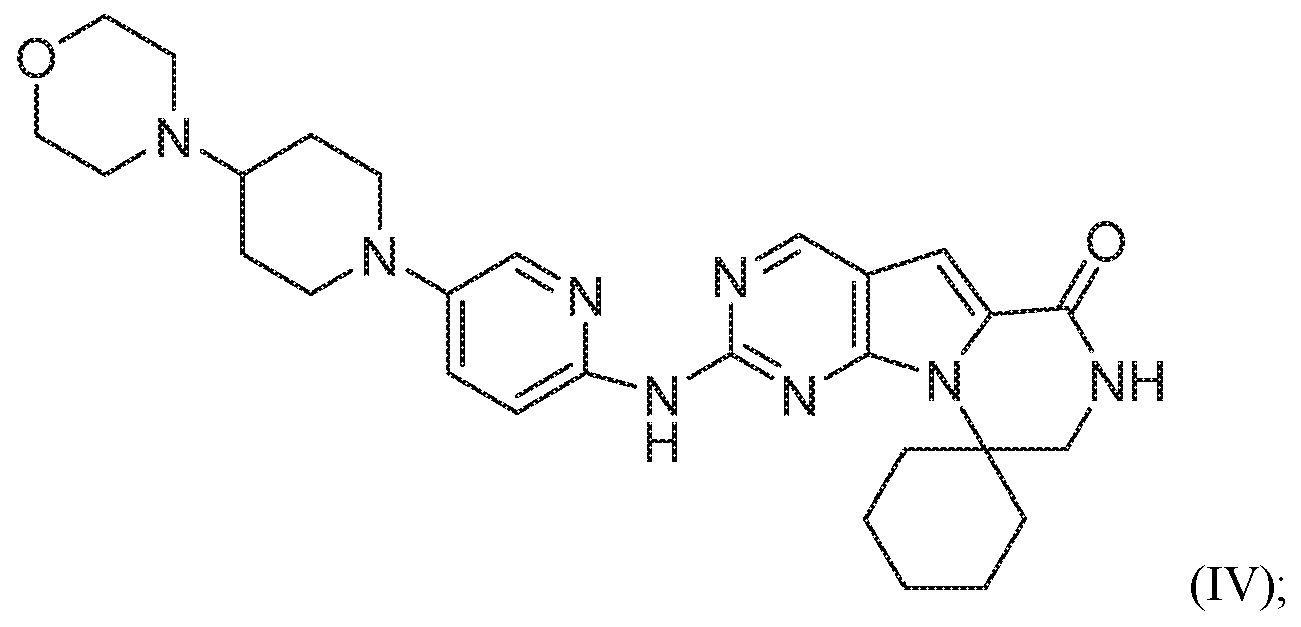
또는 그의 제약상 허용가능한 염으로 이루어진 군으로부터 선택되는 것인
방법.81. The method of claim 80, wherein the selective, rapid action, short half-life CDK4 / 6 inhibitor is
Or a pharmaceutically acceptable salt thereof
Way.
ii) 유효량의 화학요법제를 투여하는 것, 및
iii) 유효량의 면역 체크포인트 억제제를 투여하는 것
을 포함하는 치료적 레지멘을 암 또는 종양을 가진 대상체에게 투여하는 것을 포함하는, 암 또는 종양을 가진 대상체에서의 종양내 면역 세포 침윤물 집단 내 T-세포 활성화 수준을 증가시키는 방법이며;
여기서 활성화된 T-세포는 CD4+ T-세포 또는 CD8+ T-세포이고;
여기서 종양내 면역 세포 침윤물 집단 내 활성화된 T-세포의 퍼센트는 약 5%, 10%, 15% 또는 20%만큼 증가되는 것인
방법.i) administering an effective amount of a selective cyclin dependent kinase 4/6 (CDK4 / 6) inhibitor,
ii) administering an effective amount of a chemotherapeutic agent, and
iii) administering an effective amount of an immune checkpoint inhibitor
A method of increasing T-cell activation levels in an intratumoral immune cell infiltrate population in a cancer or tumor subject, the method comprising administering a therapeutic regimen to the subject with cancer or tumor;
Wherein the activated T-cells are CD4 + T-cells or CD8 + T-cells;
Wherein the percentage of activated T-cells in the intratumoral immune cell infiltrate population is increased by about 5%, 10%, 15% or 20%
Way.

또는 그의 제약상 허용가능한 염으로 이루어진 군으로부터 선택되는 것인
방법.85. The method of claim 84, wherein the selective, fast acting, short half-life CDK4 / 6 inhibitor is
Or a pharmaceutically acceptable salt thereof
Way.
ii) 유효량의 화학요법제를 투여하는 것, 및
iii) 유효량의 면역 체크포인트 억제제를 투여하는 것
을 포함하는 치료적 레지멘을 암 또는 종양을 가진 대상체에게 투여하는 것을 포함하는, 암 또는 종양을 가진 대상체에서의 종양내 면역 세포 침윤물 내 집단 조절성 T-세포 집단을 저하시키는 방법이며;
여기서 종양내 면역 세포 침윤물 내 집단 조절성 T-세포 집단은 상기 치료적 레지멘을 제공받지 않은 대상체에서의 종양내 면역 세포 침윤물 집단에 비해 약 10%, 20%, 30% 또는 40%만큼 감소되는 것인
방법.i) administering an effective amount of a selective cyclin dependent kinase 4/6 (CDK4 / 6) inhibitor,
ii) administering an effective amount of a chemotherapeutic agent, and
iii) administering an effective amount of an immune checkpoint inhibitor
A method of lowering a population regulatory T-cell population in an intratumoral immune cell infiltrates in a cancer or tumor subject, the method comprising administering a therapeutic regimen to the subject with cancer or tumor;
Wherein the population regulatory T-cell population in intratumor immune cell infiltrates is about 10%, 20%, 30% or 40% compared to the intratumoral immune cell infiltrates population in subjects not receiving the therapeutic regimen. To be reduced
Way.


또는 그의 제약상 허용가능한 염으로 이루어진 군으로부터 선택되는 것인
방법.89. The method of claim 88, wherein the selective, fast acting, short half-life CDK4 / 6 inhibitor is
Or a pharmaceutically acceptable salt thereof
Way.
ii) 유효량의 화학요법제를 투여하는 것, 및
iii) 유효량의 면역 체크포인트 억제제를 투여하는 것
을 포함하는 치료적 레지멘을 암 또는 종양을 가진 대상체에게 투여하는 것을 포함하는, 암 또는 종양을 가진 대상체에서의 종양내 면역 세포 침윤물 집단 내 조절성 T-세포의 면역-저해 기능을 억제하는 방법이며;
여기서 조절성 T-세포 내 인산화된 망막모세포종 (포스포-Rb)의 수준은 약 5%, 10%, 15% 또는 20%만큼 감소되고;
여기서 조절성 T-세포의 감소된 면역-저해 기능은 약 10%, 20%, 30%, 40% 또는 50%만큼의 증가된 CD8+ T-세포의 증식을 유도하는 것인
방법.i) administering an effective amount of a selective cyclin dependent kinase 4/6 (CDK4 / 6) inhibitor,
ii) administering an effective amount of a chemotherapeutic agent, and
iii) administering an effective amount of an immune checkpoint inhibitor
Inhibiting the immune-inhibitory function of regulatory T-cells in an intratumoral immune cell infiltrate population in a cancer or tumor subject, the method comprising administering a therapeutic regimen to the subject with cancer or tumor Method;
Wherein the level of phosphorylated retinoblastoma (phospho-Rb) in regulatory T-cells is reduced by about 5%, 10%, 15% or 20%;
Wherein the reduced immunosuppressive function of regulatory T-cells is to induce proliferation of increased CD8 + T-cells by about 10%, 20%, 30%, 40% or 50%.
Way.

또는 그의 제약상 허용가능한 염으로 이루어진 군으로부터 선택되는 것인
방법.93. The method of claim 92, wherein the selective, fast acting, short half-life CDK4 / 6 inhibitor is
Or a pharmaceutically acceptable salt thereof
Way.
ii) 유효량의 화학요법제를 투여하는 것, 및
iii) 유효량의 면역 체크포인트 억제제를 투여하는 것
을 포함하는 치료적 레지멘을 암 또는 종양을 가진 대상체에게 투여하는 것을 포함하는, 암 또는 종양을 가진 대상체에서의 종양-특이적 기억 T-세포의 생성의 장기간 강화를 위한 방법이며;
여기서 대상체의 비장에서 발견되는 종양-특이적 기억 T-세포의 백분율은 약 0.25%, 0.5%, 0.75% 또는 1%만큼 증가되고;
여기서 대상체의 혈액에서 발견되는 종양-특이적 기억 T-세포의 백분율은 약 0.5%, 1% 또는 1.5%만큼 증가되는 것인
방법.i) administering an effective amount of a selective cyclin dependent kinase 4/6 (CDK4 / 6) inhibitor,
ii) administering an effective amount of a chemotherapeutic agent, and
iii) administering an effective amount of an immune checkpoint inhibitor
A method for long term enrichment of the production of tumor-specific memory T-cells in a cancer or tumor subject, the method comprising administering a therapeutic regimen to the subject with cancer or tumor;
Wherein the percentage of tumor-specific memory T-cells found in the spleen of the subject is increased by about 0.25%, 0.5%, 0.75% or 1%;
Wherein the percentage of tumor-specific memory T-cells found in the subject's blood is increased by about 0.5%, 1% or 1.5%
Way.


또는 그의 제약상 허용가능한 염으로 이루어진 군으로부터 선택되는 것인
방법.98. The method of claim 96, wherein the selective, rapid action, short half-life CDK4 / 6 inhibitor is
Or a pharmaceutically acceptable salt thereof
Way.
ii) 유효량의 화학요법제를 투여하는 것, 및
iii) 유효량의 면역 체크포인트 억제제를 투여하는 것
을 포함하는 치료적 레지멘을 암 또는 종양을 가진 대상체에게 투여하는 것을 포함하는, 암 또는 종양을 가진 대상체에서 종양내 면역 세포를 화학요법으로부터 보호하는 방법이며;
여기서 종양내 면역 세포는 CD8+ T-세포, CD4+ T-세포, 천연 킬러 (NK) 세포, 단핵구성 골수-유래된 저해자 세포 (mMDSC), 또는 과립구성 골수 유래된 저해자 세포 (gMDSC)이고;
여기서 종양내 면역 세포의 퍼센트 증식은 비장에서 발견되는 면역 세포의 증식에 비해 약 5%, 10%, 15%, 20%, 25% 또는 30% 더 높은 것인
방법.i) administering an effective amount of a selective cyclin dependent kinase 4/6 (CDK4 / 6) inhibitor,
ii) administering an effective amount of a chemotherapeutic agent, and
iii) administering an effective amount of an immune checkpoint inhibitor
A method of protecting intratumoral immune cells from chemotherapy in a subject with cancer or a tumor, comprising administering a therapeutic regimen comprising: to a subject with cancer or a tumor;
Wherein the intratumoral immune cells are CD8 + T-cells, CD4 + T-cells, natural killer (NK) cells, mononuclear bone marrow-derived inhibitor cells (mMDSC), or granulative bone marrow derived inhibitor cells (gMDSC);
Wherein the percent proliferation of immune cells in the tumor is about 5%, 10%, 15%, 20%, 25% or 30% higher than the proliferation of immune cells found in the spleen.
Way.


또는 그의 제약상 허용가능한 염으로 이루어진 군으로부터 선택되는 것인
방법.101. The method of claim 100, wherein the selective, rapid action, short half-life CDK4 / 6 inhibitor is
Or a pharmaceutically acceptable salt thereof
Way.
Priority Applications (3)
| Application Number | Priority Date | Filing Date | Title |
|---|---|---|---|
| KR1020247004113A KR20240023677A (en) | 2016-12-05 | 2017-12-05 | Preservation of immune response during chemotherapy regimens |
| KR1020247004112A KR20240024296A (en) | 2016-12-05 | 2017-12-05 | Preservation of immune response during chemotherapy regimens |
| KR1020247004108A KR20240023676A (en) | 2016-12-05 | 2017-12-05 | Preservation of immune response during chemotherapy regimens |
Applications Claiming Priority (5)
| Application Number | Priority Date | Filing Date | Title |
|---|---|---|---|
| US201662430302P | 2016-12-05 | 2016-12-05 | |
| US62/430,302 | 2016-12-05 | ||
| US201762479605P | 2017-03-31 | 2017-03-31 | |
| US62/479,605 | 2017-03-31 | ||
| PCT/US2017/064775 WO2018106729A1 (en) | 2016-12-05 | 2017-12-05 | Preservation of immune response during chemotherapy regimens |
Related Child Applications (3)
| Application Number | Title | Priority Date | Filing Date |
|---|---|---|---|
| KR1020247004112A Division KR20240024296A (en) | 2016-12-05 | 2017-12-05 | Preservation of immune response during chemotherapy regimens |
| KR1020247004108A Division KR20240023676A (en) | 2016-12-05 | 2017-12-05 | Preservation of immune response during chemotherapy regimens |
| KR1020247004113A Division KR20240023677A (en) | 2016-12-05 | 2017-12-05 | Preservation of immune response during chemotherapy regimens |
Publications (1)
| Publication Number | Publication Date |
|---|---|
| KR20190092478A true KR20190092478A (en) | 2019-08-07 |
Family
ID=62491342
Family Applications (4)
| Application Number | Title | Priority Date | Filing Date |
|---|---|---|---|
| KR1020197019110A Ceased KR20190092478A (en) | 2016-12-05 | 2017-12-05 | Preservation of Immune Response During Chemotherapy Regimen |
| KR1020247004112A Pending KR20240024296A (en) | 2016-12-05 | 2017-12-05 | Preservation of immune response during chemotherapy regimens |
| KR1020247004108A Pending KR20240023676A (en) | 2016-12-05 | 2017-12-05 | Preservation of immune response during chemotherapy regimens |
| KR1020247004113A Withdrawn KR20240023677A (en) | 2016-12-05 | 2017-12-05 | Preservation of immune response during chemotherapy regimens |
Family Applications After (3)
| Application Number | Title | Priority Date | Filing Date |
|---|---|---|---|
| KR1020247004112A Pending KR20240024296A (en) | 2016-12-05 | 2017-12-05 | Preservation of immune response during chemotherapy regimens |
| KR1020247004108A Pending KR20240023676A (en) | 2016-12-05 | 2017-12-05 | Preservation of immune response during chemotherapy regimens |
| KR1020247004113A Withdrawn KR20240023677A (en) | 2016-12-05 | 2017-12-05 | Preservation of immune response during chemotherapy regimens |
Country Status (12)
| Country | Link |
|---|---|
| US (2) | US11529352B2 (en) |
| EP (1) | EP3548030A4 (en) |
| JP (4) | JP2019536805A (en) |
| KR (4) | KR20190092478A (en) |
| CN (3) | CN117530948A (en) |
| AU (4) | AU2017372856B9 (en) |
| BR (1) | BR112019011410A2 (en) |
| CA (1) | CA3045465A1 (en) |
| IL (4) | IL311265A (en) |
| MX (2) | MX2019006523A (en) |
| NZ (2) | NZ753631A (en) |
| WO (1) | WO2018106729A1 (en) |
Families Citing this family (34)
| Publication number | Priority date | Publication date | Assignee | Title |
|---|---|---|---|---|
| WO2014144326A1 (en) | 2013-03-15 | 2014-09-18 | G1 Therapeutics, Inc. | Transient protection of normal cells during chemotherapy |
| LT3138555T (en) | 2014-04-30 | 2021-03-25 | Fujifilm Corporation | LIPOSOME COMPOSITION AND MANUFACTURING METHOD |
| CN106397592A (en) * | 2015-07-31 | 2017-02-15 | 苏州康宁杰瑞生物科技有限公司 | Single-domain antibody directed at programmed death ligand (PD-L1) and derived protein thereof |
| WO2018005863A1 (en) * | 2016-07-01 | 2018-01-04 | G1 Therapeutics, Inc. | Pyrimidine-based compounds for the treatment of cancer |
| KR20190092478A (en) | 2016-12-05 | 2019-08-07 | 쥐원 쎄라퓨틱스, 인크. | Preservation of Immune Response During Chemotherapy Regimen |
| MX2019008158A (en) | 2017-01-06 | 2019-12-09 | G1 Therapeutics Inc | Combination therapy for the treatment of cancer. |
| US11395821B2 (en) | 2017-01-30 | 2022-07-26 | G1 Therapeutics, Inc. | Treatment of EGFR-driven cancer with fewer side effects |
| CN110505869A (en) | 2017-03-31 | 2019-11-26 | 富士胶片株式会社 | Liposome composition and pharmaceutical composition |
| WO2019054865A1 (en) * | 2017-09-14 | 2019-03-21 | ACADEMISCH ZIEKENHUIS LEIDEN (h.o.d.n. LUMC) | IMMUNOTHERAPY BASED ON T-LYMPHOCYTES |
| WO2019108589A1 (en) * | 2017-11-30 | 2019-06-06 | Beth Israel Deaconess Medical Center, Inc. | Compositions and methods for treating cancer |
| BR112020013915A2 (en) | 2018-01-08 | 2020-12-01 | G1 Therapeutics, Inc. | dosing regimen for release, and, method to treat cancer dependent on cdk4 / 6 replication in a human |
| CN112218634A (en) * | 2018-04-09 | 2021-01-12 | G1治疗公司 | Treatment of cancer with oncogenic mutations |
| FI3811931T3 (en) * | 2018-06-20 | 2024-09-12 | Fujifilm Corp | Combination medication containing liposome composition encapsulating drug and immune checkpoint inhibitor |
| WO2019244978A1 (en) | 2018-06-20 | 2019-12-26 | 富士フイルム株式会社 | Combined medicine comprising gemcitabine-encapsulated liposome composition and immune checkpoint blockade |
| WO2020058372A1 (en) * | 2018-09-19 | 2020-03-26 | INSERM (Institut National de la Santé et de la Recherche Médicale) | Methods and pharmaceutical composition for the treatment of cancers resistant to immune checkpoint therapy |
| JP7057434B2 (en) | 2018-10-01 | 2022-04-19 | 富士フイルム株式会社 | Combination drug containing a liposome composition containing a drug and a platinum preparation |
| JP2022506829A (en) * | 2018-11-09 | 2022-01-17 | ジー1、セラピューティクス、インコーポレイテッド | A therapeutic regimen for the treatment of cancer using a combination of eribulin and a selective CDK4 / 6 inhibitor |
| US20220288067A1 (en) * | 2019-04-24 | 2022-09-15 | The Trustees Of The University Of Pennsylvania | Treatment of cancer with cdk inhibitors |
| MX2021013222A (en) * | 2019-05-03 | 2022-01-06 | Genentech Inc | Methods of treating cancer with an anti-pd-l1 antibody. |
| AU2020296087A1 (en) * | 2019-06-18 | 2022-01-27 | Pharmacosmos Holding A/S | Patient selection for enhancement of anti-tumor immunity in cancer patients |
| EP4231089A3 (en) | 2019-11-12 | 2024-03-13 | Pointcloud Inc. | Dual path light detection and ranging system |
| WO2021110122A1 (en) * | 2019-12-05 | 2021-06-10 | 基石药业(苏州)有限公司 | Combination therapy of cdk4/6 inhibitor |
| AU2021273744A1 (en) | 2020-05-19 | 2022-12-08 | Pharmacosmos Holding A/S | Cyclin-dependent kinase inhibiting compounds for the treatment of medical disorders |
| US10988479B1 (en) | 2020-06-15 | 2021-04-27 | G1 Therapeutics, Inc. | Morphic forms of trilaciclib and methods of manufacture thereof |
| CN120398896A (en) * | 2020-06-15 | 2025-08-01 | 海南先声再明医药股份有限公司 | Form of Trilacizide and its manufacturing method |
| WO2022087018A1 (en) * | 2020-10-19 | 2022-04-28 | G1 Therapeutics, Inc. | Improved fluorouracil-based multi-agent chemotherapy for treatment of metastatic colorectal cancer |
| WO2022125339A2 (en) * | 2020-12-07 | 2022-06-16 | The Trustees Of Indiana University | Methods to sensitize cancer cells to immune attack using atractylenolide i |
| CN113788837B (en) * | 2021-08-02 | 2022-08-26 | 深圳湾实验室坪山生物医药研发转化中心 | Trilaciclib synthesis method |
| WO2023068220A1 (en) * | 2021-10-18 | 2023-04-27 | 株式会社Preferred Networks | Prediction method and biomarker |
| WO2023164649A2 (en) * | 2022-02-25 | 2023-08-31 | Lanier Biotherapeutics, Inc. | Anti-alarmin binding molecules and treatment of pneumonitis |
| AU2023333543A1 (en) * | 2022-09-02 | 2025-03-13 | Rs Oncology, Llc | Thiostrepton dosing regimens |
| WO2024216208A2 (en) * | 2023-04-14 | 2024-10-17 | Concarlo Therapeutics, Inc. | Brk peptides and methods of use |
| WO2024238476A2 (en) * | 2023-05-15 | 2024-11-21 | Cedars-Sinai Medical Center | Y chromosome gene signature as a target for cancer therapy in combination with immunotherapy |
| CN117511855B (en) * | 2023-11-09 | 2024-11-19 | 南京医科大学 | Use of EPHA inhibitors for inducing meiosis |
Family Cites Families (55)
| Publication number | Priority date | Publication date | Assignee | Title |
|---|---|---|---|---|
| GB0327380D0 (en) | 2003-11-25 | 2003-12-31 | Cyclacel Ltd | Method |
| RU2447891C2 (en) | 2006-04-05 | 2012-04-20 | Новартис Аг | Combinations of therapeutic agents applicable for treating cancer |
| MX2009006536A (en) | 2006-12-22 | 2009-06-26 | Novartis Ag | Organic compounds and their uses. |
| US9259399B2 (en) | 2007-11-07 | 2016-02-16 | Cornell University | Targeting CDK4 and CDK6 in cancer therapy |
| WO2010012777A1 (en) | 2008-07-29 | 2010-02-04 | Nerviano Medical Sciences S.R.L. | THERAPEUTIC COMBINATION COMPRISING A CDKs INHIBITOR AND AN ANTINEOPLASTIC AGENT |
| PL2331547T3 (en) | 2008-08-22 | 2015-01-30 | Novartis Ag | Pyrrolopyrimidine compounds as cdk inhibitors |
| AU2009310352A1 (en) | 2008-10-01 | 2010-05-06 | The University Of North Carolina At Chapel Hill | Hematopoietic protection against ionizing radiation using selective cyclin-dependent kinase 4/6 inhibitors |
| CN102231984A (en) | 2008-10-01 | 2011-11-02 | 北卡罗来纳大学查珀尔希尔分校 | Hematopoietic protection against chemotherapeutic compounds using selective cyclin-dependent kinase 4/6 inhibitors |
| EP3025724B1 (en) | 2009-05-13 | 2018-07-11 | The University of North Carolina At Chapel Hill | Cyclin dependent kinase inhibitors and methods of use |
| US8691830B2 (en) | 2010-10-25 | 2014-04-08 | G1 Therapeutics, Inc. | CDK inhibitors |
| PL2632467T3 (en) | 2010-10-25 | 2016-12-30 | Cdk inhibitors | |
| JP5832647B2 (en) | 2011-07-01 | 2015-12-16 | ノバルティス アーゲー | Combination therapy comprising a CDK4 / 6 inhibitor and a PI3K inhibitor for use in the treatment of cancer |
| CA2868966C (en) | 2012-03-29 | 2021-01-26 | Francis Xavier Tavares | Lactam kinase inhibitors |
| WO2013163239A1 (en) | 2012-04-26 | 2013-10-31 | Francis Xavier Tavares | Synthesis of lactams |
| WO2014144740A2 (en) | 2013-03-15 | 2014-09-18 | G1 Therapeutics, Inc. | Highly active anti-neoplastic and anti-proliferative agents |
| WO2014144326A1 (en) | 2013-03-15 | 2014-09-18 | G1 Therapeutics, Inc. | Transient protection of normal cells during chemotherapy |
| WO2014144596A2 (en) | 2013-03-15 | 2014-09-18 | G1 Therapeutics, Inc. | Transient protection of hematopoietic stem and progenitor cells against ionizing radiation |
| MX369503B (en) | 2013-04-08 | 2019-11-11 | Pharmacyclics Llc | Ibrutinib combination therapy. |
| RU2016107426A (en) * | 2013-08-02 | 2017-09-07 | Адуро Байотек Холдингс, Юроуп Б.В. | COMBINING CD27 AGONISTS AND INHIBITING IMMUNE CONTROL POINTS TO STIMULATE IMMUNITY |
| WO2015061407A1 (en) | 2013-10-24 | 2015-04-30 | Francis Xavier Tavares | Process for synthesis of lactams |
| JOP20200094A1 (en) | 2014-01-24 | 2017-06-16 | Dana Farber Cancer Inst Inc | Antibody molecules to pd-1 and uses thereof |
| CN106163547A (en) * | 2014-03-15 | 2016-11-23 | 诺华股份有限公司 | Use Chimeric antigen receptor treatment cancer |
| WO2015161283A1 (en) | 2014-04-17 | 2015-10-22 | G1 Therapeutics, Inc. | Tricyclic lactams for use in hspc-sparing treatments for rb-positive abnormal cellular proliferation |
| RU2695332C2 (en) | 2014-05-15 | 2019-07-23 | Бристол-Маерс Сквибб Компани | Treating lung cancer by combination of anti-pd-1 and other anti-cancer agents |
| WO2016040858A1 (en) | 2014-09-12 | 2016-03-17 | G1 Therapeutics, Inc. | Combinations and dosing regimes to treat rb-positive tumors |
| WO2016040848A1 (en) | 2014-09-12 | 2016-03-17 | G1 Therapeutics, Inc. | Treatment of rb-negative tumors using topoisomerase inhibitors in combination with cyclin dependent kinase 4/6 inhibitors |
| CA2960824A1 (en) | 2014-09-13 | 2016-03-17 | Novartis Ag | Combination therapies of alk inhibitors |
| ES2774448T3 (en) | 2014-10-03 | 2020-07-21 | Novartis Ag | Combination therapies |
| CA2969338A1 (en) * | 2014-12-16 | 2016-06-23 | Bristol-Myers Squibb Company | Use of immune checkpoint inhibitors in central nervous systems neoplasms |
| US20160220569A1 (en) | 2015-02-03 | 2016-08-04 | G1 Therapeutics, Inc. | CDK4/6 Inhibitor Dosage Formulations For The Protection Of Hematopoietic Stem And Progenitor Cells During Chemotherapy |
| WO2017222958A1 (en) | 2016-06-20 | 2017-12-28 | Kura Oncology, Inc. | Treatment of squamous cell carcinomas with inhibitors of erk |
| WO2018005533A1 (en) | 2016-07-01 | 2018-01-04 | G1 Therapeutics, Inc. | Antiproliferative pyrimidine-based compounds |
| MX383803B (en) | 2016-07-01 | 2025-03-14 | G1 Therapeutics Inc | SYNTHESIS OF N-(HETEROARYL)-PYRROLO[3,2-D]PYRIMIDIN-2-AMINES. |
| CA3028751A1 (en) | 2016-07-01 | 2018-01-04 | G1 Therapeutics, Inc. | Pyrimidine-based antiproliferative agents |
| WO2018005863A1 (en) | 2016-07-01 | 2018-01-04 | G1 Therapeutics, Inc. | Pyrimidine-based compounds for the treatment of cancer |
| US11865176B2 (en) | 2016-11-08 | 2024-01-09 | Dana-Farber Cancer Institute, Inc. | Compositions and methods of modulating anti-tumor immunity |
| US20190275049A1 (en) | 2016-11-16 | 2019-09-12 | Pfizer Inc. | Combination of an EGFR T790M Inhibitor and a CDK Inhibitor for the Treatment of Non-Small Cell Lung Cancer |
| EP3548488A1 (en) | 2016-11-30 | 2019-10-09 | Oncotyrol Center for Personalized Cancer Medicine GmbH | 3-amino-1,5-dihydro-pyrazolo[3,4-d]pyrimidin-4-ones as cyclin dependent kinase inhibitors |
| KR20190092478A (en) | 2016-12-05 | 2019-08-07 | 쥐원 쎄라퓨틱스, 인크. | Preservation of Immune Response During Chemotherapy Regimen |
| MX2019008158A (en) | 2017-01-06 | 2019-12-09 | G1 Therapeutics Inc | Combination therapy for the treatment of cancer. |
| US11395821B2 (en) | 2017-01-30 | 2022-07-26 | G1 Therapeutics, Inc. | Treatment of EGFR-driven cancer with fewer side effects |
| WO2018156812A1 (en) | 2017-02-22 | 2018-08-30 | G1 Therapeutics, Inc. | Treatment of egfr-driven cancer with fewer side effects |
| TW201835064A (en) | 2017-02-10 | 2018-10-01 | 美商G1治療公司 | Benzothiophene estrogen receptor modulators |
| CN111148518A (en) | 2017-03-30 | 2020-05-12 | 丹娜法伯癌症研究院 | Methods of modulating regulatory T cells and immune responses using CDK4/6 inhibitors |
| MX392531B (en) | 2017-06-29 | 2025-03-24 | G1 Therapeutics Inc | MORPHIC FORMS OF G1T38 AND METHODS OF PREPARING THE SAME. |
| WO2019108589A1 (en) | 2017-11-30 | 2019-06-06 | Beth Israel Deaconess Medical Center, Inc. | Compositions and methods for treating cancer |
| WO2019136244A1 (en) | 2018-01-04 | 2019-07-11 | G1 Therapeutics, Inc. | Heterocyclic compounds for the treatment of abnormal cellular proliferation |
| BR112020013915A2 (en) | 2018-01-08 | 2020-12-01 | G1 Therapeutics, Inc. | dosing regimen for release, and, method to treat cancer dependent on cdk4 / 6 replication in a human |
| CN112218634A (en) | 2018-04-09 | 2021-01-12 | G1治疗公司 | Treatment of cancer with oncogenic mutations |
| CN112839657B (en) | 2018-08-24 | 2025-07-25 | 法码科思莫斯控股有限公司 | Improved synthesis of 1, 4-diazaspiro [5.5] undecan-3-one |
| JP2022506829A (en) | 2018-11-09 | 2022-01-17 | ジー1、セラピューティクス、インコーポレイテッド | A therapeutic regimen for the treatment of cancer using a combination of eribulin and a selective CDK4 / 6 inhibitor |
| AU2020296087A1 (en) | 2019-06-18 | 2022-01-27 | Pharmacosmos Holding A/S | Patient selection for enhancement of anti-tumor immunity in cancer patients |
| TW202128174A (en) | 2019-10-09 | 2021-08-01 | 美商G1治療公司 | Targeted treatment of cancers with dysregulated fibroblast growth factor receptor signaling |
| US10988479B1 (en) | 2020-06-15 | 2021-04-27 | G1 Therapeutics, Inc. | Morphic forms of trilaciclib and methods of manufacture thereof |
| IL309489A (en) | 2021-07-01 | 2024-02-01 | G1 Therapeutics Inc | Combination treatments in patients with advanced and/or metastatic trop-2 overexpressed cancers |
-
2017
- 2017-12-05 KR KR1020197019110A patent/KR20190092478A/en not_active Ceased
- 2017-12-05 CN CN202311165935.0A patent/CN117530948A/en active Pending
- 2017-12-05 JP JP2019530011A patent/JP2019536805A/en active Pending
- 2017-12-05 CN CN202311165820.1A patent/CN117562905A/en active Pending
- 2017-12-05 KR KR1020247004112A patent/KR20240024296A/en active Pending
- 2017-12-05 WO PCT/US2017/064775 patent/WO2018106729A1/en not_active Ceased
- 2017-12-05 AU AU2017372856A patent/AU2017372856B9/en active Active
- 2017-12-05 IL IL311265A patent/IL311265A/en unknown
- 2017-12-05 IL IL317919A patent/IL317919A/en unknown
- 2017-12-05 IL IL303038A patent/IL303038B2/en unknown
- 2017-12-05 NZ NZ753631A patent/NZ753631A/en unknown
- 2017-12-05 BR BR112019011410-6A patent/BR112019011410A2/en not_active Application Discontinuation
- 2017-12-05 CN CN201780075215.1A patent/CN110035759A/en active Pending
- 2017-12-05 MX MX2019006523A patent/MX2019006523A/en unknown
- 2017-12-05 CA CA3045465A patent/CA3045465A1/en active Pending
- 2017-12-05 KR KR1020247004108A patent/KR20240023676A/en active Pending
- 2017-12-05 NZ NZ795224A patent/NZ795224A/en unknown
- 2017-12-05 KR KR1020247004113A patent/KR20240023677A/en not_active Withdrawn
- 2017-12-05 EP EP17878506.9A patent/EP3548030A4/en active Pending
-
2019
- 2019-05-26 IL IL266870A patent/IL266870A/en unknown
- 2019-06-04 MX MX2023006991A patent/MX2023006991A/en unknown
- 2019-06-05 US US16/432,244 patent/US11529352B2/en active Active
-
2022
- 2022-06-03 JP JP2022091214A patent/JP7483791B2/en active Active
- 2022-12-01 US US18/072,963 patent/US12527798B2/en active Active
-
2023
- 2023-09-04 JP JP2023143202A patent/JP7710496B2/en active Active
- 2023-12-11 AU AU2023282168A patent/AU2023282168B2/en active Active
- 2023-12-11 AU AU2023282170A patent/AU2023282170B2/en active Active
-
2025
- 2025-07-08 JP JP2025115144A patent/JP2025148426A/en active Pending
- 2025-10-01 AU AU2025242155A patent/AU2025242155A1/en active Pending
Also Published As
Similar Documents
| Publication | Publication Date | Title |
|---|---|---|
| US12527798B2 (en) | Preservation of immune response during chemotherapy regimens | |
| WO2020206035A1 (en) | Treatment of cdk4/6 inhibitor resistant neoplastic disorders | |
| KR20200108867A (en) | G1T38 excellent dosing regimen | |
| JP2025525376A (en) | Cyclin-dependent kinase 2 inhibitors for medical treatment | |
| WO2023034336A2 (en) | Improved treatments for advanced/metastatic cancers with checkpoint inhibitor resistance or resistance susceptibility | |
| WO2019222521A1 (en) | Cdk inhibitors for the treatment of neoplastic disorders | |
| RU2779478C2 (en) | Immune response preservation during chemotherapeutical shemes | |
| HK40107174A (en) | Preservation of immune response during chemotherapy regimens | |
| EA043297B1 (en) | USE OF A CDK4/6 INHIBITOR IN MAINTENANCE OF THE IMMUNE RESPONSE DURING CHEMOTHERAPEUTIC REGIMENS | |
| BR122025020789A2 (en) | I USE A SELECTIVE INHIBITOR OF CYCLIN-DEPENDENT KINASE 4/6 (CDK4/6) | |
| HK40012319A (en) | Preservation of immune response during chemotherapy regimens | |
| HK40113151A (en) | Improved treatments for advanced/metastatic cancers with checkpoint inhibitor resistance or resistance susceptibility | |
| CN118234496A (en) | Improved treatment of advanced/metastatic cancers that are resistant or susceptible to checkpoint inhibitors | |
| EA050245B1 (en) | CYCLIN-DEPENDENT KINASE INHIBITORY COMPOUNDS FOR THE TREATMENT OF HEALTH DISORDERS | |
| HK40041180A (en) | G1t38 superior dosage regimes |
Legal Events
| Date | Code | Title | Description |
|---|---|---|---|
| PA0105 | International application |
Patent event date: 20190702 Patent event code: PA01051R01D Comment text: International Patent Application |
|
| PG1501 | Laying open of application | ||
| A201 | Request for examination | ||
| PA0201 | Request for examination |
Patent event code: PA02012R01D Patent event date: 20201207 Comment text: Request for Examination of Application |
|
| E902 | Notification of reason for refusal | ||
| PE0902 | Notice of grounds for rejection |
Comment text: Notification of reason for refusal Patent event date: 20230201 Patent event code: PE09021S01D |
|
| E601 | Decision to refuse application | ||
| PE0601 | Decision on rejection of patent |
Patent event date: 20230905 Comment text: Decision to Refuse Application Patent event code: PE06012S01D Patent event date: 20230201 Comment text: Notification of reason for refusal Patent event code: PE06011S01I |