WO2013163239A1 - Synthesis of lactams - Google Patents
Synthesis of lactams Download PDFInfo
- Publication number
- WO2013163239A1 WO2013163239A1 PCT/US2013/037878 US2013037878W WO2013163239A1 WO 2013163239 A1 WO2013163239 A1 WO 2013163239A1 US 2013037878 W US2013037878 W US 2013037878W WO 2013163239 A1 WO2013163239 A1 WO 2013163239A1
- Authority
- WO
- WIPO (PCT)
- Prior art keywords
- acid
- alkylene
- alkyl
- dihydro
- formula
- Prior art date
- Legal status (The legal status is an assumption and is not a legal conclusion. Google has not performed a legal analysis and makes no representation as to the accuracy of the status listed.)
- Ceased
Links
- 0 CCCCCCCCCCN*C Chemical compound CCCCCCCCCCN*C 0.000 description 4
- JYCRSQUGNQWDRI-OMNKOJBGSA-N CCC(C)[C@@H](CNC(c1c2)=O)[n]1c1c2cnc(Cl)n1 Chemical compound CCC(C)[C@@H](CNC(c1c2)=O)[n]1c1c2cnc(Cl)n1 JYCRSQUGNQWDRI-OMNKOJBGSA-N 0.000 description 1
Classifications
-
- C—CHEMISTRY; METALLURGY
- C07—ORGANIC CHEMISTRY
- C07D—HETEROCYCLIC COMPOUNDS
- C07D487/00—Heterocyclic compounds containing nitrogen atoms as the only ring hetero atoms in the condensed system, not provided for by groups C07D451/00 - C07D477/00
- C07D487/12—Heterocyclic compounds containing nitrogen atoms as the only ring hetero atoms in the condensed system, not provided for by groups C07D451/00 - C07D477/00 in which the condensed system contains three hetero rings
- C07D487/14—Ortho-condensed systems
-
- C—CHEMISTRY; METALLURGY
- C07—ORGANIC CHEMISTRY
- C07D—HETEROCYCLIC COMPOUNDS
- C07D205/00—Heterocyclic compounds containing four-membered rings with one nitrogen atom as the only ring hetero atom
- C07D205/02—Heterocyclic compounds containing four-membered rings with one nitrogen atom as the only ring hetero atom not condensed with other rings
- C07D205/06—Heterocyclic compounds containing four-membered rings with one nitrogen atom as the only ring hetero atom not condensed with other rings having one double bond between ring members or between a ring member and a non-ring member
- C07D205/08—Heterocyclic compounds containing four-membered rings with one nitrogen atom as the only ring hetero atom not condensed with other rings having one double bond between ring members or between a ring member and a non-ring member with one oxygen atom directly attached in position 2, e.g. beta-lactams
-
- A—HUMAN NECESSITIES
- A61—MEDICAL OR VETERINARY SCIENCE; HYGIENE
- A61P—SPECIFIC THERAPEUTIC ACTIVITY OF CHEMICAL COMPOUNDS OR MEDICINAL PREPARATIONS
- A61P35/00—Antineoplastic agents
Definitions
- the invention relates to processes to synthesize lactam compounds, such as for pharmaceuticals.
- the process invention is directed to the synthesis of a lactam ring of the formula (a)
- G represents 1- 5 atoms to complete said ring wherein, reading from left to right, G represents: -C- for a 4-membered ring and -C-C-, -C-0-, -0-C-, -N-C,. -C-N- for a 5 membered ring and similar arrangements of C, O, N, for 6, 7 and 8-membered rings where any open valences are H or an organic moiety such as alkyl or where open valences represent a ring bonded to adjacent atoms or the same atom as allowed by valence such as a spiro ring, which comprises the steps of
- an acid such as a strong acid and a dehydrating agent wherein LG is a leaving group such as tBoc such that the amount of strong acid added allows for the desired
- the final product lactams or pharmaceutically acceptable salts thereof may be useful as CDK inhibitors for treatment of diseases and disorders mediated by CDK such as cancer.
- Lactams of formula (a) may be substituted or unsubstituted 5-8 membered ring systems containing heteroatoms such as oxazolidinones, thiazolidinnes, oxazinanones, thiazinanones, oxazepanones, thiazepanones just to name a few.
- heteroatoms such as oxazolidinones, thiazolidinnes, oxazinanones, thiazinanones, oxazepanones, thiazepanones just to name a few.
- trifluoroacetic anhydride other strong acid anhydrides can also be used.
- the dehydrating agent may a carbodiimide-based such as DCC and EDC, an aminium-based agent such as HBTU, TBTU, HATU, HTCU, a phosphonium-based such as BOP, PyBOP, PyAOP, PyBroP, a uronium-based such as TSTU, TOTU, TPTU or another agent such as DEPBT, CDI or T3P.
- LG may also be an alkylcarbamate, including cyclic and branched chain alkyls, arycarbamates, or heteroarylcarbamates, or alkylamides, arylamides or heteroarylamides (including substituted aryls or heteros). An additional step may be necessary for removal of LG from the cyclized lactam.
- Z is -(CH 2 )x- wherein x is 1 , 2, 3 or 4 or Z is -O- (CH 2 ) Z - wherein z is 2, 3 or 4;
- each X is independently CH or N;
- each X' is independently, CH or N:
- X" is CH 2 , S or NH
- each of R and R 8 are independently H, Ci-C 3 alkyl or haloalkyi;
- each R 1 is independently aryl, alkyl, cycloalkyi or haloalkyi, wherein each of said alkyl, cycloalkyi and haloalkyi groups optionally includes O or N heteroatoms in place of a carbon in the chain and two R groups on adjacent ring atoms or on the same ring atom together with the ring atom(s) to which they are attached optionally form a 3-8-membered cycle; y is O, 1 , 2, 3 or 4;
- R 2 is - (alkylene) m -heterocyclo, -(alkylene) m -heteroaryl, - (alkylene) m -NR 3 R 4 (alkylene) m -C(0)-N 3 R 4 , -(alkylene) m -C(0) -O-alkyl, - (alkylene) m -O-R 5 , (alkylene) m -S(0) n-R 5 , or -(alkylene) m -S(0) n -NR 3 R 4 any of which may be optionally independently substituted with one or more R groups as allowed by valance, and wherein two R x groups bound to the same or adjacent atom may optionally combine to form a ring and wherein m is 0 or 1 and n is 0, 1 or 2;
- R 3 and R 4 at each occurrence are independently:
- alkyl alkenyl, alkynyl, cycloalkyl, heterocycio, aryl, heteroaryl, cycloalkylalkyl, heterocycloalkyl, arylalkyl, or heteroarylalkyl any of which may be optionally independently substituted with one or more R groups as allowed by valance;
- R x at each occurrence is independently, halo, cyano, nitro, oxo, alkyl, haloalkyl, alkenyl, alkynyl, cycloalkyl, cycloalkenyl, heterocycio, aryl, heteroaryl, arylalkyl, heteroarylalkyl, cycloalkylkyl, heterocycloalkyl, -(alkylene) m -OR 5 , -(alkylene) m .-0-alkylene-OR 5 ,
- alkyl, haloalkyl, alkenyl, alkynyl, cycloalkyl, cycloalkenyl, heterocycio, aryl, heteroaryl, arylalkyl, heteroarylalkyl, cycloalkylalkyl, and heterocycloalkyl groups may be further independently substituted with one or more -(alkylene) m -CN, (alkylene) m -OR 5* , -(alkylene) m -S(0) n -R 5 *,
- n 0, 1 or 2
- n 0 or 1 ;
- R 3* and R 4* at each occurrence are independently:
- alkyl alkenyl, alkynyl cycloalkyl, heterocyclo, aryl, heteroaryl, cycloalkylalkyl, heterocycloalkyi, arylalkyl, or heteroarylalkyi any of which may be optionally independently substituted with one or more R x groups as allowed by valance; or R 3 * and R 4 * together with the nitrogen atom to which they are attached may combine to form a heterocyclo ring optionally independently substituted with one or more R x groups as allowed by valance; and R 6 is H or lower alkyl,
- the compound is of formula (I) or formula (II) and R 6 is hydrogen.
- the compound is of formula (III) and the variables are as defined for compounds of formulae (I) and (II) and pharmaceutically acceptable salts thereof.
- R x is not further substituted.
- R 2 is -(alkylene) m -heterocyclo, -(alkylene) m -heteroaryl,
- R 8 is hydrogen or d-C 3 alkyl. In some aspects, R is hydrogen or C C 3 alkyl.
- R 2 is -(alkylene) m -heterocyclo, -(alkylene) m -NR 3 R 4 , -(alkylene) m -C(0)-NR 3 R 4 , -(alkylene) m -C(0)-0-alkyl or -(alkylene) m -OR 5 any of which may be optionally independently substituted with one or more R x groups as allowed by valance, and wherein two R groups bound to the same or adjacent atoms may combine to form a ring.
- R 2 is -(alkylene) m -heterocyclo, -(alkylene) m -NR 3 R 4 ,
- n in R 2 is 1. In a further aspect, the alkylene in R 2 is methylene. In some aspects, R 2 is
- R 2* is a bond, alkylene, -(alkylene) m -0-(alkylene) m -, -(alkylene) m -C(0)-(alkylene) m -,
- P is a 4- to 8-membered mono- or bicyclic saturated heterocyclyl group
- Each R x1 is independently -(alkylene) m -(C(0)) m -(alkylene) m -(N(R N )) m -(alkyl) m wherein each m is independently 0 or 1 provided at least one m is 1 , -(C(0))-0-alkyl,
- R N is H, d to C 4 alkyl or d to C 6 heteroalkyl
- R x1 can, together with the atoms to which they attach on P, which may be the same atom, form a ring;
- t 0, 1 or 2.
- each R x1 is only optionally substituted by unsubstituted alkyl, halogen or hydroxy.
- R 1 is hydrogen or unsubstituted C r d alkyl.
- At least one R x1 is -(alkylene) m -heterocyclyl wherein m is 0 or 1.
- R 2 is of the sub-formula (AA), wherein P* is a 4- to 8-membered mono- or bicyclic saturated heterocyclyl group.
- R 2 is 1 )t
- R 2 is
- R 2 is
- R 2* is a bond, alkylene, -(alkylene) m -0-(alkylene) m -, -(alkylene) m -C(0) -(alkylene) m - , -(alkylene) m -S(0) 2 -(alkylene) m - or -(alkylene) m -NH-(alkylene)m- wherein each m is independently 0 or 1 ; P is a 4- to 8-membered mono- or bicyclic saturated heterocyclyl group;
- P1 is a 4- to 6-membered monocyclic saturated heterocyclyl group
- each R* 2 is independently hydrogen or alkyl: and s is 0, 1 or 2.
- R 2 is
- P1 includes at least one nitrogen.
- any alkylene in R 2* in any previous aspect is not further substituted.
- R 2 is selected from the structures depicted in FIGS. 1-3 of WlPO
- R 2 is one of
- the compound has general formula (I) and more specifically one of the general structures in FIGS. 4-8 of WlPO 2012/061156 published 10 May 2012 wherein the variables are as previously defined.
- the compound has general formula (la):
- the compound has formula (la) and R is alkyl or R is H.
- the compound has formula (la) and R 2 is of the formula (AA) wherein P* is a 4- to 8-membered mono- or bicyclic saturated heterocyclyl group and R 2* , R* 1 and t are as previously defined.
- the compound has formula (la) and R 2 is of the formula (AA) wherein P * is a 4- to 8-membered mono- or bicyclic saturated heterocyclyl group, R x is hydrogen or unsubstituted C C 4 alkyl and R 2* is as previously defined.
- the com ound has formula (lb):
- R 2 , X and R are as previously defined.
- the compound has formula (lb) and R is alkyl or R is H.
- the compound has formula (lb) and R 2 is of the formula (AA) wherein P* is a 4- to 8-membered mono- or bicyclic saturated heterocyclyl group and R 2* , R x : and t are as previously defined.
- the compound has formula (lb) and R 2 is of the formula (AA) wherein P* is a 4- to 8-membered mono- or bicyclic saturated heterocyclyl group, R x1 is hydrogen or C C alkyl and R 2* is as previously defined.
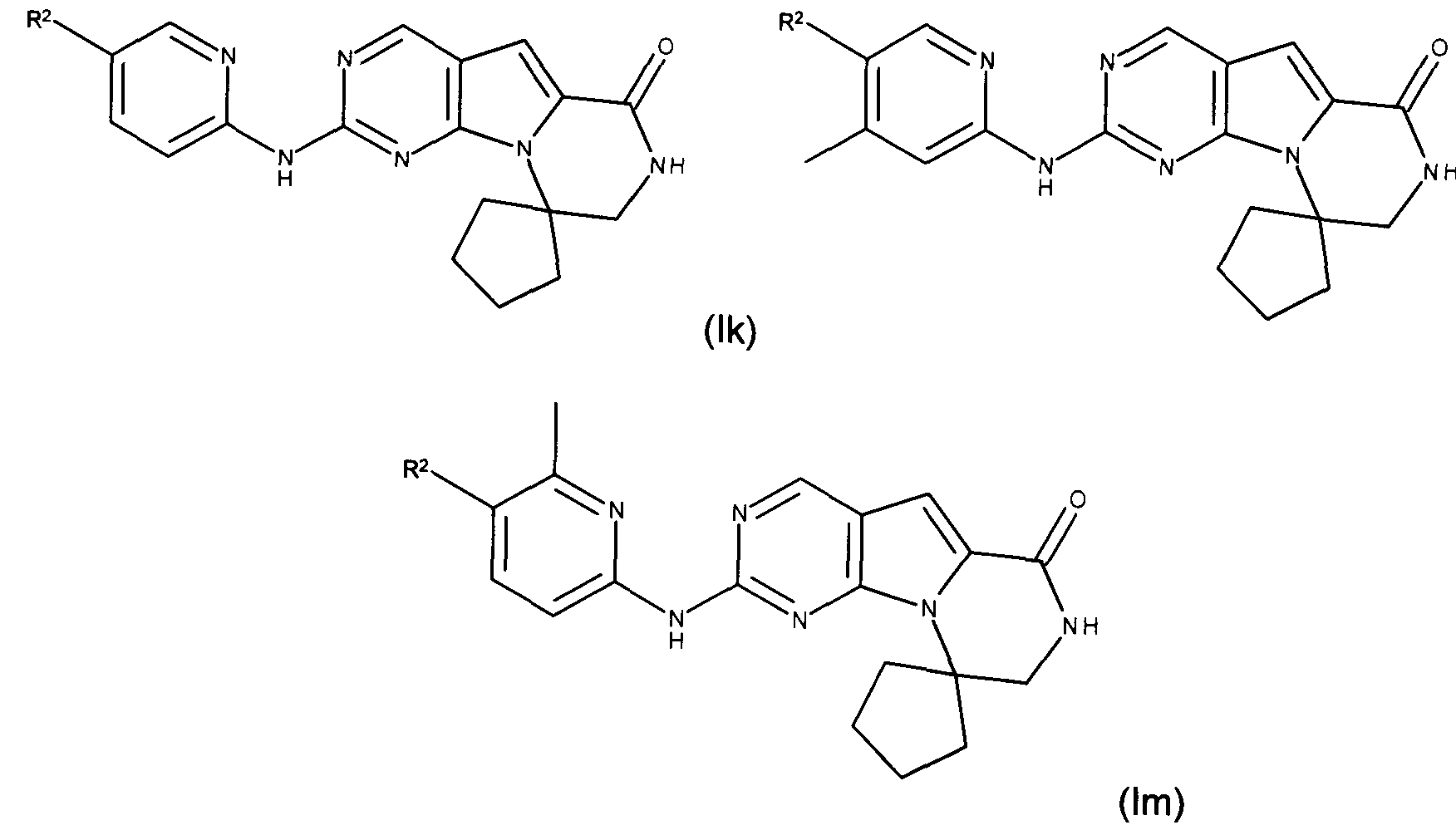
- the compound has formula (Ic), (Id), (le), (If), (Ig), (Ih), (li), (Ij), (Ik), (II), or (lm):
- the compound has formula (Ij) and R is H and both X are N. In some embodiments, the compound has formula (Ha) or (lib) with R 2 as defined
- the compound has formula (lla) and R 2 is of the formula (AA) wherein P * is a 4- to 8-membered mono- or bicyclic saturated heterocyclyl group.
- the compound has formula (lla) and R 2 is of the formula (AA) wherein P * is a 4- to 8-membered mono- or bicyclic saturated heterocyclyl group and R xl is hydrogen or ( C alkyl.
- alkyl either alone or within other terms such as “haloalkyl” and
- alkylamino embraces linear or branched radicals having one to about twelve carbon atoms
- "lower alkyl” radicals have one to about six carbon atoms. Examples of such radicals include methyl, ethyl, n-propyl, isopropyl, n-butyl, isobutyl, sec-butyl, tert-butyl, pentyl, isoamyl, hexyl and the like.
- alkylene embraces bridging divalent linear and branched alkyl radicals. Examples include methylene, ethylene, propylene, isopropylene and the like.
- alkenyl embraces linear or branched radicals having at least one carbon- carbon double bond of two to about twelve carbon atoms, "lower alkenyl” radicals having two to about six carbon atoms.
- alkenyl radicals include ethenyl, isopropenyl, allyl, propenyl, butenyl and 4-methylbutenyl.
- alkenyl and lower alkenyl embrace radicals having "cis” and “trans” orientations, or alternatively, "E” and "Z” orientations.
- alkynyl denotes linear or branched radicals having at least one
- lower alkynyl radicals having two to about six carbon atoms.
- examples of such radicals include propargyl, butynyl, and the like.
- Alkyl, alkenyl, and alk ynyl radicals may be optionally substituted with one or more functional groups such as halo, hydroxy, nitro, amino, cyano, haloalkyl, aryl, heteroaryl, heterocyclo and the like.
- alkylamino embraces 'N-alkylamino" and " ⁇ , ⁇ -dialkylamino" where amino groups are independently substituted with one alkyl radical and with two alkyl radicals, respectively.
- “Lower alkylamino” radicals have one or two alkyl radicals of one to six carbon atoms attached to a nitrogen atom.
- Suitable alkylamino radicals may be mono or dialkylamino such as N-mefitylainino, N-ethylamino, ⁇ , ⁇ -dimethylamino, N,N-diethylamino and the like.
- halo means halogens such as fluorine, chlorine, bromine or iodine atoms.
- haloalkyi embraces radicals wherein any one or more of the alkyl carbon atoms is substituted with one or more halo as defined above. Examples include monohaloalkyl, dihaloalkyl and polyhaloalkyl radicals including perhaloalkyl. A monohaloalkyl radical, for one example, may have an iodo, bromo, chloro or fluoro atom within the radical. Dihalo and polyhaloalkyl radicals may have two or more of the same halo atoms or a combination of different halo radicals. "Lower haloalkyi" embraces radicals having 1-6 carbon atoms.
- haloalkyi radicals include fluoromethyl, difluoromethyl, trifluoromethyl, chloromethyl, dichloromethyl, trichloromethyl, pentafluoroethyl, heptafluoropropyl, difluorochloromethyl, dichlorofluoromethyl, difluoroethyl, difluoropropyl, dichloroethyl and dichloropropyl.
- Perfluoroalkyl means an alkyl radical having all hydrogen atoms replaced with fluoro atoms. Examples include trifluoromethyl and pentafluoroethyl.
- aryl alone or in combination, means a carbocyclic aromatic system containing one or two rings wherein such rings may be attached together in a fused manner.
- aryl embraces aromatic radicals such as phenyl, naphthyl, indenyl ,
- aryl is phenyl.
- Said "aryl" group may have 1 or more substituents such as lower alkyl, hydroxyl, halo, haloalkyi, nitro, cyano, alkoxy, lower alkylamino, aryl, heteroaryl, heterocyclo and the like.
- heterocyclyl (or “heterocyclo") embraces saturated, and partially saturated heteroatom-containing ring radicals, where the heteroatoms may be selected from nitrogen, sulfur and oxygen.
- Heterocyclic rings comprise monocyclic 6-8 membered rings, as well as 5-16 membered bicyclic ring systems (which can include bridged fused and spirofused bicyclic ring systems). It does not include rings containing -0-0-, -0-S- or -S-S portions.
- Said "heterocyclyl” group may have 1 to 3 substituents such as hydroxyl, Boc, halo, haloalkyi, cyano, lower alkyl, lower aralkyl, oxo, lower alkoxy, amino, lower alkylamino, and the like.
- saturated heterocyclo groups include saturated 3- to 6-membered heteromonocyclic groups containing 1 to 4 nitrogen atoms e.g. pyrrolidinyl. imidazolidinyl, piperidinyl, pyrrolinyl, piperazinyl; saturated 3 to 6-membered heteromonocyclic group containing 1 to 2 oxygen atoms and 1 to 3 nitrogen atoms e.g. morpholinyl, saturated 3 to 6- membered heteromonocyclic group containing I to 2 sulfur atoms and 1 to 3 nitrogen atoms e.g., thiazolidinyl.
- partially saturated heterocyclyl radicals include
- dihydrothienyl dihydropyranyl, dihydrofuryl, dihydrothiazolyl, and the like.
- partially saturated and saturated heterocyclo groups include pyrrolidinyl, imidazolidinyl, piperidinyl, pyrrolinyl, pyrazolidinyl, piperazinyl, morpholinyl, tetrahydropyranyl, thiazolidinyl, dihydrothienyl, 2,3-dihydro-benzo[1 ,4]dioxanyl, indolinyl, isoindolinyl, dihydrobenzothienyl, dihydrobenzofuryl, isochromanyl, chromanyl, 1 ,2- dihydroquinolyl, 1 ,2,3,4- tetrahydro-isoquinolyl, 1 ,2,3,4-tetrahydro-quinolyl, 2,3,4,4a,9,9a- hexahydro-1 H
- Heterocycle groups also includes radicals where heterocyclic radicals are fused/condensed with aryl radicals: unsaturated condensed heterocyclic groups containing 1 to 5 nitrogen atoms, for example, indolyl, isoindolyl, indolizinyl, benzimidazolyl, quinolyl, isoquinolyl, indazolyl, benzotriazolyl, tetrazolopyridazinyl e.g., tetrazolo [1 ,5-b]pyridazinyl, unsaturated condensed heterocyclic group containing 1 to 2 oxygen atoms and 1 to 3 nitrogen atoms e.g.
- heteroaryl denotes aryl ring systems that contain one or more
- heteroatoms selected from the group O, N and S. wherein the ring nitrogen and sulfur atom(s) are optionally oxidized, and nitrogen atom(s) are optionally quartentized.
- examples include unsaturated 5 to 6 membered heteromonocyclyl groups containing I to 4 nitrogen atoms, for example, pyrrolyl, imidazolyl, pyrazolyl, 2-pyridyl, 3-pyridyl, 4-pyridyl, pyrimidyl, pyrazinyl, pyridazinyl, triazolyl e.g., 4H-1 ,2,4-triazolyl, 1 H-1 ,2,3-triazolyl, 21-1-1 ,2,3- triazolyl; unsaturated 5- to 6-membered heteromonocyclic group containing an oxygen atom, for example, pyranyl, 2-furyl, 3-furyl, etc.; unsaturated 5 to 6-membered heteromonocyclic group containing a
- heteroarylalkyl denotes alkyl radicals substituted with a heteroaryl group. Examples include pyridylmethyl and thienyiethyl.
- sulfonyl whether used alone or linked to other terms such as alkylsulfonyl, denotes respectively divalent radicals -S0 2 ⁇
- carboxy or “carboxyl”, whether used alone or with other terms, such as
- Carboxyalkyl denotes -C(0)-OH.
- carbonyl whether used alone or with other terms, such as “aminocarbonyl”, denotes -C(O)-.
- aminocarbonyl denotes an amide group of the formula -(C(0)-NH 2 .
- heterocycloalkyl embrace heterocyclic- substituted alkyl radicals. Examples include piperidylmethyl and morpholinylethyl.
- arylalkyl embraces aryl-substituted alkyl radicals. Examples include benzyl, diphenylmethyl and phenylethyl. The aryl in said aralkyl may be additionally substituted with halo, alkyl, alkoxy, halkoalkyl and haloalkoxy.
- cycloalkyi includes saturated carbocyclie groups of 3 to 10 carbons.
- Lower cycloalkyi groups include C 3 -C 6 rings. Examples include cyclopentyl, cyclopropyl, and cyclohexyl. Cycloalkyi groups may be optionally substituted with one or more functional groups such as halo, hydroxy, nitro, amino, cyano, haloalkyl, aryl, heteroaryl, heterocyclo and the like.
- cycloalkylalkyl embraces cycloalkyl-substituted alkyl radicals.
- “Lower cycloalkylalkyl” radicals are cycloalkyi radicals attached to alkyl radicals having one to six carbon atoms. Examples of include eyclohexylmethyl.
- the cycloalkyi in said radicals may be additionally substituted with halo, alkyl, alkoxy and hydroxy.
- cycloalkenyl includes carbocyclie groups having one or more
- cycloalkyldienyl examples include cyclopentenyl, cyclopentadienyl, cyclohexenyl and cycloheptadienyl.
- Ref-1 is WO 2010/020675 Al
- Ref-2 is White, J. D.; ei al. J. Org. Chem. 1995, 60, 3600; and Ref-3 Presser, A. and Hufner, A. Monatshefte fur Chemie 2004, 135, 1015.
- Ref - 1 is WO 2010/020675 Al.
- Also part of the present invention is concerned with the synthesis of tricyclic amide derivatives.
- A is C or N
- R is 1 or 2
- R 11 is selected from the group consisting of hydrogen, lower alkyl, lower hydroxyalkyi, lower alkoxyalkyl, lower halogenalkyl, lower hydroxyhalogenalkyl, lower alkanoyl, lower alkylsulfonyl, lower phenylsulfonyl, lower cycloalkylalkyl, lower phenylalkyl (wherein the phenyl ring may be unsubstituted or substituted with one or two groups independently selected from lower alkyl, cyano, halogen, lower halogenalkyl, lower alkoxy and lower hydroxyalkyi), lower heteroarylalkyl (wherein the heteroaryl ring may be unsubstituted or substituted with one or two groups independently selected from lower alkyl, halogen, phenyl, lower alkoxy and lower hydroxyalkyi), lower heterocyclylalkyi (wherein the heterocyclyl ring may be unsubstituted or substituted with one or two
- R 12 , R 12 , R 13 and R 13 independently from each other are selected from the group consisting of hydrogen, lower alkyl, lower hydroxyalkyi and lower alkoxyalkyl;
- R 14 is selected from the group consisting of hydrogen and halogen
- R 15 is hydrogen or halogen
- G is a group selected from G1 , G2, G3 and G4
- u 0, 1 or 2;
- R 18 is selected from lower alkyl, cycloalkyl, lower cycloalkylalkyl and lower phenylalkyl; v is 0, 1 or 2;
- R 19 is lower alkyl
- B is selected from CR 23 R 23' , O and S;
- R 8 , R 8 , R 9 , R 9' , R 10 , R 10' , R 23 and R 23' independently from each other are selected from the group consisting of hydrogen, lower alkyl, hydroxyl, halogen and dialkylamino, or
- R 9 and R 23 together form a double bond
- p 0, 1 or 2;
- q 0, 1 or 2;
- R 21 is lower alkyl
- R 22 is lower alkyl
- the compounds of formula (IV) are antagonists and/or inverse agonists at the histamine 3 receptor (H3 receptor). Their utility is described in WO 2007/065820 published 14 June 2007.
- the present invention provides a method of creating the lactam ring in (IV) using intermediates in WO 2007/065820 or with minor modifications thereof as known by the art.
- An object of the present invention to provide a partial route to the synthesis of selective, directly acting H3 receptor antagonists respectively inverse agonists.
- Such antagonists/inverse agonists are useful as therapeutically active substances, particularly in the treatment and/or prevention of diseases which are associated with the modulation of H3 receptors.
- alkyl refers to a branched or straight-chain monovalent saturated aliphatic hydrocarbon radical of one to twenty carbon atoms, preferably one to sixteen carbon atoms, more preferably one to ten carbon atoms.
- straight-chain or branched-chain alkyl group with 1 to 8 carbon atoms preferably a straight or branched-chain alkyl group with 1 to 6 carbon atoms and particularly preferred a straight or branched-chain alkyl group with 1 to 4 carbon atoms.
- straight-chain and branched C ⁇ C B alkyl groups are methyl, ethyl, propyl, isopropyl, butyl, isobutyl, tert.
- cycloalkyl or "C 3-7 -cycloalkyl” denotes a saturated carbocyclic group containing from 3 to 7 carbon atoms, such as cyclopropyl. cyclobutyl, cyclopentyl, cyclohexyl or cycloheptyl. Especially preferred are cyclopropyl and cyclobutyl.
- lower cycloalkylalkyl or "C 3 . 7 -cycloalkyl-C 1-8 -alkyl” refers to lower alkyl groups as defined above wherein at least one of the hydrogen atoms of the lower alkyl group is replaced by cycloalkyl.
- a preferred example is cyclopropylmethyl.
- alkoxy refers to the group R 2 -0- wherein R 24 is lower alkyl and the term “lower alkyl” has the previously given significance. Examples of lower alkoxy groups are e.g. methoxy, ethoxy, n-propoxy, isopropoxy, n-butoxy, isobutoxy, sec. butoxy and tert.
- lower alkoxyalkyl or "C 1-8 -alkoxy-C 1-8 -alkyr refers to lower alkyl groups as defined above wherein at least one of the hydrogen atoms of the lower alkyl groups is replaced by an alkoxy group, preferably methoxy or ethoxy.
- alkoxyalkyl groups are 2-methoxyethyl or 3-methoxy propyl.
- alkylsulfonyl or “lower alkylsulfonyl” refers to the group R 24 -S(0) 2 -, wherein R 24 is lower alkyl and the term “lower alkyl” has the previously given significance.
- alkylsulfonyl groups are e.g. methylsulfonyl or ethylsulfonyl.
- halogen refers to fluorine, chlorine, bromine and iodine, with fluorine, chlorine and bromine being preferred.
- lower halogenalkyl or "halogen-C 1-8 -alky refers to lower alkyl groups as defined above wherein at least one of the hydrogen atoms of the lower alkyl group is replaced by a halogen atom, preferably fluoro or chloro, most preferably fluoro.
- halogenated lower alkyd groups are trifluoromethyl, difluoromethyl, trifluoroethyl,
- lower hydroxyhalogenalkyl or "hydroxyhalogen-C 1-8 -alkyl” refers to lower halogenalkyl groups as defined above wherein at least one additional hydrogen atom of the lower alkyl group is replaced by a hydroxy group.
- a preferred example for a lower hydroxyhalogenalkyl group is 4,4,4-trifluoro-3-hydroxy-butyl.
- lower halogenalkoxy or "halogen-Ci -8 -alkoxy” refers to lower alkoxy groups as defined above wherein at least one of the hydrogen atoms of the lower alkoxy group is replaced by a halogen atom, preferably fluoro or chloro, most preferably fluoro.
- halogenated lower alkyl groups are trifluoromethoxy, difluoromethoxy, fluormethoxy and chloromethoxy, with trifluoromethoxy being especially preferred.
- lower hydroxyalkyl or "hydroxy-Ci.
- 8 -alkyl refers to lower alkyl groups as defined above wherein at least one of the hydrogen atoms of the lower alkyl group is replaced by a hydroxy group.
- Examples of lower hydroxyalkyl groups are hydroxymethyl or hydroxyethyl.
- dialkylamino refers to the group -NR 2 R 25 , wherein R 24 and R 25 are lower alkyl and the term “lower alkyl” has the previously given significance.
- a preferred dialkylamino group is dimethylamino.
- lower alkanoyi refers to the group -CO-R 24 , wherein R 24 is lower alkyl and the term “lower alkyl” has the previously given significance.
- Preferred is a group -CO-R 24 , wherein R 24 is methyl, meaning an acetyl group.
- carbbamoyl refers to the group -CO-NH 2 .
- lower phenylalkyl or "phenyl- C 1-8 -alkyl” to lower alkyl groups as defined above wherein at least one of the hydrogen atoms of the lower alkyl group is replaced by a phenyl group.
- Preferred lower phenylalkyl groups are benzyl or phenethyl.
- heteroaryl refers to an aromatic 5- or 6-membered ring which can comprise one, two or three atoms selected from nitrogen, oxygen and/or sulphur.
- heteroaryl groups are e.g, furyl, pyridyl, pyrazinyl, pyrimidinyl, pyridazinyl, thienyl, isoxazolyl, thiazolyl, isothiazolyl, oxazolyl, imidazolyl, or pyrrolyl.
- heteroarylalkyl or “heteroaryl-C 1-8 -alkyl refers to lower alkyl groups as defined above wherein at least one of the hydrogen atoms of the lower alkyl group is replaced by a heteroaryl group as defined above.
- heterocyclyl refers to a saturated or partly unsaturated 5- or 6-membered ring which can comprise one, two or three atoms selected from nitrogen, oxygen and/or sulphur.
- heterocyclyl rings examples include piperidinyl, piperazinyl, azepinyl, pyrrolidinyl, pyrazolidinyl, imidazolinyl, imidazolidinyl, oxazolidinyl, isoxazolidinyl, morpholinyl, thiazolidinyl, isothiazolidinyl, thiadiazolylidinyl, dihydrofuryl, tetrahydrofuryl, dihydropyranyl, tetrahydropyranyl, and thiomorpholinyl.
- a preferred heterocyclyl group is piperidinyl.
- lower heterocyclylalkyl or “heterocyclyl-Cve-alkyl” refers to lower alkyl groups as defined above wherein at least one of the hydrogen atoms of the lower alkyl group is replaced by a heterocyrlyl group as defined above.
- form a 4-, 5-, 6- or 7- membered heterocyclic ring optionally containing a further heteroatom selected from nitrogen, oxygen or sulfur refers to a N-heterocyclic ring, which may optionally contain a further nitrogen, oxygen or sulfur atom, such as azetidinyl, pyrrolidinyl, imidazolidinyl, pyrazolidinyl, oxazolidinyl, isoxazolidinyl, thiazolidinyl, isothiazolidinyl, piperidinyl, piperazinyl , morpholinyl, thiomorpholinyl, or azepanyl.
- a "4-, 5-, 6- or 7-membered heterocyclic ring containing a sulfinyl group or a sulfonyl group” means a N-heterocyclic ring that contains a -S(O)- group or a -S0 2 - group, for example 1-oxothiomorpholinyl or 1 ,1- dioxothiomorpholinyl.
- the heterocyclic ring may be unsubstituted or substituted by one, two or three groups independently selected from lower alkyl, lower alkoxy and oxo.
- the heterocyclic ring may also be condensed with a phenyl ring, said phenyl ring being unsubstituted or substituted by one, two or three groups independently selected from lower alkyl, lower alkoxy and halogen.
- An example for such a condensed heterocyclic ring is 3,4- dihydro-1H-isoquinoline.
- pharmaceutically acceptable salts refers to those salts which retain the biological effectiveness and properties of the free bases or free acids, which arc not biologically or otherwise undesirable.
- the salts are formed with inorganic acids such as hydrochloric acid, hydrobromic acid, sulfuric acid, nitric acid, phosphoric acid and the like, preferably hydrochloric acid, and organic acids such as acetic acid, propionic acid, glycolic acid, pyruvic acid, oxylic acid, maleic acid, malonic acid, salicylic acid, succinic acid, fumaric acid, tartaric acid, citric acid, benzoic acid, cinnamic acid, mandelic acid, methanesulfonic acid, ethanesulfonic acid, p-toluenesulfonic acid, salicylic acid, N-acetylcystein and the like.
- inorganic acids such as hydrochloric acid, hydrobromic acid, sulfuric acid, nitric acid, phosphoric acid and the like, preferably hydrochloric acid
- organic acids such as acetic acid, propionic acid, glycolic acid, pyruvic acid, oxylic acid
- salts derived from an inorganic base include but are not limited to, the sodium, potassium, lithium, ammonium, calcium, magnesium salts and the like.
- Salts derived from organic bases include, but are not limited to salts of primary, secondary, and tertiary amines, substituted amines including naturally occurring substituted amines, cyclic amines and basic ion exchange resins, such as isopropylamine, trimethylainine, diethylamine, triethylamine, tripropylalmine.
- the compound of formula (IV) can also be present in the form of zwitterions.
- Particularly preferred pharmaceutically acceptable salts of compounds of formula (IV) are the hydrochloride salts.
- the compounds of formula (IV) can also be solvated, e.g. hydrated.
- the solvation can be effected in the course of the manufacturing process or can take place e.g. as a consequence of hygroscopic properties of an initially anhydrous compound of formula (IV) (hydration).
- pharmaceutically acceptable salts also includes physiologically acceptable solvates.
- “Isomers” are compounds that have identical molecular formulae but that differ in the nature or the sequence of bonding of their atoms or in the arrangement of their atoms in space. Isomers that differ in the arrangement of their atoms in space are termed
- stereoisomers Stereoisomers that are not mirror images of one another are termed “diastereoisomers”, and stereoisomers that are non-superimposable mirror images are termed “enantiomers”, or sometimes optical isomers.
- enantiomers stereoisomers that are non-superimposable mirror images.
- R 26 is H, Ci-C 6 alkyl, or haloalkyl, cycloalkyl, cycloalkyl containing one or more heteroatoms selected from N, O, and S; each R is independently aryl, alkyl, cycloalkyl or haloalkyl, wherein each of said alkyl, cycloalkyl and haloalkyl groups optionally includes O or N heteroatoms and two R 31 s on adjacent ring atoms or on the same ring atom together with the ring atom(s) to which they are attached optionally form a 3-8-membered cycle;
- yy is 0, 1 , 2, 3 or 4;
- ZZ is -(CH 2 )xx- wherein xx is 1 , 2, 3 or 4 or -0-(CH 2 )xx- wherein xx is 2, 3 or 4;
- R 55 is NHR A ,
- R A is unsubstituted d-d alkyl, cycloalkylalkyl, or -TT-RR, d-d cycloalkyl or cycloalkyl containing one or more heteroatoms selected from N, O, and S
- TT is an unsubstituted or substituted C C 6 alkyl or C 3 -C 8 cycloalkyl linker
- RR is a hydroxyl, unsubstituted or substituted d-d alkoxy, amino, unsubstituted or substituted d-d alkylamino, unsubstituted or substituted di-d-C 6 alkylamino, unsubstituted or substituted C 6 - d 0 aryl, unsubstituted or substituted heteroaryl comprising one or two 5- or 6-member rings and 1-4 heteroatoms selected from N, O and S, unsubstituted or substituted C 3 -d
- R 77 is -(alkylene) m -heterocyclo, -(alkylene) m -heteroaryl, -(alkylene) m -NR 3 R 4 ,
- R 4 any of which may be optionally independently substituted with one or more R x groups as allowed by valance, and wherein two R x groups bound to the same or adjacent atoms may optionally combine to form a ring and wherein R 3 , R 4 and R 5 , m, n, and R , in these definitions for R 77 are as defined for formulae (I), (II), or (II).
- R 27 is -(alkylene) m C 3 - C 8 cycloalkyl, -(alkylene) m aryl, -(alkylene) m -heterocyclo, (alkylene) m - heteroaryl, (alkylene) m -NR 3 R 4 , -(alkylene) m -C(0)-NR 3 R 4 , -(alkylene) m -0-R 5 ,- (alkylene) m - S(0) n -R 5 , or -(alkylene) m -S(0) n -NR 3 R 4 any of which may be optionally independently substituted with one or more R groups as allowed by valance, and wherein two R groups bound to the same or adjacent atom(s) may optionally combine to form a ring and wherein R 3 , R 4 and R 5 , m, n, and R , in these definitions for R 27 are as defined for formula (I), (II),
- an aryl or heteroaryl can be orthophenyl substituted by alkyl, cycloalkyl, halo, haloalkyl, thioalkyl, sulfonylalkyl, alkoxy, haloalkoxy, cyano,
- alkylcarboxamides or aminodialkyl could also be ortho-disubstituted phenyl with alkyl, cycloalkyl, halo, haloalkyl, thioalkyl, sulfonylalkyl, alkoxy, haloalkoxy, cyano, alkylcarboxamides, or aminodialkyl as allowed by valence.
- Aryl and heteroaryl could also be meta or para substituted with alkyl, cycloalkyl, haloalky, halo, haloalkyl, thioalkyl, sulfonylalkyl, alkoxy, haloalkoxy, cyano, alkylcarboxamides or aminoalkyl.
- Chloro Tricyclic Amide is an example of an intermediate for a compound of formula (Q) or (QQ), which can be made by the process of the present invention.
- an important part of this invention is a process to create a lactam.
- the lactam (QQQ) below may be synthesized from the acid (RRR) according to the invention which comprises cyclizing an acid of the formula (RRR), wherein LG is a leaving group such as the atoms to form alkyl or aryl carbamates such as tBoc.
- the reaction conditions for the cyclization can be a one step process wherein, the addition of reagents are all done in one pot resulting in th direct formation of the lactam with the loss of LG. In certain cases, an additional step might be desirable for the loss of the LG after lactam formation.
- R 37 is a value of R 8 for formula (I), (II) or (III) or R 37 is a value of R 14 for formula (IV);
- R 31 , yy and ZZ are as defined above for (Q);
- Y is -CH- or -N
- L as allowed by valance is hydrogen, aryl, heteroaryl, C r C 8 alkoxy, aryloxy, heteroaryloxy, C ! -Ce alkyl, cycloalkylalkyi, or -TT-RR as defined above for the formula (Q), d-C 8 cycloalkyi or cycloalkyi containing one or more heteroatoms selected from N, O and S;
- R 65 is any leaving group that can be displaced by primary amine (for example to create an intermediate for a final product), examples of leaving groups being CI, Br, I, F, S e, Saryl, Sheteroaryl, SOMe, S0 2 e, SOalkyl, S0 2 alkyl, SOcycloalkyl, S0 2 cycloalkyl, SOaryl, S0 2 aryl, hydroxy, hydroxyalkyl, hydroxyaryl or hydroxyheteroaryl, or R 65 may be a value of R 55 for the formula Q above or a value of the aromatic amine portion of each of the left-hand portions depicted in formula (I), (II) and (III), ie. of the subformulae (S), (SS) or (SSS):
- Method B To 7-[2-(tert-butoxycarbonylamino)ethyl]-2-chloro-pyrrolo[2,3-d]pyrimidine- 6- carboxylic acid 0.1 g (0.00029 mole) in DCM (4.5 mL) cooled to 0 degrees is added DMAP (10 mg) and 0-Benzotriazole-N,N,N',N'-tetramethyl-uronium-hexafluoro-phosphate (0.220, 2eq). After stirring for 30 minutes, trifluoroacetic acid (0.8 mL) is added dropwise and the contents stirred for 2 hrs.
- Method D To 7-[2-(tert-butoxycarbonylamino)ethyl]-2-chloro-pyrrolo[2,3-d]pyrimidine- 6-carboxylic acid 0.1 g (0.00029 mole) in DCM (4.5 mL) cooled to 0 degrees is added DMAP (10 mg) and trifluoroacetic anhydride (68 uL, 1.7 eq). The contents are warmed to RT and stirred for 2 hrs. After 2 hours, trifluoracetic acid (0.8 mL) is added and stirring continued for 2 additional hours.
Landscapes
- Chemical & Material Sciences (AREA)
- Organic Chemistry (AREA)
- Health & Medical Sciences (AREA)
- Life Sciences & Earth Sciences (AREA)
- General Health & Medical Sciences (AREA)
- Medicinal Chemistry (AREA)
- Nuclear Medicine, Radiotherapy & Molecular Imaging (AREA)
- Pharmacology & Pharmacy (AREA)
- Chemical Kinetics & Catalysis (AREA)
- Animal Behavior & Ethology (AREA)
- General Chemical & Material Sciences (AREA)
- Public Health (AREA)
- Veterinary Medicine (AREA)
- Pharmaceuticals Containing Other Organic And Inorganic Compounds (AREA)
- Nitrogen Condensed Heterocyclic Rings (AREA)
- Pyrrole Compounds (AREA)
- Hydrogenated Pyridines (AREA)
Description
SYNTHESIS OF LACTAMS
CROSS-REFERENCE TO RELATED APPLICATIONS This application is related to and claims the benefit of co-pending provisional U.S. Application No.61/638,491 filed April 26, 2012 which is hereby incorporated by reference in its entirety for all purposes.
FIELD OF THE INVENTION
The invention relates to processes to synthesize lactam compounds, such as for pharmaceuticals.
BACKGROUND OF THE INVENTION
There exists a number of approaches for the synthesis of lactams. For example, the classical approach for the synthesis of lactams involves cyclization of the amine onto an ester as exemplified in the Roche case in this patent or N-alkylation followed by acylation onto an acylhalide (Raghavan et al. J Org Chem. 2006 March 3; 71 (5): 2151 ), Rhodium catalyzed intramolecular C-H insertion of alpha-diazo-alpha-(phenylsulfonyl)acetamides derived from alpha-amino acids (Yoon et al., J. Org Chem., 2002, 67 (18) 6582), [2+2] cycloaddition reactions for the synthesis of β-lactams ( Bari S.S. et al, Top Heterocycl Chem (2010) 22: 49; Kidwai M. et al. Current Medicinal Chemistry 6(3) 1999, 195). Palladium catalyzed lactam formation (Honda T. et al. Org Lett., 2001 , 3(4) 631. Most of these approaches are based on an acylation approach wherein the amine needs to be nucleophilic enough for the transformation to take effect.
SUMMARY OF THE INVENTION
The process invention is directed to the synthesis of a lactam ring of the formula (a)

wherein G represents 1- 5 atoms to complete said ring wherein, reading from left to right, G represents: -C- for a 4-membered ring and -C-C-, -C-0-, -0-C-, -N-C,. -C-N- for a 5
membered ring and similar arrangements of C, O, N, for 6, 7 and 8-membered rings where any open valences are H or an organic moiety such as alkyl or where open valences represent a ring bonded to adjacent atoms or the same atom as allowed by valence such as a spiro ring, which comprises the steps of
(i) treating a carboxylic acid of the formula (b) j^— C02H
G— N— LG
(b)
with an acid such as a strong acid and a dehydrating agent wherein LG is a leaving group such as tBoc such that the amount of strong acid added allows for the desired
transformation to take place without the loss of the leaving group (LG) before the
cyclization, and
(ii) recovering the lactam (a).
The final product lactams or pharmaceutically acceptable salts thereof may be useful as CDK inhibitors for treatment of diseases and disorders mediated by CDK such as cancer.
DETAILED DESCRIPTION OF THE INVENTION
The invention reactions involving G create cyclic moieties that define 4-8 membered substituted or unsubstituted rings such as β-lactams, pyrrolidones, piperidones to name a few. Lactams of formula (a) may be substituted or unsubstituted 5-8 membered ring systems containing heteroatoms such as oxazolidinones, thiazolidinnes, oxazinanones, thiazinanones, oxazepanones, thiazepanones just to name a few. Besides the use of trifluoroacetic anhydride, other strong acid anhydrides can also be used. For example, tribromoacetic anhydride, trichloroacetic anhydride or mixed anhydrides. In these cases an additional step may be necessary for the removal of LG. In general, most reactions of the invention are conducted at ambient temperature such as about 0-100° C or about 10-50°C, and involve the use of either nonpolar solvents such as dichloromethane, toluene, benzene, dichloroethane or polar aprotic solvents such as tetrahydrofuran, dioxane or acetonitrile. The dehydrating agent may a carbodiimide-based such as DCC and EDC, an aminium-based agent such as HBTU, TBTU, HATU, HTCU, a phosphonium-based such as BOP, PyBOP, PyAOP, PyBroP, a uronium-based such as TSTU, TOTU, TPTU or another agent such as DEPBT, CDI or T3P. LG may also be an alkylcarbamate, including cyclic and branched
chain alkyls, arycarbamates, or heteroarylcarbamates, or alkylamides, arylamides or heteroarylamides (including substituted aryls or heteros). An additional step may be necessary for removal of LG from the cyclized lactam.
As part of the invention, syntheses for intermediates of compounds of formula (I), (II) and (III):

Z is -(CH2)x- wherein x is 1 , 2, 3 or 4 or Z is -O- (CH2)Z- wherein z is 2, 3 or 4;
each X is independently CH or N;
each X' is independently, CH or N:
X" is CH2, S or NH;
each of R and R8 are independently H, Ci-C3 alkyl or haloalkyi;
each R1 is independently aryl, alkyl, cycloalkyi or haloalkyi, wherein each of said alkyl, cycloalkyi and haloalkyi groups optionally includes O or N heteroatoms in place of a carbon in the chain and two R groups on adjacent ring atoms or on the same ring atom together with the ring atom(s) to which they are attached optionally form a 3-8-membered cycle; y is O, 1 , 2, 3 or 4;
R2 is - (alkylene)m-heterocyclo, -(alkylene)m-heteroaryl, - (alkylene) m -NR3R4
(alkylene)m-C(0)-N3R4, -(alkylene)m-C(0) -O-alkyl, - (alkylene)m -O-R5, (alkylene)m-S(0) n-R5, or -(alkylene)m-S(0) n-NR3R4 any of which may be optionally independently substituted with one or more R groups as allowed by valance, and wherein two Rx groups bound to the same or adjacent atom may optionally combine to form a ring and wherein m is 0 or 1 and n is 0, 1 or 2;
R3 and R4 at each occurrence are independently:
(i) hydrogen or
(ii) alkyl, cycloalkyl, heterocycio, aryl, heteroaryl, cycloalkylalkyl, heterocycloalkyl, arylalkyl, or heteroarylalkyl any of which may be optionally independently substituted with one or more R groups as allowed by valance, and wherein two Rx groups bound to the same or adjacent atom may optionally combine to form a ring; or R3 and R4 together with the nitrogen atom to which they are attached may combine to form a heterocycio ring optionally independently substituted with one or more Rx groups as allowed by valance, and wherein two Rx groups bound to the same or adjacent atom may optionally combine to form a ring; R5 and R5* at each occurrence is:
(i) hydrogen, or
(ii) alkyl, alkenyl, alkynyl, cycloalkyl, heterocycio, aryl, heteroaryl, cycloalkylalkyl, heterocycloalkyl, arylalkyl, or heteroarylalkyl any of which may be optionally independently substituted with one or more R groups as allowed by valance;
Rx at each occurrence is independently, halo, cyano, nitro, oxo, alkyl, haloalkyl, alkenyl, alkynyl, cycloalkyl, cycloalkenyl, heterocycio, aryl, heteroaryl, arylalkyl, heteroarylalkyl, cycloalkylkyl, heterocycloalkyl, -(alkylene)m-OR5, -(alkylene) m.-0-alkylene-OR5,
-(alkylene)m-S(0)n-R5, -(alkylene)m-NR3R4, -(alkylene)m-CN, -(alkylene)m-C(0)-R5,
-(alkylene)m-C(S)-R5, -(alkylene)m-C(0)-OR5, -(alkylene)m-0-C(0)-R5,
-(alkylene)m-C(S)-OR5, -(alkylene)m-C(0)-(alkylene)m-NR3R4, -(alkylene)rn-C(S)-NR3R4, -(alkylene) m-N(R3)-C(0)-NR3R4, -(alkylene) m-N(R3)-C(S)-NR3R4,
-(alkylene) m-N(R3)-C(0)- R5, -(alkylene)m-N(R3)-C(S)-R5, -(alkylene)m-0-C(0)-NR3R4, -(alkylene)m-0-C(S)-NR3R4, -(alkylene) m-S02-NR3R4, -(alkylene) m_N(R3)-S02-R5, -(alkylene)m-N(R3)-S02-NR3R4, -(alkylene)m-N(R3)-C(0)-OR5 ,
-(alkylene)m-N(R3)-C(S)-OR5, or -(alkylene)m-N(R3)-S02-R5; wherein:
said alkyl, haloalkyl, alkenyl, alkynyl, cycloalkyl, cycloalkenyl, heterocycio, aryl, heteroaryl, arylalkyl, heteroarylalkyl, cycloalkylalkyl, and heterocycloalkyl groups may be further independently substituted with one or more
-(alkylene)m-CN, (alkylene)m-OR5*, -(alkylene)m-S(0)n-R5*,
-(alkylene)m-NR3*R4*, -(alkylene)m-C(0)-R5*, -(alkylene)m-C(=S)R5*,
-(alkylene)m-C(=0)0 R5*, -(alkylene)m-OC(=0)R5*, -(alkylene) m -C(S)-OR5*,
-(alkylene)m -C(0)-NR3*R4*, -(alkylene)m-C(S)-NR3*R4*
-(alkylene)m -N(R3*)-C(0)-NR3*R4*, -(alkylene)m-N(R3*)-C(S)-NR3*R4*,
-(alkylene)m-N(R3*)-C(0)-R5*, -(alkylene)m-N(R3*)-C(S)-R5*,
-(alkylene)m -0-C(0)-NR3*R4*, -(alkylene)m-0-C(S)-NR3*R4*,
-(alkylene)m-S02- R3*R4*, -(alkylene)m-N(R3*)-S02-R 5*,
-(alkylene)m-N(R3*)-S02-NR3*R4*, -(alkylene)m-N(R3*)-C(0) -OR5*,
-(alkylene)m-N(R3*)-C(S)- OR5*, or -(alkylene)m-N(R3*) S02-R5*,
n is 0, 1 or 2, and
m is 0 or 1 ;
R3* and R4* at each occurrence are independently:
(i) hydrogen, or
(ii) alkyl, alkenyl, alkynyl cycloalkyl, heterocyclo, aryl, heteroaryl, cycloalkylalkyl, heterocycloalkyi, arylalkyl, or heteroarylalkyi any of which may be optionally independently substituted with one or more Rx groups as allowed by valance; or R3* and R4* together with the nitrogen atom to which they are attached may combine to form a heterocyclo ring optionally independently substituted with one or more Rx groups as allowed by valance; and R6 is H or lower alkyl,
or a pharmaceutically acceptable salt thereof.
In some aspects, the compound is of formula (I) or formula (II) and R6 is hydrogen.
In some aspects, the compound is of formula (III) and the variables are as defined for compounds of formulae (I) and (II) and pharmaceutically acceptable salts thereof.
In some aspects, Rx is not further substituted.
In some aspects, R2 is -(alkylene)m-heterocyclo, -(alkylene)m-heteroaryl,
-(alkylene)m NR3R4, -(alkylene)m-C(0)-NR3R4, -(alkylene) m-0-R5,
-(alkylene)m-S(0)n-R5, or -(alkylene)m-S(0)n-NR3R4 any of which may be optionally independently substituted with one or more R groups as allowed by valance, and wherein two R groups bound to the same or adjacent atom may optionally combine to form a ring and wherein m is 0 or 1 and it is 0, 1 or 2.
In some aspects, R8 is hydrogen or d-C3 alkyl. In some aspects, R is hydrogen or C C3 alkyl.
In some aspects, R2 is -(alkylene)m-heterocyclo, -(alkylene)m-NR3R4, -(alkylene)m-C(0)-NR3R4, -(alkylene)m-C(0)-0-alkyl or -(alkylene)m-OR5 any of which may be optionally independently substituted with one or more Rx groups as allowed by valance, and wherein two R groups bound to the same or adjacent atoms may combine to form a ring.
In some aspects, R2 is -(alkylene)m-heterocyclo, -(alkylene)m-NR3R4,
-(alkylene)m-C(0)-NR3R4, -(alkylene)m-C(0)-0-alkyl or -(alkylene)m-OR5 without further substitution.
In some aspects, m in R2 is 1. In a further aspect, the alkylene in R2 is methylene. In some aspects, R2 is

wherein:
R2* is a bond, alkylene, -(alkylene)m-0-(alkylene)m-, -(alkylene)m-C(0)-(alkylene)m-,
-(alkylene)m-S(0)2-(alkylene)m- or -(alkylene)m-NH-(alkylene)m- wherein each m is independently 0 or 1 ;
P is a 4- to 8-membered mono- or bicyclic saturated heterocyclyl group;
Each Rx1 is independently -(alkylene)m-(C(0))m-(alkylene)m-(N(RN))m-(alkyl)m wherein each m is independently 0 or 1 provided at least one m is 1 , -(C(0))-0-alkyl,
-(alkylene)m-cycloalkyl wherein m is 0 or I, -N(RN)-cycloalkyl, -C(0)-cycloalkyl,
-(alkylene)m -heterocyclyl wherein m is 0 or 1 , or -N(RN)-heterocyclyl, -C(0)-heterocyclyl, -
S(0)2.(alkylene)m wherein m is 1 or 2, wherein:
RN is H, d to C4 alkyl or d to C6 heteroalkyl, and
wherein two Rx1 can, together with the atoms to which they attach on P, which may be the same atom, form a ring; and
t is 0, 1 or 2.
In some aspects, each Rx1 is only optionally substituted by unsubstituted alkyl, halogen or hydroxy.
In some aspects, R 1 is hydrogen or unsubstituted Crd alkyl.
In some aspects, at least one Rx1 is -(alkylene)m-heterocyclyl wherein m is 0 or 1.
In some aspects, R2 is of the sub-formula (AA),
 wherein P* is a 4- to 8-membered mono- or bicyclic saturated heterocyclyl group.
In some aspects, R2 is
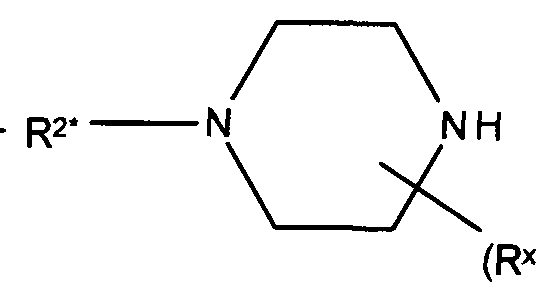 1)t
1)t
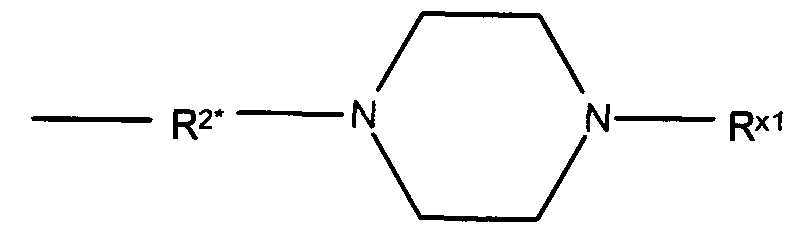
In some aspects, R2 is
In some aspects, R2 is
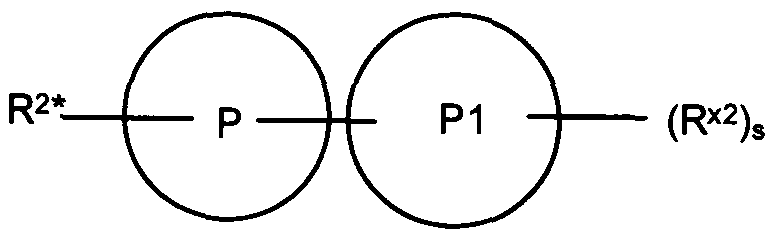
wherein:
R2* is a bond, alkylene, -(alkylene)m-0-(alkylene)m-, -(alkylene)m-C(0) -(alkylene)m-, -(alkylene)m-S(0)2 -(alkylene)m- or -(alkylene)m-NH-(alkylene)m- wherein each m is independently 0 or 1 ; P is a 4- to 8-membered mono- or bicyclic saturated heterocyclyl group;
P1 is a 4- to 6-membered monocyclic saturated heterocyclyl group;
each R*2 is independently hydrogen or alkyl: and s is 0, 1 or 2.
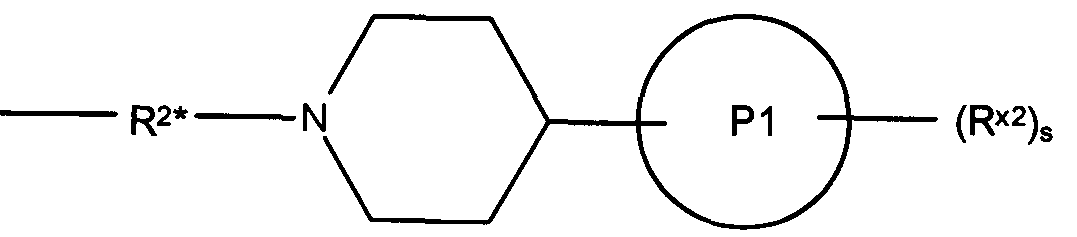
In some aspects, R2 is
In some aspects, P1 includes at least one nitrogen.
In some aspects, any alkylene in R2* in any previous aspect is not further substituted.
In some aspects, R2 is selected from the structures depicted in FIGS. 1-3 of WlPO
2012/061156 published 10 May 2012.
In some aspects, R2 is one of


In some aspects, the compound has general formula (I) and more specifically one of the general structures in FIGS. 4-8 of WlPO 2012/061156 published 10 May 2012 wherein the variables are as previously defined.
In some aspects, the compound has general formula (la):

(la) wherein R1, R2 R, X and y are as previously defined.
In some embodiments, the compound has formula (la) and R is alkyl or R is H.
In some embodiments, the compound has formula (la) and R2 is of the formula (AA) wherein P* is a 4- to 8-membered mono- or bicyclic saturated heterocyclyl group and R2*, R*1 and t are as previously defined.
In some embodiments, the compound has formula (la) and R2 is of the formula (AA) wherein P* is a 4- to 8-membered mono- or bicyclic saturated heterocyclyl group, Rx is hydrogen or unsubstituted C C4 alkyl and R2* is as previously defined.
In some embodiments, the com ound has formula (lb):

wherein R2 , X and R are as previously defined.
In some embodiments, the compound has formula (lb) and R is alkyl or R is H.
In some embodiments, the compound has formula (lb) and R2 is of the formula (AA) wherein P* is a 4- to 8-membered mono- or bicyclic saturated heterocyclyl group and R2*, Rx : and t are as previously defined.
In some embodiments, the compound has formula (lb) and R2 is of the formula (AA) wherein P* is a 4- to 8-membered mono- or bicyclic saturated heterocyclyl group, Rx1 is hydrogen or C C alkyl and R2* is as previously defined.
In some embodiments, the compound has formula (Ic), (Id), (le), (If), (Ig), (Ih), (li), (Ij), (Ik), (II), or (lm):


In some embodiments, the compound has formula (Ij) and R is H and both X are N. In some embodiments, the compound has formula (Ha) or (lib) with R2 as defined

(Ma) (Mb)
In some embodiments, the compound has formula (lla) and R2 is of the formula (AA) wherein P* is a 4- to 8-membered mono- or bicyclic saturated heterocyclyl group.
In some embodiments, the compound has formula (lla) and R2 is of the formula (AA) wherein P* is a 4- to 8-membered mono- or bicyclic saturated heterocyclyl group and Rxl is hydrogen or ( C alkyl.
Unless otherwise stated, the following terms used in this application, including the specification and claims, have the definitions given below. It must be noted that, as used in the specification and the appended claims, the singular forms "a," "an" and "the" include plural referents unless the context clearly dictates otherwise. Definition of standard chemistry terms may be found in reference works, including Carey and Sundberg (2007)
Advanced Organic Chemistry 5th Ed. Vols. A and B, Springer Science+Business Media LLC, New York. The practice of the present invention will employ, unless otherwise indicated, conventional methods of synthetic organic chemistry, mass spectroscopy, preparative and analytical methods of chromatography, protein chemistry, biochemistry, recombinant DNA techniques and pharmacology. Conventional methods of organic chemistry include those included in March's Advanced Organic Chemistry: Reactions. Mechanisms, and Structure, 6th Edition, M.S. Smith and J. March, John Wiley & Sons, Inc., Hoboken, NJ, 2007.
The term "alkyl," either alone or within other terms such as "haloalkyl" and
"alkylamino," embraces linear or branched radicals having one to about twelve carbon atoms, "lower alkyl" radicals have one to about six carbon atoms. Examples of such radicals include methyl, ethyl, n-propyl, isopropyl, n-butyl, isobutyl, sec-butyl, tert-butyl, pentyl, isoamyl, hexyl and the like.
The term "alkylene" embraces bridging divalent linear and branched alkyl radicals. Examples include methylene, ethylene, propylene, isopropylene and the like.
The term "alkenyl" embraces linear or branched radicals having at least one carbon- carbon double bond of two to about twelve carbon atoms, "lower alkenyl" radicals having two to about six carbon atoms. Examples of alkenyl radicals include ethenyl, isopropenyl, allyl, propenyl, butenyl and 4-methylbutenyl. The terms "alkenyl" and "lower alkenyl," embrace radicals having "cis" and "trans" orientations, or alternatively, "E" and "Z" orientations.
The term "alkynyl" denotes linear or branched radicals having at least one
carbon-carbon triple bond and having two to about twelve carbon atoms, "lower alkynyl" radicals having two to about six carbon atoms. Examples of such radicals include propargyl, butynyl, and the like.
Alkyl, alkenyl, and alk ynyl radicals may be optionally substituted with one or more functional groups such as halo, hydroxy, nitro, amino, cyano, haloalkyl, aryl, heteroaryl, heterocyclo and the like.
The term "alkylamino" embraces 'N-alkylamino" and "Ν,Ν-dialkylamino" where amino groups are independently substituted with one alkyl radical and with two alkyl radicals, respectively. "Lower alkylamino" radicals have one or two alkyl radicals of one to six carbon atoms attached to a nitrogen atom. Suitable alkylamino radicals may be mono or dialkylamino such as N-mefitylainino, N-ethylamino, Ν,Ν-dimethylamino, N,N-diethylamino and the like.
The term "halo" means halogens such as fluorine, chlorine, bromine or iodine atoms.
The term "haloalkyi" embraces radicals wherein any one or more of the alkyl carbon atoms is substituted with one or more halo as defined above. Examples include monohaloalkyl, dihaloalkyl and polyhaloalkyl radicals including perhaloalkyl. A monohaloalkyl radical, for one example, may have an iodo, bromo, chloro or fluoro atom within the radical. Dihalo and polyhaloalkyl radicals may have two or more of the same halo atoms or a combination of different halo radicals. "Lower haloalkyi" embraces radicals having 1-6 carbon atoms.
Examples of haloalkyi radicals include fluoromethyl, difluoromethyl, trifluoromethyl, chloromethyl, dichloromethyl, trichloromethyl, pentafluoroethyl, heptafluoropropyl, difluorochloromethyl, dichlorofluoromethyl, difluoroethyl, difluoropropyl, dichloroethyl and dichloropropyl. "Perfluoroalkyl means an alkyl radical having all hydrogen atoms replaced with fluoro atoms. Examples include trifluoromethyl and pentafluoroethyl.
The term "aryl", alone or in combination, means a carbocyclic aromatic system containing one or two rings wherein such rings may be attached together in a fused manner. The term "aryl" embraces aromatic radicals such as phenyl, naphthyl, indenyl ,
tetrahydronaphthyl, and indanyl. A particular aryl is phenyl. Said "aryl" group may have 1 or more substituents such as lower alkyl, hydroxyl, halo, haloalkyi, nitro, cyano, alkoxy, lower alkylamino, aryl, heteroaryl, heterocyclo and the like.
The term "heterocyclyl" (or "heterocyclo") embraces saturated, and partially saturated heteroatom-containing ring radicals, where the heteroatoms may be selected from nitrogen, sulfur and oxygen. Heterocyclic rings comprise monocyclic 6-8 membered rings, as well as 5-16 membered bicyclic ring systems (which can include bridged fused and spirofused bicyclic ring systems). It does not include rings containing -0-0-, -0-S- or -S-S portions. Said "heterocyclyl" group may have 1 to 3 substituents such as hydroxyl, Boc, halo, haloalkyi, cyano, lower alkyl, lower aralkyl, oxo, lower alkoxy, amino, lower alkylamino, and the like.
Examples of saturated heterocyclo groups include saturated 3- to 6-membered heteromonocyclic groups containing 1 to 4 nitrogen atoms e.g. pyrrolidinyl. imidazolidinyl, piperidinyl, pyrrolinyl, piperazinyl; saturated 3 to 6-membered heteromonocyclic group containing 1 to 2 oxygen atoms and 1 to 3 nitrogen atoms e.g. morpholinyl, saturated 3 to 6- membered heteromonocyclic group containing I to 2 sulfur atoms and 1 to 3 nitrogen atoms e.g., thiazolidinyl. Examples of partially saturated heterocyclyl radicals include
dihydrothienyl, dihydropyranyl, dihydrofuryl, dihydrothiazolyl, and the like.
Particular examples of partially saturated and saturated heterocyclo groups include pyrrolidinyl, imidazolidinyl, piperidinyl, pyrrolinyl, pyrazolidinyl, piperazinyl, morpholinyl, tetrahydropyranyl, thiazolidinyl, dihydrothienyl, 2,3-dihydro-benzo[1 ,4]dioxanyl, indolinyl, isoindolinyl, dihydrobenzothienyl, dihydrobenzofuryl, isochromanyl, chromanyl, 1 ,2- dihydroquinolyl, 1 ,2,3,4- tetrahydro-isoquinolyl, 1 ,2,3,4-tetrahydro-quinolyl, 2,3,4,4a,9,9a- hexahydro-1 H-3-aza-fluorenyl, 5,6,7- trihydro-1 ,2,4-triazolo[3,4-a]isoquinolyl, 3,4-dihydro- 2H-benzo[1 ,4]oxaziny1 , benzo[1 ,4]dioxanyl, 2,3-dihydro-1 H-1A'-benzo[d]isothiazol-6-yl, dihydropyranyl, dihydrofuryl and dihydrothiazolyl, and the like.
Heterocycle groups also includes radicals where heterocyclic radicals are fused/condensed with aryl radicals: unsaturated condensed heterocyclic groups containing 1 to 5 nitrogen atoms, for example, indolyl, isoindolyl, indolizinyl, benzimidazolyl, quinolyl, isoquinolyl, indazolyl, benzotriazolyl, tetrazolopyridazinyl e.g., tetrazolo [1 ,5-b]pyridazinyl, unsaturated condensed heterocyclic group containing 1 to 2 oxygen atoms and 1 to 3 nitrogen atoms e.g. benzoxazolyl, benzoxadiazolyl; unsaturated condensed heterocyclic group containing 1 to 2 sulfur atoms and 1 to 3 nitrogen atoms e.g., benzothiazolyl, benzothiadiazolyl; and saturated, partially unsaturated and unsaturated condensed heterocyclic group containing 1 to 2 oxygen or sulfur atoms e.g. benzofuryl, benzothienyl, 2,3-dihydro-benzo[1 ,4]dioxinyl and dihydrobenzofuryl.
The term "heteroaryl" denotes aryl ring systems that contain one or more
heteroatoms selected from the group O, N and S. wherein the ring nitrogen and sulfur atom(s) are optionally oxidized, and nitrogen atom(s) are optionally quartentized. Examples include unsaturated 5 to 6 membered heteromonocyclyl groups containing I to 4 nitrogen atoms, for example, pyrrolyl, imidazolyl, pyrazolyl, 2-pyridyl, 3-pyridyl, 4-pyridyl, pyrimidyl, pyrazinyl, pyridazinyl, triazolyl e.g., 4H-1 ,2,4-triazolyl, 1 H-1 ,2,3-triazolyl, 21-1-1 ,2,3- triazolyl; unsaturated 5- to 6-membered heteromonocyclic group containing an oxygen atom, for example, pyranyl, 2-furyl, 3-furyl, etc.; unsaturated 5 to 6-membered heteromonocyclic group containing a sulfur atom, for example, 2-thienyl, 3-thienyl, etc.; unsaturated 5- to 6- membered heteromonocyclic group containing 1 to 2 oxygen atoms and 1 to 3 nitrogen atoms, for example, oxazolyl, isoxazolyl, oxadiazolyl [e.g., ,2,4-oxadiazolyl, 1 ,3,4- oxadiazolyl, 1 ,2,5-oxadiazolyl; unsaturated 5 to 6-membered heteromonocyclic groups containing 1 to 2 sulfur atoms and 1 to 3 nitrogen atoms, for example, thiazolyl, thiadiazolyl e.g., 1 ,2,4-thiadiazolyl, ,3,4-thiadiazolyl , 1.2,5-thiadiazolyl.
The term "heteroarylalkyl" denotes alkyl radicals substituted with a heteroaryl group. Examples include pyridylmethyl and thienyiethyl. The term "sulfonyl", whether used alone or linked to other terms such as alkylsulfonyl, denotes respectively divalent radicals -S02~ The terms "carboxy" or "carboxyl", whether used alone or with other terms, such as
"carboxyalkyl", denotes -C(0)-OH. The term "carbonyl", whether used alone or with other terms, such as "aminocarbonyl", denotes -C(O)-. The term "aminocarbonyl" denotes an amide group of the formula -(C(0)-NH2. The terms "heterocycloalkyl" embrace heterocyclic- substituted alkyl radicals. Examples include piperidylmethyl and morpholinylethyl.
The term "arylalkyl" embraces aryl-substituted alkyl radicals. Examples include benzyl, diphenylmethyl and phenylethyl. The aryl in said aralkyl may be additionally substituted with halo, alkyl, alkoxy, halkoalkyl and haloalkoxy.
The term "cycloalkyi" includes saturated carbocyclie groups of 3 to 10 carbons.
Lower cycloalkyi groups include C3-C6 rings. Examples include cyclopentyl, cyclopropyl, and cyclohexyl. Cycloalkyi groups may be optionally substituted with one or more functional groups such as halo, hydroxy, nitro, amino, cyano, haloalkyl, aryl, heteroaryl, heterocyclo and the like.
The term "cycloalkylalkyl" embraces cycloalkyl-substituted alkyl radicals. "Lower cycloalkylalkyl" radicals are cycloalkyi radicals attached to alkyl radicals having one to six carbon atoms. Examples of include eyclohexylmethyl. The cycloalkyi in said radicals may be additionally substituted with halo, alkyl, alkoxy and hydroxy.
The term "cycloalkenyl" includes carbocyclie groups having one or more
carbon-carbon double bonds including "cycloalkyldienyl" compounds. Examples include cyclopentenyl, cyclopentadienyl, cyclohexenyl and cycloheptadienyl.
The term "comprising" is meant to be open ended, including the indicated component but not excluding other elements. The term "oxo" as used herein contemplates an oxygen atom attached with a double bond. The term "nitro" as used herein contemplates -N02. The term "cyano" as used herein contemplates -CN.
Synthesis
The disclosed compounds can be made by the following general schemes:

Ref-1
Scheme 1
In Scheme 1. Ref-1 is WO 2010/020675 Al; Ref-2 is White, J. D.; ei al. J. Org. Chem. 1995, 60, 3600; and Ref-3 Presser, A. and Hufner, A. Monatshefte fur Chemie 2004, 135, 1015.
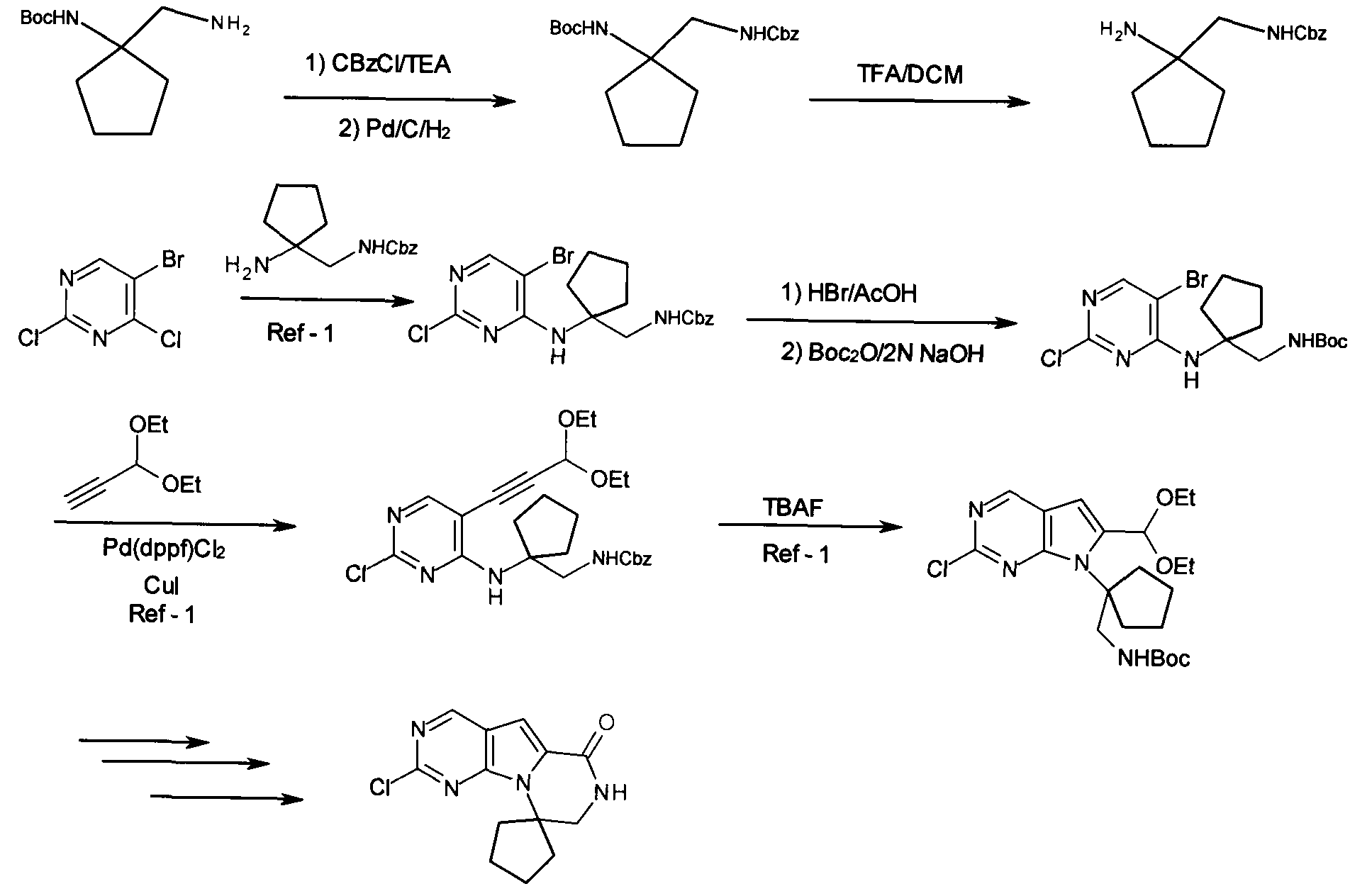
Scheme 2
In Scheme 2, Ref - 1 is WO 2010/020675 Al.
EXAMPLES
Intermediate 1A

To 7-[1-[(tert-butoxycarbonylamino)methyl]-2-methyl-propyl]-2-chloro-pyrrolo[2,3- d]pyrimidine-6-carboxylic acid 0.050 g (0.00013 mole) in DCM (1.5 ml.) was added DIC (32.7 mg) and DMAP (10 mg). The contents were stirred for 2 hrs at room temperature.
Trifluoroacetic acid (0.4 ml.) was then added and stirring continued for an additional 30
minutes. After addition of satd NaHC03 to neutralize the excess acid, ethyl acetate was then added and the organic layer separated, dried using magnesium sulfate and then concentrated under vacuum. The crude product was column chromatographed over silica gel using hexane/ethyl acetate (0- 100%) to afford Intermediate 1A. 1 H NMR (600 MHz, DMSO-d6) δ ppm 0.72 (d, J=6.73 Hz, 3 H) 0.97 (d, 6.73 Hz, 3 H) 2.09 - 2.22 (m, 1 H) 3.57 (dd, J=13.18, 4.98 Hz, 1 H) 3.72 (dd, =13.61 , 4.25 Hz, I H) 4.53 (dd, J=8.05, 3.95 Hz, I H) 7.20 (s, 1 H) 8.34 (d, J=4.98 Hz, 1 H) 9.08 (s. 1 H). LCMS (ESI) 265 (M + H).
Intermediate 1 B:

Intermediate 1 B was synthesized using analogous reaction conditions as described for Intermediate 1A to afford intermediate 1 B. The analytical data is consistent with that reported for the racemate (Intermediate 1A).
Intermediate 1 C:

Intermediate 1C was synthesized using analogous reaction conditions as described for Intermediate 1A to afford intermediate 1 C. The analytical data is consistent with that reported for the racemate (Intermediate 1A).
Intermediate ID:

Intermediate 1 E:

Intermediate 1 E was synthesized using analogous reaction conditions as described for Intermediate 1A to afford intermediate 1 E. Ή NMR (600 MHz. DMSO-ay δ ppm 0.74 (t, J=7.32 Hz, 3 H)0.89 (d, J=6.73 Hz, 3 H) 1.00 - 1.12 (m, 2 H) 1.82 - 1.94 (m, 1 H)3.55 (dd, J=13.9 1 , 4.83 Hz, 1 H) 3.70 (dd, J=13.61 , 4.25 Hz, 1 H) 4.57 (dd, J=7.91 , 4.10 Hz, 1 H) 7.17 (s, 1 H) 8.31 (d, J=5.27 Hz, 1 H) 9.05 (s, 1 H). LCMS (ESI) 279 (M+ H).
Intermediate IF
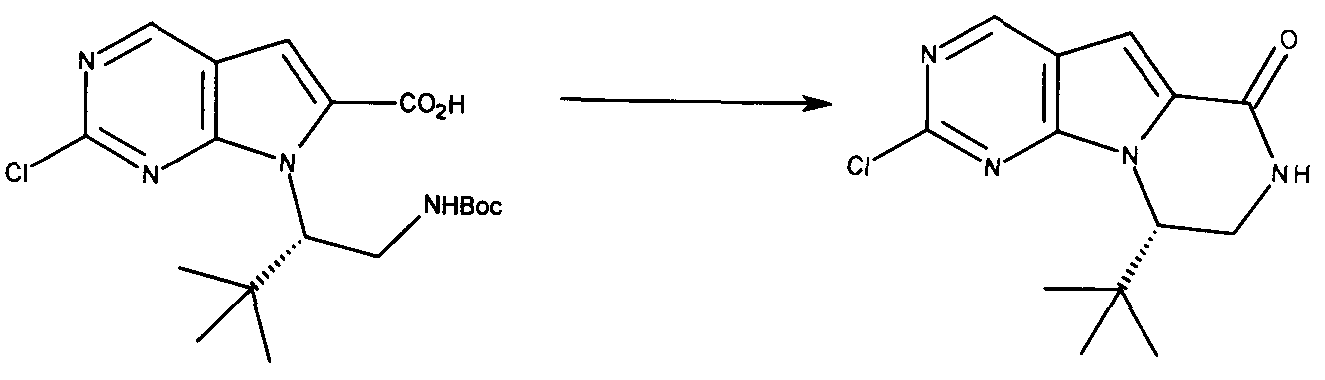
Intermediate 1 F was synthesized using an analogous synthetic sequence as that described for intermediate 1A. LCMS (ESI) 279 (M + H).
Intermediate 1G

Intermediate 1 G was synthesized using an analogous synthetic sequence as that described for intermediate 1A. 1 H NMR (600 MHz.. DMSO-cfe) δ ppm 3.58 - 3.69 (m, 1 H) 4.13 (dd, J=13.47, 4.39 Hz, 1 H) 6.07 (d, J=3.81 Hz, I H) 6.85 (d. J=7.32 Hz, 2 H) 7.19 -7.31 (m, 3 H) 7.34 (s, 1 H) 8.27 (d, J=5.27 Hz; 1 H) 9.13 (s, 1 H). LCMS (ESI) 299 (M + H).
Intermediate 1 H

Intermediate 1 H was synthesized using an analogous synthetic sequence as that described for intermediate 1A. LCMS (ESI) 265 (M + H).
Intermediate 11

Intermediate 1 I was synthesized using an analogous synthetic sequence as that described for intermediate 1A. The analytical data was consistent with that described for its antipode (intermediate 1 H). 1 H NMR (600 MHz, DMSO-d6) δ ppm 0.88 (d, J=6.44 Hz, 6 H) 1.73 -1.86 (m, 1 H) 3.67 - 3.76 (m, 2 H) 4.11 - 4.21 (m, 1 H) 7.13 - 7.19 (m, 1 H) 8.56 (s, I H) 9.05 (s, 1 H). LCMS (ESI) 265 (M + H).
Intermediate 1J
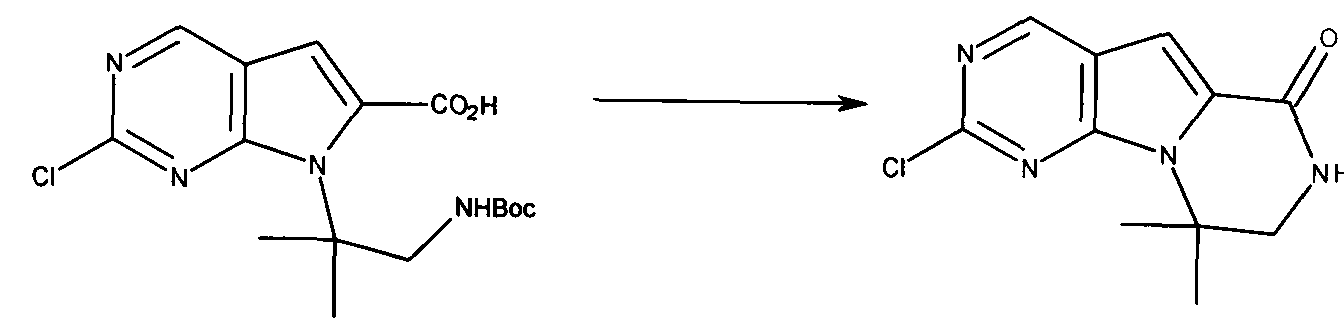
Intermediate IJ was synthesized using an analogous synthetic sequence as that described for intermediate 1A. 1 H NMR (600 MHz. DMSO-d6) δ ppm 1.73 (s, 6 H) 3.50 (d. J=2.93 Hz, 2H) 7.25 (s, 1 H) 8.46 - 8.55 (m, 1 H) 9.07 (s, 1 H). LCMS (ESI) 251 (M + H).
Intermediate 1 K
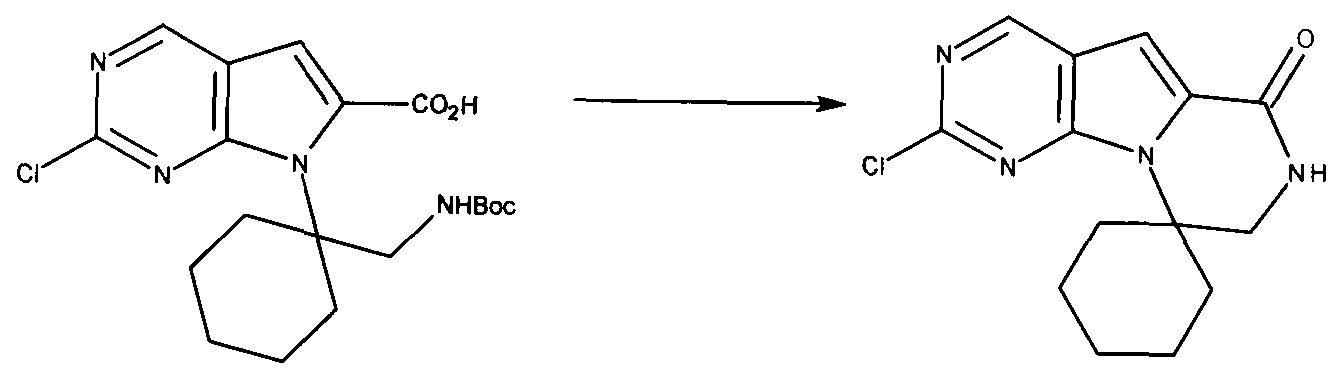
Intermediate K was synthesized using an analogous synthetic sequence as that described for intermediate 1A. 1 H NMR (600 MHz, DMSO-cfe) δ ppm 1.28 (br. s., 2 H) 1.42 (br. s., 2 H) 1.70 (br. s., 4 H) 1.85 - 1.95 (m, 2 H) 2.69 (m, 2 H) 7, 16 - 7.25 (m, 1 H) 8.41 (br. s., 1 H) 9.04 (s, 1 H). LCMS 291 (M+H).
Intermediate 1 L

Intermediate 1 L was synthesized using an analogous synthetic sequence as that described for intermediate 1A. 1 H NMR (600 MHz, DMSO-cfe) ppm 1.72 (br. s., 2 H) 1.86 1.93 (m, 2 H) 199 (d, J=3.81 Hz, 2 H) 2.40 (br. s., 2 H) 3.48 (d, J=2.34 Hz, 2 H) 7.22 (s, 1 8.53 (br. s., 1 H) 9.05 (s, 1 H). LCMS (ESI) 277 (M + H).
Intermediate 1 M

Intermediate 1M was synthesized using an analogous synthetic sequence as that described for intermediate 1 A. The analytical data for this racemate is consistent with that described for the L-isomer.
Intermediate 1 N
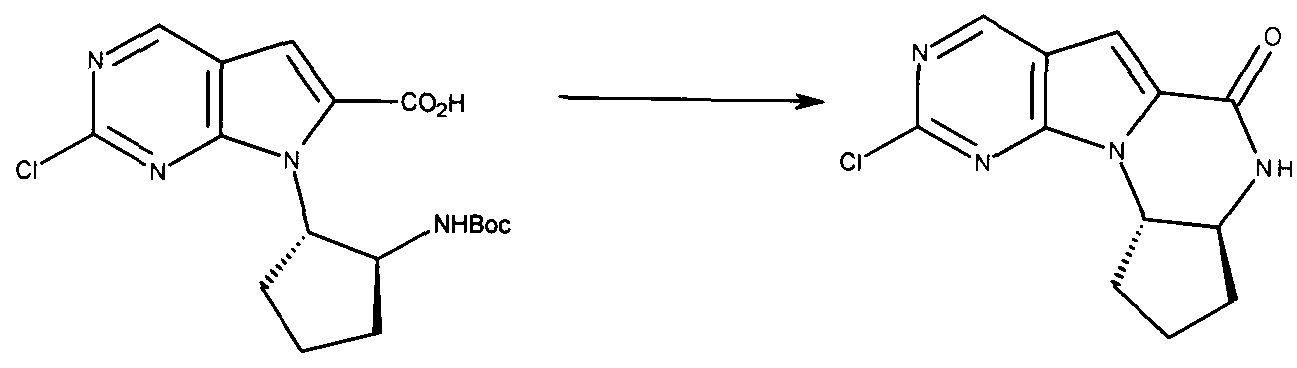
Intermediate 1 N was synthesized using an analogous synthetic sequence as that described for intermediate 1A. 1 H NMR (600 MHz, DMSO-af6) δ ppm 1.48 - 1.60 (m, 1 H) 1.88 - 1.98 (m, 3 H) 1.99 - 2.08 (m, 1 H) 2.66 - 2,75 (m, 1 H)3.63 - 3.74 (m, 1 H) 3.99 - 4.12 (m, 1 H) 7.21 (s, 1 H) 8.89 (s, 1 H) 9.04 (s, 1 H). LCMS (ESI) 263 (M + H).
Also part of the present invention is concerned with the synthesis of tricyclic amide derivatives.
The invention synthesis also relates to intermediates for compounds of the general formula (IV):
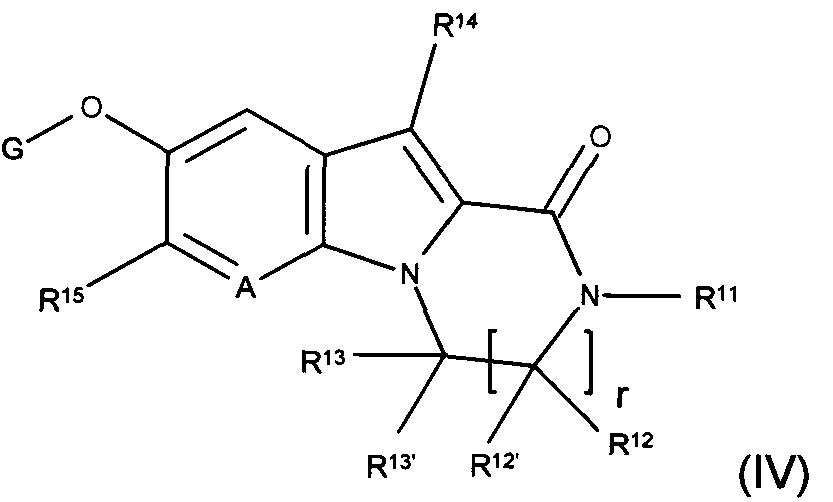
wherein for formula (IV)
A is C or N;
R is 1 or 2;
R11 is selected from the group consisting of hydrogen, lower alkyl, lower hydroxyalkyi, lower
alkoxyalkyl, lower halogenalkyl, lower hydroxyhalogenalkyl, lower alkanoyl, lower alkylsulfonyl, lower phenylsulfonyl, lower cycloalkylalkyl, lower phenylalkyl (wherein the phenyl ring may be unsubstituted or substituted with one or two groups independently selected from lower alkyl, cyano, halogen, lower halogenalkyl, lower alkoxy and lower hydroxyalkyi), lower heteroarylalkyl (wherein the heteroaryl ring may be unsubstituted or substituted with one or two groups independently selected from lower alkyl, halogen, phenyl, lower alkoxy and lower hydroxyalkyi), lower heterocyclylalkyi ( wherein the heterocyclyl ring may be unsubstituted or substituted with one or two groups independently selected from lower alkyl, halogen, phenyl, lower alkoxy and lower hydroxyalkyi), and -CH2-CO-NR16R17, R16 and R17 independently from each other are selected from the group hydrogen, lower alkyl and phenyl unsubstituted or substituted with one or two groups independently selected from lower alkyl, halogen, lower halogenalkoxy and lower hydroxyalkyi, or R16 and R17 together with the nitrogen atom to which they are attached form a 4-, 5-, 6- or 7-membered heterocyclic ring optionally containing a further heteroatom selected from nitrogen, oxygen or sulfur, a sulfinyl group or a sulfonyl group, said heterocyclic ring being unsubstituted or substituted by one, two or three groups independently selected from lower alkyl, halogen, halogenalkyl, hydroxyl, lower hydroxyalkyi, lower alkoxy, oxo, phenyl, benzyl, pyridyl and carbamoyl;
R12, R12 , R13 and R13 independently from each other are selected from the group consisting of hydrogen, lower alkyl, lower hydroxyalkyi and lower alkoxyalkyl;
R14 is selected from the group consisting of hydrogen and halogen;
R15 is hydrogen or halogen;
G is a group selected from G1 , G2, G3 and G4


u is 0, 1 or 2;
R18 is selected from lower alkyl, cycloalkyl, lower cycloalkylalkyl and lower phenylalkyl; v is 0, 1 or 2;
R19 is lower alkyl;
B is selected from CR23R23', O and S;
R8, R8 , R9, R9', R10, R10', R23 and R23' independently from each other are selected from the group consisting of hydrogen, lower alkyl, hydroxyl, halogen and dialkylamino, or
R9 and R23 together form a double bond;
p is 0, 1 or 2;
q is 0, 1 or 2;
R21 is lower alkyl:
R22 is lower alkyl;
and pharmaceutically acceptable salts thereof.
The compounds of formula (IV) are antagonists and/or inverse agonists at the histamine 3 receptor (H3 receptor). Their utility is described in WO 2007/065820 published 14 June 2007. The present invention provides a method of creating the lactam ring in (IV) using intermediates in WO 2007/065820 or with minor modifications thereof as known by the art. In particular the intermediate labeled B (R2 = H) in scheme 1 of WO 2007/065820 may be used in the present invention by subjecting it to the conditions described for the synthesis of lactams using a strong acid in conjunction with a dehydrating agent or a strong acid anhydride.
An object of the present invention to provide a partial route to the synthesis of selective, directly acting H3 receptor antagonists respectively inverse agonists. Such antagonists/inverse agonists are useful as therapeutically active substances, particularly in the treatment and/or prevention of diseases which are associated with the modulation of H3 receptors.
In the present description for compounds within formula (IV), the term "alkyl," alone or in combination with other groups, refers to a branched or straight-chain monovalent saturated aliphatic hydrocarbon radical of one to twenty carbon atoms, preferably one to sixteen carbon atoms, more preferably one to ten carbon atoms.
Within the formula (IV), the term "lower alkyl" or "Ci-Ce-alkyl", alone or in
combination, signifies a straight-chain or branched-chain alkyl group with 1 to 8 carbon
atoms, preferably a straight or branched-chain alkyl group with 1 to 6 carbon atoms and particularly preferred a straight or branched-chain alkyl group with 1 to 4 carbon atoms. Examples of straight-chain and branched C^CB alkyl groups are methyl, ethyl, propyl, isopropyl, butyl, isobutyl, tert. -butyl, the isomeric pentyls, the isomeric hexyls, the isomeric heptyls and the isomeric octyls, preferably methyl and ethyl and most preferred methyl. Within the formula (IV), the term "cycloalkyl" or "C3-7-cycloalkyl" denotes a saturated carbocyclic group containing from 3 to 7 carbon atoms, such as cyclopropyl. cyclobutyl, cyclopentyl, cyclohexyl or cycloheptyl. Especially preferred are cyclopropyl and cyclobutyl. The term "lower cycloalkylalkyl" or "C3.7-cycloalkyl-C1-8-alkyl" refers to lower alkyl groups as defined above wherein at least one of the hydrogen atoms of the lower alkyl group is replaced by cycloalkyl. A preferred example is cyclopropylmethyl. The term "alkoxy" refers to the group R2 -0- wherein R24 is lower alkyl and the term "lower alkyl" has the previously given significance. Examples of lower alkoxy groups are e.g. methoxy, ethoxy, n-propoxy, isopropoxy, n-butoxy, isobutoxy, sec. butoxy and tert. butoxy, preferably methoxy and ethoxy and most preferred methoxy. The term "lower alkoxyalkyl" or "C1-8-alkoxy-C1-8-alkyr refers to lower alkyl groups as defined above wherein at least one of the hydrogen atoms of the lower alkyl groups is replaced by an alkoxy group, preferably methoxy or ethoxy. Among the preferred lower alkoxyalkyl groups are 2-methoxyethyl or 3-methoxy propyl. The term "alkylsulfonyl" or "lower alkylsulfonyl" refers to the group R24-S(0)2-, wherein R24 is lower alkyl and the term "lower alkyl" has the previously given significance. Examples of alkylsulfonyl groups are e.g. methylsulfonyl or ethylsulfonyl. The term "halogen" refers to fluorine, chlorine, bromine and iodine, with fluorine, chlorine and bromine being preferred. The term "lower halogenalkyl" or "halogen-C1-8-alky refers to lower alkyl groups as defined above wherein at least one of the hydrogen atoms of the lower alkyl group is replaced by a halogen atom, preferably fluoro or chloro, most preferably fluoro. Among the preferred halogenated lower alkyd groups are trifluoromethyl, difluoromethyl, trifluoroethyl,
fluoromethyl and chloromethyl, with trifluoroethyl being especially preferred. The term "lower hydroxyhalogenalkyl" or "hydroxyhalogen-C1-8-alkyl" refers to lower halogenalkyl groups as defined above wherein at least one additional hydrogen atom of the lower alkyl group is replaced by a hydroxy group. A preferred example for a lower hydroxyhalogenalkyl group is 4,4,4-trifluoro-3-hydroxy-butyl. The term "lower halogenalkoxy" or "halogen-Ci-8-alkoxy" refers to lower alkoxy groups as defined above wherein at least one of the hydrogen atoms of the lower alkoxy group is replaced by a halogen atom, preferably fluoro or chloro, most
preferably fluoro. Among the preferred halogenated lower alkyl groups are trifluoromethoxy, difluoromethoxy, fluormethoxy and chloromethoxy, with trifluoromethoxy being especially preferred. The term "lower hydroxyalkyl" or "hydroxy-Ci.8-alkyl" refers to lower alkyl groups as defined above wherein at least one of the hydrogen atoms of the lower alkyl group is replaced by a hydroxy group. Examples of lower hydroxyalkyl groups are hydroxymethyl or hydroxyethyl.
Within the formula (IV), the term "dialkylamino" refers to the group -NR2 R25, wherein R24 and R25 are lower alkyl and the term "lower alkyl" has the previously given significance. A preferred dialkylamino group is dimethylamino. The term "lower alkanoyi" refers to the group -CO-R24, wherein R24 is lower alkyl and the term "lower alkyl" has the previously given significance. Preferred is a group -CO-R24, wherein R24 is methyl, meaning an acetyl group. The term "carbamoyl" refers to the group -CO-NH2. The term "lower phenylalkyl" or "phenyl- C1-8-alkyl" to lower alkyl groups as defined above wherein at least one of the hydrogen atoms of the lower alkyl group is replaced by a phenyl group. Preferred lower phenylalkyl groups are benzyl or phenethyl.
Within the formula (IV), the term "heteroaryl" refers to an aromatic 5- or 6-membered ring which can comprise one, two or three atoms selected from nitrogen, oxygen and/or sulphur. Examples of heteroaryl groups are e.g, furyl, pyridyl, pyrazinyl, pyrimidinyl, pyridazinyl, thienyl, isoxazolyl, thiazolyl, isothiazolyl, oxazolyl, imidazolyl, or pyrrolyl.
Especially preferred are pyridyl, thiazolyl and oxazolyl. The term "lower heteroarylalkyl" or "heteroaryl-C1-8-alkyl refers to lower alkyl groups as defined above wherein at least one of the hydrogen atoms of the lower alkyl group is replaced by a heteroaryl group as defined above. The term "heterocyclyl" refers to a saturated or partly unsaturated 5- or 6-membered ring which can comprise one, two or three atoms selected from nitrogen, oxygen and/or sulphur. Examples of heterocyclyl rings include piperidinyl, piperazinyl, azepinyl, pyrrolidinyl, pyrazolidinyl, imidazolinyl, imidazolidinyl, oxazolidinyl, isoxazolidinyl, morpholinyl, thiazolidinyl, isothiazolidinyl, thiadiazolylidinyl, dihydrofuryl, tetrahydrofuryl, dihydropyranyl, tetrahydropyranyl, and thiomorpholinyl. A preferred heterocyclyl group is piperidinyl. The term "lower heterocyclylalkyl" or "heterocyclyl-Cve-alkyl" refers to lower alkyl groups as defined above wherein at least one of the hydrogen atoms of the lower alkyl group is replaced by a heterocyrlyl group as defined above. The term "form a 4-, 5-, 6- or 7- membered heterocyclic ring optionally containing a further heteroatom selected from nitrogen, oxygen or sulfur" refers to a N-heterocyclic ring, which may optionally contain a
further nitrogen, oxygen or sulfur atom, such as azetidinyl, pyrrolidinyl, imidazolidinyl, pyrazolidinyl, oxazolidinyl, isoxazolidinyl, thiazolidinyl, isothiazolidinyl, piperidinyl, piperazinyl , morpholinyl, thiomorpholinyl, or azepanyl. A "4-, 5-, 6- or 7-membered heterocyclic ring containing a sulfinyl group or a sulfonyl group" means a N-heterocyclic ring that contains a -S(O)- group or a -S02- group, for example 1-oxothiomorpholinyl or 1 ,1- dioxothiomorpholinyl. The heterocyclic ring may be unsubstituted or substituted by one, two or three groups independently selected from lower alkyl, lower alkoxy and oxo. The heterocyclic ring may also be condensed with a phenyl ring, said phenyl ring being unsubstituted or substituted by one, two or three groups independently selected from lower alkyl, lower alkoxy and halogen. An example for such a condensed heterocyclic ring is 3,4- dihydro-1H-isoquinoline. The term "oxo" means that a C-atom of the heterocyclic ring may be substituted by =0, thus meaning that the heterocyclic ring may contain one or more carbonyl (-CO-) groups. The term "pharmaceutically acceptable salts" refers to those salts which retain the biological effectiveness and properties of the free bases or free acids, which arc not biologically or otherwise undesirable. The salts are formed with inorganic acids such as hydrochloric acid, hydrobromic acid, sulfuric acid, nitric acid, phosphoric acid and the like, preferably hydrochloric acid, and organic acids such as acetic acid, propionic acid, glycolic acid, pyruvic acid, oxylic acid, maleic acid, malonic acid, salicylic acid, succinic acid, fumaric acid, tartaric acid, citric acid, benzoic acid, cinnamic acid, mandelic acid, methanesulfonic acid, ethanesulfonic acid, p-toluenesulfonic acid, salicylic acid, N-acetylcystein and the like. In addition these salts may be prepared from addition of an inorganic base or an organic base to the free acid. Salts derived from an inorganic base include but are not limited to, the sodium, potassium, lithium, ammonium, calcium, magnesium salts and the like. Salts derived from organic bases include, but are not limited to salts of primary, secondary, and tertiary amines, substituted amines including naturally occurring substituted amines, cyclic amines and basic ion exchange resins, such as isopropylamine, trimethylainine, diethylamine, triethylamine, tripropylalmine. ethanolamine, lysine, arginine, N-ethylpiperidine, piperidine, polymine resins and the like. The compound of formula (IV) can also be present in the form of zwitterions. Particularly preferred pharmaceutically acceptable salts of compounds of formula (IV) are the hydrochloride salts.
The compounds of formula (IV) can also be solvated, e.g. hydrated. The solvation can be effected in the course of the manufacturing process or can take place e.g. as a consequence of hygroscopic properties of an initially anhydrous compound of formula (IV)
(hydration). The term pharmaceutically acceptable salts also includes physiologically acceptable solvates.
"Isomers" are compounds that have identical molecular formulae but that differ in the nature or the sequence of bonding of their atoms or in the arrangement of their atoms in space. Isomers that differ in the arrangement of their atoms in space are termed
"stereoisomers". Stereoisomers that are not mirror images of one another are termed "diastereoisomers", and stereoisomers that are non-superimposable mirror images are termed "enantiomers", or sometimes optical isomers. A carbon atom bonded to four nonidentical substituents is termed a "chiral center".
Examples of compounds of formula (IV) are the following:
8-(1-isopropyl-piperidin-4-yloxy)-3,4-dihydro-2H-pyrazino[1 ,2- a]indol-1-one; 8-(3-piperidin-1- yl-propoxy)-3,4-dihydro-2H-pyrazino[1 ,2-a] indol-1-one; 8-(1-cyclopropylmethyl-piperidin-4- yloxy)-3,4-dihydro-2H-pyrazino[1 ,2-a] indol-1-one; 8-[3-((R)-3-hydroxy-pyrrolidin-1-y1)- propoxy] 3,4-dihydro-2H-pyrazino[1 ,2-a] indol-1-one; 8-[3-((R)-2-methyl-pyrrolidin-1-yl)- propoxy]-3,4-dihydro-2H-pyrazino[1 ,2-a]indol-1 -one; 8-[3-((S)-2-methyl-pyrrolidin-1 -y1 )- propoxy]-3,4-dihydro-2H-pyrazino[1 ,2-a]indol-1 -one; 8-[3-((2S,5S)-2,5-dimethyl-pyrrolidin-1 - yl)-propoxy]-3,4-dihydro-2H-pyrazino[1 ,2-a]indol-1 -one; (R)-8-(1 -isopropyl-piperidin-4-yloxy)- 4-methyl-3,4-dihydro-2H-pyrazino[1 ,2-a]indol-1 -one; (R)-4-methyl-8-(3-piperidin-1 -yl- propoxy)-3,4-dihydro-2H-pyrazino[1 ,2-a] indol-1-one; (R)-8-[3-((R)-3-hydroxy-pyrrolidin-1- y1 )-propoxy]-4-methyl-3,4-dihydro-2H-pyrazino[1 ,2-a]indol-1 -one; (S)-8-(1 -isopropyl- piperidin-4-yloxy)-4-methyl-3,4-dihydro-2H- pyrazino[1 ,2-a] indol-1-one; (S)-4- hydroxymethyl-8-(1-isopropyl-piperidin-4-yloxy)-3,4-dihydro-2H-pyrazino[1 ,2-a]indo1-1-one; (S)-8-(1-isopropyl-piperidin-4-yloxy)-3-methyl-3,4-dihydro-2H-pyrazino[1 ,2-a]indol-1-one; (R)-8-(1-isopropyl-piperidin-4-yloxy)-3-methy1-3,4-dihydro-2H- pyrazino[1 ,2-a]indol-1-one; 9- (1-isopropyl-piperidin-4-yloxy)-2,3,4,5-tetrahydro[1 ,4]diazepino[1 ,2-a]indol-1-one; 9-(3- pyrrolidin-1- yl-propoxy)-2,3,4,5-tetrahydro-[1 ,4]diazepino[1 ,2-a]indol-1-one; 2- cyclopropylmethyl-8-(1-isopropyl-piperidin-4-yloxy)-3,4-dihydro-2H-pyrazino[1 ,2-a] indol-1- one; 8-(1 -isopropyl-piperidin-4-yloxy)-2-(2-methoxy-ethyl)-3,4-dihydro-2H-pyrazino[1 ,2- a]indol-1-one; 8-(1-isopropy1-piperidin-4-yloxy)-2- (2,2,2-trifluoro-ethyl)-3,4-dihydro-2H- pyrazino[1 ,2-a]indol-1-one; 8-(1-isopropyl-piperidin-4-yloxy)-2-methy1-3,4-dihydro-2H- pyrazino[1 ,2-a] indol-1-one; 2-ethyl-8-(1-isopropyl-piperidin-4-yloxy)-3,4-dihydro-2H- pyrazino[1 ,2-a]indol-1 -one; 2-isopropyl-8-(1 -isopropyl-piperidin-4-yloxy)-3,4-dihydro-2H- pyrazino[1 ,2-a]indol-1 -one; (R)-2-cyclopropylmethyl-8-(1 -isopropyl-piperidin-4-yloxy)-4-
methyl-3,4-dihydro-2H-pyrazino[1 ,2-a]indol-1 -one; (R)-8-(1 -isopropyl-piperidin-4-yloxy)-2-(2- methoxyethyl)-4-methyl-3,4-dihydro-2H-pyrazino[1 ,2-a]indol-1 -one; (R)-8-(1 -isopropyl- piperidin-4-yloxy)-2,4-dimethyl-3,4-dihydro-2H-pyrazazino[1 ,2a]indol-1 -one; (R)-8-(1 - isopropyl-piperidin-4-yloxy)-4-methyl-2-(2,2,2-trifluoroethyl]-3,4-dihydro-2H-pyrazino[1 ,2- a]indol-1 -one; 2-ethyl-8-(1 -isopropyl-piperidin-4-yloxy)-4-methyl-3,4-dihydro-2H-pyrazino[1 ,2- a]indol-1 -one; (S)-2-cyclopropylmethyl-8-(1 -isopropyl-piperidin-4-yloxy)-4-methyl-3,4- dihydro-2H-pyrazino[1 ,2-a]indol-1-one; (S)-8-(1-isopropyl-piperidin-4-yloxy)-2-(2-methoxy- ethyl)-4-methyl-3,4-dihydro-2H-pyrazino[1 ,2-a]indol-1-one; (S)-2-cyclopropylmethyl-8-(1- isopropyl-piperid in-4-yloxy)-3-methyl-3,4-dihydro-2H-pyraino[1 ,2-a]indol-1-one; (S)-8-(1- isopropyl-piperidin-4-yloxy)-2-(2-methoxyethyl)-3-methyl-3,4-dihydro-2H-pyrazino[1 ,2- a]indol-1 -one; (R)-2-cyclopropylmethy1 -8-(1 -isopropyl-piperidin-4-yloxy)-3-methyl-3,4- dihydro-2H-pyrazino[1 ,2-a]indol-1-one; (R)-8-(1-isopropyl-piperidin-4-yloxy)-2-(2- methoxyethyl)-3,4-dihydro-2H-pyrazino[1 ,2-a]indol-1 -one; 2-[8-(1 -isopropylpiperidin-4-yloxy)- 1-oxo-3,4-dihydro-1 H-pyrazino[1 ,2-a]indol-2-yl]-acetamide; 2-[8-(1-isopropyl- piperidin-4- yloxy)-1-oxo-3,4-dihydro-1 H-pyrazino[1 ,2-a]indo1-2-yl]-N-methyl-acetamide; 2-[8-(1- isopropyl-piperidin-4-yloxy)-1 -oxo-3,4-dihydro-1 H -pyrazino[1 ,2-a]indo1 -2-yl]-N,N-dimethyl- acetamide; 8-(1-isopropyl-piperidin-4-yloxy)-2-(2-morpholin-4-yl-2-oxo-ethyl)-3,4-dihydro-2H- pyrazino[1 ,2-a]indol-1-one; N-isopropyl-2-[8-(1-isopropyl-piperidin-4-yloxy)-1-oxo-3,4- dihydro-1 H-pyrazino[1 ,2-a]indol-2-y1]-acetamide; N,N-diisopropyl-2-[8-(1-isopropyl-piperidin- 4-yloxy)-1-oxo-3,4-dihydro-1 H-pyrazino[1 ,2-a]indol-2-yl]-acetamide; 2-[8-(1-isopropyl- piperidin-4-yloxy)-1-oxo-3,4-dihydro-1 H-pyrazino[1 ,2-a]indol-2-y1]-N-phenyl-acetamide; 2- benzyl-8-(1-isopropyl-piperidin-4-yloxy)-3,4-dihydro-2H-pyrazino[1 ,2a]indol-1-one; 8-(1- isopropyl-piperidin-4-yloxy)-2-(2-trifluoromethylbenzyl)-3,4-dihydro-2H-pyrazino[1 ,2-a]indol- 1 -one; 8-(1 -isopropyl-piperidin-4-yloxy)-2-(3-trifluoromethylbenzyl)-3,4-dihydro-2H- pyrazino[1 ,2-a]indol-1 -one; 8-(1 -isopropyl-piperidin-4-yloxy)-2-(4-triftuoromethyl-benzyl)-3,4- dihydro-2H-pyrazino[1 ,2-a]indol-1 -one; 8-(1 -isopropyl-piperidin-4-yloxy)-2-(2-methoxy- benzyl)-3,4-dihydro-2H-pyrazino[1 ,2-a]indol-1-one; 8-(1-isopropyl-piperidin-4-yloxy)-2-(3- methoxy-benzyl)-3,4-dihydro-2H-pyrazino[1 ,2-a]indol-1 -one; 8-(1 -isopropyl-piperidin-4- yloxy)-2-(4-methoxy-benzyl)-3,4-dihydro-2H-pyrazino[1 ,2-a]indol-1-one; 2-(2-fluoro-benzyl)- 8-(1-isopropyl-piperidin-4-yloxy)-3,4-dihydro-2H-pyrazino[1 ,2-a]indol-1-one; 2-(3-fluoro- benzyl)-8-(1 -isopropyl-piperidin-4-yloxy)-3,4-dihydro-2H-pyrazino[1 ,2-a]indol-1 -one; 2-(4- fluoro-benzyl)-8-(1-isopropyl-piperidin-4-yloxy)-3,4-dihydro-2H-pyrazino[1 ,2-a]indol-1-one; 2- [8-(1 -isopropyl-piperidin-4-yloxy)-1 -oxo-3,4-dihydro-1 H-pyrazino[1 ,2-a]indol-2-ylmethyl]-
benzonitrile; 3-[8-(1-isopropyl-piperidin-4-yloxy)-1-oxo-3,4-dihydro-1 H-pyrazino[1 ,2-a]indol-2- ylmethyl]-benzonitrile; 4-[8-(1 -isopropyl-piperidin-4-yloxy)-1 -oxo-3,4-dihydro-1 H- pyrazino[1 ,2-a]indol-2-ylmethyl]-benzonitrile; 8-(1-isopropyl-piperidin-4-yloxy)-2-pyridin-2- ylmethyl-3,4-dihydro-2H-pyrazino[1 ,2-a]indol-1-one; 8-(1-isopropyl-piperidin-4-yloxy)-2- pyridin-3-ylmethyl-3,4-dihydro-2H-pyrazino[1 ,2-a]indol-1-one; 8-(1 isopropyl-piperidin-4- yloxy)-2-pyridin-4-methyl-3,4-dihydro-2H-pyrazino[1 ,2-a]indol-1-one; 8-(1-isopropyl-piperidin- 4-yloxy)-2-(1 -phenyl-ethyl)-3,4-dihydro-2H-pyrazino[1 ,2-a]indol-1 -one; 2-(3-hydroxy-propyl)- 8-(1-isopropyl-piperidin-4-yloxy)-3,4-dihydro-2H-pyrazino[1 ,2-a]indol-1-one; 2-(2-hydroxy- ethyl)-8-(1 -isopropyl-piperidin-4-yloxy)-3,4-dihydro-2H-pyrazino[1 ,2-a]indol-1 -one; (R)-2- benzyl-8-(1-isopropyl-piperidin-4-yloxy)-4-methyl-3,4-dihydro-2H-pyrazino[1 ,2-a]indol-1-one; (R)-8-(1-isopropyl-piperidin-4-yloxy)-4-methyl-2-pyridin-2-ylmethyl-3,4-dihydro-2H- pyrazino[1 ,2-a]indol-1 -one; (R)-8-(1 -isopropyl-piperidin-4-yloxy)-4-methyl-2-pyridin-3- ylmethy1-3,4-dihydro-2H-pyrazino[1 ,2-a]indol-1-one; (R)-8-(1-isopropyl-piperidin-4-yloxy)-4- methyl-2-pyridin-4-ylmethyl-3,4-dihydro-2H-pyrazino[1 ,2-a]indol-1 -one; (R)-8-(1 -isopropyl- piperidin-4-yloxy)-4-methyl-2-(2-methyl-thiazol-4-ylmethyl)-3,4-dihydro-2H-pyrazino[1 ,2- a]indol-1-one; (R)-8-(1-isopropyl-piperidin-4-yloxy)-4-methyl-2-(5-methyl-2-phenyl-oxazol-4- ylmethyl)-3,4-dihydro-2H-pyrazino[1 ,2-a]indol-1-one; (R)-8-(1-isopropyl-piperidin-4-yloxy)-4- methyl-2-(5-phenyl-[1 ^^loxadiazol-S-ylmethy -S^-dihydro^H-pyrazinofl ,2-a]indol-1 -one; (RJ^-iS.S-dimethyl-isoxazol^-ylmethy -S-il-isopropyl-piperidin^-yloxyJ^-methyl-S^- dihydro-2H-pyrazino[1 ,2-a]indol-1 -one; (R)-8-(1 -isopropyl-piperidin-4-yloxy)-4-methyl-2-(5- methyl-3-phenyl-isoxazol-4-ylmethyl)-3,4-dihydro-2H-pyrazino[1 ,2-a]indol-l-one; (R)-8-(1- isopropyl- piperidin-4-yloxy)-4-methyl-2-(5-methyl-isoxazol-3-yimethyl)-3,4-dihydro-2H- pyrazino[1 ,2-a]indol-1-one; (R)-2-(3-hydroxy-propy1)-8-(1-isopropyl-piperidin-4-yloxy)-4- methyl-3,4-dihydro-2H-pyrazino[1 ,2-a]indol-1- one; (R)-2-(2-hydroxy-ethyl)-8-(1-isopropyl- piperidin-4-yloxy)-4-methyl-3,4-dihydro-2H-pyrazino[1 ,2-a]indol-1-one; (R)-8-(1-isopropyl- piperidin-4-yloxy)-4-methyl-2-((R)-4,4,4-trifluoro-3-hydroxy-butyl)-3,4-dihydro-2H- pyrazino[1 ,2-a]indol-l-one; (R)-2-acetyl-8-(1 -isopropyl-piperidin-4-yloxy)-4-methyl-3,4- dihydro-2H-pyrazino[1 ,2-a]indol-1-one; (R)-2-benzenesulfonyl-8-(1-isopropyl- piperidin-4- yloxy)-4-methyl-3,4-dihydro-2H-pyrazino[1 ,2-a]indol-1 -one; (S)-2-cyclopropylmethyl-4- hydroxymethyl-8-(1-isopropyl- piperidin-4-yloxy)-3,4-dihydro-2H-pyrazino[1 ,2-a]indol-1-one; (S)-2-cyclopropylmethyl-8-(1-isopropyl-piperidin-4-yloxy)-4-methoxymethyl-3,4-dihydro-2H- pyrazino[1 ,2- a]indol-l-one; (S)-4-hydroxymethyl-8-(1-isopropyl-piperidin-4-yloxy)-2-methyl- 3,4-dihydro-2H-pyrazino[1 ,2-a]indol-l-one; 2-cyclopropylmethyl-9-isopropyl-piperidin-4-
yloxy)-2,3,4,5-tetrahydro-[1 ,4]diazepino[1 ,2-a]indol-1-one; 9-(1-isopropyl- piperidin-4-yloxy)- 2-(2-methoxy-ethyl)-2,3,4,5- tetrahydro-[1 ,4]diazepino[1 ,2-a]indol-1-one; 2- cyclopropylmethyl-9-(3-pyrrolidin-1-yl-propoxy)-2,3,4,5-tetrahydro-[1 ,4]diazepino[1 ,2-a]indol- 1 -one, 2-(2-methoxy-ethyl)-9-(3-pyrrolidin-1 -yl-propoxy)-2,3,4,5-tetrahydro- [1 ,4]diazepino[1 ,2-a]indol-1 -one; (R)-10-chloro-8-(1 -isopropyl-piperidin-4-yloxy)-4-methyl- 3,4-dihydro-2H-pyrazino[1 ,2- a]indol-1-one; (R)-10-bromo-8-(1-isopropyl-piperidin-4-yloxy)-4- methyl-3,4-dihydro-2H-pyrazino[1 ,2-a]indol-1-one; 7-(1-isopropyl-piperidin-4-yloxy)-3,4- dihydro-2H-2,4a,5-triaza-fluoren-1-one; 7-[3-((S)-2-methyl-pyrrolidin-l-y1)-propoxy]-3,4- dihydro-2H-2,4a,5- triaza-fluoren-1-one; 7-[3-((R)-2-methyl-pyrrolidin-1-y1)-propoxy]-3,4- dihydro-2H-2,4a,5-triaza-fluoren-1-one; 7-[3-((2R,5R)-2,5-dimethyl-pyrrolidin-l-yl)-propoxyl- 3,4-dihydro-2H-2,4a,5- triaza- fluoren-1-one; 7-(1-cyclopropylmethyl-piperidin-4-yloxy)-3,4- dihydro-2H-2,4a,5-triaza-fluoren-1-one; 2-cyclopropylmethyl-7-(l-isopropyl-piperidin-4-yloxy)- 3,4-dihydro-2H-2,4a,5-triaza-fluoren-1 -one; 7-(1 -isopropyl-piperidin-4-yloxy)-2-(2- methoxy- ethyl)-3,4-dihydro-2H-2,4a,5-triaza-fluoren-1-one; 7-(1-isopropyl-pipericlin-4-yloxy)-2-(2,2,2- trifluoro-ethyl)-3,4-dihydro-2H-2,4a,5-triaza-fluoren-1-one; 7-[3-((S)-2-methyl-pyrrolidin-1-yl)- propoxy]-2-(2,2,2- trifluoro-ethyl)-3,4-dihydro-2H-2,4a,5-triaza-fluoren-1-one; (R)-7-bromo-8- (1-isopropyl-piperidin-4-yloxy)-4- methyl -3,4-dihydro-2H[1 ,2-a]indol-1-one; (R)-7-bromo-2- cyclopropylmethyl-8-(1-isopropyl-piperidin-4-yloxy)-4-methyl-3,4-dihydro-2H-pyrazino[1 ,2- a]indol-l-one, and pharmaceutically acceptable salts thereof.
Further lactams which may be made by the invention include intermediates for compounds of formula (Q) and (QQ):

R26 is H, Ci-C6 alkyl, or haloalkyl, cycloalkyl, cycloalkyl containing one or more heteroatoms selected from N, O, and S;
each R is independently aryl, alkyl, cycloalkyl or haloalkyl, wherein each of said alkyl, cycloalkyl and haloalkyl groups optionally includes O or N heteroatoms and two R31s on adjacent ring atoms or on the same ring atom together with the ring atom(s) to which they are attached optionally form a 3-8-membered cycle;
yy is 0, 1 , 2, 3 or 4;
ZZ is -(CH2)xx- wherein xx is 1 , 2, 3 or 4 or -0-(CH2)xx- wherein xx is 2, 3 or 4;
R55 is NHRA, RA is unsubstituted d-d alkyl, cycloalkylalkyl, or -TT-RR, d-d cycloalkyl or cycloalkyl containing one or more heteroatoms selected from N, O, and S, TT is an unsubstituted or substituted C C6 alkyl or C3-C8 cycloalkyl linker, and RR is a hydroxyl, unsubstituted or substituted d-d alkoxy, amino, unsubstituted or substituted d-d alkylamino, unsubstituted or substituted di-d-C6 alkylamino, unsubstituted or substituted C6- d0 aryl, unsubstituted or substituted heteroaryl comprising one or two 5- or 6-member rings and 1-4 heteroatoms selected from N, O and S, unsubstituted or substituted C3-d0 carbocycle, or unsubstituted or substituted heterocycle comprising one or two 5- or 6- member rings and 1-4 heteroatoms selected from N, O and S;
R77 is -(alkylene)m-heterocyclo, -(alkylene)m-heteroaryl, -(alkylene)m-NR3R4,
-(alkylene)m-C(0)-NR3R4, -(alkylene)m-0-R5, -(alkylene)m-S(0)n-R5, or
-(alkylene)m-S(0)n-NR3R4 any of which may be optionally independently substituted with one or more Rx groups as allowed by valance, and wherein two Rx groups bound to the same or adjacent atoms may optionally combine to form a ring and wherein R3, R4 and R5, m, n, and R , in these definitions for R77 are as defined for formulae (I), (II), or (II).
R27 is -(alkylene)m C3- C8 cycloalkyl, -(alkylene)m aryl, -(alkylene)m-heterocyclo, (alkylene)m- heteroaryl, (alkylene)m -NR3R4, -(alkylene)m-C(0)-NR3R4, -(alkylene)m-0-R5,- (alkylene)m- S(0)n-R5, or -(alkylene)m-S(0)n-NR3R4 any of which may be optionally independently substituted with one or more R groups as allowed by valance, and wherein two R groups bound to the same or adjacent atom(s) may optionally combine to form a ring and wherein R3, R4 and R5, m, n, and R , in these definitions for R27 are as defined for formula (I), (II), or (II). For (Q), R27 may also be H, d-d alkyl or haloalkyl. Such compounds of formulae (Q) and (QQ) may be in the form of pharmaceutically acceptable salts.
In some specific cases, an aryl or heteroaryl can be orthophenyl substituted by alkyl, cycloalkyl, halo, haloalkyl, thioalkyl, sulfonylalkyl, alkoxy, haloalkoxy, cyano,
alkylcarboxamides or aminodialkyl. Aryl and heteroaryl could also be ortho-disubstituted phenyl with alkyl, cycloalkyl, halo, haloalkyl, thioalkyl, sulfonylalkyl, alkoxy, haloalkoxy,
cyano, alkylcarboxamides, or aminodialkyl as allowed by valence. Aryl and heteroaryl could also be meta or para substituted with alkyl, cycloalkyl, haloalky, halo, haloalkyl, thioalkyl, sulfonylalkyl, alkoxy, haloalkoxy, cyano, alkylcarboxamides or aminoalkyl.
Chloro Tricyclic Amide (MM) is an example of an intermediate for a compound of formula (Q) or (QQ), which can be made by the process of the present invention.

To 0.1 g (0.261 mmole) of 7-[2-(tert-butoxycarbonylamino)ethyl]-2-chloro-5-(o- tolyl)pyrrolo[2,3-d]pyrimidine-6-carboxylic acid in DCM (4.1 mL) was added DMAP (20 mg) followed by the addition of N,N-Diisopropylcarbodiimide (0.081 mL 2eq). After stirring for 3 hrs, trifluoroacetic acid (0.723 mL) was added. Stirring was then continued for another 30 minutes. The reaction mixture was neutralized with satd. NaHC03. DCM (20 mL) was then added and the organic layer separated, dried with magnesium sulfate and then concentrated under vacuum to afford the crude product which was columned using hexane/ethylacetate (0 - 100%) to afford chloro tricyclic amide (MM) (0.65 g). LCMS (ESI) 313 (M+H).
In more detail, an important part of this invention is a process to create a lactam. For example, the lactam (QQQ) below may be synthesized from the acid (RRR) according to the invention which comprises cyclizing an acid of the formula (RRR), wherein LG is a leaving group such as the atoms to form alkyl or aryl carbamates such as tBoc. The reaction conditions for the cyclization can be a one step process wherein, the addition of reagents are all done in one pot resulting in th direct formation of the lactam with the loss of LG. In certain cases, an additional step might be desirable for the loss of the LG after lactam formation.
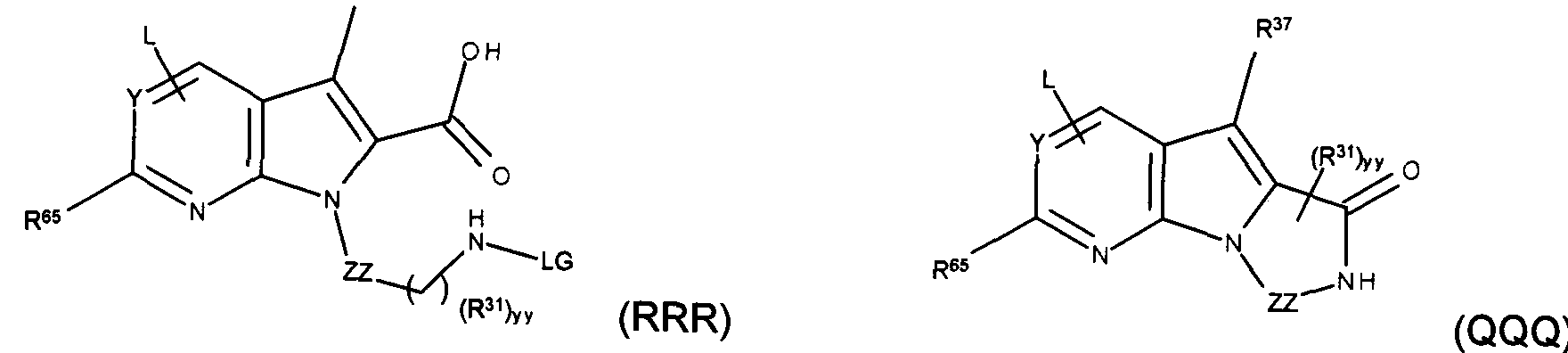
wherein
R37 is a value of R8 for formula (I), (II) or (III) or R37 is a value of R14 for formula (IV);
R31 , yy and ZZ are as defined above for (Q);
Y is -CH- or -N;
L as allowed by valance is hydrogen, aryl, heteroaryl, CrC8 alkoxy, aryloxy, heteroaryloxy, C!-Ce alkyl, cycloalkylalkyi, or -TT-RR as defined above for the formula (Q), d-C8 cycloalkyi or cycloalkyi containing one or more heteroatoms selected from N, O and S;
R65 is any leaving group that can be displaced by primary amine (for example to create an intermediate for a final product), examples of leaving groups being CI, Br, I, F, S e, Saryl, Sheteroaryl, SOMe, S02 e, SOalkyl, S02alkyl, SOcycloalkyl, S02cycloalkyl, SOaryl, S02aryl, hydroxy, hydroxyalkyl, hydroxyaryl or hydroxyheteroaryl, or R65 may be a value of R55 for the formula Q above or a value of the aromatic amine portion of each of the left-hand portions depicted in formula (I), (II) and (III), ie. of the subformulae (S), (SS) or (SSS):

(SSS) (SSSS)
Example: Tricyclic amide 1 :

Method B: To 7-[2-(tert-butoxycarbonylamino)ethyl]-2-chloro-pyrrolo[2,3-d]pyrimidine- 6- carboxylic acid 0.1 g (0.00029 mole) in DCM (4.5 mL) cooled to 0 degrees is added DMAP (10 mg) and 0-Benzotriazole-N,N,N',N'-tetramethyl-uronium-hexafluoro-phosphate (0.220, 2eq). After stirring for 30 minutes, trifluoroacetic acid (0.8 mL) is added dropwise and the contents stirred for 2 hrs. After neutralization with sat NaHC03, DCM (50 mL) is added and the organic layer separated, dried (magnesium sulfate) and then concentrated under vacuum to afford the crude product. Column chromatography with hexane/ethyl acetate (0 - 100%) over silica gel affords the tricyclic amide 1. The NMR and LCMS data were consistent with the product obtained using Method A.
Method C: To 7-[2-(tert-butoxycarbonylamino)ethyl]-2-chloro-pyrrolo[2,3-d]pyrimidine- 6-carboxylic acid 0.1 g (0.00029 mole) in DCM (4.5 mL) cooled to 0 degrees is added DMAP (10 mg) and N,N'-Dicyclohexylcarbodiimide (0.1 19 g, 2 eq). After stirring for 2 hours, trifluoroacetic acid (0.85 mL) is added dropwise and the contents stirred for 30 minutes. Alter neutralization with sat NaHC03, DCM (50 mL) is added and the organic layer was separated, dried (magnesium sulfate) and then concentrated under vacuum to afford the crude product. Column chromatography with hexane/ethyl acetate (0 - 100%) over silica gel affords the tricyclic amide 1. The NMR and LCMS data were consistent with the product obtained using Method A.
Method D: To 7-[2-(tert-butoxycarbonylamino)ethyl]-2-chloro-pyrrolo[2,3-d]pyrimidine- 6-carboxylic acid 0.1 g (0.00029 mole) in DCM (4.5 mL) cooled to 0 degrees is added DMAP (10 mg) and trifluoroacetic anhydride (68 uL, 1.7 eq). The contents are warmed to RT and stirred for 2 hrs. After 2 hours, trifluoracetic acid (0.8 mL) is added and stirring continued for 2 additional hours. After neutralization with sat NaHC03, DCM (50 mL) is added and the organic layer was separated, dried (magnesium sulfate) and then concentrated under
vacuum to afford the crude product. Column chromatography with hexane/ethyl acetate (0 - 100%) over silica gel affords the tricyclic amide 1. The NMR and LCMS data were consistent with the product obtained using Method A.
Claims
1. A process for making a 4-8 membered lactam ring of the formula (a)

wherein G represents 1- 5 atoms to complete said ring wherein, reading from left to right, G represents: -C- for a 4-membered ring and -C-C-, -C-0-, -0-C-, -N-C,. -C-N- for a 5- membered ring and similar arrangements of C, O, N, for 6, 7 and 8-membered rings where any open valences are H or an organic moiety such as alkyl or where open valences represent a ring bonded to adjacent atoms or the same atom as allowed by valence such as a spiro ring, which comprises the step of
(i) treating a carboxylic acid of the formula (b)

with an acid and a dehydrating agent wherein LG is a leaving group such as tBoc such that the amount of strong acid added allows for the desired transformation to take place without the loss of the leaving group (LG) before the cyclization, and
(ii) recovering the lactam (a).
2. The process of claim 1 , wherein the leaving group LG is lost directly to provide (a) without the isolation of any intermediates.
3. The process of claim 1 , wherein the leaving group LG remains on the lactam prior to step (ii).
4. The process of claim 1 , wherein the said acid is trifluoroacetic acid.
5. The process of claim 1 , wherein the dehydrating agent and the acid comprise a strong acid anhydride such as trifluoroacetic anhydride and trifluroacetic acid.
6. The process of claim 1 , wherein the dehydrating agent and the acid comprise an acid anhydride composed of two molecules of the same acid such as trifluoroacetic acid or other trihaloacetic acids or dihaloacetic acids or aryl/heteroaryl or substituted aryl/heteroaryl acid anhydrides such as para-nitrobenzoic acid anhydride.
7. The process of claim 1 , wherein the dehydrating agent is a carbodiimide-based such as DCC and EDC, an aminium-based agent such as HBTU, TBTU, HATU, HTCU, a phosphonium-based such as BOP, PyBOP, PyAOP, PyBroP, a uronium-based such as TSTU, TOTU, TPTU or another agent such as DEPBT, CDI or T3P.
8. A compound of the following formulae (RRR) or (QQQ):

wherein
R37 is a value of R8 for formula (I), (II) or (III) or R37 is a value of R14 for formula (IV);
R31 , yy and ZZ are as defined above for (Q);
Y is -CH- or -N;
L as allowed by valance is hydrogen, aryl, heteroaryl, CrC8 alkoxy, aryloxy, heteroaryloxy, C C8 alkyl, cycloalkylalkyi, or -TT-RR as defined above for the formula (Q), C C8 cycloalkyi or cycloalkyi containing one or more heteroatoms selected from N, O and S; and
R65 is any leaving group that can be displaced by primary amine, for example to create an intermediate for a final product, such as CI, Br, I, F, SMe, SOMe, S02Me, SOalkyI, S02alkyl, SOaryl, S02aryl, hydroxy, hydroxyalkyl, hydroxyaryl or hydroxyheteroaryl, or R65 may be a value of R55 for the formula (Q).
9. The compound of Claim 8, wherein R65 is other than CI.
Priority Applications (7)
| Application Number | Priority Date | Filing Date | Title |
|---|---|---|---|
| CA2870019A CA2870019C (en) | 2012-04-26 | 2013-04-24 | Synthesis of lactams |
| CN201380021651.2A CN104302620A (en) | 2012-04-26 | 2013-04-24 | Lactam Synthesis |
| US14/396,759 US10202392B2 (en) | 2012-04-26 | 2013-04-24 | Synthesis of lactams |
| EP13782393.6A EP2841417A1 (en) | 2012-04-26 | 2013-04-24 | Synthesis of lactams |
| IL235209A IL235209B (en) | 2012-04-26 | 2014-10-20 | Synthesis of lactams |
| IL262055A IL262055B (en) | 2012-04-26 | 2018-10-02 | Synthesis of lactams |
| US16/227,456 US10981922B2 (en) | 2012-04-26 | 2018-12-20 | Synthesis of lactams |
Applications Claiming Priority (2)
| Application Number | Priority Date | Filing Date | Title |
|---|---|---|---|
| US201261638491P | 2012-04-26 | 2012-04-26 | |
| US61/638,491 | 2012-04-26 |
Related Child Applications (3)
| Application Number | Title | Priority Date | Filing Date |
|---|---|---|---|
| US14/396,759 A-371-Of-International US10202392B2 (en) | 2012-04-26 | 2013-04-24 | Synthesis of lactams |
| US16/227,456 Division US10981922B2 (en) | 2012-04-26 | 2018-12-20 | Synthesis of lactams |
| US16/227,456 Continuation US10981922B2 (en) | 2012-04-26 | 2018-12-20 | Synthesis of lactams |
Publications (1)
| Publication Number | Publication Date |
|---|---|
| WO2013163239A1 true WO2013163239A1 (en) | 2013-10-31 |
Family
ID=49483842
Family Applications (1)
| Application Number | Title | Priority Date | Filing Date |
|---|---|---|---|
| PCT/US2013/037878 Ceased WO2013163239A1 (en) | 2012-04-26 | 2013-04-24 | Synthesis of lactams |
Country Status (7)
| Country | Link |
|---|---|
| US (2) | US10202392B2 (en) |
| EP (1) | EP2841417A1 (en) |
| CN (1) | CN104302620A (en) |
| CA (1) | CA2870019C (en) |
| IL (2) | IL235209B (en) |
| MY (1) | MY175254A (en) |
| WO (1) | WO2013163239A1 (en) |
Cited By (19)
| Publication number | Priority date | Publication date | Assignee | Title |
|---|---|---|---|---|
| US8822683B2 (en) | 2010-10-25 | 2014-09-02 | G1 Therapeutics, Inc. | CDK inhibitors |
| WO2014144847A2 (en) | 2013-03-15 | 2014-09-18 | G1 Therapeutics, Inc. | Hspc-sparing treatments for rb-positive abnormal cellular proliferation |
| WO2014144740A2 (en) | 2013-03-15 | 2014-09-18 | G1 Therapeutics, Inc. | Highly active anti-neoplastic and anti-proliferative agents |
| WO2015161287A1 (en) * | 2014-04-17 | 2015-10-22 | G1 Therapeutics, Inc. | Tricyclic lactams for use in the protection of normal cells during chemotherapy |
| US9260442B2 (en) | 2012-03-29 | 2016-02-16 | G1 Therapeutics, Inc. | Lactam kinase inhibitors |
| US10231969B2 (en) | 2014-09-12 | 2019-03-19 | GI Therapeutics, Inc. | Anti-neoplastic combinations and dosing regimens using CDK4/6 inhibitor compounds to treat RB-positive tumors |
| US10413547B2 (en) | 2014-09-12 | 2019-09-17 | G1 Therapeutics, Inc. | Treatment of Rb-negative tumors using topoisomerase with cyclin dependent kinase 4/6 inhibitors |
| US10618905B2 (en) | 2016-07-01 | 2020-04-14 | G1 Therapeutics, Inc. | Pyrimidine-based compounds for the treatment of cancer |
| US10654831B2 (en) | 2016-07-01 | 2020-05-19 | G1 Therapeutics, Inc. | Antiproliferative pyrimidine-based compounds |
| US10829490B2 (en) | 2016-07-01 | 2020-11-10 | GI Therapeutics, Inc. | Substituted dihydropyrazino[1 ′,2′:1,5]pyrrolo[2,3-d]pyrimidine-based antiproliferative agents |
| US10865210B2 (en) | 2016-07-01 | 2020-12-15 | G1 Therapeutics, Inc. | Synthesis of n-(heteroaryl)-pyrrolo[3,2-d]pyrimidin-2-amines |
| AU2016280137B2 (en) * | 2015-06-17 | 2021-02-04 | Pfizer Inc. | Tricyclic compounds and their use as phosphodiesterase inhibitors |
| US10988479B1 (en) | 2020-06-15 | 2021-04-27 | G1 Therapeutics, Inc. | Morphic forms of trilaciclib and methods of manufacture thereof |
| US11261193B2 (en) | 2017-06-29 | 2022-03-01 | GI Therapeutics, Inc. | Morphic forms of G1T38 and methods of manufacture thereof |
| US11364222B2 (en) | 2017-01-06 | 2022-06-21 | G1 Therapeutics, Inc. | Combination therapy for treatment of cancer |
| US11395821B2 (en) | 2017-01-30 | 2022-07-26 | G1 Therapeutics, Inc. | Treatment of EGFR-driven cancer with fewer side effects |
| US11529352B2 (en) | 2016-12-05 | 2022-12-20 | G1 Therapeutics, Inc. | Preservation of immune response during chemotherapy regimens |
| US11708337B2 (en) | 2018-08-24 | 2023-07-25 | G1 Therapeutics, Inc. | Synthesis of 1,4-diazaspiro[5.5]undecan-3-one |
| EP4652997A2 (en) | 2020-05-19 | 2025-11-26 | Pharmacosmos Holding A/s | Cyclin-dependent kinase inhibiting compounds for the treatment of medical disorders |
Families Citing this family (1)
| Publication number | Priority date | Publication date | Assignee | Title |
|---|---|---|---|---|
| WO2013163239A1 (en) * | 2012-04-26 | 2013-10-31 | Francis Xavier Tavares | Synthesis of lactams |
Citations (3)
| Publication number | Priority date | Publication date | Assignee | Title |
|---|---|---|---|---|
| WO2000059939A1 (en) * | 1999-04-05 | 2000-10-12 | Adherex Technologies Inc. | COMPOUNDS AND METHODS FOR STIMULATING β-CATENIN MEDIATED GENE EXPRESSION AND DIFFERENTIATION |
| WO2006020082A1 (en) * | 2004-08-09 | 2006-02-23 | Bristol-Myers Squibb Company | Inhibitors of hcv replication |
| WO2010020675A1 (en) * | 2008-08-22 | 2010-02-25 | Novartis Ag | Pyrrolopyrimidine compounds as cdk inhibitors |
Family Cites Families (16)
| Publication number | Priority date | Publication date | Assignee | Title |
|---|---|---|---|---|
| US6506760B1 (en) | 2000-04-14 | 2003-01-14 | Corvas International, Inc. | Substituted hydrazinyl heteroaromatic inhibitors of thrombin |
| GB0202015D0 (en) * | 2002-01-29 | 2002-03-13 | Hoffmann La Roche | Piperazine Derivatives |
| EP1539714B1 (en) | 2002-09-11 | 2008-08-13 | Merck & Co., Inc. | 8-hydroxy-1-oxo-tetrahydropyrrolopyrazine compounds useful as hiv integrase inhibitors |
| EP1791843B1 (en) | 2004-09-08 | 2012-08-29 | Merck Sharp & Dohme Corp. | Monocyclic anilide spirolactam cgrp receptor antagonists |
| US7390798B2 (en) | 2004-09-13 | 2008-06-24 | Merck & Co., Inc. | Carboxamide spirolactam CGRP receptor antagonists |
| DE602005020656D1 (en) | 2004-09-13 | 2010-05-27 | Merck Sharp & Dohme | BICYCLIC ANILID SPIROLACTAME AS ANTAGONISTS OF THE CGRP RECEPTOR |
| WO2007061677A2 (en) | 2005-11-18 | 2007-05-31 | Merck & Co., Inc. | Spirolactam aryl cgrp receptor antagonists |
| AU2007332898A1 (en) | 2006-12-08 | 2008-06-19 | Merck Sharp & Dohme Corp. | Constrained spirocyclic compounds as CGRP receptor antagonists |
| US8153393B2 (en) | 2007-03-02 | 2012-04-10 | University Of Massachusetts | Spirolactam targeting compounds and related compounds |
| UY31774A (en) | 2008-04-22 | 2009-12-14 | Astrazeneca Ab | 2-PYRIMIDIN-5- ILCARBOXAMIDE SUBSTITUTED COMPOUNDS |
| PL2632467T3 (en) * | 2010-10-25 | 2016-12-30 | Cdk inhibitors | |
| CA2868966C (en) | 2012-03-29 | 2021-01-26 | Francis Xavier Tavares | Lactam kinase inhibitors |
| WO2013163239A1 (en) * | 2012-04-26 | 2013-10-31 | Francis Xavier Tavares | Synthesis of lactams |
| US9227972B2 (en) | 2012-05-09 | 2016-01-05 | Merck Sharp & Dohme Corp. | Aliphatic spirolactam CGRP receptor antagonists |
| WO2014144326A1 (en) | 2013-03-15 | 2014-09-18 | G1 Therapeutics, Inc. | Transient protection of normal cells during chemotherapy |
| WO2015061407A1 (en) * | 2013-10-24 | 2015-04-30 | Francis Xavier Tavares | Process for synthesis of lactams |
-
2013
- 2013-04-24 WO PCT/US2013/037878 patent/WO2013163239A1/en not_active Ceased
- 2013-04-24 MY MYPI2014703105A patent/MY175254A/en unknown
- 2013-04-24 CA CA2870019A patent/CA2870019C/en active Active
- 2013-04-24 EP EP13782393.6A patent/EP2841417A1/en not_active Withdrawn
- 2013-04-24 CN CN201380021651.2A patent/CN104302620A/en active Pending
- 2013-04-24 US US14/396,759 patent/US10202392B2/en active Active
-
2014
- 2014-10-20 IL IL235209A patent/IL235209B/en active IP Right Grant
-
2018
- 2018-10-02 IL IL262055A patent/IL262055B/en active IP Right Grant
- 2018-12-20 US US16/227,456 patent/US10981922B2/en active Active
Patent Citations (3)
| Publication number | Priority date | Publication date | Assignee | Title |
|---|---|---|---|---|
| WO2000059939A1 (en) * | 1999-04-05 | 2000-10-12 | Adherex Technologies Inc. | COMPOUNDS AND METHODS FOR STIMULATING β-CATENIN MEDIATED GENE EXPRESSION AND DIFFERENTIATION |
| WO2006020082A1 (en) * | 2004-08-09 | 2006-02-23 | Bristol-Myers Squibb Company | Inhibitors of hcv replication |
| WO2010020675A1 (en) * | 2008-08-22 | 2010-02-25 | Novartis Ag | Pyrrolopyrimidine compounds as cdk inhibitors |
Cited By (67)
| Publication number | Priority date | Publication date | Assignee | Title |
|---|---|---|---|---|
| US9481691B2 (en) | 2010-10-25 | 2016-11-01 | G1 Therapeutics, Inc. | CDK inhibitors |
| US8829012B2 (en) | 2010-10-25 | 2014-09-09 | G1 Therapeutics, Inc. | CDK inhibitors |
| US10927120B2 (en) | 2010-10-25 | 2021-02-23 | GI Therapeutics, Inc. | CDK inhibitors |
| US10696682B2 (en) | 2010-10-25 | 2020-06-30 | G1 Therapeutics, Inc. | CDK inhibitors |
| US9102682B2 (en) | 2010-10-25 | 2015-08-11 | G1 Therapeutics, Inc. | CDK inhibitors |
| US8822683B2 (en) | 2010-10-25 | 2014-09-02 | G1 Therapeutics, Inc. | CDK inhibitors |
| US9499564B2 (en) | 2010-10-25 | 2016-11-22 | G1 Therapeutics, Inc. | CDK inhibitors |
| US10189849B2 (en) | 2010-10-25 | 2019-01-29 | G1 Therapeutics, Inc. | CDK inhibitors |
| US10189850B2 (en) | 2010-10-25 | 2019-01-29 | G1 Therapeutics, Inc. | CDK inhibitors |
| US9957276B2 (en) | 2010-10-25 | 2018-05-01 | GI Therapeutics, Inc. | CDK inhibitors |
| US10189851B2 (en) | 2010-10-25 | 2019-01-29 | G1 Therapeutics, Inc. | CDK inhibitors |
| US10464940B2 (en) | 2012-03-29 | 2019-11-05 | GI Therapeutics, Inc. | Lactam kinase inhibitors |
| US9260442B2 (en) | 2012-03-29 | 2016-02-16 | G1 Therapeutics, Inc. | Lactam kinase inhibitors |
| US9745316B2 (en) | 2012-03-29 | 2017-08-29 | G1 Therapeutics, Inc. | Lactam kinase inhibitors |
| US9856268B2 (en) | 2012-03-29 | 2018-01-02 | G1 Therapeutics, Inc. | Lactam kinase inhibitors |
| US10660896B2 (en) | 2013-03-15 | 2020-05-26 | GI Therapeutics, Inc. | Transient protection of normal cells during chemotherapy |
| EP3653209A1 (en) | 2013-03-15 | 2020-05-20 | G1 Therapeutics, Inc. | Transient protection of normal cells during chemotherapy |
| US9527857B2 (en) | 2013-03-15 | 2016-12-27 | GI Therapeutics, Inc. | HSPC-sparing treatments for RB-positive abnormal cellular proliferation |
| US9931345B2 (en) | 2013-03-15 | 2018-04-03 | Presidents And Fellows Of Harvard College | Transient protection of normal cells during chemotherapy |
| US9487530B2 (en) | 2013-03-15 | 2016-11-08 | G1 Therapeutics, Inc. | Transient protection of normal cells during chemotherapy |
| US10076523B2 (en) | 2013-03-15 | 2018-09-18 | G1 Therapeutics, Inc. | HSPC-sparing treatments for RB-positive abnormal cellular proliferation |
| US10085992B2 (en) | 2013-03-15 | 2018-10-02 | G1 Therapeutics, Inc. | Transient protection of normal cells during chemotherapy |
| US9464092B2 (en) | 2013-03-15 | 2016-10-11 | G1 Therapeutics, Inc. | Transient protection of normal cells during chemotherapy |
| EP4596051A2 (en) | 2013-03-15 | 2025-08-06 | Pharmacosmos Holding A/s | Hspc-sparing treatments for rb-positive abnormal cellular proliferation |
| US11654148B2 (en) | 2013-03-15 | 2023-05-23 | G1 Therapeutics, Inc. | HSPC-sparing treatments for RB-positive abnormal cellular proliferation |
| US11040042B2 (en) | 2013-03-15 | 2021-06-22 | G1 Therapeutics, Inc. | Transient protection of normal cells during chemotherapy |
| US10966984B2 (en) | 2013-03-15 | 2021-04-06 | G1 Therapeutics, Inc. | Transient protection of normal cells during chemotherapy |
| US10925878B2 (en) | 2013-03-15 | 2021-02-23 | G1 Therapeutics, Inc. | HSPC-sparing treatments for RB-positive abnormal cellular proliferation |
| US10434104B2 (en) | 2013-03-15 | 2019-10-08 | G1 Therapeutics, Inc. | HSPC-sparing treatments for Rb-positive abnormal cellular proliferation |
| WO2014144847A2 (en) | 2013-03-15 | 2014-09-18 | G1 Therapeutics, Inc. | Hspc-sparing treatments for rb-positive abnormal cellular proliferation |
| US10709711B2 (en) | 2013-03-15 | 2020-07-14 | G1 Therapeutics, Inc. | Highly active anti-neoplastic and anti-proliferative agents |
| WO2014144740A2 (en) | 2013-03-15 | 2014-09-18 | G1 Therapeutics, Inc. | Highly active anti-neoplastic and anti-proliferative agents |
| WO2015161285A1 (en) * | 2014-04-17 | 2015-10-22 | G1 Therapeutics, Inc. | Tricyclic lactams for use in the protection of hematopoietic stem and progenitor cells against ionizing radiation |
| US9717735B2 (en) | 2014-04-17 | 2017-08-01 | G1 Therapeutics, Inc. | Tricyclic lactams for use in HSPC-sparing treatments for RB-positive abnormal cellular proliferation |
| WO2015161283A1 (en) * | 2014-04-17 | 2015-10-22 | G1 Therapeutics, Inc. | Tricyclic lactams for use in hspc-sparing treatments for rb-positive abnormal cellular proliferation |
| WO2015161288A1 (en) * | 2014-04-17 | 2015-10-22 | G1 Therapeutics, Inc. | Tricyclic lactams for use as anti-neoplastic and anti-proliferative agents |
| WO2015161287A1 (en) * | 2014-04-17 | 2015-10-22 | G1 Therapeutics, Inc. | Tricyclic lactams for use in the protection of normal cells during chemotherapy |
| US10376519B2 (en) | 2014-04-17 | 2019-08-13 | G1 Therapeutics, Inc. | Tricyclic lactams for use in HSPC-sparing treatments for Rb-positive abnormal cellular proliferation |
| US11446295B2 (en) | 2014-09-12 | 2022-09-20 | G1 Therapeutics, Inc. | Anti-neoplastic combinations and dosing regimens using CDK4/6 inhibitor compounds to treat Rb-positive tumors |
| US10231969B2 (en) | 2014-09-12 | 2019-03-19 | GI Therapeutics, Inc. | Anti-neoplastic combinations and dosing regimens using CDK4/6 inhibitor compounds to treat RB-positive tumors |
| US10413547B2 (en) | 2014-09-12 | 2019-09-17 | G1 Therapeutics, Inc. | Treatment of Rb-negative tumors using topoisomerase with cyclin dependent kinase 4/6 inhibitors |
| US12285431B2 (en) | 2014-09-12 | 2025-04-29 | Pharmacosmos Holding A/S | Treatment of Rb-negative tumors using topoisomerase inhibitors in combination with cyclin dependent kinase 4/6 inhibitors |
| US11090306B2 (en) | 2014-09-12 | 2021-08-17 | G1 Therapeutics, Inc. | Treatment of Rb-negative tumors using topoisomerase inhibitors in combination with cyclin dependent kinase 4/6 inhibitors |
| US20230146535A1 (en) * | 2015-06-17 | 2023-05-11 | Pfizer Inc. | Tricyclic compounds and their use as phosphodiesterase inhibitors |
| US11472805B2 (en) * | 2015-06-17 | 2022-10-18 | Pfizer, Inc. | Tricyclic compounds and their use as phosphodiesterase inhibitors |
| US12049465B2 (en) | 2015-06-17 | 2024-07-30 | Pfizer Inc. | Tricyclic compounds and their use as phosphodiesterase inhibitors |
| AU2016280137B2 (en) * | 2015-06-17 | 2021-02-04 | Pfizer Inc. | Tricyclic compounds and their use as phosphodiesterase inhibitors |
| US10618905B2 (en) | 2016-07-01 | 2020-04-14 | G1 Therapeutics, Inc. | Pyrimidine-based compounds for the treatment of cancer |
| US10865210B2 (en) | 2016-07-01 | 2020-12-15 | G1 Therapeutics, Inc. | Synthesis of n-(heteroaryl)-pyrrolo[3,2-d]pyrimidin-2-amines |
| US10829490B2 (en) | 2016-07-01 | 2020-11-10 | GI Therapeutics, Inc. | Substituted dihydropyrazino[1 ′,2′:1,5]pyrrolo[2,3-d]pyrimidine-based antiproliferative agents |
| US10654831B2 (en) | 2016-07-01 | 2020-05-19 | G1 Therapeutics, Inc. | Antiproliferative pyrimidine-based compounds |
| EP3858835A1 (en) | 2016-07-01 | 2021-08-04 | G1 Therapeutics, Inc. | Pyrimidine-based antiproliferative agents |
| US11629150B2 (en) | 2016-07-01 | 2023-04-18 | G1 Therapeutics, Inc. | Synthesis of N-(heteroaryl)-pyrrolo[3,2-d]pyrimidin-2-amines |
| US11529352B2 (en) | 2016-12-05 | 2022-12-20 | G1 Therapeutics, Inc. | Preservation of immune response during chemotherapy regimens |
| US12527798B2 (en) | 2016-12-05 | 2026-01-20 | Pharmacosmos Holding A/S | Preservation of immune response during chemotherapy regimens |
| US11364222B2 (en) | 2017-01-06 | 2022-06-21 | G1 Therapeutics, Inc. | Combination therapy for treatment of cancer |
| US11395821B2 (en) | 2017-01-30 | 2022-07-26 | G1 Therapeutics, Inc. | Treatment of EGFR-driven cancer with fewer side effects |
| US11261193B2 (en) | 2017-06-29 | 2022-03-01 | GI Therapeutics, Inc. | Morphic forms of G1T38 and methods of manufacture thereof |
| US12139494B2 (en) | 2017-06-29 | 2024-11-12 | G1 Therapeutics, Inc. | Morphic forms of G1T38 and methods of manufacture thereof |
| US11708337B2 (en) | 2018-08-24 | 2023-07-25 | G1 Therapeutics, Inc. | Synthesis of 1,4-diazaspiro[5.5]undecan-3-one |
| US12264135B2 (en) | 2018-08-24 | 2025-04-01 | Pharmacosmos Holding A/S | Synthesis of 1,4-diazaspiro[5.5]undecan-3-one |
| EP4652997A2 (en) | 2020-05-19 | 2025-11-26 | Pharmacosmos Holding A/s | Cyclin-dependent kinase inhibiting compounds for the treatment of medical disorders |
| US10988479B1 (en) | 2020-06-15 | 2021-04-27 | G1 Therapeutics, Inc. | Morphic forms of trilaciclib and methods of manufacture thereof |
| US12479855B2 (en) | 2020-06-15 | 2025-11-25 | Pharmacosmos Holding A/S | Morphic forms of trilaciclib and methods of manufacture thereof |
| US12497404B2 (en) | 2020-06-15 | 2025-12-16 | Pharmacosmos Holding A/S | Morphic forms of trilaciclib and methods of manufacture thereof |
| US12168666B2 (en) | 2020-06-15 | 2024-12-17 | G1 Therapeutics, Inc. | Morphic forms of trilaciclib and methods of manufacture thereof |
| US12534472B2 (en) | 2020-06-15 | 2026-01-27 | Pharmacosmos Holding A/S | Morphic forms of trilaciclib and methods of manufacture thereof |
Also Published As
| Publication number | Publication date |
|---|---|
| CA2870019C (en) | 2020-08-18 |
| IL262055B (en) | 2021-01-31 |
| CA2870019A1 (en) | 2013-10-31 |
| US20150087831A1 (en) | 2015-03-26 |
| US10202392B2 (en) | 2019-02-12 |
| MY175254A (en) | 2020-06-17 |
| US20190119293A1 (en) | 2019-04-25 |
| EP2841417A1 (en) | 2015-03-04 |
| IL235209B (en) | 2018-10-31 |
| US10981922B2 (en) | 2021-04-20 |
| IL262055A (en) | 2018-11-29 |
| CN104302620A (en) | 2015-01-21 |
Similar Documents
| Publication | Publication Date | Title |
|---|---|---|
| US10981922B2 (en) | Synthesis of lactams | |
| WO2015061407A1 (en) | Process for synthesis of lactams | |
| AU2020203035B2 (en) | CDK Inhibitors | |
| JP2008542249A (en) | Aminopiperidine quinoline with antibacterial activity and its stereo-analogues | |
| MD4490C1 (en) | New indolizine derivatives, method for preparing same and pharmaceutical compositions containing same | |
| WO2013148748A1 (en) | Lactam kinase inhibitors | |
| WO2006012396A1 (en) | Antibacterial agents | |
| KR20220129554A (en) | Inhibitors of ENL/AF9 YEATS | |
| EP2788359B1 (en) | Composition and method for neuropeptide s receptor (npsr) antagonists | |
| BG65108B1 (en) | Streptogramin derivatives, production thereof and compositions containing the same | |
| HK40014491A (en) | Cdk inhibitors |
Legal Events
| Date | Code | Title | Description |
|---|---|---|---|
| 121 | Ep: the epo has been informed by wipo that ep was designated in this application |
Ref document number: 13782393 Country of ref document: EP Kind code of ref document: A1 |
|
| ENP | Entry into the national phase |
Ref document number: 2870019 Country of ref document: CA |
|
| WWE | Wipo information: entry into national phase |
Ref document number: 2013782393 Country of ref document: EP |
|
| WWE | Wipo information: entry into national phase |
Ref document number: 14396759 Country of ref document: US |
|
| NENP | Non-entry into the national phase |
Ref country code: DE |