KR20120122869A - Identification of small molecules recognized by antibodies in subjects with neurodegenerative diseases - Google Patents
Identification of small molecules recognized by antibodies in subjects with neurodegenerative diseases Download PDFInfo
- Publication number
- KR20120122869A KR20120122869A KR1020117031453A KR20117031453A KR20120122869A KR 20120122869 A KR20120122869 A KR 20120122869A KR 1020117031453 A KR1020117031453 A KR 1020117031453A KR 20117031453 A KR20117031453 A KR 20117031453A KR 20120122869 A KR20120122869 A KR 20120122869A
- Authority
- KR
- South Korea
- Prior art keywords
- group
- alkyl
- alkynyl
- alkenyl
- butyl
- Prior art date
- Legal status (The legal status is an assumption and is not a legal conclusion. Google has not performed a legal analysis and makes no representation as to the accuracy of the status listed.)
- Ceased
Links
Images


Classifications
-
- G—PHYSICS
- G01—MEASURING; TESTING
- G01N—INVESTIGATING OR ANALYSING MATERIALS BY DETERMINING THEIR CHEMICAL OR PHYSICAL PROPERTIES
- G01N33/00—Investigating or analysing materials by specific methods not covered by groups G01N1/00 - G01N31/00
- G01N33/48—Biological material, e.g. blood, urine; Haemocytometers
- G01N33/50—Chemical analysis of biological material, e.g. blood, urine; Testing involving biospecific ligand binding methods; Immunological testing
- G01N33/68—Chemical analysis of biological material, e.g. blood, urine; Testing involving biospecific ligand binding methods; Immunological testing involving proteins, peptides or amino acids
- G01N33/6893—Chemical analysis of biological material, e.g. blood, urine; Testing involving biospecific ligand binding methods; Immunological testing involving proteins, peptides or amino acids related to diseases not provided for elsewhere
- G01N33/6896—Neurological disorders, e.g. Alzheimer's disease
-
- A—HUMAN NECESSITIES
- A61—MEDICAL OR VETERINARY SCIENCE; HYGIENE
- A61P—SPECIFIC THERAPEUTIC ACTIVITY OF CHEMICAL COMPOUNDS OR MEDICINAL PREPARATIONS
- A61P25/00—Drugs for disorders of the nervous system
- A61P25/28—Drugs for disorders of the nervous system for treating neurodegenerative disorders of the central nervous system, e.g. nootropic agents, cognition enhancers, drugs for treating Alzheimer's disease or other forms of dementia
-
- G—PHYSICS
- G01—MEASURING; TESTING
- G01N—INVESTIGATING OR ANALYSING MATERIALS BY DETERMINING THEIR CHEMICAL OR PHYSICAL PROPERTIES
- G01N33/00—Investigating or analysing materials by specific methods not covered by groups G01N1/00 - G01N31/00
- G01N33/48—Biological material, e.g. blood, urine; Haemocytometers
- G01N33/50—Chemical analysis of biological material, e.g. blood, urine; Testing involving biospecific ligand binding methods; Immunological testing
- G01N33/53—Immunoassay; Biospecific binding assay; Materials therefor
- G01N33/543—Immunoassay; Biospecific binding assay; Materials therefor with an insoluble carrier for immobilising immunochemicals
-
- G—PHYSICS
- G01—MEASURING; TESTING
- G01N—INVESTIGATING OR ANALYSING MATERIALS BY DETERMINING THEIR CHEMICAL OR PHYSICAL PROPERTIES
- G01N33/00—Investigating or analysing materials by specific methods not covered by groups G01N1/00 - G01N31/00
- G01N33/48—Biological material, e.g. blood, urine; Haemocytometers
- G01N33/50—Chemical analysis of biological material, e.g. blood, urine; Testing involving biospecific ligand binding methods; Immunological testing
- G01N33/53—Immunoassay; Biospecific binding assay; Materials therefor
- G01N33/564—Immunoassay; Biospecific binding assay; Materials therefor for pre-existing immune complex or autoimmune disease, i.e. systemic lupus erythematosus, rheumatoid arthritis, multiple sclerosis, rheumatoid factors or complement components C1-C9
-
- G—PHYSICS
- G01—MEASURING; TESTING
- G01N—INVESTIGATING OR ANALYSING MATERIALS BY DETERMINING THEIR CHEMICAL OR PHYSICAL PROPERTIES
- G01N33/00—Investigating or analysing materials by specific methods not covered by groups G01N1/00 - G01N31/00
- G01N33/48—Biological material, e.g. blood, urine; Haemocytometers
- G01N33/50—Chemical analysis of biological material, e.g. blood, urine; Testing involving biospecific ligand binding methods; Immunological testing
- G01N33/68—Chemical analysis of biological material, e.g. blood, urine; Testing involving biospecific ligand binding methods; Immunological testing involving proteins, peptides or amino acids
- G01N33/6803—General methods of protein analysis not limited to specific proteins or families of proteins
- G01N33/6845—Methods of identifying protein-protein interactions in protein mixtures
-
- G—PHYSICS
- G01—MEASURING; TESTING
- G01N—INVESTIGATING OR ANALYSING MATERIALS BY DETERMINING THEIR CHEMICAL OR PHYSICAL PROPERTIES
- G01N2800/00—Detection or diagnosis of diseases
- G01N2800/28—Neurological disorders
- G01N2800/2814—Dementia; Cognitive disorders
- G01N2800/2821—Alzheimer
-
- G—PHYSICS
- G01—MEASURING; TESTING
- G01N—INVESTIGATING OR ANALYSING MATERIALS BY DETERMINING THEIR CHEMICAL OR PHYSICAL PROPERTIES
- G01N2800/00—Detection or diagnosis of diseases
- G01N2800/28—Neurological disorders
- G01N2800/2835—Movement disorders, e.g. Parkinson, Huntington, Tourette
Landscapes
- Health & Medical Sciences (AREA)
- Life Sciences & Earth Sciences (AREA)
- Engineering & Computer Science (AREA)
- Immunology (AREA)
- Molecular Biology (AREA)
- Biomedical Technology (AREA)
- Hematology (AREA)
- Chemical & Material Sciences (AREA)
- Urology & Nephrology (AREA)
- Physics & Mathematics (AREA)
- General Health & Medical Sciences (AREA)
- Medicinal Chemistry (AREA)
- Biochemistry (AREA)
- Pathology (AREA)
- General Physics & Mathematics (AREA)
- Analytical Chemistry (AREA)
- Food Science & Technology (AREA)
- Microbiology (AREA)
- Cell Biology (AREA)
- Biotechnology (AREA)
- Proteomics, Peptides & Aminoacids (AREA)
- Bioinformatics & Cheminformatics (AREA)
- Neurology (AREA)
- Neurosurgery (AREA)
- Rheumatology (AREA)
- Biophysics (AREA)
- Bioinformatics & Computational Biology (AREA)
- Rehabilitation Therapy (AREA)
- Pharmacology & Pharmacy (AREA)
- Organic Chemistry (AREA)
- Hospice & Palliative Care (AREA)
- Public Health (AREA)
- General Chemical & Material Sciences (AREA)
- Animal Behavior & Ethology (AREA)
- Nuclear Medicine, Radiotherapy & Molecular Imaging (AREA)
- Chemical Kinetics & Catalysis (AREA)
- Psychiatry (AREA)
- Veterinary Medicine (AREA)
- Peptides Or Proteins (AREA)
- Pharmaceuticals Containing Other Organic And Inorganic Compounds (AREA)
Abstract
본 발명은 신경변성 질환(ND)을 갖는 개체의 확인법을 제공한다. 파킨슨 병- 및 알츠하이머 병-특이적 항체에 의해 인식되는 펩토이드가 확인되어, 대상에서 ND를 진단하거나 예상할 수 있도록 한다.The present invention provides a method for identifying a subject having neurodegenerative disease (ND). Peptoids recognized by Parkinson's disease- and Alzheimer's disease-specific antibodies have been identified to enable diagnosis or prediction of ND in a subject.
Description
본 출원은 각각 전문이 본 명세서에 참조로 인용된, 2009년 6월 2일자로 출원된 미국 가출원 제61/183,260호 및 2010년 3월 29일자로 출원된 제61/318,655호에 대한 우선권을 청구한다.This application claims priority to US Provisional Application No. 61 / 183,260, filed June 2, 2009, and 61 / 318,655, filed March 29, 2010, each of which is incorporated herein by reference in its entirety. do.
본 발명은 미국 국립 심장, 폐 및 혈액 연구소(National Heart, Lung and Blood Institute)로부터 승인 번호 제NO1-HV28185호 및 국립 건강협회(National Institute of Health)로부터 승인 번호 제DP10D00066301호하에 정부 지원에 의해 완성되었다. 정부는 본 발명에 대한 특정 권리를 갖는다. The invention has been completed by government support under grant number NO1-HV28185 from the National Heart, Lung and Blood Institute and grant number DP10D00066301 from the National Institute of Health. It became. The government has certain rights in the invention.
I. 발명의 분야I. Field of Invention
본 발명은 일반적으로 분자 생물학, 면역학 및 신경생물학 분야에 관련된다. 보다 특히, 신경변성 질환(ND)-특이적 항체에 의해 인식되는 펩토이드의 확인법에 관한 것이다. 이들 펩토이드는 ND로 고생하거나 이의 위험이 있는 대상을 확인하는데 사용될 수 있다.The present invention generally relates to the fields of molecular biology, immunology and neurobiology. More particularly, it relates to the identification of peptoids recognized by neurodegenerative disease (ND) -specific antibodies. These peptoids can be used to identify subjects suffering from or at risk of ND.
II. 관련 배경의 기술II. Related background technology
알츠하이머 병(AD)은 530만명 만큼 많은 미국인에게 발병하는 진행성이고 치명적인 뇌 질환이다. AD는 뇌 세포를 파괴해서, 기억, 생각 및 거동에 문제를 일으킨다. 이들 증상은 시간이 흐름에 따라 더 악화되고, 궁극적으로 질환은 치명적이다. 오늘날, 이는 미국에서 사망의 6번째-주된 원인이고, 치매의 가장 전형적인 형태로, 모든 치매 경우의 50 내지 70%에 해당된다. 불행히도, 증상에 대한 치료를 하면서도, 치유는 되지 않는다.Alzheimer's disease (AD) is a progressive and fatal brain disease that affects as many as 5.3 million Americans. AD destroys brain cells, causing problems with memory, thought and behavior. These symptoms get worse over time, and ultimately the disease is fatal. Today, this is the sixth-leading cause of death in the United States, the most typical form of dementia, accounting for 50-70% of all dementia cases. Unfortunately, the treatment of symptoms does not cure.
알츠하이머 병의 진단은 몇몇 평가 형태를 포함하고, 완료하는데 수 일 내지 수 주가 걸릴 수도 있는 실증적 과정이다. 평가는 상세한 병력 및 물리적 실험의 수행을 포함한다. 또한, 혈액, 뇨 및 CSF 시험을 포함한 표준 실험실 시험은 주로 다른 가능한 상태의 제거를 돕도록 고안되었다. 기억, 문제-해결, 주의력, 시력-운동 조정 및 추상적 사고력을 평가하는 다양한 수단을 사용하는 신경심리학적 시험이 또한 수행된다. 우울증에 대한 시험이 또한 포함되어야 한다. 마지막으로, 뇌-영상 스캔이 증상에 대한 이유로서 뇌에서 뇌종양 또는 뇌 혈병을 제외하기 위하여 권고된다. 요약하면, 현재 알츠하이머 병을 정확히 진단하는 단일 시험은 없고, 알츠하이머의 한정적인 진단은 단지 사망 후 뇌 조직을 검사함으로써만 가능하다.Diagnosis of Alzheimer's disease is an empirical process that involves several forms of assessment and may take days to weeks to complete. Evaluation includes conducting detailed medical history and physical experiments. In addition, standard laboratory tests, including blood, urine and CSF tests, are primarily designed to help eliminate other possible conditions. Neuropsychological tests using various means of assessing memory, problem-solving, attention, vision-motor coordination and abstract thinking are also performed. Tests for depression should also be included. Finally, brain-imaging scans are recommended to exclude brain tumors or cerebroblasts from the brain as a reason for symptoms. In summary, there is currently no single test to accurately diagnose Alzheimer's disease, and limited diagnosis of Alzheimer's disease is only possible by examining brain tissue after death.
파킨슨 병(PD: Parkinson's Disease)은 종종 운동 기술, 언어 및 다른 기능에 손상을 주는 뇌의 다른 변성 질환(중추신경계)이다. 이는 움직임(운동 증상)에 영향을 주지만, 다른 전형적인 증상은 감정, 거동, 사고 및 감각의 장애(비-운동 증상)를 포함한다. 환자의 개개 증상은 아주 상이할 수 있고, 질환의 진행도 또한 상이하게 개별적이다. PD의 증상은 흑색질(글자 그대로, "흑색질(black substance")의 치밀부에 착색된 도파민-분비(도파민성) 세포의 손실(특발성 또는 유전성, 독성 또는 외상성)로부터 야기된다. 이들 뉴론은 선조체로 돌출되고, 이들의 손실은 움직임, 필수적으로 직접 경로의 억제 및 간접 경로의 흥분을 조절하는 기저핵 내에 신경 회로의 활성에 변화를 유도한다.Parkinson's Disease (PD) is another degenerative disorder of the brain (the central nervous system) that often impairs motor skills, language and other functions. This affects movement (motor symptoms), but other typical symptoms include emotional, behavioral, thinking and sensory disturbances (non-motor symptoms). Individual symptoms in a patient can be very different and the progression of the disease is also different individually. Symptoms of PD result from loss of dopamine-secreting (dopaminergic) cells pigmented in the dense part of the black matter (literally "black substance"), idiopathic or hereditary, toxic or traumatic. It protrudes, and their loss leads to changes in the activity of neural circuits in the basal ganglia that regulate movement, essentially inhibition of direct pathways and excitability of indirect pathways.
PD의 진단은 일부 독특한 도전일지라도 유사함을 나타낸다. 움직임 장애가 있는 환자를 평가하기 위하여 신경학적 검사를 수행하는 경우에, 의사는 병력을 수집하고, 물리적 검사를 수행해야 한다. 또한, 신경학적 검사는 환자의 움직임, 조정 및 균형 측면의 검사를 포함한, 신경계의 철저한 평가를 위해 수행된다. 파킨슨 병의 전형적인 증상을 갖는 환자의 혈액을 시험하는 실험실은 단지 이상(abnormality)을 거의 알아내지 못한다. 뇌파(EEG: Electroencephalogram) 기록은 뇌 전기 활성의 일부 측면을 기록하지만, 이들은 PD를 스폿팅하는데 효과적이지 않다. 뇌의 MRI 및 CAT 스캔은 놀랄만 하고 절묘한 해부학적 사진을 생성하지만, PD 질환이 있는 사람의 뇌는 PD와 관련된 변화가 미시적이고 이들 스캔에 의해서 나타나지 않기 때문에, 심지어 이러한 정밀조사하에서도 정상으로 나타난다. 특정 답을 제공하기 위한 한정적인 진단 시험없이, 의사들은 판단시 이들의 PD 진단에 근거해야 한다.Diagnosis of PD indicates similarity even with some unique challenges. When neurological examinations are performed to assess patients with movement disorders, the physician should collect medical history and perform physical examinations. Neurological examinations are also performed for a thorough evaluation of the nervous system, including examination of the patient's movement, coordination and balance aspects. Laboratories that test the blood of patients with typical symptoms of Parkinson's disease find little or no abnormality. Electroencephalogram (EEG) recordings record some aspects of brain electrical activity, but they are not effective for spotting PD. MRI and CAT scans of the brain produce surprising and exquisite anatomical pictures, but the brain of a person with PD disease appears normal even under this scrutiny, since the changes associated with PD are microscopic and not manifested by these scans. Without limited diagnostic testing to provide specific answers, physicians should base their judgment on PD in their judgment.
따라서, (i) 정확하고 객관적이고, (ii) 간단하고 재현가능하고, (iii) 초기 및 말기 경우 모두에 유용한 이들 질환 및 다른 신경학적 질환 모두를 위한 진단 방법에 대한 요구가 남아있다. Accordingly, there remains a need for diagnostic methods for both these and other neurological disorders that are (i) accurate and objective, (ii) simple and reproducible, and (iii) useful in both early and late cases.
발명의 요약Summary of the Invention
본 발명에 따르면, 신경변성 질환을 나타내는 항체를 결합하는 펩토이드(들)를 포함하는 조성물 및, 항체-함유 샘플을 펩토이드가 부착된 지지체와 접촉시키는 단계를 포함하는 항체-함유 샘플에서 항체의 검출 방법이 제공된다. 본 발명의 펩토이드는 하기 화학식 1A, 1B, 1C 또는 1D이다:According to the present invention there is provided a composition comprising a peptoid (s) that binds an antibody exhibiting a neurodegenerative disease, and an antibody in an antibody-containing sample comprising contacting the antibody-containing sample with a support to which the peptoid is attached. The detection method of is provided. Peptoids of the present invention are of Formula 1A, 1B, 1C or 1D:
화학식 1A≪

여기서,here,
R1 및 R4는 하기 표 1 및 표 2에 기술된 하나 이상의 화학 그룹을 포함하는 - 수소; 알킬; 알릴; 메틸; 에틸; n-프로필; 이소프로필; n-부틸; 이소부틸; n-부틸아민; 2급-부틸; 3급-부틸; 펜틸; 헥실; 이소펜틸; 아릴; 헤테로아릴; 푸라닐; 인돌릴; 티오페닐; 티아졸릴; 이미다졸릴; 이속사조일; 옥사조일; 피페로닐; 피라조일; 피롤릴; 피라지닐; 피리딜; 피리미딜; 피리미디닐; 푸리닐; 신놀리닐; 벤조푸라닐; 벤조티에닐; 벤조트리아졸릴; 벤족사졸릴; 퀴놀린; 이속사졸릴; 이소퀴놀린; 사이클로알킬; 알케닐; 사이클로알케닐; 페닐; 피리딜; 메톡시에틸; (R)-메틸벤질; 비치환되거나 NH2, OH 또는 SH에 의해 치환된 C1 -6 알킬; 비치환되거나 NH2, OH 또는 SH에 의해 치환된 C2 -6 알키닐; 리실; 카복실로 이루어진 그룹으로부터 독립적으로 선택되고,R 1 and R 4 comprise at least one chemical group described in Table 1 and Table 2 below-hydrogen; Alkyl; Allyl; methyl; ethyl; n-propyl; Isopropyl; n-butyl; Isobutyl; n-butylamine; Secondary-butyl; Tert-butyl; Pentyl; Hexyl; Isopentyl; Aryl; Heteroaryl; Furanyl; Indolyl; Thiophenyl; Thiazolyl; Imidazolyl; Exploded yarn; Oxazoyl; Piperonyl; Pyrazoyl; Pyrrolyl; Pyrazinyl; Pyridyl; Pyrimidyl; Pyrimidinyl; Furinyl; Cinnaolinyl; Benzofuranyl; Benzothienyl; Benzotriazolyl; Benzoxazolyl; Quinoline; Isoxazolyl; Isoquinoline; Cycloalkyl; Alkenyl; Cycloalkenyl; Phenyl; Pyridyl; Methoxyethyl; (R) -methylbenzyl; Unsubstituted or NH 2, C 1 -6 alkyl substituted by OH or SH; Unsubstituted or NH 2, a C 2 -6 alkenyl optionally substituted by OH or SH group; Lysyl; Independently selected from the group consisting of carboxyl,
R2, R3 및 R5는 하기 표 1 및 표 2에 기술된 하나 이상의 화학 그룹을 포함하는 - C0 -6 알킬아릴; C0 -6 알킬헤테로아릴; OH, SH, 할로겐, OR15, COOR15, NR15(여기서, R15는 H 또는 C1 -6 알킬이나 C1 -6 알키닐로 이루어진 그룹으로부터 선택된다) 또는 R16(여기서, R16은 H 또는 C1 -6 알키닐로 이루어진 그룹으로부터 선택된다)으로부터 선택되는 그룹에 의해 치환된 C1 -6 알킬; OC1 -6 알킬; C2 -6 알케닐; C2 -6 알키닐; C2 -6 알케닐; 및 C2 -6 알키닐로 이루어진 그룹으로부터 독립적으로 선택된다.R 2, R 3 and R 5 are the following Table 1 and comprising an at least one chemical group in Table 2 - C 0 -6 alkylaryl; C 0 -6 alkyl-heteroaryl; OH, SH, halogen, OR 15, COOR 15, NR 15 ( wherein, R 15 is selected from the group consisting of H or C 1 -6 alkyl or C 1 -6 alkynyl group) or R 16 (wherein, R 16 is substituted C 1-6 alkyl by H or C 1-6 group selected from is selected from the group consisting of alkynyl); OC 1 -6 alkyl; C 2 -6 alkenyl; C 2 -6-alkynyl; C 2 -6 alkenyl; And C 2 -6 are independently selected from the group consisting of alkynyl.
화학식 1B1B

여기서,here,
R6은 하기 표 1 및 표 2에 기술된 하나 이상의 화학 그룹을 포함하는 - 수소; 알킬; 알릴; 메틸; 에틸; n-프로필; 이소프로필; n-부틸; 이소부틸; n-부틸아민; 2급-부틸; 3급-부틸; 펜틸; 헥실; 이소펜틸; 아릴; 헤테로아릴; 푸라닐; 인돌릴; 티오페닐; 티아졸릴; 이미다졸릴; 이속사조일; 옥사조일; 피페로닐; 피라조일; 피롤릴; 피라지닐; 피리딜; 피리미딜; 피리미디닐; 푸리닐; 신놀리닐; 벤조푸라닐; 벤조티에닐; 벤조트리아졸릴; 벤족사졸릴; 퀴놀린; 이속사졸릴; 이소퀴놀린; 사이클로알킬; 알케닐; 사이클로알케닐; 페닐; 피리딜; 메톡시에틸; (R)-메틸벤질; 비치환되거나 NH2, OH 또는 SH에 의해 치환된 C1 -6 알킬; 비치환되거나 NH2, OH 또는 SH에 의해 치환된 C2 -6 알키닐; 리실; 카복실; 및 하이드록실 그룹으로 이루어진 그룹으로부터 선택되고,R 6 comprises at least one chemical group described in Table 1 and Table 2 below-hydrogen; Alkyl; Allyl; methyl; ethyl; n-propyl; Isopropyl; n-butyl; Isobutyl; n-butylamine; Secondary-butyl; Tert-butyl; Pentyl; Hexyl; Isopentyl; Aryl; Heteroaryl; Furanyl; Indolyl; Thiophenyl; Thiazolyl; Imidazolyl; Exploded yarn; Oxazoyl; Piperonyl; Pyrazoyl; Pyrrolyl; Pyrazinyl; Pyridyl; Pyrimidyl; Pyrimidinyl; Furinyl; Cinnaolinyl; Benzofuranyl; Benzothienyl; Benzotriazolyl; Benzoxazolyl; Quinoline; Isoxazolyl; Isoquinoline; Cycloalkyl; Alkenyl; Cycloalkenyl; Phenyl; Pyridyl; Methoxyethyl; (R) -methylbenzyl; Unsubstituted or NH 2, C 1 -6 alkyl substituted by OH or SH; Unsubstituted or NH 2, a C 2 -6 alkenyl optionally substituted by OH or SH group; Lysyl; Carboxyl; And it is selected from the group consisting of hydroxyl group,
R7 및 R8은 하기 표 1 및 표 2에 기술된 하나 이상의 화학 그룹을 포함하는 - C0-6 알킬아릴; C0 -6 알킬헤테로아릴; OH, SH, 할로겐, OR15, COOR15, NR15(여기서, R15는 H 또는 C1 -6 알킬이나 C1 -6 알키닐로 이루어진 그룹으로부터 선택된다) 또는 R16(여기서, R16은 H 또는 C1 -6 알키닐로 이루어진 그룹으로부터 선택된다)으로부터 선택되는 그룹에 의해 치환된 C1 -6 알킬; OC1 -6 알킬; C2 -6 알케닐; C2 -6 알키닐; C2 -6 알케닐; 및 C2 -6 알키닐로 이루어진 그룹으로부터 독립적으로 선택된다.R 7 And R 8 is —C 0-6 alkylaryl comprising one or more chemical groups described in Tables 1 and 2 below; C 0 -6 alkyl-heteroaryl; OH, SH, halogen, OR 15, COOR 15, NR 15 ( wherein, R 15 is selected from the group consisting of H or C 1 -6 alkyl or C 1 -6 alkynyl group) or R 16 (wherein, R 16 is substituted C 1-6 alkyl by H or C 1-6 group selected from is selected from the group consisting of alkynyl); OC 1 -6 alkyl; C 2 -6 alkenyl; C 2 -6-alkynyl; C 2 -6 alkenyl; And C 2 -6 are independently selected from the group consisting of alkynyl.
화학식 1C1C

여기서,here,
R9, R11 및 R13은 하기 표 1 및 표 2에 기술된 하나 이상의 화학 그룹을 포함하는 - 수소; 알킬; 알릴; 메틸; 에틸; n-프로필; 이소프로필; n-부틸; 이소부틸; n-부틸아민; 2급-부틸; 3급-부틸; 펜틸; 헥실; 이소펜틸; 아릴; 헤테로아릴; 푸라닐; 인돌릴; 티오페닐; 티아졸릴; 이미다졸릴; 이속사조일; 옥사조일; 피페로닐; 피라조일; 피롤릴; 피라지닐; 피리딜; 피리미딜; 피리미디닐; 푸리닐; 신놀리닐; 벤조푸라닐; 벤조티에닐; 벤조트리아졸릴; 벤족사졸릴; 퀴놀린; 이속사졸릴; 이소퀴놀린; 사이클로알킬; 알케닐; 사이클로알케닐; 페닐; 피리딜; 메톡시에틸; (R)-메틸벤질; 비치환되거나 NH2, OH 또는 SH에 의해 치환된 C1 -6 알킬; 비치환되거나 NH2, OH 또는 SH에 의해 치환된 C2 -6 알키닐; 리실; 카복실; 및 하이드록실 그룹으로 이루어진 그룹으로부터 독립적으로 선택되고,R 9 , R 11 and R 13 comprise at least one chemical group described in Table 1 and Table 2 below; Alkyl; Allyl; methyl; ethyl; n-propyl; Isopropyl; n-butyl; Isobutyl; n-butylamine; Secondary-butyl; Tert-butyl; Pentyl; Hexyl; Isopentyl; Aryl; Heteroaryl; Furanyl; Indolyl; Thiophenyl; Thiazolyl; Imidazolyl; Exploded yarn; Oxazoyl; Piperonyl; Pyrazoyl; Pyrrolyl; Pyrazinyl; Pyridyl; Pyrimidyl; Pyrimidinyl; Furinyl; Cinnaolinyl; Benzofuranyl; Benzothienyl; Benzotriazolyl; Benzoxazolyl; Quinoline; Isoxazolyl; Isoquinoline; Cycloalkyl; Alkenyl; Cycloalkenyl; Phenyl; Pyridyl; Methoxyethyl; (R) -methylbenzyl; Unsubstituted or NH 2, C 1 -6 alkyl substituted by OH or SH; Unsubstituted or NH 2, a C 2 -6 alkenyl optionally substituted by OH or SH group; Lysyl; Carboxyl; And hydroxyl groups independently;
R10, R12 및 R14는 하기 표 1 및 표 2에 기술된 하나 이상의 화학 그룹을 포함하는 - C0 -6 알킬아릴; C0 -6 알킬헤테로아릴; OH, SH, 할로겐, OR15, COOR15, NR15(여기서, R15는 H 또는 C1 -6 알킬이나 C1 -6 알키닐로 이루어진 그룹으로부터 선택된다) 또는 R16(여기서, R16은 H 또는 C1 -6 알키닐로 이루어진 그룹으로부터 선택된다)으로부터 선택되는 그룹에 의해 치환된 C1 -6 알킬; OC1 -6 알킬; C2 -6 알케닐; C2 -6 알키닐; C2 -6 알케닐; 및 C2 -6 알키닐로 이루어진 그룹으로부터 독립적으로 선택된다.R 10 , R 12 And R 14 has the following Table 1 and comprising an at least one chemical group in Table 2 - C 0 -6 alkylaryl; C 0 -6 alkyl-heteroaryl; OH, SH, halogen, OR 15, COOR 15, NR 15 ( wherein, R 15 is selected from the group consisting of H or C 1 -6 alkyl or C 1 -6 alkynyl group) or R 16 (wherein, R 16 is substituted C 1-6 alkyl by H or C 1-6 group selected from is selected from the group consisting of alkynyl); OC 1 -6 alkyl; C 2 -6 alkenyl; C 2 -6-alkynyl; C 2 -6 alkenyl; And C 2 -6 are independently selected from the group consisting of alkynyl.
화학식 1DFormula 1D

한 양태에서, 상기 화학식 1D의 R17 내지 R20 및 R23은 하기 표 1 및 표 2에 기술된 하나 이상의 화학 그룹을 포함하는 - 수소; 알킬; 알릴; 메틸; 에틸; n-프로필; 이소프로필; n-부틸; 이소부틸; n-부틸아민; 2급-부틸; 3급-부틸; 펜틸; 헥실; 이소펜틸; 아릴; 헤테로아릴; 푸라닐; 인돌릴; 티오페닐; 티아졸릴; 이미다졸릴; 이속사조일; 옥사조일; 피페로닐; 피라조일; 피롤릴; 피라지닐; 피리딜; 피리미딜; 피리미디닐; 푸리닐; 신놀리닐; 벤조푸라닐; 벤조티에닐; 벤조트리아졸릴; 벤족사졸릴; 퀴놀린; 이속사졸릴; 이소퀴놀린; 사이클로알킬; 알케닐; 사이클로알케닐; 페닐; 피리딜; 메톡시에틸; (R)-메틸벤질; 비치환되거나 NH2, OH 또는 SH에 의해 치환된 C1 -6 알킬; 비치환되거나 NH2, OH 또는 SH에 의해 치환된 C2 -6 알키닐; 리실; 카복실; 및 하이드록실 그룹으로 이루어진 그룹으로부터 독립적으로 선택되고,In one embodiment, R 17 of Formula 1D To R 20 and R 23 include at least one chemical group described in Table 1 and Table 2 below; Alkyl; Allyl; methyl; ethyl; n-propyl; Isopropyl; n-butyl; Isobutyl; n-butylamine; Secondary-butyl; Tert-butyl; Pentyl; Hexyl; Isopentyl; Aryl; Heteroaryl; Furanyl; Indolyl; Thiophenyl; Thiazolyl; Imidazolyl; Exploded yarn; Oxazoyl; Piperonyl; Pyrazoyl; Pyrrolyl; Pyrazinyl; Pyridyl; Pyrimidyl; Pyrimidinyl; Furinyl; Cinnaolinyl; Benzofuranyl; Benzothienyl; Benzotriazolyl; Benzoxazolyl; Quinoline; Isoxazolyl; Isoquinoline; Cycloalkyl; Alkenyl; Cycloalkenyl; Phenyl; Pyridyl; Methoxyethyl; (R) -methylbenzyl; Unsubstituted or NH 2, C 1 -6 alkyl substituted by OH or SH; Unsubstituted or NH 2, a C 2 -6 alkenyl optionally substituted by OH or SH group; Lysyl; Carboxyl; And hydroxyl groups independently;
R21, R22 및 R24는 하기 표 1 및 표 2에 기술된 하나 이상의 화학 그룹을 포함하는 - C0 -6 알킬아릴; C0 -6 알킬헤테로아릴; OH, SH, 할로겐, OR15, COOR15, NR15(여기서, R15는 H 또는 C1 -6 알킬이나 C1 -6 알키닐로 이루어진 그룹으로부터 선택된다) 또는 R16(여기서, R16은 H 또는 C1 -6 알키닐로 이루어진 그룹으로부터 선택된다)으로부터 선택되는 그룹에 의해 치환된 C1 -6 알킬; OC1 -6 알킬; C2 -6 알케닐; C2 -6 알키닐; C2 -6 알케닐; 및 C2 -6 알키닐로 이루어진 그룹으로부터 독립적으로 선택된다.R 21 , R 22 And R 24 has the following Table 1 and comprising an at least one chemical group in Table 2 - C 0 -6 alkylaryl; C 0 -6 alkyl-heteroaryl; OH, SH, halogen, OR 15, COOR 15, NR 15 ( wherein, R 15 is selected from the group consisting of H or C 1 -6 alkyl or C 1 -6 alkynyl group) or R 16 (wherein, R 16 is substituted C 1-6 alkyl by H or C 1-6 group selected from is selected from the group consisting of alkynyl); OC 1 -6 alkyl; C 2 -6 alkenyl; C 2 -6-alkynyl; C 2 -6 alkenyl; And C 2 -6 are independently selected from the group consisting of alkynyl.
다른 양태에서, 상기 화학식 1D의 R17 내지 R20, R23 및 R24는 하기 표 1 및 표 2에 기술된 하나 이상의 화학 그룹을 포함하는 - 수소; 알킬; 알릴; 메틸; 에틸; n-프로필; 이소프로필; n-부틸; 이소부틸; n-부틸아민; 2급-부틸; 3급-부틸; 펜틸; 헥실; 이소펜틸; 아릴; 헤테로아릴; 푸라닐; 인돌릴; 티오페닐; 티아졸릴; 이미다졸릴; 이속사조일; 옥사조일; 피페로닐; 피라조일; 피롤릴; 피라지닐; 피리딜; 피리미딜; 피리미디닐; 푸리닐; 신놀리닐; 벤조푸라닐; 벤조티에닐; 벤조트리아졸릴; 벤족사졸릴; 퀴놀린; 이속사졸릴; 이소퀴놀린; 사이클로알킬; 알케닐; 사이클로알케닐; 페닐; 피리딜; 메톡시에틸; (R)-메틸벤질; 비치환되거나 NH2, OH 또는 SH에 의해 치환된 C1 -6 알킬; 비치환되거나 NH2, OH 또는 SH에 의해 치환된 C2 -6 알키닐; 리실; 카복실; 및 하이드록실 그룹으로 이루어진 그룹으로부터 독립적으로 선택된다. R21 및 R22는 하기 표 1 및 표 2에 기술된 하나 이상의 화학 그룹을 포함하는 - C0 -6 알킬아릴; C0 -6 알킬헤테로아릴; OH, SH, 할로겐, OR15, COOR15, NR15(여기서, R15는 H 또는 C1-6 알킬이나 C1 -6 알키닐로 이루어진 그룹으로부터 선택된다) 또는 R16(여기서, R16은 H 또는 C1 -6 알키닐로 이루어진 그룹으로부터 선택된다)으로부터 선택되는 그룹에 의해 치환된 C1 -6 알킬; OC1 -6 알킬; C2 -6 알케닐; C2 -6 알키닐; C2 -6 알케닐; 및 C2 -6 알키닐로 이루어진 그룹으로부터 독립적으로 선택된다.In another embodiment, R 17 of Formula 1D To R 20 , R 23 and R 24 include at least one chemical group described in Table 1 and Table 2 below; Alkyl; Allyl; methyl; ethyl; n-propyl; Isopropyl; n-butyl; Isobutyl; n-butylamine; Secondary-butyl; Tert-butyl; Pentyl; Hexyl; Isopentyl; Aryl; Heteroaryl; Furanyl; Indolyl; Thiophenyl; Thiazolyl; Imidazolyl; Exploded yarn; Oxazoyl; Piperonyl; Pyrazoyl; Pyrrolyl; Pyrazinyl; Pyridyl; Pyrimidyl; Pyrimidinyl; Furinyl; Cinnaolinyl; Benzofuranyl; Benzothienyl; Benzotriazolyl; Benzoxazolyl; Quinoline; Isoxazolyl; Isoquinoline; Cycloalkyl; Alkenyl; Cycloalkenyl; Phenyl; Pyridyl; Methoxyethyl; (R) -methylbenzyl; Unsubstituted or NH 2, C 1 -6 alkyl substituted by OH or SH; Unsubstituted or NH 2, a C 2 -6 alkenyl optionally substituted by OH or SH group; Lysyl; Carboxyl; And hydroxyl groups. R 21 And R 22 has the following Table 1 and comprising an at least one chemical group in Table 2 - C 0 -6 alkylaryl; C 0 -6 alkyl-heteroaryl; OH, SH, halogen, OR 15, COOR 15, NR 15 ( wherein, R 15 is selected from the group consisting of H or C 1-6 alkyl or a C 1 -6-alkynyl), or R 16 (wherein, R 16 is substituted C 1-6 alkyl by H or C 1-6 group selected from is selected from the group consisting of alkynyl); OC 1 -6 alkyl; C 2 -6 alkenyl; C 2 -6-alkynyl; C 2 -6 alkenyl; And C 2 -6 are independently selected from the group consisting of alkynyl.
또다른 양태에서, 상기 화학식 1D의 R17, R19, R20 및 R23은 하기 표 1 및 표 2에 기술된 하나 이상의 화학 그룹을 포함하는 - 수소; 알킬; 알릴; 메틸; 에틸; n-프로필; 이소프로필; n-부틸; 이소부틸; n-부틸아민; 2급-부틸; 3급-부틸; 펜틸; 헥실; 이소펜틸; 아릴; 헤테로아릴; 푸라닐; 인돌릴; 티오페닐; 티아졸릴; 이미다졸릴; 이속사조일; 옥사조일; 피페로닐; 피라조일; 피롤릴; 피라지닐; 피리딜; 피리미딜; 피리미디닐; 푸리닐; 신놀리닐; 벤조푸라닐; 벤조티에닐; 벤조트리아졸릴; 벤족사졸릴; 퀴놀린; 이속사졸릴; 이소퀴놀린; 사이클로알킬; 알케닐; 사이클로알케닐; 페닐; 피리딜; 메톡시에틸; (R)-메틸벤질; 비치환되거나 NH2, OH 또는 SH에 의해 치환된 C1 -6 알킬; 비치환되거나 NH2, OH 또는 SH에 의해 치환된 C2 -6 알키닐; 리실; 카복실; 및 하이드록실 그룹으로 이루어진 그룹으로부터 독립적으로 선택된다. R18, R21 및 R24는 하기 표 1 및 표 2에 기술된 하나 이상의 화학 그룹을 포함하는 - C0 -6 알킬아릴; C0 -6 알킬헤테로아릴; OH, SH, 할로겐, OR15, COOR15, NR15(여기서, R15는 H 또는 C1 -6 알킬이나 C1 -6 알키닐로 이루어진 그룹으로부터 선택된다) 또는 R16(여기서, R16은 H 또는 C1 -6 알키닐로 이루어진 그룹으로부터 선택된다)으로부터 선택되는 그룹에 의해 치환된 C1 -6 알킬; OC1 -6 알킬; C2 -6 알케닐; C2 -6 알키닐; C2 -6 알케닐; 및 C2-6 알키닐로 이루어진 그룹으로부터 독립적으로 선택된다.In another embodiment, R 17 , R 19 , R 20 and R 23 of Formula 1D comprise one or more chemical groups described in Tables 1 and 2 below—hydrogen; Alkyl; Allyl; methyl; ethyl; n-propyl; Isopropyl; n-butyl; Isobutyl; n-butylamine; Secondary-butyl; Tert-butyl; Pentyl; Hexyl; Isopentyl; Aryl; Heteroaryl; Furanyl; Indolyl; Thiophenyl; Thiazolyl; Imidazolyl; Exploded yarn; Oxazoyl; Piperonyl; Pyrazoyl; Pyrrolyl; Pyrazinyl; Pyridyl; Pyrimidyl; Pyrimidinyl; Furinyl; Cinnaolinyl; Benzofuranyl; Benzothienyl; Benzotriazolyl; Benzoxazolyl; Quinoline; Isoxazolyl; Isoquinoline; Cycloalkyl; Alkenyl; Cycloalkenyl; Phenyl; Pyridyl; Methoxyethyl; (R) -methylbenzyl; Unsubstituted or NH 2, C 1 -6 alkyl substituted by OH or SH; Unsubstituted or NH 2, a C 2 -6 alkenyl optionally substituted by OH or SH group; Lysyl; Carboxyl; And hydroxyl groups. R 18 , R 21 And R 24 has the following Table 1 and comprising an at least one chemical group in Table 2 - C 0 -6 alkylaryl; C 0 -6 alkyl-heteroaryl; OH, SH, halogen, OR 15, COOR 15, NR 15 ( wherein, R 15 is selected from the group consisting of H or C 1 -6 alkyl or C 1 -6 alkynyl group) or R 16 (wherein, R 16 is substituted C 1-6 alkyl by H or C 1-6 group selected from is selected from the group consisting of alkynyl); OC 1 -6 alkyl; C 2 -6 alkenyl; C 2 -6-alkynyl; C 2 -6 alkenyl; And C 2-6 alkynyl.
화학식 1A에서, R2, R3, R4 및 R5는 또한 올리고머 ADP1-3 및 PDP1-3에서 특정한 펩토이드 단량체 위치에 제공되는 동등한 문자 표시에 대해 표 1 및 표 2에 제시된 그룹으로부터 선택될 수 있다. 예를 들면, 화학식 1A에서, R2, R3 및 R5로부터 선택되는 변수 R은 특정 펩토이드 ADP-1의 경우 A, B 또는 C로서, 및 ADP2(D, E 또는 F) 및 ADP3(G, H 또는 I)의 경우 등으로 표 1 및/또는 2에 제시된 측쇄 또는 단량체로부터 독립적으로 선택될 수 있다. In Formula 1A, R 2 , R 3 , R 4 and R 5 are also selected from the groups shown in Table 1 and Table 2 for the equivalent letter designations provided at specific peptoid monomer positions in oligomers ADP1-3 and PDP1-3 Can be. For example, in Formula 1A, the variable R selected from R 2 , R 3 and R 5 is A, B or C for certain peptoids ADP-1, and ADP2 (D, E or F) and ADP3 ( G, H or I), etc. may be independently selected from the side chains or monomers shown in Tables 1 and / or 2.
화학식 1B에서, R7 및 R8은 또한 올리고머 ADP1-3에서 특정한 펩토이드 단량체 위치에 제공되는 동등한 문자 표시에 대해 표 1 및 표 2에 제시된 그룹으로부터 선택될 수 있다. 예를 들면, 화학식 1B에서, R7 및 R8로부터 선택되는 변수 R은 특정 펩토이드 ADP-1의 경우 C로서, 및 ADP2(E 또는 F) 및 ADP3(I)의 경우 등으로 표 1 및/또는 2에 제시된 측쇄 또는 단량체로부터 독립적으로 선택될 수 있다. In Formula 1B, R 7 and R 8 may also be selected from the groups set forth in Tables 1 and 2 for the equivalent letter designations provided for specific peptoid monomer positions in oligomer ADP1-3. For example, in Formula 1B, the variable R selected from R 7 and R 8 is C for certain peptoids ADP-1 and for ADP2 (E or F) and ADP3 (I) and the like. And / or independently from the side chains or monomers set forth in 2.
화학식 1C에서, R10, R11, R12 및 R14는 또한 올리고머 ADP1-3에서 특정한 펩토이드 단량체 위치에 제공되는 동등한 문자 표시에 대해 표 1 및 표 2에 제시된 그룹으로부터 선택될 수 있다. 예를 들면, 화학식 1C에서, R7 및 R8로부터 선택되는 변수 R은 특정 펩토이드 ADP-1의 경우 A, B 또는 C로서, 및 ADP2(D, E 또는 F) 및 ADP3(G, H 또는 I)의 경우 등으로 표 1 및/또는 2에 제시된 측쇄 또는 단량체로부터 독립적으로 선택될 수 있다. In Formula 1C, R 10 , R 11 , R 12 and R 14 may also be selected from the groups set forth in Table 1 and Table 2 for the equivalent letter designations provided at specific peptoid monomer positions in oligomer ADP1-3. For example, in Formula 1C, the variable R selected from R 7 and R 8 is A, B or C for certain peptoids ADP-1, and ADP2 (D, E or F) and ADP3 (G, H Or in the case of I) and the like, independently from the side chains or monomers set forth in Tables 1 and / or 2.
화학식 1D에서, R21, R22, R23 및 R24는 또한 올리고머 ADP1-3에서 특정한 펩토이드 단량체 위치에 제공되는 동등한 문자 표시에 대해 표 1 및 표 2에 제시된 그룹으로부터 선택될 수 있다. 예를 들면, 화학식 1D에서, R7 및 R8로부터 선택되는 변수 R은 특정 펩토이드 ADP-1의 경우 A, B 또는 C로서, 및 ADP2(D, E 또는 F) 및 ADP3(G, H 또는 I)의 경우 등으로 표 1 및/또는 2에 제시된 측쇄 또는 단량체로부터 독립적으로 선택될 수 있다. In Formula 1D, R 21 , R 22 , R 23 and R 24 may also be selected from the groups set forth in Table 1 and Table 2 for the equivalent letter designations provided for specific peptoid monomer positions in oligomer ADP1-3. For example, in Formula 1D, the variable R selected from R 7 and R 8 is A, B or C for certain peptoids ADP-1, and ADP2 (D, E or F) and ADP3 (G, H Or in the case of I) and the like, independently from the side chains or monomers set forth in Tables 1 and / or 2.
본 명세서에 기술된 화학식에서, Z는 하나 이상의 아미노산 또는 작용기를 포함할 수 있는 커플링 그룹이고; L은 임의의 링커 잔기(linker moiety)이고; M은 기질 또는 지지체 또는 라벨이고; m, n, o 및/또는 p는 0 내지 6이다.In the formulas described herein, Z is a coupling group that may comprise one or more amino acids or functional groups; L is any linker moiety; M is a substrate or support or label; m, n, o and / or p are 0-6.
본 발명의 방법은 또한 (b) 상기 펩토이드에 결합된 항체를 검출하는 단계를 포함할 수 있다.The method of the present invention may also comprise the step of (b) detecting the antibody bound to the peptoid.
특정 측면에서, 본 명세서에 기술된 바와 같은 펩토이드는 카복시 또는 아미노 말단 중 어느 하나에 말단 작용기를 포함할 수 있으며; 상기 작용기는 지지체, 링커(linker) 잔기, 라벨 또는 다른 잔기에 결합될 수 있다. 특정 측면에서, 말단 시스테인 잔기는 펩토이드에 결합되어, 기질에 펩토이드를 추가로 커플링시키기 위한 설프하이드릴 그룹을 제공할 수 있다. 다른 측면에서, 카복시 말단은 NH2, OH, 또는 기질(직접 또는 간접적으로)이나 링커 또는 다른 잔기와 추가로 반응할 수 있는 다른 화학 그룹을 포함할 수 있다.In certain aspects, peptoids as described herein can include terminal functional groups at either the carboxy or amino terminus; The functional group may be linked to a support, linker residue, label or other residue. In certain aspects, the terminal cysteine residues can be linked to the peptoids to provide sulfhydryl groups for further coupling the peptoids to the substrate. In other aspects, the carboxy terminus may comprise NH 2 , OH, or other chemical group that may further react with the substrate (directly or indirectly) or with a linker or other moiety.
광범위한 링커가 사용될 수 있다. 이의 가장 간단한 형태인 링커 성분은 펩토이드와 제2 잔기(예: 기질 또는 다른 분자 독립체) 사이의 결합이다. 보다 일반적으로, 링커는 하나 이상의 기질 또는 분자 잔기에 하나 이상의 펩토이드를 공유 또는비공유 결합시키는 단일분자 또는 다분자 골격을 제공한다. 따라서, 목적하는 기질 또는 잔기에 대한 본 명세서에 기술된 펩토이드의 결합은 대개 펩토이드 및/또는 기질이나 제2 분자 독립체 위에 위치하는 하나 이상의 작용기와의 상호작용을 포함하는, 공유 또는 비공유 방법에 의해 성취할 수 있다. 이를 위해 사용될 수 있는 화학적으로 반응성인 작용기의 예는 탄수화물 그룹, 인접 디올, 티오에테르, 2-아미노알콜, 2-아미노티올, 구아니디닐, 이미다졸릴 및 페놀 그룹뿐만 아니라, 아미노, 하이드록실, 설프하이드록실, 카복실 및 카보닐 그룹을 포함한다.A wide range of linkers can be used. In its simplest form, the linker component is a bond between the peptoid and the second residue (eg, a substrate or other molecular entity). More generally, linkers provide a single or multimolecular backbone that covalently or non-covalently binds one or more peptoids to one or more substrate or molecular moieties. Thus, the binding of a peptoid described herein to a substrate or moiety of interest usually involves interaction with the peptoid and / or one or more functional groups located on the substrate or second molecular entity. It can be achieved by a non-sharing method. Examples of chemically reactive functional groups that can be used for this are carbohydrate groups, vicinal diols, thioethers, 2-aminoalcohols, 2-aminothiols, guanidinyl, imidazolyl and phenolic groups, as well as amino, hydroxyl, Sulfhydroxyl, carboxyl and carbonyl groups.
본 발명의 방법은 대상으로부터 샘플을 채취하는 단계를 추가로 포함할 수 있다. 본 발명의 방법은 또한 상기 펩토이드에 결합된 항체가 질환에 걸리지 않은 대조 환자에 대해 관찰되는 것보다 더 크다면 샘플이 채취된 대상에 대해 알츠하이머 병을 진단하는 단계를 추가로 포함할 수 있다. 또다른 측면에서, 본 발명의 방법은 대상에게 특별한 약제 또는 요법을 처방하는 단계를 추가로 포함할 수 있다.The method may further comprise taking a sample from the subject. The methods of the present invention may also further comprise diagnosing Alzheimer's disease for the subject from which the sample was taken if the antibody bound to the peptoid was greater than that observed for a control patient without disease. . In another aspect, the methods of the present invention may further comprise prescribing a particular agent or therapy to the subject.
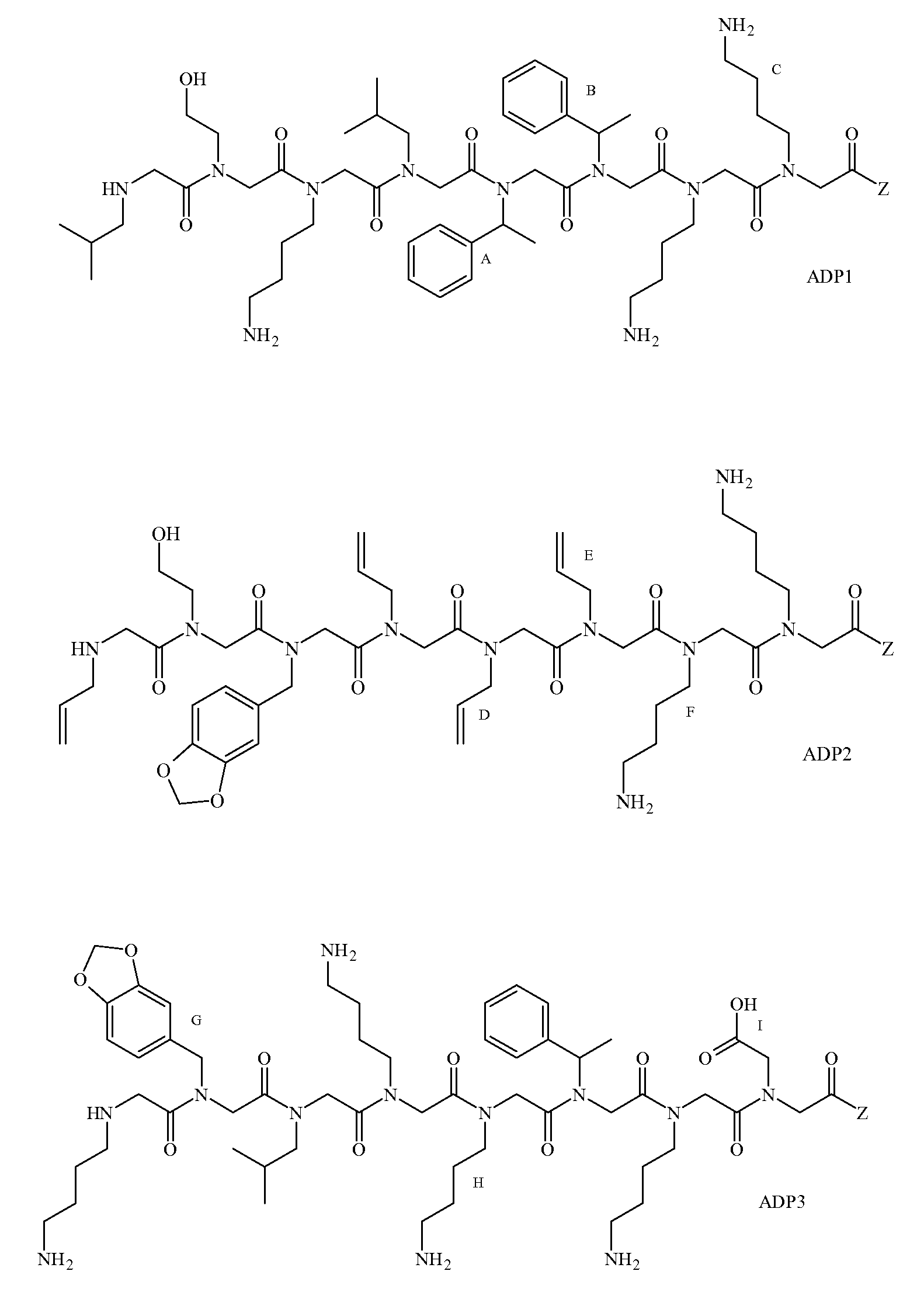
특정 양태에서, 펩토이드는 AD1(APD1), AD2(APD2) 및 AD3(APD3)으로 이루어진 그룹으로부터 선택될 수 있고, 이때 Z는 상기 기술한 바와 같다. 샘플은 화학식 1A 내지 1D의 하나 이상의 펩토이드, 예를 들면, 3개의 구조적으로 상이한 펩토이드(예: AD1, AD2 및 AD3)와 접촉될 수 있다.In certain embodiments, the peptoid can be selected from the group consisting of AD1 (APD1), AD2 (APD2) and AD3 (APD3), wherein Z is as described above. The sample may be contacted with one or more peptoids of Formulas 1A-1D, eg, three structurally different peptoids (eg, AD1, AD2 and AD3).
특정 측면에서, 지지체는 비이드, 플레이트, 딥스틱(dipstick), 필터, 멤브레인, 핀 또는 웰(well)일 수 있다. 샘플은 혈액, 혈청, 타액 또는 CSF일 수 있다. 검출 단계는 RIA, FIA, ELISA, 웨스턴 블롯(Western blot), 유세포 분석, FRET 또는 표면 플라스몬 공명(surface plasmon resonance)을 포함할 수 있다.In certain aspects, the support may be a bead, plate, dipstick, filter, membrane, pin or well. The sample can be blood, serum, saliva or CSF. The detection step can include RIA, FIA, ELISA, Western blot, flow cytometry, FRET or surface plasmon resonance.
특정 측면에서, 본 발명의 펩토이드는 하기 화학식들 중 하나를 포함할 수 있다:In certain aspects, the peptoids of the present invention may comprise one of the following formulas:
(i) (X)0-4(메틸벤질)(메틸벤질)(n-부틸아민)(n-부틸아민)(i) (X) 0-4 (methylbenzyl) (methylbenzyl) (n-butylamine) (n-butylamine)
(ii) (X)0-4(알릴)(알릴)(n-부틸아민)(X) 또는 (ii) (X) 0-4 (allyl) (allyl) (n-butylamine) (X) or
(iii) (X)(피페로닐)(X)0-2(n-부틸아민)(X)0-2(글리신);(iii) (X) (piperonyl) (X) 0-2 (n-butylamine) (X) 0-2 (glycine);
여기서, X는 수소; 알킬; 알릴; 메틸; 에틸; n-프로필; 이소프로필; n-부틸; 이소부틸; n-부틸아민; 2급-부틸; 3급-부틸; 펜틸; 헥실; 이소펜틸; 또는 하이드록실 그룹일 수 있다. 바람직한 양태에서, 단량체성 아민 또는 아미노산은 글리신, 시스테인, 알릴아민, 에탄올아민, 이소부틸아민, 디아미노부탄, 메틸벤질아민, 피페로닐아민, 4(2-아미노에틸)벤젠설폰아미드, 푸르푸릴아민, 벤질아민, 3-메톡시프로필아민(MPOA), 2-메톡시에틸아민 및 사이클로헥실아민 아민으로부터 선택된다. 상기 단량체는 임의로 조합되어 사용되어 길이가 3 내지 12mer인 올리고머를 형성할 수 있다.Where X is hydrogen; Alkyl; Allyl; methyl; ethyl; n-propyl; Isopropyl; n-butyl; Isobutyl; n-butylamine; Secondary-butyl; Tert-butyl; Pentyl; Hexyl; Isopentyl; Or hydroxyl groups. In a preferred embodiment, the monomeric amine or amino acid is glycine, cysteine, allylamine, ethanolamine, isobutylamine, diaminobutane, methylbenzylamine, piperonylamine, 4 (2-aminoethyl) benzenesulfonamide, furfuryl Amine, benzylamine, 3-methoxypropylamine (MPOA), 2-methoxyethylamine and cyclohexylamine amine. The monomers can optionally be used in combination to form oligomers having a length of 3 to 12 mer.
상기 양태는 2, 3, 4, 5, 6, 7, 8개 또는 그 이상의 단량체 단위의 펩토이드를 포함한다. 특정 측면에서, 펩토이드는 위치 1, 2, 3, 4, 5, 6으로부터 위치 8까지 또는 위치 8, 7, 6, 5, 4, 3, 2로부터 위치 1까지, 또는 이들 사이에 임의의 2, 3, 4, 5, 6, 7 단량체 펩토이드인 펩토이드 서열을 포함할 수 있다.Said embodiment comprises a peptoid of 2, 3, 4, 5, 6, 7, 8 or more monomer units. In certain aspects, the peptoid can be from
단량체는 R 그룹, 예를 들면, 하기 표 1 및 표 2에 기술된 하나 이상의 화학 그룹을 포함하는 - 수소; 알킬; 알릴; 메틸; 에틸; n-프로필; 이소프로필; n-부틸; 이소부틸; n-부틸아민; 2급-부틸; 3급-부틸; 펜틸; 헥실; 이소펜틸; 아릴; 헤테로아릴; 푸라닐; 인돌릴; 티오페닐; 티아졸릴; 이미다졸릴; 이속사조일; 옥사조일; 피페로닐; 피라조일; 피롤릴; 피라지닐; 피리딜; 피리미딜; 피리미디닐; 푸리닐; 신놀리닐; 벤조푸라닐; 벤조티에닐; 벤조트리아졸릴; 벤족사졸릴; 퀴놀린; 이속사졸릴; 이소퀴놀린; 사이클로알킬; 알케닐; 사이클로알케닐; 페닐; 피리딜; 메톡시에틸; (R)-메틸벤질; 비치환되거나 NH2, OH 또는 SH에 의해 치환된 C1 -6 알킬; 비치환되거나 NH2, OH 또는 SH에 의해 치환된 C2 -6 알키닐; 리실; 카복실; 및 하이드록실 그룹의 다양한 조합을 포함할 수 있다.Monomers include R groups such as one or more chemical groups described in Tables 1 and 2 below—hydrogen; Alkyl; Allyl; methyl; ethyl; n-propyl; Isopropyl; n-butyl; Isobutyl; n-butylamine; Secondary-butyl; Tert-butyl; Pentyl; Hexyl; Isopentyl; Aryl; Heteroaryl; Furanyl; Indolyl; Thiophenyl; Thiazolyl; Imidazolyl; Exploded yarn; Oxazoyl; Piperonyl; Pyrazoyl; Pyrrolyl; Pyrazinyl; Pyridyl; Pyrimidyl; Pyrimidinyl; Furinyl; Cinnaolinyl; Benzofuranyl; Benzothienyl; Benzotriazolyl; Benzoxazolyl; Quinoline; Isoxazolyl; Isoquinoline; Cycloalkyl; Alkenyl; Cycloalkenyl; Phenyl; Pyridyl; Methoxyethyl; (R) -methylbenzyl; Unsubstituted or NH 2, C 1 -6 alkyl substituted by OH or SH; Unsubstituted or NH 2, a C 2 -6 alkenyl optionally substituted by OH or SH group; Lysyl; Carboxyl; And various combinations of hydroxyl groups.
특정 측면에서, 화학식 ADP1, ADP2 및/또는 ADP3의 특정 단량체 단위는 표 1 내지 3에 제공된 바와 같은 그룹 및 특정 위치를 선택할 수 있다. 가장 바람직한 양태는 ADP1, ADP2, ADP3과 같이 제시된 특정 화합물이고, ADP1-3에 대해 상기 제시된 구조 상의 위치 A-I에 표시된 특정 단량체를 확인하는 사르코신 스캔으로 확인되는 활성 화합물을 추가로 포함한다. 하기 표 1 및 2는 ADP1-3 위의 특정 위치에 대해 좌측 칼럼에 이들 문자 표시를 제공하고, 이는 표 1에 제시된 측쇄(상기 측쇄를 갖는 아민을 사용함) 또는 표 2 및 특정 바람직한 위치에 제시된 치환 아민을 부가로 가질 수 있다. 화학식 APD1, APD2 및 APD3에서 잔기 A 내지 I는 하기 표 1 및 표 2에 기술된 하나 이상의 화학 그룹을 포함한 - 수소; 알킬; 알릴; 메틸; 에틸; n-프로필; 이소프로필; n-부틸; 이소부틸; n-부틸아민; 2급-부틸; 3급-부틸; 펜틸; 헥실; 이소펜틸; 아릴; 헤테로아릴; 푸라닐; 인돌릴; 티오페닐; 티아졸릴; 이미다졸릴; 이속사조일; 옥사조일; 피페로닐; 피라조일; 피롤릴; 피라지닐; 피리딜; 피리미딜; 피리미디닐; 푸리닐; 신놀리닐; 벤조푸라닐; 벤조티에닐; 벤조트리아졸릴; 벤족사졸릴; 퀴놀린; 이속사졸릴; 이소퀴놀린; 사이클로알킬; 알케닐; 사이클로알케닐; 페닐; 피리딜; 메톡시에틸; (R)-메틸벤질; 비치환되거나 NH2, OH 또는 SH에 의해 치환된 C1 -6 알킬; 비치환되거나 NH2, OH 또는 SH에 의해 치환된 C2 -6 알키닐; 리실; 카복실로 이루어진 그룹으로부터 독립적으로 선택되는 그룹에 의해 차례로 치환될 수 있다. R2, R3 및 R5는 C0 -6 알킬아릴; C0 -6 알킬헤테로아릴; OH, SH, 할로겐, OR15, COOR15, NR15(여기서, R15는 H 또는 C1 -6 알킬이나 C1 -6 알키닐로 이루어진 그룹으로부터 선택된다) 또는 R16(여기서, R16은 H 또는 C1 -6 알키닐로 이루어진 그룹으로부터 선택된다)으로부터 선택되는 그룹에 의해 치환된 C1 -6 알킬; OC1-6 알킬; C2 -6 알케닐; C2 -6 알키닐; C2 -6 알케닐; 및 C2 -6 알키닐로 이루어진 그룹으로부터 독립적으로 선택된다.In certain aspects, certain monomeric units of Formulas ADP1, ADP2 and / or ADP3 may select groups and specific positions as provided in Tables 1-3. The most preferred embodiment is the specific compound shown as ADP1, ADP2, ADP3 and further comprises an active compound identified by a sarcosine scan that identifies the specific monomer indicated at position AI on the structure shown above for ADP1-3. Tables 1 and 2 below provide these letter designations in the left column for specific positions on ADP1-3, which are indicated by the side chains shown in Table 1 (using amines having such side chains) or the substitutions shown in Table 2 and certain preferred positions. And may have additional amines. Residues A to I in Formulas APD1, APD2 and APD3 include at least one chemical group described in Table 1 and Table 2 below-hydrogen; Alkyl; Allyl; methyl; ethyl; n-propyl; Isopropyl; n-butyl; Isobutyl; n-butylamine; Secondary-butyl; Tert-butyl; Pentyl; Hexyl; Isopentyl; Aryl; Heteroaryl; Furanyl; Indolyl; Thiophenyl; Thiazolyl; Imidazolyl; Exploded yarn; Oxazoyl; Piperonyl; Pyrazoyl; Pyrrolyl; Pyrazinyl; Pyridyl; Pyrimidyl; Pyrimidinyl; Furinyl; Cinnaolinyl; Benzofuranyl; Benzothienyl; Benzotriazolyl; Benzoxazolyl; Quinoline; Isoxazolyl; Isoquinoline; Cycloalkyl; Alkenyl; Cycloalkenyl; Phenyl; Pyridyl; Methoxyethyl; (R) -methylbenzyl; Unsubstituted or NH 2, C 1 -6 alkyl substituted by OH or SH; Unsubstituted or NH 2, a C 2 -6 alkenyl optionally substituted by OH or SH group; Lysyl; It may in turn be substituted by a group independently selected from the group consisting of carboxyl. R 2, R 3 and R 5 is C 0 -6 alkylaryl; C 0 -6 alkyl-heteroaryl; OH, SH, halogen, OR 15, COOR 15, NR 15 ( wherein, R 15 is selected from the group consisting of H or C 1 -6 alkyl or C 1 -6 alkynyl group) or R 16 (wherein, R 16 is substituted C 1-6 alkyl by H or C 1-6 group selected from is selected from the group consisting of alkynyl); OC 1-6 alkyl; C 2 -6 alkenyl; C 2 -6-alkynyl; C 2 -6 alkenyl; And C 2 -6 are independently selected from the group consisting of alkynyl.
[표 1][Table 1]
펩토이드에 대한 측쇄 변환Side Chain Transformation for Peptoids
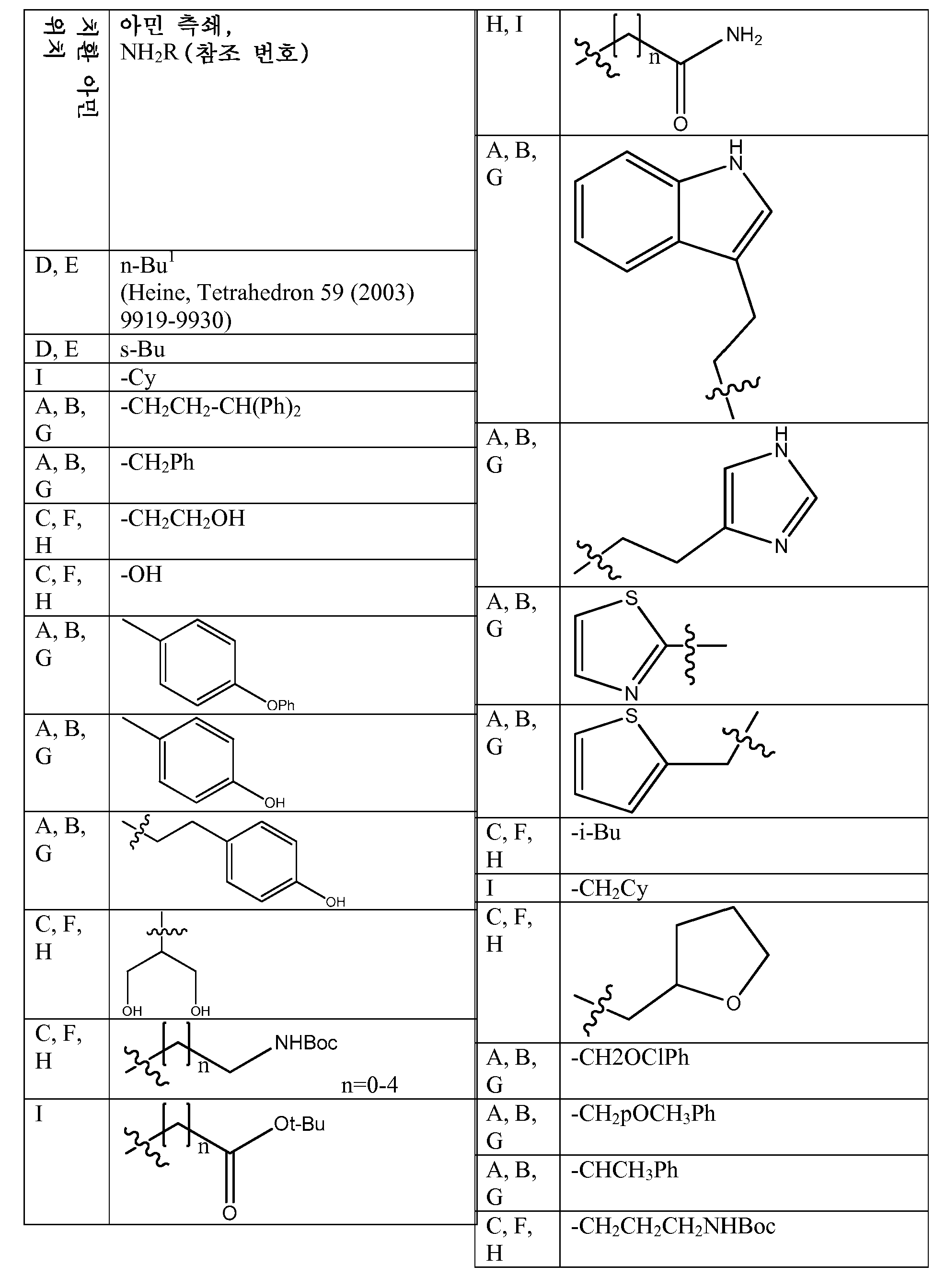
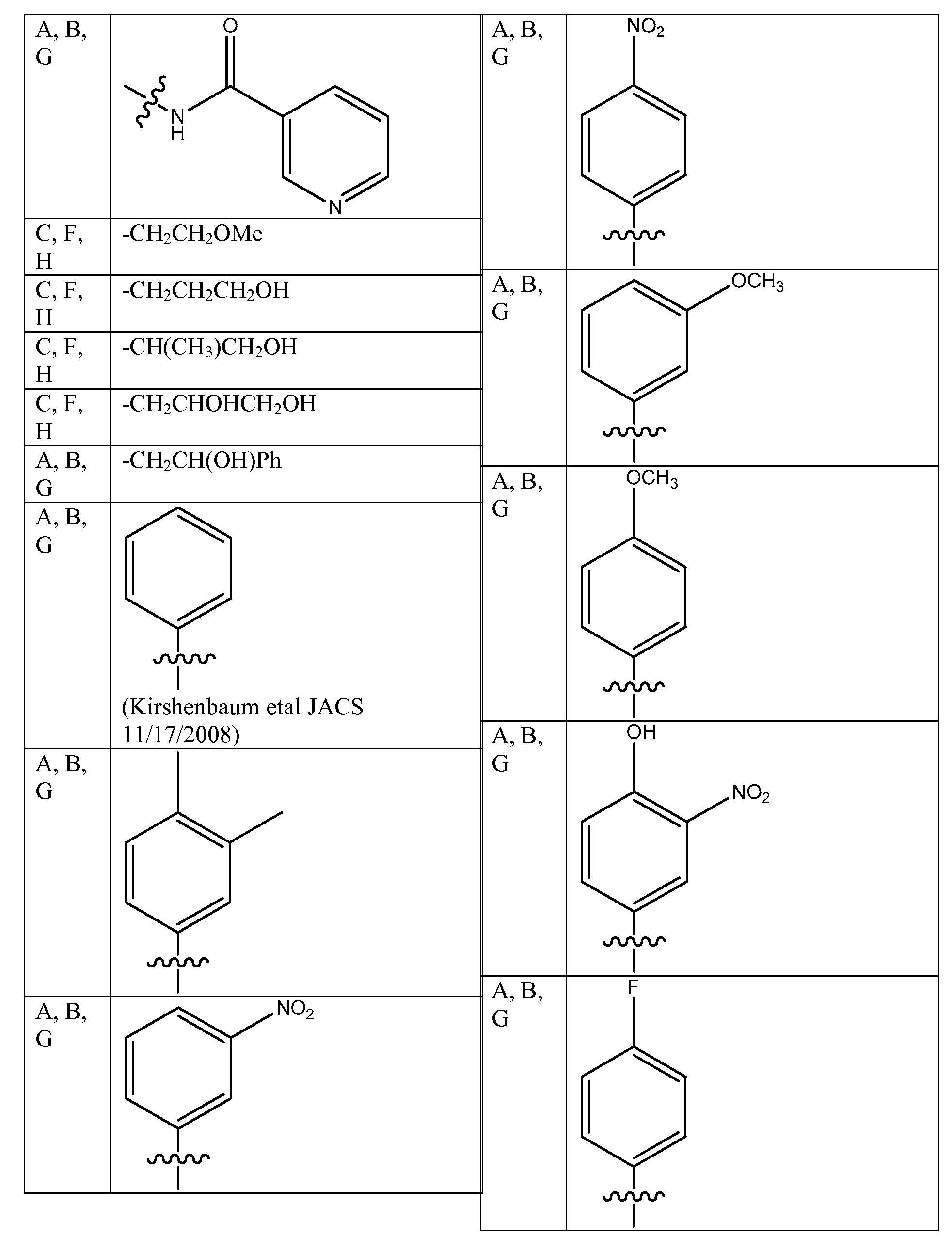

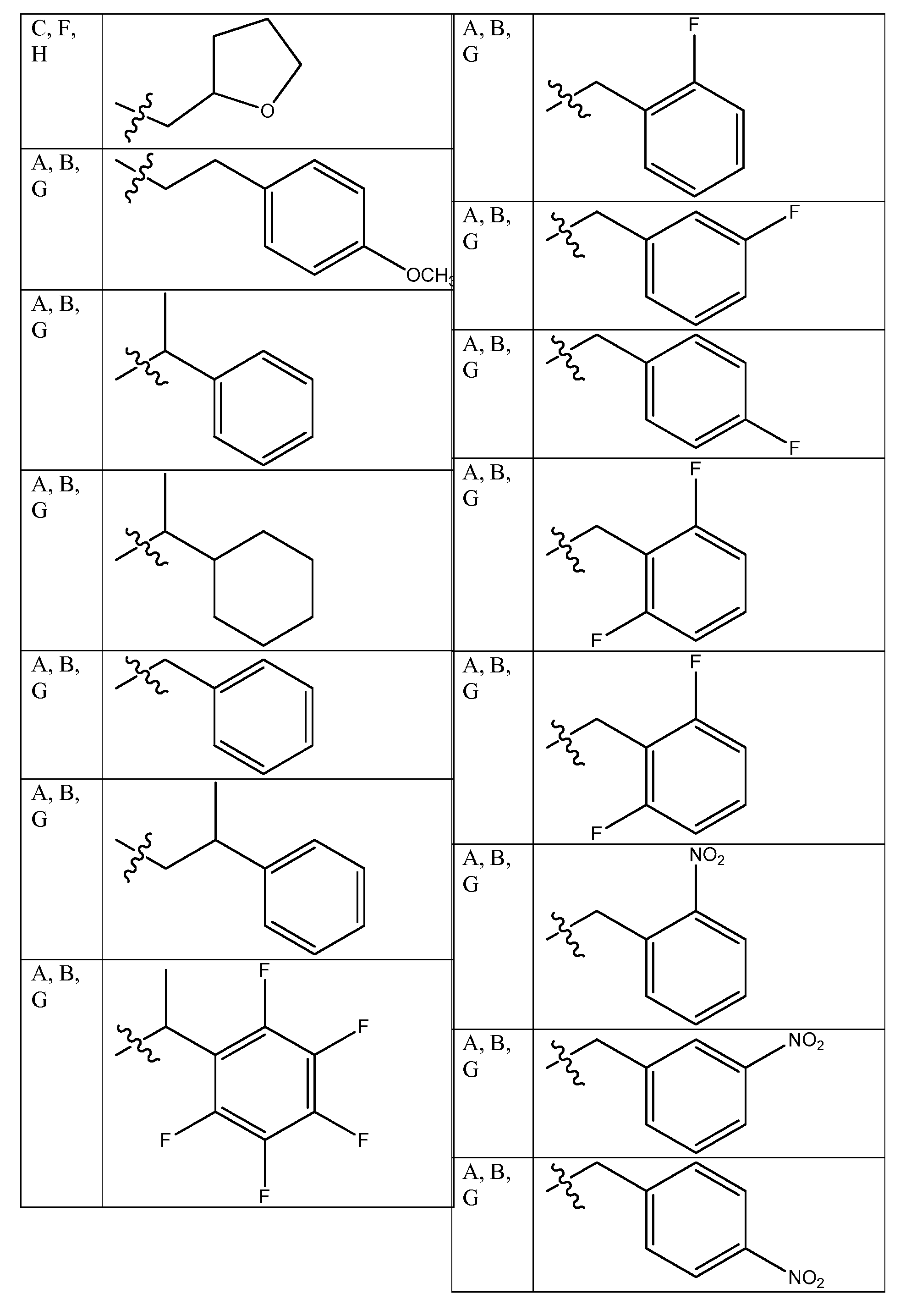
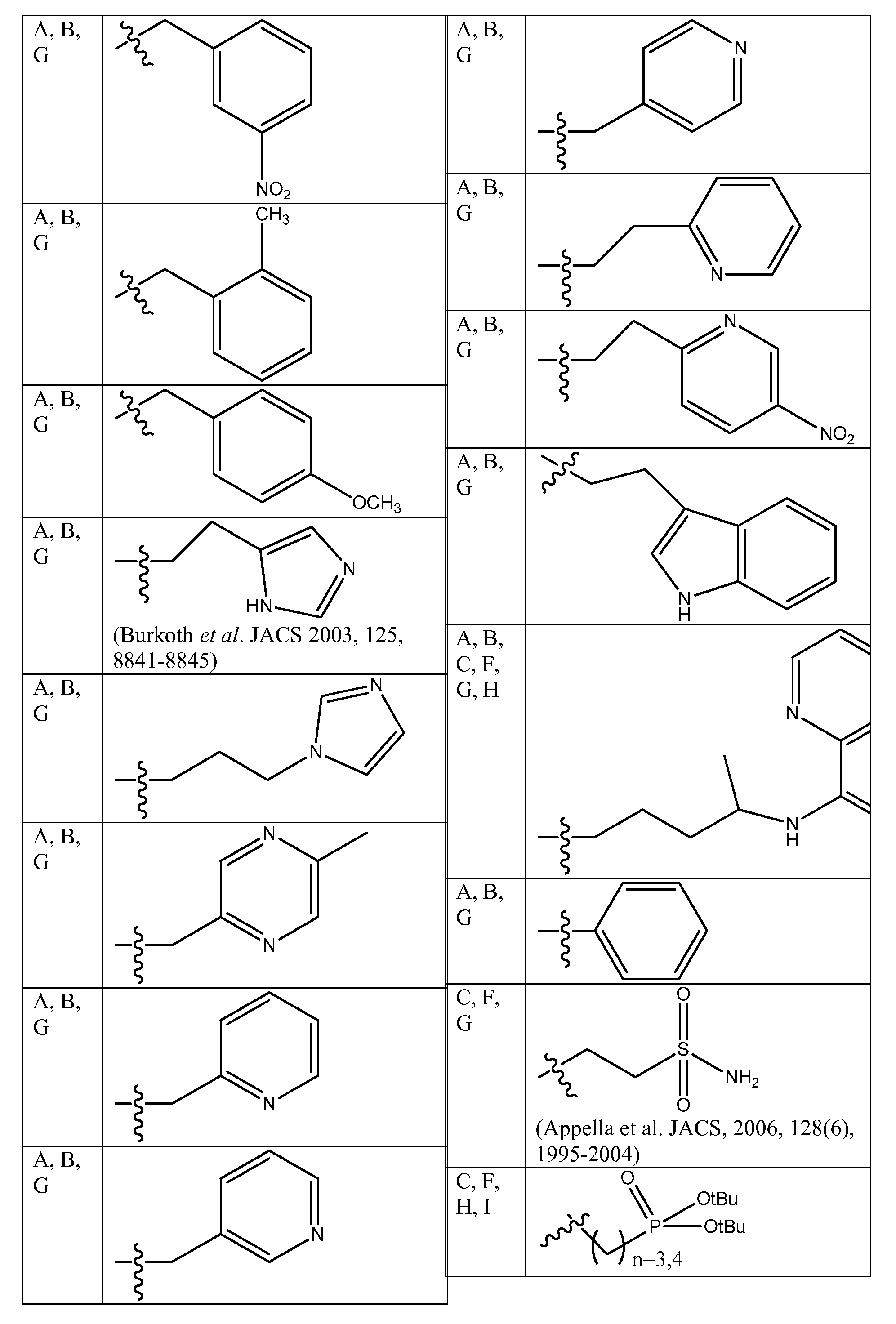
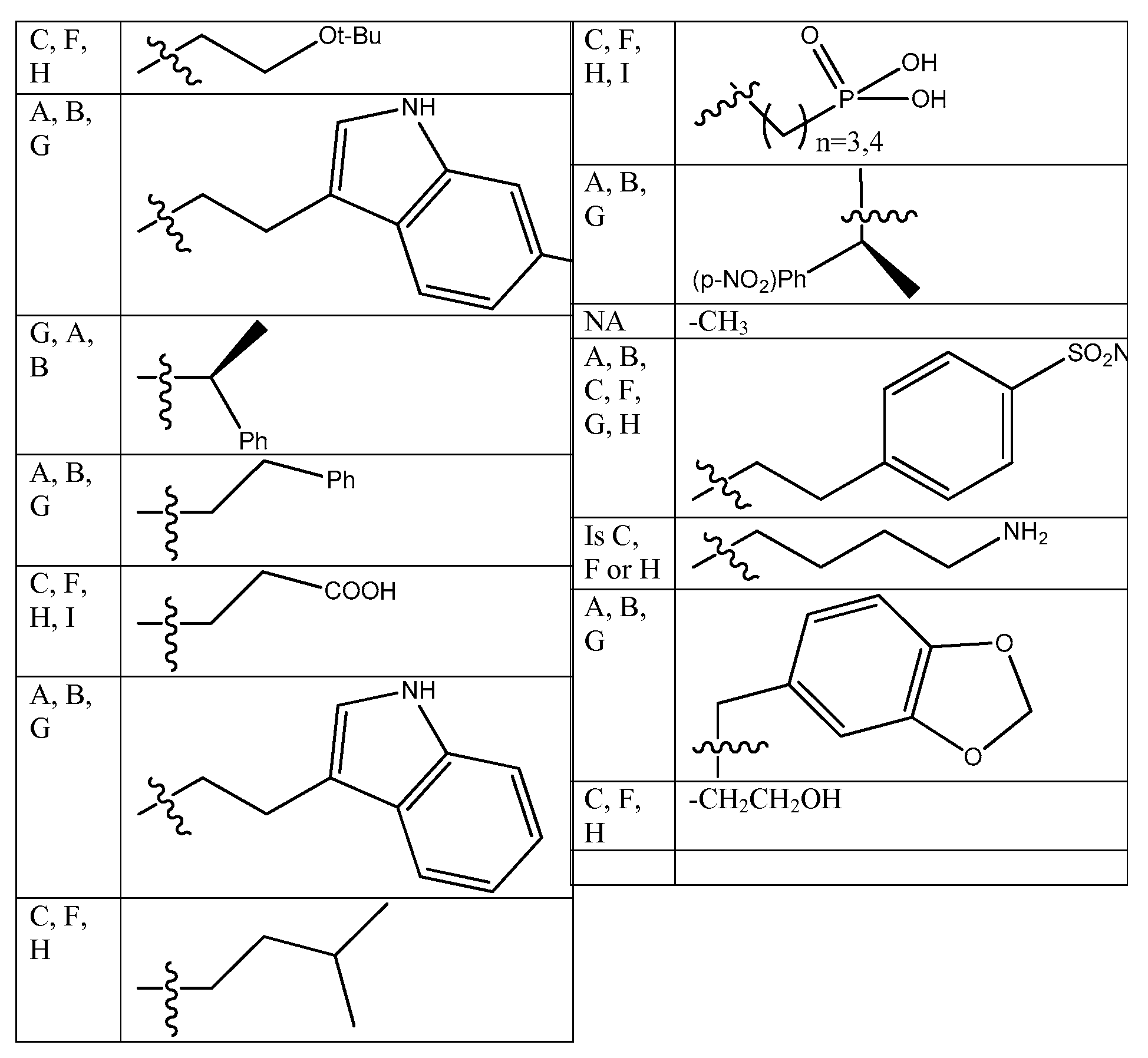
[표 2][Table 2]
본 명세서에 기술된 펩토이드를 합성하는데 사용될 수 있는 아민 목록List of amines that can be used to synthesize the peptoids described herein


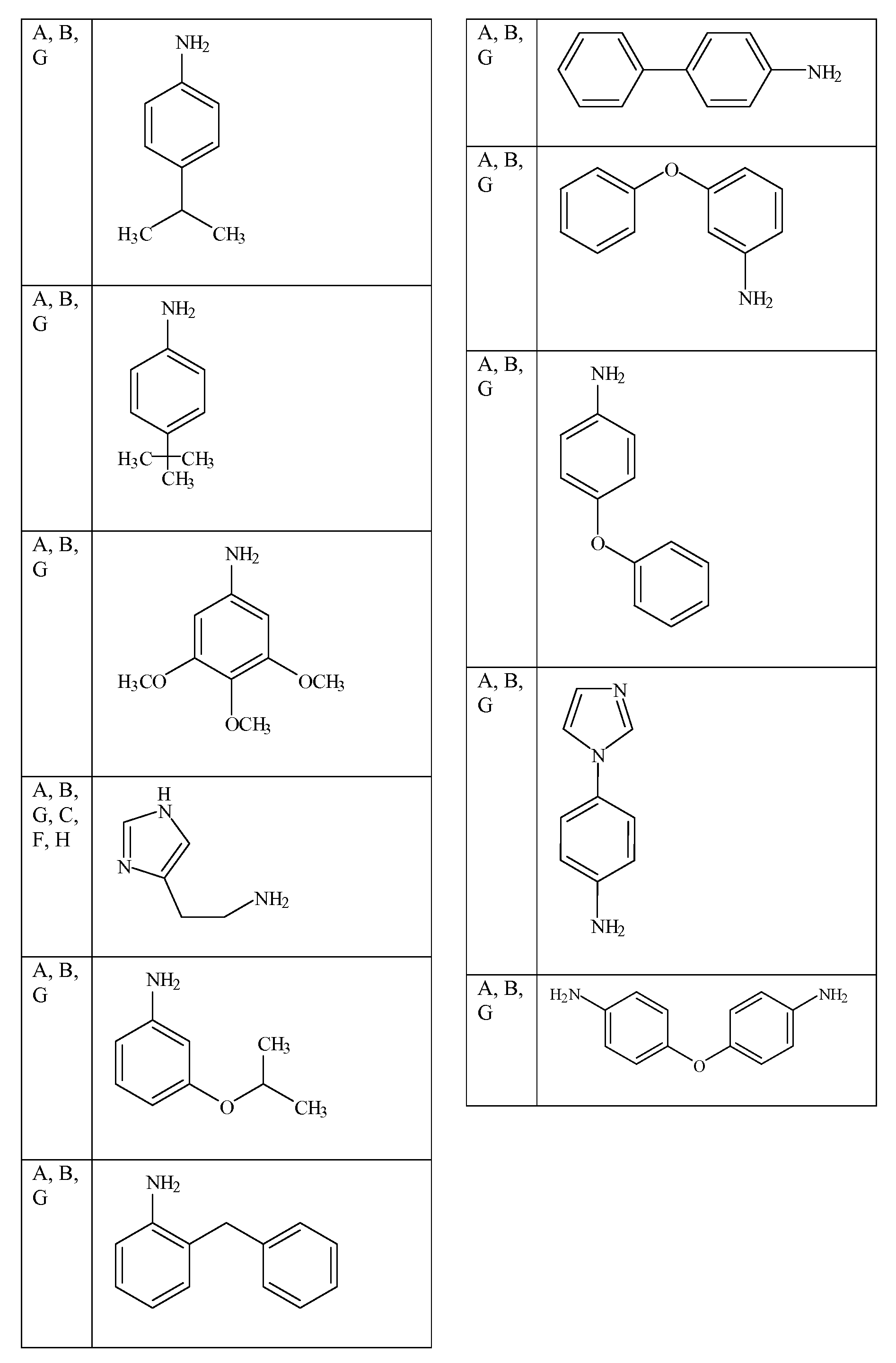
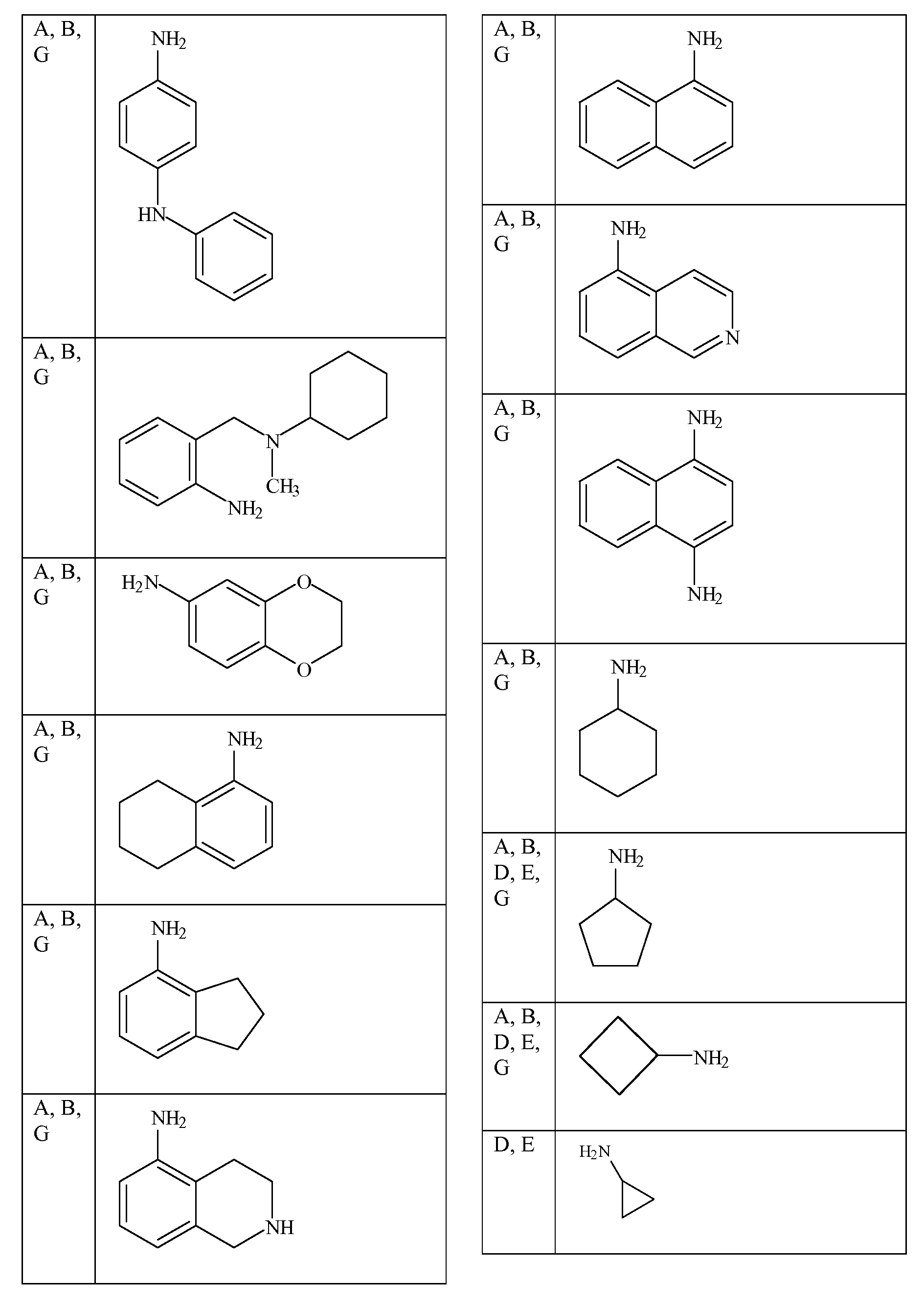
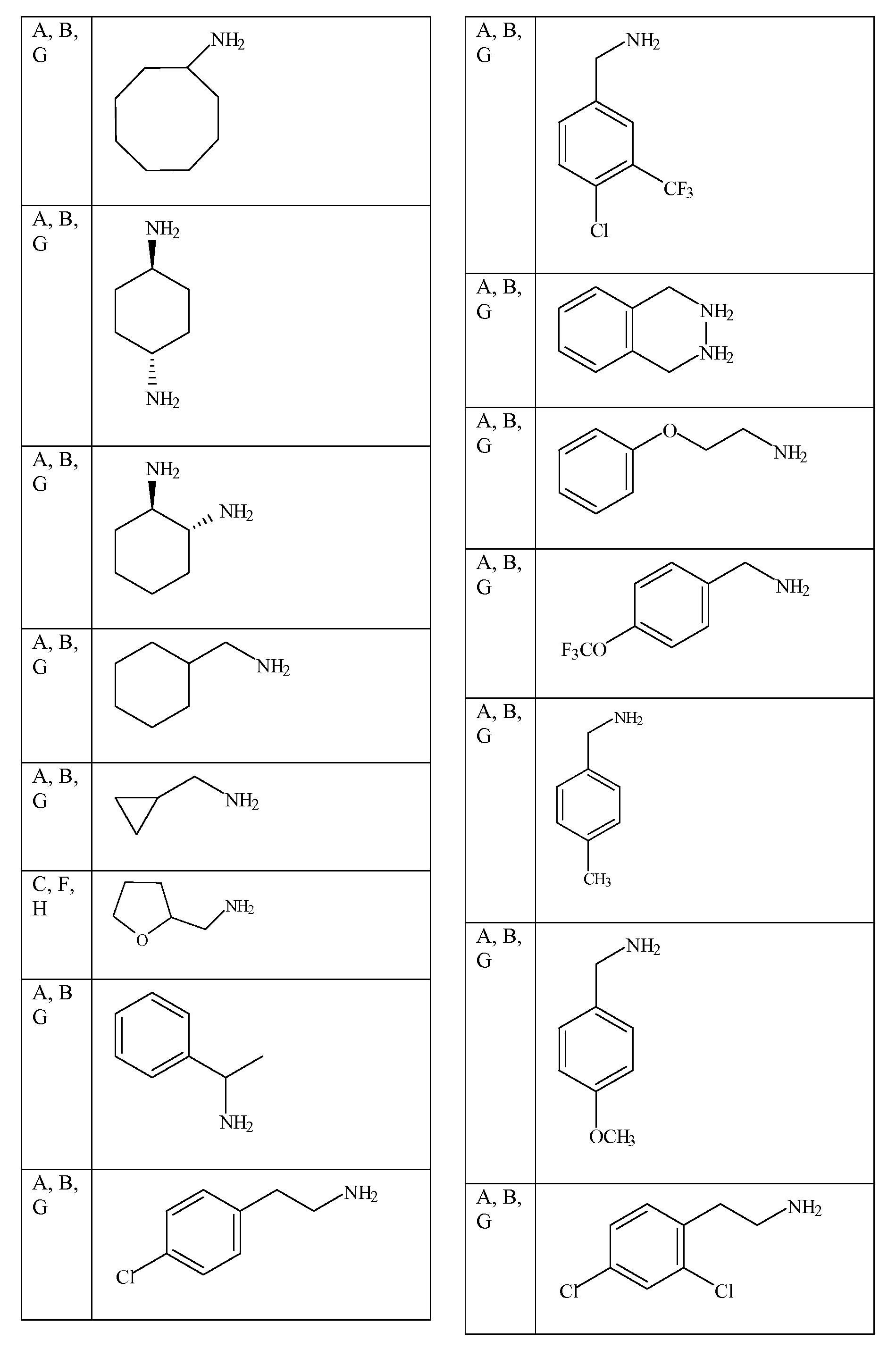
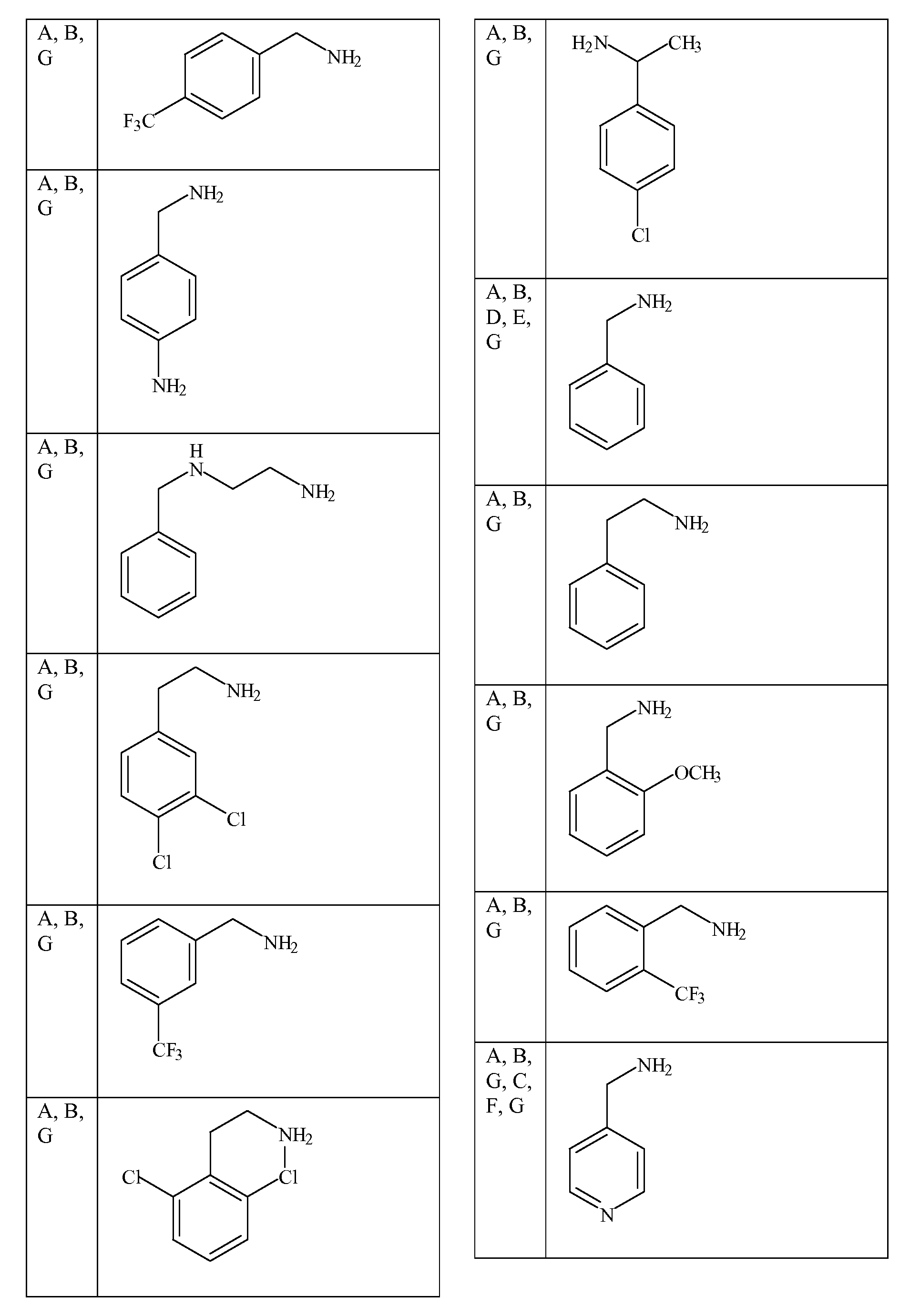
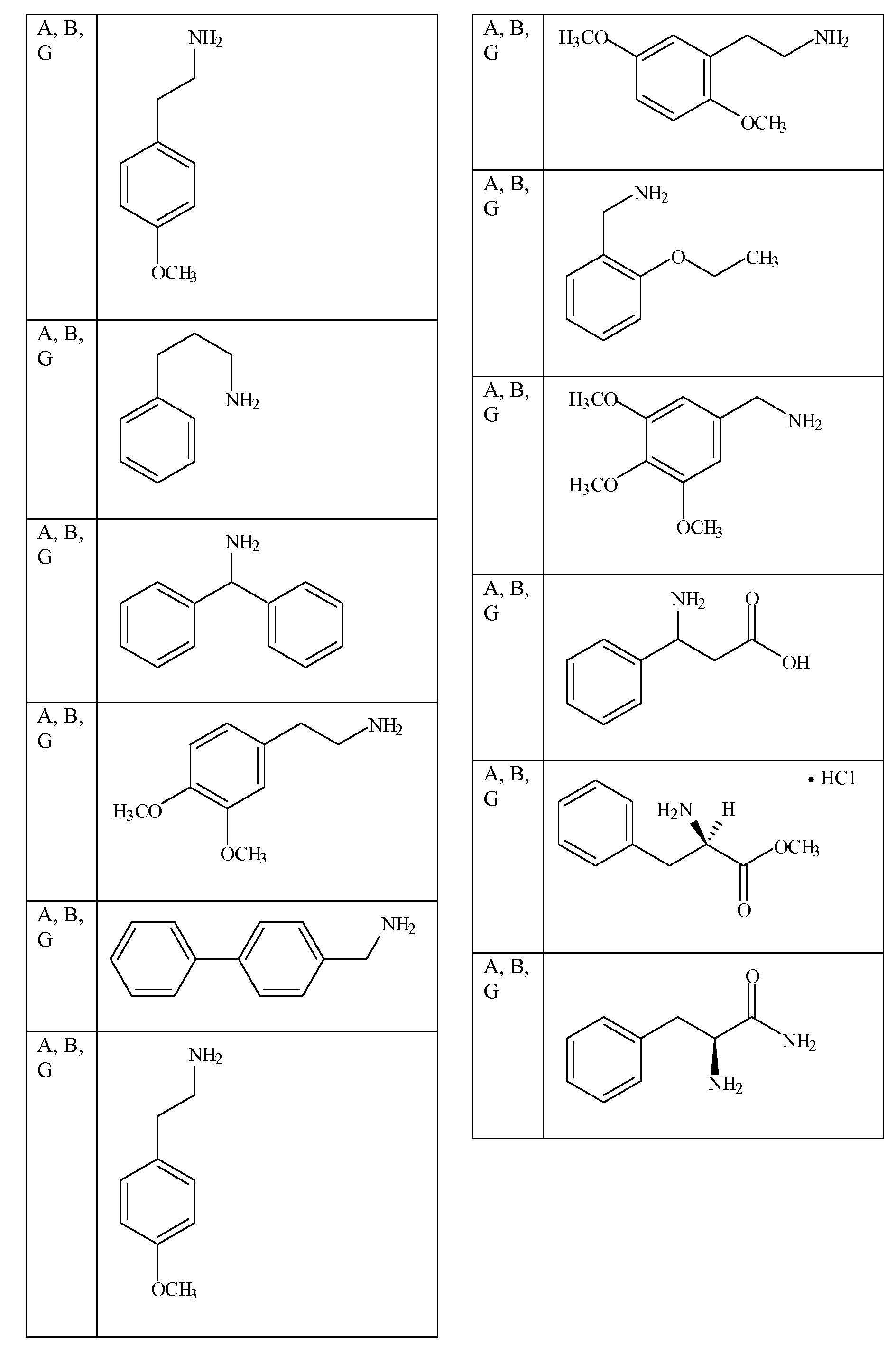

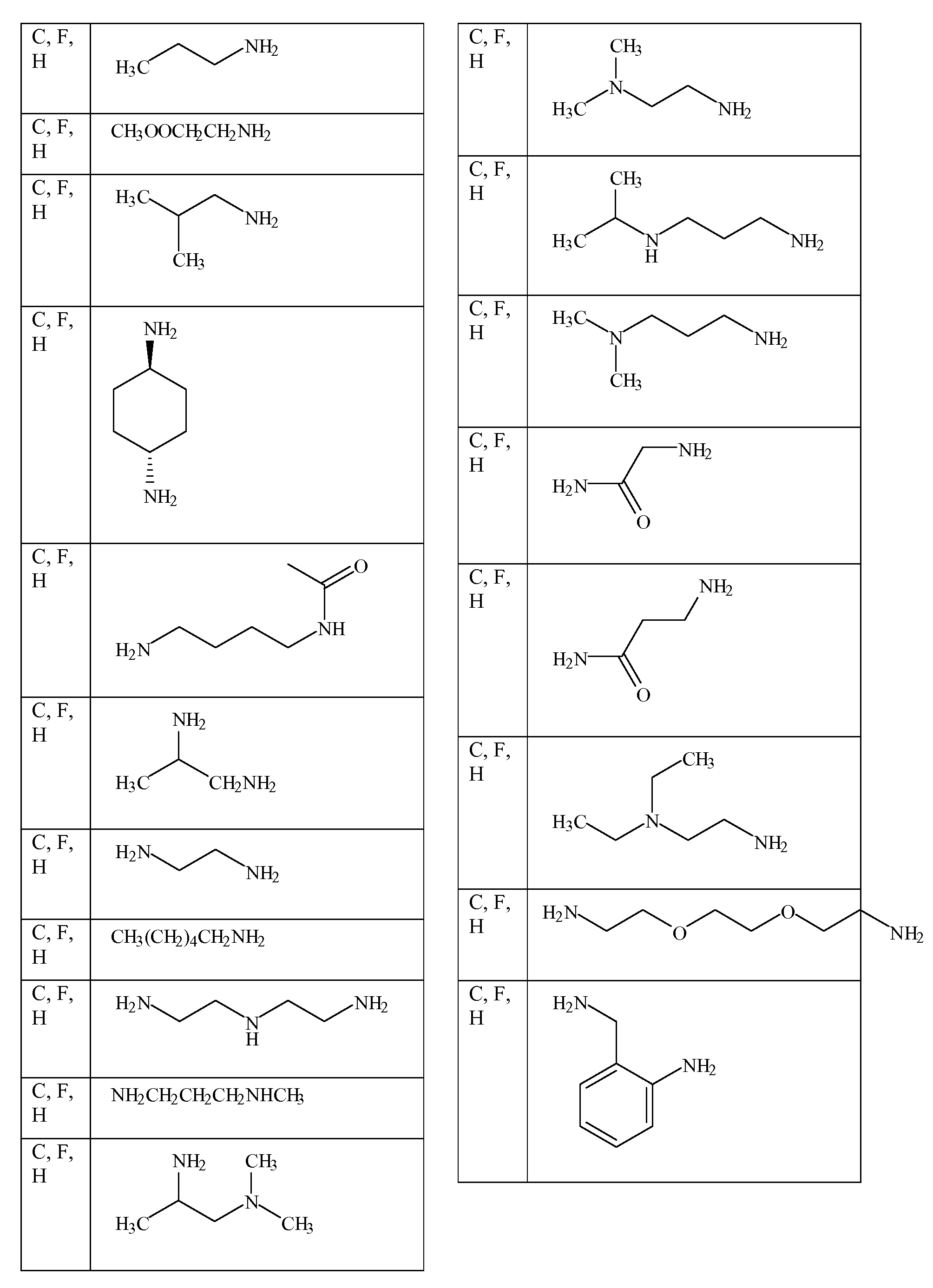

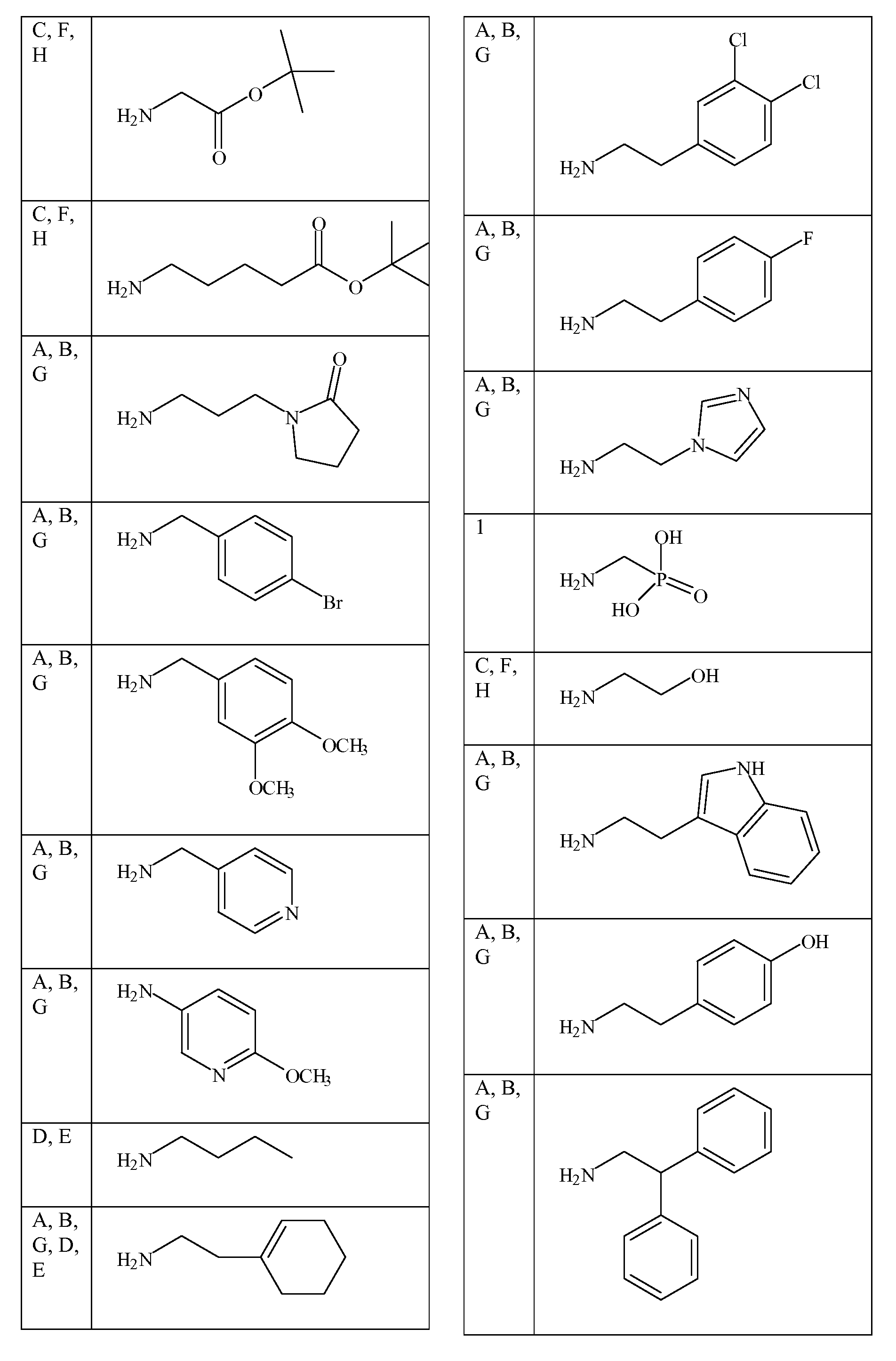
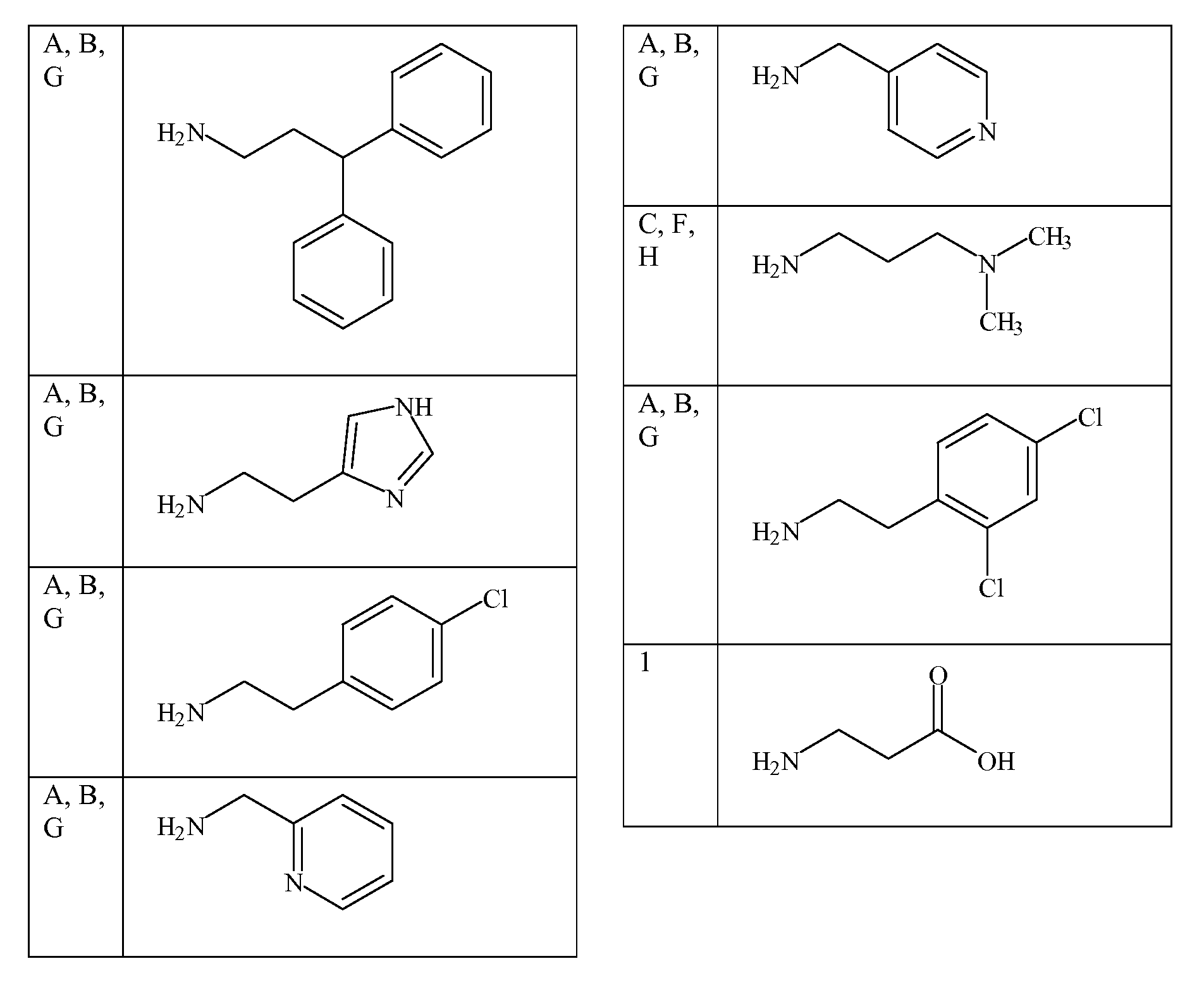
[표 3][Table 3]
알츠하이머 병 화합물Alzheimer's Disease Compound
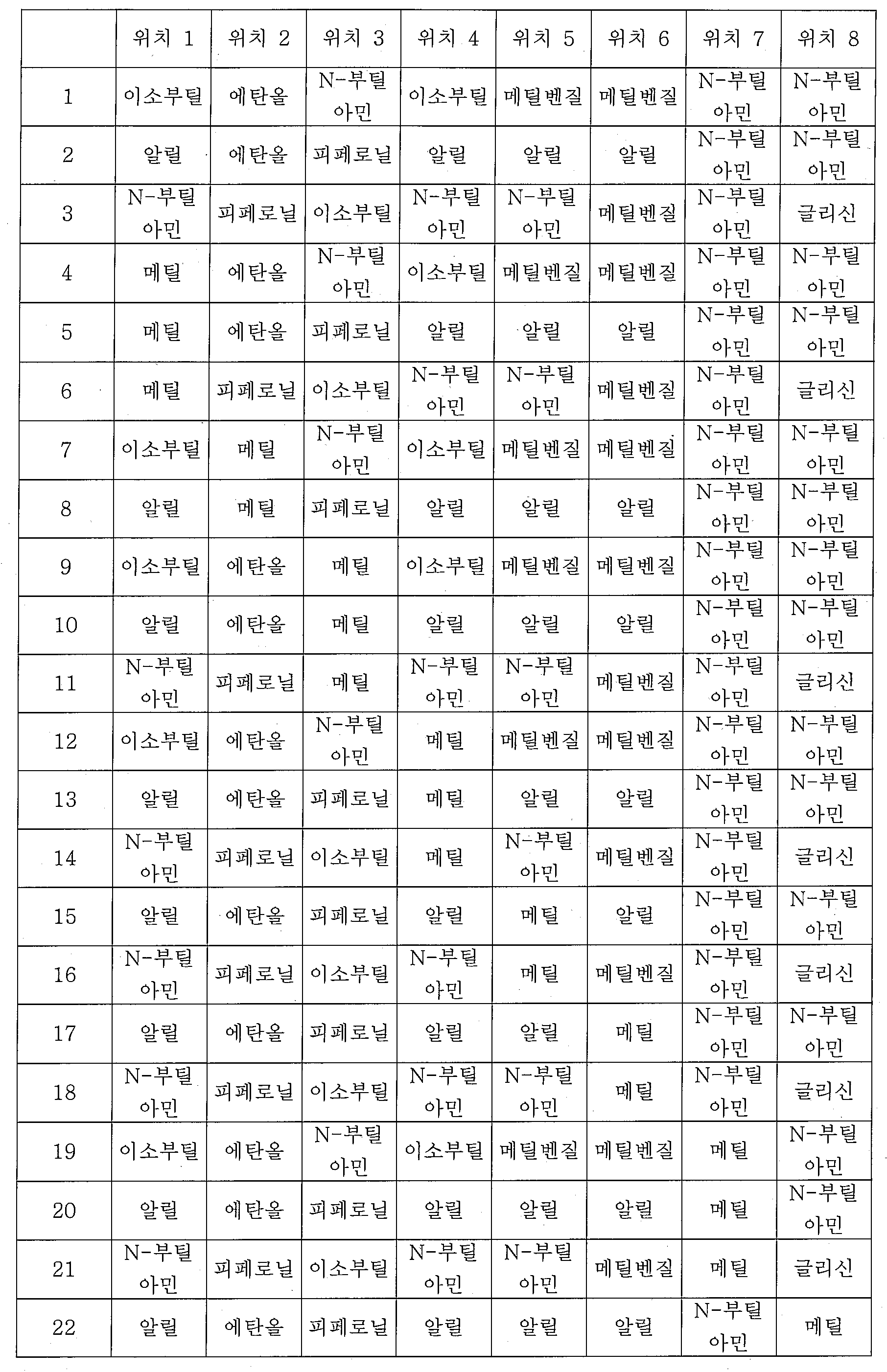
[표 4][Table 4]
파킨슨 병 화합물Parkinson's disease compound

다른 양태에서, 파킨슨 병을 나타내는 항체에 결합하는 펩토이드를 제공하고 또한 (a) 항체-함유 샘플을 하기 화학식 2A의 펩토이드가 부착된 지지체와 접촉시키는 단계를 포함하는, 항체-함유 샘플에서 항체의 검출 방법이 제공된다:In another aspect, there is provided a peptoid that binds to an antibody indicative of Parkinson's disease, and further comprising the steps of (a) contacting the antibody-containing sample with a support to which the peptoid of formula 2A is attached: Methods of detecting antibodies are provided:
화학식 2AFormula 2A

한 양태에서, R27은 알킬아릴 그룹이다. 특정 측면에서, R27은 메틸벤질 그룹이다. 화학식 2A의 R25, R26, R28 내지 R32는 하기 표 1 및 표 2에 기술된 하나 이상의 화학 그룹을 포함하는 - 수소; 알킬; 알릴; 메틸; 에틸; n-프로필; 이소프로필; n-부틸; 이소부틸; n-부틸아민; 2급-부틸; 3급-부틸; 펜틸; 헥실; 이소펜틸; 아릴; 헤테로아릴; 푸라닐; 인돌릴; 티오페닐; 티아졸릴; 이미다졸릴; 이속사조일; 옥사조일; 피페로닐; 피라조일; 피롤릴; 피라지닐; 피리딜; 피리미딜; 피리미디닐; 푸리닐; 신놀리닐; 벤조푸라닐; 벤조티에닐; 벤조트리아졸릴; 벤족사졸릴; 퀴놀린; 이속사졸릴; 이소퀴놀린; 사이클로알킬; 알케닐; 사이클로알케닐; 페닐; 피리딜; 메톡시에틸, (R)-메틸벤질; C0 -6 알킬아릴; C0 -6 알킬헤테로아릴; OH, SH, 할로겐, OR15, COOR15, NR15(여기서, R15는 H 또는 C1 -6 알킬이나 C1 -6 알키닐로 이루어진 그룹으로부터 선택된다) 또는 R16(여기서, R16은 H 또는 C1 -6 알키닐로 이루어진 그룹으로부터 선택된다)으로부터 선택되는 그룹에 의해 치환된 C1 -6 알킬; OC1 -6 알킬; C2 -6 알케닐; C2 -6 알키닐; C2 -6 알케닐; 및 C2 -6 알키닐로 이루어진 그룹으로부터 독립적으로 선택된다. 특정 측면에서, R26, R29, R31 및/또는 R32는 알킬아민, 예를 들면, N-부틸아민이다. 또다른 측면에서, R30은 알케닐, 예를 들면, 알릴 그룹이다.In one embodiment, R 27 is an alkylaryl group. In certain aspects, R 27 is a methylbenzyl group. R 25 , R 26 , R 28 to R 32 of Formula 2A include at least one chemical group described in Table 1 and Table 2 below; Alkyl; Allyl; methyl; ethyl; n-propyl; Isopropyl; n-butyl; Isobutyl; n-butylamine; Secondary-butyl; Tert-butyl; Pentyl; Hexyl; Isopentyl; Aryl; Heteroaryl; Furanyl; Indolyl; Thiophenyl; Thiazolyl; Imidazolyl; Exploded yarn; Oxazoyl; Piperonyl; Pyrazoyl; Pyrrolyl; Pyrazinyl; Pyridyl; Pyrimidyl; Pyrimidinyl; Furinyl; Cinnaolinyl; Benzofuranyl; Benzothienyl; Benzotriazolyl; Benzoxazolyl; Quinoline; Isoxazolyl; Isoquinoline; Cycloalkyl; Alkenyl; Cycloalkenyl; Phenyl; Pyridyl; Methoxyethyl, (R) -methylbenzyl; C 0 -6 alkylaryl; C 0 -6 alkyl-heteroaryl; OH, SH, halogen, OR 15, COOR 15, NR 15 ( wherein, R 15 is selected from the group consisting of H or C 1 -6 alkyl or C 1 -6 alkynyl group) or R 16 (wherein, R 16 is substituted C 1-6 alkyl by H or C 1-6 group selected from is selected from the group consisting of alkynyl); OC 1 -6 alkyl; C 2 -6 alkenyl; C 2 -6-alkynyl; C 2 -6 alkenyl; And C 2 -6 are independently selected from the group consisting of alkynyl. In certain aspects, R 26 , R 29 , R 31 and / or R 32 are alkylamines such as N-butylamine. In another aspect, R 30 is alkenyl, for example an allyl group.
화학식 2BFormula 2B

다른 양태에서, 펩토이드는 상기 화학식 2B를 가질 수 있고, 여기서 R34는 알킬아민, 예를 들면, N-부틸아민이다. 또다른 양태에서, R35는 알케닐, 예를 들면, 알릴 그룹이다. 특정 양태에서, R37은 알콕시 그룹(예: 에탄올)이다. 특정 측면에서, 화학식 2B의 R33, R36 및 R38 내지 R40은 하기 표 1 및 표 2에 기술된 하나 이상의 화학 그룹을 포함하는 - 수소; 알킬; 알릴; 메틸; 에틸; n-프로필; 이소프로필; n-부틸; 이소부틸; n-부틸아민; 2급-부틸; 3급-부틸; 펜틸; 헥실; 이소펜틸; 아릴; 헤테로아릴; 푸라닐; 인돌릴; 티오페닐; 티아졸릴; 이미다졸릴; 이속사조일; 옥사조일; 피페로닐; 피라조일; 피롤릴; 피라지닐; 피리딜; 피리미딜; 피리미디닐; 푸리닐; 신놀리닐; 벤조푸라닐; 벤조티에닐; 벤조트리아졸릴; 벤족사졸릴; 퀴놀린; 이속사졸릴; 이소퀴놀린; 사이클로알킬; 알케닐; 사이클로알케닐; 페닐; 피리딜; 메톡시에틸, (R)-메틸벤질; C0 -6 알킬아릴; C0 -6 알킬헤테로아릴; OH, SH, 할로겐, OR15, COOR15, NR15(여기서, R15는 H 또는 C1 -6 알킬이나 C1-6 알키닐로 이루어진 그룹으로부터 선택된다) 또는 R16(여기서, R16은 H 또는 C1 -6 알키닐로 이루어진 그룹으로부터 선택된다)으로부터 선택되는 그룹에 의해 치환된 C1-6 알킬; OC1 -6 알킬; C2 -6 알케닐; C2 -6 알키닐; C2 -6 알케닐; 및 C2 -6 알키닐로 이루어진 그룹으로부터 독립적으로 선택된다. In another embodiment, the peptoid can have Formula 2B above, wherein R 34 is an alkylamine, eg, N-butylamine. In another embodiment, R 35 is alkenyl, for example an allyl group. In certain embodiments, R 37 is an alkoxy group (eg ethanol). In certain aspects, R 33 , R 36 and R 38 to R 40 of Formula 2B include one or more chemical groups described in Tables 1 and 2 below—hydrogen; Alkyl; Allyl; methyl; ethyl; n-propyl; Isopropyl; n-butyl; Isobutyl; n-butylamine; Secondary-butyl; Tert-butyl; Pentyl; Hexyl; Isopentyl; Aryl; Heteroaryl; Furanyl; Indolyl; Thiophenyl; Thiazolyl; Imidazolyl; Exploded yarn; Oxazoyl; Piperonyl; Pyrazoyl; Pyrrolyl; Pyrazinyl; Pyridyl; Pyrimidyl; Pyrimidinyl; Furinyl; Cinnaolinyl; Benzofuranyl; Benzothienyl; Benzotriazolyl; Benzoxazolyl; Quinoline; Isoxazolyl; Isoquinoline; Cycloalkyl; Alkenyl; Cycloalkenyl; Phenyl; Pyridyl; Methoxyethyl, (R) -methylbenzyl; C 0 -6 alkylaryl; C 0 -6 alkyl-heteroaryl; OH, SH, halogen, OR 15, COOR 15, NR 15 ( wherein, R 15 is selected from the group consisting of H or C 1 -6 alkyl, or C 1-6 alkynyl group) or R 16 (wherein, R 16 is substituted C 1-6 alkyl by H or C 1-6 group selected from is selected from the group consisting of alkynyl); OC 1 -6 alkyl; C 2 -6 alkenyl; C 2 -6-alkynyl; C 2 -6 alkenyl; And C 2 -6 are independently selected from the group consisting of alkynyl.
본 명세서에 기술된 화학식에서, Z는 하나 이상의 아미노산 또는 작용기를 포함할 수 있는 커플링 그룹이고; L은 임의의 링커 잔기이고; M은 기질 또는 지지체 또는 라벨이고; m, n, o 및/또는 p는 0 내지 6이다.In the formulas described herein, Z is a coupling group that may comprise one or more amino acids or functional groups; L is any linker residue; M is a substrate or support or label; m, n, o and / or p are 0-6.
특정 측면에서, 본 발명의 방법은 또한 (b) 상기 펩토이드에 결합된 항체를 검출하는 단계를 포함할 수 있다.In certain aspects, the methods of the invention may also comprise the step of (b) detecting the antibody bound to said peptoid.
본 발명의 방법은 대상으로부터 샘플을 채취하는 단계를 추가로 포함할 수 있다. 본 발명의 방법은 또한 상기 펩토이드에 결합된 항체가 질환에 걸리지 않은 대조 환자에 대해 관찰되는 것보다 더 크다면 샘플이 채취된 대상에 대해 파킨슨 병을 진단하는 단계를 추가로 포함할 수 있다. 또다른 측면에서, 본 발명의 방법은 대상에게 약제 또는 요법을 처방하는 단계를 추가로 포함할 수 있다.The method may further comprise taking a sample from the subject. The method of the present invention may also further comprise diagnosing Parkinson's disease in the subject from whom the sample was taken if the antibody bound to the peptoid is greater than that observed for a control patient not diseased. . In another aspect, the methods of the present invention may further comprise the step of prescribing a medicament or therapy to the subject.
특정 양태에서, 펩토이드는 PD1, PD2 및 PD3으로 이루어진 그룹으로부터 선택될 수 있다. 샘플은 화학식 2A 내지 2B의 하나 이상의 펩토이드, 예를 들면, 3개의 구조적으로 상이한 펩토이드(예: PD1, PD2 및 PD3)와 접촉될 수 있다.In certain embodiments, the peptoid can be selected from the group consisting of PD1, PD2 and PD3. The sample may be contacted with one or more peptoids of Formulas 2A-2B, eg, three structurally different peptoids (eg PD1, PD2 and PD3).

특정 측면에서, 지지체는 비이드, 플레이트, 딥스틱, 필터, 멤브레인, 핀 또는 웰일 수 있다. 샘플은 혈액, 혈청, 타액 또는 CSF일 수 있다. 검출 단계는 RIA, FIA, ELISA, 웨스턴 블롯, 유세포 분석, FRET 또는 표면 플라스몬 공명을 포함할 수 있다.In certain aspects, the support may be a bead, plate, dipstick, filter, membrane, pin or well. The sample can be blood, serum, saliva or CSF. Detection steps may include RIA, FIA, ELISA, Western blot, flow cytometry, FRET or surface plasmon resonance.
또다른 양태에서, (a) 대상으로부터의 항체-함유 샘플을, 하기 화학식 1A, 화학식 1B, 화학식 1C, 화학식 1D, 화학식 2A 및/또는 화학식 2B의 디펩토이드 단위를 포함하는 펩토이드가 결합된 하나 이상의 지지체와 접촉시키는 단계, (b) 상기 펩토이드에 결합된 항체를 검출하는 단계, 및 (c) 단계 (b)의 결과를 근거로 치료를 결정하는 단계를 포함하는, 신경변성 질환(ND)을 갖는 것으로 의심되는 대상의 치료 방법이 제공된다. 상기 방법은 대상으로부터 샘플을 채취하는 단계를 추가로 포함할 수 있다. 상기 방법은 또한 PD 펩토이드에 결합된 항체가 질환에 걸리지 않은 대조 환자에 대해 관찰되는 것보다 크다면 상기 샘플이 채취된 대상에 대해 파킨슨 병을 진단하는 단계; 또는 AD 펩토이드에 결합된 항체가 질환에 걸리지 않은 대조 환자에 대해 관찰되는 것보다 크다면 상기 샘플이 채취된 대상에 대해 알츠하이머 병을 진단하는 단계를 추가로 포함할 수 있다. 상기 방법은 또한 대상에 대해 치료를 결정하는 단계를 추가로 포함할 수 있다. 샘플은 화학식 1A 내지 1D 및/또는 화학식 2A 내지 2B의 하나 이상의 펩토이드와 접촉시킬 수 있다. 샘플은 PD 및 AD 각각에 대한 항체와 반응하는 3개의 구조적으로 상이한 펩토이드와 접촉시킬 수 있다. 지지체는 비이드, 플레이트, 딥스틱, 필터, 멤브레인, 핀 또는 웰일 수 있다. 샘플은 혈액, 혈청, 타액 또는 CSF일 수 있다. 검출은 RIA, FIA, ELISA, 웨스턴 블롯, 유세포 분석, FRET 또는 표면 플라스몬 공명을 포함할 수 있다.In another embodiment, (a) an antibody-containing sample from a subject is bound to a peptoid comprising a dipeptoid unit of Formula 1A, Formula 1B, Formula 1C, Formula 1D, Formula 2A, and / or Formula 2B. Neurodegenerative disease comprising contacting with at least one support, (b) detecting an antibody bound to the peptoid, and (c) determining a treatment based on the results of step (b) Methods of treating subjects suspected of having ND) are provided. The method may further comprise taking a sample from the subject. The method also includes diagnosing Parkinson's disease in a subject from whom the sample was taken if the antibody bound to the PD peptoid is greater than that observed for a control patient not diseased; Or diagnosing Alzheimer's disease for the subject from which the sample was taken if the antibody bound to the AD peptoid is greater than that observed for a control patient without disease. The method may also further comprise determining a treatment for the subject. The sample may be contacted with one or more peptoids of Formulas 1A-1D and / or Formulas 2A-2B. The sample can be contacted with three structurally different peptoids that react with antibodies to each of PD and AD. The support may be a bead, plate, dipstick, filter, membrane, pin or well. The sample can be blood, serum, saliva or CSF. Detection can include RIA, FIA, ELISA, Western blot, flow cytometry, FRET or surface plasmon resonance.
추가 양태에서, 신경변성 질환은, 이로써 제한되는 것은 아니지만, 알츠하이머 병; 파킨슨 병; 다발성 경화증(MS); 근위축 측삭경화증(ALS 또는 루게릭 병); 치매; 운동신경원성 질환; 프리온 질환; 헌팅톤 병; 타우병증; 염색체 17 치매; 유전성 신경병증; 및 소뇌 변성을 포함하는 질환을 포함한다.In a further aspect, neurodegenerative diseases include, but are not limited to, Alzheimer's disease; Parkinson's disease; Multiple sclerosis (MS); Amyotrophic lateral sclerosis (ALS or Lou Gehrig's disease); dementia; Motor neuropathic disease; Prion disease; Huntington's disease; Tauopathy; Chromosome 17 dementia; Hereditary neuropathy; And diseases including cerebellar degeneration.
추가 양태는 신경변성 질환을 나타내는 생물학적 유체로부터 분리된 항체 조성물에 관한 것이다. 특정 양태에서, 항체는 상기 항체를 갖는 샘플을, 신경변성 질환을 나타내거나 이와 관련된 항체를 특이적으로 결합하는 펩토이드 조성물과 접촉시켜 분리한다. 항체는 다른 비-항체 및 비-ND 특이적 성분으로부터 제거되거나, 분리되거나, 정제될 수 있다. 이어서, 항체는 펩토이드 포획제(들)(capture agent)로부터 세척 및/또는 분리시킬 수 있다.Further embodiments relate to antibody compositions isolated from biological fluids exhibiting neurodegenerative diseases. In certain embodiments, an antibody is isolated by contacting a sample with said antibody with a peptoid composition that specifically binds an antibody that exhibits or is associated with a neurodegenerative disease. Antibodies can be removed, isolated, or purified from other non-antibodies and non-ND specific components. The antibody may then be washed and / or separated from the peptoid capture agent (s).
특정 양태에서, 펩토이드 어레이는 세균 용해물(예: 이. 콜라이(E. coli) 용해물)을 보충시킨 생물학적 샘플과 하이브리드화시킨다. 생물학적 샘플은 대조용 샘플 및 중추신경계 질환에 대한 마커를 갖는 샘플을 포함한다. 예를 들면, 마이크로어레이(microarray) 슬라이드는 하이브리드화 챔버로 덮고, 약 15분 동안 1XTBST(50mM Tris, pH 8.0, 150mM NaCl, 0.1% Tween20)로 평형화시킨다. 그 다음에, 슬라이드를 적어도, 최대 또는 약 0.5, 1, 1.5, 2㎎/㎖ 용해물의 농도에서 세균 용해물로 차단한다. 용해물을 제거하고, 슬라이드를 부드럽게 진탕시키면서, 세균 용해물 중 약 1 ㎖의 생물학적 샘플(모든 범위 및 이들 사이에 값을 포함하는 5, 10, 15, 20 또는 25㎍/㎖의 대략적인 단백질 농도를 가짐)로 배양시킨다. 그 다음에, 마이크로어레이는 1XTBST로 세척하고, 표지된 항-IgG 항체(예: 1:400 희석으로)로 하이브리드화시킨다. 이어서, 슬라이드를 적절한 완충액으로 세척한다. 슬라이드는 원심분리(예: 1500rpm으로 5분 스핀)를 사용하여 건조시키고, 예를 들면, 100% 파워 및 600 또는 650 광전자 증배관 이득에서 635㎚ 레이저를 사용하여 마이크로어레이 스캐너 상에서 스캔한다. 따라서, 본 발명은 또한 대조용 혈장 샘플 및 질환에 걸린 샘플을 이. 콜라이 용해물로 처리하고, 상기 샘플들을 펩토이드 또는 리간드 어레이와 접촉시킴을 포함하는, 진단 검정시 배경 항혈청 노이즈의 감소 방법에 관한 것이다. 이 방법은 질환에 걸린 샘플에 대해 대조용 샘플을 비교하는 경우에 혈청에서 항체를 검출하고 구별하기 위하여 임의의 사용된 어레이의 처리를 뒷받침하는데 사용될 수 있다고 여겨진다.In certain embodiments, the peptoid arrays hybridize with biological samples supplemented with bacterial lysates (eg, E. coli lysates). Biological samples include control samples and samples with markers for central nervous system disease. For example, a microarray slide is covered with a hybridization chamber and equilibrated with 1 × TBST (50 mM Tris, pH 8.0, 150 mM NaCl, 0.1% Tween20) for about 15 minutes. The slide is then blocked with bacterial lysate at least, at a maximum or at a concentration of about 0.5, 1, 1.5, 2 mg / ml lysate. Approximate protein concentration of 5, 10, 15, 20 or 25 μg / ml, including all ranges and values in between, about 1 ml of the biological lysate while removing the lysate and gently shaking the slides Incubated with). The microarray is then washed with 1 × TBST and hybridized with labeled anti-IgG antibody (eg, at 1: 400 dilution). The slide is then washed with the appropriate buffer. The slides are dried using centrifugation (
본 명세서에 기술된 방법 또는 조성물이 본 명세서에 기술된 임의의 다른 방법 또는 조성물에 대하여 수행될 수 있음을 시도하였다.It has been attempted that the methods or compositions described herein can be performed with respect to any other methods or compositions described herein.
특허청구범위 및/또는 명세서에서 용어 "포함하는(comprising)"과 관련하여 사용되는 경우에 단어 하나("a" 또는 "an")의 사용은 "하나"를 의미할 수 있지만, 이는 또한 "하나 이상(one or more)", "적어도 하나(at least one)" 및 하나 이상(one or more than one)"의 의미와 일치한다. When used in the claims and / or specification with reference to the term "comprising", the use of the word "a" or "an" may mean "one", but it also means "one." "One or more", "at least one" and one or more than one ".
본 명세서에서 논의된 양태가 본 발명의 임의의 방법 또는 조성물에 대해 수행될 수 있고, 이와 반대도 가능하는 것이 고려된다. 더욱이, 본 발명의 조성물 및 키트는 본 발명의 방법을 성취하기 위하여 사용될 수 있다.It is contemplated that the aspects discussed herein can be performed for any method or composition of the invention, and vice versa. Moreover, the compositions and kits of the present invention can be used to achieve the methods of the present invention.
본 출원을 통해, 용어 "약"은 값이 장치에 대한 오차의 고유한 변화를 포함함을 나타내기 위하여 사용되고, 당해 방법은 연구 대상 중에 존재하는 변화나 값을 결정하기 위하여 사용된다.Throughout this application, the term “about” is used to indicate that a value includes inherent variations in error for the device, and the method is used to determine changes or values present in the subject of study.
하기의 도면은 본 명세서의 일부를 형성하고, 본 발명의 특정 측면을 추가로 설명하기 위하여 포함된다. 본 발명은 본 명세서에 제시된 특정 양태의 상세한 설명과 함께 하나 이상의 이들 도면을 참조로 보다 잘 이해할 수 있다.
도 1a 내지 도 1b - 질환 특이적 항체를 포획하기 위해 발견된 펩토이드의 구조. (도 1a) 펩토이드 AD1 내지 AD3은 알츠하이머 병 항체를 확인한다. (도 1b) 펩토이드 PD1 내지 PD3은 파킨슨 병 항체를 확인한다. Z는 기질, 링커 또는 제2 분자 독립체에 추가로 커플링될 수 있는 작용기를 나타낸다.
도 2A 내지 2C - 대조군으로부터 알츠하이머 병 및 파킨슨 병 대상을 구별하는 항체 프로필. (도 2A) 펩토이드 AD1 내지 AD3에 대한 혈청 항체-결합 프로필. (도 2B) 펩토이드 PD1 내지 PD3에 대한 혈청 항체-결합 프로필. (도 2C) ADPD1 내지 ADPD3에 대한 혈청 항체-결합 프로필.
도 3은 AD(부검-확인된) 혈청 샘플의 고갈. 혈청 샘플은 과량의 고정화 ADP1을 나타내는 칼럼을 지나 통과함으로써 ADP1에 결합된 항체가 고갈되어 있다. 그 다음에, 고갈된 혈청은 ADP1 내지 3에 대한 결합에 대해 평가한다. 그래프는 펩토이드 ADP1 및 ADP3이 동일한 항체에 결합된 반면에, 펩토이드 ADP2는 상이한 항체에 결합됨을 나타낸다.
도 4. 마이크로어레이 상에서 알츠하이머 병에 대한 선택적 마커로서의 ADP1 펩토이드의 검증.
도 5. 마이크로어레이 상에서 알츠하이머 병에 대한 선택적 마커로서의 ADP2 펩토이드의 검증.
도 6. 마이크로어레이 상에서 알츠하이머 병에 대한 선택적 마커로서의 ADP3 펩토이드의 검증.
도 7. 5년 후 중간 대상 AD12의 검증.
도 8. 알츠하이머 병 대 정상 대조군의 Luminex® 적정. (도 8A) 부검은 AD 샘플 대 정상 대조군을 확인한다. (도 8B) AD5 대 NC9. (도 8C) AD8 대 NC11. (도 8D) 부검은 AD 샘플 대 정상 대조군 푸울(pool)을 확인한다.
도 9. 상이한 정상 대조군 샘플의 Luminex® 적정. (도 9A) 두 개의 상이한 정상 대조군 대 정상 대조군 푸울. (도 9B) AD8 대 NC11. (도 9C) 부검은 AD 샘플 대 정상 대조군 푸울을 확인한다.
도 10. Luminex® 비이드 상에서 알츠하이머 병에 대한 선택적 마커로서의 ADP1 펩토이드의 검증.
도 11. Luminex® 비이드 상에서 알츠하이머 병에 대한 선택적 마커로서의 ADP2 펩토이드의 검증.
도 12. Luminex® 비이드 상에서 알츠하이머 병에 대한 선택적 마커로서의 ADP3 펩토이드의 검증.
도 13. 중간 샘플의 Luminex® 적정.
도 14. ADP1 내지 3의 사르코신 스캔 결과.
도 15. 세균성 용해물 차단제의 존재 또는 부재하에 배양된 펩토이드 어레이의 비교.The following drawings form part of this specification and are included to further illustrate certain aspects of the present invention. The present invention may be better understood with reference to one or more of these drawings in conjunction with the detailed description of certain aspects presented herein.
1A-1B-Structure of the peptoids found to capture disease specific antibodies. (FIG. 1A) Peptoids AD1 to AD3 identify Alzheimer's disease antibodies. (FIG. 1B) Peptoids PD1 to PD3 identify Parkinson's disease antibodies. Z represents a functional group that can be further coupled to a substrate, a linker or a second molecular entity.
2A-2C-Antibody profiles distinguishing Alzheimer's disease and Parkinson's disease subjects from controls. (FIG. 2A) Serum antibody-binding profile for peptoids AD1 to AD3. (FIG. 2B) Serum antibody-binding profile for peptoids PD1 to PD3. (FIG. 2C) Serum antibody-binding profile for ADPD1 to ADPD3.
3 Depletion of AD (neoty-certained) serum samples. The serum sample is passed through a column showing excess immobilized ADP1 to deplete the antibody bound to ADP1. The depleted serum is then assessed for binding to ADP1-3. The graph shows that peptoids ADP1 and ADP3 are bound to the same antibody, while peptoids ADP2 are bound to different antibodies.
4. Validation of ADP1 peptoids as selective markers for Alzheimer's disease on microarrays.
5. Validation of ADP2 peptoids as selective markers for Alzheimer's disease on microarrays.
6. Validation of ADP3 peptoids as selective markers for Alzheimer's disease on microarrays.
7. Validation of intermediate subject AD12 after 5 years.
8. Luminex® titration of Alzheimer's disease vs. normal control. (FIG. 8A) Necropsy identifies AD samples versus normal controls. (FIG. 8B) AD5 vs NC9. (FIG. 8C) AD8 vs NC11. (FIG. 8D) Necropsy identifies AD samples versus normal control pools.
9. Luminex® titration of different normal control samples. (FIG. 9A) Two different normal control versus normal control pools. (FIG. 9B) AD8 vs NC11. (FIG. 9C) Necropsy identifies AD samples versus normal control pools.
10. Validation of ADP1 peptoids as selective markers for Alzheimer's disease on Luminex® beads.
Figure 11. Validation of ADP2 peptoids as selective markers for Alzheimer's disease on Luminex® beads.
12. Validation of ADP3 peptoids as selective markers for Alzheimer's disease on Luminex® beads.
13. Luminex® titration of intermediate samples.
14. Sarcosine scan results of ADP1-3.
15. Comparison of peptoid arrays cultured with or without bacterial lysate blocker.
I. 신경변성 질환I. Neurodegenerative Diseases
신경변성 질환(ND)은 광범위한 중추 및 말초 신경계를 약화시키는 병을 포함한다. 그러나, 대부분은 CNS에 영향을 준다. 상기 질환은 알츠하이머 병, 피크 병(Pick's disease), 노인성 치매, 파킨슨 병, 다발성 경화증, 다계통 위축증, 루이소체 치매, 헌팅톤 병, 진행성 핵상마비, 크로이츠펠트-야콥병, 근위축성 측삭경화증, 치매, 운동신경원성 질환, 프리온 질환, 헌팅톤 병, 타우병증, 염색체 17 치매, 유전성 신경병증 및 소뇌 변성을 포함하는 질환을 포함한다. Neurodegenerative diseases (ND) include diseases that weaken the broad central and peripheral nervous system. However, most of them affect the CNS. The diseases include Alzheimer's disease, Pick's disease, senile dementia, Parkinson's disease, multiple sclerosis, systemic atrophy, Lewy body dementia, Huntington's disease, progressive nuclear palsy, Creutzfeldt-Jakob disease, amyotrophic lateral sclerosis, dementia, Motor neuropathic diseases, prion diseases, Huntington's disease, tau disease, chromosome 17 dementia, hereditary neuropathy and diseases including cerebellar degeneration.
대개 이들 질환에 대한 단독의 한정적인 시험이 없고, 이들 다수의 질환이 나타내는 중복 증상으로 인하여, 의사는 궁극적으로 진단적 이점을 거의 제공하지 못하는 "배제(rule out)" 목적을 위한 수 주 및 수 백만 달러의 진행중인 시험으로 허비한다. 또한, 간단하고 정확한 시험이 대단히 필요하다.Usually there is no single limited test for these diseases, and due to the overlapping symptoms that many of these diseases exhibit, weeks and weeks for "rule out" purposes that doctors ultimately provide little diagnostic benefit. Wastes $ 1 million in ongoing testing. In addition, simple and accurate testing is very much needed.
본 발명자들은 파킨슨 병 또는 알츠하이머 병이 있는 대상에서 독특하게 생성되는 항체에 대해 특이적인 리간드인 다수의 소분자 "펩토이드"를 확인하였다. 펩토이드 또는 N-치환된 올리고글리신이 펩티도미메틱(peptidomimetic)의 특정 서브 그룹이다. 이들은 이들의 천연 펩티드 카운터파트와 밀접하게 관련이 있지만, 이들의 측쇄가 α-탄소(이들이 아미노산에 존재하므로)에 보다는 오히려, 분자 골격을 따라 질소 원자에 매달리는 점에서 화학적으로 상이하다. 이들 펩토이드가 질환-특이적 항체에 대해 나타나는 정교한 선택성으로 인하여, 오늘날 저렴하고 사용하기에 간단한 단순한 면역-기본 검정을 사용하여 적어도 PD 및 AD 대상에게 한정된 진단을 제공할 수 있다. 본 발명의 이들 및 다른 측면이 하기에서 제시된다.
We have identified a number of small molecule “peptoids” that are ligands specific for antibodies uniquely produced in subjects with Parkinson's disease or Alzheimer's disease. Peptoids or N-substituted oligoglycines are specific subgroups of peptidomimetic. They are closely related to their natural peptide counterparts, but are chemically different in that their side chains hang on nitrogen atoms along the molecular backbone rather than on α-carbons (since they are present in amino acids). Because of the sophisticated selectivity these peptoids exhibit for disease-specific antibodies, simple immuno-based assays that are inexpensive and simple to use today can provide limited diagnostics to at least PD and AD subjects. These and other aspects of the invention are set forth below.
A. 파킨슨 병A. Parkinson's disease
파킨슨 병(PD)은 행동 장애로서 분류되는 상태의 그룹 중 하나이다. 이는 만성 및 진행성이 모두 있다. 파킨슨 병은 흑색질의 세포가 기능장애되어 실제로 죽기 시작하는 경우에 일어난다. 이는 행동 개시 및 조정을 조절하는 뇌의 부분으로 신호를 전달하는 화학적 메신저인, 도파민 생성의 손실에 기인한다. 주요 증상은 떨림, 사지 및 몸통의 경직 또는 뻣뻣함, 운동 감소증 또는 행동의 느려짐, 및 자세 불안정 또는 손상된 균형 및 조정이다. 2차 증상은 언어 변화, 안면 표정의 손실, 삼키기 어려움, 침흘림, 통증, 치매 또는 착란, 수면 장애, 우울증, 공포 또는 불안, 기억 장애, 배뇨 문제점, 피로감 및 가려움과, 에너지 손실을 포함한다. 그러나, 증상은 변하고, 질환 진행은 신속하거나 그렇치 않을 수 있다.Parkinson's disease (PD) is one of a group of conditions classified as behavioral disorders. It is both chronic and progressive. Parkinson's disease occurs when cells of the melanoma are dysfunctional and actually begin to die. This is due to the loss of dopamine production, a chemical messenger that delivers signals to parts of the brain that regulate behavioral initiation and coordination. The main symptoms are tremors, stiffness or stiffness in the limbs and torso, diarrhea or slowness in behavior, and postural instability or impaired balance and adjustment. Secondary symptoms include language changes, loss of facial expression, difficulty swallowing, drooling, pain, dementia or confusion, sleep disorders, depression, fear or anxiety, memory disorders, urination problems, fatigue and itching, and loss of energy. However, symptoms change and disease progression may or may not be rapid.
백만 명 이상의 미국인이 PD로 고생하고 있다. 환자의 대략 15%가 40세 전에 진단되는 반면에, 발병률은 나이에 따라 증가한다. 원인은 알려지지 않았고, 현재 치료되지 않음에도 불구하고, 증상을 치료하기 위한 많은 치료 옵션(예: 약제 및 수술)이 존재한다. 각 치료법의 성공 정도는 치료 옵션이 효과적으로 유지되는 시간의 길이에 따라, 개개인에 따라 다르다.More than a million Americans suffer from PD. While approximately 15% of patients are diagnosed before 40 years of age, the incidence increases with age. Although the cause is unknown and currently untreated, there are many treatment options (such as medications and surgery) for treating symptoms. The degree of success of each therapy varies from person to person, depending on the length of time that treatment options remain effective.
레보도파는 PD의 치료시 극복이 고려되는 도파민 전구체이다. 불행히도, 환자는 심한 구토 및 메스꺼움을 포함한, 약한 부작용을 경험하고, 증가되는 투여 및 연장된 사용에 따라, 환자는 운동 감소증을 포함한 다른 부작용을 경험한다. 시네메트(레보도파 + 카비도파)는 카비도파의 부가로 레보도파가 장, 간 및 다른 조직에서 대사되는 것을 방지함으로써, 이들 중 더 많은 것이 뇌로 갈 수 있도록 허용하는 점에서 상당한 개선을 나타낸다. 따라서, 보다 적은 용량의 레보도파가 필요하고, 심한 구토 및 메스꺼움이 상당히 감소된다.Levodopa is a dopamine precursor that is considered to be overcome in the treatment of PD. Unfortunately, the patient experiences mild side effects, including severe vomiting and nausea, and with increased administration and prolonged use, the patient experiences other side effects, including dyskinesia. Cinemet (levodopa + carbidopa) represents a significant improvement in that the addition of carbidopa prevents levodopa from metabolizing in the intestine, liver and other tissues, allowing more of them to go to the brain. Thus, smaller doses of levodopa are needed and severe vomiting and nausea are significantly reduced.
스탈레보(카비도파 + 레보도파 + 엔타카폰)는 운동기능 변동(end-of-dose, "wearing-off")의 징후 및 증상을 경험한 환자를 위한 병용 정제이다. 정제는 카비도파/레보도파와 엔타카폰을 병용한다. 카비도파가 레보도파의 부작용을 감소시키는 반면에, 엔타카폰은 레보도파가 뇌에서 활성인 시간을 연장한다(10%까지 더 오래).Stalevo (carbidopa + levodopa + entacapone) is a combination tablet for patients who have experienced signs and symptoms of end-of-dose ("wearing-off"). Tablets use carbidopa / levodopa in combination with entacapone. While carbidopa reduces the side effects of levodopa, entacapone extends the time that levodopa is active in the brain (up to 10% longer).
시메트렐(아만타딘 하이드로클로라이드)은 저장 부위로부터 도파민의 방출을 활성화하고, 아마도 신경 말단으로 도파민의 재흡수를 차단한다. 이는 또한 글루타메이트 수용체 차단 활성을 갖는다. 이의 도파민성 작용은 레보도파에 의해 유도되는 운동 이상증을 감소시키는 이의 유용성에 기인하고, 따라서 간접-작용 도파민 효능제라 불리우고, 초기 단일요법으로서, 그리고 필요시 부가되는 보다 강력한 시네메트와 함께 광범위하게 사용된다.Cimeterel (Amantadine hydrochloride) activates the release of dopamine from the storage site and possibly blocks the reuptake of dopamine into the nerve endings. It also has glutamate receptor blocking activity. Its dopaminergic action is due to its usefulness in reducing dyskinesia induced by levodopa and is therefore called indirect-acting dopamine agonist, and is used extensively as an initial monotherapy and with more powerful cinemet added as needed. .
항콜린성 제제(트리헥시페니딜, 벤즈트로핀 메실레이트, 프로사이클리딘 등)는 도파민성 시스템에 직접 작용하지 않는다. 대신에, 이들은 다른 신경전달 물질, 아세틸콜린의 활성을 감소시키는 작용을 한다. 뇌에서 아세틸콜린의 수준과 도파민의 수준 사이에 복잡한 상호작용이 존재한다. 많은 임상가들은 효능제 또는 레보도파가 떨림을 완화시키지 못한다면, 항콜린성 약제의 부가가 종종 효과적임을 발견하였다. 역효과는 흐린 시야, 구강 건조 및 뇨 정체를 포함한다. 이들 약제는 착란 및 환각을 유발할 수 있으므로 노인들에게는 금기시될 수 있다.Anticholinergic agents (trihexhenidyl, benztropin mesylate, procyclidine, etc.) do not act directly on the dopaminergic system. Instead, they act to reduce the activity of other neurotransmitters, acetylcholine. There is a complex interaction between the levels of acetylcholine and dopamine in the brain. Many clinicians have found that the addition of anticholinergic agents is often effective if agonists or levodopa do not relieve tremors. Adverse effects include blurred vision, dry mouth and urine congestion. These drugs can cause confusion and hallucinations and can be contraindicated in older people.
다른 약제는 셀레길린 또는 데프레닐(Eldepryl)을 포함하고, 이는 PD의 최초 단계에서 처방되는 경우에, 시네메트에 대한 필요성을 지연시키는 것으로 나타났다. 도파민 효능제는 도파민 수용체를 직접 활성화하는 약제이고, 단독으로 또는 시네메트와 함께 사용될 수 있다. 상기 효능제는 브로모크립틴(Parlodel), 페르골리드(Permax), 프라미펙솔(Mirapex) 및 로피니롤(Requip)을 포함한다. 톨카폰(Tasmar) 및 엔타카폰(Comtan)과 같은 COMT 억제제는 레보도파를 분해하는 효소의 작용을 차단함으로써 증상 완화 기간을 연장한다.Other agents include selegiline or deprenyl (Eldepryl), which have been shown to delay the need for cinemat when prescribed at the initial stage of PD. Dopamine agonists are agents that directly activate the dopamine receptor and can be used alone or in combination with cinemet. The agonists include bromocriptine (Parlodel), pergolide (Permax), pramipexole (Mirapex) and rofinirol (Requip). COMT inhibitors such as Tolcarpon (Tasmar) and Entacapone (Comtan) prolong the symptom relief period by blocking the action of enzymes that break down levodopa.
수술은 약제 치료 후 더 이상 만족스럽지 못한 일부 환자에 대한 옵션이다. 환자는 결정 전에 그의 신경학자와 철저히 수술을 의논해야 한다. 2개의 보다 오래된 병변 처치법은 담창구 절제술 및 시상 절제술이다. 담창구 절제술은 경직 및 운동 감소증 증상을 완화시킬 수 있고, 시상 절제술은 떨림의 조절을 돕는다. 의사는 두 가지가 뇌의 일부를 영구적으로 파괴하여 심각한 부작용을 갖기 때문에, 이들 처치법을 거의 수행하지 않는다. 손상은 뇌 조직 이식과 같은, 미래에 유용해질 수 있는 수술을 수행할 수 없도록 만들 수 있다.Surgery is an option for some patients who are no longer satisfied after drug treatment. The patient should discuss the surgery thoroughly with his neurologist before the decision. Two older lesion treatments are cholecystectomy and thalamic resection. Gallectomy may relieve symptoms of stiffness and dyskinesia, and thalamic resection helps control tremor. Doctors rarely perform these treatments because the two permanently destroy parts of the brain and have serious side effects. The damage may render it impossible to perform surgery that may be useful in the future, such as brain tissue transplantation.
심부뇌 자극술(DBS: Deep brain stimulation)은 보다 안전하고 보다 효과적이어서, 이들 방법을 대체한다. 이는 담창구 절제술 및 시상 절제술보다 양호하지 않다면, 동일한 결과를 갖기 때문에 바람직한 외과적 옵션이다. DBS는 또한 이들이 미래에 유용해져야 하는 다른 치료법의 가능성을 열어두게 된다. 수술적 처치에 따라, 위험 및 부작용이 존재한다. DBS 수술의 주요 이점은 운동 변동, 즉 시네메트의 감소된 효과에 의해 유발되는 기복을 감소시키는 것이다. 전극봉은 대개 뇌의 한 쪽에 위치시킨다. 뇌의 좌측에 이식된 DBS 전극봉은 몸의 우측 증상을 조절하고, 또는 그와 반대이다. 어떤 경우에, 환자는 뇌의 양쪽 모두에 자극기를 가질 필요가 있다.
Deep brain stimulation (DBS) is safer and more effective, replacing these methods. This is the preferred surgical option because it has the same results, if not better than gallectomy and thalamic resection. DBS also opens up the possibility of other therapies where they should be useful in the future. Depending on the surgical procedure, there are risks and side effects. The main advantage of DBS surgery is to reduce motor fluctuations, ie ups and downs caused by the reduced effect of cinemet. The electrodes are usually placed on one side of the brain. DBS electrodes implanted on the left side of the brain control symptoms on the right side of the body, or vice versa. In some cases, the patient needs to have a stimulator on both sides of the brain.
B. 알츠하이머 병B. Alzheimer's Disease
치매는 매일 활동을 수행하는 사람의 능력에 심각하게 영향을 주는 뇌 질환이다. 알츠하이머 병(AD)은 노인들 중 치매의 가장 통상적인 형태이다. 과학자들은 4백만 명 이하의 미국인이 AD로 고생하고 있다고 믿는다. 질환은 대개 60세 후에 시작하여, 나이에 따라 위험이 증가된다. 보다 어린 사람들도 또한 AD에 걸릴 수 있지만, 훨씬 덜 통상적이다. 65세 내지 74세의 남성 및 여성의 약 3%가 AD를 가지고, 이들의 거의 1/2는 85세이고, 더 나이든 사람들이 질환을 가질 수 있다. 집중적인 연구의 대상이지만, AD의 정밀한 원인은 여전히 알려지지 않고 있고, 치료가 되지 않는다.Dementia is a brain disease that seriously affects a person's ability to perform daily activities. Alzheimer's disease (AD) is the most common form of dementia among older people. Scientists believe that fewer than four million Americans suffer from AD. The disease usually begins after
AD는 사고, 기억 및 언어를 조절하는 뇌의 일부를 공격한다. 이는 독일 의사인, 닥터 알로이스 알츠하이머 이후에 명명되었다. 1906년에, 알츠하이머 박사는 독특한 정신적 질병으로 죽은 여성의 뇌 조직의 변화를 주목하였다. 그는 비정상적인 덩어리(오늘날 아밀로이드 플라크로 불리움) 및 뒤엉킨 섬유 다발(오늘날 신경섬유 다발로 불리움)을 발견하였다. 오늘날, 뇌에서 이들 플라크 및 다발은 AD의 전형적인 특징으로 여겨진다.AD attacks parts of the brain that control thought, memory and language. It was named after the German physician Dr. Alois Alzheimer's. In 1906, Dr. Alzheimer's noticed changes in the brain tissue of a woman who died of a unique mental illness. He found abnormal masses (called amyloid plaques today) and entangled fiber bundles (called nerve fiber bundles today). Today, these plaques and bunches in the brain are considered typical features of AD.
과학자들은 또한 AD가 있는 사람들에서 다른 뇌 변화를 발견하였다. 기억 및 다른 정신적 능력에 필수적인 뇌의 부위에 신경 세포의 손실이 존재한다. 또한, 복잡한 메시지를 신경 세포 사이에서 앞 뒤로 전달하는 뇌의 화학물질의 수준이 보다 저하된다. 따라서, AD는 신경 세포 사이에 메시지의 전달을 물리적으로 및 화학적으로 모두 억제함으로써 정상적인 사고 및 기억을 방해할 수 있다.Scientists also found other brain changes in people with AD. There is a loss of nerve cells in areas of the brain that are essential for memory and other mental abilities. In addition, the levels of chemicals in the brain that carry complex messages back and forth between nerve cells are lowered. Thus, AD can interfere with normal thinking and memory by physically and chemically inhibiting the transmission of messages between nerve cells.
AD는 기억 손실, 언어 저하, 손상된 시공간적 기술, 불량한 판단력, 무관심한 태도를 특징으로 하지만, 운동 기능은 보존된, 진행성이다. 언급한 바와 같이, AD는 대개 65세 이후에 시작하지만, 이의 개시는 40세만큼 빨리 일어날 수 있고, 기억 저하로서 먼저 나타나고, 수 년에 걸쳐, 인식력, 인격 및 기능하는 능력이 파괴된다. 착란 및 안절부절증이 또한 일어날 수 있다. 정신적 변화의 형태, 중증도, 순서 및 진행은 광범위하게 변한다. 건망증 및 집중력의 손실을 포함한, AD의 초기 증상은 노화의 자연스러운 징후와 닮았기 때문에 쉽게 놓칠 수 있다. 유사한 증상이 또한 피로감, 슬픔, 우울증, 아픔, 시력 또는 청력 손실, 알콜 또는 특정 약제의 사용이나, 단순히 한번에 기억해야할 너무 많은 일들로부터 유발될 수 있다.AD is characterized by memory loss, speech deterioration, impaired spatiotemporal skills, poor judgment, and indifferent attitudes, but motor function is conserved and progressive. As mentioned, AD usually begins after age 65, but its onset can occur as early as 40 years of age, appearing first as memory deterioration, and over the years, cognition, personality, and ability to function are destroyed. Confusion and restlessness can also occur. The form, severity, order, and progression of mental changes vary widely. Early symptoms of AD, including forgetfulness and loss of concentration, can easily be missed because they resemble the natural signs of aging. Similar symptoms may also result from fatigue, sadness, depression, pain, loss of vision or hearing, the use of alcohol or certain medications, or too many things to simply remember at once.
AD에 대한 치유법도 없고, 질환의 진행을 느리게 하는 방법도 없다. 질환의 초기 또는 중기에 있는 일부 사람들의 경우, 약제(예: 타크린)가 몇몇 인지 증상을 완화시킬 수 있다. 아리셉트(도네페질) 및 엑셀론(리바스티그민)은 알츠하이머 형태의 경미 내지 보통의 치매 치료에 대해 제시되는 가역적 아세틸콜린스테라제 억제제이다. 또한, 일부 약제는 불면증, 동요, 방황, 불안 및 우울증과 같은 거동적 증상의 조절을 도울 수 있다. 이들 치료법은 환자를 보다 편안하게 만드는데 목적이 있다.There is no cure for AD and no way to slow disease progression. For some people in the early or middle stages of the disease, medications (such as tacrine) may alleviate some cognitive symptoms. Aricept (donepezil) and exelon (rivastigmine) are reversible acetylcholinesterase inhibitors proposed for the treatment of mild to moderate dementia in the Alzheimer's form. In addition, some medications may help control behavioral symptoms such as insomnia, agitation, wandering, anxiety and depression. These therapies aim to make the patient more comfortable.
상기 질환의 과정은 사람에 따라 변한다. 일부 사람들은 일생의 마지막 5년 동안만 상기 질환을 갖는 반면에, 다른 사람들은 20년만큼이나 오래 상기 질환을 가질 수 있다. AD 환자의 가장 통상적인 사망 원인은 감염이다.The course of the disease varies from person to person. Some people have the disease only for the last five years of their life, while others can have the disease for as long as 20 years. The most common cause of death in AD patients is infection.
AD의 분자 측면은 복잡하고, 아직까지 완전히 정의되지 않는다. 상기 언급한 바와 같이, AD는 뇌에서, 특히 기억 과정에 대한 중심인 해마에서 아밀로이드 플라크 및 신경섬유 다발의 형성을 특징으로 한다. 몇몇 분자가 이들 구조에 기여한다: 아밀로이드 β 단백질(Aβ), 프레세닐린(PS), 콜레스테롤, 아폴리포 단백질 E(ApoE) 및 타우 단백질. 이들 중, Aβ가 중심 역할을 하는 것으로 나타났다.The molecular aspect of AD is complex and not yet fully defined. As mentioned above, AD is characterized by the formation of amyloid plaques and nerve fiber bundles in the brain, particularly in the hippocampus, which is central to memory processes. Several molecules contribute to these structures: amyloid β protein (Aβ), presenilin (PS), cholesterol, apolypoprotein E (ApoE) and tau protein. Of these, Aβ has been shown to play a central role.
Aβ는 대략 40개의 아미노산 잔기를 함유한다. 42번 및 43번 잔기 형태는 40번 잔기 형태보다 훨씬 더 독성이다. Aβ는 순차적인 단백질 가수분해에 의해 아밀로이드 전구체 단백질(APP)로부터 생성된다. 효소 중 하나는 서열 특이성을 결여시킴으로써, 길이가 변화된(39-43) Aβ를 생성할 수 있다. Aβ의 독성형태는 아폽토시스(apoptosis), 유리 라디칼 형성, 응집 및 염증과 같은 비정상적인 상황을 유발한다.Aβ contains approximately 40 amino acid residues. Residue forms 42 and 43 are much more toxic than residue forms 40. Aβ is produced from amyloid precursor protein (APP) by sequential proteolysis. One of the enzymes can produce Aβ of varying length (39-43) by lacking sequence specificity. Toxic forms of Αβ cause abnormal conditions such as apoptosis, free radical formation, aggregation and inflammation.
프레세닐린은 APP를 Aβ로 절단하는데 중요한 프로테아제를 암호화한다. 2개의 형태 - PS1 및 PS2가 있다. Aβ42의 생성을 유발하는, PS1에서 돌연변이는 초기 개시 AD의 통상적인 원인이다.Presenilins encode proteases that are important for cleaving APP into Aβ. There are two modes-PS1 and PS2. Mutations in PS1, causing the production of Aβ 42 , are a common cause of early onset AD.
콜레스테롤-감소제는 제한된 증거가 증가된 콜레스테롤을 AD의 증가된 위험에 대해 관련시키지 않음에도 불구하고, AD-예방 능력을 갖는다고 주장되고 있다. 그러나, Aβ가 스핑고 지질 결합 도메인을 함유한다는 발견은 이 이론에 대해 추가 신빙성을 부여한다.Cholesterol-reducing agents are claimed to have AD-preventive ability, although limited evidence does not relate to increased risk of AD. However, the discovery that Aβ contains sphingolipid binding domains confers further credibility to this theory.
유사하게, 콜레스테롤의 재분배에 관여하는 ApoE는 오늘날 AD 발병에 기여한다고 여겨진다. 뉴론으로부터 최소 정도의 콜레스테롤 유출을 나타내는ε4 대립 유전자를 갖는 개체가 AD를 더 잘 발병할 것 같다.Similarly, ApoE, which is involved in the redistribution of cholesterol, is believed to contribute to AD development today. Individuals with
정상적인 뇌에서 미소관과 관련된 타우 단백질은 신경섬유 다발의 주요 구성원인 AD-감염 뇌에서 쌍을 이룬 나선형 필라멘트(PHF)를 형성한다. 최근 증거는 Aβ 단백질이 타우 단백질의 과인산화를 유발하여, 미소관으로부터 해리 및 PHF로의 응집을 유도할 수 있다고 제시하고 있다.Tau proteins associated with microtubules in the normal brain form paired helical filaments (PHFs) in the AD-infected brain, which is a major member of nerve fiber bundles. Recent evidence suggests that Αβ protein can induce hyperphosphorylation of tau protein, leading to dissociation from microtubules and aggregation into PHF.
AD의 경우, 약제는 질환의 진행을 제한하고, 관련된 특정 증상을 완화하거나 개선하기 위하여 사용되어 왔다. 이들 약제는 일반적으로 콜린스테라제 억제제, 무스카린 효능제, 항산화제 또는 항염증제의 광범위한 범주로 적합하다. 갈란타민(레미닐), 타크린(코그넥스), 셀레길린, 피소스티그민, 레비스티그민, 도네페질(아리셉트), 리바스티그민(엑셀론), 메트리포네이트, 밀라멜린, 크사노멜린, 사엘루졸, 아세틸-L-카르니틴, 이데베논, ENA-713, 멤릭, 쿠에티아핀, 뉴레스트롤 및 뉴로미달은 AD에 대한 치료학적 제제로서 제안된 바로 그 약제들이다.
In the case of AD, agents have been used to limit the progression of the disease and to ameliorate or ameliorate certain related symptoms. These agents are generally suitable for a broad range of cholinsterase inhibitors, muscarinic agonists, antioxidants or anti-inflammatory agents. Galantamine (reminil), tacrine (cognex), selegiline, physostigmine, levistigmine, donepezil (aricept), rivastigmine (exelon), methifonate, milameline, xasanoline, sael Rusol, Acetyl-L-Carnitine, Idebenone, ENA-713, Memric, Quetiapine, Neurorestol and Neuromidal are the very agents proposed as therapeutic agents for AD.
II. 신경변성 질환에서 진단/예후/치료학적 결정II. Diagnostic / prognostic / therapeutic decisions in neurodegenerative diseases
본 발명은 처음에 알츠하이머 병 및 파킨슨 병과 같은 질환에 대한 제한적인 진단법을 제공한다. 이는 이들이 환자 증상에 대한 두드러진 생리학적 근거를 정확히 확인함으로써, 초기 개입 및 질환 관리를 개시함을 인지하도록 의사에게 확신을 준다. The present invention initially provides limited diagnostics for diseases such as Alzheimer's disease and Parkinson's disease. This assures the physician that they are initiating early intervention and disease management by accurately identifying the salient physiological evidence for patient symptoms.
AD에 대한 치료법이 주로 느리지만 질환을 예방하지 못하고, PD에 대한 치료법도 동일한 방식으로 작용하기 때문에, 이들 질환에 대한 초기 진단을 제공하는 능력은 보다 심각한 증상의 개시를 지연하는데 중요하다. 이는 또한 생명의 질을 보존하고, 이들 환자의 생존을 연장한다. 또한, 환자에게 종종 부정확한 진단으로부터 유발되는 "시행착오"없이 이들의 증상을 다루는 정확한 약제를 제공할 수 있음은 치료 비용을 상당히 감소시키고, 환자의 불쾌감 및 가능한 해로움을 피할 수 있다.Because therapies for AD are predominantly slow but do not prevent the disease, and therapies for PD work in the same way, the ability to provide early diagnosis for these diseases is important for delaying the onset of more serious symptoms. It also preserves quality of life and prolongs the survival of these patients. In addition, being able to provide patients with the correct medications to deal with their symptoms without “trial and error” often resulting from incorrect diagnosis can significantly reduce the cost of treatment and avoid patient discomfort and possible harm.
이들 검정법은 모두 항체-함유 환자 샘플의 사용에 좌우된다. 가장 통상적으로 사용되는 생물학적 샘플은 그 안에 항체의 우세로 인하여 혈액 또는 혈청이다. 그러나, 다른 샘플(예: 눈물, 타액, 가래, 뇌척수액, 정액 또는 뇨)이 마찬가지로 유용한 것으로 입증될 수 있다.These assays all depend on the use of antibody-containing patient samples. The most commonly used biological sample is blood or serum due to the preponderance of the antibody therein. However, other samples, such as tears, saliva, sputum, cerebrospinal fluid, semen or urine, may likewise prove useful.
대상에서 항체 수준의 평가시, 관찰된 수준은 표준과 비교한다. 표준은 질환 및 정상적인 대상 모두에 대해 성립된 공지된 값에 따라 좌우될 수 있으므로, 사용자가 임의의 것이나 반응 대조군, 즉 포지티브 반응을 위해 필요한 시약 및 조건이 존재함을 나타내는 대조군을 제공할 필요성이 제거될 수 있다. 또한, 공지된 건강하거나 질환이 있는 상태의 실제 사람으로부터 유사한 샘플을 포함하는 실제 대조군을 수행하기 위하여 선택할 수 있다. 또한, 질환 진행의 표시로서 PD 또는 AD 항체의 증가 경향을 찾기 위해 시간에 따라 동일한 대상으로부터의 일련의 샘플을 수행할 수 있다.
In evaluating antibody levels in a subject, the observed levels are compared to a standard. Standards may depend on known values established for both disease and normal subjects, thus eliminating the need for the user to provide any or response controls, i.e., controls indicating the presence of reagents and conditions necessary for a positive reaction. Can be. It may also be chosen to perform an actual control comprising similar samples from a real person in a known healthy or diseased state. In addition, a series of samples from the same subject may be performed over time to look for an increasing tendency of PD or AD antibodies as an indication of disease progression.
III. 항체-기본 진단 검정법III. Antibody-Based Diagnostic Assays
상기 논의한 바와 같이, 본 검정법의 적용은 (a) 환자의 혈청 항체 프로필로 ND를 갖거나 발병할 위험이 있는 환자를 확인하고; (b) ND로 고생하거나 고생하지 않을 수 있는 증상을 갖는 환자를 확인하며(즉, ND의 한정적인 진단을 제공함); (c) ND 요법의 영향을 평가하고; (d) ND 진행을 모니터하는 것이다.As discussed above, the application of this assay may include (a) identifying a patient having or at risk of developing ND in the patient's serum antibody profile; (b) identifying patients with symptoms that may or may not suffer from ND (ie, provide limited diagnosis of ND); (c) assessing the impact of ND therapy; (d) Monitor ND progress.
본 발명의 검출 방법은 항체-기본 검출법에 대한 것과 유사하므로, 몇몇 언급되는 효소 결합 면역흡착 검정법(ELISA), 방사선 면역측정법(RIA), 면역방사 측정법, 형광면역 검정법, 화학발광 검정법, 생물발광 검정법, FACS, FRET 및 웨스턴 블롯과 같은 형태를 포함한다. 다양하고 유용한 면역 검출법의 단계가 과학 문헌, 예를 들면, 문헌[참조: Doolittle and Ben-Zeev (1999), Gulbis and Galand (1993), De Jager et al. (1993), and Nakamura et al. (1987)]에 기술되어 왔다. 일반적으로, 면역 결합법은 항체-함유 샘플을 채취하고, 샘플을 펩토이드-항체 복합물의 형성을 허용하기에 효과적인 조건하에 본 발명에 따르는 펩토이드와 접촉시키고, 펩토이드에 결합된 항체를 검출함을 포함한다. Since the detection methods of the present invention are similar to those for antibody-based detection methods, some of the mentioned enzyme-linked immunosorbent assays (ELISA), radioimmunoassay (RIA), immunoradiometric assays, fluorescence immunoassays, chemiluminescent assays, bioluminescence assays , Such as FACS, FRET and Western blot. Various and useful steps for immunodetection are described in the scientific literature, for example in Doolittle and Ben-Zeev (1999), Gulbis and Galand (1993), De Jager et al. (1993), and Nakamura et al. (1987). In general, immunobinding involves taking an antibody-containing sample, contacting the sample with a peptoid according to the invention under conditions effective to allow for the formation of a peptoid-antibody complex, and antibody bound to the peptoid. And detecting.
펩토이드는 통상 칼럼 매트릭스, 비이드, 필터, 멤브레인, 스틱, 플레이트 또는 웰의 형태와 같은 고체 지지체에 결합되고, 샘플을 고정화된 펩토이드에 적용시킨다. 원치않는 성분은 지지체로부터 세척하여, 항체가 펩토이드와 복합화되도록 두고, 이어서, 예를 들면, 검출 가능한 잔기에 결합된 항-Fc 항체의 후속 부가와 같은 다양한 방법을 사용하여 검출한다.Peptoids are typically bound to a solid support, such as in the form of column matrices, beads, filters, membranes, sticks, plates or wells, and the sample is applied to the immobilized peptoids. Unwanted components are washed from the support to allow the antibody to complex with the peptoid and then detected using a variety of methods such as, for example, subsequent addition of anti-Fc antibodies bound to the detectable moiety.
펩토이드-항체 복합물의 형성을 허용하기에 효과적인 조건하에 이를 위한 충분한 시간 동안 선택된 생물학적 샘플과 펩토이드의 접촉은 일반적으로 간단히 샘플을 펩토이드와 접촉시키고, 항체가 펩토이드에 결합되기에 충분한 시간 동안 혼합물을 배양시키는 방법이다. 이때, 샘플-펩토이드 조성물(예: ELISA 플레이트, 도트 블롯 또는 웨스턴 블롯)은 일반적으로 세척하여 항체 그룹에 비-특이적으로 결합된 것을 제거하고, 고정화된 항체-펩토이드 복합물에 특이적으로 결합된 항체만을 검출할 수 있도록 한다.Contacting the selected biological sample with the peptoid for a sufficient time to under conditions effective to allow for the formation of the peptoid-antibody complex generally results in simply contacting the sample with the peptoid and allowing the antibody to bind to the peptoid. Incubating the mixture for a sufficient time. At this time, the sample-peptoid composition (e.g., ELISA plate, dot blot or western blot) is generally washed to remove non-specific binding to the antibody group and specific to the immobilized antibody-peptoid complex. Only bound antibodies can be detected.
일반적으로, 펩토이드-항체 복합물 형성의 검출은 당해 분야에 잘 공지되어 있고, 수많은 접근법의 적용을 통해 성취할 수 있다. 이들 방법은 일반적으로 방사능, 형광, 생물학적 및 효소 택과 같은, 라벨 또는 마커의 검출을 근거로 한다. 상기 라벨의 사용에 관련된 특허는 미국 특허 제3,817,837호, 제3,850,752호, 제3,939,350호, 제3,996,345호, 제4,277,437호, 제4,275,149호 및 제4,366,241호를 포함한다. 물론, 당해 분야에 공지된 바와 같은, 제2 항체 및/또는 비오틴/아비딘 리간드 결합 배열과 같은, 2차 결합 리간드의 사용을 통한 부가 이점을 발견할 수 있다.In general, the detection of peptoid-antibody complex formation is well known in the art and can be achieved through the application of numerous approaches. These methods are generally based on the detection of labels or markers, such as radioactivity, fluorescence, biological and enzyme tags. Patents related to the use of such labels include US Pat. Nos. 3,817,837, 3,850,752, 3,939,350, 3,996,345, 4,277,437, 4,275,149, and 4,366,241. Of course, additional benefits can be found through the use of secondary binding ligands, such as secondary antibodies and / or biotin / avidin ligand binding arrangements, as known in the art.
다양한 다른 형태가 시도되었고, 당해 분야의 숙련가에게 잘 공지되어 있다. 본 발명에 대해 용이한 적용성을 갖는 것으로 고려된 3개의 특별한 검정법을 하기에서 논의한다.
Various other forms have been attempted and are well known to those skilled in the art. Three particular assays considered to have easy applicability to the present invention are discussed below.
A. ELISAA. ELISA
이들의 가장 간단하고 직접적인 의미의 면역 검정법은 결합 검정법이다. 본 발명에서 특별한 용도가 발견된 특정 면역 검정법은 당해 분야에 공지된 효소 결합 면역흡착 검정법(ELISA: enzyme linked immunosorbent assay) 및 방사선 면역측정법(RIA: radioimmunoassay)의 다양한 형태이다.Their simplest and most straightforward immunoassay is the binding assay. Particular immunoassays that find particular use in the present invention are various forms of enzyme linked immunosorbent assay (ELISA) and radioimmunoassay (RIA) known in the art.
하나의 예시적인 ELISA에 있어서, 본 발명의 펩토이드는 폴리스티렌 미세역가판의 웰과 같은, 선택된 표면 위로 고정화시킨다. 그 다음에, 항체를 함유하는 것으로 여겨지는 시험 조성물을 웰에 가한다. 결합시키고 비-특이적으로 결합된 복합물을 제거하기 위하여 세척한 후, 결합된 항체를 검출할 수 있다. 검출은 검출 가능한 수준으로 결합된 다른 펩토이드의 부가에 의해 성취할 수 있다. 이 형태의 검정법은 단순한 "샌드위치 ELISA"와 유사하되, 단 표지된 제제의 결합이 결합된 항체의 Fab 부분에 직접 연결됨은 제외된다. 검출은 또한, 예를 들면, 결합된 항체의 Fc 부분을 인식하는 임의의 결합된 항체를 결합하는 표지된 항체의 부가에 의해 성취할 수 있다. 임의로, 이 항체는 표지되지 않고, 제1 항체에 대한 결합 친화성을 갖는 제2 항체의 부가가 이어지고, 제2 항체는 검출 가능한 수준으로 결합된다.In one exemplary ELISA, the peptoids of the present invention are immobilized onto selected surfaces, such as wells of polystyrene microtiter plates. Next, a test composition believed to contain the antibody is added to the wells. After washing to bind and remove non-specifically bound complexes, bound antibodies can be detected. Detection can be accomplished by the addition of other peptoids bound at detectable levels. This form of assay is similar to a simple “sandwich ELISA” except that the binding of the labeled agent is directly linked to the Fab portion of the bound antibody. Detection can also be accomplished, for example, by the addition of a labeled antibody that binds any bound antibody that recognizes the Fc portion of the bound antibody. Optionally, this antibody is not labeled, followed by the addition of a second antibody with binding affinity for the first antibody, and the second antibody is bound to a detectable level.
다른 예시적인 ELISA에 있어서, 항체를 함유하는 것으로 여겨지는 샘플을 웰 표면에 고정시킨 다음, 본 발명의 표지된 펩토이드와 접촉시킨다. 결합시키고 비-특이적으로 결합된 면역 복합물을 제거하기 위하여 세척한 후, 결합된 표지 펩토이드를 검출한다. 또한, 펩토이드는 표지되지 않았고, 선택된 펩토이드에 특이적으로 결합하기 위하여 선택된 인공 항체(비-샘플)에 대해 검출할 수 있고, 두 번째는 검출 가능한 수준으로 결합됨으로써, 검출을 허용한다.In another exemplary ELISA, a sample believed to contain the antibody is immobilized on the well surface and then contacted with a labeled peptoid of the invention. After binding and washing to remove non-specifically bound immune complexes, bound labeled peptoids are detected. In addition, the peptoids were unlabeled and can be detected for selected artificial antibodies (non-samples) to specifically bind to the selected peptoids, the second being bound to detectable levels, thereby allowing detection.
사용된 형태와 무관하게, ELISA는 통상 코팅, 배양과 결합, 비-특이적으로 결합된 복합물을 제거하기 위한 세척, 및 결합된 면역 복합물의 검출과 같은, 특정 특징을 갖는다. 이들은 하기에서 기술된다.Regardless of the form used, ELISAs typically have certain characteristics, such as coating, binding with culture, washing to remove non-specifically bound complexes, and detection of bound immune complexes. These are described below.
플레이트를 펩토이드 또는 항체로 코팅시, 일반적으로 펩토이드 또는 항체의 용액으로 플레이트의 웰을 밤새 또는 특정 시간 동안 배양한다. 특정 측면에서, 플레이트는 세균 용해물(예: 이. 콜라이 용해물(참조 실시예 1))을 사용하여 차단시킬 수 있다. 그 다음에, 플레이트의 웰을 세척하여 불완전하게 흡착된 물질을 제거한다. 이어서, 웰의 나머지 유용한 표면은 시험 항혈청에 대해 항원과 관련하여 중성인 비-특이적 단백질로 "코팅"시킨다. 이들은 소 혈청 알부민(BSA), 카제인, 또는 우유 분말의 용액을 포함한다. 코팅은 고정된 표면 위에서 비특이적 흡착 부위의 차단을 허용함으로써, 표면 위에서 항혈청의 비특이적 결합에 의해 유발되는 백그라운드를 감소시킨다. 또한, 펩토이드의 간단하고 예상 가능한 화학으로 인하여, 이들은 특정 화학 반응에 의해 지지체에 결합될 수 있다.When the plates are coated with peptoids or antibodies, the wells of the plates are usually incubated overnight or for a specific time with a solution of peptoids or antibodies. In certain aspects, the plates can be blocked using bacterial lysates (eg, E. coli lysates (see Example 1)). The wells of the plates are then washed to remove incompletely adsorbed material. The remaining useful surfaces of the wells are then "coated" with non-specific proteins that are neutral with respect to the antigen to the test antiserum. These include solutions of bovine serum albumin (BSA), casein, or milk powder. The coating allows blocking of nonspecific adsorption sites on the immobilized surface, thereby reducing the background caused by nonspecific binding of antiserum on the surface. In addition, due to the simple and predictable chemistry of the peptoids, they can be bound to the support by specific chemical reactions.
ELISA에서, 아마도 직접 방법보다 오히려 2차 또는 3차 검출 방법을 사용하는 것이 보다 통상적이다. 따라서, 웰에 펩토이드 또는 항체의 결합, 백그라운드를 감소시키기 위한 비-반응성 물질에 의한 코팅, 및 결합되지 않은 물질을 제거하기 위한 세척 후에, 고정된 표면은 면역 복합물 형성을 허용하기에 효과적인 조건하에 시험할 생물학적 샘플 또는 펩토이드와 접촉된다. 그 다음에, 면역 복합물의 검출은 표지된 2차 결합 펩토이드 또는 항체나, 표지된 3차 항체(항체 또는 펩토이드의 Fc 영역에 대해 특이성을 갖는)와 함께 2차 결합 펩토이드 또는 항체를 필요로 한다.In ELISA, it is more common to use secondary or tertiary detection methods, perhaps rather than direct methods. Thus, after binding of the peptoid or antibody to the wells, coating with non-reactive substances to reduce background, and washing to remove unbound substances, the immobilized surface is a condition effective to allow for immune complex formation. Under contact with a biological sample or peptoid to be tested. Detection of the immune complex is then followed by a labeled secondary binding peptoid or antibody, or a secondary binding peptoid with a labeled tertiary antibody (having specificity for the Fc region of the antibody or peptoid). Requires antibodies.
"면역 복합물(항원/항체) 형성을 허용하기에 효과적인 조건하"는 조건이 바람직하게는 항원 및/또는 항체를 BSA, 소 감마 글로블린(BGG) 또는 인산염 완충 염수(PBS)/Tween과 같은 용액으로 희석시킴을 포함함을 의미한다. 이들 부가된 제제는 또한 비특이적 백그라운드의 감소를 돕는 경향이 있다. Conditions under “effective conditions to allow for the formation of immune complexes (antigens / antibodies)” are preferably in which the antigens and / or antibodies are diluted with a solution such as BSA, bovine gamma globulin (BGG) or phosphate buffered saline (PBS) / Tween. Dilution is included. These added agents also tend to help reduce the nonspecific background.
"적절한" 조건은 또한 배양이 효과적인 결합을 허용하기에 충분한 온도 또는 시간 동안에 이루어짐을 의미한다. 배양 단계는 통상 바람직하게는 25 내지 27℃ 정도의 온도에서 약 1 내지 2 내지 4시간 등이거나, 또는 약 4℃ 등에서 밤새일 수 있다."Proper" conditions also mean that the culturing is at a temperature or time sufficient to allow effective binding. The culturing step is preferably about 1 to 2 to 4 hours or the like, preferably at a temperature of about 25 to 27 ℃, or overnight at about 4 ℃.
ELISA에서 모든 배양 단계에 이어서, 접촉된 표면은 비-복합화된 물질을 제거하기 위하여 세척한다. 바람직한 세척 방법은 PBS/Tween, 또는 보레이트 완충액과 같은 용액에 의한 세척을 포함한다. 시험 샘플과 본래 결합된 물질 사이에 특정 면역 복합물의 형성 및 후속 세척에 이어서, 심지어 극히 소량의 면역 복합물의 생성을 측정할 수 있다.Following all culture steps in the ELISA, the contacted surfaces are washed to remove non-complexed material. Preferred washing methods include washing with a solution such as PBS / Tween, or borate buffer. Following formation and subsequent washing of specific immune complexes between the test sample and the originally bound material, the production of even very small amounts of immune complexes can be measured.
검출은 적절한 색원성 기질로 배양시 발색 현상을 일으키는 효소를 이용할 수 있다. 따라서, 예를 들면, 제1 및 제2 면역 복합물을 우레아제, 글루코즈 옥시다제, 알칼리성 포스파타제 또는 하이드로겐 퍼옥시다제-콘쥬게이트된 항체 또는 펩토이드와 추가 면역 복합물 형성의 발생에 유용한 시간 동안 및 이러한 조건하에[예: PBS-함유 용액(예: PBS-Tween)에서 실온에서 2시간 동안 배양] 접촉시키거나 배양하는 것이 바람직하다.Detection may utilize enzymes that cause color development in culture with an appropriate colorogenic substrate. Thus, for example, the first and second immune complexes may be used for a time useful for the formation of further immune complex formation with urease, glucose oxidase, alkaline phosphatase or hydrogen peroxidase-conjugated antibodies or peptoids and such It is preferred to contact or incubate under conditions (eg incubation for 2 hours at room temperature in a PBS-containing solution such as PBS-Tween).
표지된 항체 또는 펩토이드로 배양 및 결합되지 않은 물질을 제거하기 위한 후속 세척 후, 라벨의 양은, 예를 들면, 효소 라벨로서 퍼옥시다제의 경우에, 색원성 기질(예: 우레아 또는 브로모크레졸 퍼플 또는 2,2'-아지노-디-(3-에틸-벤즈티아졸린-6-설폰산)(ABTS) 또는 H2O2)과의 배양에 의해 정량화한다. 그 다음에, 정량화는, 예를 들면, 가시 스펙트럼 분광 광도계를 사용하여 생성된 색도를 측정하여 성취한다.
After subsequent washing to incubate with labeled antibodies or peptoids and to remove unbound material, the amount of label is changed to a colorogenic substrate (e.g., urea or bromocresol, for example in the case of peroxidase as an enzyme label). Quantification by incubation with purple or 2,2'-azino-di- (3-ethyl-benzthiazoline-6-sulfonic acid) (ABTS) or H 2 O 2 ). Quantification is then accomplished by measuring the chromaticity produced, for example using a visible spectral spectrophotometer.
B. 푀르스터 공명 에너지 전달(FRET: Forster Resonance Energy Transfer)B. Forster Resonance Energy Transfer (FRET)
FRET는 한 분자(도너라 불리움)에서 여기-상태 에너지가 비복사 커플링에 의해 다른 분자로 옮겨지는 현상이다. 이 메카니즘은 먼저 푀르스터에 의해 정확히 기술되었고, 다른 형태의 에너지 전달(예: 전자 공여(Dexter) 또는 간단한 전달(도너로부터 광자의 방출 및 수용체에 의한 재흡수))과 상이하다. 덱스터 메카니즘은 물리적 접촉시 존재하는 두 분자를 필요로 하는 반면에, 간단한 전달은 매우 낮은 확률이다. 대조적으로, 푀르스터 메카니즘은 두 분자가 제시된 형광단의 쌍에 대해 정의되는, 푀르스터 반경 내에 존재하는 경우에 높은 확률을 나타낸다.FRET is a phenomenon in which excitation-state energy is transferred from one molecule (called donor) to another by non-radiative coupling. This mechanism was first described precisely by the wenster, and differs from other forms of energy transfer (e.g., electron donation or simple transfer (emission of photons from the donor and resorption by receptors)). Dexter mechanisms require two molecules that exist upon physical contact, while simple delivery is a very low probability. In contrast, the STERSTER mechanism shows a high probability if the two molecules are within the STERSTER radius, which is defined for a given pair of fluorophores.
전반적인 FRET 효율은 푀르스터 반경에 의해 좌우되고, 몇몇 요인에 의해 결정되고, 수용체 분자의 흡수 스펙트럼과 도너 분자의 방출 스펙트럼 사이에 중복 양에 직접 관련된다. FRET의 양은 또한 대부분의 생물학적 시스템이 단단히 배열되지 않음에도 불구하고, 도너 및 수용체 분자의 배열에 따라 좌우된다. FRET 효율은 또한 이의 몰 흡광 계수에 의해 제시되는 바와 같은, 빛을 흡수하는 수용체 분자의 능력, 및 흡수가 형광성(양자수율) 및 여기 상태의 수명을 유도하는 확률에 의해 제시되는 바와 같은, 도너 분자의 여기 상태의 전반적인 안정성에 의해 영향을 받는다.The overall FRET efficiency depends on the Luster radius and is determined by several factors and is directly related to the amount of overlap between the absorption spectrum of the acceptor molecule and the emission spectrum of the donor molecule. The amount of FRET also depends on the arrangement of donor and receptor molecules, although most biological systems are not tightly arranged. The FRET efficiency is also a donor molecule, as shown by its molar extinction coefficient, as shown by its ability to absorb light and the probability that absorption leads to fluorescence (quantum yield) and lifetime of the excited state. Is affected by the overall stability of the excited state.
두 개의 상이한 형광단 사이에 FRET는 몇몇 방법에 의해 검정할 수 있다: 형광 색의 변화를 보고, 도너의 형광 수명을 측정하고, 도너 또는 수용체를 광표백시 변화를 검사하는 몇몇 방법에 의해, 또는 본 발명자들이 새로운 본 발명에서 제시한 바와 같이, 수용체의 형광 분극화를 측정함으로써 검정할 수 있다. 접근법과 무관하게, 이들 검정법의 대부분은 계측의 통상적인 특징을 공유한다.FRET between two different fluorophores can be assayed by several methods: by seeing changes in fluorescence color, measuring the fluorescence lifetime of the donor, and by some methods of examining changes in photobleaching of the donor or receptor As the inventors have proposed in the new invention, it can be assayed by measuring the fluorescence polarization of the receptor. Regardless of the approach, most of these assays share the common features of the measurements.
FRET를 측정하는데 사용되는 현미경의 형태는 목적에 따라 적절히 선택할 수 있다. 빈번한 관찰이 변화의 시간 과정을 모니터하는데 필요하다면, 통상적인 입사광 형광 현미경이 바람직하다. 상세한 세포간 편재화가 모니터되는 경우에서와 같이 분할이 증가된다면, 공초점 레이저 현미경이 바람직하다. 현미경 시스템으로서, 도립 현미경이 세포의 생리학적 상태를 유지하고 오염을 방지하는 측면에서 대부분 살아있는 세포 측정에 대해 바람직하다. 직립(upright) 현미경이 사용되는 경우에, 수침 렌즈가 높은 도수의 렌즈를 사용하는 경우에 사용될 수 있다.The type of microscope used to measure FRET can be appropriately selected depending on the purpose. If frequent observation is necessary to monitor the time course of change, conventional incident light fluorescence microscopy is preferred. Confocal laser microscopy is preferred if segmentation is increased, such as when detailed intercellular localization is monitored. As a microscope system, inverted microscopes are preferred for most live cell measurements in terms of maintaining the physiological state of the cells and preventing contamination. In the case where an upright microscope is used, the immersion lens can be used when using a high frequency lens.
필터 세트가 형광 단백질의 형광 파장에 따라 적절히 선택될 수 있다. GFP의 관찰시, 여기 광이 약 470 내지 490㎚이고, 형광 광이 약 500 내지 520㎚인 필터를 사용하는 것이 바람직하다. YFP의 관찰시, 여기 광이 약 490 내지 510㎚이고, 형광 광이 약 520 내지 550㎚인 필터를 사용하는 것이 바람직하다. CFP의 관찰시, 여기 광이 약 425㎚이고, 형광 광이 약 460 내지 500㎚인 필터를 사용하는 것이 바람직하다. 본 발명의 목적을 위해, 현미경 및 필터에 대해 특정 요건은 존재하지 않으나, 단 광로에서 탈분극화된 원소 사용을 최소화하는 것이 유용하다. 현미경 제조업자는 모두 투과 및 반사 현미경에서 분극화된 광 측정을 위해 스트레인 없는 광학을 거래하고 있고, 상기 광학은 이들 분극화된 형광 측정에 대해 마찬가지로 도움이 될 것이다.The filter set may be appropriately selected depending on the fluorescence wavelength of the fluorescent protein. When observing GFP, it is preferable to use a filter having an excitation light of about 470 to 490 nm and a fluorescent light of about 500 to 520 nm. When observing YFP, it is preferable to use a filter having an excitation light of about 490 to 510 nm and a fluorescent light of about 520 to 550 nm. When observing CFP, it is preferable to use a filter having an excitation light of about 425 nm and a fluorescent light of about 460 to 500 nm. For the purposes of the present invention, there are no specific requirements for microscopes and filters, but it is useful to minimize the use of depolarized elements in optical paths. Microscope manufacturers are all trading strain-free optics for polarized light measurements in transmission and reflection microscopy, which will likewise be helpful for these polarized fluorescence measurements.
더욱이, 시간 경과 관찰이 형광 현미경을 사용하여 살아있는 세포에서 수행되는 경우에, 세포는 단기간에 사진찍어야 하므로, 고민감도 냉각형(high sensitive cooled) CCD 카메라가 사용된다. 냉각형 CCD 카메라를 사용함으로써, 열 노이즈는 CCD를 냉각시켜 감소시킬 수 있고, 약한 형광 영상이 단기간의 노출에 의해 확실히 얻어질 수 있다. 공초점 현미경은 또한 노출 시간을 최소화하기 위해 주의하는 한, 살아있는 세포 영상화를 위해 사용될 수 있다.
Moreover, when time-lapse observations are performed in living cells using fluorescence microscopy, high sensitive cooled CCD cameras are used since the cells must be photographed in a short time. By using a cooled CCD camera, thermal noise can be reduced by cooling the CCD, and a weak fluorescence image can be reliably obtained by short-term exposure. Confocal microscopy can also be used for live cell imaging, as long as care is taken to minimize exposure time.
C. Luminex 비이드C. Luminex Beads
Luminex의 xMAP® 기술은 유세포 분석, 마이크로스피어(microsphere), 레이저, 디지탈 신호 공정 및 통상적인 화학을 포함한, 현존하는 기술 플랫폼에 따라 좌우된다. 가요성의 개방-구조 디자인, xMAP® 기술의 특성화는 신속히, 비용에 효과적으로 및 정확히 광범위한 생물검정을 수행하기 위하여 형성될 수 있다.Luminex's xMAP® technology relies on existing technology platforms, including flow cytometry, microspheres, lasers, digital signal processing and conventional chemistry. Flexible open-structure design, characterization of xMAP® technology can be formed quickly, cost effectively and accurately to perform a wide range of bioassays.
Luminex는 100개의 상이한 세트로 마이크로스피어를 색상-코드화한다. 각각의 비이드 세트는 본 발명에 따라 펩토이드로 코팅시켜, 샘플로부터 특정 항체의 포획 및 검출을 허용할 수 있다. Luminex 콤팩트 분석기 내에, 레이저는 각각의 마이크로스피어 입자를 확인하는 내부 염료 및 검정 도중 포획된 리포터 염료를 여기시킨다. 각 비이드 세트에 대해 많은 판독이 이루어져, 결과를 더욱 합당하게 한다. 이 방법에서, xMAP 기술은 신속하고 정밀하게 단일 샘플 내에 100개 이하의 독특한 검정의 다중화를 허용한다.Luminex color-codes microspheres into 100 different sets. Each set of beads can be coated with a peptoid in accordance with the present invention to allow capture and detection of specific antibodies from the sample. In the Luminex compact analyzer, the laser excites the internal dyes identifying each microsphere particle and the reporter dye captured during the assay. Many readings are made for each bead set, making the results more reasonable. In this method, xMAP technology allows multiplexing of up to 100 unique assays in a single sample quickly and precisely.
xMAP 기술은 단백질 발현 프로파일링, 분자 및 면역진단학, HLA 테스팅 및 바이오디펜스(biodefence)/환경을 포함한, 생명 과학의 많은 부분에 대해 채택되어 왔다.
xMAP technology has been adopted for many parts of life science, including protein expression profiling, molecular and immunodiagnostics, HLA testing, and biodefence / environment.
D. 텐타젤 비이드(Tentagel bead)D. Tentagel bead
특정 측면에서, 텐타젤 비이드 또는 수지가 특별한 ND에 관련된 항체를 검출하기 위한 조성물 및 방법에 사용될 수 있다. 가장 통상적인 마이크로스피어 형성 중 하나는 텐타젤, 스티렌-폴리에틸렌 글리콜 공중합체이다. 이들 마이크로스피어는 비극성 용매(예: 헥산)에서 팽윤되지 않고, 보다 극성 또는 수성 매질로의 노출시 용적의 대략 20 내지 40%가 팽윤된다.In certain aspects, tentagel beads or resins can be used in the compositions and methods for detecting antibodies associated with particular NDs. One of the most common microsphere formations is tentagel, styrene-polyethylene glycol copolymers. These microspheres do not swell in nonpolar solvents such as hexane, but swell approximately 20-40% of the volume upon exposure to more polar or aqueous media.
펩토이드는 고체 지지체(예: 텐타젤 비이드) 위에 결합되거나 합성될 수 있다. 텐타젤 비이드는 폴리스티렌 코어를 가지고, 다수의 폴리옥시에틸렌 암(arm)이 코어에 결합되고, 각각의 암은 이의 유리 말단에 1차 아민을 갖는다. 펩토이드는 펩토이드 합성 화학을 사용하여 펩토이드에 부가된 각각의 잔기의 순차적 콘쥬게이션에 의해 합성할 수 있다. 스플릿 합성법으로 이들 각각이 단일 펩토이드 서열의 다중 카피를 포함하는 비이드가 수득된다.Peptoids can be bound or synthesized on a solid support (eg, tentagel beads). Tentagel beads have a polystyrene core and a number of polyoxyethylene arms are bonded to the core, each arm having a primary amine at its free end. Peptoids can be synthesized by sequential conjugation of each residue added to the peptoid using peptoid synthesis chemistry. Split synthesis yields beads, each of which contains multiple copies of a single peptoid sequence.
텐타젤 비이드의 폴리옥시에틸렌 암이 가용성이기 때문에, 펩토이드의 형태는 주로 열역학에 의해 그리고, 이들의 1차 서열에 의해 결정한다.
Since the polyoxyethylene arms of the tentagel beads are soluble, the form of the peptoids is determined primarily by thermodynamics and by their primary sequence.
E. 면역검출 키트E. Immunodetection Kit
또다른 양태에서, 본 발명은 상기 기술한 방법과 함께 사용하기 위한 검출 키트에 관한 것이다. 본 발명에 따르는 펩토이드는 키트에 포함된다. 따라서, 면역검출 키트는 적절한 용기에, 검출 시약 및/또는 지지체에 임의로 결합된, 알츠하이머 병, 파킨슨 병 또는 이 둘 모두에 대한 항체를 결합하는 하나 이상의 펩토이드를 포함한다.In another aspect, the invention relates to a detection kit for use with the above described method. Peptoids according to the invention are included in a kit. Thus, the immunodetection kits comprise one or more peptoids that bind antibodies to Alzheimer's disease, Parkinson's disease or both, optionally bound to a detection reagent and / or support, in a suitable container.
펩토이드가 고체 지지체에 미리-결합된 특정 양태에서, 지지체가 제공되고, 컬럼 매트릭스, 비이드, 스틱 또는 미세 역가판의 웰을 포함한다. 키트의 면역검출 시약은 제시된 펩토이드 또는 2차 항체와 관련된 또는 이에 결합된 검출 가능한 라벨을 포함한, 다양한 형태 중 하나를 취할 수 있다. 예시적 2차 항체는 샘플 항체에 대해 결합 친화성을 갖는 것이다.In certain embodiments in which the peptoids are pre-linked to a solid support, a support is provided and comprises wells of column matrix, beads, sticks or microtiter plates. The immunodetection reagents of the kits can take one of a variety of forms, including detectable labels associated with or bound to a given peptoid or secondary antibody. Exemplary secondary antibodies are those that have binding affinity for the sample antibody.
용기는 일반적으로 펩토이드가 놓이거나, 바람직하게는 적절히 분배될 수 있는 하나 이상의 바이알, 시험관, 플라스크, 병, 시린지 또는 다른 용기를 포함한다. 본 발명의 키트는 또한 통상적으로 펩토이드, 항체를 함유하기 위한 수단, 및 시판용으로 확실히 제한된 다른 시약 용기를 포함한다. 상기 용기들은 원하는 바이알이 유지된 사출 또는 취입성형 플라스틱 용기를 포함할 수 있다.The container generally includes one or more vials, test tubes, flasks, bottles, syringes or other containers into which the peptoids can be placed or preferably dispensed appropriately. Kits of the invention also typically include peptoids, means for containing antibodies, and other reagent vessels that are certainly limited for commercial use. The containers may include injection or blow molded plastic containers in which the desired vial is held.
특정 양태는 본 명세서에 기술된 펩토이드를 포함하는 키트 및 펩토이드를 사용하기 위한 방법에 관한 것이다. 적어도 하나의 질환 상태를 검출, 입증 및/또는 범주화하기 위한 키트 및/또는 방법이 기술된다. 수집하는 단계는 대상(예: 사람)으로부터 샘플을 채취하고, 키트 포맷에 공급된 시약 또는 어레이 기질을 사용하여 샘플 위에서 펩토이드 결합 분석을 수행함을 포함한다. 결과적으로, 질환 상태를 나타내는 적어도 하나의 항체가 샘플로부터 분리되거나, 샘플에서 확인된다. 본 명세서에 기술된 펩토이드에 결합하는 항체는 적어도 질환 발병의 위험 또는 특별한 질환 상태의 존재에 관련된다.Certain embodiments relate to kits comprising the peptoids described herein and methods for using the peptoids. Kits and / or methods are described for detecting, verifying and / or categorizing at least one disease state. Collecting includes taking a sample from a subject (eg, a human) and performing a peptoid binding assay on the sample using reagents or array substrates supplied in kit format. As a result, at least one antibody indicative of a disease state is isolated from or identified in the sample. Antibodies that bind to the peptoids described herein are at least related to the risk of developing disease or the presence of a particular disease state.
또한, 다양한 키트는 본 발명에 의해 사용하기 위해 고려되었다. 하나의 상기 키트는 알츠하이머 병 및/또는 파킨슨 병에 관련된 하나 이상의 항체를 포함하는, 질환 특이적 항체의 존재를 측정하기 위하여 제공된다. 적어도 하나의 펩토이드가 특히 질환 특이적 항체와 결합할 수 있는 키트에 포함된다. 특정 측면에서, 펩토이드와 항체 사이에 결합을 측정하기 위한 시약이 또한 포함될 수 있다. 본 명세서에 기술된 펩토이드는 고체 지지체 또는 기질에 고정화될 수 있고, 항체가 펩토이드에 결합되는 지를 결정하는 적어도 하나의 검출 시약을 포함한다. 키트 중 어느 하나에 사용되는 샘플은 분별화 또는 분별화되지 않은 체액 또는 조직 샘플일 수 있다. 상기 체액의 비제한적 예로 혈액, 혈액 생성물, 뇨, 타액, 뇌척수액 및 림프가 있다.In addition, various kits have been contemplated for use by the present invention. One such kit is provided for determining the presence of disease specific antibodies, including one or more antibodies related to Alzheimer's disease and / or Parkinson's disease. At least one peptoid is included in a kit that can in particular bind to disease specific antibodies. In certain aspects, reagents for measuring binding between the peptoid and the antibody can also be included. The peptoids described herein can be immobilized on a solid support or substrate and include at least one detection reagent that determines whether the antibody is bound to the peptoid. The sample used in either of the kits may be a sample of bodily fluids or tissue that is fractionated or unfractionated. Non-limiting examples of such body fluids are blood, blood products, urine, saliva, cerebrospinal fluid and lymph.
신경변성 질환 상태에 관련된 치료학적 방법을 진단, 위험-평가 측정 및 확인하기 위한 키트가 또한 시도되었다. 이 키트는 질환 상태를 나타내는 항체를 특이적으로 결합할 수 있는 적어도 하나의 펩토이드를 포함한다. 펩토이드와 항체 사이의 결합을 결정하는 시약이 또한 포함될 수 있다.Kits have also been attempted for diagnosing, risk-assessing, and identifying therapeutic methods related to neurodegenerative disease states. The kit includes at least one peptoid capable of specifically binding an antibody exhibiting a disease state. Reagents that determine the binding between the peptoid and the antibody can also be included.
본 발명의 방법에 따라 분석되는 질환 특이적 항체는 순환으로 방출되고, 혈액 또는 혈액 생성물(예: 혈장 또는 혈청)과, 다른 체액(예: 뇌척수액(CSF), 타액, 뇨 및 림프 등)뿐만 아니라, 이의 희석액 및 제제에 존재할 수 있다. 적합한 직접 또는 간접 검정법은 측정된 항체 수준을 결정하기 위하여 사용될 수 있다. 검정법은 경쟁 검정법, 샌드위치 검정법일 수 있고, 라벨은 잘 공지된 라벨 그룹(예: 방사선 면역측정법, 형광 또는 화학발광 면역검정법이나 면역 PCR 기술)으로부터 선택될 수 있다.
Disease specific antibodies analyzed in accordance with the methods of the present invention are released into the circulation, as well as blood or blood products (e.g. plasma or serum) and other body fluids (e.g. cerebrospinal fluid (CSF), saliva, urine and lymph, etc.) , Dilutions thereof, and formulations. Suitable direct or indirect assays can be used to determine the antibody levels measured. The assay may be a competitive assay, a sandwich assay, and the label may be selected from a group of well known labels, such as radioimmunoassay, fluorescence or chemiluminescent immunoassay or immuno PCR technique.
IV. 항체 조성물IV. Antibody Composition
특정 양태들은 항체를 그리고 특별한 ND에 대해 독특한 상기 항체에 의해 인식되는 항원 결정 인자를 특성화하기 위한 방법 및 조성물을 포함한다. 본 명세서 및 첨부된 특허청구범위의 목적을 위해, 용어 "에피토프(epitope)" 및 "항원 결정인자"는 B 및/또는 T 세포가 반응하거나 인식하는 항원 위의 위치를 언급하기 위하여 상호교환적으로 사용된다. B-세포 에피토프는 연속 아미노산 또는 단백질의 3차 폴딩(folding)에 의해 병렬된 불연속 아미노산 모두로부터 형성될 수 있다. 연속 아미노산으로부터 형성된 에피토프는 통상 변성 용매로의 노출시 유지되는 반면에, 3차 폴딩에 의해 형성된 에피토프는 통상 변성 용매로 처리시 손실된다. 에피토프는 통상 독특한 공간 형태로 적어도 3개, 및 보다 대개는 적어도 5 또는 8 내지 10개의 아미노산을 포함한다. 에피토프의 공간 형태를 측정하는 방법은, 예를 들면, x-선 결정학 및 2-차원 핵자기 공명을 포함한다(참조예: Epitope Mapping Protocols (1996)). 동일한 에피토프를 인식하는 항체는 표적 항원에 대한 다른 항체의 결합을 차단하는 한 항체의 능력을 나타내는 간단한 면역검정법으로 확인할 수 있다.Certain embodiments include methods and compositions for characterizing antibodies and antigenic determinants recognized by the antibody that are unique for a particular ND. For the purposes of this specification and the appended claims, the terms "epitope" and "antigen determinant" are used interchangeably to refer to positions on antigens to which B and / or T cells respond or recognize. Used. B-cell epitopes can be formed from both discontinuous amino acids in parallel by tertiary folding of consecutive amino acids or proteins. Epitopes formed from contiguous amino acids are usually maintained upon exposure to denaturing solvents, whereas epitopes formed by tertiary folding are usually lost upon treatment with denaturing solvents. Epitopes typically comprise at least three, and more usually at least five or eight to ten amino acids in a unique spatial form. Methods of measuring the spatial morphology of epitopes include, for example, x-ray crystallography and two-dimensional nuclear magnetic resonance (see, eg, Epitope Mapping Protocols (1996)). Antibodies that recognize the same epitope can be identified by a simple immunoassay indicating the ability of one antibody to block binding of another antibody to a target antigen.
T 세포는 CD8 세포에 대해 약 9개의 아미노산 또는 CD4 세포에 대해 약 13 내지 15개의 아미노산의 연속 에피토프를 인식한다. 에피토프를 인식하는 T 세포는 에피토프에 대한 반응으로 감작 T 세포에 의한 3H-티미딘 포함(참조: Burke et al, 1994)에 의해, 항원-의존성 킬링(killing)(세포독성 T 림프구 검정법, Tigges et al., 1996)에 의해 또는 사이토킨 분비에 의해 결정되는 바와 같이, 항원-의존성 증식을 측정하는 시험관 내 검정법에 의해 확인할 수 있다. T cells recognize a contiguous epitope of about 9 amino acids for CD8 cells or about 13 to 15 amino acids for CD4 cells. T cells that recognize epitopes are antigen-dependent killing (cytotoxic T lymphocyte assay, Tigges) by 3 H-thymidine incorporation by sensitizing T cells in response to epitopes (Burke et al, 1994). et al., 1996) or as determined by cytokine secretion, can be confirmed by in vitro assays measuring antigen-dependent proliferation.
본 명세서 및 특허청구범위에 사용된 바와 같이, 용어 "항체" 또는 "면역글로블린"은 상호교환적으로 사용되고, 단백질이 IgG, IgD, IgE, IgA, IgM 및 관련 단백질을 포함하는, 동물 또는 수용체의 면역 반응의 일부로서 작용하는 구조적으로 관련된 단백질의 몇몇 부류를 의미한다.As used herein and in the claims, the term "antibody" or "immunoglobulin" is used interchangeably and the protein is used in an animal or receptor, including IgG, IgD, IgE, IgA, IgM and related proteins. By some class of structurally related proteins that act as part of an immune response.
정상적인 생리학적 조건하에, 항체는 혈장 및 다른 체액과 특정 세포의 막에서 발견되고, B 세포로 나타내는 형태의 림프구 또는 이들의 기능적 동등물에 의해 생성된다. IgG 부류의 항체는 디술파이드 결합에 의해 함께 결합된 4개 이하의 폴리펩티드 쇄로 구성된다. 완전한 IgG 분자의 4개 쇄는 H-쇄로 언급되는 2개의 동일한 중쇄 및 L-쇄로 언급되는 2개의 동일한 경쇄이다.Under normal physiological conditions, antibodies are found in plasma and other body fluids and membranes of certain cells and are produced by lymphocytes or functional equivalents thereof in the form represented by B cells. Antibodies of the IgG class consist of up to four polypeptide chains bound together by disulfide bonds. The four chains of a complete IgG molecule are two identical light chains referred to as the H-chain and two identical light chains referred to as the L-chain.
항체는 고체 지지체 기질에 결합되거나, 검출 가능한 잔기와 콘쥬게이트되거나, 당해 분야에 잘 알려진 바와 같이 결합 및 콘쥬게이트가 모두 될 수 있다. 형광 또는 효소 잔기의 콘쥬게이션의 일반적인 논의에 대해 문헌(참조: Johnstone et al. (1982))을 참조한다. 고체 지지체 기질에 대한 항체의 결합이 또한 당해 기술분야에 잘 공지되어 있다(참조: Harlow et al., 1988; Borrebaeck, 1992).The antibody may be bound to a solid support substrate, conjugated with a detectable moiety, or both binding and conjugate as is well known in the art. See Johnstone et al. (1982) for a general discussion of the conjugation of fluorescent or enzymatic residues. Binding of antibodies to solid support substrates is also well known in the art (Harlow et al., 1988; Borrebaeck, 1992).
ND를 나타내는 항원 또는 항체가 확인되면, 재조합 기술이 모노클로날 항체를 포함한, 확인된 항체의 항원 및/또는 변이체를 모두 제조하기 위하여 사용될 수 있다. 예를 들면, 단일 쇄 항체(SCA)는 모노클로날 항체로 가능한 치료학적 및 진단학적 적용에 대해 확장되도록 디자인된 유전자 조작된 단백질이다. SCA는 모노클로날 항체의 결합 특이성 및 친화성을 가지고, 이들의 본래 형태는 모노클로날 항체 크기의 약 1/5 내지 1/6이어서, 통상 이들에 매우 짧은 반감기를 제공한다. SCA는 검출에 사용될 수 있는 폴리펩티드(예: 루시페라제 또는 형광 단백질)와 직접 융합되는 이들의 능력을 포함한, 대부분의 모노클로날 항체에 비하여 일부 이점을 제공한다. 이들의 이점 이외에, 완전한-사람 SCA는 비용적으로 그리고 시간적으로 소모적인 "인간화(humanization)" 과정의 필요성 없이 사람의 SCA 라이브러리로부터 직접 분리될 수 있다. Once an antigen or antibody showing ND is identified, recombinant techniques can be used to prepare all antigens and / or variants of the identified antibodies, including monoclonal antibodies. For example, single chain antibodies (SCAs) are genetically engineered proteins designed to extend for possible therapeutic and diagnostic applications with monoclonal antibodies. SCA have the binding specificity and affinity of monoclonal antibodies, and their native forms are about 1/5 to 1/6 of the size of monoclonal antibodies, usually giving them very short half-lives. SCA provides some advantages over most monoclonal antibodies, including their ability to directly fuse with polypeptides (eg, luciferase or fluorescent proteins) that can be used for detection. In addition to their advantages, full-human SCA can be isolated directly from human SCA libraries without the need for costly and time consuming "humanization" processes.
단일 쇄 재조합 항체(scFvs)는 디자인된 가요성 펩티드 테더(tether)에 의해 결합된 항체 VL 및 VH 도메인으로 이루어진다(참조: Atwell et al., 1999). 온전한 IgGs에 비하여, scFvs는 비교할 만한 항원-결합 친화성을 가지면서 보다 작은 크기 및 구조적 단순성의 이점을 갖고, 이들은 동족체 2-쇄 Fab 단편보다 더 안정할 수 있다(참조: Colcher et al., 1998; Adams and Schier, 1999). 중쇄 및 경쇄(VH 및 VL)로부터의 가변적 영역은 둘 다 길이가 대략 110개의 아미노산이다. 이들은 15개의 아미노산 링커에 의해 결합되거나, 예를 들면, 작용성 항원 결합 포켓(pocket)을 조립하기 위한 2개의 도메인을 허용하기에 충분한 가요성을 갖는 서열을 가지면서 더 길어질 수 있다. 특정 양태에서, 다양한 신호 서열의 부가는 scFv가 세포 내에서 상이한 세포기관으로 표적화되거나, 분비될 수 있도록 허용한다. 경쇄 일정 영역(Ck)의 첨가는 디술파이드 결합을 통한 이량체화를 허용하여, 증가된 안정성 및 결합활성을 제공한다. 따라서, 단일 쇄 Fv(scFv) SCA의 경우, Fv 단편의 2개의 도메인이 별도의 유전자에 의해 암호화될 수 있음에도 불구하고, 재조합 방법에 의해 이들이 단일 단백질 쇄 scFv(Bird et al., 1988; Huston et al., 1988)로서 제조될 수 있도록 하는 합성 링커를 제조할 수 있는 것으로 입증되었다. 더욱이, 이들은 파지 디스플레이 라이브러리(phage display library)로부터의 이들의 분리 용이성 및 보존된 항원을 인식하는 이들의 능력으로 인하여 빈번히 사용된다(검토를 위해, 참조: Adams and Schier, 1999). 따라서, 본 발명의 일부 측면에서, 항체는 오히려 상기 기술한 보다 통상적인 항체 제조 기술에 의해 생성되는 파지 디스플레이 라이브러리로부터 분리되는 SCA일 수 있다.Single chain recombinant antibodies (scFvs) consist of antibody VL and VH domains bound by a designed flexible peptide tether (Atwell et al., 1999). Compared to intact IgGs, scFvs have the advantages of smaller size and structural simplicity, with comparable antigen-binding affinity, which can be more stable than homologous 2-chain Fab fragments (Colcher et al., 1998). Adams and Schier, 1999). The variable regions from the heavy and light chains (VH and VL) are both approximately 110 amino acids in length. They can be joined by 15 amino acid linkers or longer, for example, with sequences that are flexible enough to allow two domains to assemble a functional antigen binding pocket. In certain embodiments, the addition of various signal sequences allows the scFv to be targeted or secreted to different organelles within the cell. The addition of light chain constant regions (Ck) allows dimerization via disulfide bonds, providing increased stability and binding activity. Thus, for single chain Fv (scFv) SCA, although the two domains of the Fv fragment can be encoded by separate genes, by recombinant methods they are used as single protein chain scFv (Bird et al., 1988; Huston et. al., 1988) has been shown to be capable of producing synthetic linkers. Moreover, they are frequently used because of their ease of separation from phage display libraries and their ability to recognize conserved antigens (for review, see Adams and Schier, 1999). Thus, in some aspects of the invention, the antibody may be rather an SCA isolated from phage display library produced by the more conventional antibody preparation techniques described above.
단백질 부분에서 "실질적으로 순수한"은 통상적으로 단백질이 다른 오염 단백질, 핵산 및 본래 공급 유기체로부터 유도되는 다른 생물학적 물질로부터 분리됨을 의미한다. 순도 또는 "분리"는 표준 방법에 의해 검정될 수 있고, 통상 적어도 약 50% 순수하고, 보다 통상적으로 적어도 약 60% 순수하고, 일반적으로 적어도 약 70% 순수하고, 보다 일반적으로 적어도 약 80% 순수하고, 종종 적어도 약 85% 순수하고, 보다 종종 적어도 약 90% 순수하고, 바람직하게는 적어도 약 95% 순수하고, 보다 바람직하게는 적어도 약 98% 순수하고, 가장 바람직한 양태에서, 적어도 99% 순수하다."Substantially pure" in the protein portion typically means that the protein is separated from other contaminating proteins, nucleic acids and other biological materials derived from the original feed organism. Purity or “separation” can be assayed by standard methods, usually at least about 50% pure, more typically at least about 60% pure, generally at least about 70% pure, more generally at least about 80% pure And often at least about 85% pure, more often at least about 90% pure, preferably at least about 95% pure, more preferably at least about 98% pure, and in the most preferred embodiment, at least 99% pure .
폴리클로날 항체의 제조 또는 분리 방법이 당해 분야의 숙련가에게 공지되어 있다. 통상적으로, 폴리클로날 항체는 관심있는 항체를 함유하는 공급원을 수집하고, 공급원을 관심있는 반응성, 예를 들면, 펩토이드 결합을 갖는 항체가 풍부하도록 분별화하여 제조한다(참조예: Harlow and Lane (1988) Antibodies: A Laboratory Manual, CSH press, NY).Methods of making or isolating polyclonal antibodies are known to those skilled in the art. Typically, polyclonal antibodies are prepared by collecting a source containing the antibody of interest and fractionating the source to be enriched with an antibody of interest, e.g., a peptoid bond (see, eg, Harlow and Lane (1988) Antibodies: A Laboratory Manual, CSH press, NY).
간단히, 특정한 펩토이드에 결합하는 항체를 분리하는 예는, 이로써 제한되는 것은 아니지만, 상기 항체를 포함하는 샘플을 채취하고; 샘플로부터 항체를 황산암모늄 침전시키며; 표준 기술 및 친화성 시약으로서 하나 이상의 펩토이드를 사용하여 면역친화성 정제에 의해 항체를 분리함을 포함한다. 사용된 친화성 수지는 본 명세서에 기술된 구조를 갖는 펩토이드(들)에 결합된 활성화된 CH-세파로즈일 수 있다. 항체 침전물을 컬럼 위로 부하하고, PBS 또는 다른 적절한 완충액이나 세척액으로 세척할 수 있다. 그 다음에, 침전물을 용출시키고, 수집할 수 있다. 수득된 항체의 농도는 전체 단백질 비색 측정(Bio-Rad)을 사용하여 결정할 수 있다.Briefly, examples of isolating an antibody that binds to a particular peptoid include, but are not limited to, taking a sample comprising the antibody; Ammonium sulfate precipitates the antibody from the sample; Separating the antibody by immunoaffinity purification using one or more peptoids as standard techniques and affinity reagents. The affinity resin used may be activated CH-sepharose bound to the peptoid (s) having the structure described herein. The antibody precipitate can be loaded onto the column and washed with PBS or other suitable buffer or wash. The precipitate can then be eluted and collected. The concentration of antibody obtained can be determined using total protein colorimetry (Bio-Rad).
본 발명은 수많은 방법이 당해 분야의 숙련가에게 유용하고 공지되어 있기 때문에(참조예: Sambrook et al. (eds.), Molecular Cloning, Cold Spring Harbor Laboratory Press [1989]; Harlow and Lane (eds.), Antibodies: A Laboratory Manual, Cold Spring Harbor Laboratory Press [1988]; 및 Ausubel et al. (eds.), Current Protocols in Molecular Biology, Ch. 11, John Wiley & Sons, Inc., New York [1994]), 항체의 제조 및 정제를 위한 상기 특별한 프로토콜의 사용으로 제한하고자 하지 않는다. 본 발명에 의한 용도를 발견한 항체 제조 방법의 유일한 기준은 충분히 정제된 항체 제제가 생성되어야 한다는 것이다.
Since the present invention is useful and known to many skilled in the art (see Sambrook et al. (Eds.), Molecular Cloning, Cold Spring Harbor Laboratory Press [1989]; Harlow and Lane (eds.), Antibodies: A Laboratory Manual, Cold Spring Harbor Laboratory Press [1988]; and Ausubel et al. (Eds.), Current Protocols in Molecular Biology, Ch. 11, John Wiley & Sons, Inc., New York [1994]), It is not intended to be limited to the use of this particular protocol for the preparation and purification of antibodies. The only criterion of an antibody preparation method that finds use according to the invention is that a sufficiently purified antibody preparation should be produced.
V. 화학 그룹 정의V. Chemistry Group Definition
화학 그룹의 내용에 사용되는 경우에, "수소"는 -H를 의미하고; "하이드록시"는 -OH를 의미하며; "옥소"는 =O를 의미하고; "할로"는 독립적으로 -F, -Cl, -Br 또는 -I를 의미하며; "아미노"는 -NH2를 의미하고; "하이드록시아미노"는 -NHOH를 의미하며; "니트로"는 -NO2를 의미하고; "이미노"는 =NH를 의미하며; "시아노"는 -CN을 의미하고; "아지도"는 -N3을 의미하며; "머캅토"는 -SH를 의미하고; "티오"는 =S를 의미하며; "티오에테르"는 -S-를 의미하며; "설포아미도"는 -NHS(O)2-를 의미하고; "설포닐"은 -S(O)2-를 의미하며; 술피닐은 -S(O)-를 의미하고; "실릴"은 -SiH3을 의미한다.When used in the context of a chemical group, "hydrogen" means -H; "Hydroxy" means -OH; "Oxo" means = O; "Halo" independently means -F, -Cl, -Br or -I; "Amino" refers to -NH 2 ; "Hydroxyamino" means -NHOH; "Nitro" means -NO 2 ; "Imino" means = NH; "Cyano" means -CN; "Azido" means -N 3 ; "Mercapto" means -SH; "Thio" means = S; "Thioether" means -S-; "Sulfoamido" means -NHS (O) 2- ; "Sulfonyl" means -S (O) 2- ; Sulfinyl means -S (O)-; "Silyl" means -SiH 3 .
본 명세서에 제공된 구조의 경우, 하기 괄호의 첨자는 다음과 같은 그룹을 추가로 정의한다: "(Cn)"은 그룹에서 탄소 원자의 정확한 수(n)를 정의한다. 예를 들면, "알킬( C2 -10)"은 탄소수가 2 내지 10(예: 2, 3, 4, 5, 6, 7, 8, 9 또는 10이나, 그 안에서 유도될 수 있는 범위(예: 탄소수 3 내지 10))인 알킬 그룹을 나타낸다.For the structures provided herein, the subscripts in parentheses further define the following groups: "(Cn)" defines the exact number n of carbon atoms in the group. For example, "alkyl (C2 -10)" is the number of carbon atoms is 2 to 10 (e.g., in the
"치환된"의 한정어 없이 사용되는 경우에, 용어 "알킬"은 부착 점으로서 포화 탄소 원자를 갖고, 직쇄 또는 분지형, 사이클로, 사이클릭 또는 어사이클릭 구조를 가지고, 탄소-탄소 이중 또는 삼중 결합이 없고, 탄소와 수소가 아닌 다른 원자가 없는 비-방향족 1가 그룹을 의미한다. 그룹 -CH3(Me), -CH2CH3(Et), -CH2CH2CH3(n-Pr), -CH(CH3)2(이소-Pr), -CH(CH2)2(사이클로프로필), -CH2CH2CH2CH3(n-Bu), -CH(CH3)CH2CH3(2급-부틸), -CH2CH(CH3)2(이소-부틸), -C(CH3)3(3급-부틸), -CH2C(CH3)3(네오-펜틸), 사이클로부틸, 사이클로펜틸, 사이클로헥실 및 사이클로헥실메틸이 알킬 그룹의 비제한적 예이다. 용어 "치환된 알킬"은 부착 점으로서 포화 탄소 원자를 갖고, 직쇄 또는 분지형, 사이클로, 사이클릭 또는 어사이클릭 구조를 가지고, 탄소-탄소 이중 또는 삼중 결합이 없고, N, O, F, Cl, Br, I, Si, P 및 S로 이루어진 그룹으로부터 독립적으로 선택되는 적어도 하나의 원자를 갖는 비-방향족 1가 그룹을 의미한다. 하기 그룹은 치환된 알킬 그룹의 비제한적 예이다: -CH2OH, -CH2Cl, -CH2Br, -CH2SH, -CF3, -CH2CN, -CH2C(O)H, -CH2C(O)OH, -CH2C(O)OCH3, -CH2C(O)NH2, -CH2C(O)NHCH3, -CH2C(O)CH3, -CH2OCH3, -CH2OCH2CF3, -CH2OC(O)CH3, -CH2NH2, -CH2NHCH3, -CH2N(CH3)2, -CH2CH2Cl, -CH2CH2OH, -CH2CF3, -CH2CH2OC(O)CH3, -CH2CH2NHCO2C(CH3)3 및 -CH2Si(CH3)3.When used without the "substituted" qualifier, the term "alkyl" has a saturated carbon atom as the point of attachment, has a straight or branched, cyclo, cyclic or acyclic structure, carbon-carbon double or triple bond And non-aromatic monovalent groups without atoms other than carbon and hydrogen. Group -CH 3 (Me), -CH 2 CH 3 (Et), -CH 2 CH 2 CH 3 (n-Pr), -CH (CH 3 ) 2 (iso-Pr), -CH (CH 2 ) 2 (Cyclopropyl), -CH 2 CH 2 CH 2 CH 3 (n-Bu), -CH (CH 3 ) CH 2 CH 3 (Secondary-butyl), -CH 2 CH (CH 3 ) 2 (iso-butyl ), -C (CH 3 ) 3 (tert-butyl), -CH 2 C (CH 3 ) 3 (neo-pentyl), cyclobutyl, cyclopentyl, cyclohexyl and cyclohexylmethyl are non-limiting examples of alkyl groups to be. The term "substituted alkyl" has a saturated carbon atom as the point of attachment, has a straight or branched, cyclo, cyclic or acyclic structure, free of carbon-carbon double or triple bonds, N, O, F, Cl By non-aromatic monovalent group having at least one atom independently selected from the group consisting of, Br, I, Si, P and S. The following groups are non-limiting examples of substituted alkyl groups: -CH 2 OH, -CH 2 Cl, -CH 2 Br, -CH 2 SH, -CF 3 , -CH 2 CN, -CH 2 C (O) H , -CH 2 C (O) OH, -CH 2 C (O) OCH 3 , -CH 2 C (O) NH 2 , -CH 2 C (O) NHCH 3 , -CH 2 C (O) CH 3 , -CH 2 OCH 3 , -CH 2 OCH 2 CF 3 , -CH 2 OC (O) CH 3 , -CH 2 NH 2 , -CH 2 NHCH 3 , -CH 2 N (CH 3 ) 2 , -CH 2 CH 2 Cl, -CH 2 CH 2 OH, -CH 2 CF 3 , -CH 2 CH 2 OC (O) CH 3 , -CH 2 CH 2 NHCO 2 C (CH 3 ) 3 and -CH 2 Si (CH 3 ) 3 .
"치환된"의 한정어 없이 사용되는 경우에, 용어 "알케닐"은 부착 점으로서 비방향족 탄소 원자를 갖고, 직쇄 또는 분지형, 사이클로, 사이클릭 또는 어사이클릭 구조를 가지고, 적어도 하나의 비방향족 탄소-탄소 이중 결합이 있고, 탄소-탄소 삼중 결합은 없고, 탄소와 수소가 아닌 다른 원자가 없는 1가 그룹을 의미한다. 알케닐 그룹의 비제한적 예는 다음을 포함한다: -CH=CH2(비닐), -CH=CHCH3, -CH=CHCH2CH3, -CH2CH=CH2(알릴), -CH2CH=CHCH3 및 -CH=CH-C6H5. 용어 "치환된 알케닐"은 부착 점으로서 비방향족 탄소 원자를 갖고, 적어도 하나의 비방향족 탄소-탄소 이중 결합이 있고, 탄소-탄소 삼중 결합은 없고, 직쇄 또는 분지형, 사이클로, 사이클릭 또는 어사이클릭 구조를 가지고, N, O, F, Cl, Br, I, Si, P 및 S로 이루어진 그룹으로부터 독립적으로 선택되는 적어도 하나의 원자를 갖는 1가 그룹을 의미한다. 그룹 -CH=CHF, -CH=CHCl 및 -CH=CHBr은 치환된 알케닐 그룹의 비제한적 예이다.When used without the "substituted" qualifier, the term "alkenyl" has a non-aromatic carbon atom as the point of attachment, has a straight or branched, cyclo, cyclic or acyclic structure, and has at least one non-aromatic By monovalent group there is a carbon-carbon double bond, no carbon-carbon triple bond, and no atoms other than carbon and hydrogen. Non-limiting examples of alkenyl groups include: -CH = CH 2 (vinyl), -CH = CHCH 3 , -CH = CHCH 2 CH 3 , -CH 2 CH = CH 2 (allyl), -CH 2 CH = CHCH 3 and -CH = CH-C 6 H 5 . The term "substituted alkenyl" has a non-aromatic carbon atom as the point of attachment, has at least one non-aromatic carbon-carbon double bond, no carbon-carbon triple bond, and is straight or branched, cyclo, cyclic or er A monovalent group having a cyclic structure and having at least one atom independently selected from the group consisting of N, O, F, Cl, Br, I, Si, P and S. The groups -CH = CHF, -CH = CHCl and -CH = CHBr are non-limiting examples of substituted alkenyl groups.
"치환된"의 한정어 없이 사용되는 경우에, 용어 "알키닐"은 부착 점으로서 비방향족 탄소 원자를 갖고, 직쇄 또는 분지형, 사이클로, 사이클릭 또는 어사이클릭 구조를 가지고, 적어도 하나의 탄소-탄소 삼중 결합이 있고, 탄소와 수소가 아닌 다른 원자가 없는 1가 그룹을 의미한다. 그룹 -C≡CH, -C≡CCH3, -C≡CC6H5 및 -CH2C≡CCH3이 알키닐 그룹의 비제한적 예이다. 용어 "치환된 알키닐"은 부착 점으로서 비방향족 탄소 원자를 갖고, 적어도 하나의 탄소-탄소 삼중 결합이 있고, 직쇄 또는 분지형, 사이클로, 사이클릭 또는 어사이클릭 구조를 가지고, N, O, F, Cl, Br, I, Si, P 및 S로 이루어진 그룹으로부터 독립적으로 선택되는 적어도 하나의 원자를 갖는 1가 그룹을 의미한다.When used without the "substituted" qualifier, the term "alkynyl" has a non-aromatic carbon atom as the point of attachment, has a straight or branched, cyclo, cyclic or acyclic structure and has at least one carbon- A monovalent group with a carbon triple bond and free of atoms other than carbon and hydrogen. Groups -C≡CH, -C≡CCH 3 , -C≡CC 6 H 5 and -CH 2 C≡CCH 3 are non-limiting examples of alkynyl groups. The term "substituted alkynyl" has a non-aromatic carbon atom as the point of attachment, has at least one carbon-carbon triple bond, has a straight or branched, cyclo, cyclic or acyclic structure, N, O, It means a monovalent group having at least one atom independently selected from the group consisting of F, Cl, Br, I, Si, P and S.
"치환된"의 한정어 없이 사용되는 경우에, 용어 "아릴"은 부착 점으로서 방향족 탄소 원자를 갖는 1가 그룹을 의미하고, 상기 탄소 원자는 하나 이상의 6-원 방향족 환 구조(들)의 일부를 형성하고, 이때 환 원자는 모두 탄소이고, 1가 그룹은 탄소와 수소가 아닌 다른 원자로는 이루어지지 않는다. 아릴 그룹의 비제한적 예는 페닐(Ph), 메틸페닐, (디메틸)페닐, -C6H4CH2CH3(에틸페닐), -C6H4CH2CH2CH3(프로필페닐), -C6H4CH(CH3)2, -C6H4CH(CH2)2, -C6H3(CH3)CH2CH3(메틸에틸페닐), -C6H4CH=CH2(비닐페닐), -C6H4CH=CHCH3, -C6H4C≡CH, -C6H4C≡CCH3, 나프틸 및 비페닐로부터 유도된 1가 그룹을 포함한다. 용어 "치환된 아릴"은 부착 점으로서 방향족 탄소 원자를 갖는 1가 그룹을 의미하고, 상기 탄소 원자는 하나 이상의 6-원 방향족 환 구조(들)의 일부를 형성하고, 이때 환 원자는 모두 탄소이고, 1가 그룹은 N, O, F, Cl, Br, I, Si, P 및 S로 이루어진 그룹으로부터 독립적으로 선택되는 적어도 하나의 원자를 추가로 갖는다. 치환된 아릴 그룹의 비제한적 예는 다음 그룹을 포함한다: -C6H4F, -C6H4Cl, -C6H4Br, -C6H4I, -C6H4OH, -C6H4OCH3, -C6H4OCH2CH3, -C6H4OC(O)CH3, -C6H4NH2, -C6H4NHCH3, -C6H4N(CH3)2, -C6H4CH2OH, -C6H4CH2OC(O)CH3, -C6H4CH2NH2, -C6H4CF3, -C6H4CN, -C6H4CHO, -C6H4CHO, -C6H4C(O)CH3, -C6H4C(O)C6H5, -C6H4CO2H, -C6H4CO2CH3, -C6H4CONH2, -C6H4CONHCH3 및 -C6H4CON(CH3)2.When used without the "substituted" qualifier, the term "aryl" means a monovalent group having an aromatic carbon atom as the point of attachment, wherein the carbon atom represents a portion of one or more 6-membered aromatic ring structure (s). Wherein the ring atoms are all carbon and the monovalent group is not made of atoms other than carbon and hydrogen. Non-limiting examples of aryl groups include phenyl (Ph), methylphenyl, (dimethyl) phenyl, -C 6 H 4 CH 2 CH 3 (ethylphenyl), -C 6 H 4 CH 2 CH 2 CH 3 (propylphenyl),- C 6 H 4 CH (CH 3 ) 2 , -C 6 H 4 CH (CH 2 ) 2 , -C 6 H 3 (CH 3 ) CH 2 CH 3 (methylethylphenyl), -C 6 H 4 CH = CH Monovalent groups derived from 2 (vinylphenyl), —C 6 H 4 CH═CHCH 3 , —C 6 H 4 C≡CH, —C 6 H 4 C≡CCH 3 , naphthyl and biphenyl. The term "substituted aryl" means a monovalent group having an aromatic carbon atom as the point of attachment, wherein the carbon atom forms part of one or more 6-membered aromatic ring structure (s), wherein the ring atoms are all carbon , Monovalent group further has at least one atom independently selected from the group consisting of N, O, F, Cl, Br, I, Si, P and S. Non-limiting examples of substituted aryl groups include the following groups: -C 6 H 4 F, -C 6 H 4 Cl, -C 6 H 4 Br, -C 6 H 4 I, -C 6 H 4 OH, -C 6 H 4 OCH 3 , -C 6 H 4 OCH 2 CH 3 , -C 6 H 4 OC (O) CH 3 , -C 6 H 4 NH 2 , -C 6 H 4 NHCH 3 , -C 6 H 4 N (CH 3 ) 2 , -C 6 H 4 CH 2 OH, -C 6 H 4 CH 2 OC (O) CH 3 , -C 6 H 4 CH 2 NH 2 , -C 6 H 4 CF 3 ,- C 6 H 4 CN, -C 6 H 4 CHO, -C 6 H 4 CHO, -C 6 H 4 C (O) CH 3 , -C 6 H 4 C (O) C 6 H 5 , -C 6 H 4 CO 2 H, -C 6 H 4 CO 2 CH 3 , -C 6 H 4 CONH 2 , -C 6 H 4 CONHCH 3 and -C 6 H 4 CON (CH 3 ) 2 .
"치환된"의 한정어 없이 사용되는 경우에, 용어 "헤테로아릴"은 부착 점으로서 방향족 탄소 원자 또는 질소 원자를 갖는 1가 그룹을 의미하고, 상기 탄소 원자 또는 질소 원자는 방향족 환 구조의 일부를 형성하고, 이때 환 원자 중 적어도 하나는 질소, 산소 또는 황이고, 1가 그룹은 탄소, 수소, 방향족 질소, 방향족 산소 및 방향족 황이 아닌 다른 원자로는 이루어지지 않는다. 아릴 그룹의 비제한적 예는 아크리디닐, 푸라닐, 이미다조이미다졸릴, 이미다조피라졸릴, 이미다조피리디닐, 이미다조피리미디닐, 인돌릴, 인다졸리닐, 메틸피리딜, 옥사졸릴, 페닐이미다졸릴, 피리딜, 피롤릴, 피리미딜, 피라지닐, 퀴놀릴, 퀴나졸릴, 퀴녹살리닐, 테트라하이드로퀴놀리닐, 티에닐, 트리아지닐, 피롤로피리디닐, 피롤로피리미디닐, 피롤로피라지닐, 피롤로트리아지닐, 피롤로이미다졸릴, 크로메닐(여기서, 부착 점은 방향족 원소 중 하나이다) 및 크로마닐(여기서, 부착 점은 방향족 원소 중 하나이다)을 포함한다. 용어 "치환된 헤테로아릴"은 부착 점으로서 방향족 탄소 원자 또는 질소 원자를 갖는 1가 그룹을 의미하고, 상기 탄소 원자 또는 질소 원자는 방향족 환 구조의 일부를 형성하고, 이때 환 원자 중 적어도 하나는 질소, 산소 또는 황이고, 1가 그룹은 비방향족 질소, 비방향족 산소, 비방향족 황, F, Cl, Br, I, Si 및 P로 이루어진 그룹으로부터 독립적으로 선택되는 적어도 하나의 원자를 추가로 갖는다.When used without the "substituted" qualifier, the term "heteroaryl" means a monovalent group having an aromatic carbon atom or nitrogen atom as the point of attachment, said carbon atom or nitrogen atom forming part of the aromatic ring structure. Wherein at least one of the ring atoms is nitrogen, oxygen or sulfur, and the monovalent group is not composed of atoms other than carbon, hydrogen, aromatic nitrogen, aromatic oxygen and aromatic sulfur. Non-limiting examples of aryl groups include acridinyl, furanyl, imidazoimidazolyl, imidazopyrazolyl, imidazopyridinyl, imidazopyrimidinyl, indolyl, indazolinyl, methylpyridyl, oxazolyl , Phenylimidazolyl, pyridyl, pyrrolyl, pyrimidyl, pyrazinyl, quinolyl, quinazolyl, quinoxalinyl, tetrahydroquinolinyl, thienyl, triazinyl, pyrrolopyridinyl, pyrrolopyrimidinyl , Pyrrolopyrazinyl, pyrrolotriazinyl, pyrroloimidazolyl, cromenyl, where the point of attachment is one of the aromatic elements, and chromanyl, where the point of attachment is one of the aromatic elements. The term "substituted heteroaryl" means a monovalent group having an aromatic carbon atom or a nitrogen atom as the point of attachment, said carbon atom or nitrogen atom forming part of an aromatic ring structure, wherein at least one of the ring atoms is nitrogen , Oxygen or sulfur, and the monovalent group further has at least one atom independently selected from the group consisting of non-aromatic nitrogen, non-aromatic oxygen, non-aromatic sulfur, F, Cl, Br, I, Si and P.
"치환된"의 한정어 없이 사용되는 경우에, 용어 "아실"은 부착 점으로서 카보닐 그룹의 탄소 원자를 가지고, 직쇄 또는 분지형, 사이클로, 사이클릭 또는 어사이클릭 구조를 추가로 갖고, 카보닐 그룹의 산소 원자 외에, 탄소 또는 수소가 아닌 부가 원자를 추가로 갖지 않는 1가 그룹을 의미한다. 그룹 -CHO, -C(O)CH3(아세틸, Ac), -C(O)CH2CH3, -C(O)CH2CH2CH3, -C(O)CH(CH3)2, -C(O)CH(CH2)2, -C(O)C6H5, -C(O)C6H4CH3, -C(O)C6H4CH2CH3, -COC6H3(CH3)2 및 -C(O)CH2C6H5는 아실 그룹의 비제한적 예이다. 따라서, 용어 "아실"은 이로써 제한되는 것은 아니지만, 종종 "알킬 카보닐" 및 "아릴 카보닐" 그룹으로 언급되는 그룹을 포함한다. 용어 "치환된 아실"은 부착 점으로서 카보닐 그룹의 탄소 원자를 가지고, 직쇄 또는 분지형, 사이클로, 사이클릭 또는 어사이클릭 구조를 추가로 갖고, 카보닐 그룹의 산소 외에, N, O, F, Cl, Br, I, Si, P 및 S로 이루어진 그룹으로부터 독립적으로 선택되는 적어도 하나의 원자를 추가로 갖는 1가 그룹을 의미한다. 그룹 -C(O)CH2CF3, -CO2H(카복실), -CO2CH3(메틸카복실), -CO2CH2CH3, -CO2CH2CH2CH3, -CO2C6H5, -CO2CH(CH3)2, -CO2CH(CH2)2, -C(O)NH2(카바모일), -C(O)NHCH3, -C(O)NHCH2CH3, -CONHCH(CH3)2, -CONHCH(CH2)2, -CON(CH3)2, -CONHCH2CF3, -CO-피리딜, -CO-이미다졸릴 및 -C(O)N3이 치환된 아실 그룹의 비제한적 예이다. 용어 "치환된 아실"은 이로써 제한되는 것은 아니지만, "헤테로아릴 카보닐" 그룹을 포함한다.When used without the "substituted" qualifier, the term "acyl" has carbon atoms of the carbonyl group as the point of attachment, further has a straight or branched, cyclo, cyclic or acyclic structure, carbonyl In addition to the oxygen atoms of the group, it means a monovalent group having no additional atoms other than carbon or hydrogen. Group -CHO, -C (O) CH 3 (acetyl, Ac), -C (O) CH 2 CH 3 , -C (O) CH 2 CH 2 CH 3 , -C (O) CH (CH 3 ) 2 , -C (O) CH (CH 2 ) 2 , -C (O) C 6 H 5 , -C (O) C 6 H 4 CH 3 , -C (O) C 6 H 4 CH 2 CH 3 ,- COC 6 H 3 (CH 3 ) 2 and —C (O) CH 2 C 6 H 5 are non-limiting examples of acyl groups. Thus, the term "acyl" includes, but is not limited to, groups often referred to as "alkyl carbonyl" and "aryl carbonyl" groups. The term "substituted acyl" has carbon atoms of the carbonyl group as the point of attachment, further has a straight or branched, cyclo, cyclic or acyclic structure, in addition to the oxygen of the carbonyl group, N, O, F It means a monovalent group further having at least one atom independently selected from the group consisting of, Cl, Br, I, Si, P and S. Group -C (O) CH 2 CF 3 , -CO 2 H (carboxyl), -CO 2 CH 3 (methylcarboxy), -CO 2 CH 2 CH 3 , -CO 2 CH 2 CH 2 CH 3 , -CO 2 C 6 H 5 , -CO 2 CH (CH 3 ) 2 , -CO 2 CH (CH 2 ) 2 , -C (O) NH 2 (carbamoyl), -C (O) NHCH 3 , -C (O) NHCH 2 CH 3 , -CONHCH (CH 3 ) 2 , -CONHCH (CH 2 ) 2 , -CON (CH 3 ) 2 , -CONHCH 2 CF 3 , -CO-pyridyl, -CO-imidazolyl and -C (O) N 3 is a non-limiting example of a substituted acyl group. The term "substituted acyl" includes, but is not limited to, a "heteroaryl carbonyl" group.
"치환된"의 한정어 없이 사용되는 경우에, 용어 "알콕시"는 그룹 -OR을 의미하고, 여기서 R은 용어가 상기 정의된 바와 같은 알킬이다. 알콕시 그룹의 비제한적 예는 다음을 포함한다: -OCH3, -OCH2CH3, -OCH2CH2CH3, -OCH(CH3)2, -OCH(CH2)2, -O-사이클로펜틸 및 -O-사이클로헥실. 용어 "치환된 알콕시"는 그룹 -OR을 의미하고, 여기서 R은 용어가 상기 정의된 바와 같은 치환된 알킬이다. 예를 들면, -OCH2CF3은 치환된 알콕시 그룹이다.When used without the "substituted" qualifier, the term "alkoxy" refers to the group -OR, where R is alkyl as the term is defined above. Non-limiting examples of alkoxy groups include: -OCH 3 , -OCH 2 CH 3 , -OCH 2 CH 2 CH 3 , -OCH (CH 3 ) 2 , -OCH (CH 2 ) 2 , -O-cyclo Pentyl and -O-cyclohexyl. The term "substituted alkoxy" refers to a group -OR, where R is substituted alkyl as the term is defined above. For example, -OCH 2 CF 3 is a substituted alkoxy group.
유사하게, "치환된"의 한정어 없이 사용되는 경우에, 용어 "알케닐옥시", "알키닐옥시", "아릴옥시", "아르알콕시", "헤테로아릴옥시", "헤테로아르알콕시" 및 "아실옥시"는 -OR로서 정의되는 그룹을 의미하고, 이때 R은 용어가 각각 상기 정의된 바와 같은, 알케닐, 알키닐, 아릴, 아르알킬, 헤테로아릴, 헤테로아르알킬 및 아실이다. 용어 알케닐옥시, 알키닐옥시, 아릴옥시, 아르알킬옥시 및 아실옥시 중 어느 하나가 "치환됨"에 의해 한정되는 경우에, 이는 그룹 -OR을 의미하고, 여기서 R은 각각 치환된 알케닐, 알키닐, 아릴, 아르알킬, 헤테로아릴, 헤테로아르알킬 및 아실이다.Similarly, when used without the qualifier of "substituted", the terms "alkenyloxy", "alkynyloxy", "aryloxy", "arkoxy", "heteroaryloxy", "heteroaralkoxy" and "Acyloxy" means a group defined as -OR, where R is alkenyl, alkynyl, aryl, aralkyl, heteroaryl, heteroaralkyl and acyl, wherein the terms are each as defined above. When any one of the terms alkenyloxy, alkynyloxy, aryloxy, aralkyloxy and acyloxy is defined by "substituted", it means a group -OR, wherein R is each substituted alkenyl, Alkynyl, aryl, aralkyl, heteroaryl, heteroaralkyl and acyl.
"치환된"의 한정어 없이 사용되는 경우에, 용어 "알킬아미노"는 그룹 -NHR을 의미하고, 여기서 R은 용어가 상기 정의된 바와 같은 알킬이다. 알킬아미노 그룹의 비제한적 예는 다음을 포함한다: -NHCH3, -NHCH2CH3, -NHCH2CH2CH3, -NHCH(CH3)2, -NHCH(CH2)2, -NHCH2CH2CH2CH3, -NHCH(CH3)CH2CH3, -NHCH2CH(CH3)2, -NHC(CH3)3, -NH-사이클로펜틸 및 -NH-사이클로헥실. 용어 "치환된 알킬아미노"는 그룹 -NHR을 의미하고, 이때 R은 그 용어가 상기 정의된 바와 같은 치환된 알킬이다. 예를 들면, -NHCH2CF3이 치환된 알킬아미노 그룹이다.When used without the "substituted" qualifier, the term "alkylamino" refers to the group -NHR, where R is alkyl as the term is defined above. Non-limiting examples of alkylamino groups include: -NHCH 3 , -NHCH 2 CH 3 , -NHCH 2 CH 2 CH 3 , -NHCH (CH 3 ) 2 , -NHCH (CH 2 ) 2 , -NHCH 2 CH 2 CH 2 CH 3 , -NHCH (CH 3 ) CH 2 CH 3 , -NHCH 2 CH (CH 3 ) 2 , -NHC (CH 3 ) 3 , -NH-cyclopentyl and -NH-cyclohexyl. The term "substituted alkylamino" refers to the group -NHR, where R is substituted alkyl as the term is defined above. For example, -NHCH 2 CF 3 is a substituted alkylamino group.
"치환된"의 한정어 없이 사용되는 경우에, 용어 "아미도"(아실아미노)는 그룹 -NHR을 의미하고, 이때 R은 용어가 상기 정의된 바와 같은 아실이다. 아실아미노 그룹의 비제한적 예는 다음을 포함한다: -NHC(O)CH3이다. 용어 "아미도"가 "치환된"의 한정어 없이 사용되는 경우에, 이는 -NHR로서 정의되는 그룹을 의미하고, 이때 R은 그 용어가 상기 정의된 바와 같은 치환된 아실이다. 그룹 -NHC(O)OCH3 및 -NHC(O)NHCH3이 치환된 아미도 그룹의 비제한적 예이다.When used without the "substituted" qualifier, the term "amido" (acylamino) refers to the group -NHR, where R is acyl, as the term is defined above. Non-limiting examples of acylamino groups include the following: -NHC (O) CH 3 . When the term "amido" is used without the qualifier of "substituted", it means a group defined as -NHR, where R is substituted acyl as that term is defined above. Groups -NHC (O) OCH 3 and -NHC (O) NHCH 3 are non-limiting examples of substituted amido groups.
원자를 언급하는 경우에 용어 "포화됨"은 원자가 단일 결합에 의해서만 다른 원자에 결합됨을 의미한다.
When referring to an atom the term "saturated" means that the atom is bonded to another atom only by a single bond.
VI. 실시예VI. Example
하기 실시예는 본 발명의 바람직한 양태를 설명하기 위하여 포함된다. 하기의 실시예에 기술된 기술이 본 발명의 실행시 잘 작용하도록 본 발명자에 의해 발견된 기술을 나타내므로, 이의 실행을 위한 바람직한 형태를 구성하는 것으로 여겨질 수 있음을 당해 분야의 숙련가는 잘 이해해야 한다. 그러나, 당해 분야의 숙련가는 본 기술의 측면에서, 많은 변화가 기술되는 특정 양태로 수행될 수 있고, 본 발명의 취지 및 범위로부터 벗어남이 없이 같거나 유사한 결과가 여전히 수득될 수 있음을 이해해야 한다.
The following examples are included to illustrate preferred embodiments of the present invention. It should be well understood by those skilled in the art that the techniques described in the following examples represent techniques discovered by the inventors to work well in the practice of the present invention, and that they may be deemed to constitute the preferred form for their practice. do. However, one of ordinary skill in the art should understand that, in terms of the present technology, many changes can be made in the specific embodiments which are described and still obtain the same or similar results without departing from the spirit and scope of the invention.
실시예 1Example 1
알츠하이머 병 및 파킨슨 병에 대한 선택적 마커로서의 펩토이드의 검증Validation of Peptoids as Selective Markers for Alzheimer's and Parkinson's Disease
본 발명자들은 다양한 마커 및 대조용 스폿을 따라 4680개의 옥타머릭 펩토이드 어레이의 두 카피로 구성된 마이크로어레이를 사용한다. 6명의 알츠하이머 환자 및 6명의 정상적인 대조군으로부터 수집된 혈청(혈액)을 마이크로어레이로 하이브리드화시킨다. 혈청 샘플을 상당히 희석하여 20㎍/㎖의 최종 총 혈청 단백질 농도를 제공하고, 이 용액을 펩토이드 마이크로어레이에 하이브리드화시킨다. 배양 및 세척 후, IgG 결합 패턴은 Alexa-647-표지된 2차 항체와 후속 배양에 의해 가시화시킨다. 대조군으로서, 2차 항체를 단독으로 어레이에 노출시키고, 상당량의 표지된 2차 항체가 결합된 특징은 후속 분석에서 무시한다.We use a microarray consisting of two copies of an array of 4680 octameric peptoids along various markers and control spots. Serum (blood) collected from six Alzheimer's patients and six normal controls is hybridized to microarrays. Serum samples are significantly diluted to give a final total serum protein concentration of 20 μg / ml and the solution hybridized to peptoid microarrays. After incubation and washing, IgG binding patterns are visualized by subsequent incubation with Alexa-647-labeled secondary antibody. As a control, the secondary antibody alone is exposed to the array, and the feature to which a significant amount of labeled secondary antibody is bound is ignored in subsequent analysis.
어레이 상의 모든 특징의 GenePix 분석은 정상적인 혈청(이 특별한 단백질 농도에서 > 30,000 대 < 10,000의 세기)(도 2A) 보다 AD 혈청에 노출시 재현 가능하게 훨씬 더 밝은 몇몇 펩토이드(도 1a)를 나타낸다. 관심있는 펩토이드 중 3개는 이 방법으로 거동한다. 펩토이드의 특이성을 시험하기 위하여, 파킨슨 환자로부터 수집된 혈청을 이들 펩토이드로 하이브리드화시킨다. 그러나, IgG 항체의 유일한 백그라운드 수준은 이들 혈청 샘플로부터의 펩토이드에 의해 포획하고, 이들 펩토이드는 알츠하이머 병에서 생성된 항체에 대한 특정 포획제임을 입증한다(도 2A).GenePix analysis of all features on the array shows several peptoids (FIG. 1A) that are reproducibly much brighter upon exposure to AD serum than normal serum (strength of> 30,000 vs. <10,000 at this particular protein concentration) (FIG. 2A). . Three of the peptoids of interest behave in this way. To test the peptoid specificity, serum collected from Parkinson's patients is hybridized to these peptoids. However, only background levels of IgG antibodies are captured by peptoids from these serum samples, demonstrating that these peptoids are specific capture agents for antibodies produced in Alzheimer's disease (FIG. 2A).
이 트레이닝 세트를 완성한 다음, 본 발명자들은 트레이닝 세트에 포함되지 않은 환자로부터 수집된 혈청 샘플을 분석하여 AD를 구별하는 이들 세 펩토이드의 능력을 시험한다(도 4 내지 13). 펩토이드는 또한 마이크로어레이 검정법 및 Luminex 비이드 검정법에서 확인된다(도 7). 트레이닝에서 확인된 3개의 펩토이드 모두는 블라인드 실험을 완전히 수행한다. 이들 3개의 펩토이드는 질량 분석법에 의해 서열화하고, 재합성한 다음, HPLC에 의해 정제한다.After completing this training set, we analyze the serum samples collected from patients not included in the training set to test the ability of these three peptoids to distinguish AD (FIGS. 4-13). Peptoids are also identified in microarray assays and Luminex bead assays (FIG. 7). All three peptoids identified in training fully perform blind experiments. These three peptoids are sequenced by mass spectrometry, resynthesized and then purified by HPLC.
요약하면, 본 발명자들은 특이성이 있는 알츠하이머 병으로부터 특별한 IgG를 포획할 수 있는 합성 분자가 펩토이드 조합 라이브러리 스크리닝에 의해 분리될 수 있다고 설명하였다.In summary, we described that synthetic molecules capable of capturing specific IgG from specific Alzheimer's disease can be isolated by peptoid combinatorial library screening.
[표 5][Table 5]
마이크로어레이 분석의 요약Summary of Microarray Analysis

시험된 총 샘플 = 36
Total Samples Tested
[표 6]TABLE 6
Luminex 플랫폼을 사용한 검정법의 평가Evaluation of assays using the Luminex platform

시험된 총 샘플 = 110
Total Samples Tested = 110
추가 연구는 ADP1 내지 3을 포함하는 펩토이드 어레이에 대한 분석 전에 APD1 펩토이드를 사용하여 고갈시킨 혈청의 결합 특성을 검사함으로써 수행한다(도 3). 항체 고갈 시험은 APD1 및 ADP3이 유사한 항체 집단을 결합함을 나타낸다. 반면에, ADP2는 항체의 2차 집단을 결합하는 것으로 보인다.Further studies are performed by examining the binding properties of serum depleted using APD1 peptoid prior to analysis of peptoid arrays comprising ADP1-3 (FIG. 3). Antibody depletion tests show that APD1 and ADP3 bind similar antibody populations. In contrast, ADP2 appears to bind a secondary population of antibodies.
라이브러리 합성 및 프린팅 방법: 하나의 일정한 잔기(C-말단 상에 시스테인)를 갖는 8mer 펩토이드 라이브러리는 500㎛ 폴리스티렌 마크로비이드 상에서 통상적인 스플릿-앤-푸울(split-and-pool) 방법을 사용하여 합성한다. 그 다음에, 비이드를 각각의 웰에 1개의 비이드를 가지면서 96개 웰 플레이트에 놓는다. 이어서, 펩토이드를 95% 트리플루오로아세트산, 2.5% 물 및 2.5% 트리이소프로필실란의 절단 칵테일을 사용하여 비이드로부터 절단한다. 이 칵테일 50㎕를 각각의 웰에 넣고, 비이드를 2시간 동안 이 칵테일에 방치시킨다. 칵테일 용액을 증발시킨다. 칵테일을 증발시킨 후, 50% 아세토니트릴 및 50% 물 40㎕를 각각의 웰에 가한다. Library Synthesis and Printing Method: The 8mer peptoid library with one constant residue (cysteine on the C-terminus) uses the conventional split-and-pool method on 500 μm polystyrene macrobeids. To synthesize. The beads are then placed in 96 well plates with one bead in each well. The peptoids are then cleaved from the beads using a cleavage cocktail of 95% trifluoroacetic acid, 2.5% water and 2.5% triisopropylsilane. 50 μl of this cocktail is placed in each well and the beads are left in this cocktail for 2 hours. The cocktail solution is evaporated. After evaporating the cocktail, 40 μl of 50% acetonitrile and 50% water are added to each well.
그 다음에, 4개의 96개 웰 플레이트의 액체 성분(40㎕/웰)을 Tecan Genisis Workstation 200을 사용하여 384개 웰 플레이트로 옮긴다. 각 플레이트 34㎕를 새로운 384개 웰 플레이트로 옮긴다. 각각의 웰에 6㎕를 함유하는 플레이트를 '잔류(Residual)' 플레이트로서 표시하고, 아세토니트릴/물 혼합물이 증발되도록 둔다. 그 다음에, 이들 플레이트는 접착제 시트로 밀봉하고, 서열화 목적에 필요할 때까지 -80°냉동고에 저장한다. 34㎕ 액체를 갖는 플레이트는 '마스터(Master)"로서 표시하고, 또한 아세토니트릴/물 혼합물이 증발되도록 둔다.The liquid components (40 μl / well) of four 96 well plates are then transferred to 384 well plates using Tecan Genisis Workstation 200. Transfer 34 μl of each plate to a new 384 well plate. Plates containing 6 μl in each well are labeled as 'Residual' plates and the acetonitrile / water mixture is allowed to evaporate. These plates are then sealed with adhesive sheets and stored in a -80 ° freezer until needed for sequencing purposes. Plates with 34 μl liquid are labeled as “Master” and also allow the acetonitrile / water mixture to evaporate.
액체가 마스터 플레이트로부터 증발되면, DMSO(디메틸술폭시드) 20㎕를 Tecan Genisis Workstation을 사용하여 각각의 웰에 가한다. 그 다음에, 5㎕를 각각의 웰로부터 제거하고, 다른 384개 웰 플레이트로 가한다. 이 플레이트는 각각의 웰에 부가된 DMSO 5㎕를 가지고, '카피(Copy)' 플레이트가 된다. 그 다음에, 마스터 플레이트를 접착제 시트로 밀봉하고, -80°냉동고에 저장한다. 카피 플레이트를 4°냉장고에 저장하고, 필요에 따라 마이크로어레이를 프린팅하기 위해 사용한다.Once the liquid has evaporated from the master plate, 20 μl of DMSO (dimethylsulfoxide) is added to each well using Tecan Genisis Workstation. 5 μl is then removed from each well and added to another 384 well plates. This plate has 5 μl of DMSO added to each well, resulting in a 'Copy' plate. The master plate is then sealed with an adhesive sheet and stored in a -80 ° freezer. Copy plates are stored in a 4 ° refrigerator and used to print microarrays as needed.
그 다음에, 카피 플레이트의 내용물을 MP946 마이크로 스폿팅 핀이 있는 NanoPrint를 사용하여 말레이미드 피복된 유리 슬라이드 위에서 프린팅한다. 10% 에탄올 및 물 혼합물은 프린팅 전에, 그리고 각각의 스폿 사이클 사이에서 핀을 세척하기 위하여 사용한다. 다중 세척/초음파 처리/건조 사이클은 각 샘플의 픽-업(pick-up)과 프린트 사이클 사이에 사용한다. 복합체 어레이는 48개 핀의 풀 헤드(full head)로, 10 x 10 그리드(grid)에서 410um의 스폿 스페이싱을 사용하여 프린팅한다. 서브-어레이는 Whatman Fast Frame 포맷으로 단일 MP946 핀에 의해 프린팅하고, 16개 어레이는 10 x 10 그리드에서 2 x 8 포맷 및 480㎛ 스폿 스페이싱을 사용하여 슬라이드 위에서 프린팅한다. 슬라이드는 프린팅 전에 12시간 동안 50% 습도로 조절할 수 있다. 프린팅 후, 가습기를 끄고, 슬라이드는 GenePix Autoloader 4200AL 스캐너를 사용하여 스캐닝 전에 12시간 동안 조절할 수 있다. 슬라이드는 스폿 위치 및 형태를 확인하기 위하여 500의 PMT로 스캐닝한다.The contents of the copy plate are then printed onto maleimide coated glass slides using NanoPrint with MP946 micro spotting pins. A 10% ethanol and water mixture is used to clean the fins prior to printing and between each spot cycle. Multiple wash / ultrasonic treatment / dry cycles are used between the pick-up and print cycle of each sample. The composite array is full head of 48 pins, printed using a 410 um spot spacing on a 10 x 10 grid. The sub-array is printed by a single MP946 pin in Whatman Fast Frame format, and 16 arrays are printed on slide using 2 x 8 format and 480 μm spot spacing in a 10 x 10 grid. The slides can be adjusted to 50% humidity for 12 hours before printing. After printing, the humidifier is turned off and the slides can be adjusted for 12 hours before scanning using the GenePix Autoloader 4200AL scanner. The slides are scanned with a 500 PMT to identify the spot location and shape.
유리 슬라이드의 제조 방법: 슬라이드는 다이아몬드 펜슬을 사용하여 한 코너 위에 표시한다. 그 다음에, 슬라이드를 유리 슬라이드 랙에 넣고, 랙을 유리 염색 자아(jar)에 놓는다. Method of Making Glass Slides: The slides are marked on one corner using a diamond pencil. The slides are then placed in a glass slide rack and the rack is placed in a glass stained jar.
유리 비이커(2L)를 얼음통에 넣고, 얼음을 그들 주위에 충전시킨다. 70/30 진한 H2SO4 및 H2O2의 용액(Piranha)을 이 비이커에서 제조하고, 실온으로 냉각시킨다. Piranha 용액을 유리 염색 자아에서 경사여과하여, 액체가 슬라이드를 덮도록 한다. 이를 덮고, 실온에서 12시간 동안 방치한다. 그 다음에, 이들을 제거하고, 탈이온수로 철저히 세정한다. 슬라이드를 원심분리하여 건조시킨다.Glass beakers (2 L) are placed in ice buckets and ice is filled around them. A solution of 70/30 concentrated H 2 SO 4 and H 2 O 2 (Piranha) is prepared in this beaker and cooled to room temperature. The Piranha solution is decanted in the free staining ego so that the liquid covers the slide. Cover it and leave at room temperature for 12 hours. Then, these are removed and thoroughly washed with deionized water. The slides are centrifuged to dry.
수욕을 80℃로 가열한다. 유리 슬라이드를 3-글리시독시프로필트리메톡시실란에 침지시키고, 부드럽게 진탕하면서 5 내지 6시간 동안 수욕에 넣는다. 슬라이드를 냉각시킨 다음, DMF로 2회 세정한다. 슬라이드를 다시 원심분리시켜 건조시키고, 다음 단계를 위해 필요할 때까지, 아르곤에서 저장한다.The water bath is heated to 80 ° C. The glass slide is immersed in 3-glycidoxypropyltrimethoxysilane and placed in a water bath for 5-6 hours with gentle shaking. The slide is cooled and then washed twice with DMF. The slides are again centrifuged to dry and stored in argon until needed for the next step.
수욕 온도를 80°로 유지한다. 슬라이드를 2L 폴리(에틸렌 글리콜)과 8㎖ H2SO4의 혼합물에 침지시키고, 수욕에 넣는다. 수욕을 6시간 동안 중간 내지 낮은 속도에서 교반한다. 슬라이드를 약 1시간 동안 교반하면서, 냉각시키고 DI 수로 세정한다. 슬라이드를 다시 원심분리시켜 건조시키고, 다음 단계를 위해 필요할 때까지, 아르곤에서 저장한다.Maintain the bath temperature at 80 °. The slide is immersed in a mixture of 2 L poly (ethylene glycol) and 8 ml H 2 SO 4 and placed in a water bath. The water bath is stirred for 6 hours at medium to low speed. The slides are stirred for about 1 hour, cooled and washed with DI water. The slides are again centrifuged to dry and stored in argon until needed for the next step.
PMPI를 측정하고, 50mM 용액을 제조하기 위하여 무수 DMSO에 용해시킨다. 그 다음에, 슬라이드를 스크래치를 위로 오게 하여, PMPI 반응 용기의 상부로 가한다. PMPI는 슬라이드 아래로 주입시켜, 용기를 완전히 충전시키고 저장소에 다소 초과되도록 한다. 모든 공기 버블을 슬라이드의 하부 면으로부터 제거한다. 반응 용기를 진탕기 상에서 아르곤 하에 밤새 교반한다. 슬라이드를 반응 용기로부터 제거하고, 1시간 동안 DMSO에서 세척한다. 이 단계를 1회 반복한다. 다음 세척은 1시간 동안 DMF로 수행한다. 슬라이드를 다시 원심분리시켜 건조시키고, 필요할 때까지 아르곤에 저장한다.PMPI is measured and dissolved in anhydrous DMSO to prepare a 50 mM solution. The slide is then applied to the top of the PMPI reaction vessel with the scratch up. PMPI is injected down the slide to completely fill the container and allow it to be somewhat exceeded in the reservoir. Remove all air bubbles from the bottom side of the slide. The reaction vessel is stirred overnight under argon on a shaker. The slides are removed from the reaction vessel and washed in DMSO for 1 hour. Repeat this step once. The next wash is performed with DMF for 1 hour. The slides are again centrifuged to dry and stored in argon until needed.
하이브리드화 방법: 마이크로어레이 슬라이드는 하이브리드화 챔버로 덮고, 15분 동안 1XTBST(50mM Tris, pH 8.0, 150mM NaCl, 0.1% Tween20)로 평형화시킨다. 그 다음에, 슬라이드를 4℃에서 1시간 동안 차단 완충액 1㎖로 차단시킨다. 차단 완충액을 제거하고, 슬라이드를 부드럽게 진탕하면서, 4℃에서 16시간 동안 혈청 1㎖(20㎍/㎖)로 배양시킨다. 다른 방법으로, 슬라이드를 4℃에서 1시간 동안 이. 콜라이 용해물 1㎖(1.5㎎/㎖)로 차단시킨다. 이. 콜라이 용해물을 제거하고, 슬라이드를 부드럽게 진탕하면서, 4℃에서 18시간 동안 이. 콜라이 용해물(1.5㎎/㎖) 중 혈청 1㎖(15㎍/㎖)로 배양시킨다. 그 다음에, 마이크로어레이를 1XTBST로 3회 세척하고, 4℃에서 오비탈 교반기 상에서 2시간 동안 Alexa-647 표지된 항 IgG 항체(5㎍/㎖)로 하이브리드화시킨다. 챔버 카세트를 마이크로어레이 슬라이드로부터 제거하고, 1XTBST(3 x 15min)에 이어서, 0.1XTBST(1 x 10)로 세척한다. 이어서, 슬라이드를 원심분리(1500RPM에서 5분)로 건조시키고, 100% 배율 및 600 또는 650 광전자 증배관 이득에서 635㎚ 레이저를 사용하여 마이크로어레이 스캐너(GenePix Autoloader 4200) 상에서 스캐닝한다. 모든 스캐닝된 영상은 Gene Pix Pro 6.0 소프트웨어 및 Genespring 소프트웨어에 의해 분석한다.
Hybridization Method: The microarray slides are covered with a hybridization chamber and equilibrated with 1 × TBST (50 mM Tris, pH 8.0, 150 mM NaCl, 0.1% Tween20) for 15 minutes. The slides are then blocked with 1 ml of blocking buffer at 4 ° C. for 1 hour. The blocking buffer is removed and the slides are incubated with 1 ml (20 μg / ml) of serum for 16 hours at 4 ° C. with gentle shaking. Alternatively, slide the slides at 4 ° C. for 1 hour. Block with 1 ml (1.5 mg / ml) of E. coli lysate. this. E. coli lysate was removed and the slides were gently shaken with E. coli for 18 h at 4 ° C. Incubate with 1 ml (15 μg / ml) of serum in E. coli lysate (1.5 mg / ml). The microarray is then washed three times with 1 × TBST and hybridized with Alexa-647 labeled anti IgG antibody (5 μg / ml) for 2 hours on an orbital stirrer at 4 ° C. The chamber cassette is removed from the microarray slide and washed with 1 × TBST (3 × 15 min) followed by 0.1 × TBST (1 × 10). The slides are then dried by centrifugation (5 minutes at 1500 RPM) and scanned on a microarray scanner (GenePix Autoloader 4200) using a 635 nm laser at 100% magnification and 600 or 650 photomultiplier gain. All scanned images are analyzed by Gene Pix Pro 6.0 software and Genespring software.
실시예 2Example 2
ADP1-3의 사르코신 스캔Sarcosine scan of ADP1-3
사르코신 스캔은 각각의 측쇄를 수소보다는 오히려 메틸 그룹에 의해 차례로 치환시켜, 3차 아미드 결합을 보존하지만, 측쇄의 벌크는 제거하는 효과를 갖는다. 펩토이드 ADP1 내지 3은 각각 본래 라이브러리 합성에서 변화되는 8개의 위치를 함유한다(도 14). 이들 8개 위치에서 측쇄 중 어느 것이 AD-특이적 항체를 결합하는데 중요한 지를 결정하기 위하여, 24개의 유도체를 합성하고, 이때 각각의 측쇄는 차례로 메틸 그룹에 의해 치환된다. 각 화합물은 고상 "서브-단량체" 화학에 의해 제조하고, 이때 메틸아민은 치환을 원하는 위치에서 브로마이드를 치환하기 위하여 사용된다. 각 메틸 측쇄-함유 유도체의 항체-결합 특성을 시험하기 위하여, ADP1 내지 3 펩토이드뿐만 아니라, 24개 화합물 모두를 마이크로어레이 상에 프린팅한다. 부검-확인된 AD 환자에 대한 혈청을 se 어레이로 하이브리드화시킨다. 세척 후, 형광-표지된 2차 항체를 어레이에 적용시킨다. 추가 세척에 이어서, 형광 스캐너를 사용하여 각 위치에서 형광의 세기를 측정한다. 세기는 도 14에 제시되어 있다. 형광에서 상당한 디뮤니션(dimunition)이 모 화합물에 대해 제시된 스폿에서 관찰되면(보다 적은 항체의 포획을 나타냄), 이는 모 화합물에서 이 위치에 존재하는 측쇄가 AD-특이적 항체에 결합하는데 중요함을 나타내는 것으로 해석한다.
Sarcosine scans in turn replace each side chain with a methyl group rather than hydrogen to preserve tertiary amide bonds, but have the effect of eliminating the bulk of the side chain. Peptoids ADP1 to 3 each contain eight positions that change in native library synthesis (FIG. 14). To determine which of the side chains at these eight positions are important for binding AD-specific antibodies, 24 derivatives are synthesized, with each side chain in turn being substituted by a methyl group. Each compound is prepared by solid phase “sub-monomer” chemistry, wherein methylamine is used to replace the bromide at the position where the substitution is desired. To test the antibody-binding properties of each methyl side chain-containing derivative, all 24 compounds, as well as ADP1 to 3 peptoids, are printed on the microarray. Serum for autopsy-identified AD patients is hybridized to se arrays. After washing, the fluorescently-labeled secondary antibody is applied to the array. Following further washes, the intensity of fluorescence is measured at each location using a fluorescence scanner. The intensity is shown in FIG. 14. If significant dimunition in fluorescence is observed at the spot shown for the parent compound (which indicates less capture of the antibody), this is important for the side chains present at this position in the parent compound to bind to the AD-specific antibody. Interpret as
실시예 3Example 3
물질 및 방법Materials and methods
이들 연구에 사용된 물질 및 방법의 예는 다음을 포함한다.Examples of materials and methods used in these studies include the following.
펩토이드의 합성 및 정제. 펩토이드는 서브 단량체 방법에 따라 링크 아미드 수지 상에서 ABI 433A 펩티드 합성기 또는 평행 합성 로봇을 사용하여 합성할 수 있다(참조예: Zuckermann, R. N., Kerr, J. M., Kent, S. B. H., & Moos, W. H. (1992) J. Am. Chem. Soc., 114 10646-10647). 간단히, 초기 쇄 상의 아미드를 브로모아세틸화시킨 다음, 1차 아민에 의한 브로마이드의 SN2 치환으로 측쇄를 형성한다. 합성에 이어서, 펩토이드를 절단하고, 트리플루오로아세트산(TFA):트리이소프로필실란:물(95:2.5:2.5, 용적 기준)에서 탈보호시킬 수 있다. 화합물은 선형 아세토니트릴/물 구배를 갖는 C18 칼럼 상에서 RP-HPLC로 정제할 수 있다. 질량 분석법이 정제된 생성물의 분자량을 확인하는데 사용될 수 있다. Synthesis and Purification of Peptoids . Peptoids can be synthesized using ABI 433A peptide synthesizers or parallel synthesis robots on link amide resins according to the sub monomer method (see, for example, Zuckermann, RN, Kerr, JM, Kent, SBH, & Moos, WH (1992)). J. Am. Chem. Soc., 114 10646-10647). Briefly, the amide on the initial chain is bromoacetylated and then the side chain is formed by S N2 substitution of the bromide with the primary amine. Following the synthesis, the peptoids can be cleaved and deprotected in trifluoroacetic acid (TFA): triisopropylsilane: water (95: 2.5: 2.5, by volume). The compound can be purified by RP-HPLC on a C18 column with a linear acetonitrile / water gradient. Mass spectrometry can be used to determine the molecular weight of the purified product.
성장하는 펩토이드 중합체의 단량체는 2개의 용이하게 유용한 서브 단량체 단위를 사용하여 두 단계로 어셈블리할 수 있다. 링크 아미드 수지는 디이소프로필카보디이미드-활성화된 브로모아세트산을 사용하여 브로모아세틸화시킨다. 이어서, 브로모아세틸화된 수지는 1차 아민에 의한 브로마이드의 SN2 치환을 수행하고, 이는 목적하는 측쇄를 도입한다. 수많은 잠재적 아민 서브 단량체 및 상응하는 측쇄는 시판되고 있거나, 합성적으로 유용하다. 서브 단량체 방법에 의한 펩토이드의 합성은 단량체 접근법을 통해 용이하게 수득된 것보다 더 큰 화학적 다양성의 서열에 대한 용이한 접근을 제공하고, 단지 원하는 활성을 제공하기에 충분한 서열 순서, 길이 및/또는 N-펜던트 측쇄 구조에 의해서만 제한된다.The monomers of the growing peptoid polymer can be assembled in two steps using two easily useful sub monomer units. Link amide resins are bromoacetylated using diisopropylcarbodiimide-activated bromoacetic acid. The bromoacetylated resin then carries out S N2 substitution of the bromide with the primary amine, which introduces the desired side chain. Many potential amine submonomers and corresponding side chains are commercially available or are synthetically useful. Synthesis of peptoids by the sub-monomer method provides easy access to sequences of greater chemical diversity than readily obtained through the monomer approach, and only sequence sequence, length and / or sufficient to provide the desired activity. Or limited only by the N-pendant side chain structure.
보다 특히, 링크 아미드 수지(4-(2',4'-디메톡시페닐-(9-플루오레닐메틸옥시카보닐)-아미노메틸)-페녹시 수지, 0.25mmol; Novabiochem)는 먼저 CH2Cl2에 30분 동안 팽윤시킬 수 있다. 수지 팽윤에 이어서, 9-플루오레닐메틸옥시카보닐(Fmoc) 보호 그룹은 1-메틸-2-피롤리돈(NMP) 중 20% 피페리딘 용액으로 처리하여 제거한다. 그 다음에, 수지-결합된 탈보호 아민은 일정한 혼합하에 실온에서 60분 동안 N,N-디메틸포름아미드(DMF) 중 1.2M 브로모아세트산(50mmol) 4.2㎖ 및 순수 N,N'-디이소프로필카보디이미드(DIC) 1.0㎖(11mmol)와의 반응에 의해 브로모아세틸화시킨다. 그 다음에, 수지를 DMF(3 x 10㎖)에 이어서, NMP 수지(3 x 10㎖)로 세정한다. NMP 또는 CH2Cl2 중 1차 아민 "서브 단량체"의 1M 용액(6mmol) 6㎖를 수지-결합된 브로모아세틸 잔기와 반응시켜, 브로마이드를 치환시킨다. 보호된 서브 단량체는 N-(4-아미노부틸)글리신 잔기(Nlys)를 생성하기 위하여 합성한다. 그 다음에, 수지를 다시 NMP(3 x 10㎖)에 이어서, DMF(3 x 10㎖)로 세정한다. 이들 두 반응 생성물은 펩토이드 "잔기"를 생성하고, 이의 확인은 사용된 서브 단량체 아민에 따라 좌우된다. 펩토이드는 원하는 쇄-길이가 수득될 때까지 이 서브 단량체 방법에 의해 신장시킨다.More particularly, the link amide resin (4- (2 ', 4'-dimethoxyphenyl- (9-fluorenylmethyloxycarbonyl) -aminomethyl) -phenoxy resin, 0.25 mmol; Novabiochem) is firstly CH 2 Cl Swell for 2 to 30 minutes. Following resin swelling, the 9-fluorenylmethyloxycarbonyl (Fmoc) protecting group is removed by treatment with a 20% piperidine solution in 1-methyl-2-pyrrolidone (NMP). The resin-bound deprotected amine was then subjected to 4.2 ml of 1.2 M bromoacetic acid (50 mmol) and pure N, N'-diiso in N, N-dimethylformamide (DMF) for 60 minutes at room temperature under constant mixing. Bromoacetylation is carried out by reaction with 1.0 ml (11 mmol) of propylcarbodiimide (DIC). The resin is then washed with DMF (3 × 10 mL) followed by NMP resin (3 × 10 mL). 6 ml of a 1M solution (6 mmol) of a primary amine “submonomer” in NMP or CH 2 Cl 2 is reacted with a resin-bound bromoacetyl residue to replace the bromide. Protected submonomers are synthesized to produce N- (4-aminobutyl) glycine residues (Nlys). The resin is then washed again with NMP (3 × 10 mL) followed by DMF (3 × 10 mL). These two reaction products produce peptoid “residues”, the identification of which depends on the sub monomer amine used. Peptoids are stretched by this sub monomer method until the desired chain-length is obtained.
합성에 이어서, 펩토이드 올리고머는 2,2,2-트리플루오로아세트산(TFA)/트리이소프로필실란/H2O(95:2.5:2.5, 용적 기준)로 처리함으로써 Nlys 잔기로부터 3급-부틸톡시카보닐(Boc) 보호 그룹을 제거함과 동시에, 수지로부터 절단할 수 있다. 절단에 이어서, 펩토이드는 분취용 스케일 역상 HPLC에 의해 >97% 동질성으로 정제할 수 있다. HPLC를 위해 사용되는 정밀한 구배는 펩토이드의 확인 및 소수성에 따라 좌우된다.Following synthesis, the peptoid oligomer is tertiary-derived from Nlys residues by treatment with 2,2,2-trifluoroacetic acid (TFA) / triisopropylsilane / H 2 O (95: 2.5: 2.5, by volume). The butyloxycarbonyl (Boc) protecting group can be removed and at the same time cut from the resin. Following cleavage, the peptoid can be purified to> 97% homogeneity by preparative scale reverse phase HPLC. The precise gradient used for HPLC depends on the identification and hydrophobicity of the peptoids.
상기 합성 및 특성화는 또한 미국 특허 제6,887,845호에 기술되어 있고, 이의 전문이 본 명세서에 참조로 인용된다. 이에 제시된 바와 같이, 그리고 본 발명을 인식한 당해 분야의 숙련가가 이해하는 바와 같이, 본 발명의 N-치환된 글리신 잔기 및 생성된 펩토이드 화합물은 단지 상응하는 아민 시약의 합성 또는 상업적 이용 가능성에 의해서만 제한된다.The synthesis and characterization is also described in US Pat. No. 6,887,845, the entirety of which is incorporated herein by reference. As set forth herein, and as will be understood by one of ordinary skill in the art having recognized the invention, the N-substituted glycine residues and resulting peptoid compounds of the present invention are merely dependent upon the synthesis or commercial availability of the corresponding amine reagents. Limited only by
프린팅된 마이크로어레이 . 하나의 일정한 잔기(C-말단 상에 시스테인)를 갖는 8-mer 펩토이드 라이브러리는 500㎛ 폴리스티렌 마크로비이드 상에서 통상적인 스플릿-앤-푸울 방법을 사용하여 합성한다. 7개의 상이한 아민은 통상적인 스플릿-앤-푸울 방법 및 마이크로웨이브-보조 방법을 사용하여 사용된다. 그 다음에, 비이드를 각각의 웰에 1개의 비이드를 가지면서 96개 웰 플레이트에 놓는다. 이어서, 펩토이드를 95% TFA, 2.5% 물 및 2.5% 트리이소프로필실란의 절단 칵테일을 사용하여 비이드로부터 절단한다. 그 다음에, 4개의 96개 웰 플레이트의 액체 성분을 Tecan Genisis Workstation을 사용하여 384개 웰 플레이트로 옮긴다. 액체가 마스터 플레이트로부터 증발되면, DMSO(디메틸술폭시드)를 Tecan Genisis Workstation을 사용하여 각각의 웰에 가한다. 플레이트를 4°냉장고에 저장하고, 필요에 따라 마이크로어레이를 프린팅하기 위해 사용한다. 그 다음에, 384개-웰 플레이트의 내용물을 NanoPrint LM 360을 사용하여 말레이미드 피복된 유리 슬라이드 위에서 프린팅한다. 복합체 어레이는 48개 핀의 풀 헤드로, 10 x 10 그리드에서 410㎛의 스폿 스페이싱을 사용하여 프린팅한다. 프린팅 후, 슬라이드는 GenePix Autoloader 4200AL 스캐너를 사용하여 스캐닝 전에 12시간 동안 방치할 수 있다. 슬라이드는 스폿 위치 및 형태를 확인하기 위하여 500의 PMT로 스캐닝한다. Printed Microarray . An 8-mer peptoid library with one constant residue (cysteine on the C-terminus) is synthesized using a conventional split-and-pool method on 500 μm polystyrene macrobeids. Seven different amines are used using conventional split-and-pool methods and microwave-assisted methods. The beads are then placed in 96 well plates with one bead in each well. The peptoids are then cleaved from the beads using a cleavage cocktail of 95% TFA, 2.5% water and 2.5% triisopropylsilane. The liquid components of the four 96 well plates are then transferred to 384 well plates using the Tecan Genisis Workstation. Once the liquid has evaporated from the master plate, DMSO (dimethylsulfoxide) is added to each well using Tecan Genisis Workstation. The plates are stored in a 4 ° refrigerator and used to print microarrays as needed. The contents of the 384-well plate are then printed onto maleimide coated glass slides using NanoPrint LM 360. The composite array is a full head of 48 pins, printed using a 410 μm spot spacing on a 10 × 10 grid. After printing, the slides can be left for 12 hours before scanning using a GenePix Autoloader 4200AL scanner. The slides are scanned with a 500 PMT to identify the spot location and shape.
하이브리드화 방법. 마이크로어레이 슬라이드는 하이브리드화 챔버로 덮고, 15분 동안 1X TBST(50mM Tris, pH 8.0, 150mM NaCl, 0.1% Tween20)로 평형화시킨다. 그 다음에, 슬라이드를 4℃에서 1시간 동안 차단 완충액 1㎖로 차단시킨다. 차단 완충액을 제거하고, 슬라이드를 부드럽게 진탕하면서, 4℃에서 16시간 동안 혈청 1㎖로 배양시킨다. 그 다음에, 마이크로어레이를 1X TBST로 3회 세척하고, 4℃에서 오비탈 진탕기 상에서 2시간 동안 Alexa-647 표지된 염소 항-마우스 항체로 하이브리드화시킨다. 챔버 카세트를 마이크로어레이 슬라이드로부터 제거하고, 1X TBST로 세척한다. 이어서, 슬라이드를 원심분리로 건조시키고, 100% 배율 및 600 광전자 증배관 이득값에서 635㎚ 레이저를 사용하여 마이크로어레이 스캐너 상에서 스캐닝한다. 스캐닝된 모든 영상은 Gene Pix Pro 6.0 소프트웨어 및 Genespring 소프트웨어에 의해 분석한다. Hybridization method. The microarray slides are covered with a hybridization chamber and equilibrated with 1 × TBST (50 mM Tris, pH 8.0, 150 mM NaCl, 0.1% Tween20) for 15 minutes. The slides are then blocked with 1 ml of blocking buffer at 4 ° C. for 1 hour. The blocking buffer is removed and the slides are incubated with 1 ml of serum for 16 hours at 4 ° C. with gentle shaking. The microarray is then washed three times with 1 × TBST and hybridized with Alexa-647 labeled goat anti-mouse antibody for 2 hours on an orbital shaker at 4 ° C. The chamber cassette is removed from the microarray slide and washed with 1 × TBST. The slides are then dried by centrifugation and scanned on a microarray scanner using a 635 nm laser at 100% magnification and 600 photomultiplier gain values. All scanned images are analyzed by Gene Pix Pro 6.0 software and Genespring software.
디자인된 펩토이드 변이체 . 사르코신 스캔은 펩토이드의 각각의 측쇄를 수소보다는 오히려 메틸 그룹에 의해 차례로 치환시켜, 3차 아미드 결합을 보존하지만, 측쇄의 벌크는 제거하는 효과를 갖는다. 관심있는 펩토이드는 측쇄 위치 중 어느 것이 펩토이드 결합에 영향을 주는 지를 결정하기 위하여 펩토이드 내에 하나 이상의 위치에서 변화시킬 수 있다. 각각의 펩토이드는 고상 "서브-단량체" 화학에 의해 제조할 수 있으며(상기 참조), 이때 메틸아민은 치환을 원하는 위치에서 브로마이드를 치환하기 위하여 사용된다. 적절한 대조군을 사용한 각 변이체 펩토이드의 이들 펩토이드 변이체 결합 특성을 시험하기 위하여, 마이크로어레이 또는 다른 스크리닝 플랫폼 위로 프린팅할 수 있다. 펩토이드 표적을 함유하는 샘플은 이들 어레이로 하이브리드화시킨다. 세척 후, 2차 항체 또는 다른 검출법을 어레이에 적용시키고, 각 위치에서 형광의 세기를 측정한다. 형광에서 상당한 디뮤니션이 모 화합물에 대해 제시된 스폿에서 관찰되면(보다 적은 결합 친화성을 나타냄), 이는 모 화합물에서 이 위치에 존재하는 측쇄가 결합에 영향을 주는 것으로 해석된다. Designed Peptoids Variant . Sarcosine scans have the effect of replacing each side chain of the peptoid in turn by methyl groups rather than hydrogen to preserve tertiary amide bonds, but eliminating the bulk of the side chains. The peptoid of interest can be changed at one or more positions within the peptoid to determine which of the side chain positions affect the peptoid binding. Each peptoid can be prepared by solid phase “sub-monomer” chemistry (see above), wherein methylamine is used to replace the bromide at the desired position for substitution. To test these peptoid variant binding properties of each variant peptoid using an appropriate control, it can be printed onto a microarray or other screening platform. Samples containing peptoid targets are hybridized to these arrays. After washing, secondary antibodies or other detection methods are applied to the array and the intensity of fluorescence is measured at each location. If significant demu- lation in fluorescence is observed at the spot shown for the parent compound (shows less binding affinity), it is interpreted that the side chain present at this position in the parent compound affects binding.
그 다음에, 본 명세서에 기술된 바와 같이 하나 이상의 아민 또는 R 그룹을 포함시킨 변이체 펩토이드가 포함되고, 변이체는 유사한 합성 및 스크리닝 방법을 사용하여 확인한다.
Next, variant peptoids comprising one or more amines or R groups as described herein are included, and variants are identified using similar synthetic and screening methods.
본 명세서에 기술되고 청구된 조성물 및 방법은 모두 본 명세서에 비추어 과도한 실험없이 제조되고 수행될 수 있다. 본 발명의 조성물 및 방법이 바람직한 양태로 기술되었지만, 본 발명의 개념, 취지 및 범위로부터 벗어나지 않고, 변화가 상기 조성물 및 방법에, 그리고 본 명세서에 기술된 방법의 단계 또는 단계 순서로 적용될 수 있음을 당해 분야의 숙련가는 알 수 있을 것이다. 보다 특히, 동일하거나 유사한 결과가 성취되면서, 화학적으로 및 생리학적으로 모두 관련된 특정 제제가 본 명세서에 기술된 제제에 대해 치환될 수 있음을 알게 될 것이다. 당해 분야의 숙련가에게 명확한 상기 유사한 치환체 및 변형은 모두 첨부된 특허청구범위에 의해 정의된 바와 같이 본 발명의 취지, 범위 및 개념 내에 포함되는 것으로 여겨진다.
The compositions and methods described and claimed herein can all be made and performed without undue experimentation in light of the present disclosure. Although the compositions and methods of the present invention have been described in preferred embodiments, it is understood that changes can be made to the compositions and methods and in the order or steps of the methods described herein, without departing from the spirit, scope, and scope of the invention. Those skilled in the art will appreciate. More particularly, it will be appreciated that certain formulations, both chemically and physiologically related, may be substituted for the formulations described herein while the same or similar results are achieved. All such similar substituents and modifications apparent to those skilled in the art are intended to be included within the spirit, scope and concept of the invention as defined by the appended claims.
VIIVII . 참조문헌. References
하기 문헌은 이들이 본 명세서에 제시된 것에 대한 예시적 방법으로 또는 다른 상세한 보충으로 제공되는 정도로, 본 명세서에 참조로 명확하게 인용된다.The following documents are expressly incorporated herein by reference, to the extent that they are provided in an exemplary manner or as another detailed supplement to that set forth herein.
미국 특허 제3,817,837호U.S. Patent 3,817,837
미국 특허 제3,850,752호U.S. Patent 3,850,752
미국 특허 제3,939,350호U.S. Patent 3,939,350
미국 특허 제3,996,345호U.S. Patent 3,996,345
미국 특허 제4,275,149호U.S. Patent 4,275,149
미국 특허 제4,277,437호U.S. Patent 4,277,437
미국 특허 제4,366,241호U.S. Patent 4,366,241
De Jager et al., Semin, Nucl. Med., 23(2):165-179, 1993.De Jager et al., Semin, Nucl. Med., 23 (2): 165-179, 1993.
Doolittle and Ben-Zeev, Methods Mol Biol, 109:215-237, 1999.Doolittle and Ben-Zeev, Methods Mol Biol, 109: 215-237, 1999.
Gulbis and Galand, Hum. Pathol., 24(12):1271-1285, 1993.Gulbis and Galand, Hum. Pathol., 24 (12): 1271-1285, 1993.
Nakamura et al., In: Handbook of Experimental Immunology(4th Ed.), Weir et al. (Eds), 1:27, Blackwell Scientific Publ., Oxford, 1987.
Nakamura et al., In: Handbook of Experimental Immunology (4 th Ed.), Weir et al. (Eds), 1: 27, Blackwell Scientific Publ., Oxford, 1987.
Claims (54)
(b) 상기 펩토이드에 결합된 항체를 검출하는 단계를 포함하는, 항체-함유 샘플에서 항체를 검출하는 방법:
(i)
화학식 1A

여기서,
R1 및 R4는 수소; 알킬; 알릴; 메틸; 에틸; n-프로필; 이소프로필; n-부틸; 이소부틸; n-부틸아민; 2급-부틸; 3급-부틸; 펜틸; 헥실; 이소펜틸; 아릴; 헤테로아릴; 푸라닐; 인돌릴; 티오페닐; 티아졸릴; 이미다졸릴; 이속사조일; 옥사조일; 피페로닐; 피라조일; 피롤릴; 피라지닐; 피리딜; 피리미딜; 피리미디닐; 푸리닐; 신놀리닐; 벤조푸라닐; 벤조티에닐; 벤조트리아졸릴; 벤족사졸릴; 퀴놀린; 이속사졸릴; 이소퀴놀린; 사이클로알킬; 알케닐; 사이클로알케닐; 페닐; 피리딜; 메톡시에틸; (R)-메틸벤질; 비치환되거나 NH2, OH 또는 SH에 의해 치환된 C1 -6 알킬; 비치환되거나 NH2, OH 또는 SH에 의해 치환된 C2 -6 알키닐; 리실; 카복실; 및 하이드록실 그룹으로 이루어진 그룹으로부터 독립적으로 선택되고,
R2, R3 및 R5는 C0 -6 알킬아릴; C0 -6 알킬헤테로아릴; OH, SH, 할로겐, OR15, COOR15, NR15(여기서, R15는 H 또는 C1 -6 알킬이나 C1 -6 알키닐로 이루어진 그룹으로부터 선택된다) 또는 R16(여기서, R16은 H 또는 C1 -6 알키닐로 이루어진 그룹으로부터 선택된다)으로부터 선택되는 그룹에 의해 치환된 C1 -6 알킬; OC1 -6 알킬; C2 -6 알케닐; C2-6 알키닐; C2 -6 알케닐; 및 C2 -6 알키닐로 이루어진 그룹으로부터 독립적으로 선택된다;
(ii)
화학식 1B
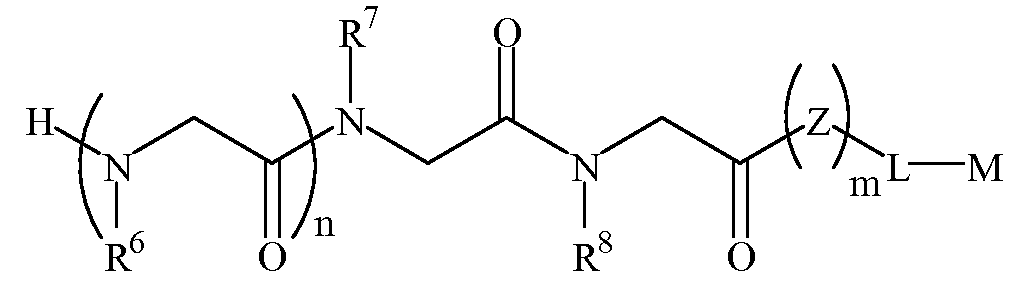
여기서,
R6은 수소; 알킬; 알릴; 메틸; 에틸; n-프로필; 이소프로필; n-부틸; 이소부틸; n-부틸아민; 2급-부틸; 3급-부틸; 펜틸; 헥실; 이소펜틸; 아릴; 헤테로아릴; 푸라닐; 인돌릴; 티오페닐; 티아졸릴; 이미다졸릴; 이속사조일; 옥사조일; 피페로닐; 피라조일; 피롤릴; 피라지닐; 피리딜; 피리미딜; 피리미디닐; 푸리닐; 신놀리닐; 벤조푸라닐; 벤조티에닐; 벤조트리아졸릴; 벤족사졸릴; 퀴놀린; 이속사졸릴; 이소퀴놀린; 사이클로알킬; 알케닐; 사이클로알케닐; 페닐; 피리딜; 메톡시에틸; (R)-메틸벤질; 비치환되거나 NH2, OH 또는 SH에 의해 치환된 C1 -6 알킬; 비치환되거나 NH2, OH 또는 SH에 의해 치환된 C2 -6 알키닐; 리실; 카복실; 및 하이드록실 그룹으로 이루어진 그룹으로부터 선택되고,
R7 및 R8은 C0 -6 알킬아릴; C0 -6 알킬헤테로아릴; OH, SH, 할로겐, OR15, COOR15, NR15(여기서, R15는 H 또는 C1 -6 알킬이나 C1 -6 알키닐로 이루어진 그룹으로부터 선택된다) 또는 R16(여기서, R16은 H 또는 C1 -6 알키닐로 이루어진 그룹으로부터 선택된다)으로부터 선택되는 그룹에 의해 치환된 C1 -6 알킬; OC1 -6 알킬; C2 -6 알케닐; C2 -6 알키닐; C2 -6 알케닐; 및 C2 -6 알키닐로 이루어진 그룹으로부터 독립적으로 선택된다;
(iii)
화학식 1C

여기서,
R9, R11 및 R13은 수소; 알킬; 알릴; 메틸; 에틸; n-프로필; 이소프로필; n-부틸; 이소부틸; n-부틸아민; 2급-부틸; 3급-부틸; 펜틸; 헥실; 이소펜틸; 아릴; 헤테로아릴; 푸라닐; 인돌릴; 티오페닐; 티아졸릴; 이미다졸릴; 이속사조일; 옥사조일; 피페로닐; 피라조일; 피롤릴; 피라지닐; 피리딜; 피리미딜; 피리미디닐; 푸리닐; 신놀리닐; 벤조푸라닐; 벤조티에닐; 벤조트리아졸릴; 벤족사졸릴; 퀴놀린; 이속사졸릴; 이소퀴놀린; 사이클로알킬; 알케닐; 사이클로알케닐; 페닐; 피리딜; 메톡시에틸; (R)-메틸벤질; 비치환되거나 NH2, OH 또는 SH에 의해 치환된 C1 -6 알킬; 비치환되거나 NH2, OH 또는 SH에 의해 치환된 C2 -6 알키닐; 리실; 카복실; 및 하이드록실 그룹으로 이루어진 그룹으로부터 독립적으로 선택되고,
R10, R12 및 R14는 C0 -6 알킬아릴; C0 -6 알킬헤테로아릴; OH, SH, 할로겐, OR15, COOR15, NR15(여기서, R15는 H 또는 C1 -6 알킬이나 C1 -6 알키닐로 이루어진 그룹으로부터 선택된다) 또는 R16(여기서, R16은 H 또는 C1 -6 알키닐로 이루어진 그룹으로부터 선택된다)으로부터 선택되는 그룹에 의해 치환된 C1 -6 알킬; OC1 -6 알킬; C2 -6 알케닐; C2-6 알키닐; C2 -6 알케닐; 및 C2 -6 알키닐로 이루어진 그룹으로부터 독립적으로 선택된다;
(iv)
화학식 1D

여기서,
R17 내지 R20 및 R23은 수소; 알킬; 알릴; 메틸; 에틸; n-프로필; 이소프로필; n-부틸; 이소부틸; n-부틸아민; 2급-부틸; 3급-부틸; 펜틸; 헥실; 이소펜틸; 아릴; 헤테로아릴; 푸라닐; 인돌릴; 티오페닐; 티아졸릴; 이미다졸릴; 이속사조일; 옥사조일; 피페로닐; 피라조일; 피롤릴; 피라지닐; 피리딜; 피리미딜; 피리미디닐; 푸리닐; 신놀리닐; 벤조푸라닐; 벤조티에닐; 벤조트리아졸릴; 벤족사졸릴; 퀴놀린; 이속사졸릴; 이소퀴놀린; 사이클로알킬; 알케닐; 사이클로알케닐; 페닐; 피리딜; 메톡시에틸; (R)-메틸벤질; 비치환되거나 NH2, OH 또는 SH에 의해 치환된 C1 -6 알킬; 비치환되거나 NH2, OH 또는 SH에 의해 치환된 C2 -6 알키닐; 리실; 카복실; 및 하이드록실 그룹으로 이루어진 그룹으로부터 독립적으로 선택되고,
R21, R22 및 R24는 C0 -6 알킬아릴; C0 -6 알킬헤테로아릴; OH, SH, 할로겐, OR15, COOR15, NR15(여기서, R15는 H 또는 C1 -6 알킬이나 C1 -6 알키닐로 이루어진 그룹으로부터 선택된다) 또는 R16(여기서, R16은 H 또는 C1 -6 알키닐로 이루어진 그룹으로부터 선택된다)으로부터 선택되는 그룹에 의해 치환된 C1 -6 알킬; OC1 -6 알킬; C2 -6 알케닐; C2-6 알키닐; C2 -6 알케닐; 및 C2 -6 알키닐로 이루어진 그룹으로부터 독립적으로 선택된다;
(v)
화학식 1D

여기서,
R17 내지 R20, R23 및 R24는 수소; 알킬; 알릴; 메틸; 에틸; n-프로필; 이소프로필; n-부틸; 이소부틸; n-부틸아민; 2급-부틸; 3급-부틸; 펜틸; 헥실; 이소펜틸; 아릴; 헤테로아릴; 푸라닐; 인돌릴; 티오페닐; 티아졸릴; 이미다졸릴; 이속사조일; 옥사조일; 피페로닐; 피라조일; 피롤릴; 피라지닐; 피리딜; 피리미딜; 피리미디닐; 푸리닐; 신놀리닐; 벤조푸라닐; 벤조티에닐; 벤조트리아졸릴; 벤족사졸릴; 퀴놀린; 이속사졸릴; 이소퀴놀린; 사이클로알킬; 알케닐; 사이클로알케닐; 페닐; 피리딜; 메톡시에틸; (R)-메틸벤질; 비치환되거나 NH2, OH 또는 SH에 의해 치환된 C1 -6 알킬; 비치환되거나 NH2, OH 또는 SH에 의해 치환된 C2 -6 알키닐; 리실; 카복실; 및 하이드록실 그룹으로 이루어진 그룹으로부터 독립적으로 선택되고,
R21 및 R22는 C0 -6 알킬아릴; C0 -6 알킬헤테로아릴; OH, SH, 할로겐, OR15, COOR15, NR15(여기서, R15는 H 또는 C1 -6 알킬이나 C1 -6 알키닐로 이루어진 그룹으로부터 선택된다) 또는 R16(여기서, R16은 H 또는 C1 -6 알키닐로 이루어진 그룹으로부터 선택된다)으로부터 선택되는 그룹에 의해 치환된 C1 -6 알킬; OC1 -6 알킬; C2 -6 알케닐; C2-6 알키닐; C2 -6 알케닐; 및 C2 -6 알키닐로 이루어진 그룹으로부터 독립적으로 선택된다;
(vi)
화학식 1D

여기서,
R17, R19, R20 및 R23은 수소; 알킬; 알릴; 메틸; 에틸; n-프로필; 이소프로필; n-부틸; 이소부틸; n-부틸아민; 2급-부틸; 3급-부틸; 펜틸; 헥실; 이소펜틸; 아릴; 헤테로아릴; 푸라닐; 인돌릴; 티오페닐; 티아졸릴; 이미다졸릴; 이속사조일; 옥사조일; 피페로닐; 피라조일; 피롤릴; 피라지닐; 피리딜; 피리미딜; 피리미디닐; 푸리닐; 신놀리닐; 벤조푸라닐; 벤조티에닐; 벤조트리아졸릴; 벤족사졸릴; 퀴놀린; 이속사졸릴; 이소퀴놀린; 사이클로알킬; 알케닐; 사이클로알케닐; 페닐; 피리딜; 메톡시에틸; (R)-메틸벤질; 비치환되거나 NH2, OH 또는 SH에 의해 치환된 C1 -6 알킬; 비치환되거나 NH2, OH 또는 SH에 의해 치환된 C2 -6 알키닐; 리실; 카복실; 및 하이드록실 그룹으로 이루어진 그룹으로부터 독립적으로 선택되고,
R18, R21 및 R24는 C0 -6 알킬아릴; C0 -6 알킬헤테로아릴; OH, SH, 할로겐, OR15, COOR15, NR15(여기서, R15는 H 또는 C1 -6 알킬이나 C1 -6 알키닐로 이루어진 그룹으로부터 선택된다) 또는 R16(여기서, R16은 H 또는 C1 -6 알키닐로 이루어진 그룹으로부터 선택된다)으로부터 선택되는 그룹에 의해 치환된 C1 -6 알킬; OC1 -6 알킬; C2 -6 알케닐; C2-6 알키닐; C2 -6 알케닐; 및 C2 -6 알키닐로 이루어진 그룹으로부터 독립적으로 선택되고,
Z는 커플링 그룹이고,
L은 임의의 링커 잔기(linker moiety)이고,
M은 기질 또는 지지체이고,
m, n, o 및/또는 p는 0 내지 6이다.(a) the antibody-containing sample is prepared by the following peptides having formulas 1A, 1B, 1C or 1D as described in (i), (ii), (iii), (iv), (v) or (vi). Contacting with an attached support, and
(b) detecting the antibody in the antibody-containing sample, comprising detecting the antibody bound to the peptoid:
(i)
Formula 1A
here,
R 1 and R 4 are hydrogen; Alkyl; Allyl; methyl; ethyl; n-propyl; Isopropyl; n-butyl; Isobutyl; n-butylamine; Secondary-butyl; Tert-butyl; Pentyl; Hexyl; Isopentyl; Aryl; Heteroaryl; Furanyl; Indolyl; Thiophenyl; Thiazolyl; Imidazolyl; Exploded yarn; Oxazoyl; Piperonyl; Pyrazoyl; Pyrrolyl; Pyrazinyl; Pyridyl; Pyrimidyl; Pyrimidinyl; Furinyl; Cinnaolinyl; Benzofuranyl; Benzothienyl; Benzotriazolyl; Benzoxazolyl; Quinoline; Isoxazolyl; Isoquinoline; Cycloalkyl; Alkenyl; Cycloalkenyl; Phenyl; Pyridyl; Methoxyethyl; (R) -methylbenzyl; Unsubstituted or NH 2, C 1 -6 alkyl substituted by OH or SH; Unsubstituted or NH 2, a C 2 -6 alkenyl optionally substituted by OH or SH group; Lysyl; Carboxyl; And hydroxyl groups independently;
R 2, R 3 and R 5 is C 0 -6 alkylaryl; C 0 -6 alkyl-heteroaryl; OH, SH, halogen, OR 15, COOR 15, NR 15 ( wherein, R 15 is selected from the group consisting of H or C 1 -6 alkyl or C 1 -6 alkynyl group) or R 16 (wherein, R 16 is substituted C 1-6 alkyl by H or C 1-6 group selected from is selected from the group consisting of alkynyl); OC 1 -6 alkyl; C 2 -6 alkenyl; C 2-6 alkynyl; C 2 -6 alkenyl; And C 2 -6 are independently selected from the group consisting of alkynyl;
(ii)
Formula 1B
here,
R 6 is hydrogen; Alkyl; Allyl; methyl; ethyl; n-propyl; Isopropyl; n-butyl; Isobutyl; n-butylamine; Secondary-butyl; Tert-butyl; Pentyl; Hexyl; Isopentyl; Aryl; Heteroaryl; Furanyl; Indolyl; Thiophenyl; Thiazolyl; Imidazolyl; Exploded yarn; Oxazoyl; Piperonyl; Pyrazoyl; Pyrrolyl; Pyrazinyl; Pyridyl; Pyrimidyl; Pyrimidinyl; Furinyl; Cinnaolinyl; Benzofuranyl; Benzothienyl; Benzotriazolyl; Benzoxazolyl; Quinoline; Isoxazolyl; Isoquinoline; Cycloalkyl; Alkenyl; Cycloalkenyl; Phenyl; Pyridyl; Methoxyethyl; (R) -methylbenzyl; Unsubstituted or NH 2, C 1 -6 alkyl substituted by OH or SH; Unsubstituted or NH 2, a C 2 -6 alkenyl optionally substituted by OH or SH group; Lysyl; Carboxyl; And it is selected from the group consisting of hydroxyl group,
R 7 And R 8 is C 0 -6 alkylaryl; C 0 -6 alkyl-heteroaryl; OH, SH, halogen, OR 15, COOR 15, NR 15 ( wherein, R 15 is selected from the group consisting of H or C 1 -6 alkyl or C 1 -6 alkynyl group) or R 16 (wherein, R 16 is substituted C 1-6 alkyl by H or C 1-6 group selected from is selected from the group consisting of alkynyl); OC 1 -6 alkyl; C 2 -6 alkenyl; C 2 -6-alkynyl; C 2 -6 alkenyl; And C 2 -6 are independently selected from the group consisting of alkynyl;
(iii)
Formula 1C
here,
R 9 , R 11 and R 13 are hydrogen; Alkyl; Allyl; methyl; ethyl; n-propyl; Isopropyl; n-butyl; Isobutyl; n-butylamine; Secondary-butyl; Tert-butyl; Pentyl; Hexyl; Isopentyl; Aryl; Heteroaryl; Furanyl; Indolyl; Thiophenyl; Thiazolyl; Imidazolyl; Exploded yarn; Oxazoyl; Piperonyl; Pyrazoyl; Pyrrolyl; Pyrazinyl; Pyridyl; Pyrimidyl; Pyrimidinyl; Furinyl; Cinnaolinyl; Benzofuranyl; Benzothienyl; Benzotriazolyl; Benzoxazolyl; Quinoline; Isoxazolyl; Isoquinoline; Cycloalkyl; Alkenyl; Cycloalkenyl; Phenyl; Pyridyl; Methoxyethyl; (R) -methylbenzyl; Unsubstituted or NH 2, C 1 -6 alkyl substituted by OH or SH; Unsubstituted or NH 2, a C 2 -6 alkenyl optionally substituted by OH or SH group; Lysyl; Carboxyl; And hydroxyl groups independently;
R 10 , R 12 And R 14 is C 0 -6 alkylaryl; C 0 -6 alkyl-heteroaryl; OH, SH, halogen, OR 15, COOR 15, NR 15 ( wherein, R 15 is selected from the group consisting of H or C 1 -6 alkyl or C 1 -6 alkynyl group) or R 16 (wherein, R 16 is substituted C 1-6 alkyl by H or C 1-6 group selected from is selected from the group consisting of alkynyl); OC 1 -6 alkyl; C 2 -6 alkenyl; C 2-6 alkynyl; C 2 -6 alkenyl; And C 2 -6 are independently selected from the group consisting of alkynyl;
(iv)
Formula 1D
here,
R 17 R 20 and R 23 are hydrogen; Alkyl; Allyl; methyl; ethyl; n-propyl; Isopropyl; n-butyl; Isobutyl; n-butylamine; Secondary-butyl; Tert-butyl; Pentyl; Hexyl; Isopentyl; Aryl; Heteroaryl; Furanyl; Indolyl; Thiophenyl; Thiazolyl; Imidazolyl; Exploded yarn; Oxazoyl; Piperonyl; Pyrazoyl; Pyrrolyl; Pyrazinyl; Pyridyl; Pyrimidyl; Pyrimidinyl; Furinyl; Cinnaolinyl; Benzofuranyl; Benzothienyl; Benzotriazolyl; Benzoxazolyl; Quinoline; Isoxazolyl; Isoquinoline; Cycloalkyl; Alkenyl; Cycloalkenyl; Phenyl; Pyridyl; Methoxyethyl; (R) -methylbenzyl; Unsubstituted or NH 2, C 1 -6 alkyl substituted by OH or SH; Unsubstituted or NH 2, a C 2 -6 alkenyl optionally substituted by OH or SH group; Lysyl; Carboxyl; And hydroxyl groups independently;
R 21 , R 22 And R 24 is C 0 -6 alkylaryl; C 0 -6 alkyl-heteroaryl; OH, SH, halogen, OR 15, COOR 15, NR 15 ( wherein, R 15 is selected from the group consisting of H or C 1 -6 alkyl or C 1 -6 alkynyl group) or R 16 (wherein, R 16 is substituted C 1-6 alkyl by H or C 1-6 group selected from is selected from the group consisting of alkynyl); OC 1 -6 alkyl; C 2 -6 alkenyl; C 2-6 alkynyl; C 2 -6 alkenyl; And C 2 -6 are independently selected from the group consisting of alkynyl;
(v)
Formula 1D
here,
R 17 To R 20 , R 23 and R 24 are hydrogen; Alkyl; Allyl; methyl; ethyl; n-propyl; Isopropyl; n-butyl; Isobutyl; n-butylamine; Secondary-butyl; Tert-butyl; Pentyl; Hexyl; Isopentyl; Aryl; Heteroaryl; Furanyl; Indolyl; Thiophenyl; Thiazolyl; Imidazolyl; Exploded yarn; Oxazoyl; Piperonyl; Pyrazoyl; Pyrrolyl; Pyrazinyl; Pyridyl; Pyrimidyl; Pyrimidinyl; Furinyl; Cinnaolinyl; Benzofuranyl; Benzothienyl; Benzotriazolyl; Benzoxazolyl; Quinoline; Isoxazolyl; Isoquinoline; Cycloalkyl; Alkenyl; Cycloalkenyl; Phenyl; Pyridyl; Methoxyethyl; (R) -methylbenzyl; Unsubstituted or NH 2, C 1 -6 alkyl substituted by OH or SH; Unsubstituted or NH 2, a C 2 -6 alkenyl optionally substituted by OH or SH group; Lysyl; Carboxyl; And hydroxyl groups independently;
R 21 And R 22 is C 0 -6 alkylaryl; C 0 -6 alkyl-heteroaryl; OH, SH, halogen, OR 15, COOR 15, NR 15 ( wherein, R 15 is selected from the group consisting of H or C 1 -6 alkyl or C 1 -6 alkynyl group) or R 16 (wherein, R 16 is substituted C 1-6 alkyl by H or C 1-6 group selected from is selected from the group consisting of alkynyl); OC 1 -6 alkyl; C 2 -6 alkenyl; C 2-6 alkynyl; C 2 -6 alkenyl; And C 2 -6 are independently selected from the group consisting of alkynyl;
(vi)
Formula 1D
here,
R 17 , R 19 , R 20 and R 23 are hydrogen; Alkyl; Allyl; methyl; ethyl; n-propyl; Isopropyl; n-butyl; Isobutyl; n-butylamine; Secondary-butyl; Tert-butyl; Pentyl; Hexyl; Isopentyl; Aryl; Heteroaryl; Furanyl; Indolyl; Thiophenyl; Thiazolyl; Imidazolyl; Exploded yarn; Oxazoyl; Piperonyl; Pyrazoyl; Pyrrolyl; Pyrazinyl; Pyridyl; Pyrimidyl; Pyrimidinyl; Furinyl; Cinnaolinyl; Benzofuranyl; Benzothienyl; Benzotriazolyl; Benzoxazolyl; Quinoline; Isoxazolyl; Isoquinoline; Cycloalkyl; Alkenyl; Cycloalkenyl; Phenyl; Pyridyl; Methoxyethyl; (R) -methylbenzyl; Unsubstituted or NH 2, C 1 -6 alkyl substituted by OH or SH; Unsubstituted or NH 2, a C 2 -6 alkenyl optionally substituted by OH or SH group; Lysyl; Carboxyl; And hydroxyl groups independently;
R 18 , R 21 And R 24 is C 0 -6 alkylaryl; C 0 -6 alkyl-heteroaryl; OH, SH, halogen, OR 15, COOR 15, NR 15 ( wherein, R 15 is selected from the group consisting of H or C 1 -6 alkyl or C 1 -6 alkynyl group) or R 16 (wherein, R 16 is substituted C 1-6 alkyl by H or C 1-6 group selected from is selected from the group consisting of alkynyl); OC 1 -6 alkyl; C 2 -6 alkenyl; C 2-6 alkynyl; C 2 -6 alkenyl; And C 2 -6 are independently selected from the group consisting of alkynyl,
Z is a coupling group,
L is any linker moiety,
M is a substrate or support,
m, n, o and / or p are 0-6.
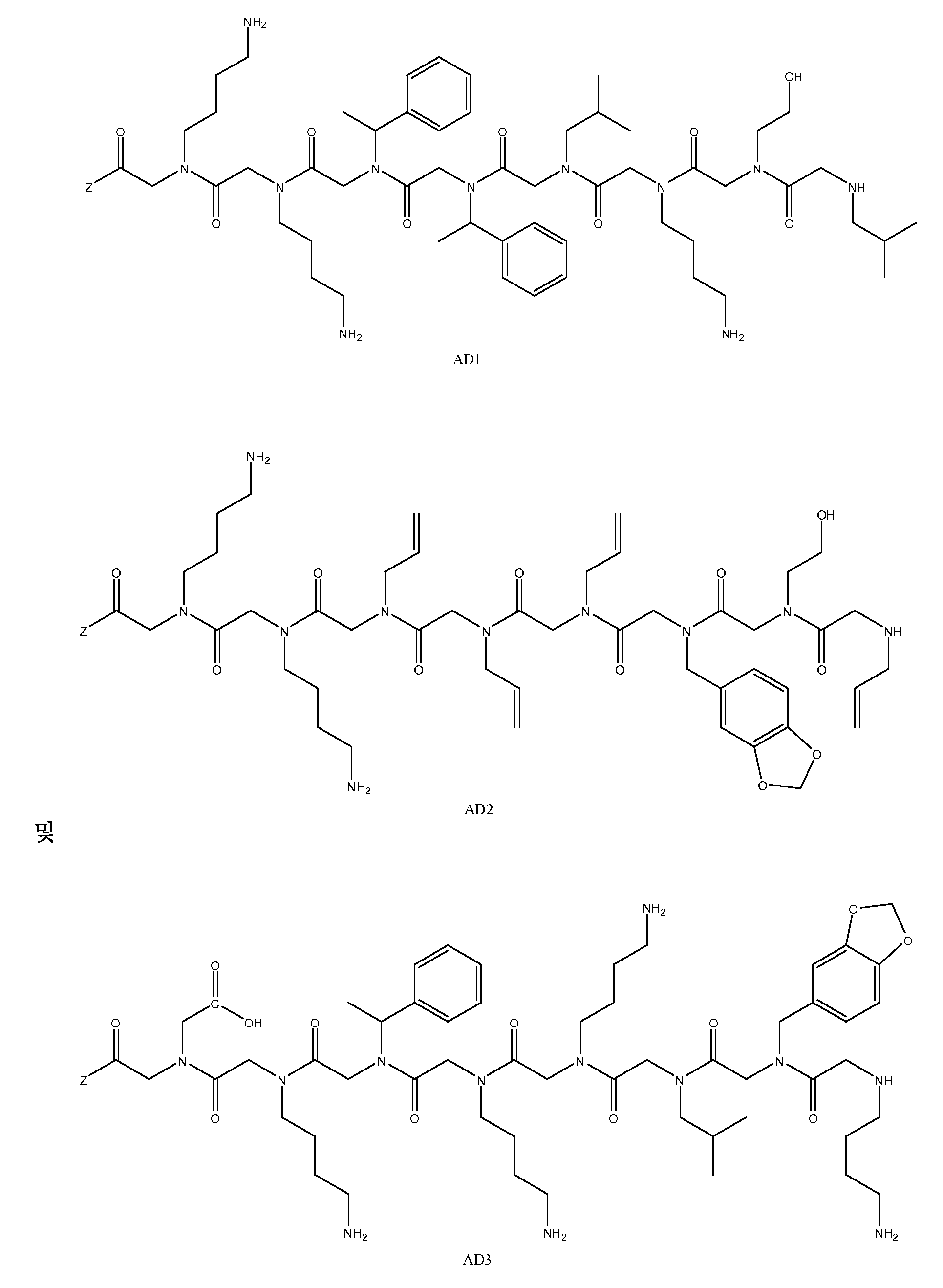
상기 화학식들에서,
Z는 링커, 기질 또는 라벨에 커플링될 수 있는 작용기이다.The method of claim 3, wherein the one or more peptoids are selected from the group consisting of
In the above formulas,
Z is a functional group that can be coupled to a linker, substrate, or label.
(b) 상기 펩토이드에 결합된 항체를 검출하는 단계를 포함하는, 항체-함유 샘플에서 항체를 검출하는 방법:
(i)
화학식 2A

여기서,
R27은 알킬아릴 그룹 또는 메틸벤질 그룹이고,
R25, R26, R28 내지 R32는 수소; 알킬; 알릴; 메틸; 에틸; n-프로필; 이소프로필; n-부틸; 이소부틸; n-부틸아민; 2급-부틸; 3급-부틸; 펜틸; 헥실; 이소펜틸; 아릴; 헤테로아릴; 푸라닐; 인돌릴; 티오페닐; 티아졸릴; 이미다졸릴; 이속사조일; 옥사조일; 피페로닐; 피라조일; 피롤릴; 피라지닐; 피리딜; 피리미딜; 피리미디닐; 푸리닐; 신놀리닐; 벤조푸라닐; 벤조티에닐; 벤조트리아졸릴; 벤족사졸릴; 퀴놀린; 이속사졸릴; 이소퀴놀린; 사이클로알킬; 알케닐; 사이클로알케닐; 페닐; 피리딜; 메톡시에틸, (R)-메틸벤질; C0 -6 알킬아릴; C0 -6 알킬헤테로아릴; OH, SH, 할로겐, OR15, COOR15, NR15(여기서, R15는 H 또는 C1 -6 알킬이나 C1 -6 알키닐로 이루어진 그룹으로부터 선택된다) 또는 R16(여기서, R16은 H 또는 C1 -6 알키닐로 이루어진 그룹으로부터 선택된다)으로부터 선택되는 그룹에 의해 치환된 C1 -6 알킬; OC1 -6 알킬; C2 -6 알케닐; C2 -6 알키닐; C2 -6 알케닐; 및 C2 -6 알키닐로 이루어진 그룹으로부터 독립적으로 선택된다;
(ii)
화학식 2B

여기서,
R34는 알킬아민 또는 N-부틸아민이고,
R35는 알케닐, 예를 들면, 알릴 그룹이고,
R33, R36 및 R38 내지 R40은 수소; 알킬; 알릴; 메틸; 에틸; n-프로필; 이소프로필; n-부틸; 이소부틸; n-부틸아민; 2급-부틸; 3급-부틸; 펜틸; 헥실; 이소펜틸; 아릴; 헤테로아릴; 푸라닐; 인돌릴; 티오페닐; 티아졸릴; 이미다졸릴; 이속사조일; 옥사조일; 피페로닐; 피라조일; 피롤릴; 피라지닐; 피리딜; 피리미딜; 피리미디닐; 푸리닐; 신놀리닐; 벤조푸라닐; 벤조티에닐; 벤조트리아졸릴; 벤족사졸릴; 퀴놀린; 이속사졸릴; 이소퀴놀린; 사이클로알킬; 알케닐; 사이클로알케닐; 페닐; 피리딜; 메톡시에틸, (R)-메틸벤질; C0 -6 알킬아릴; C0 -6 알킬헤테로아릴; OH, SH, 할로겐, OR15, COOR15, NR15(여기서, R15는 H 또는 C1 -6 알킬이나 C1 -6 알키닐로 이루어진 그룹으로부터 선택된다) 또는 R16(여기서, R16은 H 또는 C1 -6 알키닐로 이루어진 그룹으로부터 선택된다)으로부터 선택되는 그룹에 의해 치환된 C1 -6 알킬; OC1 -6 알킬; C2 -6 알케닐; C2 -6 알키닐; C2 -6 알케닐; 및 C2 -6 알키닐로 이루어진 그룹으로부터 독립적으로 선택되고,
Z는 커플링 그룹이고,
L은 임의의 링커 잔기이고,
M은 기질 또는 지지체이고,
m, n, o 및/또는 p는 0 내지 6이다.(a) contacting the antibody-containing sample with a support to which a peptoid having formula (2A) or (2B) as described in (i) or (ii) is attached, and
(b) detecting the antibody in the antibody-containing sample, comprising detecting the antibody bound to the peptoid:
(i)
Formula 2A
here,
R 27 is an alkylaryl group or methylbenzyl group,
R 25 , R 26 , R 28 R 32 is hydrogen; Alkyl; Allyl; methyl; ethyl; n-propyl; Isopropyl; n-butyl; Isobutyl; n-butylamine; Secondary-butyl; Tert-butyl; Pentyl; Hexyl; Isopentyl; Aryl; Heteroaryl; Furanyl; Indolyl; Thiophenyl; Thiazolyl; Imidazolyl; Exploded yarn; Oxazoyl; Piperonyl; Pyrazoyl; Pyrrolyl; Pyrazinyl; Pyridyl; Pyrimidyl; Pyrimidinyl; Furinyl; Cinnaolinyl; Benzofuranyl; Benzothienyl; Benzotriazolyl; Benzoxazolyl; Quinoline; Isoxazolyl; Isoquinoline; Cycloalkyl; Alkenyl; Cycloalkenyl; Phenyl; Pyridyl; Methoxyethyl, (R) -methylbenzyl; C 0 -6 alkylaryl; C 0 -6 alkyl-heteroaryl; OH, SH, halogen, OR 15, COOR 15, NR 15 ( wherein, R 15 is selected from the group consisting of H or C 1 -6 alkyl or C 1 -6 alkynyl group) or R 16 (wherein, R 16 is substituted C 1-6 alkyl by H or C 1-6 group selected from is selected from the group consisting of alkynyl); OC 1 -6 alkyl; C 2 -6 alkenyl; C 2 -6-alkynyl; C 2 -6 alkenyl; And C 2 -6 are independently selected from the group consisting of alkynyl;
(ii)
Formula 2B
here,
R 34 is Alkylamine or N-butylamine,
R 35 is alkenyl, for example an allyl group,
R 33 , R 36 And R 38 to R 40 are hydrogen; Alkyl; Allyl; methyl; ethyl; n-propyl; Isopropyl; n-butyl; Isobutyl; n-butylamine; Secondary-butyl; Tert-butyl; Pentyl; Hexyl; Isopentyl; Aryl; Heteroaryl; Furanyl; Indolyl; Thiophenyl; Thiazolyl; Imidazolyl; Exploded yarn; Oxazoyl; Piperonyl; Pyrazoyl; Pyrrolyl; Pyrazinyl; Pyridyl; Pyrimidyl; Pyrimidinyl; Furinyl; Cinnaolinyl; Benzofuranyl; Benzothienyl; Benzotriazolyl; Benzoxazolyl; Quinoline; Isoxazolyl; Isoquinoline; Cycloalkyl; Alkenyl; Cycloalkenyl; Phenyl; Pyridyl; Methoxyethyl, (R) -methylbenzyl; C 0 -6 alkylaryl; C 0 -6 alkyl-heteroaryl; OH, SH, halogen, OR 15, COOR 15, NR 15 ( wherein, R 15 is selected from the group consisting of H or C 1 -6 alkyl or C 1 -6 alkynyl group) or R 16 (wherein, R 16 is substituted C 1-6 alkyl by H or C 1-6 group selected from is selected from the group consisting of alkynyl); OC 1 -6 alkyl; C 2 -6 alkenyl; C 2 -6-alkynyl; C 2 -6 alkenyl; And C 2 -6 are independently selected from the group consisting of alkynyl,
Z is a coupling group,
L is any linker residue,
M is a substrate or support,
m, n, o and / or p are 0-6.
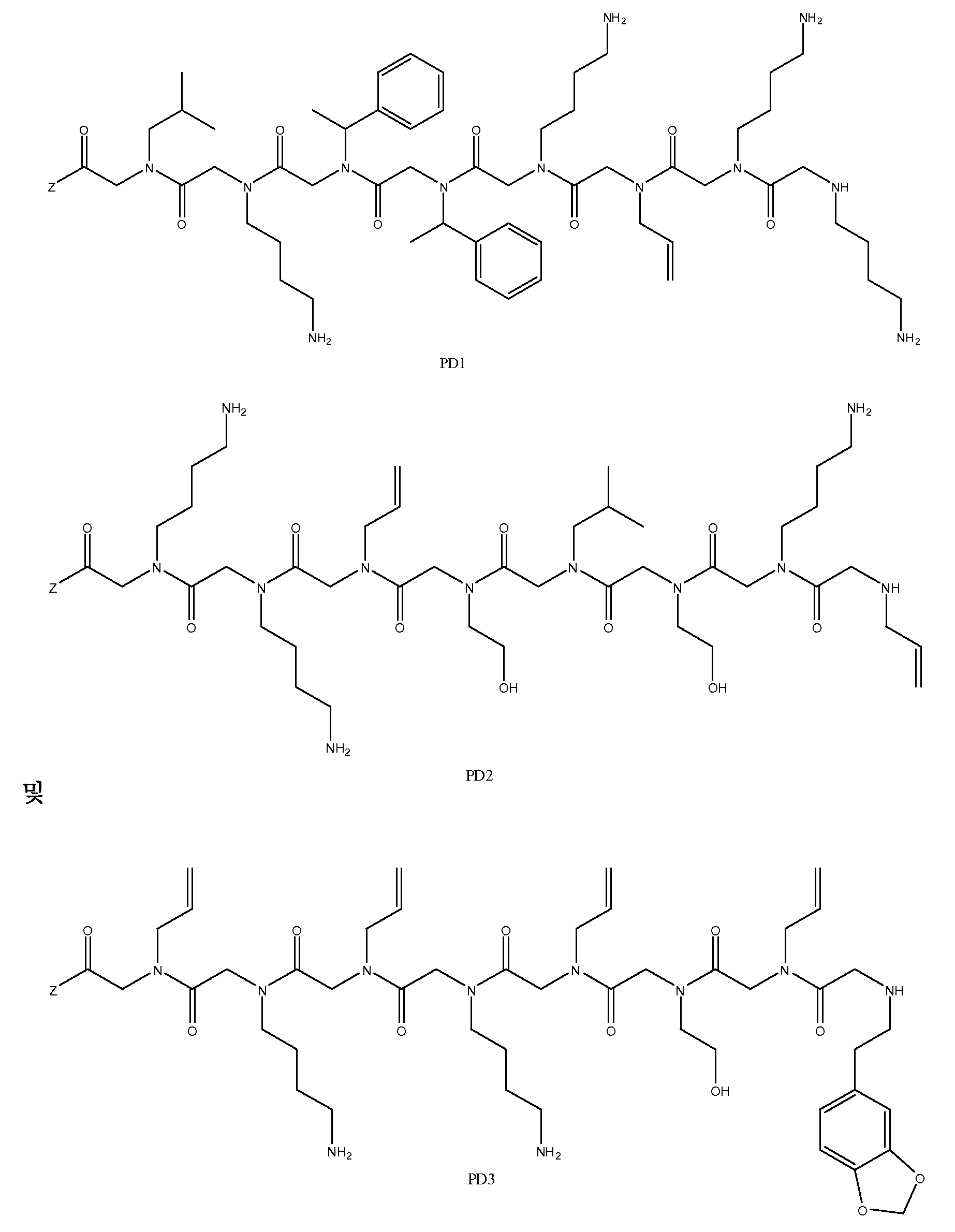
상기 화학식들에서,
Z는 링커, 기질 또는 라벨에 커플링될 수 있는 작용기이다.The method of claim 18, wherein the peptoid is selected from the group consisting of
In the above formulas,
Z is a functional group that can be coupled to a linker, substrate, or label.
(b) 상기 펩토이드에 결합된 항체를 검출하는 단계, 및
(c) 단계 (b)의 결과를 근거로 하여 치료를 결정하는 단계를 포함하는, 신경변성 질환(ND)이 있는 것으로 의심되는 대상의 치료 방법:
(i)
화학식 1A
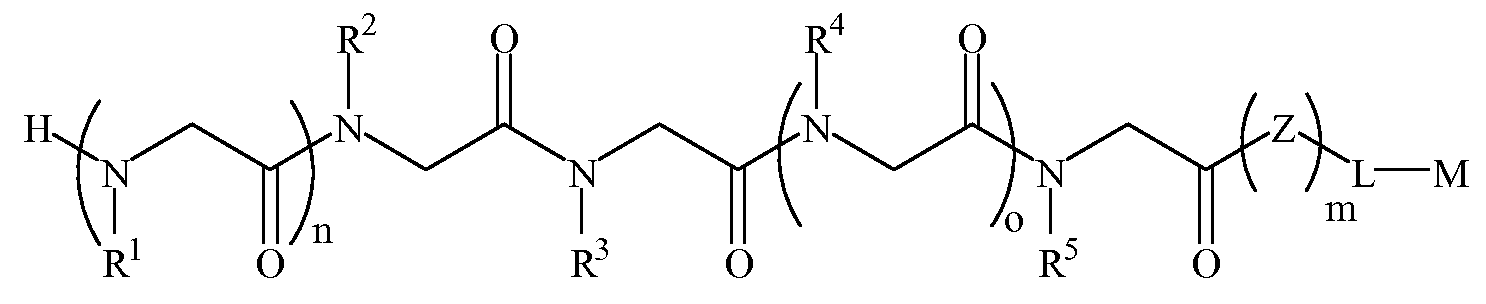
여기서,
R1 및 R4는 수소; 알킬; 알릴; 메틸; 에틸; n-프로필; 이소프로필; n-부틸; 이소부틸; n-부틸아민; 2급-부틸; 3급-부틸; 펜틸; 헥실; 이소펜틸; 아릴; 헤테로아릴; 푸라닐; 인돌릴; 티오페닐; 티아졸릴; 이미다졸릴; 이속사조일; 옥사조일; 피페로닐; 피라조일; 피롤릴; 피라지닐; 피리딜; 피리미딜; 피리미디닐; 푸리닐; 신놀리닐; 벤조푸라닐; 벤조티에닐; 벤조트리아졸릴; 벤족사졸릴; 퀴놀린; 이속사졸릴; 이소퀴놀린; 사이클로알킬; 알케닐; 사이클로알케닐; 페닐; 피리딜; 메톡시에틸; (R)-메틸벤질; 비치환되거나 NH2, OH 또는 SH에 의해 치환된 C1 -6 알킬; 비치환되거나 NH2, OH 또는 SH에 의해 치환된 C2 -6 알키닐; 리실; 카복실; 및 하이드록실 그룹으로 이루어진 그룹으로부터 독립적으로 선택되고,
R2, R3 및 R5는 C0 -6 알킬아릴; C0 -6 알킬헤테로아릴; OH, SH, 할로겐, OR15, COOR15, NR15(여기서, R15는 H 또는 C1 -6 알킬이나 C1 -6 알키닐로 이루어진 그룹으로부터 선택된다) 또는 R16(여기서, R16은 H 또는 C1 -6 알키닐로 이루어진 그룹으로부터 선택된다)으로부터 선택되는 그룹에 의해 치환된 C1 -6 알킬; OC1 -6 알킬; C2 -6 알케닐; C2-6 알키닐; C2 -6 알케닐; 및 C2 -6 알키닐로 이루어진 그룹으로부터 독립적으로 선택된다;
(ii)
화학식 1B

여기서,
R6은 수소; 알킬; 알릴; 메틸; 에틸; n-프로필; 이소프로필; n-부틸; 이소부틸; n-부틸아민; 2급-부틸; 3급-부틸; 펜틸; 헥실; 이소펜틸; 아릴; 헤테로아릴; 푸라닐; 인돌릴; 티오페닐; 티아졸릴; 이미다졸릴; 이속사조일; 옥사조일; 피페로닐; 피라조일; 피롤릴; 피라지닐; 피리딜; 피리미딜; 피리미디닐; 푸리닐; 신놀리닐; 벤조푸라닐; 벤조티에닐; 벤조트리아졸릴; 벤족사졸릴; 퀴놀린; 이속사졸릴; 이소퀴놀린; 사이클로알킬; 알케닐; 사이클로알케닐; 페닐; 피리딜; 메톡시에틸; (R)-메틸벤질; 비치환되거나 NH2, OH 또는 SH에 의해 치환된 C1 -6 알킬; 비치환되거나 NH2, OH 또는 SH에 의해 치환된 C2 -6 알키닐; 리실; 카복실; 및 하이드록실 그룹으로 이루어진 그룹으로부터 선택되고,
R7 및 R8은 C0 -6 알킬아릴; C0 -6 알킬헤테로아릴; OH, SH, 할로겐, OR15, COOR15, NR15(여기서, R15는 H 또는 C1 -6 알킬이나 C1 -6 알키닐로 이루어진 그룹으로부터 선택된다) 또는 R16(여기서, R16은 H 또는 C1 -6 알키닐로 이루어진 그룹으로부터 선택된다)으로부터 선택되는 그룹에 의해 치환된 C1 -6 알킬; OC1 -6 알킬; C2 -6 알케닐; C2 -6 알키닐; C2 -6 알케닐; 및 C2 -6 알키닐로 이루어진 그룹으로부터 독립적으로 선택된다;
(iii)
화학식 1C

여기서,
R9, R11 및 R13은 수소; 알킬; 알릴; 메틸; 에틸; n-프로필; 이소프로필; n-부틸; 이소부틸; n-부틸아민; 2급-부틸; 3급-부틸; 펜틸; 헥실; 이소펜틸; 아릴; 헤테로아릴; 푸라닐; 인돌릴; 티오페닐; 티아졸릴; 이미다졸릴; 이속사조일; 옥사조일; 피페로닐; 피라조일; 피롤릴; 피라지닐; 피리딜; 피리미딜; 피리미디닐; 푸리닐; 신놀리닐; 벤조푸라닐; 벤조티에닐; 벤조트리아졸릴; 벤족사졸릴; 퀴놀린; 이속사졸릴; 이소퀴놀린; 사이클로알킬; 알케닐; 사이클로알케닐; 페닐; 피리딜; 메톡시에틸; (R)-메틸벤질; 비치환되거나 NH2, OH 또는 SH에 의해 치환된 C1 -6 알킬; 비치환되거나 NH2, OH 또는 SH에 의해 치환된 C2 -6 알키닐; 리실; 카복실; 및 하이드록실 그룹으로 이루어진 그룹으로부터 독립적으로 선택되고,
R10, R12 및 R14는 C0 -6 알킬아릴; C0 -6 알킬헤테로아릴; OH, SH, 할로겐, OR15, COOR15, NR15(여기서, R15는 H 또는 C1 -6 알킬이나 C1 -6 알키닐로 이루어진 그룹으로부터 선택된다) 또는 R16(여기서, R16은 H 또는 C1 -6 알키닐로 이루어진 그룹으로부터 선택된다)으로부터 선택되는 그룹에 의해 치환된 C1 -6 알킬; OC1 -6 알킬; C2 -6 알케닐; C2-6 알키닐; C2 -6 알케닐; 및 C2 -6 알키닐로 이루어진 그룹으로부터 독립적으로 선택된다;
(iv)
화학식 1D

여기서,
R17 내지 R20 및 R23은 수소; 알킬; 알릴; 메틸; 에틸; n-프로필; 이소프로필; n-부틸; 이소부틸; n-부틸아민; 2급-부틸; 3급-부틸; 펜틸; 헥실; 이소펜틸; 아릴; 헤테로아릴; 푸라닐; 인돌릴; 티오페닐; 티아졸릴; 이미다졸릴; 이속사조일; 옥사조일; 피페로닐; 피라조일; 피롤릴; 피라지닐; 피리딜; 피리미딜; 피리미디닐; 푸리닐; 신놀리닐; 벤조푸라닐; 벤조티에닐; 벤조트리아졸릴; 벤족사졸릴; 퀴놀린; 이속사졸릴; 이소퀴놀린; 사이클로알킬; 알케닐; 사이클로알케닐; 페닐; 피리딜; 메톡시에틸; (R)-메틸벤질; 비치환되거나 NH2, OH 또는 SH에 의해 치환된 C1 -6 알킬; 비치환되거나 NH2, OH 또는 SH에 의해 치환된 C2 -6 알키닐; 리실; 카복실; 및 하이드록실 그룹으로 이루어진 그룹으로부터 독립적으로 선택되고,
R21, R22 및 R24는 C0 -6 알킬아릴; C0 -6 알킬헤테로아릴; OH, SH, 할로겐, OR15, COOR15, NR15(여기서, R15는 H 또는 C1 -6 알킬이나 C1 -6 알키닐로 이루어진 그룹으로부터 선택된다) 또는 R16(여기서, R16은 H 또는 C1 -6 알키닐로 이루어진 그룹으로부터 선택된다)으로부터 선택되는 그룹에 의해 치환된 C1 -6 알킬; OC1 -6 알킬; C2 -6 알케닐; C2-6 알키닐; C2 -6 알케닐; 및 C2 -6 알키닐로 이루어진 그룹으로부터 독립적으로 선택된다;
(v)
화학식 1D

여기서,
R17 내지 R20, R23 및 R24는 수소; 알킬; 알릴; 메틸; 에틸; n-프로필; 이소프로필; n-부틸; 이소부틸; n-부틸아민; 2급-부틸; 3급-부틸; 펜틸; 헥실; 이소펜틸; 아릴; 헤테로아릴; 푸라닐; 인돌릴; 티오페닐; 티아졸릴; 이미다졸릴; 이속사조일; 옥사조일; 피페로닐; 피라조일; 피롤릴; 피라지닐; 피리딜; 피리미딜; 피리미디닐; 푸리닐; 신놀리닐; 벤조푸라닐; 벤조티에닐; 벤조트리아졸릴; 벤족사졸릴; 퀴놀린; 이속사졸릴; 이소퀴놀린; 사이클로알킬; 알케닐; 사이클로알케닐; 페닐; 피리딜; 메톡시에틸; (R)-메틸벤질; 비치환되거나 NH2, OH 또는 SH에 의해 치환된 C1 -6 알킬; 비치환되거나 NH2, OH 또는 SH에 의해 치환된 C2 -6 알키닐; 리실; 카복실; 및 하이드록실 그룹으로 이루어진 그룹으로부터 독립적으로 선택되고,
R21 및 R22는 C0 -6 알킬아릴; C0 -6 알킬헤테로아릴; OH, SH, 할로겐, OR15, COOR15, NR15(여기서, R15는 H 또는 C1 -6 알킬이나 C1 -6 알키닐로 이루어진 그룹으로부터 선택된다) 또는 R16(여기서, R16은 H 또는 C1 -6 알키닐로 이루어진 그룹으로부터 선택된다)으로부터 선택되는 그룹에 의해 치환된 C1 -6 알킬; OC1 -6 알킬; C2 -6 알케닐; C2-6 알키닐; C2 -6 알케닐; 및 C2 -6 알키닐로 이루어진 그룹으로부터 독립적으로 선택된다;
(vi)
화학식 1D

여기서,
R17, R19, R20 및 R23은 수소; 알킬; 알릴; 메틸; 에틸; n-프로필; 이소프로필; n-부틸; 이소부틸; n-부틸아민; 2급-부틸; 3급-부틸; 펜틸; 헥실; 이소펜틸; 아릴; 헤테로아릴; 푸라닐; 인돌릴; 티오페닐; 티아졸릴; 이미다졸릴; 이속사조일; 옥사조일; 피페로닐; 피라조일; 피롤릴; 피라지닐; 피리딜; 피리미딜; 피리미디닐; 푸리닐; 신놀리닐; 벤조푸라닐; 벤조티에닐; 벤조트리아졸릴; 벤족사졸릴; 퀴놀린; 이속사졸릴; 이소퀴놀린; 사이클로알킬; 알케닐; 사이클로알케닐; 페닐; 피리딜; 메톡시에틸; (R)-메틸벤질; 비치환되거나 NH2, OH 또는 SH에 의해 치환된 C1 -6 알킬; 비치환되거나 NH2, OH 또는 SH에 의해 치환된 C2 -6 알키닐; 리실; 카복실; 및 하이드록실 그룹으로 이루어진 그룹으로부터 독립적으로 선택되고,
R18, R21 및 R24는 C0 -6 알킬아릴; C0 -6 알킬헤테로아릴; OH, SH, 할로겐, OR15, COOR15, NR15(여기서, R15는 H 또는 C1 -6 알킬이나 C1 -6 알키닐로 이루어진 그룹으로부터 선택된다) 또는 R16(여기서, R16은 H 또는 C1 -6 알키닐로 이루어진 그룹으로부터 선택된다)으로부터 선택되는 그룹에 의해 치환된 C1 -6 알킬; OC1 -6 알킬; C2 -6 알케닐; C2-6 알키닐; C2 -6 알케닐; 및 C2 -6 알키닐로 이루어진 그룹으로부터 독립적으로 선택된다;
(vii)
화학식 2A

여기서,
R27은 알킬아릴 그룹 또는 메틸벤질 그룹이고,
R25, R26, R28 내지 R32는 수소; 알킬; 알릴; 메틸; 에틸; n-프로필; 이소프로필; n-부틸; 이소부틸; n-부틸아민; 2급-부틸; 3급-부틸; 펜틸; 헥실; 이소펜틸; 아릴; 헤테로아릴; 푸라닐; 인돌릴; 티오페닐; 티아졸릴; 이미다졸릴; 이속사조일; 옥사조일; 피페로닐; 피라조일; 피롤릴; 피라지닐; 피리딜; 피리미딜; 피리미디닐; 푸리닐; 신놀리닐; 벤조푸라닐; 벤조티에닐; 벤조트리아졸릴; 벤족사졸릴; 퀴놀린; 이속사졸릴; 이소퀴놀린; 사이클로알킬; 알케닐; 사이클로알케닐; 페닐; 피리딜; 메톡시에틸, (R)-메틸벤질; C0 -6 알킬아릴; C0 -6 알킬헤테로아릴; OH, SH, 할로겐, OR15, COOR15, NR15(여기서, R15는 H 또는 C1 -6 알킬이나 C1 -6 알키닐로 이루어진 그룹으로부터 선택된다) 또는 R16(여기서, R16은 H 또는 C1 -6 알키닐로 이루어진 그룹으로부터 선택된다)으로부터 선택되는 그룹에 의해 치환된 C1 -6 알킬; OC1 -6 알킬; C2 -6 알케닐; C2 -6 알키닐; C2 -6 알케닐; 및 C2 -6 알키닐로 이루어진 그룹으로부터 독립적으로 선택된다;
(viii)
화학식 2B

여기서,
R34는 알킬아민 또는 N-부틸아민이고,
R35는 알케닐, 예를 들면, 알릴 그룹이고,
R33, R36 및 R38 내지 R40은 수소; 알킬; 알릴; 메틸; 에틸; n-프로필; 이소프로필; n-부틸; 이소부틸; n-부틸아민; 2급-부틸; 3급-부틸; 펜틸; 헥실; 이소펜틸; 아릴; 헤테로아릴; 푸라닐; 인돌릴; 티오페닐; 티아졸릴; 이미다졸릴; 이속사조일; 옥사조일; 피페로닐; 피라조일; 피롤릴; 피라지닐; 피리딜; 피리미딜; 피리미디닐; 푸리닐; 신놀리닐; 벤조푸라닐; 벤조티에닐; 벤조트리아졸릴; 벤족사졸릴; 퀴놀린; 이속사졸릴; 이소퀴놀린; 사이클로알킬; 알케닐; 사이클로알케닐; 페닐; 피리딜; 메톡시에틸, (R)-메틸벤질; C0 -6 알킬아릴; C0 -6 알킬헤테로아릴; OH, SH, 할로겐, OR15, COOR15, NR15(여기서, R15는 H 또는 C1 -6 알킬이나 C1 -6 알키닐로 이루어진 그룹으로부터 선택된다) 또는 R16(여기서, R16은 H 또는 C1 -6 알키닐로 이루어진 그룹으로부터 선택된다)으로부터 선택되는 그룹에 의해 치환된 C1 -6 알킬; OC1 -6 알킬; C2 -6 알케닐; C2 -6 알키닐; C2 -6 알케닐; 및 C2 -6 알키닐로 이루어진 그룹으로부터 독립적으로 선택되고,
Z는 커플링 그룹이고,
L은 임의의 링커 잔기이고,
M은 기질 또는 지지체이고,
m, n, o 및/또는 p는 0 내지 6이다.(a) An antibody-containing sample is prepared by the following formulas (1), (ii), (iii), (iv), (v), (vi), (vii) or (viii): Contacting a support to which a peptoid comprising formula 1D, formula 2A, or formula 2B is attached,
(b) detecting the antibody bound to the peptoid, and
(c) treating a subject suspected of having a neurodegenerative disease (ND), comprising determining a treatment based on the results of step (b):
(i)
Formula 1A
here,
R 1 and R 4 are hydrogen; Alkyl; Allyl; methyl; ethyl; n-propyl; Isopropyl; n-butyl; Isobutyl; n-butylamine; Secondary-butyl; Tert-butyl; Pentyl; Hexyl; Isopentyl; Aryl; Heteroaryl; Furanyl; Indolyl; Thiophenyl; Thiazolyl; Imidazolyl; Exploded yarn; Oxazoyl; Piperonyl; Pyrazoyl; Pyrrolyl; Pyrazinyl; Pyridyl; Pyrimidyl; Pyrimidinyl; Furinyl; Cinnaolinyl; Benzofuranyl; Benzothienyl; Benzotriazolyl; Benzoxazolyl; Quinoline; Isoxazolyl; Isoquinoline; Cycloalkyl; Alkenyl; Cycloalkenyl; Phenyl; Pyridyl; Methoxyethyl; (R) -methylbenzyl; Unsubstituted or NH 2, C 1 -6 alkyl substituted by OH or SH; Unsubstituted or NH 2, a C 2 -6 alkenyl optionally substituted by OH or SH group; Lysyl; Carboxyl; And hydroxyl groups independently;
R 2, R 3 and R 5 is C 0 -6 alkylaryl; C 0 -6 alkyl-heteroaryl; OH, SH, halogen, OR 15, COOR 15, NR 15 ( wherein, R 15 is selected from the group consisting of H or C 1 -6 alkyl or C 1 -6 alkynyl group) or R 16 (wherein, R 16 is substituted C 1-6 alkyl by H or C 1-6 group selected from is selected from the group consisting of alkynyl); OC 1 -6 alkyl; C 2 -6 alkenyl; C 2-6 alkynyl; C 2 -6 alkenyl; And C 2 -6 are independently selected from the group consisting of alkynyl;
(ii)
Formula 1B
here,
R 6 is hydrogen; Alkyl; Allyl; methyl; ethyl; n-propyl; Isopropyl; n-butyl; Isobutyl; n-butylamine; Secondary-butyl; Tert-butyl; Pentyl; Hexyl; Isopentyl; Aryl; Heteroaryl; Furanyl; Indolyl; Thiophenyl; Thiazolyl; Imidazolyl; Exploded yarn; Oxazoyl; Piperonyl; Pyrazoyl; Pyrrolyl; Pyrazinyl; Pyridyl; Pyrimidyl; Pyrimidinyl; Furinyl; Cinnaolinyl; Benzofuranyl; Benzothienyl; Benzotriazolyl; Benzoxazolyl; Quinoline; Isoxazolyl; Isoquinoline; Cycloalkyl; Alkenyl; Cycloalkenyl; Phenyl; Pyridyl; Methoxyethyl; (R) -methylbenzyl; Unsubstituted or NH 2, C 1 -6 alkyl substituted by OH or SH; Unsubstituted or NH 2, a C 2 -6 alkenyl optionally substituted by OH or SH group; Lysyl; Carboxyl; And it is selected from the group consisting of hydroxyl group,
R 7 And R 8 is C 0 -6 alkylaryl; C 0 -6 alkyl-heteroaryl; OH, SH, halogen, OR 15, COOR 15, NR 15 ( wherein, R 15 is selected from the group consisting of H or C 1 -6 alkyl or C 1 -6 alkynyl group) or R 16 (wherein, R 16 is substituted C 1-6 alkyl by H or C 1-6 group selected from is selected from the group consisting of alkynyl); OC 1 -6 alkyl; C 2 -6 alkenyl; C 2 -6-alkynyl; C 2 -6 alkenyl; And C 2 -6 are independently selected from the group consisting of alkynyl;
(iii)
Formula 1C
here,
R 9 , R 11 and R 13 are hydrogen; Alkyl; Allyl; methyl; ethyl; n-propyl; Isopropyl; n-butyl; Isobutyl; n-butylamine; Secondary-butyl; Tert-butyl; Pentyl; Hexyl; Isopentyl; Aryl; Heteroaryl; Furanyl; Indolyl; Thiophenyl; Thiazolyl; Imidazolyl; Exploded yarn; Oxazoyl; Piperonyl; Pyrazoyl; Pyrrolyl; Pyrazinyl; Pyridyl; Pyrimidyl; Pyrimidinyl; Furinyl; Cinnaolinyl; Benzofuranyl; Benzothienyl; Benzotriazolyl; Benzoxazolyl; Quinoline; Isoxazolyl; Isoquinoline; Cycloalkyl; Alkenyl; Cycloalkenyl; Phenyl; Pyridyl; Methoxyethyl; (R) -methylbenzyl; Unsubstituted or NH 2, C 1 -6 alkyl substituted by OH or SH; Unsubstituted or NH 2, a C 2 -6 alkenyl optionally substituted by OH or SH group; Lysyl; Carboxyl; And hydroxyl groups independently;
R 10 , R 12 And R 14 is C 0 -6 alkylaryl; C 0 -6 alkyl-heteroaryl; OH, SH, halogen, OR 15, COOR 15, NR 15 ( wherein, R 15 is selected from the group consisting of H or C 1 -6 alkyl or C 1 -6 alkynyl group) or R 16 (wherein, R 16 is substituted C 1-6 alkyl by H or C 1-6 group selected from is selected from the group consisting of alkynyl); OC 1 -6 alkyl; C 2 -6 alkenyl; C 2-6 alkynyl; C 2 -6 alkenyl; And C 2 -6 are independently selected from the group consisting of alkynyl;
(iv)
Formula 1D
here,
R 17 R 20 and R 23 are hydrogen; Alkyl; Allyl; methyl; ethyl; n-propyl; Isopropyl; n-butyl; Isobutyl; n-butylamine; Secondary-butyl; Tert-butyl; Pentyl; Hexyl; Isopentyl; Aryl; Heteroaryl; Furanyl; Indolyl; Thiophenyl; Thiazolyl; Imidazolyl; Exploded yarn; Oxazoyl; Piperonyl; Pyrazoyl; Pyrrolyl; Pyrazinyl; Pyridyl; Pyrimidyl; Pyrimidinyl; Furinyl; Cinnaolinyl; Benzofuranyl; Benzothienyl; Benzotriazolyl; Benzoxazolyl; Quinoline; Isoxazolyl; Isoquinoline; Cycloalkyl; Alkenyl; Cycloalkenyl; Phenyl; Pyridyl; Methoxyethyl; (R) -methylbenzyl; Unsubstituted or NH 2, C 1 -6 alkyl substituted by OH or SH; Unsubstituted or NH 2, a C 2 -6 alkenyl optionally substituted by OH or SH group; Lysyl; Carboxyl; And hydroxyl groups independently;
R 21 , R 22 And R 24 is C 0 -6 alkylaryl; C 0 -6 alkyl-heteroaryl; OH, SH, halogen, OR 15, COOR 15, NR 15 ( wherein, R 15 is selected from the group consisting of H or C 1 -6 alkyl or C 1 -6 alkynyl group) or R 16 (wherein, R 16 is substituted C 1-6 alkyl by H or C 1-6 group selected from is selected from the group consisting of alkynyl); OC 1 -6 alkyl; C 2 -6 alkenyl; C 2-6 alkynyl; C 2 -6 alkenyl; And C 2 -6 are independently selected from the group consisting of alkynyl;
(v)
Formula 1D
here,
R 17 To R 20 , R 23 and R 24 are hydrogen; Alkyl; Allyl; methyl; ethyl; n-propyl; Isopropyl; n-butyl; Isobutyl; n-butylamine; Secondary-butyl; Tert-butyl; Pentyl; Hexyl; Isopentyl; Aryl; Heteroaryl; Furanyl; Indolyl; Thiophenyl; Thiazolyl; Imidazolyl; Exploded yarn; Oxazoyl; Piperonyl; Pyrazoyl; Pyrrolyl; Pyrazinyl; Pyridyl; Pyrimidyl; Pyrimidinyl; Furinyl; Cinnaolinyl; Benzofuranyl; Benzothienyl; Benzotriazolyl; Benzoxazolyl; Quinoline; Isoxazolyl; Isoquinoline; Cycloalkyl; Alkenyl; Cycloalkenyl; Phenyl; Pyridyl; Methoxyethyl; (R) -methylbenzyl; Unsubstituted or NH 2, C 1 -6 alkyl substituted by OH or SH; Unsubstituted or NH 2, a C 2 -6 alkenyl optionally substituted by OH or SH group; Lysyl; Carboxyl; And hydroxyl groups independently;
R 21 And R 22 is C 0 -6 alkylaryl; C 0 -6 alkyl-heteroaryl; OH, SH, halogen, OR 15, COOR 15, NR 15 ( wherein, R 15 is selected from the group consisting of H or C 1 -6 alkyl or C 1 -6 alkynyl group) or R 16 (wherein, R 16 is substituted C 1-6 alkyl by H or C 1-6 group selected from is selected from the group consisting of alkynyl); OC 1 -6 alkyl; C 2 -6 alkenyl; C 2-6 alkynyl; C 2 -6 alkenyl; And C 2 -6 are independently selected from the group consisting of alkynyl;
(vi)
Formula 1D
here,
R 17 , R 19 , R 20 and R 23 are hydrogen; Alkyl; Allyl; methyl; ethyl; n-propyl; Isopropyl; n-butyl; Isobutyl; n-butylamine; Secondary-butyl; Tert-butyl; Pentyl; Hexyl; Isopentyl; Aryl; Heteroaryl; Furanyl; Indolyl; Thiophenyl; Thiazolyl; Imidazolyl; Exploded yarn; Oxazoyl; Piperonyl; Pyrazoyl; Pyrrolyl; Pyrazinyl; Pyridyl; Pyrimidyl; Pyrimidinyl; Furinyl; Cinnaolinyl; Benzofuranyl; Benzothienyl; Benzotriazolyl; Benzoxazolyl; Quinoline; Isoxazolyl; Isoquinoline; Cycloalkyl; Alkenyl; Cycloalkenyl; Phenyl; Pyridyl; Methoxyethyl; (R) -methylbenzyl; Unsubstituted or NH 2, C 1 -6 alkyl substituted by OH or SH; Unsubstituted or NH 2, a C 2 -6 alkenyl optionally substituted by OH or SH group; Lysyl; Carboxyl; And hydroxyl groups independently;
R 18 , R 21 And R 24 is C 0 -6 alkylaryl; C 0 -6 alkyl-heteroaryl; OH, SH, halogen, OR 15, COOR 15, NR 15 ( wherein, R 15 is selected from the group consisting of H or C 1 -6 alkyl or C 1 -6 alkynyl group) or R 16 (wherein, R 16 is substituted C 1-6 alkyl by H or C 1-6 group selected from is selected from the group consisting of alkynyl); OC 1 -6 alkyl; C 2 -6 alkenyl; C 2-6 alkynyl; C 2 -6 alkenyl; And C 2 -6 are independently selected from the group consisting of alkynyl;
(vii)
Formula 2A
here,
R 27 is an alkylaryl group or methylbenzyl group,
R 25 , R 26 , R 28 R 32 is hydrogen; Alkyl; Allyl; methyl; ethyl; n-propyl; Isopropyl; n-butyl; Isobutyl; n-butylamine; Secondary-butyl; Tert-butyl; Pentyl; Hexyl; Isopentyl; Aryl; Heteroaryl; Furanyl; Indolyl; Thiophenyl; Thiazolyl; Imidazolyl; Exploded yarn; Oxazoyl; Piperonyl; Pyrazoyl; Pyrrolyl; Pyrazinyl; Pyridyl; Pyrimidyl; Pyrimidinyl; Furinyl; Cinnaolinyl; Benzofuranyl; Benzothienyl; Benzotriazolyl; Benzoxazolyl; Quinoline; Isoxazolyl; Isoquinoline; Cycloalkyl; Alkenyl; Cycloalkenyl; Phenyl; Pyridyl; Methoxyethyl, (R) -methylbenzyl; C 0 -6 alkylaryl; C 0 -6 alkyl-heteroaryl; OH, SH, halogen, OR 15, COOR 15, NR 15 ( wherein, R 15 is selected from the group consisting of H or C 1 -6 alkyl or C 1 -6 alkynyl group) or R 16 (wherein, R 16 is substituted C 1-6 alkyl by H or C 1-6 group selected from is selected from the group consisting of alkynyl); OC 1 -6 alkyl; C 2 -6 alkenyl; C 2 -6-alkynyl; C 2 -6 alkenyl; And C 2 -6 are independently selected from the group consisting of alkynyl;
(viii)
Formula 2B
here,
R 34 is Alkylamine or N-butylamine,
R 35 is alkenyl, for example an allyl group,
R 33 , R 36 And R 38 to R 40 are hydrogen; Alkyl; Allyl; methyl; ethyl; n-propyl; Isopropyl; n-butyl; Isobutyl; n-butylamine; Secondary-butyl; Tert-butyl; Pentyl; Hexyl; Isopentyl; Aryl; Heteroaryl; Furanyl; Indolyl; Thiophenyl; Thiazolyl; Imidazolyl; Exploded yarn; Oxazoyl; Piperonyl; Pyrazoyl; Pyrrolyl; Pyrazinyl; Pyridyl; Pyrimidyl; Pyrimidinyl; Furinyl; Cinnaolinyl; Benzofuranyl; Benzothienyl; Benzotriazolyl; Benzoxazolyl; Quinoline; Isoxazolyl; Isoquinoline; Cycloalkyl; Alkenyl; Cycloalkenyl; Phenyl; Pyridyl; Methoxyethyl, (R) -methylbenzyl; C 0 -6 alkylaryl; C 0 -6 alkyl-heteroaryl; OH, SH, halogen, OR 15, COOR 15, NR 15 ( wherein, R 15 is selected from the group consisting of H or C 1 -6 alkyl or C 1 -6 alkynyl group) or R 16 (wherein, R 16 is substituted C 1-6 alkyl by H or C 1-6 group selected from is selected from the group consisting of alkynyl); OC 1 -6 alkyl; C 2 -6 alkenyl; C 2 -6-alkynyl; C 2 -6 alkenyl; And C 2 -6 are independently selected from the group consisting of alkynyl,
Z is a coupling group,
L is any linker residue,
M is a substrate or support,
m, n, o and / or p are 0-6.
상기 키트가 하기 (i), (ii), (iii), (iv), (v), (vi), (vii) 또는 (viii)에 기재된 화학식 1A, 화학식 1B, 화학식 1C, 화학식 1D, 화학식 2A 또는 화학식 2B를 포함하는 하나 이상의 펩토이드를 포함하는, 신경변성 질환을 나타내는 항체 검출용 키트:
(i)
화학식 1A
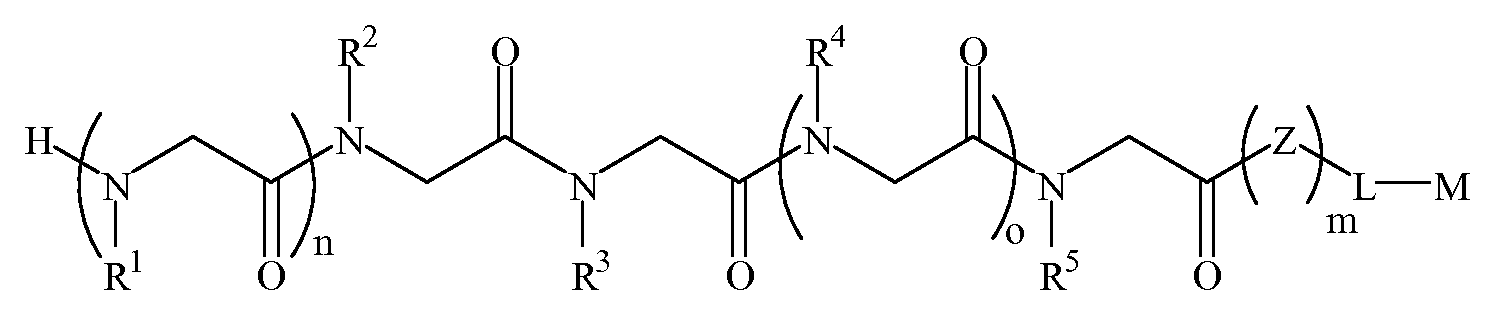
여기서,
R1 및 R4는 수소; 알킬; 알릴; 메틸; 에틸; n-프로필; 이소프로필; n-부틸; 이소부틸; n-부틸아민; 2급-부틸; 3급-부틸; 펜틸; 헥실; 이소펜틸; 아릴; 헤테로아릴; 푸라닐; 인돌릴; 티오페닐; 티아졸릴; 이미다졸릴; 이속사조일; 옥사조일; 피페로닐; 피라조일; 피롤릴; 피라지닐; 피리딜; 피리미딜; 피리미디닐; 푸리닐; 신놀리닐; 벤조푸라닐; 벤조티에닐; 벤조트리아졸릴; 벤족사졸릴; 퀴놀린; 이속사졸릴; 이소퀴놀린; 사이클로알킬; 알케닐; 사이클로알케닐; 페닐; 피리딜; 메톡시에틸; (R)-메틸벤질; 비치환되거나 NH2, OH 또는 SH에 의해 치환된 C1 -6 알킬; 비치환되거나 NH2, OH 또는 SH에 의해 치환된 C2 -6 알키닐; 리실; 카복실; 및 하이드록실 그룹으로 이루어진 그룹으로부터 독립적으로 선택되고,
R2, R3 및 R5는 C0 -6 알킬아릴; C0 -6 알킬헤테로아릴; OH, SH, 할로겐, OR15, COOR15, NR15(여기서, R15는 H 또는 C1 -6 알킬이나 C1 -6 알키닐로 이루어진 그룹으로부터 선택된다) 또는 R16(여기서, R16은 H 또는 C1 -6 알키닐로 이루어진 그룹으로부터 선택된다)으로부터 선택되는 그룹에 의해 치환된 C1 -6 알킬; OC1 -6 알킬; C2 -6 알케닐; C2-6 알키닐; C2 -6 알케닐; 및 C2 -6 알키닐로 이루어진 그룹으로부터 독립적으로 선택된다;
(ii)
화학식 1B
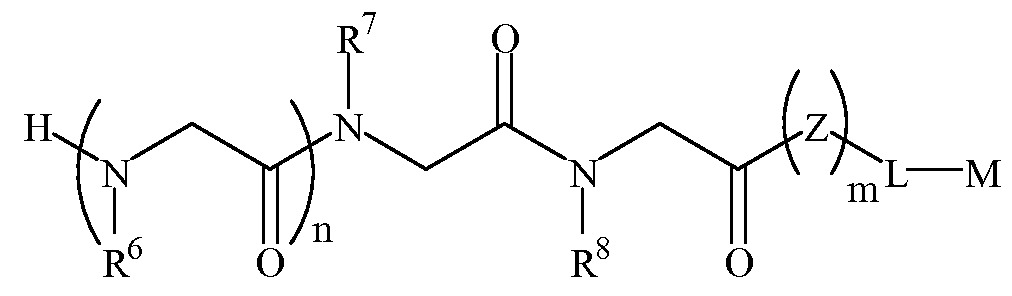
여기서,
R6은 수소; 알킬; 알릴; 메틸; 에틸; n-프로필; 이소프로필; n-부틸; 이소부틸; n-부틸아민; 2급-부틸; 3급-부틸; 펜틸; 헥실; 이소펜틸; 아릴; 헤테로아릴; 푸라닐; 인돌릴; 티오페닐; 티아졸릴; 이미다졸릴; 이속사조일; 옥사조일; 피페로닐; 피라조일; 피롤릴; 피라지닐; 피리딜; 피리미딜; 피리미디닐; 푸리닐; 신놀리닐; 벤조푸라닐; 벤조티에닐; 벤조트리아졸릴; 벤족사졸릴; 퀴놀린; 이속사졸릴; 이소퀴놀린; 사이클로알킬; 알케닐; 사이클로알케닐; 페닐; 피리딜; 메톡시에틸; (R)-메틸벤질; 비치환되거나 NH2, OH 또는 SH에 의해 치환된 C1 -6 알킬; 비치환되거나 NH2, OH 또는 SH에 의해 치환된 C2 -6 알키닐; 리실; 카복실; 및 하이드록실 그룹으로 이루어진 그룹으로부터 선택되고,
R7 및 R8은 C0 -6 알킬아릴; C0 -6 알킬헤테로아릴; OH, SH, 할로겐, OR15, COOR15, NR15(여기서, R15는 H 또는 C1 -6 알킬이나 C1 -6 알키닐로 이루어진 그룹으로부터 선택된다) 또는 R16(여기서, R16은 H 또는 C1 -6 알키닐로 이루어진 그룹으로부터 선택된다)으로부터 선택되는 그룹에 의해 치환된 C1 -6 알킬; OC1 -6 알킬; C2 -6 알케닐; C2 -6 알키닐; C2 -6 알케닐; 및 C2 -6 알키닐로 이루어진 그룹으로부터 독립적으로 선택된다;
(iii)
화학식 1C

여기서,
R9, R11 및 R13은 수소; 알킬; 알릴; 메틸; 에틸; n-프로필; 이소프로필; n-부틸; 이소부틸; n-부틸아민; 2급-부틸; 3급-부틸; 펜틸; 헥실; 이소펜틸; 아릴; 헤테로아릴; 푸라닐; 인돌릴; 티오페닐; 티아졸릴; 이미다졸릴; 이속사조일; 옥사조일; 피페로닐; 피라조일; 피롤릴; 피라지닐; 피리딜; 피리미딜; 피리미디닐; 푸리닐; 신놀리닐; 벤조푸라닐; 벤조티에닐; 벤조트리아졸릴; 벤족사졸릴; 퀴놀린; 이속사졸릴; 이소퀴놀린; 사이클로알킬; 알케닐; 사이클로알케닐; 페닐; 피리딜; 메톡시에틸; (R)-메틸벤질; 비치환되거나 NH2, OH 또는 SH에 의해 치환된 C1 -6 알킬; 비치환되거나 NH2, OH 또는 SH에 의해 치환된 C2 -6 알키닐; 리실; 카복실; 및 하이드록실 그룹으로 이루어진 그룹으로부터 독립적으로 선택되고,
R10, R12 및 R14는 C0 -6 알킬아릴; C0 -6 알킬헤테로아릴; OH, SH, 할로겐, OR15, COOR15, NR15(여기서, R15는 H 또는 C1 -6 알킬이나 C1 -6 알키닐로 이루어진 그룹으로부터 선택된다) 또는 R16(여기서, R16은 H 또는 C1 -6 알키닐로 이루어진 그룹으로부터 선택된다)으로부터 선택되는 그룹에 의해 치환된 C1 -6 알킬; OC1 -6 알킬; C2 -6 알케닐; C2-6 알키닐; C2 -6 알케닐; 및 C2 -6 알키닐로 이루어진 그룹으로부터 독립적으로 선택된다;
(iv)
화학식 1D

여기서,
R17 내지 R20 및 R23은 수소; 알킬; 알릴; 메틸; 에틸; n-프로필; 이소프로필; n-부틸; 이소부틸; n-부틸아민; 2급-부틸; 3급-부틸; 펜틸; 헥실; 이소펜틸; 아릴; 헤테로아릴; 푸라닐; 인돌릴; 티오페닐; 티아졸릴; 이미다졸릴; 이속사조일; 옥사조일; 피페로닐; 피라조일; 피롤릴; 피라지닐; 피리딜; 피리미딜; 피리미디닐; 푸리닐; 신놀리닐; 벤조푸라닐; 벤조티에닐; 벤조트리아졸릴; 벤족사졸릴; 퀴놀린; 이속사졸릴; 이소퀴놀린; 사이클로알킬; 알케닐; 사이클로알케닐; 페닐; 피리딜; 메톡시에틸; (R)-메틸벤질; 비치환되거나 NH2, OH 또는 SH에 의해 치환된 C1 -6 알킬; 비치환되거나 NH2, OH 또는 SH에 의해 치환된 C2 -6 알키닐; 리실; 카복실; 및 하이드록실 그룹으로 이루어진 그룹으로부터 독립적으로 선택되고,
R21, R22 및 R24는 C0 -6 알킬아릴; C0 -6 알킬헤테로아릴; OH, SH, 할로겐, OR15, COOR15, NR15(여기서, R15는 H 또는 C1 -6 알킬이나 C1 -6 알키닐로 이루어진 그룹으로부터 선택된다) 또는 R16(여기서, R16은 H 또는 C1 -6 알키닐로 이루어진 그룹으로부터 선택된다)으로부터 선택되는 그룹에 의해 치환된 C1 -6 알킬; OC1 -6 알킬; C2 -6 알케닐; C2-6 알키닐; C2 -6 알케닐; 및 C2 -6 알키닐로 이루어진 그룹으로부터 독립적으로 선택된다;
(v)
화학식 1D

여기서,
R17 내지 R20, R23 및 R24는 수소; 알킬; 알릴; 메틸; 에틸; n-프로필; 이소프로필; n-부틸; 이소부틸; n-부틸아민; 2급-부틸; 3급-부틸; 펜틸; 헥실; 이소펜틸; 아릴; 헤테로아릴; 푸라닐; 인돌릴; 티오페닐; 티아졸릴; 이미다졸릴; 이속사조일; 옥사조일; 피페로닐; 피라조일; 피롤릴; 피라지닐; 피리딜; 피리미딜; 피리미디닐; 푸리닐; 신놀리닐; 벤조푸라닐; 벤조티에닐; 벤조트리아졸릴; 벤족사졸릴; 퀴놀린; 이속사졸릴; 이소퀴놀린; 사이클로알킬; 알케닐; 사이클로알케닐; 페닐; 피리딜; 메톡시에틸; (R)-메틸벤질; 비치환되거나 NH2, OH 또는 SH에 의해 치환된 C1 -6 알킬; 비치환되거나 NH2, OH 또는 SH에 의해 치환된 C2 -6 알키닐; 리실; 카복실; 및 하이드록실 그룹으로 이루어진 그룹으로부터 독립적으로 선택되고,
R21 및 R22는 C0 -6 알킬아릴; C0 -6 알킬헤테로아릴; OH, SH, 할로겐, OR15, COOR15, NR15(여기서, R15는 H 또는 C1 -6 알킬이나 C1 -6 알키닐로 이루어진 그룹으로부터 선택된다) 또는 R16(여기서, R16은 H 또는 C1 -6 알키닐로 이루어진 그룹으로부터 선택된다)으로부터 선택되는 그룹에 의해 치환된 C1 -6 알킬; OC1 -6 알킬; C2 -6 알케닐; C2-6 알키닐; C2 -6 알케닐; 및 C2 -6 알키닐로 이루어진 그룹으로부터 독립적으로 선택된다;
(vi)
화학식 1D

여기서,
R17, R19, R20 및 R23은 수소; 알킬; 알릴; 메틸; 에틸; n-프로필; 이소프로필; n-부틸; 이소부틸; n-부틸아민; 2급-부틸; 3급-부틸; 펜틸; 헥실; 이소펜틸; 아릴; 헤테로아릴; 푸라닐; 인돌릴; 티오페닐; 티아졸릴; 이미다졸릴; 이속사조일; 옥사조일; 피페로닐; 피라조일; 피롤릴; 피라지닐; 피리딜; 피리미딜; 피리미디닐; 푸리닐; 신놀리닐; 벤조푸라닐; 벤조티에닐; 벤조트리아졸릴; 벤족사졸릴; 퀴놀린; 이속사졸릴; 이소퀴놀린; 사이클로알킬; 알케닐; 사이클로알케닐; 페닐; 피리딜; 메톡시에틸; (R)-메틸벤질; 비치환되거나 NH2, OH 또는 SH에 의해 치환된 C1 -6 알킬; 비치환되거나 NH2, OH 또는 SH에 의해 치환된 C2 -6 알키닐; 리실; 카복실; 및 하이드록실 그룹으로 이루어진 그룹으로부터 독립적으로 선택되고,
R18, R21 및 R24는 C0 -6 알킬아릴; C0 -6 알킬헤테로아릴; OH, SH, 할로겐, OR15, COOR15, NR15(여기서, R15는 H 또는 C1 -6 알킬이나 C1 -6 알키닐로 이루어진 그룹으로부터 선택된다) 또는 R16(여기서, R16은 H 또는 C1 -6 알키닐로 이루어진 그룹으로부터 선택된다)으로부터 선택되는 그룹에 의해 치환된 C1 -6 알킬; OC1 -6 알킬; C2 -6 알케닐; C2-6 알키닐; C2 -6 알케닐; 및 C2 -6 알키닐로 이루어진 그룹으로부터 독립적으로 선택된다;
(vii)
화학식 2A

여기서,
R27은 알킬아릴 그룹 또는 메틸벤질 그룹이고,
R25, R26, R28 내지 R32는 수소; 알킬; 알릴; 메틸; 에틸; n-프로필; 이소프로필; n-부틸; 이소부틸; n-부틸아민; 2급-부틸; 3급-부틸; 펜틸; 헥실; 이소펜틸; 아릴; 헤테로아릴; 푸라닐; 인돌릴; 티오페닐; 티아졸릴; 이미다졸릴; 이속사조일; 옥사조일; 피페로닐; 피라조일; 피롤릴; 피라지닐; 피리딜; 피리미딜; 피리미디닐; 푸리닐; 신놀리닐; 벤조푸라닐; 벤조티에닐; 벤조트리아졸릴; 벤족사졸릴; 퀴놀린; 이속사졸릴; 이소퀴놀린; 사이클로알킬; 알케닐; 사이클로알케닐; 페닐; 피리딜; 메톡시에틸, (R)-메틸벤질; C0 -6 알킬아릴; C0 -6 알킬헤테로아릴; OH, SH, 할로겐, OR15, COOR15, NR15(여기서, R15는 H 또는 C1 -6 알킬이나 C1 -6 알키닐로 이루어진 그룹으로부터 선택된다) 또는 R16(여기서, R16은 H 또는 C1 -6 알키닐로 이루어진 그룹으로부터 선택된다)으로부터 선택되는 그룹에 의해 치환된 C1 -6 알킬; OC1 -6 알킬; C2 -6 알케닐; C2 -6 알키닐; C2 -6 알케닐; 및 C2 -6 알키닐로 이루어진 그룹으로부터 독립적으로 선택된다;
(viii)
화학식 2B

여기서,
R34는 알킬아민 또는 N-부틸아민이고,
R35는 알케닐, 예를 들면, 알릴 그룹이고,
R33, R36 및 R38 내지 R40은 수소; 알킬; 알릴; 메틸; 에틸; n-프로필; 이소프로필; n-부틸; 이소부틸; n-부틸아민; 2급-부틸; 3급-부틸; 펜틸; 헥실; 이소펜틸; 아릴; 헤테로아릴; 푸라닐; 인돌릴; 티오페닐; 티아졸릴; 이미다졸릴; 이속사조일; 옥사조일; 피페로닐; 피라조일; 피롤릴; 피라지닐; 피리딜; 피리미딜; 피리미디닐; 푸리닐; 신놀리닐; 벤조푸라닐; 벤조티에닐; 벤조트리아졸릴; 벤족사졸릴; 퀴놀린; 이속사졸릴; 이소퀴놀린; 사이클로알킬; 알케닐; 사이클로알케닐; 페닐; 피리딜; 메톡시에틸, (R)-메틸벤질; C0 -6 알킬아릴; C0 -6 알킬헤테로아릴; OH, SH, 할로겐, OR15, COOR15, NR15(여기서, R15는 H 또는 C1 -6 알킬이나 C1 -6 알키닐로 이루어진 그룹으로부터 선택된다) 또는 R16(여기서, R16은 H 또는 C1 -6 알키닐로 이루어진 그룹으로부터 선택된다)으로부터 선택되는 그룹에 의해 치환된 C1 -6 알킬; OC1 -6 알킬; C2 -6 알케닐; C2 -6 알키닐; C2 -6 알케닐; 및 C2 -6 알키닐로 이루어진 그룹으로부터 독립적으로 선택되고,
Z는 커플링 그룹이고,
L은 임의의 링커 잔기이고,
M은 기질 또는 지지체이고,
m, n, o 및/또는 p는 0 내지 6이다.As an antibody detection kit showing neurodegenerative diseases,
The kit is formula (1), (1), (1), (1), (1), (1), (1), (ii), (iii), (iv), (v), (vi), (vii) or (viii). A kit for detecting an antibody indicative of a neurodegenerative disease, comprising at least one peptoid comprising 2A or Formula 2B:
(i)
Formula 1A
here,
R 1 and R 4 are hydrogen; Alkyl; Allyl; methyl; ethyl; n-propyl; Isopropyl; n-butyl; Isobutyl; n-butylamine; Secondary-butyl; Tert-butyl; Pentyl; Hexyl; Isopentyl; Aryl; Heteroaryl; Furanyl; Indolyl; Thiophenyl; Thiazolyl; Imidazolyl; Exploded yarn; Oxazoyl; Piperonyl; Pyrazoyl; Pyrrolyl; Pyrazinyl; Pyridyl; Pyrimidyl; Pyrimidinyl; Furinyl; Cinnaolinyl; Benzofuranyl; Benzothienyl; Benzotriazolyl; Benzoxazolyl; Quinoline; Isoxazolyl; Isoquinoline; Cycloalkyl; Alkenyl; Cycloalkenyl; Phenyl; Pyridyl; Methoxyethyl; (R) -methylbenzyl; Unsubstituted or NH 2, C 1 -6 alkyl substituted by OH or SH; Unsubstituted or NH 2, a C 2 -6 alkenyl optionally substituted by OH or SH group; Lysyl; Carboxyl; And hydroxyl groups independently;
R 2, R 3 and R 5 is C 0 -6 alkylaryl; C 0 -6 alkyl-heteroaryl; OH, SH, halogen, OR 15, COOR 15, NR 15 ( wherein, R 15 is selected from the group consisting of H or C 1 -6 alkyl or C 1 -6 alkynyl group) or R 16 (wherein, R 16 is substituted C 1-6 alkyl by H or C 1-6 group selected from is selected from the group consisting of alkynyl); OC 1 -6 alkyl; C 2 -6 alkenyl; C 2-6 alkynyl; C 2 -6 alkenyl; And C 2 -6 are independently selected from the group consisting of alkynyl;
(ii)
Formula 1B
here,
R 6 is hydrogen; Alkyl; Allyl; methyl; ethyl; n-propyl; Isopropyl; n-butyl; Isobutyl; n-butylamine; Secondary-butyl; Tert-butyl; Pentyl; Hexyl; Isopentyl; Aryl; Heteroaryl; Furanyl; Indolyl; Thiophenyl; Thiazolyl; Imidazolyl; Exploded yarn; Oxazoyl; Piperonyl; Pyrazoyl; Pyrrolyl; Pyrazinyl; Pyridyl; Pyrimidyl; Pyrimidinyl; Furinyl; Cinnaolinyl; Benzofuranyl; Benzothienyl; Benzotriazolyl; Benzoxazolyl; Quinoline; Isoxazolyl; Isoquinoline; Cycloalkyl; Alkenyl; Cycloalkenyl; Phenyl; Pyridyl; Methoxyethyl; (R) -methylbenzyl; Unsubstituted or NH 2, C 1 -6 alkyl substituted by OH or SH; Unsubstituted or NH 2, a C 2 -6 alkenyl optionally substituted by OH or SH group; Lysyl; Carboxyl; And it is selected from the group consisting of hydroxyl group,
R 7 And R 8 is C 0 -6 alkylaryl; C 0 -6 alkyl-heteroaryl; OH, SH, halogen, OR 15, COOR 15, NR 15 ( wherein, R 15 is selected from the group consisting of H or C 1 -6 alkyl or C 1 -6 alkynyl group) or R 16 (wherein, R 16 is substituted C 1-6 alkyl by H or C 1-6 group selected from is selected from the group consisting of alkynyl); OC 1 -6 alkyl; C 2 -6 alkenyl; C 2 -6-alkynyl; C 2 -6 alkenyl; And C 2 -6 are independently selected from the group consisting of alkynyl;
(iii)
Formula 1C
here,
R 9 , R 11 and R 13 are hydrogen; Alkyl; Allyl; methyl; ethyl; n-propyl; Isopropyl; n-butyl; Isobutyl; n-butylamine; Secondary-butyl; Tert-butyl; Pentyl; Hexyl; Isopentyl; Aryl; Heteroaryl; Furanyl; Indolyl; Thiophenyl; Thiazolyl; Imidazolyl; Exploded yarn; Oxazoyl; Piperonyl; Pyrazoyl; Pyrrolyl; Pyrazinyl; Pyridyl; Pyrimidyl; Pyrimidinyl; Furinyl; Cinnaolinyl; Benzofuranyl; Benzothienyl; Benzotriazolyl; Benzoxazolyl; Quinoline; Isoxazolyl; Isoquinoline; Cycloalkyl; Alkenyl; Cycloalkenyl; Phenyl; Pyridyl; Methoxyethyl; (R) -methylbenzyl; Unsubstituted or NH 2, C 1 -6 alkyl substituted by OH or SH; Unsubstituted or NH 2, a C 2 -6 alkenyl optionally substituted by OH or SH group; Lysyl; Carboxyl; And hydroxyl groups independently;
R 10 , R 12 And R 14 is C 0 -6 alkylaryl; C 0 -6 alkyl-heteroaryl; OH, SH, halogen, OR 15, COOR 15, NR 15 ( wherein, R 15 is selected from the group consisting of H or C 1 -6 alkyl or C 1 -6 alkynyl group) or R 16 (wherein, R 16 is substituted C 1-6 alkyl by H or C 1-6 group selected from is selected from the group consisting of alkynyl); OC 1 -6 alkyl; C 2 -6 alkenyl; C 2-6 alkynyl; C 2 -6 alkenyl; And C 2 -6 are independently selected from the group consisting of alkynyl;
(iv)
Formula 1D
here,
R 17 R 20 and R 23 are hydrogen; Alkyl; Allyl; methyl; ethyl; n-propyl; Isopropyl; n-butyl; Isobutyl; n-butylamine; Secondary-butyl; Tert-butyl; Pentyl; Hexyl; Isopentyl; Aryl; Heteroaryl; Furanyl; Indolyl; Thiophenyl; Thiazolyl; Imidazolyl; Exploded yarn; Oxazoyl; Piperonyl; Pyrazoyl; Pyrrolyl; Pyrazinyl; Pyridyl; Pyrimidyl; Pyrimidinyl; Furinyl; Cinnaolinyl; Benzofuranyl; Benzothienyl; Benzotriazolyl; Benzoxazolyl; Quinoline; Isoxazolyl; Isoquinoline; Cycloalkyl; Alkenyl; Cycloalkenyl; Phenyl; Pyridyl; Methoxyethyl; (R) -methylbenzyl; Unsubstituted or NH 2, C 1 -6 alkyl substituted by OH or SH; Unsubstituted or NH 2, a C 2 -6 alkenyl optionally substituted by OH or SH group; Lysyl; Carboxyl; And hydroxyl groups independently;
R 21 , R 22 And R 24 is C 0 -6 alkylaryl; C 0 -6 alkyl-heteroaryl; OH, SH, halogen, OR 15, COOR 15, NR 15 ( wherein, R 15 is selected from the group consisting of H or C 1 -6 alkyl or C 1 -6 alkynyl group) or R 16 (wherein, R 16 is substituted C 1-6 alkyl by H or C 1-6 group selected from is selected from the group consisting of alkynyl); OC 1 -6 alkyl; C 2 -6 alkenyl; C 2-6 alkynyl; C 2 -6 alkenyl; And C 2 -6 are independently selected from the group consisting of alkynyl;
(v)
Formula 1D
here,
R 17 To R 20 , R 23 and R 24 are hydrogen; Alkyl; Allyl; methyl; ethyl; n-propyl; Isopropyl; n-butyl; Isobutyl; n-butylamine; Secondary-butyl; Tert-butyl; Pentyl; Hexyl; Isopentyl; Aryl; Heteroaryl; Furanyl; Indolyl; Thiophenyl; Thiazolyl; Imidazolyl; Exploded yarn; Oxazoyl; Piperonyl; Pyrazoyl; Pyrrolyl; Pyrazinyl; Pyridyl; Pyrimidyl; Pyrimidinyl; Furinyl; Cinnaolinyl; Benzofuranyl; Benzothienyl; Benzotriazolyl; Benzoxazolyl; Quinoline; Isoxazolyl; Isoquinoline; Cycloalkyl; Alkenyl; Cycloalkenyl; Phenyl; Pyridyl; Methoxyethyl; (R) -methylbenzyl; Unsubstituted or NH 2, C 1 -6 alkyl substituted by OH or SH; Unsubstituted or NH 2, a C 2 -6 alkenyl optionally substituted by OH or SH group; Lysyl; Carboxyl; And hydroxyl groups independently;
R 21 And R 22 is C 0 -6 alkylaryl; C 0 -6 alkyl-heteroaryl; OH, SH, halogen, OR 15, COOR 15, NR 15 ( wherein, R 15 is selected from the group consisting of H or C 1 -6 alkyl or C 1 -6 alkynyl group) or R 16 (wherein, R 16 is substituted C 1-6 alkyl by H or C 1-6 group selected from is selected from the group consisting of alkynyl); OC 1 -6 alkyl; C 2 -6 alkenyl; C 2-6 alkynyl; C 2 -6 alkenyl; And C 2 -6 are independently selected from the group consisting of alkynyl;
(vi)
Formula 1D
here,
R 17 , R 19 , R 20 and R 23 are hydrogen; Alkyl; Allyl; methyl; ethyl; n-propyl; Isopropyl; n-butyl; Isobutyl; n-butylamine; Secondary-butyl; Tert-butyl; Pentyl; Hexyl; Isopentyl; Aryl; Heteroaryl; Furanyl; Indolyl; Thiophenyl; Thiazolyl; Imidazolyl; Exploded yarn; Oxazoyl; Piperonyl; Pyrazoyl; Pyrrolyl; Pyrazinyl; Pyridyl; Pyrimidyl; Pyrimidinyl; Furinyl; Cinnaolinyl; Benzofuranyl; Benzothienyl; Benzotriazolyl; Benzoxazolyl; Quinoline; Isoxazolyl; Isoquinoline; Cycloalkyl; Alkenyl; Cycloalkenyl; Phenyl; Pyridyl; Methoxyethyl; (R) -methylbenzyl; Unsubstituted or NH 2, C 1 -6 alkyl substituted by OH or SH; Unsubstituted or NH 2, a C 2 -6 alkenyl optionally substituted by OH or SH group; Lysyl; Carboxyl; And hydroxyl groups independently;
R 18 , R 21 And R 24 is C 0 -6 alkylaryl; C 0 -6 alkyl-heteroaryl; OH, SH, halogen, OR 15, COOR 15, NR 15 ( wherein, R 15 is selected from the group consisting of H or C 1 -6 alkyl or C 1 -6 alkynyl group) or R 16 (wherein, R 16 is substituted C 1-6 alkyl by H or C 1-6 group selected from is selected from the group consisting of alkynyl); OC 1 -6 alkyl; C 2 -6 alkenyl; C 2-6 alkynyl; C 2 -6 alkenyl; And C 2 -6 are independently selected from the group consisting of alkynyl;
(vii)
Formula 2A
here,
R 27 is an alkylaryl group or methylbenzyl group,
R 25 , R 26 , R 28 R 32 is hydrogen; Alkyl; Allyl; methyl; ethyl; n-propyl; Isopropyl; n-butyl; Isobutyl; n-butylamine; Secondary-butyl; Tert-butyl; Pentyl; Hexyl; Isopentyl; Aryl; Heteroaryl; Furanyl; Indolyl; Thiophenyl; Thiazolyl; Imidazolyl; Exploded yarn; Oxazoyl; Piperonyl; Pyrazoyl; Pyrrolyl; Pyrazinyl; Pyridyl; Pyrimidyl; Pyrimidinyl; Furinyl; Cinnaolinyl; Benzofuranyl; Benzothienyl; Benzotriazolyl; Benzoxazolyl; Quinoline; Isoxazolyl; Isoquinoline; Cycloalkyl; Alkenyl; Cycloalkenyl; Phenyl; Pyridyl; Methoxyethyl, (R) -methylbenzyl; C 0 -6 alkylaryl; C 0 -6 alkyl-heteroaryl; OH, SH, halogen, OR 15, COOR 15, NR 15 ( wherein, R 15 is selected from the group consisting of H or C 1 -6 alkyl or C 1 -6 alkynyl group) or R 16 (wherein, R 16 is substituted C 1-6 alkyl by H or C 1-6 group selected from is selected from the group consisting of alkynyl); OC 1 -6 alkyl; C 2 -6 alkenyl; C 2 -6-alkynyl; C 2 -6 alkenyl; And C 2 -6 are independently selected from the group consisting of alkynyl;
(viii)
Formula 2B
here,
R 34 is Alkylamine or N-butylamine,
R 35 is alkenyl, for example an allyl group,
R 33 , R 36 And R 38 to R 40 are hydrogen; Alkyl; Allyl; methyl; ethyl; n-propyl; Isopropyl; n-butyl; Isobutyl; n-butylamine; Secondary-butyl; Tert-butyl; Pentyl; Hexyl; Isopentyl; Aryl; Heteroaryl; Furanyl; Indolyl; Thiophenyl; Thiazolyl; Imidazolyl; Exploded yarn; Oxazoyl; Piperonyl; Pyrazoyl; Pyrrolyl; Pyrazinyl; Pyridyl; Pyrimidyl; Pyrimidinyl; Furinyl; Cinnaolinyl; Benzofuranyl; Benzothienyl; Benzotriazolyl; Benzoxazolyl; Quinoline; Isoxazolyl; Isoquinoline; Cycloalkyl; Alkenyl; Cycloalkenyl; Phenyl; Pyridyl; Methoxyethyl, (R) -methylbenzyl; C 0 -6 alkylaryl; C 0 -6 alkyl-heteroaryl; OH, SH, halogen, OR 15, COOR 15, NR 15 ( wherein, R 15 is selected from the group consisting of H or C 1 -6 alkyl or C 1 -6 alkynyl group) or R 16 (wherein, R 16 is substituted C 1-6 alkyl by H or C 1-6 group selected from is selected from the group consisting of alkynyl); OC 1 -6 alkyl; C 2 -6 alkenyl; C 2 -6-alkynyl; C 2 -6 alkenyl; And C 2 -6 are independently selected from the group consisting of alkynyl,
Z is a coupling group,
L is any linker residue,
M is a substrate or support,
m, n, o and / or p are 0-6.
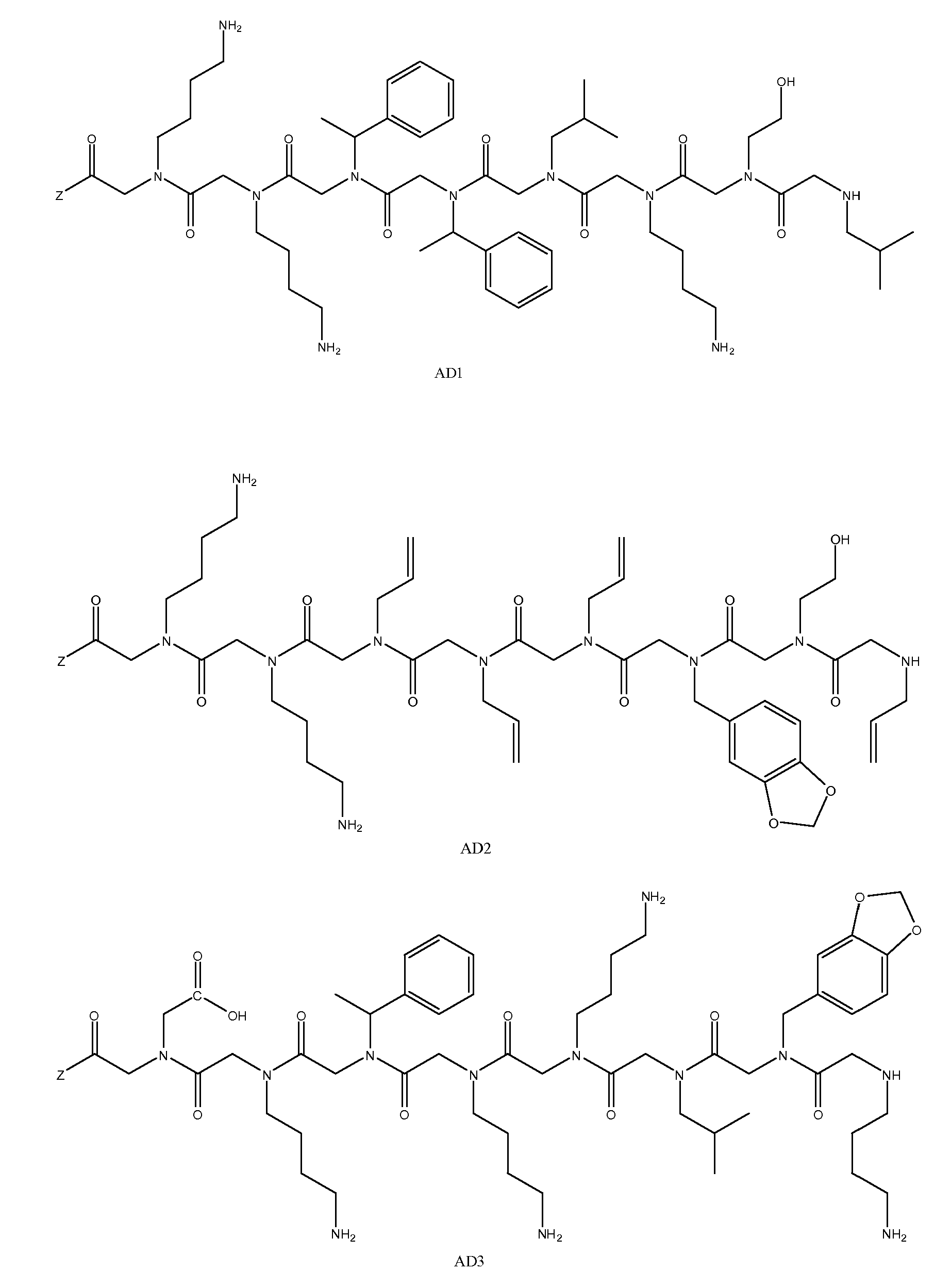
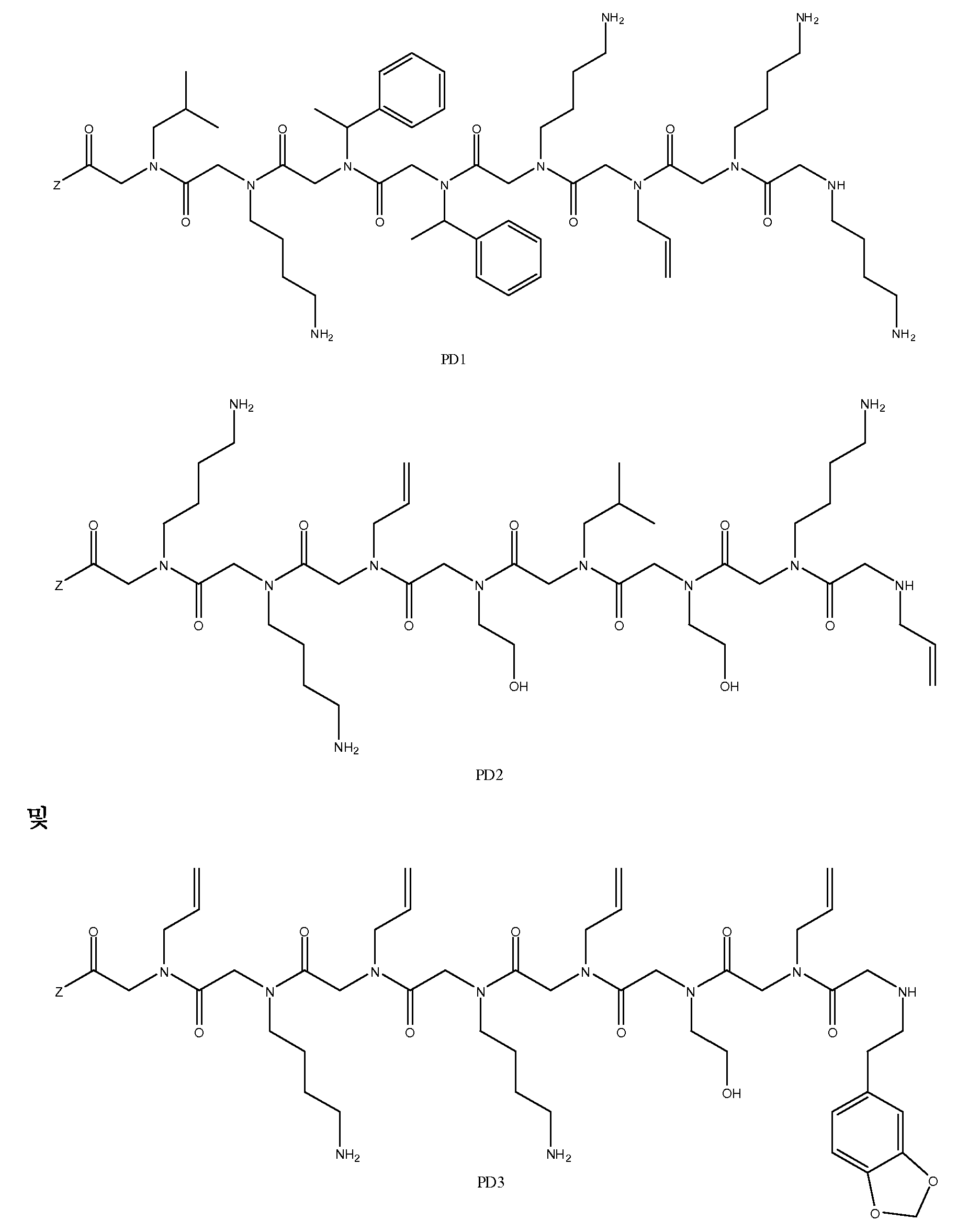
상기 화학식들에서,
Z는 링커, 기질 또는 라벨에 커플링될 수 있는 작용기이다.The kit of claim 36, wherein the one or more peptoids are selected from the group consisting of
In the above formulas,
Z is a functional group that can be coupled to a linker, substrate, or label.
(b) 고친화성 펩토이드 A에 결합된 AD 관련 항체 1을 검출하는 단계, 및 임의로
(c) 고친화성 펩토이드 B에 결합된 AD 관련 항체 2를 검출하는 단계를 포함하는, 알츠하이머 병을 갖는 것으로 의심되는 대상에서의 AD의 진단 방법:
(i)
화학식 1A

여기서,
R1 및 R4는 수소; 알킬; 알릴; 메틸; 에틸; n-프로필; 이소프로필; n-부틸; 이소부틸; n-부틸아민; 2급-부틸; 3급-부틸; 펜틸; 헥실; 이소펜틸; 아릴; 헤테로아릴; 푸라닐; 인돌릴; 티오페닐; 티아졸릴; 이미다졸릴; 이속사조일; 옥사조일; 피페로닐; 피라조일; 피롤릴; 피라지닐; 피리딜; 피리미딜; 피리미디닐; 푸리닐; 신놀리닐; 벤조푸라닐; 벤조티에닐; 벤조트리아졸릴; 벤족사졸릴; 퀴놀린; 이속사졸릴; 이소퀴놀린; 사이클로알킬; 알케닐; 사이클로알케닐; 페닐; 피리딜; 메톡시에틸; (R)-메틸벤질; 비치환되거나 NH2, OH 또는 SH에 의해 치환된 C1 -6 알킬; 비치환되거나 NH2, OH 또는 SH에 의해 치환된 C2 -6 알키닐; 리실; 카복실; 및 하이드록실 그룹으로 이루어진 그룹으로부터 독립적으로 선택되고,
R2, R3 및 R5는 C0 -6 알킬아릴; C0 -6 알킬헤테로아릴; OH, SH, 할로겐, OR15, COOR15, NR15(여기서, R15는 H 또는 C1 -6 알킬이나 C1 -6 알키닐로 이루어진 그룹으로부터 선택된다) 또는 R16(여기서, R16은 H 또는 C1 -6 알키닐로 이루어진 그룹으로부터 선택된다)으로부터 선택되는 그룹에 의해 치환된 C1 -6 알킬; OC1 -6 알킬; C2 -6 알케닐; C2-6 알키닐; C2 -6 알케닐; 및 C2 -6 알키닐로 이루어진 그룹으로부터 독립적으로 선택된다;
(ii)
화학식 1B
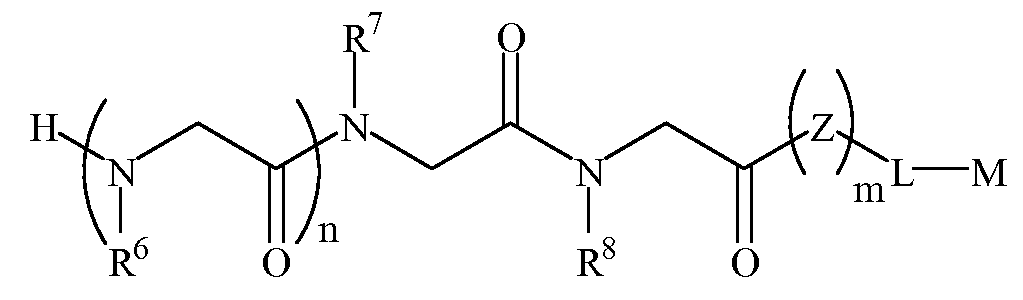
여기서,
R6은 수소; 알킬; 알릴; 메틸; 에틸; n-프로필; 이소프로필; n-부틸; 이소부틸; n-부틸아민; 2급-부틸; 3급-부틸; 펜틸; 헥실; 이소펜틸; 아릴; 헤테로아릴; 푸라닐; 인돌릴; 티오페닐; 티아졸릴; 이미다졸릴; 이속사조일; 옥사조일; 피페로닐; 피라조일; 피롤릴; 피라지닐; 피리딜; 피리미딜; 피리미디닐; 푸리닐; 신놀리닐; 벤조푸라닐; 벤조티에닐; 벤조트리아졸릴; 벤족사졸릴; 퀴놀린; 이속사졸릴; 이소퀴놀린; 사이클로알킬; 알케닐; 사이클로알케닐; 페닐; 피리딜; 메톡시에틸; (R)-메틸벤질; 비치환되거나 NH2, OH 또는 SH에 의해 치환된 C1 -6 알킬; 비치환되거나 NH2, OH 또는 SH에 의해 치환된 C2 -6 알키닐; 리실; 카복실; 및 하이드록실 그룹으로 이루어진 그룹으로부터 선택되고,
R7 및 R8은 C0 -6 알킬아릴; C0 -6 알킬헤테로아릴; OH, SH, 할로겐, OR15, COOR15, NR15(여기서, R15는 H 또는 C1 -6 알킬이나 C1 -6 알키닐로 이루어진 그룹으로부터 선택된다) 또는 R16(여기서, R16은 H 또는 C1 -6 알키닐로 이루어진 그룹으로부터 선택된다)으로부터 선택되는 그룹에 의해 치환된 C1 -6 알킬; OC1 -6 알킬; C2 -6 알케닐; C2 -6 알키닐; C2 -6 알케닐; 및 C2 -6 알키닐로 이루어진 그룹으로부터 독립적으로 선택된다;
(iii)
화학식 1C

여기서,
R9, R11 및 R13은 수소; 알킬; 알릴; 메틸; 에틸; n-프로필; 이소프로필; n-부틸; 이소부틸; n-부틸아민; 2급-부틸; 3급-부틸; 펜틸; 헥실; 이소펜틸; 아릴; 헤테로아릴; 푸라닐; 인돌릴; 티오페닐; 티아졸릴; 이미다졸릴; 이속사조일; 옥사조일; 피페로닐; 피라조일; 피롤릴; 피라지닐; 피리딜; 피리미딜; 피리미디닐; 푸리닐; 신놀리닐; 벤조푸라닐; 벤조티에닐; 벤조트리아졸릴; 벤족사졸릴; 퀴놀린; 이속사졸릴; 이소퀴놀린; 사이클로알킬; 알케닐; 사이클로알케닐; 페닐; 피리딜; 메톡시에틸; (R)-메틸벤질; 비치환되거나 NH2, OH 또는 SH에 의해 치환된 C1 -6 알킬; 비치환되거나 NH2, OH 또는 SH에 의해 치환된 C2 -6 알키닐; 리실; 카복실; 및 하이드록실 그룹으로 이루어진 그룹으로부터 독립적으로 선택되고,
R10, R12 및 R14는 C0 -6 알킬아릴; C0 -6 알킬헤테로아릴; OH, SH, 할로겐, OR15, COOR15, NR15(여기서, R15는 H 또는 C1 -6 알킬이나 C1 -6 알키닐로 이루어진 그룹으로부터 선택된다) 또는 R16(여기서, R16은 H 또는 C1 -6 알키닐로 이루어진 그룹으로부터 선택된다)으로부터 선택되는 그룹에 의해 치환된 C1 -6 알킬; OC1 -6 알킬; C2 -6 알케닐; C2-6 알키닐; C2 -6 알케닐; 및 C2 -6 알키닐로 이루어진 그룹으로부터 독립적으로 선택된다;
(iv)
화학식 1D

여기서,
R17 내지 R20 및 R23은 수소; 알킬; 알릴; 메틸; 에틸; n-프로필; 이소프로필; n-부틸; 이소부틸; n-부틸아민; 2급-부틸; 3급-부틸; 펜틸; 헥실; 이소펜틸; 아릴; 헤테로아릴; 푸라닐; 인돌릴; 티오페닐; 티아졸릴; 이미다졸릴; 이속사조일; 옥사조일; 피페로닐; 피라조일; 피롤릴; 피라지닐; 피리딜; 피리미딜; 피리미디닐; 푸리닐; 신놀리닐; 벤조푸라닐; 벤조티에닐; 벤조트리아졸릴; 벤족사졸릴; 퀴놀린; 이속사졸릴; 이소퀴놀린; 사이클로알킬; 알케닐; 사이클로알케닐; 페닐; 피리딜; 메톡시에틸; (R)-메틸벤질; 비치환되거나 NH2, OH 또는 SH에 의해 치환된 C1 -6 알킬; 비치환되거나 NH2, OH 또는 SH에 의해 치환된 C2 -6 알키닐; 리실; 카복실; 및 하이드록실 그룹으로 이루어진 그룹으로부터 독립적으로 선택되고,
R21, R22 및 R24는 C0 -6 알킬아릴; C0 -6 알킬헤테로아릴; OH, SH, 할로겐, OR15, COOR15, NR15(여기서, R15는 H 또는 C1 -6 알킬이나 C1 -6 알키닐로 이루어진 그룹으로부터 선택된다) 또는 R16(여기서, R16은 H 또는 C1 -6 알키닐로 이루어진 그룹으로부터 선택된다)으로부터 선택되는 그룹에 의해 치환된 C1 -6 알킬; OC1 -6 알킬; C2 -6 알케닐; C2-6 알키닐; C2 -6 알케닐; 및 C2 -6 알키닐로 이루어진 그룹으로부터 독립적으로 선택된다;
(v)
화학식 1D

여기서,
R17 내지 R20, R23 및 R24는 수소; 알킬; 알릴; 메틸; 에틸; n-프로필; 이소프로필; n-부틸; 이소부틸; n-부틸아민; 2급-부틸; 3급-부틸; 펜틸; 헥실; 이소펜틸; 아릴; 헤테로아릴; 푸라닐; 인돌릴; 티오페닐; 티아졸릴; 이미다졸릴; 이속사조일; 옥사조일; 피페로닐; 피라조일; 피롤릴; 피라지닐; 피리딜; 피리미딜; 피리미디닐; 푸리닐; 신놀리닐; 벤조푸라닐; 벤조티에닐; 벤조트리아졸릴; 벤족사졸릴; 퀴놀린; 이속사졸릴; 이소퀴놀린; 사이클로알킬; 알케닐; 사이클로알케닐; 페닐; 피리딜; 메톡시에틸; (R)-메틸벤질; 비치환되거나 NH2, OH 또는 SH에 의해 치환된 C1 -6 알킬; 비치환되거나 NH2, OH 또는 SH에 의해 치환된 C2 -6 알키닐; 리실; 카복실; 및 하이드록실 그룹으로 이루어진 그룹으로부터 독립적으로 선택되고,
R21 및 R22는 C0 -6 알킬아릴; C0 -6 알킬헤테로아릴; OH, SH, 할로겐, OR15, COOR15, NR15(여기서, R15는 H 또는 C1 -6 알킬이나 C1 -6 알키닐로 이루어진 그룹으로부터 선택된다) 또는 R16(여기서, R16은 H 또는 C1 -6 알키닐로 이루어진 그룹으로부터 선택된다)으로부터 선택되는 그룹에 의해 치환된 C1 -6 알킬; OC1 -6 알킬; C2 -6 알케닐; C2-6 알키닐; C2 -6 알케닐; 및 C2 -6 알키닐로 이루어진 그룹으로부터 독립적으로 선택된다;
(vi)
화학식 1D

여기서,
R17, R19, R20 및 R23은 수소; 알킬; 알릴; 메틸; 에틸; n-프로필; 이소프로필; n-부틸; 이소부틸; n-부틸아민; 2급-부틸; 3급-부틸; 펜틸; 헥실; 이소펜틸; 아릴; 헤테로아릴; 푸라닐; 인돌릴; 티오페닐; 티아졸릴; 이미다졸릴; 이속사조일; 옥사조일; 피페로닐; 피라조일; 피롤릴; 피라지닐; 피리딜; 피리미딜; 피리미디닐; 푸리닐; 신놀리닐; 벤조푸라닐; 벤조티에닐; 벤조트리아졸릴; 벤족사졸릴; 퀴놀린; 이속사졸릴; 이소퀴놀린; 사이클로알킬; 알케닐; 사이클로알케닐; 페닐; 피리딜; 메톡시에틸; (R)-메틸벤질; 비치환되거나 NH2, OH 또는 SH에 의해 치환된 C1 -6 알킬; 비치환되거나 NH2, OH 또는 SH에 의해 치환된 C2 -6 알키닐; 리실; 카복실; 및 하이드록실 그룹으로 이루어진 그룹으로부터 독립적으로 선택되고,
R18, R21 및 R24는 C0 -6 알킬아릴; C0 -6 알킬헤테로아릴; OH, SH, 할로겐, OR15, COOR15, NR15(여기서, R15는 H 또는 C1 -6 알킬이나 C1 -6 알키닐로 이루어진 그룹으로부터 선택된다) 또는 R16(여기서, R16은 H 또는 C1 -6 알키닐로 이루어진 그룹으로부터 선택된다)으로부터 선택되는 그룹에 의해 치환된 C1 -6 알킬; OC1 -6 알킬; C2 -6 알케닐; C2-6 알키닐; C2 -6 알케닐; 및 C2 -6 알키닐로 이루어진 그룹으로부터 독립적으로 선택된다;
(vii)
화학식 2A

여기서,
R27은 알킬아릴 그룹 또는 메틸벤질 그룹이고,
R25, R26, R28 내지 R32는 수소; 알킬; 알릴; 메틸; 에틸; n-프로필; 이소프로필; n-부틸; 이소부틸; n-부틸아민; 2급-부틸; 3급-부틸; 펜틸; 헥실; 이소펜틸; 아릴; 헤테로아릴; 푸라닐; 인돌릴; 티오페닐; 티아졸릴; 이미다졸릴; 이속사조일; 옥사조일; 피페로닐; 피라조일; 피롤릴; 피라지닐; 피리딜; 피리미딜; 피리미디닐; 푸리닐; 신놀리닐; 벤조푸라닐; 벤조티에닐; 벤조트리아졸릴; 벤족사졸릴; 퀴놀린; 이속사졸릴; 이소퀴놀린; 사이클로알킬; 알케닐; 사이클로알케닐; 페닐; 피리딜; 메톡시에틸, (R)-메틸벤질; C0 -6 알킬아릴; C0 -6 알킬헤테로아릴; OH, SH, 할로겐, OR15, COOR15, NR15(여기서, R15는 H 또는 C1 -6 알킬이나 C1 -6 알키닐로 이루어진 그룹으로부터 선택된다) 또는 R16(여기서, R16은 H 또는 C1 -6 알키닐로 이루어진 그룹으로부터 선택된다)으로부터 선택되는 그룹에 의해 치환된 C1 -6 알킬; OC1 -6 알킬; C2 -6 알케닐; C2 -6 알키닐; C2 -6 알케닐; 및 C2 -6 알키닐로 이루어진 그룹으로부터 독립적으로 선택된다;
(viii)
화학식 2B

여기서,
R34는 알킬아민 또는 N-부틸아민이고,
R35는 알케닐, 예를 들면, 알릴 그룹이고,
R33, R36 및 R38 내지 R40은 수소; 알킬; 알릴; 메틸; 에틸; n-프로필; 이소프로필; n-부틸; 이소부틸; n-부틸아민; 2급-부틸; 3급-부틸; 펜틸; 헥실; 이소펜틸; 아릴; 헤테로아릴; 푸라닐; 인돌릴; 티오페닐; 티아졸릴; 이미다졸릴; 이속사조일; 옥사조일; 피페로닐; 피라조일; 피롤릴; 피라지닐; 피리딜; 피리미딜; 피리미디닐; 푸리닐; 신놀리닐; 벤조푸라닐; 벤조티에닐; 벤조트리아졸릴; 벤족사졸릴; 퀴놀린; 이속사졸릴; 이소퀴놀린; 사이클로알킬; 알케닐; 사이클로알케닐; 페닐; 피리딜; 메톡시에틸, (R)-메틸벤질; C0 -6 알킬아릴; C0 -6 알킬헤테로아릴; OH, SH, 할로겐, OR15, COOR15, NR15(여기서, R15는 H 또는 C1 -6 알킬이나 C1 -6 알키닐로 이루어진 그룹으로부터 선택된다) 또는 R16(여기서, R16은 H 또는 C1 -6 알키닐로 이루어진 그룹으로부터 선택된다)으로부터 선택되는 그룹에 의해 치환된 C1 -6 알킬; OC1 -6 알킬; C2 -6 알케닐; C2 -6 알키닐; C2 -6 알케닐; 및 C2 -6 알키닐로 이루어진 그룹으로부터 독립적으로 선택되고,
Z는 커플링 그룹이고,
L은 임의의 링커 잔기이고,
M은 기질 또는 지지체이고,
m, n, o 및/또는 p는 0 내지 6이다.(a) Formula 1A, Formula 1B, Formula 1C, Formula 1D, Formula according to (i), (ii), (iii), (iv), (v), (vi), (vii) or (viii) Exposing serum samples from a patient to a microarray comprising a plurality of high affinity peptoids of Formula 2A or Formula 2B,
(b) detecting AD related antibody 1 bound to high affinity peptoid A, and optionally
(c) a method for diagnosing AD in a subject suspected of having Alzheimer's disease, comprising detecting AD related antibody 2 bound to high affinity peptoid B:
(i)
Formula 1A
here,
R 1 and R 4 are hydrogen; Alkyl; Allyl; methyl; ethyl; n-propyl; Isopropyl; n-butyl; Isobutyl; n-butylamine; Secondary-butyl; Tert-butyl; Pentyl; Hexyl; Isopentyl; Aryl; Heteroaryl; Furanyl; Indolyl; Thiophenyl; Thiazolyl; Imidazolyl; Exploded yarn; Oxazoyl; Piperonyl; Pyrazoyl; Pyrrolyl; Pyrazinyl; Pyridyl; Pyrimidyl; Pyrimidinyl; Furinyl; Cinnaolinyl; Benzofuranyl; Benzothienyl; Benzotriazolyl; Benzoxazolyl; Quinoline; Isoxazolyl; Isoquinoline; Cycloalkyl; Alkenyl; Cycloalkenyl; Phenyl; Pyridyl; Methoxyethyl; (R) -methylbenzyl; Unsubstituted or NH 2, C 1 -6 alkyl substituted by OH or SH; Unsubstituted or NH 2, a C 2 -6 alkenyl optionally substituted by OH or SH group; Lysyl; Carboxyl; And hydroxyl groups independently;
R 2, R 3 and R 5 is C 0 -6 alkylaryl; C 0 -6 alkyl-heteroaryl; OH, SH, halogen, OR 15, COOR 15, NR 15 ( wherein, R 15 is selected from the group consisting of H or C 1 -6 alkyl or C 1 -6 alkynyl group) or R 16 (wherein, R 16 is substituted C 1-6 alkyl by H or C 1-6 group selected from is selected from the group consisting of alkynyl); OC 1 -6 alkyl; C 2 -6 alkenyl; C 2-6 alkynyl; C 2 -6 alkenyl; And C 2 -6 are independently selected from the group consisting of alkynyl;
(ii)
Formula 1B
here,
R 6 is hydrogen; Alkyl; Allyl; methyl; ethyl; n-propyl; Isopropyl; n-butyl; Isobutyl; n-butylamine; Secondary-butyl; Tert-butyl; Pentyl; Hexyl; Isopentyl; Aryl; Heteroaryl; Furanyl; Indolyl; Thiophenyl; Thiazolyl; Imidazolyl; Exploded yarn; Oxazoyl; Piperonyl; Pyrazoyl; Pyrrolyl; Pyrazinyl; Pyridyl; Pyrimidyl; Pyrimidinyl; Furinyl; Cinnaolinyl; Benzofuranyl; Benzothienyl; Benzotriazolyl; Benzoxazolyl; Quinoline; Isoxazolyl; Isoquinoline; Cycloalkyl; Alkenyl; Cycloalkenyl; Phenyl; Pyridyl; Methoxyethyl; (R) -methylbenzyl; Unsubstituted or NH 2, C 1 -6 alkyl substituted by OH or SH; Unsubstituted or NH 2, a C 2 -6 alkenyl optionally substituted by OH or SH group; Lysyl; Carboxyl; And it is selected from the group consisting of hydroxyl group,
R 7 And R 8 is C 0 -6 alkylaryl; C 0 -6 alkyl-heteroaryl; OH, SH, halogen, OR 15, COOR 15, NR 15 ( wherein, R 15 is selected from the group consisting of H or C 1 -6 alkyl or C 1 -6 alkynyl group) or R 16 (wherein, R 16 is substituted C 1-6 alkyl by H or C 1-6 group selected from is selected from the group consisting of alkynyl); OC 1 -6 alkyl; C 2 -6 alkenyl; C 2 -6-alkynyl; C 2 -6 alkenyl; And C 2 -6 are independently selected from the group consisting of alkynyl;
(iii)
Formula 1C
here,
R 9 , R 11 and R 13 are hydrogen; Alkyl; Allyl; methyl; ethyl; n-propyl; Isopropyl; n-butyl; Isobutyl; n-butylamine; Secondary-butyl; Tert-butyl; Pentyl; Hexyl; Isopentyl; Aryl; Heteroaryl; Furanyl; Indolyl; Thiophenyl; Thiazolyl; Imidazolyl; Exploded yarn; Oxazoyl; Piperonyl; Pyrazoyl; Pyrrolyl; Pyrazinyl; Pyridyl; Pyrimidyl; Pyrimidinyl; Furinyl; Cinnaolinyl; Benzofuranyl; Benzothienyl; Benzotriazolyl; Benzoxazolyl; Quinoline; Isoxazolyl; Isoquinoline; Cycloalkyl; Alkenyl; Cycloalkenyl; Phenyl; Pyridyl; Methoxyethyl; (R) -methylbenzyl; Unsubstituted or NH 2, C 1 -6 alkyl substituted by OH or SH; Unsubstituted or NH 2, a C 2 -6 alkenyl optionally substituted by OH or SH group; Lysyl; Carboxyl; And hydroxyl groups independently;
R 10 , R 12 And R 14 is C 0 -6 alkylaryl; C 0 -6 alkyl-heteroaryl; OH, SH, halogen, OR 15, COOR 15, NR 15 ( wherein, R 15 is selected from the group consisting of H or C 1 -6 alkyl or C 1 -6 alkynyl group) or R 16 (wherein, R 16 is substituted C 1-6 alkyl by H or C 1-6 group selected from is selected from the group consisting of alkynyl); OC 1 -6 alkyl; C 2 -6 alkenyl; C 2-6 alkynyl; C 2 -6 alkenyl; And C 2 -6 are independently selected from the group consisting of alkynyl;
(iv)
Formula 1D
here,
R 17 R 20 and R 23 are hydrogen; Alkyl; Allyl; methyl; ethyl; n-propyl; Isopropyl; n-butyl; Isobutyl; n-butylamine; Secondary-butyl; Tert-butyl; Pentyl; Hexyl; Isopentyl; Aryl; Heteroaryl; Furanyl; Indolyl; Thiophenyl; Thiazolyl; Imidazolyl; Exploded yarn; Oxazoyl; Piperonyl; Pyrazoyl; Pyrrolyl; Pyrazinyl; Pyridyl; Pyrimidyl; Pyrimidinyl; Furinyl; Cinnaolinyl; Benzofuranyl; Benzothienyl; Benzotriazolyl; Benzoxazolyl; Quinoline; Isoxazolyl; Isoquinoline; Cycloalkyl; Alkenyl; Cycloalkenyl; Phenyl; Pyridyl; Methoxyethyl; (R) -methylbenzyl; Unsubstituted or NH 2, C 1 -6 alkyl substituted by OH or SH; Unsubstituted or NH 2, a C 2 -6 alkenyl optionally substituted by OH or SH group; Lysyl; Carboxyl; And hydroxyl groups independently;
R 21 , R 22 And R 24 is C 0 -6 alkylaryl; C 0 -6 alkyl-heteroaryl; OH, SH, halogen, OR 15, COOR 15, NR 15 ( wherein, R 15 is selected from the group consisting of H or C 1 -6 alkyl or C 1 -6 alkynyl group) or R 16 (wherein, R 16 is substituted C 1-6 alkyl by H or C 1-6 group selected from is selected from the group consisting of alkynyl); OC 1 -6 alkyl; C 2 -6 alkenyl; C 2-6 alkynyl; C 2 -6 alkenyl; And C 2 -6 are independently selected from the group consisting of alkynyl;
(v)
Formula 1D
here,
R 17 To R 20 , R 23 and R 24 are hydrogen; Alkyl; Allyl; methyl; ethyl; n-propyl; Isopropyl; n-butyl; Isobutyl; n-butylamine; Secondary-butyl; Tert-butyl; Pentyl; Hexyl; Isopentyl; Aryl; Heteroaryl; Furanyl; Indolyl; Thiophenyl; Thiazolyl; Imidazolyl; Exploded yarn; Oxazoyl; Piperonyl; Pyrazoyl; Pyrrolyl; Pyrazinyl; Pyridyl; Pyrimidyl; Pyrimidinyl; Furinyl; Cinnaolinyl; Benzofuranyl; Benzothienyl; Benzotriazolyl; Benzoxazolyl; Quinoline; Isoxazolyl; Isoquinoline; Cycloalkyl; Alkenyl; Cycloalkenyl; Phenyl; Pyridyl; Methoxyethyl; (R) -methylbenzyl; Unsubstituted or NH 2, C 1 -6 alkyl substituted by OH or SH; Unsubstituted or NH 2, a C 2 -6 alkenyl optionally substituted by OH or SH group; Lysyl; Carboxyl; And hydroxyl groups independently;
R 21 And R 22 is C 0 -6 alkylaryl; C 0 -6 alkyl-heteroaryl; OH, SH, halogen, OR 15, COOR 15, NR 15 ( wherein, R 15 is selected from the group consisting of H or C 1 -6 alkyl or C 1 -6 alkynyl group) or R 16 (wherein, R 16 is substituted C 1-6 alkyl by H or C 1-6 group selected from is selected from the group consisting of alkynyl); OC 1 -6 alkyl; C 2 -6 alkenyl; C 2-6 alkynyl; C 2 -6 alkenyl; And C 2 -6 are independently selected from the group consisting of alkynyl;
(vi)
Formula 1D
here,
R 17 , R 19 , R 20 and R 23 are hydrogen; Alkyl; Allyl; methyl; ethyl; n-propyl; Isopropyl; n-butyl; Isobutyl; n-butylamine; Secondary-butyl; Tert-butyl; Pentyl; Hexyl; Isopentyl; Aryl; Heteroaryl; Furanyl; Indolyl; Thiophenyl; Thiazolyl; Imidazolyl; Exploded yarn; Oxazoyl; Piperonyl; Pyrazoyl; Pyrrolyl; Pyrazinyl; Pyridyl; Pyrimidyl; Pyrimidinyl; Furinyl; Cinnaolinyl; Benzofuranyl; Benzothienyl; Benzotriazolyl; Benzoxazolyl; Quinoline; Isoxazolyl; Isoquinoline; Cycloalkyl; Alkenyl; Cycloalkenyl; Phenyl; Pyridyl; Methoxyethyl; (R) -methylbenzyl; Unsubstituted or NH 2, C 1 -6 alkyl substituted by OH or SH; Unsubstituted or NH 2, a C 2 -6 alkenyl optionally substituted by OH or SH group; Lysyl; Carboxyl; And hydroxyl groups independently;
R 18 , R 21 And R 24 is C 0 -6 alkylaryl; C 0 -6 alkyl-heteroaryl; OH, SH, halogen, OR 15, COOR 15, NR 15 ( wherein, R 15 is selected from the group consisting of H or C 1 -6 alkyl or C 1 -6 alkynyl group) or R 16 (wherein, R 16 is substituted C 1-6 alkyl by H or C 1-6 group selected from is selected from the group consisting of alkynyl); OC 1 -6 alkyl; C 2 -6 alkenyl; C 2-6 alkynyl; C 2 -6 alkenyl; And C 2 -6 are independently selected from the group consisting of alkynyl;
(vii)
Formula 2A
here,
R 27 is an alkylaryl group or methylbenzyl group,
R 25 , R 26 , R 28 R 32 is hydrogen; Alkyl; Allyl; methyl; ethyl; n-propyl; Isopropyl; n-butyl; Isobutyl; n-butylamine; Secondary-butyl; Tert-butyl; Pentyl; Hexyl; Isopentyl; Aryl; Heteroaryl; Furanyl; Indolyl; Thiophenyl; Thiazolyl; Imidazolyl; Exploded yarn; Oxazoyl; Piperonyl; Pyrazoyl; Pyrrolyl; Pyrazinyl; Pyridyl; Pyrimidyl; Pyrimidinyl; Furinyl; Cinnaolinyl; Benzofuranyl; Benzothienyl; Benzotriazolyl; Benzoxazolyl; Quinoline; Isoxazolyl; Isoquinoline; Cycloalkyl; Alkenyl; Cycloalkenyl; Phenyl; Pyridyl; Methoxyethyl, (R) -methylbenzyl; C 0 -6 alkylaryl; C 0 -6 alkyl-heteroaryl; OH, SH, halogen, OR 15, COOR 15, NR 15 ( wherein, R 15 is selected from the group consisting of H or C 1 -6 alkyl or C 1 -6 alkynyl group) or R 16 (wherein, R 16 is substituted C 1-6 alkyl by H or C 1-6 group selected from is selected from the group consisting of alkynyl); OC 1 -6 alkyl; C 2 -6 alkenyl; C 2 -6-alkynyl; C 2 -6 alkenyl; And C 2 -6 are independently selected from the group consisting of alkynyl;
(viii)
Formula 2B
here,
R 34 is Alkylamine or N-butylamine,
R 35 is alkenyl, for example an allyl group,
R 33 , R 36 And R 38 to R 40 are hydrogen; Alkyl; Allyl; methyl; ethyl; n-propyl; Isopropyl; n-butyl; Isobutyl; n-butylamine; Secondary-butyl; Tert-butyl; Pentyl; Hexyl; Isopentyl; Aryl; Heteroaryl; Furanyl; Indolyl; Thiophenyl; Thiazolyl; Imidazolyl; Exploded yarn; Oxazoyl; Piperonyl; Pyrazoyl; Pyrrolyl; Pyrazinyl; Pyridyl; Pyrimidyl; Pyrimidinyl; Furinyl; Cinnaolinyl; Benzofuranyl; Benzothienyl; Benzotriazolyl; Benzoxazolyl; Quinoline; Isoxazolyl; Isoquinoline; Cycloalkyl; Alkenyl; Cycloalkenyl; Phenyl; Pyridyl; Methoxyethyl, (R) -methylbenzyl; C 0 -6 alkylaryl; C 0 -6 alkyl-heteroaryl; OH, SH, halogen, OR 15, COOR 15, NR 15 ( wherein, R 15 is selected from the group consisting of H or C 1 -6 alkyl or C 1 -6 alkynyl group) or R 16 (wherein, R 16 is substituted C 1-6 alkyl by H or C 1-6 group selected from is selected from the group consisting of alkynyl); OC 1 -6 alkyl; C 2 -6 alkenyl; C 2 -6-alkynyl; C 2 -6 alkenyl; And C 2 -6 are independently selected from the group consisting of alkynyl,
Z is a coupling group,
L is any linker residue,
M is a substrate or support,
m, n, o and / or p are 0-6.
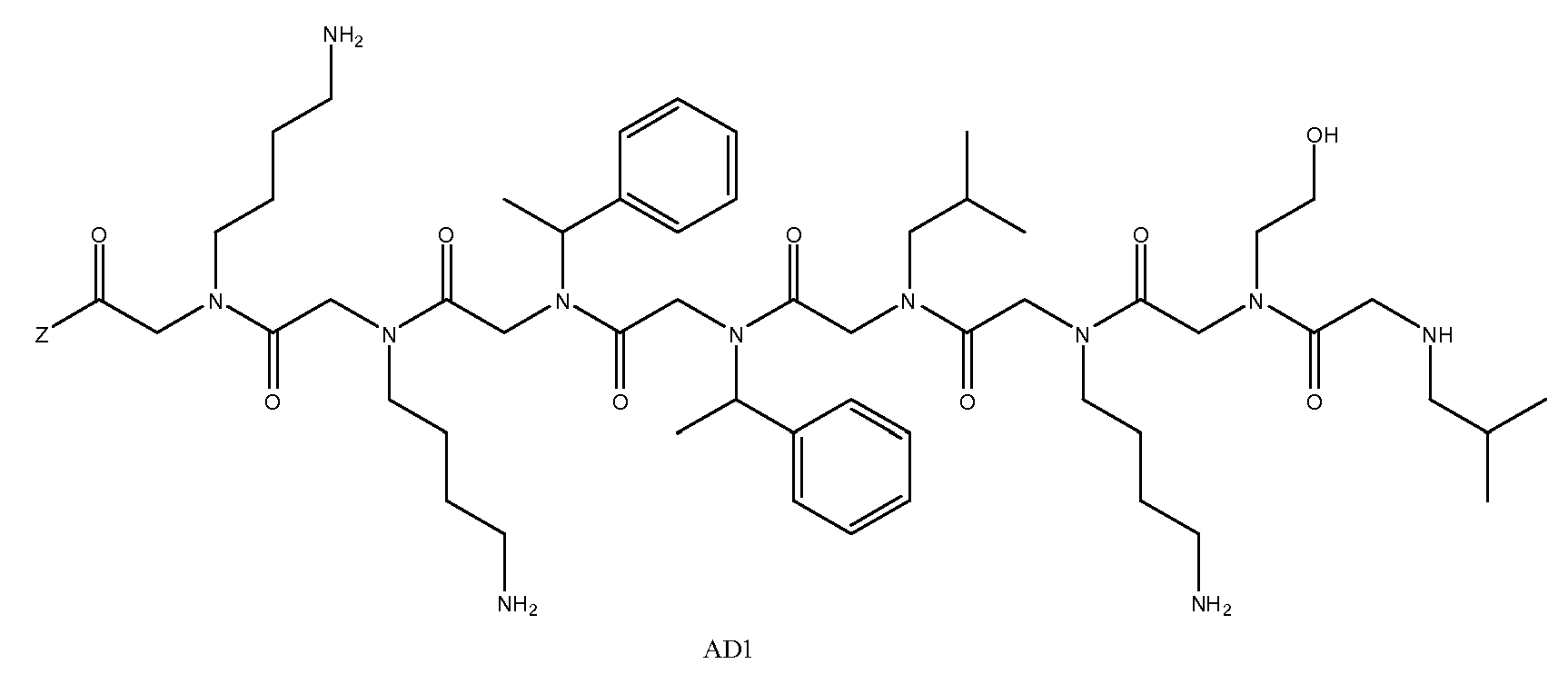
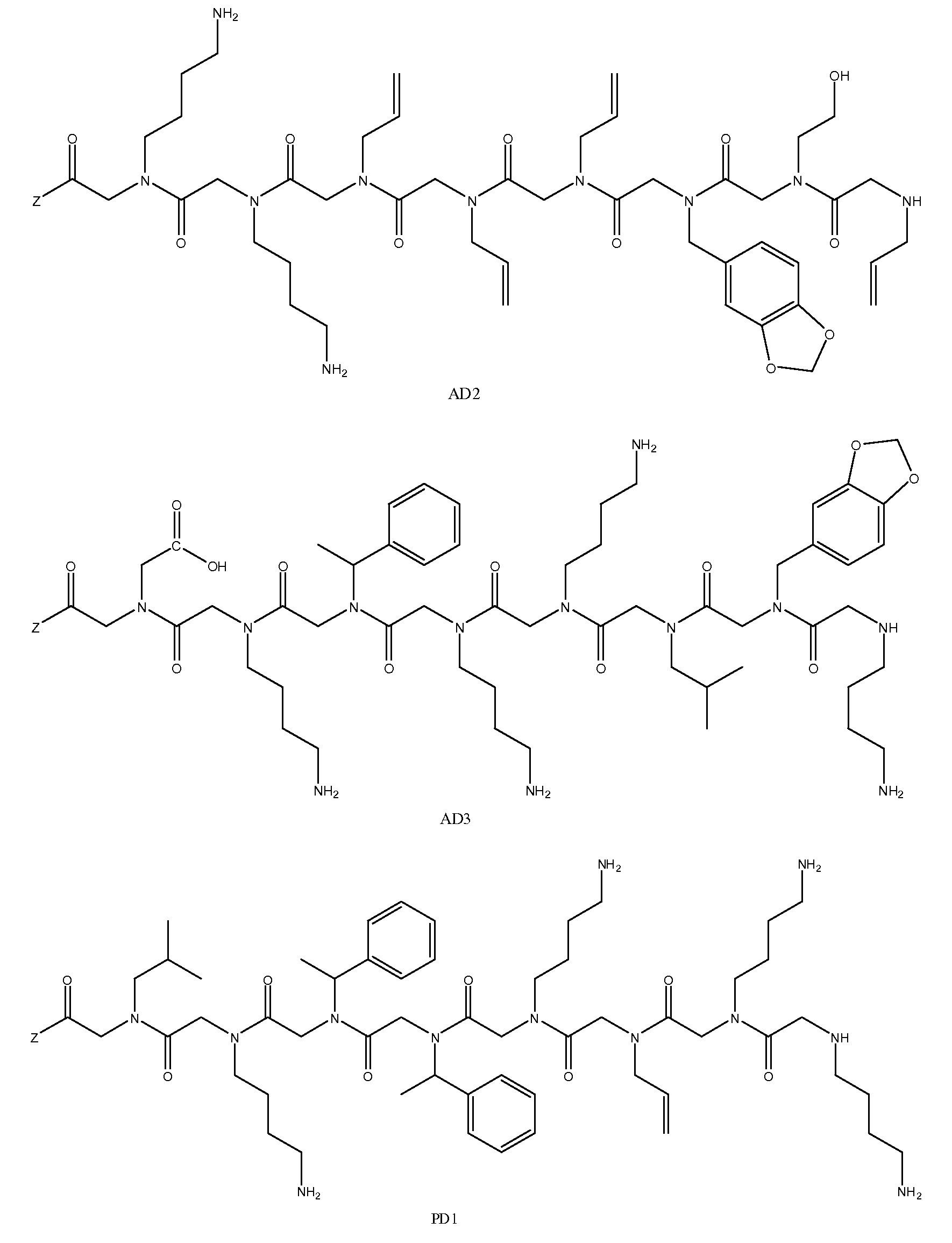

상기 화학식들에서,
Z는 링커, 기질 또는 라벨에 커플링될 수 있는 작용기이다.An isolated antibody composition comprising an antibody isolated from a serum of a subject having a neurodegenerative disease, wherein the antibody specifically binds to a peptoid comprising structures of the formula:
In the above formulas,
Z is a functional group that can be coupled to a linker, substrate, or label.
(b) 상기 면역친화성 기질로부터 상기 결합된 항체를 용출시키는 단계에 의해 분리된 항체.(a) contacting a sample containing an antibody representing a neurodegenerative disease with an immunoaffinity substrate comprising the peptoid of claim 1 and / or 11 binding to an antibody representing the neurodegenerative disease, and
(b) an antibody isolated by eluting the bound antibody from the immunoaffinity substrate.
(a)
화학식 1A
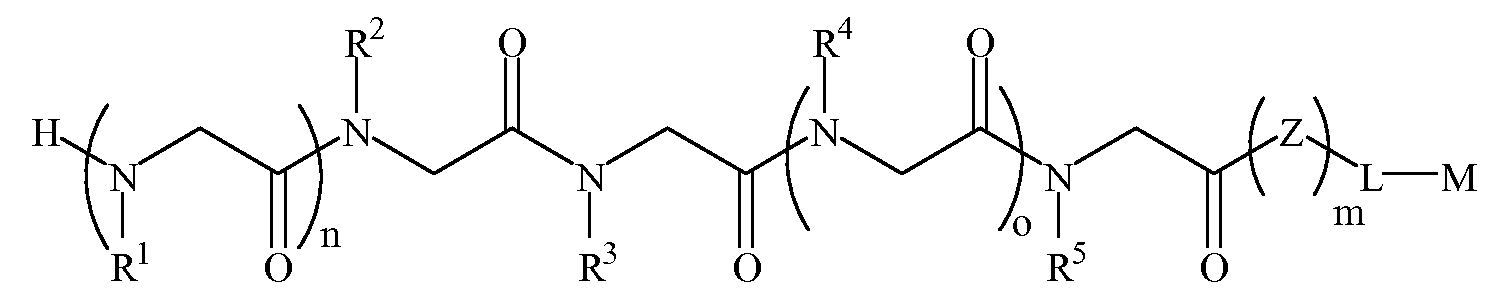
여기서,
R1 및 R4는 수소; 알킬; 알릴; 메틸; 에틸; n-프로필; 이소프로필; n-부틸; 이소부틸; n-부틸아민; 2급-부틸; 3급-부틸; 펜틸; 헥실; 이소펜틸; 아릴; 헤테로아릴; 푸라닐; 인돌릴; 티오페닐; 티아졸릴; 이미다졸릴; 이속사조일; 옥사조일; 피페로닐; 피라조일; 피롤릴; 피라지닐; 피리딜; 피리미딜; 피리미디닐; 푸리닐; 신놀리닐; 벤조푸라닐; 벤조티에닐; 벤조트리아졸릴; 벤족사졸릴; 퀴놀린; 이속사졸릴; 이소퀴놀린; 사이클로알킬; 알케닐; 사이클로알케닐; 페닐; 피리딜; 메톡시에틸; (R)-메틸벤질; 비치환되거나 NH2, OH 또는 SH에 의해 치환된 C1 -6 알킬; 비치환되거나 NH2, OH 또는 SH에 의해 치환된 C2 -6 알키닐; 리실; 카복실; 및 하이드록실 그룹으로 이루어진 그룹으로부터 독립적으로 선택되고,
R2, R3 및 R5는 C0 -6 알킬아릴; C0 -6 알킬헤테로아릴; OH, SH, 할로겐, OR15, COOR15, NR15(여기서, R15는 H 또는 C1 -6 알킬이나 C1 -6 알키닐로 이루어진 그룹으로부터 선택된다) 또는 R16(여기서, R16은 H 또는 C1 -6 알키닐로 이루어진 그룹으로부터 선택된다)으로부터 선택되는 그룹에 의해 치환된 C1 -6 알킬; OC1 -6 알킬; C2 -6 알케닐; C2-6 알키닐; C2 -6 알케닐; 및 C2 -6 알키닐로 이루어진 그룹으로부터 독립적으로 선택된다;
(b)
화학식 1B

여기서,
R6은 수소; 알킬; 알릴; 메틸; 에틸; n-프로필; 이소프로필; n-부틸; 이소부틸; n-부틸아민; 2급-부틸; 3급-부틸; 펜틸; 헥실; 이소펜틸; 아릴; 헤테로아릴; 푸라닐; 인돌릴; 티오페닐; 티아졸릴; 이미다졸릴; 이속사조일; 옥사조일; 피페로닐; 피라조일; 피롤릴; 피라지닐; 피리딜; 피리미딜; 피리미디닐; 푸리닐; 신놀리닐; 벤조푸라닐; 벤조티에닐; 벤조트리아졸릴; 벤족사졸릴; 퀴놀린; 이속사졸릴; 이소퀴놀린; 사이클로알킬; 알케닐; 사이클로알케닐; 페닐; 피리딜; 메톡시에틸; (R)-메틸벤질; 비치환되거나 NH2, OH 또는 SH에 의해 치환된 C1 -6 알킬; 비치환되거나 NH2, OH 또는 SH에 의해 치환된 C2 -6 알키닐; 리실; 카복실; 및 하이드록실 그룹으로 이루어진 그룹으로부터 선택되고,
R7 및 R8은 C0 -6 알킬아릴; C0 -6 알킬헤테로아릴; OH, SH, 할로겐, OR15, COOR15, NR15(여기서, R15는 H 또는 C1 -6 알킬이나 C1 -6 알키닐로 이루어진 그룹으로부터 선택된다) 또는 R16(여기서, R16은 H 또는 C1 -6 알키닐로 이루어진 그룹으로부터 선택된다)으로부터 선택되는 그룹에 의해 치환된 C1 -6 알킬; OC1 -6 알킬; C2 -6 알케닐; C2 -6 알키닐; C2 -6 알케닐; 및 C2 -6 알키닐로 이루어진 그룹으로부터 독립적으로 선택된다;
(c)
화학식 1C

여기서,
R9, R11 및 R13은 수소; 알킬; 알릴; 메틸; 에틸; n-프로필; 이소프로필; n-부틸; 이소부틸; n-부틸아민; 2급-부틸; 3급-부틸; 펜틸; 헥실; 이소펜틸; 아릴; 헤테로아릴; 푸라닐; 인돌릴; 티오페닐; 티아졸릴; 이미다졸릴; 이속사조일; 옥사조일; 피페로닐; 피라조일; 피롤릴; 피라지닐; 피리딜; 피리미딜; 피리미디닐; 푸리닐; 신놀리닐; 벤조푸라닐; 벤조티에닐; 벤조트리아졸릴; 벤족사졸릴; 퀴놀린; 이속사졸릴; 이소퀴놀린; 사이클로알킬; 알케닐; 사이클로알케닐; 페닐; 피리딜; 메톡시에틸; (R)-메틸벤질; 비치환되거나 NH2, OH 또는 SH에 의해 치환된 C1 -6 알킬; 비치환되거나 NH2, OH 또는 SH에 의해 치환된 C2 -6 알키닐; 리실; 카복실; 및 하이드록실 그룹으로 이루어진 그룹으로부터 독립적으로 선택되고,
R10, R12 및 R14는 C0 -6 알킬아릴; C0 -6 알킬헤테로아릴; OH, SH, 할로겐, OR15, COOR15, NR15(여기서, R15는 H 또는 C1 -6 알킬이나 C1 -6 알키닐로 이루어진 그룹으로부터 선택된다) 또는 R16(여기서, R16은 H 또는 C1 -6 알키닐로 이루어진 그룹으로부터 선택된다)으로부터 선택되는 그룹에 의해 치환된 C1 -6 알킬; OC1 -6 알킬; C2 -6 알케닐; C2-6 알키닐; C2 -6 알케닐; 및 C2 -6 알키닐로 이루어진 그룹으로부터 독립적으로 선택된다;
(d)
화학식 1D

여기서,
R17 내지 R20 및 R23은 수소; 알킬; 알릴; 메틸; 에틸; n-프로필; 이소프로필; n-부틸; 이소부틸; n-부틸아민; 2급-부틸; 3급-부틸; 펜틸; 헥실; 이소펜틸; 아릴; 헤테로아릴; 푸라닐; 인돌릴; 티오페닐; 티아졸릴; 이미다졸릴; 이속사조일; 옥사조일; 피페로닐; 피라조일; 피롤릴; 피라지닐; 피리딜; 피리미딜; 피리미디닐; 푸리닐; 신놀리닐; 벤조푸라닐; 벤조티에닐; 벤조트리아졸릴; 벤족사졸릴; 퀴놀린; 이속사졸릴; 이소퀴놀린; 사이클로알킬; 알케닐; 사이클로알케닐; 페닐; 피리딜; 메톡시에틸; (R)-메틸벤질; 비치환되거나 NH2, OH 또는 SH에 의해 치환된 C1 -6 알킬; 비치환되거나 NH2, OH 또는 SH에 의해 치환된 C2 -6 알키닐; 리실; 카복실; 및 하이드록실 그룹으로 이루어진 그룹으로부터 독립적으로 선택되고,
R21, R22 및 R24는 C0 -6 알킬아릴; C0 -6 알킬헤테로아릴; OH, SH, 할로겐, OR15, COOR15, NR15(여기서, R15는 H 또는 C1 -6 알킬이나 C1 -6 알키닐로 이루어진 그룹으로부터 선택된다) 또는 R16(여기서, R16은 H 또는 C1 -6 알키닐로 이루어진 그룹으로부터 선택된다)으로부터 선택되는 그룹에 의해 치환된 C1 -6 알킬; OC1 -6 알킬; C2 -6 알케닐; C2-6 알키닐; C2 -6 알케닐; 및 C2 -6 알키닐로 이루어진 그룹으로부터 독립적으로 선택된다;
(e)
화학식 1D

여기서,
R17 내지 R20, R23 및 R24는 수소; 알킬; 알릴; 메틸; 에틸; n-프로필; 이소프로필; n-부틸; 이소부틸; n-부틸아민; 2급-부틸; 3급-부틸; 펜틸; 헥실; 이소펜틸; 아릴; 헤테로아릴; 푸라닐; 인돌릴; 티오페닐; 티아졸릴; 이미다졸릴; 이속사조일; 옥사조일; 피페로닐; 피라조일; 피롤릴; 피라지닐; 피리딜; 피리미딜; 피리미디닐; 푸리닐; 신놀리닐; 벤조푸라닐; 벤조티에닐; 벤조트리아졸릴; 벤족사졸릴; 퀴놀린; 이속사졸릴; 이소퀴놀린; 사이클로알킬; 알케닐; 사이클로알케닐; 페닐; 피리딜; 메톡시에틸; (R)-메틸벤질; 비치환되거나 NH2, OH 또는 SH에 의해 치환된 C1 -6 알킬; 비치환되거나 NH2, OH 또는 SH에 의해 치환된 C2 -6 알키닐; 리실; 카복실; 및 하이드록실 그룹으로 이루어진 그룹으로부터 독립적으로 선택되고,
R21 및 R22는 C0 -6 알킬아릴; C0 -6 알킬헤테로아릴; OH, SH, 할로겐, OR15, COOR15, NR15(여기서, R15는 H 또는 C1 -6 알킬이나 C1 -6 알키닐로 이루어진 그룹으로부터 선택된다) 또는 R16(여기서, R16은 H 또는 C1 -6 알키닐로 이루어진 그룹으로부터 선택된다)으로부터 선택되는 그룹에 의해 치환된 C1 -6 알킬; OC1 -6 알킬; C2 -6 알케닐; C2-6 알키닐; C2 -6 알케닐; 및 C2 -6 알키닐로 이루어진 그룹으로부터 독립적으로 선택된다;
(f)
화학식 1D

여기서,
R17, R19, R20 및 R23은 수소; 알킬; 알릴; 메틸; 에틸; n-프로필; 이소프로필; n-부틸; 이소부틸; n-부틸아민; 2급-부틸; 3급-부틸; 펜틸; 헥실; 이소펜틸; 아릴; 헤테로아릴; 푸라닐; 인돌릴; 티오페닐; 티아졸릴; 이미다졸릴; 이속사조일; 옥사조일; 피페로닐; 피라조일; 피롤릴; 피라지닐; 피리딜; 피리미딜; 피리미디닐; 푸리닐; 신놀리닐; 벤조푸라닐; 벤조티에닐; 벤조트리아졸릴; 벤족사졸릴; 퀴놀린; 이속사졸릴; 이소퀴놀린; 사이클로알킬; 알케닐; 사이클로알케닐; 페닐; 피리딜; 메톡시에틸; (R)-메틸벤질; 비치환되거나 NH2, OH 또는 SH에 의해 치환된 C1 -6 알킬; 비치환되거나 NH2, OH 또는 SH에 의해 치환된 C2 -6 알키닐; 리실; 카복실; 및 하이드록실 그룹으로 이루어진 그룹으로부터 독립적으로 선택되고,
R18, R21 및 R24는 C0 -6 알킬아릴; C0 -6 알킬헤테로아릴; OH, SH, 할로겐, OR15, COOR15, NR15(여기서, R15는 H 또는 C1 -6 알킬이나 C1 -6 알키닐로 이루어진 그룹으로부터 선택된다) 또는 R16(여기서, R16은 H 또는 C1 -6 알키닐로 이루어진 그룹으로부터 선택된다)으로부터 선택되는 그룹에 의해 치환된 C1 -6 알킬; OC1 -6 알킬; C2 -6 알케닐; C2-6 알키닐; C2 -6 알케닐; 및 C2 -6 알키닐로 이루어진 그룹으로부터 독립적으로 선택되고,
Z는 커플링 그룹이고,
L은 임의의 링커 잔기이고,
M은 기질 또는 지지체이고,
m, n, o 및/또는 p는 0 내지 6이다.A composition comprising a peptoid having Formula 1A, Formula 1B, Formula 1C, or Formula 1D as described in (a), (b), (c), (d), (e), or (f):
(a)
Formula 1A
here,
R 1 and R 4 are hydrogen; Alkyl; Allyl; methyl; ethyl; n-propyl; Isopropyl; n-butyl; Isobutyl; n-butylamine; Secondary-butyl; Tert-butyl; Pentyl; Hexyl; Isopentyl; Aryl; Heteroaryl; Furanyl; Indolyl; Thiophenyl; Thiazolyl; Imidazolyl; Exploded yarn; Oxazoyl; Piperonyl; Pyrazoyl; Pyrrolyl; Pyrazinyl; Pyridyl; Pyrimidyl; Pyrimidinyl; Furinyl; Cinnaolinyl; Benzofuranyl; Benzothienyl; Benzotriazolyl; Benzoxazolyl; Quinoline; Isoxazolyl; Isoquinoline; Cycloalkyl; Alkenyl; Cycloalkenyl; Phenyl; Pyridyl; Methoxyethyl; (R) -methylbenzyl; Unsubstituted or NH 2, C 1 -6 alkyl substituted by OH or SH; Unsubstituted or NH 2, a C 2 -6 alkenyl optionally substituted by OH or SH group; Lysyl; Carboxyl; And hydroxyl groups independently;
R 2, R 3 and R 5 is C 0 -6 alkylaryl; C 0 -6 alkyl-heteroaryl; OH, SH, halogen, OR 15, COOR 15, NR 15 ( wherein, R 15 is selected from the group consisting of H or C 1 -6 alkyl or C 1 -6 alkynyl group) or R 16 (wherein, R 16 is substituted C 1-6 alkyl by H or C 1-6 group selected from is selected from the group consisting of alkynyl); OC 1 -6 alkyl; C 2 -6 alkenyl; C 2-6 alkynyl; C 2 -6 alkenyl; And C 2 -6 are independently selected from the group consisting of alkynyl;
(b)
Formula 1B
here,
R 6 is hydrogen; Alkyl; Allyl; methyl; ethyl; n-propyl; Isopropyl; n-butyl; Isobutyl; n-butylamine; Secondary-butyl; Tert-butyl; Pentyl; Hexyl; Isopentyl; Aryl; Heteroaryl; Furanyl; Indolyl; Thiophenyl; Thiazolyl; Imidazolyl; Exploded yarn; Oxazoyl; Piperonyl; Pyrazoyl; Pyrrolyl; Pyrazinyl; Pyridyl; Pyrimidyl; Pyrimidinyl; Furinyl; Cinnaolinyl; Benzofuranyl; Benzothienyl; Benzotriazolyl; Benzoxazolyl; Quinoline; Isoxazolyl; Isoquinoline; Cycloalkyl; Alkenyl; Cycloalkenyl; Phenyl; Pyridyl; Methoxyethyl; (R) -methylbenzyl; Unsubstituted or NH 2, C 1 -6 alkyl substituted by OH or SH; Unsubstituted or NH 2, a C 2 -6 alkenyl optionally substituted by OH or SH group; Lysyl; Carboxyl; And it is selected from the group consisting of hydroxyl group,
R 7 And R 8 is C 0 -6 alkylaryl; C 0 -6 alkyl-heteroaryl; OH, SH, halogen, OR 15, COOR 15, NR 15 ( wherein, R 15 is selected from the group consisting of H or C 1 -6 alkyl or C 1 -6 alkynyl group) or R 16 (wherein, R 16 is substituted C 1-6 alkyl by H or C 1-6 group selected from is selected from the group consisting of alkynyl); OC 1 -6 alkyl; C 2 -6 alkenyl; C 2 -6-alkynyl; C 2 -6 alkenyl; And C 2 -6 are independently selected from the group consisting of alkynyl;
(c)
Formula 1C
here,
R 9 , R 11 and R 13 are hydrogen; Alkyl; Allyl; methyl; ethyl; n-propyl; Isopropyl; n-butyl; Isobutyl; n-butylamine; Secondary-butyl; Tert-butyl; Pentyl; Hexyl; Isopentyl; Aryl; Heteroaryl; Furanyl; Indolyl; Thiophenyl; Thiazolyl; Imidazolyl; Exploded yarn; Oxazoyl; Piperonyl; Pyrazoyl; Pyrrolyl; Pyrazinyl; Pyridyl; Pyrimidyl; Pyrimidinyl; Furinyl; Cinnaolinyl; Benzofuranyl; Benzothienyl; Benzotriazolyl; Benzoxazolyl; Quinoline; Isoxazolyl; Isoquinoline; Cycloalkyl; Alkenyl; Cycloalkenyl; Phenyl; Pyridyl; Methoxyethyl; (R) -methylbenzyl; Unsubstituted or NH 2, C 1 -6 alkyl substituted by OH or SH; Unsubstituted or NH 2, a C 2 -6 alkenyl optionally substituted by OH or SH group; Lysyl; Carboxyl; And hydroxyl groups independently;
R 10 , R 12 And R 14 is C 0 -6 alkylaryl; C 0 -6 alkyl-heteroaryl; OH, SH, halogen, OR 15, COOR 15, NR 15 ( wherein, R 15 is selected from the group consisting of H or C 1 -6 alkyl or C 1 -6 alkynyl group) or R 16 (wherein, R 16 is substituted C 1-6 alkyl by H or C 1-6 group selected from is selected from the group consisting of alkynyl); OC 1 -6 alkyl; C 2 -6 alkenyl; C 2-6 alkynyl; C 2 -6 alkenyl; And C 2 -6 are independently selected from the group consisting of alkynyl;
(d)
Formula 1D
here,
R 17 R 20 and R 23 are hydrogen; Alkyl; Allyl; methyl; ethyl; n-propyl; Isopropyl; n-butyl; Isobutyl; n-butylamine; Secondary-butyl; Tert-butyl; Pentyl; Hexyl; Isopentyl; Aryl; Heteroaryl; Furanyl; Indolyl; Thiophenyl; Thiazolyl; Imidazolyl; Exploded yarn; Oxazoyl; Piperonyl; Pyrazoyl; Pyrrolyl; Pyrazinyl; Pyridyl; Pyrimidyl; Pyrimidinyl; Furinyl; Cinnaolinyl; Benzofuranyl; Benzothienyl; Benzotriazolyl; Benzoxazolyl; Quinoline; Isoxazolyl; Isoquinoline; Cycloalkyl; Alkenyl; Cycloalkenyl; Phenyl; Pyridyl; Methoxyethyl; (R) -methylbenzyl; Unsubstituted or NH 2, C 1 -6 alkyl substituted by OH or SH; Unsubstituted or NH 2, a C 2 -6 alkenyl optionally substituted by OH or SH group; Lysyl; Carboxyl; And hydroxyl groups independently;
R 21 , R 22 And R 24 is C 0 -6 alkylaryl; C 0 -6 alkyl-heteroaryl; OH, SH, halogen, OR 15, COOR 15, NR 15 ( wherein, R 15 is selected from the group consisting of H or C 1 -6 alkyl or C 1 -6 alkynyl group) or R 16 (wherein, R 16 is substituted C 1-6 alkyl by H or C 1-6 group selected from is selected from the group consisting of alkynyl); OC 1 -6 alkyl; C 2 -6 alkenyl; C 2-6 alkynyl; C 2 -6 alkenyl; And C 2 -6 are independently selected from the group consisting of alkynyl;
(e)
Formula 1D
here,
R 17 To R 20 , R 23 and R 24 are hydrogen; Alkyl; Allyl; methyl; ethyl; n-propyl; Isopropyl; n-butyl; Isobutyl; n-butylamine; Secondary-butyl; Tert-butyl; Pentyl; Hexyl; Isopentyl; Aryl; Heteroaryl; Furanyl; Indolyl; Thiophenyl; Thiazolyl; Imidazolyl; Exploded yarn; Oxazoyl; Piperonyl; Pyrazoyl; Pyrrolyl; Pyrazinyl; Pyridyl; Pyrimidyl; Pyrimidinyl; Furinyl; Cinnaolinyl; Benzofuranyl; Benzothienyl; Benzotriazolyl; Benzoxazolyl; Quinoline; Isoxazolyl; Isoquinoline; Cycloalkyl; Alkenyl; Cycloalkenyl; Phenyl; Pyridyl; Methoxyethyl; (R) -methylbenzyl; Unsubstituted or NH 2, C 1 -6 alkyl substituted by OH or SH; Unsubstituted or NH 2, a C 2 -6 alkenyl optionally substituted by OH or SH group; Lysyl; Carboxyl; And hydroxyl groups independently;
R 21 And R 22 is C 0 -6 alkylaryl; C 0 -6 alkyl-heteroaryl; OH, SH, halogen, OR 15, COOR 15, NR 15 ( wherein, R 15 is selected from the group consisting of H or C 1 -6 alkyl or C 1 -6 alkynyl group) or R 16 (wherein, R 16 is substituted C 1-6 alkyl by H or C 1-6 group selected from is selected from the group consisting of alkynyl); OC 1 -6 alkyl; C 2 -6 alkenyl; C 2-6 alkynyl; C 2 -6 alkenyl; And C 2 -6 are independently selected from the group consisting of alkynyl;
(f)
Formula 1D
here,
R 17 , R 19 , R 20 and R 23 are hydrogen; Alkyl; Allyl; methyl; ethyl; n-propyl; Isopropyl; n-butyl; Isobutyl; n-butylamine; Secondary-butyl; Tert-butyl; Pentyl; Hexyl; Isopentyl; Aryl; Heteroaryl; Furanyl; Indolyl; Thiophenyl; Thiazolyl; Imidazolyl; Exploded yarn; Oxazoyl; Piperonyl; Pyrazoyl; Pyrrolyl; Pyrazinyl; Pyridyl; Pyrimidyl; Pyrimidinyl; Furinyl; Cinnaolinyl; Benzofuranyl; Benzothienyl; Benzotriazolyl; Benzoxazolyl; Quinoline; Isoxazolyl; Isoquinoline; Cycloalkyl; Alkenyl; Cycloalkenyl; Phenyl; Pyridyl; Methoxyethyl; (R) -methylbenzyl; Unsubstituted or NH 2, C 1 -6 alkyl substituted by OH or SH; Unsubstituted or NH 2, a C 2 -6 alkenyl optionally substituted by OH or SH group; Lysyl; Carboxyl; And hydroxyl groups independently;
R 18 , R 21 And R 24 is C 0 -6 alkylaryl; C 0 -6 alkyl-heteroaryl; OH, SH, halogen, OR 15, COOR 15, NR 15 ( wherein, R 15 is selected from the group consisting of H or C 1 -6 alkyl or C 1 -6 alkynyl group) or R 16 (wherein, R 16 is substituted C 1-6 alkyl by H or C 1-6 group selected from is selected from the group consisting of alkynyl); OC 1 -6 alkyl; C 2 -6 alkenyl; C 2-6 alkynyl; C 2 -6 alkenyl; And C 2 -6 are independently selected from the group consisting of alkynyl,
Z is a coupling group,
L is any linker residue,
M is a substrate or support,
m, n, o and / or p are 0-6.
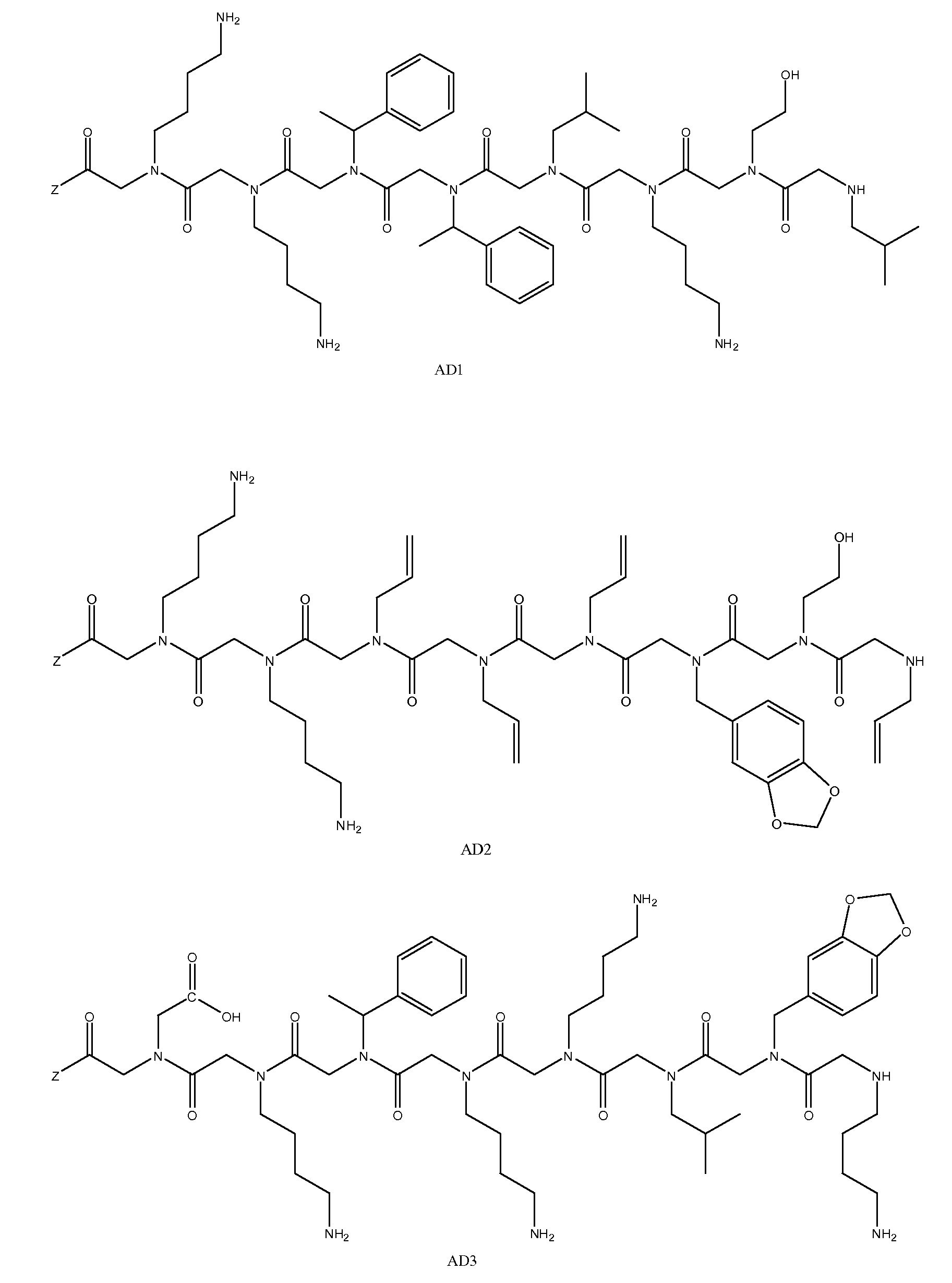

상기 화학식들에서,
Z는 링커, 기질 또는 라벨에 커플링될 수 있는 작용기이다.Peptoid compositions comprising compounds of the formula:
In the above formulas,
Z is a functional group that can be coupled to a linker, substrate, or label.
(a)
화학식 1A
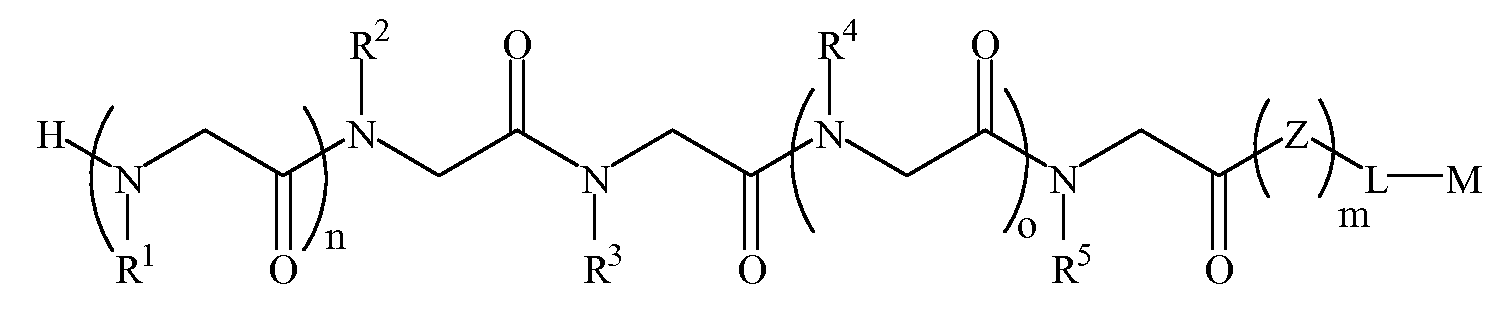
여기서,
R1 및 R4는 수소; 알킬; 알릴; 메틸; 에틸; n-프로필; 이소프로필; n-부틸; 이소부틸; n-부틸아민; 2급-부틸; 3급-부틸; 펜틸; 헥실; 이소펜틸; 아릴; 헤테로아릴; 푸라닐; 인돌릴; 티오페닐; 티아졸릴; 이미다졸릴; 이속사조일; 옥사조일; 피페로닐; 피라조일; 피롤릴; 피라지닐; 피리딜; 피리미딜; 피리미디닐; 푸리닐; 신놀리닐; 벤조푸라닐; 벤조티에닐; 벤조트리아졸릴; 벤족사졸릴; 퀴놀린; 이속사졸릴; 이소퀴놀린; 사이클로알킬; 알케닐; 사이클로알케닐; 페닐; 피리딜; 메톡시에틸; (R)-메틸벤질; 비치환되거나 NH2, OH 또는 SH에 의해 치환된 C1 -6 알킬; 비치환되거나 NH2, OH 또는 SH에 의해 치환된 C2 -6 알키닐; 리실; 카복실; 및 하이드록실 그룹으로 이루어진 그룹으로부터 독립적으로 선택되고,
R2, R3 및 R5는 C0 -6 알킬아릴; C0 -6 알킬헤테로아릴; OH, SH, 할로겐, OR15, COOR15, NR15(여기서, R15는 H 또는 C1 -6 알킬이나 C1 -6 알키닐로 이루어진 그룹으로부터 선택된다) 또는 R16(여기서, R16은 H 또는 C1 -6 알키닐로 이루어진 그룹으로부터 선택된다)으로부터 선택되는 그룹에 의해 치환된 C1 -6 알킬; OC1 -6 알킬; C2 -6 알케닐; C2-6 알키닐; C2 -6 알케닐; 및 C2 -6 알키닐로 이루어진 그룹으로부터 독립적으로 선택된다;
(b)
화학식 1B

여기서,
R6은 수소; 알킬; 알릴; 메틸; 에틸; n-프로필; 이소프로필; n-부틸; 이소부틸; n-부틸아민; 2급-부틸; 3급-부틸; 펜틸; 헥실; 이소펜틸; 아릴; 헤테로아릴; 푸라닐; 인돌릴; 티오페닐; 티아졸릴; 이미다졸릴; 이속사조일; 옥사조일; 피페로닐; 피라조일; 피롤릴; 피라지닐; 피리딜; 피리미딜; 피리미디닐; 푸리닐; 신놀리닐; 벤조푸라닐; 벤조티에닐; 벤조트리아졸릴; 벤족사졸릴; 퀴놀린; 이속사졸릴; 이소퀴놀린; 사이클로알킬; 알케닐; 사이클로알케닐; 페닐; 피리딜; 메톡시에틸; (R)-메틸벤질; 비치환되거나 NH2, OH 또는 SH에 의해 치환된 C1 -6 알킬; 비치환되거나 NH2, OH 또는 SH에 의해 치환된 C2 -6 알키닐; 리실; 카복실; 및 하이드록실 그룹으로 이루어진 그룹으로부터 선택되고,
R7 및 R8은 C0 -6 알킬아릴; C0 -6 알킬헤테로아릴; OH, SH, 할로겐, OR15, COOR15, NR15(여기서, R15는 H 또는 C1 -6 알킬이나 C1 -6 알키닐로 이루어진 그룹으로부터 선택된다) 또는 R16(여기서, R16은 H 또는 C1 -6 알키닐로 이루어진 그룹으로부터 선택된다)으로부터 선택되는 그룹에 의해 치환된 C1 -6 알킬; OC1 -6 알킬; C2 -6 알케닐; C2 -6 알키닐; C2 -6 알케닐; 및 C2 -6 알키닐로 이루어진 그룹으로부터 독립적으로 선택된다;
(c)
화학식 1C

여기서,
R9, R11 및 R13은 수소; 알킬; 알릴; 메틸; 에틸; n-프로필; 이소프로필; n-부틸; 이소부틸; n-부틸아민; 2급-부틸; 3급-부틸; 펜틸; 헥실; 이소펜틸; 아릴; 헤테로아릴; 푸라닐; 인돌릴; 티오페닐; 티아졸릴; 이미다졸릴; 이속사조일; 옥사조일; 피페로닐; 피라조일; 피롤릴; 피라지닐; 피리딜; 피리미딜; 피리미디닐; 푸리닐; 신놀리닐; 벤조푸라닐; 벤조티에닐; 벤조트리아졸릴; 벤족사졸릴; 퀴놀린; 이속사졸릴; 이소퀴놀린; 사이클로알킬; 알케닐; 사이클로알케닐; 페닐; 피리딜; 메톡시에틸; (R)-메틸벤질; 비치환되거나 NH2, OH 또는 SH에 의해 치환된 C1 -6 알킬; 비치환되거나 NH2, OH 또는 SH에 의해 치환된 C2 -6 알키닐; 리실; 카복실; 및 하이드록실 그룹으로 이루어진 그룹으로부터 독립적으로 선택되고,
R10, R12 및 R14는 C0 -6 알킬아릴; C0 -6 알킬헤테로아릴; OH, SH, 할로겐, OR15, COOR15, NR15(여기서, R15는 H 또는 C1 -6 알킬이나 C1 -6 알키닐로 이루어진 그룹으로부터 선택된다) 또는 R16(여기서, R16은 H 또는 C1 -6 알키닐로 이루어진 그룹으로부터 선택된다)으로부터 선택되는 그룹에 의해 치환된 C1 -6 알킬; OC1 -6 알킬; C2 -6 알케닐; C2-6 알키닐; C2 -6 알케닐; 및 C2 -6 알키닐로 이루어진 그룹으로부터 독립적으로 선택된다;
(d)
화학식 1D

여기서,
R17 내지 R20 및 R23은 수소; 알킬; 알릴; 메틸; 에틸; n-프로필; 이소프로필; n-부틸; 이소부틸; n-부틸아민; 2급-부틸; 3급-부틸; 펜틸; 헥실; 이소펜틸; 아릴; 헤테로아릴; 푸라닐; 인돌릴; 티오페닐; 티아졸릴; 이미다졸릴; 이속사조일; 옥사조일; 피페로닐; 피라조일; 피롤릴; 피라지닐; 피리딜; 피리미딜; 피리미디닐; 푸리닐; 신놀리닐; 벤조푸라닐; 벤조티에닐; 벤조트리아졸릴; 벤족사졸릴; 퀴놀린; 이속사졸릴; 이소퀴놀린; 사이클로알킬; 알케닐; 사이클로알케닐; 페닐; 피리딜; 메톡시에틸; (R)-메틸벤질; 비치환되거나 NH2, OH 또는 SH에 의해 치환된 C1 -6 알킬; 비치환되거나 NH2, OH 또는 SH에 의해 치환된 C2 -6 알키닐; 리실; 카복실; 및 하이드록실 그룹으로 이루어진 그룹으로부터 독립적으로 선택되고,
R21, R22 및 R24는 C0 -6 알킬아릴; C0 -6 알킬헤테로아릴; OH, SH, 할로겐, OR15, COOR15, NR15(여기서, R15는 H 또는 C1 -6 알킬이나 C1 -6 알키닐로 이루어진 그룹으로부터 선택된다) 또는 R16(여기서, R16은 H 또는 C1 -6 알키닐로 이루어진 그룹으로부터 선택된다)으로부터 선택되는 그룹에 의해 치환된 C1 -6 알킬; OC1 -6 알킬; C2 -6 알케닐; C2-6 알키닐; C2 -6 알케닐; 및 C2 -6 알키닐로 이루어진 그룹으로부터 독립적으로 선택된다;
(e)
화학식 1D

여기서,
R17 내지 R20, R23 및 R24는 수소; 알킬; 알릴; 메틸; 에틸; n-프로필; 이소프로필; n-부틸; 이소부틸; n-부틸아민; 2급-부틸; 3급-부틸; 펜틸; 헥실; 이소펜틸; 아릴; 헤테로아릴; 푸라닐; 인돌릴; 티오페닐; 티아졸릴; 이미다졸릴; 이속사조일; 옥사조일; 피페로닐; 피라조일; 피롤릴; 피라지닐; 피리딜; 피리미딜; 피리미디닐; 푸리닐; 신놀리닐; 벤조푸라닐; 벤조티에닐; 벤조트리아졸릴; 벤족사졸릴; 퀴놀린; 이속사졸릴; 이소퀴놀린; 사이클로알킬; 알케닐; 사이클로알케닐; 페닐; 피리딜; 메톡시에틸; (R)-메틸벤질; 비치환되거나 NH2, OH 또는 SH에 의해 치환된 C1 -6 알킬; 비치환되거나 NH2, OH 또는 SH에 의해 치환된 C2 -6 알키닐; 리실; 카복실; 및 하이드록실 그룹으로 이루어진 그룹으로부터 독립적으로 선택되고,
R21 및 R22는 C0 -6 알킬아릴; C0 -6 알킬헤테로아릴; OH, SH, 할로겐, OR15, COOR15, NR15(여기서, R15는 H 또는 C1 -6 알킬이나 C1 -6 알키닐로 이루어진 그룹으로부터 선택된다) 또는 R16(여기서, R16은 H 또는 C1 -6 알키닐로 이루어진 그룹으로부터 선택된다)으로부터 선택되는 그룹에 의해 치환된 C1 -6 알킬; OC1 -6 알킬; C2 -6 알케닐; C2-6 알키닐; C2 -6 알케닐; 및 C2 -6 알키닐로 이루어진 그룹으로부터 독립적으로 선택된다;
(f)
화학식 1D

여기서,
R17, R19, R20 및 R23은 수소; 알킬; 알릴; 메틸; 에틸; n-프로필; 이소프로필; n-부틸; 이소부틸; n-부틸아민; 2급-부틸; 3급-부틸; 펜틸; 헥실; 이소펜틸; 아릴; 헤테로아릴; 푸라닐; 인돌릴; 티오페닐; 티아졸릴; 이미다졸릴; 이속사조일; 옥사조일; 피페로닐; 피라조일; 피롤릴; 피라지닐; 피리딜; 피리미딜; 피리미디닐; 푸리닐; 신놀리닐; 벤조푸라닐; 벤조티에닐; 벤조트리아졸릴; 벤족사졸릴; 퀴놀린; 이속사졸릴; 이소퀴놀린; 사이클로알킬; 알케닐; 사이클로알케닐; 페닐; 피리딜; 메톡시에틸; (R)-메틸벤질; 비치환되거나 NH2, OH 또는 SH에 의해 치환된 C1 -6 알킬; 비치환되거나 NH2, OH 또는 SH에 의해 치환된 C2 -6 알키닐; 리실; 카복실; 및 하이드록실 그룹으로 이루어진 그룹으로부터 독립적으로 선택되고,
R18, R21 및 R24는 C0 -6 알킬아릴; C0 -6 알킬헤테로아릴; OH, SH, 할로겐, OR15, COOR15, NR15(여기서, R15는 H 또는 C1 -6 알킬이나 C1 -6 알키닐로 이루어진 그룹으로부터 선택된다) 또는 R16(여기서, R16은 H 또는 C1 -6 알키닐로 이루어진 그룹으로부터 선택된다)으로부터 선택되는 그룹에 의해 치환된 C1 -6 알킬; OC1 -6 알킬; C2 -6 알케닐; C2-6 알키닐; C2 -6 알케닐; 및 C2 -6 알키닐로 이루어진 그룹으로부터 독립적으로 선택되고,
Z는 커플링 그룹이고,
L은 임의의 링커 잔기이고,
M은 기질 또는 지지체이고,
m, n, o 및/또는 p는 0 내지 6이다.Isolated peptoids having Formula 1A, Formula 1B, Formula 1C or Formula 1D as described in (a), (b), (c), (d), (e) or (f):
(a)
Formula 1A
here,
R 1 and R 4 are hydrogen; Alkyl; Allyl; methyl; ethyl; n-propyl; Isopropyl; n-butyl; Isobutyl; n-butylamine; Secondary-butyl; Tert-butyl; Pentyl; Hexyl; Isopentyl; Aryl; Heteroaryl; Furanyl; Indolyl; Thiophenyl; Thiazolyl; Imidazolyl; Exploded yarn; Oxazoyl; Piperonyl; Pyrazoyl; Pyrrolyl; Pyrazinyl; Pyridyl; Pyrimidyl; Pyrimidinyl; Furinyl; Cinnaolinyl; Benzofuranyl; Benzothienyl; Benzotriazolyl; Benzoxazolyl; Quinoline; Isoxazolyl; Isoquinoline; Cycloalkyl; Alkenyl; Cycloalkenyl; Phenyl; Pyridyl; Methoxyethyl; (R) -methylbenzyl; Unsubstituted or NH 2, C 1 -6 alkyl substituted by OH or SH; Unsubstituted or NH 2, a C 2 -6 alkenyl optionally substituted by OH or SH group; Lysyl; Carboxyl; And hydroxyl groups independently;
R 2, R 3 and R 5 is C 0 -6 alkylaryl; C 0 -6 alkyl-heteroaryl; OH, SH, halogen, OR 15, COOR 15, NR 15 ( wherein, R 15 is selected from the group consisting of H or C 1 -6 alkyl or C 1 -6 alkynyl group) or R 16 (wherein, R 16 is substituted C 1-6 alkyl by H or C 1-6 group selected from is selected from the group consisting of alkynyl); OC 1 -6 alkyl; C 2 -6 alkenyl; C 2-6 alkynyl; C 2 -6 alkenyl; And C 2 -6 are independently selected from the group consisting of alkynyl;
(b)
Formula 1B
here,
R 6 is hydrogen; Alkyl; Allyl; methyl; ethyl; n-propyl; Isopropyl; n-butyl; Isobutyl; n-butylamine; Secondary-butyl; Tert-butyl; Pentyl; Hexyl; Isopentyl; Aryl; Heteroaryl; Furanyl; Indolyl; Thiophenyl; Thiazolyl; Imidazolyl; Exploded yarn; Oxazoyl; Piperonyl; Pyrazoyl; Pyrrolyl; Pyrazinyl; Pyridyl; Pyrimidyl; Pyrimidinyl; Furinyl; Cinnaolinyl; Benzofuranyl; Benzothienyl; Benzotriazolyl; Benzoxazolyl; Quinoline; Isoxazolyl; Isoquinoline; Cycloalkyl; Alkenyl; Cycloalkenyl; Phenyl; Pyridyl; Methoxyethyl; (R) -methylbenzyl; Unsubstituted or NH 2, C 1 -6 alkyl substituted by OH or SH; Unsubstituted or NH 2, a C 2 -6 alkenyl optionally substituted by OH or SH group; Lysyl; Carboxyl; And it is selected from the group consisting of hydroxyl group,
R 7 And R 8 is C 0 -6 alkylaryl; C 0 -6 alkyl-heteroaryl; OH, SH, halogen, OR 15, COOR 15, NR 15 ( wherein, R 15 is selected from the group consisting of H or C 1 -6 alkyl or C 1 -6 alkynyl group) or R 16 (wherein, R 16 is substituted C 1-6 alkyl by H or C 1-6 group selected from is selected from the group consisting of alkynyl); OC 1 -6 alkyl; C 2 -6 alkenyl; C 2 -6-alkynyl; C 2 -6 alkenyl; And C 2 -6 are independently selected from the group consisting of alkynyl;
(c)
Formula 1C
here,
R 9 , R 11 and R 13 are hydrogen; Alkyl; Allyl; methyl; ethyl; n-propyl; Isopropyl; n-butyl; Isobutyl; n-butylamine; Secondary-butyl; Tert-butyl; Pentyl; Hexyl; Isopentyl; Aryl; Heteroaryl; Furanyl; Indolyl; Thiophenyl; Thiazolyl; Imidazolyl; Exploded yarn; Oxazoyl; Piperonyl; Pyrazoyl; Pyrrolyl; Pyrazinyl; Pyridyl; Pyrimidyl; Pyrimidinyl; Furinyl; Cinnaolinyl; Benzofuranyl; Benzothienyl; Benzotriazolyl; Benzoxazolyl; Quinoline; Isoxazolyl; Isoquinoline; Cycloalkyl; Alkenyl; Cycloalkenyl; Phenyl; Pyridyl; Methoxyethyl; (R) -methylbenzyl; Unsubstituted or NH 2, C 1 -6 alkyl substituted by OH or SH; Unsubstituted or NH 2, a C 2 -6 alkenyl optionally substituted by OH or SH group; Lysyl; Carboxyl; And hydroxyl groups independently;
R 10 , R 12 And R 14 is C 0 -6 alkylaryl; C 0 -6 alkyl-heteroaryl; OH, SH, halogen, OR 15, COOR 15, NR 15 ( wherein, R 15 is selected from the group consisting of H or C 1 -6 alkyl or C 1 -6 alkynyl group) or R 16 (wherein, R 16 is substituted C 1-6 alkyl by H or C 1-6 group selected from is selected from the group consisting of alkynyl); OC 1 -6 alkyl; C 2 -6 alkenyl; C 2-6 alkynyl; C 2 -6 alkenyl; And C 2 -6 are independently selected from the group consisting of alkynyl;
(d)
Formula 1D
here,
R 17 R 20 and R 23 are hydrogen; Alkyl; Allyl; methyl; ethyl; n-propyl; Isopropyl; n-butyl; Isobutyl; n-butylamine; Secondary-butyl; Tert-butyl; Pentyl; Hexyl; Isopentyl; Aryl; Heteroaryl; Furanyl; Indolyl; Thiophenyl; Thiazolyl; Imidazolyl; Exploded yarn; Oxazoyl; Piperonyl; Pyrazoyl; Pyrrolyl; Pyrazinyl; Pyridyl; Pyrimidyl; Pyrimidinyl; Furinyl; Cinnaolinyl; Benzofuranyl; Benzothienyl; Benzotriazolyl; Benzoxazolyl; Quinoline; Isoxazolyl; Isoquinoline; Cycloalkyl; Alkenyl; Cycloalkenyl; Phenyl; Pyridyl; Methoxyethyl; (R) -methylbenzyl; Unsubstituted or NH 2, C 1 -6 alkyl substituted by OH or SH; Unsubstituted or NH 2, a C 2 -6 alkenyl optionally substituted by OH or SH group; Lysyl; Carboxyl; And hydroxyl groups independently;
R 21 , R 22 And R 24 is C 0 -6 alkylaryl; C 0 -6 alkyl-heteroaryl; OH, SH, halogen, OR 15, COOR 15, NR 15 ( wherein, R 15 is selected from the group consisting of H or C 1 -6 alkyl or C 1 -6 alkynyl group) or R 16 (wherein, R 16 is substituted C 1-6 alkyl by H or C 1-6 group selected from is selected from the group consisting of alkynyl); OC 1 -6 alkyl; C 2 -6 alkenyl; C 2-6 alkynyl; C 2 -6 alkenyl; And C 2 -6 are independently selected from the group consisting of alkynyl;
(e)
Formula 1D
here,
R 17 To R 20 , R 23 and R 24 are hydrogen; Alkyl; Allyl; methyl; ethyl; n-propyl; Isopropyl; n-butyl; Isobutyl; n-butylamine; Secondary-butyl; Tert-butyl; Pentyl; Hexyl; Isopentyl; Aryl; Heteroaryl; Furanyl; Indolyl; Thiophenyl; Thiazolyl; Imidazolyl; Exploded yarn; Oxazoyl; Piperonyl; Pyrazoyl; Pyrrolyl; Pyrazinyl; Pyridyl; Pyrimidyl; Pyrimidinyl; Furinyl; Cinnaolinyl; Benzofuranyl; Benzothienyl; Benzotriazolyl; Benzoxazolyl; Quinoline; Isoxazolyl; Isoquinoline; Cycloalkyl; Alkenyl; Cycloalkenyl; Phenyl; Pyridyl; Methoxyethyl; (R) -methylbenzyl; Unsubstituted or NH 2, C 1 -6 alkyl substituted by OH or SH; Unsubstituted or NH 2, a C 2 -6 alkenyl optionally substituted by OH or SH group; Lysyl; Carboxyl; And hydroxyl groups independently;
R 21 And R 22 is C 0 -6 alkylaryl; C 0 -6 alkyl-heteroaryl; OH, SH, halogen, OR 15, COOR 15, NR 15 ( wherein, R 15 is selected from the group consisting of H or C 1 -6 alkyl or C 1 -6 alkynyl group) or R 16 (wherein, R 16 is substituted C 1-6 alkyl by H or C 1-6 group selected from is selected from the group consisting of alkynyl); OC 1 -6 alkyl; C 2 -6 alkenyl; C 2-6 alkynyl; C 2 -6 alkenyl; And C 2 -6 are independently selected from the group consisting of alkynyl;
(f)
Formula 1D
here,
R 17 , R 19 , R 20 and R 23 are hydrogen; Alkyl; Allyl; methyl; ethyl; n-propyl; Isopropyl; n-butyl; Isobutyl; n-butylamine; Secondary-butyl; Tert-butyl; Pentyl; Hexyl; Isopentyl; Aryl; Heteroaryl; Furanyl; Indolyl; Thiophenyl; Thiazolyl; Imidazolyl; Exploded yarn; Oxazoyl; Piperonyl; Pyrazoyl; Pyrrolyl; Pyrazinyl; Pyridyl; Pyrimidyl; Pyrimidinyl; Furinyl; Cinnaolinyl; Benzofuranyl; Benzothienyl; Benzotriazolyl; Benzoxazolyl; Quinoline; Isoxazolyl; Isoquinoline; Cycloalkyl; Alkenyl; Cycloalkenyl; Phenyl; Pyridyl; Methoxyethyl; (R) -methylbenzyl; Unsubstituted or NH 2, C 1 -6 alkyl substituted by OH or SH; Unsubstituted or NH 2, a C 2 -6 alkenyl optionally substituted by OH or SH group; Lysyl; Carboxyl; And hydroxyl groups independently;
R 18 , R 21 And R 24 is C 0 -6 alkylaryl; C 0 -6 alkyl-heteroaryl; OH, SH, halogen, OR 15, COOR 15, NR 15 ( wherein, R 15 is selected from the group consisting of H or C 1 -6 alkyl or C 1 -6 alkynyl group) or R 16 (wherein, R 16 is substituted C 1-6 alkyl by H or C 1-6 group selected from is selected from the group consisting of alkynyl); OC 1 -6 alkyl; C 2 -6 alkenyl; C 2-6 alkynyl; C 2 -6 alkenyl; And C 2 -6 are independently selected from the group consisting of alkynyl,
Z is a coupling group,
L is any linker residue,
M is a substrate or support,
m, n, o and / or p are 0-6.
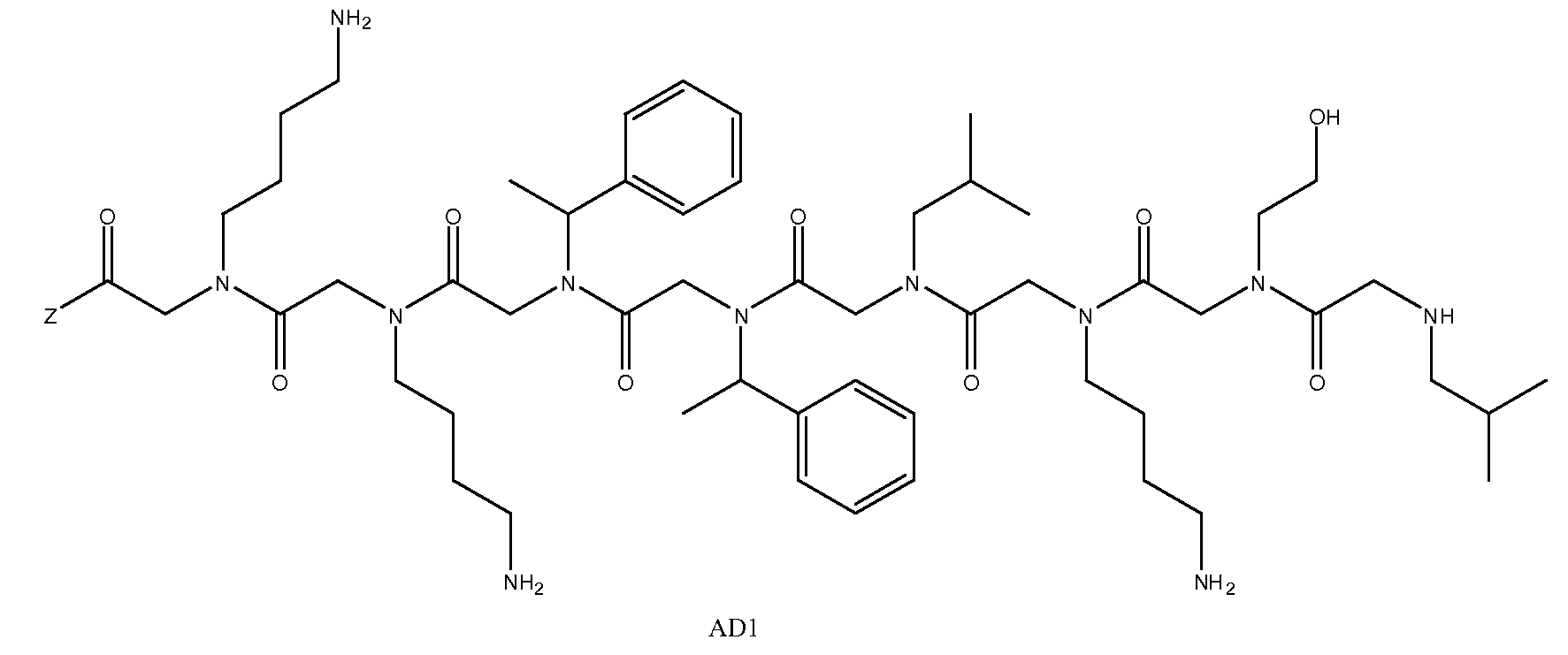
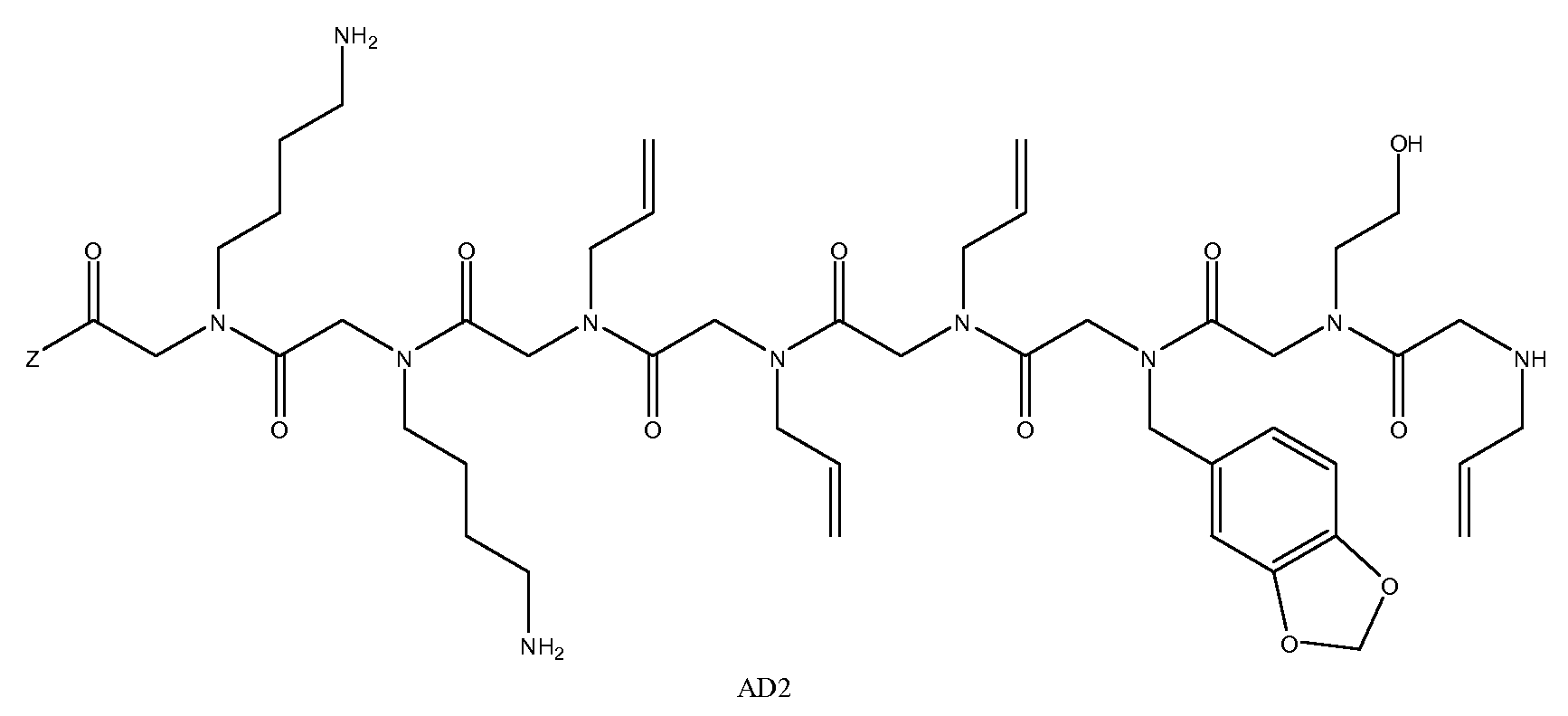
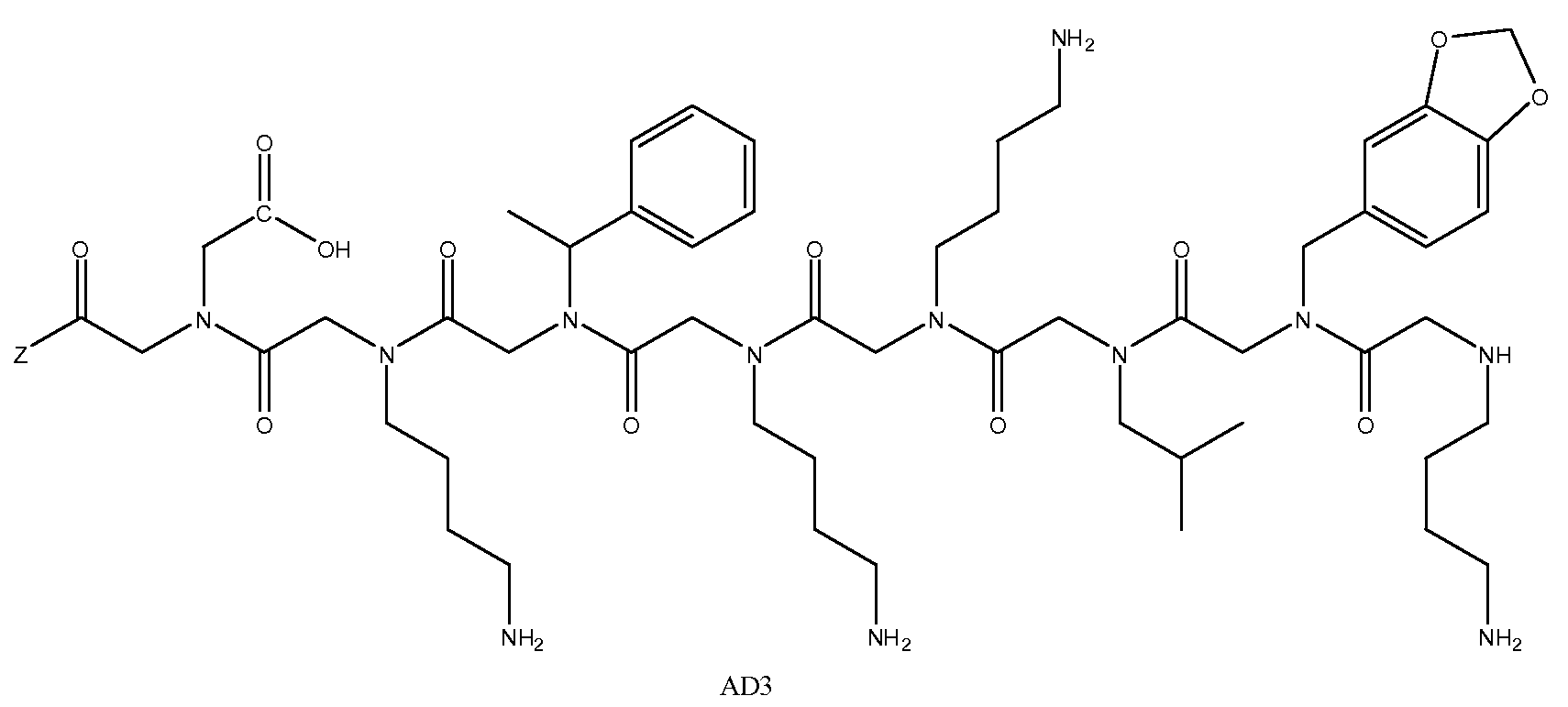


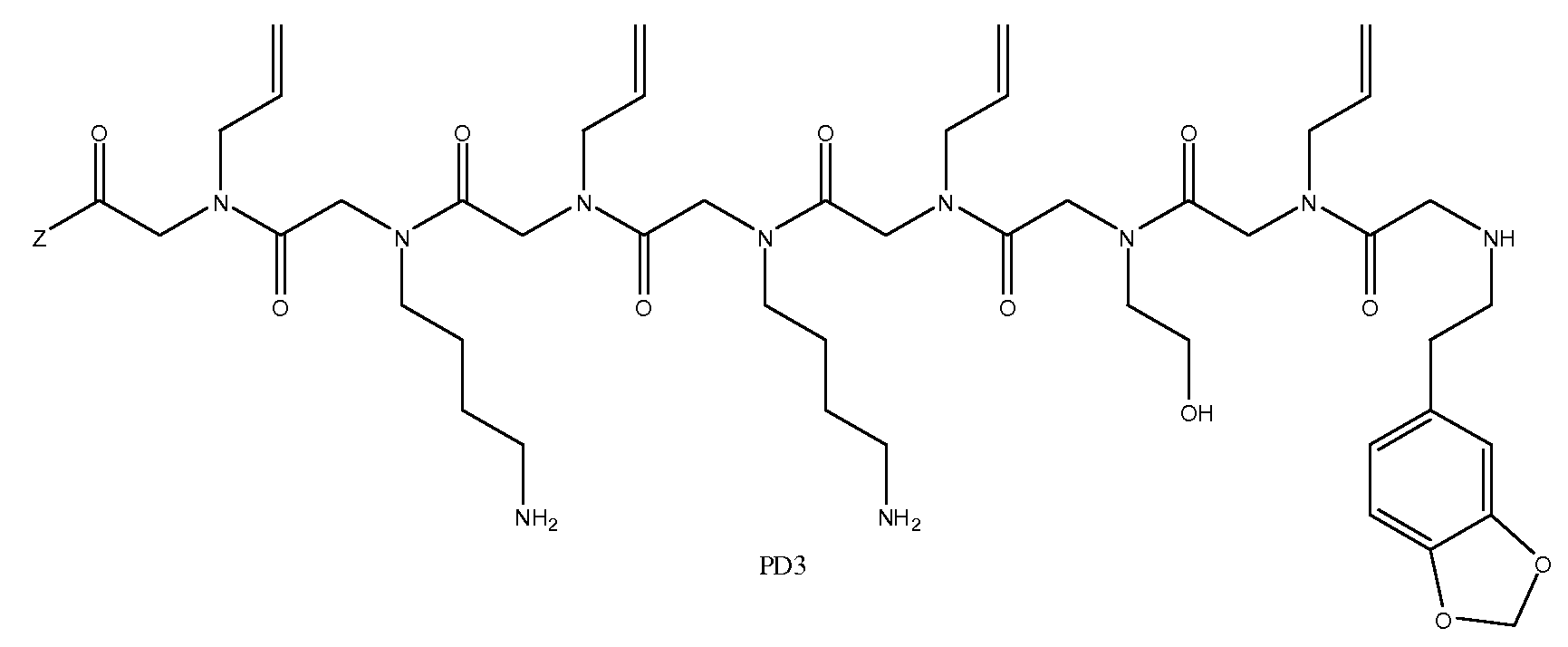
(b) 상기 차단 완충액을 제거하는 단계,
(c) 상기 펩토이드 어레이를 세균 용해물을 포함하는 샘플 용액으로 배양하는 단계, 및
(d) 상기 펩토이드 어레이에 결합된 항체를 검출하는 단계를 포함하는,
생물학적 유체 중 항체를 검출하는 방법.(a) incubating the peptoid array with a blocking buffer comprising bacterial lysate at a concentration of 0.5 to 2 mg / ml,
(b) removing the blocking buffer,
(c) culturing the peptoid array with a sample solution comprising bacterial lysate, and
(d) detecting the antibody bound to the peptoid array,
A method for detecting antibodies in biological fluids.
Applications Claiming Priority (5)
| Application Number | Priority Date | Filing Date | Title |
|---|---|---|---|
| US18326009P | 2009-06-02 | 2009-06-02 | |
| US61/183,260 | 2009-06-02 | ||
| US31865510P | 2010-03-29 | 2010-03-29 | |
| US61/318,655 | 2010-03-29 | ||
| PCT/US2010/036827 WO2010141421A1 (en) | 2009-06-02 | 2010-06-01 | Identification of small molecules recognized by antibodies in subjects with neurodegenerative diseases |
Publications (1)
| Publication Number | Publication Date |
|---|---|
| KR20120122869A true KR20120122869A (en) | 2012-11-07 |
Family
ID=42269525
Family Applications (1)
| Application Number | Title | Priority Date | Filing Date |
|---|---|---|---|
| KR1020117031453A Ceased KR20120122869A (en) | 2009-06-02 | 2010-06-01 | Identification of small molecules recognized by antibodies in subjects with neurodegenerative diseases |
Country Status (15)
| Country | Link |
|---|---|
| US (1) | US9551721B2 (en) |
| EP (1) | EP2438444A1 (en) |
| JP (1) | JP5828837B2 (en) |
| KR (1) | KR20120122869A (en) |
| CN (1) | CN102439451B (en) |
| AU (1) | AU2010256880B2 (en) |
| BR (1) | BRPI1013012A2 (en) |
| CA (1) | CA2764153C (en) |
| CL (1) | CL2011002973A1 (en) |
| CO (1) | CO6450654A2 (en) |
| IL (1) | IL216689A (en) |
| MX (1) | MX2011012933A (en) |
| RU (1) | RU2566064C2 (en) |
| TW (1) | TWI569014B (en) |
| WO (1) | WO2010141421A1 (en) |
Families Citing this family (11)
| Publication number | Priority date | Publication date | Assignee | Title |
|---|---|---|---|---|
| RU2013130324A (en) | 2011-01-10 | 2015-02-20 | ОПКО Фармасьютикалз, ЛЛС | ANTIGEN SURROGATES IN AUTOIMMUNE DISEASES |
| WO2012129423A2 (en) * | 2011-03-24 | 2012-09-27 | Opko Pharmaceuticals, Llc | Biomarker discovery in complex biological fluid using bead or particle based libraries and diagnostic kits and therapeutics |
| EP2705180A4 (en) * | 2011-05-06 | 2015-04-22 | Elwha Llc | Compositions and methods for antibody and ligand identification |
| US11360098B2 (en) * | 2015-09-28 | 2022-06-14 | Quest Diagnostics Investments Llc | Amyloid beta detection by mass spectrometry |
| MX391259B (en) | 2015-10-14 | 2025-03-21 | X Therma Inc | COMPOSITIONS AND METHODS FOR REDUCING ICE CRYSTAL FORMATION. |
| CA3017141A1 (en) | 2016-03-09 | 2017-09-14 | Mike-Ann, Llc | Peptoid affinity ligands |
| WO2017165438A1 (en) | 2016-03-25 | 2017-09-28 | Muralidhar Reddy Moola | Combinatorial synthesis and biomarker development |
| CN106866794B (en) * | 2017-02-15 | 2020-09-08 | 国家纳米科学中心 | A kind of peptoid and its preparation method and application |
| CN108484905A (en) * | 2018-04-16 | 2018-09-04 | 青岛科技大学 | A kind of side chain has the cluster peptide and preparation method thereof of UCST behaviors containing carboxyl |
| WO2019211878A1 (en) * | 2018-05-04 | 2019-11-07 | Council Of Scientific And Industrial Research, An Indian Registered Body Incorporated Under The Registration Of Societies Act (Act Xxi Of 1860) | Peptoid of formula i, pharmaceutical compositions and method for preparation thereof |
| CN108586579B (en) * | 2018-05-11 | 2021-11-30 | 京东方科技集团股份有限公司 | Quasi-peptide, derivative, salt, preparation method and application thereof |
Family Cites Families (80)
| Publication number | Priority date | Publication date | Assignee | Title |
|---|---|---|---|---|
| NL154598B (en) | 1970-11-10 | 1977-09-15 | Organon Nv | PROCEDURE FOR DETERMINING AND DETERMINING LOW MOLECULAR COMPOUNDS AND PROTEINS THAT CAN SPECIFICALLY BIND THESE COMPOUNDS AND TEST PACKAGING. |
| US3817837A (en) | 1971-05-14 | 1974-06-18 | Syva Corp | Enzyme amplification assay |
| US3939350A (en) | 1974-04-29 | 1976-02-17 | Board Of Trustees Of The Leland Stanford Junior University | Fluorescent immunoassay employing total reflection for activation |
| US3996345A (en) | 1974-08-12 | 1976-12-07 | Syva Company | Fluorescence quenching with immunological pairs in immunoassays |
| US4277437A (en) | 1978-04-05 | 1981-07-07 | Syva Company | Kit for carrying out chemically induced fluorescence immunoassay |
| US4275149A (en) | 1978-11-24 | 1981-06-23 | Syva Company | Macromolecular environment control in specific receptor assays |
| US4366241A (en) | 1980-08-07 | 1982-12-28 | Syva Company | Concentrating zone method in heterogeneous immunoassays |
| US5011771A (en) * | 1984-04-12 | 1991-04-30 | The General Hospital Corporation | Multiepitopic immunometric assay |
| US4789628A (en) * | 1986-06-16 | 1988-12-06 | Vxr, Inc. | Devices for carrying out ligand/anti-ligand assays, methods of using such devices and diagnostic reagents and kits incorporating such devices |
| CA1304682C (en) | 1986-11-19 | 1992-07-07 | Nobuo Monji | Membrane affinity concentration immunoassay |
| US5149626A (en) * | 1987-05-14 | 1992-09-22 | Mclean Hospital Corporation | Multiple antigen immunoassay |
| EP0317804B1 (en) | 1987-11-24 | 1995-10-04 | Abbott Laboratories | HIV peptides and methods for detection of HIV |
| DE4040669A1 (en) | 1990-12-19 | 1992-06-25 | Behringwerke Ag | USE OF PEPTIDE COUPLES WITH EXTREMELY HIGH SPECIFIC AFFINITY TOGETHER IN THE AREA OF IN VITRO DIAGNOSTICS |
| DK51092D0 (en) | 1991-05-24 | 1992-04-15 | Ole Buchardt | OLIGONUCLEOTIDE ANALOGUE DESCRIBED BY PEN, MONOMERIC SYNTHONES AND PROCEDURES FOR PREPARING THEREOF, AND APPLICATIONS THEREOF |
| CA2115333A1 (en) * | 1993-02-16 | 1994-08-17 | Shigeo Hozumi | Polyfunctional vinyl ether compounds and photoresist resin composition containing the same |
| US5705614A (en) * | 1993-04-09 | 1998-01-06 | Chiron Corporation | Methods of producing antigen forks |
| NZ267842A (en) * | 1993-05-28 | 1997-09-22 | Baylor College Medicine | Apparatus for measuring molecular mass (by mass spectrometry) in which the sample is ionised on the sample holder and desorbed therefrom by laser pulses |
| ZA95605B (en) * | 1994-04-28 | 1995-12-20 | Qualcomm Inc | Method and apparatus for automatic gain control and dc offset cancellation in quadrature receiver |
| AUPO591797A0 (en) * | 1997-03-27 | 1997-04-24 | Commonwealth Scientific And Industrial Research Organisation | High avidity polyvalent and polyspecific reagents |
| CN1315870C (en) * | 1995-06-07 | 2007-05-16 | 葛兰素集团有限公司 | Peptides and compounds that bind thrombopoietin receptor |
| JPH1025299A (en) | 1996-07-12 | 1998-01-27 | Nec Corp | Aligned peptide, and detection of bound/interaction site in protein using the same |
| US20020022227A1 (en) * | 1996-10-17 | 2002-02-21 | Short Jay M. | Morphatides: novel shape and structure libraries |
| US20020006620A1 (en) * | 1996-10-17 | 2002-01-17 | Invitrogen Corporation | Morphatides: novel shape and structure libraries |
| AU5729898A (en) * | 1996-12-18 | 1998-07-15 | Emory University | Polycationic oligomers |
| WO1998046796A1 (en) * | 1997-04-11 | 1998-10-22 | The Regents Of The University Of California | A method of screening nucleotide sequences to identify disruptors or effectors of biological processes or pathways |
| NZ516848A (en) * | 1997-06-20 | 2004-03-26 | Ciphergen Biosystems Inc | Retentate chromatography apparatus with applications in biology and medicine |
| US6344330B1 (en) * | 1998-03-27 | 2002-02-05 | The Regents Of The University Of California | Pharmacophore recombination for the identification of small molecule drug lead compounds |
| US6406632B1 (en) * | 1998-04-03 | 2002-06-18 | Symyx Technologies, Inc. | Rapid characterization of polymers |
| JP2002510505A (en) | 1998-04-03 | 2002-04-09 | フィロス インク. | Localizable protein arrays |
| WO1999067640A1 (en) * | 1998-06-22 | 1999-12-29 | The Regents Of The University Of California | Triggered optical biosensor |
| US6406921B1 (en) * | 1998-07-14 | 2002-06-18 | Zyomyx, Incorporated | Protein arrays for high-throughput screening |
| US6780582B1 (en) * | 1998-07-14 | 2004-08-24 | Zyomyx, Inc. | Arrays of protein-capture agents and methods of use thereof |
| US6197599B1 (en) * | 1998-07-30 | 2001-03-06 | Guorong Chin | Method to detect proteins |
| US6306643B1 (en) * | 1998-08-24 | 2001-10-23 | Affymetrix, Inc. | Methods of using an array of pooled probes in genetic analysis |
| BR9915137A (en) * | 1998-11-06 | 2004-06-08 | Martin E Schwab | Protein, purified protein fragment, purified molecule, nucleic acid, vector, recombinant cell, methods of producing a recombinant protein, treatment of an individual with a central nervous system neoplastic disease and damage to the central nervous system, inducing regeneration or sprouting of neurons in an individual, promoting structural plasticity of an individual's central nervous system, and recombinant non-human animal, method of obtaining polyclonal antibodies to a protein, isolated antiserum sample, and method of immunization of a non-human animal |
| AU4025300A (en) | 1999-03-24 | 2000-10-09 | Packard Bioscience Company | Continuous porous matrix arrays |
| US6465183B2 (en) * | 1999-07-01 | 2002-10-15 | Agilent Technologies, Inc. | Multidentate arrays |
| AU1630501A (en) * | 1999-10-08 | 2001-04-23 | Superarray, Inc. | Compositions and methods for detecting protein modification and enzymatic activity |
| EP1155327A1 (en) | 1999-11-02 | 2001-11-21 | Chiron Corporation | Biological sample component purification and differential display |
| US9335328B2 (en) | 2000-02-03 | 2016-05-10 | Instant Medical Diagnostics, Llc | Method and apparatus for signal transduction pathway profiling |
| HK1053972A1 (en) | 2000-02-16 | 2003-11-14 | Northwestern University | Polypeptoid pulmonary surfactants |
| AU2001242928A1 (en) | 2000-03-16 | 2001-09-24 | Biacore Ab | Method for capturing analytes eluted from surface-bound ligands |
| JP2004501869A (en) * | 2000-03-22 | 2004-01-22 | ソルリンク・インコーポレイテッド | Hydrazine-based and carbonyl-based bifunctional crosslinkers |
| CN1654956A (en) * | 2000-05-04 | 2005-08-17 | 耶鲁大学 | High density protein arrays for screening of protein activity |
| WO2001088538A2 (en) | 2000-05-12 | 2001-11-22 | Dumas David P | Compositions and methods for epitope mapping |
| US20020103349A1 (en) * | 2000-05-25 | 2002-08-01 | Asher Nathan | Drug-oligonucleotides chimeric molecules |
| JP2003536073A (en) * | 2000-06-05 | 2003-12-02 | カイロン コーポレイション | Microarrays for performing proteomics analysis |
| US7148058B2 (en) | 2000-06-05 | 2006-12-12 | Chiron Corporation | Protein microarrays on mirrored surfaces for performing proteomic analyses |
| US7153682B2 (en) | 2000-06-05 | 2006-12-26 | Chiron Corporation | Microarrays on mirrored substrates for performing proteomic analyses |
| US20020013334A1 (en) * | 2000-06-15 | 2002-01-31 | Robl Jeffrey A. | HMG-CoA reductase inhibitors and method |
| CA2410857A1 (en) | 2000-06-23 | 2001-12-27 | Domantis Limited | Matrix screening method |
| DE60120713T2 (en) * | 2000-08-15 | 2007-06-06 | Discerna Ltd. | FUNCTIONAL PROTEIN ARRAY |
| AU2001285252A1 (en) | 2000-08-25 | 2002-03-13 | Gendaq, Ltd. | Analysis of binding interactions |
| GB0022978D0 (en) * | 2000-09-19 | 2000-11-01 | Oxford Glycosciences Uk Ltd | Detection of peptides |
| EP1197755A1 (en) | 2000-10-11 | 2002-04-17 | Pepscan Systems B.V. | Identification of protein binding sites |
| WO2002040716A2 (en) * | 2000-11-16 | 2002-05-23 | Cemines, Llc | Profiling tumor specific markers for the diagnosis and treatment of neoplastic disease |
| US20020137104A1 (en) | 2000-11-27 | 2002-09-26 | Antonio Cosma | High throughput determination of antigen expression |
| US7091046B2 (en) * | 2000-12-11 | 2006-08-15 | Hk Pharmaceuticals, Inc. | Multiplexed protein expression and activity assay |
| ATE538380T1 (en) * | 2001-01-23 | 2012-01-15 | Harvard College | NUCLEIC ACID PROGRAMMABLE PROTEIN ARRAYS |
| US20040082079A1 (en) | 2001-02-05 | 2004-04-29 | Ralf Besenbruch | Low affinity screening method |
| US20020137106A1 (en) * | 2001-03-09 | 2002-09-26 | Ciphergen Biosystems, Inc. | Detection of biological pathway components |
| EP1410037A2 (en) | 2001-03-10 | 2004-04-21 | Affina Immuntechnik GmbH | Method for identifying immune reactive epitopes on proteins and the use thereof for prophylactic and therapeutic purposes |
| IL158316A0 (en) * | 2001-04-10 | 2004-05-12 | Univ Leland Stanford Junior | Therapeutic and diagnostic uses of antibody specificity profiles |
| US6777239B2 (en) * | 2001-04-17 | 2004-08-17 | Xenoport, Inc. | Epitope-captured antibody display |
| WO2002085926A2 (en) * | 2001-04-19 | 2002-10-31 | GESELLSCHAFT FüR BIOTECHNOLOGISCHE FORSCHUNG MBH (GBF) | Method for producing stable, regeneratable antibody arrays |
| US6989276B2 (en) * | 2001-05-10 | 2006-01-24 | Battelle Energy Alliance, Llc | Rapid classification of biological components |
| US20050048566A1 (en) * | 2001-08-27 | 2005-03-03 | Delisi Charles | Apparatus, composition and method for proteome profiling |
| WO2003072827A1 (en) | 2001-10-31 | 2003-09-04 | Children's Hospital Medical Center | Method for diagnosis and treatment of rheumatoid arthritis |
| EP1319954A1 (en) | 2001-12-12 | 2003-06-18 | Centre National de Genotypage | Methods for protein analysis using protein capture arrays |
| US7504364B2 (en) | 2002-03-01 | 2009-03-17 | Receptors Llc | Methods of making arrays and artificial receptors |
| IL163880A0 (en) | 2002-03-07 | 2005-12-18 | Zephyr Proteomix Ltd | Microarrays of cellulose binding chimeric proteinsand methods of use thereof |
| US7736909B2 (en) * | 2003-01-09 | 2010-06-15 | Board Of Regents, The University Of Texas System | Methods and compositions comprising capture agents |
| WO2005007677A2 (en) | 2003-07-10 | 2005-01-27 | The Institute For Systems Biology | Affinity capture of peptides by microarray and related methods |
| GB2404734A (en) | 2003-08-05 | 2005-02-09 | Secr Defence | A method of screening a sample for abnormally glycosylated and/or expressed proteins |
| WO2006028930A2 (en) * | 2004-09-03 | 2006-03-16 | Receptors Llc | Combinatorial artificial receptors including tether building blocks on scaffolds |
| EP1688137A1 (en) * | 2005-01-28 | 2006-08-09 | Schwarz Pharma Ag | SPM 927 for add-on therapy of schizophrenia |
| WO2006124644A2 (en) * | 2005-05-12 | 2006-11-23 | Board Of Regents, The University Of Texas System | Protein and antibody profiling using small molecule microarrays |
| WO2007030804A1 (en) | 2005-09-09 | 2007-03-15 | Novartis Ag | Prion-specific peptoid reagents |
| CA2666507A1 (en) | 2006-10-16 | 2008-04-24 | The Arizona Board Of Regents, A Body Corporate Of The State Of Arizona A Cting For And On Behalf Of Arizona State University | Synthetic antibodies |
| JP5991916B2 (en) | 2009-05-29 | 2016-09-14 | ザ ボード オブ リージェンツ オブ ザ ユニバーシティー オブ テキサス システム | Peptoid ligand for isolation and processing of autoimmune T cells |
-
2010
- 2010-06-01 KR KR1020117031453A patent/KR20120122869A/en not_active Ceased
- 2010-06-01 EP EP10721259A patent/EP2438444A1/en not_active Withdrawn
- 2010-06-01 WO PCT/US2010/036827 patent/WO2010141421A1/en not_active Ceased
- 2010-06-01 CN CN201080023987.9A patent/CN102439451B/en not_active Expired - Fee Related
- 2010-06-01 AU AU2010256880A patent/AU2010256880B2/en not_active Ceased
- 2010-06-01 BR BRPI1013012A patent/BRPI1013012A2/en not_active Application Discontinuation
- 2010-06-01 JP JP2012514031A patent/JP5828837B2/en not_active Expired - Fee Related
- 2010-06-01 MX MX2011012933A patent/MX2011012933A/en active IP Right Grant
- 2010-06-01 CA CA2764153A patent/CA2764153C/en active Active
- 2010-06-01 RU RU2011154154/15A patent/RU2566064C2/en active IP Right Revival
- 2010-06-01 US US12/791,389 patent/US9551721B2/en active Active
- 2010-06-02 TW TW099117859A patent/TWI569014B/en not_active IP Right Cessation
-
2011
- 2011-10-21 CO CO11141472A patent/CO6450654A2/en not_active Application Discontinuation
- 2011-11-24 CL CL2011002973A patent/CL2011002973A1/en unknown
- 2011-11-30 IL IL216689A patent/IL216689A/en not_active IP Right Cessation
Also Published As
| Publication number | Publication date |
|---|---|
| AU2010256880B2 (en) | 2015-01-22 |
| CA2764153C (en) | 2021-07-27 |
| CN102439451B (en) | 2014-12-03 |
| JP2012529053A (en) | 2012-11-15 |
| HK1169709A1 (en) | 2013-02-01 |
| TWI569014B (en) | 2017-02-01 |
| JP5828837B2 (en) | 2015-12-09 |
| CA2764153A1 (en) | 2010-12-09 |
| US9551721B2 (en) | 2017-01-24 |
| US20100303805A1 (en) | 2010-12-02 |
| TW201109662A (en) | 2011-03-16 |
| EP2438444A1 (en) | 2012-04-11 |
| RU2566064C2 (en) | 2015-10-20 |
| IL216689A (en) | 2016-09-29 |
| MX2011012933A (en) | 2012-03-07 |
| AU2010256880A1 (en) | 2011-11-03 |
| WO2010141421A1 (en) | 2010-12-09 |
| BRPI1013012A2 (en) | 2016-10-18 |
| IL216689A0 (en) | 2012-02-29 |
| CN102439451A (en) | 2012-05-02 |
| CO6450654A2 (en) | 2012-05-31 |
| CL2011002973A1 (en) | 2012-03-23 |
Similar Documents
| Publication | Publication Date | Title |
|---|---|---|
| KR20120122869A (en) | Identification of small molecules recognized by antibodies in subjects with neurodegenerative diseases | |
| US20240219406A1 (en) | Detection of misfolded alpha synuclein protein | |
| Wilhelm et al. | Immune reactivity towards insulin, its amyloid and protein S100B in blood sera of Parkinson's disease patients | |
| US7674599B2 (en) | Methods of using antibodies to detect alpha-synuclein in fluid samples | |
| WO2007021255A1 (en) | Antibodies to alpha-synuclein | |
| CN105358978A (en) | Method for detecting indicators for determining diseases | |
| KR20200007945A (en) | Detection of Misfolded Tau Protein | |
| EP3433262A1 (en) | Combinatorial synthesis and biomarker development | |
| US20170016885A1 (en) | Compositions and methods for measuring cellular mechanical stress | |
| US20230340037A1 (en) | Inhibitors of ?-synuclein aggregation and uses thereof | |
| JP7449589B2 (en) | Method for predicting reactivity to BCL2 family protein target drugs | |
| WO2018226098A2 (en) | Methods for typing neurological disorders and cancer, and devices for use therein | |
| HK1169709B (en) | Identification of small molecules recognized by antibodies in subjects with neurodegenerative diseases | |
| US20070197482A1 (en) | Regulation of guanine nucleotide exchange factor for a protein belonging to the rap family of small gtpases | |
| CN110325862B (en) | Diagnostic kit for the detection of ischemic chronic brain pathology | |
| KR102798206B1 (en) | Early diagnosis system using SADF(Standard deviation and Auto-correlation of Dynamic Fluorescence) or SADX(Standard deviation and Auto-correlation of Dynamic X-ray) | |
| ES3042176T3 (en) | Method of identifying peptide antigens and uses thereof | |
| CN112285363A (en) | Diagnosis of autoimmune neurological disorders | |
| CN119199093A (en) | Diagnosis and kit for autoimmune nervous system diseases | |
| US20180196068A1 (en) | Detection of Misfolded Amyloid Beta Protein | |
| KR20210071830A (en) | Method of Response Prediction For BCL2 family Protein Targeting Drug |
Legal Events
| Date | Code | Title | Description |
|---|---|---|---|
| PA0105 | International application |
Patent event date: 20111229 Patent event code: PA01051R01D Comment text: International Patent Application |
|
| PG1501 | Laying open of application | ||
| A201 | Request for examination | ||
| PA0201 | Request for examination |
Patent event code: PA02012R01D Patent event date: 20150601 Comment text: Request for Examination of Application |
|
| E902 | Notification of reason for refusal | ||
| PE0902 | Notice of grounds for rejection |
Comment text: Notification of reason for refusal Patent event date: 20170328 Patent event code: PE09021S01D |
|
| E601 | Decision to refuse application | ||
| PE0601 | Decision on rejection of patent |
Patent event date: 20180226 Comment text: Decision to Refuse Application Patent event code: PE06012S01D Patent event date: 20170328 Comment text: Notification of reason for refusal Patent event code: PE06011S01I |