KR20110104119A - Process for the preparation of antiviral inhibitors and related intermediate compounds - Google Patents
Process for the preparation of antiviral inhibitors and related intermediate compounds Download PDFInfo
- Publication number
- KR20110104119A KR20110104119A KR1020117018779A KR20117018779A KR20110104119A KR 20110104119 A KR20110104119 A KR 20110104119A KR 1020117018779 A KR1020117018779 A KR 1020117018779A KR 20117018779 A KR20117018779 A KR 20117018779A KR 20110104119 A KR20110104119 A KR 20110104119A
- Authority
- KR
- South Korea
- Prior art keywords
- formula
- compound
- alkyl
- composition
- chiral
- Prior art date
- Legal status (The legal status is an assumption and is not a legal conclusion. Google has not performed a legal analysis and makes no representation as to the accuracy of the status listed.)
- Granted
Links
Classifications
-
- C—CHEMISTRY; METALLURGY
- C07—ORGANIC CHEMISTRY
- C07D—HETEROCYCLIC COMPOUNDS
- C07D231/00—Heterocyclic compounds containing 1,2-diazole or hydrogenated 1,2-diazole rings
- C07D231/02—Heterocyclic compounds containing 1,2-diazole or hydrogenated 1,2-diazole rings not condensed with other rings
- C07D231/10—Heterocyclic compounds containing 1,2-diazole or hydrogenated 1,2-diazole rings not condensed with other rings having two or three double bonds between ring members or between ring members and non-ring members
- C07D231/14—Heterocyclic compounds containing 1,2-diazole or hydrogenated 1,2-diazole rings not condensed with other rings having two or three double bonds between ring members or between ring members and non-ring members with hetero atoms or with carbon atoms having three bonds to hetero atoms with at the most one bond to halogen, e.g. ester or nitrile radicals, directly attached to ring carbon atoms
- C07D231/16—Halogen atoms or nitro radicals
-
- A—HUMAN NECESSITIES
- A61—MEDICAL OR VETERINARY SCIENCE; HYGIENE
- A61K—PREPARATIONS FOR MEDICAL, DENTAL OR TOILETRY PURPOSES
- A61K31/00—Medicinal preparations containing organic active ingredients
- A61K31/33—Heterocyclic compounds
- A61K31/395—Heterocyclic compounds having nitrogen as a ring hetero atom, e.g. guanethidine or rifamycins
- A61K31/495—Heterocyclic compounds having nitrogen as a ring hetero atom, e.g. guanethidine or rifamycins having six-membered rings with two or more nitrogen atoms as the only ring heteroatoms, e.g. piperazine or tetrazines
- A61K31/505—Pyrimidines; Hydrogenated pyrimidines, e.g. trimethoprim
- A61K31/519—Pyrimidines; Hydrogenated pyrimidines, e.g. trimethoprim ortho- or peri-condensed with heterocyclic rings
-
- A—HUMAN NECESSITIES
- A61—MEDICAL OR VETERINARY SCIENCE; HYGIENE
- A61P—SPECIFIC THERAPEUTIC ACTIVITY OF CHEMICAL COMPOUNDS OR MEDICINAL PREPARATIONS
- A61P29/00—Non-central analgesic, antipyretic or antiinflammatory agents, e.g. antirheumatic agents; Non-steroidal antiinflammatory drugs [NSAID]
-
- A—HUMAN NECESSITIES
- A61—MEDICAL OR VETERINARY SCIENCE; HYGIENE
- A61P—SPECIFIC THERAPEUTIC ACTIVITY OF CHEMICAL COMPOUNDS OR MEDICINAL PREPARATIONS
- A61P35/00—Antineoplastic agents
-
- A—HUMAN NECESSITIES
- A61—MEDICAL OR VETERINARY SCIENCE; HYGIENE
- A61P—SPECIFIC THERAPEUTIC ACTIVITY OF CHEMICAL COMPOUNDS OR MEDICINAL PREPARATIONS
- A61P43/00—Drugs for specific purposes, not provided for in groups A61P1/00-A61P41/00
-
- C—CHEMISTRY; METALLURGY
- C07—ORGANIC CHEMISTRY
- C07D—HETEROCYCLIC COMPOUNDS
- C07D239/00—Heterocyclic compounds containing 1,3-diazine or hydrogenated 1,3-diazine rings
- C07D239/02—Heterocyclic compounds containing 1,3-diazine or hydrogenated 1,3-diazine rings not condensed with other rings
- C07D239/24—Heterocyclic compounds containing 1,3-diazine or hydrogenated 1,3-diazine rings not condensed with other rings having three or more double bonds between ring members or between ring members and non-ring members
- C07D239/28—Heterocyclic compounds containing 1,3-diazine or hydrogenated 1,3-diazine rings not condensed with other rings having three or more double bonds between ring members or between ring members and non-ring members with hetero atoms or with carbon atoms having three bonds to hetero atoms with at the most one bond to halogen, directly attached to ring carbon atoms
- C07D239/30—Halogen atoms or nitro radicals
-
- C—CHEMISTRY; METALLURGY
- C07—ORGANIC CHEMISTRY
- C07D—HETEROCYCLIC COMPOUNDS
- C07D239/00—Heterocyclic compounds containing 1,3-diazine or hydrogenated 1,3-diazine rings
- C07D239/02—Heterocyclic compounds containing 1,3-diazine or hydrogenated 1,3-diazine rings not condensed with other rings
- C07D239/24—Heterocyclic compounds containing 1,3-diazine or hydrogenated 1,3-diazine rings not condensed with other rings having three or more double bonds between ring members or between ring members and non-ring members
- C07D239/28—Heterocyclic compounds containing 1,3-diazine or hydrogenated 1,3-diazine rings not condensed with other rings having three or more double bonds between ring members or between ring members and non-ring members with hetero atoms or with carbon atoms having three bonds to hetero atoms with at the most one bond to halogen, directly attached to ring carbon atoms
- C07D239/32—One oxygen, sulfur or nitrogen atom
- C07D239/42—One nitrogen atom
-
- C—CHEMISTRY; METALLURGY
- C07—ORGANIC CHEMISTRY
- C07D—HETEROCYCLIC COMPOUNDS
- C07D487/00—Heterocyclic compounds containing nitrogen atoms as the only ring hetero atoms in the condensed system, not provided for by groups C07D451/00 - C07D477/00
- C07D487/02—Heterocyclic compounds containing nitrogen atoms as the only ring hetero atoms in the condensed system, not provided for by groups C07D451/00 - C07D477/00 in which the condensed system contains two hetero rings
- C07D487/04—Ortho-condensed systems
-
- C—CHEMISTRY; METALLURGY
- C07—ORGANIC CHEMISTRY
- C07F—ACYCLIC, CARBOCYCLIC OR HETEROCYCLIC COMPOUNDS CONTAINING ELEMENTS OTHER THAN CARBON, HYDROGEN, HALOGEN, OXYGEN, NITROGEN, SULFUR, SELENIUM OR TELLURIUM
- C07F5/00—Compounds containing elements of Groups 3 or 13 of the Periodic Table
- C07F5/02—Boron compounds
-
- C—CHEMISTRY; METALLURGY
- C07—ORGANIC CHEMISTRY
- C07F—ACYCLIC, CARBOCYCLIC OR HETEROCYCLIC COMPOUNDS CONTAINING ELEMENTS OTHER THAN CARBON, HYDROGEN, HALOGEN, OXYGEN, NITROGEN, SULFUR, SELENIUM OR TELLURIUM
- C07F5/00—Compounds containing elements of Groups 3 or 13 of the Periodic Table
- C07F5/02—Boron compounds
- C07F5/025—Boronic and borinic acid compounds
-
- C—CHEMISTRY; METALLURGY
- C07—ORGANIC CHEMISTRY
- C07F—ACYCLIC, CARBOCYCLIC OR HETEROCYCLIC COMPOUNDS CONTAINING ELEMENTS OTHER THAN CARBON, HYDROGEN, HALOGEN, OXYGEN, NITROGEN, SULFUR, SELENIUM OR TELLURIUM
- C07F5/00—Compounds containing elements of Groups 3 or 13 of the Periodic Table
- C07F5/02—Boron compounds
- C07F5/04—Esters of boric acids
-
- C—CHEMISTRY; METALLURGY
- C07—ORGANIC CHEMISTRY
- C07F—ACYCLIC, CARBOCYCLIC OR HETEROCYCLIC COMPOUNDS CONTAINING ELEMENTS OTHER THAN CARBON, HYDROGEN, HALOGEN, OXYGEN, NITROGEN, SULFUR, SELENIUM OR TELLURIUM
- C07F7/00—Compounds containing elements of Groups 4 or 14 of the Periodic Table
- C07F7/02—Silicon compounds
- C07F7/08—Compounds having one or more C—Si linkages
-
- C—CHEMISTRY; METALLURGY
- C07—ORGANIC CHEMISTRY
- C07F—ACYCLIC, CARBOCYCLIC OR HETEROCYCLIC COMPOUNDS CONTAINING ELEMENTS OTHER THAN CARBON, HYDROGEN, HALOGEN, OXYGEN, NITROGEN, SULFUR, SELENIUM OR TELLURIUM
- C07F7/00—Compounds containing elements of Groups 4 or 14 of the Periodic Table
- C07F7/02—Silicon compounds
- C07F7/08—Compounds having one or more C—Si linkages
- C07F7/0803—Compounds with Si-C or Si-Si linkages
- C07F7/0825—Preparations of compounds not comprising Si-Si or Si-cyano linkages
- C07F7/083—Syntheses without formation of a Si-C bond
-
- C—CHEMISTRY; METALLURGY
- C07—ORGANIC CHEMISTRY
- C07F—ACYCLIC, CARBOCYCLIC OR HETEROCYCLIC COMPOUNDS CONTAINING ELEMENTS OTHER THAN CARBON, HYDROGEN, HALOGEN, OXYGEN, NITROGEN, SULFUR, SELENIUM OR TELLURIUM
- C07F7/00—Compounds containing elements of Groups 4 or 14 of the Periodic Table
- C07F7/02—Silicon compounds
- C07F7/08—Compounds having one or more C—Si linkages
- C07F7/10—Compounds having one or more C—Si linkages containing nitrogen having a Si-N linkage
-
- C—CHEMISTRY; METALLURGY
- C07—ORGANIC CHEMISTRY
- C07F—ACYCLIC, CARBOCYCLIC OR HETEROCYCLIC COMPOUNDS CONTAINING ELEMENTS OTHER THAN CARBON, HYDROGEN, HALOGEN, OXYGEN, NITROGEN, SULFUR, SELENIUM OR TELLURIUM
- C07F7/00—Compounds containing elements of Groups 4 or 14 of the Periodic Table
- C07F7/02—Silicon compounds
- C07F7/08—Compounds having one or more C—Si linkages
- C07F7/18—Compounds having one or more C—Si linkages as well as one or more C—O—Si linkages
- C07F7/1804—Compounds having Si-O-C linkages
- C07F7/1872—Preparation; Treatments not provided for in C07F7/20
- C07F7/1892—Preparation; Treatments not provided for in C07F7/20 by reactions not provided for in C07F7/1876 - C07F7/1888
-
- C—CHEMISTRY; METALLURGY
- C07—ORGANIC CHEMISTRY
- C07B—GENERAL METHODS OF ORGANIC CHEMISTRY; APPARATUS THEREFOR
- C07B2200/00—Indexing scheme relating to specific properties of organic compounds
- C07B2200/07—Optical isomers
-
- Y—GENERAL TAGGING OF NEW TECHNOLOGICAL DEVELOPMENTS; GENERAL TAGGING OF CROSS-SECTIONAL TECHNOLOGIES SPANNING OVER SEVERAL SECTIONS OF THE IPC; TECHNICAL SUBJECTS COVERED BY FORMER USPC CROSS-REFERENCE ART COLLECTIONS [XRACs] AND DIGESTS
- Y02—TECHNOLOGIES OR APPLICATIONS FOR MITIGATION OR ADAPTATION AGAINST CLIMATE CHANGE
- Y02P—CLIMATE CHANGE MITIGATION TECHNOLOGIES IN THE PRODUCTION OR PROCESSING OF GOODS
- Y02P20/00—Technologies relating to chemical industry
- Y02P20/50—Improvements relating to the production of bulk chemicals
- Y02P20/55—Design of synthesis routes, e.g. reducing the use of auxiliary or protecting groups
Landscapes
- Chemical & Material Sciences (AREA)
- Organic Chemistry (AREA)
- Health & Medical Sciences (AREA)
- Chemical Kinetics & Catalysis (AREA)
- Public Health (AREA)
- Veterinary Medicine (AREA)
- Medicinal Chemistry (AREA)
- Pharmacology & Pharmacy (AREA)
- Life Sciences & Earth Sciences (AREA)
- Animal Behavior & Ethology (AREA)
- General Health & Medical Sciences (AREA)
- Nuclear Medicine, Radiotherapy & Molecular Imaging (AREA)
- General Chemical & Material Sciences (AREA)
- Pain & Pain Management (AREA)
- Rheumatology (AREA)
- Epidemiology (AREA)
- Engineering & Computer Science (AREA)
- Bioinformatics & Cheminformatics (AREA)
- Pharmaceuticals Containing Other Organic And Inorganic Compounds (AREA)
- Nitrogen Condensed Heterocyclic Rings (AREA)
- Organic Low-Molecular-Weight Compounds And Preparation Thereof (AREA)
- Low-Molecular Organic Synthesis Reactions Using Catalysts (AREA)
- Catalysts (AREA)
- Plural Heterocyclic Compounds (AREA)
- Nitrogen And Oxygen Or Sulfur-Condensed Heterocyclic Ring Systems (AREA)
- Hydrogenated Pyridines (AREA)
Abstract
본 발명은 화학식 Ⅲ의 키랄 치환된 피라졸릴 피롤로[2,3-d]피리미딘, 및 관련 합성 중간체 화합물의 제조 방법에 관한 것이다. 상기 키랄 치환된 피라졸릴 피롤로[2,3-d]피리미딘은 염증성 질환, 골수증식성 장애, 및 다른 질환의 치료를 위한 단백질 티로신 키나아제 (JAK)의 야누스 키나아제 패밀리의 억제제로서 유용하다:
[화학식 Ⅲ]
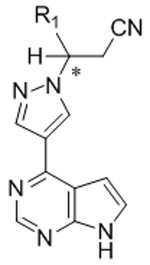
[Formula III]
Description
본 발명은 키랄 치환된 피라졸릴 피롤로[2,3-d]피리미딘 및 관련 합성 중간체 화합물의 제조 방법에 관한 것이다. 상기 키랄 치환된 피라졸릴 피롤로[2,3-d]피리미딘은 염증성 질환, 골수증식성 장애, 및 다른 질환의 치료를 위한 단백질 티로신 키나아제 (JAKs)의 야누스 키나아제(Janus Kinase) 패밀리의 억제제로서 유용하다.The present invention relates to a process for the preparation of chiral substituted pyrazolyl pyrrolo [2,3- d ] pyrimidines and related synthetic intermediate compounds. The chiral substituted pyrazolyl pyrrolo [2,3- d ] pyrimidines are inhibitors of the Janus Kinase family of protein tyrosine kinases (JAKs) for the treatment of inflammatory diseases, myeloproliferative disorders, and other diseases. useful.
단백질 키나아제 (PK), 다른 것들 중에서 세포 성장, 생존 및 분화, 기관 형성 및 형태형성, 신혈관형성, 조직 수복(tissue repair) 및 재생을 포함하는 다양하고 중요한 생물학적 과정을 조절하는 효소의 그룹이다. 단백질 키나아제는 단백질 (또는 기재물질)의 인산화를 촉진하는 것을 통해 생리적인 기능을 발휘하고, 이로써, 다양한 생물 배경에서 기재물질의 세포 활성을 조절한다. 정상 조직/기관에서의 기능에 추가하여, 많은 단백질 키나아제는 또한, 암을 포함하는 인간 질환의 숙주에서 더 특화된 역할을 한다. 단백질 키나아제 (종양원성 단백질 키나아제로도 또한 언급됨)의 하위세트는, 이상조절될 때, 종양 형성 및 성장을 야기할 수 있고, 종양 유지 및 진행에 또한 기여할 수 있다 (Blume-Jensen P et al, Nature 2001, 411(6835):355-365). 지금까지, 종양원성 단백질 키나아제는 암 개입 및 의약 개발에 대한 단백질 표적의 가장 크고 대부분의 매력적인 그룹 중의 하나를 대표한다. Protein kinases (PKs), among others, are a group of enzymes that regulate a variety of important biological processes including cell growth, survival and differentiation, organ formation and morphogenesis, neovascularization, tissue repair and regeneration. Protein kinases exert physiological functions through promoting phosphorylation of proteins (or substrates), thereby regulating the cellular activity of the substrates in various biological backgrounds. In addition to functioning in normal tissues / organs, many protein kinases also play a more specialized role in hosts of human disease, including cancer. A subset of protein kinases (also referred to as oncogenic protein kinases), when aberrantly regulated, can lead to tumor formation and growth, and may also contribute to tumor maintenance and progression (Blume-Jensen P et al, Nature 2001, 411 (6835): 355-365). To date, oncogenic protein kinases represent one of the largest and most attractive groups of protein targets for cancer interventions and drug development.
단백질 키나아제는 수용체 유형 및 비-수용체 유형으로서 분류될 수 있다. 수용체 티로신 키나아제 (RTK)는 세포외 부분, 막통과 도메인, 및 세포내 부분을 가지며, 한편, 비-수용체 티로신 키나아제는 전체적으로 세포내이다. 단백질 티로신 키나아제 (JAK)의 야누스 키나아제 패밀리는 비-수용체 유형의 티로신 키나아제에 속하고, 패밀리 멤버: JAK1 (야누스 키나아제-1로도 공지됨), JAK2 (야누스 키나아제-2로도 공지됨), JAK3 (야누스 키나아제로도 공지됨, 백혈구; JAKL; L-JAK 및 야누스 키나아제-3) 및 TYK2 (단백질-티로신 키나아제 2로도 또한 알려져 있음)를 포함한다. Protein kinases can be classified as receptor types and non-receptor types. Receptor tyrosine kinases (RTKs) have an extracellular portion, a transmembrane domain, and an intracellular portion, while non-receptor tyrosine kinases are entirely intracellular. The Janus kinase family of protein tyrosine kinases (JAK) belongs to the non-receptor type tyrosine kinases, and family members: JAK1 (also known as Janus kinase-1), JAK2 (also known as Janus kinase-2), JAK3 (Janus) Also known as kinases, leukocytes; JAKL; L-JAK and Janus kinase-3) and TYK2 (also known as protein-tyrosine kinase 2).
JAK 및 전사 신호 전달과 활성화 (STAT)를 수반하는 경로는 넓은 범위의 사이토킨의 신호전달에 관여한다. 사이토킨은 저분자량 폴리펩타이드 또는 당단백질이고, 이들은 실질적 모든 세포 유형에서 생물학적 반응을 자극한다 . 일반적으로, 사이토킨 수용체는 고유의 티로신 키나아제 활성을 갖지 않으며, 따라서, 수용체 연관 키나아제가 인산화 케스케이드를 늘릴 필요가 있다. JAK는 이러한 기능을 수행한다. 사이토킨은 이의 수용체에 결합하여, 수용체 이량체화를 야기하고, 이는, JAK가 사이토킨 수용체 내의 특이적 티로신 모티프뿐만 아니라 서로 포스포릴레이트화할 수 있게 한다. 이들 포스포티로신 모티프를 인지하는 STAT는 수용체에 부충되고, 그 다음, 자체가 JAK 의존 티로신 인산화 이벤트에 의해 활성화된다. 활성화시, STAT는 수용체로부터 분리되고, 특이적 DNA 부위에 결합하기 위해 세포핵에 대해 이량체화하고 전위하며, 전사를 변경한다 (Scott, M. J., C. J. Godshall, et al. (2002). "Jaks, STATs, 사이토킨, 및 Sepsis." Clin Diagn Lab Immunol 9(6): 1153-9).JAK and pathways involving transcriptional signaling and activation (STAT) are involved in the signaling of a wide range of cytokines. Cytokines are low molecular weight polypeptides or glycoproteins, which stimulate biological responses in virtually all cell types. In general, cytokine receptors do not have intrinsic tyrosine kinase activity, and therefore receptor associated kinases need to increase phosphorylation cascade. JAK does this. Cytokines bind to their receptors, leading to receptor dimerization, which allows JAKs to phosphorylate with each other as well as specific tyrosine motifs within cytokine receptors. STATs recognizing these phosphotyrosine motifs are recruited to receptors, which are then themselves activated by JAK dependent tyrosine phosphorylation events. Upon activation, STATs separate from receptors, dimerize and translocate to the nucleus to bind to specific DNA sites and alter transcription (Scott, MJ, CJ Godshall, et al. (2002). "Jaks, STATs , Cytokines, and Sepsis. "Clin Diagn Lab Immunol 9 (6): 1153-9).
JAK 패밀리는 면역 반응과 연관된 세포의 증식 및 기능의 사이토킨 의존 조절에 역할을 한다. JAK/STAT 경로, 및 특히, 모든 4개의 멤버의 JAK 패밀리는 천식 반응, 만성 폐쇄성 폐질환, 기관지염, 및 하부 호흡기의 다른 관련 염증성 질환의 발병기전에 역할을 하는 것으로 믿는다. 더욱이, JAK 키나아제를 신호를 보내는 다중 사이토킨은, 종래의 알레르기성 반응이든지 아니든지, 상부 호흡기의 염증성 질환 또는 조건, 예컨대 코 및 공동(sinus)에 영향을 주는 것과 같은 상부 호흡기의 염증성 질환 또는 상태 (예를 들어, 비염, 부비강염)에 관련되었다. JAK/STAT 경로는 또한, 홍채염, 포도막염, 공막염, 결막염, 및 만성 알레르기성 반응을 비제한적으로 포함하는 눈의 염증성 질환/상태에서 역할을 하는 것과 연관되었다. 따라서, JAK 키나아제의 억제는 이들 질환의 치료적 처리에서 유익한 역할을 할 수 있다.The JAK family plays a role in cytokine dependent regulation of the proliferation and function of cells associated with immune responses. The JAK / STAT pathway, and in particular, the JAK family of all four members, is believed to play a role in the pathogenesis of asthma reactions, chronic obstructive pulmonary disease, bronchitis, and other related inflammatory diseases of the lower respiratory tract. Moreover, multiple cytokines that signal JAK kinases, whether or not conventional allergic reactions, can cause inflammatory diseases or conditions of the upper respiratory tract, such as those affecting the upper respiratory inflammatory disease or condition, such as the nose and sinus. For example, rhinitis, sinusitis). The JAK / STAT pathway has also been associated with playing a role in inflammatory diseases / conditions of the eye, including but not limited to iris, uveitis, scleritis, conjunctivitis, and chronic allergic reactions. Thus, inhibition of JAK kinases can play a beneficial role in the therapeutic treatment of these diseases.
JAK 키나아제의 수준에서 신호전달의 차단은 인간 암의 치료제 개발을 위한 기대를 불러 모으고 있다. JAK 키나아제의 억제는 또한, 피부 면역 장애, 예컨대 건선, 및 피부 감작화를 앓고 있는 환자에서 치료 이점을 갖는 것으로 구상했다. 따라서, 야누스 키나아제 또는 관련 키나아제의 억제제는 널리 추구되고 있고, 몇 개의 공보는 효과적인 부류의 화합물을 보고하고 있다. 예를 들어, (R)-3-(4-(7H-피롤로[2,3-d]피리미딘-4-일)-1H-피라졸-1-일)-3-시클로펜틸프로판니트릴을 포함하는 어떤 JAK 억제제는 U.S. 특허출원 공보 No. 2007/0135461에서 보고되고 있고, 이의 명세는 참고로 본 명세서에 통합된다. Blocking signaling at the level of JAK kinase raises expectations for the development of therapeutics for human cancer. Inhibition of JAK kinases has also been envisioned to have therapeutic advantages in patients suffering from skin immune disorders such as psoriasis and skin sensitization. Accordingly, inhibitors of Janus kinase or related kinases are widely pursued, and several publications report an effective class of compounds. For example, ( R ) -3- (4- (7H-pyrrolo [2,3-d] pyrimidin-4-yl) -1H-pyrazol-1-yl) -3-cyclopentylpropanenitrile Some JAK inhibitors, including US Patent Application Publication No. Reported in 2007/0135461, the specification of which is incorporated herein by reference.
야누스(Janus) 키나아제와 같은 키나아제의 억제와 관련된 장애의 치료를 위한 화합물의 요구가 증가하는 견해에 비추어, 키랄 치환된 피라졸릴 피롤로[2,3-d]피리미딘 및 이와 관련된 중간체와 같은 억제제에 대한 신규 및 더 효율적인 경로가 필요하다. 본 명세서에 기재된 방법 및 화합물은 이들 및 다른 필요에 부합하는 것을 돕는다.
In view of the increasing demand for compounds for the treatment of disorders associated with the inhibition of kinases such as Janus kinases, inhibitors such as chiral substituted pyrazolyl pyrrolo [2,3- d ] pyrimidines and their associated intermediates There is a need for new and more efficient routes to. The methods and compounds described herein help to meet these and other needs.
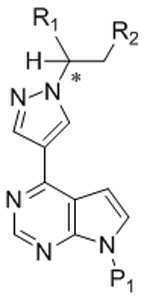
본 발명은, 특히, 수소화 촉매의 존재하에서 화학식 Ⅱ의 화합물을 수소 가스와 반응시키는 것을 포함하는, 화학식 I의 화합물을 포함하는 조성물의 제조 방법을 제공한다: The present invention provides a process for the preparation of a composition comprising a compound of formula (I), in particular comprising reacting a compound of formula (II) with hydrogen gas in the presence of a hydrogenation catalyst:
[화학식 I][Formula I]

[화학식 Ⅱ][Formula II]
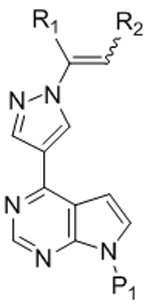
상기 식에서:Where:
*는 키랄 탄소를 나타내고;* Represents chiral carbon;
R1은 C3-7 시클로알킬, C1-6 알킬, 및 C1-6 플루오로알킬로부터 선택되고; R 1 is selected from C 3-7 cycloalkyl, C 1-6 alkyl, and C 1-6 fluoroalkyl;
R2는 -C(=O)-NH2, -C(=O)O-R3, 및 시아노로부터 선택되고;R 2 is selected from —C (═O) —NH 2 , —C (═O) OR 3 , and cyano;
R3은 C1-4 알킬 또는 C1-4 플루오로알킬로부터 선택되고;R 3 is selected from C 1-4 alkyl or C 1-4 fluoroalkyl;
P1은 보호 그룹이다.P 1 is a protection group.
본 발명은 추가로, 화학식 I의 화합물의 거울상이성질체 잉여(enantiomeric excess)의 (R)- 또는 (S)-거울상이성질체를 포함하는 조성물의 제조 방법을 제공하고, 이 방법은 L1(여기서, L1는 키랄 포스핀 리간드이다)를 갖는 루테늄 또는 로듐 촉매의 존재하에서 화학식 Ⅱ의 화합물을 수소 가스와 반응시키는 것을 포함한다:The invention further provides a process for the preparation of a composition comprising (R)-or (S) -enantiomers of enantiomeric excess of a compound of formula (I), wherein the process comprises L 1 (where L 1 is a chiral phosphine ligand) comprising reacting a compound of formula II with hydrogen gas in the presence of a ruthenium or rhodium catalyst:
[화학식 I][Formula I]
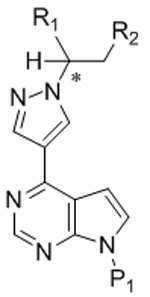
[화학식 Ⅱ][Formula II]
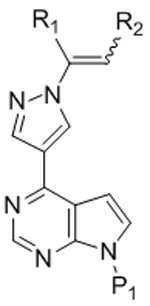
상기 식에서:Where:
*는 키랄 탄소를 나타내고;* Represents chiral carbon;
R1은 C3-7 시클로알킬, C1-6 알킬, 및 C1-6 플루오로알킬로부터 선택되고; R 1 is selected from C 3-7 cycloalkyl, C 1-6 alkyl, and C 1-6 fluoroalkyl;
R2는 -C(=O)-NH2, -C(=O)O-R3, 및 시아노로부터 선택되고;R 2 is selected from —C (═O) —NH 2 , —C (═O) OR 3 , and cyano;
R3은 C1-4 알킬 또는 C1-4 플루오로알킬로부터 선택되고;R 3 is selected from C 1-4 alkyl or C 1-4 fluoroalkyl;
P1은 보호 그룹이다.P 1 is a protection group.
본 발명은 추가로, 화학식 I의 화합물을 화학식 Ic의 화합물로 전환시키는 방법을 제공하고, 이 방법은 화학식 I의 화합물을 금속 히드록사이드와 반응시켜 화학식 Ic의 화합물을 형성하는 것을 포함한다:The invention further provides a method of converting a compound of formula (I) to a compound of formula (Ic), which method comprises reacting a compound of formula (I) with a metal hydroxide to form a compound of formula (Ic):
[화학식 I][Formula I]
[화학식 Ic](Ic)

상기 식에서:Where:
*는 키랄 탄소를 나타내고;* Represents chiral carbon;
R1은 C3-7 시클로알킬, C1-6 알킬, 및 C1-6 플루오로알킬로부터 선택되고; R 1 is selected from C 3-7 cycloalkyl, C 1-6 alkyl, and C 1-6 fluoroalkyl;
R2는 -C(=O)O-R3이고;R 2 is —C (═O) OR 3 ;
P1은 보호 그룹이다.P 1 is a protection group.
본 발명은 또한, 화학식 Ic의 화합물을 화학식 Ib의 화합물로 전환시키는 방법을 제공하고, 이 방법은 커플링 시약의 존재하에, 화학식 Ic의 화합물을 암모니아 또는 수산화암모늄과 반응시켜 화학식 Ib의 화합물을 형성하는 것을 포함한다:The present invention also provides a method of converting a compound of formula (Ic) to a compound of formula (Ib), which method reacts the compound of formula (Ic) with ammonia or ammonium hydroxide in the presence of a coupling reagent to form a compound of formula (Ib) This includes:
[화학식 Ic](Ic)
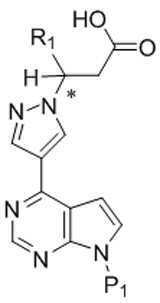
[화학식 Ib](Ib)

상기 식에서:Where:
*는 키랄 탄소를 나타내고;* Represents chiral carbon;
R1은 C3-7 시클로알킬, C1-6 알킬, 및 C1-6 플루오로알킬로부터 선택되고;R 1 is selected from C 3-7 cycloalkyl, C 1-6 alkyl, and C 1-6 fluoroalkyl;
P1은 보호 그룹이다.P 1 is a protection group.
본 발명은 또한, 화학식 Ib의 화합물을 화학식 Ia의 화합물로 전환하는 방법을 제공하고, 이 방법은, 탈수 조건 하에서 화학식 Ib의 화합물을 반응시켜 화학식 Ia의 화합물을 형성하는 것을 포함한다:The present invention also provides a process for converting a compound of formula (Ib) to a compound of formula (Ia), the method comprising reacting a compound of formula (Ib) under dehydration conditions to form a compound of formula (Ia):
[화학식 Ib](Ib)

[화학식 Ia]Formula Ia

상기 식에서:Where:
*는 키랄 탄소를 나타내고;* Represents chiral carbon;
R1은 C3-7 시클로알킬, C1-6 알킬, 및 C1-6 플루오로알킬로부터 선택되고;R 1 is selected from C 3-7 cycloalkyl, C 1-6 alkyl, and C 1-6 fluoroalkyl;
P1은 보호 그룹이다.P 1 is a protection group.
본 발명은 화학식 Id의 화합물의 거울상이성질체 잉여의 (R)- 또는 (S)-거울상이성질체를 포함하는 조성물을 제조하는 방법을 제공하고, 이 방법은 키랄 아민 및 유기 산의 존재하에 화학식 Ⅳ의 화합물을 화학식 V의 화합물과 반응시키는 것을 포함한다:The present invention provides a process for the preparation of a composition comprising an enantiomeric excess of the (R)-or (S) -enantiomer of the compound of formula (Id), wherein the process is in the presence of a chiral amine and an organic acid. Reacting with a compound of Formula (V):
[화학식 Id]Formula Id

[화학식 Ⅳ][Formula IV]

[화학식 V][Formula V]

상기 식에서:Where:
*는 키랄 탄소를 나타내고;* Represents chiral carbon;
R1은 C3-7 시클로알킬, C1-6 알킬, 및 C1-6 플루오로알킬로부터 선택되고;R 1 is selected from C 3-7 cycloalkyl, C 1-6 alkyl, and C 1-6 fluoroalkyl;
P1은 보호 그룹이다.P 1 is a protection group.
본 발명은 추가로, 화학식 Ⅵ의 화합물의 거울상이성질체 잉여의 (R)- 또는 (S)-거울상이성질체를 포함하는 조성물을 제조하는 방법을 제공하고, 이 방법은 키랄 아민 및 유기 산의 존재하에 화학식 V의 화합물을 화학식 Ⅶ의 화합물과 반응시키는 것을 포함한다:The invention further provides a process for the preparation of a composition comprising the enantiomeric excess of the (R)-or (S) -enantiomer of the compound of formula (VI), wherein the process is formulated in the presence of a chiral amine and an organic acid. Reacting a compound of V with a compound of formula VII:
[화학식 Ⅵ][Formula VI]
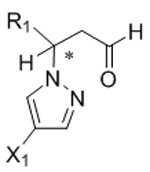
[화학식 V][Formula V]

[화학식 Ⅶ][Formula Ⅶ]
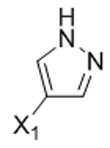
상기 식에서:Where:
*는 키랄 탄소를 나타내고;* Represents chiral carbon;
R1은 C3-7 시클로알킬, C1-6 알킬, 및 C1-6 플루오로알킬로부터 선택되고;R 1 is selected from C 3-7 cycloalkyl, C 1-6 alkyl, and C 1-6 fluoroalkyl;
X1은 할로겐이다.X 1 is halogen.
본 발명은 추가로, 화학식 Ⅵ의 화합물을 화학식 Ⅲ의 화합물로 전환하는 방법을 제공하고, 이 방법은 화학식 Ⅵ의 화합물을 암모니아 또는 수산화암모늄 및 요오드로 처리하여 화학식 Ⅷ의 화합물을 형성하는 것을 포함한다:The invention further provides a process for converting a compound of formula VI to a compound of formula III, which comprises treating the compound of formula VI with ammonia or ammonium hydroxide and iodine to form a compound of formula VII :
[화학식 Ⅵ][Formula VI]
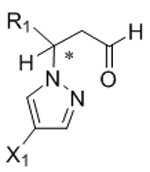
[화학식 Ⅷ][Formula Ⅷ]

상기 식에서:Where:
*는 키랄 탄소를 나타내고;* Represents chiral carbon;
R1은 C3-7 시클로알킬, C1-6 알킬, 및 C1-6 플루오로알킬로부터 선택되고; R 1 is selected from C 3-7 cycloalkyl, C 1-6 alkyl, and C 1-6 fluoroalkyl;
P1은 보호 그룹이고;P 1 is a protecting group;
X1은 할로겐이다.X 1 is halogen.
본 발명은 또한, 화학식 Ⅷ의 화합물을 화학식 Ⅸ의 화합물로 전환하는 방법을 제공하고, 이 방법은 화학식 Ⅷ의 화합물을 화학식 B-1의 화합물과 반응시켜 화학식 Ⅸ의 화합물을 형성하는 것을 포함한다:The present invention also provides a method of converting a compound of formula (VII) to a compound of formula (VII), which method comprises reacting a compound of formula (VII) with a compound of formula (B-1) to form a compound of formula (VII):
[화학식 Ⅷ][Formula Ⅷ]
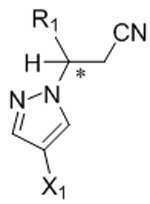
[화학식 B-1][Formula B-1]

[화학식 Ⅸ][Formula Ⅸ]
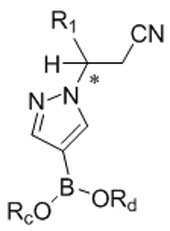
상기 식에서:Where:
*는 키랄 탄소를 나타내고;* Represents chiral carbon;
R1은 C3-7 시클로알킬, C1-6 알킬, 및 C1-6 플루오로알킬로부터 선택되고; R 1 is selected from C 3-7 cycloalkyl, C 1-6 alkyl, and C 1-6 fluoroalkyl;
X1은 할로이고;X 1 is halo;
Rc 및 Rd 각각은 H 및 C1-6 알킬로부터 독립적으로 선택되고; 또는R c and R d are each independently selected from H and C 1-6 alkyl; or
Rc 및 Rd는, 이들이 부착되는 산소 원자 및 이 산소 원자가 부착되는 붕소 원자와 함께, 5- 내지 6-원 헤테로시클릭 고리를 형성하고, 이 고리는 1, 2, 3, 또는 4개의 C1-4 알킬 그룹으로 임의 치환된다.R c and R d together with the oxygen atom to which they are attached and the boron atom to which the oxygen atom is attached form a 5- to 6-membered heterocyclic ring, which ring is 1, 2, 3, or 4 C Optionally substituted with 1-4 alkyl group.
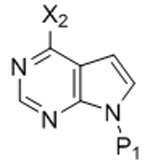
본 발명은 또한, 화학식 Ⅸ의 화합물을 화학식 Ia의 화합물로 전환하는 방법을 제공하고, 이 방법은, 팔라듐 촉매 및 염기의 존재하에 화학식 Ⅸ의 화합물을 화학식 X의 화합물과 반응시켜 화학식 Ia의 화합물을 형성하는 것을 포함한다:The present invention also provides a process for converting a compound of formula (VII) to a compound of formula (Ia), wherein the method reacts a compound of formula (VII) with a compound of formula (X) in the presence of a palladium catalyst and a base Forming includes:
[화학식 Ⅸ][Formula Ⅸ]

[화학식 X][Formula X]
[화학식 Ia]Formula Ia

상기 식에서:Where:
*는 키랄 탄소를 나타내고;* Represents chiral carbon;
R1은 C3-7 시클로알킬, C1-6 알킬, 및 C1-6 플루오로알킬로부터 선택되고; R 1 is selected from C 3-7 cycloalkyl, C 1-6 alkyl, and C 1-6 fluoroalkyl;
X2는 토실레이트 그룹, 트리플레이트 그룹, 아이오도, 클로로, 또는 브로모이고; X 2 is a tosylate group, a triflate group, iodo, chloro, or bromo;
P1은 보호 그룹이고; P 1 is a protecting group;
Rc 및 Rd 각각은 H 및 C1-6 알킬로부터 독립적으로 선택되고; 또는R c and R d are each independently selected from H and C 1-6 alkyl; or
Rc 및 Rd는, 이들이 부착되는 산소 원자 및 이 산소 원자가 부착되는 붕소 원자와 함께, 5- 내지 6-원 헤테로시클릭 고리를 형성하고, 이 고리는 1, 2, 3, 또는 4개의 C1-4 알킬 그룹으로 임의 치환된다.R c and R d together with the oxygen atom to which they are attached and the boron atom to which the oxygen atom is attached form a 5- to 6-membered heterocyclic ring, which ring is 1, 2, 3, or 4 C Optionally substituted with 1-4 alkyl group.
일부 구체예에서, 본 발명은 화학식 Ⅸ의 화합물의 거울상이성질체 잉여의 (R)- 또는 (S)-거울상이성질체를 포함하는 조성물을 제공한다:In some embodiments, the present invention provides a composition comprising an enantiomeric excess of the (R)-or (S) -enantiomer of the compound of Formula (VII):
[화학식 Ⅸ][Formula Ⅸ]

상기 식에서:Where:
*는 키랄 탄소를 나타내고;* Represents chiral carbon;
R1은 C3-7 시클로알킬, C1-6 알킬, 및 C1-6 플루오로알킬로부터 선택되고;R 1 is selected from C 3-7 cycloalkyl, C 1-6 alkyl, and C 1-6 fluoroalkyl;
Rc 및 Rd 각각은 독립적으로 C1 -6 알킬이거나; 또는R c and R d each independently represent a C 1 -6 alkyl; or
Rc 및 Rd는, 이들이 부착되는 산소 원자 및 이 산소 원자가 부착되는 붕소 원자와 함께, 5- 내지 6-원 헤테로시클릭 고리를 형성하고, 이 고리는 1, 2, 3, 또는 4개의 C1-4 알킬 그룹으로 임의 치환된다.R c and R d together with the oxygen atom to which they are attached and the boron atom to which the oxygen atom is attached form a 5- to 6-membered heterocyclic ring, which ring is 1, 2, 3, or 4 C Optionally substituted with 1-4 alkyl group.
본 발명은 추가로, 화학식 Ⅸ의 화합물의 거울상이성질체 잉여의 (R)- 또는 (S)-거울상이성질체를 포함하는 조성물을 제조하는 방법을 제공하고, 이 방법은 화학식 Ⅸ의 화합물의 라세미체를 포함하는 조성물을 이동상을 사용하는 키랄 크로마토그래피 유닛에 통과시키고, 화학식 Ⅸ의 화합물의 거울상이성질체 잉여의 (R)- 또는 (S)-거울상이성질체를 포함하는 조성물을 수집하는 것을 포함한다:The invention further provides a process for the preparation of a composition comprising the enantiomeric excess of the (R)-or (S) -enantiomer of the compound of formula (VIII), which method provides for the racemate of the compound of formula (VIII). Passing the comprising composition through a chiral chromatography unit using a mobile phase and collecting a composition comprising an enantiomeric excess of the (R)-or (S) -enantiomer of the compound of formula (VII):
[화학식 Ⅸ][Formula Ⅸ]

상기 식에서:Where:
*는 키랄 탄소를 나타내고;* Represents chiral carbon;
R1은 C3-7 시클로알킬, C1-6 알킬, 및 C1-6 플루오로알킬로부터 선택되고;R 1 is selected from C 3-7 cycloalkyl, C 1-6 alkyl, and C 1-6 fluoroalkyl;
Rc 및 Rd 각각은 독립적으로 C1 -6 알킬이거나; 또는R c and R d each independently represent a C 1 -6 alkyl; or
Rc 및 Rd는, 이들이 부착되는 산소 원자 및 이 산소 원자가 부착되는 붕소 원자와 함께, 5- 내지 6-원 헤테로시클릭 고리를 형성하고, 이 고리는 1, 2, 3, 또는 4개의 C1 -4 알킬 그룹으로 임의로 치환된다.R c and R d together with the oxygen atom to which they are attached and the boron atom to which the oxygen atom is attached form a 5- to 6-membered heterocyclic ring, which ring is 1, 2, 3, or 4 C 1-4 is optionally substituted with an alkyl group.
본 발명은 화학식 Ia의 화합물의 라세미체를 포함하는 조성물의 제조 방법을 제공하고 이 방법은 하기 단계 (a) 및 (b)를 포함한다:The present invention provides a process for the preparation of a composition comprising a racemate of a compound of formula (la), the process comprising the following steps (a) and (b):
a) 화학식 Ⅳ의 화합물을 형성하기에 충분한 조건 하에서, 제1 염기의 존재하에 화학식 Ia의 화합물의 거울상이성질체 잉여의 (R)- 또는 (S)-거울상이성질체를 포함하는 조성물을 화학식 D-1의 화합물로 처리하는 단계; 및a) A composition comprising the enantiomeric excess of the (R)-or (S) -enantiomer of the compound of formula (Ia) in the presence of a first base under conditions sufficient to form a compound of formula (IV) Treating with a compound; And
b) 제2 염기의 존재하에서 화학식 Ⅳ의 화합물을 화학식 D-1의 화합물과 반응시키는 단계:b) reacting the compound of formula IV with a compound of formula D-1 in the presence of a second base:
[화학식 Ia]Formula Ia
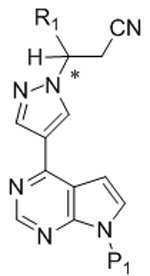
[화학식 D-1][Formula D-1]

[화학식 Ⅳ][Formula IV]

상기 식에서:Where:
*는 키랄 탄소이고;* Is chiral carbon;
P1은 보호 그룹이고;P 1 is a protecting group;
R1은 C3-7 시클로알킬, C1-6 알킬, 및 C1-6 플루오로알킬로부터 선택된다.R 1 is selected from C 3-7 cycloalkyl, C 1-6 alkyl, and C 1-6 fluoroalkyl.
본 발명은 추가로, 화학식 Ia의 화합물의 라세미체를 포함하는 조성물의 제조 방법을 제공하고, 이 방법은 화학식 Ia의 화합물의 라세미체를 형성하기에 충분한 조건 하에서, 염기의 존재하에 화학식 Ia의 화합물의 거울상이성질체 잉여의 (R)- 또는 (S)-거울상이성질체를 포함하는 조성물을 화학식 D-1의 화합물로 처리하는 것을 포함한다:The present invention further provides a process for the preparation of a composition comprising a racemate of a compound of formula (Ia), which method is provided in the presence of a base under conditions sufficient to form the racemate of the compound of formula (Ia) Treating a composition comprising an enantiomeric excess of the (R)-or (S) -enantiomer of the compound of with a compound of Formula (D-1):
[화학식 Ia]Formula Ia

[화학식 D-1][Formula D-1]
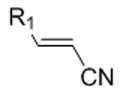
상기 식에서:Where:
*는 키랄 탄소이고;* Is chiral carbon;
P1은 보호 그룹이고;P 1 is a protecting group;
R1은 C3-7 시클로알킬, C1-6 알킬, 및 C1-6 플루오로알킬로부터 선택된다.R 1 is selected from C 3-7 cycloalkyl, C 1-6 alkyl, and C 1-6 fluoroalkyl.
본 발명은 추가로, 화학식 Ia의 화합물의 거울상이성질체 잉여의 (R)- 또는 (S)-거울상이성질체를 포함하는 조성물을 제조하는 방법을 제공하고, 이 방법은 화학식 Ia의 화합물의 라세미체를 포함하는 조성물을 이동상을 사용하는 키랄 크로마토그래피 유닛에 통과시키고, 화학식 Ia의 화합물의 거울상이성질체 잉여의 (R)- 또는 (S)-거울상이성질체를 포함하는 조성물을 수집하는 것을 포함한다;The invention further provides a process for the preparation of a composition comprising the enantiomeric excess of the (R)-or (S) -enantiomer of the compound of formula (Ia), which method provides for the racemate of the compound of formula (Ia) Passing the comprising composition through a chiral chromatography unit using a mobile phase and collecting a composition comprising an enantiomeric excess of the (R)-or (S) -enantiomer of the compound of Formula (Ia);
[화학식 Ia]Formula Ia

상기 식에서:Where:
*는 키랄 탄소이고;* Is chiral carbon;
R1은 C3-7 시클로알킬, C1-6 알킬, 및 C1-6 플루오로알킬로부터 선택되고;R 1 is selected from C 3-7 cycloalkyl, C 1-6 alkyl, and C 1-6 fluoroalkyl;
P1은 보호 그룹이다. P 1 is a protection group.
본 발명은 화학식 Ia의 화합물의 거울상이성질체 잉여의 (R)- 또는 (S)-거울상이성질체를 포함하는 조성물의 제조 방법을 제공하고, 이 방법은 하기 단계 (a) 내지 (c)를 포함한다:The present invention provides a process for the preparation of a composition comprising enantiomeric excess (R)-or (S) -enantiomers of a compound of formula (Ia), the process comprising the following steps (a) to (c):
(a) 용매의 존재하에서 화학식 Ia의 화합물의 라세미체를 포함하는 조성물을 키랄 산과 반응시켜 화학식 Ia의 화합물의 염을 형성하는 단계; (a) reacting a composition comprising a racemate of a compound of formula (Ia) with chiral acid in the presence of a solvent to form a salt of a compound of formula (Ia);
(b) 상기 화학식 Ia의 화합물의 거울상이성질체 잉여의 (R)- 또는 (S)-거울상이성질체의 키랄 염를 포함하는 조성물을 분리하는 단계; 및(b) separating a composition comprising a chiral salt of the (R)-or (S) -enantiomer of the enantiomeric excess of the compound of Formula (Ia); And
(c) 상기 키랄 염을 염기로 처리하여 화학식 Ia의 화합물의 거울상이성질체 잉여의 (R)- 또는 (S)-거울상이성질체를 포함하는 조성물을 생성하는 단계;(c) treating said chiral salt with a base to produce a composition comprising an enantiomeric excess of the (R)-or (S) -enantiomer of the compound of formula (Ia);
[화학식 Ia]Formula Ia
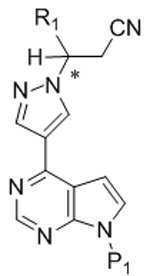
상기 식에서:Where:
*는 키랄 탄소이고;* Is chiral carbon;
R1은 C3 -7 시클로알킬, C1 -6 알킬, 및 C1 -6 플루오로알킬로부터 선택되고;R 1 is selected from alkyl to C 3 -7-cycloalkyl, C 1 -6 alkyl, and C 1 -6 fluoro;
P1은 보호 그룹이다.P 1 is a protection group.
본 발명은 추가로, 화학식 Ia의 화합물을 화학식 Ⅲ의 화합물로 전환하는 방법을 제공하고, 이 방법은 탈보호 조건 하에서 화학식 Ia의 화합물을 반응시켜 화학식 Ⅲ의 화합물을 형성하는 것을 포함한다: The invention further provides a method of converting a compound of formula (Ia) to a compound of formula (III), the method comprising reacting a compound of formula (Ia) under deprotection conditions to form a compound of formula (III):
[화학식 Ia]Formula Ia

[화학식 Ⅲ][Formula III]

상기식에서,In this formula,
*는 키랄 탄소이고;* Is chiral carbon;
R1은 C3-7 시클로알킬, C1-6 알킬, 및 C1-6 플루오로알킬로부터 선택되고;R 1 is selected from C 3-7 cycloalkyl, C 1-6 alkyl, and C 1-6 fluoroalkyl;
P1은 보호 그룹이다.P 1 is a protection group.
본 발명은 또한, 화학식 XⅡ의 화합물의 제조 방법을 제공하고, 이 방법은 팔라듐 촉매, 염기 및 용매의 존재하에서, 화학식 X의 화합물을 화학식 XⅢ의 화합물과 반응시켜 화학식 XⅡ의 화합물을 형성하는 것을 포함한다:The present invention also provides a process for preparing a compound of formula (XII), which method comprises reacting a compound of formula (X) with a compound of formula (XIII) in the presence of a palladium catalyst, a base and a solvent to form a compound of formula (XII) do:
[화학식 XⅡ][Formula XII]
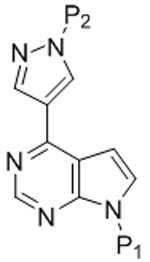
[화학식 X][Formula X]
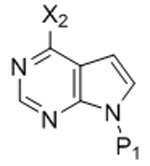
[화학식 XⅢ][Formula XIII]

상기 식에서:Where:
*는 키랄 탄소이고;* Is chiral carbon;
X2는 토실레이트 그룹, 트리플레이트 그룹, 아이오도, 클로로, 또는 브로모이고; X 2 is a tosylate group, a triflate group, iodo, chloro, or bromo;
R1은 C3-7 시클로알킬, C1-6 알킬, 및 C1-6 플루오로알킬로부터 선택되고;R 1 is selected from C 3-7 cycloalkyl, C 1-6 alkyl, and C 1-6 fluoroalkyl;
Rc 및 Rd 각각은 독립적으로 H 또는 C1-6 알킬이거나; 또는Each of R c and R d is independently H or C 1-6 alkyl; or
Rc 및 Rd는, 이들이 부착되는 산소 원자 및 이 산소 원자가 부착되는 붕소 원자와 함께, 5- 내지 6-원 헤테로시클릭 고리를 형성하고, 이 고리는 1, 2, 3, 또는 4개의 C1 -4 알킬 그룹으로 임의로 치환되고;R c and R d together with the oxygen atom to which they are attached and the boron atom to which the oxygen atom is attached form a 5- to 6-membered heterocyclic ring, which ring is 1, 2, 3, or 4 C 1-4 is optionally substituted with an alkyl group;
P1 및 P2 각각은 독립적으로 보호 그룹이다.P 1 and P 2 are each independently a protecting group.
본 발명은 추가로, 화학식 XⅥ의 화합물의 제조 방법을 제공하고, 이 방법은 하기 단계 (a) 및 (b)를 포함한다:The invention further provides a process for the preparation of a compound of formula XVI, which comprises the following steps (a) and (b):
(a) 화학식 XⅧ의 화합물을 약 1 당량 이상의 C1 -6 알킬 그리냐드 시약 또는 C1-6 알킬 리튬 시약과 반응시킨 다음, 그 다음 약 1 당량 이상의 화학식 XⅦ의 화합물로 처리하는 단계; 및comprising the steps of: (a) reacting a compound of formula XⅧ with about 1 equivalent or more C 1 -6 alkyl Grignard reagent or a C 1-6 alkyl lithium reagent and then treated with a compound of formula XⅦ greater than about 1 equivalent; And
(b) 임의로, 단계 (a)의 생성물을 재보호하여 화학식 XⅥ의 화합물의 얻는 단계:(b) optionally, reprotecting the product of step (a) to obtain a compound of formula XVI:
[화학식 XⅥ][Formula XVI]

[화학식 XⅧ]Formula X '
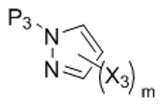
[화학식 XⅦ]Formula X '

상기 식에서:Where:
P3은 보호 그룹이고;P 3 is a protecting group;
X3은 할로겐이고; X 3 is halogen;
R4는 C1 -6 알킬로부터 선택되고;R 4 is selected from C 1 -6 alkyl;
m은 1 및 2로부터 선택된 정수이다.m is an integer selected from 1 and 2.
본 발명은 또한, 화학식 XIa의 화합물의 제조 방법을 제공하고, 이 방법은 화학식 XIa의 화합물을 형성하기에 충분한 조건 하에서, 화학식 F-1의 화합물을 산으로 처리하는 것을 포함한다:The invention also provides a process for the preparation of a compound of formula (XIa), which comprises treating a compound of formula (F-1) with an acid under conditions sufficient to form a compound of formula (XIa):
[화학식 XIa]Formula XIa

[화학식 F-1][Formula F-1]
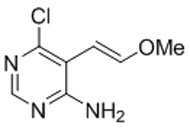
본 발명은 추가로, 화학식 I의 화합물의 거울상이성질체 잉여의 (R)- 또는 (S)-거울상이성질체를 포함하는 조성물을 제공한다:The invention further provides compositions comprising enantiomeric excess of the (R)-or (S) -enantiomer of the compound of formula (I):
[화학식 I][Formula I]

상기 식에서:Where:
*는 키랄 탄소를 나타내고;* Represents chiral carbon;
R1은 C3-7 시클로알킬, C1-6 알킬, 및 C1-6 플루오로알킬로부터 선택되고; R 1 is selected from C 3-7 cycloalkyl, C 1-6 alkyl, and C 1-6 fluoroalkyl;
R2는 -C(=O)-NH2, -C(=O)O-R3, -C(=O)OH, 및 -C(=O)H로부터 선택되고;R 2 is selected from —C (═O) —NH 2 , —C (═O) OR 3 , —C (═O) OH, and —C (═O) H;
R3은 C1-4 알킬 또는 C1-4 플루오로알킬로부터 선택되고;R 3 is selected from C 1-4 alkyl or C 1-4 fluoroalkyl;
P1은 보호 그룹이다.P 1 is a protection group.
본 발명은 또한, 하기 화학식 Ⅱ의 화합물을 제공한다:The present invention also provides a compound of formula II:
[화학식 Ⅱ][Formula II]

상기 식에서:Where:
R1은 C3-7 시클로알킬, C1-6 알킬, 및 C1-6 플루오로알킬로부터 선택되고; R 1 is selected from C 3-7 cycloalkyl, C 1-6 alkyl, and C 1-6 fluoroalkyl;
R2는 -C(=O)-NH2 및 -C(=O)O-R3로부터 선택되고; R 2 is selected from —C (═O) —NH 2 and —C (═O) OR 3 ;
R3은 C1-4 알킬 또는 C1-4 플루오로알킬로부터 선택되고;R 3 is selected from C 1-4 alkyl or C 1-4 fluoroalkyl;
P1은 보호 그룹이다.P 1 is a protection group.
본 발명의 하나 이상의 구체예의 세부사항은 첨부된 도면 및 하기의 설명에 나타나 있다. 본 발명의 다른 특징, 목적 및 이점은 설명 및 도면, 및 특허청구범위로부터 명확할 것이다.
The details of one or more embodiments of the invention are set forth in the accompanying drawings and the description below. Other features, objects, and advantages of the invention will be apparent from the description and drawings, and from the claims.
상세한 설명details
본 명세서의 여러 부분에서, 본 발명의 화합물의 치환기는 그룹 또는 범위로 개시되어 있다. 상세하게는, 본 발명은 그와 같은 그룹 및 범위의 멤버의 각각의 및 모든 개별적인 하위조합을 포함하는 것으로 의도된다. 예를 들어, 용어 "C1 -6 알킬"은 구체적으로, 메틸, 에틸, C3 알킬, C4 알킬, C5 알킬, 및 C6 알킬을 개별적으로 개시하려고 의도된다.In various parts of the present specification, substituents of the compounds of the present invention are disclosed in groups or ranges. In particular, the invention is intended to include each and every individual subcombination of members of such groups and ranges. For example, the term "C 1 -6 alkyl" is specifically, methyl, ethyl, C 3 alkyl, C 4 alkyl, is intended to initiate a C 5 alkyl, and C 6 alkyl individually.
또한, 별개의 구체예의 맥락에서 명확을 위해 기재된 본 발명의 어떤 특징은 단일 구체예에서 조합하여 또한 제공될 수 있다는 것으로 인식된다. 반대로, 단일 구체예의 맥락에서 간결을 위해 기재된 본 발명의 다양한 특징은 별도로 또는 임의의 적절한 하위 조합으로 또한 제공될 수 있다.It is also recognized that certain features of the invention described for clarity in the context of separate embodiments may also be provided in combination in a single embodiment. Conversely, various features of the invention, which are, for brevity, described in the context of a single embodiment, may also be provided separately or in any suitable subcombination.
용어 "n-원" (n-membered)은 전형적인, 고리 형성 원자의 수가 n인 잔기에서 고리 형성 원자의 수를 나타내는 정수이며, 여기서 예를 들어, 피페리디닐은 6-원 헤테로시클로알킬 고리의 예이고, 1,2,3,4-테트라히드로-나프탈렌은 10-원 시클로알킬 그룹의 예이다. The term “n-membered” is an integer representing the number of ring forming atoms in a residue whose typical number of ring forming atoms is n, where, for example, piperidinyl is a 6-membered heterocycloalkyl ring Yes, 1,2,3,4-tetrahydro-naphthalene is an example of a 10-membered cycloalkyl group.
변수가 하나 초과인 본 발명의 화합물에 있어서, 각 변수는 변수를 정의하는 그룹으로부터 독립적으로 선택된 상이한 잔기일 수 있다. 예를 들어, 동일한 화합물 상에 동시에 제공되는 2개의 R 그룹을 갖는 구조가 기재되는 경우에, 2개의 R 그룹은 R에 대해 정의된 그룹으로부터 독립적으로 선택된 상이한 잔기를 나타낼 수 있다. 다른 예에서, 임의로 다중 치환기가 형태 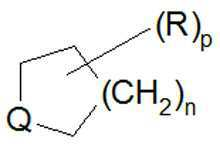
변수가 하나 초과인 본 발명의 화합물에 있어서, 각 변수는 변수를 정의하는 그룹으로부터 독립적으로 선택된 상이한 잔기일 수 있다. 예를 들어, 동일한 화합물 상에 동시에 제공되는 2개의 R 그룹을 갖는 구조가 기재되는 경우에, 2개의 R 그룹은 R에 대해 정의된 그룹으로부터 독립적으로 선택된 상이한 잔기를 나타낼 수 있다. For compounds of the invention with more than one variable, each variable may be a different residue independently selected from the group defining the variable. For example, where a structure with two R groups provided simultaneously on the same compound is described, the two R groups may represent different residues independently selected from the group defined for R.
본 명세서에 사용된 바와 같이, 문구 "임의로 치환된"이란 비치환된 또는 치환된 것을 의미한다. 본 명세서에 사용된 바와 같이, 용어 "치환된"이란, 수소 원자가 제거하고, 치환기에 의해 대체되는 것을 의미한다. 본 명세서에 사용된 바와 같이, 어구 "옥소로 치환된"이란, 2개의 수소 원자가 탄소 원자로부터 제거되고 탄소 원자에 대한 이중결합에 의해 결합된 산소에 의해 대체되는 것을 의미한다. 소정의 원자에서의 치환은 원자가에 의해 제한되는 것으로 이해된다.As used herein, the phrase "optionally substituted" means unsubstituted or substituted. As used herein, the term "substituted" means that a hydrogen atom is removed and replaced by a substituent. As used herein, the phrase “substituted with oxo” means that two hydrogen atoms are removed from a carbon atom and replaced by oxygen bonded by a double bond to the carbon atom. It is understood that substitution at a given atom is limited by valency.
본 명세서에 사용된 바와 같이, 용어 "알킬"은, 단독으로 또는 다른 용어들과 조합하여 이용되어, 직쇄 또는 분지형일 수 있는 포화 탄화수소 그룹을 의미한다. 일부 구체예에서, 알킬 그룹은 1 내지 12, 1 내지 8, 또는 1 내지 6개의 탄소 원자를 갖는다. 알킬 잔기의 예는, 비제한적으로, 화학 그룹, 예컨대 메틸, 에틸, n-프로필, 이소프로필, n-부틸, tert-부틸, 이소부틸, sec-부틸; 고급 동족체, 예컨대 2-메틸-1-부틸, n-펜틸, 3-펜틸, n-헥실, 1,2,2-트리메틸프로필, n-헵틸, n-옥틸 등. 일부 구체예에서, 알킬 잔기 is 메틸, 에틸, n-프로필, 이소프로필, n-부틸, 이소부틸, tert-부틸, n-펜틸, 이소펜틸, 네오펜틸, n-헥실, 또는 2,4,4-트리메틸펜틸을 포함한다. 일부 구체예에서, 알킬 잔기는 메틸이다.As used herein, the term "alkyl", alone or in combination with other terms, refers to a saturated hydrocarbon group that may be straight chain or branched. In some embodiments, an alkyl group has 1 to 12, 1 to 8, or 1 to 6 carbon atoms. Examples of alkyl moieties include, but are not limited to, chemical groups such as methyl, ethyl, n -propyl, isopropyl, n -butyl, tert- butyl, isobutyl, sec -butyl; Higher homologs such as 2-methyl-1-butyl, n -pentyl, 3-pentyl, n -hexyl, 1,2,2-trimethylpropyl, n -heptyl, n -octyl and the like. In some embodiments, alkyl residues are methyl, ethyl, n -propyl, isopropyl, n -butyl, isobutyl, tert -butyl, n -pentyl, isopentyl, neopentyl, n -hexyl, or 2,4,4 -Trimethylpentyl. In some embodiments, the alkyl moiety is methyl.
본 명세서에 사용된 바와 같이, 용어 "알킬카복사미드" 또는 "알킬아미노카보닐"은 화학식 -C(O)-NH(알킬)의 그룹을 의미한다. 일부 구체예에서, 각각의 알킬 그룹은 1 내지 6개의 탄소를 갖는다.As used herein, the term "alkylcarboxamide" or "alkylaminocarbonyl" refers to a group of the formula -C (O) -NH (alkyl). In some embodiments, each alkyl group has 1-6 carbons.
본 명세서에 사용된 바와 같이, "알케닐"은, 단독으로 또는 다른 용어들과 조합하여 이용되어, 하나 이상의 이중 탄소-탄소 결합을 갖는 알킬 그룹을 의미한다. 일부 구체예에서, 알케닐 잔기는 2 내지 10 또는 2 내지 6개의 탄소 원자를 갖는다. 예를들어 알케닐 그룹은, 비제한적으로, 에테닐, n-프로페닐, 이소프로페닐, n-부테닐, sec-부테닐 등을 포함한다.As used herein, "alkenyl", alone or in combination with other terms, refers to an alkyl group having one or more double carbon-carbon bonds. In some embodiments, the alkenyl moiety has 2 to 10 or 2 to 6 carbon atoms. For example, alkenyl groups include, but are not limited to, ethenyl, n -propenyl, isopropenyl, n -butenyl, sec -butenyl and the like.
본 명세서에 사용된 바와 같이, "알키닐"은, 단독으로 또는 다른 용어들과 조합하여 이용되어, 하나 이상의 삼중 탄소-탄소 결합을 갖는 알킬 그룹을 의미한다. 예 알키닐 그룹은, 비제한적으로, 에티닐, 프로핀-1-일, 프로핀-2-일 등을 포함한다. 일부 구체예에서, 알키닐 잔기는 2 내지 10 또는 2 내지 6개의 탄소 원자를 갖는다.As used herein, "alkynyl", used alone or in combination with other terms, means an alkyl group having one or more triple carbon-carbon bonds. Examples alkynyl groups include, but are not limited to, ethynyl, propyn-1-yl, propyn-2-yl, and the like. In some embodiments, the alkynyl moiety has 2 to 10 or 2 to 6 carbon atoms.
본 명세서에 사용된 바와 같이, 용어 "알콕시"는, 단독으로 또는 다른 용어들과 조합하여 이용되어, 화학식 -O-알킬의 그룹을 의미한다. 예를들어 알콕시 그룹은 메톡시, 에톡시, 프로폭시 (예, n-프로폭시 및 이소프로폭시), t-부톡시 등을 포함한다. 일부 구체예에서, 각각의 알킬 그룹은 1 내지 6개의 탄소를 갖는다.As used herein, the term "alkoxy", used alone or in combination with other terms, refers to a group of the formula -O-alkyl. For example, alkoxy groups include methoxy, ethoxy, propoxy (eg n-propoxy and isopropoxy), t-butoxy and the like. In some embodiments, each alkyl group has 1-6 carbons.
본 명세서에 사용된 바와 같이, 용어 "알콕시카보닐"은 화학식 -C(O)O-알킬의 그룹을 의미한다. 일부 구체예에서, 각각의 알킬 그룹은 1 내지 6개의 탄소를 갖는다.As used herein, the term "alkoxycarbonyl" refers to a group of the formula -C (O) O-alkyl. In some embodiments, each alkyl group has 1-6 carbons.
본 명세서에 사용된 바와 같이, 용어 "트리-Cn-m 알킬실릴"은 화학식 -Si(알킬)3의 그룹을 의미하고, 여기서, 각각의 알킬 그룹은 n 내지 m개의 탄소 원자를 갖는다. 일부 구체예에서, 각각의 알킬 그룹은 1 내지 6개의 탄소를 갖는다.As used herein, the term "tri-C nm alkylsilyl" refers to a group of the formula -Si (alkyl) 3 , wherein each alkyl group has n to m carbon atoms. In some embodiments, each alkyl group has 1-6 carbons.
본 명세서에 사용된 바와 같이, 용어 "트리-Cn-m 알킬실릴옥시"는 화학식 -OSi(알킬)3의 그룹을 의미하고, 여기서, 각각의 알킬 그룹은 n 내지 m개의 탄소 원자를 갖는다. 일부 구체예에서, 각각의 알킬 그룹은 1 내지 6개의 탄소를 갖는다.As used herein, the term "tri-C nm alkylsilyloxy" refers to a group of the formula -OSi (alkyl) 3 , wherein each alkyl group has n to m carbon atoms. In some embodiments, each alkyl group has 1-6 carbons.
본 명세서에 사용된 바와 같이, 용어 "아릴"은, 단독으로 또는 다른 용어들과 조합하여 이용되어, (예, 2, 3 또는 4개의 융합 고리를 갖는) 모노시클릭 또는 폴리시클릭 방향족 탄화수소 잔기, 예컨대, 비제한적으로, 페닐, 1-나프틸, 2-나프틸, 안트라세닐, 펜안트레닐 등을 의미한다. 일부 구체예에서, 아릴 잔기는 또한 시클로알킬 고리에 융합될 수 있다. 일부 구체예에서, 아릴 그룹은 6 내지 20개의 탄소 원자, 약 6 내지 10개의 탄소 원자, 또는 약 6 내지 8개의 탄소 원자를 갖는다.As used herein, the term “aryl”, alone or in combination with other terms, may be used to form monocyclic or polycyclic aromatic hydrocarbon residues (eg, having two, three or four fused rings), For example, but not limited to, phenyl, 1-naphthyl, 2-naphthyl, anthracenyl, phenanthrenyl and the like. In some embodiments, aryl moieties may also be fused to cycloalkyl rings. In some embodiments, an aryl group has 6 to 20 carbon atoms, about 6 to 10 carbon atoms, or about 6 to 8 carbon atoms.
본 명세서에 사용된 바와 같이, 용어 "아릴아미노"는 화학식 -NH(아릴)의 그룹을 의미한다.As used herein, the term "arylamino" refers to a group of the formula -NH (aryl).
본 명세서에 사용된 바와 같이, 용어 "카복시"는 화학식 -C(O)OH의 그룹을 의미한다.As used herein, the term "carboxy" refers to a group of the formula -C (O) OH.
본 명세서에 사용된 바와 같이, 용어 "시클로알킬"은, 단독으로 또는 다른 용어들과 조합하여 이용되어, 비-방향족 시클릭 탄화수소 잔기를 의미하고, 이 잔기는 고리 구조의 부분으로서 하나 이상의 알케닐렌 또는 알키닐렌 그룹을 임의로 함유할 수 있다. 시클로알킬 그룹은 (예, 2, 3 또는 4개의 융합 또는 공유 결합된 고리를 갖는) 모노- 또는 폴리시클릭 고리계를 포함할 수 있다. 시클로알킬 그룹의 하나 이상의 고리 형성 탄소 원자는 산화되어 카보닐 결합을 형성할 수 있다. 예를들어 시클로알킬 그룹은 시클로프로필, 시클로부틸, 시클로펜틸, 시클로헥실, 시클로헵틸, 시클로펜테닐, 시클로헥세닐, 시클로헥사디에닐, 시클로헵타트리에닐, 노르보르닐, 노르피닐, 노르카르닐, 아다만틸 등을 포함한다. 일부 구체예에서, 시클로알킬 그룹은 시클로펜틸이다.As used herein, the term “cycloalkyl”, alone or in combination with other terms, refers to a non-aromatic cyclic hydrocarbon moiety, which moiety is one or more alkenylene as part of the ring structure. Or optionally contain an alkynylene group. Cycloalkyl groups can include mono- or polycyclic ring systems (eg, having two, three or four fused or covalently bonded rings). One or more ring-forming carbon atoms of a cycloalkyl group can be oxidized to form a carbonyl bond. For example, cycloalkyl groups include cyclopropyl, cyclobutyl, cyclopentyl, cyclohexyl, cycloheptyl, cyclopentenyl, cyclohexenyl, cyclohexadienyl, cycloheptatrienyl, norbornyl, norpinyl, norcar Nil, adamantyl and the like. In some embodiments, the cycloalkyl group is cyclopentyl.
본 명세서에 사용된 바와 같이, 용어 "할로알킬"은, 단독으로 또는 다른 용어들과 조합하여 이용되어, 동일 또는 상이할 수 있는 1개의 할로겐 원자 내지 2n+1 할로겐 원자를 갖는 알킬 그룹을 의미하고, 여기서, "n"은 알킬 그룹에서 탄소 원자의 수이다. As used herein, the term "haloalkyl", used alone or in combination with other terms, means an alkyl group having from 1 halogen atom to 2n + 1 halogen atoms, which may be the same or different and Where "n" is the number of carbon atoms in the alkyl group.
본 명세서에 사용된 바와 같이, 용어 "플루오르화된 알킬"은, 단독으로 또는 다른 용어들과 조합하여 이용되어, 동일 또는 상이할 수 있는 1개의 플루오로 원자 내지 2n+1 플루오로 원자를 갖는 알킬 그룹을 의미하고, 여기서, "n"은 알킬 그룹에서 탄소 원자의 수이다. 일부 구체예에서, 플루오르화된 알킬 그룹은 트리플루오로메틸이다.As used herein, the term “fluorinated alkyl”, alone or in combination with other terms, refers to an alkyl having from 1 fluoro atom to 2 n + 1 fluoro atoms, which may be the same or different. Group, where "n" is the number of carbon atoms in the alkyl group. In some embodiments, the fluorinated alkyl group is trifluoromethyl.
본 명세서에 사용된 바와 같이, 용어 "할로" 및 "할로겐"은, 단독으로 또는 다른 용어들과 조합하여 이용되어, 플루오로, 클로로, 브로모, 및 아이오도를 의미한다.As used herein, the terms "halo" and "halogen" are used alone or in combination with other terms to mean fluoro, chloro, bromo, and iodo.
본 명세서에 사용된 바와 같이, 용어 "헤테로아릴", "헤테로아릴 고리", 또는 "헤테로아릴 그룹"은, 단독으로 또는 다른 용어들과 조합하여 이용되어, (예, 2, 3 또는 4개의 융합 고리를 갖는) 모노시클릭 또는 폴리시클릭 방향족 탄화수소 잔기를 의미하고, 이 잔기는 질소, 황 및 산소로부터 선택된 하나 이상의 헤테로원자 고리 멤버를 갖는다. 일부 구체예에서, 헤테로아릴 고리 또는 그룹은 N, O, 또는 S로부터 선택된 1, 2, 3, 또는 4개의 헤테로원자를 갖는다. 일부 구체예에서, 헤테로아릴 고리 또는 그룹은 1 또는 2개의 고리를 갖는다. 헤테로아릴 그룹이 하나 초과의 헤테로원자 고리 멤버를 가질 수 있을 때, 헤테로원자는 동일한 또는 상이할 수 있다. 일부 구체예에서, 헤테로아릴 잔기는 또한 시클로알킬 또는 헤테로시클로알킬 고리에 융합될 수 있다. 헤테로아릴 그룹의 예는 비제한적으로, 피리딜, 피리미디닐, 피라지닐, 피리다지닐, 트리아지닐, 푸릴, 퀴놀릴, 이소퀴놀릴, 티에닐, 이미다졸릴, 티아졸릴, 인돌릴, 피릴, 옥사졸릴, 벤조푸릴, 벤조티에닐, 벤즈티아졸릴, 이속사졸릴, 피라졸릴, 트리아졸릴, 테트라졸릴, 인다졸릴, 1,2,4-티아디아졸릴, 이소티아졸릴, 벤조티에닐, 퓨리닐, 카바졸릴, 벤즈이미다졸릴, 인돌리닐 등을 포함한다. 일부 구체예에서, 헤테로아릴 그룹은 1 내지 약 20개의 탄소 원자, 및 추가 구체예에서, 약 3 내지 약 20개의 탄소 원자를 갖는다. 일부 구체예에서, 헤테로아릴 그룹은 3 내지 약 14, 4 내지 약 14, 3 내지 약 7, 또는 5 내지 6개의 고리 형성 원자를 함유한다. 일부 구체예에서, 헤테로아릴 그룹은 1 내지 약 4, 1 내지 약 3, 또는 1 내지 2개의 헤테로원자를 갖는다. 결합 헤테로아릴 그룹은 본 명세서에서 "헤테로아릴렌"으로도 불린다As used herein, the terms “heteroaryl”, “heteroaryl ring”, or “heteroaryl group” are used alone or in combination with other terms, such as, for example, two, three or four fusions. Monocyclic or polycyclic aromatic hydrocarbon residues having a ring, said residues having at least one heteroatom ring member selected from nitrogen, sulfur and oxygen. In some embodiments, the heteroaryl ring or group has 1, 2, 3, or 4 heteroatoms selected from N, O, or S. In some embodiments, the heteroaryl ring or group has one or two rings. When a heteroaryl group can have more than one heteroatom ring member, the heteroatoms can be the same or different. In some embodiments, the heteroaryl moiety may also be fused to a cycloalkyl or heterocycloalkyl ring. Examples of heteroaryl groups include, but are not limited to, pyridyl, pyrimidinyl, pyrazinyl, pyridazinyl, triazinyl, furyl, quinolyl, isoquinolyl, thienyl, imidazolyl, thiazolyl, indolyl, pyryl , Oxazolyl, benzofuryl, benzothienyl, benzthiazolyl, isoxazolyl, pyrazolyl, triazolyl, tetrazolyl, indazolyl, 1,2,4-thiadiazolyl, isothiazolyl, benzothienyl, fury Nil, carbazolyl, benzimidazolyl, indolinyl, and the like. In some embodiments, the heteroaryl group has 1 to about 20 carbon atoms, and in further embodiments, about 3 to about 20 carbon atoms. In some embodiments, the heteroaryl group contains 3 to about 14, 4 to about 14, 3 to about 7, or 5 to 6 ring forming atoms. In some embodiments, the heteroaryl group has 1 to about 4, 1 to about 3, or 1 to 2 heteroatoms. Binding heteroaryl groups are also referred to herein as "heteroarylenes"
본 명세서에 사용된 바와 같이, 용어 "헤테로아릴아미노"는 화학식 -NH(헤테로아릴)으 그룹을 의미한다.As used herein, the term "heteroarylamino" refers to a group of the formula -NH (heteroaryl).
본 명세서에 사용된 바와 같이, "헤테로시클로알킬"은 고리화된 알킬, 알케닐, 및 알키닐 그룹을 포함하는 비-방향족 헤테로사이클을 의미하고, 여기서, 하나 이상의 고리 형성 탄소 원자는 O, N, 또는 S 원자와 같은 헤테로원자에 의해 대체된다. 헤테로시클로알킬 그룹은 (예, 2, 3 또는 4개의 융합 고리를 갖는) 모노시클릭 및 폴리시클릭 시스템, 및 스피로사이클을 포함한다. 예를들어 "헤테로시클로알킬" 그룹은 모폴리노, 티오모폴리노, 피페라지닐, 테트라히드로푸라닐, 테트라히드로티에닐, 2,3-디히드로벤조푸릴, 1,3-벤조디옥솔, 벤조-1,4-디옥산, 피페리디닐, 피롤리디닐, 이속사졸리디닐, 이소티아졸리디닐, 피라졸리디닐, 옥사졸리디닐, 티아졸리디닐, 이미다졸리디닐 등을 포함한다. 헤테로시클로알킬 그룹의 고리 형성 탄소 원자 및 헤테로원자는 옥소 또는 설피도에 의해 임의 치환될 수 있다. 또한, 헤테로시클로알킬의 정의에 비방향족 헤테로시클릭 고리, 예를 들어 프탈이미딜, 나프탈이미딜, 및 헤테로사이클의 벤조 유도체에 융합된 (즉, 그 고리와 결합을 갖는) 하나 이상의 방향족 고리를 갖는 잔기가 포함된다. 헤테로시클로알킬 그룹은 고리 형성 탄소 원자 또는 고리 형성 헤테로원자를 통해 부착될 수 있다. 융합 방향족 고리를 함유하는 헤테로시클로알킬 그룹은 융합 방향족 고리의 고리 형성 원자를 포함하는 임의의 고리 형성 원자를 통해 부착될 수 있다. 일부 구체예에서, 헤테로시클로알킬 그룹은 1 내지 약 20개의 탄소 원자, 및 추가 구체예에서, 약 3 내지 약 20개의 탄소 원자를 갖는다. 일부 구체예에서, 헤테로시클로알킬 그룹은 3 내지 약 14, 4 내지 약 14, 3 내지 약 7, 또는 5 내지 6개의 고리 형성 원자를 함유한다. 일부 구체예에서, 헤테로시클로알킬 그룹은 1 내지 약 4, 1 내지 약 3, 또는 1 내지 2개의 헤테로원자를 갖는다. 일부 구체예에서, 헤테로시클로알킬 그룹은 0 내지 3개의 이중 또는 삼중 결합을 함유한다. 일부 구체예에서, 헤테로시클로알킬 그룹은 0 내지 2개의 이중 또는 삼중 결합을 함유한다. 결합 헤테로시클로알킬 그룹은 본 명세서에서 "헤테로시클로알킬렌"으로 불린다.As used herein, “heterocycloalkyl” means a non-aromatic heterocycle comprising cyclized alkyl, alkenyl, and alkynyl groups, wherein one or more ring-forming carbon atoms is O, N Or by a heteroatom such as an S atom. Heterocycloalkyl groups include monocyclic and polycyclic systems ( eg, having 2, 3 or 4 fused rings), and spirocycles. For example, the "heterocycloalkyl" group may be morpholino, thiomorpholino, piperazinyl, tetrahydrofuranyl, tetrahydrothienyl, 2,3-dihydrobenzofuryl, 1,3-benzodioxol, Benzo-1,4-dioxane, piperidinyl, pyrrolidinyl, isoxazolidinyl, isothiazolidinyl, pyrazolidinyl, oxazolidinyl, thiazolidinyl, imidazolidinyl and the like. Ring-forming carbon atoms and heteroatoms of heterocycloalkyl groups may be optionally substituted by oxo or sulfido. Also, in the definition of heterocycloalkyl, one or more aromatic rings fused to (ie, having a bond with) the cyclic derivatives of non-aromatic heterocyclic rings such as phthalimidyl, naphthalimidyl, and benzo derivatives of the heterocycle. Residues having are included. Heterocycloalkyl groups may be attached via a ring forming carbon atom or a ring forming heteroatom. Heterocycloalkyl groups containing a fused aromatic ring may be attached through any ring forming atom including ring forming atoms of the fused aromatic ring. In some embodiments, the heterocycloalkyl group has 1 to about 20 carbon atoms, and in further embodiments, about 3 to about 20 carbon atoms. In some embodiments, the heterocycloalkyl group contains 3 to about 14, 4 to about 14, 3 to about 7, or 5 to 6 ring forming atoms. In some embodiments, the heterocycloalkyl group has 1 to about 4, 1 to about 3, or 1 to 2 heteroatoms. In some embodiments, the heterocycloalkyl group contains 0 to 3 double or triple bonds. In some embodiments, the heterocycloalkyl group contains 0 to 2 double or triple bonds. A bonded heterocycloalkyl group is referred to herein as "heterocycloalkylene".
본 명세서에 사용된 바와 같이, 용어 "옥소"는 화학식 =O의 그룹을 의미한다. As used herein, the term "oxo" refers to a group of formula = O.
본 명세서에 사용된 바와 같이, 용어 "트리플레이트 그룹"은 트리플루오로메틸설포닐옥시 그룹을 의미한다.As used herein, the term "triplate group" refers to a trifluoromethylsulfonyloxy group.
본 명세서에 사용된 바와 같이, 용어 "토실레이트 그룹"은 p-톨릴설포닐옥시 그룹을 의미한다.As used herein, the term "tosylate group" refers to a p-tolylsulfonyloxy group.
본 명세서에 기재된 방법은 본 기술분야에 공지된 임의의 적절한 방법에 따라 모니터될 수 있다. 예를 들어, 생성물 형성은 분광 수단, 예컨대 핵자기공명 분광법 (예, 1H 또는 13C), 적외선 분광법, 또는 분광광도계 (예, UV-가시광); 또는 크로마토그래피, 예컨대 고성능 액체 크로마토그래피 (HPLC) 또는 박층 크로마토그래피 (TLC) 또는 다른 관련 기술에 의해 모니터될 수 있다.The methods described herein can be monitored according to any suitable method known in the art. For example, product formation can be performed by spectroscopic means such as nuclear magnetic resonance spectroscopy (eg 1 H or 13 C), infrared spectroscopy, or spectrophotometer (eg UV-visible light); Or by chromatography, such as high performance liquid chromatography (HPLC) or thin layer chromatography (TLC) or other related techniques.
본 명세서에 사용된 바와 같이, 용어 "반응하는"은 본 기술분야에 공지된 바와 같이 사용되고, 일반적으로 상호작용이 분자 수분에서 화학 또는 물리 변환을 달성하도록 하기 위한 방식에서 화학 시약의 접합을 의미한다. 일부 구체예에서, 반응은 2개의 시약을 수반하고, 여기서, 1 당량 이상의 제2 시약은 제1 시약에 대해서 사용된다. 본 명세서에 기재된 방법의 반응 단계는 확인된 생성물을 제조하기 위한 적절한 시간 동안에 그리고 조건 하에서 수행될 수 있다.As used herein, the term “reacting” is used as known in the art and generally refers to the conjugation of chemical reagents in such a way that the interactions achieve chemical or physical transformation in molecular moisture. . In some embodiments, the reaction involves two reagents, wherein at least one equivalent of a second reagent is used for the first reagent. The reaction step of the methods described herein can be carried out for a suitable time and under the conditions for preparing the identified product.
본 명세서에 사용된 바와 같이, 용어 "키랄 크로마토그래피" 또는 "키랄 크로마토그래피 칼럼" 또는 "키랄 칼럼"은 이동상에서 용해되는 거울상이성질체 또는 부분입체이성질체의 혼합물을 분리하기 위한 크로마토그래피 장치 또는 방법에 관한 것이다. 용어 "분취"가 임의의 상기 용어들과 관련하여 사용될 경우에는, 이는, 상기 장치 또는 방법이 원하는 거울상이성질체 또는 부분입체이성질체의 관련 양을 분리하기에 충분한 규모라는 것을 의미한다. 키랄 크로마토그래피에 적절한 분리 방법 예는 배치식 및 연속식, 예를 들어 SMB (유사이동층) 모두에서의 HPLC (고성능 액체 크로마토그래피), SFC (초임계 유체 크로마토그래피), 및 관련 기술을 포함한다. 본 발명의 방법은 라세미 화합물을 분리하여 광학적으로 순수한 원하는 거울상이성질체를 생성하기 위한 임의의 크로마토그래피 방법을 이용할 수 있다. 그와 같은 방법은 비제한적으로, 종래 단일 칼럼 배치 크로마토그래피, 연속 크로마토그래피, 또는 정상상태, 순차 주입 방법 (예를 들어, 미국특허 제 5,630,943호 및 PCT 국제공보 WO 98/51391에 기재되어 있음)를 포함한다. 연속 크로마토그래피 방법은 비제한적으로 다중칼럼 연속 크로마토그래피 방법, 이 방법은 SMB (예를 들어 미국특허 2,985,589호, 4,402,832호 및 4,498,991호에 기재되어 있음)와 같은 역류 크로마토그래피 방법, 또는 "VaricolTM" Process (예를 들어, 미국특허 6,136,198호; 6,375,839호; 6,413,419호; 및 6,712,973호에 기재되어 있음)로 공지된 비정상상태 연속 크로마토그래피 방법을 포함한다.As used herein, the term “chiral chromatography” or “chiral chromatography column” or “chiral column” relates to a chromatography device or method for separating a mixture of enantiomers or diastereomers that dissolve in the mobile phase. will be. When the term "preparation" is used in connection with any of the above terms, it means that the device or method is of sufficient magnitude to separate the relevant amount of the desired enantiomer or diastereomer. Examples of suitable separation methods for chiral chromatography include HPLC (High Performance Liquid Chromatography), SFC (Supercritical Fluid Chromatography), and related techniques, both in batch and continuous, for example SMB (fluidized bed). . The method of the present invention may utilize any chromatographic method for separating racemic compounds to produce optically pure desired enantiomers. Such methods include, but are not limited to, conventional single column batch chromatography, continuous chromatography, or steady state, sequential injection methods (e.g., described in US Pat. No. 5,630,943 and PCT International Publication WO 98/51391). It includes. Continuous chromatography methods include, but are not limited to, multicolumn continuous chromatography methods, which include countercurrent chromatography methods such as SMB (see, eg, US Pat. Nos. 2,985,589, 4,402,832, and 4,498,991), or "Varicol TM ". Abnormal state continuous chromatography methods known as Process (see, eg, US Pat. Nos. 6,136,198; 6,375,839; 6,413,419; and 6,712,973).
거울상이성질체의 분리에서, 이들 방법은 키랄 정지상의 사용을 수반한다. 비키랄 정지상은 부분입체이성질체의 분리를 위해 사용될 수 있다. 용어 "정지상"은, 상호작용제가 코팅 또는 고정되는 적절한 불활성 담체 물질과 관련되어 있다.In the separation of enantiomers, these methods involve the use of chiral stationary phases. Achiral stationary phases can be used for the separation of diastereomers. The term "still phase" relates to a suitable inert carrier material on which the interaction agent is coated or immobilized.
본 명세서에 사용된 바와 같이, 용어 "키랄 정지상"은 정지상과 관련되고, 여기서, 상기 상호작용제는, 예를 들어, 코팅, 화학 결합, 또는 불활성 담체 물질 상에서 가교 결합을 통한 불용화에 의해 고정된 거울상이성질체 풍부한 분할제이다. 적절한 불활성 담체 물질는 바람직하게는 거대다공성이고, 그 예는 가교결합된 폴리스티렌, 폴리아실아미드, 폴리아실레이트, 알루미나, 규조토(kieselgur), 석영(quartz), 카올린, 마그네슘 옥사이드 또는 이산화티타륨이다. 일부 구체예에서, 불활성 담체 물질은 실리카겔을 포함한다. 충전 물질의 평균 입자 직경은 크로마토그래피 시스템에서 용매 유동의 용적 유속에 따라 변한다. 일부 구체예에서, 직경은 1 내지 300 ㎛, 2 내지 100 ㎛, 5 내지 75 ㎛ 또는 10 내지 30 ㎛이다. 충전 물질의 평균 입자 직경의 적합한 선택은 충전 물질의 크로맡그래피 방법 및 효능에서 압력 강하를 조절하는데 도움이 될 것이다. 거울상이성질체 풍부한 분할제를 함유하는 정지상의 예는 예를 들어, 합성 또는 천연 키랄 폴리머, 매크로시클릭 상, 리간드 교환 상 및 피클 타입(pirkle-type) 상을 기반으로 한 상이다. 그와 같은 키랄 정지상은 공지되어 잇고, 상업적으로 이용가능하다. 일부 구체예에서, 키랄 정지상은 적어도 하나의 당 유도체로 유도화되고, 특히, 하기로부터 선택된 유도화된 폴리사카라이드이다: 폴리사카라이드의 아밀로오스, 셀룰로오스, 키토산, 자일란, 커들란(curdlan), 덱스트란, 및 인단 부류. 어떤 구체예에서, 키랄 정지상은 폴리사카라이드의 아밀로오스 또는 셀룰로오스 부류의 멤버이다. 이들 물질의 에스테르 및 카바메이트가 특히 적당하다. 추가 구체예에서, 키랄 정지상은 하기로로부터 선택된다: 셀룰로오스 페닐 카바메이트 유도체, 예컨대 셀룰로오스 트리스(3,5-디메틸페닐)카바메이트 (Daicel Chemical Industries, Ltd. (Daicel)로부터 이용가능, "Chiralcel® OD" 또는 "Chiralpak® IB", 여기서, 상기 카바메이트 유도체는 is 셀룰로오스 골격에 결합된다); 셀룰로오스 트리벤조에이트 유도체, 예컨대 셀룰로오스 트리 4-메틸벤조에이트 (Daicel로부터 이용가능, "Chiralcel® OJ"); 셀룰로오스 트리신나메이트 (Daicel로부터 이용가능, "Chiralcel® OK"); 아밀라제 페닐 및 벤질 카바메이트 유도체, 예컨대 아밀로스 트리스[(S)-α-메틸 벤질카바메이트] ("Chiralpak® AS"로서 Daicel로부터 이용가능); 아밀로스 트리스(3,5-디메틸페닐)카바메이트 (Daicel로부터 이용가능, "Chiralpak® AD" 또는 "Chiralpak® IA", 여기서, 상기 카바메이트 유도체는 아밀로스 골격에 결합된다); 아밀로스 3,4-치환된 페닐 카바메이트 또는 아밀로스 4-치환된 페닐-카바메이트; 및 아밀로스 트리신나메이트. 일부 구체예에서, 키랄 상은 피클상 패밀리의 멤버이고; (S,S) Whelk-O®1 및 (R,R) Whelk-O®1이 바람직하다 (Regis technologies Inc.로부터 이용가능). As used herein, the term “chiral stationary phase” refers to a stationary phase, wherein the interacting agent is immobilized, for example, by insolubilization via crosslinking on a coating, chemical bond, or inert carrier material. Enantiomer-rich splitting agent. Suitable inert carrier materials are preferably macroporous, examples being crosslinked polystyrene, polyacylamides, polyacylates, alumina, kieselgur, quartz, kaolin, magnesium oxide or titanium dioxide. In some embodiments, the inert carrier material comprises silica gel. The average particle diameter of the fill material varies with the volume flow rate of solvent flow in the chromatography system. In some embodiments, the diameter is 1 to 300 μm, 2 to 100 μm, 5 to 75 μm or 10 to 30 μm. Proper selection of the average particle diameter of the filler material will help to control the pressure drop in the chromatographic method and efficacy of the filler material. Examples of stationary phases containing enantiomer-rich splitting agents are, for example, phases based on synthetic or natural chiral polymers, macrocyclic phases, ligand exchange phases, and pirkle-type phases. Such chiral stationary phases are known and commercially available. In some embodiments, the chiral stationary phase is derivatized with at least one sugar derivative, and in particular is an induced polysaccharide selected from: amylose, cellulose, chitosan, xylan, curdlan, dextran, of polysaccharides, And indane bracket. In some embodiments, the chiral stationary phase is a member of the amylose or cellulose class of polysaccharides. Esters and carbamates of these materials are particularly suitable. In a further embodiment, the chiral stationary phase is selected from: cellulose phenyl carbamate derivatives, such as cellulose tris (3,5-dimethylphenyl) carbamate available from Daicel Chemical Industries, Ltd. (Daicel), "Chiralcel ® OD "Or" Chiralpak ® IB ", wherein the carbamate derivative is bonded to the is cellulose backbone); Cellulose tribenzoate derivatives such as cellulose tri 4-methylbenzoate (available from Daicel, "Chiralcel ® OJ"); Cellulose tricinnamate (available from Daicel, "Chiralcel ® OK"); Amylase phenyl and benzyl carbamate derivatives such as amylose tris [(S) -α-methyl benzylcarbamate] (available from Daicel as "Chiralpak ® AS"); Amylose tris (3,5-dimethylphenyl) carbamate (available from Daicel, "Chiralpak ® AD" or "Chiralpak ® IA", wherein the carbamate derivative is bound to the amylose backbone); Amylose 3,4-substituted phenyl carbamate or amylose 4-substituted phenyl-carbamate; And amylose tricinnamate. In some embodiments, the chiral phase is a member of the pickle phase family; (S, S) Whelk-O ® 1 and (R, R) Whelk-O ® 1 are preferred (available from Regis technologies Inc.).
본 명세서에 사용된 바와 같이, 용어 "이동상"은 용매 또는 용매이 혼합물과 관련되어 있고, 여기서, 분리될 거울상이성질체의 혼합물이 용해된다. 본 발명에 따른 분취 크로마토그래피 방법에 사용될 적절한 용매는 분석 크로마토그래피에 사용되는 것으로 공지된 용매이다. 액체 크로마토그래피에서, 통상, 무극성, 극성 양자 또는 비양자성 용매 또는 이의 혼합물가 사용된다. 초임계 크로마토그래피에서, 바람직하게는 이산화탄소 및 극성 양자성 용매의 혼합물이 사용된다. 적절한 무극성 용매는 예를 들어 탄화수소, 예를 들어, n-펜탄, n-헥산, 헥산, n-헵탄, 헵탄, 시클로헥산, 및 메틸시클로헥산이다. 적절한 양자 또는 비양자성 용매는 예를 들어 알콜, 특히, 메탄올, 에탄올, 1-프로판올, 2-프로판올, 1-부탄올, 2-부탄올, 이소부탄올, tert-부탄올, 에테르, 예를 들어, 메틸 tert-부틸 에테르, 에스테르, 예를 들어, 에틸아세테이트, 할로겐화 탄화수소 및 아세토니트릴이다. 용매 중, 예를 들어 1% 미만 (v/v)의 물, 산 (예를 들어, 포름산, 아세트산, 트리플루오로아세트산) 또는 염기 (예를 들어, 유기 염기, 예를 들어, 트리에틸아민)의 부가가 유익한 효과를 가질 수 있다.As used herein, the term “mobile phase” refers to a solvent or mixture of solvents in which the mixture of enantiomers to be separated is dissolved. Suitable solvents to be used in the preparative chromatography method according to the invention are those known to be used for analytical chromatography. In liquid chromatography, apolar, polar protonic or aprotic solvents or mixtures thereof are usually used. In supercritical chromatography, a mixture of carbon dioxide and polar protic solvents is preferably used. Suitable nonpolar solvents are, for example, hydrocarbons such as n-pentane, n-hexane, hexane, n-heptane, heptane, cyclohexane, and methylcyclohexane. Suitable proton or an aprotic solvent, for example an alcohol, particularly methanol, ethanol, 1-propanol, 2-propanol, 1-butanol, 2-butanol, isobutanol, tert- butanol, ethers such as methyl tert - Butyl ethers, esters such as ethyl acetate, halogenated hydrocarbons and acetonitrile. In solvents, for example, less than 1% (v / v) of water, acids (eg formic acid, acetic acid, trifluoroacetic acid) or bases (eg organic bases such as triethylamine) The addition of may have a beneficial effect.
액체 크로마토그래피에서, C1-C3 알콜, 또는 이들 알콜과 탄화수소, 예를 들어, n-헥산 또는 n-헵탄과의 혼합물이 사용될 수 있다. 초임계 크로마토그래피에서, 이산화탄소 및 극성 양자성 용매, 예를 들어 메탄올의 혼합물이 사용될 수 있다. 최적의 용매 (조합)이 본 기술분야에 공지된 방법을 사용하여 스크리닝될 수 있다. 상이한 최적의 용매 (조합)이, 다른 정지상이 사용될 때 발견될 수 있다.In liquid chromatography, C 1 -C 3 alcohols or mixtures of these alcohols with hydrocarbons such as n-hexane or n-heptane can be used. In supercritical chromatography, a mixture of carbon dioxide and polar protic solvents such as methanol can be used. Optimal solvents (combinations) can be screened using methods known in the art. Different optimal solvents (combinations) can be found when other stationary phases are used.
본 발명의 화합물은 또한, 본 명세서에 개시된 화합물의 약제학적으로 허용가능한 염을 포함한다. 본 명세서에 사용된 바와 같이, 용어 "약제학적으로 허용가능한 염"은 약제학적으로 허용가능한 산 또는 염기의 본 명세서에 개시된 화합물에의 부가에 의해 형성된 염을 의미한다. 본 명세서에 사용된 바와 같이, 어구 "약제학적으로 허용가능한"은 독물학 관점으로부터 약제학적 적용에 사용될 수 있고 활성 성분에 역작용하지 않는 물질을 의미한다. 모노- 및 바이- 염을 포함하는 약제학적으로 허용가능한 염은, 유기 및 무기 산, 예컨대, 비제한적으로, 아세트산, 락트산, 시트르산, 신남산, 타르타르산, 석신산, 푸마르산, 말레산, 말론산, 만델산, 말산, 옥살산, 프로피온산, 염산, 브롬화수소산, 인산, 질산, 황산, 글리콜산, 피루브산, 메탄설폰산, 에탄설폰산, 톨루엔설폰산, 살리실산, 벤조산, 및 유사하게 공지된 허용가능한 산으로부터 유도된 것을 비제한적으로 포함한다. 적절한 염의 목록은 하기에서 발견된다: Remington's Pharmaceutical Sciences, 17th ed., Mack Publishing Company, Easton, Pa., 1985, p. 1418 및 Journal of Pharmaceutical Science, 66, 2 (1977), 이들 각각은 그 전체가 참고로 본 명세서에 통합된다.Compounds of the present invention also include pharmaceutically acceptable salts of the compounds disclosed herein. As used herein, the term “pharmaceutically acceptable salts” means salts formed by the addition of a pharmaceutically acceptable acid or base to a compound disclosed herein. As used herein, the phrase “pharmaceutically acceptable” means a substance that can be used in pharmaceutical applications from a toxicological standpoint and does not adversely affect the active ingredient. Pharmaceutically acceptable salts, including mono- and bi-salts, include, but are not limited to, organic and inorganic acids, such as, but not limited to, acetic acid, lactic acid, citric acid, cinnamic acid, tartaric acid, succinic acid, fumaric acid, maleic acid, malonic acid, From mandelic acid, malic acid, oxalic acid, propionic acid, hydrochloric acid, hydrobromic acid, phosphoric acid, nitric acid, sulfuric acid, glycolic acid, pyruvic acid, methanesulfonic acid, ethanesulfonic acid, toluenesulfonic acid, salicylic acid, benzoic acid, and similar known acceptable acids Including but not limited to derived. A list of suitable salts is found in Remington's Pharmaceutical Sciences, 17th ed., Mack Publishing Company, Easton, Pa., 1985, p. 1418 and Journal of Pharmaceutical Science, 66, 2 (1977), each of which is incorporated herein by reference in its entirety.
화합물의 제조는 다양한 화학 그룹의 보호 및 탈보호를 수반할 수 있다. 적합한 보호 그룹의 보호 및 탈보호, 및 선택에 대한 필요성은 당업자에 의해 쉽게 결정될 수 있다. 보호 그룹의 화학은 예를 들어 하기에서 발견될 수 있다: Greene, et al., Protective Groups in Organic Synthesis, 4d. Ed., Wiley & Sons, 2007, 이는 그 전체가 참고로 본 명세서에 통합된다. 본 명세서에 기재된 보호 그룹 및 형성 및 절단 방법에 대한 조정은 다양한 치환기에 비추어 필요에 따라 조정될 수 있다. Preparation of compounds may involve the protection and deprotection of various chemical groups. The need for protection and deprotection, and selection of suitable protection groups can be readily determined by one skilled in the art. Chemistry of protective groups can be found, for example, in Greene, et al., Protective Groups in Organic Synthesis, 4d. Ed., Wiley & Sons, 2007, which is hereby incorporated by reference in its entirety. Adjustments to the protecting groups and formation and cleavage methods described herein can be adjusted as needed in light of the various substituents.
본 명세서에 기재된 방법의 반응은 유기 합성의 당업자에 의해 쉽게 선택될 수 있는 적절한 용매에서 수행될 수 있다. 적절한 용매는, 반응이 수행되는 온도, 예, 용매의 어는 점으로부터 용매의 비점의 범위일 수 있는 온도에서, 개시물질 (반응물), 중간체, 또는 생성물과 실질적으로 반응하지 않을 수 있다. 소정의 반응은 하나의 용매 또는 하나 이상의 용매의 혼합물에서 수행될 수 있다. 특정 반응 단계에 따라, 특정 반응 단계에 대한 적절한 용매가 선택될 수 있다. 일부 구체예에서, 반응은 용매의 부재에서, 예컨대 시약 중 적어도 하나가 액체 또는 가스일 때에 수행될 수 있다.The reaction of the methods described herein can be carried out in a suitable solvent that can be readily selected by one skilled in the art of organic synthesis. Suitable solvents may not substantially react with the initiator (reactant), intermediate, or product at the temperature at which the reaction is carried out, for example, at a temperature that may range from the freezing point of the solvent to the boiling point of the solvent. Certain reactions can be carried out in one solvent or in a mixture of one or more solvents. Depending on the specific reaction step, an appropriate solvent can be selected for the particular reaction step. In some embodiments, the reaction can be carried out in the absence of a solvent, such as when at least one of the reagents is a liquid or a gas.
적절한 용매는 할로겐화 용매, 예컨대 탄소 테트라클로라이드, 브로모디클로로메탄, 디브로모클로로메탄, 브로모포름, 클로로포름, 브로모클로로메탄, 디브로모메탄, 부틸 클로라이드, 디클로로메탄, 테트라클로로에틸렌, 트리클로로에틸렌, 1,1,1-트리클로로에탄, 1,1,2-트리클로로에탄, 1,1-디클로로에탄, 2-클로로프로판, I,I,I-트리플루오로톨루엔, 1,2-디클로로에탄, 1,2-디브로모에탄, 헥사플루오로벤젠, 1,2,4-트리클로로벤젠, 1,2-디클로로벤젠, 클로로벤젠, 플루오로벤젠, 이들의 혼합물 등을 포함할 수 있다. Suitable solvents are halogenated solvents such as carbon tetrachloride, bromodichloromethane, dibromochloromethane, bromoform, chloroform, bromochloromethane, dibromomethane, butyl chloride, dichloromethane, tetrachloroethylene, trichloro Ethylene, 1,1,1-trichloroethane, 1,1,2-trichloroethane, 1,1-dichloroethane, 2-chloropropane, I, I, I-trifluorotoluene, 1,2-dichloro Ethane, 1,2-dibromoethane, hexafluorobenzene, 1,2,4-trichlorobenzene, 1,2-dichlorobenzene, chlorobenzene, fluorobenzene, mixtures thereof, and the like.
적절한 에테르 용매는 디메톡시메탄, 테트라히드로푸란, 1,3-디옥산, 1,4-디옥산, 푸란, 디에틸 에테르, 에틸렌 글리콜 디메틸 에테르, 에틸렌 글리콜 디에틸 에테르, 디에틸렌 글리콜 디메틸 에테르, 디에틸렌 글리콜 디에틸 에테르, 트리에틸렌 글리콜 디메틸 에테르, 아니솔, t-부틸 메틸 에테르, 이들의 혼합물 등을 포함한다.Suitable ether solvents are dimethoxymethane, tetrahydrofuran, 1,3-dioxane, 1,4-dioxane, furan, diethyl ether, ethylene glycol dimethyl ether, ethylene glycol diethyl ether, diethylene glycol dimethyl ether, di Ethylene glycol diethyl ether, triethylene glycol dimethyl ether, anisole, t-butyl methyl ether, mixtures thereof, and the like.
적절한 양자성 용매는, 예로서 및 비제한적으로, 물, 메탄올, 에탄올, 2-니트로에탄올, 2-플루오로에탄올, 2,2,2-트리플루오로에탄올, 에틸렌 글리콜, 1-프로판올, 2-프로판올, 2-메톡시에탄올, 1-부탄올, 2-부탄올, i-부틸 알콜, t-부틸 알콜, 2-에톡시에탄올, 디에틸렌 글리콜, 1-, 2-, 또는 3-펜탄올, 네오-펜틸 알콜, t-펜틸 알콜, 디에틸렌 글리콜 모노메틸 에테르, 디에틸렌 글리콜 모노에틸 에테르, 시클로헥산올, 벤질 알콜, 페놀, 또는 글리세롤을 포함할 수 있다.Suitable protonic solvents include, by way of example and without limitation, water, methanol, ethanol, 2-nitroethanol, 2-fluoroethanol, 2,2,2-trifluoroethanol, ethylene glycol, 1-propanol, 2- Propanol, 2-methoxyethanol, 1-butanol, 2-butanol, i-butyl alcohol, t-butyl alcohol, 2-ethoxyethanol, diethylene glycol, 1-, 2-, or 3-pentanol, neo- Pentyl alcohol, t-pentyl alcohol, diethylene glycol monomethyl ether, diethylene glycol monoethyl ether, cyclohexanol, benzyl alcohol, phenol, or glycerol.
적절한 비양자성 용매는 예로서 및 비제한적으로, 테트라히드로푸란 (THF), N,N-디메틸포름아미드 (DMF), N,N-디메틸아세트아미드 (DMA), 1,3-디메틸-3,4,5,6-테트라히드로-2(1H)-피리미디논 (DMPU), 1,3-디메틸-2-이미다졸리디논 (DMI), N-메틸피롤리디논 (NMP), 포름아미드, N-메틸아세트아미드, N-메틸포름아미드, 아세토니트릴, 디메틸 설폭시드, 프로피오니트릴, 에틸 포르메이트, 메틸 아세테이트, 헥사클로로아세톤, 아세톤, 에틸 메틸 케톤, 에틸 아세테이트, 설포란, N,N-디메틸프로피온아미드, 테트라메틸우레아, 니트로메탄, 니트로벤젠, 또는 헥사메틸포스포르아미드를 포함할 수 있다.Suitable aprotic solvents include, by way of example and not limitation, tetrahydrofuran (THF), N, N-dimethylformamide (DMF), N, N-dimethylacetamide (DMA), 1,3-dimethyl-3,4 , 5,6-tetrahydro-2 (1H) -pyrimidinone (DMPU), 1,3-dimethyl-2-imidazolidinone (DMI), N-methylpyrrolidinone (NMP), formamide, N -Methylacetamide, N-methylformamide, acetonitrile, dimethyl sulfoxide, propionitrile, ethyl formate, methyl acetate, hexachloroacetone, acetone, ethyl methyl ketone, ethyl acetate, sulfolane, N, N-dimethyl Propionamide, tetramethylurea, nitromethane, nitrobenzene, or hexamethylphosphoramide.
적절한 탄화수소 용매는 벤젠, 시클로헥산, 펜탄, 헥산, 톨루엔, 시클로헵탄, 메틸시클로헥산, 헵탄, 에틸벤젠, m-, o-, 또는 p-자일렌, 옥탄, 인단, 노난, 또는 나프탈렌을 포함한다. Suitable hydrocarbon solvents include benzene, cyclohexane, pentane, hexane, toluene, cycloheptane, methylcyclohexane, heptane, ethylbenzene, m-, o-, or p-xylene, octane, indane, nonane, or naphthalene .
초임계 이산화탄소 및 이온성 액체가 또한 용매로서 사용될 수 있다.Supercritical carbon dioxide and ionic liquids can also be used as solvents.
본 명세서에 기재된 방법의 반응은 당업자에 의해 쉽게 결정될 수 있는 적합한 온도에서 수행될 수 있다. 반응 온도는, 예를 들어, 시약 및 용매의 융점 및 비점, 및 존재하면 반응의 열역학 (예, 격렬히 발열 반응은 감온에서 수행될 필요가 있을 수 있다); 및 반응의 동역학 (예, 고활성 에너지 배리어는 고온을 필요로 한다)에 의존할 것이다. "고온"이란 실온 (약 22℃) 초과의 온도를 의미한다. The reaction of the methods described herein can be carried out at a suitable temperature that can be readily determined by one skilled in the art. The reaction temperature can be, for example, the melting and boiling points of reagents and solvents, and the thermodynamics of the reaction, if present (eg, exothermic reactions may need to be carried out at reduced temperatures); And the kinetics of the reaction (eg, high active energy barriers require high temperatures). “High temperature” means a temperature above room temperature (about 22 ° C.).
본 명세서에 기재된 방법의 반응은 공기 중에서 또는 불활성 분위기 하에서 수행될 수 있다. 전형적으로, 공기와 실질적으로 반응하는 시약 또는 생성물을 함유하는 반응은 당업자에게 공지된 공기 민감성 합성 기술을 사용하여 수행될 수 있다.The reaction of the methods described herein can be carried out in air or under an inert atmosphere. Typically, reactions containing reagents or products that react substantially with air can be carried out using air sensitive synthesis techniques known to those skilled in the art.
일부 구체예에서, 화합물의 제조는, 예를 들어, 원하는 반응 또는 염 형태의 형성, 예컨대 산 부가 염의 원하는 반응 또는 형성의 촉매작용에 영향을 미치기 위해 산 또는 염기의 부가를 수반할 수 있다.In some embodiments, the preparation of a compound may involve the addition of an acid or a base, for example, to affect the formation of the desired reaction or salt form, such as the catalysis of the desired reaction or formation of an acid addition salt.
산의 예는 무기 또는 유기 산일 수 있다. 무기 산은 염산, 브롬화수소산, 황산, 인산, 및 질산을 포함한다. 유기 산은 포름산, 아세트산, 프로피온산, 부탄산, 벤조산, 4-니트로벤조산, 메탄설폰산, p-톨루엔설폰산, 벤젠설폰산, 타르타르산, 트리플루오로아세트산, 프로피올산, 부티르산, 2-부틴산, 비닐 아세트산, 펜탄산, 헥산산, 헵탄산, 옥탄산, 노난산 및 데칸산을 포함한다.Examples of acids may be inorganic or organic acids. Inorganic acids include hydrochloric acid, hydrobromic acid, sulfuric acid, phosphoric acid, and nitric acid. Organic acids include formic acid, acetic acid, propionic acid, butanoic acid, benzoic acid, 4-nitrobenzoic acid, methanesulfonic acid, p-toluenesulfonic acid, benzenesulfonic acid, tartaric acid, trifluoroacetic acid, propiolic acid, butyric acid, 2-butyric acid, vinyl Acetic acid, pentanic acid, hexanoic acid, heptanoic acid, octanoic acid, nonanoic acid and decanoic acid.
염기의 예는 리튬 히드록사이드, 수산화나트륨, 칼륨 히드록사이드, 리튬 카보네이트, 나트륨 카보네이트, 및 탄산칼륨을 포함한다. 일부 예의 강염기는, 비제한적으로, 히드록사이드, 알콕시드, 금속 아미드, 금속 히드라이드, 금속 디알킬아미드 및 아릴아민을 포함하고, 여기서, 알콕시드는 메틸, 에틸 및 t-부틸 옥사이드의 리튬, 나트륨 및 칼륨 염을 포함하고; 금속 아미드는 나트륨 아미드, 칼륨 아미드 및 리튬 아미드를 포함하고; 금속 히드라이드는 수산화나트륨, 칼륨 히드라이드 및 리튬 히드라이드를 포함하고; 금속 디알킬아미드는 메틸, 에틸, n-프로필, i-프로필, n-부틸, t-부틸, 트리메틸실릴 및 시클로헥실 치환된 아미드의 나트륨 및 칼륨 염을 포함한다.Examples of bases include lithium hydroxide, sodium hydroxide, potassium hydroxide, lithium carbonate, sodium carbonate, and potassium carbonate. Some examples of strong bases include, but are not limited to, hydroxides, alkoxides, metal amides, metal hydrides, metal dialkylamides and arylamines, where the alkoxides are lithium, sodium of methyl, ethyl and t-butyl oxide And potassium salts; Metal amides include sodium amide, potassium amide and lithium amide; Metal hydrides include sodium hydroxide, potassium hydride and lithium hydride; Metal dialkylamides include the sodium and potassium salts of methyl, ethyl, n-propyl, i-propyl, n-butyl, t-butyl, trimethylsilyl and cyclohexyl substituted amides.
본 발명은 또한, 본 명세서에 기재된 화합물의 염 형태를 포함한다. 염 (또는 염 형태)의 예는, 비제한적으로, 염기 잔기, 예컨대 아민의 무기 또는 산 잔기의 유기 산 염, 예컨대 카복실산의 알칼리 또는 유기 염 등을 포함한다. 일반적으로, 염 형태는 적절한 용매 또는 용매의 다양한 조합 유리 염기 또는 산을 화학양론적 양 또는 과량의 원하는 염 형성 무기 또는 유기 산 또는 염기와 반응시켜서 제조될 수 있다. 적절한 염의 목록은 하기에서 발견된다: Remington's Pharmaceutical Sciences, 17th ed., Mack Publishing Company, Easton, Pa., 1985, p. 1418, 이의 명세는 그 전체가 참고로 본 명세서에 통합된다. The invention also includes salt forms of the compounds described herein. Examples of salts (or salt forms) include, but are not limited to, organic acid salts of inorganic or acid residues of base residues such as amines, such as alkali or organic salts of carboxylic acids, and the like. In general, salt forms can be prepared by reacting various solvents of a suitable solvent or various free bases or acids with a stoichiometric amount or excess of the desired salt forming inorganic or organic acid or base. A list of suitable salts is found in Remington's Pharmaceutical Sciences, 17th ed., Mack Publishing Company, Easton, Pa., 1985, p. 1418, the specification of which is incorporated herein by reference in its entirety.
본 명세서에 기재된 방법에 따른 화합물의 제조의 수행시, 통상적인 분리 및 정제 조작, 예컨대 농축, 여과, 추출, 고상 추출, 재결정화, 크로마토그래피 등이 원하는 생성물을 분리하기 위해 사용될 수 있다. In carrying out the preparation of the compounds according to the methods described herein, conventional separation and purification operations such as concentration, filtration, extraction, solid phase extraction, recrystallization, chromatography and the like can be used to separate the desired products.
일부 구체예에서, 본 발명의 화합물, 및 이의 염은 실질적으로 분리된다. "실질적으로 분리된"이란, 화합물이 형성 또는 검출되는 환경으로부터 적어도 부분적으로 또는 실질적으로 분리되는 것을 의미한다. 부분적 분리는, 예를 들어, 본 발명의 화합물이 풍부한 조성물을 포함할 수 있다. 실질적 분리는 본 발명의 화합물 또는 이의 염을 중량으로 적어도 약 50%, 적어도 약 60%, 적어도 약 70%, 적어도 약 80%, 적어도 약 90%, 적어도 약 95%, 적어도 약 97%, 또는 적어도 약 99% 함유하는 조성물을 포함할 수 있다. 화합물 및 이의 염을 분리하기 위한 방법은 본 기술분야에서 일상적이다.
In some embodiments, the compounds of the present invention, and salts thereof, are substantially separated. "Substantially isolated" means that the compound is at least partially or substantially separated from the environment in which it is formed or detected. Partial separation may include, for example, a composition rich in the compounds of the present invention. Substantial separation may comprise at least about 50%, at least about 60%, at least about 70%, at least about 80%, at least about 90%, at least about 95%, at least about 97%, or at least by weight of a compound of the present invention or a salt thereof And about 99% containing composition. Methods for separating compounds and their salts are routine in the art.
방법 및 중간체Method and Intermediates
본 발명은, 특히 JAK 억제제로서 유용한 화학식 Ⅲ의 니트릴 화합물, 및 이의 중간체를 합성하는 방법을 제공한다. 하나의 측면에서, 본 방법은 수소화 방법이다. 일부 구체예에서, 본 방법은 비대칭 수소화 방법이고, 이 방법은 JAK 억제제 또는 이의 중간체의 거울상이성질체 잉여의 (R)- 또는 (S)-거울상이성질체를 생성한다. 또 다른 측면에서, 본 방법은 비대칭 아자-마이클 부가 방법이고, 이 방법은 JAK 억제제 또는 이의 중간체의 거울상이성질체 잉여의 (R)- 또는 (S)-거울상이성질체를 생성한다.The present invention provides a method for synthesizing nitrile compounds of formula III, and intermediates thereof, which are particularly useful as JAK inhibitors. In one aspect, the method is a hydrogenation method. In some embodiments, the method is an asymmetric hydrogenation method, which produces an enantiomeric excess of the (R)-or (S) -enantiomer of the JAK inhibitor or intermediate thereof. In another aspect, the method is an asymmetric aza-michael addition method, which produces enantiomeric excess (R)-or (S) -enantiomers of JAK inhibitors or intermediates thereof.
[화학식 Ⅲ][Formula III]

추가 측면에서, 본 발명은 키랄 분리 기술 또는 키랄 염 분할로 거울상이성질체 잉여의 화학식 Ⅲ의 화합물을 풍부하게 하는 방법을 제공한다. 일부 구체예에서, 이들 방법은 중간체 화합물의 키랄 분리 (예컨대, 키랄 분취 크로마토그래피) 또는 키랄 염 분할, 그 다음 화학식 Ⅲ의 화합물을 형성하기 위한 차후의 반응을 수반한다. 일부 구체예에서, 본 발명은 추가로, 이전에 기재된 기술에 의해 거울상이성질체 잉여의 원하는 거울상이성질체를 얻을 수 있는 화학식 Ⅲ의 화합물을 생성하기 위한 중간체 화합물의 원하지 않는 거울상이성질체의 라세미화 방법을 제공한다. In a further aspect, the present invention provides a method for enriching an enantiomeric excess of a compound of formula III by chiral separation techniques or chiral salt splitting. In some embodiments, these methods involve chiral separation of intermediate compounds (eg, chiral preparative chromatography) or chiral salt splitting, followed by subsequent reactions to form compounds of Formula III. In some embodiments, the present invention further provides a process for the racemization of unwanted enantiomers of intermediate compounds to produce compounds of Formula III, by which the techniques described previously yield enantiomeric excess of the desired enantiomer. .
또 추가의 측면에서, 본 발명은 화학식 Ⅲ의 화합물의 생성에 유용한 중간체 화합물의 제조 방법을 제공한다. 또 다른 측면에서, 본 발명은 본 명세서에 기재된 임의의 중간체의 중간체 화합물을 제공한다. 추가의 다른 측면에서, 본 발명은 본 명세서에 기재된 임의의 중간체의 거울상이성질체 풍부한 조성물을 제공하고, 단, 상기 중간체는 적어도 하나의 키랄 중심을 갖는다.In a still further aspect, the present invention provides a process for the preparation of intermediate compounds useful for the production of compounds of formula III. In another aspect, the invention provides an intermediate compound of any of the intermediates described herein. In yet another aspect, the invention provides an enantiomer rich composition of any of the intermediates described herein, provided that the intermediate has at least one chiral center.
본 명세서에 기재된 방법은 화합물 및 중간체 및 그의 조성물을 제조하는 방법을 포함하고, 여기서, R1은 시클로펜틸, 메틸 및 트리플루오로메틸로부터 선택된다. 일부 구체예에서, R1은 시클로펜틸 또는 시클로프로필이다. 일부 구체예에서, R1은 시클로펜틸이다. 일부 구체예에서, R1은 메틸이다. 일부 구체예에서, R1은 트리플루오로메틸이다. 이들 구체예는, 적합한 것으로 임의의 본 방법에서 본 명세서에 기재된 임의의 중간체 또는 화합물에 적용될 수 있다.The methods described herein include methods of preparing compounds and intermediates and compositions thereof, wherein R 1 is selected from cyclopentyl, methyl and trifluoromethyl. In some embodiments, R 1 is cyclopentyl or cyclopropyl. In some embodiments, R 1 is cyclopentyl. In some embodiments, R 1 is methyl. In some embodiments, R 1 is trifluoromethyl. These embodiments may be applied to any intermediate or compound described herein in any of the methods as appropriate.
일부 구체예에서, 본 방법을 사용하여 화학식 Ⅲ의 화합물을 형성할 수 있고, 이 화합물은 3-시클로펜틸-3-[4-(7H-피롤로[2,3-d]피리미딘-4-일)-1H-피라졸-1-일]프로판니트릴, 또는 이의 약제학적으로 허용가능한 염이다. 일부 구체예에서, 본 방법은 사용하여 화학식 Ⅲ의 화합물을 형성할 수 있고, 이 화합물은 (3R)-3-시클로펜틸-3-[4-(7H-피롤로[2,3-d]피리미딘-4-일)-1H-피라졸-1-일]프로판니트릴, 또는 이의 약제학적으로 허용가능한 염이다. 본 명세서에 기재된 방법은 이들 화합물, 특히 (3R)-3-시클로펜틸-3-[4-(7H-피롤로[2,3-d]피리미딘-4-일)-1H-피라졸-1-일]프로판니트릴의 제조 방법을 포함하는 것으로 이해된다. In some embodiments, the method may be used to form a compound of Formula III, which compound is 3-cyclopentyl-3- [4- (7H-pyrrolo [2,3-d] pyrimidine-4- Il) -1H-pyrazol-1-yl] propanenitrile, or a pharmaceutically acceptable salt thereof. In some embodiments, the method can be used to form a compound of Formula III, which compound is a (3R) -3-cyclopentyl-3- [4- (7H-pyrrolo [2,3-d] pyridine Midin-4-yl) -1H-pyrazol-1-yl] propanenitrile, or a pharmaceutically acceptable salt thereof. The methods described herein can be applied to these compounds, in particular (3R) -3-cyclopentyl-3- [4- (7H-pyrrolo [2,3-d] pyrimidin-4-yl) -1H-pyrazole-1 -Yl] propanenitrile.
일부 중간체의 제조 방법은 하기에서 발견될 수 있다: 2007년 6월 14일에 공개된 미국 특허 공개 공보 제 20070135461호 (출원 번호 제11/637,545호, 2006년 12월 12일 출원); 및 2008년 6월 12일에 출원된 미국 특허 출원 제 12/138,082호, 이들 각각은 그 전체가 참고로 본 명세서에 통합된다.
Methods of making some intermediates can be found in the following: US Patent Publication No. 20070135461, filed Jun. 14, 2007 (Application No. 11 / 637,545, filed Dec. 12, 2006); And US patent application Ser. No. 12 / 138,082, filed June 12, 2008, each of which is incorporated herein by reference in its entirety.
I. 촉매 수소화 방법 (비대칭 수소화 방법 포함)I. Catalytic Hydrogenation Methods (Including Asymmetric Hydrogenation Methods)
화학식 Ⅲ의 화합물은 화학식 Ⅱ의 화합물의 촉매 수소화에 의해 형성되어 화학식 I의 화합물을 형성할 수 있고, 그 다음, 이 화합물은 관능 그룹 변환 및/또는 탈보호 단계를 통해 화학식 Ⅲ의 화합물로 전환될 수 있다. 일부 구체예에서, 상기 방법은 화학식 I의 화합물을 라세미체로서 형성하고, 한편, 더 바람직한 구체예에서, 상기 방법은 화학식 I의 화합물의 거울상이성질체 잉여의 (S)- 또는 (R)-거울상이성질체를 생성한다. 방법의 하나의 단계는 하기의 α,β-불포화 화학식 Ⅱ의 화합물의 수소화를 포함한다. Compounds of formula III can be formed by catalytic hydrogenation of compounds of formula II to form compounds of formula I, which are then converted to compounds of formula III via functional group conversion and / or deprotection steps. Can be. In some embodiments, the method forms a compound of Formula (I) as a racemate, while in a more preferred embodiment, the method comprises the (S)-or (R) -enantiomer phase of the enantiomeric excess of the compound of Formula (I). To generate isomers. One step of the process involves hydrogenation of the α, β-unsaturated compound of formula II.
따라서, 하나의 측면에서, 본 발명은 화학식 I의 화합물을 포함하는 조성물의 제조 방법을 포함하고, 이 방법은 수소화 촉매의 존재하에서, 화학식 Ⅱ의 화합물을 수소 가스와 반응시키는 것을 포함한다: Thus, in one aspect, the present invention includes a process for preparing a composition comprising a compound of formula I, which method comprises reacting a compound of formula II with hydrogen gas in the presence of a hydrogenation catalyst:
[화학식 I][Formula I]
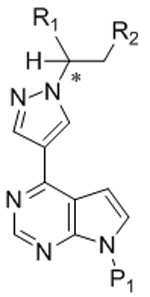
[화학식 Ⅱ][Formula II]

상기 식에서:Where:
*는 키랄 탄소를 나타내고;* Represents chiral carbon;
R1은 C3-7 시클로알킬, C1-6 알킬, 및 C1-6 플루오로알킬로부터 선택되고; R 1 is selected from C 3-7 cycloalkyl, C 1-6 alkyl, and C 1-6 fluoroalkyl;
R2는 -C(=O)-NH2, -C(=O)O-R3, 및 시아노로부터 선택되고;R 2 is selected from —C (═O) —NH 2 , —C (═O) OR 3 , and cyano;
R3은 C1-4 알킬 또는 C1-4 플루오로알킬로부터 선택되고;R 3 is selected from C 1-4 alkyl or C 1-4 fluoroalkyl;
P1은 보호 그룹이다.P 1 is a protection group.
일부 구체예에서, R1은 시클로펜틸, 메틸 및 트리플루오로메틸로부터 선택된다. 일부 구체예에서, R1은 시클로펜틸 또는 시클로프로필이다. 일부 구체예에서, R1은 시클로펜틸이다. 일부 구체예에서, R1은 메틸이다. 일부 구체예에서, R1은 트리플루오로메틸이다. In some embodiments, R 1 is selected from cyclopentyl, methyl and trifluoromethyl. In some embodiments, R 1 is cyclopentyl or cyclopropyl. In some embodiments, R 1 is cyclopentyl. In some embodiments, R 1 is methyl. In some embodiments, R 1 is trifluoromethyl.
일부 구체예에서, R2는 -C(=O)O-R3이다. 일부 구체예에서, R2는 -C(=O)OCH3이다. 일부 구체예에서, R2는 시아노이다.In some embodiments, R 2 is —C (═O) OR 3 . In some embodiments, R 2 is —C (═O) OCH 3 . In some embodiments, R 2 is cyano.
일부 구체예에서, R3은 C1 -4 알킬로부터 선택된. 일부 구체예에서, R3은 메틸로부터 선택된다.In some embodiments, R 3 is C 1 -4 alkyl selected. In some embodiments, R 3 is selected from methyl.
R2에 연결된 결합의 흘리 쓴 부호는, 화합물이 (E)- 또는 (Z)-배열일 수 있다는 것을 나타낸다. 일부 구체예에서, R2는 시아노 또는 -C(=O)-NH2일 때, 화학식 Ⅱ의 화합물은 (Z)-이성질체이고, R2가 -C(=O)O-R3일 때, 화학식 Ⅱ의 화합물은 (E)-이성질체이다. 일부 구체예에서, 화학식 Ⅱ의 화합물은 (Z)-이성질체이다. 일부 구체예에서, 화학식 Ⅱ의 화합물은 (E)-이성질체이다.A loose sign of the bonds linked to R 2 indicates that the compound may be an (E)-or (Z) -configuration. In some embodiments, when R 2 is cyano or —C (═O) —NH 2 , the compound of Formula II is the (Z) -isomer and when R 2 is —C (═O) OR 3 , The compound of II is the (E) -isomer. In some embodiments, the compound of formula II is the (Z) -isomer. In some embodiments, compounds of Formula II are (E) -isomers.
일부 구체예에서, P1는 -CH2OC(=O)C(CH3)3이다. 일부 구체예에서, P1은 -CH2OCH2CH2Si(CH3)3로부터 선택된다. 적합한 P1 보호 그룹은, 비제한적으로 하기에 묘사된 아민에 대한 보호 그룹을 포함한다: Wuts and Greene, Protective Groups in Organic Synthesis, 4th ed., John Wiley & Sons: New Jersey, 페이지 696-887 (및 특히, 페이지 872-887) (2007), 이는 그 전체가 참고로 본 명세서에 통합된다. 일부 구체예에서, P1 그룹에 대한 보호 그룹은 하기에 기재된 다른 방법 단계에서 P2 보호 그룹을 제거하기 위한 조건에 대해 안정한 것이다. 일부 구체예에서, P1는 실온 산성 조건에 대항하는 그룹이다. 일부 구체예에서, P1는 약 1 내지 약 5 N 염산에서 실온에서, 약 10℃ 내지 약 40℃의 온도에서, 약 15℃ 내지 약 40℃의 온도에서, 또는 약 15℃ 내지 약 30℃의 온도에서 제거되지 않는 그룹이다. 일부 구체예에서, P1은 벤질옥시카보닐 (Cbz), 2,2,2-트리클로로에톡시카보닐 (Troc), 2-(트리메틸실릴)에톡시카보닐 (Teoc), 2-(4-트리플루오로메틸페닐설포닐)에톡시카보닐 (Tsc), t-부톡시카보닐 (BOC), 1-아다만틸옥시카보닐 (Adoc), 2-아다만틸카보닐 (2-Adoc), 2,4-디메틸펜트-3-일옥시카보닐 (Doc), 시클로헥실록시카보닐 (Hoc), 1,1-디메틸-2,2,2-트리클로로에톡시카보닐 (TcBOC), 비닐, 2-클로로에틸, 2-페닐설포닐에틸, 알릴, 벤질, 2-니트로벤질, 4-니트로벤질, 디페닐-4-피리딜메틸, N',N'-디메틸히드라지닐, 메톡시메틸, t-부톡시메틸 (Bum), 벤질옥시메틸 (BOM), 또는 2-테트라히드로피라닐 (THP)이다. 일부 구체예에서, P1은 트리(C1-4 알킬)실릴 (예, 트리(이소프로필)실릴)이다. 일부 구체예에서, P1은 1,1-디에톡시메틸이다. 일부 구체예에서, P1은 2-(트리메틸실릴)에톡시메틸 (SEM)이다. 일부 구체예에서, P1 is N-피발로일옥시메틸 (POM)이다.In some embodiments, P 1 is —CH 2 OC (═O) C (CH 3 ) 3 . In some embodiments, P 1 is selected from —CH 2 OCH 2 CH 2 Si (CH 3 ) 3 . Suitable P 1 protecting groups include, but are not limited to, protecting groups for amines depicted below: Wuts and Greene, Protective Groups in Organic Synthesis, 4th ed., John Wiley & Sons: New Jersey, pages 696-887 ( And in particular, pages 872-887 (2007), which is hereby incorporated by reference in its entirety. In some embodiments, the protecting group for the P 1 group is stable to the conditions for removing the P 2 protecting group in other method steps described below. In some embodiments, P 1 is a group against room temperature acidic conditions. In some embodiments, P 1 is at room temperature, at a temperature of about 10 ° C. to about 40 ° C., at a temperature of about 15 ° C. to about 40 ° C., or at about 15 ° C. to about 30 ° C. in about 1 to about 5 N hydrochloric acid. A group that is not removed from the temperature. In some embodiments, P 1 is benzyloxycarbonyl (Cbz), 2,2,2-trichloroethoxycarbonyl (Troc), 2- (trimethylsilyl) ethoxycarbonyl (Teoc), 2- (4 -Trifluoromethylphenylsulfonyl) ethoxycarbonyl (Tsc), t-butoxycarbonyl (BOC), 1-adamantyloxycarbonyl (Adoc), 2-adamantylcarbonyl (2-Adoc) , 2,4-dimethylpent-3-yloxycarbonyl (Doc), cyclohexyloxycarbonyl (Hoc), 1,1-dimethyl-2,2,2-trichloroethoxycarbonyl (TcBOC), Vinyl, 2-chloroethyl, 2-phenylsulfonylethyl, allyl, benzyl, 2-nitrobenzyl, 4-nitrobenzyl, diphenyl-4-pyridylmethyl, N ', N'-dimethylhydrazinyl, methoxymethyl , t-butoxymethyl (Bum), benzyloxymethyl (BOM), or 2-tetrahydropyranyl (THP). In some embodiments, P 1 is tri (C 1-4 alkyl) silyl (eg tri (isopropyl) silyl). In some embodiments, P 1 is 1,1-diethoxymethyl. In some embodiments, P 1 is 2- (trimethylsilyl) ethoxymethyl (SEM). In some embodiments, P 1 is N-pivaloyloxymethyl (POM).
일부 구체예에서, 본 방법은 화학식 Ⅱ의 화합물의 라세미체를 포함하는 조성물을 생성한다. 라세미체가 필요한 경우, 본 기술분야에 공지된 임의의 수소화 촉매가 시용될 수 있다. 일부 구체예에서, 수소화 촉매는 팔라듐/탄소이다. In some embodiments, the method produces a composition comprising a racemate of a compound of Formula II. If racemates are desired, any hydrogenation catalyst known in the art may be employed. In some embodiments, the hydrogenation catalyst is palladium / carbon.
추가 구체예에서, 본 방법은 화학식 I의 화합물의 거울상이성질체 잉여의 (R)- 또는 (S)-거울상이성질체를 포함하는 조성물을 생성한다. 일반적으로, 화학식 I의 화합물의 거울상이성질체 잉여가 필요한 경우, 비대칭 수소화 촉매가 이용된다. 일부 구체예에서, 수소화 촉매는 L1(여기서, L1는 키랄 리간드이다)로 표시되는 루테늄 또는 로듐 촉매이다. 많은 적절한 촉매는 본 기술분야에 공지되어 있다. 일부 구체예에서, 키랄 포스핀 리간드가 사용된다. 활성 촉매계 (금속, 리간드, 및 첨가제)는 반응 동안에 원위치에서 생성될 수 있거나 반응 전에 생성될 수 있다.In a further embodiment, the method produces a composition comprising an enantiomeric excess of the (R)-or (S) -enantiomer of the compound of formula (I). Generally, asymmetric hydrogenation catalysts are used when enantiomeric excess of the compound of formula (I) is required. In some embodiments, the hydrogenation catalyst is a ruthenium or rhodium catalyst L 1 represented by (wherein, L 1 is a chiral ligand). Many suitable catalysts are known in the art. In some embodiments, chiral phosphine ligands are used. Active catalyst systems (metals, ligands, and additives) can be produced in situ during the reaction or can be produced before the reaction.
일부 구체예에서, 촉매는 비교적 높은 촉매 부하를 이용하는 촉매 비대칭 수소화 실험을 수행하여 먼저 스크리닝될 수 있다. 촉매계가 일단 선택되면, 촉매 부하, 수소 압력, 반응 용매 또는 용매계, 반응 온도, 및 반응 시간를 포함하는 실험 조건은 추가 최적화되어 화학 전환율 및 거울상이성질체선택성을 향상시킬 수 있다. 일부 구체예에서, 촉매 부하는 화학식 Ⅱ의 화합물을 기준으로 약 0.005 내지 약 0.1 몰%이다.In some embodiments, the catalyst can be screened first by performing a catalyst asymmetric hydrogenation experiment using a relatively high catalyst load. Once the catalyst system is selected, experimental conditions including catalyst loading, hydrogen pressure, reaction solvent or solvent system, reaction temperature, and reaction time can be further optimized to improve chemical conversion and enantioselectivity. In some embodiments, the catalyst load is about 0.005 to about 0.1 mole percent, based on the compound of formula II.
일부 구체예에서, 화학식 I의 화합물의 거울상이성질체가 특정 키랄 리간드에 의해 생성될 것이라는 것이 공지될 것이다. 일부 구체예에서, 비대칭 수소화 촉매 내의 키랄 리간드는 화학식 I의 화합물의 거울상이성질체가 본 방법에 의해 생성된다는 것을 측정하기 위해 스크리닝될 수 있다. 그 다음, 원하는 키랄 리간드는 선택되어 화학식 I의 화합물의 원하는 거울상이성질체를 제공할 수 있다. 예를 들어, 일부 구체예에서, 본 방법은 또한, 반응 전에, 하기 단계 (i) 내지 (iii)를 포함한다:In some embodiments, it will be known that enantiomers of the compounds of formula (I) will be produced by certain chiral ligands. In some embodiments, chiral ligands in asymmetric hydrogenation catalysts can be screened to determine that enantiomers of the compounds of formula (I) are produced by the present method. The desired chiral ligand can then be selected to provide the desired enantiomer of the compound of formula (I). For example, in some embodiments, the method also includes the following steps (i) to (iii) before the reaction:
(ⅰ) L2(여기서, L2는 키랄 리간드이다)로 표시되는 루테늄 또는 로듐 촉매의 존재하에서 화학식 Ⅱ의 화합물을 수소 가스와 반응시키고; 수득한 조성물을 분석하여 (R)- 또는 (S)-거울상이성질체가 과잉인지를 측정하는 단계;(Ⅰ) L 2 of the compound of formula Ⅱ in the presence of ruthenium or rhodium catalyst represented by (wherein, L 2 is a chiral ligands) reacts with the hydrogen gas and; Analyzing the obtained composition to determine whether the (R)-or (S) -enantiomer is excess;
(ⅱ) L3(여기서, L3은 반대 입체화학으로 표시되는 L2와 동일한 키랄 리간드이다)로 표시되는 루테늄 또는 로듐 촉매의 존재하에서 화학식 Ⅱ의 화합물을 수소 가스와 반응시키고; 수득한 조성물을 분석하여 (R)- 또는 (S)-거울상이성질체가 과잉인지를 측정하는 단계; 및(Ii) reacting the compound of Formula II with hydrogen gas in the presence of a ruthenium or rhodium catalyst represented by L 3 , where L 3 is the same chiral ligand as L 2 represented by the opposite stereochemistry; Analyzing the obtained composition to determine whether the (R)-or (S) -enantiomer is excess; And
(ⅲ) 조성물의 거울상이성질체 잉여에 대해 원하는 입체화학을 기준으로 L1으로서 사용하기 위해 L2 또는 L3을 선택하는 단계.(Iii) selecting L 2 or L 3 for use as L 1 based on the desired stereochemistry for the enantiomeric surplus of the composition.
일부 구체예에서, 수소화 촉매는 [Ru(p-사이멘)(L1)Cl]Cl, Rh(COD)(L1)(BF4), Rh(COD)2(L1)(CF3SO3), 및 Ru(L1)(CF3CO2)2로부터 선택된다. 일부 구체예에서, 수소화 촉매는 [Ru(L4)(L1)Cl]Cl, Rh(L4)(L1)(BF4), Rh(L4)2(L1)(CF3SO3), 및 Ru(L1)(CF3CO2)2로부터 선택된다. 일부 구체예에서, L4는 큐멘 또는 COD이다. 일부 구체예에서, X'는 할로겐이다. 일부 구체예에서, X'는 클로로이다. 일부 구체예에서, 수소화 촉매는 [Rh(COD)2]CF3SO3 및 키랄 포스핀 리간드의 혼합물 이다. 일부 구체예에서, 용매는 2,2,2-트리플루오로에탄올 (TFE)이다. 일부 구체예에서, 수소화 촉매 부하는 약 0.005 내지 약 0.01 몰%이고; 화학식 Ⅱ의 화합물 대 수소화 촉매의 비는 약 20000/1 내지 약 10000/1이다. 일부 구체예에서, 반응 농도는 약 5 내지 약 6 mL TFE/g이고, 수소 압력은 약 7 내지 약 60 bar이고, 반응은 약 실온 내지 약 75℃의 온도에서 수행된다. 일부 구체예에서, 반응은, 화학식 Ⅱ의 화합물 대 화학식의 화합물의 전환율이 약 99.5% 이상일 때까지 수행된다. 일부 구체예에서, 반응은 약 10 내지 약 25시간이다. 일부 구체예에서, 거울상이성질체 잉여는 약 94% 이상이다. In some embodiments, the hydrogenation catalyst is [Ru ( p -cymene) (L 1 ) Cl] Cl, Rh (COD) (L 1 ) (BF 4 ), Rh (COD) 2 (L 1 ) (CF 3 SO 3 ), and Ru (L 1 ) (CF 3 CO 2 ) 2 . In some embodiments, the hydrogenation catalyst is [Ru (L 4 ) (L 1 ) Cl] Cl, Rh (L 4 ) (L 1 ) (BF 4 ), Rh (L 4 ) 2 (L 1 ) (CF 3 SO 3 ), and Ru (L 1 ) (CF 3 CO 2 ) 2 . In some embodiments, L 4 is cumene or COD. In some embodiments, X 'is halogen. In some embodiments, X 'is chloro. In some embodiments, the hydrogenation catalyst is a mixture of [Rh (COD) 2 ] CF 3 SO 3 and chiral phosphine ligands. In some embodiments, the solvent is 2,2,2-trifluoroethanol (TFE). In some embodiments, the hydrogenation catalyst load is about 0.005 to about 0.01 mol%; The ratio of the compound of formula II to the hydrogenation catalyst is about 20000/1 to about 10000/1. In some embodiments, the reaction concentration is about 5 to about 6 mL TFE / g, the hydrogen pressure is about 7 to about 60 bar, and the reaction is performed at a temperature of about room temperature to about 75 ° C. In some embodiments, the reaction is performed until the conversion of a compound of Formula II to a compound of Formula is at least about 99.5%. In some embodiments, the reaction is about 10 to about 25 hours. In some embodiments, the enantiomeric excess is at least about 94%.
일부 구체예에서:In some embodiments:
수소화 촉매는 [Rh(COD)2]CF3SO3 및 하기로부터 선택된 키랄 포스핀 리간드의 혼합물이고;The hydrogenation catalyst is a mixture of [Rh (COD) 2 ] CF 3 SO 3 and a chiral phosphine ligand selected from:
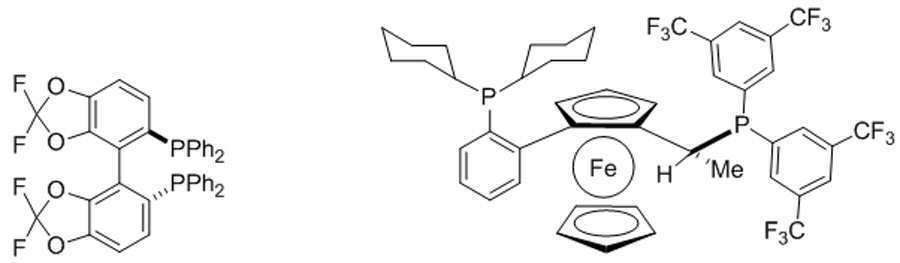
용매는 2,2,2-트리플루오로에탄올 (TFE)이고;The solvent is 2,2,2-trifluoroethanol (TFE);
수소화 촉매 부하는 약 0.005 내지 약 0.01 몰%이고;The hydrogenation catalyst load is about 0.005 to about 0.01 mol%;
화학식 Ⅱ의 화합물 대 수소화 촉매의 비는 약 20000/1 내지 약 10000/1이고;The ratio of the compound of Formula II to the hydrogenation catalyst is about 20000/1 to about 10000/1;
수소 압력은 약 7 내지 약 60 bar이고;Hydrogen pressure is about 7 to about 60 bar;
반응은 약 실온 내지 약 75℃의 온도에서 수행되고; The reaction is carried out at a temperature of about room temperature to about 75 ° C;
반응은 화학식 Ⅱ의 화합물 대 화학식의 화합물의 전환율이 약 99.5% 이상일 때까지 수행되고;The reaction is carried out until the conversion of the compound of formula II to the compound of formula is at least about 99.5%;
반응은 약 10 내지 약 25시간이고;The reaction is about 10 to about 25 hours;
거울상이성질체 잉여는 약 94% 이상이다. Enantiomeric excess is at least about 94%.
일부 구체예에서, 키랄 리간드는 키랄 포스핀 리간드이다. 일부 구체예에서, 키랄 리간드는 하기로부터 선택된다:In some embodiments, the chiral ligand is a chiral phosphine ligand. In some embodiments, the chiral ligand is selected from:

추가 구체예에서, 조성물은 화학식 I의 화합물의 거울상이성질체 잉여의 (S)-거울상이성질체를 포함한다. 일부 구체예에서, L1은 하기 리간드 중 하나로부터 선택된다:In a further embodiment, the composition comprises the enantiomeric excess (S) -enantiomer of the compound of formula (I). In some embodiments, L 1 is selected from one of the following ligands:
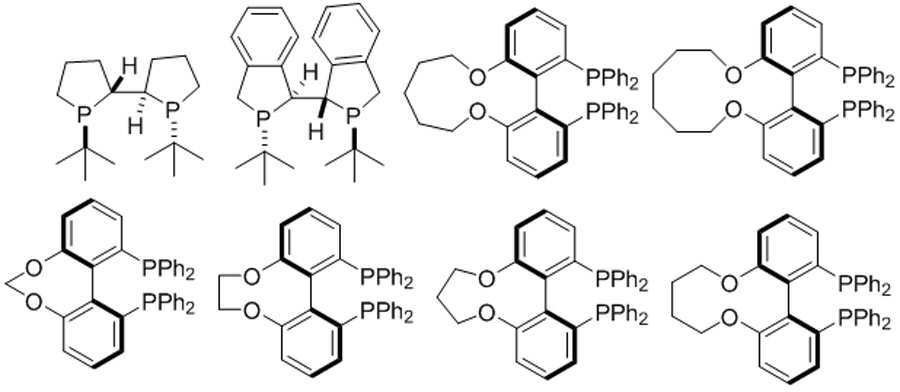
다른 구체예에서, 조성물은 화학식 I의 화합물의 거울상이성질체 잉여의 (R)-거울상이성질체를 포함한다. 일부 구체예에서, L1은 하기 리간드 중 하나로부터 선택된다:In another embodiment, the composition comprises an enantiomeric excess of the (R) -enantiomer of the compound of formula (I). In some embodiments, L 1 is selected from one of the following ligands:
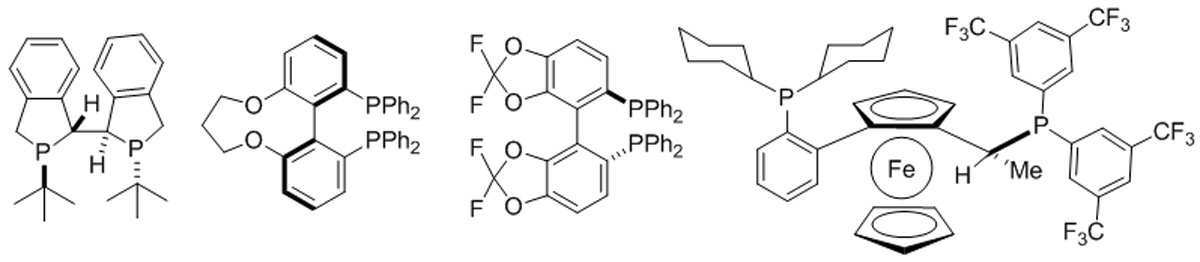
일부 구체예에서, 키랄 촉매는 하기에서의 수소화 촉매로부터 선택된다: Sigma Aldrich, "Asymmetirc Catalysis: Privileged Ligands and Complexes", ChemFiles, vol. 8, no. 2, 페이지 1-88, 이는 그 전체가 참고로 본 명세서에 통합된다. 일부 구체예에서, 거울상이성질체 잉여는 약 10%, 약 20%, 약 30%, 약 40%, 약 50%, 약 60%, 약 70%, 약 80%, 약 90%, 약 95%, 약 96%, 약 97%, 약 98%, 약 99%, 약 99.1%, 약 99.2%, 약 99.3%, 약 99.4%, 약 99.5%, 약 99.6%, 약 99.7%, 약 99.8%, 약 99.9%, 또는 약 99.99% 이상이다.In some embodiments, the chiral catalyst is selected from hydrogenation catalysts in Sigma Aldrich, “Asymmetirc Catalysis: Privileged Ligands and Complexes”, Chem Files, vol. 8, no. 2, pages 1-88, which is hereby incorporated by reference in its entirety. In some embodiments, the enantiomeric surplus is about 10%, about 20%, about 30%, about 40%, about 50%, about 60%, about 70%, about 80%, about 90%, about 95%, about 96%, about 97%, about 98%, about 99%, about 99.1%, about 99.2%, about 99.3%, about 99.4%, about 99.5%, about 99.6%, about 99.7%, about 99.8%, about 99.9% Or about 99.99% or more.
추가 구체예에서, 본 방법은 또한, 탈보호 조건 하에서 화학식 Ic의 화합물을 반응시켜 화학식 Ⅲ의 화합물을 형성하는 것을 포함한다:In a further embodiment, the method also comprises reacting the compound of formula Ic under deprotection conditions to form the compound of formula III:
[화학식 Ⅲ][Formula III]

상기 식에서:Where:
*는 키랄 탄소를 나타내고;* Represents chiral carbon;
R1은 C3-7 시클로알킬, C1-6 알킬, 및 C1-6 플루오로알킬로부터 선택되고;R 1 is selected from C 3-7 cycloalkyl, C 1-6 alkyl, and C 1-6 fluoroalkyl;
P1은 보호 그룹이다. P 1 is a protection group.
일부 구체예에서, 본 방법은 또한, 화학식 Ⅲ의 화합물을 인산과 반응시켜 화학식 Ⅲ의 화합물의 포스페이트 염을 형성하는 것을 포함한다.In some embodiments, the method also includes reacting the compound of Formula III with phosphoric acid to form a phosphate salt of the compound of Formula III.
화학식 Ic의 화합물을 처리하여 P1 그룹를 제거하는 것은 하기에서의 것과 같은 아민에 대한 특정 보호 그룹의 제거에 대해 본 기술분야에 공지된 방법으로 달성될 수 있다: Wuts and Greene, Protective Groups in Organic Synthesis, 4th ed., John Wiley & Sons: New Jersey, 페이지 696-887 (및, 특히, 페이지 872-887) (2007), 이는 그 전체가 참고로 본 명세서에 통합된다. 예를 들어, 일부 구체예에서, P1 그룹은 플루오라이드 이온 (예, 테트라부틸암모늄 플루오라이드), 염산, 피리디늄 p-톨루엔설폰산 (PPTS), 또는 루이스산 (예, 리튬 테트라플루오로보레이트)에 의한 처리)로 제거된다. 일부 구체예에서, 처리는 리튬 테트라플루오로보레이트, 그 다음 수산화암모늄 (예, P1이 2-(트리메틸실릴)에톡시메틸일 때)으로 처리하는 것을 포함한다. 일부 구체예에서, 처리는 염기 (예, P1는 N-피발로일옥시메틸이다)에 의한 처리를 포함한다. 일부 구체예에서, 염기는 알칼리 금속 히드록사이드이다. 일부 구체예에서, 염기는 수산화나트륨이다. 일부 구체예에서, 처리는 용매, 예컨대 메탄올 또는 물에서 수산화나트륨 또는 암모니아에 의한 처리를 포함한다. Treatment of the compound of formula (Ic) to remove the P 1 group can be accomplished by methods known in the art for the removal of specific protecting groups for amines such as: Wuts and Greene, Protective Groups in Organic Synthesis , 4th ed., John Wiley & Sons: New Jersey, pages 696-887 (and, in particular, pages 872-887) (2007), which is hereby incorporated by reference in its entirety. For example, in some embodiments, the P 1 group is a fluoride ion (eg tetrabutylammonium fluoride), hydrochloric acid, pyridinium p-toluenesulfonic acid (PPTS), or Lewis acid (eg lithium tetrafluoroborate By the process). In some embodiments, the treatment comprises treating with lithium tetrafluoroborate, followed by ammonium hydroxide (eg, when P 1 is 2- (trimethylsilyl) ethoxymethyl). In some embodiments, the treatment comprises treatment with a base (eg, P 1 is N-pivaloyloxymethyl). In some embodiments, the base is an alkali metal hydroxide. In some embodiments, the base is sodium hydroxide. In some embodiments, the treatment comprises treatment with sodium hydroxide or ammonia in a solvent such as methanol or water.
일부 구체예에서, SEM 보호 그룹을 탈보호하기 위해, 완만한 2개의 단계 프로토콜이 이용된다. 화학식 Ic의 SEM 보호된 기재물질은 고온, 예컨대 80℃에서 10 내지 20시간 동안 수성 아세토니트릴에서 리튬 테트라플루오로보레이트 (LiBF4)로 처리된다. 그 다음, 수득한 상응하는 히드록시메틸 중간체는 차후에 수성 수산화암모늄 (NH4OH)로 실온에서 처리되어 화학식 Ⅲ의 화합물을 제공한다. In some embodiments, a gentle two step protocol is used to deprotect the SEM protection group. SEM protected substrates of formula (Ic) are treated with lithium tetrafluoroborate (LiBF 4 ) in aqueous acetonitrile at high temperatures such as 80 ° C. for 10-20 hours. The corresponding hydroxymethyl intermediate obtained is then treated with aqueous ammonium hydroxide (NH 4 OH) at room temperature to give a compound of formula III.
일부 구체예에서, POM-탈보호에 대해, 수성 수산화나트륨 용액 (NaOH)이 사용된다. 따라서, POM 보호된 화학식 Ic의 화합물의 현탁액은, 1 N 수성 수산화나트륨 용액으로 실온에서 2 내지 3시간 동안 처리된다. 화학식 Ⅲ의 원하는 생성물은 전형적인 산-염기 워크업 후에 얻을 수 있다. 일부 구체예에서, 탈보호 조건은 리튬 테트라플루오로보레이트, 그 다음 수성 수산화암모늄에 의한 처리를 포함한다. In some embodiments, for POM-deprotection, aqueous sodium hydroxide solution (NaOH) is used. Thus, suspensions of POM protected compounds of formula Ic are treated with 1 N aqueous sodium hydroxide solution for 2 to 3 hours at room temperature. The desired product of formula III can be obtained after a typical acid-base workup. In some embodiments, deprotection conditions include treatment with lithium tetrafluoroborate, followed by aqueous ammonium hydroxide.
일부 구체예에서, 본 방법은 또한, 화학식 Ⅲ의 화합물을 인산과 반응시켜 화학식 Ⅲ의 화합물의 포스페이트 염을 형성하는 것을 포함한다.In some embodiments, the method also includes reacting the compound of Formula III with phosphoric acid to form a phosphate salt of the compound of Formula III.
화학식 I의 아미드의 화학식 Ⅲ의 니트릴로의 전환 방법Conversion of Amide of Formula (I) to Nitrile of Formula (III)
본 발명은 추가로, 화학식 I의 아미드의 화학식 I의 니트릴 화합물로의 전환 방법을 제공한다. 화학식 I의 아미드의 전환 방법은 아미드를 탈수하여 니트릴을 형성하는 것을 수반한다. 그 다음, 보호 그룹은 제거될 수 있고, 수득한 아민은 양자화되어 약제학적으로 허용가능한 염을 형성할 수 있다. 따라서, 일부 구체예에서, 본 발명은 탈수 조건 하에서 화학식 I의 화합물을 반응시켜 화학식 Ia의 화합물을 형성하는 것을 포함하는 방법을 제공한다:The invention further provides a process for the conversion of an amide of formula (I) to a nitrile compound of formula (I). The process for the conversion of amides of formula (I) involves the dehydration of amides to form nitriles. The protecting group can then be removed and the amine obtained can be quantized to form a pharmaceutically acceptable salt. Thus, in some embodiments, the present invention provides a method comprising reacting a compound of formula I under dehydration conditions to form a compound of formula Ia:
[화학식 I][Formula I]
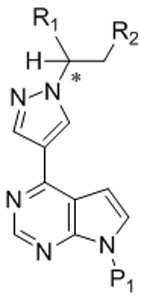
[화학식 Ia]Formula Ia

상기 식에서:Where:
*는 키랄 탄소를 나타내고;* Represents chiral carbon;
R1은 C3-7 시클로알킬, C1-6 알킬, 및 C1-6 플루오로알킬로부터 선택되고; R 1 is selected from C 3-7 cycloalkyl, C 1-6 alkyl, and C 1-6 fluoroalkyl;
R2는 -C(=O)-NH2로부터 선택되고;R 2 is selected from —C (═O) —NH 2 ;
P1은 보호 그룹이다.P 1 is a protection group.
일부 구체예에서, 탈수 조건은 트리에틸아민의 존재하에서 트리클로로아세틸 클로라이드를 포함한다. 일부 구체예에서, 탈수 조건은 산 클로라이드 (예, 트리클로로아세틸 클로라이드), P2O5; ZnCl2 (마이크로웨이브 조건 하에서); 트리페닐포스핀 및 N-클로로석신이미드; 에틸 디클로로포스페이트/DBU; 및 PdCl2을 비제한적으로 포함하는 아미드의 탈수에 대한 임의의 탈수제를 포함한다. 일부 구체예에서, 탈수 조건은 하기에 기재되어 있다: Kuo, C-W.; Zhu, J.-L.; Wu, J.; et al. Chem. Commun. 2007, 301; Manjula, K.; Pasha, M. A. Syn. Commun. 2007, 37, 1545; Takahashi, T.; Sugimoto, O.; Koshio, J.; Tanji, K. Heterocycle 2006, 68, 1973; Maffioli, S. I.; Marzorati, E.; Marazzi, A. Organic Letters 2005, 7, 5237; 또는 Iranpoor, N.; Firouzabadi, H.; Aghapour, G. Syn. Commun. 2002, 32, 2535, 이들 각각은 그 전체가 참고로 본 명세서에 통합된다.In some embodiments, dehydration conditions include trichloroacetyl chloride in the presence of triethylamine. In some embodiments, dehydration conditions include acid chloride (eg, trichloroacetyl chloride), P 2 O 5 ; ZnCl 2 (under microwave conditions); Triphenylphosphine and N-chlorosuccinimide; Ethyl dichlorophosphate / DBU; And any dehydrating agent for dehydration of amides including, but not limited to, PdCl 2 . In some embodiments, dehydration conditions are described below: Kuo, CW .; Zhu, J.-L .; Wu, J .; et al. Chem. Commun. 2007 , 301; Manjula, K .; Pasha, MA Syn. Commun . 2007 , 37, 1545; Takahashi, T .; Sugimoto, O .; Koshio, J .; Tanji, K. Heterocycle 2006 , 68, 1973; Maffioli, SI; Marzorati, E .; Marazzi, A. Organic Letters 2005 , 7 , 5237; Or Iranpoor, N .; Firouzabadi, H .; Aghapour, G. Syn. Commun. 2002 , 32 , 2535, each of which is incorporated herein by reference in its entirety.
추가 구체예에서, 본 방법은 또한, 탈보호 조건 하에서 화학식 Ic의 화합물을 반응시켜서 화학식 Ⅲ의 화합물을 형성하는 것을 포함한다:In a further embodiment, the method also comprises reacting the compound of formula Ic under deprotection conditions to form the compound of formula III:
[화학식 Ⅲ][Formula III]

상기 식에서:Where:
*는 키랄 탄소를 나타내고;* Represents chiral carbon;
R1은 C3-7 시클로알킬, C1-6 알킬, 및 C1-6 플루오로알킬로부터 선택되고;R 1 is selected from C 3-7 cycloalkyl, C 1-6 alkyl, and C 1-6 fluoroalkyl;
P1은 보호 그룹이다. P 1 is a protection group.
적합한 P1 그룹 및 탈보호 방법은 상기에 기재된 것을 비제한적으로 포함한다. Suitable P 1 groups and deprotection methods include, but are not limited to those described above.
일부 구체예에서, 본 발명은 또한, 화학식 Ⅲ의 화합물을 인산과 반응시켜 화학식 Ⅲ의 화합물의 포스페이트 염을 형성하는 것을 포함한다.
In some embodiments, the invention also includes reacting a compound of Formula III with phosphoric acid to form a phosphate salt of the compound of Formula III.
화학식 I의 에스테르의 화학식 Ⅲ의 니트릴로의 전환 방법Process for the conversion of esters of formula I to nitriles of formula III
본 발명은 추가로, 화학식 I의 에스테르를 화학식 I의 니트릴 화합물로 전환하는 방법을 제공한다. 화학식 I의 에스테르를 전환하는 방법은 산을 형성하기 위한 에스테르의 비누화, 선택적 암모니아분해(selective ammonlysis), 및 아미드의 탈수를 수분한다. 그 다음, 보호 그룹은 제거될 수 있고, 수득한 아민은 양자화되어 약제학적으로 허용가능한 염을 형성할 수 있다. The present invention further provides a process for converting an ester of formula (I) to a nitrile compound of formula (I). The process of converting esters of formula (I) pollutes the saponification of esters to form acids, selective ammonlysis, and dehydration of amides. The protecting group can then be removed and the amine obtained can be quantized to form a pharmaceutically acceptable salt.
따라서, 본 발명은 화학식 I의 화합물을 금속 히드록사이드와 반응시켜 화학식 Ic의 화합물을 형성하는 방법을 제공한다:Accordingly, the present invention provides a process for reacting a compound of formula (I) with a metal hydroxide to form a compound of formula (Ic):
[화학식 I][Formula I]

[화학식 Ic](Ic)

상기 식에서:Where:
*는 키랄 탄소를 나타내고;* Represents chiral carbon;
R1은 C3-7 시클로알킬, C1-6 알킬, 및 C1-6 플루오로알킬로부터 선택되고; R 1 is selected from C 3-7 cycloalkyl, C 1-6 alkyl, and C 1-6 fluoroalkyl;
R2는 -C(=O)OR3이고;R 2 is —C (═O) OR 3 ;
R3은 C1-4 알킬로부터 선택되고;R 3 is selected from C 1-4 alkyl;
P1은 보호 그룹이다.P 1 is a protection group.
일부 구체예에서, 금속 히드록사이드는 알칼리 금속 히드록사이드 또는 알칼리 토금속 히드록사이드이다. 일부 구체예에서, 금속 히드록사이드는 리튬 히드록사이드이다.In some embodiments, the metal hydroxide is an alkali metal hydroxide or alkaline earth metal hydroxide. In some embodiments, the metal hydroxide is lithium hydroxide.
추가 구체예에서, 본 방법은 또한, 커플링 시약의 존재하에서 화학식 Ic의 화합물을을 암모니아 또는 수산화암모늄과 반응시켜 화학식 Ib의 화합물을 형성하는 것을 포함한다:In a further embodiment, the method also includes reacting the compound of Formula Ic with ammonia or ammonium hydroxide in the presence of a coupling reagent to form the compound of Formula Ib:
[화학식 Ib](Ib)

상기 식에서:Where:
*는 키랄 탄소를 나타내고;* Represents chiral carbon;
R1은 C3-7 시클로알킬, C1-6 알킬, 및 C1-6 플루오로알킬로부터 선택되고;R 1 is selected from C 3-7 cycloalkyl, C 1-6 alkyl, and C 1-6 fluoroalkyl;
P1은 보호 그룹이다.P 1 is a protection group.
일부 구체예에서, 커플링제는 N,N-카보닐디이미다졸. 일부 구체예에서, 커플링제는 1,2-벤즈이속사졸-3-일 디페닐 포스페이트; ClCO2-i-Bu 및 Et3N; 카보디이미드; SOCl2 및 Cl-C(O)-C(O)-Cl; 토실 클로라이드 및 DMAP; 및 ClCO2-i-Bu 및 트리에틸아민으로부터 선택된다. 일부 구체예에서, 커플링제는 하기에서의 것으로부터 선택된다: Ueda, M.; Oikawa, H. J. Org. Chem. 1985, 50, 760. (1,2-벤즈이속사졸-3-일 디페닐 포스페이트); Lai, M.; Liu, H. J. Am. Chem. Soc. 1991, 113, 7388.(ClCO2-i-Bu, Et3N); Williams, A.; Ibrahim, I. Chem. Rev. 1991, 81, 589. (카보디이미드); Weiss, M. M.; Harmange, J; Polverino, A. J. J. Med. Chem., 2008, 51, 1668.(SOCl2, Cl-CO-CO-Cl); Hong, C. Y.; 및 Kishi. Y. J. Am. Chem. Soc., 1991, 113, 9693. (TsCl, DMAP); 및 Nitta, H.; Yu, D.; Kudo, M.; Mori, A.; Inoue, S. J. Am. Chem. Soc., 1992, 114, 7969. (ClCO2-i-Bu, Et3N).In some embodiments, the coupling agent is N, N-carbonyldiimidazole. In some embodiments, the coupling agent is 1,2-benzisoxazol-3-yl diphenyl phosphate; ClCO 2 - i -Bu and Et 3 N; Carbodiimide; SOCl 2 and Cl—C (O) —C (O) —Cl; Tosyl chloride and DMAP; And ClCO 2 -i-Bu and triethylamine. In some embodiments, the coupling agent is selected from: Ueda, M .; Oikawa, H. J. Org. Chem . 1985 , 50 , 760. (1,2-benzisoxazol-3-yl diphenyl phosphate); Lai, M .; Liu, H. J. Am. Chem. Soc . 1991 , 113 , 7388. (ClCO 2 - i -Bu, Et 3 N); Williams, A .; Ibrahim, I. Chem. Rev. 1991 , 81, 589. (carbodiimide); Weiss, MM; Harmange, J; Polverino, AJ J. Med. Chem ., 2008, 51, 1668. (SOCl 2, Cl-CO-CO-Cl); Hong, CY; And Kishi. Y. J. Am. Chem. Soc. , 1991 , 113, 9693. (TsCl, DMAP); And Nitta, H .; Yu, D .; Kudo, M .; Mori, A .; Inoue, S. J. Am. Chem. Soc. , 1992 , 114, 7969. (ClCO 2 - i -Bu, Et 3 N).
다른 구체예에서, 본 방법은 또한, 탈수 조건 하에서 화학식 Ib의 화합물을 반응시켜 화학식 Ia의 화합물을 형성하는 것을 포함한다:In another embodiment, the method also includes reacting the compound of Formula Ib under dehydration conditions to form a compound of Formula Ia:
[화학식 Ia]Formula Ia

상기 식에서:Where:
*는 키랄 탄소를 나타내고;* Represents chiral carbon;
R1은 C3-7 시클로알킬, C1-6 알킬, 및 C1-6 플루오로알킬로부터 선택되고;R 1 is selected from C 3-7 cycloalkyl, C 1-6 alkyl, and C 1-6 fluoroalkyl;
P1은 보호 그룹이다.P 1 is a protection group.
일부 구체예에서, 탈수 조건은 트리에틸아민의 존재하에서 트리클로로아세틸 클로라이드를 포함한다. 일부 구체예에서, 탈수 조건은 산 클로라이드 (예, 트리클로로아세틸 클로라이드), P2O5; ZnCl2 (마이크로웨이브 조건 하에서); 트리페닐포스핀 및 N-클로로석신이미드; 에틸 디클로로포스페이트/DBU; 및 PdCl2을 비제한적으로 포함하는 아미드의 탈수에 대한 임의의 탈수제를 포함한다. 일부 구체예에서, 탈수 조건은 하기에 기재된 것이다: Kuo, C-W.; Zhu, J.-L.; Wu, J.; et al. Chem. Commun. 2007, 301; Manjula, K.; Pasha, M. A. Syn. Commun. 2007, 37, 1545; Takahashi, T.; Sugimoto, O.; Koshio, J.; Tanji, K. Heterocycle 2006, 68, 1973; Maffioli, S. I.; Marzorati, E.; Marazzi, A. Organic Letters 2005, 7, 5237; 또는 Iranpoor, N.; Firouzabadi, H.; Aghapour, G. Syn. Commun. 2002, 32, 2535, 이들 각각은 그 전체가 참고로 본 명세서에 통합된다.In some embodiments, dehydration conditions include trichloroacetyl chloride in the presence of triethylamine. In some embodiments, dehydration conditions include acid chloride (eg, trichloroacetyl chloride), P 2 O 5 ; ZnCl 2 (under microwave conditions); Triphenylphosphine and N-chlorosuccinimide; Ethyl dichlorophosphate / DBU; And any dehydrating agent for dehydration of amides including, but not limited to, PdCl 2 . In some embodiments, the dehydration conditions are described below: Kuo, CW .; Zhu, J.-L .; Wu, J .; et al. Chem. Commun. 2007 , 301; Manjula, K .; Pasha, MA Syn. Commun . 2007 , 37, 1545; Takahashi, T .; Sugimoto, O .; Koshio, J .; Tanji, K. Heterocycle 2006 , 68 , 1973; Maffioli, SI; Marzorati, E .; Marazzi, A. Organic Letters 2005 , 7 , 5237; Or Iranpoor, N .; Firouzabadi, H .; Aghapour, G. Syn. Commun. 2002 , 32 , 2535, each of which is incorporated herein by reference in its entirety.
추가 구체예에서, 본 방법은 또한, 탈보호 조건 하에서 화학식 Ic의 화합물을 반응시켜 화학식 Ⅲ의 화합물을 형성하는 것을 포함한다:In a further embodiment, the method also comprises reacting the compound of formula Ic under deprotection conditions to form the compound of formula III:
[화학식 Ⅲ][Formula III]
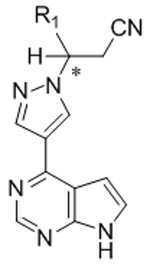
상기 식에서:Where:
*는 키랄 탄소를 나타내고;* Represents chiral carbon;
R1은 C3-7 시클로알킬, C1-6 알킬, 및 C1-6 플루오로알킬로부터 선택되고;R 1 is selected from C 3-7 cycloalkyl, C 1-6 alkyl, and C 1-6 fluoroalkyl;
P1은 보호 그룹이다.P 1 is a protection group.
적합한 P1 그룹 및 탈보호 방법은 상기에 기재된 것을 비제한적으로포함한다. Suitable P 1 groups and deprotection methods include, but are not limited to those described above.
일부 구체예에서, 본 발명은 또한, 화학식 Ⅲ의 화합물을 인산과 반응시켜 화학식 Ⅲ의 화합물의 포스페이트 염을 형성하는 것을 포함한다.
In some embodiments, the invention also includes reacting a compound of Formula III with phosphoric acid to form a phosphate salt of the compound of Formula III.
수소화 방법을 위한 개시물질 (화학식 Ⅱ의 화합물)Initiators for Hydrogenation Methods (Compounds of Formula II)
비대칭 수소화 방법 (상기)에 사용된 화학식 Ⅱ의 화합물은 반응도식 1에서 나타낸 바와 같이 제조될 수 있고, 여기서 P1 및 P2 각각은, 독립적으로, 보호 그룹이고, R1은 C3 -7 시클로알킬, C1 -6 알킬, 및 C1 -6 플루오로알킬로부터 선택되고, R2는 시아노 또는 알킬 에스테르이다. 화학식 Ⅳ의 화합물의 제조 경로는 아래에 기재되어 있다.Can be prepared as the compound of formula Ⅱ used in asymmetric hydrogenation process (above) is shown in reaction scheme 1, wherein P 1 and P 2 each, and independently, a protective group, R 1 is C 3 -7 cycloalkyl alkyl, C 1 -6 alkyl, and C 1 are selected from alkyl -6-fluoro, R 2 is cyano or alkyl esters. The route of preparation of the compound of formula IV is described below.
반응도식 1Scheme 1

본 방법은 화학식 XⅣ의 적절하게 치환된 아세틸렌과 보호된 4-(1H-피라졸-4-일)-7H-피롤로[2,3-d]피리미딘 화학식 Ⅳ의 화합물 (화학식 Ⅳ의 화합물 및 XⅣ의 제조는 아래에 기재되어 있다)과의 사이의 아자-마이클(Michael) 부가 반응을 수반한다. 이 반응은 실온에서 DMF 중 촉매량의 고형 탄산칼륨의 영향 하에서 수행되어 화학식 I의 상응하는 화합물을 얻을 수 있다. The process comprises the appropriate substituted acetylene of formula XIV and protected 4- (1H-pyrazol-4-yl) -7H-pyrrolo [2,3-d] pyrimidine compound of formula IV (compound of formula IV and Preparation of XIV involves aza-Michael addition reaction with). This reaction can be carried out at room temperature under the influence of a catalytic amount of solid potassium carbonate in DMF to afford the corresponding compound of formula (I).
화학식 Ⅱ의 화합물 (여기서, R1는 -C(=O)NH2이다)은, 화학식 Ⅱa의 화합물을 산으로 처리하여 화학식 Ⅱb의 화합물을 형성함으로써 반응도식 2에서 나타낸 바와 같이 형성될 수 있다.Compounds of formula (II), wherein R 1 is —C (═O) NH 2 , may be formed as shown in Scheme 2 by treating compounds of formula (IIa) with an acid to form compounds of formula (IIb).
반응도식 2Scheme 2

따라서, 본 발명은 화학식 Ⅱ의 화합물의 제조 방법을 제공하고, 이 방법은 염기의 존재하에서 화학식 Ⅳ의 화합물을 화학식 XⅣ의 화합물과 반응시키는 것을 포함한다:Thus, the present invention provides a process for preparing a compound of formula II, which method comprises reacting a compound of formula IV with a compound of formula XIV in the presence of a base:
[화학식 Ⅱ][Formula II]

[화학식 Ⅳ][Formula IV]

[화학식 XⅣ][Formula XIV]

상기 식에서:Where:
*는 키랄 탄소를 나타내고;* Represents chiral carbon;
R1은 C3-7 시클로알킬, C1-6 알킬, 및 C1-6 플루오로알킬로부터 선택되고; R 1 is selected from C 3-7 cycloalkyl, C 1-6 alkyl, and C 1-6 fluoroalkyl;
R2는 -C(=O)O-R3 및 시아노로부터 선택되고;R 2 is selected from —C (═O) OR 3 and cyano;
R3은 C1-4 알킬 또는 C1-4 플루오로알킬로부터 선택되고;R 3 is selected from C 1-4 alkyl or C 1-4 fluoroalkyl;
P1은 보호 그룹이다.P 1 is a protection group.
적합한 P1 보호 그룹은 상기에 열거된 것을 비제한적으로 포함한다.Suitable P 1 protecting groups include, but are not limited to those listed above.
일부 구체예에서, 아자-마이클 부가는 촉매량의 염기의 존재하에서 유기 용매중에서 실온에서 수행된다. 염기는 아자-마이클 반응을 위한 적절한 용매 또는 염기일 수 있다. 일부 구체예에서, 용매는 아세토니트릴 또는 디메틸포르마이드 (DMF)이다. 일부 구체예에서, 염기는 테트라알킬암모늄 할라이드, 테트라알킬수산화암모늄, 구아니딘, 아미딘, 히드록사이드, 알콕시드, 실리케이트, 알칼리 금속 포스페이트, 옥사이드, 3급 아민, 알칼리 금속 카보네이트, 알칼리 금속 바이카보네이트, 알칼리 금속 수소 포스페이트, 포스핀, 또는 카복실산의 알칼리 금속 염이다. 일부 구체예에서, 염기는 테트라메틸 구아니딘, 1,8-디아자바이시클로(5.4.0)운덱-7-엔, 1,5-디아자바이시클로(4.3.0)논-5-엔, 1,4-디아자바이시클로(2.2.2)옥탄, tert-부틸 수산화암모늄, 수산화나트륨, 칼륨 히드록사이드, 나트륨 메톡시드, 나트륨 에톡시드, 트리칼륨 포스페이트, 나트륨 실리케이트, 칼슘 옥사이드, 트리에틸아민, 나트륨 카보네이트, 탄산칼륨, 중탄산나트륨, 칼륨 바이카보네이트, 칼륨 수소 포스페이트, 트리페닐 포스핀, 트리에틸 포스핀, 칼륨 아세테이트, 또는 칼륨 아실레이트이다. 일부 구체예에서, 염기는 1,8-디아자바이시클로[5.4.0]운덱-7-엔 (DBU) 또는 탄산칼륨이다. 일부 구체예에서, 염기는 DBU이다. 일부 구체예에서, 염기는 촉매량으로 존재한다. 일부 구체예에서, 염기의 양은 약 0.1 내지 약 5 당량, 또는 약 0.5 내지 약 3 당량, 또는 약 0.1 내지 약 0.5 당량이다. 일부 구체예에서, 반응은 약 1 내지 약 3시간 내에 완료된다.In some embodiments, the aza-michael addition is performed at room temperature in an organic solvent in the presence of a catalytic amount of base. The base may be a suitable solvent or base for the aza-mic reaction. In some embodiments, the solvent is acetonitrile or dimethylformamide (DMF). In some embodiments, the base is tetraalkylammonium halide, tetraalkylammonium hydroxide, guanidine, amidine, hydroxide, alkoxide, silicate, alkali metal phosphate, oxide, tertiary amine, alkali metal carbonate, alkali metal bicarbonate, Alkali metal hydrogen phosphate, phosphine, or alkali metal salts of carboxylic acids. In some embodiments, the base is tetramethyl guanidine, 1,8-diazabicyclo (5.4.0) undec-7-ene, 1,5-diazabicyclo (4.3.0) non-5-ene, 1 , 4-diazabicyclo (2.2.2) octane, tert-butyl ammonium hydroxide, sodium hydroxide, potassium hydroxide, sodium methoxide, sodium ethoxide, tripotassium phosphate, sodium silicate, calcium oxide, triethylamine, Sodium carbonate, potassium carbonate, sodium bicarbonate, potassium bicarbonate, potassium hydrogen phosphate, triphenyl phosphine, triethyl phosphine, potassium acetate, or potassium acylate. In some embodiments, the base is 1,8-diazabicyclo [5.4.0] undec-7-ene (DBU) or potassium carbonate. In some embodiments, the base is DBU. In some embodiments, the base is present in a catalytic amount. In some embodiments, the amount of base is about 0.1 to about 5 equivalents, or about 0.5 to about 3 equivalents, or about 0.1 to about 0.5 equivalents. In some embodiments, the reaction is completed within about 1 to about 3 hours.
일부 구체예에서, R1은 시클로펜틸, 메틸 및 트리플루오로메틸로부터 선택된다. 일부 구체예에서, R1은 시클로펜틸 또는 시클로프로필이다. 일부 구체예에서, R1은 시클로펜틸이다. 일부 구체예에서, R1은 메틸이다. 일부 구체예에서, R1은 트리플루오로메틸이다. In some embodiments, R 1 is selected from cyclopentyl, methyl and trifluoromethyl. In some embodiments, R 1 is cyclopentyl or cyclopropyl. In some embodiments, R 1 is cyclopentyl. In some embodiments, R 1 is methyl. In some embodiments, R 1 is trifluoromethyl.
일부 구체예에서, 염기는 알칼리 금속 또는 알칼리 토금속 카보네이트이다. 일부 구체예에서, 염기는 탄산칼륨이다.In some embodiments, the base is an alkali metal or alkaline earth metal carbonate. In some embodiments, the base is potassium carbonate.
일부 구체예에서, 본 발명은 화학식 Ⅱ의 화합물을 제공한다:In some embodiments, the present invention provides a compound of Formula II:
[화학식 Ⅱ][Formula II]

상기 식에서:Where:
R1은 C3-7 시클로알킬, C1-6 알킬, 및 C1-6 플루오로알킬로부터 선택되고; R 1 is selected from C 3-7 cycloalkyl, C 1-6 alkyl, and C 1-6 fluoroalkyl;
R2는 -C(=O)-NH2 및 -C(=O)O-R3로부터 선택되고; R 2 is selected from —C (═O) —NH 2 and —C (═O) OR 3 ;
R3은 C1-4 알킬 또는 C1-4 플루오로알킬로부터 선택되고;R 3 is selected from C 1-4 alkyl or C 1-4 fluoroalkyl;
P1은 보호 그룹이다.P 1 is a protection group.
일부 구체예에서, P1는 -CH2OC(=O)C(CH3)3 또는 -CH2OCH2CH2Si(CH3)3이다. 일부 구체예에서, R1은 시클로펜틸이다.In some embodiments, P 1 is —CH 2 OC (═O) C (CH 3 ) 3 or -CH 2 OCH 2 CH 2 Si (CH 3 ) 3 . In some embodiments, R 1 is cyclopentyl.
화학식 Ⅱb의 화합물 (여기서, R1는 -C(=O)NH2이다)은 화학식 Ⅱa의 화합물을 산으로 처리하여 화학식 Ⅱb의 화합물의 라세미 형태를 형성함으로써 형성될 수 있다:Compounds of formula (IIb), wherein R 1 is —C (═O) NH 2, may be formed by treating a compound of formula (IIa) with an acid to form a racemic form of the compound of formula (IIb):
[화학식 Ⅱa][Formula IIa]

[화학식 Ⅱb][Formula IIb]

상기 식에서:Where:
R1은 C3-7 시클로알킬, C1-6 알킬, 및 C1-6 플루오로알킬로부터 선택되고;R 1 is selected from C 3-7 cycloalkyl, C 1-6 alkyl, and C 1-6 fluoroalkyl;
P1은 보호 그룹이다.P 1 is a protection group.
일부 구체예에서, 산은 트리플루오로아세트산, 황산, 또는 이들의 조합이다. 일부 구체예에서, 처리는 트리플루오로아세트산 (TFA) 및 황산 (H2SO4)로 실온에서 처리하는 것을 포함한다. 일부 구체예에서, TFA 대 H2SO4의 비는 용적으로 약 10:1이다. 일부 구체예에서, 반응은 약 1시간 내에 완료된다. In some embodiments, the acid is trifluoroacetic acid, sulfuric acid, or a combination thereof. In some embodiments, the treating comprises treating at room temperature with trifluoroacetic acid (TFA) and sulfuric acid (H 2 SO 4 ). In some embodiments, the ratio of TFA to H 2 SO 4 is about 10: 1 in volume. In some embodiments, the reaction is completed within about 1 hour.
반응도식 1에 기재된 방법에 사용된 화학식 XⅣ의 화합물은, 방법 예를들면 하기 반응도식 3에 나타낸 바와 같이 형성될 수 있다. 따라서, 화학식 XⅣa의 화합물 (여기서, 화학식 XⅣ의 R2는 시아노이다)은, 화학식 C-1의 화합물의 리튬 염을, 유기 용매, 예컨대 무수 THF에서, 약 -78℃ 내지 약 실온에서 페놀 및 시안산 브로마이드로부터 인사이튜(in situ) 생성된 시아네이토벤젠 (C-2)로 처리하여 화학식 XⅣa의 상응하는 3-치환된 프로피올로니트릴을 형성함으로써 제조된다. 유사하게, 화학식 C-3의 클로로포르메이트로 처리된 화학식 C-1의 화합물의 리튬 염은 화학식 XⅣb의 3-치환된 프로피올레이트 화합물 (여기서, 화학식 XⅣ의 R2는 -C(=O)OR3이다)을 제공한다. The compound of formula (XIV) used in the method described in Scheme 1 may be formed as shown in a method, for example Scheme 3 below. Thus, the compound of formula (XIVa), wherein R 2 in formula (XIV) is cyano, contains a lithium salt of the compound of formula (C-1) in an organic solvent such as anhydrous THF, from about -78 ° C to about room temperature insayi from cyanate bromide tube (in situ ) prepared by treatment with the resulting cyanatobenzene (C-2) to form the corresponding 3-substituted propionolonitrile of formula (XIVa). Similarly, the lithium salt of the compound of formula C-1 treated with chloroformate of formula C-3 is a 3-substituted propiolate compound of formula XIVb, wherein R 2 in formula XIV is -C (= 0) OR 3 ).
반응도식 3Scheme 3

Ⅱ. 화학식 II. Chemical formula IdId 또는 Ⅵ의 알데히드 중간체를 제조하기 위한 비대칭 Or asymmetry to prepare the aldehyde intermediate of VI 아자Keep it up -마이클 부가 방법 -How to add Michael
또 다른 측면에서, 본 발명은, 특히, 키랄 아민 및 유기 산의 존재하에서 화학식 Ⅳ의 화합물을 화학식 V의 화합물과 반응시키는 것을 포함하는, 화학식 Id의 화합물의 거울상이성질체 잉여의 (R)- 또는 (S)-거울상이성질체를 제공한다: In another aspect, the invention relates to enantiomeric excess of (R)-or (I) of a compound of formula (Id), particularly comprising reacting a compound of formula (IV) with a compound of formula (V) in the presence of a chiral amine and an organic acid S) -enantiomers are provided:
[화학식 Id]Formula Id

[화학식 Ⅳ][Formula IV]
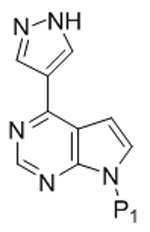
[화학식 V][Formula V]

상기 식에서:Where:
*는 키랄 탄소를 나타내고;* Represents chiral carbon;
R1은 C3-7 시클로알킬, C1-6 알킬, 및 C1-6 플루오로알킬로부터 선택되고; R 1 is selected from C 3-7 cycloalkyl, C 1-6 alkyl, and C 1-6 fluoroalkyl;
P1은 보호 그룹이다.P 1 is a protection group.
추가 측면에서, 본 발명은 화학식 Ⅵ의 화합물의 거울상이성질체 잉여의 (R)- 또는 (S)-거울상이성질체를 제조하는 방법을 제공하고, 이 방법은, 키랄 아민 및 유기 산의 존재하에서 화학식 V의 화합물을 화학식 Ⅶ의 화합물과 반응시키는 것을 포함한다:In a further aspect, the present invention provides a process for the preparation of enantiomeric excess (R)-or (S) -enantiomers of the compounds of formula (VI), which method comprises the steps of Reacting the compound with a compound of formula (VII):
[화학식 Ⅵ][Formula VI]

[화학식 V][Formula V]

[화학식 Ⅶ][Formula Ⅶ]

*는 키랄 탄소를 나타내고;* Represents chiral carbon;
R1은 C3 -7 시클로알킬, C1 -6 알킬, 및 C1 -6 플루오로알킬로부터 선택되고;R 1 is selected from alkyl to C 3 -7-cycloalkyl, C 1 -6 alkyl, and C 1 -6 fluoro;
X1은 할로겐이다.X 1 is halogen.
어떠한 특정 이론으로 구속받고 싶지 않지만, N-헤테로시클릭 화합물의 α,β-불포화된 알데히드에의 이들 키랄 아민 촉매 아자-마이클 콘쥬게이트 부가의 메카니즘은 하기 경로를 수반하는 것으로 이해된다. 첫 째로, 화학식 V의 α,β-불포화된 알데히드는 키랄 아민과 유기 산의 조합으로부터 형성된 양자화된 촉매와 반응하고, 물의 손실과 함께 이미늄 이온을 형성한다. 촉매의 키랄성 때문에, E 및 Z 배열을 갖는 2개의 상이한 이미늄 이온이 형성될 수 있다. 상응하는 E 배열은 주요 중간체가 존재하는 것으로 기대되고, 여기서, Si 면(face)은 촉매에서 키랄 그룹에 의해 은폐되고, N-헤테로시클릭 화합물의 접근을 위해 이용가능한 Re 면을 남긴다. 두 번째로, 치환된 피라졸의 이미늄 이온에의 부가는 엔아민 중간체을 제공하고, 이는 양자화된 피라졸 고리에 대해 양전하를 갖는다. 그 다음, 이 양자은 피라졸 고리의 질소원자로부터 엔아민 탄소 원자로 이동하여 이미늄 중간체를 형성한다. 세 번째로, 이미늄 이온의 가수분해로 촉매 및 생성물이 재생성된다. 반응 메가니즘의 이해를 기초로, 이러한 유기촉매 아자-마이클 반응(aza-Michael reaction)에 대한 반응 조건이 한정되었다. Without wishing to be bound by any particular theory, it is understood that the mechanism of addition of these chiral amine-catalyzed aza-michael conjugates to the α, β-unsaturated aldehydes of N-heterocyclic compounds involves the following pathways. First, the α, β-unsaturated aldehydes of formula V react with quantized catalysts formed from the combination of chiral amines and organic acids and form iminium ions with loss of water. Because of the chirality of the catalyst, two different iminium ions with E and Z arrangements can be formed. The corresponding E configuration is expected to be the main intermediate, where the Si face is concealed by chiral groups in the catalyst, leaving the Re side available for access of the N-heterocyclic compound. Secondly, the addition of substituted pyrazoles to the iminium ions provides the enamine intermediate, which has a positive charge on the quantized pyrazole ring. These both then migrate from the nitrogen atom of the pyrazole ring to the enamine carbon atom to form an iminium intermediate. Third, the hydrolysis of iminium ions regenerates the catalyst and product. Based on the understanding of the reaction mechanism, the reaction conditions for this aza-Michael reaction are limited.
일부 구체예에서, 화학식 V의 화합물은 과잉량 (예, 약 1.5 내지 약 5 당량)으로 존재한다. 일부 구체예에서, 키랄 아민은 약 0.02 내지 약 0.15 당량, 또는 약 0.05 내지 약 0.10 당량으로 존재한다.In some embodiments, the compound of Formula V is present in excess (eg, about 1.5 to about 5 equivalents). In some embodiments, the chiral amine is present in about 0.02 to about 0.15 equivalents, or about 0.05 to about 0.10 equivalents.
비대칭 아자-마이클 부가 방법의 일부 구체예에서, 유기 산은 p-톨루엔설폰산, 벤조산 또는 4-니트로벤조산이다. 일부 구체예에서, 유기 산은 벤조산이다. 일부 구체예에서, 유기 산은 약 0.05 내지 약 0.10 당량으로 존재한다.In some embodiments of the asymmetric aza-michael addition method, the organic acid is p-toluenesulfonic acid, benzoic acid or 4-nitrobenzoic acid. In some embodiments, the organic acid is benzoic acid. In some embodiments, the organic acid is present in about 0.05 to about 0.10 equivalent.
일부 구체예에서, 반응은 클로로포름 (CHCl3) 또는 톨루엔로부터 선택된 유기 용매에서 수행된다. 일부 구체예에서, 반응은 약 실온, 또는 약 0 내지 약 5℃의 온도에서이다. 일부 구체예에서, 반응은 약 10 내지 약 24시간 내에 완료된다. 일부 구체예에서, 반응 전환율 약 80 내지 약 90% 까지의 분리 수율과 함께 95% 초과에 도달한다. 키랄 HPLC 방법은 개발되어 각각의 아자-마이클 부가물 또는 이의 유도체의 키랄 순도를 측정했다.In some embodiments, the reaction is carried out in an organic solvent selected from chloroform (CHCl 3 ) or toluene. In some embodiments, the reaction is at a temperature of about room temperature, or about 0 to about 5 ° C. In some embodiments, the reaction is completed within about 10 to about 24 hours. In some embodiments, more than 95% is reached with a separation yield of up to about 80 to about 90% reaction conversion. Chiral HPLC methods have been developed to determine the chiral purity of each aza-michael adduct or derivative thereof.
비대칭 아자-마이클 부가 방법의 일부 구체예에서, 키랄 아민은 화학식 A-1의 화합물의 (R)- 또는 (S)-거울상이성질체이다:In some embodiments of the asymmetric aza-michael addition method, the chiral amine is the (R)-or (S) -enantiomer of the compound of formula A-1:
[화학식 A-1][Formula A-1]

상기 식에서:Where:
X는 CY3Y4이고, Y는 CY5Y6이거나; 또는X is CY 3 Y 4 and Y is CY 5 Y 6 ; or
X는 S 또는 NY7이고, Y는 CY5Y6이거나; 또는X is S or NY 7 and Y is CY 5 Y 6 ; or
X는 CY3Y4이고, Y는 S이고;X is CY 3 Y 4 and Y is S;
Q1 및 Q2 각각은 H, C1-6 알킬, C1-6 할로알킬, 카복시, C1-6 알킬카복사미드, C1-6 알콕시카보닐, 및 페닐로부터 독립적으로 선택되고; 여기서, 상기 C1-6 알킬, C1-6 할로알킬, C1-6 알킬카복사미드, C1-6 알콕시카보닐, 및 페닐 각각은 히드록실, 카복시, 트리-C1-6 알킬실릴, 트리-C1-6 알킬실릴옥시, C6-10 아릴, C6-10 아릴아미노, C1-9 헤테로아릴, 및 C1 -9 헤테로아릴아미노로부터 독립적으로 선택된 1, 2, 또는 3개의 그룹에 의해 임의 치환되고; 여기서, 상기 C6 -10 아릴, C6 -10 아릴아미노, C1 -9 헤테로아릴, 및 C1-9 헤테로아릴아미노 각각은 할로겐, C1-6 알킬, 및 C1-6 할로알킬로부터 독립적으로 선택된 1, 2, 3, 또는 4개의 그룹에 의해 임의로 치환되고;Q 1 and Q 2 are each independently selected from H, C 1-6 alkyl, C 1-6 haloalkyl, carboxy, C 1-6 alkylcarboxamide, C 1-6 alkoxycarbonyl, and phenyl; Wherein said C 1-6 alkyl, C 1-6 haloalkyl, C 1-6 alkylcarboxamide, C 1-6 alkoxycarbonyl, and phenyl are each hydroxyl, carboxy, tri-C 1-6 alkylsilyl , tri -C 1-6 alkyl silyloxy, C 6-10 aryl, C 6-10 arylamino, C 1-9 heteroaryl, and C 1 -9 heteroaryl amino selected independently of one, two, or three from Optionally substituted by a group; Here, the C 6 -10 aryl, C 6 -10 aryl-amino, C 1 -9 heteroaryl, and C 1-9 heteroaryl amino each independently from halogen, C 1-6 alkyl, and C 1-6 haloalkyl Optionally substituted by 1, 2, 3, or 4 groups selected;
Y1, Y2, Y3, Y4, Y5, Y6 각각은 H, 히드록실, 카복시, C1-6 알킬, C1-6 할로알킬, C1-6 알콕시카보닐, 및 페닐로부터 독립적으로 선택되고; 또는Y 1 , Y 2 , Y 3 , Y 4 , Y 5 , Y 6 are each derived from H, hydroxyl, carboxy, C 1-6 alkyl, C 1-6 haloalkyl, C 1-6 alkoxycarbonyl, and phenyl Independently selected; or
Y1 및 Y2는 함께, 옥소를 형성하거나; 또는Y 1 and Y 2 together form oxo; or
Y3 및 Y4는 함께, 옥소를 형성하거나; 또는Y 3 and Y 4 together form oxo; or
Y5 및 Y6는 함께, 옥소를 형성하거나; 또는Y 5 and Y 6 together form oxo; or
Y1 및 Y2는 이들이 부착되는 탄소와 함께, 5- 또는 6-원 시클로알킬 고리를 형성하거나; 또는Y 1 and Y 2 together with the carbon to which they are attached form a 5- or 6-membered cycloalkyl ring; or
Q1 및 Y5는 이들이 부착되는 탄소 원자와 함께, 5- 또는 6-원 시클로알킬 고리를 형성한다.Q 1 and Y 5 together with the carbon atom to which they are attached form a 5- or 6-membered cycloalkyl ring.
화학식 A-1의 화합물의 일부 구체예에서:In some embodiments of compounds of Formula A-1:
X는 CY3Y4이고, Y는 CY5Y6이거나; 또는X is CY 3 Y 4 and Y is CY 5 Y 6 ; or
X는 S 또는 NY7이고, Y는 CY5Y6이거나; 또는X is S or NY 7 and Y is CY 5 Y 6 ; or
X는 CY3Y4이고, Y는 S이고;X is CY 3 Y 4 and Y is S;
Q1는 H 또는 메틸이고;Q 1 is H or methyl;
Q2은 H, 메틸, 이소프로필, 부틸, 카복시, C1-5 알킬아미노카보닐, 메톡시카보닐, 및 페닐로부터 선택되고; 여기서, 상기 메틸 및 C1 -5 알킬아미노카보닐 각각은 히드록실, 카복시, 트리-C1 -6 알킬실릴, 트리-C1 -4 알킬실릴옥시, 페닐, 페닐아미노, 및 인돌-3-일로부터 독립적으로 선택된 1, 2, 또는 3개의 그룹에 의해 임의 치환되고; 여기서, 상기 페닐 및 인돌-3-일 각각은 메틸 및 트리플루오르메틸로부터 독립적으로 선택된 1 또는 2개의 그룹에 의해 임의로 치환되고;Q 2 is selected from H, methyl, isopropyl, butyl, carboxy, C 1-5 alkylaminocarbonyl, methoxycarbonyl, and phenyl; Here, the methyl and C 1 -5-alkyl-amino-carbonyl, each is hydroxyl, carboxy, -C 1 -6 tree alkylsilyl, tri -C 1 -4 alkyl silyloxy, phenyl, phenylamino, and indol-3-yl Optionally substituted by 1, 2, or 3 groups independently selected from; Wherein said phenyl and indol-3-yl are each optionally substituted by one or two groups independently selected from methyl and trifluoromethyl;
Y1은 H, 히드록실, 카복시, 메틸, 및 메톡시카보닐이고;Y 1 is H, hydroxyl, carboxy, methyl, and methoxycarbonyl;
Y2는 H 또는 메틸이거나;Y 2 is H or methyl;
Y3, Y4, Y5, 및 Y6 각각은 H, 히드록실, 메틸, 및 페닐로부터 독립적으로 선택되고;Y 3 , Y 4 , Y 5 , and Y 6 are each independently selected from H, hydroxyl, methyl, and phenyl;
Y7는 H 또는 메틸이거나; 또는Y 7 is H or methyl; or
Y1 및 Y2는 함께, 옥소를 형성하거나; 또는Y 1 and Y 2 together form oxo; or
Y3 및 Y4는 함께, 옥소를 형성하거나; 또는Y 3 and Y 4 together form oxo; or
Y5 및 Y6는 함께, 옥소를 형성하거나; 또는Y 5 and Y 6 together form oxo; or
Y1 및 Y2는 이들이 부착되는 탄소와 함께, 6-원 시클로알킬 고리를 형성하거나; 또는Y 1 and Y 2 together with the carbon to which they are attached form a 6-membered cycloalkyl ring; or
Q1 및 Y5는 이들이 부착되는 탄소 원자와 함께, 6-원 시클로알킬 고리를 형성한다.Q 1 and Y 5 together with the carbon atom to which they are attached form a 6-membered cycloalkyl ring.
비대칭 아자-마이클 부가 방법의 일부 구체예에서, 키랄 아민은 화학식 A-2의 화합물의 (R)- 또는 (S)-거울상이성질체이다:In some embodiments of the asymmetric aza-michael addition method, the chiral amine is the (R)-or (S) -enantiomer of the compound of Formula A-2:
[화학식 A-2][Formula A-2]
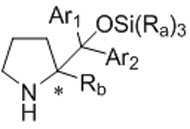
상기 식에서:Where:
*는 (R)- 또는 (S)-배열을 갖는 키랄 탄소이고;* Is a chiral carbon with (R)-or (S)-configuration;
Ar1 및 Ar2 각각은 독립적으로 C6-10 아릴이고, 이 아릴은 C1-6 알킬 및 C1-6 할로알킬로부터 독립적으로 선택된 1, 2, 3, 또는 4개의 그룹에 의해 임의로 치환되고;Each of Ar 1 and Ar 2 is independently C 6-10 aryl, which aryl is optionally substituted by 1, 2, 3, or 4 groups independently selected from C 1-6 alkyl and C 1-6 haloalkyl; ;
각각의 Ra는 C1-6 알킬로부터 독립적으로 선택되고;Each R a is independently selected from C 1-6 alkyl;
Rb은 H, C1-6 알킬, 및 C1-6 할로알킬로부터 선택된다.R b is selected from H, C 1-6 alkyl, and C 1-6 haloalkyl.
일부 구체예에서, Ar1 및 Ar2 각각은 독립적으로 페닐이고, 이 페닐은 메틸 및 트리플루오로메틸로부터 독립적으로 선택된 1, 2, 3, 또는 4개의 그룹에 의해 임의로 치환되고; 각각의 Ra는 메틸, 에틸, 또는 t-부틸로부터 독립적으로 선택되고; Rb는 H이다.In some embodiments, Ar 1 and Ar 2 are each independently phenyl, which phenyl is optionally substituted by 1, 2, 3, or 4 groups independently selected from methyl and trifluoromethyl; Each R a is independently selected from methyl, ethyl, or t-butyl; R b is H.
비대칭 아자-마이클 부가 방법의 일부 구체예에서, 키랄 아민은 프롤린, 프롤린아미드, 프롤릴-L-류신, 프롤릴-L-알라닌, 프롤릴글리신, 프롤릴-L-페닐알라닌, 디페닐피롤리딘, 디벤질피롤리딘, N-(1-메틸에틸)-피롤리딘카복사미드, 2-(아닐리노메틸)피롤리딘, 2-[비스(3,5-디메틸페닐)메틸]피롤리딘, 디페닐(피롤리딘-2-일)메탄올, 프롤리놀, 4-티아졸리딘카복실산, 트랜스-3-히드록시프롤린, 트랜스-4-히드록시프롤린, 4-벤질-1-메틸-이미다졸리딘-2-카복실산, 1-메틸-4-페닐-이미다졸리딘-2-카복실산, 4,5-옥타히드로-벤조이미다졸-2-카복실산, 4,5-디페닐-이미다졸리딘-2-카복실산, N1-메틸-3-페닐프로판-1,2-디아민, 1,2-디페닐에탄디아민, 1-메틸-4-(1-메틸-1H-인돌-3-일메틸)-이미다졸리딘-2-카복실산, 4-벤질-1-메틸-이미다졸리딘-2-카복실산, 1,2-시클로헥산디아민, 2-페닐-티아졸리딘-4-카복실산, tert-류신 메틸 에스테르, 5-벤질-2,2,3-트리메틸-이미다졸린-4-온, 메틸 프롤리네이트, 4,5-디페닐이미다졸리딘, 2-시클로헥실-4,5-디페닐이미다졸리딘, 2-{비스-[3,5-비스(트리플루오로메틸)페닐]-트리메틸실라닐옥시-메틸}-피롤리딘, 2-{비스-[3,5- 디메틸페닐]-트리메틸실라닐옥시-메틸}-피롤리딘, 2-{디페닐-트리메틸실라닐옥시-메틸}-피롤리딘, 2-{비스[나프트-2-일]-트리메틸실라닐옥시-메틸}-피롤리딘, 2-{tert-부틸디메틸실릴옥시-디페닐-메틸}-피롤리딘, 2-{비스-[3,5-비스(트리플루오로메틸)페닐]-트리에틸실라닐옥시-메틸}-피롤리딘, 및 2-{비스-[3,5-비스(트리플루오로메틸)페닐]-에틸-디메틸실릴옥시-메틸}-피롤리딘로부터 선택된 화합물의 (R)- 또는 (S)-거울상이성질체이고; 여기서, (R)- 또는 (S)-배열은 화합물 내의 NH 그룹에 인접한 탄소에서이다.In some embodiments of the asymmetric aza-michael addition method, the chiral amine is selected from proline, prolineamide, prolyl-L-leucine, prolyl-L-alanine, prolylglycine, prolyl-L-phenylalanine, diphenylpyrrolidine. , Dibenzylpyrrolidine, N- (1-methylethyl) -pyrrolidinecarboxamide, 2- (anilinomethyl) pyrrolidine, 2- [bis (3,5-dimethylphenyl) methyl] pyrrolidine , Diphenyl (pyrrolidin-2-yl) methanol, prolinol, 4-thiazolidinecarboxylic acid, trans-3-hydroxyproline, trans-4-hydroxyproline, 4-benzyl-1-methyl-imi Dazolidine-2-carboxylic acid, 1-methyl-4-phenyl-imidazolidine-2-carboxylic acid, 4,5-octahydro-benzoimidazole-2-carboxylic acid, 4,5-diphenyl-imidazoli Dean-2-carboxylic acid, N1-methyl-3-phenylpropane-1,2-diamine, 1,2-diphenylethanediamine, 1-methyl-4- (1-methyl-1H-indol-3-ylmethyl) Imidazolidine-2-carboxylic acid, 4-benzyl-1-methyl-imidazolidine-2-carboxylic acid, 1,2-cyclohexanediamine, 2-phenyl- Azolidine-4-carboxylic acid, tert-leucine methyl ester, 5-benzyl-2,2,3-trimethyl-imidazolin-4-one, methyl prolinate, 4,5-diphenylimidazolidine, 2-cyclohexyl-4,5-diphenylimidazolidine, 2- {bis- [3,5-bis (trifluoromethyl) phenyl] -trimethylsilanyloxy-methyl} -pyrrolidine, 2- {Bis- [3,5-dimethylphenyl] -trimethylsilanyloxy-methyl} -pyrrolidine, 2- {diphenyl-trimethylsilanyloxy-methyl} -pyrrolidine, 2- {bis [naphth- 2-yl] -trimethylsilanyloxy-methyl} -pyrrolidine, 2- {tert-butyldimethylsilyloxy-diphenyl-methyl} -pyrrolidine, 2- {bis- [3,5-bis (tri Fluoromethyl) phenyl] -triethylsilanyloxy-methyl} -pyrrolidine, and 2- {bis- [3,5-bis (trifluoromethyl) phenyl] -ethyl-dimethylsilyloxy-methyl}- (R)-or (S) -enantiomer of a compound selected from pyrrolidines; Wherein the (R)-or (S) -configuration is at the carbon adjacent to the NH group in the compound.
전술한 구체예의 일부에서, 키랄 아민은 (R)-거울상이성질체이다.In some of the foregoing embodiments, the chiral amine is the (R) -enantiomer.
비대칭 아자-마이클 부가 방법의 일부 구체예에서, 키랄 아민은 하기 화합물 중의 하나로부터 선택된다:In some embodiments of the asymmetric aza-michael addition method, the chiral amine is selected from one of the following compounds:

일부 구체예에서, 거울상이성질체 잉여는 약 85% 내지 약 95%. 일부 구체예에서, 거울상이성질체 잉여는 약 10%, 약 20%, 약 30%, 약 40%, 약 50%, 약 60%, 약 70%, 약 80%, 약 90%, 약 95%, 약 96%, 약 97%, 약 98%, 약 99%, 약 99.1%, 약 99.2%, 약 99.3%, 약 99.4%, 약 99.5%, 약 99.6%, 약 99.7%, 약 99.8%, 약 99.9%, 또는 약 99.99% 이상이다.In some embodiments, the enantiomeric excess is about 85% to about 95%. In some embodiments, the enantiomeric surplus is about 10%, about 20%, about 30%, about 40%, about 50%, about 60%, about 70%, about 80%, about 90%, about 95%, about 96%, about 97%, about 98%, about 99%, about 99.1%, about 99.2%, about 99.3%, about 99.4%, about 99.5%, about 99.6%, about 99.7%, about 99.8%, about 99.9% Or about 99.99% or more.
일부 구체예에서, 본 발명은 화학식 I의 화합물의 거울상이성질체 잉여의 (R)- 또는 (S)-거울상이성질체를 포함하는 조성물을 제공한다:In some embodiments, the present invention provides a composition comprising an enantiomeric excess of the (R)-or (S) -enantiomer of a compound of Formula (I):
[화학식 I][Formula I]

상기 식에서:Where:
*는 키랄 탄소를 나타내고;* Represents chiral carbon;
R1은 C3-7 시클로알킬, C1-6 알킬, 및 C1-6 플루오로알킬로부터 선택되고; R 1 is selected from C 3-7 cycloalkyl, C 1-6 alkyl, and C 1-6 fluoroalkyl;
R2는 -C(=O)-NH2, -C(=O)O-R3, -C(=O)OH, 및 -C(=O)H로부터 선택되고;R 2 is selected from —C (═O) —NH 2 , —C (═O) OR 3 , —C (═O) OH, and —C (═O) H;
R3은 C1-4 알킬 또는 C1-4 플루오로알킬로부터 선택되고;R 3 is selected from C 1-4 alkyl or C 1-4 fluoroalkyl;
P1은 보호 그룹이다.P 1 is a protection group.
일부 구체예에서, P1는 -CH2OC(=O)C(CH3)3 또는 -CH2OCH2CH2Si(CH3)3이다. 일부 구체예에서, R1은 시클로펜틸이다.In some embodiments, P 1 is —CH 2 OC (═O) C (CH 3 ) 3 or -CH 2 OCH 2 CH 2 Si (CH 3 ) 3 . In some embodiments, R 1 is cyclopentyl.
다른 구체예에서, 본 발명은 화학식 Ⅸ의 화합물의 거울상이성질체 잉여의 (R)- 또는 (S)-거울상이성질체를 포함하는 조성물을 제공한다:In another embodiment, the present invention provides a composition comprising an enantiomeric excess of the (R)-or (S) -enantiomer of the compound of formula (VII):
[화학식 Ⅸ][Formula Ⅸ]
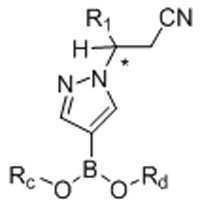
상기 식에서:Where:
*는 키랄 탄소를 나타내고;* Represents chiral carbon;
R1은 C3-7 시클로알킬, C1-6 알킬, 및 C1-6 플루오로알킬로부터 선택되고;R 1 is selected from C 3-7 cycloalkyl, C 1-6 alkyl, and C 1-6 fluoroalkyl;
Rc 및 Rd 각각은 독립적으로 C1 -6 알킬이거나; 또는R c and R d each independently represent a C 1 -6 alkyl; or
Rc 및 Rd는, 이들이 부착되는 산소 원자 및 이 산소 원자가 부착되는 붕소 원자와 함께, 5- 내지 6-원 헤테로시클릭 고리를 형성하고, 이 고리는 1, 2, 3, 또는 4개의 C1-4 알킬 그룹으로 임의로 치환된다.R c and R d together with the oxygen atom to which they are attached and the boron atom to which the oxygen atom is attached form a 5- to 6-membered heterocyclic ring, which ring is 1, 2, 3, or 4 C Optionally substituted with 1-4 alkyl groups.
일부 구체예에서, R1은 시클로펜틸이다.In some embodiments, R 1 is cyclopentyl.
화학식 I 또는 Ⅵ의 알데히드 중간체의 니트릴 화합물로의 전환 방법Process for conversion of aldehyde intermediate of formula (I) or (VI) to nitrile compound
또 다른 측면에서, 본 발명은 니트릴 화합물을 화학식 Id의 화합물로부터 제조하는 방법을 제공한다. 따라서, 일부 구체예에서, 본 발명은 화학식 Id의 화합물을 암모니아 또는 수산화암모늄 및 요오드로 처리하여 화학식 Ia의 화합물을 형성하는 것을 포함하는 방법을 제공한다:In another aspect, the present invention provides a method for preparing a nitrile compound from a compound of formula (Id). Thus, in some embodiments, the present invention provides a method comprising treating a compound of formula Id with ammonia or ammonium hydroxide and iodine to form a compound of formula Ia:
[화학식 Id]Formula Id

[화학식 Ia]Formula Ia
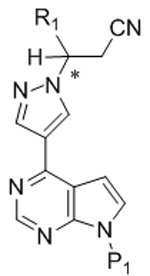
상기 식에서:Where:
*는 키랄 탄소를 나타내고;* Represents chiral carbon;
R1은 C3-7 시클로알킬, C1-6 알킬, 및 C1-6 플루오로알킬로부터 선택되고;R 1 is selected from C 3-7 cycloalkyl, C 1-6 alkyl, and C 1-6 fluoroalkyl;
P1은 보호 그룹이다.P 1 is a protection group.
일부 구체예에서, 상기 처리는 화학식 I의 키랄 알데히드를 과잉량의 수성 암모늄 (NH4OH) 및 화학양론량의 요오드 (I2)로 유기 용매, 예컨대 테트라히드로푸란 (THF)에서, 실온에서 처리하여 달성된다. 일부 구체예에서, 반응은 약 1 내지 약 2시간 내에 실온에서 완료된다. 키랄 알데히드의 키랄성은 그와 같은 반응 조건 하에서 그대로 유지된다. 키랄 니트릴의 키랄성은 키랄 HPLC 분석에 의해 점검될 수 있다.In some embodiments, the treatment comprises treating the chiral aldehyde of Formula I with excess aqueous ammonium (NH 4 OH) and stoichiometric amount of iodine (I 2 ) in an organic solvent such as tetrahydrofuran (THF) at room temperature. Is achieved. In some embodiments, the reaction is completed at room temperature within about 1 to about 2 hours. The chirality of the chiral aldehyde is maintained under such reaction conditions. The chirality of the chiral nitrile can be checked by chiral HPLC analysis.
일부 구체예에서, 본 방법은 또한, 탈보호 조건 하에서 화학식 Ic의 화합물을 반응시켜 화학식 Ⅲ의 화합물을 형성하는 것을 포함한다:In some embodiments, the method also includes reacting the compound of Formula Ic under deprotection conditions to form the compound of Formula III:
[화학식 Ⅲ][Formula III]

상기 식에서:Where:
*는 키랄 탄소를 나타내고;* Represents chiral carbon;
R1은 C3-7 시클로알킬, C1-6 알킬, 및 C1-6 플루오로알킬로부터 선택되고;R 1 is selected from C 3-7 cycloalkyl, C 1-6 alkyl, and C 1-6 fluoroalkyl;
P1은 보호 그룹이다.P 1 is a protection group.
적합한 P1 그룹은 상기에 기재된 것을 비제한적으로 포함한다.Suitable P 1 groups include, but are not limited to those described above.
일부 구체예에서, 본 방법은 또한, 화학식 Ⅲ의 화합물을 인산과 반응시켜 화학식 Ⅲ의 화합물의 포스페이트 염을 형성하는 것을 포함한다.In some embodiments, the method also includes reacting the compound of Formula III with phosphoric acid to form a phosphate salt of the compound of Formula III.
추가 측면에서, 본 발명은 화학식 Ⅵ의 화합물로부터 니트릴 화합물을 제조하는 방법을 제공한다. 따라서, 일부 구체예에서, 본 발명은 화학식 Ⅵ의 화합물을 암모니아 또는 수산화암모늄 및 요오드로 처리하여 화학식 Ⅷ의 화합물을 형성하는 것을 포함하는 방법을 제공한다:In a further aspect, the present invention provides a method for preparing a nitrile compound from the compound of formula VI. Thus, in some embodiments, the present invention provides a process comprising treating a compound of formula VI with ammonia or ammonium hydroxide and iodine to form a compound of formula VII:
[화학식 Ⅵ][Formula VI]
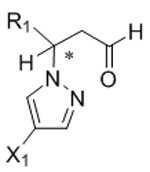
[화학식 Ⅷ][Formula Ⅷ]

상기 식에서:Where:
*는 키랄 탄소를 나타내고;* Represents chiral carbon;
R1은 C3-7 시클로알킬, C1-6 알킬, 및 C1-6 플루오로알킬로부터 선택되고;R 1 is selected from C 3-7 cycloalkyl, C 1-6 alkyl, and C 1-6 fluoroalkyl;
X1은 할로겐이다.X 1 is halogen.
일부 구체예에서, 본 방법은 또한, 화학식 Ⅷ의 화합물을 화학식 B-1의 화합물과 반응시켜 화학식 Ⅸ의 화합물을 형성하는 것을 포함한다:In some embodiments, the method also includes reacting the compound of Formula VII with the compound of Formula B-1 to form a compound of Formula VII:
[화학식 B-1][Formula B-1]
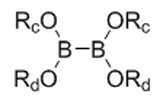
[화학식 Ⅸ][Formula Ⅸ]
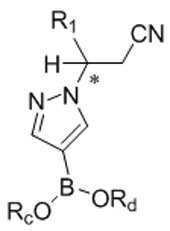
상기 식에서:Where:
*는 키랄 탄소를 나타내고;* Represents chiral carbon;
R1은 C3-7 시클로알킬, C1-6 알킬, 및 C1-6 플루오로알킬로부터 선택되고;R 1 is selected from C 3-7 cycloalkyl, C 1-6 alkyl, and C 1-6 fluoroalkyl;
Rc 및 Rd 각각은 H 및 C1-6 알킬로부터 독립적으로 선택되거나; 또는Each of R c and R d is independently selected from H and C 1-6 alkyl; or
Rc 및 Rd는, 이들이 부착되는 산소 원자 및 이 산소 원자가 부착되는 붕소 원자와 함께, 5- 내지 6-원 헤테로시클릭 고리를 형성하고, 이 고리는 1, 2, 3, 또는 4개의 C1-4 알킬 그룹으로 임의 치환된다. R c and R d together with the oxygen atom to which they are attached and the boron atom to which the oxygen atom is attached form a 5- to 6-membered heterocyclic ring, which ring is 1, 2, 3, or 4 C Optionally substituted with 1-4 alkyl group.
일부 구체예에서, 화학식 B-1의 화합물은 4,4,5,5,4',4',5',5'-옥타메틸-[2,2']비스[1,3,2-디옥사보롤라닐]이다.In some embodiments, the compound of formula B-1 is 4,4,5,5,4 ', 4', 5 ', 5'-octamethyl- [2,2'] bis [1,3,2-di Oxaborolanyl].
추가 구체예에서, 본 방법은 또한, 팔라듐 촉매 및 염기의 존재하에서 화학식 Ⅸ의 화합물을 화학식 X의 화합물과 반응시켜 화학식 Ic의 화합물을 형성하는 것을 포함한다:In a further embodiment, the method also includes reacting a compound of Formula (X) with a compound of Formula (X) in the presence of a palladium catalyst and a base to form a compound of Formula (Ic):
[화학식 X][Formula X]

[화학식 Ia]Formula Ia

상기 식에서: Where:
*는 키랄 탄소를 나타내고;* Represents chiral carbon;
R1은 C3-7 시클로알킬, C1-6 알킬, 및 C1-6 플루오로알킬로부터 선택되고; R 1 is selected from C 3-7 cycloalkyl, C 1-6 alkyl, and C 1-6 fluoroalkyl;
Rc 및 Rd 각각은 H 및 C1-6 알킬로부터 독립적으로 선택되거나; 또는Each of R c and R d is independently selected from H and C 1-6 alkyl; or
Rc 및 Rd는, 이들이 부착되는 산소 원자 및 이 산소 원자가 부착되는 붕소 원자와 함께, 5- 내지 6-원 헤테로시클릭 고리를 형성하고, 이 고리는 1, 2, 3, 또는 4개의 C1-4 알킬 그룹으로 임의로 치환되고; X2는 토실레이트 그룹, 트리플레이트 그룹, 아이오도, 클로로, 또는 브로모이고;R c and R d together with the oxygen atom to which they are attached and the boron atom to which the oxygen atom is attached form a 5- to 6-membered heterocyclic ring, which ring is 1, 2, 3, or 4 C Optionally substituted with 1-4 alkyl group; X 2 is a tosylate group, a triflate group, iodo, chloro, or bromo;
P1은 보호 그룹이다.P 1 is a protection group.
추가 구체예에서, 본 방법은 또한, 팔라듐 촉매, 염기, 및 용매의 존재하에서 화학식 Ⅸ의 화합물을 화학식 XI의 화합물과 반응시켜 화학식 Ⅲ의 화합물을 형성하는 것을 포함한다:In a further embodiment, the method also includes reacting a compound of Formula (VII) with a compound of Formula (XI) in the presence of a palladium catalyst, a base, and a solvent to form a compound of Formula (III):
[화학식 XI](XI)

[화학식 Ⅲ][Formula III]

상기 식에서:Where:
*는 키랄 탄소를 나타내고;* Represents chiral carbon;
R1은 C3-7 시클로알킬, C1-6 알킬, 및 C1-6 플루오로알킬로부터 선택되고; R 1 is selected from C 3-7 cycloalkyl, C 1-6 alkyl, and C 1-6 fluoroalkyl;
Rc 및 Rd 각각은 H 및 C1 -6 알킬로부터 독립적으로 선택되거나; 또는R c and R d each is selected from H and C 1 -6 independently selected from alkyl; or
Rc 및 Rd는, 이들이 부착되는 산소 원자 및 이 산소 원자가 부착되는 붕소 원자와 함께, 5- 내지 6-원 헤테로시클릭 고리를 형성하고, 이 고리는 1, 2, 3, 또는 4개의 C1-4 알킬 그룹으로 임의로 치환되고; X2는 토실레이트 그룹, 트리플레이트 그룹, 아이오도, 클로로, 또는 브로모.R c and R d together with the oxygen atom to which they are attached and the boron atom to which the oxygen atom is attached form a 5- to 6-membered heterocyclic ring, which ring is 1, 2, 3, or 4 C Optionally substituted with 1-4 alkyl group; X 2 is a tosylate group, a triflate group, iodo, chloro, or bromo.
일부 구체예에서, X2는 브로모, 아이오도, 또는 클로로이다. 일부 구체예에서, X2는 클로로이다.In some embodiments, X 2 is bromo, iodo, or chloro. In some embodiments, X 2 is chloro.
스즈끼 커플링 반응은 수많은 팔라듐(0) 및 팔라듐(Ⅱ) 촉매를 사용하여 개시되고 본 기술분야에 공지된 조건 하에서 수행될 수 있다 (참고, 예, Miyaura and Suzuki, Chem. Rev. 1995 , 95, 2457-2483, 이는 그 전체가 본 명세서에 통합된다). 일부 구체예에서, 팔라듐 촉매는 Pd(PPh3)4 및 Pd(dppf)2Cl2이다. 일부 구체예에서, 팔라듐 촉매는 테트라키스(트리페닐포스핀)팔라듐(0) 또는 테트라키스(트리(o-톨릴)포스핀)팔라듐(0)이다. 일부 구체예에서, 팔라듐 촉매는 테트라키스(트리페닐포스핀)팔라듐(0)이다.Suzuki coupling reactions can be initiated using a number of palladium (0) and palladium (II) catalysts and carried out under conditions known in the art (see, eg, Miyaura and Suzuki , Chem. Rev. 1995 , 95 , 2457-2483, which is hereby incorporated in its entirety). In some embodiments, the palladium catalyst is Pd (PPh 3 ) 4 and Pd (dppf) 2 Cl 2 . In some embodiments, the palladium catalyst is tetrakis (triphenylphosphine) palladium (0) or tetrakis (tri ( o -tolyl) phosphine) palladium (0). In some embodiments, the palladium catalyst is tetrakis (triphenylphosphine) palladium (0).
일부 구체예에서, 팔라듐 촉매 부하는 약 1×10⁻⁴ 내지 약 0.1 당량이다. 일부 구체예에서, 팔라듐 촉매 부하는 약 0.0010 내지 약 0.0015 당량이다. 일부 구체예에서, 화학식 X 또는 XI의 화합물 대 화학식 Ⅸ의 화합물의 화학양론 비는 약 1:1.05 내지 약 1:1.35이다. In some embodiments, the palladium catalyst load is about 1 × 10 −4 to about 0.1 equivalents. In some embodiments, the palladium catalyst load is about 0.0010 to about 0.0015 equivalents. In some embodiments, the stoichiometric ratio of the compound of Formula X or XI to the compound of Formula VII is about 1: 1.05 to about 1: 1.35.
일부 구체예에서, 용매는 물 및 유기 용매를 포함한다. 일부 구체예에서, 유기 용매는 1,4-디옥산, 1-부탄올, 1,2-디메톡시에탄 (DME), 2-프로판올, 톨루엔 또는 에탄올, 또는 이들의 조합이다. 일부 구체예에서, 유기 용매는 DME를 포함한다. 일부 구체예에서, 유기 용매는 DMF를 포함한다. In some embodiments, the solvent comprises water and an organic solvent. In some embodiments, the organic solvent is 1,4-dioxane, 1-butanol, 1,2-dimethoxyethane (DME), 2-propanol, toluene or ethanol, or a combination thereof. In some embodiments, the organic solvent comprises DME. In some embodiments, the organic solvent comprises DMF.
일부 구체예에서, 염기는 무기 염기이다. 일부 구체예에서, 염기는 유기 염기이다. 일부 구체예에서, 염기는 알칼리 금속 카보네이트이다. 일부 구체예에서, 염기는 탄산칼륨 (K2CO3)이다. 일부 구체예에서, 2 내지 5 당량의 염기 (예, K2CO3)가 사용된다. In some embodiments, the base is an inorganic base. In some embodiments, the base is an organic base. In some embodiments, the base is an alkali metal carbonate. In some embodiments, the base is potassium carbonate (K 2 CO 3 ). In some embodiments, 2 to 5 equivalents of base (eg, K 2 CO 3 ) are used.
일부 구체예에서, 스즈끼 커플링 반응은 약 80 내지 약 100℃의 온도에서 수행된다. 일부 구체예에서, 반응은 2 내지 12시간 동안에 수행된다. 일부 구체예에서, 화학식 XⅡ의 화합물은 스즈끼 커플링 반응 혼합물의 수성 워크업으로부터 임의로 분리될 수 있고 또는 직접 사용될 수 있다. In some embodiments, the Suzuki coupling reaction is carried out at a temperature of about 80 to about 100 ° C. In some embodiments, the reaction is carried out for 2 to 12 hours. In some embodiments, the compound of formula XII may be optionally separated from the aqueous work up of the Suzuki coupling reaction mixture or may be used directly.
적합한 P2 보호 그룹은 하기에 기재된 보호 그룹을 비제한적으로 포함한다: Wuts and Greene, Protective Groups in Organic Synthesis, 4th ed., John Wiley & Sons: New Jersey, 페이지 696-887 (및, 특히, 페이지 872-887) (2007), 이는 그 전체가 참고로 본 명세서에 통합된다. Suitable P 2 protecting groups include, but are not limited to, the protecting groups described below: Wuts and Greene, Protective Groups in Organic Synthesis, 4th ed., John Wiley & Sons: New Jersey, pages 696-887 (and in particular, pages 872-887 (2007), which is hereby incorporated by reference in its entirety.
다른 구체예에서, 본 방법은 또한, 탈보호 조건 하에서 화학식 Ia의 화합물을 반응시켜서 화학식 Ⅲ의 화합물을 형성하는 것을 포함한다:In another embodiment, the method also includes reacting the compound of Formula Ia under deprotection conditions to form the compound of Formula III:
[화학식 Ⅲ][Formula III]
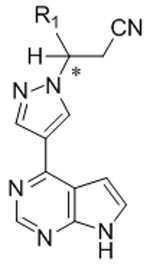
*는 키랄 탄소를 나타내고;* Represents chiral carbon;
R1은 C3-7 시클로알킬, C1-6 알킬, 및 C1-6 플루오로알킬로부터 선택되고;R 1 is selected from C 3-7 cycloalkyl, C 1-6 alkyl, and C 1-6 fluoroalkyl;
P1은 보호 그룹이다.P 1 is a protection group.
적합한 P1 그룹 및 탈보호 방법은 상기에 기재된 것을 비제한적으로 포함한다. Suitable P 1 groups and deprotection methods include, but are not limited to those described above.
일부 구체예에서, 본 발명은 또한, 화학식 Ⅲ의 화합물을 인산과 반응시켜 화학식 Ⅲ의 화합물의 포스페이트 염을 형성하는 것을 포함한다.In some embodiments, the invention also includes reacting a compound of Formula III with phosphoric acid to form a phosphate salt of the compound of Formula III.
아자-마이클 부가 방법의 개시물질Initiators of Aza-Michael Addition Methods
화학식 Ⅳ의 화합물은 아래 반응도식 4에 기재된 것과 유사한 방법에 의해 형성될 수 있다. 화학식 V의 3-치환된 아실알데히드는 반응도식 4에 나타낸 바와 같이 차례로 제조될 수 있다. 따라서, 전형적인 위티그 조건 하의 화학식 C-4의 알데히드의 처리 (예, (트리페닐포스포르아닐리덴)아세트알데히드와의 반응)은 화학식 V의 상응하는 화합물을 제공한다.Compounds of formula (IV) may be formed by methods analogous to those described in Scheme 4 below. The 3-substituted acylaldehydes of Formula (V) may be prepared in turn as shown in Scheme 4. Thus, treatment of the aldehyde of formula C-4 (e.g., reaction with (triphenylphosphoranilidene) acetaldehyde) under typical Witig conditions provides the corresponding compound of formula V.
반응도식Scheme 4 4
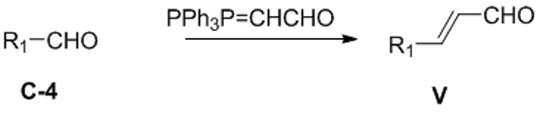
Ⅲ. 피라졸 중간체의 합성 및 라세미 분할III. Synthesis and Racemic Splitting of Pyrazole Intermediates
키랄 화학식 Ⅲ의 화합물은 화학식 Ⅸ의 보호된 피라졸 보레이트 유도체의 라세미체의 키랄 칼럼 분리 (예컨대, 키랄 분취 크로마토그래피), 그 다음 Ⅸ의 키랄 중간체와 화학식 XI의 비보호된 피롤로[2,3-d] 피리미딘과의 스즈끼 커플링 반응 (반응도식 5)에 의해 생성될 수 있다. 대안적으로, 화학식 (S)-Ⅸ 또는 (R)-Ⅸ의 키랄 중간체는 스즈끼 커플링 조건 하에서 화학식 X의 보호된 피롤로[2,3-d]피리미딘과 반응시킨, 그 다음, 탈보호하여 P1 보호 그룹을 제거하고, 이로써 키랄 화학식 Ⅲ의 화합물을 얻을 수 있다 (반응도식 5). 화학식 Ⅸ의 라세미 치환된 피라졸 보레이트 유도체는 화학식 XV의 피라졸 붕소 유도체와 화학식 D-1의 마이클 수용체 사이의 마이클 부가 반응을 통해 생성될 수 있다 (반응도식 5). Chiral compounds of formula III are subjected to chiral column separation of racemates of the protected pyrazole borate derivatives of formula (VIII) (e.g., chiral preparative chromatography), followed by chiral intermediates of VIII and unprotected pyrrolo [2,3] -d] by the Suzuki coupling reaction with pyrimidine (Scheme 5). Alternatively, the chiral intermediate of formula (S) -VII or (R) -VII is reacted with a protected pyrrolo [2,3-d] pyrimidine of formula (X) under Suzuki coupling conditions, followed by deprotection To remove the P 1 protecting group, whereby a chiral compound of formula III can be obtained (Scheme 5). The racemic substituted pyrazole borate derivatives of formula (VII) may be produced via Michael addition reactions between the pyrazole boron derivatives of formula XV and the Michael acceptor of formula D-1 (Scheme 5).
반응도식 5 Scheme 5

따라서, 일부 구체예에서, 본 발명은 화학식 Ⅸ의 화합물의 거울상이성질체 잉여의 (R)- 또는 (S)-거울상이성질체를 포함하는 조성물을 제조하는 방법을 제공하고, 이 방법은 화학식 Ⅸ의 화합물의 라세미체를 포함하는 조성물을 이동상을 사용하는 키랄 크로마토그래피 유닛에 통과시키고, 화학식 Ⅸ의 화합물의 거울상이성질체 잉여의 (R)- 또는 (S)-거울상이성질체를 포함하는 조성물을 수집하는 것을 포함한다 :Thus, in some embodiments, the present invention provides a method for preparing a composition comprising an enantiomeric excess of the (R)-or (S) -enantiomer of the compound of formula (VII), wherein the method comprises: Passing the composition comprising the racemate through a chiral chromatography unit using a mobile phase and collecting a composition comprising an enantiomeric excess of the (R)-or (S) -enantiomer of the compound of formula (VII). :
[화학식 Ⅸ][Formula Ⅸ]

상기 식에서:Where:
*는 키랄 탄소를 나타내고;* Represents chiral carbon;
R1은 C3-7 시클로알킬, C1-6 알킬, 및 C1-6 플루오로알킬로부터 선택되고; R 1 is selected from C 3-7 cycloalkyl, C 1-6 alkyl, and C 1-6 fluoroalkyl;
Rc 및 Rd 각각은 독립적으로 C1 -6 알킬이거나; 또는R c and R d each independently represent a C 1 -6 alkyl; or
Rc 및 Rd는, 이들이 부착되는 산소 원자 및 이 산소 원자가 부착되는 붕소 원자와 함께, 5- 내지 6-원 헤테로시클릭 고리를 형성하고, 이 고리는 1, 2, 3, 또는 4개의 C1-4 알킬 그룹으로 임의로 치환된다.R c and R d together with the oxygen atom to which they are attached and the boron atom to which the oxygen atom is attached form a 5- to 6-membered heterocyclic ring, which ring is 1, 2, 3, or 4 C Optionally substituted with 1-4 alkyl groups.
일부 구체예에서, 크로마토그래피는 균일용매식 또는 구배식으로 키랄 정지상 및 이동상을 사용하여 배치식 또는 연속식으로 수행된다.In some embodiments, the chromatography is performed batchwise or continuously using chiral stationary and mobile phases in homosolvent or gradient.
일부 구체예에서, 키랄 크로마토그래피 유닛은 키랄 정지상으로 채워져 있는 키람 칼럼이 구비되어 있는 분취 고성능 액체 크로마토그래피 (HPLC) 시스템이다.. 일부 구체예에서, 키랄 칼럼은 실리카겔 ("Chiralpak® IA"로서 Daicel로부터 이용가능) 상에 고정된 아밀로스 트리스(3,5-디메틸페닐 카바메이트를 포함하는 키랄 정지상에 채워져 있다. 일부 구체예에서, 키랄 칼럼 실리카겔 ("Chiralcel® ChiralcelOD"로서 Daicel로부터 이용가능) 상에 코팅된 셀룰로오스 트리스(3,5-디메틸페닐 카바메이트)를 포함하는 키랄 정지상에 채워져 있다. 일부 구체예에서, 크로마토그래피 유닛은 연속 크로마토그래피 방법, 예컨대 유사이동층 (SMB) 크로마토그래피 또는 Varicol 방법이고, 이는 키랄 정지상으로 채워져 있는 8개의 칼럼 세트 각각이 구비된 유닛을 사용한다. 일부 구체예에서 상기 유닛은 3 내지 12개의 칼럼, 또는 5 내지 10개의 칼럼, 또는 5 내지 8개의 칼럼이 구비되어 있고, 각 칼럼은, 키랄 정지상, 일부 예에서, 동일한 키랄 정지상이 채워져 있다. 일부 구체예에서, 칼럼은 실리카겔 ("Chiralpak® IA으로서 Daicel로부터 이용가능) 상에 고정된 아밀로스 트리스(3,5-디메틸페닐 카바메이트)로 만들어진 키랄 정지상에 채워져 있다. 일부 구체예에서, 칼럼은 실리카겔 ("Chiralcel® OD"로서 Daicel로부터 이용가능) 상에 코팅된 셀룰로오스 트리스(3,5-디메틸페닐 카바메이트)로 만들어진 키랄 정지상이 채워져 있다. 일부 구체예에서, 키랄 정지상은 셀룰로오스 변형된 키랄 정지상 (CSP, Chiral Technologies)이다. 일부 구체예에서, 키랄 정지상은 4-(3,5-디니트로 벤즈아미도)테트라히드로펜안트렌 ("(S,S) Whelk-O®1"로서 Regis Technologies로부터 이용가능)로 코팅된 실리카겔 기반 정지상이다. 일부 구체예에서, 이동상은 에탄올 및 헥산을 포함한다. 일부 구체예에서, 이동상은 약 1:9 비의 에탄올 대 헥산을 포함한다. 일부 구체예에서, 헥산은 헵탄, n-헵탄, 시클로헥산 또는 메틸시클로헥산으로 치환된다. 일부 구체예에서, 에탄올은 용적으로 약 10% 내지 약 100%, 또는 약 10% 내지 약 25%, 또는 약 15% 에탄올의 양으로 존재한다. 일부 구체예에서, 이동상은 용적으로 약 15% 에탄올 및 약 85% 헥산을 포함한다. 일부 구체예에서, 이동상은 에탄올 및 헥산을 포함하고, 여기서, 에탄올은 약 25 용적% 내지 약 10 용적%의 양으로 존재한다. 일부 구체예에서, 이동상은 이소프로판올 및 헥산을 포함하고, 여기서, 이소프로판올은 약 25 용적% 내지 약 10 용적%의 양으로 존재한다. 일부 구체예에서, 헥산은 헵탄, n-헵탄, 시클로헥산 또는 메틸시클로헥산에 의해 치환된다. 일부 구체예에서, 이소프로판올은 용적으로 약 10% 내지 약 25%의 양으로 존재한다. 일부 구체예에서, 이동상은 메틸-tert-부틸 에테르 및 헥산을 포함한다. 일부 구체예에서, 핵산은 헵탄, n-헵탄, 시클로헥산 또는 메틸시클로헥산에 의해 치환된다. 일부 구체예에서, 메틸-tert-부틸 에테르는 용적으로 약 10% 내지 약 100%, 바람직하게는 약 50% 내지 약 100%, 및 가장 바람직하게는 약 90% 내지 약 100%의 양으로 존재한다. 일부 구체예에서, 이동상은 에틸 아세테이트 및 헥산을 포함한다. 일부 구체예에서, 헥산은 헵탄, n-헵탄, 시클로헥산 또는 메틸시클로헥산에 의해 치환된다. 일부 구체예에서, 에틸 아세테이트는 용적으로 약 10% 내지 약 100%, 약 50% 내지 약 100%, 또는 약 75% 의 양으로 존재한다. 일부 구체예에서, 이동상은 테트라히드로푸란 및 헥산을 포함한다. 일부 구체예에서, 헥산은 헵탄, n-헵탄, 시클로헥산 또는 메틸시클로헥산에 의해 치환된다. 일부 구체예에서, 테트라히드로푸란은 용적으로 약 10% 내지 약 100%, 약 10% 내지 약 50%, 또는 약 25%의 양으로 존재한다. 일부 구체예에서, 크로마토그래피 유닛은 실온에서 유지된다. 일부 구체예에서, 이동상은 약 1 mL/분 내지 약 20 mL/분의 유속으로 통과한다. 일부 구체예에서, 이동상은 약 1 mL/분의 유속으로 통과한다. 일부 구체예에서, 이동상은 약 18 mL/분의 유속으로 통과한다. 일부 구체예에서, 용리액은 자외선 (UV) 분광법으로 모니터된다. 일부 구체예에서, 용리액은 자외선 분광법으로 약 220 nm에서 모니터된다. 거울상이성질체 풍부 조성물을 함유하는 용리액의 부분은 수집은 UV 분광법에 의한 원하는 거울상이성질체의 용리의 검출에 의해 확인될 수 있다. 그 다음, 조성물의 % ee (거울상이성질체 잉여)의 측정은 분석 키랄 HPLC에 의해 측정될 수 있다.In some embodiments, the chiral chromatography unit is a preparative high performance liquid chromatography (HPLC) system equipped with a Chiram column filled with a chiral stationary phase. In some embodiments, the chiral column is Daicel as silica gel ("Chiralpak ® IA"). Filled with a chiral stationary phase comprising amylose tris (available from 3,5-dimethylphenyl carbamate.) In some embodiments, on a chiral column silica gel (available from Daicel as "Chiralcel ® ChiralcelOD") It is filled with a chiral stationary phase comprising coated cellulose tris (3,5-dimethylphenyl carbamate) In some embodiments, the chromatography unit is a continuous chromatography method, such as a pseudo mobile layer (SMB) chromatography or a Varicol method. This uses a unit with each of the eight column sets filled with chiral stationary phases. In an example the unit has 3 to 12 columns, or 5 to 10 columns, or 5 to 8 columns, each column being filled with a chiral stationary phase, in some instances, the same chiral stationary phase. The column is filled with a chiral stationary phase made of amylose tris (3,5-dimethylphenyl carbamate) immobilized on silica gel (available from Daicel as Chiralpak ® IA). In some embodiments, the column is silica gel (" Chiralcel ® OD "is filled with a chiral stationary phase made of a cellulose tris (3,5-dimethylphenyl carbamate) coated on a available from Daicel). in some embodiments, the chiral stationary phase is cellulose modified chiral stationary phase (CSP, Chiral Technologies) In some embodiments, the chiral stationary phase is obtained from Regis Technologies as 4- (3,5-dinitrobenzamido) tetrahydrophenanthrene ("(S, S) Whelk-O ® 1"). Silica gel based stationary phase coated in. In some embodiments, the mobile phase comprises ethanol and hexanes In some embodiments, the mobile phase comprises about 1: 9 ratio of ethanol to hexane. In some embodiments, hexane is substituted with heptane, n-heptane, cyclohexane or methylcyclohexane. In some embodiments, the ethanol is present in an amount of about 10% to about 100%, or about 10% to about 25%, or about 15% ethanol. In some embodiments, the mobile phase comprises about 15% ethanol and about 85% hexane in volume. In some embodiments, the mobile phase comprises ethanol and hexane, wherein the ethanol is present in an amount from about 25% by volume to about 10% by volume. In some embodiments, the mobile phase comprises isopropanol and hexanes, wherein the isopropanol is present in an amount from about 25% by volume to about 10% by volume. In some embodiments, hexane is substituted by heptane, n-heptane, cyclohexane or methylcyclohexane. In some embodiments, isopropanol is present in an amount of about 10% to about 25% by volume. In some embodiments, the mobile phase comprises methyl tert -butyl ether and hexanes. In some embodiments, the nucleic acid is substituted by heptane, n-heptane, cyclohexane or methylcyclohexane. In some embodiments, the methyl tert -butyl ether is present in an amount from about 10% to about 100%, preferably from about 50% to about 100%, and most preferably from about 90% to about 100%. . In some embodiments, the mobile phase comprises ethyl acetate and hexanes. In some embodiments, hexane is substituted by heptane, n-heptane, cyclohexane or methylcyclohexane. In some embodiments, the ethyl acetate is present in an amount of about 10% to about 100%, about 50% to about 100%, or about 75%. In some embodiments, the mobile phase comprises tetrahydrofuran and hexanes. In some embodiments, hexane is substituted by heptane, n-heptane, cyclohexane or methylcyclohexane. In some embodiments, tetrahydrofuran is present in an amount of about 10% to about 100%, about 10% to about 50%, or about 25%. In some embodiments, the chromatography unit is maintained at room temperature. In some embodiments, the mobile phase passes at a flow rate of about 1 mL / min to about 20 mL / min. In some embodiments, the mobile phase passes at a flow rate of about 1 mL / minute. In some embodiments, the mobile phase passes at a flow rate of about 18 mL / minute. In some embodiments, the eluent is monitored by ultraviolet (UV) spectroscopy. In some embodiments, the eluent is monitored at about 220 nm by ultraviolet spectroscopy. The portion of the eluent containing the enantiomer rich composition can be identified by detection of the elution of the desired enantiomer by UV spectroscopy. The determination of% ee (enantiomer surplus) of the composition can then be determined by analytical chiral HPLC.
일부 구체예에서, 사용된 크로마토그래피 방법은 배치 분취 크로마토그래피, 초임계 유체 크로마토그래피 (SFC), 사이클로젯(cyclojet) 방법, 염속 다중칼럼 크로마토그래피 방법, 유사이동층 방법, VaricolTM 방법, 또는 PowerFeed 방법이다.In some embodiments, the chromatography method used is batch preparative chromatography, supercritical fluid chromatography (SFC), cyclojet method, salt multicolumn chromatography method, pseudomobile layer method, Varicol ™ method, or PowerFeed. It is a way.
일부 구체예에서, 키랄 정지상은, 예를 들어, 가교결합에 의해 화학 결합 또는 불용화에 의해 불활성 담체 물질에 고정된 거울상이성질체 풍부한 분할제인 상호작용제를 포함한다. 적절한 불활성 담체 물질은 거대다공, 예를 들어 가교결합된 폴리스티렌, 폴리아실아미드, 폴리아실레이트, 알루미나, 카이에셀구르(kieselgur; 규조토), 쿼츠(quartz), 카올린, 마그네슘 옥사이드, 이산화티타륨 또는 실리카겔일 수 있다. 일부 구체예에서, 불활성 담체 물질은 실리카겔이다.In some embodiments, the chiral stationary phase comprises an interaction agent that is an enantiomer-rich splitting agent immobilized to an inert carrier material, for example, by crosslinking or by chemical bonding or insolubilization. Suitable inert carrier materials are macroporous, for example crosslinked polystyrene, polyacylamide, polyacylates, alumina, kieselgur (diatomaceous earth), quartz, kaolin, magnesium oxide, titanium dioxide or silica gel Can be. In some embodiments, the inert carrier material is silica gel.
일부 구체예에서, 키랄 정지상은 하기로부터 선택된 폴리사카라이드의 아밀로스 또는 셀룰로스 부류의 멤버이다: 셀룰로오스 페닐 카바메이트 유도체, 예컨대 셀룰로오스 트리스(3,5-디메틸페닐)카바메이트 ("Chiralcel® OD" 또는 "Chiralpak® IB"로서 Daicel Chemical Industries, Ltd. (Daicel)로부터 이용가능, 여기서, 상기 카바메이트 유도체는 셀룰로스 골격에 결합된다); 셀룰로오스 트리벤조에이트 유도체, 예컨대 셀룰로오스 트리 4-메틸벤조에이트 ("Chiralcel® OJ" 로서 Daicel로부터 이용가능); 셀룰로오스 트리신나메이트 ("Chiralcel® OK" 로서 Daicel로부터 이용가능); 아밀라제 페닐 및 벤질 카바메이트 유도체, 예컨대 아밀로스 트리스[(S)-α-메틸 벤질카바메이트] ("Chiralpak® AS"로서 Daicel로부터 이용가능); 아밀로스 트리스(3,5-디메틸페닐)카바메이트 ("Chiralpak® AD" 또는 "Chiralpak® IA"로서 Daicel로부터 이용가능, 여기서, 카바메이트 유도체는 아밀로스 골격에 결합된다); 아밀로스 3,4-치환된 페닐 카바메이트 또는 아밀로스 4-치환된 페닐-카바메이트; 및 아밀로스 트리신나메이트. 일부 구체예에서, 키랄 정지상은 Chiralpak® IA 또는 Chiralpak AD을 포함한다. 일부 구체예에서, 키랄 정지상은 Chiralcel® OD을 포함한다. 일부 구체예에서, 키랄 정지상은 하기이다: 퍼클상(Pirkle-phases) 패밀리의 맴버, 예컨대 페닐글리신의 3,5-디니트로벤조일 유도체 ("페닐글리신"로서 Regis Technologies Inc으로서 이용가능); 류신의,5-디니트로벤조일 유도체 ("류신(Leucine)"로서 Regis Technologies Inc로부터 이용가능); N-3,5-디니트로벤조일-3-아미노-3-페닐-2-(1,1-디메틸에틸)-프로파노에이트 ("β-GEM 1"로서 Regis Technologies Inc로부터 이용가능); 디메틸 N-3,5-디니트로벤조일-아미노-2,2-디메틸-4-펜테닐 포스포네이트 ("α-BURKE 2"로서 Regis Technologies Inc로부터 이용가능); 3-(3,5-디니트로벤즈아미도)-4-페닐-β-락탐 ("PIRKLE 1-J"로서 Regis Technologies Inc로부터 이용가능); 디페닐에틸렌디아민의 3,5-디니트로벤조일 유도체 ("ULMO"로서 Regis Technologies Inc로부터 이용가능); 4-(3,5-디니트로 벤즈아미도)테트라히드로펜안트렌 ("(S,S) Whelk-O® 1" 및 "(R,R) Whelk-O® 1" 또는 "(S,S) Whelk-O® 2" 및 "(R,R) Whelk-O®2"로서 Regis technologies Inc.로부터 이용가능); 1,2-디아미노시클로헥산의 3,5-디니트로-벤조일 유도체, ("DACH-DNB로서 Regis technologies Inc.로부터 이용가능). 일부 구체예에서, 키랄 정지상은 "(S,S) Whelk-O® 1" 또는 "(R,R) Whelk-O® 1을 포함한다.In some embodiments, the chiral stationary phase is a member of the amylose or cellulose class of polysaccharides selected from: cellulose phenyl carbamate derivatives such as cellulose tris (3,5-dimethylphenyl) carbamate ("Chiralcel ® OD" or " Chiralpak ® IB ", available from Daicel Chemical Industries, Ltd. (Daicel), wherein the carbamate derivative is bound to the cellulose backbone); Cellulose tribenzoate derivatives such as cellulose tri 4-methylbenzoate (available from Daicel as "Chiralcel ® OJ"); Cellulose tricinnamate (available from Daicel as "Chiralcel ® OK"); Amylase phenyl and benzyl carbamate derivatives such as amylose tris [(S) -α-methyl benzylcarbamate] (available from Daicel as "Chiralpak ® AS"); Amylose tris (3,5-dimethylphenyl) carbamate (available from Daicel as "Chiralpak ® AD" or "Chiralpak ® IA", wherein the carbamate derivative is bound to the amylose backbone); Amylose 3,4-substituted phenyl carbamate or amylose 4-substituted phenyl-carbamate; And amylose tricinnamate. In some embodiments, the chiral stationary phase comprises Chiralpak ® IA or Chiralpak AD. In some embodiments, the chiral stationary phase comprises Chiralcel ® OD. In some embodiments, the chiral stationary phase is: a member of the Pirkle-phases family, such as 3,5-dinitrobenzoyl derivatives of phenylglycine (available as Regis Technologies Inc as "phenylglycine"); 5-dinitrobenzoyl derivatives of leucine (available from Regis Technologies Inc as "Leucine"); N-3,5-dinitrobenzoyl-3-amino-3-phenyl-2- (1,1-dimethylethyl) -propanoate (available from Regis Technologies Inc as "β-GEM 1"); Dimethyl N-3,5-dinitrobenzoyl-amino-2,2-dimethyl-4-pentenyl phosphonate (available from Regis Technologies Inc as "α-BURKE 2"); 3- (3,5-dinitrobenzamido) -4-phenyl-β-lactam (available from Regis Technologies Inc as "PIRKLE 1-J"); 3,5-dinitrobenzoyl derivatives of diphenylethylenediamine (available from Regis Technologies Inc as "ULMO"); 4- (3,5-dinitrobenzamido) tetrahydrophenanthrene ("(S, S) Whelk-O ® 1" and "(R, R) Whelk-O ® 1" or "(S, S) Available from Regis technologies Inc. as "Whelk-O ® 2" and "(R, R) Whelk-O ® 2"); 3,5-dinitro-benzoyl derivative of 1,2-diaminocyclohexane, available from Regis technologies Inc. as "DACH-DNB." In some embodiments, the chiral stationary phase is "(S, S) Whelk- O ® 1 "or" (R, R) Whelk-O ® 1 ".
일부 구체예에서, 키랄 정지상의 입자 직경은 통상 1 내지 300 ㎛, 2 내지 100 ㎛, 5 내지 75 ㎛, 또는 10 내지 30 ㎛이다.In some embodiments, the particle diameter of the chiral stationary phase is usually 1 to 300 μm, 2 to 100 μm, 5 to 75 μm, or 10 to 30 μm.
일부 구체예에서, 이동상은 무극성, 극성 양자 또는 비양자성 용매 또는 이의 혼합물이다. 일부 구체예에서, 이동상은 이산화탄소 및 극성 양자성 용매의 혼합물이다. 적절한 무극성 용매는, 예를 들어, 탄화수소, 예를 들어, n-펜탄, n-헥산, 헥산, n-헵탄, 헵탄, 시클로헥산, 및 메틸시클로헥산을 포함한다. 적절한 양자 또는 비양자성 용매는, 예를 들어, 알콜, 특히, 메탄올, 에탄올, 1-프로판올, 2-프로판올, 1-부탄올, 2-부탄올, 이소부탄올, tert-부탄올, 에테르, 예를 들어, 메틸 tert-부틸 에테르, 에스테르, 예를 들어, 에틸아세테이트, 할로겐화 탄화수소 및 아세토니트릴을 포함한다. 일부 구체예에서, 무극성 용매는 n-헵탄. 일부 구체예에서, 양자 또는 비양자성 용매는 에탄올, 2-프로판올 또는 메틸-tert-부틸 에테르. 일부 구체예에서, 이동상은 헵탄 및 에탄올의 혼합물이다. 일부 구체예에서, 에탄올은 이동상 내에 약 10% 내지 약 100%, 약 10% 내지 약 25%., 또는 약 15%의 양으로 존재한다. 일부 구체예에서, 이동상은 헵탄 및 2-프로판올의 혼합물이다. 일부 구체예에서, 2-프로판올은 이동상 내에 약 10% 내지 약 100%, 약 10% 내지 약 25%, 또는 약 20%의 양으로 존재한다. 일부 구체예에서, 이동상은 헵탄 및 메틸-tert-부틸 에테르의 혼합물이다. 일부 구체예에서, 메틸-tert-부틸 에테르는 이동상 내에 약 10% 내지 약 100%, 약 75% 내지 약 100%, 또는 약 90% 내지 약 100%의 양으로 존재한다.In some embodiments, the mobile phase is a nonpolar, polar proton or aprotic solvent or mixtures thereof. In some embodiments, the mobile phase is a mixture of carbon dioxide and a polar protic solvent. Suitable nonpolar solvents include, for example, hydrocarbons such as n-pentane, n-hexane, hexane, n-heptane, heptane, cyclohexane, and methylcyclohexane. Suitable proton or aprotic solvents are, for example, alcohols, in particular methanol, ethanol, 1-propanol, 2-propanol, 1-butanol, 2-butanol, isobutanol, tert-butanol, ethers, for example methyl tert-butyl ether, esters such as ethyl acetate, halogenated hydrocarbons and acetonitrile. In some embodiments, the nonpolar solvent is n-heptane. In some embodiments, the proton or aprotic solvent is ethanol, 2-propanol or methyl- tert -butyl ether. In some embodiments, the mobile phase is a mixture of heptane and ethanol. In some embodiments, ethanol is present in the mobile phase in an amount of about 10% to about 100%, about 10% to about 25%., Or about 15%. In some embodiments, the mobile phase is a mixture of heptane and 2-propanol. In some embodiments, 2-propanol is present in the mobile phase in an amount of about 10% to about 100%, about 10% to about 25%, or about 20%. In some embodiments, the mobile phase is a mixture of heptane and methyl tert -butyl ether. In some embodiments, the methyl tert -butyl ether is present in the mobile phase in an amount of about 10% to about 100%, about 75% to about 100%, or about 90% to about 100%.
일부 구체예에서, 크로마토그래피는 약 0℃ 내지 50℃, 약 10℃ 내지 30℃, 또는 약 25℃의 온도 범위에서 수행된다.In some embodiments, the chromatography is performed at a temperature range of about 0 ° C. to 50 ° C., about 10 ° C. to 30 ° C., or about 25 ° C.
일부 구체예에서, 원하는 거울상이성질체는, 거울상이성질체 순도가 약 90% 초과, 약 98%, 또는 약 99.0% 초과로 회수된다. 일부 구체예에서, 원하는 거울상이성질체는 약 70% 초과, 약 90% 초과, 또는 약 95% 초과의 수율로 회수된다.In some embodiments, the desired enantiomer is recovered in greater than about 90%, about 98%, or more than about 99.0% enantiomeric purity. In some embodiments, the desired enantiomer is recovered in a yield of greater than about 70%, greater than about 90%, or greater than about 95%.
일부 구체예에서, 원하는 거울상이성질체는 약 0.1 kg, 0.4 kg, 또는 0.8 kg 초과의 순수한 거울상이성질체/1일/kg의 정지상의 처리량 속도로 생성된다.In some embodiments, the desired enantiomer is produced at a throughput rate of stationary phase of greater than about 0.1 kg, 0.4 kg, or 0.8 kg of pure enantiomers / day / kg.
일부 구체예에서, 분리된 거울상이성질체는, 감압 하에서 증발 후, 농축 오일로서 회수된다.In some embodiments, the separated enantiomers are recovered as concentrated oils after evaporation under reduced pressure.
일부 구체예에서, 키랄 크로마토그래피 방법에 사용된 이동상은 재순환된다.In some embodiments, the mobile phase used in the chiral chromatography method is recycled.
일부 구체예에서, 원하지 않는 거울상이성질체는 라세미화되고, 키랄 분리용 라세미 공급물로서 재사용된다.In some embodiments, unwanted enantiomers are racemized and reused as racemic feed for chiral separation.
일부 구체예에서, 화학식 Ⅸ의 화합물은 하기 화학식으로 표시된다:In some embodiments, the compound of formula VII is represented by the formula:
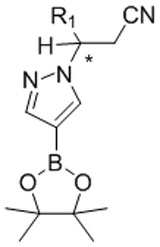
일부 구체예에서, 거울상이성질체 잉여는 약 10%, 약 20%, 약 30%, 약 40%, 약 50%, 약 60%, 약 70%, 약 80%, 약 90%, 약 95%, 약 96%, 약 97%, 약 98%, 약 99%, 약 99.1%, 약 99.2%, 약 99.3%, 약 99.4%, 약 99.5%, 약 99.6%, 약 99.7%, 약 99.8%, 약 99.9%, 또는 약 99.99% 이상이다.In some embodiments, the enantiomeric surplus is about 10%, about 20%, about 30%, about 40%, about 50%, about 60%, about 70%, about 80%, about 90%, about 95%, about 96%, about 97%, about 98%, about 99%, about 99.1%, about 99.2%, about 99.3%, about 99.4%, about 99.5%, about 99.6%, about 99.7%, about 99.8%, about 99.9% Or about 99.99% or more.
일부 구체예에서, 원하는 거울상이성질체는 적어도 91%, 92%, 93%, 94%, 95%, 96%, 97%, 98%, 또는 99% 수율, 및 바람직하게는 90% 또는 95% 이상의 수율로 회수된다.In some embodiments, the desired enantiomer is at least 91%, 92%, 93%, 94%, 95%, 96%, 97%, 98%, or 99% yield, and preferably at least 90% or 95% yield Is recovered.
일부 구체예에서, 본 방법은 또한, 화학식 Ⅲ의 화합물의 거울상이성질체 잉여의 (R)- 또는 (S)-거울상이성질체를 포함하는 조성물을 형성하는데 충분한 조건 하 및 시간 동안에, 팔라듐 촉매, 염기, 및 용매의 존재하에서 화학식 Ⅸ의 화합물을 화학식 XI의 화합물을 반응시키는 것을 포함한다:In some embodiments, the method also provides a palladium catalyst, base, and, under conditions and for sufficient time to form a composition comprising the (R)-or (S) -enantiomer of the enantiomeric excess of the compound of Formula III. Reacting a compound of formula (XI) with a compound of formula (XI) in the presence of a solvent:
[화학식 Ⅸ][Formula Ⅸ]

[화학식 XI](XI)

[화학식 Ⅲ][Formula III]
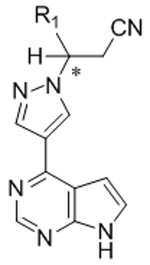
상기 식에서:Where:
*는 키랄 탄소를 나타내고;* Represents chiral carbon;
R1 C3-7 시클로알킬, C1-6 알킬, 및 C1-6 플루오로알킬로부터 선택되고; R 1 C 3-7 cycloalkyl, C 1-6 alkyl, and C 1-6 fluoroalkyl;
Rc 및 Rd 각각은 독립적으로 C1-6 알킬이거나; 또는Each of R c and R d is independently C 1-6 alkyl; or
Rc 및 Rd는, 이들이 부착되는 산소 원자 및 이 산소 원자가 부착되는 붕소 원자와 함께, 5- 내지 6-원 헤테로시클릭 고리를 형성하고, 이 고리는 1, 2, 3, 또는 4개의 C1 -4 알킬 그룹으로 임의로 치환되고;R c and R d together with the oxygen atom to which they are attached and the boron atom to which the oxygen atom is attached form a 5- to 6-membered heterocyclic ring, which ring is 1, 2, 3, or 4 C 1-4 is optionally substituted with an alkyl group;
X2는 토실레이트 그룹, 트리플레이트 그룹, 아이오도, 클로로, 또는 브로모이다.X 2 is a tosylate group, a triflate group, iodo, chloro, or bromo.
일부 구체예에서, 본 방법은 또한, 화학식 Ia의 화합물의 거울상이성질체 잉여의 (R)- 또는 (S)-거울상이성질체를 포함하는 조성물을 형성하기에 충분한 조건 하 및 시간 동안에, 팔라듐 촉매, 염기, 및 용매의 존재하에서 화학식 Ⅸ의 화합물을 화학식 X의 화합물을 반응시키는 것을 포함한다:In some embodiments, the method also provides a palladium catalyst, base, and under conditions and for conditions sufficient to form a composition comprising a (R)-or (S) -enantiomer of the enantiomeric excess of a compound of Formula (Ia) And reacting the compound of formula (X) with the compound of formula (X) in the presence of a solvent:
[화학식 Ⅸ][Formula Ⅸ]

[화학식 X][Formula X]

[화학식 Ia]Formula Ia

상기 식에서:Where:
*는 키랄 탄소를 나타내고;* Represents chiral carbon;
R1은 C3-7 시클로알킬, C1-6 알킬, 및 C1-6 플루오로알킬로부터 선택되고; R 1 is selected from C 3-7 cycloalkyl, C 1-6 alkyl, and C 1-6 fluoroalkyl;
Rc 및 Rd 각각은 독립적으로 C1-6 알킬이거나; 또는Each of R c and R d is independently C 1-6 alkyl; or
Rc 및 Rd는, 이들이 부착되는 산소 원자 및 이 산소 원자가 부착되는 붕소 원자와 함께, 5- 내지 6-원 헤테로시클릭 고리를 형성하고, 이 고리는 1, 2, 3, 또는 4개의 C1-4 알킬 그룹으로 임의로 치환되고; R c and R d together with the oxygen atom to which they are attached and the boron atom to which the oxygen atom is attached form a 5- to 6-membered heterocyclic ring, which ring is 1, 2, 3, or 4 C Optionally substituted with 1-4 alkyl group;
X2는 토실레이트 그룹, 트리플레이트 그룹, 아이오도, 클로로, 또는 브로모이고;X 2 is a tosylate group, a triflate group, iodo, chloro, or bromo;
P1은 보호 그룹이다.P 1 is a protection group.
일부 구체예에서, X2는 브로모, 아이오도, 또는 클로로이다. 일부 구체예에서, X2는 클로로이다.In some embodiments, X 2 is bromo, iodo, or chloro. In some embodiments, X 2 is chloro.
스즈끼 커플링 반응은 수많은 팔라듐(0) 및 팔라듐(Ⅱ) 촉매을 사용하여 개시되고, 본 기술분야에 공지된 조건 하에서 수행될 수 있다 (참고, 예, Miyaura and Suzuki, Chem. Rev. 1995, 95, 2457-2483, 이는 그 전체가 본 명세서에 통합된다). 일부 구체예에서, 팔라듐 촉매는 Pd(PPh3)4 및 Pd(dppf)2Cl2이다. 일부 구체예에서, 팔라듐 촉매는 테트라키스(트리페닐포스핀)팔라듐(0) 또는 테트라키스(트리(o-톨릴)포스핀)팔라듐(0)이다. 일부 구체예에서, 팔라듐 촉매는 테트라키스(트리페닐포스핀)팔라듐(0)이다.Suzuki coupling reactions are initiated using a number of palladium (0) and palladium (II) catalysts and can be performed under conditions known in the art (see, eg, Miyaura and Suzuki, Chem. Rev. 1995 , 95 , 2457-2483, which is hereby incorporated in its entirety). In some embodiments, the palladium catalyst is Pd (PPh 3 ) 4 and Pd (dppf) 2 Cl 2 . In some embodiments, the palladium catalyst is tetrakis (triphenylphosphine) palladium (0) or tetrakis (tri ( o -tolyl) phosphine) palladium (0). In some embodiments, the palladium catalyst is tetrakis (triphenylphosphine) palladium (0).
일부 구체예에서, 팔라듐 촉매 부하는 약 1×10⁻⁴ 내지 약 0.1 당량이다. 일부 구체예에서, 팔라듐 촉매 부하는 약 0.0010 내지 약 0.0015 당량이다. 일부 구체예에서, 화학식 X 또는 XI의 화합물 대 화학식 Ⅸ의 화합물의 화학양론 비는 약 1:1.05 내지 약 1:1.35이다. In some embodiments, the palladium catalyst load is about 1 × 10 −4 to about 0.1 equivalents. In some embodiments, the palladium catalyst load is about 0.0010 to about 0.0015 equivalents. In some embodiments, the stoichiometric ratio of the compound of Formula X or XI to the compound of Formula VII is about 1: 1.05 to about 1: 1.35.
일부 구체예에서, 용매는 물 및 유기 용매를 포함한다. 일부 구체예에서, 유기 용매는 1,4-디옥산, 1-부탄올, 1,2-디메톡시에탄 (DME), 2-프로판올, 톨루엔 또는 에탄올, 또는 이들의 조합이다. 일부 구체예에서, 유기 용매는 DME를 포함한다. 일부 구체예에서, 유기 용매는 DMF를 포함한다. In some embodiments, the solvent comprises water and an organic solvent. In some embodiments, the organic solvent is 1,4-dioxane, 1-butanol, 1,2-dimethoxyethane (DME), 2-propanol, toluene or ethanol, or a combination thereof. In some embodiments, the organic solvent comprises DME. In some embodiments, the organic solvent comprises DMF.
일부 구체예에서, 염기는 무기 염기이다. 일부 구체예에서, 염기는 유기 염기이다. 일부 구체예에서, 염기는 알칼리 금속 카보네이트이다. 일부 구체예에서, 염기는 탄산칼륨 (K2CO3)이다. 일부 구체예에서, 2 내지 5 당량의 염기 (예, K2CO3)가 사용된다. In some embodiments, the base is an inorganic base. In some embodiments, the base is an organic base. In some embodiments, the base is an alkali metal carbonate. In some embodiments, the base is potassium carbonate (K 2 CO 3 ). In some embodiments, 2 to 5 equivalents of base (eg, K 2 CO 3 ) are used.
일부 구체예에서, 스즈끼 커플링 반응은 약 80 내지 약 100℃의 온도에서 수행된다. 일부 구체예에서, 반응은 2 내지 12시간 동안 수행된다. 일부 구체예에서, 화학식 Ia 또는 Ⅲ의 화합물은 스즈끼 커플링 반응 혼합물의 수성 워크업으로부 임의로 분리되거나, 직접 사용될 수 있다. In some embodiments, the Suzuki coupling reaction is carried out at a temperature of about 80 to about 100 ° C. In some embodiments, the reaction is carried out for 2 to 12 hours. In some embodiments, the compound of formula (la) or (III) may be optionally isolated from the aqueous work up of the Suzuki coupling reaction mixture, or may be used directly.
적합한 P1 그룹 및 탈보호 조건은 상기에 제공된다.Suitable P 1 groups and deprotection conditions are provided above.
일부 구체예에서, 본 발명은 화학식 Ⅸ의 화합물의 라세미체의 제조 방법을 제공하고, 이 방법은 염기의 존재하에서 화학식 XV의 화합물을 화학식 D-1의 화합물과 반응시켜 화학식 Ⅸ의 화합물을 생성하는 것을 포함한다:In some embodiments, the present invention provides a process for preparing a racemate of a compound of formula (VII), wherein the method reacts a compound of formula (XV) with a compound of formula (D-1) in the presence of a base to produce a compound of formula (VIII) This includes:
[화학식 Ⅸ][Formula Ⅸ]

[화학식 XV](XV)
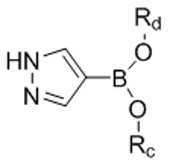
[화학식 D-1][Formula D-1]

상기 식에서:Where:
*는 키랄 탄소를 나타내고;* Represents chiral carbon;
R1은 C3-7 시클로알킬, C1-6 알킬, 및 C1-6 플루오로알킬로부터 선택되고;R 1 is selected from C 3-7 cycloalkyl, C 1-6 alkyl, and C 1-6 fluoroalkyl;
Rc 및 Rd 각각은 독립적으로 C1-6 알킬이거나; 또는Each of R c and R d is independently C 1-6 alkyl; or
Rc 및 Rd는, 이들이 부착되는 산소 원자 및 이 산소 원자가 부착되는 붕소 원자와 함께, 5- 내지 6-원 헤테로시클릭 고리를 형성하고, 이 고리는 1, 2, 3, 또는 4개의 C1 -4 알킬 그룹으로 임의 치환된다.R c and R d together with the oxygen atom to which they are attached and the boron atom to which the oxygen atom is attached form a 5- to 6-membered heterocyclic ring, which ring is 1, 2, 3, or 4 C 1-4 is optionally substituted with an alkyl group.
일부 구체예에서, 아자-마이클 부가는 촉매량의 염기의 존재하에서 유기 용매 실온에서 수행된다. 염기는 아자-마이클 반응을 위한 적절한 용매 또는 염기일 수 있다. 일부 구체예에서, 용매는 아세토니트릴 또는 디메틸포르마이드 (DMF)이다. 일부 구체예에서, 염기는 테트라알킬암모늄 할라이드, 테트라알킬수산화암모늄, 구아니딘, 아미딘, 히드록사이드, 알콕시드, 실리케이트, 알칼리 금속 포스페이트, 옥사이드, 3급 아민, 알칼리 금속 카보네이트, 알칼리 금속 바이카보네이트, 알칼리 금속 수소 포스페이트, 포스핀, 또는 카복실산의 알칼리 금속 염이다. 일부 구체예에서, 마이클 부가 촉매는 테트라메틸 구아니딘, 1,8-디아자바이시클로(5.4.0)운덱-7-엔, 1,5-디아자바이시클로(4.3.0)논-5-엔, 1,4-디아자바이시클로(2.2.2)옥탄, tert-부틸 수산화암모늄, 수산화나트륨, 칼륨 히드록사이드, 나트륨 메톡시드, 나트륨 에톡시드, 트리칼륨 포스페이트, 나트륨 실리케이트, 칼슘 옥사이드, 트리에틸아민, 나트륨 카보네이트, 탄산칼륨, 중탄산나트륨, 칼륨 바이카보네이트, 칼륨 수소 포스페이트, 트리페닐 포스핀, 트리에틸 포스핀, 칼륨 아세테이트, 또는 칼륨 아실레이트이다. 일부 구체예에서, 염기는 1,8-디아자바이시클로[5.4.0]운덱-7-엔 (DBU) 또는 탄산칼륨이다. 일부 구체예에서, 염기는 DBU이다. 일부 구체예에서, 염기는 촉매량으로 존재한다. 일부 구체예에서, 염기의 양은 약 0.1 내지 약 5 당량, 또는 약 0.5 내지 약 3 당량이다. 일부 구체예에서, 반응은 약 10 내지 약 24시간 내에 완료된다. In some embodiments, the aza-michael addition is performed at room temperature in an organic solvent in the presence of a catalytic amount of base. The base may be a suitable solvent or base for the aza-mic reaction. In some embodiments, the solvent is acetonitrile or dimethylformamide (DMF). In some embodiments, the base is tetraalkylammonium halide, tetraalkylammonium hydroxide, guanidine, amidine, hydroxide, alkoxide, silicate, alkali metal phosphate, oxide, tertiary amine, alkali metal carbonate, alkali metal bicarbonate, Alkali metal hydrogen phosphate, phosphine, or alkali metal salts of carboxylic acids. In some embodiments, the Michael addition catalyst is tetramethyl guanidine, 1,8-diazabicyclo (5.4.0) undec-7-ene, 1,5-diazabicyclo (4.3.0) non-5-ene 1,4-diazabicyclo (2.2.2) octane, tert-butyl ammonium hydroxide, sodium hydroxide, potassium hydroxide, sodium methoxide, sodium ethoxide, tripotassium phosphate, sodium silicate, calcium oxide, triethyl Amines, sodium carbonate, potassium carbonate, sodium bicarbonate, potassium bicarbonate, potassium hydrogen phosphate, triphenyl phosphine, triethyl phosphine, potassium acetate, or potassium acylate. In some embodiments, the base is 1,8-diazabicyclo [5.4.0] undec-7-ene (DBU) or potassium carbonate. In some embodiments, the base is DBU. In some embodiments, the base is present in a catalytic amount. In some embodiments, the amount of base is about 0.1 to about 5 equivalents, or about 0.5 to about 3 equivalents. In some embodiments, the reaction is completed within about 10 to about 24 hours.
일부 구체예에서, 본 방법은 또한, 화학식 Ⅲ의 화합물의 거울상이성질체 잉여의 (R)- 또는 (S)-거울상이성질체를 포함하는 조성물을 제공하기에 충분한 조건 하에서, 탈보호 조건 하에서 화학식 Ia의 화합물을 처리하는 것을 포함한다:In some embodiments, the method also provides a compound of Formula Ia under deprotection conditions, under conditions sufficient to provide a composition comprising an enantiomeric excess of the (R)-or (S) -enantiomer of the compound of Formula III. It involves processing:
[화학식 Ⅲ][Formula III]

상기 식에서:Where:
*는 키랄 탄소를 나타내고;* Represents chiral carbon;
R1은 C3-7 시클로알킬, C1-6 알킬, 및 C1-6 플루오로알킬로부터 선택되고;R 1 is selected from C 3-7 cycloalkyl, C 1-6 alkyl, and C 1-6 fluoroalkyl;
P1은 보호 그룹이다.P 1 is a protection group.
적합한 P1 그룹 및 탈보호 방법은 상기에 기재된 것을 포함하지만 이들로 제한되는 것은 아니다. Suitable P 1 groups and deprotection methods include, but are not limited to, those described above.
일부 구체예에서, 본 발명은 또한, 화학식 Ⅲ의 화합물을 인산과 반응시켜 화학식 Ⅲ의 화합물의 포스페이트 염을 형성하는 것을 포함한다.In some embodiments, the invention also includes reacting a compound of Formula III with phosphoric acid to form a phosphate salt of the compound of Formula III.
Ⅳ. 화학식 Ia의 라세미체의 키랄 풍부 및 화학식 Ia의 원하지 않는 거울상이성질체의 라세미화 Ⅳ. Chiral richness of racemates of formula (Ia) and racemization of unwanted enantiomers of formula (Ia)
화학식 Ia의 라세미체는 하기 반응도식 6에서 마이클 부가 방법에 의해 형성될 수 있다. 따라서, 화학식 Ⅳ의 화합물은 화학식 D-1의 아실로니트릴과 반응하여 화학식 Ia의 라세미체를 형성할 수 있다. 그 다음, 화학식 Ia의 라세미체는 키랄 칼럼 크로마토그래피에 의해 분리되어 화학식 Ia의 화합물의 거울상이성질체 잉여의 (R)- 또는 (S)-거울상이성질체를 포함하는 조성물을 얻을 수 있다. 그 다음, 보호 그룹은 제거되어 화학식 Ⅲ의 화합물의 거울상이성질체 잉여의 (R)- 또는 (S)-거울상이성질체를 생성할 수 있다. The racemates of Formula Ia can be formed by Michael addition method in Scheme 6 below. Thus, the compound of formula IV can be reacted with the acylonitrile of formula D-1 to form the racemate of formula Ia. The racemates of formula (Ia) can then be separated by chiral column chromatography to obtain a composition comprising the enantiomeric excess of the (R)-or (S) -enantiomer of the compound of formula (Ia). The protecting group can then be removed to produce the enantiomeric excess of the (R)-or (S) -enantiomer of the compound of formula III.
반응도식 6 Scheme 6

따라서, 일부 구체예에서, 본 발명은 화학식 Ia의 화합물의 거울상이성질체 잉여의 (R)- 또는 (S)-거울상이성질체를 포함하는 조성물을 제조하는 방법을 제공하고, 이 방법은 화학식 Ia의 화합물의 라세미체를 포함하는 조성물을 이동상을 사용하는 키랄 크로마토그래피 유닛에 통과시키고, 화학식 Ia의 화합물의 거울상이성질체 잉여의 (R)- 또는 (S)-거울상이성질체를 포함하는 조성물을 수집하는 것을 포함한다:Thus, in some embodiments, the present invention provides a method of preparing a composition comprising an enantiomeric excess of the (R)-or (S) -enantiomer of a compound of formula (Ia), wherein the method comprises: Passing the composition comprising the racemate through a chiral chromatography unit using a mobile phase and collecting a composition comprising an enantiomeric excess of the (R)-or (S) -enantiomer of the compound of formula (Ia) :
[화학식 Ia]Formula Ia

상기 식에서:Where:
*는 키랄 탄소를 나타내고;* Represents chiral carbon;
R1은 C3-7 시클로알킬, C1-6 알킬, 및 C1-6 플루오로알킬로부터 선택되고;R 1 is selected from C 3-7 cycloalkyl, C 1-6 alkyl, and C 1-6 fluoroalkyl;
P1은 보호 그룹이다. P 1 is a protection group.
일부 구체예에서, 키랄 크로마토그래피 유닛은 키랄 정지상으로 채워져 있는 키랄 칼럼이 구비된 분취 고성능 액체 크로마토그래피 (HPLC) 시스템이다. 일부 구체예에서, 키랄 칼럼은 Chiralpak® IA이다. 일부 구체예에서, 키랄 칼럼은 ChiralCel® OD-H이다. 일부 구체예에서, 크로마토그래피 유닛은, 키랄 정지상으로 각각 채워져 있는 8개의 칼럼 세트가 구비된 유사 이동층 (SMB) 크로마토그래피 유닛이다. 일부 구체예에서, 키랄 정지상은 셀룰로오스 변형된 키랄 정지상 (CSP, Chiral Technologies)이다. 일부 구체예에서, 이동상은 에탄올 및 헥산을 포함한다. 일부 구체예에서, 이동상은 약 1:9 용적비의 에탄올 대 헥산을 포함한다. 일부 구체예에서, 이동상은 용적으로 약 15% 에탄올 및 약 85% 헥산을 포함한다. 일부 구체예에서, 이동상은 에탄올 및 헥산을 포함하고, 여기서 상기 에탄올은 약 25 용적% 내지 약 10 용적%의 양으로 존재한다. 일부 구체예에서, 이동상은 이소프로판올 및 헥산을 포함하고, 여기서, 이소프로판올은 약 25 용적% 내지 약 10 용적%의 양으로 존재한다. 일부 구체예에서, 크로마토그래피 유닛은 실온에서 유지된다. 일부 구체예에서, 이동상은 약 1 mL/분 내지 약 20 mL/분의 유속으로 통과한다. 일부 구체예에서, 이동상은 약 1 mL/분의 유속으로 통과한다. 일부 구체예에서, 이동상은 약 18 mL/분의 유속으로 통과한다. 일부 구체예에서, 용리액은 자외선 (UV) 분광법으로 모니터된다. 일부 구체예에서, 용리액은 자외선 분광법으로 약 220 nm에서 모니터된다. 거울상이성질체 풍부한 조성물을 함유하는 용리액부분의 수집은 UV 분광법에 의한 원하는 거울상이성질체의 용리의 검출에 의해 측정될 수 있다. 그 다음, 조성물의 % ee (거울상이성질체 잉여)의 측정은 분석 키랄 HPLC에 의해 측정될 수 있다.In some embodiments, the chiral chromatography unit is a preparative high performance liquid chromatography (HPLC) system equipped with a chiral column filled with a chiral stationary phase. In some embodiments, the chiral column is Chiralpak ® IA. In some embodiments, the chiral column is ChiralCel ® OD-H. In some embodiments, the chromatography unit is a pseudo mobile bed (SMB) chromatography unit equipped with a set of eight columns each filled with a chiral stationary phase. In some embodiments, the chiral stationary phase is a cellulose modified chiral stationary phase (CSP, Chiral Technologies). In some embodiments, the mobile phase comprises ethanol and hexanes. In some embodiments, the mobile phase comprises about 1: 9 volume ratio of ethanol to hexane. In some embodiments, the mobile phase comprises about 15% ethanol and about 85% hexane in volume. In some embodiments, the mobile phase comprises ethanol and hexane, wherein the ethanol is present in an amount from about 25% by volume to about 10% by volume. In some embodiments, the mobile phase comprises isopropanol and hexanes, wherein the isopropanol is present in an amount from about 25% by volume to about 10% by volume. In some embodiments, the chromatography unit is maintained at room temperature. In some embodiments, the mobile phase passes at a flow rate of about 1 mL / min to about 20 mL / min. In some embodiments, the mobile phase passes at a flow rate of about 1 mL / minute. In some embodiments, the mobile phase passes at a flow rate of about 18 mL / minute. In some embodiments, the eluent is monitored by ultraviolet (UV) spectroscopy. In some embodiments, the eluent is monitored at about 220 nm by ultraviolet spectroscopy. The collection of eluent portions containing the enantiomer rich composition can be measured by detection of the elution of the desired enantiomers by UV spectroscopy. The determination of% ee (enantiomer surplus) of the composition can then be determined by analytical chiral HPLC.
일부 구체예에서, 거울상이성질체 잉여는 약 10%, 약 20%, 약 30%, 약 40%, 약 50%, 약 60%, 약 70%, 약 80%, 약 90%, 약 95%, 약 96%, 약 97%, 약 98%, 약 99%, 약 99.1%, 약 99.2%, 약 99.3%, 약 99.4%, 약 99.5%, 약 99.6%, 약 99.7%, 약 99.8%, 약 99.9%, 또는 약 99.99% 이상이다.In some embodiments, the enantiomeric surplus is about 10%, about 20%, about 30%, about 40%, about 50%, about 60%, about 70%, about 80%, about 90%, about 95%, about 96%, about 97%, about 98%, about 99%, about 99.1%, about 99.2%, about 99.3%, about 99.4%, about 99.5%, about 99.6%, about 99.7%, about 99.8%, about 99.9% Or about 99.99% or more.
일부 구체예에서, 키랄 크로마토그래피는 키랄 정지상으로 채워져 있는 크로마토그래피 칼럼이 구비된 분취 고성능 액체 크로마토그래피 (HPLC) 시스템을 사용하여 수행된다. 일부 구체예에서, 칼럼은 실리카겔 ("Chiralpak® IA"로서 Daicel로부터 이용가능) 상에 고정된 아밀로스 트리스(3,5-디메틸페닐 카바메이트)로 만들어진 키랄 정지상으로 재워진다. 일부 구체예에서, 칼럼은 실리카겔 ("Chiralcel® OD"로서 Daicel로부터 이용가능) 상에 코팅된 셀룰로오스 트리스(3,5-디메틸페닐 카바메이트)로 만들어진 키랄 정지상으로 채워진다. 일부 구체예에서, 크로마토그래피 방법은 연속 크로마토그래피 방법, 예컨대 유사이동층 (SMB) 크로마토그래피 또는 Varicol 방법이고, 이 방법은 3 내지 12, 바람직하게는 5 내지 10, 가장 바람직하게는 5 내지 8의 칼럼 세트로 구비된 유닛을 사용하고, 각각의 칼럼은 동일한 키랄 정지상으로 채워져 있다. 일부 구체예에서, 칼럼은 실리카겔 ("Chiralpak® IA"로서 Daicel로부터 이용가능) 상에 고정된 아밀로스 트리스(3,5-디메틸페닐 카바메이트)로 만들어진 키랄 정지상으로 채워져 있다. 일부 구체예에서, 칼럼은 실리카겔 ("Chiralcel® OD"로서 Daicel로부터 이용가능) 상에 코팅된 셀룰로오스 트리스(3,5-디메틸페닐 카바메이트)로 만들어진 키랄 정지상으로 채워져 있다. 일부 구체예에서, 키랄 정지상은 4-(3,5-디니트로 벤즈아미도)테트라히드로펜안트렌 ("(S,S) Whelk-O®1"로서 Regis Technologies로부터 이용가능)으로 코팅된 실리카겔 기반 정지상이다. 일부 구체예에서, 이동상은 에탄올 및 헥산을 포함한다. 일부 구체예에서, 헥산은 헵탄, n-헵탄, 시클로헥산 또는 메틸시클로헥산에 의해 치환된다. 일부 구체예에서, 에탄올은 용적으로 약 10% 내지 약 100%, 약 10% 내지 약 25%, 또는 약 15%의 양으로 존재한다. 일부 구체예에서, 이동상은 이소프로판올 및 헥산을 포함한다. 일부 구체예에서 헥산은 헵탄, n-헵탄, 시클로헥산 또는 메틸시클로헥산에 의해 치환된다. 일부 구체예에서, 이소프로판올은 용적으로 약 10% 내지 약 25%의 양으로 존재한다. 일부 구체예에서, 이동상은 메틸-tert-부틸 에테르 및 헥산을 포함한다. 일부 구체예에서, 헥산은 헵탄, n-헵탄, 시클로헥산 또는 메틸시클로헥산에 의해 치환된다. 일부 구체예에서, 메틸-tert-부틸 에테르는 용적으로 약 10% 내지 약 100%, 약 50% 내지 약 100%, 또는 약 90% 내지 약 100%의 양으로 존재한다. 일부 구체예에서, 이동상은 에틸 아세테이트 및 헥산을 포함한다. 일부 구체예에서, 헥산은 헵탄, n-헵탄, 시클로헥산 또는 메틸시클로헥산에 의해 치환된다. 일부 구체예에서, 에틸 아세테이트는 용적으로 약 10% 내지 약 100%, 약 50% 내지 약 100%, 또는 약 75%의 양으로 전재한다. 일부 구체예에서, 이동상은 테트라히드로푸란 및 헥산을 포함한다. 일부 구체예에서, 헥산은 헵탄, n-헵탄, 시클로헥산 또는 메틸시클로헥산에 의해 치환된다. 일부 구체예에서, 테트라히드로푸란는 용적으로 약 10% 내지 약 100%, 약 10% 내지 약 50%, 또는 약 25%의 양으로 존재한다. 일부 구체예에서, 크로마토그래피 유닛은 약 5℃ 내지 약 50℃, 약 10℃ 내지 약 30℃, 또는 약 25℃의 온도, 또는 주위온도에서 조작된다.In some embodiments, chiral chromatography is performed using a preparative high performance liquid chromatography (HPLC) system equipped with a chromatography column filled with chiral stationary phases. In some embodiments, the column is loaded with a chiral stationary phase made of amylose tris (3,5-dimethylphenyl carbamate) immobilized on silica gel (available from Daicel as "Chiralpak ® IA"). In some embodiments, the column is filled with a chiral stationary phase made of cellulose tris (3,5-dimethylphenyl carbamate) coated on silica gel (available from Daicel as "Chiralcel ® OD"). In some embodiments, the chromatography method is a continuous chromatography method, such as a pseudomobile layer (SMB) chromatography or a Varicol method, which method is 3-12, preferably 5-10, most preferably 5-8. Using a unit provided as a column set, each column is filled with the same chiral stationary phase. In some embodiments, the column is filled with a chiral stationary phase made of amylose tris (3,5-dimethylphenyl carbamate) immobilized on silica gel (available from Daicel as "Chiralpak ® IA"). In some embodiments, the column is filled with a chiral stationary phase made of cellulose tris (3,5-dimethylphenyl carbamate) coated on silica gel (available from Daicel as "Chiralcel ® OD"). In some embodiments, the chiral stationary phase is based on silica gel coated with 4- (3,5-dinitro benzamido) tetrahydrophenanthrene (available from Regis Technologies as "(S, S) Whelk-O ® 1"). It is a stationary phase. In some embodiments, the mobile phase comprises ethanol and hexanes. In some embodiments, hexane is substituted by heptane, n-heptane, cyclohexane or methylcyclohexane. In some embodiments, the ethanol is present in an amount of about 10% to about 100%, about 10% to about 25%, or about 15%. In some embodiments, the mobile phase comprises isopropanol and hexanes. In some embodiments hexane is substituted by heptane, n-heptane, cyclohexane or methylcyclohexane. In some embodiments, isopropanol is present in an amount of about 10% to about 25% by volume. In some embodiments, the mobile phase comprises methyl tert -butyl ether and hexanes. In some embodiments, hexane is substituted by heptane, n-heptane, cyclohexane or methylcyclohexane. In some embodiments, the methyl tert -butyl ether is present in an amount of about 10% to about 100%, about 50% to about 100%, or about 90% to about 100%. In some embodiments, the mobile phase comprises ethyl acetate and hexanes. In some embodiments, hexane is substituted by heptane, n-heptane, cyclohexane or methylcyclohexane. In some embodiments, the ethyl acetate is revoluted in an amount of about 10% to about 100%, about 50% to about 100%, or about 75%. In some embodiments, the mobile phase comprises tetrahydrofuran and hexanes. In some embodiments, hexane is substituted by heptane, n-heptane, cyclohexane or methylcyclohexane. In some embodiments, tetrahydrofuran is present in an amount of about 10% to about 100%, about 10% to about 50%, or about 25%. In some embodiments, the chromatography unit is operated at a temperature of about 5 ° C. to about 50 ° C., about 10 ° C. to about 30 ° C., or about 25 ° C., or at ambient temperature.
일부 구체예에서, 사용된 크로마토그래피 방법은 배치 분취 크로마토그래피, 초임계 유체 크로마토그래피 (SFC), 사이클로젯(cyclojet) 방법, 염속 다중칼럼 크로마토그래피 방법, 유사이동층 방법, VaricolTM 방법, 또는 PowerFeed 방법이다.In some embodiments, the chromatography method used is batch preparative chromatography, supercritical fluid chromatography (SFC), cyclojet method, salt multicolumn chromatography method, pseudomobile layer method, Varicol ™ method, or PowerFeed. It is a way.
일부 구체예에서, 키랄 정지상은, 예를 들어, 가교결합에 의해 화학 결합 또는 불용화에 의해 불활성 담체 물질에 고정된 거울상이성질체 풍부한 분할제인 상호작용제를 포함한다. 적절한 불활성 담체 물질은 거대다공, 예를 들어 가교결합된 폴리스티렌, 폴리아실아미드, 폴리아실레이트, 알루미나, 카이에셀구르(kieselgur; 규조토), 쿼츠(quartz), 카올린, 마그네슘 옥사이드, 이산화티타륨 또는 실리카겔일 수 있다. 일부 구체예에서, 불활성 담체 물질은 실리카겔이다.In some embodiments, the chiral stationary phase comprises an interaction agent that is an enantiomer-rich splitting agent immobilized to an inert carrier material, for example, by crosslinking or by chemical bonding or insolubilization. Suitable inert carrier materials are macroporous, for example crosslinked polystyrene, polyacylamide, polyacylates, alumina, kieselgur (diatomaceous earth), quartz, kaolin, magnesium oxide, titanium dioxide or silica gel Can be. In some embodiments, the inert carrier material is silica gel.
일부 구체예에서, 키랄 정지상은 하기로부터 선택된 폴리사카라이드의 아밀로스 또는 셀룰로스 부류의 멤버이다: 셀룰로오스 페닐 카바메이트 유도체, 예컨대 셀룰로오스 트리스(3,5-디메틸페닐)카바메이트 ("Chiralcel® OD" 또는 "Chiralpak® IB"로서 Daicel Chemical Industries, Ltd. (Daicel)로부터 이용가능, 여기서, 상기 카바메이트 유도체는 셀룰로스 골격에 결합된다); 셀룰로오스 트리벤조에이트 유도체, 예컨대 셀룰로오스 트리 4-메틸벤조에이트 ("Chiralcel® OJ" 로서 Daicel로부터 이용가능); 셀룰로오스 트리신나메이트 ("Chiralcel® OK" 로서 Daicel로부터 이용가능); 아밀라제 페닐 및 벤질 카바메이트 유도체, 예컨대 아밀로스 트리스[(S)-α-메틸 벤질카바메이트] ("Chiralpak® AS"로서 Daicel로부터 이용가능); 아밀로스 트리스(3,5-디메틸페닐)카바메이트 ("Chiralpak® AD" 또는 "Chiralpak® IA"로서 Daicel로부터 이용가능, 여기서, 카바메이트 유도체는 아밀로스 골격에 결합된다); 아밀로스 3,4-치환된 페닐 카바메이트 또는 아밀로스 4-치환된 페닐-카바메이트; 및 아밀로스 트리신나메이트. 일부 구체예에서, 키랄 정지상은 Chiralpak® IA 또는 Chiralpak AD을 포함한다. 일부 구체예에서, 키랄 정지상은 Chiralcel® OD을 포함한다. 일부 구체예에서, 키랄 정지상은 하기이다: 퍼클상(Pirkle-phases) 패밀리의 맴버, 예컨대 페닐글리신의 3,5-디니트로벤조일 유도체 ("페닐글리신"으로서 Regis Technologies Inc으로서 이용가능); 류신의,5-디니트로벤조일 유도체 ("류신"으로서 Regis Technologies Inc로부터 이용가능); N-3,5-디니트로벤조일-3-아미노-3-페닐-2-(1,1-디메틸에틸)-프로파노에이트 ("β-GEM 1"로서 Regis Technologies Inc로부터 이용가능); 디메틸 N-3,5-디니트로벤조일-아미노-2,2-디메틸-4-펜테닐 포스포네이트 ("α-BURKE 2"로서 Regis Technologies Inc로부터 이용가능); 3-(3,5-디니트로벤즈아미도)-4-페닐-β-락탐 ("PIRKLE 1-J"로서 Regis Technologies Inc로부터 이용가능); 디페닐에틸렌디아민의 3,5-디니트로벤조일 유도체 ("ULMO"로서 Regis Technologies Inc로부터 이용가능); 4-(3,5-디니트로 벤즈아미도)테트라히드로펜안트렌 ("(S,S) Whelk-O® 1" 및 "(R,R) Whelk-O® 1" 또는 "(S,S) Whelk-O® 2" 및 "(R,R) Whelk-O®2"로서 Regis technologies Inc.로부터 이용가능); 1,2-디아미노시클로헥산의 3,5-디니트로-벤조일 유도체, ("DACH-DNB로서 Regis technologies Inc.로부터 이용가능). 일부 구체예에서, 키랄 정지상은 "(S,S) Whelk-O® 1" 또는 "(R,R) Whelk-O® 1을 포함한다.In some embodiments, the chiral stationary phase is a member of the amylose or cellulose class of polysaccharides selected from: cellulose phenyl carbamate derivatives such as cellulose tris (3,5-dimethylphenyl) carbamate ("Chiralcel ® OD" or " Chiralpak ® IB ", available from Daicel Chemical Industries, Ltd. (Daicel), wherein the carbamate derivative is bound to the cellulose backbone); Cellulose tribenzoate derivatives such as cellulose tri 4-methylbenzoate (available from Daicel as "Chiralcel ® OJ"); Cellulose tricinnamate (available from Daicel as "Chiralcel ® OK"); Amylase phenyl and benzyl carbamate derivatives such as amylose tris [(S) -α-methyl benzylcarbamate] (available from Daicel as "Chiralpak ® AS"); Amylose tris (3,5-dimethylphenyl) carbamate (available from Daicel as "Chiralpak ® AD" or "Chiralpak ® IA", wherein the carbamate derivative is bound to the amylose backbone); Amylose 3,4-substituted phenyl carbamate or amylose 4-substituted phenyl-carbamate; And amylose tricinnamate. In some embodiments, the chiral stationary phase comprises Chiralpak ® IA or Chiralpak AD. In some embodiments, the chiral stationary phase comprises Chiralcel ® OD. In some embodiments, the chiral stationary phase is: a member of the Pirkle-phases family, such as 3,5-dinitrobenzoyl derivatives of phenylglycine (available as Regis Technologies Inc as "phenylglycine"); 5-dinitrobenzoyl derivatives of leucine (available from Regis Technologies Inc as "leucine"); N-3,5-dinitrobenzoyl-3-amino-3-phenyl-2- (1,1-dimethylethyl) -propanoate (available from Regis Technologies Inc as "β-GEM 1"); Dimethyl N-3,5-dinitrobenzoyl-amino-2,2-dimethyl-4-pentenyl phosphonate (available from Regis Technologies Inc as "α-BURKE 2"); 3- (3,5-dinitrobenzamido) -4-phenyl-β-lactam (available from Regis Technologies Inc as "PIRKLE 1-J"); 3,5-dinitrobenzoyl derivatives of diphenylethylenediamine (available from Regis Technologies Inc as "ULMO"); 4- (3,5-dinitrobenzamido) tetrahydrophenanthrene ("(S, S) Whelk-O ® 1" and "(R, R) Whelk-O ® 1" or "(S, S) Available from Regis technologies Inc. as "Whelk-O ® 2" and "(R, R) Whelk-O ® 2"); 3,5-dinitro-benzoyl derivative of 1,2-diaminocyclohexane, available from Regis technologies Inc. as "DACH-DNB." In some embodiments, the chiral stationary phase is "(S, S) Whelk- O ® 1 "or" (R, R) Whelk-O ® 1 ".
일부 구체예에서, 키랄 정지상의 입자 직경은 통상 1 내지 300 ㎛, 2 내지 100 ㎛, 5 내지 75 ㎛, 또는 10 내지 30 ㎛이다.In some embodiments, the particle diameter of the chiral stationary phase is usually 1 to 300 μm, 2 to 100 μm, 5 to 75 μm, or 10 to 30 μm.
일부 구체예에서, 이동상은 무극성, 극성 양자 또는 비양자성 용매 또는 이의 혼합물이다. 일부 구체예에서, 이동상은 이산화탄소 및 극성 양자성 용매의 혼합물이다. 적절한 무극성 용매는, 예를 들어, 탄화수소, 예를 들어, n-펜탄, n-헥산, 헥산, n-헵탄, 헵탄, 시클로헥산, 및 메틸시클로헥산을 포함한다. 적절한 양자 또는 비양자성 용매는, 예를 들어, 알콜, 특히, 메탄올, 에탄올, 1-프로판올, 2-프로판올, 1-부탄올, 2-부탄올, 이소부탄올, tert-부탄올, 에테르, 예를 들어, 메틸 tert-부틸 에테르, 에스테르, 예를 들어, 에틸아세테이트, 할로겐화 탄화수소 및 아세토니트릴을 포함한다. 일부 구체예에서, 무극성 용매는 n-헵탄. 일부 구체예에서, 양자 또는 비양자성 용매는 에탄올, 2-프로판올 또는 메틸-tert-부틸 에테르. 일부 구체예에서, 이동상은 헵탄 및 에탄올의 혼합물이다. 일부 구체예에서, 에탄올은 이동상 내에 약 10% 내지 약 100%, 약 10% 내지 약 25%., 또는 약 15%의 양으로 존재한다. 일부 구체예에서, 이동상은 헵탄 및 2-프로판올의 혼합물이다. 일부 구체예에서, 2-프로판올은 이동상 내에 약 10% 내지 약 100%, 약 10% 내지 약 25%, 또는 약 20%의 양으로 존재한다. 일부 구체예에서, 이동상은 헵탄 및 메틸-tert-부틸 에테르의 혼합물이다. 일부 구체예에서, 메틸-tert-부틸 에테르는 이동상 내에 약 10% 내지 약 100%, 약 75% 내지 약 100%, 또는 약 90% 내지 약 100%의 양으로 존재한다.In some embodiments, the mobile phase is a nonpolar, polar proton or aprotic solvent or mixtures thereof. In some embodiments, the mobile phase is a mixture of carbon dioxide and a polar protic solvent. Suitable nonpolar solvents include, for example, hydrocarbons such as n-pentane, n-hexane, hexane, n-heptane, heptane, cyclohexane, and methylcyclohexane. Suitable proton or aprotic solvents are, for example, alcohols, in particular methanol, ethanol, 1-propanol, 2-propanol, 1-butanol, 2-butanol, isobutanol, tert-butanol, ethers, for example methyl tert-butyl ether, esters such as ethyl acetate, halogenated hydrocarbons and acetonitrile. In some embodiments, the nonpolar solvent is n-heptane. In some embodiments, the proton or aprotic solvent is ethanol, 2-propanol or methyl-tert-butyl ether. In some embodiments, the mobile phase is a mixture of heptane and ethanol. In some embodiments, ethanol is present in the mobile phase in an amount of about 10% to about 100%, about 10% to about 25%., Or about 15%. In some embodiments, the mobile phase is a mixture of heptane and 2-propanol. In some embodiments, 2-propanol is present in the mobile phase in an amount of about 10% to about 100%, about 10% to about 25%, or about 20%. In some embodiments, the mobile phase is a mixture of heptane and methyl-tert-butyl ether. In some embodiments, methyl-tert-butyl ether is present in the mobile phase in an amount of about 10% to about 100%, about 75% to about 100%, or about 90% to about 100%.
일부 구체예에서, 크로마토그래피는 약 0℃ 내지 50℃, 약 10℃ 내지 30℃, 또는 약 25℃의 온도 범위에서 수행된다.In some embodiments, the chromatography is performed at a temperature range of about 0 ° C. to 50 ° C., about 10 ° C. to 30 ° C., or about 25 ° C.
일부 구체예에서, 원하는 거울상이성질체는, 거울상이성질체 순도가 약 90% 초과, 약 98%, 또는 약 99.0% 초과로 회수된다. 일부 구체예에서, 원하는 거울상이성질체는 약 70% 초과, 약 90% 초과, 또는 약 95% 초과의 수율로 회수된다.In some embodiments, the desired enantiomer is recovered in greater than about 90%, about 98%, or more than about 99.0% enantiomeric purity. In some embodiments, the desired enantiomer is recovered in a yield of greater than about 70%, greater than about 90%, or greater than about 95%.
일부 구체예에서, 원하는 거울상이성질체는 약 0.1 kg, 0.4 kg, 또는 0.8 kg 초과의 순수한 거울상이성질체/1일/kg의 정지상의 처리량 속도로 생성된다.In some embodiments, the desired enantiomer is produced at a throughput rate of stationary phase of greater than about 0.1 kg, 0.4 kg, or 0.8 kg of pure enantiomers / day / kg.
일부 구체예에서, 분리된 거울상이성질체는, 감압 하에서 증발 후, 농축 오일로서 회수된다.In some embodiments, the separated enantiomers are recovered as concentrated oils after evaporation under reduced pressure.
일부 구체예에서, 키랄 크로마토그래피 방법에 사용된 이동상은 재순환된다.In some embodiments, the mobile phase used in the chiral chromatography method is recycled.
일부 구체예에서, 원하지 않는 거울상이성질체는 라세미화되고, 키랄 분리용 라세미 공급물로서 재사용된다.In some embodiments, unwanted enantiomers are racemized and reused as racemic feed for chiral separation.
일부 구체예에서, 원하는 거울상이성질체는 적어도 91%, 92%, 93%, 94%, 95%, 96%, 97%, 98%, 또는 99% 수율, 또는 바람직하게는 90% 또는 95% 초과 수율로 회수된다.In some embodiments, the desired enantiomer is at least 91%, 92%, 93%, 94%, 95%, 96%, 97%, 98%, or 99% yield, or preferably greater than 90% or 95% yield Is recovered.
대안적으로, 화학식 Ia의 라세미체는 키랄 산 (E-1), 예컨대 (+)-디벤조일-D-타르타르산과 반응하여, 키랄 염 (E-2)을 형성할 수 있다 (반응도식 7). 결정화, 여과, 및 염기에 의한 처리 후, 화학식 Ia의 화합물의 거울상이성질체 잉여의 (R)- 또는 (S)-거울상이성질체를 포함하는 조성물이 생성된다. 그 다음, 보호 그룹은 제거되어 화학식 Ⅲ의 화합물의 거울상이성질체 잉여의 (R)- 또는 (S)-거울상이성질체를 생성한다. Alternatively, racemates of formula (Ia) can be reacted with chiral acid (E-1), such as (+)-dibenzoyl-D-tartaric acid, to form chiral salts (E-2) (Scheme 7 ). After crystallization, filtration, and treatment with a base, a composition is prepared comprising enantiomeric excess of the (R)-or (S) -enantiomer of the compound of formula (Ia). The protecting group is then removed to produce the (R)-or (S) -enantiomer of the enantiomeric excess of the compound of formula III.
반응도식 7 Scheme 7

따라서, 일부 구체예에서, 본 발명은 하기 단계 (a) 내지 (c)를 포함하는, 화학식 Ia의 화합물의 거울상이성질체 잉여의 (R)- 또는 (S)-거울상이성질체를 포함하는 조성물의 제조 방법을 제공한다: Thus, in some embodiments, the present invention provides a process for preparing a composition comprising the enantiomeric excess of the (R)-or (S) -enantiomer of the compound of formula (Ia), comprising the following steps (a) to (c): Provides:
(a) 용매의 존재하에서 화학식 Ia의 화합물의 라세미체를 포함하는 조성물을 키랄 산과 반응시켜 화학식 Ia의 화합물의 염을 형성하는 단계; (a) reacting a composition comprising a racemate of a compound of formula (Ia) with chiral acid in the presence of a solvent to form a salt of a compound of formula (Ia);
(b) 상기 화학식 Ia의 화합물의 거울상이성질체 잉여의 (R)- 또는 (S)-거울상이성질체의 키랄 염을 포함하는 조성물을 분리하는 단계; 및(b) separating a composition comprising a chiral salt of the (R)-or (S) -enantiomer of the enantiomeric excess of the compound of Formula (Ia); And
(c) 상기 키랄 염을 염기로 처리하여 화학식 Ia의 화합물의 거울상이성질체 잉여의 (R)- 또는 (S)-거울상이성질체를 포함하는 조성물을 생성하는 단계:(c) treating said chiral salt with a base to produce a composition comprising an enantiomeric excess of the (R)-or (S) -enantiomer of the compound of formula (Ia):
[화학식 Ia]Formula Ia
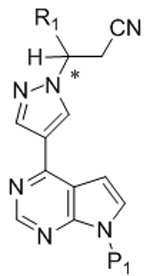
상기 식에서:Where:
*는 키랄 탄소이고;* Is chiral carbon;
R1은 C3-7 시클로알킬, C1-6 알킬, 및 C1-6 플루오로알킬로부터 선택되고;R 1 is selected from C 3-7 cycloalkyl, C 1-6 alkyl, and C 1-6 fluoroalkyl;
P1은 보호 그룹이다.P 1 is a protection group.
키랄 분할에 유용한 임의의 키랄 산이 사용될 수 있다. 일부 구체예에서, 키랄 산은 하기의 광학적 활성 형태로부터 선택된다: 만델산, 2-클로로만델산, 캄포르설폰산, 타르타르산, 락트산, 말산, 3-브로모캄포르-8-설폰산, 3-브로모캄포르-10-설폰산, 10-캄포르설폰산, 디벤조일 타르타르산, 디-p-톨루오일타르타르산, 2-아미노-7,7-디메틸바이시클로p[2,2,1]헵탄-1-메틸렌 설폰산, 및 2-아크릴아미드-7,7-디메틸바이시클로[2,2,1] 헵탄-1-메틸렌 설폰산. 일부 구체예에서, 키랄 산은 (+)-디벤조일-D-타르타르산 이다. Any chiral acid useful for chiral cleavage can be used. In some embodiments, the chiral acid is selected from the following optically active forms: mandelic acid, 2-chloromandelic acid, camphorsulfonic acid, tartaric acid, lactic acid, malic acid, 3-bromocamphor-8-sulfonic acid, 3-bro Mocamphor-10-sulfonic acid, 10-camphorsulfonic acid, dibenzoyl tartaric acid, di-p-toluoyl tartaric acid, 2-amino-7,7-dimethylbicyclop [2,2,1] heptan-1- Methylene sulfonic acid, and 2-acrylamide-7,7-dimethylbicyclo [2,2,1] heptane-1-methylene sulfonic acid. In some embodiments, the chiral acid is (+)-dibenzoyl-D-tartaric acid.
일부 구체예에서, 용매는 아세토니트릴, 테트라히드로푸란, 아세톤, 또는 이들의 조합을 포함한다. 일부 구체예에서, 용매는 아세토니트릴, 테트라히드로푸란, 및 아세톤 (15.0 mL, 0.204 mol)의 약 90:15:15 용적비이다. In some embodiments, the solvent comprises acetonitrile, tetrahydrofuran, acetone, or a combination thereof. In some embodiments, the solvent is about 90:15:15 volume ratio of acetonitrile, tetrahydrofuran, and acetone (15.0 mL, 0.204 mol).
일부 구체예에서, 거울상이성질체 잉여는 약 10%, 약 20%, 약 30%, 약 40%, 약 50%, 약 60%, 약 70%, 약 80%, 약 90%, 약 95%, 약 96%, 약 97%, 약 98%, 약 99%, 약 99.1%, 약 99.2%, 약 99.3%, 약 99.4%, 약 99.5%, 약 99.6%, 약 99.7%, 약 99.8%, 약 99.9%, 또는 약 99.99% 이상이다.In some embodiments, the enantiomeric surplus is about 10%, about 20%, about 30%, about 40%, about 50%, about 60%, about 70%, about 80%, about 90%, about 95%, about 96%, about 97%, about 98%, about 99%, about 99.1%, about 99.2%, about 99.3%, about 99.4%, about 99.5%, about 99.6%, about 99.7%, about 99.8%, about 99.9% Or about 99.99% or more.
일부 구체예에서, 분리는 용매를 냉각시켜 키랄 염을 침전시키는 것을 수반한다. 일부 구체예에서, 분리는 제2 용매를 냉각시켜 키랄 염을 침전시키는 것을 수반한다. 일부 구체예에서, 분리는 용매를 여과하여 키랄 염을 회수하는 것을 포함한다. 일부 구체예에서, 용매는 아세토니트릴, 테트라히드로푸란, 아세톤, 또는 이들의 조합을 포함한다. 일부 구체예에서, 반응은 약 실온 내지 약 60℃의 온도에서 수행된다.In some embodiments, the separation involves cooling the solvent to precipitate the chiral salts. In some embodiments, the separation involves cooling the second solvent to precipitate the chiral salt. In some embodiments, the separating comprises filtering the solvent to recover the chiral salt. In some embodiments, the solvent comprises acetonitrile, tetrahydrofuran, acetone, or a combination thereof. In some embodiments, the reaction is carried out at a temperature of about room temperature to about 60 ° C.
키랄 염의 유리 염기의 제조에 적절한 임의 염기는 본 방법에 이용될 수 있다. 일부 구체예에서, 염기는 알칼리 금속 또는 알칼리 토금속 히드록사이드 또는 카보네이트이다. 일부 구체예에서, 염기는 알칼리 금속 히드록사이드이다. 일부 구체예에서, 염기는 수산화나트륨이다. 일부 구체예에서, 처리는 염기의 수성 용액을 키랄 염의 용액에 첨가하고, 그 다음, 수성 용액으로부터 용액을 분리하는 것을 포함한다. 일부 구체예에서, 본 방법은 또한, 용매의 제거를 포함한다.Any base suitable for the preparation of the free base of the chiral salt can be used in the present method. In some embodiments, the base is an alkali metal or alkaline earth metal hydroxide or carbonate. In some embodiments, the base is an alkali metal hydroxide. In some embodiments, the base is sodium hydroxide. In some embodiments, treating comprises adding an aqueous solution of base to a solution of chiral salts and then separating the solution from the aqueous solution. In some embodiments, the method also includes removal of the solvent.
상기에 기재된 키랄 풍부를 위한 방법 외에, 화학식 Ia의 화합물의 원하지 않는 거울상이성질체는 염기 촉매 레트로 -마이클 부가에 의해 라세미 물질로 전화되어 화학식 Ⅳ의 화합물을 형성할 수 있고, 그 다음 화학식 D-1의 아실로니트릴과의 반응으로 화학식 Ia의 라세미 마이클 부가물을 생성할 수 있다 (반응도식 8). 대안으로, 화학식 Ia의 원하지 않는 거울상이성질체는 화학식 D-1의 마이클 수용체의 존재하에서 에피머화되어 화학식 Ia의 라세미체를 얻을 수 있다 (반응도식 8). 그 다음, 라세미체는 분할되어 상기에 기재된 키랄 칼럼 분리 및 키랄 염 방법에 의해 원하는 거울상이성질체를 얻을 수 있다. In addition to the methods for chiral enrichment described above, unwanted enantiomers of the compounds of formula (Ia) may be converted to racemic materials by base catalyst retro-mic addition to form compounds of formula (IV), followed by formula D-1 Reaction with acylonitrile can produce the racemic Michael adduct of Formula Ia (Scheme 8). Alternatively, the unwanted enantiomer of formula (Ia) can be epimerized in the presence of the Michael acceptor of formula (D-1) to obtain the racemate of formula (Ia) (Scheme 8). The racemates can then be cleaved to obtain the desired enantiomers by the chiral column separation and chiral salt methods described above.
반응도식 8 Scheme 8

따라서, 본 발명은 하기 단계를 포함하는, 화학식 Ia의 화합물의 라세미체를 포함하는 조성물의 제조 방법을 제공한다:Accordingly, the present invention provides a process for preparing a composition comprising a racemate of a compound of formula la, comprising the following steps:
a) 화학식 Ⅳ의 화합물을 형성하기에 충분한 조건 하에서, 제1 염기의 존재하에서 화학식 Ia의 화합물의 거울상이성질체 잉여의 (R)- 또는 (S)-거울상이성질체를 포함하는 조성물을 화학식 D-1의 화합물로 처리하는 단계; 및a) A composition comprising the enantiomeric excess of the (R)-or (S) -enantiomer of the compound of formula (Ia) in the presence of a first base under conditions sufficient to form a compound of formula (IV) Treating with a compound; And
(b) 제2 염기의 존재하에서 화학식 Ⅳ의 화합물을 화학식 D-1의 화합물과 반응시키는 단계:(b) reacting the compound of formula IV with a compound of formula D-1 in the presence of a second base:
[화학식 Ia]Formula Ia

[화학식 D-1][Formula D-1]

[화학식 Ⅳ][Formula IV]

상기 식에서:Where:
*는 키랄 탄소이고;* Is chiral carbon;
P1은 보호 그룹이고;P 1 is a protecting group;
R1은 C3 -7 시클로알킬, C1 -6 알킬, 및 C1 -6 플루오로알킬로부터 선택된다.R 1 is C 3 -7-cycloalkyl, C 1 -6 are selected from alkyl, and C 1 -6 fluoro.
일부 구체예에서, 제1 염기는 알칼리 금속 또는 알칼리 토금속 염기이다. 일부 구체예에서, 제1 염기는 알칼리 금속 또는 알칼리 토금속 염기 알콕시드, 히드록사이드 또는 카보네이트이다. 일부 구체예에서, 제1 염기는 알칼리 금속 또는 알칼리 토금속 카보네이트이다. 일부 구체예에서, 제1 염기는 알칼리 토금속 카보네이트이다. 일부 구체예에서, 제1 염기는 탄산세슘이다. 일부 구체예에서, 제1 염기는 알칼리 금속 t-부톡시드이다. 일부 구체예에서, 제1 염기는 칼륨 t-부톡시드이다.In some embodiments, the first base is an alkali metal or alkaline earth metal base. In some embodiments, the first base is an alkali metal or alkaline earth metal base alkoxide, hydroxide or carbonate. In some embodiments, the first base is an alkali metal or alkaline earth metal carbonate. In some embodiments, the first base is alkaline earth metal carbonate. In some embodiments, the first base is cesium carbonate. In some embodiments, the first base is an alkali metal t-butoxide. In some embodiments, the first base is potassium t-butoxide.
일부 구체예에서, 제2 단계는 유기 용매 실온에서 촉매량의 제2 염기의 존재하에서 수행된다. 제2 염기는 아자-마이클 반응을 위한 적절한 용매 또는 제2 염기일 수 있다. 일부 구체예에서, 용매는 아세토니트릴 또는 디메틸포르마이드 (DMF)이다. 일부 구체예에서, 제2 염기는 테트라알킬암모늄 할라이드, 테트라알킬수산화암모늄, 구아니딘, 아미딘, 히드록사이드, 알콕시드, 실리케이트, 알칼리 금속 포스페이트, 옥사이드, 3급 아민, 알칼리 금속 카보네이트, 알칼리 금속 바이카보네이트, 알칼리 금속 수소 포스페이트, 포스핀, 또는 카복실산의 알칼리 금속 염이다. 일부 구체예에서, 염기는 테트라메틸 구아니딘, 1,8-디아자바이시클로(5.4.0)운덱-7-엔, 1,5-디아자바이시클로(4.3.0)논-5-엔, 1,4-디아자바이시클로(2.2.2)옥탄, tert-부틸 수산화암모늄, 수산화나트륨, 칼륨 히드록사이드, 나트륨 메톡시드, 나트륨 에톡시드, 트리칼륨 포스페이트, 나트륨 실리케이트, 칼슘 옥사이드, 트리에틸아민, 나트륨 카보네이트, 탄산칼륨, 중탄산나트륨, 칼륨 바이카보네이트, 칼륨 수소 포스페이트, 트리페닐 포스핀, 트리에틸 포스핀, 칼륨 아세테이트, 또는 칼륨 아실레이트이다. 일부 구체예에서, 제2 염기는 1,8-디아자바이시클로[5.4.0]운덱-7-엔 (DBU) 또는 탄산칼륨이다. 일부 구체예에서, 제2 염기는 DBU이다. 일부 구체예에서, 염기는 촉매량으로 존재한다. 일부 구체예에서, 제2 염기의 양은 약 0.1 내지 약 5 당량, 또는 약 0.5 내지 약 3 당량, 또는 약 0.1 내지 약 0.5 당량이다. 일부 구체예에서, 반응은 약 1 내지 약 3시간 내에 완료된다.In some embodiments, the second step is performed in the presence of a catalytic amount of a second base at organic solvent room temperature. The second base may be a suitable solvent or second base for the aza-michael reaction. In some embodiments, the solvent is acetonitrile or dimethylformamide (DMF). In some embodiments, the second base is tetraalkylammonium halide, tetraalkylammonium hydroxide, guanidine, amidine, hydroxide, alkoxide, silicate, alkali metal phosphate, oxide, tertiary amine, alkali metal carbonate, alkali metal bi Alkali metal salts of carbonates, alkali metal hydrogen phosphates, phosphines, or carboxylic acids. In some embodiments, the base is tetramethyl guanidine, 1,8-diazabicyclo (5.4.0) undec-7-ene, 1,5-diazabicyclo (4.3.0) non-5-ene, 1 , 4-diazabicyclo (2.2.2) octane, tert-butyl ammonium hydroxide, sodium hydroxide, potassium hydroxide, sodium methoxide, sodium ethoxide, tripotassium phosphate, sodium silicate, calcium oxide, triethylamine, Sodium carbonate, potassium carbonate, sodium bicarbonate, potassium bicarbonate, potassium hydrogen phosphate, triphenyl phosphine, triethyl phosphine, potassium acetate, or potassium acylate. In some embodiments, the second base is 1,8-diazabicyclo [5.4.0] undec-7-ene (DBU) or potassium carbonate. In some embodiments, the second base is DBU. In some embodiments, the base is present in a catalytic amount. In some embodiments, the amount of second base is about 0.1 to about 5 equivalents, or about 0.5 to about 3 equivalents, or about 0.1 to about 0.5 equivalents. In some embodiments, the reaction is completed within about 1 to about 3 hours.
대안으로, 본 발명은 추가로, 화학식 Ia의 화합물의 라세미체를 포함하는 조성물의 제조 방법을 제공하고, 이 방법은 화학식 Ia의 화합물의 라세미체를 형성하기에 충분한 조건 하에서, 염기의 존재하에서 화학식 D-1의 화합물의 거울상이성질체 잉여의 (R)- 또는 (S)-거울상이성질체를 포함하는 조성물을 처리하는 것을 포함한다:Alternatively, the present invention further provides a process for the preparation of a composition comprising a racemate of a compound of formula (Ia), which method comprises the presence of a base under conditions sufficient to form the racemate of the compound of formula (Ia). Treating a composition comprising an enantiomeric excess of the (R)-or (S) -enantiomer of the compound of formula (D-1) under:
[화학식 Ia]Formula Ia
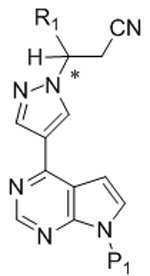
[화학식 D-1][Formula D-1]

상기 식에서:Where:
*는 키랄 탄소를 나타내고;* Represents chiral carbon;
P1은 보호 그룹이고;P 1 is a protecting group;
R1은 C3-7 시클로알킬, C1-6 알킬, 및 C1-6 플루오로알킬로부터 선택된다.R 1 is selected from C 3-7 cycloalkyl, C 1-6 alkyl, and C 1-6 fluoroalkyl.
일부 구체예에서, 염기는 알칼리 금속 또는 알칼리 토금속 염기이다. 일부 구체예에서, 염기는 알칼리 금속 또는 알칼리 토금속 염기 알콕시드, 히드록사이드 또는 카보네이트이다. 일부 구체예에서, 염기는 알칼리 금속 또는 알칼리 토금속 카보네이트이다. 일부 구체예에서, 염기는 알칼리 토금속 카보네이트이다. 일부 구체예에서, 염기는 탄산세슘. 일부 구체예에서, 염기는 알칼리 금속 t-부톡시드이다. 일부 구체예에서, 염기는 칼륨 t-부톡시드이다.In some embodiments, the base is an alkali metal or alkaline earth metal base. In some embodiments, the base is an alkali metal or alkaline earth metal base alkoxide, hydroxide or carbonate. In some embodiments, the base is an alkali metal or alkaline earth metal carbonate. In some embodiments, the base is alkaline earth metal carbonate. In some embodiments, the base is cesium carbonate. In some embodiments, the base is an alkali metal t-butoxide. In some embodiments, the base is potassium t-butoxide.
화학식 Ia의 화합물의 라세미체는, 화학식 Ia의 화합물의 라세미체를 형성하기에 충분한 조건 하에서, 화학식 Ⅳ의 화합물을 화학식 D-1의 화합물로 처리하는 것을 포함하는 방법으로 제조될 수 있다:Racemates of compounds of formula (Ia) may be prepared by methods comprising treating a compound of formula (IV) with a compound of formula (D-1) under conditions sufficient to form a racemate of the compound of formula (Ia):
[화학식 Ia]Formula Ia

[화학식 Ⅳ][Formula IV]
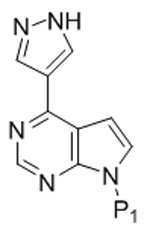
[화학식 D-1][Formula D-1]
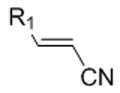
상기 식에서:Where:
*는 키랄 탄소를 나타내고;* Represents chiral carbon;
P1은 보호 그룹이고;P 1 is a protecting group;
R1은 C3-7 시클로알킬, C1-6 알킬, 및 C1-6 플루오로알킬로부터 선택된다.R 1 is selected from C 3-7 cycloalkyl, C 1-6 alkyl, and C 1-6 fluoroalkyl.
화학식 D-1의 3-치환된 아실니트릴은 반응도식 9에서와 같이 제조된다. 화학식 D-2의 알데히드, 예컨대 시클로펜탄카브알데히드 또는 시클로프로판카브알데히드의, 화학식 -CH2CN의 일라이드를 위티그형 시약, 예컨대 디에틸 시아노메틸포스포네이트에 의한 올레핀화는 유기 용매, 예컨대 THF에서, 염기, 예컨대 칼륨 tert-부톡시드의 영향 하에서, 약 0 내지 약 5℃에서 수행된다. 일부 구체예에서, 화학식 D-1의 수득한 3-치환된 아실니트릴는 진공 증류에 의해 정제될 수 있다.The 3-substituted acylnitrile of Formula D-1 is prepared as in Scheme 9. The olefinization of aldehydes of formula D-2, such as cyclopentanecarbaldehyde or cyclopropanecarbaldehyde, of formula -CH 2 CN with witig reagents such as diethyl cyanomethylphosphonate is an organic solvent, In eg THF, at about 0 to about 5 ° C., under the influence of a base such as potassium tert -butoxide. In some embodiments, the obtained 3-substituted acylnitriles of Formula D-1 can be purified by vacuum distillation.
반응도식 9 Scheme 9

따라서, 일부 구체예에서, 화학식 D-1의 화합물은, 염기의 존재하에서 화학식 D-2의 화합물을, 화학식 -CH2CN의 일라이드를 갖는 위티그형 시약과 반응시키는 것을 포함하는 방법으로 제조된다:Thus, in some embodiments, a compound of Formula (D-1) is prepared by a method comprising reacting a compound of Formula (D-2) with a Wittig-type reagent having an Ilide of Formula -CH 2 CN in the presence of a base do:
[화학식 D-1][Formula D-1]

[화학식 D-2][Formula D-2]

상기 식에서, R1은 C3-7 시클로알킬, C1-6 알킬, 및 C1-6 플루오로알킬로부터 선택된다.Wherein R 1 is selected from C 3-7 cycloalkyl, C 1-6 alkyl, and C 1-6 fluoroalkyl.
본 명세서에 사용된 바와 같이, 용어 "위티그형 시약"는 하기의 기술분야에 기재된 Wittig 반응, Wadsworth-Emmons 반응, 및 Horner-Wittig 반응에 사용된 시약을 의미한다 (참고, 예, Carey 및 Sundberg, Advanced Organic Chemistry, Part B: Reactions and Synthesis, 4th ed., Kluwer Academic/Plenum Publishers:New York, 페이지 111-119 (2001); 및 March, Advanced Organic Chemistry: Reactions, Mechanisms, and Structure, 3rd ed., John Wiley & Sons:New York, 페이지 845-855 (1985), 이들 각각은 그 전체가 참고로 본 명세서에 통합된다). 시아노메틸 또는 시아노메틸 일라이드 그룹을 함유하는 예시적인 위티그형 시약은, 일반 화학식 (R'O)2P(=O)-L-R1, R" 3P(+)-L(-)-R1, R" 3P(+)-L-R1X; R"2P(=O)-L-R1, 및 (R'N) 2P(=O)-L-R1의 화합물을 비제한적으로 포함하고, 여기서, R'는 C1-6 알콕시 또는 임의 치환된 페닐이고; R"는 임의 치환된 페닐이고; L은 -CH2- 또는 -CH-이고; R1는 시아노이고; X는 음이온 (예, 할로 음이온, 예컨대 클로라이드)이다. 일부 구체예에서, 위티그형 시약은 디에틸 시아노메틸 포스페이트이다. 일부 구체예에서, 화학식 D-2의 화합물의 위티그형 시약과의 반응은 염기의 존재하에서이다. 일부 구체예에서, 염기는 강염기이다. 일부 구체예에서, 염기는 칼륨 t-부톡시드, 나트륨 t-부톡시드, 수산화나트륨, 나트륨 에톡시드, 수산화나트륨, 탄산칼륨, 또는 나트륨 카보네이트이다. 일부 구체예에서, 염기는 알칼리 금속 알콕시드이다. 일부 구체예에서, 염기는 알칼리 금속 t-부톡시드이다. 일부 구체예에서, 염기는 칼륨 t-부톡시드이다. 일부 구체예에서, 화학식 D-2의 알데히드의 위티그형 시약과의 올레핀화는 유기 용매, 예컨대 THF에서, 염기, 예컨대 칼륨 tert-부톡시드의 영향 하에서, 약 0 내지 약 5℃의 온도에서 수행된다. 일부 구체예에서, 염기는 화학식 D-2의 화합물에 대해 약 1 내지 약 1.2 당량, 또는 약 1.05 내지 약 1.1 당량으로 존재한다. 일부 구체예에서, 위티그형 시약은 화학식 D-2의 화합물에 대해 약 1 내지 약 1.2 당량, 또는 약 1.05 내지 약 1.1 당량으로 존재한다. 일부 구체예에서, 위티그형 시약은 (메톡시메틸)트리페닐포스피늄 클로라이드이다.As used herein, the term "witigated reagent" refers to the reagents used in the Wittig reaction, Wadsworth-Emmons reaction, and Horner-Wittig reaction described in the art below (see, eg, Carey and Sundberg). , Advanced Organic Chemistry, Part B: Reactions and Synthesis, 4th ed., Kluwer Academic / Plenum Publishers: New York, pages 111-119 (2001); and March, Advanced Organic Chemistry: Reactions, Mechanisms, and Structure, 3rd ed. , John Wiley & Sons: New York, pages 845-855 (1985), each of which is incorporated herein by reference in its entirety). Exemplary witigated reagents containing cyanomethyl or cyanomethyl ylide groups include the general formula (R'O) 2 P (= 0) -LR 1 , R " 3 P (+)-L (-) -R 1 , R ″ 3 P (+)-LR 1 X; R ′ 2 P (═O) —LR 1 , and (R′N) 2 P (═O) -LR 1 , including but not limited to, wherein R ′ is C 1-6 alkoxy or optionally substituted Phenyl; R ″ is optionally substituted phenyl; L is -CH 2 -or -CH-; R 1 is cyano; X is an anion (eg halo anion such as chloride). In some embodiments, the witig reagent is diethyl cyanomethyl phosphate. In some embodiments, the reaction of the compound of Formula D-2 with a Wittig-type reagent is in the presence of a base. In some embodiments, the base is a strong base. In some embodiments, the base is potassium t-butoxide, sodium t-butoxide, sodium hydroxide, sodium ethoxide, sodium hydroxide, potassium carbonate, or sodium carbonate. In some embodiments, the base is an alkali metal alkoxide. In some embodiments, the base is an alkali metal t-butoxide. In some embodiments, the base is potassium t-butoxide. In some embodiments, olefination of the aldehyde of Formula D-2 with a Wittig-type reagent is performed in an organic solvent such as THF at a temperature of about 0 to about 5 ° C., under the influence of a base such as potassium tert -butoxide. do. In some embodiments, the base is present in about 1 to about 1.2 equivalents, or about 1.05 to about 1.1 equivalents, relative to the compound of Formula D-2. In some embodiments, the Witig-type reagent is present in about 1 to about 1.2 equivalents, or about 1.05 to about 1.1 equivalents, relative to the compound of Formula D-2. In some embodiments, the Wittig-type reagent is (methoxymethyl) triphenylphosphinium chloride.
다른 구체예에서, 본 방법은 또한, 탈보호 조건 하에서 화학식 Ia의 화합물을 반응시켜 화학식 Ⅲ의 화합물을 형성하는 것을 포함한다:In another embodiment, the method also includes reacting the compound of Formula Ia under deprotection conditions to form the compound of Formula III:
[화학식 Ⅲ][Formula III]

적합한 P1 그룹 및 탈보호 방법은 상기에 기재된 것을 포함하지만, 이들로 제한되는 것은 아니다.Suitable P 1 groups and deprotection methods include those described above, but are not limited to these.
일부 구체예에서, 본 발명은 또한, 화학식 Ⅲ의 화합물을 인산과 반응시켜 화학식 Ⅲ의 화합물의 포스페이트 염을 형성하는 것을 포함한다.In some embodiments, the invention also includes reacting a compound of Formula III with phosphoric acid to form a phosphate salt of the compound of Formula III.
V. 중간체 화합물에 대한 경로V. Pathways to Intermediate Compounds
i) 화학식 Ⅳ의 중간체 화합물에 대한 더 높은 수율 경로 i) higher yield route for intermediate compounds of formula (IV)
화학식 Ⅳ의 화합물은 상기에 기재된 화학식 Ⅲ의 화합물에 대한 다양한 합성 경로에서 중요한 중간체이다. 이들 화합물은 스즈끼 커플링 방법에 의해 일반적으로 형성된다. 팔라듐 촉매를 사용하는 화학식 X의 보호된 7H-피롤로[2,3-d]피리미딘 유도체와 화학식 XV의 비보호된 피라졸 보레이트 유도체와의 스즈끼 커플링으로 그 수율은 낮게된다 (반응도식 10). 임의의 특정 이론에 구속되기를 바라지 않으면서, 낮은 수율은 스즈끼 커플링 반응에서 보호되지 않은 아민 관능기의 방해로부터 생기는 것으로 믿는다. Compounds of formula IV are important intermediates in the various synthetic routes to the compounds of formula III described above. These compounds are generally formed by the Suzuki coupling method. Suzuki coupling of a protected 7 H -pyrrolo [2,3- d ] pyrimidine derivative of Formula X to an unprotected pyrazole borate derivative of Formula XV using a palladium catalyst yields low yields (Scheme 10). ). Without wishing to be bound by any particular theory, it is believed that low yields result from interference of unprotected amine functionalities in the Suzuki coupling reaction.
반응도식 10 Scheme 10
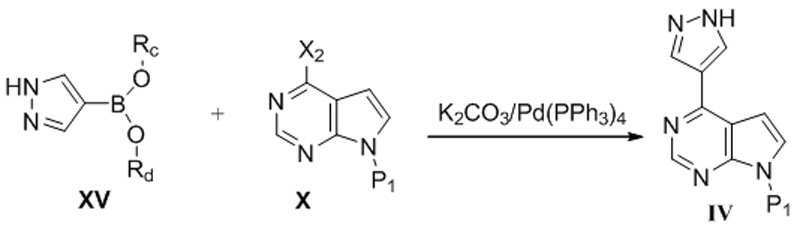
따라서, 화학식 Ⅳ의 화합물의 신규 제조 방법은 화학식 XⅢ의 보호된 피라졸 보레이트 유도체의 사용을 수반하는 것을 전개했다 (반응도식 11). 따라서, 화학식 XⅢ의 화합물은 생성될 수 있고, 그 다음, 화학식 X의 보호된 7H-피롤로[2,3-d]피리미딘 유도체와 반응하여 화학식 XⅡ의 화합물을 형성하고, 그 다음 탈보호하여 화학식 Ⅳ의 화합물을 얻는다. 일부 구체예에서, 화학식 XⅢ의 화합물은 피라졸 피나콜 보레이트의 보호에 의해 원위치에서 형성될 수 있다. 예를 들어, P2가 1-(에톡시)에틸일 때, 피라졸-4-일 피나콜 보레이트는 비닐 에테르와 반응하여 원위치에서 화학식 XⅢ의 보호된 화합물을 생성할 수 있다. 그 다음, 화학식 XⅢ의 보호된 피라졸 피나콜 보레이트와 화학식 X의 화합물 사이의 스즈끼 커플링 반응은 전형적인 스즈끼 반응 조건 하에서 부드립게 진행하여, 화학식 XⅡ의 상응하는 커플링 중간체의 산 워크업 후에, 고수율로 화학식 Ⅳ의 화합물을 생성한다. Thus, a novel process for preparing compounds of formula (IV) has entailed the use of protected pyrazole borate derivatives of formula (XIII) (Scheme 11). Thus, a compound of formula (XIII) may be produced, and then reacted with a protected 7 H -pyrrolo [2,3- d ] pyrimidine derivative of formula (X) to form a compound of formula (XII), followed by deprotection To obtain the compound of formula IV. In some embodiments, the compound of formula XIII may be formed in situ by protection of pyrazole pinacol borate. For example, when P 2 is 1- (ethoxy) ethyl, pyrazol-4-yl pinacol borate can react with vinyl ether to produce a protected compound of formula XIII in situ. The Suzuki coupling reaction between the protected pyrazole pinacol borate of formula XIII and the compound of formula X then proceeds smoothly under typical Suzuki reaction conditions, after acid workup of the corresponding coupling intermediate of formula XII, The compound of formula IV is produced in high yield.
다른 구체예에서, 화학식 XⅢ의 화합물은 분리된 완전히 특성화된 화합물이다. 예를 들어, 분리된 완전히 특성화된 화학식 XⅢ의 화합물, (여기서, P2는 1-(에톡시)에틸이고 보레이트 잔기는 피나콜 그룹이다)의 사용으로, 화학식 XⅡ의 생성물, 및 차후에 화학식 Ⅳ의 화합물을 더 양호한 수율 및 순도로 얻었다.In another embodiment, the compound of Formula XIII is an isolated fully characterized compound. For example, by the use of an isolated fully characterized compound of formula XIII, wherein P 2 is 1- (ethoxy) ethyl and the borate moiety is a pinacol group), the product of formula XII, and subsequently The compound was obtained in better yields and purity.
반응도식 11 Scheme 11

다른 구체예에서, 화학식 X의 화합물은 화학식 XI의 화합물로부터 원위치에서 생성되고, 그 다음, 차후에 화학식 XⅢ의 화합물과 반응할 수 있다. 이는 대규모 생산 동안에 화학식 X의 화합물을 분리하고 정제할 필요성을 제거한다. 예를 들어, P1이 SEM일 때, 화학식 XI의 화합물은 수산화나트륨 및 SEM 클로라이드와 반응하여 화학식 X의 화합물을 원위치에서 생성할 수 있다 (반응도식 12). In another embodiment, the compound of formula (X) may be produced in situ from the compound of formula (XI) and then subsequently reacted with the compound of formula (XIII). This eliminates the need to separate and purify the compound of formula X during large scale production. For example, when P 1 is an SEM, the compound of formula XI can react with sodium hydroxide and SEM chloride to produce the compound of formula X in situ (Scheme 12).
반응도식 12 Scheme 12

따라서, 본 발명은 화학식 XⅡ의 화합물의 제조 방법을 제공하고, 이 방법은, 팔라듐 촉매, 염기, 및 용매의 존재하에서 화학식 X의 화합물을 화학식 XⅢ의 화합물과 반응하여 화학식 XⅡ의 화합물을 형성하는 것을 포함한다:Accordingly, the present invention provides a process for preparing a compound of formula XII, which method comprises reacting a compound of formula X with a compound of formula XIII in the presence of a palladium catalyst, a base, and a solvent to form a compound of formula XII. Contains:
[화학식 XⅡ][Formula XII]

[화학식 X][Formula X]

[화학식 XⅢ][Formula XIII]
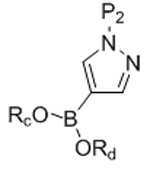
상기 식에서:Where:
X2는 토실레이트 그룹, 트리플레이트 그룹, 아이오도, 클로로, 또는 브로모이고; X 2 is a tosylate group, a triflate group, iodo, chloro, or bromo;
P1 및 P2 각각은 독립적으로 보호 그룹이고;P 1 and P 2 are each independently a protecting group;
Rc 및 Rd 각각은 독립적으로 H 또는 C1-6 알킬로부터 선택되고; 또는Each of R c and R d is independently selected from H or C 1-6 alkyl; or
Rc 및 Rd는, 이들이 부착되는 산소 원자 및 붕소 원자와 함께, 5- 내지 6-원 헤테로시클릭 고리를 형성하고, 이 고리는 1, 2, 3, 또는 4개의 C1-4 알킬 그룹으로 임의로 치환된다.R c and R d together with the oxygen and boron atoms to which they are attached form a 5- to 6-membered heterocyclic ring, which ring is 1, 2, 3, or 4 C 1-4 alkyl groups Optionally substituted.
일부 구체예에서, 본 방법은 또한, 화학식 Ⅳ의 화합물의 제조 방법을 포함하고, 이 방법은 탈보호 조건 하에서 화학식 XⅡ의 화합물을 반응시켜 화학식 Ⅳ의 화합물을 생성하는 것을 포함한다: In some embodiments, the method also includes a method of preparing a compound of Formula IV, which method comprises reacting a compound of Formula XII under deprotection conditions to produce a compound of Formula IV:
[화학식 Ⅳ][Formula IV]

상기 식에서:Where:
P1 및 P2 각각은 독립적으로 보호 그룹; 및P 1 and P 2 are each independently a protecting group; And
Rc 및 Rd 각각은 독립적으로 H 또는 C1-6 알킬로부터 선택되거나; 또는Each of R c and R d is independently selected from H or C 1-6 alkyl; or
Rc 및 Rd는, 이들이 부착되는 산소 원자 및 붕소 원자와 함께, 5- 내지 6-원 헤테로시클릭 고리를 형성하고, 이 고리는 1, 2, 3, 또는 4개의 C1-4 알킬 그룹으로 임의로 치환된다.R c and R d together with the oxygen and boron atoms to which they are attached form a 5- to 6-membered heterocyclic ring, which ring is 1, 2, 3, or 4 C 1-4 alkyl groups Optionally substituted.
일부 구체예에서, 화학식 XⅢ의 화합물은 하기 식으로 표시된다:In some embodiments, the compound of formula XIII is represented by the formula:

일부 구체예에서, X2는 클로로, 브로모, 또는 아이오도이다. 일부 구체예에서, X2는 클로로이다.In some embodiments, X 2 is chloro, bromo, or iodo. In some embodiments, X 2 is chloro.
스즈끼 커플링 반응은 수많은 팔라듐(0) 및 팔라듐(Ⅱ) 촉매를 사용하여 개시되고, 본 기술분야에 공지된 조건 하에서 수행될 수 있다 (참고, 예, Miyaura and Suzuki, Chem. Rev. 1995, 95, 2457-2483, 이는 그 전체가 본 명세서에 통합된다). 일부 구체예에서, 팔라듐 촉매는 Pd(PPh3)4 및 Pd(dppf)2Cl2이다. 일부 구체예에서, 팔라듐 촉매는 테트라키스(트리페닐포스핀)팔라듐(0) 또는 테트라키스(트리(o-톨릴)포스핀)팔라듐(0)이다. 일부 구체예에서, 팔라듐 촉매는 테트라키스(트리페닐포스핀)팔라듐(0)이다.Suzuki coupling reactions are initiated using a number of palladium (0) and palladium (II) catalysts and can be performed under conditions known in the art (see, eg, Miyaura and Suzuki, Chem. Rev. 1995 , 95 , 2457-2483, which is hereby incorporated by reference in its entirety). In some embodiments, the palladium catalyst is Pd (PPh 3 ) 4 and Pd (dppf) 2 Cl 2 . In some embodiments, the palladium catalyst is tetrakis (triphenylphosphine) palladium (0) or tetrakis (tri ( o -tolyl) phosphine) palladium (0). In some embodiments, the palladium catalyst is tetrakis (triphenylphosphine) palladium (0).
일부 구체예에서, 팔라듐 촉매 부하는 약 1×10⁻⁴ 내지 약 0.1 당량이다. 일부 구체예에서, 팔라듐 촉매 부하는 약 0.0010 내지 약 0.0015 당량이다. 일부 구체예에서, 화학식 X의 화합물 대 화학식 XⅢ의 화합물의 화학양론 비는 약 1:1.05 내지 약 1:1.35이다. In some embodiments, the palladium catalyst load is about 1 × 10 −4 to about 0.1 equivalents. In some embodiments, the palladium catalyst load is about 0.0010 to about 0.0015 equivalents. In some embodiments, the stoichiometric ratio of the compound of Formula X to the compound of Formula XIII is about 1: 1.05 to about 1: 1.35.
일부 구체예에서, 용매는 물 및 유기 용매를 포함한다. 일부 구체예에서, 유기 용매는 1,4-디옥산, 1-부탄올, 1,2-디메톡시에탄 (DME), 2-프로판올, 톨루엔 또는 에탄올, 또는 이들의 조합이다. 일부 구체예에서, 유기 용매는 DME를 포함한다. 일부 구체예에서, 유기 용매는 DMF를 포함한다. In some embodiments, the solvent comprises water and an organic solvent. In some embodiments, the organic solvent is 1,4-dioxane, 1-butanol, 1,2-dimethoxyethane (DME), 2-propanol, toluene or ethanol, or a combination thereof. In some embodiments, the organic solvent comprises DME. In some embodiments, the organic solvent comprises DMF.
일부 구체예에서, 염기는 무기 염기이다. 일부 구체예에서, 염기는 유기 염기이다. 일부 구체예에서, 염기는 알칼리 금속 카보네이트이다. 일부 구체예에서, 염기는 탄산칼륨 (K2CO3)이다. 일부 구체예에서, 2 내지 5 당량의 염기 (예, K2CO3)가 사용된다. In some embodiments, the base is an inorganic base. In some embodiments, the base is an organic base. In some embodiments, the base is an alkali metal carbonate. In some embodiments, the base is potassium carbonate (K 2 CO 3 ). In some embodiments, 2 to 5 equivalents of base (eg, K 2 CO 3 ) are used.
일부 구체예에서, 스즈끼 커플링 반응은 약 80 내지 약 100℃의 온도에서 수행된다. 일부 구체예에서, 반응은 2 내지 12시간 동안 수행된다. 일부 구체예에서, 화학식 XⅡ의 화합물은 스즈끼 커플링 반응 혼합물의 수성 워크업으로부터 임의로 분리되고, 또는 직접 사용될 수 있다. In some embodiments, the Suzuki coupling reaction is carried out at a temperature of about 80 to about 100 ° C. In some embodiments, the reaction is carried out for 2 to 12 hours. In some embodiments, the compound of formula (XII) is optionally isolated from the aqueous work up of the Suzuki coupling reaction mixture, or may be used directly.
일부 구체예에서, 화학식 X의 화합물은 반응도식 13에 있는 것으로부터 선택되고, 보여진 바와 같이 화학식 XI의 화합물로부터 개시하여 형성될 수 있다. 일부 구체예에서, X2는 클로로이다. 일부 구체예에서, 화학식 X의 화합물은 분리되고, 또는 추가 정제 유무와 함께 차후의 스즈끼 반응을 위해 개시물질로서 인사이튜(in situ) 생성된다. 일부 구체예에서, P1 보호 그룹은 상기에 열거된 것들 중의 하나이다.In some embodiments, compounds of Formula X are selected from those in Scheme 13 and can be formed starting from compounds of Formula XI as shown. In some embodiments, X 2 is chloro. In some embodiments, the compound of formula X is isolated or produced in situ as a starting material for subsequent Suzuki reaction with or without further purification. In some embodiments, the P 1 protecting group is one of those listed above.
반응도식 13 Scheme 13

적합한 P2 보호 그룹은 하기에 묘사된 아민에 대한 보호 그룹을 비제한적으로포함한다: Wuts and Greene, Protective Groups in Organic Synthesis, 4th ed., John Wiley & Sons: New Jersey, 페이지 696-887 (및, 특히, 페이지 872-887) (2007), 이는 그 전체가 참고로 본 명세서에 통합된다. 일부 구체예에서, P2는 보호 그룹이고, 이 그룹은 P1 보호 그룹을 치환하지 않는 조건 하에서 선택적으로 제거될 수 있다. 일부 구체예에서, P2는 보호 그룹이고, 이 그룹은 산성 조건 하에서 실온에서, 약 15℃ 내지 약 40℃, 또는 약 15℃ 내지 약 30℃의 온도에서 제거될 수 있다. 일부 구체예에서, P2는 실온 산성 조건 하에서 탈보호된 그룹이다. 일부 구체예에서, P2는 1-(에톡시)에틸, 트리(C1-6 알킬)실릴 (예, t-부틸디메틸실릴 또는 트리이소프로필실릴), p-메톡시벤질 (PMB), 트리페닐메틸 (Tr), 디페닐메틸, 히드록시메틸, 메톡시메틸 (MOM), 디에톡시메틸, 또는 t-부틸디메틸실릴메틸이다. 일부 구체예에서, P2은 1-(에톡시)에틸이다.Suitable P 2 protecting groups include, but are not limited to, protecting groups for amines described below: Wuts and Greene, Protective Groups in Organic Synthesis, 4th ed., John Wiley & Sons: New Jersey, pages 696-887 (and , In particular, pages 872-887 (2007), which is hereby incorporated by reference in its entirety. In some embodiments, P 2 is a protecting group, which group can be optionally removed under conditions that do not substitute for the P 1 protecting group. In some embodiments, P 2 is a protecting group, which can be removed at room temperature, at about 15 ° C. to about 40 ° C., or at about 15 ° C. to about 30 ° C. under acidic conditions. In some embodiments, P 2 is a deprotected group under room temperature acidic conditions. In some embodiments, P 2 is 1- (ethoxy) ethyl, tri (C 1-6 alkyl) silyl (eg, t-butyldimethylsilyl or triisopropylsilyl), p-methoxybenzyl (PMB), tri Phenylmethyl (Tr), diphenylmethyl, hydroxymethyl, methoxymethyl (MOM), diethoxymethyl, or t-butyldimethylsilylmethyl. In some embodiments, P 2 is 1- (ethoxy) ethyl.
화학식 XⅡ의 화합물을 처리하여 P2 그룹을 제거하는 것은 하기에서의 것과 같은 아민에 대한 특정 보호 그룹의 제거에 대해 본 기술분야에 공지된 방법으로 달성될 수 있다: Wuts and Greene, Protective Groups in Organic Synthesis, 4th ed., John Wiley & Sons: New Jersey, 페이지 696-887 (및 특히, 페이지 872-887) (2007), 이는 그 전체가 참고로 본 명세서에 통합된다. 일부 구체예에서, 처리는 화학식 XⅡ의 화합물을 산성 조건 (예, 염산 또는 트리플루오로아세트산) 하에서 실온에서, 약 15℃ 내지 약 40℃, 또는 약 15℃ 내지 약 30℃의 온도에서 처리하는 것을 포함한다. 일부 구체예에서, 처리는 화학식 XⅡ의 화합물을 약 1 N 내지 약 5 N 염산의 수성 용액으로 약 10℃ 내지 약 30℃의 온도에서 처리하는 것을 포함한다.Treatment of the compound of formula (XII) to remove the P 2 group can be accomplished by methods known in the art for the removal of certain protecting groups for amines such as: Wuts and Greene, Protective Groups in Organic Synthesis, 4th ed., John Wiley & Sons: New Jersey, pages 696-887 (and in particular, pages 872-887) (2007), which is hereby incorporated by reference in its entirety. In some embodiments, the treating comprises treating the compound of Formula XII at room temperature, at about 15 ° C. to about 40 ° C., or at about 15 ° C. to about 30 ° C. under acidic conditions (eg, hydrochloric acid or trifluoroacetic acid). Include. In some embodiments, treating comprises treating the compound of Formula XII with an aqueous solution of about 1 N to about 5 N hydrochloric acid at a temperature of about 10 ° C. to about 30 ° C.
적합한 P1 그룹은 상기에 기재된 것을 비제한적으로 포함한다.Suitable P 1 groups include, but are not limited to those described above.
화학식 X의 화합물은 화학식 XI의 화합물의 보호에 의해 형성될 수 있다. 따라서, 일부 구체예에서, 화학식 X의 화합물의 제조 방법은, 보호 그룹을 부가하기 위해 화학식 XI의 화합물을 처리하여 화학식 X의 화합물을 형성하는 것을 포함한다:Compounds of formula (X) may be formed by protection of compounds of formula (XI). Thus, in some embodiments, a method of preparing a compound of Formula X comprises treating a compound of Formula XI to form a compound of Formula X to add a protecting group:
[화학식 XI](XI)

[화학식 X][Formula X]

상기 식에서:Where:
X2는 토실레이트 그룹, 트리플레이트 그룹, 아이오도, 클로로, 또는 브로모이고;X 2 is a tosylate group, a triflate group, iodo, chloro, or bromo;
P1은 보호 그룹이다.P 1 is a protection group.
일부 구체예에서, 화학식 XI의 화합물은 염기, 바람직하게는 수산화나트륨 (NaH)로, 유기 용매, 예컨대 THF, 1,4-디옥산, 1,2-디메톡시에탄 (DME), 또는 N,N-디메틸아세트아미드 (DMAC)에서, 저온에서, 바람직하게는 약 0 내지 약 5℃의 온도에서 탈양자화된 후, 친전자체, 예컨대 클로로메틸 피발레이트 (POM-Cl) 또는 트리메틸실릴에톡시메틸 클로라이드 (SEM-Cl)로 처리하여 보호 그룹, P1을 부가한다. 보호된 화합물 X는 분리되고, 또는 추가 정제 유무와 함께 차후의 스즈끼 반응에 개시물질로서 원위치에서 생성된다.In some embodiments, the compound of formula XI is a base, preferably sodium hydroxide (NaH), in an organic solvent such as THF, 1,4-dioxane, 1,2-dimethoxyethane (DME), or N , N In -dimethylacetamide (DMAC), after deprotonation at low temperature, preferably at a temperature of about 0 to about 5 ° C., an electrophile such as chloromethyl pivalate (POM-Cl) or trimethylsilylethoxymethyl chloride ( SEM-Cl) to add the protective group, P 1 . Protected compound X is isolated or produced in situ as a starting material for subsequent Suzuki reactions with or without further purification.
본 명세서에 기재된 방법으로부터 형성된 중간체는 본 명세서에 기재된 다른 방법에서 적합한 것으로서 사용될 수 있다.Intermediates formed from the methods described herein can be used as suitable in the other methods described herein.
ii. 화학식 C-9의 피나콜 보레이트의 제조ii. Preparation of Pinacol Borate of Formula C-9
본 발명은 추가로, 본 명세서에 기재된 방법에 유용한 화학식 XⅥ의 피라졸 피나콜 보레이트의 제조 방법을 제공한다. 화학식 XⅥ의 화합물의 특정 하위세트는 상기의 화학식 XⅢ의 화합물 대신에 치환될 수 있는 화학식 XⅢa의 4-치환된 피라졸 보레이트 유도체이다.The invention further provides a process for the preparation of pyrazole pinacol borate of the formula XVI, useful for the methods described herein. Particular subsets of compounds of formula XVI are 4-substituted pyrazole borate derivatives of formula XIIIa which may be substituted in place of the compounds of formula XIII above.

XⅥ의 화합물은 반응도식 14에서 보여진 방법으로 생성될 수 있다. 먼저, 피라졸은 할로겐화제와 반응하여 화학식 XⅨ (여기서, X3은 아이오도 또는 브로모이고, m은 1 또는 2이다)의 모노할로 또는 디할로 피라졸을 생성한다. 그 다음, 화학식 XⅨ의 화합물은 보호되어 화학식 XⅧ의 보호된 모노할로 또는 디할로 피라졸을 얻는다. 그 다음, 화학식 XⅧ의 화합물은 알킬 그리냐드 또는 알킬리튬 시약로, 그 다음 화학식 XⅦ의 2-알콕시-4,4,5,5-테트라메틸-1,3,2-디옥사보롤란 시약으로 처리되어, 화학식 XⅥ의 원하는 피나콜 보레이트를 형성할 수 있다. 일부 구체예에서, P3 보호 그룹은 그리냐드 또는 리튬 반응 (예, 여기서, P3은 1-(에톡시)에틸이더)의 수성 워크업에 대해 안정한 것이다. 다른 경우에, P3는 보호 그룹은 그리냐드 또는 알킬리튬 반응의 수성 워크업에 대한 안정하지 않다. 이 경우에, 추가 보호 단계는 보호 그룹, P3을 추가할 필요가 있을 것이다. 일부 구체예에서, P3은 방법의 각 경우에 대해 P2에 대해 상기에 열거된 그룹으로부터 선택될 것이다.Compounds of XVI can be produced by the method shown in Scheme 14. First, the pyrazole reacts with a halogenating agent to produce a monohalo or dihalo pyrazole of formula X 'wherein X 3 is iodo or bromo and m is 1 or 2. The compound of formula X 'is then protected to obtain a protected monohalo or dihalo pyrazole of formula X'. The compound of formula (XVII) is then treated with an alkyl Grignard or alkyllithium reagent, followed by 2-alkoxy-4,4,5,5-tetramethyl-1,3,2-dioxaborolane reagent of formula (XVII). To form the desired pinacol borate of Formula XVI. In some embodiments, the P 3 protecting group is stable to the aqueous workup of a Grignard or lithium reaction (eg, where P 3 is 1- (ethoxy) ethylether). In other cases, the P 3 protecting group is not stable for the aqueous workup of the Grignard or alkyllithium reaction. In this case, an additional protection step will need to add a protection group, P 3 . In some embodiments, P 3 will be selected from the group listed above for P 2 for each instance of the method.
반응도식 14 Scheme 14

따라서, 일부 구체예에서, 본 발명은 화학식 XⅥ의 화합물의 제조 방법을 제공하고, 이 방법은 하기 단계 (a) 및 (b)를 포함한다:Thus, in some embodiments, the present invention provides a method of preparing a compound of Formula XVI, which method comprises the following steps (a) and (b):
(a) 화학식 XⅧ의 화합물을 약 1 당량 이상의 C1 -6 알킬 그리냐드 시약 또는 C1-6 알킬 리튬 시약과 반응시킨 다음, 약 1 당량 이상의 화학식 XⅦ의 화합물로 처리하는 단계; 및(a) reacting a compound of formula XⅧ with about 1 equivalent or more C 1 -6 alkyl Grignard reagent or a C 1-6 alkyl lithium reagent, and then treating with a compound of the formula about 1 equivalent or more XⅦ; And
(b) 임의로, 단계 (a)의 생성물을 재보호하여 화학식 XⅥ의 화합물의 얻는 단계:(b) optionally, reprotecting the product of step (a) to obtain a compound of formula XVI:
[화학식 XⅥ][Formula XVI]

[화학식 XⅧ]Formula X '

[화학식 XⅦ]Formula X '

상기 식에서:Where:
P3은 보호 그룹이고;P 3 is a protecting group;
X3은 할로겐이고; X 3 is halogen;
R4는 C1 -6 알킬로부터 선택되고;R 4 is selected from C 1 -6 alkyl;
m은 1 및 2로부터 선택된 정수이다. m is an integer selected from 1 and 2.
일부 구체예에서, 화학식 XⅧ의 화합물 및 그리냐드 또는 리튬 시약의 비는은 약 1:1 내지 약 1:2.0, 약 1:1 내지 약 1:1.8, 또는 약 1:1 내지 약 1.2이다. 전형적으로, 반응은 비양자성 유기 용매에서 수행된다. 일부 구체예에서, 용매는 테트라히드로푸란이다. 일부 구체예에서, 화학식 XⅧ의 화합물 대 화학식 XⅦ의 화합물의 비는 약 1:1 내지 약 1:5, 약 1:1 내지 약 1:3, 또는 약 1:1.5 내지 약 1:2.5이다. In some embodiments, the ratio of compound of Formula XVII and Grignard or lithium reagent is about 1: 1 to about 1: 2.0, about 1: 1 to about 1: 1.8, or about 1: 1 to about 1.2. Typically, the reaction is carried out in an aprotic organic solvent. In some embodiments, the solvent is tetrahydrofuran. In some embodiments, the ratio of compound of formula X 'to compound of formula X' is about 1: 1 to about 1: 5, about 1: 1 to about 1: 3, or about 1: 1.5 to about 1: 2.5.
일부 구체예에서, 그리냐드 시약은 단계 (a)에서 사용되고, 온도는 -30℃ 내지 약 실온, 약 -30 내지 약 0℃, 또는 약 -25 내지 약 -5℃이다. 일부 구체예에서, 리튬 시약은 단계 (a)에서 사용되고, 온도는 약 -80℃ 내지 약 -60℃, 또는 약 -78℃이다.In some embodiments, the Grignard reagent is used in step (a) and the temperature is from -30 ° C to about room temperature, from about -30 to about 0 ° C, or from about -25 to about -5 ° C. In some embodiments, the lithium reagent is used in step (a) and the temperature is about -80 ° C to about -60 ° C, or about -78 ° C.
일부 구체예에서, 그리냐드 시약은 이소프로필 마그네슘 브로마이드, 또는 이의 부가물이다.In some embodiments, the Grignard reagent is isopropyl magnesium bromide, or an adduct thereof.
일부 구체예에서, R4는 C1-4 알킬이다. 일부 구체예에서, R4는 C1-3 알킬이다. 일부 구체예에서, R4는 메틸 또는 이소프로필이다. 일부 구체예에서, X3은 아이오도 또는 브로모이다. 일부 구체예에서, m은 2이다. 일부 구체예에서, m은 1이다.In some embodiments, R 4 is C 1-4 alkyl. In some embodiments, R 4 is C 1-3 alkyl. In some embodiments, R 4 is methyl or isopropyl. In some embodiments, X 3 is iodo or bromo. In some embodiments, m is 2. In some embodiments, m is 1.
화학식 XⅧ의 화합물은 일부 경우에 공지될 수 있다 (참고, 예, Abe, et al., Heterocycle, 2005, 66, 229-240; Korolev, et al., Tet. Lett. 2005, 46, 5751-5754; Vasilevsky, Heterocycle, 2003, 60(4), 879-886; 및 WO 2008/082198, 이들 각각은 그 전체가 참고로 본 명세서에 통합된다). 다른 구체예에서, 본 방법은 또한, 화학식 XⅧ의 화합물의 제조 방법을 포함하고, 이 방법은, 화학식 XⅨ의 화합물을 보호하는 것을 포함한다:Compounds of formula (XVII) may be known in some cases (see, eg, Abe, et al., Heterocycle , 2005 , 66 , 229-240; Korolev, et al., Tet. Lett. 2005 , 46 , 5751-5754 Vasilevsky, Heterocycle , 2003 , 60 (4), 879-886 , and WO 2008/082198, each of which is incorporated herein by reference in its entirety). In another embodiment, the method also includes a method of preparing a compound of Formula XVII, which method comprises protecting a compound of Formula XVII:
[화학식 XⅨ]Formula X '

상기 식에서:Where:
P3은 보호 그룹이고;P 3 is a protecting group;
X3은 할로겐이고;X 3 is halogen;
m은 1 및 2로부터 선택된 정수이다.m is an integer selected from 1 and 2.
디-치환된 및 모노-치환된 화학식 XⅨ의 화합물은 일부 경우에 공지될 수 있다 (참고, 예, WO 2007/043677; Vasilevsky, Heterocycle, 2003, 60(4), 879-886; WO 2008/013925; 및 Huttel, et al., Ann. 1959, 625, 55, 이들 각각은 그 전체가 참고로 본 명세서에 통합된다). 일부 구체예에서, 본 방법은 또한, 화학식 XⅨ의 화합물의 제조 방법을 포함하고, 이 방법은 1H-피라졸을 할로겐화제와 반응시키는 것을 포함한다:Di- and mono-substituted compounds of formula (XVII) may be known in some cases (see, eg, WO 2007/043677; Vasilevsky, Heterocycle , 2003 , 60 (4) , 879-886; WO 2008/013925 And Huttel, et al., Ann. 1959 , 625 , 55, each of which is incorporated herein by reference in its entirety). In some embodiments, the method also includes a method of preparing a compound of Formula XVII, which method comprises reacting 1H-pyrazole with a halogenating agent:
일부 구체예에서, X3은 아이오도 또는 브로모이다. 일부 구체예에서, 할로겐화제는 N-브로모석신이미드 (NBS) 또는 N-아이오도석신이미드로부터 선택되고, 여기서, X3는 브로모 또는 아이오도이다.In some embodiments, X 3 is iodo or bromo. In some embodiments, the halogenating agent is selected from N-bromosuccinimide (NBS) or N-iodosuccinimide, wherein X 3 is bromo or iodo.
본 명세서에 기재된 방법으로부터 형성된 중간체는 본 명세서에 기재된 다른 방법에서 적합한 것으로서 사용될 수 있다.Intermediates formed from the methods described herein can be used as suitable in the other methods described herein.
ⅲ. 4-클로로-7H-피롤로[2,3-d]피리미딘의 제조Iii. Preparation of 4-chloro-7H-pyrrolo [2,3-d] pyrimidine
화학식 XI의 화합물은 본 명세서에 기재된 합성 방법의 일부에서 유용한 중간체이다. 일부 구체예에서, 본 발명은 화학식 XI의 화합물 (여기서, X2는 클로로이다)인 4-클로로-7H-피롤로[2,3-d]피리미딘 (XIa)의 제조 방법을 제공한다 (반응도식 15).Compounds of formula (XI) are useful intermediates in some of the synthetic methods described herein. In some embodiments, the present invention provides a process for preparing 4-chloro-7H-pyrrolo [2,3-d] pyrimidine (XIa), which is a compound of Formula XI wherein X 2 is chloro Scheme 15).

4-클로로-7H-피롤로[2,3-d]피리미딘 (XIa)은 화학식 F-1의 화합물을 산으로 처리하여 합성된다. 화학식 F-1의 화합물은 화학식 F-2의 화합물을, 화학식 CH2OCH3의 일라이드를 갖는 위티그 시약으로 처리하여 합성될 수 있다. 화학식 F-2의 화합물은 상업적으로 이용가능한 4,6-디히드록시피리미딘 (화합물 F-4)로부터, 빌스마이터(Vilsmeier) 포르밀화-염소화에 의해 개시하여 화학식 F-3의 화합물을 형성하고, 그 다음 선택적 암모니아첨가분해를 수행하여 화학식 F-2의 화합물을 형성함으로써 형성될 수 있다.4-Chloro-7 H -pyrrolo [2,3- d ] pyrimidine (XIa) is synthesized by treating a compound of Formula F-1 with an acid. Compounds of formula F-1 can be synthesized by treating compounds of formula F-2 with a Wittig reagent having an illide of formula CH 2 OCH 3 . Compounds of Formula F-2 are initiated by Vilsmeier formylation-chlorination from commercially available 4,6-dihydroxypyrimidine (Compound F-4) to form compounds of Formula F-3 And then subjected to selective ammoniadialysis to form a compound of formula F-2.
반응도식 15 Scheme 15
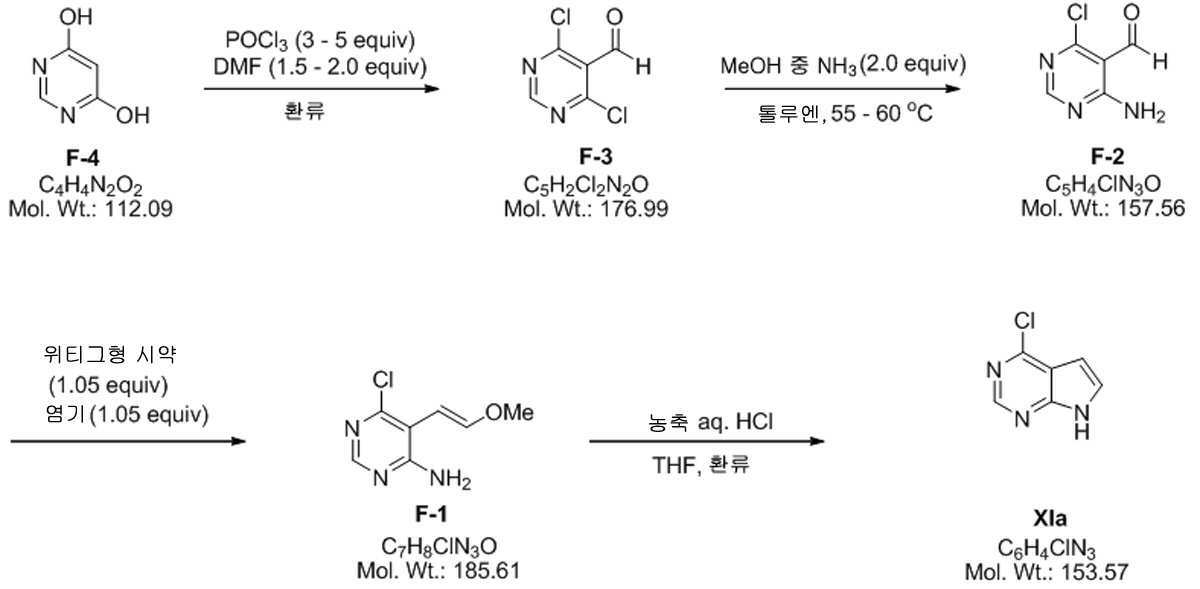
따라서, 일부 구체예에서, 본 발명은 화학식 XIa의 화합물의 제조 방법을 제공하고, 이 방법은, 화학식 D-1의 화합물을 형성하기에 충분한 조건 하에서 화학식 F-1의 화합물을 산으로 처리하는 것을 포함한다:Thus, in some embodiments, the present invention provides a method of preparing a compound of Formula XIa, which method comprises treating the compound of Formula F-1 with an acid under conditions sufficient to form a compound of Formula D-1. Contains:
[화학식 XIa]Formula XIa

[화학식 F-1][Formula F-1]
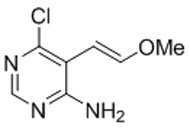
일부 구체예에서, 산은 강산이다. 일부 구체예에서, 산은 수성 농축 염산 (약 18 M)이다. 일부 구체예에서, 조건은 용매에서 환류 온도에서 반응을 수행하는 것을 포함한다. 일부 구체예에서, 반응은 약 5 내지 약 15시간 내에 완료된다. In some embodiments, the acid is a strong acid. In some embodiments, the acid is aqueous concentrated hydrochloric acid (about 18 M). In some embodiments, the conditions comprise performing the reaction at reflux temperature in a solvent. In some embodiments, the reaction is completed within about 5 to about 15 hours.
일부 구체예에서, 본 방법은 또한, 화학식 F-1의 화합물의 제조 방법을 포함하고, 이 방법은 염기의 존재하에서 화학식 F-2의 화합물을, 화학식 -CH2OCH3의 일라이드를 갖는 약 1 당량 이상의 위티그형 시약과 반응시키는 것을 포함한다:In some embodiments, the method also includes a method of preparing a compound of Formula F-1, wherein the method comprises a compound of Formula F-2 in the presence of a base, having about an ylide of Formula -CH 2 OCH 3 Reacting with at least one equivalent of a Wittig-type reagent:
[화학식 F-2][Formula F-2]
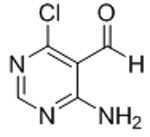
본 명세서에 사용된 바와 같이, 용어 "위티그형 시약"는 하기의 기술분야에 기재된 Wittig 반응, Wadsworth-Emmons 반응, 및 Horner-Wittig 반응에 사용된 시약을 의미한다 (참고, 예, Carey 및 Sundberg, Advanced Organic Chemistry, Part B: Reactions and Synthesis, 4th ed., Kluwer Academic/Plenum Publishers:New York, 페이지 111-119 (2001); 및 March, Advanced Organic Chemistry: Reactions, Mechanisms, and Structure, 3rd ed., John Wiley & Sons:New York, 페이지 845-855 (1985), 이들 각각은 그 전체가 참고로 본 명세서에 통합된다). 시아노메틸 또는 시아노메틸 일라이드 그룹을 함유하는 예시적인 위티그형 시약은, 일반 화학식 (R'O)2P(=O)-L-R1, R" 3P(+)-L(-)-R1, R" 3P(+)-L-R1X; R"2P(=O)-L-R1, 및 (R'N) 2P(=O)-L-R1의 화합물을 비제한적으로 포함하고, 여기서, R'는 C1-6 알콕시 또는 임의 치환된 페닐이고; R"는 임의로 치환된 페닐이고; L은 -CH2- 또는 -CH-이고; R1는 메톡시이고; X는 음이온 (예, 할로 음이온, 예컨대 클로라이드)이다. 일부 구체예에서, 위티그형 시약은 디에틸 시아노메틸 포스페이트이다. 일부 구체예에서, 화학식 F-1의 화합물의 위티그형 시약과의 반응은 염기의 존재하에서이다. 일부 구체예에서, 염기는 강염기이다. 일부 구체예에서, 염기는 칼륨 t-부톡시드, 나트륨 t-부톡시드, 수산화나트륨, 나트륨 에톡시드, 수산화나트륨, 탄산칼륨, 또는 나트륨 카보네이트이다. 일부 구체예에서, 염기는 알칼리 금속 알콕시드이다. 일부 구체예에서, 염기는 알칼리 금속 t-부톡시드이다. 일부 구체예에서, 염기는 칼륨 t-부톡시드이다. 일부 구체예에서, 화학식 F-1의 알데히드의 위티그형 시약과의 올레핀화는 유기 용매, 예컨대 THF에서, 염기, 예컨대 칼륨 tert-부톡시드의 영향 하에서, 약 0 내지 약 5℃의 온도에서 수행된다. 일부 구체예에서, 염기는 화학식 F-1의 화합물에 대해 약 1 내지 약 1.2 당량, 또는 약 1.05 내지 약 1.1 당량으로 존재한다. 일부 구체예에서, 위티그형 시약은 화학식 F-1의 화합물에 대해 약 1 내지 약 1.2 당량, 또는 약 1.05 내지 약 1.1 당량으로 존재한다. 일부 구체예에서, 위티그형 시약은 (메톡시메틸)트리페닐포스피늄 클로라이드이다.As used herein, the term "witigated reagent" refers to the reagents used in the Wittig reaction, Wadsworth-Emmons reaction, and Horner-Wittig reaction described in the art below (see, eg, Carey and Sundberg). , Advanced Organic Chemistry, Part B: Reactions and Synthesis, 4th ed., Kluwer Academic / Plenum Publishers: New York, pages 111-119 (2001); and March, Advanced Organic Chemistry: Reactions, Mechanisms, and Structure, 3rd ed. , John Wiley & Sons: New York, pages 845-855 (1985), each of which is incorporated herein by reference in its entirety). Exemplary witigated reagents containing cyanomethyl or cyanomethyl ylide groups include the general formula (R'O) 2 P (= 0) -LR 1 , R " 3 P (+)-L (-) —R 1 , R ″ 3 P (+)-LR 1 X; R ′ 2 P (═O) —LR 1 , and (R′N) 2 P (═O) -LR 1 , including but not limited to, wherein R ′ is C 1-6 alkoxy or optionally substituted Phenyl; R ″ is optionally substituted phenyl; L is -CH 2 -or -CH-; R 1 is methoxy; X is an anion (eg halo anion such as chloride). In some embodiments, the witig reagent is diethyl cyanomethyl phosphate. In some embodiments, the reaction of the compound of Formula F-1 with a Wittig-type reagent is in the presence of a base. In some embodiments, the base is a strong base. In some embodiments, the base is potassium t-butoxide, sodium t-butoxide, sodium hydroxide, sodium ethoxide, sodium hydroxide, potassium carbonate, or sodium carbonate. In some embodiments, the base is an alkali metal alkoxide. In some embodiments, the base is an alkali metal t-butoxide. In some embodiments, the base is potassium t-butoxide. In some embodiments, olefination of the aldehyde of Formula F-1 with a Wittig reagent is carried out in an organic solvent such as THF at a temperature of about 0 to about 5 ° C., under the influence of a base such as potassium tert-butoxide. do. In some embodiments, the base is present in about 1 to about 1.2 equivalents, or about 1.05 to about 1.1 equivalents, relative to the compound of Formula F-1. In some embodiments, the Witig-type reagent is present in about 1 to about 1.2 equivalents, or about 1.05 to about 1.1 equivalents, relative to the compound of Formula F-1. In some embodiments, the Wittig-type reagent is (methoxymethyl) triphenylphosphinium chloride.
일부 구체예에서, 본 방법은 또한, 화학식 F-2의 화합물의 제조 방법을 포함하고, 이 방법은, 화학식 F-3의 화합물을 용매 중 약 2 당량 이상의 암모니아와 반응시키는 것을 포함한다:In some embodiments, the method also includes a method of preparing a compound of Formula F-2, which method comprises reacting a compound of Formula F-3 with at least about 2 equivalents of ammonia in a solvent:
[화학식 F-3][Formula F-3]

일부 구체예에서, 용매는 메탄올이다. 일부 구체예에서, 암모니아는 화학식 F-2의 화합물에 대해 약 2 당량으로 존재한다.In some embodiments, the solvent is methanol. In some embodiments, ammonia is present in about 2 equivalents relative to compound of Formula F-2.
일부 구체예에서, 본 방법은 또한, 화학식 F-3의 화합물이 제조 방법을 포함하고, 이 방법은 화학식 F-4의 화합물을 염소화제와 반응시키는 것을 포함한다:In some embodiments, the method also includes a method of preparing a compound of Formula F-3, which method comprises reacting a compound of Formula F-4 with a chlorinating agent:
[화학식 F-4][Formula F-4]

일부 구체예에서, 염소화제는 인(phosphorous) 옥시클로라이드이다. 일부 구체예에서, 염소화제는 화학식 F-3의 화합물에 대해 약 2 당량 초과, 약 3 당량 초과, 또는 약 4 당량 초과, 또는 약 3 내지 약 5 당량으로 존재한다.In some embodiments, the chlorinating agent is phosphorous oxychloride. In some embodiments, the chlorinating agent is present in more than about 2 equivalents, more than about 3 equivalents, or more than about 4 equivalents, or about 3 to about 5 equivalents relative to the compound of Formula F-3.
본 명세서에 기재된 방법으로부터 형성된 중간체는 본 명세서에 기재된 다른 방법에서 적합한 것으로서 사용될 수 있다.Intermediates formed from the methods described herein can be used as suitable in the other methods described herein.
특정 구체예Specific embodiments
일부 구체예에서, 본 발명은 하기 단계 (a) 내지 (f)를 포함하는, 화학식 Ⅲ'의 화합물의 90 % 이상의 거울상이성질체 잉여의 (R)-거울상이성질체를 포함하는 조성물의 제조 방법을 제공한다:In some embodiments, the present invention provides a method of preparing a composition comprising at least 90% of the enantiomeric excess of the (R) -enantiomer of the compound of Formula III ', comprising the following steps (a) to (f): :
[화학식 Ⅲ'][Formula III ']

(a) 화학식 XI'의 화합물을 수산화나트륨 및 N-피발로일옥시메틸 클로라이드로 처리하여 화학식 X'의 화합물을 형성하는 단계;(a) treating a compound of Formula XI 'with sodium hydroxide and N-pivaloyloxymethyl chloride to form a compound of Formula X';
[화학식 XI']Formula XI '

[화학식 X']Formula X '
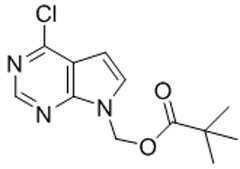
(b) Pd(트리페닐포스핀)4, 탄산칼륨, 및 용매의 존재하에서, 상기 화학식 X'의 화합물을 화학식 XⅢ'의 화합물로 처리하여 화학식 XⅡ'의 화합물을 형성하는 단계;(b) treating said compound of formula X 'with a compound of formula XIII' in the presence of Pd (triphenylphosphine) 4 , potassium carbonate, and a solvent to form a compound of formula XII ';
[화학식 XⅢ']Formula XIII '
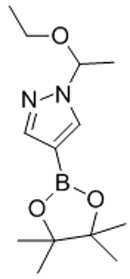
[XⅡ'][XⅡ ']

(c) 탈보호 조건 하에서, 상기 화학식 XⅡ'의 화합물을 반응시켜 화학식 Ⅳ'의 화합물을 얻는 단계;(c) reacting the compound of Formula XII ′ under deprotection conditions to obtain a compound of Formula IV ′;
[화학식 Ⅳ'][Formula IV ']

(d) 1,8-디아자-바이시클로[5.4.0]운덱-7-엔의 존재하에서, 상기 화학식 Ⅳ"의 화합물을 화학식 XⅣ'의 화합물과 반응시켜 화학식 Ⅱ'의 화합물을 얻는 단계;(d) reacting the compound of formula IV "with the compound of formula XIV 'in the presence of 1,8-diaza-bicyclo [5.4.0] undec-7-ene to obtain a compound of formula II';
[화학식 XⅣ'][Formula XIV ']

[화학식 Ⅱ'][Formula II ']
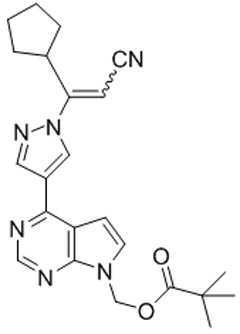
(e) 하기구조식;(e) the following structural formula;

로부터 선택된 [Rh(COD)2]CF3SO3 및 키랄 포스핀 리간드의 존재하에서 상기 화학식 Ⅱ'의 화합물을 수소 가스와 반응시켜 화학식 I'의 화합물을 형성하는 단계; 및Reacting the compound of formula II 'with hydrogen gas in the presence of [Rh (COD) 2 ] CF 3 SO 3 and a chiral phosphine ligand selected from to form a compound of formula I'; And
[화학식 I'][Formula I ']

(f) 탈보호 조건 하에서, 상기 화학식 I'의 화합물을 반응시켜 상기 화학식 Ⅲ'의 화합물을 형성하는 단계:(f) reacting the compound of Formula I 'to form a compound of Formula III' under deprotection conditions:
상기 식에서, Where
*는 키랄 탄소를 나타낸다.* Represents chiral carbon.
단계 (e)의 일부 구체예에서:In some embodiments of step (e):
용매는 2,2,2-트리플루오로에탄올 (TFE)이고;The solvent is 2,2,2-trifluoroethanol (TFE);
수소화 촉매 부하는 약 0.005 내지 약 0.01 몰%이고;The hydrogenation catalyst load is about 0.005 to about 0.01 mol%;
화학식 Ⅱ의 화합물 대 수소화 촉매의 비는 약 20000/1 내지 약 10000/1이고;The ratio of the compound of Formula II to the hydrogenation catalyst is about 20000/1 to about 10000/1;
수소 압력은 약 7 내지 약 60 bar이고;Hydrogen pressure is about 7 to about 60 bar;
반응은 약 실온 내지 약 75℃의 온도에서 수행되고; The reaction is carried out at a temperature of about room temperature to about 75 ° C;
반응은 화학식 Ⅱ의 화합물 대 화학식의 화합물의 전환율이 약 99.5% 이상일 때까지 수행되고;The reaction is carried out until the conversion of the compound of formula II to the compound of formula is at least about 99.5%;
반응은 약 10 내지 약 25시간이다.The reaction is about 10 to about 25 hours.
일부 구체예에서, 본 방법은 또한, 하기 단계 (i) 내지 (iv)를 포함하는 화학식 XI'의 화합물을 제조하는 것을 포함한다:In some embodiments, the method also includes preparing a compound of Formula XI ′ comprising the following steps (i) to (iv):
[화학식 XI']Formula XI '

(ⅰ) 약 1 내지 약 2 당량의 디메틸포름아미드의 존재하에서, 화학식 F-4의 화합물을 약 3 내지 약 5 당량의 POCl3와 반응시켜 화학식 F-3의 화합물을 형성하는 단계;(Iii) reacting the compound of Formula F-4 with about 3 to about 5 equivalents of POCl 3 in the presence of about 1 to about 2 equivalents of dimethylformamide to form the compound of Formula F-3;
[화학식 F-4][Formula F-4]
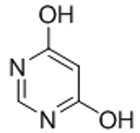
[화학식 F-3][Formula F-3]

(ⅱ) 상기 화학식 F-3의 화합물을 메탄올 중 약 2 당량의 암모니아와 반응시켜 화학식 F-2의 화합물을 형성하는 단계;(Ii) reacting the compound of Formula F-3 with about 2 equivalents of ammonia in methanol to form a compound of Formula F-2;
[화학식 F-2][Formula F-2]
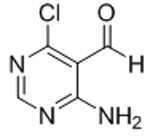
(ⅲ) 약 1 내지 약 1.5 당량의 칼륨 tert-부톡시드의 존재하에서, 상기 화학식 F-2의 화합물을 화학식 [Ph3P+(CH2OCH3)]Cl-(여기서, Ph는 페닐이다)의 약 1 내지 약 1.5 당량의 위티그형 시약과 반응시켜 화학식 F-1의 화합물을 형성하는 단계;(Iii) in the presence of about 1 to about 1.5 equivalents of potassium tert-butoxide, the compound of Formula F-2 is represented by the formula [Ph 3 P + (CH 2 OCH 3 )] Cl-, where Ph is phenyl Reacting with about 1 to about 1.5 equivalents of a Wittig-type reagent to form a compound of Formula F-1;
[화학식 F-1][Formula F-1]
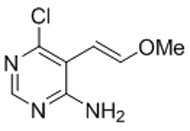
(ⅳ) 환류 하의 테트라히드로푸란에서 상기 화학식 F-1의 화합물을 수성 농축 염산으로 처리하여 화학식 XI'의 화합물을 형성하는 단계;(Iii) treating said compound of Formula F-1 with aqueous concentrated hydrochloric acid in tetrahydrofuran under reflux to form a compound of Formula XI ';
일부 구체예에서, 본 방법은 또한, 하기 단계 (i) 내지 (iii)를 포함하는, 화학식 XⅢ'의 화합물을 제조하는 것을 포함한다:In some embodiments, the method also includes preparing a compound of Formula XIII ′, comprising the following steps (i) to (iii):
[화학식 XⅢ']Formula XIII '

(ⅰ) 1H-피라졸을 N-브로모석신이미드와 반응시켜 화학식 XⅨ'의 화합물을 형성하는 단계;(Iii) reacting 1H-pyrazole with N-bromosuccinimide to form a compound of formula X ′ ';
[화학식 XⅨ']Formula X ''
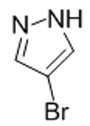
(ⅱ) 상기 화학식 XⅨ의 화합물을 보호하여 화학식 XⅧ'의 화합물을 형성하는 단계; (Ii) protecting said compound of formula X 'to form a compound of formula X';
[화학식 XⅧ']Formula X ''
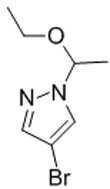
(ⅲ) 상기 화학식 XⅧ'의 화합물을 약 1 당량 이상의 이소프로필마그네슘 클로라이드와 반응시킨 다음, 약 1 당량 이상의 화학식 XⅦ'의 화합물로 처리하여 화학식 XⅢ'의 화합물을 형성하는 단계;(Iii) reacting the compound of Formula XVII 'with at least about 1 equivalent of isopropylmagnesium chloride and then treating with at least about 1 equivalent of the compound of Formula XVII' to form a compound of Formula XIII ';
[화학식 XⅦ']Formula X ''
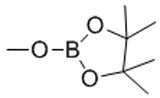
일부 구체예에서, 본 방법은 또한, 하기 단계 (i) 내지 (ii)를 포함하는, 화학식 Ⅲ'의 화합물을 제조하는 것을 포함한다;In some embodiments, the method also includes preparing a compound of Formula III ′, comprising the following steps (i) to (ii);
[화학식 XⅢ']Formula XIII '
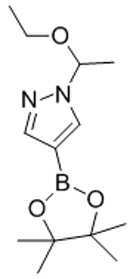
(ⅰ) 4-아이오도-1H-피라졸을 보호하여 화학식 XⅧ"의 화합물을 형성하는 단계;(Iii) protecting 4-iodo-1H-pyrazole to form a compound of formula XVIII ";
[화학식 XⅧ"]Formula X '"
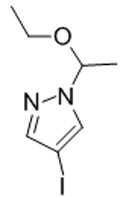
(ⅱ) 화학식 XⅧ"의 화합물을 테트라히드로푸란 중 약 1 당량 이상의 이소프로필마그네슘 클로라이드와 반응시키고, 그 다음 약 1 당량 이상의 화학식 XⅦ'의 화합물로 처리하여 화학식 XⅢ'의 화합물을 형성하는 단계.(Ii) reacting the compound of formula XVII 'with at least about 1 equivalent of isopropylmagnesium chloride in tetrahydrofuran and then treating with at least about 1 equivalent of the compound of formula XVII' to form a compound of formula XIII '.
[화학식 XⅦ']Formula X ''

추가 구체예에서, 본 발명은 화학식 Ⅲ'의 화합물의 거울상이성질체 잉여의 (R)-거울상이성질체를 포함하는 조성물을 제조하는 방법을 제공하고, 이 방법은 하기 단계 (a) 내지 (f)를 포함한다:In a further embodiment, the present invention provides a process for preparing a composition comprising the enantiomeric excess of the (R) -enantiomer of a compound of Formula III ', the method comprising the following steps (a) to (f): do:
[화학식 Ⅲ'][Formula III ']

(a) 화학식 XI'의 화합물을 수산화나트륨 및 2-(트리메틸실릴)에톡시메틸로 처리하여 화학식 X"의 화합물을 형성하는 단계:(a) treating a compound of formula (XI ') with sodium hydroxide and 2- (trimethylsilyl) ethoxymethyl to form a compound of formula (X "):
[화학식 XI']Formula XI '

[화학식 X"]Formula X "
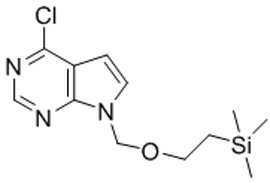
(b) Pd(트리페닐포스핀)4, 탄산칼륨, 및 용매의 존재하에서, 상기 화학식 X"의 화합물을 화학식 XⅢ'의 화합물로 처리하여 화학식 XⅡ"의 화합물을 형성하는 단계:(b) treating the compound of Formula X ″ with a compound of Formula XIII ′ in the presence of Pd (triphenylphosphine) 4 , potassium carbonate, and a solvent to form a compound of Formula XII ″:
[화학식 XⅢ']Formula XIII '
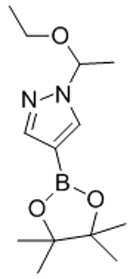
[화학식 XⅡ"]Formula XII "
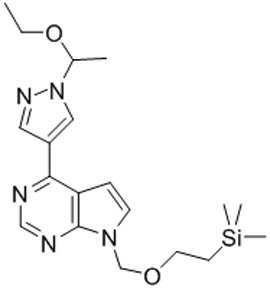
(c) 탈보호 조건 하에서, 상기 화학식 XⅡ"의 화합물을 반응시켜 화학식 Ⅳ"의 화합물을 형성하는 단계:(c) under deprotection conditions, reacting the compound of Formula XII ″ to form a compound of Formula IV ″:
[화학식 Ⅳ"][Formula IV ”]

(d) 화학식 I"의 화합물의 라세미체를 포함하는 조성물을 형성하기에 충분한 조건 하에서, 상기 화학식 Ⅳ"의 화합물을 화학식 D-1'의 화합물과 반응시키는 단계:(d) reacting said compound of formula IV "with a compound of formula D-1 'under conditions sufficient to form a composition comprising a racemate of the compound of formula I":
[화학식 D-1'][Formula D-1 ']

[화학식 I"]Formula I "

상기 식에서, *는 키랄 탄소이다.Wherein * is chiral carbon.
(e) 상기 화학식 I"의 화합물의 상기 라세미체를 포함하는 상기 조성물을, 이동상을 사용하는 키랄 크로마토그래피 유닛에 통과시키고, 상기 화학식 I"의 화합물의 거울상이성질체 잉여의 (R)-거울상이성질체를 포함하는 조성물을 수집하는 단계; 및(e) passing said composition comprising said racemate of said compound of formula (I ") through a chiral chromatography unit using a mobile phase and enantiomeric excess of said (I) enantiomer of said compound of formula (I") Collecting a composition comprising a; And
(f) 상기 화학식 I"의 화합물을 리튬 테트라플루오로보레이트와, 그 다음 수성 수산화암모늄과 반응시켜 상기 화학식 Ⅲ'의 화합물의 거울상이성질체 잉여의 (R)-거울상이성질체를 포함하는 조성물을 형성하는 단계; (f) reacting said compound of formula (I ") with lithium tetrafluoroborate and then aqueous ammonium hydroxide to form a composition comprising an enantiomeric excess of the (I) enantiomer of said compound of formula (III ') ;
다른 구체예에서, 본 발명은 화학식 Ⅲ'의 화합물의 거울상이성질체 잉여의 (R)-거울상이성질체를 포함하는 조성물을 제조하는 방법을 제공하고, 이 방법은 하기 단계 (a) 내지 (c)를 포함한다:In another embodiment, the present invention provides a method of preparing a composition comprising the enantiomeric excess of the (R) -enantiomer of the compound of Formula III ', the method comprising the following steps (a) to (c): do:
(a) 화학식 I"의 화합물의 라세미체를 형성하기에 충분한 조건 하에서, 아세토니트릴 중 탄산세슘의 존재하에서 화학식 I"의 화합물의 거울상이성질체 잉여의 (S)-거울상이성질체를 포함하는 조성물을 화학식 D-1'의 화합물로 처리하는 단계:(a) A composition comprising an enantiomeric excess of the (S) -enantiomer of the compound of formula (I) in the presence of cesium carbonate in acetonitrile under conditions sufficient to form a racemate of the compound of formula (I " Treatment with a compound of D-1 ':
[화학식 Ⅲ'][Formula III ']

[화학식 I"]Formula I "
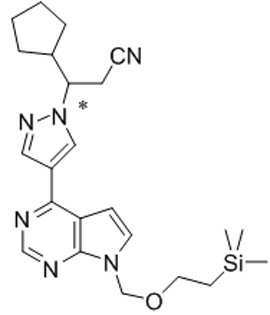
[화학식 D-1'][Formula D-1 ']

상기 식에서, *는 키랄 탄소이다.Wherein * is chiral carbon.
(b) 상기 화학식 I"의 화합물의 상기 라세미체를 포함하는 상기 조성물을, 이동상을 사용하는 키랄 크로마토그래피 유닛에 통과시키고, 상기 화학식 I"의 화합물의 거울상이성질체 잉여의 (R)-거울상이성질체를 포함하는 조성물을 수집하는 단계; 및(b) said composition comprising said racemate of said compound of formula (I ") is passed through a chiral chromatography unit using a mobile phase and the enantiomeric excess of said enantiomer (R) -enantiomer of said compound of formula (I") Collecting a composition comprising a; And
(c) 상기 화학식 I"의 화합물을 리튬 테트라플루오로보레이트와, 그 다음 수성 수산화암모늄과 반응시켜 상기 화학식 Ⅲ'의 화합물의 거울상이성질체 잉여의 (R)-거울상이성질체를 포함하는 조성물을 형성하는 단계;. (c) reacting said compound of formula (I ") with lithium tetrafluoroborate and then with aqueous ammonium hydroxide to form a composition comprising the enantiomeric excess of the (R) -enantiomer of said compound of formula (III ') ;.
다른 구체예에서, 본 발명은 화학식 Ⅲ'의 화합물의 거울상이성질체 잉여의 (R)-거울상이성질체를 포함하는 조성물을 제조하는 방법을 제공하고, 이 방법은 하기 단계를 포함한다:In another embodiment, the present invention provides a method of preparing a composition comprising the enantiomeric excess (R) -enantiomer of a compound of Formula III ', the method comprising the following steps:
[화학식 Ⅲ'][Formula III ']
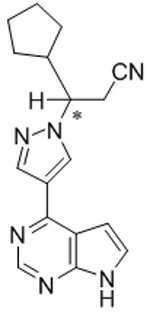
(a) 화학식 XI'의 화합물을 수산화나트륨 및 2-(트리메틸실릴)에톡시메틸로 처리하여 화학식 X"의 화합물을 형성하는 단계:(a) treating a compound of formula (XI ') with sodium hydroxide and 2- (trimethylsilyl) ethoxymethyl to form a compound of formula (X "):
[화학식 XI']Formula XI '
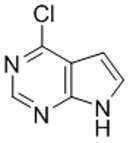
[화학식 X"]Formula X "

(b) Pd(트리페닐포스핀)4, 탄산칼륨, 및 용매의 존재하에서, 상기 화학식 X"의 화합물을 화학식 XⅢ'의 화합물로 처리하여 화학식 XⅡ"의 화합물을 형성하는 단계:(b) treating the compound of Formula X ″ with a compound of Formula XIII ′ in the presence of Pd (triphenylphosphine) 4 , potassium carbonate, and a solvent to form a compound of Formula XII ″:
[화학식 XⅢ']Formula XIII '

[화학식 XⅡ"]Formula XII "

(c) 탈보호 조건 하에서, 상기 화학식 XⅡ"의 화합물을 반응시켜 화학식 Ⅳ"의 화합물을 형성하는 단계:(c) under deprotection conditions, reacting the compound of Formula XII ″ to form a compound of Formula IV ″:
[화학식 Ⅳ"][Formula IV ”]

(d) 화학식 I"의 화합물의 라세미체를 포함하는 조성물을 형성하기에 충분한 조건 하에서, 상기 화학식 Ⅳ"의 화합물을 화학식 D-1'의 화합물과 반응시키는 단계:(d) reacting said compound of formula IV "with a compound of formula D-1 'under conditions sufficient to form a composition comprising a racemate of the compound of formula I":
[화학식 D-1'][Formula D-1 ']

[화학식 I"]Formula I "

상기 식에서, *는 키랄 탄소이다.Wherein * is chiral carbon.
(e) 상기 화학식 I"의 화합물의 상기 라세미체를 포함하는 조성물을 이동상을 사용하는 키랄 크로마토그래피 유닛에 통과시키고 상기 화학식 I"의 화합물의 거울상이성질체 잉여의 (R)-거울상이성질체를 포함하는 조성물을 수집하는 단계; 및(e) passing said composition comprising said racemate of said compound of formula (I ") through a chiral chromatography unit using a mobile phase and comprising an enantiomeric excess of said (I) enantiomer of said compound of formula (I") Collecting the composition; And
(f) 상기 화학식 I"의 화합물을 붕소 트리플루오라이드 디에틸 에테레이트와, 그 다음 수성 수산화암모늄과 반응시켜서 상기 화학식 Ⅲ'의 화합물의 거울상이성질체 잉여의 (R)-거울상이성질체를 포함하는 조성물을 형성하는 단계:(f) reacting the compound of formula (I ") with boron trifluoride diethyl etherate and then aqueous ammonium hydroxide to form a composition comprising the enantiomeric excess of the (R) -enantiomer of the compound of formula (III ') Forming Steps:
다른 구체예에서, 본 발명은 화학식 Ⅲ'의 화합물의 거울상이성질체 잉여의 (R)-거울상이성질체를 포함하는 조성물을 제조하는 방법을 제공하고, 이 방법은 하기 단계 (a) 내지 (c)를 포함한다:In another embodiment, the present invention provides a method of preparing a composition comprising the enantiomeric excess of the (R) -enantiomer of the compound of Formula III ', the method comprising the following steps (a) to (c): do:
[화학식 Ⅲ'][Formula III ']

(a) 화학식 I"의 화합물의 라세미체를 형성하기에 충분한 조건 하에서, 아세토니트릴 중 탄산세슘의 존재하에서, 화학식 I"의 화합물의 거울상이성질체 잉여의 (S)-거울상이성질체를 포함하는 조성물을 화학식 D-1'의 화합물로 처리하는 단계:(a) a composition comprising the enantiomeric excess of the (S) -enantiomer of the compound of formula (I) in the presence of cesium carbonate in acetonitrile under conditions sufficient to form a racemate of the compound of formula (I ") Treating with a compound of Formula D-1 ′:
[화학식 I"]Formula I "

[화학식 D-1'][Formula D-1 ']

상기 식에서, *는 키랄 탄소이다. Wherein * is chiral carbon.
(b) 상기 화학식 I"의 화합물의 상기 라세미체를 포함하는 상기 조성물을, 이동상을 사용하는 키랄 크로마토그래피 유닛에 통과시키고, 상기 화학식 I"의 화합물의 거울상이성질체 잉여의 (R)-거울상이성질체를 포함하는 조성물을 수집하는 단계; 및(b) said composition comprising said racemate of said compound of formula (I ") is passed through a chiral chromatography unit using a mobile phase and the enantiomeric excess of said enantiomer (R) -enantiomer of said compound of formula (I") Collecting a composition comprising a; And
(c) 상기 화학식 I"의 화합물을 붕소 트리플루오라이드 디에틸 에테레이트와, 그 다음 수성 수산화암모늄과 반응시켜 상기 화학식 Ⅲ'의 화합물의 거울상이성질체 잉여의 (R)-거울상이성질체를 포함하는 조성물을 형성하는 단계;. (c) reacting the compound of formula (I ") with boron trifluoride diethyl etherate and then aqueous ammonium hydroxide to form a composition comprising an enantiomeric excess of the (R) -enantiomer of the compound of formula (III ') Forming;
다른 구체예에서, 본 발명은 화학식 Ⅲ'의 화합물의 거울상이성질체 잉여의 (R)-거울상이성질체를 포함하는 조성물을 제조하는 방법을 제공하고, 이 방법은 상기 화학식 I"의 화합물을 붕소 트리플루오라이드 디에틸 에테레이트와, 그 다음 수성 수산화암모늄과 반응시켜 상기 화학식 Ⅲ'의 화합물의 거울상이성질체 잉여의 (R)-거울상이성질체를 포함하는 조성물을 형성하는 것을 포함한다:In another embodiment, the present invention provides a process for the preparation of a composition comprising the enantiomeric excess of the (R) -enantiomer of the compound of formula (III ′), wherein the method comprises a compound of formula (I ") boron trifluoride Reacting with diethyl etherate and then with aqueous ammonium hydroxide to form a composition comprising the enantiomeric excess of the (R) -enantiomer of the compound of Formula III ':
[화학식 Ⅲ'][Formula III ']

[화학식 I"]Formula I "
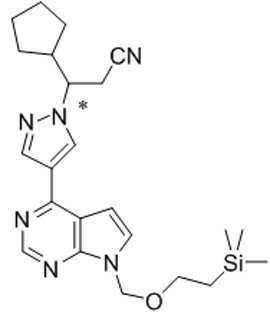
여기서, *는 키랄 탄소이다.Where * is chiral carbon.
다른 구체예에서, 본 발명은 (3R)-시클로펜틸-3-[4-(7H-피롤로[2,3-d]피리미딘-4-일)피라졸-1-일]프로피오니트릴 포스페이트 염의 제조 방법을 제공하고, 이 방법은 2-프로판올 및 디클로로메탄의 존재하에서 (3R)-시클로펜틸-3-[4-(7H-피롤로[2,3-d]피리미딘-4-일)피라졸-1-일]프로피오니트릴을 인산과 반응시키는 것을 포함한다.In another embodiment, the invention provides (3R) -cyclopentyl-3- [4- (7H-pyrrolo [2,3-d] pyrimidin-4-yl) pyrazol-1-yl] propionitrile phosphate A method for preparing a salt is provided which comprises (3R) -cyclopentyl-3- [4- (7H-pyrrolo [2,3-d] pyrimidin-4-yl) in the presence of 2-propanol and dichloromethane. Reacting pyrazol-1-yl] propionitrile with phosphoric acid.
다른 구체예에서, 본 발명은 (3R)-시클로펜틸-3-[4-(7H-피롤로[2,3-d]피리미딘-4-일)피라졸-1-일]프로피오니트릴 포스페이트 염의 정제 방법을 제공하고, 이 방법은 (3R)-시클로펜틸-3-[4-(7H-피롤로[2,3-d]피리미딘-4-일)피라졸-1-일]프로피오니트릴 포스페이트 염을, 메탄올, 2-프로판올, 및 n-헵탄을 포함하는 용매 혼합물로부터 재결정화하는 것을 포함한다. 일부 구체예에서, 2-프로판올 및 n-헵탄은 메탄올 중 (3R)-시클로펜틸-3-[4-(7H-피롤로[2,3-d]피리미딘-4-일)피라졸-1-일]프로피오니트릴 포스페이트 염의 혼합물에 첨가된다.In another embodiment, the invention provides (3R) -cyclopentyl-3- [4- (7H-pyrrolo [2,3-d] pyrimidin-4-yl) pyrazol-1-yl] propionitrile phosphate A method for purifying salts is provided, which method comprises: (3R) -cyclopentyl-3- [4- (7H-pyrrolo [2,3-d] pyrimidin-4-yl) pyrazol-1-yl] propio Recrystallizing the nitrile phosphate salt from a solvent mixture comprising methanol, 2-propanol, and n-heptane. In some embodiments, 2-propanol and n-heptane are (3R) -cyclopentyl-3- [4- (7H-pyrrolo [2,3-d] pyrimidin-4-yl) pyrazole-1 in methanol. -Yl] propionitrile phosphate salt is added to the mixture.
키랄 치환된 피라졸릴 피롤로[2,3-d]피리미딘 및 관련 합성 중간체 화합물의 제조 방법이 제공된다. 상기 키랄 치환된 피라졸릴 피롤로[2,3-d]피리미딘은 염증성 질환, 골수증식성 장애, 및 다른 질환의 치료를 위한 단백질 티로신 키나아제 (JAKs)의 야누스 키나아제(Janus Kinase) 패밀리의 억제제로서 유용하다.Methods of preparing chiral substituted pyrazolyl pyrrolo [2,3- d ] pyrimidines and related synthetic intermediate compounds are provided. The chiral substituted pyrazolyl pyrrolo [2,3- d ] pyrimidines are inhibitors of the Janus Kinase family of protein tyrosine kinases (JAKs) for the treatment of inflammatory diseases, myeloproliferative disorders, and other diseases. useful.
본 발명은 특정 실시예에 의해 더 상세히 기재될 것이다. 하기 실시예는 설명하기 위해 제공되고, 어떤 방식으로든 본 발명을 제한하려는 것은 아니다. 당업자는 본질적으로 동일한 결과를 얻기 위해 변형 또는 수정될 수 있는 다양한 비임계적 파라미터를 쉽게 인식할 것이다.
The invention will be described in more detail by the specific examples. The following examples are provided for illustrative purposes and are not intended to limit the invention in any way. Those skilled in the art will readily recognize various noncritical parameters that can be modified or modified to achieve essentially the same results.
실시예Example

[4-(1 H -피라졸-4-일)-7 H -피롤로[2,3- d ]피리미딘-7-일]메틸 피발레이트 (5). 교반 바(bar), 격막, 열전대, 500 mL 추가 깔때기 및 질소 주입구가 구비된 오븐 건조된 3 L 4-목 동근바닥 플라스크에, 수산화나트륨 (NaH, 미네랄 오일 중 60 wt%, 32.82 g, 0.82 mol, 1.20 당량) 및 무수 1,2-디메톡시에탄 (DME, 500 mL, 4.8 mol)을 충전하고, 수득한 혼합물을 0 - 3℃로 냉각시켰다. 오븐 건조된 1 L 둥근바닥 플라스크에, 4-클로로-7H-피롤로[2,3-d]피리미딘 (1, 105.0 g, 0.684 mol) 및 1,2-디메톡시에탄 (DME, 750 mL, 7.2 mol)를 충전하고, 그 다음, 수득한 슬러리를 DME 중 수산화나트륨의 현탁액에 큰 구멍의 캐뉼라를 통해 30분에 걸쳐 5 - 12℃에서 적가했다. 수득한 반응 혼합물은 이질적이었다. 상기 첨가 다음에, 차가운 배쓰를 제거하고, 혼합물을 실온으로 점차 따뜻하게 하고, 실온에서 1시간 동안 교반한 후, 0 - 5℃로 냉각했다. 클로로메틸 피발레이트 (피발로일옥시메틸 클로라이드, POM-Cl, 112 ml, 0.752 mol, 1.1 당량)을 반응 혼합물에 30분에 걸쳐, 0 - 5℃에서 교반하면서 적가했다. 클로로메틸 피발레이트의 첨가는 다소 발열이었고, 반응 온도는 14℃ 정도로 높이 상승했다. 클로로메틸 피발레이트의 첨가 후, 냉각 배쓰를 제거하고, 반응 혼합물을 실온으로 되돌리고, 실온에서 90분 동안 교반했다. 반응이 TLC 및 LCMS에 의해 확인된 바와 같이 완료된 것으로 보였을 때, 반응을 물 (100 mL)로 주의하여 급냉했다. 그리고, 조 POM 보호된 클로로데아자퓨린 (2)을 함유하는 급냉된 반응 혼합물을, 추가 워크업(work-up) 및 정제없이 차후의 스즈끼 (Suzuki) 커플링 반응에서 직접 사용했다. [4- (1 H - pyrazol-4-yl) -7 H - pyrrolo [2,3- d] pyrimidin-7-yl] methyl pivalate (5). Sodium hydroxide (NaH, 60 wt% in mineral oil, 32 wt. , 1.20 equiv) and anhydrous 1,2-dimethoxyethane (DME, 500 mL, 4.8 mol) were charged and the resulting mixture was cooled to 0-3 ° C. In an oven dried 1 L round bottom flask, 4-chloro-7 H -pyrrolo [2,3- d ] pyrimidine ( 1 , 105.0 g, 0.684 mol) and 1,2-dimethoxyethane (DME, 750 mL , 7.2 mol), and then the resulting slurry was added dropwise to the suspension of sodium hydroxide in DME at 5-12 ° C. over 30 minutes via a large pore cannula. The reaction mixture obtained was heterogeneous. After the addition, the cold bath was removed and the mixture was gradually warmed to room temperature, stirred at room temperature for 1 hour and then cooled to 0-5 ° C. Chloromethyl pivalate (pivaloyloxymethyl chloride, POM-Cl, 112 ml, 0.752 mol, 1.1 equiv) was added dropwise to the reaction mixture over 30 minutes with stirring at 0-5 ° C. The addition of chloromethyl pivalate was somewhat exothermic and the reaction temperature rose as high as 14 ° C. After addition of chloromethyl pivalate, the cooling bath was removed and the reaction mixture was returned to room temperature and stirred at room temperature for 90 minutes. When the reaction appeared to be complete as confirmed by TLC and LCMS, the reaction was carefully quenched with water (100 mL). And the quenched reaction mixture containing crude POM protected chlorodeazapurine ( 2 ) was used directly in the subsequent Suzuki coupling reaction without further work-up and purification.
상기 기재된 바와 같이 제조된 조 POM 보호된 클로로데아자퓨린 (2)을 함유하는 급냉된 반응 혼합물에, 4-(4,4,5,5-테트라메틸-1,3,2-디옥사보롤란-2-일) -1H-피라졸 (3, 200 g, 0.75 mol, 1.10 당량) 및 탄산칼륨 (K2CO3, 189 g, 1.37 mol, 2.0 당량)을 실온에서 첨가했다. 수득한 혼합물을, 상기 용액을 통해 질소의 흐름을 15분 동안 통과시킨 후, 테트라키스(트리페닐포스핀)팔라듐(0) (Pd(PPh3)4, 7.9 g, 0.68 mmol, 0.01 당량)으로 처리하고, 수득한 반응 혼합물을 10시간 동안 가열 환류했다 (약 82℃). 반응이 TLC (1:1 헥산/에틸 아세테이트) 및 LCMS에 의해 확인된 바와 같이 완료된 것으로 보였을 때, 반응 혼합물을 실온으로 냉각시키고, 에틸 아세테이트 (2 L) 및 물 (1 L)으로 희석했다. 2개의 층을 분리하고, 수성 층을 에틸 아세테이트 (EtOAc, 500 mL)로 추출했다. 조합된 유기 층을 물 (2×1 L) 및 염수 (1 L)로 세정한 후, 감압 하에서 농축하여 조 {4-[1-(1-에톡시에틸)-1H-피라졸-4-일]-7H-피롤로[2,3-d]피리미딘-7-일]메틸 피발레이트 (4)를 담황색 오일로서 얻고, 이를 추가 정제없이 차후의 탈보호 반응에서 직접 사용했다.In a quenched reaction mixture containing crude POM protected chlorodeazapurine ( 2 ) prepared as described above, 4- (4,4,5,5-tetramethyl-1,3,2-dioxaborolane -2-yl) -1 H -pyrazole ( 3 , 200 g, 0.75 mol, 1.10 equiv) and potassium carbonate (K 2 CO 3 , 189 g, 1.37 mol, 2.0 equiv) were added at room temperature. The resulting mixture was passed through a stream of nitrogen through the solution for 15 minutes, followed by tetrakis (triphenylphosphine) palladium (0) (Pd (PPh 3 ) 4 , 7.9 g, 0.68 mmol, 0.01 equiv) The treated and obtained reaction mixture was heated to reflux (about 82 ° C.) for 10 hours. When the reaction appeared to be complete as confirmed by TLC (1: 1 hexanes / ethyl acetate) and LCMS, the reaction mixture was cooled to room temperature and diluted with ethyl acetate (2 L) and water (1 L). The two layers were separated and the aqueous layer was extracted with ethyl acetate (EtOAc, 500 mL). The combined organic layers were washed with water (2 × 1 L) and brine (1 L), then concentrated under reduced pressure to afford crude {4- [1- (1-ethoxyethyl) -1 H -pyrazole-4- yl] -7 H - pyrrolo [2,3- d] pyrimidin-7-yl] methyl pivalate ( 4 ) was obtained as a pale yellow oil which was used directly in the subsequent deprotection reaction without further purification.
THF (1 L, 12.3 mol) 중 조 {4-[1-(1-에톡시에틸)-1H-피라졸-4-일]-7H-피롤로[2,3-d]피리미딘-7-일]메틸 피발레이트 (4)의 용액에, 4 N 수성 HCl 용액 (500 mL)을 실온에서 첨가했다. 그 다음, 수득한 반응 혼합물을 실온에서 5시간 동안 교반했다. 반응이 TLC 및 LCMS에 의해 확인된 바와 같이 완료된 것으로 보였을 때, 반응 혼합물을 0 - 5℃로 냉각한 후, pH를 1 M 수성 수산화나트륨 (NaOH) 용액 (2 L)로 9 - 10로 조정했다. 혼합물을 감압 하에서 농축하여 대부분의 THF를 제거하고, 수득한 현탁액을 실온에서 2시간 동안 교반했다. 고형물을 여과로 수집하고, 물 (3×500 mL)로 세정하고, 진공에서 건조하여 조 [4-(1H-피라졸-4-일)-7H-피롤로[2,3-d]피리미딘-7-일]메틸 피발레이트 (5, 157.5 g, 204.43 g 이론적, 77% 수율, 3단계로)을 백색 내지 회백색 고형물로서 얻었고, 이는 추가 정제없이 차후의 반응에서 사용할 수 있을 정도로 충분히 순수했다 (> 98 면적%, HPLC에 의해). 5에 대해: 1H NMR (DMSO-d 6, 400 MHz) δ ppm 13.42 (br s, 1H), 8.76 (s, 1H), 8.67 (s, 1H), 8.33 (s, 1H), 7.68 (d, 1H, J = 3.8 Hz), 7.11 (d, 1H, J = 3.8 Hz), 6.21 (s, 2H), 1.06 (s, 9H); 13C NMR (DMSO-d 6, 100 MHz) δ ppm 177.74, 152.31, 152.09, 151.91, 139.52, 130.39, 120.51, 113.93, 101.91, 67.26, 38.98, 27.26; C15H17N5O2 (분자량: 299.33), LCMS (EI) m/e 300 (M+ + H).Crude {4- [1- (1-ethoxyethyl) -1 H -pyrazol-4-yl] -7 H -pyrrolo [2,3- d ] pyrimidine- in THF (1 L, 12.3 mol) 7-yl] methyl pivalate To the solution of ( 4 ), 4N aqueous HCl solution (500 mL) was added at room temperature. Then, the obtained reaction mixture was stirred at room temperature for 5 hours. When the reaction appeared to be complete as confirmed by TLC and LCMS, the reaction mixture was cooled to 0-5 ° C. and then the pH was adjusted to 9-10 with 1 M aqueous sodium hydroxide (NaOH) solution (2 L). . The mixture was concentrated under reduced pressure to remove most of THF and the resulting suspension was stirred at room temperature for 2 hours. The solid was collected by filtration, washed with water (3 × 500 mL) and dried in vacuo to afford crude [4- (1 H -pyrazol-4-yl) -7 H -pyrrolo [2,3- d ] Pyrimidin-7-yl] methyl pivalate ( 5 , 157.5 g, 204.43 g theoretical, 77% yield, in 3 steps) was obtained as a white to off-white solid that was pure enough to be used in subsequent reactions without further purification. (> 98 area%, by HPLC). For 5 : 1 H NMR (DMSO- d 6 , 400 MHz) δ ppm 13.42 (br s, 1H), 8.76 (s, 1H), 8.67 (s, 1H), 8.33 (s, 1H), 7.68 (d , 1H, J = 3.8 Hz), 7.11 (d, 1H, J = 3.8 Hz), 6.21 (s, 2H), 1.06 (s, 9H); 13 C NMR (DMSO- d 6 , 100 MHz) δ ppm 177.74, 152.31, 152.09, 151.91, 139.52, 130.39, 120.51, 113.93, 101.91, 67.26, 38.98, 27.26; C 15 H 17 N 5 O 2 (molecular weight: 299.33), LCMS (EI) m / e 300 (M + + H).

시아네이토벤젠 (6). 오버헤드 교반, 격막, 열전대 및 질소 주입구가 구비된 오븐 건조된 500 mL 3-목 동근바닥플라스크에, 페놀 (20.0 g, 0.210 mol), 디에틸 에테르 (Et2O, 290 mL) 및 시안산 브로마이드 (BrCN, 23.0 g, 0.210 mol, 1.0 당량)을 실온에서 첨가했다. 수득한 용액을 0 - 3℃로 냉각한 후, 트리에틸아민 (TEA, 61.9 mL, 0.442 mol, 2.1 당량)을 주사기로 25분에 걸쳐 적가했다. 트리에틸아민의 반응 혼합물에의 첨가는 다소 발열이었고, 반응 온도는 15℃ 정도로 높게 되었다. 트리에틸아민의 첨가 후, 반응 혼합물은 백색 슬러리가 되었고, 이를 0℃에서 2시간 동안 5 - 15℃에서 격렬히 교반했다. 반응이 TLC 및 LCMS에 의해 확인된 바와 같이 완료된 것으로 보였을 때, 반응 혼합물을 펜탄 (150 mL, 1.30 mol)으로 희석했다. 침전된 트리에틸아민 히드로클로라이드를 여과하고, 염을 디에틸 에테르 및 펜탄 (용량 1 : 1, 200 mL)으로 세정했다. 그 다음, 여과물을 감압 하에서 농축하여 대부분의 용매를 제거하고, 조 시아네이토벤젠 (6)을 함유하는 잔여물을, 이론적 수율을 추정하여 추가 정제없이 차후의 반응에서 직접 사용했다. Cyanatobenzene (6). In an oven dried 500 mL 3-neck copper-bottom flask with overhead stirring, diaphragm, thermocouple and nitrogen inlet, phenol (20.0 g, 0.210 mol), diethyl ether (Et 2 O, 290 mL) and cyanate bromide (BrCN, 23.0 g, 0.210 mol, 1.0 equiv) was added at room temperature. The resulting solution was cooled to 0-3 ° C., then triethylamine (TEA, 61.9 mL, 0.442 mol, 2.1 equiv) was added dropwise over 25 minutes with a syringe. The addition of triethylamine to the reaction mixture was somewhat exothermic and the reaction temperature became as high as 15 ° C. After addition of triethylamine, the reaction mixture became a white slurry, which was vigorously stirred at 5-15 ° C. for 2 hours at 0 ° C. When the reaction appeared to be complete as confirmed by TLC and LCMS, the reaction mixture was diluted with pentane (150 mL, 1.30 mol). Precipitated triethylamine hydrochloride was filtered off, and the salts were washed with diethyl ether and pentane (volume 1: 1, 200 mL). The filtrate is then concentrated under reduced pressure to remove most of the solvent and the residue containing crude cyanatobenzene ( 6 ), The theoretical yield was estimated and used directly in subsequent reactions without further purification.
3-시클로펜틸프로피올로니트릴 (8). 교반 바, 질소 주입구, 125 mL 추가 깔때기 및 열전대가 구비된 오븐 건조된 500 mL 3-목 동근바닥플라스크에, 시클로펜틸아세틸렌 (7, 15.0 g, 0.143 mol) 및 무수 테트라히드로푸란 (THF, 170 mL, 2.10 mol)을 실온에서 첨가했다. 그 다음, 수득한 용액을 - 78℃로 냉각한 후, 헥산 (63.1 mL, 0.158 mol, 1.1 당량) 중 2.5 M n-부틸리튬의 용액을 25분에 걸쳐 적가했다. 수득한 리튬 시클로펜틸아세틸렌 용액을 -78℃에서 15분 동안 교반한 후, 무수 테트라히드로푸란 (THF, 30.0 mL, 0.400 mol) 중 조 시아네이토벤젠 (6, 25.0 g, 0.210 mol, 1.5 당량)의 용액을 캐뉼라로 -78℃에서 적가했다. 수득한 반응 혼합물을 -78℃에서 추가 10분 동안 교반한 후, 냉각 배쓰를 제거하고, 반응 혼합물을 점차 실온으로 따뜻하게 하고, 실온에서 1 내지 2시간 동안 교반했다. 반응이 완료된 것으로 보일 때, 반응 혼합물을 6 N 수성 수산화나트륨 용액 (NaOH, 200 mL) 및 20% 수성 염수 용액 (200 mL)으로 급냉했다. 수성 용액을 에틸 아세테이트 (EtOAc, 200 mL)로 처리한 후, 2개의 층을 분리했다. 유기 층을 황산마그네슘 (MgSO4) 상에서 건조시키고, 여과하고, 감압 하에서 농축했다. 잔여물을 플래시 칼럼 크로마토그래피 (SiO2, 0 내지 5% 에틸 아세테이트/헥산 구배 용리)로 정제하여 3-시클로펜틸프로피올로니트릴 (8, 14.3 g, 17.0 g 이론적, 84% 수율, 2단계로)을 황색 내지 오렌지색 오일로서 얻었다. 8에 대해: 1H NMR (DMSO-d 6, 400 MHz) δ 2.97 (m, 1H), 1.97 (m, 2H), 1.64 (m, 4H), 1.56 (m, 2H). 3-cyclopentylpropionolonitrile (8) . In an oven dried 500 mL 3-neck sinus-bottom flask with a stirring bar, nitrogen inlet, 125 mL additional funnel and thermocouple, cyclopentylacetylene ( 7 , 15.0 g, 0.143 mol) and anhydrous tetrahydrofuran (THF, 170 mL , 2.10 mol) was added at room temperature. The resulting solution was then cooled to −78 ° C., then a solution of 2.5 M n -butyllithium in hexane (63.1 mL, 0.158 mol, 1.1 equiv) was added dropwise over 25 minutes. The resulting lithium cyclopentylacetylene solution was stirred at −78 ° C. for 15 minutes and then crude cyanatobenzene in anhydrous tetrahydrofuran (THF, 30.0 mL, 0.400 mol) ( 6 , 25.0 g, 0.210 mol, 1.5 equiv) was added dropwise with cannula at -78 ° C. The resulting reaction mixture was stirred at −78 ° C. for a further 10 minutes, then the cooling bath was removed, the reaction mixture was gradually warmed to room temperature and stirred at room temperature for 1-2 hours. When the reaction appeared to be complete, the reaction mixture was quenched with 6N aqueous sodium hydroxide solution (NaOH, 200 mL) and 20% aqueous brine solution (200 mL). The aqueous solution was treated with ethyl acetate (EtOAc, 200 mL) and then the two layers were separated. The organic layer was dried over magnesium sulfate (MgSO 4 ), filtered and concentrated under reduced pressure. The residue was purified by flash column chromatography (SiO 2 , 0-5% ethyl acetate / hexanes gradient eluting) to 3-cyclopentylpropyronitrile ( 8 , 14.3 g, 17.0 g theoretical, 84% yield, in two steps) was obtained as a yellow to orange oil. For 8 : 1 H NMR (DMSO- d 6 , 400 MHz) δ 2.97 (m, 1H), 1.97 (m, 2H), 1.64 (m, 4H), 1.56 (m, 2H).

4-(1-(2-시아노-1-시클로펜틸비닐)-1 H -피라졸-4-일)-7 H -피롤로[2,3- d ]피리미딘-7-일)메틸 피발레이트 (9). 교반 바 및 질소 주입구가 구비된 500 mL 둥근바닥플라스크에, 3-시클로펜틸프로피올로니트릴 (8, 8.50 g, 0.0713 mol, 1.52 당량), N,N-디메틸포름아미드 (DMF, 84 mL, 1.08 mol) 및 [4-(1H-피라졸-4-일)-7H-피롤로[2,3-d]피리미딘-7-일]메틸 피발레이트 (5, 14.0 g, 0.0468 mol) 및 고형 탄산칼륨 (K2CO3, 0.329 g, 0.00238 mol, 0.05 당량)을 실온에서 충전했다. 그 다음, 수득한 반응 혼합물을 실온에서 60분 동안 교반했다. TLC 및 HPLC가 반응의 완료를 보여주었을 때, 반응 혼합물을 20% 수성 염수 (75 mL)로 급냉하고, 수득한 용액을 에틸 아세테이트 (EtOAc, 3×75 mL)로 추출했다. 조합된 유기 추출물을 20% 수성 염수 (75 mL)로 세정하고, 황산마그네슘 (MgSO4) 상에서 건조시키고, 여과하고, 감압 하에서 농축했다. 잔여물을 플래시 크로마토그래피 (SiO2, 0 내지 20% 에틸 아세테이트/헥산 구배 용리)로 정제하여 4-(1-(2-시아노-1-시클로펜틸비닐)-1H-피라졸-4-일)-7H-피롤로[2,3-d]피리미딘-7-일)메틸 피발레이트 (9, 16.4 g, 19.6 g 이론적, 83.7% 수율)을 백색 고형물로서 얻었다. 9에 대해: 1H NMR (DMSO-d 6, 300 MHz) δ 9.09 (s, 1H), 8.84 (s, 1H), 8.63 (s, 1H), 7.78 (d, 1H, J = 3.8 Hz), 7.17 (d, 1H, J = 3.8 Hz), 6.24 (s, 2H), 5.82 (s, 1H), 3.55 (m, 1H), 1.92 (m, 2H), 1.59 (br m, 6H), 1.06 (s, 9H); C23H26N6O2 (분자량: 418.49), LCMS (EI) m/e 419 (M+ + H). 4- (1- (2-cyano-1-cyclopentylvinyl) -1 H -pyrazol-4-yl) -7 H -pyrrolo [2,3- d ] pyrimidin-7-yl) methyl pival Rate (9). 3-cyclopentylpropyronitrile in 500 mL round bottom flask with stirring bar and nitrogen inlet ( 8 , 8.50 g, 0.0713 mol, 1.52 equiv), N , N -dimethylformamide (DMF, 84 mL, 1.08 mol) and [4- ( 1H -pyrazol-4-yl) -7 H -pyrrolo [2,3- d ] pyrimidin-7-yl] methyl pivalate ( 5 , 14.0 g, 0.0468 mol) and solid potassium carbonate (K 2 CO 3 , 0.329 g, 0.00238 mol, 0.05 equiv) were charged at room temperature . Then, the obtained reaction mixture was stirred at room temperature for 60 minutes. When TLC and HPLC showed completion of the reaction, the reaction mixture was quenched with 20% aqueous brine (75 mL) and the resulting solution was extracted with ethyl acetate (EtOAc, 3 × 75 mL). The combined organic extracts were washed with 20% aqueous brine (75 mL), dried over magnesium sulfate (MgSO 4 ), filtered and concentrated under reduced pressure. The residue was purified by flash chromatography (SiO 2 , 0-20% ethyl acetate / hexane gradient eluting) to afford 4- (1- (2-cyano-1-cyclopentylvinyl) -1 H -pyrazole-4- yl) -7 H - pyrrolo [2,3- d] pyrimidin-7-yl) methyl pivalate ( 9 , 16.4 g, 19.6 g theoretical, 83.7% yield) were obtained as a white solid. For 9 : 1 H NMR (DMSO- d 6 , 300 MHz) δ 9.09 (s, 1H), 8.84 (s, 1H), 8.63 (s, 1H), 7.78 (d, 1H, J = 3.8 Hz), 7.17 (d, 1H, J = 3.8 Hz), 6.24 (s, 2H), 5.82 (s, 1H), 3.55 (m, 1H), 1.92 (m, 2H), 1.59 (br m, 6H), 1.06 ( s, 9H); C 23 H 26 N 6 O 2 (molecular weight : 418.49), LCMS (EI) m / e 419 (M + + H).
( Z )-(4-(1-(3-아미노-1-시클로펜틸-3-옥소프로프-1-에닐)-1 H -피라졸-4-일)-7 H -피롤로[2,3- d ]피리미딘-7-일)메틸 피발레이트 (10). 교반 바 및 질소 주입구가 구비된 200 ml 둥근바닥플라스크에, 4-(1-(2-시아노-1-시클로펜틸비닐)-1H-피라졸-4-일)-7H-피롤로[2,3-d]피리미딘-7-일)메틸 피발레이트 (9, 8.00 g, 0.0191 mol), 트리플루오로아세트산 (TFA, 40.6 mL, 0.528 mol) 및 농축 황산 (H2SO4, 3.77 mL, 0.0707 mol)을 실온에서 충전했다. 수득한 반응 혼합물을 실온에서 60분 동안 교반했다. TLC 및 HPLC가 반응의 완료를 보여주었을 때, 반응 혼합물을 물 (30.1 mL, 1.67 mol)로 급냉했다. 급냉된 반응 혼합물을 실온에서 30분 동안 교반한 후, 0 - 5℃로 냉각했다. 그 다음, 차가운 용액을 3 N 수산화나트륨 수성 용액 (NaOH, 223 mL)로 처리하여 pH를 8로 조정한 후, 에틸 아세테이트 (EtOAc, 200 mL)로 처리했다. 2개의 층을 분리하고, 그 다음, 수성 층을 에틸 아세테이트 (EtOAc, 2×50 mL)로 추출했다. 조합된 유기 추출물을 포화 수성 NaCl (100 mL)로 세정하고, 황산마그네슘 (MgSO4) 상에서 건조시키고, 여과하고, 감압 하에서 농축했다. 잔여물을 플래시 크로마토그래피 (SiO2, 0 내지 100% 에틸 아세테이트/헥산 구배 용리)로 정제하여 (Z)-(4-(1-(3-아미노-1-시클로펜틸-3-옥소프로프-1-에닐)-1H-피라졸-4-일)-7H-피롤로[2,3-d]피리미딘-7-일)메틸 피발레이트 (10, 6.79 g, 8.34 g 이론적, 81.4% 수율)을 담황색 고형물로서 제공했다. 10에 대해: 1H NMR (DMSO-d 6, 300 MHz) δ 8.77 (s, 1H), 8.68 (s, 1H), 8.41 (s, 1H), 7.71 (d, 1H, J = 3.8 Hz), 7.51 (br. s, 1H), 7.09 (br. s, 1H), 7.05 (d, 1H, J = 3.8 Hz), 6.22 (s, 2H), 5.97 (s, 1H), 3.27 (m, 1H), 1.77 (m, 2H), 1.54 (m, 6H), 1.06 (s, 9H); C23H28N6O3 (분자량: 436.51), LCMS (EI) m/e 437 (M+ + H). ( Z )-(4- (1- (3-amino-1-cyclopentyl-3-oxoprop-1-enyl) -1 H -pyrazol-4-yl) -7 H -pyrrolo [2, 3- d ] pyrimidin-7-yl) methyl pivalate (10). In a 200 ml round bottom flask equipped with a stirring bar and a nitrogen inlet, 4- (1- (2-cyano-1-cyclopentylvinyl) -1 H -pyrazol-4-yl) -7 H -pyrrolo [ 2,3- d ] pyrimidin-7-yl) methyl pivalate ( 9 , 8.00 g, 0.0191 mol), trifluoroacetic acid (TFA, 40.6 mL, 0.528 mol) and concentrated sulfuric acid (H 2 SO 4 , 3.77 mL, 0.0707 mol) were charged at room temperature. The resulting reaction mixture was stirred at room temperature for 60 minutes. When TLC and HPLC showed completion of the reaction, the reaction mixture was quenched with water (30.1 mL, 1.67 mol). The quenched reaction mixture was stirred at room temperature for 30 minutes and then cooled to 0-5 ° C. The cold solution was then treated with 3 N sodium hydroxide aqueous solution (NaOH, 223 mL) to adjust the pH to 8 followed by ethyl acetate (EtOAc, 200 mL). The two layers were separated and then the aqueous layer was extracted with ethyl acetate (EtOAc, 2 x 50 mL). The combined organic extracts were washed with saturated aqueous NaCl (100 mL), dried over magnesium sulfate (MgSO 4 ), filtered and concentrated under reduced pressure. The residue was purified by flash chromatography (SiO 2 , 0-100% ethyl acetate / hexane gradient elution) to give ( Z )-(4- (1- (3-amino-1-cyclopentyl-3-oxoprop- 1-enyl) -1 H -pyrazol-4-yl) -7 H -pyrrolo [2,3- d ] pyrimidin-7-yl) methyl pivalate ( 10 , 6.79 g, 8.34 g theoretical, 81.4% yield) as a pale yellow solid. For 10 : 1 H NMR (DMSO- d 6 , 300 MHz) δ 8.77 (s, 1H), 8.68 (s, 1H), 8.41 (s, 1H), 7.71 (d, 1H, J = 3.8 Hz), 7.51 (br. S, 1H), 7.09 (br. S, 1H), 7.05 (d, 1H, J = 3.8 Hz), 6.22 (s, 2H), 5.97 (s, 1H), 3.27 (m, 1H) , 1.77 (m, 2 H), 1.54 (m, 6 H), 1.06 (s, 9 H); C 23 H 28 N 6 O 3 (molecular weight : 436.51), LCMS (EI) m / e 437 (M + + H).

(4-(1-(3-아미노-1-시클로펜틸-3-옥소프로필)-1 H -피라졸-4-일)-7 H -피롤로[2,3- d ]피리미딘-7-일)메틸 피발레이트 (11). 교반 바가 구비된 25 ml 둥근바닥플라스크에, (Z)-(4-(1-(3-아미노-1-시클로펜틸-3-옥소프로프-1-에닐)-1H-피라졸-4-일)-7H-피롤로[2,3-d]피리미딘-7-일)메틸 피발레이트 (10, 1.15 g, 2.63 mmol), 테트라히드로푸란 (THF, 20.0 ml, 246 mmol) 및 10% 팔라듐/탄소 (50% 습식, 130 mg)을 실온에서 충전했다. 수득한 반응 혼합물을 매시간 수소 가스로 3회 역충전으로 탈가스한 후, 수소화 반응을 수소 밸룬에 의해 방출된 수소 가스의 정상 흐름 하에서 수행했다. 반응울 17시간 후 확인하고 완료된 것을 발견했다. 그 다음, 반응 혼합물을 셀라이트 베드로 여과하여 촉매를 제거하고, 셀라이트 베드를 작은 용량의 테트라히드로푸란 (THF)로 헹구었다. 조합된 여과물을 감압 하에서 농축하여 조 (4-(1-(3-아미노-1-시클로펜틸-3-옥소프로필)-1H-피라졸-4-일)-7H-피롤로[2,3-d]피리미딘-7-일)메틸 피발레이트 (11, 1.15 g, 1.153 g 이론적, 99% 수율)을 황색 내지 갈색 오일로서 얻고, 이는 실온에서 진공에서 정치시 고형화되었다. 이 조 생성물 (11)는 추가 정제없이 하기 반응을 수행할 정도로 충분히 순수한 것으로 발견되었다 (> 98%, HPLC에 의해). 11에 대해: 1H NMR (DMSO-d 6, 300 MHz) δ ppm 8.73 (s, 1H), 8.60 (s, 1H), 8.27 (s, 1H), 7.70 (d, 1H, J = 3.8 Hz), 7.32 (bs, 1H), 7.09 (d, 1H, J = 3.8 Hz), 6.75 (bs, 1H), 6.21 (s, 2H), 4.56 (td, 1H, J = 4.0, 9.8 Hz), 2.86 (dd, 1H, J = 10.5, 5.6 Hz), 2.63 (dd, 1H, J = 4.0, 15.3 Hz), 2.32 (m, 1H), 1.77 (m, 1H), 1.56 - 1.19 (m, 7H), 1.06 (s, 9H); LCMS (EI) m/e 439 (M+ + H); C23H30N6O3 (분자량: 438.52), LCMS (EI) m/e 439 (M+ + H). (4- (1- (3-amino-1-cyclopentyl-3-oxopropyl) -1 H -pyrazol-4-yl) -7 H -pyrrolo [2,3- d ] pyrimidine-7- Yl) methyl pivalate (11). To a 25 ml round bottom flask with a stirring bar, ( Z )-(4- (1- (3-amino-1-cyclopentyl-3-oxoprop-1-enyl) -1 H -pyrazole-4- yl) -7 H - pyrrolo [2,3- d] pyrimidin-7-yl) methyl pivalate (10, 1.15 g, 2.63 mmol), tetrahydrofuran (THF, 20.0 ml, 246 mmol) and 10% palladium / carbon (50% wet, 130 mg) were charged at room temperature. After the obtained reaction mixture was degassed by reverse charging three times with hydrogen gas every hour, the hydrogenation reaction was carried out under a steady flow of hydrogen gas released by hydrogen balun. The reaction was confirmed after 17 hours and found to be complete. The reaction mixture was then filtered through a celite bed to remove the catalyst, and the celite bed was rinsed with a small volume of tetrahydrofuran (THF). The combined filtrates were concentrated under reduced pressure to afford crude (4- (1- (3-amino-1-cyclopentyl-3-oxopropyl) -1 H -pyrazol-4-yl) -7 H -pyrrolo [2 , 3- d ] pyrimidin-7-yl) methyl pivalate ( 11 , 1.15 g, 1.153 g theoretical, 99% yield) was obtained as a yellow to brown oil, which solidified upon standing in vacuo at room temperature. This crude product ( 11 ) was found to be pure enough to carry out the following reaction without further purification (> 98% by HPLC). For 11 : 1 H NMR (DMSO- d 6 , 300 MHz) δ ppm 8.73 (s, 1H), 8.60 (s, 1H), 8.27 (s, 1H), 7.70 (d, 1H, J = 3.8 Hz) , 7.32 (bs, 1H), 7.09 (d, 1H, J = 3.8 Hz), 6.75 (bs, 1H), 6.21 (s, 2H), 4.56 (td, 1H, J = 4.0, 9.8 Hz), 2.86 ( dd, 1H, J = 10.5, 5.6 Hz), 2.63 (dd, 1H, J = 4.0, 15.3 Hz), 2.32 (m, 1H), 1.77 (m, 1H), 1.56-1.19 (m, 7H), 1.06 (s, 9H); LCMS (EI) m / e 439 (M + + H); C 23 H 30 N 6 O 3 (molecular weight : 438.52), LCMS (EI) m / e 439 (M + + H).
(( RR )-(4-(1-(3-아미노-1-시클로펜틸-3-옥소프로필)-1)-(4- (1- (3-amino-1-cyclopentyl-3-oxopropyl) -1 HH -피라졸-4-일)-7-Pyrazol-4-yl) -7 HH -피롤로[2,3--Pyrrolo [2,3- dd ]피리미딘-7-일)메틸 피발레이트 ((] Pyrimidin-7-yl) methyl pivalate (( RR )-11) 및 () -11) and ( SS )-(4-(1-(3-아미노-1-시클로펜틸-3-옥소프로필)-1)-(4- (1- (3-amino-1-cyclopentyl-3-oxopropyl) -1 HH -피라졸-4-일)-7-Pyrazol-4-yl) -7 HH -피롤로[2,3--Pyrrolo [2,3- dd ]피리미딘-7-일)메틸 피발레이트 ((] Pyrimidin-7-yl) methyl pivalate (( SS )-11).) -11).
기재물질, (Z)-(4-(1-(3-아미노-1-시클로펜틸-3-옥소프로프-1-에닐)-1H-피라졸-4-일)-7H-피롤로[2,3-d]피리미딘-7-일)메틸 피발레이트 (10)을 사용하여 비대칭 수소화에 대한 일반적인 스크리닝 절차를 수행하여 광학적으로 풍부한 생성물, (4-(1-(3-아미노-1-시클로펜틸-3-옥소프로필]-1H-피라졸-4-일}-7H- 피롤로[2,3-d]피리미딘-7-일)메틸 피발레이트 ((R)-11 또는 (S)-11)을 얻었다: 유리 비알 (20 mL)을 갖는 300 mL-용적 오토클레이브에 기재물질 (10), 촉매 (금속, 리간드, 및 촉매 전구체), 및 무산소 용매 (4 - 6 mL)을 질소 하에서 충전했다. 이 오토클레이브에 원하는 압력으로 수소 가스를 충전하고, 실온에서 교반하거나, 오일 배쓰로 가열했다. 수소 가스를 방출한 후, 반응 혼합물을 감압 하에서 농축했다. 잔여물을, 에틸 아세테이트 및 메탄올 (v/v = 9/1)의 혼합물을 사용하는 실리카겔 패드를 통한 욜리로 정제하여 생성물, (4-(1-(3-아미노-1-시클로펜틸-3-옥소프로필]-1H-피라졸-4-일}-7H-피롤로[2,3-d]피리미딘-7-일)메틸 피발레이트 ((R)-11 또는 (S)-11)을 얻었고, 이에 대해 화학 전환율 (HPLC 및 키랄 HPLC), LC/MS 및 NMR 분광법 및 거울상이성질체 잉여 (% ee, 키랄 HPLC에 의해) 측정을 수행했다.Substrate, ( Z )-(4- (1- (3-amino-1-cyclopentyl-3-oxoprop-1-enyl) -1 H -pyrazol-4-yl) -7 H -pyrrolo Optically enriched product, (4- (1- (3-amino-1), was subjected to a general screening procedure for asymmetric hydrogenation using [2,3- d ] pyrimidin-7-yl) methyl pivalate ( 10 ) -Cyclopentyl-3-oxopropyl] -1 H -pyrazol-4-yl} -7 H -pyrrolo [2,3- d ] pyrimidin-7-yl) methyl pivalate (( R ) -11 or ( S ) -11 : obtained in a 300 mL-volume autoclave with free vials (20 mL), substrate ( 10 ), catalyst (metal, ligand, and catalyst precursor), and oxygen free solvent (4-6 mL) The autoclave was charged with hydrogen gas at the desired pressure and stirred at room temperature or heated with an oil bath After releasing the hydrogen gas, the reaction mixture was concentrated under reduced pressure. Mixing of acetate and methanol (v / v = 9/1) Purification by ioly through a pad of silica gel with water yielded the product, (4- (1- (3-amino-1-cyclopentyl-3-oxopropyl] -1 H -pyrazol-4-yl} -7 H- Pyrrolo [2,3- d ] pyrimidin-7-yl) methyl pivalate (( R ) -11 or ( S ) -11 ) was obtained for which chemical conversion (HPLC and chiral HPLC), LC / MS and NMR spectroscopy and enantiomeric excess (% ee, by chiral HPLC) measurements were performed.
생성물의 거울상이성질체 잉여 (% ee)의 측정은 키랄 HPLC 분석에 의해 수행되었다. Chiralpak® IA 칼럼이 사용되었다. 이동상은 헥산 및 에탄올 (v/v = 90/10)의 혼합물이었다. 유속은 1mL/min이고 UV 검출 파장은 254 nm에서 설정되었드. 기재물질 (10), 원하지 않는 거울상이성질체 ((S)-11, 제1 피크) 및 원하는 거울상이성질체 ((R)-11, 제2 피크)는 체류시간 46분, 36분, 및 38 분 각각에서 잘 분할되었다.Determination of the enantiomeric excess (% ee) of the product was performed by chiral HPLC analysis. Chiralpak ® IA column was used. The mobile phase was a mixture of hexane and ethanol (v / v = 90/10). The flow rate was 1 mL / min and the UV detection wavelength was set at 254 nm. Substrate ( 10 ), unwanted enantiomers (( S ) -11 , first peak) and desired enantiomers (( R ) -11 , second peak) were at 46, 36, and 38 minutes respectively. Well divided.
(R)-11 또는 (S)-11에 대해: 1H NMR (DMSO-d 6, 300 MHz) δ ppm 8.73 (s, 1H), 8.60 (s, 1H), 8.27 (s, 1H), 7.70 (d, 1H, J = 3.8 Hz), 7.32 (bs, 1H), 7.09 (d, 1H, J = 3.8 Hz), 6.75 (bs, 1H), 6.21 (s, 2H), 4.56 (td, 1H, J = 4.0, 9.8 Hz), 2.86 (dd, 1H, J = 10.5, 5.6 Hz), 2.63 (dd, 1H, J = 4.0, 15.3 Hz), 2.32 (m, 1H), 1.77 (m, 1H), 1.56 - 1.19 (m, 7H), 1.06 (s, 9H); LCMS (EI) m/e 439 (M+ + H); C23H30N6O3 (분자량: 438.52), LCMS (EI) m/e 439 (M+ + H). (R) - 11 or (S) - about 11: 1 H NMR (DMSO- d 6, 300 MHz) δ ppm 8.73 (s, 1H), 8.60 (s, 1H), 8.27 (s, 1H), 7.70 (d, 1H, J = 3.8 Hz), 7.32 (bs, 1H), 7.09 (d, 1H, J = 3.8 Hz), 6.75 (bs, 1H), 6.21 (s, 2H), 4.56 (td, 1H, J = 4.0, 9.8 Hz), 2.86 (dd, 1H, J = 10.5, 5.6 Hz), 2.63 (dd, 1H, J = 4.0, 15.3 Hz), 2.32 (m, 1H), 1.77 (m, 1H), 1.56-1.19 (m, 7 H), 1.06 (s, 9 H); LCMS (EI) m / e 439 (M + + H); C 23 H 30 N 6 O 3 (molecular weight : 438.52), LCMS (EI) m / e 439 (M + + H).
하기 표는 이 비대칭 수소화에 대한 분석 및 반응 조건을 요약한다. The table below summarizes the analysis and reaction conditions for this asymmetric hydrogenation.
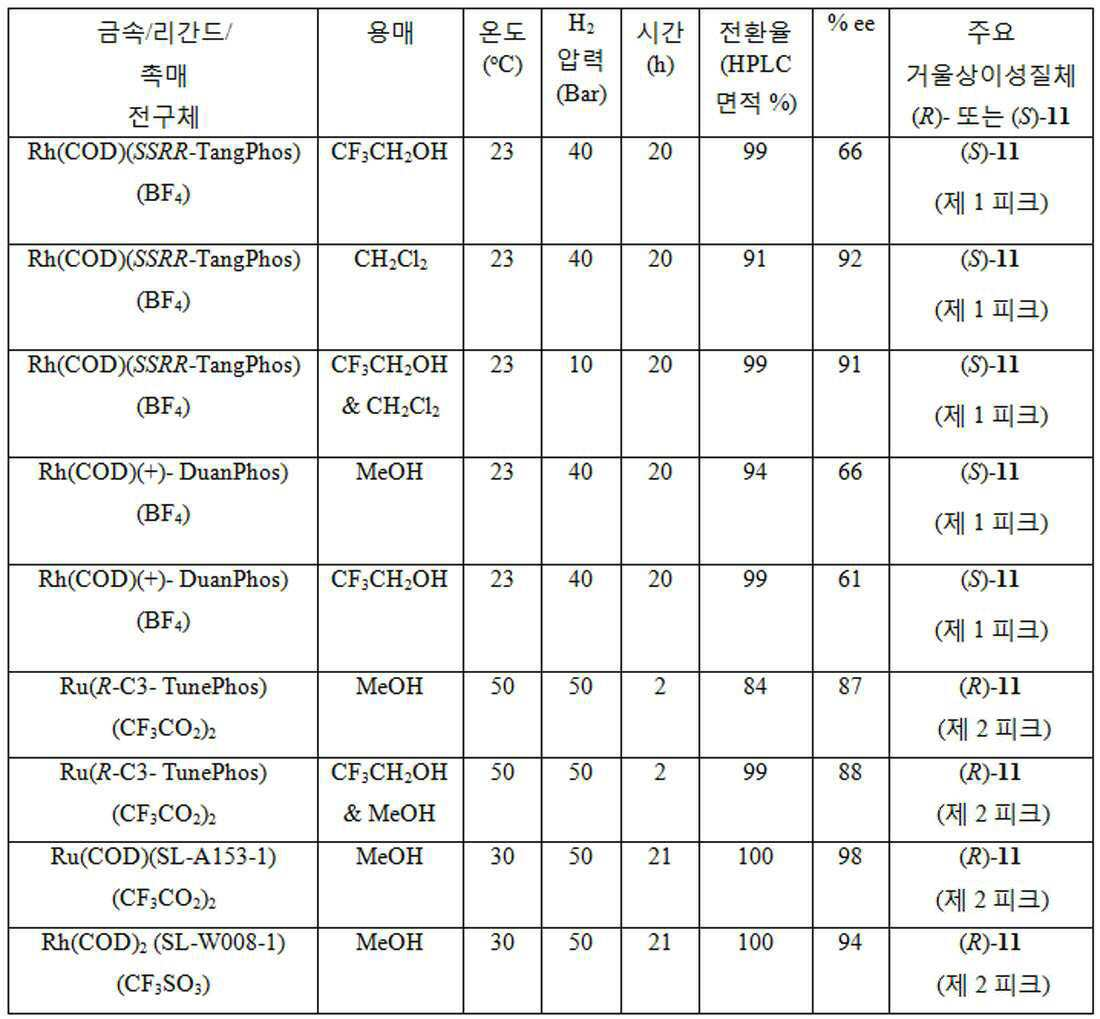
본 연구에 사용된 키랄 포스핀 리간드의 구조는 하기에 열거되어 있다.The structures of chiral phosphine ligands used in this study are listed below.

대표적인 준비 비대칭 수소화 절차, 및 결정화에 의한 생성물 키랄 순도 업그레이드는 하기에 기재되어 있다.Representative preparation asymmetric hydrogenation procedures, and product chiral purity upgrades by crystallization are described below.
(S)-(4-(1-(3-아미노-1-시클로펜틸-3-옥소프로필)-1H-피라졸-4-일)-7H-피롤로[2,3-d]피리미딘-7-일)메틸 피발레이트 ((S)- 11 ). 메틸렌 클로라이드 (CH2Cl2, 12.5 mL) 및 트리플루오로에탄올 (CF3CH2OH, 0.25 mL)의 혼합물 중 (4-{1-[(1Z)-3-아미노-1-시클로펜틸-3-옥소프로프-1-엔-1-일]-1H-피라졸-4-일}-7H-피롤로[2,3-d]피리미딘-7-일)메틸 피발레이트 (10, 215 mg)의 용액을 압력 유리관에서 촉매 Rh(COD)(SSRR-TangPhos)BF4 (8.8 mg)을 질소 하에서 처리한 후, 반응 혼합물을 수소 가스로 40 bar 압력으로 가압했다. 반응 혼합물을 50℃에서 이 수소 압력 하에서 20시간 동안 교반했다. HPLC 분석이 기재물질의 완전한 소비를 보여주었을 때, 반응 혼합물을 실온으로 냉각했다. 반응 혼합물의 거울상이성질체 잉여는 키랄 HPLC 분석에 의해 88% ee (94%의 제1 피크, (S)-11; 6%의 제2 피크, (R)-11)인 것으로 측정되었다. 반응 혼합물을 얇은 실리카겔 패드를 통해 여과하고, 패드를 메틸렌 클로라이드 (5 mL)로 세정했다. 그 다음, 여과물을 감압 하에서 농축 건조했다. 수득한 발포성 고형 (180 mg)에 헵탄 (5 mL) 및 에틸 아세테이트 (EtOAc, 5 mL)의 혼합물을 충전했다. 20℃에서 교반시 백색 고형물이 침전되었다. 슬러리를 20℃에서 16시간 동안 교반했다. 고형물을 여과로 수집하고, 수집된 고형물 (52 mg)에 대한 키랄 HPLC 분석은 제1 피크를 선호하는 66.0%의 거울상이성질체 잉여를 보여주었다 (83.0%의 제1 피크, (S)-11; 17.0%의 제2 피크, (R)-11). 그 다음, 수득한 여과물을 증발 건조했다. 수득한 오일 (108 mg)은 키랄 HPLC로 분석되었고, 제1 피크를 선호하는 99.6%의 거울상이성질체 잉여를 보여주었다 (99.83%의 제1 피크, (S)-11; 0.17%의 제2 피크, (R)-11). 이 결과는 원칙적으로, 비대칭 수소화 생성물의 광학 순도가 적절한 용매계, 예컨대 기재된 바와 같은 에틸 아세테이트/헵탄을 사용하여 고형물의 침전에 의해 작은 거울상이성질체의 선택적 제거에 의해 상당히 향상될 수 있다는 것을 보여주었다. (S)-(4- (1- (3-amino-1-cyclopentyl-3-oxopropyl) -1 H-pyrazol-4-yl) -7H-pyrrolo [2,3-d] pyrimidine- 7-yl) methyl pivalate ((S) -11 ). (4- {1-[(1Z) -3-amino-1-cyclopentyl-3 in a mixture of methylene chloride (CH 2 Cl 2 , 12.5 mL) and trifluoroethanol (CF 3 CH 2 OH, 0.25 mL) -Oxoprop-1-en-1-yl] -1H-pyrazol-4-yl} -7H-pyrrolo [2,3-d] pyrimidin-7-yl) methyl pivalate ( 10 , 215 mg ) Was treated with catalyst Rh (COD) ( SSRR- TangPhos) BF 4 (8.8 mg) under nitrogen in a pressure glass tube, and the reaction mixture was then pressurized with hydrogen gas to 40 bar pressure. The reaction mixture was stirred at 50 ° C. under this hydrogen pressure for 20 hours. When HPLC analysis showed complete consumption of the substrate, the reaction mixture was cooled to room temperature. Enantiomeric excess of the reaction mixture was determined by chiral HPLC analysis to be 88% ee (first peak of 94%, ( S ) -11 ; second peak of 6%, ( R ) -11 ). The reaction mixture was filtered through a thin pad of silica gel and the pad was washed with methylene chloride (5 mL). The filtrate was then concentrated to dryness under reduced pressure. The resulting effervescent solid (180 mg) was charged with a mixture of heptane (5 mL) and ethyl acetate (EtOAc, 5 mL). On stirring at 20 ° C., a white solid precipitated out. The slurry was stirred at 20 ° C. for 16 hours. The solids were collected by filtration and chiral HPLC analysis of the collected solids (52 mg) showed 66.0% enantiomeric excess favoring the first peak (83.0% first peak, ( S ) -11 ; 17.0 Second peak in%, ( R ) -11 ). The filtrate obtained was then evaporated to dryness. The oil obtained (108 mg) was analyzed by chiral HPLC and showed 99.6% enantiomeric preference favoring the first peak (99.83% first peak, ( S ) -11 ; second peak of 0.17%, ( R ) -11 ). This result showed in principle that the optical purity of the asymmetric hydrogenation product could be significantly improved by selective removal of small enantiomers by precipitation of solids using an appropriate solvent system such as ethyl acetate / heptane as described.
(R)-(4-(1-(3-아미노-1-시클로펜틸-3-옥소프로필)-1H-피라졸-4-일)-7H-피롤로[2,3-d]피리미딘-7-일)메틸 피발레이트 ((R)- 11 ). 메탄올 (MeOH, 8.0 mL) 중 (4-{1-[(1Z)-3-아미노-1-시클로펜틸-3-옥소프로프-1-엔-1-일]-1H-피라졸-4-일}-7H-피롤로[2,3-d]피리미딘-7-일)메틸 피발레이트, (10, 500 mg) 의 용액을 압력 유리관에서 촉매 Ru(COD)(SL-A153-1)(CF3CO2)2 (6.6 mg)로 질소 하에서 처리한 후, 반응 혼합물을 수소 가스로 50 bar 압력으로 가압했다. 반응 혼합물을 30℃에서 이 수소 압력 하에서 21시간 동안 교반했다. HPLC 분석이 기재물질의 완전한 소비를 보여주었을 때, 반응 혼합물을 실온으로 냉각했다. 반응 혼합물의 거울상이성질체 잉여는 키랄 HPLC 분석에 의해 98% ee (99%의 제2 피크, (R)-11; 1%의 제1 피크, (S)-11)인 것으로 측정되었다. 그 다음, 반응 혼합물을 얇은 실리카겔 패드를 통해 여과하고, 패드를 메탄올 (5 mL)로 세정했다. 그 다음, 여과물을 감압 하에서 농축 건조했다. 수득한 발포성 고형 (470 mg)은 키랄 HPLC 분석에 의해 분석되었고, 결과는 제2 피크를 선호하는 98.0%의 거울상이성질체 잉여를 보여주었다 (99.0%의 제2 피크, (R)-11; 1.0%의 제1 피크, (S)-11). (R)-(4- (1- (3-amino-1-cyclopentyl-3-oxopropyl) -1H-pyrazol-4-yl) -7H-pyrrolo [2,3-d] pyrimidine- 7-yl) methyl pivalate ((R) -11 ). (4- {1-[( 1Z ) -3-Amino-1-cyclopentyl-3-oxoprop-1-en-1-yl] -1 H -pyrazole- in methanol (MeOH, 8.0 mL) 4-yl} -7 H - pyrrolo [2,3- d] pyrimidin-7-yl) methyl pivalate, (catalyst a solution of 10, 500 mg) in a pressure glass tube, Ru (COD) (SL-A153- After treatment with 1) (CF 3 CO 2 ) 2 (6.6 mg) under nitrogen, the reaction mixture was pressurized with hydrogen gas to 50 bar pressure. The reaction mixture was stirred at 30 ° C. under this hydrogen pressure for 21 hours. When HPLC analysis showed complete consumption of the substrate, the reaction mixture was cooled to room temperature. Enantiomeric excess of the reaction mixture was determined by chiral HPLC analysis to be 98% ee (second peak of 99%, ( R ) -11 ; first peak of 1%, ( S ) -11 ). The reaction mixture was then filtered through a thin pad of silica gel and the pad was washed with methanol (5 mL). The filtrate was then concentrated to dryness under reduced pressure. The obtained effervescent solid (470 mg) was analyzed by chiral HPLC analysis and the results showed 98.0% enantiomeric excess favoring the second peak (99.0% second peak, ( R ) -11 ; 1.0% First peak of, ( S ) -11 ).

( R )-(4-(1-(2-시아노-1-시클로펜틸에틸)-1 H -피라졸-4-일)-7 H -피롤로[2,3-d]피리미딘-7-일)메틸 피발레이트 (( R )-12). 방법 A. 교반 바 및 질소 주입구가 구비된 50 mL 둥근바닥플라스크에, (R)-(4-(1-(3-아미노-1-시클로펜틸-3-옥소프로필)-1H-피라졸-4-일)-7H-피롤로[2,3-d]피리미딘-7-일)메틸 피발레이트 ((R)-11, 413 mg, 0.942 mmol), N,N-디메틸포름아미드 (DMF, 10 mL, 129 mmol) 및 트리에틸아민 (TEA, 0.525 mL, 3.77 mmol, 4.0 당량)을 실온에서 충전했다. 그 다음, 수득한 혼합물을 0 - 5℃로 빙욕에서 냉각한 후, 트리클로로아세틸 클로라이드 (0.315 mL, 2.82 mmol, 3.0 당량)을 주사기로 실온에서 적가했다. 수득한 반응 혼합물을 0 - 5℃에서 90분 동안 교반했다. TLC 및 HPLC가 반응의 완료를 보여주었을 때, 반응 혼합물을 에틸 아세테이트 (EtOAc, 25 mL) 및 20% 수성 염수 (20 mL)로 처리했다. 2개의 층을 분리하고, 수성 층을 에틸 아세테이트 (EtOAc, 2×25 mL)로 추출했다. 조합된 유기 추출물을 20% 수성 염수 (35 mL)로 세정하고, 황산마그네슘 (MgSO4) 상에서 건조하고, 여과하고, 감압 하에서 농축했다. 잔여 갈색 오일성 조 생성물을 플래시 크로마토그래피 (SiO2, 0 내지 50% 에틸 아세테이트/헥산 구배 용리)로 정제하여 (R)-(4-(1-(2-시아노-1-시클로펜틸에틸)-1H-피라졸-4-일)-7H-피롤로[2,3-d]피리미딘-7-일)메틸 피발레이트 ((R)-12, 278 mg, 396.1 mg 이론적, 70.2% 수율)을 밝은 오일로서 얻었고, 이는 실온에서 진공에서 정치시 고형화되었다. (R)-12에 대해: 비키랄 순도 (99.1 면적%, 220 nm에서 검출된 HPLC에 의해); 키랄 순도 (99.6 면적%, 키랄 HPLC에 의해; 99.2% ee); 1H NMR (DMSO-d 6, 400 MHz) δ ppm 8.84 (s, 1H), 8.78 (s, 1H), 8.39 (s, 1H), 7.74 (d, 1H, J = 3.7 Hz,), 7.11 (d, 1H, J = 3.8 Hz), 6.23 (s, 2H), 4.53 (ddd, 1H, J = 9.9, 9.6, 4.2 Hz), 3.26 (dd, 1H, J = 17.4, 9.9 Hz), 3.19 (dd, 1H, J = 17.2, 4.3 Hz), 2.41 (m, 1H), 1.87 - 1.13 (m, 8H), 1.07 (s, 9H); C23H28N6O2 (분자량: 420.51), LCMS (EI) m/e 421.4 (M+ + H). ( R )-(4- (1- (2-cyano-1-cyclopentylethyl) -1 H -pyrazol-4-yl) -7 H -pyrrolo [2,3-d] pyrimidine-7 -Yl) methyl pivalate (( R ) -12). Method A. In a 50 mL round bottom flask equipped with a stirring bar and a nitrogen inlet, ( R )-(4- (1- (3-amino-1-cyclopentyl-3-oxopropyl) -1 H -pyrazol-4-yl ) -7 H - pyrrolo [2,3- d] pyrimidin-7-yl) methyl pivalate ((R) - 11, 413 mg, 0.942 mmol), N, N - dimethylformamide (DMF, 10 mL , 129 mmol) and triethylamine (TEA, 0.525 mL, 3.77 mmol, 4.0 equiv) were charged at room temperature. The resulting mixture was then cooled in an ice bath to 0-5 ° C., then trichloroacetyl chloride (0.315 mL, 2.82 mmol, 3.0 equiv) was added dropwise at room temperature with a syringe. The resulting reaction mixture was stirred at 0-5 ° C. for 90 minutes. When TLC and HPLC showed completion of the reaction, the reaction mixture was treated with ethyl acetate (EtOAc, 25 mL) and 20% aqueous brine (20 mL). The two layers were separated and the aqueous layer was extracted with ethyl acetate (EtOAc, 2 × 25 mL). The combined organic extracts were washed with 20% aqueous brine (35 mL), dried over magnesium sulfate (MgSO 4 ), filtered and concentrated under reduced pressure. The residual brown oily crude product was purified by flash chromatography (SiO 2 , 0-50% ethyl acetate / hexane gradient elution) to give ( R )-(4- (1- (2-cyano-1-cyclopentylethyl)- 1 H -pyrazol-4-yl) -7 H -pyrrolo [2,3-d] pyrimidin-7-yl) methyl pivalate (( R ) -12 , 278 mg, 396.1 mg theoretical, 70.2% yield) was obtained as a bright oil, which solidified upon standing in vacuo at room temperature. For ( R ) -12 : achiral purity (99.1 area%, by HPLC detected at 220 nm); Chiral purity (99.6 area%, by chiral HPLC; 99.2% ee); 1 H NMR (DMSO- d 6 , 400 MHz) δ ppm 8.84 (s, 1H), 8.78 (s, 1H), 8.39 (s, 1H), 7.74 (d, 1H, J = 3.7 Hz,), 7.11 ( d, 1H, J = 3.8 Hz), 6.23 (s, 2H), 4.53 (ddd, 1H, J = 9.9, 9.6, 4.2 Hz), 3.26 (dd, 1H, J = 17.4, 9.9 Hz), 3.19 (dd , 1H, J = 17.2, 4.3 Hz), 2.41 (m, 1H), 1.87-1.13 (m, 8H), 1.07 (s, 9H); C 23 H 28 N 6 O 2 (molecular weight: 420.51), LCMS (EI) m / e 421.4 (M + + H).
(3 R )-시클로펜틸-3-[4-(7 H -피롤로[2,3- d ]피리미딘-4-일)피라졸-1-일]프로피오니트릴 (( R )-13, 유리 염기). 방법 A. 교반 바 및 질소 주입구가 구비된 25 ml 둥근바닥플라스크에, (R)-(4-(1-(2-시아노-1-시클로펜틸에틸)-1H-피라졸-4-일)-7H-피롤로[2,3-d]피리미딘-7-일)메틸 피발레이트 ((R)-12, 278 mg, 0.661 mmol) 및 메탄올 (MeOH, 2.50 mL, 37.0 mmol)을 실온에서 충전했다. 그 다음, 수득한 균일 반응 용액을 0.10 M 수성 수산화나트륨 용액 (NaOH, 1.5 mL, 0.15 mmol, 2.3 당량)으로 실온에서 처리했다. 수득한 반응 혼합물을 실온에서 22시간 동안 교반했다. 반응이 완료된 것으로 보일 때, 반응 혼합물을 20% 수성 염수 (10 mL) 및 에틸 아세테이트 (EtOAc, 25 mL)으로 희석했다. 2개의 층을 분리하고, 수성 층을 에틸 아세테이트 (EtOAc, 25 mL)로 추출했다. 조합된 유기 분획을 황산마그네슘 (MgSO4) 상에서 건조시키고, 여과하고, 감압 하에서 농축했다. 잔여물을 플래시 크로마토그래피 (SiO2, 0 내지 100% 에틸 아세테이트/헥산 구배 용리)로 정제하여 (3R)-시클로펜틸-3-[4-(7H-피롤로[2,3-d]피리미딘-4-일)피라졸-1-일]프로피오니트릴 ((R)-13, 유리 염기, 188 mg, 202.5 mg 이론적, 92.8% 수율)을 무색 오일로서 얻었고, 이는 실온에서 진공에서 정치시 고형화되었다. (R)-13 (유리 염기)에 대해: 1H NMR (DMSO-d 6, 400 MHz) δ ppm 12.1 (bs, 1H), 8.80 (d, 1H, J = 0.42 Hz), 8.67 (s, 1H), 8.37 (s, 1H), 7.59 (dd, 1H, J = 2.34, 3.51 Hz), 6.98 (dd, 1H, J = 1.40, 3.44 Hz), 4.53 (td, 1H, J = 19.5, 4.63 Hz), 3.26 (dd, 1H, J = 9.77, 17.2 Hz), 3.18 (dd, 1H, J = 4.32, 17.3 Hz), 2.40 (m, 1H), 1.79 (m, 1H), 1.65 내지 1.13 (m, 7H); C17H18N6 (분자량: 306.37) LCMS (EI) m/e 307 (M+ + H). (3 R) - cyclopentyl -3- [4- (7 H - pyrrolo [2,3- d] pyrimidin-4-yl) pyrazol-1-yl] propionitrile ((R) -13, Free base). Method A. In a 25 ml round bottom flask equipped with a stirring bar and a nitrogen inlet, ( R )-(4- (1- (2-cyano-1-cyclopentylethyl) -1 H -pyrazol-4-yl ) -7 H - pyrrolo [2,3-d] pyrimidin-7-yl) methyl pivalate (( R ) -12 , 278 mg, 0.661 mmol) and methanol (MeOH, 2.50 mL, 37.0 mmol) were charged at room temperature. The resulting homogeneous reaction solution was then treated with 0.10 M aqueous sodium hydroxide solution (NaOH, 1.5 mL, 0.15 mmol, 2.3 equiv) at room temperature. The resulting reaction mixture was stirred at rt for 22 h. When the reaction appeared to be complete, the reaction mixture was diluted with 20% aqueous brine (10 mL) and ethyl acetate (EtOAc, 25 mL). The two layers were separated and the aqueous layer was extracted with ethyl acetate (EtOAc, 25 mL). The combined organic fractions were dried over magnesium sulfate (MgSO 4 ), filtered and concentrated under reduced pressure. The residue was purified by flash chromatography (SiO 2 , 0-100% ethyl acetate / hexane gradient elution) to give (3 R ) -cyclopentyl-3- [4- (7 H -pyrrolo [2,3- d ] Pyrimidin-4-yl) pyrazol-1-yl] propionitrile (( R ) -13 , free base, 188 mg, 202.5 mg theoretical, 92.8% yield) was obtained as a colorless oil, which was allowed to stand in vacuo at room temperature. The city was solidified. For ( R ) -13 (free base): 1 H NMR (DMSO- d 6 , 400 MHz) δ ppm 12.1 (bs, 1H), 8.80 (d, 1H, J = 0.42 Hz), 8.67 (s, 1H ), 8.37 (s, 1H), 7.59 (dd, 1H, J = 2.34, 3.51 Hz), 6.98 (dd, 1H, J = 1.40, 3.44 Hz), 4.53 (td, 1H, J = 19.5, 4.63 Hz) , 3.26 (dd, 1H, J = 9.77, 17.2 Hz), 3.18 (dd, 1H, J = 4.32, 17.3 Hz), 2.40 (m, 1H), 1.79 (m, 1H), 1.65 to 1.13 (m, 7H ); C 17 H 18 N 6 (molecular weight : 306.37) LCMS (EI) m / e 307 (M + + H).
(3 R )-시클로펜틸-3-[4-(7 H -피롤로[2,3- d ]피리미딘-4-일)피라졸-1-일]프로피오니트릴 포스페이트 염 (( R )-14, 포스페이트). 이소프로판올 (IPA, 8 L) 중 (3R)-시클로펜틸-3-[4-(7H-피롤로[2,3-d]피리미딘-4-일)피라졸-1-일]프로피오니트릴 ((R)-13, 유리 염기, 572 g, 1.87 mol)의 용액에 60 - 65℃에서 이소프로판올 (1.6 L) 중 인산 (186.2 g, 1.9 mol, 1.10 당량)의 용액을 첨가했다. 인산 용액의 첨가 동안에 발열은 관찰되지 않았고, 침전물이 거의 즉시 형성되었다. 그 다음, 수득한 혼합물을 76℃에서 1.5시간 동안 가열하고, 그 다음, 주위 온도로 점차 냉각시키고, 실온에서 밤새 교반했다. 혼합물을 여과하고, 고형물을 헵탄 및 이소프로판올 (1/1, v/v, 3 L)의 혼합물로 세정한 후, 최초 플라스크로 다시 이동시키고, 헵탄 (8 L)에서 1시간 동안 교반했다. 고형물을 여과로 수집하고, 헵탄 (1 L)로 세정하고, 대류 오븐에서 진공에서 40℃에서 일정 중량으로 건조시켜서 (3R)-시클로펜틸-3-[4-(7H-피롤로[2,3-d]피리미딘-4-일)피라졸-1-일]프로피오니트릴 포스페이트 염 ((R)-14, 포스페이트, 634.2 g, 755 g 이론적, 84% 수율)을 백색 내지 회백색 결정성 고형물로서 얻었다. (R)-14 (포스페이트)에 대해: mp. 197.6℃; 1H NMR (DMSO-d 6, 500 MHz) δ ppm 12.10 (s, 1H), 8.78 (s, 1H), 8.68 (s, 1H), 8.36 (s 1H), 7.58 (dd, 1H, J = 1.9, 3.5 Hz), 6.97 (d, 1H, J = 3.6 Hz), 4.52 (td, 1H, J = 3.9, 9.7 Hz), 3.25 (dd, 1H, J = 9.8, 17.2 Hz), 3.16 (dd, 1H, J = 4.0, 17.0 Hz), 2.41, (m, 1H), 1.79 (m, 1H), 1.59 (m, 1H), 1.51 (m, 2H), 1.42 (m, 1H), 1.29 (m, 2H), 1.18 (m, 1H); 13C NMR (DMSO-d 6, 125 MHz) δ ppm 152.1, 150.8, 149.8, 139.2, 131.0, 126.8, 120.4, 118.1, 112.8, 99.8, 62.5, 44.3, 29.1, 29.0, 24.9, 24.3, 22.5; C17H18N6 (분자량: 306.37, 유리 염기에 대해) LCMS (EI) m/e 307 (M+ + H, 염기 피크), 329.1 (M+ + Na). (3 R) - cyclopentyl -3- [4- (7 H - pyrrolo [2,3- d] pyrimidin-4-yl) pyrazol-1-yl] propionitrile phosphate salt ((R) - 14, phosphate). Isopropanol (IPA, 8 L) of (3 R) - cyclopentyl -3- [4- (7 H - pyrrolo [2,3- d] pyrimidin-4-yl) pyrazol-1-yl] propionate To a solution of nitrile (( R ) -13 , free base, 572 g, 1.87 mol) was added a solution of phosphoric acid (186.2 g, 1.9 mol, 1.10 equiv) in isopropanol (1.6 L) at 60-65 ° C. No exotherm was observed during the addition of the phosphoric acid solution, and a precipitate formed almost immediately. The resulting mixture was then heated at 76 ° C. for 1.5 h, then gradually cooled to ambient temperature and stirred at rt overnight. The mixture was filtered and the solid was washed with a mixture of heptane and isopropanol (1/1, v / v, 3 L), then transferred back to the original flask and stirred for 1 h in heptane (8 L). The solid was collected by filtered and washed with heptane (1 L), dried in a convection oven to a constant weight in vacuo at 40 ℃ (3 R) - cyclopentyl -3- [4- (7 H - pyrrolo [2 , 3- d ] pyrimidin-4-yl) pyrazol-1-yl] propionitrile phosphate salt (( R ) -14, phosphate, 634.2 g, 755 g theoretical, 84% yield) white to off-white crystalline Obtained as a solid. For ( R ) -14 (phosphate): mp. 197.6 ° C .; 1 H NMR (DMSO- d 6 , 500 MHz) δ ppm 12.10 (s, 1H), 8.78 (s, 1H), 8.68 (s, 1H), 8.36 (s 1H), 7.58 (dd, 1H, J = 1.9 , 3.5 Hz), 6.97 (d, 1H, J = 3.6 Hz), 4.52 (td, 1H, J = 3.9, 9.7 Hz), 3.25 (dd, 1H, J = 9.8, 17.2 Hz), 3.16 (dd, 1H , J = 4.0, 17.0 Hz), 2.41, (m, 1H), 1.79 (m, 1H), 1.59 (m, 1H), 1.51 (m, 2H), 1.42 (m, 1H), 1.29 (m, 2H ), 1.18 (m, 1 H); 13 C NMR (DMSO- d 6 , 125 MHz) δ ppm 152.1, 150.8, 149.8, 139.2, 131.0, 126.8, 120.4, 118.1, 112.8, 99.8, 62.5, 44.3, 29.1, 29.0, 24.9, 24.3, 22.5; C 17 H 18 N 6 (molecular weight: 306.37, for the free base) LCMS (EI) m / e 307 (M + + H, base peak), 329.1 (M + + Na ).

4-(1 H -피라졸-4-일)-7-(2-트리메틸실라닐에톡시메틸)-7 H -피롤로[2,3- d ]피리미딘 (17). 1,2-디메톡시에탄 (DME, 20.0 mL, 192.4 mmol) 중 수산화나트륨 (NaH, 60 wt% 오일 배치, 4.05 g, 101.3 mmol, 1.54 당량)의 현탁액에 0 - 5℃ (빙욕)에서 1,2-디메톡시에탄 (DME, 80.0 mL, 769.6 mmol) 중 4-클로로피롤로[2,3-d]피리미딘 (1, 10.08 g, 65.6 mmol)을 서서히 첨가하고, 이로써 온도는 5℃ 미만 (-7℃ 내지 5℃)에서 유지되었다. 다량의 가스는 기재물질 (1)의 용액의 도입 직후에 방출되었다. 수득한 반응 혼합물을 0 - 5℃에서 30분 동안 교반한 후, 트리메틸실릴에톡시메틸 클로라이드 (SEM-Cl, 12.56 g, 75.3 mmol, 1.15 당량)을, 반응 온도가 5℃ 미만에서 유지되는 동안에 서서히 첨가했다. 첨가 후, 반응을 0℃에서 1시간 동안 교반한 후, 23시간 동안 실온으로 따뜻하게 했다. HPLC 및 TLC가 반응의 완료를 보여주었을 때, 반응 혼합물을 물 (46 mL)로 실온에서 급냉하고, 원하는 생성물 (15)을 함유하는 급냉된 반응 혼합물에 대해, 다음 스즈끼 커플링 반응을 수행하고, 이를 추가 워크업 및 정제없이 직접 사용했다. 4- (1 H - pyrazol-4-yl) -7- (2-trimethylsilanyl ethoxymethyl) -7 H - pyrrolo [2,3- d] pyrimidine (17). 1, at 0-5 ° C. (ice bath) in a suspension of sodium hydroxide (NaH, 60 wt% oil batch, 4.05 g, 101.3 mmol, 1.54 equiv) in 1,2-dimethoxyethane (DME, 20.0 mL, 192.4 mmol) 4-chloropyrrolo [2,3- d ] pyrimidine ( 1 , 10.08 g, 65.6 mmol) in 2-dimethoxyethane (DME, 80.0 mL, 769.6 mmol) was added slowly, so that the temperature was below 5 ° C. ( -7 ° C to 5 ° C). A large amount of gas was released immediately after introduction of the solution of the base material ( 1 ). The resulting reaction mixture was stirred at 0-5 ° C. for 30 minutes, then trimethylsilylethoxymethyl chloride (SEM-Cl, 12.56 g, 75.3 mmol, 1.15 equiv) was slowly added while the reaction temperature was maintained below 5 ° C. Added. After addition, the reaction was stirred at 0 ° C. for 1 hour and then warmed to room temperature for 23 hours. When HPLC and TLC showed the completion of the reaction, the reaction mixture was quenched with water (46 mL) at room temperature, and the following Suzuki coupling reaction was carried out on the quenched reaction mixture containing the desired product ( 15 ), It was used directly without further workup and purification.
상기에 기재된 이전 반응으로부터 조 4-클로로-7-[2-(트리메틸실릴)에톡시]메틸}-7H-피롤로[2,3-d]피리미딘 (15, 18.63 g, 65.64 mmol)을 함유하는 급냉된 반응 혼합물에 1,2-디메톡시에탄 (DME, 38 mL), 분말 탄산칼륨 (K2CO3, 23.56 g, 170.5 mmol, 2.6 당량), 1-(1-에톡시에틸)-4-(4,4,5,5-테트라메틸-1,3,2-디옥사보롤란-2-일)-1H-피라졸 (3, 18.60 g, 69.89 mmol, 1.06 당량)을 실온에서 첨가했다. 수득한 혼합물을 매시간 질소 가스로 4회 역충전한 후, 테트라키스(트리페닐포스핀)팔라듐(0) (Pd(PPh3)4, 244.2 mg, 0.21 mmol, 0.003 당량)으로 실온에서 처리했다. 수득한 반응 혼합물을 매시간 질소 가스로 4회 역충전한 후, 80℃로 4 - 8시간 동안 따뜻하게 했다. TLC 및 HPLC가 반응의 완료를 보여주었을 때, 반응 혼합물을 점차 실온으로 냉각시키고, 짧은 베드의 셀라이트 (10 g)를 통해 여과했다. 셀라이트 베드를 에틸 아세테이트 (EtOAc, 20 mL)로 세정했다. 여과물의 2개의 층을 분리하고, 수성 층을 에틸 아세테이트 (EtOAc, 2×30 mL)로 추출했다. 조합된 유기 추출물을 포화 수성 NaCl 용액 (20 mL)로 세정하고, 황산마그네슘 (MgSO4) 상에서 건조시키고, 감압 하에서 농축했다. 그 다음, 조 원하는 스즈끼 커플링 생성물 (16)을 함유하는 잔여물을, THF (22 mL)를 갖는 500 mL 둥근바닥플라스크로 이동시키고, 이를 추가 정제없이 차후의 탈보호 반응에 사용했다.Crude 4-chloro-7- [2- (trimethylsilyl) ethoxy] methyl} -7 H -pyrrolo [2,3- d ] pyrimidine ( 15 , 18.63 g, 65.64 mmol) was obtained from the previous reaction described above. To the quenched reaction mixture containing 1,2-dimethoxyethane (DME, 38 mL), powdered potassium carbonate (K 2 CO 3 , 23.56 g, 170.5 mmol, 2.6 equiv), 1- (1-ethoxyethyl)- 4- (4,4,5,5-tetramethyl-1,3,2-dioxaborolan-2-yl) -1 H -pyrazole ( 3 , 18.60 g, 69.89 mmol, 1.06 equiv) at room temperature Added. The resulting mixture was backfilled four times with nitrogen gas every hour and then treated with tetrakis (triphenylphosphine) palladium (0) (Pd (PPh 3 ) 4 , 244.2 mg, 0.21 mmol, 0.003 equiv) at room temperature. The resulting reaction mixture was backfilled four times with nitrogen gas every hour and then warmed to 80 ° C. for 4-8 hours. When TLC and HPLC showed completion of the reaction, the reaction mixture was gradually cooled to room temperature and filtered through a short bed of celite (10 g). The celite bed was washed with ethyl acetate (EtOAc, 20 mL). Two layers of the filtrate were separated and the aqueous layer was extracted with ethyl acetate (EtOAc, 2 × 30 mL). The combined organic extracts were washed with saturated aqueous NaCl solution (20 mL), dried over magnesium sulfate (MgSO 4 ) and concentrated under reduced pressure. The residue containing the crude Suzuki coupling product ( 16 ) was then transferred to a 500 mL round bottom flask with THF (22 mL) and used for subsequent deprotection reaction without further purification.
THF (22 mL) 중 조 스즈끼 커플링 생성물 (16)의 용액을 물 (108 mL), 및 19.6 mL의 농축 HCl을 64 mL의 H2O와 실온에서 혼합하여 제조한 10% 수성 HCl의 용액으로 처리했다. 수득한 반응 혼합물을 실온에서 4 - 6시간 동안 교반했다. TLC 및 HPLC가 탈보호 반응의 완료를 보여주었을 때, 10.4 g의 NaOH을 21.0 mL의 H2O에서 용해시켜 제조한 30% 수성 수산화나트륨 (NaOH) 용액을, 25℃ 미만의 온도로 유지하면서 반응 혼합물에 서서히 첨가했다. 고형은 서서히 용해되었고 10분 후 재침전되었다. 혼합물을 실온에서 1 내지 2시간 동안 교반한 후, 고형물을 여과로 수집하고, H2O (50 mL)로 세정했다. 습윤 케이크를 250 mL 3목 플라스크로 이동시키고, 아세토니트릴 (MeCN, 112 mL)로 실온에서 처리했다.혼합물을 2시간 동안 가열 환류한 후, 실온으로 서서히 냉각시키고, 실온에서 1시간 동안 교반했다. 고형물을 여과로 수집하고, MeCN (36 mL)로 세정하고, 40 - 45℃에서 진공 오븐에서 건조하여 4-(1H-피라졸-4-일)-7-(2-트리메틸실라닐-에톡시메틸)-7H-피롤로[2,3-d]피리미딘 (17, 15.3 g, 20.7 g 이론적, 73.9% 수율, 3단계로)을 백색 결정성 고형물 (99.4 면적%, HPLC에 의해)로서 얻었다. 17에 대해: 1H NMR (DMSO-d 6, 400 MHz) δ ppm 13.41 (bs, 1H), 8.74 (s, 1H), 8.67 (bs, 1H), 8.35 (bs, 1H), 7.72 (d, 1H, J = 3.7 Hz), 7.10 (d, 1H, J = 3.7 Hz), 5.61 (s, 2H), 3.51 (t, 2H, J = 8.2 Hz), 0.81 (t, 2H, J = 8.2 Hz), 0.13 (s, 9H); C15H21N5OSi (분자량: 315.45), LCMS (EI) m/e 316 (M+ + H).A solution of crude Suzuki coupling product ( 16 ) in THF (22 mL) was mixed with water (108 mL) and 19.6 mL of concentrated HCl with 64 mL of H 2 O at room temperature to a solution of 10% aqueous HCl. Processed. The resulting reaction mixture was stirred for 4-6 hours at room temperature. When TLC and HPLC showed the completion of the deprotection reaction, a 30% aqueous sodium hydroxide (NaOH) solution prepared by dissolving 10.4 g of NaOH in 21.0 mL of H 2 O was maintained at a temperature below 25 ° C. It was added slowly to the mixture. The solid dissolved slowly and reprecipitated after 10 minutes. After the mixture was stirred at rt for 1-2 h, the solid was collected by filtration and washed with H 2 O (50 mL). The wet cake was transferred to a 250 mL three neck flask and treated with acetonitrile (MeCN, 112 mL) at room temperature. The mixture was heated to reflux for 2 hours, then slowly cooled to room temperature and stirred at room temperature for 1 hour. The solids were collected by filtration, washed with MeCN (36 mL) and dried in a vacuum oven at 40-45 ° C. to 4- (1 H -pyrazol-4-yl) -7- (2-trimethylsilanyl- ethoxymethyl) -7 H - pyrrolo [2,3- d] pyrimidine (17, 15.3 g, 20.7 g as a theoretical, 73.9% yield, 3 steps) of a white crystalline solid (99.4 area% by HPLC) Obtained as. For 17 : 1 H NMR (DMSO- d 6 , 400 MHz) δ ppm 13.41 (bs, 1H), 8.74 (s, 1H), 8.67 (bs, 1H), 8.35 (bs, 1H), 7.72 (d, 1H, J = 3.7 Hz), 7.10 (d, 1H, J = 3.7 Hz), 5.61 (s, 2H), 3.51 (t, 2H, J = 8.2 Hz), 0.81 (t, 2H, J = 8.2 Hz) , 0.13 (s, 9 H); C 15 H 21 N 5 OSi (Molecular weight : 315.45), LCMS (EI) m / e 316 (M + + H).

메틸 3-시클로펜틸프로피올레이트 (18). 무수 테트라히드로푸란 (THF, 200 mL, 2466 mmol) 중 시클로펜틸아세틸렌 (7, 17.49 mL, 150.0 mmol) 의 교반 용액에 -78℃에서 헥산 (66.0 mL, 165 mmol, 1.1 당량) 중 2.50 M의 n-부틸리튬을 첨가했다. 수득한 우유빛 현탁액을 -78℃에서 30분 동안 교반했다. 그 다음, 메틸 클로로포르메이트 (17.6 mL, 225 mmol, 1.5 당량)을 첨가했다. 반응 혼합물은 맑은 용액이 되었다. 그 다음, 냉각 배쓰를 제거하고, 반응 혼합물을 실온으로 따뜻하게 하고, 실온에서 1시간 동안 교반했다. 반응 혼합물은 다시 현탁액이 되었다. TLC (5% EtOAc/헥산, KMnO4 염료)가 반응의 완료를 보여주었을 때, 반응 혼합물을 포화 수성 NH4Cl 용액 (150 mL)로 급냉하고, 디에틸 에테르 (Et2O, 2×200 mL)로 추출했다. 조합된 유기 층을 포화 수성 NaCl 용액으로 세정하고, 황산마그네슘 (MgSO4) 상에서 건조시키고, 여과하고, 감압 하에서 농축했다. 잔여물을 진공 (99 - 101℃/16 mbar) 하에서 증류하여 메틸 3-시클로펜틸프로피올레이트 (18, 21.856 g, 22.83 g 이론적, 96% 수율)을 무색 오일로서 얻었다. 18에 대해: 1H NMR (CDCl3, 400 MHz) δ ppm 3.74 (s, 3H), 2.73 (m, 1H), 1.95 (m, 2H), 1.72 (m, 4H), 1.57 (m, 2H). Methyl 3-cyclopentylpropiolate (18). 2.50 M of n in hexanes (66.0 mL, 165 mmol, 1.1 equiv) in a stirred solution of cyclopentylacetylene ( 7 , 17.49 mL, 150.0 mmol) in anhydrous tetrahydrofuran (THF, 200 mL, 2466 mmol) at -78 ° C -Butyllithium was added. The resulting milky suspension was stirred at -78 ° C for 30 minutes. Then methyl chloroformate (17.6 mL, 225 mmol, 1.5 equiv) was added. The reaction mixture became a clear solution. Then, the cooling bath was removed and the reaction mixture was warmed to room temperature and stirred at room temperature for 1 hour. The reaction mixture became a suspension again. When TLC (5% EtOAc / hexanes, KMnO4 dye) showed completion of the reaction, the reaction mixture was quenched with saturated aqueous NH 4 Cl solution (150 mL) and diethyl ether (Et 2 O, 2 × 200 mL) Extracted. The combined organic layers were washed with saturated aqueous NaCl solution, dried over magnesium sulfate (MgSO 4 ), filtered and concentrated under reduced pressure. The residue was distilled under vacuum (99-101 ° C./16 mbar) to give methyl 3-cyclopentylpropiolate ( 18 , 21.856 g, 22.83 g theoretical, 96% yield) as a colorless oil. For 18 : 1 H NMR (CDCl 3 , 400 MHz) δ ppm 3.74 (s, 3H), 2.73 (m, 1H), 1.95 (m, 2H), 1.72 (m, 4H), 1.57 (m, 2H) .

( Z )-3-시클로펜틸-3-(4-(7-((2-(트리메틸실릴)에톡시)메틸)-7 H -피롤로[2,3- d ]피리미딘-4-일)-1 H -피라졸-1-일)아실로니트릴 (19). N,N-디메틸포름아미드 (DMF, 40.0 mL, 516 mmol) 중 4-(1H-피라졸-4-일)-7-{[2-(트리메틸실릴)에톡시]메틸}-7H-피롤로[2,3-d]피리미딘 (17, 7.260 g, 23.01 mmol) 및 3-시클로펜틸프로프-2-인니트릴 (8, 6.140 g, 34.52 mmol, 1.5 당량)의 교반 용액에 실온에서 고형 탄산칼륨 (K2CO3, 318 mg, 2.30 mmol, 0.1 당량)을 첨가했다. 수득한 반응 혼합물을 실온에서 30분 동안 교반했다. LCMS가 반응의 완료를 보여주었을 때, 반응 혼합물을 물 (80 mL)로 급냉하고, EtOAc (2×150 mL)로 추출했다. 조합된 유기 층을 물 (80 mL) 및 염수 (50 mL)로 세정하고, 황산마그네슘 (MgSO4) 상에서 건조시키고, 여과하고, 감압 하에서 농축했다. 잔여물을 플래시 크로마토그래피 (SiO2, 0 - 30% EtOAc/헥산 구배 용리)로 정제하여 (Z)-3-시클로펜틸-3-(4-(7-((2-(트리메틸실릴)에톡시)메틸)-7H-피롤로[2,3-d]피리미딘-4-일)-1H-피라졸-1-일)아실로니트릴 (19, 8.256 g, 10.0 g 이론적, 82.6% 수율)을 무색 시럽으로서 얻었다. 19에 대해: 1H NMR (CDCl3, 300 MHz) δ ppm 9.15 (bs, 1H), 8.96 (s, 1H), 8.56 (s, 1H), 7.51 (d, 1H, J = 3.5 Hz), 6.93 (d, 1H, J = 3.5 Hz), 5.75 (s, 2H), 5.29 (s, 1H), 3.62 (m, 1H), 3.60 (t, 2H, J = 8.2 Hz), 2.16 (m, 2H), 1.81 (m, 4H), 1.59 (m, 2H), 0.98 (t, 2H, J = 8.2 Hz), 0.00 (s, 9H); C23H30N6OSi (분자량: 434.61), LCMS (EI) m/e 435.2 (M+ + H). (Z) -3-cyclopentyl-3- (4- (7-pyrrolo [2,3- d] pyrimidin-4-yl) - ((ethoxy) methyl) -7 H 2- (trimethylsilyl) -1 H -pyrazol-1-yl) acylonitrile (19). 4- ( 1H -pyrazol-4-yl) -7-{[2- (trimethylsilyl) ethoxy] methyl} -7 H − in N, N-dimethylformamide (DMF, 40.0 mL, 516 mmol) To a stirred solution of pyrrolo [2,3- d ] pyrimidine ( 17 , 7.260 g, 23.01 mmol) and 3-cyclopentylprop-2-innitrile ( 8 , 6.140 g, 34.52 mmol, 1.5 equiv) at room temperature Solid potassium carbonate (K 2 CO 3 , 318 mg, 2.30 mmol, 0.1 equiv) was added. The resulting reaction mixture was stirred at rt for 30 min. When LCMS showed the reaction was complete, the reaction mixture was quenched with water (80 mL) and extracted with EtOAc (2 × 150 mL). The combined organic layer was washed with water (80 mL) and brine (50 mL), dried over magnesium sulfate (MgSO 4 ), filtered and concentrated under reduced pressure. The residue was purified by flash chromatography (SiO 2 , 0-30% EtOAc / hexane gradient elution) to give ( Z ) -3-cyclopentyl-3- (4- (7-((2- (trimethylsilyl) ethoxy ) methyl) -7 H - pyrrolo [2,3- d] pyrimidin-4-yl) -1 H - pyrazol-1-yl) acrylonitrile, acyl (19, 8.256 g, 10.0 g theoretical, 82.6% yield: ) Was obtained as a colorless syrup. For 19 : 1 H NMR (CDCl 3 , 300 MHz) δ ppm 9.15 (bs, 1H), 8.96 (s, 1H), 8.56 (s, 1H), 7.51 (d, 1H, J = 3.5 Hz), 6.93 (d, 1H, J = 3.5 Hz), 5.75 (s, 2H), 5.29 (s, 1H), 3.62 (m, 1H), 3.60 (t, 2H, J = 8.2 Hz), 2.16 (m, 2H) , 1.81 (m, 4H), 1.59 (m, 2H), 0.98 (t, 2H, J = 8.2 Hz), 0.00 (s, 9H); C 23 H 30 N 6 OSi (Molecular weight : 434.61), LCMS (EI) m / e 435.2 (M + + H).
(( RR )-3-시클로펜틸-3-(4-(7-((2-(트리메틸실릴)에톡시)메틸)-7) -3-cyclopentyl-3- (4- (7-((2- (trimethylsilyl) ethoxy) methyl) -7 HH -피롤로[2,3--Pyrrolo [2,3- dd ]피리미딘-4-일)-1] Pyrimidin-4-yl) -1 HH -피라졸-1-일)프로판니트릴 ((-Pyrazol-1-yl) propanenitrile (( RR )-20) 및 () -20) and ( SS )-3-시클로펜틸-3-(4-(7-((2-(트리메틸실릴)에톡시)메틸)-7) -3-cyclopentyl-3- (4- (7-((2- (trimethylsilyl) ethoxy) methyl) -7 HH -피롤로[2,3--Pyrrolo [2,3- dd ]피리미딘-4-일)-1] Pyrimidin-4-yl) -1 HH -피라졸-1-일)프로판니트릴 ((-Pyrazol-1-yl) propanenitrile (( SS )-20). ) -20).
기재물질, (Z)-3-시클로펜틸-3-(4-(7-((2-(트리메틸실릴)에톡시)메틸)-7H-피롤로[2,3-d]피리미딘-4-일)-1H-피라졸-1-일)아실로니트릴 (19)를 사용하는 비대칭 수소화에 대한 일반적인 스크리닝 절차를 수행하여 광학적으로 풍부한 생성물, 3-시클로펜틸-3-(4-(7-((2-(트리메틸실릴)에톡시)메틸)-7H-피롤로[2,3-d]피리미딘-4-일)-1H-피라졸-1-일)프로판니트릴 ((R)-20 또는 (S)-20)을 얻었다: 유리 비알 (20 mL)을 갖는 300 mL-용적 오토클레이브에 기재물질 (19), 촉매 (금속, 리간드, 및 촉매 전구체), 및 무산소 용매 (4 - 6 mL)을 질소 하에서 충전했다. 이 오토클레이브에 원하는 압력으로 수소 가스를 충전하고, 실온에서 교반하거나, 오일 배쓰로 가열했다. 수소 가스를 방출한 후, 반응 혼합물을 감압 하에서 농축했다. 잔여물을 에틸 아세테이트 및 메탄올 (v/v = 9/1)의 혼합물을 사용하는 실리카겔 패드를 통한 용리로 정제하여 생성물, 3-시클로펜틸-3-(4-(7-((2-(트리메틸실릴)에톡시)메틸)-7H-피롤로[2,3-d]피리미딘-4-일)-1H-피라졸-1-일)프로판니트릴 ((R)-20 또는 (S)-20)를 얻고, 이에 대해 화학 전환율 (HPLC 및 키랄 HPLC), LC/MS 및 NMR 분광법 및 거울상이성질체 잉여 (% ee, 키랄 HPLC에 의해) 측정을 수행했다.Substrate material, (Z) -3-cyclopentyl-3- (4- (7-a ((2- (trimethylsilyl) ethoxy) methyl) -7 H-pyrrolo [2,3- d] pyrimidin -4 A general screening procedure for asymmetric hydrogenation with -yl) -1 H -pyrazol-1-yl) acylonitrile ( 19 ) was followed to optically enriched product, 3-cyclopentyl-3- (4- (7 - ((2- (trimethylsilyl) ethoxy) methyl) -7 H-pyrrolo [2,3- d] pyrimidin-4-yl) -1 H-pyrazol-1-yl) propanenitrile ((R ) -20 or ( S ) -20 ) was obtained: in a 300 mL-volume autoclave with free vials (20 mL), the substrate ( 19 ), the catalyst (metal, ligand, and catalyst precursor), and the oxygen free solvent (4 6 mL) was charged under nitrogen. The autoclave was charged with hydrogen gas at a desired pressure and stirred at room temperature or heated with an oil bath. After releasing hydrogen gas, the reaction mixture was concentrated under reduced pressure. The residue was purified by elution through a pad of silica gel using a mixture of ethyl acetate and methanol (v / v = 9/1) to give the product, 3-cyclopentyl-3- (4- (7-((2- (trimethyl silyl) ethoxy) methyl) -7 H - pyrrolo [2,3- d] pyrimidin-4-yl) -1 H - pyrazol-1-yl) propanenitrile ((R) - or 20 (S) 20 ), chemical conversion (HPLC and chiral HPLC), LC / MS and NMR spectroscopy and enantiomeric excess (% ee, by chiral HPLC) measurements were performed.
생성물의 거울상이성질체 잉여 (% ee)의 측정을 키랄 HPLC 분석에 의해 수행했다. 키랄 HPLC 방법을, 셀룰로오스 트리스(3,5-디메틸페닐 카바메이트) (Chiralcel® OD)로 코팅된 실리카겔로 채워진 Chiral Technologies, Inc.의 Chiralcel® OD-H 칼럼 (4.6×250 mm, 5 ㎛)을 사용하여 개발했다. 2개의 거울상이성질체, (R)-20 또는 (S)-20을, 10% 에탄올 및 90% 헥산으로 만들어진 이동상을 실온에서 1 mL/min의 유속으로 사용하여 3.0 초과의 분할로 분리한다. UV 검출 파장은 220 nm이다. (S)-거울상이성질체 ((S)-20) 및 (R)-거울상이성질체 ((R)-20)에 대한 체류시간은 각각 10.3분 (제1 피크) 및 13.1분 (제2 피크)이다. Measurement of the enantiomeric excess (% ee) of the product was performed by chiral HPLC analysis. Chiral HPLC method was performed on a Chiralcel ® OD-H column (4.6 x 250 mm, 5 μm) from Chiral Technologies, Inc., filled with silica gel coated with cellulose tris (3,5-dimethylphenyl carbamate) (Chiralcel ® OD). Developed using. Two enantiomers, ( R ) -20 or ( S ) -20 , are separated in more than 3.0 splits using a mobile phase made of 10% ethanol and 90% hexane at a flow rate of 1 mL / min at room temperature. The UV detection wavelength is 220 nm. (S) - the retention time was 10.3 minutes (first peak) and 13.1 minutes (second peak), each of the enantiomers ((S) - 20) and (R) - - enantiomer (20 (R)).
(R)-20 또는 (S)-20에 대해: 1H NMR (DMSO-d-6, 400 MHz) δ ppm 8.83 (s, 1H), 8.75 (s, 1H), 8.39 (s, 1H), 7.77 (d, 1H, J = 3.7 Hz), 7.09 (d, 1H, J = 3.7 Hz), 5.63 (s, 2H), 4.53 (td, 1H, J = 19.4, 4.0 Hz), 3.51 (t, 2H, J = 8.1 Hz), 3.23 (dq, 2H, J = 9.3, 4.3 Hz), 2.41 (m, 1H), 1.79 (m, 1H), 1.66 - 1.13 (m, 7H), 0.81 (t, 2H, J = 8.2 Hz), 0.124 (s, 9H); C23H32N6OSi (분자량: 436.63), LCMS (EI) m/e 437 (M+ + H) 및 459 (M+ + Na). (R) - 20 or (S) - about 20: 1 H NMR (DMSO- d - 6, 400 MHz) δ ppm 8.83 (s, 1H), 8.75 (s, 1H), 8.39 (s, 1H), 7.77 (d, 1H, J = 3.7 Hz), 7.09 (d, 1H, J = 3.7 Hz), 5.63 (s, 2H), 4.53 (td, 1H, J = 19.4, 4.0 Hz), 3.51 (t, 2H , J = 8.1 Hz), 3.23 (dq, 2H, J = 9.3, 4.3 Hz), 2.41 (m, 1H), 1.79 (m, 1H), 1.66-1.13 (m, 7H), 0.81 (t, 2H, J = 8.2 Hz), 0.124 (s, 9H); C 23 H 32 N 6 OSi (Molecular weight : 436.63), LCMS (EI) m / e 437 (M + + H) and 459 (M + + Na).
하기 표는 이러한 비대칭 수소화에 대한 분석 및 반응 조건을 요약한다.The table below summarizes the analysis and reaction conditions for this asymmetric hydrogenation.

본 연구에 사용된 키랄 포스핀 리간드의 구조는 하기에 열거되어 있다.The structures of chiral phosphine ligands used in this study are listed below.

대표적인 준비 비대칭 수소화 절차는 하기에 기재되어 있다.Representative preparative asymmetric hydrogenation procedures are described below.
(S)-3-시클로펜틸-3-(4-(7-((2-(트리메틸실릴)에톡시)메틸)-7H-피롤로[2,3-d]피리미딘-4-일)-1H- 피라졸 -1-일) 프로판니트릴 ((S)- 20 ). 메틸렌 클로라이드 (CH2Cl2, 4.0 mL) 중 (Z)-3-시클로펜틸-3-(4-(7-((2-(트리메틸실릴)에톡시)메틸)-7H-피롤로[2,3-d]피리미딘-4-일)-1H-피라졸-1-일)아실로니트릴 (19, 116 mg)의 용액을 압력 유리관에서 촉매 [Ru(p-사이멘)(S-C3-TunePhos)Cl]Cl (8.5 mg)로 질소 하에서 처리한 후, 반응 혼합물을 수소 가스로 60 bar 압력으로 가압했다. 반응 혼합물을 75℃에서 이 수소 압력 하에서 19시간 동안 교반했다. HPLC 분석이 기재물질의 완전한 소비를 보여주었을 때, 반응 혼합물을 실온으로 냉각했다. 반응 혼합물의 거울상이성질체 잉여는 키랄 HPLC 분석에 의해 34.1% ee (67.05%의 제1 피크, (S)-20; 32.95%의 제2 피크, (R)-20)인 것으로 측정되었다. 그 다음, 반응 혼합물을 얇은 실리카겔 패드를 통해 여과하고, 패드를 메틸렌 클로라이드 (CH2Cl2, 5 mL)로 세정했다. 그 다음, 여과물을 감압 하에서 농축 건조했다. 수득한 발포성 고형 (107 mg)은 키랄 HPLC 분석에 의해 분석되었고, 결과는 제1 피크를 선호하는 34.1%의 거울상이성질체 잉여를 보여주었다 (67.05%의 제1 피크, (S)-20; 32.95%의 제2 피크, (R)-20). (S) -3-cyclopentyl-3- (4- (7-((2- (trimethylsilyl) ethoxy) methyl) -7H-pyrrolo [2,3-d] pyrimidin-4-yl)- 1H- pyrazol -1-yl) propanenitrile ((S) -20 ) . Methylene chloride (CH 2 Cl 2, 4.0 mL) of (Z) -3-cyclopentyl-3- (4- (7 - ((methylethoxy), 2- (trimethylsilyl)) -7 H-pyrrolo [2 A solution of, 3- d ] pyrimidin-4-yl) -1 H -pyrazol-1-yl) acylonitrile ( 19 , 116 mg) was transferred to a catalyst [Ru ( p -cymene) ( S − in a pressure glass tube. After treatment under nitrogen with C3-TunePhos) Cl] Cl (8.5 mg), the reaction mixture was pressurized with hydrogen gas to 60 bar pressure. The reaction mixture was stirred at 75 ° C. under this hydrogen pressure for 19 hours. When HPLC analysis showed complete consumption of the substrate, the reaction mixture was cooled to room temperature. Enantiomeric excess of the reaction mixture was determined by chiral HPLC analysis to be 34.1% ee (first peak of 67.05%, ( S ) -20 ; second peak of 32.95%, ( R ) -20 ). The reaction mixture was then filtered through a thin pad of silica gel and the pad was washed with methylene chloride (CH 2 Cl 2 , 5 mL). The filtrate was then concentrated to dryness under reduced pressure. The obtained effervescent solid (107 mg) was analyzed by chiral HPLC analysis and the results showed 34.1% enantiomeric excess favoring the first peak (67.05% first peak, ( S ) -20 ; 32.95% Second peak of, ( R ) -20 ).
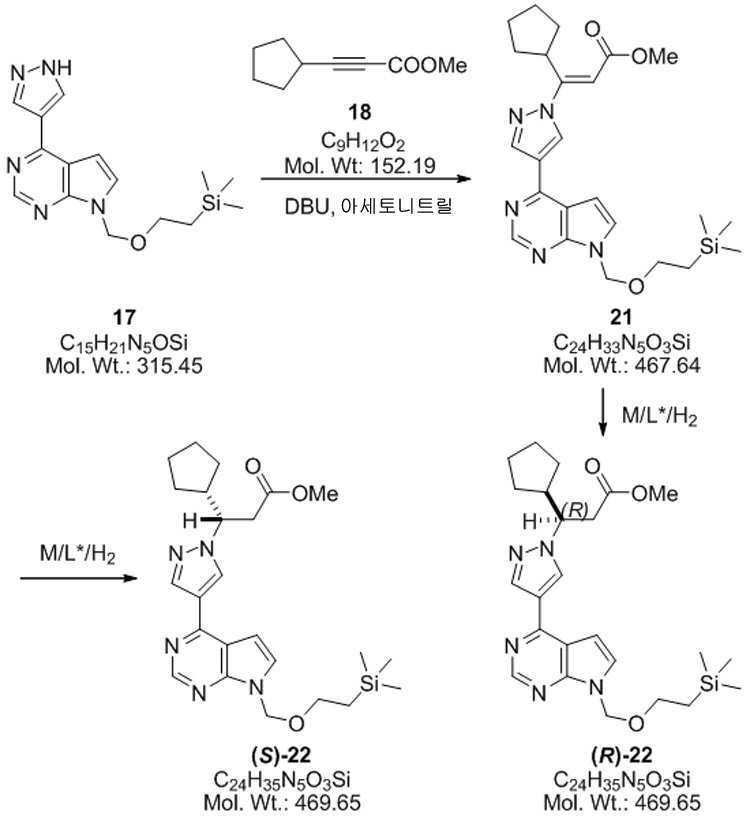
( E )-메틸 3-시클로펜틸-3-(4-(7-((2-(트리메틸실릴)에톡시)메틸)-7 H -피롤로[2,3- d ]피리미딘-4-일)-1 H -피라졸-1-일)아실레이트 (21). 아세토니트릴 (76 mL, 1400 mmol) 중 4-(1H-피라졸-4-일)-7-{[2-(트리메틸실릴)에톡시]메틸}-7H-피롤로[2,3-d]피리미딘 (17, 12.08 g, 38.31 mmol) 및 메틸 3-시클로펜틸프로프-2-이노에이트 (18, 8.970 g, 45.97 mmol, 1.2 당량)의 교반된 현탁액에 실온에서 1,8-디아자바이시클로[5.4.0]운덱-7-엔 (DBU, 2.92 mL, 19.2 mmol, 0.5 당량)을 첨가했다. 수득한 반응 혼합물을 실온에서 2시간 동안 교반했다. LCMS가 반응의 완료를 보여주었을 때, 반응 혼합물을 물 (50 mL) 및 1 N 수성 HCl 용액 (20 mL)로 급냉했다. 급냉된 반응 혼합물을, 1 N 수성 HCl 용액에 의한 처리 후 pH 4로 조정했다. 그 다음, 혼합물을 EtOAc (2×100 mL)로 추출하고, 조합된 유기 층을 염수로 세정하고, 황산마그네슘 (MgSO4) 상에서 건조시키고, 여과하고, 감압 하에서 농축했다. 잔여물을 Combiflash (SiO2, 0 - 50% EtOAc/헥산 구배 용리)로 정제하여 (E)-메틸 3-시클로펜틸-3-(4-(7-((2-(트리메틸실릴)에톡시)메틸)-7H-피롤로[2,3-d]피리미딘-4-일)-1H-피라졸-1-일)아실레이트 (21, 6.838 g, 17.92 g 이론적 수율 38%)을 무색의 고점성 오일로서 얻었다. 19에 대해: 1H NMR (CDCl3, 400 MHz) δ ppm 8.93 (s, 1H), 8.55 (bs, 1H), 8.44 (s, 1H), 7.49 (d, 1H, J = 3.5 Hz), 6.86 (d, 1H, J = 3.5 Hz), 6.34 (s, 1H), 5.74 (s, 2H), 4.56 (m, 1H), 3.84 (s, 3H), 3.60 (t, 2H, J = 8.2 Hz), 2.01 (m, 2H), 1.96 (m, 4H), 1.77 (m, 2H), 0.98 (t, 2H, J = 8.2 Hz), 0.00 (s, 9H); C24H33N5O3Si (분자량: 467.64), LCMS (EI) m/e 468.2 (M+ + H). (E) - methyl 3-cyclopentyl-3- (4- (7 - ((2- (trimethylsilyl) ethoxy) methyl) -7 H-pyrrolo [2,3- d] pyrimidin-4-yl ) -1 H -pyrazol-1-yl) acylate (21). 4- (1 H -pyrazol-4-yl) -7-{[2- (trimethylsilyl) ethoxy] methyl} -7 H -pyrrolo [2,3- in acetonitrile (76 mL, 1400 mmol) d ] 1,8-dia at room temperature in a stirred suspension of pyrimidine ( 17 , 12.08 g, 38.31 mmol) and methyl 3-cyclopentylprop-2-inoate ( 18 , 8.970 g, 45.97 mmol, 1.2 equiv) Jabacyclo [5.4.0] undec-7-ene (DBU, 2.92 mL, 19.2 mmol, 0.5 equiv) was added. The resulting reaction mixture was stirred at rt for 2 h. When LCMS showed the reaction was completed, the reaction mixture was quenched with water (50 mL) and 1 N aqueous HCl solution (20 mL). The quenched reaction mixture was adjusted to pH 4 after treatment with 1N aqueous HCl solution. The mixture was then extracted with EtOAc (2 × 100 mL) and the combined organic layers were washed with brine, dried over magnesium sulfate (MgSO 4 ), filtered and concentrated under reduced pressure. The residue was purified by Combiflash (SiO 2 , 0-50% EtOAc / hexanes gradient elution) to give ( E ) -methyl 3-cyclopentyl-3- (4- (7-((2- (trimethylsilyl) ethoxy) methyl) -7 H - pyrrolo [2,3- d] pyrimidin-4-yl) -1 H - pyrazol-1-yl) colorless to acylate (21, 6.838 g, 17.92 g theoretical yield 38%) Obtained as a highly viscous oil. For 19 : 1 H NMR (CDCl 3 , 400 MHz) δ ppm 8.93 (s, 1H), 8.55 (bs, 1H), 8.44 (s, 1H), 7.49 (d, 1H, J = 3.5 Hz), 6.86 (d, 1H, J = 3.5 Hz), 6.34 (s, 1H), 5.74 (s, 2H), 4.56 (m, 1H), 3.84 (s, 3H), 3.60 (t, 2H, J = 8.2 Hz) , 2.01 (m, 2H), 1.96 (m, 4H), 1.77 (m, 2H), 0.98 (t, 2H, J = 8.2 Hz), 0.00 (s, 9H); C 24 H 33 N 5 O 3 Si (Molecular weight : 467.64), LCMS (EI) m / e 468.2 (M + + H).
(( RR )-메틸 3-시클로펜틸-3-(4-(7-((2-(트리메틸실릴)에톡시)메틸)-7) -Methyl 3-cyclopentyl-3- (4- (7-((2- (trimethylsilyl) ethoxy) methyl) -7 HH -피롤로[2,3--Pyrrolo [2,3- dd ]피리미딘-4-일)-1] Pyrimidin-4-yl) -1 HH -피라졸-1-일)프로파노에이트 ((-Pyrazol-1-yl) propanoate (( RR )-22) 및 () -22) and ( SS )-메틸 3-시클로펜틸-3-(4-(7-((2-(트리메틸실릴)에톡시)메틸)-7) -Methyl 3-cyclopentyl-3- (4- (7-((2- (trimethylsilyl) ethoxy) methyl) -7 HH -피롤로[2,3--Pyrrolo [2,3- dd ]피리미딘-4-일)-1] Pyrimidin-4-yl) -1 HH -피라졸-1-일)프로파노에이트 ((-Pyrazol-1-yl) propanoate (( SS )-22).) -22).
기재물질, (E)-메틸 3-시클로펜틸-3-(4-(7-((2-(트리메틸실릴)에톡시)메틸)-7H-피롤로[2,3-d]피리미딘-4-일)-1H-피라졸-1-일)아실레이트 (21)을 사용하는 비대칭 수소화에 대한 일반적인 스크리닝 절차로, 광학적으로 풍부한 생성물, 메틸 3-시클로펜틸-3-(4-(7-((2-(트리메틸실릴)에톡시)메틸)-7H-피롤로[2,3-d]피리미딘-4-일)-1H-피라졸-1-일)프로파노에이트 ((R)-22 또는 (S)-22)을 얻었다: 유리 비알 (20 mL)을 갖는 300 mL-용적 오토클레이브에 기재물질 (21), 촉매 (금속, 리간드, 및 촉매 전구체), 및 무산소 용매 (4 - 6 mL)을 질소 하에서 충전했다. 이 오토클레이브에 원하는 압력으로 수소 가스를 충전하고, 실온에서 교반하거나, 오일 배쓰로 가열했다. 수소 가스를 방출한 후, 반응 혼합물을 감압 하에서 농축했다. 잔여물을 에틸 아세테이트 및 메탄올 (v/v = 9/1)의 혼합물을 사용하는 실리카겔 패드를 통한 용리로 정제하여 생성물, 메틸 3-시클로펜틸-3-(4-(7-((2-(트리메틸실릴)에톡시)메틸)-7H-피롤로[2,3-d]피리미딘-4-일)-1H-피라졸-1-일)프로파노에이트 ((R)-22 또는 (S)-22)을 얻고, 이에 대해 화학 전환율 (HPLC 및 키랄 HPLC), LC/MS 및 NMR 분광법 및 거울상이성질체 잉여 (% ee, 키랄 HPLC에 의해) 측정을 수행했다.Substrate material, (E) - methyl 3-cyclopentyl-3- (4- (7 - ((2- (trimethylsilyl) ethoxy) methyl) -7 H-pyrrolo [2,3- d] pyrimidine - General screening procedure for asymmetric hydrogenation using 4-yl) -1 H -pyrazol-1-yl) acylate ( 21 ), an optically enriched product, methyl 3-cyclopentyl-3- (4- (7 - ((2- (trimethylsilyl) ethoxy) methyl) -7 H-pyrrolo [2,3- d] pyrimidin-4-yl) -1 H-pyrazol-1-yl) propanoate (( R ) -22 or ( S ) -22 ): in a 300 mL-volume autoclave with free vials (20 mL), substrate ( 21 ), catalyst (metal, ligand, and catalyst precursor), and oxygen free solvent ( 4-6 mL) was charged under nitrogen. The autoclave was charged with hydrogen gas at a desired pressure and stirred at room temperature or heated with an oil bath. After releasing hydrogen gas, the reaction mixture was concentrated under reduced pressure. The residue was purified by elution through a pad of silica gel using a mixture of ethyl acetate and methanol (v / v = 9/1) to give the product, methyl 3-cyclopentyl-3- (4- (7-((2- ( Trimethylsilyl) ethoxy) methyl) -7 H -pyrrolo [2,3- d ] pyrimidin-4-yl) -1 H -pyrazol-1-yl) propanoate (( R ) -22 or ( S ) -22 ), to which chemical conversion (HPLC and chiral HPLC), LC / MS and NMR spectroscopy and enantiomeric excess (% ee, by chiral HPLC) were performed.
생성물의 거울상이성질체 잉여 (% ee)의 측정을 키랄 HPLC 분석에 의해 수행했다. 키랄 HPLC 방법을, 셀룰로오스 트리스(3,5-디메틸페닐 카바메이트) (Chiralcel® OD)로 코팅된 실리카겔로 채워진 Chiral Technologies, Inc.의 Chiralcel® OD-H 칼럼 (4.6×250 mm, 5 ㎛)을 사용하여 개발했다. 2개의 거울상이성질체, (R)-22 또는 (S)-22을, 15% 에탄올 및 85% 헥산으로 만들어진 이동상을 실온에서 1 mL/min의 유속으로 사용하여 3.0 초과의 분할로 분리한다. UV 검출 파장은 254 nm이다. (S)-거울상이성질체 ((S)-22) 및 (R)-거울상이성질체 ((R)-22)에 대한 체류시간은 각각 5.3분 (제1 피크) 및 8.2분 (제2 피크)이다.Measurement of the enantiomeric excess (% ee) of the product was performed by chiral HPLC analysis. Chiral HPLC method was performed on a Chiralcel ® OD-H column (4.6 x 250 mm, 5 μm) from Chiral Technologies, Inc., filled with silica gel coated with cellulose tris (3,5-dimethylphenyl carbamate) (Chiralcel ® OD). Developed using. Two enantiomers, (R) -22 or (S) -22 , are separated in greater than 3.0 splits using a mobile phase made of 15% ethanol and 85% hexane at a flow rate of 1 mL / min at room temperature. The UV detection wavelength is 254 nm. (S) - the residence time for each 5.3 minutes (first peak) and 8.2 minutes (second peak) enantiomer ((S) - 22) and (R) - - enantiomer (22 (R)).
(R)-22 또는 (S)-22에 대해: C24H35N5O3Si (분자량: 469.65), LCMS (EI) m/e 470 (M+ + H) 및 492 (M+ + Na). For ( R ) -22 or ( S ) -22 : C 24 H 35 N 5 O 3 Si (Molecular weight : 469.65), LCMS (EI) m / e 470 (M + + H) and 492 (M + + Na).
하기 표는 비대칭 수소화에 대한 분석 및 반응 조건을 요약하고 있다.The table below summarizes the analysis and reaction conditions for asymmetric hydrogenation.
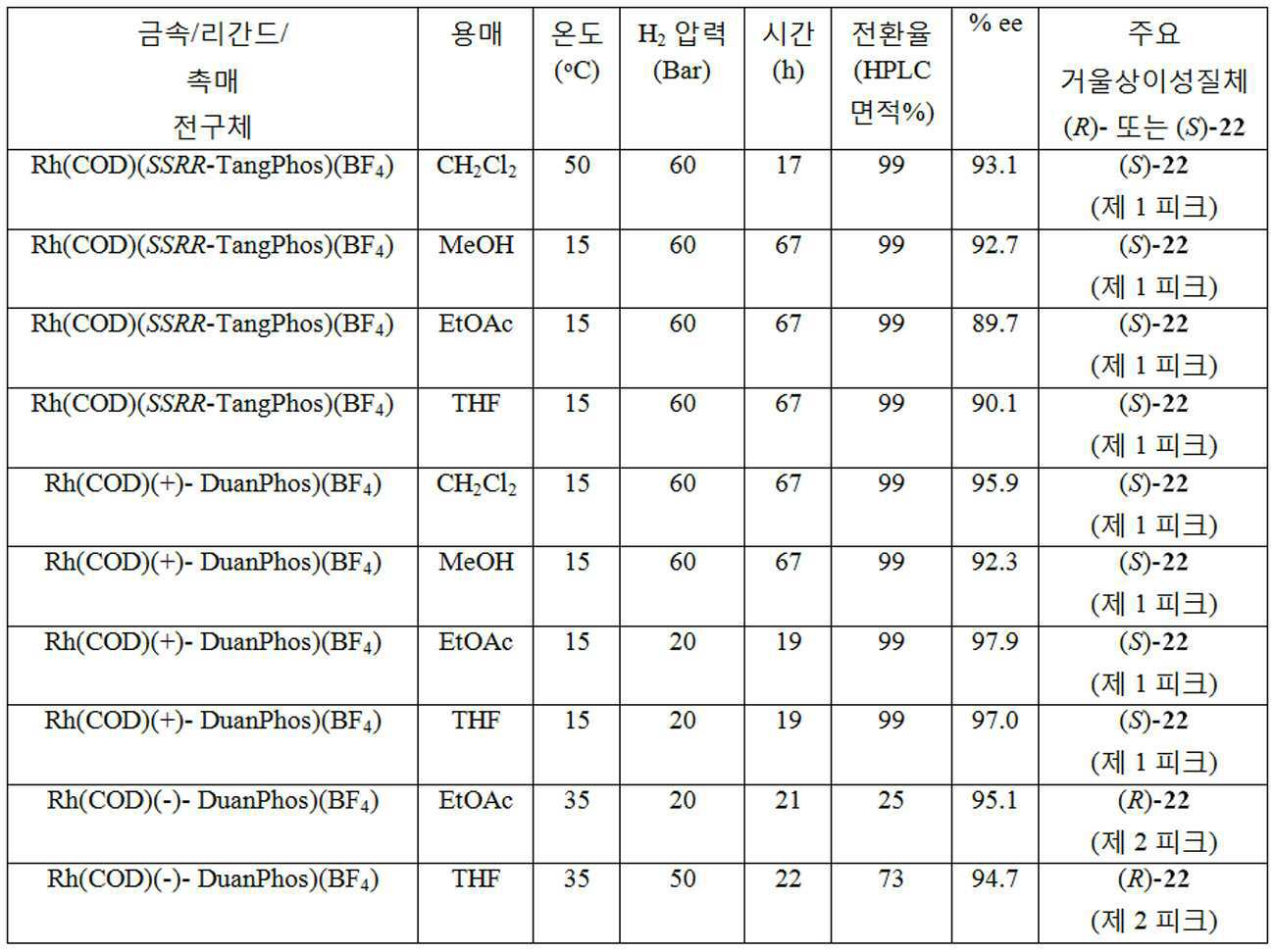
본 연구에 사용된 키랄 포스핀 리간드는 하기에 열거되어 있다.Chiral phosphine ligands used in this study are listed below.
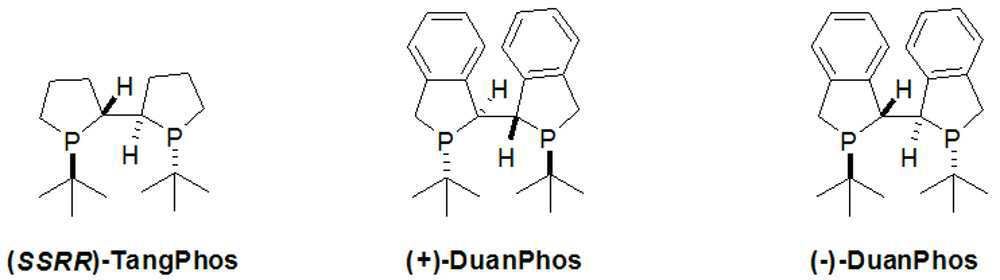
대표적인 준비 비대칭 수소화 절차는 하기에 기재되어 있다.Representative preparative asymmetric hydrogenation procedures are described below.
(S)-메틸 3-시클로펜틸-3-(4-(7-((2-(트리메틸실릴)에톡시)메틸)-7H-피롤로[2,3-d]피리미딘-4-일)-1H-피라졸-1-일)프로파노에이트 ((S)- 22 ). 에틸 아세테이트 (EtOAc, 5.0 mL) 중 (E)-메틸 3-시클로펜틸-3-(4-(7-((2-(트리메틸실릴)에톡시)메틸)-7H-피롤로[2,3-d]피리미딘-4-일)-1H-피라졸-1-일)아실레이트 (21, 109 mg)의 용액을 압력 유리관에서 촉매 [Rh(COD)(+)-DuanPhos](BF4) (5.5 mg)로 질소 하에서 처리한 후, 반응 혼합물을 수소 가스로 20 bar 압력으로 가압했다. 반응 혼합물을 실온에서 이 수소 압력 하에서 19시간 동안 교반했다. HPLC 분석이 기재물질의 완전한 소비를 보여주었을 때, 반응 혼합물을 실온으로 냉각했다. 반응 혼합물의 거울상이성질체 잉여는 키랄 HPLC 분석에 의해 97.9% ee (98.95%의 제1 피크, (S)-22; 1.05%의 제2 피크, (R)-22)인 것으로 측정되었다. 그 다음, 반응 혼합물을 얇은 실리카겔 패드를 통해 여과하고, 패드를 에틸 아세테이트 (EtOAc, 5 mL)로 세정했다. 그 다음, 여과물을 감압 하에서 농축 건조했다. 수득한 발포성 고형 (98 mg)은 키랄 HPLC 분석에 의해 분석되었고, 결과는 제1 피크를 선호하는 97.9%의 거울상이성질체 잉여를 보여주었다 (98.95%의 제1 피크, (S)-22; 1.05%의 제2 피크, (R)-22). (S) -methyl 3-cyclopentyl-3- (4- (7-((2- (trimethylsilyl) ethoxy) methyl) -7H-pyrrolo [2,3-d] pyrimidin-4-yl) -1H-pyrazol-1-yl) propanoate ((S) -22 ). ( E ) -methyl 3-cyclopentyl-3- (4- (7-((2- (trimethylsilyl) ethoxy) methyl) -7 H -pyrrolo [2,3 in ethyl acetate (EtOAc, 5.0 mL) - d] pyrimidin-4-yl) -1 H - pyrazol-1-yl) acylate (21, catalyst [Rh (COD) and the solution in a pressure glass tube of 109 mg) (+) - DuanPhos ] (BF 4 (5.5 mg) and then under nitrogen, the reaction mixture was pressurized with hydrogen gas to 20 bar pressure. The reaction mixture was stirred at rt under this hydrogen pressure for 19 h. When HPLC analysis showed complete consumption of the substrate, the reaction mixture was cooled to room temperature. Enantiomeric excess of the reaction mixture was determined by chiral HPLC analysis to be 97.9% ee (1st peak of 98.95%, ( S ) -22 ; second peak of 1.05%, ( R ) -22 ). The reaction mixture was then filtered through a thin pad of silica gel and the pad was washed with ethyl acetate (EtOAc, 5 mL). The filtrate was then concentrated to dryness under reduced pressure. The resulting effervescent solid (98 mg) was analyzed by chiral HPLC analysis and the results showed 97.9% of the enantiomeric excess favoring the first peak (98.95% first peak, ( S ) -22 ; 1.05% Second peak of, ( R ) -22 ).
(R)-메틸 3-시클로펜틸-3-(4-(7-((2-(트리메틸실릴)에톡시)메틸)-7H-피롤로[2,3-d]피리미딘-4-일)-1H-피라졸-1-일)프로파노에이트 ((R)- 22 ). 테트라히드로푸란 (THF, 8.0 mL) 중 (E)-메틸 3-시클로펜틸-3-(4-(7-((2-(트리메틸실릴)에톡시)메틸)-7H-피롤로[2,3-d]피리미딘-4-일)-1H-피라졸-1-일)아실레이트 (21, 815 mg)의 용액을 압력 유리관에서 촉매 [Rh(COD)(-)-DuanPhos](BF4) (4.6 mg)로 질소 하에서 처리한 후, 반응 혼합물을 수소 가스로 50 bar 압력으로 가압했다. 반응 혼합물을 35℃에서 이 수소 압력 하에서 22시간 동안 교반했다. HPLC 분석이 기재물질의 거의 완전한 소비를 보여주었을 때, 반응 혼합물을 실온으로 냉각했다. 반응 혼합물의 거울상이성질체 잉여는 키랄 HPLC 분석에 의해 94.7% ee (97.35%의 제2 피크, (R)-22; 2.65%의 제1 피크, (S)-22)인 것으로 측정되었다. 그 다음, 반응 혼합물을 얇은 실리카겔 패드를 통해 여과하고, 패드를 테트라히드로푸란 (THF, 5 mL)로 세정했다. 그 다음, 여과물을 감압 하에서 농축 건조했다. 수득한 발포성 고형 (778 mg)은 키랄 HPLC 분석에 의해 분석되었고, 결과는 제2 피크를 선호하는 94.7%의 거울상이성질체 잉여를 보여주었다 (97.35%의 제2 피크, (R)-22; 2.65%의 제1 피크, (S)-22). (R) -methyl 3-cyclopentyl-3- (4- (7-((2- (trimethylsilyl) ethoxy) methyl) -7H-pyrrolo [2,3-d] pyrimidin-4-yl) -1H-pyrazol-1-yl) propanoate ((R) -22 ). Tetrahydrofuran (THF, 8.0 mL) of (E) -methyl 3-cyclopentyl-3- (4- (7-methyl-ethoxy) ((2- (trimethylsilyl)) -7 H-pyrrolo [2, A solution of 3- d ] pyrimidin-4-yl) -1 H -pyrazol-1-yl) acylate ( 21 , 815 mg) was transferred to a catalyst [Rh (COD) (-)-DuanPhos] (BF in a pressure glass tube. 4 ) After treating under (4.6 mg) under nitrogen, the reaction mixture was pressurized with hydrogen gas to 50 bar pressure. The reaction mixture was stirred at 35 ° C. under this hydrogen pressure for 22 hours. When HPLC analysis showed nearly complete consumption of the substrate, the reaction mixture was cooled to room temperature. Enantiomeric excess of the reaction mixture was determined by chiral HPLC analysis to be 94.7% ee (second peak of 97.35%, ( R ) -22 ; first peak of 2.65%, ( S ) -22 ). The reaction mixture was then filtered through a thin pad of silica gel and the pad was washed with tetrahydrofuran (THF, 5 mL). The filtrate was then concentrated to dryness under reduced pressure. The obtained effervescent solid (778 mg) was analyzed by chiral HPLC analysis and the results showed 94.7% enantiomeric excess favoring second peak (97.35% second peak, ( R ) -22 ; 2.65% First peak of, ( S ) -22 ).

(3 R )-3-시클로펜틸-3-(4-(7-((2-(트리메틸실릴)에톡시)메틸)-7 H -피롤로[2,3- d ]피리미딘-4-일)-1 H -피라졸-1-일)프로판산 (( R )-23). THF (30 mL) 중 (3R)-메틸 3-시클로펜틸-3-(4-(7-((2-(트리메틸실릴)에톡시)메틸)-7H-피롤로[2,3-d]피리미딘-4-일)-1H-피라졸-1-일)프로파노에이트 ((R)-22, 2.47 g, 5.26 mmol)의 교반 용액에 실온에서 물 (15 mL) 중 리튬 히드록사이드 모노히드레이트 (LiOH-H2O, 265 mg, 6.31 mmol, 1.2 당량)의 용액을 첨가했다. 반응 혼합물을 실온에서 3시간 동안 교반했다. LCMS가 반응의 완료를 보여주었을 때, 그 다음, 반응 혼합물을 1 N 수성 HCl 용액으로 pH 5로 산성화한 후, EtOAc (2×25 mL)로 추출했다. 조합된 유기 층을 염수로 세정하고, 황산마그네슘 (MgSO4) 상에서 건조시키고, 여과하고, 감압 하에서 농축하여 (3R)-3-시클로펜틸-3-(4-(7-((2-(트리메틸실릴)에톡시)메틸)-7H-피롤로[2,3-d]피리미딘-4-일)-1H-피라졸-1-일)프로판산 ((R)-23, 2.40 g, 2.40 g 이론적, 100% 수율)을 무색 오일로서 얻었고, 이는 실온에서 진공에서 정치시 고형화되었다. (R)-23에 대해: 1H NMR (CDCl3, 300 MHz) δ ppm 8.95 (s, 1H), 8.95 (bs, 1H), 8.36 (s, 1H), 7.57 (d, 1H, J = 3.7 Hz), 6.99 (d, 1H, J = 3.7 Hz), 5.74 (s, 2H), 4.65 (dt, 1H, J = 3.1, 10.3 Hz), 3.58 (t, 2H, J = 8.2 Hz), 3.24 (dd, 1H, J = 16.5, 10.3 Hz), 3.04 (dd, 1H, J = 16.2, 3.1 Hz), 2.59 (m, 1H), 2.00 (m, 1H), 1.77-1.24 (m, 7H), 0.97 (t, 2H, J = 8.2 Hz), 0.00 (s, 9H); C23H33N5O3Si (분자량: 455.63), LCMS (EI) m/e 456.1 (M+ + H). (3 R) -3-cyclopentyl-3- (4- (7 - ((2- (trimethylsilyl) ethoxy) methyl) -7 H-pyrrolo [2,3- d] pyrimidin-4-yl ) -1 H -pyrazol-1-yl) propanoic acid (( R ) -23). THF (30 mL) of (3 R) - methyl 3-cyclopentyl-3- (4- (7 - ((2- (trimethylsilyl) ethoxy) methyl) -7 H-pyrrolo [2,3- d ] Pyrimidin-4-yl) -1 H -pyrazol-1-yl) propanoate (( R ) -22 , 2.47 g, 5.26 mmol) in a stirred solution of lithium hydroxide in water (15 mL) at room temperature A solution of side monohydrate (LiOH-H 2 O, 265 mg, 6.31 mmol, 1.2 equiv) was added. The reaction mixture was stirred at rt for 3 h. When LCMS showed the reaction was completed, the reaction mixture was then acidified to pH 5 with 1 N aqueous HCl solution and then extracted with EtOAc (2 × 25 mL). The combined organic layers were washed with brine, dried over magnesium sulfate (MgSO 4 ), filtered and concentrated under reduced pressure to afford ( 3R ) -3-cyclopentyl-3- (4- (7-((2- ( Trimethylsilyl) ethoxy) methyl) -7 H -pyrrolo [2,3- d ] pyrimidin-4-yl) -1 H -pyrazol-1-yl) propanoic acid (( R ) -23 , 2.40 g , 2.40 g theoretical, 100% yield) was obtained as a colorless oil, which solidified on standing in vacuo at room temperature. For ( R ) -23 : 1 H NMR (CDCl 3 , 300 MHz) δ ppm 8.95 (s, 1H), 8.95 (bs, 1H), 8.36 (s, 1H), 7.57 (d, 1H, J = 3.7 Hz), 6.99 (d, 1H, J = 3.7 Hz), 5.74 (s, 2H), 4.65 (dt, 1H, J = 3.1, 10.3 Hz), 3.58 (t, 2H, J = 8.2 Hz), 3.24 ( dd, 1H, J = 16.5, 10.3 Hz), 3.04 (dd, 1H, J = 16.2, 3.1 Hz), 2.59 (m, 1H), 2.00 (m, 1H), 1.77-1.24 (m, 7H), 0.97 (t, 2H, J = 8.2 Hz), 0.00 (s, 9H); C 23 H 33 N 5 O 3 Si (Molecular weight : 455.63), LCMS (EI) m / e 456.1 (M + + H).
(3 R )-3-시클로펜틸-3-(4-(7-((2-(트리메틸실릴)에톡시)메틸)-7 H -피롤로[2,3- d ]피리미딘-4-일)-1 H -피라졸-1-일)프로판아미드 (( R )-24). DMF (1 mL) 중 (3R)-3-시클로펜틸-3-(4-(7-((2-(트리메틸실릴)에톡시)메틸)-7H-피롤로[2,3-d]피리미딘-4-일)-1H-피라졸-1-일)프로판산 ((R)-23, 20 mg, 0.044 mmol)의 교반 용액에 실온에서 N,N-카보닐디이미다졸 (CDI, 21 mg, 0.13 mmol, 3.0 당량)을 첨가했다. 그 다음, 반응 혼합물을 실온에서 교반하고, TLC을 사용하여 아실 이미다졸의 형성을 위한 반응을 수행했다 (30% EtOAc/헥산을 갖는 고 Rf 스팟(spot)에 대한 산의 소비). TLC이 아실 이미다졸 변환의 완료를 보여주었을 때, 암모니아 가스로 교반 용액에 거품을 30분 동안 일으켜서 아미드 (LCMS가 뒤따름)를 얻었다. 과잉량의 암모니아 가스를, 질소로 용액에 격렬히 거품을 일으켜서 증발시켰다. DMF 중 조 생성물, (3R)-3-시클로펜틸-3-(4-(7-((2-(트리메틸실릴)에톡시)메틸)-7H-피롤로[2,3-d]피리미딘-4-일)-1H-피라졸-1-일)프로판아미드 ((R)-24)을 하기에 직접 사용하여 아미드 ((R)-24)를 상응하는 니트릴 ((R)-20)로 전환시켰다. (3 R) -3-cyclopentyl-3- (4- (7 - ((2- (trimethylsilyl) ethoxy) methyl) -7 H-pyrrolo [2,3- d] pyrimidin-4-yl ) -1 H -pyrazol-1-yl) propanamide (( R ) -24). (3 R) in DMF (1 mL), 3-cyclopentyl-3- (4- (7-ethoxy) methyl) -7 H a ((2- (trimethylsilyl) -pyrrolo [2,3- d] In a stirred solution of pyrimidin-4-yl) -1 H -pyrazol-1-yl) propanoic acid (( R ) -23 , 20 mg, 0.044 mmol) at room temperature, N , N -carbonyldiimidazole (CDI, 21 mg, 0.13 mmol, 3.0 equiv) was added. The reaction mixture was then stirred at room temperature and the reaction was carried out for the formation of acyl imidazole using TLC (consumption of acid for high Rf spot with 30% EtOAc / hexanes). When TLC showed the completion of the acyl imidazole conversion, foamed the stirred solution with ammonia gas for 30 minutes to obtain an amide (followed by LCMS). Excess ammonia gas was bubbled vigorously into the solution with nitrogen and evaporated. DMF from the crude product, (3 R) -3-cyclopentyl-3- (4- (7 - ((2- (trimethylsilyl) ethoxy) methyl) -7 H-pyrrolo [2,3- d] pyrimidin Midin-4-yl) -1 H -pyrazol-1-yl) propanamide (( R ) -24 ) was used directly below to convert the amide (( R ) -24 ) to the corresponding nitrile (( R ) -20 ).
(3 R )- 시클로펜틸 -3-{4-[7-(2- 트리메틸실라닐에톡시메틸 )-7 H - 피롤로[2,3- d ]피리미딘 -4-일] 피라졸 -1-일} 프로피오니트릴 (( R )-20). 방법 A. DMF (1 mL) 중 (3R)-3-시클로펜틸-3-(4-(7-((2-(트리메틸실릴)에톡시)메틸)-7H-피롤로[2,3-d]피리미딘-4-일)-1H-피라졸-1-일)프로판아미드 ((R)-24, 20 mg, 0.044 mmol)의 교반 용액에 0℃에서 메틸렌 클로라이드 (1 mL) 및 트리에틸아민 (0.12 mL, 0.88 mmol, 20.0 당량), 그 다음 트리클로로아세틸 클로라이드 (0.052 ml, 0.462 mmol, 10.5 당량)을 첨가했다. 수득한 반응 혼합물을 0℃에서 1시간 동안 교반했다. LCMS가 반응의 완료를 보여주었을 때, 반응 혼합물을 포화 중탄산나트륨 용액 (NaHCO3, 5 mL)로 급냉한 후, EtOAc (2×10 mL)로 추출했다. 조합된 유기 층을 염수로 세정하고, 황산마그네슘 (MgSO4) 상에서 건조시키고, 여과하고, 감압 하에서 농축했다. 잔여물을 0 - 75% EtOAc/헥산 구배 용리를 갖는 실리카겔 크로마토그래피로 정제하여 (3R)-시클로펜틸-3-{4-[7-(2-트리메틸실라닐에톡시메틸)-7H-피롤로[2,3-d]피리미딘-4-일]피라졸-1-일}프로피오니트릴 ((R)-20, 10 mg, 19 mg 이론적, 53% 수율)을 얻었다. (R)-20에 대해: 1H NMR (DMSO-d 6, 400 MHz) δ ppm 8.83 (s, 1H), 8.75 (s, 1H), 8.39 (s, 1H), 7.77 (d, 1H, J = 3.7 Hz), 7.09 (d, 1H, J = 3.7 Hz), 5.63 (s, 2H), 4.53 (td, 1H, J = 19.4, 4.0 Hz), 3.51 (t, 2H, J = 8.1 Hz), 3.23 (dq, 2H, J = 9.3, 4.3 Hz), 2.41 (m, 1H), 1.79 (m, 1H), 1.66 - 1.13 (m, 7H), 0.81 (t, 2H, J = 8.2 Hz), 0.124 (s, 9H); C23H32N6OSi (분자량: 436.63), LCMS (EI) m/e 437 (M+ + H) 및 459 (M+ + Na). (3 R) - Cyclopentyl-3- {4- [7- (2-trimethylsilanyl ethoxymethyl) -7 H - pyrrolo [2,3- d] pyrimidin-4-yl] -1-pyrazole -Yl } propionitrile (( R ) -20). Method A. (3 R) in DMF (1 mL), 3-cyclopentyl-3- (4- (7-ethoxy) methyl) -7 H a ((2- (trimethylsilyl) -pyrrolo [2,3- d] To a stirred solution of pyrimidin-4-yl) -1 H -pyrazol-1-yl) propanamide (( R ) -24 , 20 mg, 0.044 mmol) methylene chloride (1 mL) and triethylamine at 0 ° C. (0.12 mL, 0.88 mmol, 20.0 equiv) followed by trichloroacetyl chloride (0.052 ml, 0.462 mmol, 10.5 equiv). The resulting reaction mixture was stirred at 0 ° C. for 1 hour. When LCMS showed completion of the reaction, the reaction mixture was quenched with saturated sodium bicarbonate solution (NaHCO 3 , 5 mL) and then extracted with EtOAc (2 × 10 mL). The combined organic layer was washed with brine, dried over magnesium sulfate (MgSO 4 ), filtered and concentrated under reduced pressure. The residue was purified by silica gel chromatography with 0-75% EtOAc / hexane gradient elution to give (3 R ) -cyclopentyl-3- {4- [7- (2-trimethylsilanylethoxymethyl) -7 H- . Pyrrolo [2,3- d ] pyrimidin-4-yl] pyrazol-1-yl} propionitrile (( R ) -20 , 10 mg, 19 mg theoretical, 53% yield) was obtained. (R) - about 20: 1 H NMR (DMSO- d 6, 400 MHz) δ ppm 8.83 (s, 1H), 8.75 (s, 1H), 8.39 (s, 1H), 7.77 (d, 1H, J = 3.7 Hz), 7.09 (d, 1H, J = 3.7 Hz), 5.63 (s, 2H), 4.53 (td, 1H, J = 19.4, 4.0 Hz), 3.51 (t, 2H, J = 8.1 Hz), 3.23 (dq, 2H, J = 9.3, 4.3 Hz), 2.41 (m, 1H), 1.79 (m, 1H), 1.66-1.13 (m, 7H), 0.81 (t, 2H, J = 8.2 Hz), 0.124 (s, 9H); C 23 H 32 N 6 OSi (Molecular weight : 436.63), LCMS (EI) m / e 437 (M + + H) and 459 (M + + Na).
(3 R )-시클로펜틸-3-[4-(7 H -피롤로[2,3- d ]피리미딘-4-일)피라졸-1-일]프로피오니트릴 (( R )-13, 유리 염기). 방법 B. 아세토니트릴 (4.5 L) 중 (3R)-시클로펜틸-3-{4-[7-(2-트리메틸실라닐에톡시메틸)-7H-피롤로[2,3-d]피리미딘-4-일]피라졸-1-일}프로피오니트릴 ((R)-20, 463 g, 1.06 mol, 98.6% ee)의 용액에 물 (400 mL), 직후에 리튬 테트라플루오로보레이트 (LiBF4, 987.9 g, 10.5 mol, 10.0 당량)을 실온에서 첨가했다. 반응 온도는 물의 첨가시 실온에서 12℃로 감소하는 것이 관찰되었고, 그 다음 리튬 테트라플루오로보레이트 (LiBF4)의 첨가 동안에 33℃로 상승했다. 수득한 반응 혼합물을 밤새 가열 환류했다 (약 80℃). 분취량을 에틸 아세테이트/물로 급냉하고, LCMS 및 TLC (95 : 5 에틸 아세테이트/메탄올, v/v)로 확인했다. LCMS 및 TLC 분석이 생성된 히드록실 메틸 중간체 ((R)-25) 및 완전히 탈보호된 물질 ((R)-13, 유리 염기) 모두를 보여주었지만, 개실물질 ((R)-20)이 남아있지 않았을 때, 반응 혼합물을 < 5℃로 점차 생각시킨 후, 수산화암모늄 (NH4OH, 450 mL)의 20% 수성 용액을 점차로 첨가하여 반응 혼합물의 pH를 9로 조정했다 (pH 스트립으로 확인됨). 냉각 배쓰를 제거하고, 반응 혼합물을 실온으로 점차 따뜻하게 하고, 실온에서 밤새 교반했다. 분취량을 에틸 아세테이트/물에 급냉하고, LCMS 및 TLC (95 : 5 에틸 아세테이트/메탄올, v/v)로 점검하여 완전한 탈보호를 확인했다. LCMS 및 TLC이 반응의 완료를 보여주었을 때, 반응 혼합물을 여과하고, 고형물을 아세토니트릴 (1 L)로 세정했다. 그 다음, 조합된 여과물을 감압 하에서 농축하고, 잔여물을 에틸 아세테이트 (EtOAc, 6 L) 및 반-포화된 염수 (3 L) 사이에서 분할했다. 2개의 층을 분리하고, 수성 층을 에틸 아세테이트 (2 L)로 추출했다. 조합된 유기 층을 반-포화된 중탄산나트륨 (NaHCO3, 3 L) 및 염수 (3 L)로 세정하고, 황산나트륨 (Na2SO4) 상에서 건조시키고, 감압 하에서 농축하여 조 생성물을 오렌지색 오일로서 얻었다. 그 다음, 조 물질을 플래시 칼럼 크로마토그래피 (SiO2, 40 내지 100% 에틸 아세테이트/헵탄 구배 용리)로 정제하여 (3R)-시클로펜틸-3-[4-(7H-피롤로[2,3-d]피리미딘-4-일)피라졸-1-일]프로피오니트릴 ((R)-13, 유리 염기, 273 g, 324.9 g 이론적, 84% 수율)을 백색 폼으로서 얻었다. 이 물질을 19F NMR로 점검하여 리튬 테트라플루오로보레이트 (LiBF4)이 남아있지 않음을 확인했고, 키랄 HPLC (Chiralcel® OD, 90:10 헥산/에탄올)로 거울상이성질체 순도를 확인했고, 그 물질을 추가 정제없이 사용하여 상응하는 포스페이트 염을 제조했다. (R)-13 (유리 염기)에 대해: 1H NMR (DMSO-d 6, 400 MHz) δ ppm 12.1 (bs, 1H), 8.80 (d, 1H, J = 0.42 Hz), 8.67 (s, 1H), 8.37 (s, 1H), 7.59 (dd, 1H, J = 2.34, 3.51 Hz), 6.98 (dd, 1H, J = 1.40, 3.44 Hz), 4.53 (td, 1H, J = 19.5, 4.63 Hz), 3.26 (dd, 1H, J = 9.77, 17.2 Hz), 3.18 (dd, 1H, J = 4.32, 17.3 Hz), 2.40 (m, 1H), 1.79 (m, 1H), 1.65 내지 1.13 (m, 7H); C17H18N6 (분자량: 306.37) LCMS (EI) m/e 307 (M+ + H). (3 R) - cyclopentyl -3- [4- (7 H - pyrrolo [2,3- d] pyrimidin-4-yl) pyrazol-1-yl] propionitrile ((R) -13, Free base). Method B. acetonitrile (4.5 L) of (3 R) - Cyclopentyl-3- {4- [7- (2-trimethylsilanyl-ethoxymethyl to carbonyl) -7 H - pyrrolo [2,3- d] pyrimidin Midin-4-yl] pyrazol-1-yl} propionitrile (( R ) -20 , 463 g, 1.06 mol, 98.6% ee) in a solution of water (400 mL), followed immediately by lithium tetrafluoroborate ( LiBF 4 , 987.9 g, 10.5 mol, 10.0 equiv) was added at room temperature. The reaction temperature was observed to decrease from room temperature to 12 ° C. upon addition of water, then rose to 33 ° C. during the addition of lithium tetrafluoroborate (LiBF 4 ). The resulting reaction mixture was heated to reflux overnight (about 80 ° C.). Aliquots were quenched with ethyl acetate / water and confirmed by LCMS and TLC (95: 5 ethyl acetate / methanol, v / v). LCMS and TLC analysis showed both the hydroxyl methyl intermediate (( R ) -25 ) and the fully deprotected material (( R ) -13 , free base), but the cleavage (( R ) -20 ) When not remaining, the reaction mixture was gradually thought of at <5 ° C., and then the pH of the reaction mixture was adjusted to 9 by gradually adding 20% aqueous solution of ammonium hydroxide (NH 4 OH, 450 mL) (check with pH strip). being). The cold bath was removed and the reaction mixture was gradually warmed to room temperature and stirred overnight at room temperature. Aliquots were quenched in ethyl acetate / water and checked by LCMS and TLC (95: 5 ethyl acetate / methanol, v / v) to confirm complete deprotection. When LCMS and TLC showed the reaction was completed, the reaction mixture was filtered and the solid was washed with acetonitrile (1 L). The combined filtrates were then concentrated under reduced pressure and the residue was partitioned between ethyl acetate (EtOAc, 6 L) and semi-saturated brine (3 L). The two layers were separated and the aqueous layer was extracted with ethyl acetate (2 L). The combined organic layers were washed with semi-saturated sodium bicarbonate (NaHCO 3 , 3 L) and brine (3 L), dried over sodium sulfate (Na 2 SO 4 ) and concentrated under reduced pressure to afford the crude product as an orange oil. . The crude material was then purified by flash column chromatography (SiO 2 , 40-100% ethyl acetate / heptane gradient eluting) to give (3 R ) -cyclopentyl-3- [4- (7 H -pyrrolo [2, 3- d ] pyrimidin-4-yl) pyrazol-1-yl] propionitrile (( R ) -13 , free base, 273 g, 324.9 g theoretical, 84% yield) was obtained as a white foam. This material was checked by 19 F NMR to confirm that no lithium tetrafluoroborate (LiBF 4 ) remained, and the enantiomeric purity was confirmed by chiral HPLC (Chiralcel ® OD, 90:10 hexanes / ethanol), and the material Was used without further purification to prepare the corresponding phosphate salt. For ( R ) -13 (free base): 1 H NMR (DMSO- d 6 , 400 MHz) δ ppm 12.1 (bs, 1H), 8.80 (d, 1H, J = 0.42 Hz), 8.67 (s, 1H ), 8.37 (s, 1H), 7.59 (dd, 1H, J = 2.34, 3.51 Hz), 6.98 (dd, 1H, J = 1.40, 3.44 Hz), 4.53 (td, 1H, J = 19.5, 4.63 Hz) , 3.26 (dd, 1H, J = 9.77, 17.2 Hz), 3.18 (dd, 1H, J = 4.32, 17.3 Hz), 2.40 (m, 1H), 1.79 (m, 1H), 1.65 to 1.13 (m, 7H ); C 17 H 18 N 6 (molecular weight : 306.37) LCMS (EI) m / e 307 (M + + H).

(2 E )-3-시클로펜틸아실알데히드 (28). 무수 벤젠 (400 mL, 4476 mmol) 중 트리페닐포스포르아닐리덴)아세트알데히드 (27, 62.75 g, 200.0 mmol, 1.0 당량)의 교반된 현탁액에 시클로펜탄카브알데히드 (26, 21.36 mL, 200.0 mmol)을 실온에서 첨가했다. 그 다음, 수득한 반응 혼합물을 80℃에서 16시간 동안 가열했다. TLC 및 HPLC가 반응의 완료를 보여주었을 때, 반응 혼합물을 감압 하에서 농축했다. 그 다음, 잔여물을 0 - 10% EtOAc/헥산 구배 용리를 갖는 Combiflash (SiO2)로 직접 정제하여 (2E)-3-시클로펜틸아실알데히드 (28, 14.4 g, 24.84 g 이론적, 58% 수율)을 황색 오일로서 얻었다. 28에 대해: 1H NMR (DMSO-d 6, 400 MHz) δ ppm 1H NMR (CDCl3, 400 MHz) δ 9.49 (d, 1H, J = 7.8 Hz), 6.82 (dd, 1H, J = 15.6, 7.8 Hz), 6.08 (dd, 1H, J = 15.6, 8.0 Hz), 2.72 (m, 1H), 1.89 (m, 2H), 1.67 (m, 4H), 1.44 (m, 2H); C8H12O (분자량: 124.18) LCMS (EI) m/e 125 (M+ + H). ( 2E ) -3-cyclopentylacylaldehyde (28). Cyclopentanecarbaldehyde ( 26 , 21.36 mL, 200.0 mmol) was added to a stirred suspension of triphenylphosphoranilidene) acetaldehyde ( 27 , 62.75 g, 200.0 mmol, 1.0 equiv) in anhydrous benzene (400 mL, 4476 mmol). Added at room temperature. Then, the obtained reaction mixture was heated at 80 ° C. for 16 hours. When TLC and HPLC showed completion of the reaction, the reaction mixture was concentrated under reduced pressure. The residue was then purified directly with Combiflash (SiO 2 ) with a 0-10% EtOAc / hexane gradient elution to give (2 E ) -3-cyclopentylacylaldehyde ( 28 , 14.4 g, 24.84 g theoretical, 58% yield ) Was obtained as a yellow oil. For 28 : 1 H NMR (DMSO- d 6 , 400 MHz) δ ppm 1 H NMR (CDCl 3 , 400 MHz) δ 9.49 (d, 1H, J = 7.8 Hz), 6.82 (dd, 1H, J = 15.6 , 7.8 Hz), 6.08 (dd, 1H, J = 15.6, 8.0 Hz), 2.72 (m, 1H), 1.89 (m, 2H), 1.67 (m, 4H), 1.44 (m, 2H); C 8 H 12 O (Molecular weight : 124.18) LCMS (EI) m / e 125 (M + + H).

(2 R )-1-에틸 2-메틸 피롤리딘-1,2-디카복실레이트 (( R )-30). 무수 메탄올 (MeOH, 240 mL, 5925 mmol) 중 D-프롤린 ((R)-29, 13.955 g, 120.0 mmol) 및 탄산칼륨 (K2CO3, 33.17 g, 240.0 mmol, 2.0 당량)의 교반된 서스페션에 0℃에서 에틸 클로로포르메이트 (28.4 mL, 288 mmol, 2.4 당량)을 실온에서 첨가했다. 그 다음, 수득한 반응 혼합물을 실온에서 18시간 동안 교반했다. LCMS가 반응의 완료를 보여주었을 때, 용매를 감압 하에서 제거했다. 그 다음, 수득한 잔여물을 물 (80 mL) 및 포화 수성 NaHCO3 (80 mL)로 처리한 후, EtOAc (2×100 mL)로 추출했다. 조합된 유기 층을 염수로 세정하고, 황산마그네슘 (MgSO4) 상에서 건조시키고, 여과하고, 감압 하에서 농축하여 순수한 (2R)-1-에틸 2-메틸 피롤리딘-1,2-디카복실레이트 ((R)-30, 18.792 g, 24.14 g 이론적, 77.8% 수율)을 무색 휘발성 오일로서 얻었다. (R)-30에 대해: 1H NMR (CDCl3, 400 MHz) δ ppm 4.35 (dd, 0.5H, J = 8.7, 3.5 Hz), 4.28 (dd, 0.5H, J = 8.7, 3.7 Hz), 4.13 (m, 2H), 3.72 (s, 1.5H), 3.70 (s, 1.5H), 3.59-3.41 (m, 2H), 2.20 (m, 1 H), 2.01-1.86 (m, 3H), 1.25 (t, 1.5H, J = 7.1 Hz), 1.18 (t, 1.5H, J = 7.1 Hz); C9H15NO4 (분자량: 201.22), LCMS (EI) m/e 201.9 (M+ + H). ( 2R ) -1-Ethyl 2-methyl pyrrolidine-1,2-dicarboxylate (( R ) -30). The stirring up of - (29, 13.955 g, 120.0 mmol (R)) and potassium carbonate (K 2 CO 3, 33.17 g , 240.0 mmol, 2.0 eq.) In dry methanol (MeOH, 240 mL, 5925 mmol ) of D- proline To the partition was added ethyl chloroformate (28.4 mL, 288 mmol, 2.4 equiv) at 0 ° C. The reaction mixture obtained was then stirred for 18 hours at room temperature. When LCMS showed the reaction was complete, the solvent was removed under reduced pressure. The residue obtained was then treated with water (80 mL) and saturated aqueous NaHCO 3 (80 mL) and then extracted with EtOAc (2 × 100 mL). The combined organic layers were washed with brine, dried over magnesium sulfate (MgSO 4 ), filtered and concentrated under reduced pressure to afford pure ( 2R ) -1-ethyl 2-methyl pyrrolidine-1,2-dicarboxylate. (( R ) -30 , 18.792 g, 24.14 g theoretical, 77.8% yield) was obtained as a colorless volatile oil. For ( R ) -30 : 1 H NMR (CDCl 3 , 400 MHz) δ ppm 4.35 (dd, 0.5H, J = 8.7, 3.5 Hz), 4.28 (dd, 0.5H, J = 8.7, 3.7 Hz), 4.13 (m, 2H), 3.72 (s, 1.5H), 3.70 (s, 1.5H), 3.59-3.41 (m, 2H), 2.20 (m, 1H), 2.01-1.86 (m, 3H), 1.25 (t, 1.5H, J = 7.1 Hz), 1.18 (t, 1.5H, J = 7.1 Hz); C 9 H 15 NO 4 (molecular weight : 201.22), LCMS (EI) m / e 201.9 (M + + H).
(7a R )-1,1-비스(3,5-비스(트리플루오로메틸)페닐)테트라히드로피롤로[1,2- c ]옥사졸-3(1 H )-온 (( R )-32). 무수 THF (50 mL) 중 3,5-비스(트리플루오로메틸)브로모벤젠 (31, 15.2 mL, 60.0 mmol, 3.0 당량)의 교반 용액에 0℃에서 테트라히드로푸란 (THF, 31.5 mL) 중 2.0 M의 이소프로필마그네슘 클로라이드 (iPrMgCl)의 용액을 적가했다. 수득한 혼합물을 0℃에서 1시간 동안 교반한 후, 무수 THF (14 mL) 중 (2R)-1-에틸 2-메틸 피롤리딘-1,2-디카복실레이트 ((R)-30, 4.024 g, 20.0 mmol)의 용액으로 0℃에서 처리했다. 첨가 후, 빙욕을 제거하고, 반응 혼합물을 65℃로 가열하고, 65℃에서 5시간 동안 교반했다. LCMS가 반응의 완료를 보여주었을 때, 반응 혼합물을 포화 수성 NH4Cl 용액 (120 mL)로 급냉하고, EtOAc (2×100 mL)로 추출했다. 조합된 유기 층을 염수로 세정하고, 황산마그네슘 (MgSO4) 상에서 건조시키고, 여과하고, 감압 하에서 농축하여 조 (7aR)-1,1-비스(3,5-비스(트리플루오로메틸)페닐)테트라히드로피롤로[1,2-c]옥사졸-3(1H)-온 ((R)-32, 11.03 g, 100%)을 점성 오일로서 얻었고, 이를 추가 정제없이 차후의 반응에서 직접 사용했다. 조 (R)-32에 대해: C22H13F12NO2 (분자량: 551.32), LCMS (EI) m/e 552 (M+ + H). (7a R ) -1,1-bis (3,5-bis (trifluoromethyl) phenyl) tetrahydropyrrolo [1,2- c ] oxazol-3 ( 1H ) -one (( R )- 32). To a stirred solution of 3,5-bis (trifluoromethyl) bromobenzene ( 31 , 15.2 mL, 60.0 mmol, 3.0 equiv) in anhydrous THF (50 mL) in tetrahydrofuran (THF, 31.5 mL) at 0 ° C. A solution of 2.0 M isopropylmagnesium chloride ( i PrMgCl) was added dropwise. The resulting mixture was stirred at 0 ° C. for 1 h, then (2 R ) -1-ethyl 2-methyl pyrrolidine-1,2-dicarboxylate (( R ) -30 , in anhydrous THF (14 mL). 4.024 g, 20.0 mmol) was treated at 0 ° C. After addition, the ice bath was removed and the reaction mixture was heated to 65 ° C. and stirred at 65 ° C. for 5 hours. When LCMS showed the reaction was completed, the reaction mixture was quenched with saturated aqueous NH 4 Cl solution (120 mL) and extracted with EtOAc (2 × 100 mL). The combined organic layers were washed with brine, dried over magnesium sulfate (MgSO 4 ), filtered and concentrated under reduced pressure to afford crude (7a R ) -1,1-bis (3,5-bis (trifluoromethyl) Phenyl) tetrahydropyrrolo [1,2- c ] oxazol-3 ( 1H ) -one (( R ) -32 , 11.03 g, 100%) was obtained as a viscous oil, which was subjected to subsequent reaction without further purification. Used directly. For crude ( R ) -32 : C 22 H 13 F 12 NO 2 (molecular weight : 551.32), LCMS (EI) m / e 552 (M + + H).
(2 R )-비스(3,5-비스(트리플루오로메틸)페닐)(피롤리딘-2-일)메탄올 (( R )-33). 메탄올 (MeOH, 80 mL, 1975 mmol) 중 조 (7aR)-1,1-비스(3,5-비스(트리플루오로메틸)페닐)테트라히드로피롤로[1,2-c]옥사졸-3(1H)-온 ((R)-32, 11.03 g, 20.0 mmol)의 교반 용액에 고형 칼륨 히드록사이드 (KOH, 3.366 g, 60.0 mmol, 3.0 당량)을 실온에서 첨가했다. 수득한 검은 반응 혼합물을 65℃로 가열하고, 65℃에서 22시간 동안 교반했다. LCMS가 반응의 완료를 보여주었을 때, 반응 혼합물을 실온으로 냉각한 후, 용매를 감압 하에서 증발시켰다. 그 다음, 잔여물을 물 (100 mL)로 처리하고, EtOAc (2×100 mL)로 추출했다. 조합된 유기 층을 염수로 세정하고, 황산마그네슘 (MgSO4) 상에서 건조시키고, 여과하고, 감압 하에서 농축했다. 그 다음, 잔여물을 0 - 30% EtOAc/헥산 구배 용리를 갖는 Combiflash (SiO2)로 정제하여 (2R)-비스(3,5-비스(트리플루오로메틸)페닐)(피롤리딘-2-일)메탄올 ((R)-33, 8.30 g, 10.51 g 이론적, 79% 수율, 2단계로)을 황색 점성 페이스트로서 얻었다. (R)-33에 대해: 1H NMR (CD3OD, 400 MHz) δ ppm 8.24 (s, 2H), 8.16 (s, 2H), 7.85 (s, 2H), 4.49 (t, 1H, J = 7.7 Hz), 2.92 (m, 2H), 1.74 (m, 2H), 1.67 (m, 1H), 1.55 (m, 1H); C21H15F12NO (분자량: 525.33), LCMS (EI) m/e 526.0 (M+ + H). ( 2R ) -bis (3,5-bis (trifluoromethyl) phenyl) (pyrrolidin-2-yl) methanol (( R ) -33). Crude (7a R ) -1,1-bis (3,5-bis (trifluoromethyl) phenyl) tetrahydropyrrolo [1,2- c ] oxazole in methanol (MeOH, 80 mL, 1975 mmol) To a stirred solution of 3 (1 H ) -one (( R ) -32 , 11.03 g, 20.0 mmol) was added solid potassium hydroxide (KOH, 3.366 g, 60.0 mmol, 3.0 equiv) at room temperature. The resulting black reaction mixture was heated to 65 ° C. and stirred at 65 ° C. for 22 hours. When LCMS showed the completion of the reaction, the reaction mixture was cooled to room temperature and then the solvent was evaporated under reduced pressure. The residue was then treated with water (100 mL) and extracted with EtOAc (2 × 100 mL). The combined organic layer was washed with brine, dried over magnesium sulfate (MgSO 4 ), filtered and concentrated under reduced pressure. Then, the residue 0 - (3,5- bis (trifluoromethyl) phenyl) bis (pyrrolidin-Combiflash (SiO 2) to give (2 R) as with 30% EtOAc / hexanes gradient elution - 2-yl) methanol (( R ) -33 , 8.30 g, 10.51 g theoretical, 79% yield, in two steps) was obtained as a yellow viscous paste. For ( R ) -33 : 1 H NMR (CD 3 OD, 400 MHz) δ ppm 8.24 (s, 2H), 8.16 (s, 2H), 7.85 (s, 2H), 4.49 (t, 1H, J = 7.7 Hz), 2.92 (m, 2H), 1.74 (m, 2H), 1.67 (m, 1H), 1.55 (m, 1H); C 21 H 15 F 12 NO (molecular weight: 525.33), LCMS (EI) m / e 526.0 (M + + H).
(2 R )-2-비스[3,5-비스(트리플루오로메틸)-페닐][(트리메틸실릴)옥시]-메틸피롤리딘 (( R )-34). 무수 메틸렌 클로라이드 (CH2Cl2, 56.0 mL, 874 mmol) 중 (2R)-비스(3,5-비스(트리플루오로메틸)페닐)(피롤리딘-2-일)메탄올 ((R)-33, 8.30 g, 14.2 mmol) 및 트리에틸아민 (TEA, 5.98 mL, 42.6 mmol, 3.0 당량)의 교반 용액에 0℃에서 트리메틸실릴 트리플루오로메탄설포네이트 (TMSOTf, 3.89 mL, 21.3 mmol, 1.5 당량)를 첨가했다. 수득한 반응 혼합물을 0℃에서 1시간 동안 교반했다. LCMS가 반응의 완료를 보여주었을 때, 반응 혼합물을 물 (80 mL)로 급냉하고, EtOAc (2×100 mL)로 추출했다. 조합된 유기 층을 염수로 세정하고, 황산마그네슘 (MgSO4) 상에서 건조시키고, 여과하고, 감압 하에서 농축했다. 잔여물을 0 - 10% EtOAc/헥산 구배 용리를 갖는 Combiflash (SiO2)로 정제하여 (2R)-2-비스[3,5-비스(트리플루오로메틸)페닐][(트리메틸실릴)옥시]메틸피롤리딘 ((R)-34, 6.869 g, 8.48 g 이론적, 81% 수율)을 고점성 황색 시럽으로서 얻었다. (R)-34에 대해: 1H NMR (CDCl3, 300 MHz) δ ppm 8.08 (s, 2H), 7.92 (s, 2H), 7.84 (s, 2H), 4.32 (t, 1H, J = 7.2 Hz), 2.98 (m, 1H), 2.63 (m, 1H), 1.79 (m, 1H), 1.58 (m, 2H), 1.20 (m, 1H), 0.00 (s, 9H); C24H23F12NOSi (분자량: 597.51), LCMS (EI) m/e 598.0 (M+ + H). ( 2R ) -2-bis [3,5-bis (trifluoromethyl) -phenyl] [(trimethylsilyl) oxy] -methylpyrrolidine (( R ) -34). Dry methylene chloride (CH 2 Cl 2, 56.0 mL , 874 mmol) of (2 R) - bis (3,5-bis (methyl) phenyl trifluoroacetate) (pyrrolidin-2-yl) methanol ((R) In a stirred solution of 33 , 8.30 g, 14.2 mmol) and triethylamine (TEA, 5.98 mL, 42.6 mmol, 3.0 equiv) at 0 ° C. trimethylsilyl trifluoromethanesulfonate (TMSOTf, 3.89 mL, 21.3 mmol, 1.5 Equivalent)) was added. The resulting reaction mixture was stirred at 0 ° C. for 1 hour. When LCMS showed the reaction was complete, the reaction mixture was quenched with water (80 mL) and extracted with EtOAc (2 × 100 mL). The combined organic layer was washed with brine, dried over magnesium sulfate (MgSO 4 ), filtered and concentrated under reduced pressure. The residue was 0 purified by Combiflash (SiO 2) having a 10% EtOAc / hexanes gradient elution (2 R) -2- bis [3,5-bis (trifluoromethyl) phenyl] [(trimethylsilyl) oxy ] Methylpyrrolidine (( R ) -34 , 6.869 g, 8.48 g theoretical, 81% yield) was obtained as a high viscosity yellow syrup. For ( R ) -34 : 1 H NMR (CDCl 3 , 300 MHz) δ ppm 8.08 (s, 2H), 7.92 (s, 2H), 7.84 (s, 2H), 4.32 (t, 1H, J = 7.2 Hz), 2.98 (m, 1H), 2.63 (m, 1H), 1.79 (m, 1H), 1.58 (m, 2H), 1.20 (m, 1H), 0.00 (s, 9H); C 24 H 23 F 12 NOSi (molecular weight: 597.51), LCMS (EI) m / e 598.0 (M + + H).
(2 R )-2-비스[3,5-비스(트리플루오로메틸)페닐][(트리에틸실릴)옥시]-메틸피롤리딘 (( R )-35). 무수 메틸렌 클로라이드 (CH2Cl2, 15.0 mL, 234 mmol) 중 (2R)-비스(3,5-비스(트리플루오로메틸)페닐)(피롤리딘-2-일)메탄올 ((R)-33, 3.832 g, 7.294 mmol) 및 2,6-lutidine (4.27 mL, 36.5 mmol, 5.0 당량)의 교반 용액에 0℃에서 트리에틸실릴 트리플루오로메탄설포네이트 (TESOTf, 5.0 mL, 21.9 mmol, 3.0 당량)을 첨가했다. 수득한 반응 혼합물을 실온에서 21시간 동안 교반했다. LCMS가 반응의 완료를 보여주었을 때, 반응 혼합물을 포화 수성 NaHCO3 용액 (70 mL)로 급냉하고, EtOAc (2×50 mL)로 추출했다. 조합된 유기 층을 염수로 세정하고, 황산마그네슘 (MgSO4) 상에서 건조시키고, 여과하고, 감압 하에서 농축했다. 잔여물을 0 - 10% EtOAc/헥산 구배 용리를 갖는 Combiflash (SiO2)로 정제하여 (2R)-2-비스[3,5-비스(트리플루오로메틸)페닐][(트리에틸실릴)옥시]메틸피롤리딘 ((R)-35, 4.575 g, 4.665 g 이론적, 98% 수율)을 고점성 무색 시럽으로서 얻었다. (R)-35에 대해: 1H NMR (CDCl3, 400 MHz) δ ppm 8.06 (s, 2H), 7.86 (s, 2H), 7.76 (s, 2H), 4.29 (m, 1H), 2.94 (m, 1H), 2.53 (m, 1H), 1.83 (m, 2H), 1.53 (m, 2H), 0.85 (t, 9H, J = 7.8 Hz), 0.34 (q, 6H, J = 7.8 Hz); C27H29F12NOSi (분자량: 639.59), LCMS (EI) m/e 640.0 (M+ + H). ( 2R ) -2-bis [3,5-bis (trifluoromethyl) phenyl] [(triethylsilyl) oxy] -methylpyrrolidine (( R ) -35). Dry methylene chloride (CH 2 Cl 2, 15.0 mL , 234 mmol) of (2 R) - bis (3,5-bis (methyl) phenyl trifluoroacetate) (pyrrolidin-2-yl) methanol ((R) In a stirred solution of 33 , 3.832 g, 7.294 mmol) and 2,6-lutidine (4.27 mL, 36.5 mmol, 5.0 equiv) at 0 ° C. triethylsilyl trifluoromethanesulfonate (TESOTf, 5.0 mL, 21.9 mmol, 3.0 equivalents) was added. The resulting reaction mixture was stirred at rt for 21 h. When LCMS showed the reaction was completed, the reaction mixture was quenched with saturated aqueous NaHCO 3 solution (70 mL) and extracted with EtOAc (2 × 50 mL). The combined organic layer was washed with brine, dried over magnesium sulfate (MgSO 4 ), filtered and concentrated under reduced pressure. The residue was 0 purified by Combiflash (SiO 2) having a 10% EtOAc / hexanes gradient elution (2 R) - (trifluoromethyl) phenyl-3,5-bis] 2-bis [(triethylsilyl) Oxy] methylpyrrolidine (( R ) -35 , 4.575 g, 4.665 g theoretical, 98% yield) was obtained as a high viscosity colorless syrup. For ( R ) -35 : 1 H NMR (CDCl 3 , 400 MHz) δ ppm 8.06 (s, 2H), 7.86 (s, 2H), 7.76 (s, 2H), 4.29 (m, 1H), 2.94 ( m, 1H), 2.53 (m, 1H), 1.83 (m, 2H), 1.53 (m, 2H), 0.85 (t, 9H, J = 7.8 Hz), 0.34 (q, 6H, J = 7.8 Hz); C 27 H 29 F 12 NOSi (molecular weight: 639.59), LCMS (EI) m / e 640.0 (M + + H).
(2 R )-2-(비스[3,5-비스(트리플루오로메틸)페닐][ tert -부틸(디메틸)실릴]-옥시메틸)-피롤리딘 (( R )-36). 무수 메틸렌 클로라이드 (5.0 mL, 78 mmol) 중 (2R)-비스(3,5-비스(트리플루오로메틸)페닐)(피롤리딘-2-일)메탄올 ((R)-33, 1.051 g, 2.0 mmol) 및 트리에틸아민 (TEA, 1.68 mL, 12.0 mmol, 6.0 당량)의 교반 용액에 0℃에서 tert-부틸디메틸실릴 트리플루오로메탄설포네이트 (TBDMSOTf, 1.41 mL, 6.0 mmol, 3.0 당량)을 첨가했다. 수득한 반응 혼합물을 실온에서 20시간 동안 교반한 후, 100℃에서 10 내지 20시간 동안 가열했다. LCMS가 반응의 완료를 보여주었을 때, 반응 혼합물을 물 (30 mL)로 급냉하고 EtOAc (2×50 mL)로 추출했다. 조합된 유기 층을 염수로 세정하고, 황산마그네슘 (MgSO4) 상에서 건조시키고, 여과하고, 감압 하에서 농축했다. 잔여물을 0 - 10% EtOAc/헥산 구배 용리를 갖는 Combiflash (SiO2)로 정제하여 (2R)-2-(비스[3,5-비스(트리플루오로메틸)페닐][tert-부틸(디메틸)실릴]옥시메틸)피롤리딘 ((R)-36, 1.167 g, 1.279 g 이론적, 91.2% 수율)을 고점성 무색 시럽으로서 얻었다. (R)-36에 대해: 1H NMR (CDCl3, 400 MHz) δ ppm 8.09 (s, 2H), 7.87 (s, 2H), 7.75 (s, 2H), 4.33 (m, 1H), 2.98 (m, 1H), 2.54 (m, 1H), 1.86 (m, 1H), 1.70 (m, 1H), 1.56 (m, 2H), 0.95 (s, 9H), -0.21 (s, 3H), -0.45 (s, 3H); C27H29F12NOSi (분자량: 639.59), LCMS (EI) m/e 640.4 (M+ + H). ( 2R ) -2- (bis [3,5-bis (trifluoromethyl) phenyl] [ tert -butyl (dimethyl) silyl] -oxymethyl) -pyrrolidine (( R ) -36). Dry methylene chloride (5.0 mL, 78 mmol) of (2 R) - bis (methyl) 3,5-bis (trifluoromethyl phenyl) (pyrrolidin-2-yl) methanol ((R) - 33, 1.051 g , 2.0 mmol) and tert -butyldimethylsilyl trifluoromethanesulfonate (TBDMSOTf, 1.41 mL, 6.0 mmol, 3.0 equiv) at 0 ° C. in a stirred solution of triethylamine (TEA, 1.68 mL, 12.0 mmol, 6.0 equiv) Was added. The resulting reaction mixture was stirred at room temperature for 20 hours and then heated at 100 ° C. for 10-20 hours. When LCMS showed the reaction was completed, the reaction mixture was quenched with water (30 mL) and extracted with EtOAc (2 × 50 mL). The combined organic layer was washed with brine, dried over magnesium sulfate (MgSO 4 ), filtered and concentrated under reduced pressure. Purification by Combiflash (SiO 2) having a 10% EtOAc / hexanes gradient elution (2 R) -2- (bis [3,5-bis (trifluoromethyl) phenyl] [tert - - butyl 0 The residue ( Dimethyl) silyl] oxymethyl) pyrrolidine ((R) - 36, 1.167 g, 1.279 g theoretical, 91.2% yield) and was obtained as a colorless viscous syrup. (R) - about 36: 1 H NMR (CDCl 3 , 400 MHz) δ ppm 8.09 (s, 2H), 7.87 (s, 2H), 7.75 (s, 2H), 4.33 (m, 1H), 2.98 ( m, 1H), 2.54 (m, 1H), 1.86 (m, 1H), 1.70 (m, 1H), 1.56 (m, 2H), 0.95 (s, 9H), -0.21 (s, 3H), -0.45 (s, 3H); C 27 H 29 F 12 NOSi (molecular weight: 639.59), LCMS (EI) m / e 640.4 (M + + H).

(1 R )-(4-(1-(1-시클로펜틸-3-옥소프로필)-1 H -피라졸-4-일)-7 H -피롤로[2,3- d ]피리미딘-7-일)메틸 피발레이트 (( R )-37). 무수 클로로포름 (CHCl3, 2.0 mL, 25 mmol) 중 (2E)-3-시클로펜틸아실알데히드 (28, 345 mg, 2.50 mmol, 5.0 당량), (2R)-2-비스[3,5-비스(트리플루오로메틸)페닐][(트리에틸실릴)옥시]메틸피롤리딘 ((R)-35, 16 mg, 0.025 mmol, 0.05 당량) 및 4-니트로벤조산 (4.3 mg, 0.025 mmol, 0.05 당량)의 용액을 실온에서 10분 동안 교반한 후, [4-(1H-피라졸-4-일)-7H-피롤로[2,3-d]피리미딘-7-일]메틸 피발레이트 (5, 0.150 g, 0.50 mmol)을 첨가했다. 수득한 반응 혼합물을 실온에서 23시간 동안 교반했다. LCMS이 반응의 완료를 보여준 후, 반응 혼합물을 감압 하에서 농축했다. 잔여물을 0 - 80% EtOAc/헥산 구배 용리를 갖는 Combiflash로 직접 정제하여 (1R)-(4-(1-(1-시클로펜틸-3-옥소프로필)-1H-피라졸-4-일)-7H-피롤로[2,3-d]피리미딘-7-일)메틸 피발레이트 ((R)-37, 169 mg, 211.8 mg 이론적, 80% 수율)을 담황색 폼으로서 얻었다. (R)-37에 대해: C23H29N5O3 (분자량: 423.51), LCMS (EI) m/e 424 (M+ + H). ( 1R )-(4- (1- (1-cyclopentyl-3-oxopropyl) -1 H -pyrazol-4-yl) -7 H -pyrrolo [2,3- d ] pyrimidine-7 -Yl) methyl pivalate (( R ) -37). Anhydrous chloroform (CHCl 3, 2.0 mL, 25 mmol) of (2 E) -3- cyclopentyl-acyl aldehyde (28, 345 mg, 2.50 mmol , 5.0 equiv), (2 R) -2- bis [3,5 Bis (trifluoromethyl) phenyl] [(triethylsilyl) oxy] methylpyrrolidine (( R ) -35 , 16 mg, 0.025 mmol, 0.05 equiv) and 4-nitrobenzoic acid (4.3 mg, 0.025 mmol, 0.05 after stirring for eq.) at room temperature for 10 minutes, a solution of a, [4- (1 H - pyrazol-4-yl) -7 H - pyrrolo [2,3- d] pyrimidin-7-yl] methyl Sangapi Rate ( 5 , 0.150 g, 0.50 mmol) was added. The resulting reaction mixture was stirred at rt for 23 h. After LCMS showed the reaction was completed, the reaction mixture was concentrated under reduced pressure. The residue was purified directly by Combiflash with a 0-80% EtOAc / hexane gradient elution to give (1 R )-(4- (1- (1-cyclopentyl-3-oxopropyl) -1 H -pyrazole-4- yl) -7 H - pyrrolo [2,3- d] pyrimidin-7-yl) methyl pivalate ((R) - 37, 169 mg, 211.8 mg theoretical, 80% yield) as a pale yellow foam. (R) - about 37: C 23 H 29 N 5 O 3 ( molecular weight: 423.51), LCMS (EI) m / e 424 (M + + H).
( R )-(4-(1-(2-시아노-1-시클로펜틸에틸)-1 H -피라졸-4-일)-7 H -피롤로[2,3-d]피리미딘-7-일)메틸 피발레이트 (( R )-12). 방법 B. 테트라히드로푸란 (THF, 1.2 mL, 15 mmol) 중 (1R)-(4-(1-(1-시클로펜틸-3-옥소프로필)-1H-피라졸-4-일)-7H-피롤로[2,3-d]피리미딘-7-일)메틸 피발레이트 ((R)-37, 169 mg, 0.399 mmol)의 용액을 실온에서 물 (1.2 mL) 중 수산화암모늄 (NH4OH)의 14.3 M 용액, 그 다음 요오드 (I2, 112 mg, 0.439 mmol, 1.1 당량)을 첨가했다. 수득한 반응 혼합물을 실온에서 25분 동안 교반했다. LCMS가 반응의 완료를 보여주었을 때, 반응 혼합물을 10% 수성 Na2S2O3 (10 mL)로 급냉한 후, EtOAc (2×15 mL)로 추출했다. 조합된 유기 층을 염수로 세정하고, 황산마그네슘 (MgSO4) 상에서 건조시키고, 여과하고, 감압 하에서 농축했다. 잔여물을 0 - 60% EtOAc/헥산 구배 용리를 갖는 Combiflash (SiO2)로 정제하여 (R)-(4-(1-(2-시아노-1-시클로펜틸에틸)-1H-피라졸-4-일)-7H-피롤로[2,3-d]피리미딘-7-일)메틸 피발레이트 ((R)-12, 145.6 mg, 167.8 mg 이론적, 86.8% 수율)을 무색 폼으로서 얻었다. ( R )-(4- (1- (2-cyano-1-cyclopentylethyl) -1 H -pyrazol-4-yl) -7 H -pyrrolo [2,3-d] pyrimidine-7 -Yl) methyl pivalate (( R ) -12). Method B. (1 R )-(4- (1- (1-cyclopentyl-3-oxopropyl) -1 H -pyrazol-4-yl)-in tetrahydrofuran (THF, 1.2 mL, 15 mmol) 7 H - pyrrolo [2,3- d] pyrimidin-7-yl) methyl pivalate ((R) - 37, 169 mg, ammonium hydroxide (NH at room temperature of a solution of 0.399 mmol), water (1.2 mL) 14.3 M solution of 4 OH), followed by iodine (I 2 , 112 mg, 0.439 mmol, 1.1 equiv). The resulting reaction mixture was stirred for 25 minutes at room temperature. When LCMS showed the reaction was completed, the reaction mixture was quenched with 10% aqueous Na 2 S 2 O 3 (10 mL) and then extracted with EtOAc (2 × 15 mL). The combined organic layer was washed with brine, dried over magnesium sulfate (MgSO 4 ), filtered and concentrated under reduced pressure. The residue was purified by Combiflash (SiO 2 ) with 0-60% EtOAc / hexane gradient elution to give ( R )-(4- (1- (2-cyano-1-cyclopentylethyl) -1 H -pyrazole 4-yl) -7 H - pyrrolo [2,3-d] pyrimidin-7-yl) methyl pivalate ((R) - 12, 145.6 mg, 167.8 mg theoretical, 86.8% yield) as a colorless foam Got it.
키랄 HPLC 방법을, 셀룰로오스 트리스(3,5-디메틸페닐 카바메이트) (Chiralcel® OD) (Chiral Technologies, Inc.로부터 구매)로 코팅된 실리카겔로 충전된 Chiralcel® OD-H 칼럼 (4.6×250 mm, 5㎛)를 사용하여 (R)-12 및 (S)-12 모두의 거울상이성질체의 키랄 순도 평가에 대해 개발했다. 2개의 거울상이성질체 ((R)-12 및 (S)-12)을, 10% 에탄올 및 90% 헥산로부터 만들어진 이동상을 실온에서 1 mL/min의 유속으로 사용하여 3.5 초과의 분할로 분리했다. UV 검출 파장은 220 nm이다. 체류시간은, 각각 (S)-12 (제1 피크)에 대해 14.1분 및 (R)-12 (제2 피크)에 대해 18.7분이다.A chiral HPLC method was prepared using a Chiralcel ® OD-H column (4.6 x 250 mm, filled with silica gel coated with cellulose tris (3,5-dimethylphenyl carbamate) (Chiralcel ® OD) (purchased from Chiral Technologies, Inc.). 5 μm) was used to evaluate the chiral purity of the enantiomers of both (R) -12 and (S) -12. Two enantiomers (( R ) -12 and ( S ) -12 ) were separated in greater than 3.5 splits using a mobile phase made from 10% ethanol and 90% hexane at a flow rate of 1 mL / min at room temperature. The UV detection wavelength is 220 nm. The residence time is 14.1 minutes for ( S ) -12 (first peak) and 18.7 minutes for ( R ) -12 (second peak), respectively.
(R)-12에 대해: 비키랄 순도 (99.3 면적%, 220 nm에서 검출된 HPLC에 의해); 키랄 순도 (94.9 면적%, 키랄 HPLC에 의해; 89.8% ee); 1H NMR (DMSO-d 6, 400 MHz) δ ppm 8.84 (s, 1H), 8.78 (s, 1H), 8.39 (s, 1H), 7.74 (d, 1H, J = 3.7 Hz,), 7.11 (d, 1H, J = 3.8 Hz), 6.23 (s, 2H), 4.53 (ddd, 1H, J = 9.9, 9.6, 4.2 Hz), 3.26 (dd, 1H, J = 17.4, 9.9 Hz), 3.19 (dd, 1H, J = 17.2, 4.3 Hz), 2.41 (m, 1H), 1.87 - 1.13 (m, 8H), 1.07 (s, 9H); C23H28N6O2 (분자량: 420.51), LCMS (EI) m/e 421.4 (M+ + H). For ( R ) -12 : achiral purity (99.3 area%, by HPLC detected at 220 nm); Chiral purity (94.9 area%, by chiral HPLC; 89.8% ee); 1 H NMR (DMSO- d 6 , 400 MHz) δ ppm 8.84 (s, 1H), 8.78 (s, 1H), 8.39 (s, 1H), 7.74 (d, 1H, J = 3.7 Hz,), 7.11 ( d, 1H, J = 3.8 Hz), 6.23 (s, 2H), 4.53 (ddd, 1H, J = 9.9, 9.6, 4.2 Hz), 3.26 (dd, 1H, J = 17.4, 9.9 Hz), 3.19 (dd , 1H, J = 17.2, 4.3 Hz), 2.41 (m, 1H), 1.87-1.13 (m, 8H), 1.07 (s, 9H); C 23 H 28 N 6 O 2 (molecular weight: 420.51), LCMS (EI) m / e 421.4 (M + + H).

(3 R )-3-시클로펜틸-3-[4-(7-[2-(트리메틸실릴)에톡시]메틸-7 H -피롤로[2,3- d ]피리미딘-4-일)-1 H -피라졸-1-일]프로파날 (( R )-38). 무수 톨루엔 (5.0 mL, 47 mmol) 중 (2E)-3-시클로펜틸아실알데히드 (28, 327 mg, 2.50 mmol, 5.0 당량), (2R)-2-비스[3,5-비스(트리플루오로메틸)페닐][(트리에틸실릴)옥시]메틸피롤리딘 ((R)-35, 32 mg, 0.050 mmol, 0.10 당량) 및 4-니트로벤조산 (8.5 mg, 0.050 mmol, 0.10 당량)의 용액을 실온에서 10분 동안 교반한 후, 4-(1H-피라졸-4-일)-7-[2-(트리메틸실릴)에톡시]메틸-7H-피롤로[2,3-d]피리미딘 (17, 158 mg, 0.50 mmol)을 첨가했다. 수득한 반응 혼합물을 실온에서 24시간 동안 교반했다. LCMS가 반응의 완료를 보여주었을 때, 반응 혼합물을 감압 하에서 농축했다. 잔여물을, 0 - 70% EtOAc/헥산 구배 용리를 갖는 Combiflash (SiO2)로 직접 정제하여 (3R)-3-시클로펜틸-3-[4-(7-[2-(트리메틸실릴)에톡시]메틸-7H-피롤로[2,3-d]피리미딘-4-일)-1H-피라졸-1-일]프로파날 ((R)-38, 184.1 mg, 219.8 mg 이론적, 83.8% 수율)을 담황색 점성 오일로서 얻었다. (R)-38에 대해: C23H33N5O2Si (분자량: 439.63), LCMS (EI) m/e 440 (M+ + H). (3 R) -3-Cyclopentyl-3- [4- (7- [2- (trimethylsilyl) ethoxy] methyl -7 H-pyrrolo [2,3- d] pyrimidin-4-yl) - 1 H -pyrazol- 1 -yl] propanal (( R ) -38). In anhydrous toluene (5.0 mL, 47 mmol) of (2 E) -3- cyclopentyl-acyl aldehyde (28, 327 mg, 2.50 mmol , 5.0 equiv), (2 R) -2- bis [3,5-bis (tri Fluoromethyl) phenyl] [(triethylsilyl) oxy] methylpyrrolidine (( R ) -35 , 32 mg, 0.050 mmol, 0.10 equiv) and 4-nitrobenzoic acid (8.5 mg, 0.050 mmol, 0.10 equiv) The solution was stirred at rt for 10 min, then 4- (1 H -pyrazol-4-yl) -7- [2- (trimethylsilyl) ethoxy] methyl-7 H -pyrrolo [2,3- d ] Pyrimidine ( 17 , 158 mg, 0.50 mmol) was added. The resulting reaction mixture was stirred at rt for 24 h. When LCMS showed the completion of the reaction, The reaction mixture was concentrated under reduced pressure. The residue was purified directly with Combiflash (SiO 2 ) with a 0-70% EtOAc / hexane gradient elution to ( 3R ) -3-cyclopentyl-3- [4- (7- [2- (trimethylsilyl)). ethoxy] methyl -7 H - pyrrolo [2,3- d] pyrimidin-4-yl) -1 H - pyrazol-1-yl] propanal ((R) - 38, 184.1 mg, 219.8 mg theoretical, 83.8% yield) was obtained as a pale yellow viscous oil. ( R )-For 38 : C 23 H 33 N 5 O 2 Si (Molecular weight : 439.63), LCMS (EI) m / e 440 (M + + H).
(3 R )-시클로펜틸-3-{4-[7-(2-트리메틸실라닐에톡시메틸)-7 H -피롤로[2,3- d ]피리미딘-4-일]피라졸-1-일}프로피오니트릴 (( R )-20). 방법 B. 테트라히드로푸란 (THF, 1.2 mL, 15 mmol) 중 (3R)-3-시클로펜틸-3-[4-(7-[2-(트리메틸실릴)에톡시]메틸-7H-피롤로[2,3-d]피리미딘-4-일)-1H-피라졸-1-일]프로파날 ((R)-38, 184 mg, 0.418 mmol)의 교반 용액에 실온에서 물 (1.2 mL) 중 14.3 M의 수산화암모늄 (NH4OH)의 용액, 그 다음 요오드 (I2, 117 mg, 0.460 mmol, 1.1 당량)을 첨가했다. 수득한 반응 혼합물을 실온에서 30분 동안 교반했다. LCMS가 반응의 완료를 보여주었을 때, 반응 혼합물을 10% 수성 Na2S2O3 (10 mL)로 급냉한 후, EtOAc (2×15 mL)로 추출했다. 조합된 유기 층을 염수로 세정하고, 황산마그네슘 (MgSO4) 상에서 건조시키고, 여과하고, 감압 하에서 농축했다. 그 다음, 잔여물을 0 - 50% EtOAc/헥산 구배 용리를 갖는 Combiflash (SiO2)로 정제하여 (3R)-시클로펜틸-3-{4-[7-(2-트리메틸실라닐에톡시메틸)-7H-피롤로[2,3-d]피리미딘-4-일]피라졸-1-일}프로피오니트릴 ((R)-20, 148.9 mg, 182.5 mg 이론적, 81.6% 수율)을 무색 점성 오일로서 얻었다. (3 R) - Cyclopentyl-3- {4- [7- (2-trimethylsilanyl ethoxymethyl) -7 H - pyrrolo [2,3- d] pyrimidin-4-yl] -1-pyrazole -Yl} propionitrile (( R ) -20). Method B. ( 3R ) -3-cyclopentyl-3- [4- (7- [2- (trimethylsilyl) ethoxy] methyl-7 H -pyrrolo [2 in tetrahydrofuran (THF, 1.2 mL, 15 mmol) , 3- d] pyrimidin-4-yl) -1 H - pyrazol-1-yl] propanal ((R) - 38, 184 mg, 0.418 mmol) water (1.2 mL) at room temperature to a stirred solution of A solution of 14.3 M ammonium hydroxide (NH 4 OH) was added followed by iodine (I 2 , 117 mg, 0.460 mmol, 1.1 equiv). The resulting reaction mixture was stirred at rt for 30 min. When LCMS showed the reaction was completed, the reaction mixture was quenched with 10% aqueous Na 2 S 2 O 3 (10 mL) and then extracted with EtOAc (2 × 15 mL). The combined organic layer was washed with brine, dried over magnesium sulfate (MgSO 4 ), filtered and concentrated under reduced pressure. The residue was then purified by Combiflash (SiO 2 ) with a 0-50% EtOAc / hexane gradient elution to give (3 R ) -cyclopentyl-3- {4- [7- (2-trimethylsilanylethoxymethyl ) -7 H - pyrrolo [2,3- d] pyrimidin-4-yl] pyrazol-1-yl} propionitrile ((R) - 20, 148.9 mg, 182.5 mg theoretical, 81.6% yield) of the Obtained as a colorless viscous oil.
생성물 ((R)-20) 의 거울상이성질체 잉여 (% ee)의 측정을 키랄 HPLC 분석에 의해 수행했다. 키랄 HPLC 방법을, 셀룰로오스 트리스(3,5-디메틸페닐 카바메이트) (Chiralcel® OD)로 코팅된 실리카겔로 채워진 Chiral Technologies, Inc.의 Chiralcel® OD-H 칼럼 (4.6×250 mm, 5 ㎛)을 사용하여 개발했다. 2개의 거울상이성질체, (R)-20 또는 (S)-20을, 10% 에탄올 및 90% 헥산으로 만들어진 이동상을 실온에서 1 mL/min의 유속으로 사용하여 3.0 초과의 분할로 분리한다. UV 검출 파장은 220 nm이다. (S)-거울상이성질체 ((S)-20) 및 (R)-거울상이성질체 ((R)-20)에 대한 체류시간은 각각 10.3분 (제1 피크) 및 13.1분 (제2 피크)이다. Measurement of the enantiomeric excess (% ee) of the product (( R ) -20 ) was performed by chiral HPLC analysis. Chiral HPLC method was performed on a Chiralcel ® OD-H column (4.6 x 250 mm, 5 μm) from Chiral Technologies, Inc., filled with silica gel coated with cellulose tris (3,5-dimethylphenyl carbamate) (Chiralcel ® OD). Developed using. Two enantiomers, (R) -20 or (S) -20 , are separated in more than 3.0 partitions using a mobile phase made of 10% ethanol and 90% hexane at a flow rate of 1 mL / min at room temperature. The UV detection wavelength is 220 nm. Retention times for the (S) -enantiomer ((S) -20 ) and the (R) -enantiomer ((R) -20 ) are 10.3 minutes (first peak) and 13.1 minutes (second peak), respectively.
(R)-20에 대해: 비키랄 순도 (99.0 면적%, 220 nm에서 검출된 HPLC에 의해); 키랄 순도 (94.4 면적%, 키랄 HPLC에 의해; 88.8% ee); 1H NMR (DMSO-d 6, 400 MHz) δ ppm 8.83 (s, 1H), 8.75 (s, 1H), 8.39 (s, 1H), 7.77 (d, 1H, J = 3.7 Hz), 7.09 (d, 1H, J = 3.7 Hz), 5.63 (s, 2H), 4.53 (td, 1H, J = 19.4, 4.0 Hz), 3.51 (t, 2H, J = 8.1 Hz), 3.23 (dq, 2H, J = 9.3, 4.3 Hz), 2.41 (m, 1H), 1.79 (m, 1H), 1.66 - 1.13 (m, 7H), 0.81 (t, 2H, J = 8.2 Hz), 0.124 (s, 9H); C23H32N6OSi (분자량: 436.63), LCMS (EI) m/e 437 (M+ + H) 및 459 (M+ + Na).For ( R ) -20 : achiral purity (99.0 area%, by HPLC detected at 220 nm); Chiral purity (94.4 area%, by chiral HPLC; 88.8% ee); 1 H NMR (DMSO- d 6, 400 MHz) δ ppm 8.83 (s, 1H), 8.75 (s, 1H), 8.39 (s, 1H), 7.77 (d, 1H, J = 3.7 Hz), 7.09 (d , 1H, J = 3.7 Hz, 5.63 (s, 2H), 4.53 (td, 1H, J = 19.4, 4.0 Hz), 3.51 (t, 2H, J = 8.1 Hz), 3.23 (dq, 2H, J = 9.3, 4.3 Hz), 2.41 (m, 1H), 1.79 (m, 1H), 1.66-1.13 (m, 7H), 0.81 (t, 2H, J = 8.2 Hz), 0.124 (s, 9H); C 23 H 32 N 6 OSi (Molecular weight : 436.63), LCMS (EI) m / e 437 (M + + H) and 459 (M + + Na).
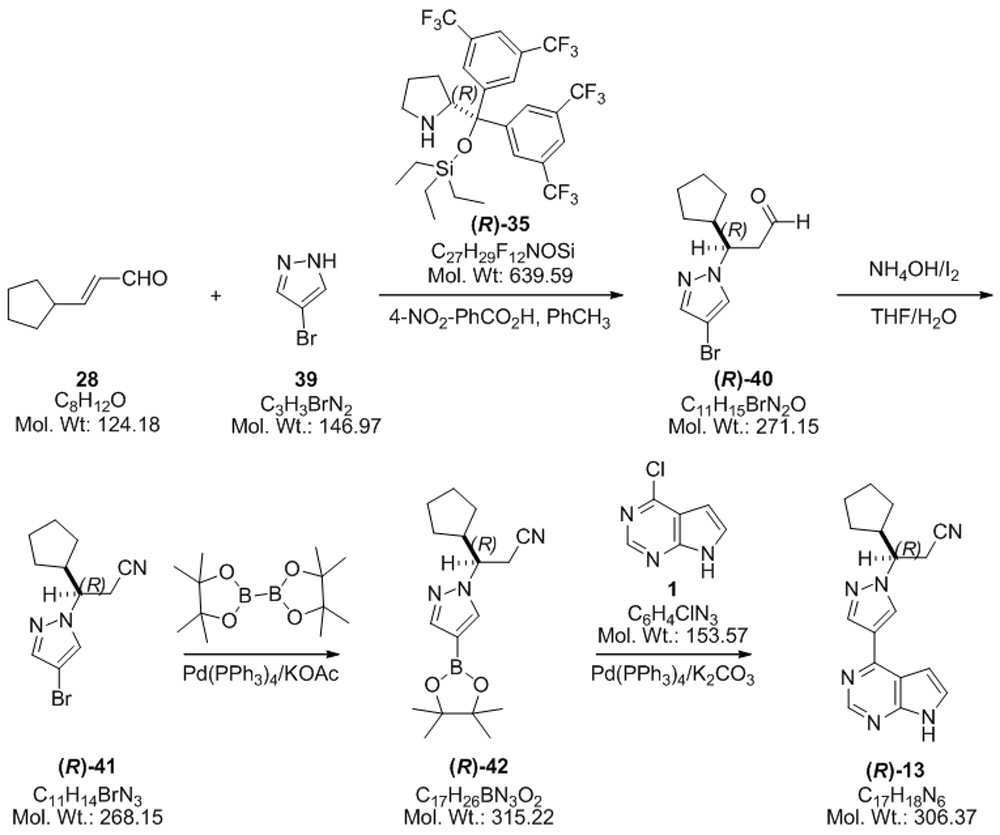
(3 R )-3-(4-브로모-1 H -피라졸-1-일)-3-시클로펜틸프로파날 (( R )-40). 무수 톨루엔 (4.0 mL, 38 mmol) 중 (2E)-3-시클로펜틸아실알데히드 (28, 654 mg, 5.0 mmol, 5.0 당량), (2R)-2-(비스[3,5-비스(트리플루오로메틸)페닐][tert-부틸(디메틸)실릴]옥시메틸)피롤리딘 ((R)-35, 64 mg, 0.10 mmol, 0.10 당량) 및 4-니트로벤조산 (17 mg, 0.10 mmol, 0.10 당량)의 용액을 실온에서 10분 동안 교반하고, 그 다음, 0℃로 냉각한 후, 4-브로모-1H-피라졸 (39, 148 mg, 1.0 mmol)을 첨가했다. 수득한 반응 혼합물을 0℃에서 22시간 동안 교반했다. LCMS가 반응의 완료를 보여주었을 때, 반응 혼합물을 감압 하에서 농축했다. 잔여물을 0 - 30% EtOAc/헥산 구배 용리를 갖는 CombiFlash (SiO2)로 직접 정제하여 (3R)-3-(4-브로모-1H-피라졸-1-일)-3-시클로펜틸프로파날 ((R)-40, 230.5 mg, 271.2 mg 이론적, 85% 수율)을 담황색 점성 오일로서 얻었다. (R)-40에 대해: C11H15BrN2O (분자량: 271.15), LCMS (EI) m/e 271/273 (M+ + H). ( 3R ) -3- (4-bromo-1 H -pyrazol -1 -yl) -3-cyclopentylpropanal (( R ) -40). [3,5-bis anhydrous toluene (4.0 mL, 38 mmol) of (2 E) -3- cyclopentyl-acyl aldehyde (28, 654 mg, 5.0 mmol , 5.0 equiv), (2 R) -2- (bis ( Trifluoromethyl) phenyl] [tert-butyl (dimethyl) silyl] oxymethyl) pyrrolidine (( R ) -35 , 64 mg, 0.10 mmol, 0.10 equiv) and 4-nitrobenzoic acid (17 mg, 0.10 mmol, 0.10 equiv) was stirred at rt for 10 min and then cooled to 0 ° C. before 4-bromo-1 H -pyrazole ( 39 , 148 mg, 1.0 mmol) was added. The resulting reaction mixture was stirred at 0 ° C. for 22 hours. When LCMS showed the reaction was completed, the reaction mixture was concentrated under reduced pressure. The residue was purified directly with CombiFlash (SiO 2 ) with a 0-30% EtOAc / hexane gradient elution to give (3 R ) -3- (4-bromo-1 H -pyrazol-1-yl) -3-cyclo Pentylpropanal (( R ) -40 , 230.5 mg, 271.2 mg theoretical, 85% yield) was obtained as a pale yellow viscous oil. (R) - about 40: C 11 H 15 BrN 2 O ( molecular weight: 271.15), LCMS (EI) m / e 271/273 (M + + H).
(3 R )-3-(4-브로모-1 H -피라졸-1-일)-3-시클로펜틸프로판니트릴 (( R )-41). 테트라히드로푸란 (THF, 2.4 mL, 29 mmol) 중 (3R)-3-(4-브로모-1H-피라졸-1-일)-3-시클로펜틸프로파날 ((R)-40, 230.5 mg, 0.85 mmol)의 교반 용액에 실온에서 물 (2.4 mL) 중 14.3 M의 수산화암모늄 (NH4OH)의 용액, 그 다음 요오드 (I2, 237 mg, 0.935 mmol, 1.1 당량)을 첨가했다. 수득한 반응 혼합물을 실온에서 30분 동안 교반했다. LCMS가 반응의 완료를 보여주었을 때, 반응 혼합물을 10% 수성 Na2S2O3 용액 (15 mL)으로 급냉하고, EtOAc (2×15 mL)로 추출했다. 조합된 유기 층을 염수로 세정하고, 황산마그네슘 (MgSO4) 상에서 건조시키고, 여과하고, 감압 하에서 농축했다. 잔여물을 0 - 30% EtOAc/헥산 구배 용리를 갖는 Combiflash (SiO2)로 정제하여 (3R)-3-(4-브로모-1H-피라졸-1-일)-3-시클로펜틸프로판니트릴 ((R)-41, 180.7 mg, 227.9 mg 이론적, 79.3% 수율)을 무색 점성 오일로서 얻었다. ( 3R ) -3- (4-Bromo-1 H -pyrazol -1 -yl) -3-cyclopentylpropanenitrile (( R ) -41). ( 3R ) -3- (4-bromo-1 H -pyrazol-1-yl) -3-cyclopentylpropanal in tetrahydrofuran (THF, 2.4 mL, 29 mmol) A solution of 14.3 M ammonium hydroxide (NH 4 OH) in water (2.4 mL) at room temperature in a stirred solution of (( R ) -40 , 230.5 mg, 0.85 mmol), followed by iodine (I 2 , 237 mg, 0.935 mmol) , 1.1 equivalents) was added. The resulting reaction mixture was stirred at rt for 30 min. When LCMS showed the reaction was complete, the reaction mixture was quenched with 10% aqueous Na 2 S 2 O 3 solution (15 mL) and extracted with EtOAc (2 × 15 mL). The combined organic layer was washed with brine, dried over magnesium sulfate (MgSO 4 ), filtered and concentrated under reduced pressure. The residue was purified by Combiflash (SiO 2 ) with a 0-30% EtOAc / hexane gradient elution to give (3 R ) -3- (4-bromo-1 H -pyrazol-1-yl) -3-cyclopentyl Propanenitrile (( R ) -41 , 180.7 mg, 227.9 mg theoretical, 79.3% yield) was obtained as a colorless viscous oil.
생성물 ((R)-41) 의 거울상이성질체 잉여 (% ee)의 측정을 키랄 HPLC 분석에 의해 수행했다. 키랄 HPLC 방법을, 셀룰로오스 트리스(3,5-디메틸페닐 카바메이트) (Chiralcel® OD)로 코팅된 실리카겔로 채워진 Chiral Technologies, Inc.의 Chiralcel® OD-H 칼럼 (4.6×250 mm, 5 ㎛)을 사용하여 개발했다. 2개의 거울상이성질체, (R)-41 또는 (S)-41을, 15% 에탄올 및 85% 헥산으로 만들어진 이동상을 실온에서 1 mL/min의 유속으로 사용하여 3.0 초과의 분할로 분리한다. UV 검출 파장은 220 nm이다. (S)-거울상이성질체 ((S)-41) 및 (R)-거울상이성질체 ((R)-41)에 대한 체류시간은 각각 12.8분 (제1 피크) 및 16.7분 (제2 피크)이다.Measurement of the enantiomeric excess (% ee) of the product ((R) -41 ) was performed by chiral HPLC analysis. Chiral HPLC method was performed on a Chiralcel ® OD-H column (4.6 x 250 mm, 5 μm) from Chiral Technologies, Inc., filled with silica gel coated with cellulose tris (3,5-dimethylphenyl carbamate) (Chiralcel ® OD). Developed using. Two enantiomers, (R) -41 or (S) -41 , are separated in greater than 3.0 partitions using a mobile phase made of 15% ethanol and 85% hexane at a flow rate of 1 mL / min at room temperature. The UV detection wavelength is 220 nm. Retention times for the (S) -enantiomer ((S) -41 ) and the (R) -enantiomer ((R) -41 ) are 12.8 minutes (first peak) and 16.7 minutes (second peak), respectively.
(R)-41에 대해: 비키랄 순도 (99.0 면적%, 220 nm에서 검출된 HPLC에 의해); 키랄 순도 (91.7 면적%, 키랄 HPLC에 의해; 83.4% ee); 1H NMR (CDCl3, 400 MHz) δ ppm 7.52 (s, 2H), 4.10 (m, 1H), 3.02 (dd, 1H, J = 17.0, 8.6 Hz), 2.86 (dd, 1H, J = 17.0, 3.9 Hz), 2.47 (m, 1H), 1.90 (m, 1H), 1.72-1.46 (m, 5H), 1.23 (m, 1H), 1.13 (m, 1H); C11H14BrN3 (분자량: 268.15), LCMS (EI) m/e 268/270 (M+ + H).For ( R ) -41 : achiral purity (99.0 area%, by HPLC detected at 220 nm); Chiral purity (91.7 area% by chiral HPLC; 83.4% ee); 1 H NMR (CDCl 3 , 400 MHz) δ ppm 7.52 (s, 2H), 4.10 (m, 1H), 3.02 (dd, 1H, J = 17.0, 8.6 Hz), 2.86 (dd, 1H, J = 17.0, 3.9 Hz), 2.47 (m, 1H), 1.90 (m, 1H), 1.72-1.46 (m, 5H), 1.23 (m, 1H), 1.13 (m, 1H); C 11 H 14 BrN 3 (molecular weight: 268.15), LCMS (EI) m / e 268/270 (M + + H).
(3 R )-3-시클로펜틸-3-[4-(4,4,5,5-테트라메틸-1,3,2-디옥사보롤란-2-일)-1 H -피라졸-1-일]프로판니트릴 (( R )-42). 무수 1,4-디옥산 (4.0 mL, 51 mmol) 중 (3R)-3-(4-브로모-1H-피라졸-1-일)-3-시클로펜틸프로판니트릴 ((R)-41, 363 mg, 1.35 mmol), 4,4,5,5,4',4',5',5'-옥타메틸-[2,2']비스[1,3,2]디옥사보롤라닐] (366 mg, 1.43 mmol, 1.06 당량), 테트라키스(트리페닐포스핀)팔라듐(0) (Pd(PPh3)4, 47 mg, 0.041 mmol, 0.03 당량) 및 칼륨 아세테이트 (KOAc, 402 mg, 4.06 mmol, 3.0 당량)의 탈가스 혼합물을 120℃에서 마이크로웨이브를 통해 1시간 동안 가열했다. LCMS가 반응의 완료를 보여주었을 때, 조 원하는 생성물, (3R)-3-시클로펜틸-3-[4-(4,4,5,5-테트라메틸-1,3,2-디옥사보롤란-2-일)-1H-피라졸-1-일]프로판니트릴 ((R)-42)을 함유하는 반응 혼합물을 추가 워크업없이 차후의 스즈끼 반응을 위해 직접 사용했다. 조 (R)-42에 대해: C17H26BN3O2 (분자량: 315.22), LCMS (EI) m/e 316 (M+ + H). ( 3R ) -3-cyclopentyl-3- [4- (4,4,5,5-tetramethyl-1,3,2-dioxaborolan-2-yl) -1 H -pyrazole-1 -Yl ] propanenitrile (( R ) -42). ( 3R ) -3- (4-bromo-1 H -pyrazol-1-yl) -3-cyclopentylpropanenitrile (( R )-in 1,4-dioxane anhydrous (4.0 mL, 51 mmol) 41 , 363 mg, 1.35 mmol), 4,4,5,5,4 ', 4', 5 ', 5'-octamethyl- [2,2'] bis [1,3,2] dioxaborola Nil] (366 mg, 1.43 mmol, 1.06 equiv), tetrakis (triphenylphosphine) palladium (0) (Pd (PPh 3 ) 4 , 47 mg, 0.041 mmol, 0.03 equiv) and potassium acetate (KOAc, 402 mg , 4.06 mmol, 3.0 equiv) of the degassing mixture was heated at 120 ° C. through microwave for 1 h. When LCMS showed the completion of the reaction, the desired product, ( 3R ) -3-cyclopentyl-3- [4- (4,4,5,5-tetramethyl-1,3,2-dioxabo The reaction mixture containing rolan-2-yl) -1 H -pyrazol-1-yl] propanenitrile (( R ) -42 ) was used directly for the subsequent Suzuki reaction without further workup. Crude (R) - about 42: C 17 H 26 BN 3 O 2 ( molecular weight: 315.22), LCMS (EI) m / e 316 (M + + H).
(3 R )-시클로펜틸-3-[4-(7 H -피롤로[2,3- d ]피리미딘-4-일)피라졸-1-일]프로피오니트릴 (( R )-13, 유리 염기). 방법 C. 상기에 기재된 바와 같이 산출된 반응 혼합물인, 1,4-디옥산 (4.0 mL, 51 mmol) 중 조 (3R)-3-시클로펜틸-3-[4-(4,4,5,5-테트라메틸-1,3,2-디옥사보롤란-2-일)-1H-피라졸-1-일]프로판니트릴 ((R)-42, 427 mg, 1.35 mmol)의 교반 용액에 4-클로로피롤로[2,3-d]피리미딘 (1, 0.160 g, 1.04 mmol, 0.77 당량), 테트라키스(트리페닐포스핀)팔라듐(0) ((Pd(PPh3)4, 36 mg, 0.031 mmol, 0.03 당량) 및 물 (2.0 mL, 110 mmol) 중 탄산칼륨 (K2CO3, 432 mg, 3.13 mmol, 3.0 당량)의 용액을 실온에서 첨가했다. 수득한 반응 혼합물을 3회 탈가스하고, 매시간 질소로 재충전한 후, 100℃에서 21시간 동안 가열했다. LCMS가 반응의 완료를 보여주었을 때, 반응 혼합물을 포화 수성 NaHCO3 (10 mL)로 급냉하고, EtOAc (2×25 mL)로 추출했다. 조합된 유기 층을 염수로 세정하고, 황산마그네슘 (MgSO4) 상에서 건조시키고, 여과하고, 감압 하에서 농축했다. 잔여물을 0 - 100% EtOAc/헥산 구배 용리, 그 다음 0 - 5% MeOH/EtOAc로 용리하는 Combiflash (SiO2)로 정제하여 (3R)-시클로펜틸-3-[4-(7H-피롤로[2,3-d]피리미딘-4-일)피라졸-1-일]프로피오니트릴 ((R)-13, 유리 염기, 204.3 mg, 318.6 mg 이론적, 64% 수율, 2단계로)을 무색 오일로서 얻었고, 이는 실온에서 진공에서 정치시 고형화되었다. (R)-13 (유리 염기)에 대해: 1H NMR (DMSO-d 6, 400 MHz) δ ppm 12.1 (bs, 1H), 8.80 (d, 1H, J = 0.42 Hz), 8.67 (s, 1H), 8.37 (s, 1H), 7.59 (dd, 1H, J = 2.34, 3.51 Hz), 6.98 (dd, 1H, J = 1.40, 3.44 Hz), 4.53 (td, 1H, J = 19.5, 4.63 Hz), 3.26 (dd, 1H, J = 9.77, 17.2 Hz), 3.18 (dd, 1H, J = 4.32, 17.3 Hz), 2.40 (m, 1H), 1.79 (m, 1H), 1.65 내지 1.13 (m, 7H); C17H18N6 (분자량: 306.37) LCMS (EI) m/e 307 (M+ + H). (3 R) - cyclopentyl -3- [4- (7 H - pyrrolo [2,3- d] pyrimidin-4-yl) pyrazol-1-yl] propionitrile ((R) -13, Free base). Method C. Crude ( 3R ) -3-cyclopentyl-3- [4- (4,4,5,5- in 1,4-dioxane (4.0 mL, 51 mmol), the reaction mixture calculated as described above. To a stirred solution of tetramethyl-1,3,2-dioxaborolan-2-yl) -1 H -pyrazol-1-yl] propanenitrile (( R ) -42 , 427 mg, 1.35 mmol) 4- Chloropyrrolo [2,3- d ] pyrimidine ( 1 , 0.160 g, 1.04 mmol, 0.77 equiv), tetrakis (triphenylphosphine) palladium (0) ((Pd (PPh 3 ) 4 , 36 mg, 0.031 mmol, 0.03 equiv) and a solution of potassium carbonate (K 2 CO 3 , 432 mg, 3.13 mmol, 3.0 equiv) in water (2.0 mL, 110 mmol) were added at room temperature The resulting reaction mixture was degassed three times and , Hourly recharged with nitrogen, and heated for 21 hours at 100 ° C. When LCMS showed the reaction was complete, the reaction mixture was quenched with saturated aqueous NaHCO 3 (10 mL), and EtOAc (2 × 25 mL). The combined organic layers were washed with brine, dried over magnesium sulfate (MgSO 4 ), filtered and depressurized The residue was purified by Combiflash (SiO 2 ) eluting with a 0-100% EtOAc / hexanes gradient elution, then with 0-5% MeOH / EtOAc to ( 3R ) -cyclopentyl-3- [4-. (7 H - pyrrolo [2,3- d] pyrimidin-4-yl) pyrazol-1-yl] propionitrile ((R) - 13, free base, 204.3 mg, 318.6 mg theoretical, 64% yield , Step 2) was obtained as a colorless oil, which solidified on standing in vacuo at room temperature For ( R ) -13 (free base): 1 H NMR (DMSO- d 6 , 400 MHz) δ ppm 12.1 (bs , 1H), 8.80 (d, 1H, J = 0.42 Hz), 8.67 (s, 1H), 8.37 (s, 1H), 7.59 (dd, 1H, J = 2.34, 3.51 Hz), 6.98 (dd, 1H, J = 1.40, 3.44 Hz), 4.53 (td, 1H, J = 19.5, 4.63 Hz), 3.26 (dd, 1H, J = 9.77, 17.2 Hz), 3.18 (dd, 1H, J = 4.32, 17.3 Hz), 2.40 (m, 1 H), 1.79 (m, 1 H), 1.65-1.13 (m, 7 H); C 17 H 18 N 6 (molecular weight : 306.37) LCMS (EI) m / e 307 (M + + H).

4-클로로-7-(2-트리메틸실라닐에톡시메틸)-7 H -피롤로[2,3- d ]피리미딘 (3a). 질소 주입구, 추가 깔때기, 서모웰(thermowell), 및 기계적 교반기가 구비된 플라스크에 4-클로로-7H-피롤로[2,3-d]피리미딘 (1, 600 g, 3.91 mol) 및 디메틸아세트이미드 (9.6 L)을 첨가했다. 혼합물을 -5℃로 얼음/염수 배쓰에서 냉각시키고, 수산화나트륨 (NaH, 60 wt%, 174 g, 4.35 mol, 1.1 당량)을 부분씩 고형물로서 첨가했다. 혼합물은 15분 동안 검은 용액으로 되었고, 트리메틸실릴에톡시메틸 클로라이드 (2, 763 mL, 4.31 mol, 1.1 당량)을, 추가 깔때기로 온도가 5℃를 초과하지 않는 속도로 서서히 첨가했다. 반응을 30분 동안 교반하고, TLC 및 HPLC에 이한 완료를 측정하고, 물 (1 L)을 서서히 첨가하여 반응을 급냉했다. 그 다음, 혼합물을 물 (12 L) 및 MTBE (8 L)로 희석했다. 층들을 분리하고, 수성 층을 MTBE (8 L)로 재추출했다. 조합된 유기 층을 물 (2×4 L) 및 염수 (4 L)로 세정하고, 황산나트륨 (NaSO4) 상에서 건조시키고, 용매 감압 하에서 제거했다. 잔여물을 헵탄 (2 L)에서 용해시키고, 여과하고, 헵탄 (~6 L), 95% 헵탄/에틸 아세테이트 (~12 L), 90% 헵탄/에틸 아세테이트 (10 L), 및 마지막으로 80% 헵탄/에틸 아세테이트 (10 L)로 용리하여 실리카겔 (3.5 kg) 칼럼 상에 적재했다. 순수한 분획을 조합하고, 감압 하에서 농축하여 4-클로로-7-(2-트리메틸실라닐에톡시메틸)-7H-피롤로[2,3-d]피리미딘 (3a, 987 g, 1109.8 g 이론적, 88.9% 수율)을 담황색 오일로서 얻었고, 이는 실온에서 정치시 오일성 고형물로 부분 고형화되었다. 3a에 대해: 1H NMR (DMSO-d 6, 300 MHz) δ ppm 8.67 (s, 1H), 7.87 (d, 1H, J = 3.8 Hz), 6.71 (d, 1H, J = 3.6 Hz), 5.63 (s, 2H), 3.50 (t, 2H, J = 7.9 Hz), 0.80 (t, 2H, J = 8.1 Hz), 1.24 (s, 9H); 13C NMR (DMSO-d 6, 100 MHz) δ ppm 151.3, 150.8, 150.7, 131.5, 116.9, 99.3, 72.9, 65.8, 17.1, -1.48; C12H18ClN3OSi (분자량 283.83), LCMS (EI) m/e 284/286 (M+ + H). 4-Chloro-7- (2-trimethylsilanyl-ethoxymethyl) -7 H - pyrrolo [2,3- d] pyrimidine (3a). In a flask equipped with a nitrogen inlet, an additional funnel, a thermowell, and a mechanical stirrer, 4-chloro-7 H -pyrrolo [2,3-d] pyrimidine ( 1 , 600 g, 3.91 mol) and dimethylacetate Mid (9.6 L) was added. The mixture was cooled to -5 ° C in an ice / brine bath and sodium hydroxide (NaH, 60 wt%, 174 g, 4.35 mol, 1.1 equiv) was added portionwise as a solid. The mixture became a black solution for 15 minutes and trimethylsilylethoxymethyl chloride ( 2 , 763 mL, 4.31 mol, 1.1 equiv) was added slowly with an additional funnel at a rate not to exceed 5 ° C. The reaction was stirred for 30 minutes, the completion following TLC and HPLC was measured and the reaction was quenched by the slow addition of water (1 L). The mixture was then diluted with water (12 L) and MTBE (8 L). The layers were separated and the aqueous layer was reextracted with MTBE (8 L). The combined organic layers were washed with water (2 × 4 L) and brine (4 L), dried over sodium sulphate (NaSO 4 ) and removed under solvent reduced pressure. The residue is dissolved in heptane (2 L), filtered, heptane (˜6 L), 95% heptane / ethyl acetate (˜12 L), 90% heptane / ethyl acetate (10 L), and finally 80% Elution with heptane / ethyl acetate (10 L) loaded on a silica gel (3.5 kg) column. And combine the pure fractions were concentrated under reduced pressure to give 4-chloro-7- (2-trimethylsilanyl-ethoxymethyl) -7 H - pyrrolo [2,3- d] pyrimidine (3a, 987 g, 1109.8 g theoretical , 88.9% yield) as a pale yellow oil which was partially solidified to an oily solid upon standing at room temperature. About 3a : 1 H NMR (DMSO- d 6 , 300 MHz) δ ppm 8.67 (s, 1H), 7.87 (d, 1H, J = 3.8 Hz), 6.71 (d, 1H, J = 3.6 Hz), 5.63 (s, 2H ), 3.50 (t, 2H, J = 7.9 Hz), 0.80 (t, 2H, J = 8.1 Hz), 1.24 (s, 9H); 13 C NMR (DMSO- d 6 , 100 MHz) δ ppm 151.3, 150.8, 150.7, 131.5, 116.9, 99.3, 72.9, 65.8, 17.1, -1.48; C 12 H 18 ClN 3 OSi (molecular weight 283.83), LCMS (EI) m / e 284/286 (M + + H).
4-클로로-7-(디에톡시메틸)-7 H -피롤로[2,3- d ]피리미딘 (3b). 교반 바, 콘덴서 및 질소 주입구가 구비된 1 리터 둥근바닥플라스크에, 4-클로로-7H-피롤로[2,3-d]피리미딘 (1, 31.0 g, 0.202 mol) 및 트리에틸 오르토 포르메이트 (330 ml, 2.00 mol, 10.0 당량)을 충전했다. 반응 혼합물을 가온 환류하여 맑은 용액을 산출했다. 반응을 63시간 후에 HPLC로 점검했다. 반응이 완료된 것으로 보일 때, 반응 혼합물을 감압 하에서 농축했다. 잔여물을 20% 내지 25% 에틸 아세테이트/헥산 (v/v) 구배 (TLC 조건: 30% 에틸 아세테이트/헥산)으로 용리하는 실리카겔 플래시 칼럼 크로마토그래피로 정제하여 4-클로로-7-(디에톡시메틸)-7H-피롤로[2,3-d]피리미딘 (3b, 48.56 g, 51.65 g 이론적, 94% 수율)을 담황색 오일로서 얻었다. 3b에 대해: 1H NMR (DMSO-d 6, 400 MHz) δ ppm 8.68 (s, 1H), 7.79 (d, 1H, J = 3.8 Hz), 6.75 (s, 1H), 6.72 (d, 1H, J = 3.8 Hz), 3.68 (dd, 2H, J = 9.4, 7.2 Hz), 3.54 (dd, 2H, J = 9.4, 7.2 Hz), 1.11 (t, 6H, J = 7.2 Hz); C11H14ClN3O2 (분자량: 255.70), LCMS (EI) m/e 182/184 (1의 상응하는 7-포르밀화 생성물에 대한 M+ + H) 및 154/156 (1에 대한 M+ + H). 4-chloro-7- (diethoxymethyl) -7 H -pyrrolo [2,3- d ] pyrimidine (3b). In a 1 liter round bottom flask with stirring bar, condenser and nitrogen inlet, 4-chloro-7 H -pyrrolo [2,3- d ] pyrimidine ( 1 , 31.0 g, 0.202 mol) and triethyl ortho formate (330 ml, 2.00 mol, 10.0 equiv) was charged. The reaction mixture was warmed to reflux to yield a clear solution. The reaction was checked by HPLC after 63 hours. When the reaction appeared to be complete, the reaction mixture was concentrated under reduced pressure. The residue was purified by silica gel flash column chromatography eluting with a 20% to 25% ethyl acetate / hexanes (v / v) gradient (TLC conditions: 30% ethyl acetate / hexanes) to 4-chloro-7- (diethoxymethyl ) -7 H - pyrrolo [2,3- d] pyrimidine (3b, 48.56 g, 51.65 g theoretical, 94% yield) as a pale yellow oil. For 3b : 1 H NMR (DMSO- d 6 , 400 MHz) δ ppm 8.68 (s, 1H), 7.79 (d, 1H, J = 3.8 Hz), 6.75 (s, 1H), 6.72 (d, 1H, J = 3.8 Hz), 3.68 (dd, 2H, J = 9.4, 7.2 Hz), 3.54 (dd, 2H, J = 9.4, 7.2 Hz), 1.11 (t, 6H, J = 7.2 Hz); C 11 H 14 ClN 3 O 2 ( molecular weight: 255.70), LCMS (EI) m / e 182/184 (1 for the corresponding 7-formylated product M + H + in) and 154/156 (M for 1 + + H).
tert -부틸 4-클로로-7 H -피롤로[2,3- d ]피리미딘-7-카복실레이트 (3c). 교반 바 및 질소 주입구가 구비된 250 mL 둥근바닥플라스크에, 4-클로로-7H-피롤로[2,3-d]피리미딘 (1, 5.00 g, 0.0326 mol), 1,4-디옥산 (40 ml, 0.500 mol), 1,8-디아자바이시클로[5.4.0]운덱-7-엔 (DBU, 24.3 mL, 0.163 mol, 5.0 당량) 및 4-(N,N-디메틸)아미노피리딘 (DMAP, 0.80 g, 0.0065 mol, 0.2 당량)을 충전했다. 이 용액에 디-tert-부틸디카보네이트 (BOC2O, 21.2 g, 0.0976 mol, 3.0 당량)을 한번에 실온에서 첨가했다. 수득한 반응 용액은, 이산화탄소의 방출과 함께 그 색상이 황색/오렌지색이 되었다. 반응을 TLC (80% 헥산/에틸 아세테이트)로 모니터하고, 실온에서 약 24시간 동안 교반한 후에 완료했다. 그 다음, 반응 혼합물을 20% 수성 염수 용액 (40 mL) 및 에틸 아세테이트 (40 mL). 2개의 층을 분리하고, 수성 층을 에틸 아세테이트 (40 mL)로 추출했다. 조합된 유기 추출물을 염수로 세정하고, 황산마그네슘 상에서 건조시키고, 감압 하에서 농축하여 조 원하는 생성물 (3c)을 적색 내지 오렌지색 오일로서 얻었다. 플래시 칼럼 크로마토그래피 정제 (SiO2, 0 내지 15% 에틸 아세테이트/헥산 구배 용리)로 전제하여 순수한 tert-부틸 4-클로로-7H-피롤로[2,3-d]피리미딘-7-카복실레이트 (3c, 6.28 g, 8.27 g 이론적, 75.9% 수율)을 회백색 고형물로서 얻었다. 3c에 대해: 1H NMR (DMSO-d 6, 400 MHz) δ ppm 8.79 (s, 1H), 7.94 (d, 1H, J = 4.0 Hz), 6.80 (d, 1H, J = 4.2 Hz), 1.60 (s, 9H); C11H12ClN3O2 (분자량: 253.68), LCMS (EI) m/e 276/278 (M+ + Na). tert -butyl 4-chloro-7 H -pyrrolo [2,3- d ] pyrimidine-7-carboxylate (3c) . In a 250 mL round bottom flask equipped with a stirring bar and a nitrogen inlet, 4-chloro-7 H -pyrrolo [2,3- d ] pyrimidine ( 1 , 5.00 g, 0.0326 mol), 1,4-dioxane ( 40 ml, 0.500 mol), 1,8-diazabicyclo [5.4.0] undec-7-ene (DBU, 24.3 mL, 0.163 mol, 5.0 equiv) and 4- ( N , N -dimethyl) aminopyridine ( DMAP, 0.80 g, 0.0065 mol, 0.2 equivalents). To this solution di- tert -butyldicarbonate (BOC 2 O, 21.2 g, 0.0976 mol, 3.0 equiv) was added in one portion at room temperature. The obtained reaction solution turned yellow / orange with the release of carbon dioxide. The reaction was monitored by TLC (80% hexanes / ethyl acetate) and complete after stirring at room temperature for about 24 hours. The reaction mixture was then 20% aqueous saline solution (40 mL) and ethyl acetate (40 mL). The two layers were separated and the aqueous layer was extracted with ethyl acetate (40 mL). The combined organic extracts were washed with brine, dried over magnesium sulfate and concentrated under reduced pressure to afford the desired product ( 3c ) as a red to orange oil. Pure tert -butyl 4-chloro-7 H -pyrrolo [2,3- d ] pyrimidine-7-carboxylate, premised on flash column chromatography purification (SiO 2 , 0-15% ethyl acetate / hexane gradient eluting) ( 3c , 6.28 g, 8.27 g theoretical, 75.9% yield) were obtained as off-white solids. For 3c : 1 H NMR (DMSO- d 6 , 400 MHz) δ ppm 8.79 (s, 1H), 7.94 (d, 1H, J = 4.0 Hz), 6.80 (d, 1H, J = 4.2 Hz), 1.60 (s, 9H); C 11 H 12 ClN 3 O 2 (molecular weight: 253.68), LCMS (EI) m / e 276/278 (M + + Na).
4-클로로-7-(트리이소프로필실릴)-7 H -피롤로[2,3- d ]피리미딘 (3d). 교반 바, 콘덴서, 격막, 질소 주입구 및 열전대가 구비된 250 mL 오븐 건조된 3목 동근바닥플라스크에, 수산화나트륨 (NaH, 60 wt%, 1.56 g, 0.0391 mol, 1.2 당량) 및 무수 테트라히드로푸란 (THF, 26 mL, 0.320 mol)를 충전했다. 혼합물을 0 - 5℃로 냉각시켰다. 오븐 건조된 100 mL 둥근바닥플라스크에, 4-클로로-7H-피롤로[2,3-d]피리미딘 (1, 5.00 g, 0.0326 mol) 및 무수 테트라히드로푸란 (42 mL, 0.520 mol)을 충전하고, 그 다음, 수득한 슬러리를 큰 구멍의 캐뉼라를 통해 15분에 걸쳐 THF 중 수산화나트륨 (NaH) 현탁액에 적가했다. 반응 온도를 기재물질의 첨가 후 6.8℃로 상승시켯다. 반응 혼합물을 0 - 5℃에서 40분 동안 교반한 후, 맑은 트리이소프로필실릴 클로라이드 (6.6 g, 7.24 mL, 0.0342 mol, 1.05 당량)을 주사기로 5분에 걸쳐 충전했다. 냉각 배쓰를 제거하고, 반응 혼합물을 4시간 동안 가온 환류했다. 반응을 TLC (80% 헥산/에틸 아세테이트)로 점검했다. 반응이 완료된 것으로 보일 때, 반응 혼합물을 실온으로 냉각시키고, 에틸 아세테이트 (100 mL) 및 20% 수성 염수 (50 mL)로 희석했다. 2개의 층을 분리하고, 수성 층을 에틸 아세테이트 (100 mL)로 추출했다. 조합된 유기 분획을 1M 중탄산나트륨 (NaHCO3) 수성 용액 (100 mL) 및 20% 수성 염수 (100 mL)로 세정하고, 황산마그네슘 (MgSO4) 상에서 건조시키고, 여과하고, 감압 하에서 농축했다. 잔여물을 플래시 크로마토그래피 (SiO2, 10% 에틸 아세테이트/헥산 구배 용리)로 정제하여 4-클로로-7-(트리이소프로필실릴)-7H-피롤로[2,3-d]피리미딘 (3d, 10.0 g, 10.10 g 이론적, 99%)을 호박색 오일로서 얻었다. 3d에 대해: 1H NMR (DMSO-d 6, 400 MHz) δ ppm 8.61 (s, 1H), 7.67 (d, 1H, J = 3.7 Hz), 6.76 (d, 1H, J = 3.5 Hz), 1.86 (m, 3H), 1.02 (d, 18 H, J = 7.5 Hz); C15H24ClN3Si (분자량: 309.91), LCMS (EI) m/e 310/312 (M+ + H). 4-chloro-7- (triisopropylsilyl) -7 H -pyrrolo [2,3- d ] pyrimidine (3d). In a 250 mL oven-dried three-neck sinus-bottom flask equipped with a stirring bar, condenser, diaphragm, nitrogen inlet and thermocouple, sodium hydroxide (NaH, 60 wt%, 1.56 g, 0.0391 mol, 1.2 equiv) and anhydrous tetrahydrofuran ( THF, 26 mL, 0.320 mol) was charged. The mixture was cooled to 0-5 ° C. In an oven dried 100 mL round bottom flask, 4-chloro-7 H -pyrrolo [2,3- d ] pyrimidine ( 1 , 5.00 g, 0.0326 mol) and anhydrous tetrahydrofuran (42 mL, 0.520 mol) After filling, the resulting slurry was added dropwise to a suspension of sodium hydroxide (NaH) in THF over 15 minutes via a large pore cannula. The reaction temperature was raised to 6.8 ° C. after addition of the base material. The reaction mixture was stirred at 0-5 ° C. for 40 minutes, then clear triisopropylsilyl chloride (6.6 g, 7.24 mL, 0.0342 mol, 1.05 equiv) was charged with a syringe over 5 minutes. The cooling bath was removed and the reaction mixture was warmed to reflux for 4 hours. The reaction was checked by TLC (80% hexanes / ethyl acetate). When the reaction appeared to be complete, the reaction mixture was cooled to room temperature and diluted with ethyl acetate (100 mL) and 20% aqueous brine (50 mL). The two layers were separated and the aqueous layer was extracted with ethyl acetate (100 mL). The combined organic fractions were washed with 1M sodium bicarbonate (NaHCO 3 ) aqueous solution (100 mL) and 20% aqueous brine (100 mL), dried over magnesium sulfate (MgSO 4 ), filtered and concentrated under reduced pressure. The residue was purified by flash chromatography (SiO 2 , 10% ethyl acetate / hexane gradient elution) to afford 4-chloro-7- (triisopropylsilyl) -7 H -pyrrolo [2,3- d ] pyrimidine ( 3d , 10.0 g, 10.10 g theoretical, 99%) were obtained as amber oil. For 3d : 1 H NMR (DMSO- d 6 , 400 MHz) δ ppm 8.61 (s, 1H), 7.67 (d, 1H, J = 3.7 Hz), 6.76 (d, 1H, J = 3.5 Hz), 1.86 (m, 3H), 1.02 (d, 18H, J = 7.5 Hz); C 15 H 24 ClN 3 Si (molecular weight: 309.91), LCMS (EI) m / e 310/312 (M + + H).
7-[(벤질옥시)메틸]-4-클로로-7 H -피롤로[2,3- d ]피리미딘 (3e). 교반 바, 열전대, 격막 및 질소 주입구가 구비된 오븐 건조된 250 mL 3목 동근바닥플라스크에, 수산화나트륨 (NaH, 60 wt%, 1.56 g, 0.0391 mol, 1.2 당량) 및 무수 테트라히드로푸란 (THF, 25.0 mL, 0.308 mol)을 충전하고, 수득한 혼합물을 0 - 5℃로 냉각시켰다. 100 ml 오븐 건조된 둥근바닥플라스크에, 4-클로로-7H-피롤로[2,3-d]피리미딘 (1, 5.00 g, 0.0326 mol) 및 무수 테트라히드로푸란 (50 mL, 0.616 mol)을 충전하고, 수득한 슬러리를 큰 구멍의 캐뉼라를 통해 20분에 걸쳐 THF 중 수산화나트륨 (NaH) 현탁액에 적가했다. 냉각 배쓰를 첨가 완료 후 제거하고, 반응 혼합물을 실온에서 1시간 동안 교반했다. 슬러리는 16.5℃로 따뜻하게 된 후에 그 색상이 녹색이 되었다. 혼합물을 0 - 5℃로 냉각한 후, 맑은 벤질 클로로메틸 에테르 (5.28 mL, 0.0342 mol, 1.05 당량)을 13분에 걸쳐 주사기로 충전했다. 냉각 배쓰를 제거하고, 반응 혼합물을 실온으로 점차 따뜻하게 하고, 실온에서 20시간 동안 교반했다. 반응 혼합물을 20% 수성 염수 (50 mL)로 급냉하고, 반응이 완료될 것으로 보일 때 에틸 아세테이트 (100 mL)로 희석했다. 2개의 층을 분리하고, 수성 층을 에틸 아세테이트 (50 mL)로 추출했다. 조합된 유기 분획을 황산마그네슘 상에서 건조시키고, 여과하고, 감압 하에서 농축했다. 그 다음, 잔여물을 플래시 크로마토그래피 (SiO2, 10% 내지 15% 에틸 아세테이트/헥산 구배 용리)로 정제하여 7-[(벤질옥시)메틸]-4-클로로-7H-피롤로[2,3-d]피리미딘 (3e, 6.31 g, 8.92 g 이론적, 70.7%)을 녹색 오일로서 얻었다. 3e에 대해: 1H NMR (DMSO-d 6, 400 MHz) δ ppm 8.69 (s, 1H), 7.90 (d, 1H, J = 3.7 Hz), 7.26 (m 5H), 6.71 (d, 1H, J = 3.7 Hz), 5.75 (s 2H), 4.51 (s, 2H); C14H12ClN3O (분자량: 273.72), LCMS (EI) m/e 274/276 (M+ + H). 7-[(benzyloxy) methyl] -4-chloro-7 H -pyrrolo [2,3- d ] pyrimidine (3e). In an oven dried 250 mL three neck copper bottom flask with a stirring bar, thermocouple, diaphragm and nitrogen inlet, sodium hydroxide (NaH, 60 wt%, 1.56 g, 0.0391 mol, 1.2 equiv) and anhydrous tetrahydrofuran (THF, 25.0 mL, 0.308 mol) was charged and the resulting mixture was cooled to 0-5 ° C. In a 100 ml oven dried round bottom flask, 4-chloro-7 H -pyrrolo [2,3- d ] pyrimidine ( 1 , 5.00 g, 0.0326 mol) and anhydrous tetrahydrofuran (50 mL, 0.616 mol) After filling, the resulting slurry was added dropwise to a suspension of sodium hydroxide (NaH) in THF over 20 minutes through a large pore cannula. The cooling bath was removed after completion of the addition and the reaction mixture was stirred at room temperature for 1 hour. The slurry became green after it was warmed to 16.5 ° C. After the mixture was cooled to 0-5 ° C., clear benzyl chloromethyl ether (5.28 mL, 0.0342 mol, 1.05 equiv) was charged with a syringe over 13 minutes. The cold bath was removed and the reaction mixture was gradually warmed to room temperature and stirred at room temperature for 20 hours. The reaction mixture was quenched with 20% aqueous brine (50 mL) and diluted with ethyl acetate (100 mL) when the reaction appeared to be complete. The two layers were separated and the aqueous layer was extracted with ethyl acetate (50 mL). The combined organic fractions were dried over magnesium sulphate, filtered and concentrated under reduced pressure. The residue was then purified by flash chromatography (SiO 2 , 10% to 15% ethyl acetate / hexane gradient elution) to give 7-[(benzyloxy) methyl] -4-chloro-7 H -pyrrolo [2, 3- d ] pyrimidine ( 3e , 6.31 g, 8.92 g theoretical, 70.7%) was obtained as green oil. For 3e : 1 H NMR (DMSO- d 6 , 400 MHz) δ ppm 8.69 (s, 1H), 7.90 (d, 1H, J = 3.7 Hz), 7.26 (m 5H), 6.71 (d, 1H, J = 3.7 Hz), 5.75 (s 2 H), 4.51 (s, 2 H); C 14 H 12 ClN 3 O (Molecular Weight: 273.72), LCMS (EI) m / e 274/276 (M + + H).
(4-클로로-7 H -피롤로[2,3- d ]피리미딘-7-일)메틸 피발레이트 (3f). 오버헤드 교반기, 격막, 열전대, 500 mL 추가 깔때기 및 질소 주입구가 구비된 오븐 건조된 2 L 4-목 동근바닥플라스크에, 수산화나트륨 (NaH, 60 wt%, 29.7 g, 0.742 mol, 1.34 당량) 및 무수 테트라히드로푸란 (THF, 400 mL, 5.0 mol)을 충전하고, 수득한 혼합물을 0 - 3℃로 냉각시켰다. 오븐 건조된 1 L 둥근바닥플라스크에, 4-클로로-7H-피롤로[2,3-d]피리미딘 (1, 85.0 g, 0.553 mol) 및 테트라히드로푸란 (600 mL, 7.0 mol)를 충전하고, 이로써 슬러리가 생겼다. 그 다음, 이 수득한 슬러리를 THF 중 수산화나트륨의 현탁액에 큰 구멍의 캐뉼라를 통해 27분에 걸쳐 0 - 5℃에서 적가했다. 수득한 용액은 이질적이었고, 그 색생은 녹색이었다. 상기 첨가 다음에, 차가운 배쓰를 제거하고, 혼합물을 실온으로 점차 따뜻하게 하고, 실온에서 1시간 동안 교반한 후, 0 - 5℃로 냉각했다. 클로로메틸 피발레이트 (피발로일옥시메틸 클로라이드, POM-Cl, 103 ml, 0.692 mol, 1.25 당량)을, 0 - 5℃에서 교반하면서 반응 혼합물에 25분에 걸쳐 주사기로 적가했다. 클로로메틸 피발레이트의 첨가 (POM-Cl)을 다소 발열이었고, 반응 온도은 14℃ 정도로 높았다. 클로로메틸 피발레이트 (POM-Cl)의 첨가 후, 냉각 배쓰를 제거하고, 반응 혼합물을 실온으로 되돌리고, 실온에서 밤새 교반했다. 약 16시간 후에 완료된 것으로 보였을 때, 반응을 20% 수성 염수 (250 mL) 및 에틸 아세테이트 (250 mL)로 급냉하고, 이로써 슬러리가 생성되었다. 추가량의 물 (250 mL)을, 혼합물이 균일 용액이 될 때까지 첨가했다. 2개의 층을 분리하고, 수성 층을 에틸 아세테이트 (250 mL)로 추출했다. 조합된 유기 분획을 황산마그네슘 (MgSO4) 상에서 건조시키고, 여과하고, 감압 하에서 농축했다. 잔여물을 플래시 칼럼 크로마토그래피 (SiO2, 10% 내지 15% 에틸 아세테이트/헥산 구배 용리)로 정제하여 원하는 생성물을 황색의 결정성 고형물 (155 g)로서 얻었더. 조합된 고형물을 헥산 (750 mL)로 처리하고, 수득한 슬러리를 55℃로 따뜻하게 하여 균일 용액을 생성했다. 그 다음, 수득한 용액을 점차 실온으로 냉각시키고, 실온에서 밤새 교반한 후, 0 - 5℃로 2시간 동안 냉각했다. 고형물을 여과로 수집하고, 미리 냉각된 헥산 (2×30 mL)으로 세정하고, 진공에서 건조하여 4-클로로-7H-피롤로[2,3-d]피리미딘-7-일)메틸 피발레이트 (3f, 134.9 g, 148.0 g 이론적, 91% 수율)을 백색 고형물로서 얻었다. 3f에 대해: 1H NMR (DMSO-d 6, 400 MHz) δ ppm 8.71 (s, 1H), 7.83 (d, 1H, J = 3.7 Hz), 6.73 (d, 1H, J = 3.8 Hz), 6.23 (s 2H), 1.06 (s, 9H); 13C NMR (DMSO-d 6, 100 MHz) δ ppm 176.9, 151.2, 151.1, 151.0, 131.6, 117.1, 99.9, 66.9, 38.3, 26.5; C12H14ClN3O2 (분자량: 267.71), LCMS (EI) m/e 268/270 (M+ + H). (4-chloro-7 H -pyrrolo [2,3- d ] pyrimidin-7-yl) methyl pivalate (3f). In an oven-dried 2 L 4-neck copper-bottomed flask equipped with an overhead stirrer, diaphragm, thermocouple, 500 mL additional funnel and nitrogen inlet, sodium hydroxide (NaH, 60 wt%, 29.7 g, 0.742 mol, 1.34 equiv) and Anhydrous tetrahydrofuran (THF, 400 mL, 5.0 mol) was charged and the resulting mixture was cooled to 0-3 ° C. To an oven dried 1 L round bottom flask was charged 4-chloro-7 H -pyrrolo [2,3- d ] pyrimidine ( 1 , 85.0 g, 0.553 mol) and tetrahydrofuran (600 mL, 7.0 mol). This produced a slurry. This obtained slurry was then added dropwise to a suspension of sodium hydroxide in THF at 0-5 ° C. over 27 minutes via a large pore cannula. The resulting solution was heterogeneous and the color was green. After the addition, the cold bath was removed and the mixture was gradually warmed to room temperature, stirred at room temperature for 1 hour and then cooled to 0-5 ° C. Chloromethyl pivalate to (pivaloyloxymethyl chloride, POM-Cl, 103 ml, 0.692 mol, 1.25 eq.), 0 was added dropwise by syringe over 25 minutes to the reaction mixture with stirring in 5 ℃. The addition of chloromethyl pivalate (POM-Cl) was somewhat exothermic and the reaction temperature was as high as 14 ° C. After addition of chloromethyl pivalate (POM-Cl), the cooling bath was removed and the reaction mixture was returned to room temperature and stirred at room temperature overnight. When shown to be complete after about 16 hours, the reaction was quenched with 20% aqueous brine (250 mL) and ethyl acetate (250 mL), resulting in a slurry. An additional amount of water (250 mL) was added until the mixture became a homogeneous solution. The two layers were separated and the aqueous layer was extracted with ethyl acetate (250 mL). The combined organic fractions were dried over magnesium sulfate (MgSO 4 ), filtered and concentrated under reduced pressure. The residue was purified by flash column chromatography (SiO 2 , 10% to 15% ethyl acetate / hexane gradient eluting) to afford the desired product as a yellow crystalline solid (155 g). The combined solids were treated with hexane (750 mL) and the resulting slurry was warmed to 55 ° C. to produce a homogeneous solution. Then, the obtained solution was gradually cooled to room temperature, stirred at room temperature overnight, and then cooled to 0-5 ° C. for 2 hours. The solid was collected by filtration, washed with pre-cooled hexane (2 × 30 mL) and dried in vacuo to afford 4-chloro-7 H -pyrrolo [2,3- d ] pyrimidin-7-yl) methyl pival The rate ( 3f , 134.9 g, 148.0 g theoretical, 91% yield) was obtained as a white solid. For 3f : 1 H NMR (DMSO- d 6 , 400 MHz) δ ppm 8.71 (s, 1H), 7.83 (d, 1H, J = 3.7 Hz), 6.73 (d, 1H, J = 3.8 Hz), 6.23 (s 2H), 1.06 (s, 9H); 13 C NMR (DMSO- d 6 , 100 MHz) δ ppm 176.9, 151.2, 151.1, 151.0, 131.6, 117.1, 99.9, 66.9, 38.3, 26.5; C 12 H 14 ClN 3 O 2 (Molecular Weight: 267.71), LCMS (EI) m / e 268/270 (M + + H).

3-시클로펜틸아실로니트릴 (8). 건조 THF (5.75 L) 중 디에틸 시아노메틸포스포네이트 (7, 742.5 g, 4.2 mol, 1.1 당량)의 용액을 질소 하에서 얼음-물-메탄올 배쓰에서 교반하고, THF (4 L, 4.0 mol, 1.05 당량) 중 1 M 칼륨 tert-부톡시드의 용액을 0℃ 미만의 온도를 유지한 것과 같은 속도로 첨가했다. THF 중 1 M 칼륨 tert-부톡시드의 첨가가 완료된 후, 교반을 차가운 배쓰 상에서 1시간 동안 계속하고, 건조 THF (290 mL) 중 시클로펜탄카브알데히드 (6, 374 g, 3.81 mol)의 용액을 0℃ 미만의 온도를 유지하는 것과 같은 속도로 첨가했다. 차가운 배쓰를 제거하고, 반응 혼합물을 실온으로 점차 따뜻하게 하고, 실온에서 밤새 교반했다. 반응이 완료된 것으로 보일 때, 반응 혼합물을 메틸 tert-부틸 에테르 (MTBE, 14 L), 물 (10 L) 및 염수 (6 L) 사이에서 분할했다. 2개의 층을 분리하고, 조합된 유기상을 염수 (6 L)로 세정했다. 수성 상을 MTBE (10 L)로 추출하고, 염수 (6 L)로 세정했다. 조합된 유기 추출물을 감압 하에서 농축하고, 잔여물을 증류 (65 - 78℃/6 torr)하여 3-시클로펜틸아실로니트릴 (8, 437.8 g, 461.7 g 이론적, 94.8% 수율)을 무색 오일로서 얻었고, 이는 E- 및 Z-이성질체의 혼합물인 것으로 발견되었다. 8에 대해: 1H NMR (DMSO-d 6, 400 MHz, Z-이성질체에 대해) δ ppm 6.58 (t, 1H, J = 10.6 Hz), 5.55 (dd, 1H, J = 10.8, 0.59 Hz), 2.85 (m, 1H), 1.90 - 1.46 (m, 6H), 1.34 (m, 2H) 및 (E-이성질체에 대해) δ ppm 6.83 (q, 1H, J = 8.3 Hz), 5.66 (dd, 1H, J = 16.5, 1.4 Hz), 2.60 (m, 1H), 1.90 - 1.46 (m, 6H), 1.34 (m, 2H); 13C NMR (DMSO-d 6, 100 MHz, Z-이성질체에 대해) δ ppm 159.8, 116.6, 97.7, 42.3, 32.3, 25.1 및 (E-이성질체에 대해) δ ppm 160.4, 118.1, 97.9, 43.2, 31.5, 24.8; C8H11N (분자량: 121.18), GCMS (EI) m/e 120 (M+ - H). 3-cyclopentylacyronitrile (8) . A solution of diethyl cyanomethylphosphonate (7, 742.5 g, 4.2 mol, 1.1 equiv) in dry THF (5.75 L) was stirred in an ice-water-methanol bath under nitrogen, THF (4 L, 4.0 mol, 1.05 equiv) was added a solution of 1 M potassium tert -butoxide at the same rate as maintaining a temperature below 0 ° C. After the addition of 1 M potassium tert -butoxide in THF is complete, stirring is continued for 1 hour on a cold bath, and a solution of cyclopentanecarbaldehyde ( 6 , 374 g, 3.81 mol) in dry THF (290 mL) is 0 It was added at the same rate as to maintain a temperature below < RTI ID = 0.0 > The cold bath was removed and the reaction mixture was gradually warmed to room temperature and stirred overnight at room temperature. When the reaction appeared to be complete, the reaction mixture was partitioned between methyl tert -butyl ether (MTBE, 14 L), water (10 L) and brine (6 L). The two layers were separated and the combined organic phases were washed with brine (6 L). The aqueous phase was extracted with MTBE (10 L) and washed with brine (6 L). The combined organic extracts were concentrated under reduced pressure and the residue was distilled (65-78 ° C./6 torr) to give 3-cyclopentylacyronitrile ( 8 , 437.8 g, 461.7 g theoretical, 94.8% yield) as a colorless oil. , It was found to be a mixture of E- and Z-isomers. For 8 : 1 H NMR (DMSO- d 6 , 400 MHz, for Z-isomer) δ ppm 6.58 (t, 1H, J = 10.6 Hz), 5.55 (dd, 1H, J = 10.8, 0.59 Hz), 2.85 (m, 1H), 1.90-1.46 (m, 6H), 1.34 (m, 2H) and (for E-isomers) δ ppm 6.83 (q, 1H, J = 8.3 Hz), 5.66 (dd, 1H, J = 16.5, 1.4 Hz), 2.60 (m, 1 H), 1.90-1.46 (m, 6H), 1.34 (m, 2H); 13 C NMR (DMSO- d 6 , 100 MHz, for Z-isomers) δ ppm 159.8, 116.6, 97.7, 42.3, 32.3, 25.1 and (for E-isomers) δ ppm 160.4, 118.1, 97.9, 43.2, 31.5 , 24.8; C 8 H 11 N (Molecular weight : 121.18), GCMS (EI) m / e 120 (M + -H).

4-(1 H -피라졸-4-일)-7-(2-트리메틸실라닐에톡시메틸)-7 H -피롤로[2,3- d ]피리미딘 (5). 방법 A. 환류 콘덴서, 질소 주입구, 기계적 교반기, 및 서모웰이 구비된 플라스크에 4-클로로-7-(2-트리메틸실라닐에톡시메틸)-7H-피롤로[2,3-d]피리미딘 (3a, 817 g, 2.88 mol) 및 디옥산 (8 L)을 첨가했다. 이 용액에 4-(4,4,5,5-테트라메틸-1,3,2-디옥사보롤란-2-일) -1H-피라졸 (4, 728 g, 3.75 mol, 1.30 당량), 그 다음 물 (4 L) 중 탄산칼륨 (K2CO3, 1196 g, 8.67 mol, 3.0 당량)의 용액을 첨가했다. 용액을 상기 용액을 통해 질소의 흐름을 15분 동안 통과시킨 후, 테트라키스(트리페닐포스핀)팔라듐(0) (167 g, 0.145 mol, 0.05 당량)로 처리하고, 수득한 반응 혼합물을 환류 (약 90℃)에서 2시간 동안 가열했다. 반응이 TLC (1:1 헵탄/에틸 아세테이트) 및 LCMS에 의해 완료된 것으로 보일 때, 반응 혼합물을 실온으로 냉각시키고, 에틸 아세테이트 (24 L) 및 물 (4 L)로 희석했다. 2개의 층을 분리하고, 수성 층을 에틸 아세테이트 (4 L)로 추출했다. 조합된 유기 층을 물 (2×2 L), 염수 (2 L)로 세정하고, 황산나트륨 (Na2SO4) 상에서 건조시키고, 감압 하에서 농축했다. 잔여물을 톨루엔 (4 L)에서 현탁시키고, 용매를 감압 하에서 제거했다. 잔여물을 마지막으로 메틸 tert-부틸 에테르 (MTBE, 3 L)로 분쇄하고, 고형물을 여과로 수집하고, MTBE (1 L)로 세정하여 4-(1H-피라졸-4-일)-7-(2-트리메틸실라닐-에톡시메틸)-7H-피롤로[2,3-d]피리미딘 (5, 581.4 g, 908.5 g 이론적, 64% 수율)을 백색 결정성 고형물로서 얻었다. 5에 대해: 1H NMR (DMSO-d 6, 400 MHz) δ ppm 13.41 (bs, 1H), 8.74 (s, 1H), 8.67 (bs, 1H), 8.35 (bs, 1H), 7.72 (d, 1H, J = 3.7 Hz), 7.10 (d, 1H, J = 3.7 Hz), 5.61 (s, 2H), 3.51 (t, 2H, J = 8.2 Hz), 0.81 (t, 2H, J = 8.2 Hz), 0.13 (s, 9H); C15H21N5OSi (분자량: 315.45), LCMS (EI) m/e 316 (M+ + H). 4- (1 H - pyrazol-4-yl) -7- (2-trimethylsilanyl ethoxymethyl) -7 H - pyrrolo [2,3- d] pyrimidine-5. Method A. reflux condenser, nitrogen inlet, a mechanical stirrer, and the flask was equipped with a thermo-well 4-Chloro-7- (2-trimethylsilanyl-ethoxymethyl-a silanol carbonyl) -7 H - pyrrolo [2,3- d] pyrimidin Midine ( 3a , 817 g, 2.88 mol) and dioxane (8 L) were added. To this solution 4- (4,4,5,5-tetramethyl-1,3,2-dioxaborolan-2-yl) -1 H -pyrazole ( 4 , 728 g, 3.75 mol, 1.30 equiv) Then, a solution of potassium carbonate (K 2 CO 3 , 1196 g, 8.67 mol, 3.0 equiv) in water (4 L) was added. The solution was passed for 15 minutes through a stream of nitrogen through the solution, then treated with tetrakis (triphenylphosphine) palladium (0) (167 g, 0.145 mol, 0.05 equiv) and the resulting reaction mixture was refluxed ( About 90 ° C.) for 2 hours. When the reaction appears to be complete by TLC (1: 1 heptane / ethyl acetate) and LCMS, the reaction mixture is cooled to room temperature and diluted with ethyl acetate (24 L) and water (4 L). The two layers were separated and the aqueous layer was extracted with ethyl acetate (4 L). The combined organic layer was washed with water (2 × 2 L), brine (2 L), dried over sodium sulfate (Na 2 SO 4 ) and concentrated under reduced pressure. The residue was suspended in toluene (4 L) and the solvent was removed under reduced pressure. The residue was finally triturated with methyl tert-butyl ether (MTBE, 3 L), the solid collected by filtration and washed with MTBE (1 L) to 4- (1 H -pyrazol-4-yl) -7 -(2-Trimethylsilanyl-ethoxymethyl) -7 H -pyrrolo [2,3- d ] pyrimidine ( 5 , 581.4 g, 908.5 g theoretical, 64% yield) was obtained as a white crystalline solid. For 5 : 1 H NMR (DMSO- d 6 , 400 MHz) δ ppm 13.41 (bs, 1H), 8.74 (s, 1H), 8.67 (bs, 1H), 8.35 (bs, 1H), 7.72 (d, 1H, J = 3.7 Hz), 7.10 (d, 1H, J = 3.7 Hz), 5.61 (s, 2H), 3.51 (t, 2H, J = 8.2 Hz), 0.81 (t, 2H, J = 8.2 Hz) , 0.13 (s, 9 H); C 15 H 21 N 5 OSi (Molecular weight: 315.45), LCMS (EI) m / e 316 (M + + H).
라세미 3-시클로펜틸-3-{4-[7-(2-트리메틸실라닐에톡시메틸)-7 H -피롤로[2,3- d ]피리미딘-4-일]피라졸-1-일}프로피오니트릴 (9, 라세미 SEM 보호된 화합물). 방법 A. 3-시클로펜틸아실로니트릴 (8, 273.5 g, 2.257 mol, 1.20 당량) 및 DBU (28 mL, 0.187 mol, 0.10 당량)을 아세토니트릴 (4.7 L) 중 4-(1H-피라졸-4-일)-7-(2-트리메틸실라닐에톡시메틸)-7H-피롤로[2,3-d]피리미딘 (5, 591.8 g, 1.876 mol)의 현탁액에 실온에서 첨가했다. 수득한 반응 혼합물을 50 - 60℃로 17시간 동안 (맑은 용액이 가열을 통해 도중에 나타났다), 그 다음, 70 - 80℃로 8시간 동안 가열했다. LCMS 분석이 반응의 완료를 보여주었을 때, 반응 혼합물을 실온으로 냉각했다. 그 다음, 냉각된 용액을 감압 하에서 농축하여 조 생성물 (9)을 증점 호박색 오일로서 얻었다. 조 생성물을 디클로로메탄 (DCM)에서 용해시키고, 실리카겔 상에 흡착시키고, 그 다음, 33% EtOAc/헵탄이 채워진 실리카 칼럼 (3 Kg) 상에 건조-적재했다. 칼럼을 33% EtOAc/헵탄 (21 L), 50% EtOAc/헵탄 (28 L), 60% EtOAc/헵탄 (12 L) 및 75% EtOAc/헵탄 (8 L)로 용리했다. 원하는 생성물 (9)을 함유하는 분획을 조합하고, 감압 하에서 농축하여 황색 오일을 얻고, 이를, EtOAc을 갖는 3 L 플라스크로 이동시켰다. 용매를 감압 하에서 제거하고, 잔여 EtOAc을 헵탄과 함께 동시증류로 제거했다. 잔여물을 고진공 하에서 밤새 추가 건조하여 라세미 3-시클로펜틸-3-{4-[7-(2-트리메틸실라닐에톡시메틸)-7H-피롤로[2,3-d]피리미딘-4-일]피라졸-1-일}프로피오니트릴 (9, 라세미 SEM 보호된 화합물, 800 g, 819.1 g 이론적, 97.7% 수율)을 고점성 황색 오일로서 얻었다. 9에 대해: 1H NMR (DMSO-d 6, 400 MHz) δ ppm 8.83 (s, 1H), 8.75 (s, 1H), 8.39 (s, 1H), 7.77 (d, 1H, J = 3.7 Hz), 7.09 (d, 1H, J = 3.7 Hz), 5.63 (s, 2H), 4.53 (td, 1H, J = 19.4, 4.0 Hz), 3.51 (t, 2H, J = 8.1 Hz), 3.23 (dq, 2H, J = 9.3, 4.3 Hz), 2.41 (m, 1H), 1.79 (m, 1H), 1.66 - 1.13 (m, 7H), 0.81 (t, 2H, J = 8.2 Hz), 0.124 (s, 9H); C23H32N6OSi (분자량: 436.63), LCMS (EI) m/e 437 (M+ + H) 및 459 (M+ + Na). Racemic 3-cyclopentyl-3- {4- [7- (2-trimethyl silanol to carbonyl ethoxymethyl) -7 H - pyrrolo [2,3- d] pyrimidin-4-yl] pyrazole-1 Propionitrile (9, racemic SEM protected compound). Method A. 3-cyclopentylacyronitrile ( 8 , 273.5 g, 2.257 mol, 1.20 equiv) and DBU (28 mL, 0.187 mol, 0.10 equiv) in 4- (1 H -pyrazole-4- in acetonitrile (4.7 L) yl) -7- (2-trimethylsilanyl-ethoxymethyl) -7 H - pyrrolo [2,3- d] was added at room temperature to a suspension of the pyrimidine (5, 591.8 g, 1.876 mol ). The resulting reaction mixture was heated to 50-60 ° C. for 17 hours (clear solution appeared half way through heating), then heated to 70-80 ° C. for 8 hours. When LCMS analysis showed the reaction was completed, the reaction mixture was cooled to room temperature. The cooled solution was then concentrated under reduced pressure to afford crude product 9 as thick amber oil. The crude product was dissolved in dichloromethane (DCM), adsorbed on silica gel and then dry-loaded on a silica column (3 Kg) filled with 33% EtOAc / heptane. The column was eluted with 33% EtOAc / heptanes (21 L), 50% EtOAc / heptanes (28 L), 60% EtOAc / heptanes (12 L) and 75% EtOAc / heptanes (8 L). Fractions containing the desired product ( 9 ) were combined and concentrated under reduced pressure to give a yellow oil which was transferred to a 3 L flask with EtOAc. The solvent was removed under reduced pressure and residual EtOAc was removed by co-distillation with heptane. (2-trimethylsilanyl ethoxymethyl) overnight and the residue further dried by racemic 3-cyclopentyl-3- {4- [7 under high vacuum -7 H-pyrrolo [2,3- d] pyrimidine - 4-yl] pyrazol-1-yl} propionitrile ( 9 , racemic SEM protected compound, 800 g, 819.1 g theoretical, 97.7% yield) was obtained as a high viscosity yellow oil. For 9 : 1 H NMR (DMSO- d 6 , 400 MHz) δ ppm 8.83 (s, 1H), 8.75 (s, 1H), 8.39 (s, 1H), 7.77 (d, 1H, J = 3.7 Hz) , 7.09 (d, 1H, J = 3.7 Hz), 5.63 (s, 2H), 4.53 (td, 1H, J = 19.4, 4.0 Hz), 3.51 (t, 2H, J = 8.1 Hz), 3.23 (dq, 2H, J = 9.3, 4.3 Hz), 2.41 (m, 1H), 1.79 (m, 1H), 1.66-1.13 (m, 7H), 0.81 (t, 2H, J = 8.2 Hz), 0.124 (s, 9H ); C 23 H 32 N 6 OSi (Molecular weight : 436.63), LCMS (EI) m / e 437 (M + + H) and 459 (M + + Na).
(3 R )-시클로펜틸-3-{4-[7-(2-트리메틸실라닐에톡시메틸)-7 H -피롤로[2,3- d ]피리미딘-4-일]피라졸-1-일}프로피오니트릴 (( R )-10) 및 (3 S )-시클로펜틸-3-{4-[7-(2-트리메틸실라닐에톡시메틸)-7 H -피롤로[2,3- d ]피리미딘-4-일]피라졸-1-일}프로피오니트릴 (( S )-10). 3.0 L의 이소프로판올 (IPA) 중 1.5 Kg의 20-마이크론 Chiralcel® OD 키랄 정지상 (CSP) (Daicel 제조)의 슬러리를 PROCHROM Dynamic Axial Compression Column LC110-1 (11 cm ID×25 cm L; 칼럼 불감 용적: 대략 1.5 L)에 150 bar의 충전 압력 하에서 충전했다. 그 다음, 충전된 칼럼을 Novasep Hipersep HPLC 유닛 상에 설치했다. 칼럼 및 Hipersep 유닛을 메탄올 (17 L), 그 다음 이소프로판올 및 헥산 (2 : 8 용적으로, 17 L)의 혼합물로 만들어진 이동상으로 플러시했다. 그 다음, 공급 용액을 3-시클로펜틸-3-{4-[7-(2-트리메틸실라닐에톡시메틸)-7H-피롤로[2,3-d]피리미딘-4-일]피라졸-1-일}프로피오니트릴 (9, 라세미 SEM 보호된 화합물, 2795 g, 6.4 mol)을 이동상에서 용해시켜서, 농도 80 g/L로 제조했다. 그 다음, 공급 용액을 순차적으로 분리용 분취 키랄 칼럼에 주입했다. 각 주입은 그 용적이 120 ml였다. 키랄 칼럼을 이동상으로 570 mL/min의 유속에서 실온에서 용리했다. 칼럼 용리를 UV에 의해 330 nm의 파장에서 모니터했다. 이들 조건 하에서, 2개의 거울상이성질체의 기준 분리를 달성했다.체류시간은 각각 16.4분 (피크 1, 원하지 않는 (S)-거울상이성질체 (S)-10) 및 21.0분 (피크 2, 원하는 (R)-거울상이성질체 (R)-10)였다. 각 주입에 대한 순환 시간은 11분였고, 총 317 주입은 이러한 분리 방법에 대해 수행되엇다. 피크 1 (원하지 않는 (S)-거울상이성질체, (S)-10) 및 피크 2 (원하는 (R)-거울상이성질체, (R)-10)에 대한 분획을 각 주입으로부터 별도로 수집했다. 수집된 분획을 1 평방 피트 및 2 평방 피트 ROTOTHERM 증발기 각각에서 연속해서 40℃에서 감압 하에서 (40 - 120 bar) 농축했다. 각 증발기로부터의 잔여물을 고진공 하에서 일정 중량으로 추가 건조하여 피크 2로부터 (3R)-시클로펜틸-3-{4-[7-(2-트리메틸실라닐에톡시메틸)-7H-피롤로[2,3-d]피리미딘-4-일]피라졸-1-일}프로피오니트릴 ((R)-10, 1307 g, 1397.5 g 이론적, 93.5%)을 담황색 오일로서 얻고, 피크 1로부터 (3S)-시클로펜틸-3-{4-[7-(2-트리메틸실라닐에톡시메틸)-7H-피롤로[2,3-d]피리미딘-4-일]피라졸-1-일}프로피오니트릴 ((S)-10, 1418 g, 1397.5 g 이론적, 101.5%)을 황색 오일로서 얻었다. (3 R) - Cyclopentyl-3- {4- [7- (2-trimethylsilanyl ethoxymethyl) -7 H - pyrrolo [2,3- d] pyrimidin-4-yl] -1-pyrazole -yl} propionitrile ((R) -10) and (3 S) - cyclopentyl-3- {4- [7- (2-trimethyl silanol to carbonyl ethoxymethyl) -7 H - pyrrolo [2,3 - d] pyrimidin-4-yl] pyrazol-1-yl} propionitrile ((S) -10). 3.0 L isopropanol (IPA) medium 1.5 Kg 20-micron Chiralcel® PROCHROM slurry of OD chiral stationary phase (CSP) (made by Daicel) Dynamic Axial Compression Column LC110-1 (11 cm ID × 25 cm L; column dead volume: approximately 1.5 L) was charged under a filling pressure of 150 bar. The packed column was then installed on a Novasep Hipersep HPLC unit. The column and Hipersep unit were flushed with a mobile phase made of a mixture of methanol (17 L), then isopropanol and hexane (2: 8 vol, 17 L). The feed solution was then 3-cyclopentyl-3- {4- [7- (2-trimethylsilanylethoxymethyl) -7 H -pyrrolo [2,3- d ] pyrimidin-4-yl] pyra Zol-1-yl} propionitrile ( 9 , racemic SEM protected compound, 2795 g, 6.4 mol) was dissolved in the mobile phase to make a concentration of 80 g / L. The feed solution was then injected sequentially into a preparative chiral column for separation. Each infusion had a volume of 120 ml. The chiral column was eluted with a mobile phase at room temperature at a flow rate of 570 mL / min. Column elution was monitored by UV at a wavelength of 330 nm. Under these conditions, baseline separation of the two enantiomers was achieved. The residence time was 16.4 minutes (peak 1, unwanted ( S ) -enantiomer ( S ) -10 ) and 21.0 minutes (peak 2, desired ( R )), respectively. -Enantiomer ( R ) -10 ). The cycle time for each injection was 11 minutes and a total of 317 injections were performed for this separation method. Fractions for peak 1 (undesired ( S ) -enantiomer, ( S ) -10 ) and peak 2 (desired ( R ) -enantiomer, ( R ) -10 ) were collected separately from each injection. The collected fractions were concentrated under reduced pressure (40-120 bar) at 40 ° C. successively in 1 square foot and 2 square foot ROTOTHERM evaporators, respectively. The residue from each evaporator from the further drying to constant weight under high vacuum to peak 2 (3 R) - Cyclopentyl-3- {4- [7- (2-trimethyl silanol to carbonyl ethoxymethyl) -7 H - pyrrolo [2,3- d ] pyrimidin-4-yl] pyrazol-1-yl} propionitrile (( R ) -10 , 1307 g, 1397.5 g theoretical, gaining 93.5%) as a pale yellow oil, from peak 1 (3 S) - a-cyclopentyl-3- {4- [7- (2-trimethylsilanyl-ethoxymethyl) -7 H - P Rolo [2,3- d ] pyrimidin-4-yl] pyrazol-1-yl} propionitrile (( S ) -10 , 1418 g, 1397.5 g theoretical, 101.5%) was obtained as a yellow oil.
키랄 HPLC 방법을, 셀룰로오스 트리스(3,5-디메틸페닐 카바메이트) (Chiralcel® OD)로 코팅된 실리카겔로 채워진 Chiral Technologies, Inc.의 Chiralcel® OD-H 칼럼 (4.6×250 mm, 5 ㎛)을 사용하여 SEM 보호된 화합물 ((R)-10 및 (S)-10)의 거울상이성질체 모두의 키랄 순도 평가에 대해 개발했다. SEM 보호된 화합물2개의 거울상이성질체를, 10% 에탄올 및 90% 헥산으로 만들어진 이동상을 실온에서 1 mL/min의 유속으로 사용하여 3.0 초과의 분할로 분리한다. UV 검출 파장은 220 nm이다. (S)-거울상이성질체 ((S)-10) 및 (R)-거울상이성질체 ((R)-10)에 대한 체류시간은 각각 10.3분 및 13.1분이다.Chiral HPLC method was performed on a Chiralcel ® OD-H column (4.6 x 250 mm, 5 μm) from Chiral Technologies, Inc., filled with silica gel coated with cellulose tris (3,5-dimethylphenyl carbamate) (Chiralcel ® OD). Was developed for the evaluation of chiral purity of both enantiomers of SEM protected compounds ((R) -10 and (S) -10). SEM Protected Compounds Two enantiomers are separated in greater than 3.0 fractions using a mobile phase made of 10% ethanol and 90% hexane at a flow rate of 1 mL / min at room temperature. The UV detection wavelength is 220 nm. Retention times for the (S) -enantiomer ((S) -10 ) and the (R) -enantiomer ((R) -10 ) are 10.3 minutes and 13.1 minutes, respectively.
화학 순도 (HPLC 면적% 및 wt%), 키랄 순도 (키랄 HPLC 면적%), 및 잔여 용매(IPA 및 헥산)을 포함하는, 분취 키랄 HPLC에 의해 분리된 각각의 거울상이성질체의 질을 분석하고, 그들의 구조는 NMR 및 LC/MS로 확인했다. (R)-10에 대해: 비키랄 순도 (99.0 면적%, 220 nm에서 검출된 HPLC에 의해; 100.1 wt%, HPLC 중량 검종에 의해); 키랄 순도 (99.7 면적%, 키랄 HPLC에 의해; 99.4% ee); 잔여 용매(3.7 wt%, IPA에 대해; 0.01 wt%, 헥산에 대해); 1H NMR (DMSO-d 6, 400 MHz) δ ppm 8.83 (s, 1H), 8.75 (s, 1H), 8.39 (s, 1H), 7.77 (d, 1H, J = 3.7 Hz), 7.09 (d, 1H, J = 3.7 Hz), 5.63 (s, 2H), 4.53 (td, 1H, J = 19.4, 4.0 Hz), 3.51 (t, 2H, J = 8.1 Hz), 3.23 (dq, 2H, J = 9.3, 4.3 Hz), 2.41 (m, 1H), 1.79 (m, 1H), 1.66 - 1.13 (m, 7H), 0.81 (t, 2H, J = 8.2 Hz), 0.124 (s, 9H); C23H32N6OSi (분자량: 436.63), LCMS (EI) m/e 437 (M+ + H) 및 459 (M+ + Na). (S)-10에 대해: 비키랄 순도 (99.3 면적%, 220 nm에서 검출된 HPLC에 의해; 99.9 wt%, HPLC 중량 검종에 의해); 키랄 순도 (99.7 면적%, 키랄 HPLC에 의해; 99.4% ee); 잔여 용매(4.0 wt%, IPA에 대해; 0.01 wt%, 헥산에 대해); 1H NMR (DMSO-d 6, 400 MHz) δ ppm 8.83 (s, 1H), 8.75 (s, 1H), 8.39 (s, 1H), 7.77 (d, 1H, J = 3.7 Hz), 7.09 (d, 1H, J = 3.7 Hz), 5.63 (s, 2H), 4.53 (td, 1H, J = 19.4, 4.0 Hz), 3.51 (t, 2H, J = 8.1 Hz), 3.23 (dq, 2H, J = 9.3, 4.3 Hz), 2.41 (m, 1H), 1.79 (m, 1H), 1.66 - 1.13 (m, 7H), 0.81 (t, 2H, J = 8.2 Hz), 0.124 (s, 9H); C23H32N6OSi (분자량: 436.63), LCMS (EI) m/e 437 (M+ + H) 및 459 (M+ + Na). Analyze the quality of each enantiomer separated by preparative chiral HPLC, including chemical purity (HPLC area% and wt%), chiral purity (chiral HPLC area%), and residual solvents (IPA and hexane) The structure was confirmed by NMR and LC / MS. For ( R ) -10 : achiral purity (99.0 area%, by HPLC detected at 220 nm; 100.1 wt%, by HPLC weight screening); Chiral purity (99.7 area%, by chiral HPLC; 99.4% ee); Residual solvent (3.7 wt% for IPA; 0.01 wt% for hexane); 1 H NMR (DMSO- d 6, 400 MHz) δ ppm 8.83 (s, 1H), 8.75 (s, 1H), 8.39 (s, 1H), 7.77 (d, 1H, J = 3.7 Hz), 7.09 (d , 1H, J = 3.7 Hz, 5.63 (s, 2H), 4.53 (td, 1H, J = 19.4, 4.0 Hz), 3.51 (t, 2H, J = 8.1 Hz), 3.23 (dq, 2H, J = 9.3, 4.3 Hz), 2.41 (m, 1H), 1.79 (m, 1H), 1.66-1.13 (m, 7H), 0.81 (t, 2H, J = 8.2 Hz), 0.124 (s, 9H); C 23 H 32 N 6 OSi (Molecular weight : 436.63), LCMS (EI) m / e 437 (M + + H) and 459 (M + + Na). For ( S ) -10 : achiral purity (99.3 area%, by HPLC detected at 220 nm; 99.9 wt%, by HPLC weight screening); Chiral purity (99.7 area%, by chiral HPLC; 99.4% ee); Residual solvent (4.0 wt% for IPA; 0.01 wt% for hexane); 1 H NMR (DMSO- d 6, 400 MHz) δ ppm 8.83 (s, 1H), 8.75 (s, 1H), 8.39 (s, 1H), 7.77 (d, 1H, J = 3.7 Hz), 7.09 (d , 1H, J = 3.7 Hz, 5.63 (s, 2H), 4.53 (td, 1H, J = 19.4, 4.0 Hz), 3.51 (t, 2H, J = 8.1 Hz), 3.23 (dq, 2H, J = 9.3, 4.3 Hz), 2.41 (m, 1H), 1.79 (m, 1H), 1.66-1.13 (m, 7H), 0.81 (t, 2H, J = 8.2 Hz), 0.124 (s, 9H); C 23 H 32 N 6 OSi (Molecular weight : 436.63), LCMS (EI) m / e 437 (M + + H) and 459 (M + + Na).
(3(3 RR )-시클로펜틸-3-{4-[7-(2-트리메틸실라닐에톡시메틸)-7) -Cyclopentyl-3- {4- [7- (2-trimethylsilanylethoxymethyl) -7 HH -피롤로[2,3--Pyrrolo [2,3- dd ]피리미딘-4-일]피라졸-1-일}프로피오니트릴 ((] Pyrimidin-4-yl] pyrazol-1-yl} propionitrile (( RR )-10) 및 (3) -10) and (3 SS )-시클로펜틸-3-{4-[7-(2-트리메틸실라닐에톡시메틸)-7) -Cyclopentyl-3- {4- [7- (2-trimethylsilanylethoxymethyl) -7 HH -피롤로[2,3--Pyrrolo [2,3- dd ]피리미딘-4-일]피라졸-1-일}프로피오니트릴 ((] Pyrimidin-4-yl] pyrazol-1-yl} propionitrile (( SS )-10). ) -10).
라세미 혼합물을 8개의 칼럼이 구비된 SMB 유닛 상에 두었다. 분리를, 하기 실시예에서 제공된 다양한 조건을 사용하여 다양한 규모로 수행했다. 각각의 거울상이성질체의 순도를, 분리를 위해 사용된 동일한 이동상 및 동일한 정지상을 사용하는 키랄 HPLC 방법으로 모니터하여 순도를 신속히 측정했다. 각 경우에, 거울상이성질체 둘 모두를, 회전식 증발기 또는 하강막형 증발기을 사용하여 진공 하에서 증발에 의해 농축 용액으로서 회수했다. 실시예 1 내지 3에서, 원하는 거울상이성질체를 라피네이트(raffinate)로서 회수한다. 실시예 4에서, 원하는 거울상이성질체를 추출물로서 회수한다. 보고된 키랄 순도 및 수율은, SMB 유닛이 정상 조작을 보장하도록 적어도 10 내지 15회 사이클 동안 조작된 후에 측정된 데이타이다. 다양한 조작 조건을 시험하여 고순도 및 생성물 고수율을 확인했다. 실시예 1 내지 3에서, 동일한 정지상 및 이동상을 사용하는 분리를 다양한 SMB 유닛 상에서 다양한 칼럼 직경으로 시험한다. 실시예 4에서, SMB를 2개의 상이한 조작 압력에서 조작한다. 실시예 4에서, 칼럼 배열을 전통적인 <2>/<2>/<2>/<2> 대 <2>/<2>/<3>/<1>로부터 변화시켜, SMB Zone Ⅲ의 길이를 증가시켜서 라피네이트의 순도를 증가시키고 처리량을 증가시켰다. The racemic mixture was placed on an SMB unit equipped with eight columns. Separation was carried out at various scales using the various conditions provided in the examples below. Purity of each enantiomer was monitored quickly by the chiral HPLC method using the same mobile phase and the same stationary phase used for separation. In each case, both enantiomers were recovered as concentrated solutions by evaporation under vacuum using a rotary evaporator or falling film evaporator. In Examples 1 to 3, the desired enantiomer is recovered as raffinate. In Example 4, the desired enantiomer is recovered as an extract. Reported chiral purity and yield are data measured after the SMB unit has been operated for at least 10 to 15 cycles to ensure normal operation. Various operating conditions were tested to confirm high purity and product high yield. In Examples 1-3, separations using the same stationary and mobile phases are tested with various column diameters on various SMB units. In Example 4, the SMB is operated at two different operating pressures. In Example 4, the column arrangement was changed from the traditional <2> / <2> / <2> / <2> to <2> / <2> / <3> / <1> to change the length of the SMB Zone III. Increasing increased the purity of raffinate and increased throughput.
실시예 1: 50 g 규모Example 1: 50 g scale
칼럼: Chiralcel® ODColumn: Chiralcel ® OD
이동상 이소프로필 알콜 및 n-헵탄 20/80 (v/v)Mobile phase isopropyl alcohol and n-heptane 20/80 (v / v)
칼럼 길이 10 cmColumn length 10 cm
칼럼 ID 10 mmColumn ID 10 mm
칼럼의 수 8Number of columns 8
공급 농도 80 g/lFeed concentration 80 g / l
온도: 25℃.Temperature: 25 ° C.

실시예 2: 25 kg 규모Example 2: 25 kg scale
칼럼: Chiralcel® ODColumn: Chiralcel ® OD
이동상 이소프로필 알콜 및 n-헵탄 20/80 (v/v)Mobile phase isopropyl alcohol and n-heptane 20/80 (v / v)
칼럼 길이 9.5 cmColumn length 9.5 cm
칼럼 ID 49 mmColumn ID 49 mm
칼럼의 수 8Number of columns 8
공급 농도 80 g/lFeed concentration 80 g / l
온도: 25℃.Temperature: 25 ° C.

실시예 3: 100 kg 규모Example 3: 100 kg scale
칼럼: Chiralcel® ODColumn: Chiralcel ® OD
이동상 이소프로필 알콜 및 n-헵탄 20/80 (v/v)Mobile phase isopropyl alcohol and n-heptane 20/80 (v / v)
칼럼 길이 9.0 cmColumn length 9.0 cm
칼럼 ID 200 mmColumn ID 200 mm
칼럼의 수 8Number of columns 8
공급 농도 53.7 g/lFeed concentration 53.7 g / l
온도: 25℃.Temperature: 25 ° C.
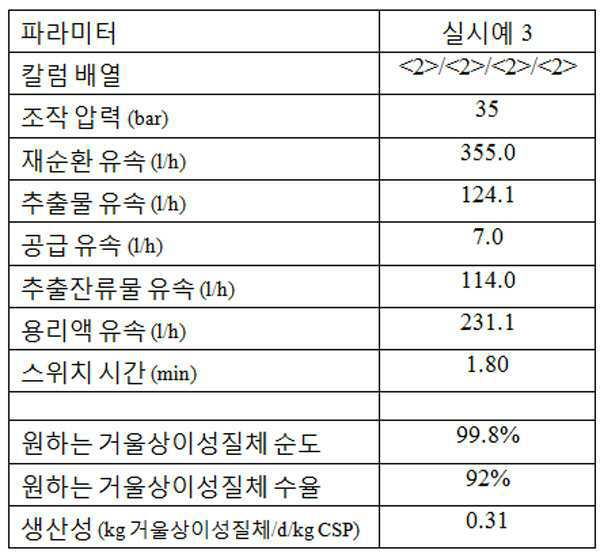
실시예 4: 100 g 규모Example 4: 100 g scale
칼럼: (S,S) Whelk-O® 1Column: (S, S) Whelk-O ® 1
이동상 메틸-tert-부틸 에테르Mobile Phase Methyl- tert -Butyl Ether
칼럼 길이 10.0 cmColumn length 10.0 cm
칼럼 ID 10 mmColumn ID 10 mm
칼럼의 수 8Number of columns 8
공급 농도 90 g/lFeed concentration 90 g / l
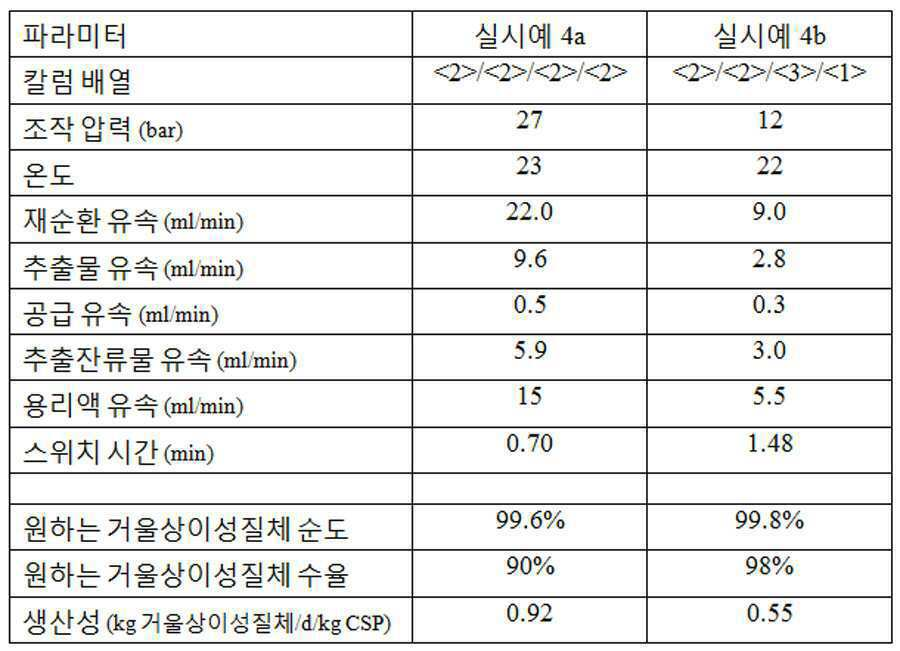
(3 R )-시클로펜틸-3-[4-(7 H -피롤로[2,3- d ]피리미딘-4-일)피라졸-1-일]프로피오니트릴 (( R )-12, 유리 염기). 방법 A. 아세토니트릴 (4.5 L) 중 (3R)-시클로펜틸-3-{4-[7-(2-트리메틸실라닐에톡시메틸)-7H-피롤로[2,3-d]피리미딘-4-일]피라졸-1-일}프로피오니트릴 ((R)-10, 463 g, 1.06 mol, 98.6% ee)의 용액에 물 (400 mL), 직후에 리튬 테트라플루오로보레이트 (LiBF4, 987.9 g, 10.5 mol, 10.0 당량)을 실온에서 첨가했다. 반응 온도는 물의 첨가시 실온에서 12℃로 감소하는 것이 관찰되었고, 그 다음, 리튬 테트라플루오로보레이트 (LiBF4)의 첨가 동안에 33℃로 상승했다. 수득한 반응 혼합물을 밤새 가열 환류했다 (약 80℃). 분취량을 에틸 아세테이트/물로 급냉하고, LCMS 및 TLC (95 : 5 에틸 아세테이트/메탄올, v/v)로 점검했다. LCMS 및 TLC 분석이 히드록실 메틸 중간체 ((R)-11) 및 완전 탈보호된 물질 ((R)-12, 유리 염기) 모두는 생성되지만, 개시물질 ((R)-10)은 남아 있는 것을 보여주었을 때, 반응 혼합물을 < 5℃로 점차 냉각한 후, 수산화암모늄 (NH4OH, 450 mL)의 20% 수성 용액을 점차 첨가하여 반응 혼합물의 pH를 9로 조정했다 (pH 스트립으로 확인). 냉각 배쓰를 제거하고, 반응 혼합물을 실온으로 점차 따뜻하게 하고, 실온에서 밤새 교반했다. 분취량을 에틸 아세테이트/물에 급냉하고, LCMS 및 TLC (95 : 5 에틸 아세테이트/메탄올, v/v)로 점검하여 완전한 탈보호를 확인했다. LCMS 및 TLC이 반응의 완료를 보여주었을 때, 반응 혼합물을 여과하고, 고형물을 아세토니트릴 (1 L)로 세정했다. 그 다음, 조합된 여과물을 감압 하에서 농축하고, 잔여물을 에틸 아세테이트 (6 L) 및 반-포화된 염수 (3 L) 사이에서 분할했다. 2개의 층을 분리하고, 수성 층을 에틸 아세테이트 (2 L)로 추출했다. 조합된 유기 층을 반-포화된 중탄산나트륨 (NaHCO3, 3 L) 및 염수 (3 L)로 세정하고, 황산나트륨 (Na2SO4) 상에서 건조시키고, 감압 하에서 농축하여 조 생성물을 오렌지색 오일로서 얻었다. 그 다음, 조 물질을 플래시 칼럼 크로마토그래피 (SiO2, 40 내지 100% 에틸 아세테이트/헵탄 구배 용리)로 정제하여 (3R)-시클로펜틸-3-[4-(7H-피롤로[2,3-d]피리미딘-4-일)피라졸-1-일]프로피오니트릴 ((R)-12, 유리 염기, 273 g, 324.9 g 이론적, 84% 수율)을 백색 폼으로서 얻었다. 이 물질을 19F NMR로 점검하여 리튬 테트라플루오로보레이트 (LiBF4)이 남아 있지 않음을 확인했고, 키랄 HPLC (Chiralcel® OD-H, 90:10 헥산/에탄올)로 거울상이성질체 순도 (98.7% ee)을 확인했고, 추가 정제없이 사용하여 상응하는 포스페이트 염을 제조했다. (R)-12 (유리 염기)에 대해: 1H NMR (DMSO-d 6, 400 MHz) δ ppm 12.1 (bs, 1H), 8.80 (d, 1H, J = 0.42 Hz), 8.67 (s, 1H), 8.37 (s, 1H), 7.59 (dd, 1H, J = 2.34, 3.51 Hz), 6.98 (dd, 1H, J = 1.40, 3.44 Hz), 4.53 (td, 1H, J = 19.5, 4.63 Hz), 3.26 (dd, 1H, J = 9.77, 17.2 Hz), 3.18 (dd, 1H, J = 4.32, 17.3 Hz), 2.40 (m, 1H), 1.79 (m, 1H), 1.65 내지 1.13 (m, 7H); C17H18N6 (분자량: 306.37) LCMS (EI) m/e 307 (M+ + H). (3 R) - cyclopentyl -3- [4- (7 H - pyrrolo [2,3- d] pyrimidin-4-yl) pyrazol-1-yl] propionitrile ((R) -12, Free base). Method A. acetonitrile (4.5 L) of (3 R) - Cyclopentyl-3- {4- [7- (2-trimethylsilanyl-ethoxymethyl to carbonyl) -7 H - pyrrolo [2,3- d] pyrimidin Midin-4-yl] pyrazol-1-yl} propionitrile (( R ) -10 , 463 g, 1.06 mol, 98.6% ee) in a solution of water (400 mL), followed immediately by lithium tetrafluoroborate ( LiBF 4 , 987.9 g, 10.5 mol, 10.0 equiv) was added at room temperature. The reaction temperature was observed to decrease from room temperature to 12 ° C. upon addition of water, then rose to 33 ° C. during the addition of lithium tetrafluoroborate (LiBF 4 ). The resulting reaction mixture was heated to reflux overnight (about 80 ° C.). Aliquots were quenched with ethyl acetate / water and checked by LCMS and TLC (95: 5 ethyl acetate / methanol, v / v). LCMS and TLC analysis showed that both the hydroxyl methyl intermediate (( R ) -11 ) and the fully deprotected material (( R ) -12 , free base) were produced, but the initiator (( R ) -10 ) remained. As shown, the reaction mixture was gradually cooled to <5 ° C., and then the pH of the reaction mixture was adjusted to 9 by gradually adding 20% aqueous solution of ammonium hydroxide (NH 4 OH, 450 mL) (identified by pH strip). . The cold bath was removed and the reaction mixture was gradually warmed to room temperature and stirred overnight at room temperature. Aliquots were quenched in ethyl acetate / water and checked by LCMS and TLC (95: 5 ethyl acetate / methanol, v / v) to confirm complete deprotection. When LCMS and TLC showed the reaction was completed, the reaction mixture was filtered and the solid was washed with acetonitrile (1 L). The combined filtrates were then concentrated under reduced pressure and the residue was partitioned between ethyl acetate (6 L) and semi-saturated brine (3 L). The two layers were separated and the aqueous layer was extracted with ethyl acetate (2 L). The combined organic layers were washed with semi-saturated sodium bicarbonate (NaHCO 3 , 3 L) and brine (3 L), dried over sodium sulfate (Na 2 SO 4 ) and concentrated under reduced pressure to afford the crude product as an orange oil. . The crude material was then purified by flash column chromatography (SiO 2 , 40-100% ethyl acetate / heptane gradient eluting) to give (3 R ) -cyclopentyl-3- [4- (7 H -pyrrolo [2, 3- d ] pyrimidin-4-yl) pyrazol-1-yl] propionitrile (( R ) -12 , free base, 273 g, 324.9 g theoretical, 84% yield) was obtained as a white foam. This material was checked by 19 F NMR to confirm that no lithium tetrafluoroborate (LiBF 4 ) remained, and enantiomeric purity (98.7% ee by chiral HPLC (Chiralcel ® OD-H, 90:10 hexanes / ethanol)) ) And used without further purification to prepare the corresponding phosphate salt. For ( R ) -12 (free base): 1 H NMR (DMSO- d 6 , 400 MHz) δ ppm 12.1 (bs, 1H), 8.80 (d, 1H, J = 0.42 Hz), 8.67 (s, 1H ), 8.37 (s, 1H), 7.59 (dd, 1H, J = 2.34, 3.51 Hz), 6.98 (dd, 1H, J = 1.40, 3.44 Hz), 4.53 (td, 1H, J = 19.5, 4.63 Hz) , 3.26 (dd, 1H, J = 9.77, 17.2 Hz), 3.18 (dd, 1H, J = 4.32, 17.3 Hz), 2.40 (m, 1H), 1.79 (m, 1H), 1.65 to 1.13 (m, 7H ); C 17 H 18 N 6 (molecular weight: 306.37) LCMS (EI) m / e 307 (M + + H).

( R )-3-(4-(7 H -피롤로[2,3- d ]피리미딘-4-일)-1H-피라졸-1-일)-3-시클로펜틸프로판니트릴 ( R )-10. 아세토니트릴 (600 mL) 중 (R)-3-시클로펜틸-3-(4-(7-((2-(트리메틸실릴)에톡시)메틸)-7H-피롤로[2,3-d]피리미딘-4-일)-1H-피라졸-1-일)프로판니트릴 ((R)-10, 75.0 g, 0.172 mol, 98.8% ee)의 용액을 0 - 5℃로 냉각시켰다. 냉각된 용액에, 내부 반응 온도를 5℃ 미만으로 유지하면서 붕소 트리플루오라이드 디에틸 에테레이트 (54.4 mL, 0.429 mol)을 10분에 걸쳐 첨가했다. 상기 첨가 다음에, 차가운 배쓰를 제거하고, 반응 혼합물을 실온으로 따뜻하게 했다. HPLC 분석이, (R)-10의 수준이 1% 미만이라는 것을 나타낼 때, 탈보호 반응의 초기 상은 완료된 것으로 생각되었다. 그 다음, 반응을 0 - 5℃로 냉각시키고, 그 다음 물 (155 mL)을 서서히 첨가했다. 물의 첨가 다음에, 차가운 배쓰를 제거하고, 수득한 반응 혼합물을 13 - 17℃로 따뜻하게 하고, 추가 2 - 3시간 동안 교반했다. 수득한 반응 혼합물을 0 - 5℃로 다시 냉각했다. 냉각된 반응 혼합물에, 내부 반응 온도를 5℃ 미만에서 유지하면서 [수성 28% 암모니아 용액 (104.5 mL) 및 물 (210.5 mL)의 혼합으로 제조된] 물 중 암모니아의 용액을 서서히 첨가했다. 암모니아 수용액을 첨가한 후 차가운 배쓰를 제거하고, 반응을 실온으로 따뜻하게 했다. 가수분해는, 히드록실메틸 중간체의 수준이 HPLC 분석에 의해 1% 미만이었을 때 완료된 것으로 보였다. (R) -3- (4- (7 H - pyrrolo [2,3- d] pyrimidin-4-yl) -1H- pyrazol-1-yl) -3-cyclopentyl-propanenitrile (R) - 10. (R) in acetonitrile (600 mL) -3-cyclopentyl-3- (4- (7-ethoxy) methyl) -7 H a ((2- (trimethylsilyl) -pyrrolo [2,3- d] A solution of pyrimidin-4-yl) -1 H -pyrazol-1-yl) propanenitrile (( R ) -10 , 75.0 g, 0.172 mol, 98.8% ee) was cooled to 0-5 ° C. To the cooled solution, boron trifluoride diethyl etherate (54.4 mL, 0.429 mol) was added over 10 minutes while maintaining the internal reaction temperature below 5 ° C. After the addition, the cold bath was removed and the reaction mixture was allowed to warm to room temperature. When HPLC analysis indicated that the level of ( R ) -10 was less than 1%, the initial phase of the deprotection reaction was considered complete. Then the reaction was cooled to 0-5 ° C. and then water (155 mL) was added slowly. After addition of water, the cold bath was removed and the resulting reaction mixture was warmed to 13-17 ° C. and stirred for an additional 2-3 hours. The resulting reaction mixture was cooled back to 0-5 ° C. To the cooled reaction mixture was slowly added a solution of ammonia in water [prepared with a mixture of aqueous 28% ammonia solution (104.5 mL) and water (210.5 mL)] while maintaining the internal reaction temperature below 5 ° C. After adding an aqueous ammonia solution, the cold bath was removed and the reaction was allowed to warm to room temperature. Hydrolysis appeared to be complete when the level of hydroxylmethyl intermediate was less than 1% by HPLC analysis.
수득한 반응 혼합물을 에틸 아세테이트 (315 mL)로 희석하고, 20% 염수 (315 mL)로 세정했다. 수성 분획을 back 에틸 아세테이트 (315 mL)로 역추출했다. 유기 분획을 조합하고, 40℃의 배쓰 온도로 진공 하에서 용적 380 mL로 농축했다. 농축 잔여물을 에틸 아세테이트 (600 mL)로 희석하고, 1M NaHCO3 (2×345 mL) 및 20% 염수 (345 mL)로 세정했다. 수성 세정물을 조합하고, 에틸 아세테이트 (345 mL)로 역추출했다. 유기 분획을 조합하고, 광택물을 깨끗한 2L 둥근바닥플라스크로 여과했다. 유기 분획을 온수 (50℃, 2×450 mL)로 세정하고, 그 다음 1.5시간 동안 교반하면서, 활성탄으로 65℃에서 처리했다. 슬러리를 셀라이트 패드를 통해 여과했다. 여과물을 진공 하에서 40℃의 배쓰 온도로 농축했다. 수득한 시럽을 고진공 하에서 두고, 이로써 (R)-3-(4-(7H-피롤로[2,3-d]피리미딘-4-일)-1H-피라졸-1-일)-3-시클로펜틸프로판니트릴 [(R)-12, 54.2g, 103% 수율]을 담확색 폼으로서 얻었다. 이 물질을 19F NMR로 점검하여 생성물이 임의의 불소화된 불순물에 의해 오염되지 않았다는 것을 확인했다. 분리된 유리 염기의 화학 순도는 96.3%였다. 유리 염기의 키랄 순도는 키랄 HPLC (chiralcel OD, 90:10 헥산/에탄올)로 98.8%였다. 유리 염기를 추가 정제없이 사용하여 포스페이트 염을 제조했다. 1H NMR (DMSO-d6, 400 MHz) δ 12.11(bs, 1H), 8.79(d, 1H, J=0.43 Hz), 8.67(s, 1H), 8.37(s, 1H), 7.59(q, 1H, J=2.3 Hz), 6.98(q, 1H, J=1.6 Hz), 4.53(td, 1H, J=19.2, 4.1 Hz), 3.22(dq, 2H, J=9.8, 4.3 Hz), 2.40(m, 1H), 1.79(m, 1H), 1.65-1.13(m, 7H). C17H16N6 (분자량: 306.37), LCMS (EI) m/e 307 (M+ + H).The resulting reaction mixture was diluted with ethyl acetate (315 mL) and washed with 20% brine (315 mL). The aqueous fractions were back extracted with back ethyl acetate (315 mL). The organic fractions were combined and concentrated to 380 mL in volume under vacuum at a bath temperature of 40 ° C. The concentrated residue was diluted with ethyl acetate (600 mL) and washed with 1M NaHCO 3 (2 × 345 mL) and 20% brine (345 mL). The aqueous washes were combined and back extracted with ethyl acetate (345 mL). The organic fractions were combined and the polish was filtered through a clean 2 L round bottom flask. The organic fraction was washed with hot water (50 ° C., 2 × 450 mL) and then treated with activated charcoal at 65 ° C. with stirring for 1.5 h. The slurry was filtered through a pad of celite. The filtrate was concentrated in vacuo to a bath temperature of 40 ° C. With the syrup obtained under high vacuum, whereby (R) -3- (4- (7 H - pyrrolo [2,3- d] pyrimidin-4-yl) -1H- pyrazol-1-yl) -3 Cyclopentylpropanenitrile [( R ) -12 , 54.2 g, 103% yield] was obtained as a pale dark foam. This material was checked by 19 F NMR to confirm that the product was not contaminated by any fluorinated impurities. The chemical purity of the isolated free base was 96.3%. The chiral purity of the free base was 98.8% by chiral HPLC (chiralcel OD, 90:10 hexanes / ethanol). The free base was used without further purification to prepare the phosphate salt. 1 H NMR (DMSO-d 6 , 400 MHz) δ 12.11 (bs, 1H), 8.79 (d, 1H, J = 0.43 Hz), 8.67 (s, 1H), 8.37 (s, 1H), 7.59 (q, 1H, J = 2.3 Hz), 6.98 (q, 1H, J = 1.6 Hz), 4.53 (td, 1H, J = 19.2, 4.1 Hz), 3.22 (dq, 2H, J = 9.8, 4.3 Hz), 2.40 ( m, 1H), 1.79 (m, 1H), 1.65-1.13 (m, 7H). C 17 H 16 N 6 (molecular weight : 306.37), LCMS (EI) m / e 307 (M + + H).

(3 R )-시클로펜틸-3-[4-(7 H -피롤로[2,3- d ]피리미딘-4-일)피라졸-1-일]프로피오니트릴 포스페이트 염 (( R )-13, 포스페이트). 방법 A. 이소프로판올 (IPA, 8 L) 중 (3R)-시클로펜틸-3-[4-(7H-피롤로[2,3-d]피리미딘-4-일)피라졸-1-일]프로피오니트릴 ((R)-12, 유리 염기, 572 g, 1.87 mol)의 용액에 60 - 65℃에서 이소프로판올 (1.6 L) 중 인산 (186.2 g, 1.9 mol, 1.10 당량)의 용액을 첨가했다. 인산 용액의 첨가 동안에 발열은 관찰되지 않았고, 침전물이 거의 즉시 형성되었다. 그 다음, 수득한 혼합물을 76℃에서 1.5시간 동안 가열하고, 그 다음, 주위 온도로 점차 냉각시키고, 실온에서 밤새 교반했다. 혼합물을 여과하고, 고형물을 헵탄 및 이소프로판올 (1/1, v/v, 3 L)의 혼합물로 세정한 후, 최초 플라스크로 다시 이동시키고, 헵탄 (8 L)에서 1시간 동안 교반했다. 고형물을 여과로 수집하고, 헵탄 (1 L)으로 세정하고, 대류 오븐에서 진공에서 40℃에서 일정 중량으로 건조시켜서 (3R)-시클로펜틸-3-[4-(7H-피롤로[2,3-d]피리미딘-4-일)피라졸-1-일]프로피오니트릴 포스페이트 염 ((R)-13, 포스페이트, 634.2 g, 755 g 이론적, 84% 수율)을 백색 내지 회백색 결정성 고형물로서 얻었다. (R)-13, 포스페이트에 대해: mp. 197.6℃; 1H NMR (DMSO-d 6, 500 MHz) δ ppm 12.10 (s, 1H), 8.78 (s, 1H), 8.68 (s, 1H), 8.36 (s 1H), 7.58 (dd, 1H, J = 1.9, 3.5 Hz), 6.97 (d, 1H, J = 3.6 Hz), 4.52 (td, 1H, J = 3.9, 9.7 Hz), 3.25 (dd, 1H, J = 9.8, 17.2 Hz), 3.16 (dd, 1H, J = 4.0, 17.0 Hz), 2.41, (m, 1H), 1.79 (m, 1H), 1.59 (m, 1H), 1.51 (m, 2H), 1.42 (m, 1H), 1.29 (m, 2H), 1.18 (m, 1H); 13C NMR (DMSO-d 6, 125 MHz) δ ppm 152.1, 150.8, 149.8, 139.2, 131.0, 126.8, 120.4, 118.1, 112.8, 99.8, 62.5, 44.3, 29.1, 29.0, 24.9, 24.3, 22.5; C17H18N6 (분자량: 306.37, 유리 염기에 대해) LCMS (EI) m/e 307 (M+ + H, 염기 피크), 329.1 (M+ + Na). (3 R) - cyclopentyl -3- [4- (7 H - pyrrolo [2,3- d] pyrimidin-4-yl) pyrazol-1-yl] propionitrile phosphate salt ((R) - 13, phosphate). Method A. isopropanol (IPA, 8 L) of (3 R) - cyclopentyl -3- [4- (7 H - pyrrolo [2,3- d] pyrimidin-4-yl) pyrazol-1-yl ] To a solution of propionitrile (( R ) -12 , free base, 572 g, 1.87 mol) was added a solution of phosphoric acid (186.2 g, 1.9 mol, 1.10 equiv) in isopropanol (1.6 L) at 60-65 ° C. . No exotherm was observed during the addition of the phosphoric acid solution, and a precipitate formed almost immediately. The resulting mixture was then heated at 76 ° C. for 1.5 h, then gradually cooled to ambient temperature and stirred at rt overnight. The mixture was filtered and the solid was washed with a mixture of heptane and isopropanol (1/1, v / v, 3 L), then transferred back to the original flask and stirred for 1 h in heptane (8 L). The solid was collected by filtered and washed with heptane (1 L), dried in a convection oven to a constant weight in vacuo at 40 ℃ (3 R) - cyclopentyl -3- [4- (7 H - pyrrolo [2 , 3- d ] pyrimidin-4-yl) pyrazol-1-yl] propionitrile phosphate salt (( R ) -13, phosphate , 634.2 g, 755 g theoretical, 84% yield) white to off-white crystalline Obtained as a solid. ( R ) -13 , for phosphate : mp. 197.6 ° C .; 1 H NMR (DMSO- d 6 , 500 MHz) δ ppm 12.10 (s, 1H), 8.78 (s, 1H), 8.68 (s, 1H), 8.36 (s 1H), 7.58 (dd, 1H, J = 1.9 , 3.5 Hz), 6.97 (d, 1H, J = 3.6 Hz), 4.52 (td, 1H, J = 3.9, 9.7 Hz), 3.25 (dd, 1H, J = 9.8, 17.2 Hz), 3.16 (dd, 1H , J = 4.0, 17.0 Hz), 2.41, (m, 1H), 1.79 (m, 1H), 1.59 (m, 1H), 1.51 (m, 2H), 1.42 (m, 1H), 1.29 (m, 2H ), 1.18 (m, 1 H); 13 C NMR (DMSO- d 6 , 125 MHz) δ ppm 152.1, 150.8, 149.8, 139.2, 131.0, 126.8, 120.4, 118.1, 112.8, 99.8, 62.5, 44.3, 29.1, 29.0, 24.9, 24.3, 22.5; C 17 H 18 N 6 (molecular weight: 306.37, for the free base) LCMS (EI) m / e 307 (M + + H, base peak), 329.1 (M + + Na ).
방법 B. 디클로로메탄 (782 mL) 및 2-프로판올 (104 mL) 중 (R)-3-(4-(7H-피롤로[2,3-d]피리미딘-4-일)-1H-피라졸-1-일)-3-시클로펜틸프로판니트릴 ((R)-12,, 54.2 g, 177 mol)의 용액에 환류에서 2-프로판올 (34.0 mL) 중 인산 (19.9 g, 0.173 mol, 1.15 당량)의 용액을 47분에 걸쳐 첨가했다. 산 첨가 다음에, 수득한 혼합물을 환류 추가 1시간 동안에 가열 환류했다. 혼합물을 주위 온도로 점차 냉각시키고, 3시간 동안 교반했다. 고형물을 여과로 수집하고, 디클로로메탄 (390 mL), 그 다음 n-헵탄 (390 mL)로 세정했다. 고형물을 진공 하에서 실온에서 부분 건조시키고, 그 다음, 진공 하에서 62℃에서 부분 건조하여 (R)-3-(4-(7H-피롤로[2,3-d]피리미딘-4-일)-1H-피라졸-1-일)-3-시클로펜틸프로판니트릴 포스페이트 (, 60.1g, 84% 수율)을 백색 내지 회백색 결정성 고형물로서 얻었다. 키랄 HPLC (chiralcel OD, 90:10 헥산/에탄올)에 의한 분석으로 거울상 이성질체 순도를 99.2% ee로서 얻었다. 1H NMR (DMSO-d6, 400 MHz) δ 12.11(bs, 1H), 8.79(d, 1H, J=0.59 Hz), 8.67(s, 1H), 8.36(s, 1H), 7.59(q, 1H, J=2.3 Hz), 6.98(q, 1H, J=1.6 Hz), 4.53(td, 1H, J=19.6, 4.4 Hz), 3.22(dq, 2H, J=9.6, 4.3 Hz), 2.40(m, 1H), 1.79(m, 1H), 1.65-1.13(m, 7H). C17H21N6O4P (분자량: 404.36), LCMS (EI) m/e 307 (M+ + H) 및 m/e 329 (M+ + Na). Method B. Dichloromethane (782 mL) and 2-propanol (104 mL) of (R) -3- (4- (7 H - pyrrolo [2,3- d] pyrimidin-4-yl) -1 H - pyrazol -1-yl) -3-cyclopentylpropanenitrile To a solution of (( R ) -12 ,, 54.2 g, 177 mol) was added a solution of phosphoric acid (19.9 g, 0.173 mol, 1.15 equiv) in 2-propanol (34.0 mL) at reflux over 47 minutes. After acid addition, the resulting mixture was heated to reflux for an additional 1 hour at reflux. The mixture was gradually cooled to ambient temperature and stirred for 3 hours. The solid was collected by filtration, washed with dichloromethane (390 mL), then n-heptane (390 mL). The solid part under vacuum and dried at room temperature, is then partially dried at 62 ℃ under vacuum (R) -3- (4- (7 H - pyrrolo [2,3- d] pyrimidin-4-yl) -1 H -pyrazol-1-yl) -3-cyclopentylpropanenitrile phosphate (, 60.1 g, 84% yield) was obtained as a white to off-white crystalline solid. Analysis by chiral HPLC (chiralcel OD, 90:10 hexanes / ethanol) gave enantiomeric purity as 99.2% ee. 1 H NMR (DMSO-d 6 , 400 MHz) δ 12.11 (bs, 1H), 8.79 (d, 1H, J = 0.59 Hz), 8.67 (s, 1H), 8.36 (s, 1H), 7.59 (q, 1H, J = 2.3 Hz), 6.98 (q, 1H, J = 1.6 Hz), 4.53 (td, 1H, J = 19.6, 4.4 Hz), 3.22 (dq, 2H, J = 9.6, 4.3 Hz), 2.40 ( m, 1H), 1.79 (m, 1H), 1.65-1.13 (m, 7H). C 17 H 21 N 6 O 4 P (Molecular weight : 404.36), LCMS (EI) m / e 307 (M + + H) and m / e 329 (M + + Na).

( R )-3-(4-(7 H -피롤로[2,3- d ]피리미딘-4-일)-1 H -피라졸-1-일)-3-시클로펜틸프로판니트릴 포스페이트. 교반 하, 증류 헤드, 추가 깔때기 및 가열 맨틀이 구비된 1L 둥근바닥플라스크에, were 메탄올 (520 mL) 및 (R)-3-(4-(7H-피롤로[2,3-d]피리미딘-4-일)-1H-피라졸-1-일)-3-시클로펜틸프로판니트릴 포스페이트 (( R )-13, 포스페이트, 40.0 grams, 98.92 mmol)을 충전했다. 슬러리를 55℃로 가열하여 약간의 핑크색 용액을 얻었다. 용액을 50℃로 냉각시키고, 오버헤드 교반기, 증류 헤드, 추가 깔때기 및 가열 맨틀이 구비된 2L 플라스크에 충전했다. 1L 둥근바닥플라스크 및 필터 깔때기를 추가 메탄올 (104.0 mL)로 헹구었다. 여과물 용액을 가열 환류하여 메탄올 (281 mL)을 1시간에 걸쳐 대기압 하에서 증류했다. 이소프로필 알콜 (IPA) (320 mL)을, 내부 온도를 대략 65℃에서 유지하면서 추가 깔때기를 통해 80분에 걸쳐 서서히 충전했다. 포스페이트 염의 정제가 IPA 첨가 동안에 관찰되었다. IPA의 첨가 완료 후, n-헵탄 (175 mL)을 동일한 온도에서 서서히 첨가했다. 대기압 하에서 증류를 계속했다. 추가 n-헵탄 (825 mL)을, 내부 온도를 대략 65℃에서 유지하면서 증류 속도와 대략 동일한 속도로 첨가했다. 증류를, 증류물의 용적이 742 mL (이전 증류로부터의 281 mL 용적의 메탄올 제외)에 도달했을 때 완료했다. 증류는 대략 1시간 걸렸다. 증류 동안의 증기 온도는 54 - 64℃의 범위이고, 내부 온도는 증류 말기에 67℃였다. 혼합물을 서서히 실온으로 냉각시키고, 추가 3시간 동안 교반했다. 고형물을 여과로 수집했다. 습윤 케이크를 n-헵탄 (384.0 mL) 중 16.7% (v/v)의 이소프로필 알콜, 그 다음 n-헵탄 (280.0 mL)로 세정하고, 진공 하에서 55℃에서 건조시켜 36.1 그램의 원하는 생성물을 백색 고형물로서 90% 수율로 얻었다. 화학 순도는 HPLC 분석으로 99.79%였다. 키랄 순도는 키랄 HPLC 분석에 의해 99.8%였다. 1H NMR (499.7 MHz, DMSO-d6) δ (ppm): 12.21 (s, 1H), 10.71 (s, 3H), 8.80 (s, 1H), 8.72 (s, 1H), 8.40 (s, 1H), 7.60 (d, J = 3.5 Hz, 1H), 7.00 (d, J = 3.5 Hz, 1H), 4.51 (td, J = 9.75, 4.0 Hz, 1H), 3.25 (dd, J = 17.3, 9.75 Hz, 1H), 3.14 (dd, J = 17.0, 4.0 Hz, 1H), 2.43-2.35 (m, 1H), 1.79-1.73 (m, 1H), 1.58-1.42 (m, 3H), 1.41-1.33 (m, 1H), 1.30-1.23 (m, 2H), 1.19-1.12 (m, 1H); 13C NMR (125.7 MHz, DMSO-d6) δ (ppm): 152.8, 151.2, 150.3, 140.0, 131.8, 127.7, 120.8, 118.8, 113.5, 100.7, 63.3, 45.0, 29.8, 25.6, 25.0, 23.2; LCMS m/z: C17H18N6 에 대한 계산치 (M+H)+: = 307.2. 실측치 (M+H)+: 307.0. (R) -3- (4- (7 H - pyrrolo [2,3- d] pyrimidin-4-yl) -1 H - pyrazol-1-yl) -3-cyclopentyl-phosphate propane nitrile. Under stirring, in a 1 L round bottom flask equipped with a distillation head, additional funnel and heating mantle were methanol (520 mL) and ( R ) -3- (4- (7 H -pyrrolo [2,3- d ] pyrides Midin-4-yl) -1H-pyrazol-1-yl) -3-cyclopentylpropanenitrile phosphate ( ( R ) -13 , phosphate, 40.0 grams, 98.92 mmol) was charged. The slurry was heated to 55 ° C. to give a slight pink solution. The solution was cooled to 50 ° C. and charged into a 2 L flask equipped with an overhead stirrer, distillation head, additional funnel and heating mantle. The 1 L round bottom flask and filter funnel were rinsed with additional methanol (104.0 mL). The filtrate solution was heated to reflux to distill methanol (281 mL) under atmospheric pressure over 1 hour. Isopropyl alcohol (IPA) (320 mL) was slowly charged over 80 minutes via an additional funnel while maintaining the internal temperature at approximately 65 ° C. Purification of the phosphate salt was observed during the IPA addition. After the addition of IPA was completed, n -heptane (175 mL) was added slowly at the same temperature. Distillation was continued under atmospheric pressure. Additional n -heptane (825 mL) was added at approximately the same rate as the distillation rate while maintaining the internal temperature at approximately 65 ° C. Distillation was completed when the volume of the distillate reached 742 mL (excluding 281 mL volume of methanol from the previous distillation). Distillation took approximately 1 hour. The steam temperature during the distillation ranged from 54-64 ° C. and the internal temperature was 67 ° C. at the end of distillation. The mixture was slowly cooled to room temperature and stirred for an additional 3 hours. Solids were collected by filtration. The wet cake was washed with 16.7% (v / v) isopropyl alcohol in n-heptane (384.0 mL), then n-heptane (280.0 mL) and dried at 55 ° C. under vacuum to give 36.1 grams of the desired product as white Obtained in 90% yield as a solid. Chemical purity was 99.79% by HPLC analysis. Chiral purity was 99.8% by chiral HPLC analysis. 1 H NMR (499.7 MHz, DMSO-d6) δ (ppm): 12.21 (s, 1H), 10.71 (s, 3H), 8.80 (s, 1H), 8.72 (s, 1H), 8.40 (s, 1H) , 7.60 (d, J = 3.5 Hz, 1H), 7.00 (d, J = 3.5 Hz, 1H), 4.51 (td, J = 9.75, 4.0 Hz, 1H), 3.25 (dd, J = 17.3, 9.75 Hz, 1H), 3.14 (dd, J = 17.0, 4.0 Hz, 1H), 2.43-2.35 (m, 1H), 1.79-1.73 (m, 1H), 1.58-1.42 (m, 3H), 1.41-1.33 (m, 1H), 1.30-1.23 (m, 2H), 1.19-1.12 (m, 1H); 13 C NMR (125.7 MHz, DMSO-d6) δ (ppm): 152.8, 151.2, 150.3, 140.0, 131.8, 127.7, 120.8, 118.8, 113.5, 100.7, 63.3, 45.0, 29.8, 25.6, 25.0, 23.2; LCMS m / z : Calcd for C 17 H 18 N 6 (M + H) + : = 307.2. Found (M + H) + : 307.0.

4-(1 H -피라졸-4-일)-7-(2-트리메틸실라닐에톡시메틸)-7 H -피롤로[2,3- d ]피리미딘 (5). 방법 B. 오버헤드 교반기, 콘덴서, 서모웰, 및 질소 주입구가 구비된 반응기에 4-(4,4,5,5-테트라메틸-1,3,2-디옥사보롤란-2-일) -1H-피라졸 (4, 600 g, 3.09 mol), 톨루엔 (4.2 L), 및 에틸 비닐 에테르 (334.5 g, 4.64 mol, 0.44 L, 1.50 당량)을 실온에서 충전한 후, 디에틸 에테르 (39 mL, 0.078 mol, 0.025 당량) 중 2 M HCl의 용액을 적가했다. 수득한 반응 혼합물을 35 - 40℃로 4 - 8시간 동안 가열했다. HPLC 분석이 반응의 완료를 보여주었을 때, 반응 혼합물을 15 - 25℃로 냉각한 후, 수성 NaHCO3 용액으로 처리하여 pH > 8로 만들었다. 2개의 층을 분리하고, 유기 층을 감압 하에서 농축하여 조 1-(1-에톡시에틸)-4-(4,4,5,5-테트라메틸-1,3,2-디옥사보롤란-2-일)-1H-피라졸 (14)을 얻었고, 이를 추가 정제없이 차후의 스즈끼 커플링 반응에서 직접 사용했다. 4- (1 H - pyrazol-4-yl) -7- (2-trimethylsilanyl ethoxymethyl) -7 H - pyrrolo [2,3- d] pyrimidine-5. Method B. 4- (4,4,5,5-tetramethyl-1,3,2-dioxaborolan-2-yl) in a reactor equipped with an overhead stirrer, a condenser, a thermowell, and a nitrogen inlet; 1 H -pyrazole ( 4 , 600 g, 3.09 mol), toluene (4.2 L), and ethyl vinyl ether (334.5 g, 4.64 mol, 0.44 L, 1.50 equiv) were charged at room temperature followed by diethyl ether (39 mL, 0.078 mol, 0.025 equiv) was added dropwise to a solution of 2 M HCl. The resulting reaction mixture was heated to 35-40 ° C. for 4-8 hours. When HPLC analysis showed the completion of the reaction, the reaction mixture was cooled to 15-25 ° C. and then treated with aqueous NaHCO 3 solution to pH> 8. The two layers were separated and the organic layer was concentrated under reduced pressure to afford crude 1- (1-ethoxyethyl) -4- (4,4,5,5-tetramethyl-1,3,2-dioxaborolane- 2-yl) -1 H -pyrazole ( 14 ) was obtained and used directly in the subsequent Suzuki coupling reaction without further purification.
오버헤드 교반기, 콘덴서, 서모웰, 및 질소 주입구가 구비된 반응기에 물 (H2O, 1.5 L), 탄산칼륨 (K2CO3, 1047 g, 7.58 mol, 2.45 당량), 4-클로로-7-(2-트리메틸실라닐에톡시메틸)-7H-피롤로[2,3-d]피리미딘 (3a, 755 g, 2.66 mol), 상기에 기재된 바와 같이 제조된 조 1-(1-에톡시에틸)-4-(4,4,5,5-테트라메틸-1,3,2-디옥사보롤란-2-일)-1H-피라졸 (14, 100% 전환율을 기준으로 822 g, 3.09 mol, 1.16 당량), 및 1-프로판올 (6 L)을 실온에서 충전했다. 수득한 반응 혼합물을, 매시간 질소로 역충전하면서 3회 탈가스한 후, 테트라키스(트리페닐포스핀)팔라듐(0) (9.2 g, 0.008 mol, 0.0026 당량)로 실온에서 처리했다. 수득한 반응 혼합물을 1 - 4시간 동안 부드럽게 가열 환류했다 (약 90℃). 반응이 HPLC에 의해 완료된 것으로 보였을 때, 반응 혼합물을 감압 하에서 농축하여 용매를 제거했다. 그 다음, 잔여물을 실온으로 냉각시키고, 에틸 아세테이트 (9 L) 및 물 (4 L)로 희석했다. 2개의 층을 분리하고, 수성 층을 에틸 아세테이트 (2×2.5 L)로 추출했다. 조합된 유기 층을 물 (2×2 L)로 세정하고, 감압 하에서 농축하여 조 4-(1-(1-에톡시에틸)-1H-피라졸-4-일)-7-((2-(트리메틸실릴)에톡시)메틸)-7H-피롤로[2,3-d]피리미딘 (15)를 얻었고, 이를 추가 정제없이 차후의 산 촉진 탈보호 반응에서 직접 사용했다.Water (H 2 O, 1.5 L), potassium carbonate (K 2 CO 3 , 1047 g, 7.58 mol, 2.45 equiv), 4-chloro-7 in a reactor equipped with an overhead stirrer, condenser, thermowell, and nitrogen inlet - (2-trimethylsilanyl-ethoxymethyl-a silanol carbonyl) -7 H - pyrrolo on [2,3- d] pyrimidine (3a, 755 g, 2.66 mol ), the crude 1- (1 prepared as described in the Methoxyethyl) -4- (4,4,5,5-tetramethyl-1,3,2-dioxaborolan-2-yl) -1 H -pyrazole (822 g based on 14, 100% conversion) , 3.09 mol, 1.16 equiv), and 1-propanol (6 L) were charged at room temperature. The obtained reaction mixture was degassed three times with backfilling with nitrogen every hour and then treated with tetrakis (triphenylphosphine) palladium (0) (9.2 g, 0.008 mol, 0.0026 equiv) at room temperature. The resulting reaction mixture was gently heated to reflux (about 90 ° C.) for 1-4 hours. When the reaction appeared to be complete by HPLC, the reaction mixture was concentrated under reduced pressure to remove the solvent. The residue was then cooled to rt and diluted with ethyl acetate (9 L) and water (4 L). The two layers were separated and the aqueous layer was extracted with ethyl acetate (2 × 2.5 L). The combined organic layers were washed with water (2 × 2 L) and concentrated under reduced pressure to afford crude 4- (1- (1-ethoxyethyl) -1 H -pyrazol-4-yl) -7-((2 - (trimethylsilyl) ethoxy) methyl) -7 H-pyrrolo [2,3- d] pyrimidine was 15. the obtained, without further purification directly in the promoted deprotection reaction of acid future.
오버헤드 교반기, 콘덴서, 서모웰, 및 질소 주입구가 구비된 반응기에 조 4-(1-(1-에톡시에틸)-1H-피라졸-4-일)-7-((2-(트리메틸실릴)에톡시)메틸)-7H-피롤로[2,3-d]피리미딘 (15, 100% 전환율을 기준으로 1030.9 g, 2.66 mol), 테트라히드로푸란 (THF, 0.9 L), 물 (H2O, 4.4 L), 및 10% 수성 HCl 용액 (2.7 L, 10.64 mol, 3.44 당량)을 실온에서 충전했다. 수득한 반응 혼합물을 실온에서 2 - 5시간 동안 교반했다. 반응이 HPLC 분석으로 완료된 것으로 보였을 때, 반응 혼합물을 30% 수성 수산화나트륨 (NaOH) 용액 (940 mL, 11.70 mol, 3.78 당량)으로 실온에서 처리했다. 수득한 반응 혼합물을 실온에서 1 내지 2시간 동안 교반했다. 고형물을 여과로 수집하고, 물 (2×0.75 L)로 세정하고, 진공 오븐에서 45 - 55℃에서 일정한 중량으로 건조하여 조 4-(1H-피라졸-4-일)-7-(2-트리메틸실라닐-에톡시메틸)-7H-피롤로[2,3-d]피리미딘 (5, 826.8 g, 839.1 g 이론적, 98.5% 수율)을 회백색 고형물 (94.2 면적% 순수, HPLC에 의해)로서 얻었다. 이 조 물질을 차후에 아세토니트릴에서 재결정화하여 순수한 화합물 5 (738.4 g, 839.1 g 이론적, 88% 수율)을 백색 결정 (99.5 면적%, HPLC에 의해)으로서 얻었고, 이는 방법 A로부터 만들어진 물질에 대해 모든 비교가능한 측면에서 동일한 것으로 발견되었다.In a reactor equipped with an overhead stirrer, a condenser, a thermowell, and a nitrogen inlet, crude 4- (1- (1-ethoxyethyl) -1 H -pyrazol-4-yl) -7-((2- (trimethyl pyrrolo [2,3- d] pyrimidine (15, 100%, based on the conversion rate 1030.9 g, 2.66 mol), tetrahydrofuran (THF, 0.9 L), water (-silyl) ethoxy) methyl) -7 H in H 2 O, 4.4 L), and 10% aqueous HCl solution (2.7 L, 10.64 mol, 3.44 equiv) were charged at room temperature. The resulting reaction mixture was stirred at room temperature for 2-5 hours. When the reaction appeared to be complete by HPLC analysis, the reaction mixture was treated with 30% aqueous sodium hydroxide (NaOH) solution (940 mL, 11.70 mol, 3.78 equiv) at room temperature. The resulting reaction mixture was stirred at rt for 1-2 h. The solids were collected by filtration, washed with water (2 × 0.75 L) and dried to constant weight at 45-55 ° C. in a vacuum oven to afford crude 4- (1 H -pyrazol-4-yl) -7- (2 -trimethylsilanyl-ethoxymethyl) -7 H-pyrrolo [2,3- d] pyrimidine (5, 826.8 g, 839.1 g theoretical, 98.5% yield) of an off white solid (94.2 area% pure by HPLC Obtained as This crude material was subsequently recrystallized in acetonitrile to give pure compound 5 (738.4 g, 839.1 g theoretical, 88% yield) as white crystals (99.5 area%, by HPLC), which was obtained for all materials made from Method A. The same was found to be comparable.
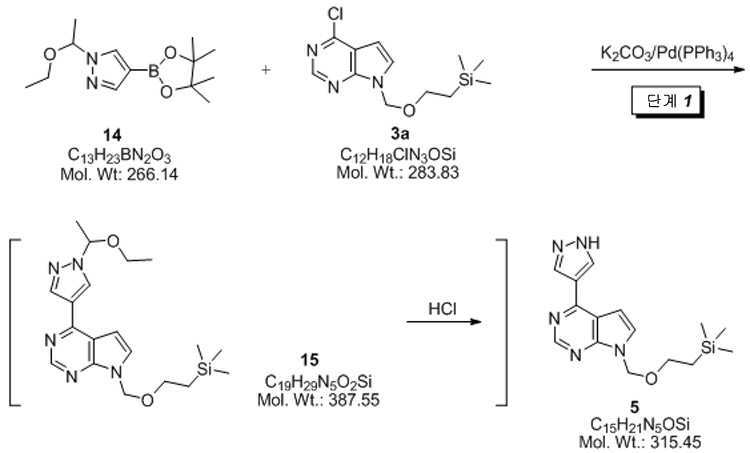
4-(1 H -피라졸-4-일)-7-(2-트리메틸실라닐에톡시메틸)-7 H -피롤로[2,3- d ]피리미딘 (5). 방법 C. 오버헤드 교반기, 콘덴서, 서모웰, 및 질소 주입구가 구비된 반응기에 물 (H2O, 9.0 L), 탄산칼륨 (K2CO3, 4461 g, 32.28 mol, 2.42 당량), 4-클로로-7-(2-트리메틸실라닐에톡시메틸)-7H-피롤로[2,3-d]피리미딘 (3a, 3597 g, 12.67 mol), 1-(1-에톡시에틸)-4-(4,4,5,5-테트라메틸-1,3,2-디옥사보롤란-2-일)-1H-피라졸 (14, 3550, 13.34 mol, 1.05 당량), 및 1-부탄올 (27 L)을 실온에서 충전했다. 수득한 반응 혼합물을 매시간 질소로 역충전하면서 3회 탈가스한 후, 테트라키스(트리페닐포스핀)팔라듐(0) (46 g, 0.040 mol, 0.003 당량)로 실온에서 처리했다. 수득한 반응 혼합물을 1 - 4시간 동안 부드럽게 가열 환류했다 (약 90℃). 반응이 HPLC에 의해 완료된 것으로 보였을 때, 반응 혼합물을 실온으로 냉각한 후, 셀라이트 패드를 통해 여과했다. 셀라이트 베드를 에틸 아세테이트 (2×2 L)로 세정한 후, 여과물 및 세정물 용액을 조합했다. 2개의 층을 분리하고, 수성 층을 에틸 아세테이트 (12 L)로 추출했다. 조합된 유기 층을 감압 하에서 농축하여 용매를 제거하고, 조 4-(1-(1-에톡시에틸)-1H-피라졸-4-일)-7-((2-(트리메틸실릴)에톡시)메틸)-7H-피롤로[2,3-d]피리미딘 (15)을 추가 정제없이 차후의 산 촉진된 탈보호 반응을 위해 테트라히드로푸란 (THF, 4.2 L)와 함께 반응기에 직접 역충전했다. 4- (1 H - pyrazol-4-yl) -7- (2-trimethylsilanyl ethoxymethyl) -7 H - pyrrolo [2,3- d] pyrimidine-5. Method C. Water (H 2 O, 9.0 L), potassium carbonate (K 2 CO 3 , 4461 g, 32.28 mol, 2.42 equiv), 4- in a reactor equipped with an overhead stirrer, condenser, thermowell, and nitrogen inlet Chloro-7- (2-trimethylsilanylethoxymethyl) -7 H -pyrrolo [2,3- d ] pyrimidine ( 3a , 3597 g, 12.67 mol), 1- (1-ethoxyethyl) -4 -(4,4,5,5-tetramethyl-1,3,2-dioxaborolan-2-yl) -1 H -pyrazole ( 14, 3550, 13.34 mol, 1.05 equiv), and 1-butanol (27 L) was charged at room temperature. The resulting reaction mixture was degassed three times with backfilling with nitrogen every hour and then treated with tetrakis (triphenylphosphine) palladium (0) (46 g, 0.040 mol, 0.003 equiv) at room temperature. The resulting reaction mixture was gently heated to reflux (about 90 ° C.) for 1-4 hours. When the reaction appeared to be complete by HPLC, the reaction mixture was cooled to room temperature and then filtered through a pad of celite. The celite bed was washed with ethyl acetate (2 × 2 L), then the filtrate and wash solution were combined. The two layers were separated and the aqueous layer was extracted with ethyl acetate (12 L). The combined organic layer was concentrated under reduced pressure to remove the solvent, and the crude 4- (1- (1-ethoxyethyl) -1 H -pyrazol-4-yl) -7-((2- (trimethylsilyl)) ethoxy) methyl) -7 H - pyrrolo [2,3- d] directly to the reactor with a pyrimidine (tetrahydrofuran (THF, 4.2 L) without further purification. 15) to a deprotection reaction of acid facilitate future Backfilled.
테트라히드로푸란 (THF, 4.2 L) 중 상기에 기재된 바와 같이 만들어진 조 4-(1-(1-에톡시에틸)-1H-피라졸-4-일)-7-((2-(트리메틸실릴)에톡시)메틸)-7H-피롤로[2,3-d]피리미딘 (15)의 현탁액에 반응기에서 물 (H2O, 20.8 L), 및 10% 수성 HCl 용액 (16.2, 45.89 mol, 3.44 당량)을 실온에서 충전했다. 수득한 반응 혼합물을 16 - 30℃에서 2 - 5시간 동안 교반했다. 반응이 HPLC 분석으로 완료된 것으로 보였을 때, 반응 혼합물을 30% 수성 수산화나트륨 (NaOH) 용액 (4 L, 50.42 mol, 3.78 당량)으로 실온에서 처리했다. 수득한 반응 혼합물을 실온에서 1 내지 2시간 동안 교반했다. 고형물을 여과로 수집하고, 물 (2×5 L)로 세정했다. 습윤 케이크를 아세토니트릴 (21.6 L)과 함께 반응기에 역충전하고, 수득한 현탁액을 1 내지 2시간 동안 부드럽게 가열 환류했다. 그 다음, 맑은 용액을 교반하면서, 실온으로 점차 냉각시키고, 고형물을 냉각하면서 용액으로부터 침전시켰다. 혼합물을 실온에서 추가 1 - 2시간 동안 교반했다. 고형물을 여과로 수집하고, 아세토니트릴 (2×3.5 L)로 세정하고, 오븐에서 감압 하에서 45 - 55℃에서 일정한 중량으로 건조하여 4-(1H-피라졸-4-일)-7-(2-트리메틸실라닐-에톡시메틸)-7H-피롤로[2,3-d]피리미딘 (5, 3281.7 g, 3996.8 g 이론적, 82.1% 수율)을 백색 결정성 고형물 (99.5 면적%, HPLC에 의해)로서 얻었고, 이는 방법 A 및 B로부터 만들어진 물질에 대해 모든 비교가능한 측면에서 동일한 것으로 발견되었다.Crude 4- (1- (1-ethoxyethyl) -1 H -pyrazol-4-yl) -7-((2- (trimethylsilyl) made as described above in tetrahydrofuran (THF, 4.2 L) ) ethoxy) methyl) -7 H - pyrrolo [2,3- d] pyrimidine (15) suspension from the reactor water in the (H 2 O, 20.8 L) , and 10% aqueous HCl solution (16.2, 45.89 mol of , 3.44 equiv) was charged at room temperature. The resulting reaction mixture was stirred at 16-30 ° C. for 2-5 hours. When the reaction appeared to be complete by HPLC analysis, the reaction mixture was treated with 30% aqueous sodium hydroxide (NaOH) solution (4 L, 50.42 mol, 3.78 equiv) at room temperature. The resulting reaction mixture was stirred at rt for 1-2 h. The solid was collected by filtration and washed with water (2 × 5 L). The wet cake was backfilled with acetonitrile (21.6 L) into the reactor and the resulting suspension was gently heated to reflux for 1-2 hours. The clear solution was then gradually cooled to room temperature with stirring and the solid precipitated out of solution with cooling. The mixture was stirred at rt for a further 1-2 h. The solid was collected by filtration, washed with acetonitrile (2 × 3.5 L) and dried to constant weight at 45-55 ° C. under reduced pressure in an oven to afford 4- (1 H -pyrazol-4-yl) -7- ( 2-trimethylsilanyl-ethoxymethyl) -7 H-pyrrolo [2,3- d] pyrimidine (5, 3281.7 g, 3996.8 g theoretical, 82.1% yield) of a white crystalline solid (99.5 area%, HPLC ), Which was found to be the same in all comparable aspects to the material made from methods A and B.
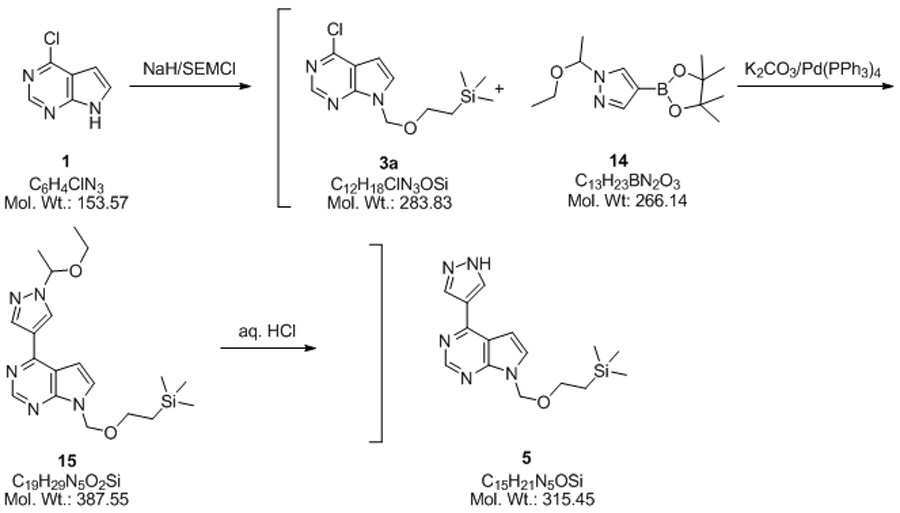
4-(1 H -피라졸-4-일)-7-(2-트리메틸실라닐에톡시메틸)-7 H -피롤로[2,3- d ]피리미딘 (5). 방법 D. 1,2-디메톡시에탄 (DME, 20.0 mL, 192.4 mmol) 중 수산화나트륨 (NaH, 60 wt% 오일 배치, 4.05 g, 101.3 mmol, 1.54 당량)의 현탁액에 0 - 5℃ (빙욕)에서 1,2-디메톡시에탄 (DME, 80.0 mL, 769.6 mmol) 중 4-클로로피롤로[2,3-d]피리미딘 (1, 10.08 g, 65.6 mmol)을 서서히 첨가했고, 이로써 온도는 5℃ 미만 (-7℃ 내지 5℃)이었다. 다량의 가스가 즉각 방출되었다. 수득한 반응 혼합물을 0 - 5℃에서 30분 동안 교반한 후, 트리메틸실릴에톡시메틸 클로라이드 (2, 12.56 g, 75.3 mmol, 1.15 당량)을, 반응 온도가 < 5℃에서 유지되는 동안 서서히 첨가했다. 첨가 후, 반응을 0℃에서 1시간 동안 교반한 후, 23시간 동안 실온으로 따뜻하게 했다. HPLC 및 TLC가 반응의 완료를 보여주었을 때, 반응 혼합물을 물 (46 mL)로 실온에서 급냉하고, 원하는 생성물 (3a)을 함유하는 케팅된 반응 혼합물을, 추가 워크업 및 정제 없이 다음 스즈끼 커플링 반응에 직접 사용했다. 4- (1 H - pyrazol-4-yl) -7- (2-trimethylsilanyl ethoxymethyl) -7 H - pyrrolo [2,3- d] pyrimidine-5. Method D. 0-5 ° C. (ice bath) in a suspension of sodium hydroxide (NaH, 60 wt% oil batch, 4.05 g, 101.3 mmol, 1.54 equiv) in 1,2-dimethoxyethane (DME, 20.0 mL, 192.4 mmol) 4-chloropyrrolo [2,3- d ] pyrimidine ( 1 , 10.08 g, 65.6 mmol) in 1,2-dimethoxyethane (DME, 80.0 mL, 769.6 mmol) was slowly added, resulting in a temperature of 5 It was less than (degreeC-5 degreeC). Large quantities of gas were released immediately. The resulting reaction mixture was stirred at 0-5 ° C. for 30 minutes, then trimethylsilylethoxymethyl chloride ( 2 , 12.56 g, 75.3 mmol, 1.15 equiv) was added slowly while the reaction temperature was maintained at <5 ° C. . After addition, the reaction was stirred at 0 ° C. for 1 hour and then warmed to room temperature for 23 hours. When HPLC and TLC showed the completion of the reaction, the reaction mixture was quenched with water (46 mL) at room temperature and the keted reaction mixture containing the desired product ( 3a ) was then subjected to the next Suzuki coupling without further workup and purification. It was used directly in the reaction.
상기에 기재된 이전 반응으로부터의 조 4-클로로-7-[2-(트리메틸실릴)에톡시]메틸}-7H-피롤로[2,3-d]피리미딘 (3a, 18.63 g, 65.64 mmol)을 함유하는 급냉된 반응 혼합물에, 1,2-디메톡시에탄 (DME, 38 mL), 분말 탄산칼륨 (K2CO3, 23.56 g, 170.5 mmol, 2.6 당량), 1-(1-에톡시에틸)-4-(4,4,5,5-테트라메틸-1,3,2-디옥사보롤란-2-일)-1H-피라졸 (14, 18.60 g, 69.89 mmol, 1.06 당량)을 실온에서 첨가했다. 수득한 혼합물을 매시간 질소 가스로 4회 역충전한 후, 테트라키스(트리페닐포스핀)팔라듐(0) (244.2 mg, 0.21 mmol, 0.003 당량)로 실온에서 처리했다. 수득한 반응 혼합물을 매시간 질소 가스로 4회 역충전한 후, 80℃로 4 - 8시간 동안 따뜻하게 했다. TLC 및 HPLC가 반응의 완료를 보여주었을 때, 반응 혼합물을 점차 실온으로 냉각시키고, 짧은 베드의 셀라이트 (10 g)을 통해 여과했다. 셀라이트 베드를 에틸 아세테이트 (EtOAc, 20 mL)로 세정했다. 여과물의 2개의 층을 분리하고, 수성 층을 에틸 아세테이트 (2×30 mL)로 추출했다. 조합된 유기 추출물을 포화 수성 NaCl 용액 (20 mL)로 세정하고, 황산마그네슘 (MgSO4) 상에서 건조시키고, 감압 하에서 농축했다. 그 다음, 조 원하는 스즈끼 커플링 생성물 (15)을 함유하는 잔여물을, 추가 정제없이 차후의 탈보호 반응을 위해 THF (22 mL)와 함께 500 mL 둥근바닥플라스크로 이동했다.Crude 4-chloro-7- [2- (trimethylsilyl) ethoxy] methyl} -7 H -pyrrolo [2,3- d ] pyrimidine ( 3a , 18.63 g, 65.64 mmol) from the previous reactions described above To the quenched reaction mixture containing 1,2-dimethoxyethane (DME, 38 mL), powdered potassium carbonate (K 2 CO 3 , 23.56 g, 170.5 mmol, 2.6 equiv), 1- (1-ethoxyethyl ) -4- (4,4,5,5-tetramethyl-1,3,2-dioxaborolan-2-yl) -1 H -pyrazole ( 14 , 18.60 g, 69.89 mmol, 1.06 equiv) Added at room temperature. The resulting mixture was backfilled four times with nitrogen gas every hour and then treated with tetrakis (triphenylphosphine) palladium (0) (244.2 mg, 0.21 mmol, 0.003 equiv) at room temperature. The resulting reaction mixture was backfilled four times with nitrogen gas every hour and then warmed to 80 ° C. for 4-8 hours. When TLC and HPLC showed completion of the reaction, the reaction mixture was gradually cooled to room temperature and filtered through a short bed of celite (10 g). The celite bed was washed with ethyl acetate (EtOAc, 20 mL). Two layers of the filtrate were separated and the aqueous layer was extracted with ethyl acetate (2 × 30 mL). The combined organic extracts were washed with saturated aqueous NaCl solution (20 mL), dried over magnesium sulfate (MgSO 4 ) and concentrated under reduced pressure. The residue containing the crude Suzuki coupling product ( 15 ) was then transferred to a 500 mL round bottom flask with THF (22 mL) for subsequent deprotection reaction without further purification.
THF (22 mL) 중 조 스즈끼 커플링 생성물 (15)의 용액을,19.6 mL의 농축 HCl을 64 mL의 H2O와 실온에서 혼합하여 제조한 10% 수성 HCl의 용액으로 처리했다. 수득한 반응 혼합물을 실온에서 4 - 6시간 동안 교반했다. TLC 및 HPLC가 탈보호 반응의 완료를 보여주었을 때, 10.4 g의 NaOH을 21.0 mL의 H2O에서 용해시켜 제조한 30% 수성 수산화나트륨 (NaOH) 용액, 25℃ 미만의 온도로 유지하면서 반응 혼합물에 서서히 첨가했다. 고형은 점차 용해되고, 10분 후 재침전되었다. 혼합물을 실온에서 1 내지 2시간 동안 교반 후, 고형물을 여과로 수집하고, H2O (50 mL)로 세정했다. 습윤 케이크를 250 mL 3목 플라스크로 이동시키고, 아세토니트릴 (MeCN, 112 mL)로 실온에서 처리했다. 혼합물을 2시간 동안 가열 환류한 후, 실온으로 서서히 냉각시키고, 실온에서 1시간 동안 교반했다. 고형물을 여과로 수집하고, MeCN (36 mL)로 세정하고, 40 - 45℃에서 진공 오븐에서 건조시켜 4-(1H-피라졸-4-일)-7-(2-트리메틸실라닐-에톡시메틸)-7H-피롤로[2,3-d]피리미딘 (5, 15.3 g, 20.7 g 이론적, 73.9% 수율)을 백색 결정성 고형물 (99.4 면적%, HPLC에 의해)로서 얻었고, 이는 방법 A, B, 및 C로부터 만들어진 물질에 대해 모든 비교가능한 측면에서 동일한 것으로 발견되었다.A solution of crude Suzuki coupling product ( 15 ) in THF (22 mL) was treated with a solution of 10% aqueous HCl prepared by mixing 19.6 mL of concentrated HCl with 64 mL of H 2 O at room temperature. The resulting reaction mixture was stirred for 4-6 hours at room temperature. When TLC and HPLC showed the completion of the deprotection reaction, a 30% aqueous sodium hydroxide (NaOH) solution prepared by dissolving 10.4 g of NaOH in 21.0 mL of H 2 O, the reaction mixture while maintaining at a temperature below 25 ° C. Was added slowly. The solid gradually dissolved and reprecipitated after 10 minutes. After the mixture was stirred at rt for 1-2 h, the solids were collected by filtration and washed with H 2 O (50 mL). The wet cake was transferred to a 250 mL three neck flask and treated with acetonitrile (MeCN, 112 mL) at room temperature. The mixture was heated to reflux for 2 hours, then slowly cooled to room temperature and stirred at room temperature for 1 hour. The solid was collected by filtration, washed with MeCN (36 mL) and dried in a vacuum oven at 40-45 ° C. to 4- (1 H -pyrazol-4-yl) -7- (2-trimethylsilanyl- ethoxymethyl) -7 H - pyrrolo [2,3- d] pyrimidine (5, 15.3 g, 20.7 g theoretical, was obtained a 73.9% yield) as a white crystalline solid (99.4 area% by HPLC), which It was found to be the same in all comparable aspects for materials made from methods A, B, and C.

라세미 3-시클로펜틸-3-{4-[7-(2-트리메틸실라닐에톡시메틸)-7 H -피롤로[2,3- d ]피리미딘-4-일]피라졸-1-일}프로피오니트릴 (9, 라세미 SEM 보호된 화합물). 방법 B. 교반 바, 열전대, 콘덴서 및 질소 주입구가 구비된 4목 250 mL 둥근바닥플라스크에, (3S)-시클로펜틸-3-{4-[7-(2-트리메틸실라닐에톡시메틸)-7H-피롤로[2,3-d]피리미딘-4-일]피라졸-1-일}프로피오니트릴 ((S)-10, 13.9 g, 31.5 mmol), 아세토니트릴 (84 mL) 및 3-시클로펜틸아실로니트릴 (8, E 및 Z 이성질체의 혼합물, 3.82 g, 31.5 mmol, 1.0 당량)을 실온에서 충전했다. 그 다음, 수득한 혼합물을 탄산세슘 (Cs2CO3, 2.57 g, 7.88 mmol, 0.25 당량)로 실온에서 처리했다. 반응 혼합물을 65℃로 따뜻하게 하고, 키랄 HPLC로 12시간 후 점검하여 화합물 (R)-10 대 화합물 (S)-10의 이성질체 비를 측정했다. 화합물 (R)-10 대 화합물 (S)-10의 비가 1:1에 도달할 때, 그 다음, 반응 혼합물을 실온으로 점차로 냉각시키고, 실온에서 24 내지 48시간 동안 교반했다. 반응 혼합물을 HPLC로 모니터하여 4-(1H-피라졸-4-일)-7-(2-트리메틸실라닐에톡시메틸)-7H-피롤로[2,3-d]피리미딘 (5)의 수준을 측정했다. 반응은, 화합물 5의 수준이 HPLC 면적%로 =2%일 때 완료된 것으로 간주되었다. 그 다음, 반응 혼합물을 셀라이트 패드를 통해 여과하여 반응 용액에 존재하는 불용성 고형물을 제거했다. 그 다음, 여과물을 감압 하에서 농축하여 약 40 mL의 용매를 제거했다. 농축 용액을 에틸 아세테이트 (40 mL)로 희석하고, 1 N 수성 HCl 용액으로 (40 mL)로 세정했다. 2개의 층을 분리하고, 수성 산 세정 용액을 에틸 아세테이트 (20 mL)로 역추출했다. 조합된 유기 분획을 1 M 수성 중탄산나트륨 (NaHCO3) 용액 (45 mL) 및 20% (w/w) 염수 용액 (40 mL)로 세정했다. 유기 분획을 황산마그네슘 (MgSO4) 상에서 건조시키고, 감압 하에서 농축하여 조 라세미 3-시클로펜틸-3-{4-[7-(2-트리메틸실라닐에톡시메틸)-7H-피롤로[2,3-d]피리미딘-4-일]피라졸-1-일}프로피오니트릴 (9, 라세미 SEM 보호된 화합물, 13.6 g, 13.9 g 이론적, 97.8%)을 호박색 오일로서 얻었고, 이는 방법 A로 만들어진 물질과 동일한 것으로 발견되었다. 이 조 생성물은 충분히 순수한 (> 96 면적%, HPLC에 의해) 것으로 발견되었고, 차후의 키랄 분리에서 추가 정제없이 직접 사용되었다. Racemic 3-cyclopentyl-3- {4- [7- (2-trimethyl silanol to carbonyl ethoxymethyl) -7 H - pyrrolo [2,3- d] pyrimidin-4-yl] pyrazole-1 Propionitrile (9, racemic SEM protected compound). Method B. Stirring bar, thermocouple, condenser, and a nitrogen inlet in a four-necked 250 mL round bottom flask equipped with a, (3 S) - cyclopentyl-3- {4- [7- (2-trimethyl silanol to carbonyl ethoxymethyl) -7 H -Pyrrolo [2,3- d ] pyrimidin-4-yl] pyrazol-1-yl} propionitrile (( S ) -10 , 13.9 g, 31.5 mmol), acetonitrile (84 mL) and 3- Cyclopentylacyronitrile (mixture of 8 , E and Z isomers, 3.82 g, 31.5 mmol, 1.0 equiv) was charged at room temperature. The resulting mixture was then treated with cesium carbonate (Cs 2 CO 3 , 2.57 g, 7.88 mmol, 0.25 equiv) at room temperature. The reaction mixture was warmed to 65 ° C. and checked after 12 hours by chiral HPLC to determine the isomer ratio of compound ( R ) -10 to compound ( S ) -10 . When the ratio of compound ( R ) -10 to compound ( S ) -10 reached 1: 1, the reaction mixture was then gradually cooled to room temperature and stirred at room temperature for 24 to 48 hours. The reaction mixture was monitored by HPLC to give 4- (1 H -pyrazol-4-yl) -7- (2-trimethylsilanylethoxymethyl) -7 H -pyrrolo [2,3- d ] pyrimidine ( 5 ) Was measured. The reaction was considered complete when the level of compound 5 was = 2% by HPLC area%. The reaction mixture was then filtered through a pad of celite to remove insoluble solids present in the reaction solution. The filtrate was then concentrated under reduced pressure to remove about 40 mL of solvent. The concentrated solution was diluted with ethyl acetate (40 mL) and washed with 1 N aqueous HCl solution (40 mL). The two layers were separated and the aqueous acid wash solution was back extracted with ethyl acetate (20 mL). The combined organic fractions were washed with 1 M aqueous sodium bicarbonate (NaHCO 3 ) solution (45 mL) and 20% (w / w) brine solution (40 mL). The organic fractions were dried over magnesium sulfate (MgSO 4 ) and concentrated under reduced pressure to afford crude racemic 3-cyclopentyl-3- {4- [7- (2-trimethylsilanylethoxymethyl) -7 H -pyrrolo [ 2,3- d ] pyrimidin-4-yl] pyrazol-1-yl} propionitrile ( 9 , racemic SEM protected compound, 13.6 g, 13.9 g theoretical, 97.8%) was obtained as an amber oil. It was found to be identical to the material made by Method A. This crude product was found to be sufficiently pure (> 96 area%, by HPLC) and used directly in the subsequent chiral separation without further purification.
4-(1 H -피라졸-4-일)-7-(2-트리메틸실라닐에톡시메틸)-7 H -피롤로[2,3- d ]피리미딘 (5). 방법 E. 오버헤드 교반기, 열전대, 2 L 추가 깔때기 및 질소 주입구가 구비된 22 L 4목 플라스크에 (3S)-3-시클로펜틸-3-{4-[7-(2-트리메틸실라닐에톡시메틸)-7H-피롤로[2,3-d]피리미딘-4-일]피라졸-1-일}프로피오니트릴 ((S)-10, 491 g, 1.11 mol) 및 아세토니트릴 (4.5 L)을 실온에서 충전했다. 혼합물을 0 - 10℃로 냉각한 후, THF (KO t Bu, 2.0 L, 2.0 mol, 1.8 당량) 중 칼륨 tert-부톡시드의 1M 용액으로 추가 깔때기를 통해 1.5시간에 걸쳐 적가 처리했다. 염기를 첨가한 다음, 반응 혼합물을 다음 실온으로 되돌리고, 실온에서 12 - 24시간 동안 교반했다. LC/MS가 반응의 완료를 보여주었을 때, 반응 혼합물을 에틸 아세테이트 (EtOAc, 6 L) 및 50% (w/w) 수성 암모늄 클로라이드 용액 (NH4Cl, 4 L)로 희석했다. 2개의 층을 분리하고, 수성 분획을 에틸 아세테이트 (2 L)로 역추출했다. 조합된 유기 분획을 물 (2 L) 및 염수 (3 L)로 세정하고, 황산마그네슘 (MgSO4) 상에서 건조시키고, 감압 하에서 농축하여 조 4-(1H-피라졸-4-일)-7-(2-트리메틸실라닐-에톡시메틸)-7H-피롤로[2,3-d]피리미딘 (5, 354 g, 350.1 g 이론적, 101.1% 수율)을 호박색 오일로서 얻었고, 이는 실온에서 진공에서 정치시 고형화되었다. 이 조 물질을 차후에 아세토니트릴에서 재결정화하여 순수한 화합물 5 (308 g, 350.1 g 이론적, 88% 수율)을 백색 결정 (99.5 면적%, HPLC에 의해)으로서 얻었고, 이는 방법 A, B, C, 및 D로부터 만들어진 물질에 대해 모든 비교가능한 측면에서 동일한 것으로 발견되었다. 4- (1 H - pyrazol-4-yl) -7- (2-trimethylsilanyl ethoxymethyl) -7 H - pyrrolo [2,3- d] pyrimidine-5. Method E. In a 22 L four-necked flask equipped with an overhead stirrer, thermocouple, 2 L additional funnel and nitrogen inlet, ( 3S ) -3-cyclopentyl-3- {4- [7- (2-trimethylsilanyl) ethoxymethyl) -7 H - pyrrolo [2,3- d] pyrimidin-4-yl] pyrazol-1-yl} propionitrile ((S) - 10, 491 g, 1.11 mol) and acetonitrile ( 4.5 L) was charged at room temperature. The mixture was cooled to 0-10 ° C. and then treated dropwise over 1.5 h with an additional funnel with 1M solution of potassium tert -butoxide in THF (KO t Bu, 2.0 L, 2.0 mol, 1.8 equiv). After the base was added, the reaction mixture was then returned to room temperature and stirred at room temperature for 12-24 hours. When LC / MS showed completion of the reaction, the reaction mixture was diluted with ethyl acetate (EtOAc, 6 L) and 50% (w / w) aqueous ammonium chloride solution (NH 4 Cl, 4 L). The two layers were separated and the aqueous fractions were back extracted with ethyl acetate (2 L). The combined organic fractions were washed with water (2 L) and brine (3 L), dried over magnesium sulfate (MgSO 4 ) and concentrated under reduced pressure to afford crude 4- (1 H -pyrazol-4-yl) -7 - (2-trimethylsilanyl-ethoxymethyl) -7 H-pyrrolo [2,3- d] pyrimidine (5, 354 g, 350.1 g theoretical, 101.1% yield) was obtained as an amber oil, which at room temperature Solidified upon standing in vacuo. This crude material was subsequently recrystallized in acetonitrile to give pure compound 5 (308 g, 350.1 g theoretical, 88% yield) as white crystals (99.5 area%, by HPLC), which were method A, B, C, and It was found that for materials made from D the same in all comparable aspects.

(2 S ,3 S )-2,3-비스(벤조일옥시)석신산 - (3 R )-시클로펜틸-3-[4-(7-{[2-(트리메틸실릴)에톡시]메틸}-7 H -피롤로[2,3- d ]피리미딘-4-일)-1 H -피라졸-1-일]프로판니트릴 (1:1; 17). 교반 바 및 질소 주입구가 구비된 250 mL 둥근바닥플라스크에, 라세미 3-시클로펜틸-3-[4-(7-{[2-(트리메틸실릴)에톡시]메틸}-7H-피롤로[2,3-d]피리미딘-4-일)-1H-피라졸-1-일]프로판니트릴 (9, 6.92 g, 0.0158 mol), 아세토니트릴 (89.0 mL, 1.70 mol), 테트라히드로푸란 (15 mL, 0.185 mol) 및 아세톤 (15.0 mL, 0.204 mol)을 실온에서 충전했다. 수득한 용액을 50℃로 따뜻하게 한 후, (+)-2,3-디벤조일-D-타르타르산 (16, 8.52 g, 0.0238 mol, 1.5 당량)으로 한번에 처리했다. 그 다음, 수득한 균일 용액을 50℃에서 10분 동안 교반한 후, 실온으로 서서히 냉각시키고, 실온에서 21시간 동안 교반했다. 그 다음, 고형물을 여과로 수집하고, 작은 용량의 헥산으로 헹구고, 감압 하에서 건조시켜 (2S,3S)-2,3-비스(벤조일옥시)석신산 - (3R)-시클로펜틸-3-[4-(7-{[2-(트리메틸실릴)에톡시]메틸}-7H-피롤로[2,3-d]피리미딘-4-일)-1H-피라졸-1-일]프로판니트릴 (1:1; 17, 6.85 g, 12.6 g 이론적, 54% 수율)을 백색 결정물로서 얻었다. 분리된 염의 거울상이성질체 순도 키랄 HPLC로 분석했고, 원하는 R-거울상이성질체를 선호하는 74:26인 것으로 발견되었다. 17에 대해: 1H NMR (DMSO-d 6, 400 MHz) δ ppm 8.86 (s, 1H), 8.78 (s, 1H), 8.42 (s, 1H), 8.04 (dd, 4H, J = 1.1, 8.4 Hz), 7.80 (d, 1H, J = 3.5 Hz), 7.76 (tt, 2H, J = 7.5, 1.3 Hz), 7.73 (dd, 4H, J = 7.9, 7.4 Hz), 7.12 (d, 1H, J = 3.7 Hz), 5.90 (s, 2H), 5.66 (s, 2H), 4.55 (td, 1H, J = 4.2, 9.6 Hz), 3.54 (t, 2H, J = 7.8 Hz), 3.30 (dd, 1H, J = 10.1, 17.6 Hz), 3.22 (dd, 1H, J = 4.2, 16.9 Hz), 2.43 (m, 1H), 1.82 (m, 1H), 1.70 - 1.14 (m, 7H), 0.85 (t, 2H, J = 7.8 Hz), -0.083 (s, 9H). (2 S, 3 S) -2,3- bis (benzoyloxy) succinic acid - (3 R) - Cyclopentyl-3- [4- (7-ethoxy {[2- (trimethylsilyl)] methyl} - 7 H -pyrrolo [2,3- d ] pyrimidin-4-yl) -1 H -pyrazol-1-yl] propanenitrile (1: 1; 17). In a 250 mL round bottom flask equipped with a stirring bar and a nitrogen inlet, racemic 3-cyclopentyl-3- [4- (7-{[2- (trimethylsilyl) ethoxy] methyl} -7 H -pyrrolo [ 2,3- d ] pyrimidin-4-yl) -1 H -pyrazol-1-yl] propanenitrile ( 9 , 6.92 g, 0.0158 mol), acetonitrile (89.0 mL, 1.70 mol), tetrahydrofuran ( 15 mL, 0.185 mol) and acetone (15.0 mL, 0.204 mol) were charged at room temperature. The resulting solution was warmed to 50 ° C. and then treated with (+)-2,3-dibenzoyl-D-tartaric acid ( 16 , 8.52 g, 0.0238 mol, 1.5 equiv) in one portion. The homogeneous solution obtained was then stirred at 50 ° C. for 10 minutes, then slowly cooled to room temperature and stirred at room temperature for 21 hours. And that then, collects the solid by filtration and rinse with hexane to a small capacity, and dried under reduced pressure to give (2S, 3 S) -2,3- bis (benzoyloxy) succinic acid - (3 R) - 3-cyclopentyl- [4- (7-{[2- (trimethylsilyl) ethoxy] methyl} -7 H -pyrrolo [2,3- d ] pyrimidin-4-yl) -1 H -pyrazol-1-yl] Propanenitrile (1: 1; 17 , 6.85 g, 12.6 g theoretical, 54% yield) was obtained as white crystals. Enantiomeric Purification of Separated Salts Analyzed by chiral HPLC and found to be 74:26 favoring the desired R -enantiomer. For 17 : 1 H NMR (DMSO- d 6 , 400 MHz) δ ppm 8.86 (s, 1H), 8.78 (s, 1H), 8.42 (s, 1H), 8.04 (dd, 4H, J = 1.1, 8.4 Hz), 7.80 (d, 1H, J = 3.5 Hz), 7.76 (tt, 2H, J = 7.5, 1.3 Hz), 7.73 (dd, 4H, J = 7.9, 7.4 Hz), 7.12 (d, 1H, J = 3.7 Hz), 5.90 (s, 2H), 5.66 (s, 2H), 4.55 (td, 1H, J = 4.2, 9.6 Hz), 3.54 (t, 2H, J = 7.8 Hz), 3.30 (dd, 1H , J = 10.1, 17.6 Hz), 3.22 (dd, 1H, J = 4.2, 16.9 Hz), 2.43 (m, 1H), 1.82 (m, 1H), 1.70-1.14 (m, 7H), 0.85 (t, 2H, J = 7.8 Hz), -0.083 (s, 9H).
(3 R )-시클로펜틸-3-{4-[7-(2-트리메틸실라닐에톡시메틸)-7 H -피롤로[2,3- d ]피리미딘-4-일]피라졸-1-일}프로피오니트릴 (( R )-10). 방법 B. 250 mL 둥근바닥플라스크에, 거울상이성질체 향상된 (2S,3S)-2,3-비스(벤조일옥시)석신산-(3R)-시클로펜틸-3-[4-(7-{[2-(트리메틸실릴)에톡시]메틸}-7H-피롤로[2,3-d]피리미딘-4-일)-1H-피라졸-1-일]프로판니트릴 (1:1, 17, 6.85 g, 0.00862 mol), 에틸 아세테이트 (EtOAc, 70 mL, 0.717 mol) 및 물 (20 mL, 1.11 mol)을 실온에서 충전하고, 수득한 용액을 12℃로 냉각한 후, 3 N 수성 수산화나트륨 용액 (NaOH, 10.7 ml, 0.0321 mol, 3.72 당량)로 처리하여 pH를 8 - 9로 조정했다. 2개의 층을 분리하고, 수성 층을 에틸 아세테이트 (30 mL)로 추출했다. 조합된 유기 분획을 20% 수성 염수 (20 mL)로 세정하고, 황산마그네슘 상에서 건조시키고, 여과하고, 감압 하에서 농축하여 거울상이성질체 향상된 (3R)-시클로펜틸-3-{4-[7-(2-트리메틸실라닐에톡시메틸)-7H-피롤로[2,3-d]피리미딘-4-일]피라졸-1-일}프로피오니트릴 ((R)-10, 3.31 g, 3.76 g 이론적, 88%)을 무색 오일로서 얻었고, 이는 키랄 HPLC로 분석되었고, 원하는 R-거울상이성질체를 선호하는 74:26인 것으로 발견되었다. (R)-10에 대해: 1H NMR (CD3OD, 300 MHz) δ ppm 8.77 (s, 1H), 8.68 (s, 1H), 8.43 (s, 1H), 7.66 (d, 1H, J = 3.7 Hz), 7.06 (d, 1H, J = 3.7 Hz), 5.7 (s, 2H), 4.53 (td, 1H, J = 4.5, 10.2 Hz), 3.62 (dd, 2H, J = 8.0, 16.0 Hz), 3.26 (dd, 1H, J = 9.7, 17.2 Hz), 3.17 (dd, 1H, J = 4.0, 17.0 Hz), 2.59 (m, 1H), 1.97 (m, 1H), 1.80 - 1.25 (m, 7H), 0.92 (t, 2H, J = 8.4 Hz), -0.03 (s, 9H); C23H32N6OSi (분자량: 436.63), LCMS (EI) m/e 437 (M+ + H). (3 R) - Cyclopentyl-3- {4- [7- (2-trimethylsilanyl ethoxymethyl) -7 H - pyrrolo [2,3- d] pyrimidin-4-yl] -1-pyrazole -Yl} propionitrile (( R ) -10). Method B. 250 mL round bottom flask, enantiomerically enhanced (2 S, 3 S) -2,3- bis (benzoyloxy) succinic acid - (3 R) - Cyclopentyl-3- [4- (7- { [2- (trimethylsilyl) ethoxy] methyl} -7 H -pyrrolo [2,3- d ] pyrimidin-4-yl) -1 H -pyrazol-1-yl] propanenitrile (1: 1, 17 , 6.85 g, 0.00862 mol), ethyl acetate (EtOAc, 70 mL, 0.717 mol) and water (20 mL, 1.11 mol) were charged at room temperature and the resulting solution was cooled to 12 ° C. and then 3N aqueous hydroxide. The pH was adjusted to 8-9 by treatment with sodium solution (NaOH, 10.7 ml, 0.0321 mol, 3.72 equiv). The two layers were separated and the aqueous layer was extracted with ethyl acetate (30 mL). The combined organic fractions were washed with 20% aqueous brine (20 mL), dried over magnesium sulfate, filtered and concentrated under reduced pressure to give the enantiomeric enhanced ( 3R ) -cyclopentyl-3- {4- [7- ( a 2-trimethylsilanyl-ethoxymethyl-sila carbonyl) -7 H - pyrrolo [2,3- d] pyrimidin-4-yl] pyrazol-1-yl} propionitrile (( R ) -10, 3.31 g, 3.76 g theoretical, 88%) was obtained as a colorless oil, which was analyzed by chiral HPLC and found to be 74:26, favoring the desired R -enantiomer. ( R ) -10 for: 1 H NMR (CD 3 OD, 300 MHz) δ ppm 8.77 (s, 1H), 8.68 (s, 1H), 8.43 (s, 1H), 7.66 (d, 1H, J = 3.7 Hz), 7.06 (d, 1H, J = 3.7 Hz), 5.7 (s, 2H), 4.53 (td, 1H, J = 4.5, 10.2 Hz), 3.62 (dd, 2H, J = 8.0, 16.0 Hz), 3.26 (dd, 1H, J = 9.7, 17.2 Hz), 3.17 (dd, 1H, J = 4.0, 17.0 Hz), 2.59 (m, 1H), 1.97 (m, 1H), 1.80-1.25 (m, 7H), 0.92 (t, 2H, J = 8.4 Hz), -0.03 (s, 9H); C 23 H 32 N 6 OSi (molecular weight: 436.63), LCMS (EI) m / e 437 (M + + H).

{4-[1-(1-에톡시에틸)-1 H -피라졸-4-일]-7 H -피롤로[2,3- d ]피리미딘-7-일]메틸 피발레이트 (18). 교반 바, 콘덴서 및 3-웨이 밸브가 구비된 250 mL 둥근바닥플라스크에, 4-클로로-7H-피롤로[2,3-d]피리미딘-7-일)메틸 피발레이트 (3f, 30 g, 0.112 mol), 1,4-디옥산 (300 mL, 4.0 mol), 1-(1-에톡시에틸)-4-(4,4,5,5-테트라메틸-1,3,2-디옥사보롤란-2-일)-1H-피라졸 (14, 35.8 g, 0.134 mol, 1.2 당량), 물 (150 mL, 8.3 mol) 및 탄산칼륨 (K2CO3, 61.9 g, 0.448 mol, 4.0 당량)을 실온에서. 수득한 혼합물을 매시간 질소로 역충전하면서 4회 탈가스한 후, 테트라키스(트리페닐포스핀)팔라듐(0) (5.0 g, 0.00433 mol, 0.039 당량)를 충전했다. 그 다음, 반응 혼합물을 매시간 질소로 역충전하면서 4회 탈가스한 후, 85℃로 따뜻하게 했다. 반응 혼합물을 85℃에서 2 - 5시간 동안 교반했다. 반응이 완료된 것으로 보일 때, 반응 혼합물을 실온으로 냉각한 후, 20% 수성 염수 (250 mL) 및 에틸 아세테이트 (250 mL)로 희석했다. 2개의 층을 분리하고, 수성 층을 에틸 아세테이트 (250 mL)로 추출했다. 조합된 유기 분획을 물 및 염수로 세정하고, 황산마그네슘 (MgSO4) 상에서 건조시키고, 감압 하에서 농축했다. 잔여물을 플래시 칼럼 크로마토그래피 (SiO2, 25% 내지 40% 에틸 아세테이트/헥산 구배 용리)로 정제하여 {4-[1-(1-에톡시에틸)-1H-피라졸-4-일]-7H-피롤로[2,3-d]피리미딘-7-일]메틸 피발레이트 (18)을 오렌지색 오일로서 얻었고, 이를, 이론적 수율을 가정하여 차후의 반응에서 직접 사용했다. 18에 대해: C19H25N5O3 (분자량: 371.43), LCMS (EI) m/e 372 (M+ + H). {4- [1- (1-ethoxyethyl) -1 H -pyrazol-4-yl] -7 H -pyrrolo [2,3- d ] pyrimidin-7-yl] methyl pivalate (18) . In a 250 mL round bottom flask equipped with a stirring bar, a condenser and a 3-way valve, 4-chloro-7 H -pyrrolo [2,3- d ] pyrimidin-7-yl) methyl pivalate ( 3f , 30 g , 0.112 mol), 1,4-dioxane (300 mL, 4.0 mol), 1- (1-ethoxyethyl) -4- (4,4,5,5-tetramethyl-1,3,2-di Oxaborolan-2-yl) -1 H -pyrazole ( 14 , 35.8 g, 0.134 mol, 1.2 equiv), water (150 mL, 8.3 mol) and potassium carbonate (K 2 CO 3 , 61.9 g, 0.448 mol, 4.0 equivalents) at room temperature. The resulting mixture was degassed four times with backfilling with nitrogen every hour, followed by tetrakis (triphenylphosphine) palladium (0) (5.0 g, 0.00433 mol, 0.039 equiv). The reaction mixture was then degassed four times with backfilling with nitrogen every hour and then warmed to 85 ° C. The reaction mixture was stirred at 85 ° C. for 2-5 hours. When the reaction appeared to be complete, the reaction mixture was cooled to room temperature and then diluted with 20% aqueous brine (250 mL) and ethyl acetate (250 mL). The two layers were separated and the aqueous layer was extracted with ethyl acetate (250 mL). The combined organic fractions were washed with water and brine, dried over magnesium sulfate (MgSO 4 ) and concentrated under reduced pressure. The residue was purified by flash column chromatography (SiO 2 , 25% to 40% ethyl acetate / hexane gradient eluting) to afford {4- [1- (1-ethoxyethyl) -1 H -pyrazol-4-yl] -7 H -pyrrolo [2,3- d ] pyrimidin-7-yl] methyl pivalate ( 18 ) was obtained as an orange oil, which was used directly in subsequent reactions assuming theoretical yield. For 18 : C 19 H 25 N 5 O 3 (molecular weight: 371.43), LCMS (EI) m / e 372 (M + + H).
[4-(1 H -피라졸-4-일)-7 H -피롤로[2,3- d ]피리미딘-7-일]메틸 피발레이트 (19). 방법 A. 교반 바 및 질소 주입구가 구비된 1 L 둥근바닥플라스크에, 상기 기재와 같이 제조된 {4-[1-(1-에톡시에틸)-1H-피라졸-4-일]-7H-피롤로[2,3-d]피리미딘-7-일]메틸 피발레이트 (18, 이론량 41.6 g, 0.112 mol) 및 테트라히드로푸란 (THF, 610 mL, 7.5 mol)을 실온에서 충전하고, 수득한 혼합물을 염산 (140 mL, 0.28 mol, 2.5 당량)의 2.0 N 수성 용액으로 실온에서 처리했다. 수득한 반응 혼합물을 차후에 실온에서 밤새 교반했다. 반응이 완료된 것으로 보일 때, 반응 혼합물을 0 - 5℃로 냉각한 후, pH를 3 M 수성 수산화나트륨 (NaOH) 용액 (95 mL)로 9 - 10로 조정했다. 그 다음, 혼합물을 에틸 아세테이트 (2×300 mL)로 추출하고, 조합된 유기 추출물을 20% 수성 염수 용액 (250 mL), 황산마그네슘 (MgSO4) 상에서 건조시키고, 감압 하에서 농축하여 조 생성물을 회백색 내지 담황색 고형물로서 얻었다. 조 생성물을 메틸 t-부틸에테르 (MTBE, 200 mL)로 처리하고, 슬러리를 30분 동안 가온 환류한 후, 실온으로 냉각했다. 고형물을 여과로 수집하고, MTBE (2×40 mL), 감압 하에서 건조시켜 [4-(1H-피라졸-4-일)-7H-피롤로[2,3-d]피리미딘-7-일]메틸 피발레이트 (19, 30.5 g, 33.52 g 이론적, 91%, 2단계로)을 백색 내지 회백색 고형물로서 얻었다. 19에 대해: 1H NMR (DMSO-d 6, 300MHz) δ ppm 13.40 (br s, 1H), 8.75 (s, 1H), 8.66 (s, 1H), 8.32 (s, 1H), 7.68 (d, 1H, J = 3.8 Hz), 7.11 (d, 1H, J = 3.8 Hz), 6.21 (s, 2H), 1.06 (s, 9H); C15H17N5O2 (분자량: 299.33), LCMS (EI) m/e 300 (M+ + H). [4- (1 H - pyrazol-4-yl) -7 H - pyrrolo [2,3- d] pyrimidin-7-yl] methyl pivalate (19). Method A. {4- [1- (1-Ethoxyethyl) -1 H -pyrazol-4-yl] -7 prepared as described above in a 1 L round bottom flask equipped with a stirring bar and a nitrogen inlet. H -pyrrolo [2,3- d ] pyrimidin-7-yl] methyl pivalate ( 18 , theoretical 41.6 g, 0.112 mol) and tetrahydrofuran (THF, 610 mL, 7.5 mol) were charged at room temperature The resulting mixture was treated with 2.0 N aqueous solution of hydrochloric acid (140 mL, 0.28 mol, 2.5 equiv) at room temperature. The resulting reaction mixture was subsequently stirred overnight at room temperature. When the reaction appeared to be complete, the reaction mixture was cooled to 0-5 ° C. and then the pH was adjusted to 9-10 with 3 M aqueous sodium hydroxide (NaOH) solution (95 mL). The mixture is then extracted with ethyl acetate (2 × 300 mL) and the combined organic extracts are dried over 20% aqueous brine solution (250 mL), magnesium sulfate (MgSO 4 ) and concentrated under reduced pressure to give the crude product as off-white. To pale yellow solid. The crude product was treated with methyl t -butylether (MTBE, 200 mL) and the slurry was warmed to reflux for 30 minutes and then cooled to room temperature. The solid was collected by filtration, MTBE (2 × 40 mL) and dried under reduced pressure to [4- (1 H -pyrazol-4-yl) -7 H -pyrrolo [2,3- d ] pyrimidine-7 -Yl] methyl pivalate ( 19 , 30.5 g, 33.52 g theoretical, 91% in 2 steps) was obtained as a white to off-white solid. For 19 : 1 H NMR (DMSO- d 6 , 300 MHz) δ ppm 13.40 (br s, 1H), 8.75 (s, 1H), 8.66 (s, 1H), 8.32 (s, 1H), 7.68 (d, 1H, J = 3.8 Hz), 7.11 (d, 1H, J = 3.8 Hz), 6.21 (s, 2H), 1.06 (s, 9H); C 15 H 17 N 5 O 2 (molecular weight: 299.33), LCMS (EI) m / e 300 (M + + H).
라세미 (4-(1-(2-시아노-1-시클로펜틸에틸)-1 H -피라졸-4-일)-7 H -피롤로[2,3- d ]피리미딘-7-일)메틸 피발레이트 (20). 방법 A. 3-시클로펜틸아실로니트릴 (8, 14.6 g, 0.12 mol, 1.20 당량) 및 DBU (18.2 mL, 0.12 mol, 1.2 당량)을 아세토니트릴 (45 mL) 중 4-(1H-피라졸-4-일)-7H-피롤로[2,3-d]피리미딘-7-일]메틸 피발레이트 (19, 30.0 g, 0.1 mol)의 현탁액에 실온에서 첨가했다. 수득한 반응 혼합물을 50 - 60℃로 17시간 동안 (맑은 용액이 가열을 통해 도중에 전개됨), 그 다음, 실온으로 8시간 동안 가열했다. LCMS 분석이 반응의 완료를 보여주었을 때, 반응 혼합물을 감압 하에서 농축하고, 잔여물을 2 L의 에틸 아세테이트에서 용해시켰다. 수득한 용액을 물 (3×200 mL)로 세정하고, 황산나트륨 (Na2SO4) 상에서 건조시키고, 감압 하에서 농축하여 조 생성물 (20)을 증점 오일로서 얻었다. 그 다음, 조 생성물을, 플래시 크로마토그래피 (SiO2, 0 - 50% EtOAc/헥산 구배 용리)로 정제하여 라세미 (4-(1-(2-시아노-1-시클로펜틸에틸)-1H-피라졸-4-일)-7H-피롤로[2,3-d]피리미딘-7-일)메틸 피발레이트 (20, 13.0 g, 42.14 g 이론적, 30.8% 수율)을 백색 고형물로서 얻었다. 20:에 대해: 1H NMR (DMSO-d 6, 400 MHz) δ ppm 8.84 (s, 1H), 8.78 (s, 1H), 8.39 (s, 1H), 7.74 (d, 1H, J = 3.7 Hz,), 7.11 (d, 1H, J = 3.8 Hz), 6.23 (s, 2H), 4.53 (ddd, 1H, J = 9.9, 9.6, 4.2 Hz), 3.26 (dd, 1H, J = 17.4, 9.9 Hz), 3.19 (dd, 1H, J = 17.2, 4.3 Hz), 2.41 (m, 1H), 1.87 - 1.13 (m, 8H), 1.07 (s, 9H); C23H28N6O2 (분자량: 420.51), LCMS (EI) m/e 421.4 (M+ + H). Racemic (4- (1- (2-cyano-1-cyclopentylethyl) -1 H -pyrazol-4-yl) -7 H -pyrrolo [2,3- d ] pyrimidin-7-yl Methyl pivalate (20). Method A. 3-cyclopentylacylonitrile ( 8 , 14.6 g, 0.12 mol, 1.20 equiv) and DBU (18.2 mL, 0.12 mol, 1.2 equiv) were added to 4- (1 H -pyrazole in acetonitrile (45 mL). 4-yl) -7 H - pyrrolo [2,3- d] was added at room temperature to a suspension of pyrimidin-7-yl] methyl pivalate (19, 30.0 g, 0.1 mol ). The resulting reaction mixture was heated to 50-60 ° C. for 17 hours (clear solution developed halfway through heating), then to room temperature for 8 hours. When LCMS analysis showed the completion of the reaction, the reaction mixture was concentrated under reduced pressure and the residue was dissolved in 2 L of ethyl acetate. The resulting solution was washed with water (3 × 200 mL), dried over sodium sulfate (Na 2 SO 4 ) and concentrated under reduced pressure to afford crude product 20 as thick oil. The crude product was then purified by flash chromatography (SiO 2 , 0-50% EtOAc / hexane gradient elution) to give racemic (4- (1- (2-cyano-1-cyclopentylethyl) -1 H -Pyrazol-4-yl) -7 H -pyrrolo [2,3- d ] pyrimidin-7-yl) methyl pivalate ( 20 , 13.0 g, 42.14 g theoretical, 30.8% yield) was obtained as a white solid. . 20 : for: 1 H NMR (DMSO- d 6 , 400 MHz) δ ppm 8.84 (s, 1H), 8.78 (s, 1H), 8.39 (s, 1H), 7.74 (d, 1H, J = 3.7 Hz ,), 7.11 (d, 1H, J = 3.8 Hz), 6.23 (s, 2H), 4.53 (ddd, 1H, J = 9.9, 9.6, 4.2 Hz), 3.26 (dd, 1H, J = 17.4, 9.9 Hz ), 3.19 (dd, 1H, J = 17.2, 4.3 Hz), 2.41 (m, 1H), 1.87-1.13 (m, 8H), 1.07 (s, 9H); C 23 H 28 N 6 O 2 (molecular weight: 420.51), LCMS (EI) m / e 421.4 (M + + H).
방법 B. 디메틸 설폭시드 (DMSO, 1.0 mL, 14 mmol) 중 [4-(1H-피라졸-4-일)-7H-피롤로[2,3-d]피리미딘-7-일]메틸 피발레이트 (19, 158 mg, 0.50 mmol) 및 3-시클로펜틸아실로니트릴 (8, 122 mg, 1.0 mmol, 2.0 당량)의 교반된 현탁액에 실온에서 분말 탄산칼륨 (K2CO3, 10.4 mg, 0.075 mmol, 0.15 당량)을 첨가했다. 그 다음, 반응 혼합물을 실온에서 5시간 동안 교반했다. 반응 혼합물은 2시간 내에 맑은 용액이 되었다. LCMS가 반응의 완료를 보여주었을 때, 반응을 물 (H2O, 5 mL)로 급냉하고, 에틸 아세테이트 (EtOAc, 3×15 mL)로 추출했다. 조합된 유기 추출물을 포화 수성 NaCl 용액 (10 mL)로 세정하고, 황산마그네슘 (MgSO4) 상에서 건조시키고, 감압 하에서 농축했다. 그 다음, 잔여물을 플래시 크로마토그래피 (SiO2, 0 - 50% EtOAc/헥산 구배 용리)로 정제하여 라세미 (4-(1-(2-시아노-1-시클로펜틸에틸)-1H-피라졸-4-일)-7H-피롤로[2,3-d]피리미딘-7-일)메틸 피발레이트 (20, 172.6 mg, 210 mg 이론적, 82% 수율)을 백색 고형물로서 얻었다. 20에 대해: 1H NMR (CDCl3, 400MHz) δ ppm 8.87 (s, 1H), 8.30 (s, 1H), 8.29 (s, 1H), 7.47 (d, 1H, J = 3.9 Hz), 6.75 (d, 1H, J = 3.9 Hz), 6.24 (s, 2H), 4.25 (m, 1H), 3.12 (dd, 1H, J = 17.0, 8.7 Hz), 2.95 (dd, 1H, J = 17.0, 3.9 Hz), 2.58 (m, 1H), 1.95 (m, 1H), 1.72 - 1.52 (m, 5H), 1.25 (m, 2H), 1.14 (s, 9H); C23H28N6O2 (분자량: 420.51), LCMS (EI) m/e 421.4 (M+ + H).Method B. [4- (1 H -pyrazol-4-yl) -7 H -pyrrolo [2,3- d ] pyrimidin-7-yl] in dimethyl sulfoxide (DMSO, 1.0 mL, 14 mmol) Powdered potassium carbonate (K 2 CO 3 , 10.4 mg) at room temperature in a stirred suspension of methyl pivalate ( 19 , 158 mg, 0.50 mmol) and 3-cyclopentylacyronitrile ( 8 , 122 mg, 1.0 mmol, 2.0 equiv) , 0.075 mmol, 0.15 equiv) was added. The reaction mixture was then stirred for 5 hours at room temperature. The reaction mixture became a clear solution within 2 hours. When LCMS showed the completion of the reaction, the reaction was quenched with water (H 2 O, 5 mL) and extracted with ethyl acetate (EtOAc, 3 × 15 mL). The combined organic extracts were washed with saturated aqueous NaCl solution (10 mL), dried over magnesium sulfate (MgSO 4 ) and concentrated under reduced pressure. The residue was then purified by flash chromatography (SiO 2 , 0-50% EtOAc / hexane gradient elution) to give racemic (4- (1- (2-cyano-1-cyclopentylethyl) -1 H − Pyrazol-4-yl) -7 H -pyrrolo [2,3- d ] pyrimidin-7-yl) methyl pivalate ( 20 , 172.6 mg, 210 mg theoretical, 82% yield) was obtained as a white solid. For 20 : 1 H NMR (CDCl 3 , 400 MHz) δ ppm 8.87 (s, 1H), 8.30 (s, 1H), 8.29 (s, 1H), 7.47 (d, 1H, J = 3.9 Hz), 6.75 ( d, 1H, J = 3.9 Hz), 6.24 (s, 2H), 4.25 (m, 1H), 3.12 (dd, 1H, J = 17.0, 8.7 Hz), 2.95 (dd, 1H, J = 17.0, 3.9 Hz ), 2.58 (m, 1H), 1.95 (m, 1H), 1.72-1.52 (m, 5H), 1.25 (m, 2H), 1.14 (s, 9H); C 23 H 28 N 6 O 2 (molecular weight: 420.51), LCMS (EI) m / e 421.4 (M + + H).
( R )-(4-(1-(2-시아노-1-시클로펜틸에틸)-1 H -피라졸-4-일)-7 H -피롤로[2,3- d ]피리미딘-7-일)메틸 피발레이트 (( R )-21). 에탄올 및 헥산 (1 : 9, 용적으로)의 혼합물 중 라세미 (4-(1-(2-시아노-1-시클로펜틸에틸)-1H-피라졸-4-일)-7H-피롤로[2,3-d]피리미딘-7-일)메틸 피발레이트 (20, 5.2 g, 12.36 mmol)의 용액을 셀룰로오스 트리스(3,5-디메틸페닐)카바메이트 ("Chiralcel® OD-H" (5㎛)로서 Daicel Chemical Industries, Ltd. (Daicel)로부터 이용가능)로 코팅된 실리카겔 기반 패킹으로 채워진 키랄 칼럼 (30×250 mm)이 구비된 분취 HPLC 시스템에 주입했다. 키랄 칼럼을, 1 내지 9 용적비의 에탄올 (EtOH) 및 헥산의 혼합물로 만들어진 이동상으로, 32 mL/min의 유속으로 실온에서 용리했다. 칼럼 용리를 파장 220 nm에서 UV로 모니터했다. 이들 조건 하에서, 2개의 거울상이성질체의 기준 분리가 달성되었고, 체류시간은 각각 16.4분 (피크 1, 원하지 않는 (S)-거울상이성질체 (S)-21) 및 21.0분 (피크 2, 원하는 (R)-거울상이성질체 (R)-21)였다. 각각의 주입은 농도 50 mg/mL에서 1.4 mL의 공급 용액이었고, 각각의 실시 사이클은 스택 주입을 사용하여 14분이었다. 총 75회의 주입을 이 분리 방법을 위해 수행했다. 피크 1 (원하지 않는 (S)-거울상이성질체, (S)-21) 및 피크 2 (원하는 (R)-거울상이성질체, (R)-21)에 대한 분획을 각각의 주입으로부터 별도로 수집하고, 각 피크에 대해 수집된 분획을 감압 하에서 농축했다. 각 증발기로부터의 잔여물을 고진공 하에서 일정한 중량으로 추가 건조시켜 피크 2로부터의 (R)-(4-(1-(2-시아노-1-시클로펜틸에틸)-1H-피라졸-4-일)-7H-피롤로[2,3-d]피리미딘-7-일)메틸 피발레이트 ((R)-21, 2.36 g, 2.6 g 이론적, 90.8% 수율)을 회백색 고형물로서 얻고, 피크 1로부터의 (S)-(4-(1-(2-시아노-1-시클로펜틸에틸)-1H-피라졸-4-일)-7H-피롤로[2,3-d]피리미딘-7-일)메틸 피발레이트 ((S)-21, 2.4 g, 2.6 g 이론적, 92.3% 수율)을 회백색 고형물로서 얻었다. ( R )-(4- (1- (2-cyano-1-cyclopentylethyl) -1 H -pyrazol-4-yl) -7 H -pyrrolo [2,3- d ] pyrimidine-7 -Yl) methyl pivalate (( R ) -21). Racemic (4- (1- (2-cyano-1-cyclopentylethyl) -1 H -pyrazol-4-yl) -7 H -P in a mixture of ethanol and hexane (1: 9, by volume) A solution of rolo [2,3- d ] pyrimidin-7-yl) methyl pivalate ( 20 , 5.2 g, 12.36 mmol) was added to cellulose tris (3,5-dimethylphenyl) carbamate ("Chiralcel ® OD-H" Injection into a preparative HPLC system equipped with a chiral column (30 × 250 mm) filled with silica gel based packing coated with Daicel Chemical Industries, Ltd. (available from Daicel) as (5 μm). The chiral column was eluted at room temperature with a flow rate of 32 mL / min in a mobile phase made of a mixture of 1 to 9 volume ratios of ethanol (EtOH) and hexanes. Column elution was monitored by UV at wavelength 220 nm. Under these conditions, the second was achieved based on separation of the two enantiomers, retention time 16.4 minutes, respectively ((S) Peak 1, undesired - enantiomer (S) - 21) and 21.0 min (peak 2, the desired (R) - was 21) - enantiomer (R). Each injection was a 1.4 mL feed solution at a concentration of 50 mg / mL and each run cycle was 14 minutes using a stack injection. A total of 75 injections were performed for this separation method. Fractions for peak 1 (undesired ( S ) -enantiomer, ( S ) -21 ) and peak 2 (desired ( R ) -enantiomer, ( R ) -21 ) are collected separately from each injection and each peak Fractions collected for were concentrated under reduced pressure. The residue from each evaporator was further dried to constant weight under high vacuum to give ( R )-(4- (1- (2-cyano-1-cyclopentylethyl) -1 H -pyrazole-4- from peak 2. yl) -7 H - pyrrolo [2,3- d] pyrimidin-7-yl) methyl pivalate ((R) - to obtain a 21, 2.36 g, 2.6 g theoretical, 90.8% yield) as an off-white solid, peak ( S )-(4- (1- (2-cyano-1-cyclopentylethyl) -1 H -pyrazol-4-yl) -7 H -pyrrolo [2,3- d ] pyrier from 1 pyrimidine-7-yl) methyl pivalate ((S) - 21, 2.4 g, 2.6 g theoretical, 92.3% yield) as an off-white solid.
키랄 HPLC 방법을, Chiralcel® OD-H 칼럼 (4.6×50 mm, 5 ㎛) (Chiral Technologies, Inc.로부터 구매)를 사용하여 POM-(R)-21 및 (S)-21의 거울상이성질체 모두의 키랄 순도 평가에 대해 전개했다. 2개의 거울상이성질체 ((R)-21 및 (S)-21)을, 10% 에탄올 및 90% 헥산으로 만들어진 이동상을 실온에서 1 mL/min의 유속으로 사용하여 3.5 초과의 분할로 분리했다. UV 검출 파장은 220 nm이다. 체류시간은 (S)-21 및 (R)-21 각각에 대해 14.1분 및 18.7분이다.The chiral HPLC method, Chiralcel ® OD-H column (4.6 × 50 mm, 5 ㎛ ) using (Chiral Technologies, purchased from Inc.) POM- (R) - 21 and (S) - enantiomers of all 21 of the A chiral purity assessment was developed. Two enantiomers (( R ) -21 and ( S ) -21 ) were separated in greater than 3.5 splits using a mobile phase made of 10% ethanol and 90% hexane at a flow rate of 1 mL / min at room temperature. The UV detection wavelength is 220 nm. The residence time is for ( S ) -21 and ( R ) -21 respectively. 14.1 minutes and 18.7 minutes.
화학 순도 (HPLC 면적%) 및 키랄 순도 (키랄 HPLC 면적%)를 포함하는 분취 키랄 HPLC에 의해 분리된 각각의 거울상이성질체의 질을 분석하고, 그의 구조는 NMR 및 LC/MS에 의해 확인되었다. (R)-21에 대해: 비키랄 순도 (99.2 면적%, 220 nm에서 검출된 HPLC에 의해); 키랄 순도 (99.6 면적%, 키랄 HPLC에 의해; 99.2% ee); 1H NMR (DMSO-d 6, 400 MHz) δ ppm 8.84 (s, 1H), 8.78 (s, 1H), 8.39 (s, 1H), 7.74 (d, 1H, J = 3.7 Hz,), 7.11 (d, 1H, J = 3.8 Hz), 6.23 (s, 2H), 4.53 (ddd, 1H, J = 9.9, 9.6, 4.2 Hz), 3.26 (dd, 1H, J = 17.4, 9.9 Hz), 3.19 (dd, 1H, J = 17.2, 4.3 Hz), 2.41 (m, 1H), 1.87 - 1.13 (m, 8H), 1.07 (s, 9H); C23H28N6O2 (분자량: 420.51), LCMS (EI) m/e 421.4 (M+ + H). (S)-21에 대해: 비키랄 순도 (99.3 면적%, 220 nm에서 검출된 HPLC에 의해); 키랄 순도 (99.8 면적%, 키랄 HPLC에 의해; 99.6% ee); 1H NMR (DMSO-d 6, 400 MHz) δ ppm 8.84 (s, 1H), 8.78 (s, 1H), 8.39 (s, 1H), 7.74 (d, 1H, J = 3.7 Hz,), 7.11 (d, 1H, J = 3.8 Hz), 6.23 (s, 2H), 4.53 (ddd, 1H, J = 9.9, 9.6, 4.2 Hz), 3.26 (dd, 1H, J = 17.4, 9.9 Hz), 3.19 (dd, 1H, J = 17.2, 4.3 Hz), 2.41 (m, 1H), 1.87 - 1.13 (m, 8H), 1.07 (s, 9H); C23H28N6O2 (분자량: 420.51), LCMS (EI) m/e 421.4 (M+ + H).The quality of each enantiomer separated by preparative chiral HPLC comprising chemical purity (HPLC area%) and chiral purity (chiral HPLC area%) was analyzed and its structure was confirmed by NMR and LC / MS. (R) - about 21: achiral purity (99.2% by area by HPLC detection at 220 nm); Chiral purity (99.6 area%, by chiral HPLC; 99.2% ee); 1 H NMR (DMSO- d 6 , 400 MHz) δ ppm 8.84 (s, 1H), 8.78 (s, 1H), 8.39 (s, 1H), 7.74 (d, 1H, J = 3.7 Hz,), 7.11 ( d, 1H, J = 3.8 Hz), 6.23 (s, 2H), 4.53 (ddd, 1H, J = 9.9, 9.6, 4.2 Hz), 3.26 (dd, 1H, J = 17.4, 9.9 Hz), 3.19 (dd , 1H, J = 17.2, 4.3 Hz), 2.41 (m, 1H), 1.87-1.13 (m, 8H), 1.07 (s, 9H); C 23 H 28 N 6 O 2 (molecular weight: 420.51), LCMS (EI) m / e 421.4 (M + + H). (S) - for the 21: achiral purity (99.3% by area by HPLC detection at 220 nm); Chiral purity (99.8 area%, by chiral HPLC; 99.6% ee); 1 H NMR (DMSO- d 6 , 400 MHz) δ ppm 8.84 (s, 1H), 8.78 (s, 1H), 8.39 (s, 1H), 7.74 (d, 1H, J = 3.7 Hz,), 7.11 ( d, 1H, J = 3.8 Hz), 6.23 (s, 2H), 4.53 (ddd, 1H, J = 9.9, 9.6, 4.2 Hz), 3.26 (dd, 1H, J = 17.4, 9.9 Hz), 3.19 (dd , 1H, J = 17.2, 4.3 Hz), 2.41 (m, 1H), 1.87-1.13 (m, 8H), 1.07 (s, 9H); C 23 H 28 N 6 O 2 (molecular weight: 420.51), LCMS (EI) m / e 421.4 (M + + H).
(3 R )-시클로펜틸-3-[4-(7 H -피롤로[2,3- d ]피리미딘-4-일)피라졸-1-일]프로피오니트릴 (( R )-12, 유리 염기). 방법 B. 메탄올 (4.0 mL, 99 mmol) 중 (4-{1-[(1R)-2-시아노-1-시클로펜틸에틸]-1H-피라졸-4-일}-7H-피롤로[2,3-d]피리미딘-7-일)메틸 피발레이트 ((R)-21, 376 mg, 0.894 mmol)의 교반 용액에 실온에서 물 (NaOH, 179 mL, 0.179 mmol, 2.0 당량) 중 수산화나트륨의 1.0 M 용액을 첨가했다. 반응 혼합물을 실온에서 밤새 (15 시간) 교반했다. LCMS가 반응의 완전한 완료를 보여주었을 때, 반응 혼합물을 물 (10 mL) 및 포화 수성 NaCl 용액 (20 mL)로 급냉하고, EtOAc (2×10 mL)로 추출했다. 조합된 유기 층을 염수로 세정하고, 황산마그네슘 상에서 건조시키고, 여과하고, 감압 하에서 농축하여 (3R)-시클로펜틸-3-[4-(7H-피롤로[2,3-d]피리미딘-4-일)피라졸-1-일]프로피오니트릴 ((R)-12, 유리 염기, 274 mg, 274 mg 이론적, 100% 수율)을 담황색 폼으로서 얻었고, 이는 방법 A로부터 만들어진 물질과 동일한 것으로 발견되었다. (3 R) - cyclopentyl -3- [4- (7 H - pyrrolo [2,3- d] pyrimidin-4-yl) pyrazol-1-yl] propionitrile ((R) -12, Free base). Method B. (4- {1-[( 1R ) -2-cyano-1-cyclopentylethyl] -1 H -pyrazol-4-yl} -7 H in methanol (4.0 mL, 99 mmol) pyrrolo [2,3- d] pyrimidin-7-yl) methyl pivalate ((R) - 21, 376 mg, water at room temperature to a stirred solution of 0.894 mmol) (NaOH, 179 mL , 0.179 mmol, 2.0 eq. A 1.0 M solution of sodium hydroxide in) was added. The reaction mixture was stirred at rt overnight (15 h). When LCMS showed complete completion of the reaction, the reaction mixture was quenched with water (10 mL) and saturated aqueous NaCl solution (20 mL) and extracted with EtOAc (2 × 10 mL). Washing the combined organic layers with brine, dried over magnesium sulfate, filtered and concentrated under reduced pressure to give (3 R) - cyclopentyl -3- [4- (7 H - pyrrolo [2,3- d] pyrimidin Midin-4-yl) pyrazol-1-yl] propionitrile (( R ) -12 , free base , 274 mg, 274 mg theoretical, 100% yield) was obtained as a pale yellow foam, which was obtained from the material prepared from Method A Found to be the same.

[4-(1 H -피라졸-4-일)-7 H -피롤로[2,3- d ]피리미딘-7-일]메틸 피발레이트 (19). 방법 B. 교반 바, 격막, 열전대, 500 mL 추가 깔때기 및 질소 주입구가 구비된 오븐 건조된 3 L 4-목 동근바닥플라스크에, 수산화나트륨 (NaH, 미네랄 오일 중 60 wt%, 32.82 g, 0.82 mol, 1.20 당량) 및 무수 1,2-디메톡시에탄 (DME, 500 mL, 4.8 mol)을 충전하고, 수득한 혼합물을 0 - 3℃로 냉각시켰다. 오븐 건조된 1 L 둥근바닥플라스크에, 4-클로로-7H-피롤로[2,3-d]피리미딘 (1, 105.0 g, 0.684 mol) 및 1,2-디메톡시에탄 (DME, 750 mL, 7.2 mol)을 충전하고, 그 다음, 수득한 슬러리를, DME 중 수산화나트륨의 현탁액에 큰 구멍의 캐뉼라를 통해 30분에 걸쳐 5 - 12℃에서 적가했다. 수득한 반응 혼합물은 이질적이었다. 상기 첨가 다음에, 차가운 배쓰를 제거하고, 혼합물을 실온으로 점차 따뜻하게 하고, 실온에서 1시간 동안 교반한 후, 0 - 5℃로 냉각했다. 클로로메틸 피발레이트 (피발로일옥시메틸 클로라이드, POM-Cl, 112 ml, 0.752 mol, 1.1 당량)을, 0 - 5℃에서 교반하면서 반응 혼합물에 30분에 걸쳐 적가했다. 클로로메틸 피발레이트의 첨가는 다소 발열이었고, 반응 온도는 14℃ 정도로 높이 상승했다. 클로로메틸 피발레이트의 첨가 후, 냉각 배쓰를 제거하고, 반응 혼합물을 실온으로 되돌리고, 실온에서 90분 동안 교반했다. 반응이 HPLC에 의한 확인 후에 완료된 것으로 보일 때, 반응을 물 (100 mL)로 주의하여 급냉했다. 그리고, 조 POM 보호된 클로로데아자퓨린 (3f)를 함유하는 상기 케칭된 반응 혼합물을, 차후의 스즈끼 커플링 반응에서 추가 워크업 및 정제없이 사용했다. [4- (1 H - pyrazol-4-yl) -7 H - pyrrolo [2,3- d] pyrimidin-7-yl] methyl pivalate (19). Method B. In an oven dried 3 L 4-neck copper-bottom flask with a stirring bar, diaphragm, thermocouple, 500 mL additional funnel and nitrogen inlet, sodium hydroxide (NaH, 60 wt% in mineral oil, 32.82 g, 0.82 mol) , 1.20 equiv) and anhydrous 1,2-dimethoxyethane (DME, 500 mL, 4.8 mol) were charged and the resulting mixture was cooled to 0-3 ° C. In an oven dried 1 L round bottom flask, 4-chloro-7 H -pyrrolo [2,3- d ] pyrimidine ( 1 , 105.0 g, 0.684 mol) and 1,2-dimethoxyethane (DME, 750 mL , 7.2 mol), and then the resulting slurry was added dropwise to the suspension of sodium hydroxide in DME at 5-12 ° C. over 30 minutes through a large pore cannula. The reaction mixture obtained was heterogeneous. After the addition, the cold bath was removed and the mixture was gradually warmed to room temperature, stirred at room temperature for 1 hour and then cooled to 0-5 ° C. Chloromethyl pivalate (pivaloyloxymethyl chloride, POM-Cl, 112 ml, 0.752 mol, 1.1 equiv) was added dropwise to the reaction mixture over 30 minutes with stirring at 0-5 ° C. The addition of chloromethyl pivalate was somewhat exothermic and the reaction temperature rose as high as 14 ° C. After addition of chloromethyl pivalate, the cooling bath was removed and the reaction mixture was returned to room temperature and stirred at room temperature for 90 minutes. When the reaction appeared to be complete after confirmation by HPLC, the reaction was carefully quenched with water (100 mL). And the quenched reaction mixture containing crude POM protected chlorodeazapurine ( 3f ) was used without further workup and purification in subsequent Suzuki coupling reactions.
상기에 기재된 바와 같이 제조된 조 POM 보호된 클로로데아자퓨린 (3f)을 함유하는 급냉된 반응 혼합물에 4-(4,4,5,5-테트라메틸-1,3,2-디옥사보롤란-2-일) -1H-피라졸 (14, 200 g, 0.75 mol, 1.10 당량) 및 탄산칼륨 (K2CO3, 189 g, 1.37 mol, 2.0 당량)을 실온에서 첨가했다. 수득한 혼합물을, 상기 용액을 통해 질소의 흐름을 15분 동안 통과시킨 후, 테트라키스(트리페닐포스핀)-팔라듐(0) (7.9 g, 0.68 mmol, 0.01 당량)으로 처리하고, 수득한 반응 혼합물을 10시간 동안 가열 환류했다 (약 82℃). 반응이 TLC (1:1 헥산/에틸 아세테이트) 및 LCMS에 의해 완료된 것으로 보였을 때, 반응 혼합물을 실온으로 냉각시키고, 에틸 아세테이트 (2 L) 및 물 (1 L)로 희석했다. 2개의 층을 분리하고, 수성 층을 에틸 아세테이트 (500 mL)로 추출했다. 조합된 유기 층을 물 (2×1 L) 및 염수 (1 L)로 세정한 후, 감압 하에서 농축하여 조 {4-[1-(1-에톡시에틸)-1H-피라졸-4-일]-7H-피롤로[2,3-d]피리미딘-7-일]메틸 피발레이트 (18)를 담황색 오일로서 얻고, 이를 추가 정제없이 차후의 탈보호 반응에서 직접 사용했다.4- (4,4,5,5-tetramethyl-1,3,2-dioxaborolane in a quenched reaction mixture containing crude POM protected chlorodeazapurine ( 3f ) prepared as described above. -2-yl) -1 H -pyrazole ( 14 , 200 g, 0.75 mol, 1.10 equiv) and potassium carbonate (K 2 CO 3 , 189 g, 1.37 mol, 2.0 equiv) were added at room temperature. The mixture obtained was treated with tetrakis (triphenylphosphine) -palladium (0) (7.9 g, 0.68 mmol, 0.01 equiv) after passing the flow of nitrogen through the solution for 15 minutes and the reaction obtained. The mixture was heated to reflux (about 82 ° C.) for 10 hours. When the reaction appeared to be complete by TLC (1: 1 hexanes / ethyl acetate) and LCMS, the reaction mixture was cooled to room temperature and diluted with ethyl acetate (2 L) and water (1 L). The two layers were separated and the aqueous layer was extracted with ethyl acetate (500 mL). The combined organic layers were washed with water (2 × 1 L) and brine (1 L), then concentrated under reduced pressure to afford crude {4- [1- (1-ethoxyethyl) -1 H -pyrazole-4- yl] -7 H - pyrrolo [2,3- d] pyrimidin-7-yl] methyl pivalate ( 18 ) was obtained as a pale yellow oil which was used directly in the subsequent deprotection reaction without further purification.
THF (1 L, 12.3mol) 중 조 18의 용액에 4 N 수성 HCl 용액 (500 mL)으로 실온에서 처리했다. 수득한 반응 혼합물을 차후에 실온에서 5시간 동안 교반했다. 반응이 완료된 것으로 보일 때, 반응 혼합물을 0 - 5℃로 냉각한 후, pH를, 1M 수성 수산화나트륨 (NaOH) 용액 (2 L)로 9-10으로 조정했다. 혼합물을 감압 하에서 농축하여 대부분의 THF를 제거하고, 수득한 현탁액을 실온에서 2시간 동안 교반했다. 고형물을 여과로 수집하고, 물 (3×500 mL)로 세정하고, 감압 하에서 건조시켜 [4-(1H-피라졸-4-일)-7H-피롤로[2,3-d]피리미딘-7-일]메틸 피발레이트 (19, 157.5 g, 204.43 g 이론적, 77% 수율, 3단계로)을 백색 내지 회백색 고형물로서 얻고, 이는 추가 정제없이 차후의 반응에서 사용할 수 있을 정도로 충분히 순수했다 (> 98 면적%, HPLC에 의해). 19:에 대해: 1H NMR (DMSO-d 6, 400 MHz) δ ppm 13.42 (br s, 1H), 8.76 (s, 1H), 8.67 (s, 1H), 8.33 (s, 1H), 7.68 (d, 1H, J = 3.8 Hz), 7.11 (d, 1H, J = 3.8 Hz), 6.21 (s, 2H), 1.06 (s, 9H); 13C NMR (DMSO-d 6, 100 MHz) δ ppm 177.74, 152.31, 152.09, 151.91, 139.52, 130.39, 120.51, 113.93, 101.91, 67.26, 38.98, 27.26; C15H17N5O2 (분자량: 299.33), LCMS (EI) m/e 300 (M+ + H).To a solution of crude 18 in THF (1 L, 12.3 mol) was treated with 4 N aqueous HCl solution (500 mL) at room temperature. The resulting reaction mixture was subsequently stirred at rt for 5 h. When the reaction appeared to be complete, the reaction mixture was cooled to 0-5 ° C., and then the pH was adjusted to 9-10 with 1M aqueous sodium hydroxide (NaOH) solution (2 L). The mixture was concentrated under reduced pressure to remove most of THF and the resulting suspension was stirred at room temperature for 2 hours. The solids were collected by filtration, washed with water (3 × 500 mL) and dried under reduced pressure to [4- ( 1H -pyrazol-4-yl) -7 H -pyrrolo [2,3- d ] pyrid Midin-7-yl] methyl pivalate ( 19 , 157.5 g, 204.43 g theoretical, 77% yield, in 3 steps) was obtained as a white to off-white solid that was pure enough to be used in subsequent reactions without further purification. (> 98 area%, by HPLC). 19 : for: 1 H NMR (DMSO- d 6 , 400 MHz) δ ppm 13.42 (br s, 1H), 8.76 (s, 1H), 8.67 (s, 1H), 8.33 (s, 1H), 7.68 ( d, 1H, J = 3.8 Hz), 7.11 (d, 1H, J = 3.8 Hz), 6.21 (s, 2H), 1.06 (s, 9H); 13 C NMR (DMSO- d 6 , 100 MHz) δ ppm 177.74, 152.31, 152.09, 151.91, 139.52, 130.39, 120.51, 113.93, 101.91, 67.26, 38.98, 27.26; C 15 H 17 N 5 O 2 (molecular weight: 299.33), LCMS (EI) m / e 300 (M + + H).

(2 S ,3 S )-2,3-비스(벤조일옥시)석신산 - ( R )-(4-(1-(2-시아노-1-시클로펜틸에틸)-1 H -피라졸-4-일)-7 H -피롤로[2,3- d ]피리미딘-7-일)메틸 피발레이트 (1:1; 22). 아세토니트릴, 테트라히드로푸란, 및 아세톤 (4 mL, 6:1:1)의 혼합물 중 라세미 (4-(1-(2-시아노-1-시클로펜틸에틸)-1H-피라졸-4-일)-7H-피롤로[2,3-d]피리미딘-7-일)메틸 피발레이트 (20, 200 mg, 0.47 mmol)의 용액을 실온에서 50℃로 따뜻하게 한 후, (+)-2,3-디벤조일-D-타르타르산 (16, 84 mg, 0.235 mmol, 0.5 당량)으로 한번에 처리했다. 수득한 균일 용액을, 그 다음, 50℃에서 10분 동안 교반한 후, 실온으로 서서히 냉각시키고, 실온에서 23시간 동안 교반했다. 그 다음, 고형물을 여과로 수집하고, 작은 용량의 헥산으로 헹구고, 감압 하에서 건조시켜 (2S,3S)-2,3-비스(벤조일옥시)석신산 - (R)-(4-(1-(2-시아노-1-시클로펜틸에틸)-1H-피라졸-4-일)-7H-피롤로[2,3-d]피리미딘-7-일)메틸 피발레이트 (1:1; 22, 145 mg, 183 mg 이론적, 79.2% 수율)을 백색 결정물로서 얻었다. 분리된 염의 거울상이성질체 순도 키랄 HPLC로 분석했고, 원하는 R-거울상이성질체를 선호하는 87:13의 비인 것으로 발견되었다. 22에 대해: C23H28N6O2 (분자량: 420.51), LCMS (EI) m/e 421.4 (M+ + H). (2 S, 3 S) -2,3- bis (benzoyloxy) succinic acid - (R) - (4- ( 1- (2- cyano-1-cyclopentyl-ethyl) -1 H - pyrazol -4 -yl) -7 H-pyrrolo [2,3- d] pyrimidin-7-yl) methyl pivalate (1: 1; 22). Racemic (4- (1- (2-cyano-1-cyclopentylethyl) -1 H -pyrazole-4 in a mixture of acetonitrile, tetrahydrofuran, and acetone (4 mL, 6: 1: 1) -Yl) -7 H -pyrrolo [2,3- d ] pyrimidin-7-yl) methyl pivalate ( 20 , 200 mg, 0.47 mmol) is warmed to 50 ° C. at room temperature and then (+) Treated with -2,3-dibenzoyl-D-tartaric acid ( 16 , 84 mg, 0.235 mmol, 0.5 equiv) in one portion. The resulting homogeneous solution was then stirred at 50 ° C. for 10 minutes, then slowly cooled to room temperature and stirred at room temperature for 23 hours. And that then, collecting the solids by filtration and rinse with hexane to a small capacity, and dried under reduced pressure to give (2 S, 3 S) -2,3- bis (benzoyloxy) succinic acid - (R) - (4- ( 1 -(2-cyano-1-cyclopentylethyl) -1 H -pyrazol-4-yl) -7 H -pyrrolo [2,3- d ] pyrimidin-7-yl) methyl pivalate (1: 1, 22 , 145 mg, 183 mg theoretical, 79.2% yield) were obtained as white crystals. Enantiomeric purity of the separated salts was analyzed by chiral HPLC and found to be in the ratio of 87:13 favoring the desired R -enantiomer. For 22 : C 23 H 28 N 6 O 2 (molecular weight: 420.51), LCMS (EI) m / e 421.4 (M + + H).
( R )-(4-(1-(2-시아노-1-시클로펜틸에틸)-1 H -피라졸-4-일)-7 H -피롤로[2,3- d ]피리미딘-7-일)메틸 피발레이트 (( R )-21). 방법 B. 에틸 아세테이트 (10 mL) 및 물 (5.0 mL) 중 거울상이성질체 향상된 (2S,3S)-2,3-비스(벤조일옥시)석신산 - (R)-(4-(1-(2-시아노-1-시클로펜틸에틸)-1H-피라졸-4-일)-7H-피롤로[2,3-d]피리미딘-7-일)메틸 피발레이트 (1:1; 22, 120 mg, 0.154 mmol)의 용액을 실온에서 12℃로 냉각한 후, 2 N 수성 탄산칼륨 용액 (K2CO3, 0.39 mL, 0.77 mmol, 5.0 당량)로 처리하여 pH를 8 - 9로 조정했다. 2개의 층을 분리하고, 수성 층을 에틸 아세테이트 (30 mL)로 추출했다. 조합된 유기 분획을 20% 수성 염수 (20 mL)로 세정하고, 황산마그네슘 상에서 건조시키고, 여과하고, 감압 하에서 농축하여 거울상이성질체 향상된 (R)-(4-(1-(2-시아노-1-시클로펜틸에틸)-1H-피라졸-4-일)-7H-피롤로[2,3-d]피리미딘-7-일)메틸 피발레이트 ((R)-21, 55.7 mg, 64.8 mg 이론적, 86% 수율)을 백색 고형물로서 얻었고, 이는 키랄 HPLC로 분석되었고, 원하는 R-거울상이성질체를 선호하는 87:13의 비인 것으로 발견되었다. ((R)-21에 대해: 1H NMR (DMSO-d 6, 400 MHz) δ ppm 8.84 (s, 1H), 8.78 (s, 1H), 8.39 (s, 1H), 7.74 (d, 1H, J = 3.7 Hz,), 7.11 (d, 1H, J = 3.8 Hz), 6.23 (s, 2H), 4.53 (ddd, 1H, J = 9.9, 9.6, 4.2 Hz), 3.26 (dd, 1H, J = 17.4, 9.9 Hz), 3.19 (dd, 1H, J = 17.2, 4.3 Hz), 2.41 (m, 1H), 1.87 - 1.13 (m, 8H), 1.07 (s, 9H); C23H28N6O2 (분자량: 420.51), LCMS (EI) m/e 421.4 (M+ + H). ( R )-(4- (1- (2-cyano-1-cyclopentylethyl) -1 H -pyrazol-4-yl) -7 H -pyrrolo [2,3- d ] pyrimidine-7 -Yl) methyl pivalate (( R ) -21). Method B. Ethyl acetate (10 mL) and water (5.0 mL) of the enantiomerically enhanced (2 S, 3 S) -2,3- bis (benzoyloxy) succinic acid - (R) - (4- ( 1- ( 2-cyano-1-cyclopentylethyl) -1 H -pyrazol-4-yl) -7 H -pyrrolo [2,3- d ] pyrimidin-7-yl) methyl pivalate (1: 1; 22 , 120 mg, 0.154 mmol) was cooled to 12 ° C. at room temperature and then treated with 2N aqueous potassium carbonate solution (K 2 CO 3 , 0.39 mL, 0.77 mmol, 5.0 equiv) to bring the pH to 8-9. Adjusted. The two layers were separated and the aqueous layer was extracted with ethyl acetate (30 mL). The combined organic fractions were washed with 20% aqueous brine (20 mL), dried over magnesium sulfate, filtered and concentrated under reduced pressure to give enantiomeric ( R )-(4- (1- (2-cyano-1) -cyclopentyl-ethyl) -1 H-pyrazol-4-yl) -7 H-pyrrolo [2,3- d] pyrimidin-7-yl) methyl pivalate ((R) - 21, 55.7 mg, 64.8 mg theoretical, 86% yield) was obtained as a white solid, which was analyzed by chiral HPLC and found to be in a ratio of 87:13 favoring the desired R -enantiomer. ((R) - about 21: 1 H NMR (DMSO- d 6, 400 MHz) δ ppm 8.84 (s, 1H), 8.78 (s, 1H), 8.39 (s, 1H), 7.74 (d, 1H, J = 3.7 Hz,), 7.11 (d, 1H, J = 3.8 Hz), 6.23 (s, 2H), 4.53 (ddd, 1H, J = 9.9, 9.6, 4.2 Hz), 3.26 (dd, 1H, J = 17.4, 9.9 Hz), 3.19 (dd, 1H, J = 17.2, 4.3 Hz), 2.41 (m, 1H), 1.87-1.13 (m, 8H), 1.07 (s, 9H); C 23 H 28 N 6 O 2 (molecular weight: 420.51), LCMS (EI) m / e 421.4 (M + + H).

라세미 3-시클로펜틸-3-(4-(4,4,5,5-테트라메틸-1,3,2-디옥사보롤란-2-일)-1 H -피라졸-1-일)프로판니트릴 (23). 교반 바, 콘덴서 및 질소 주입구가 구비된 500 mL 둥근바닥플라스크에, 3-시클로펜틸아실로니트릴 (8, E 및 Z 이성질체의 혼합물, 8.46 g, 0.067 mol, 1.3 당량), 아세토니트릴 (242 mL, 4.64 mol), 4-(4,4,5,5-테트라메틸-1,3,2-디옥사보롤란-2-일)-1H-피라졸 (4, 10.0 g, 0.0515 mol), 및 1,8-디아자바이시클로[5.4.0]운덱-7-엔 (DBU, 16.2 ml, 0.108 mol, 2.1 당량)을 실온에서 충전했다. 그 다음, 수득한 용액을 가온 환류하고, 반응 혼합물을 환류에서 18시간 동안 교반했다. 반응이 완료된 것으로 보일 때, 반응 혼합물을 실온으로 냉각시키고, 그 다음 감압 하에서 농축했다. 잔여물을 플래시 칼럼 크로마토그래피 (SiO2, 0% 내지 30% 에틸 아세테이트/헥산 구배 용리)로 직접 정제하여 3-시클로펜틸-3-[4-(4,4,5,5-테트라메틸-1,3,2-디옥사보롤란-2-일)-1H-피라졸-1-일]프로판니트릴 (23, 13.1 g, 16.2 g 이론적, 81%)을 회백색 고형물로서 얻었다. 이 라세미 혼합물을, 추가 정제없이 차후의 키랄 칼럼 분리를 위해 직접 사용했다. 23에 대해: 1H NMR (DMSO-d 6, 400 MHz) δ ppm 8.07 (d, 1H, J = 0.53 Hz), 7.65 (s, 1H), 4.42 (td, 1H, J = 19.2, 4.5 Hz), 3.14 (dd, 1H, J = 9.39, 17.2 Hz), 3.08 (dd, 1H, J = 4.58, 17.2 Hz), 2.31 (m, 1H), 1.75 (m, 1H), 1.62 - 1.32 (m, 4H), 1.29 - 1.01 (m, 15H); C17H26BN3O2 (분자량: 315.22) LCMS (EI) m/e 316 [M+ + H]. Racemic 3-cyclopentyl-3- (4- (4,4,5,5-tetramethyl-1,3,2-dioxaborolan-2-yl) -1 H -pyrazol-1-yl) Propanenitrile (23). In a 500 mL round bottom flask equipped with a stirring bar, a condenser and a nitrogen inlet, 3-cyclopentylacyronitrile (mixture of 8 , E and Z isomers, 8.46 g, 0.067 mol, 1.3 equiv), acetonitrile (242 mL, 4.64 mol), 4- (4,4,5,5-tetramethyl-1,3,2-dioxaborolan-2-yl) -1 H -pyrazole ( 4 , 10.0 g, 0.0515 mol), and 1,8-diazabicyclo [5.4.0] undec-7-ene (DBU, 16.2 ml, 0.108 mol, 2.1 equiv) was charged at room temperature. The resulting solution was then heated to reflux and the reaction mixture was stirred at reflux for 18 hours. When the reaction appeared to be complete, the reaction mixture was cooled to room temperature and then concentrated under reduced pressure. The residue was purified directly by flash column chromatography (SiO 2 , 0% to 30% ethyl acetate / hexane gradient elution) to give 3-cyclopentyl-3- [4- (4,4,5,5-tetramethyl-1 , 3,2-dioxaborolan-2-yl) -1 H -pyrazol-1-yl] propanenitrile ( 23 , 13.1 g, 16.2 g theoretical, 81%) was obtained as an off-white solid. This racemic mixture was used directly for subsequent chiral column separation without further purification. For 23 : 1 H NMR (DMSO- d 6 , 400 MHz) δ ppm 8.07 (d, 1H, J = 0.53 Hz), 7.65 (s, 1H), 4.42 (td, 1H, J = 19.2, 4.5 Hz) , 3.14 (dd, 1H, J = 9.39, 17.2 Hz), 3.08 (dd, 1H, J = 4.58, 17.2 Hz), 2.31 (m, 1H), 1.75 (m, 1H), 1.62-1.32 (m, 4H ), 1.29-1.01 (m, 15 H); C 17 H 26 BN 3 O 2 ( molecular weight: 315.22) LCMS (EI) m / e 316 [M + + H].
( R )-3-시클로펜틸-3-(4-(4,4,5,5-테트라메틸-1,3,2-디옥사보롤란-2-일)-1 H -피라졸-1-일)프로판니트릴 (( R )-24) 및 ( S )-3-시클로펜틸-3-(4-(4,4,5,5-테트라메틸-1,3,2-디옥사보롤란-2-일)-1 H -피라졸-1-일)프로판니트릴 (( S )-24). 에탄올 및 헥산 (8 : 2, 용적으로)의 혼합물 중 라세미 3-시클로펜틸-3-[4-(4,4,5,5-테트라메틸-1,3,2-디옥사보롤란-2-일)-1H-피라졸-1-일]프로판니트릴 (23, 13.1 g, 41.56 mmol)의 용액을, 실리카겔 (Chiralpak® IA) (Chiral Technologies Inc.사) 상에 고정된 아밀로스 트리(3,5-디메틸페닐)카바메이트로 채워진 키랄 칼럼 (20×250 mm)이 구비된 분취 HPLC 시스템에 주입했다. 키랄 칼럼을, 18 mL/min의 유속으로 실온에서, 1 대 9 용적비의 에탄올 (EtOH) 및 헥산의 혼합물로 만들어진 이동상으로 용리했다. 칼럼 용리를 파장 220 nm에서 UV로 모니터했다. 이들 조건 하에서, 2개의 거울상이성질체의 기준 분리가 달성되었고, 체류시간은 각각 7.0분 (피크 1, 원하지 않는 (S)-거울상이성질체 (S)-24) 및 8.3분 (피크 2, 원하는 (R)-거울상이성질체 (R)-24)이었다. 각각의 주입은 농도 100 mg/mL에서 0.8 mL의 공급 용액이었고, 각각의 실시 사이클은 스택 주입을 사용하여 14분이었다. 총 164회의 주입을 이 분리 방법을 위해 수행했다. 피크 1 (원하지 않는 (S)-거울상이성질체, (S)-24) 및 피크 2 (원하는 (R)-거울상이성질체, (R)-24)의 분획을 각각의 주입으로부터 별도로 수집하고, 각각의 피크로부터 수집된 분획을 감압 하에서 농축했다. 각 증발기로부터의 잔여물을 고진공 하에서 일정한 중량으로 추가 건조시켜 피크 2로부터의 (R)-3-시클로펜틸-3-(4-(4,4,5,5-테트라메틸-1,3,2-디옥사보롤란-2-일)-1H-피라졸-1-일)프로판니트릴 ((R)-24, 6.19 g, 6.55 g 이론적, 94.5% 수율)을 회백색 고형물로서 얻고, 피크 1로부터의 (S)-3-시클로펜틸-3-(4-(4,4,5,5-테트라메틸-1,3,2-디옥사보롤란-2-일)-1H-피라졸-1-일)프로판니트릴 ((S)-24, 6.08 g, 6.55 g 이론적, 92.8% 수율)을 회백색 고형물로서 얻었다. ( R ) -3-cyclopentyl-3- (4- (4,4,5,5-tetramethyl-1,3,2-dioxaborolan-2-yl) -1 H -pyrazole-1- I) propanenitrile (( R ) -24) and ( S ) -3-cyclopentyl-3- (4- (4,4,5,5-tetramethyl-1,3,2-dioxaborolan-2 -Yl ) -1 H -pyrazol-1-yl) propanenitrile (( S ) -24). Racemic 3-cyclopentyl-3- [4- (4,4,5,5-tetramethyl-1,3,2-dioxaborolan-2 in a mixture of ethanol and hexane (8: 2, by volume) -Yl) -1 H -pyrazol-1-yl] propanenitrile ( 23 , 13.1 g, 41.56 mmol) was fixed on amylose tree (3) immobilized on silica gel (Chiralpak ® IA) (Chiral Technologies Inc.). Injection into a preparative HPLC system equipped with a chiral column (20 × 250 mm) filled with, 5-dimethylphenyl) carbamate. The chiral column was eluted with a mobile phase made of a mixture of ethanol (EtOH) and hexane in a 1 to 9 volume ratio at room temperature at a flow rate of 18 mL / min. Column elution was monitored by UV at wavelength 220 nm. Under these conditions, baseline separation of the two enantiomers was achieved, with retention times of 7.0 minutes (peak 1, unwanted ( S ) -enantiomer ( S ) -24 ) and 8.3 minutes (peak 2, desired ( R ), respectively). -Enantiomer ( R ) -24 ). Each injection was 0.8 mL of feed solution at a concentration of 100 mg / mL and each run cycle was 14 minutes using a stack injection. A total of 164 injections were performed for this separation method. Fractions of peak 1 (undesired ( S ) -enantiomer, ( S ) -24 ) and peak 2 (desired ( R ) -enantiomer, ( R ) -24 ) are collected separately from each injection and each peak Fractions collected from were concentrated under reduced pressure. The residue from each evaporator was further dried to constant weight under high vacuum to give ( R ) -3-cyclopentyl-3- (4- (4,4,5,5-tetramethyl-1,3,2) from peak 2. -Dioxaborolan-2-yl) -1 H -pyrazol-1-yl) propanenitrile (( R ) -24 , 6.19 g, 6.55 g theoretical, 94.5% yield) as an off-white solid, obtained from peak 1 ( S ) -3-cyclopentyl-3- (4- (4,4,5,5-tetramethyl-1,3,2-dioxaborolan-2-yl) -1 H -pyrazole-1 -Yl) propanenitrile (( S ) -24 , 6.08 g, 6.55 g theoretical, 92.8% yield) was obtained as an off-white solid.
키랄 HPLC 방법을, Chiralpak® IA 칼럼 (4.6×50 mm, 5 ㎛) (Chiral Technologies, Inc.로부터 구매)을 사용하여 화합물 24 ((R)-24 및 (S)-24) 모두의 거울상이성질체의 키랄 순도 평가에 대해 전개했다. 2개의 거울상이성질체 ((R)-24 및 (S)-24)을, 실온에서 1 mL/min의 유속으로, 15% 에탄올 및 85% 헥산으로부터 만들어진 이동상을 사용하여 3.0 초과의 분할로 분리했다. UV 검출 파장은 220 nm이다. 체류시간은 (S)-24 및 (R)-24 각각에 대해 6.4분 및 7.6분이었다The chiral HPLC method, Chiralpak ® IA column (4.6 × 50 mm, 5 ㎛ ) using (purchased from Chiral Technologies, Inc.) Compound 24 ((R) - 24 - 24 and (S)) enantiomer of both A chiral purity assessment was developed. Two enantiomers (( R ) -24 and ( S ) -24 ) were separated in greater than 3.0 splits using a mobile phase made from 15% ethanol and 85% hexane at a flow rate of 1 mL / min at room temperature. The UV detection wavelength is 220 nm. The residence time is ( S ) -24 and ( R )-were 6.4 and 7.6 minutes for 24 respectively.
화학 순도 (HPLC 면적%) 및 키랄 순도 (키랄 HPLC 면적%)를 포함하는 분취 키랄 HPLC에 의해 분리된 각각의 거울상이성질체의 질을 분석하고, 그의 구조는 NMR 및 LC/MS에 의해 확인되었다. (R)-24에 대해: 비키랄 순도 (98.8 면적%, 220 nm에서 검출된 HPLC에 의해); 키랄 순도 (99.8 면적%, 키랄 HPLC에 의해; 99.6 % ee); 1H NMR (DMSO-d 6, 400 MHz) δ ppm 8.07 (d, 1H, J = 0.53 Hz), 7.65 (s, 1H), 4.42 (td, 1H, J = 19.2, 4.5 Hz), 3.14 (dd, 1H, J = 9.39, 17.2 Hz), 3.08 (dd, 1H, J = 4.58, 17.2 Hz), 2.31 (m, 1H), 1.75 (m, 1H), 1.62 - 1.32 (m, 4H), 1.29 - 1.01 (m, 15H); C17H26BN3O2 (분자량: 315.22) LCMS (EI) m/e 316 (M+ + H). (S)-24에 대해: 비키랄 순도 (98.6 면적%, 220 nm에서 검출된 HPLC에 의해); 키랄 순도 (99.6 면적%, 키랄 HPLC에 의해; 99.2% ee); 1H NMR (DMSO-d 6, 400 MHz) δ ppm 8.07 (d, 1H, J = 0.53 Hz), 7.65 (s, 1H), 4.42 (td, 1H, J = 19.2, 4.5 Hz), 3.14 (dd, 1H, J = 9.39, 17.2 Hz), 3.08 (dd, 1H, J = 4.58, 17.2 Hz), 2.31 (m, 1H), 1.75 (m, 1H), 1.62 - 1.32 (m, 4H), 1.29 - 1.01 (m, 15H); C17H26BN3O2 (분자량: 315.22) LCMS (EI) m/e 316 [M+ + H]. The quality of each enantiomer separated by preparative chiral HPLC comprising chemical purity (HPLC area%) and chiral purity (chiral HPLC area%) was analyzed and its structure was confirmed by NMR and LC / MS. For ( R ) -24 : achiral purity (98.8 area%, by HPLC detected at 220 nm); Chiral purity (99.8 area%, by chiral HPLC; 99.6% ee); 1 H NMR (DMSO- d 6 , 400 MHz) δ ppm 8.07 (d, 1H, J = 0.53 Hz), 7.65 (s, 1H), 4.42 (td, 1H, J = 19.2, 4.5 Hz), 3.14 (dd , 1H, J = 9.39, 17.2 Hz), 3.08 (dd, 1H, J = 4.58, 17.2 Hz), 2.31 (m, 1H), 1.75 (m, 1H), 1.62-1.32 (m, 4H), 1.29- 1.01 (m, 15 H); C 17 H 26 BN 3 O 2 (Molecular weight: 315.22) LCMS (EI) m / e 316 (M + + H). For ( S ) -24 : achiral purity (98.6 area%, by HPLC detected at 220 nm); Chiral purity (99.6 area%, by chiral HPLC; 99.2% ee); 1 H NMR (DMSO- d 6 , 400 MHz) δ ppm 8.07 (d, 1H, J = 0.53 Hz), 7.65 (s, 1H), 4.42 (td, 1H, J = 19.2, 4.5 Hz), 3.14 (dd , 1H, J = 9.39, 17.2 Hz), 3.08 (dd, 1H, J = 4.58, 17.2 Hz), 2.31 (m, 1H), 1.75 (m, 1H), 1.62-1.32 (m, 4H), 1.29- 1.01 (m, 15 H); C 17 H 26 BN 3 O 2 ( molecular weight: 315.22) LCMS (EI) m / e 316 [M + + H].
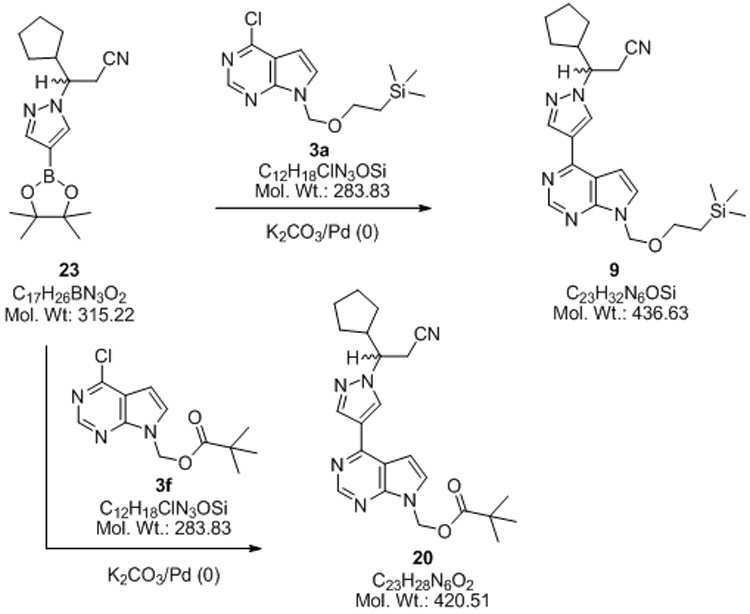
라세미 3-시클로펜틸-3-{4-[7-(2-트리메틸실라닐에톡시메틸)-7 H -피롤로[2,3- d ]피리미딘-4-일]피라졸-1-일}프로피오니트릴 (9, 라세미 SEM 보호된 화합물). 방법 C. 교반 바, 콘덴서, 열전대 및 3-웨이 밸브가 구비된 25 ml 둥근바닥플라스크에, 3-시클로펜틸-3-[4-(4,4,5,5-테트라메틸-1,3,2-디옥사보롤란-2-일)-1H-피라졸-1-일]프로판니트릴 (23, 0.697g, 2.21 mmol, 1.3 당량), 4-클로로-7-{[2-(트리메틸실릴)에톡시]메틸}-7H-피롤로[2,3-d]피리미딘 (3a, 0.506 g, 1.69 mmol), 1,4-디옥산 (4.44 mL), 물 (4.44 mL), 및 중탄산나트륨 (NaHCO3, 0.666 g, 7.93 mmol, 4.7 당량)을 실온에서 충전했다. 수득한 혼합물을 매시간 질소로 역충전으로 4회 탈가스한 후, 테트라키스(트리페닐포스핀)팔라듐(0) (91.6 mg, 0.079 mmol, 0.047 당량)을 첨가했다. 수득한 반응 혼합물을 매시간 질소로 역충전으로 4회 탈가스했다. 그 다음, 반응을 2 - 6시간 동안 90℃로 따뜻하게 했다. TLC 및 HPLC가 커플링 반응의 완료를 보여주었을 때, 반응 혼합물을 실온으로 냉각시키고, 그 다음 물 (5 mL) 및 에틸 아세테이트 (10 mL)로 희석했다. 2개의 층을 분리하고, 수성 층을 에틸 아세테이트 (10 mL)로 역추출했다. 조합된 유기 분획을 물 (10 mL) 및 포화 수성 NaCl 용액 (10 mL)로 세정하고, 황산마그네슘 (MgSO4) 상에서 건조시키고, 감압 하에서 농축하여 조 생성물 (9)을 호박색 오일로서 얻었다. 조 생성물을 플래시 칼럼 크로마토그래피 (SiO2, 0 % 내지 40 % 에틸 아세테이트/헥산 구배 용리)로 정제하여 라세미 3-시클로펜틸-3-{4-[7-(2-트리메틸실라닐에톡시메틸)-7H-피롤로[2,3-d]피리미딘-4-일]피라졸-1-일}프로피오니트릴 (9, 라세미 SEM 보호된 화합물, 617 mg, 737.9 mg 이론적, 83.6% 수율)을 황색 오일로서 얻었다. 9에 대해: 1H NMR (DMSO-d 6, 400 MHz) δ ppm 8.83 (s, 1H), 8.75 (s, 1H), 8.39 (s, 1H), 7.77 (d, 1H, J = 3.7 Hz), 7.09 (d, 1H, J = 3.7 Hz), 5.63 (s, 2H), 4.53 (td, 1H, J = 19.4, 4.0 Hz), 3.51 (t, 2H, J = 8.1 Hz), 3.23 (dq, 2H, J = 9.3, 4.3 Hz), 2.41 (m, 1H), 1.79 (m, 1H), 1.66-1.13 (m, 7H), 0.81 (t, 2H, J = 8.2 Hz), 0.124 (s, 9H); C23H32N6OSi (분자량: 436.63), LCMS (EI) m/e 437 (M+ + H) 및 m/e 459 (M+ + Na). Racemic 3-cyclopentyl-3- {4- [7- (2-trimethyl silanol to carbonyl ethoxymethyl) -7 H - pyrrolo [2,3- d] pyrimidin-4-yl] pyrazole-1 Propionitrile (9, racemic SEM protected compound). Method C. In a 25 ml round bottom flask with stirring bar, condenser, thermocouple and 3-way valve, 3-cyclopentyl-3- [4- (4,4,5,5-tetramethyl-1,3,2-di Oxaborolan-2-yl) -1 H -pyrazol-1-yl] propanenitrile ( 23 , 0.697 g, 2.21 mmol, 1.3 equiv), 4-chloro-7-{[2- (trimethylsilyl) ethoxy ] Methyl} -7 H -pyrrolo [2,3- d ] pyrimidine ( 3a , 0.506 g, 1.69 mmol), 1,4-dioxane (4.44 mL), water (4.44 mL), and sodium bicarbonate (NaHCO 3 , 0.666 g, 7.93 mmol, 4.7 equiv) was charged at room temperature. The resulting mixture was degassed four times by reverse charging with nitrogen every hour and then tetrakis (triphenylphosphine) palladium (0) (91.6 mg, 0.079 mmol, 0.047 equiv) was added. The obtained reaction mixture was degassed four times by reverse charging with nitrogen every hour. The reaction was then warmed to 90 ° C. for 2-6 hours. When TLC and HPLC showed the completion of the coupling reaction, the reaction mixture was cooled to room temperature and then diluted with water (5 mL) and ethyl acetate (10 mL). The two layers were separated and the aqueous layer was back extracted with ethyl acetate (10 mL). The combined organic fractions were washed with water (10 mL) and saturated aqueous NaCl solution (10 mL), dried over magnesium sulfate (MgSO 4 ) and concentrated under reduced pressure to give crude product ( 9 ) as amber oil. The crude product was purified by flash column chromatography (SiO 2 , 0% to 40% ethyl acetate / hexane gradient eluting) to give racemic 3-cyclopentyl-3- {4- [7- (2-trimethylsilanylethoxymethyl ) -7 H - pyrrolo [2,3- d] pyrimidin-4-yl] pyrazol-1-yl} propionitrile (9 racemic SEM-protected compound, 617 mg, 737.9 mg theoretical, 83.6% Yield) was obtained as a yellow oil. For 9 : 1 H NMR (DMSO- d 6 , 400 MHz) δ ppm 8.83 (s, 1H), 8.75 (s, 1H), 8.39 (s, 1H), 7.77 (d, 1H, J = 3.7 Hz) , 7.09 (d, 1H, J = 3.7 Hz), 5.63 (s, 2H), 4.53 (td, 1H, J = 19.4, 4.0 Hz), 3.51 (t, 2H, J = 8.1 Hz), 3.23 (dq, 2H, J = 9.3, 4.3 Hz), 2.41 (m, 1H), 1.79 (m, 1H), 1.66-1.13 (m, 7H), 0.81 (t, 2H, J = 8.2 Hz), 0.124 (s, 9H ); C 23 H 32 N 6 OSi (Molecular Weight: 436.63), LCMS (EI) m / e 437 (M + + H) and m / e 459 (M + + Na).
라세미 (4-(1-(2-시아노-1-시클로펜틸에틸)-1 H -피라졸-4-일)-7 H -피롤로[2,3- d ]피리미딘-7-일) 메틸 피발레이트 (20). 방법 B. 교반 바, 콘덴서 및 질소 및 진공 연결된 3-웨이 밸브가 구비된 50 ml 둥근바닥플라스크에, (4-클로로-7H-피롤로[2,3-d]피리미딘-7-일)메틸 피발레이트 (3f, 700 mg, 2.61 mmol), 3-시클로펜틸-3-[4-(4,4,5,5-테트라메틸-1,3,2-디옥사보롤란-2-일)-1H-피라졸-1-일]프로판니트릴 (23, 935 mg, 2.97 mmol, 1.13 당량), 1,2-디메톡시에탄(DME, 10 mL, 96 mmol), 물 (5 mL, 0.28 mol) 및 탄산칼륨 (K2CO3, 1.82 g, 7.84 mmol, 3.0 당량)을 실온에서 충전했다. 수득한 반응 혼합물을 매시간 질소로 역충전하여 3회 탈가스한 후, 테트라키스(트리페닐포스핀)팔라듐(0) (30 mg, 0.026 mmol, 0.010 당량)을 충전했다. 수득한 반응 혼합물을 매시간 질소로 역충전하여 4회 탈가스하고, 그 다음, 82℃로 따뜻하게 했다. 반응 혼합물을 82℃에서 6시간 동안 교반했다. 반응이 완료된 것으로 보일 때, 반응 혼합물을 실온으로 냉각한 후, 에틸 아세테이트 (45 mL) 및 물 (10 mL)로 희석했다. 수득한 혼합물을, 대다수의 고형물이 용액에 완전히 들어갈 때까지 교반했다. 2개의 층을 분리하고, 수성 층을 에틸 아세테이트 (1×25 mL)로 추출했다. 조합된 유기 분획을 수성 염수 (2×25 mL)로 세정하고, 황산나트륨 상에서 건조시키고, 여과하고, 감압 하에서 농축했다. 잔여물을 플래시 크로마토그래피 (SiO2, 0 - 50% 에틸 아세테이트/헥산 구배 용리)로 정제하여 라세미 4-(1-(2-시아노-1-시클로펜틸에틸)-1H-피라졸-4-일)-7H-피롤로[2,3-d]피리미딘-7-일)메틸 피발레이트 (20, 0.97 g, 1.1 g 이론적, 88.6% 수율)을 무색 오일로서 얻었고, 이는 실온에서 진공에서 정치시 고형화되었다. 20에 대해: 1H NMR (CDCl3, 300 MHz) δ 8.85 (s, 1H), 8.29 (s, 1H), 8.27 (s, 1H), 7.45 (d, 1H, J = 3.8 Hz,), 6.73 (d, 1H, J = 3.8 Hz), 6.22 (s, 2H), 4.23 (ddd, 1H, J = 10.0, 8.6, 4.0 Hz), 3.10 (dd, 1H, J = 17.0, 8.6 Hz), 2.92 (dd, 1H, J = 17.0, 4.0 Hz), 2.56 (m, 1H), 2.00 - 1.25 (m, 8H), 1.12 (s, 9H); C23H28N6O2 (분자량: 420.51), LCMS (EI) m/e 421 (M+ + H). Racemic (4- (1- (2-cyano-1-cyclopentylethyl) -1 H -pyrazol-4-yl) -7 H -pyrrolo [2,3- d ] pyrimidin-7-yl ) methyl Pivalate (20). Method B. In a 50 ml round bottom flask equipped with a stirring bar, a condenser and a 3-way valve connected with nitrogen and vacuum, (4-chloro-7 H -pyrrolo [2,3- d ] pyrimidin-7-yl) Methyl pivalate ( 3f , 700 mg, 2.61 mmol), 3-cyclopentyl-3- [4- (4,4,5,5-tetramethyl-1,3,2-dioxaborolan-2-yl) -1 H -Pyrazol-1-yl] propanenitrile ( 23 , 935 mg, 2.97 mmol, 1.13 equiv), 1,2-dimethoxyethane (DME, 10 mL, 96 mmol), water (5 mL, 0.28 mol) and carbonic acid Potassium (K 2 CO 3 , 1.82 g, 7.84 mmol, 3.0 equiv) was charged at room temperature. The reaction mixture obtained was degassed three times by backfilling with nitrogen every hour and then charged with tetrakis (triphenylphosphine) palladium (0) (30 mg, 0.026 mmol, 0.010 equiv). The resulting reaction mixture was degassed four times by backfilling with nitrogen every hour and then warmed to 82 ° C. The reaction mixture was stirred at 82 ° C for 6 h. When the reaction appeared to be complete, the reaction mixture was cooled to room temperature and then diluted with ethyl acetate (45 mL) and water (10 mL). The resulting mixture was stirred until the majority of solids entered the solution completely. The two layers were separated and the aqueous layer was extracted with ethyl acetate (1 × 25 mL). The combined organic fractions were washed with aqueous brine (2 × 25 mL), dried over sodium sulphate, filtered and concentrated under reduced pressure. The residue was purified by flash chromatography (SiO 2 , 0-50% ethyl acetate / hexane gradient elution) to give racemic 4- (1- (2-cyano-1-cyclopentylethyl) -1 H -pyrazole- 4- yl) -7 H - pyrrolo [2,3- d] pyrimidin-7-yl) methyl pivalate (20, 0.97 g, 1.1 g theoretical, was obtained a 88.6% yield) as a colorless oil, which at room temperature Solidified upon standing in vacuo. For 20 : 1 H NMR (CDCl 3 , 300 MHz) δ 8.85 (s, 1H), 8.29 (s, 1H), 8.27 (s, 1H), 7.45 (d, 1H, J = 3.8 Hz,), 6.73 (d, 1H, J = 3.8 Hz), 6.22 (s, 2H), 4.23 (ddd, 1H, J = 10.0, 8.6, 4.0 Hz), 3.10 (dd, 1H, J = 17.0, 8.6 Hz), 2.92 ( dd, 1H, J = 17.0, 4.0 Hz), 2.56 (m, 1H), 2.00-1.25 (m, 8H), 1.12 (s, 9H); C 23 H 28 N 6 O 2 (molecular weight: 420.51), LCMS (EI) m / e 421 (M + + H).

(3 R )-시클로펜틸-3-[4-(7 H -피롤로[2,3- d ]피리미딘-4-일)피라졸-1-일]프로피오니트릴 (( R )-12, 유리 염기). 방법 C. 교반 바, 콘덴서, 및 질소 및 진공에 연결된 3-웨이 밸브가 구비된 25 mL 둥근바닥플라스크에, 4-클로로-7H-피롤로[2,3-d]피리미딘 (1, 154 mg, 1.00 mmol), (3R)-3-시클로펜틸-3-[4-(4,4,5,5-테트라메틸-1,3,2-디옥사보롤란-2-일)-1H-피라졸-1-일]프로판니트릴 ((R)-24, 445 mg, 1.41 mmol, 1.41 당량), 1,4-디옥산(2.78 mL, 35.6 mmol), 물 (1.39 mL, 77.2 mmol), 및 탄산칼륨 (K2CO3, 693 mg, 5.02 mmol, 5.0 당량)을 실온에서 충전했다. 수득한 혼합물을 매시간 질소로 역충전하여 3회 탈가스한 후, 테트라키스(트리페닐포스핀)팔라듐(0) (207 mg, 0.180 mmol, 0.18 당량)을 충전했다. 수득한 반응 혼합물을 매시간 질소로 역충전하여 4회 탈가스하고, 그 다음, 95℃로 따뜻하게 했다. 반응 혼합물을 95℃에서 17시간 동안 교반했다. 반응이 완료된 것으로 보일 때, 반응 혼합물을 실온으로 냉각한 후, 에틸 아세테이트 (20 mL) 및 20% 수성 염수 (11 mL)로 희석했다. 혼합물을, 대다수의 고형물이 용액에 완전히 들어갈 때까지 격렬히 실온에서 교반했다. 2개의 층을 분리하고, 수성 층을 에틸 아세테이트 (20 mL). 조합된 유기 추출물을 포화 염수 (10 mL)로 세정하고, 황산마그네슘 상에서 건조시키고, 여과하고, 감압 하에서 농축했다. 그 다음, 잔여물을 플래시 크로마토그래피 (SiO2, 0 - 100% 에틸 아세테이트/헥산 구배 용리)로 정제하여 (3R)-3-시클로펜틸-3-[4-(7H-피롤로[2,3-d]피리미딘-4-일)-1H-피라졸-1-일]프로판니트릴 ((R)-12, 197 mg, 306.4 mg 이론적, 64.3% 수율)을 무색 오일로서 얻었고, 이는 실온에서 정치시 고형화되었다. (R)-12에 대해: 1H NMR (DMSO-d 6, 400 MHz) δ ppm 12.1 (bs, 1H), 8.80 (d, 1H, J = 0.42 Hz), 8.67 (s, 1H), 8.37 (s, 1H), 7.59 (dd, 1H, J = 2.34, 3.51 Hz), 6.98 (dd, 1H, J = 1.40, 3.44 Hz), 4.53 (td, 1H, J = 19.5, 4.63 Hz), 3.26 (dd, 1H, J = 9.77, 17.2 Hz), 3.18 (dd, 1H, J = 4.32, 17.3 Hz), 2.40 (m, 1H), 1.79 (m, 1H), 1.65 내지 1.13 (m, 7H); C17H18N6 (분자량: 306.37) LCMS (EI) m/e 307 [M+ + H]. (3 R) - cyclopentyl -3- [4- (7 H - pyrrolo [2,3- d] pyrimidin-4-yl) pyrazol-1-yl] propionitrile ((R) -12, Free base). Method C. In a 25 mL round bottom flask equipped with a stirring bar, a condenser, and a 3-way valve connected to nitrogen and vacuum, 4-chloro-7 H -pyrrolo [2,3- d ] pyrimidine ( 1 , 154 mg, 1.00 mmol), ( 3R ) -3-cyclopentyl-3- [4- (4,4,5,5-tetramethyl-1,3,2-dioxaborolan-2-yl) -1 H -pyrazol-1-yl] propanenitrile (( R ) -24 , 445 mg, 1.41 mmol, 1.41 equiv), 1,4-dioxane (2.78 mL, 35.6 mmol), water (1.39 mL, 77.2 mmol) , And potassium carbonate (K 2 CO 3 , 693 mg, 5.02 mmol, 5.0 equiv) were charged at room temperature. The resulting mixture was degassed three times by backfilling with nitrogen every hour and then charged with tetrakis (triphenylphosphine) palladium (0) (207 mg, 0.180 mmol, 0.18 equiv). The resulting reaction mixture was backfilled with nitrogen every hour degassed four times and then warmed to 95 ° C. The reaction mixture was stirred at 95 ° C for 17 h. When the reaction appeared to be complete, the reaction mixture was cooled to room temperature and then diluted with ethyl acetate (20 mL) and 20% aqueous brine (11 mL). The mixture was stirred vigorously at room temperature until the majority of solids entered the solution completely. The two layers were separated and the aqueous layer was ethyl acetate (20 mL). The combined organic extracts were washed with saturated brine (10 mL), dried over magnesium sulphate, filtered and concentrated under reduced pressure. The residue was then purified by flash chromatography (SiO 2 , 0-100% ethyl acetate / hexane gradient elution) to give (3 R ) -3-cyclopentyl-3- [4- (7 H -pyrrolo [2 , 3- d ] pyrimidin-4-yl) -1 H -pyrazol-1-yl] propanenitrile (( R ) -12 , 197 mg, 306.4 mg theoretical, 64.3% yield) was obtained as a colorless oil. Solidified upon standing at room temperature. For ( R ) -12 : 1 H NMR (DMSO- d 6 , 400 MHz) δ ppm 12.1 (bs, 1H), 8.80 (d, 1H, J = 0.42 Hz), 8.67 (s, 1H), 8.37 ( s, 1H), 7.59 (dd, 1H, J = 2.34, 3.51 Hz), 6.98 (dd, 1H, J = 1.40, 3.44 Hz), 4.53 (td, 1H, J = 19.5, 4.63 Hz), 3.26 (dd , 1H, J = 9.77, 17.2 Hz), 3.18 (dd, 1H, J = 4.32, 17.3 Hz), 2.40 (m, 1H), 1.79 (m, 1H), 1.65-1.13 (m, 7H); C 17 H 18 N 6 (molecular weight: 306.37) LCMS (EI) m / e 307 [M + + H].
( S )-3-시클로펜틸-3-(4-(7-(디에톡시메틸)-7 H -피롤로[2,3- d ]피리미딘-4-일)-1 H -피라졸-1-일)프로판니트릴 (( S )-25). 교반 바, 콘덴서 및 질소 및 진공에 연결된 3-웨이 밸브가 구비된 100 ml 둥근바닥플라스크에, 4-클로로-7-(디에톡시메틸)-7H-피롤로[2,3-d]피리미딘 (3b, 3.30 g, 0.0129 mol), (3S)-3-시클로펜틸-3-[4-(4,4,5,5-테트라메틸-1,3,2-디옥사보롤란-2-일)-1H-피라졸-1-일]프로판니트릴 ((S)-24, 5.12 g, 0.0146 mol, 1.13 당량), 1,4-디옥산 (33.4 mL, 0.428 mol), 물 (16.7 mL, 0.929 mol) 및 탄산칼륨 (K2CO3, 8.03 g, 0.0581 mol, 4.5 당량)을 실온에서 충전했다. 수득한 반응 혼합물을 매시간 질소로 역충전하여 3회 탈가스한 후, 테트라키스(트리페닐포스핀)팔라듐(0) (1.49 g, 0.00129 mol, 0.10 당량)을 충전했다. 혼합물을 매시간 질소로 역충전하여 4회 탈가스하고, 그 다음, 95℃로 따뜻하게 했다. 반응 혼합물을 95℃에서 21시간 동안 교반했다. 반응이 완료된 것으로 보일 때, 반응 혼합물을 실온으로 냉각한 후, 에틸 아세테이트 (45 mL) 및 물 (20 mL)으로 희석했다. 수득한 혼합물을, 대다수의 고형물이 용액에 완전히 들어갈 때 까지 교반했다. 2개의 층을 분리하고, 수성 층을 에틸 아세테이트 (50 mL)로 추출했다. 조합된 유기 분획을 20% 수성 염수 (50 mL)로 세정하고, 황산마그네슘 상에서 건조시키고, 여과하고, 감압 하에서 농축했다. 잔여물을 플래시 크로마토그래피 (SiO2, 0% to 50% 에틸 아세테이트/헥산 구배 용리)로 정제하여 (3S)-3-시클로펜틸-3-{4-[7-(디에톡시메틸)-7H-피롤로[2,3-d]피리미딘-4-일]-1H-피라졸-1-일}프로판니트릴 ((S)-25, 4.11 g, 5.27 g 이론적, 78% 수율)을 무색 오일로서 얻었고, 이는 실온에서 정치시 고형화되었다. (S)-25에 대해: 1H NMR (DMSO-d 6, 400 MHz) δ ppm 8.84 (s, 1H), 8.74 (s, 1H), 8.38 (s, 1H), 7.71 (d, 1H, J = 3.8 Hz,), 7.12 (d, 1H, J = 3.8 Hz), 6.76 (s, 1H), 4.53 (td, 1H, J = 19.4, 4.3 Hz), 3.68 (m, 2H), 3.52 (m, 2H), 3.26 (dd, 1H, J = 9.6, 17.3 Hz), 3.19 (dd, 1H, J = 4.3, 17.2 Hz), 2.41 (m, 1H), 1.80 (m, 1H), 1.63 - 1.09 (m, 13H); C22H28N6O2 (분자량: 408.50), LCMS (EI) m/e 409 (M+ + H). (S) -3- cyclopentyl-3- (4- (7- (diethoxymethyl) -7 H - pyrrolo [2,3- d] pyrimidin-4-yl) -1 H - pyrazol -1 -Yl) propanenitrile (( S ) -25). In a 100 ml round bottom flask equipped with a stirring bar, a condenser and a 3-way valve connected to nitrogen and vacuum, 4-chloro-7- (diethoxymethyl) -7 H -pyrrolo [2,3- d ] pyrimidine ( 3b , 3.30 g, 0.0129 mol), (3 S ) -3-cyclopentyl-3- [4- (4,4,5,5-tetramethyl-1,3,2-dioxaborolan-2- Il) -1 H -pyrazol-1-yl] propanenitrile (( S ) -24 , 5.12 g, 0.0146 mol, 1.13 equiv), 1,4-dioxane (33.4 mL, 0.428 mol), water (16.7 mL , 0.929 mol) and potassium carbonate (K 2 CO 3 , 8.03 g, 0.0581 mol, 4.5 equiv) were charged at room temperature. The reaction mixture obtained was degassed three times by backfilling with nitrogen every hour and then charged with tetrakis (triphenylphosphine) palladium (0) (1.49 g, 0.00129 mol, 0.10 equiv). The mixture was degassed four times by backfilling with nitrogen every hour and then warmed to 95 ° C. The reaction mixture was stirred at 95 ° C for 21 h. When the reaction appeared to be complete, the reaction mixture was cooled to room temperature and then diluted with ethyl acetate (45 mL) and water (20 mL). The resulting mixture was stirred until the majority of solids entered the solution completely. The two layers were separated and the aqueous layer was extracted with ethyl acetate (50 mL). The combined organic fractions were washed with 20% aqueous brine (50 mL), dried over magnesium sulphate, filtered and concentrated under reduced pressure. The residue was purified by flash chromatography (SiO 2 , 0% to 50% ethyl acetate / hexane gradient eluting) to give ( 3S ) -3-cyclopentyl-3- {4- [7- (diethoxymethyl) -7 H -pyrrolo [2,3-d] pyrimidin-4-yl] -1 H -pyrazol-1-yl} propanenitrile (( S ) -25 , 4.11 g, 5.27 g theoretical, 78% yield) Obtained as a colorless oil, which solidified on standing at room temperature. For ( S ) -25 : 1 H NMR (DMSO- d 6 , 400 MHz) δ ppm 8.84 (s, 1H), 8.74 (s, 1H), 8.38 (s, 1H), 7.71 (d, 1H, J = 3.8 Hz,), 7.12 (d, 1H, J = 3.8 Hz), 6.76 (s, 1H), 4.53 (td, 1H, J = 19.4, 4.3 Hz), 3.68 (m, 2H), 3.52 (m, 2H), 3.26 (dd, 1H, J = 9.6, 17.3 Hz), 3.19 (dd, 1H, J = 4.3, 17.2 Hz), 2.41 (m, 1H), 1.80 (m, 1H), 1.63-1.09 (m , 13H); C 22 H 28 N 6 O 2 (molecular weight: 408.50), LCMS (EI) m / e 409 (M + + H).

3-시클로프로필아실로니트릴 (27). 건조 테트라히드로푸란 (THF, 5.75 L) 중 디에틸 시아노메틸포스포네이트 (7, 779.5 g, 4.4 mol, 1.1 당량)의 용액을 질소 하에서 얼음-물-메탄올 배쓰에서 교반한 후, THF (KO t Bu, 4.2 L, 4.2 mol, 1.05 당량) 중 1 M 칼륨 tert-부톡시드의 용액을 0℃ 미만의 온도를 유지한 것과 같은 속도로 첨가했다. 칼륨 tert-부톡시드 용액의 첨가가 완료된 후, 교반을 0 - 5℃에서 1시간 동안 계속했다. 그리고, 건조 THF (290 ml) 중 시클로펜탄카브알데히드 (26, 280 g, 4.0 mol)의 용액을 0℃ 미만의 온도를 유지하는 것과 같은 속도로 첨가했다. 차가운 배쓰를 제거하고, 반응 혼합물을 실온으로 점차 따뜻하게 하고, 실온에서 밤새 교반했다. 반응이 완료된 것으로 보일 때, 반응 혼합물을 MTBE (14 L), 물 (10 L) 및 염수 (6 L) 사이에서 분할했다. 유기 상을 염수 (6 L)로 세정했다. 수성 상을 메틸 tert-부틸 에테르 (MTBE, 10 L)로 추출하고, 염수 (6 L)로 세정했다. 조합된 유기 추출물을 감압 하에서 농축하고, 잔여물을 증류하여 3-시클로프로필아실로니트릴 (27, 342.7 g, 372.5 g 이론적, 92% 수율)을 무색 오일로서 얻었고, 이는 E- 및 Z-이성질체의 혼합물인 것으로 발견되었다. 27에 대해: 1H NMR (DMSO-d 6, 400 MHz, E-이성질체에 대해) δ ppm 6.33 (dd, 1H, J = 16.3, 10.3 Hz), 5.69 (d, 1H, J = 16.4 Hz), 1.66 (m, 1H), 1.02 (m, 1H,), 0.93 (m, 1H), 0.69 (m, 2H) 및 (Z-이성질체에 대해) δ ppm 6.05 (t, 1H, J = 10.8 Hz), 5.45 (d, 1H, J = 9.7 Hz), 1.82 (m, 1H), 1.02 (m, 1H), 0.93 (m, 1H), 0.69 (m, 2H); 13C NMR (DMSO-d 6, 100 MHz, E-이성질체에 대해) δ ppm 160.9, 118.4, 95.4, 15.4, 8.64 및 (Z-이성질체에 대해) δ ppm 160.0, 117.3, 95.2, 14.8, 8.4; C6H7N (분자량: 93.13), GCMS (EI) m/e 92 (M+ - H). 3-cyclopropylacyronitrile (27). A solution of diethyl cyanomethylphosphonate ( 7 , 779.5 g, 4.4 mol, 1.1 equiv) in dry tetrahydrofuran (THF, 5.75 L) was stirred in an ice-water-methanol bath under nitrogen and then THF (EN solution of 1 M potassium tert -butoxide in t Bu, 4.2 L, 4.2 mol, 1.05 equiv) was added at the same rate as maintaining a temperature below 0 ° C. After the addition of the potassium tert -butoxide solution was complete, stirring was continued at 0-5 ° C. for 1 hour. And a solution of cyclopentanecarbaldehyde ( 26 , 280 g, 4.0 mol) in dry THF (290 ml) was added at the same rate as keeping the temperature below 0 ° C. The cold bath was removed and the reaction mixture was gradually warmed to room temperature and stirred overnight at room temperature. When the reaction appeared to be complete, the reaction mixture was partitioned between MTBE (14 L), water (10 L) and brine (6 L). The organic phase was washed with brine (6 L). The aqueous phase was extracted with methyl tert -butyl ether (MTBE, 10 L) and washed with brine (6 L). The combined organic extracts were concentrated under reduced pressure and the residue was distilled to give 3-cyclopropylacyronitrile ( 27 , 342.7 g, 372.5 g theoretical, 92% yield) as a colorless oil, which of the E- and Z-isomers It was found to be a mixture. For 27 : 1 H NMR (DMSO- d 6 , 400 MHz, for E-isomers) δ ppm 6.33 (dd, 1H, J = 16.3, 10.3 Hz), 5.69 (d, 1H, J = 16.4 Hz), 1.66 (m, 1H), 1.02 (m, 1H,), 0.93 (m, 1H), 0.69 (m, 2H) and (for Z -isomers) δ ppm 6.05 (t, 1H, J = 10.8 Hz), 5.45 (d, 1H, J = 9.7 Hz), 1.82 (m, 1H), 1.02 (m, 1H), 0.93 (m, 1H), 0.69 (m, 2H); 13 C NMR (for DMSO- d 6 , 100 MHz, E-isomer) δ ppm 160.9, 118.4, 95.4, 15.4, 8.64 and (for Z -isomer) δ ppm 160.0, 117.3, 95.2, 14.8, 8.4; C 6 H 7 N (molecular weight: 93.13), GCMS (EI) m / e 92 (M + -H).
라세미 3-시클로프로필-3-{4-[7-(2-트리메틸실라닐에톡시메틸)-7 H -피롤로[2,3- d ]피리미딘-4-일]피라졸-1-일}프로피오니트릴 (28, 라세미 SEM 보호된 화합물). 아세토니트릴 (11 L) 중 4-(1H-피라졸-4-일)-7-(2-트리메틸실라닐-에톡시메틸)-7H-피롤로[2,3-d]피리미딘 (5, 1.115 Kg, 3.54 mol, 1.0 당량)의 현탁액에 3-시클로프로필아실로니트릴 (27, 428.7 g, 4.60 mol, 1.3 당량) 및 1,8-디아조바이시클로[5.4.0]운덱-7-엔 (DBU, 55 mL, 0.37 mol, 0.105 당량)을 첨가했다. 수득한 반응 혼합물을 환류 대략 18시간 동안에 부드럽게 가열 환류했다. HPLC 및 TLC가 반응의 완료를 보여주었을 때, 맑은 용액인 반응 혼합물을 실온으로 냉각한 후, 감압 하에서 농축하여 조 마이클 부가 생성물 (28)을 암적색 오일로서 얻었다. 그 다음, 조 생성물을 디클로로메탄으로 희석하고, 3부분으로 나누고, 실리카겔 (3×2 Kg) 상에 흡착시켰다. 실리카겔 상에 흡착된 조 생성물을 (87.5:12.5 헵탄/EtOAc에 채워지고, 87.5:12.5 내지 25:75 헵탄/EtOAc로 용리된) 3개의 2 Kg 실리카겔 칼럼 상에서 칼럼 크로마토그래피로 정제했다. 순수한 원하는 생성물 (28)을 함유하는 분획을 조합하고, 감압 하에서 농축하고, 이동시켜 라세미 3-시클로프로필-3-{4-[7-(2-트리메틸실라닐-에톡시메틸)-7H-피롤로[2,3-d]피리미딘-4-일]-피라졸-1-일}-프로피오니트릴 (28, 라세미 SEM 보호된 화합물, 1.310 Kg, 1.446 Kg 이론적, 90.6% 수율)을 호박색 시럽으로서 얻었고, 이를 추가 정제없이 키랄 칼럼 분리에 사용했다. 28에 대해: C21H28N5OSi (분자량: 408.57), LCMS (EI) m/e 409 (M+ + H). Rac-3-cyclopropylmethyl-3- {4- [7- (2-trimethyl silanol to carbonyl ethoxymethyl) -7 H - pyrrolo [2,3- d] pyrimidin-4-yl] pyrazole-1 General propionitrile (28, racemic SEM protected compound) . Acetonitrile (11 L) of 4- (1 H-pyrazol-4-yl) -7- (2-trimethylsilanyl-ethoxymethyl) -7 H-pyrrolo [2,3- d] pyrimidine ( 5 , 1.115 Kg, 3.54 mol, 1.0 equiv) in 3-cyclopropylacyronitrile ( 27, 428.7 g, 4.60 mol, 1.3 equiv) and 1,8-diazocyclo [5.4.0] undec-7 -Ene (DBU, 55 mL, 0.37 mol, 0.105 equiv) was added. The resulting reaction mixture was gently heated to reflux for approximately 18 hours at reflux. When HPLC and TLC showed completion of the reaction, the reaction mixture, which was a clear solution, was cooled to room temperature and then concentrated under reduced pressure to give crude Michael addition product ( 28 ) as dark red oil. The crude product was then diluted with dichloromethane, divided into three portions and adsorbed onto silica gel (3 × 2 Kg). The crude product adsorbed on silica gel was purified by column chromatography on three 2 Kg silica gel columns (filled with 87.5: 12.5 heptanes / EtOAc and eluted with 87.5: 12.5 to 25:75 heptanes / EtOAc). Fractions containing pure desired product ( 28 ) were combined, concentrated under reduced pressure and transferred to racemic 3-cyclopropyl-3- {4- [7- (2-trimethylsilanyl-ethoxymethyl) -7 H -Pyrrolo [2,3- d ] pyrimidin-4-yl] -pyrazol-1-yl} -propionitrile ( 28 , racemic SEM protected compound , 1.310 Kg, 1.446 Kg theoretical, 90.6% yield) Was obtained as amber syrup, which was used for chiral column separation without further purification. For 28 : C 21 H 28 N 5 OSi (molecular weight: 408.57), LCMS (EI) m / e 409 (M + + H).
(3 R )-3-시클로프로필-3-(4-(7-((2-(트리메틸실릴)에톡시)메틸)-7 H -피롤로[2,3- d ]피리미딘-4-일)-1 H -피라졸-1-일)프로판니트릴 (( R )-29) 및 (3 S )-3-시클로프로필-3-(4-(7-((2-(트리메틸실릴)에톡시)메틸)-7 H -피롤로[2,3- d ]피리미딘-4-일)-1 H -피라졸-1-일)프로판니트릴 (( S )-29). 3.0 L의 이소프로판올 (IPA) 중 1.5 Kg의 20-마이크론 Chiralcel® OD 키랄 정지상 (CSP) (Daicel 제조)의 슬러리를 PROCHROM Dynamic Axial Compression Column LC110-1 (11 cm ID×25 cm L; 칼럼 불감 용적: 대략 1.5 L)에 150 bar의 충전 압력 하에서 채워 넣었다. 그 다음, 충전된 칼럼을, Novasep Hipersep HPLC 유닛 상에 설치했다. 칼럼 및 HPLC 시스템을 메탄올 (17 L) 및 이소프로판올 및 헥산 (2 : 8 용적으로, 17 L)의 혼합물로 만들어진 이동상으로 플러시했다. 그 다음, 공급 용액을, 3-시클로프로필-3-(4-(7-((2-(트리메틸실릴)에톡시)메틸)-7H-피롤로[2,3-d]피리미딘-4-일)-1H-피라졸-1-일)프로판니트릴 (28, 라세미 SEM 보호된 화합물, 2500 g, 6.119 mol)을 이동상에서 용해시켜서 농도 80 g/L로 만들었다. 그 다음, 공급 용액 (120 mL/주입)을, 순차적으로 분리용 분취 HPLC 키랄 칼럼에 주입했다. 키랄 칼럼을 이동상으로 570 mL/min의 유속에서 실온에서 용리했다. 칼럼 용리를 파장 330 nm에서 UV로 모니터했다. 이들 조건 하에서, 2개의 거울상이성질체의 기준 분리를 달성했다. 각 주입에 대한 사이클 시간은 11분이었고, 총 261회 주입이 이 분리 방법을 위해 수행되었다. 피크 1 (원하지 않는 (S)-거울상이성질체, (S)-29) 및 피크 2 (원하는 (R)-거울상이성질체, (R)-29)의 분획을 각각의 주입으로부터 별도로 수집하고, 각각의 피크로부터 수집된 분획을 40℃에서 감압 하에서 (40 - 120 bar) 계속해서 농축했다. 각 증발기로부터의 잔여물을 고진공 하에서 일정한 중량으로 추가 건조시켜 피크 2로부터 (3R)-3-시클로프로필-3-(4-(7-((2-(트리메틸실릴)에톡시)메틸)-7H-피롤로[2,3-d]피리미딘-4-일)-1H-피라졸-1-일)프로판니트릴 ((R)-29, 1150 g, 1250 g 이론적, 92%)을 담황색 오일로서 얻었고, 실온에서 진공에서 정치시 고형화되었고, 피크 1로부터 (3S)-시클로프로필-3-(4-(7-((2-(트리메틸실릴)에톡시)메틸)-7H-피롤로[2,3-d]피리미딘-4-일)-1H-피라졸-1-일)프로판니트릴 ((S)-29, 1200 g, 1250 g 이론적, 96%)을 황색 오일로서 얻었고, 이는 실온에서 진공에서 정치시 고형화되었다. (3 R) -3-cyclopropyl-3- (4- (7-a ((2- (trimethylsilyl) ethoxy) methyl) -7 H-pyrrolo [2,3- d] pyrimidin-4-yl ) -1 H-pyrazol-1-yl) propanenitrile ((R) -29) and (3 S) -3-cyclopropyl-3- (4- (7-a ((2- (trimethylsilyl) ethoxy ) methyl) -7 H - pyrrolo [2,3- d] pyrimidin-4-yl) -1 H - pyrazol-1-yl) propanenitrile ((S) -29). In 3.0 L of isopropanol (IPA) 1.5 Kg of a 20- micron Chiralcel ® OD chiral stationary phase (CSP) PROCHROM a slurry of (Daicel Ltd.) Dynamic Axial Compression Column LC110-1 (11 cm ID × 25 cm L; column dead volume: approximately 1.5 L) was charged under a filling pressure of 150 bar. The packed column was then installed on a Novasep Hipersep HPLC unit. The column and HPLC system were flushed with a mobile phase made of a mixture of methanol (17 L) and isopropanol and hexanes (2: 8 vol, 17 L). Then, the feed solution of 3-cyclopropyl-3- (4- (7-pyrrolo [2,3- d] pyrimidin-4 - methyl) -7 H ethoxy) ((2- (trimethylsilyl) -Yl) -1 H -pyrazol-1-yl) propanenitrile ( 28 , racemic SEM protected compound, 2500 g, 6.119 mol) was dissolved in the mobile phase to a concentration of 80 g / L. The feed solution (120 mL / injection) was then injected sequentially into a preparative HPLC chiral column for separation. The chiral column was eluted with a mobile phase at room temperature at a flow rate of 570 mL / min. Column elution was monitored by UV at wavelength 330 nm. Under these conditions, standard separation of the two enantiomers was achieved. The cycle time for each injection was 11 minutes and a total of 261 injections were performed for this separation method. Fractions of peak 1 (undesired ( S ) -enantiomer, ( S ) -29 ) and peak 2 (desired ( R ) -enantiomer, ( R ) -29 ) are collected separately from each injection and each peak Fractions collected from were continuously concentrated at 40 ° C. under reduced pressure (40-120 bar). The residue from each evaporator was further dried to constant weight under high vacuum to give ( 3R ) -3-cyclopropyl-3- (4- (7-((2- (trimethylsilyl) ethoxy) methyl)- 7 H -pyrrolo [2,3- d ] pyrimidin-4-yl) -1 H -pyrazol-1-yl) propanenitrile ((R) - 29, 1150 g, 1250 g theoretical, 92%) was obtained as a light yellow oil was solidified upon standing in vacuo at room temperature, the peak 1 (3 S) - cyclopropyl-3- (4- (7 -pyrrolo [2,3- d] pyrimidin-4-yl) -1 H - - -7 H ( (2- ( ethoxy) methyl trimethylsilyl)) pyrazol-1-yl) propane nitrile (( S ) -29 , 1200 g, 1250 g theoretical, 96 %) was obtained as a yellow oil which solidified upon standing in vacuo at room temperature.
키랄 HPLC 방법을, Chiralcel® OD-H 칼럼 (4.6×250 mm, 5 ㎛) (Chiral Technologies, Inc.로부터 구매)을 사용하여 SEM 보호된 화합물 ((R)-29 및 (S)-29) 거울상이성질체 모두의 키랄 순도 평가에 대해 전개했다. SEM 보호된 화합물의 2개의 거울상이성질체를, 15% 에탄올 및 85% 헥산의 이동상을 사용하여 실온에서 1 mL/min의 유속으로 4.0초과의 분할로 분리했다. UV 검출 파장은 220 nm이다. (S)-거울상이성질체 ((S)-29) 및 (R)-거울상이성질체 ((R)-29)에 대한 체류시간은 각각 9.4분 및 12.4분이다. The chiral HPLC method, Chiralcel ® OD-H column (4.6 × 250 mm, 5 ㎛ ) using (Chiral Technologies, Inc. purchased from) the SEM protected compound ((R) - 29 and (S) - 29) enantiomer Development was made for the evaluation of chiral purity of all isomers. Two enantiomers of the SEM protected compound were separated in more than 4.0 splits at room temperature with a flow rate of 1 mL / min using a mobile phase of 15% ethanol and 85% hexane. The UV detection wavelength is 220 nm. (S) - enantiomer ((S) - 29) and (R) - enantiomer ((R) - 29) The residence time for is 9.4 minutes and 12.4 minutes respectively.
화학 순도 (HPLC 면적%) 및 키랄 순도 (키랄 HPLC 면적%)를 포함하는 분취 키랄 HPLC에 의해 분리된 각각의 거울상이성질체의 질을 분석하고, 그의 구조는 NMR 및 LC/MS에 의해 확인되었다. (R)-29에 대해: 비키랄 순도 (99.1 면적%, 220 nm에서 검출된 HPLC에 의해); 키랄 순도 (99.4 면적%, 키랄 HPLC에 의해; 98.8 % ee); C21H28N5OSi (분자량: 408.57), LCMS (EI) m/e 409 (M+ + H). (S)-29에 대해: 비키랄 순도 (98.5 면적%, 220 nm에서 검출된 HPLC에 의해); 키랄 순도 (99.2 면적%, 키랄 HPLC에 의해; 98.4 % ee); C21H28N5OSi (분자량: 408.57), LCMS (EI) m/e 409 (M+ + H). The quality of each enantiomer separated by preparative chiral HPLC comprising chemical purity (HPLC area%) and chiral purity (chiral HPLC area%) was analyzed and its structure was confirmed by NMR and LC / MS. (R) - about 29: achiral purity (99.1% by area by HPLC detection at 220 nm); Chiral purity (99.4 area%, by chiral HPLC; 98.8% ee); C 21 H 28 N 5 OSi (molecular weight: 408.57), LCMS (EI) m / e 409 (M + + H). (S) - for the 29: achiral purity (98.5% by area by HPLC detection at 220 nm); Chiral purity (99.2 area%, by chiral HPLC; 98.4% ee); C 21 H 28 N 5 OSi (molecular weight: 408.57), LCMS (EI) m / e 409 (M + + H).
(3 R )-3-시클로프로필-3-[4-(7 H -피롤로[2,3- d ]피리미딘-4-일)피라졸-1-일]프로피오니트릴 (( R )-30). MeCN (900 mL) 및 H2O (75 mL) 중 (3R)-3-시클로프로필-3-{4-[7-(2-트리메틸실라닐-에톡시메틸)-7H-피롤로[2,3-d]피리미딘-4-일]-피라졸-1-일}-프로피오니트릴 ((R)-29, 102 g, 0.25 mol, 1.0 당량)의 용액을 고형 리튬 테트라플루오로보레이트 (LiBF4, 186.0 g, 2.0 mol, 8.0 당량)로 나누어서 처리했다 (반응 온도는 첨가시 15 내지 38℃로 증가되었다). 그 다음, 수득한 반응 혼합물을 20시간 동안 가열 환류했다 (경성 현탁액이 형성됨). LCMS이 SEM 그룹의 절단의 완료를 보여주었을 때, 반응 혼합물을 실온으로 냉각시키고, 차후에 12℃로 냉각시킨 후, 수성 NH4OH 용액 (20%, 80 mL)의 첨가로 pH 9 - 10으로 조정했다 . 수득한 현탁액을, LCMS가 전형적으로 24 - 36시간 내에 N-히드록시메틸 중간체 (M+ + H = 309)의 잔여를 보여주지 않을 때까지 실온에서 교반했다. 이 기간 동안에, 반응 혼합물의 pH는 7 - 8로 떨어졌다, 추가 수성 NH4OH 용액 (20%)을 첨가하여 혼합물을 pH 9 - 10로 재조정했다. 혼합물을 아세토니트릴 (300 mL)로 희석하고, 여과하고, 아세토니트릴 (500 mL)로 고형물을 세정했다. 탁한 여과물을 감압 하에서 농축하여 대부분의 MeCN을 제거하여 증점 오일을 얻었고, 이 오일은 일부 고형물을 함유했다. 혼합물을 서서히 H2O (500 mL)로 희석하고, 탁한 용액을 씨딩했다. 그 다음, 용액을, 증점 현탁액이 형성될 때까지 감압 하에서 실온에서 농축했다. 현탁액을 H2O (1 L)로 추가 희석하고, 수득한 현탁액을 실온에서 2시간 동안 교반했다. 고형물을 여과로 수집하고, H2O (2×500 mL)로 세정하고, 깔때기 상에서 1.5시간 동안에 흡입 건조했다. 19F NMR은 소량의 무기 플루오라이드의 존재를 보여주었고, TLC (5% MeOH/EtOAc)은 소량의 기준 물질의 존재를 보여주었다. 따라서, 조 고형물을, 1시간 동안 기계적 교반하면서 H2O (1 L)에서 재슬러리화한 후, 여과로 수집하고, H2O (500 mL)로 세정했다. 습윤 케이크를 깔때기 상에서 1.5시간 동안에 흡입 건조하고, 그 다음, 진공 오븐에서 45 - 50℃에서 16시간 동안 건조하여 (3R)-3-시클로프로필-3-[4-(7H-피롤로[2,3-d]피리미딘-4-일)피라졸-1-일]프로피오니트릴 ((R)-30, 60.8 g, 69.6 g 이론적, 87.4% 수율)을 회백색 고형물로서 얻었다. (R)-30에 대해: C15H14N6 (분자량: 278.31), LCMS (EI) m/e 279 (M+ + H). (3 R ) -3-cyclopropyl-3- [4- (7 H -Pyrrolo [2,3- d ] Pyrimidin-4-yl) pyrazol-1-yl] propionitrile (( R ) -30). MeCN (900 mL) and H2In O (75 mL) (3R) -3-cyclopropyl-3- {4- [7- (2-trimethylsilanyl-ethoxymethyl) -7H-Pyrrolo [2,3-d] Pyrimidin-4-yl] -pyrazol-1-yl} -propionitrile ((R) -29, 102 g, 0.25 mol, 1.0 equiv) was dissolved in solid lithium tetrafluoroborate (LiBF4, 186.0 g, 2.0 mol, 8.0 equivalents) (reaction temperature increased to 15-38 ° C. upon addition). The reaction mixture obtained was then heated to reflux for 20 hours (hard suspension formed). When LCMS showed completion of the cleavage of the SEM group, the reaction mixture was cooled to room temperature and subsequently to 12 ° C., followed by aqueous NH4The pH was adjusted to 9-10 by the addition of OH solution (20%, 80 mL). The resulting suspension is prepared by LCMS typically in 24 to 36 hours.N-Hydroxymethyl intermediate (M+ Stir at room temperature until no residue of + H = 309). During this period, the pH of the reaction mixture dropped to 7-8, additional aqueous NH4The mixture was readjusted to pH 9-10 by addition of OH solution (20%). The mixture was diluted with acetonitrile (300 mL), filtered and the solid washed with acetonitrile (500 mL). The cloudy filtrate was concentrated under reduced pressure to remove most of the MeCN to give a thick oil, which contained some solids. H mixture slowly2Dilute with O (500 mL) and seed the turbid solution. The solution was then concentrated at room temperature under reduced pressure until a thick suspension formed. H suspension2Diluted further with O (1 L) and the resulting suspension was stirred at rt for 2 h. The solids are collected by filtration, H2Wash with O (2 x 500 mL) and dry suction on funnel for 1.5 h.19F NMR showed the presence of small amounts of inorganic fluoride and TLC (5% MeOH / EtOAc) showed the presence of small amounts of reference material. Thus, the crude solid was subjected to H with mechanical stirring for 1 hour.2Reslurried in O (1 L), then collected by filtration, H2Washed with O (500 mL). The wet cake was dried by suction on a funnel for 1.5 hours and then dried in a vacuum oven at 45-50 ° C. for 16 hours (3R) -3-cyclopropyl-3- [4- (7H-Pyrrolo [2,3-d] Pyrimidin-4-yl) pyrazol-1-yl] propionitrile ((R) -30,60.8 g, 69.6 g theoretical, 87.4% yield) were obtained as an off-white solid. (R) -30About: C15H14N6 (Molecular weight: 278.31), LCMS (EI)mOfe 279 (M+ + H).
(3 R )-3-시클로프로필-3-[4-(7 H -피롤로[2,3- d ]피리미딘-4-일)피라졸-1-일]프로피오니트릴 포스페이트 염 (( R )-31, 포스페이트). 이소프로판올 (IPA, 900 mL) 중 (3R)-3-시클로프로필-3-[4-(7H-피롤로[2,3-d]피리미딘-4-일)피라졸-1-일]프로피오니트릴 ((R)-30, 60.0 g, 0.2158 mol, 1.0 당량)의 현탁액을 77℃로 가열하여 맑은 담황색 용액을 얻었다. IPA (200 mL) 중 결정성 H3PO4 (23.3 g, 0.2374 mol, 1.1 당량)의 용액을 정상 흐름에서 추가 깔때기로부터 77 - 79℃에서 첨가하고, IPA (25 mL)로 추가 깔때기를 헹구었다. 즉각적인 탁도가 전개되었고, 그 다음 백색 현탁액이 형성되었다. H3PO4 용액의 약 반을 첨가한 후, 현탁액은 고증점이 되었다. 추가량의 IPA (100 mL)을 첨가하여 교반을 용이하게 했다. 첨가가 완료되었을 때, 현탁액을 75℃에서 1시간 동안 가열했고, 현탁액은 더 이동성이 있지만, 고증점 상태로 남아 있었다. 현탁액을 1시간에 걸쳐 실온으로 냉각시키고, 고형물을 여과로 수집하고, 50% IPA/헵탄 (750 mL)로 세정하고, 건조시켰다. 고형물을, 밤새 교반하면서 헵탄 (1.2 L)로 분쇄한 후, 여과로 수집하고, 헵탄 (300 mL)로 세정하고, 진공 오븐에서 40 - 50℃에서 일정한 중량으로 건조하여 (3R)-3-시클로프로필-3-[4-(7H-피롤로[2,3-d]피리미딘-4-일)피라졸-1-일]프로피오니트릴 포스페이트 염 ((R)-31, 포스페이트, 76.7 g, 81.2 g 이론적, 94.5% 수율)을 미세 백색 결정성 고형물로서 얻었다. (R)-31에 대해: 1H NMR (DMSO-d 6, 400 MHz) δ ppm 12.2 (bs, 1H), 9.62 (bs, 3H, H3PO4), 8.77 (s, 1H), 8.69 (s, 1H), 8.39 (s, 1H), 7.59 (q, 1H, J = 2.0 Hz), 6.98 (d, 1H, J = 2.7 Hz), 4.04 (m, 1H), 3.37 (dd, 1H, J = 16.8, 8.0 Hz), 3.28 (dd, 1H, J = 16.8, 5.1 Hz), 1.43 (m, 1H), 0.68 (m, 1H), 0.49 (m, 3H); 13C NMR (DMSO-d 6, 100 MHz) δ ppm 152.2, 150.9, 149.9, 139.3, 130.4, 127.0, 120.8, 118.1, 112.9, 100.0, 62.6, 23.3, 15.7, 4.3, 3.8; C15H14N6 (분자량: 278.31), LCMS (EI) m/e 279.1 (M+ + H). (3 R) -3- cyclopropyl -3- [4- (7 H - pyrrolo [2,3- d] pyrimidin-4-yl) pyrazol-1-yl] propionitrile phosphate salt ((R ) -31, phosphate) . Isopropanol (IPA, 900 mL) of (3 R) -3- cyclopropyl -3- [4- (7 H - pyrrolo [2,3- d] pyrimidin-4-yl) pyrazol-1-yl] Propionitrile A suspension of (( R ) -30, 60.0 g, 0.2158 mol, 1.0 equiv) was heated to 77 ° C. to obtain a clear pale yellow solution. A solution of crystalline H 3 PO 4 (23.3 g, 0.2374 mol, 1.1 equiv) in IPA (200 mL) was added at 77-79 ° C. from an additional funnel in normal flow and the additional funnel was rinsed with IPA (25 mL). . Immediate turbidity developed and then a white suspension formed. After adding about half of the H 3 PO 4 solution, the suspension became high thick. Additional amount of IPA (100 mL) was added to facilitate stirring. When the addition was complete, the suspension was heated at 75 ° C. for 1 hour and the suspension was more mobile but remained in a high thickening state. The suspension was cooled to room temperature over 1 hour, the solid collected by filtration, washed with 50% IPA / heptane (750 mL) and dried. The solid was triturated with heptane (1.2 L) with stirring overnight, collected by filtration, washed with heptane (300 mL) and dried to constant weight at 40-50 ° C. in a vacuum oven ( 3 R ) -3- Cyclopropyl-3- [4- (7 H -pyrrolo [2,3- d ] pyrimidin-4-yl) pyrazol-1-yl] propionitrile phosphate salt (( R ) -31, phosphate , 76.7 g, 81.2 g theoretical, 94.5% yield) was obtained as a fine white crystalline solid. For ( R ) -31 : 1 H NMR (DMSO- d 6 , 400 MHz) δ ppm 12.2 (bs, 1H), 9.62 (bs, 3H, H 3 PO 4 ), 8.77 (s, 1H), 8.69 ( s, 1H), 8.39 (s, 1H), 7.59 (q, 1H, J = 2.0 Hz), 6.98 (d, 1H, J = 2.7 Hz), 4.04 (m, 1H), 3.37 (dd, 1H, J = 16.8, 8.0 Hz), 3.28 (dd, 1H, J = 16.8, 5.1 Hz), 1.43 (m, 1H), 0.68 (m, 1H), 0.49 (m, 3H); 13 C NMR (DMSO- d 6, 100 MHz) δ ppm 152.2, 150.9, 149.9, 139.3, 130.4, 127.0, 120.8, 118.1, 112.9, 100.0, 62.6, 23.3, 15.7, 4.3, 3.8; C 15 H 14 N 6 (molecular weight: 278.31), LCMS (EI) m / e 279.1 (M + + H).
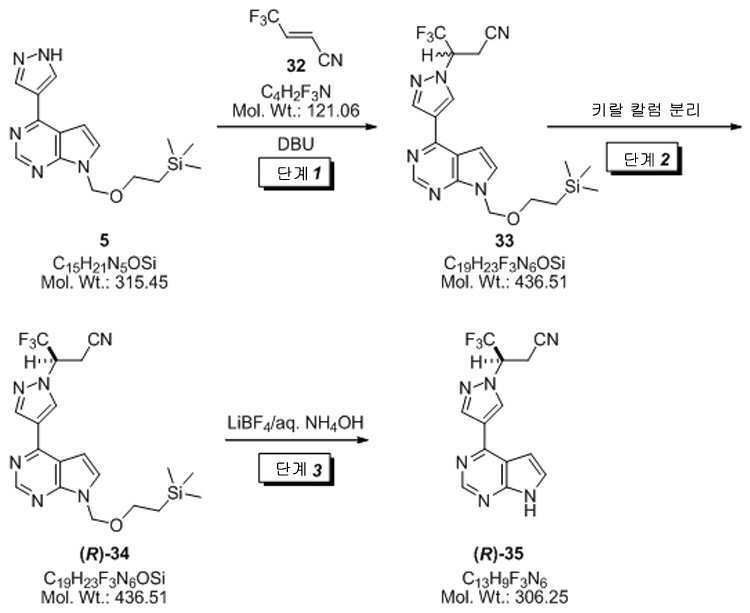
라세미 4,4,4-트리플루오로-3-(4-(7-((2-(트리메틸실릴)에톡시)메틸)-7 H -피롤로[2,3- d ]피리미딘-4-일)-1 H -피라졸-1-일)부탄니트릴 (33, 라세미 SEM 보호된 화합물). 기계적 교반기, 질소 주입구 및 서모웰이 구비된 플라스크에 화합물 4-(1H-피라졸-4-일)-7-((2-(트리메틸실릴)에톡시)메틸)-7H-피롤로[2,3-d]피리미딘 (5, 1424 g, 4.52 mol) 및 아세토니트릴 (14 L)을 첨가했다. 수득한 현탁액에 4,4,4-트리플루오로아세토니트릴 (32, 601.6 g, 4.97 mol, 1.1 당량), 그 다음 1,8-디아조바이시클로[5.4.0]운덱-7-엔 (DBU, 67 mL, 0.452 mol, 0.1 당량)을 첨가했다. 약간의 발열 (5℃)이 DBU의 첨가시 감지되었다. 반응 혼합물을 실온에서 30분 동안 교반했고, 그때, TLC 및 LCMS는 반응의 완료를 보여주었다. 그 다음, 반응 혼합물을 감압 하에서 농축하여 대부분의 용매를 제거하고 잔여물을 크로마토그래피 정제용 2개의 실리카겔 칼럼 (각각 3 Kg)으로 정제했다. 칼럼을 2 : 1 헵탄/에틸 아세테이트 (30 L), 그 다음 1 : 1 헵탄/ 에틸 아세테이트 (30 L)로 용리했다. 순수한 원하는 생성물 (33)을 함유하는 분획을 조합하고, 감압 하에서 농축하여 라세미 4,4,4-트리플루오로-3-(4-(7-((2-(트리메틸실릴)에톡시)메틸)-7H-피롤로[2,3-d]피리미딘-4-일)-1H-피라졸-1-일)부탄니트릴 (33, 라세미 SEM 보호된 화합물, 1802 g, 1973 g 이론적, 91.3% 수율)을 증점 오일로서 얻었고, 이를, 추가 정제없이 차후의 키랄 칼럼 분리에서 직접 사용했다. 33에 대해: 1H NMR (DMSO-d 6, 400 MHz) δ ppm 8.99 (s, 1H), 8.79 (s, 1H), 8.56 (s, 1H), 7.80 (d, 1H, J = 3.7 Hz), 7.09 (d, 1H, J = 3.7 Hz), 6.05 (m, 1H), 5.63 (s, 2H), 3.82 (dd, 1H, J = 17.5, 10.6 Hz), 3.66 (dd, 1H, J = 17.0, 4.9 Hz), 3.50 (t, 2H, J = 7.9 Hz), 0.80 (t, 2H, J = 8.2 Hz), -0.145 (s, 9H); 13C NMR (DMSO-d 6, 100 MHz) δ ppm 151.7, 151.3, 149.5, 140.8, 132.9, 130.4, 123.2 (J CF = 282 Hz), 121.9, 116.2, 113.5, 100.2, 72.3, 65.7, 57.8 (J CF = 32.4 Hz), 17.1, -1.46; C19H23F3N6OSi (분자량: 436.51), LCMS (EI) m/e 437 (M+ + H). Rac-4,4,4-trifluoro-3- (4- (7-a ((2- (trimethylsilyl) ethoxy) methyl) -7 H-pyrrolo [2,3- d] pyrimidin -4 -Yl ) -1 H -pyrazol-1-yl) butannitrile (33, racemic SEM protected compound). -7 H (ethoxy) methyl (2- (trimethylsilyl)) -pyrrolo [a mechanical stirrer, nitrogen inlet and a compound to a flask equipped with thermo-well 4- (1 H-pyrazol-4-yl) -7 2,3- d ] pyrimidine ( 5 , 1424 g, 4.52 mol) and acetonitrile (14 L) were added. To the obtained suspension, 4,4,4-trifluoroacetonitrile ( 32 , 601.6 g, 4.97 mol, 1.1 equiv), then 1,8-diazocyclo [5.4.0] undec-7-ene (DBU , 67 mL, 0.452 mol, 0.1 equiv) was added. Some exotherm (5 ° C.) was detected upon addition of DBU. The reaction mixture was stirred at rt for 30 min, at which time TLC and LCMS showed the reaction was complete. The reaction mixture was then concentrated under reduced pressure to remove most solvent and the residue was purified by two silica gel columns (3 Kg each) for chromatography purification. The column was eluted with 2: 1 heptane / ethyl acetate (30 L), then 1: 1 heptane / ethyl acetate (30 L). Fractions containing pure desired product ( 33 ) were combined and concentrated under reduced pressure to give racemic 4,4,4-trifluoro-3- (4- (7-((2- (trimethylsilyl) ethoxy) methyl ) -7 H -pyrrolo [2,3- d ] pyrimidin-4-yl) -1 H -pyrazol-1-yl) butannitrile ( 33 , racemic SEM protected compound, 1802 g, 1973 g theoretical , 91.3% yield) as a thick oil, which was used directly in the subsequent chiral column separation without further purification. For 33 : 1 H NMR (DMSO- d 6 , 400 MHz) δ ppm 8.99 (s, 1H), 8.79 (s, 1H), 8.56 (s, 1H), 7.80 (d, 1H, J = 3.7 Hz) , 7.09 (d, 1H, J = 3.7 Hz), 6.05 (m, 1H), 5.63 (s, 2H), 3.82 (dd, 1H, J = 17.5, 10.6 Hz), 3.66 (dd, 1H, J = 17.0 , 4.9 Hz), 3.50 (t, 2H, J = 7.9 Hz), 0.80 (t, 2H, J = 8.2 Hz), -0.145 (s, 9H); 13 C NMR (DMSO- d 6 , 100 MHz) δ ppm 151.7, 151.3, 149.5, 140.8, 132.9, 130.4, 123.2 ( J CF = 282 Hz), 121.9, 116.2, 113.5, 100.2, 72.3, 65.7, 57.8 ( J CF = 32.4 Hz), 17.1, -1.46; C 19 H 23 F 3 N 6 OSi (molecular weight: 436.51), LCMS (EI) m / e 437 (M + + H).
( R )-4,4,4-트리플루오로-3-(4-(7-((2-(트리메틸실릴)에톡시)메틸)-7 H -피롤로[2,3- d ]피리미딘-4-일)-1 H -피라졸-1-일)부탄니트릴 (( R )-34) 및 ( S )-4,4,4-트리플루오로-3-(4-(7-((2-(트리메틸실릴)에톡시)메틸)-7 H -피롤로[2,3- d ]피리미딘-4-일)-1 H -피라졸-1-일)부탄니트릴 (( S )-34). 3.0 L의 이소프로판올 (IPA) 중 1.5 Kg의 20-마이크론 Chiralcel® OD 키랄 정지상 (CSP) (Daicel 제조)의 슬러리를 PROCHROM Dynamic Axial Compression Column LC110-1 (11 cm ID×25 cm L; 칼럼 불감 용적: 대략 1.5 L)에 150 bar의 충전 압력 하에서 충전했다. 그 다음, 충전된 칼럼을 Novasep Hipersep HPLC 유닛 상에 설치했다. 칼럼 및 HPLC 시스템을 메탄올 (17 L) 및 이소프로판올 및 헥산 (2 : 8 용적으로, 17 L)의 혼합물로 만들어진 이동상으로 플러시했다. 그 다음, 공급 용액을, 4,4,4-트리플루오로-3-(4-(7-((2-(트리메틸실릴)에톡시)메틸)-7H-피롤로[2,3-d]피리미딘-4-일)-1H-피라졸-1-일)부탄니트릴 (33, 라세미 SEM 보호된 화합물, 3100 g, 7.1 mol)을 이동상에서 용해시켜 농도 120 g/L로 제조했다. 그 다음, 공급 용액 (120 mL/주입)을, 순차적으로 분리용 분취 HPLC 키랄 칼럼에 주입했다. 키랄 칼럼을 이동상으로 570 mL/min의 유속에서 실온에서 용리했다. 칼럼 용리를 파장 330 nm에서 UV로 모니터했다. 이들 조건 하에서, 2개의 거울상이성질체의 기준 분리를 달성했다. 각 주입에 대한 사이클 시간은 11분이었고, 총 210회의 주입이 이 분리 방법을 위해 수행되었다. 피크 1 (원하지 않는 (S)-거울상이성질체, (S)-34) 및 피크 2 (원하는 (R)-거울상이성질체, (R)-34)에 대한 분획을 각각의 주입으로부터 별도로 수집하고, 각각의 피크로부터 수집된 분획을 40℃에서 감압 하에서 (40 - 120 bar) 계속해서 농축했다. 각 증발기로부터의 잔여물을 고진공 하에서 일정한 중량으로 추가 건조시켜 피크 2로부터의 (3R)-3-시클로프로필-3-(4-(7-((2-(트리메틸실릴)에톡시)메틸)-7H-피롤로[2,3-d]피리미딘-4-일)-1H-피라졸-1-일)프로판니트릴 ((R)-34, 1457 g, 1550 g 이론적, 94%)을 담황색 오일로서 얻었고, 이는 실온에서 진공에서 정치시 고형화되었고, 피크 1로부터의 (3S)-시클로프로필-3-(4-(7-((2-(트리메틸실릴)에톡시)메틸)-7H-피롤로[2,3-d]피리미딘-4-일)-1H-피라졸-1-일)프로판니트릴 ((S)-34, 1488 g, 1550 g 이론적, 96%)을 황색 오일로서 얻었고, 이는 실온에서 진공에서 정치시 고형화되었다. (R) as 4,4,4-trifluoro-3- (4- (7-ethoxy ((2- (trimethylsilyl)) methyl) -7 H-pyrrolo [2,3- d] pyrimidine -4-yl) -1 H -pyrazol-1-yl) butannitrile (( R ) -34) and ( S ) -4,4,4-trifluoro-3- (4- (7-(( 2- (trimethylsilyl) ethoxy) methyl) -7 H - pyrrolo [2,3- d] pyrimidin-4-yl) -1 H - pyrazol-1-yl) butane nitrile ((S) -34 ). In 3.0 L of isopropanol (IPA) 1.5 Kg of a 20- micron Chiralcel ® OD chiral stationary phase (CSP) PROCHROM a slurry of (Daicel Ltd.) Dynamic Axial Compression Column LC110-1 (11 cm ID × 25 cm L; column dead volume: approximately 1.5 L) was charged under a filling pressure of 150 bar. The packed column was then installed on a Novasep Hipersep HPLC unit. The column and HPLC system were flushed with a mobile phase made of a mixture of methanol (17 L) and isopropanol and hexanes (2: 8 vol, 17 L). The feed solution was then 4,4,4-trifluoro-3- (4- (7-((2- (trimethylsilyl) ethoxy) methyl) -7 H -pyrrolo [2,3- d ] Pyrimidin-4-yl) -1 H -pyrazol-1-yl) butannitrile ( 33 , racemic SEM protected compound, 3100 g, 7.1 mol) was prepared in a mobile phase at a concentration of 120 g / L . The feed solution (120 mL / injection) was then injected sequentially into a preparative HPLC chiral column for separation. The chiral column was eluted with a mobile phase at room temperature at a flow rate of 570 mL / min. Column elution was monitored by UV at wavelength 330 nm. Under these conditions, standard separation of the two enantiomers was achieved. The cycle time for each injection was 11 minutes and a total of 210 injections were performed for this separation method. Fractions for peak 1 (undesired ( S ) -enantiomer, ( S ) -34 ) and peak 2 (desired ( R ) -enantiomer, ( R ) -34 ) are collected separately from each injection and Fractions collected from the peak were continuously concentrated at 40 ° C. under reduced pressure (40-120 bar). The residue from each evaporator was further dried to constant weight under high vacuum to give (3 R ) -3-cyclopropyl-3- (4- (7-((2- (trimethylsilyl) ethoxy) methyl) from peak 2 -7 H -pyrrolo [2,3- d ] pyrimidin-4-yl) -1 H -pyrazol-1-yl) propanenitrile (( R ) -34 , 1457 g, 1550 g theoretical, 94%) was obtained as a pale yellow oil, which solidified on standing in vacuo at room temperature and ( 3S ) -cyclopropyl-3- (4- from peak 1 (7 - ((2- (trimethylsilyl) ethoxy) methyl) -7 H-pyrrolo [2,3- d] pyrimidin-4-yl) -1 H-pyrazol-1-yl) propane nitrile (( S ) -34 , 1488 g, 1550 g theoretical, 96%) was obtained as a yellow oil which solidified upon standing in vacuo at room temperature.
키랄 HPLC 방법을, Chiralcel® OD-H 칼럼 (4.6×250 mm, 5 ㎛) (Chiral Technologies, Inc.로부터 구매)을 사용하여 SEM-(R)-34 및 (S)-34 거울상이성질체 모두의 키랄 순도 평가에 대해 전개했다. SEM 보호된 화합물의 2개의 거울상이성질체를, 15% 에탄올 및 85% 헥산의 이동상을 사용하여 실온에서 1 mL/min의 유속으로 9.0초과의 분할로 분리했다. UV 검출 파장은 220 nm이다. (S)-거울상이성질체 ((S)-34) 및 (R)-거울상이성질체 ((R)-34)에 대한 체류시간은 각각 11.2분 및 22.2분이다. The chiral HPLC method, Chiralcel ® OD-H column (4.6 × 250 mm, 5 ㎛ ) using (Chiral Technologies, purchased from Inc.) SEM- (R) - 34 and (S) - 34 enantiomers of all chiral We developed about purity evaluation. Two enantiomers of the SEM protected compound were separated in a split of greater than 9.0 with a flow rate of 1 mL / min at room temperature using a mobile phase of 15% ethanol and 85% hexane. The UV detection wavelength is 220 nm. (S) - enantiomer ((S) - 34) and (R) - enantiomer ((R) - 34) The residence time for is 11.2 minutes and 22.2 minutes respectively.
화학 순도 (HPLC 면적%) 및 키랄 순도 (키랄 HPLC 면적%)를 포함하는 분취 키랄 HPLC에 의해 분리된 각각의 거울상이성질체의 질을 분석하고, 그의 구조는 NMR 및 LC/MS에 의해 확인되었다. (R)-34에 대해: 비키랄 순도 (99.2 면적%, 220 nm에서 검출된 HPLC에 의해); 키랄 순도 (99.4 면적%, 키랄 HPLC에 의해; 98.8 % ee); 1H NMR (DMSO-d 6, 400 MHz) δ ppm 8.99 (s, 1H), 8.79 (s, 1H), 8.56 (s, 1H), 7.80 (d, 1H, J = 3.7 Hz), 7.09 (d, 1H, J = 3.7 Hz), 6.05 (m, 1H), 5.63 (s, 2H), 3.82 (dd, 1H, J = 17.5, 10.6 Hz), 3.66 (dd, 1H, J = 17.0, 4.9 Hz), 3.50 (t, 2H, J = 7.9 Hz), 0.80 (t, 2H, J = 8.2 Hz), -0.145 (s, 9H); 13C NMR (DMSO-d 6, 100 MHz) δ ppm 151.7, 151.3, 149.5, 140.8, 132.9, 130.4, 123.2 (J CF = 282 Hz), 121.9, 116.2, 113.5, 100.2, 72.3, 65.7, 57.8 (J CF = 32.4 Hz), 17.1, -1.46; C19H23F3N6OSi (분자량: 436.51), LCMS (EI) m/e 437 (M+ + H). (S)-34에 대해: 비키랄 순도 (99.1 면적%, 220 nm에서 검출된 HPLC에 의해); 키랄 순도 (99.2 면적%, 키랄 HPLC에 의해; 98.4 % ee); 1H NMR (DMSO-d 6, 400 MHz) δ ppm 8.99 (s, 1H), 8.79 (s, 1H), 8.56 (s, 1H), 7.80 (d, 1H, J = 3.7 Hz), 7.09 (d, 1H, J = 3.7 Hz), 6.05 (m, 1H), 5.63 (s, 2H), 3.82 (dd, 1H, J = 17.5, 10.6 Hz), 3.66 (dd, 1H, J = 17.0, 4.9 Hz), 3.50 (t, 2H, J = 7.9 Hz), 0.80 (t, 2H, J = 8.2 Hz), -0.145 (s, 9H); 13C NMR (DMSO-d 6, 100 MHz) δ ppm 151.7, 151.3, 149.5, 140.8, 132.9, 130.4, 123.2 (J CF = 282 Hz), 121.9, 116.2, 113.5, 100.2, 72.3, 65.7, 57.8 (J CF = 32.4 Hz), 17.1, -1.46; C19H23F3N6OSi (분자량: 436.51), LCMS (EI) m/e 437 (M+ + H). The quality of each enantiomer separated by preparative chiral HPLC comprising chemical purity (HPLC area%) and chiral purity (chiral HPLC area%) was analyzed and its structure was confirmed by NMR and LC / MS. For ( R ) -34 : achiral purity (99.2 area%, by HPLC detected at 220 nm); Chiral purity (99.4 area%, by chiral HPLC; 98.8% ee); 1 H NMR (DMSO- d 6, 400 MHz) δ ppm 8.99 (s, 1H), 8.79 (s, 1H), 8.56 (s, 1H), 7.80 (d, 1H, J = 3.7 Hz), 7.09 (d , 1H, J = 3.7 Hz), 6.05 (m, 1H), 5.63 (s, 2H), 3.82 (dd, 1H, J = 17.5, 10.6 Hz), 3.66 (dd, 1H, J = 17.0, 4.9 Hz) , 3.50 (t, 2H, J = 7.9 Hz), 0.80 (t, 2H, J = 8.2 Hz), -0.145 (s, 9H); 13 C NMR (DMSO- d 6 , 100 MHz) δ ppm 151.7, 151.3, 149.5, 140.8, 132.9, 130.4, 123.2 ( J CF = 282 Hz), 121.9, 116.2, 113.5, 100.2, 72.3, 65.7, 57.8 ( J CF = 32.4 Hz), 17.1, -1.46; C 19 H 23 F 3 N 6 OSi (molecular weight: 436.51), LCMS (EI) m / e 437 (M + + H). For ( S ) -34 : achiral purity (99.1 area%, by HPLC detected at 220 nm); Chiral purity (99.2 area%, by chiral HPLC; 98.4% ee); 1 H NMR (DMSO- d 6, 400 MHz) δ ppm 8.99 (s, 1H), 8.79 (s, 1H), 8.56 (s, 1H), 7.80 (d, 1H, J = 3.7 Hz), 7.09 (d , 1H, J = 3.7 Hz), 6.05 (m, 1H), 5.63 (s, 2H), 3.82 (dd, 1H, J = 17.5, 10.6 Hz), 3.66 (dd, 1H, J = 17.0, 4.9 Hz) , 3.50 (t, 2H, J = 7.9 Hz), 0.80 (t, 2H, J = 8.2 Hz), -0.145 (s, 9H); 13 C NMR (DMSO- d 6 , 100 MHz) δ ppm 151.7, 151.3, 149.5, 140.8, 132.9, 130.4, 123.2 ( J CF = 282 Hz), 121.9, 116.2, 113.5, 100.2, 72.3, 65.7, 57.8 ( J CF = 32.4 Hz), 17.1, -1.46; C 19 H 23 F 3 N 6 OSi (molecular weight: 436.51), LCMS (EI) m / e 437 (M + + H).
4,4,4-트리플루오로-3( R )-[4-(7 H -피롤로[2,3- d ]피리미딘-4-일)-피라졸-1-일]-부티로니트릴 (( R )-35). 서모웰, 환류 콘덴서, 기계적 교반기, 및 질소 주입구가 구비된 플라스크에 4,4,4-트리플루오로-3(R)-{4-[7-(2-트리메틸실라닐-에톡시메틸)-7H-피롤로[2,3-d]피리미딘-4-일]-피라졸-1-일}-부티로니트릴 ((R)-34, 312 g, 0.716 mol), 아세토니트릴 (4.5 L) 및 물 (376 mL)을 첨가했다. 그 다음, 수득한 혼합물을 고형 리튬 테트라플루오로보레이트 (LiBF4, 697 g, 7.16 mol, 10.0 당량)으로 부분씩 실온에서 처리했다. 혼합물을 13시간 동안 가열 환류했다. TLC가, 개시물질이 남아 있지 않고 2개의 생성물 (완전 탈보호되고 히드록시메틸 유사물임)이 생성되었음을 나타내었을 때, 반응 혼합물을 실온으로 냉각시키고, 그 다음, 0℃로 얼음/물 배쓰에서 냉각한 후, 수성 수산화암모늄 용액 (NH4OH, 20%, 245 mL)로 0 - 5℃ 내지에서 적가 처리하여, 5 - 10 범위의 pH 스트립으로 측정시 pH를 9 내지 9.5로 만들었다. 빙욕을 제거하고, 증점 현탁액을 실온에서 밤새 교반했다. HPLC가 반응의 완료를 보여주었을 때, 반응 혼합물을 물 (1 L), 염수 (500 mL) 및 에틸 아세테이트 (7 L)로 처리했다. 2개의 층을 분리하고, 수성 층을 에틸 아세테이트 (2×2 L)로 추출했다. 조합된 유기 층을 감압 하에서 농축하고, 잔여물을 에틸 아세테이트 (4 L)에서 재용해시키고, 염수 (2×2 L)로 세정했다. 유기 층을 황산나트륨 상에서 건조시키고, 용매를 감압 하에서 제거하여 증점 슬러리를 얻었다. 헵탄을 증점 슬러리에 첨가하고, 용매 제거를, 대부분의 에틸 아세테이트가 제거될 때까지 계속했다. 고형물을 여과로 수집하고, 진공에서 건조하여 조 생성물 ((R)-35, 206 g, 219.3 g 이론적, 94% 수율, 98% 순수, HPLC에 의해)을 백색 분말로서 얻었다. 조 생성물을 에탄올 (700 mL)로부터 재결정화하여 순수한 4,4,4-트리플루오로-3(R)-[4-(7H-피롤로[2,3-d]피리미딘-4-일)-피라졸-1-일]-부티로니트릴 ((R)-35, 188.6 g, 219.3 g 이론적, 86% 수율, > 99.5% 순수, HPLC에 의해)을 미세 백색 결정성 고형물로서 얻었다. (R)-35에 대해: 1H NMR (DMSO-d 6, 500 MHz) δ ppm 12.2 (bs, 1H), 8.95 (s, 1H), 8.74 (s, 1H), 8.53 (s, 1H), 7.63 (d, 1H, J = 3.7 Hz), 6.97 (d, 1H, J = 3.8 Hz), 6.04 (m, 1H), 3.81 (dd, 1H, J = 17.1, 10.1 Hz), 3.65 (dd, 1H, J = 17.1, 5.0 Hz).; 13C NMR (DMSO-d 6, 125 MHz) δ ppm 152.3, 151.0, 149.0, 140.7, 132.7, 127.2, 123.1 (J CF = 284 Hz), 122.2, 116.2, 113.1, 99.5, 57.7 (J CF = 33.0 Hz), 17.3 ; C13H9F3N6 (분자량: 306.25), LCMS (EI) m/e 307 (M+ + H). 4,4,4-trifluoro -3 (R) - [4- (7 H-pyrrolo [2,3- d] pyrimidin-4-yl) -pyrazol-1-yl] butyronitrile (( R ) -35) . 4,4,4-trifluoro-3 ( R )-{4- [7- (2-trimethylsilanyl-ethoxymethyl)-in a flask equipped with a thermowell, a reflux condenser, a mechanical stirrer, and a nitrogen inlet. 7 H -pyrrolo [2,3- d ] pyrimidin-4-yl] -pyrazol-1-yl} -butyronitrile (( R ) -34 , 312 g, 0.716 mol), acetonitrile (4.5 L ) And water (376 mL) were added. The resulting mixture was then treated in portions with solid lithium tetrafluoroborate (LiBF 4 , 697 g, 7.16 mol, 10.0 equiv) at room temperature. The mixture was heated to reflux for 13 hours. When TLC showed that no starting material remained and 2 products (completely deprotected and hydroxymethyl analogs) were produced, the reaction mixture was cooled to room temperature and then cooled to an ice / water bath to 0 ° C. The solution was then added dropwise with an aqueous ammonium hydroxide solution (NH 4 OH, 20%, 245 mL) dropwise from 0-5 ° C. to pH 9-9.5 as measured by a pH strip in the 5-10 range. The ice bath was removed and the thick suspension was stirred overnight at room temperature. When HPLC showed the reaction was complete, the reaction mixture was treated with water (1 L), brine (500 mL) and ethyl acetate (7 L). The two layers were separated and the aqueous layer was extracted with ethyl acetate (2 × 2 L). The combined organic layer was concentrated under reduced pressure and the residue was redissolved in ethyl acetate (4 L) and washed with brine (2 x 2 L). The organic layer was dried over sodium sulfate and the solvent was removed under reduced pressure to give a thick slurry. Heptane was added to the thickened slurry and solvent removal continued until most of the ethyl acetate was removed. The solid was collected by filtration and dried in vacuo to give the crude product (( R ) -35 , 206 g, 219.3 g theoretical, 94% yield, 98% pure, by HPLC) as a white powder. The crude product in pure 4,4,4-trifluoro-ethanol and recrystallized from (700 mL) -3 (R) - [4- (7 H - pyrrolo [2,3- d] pyrimidin-4-yl ) -Pyrazol-1-yl] -butyronitrile (( R ) -35 , 188.6 g, 219.3 g theoretical, 86% yield,> 99.5% pure, by HPLC) was obtained as a fine white crystalline solid. For ( R ) -35 : 1 H NMR (DMSO- d 6 , 500 MHz) δ ppm 12.2 (bs, 1H), 8.95 (s, 1H), 8.74 (s, 1H), 8.53 (s, 1H), 7.63 (d, 1H, J = 3.7 Hz), 6.97 (d, 1H, J = 3.8 Hz), 6.04 (m, 1H), 3.81 (dd, 1H, J = 17.1, 10.1 Hz), 3.65 (dd, 1H , J = 17.1, 5.0 Hz) .; 13 C NMR (DMSO- d 6 , 125 MHz) δ ppm 152.3, 151.0, 149.0, 140.7, 132.7, 127.2, 123.1 ( J CF = 284 Hz), 122.2, 116.2, 113.1, 99.5, 57.7 ( J CF = 33.0 Hz ), 17.3; C 13 H 9 F 3 N 6 (molecular weight: 306.25), LCMS (EI) m / e 307 (M + + H).

3-[4-(7-{[2-(트리메틸실릴)에톡시]메틸}-7 H -피롤로[2,3- d ]피리미딘-4-일)-1 H -피라졸-1-일]부탄니트릴 (37). 교반 바, 콘덴서, 열전대 및 질소 주입구가 구비된 250 mL 3목 동근바닥플라스크에, 4-(1H-피라졸-4-일)-7-{[2-(트리메틸실릴)에톡시]메틸}-7H-피롤로[2,3-d]피리미딘 (5, 10.3 g, 0.033 mol), 2-부텐니트릴 (36, 3.0 mL, 0.037 mmol, 1.12 당량) 및 아세토니트릴 (100 mL, 2.0 mol)을 실온에서 충전했다. 수득한 혼합물을 1,8-디아자바이시클로[5.4.0]운덱-7-엔 (DBU, 2.0 mL, 0.013 mol, 0.4 당량)로 처리하고, 차후에 55℃로 따뜻하게 했다. 반응 혼합물을 55℃에서 15 - 20시간 동안 교반했다. LC/MS가 반응의 완료를 보여주었을 때, 반응 혼합물을 감압 하에서 농축하여 오렌지색 오일을 얻었다. 그 다음, 조 생성물을, 플래시 칼럼 크로마토그래피 (SiO2, 40 - 80% 에틸 아세테이트/헥산 구배 용리)로 정제하여 3-[4-(7-{[2-(트리메틸실릴)에톡시]메틸}-7H-피롤로[2,3-d]피리미딘-4-일)-1H-피라졸-1-일]부탄니트릴 (37, 12.3 g, 12.62 g 이론적, 97.5% 수율)을 무색 오일로서 얻었고, 이는 실온에서 진공에서 정치시 고형화되었다. 37에 대해: 1H NMR (CDCl3, 400 MHz) δ ppm 8.84 (s, 1H), 8.33 (s, 1H), 8.30 (s, 1H), 7.39 (d, 1H, J = 3.8 Hz), 6.79 (d, 1H, J = 3.8 Hz), 5.67 (s, 2H), 4.77 (m, 1H), 3.53 (t, 2H, J = 8.2 Hz), 3.05 (dd, 1H, J = 16.8, 6.2 Hz), 2.98 (dd, 1H, J = 16.8, 6.3 Hz), 1.79 (d, 3H, J = 6.5 Hz), 0.91 (t, 2H, J = 8.3 Hz), -0.068 (s, 9H); C19H26N6OSi (분자량: 382.53), LCMS (EI) m/e 383 (M+ + H). 3- [4- (7-{[2- (trimethylsilyl) ethoxy] methyl} -7 H -pyrrolo [2,3- d ] pyrimidin-4-yl) -1 H -pyrazole-1- General] butanenitrile (37). In a 250 mL three neck copper-bottomed flask equipped with a stirring bar, a condenser, a thermocouple and a nitrogen inlet, 4- (1 H -pyrazol-4-yl) -7-{[2- (trimethylsilyl) ethoxy] methyl} -7 H -pyrrolo [2,3- d ] pyrimidine ( 5 , 10.3 g, 0.033 mol), 2-butenenitrile ( 36 , 3.0 mL, 0.037 mmol, 1.12 equiv) and acetonitrile (100 mL, 2.0 mol ) Was charged at room temperature. The resulting mixture was treated with 1,8-diazabicyclo [5.4.0] undec-7-ene (DBU, 2.0 mL, 0.013 mol, 0.4 equiv) and subsequently warmed to 55 ° C. The reaction mixture was stirred at 55 ° C. for 15-20 hours. When LC / MS showed completion of the reaction, the reaction mixture was concentrated under reduced pressure to give an orange oil. The crude product is then purified by flash column chromatography (SiO 2 , 40-80% ethyl acetate / hexane gradient elution) to give 3- [4- (7-{[2- (trimethylsilyl) ethoxy] methyl} -7 H -pyrrolo [2,3- d ] pyrimidin-4-yl) -1 H -pyrazol-1-yl] butannitrile ( 37 , 12.3 g, 12.62 g theoretical, 97.5% yield) as a colorless oil As solidified upon standing in vacuo at room temperature. For 37 : 1 H NMR (CDCl 3 , 400 MHz) δ ppm 8.84 (s, 1H), 8.33 (s, 1H), 8.30 (s, 1H), 7.39 (d, 1H, J = 3.8 Hz), 6.79 (d, 1H, J = 3.8 Hz), 5.67 (s, 2H), 4.77 (m, 1H), 3.53 (t, 2H, J = 8.2 Hz), 3.05 (dd, 1H, J = 16.8, 6.2 Hz) , 2.98 (dd, 1H, J = 16.8, 6.3 Hz), 1.79 (d, 3H, J = 6.5 Hz), 0.91 (t, 2H, J = 8.3 Hz), -0.068 (s, 9H); C 19 H 26 N 6 OSi (molecular weight: 382.53), LCMS (EI) m / e 383 (M + + H).
( S )-3-(4-(7-((2-(트리메틸실릴)에톡시)메틸)-7 H -피롤로[2,3- d ]피리미딘-4-일)-1 H -피라졸-1-일)부탄니트릴 (( S )-38) 및 ( R )-3-(4-(7-((2-(트리메틸실릴)에톡시)메틸)-7 H -피롤로[2,3- d ]피리미딘-4-일)-1 H -피라졸-1-일)부탄니트릴 (( R )-38). 에탄올 및 헥산 (15 : 85, 용적으로)의 혼합물 중 라세미 3-[4-(7-{[2-(트리메틸실릴)에톡시]메틸}-7H-피롤로[2,3-d]피리미딘-4-일)-1H-피라졸-1-일]부탄니트릴 (37, 38.3 g, 0.1 mmol)의 용액을 셀룰로오스 트리(3,5-디메틸페닐 카바메이트) (Available at Chiral Technologies Inc., Chiralcel® OD-H, 5 ㎛)로 코팅된 실리가켈이 충전된 비키랄 칼럼 (30×250 mm)이 구비된 분취 HPLC 시스템에 주입했다. 칼럼을 15 내지 85 용적비의 에탄올 (EtOH) 및 헥산의 혼합물로 만들 이동상으로 32 mL/min의 유속으로 실온에서 용리했다. 칼럼 용리를 220 nm의 파장에서 UV 검출로 모니터했다. 이들 조건 하에서, 2개의 거울상이성질체의 기준 분리가 달성되었고, 체류시간은 각각 15.1분 (피크 1, 원하지 않는 (R)-거울상이성질체 (R)-38) 및 19.6분 (피크 2, 원하는 (S)-거울상이성질체 (S)-38)이었다. 각각의 주입은 농도 200 mg/mL에서 0.5 mL의 공급 용액이었고, 각 주입에 대한 사이클 시간은 스택 주입을 사용하여 14분이었다. 총 384회의 주입은 이 분리 방법을 위해 수행되었다. 피크 1 (원하지 않는 (R)-거울상이성질체, (S)-38) 및 피크 2 (원하는 (S)-거울상이성질체, (S)-38)에 대한 분획을 각각의 주입으로부터 별도로 수집하고, 각각의 피크로부터 수집된 분획을 감압 하에서 농축했다. 각 증발기로부터의 잔여물을 고진공 하에서 일정한 중량으로 추가 건조시켜 피크 2로부터의 ((S)-3-(4-(7-((2-(트리메틸실릴)에톡시)메틸)-7H-피롤로[2,3-d]피리미딘-4-일)-1H-피라졸-1-일)부탄니트릴 ((S)-38, 17.43 g, 19.15 g 이론적, 91% 수율)을 회백색 고형물로서 얻고, 피크 1로부터의 (R)-3-(4-(7-((2-(트리메틸실릴)에톡시)메틸)-7H-피롤로[2,3-d]피리미딘-4-일)-1H-피라졸-1-일)부탄니트릴 ((R)-38, 17.8 g, 19.15 g 이론적, 93% 수율)을 회백색 고형물로서 얻었다. (S) -3- (4- (7 - ((2- ( trimethylsilyl) ethoxy) methyl) -7 H - pyrrolo [2,3- d] pyrimidin-4-yl) -1 H - pyrazol 1-yl) butane nitrile ((S) -38) and (R) -3- (4- (7 - methyl-ethoxy) ((2- (trimethylsilyl)) -7 H - pyrrolo [2, 3- d ] pyrimidin-4-yl) -1 H -pyrazol- 1-yl ) butannitrile (( R ) -38). Racemic 3- [4- (7-{[2- (trimethylsilyl) ethoxy] methyl} -7 H -pyrrolo [2,3- d ] in a mixture of ethanol and hexane (15: 85, by volume) A solution of pyrimidin-4-yl) -1 H -pyrazol-1-yl] butannitrile ( 37 , 38.3 g, 0.1 mmol) was prepared using cellulose tri (3,5-dimethylphenyl carbamate). ., Chiralcel ® OD-H, 5 ㎛) an achiral column (30 × 250 mm coated silica charged to a Kell) was injected into a preparative HPLC system equipped with. The column was eluted at room temperature with a flow rate of 32 mL / min as a mobile phase to make a mixture of 15 to 85 volume ratios of ethanol (EtOH) and hexane. Column elution was monitored by UV detection at a wavelength of 220 nm. Under these conditions, the second was achieved based on separation of the two enantiomers, retention time 15.1 minutes, respectively (Peak 1, undesired (R) - enantiomer (R) - 38) and 19.6 min (peak 2, the desired (S) -Enantiomer ( S ) -38 ). Each injection was a 0.5 mL feed solution at a concentration of 200 mg / mL and the cycle time for each injection was 14 minutes using a stack injection. A total of 384 injections were performed for this separation method. Fractions for peak 1 (undesired ( R ) -enantiomer, ( S ) -38 ) and peak 2 (desired ( S ) -enantiomer, ( S ) -38 ) are collected separately from each injection and each Fractions collected from the peak were concentrated under reduced pressure. The residue from each evaporator was further dried to constant weight under high vacuum to give (( S ) -3- (4- (7-((2- (trimethylsilyl) ethoxy) methyl) -7 H -P from peak 2 Rolo [2,3- d ] pyrimidin-4-yl) -1 H -pyrazol-1-yl) butannitrile ((S) - 38, 17.43 g, 19.15 g theoretical, 91% yield) of the gain as an off-white solid, (R) -3- (4- ( 7 from peak 1 to ((2- (trimethylsilyl) ethoxy ) methyl) -7 H - pyrrolo [2,3- d] pyrimidin-4-yl) -1 H - pyrazol-1-yl) butane nitrile ((R) - 38, 17.8 g, 19.15 g theoretical, 93% yield) as an off-white solid.
키랄 HPLC 방법을, 셀룰로오스 트리스(3,5-디메틸페닐 카바메이트 (Chiralcel® OD)로 코팅된 실리카겔로 충전된 Chiralcel® OD-H 칼럼 (4.6×250 mm, 5 ㎛) (Chiral Technologies, Inc.로부터 구매)을 사용하여 SEM-(R)-38 및 (S)-38 거울상이성질체 모두의 키랄 순도 평가에 대해 전개했다. 2개의 거울상이성질체((R)-38 및 (S)-38))를, 15% 에탄올 및 85% 헥산의 이동상을 사용하여 실온에서 0.8 mL/min의 유속으로 3.0 초과의 분할로 분리했다. UV 검출 파장은 220 nm이다. (S)-38 및 (R)-38에 대한 체류시간은 각각 17.8분 및 21.5분이다. A chiral HPLC method was prepared from a Chiralcel ® OD-H column (4.6 x 250 mm, 5 μm) filled with silica gel coated with cellulose tris (3,5-dimethylphenyl carbamate (Chiralcel ® OD) (Chiral Technologies, Inc.). 38)), - using the purchase) SEM- (R) - 38 and (S) - were developed for chiral purity evaluation of all 38 enantiomer 2 enantiomer ((R.) - 38 and (S) A mobile phase of 15% ethanol and 85% hexane was used to separate at greater than 3.0 splits at a flow rate of 0.8 mL / min at room temperature. The UV detection wavelength is 220 nm. (S) - 38 and (R) - Retention time for the 38 is 17.8 minutes and 21.5 minutes respectively.
화학 순도 (HPLC 면적%) 및 키랄 순도 (키랄 HPLC 면적%)를 포함하는 분취 키랄 HPLC에 의해 분리된 각각의 거울상이성질체의 질을 분석하고, 그의 구조는 NMR 및 LC/MS에 의해 확인되었다. (S)-38에 대해: 비키랄 순도 (99.3 면적%, 220 nm에서 검출된 HPLC에 의해); 키랄 순도 (99.5 면적%, 키랄 HPLC에 의해; 99.0 % ee); 1H NMR (CDCl3, 400 MHz) δ ppm 8.84 (s, 1H), 8.33 (s, 1H), 8.30 (s, 1H), 7.39 (d, 1H, J = 3.8 Hz), 6.79 (d, 1H, J = 3.8 Hz), 5.67 (s, 2H), 4.77 (m, 1H), 3.53 (t, 2H, J = 8.2 Hz), 3.05 (dd, 1H, J = 16.8, 6.2 Hz), 2.98 (dd, 1H, J = 16.8, 6.3 Hz), 1.79 (d, 3H, J = 6.5 Hz), 0.91 (t, 2H, J = 8.3 Hz), -0.068 (s, 9H); C19H26N6OSi (분자량: 382.53), LCMS (EI) m/e 383 (M+ + H). (R)-38에 대해: 비키랄 순도 (99.1 면적%, 220 nm에서 검출된 HPLC에 의해); 키랄 순도 (99.4 면적%, 키랄 HPLC에 의해; 98.8 % ee); 1H NMR (CDCl3, 400 MHz) δ ppm 8.84 (s, 1H), 8.33 (s, 1H), 8.30 (s, 1H), 7.39 (d, 1H, J = 3.8 Hz), 6.79 (d, 1H, J = 3.8 Hz), 5.67 (s, 2H), 4.77 (m, 1H), 3.53 (t, 2H, J = 8.2 Hz), 3.05 (dd, 1H, J = 16.8, 6.2 Hz), 2.98 (dd, 1H, J = 16.8, 6.3 Hz), 1.79 (d, 3H, J = 6.5 Hz), 0.91 (t, 2H, J = 8.3 Hz), -0.068 (s, 9H); C19H26N6OSi (분자량: 382.53), LCMS (EI) m/e 383 (M+ + H).The quality of each enantiomer separated by preparative chiral HPLC comprising chemical purity (HPLC area%) and chiral purity (chiral HPLC area%) was analyzed and its structure was confirmed by NMR and LC / MS. (S) - for the 38: achiral purity (99.3% by area by HPLC detection at 220 nm); Chiral purity (99.5 area%, by chiral HPLC; 99.0% ee); 1 H NMR (CDCl 3 , 400 MHz) δ ppm 8.84 (s, 1H), 8.33 (s, 1H), 8.30 (s, 1H), 7.39 (d, 1H, J = 3.8 Hz), 6.79 (d, 1H , J = 3.8 Hz), 5.67 (s, 2H), 4.77 (m, 1H), 3.53 (t, 2H, J = 8.2 Hz), 3.05 (dd, 1H, J = 16.8, 6.2 Hz), 2.98 (dd , 1H, J = 16.8, 6.3 Hz), 1.79 (d, 3H, J = 6.5 Hz), 0.91 (t, 2H, J = 8.3 Hz), -0.068 (s, 9H); C 19 H 26 N 6 OSi (molecular weight: 382.53), LCMS (EI) m / e 383 (M + + H). (R) - about 38: achiral purity (99.1% by area by HPLC detection at 220 nm); Chiral purity (99.4 area%, by chiral HPLC; 98.8% ee); 1 H NMR (CDCl 3 , 400 MHz) δ ppm 8.84 (s, 1H), 8.33 (s, 1H), 8.30 (s, 1H), 7.39 (d, 1H, J = 3.8 Hz), 6.79 (d, 1H , J = 3.8 Hz), 5.67 (s, 2H), 4.77 (m, 1H), 3.53 (t, 2H, J = 8.2 Hz), 3.05 (dd, 1H, J = 16.8, 6.2 Hz), 2.98 (dd , 1H, J = 16.8, 6.3 Hz), 1.79 (d, 3H, J = 6.5 Hz), 0.91 (t, 2H, J = 8.3 Hz), -0.068 (s, 9H); C 19 H 26 N 6 OSi (molecular weight: 382.53), LCMS (EI) m / e 383 (M + + H).
(3 S )-3-[4-(7 H -피롤로[2,3- d ]피리미딘-4-일)-1 H -피라졸-1-일]부탄니트릴 (( S )-39). 오버헤드 교반기, 콘덴서, 열전대 및 질소 주입구가 구비된 5 리터 4목 동근바닥플라스크에, (3S)-3-[4-(7-{[2-(트리메틸실릴)에톡시]메틸}-7H-피롤로[2,3-d]피리미딘-4-일)-1H-피라졸-1-일]부탄니트릴 ((S)-38, 82.3 g, 0.215 mol), 아세토니트릴 (1510 mL), 물 (135 mL) 및 고형 리튬 테트라플루오로보레이트 (LiBF4, 206 g, 2.15 mol, 10.0 당량)을 충전했다. 수득한 반응 혼합물을 가온 환류했고, 환류에서 24 - 36시간 동안 교반했다. HPLC 및 TLC가 반응의 완료를 보여주었을 때, 반응 혼합물을 실온으로 냉각했다. 수성 수산화암모늄 (NH4OH) 용액 (20% v/v)을 반응 혼합물에 첨가하여 pH를 9 - 10로 조정했다. 수득한 반응 혼합물을 실온에서 15 - 24시간 동안 교반했다. HPLC 및 TLC가 탈보호 반응의 완료를 보여주었을 때, 반응 혼합물을 셀라이트 패드를 통해 여과하여 불용성 물질을 제거했다. 셀라이트 패드를 에틸 아세테이트 (500 mL)로 세정했다. 여과물을 에틸 아세테이트 (1 L)로 추가 희석한 후, 20% 나트륨 클로라이드 (NaCl) 수성 용액 (1 L)로 세정했다. 수성 분획을 에틸 아세테이트 (2×500 mL)로 역추출했다. 조합된 유기 분획을, 그 다음, 감압 하에서 농축하고 용매를 제거하여 증점 백색 슬러리를 생성했다. 슬러리를 물 (2 L)로 처리하고, 수득한 혼합물을 실온에서 18시간 동안 교반했다. 고형물을 여과로 수집하고, 습식 케이크를 메틸 tert-부틸에테르 (MTBE, 500 mL) 및 헵탄 (500 mL)로 세정한 후, 50℃에서 진공 오븐에서 일정한 중량으로 건조했다. 그 다음, 건조된 조 생성물 (45 g)을 에탄올 (500 mL) 및 헵탄 (350 mL)에서 재결정화하여 (3S)-3-[4-(7H-피롤로[2,3-d]피리미딘-4-일)-1H-피라졸-1-일]부탄니트릴 ((S)-39, 42.8 g, 54.2 g 이론적, 79% 수율)을 백색 고형물로서 얻었다. (S)-39에 대해: 1H NMR (DMSO-d 6, 400 MHz) δ ppm 12.1 (bs, 1H), 8.76 (s, 1H), 8.67 (s, 1H), 8.36 (s, 1H), 7.59 (d, 1H, J = 3.5 Hz), 6.98 (d, 1H, J = 3.5 Hz), 4.98 (m, 1H), 3.19 (d, 2H, J = 6.6 Hz), 1.57 (d, 3H, J = 6.6 Hz); C13H12N6 (분자량: 252.27), LCMS (EI) m/e 253 (M+ + H). (3 S) -3- [4- ( 7 H - pyrrolo [2,3- d] pyrimidin-4-yl) -1 H - pyrazol-1-yl] butane nitrile ((S) -39) . An overhead stirrer, condenser, thermocouple and nitrogen inlet 5 L four-neck flask equipped with a bottom Houses, (3 S) -3- [4- (7 - {[2- ( trimethylsilyl) ethoxy] methyl} -7 H - pyrrolo [2,3- d] pyrimidin-4-yl) -1 H - pyrazol-1-yl] butane nitrile ((S) - 38, 82.3 g, 0.215 mol), acetonitrile (1510 mL ), Water (135 mL) and solid lithium tetrafluoroborate (LiBF 4 , 206 g, 2.15 mol, 10.0 equiv) were charged. The reaction mixture obtained was warmed to reflux and stirred at reflux for 24-36 h. When HPLC and TLC showed the reaction was completed, the reaction mixture was cooled to room temperature. Aqueous ammonium hydroxide (NH 4 OH) solution (20% v / v) was added to the reaction mixture to adjust the pH to 9-10. The resulting reaction mixture was stirred at rt for 15-24 h. When HPLC and TLC showed the completion of the deprotection reaction, the reaction mixture was filtered through a pad of celite to remove insoluble matter. The celite pad was washed with ethyl acetate (500 mL). The filtrate was further diluted with ethyl acetate (1 L) and then washed with 20% sodium chloride (NaCl) aqueous solution (1 L). The aqueous fractions were back extracted with ethyl acetate (2 × 500 mL). The combined organic fractions were then concentrated under reduced pressure and the solvent removed to yield a thick white slurry. The slurry was treated with water (2 L) and the resulting mixture was stirred at rt for 18 h. The solids were collected by filtration and the wet cake was washed with methyl tert -butylether (MTBE, 500 mL) and heptane (500 mL) and then at 50 ° C. It was dried to constant weight in a vacuum oven. Then, recrystallized from the dried crude product (45 g) in ethanol (500 mL) and heptane (350 mL) (3 S) -3- [4- (7 H - pyrrolo [2,3- d] pyrimidin-4-yl) -1 H - pyrazol-1-yl] butane nitrile ((S) - 39, 42.8 g, to obtain a 54.2 g theoretical, 79% yield) as a white solid. (S) - about 39: 1 H NMR (DMSO- d 6, 400 MHz) δ ppm 12.1 (bs, 1H), 8.76 (s, 1H), 8.67 (s, 1H), 8.36 (s, 1H), 7.59 (d, 1H, J = 3.5 Hz), 6.98 (d, 1H, J = 3.5 Hz), 4.98 (m, 1H), 3.19 (d, 2H, J = 6.6 Hz), 1.57 (d, 3H, J = 6.6 Hz); C 13 H 12 N 6 (molecular weight: 252.27), LCMS (EI) m / e 253 (M + + H).

2-시아노-4,4-디에톡시-부티르산 에틸 에스테르 (4). 브로모아세트알데히드 디에틸아세탈 (3, 541 g, 2.75 mol)을 에틸 시아노아세테이트(2, 1.55 Kg, 13.75mol, 5.0 당량) 중 분말화된 탄산칼륨 (379.6 g, 2.75 mol, 1.0 당량) 및 나트륨 아이오다이드 (33 g, 0.22 mol, 0.08 당량)의 현탁액에 첨가했다. 알데히드의 반응 혼합물에의 첨가 시, 수득한 용액은 황색으로 변했다. 반응 혼합물을, Dean Stark 트랩에서 휘발성 물질을 수집하면서 140-150℃로 서서히 가열했다. 이 물질을 버렸다. 꽤 격렬한 가스 방출이 140℃에서 시작하는 것으로 발견되었다. 반응은 G.C.로 모니터되었고, 90분에서 거의 완료된 것으로 관찰되었다. 가열을 추가 45분 동안 계속했고, 그때 가스 방출이 멈춘 것으로 관찰되었다. 그 다음, 반응 혼합물을 실온으로 냉각시키고, 4 L 물 및 2 L 메틸 tert-부틸 에테르 (MTBE) 사이에서 분할했다. 층들을 분리하고, 수성 층을 추가 2 L의 MTBE로 추출했다. 수성 층을 G.C.로 생성물에 대해 점검하고, 그 다음, 버렸다. 유기 층을 황산나트륨 상에서 건조시키고, 여과하고, 진공에서 농축했다. 조 생성물을 분별증류 (91-105℃ @ 0.53-0.65mm/Hg)로 정제하여 2-시아노-4,4-디에톡시-부티르산 에틸 에스테르 (4, 359.4 g, 630.5 g 이론적, 57%)을 오일로서 얻었다. 4에 대해: 1H NMR (DMSO-d 6, 300 MHz) δ ppm 4.60 (t, 1H, J = 5.6 Hz), 4.15 (m, 3H), 3.59 (m, 2H), 3.45 (m,1H), 2.11 (t, 2H, J = 6.2 Hz), 1.22 (t, 3H, J = 6.9 Hz), 1.10 (dt, 6H, J=7.1, 6.9 Hz). 2-cyano-4,4-diethoxy-butyric acid ethyl ester (4). Bromoacetaldehyde diethylacetal ( 3 , 541 g, 2.75 mol) was powdered potassium carbonate (379.6 g, 2.75 mol, 1.0 equiv) in ethyl cyanoacetate ( 2 , 1.55 Kg, 13.75 mol, 5.0 equiv) and To a suspension of sodium iodide (33 g, 0.22 mol, 0.08 equiv) was added. Upon addition of the aldehyde to the reaction mixture, the resulting solution turned yellow. The reaction mixture was slowly heated to 140-150 ° C. while collecting volatiles in the Dean Stark trap. Discarded this material. Quite intense gas emissions were found to start at 140 ° C. The reaction was monitored by GC and observed to be nearly complete at 90 minutes. Heating continued for an additional 45 minutes, at which time gas evolution was observed to stop. The reaction mixture was then cooled to room temperature and partitioned between 4 L water and 2 L methyl tert -butyl ether (MTBE). The layers were separated and the aqueous layer was extracted with an additional 2 L MTBE. The aqueous layer was checked for product by GC and then discarded. The organic layer was dried over sodium sulphate, filtered and concentrated in vacuo. The crude product was purified by fractional distillation (91-105 ° C. @ 0.53-0.65 mm / Hg) to give 2-cyano-4,4-diethoxy-butyric acid ethyl ester ( 4 , 359.4 g, 630.5 g theoretical, 57%). Obtained as an oil. For 4 : 1 H NMR (DMSO- d 6 , 300 MHz) δ ppm 4.60 (t, 1H, J = 5.6 Hz), 4.15 (m, 3H), 3.59 (m, 2H), 3.45 (m, 1H) , 2.11 (t, 2H, J = 6.2 Hz), 1.22 (t, 3H, J = 6.9 Hz), 1.10 (dt, 6H, J = 7.1, 6.9 Hz).
7 H -피롤로[2,3- d ]피리미딘-4-올 (7). 포름아미딘 아세테이트 (5, 1.04 Kg,10 mol, 1.25 당량)을 에탄올 (EtOH, 62.5 당량) 중 7.52 L의 (21% wt) 나트륨 에톡시드 (EtONa)에 첨가하고, 수득한 용액을 60분 동안 교반했다. 그 다음, 2-시아노-4,4-디에톡시-부티르산 에틸 에스테르 (4, 1.8 Kg, 8.0 mol)을 첨가하고, 수득한 반응 혼합물을 7시간 동안 환류했다. 용액이 냉각된 후에 교반을 멈추고, 고형물을 침전시켰다. 상청 에탄올 용액을 제거하고, 반응 플라스크의 바닥에서 고형물이 남았다. 에탄올을 증발시키고, 잔여물을, 600 mL/mol의 물 및 얼음 비를 갖는, 반응 플라스크에 남아 있는 고형물에 역첨가했다. 6 N 수성 HCl의 용액을 500 mL/mol의 비로 수득한 용액에 15℃에서 첨가했다. 그 다음, 수득한 용액을 45℃에서 45분 동안 가열했다. 용액을 15℃로 다시 냉각시키고, pH를, 수성 수산화암모늄의 첨가로, 8.0으로 조정했다. 침전된 고형물을 여과로 수집하고, 물 (2×225 mL/mol)로 세정하고, 건조시켰다. 고형물을 1:1 에틸 아세테이트/헵탄 (500 mL/mol), 그 다음, 헵탄 (2×250 mL/mol)로 추가 세정하고, 진공에서 건조하여 7H-피롤로[2,3-d]피리미딘-4-올 (7, 738.6g, 1081 g 이론적, 68.3%)을 황색 내지 갈색 내지 황색 결정성 물질로서 얻었다. 7에 대해: 1H NMR (DMSO-d 6, 300 MHz) δ ppm 11.88 (bs, 1H), 11.80 (bs, 1H), 7.81 (s,1H), 7.02 (dd,1H, J = 3.2, 2.3 Hz), 6.42 (dd, 1H, J = 3.5, 2.3 Hz); C6H5N3O (분자량: 135.12), LCMS (EI) m/e 136 (M+ + H) 및 (M+ + Na) m/e 158. 7 H -pyrrolo [2,3- d ] pyrimidin-4-ol (7). Formamidine acetate ( 5 , 1.04 Kg, 10 mol, 1.25 equiv) is added to 7.52 L (21% wt) sodium ethoxide (EtONa) in ethanol (EtOH, 62.5 equiv) and the resulting solution is for 60 minutes Stirred. Then 2-cyano-4,4-diethoxy-butyric acid ethyl ester ( 4 , 1.8 Kg, 8.0 mol) was added and the resulting reaction mixture was refluxed for 7 hours. Stirring was stopped after the solution had cooled and the solids precipitated out. The supernatant ethanol solution was removed and solids remained at the bottom of the reaction flask. Ethanol was evaporated and the residue was added back to the solids remaining in the reaction flask, with a water and ice ratio of 600 mL / mol. A solution of 6 N aqueous HCl was added at 15 ° C. to the solution obtained at a ratio of 500 mL / mol. The resulting solution was then heated at 45 ° C. for 45 minutes. The solution was cooled back to 15 ° C. and the pH was adjusted to 8.0 by addition of aqueous ammonium hydroxide. The precipitated solid was collected by filtration, washed with water (2 × 225 mL / mol) and dried. The solid was further washed with 1: 1 ethyl acetate / heptane (500 mL / mol), then heptane (2 × 250 mL / mol) and dried in vacuo to give 7 H -pyrrolo [2,3- d ] pyridine. Midin-4-ol ( 7 , 738.6 g, 1081 g theoretical, 68.3%) was obtained as yellow to brown to yellow crystalline material. For 7 : 1 H NMR (DMSO- d 6 , 300 MHz) δ ppm 11.88 (bs, 1H), 11.80 (bs, 1H), 7.81 (s, 1H), 7.02 (dd, 1H, J = 3.2, 2.3 Hz), 6.42 (dd, 1H, J = 3.5, 2.3 Hz); C 6 H 5 N 3 O (Molecular Weight: 135.12), LCMS (EI) m / e 136 (M + + H) and (M + + Na) m / e 158.
4-클로로-7 H -피롤로[2,3- d ]피리미딘 (1). 4-히드록시-7H-피롤로[2,3-d]피리미딘 (7, 306 g, 2.25 mol)을 부분씩 20분에 걸쳐 인 옥시클로라이드 (1050 ml, 1727 g, 11.26 mol, 5.0 당량)에 부분씩 첨가했다. 교반을 실온에서 15분 동안 계속하고, 그 다음, 이 현탁액을 서서히 가열 환류하고, 방출 염산을, 20% 수산화나트륨 용액으로 제거했다. 환류를, 모든 물질이 용액에 들어간 후 30분 동안 계속했다. 반응 혼합물을 60℃로 냉각시키고, 교반하면서 얼음 (5 Kg)에 부었다. 교반을 20분 동안 계속하고, 탄산칼륨을 서서히 부분씩 첨가하여 pH를 7.5로 조정했다. 필요에 따라 얼음을 첨가하여 온도를 20℃ 미만으로 유지했다. 침전물을 여과로 수집하고, 물로 잘 세정하고, 진공 오븐 (30℃)에서 건조시켰다. 조 물질을 에틸 아세테이트에서 취하고, 50℃에서 1.5시간 동안에 교반했다. 이 용액을 목탄으로 처리하고, 50℃에서 추가 20분 동안 교반하고, 셀라이트를 통해 뜨거운 상태로 여과했다. 수득한 용액을 900 ml로 농축하고, 교반하면서 빙욕에서 냉각시켰다. 침전물을 여과로 수집하고, 작은 용량의 차가운 에틸 아세테이트로 세정하고, 진공 오븐(40℃)에서 건조시켜서 4-클로로-7H-피롤로[2,3-d]피리미딘 (1, 227g, 334.8 g 이론적, 67.8%)을 황색 내지 갈색 결정성 고형물로서 얻었다. 모액을 추가로 농축하여 추가 생성의 원하는 생성물 (5 - 10%)을 낮은 순도의 황색 내지 갈색 결정물을 얻었다. 1에 대해: 1H NMR (DMSO-d 6, 400 MHz) δ ppm 12.58 (bs, 1H), 8.58 (s,1H), 7.69 (d,1H, J = 3.5 Hz), 6.59 (d, 1H, J = 3.5 Hz); C6H4ClN3 (분자량: 153.57), LCMS (EI) m/e 154/156 (M+ + H). 4-chloro-7 H -pyrrolo [2,3- d ] pyrimidine (1). 4-hydroxy--7 H-pyrrolo [2,3- d] pyrimidine (7, 306 g, 2.25 mol ) of phosphorus oxychloride over a period of 20 minutes in portions (1050 ml, 1727 g, 11.26 mol, 5.0 equiv. ) In portions. Stirring was continued for 15 minutes at room temperature, then the suspension was slowly heated to reflux and the released hydrochloric acid was removed with 20% sodium hydroxide solution. Reflux was continued for 30 minutes after all material had entered the solution. The reaction mixture was cooled to 60 ° C. and poured onto ice (5 Kg) with stirring. Stirring was continued for 20 minutes and the pH was adjusted to 7.5 by slowly adding potassium carbonate in portions. Ice was added as needed to maintain temperature below 20 ° C. The precipitate was collected by filtration, washed well with water and dried in a vacuum oven (30 ° C.). The crude material was taken up in ethyl acetate and stirred at 50 ° C. for 1.5 h. The solution was treated with charcoal, stirred at 50 ° C. for an additional 20 minutes and filtered hot through celite. The resulting solution was concentrated to 900 ml and cooled in an ice bath with stirring. The precipitate was collected by filtration, washed with a small volume of cold ethyl acetate and dried in a vacuum oven (40 ° C.) to afford 4-chloro-7 H -pyrrolo [2,3- d ] pyrimidine ( 1 , 227 g, 334.8 g theoretical, 67.8%) was obtained as a yellow to brown crystalline solid. The mother liquor was further concentrated to give further product the desired product (5-10%) of low purity yellow to brown crystals. For 1 : 1 H NMR (DMSO- d 6 , 400 MHz) δ ppm 12.58 (bs, 1H), 8.58 (s, 1H), 7.69 (d, 1H, J = 3.5 Hz), 6.59 (d, 1H, J = 3.5 Hz); C 6 H 4 ClN 3 (molecular weight: 153.57), LCMS (EI) m / e 154/156 (M + + H).

4,6-디클로로피리미딘-5-카브알데히드 (9). 기계적 교반기, 추가 깔때기, 콘덴서, 열전대, 및 수성 NaOH 세탁(scrubbing) 용액에 씻어 내린 N2가 구비된 5 L 4목 플라스크에서, 인 옥시클로라이드 (1 L, 10.572 mol, 4.82 당량)을 얼음/염 배쓰에서 냉각했다. N,N-디메틸포름아미드 (DMF, 320 mL, 4.138 mol, 1.85 당량)을 0±2℃에서 적가했다. ~100 mL의 DMF의 첨가 후 (~ 0.5시간), 결정화가 일어나고, 반응 온도는 0 내지 10℃로 증가했다. 첨가를 멈추고, 혼합물을 ~2℃로 재냉각시켰다. 잔여 DMF를 2.5시간에 걸쳐 < 8℃에서 첨가했다. 현탁액은 교반이 어려울 정도의 고증점이 되었다. DMF의 첨가가 완료되었을 때, 혼합물을 0.5시간 3-5℃에서 교반했다. 4,6-디히드록시피리미딘 (8, 250 g, 2.232 mol)을 고형물로서 적가했다. 4,6-디히드록시피리미딘의 약 1/3이 첨가된 후, 반응 혼합물은 더 이동가능했고, 느린 발열 현상이 반응 온도의 ~12℃로의 증가와 함께 0.5시간에 걸쳐 일어났다. 잔여 4,6-디히드록시피리미딘을 반응 온도의 12 내지 27℃로의 증가와 함께 0.25시간에 걸쳐 적가했다. 반응 온도는, 황색 현탁액이 더 희석되는 시간 동안에 간헌적인 냉각과 함께 25-27℃에서 유지되었고, 그 다음, 다시 한번 증점되었다. 발열 현상이 약 1시간 내에 가라앉은 후, 반응 혼합물을 서서히 가열했다. 약 55℃에서 반응 혼합물은 초고의 증점이 되었고, 제2 완만한 발열 현상이 일어났다. 가열 맨틀을, 반응 온도가 약 63℃로 계속 증가하고 이 온도에서 몇 분 유지되는 동안에 제거한 후, 떨어지는 동안에 제거했다. 혼합물의 가열을, 부드러운 환류 (약 100℃)가 달성될 때까지 다시 시작했다. 약 95℃에서, HCl의 정상의 꽤 급속한 방출이 시작되었고, 반응 혼합물 점차 희석되고, 어두워졌다. 약 0.5시간 후, 맑은 갈색 용액을, 환류 온도를 115℃로 1.25시간에 걸쳐 서서히 증가시키면서 전개했다. 총 2.5시간의 환류 후, 반응 혼합물을 실온으로 냉각시키고, 밤새 교반했다. 과량의 POCl3 (가능한 한 많이)을 감압 하에서 (배쓰 온도: 45-50℃) 제거했다. 증점 잔여 갈색 오일을 아주 서서히 차가운 H2O (5 L)에 20 L 분리 깔때기에서 부었고, 필요에 따라 얼음을 첨가하여 수성 혼합물을 실온 근처에서 유지했다. 수성 혼합물을 EtOAc (2×3 L, 1×2 L)로 추출했다. 조합된 EtOAc 추출물을 H2O (2×2.5 L), 포화 NaHCO3 수성 용액 (1 L), 염수 (1 L)로 세정하고, 황산나트륨 상에서 건조시키고, 여과하고, 감압 하에서 (배쓰 온도: 35℃) 농축하여 조 4,6-디클로로피리미딘-5-카브알데히드 (9, 270 g, 395 g 이론적, 68.4%)을 황색-오렌지색 고형물로서 얻었다. 20 g 부분의 상기 조 물질을 Kugelrohr 증류 (오븐 온도: 90-100℃, 225 mTorr)로 정제하여 15.3 g의 순수한 4,6-디클로로피리미딘-5-카브알데히드 (9)를, 실온에서 정치시 황색으로 변하는 백색 고형물로서 얻었다. (정치시, 조 9 는 HCl의 형성과 함께 느린 가수분해를 겪는다. 다음 단계에서 사용하기 전에, 조 9를 EtOAc 및 톨루엔의 혼합물에서 용해시키고, 여과하여 불용성 물질을 제거했다. 여과물을 H2O, 포화 NaHCO3 용액, 염수로 세정하고, 황산나트륨 상에서 건조시키고, 여과하고, 감압 하에서 농축하고, 수득한 황색 고형물을 하기 단계에서 사용했다. 9에 대해: 1H NMR (CDCl3, 300 MHz) δ ppm 10.46 (s, 1H), 8.89 (s,1H). 4,6-dichloropyrimidine-5-carbaldehyde (9). Phosphorous oxychloride (1 L, 10.572 mol, 4.82 equiv) was dissolved in ice / salt in a 5 L four-necked flask equipped with a mechanical stirrer, additional funnel, condenser, thermocouple, and N 2 washed in an aqueous NaOH scrubbing solution. Cooled in bath. N , N -dimethylformamide (DMF, 320 mL, 4.138 mol, 1.85 equiv) was added dropwise at 0 ± 2 ° C. After addition of ˜100 mL of DMF (˜0.5 h), crystallization took place and the reaction temperature increased to 0-10 ° C. The addition was stopped and the mixture was recooled to ˜2 ° C. Residual DMF was added at <8 ° C. over 2.5 hours. The suspension became thick enough to be difficult to stir. When the addition of DMF was complete, the mixture was stirred at 3-5 ° C. for 0.5 h. 4,6-dihydroxypyrimidine ( 8 , 250 g, 2.232 mol) was added dropwise as a solid. After about one-third of 4,6-dihydroxypyrimidine was added, the reaction mixture was more mobile and a slow exotherm occurred over 0.5 h with an increase to ˜12 ° C. of the reaction temperature. The remaining 4,6-dihydroxypyrimidine was added dropwise over 0.25 hour with an increase in reaction temperature to 12 to 27 ° C. The reaction temperature was maintained at 25-27 ° C. with concise cooling during the time when the yellow suspension was further diluted, and then thickened once again. After the exothermic phenomenon subsided in about 1 hour, the reaction mixture was slowly heated. At about 55 ° C., the reaction mixture became very high thickening and a second gentle exotherm occurred. The heating mantle was removed while the reaction temperature continued to increase to about 63 ° C. and maintained at this temperature for several minutes and then while falling. Heating of the mixture was restarted until gentle reflux (about 100 ° C.) was achieved. At about 95 ° C., a fairly rapid release of the top of HCl began and the reaction mixture gradually diluted and darkened. After about 0.5 hour, the clear brown solution was developed with a slowly increasing reflux temperature at 115 ° C. over 1.25 hours. After a total of 2.5 hours of reflux, the reaction mixture was cooled to room temperature and stirred overnight. Excess POCl 3 (as much as possible) was removed under reduced pressure (bath temperature: 45-50 ° C.). The thickened residual brown oil was poured very slowly into a cold H 2 O (5 L) in a 20 L separating funnel and ice was added as needed to keep the aqueous mixture near room temperature. The aqueous mixture was extracted with EtOAc (2 × 3 L, 1 × 2 L). The combined EtOAc extracts were washed with H 2 O (2 × 2.5 L), saturated NaHCO 3 aqueous solution (1 L), brine (1 L), dried over sodium sulfate, filtered and under reduced pressure (bath temperature: 35 ° C.). Concentration gave crude 4,6-dichloropyrimidine-5-carbaldehyde ( 9 , 270 g, 395 g theoretical, 68.4%) as a yellow-orange solid. 20 g portions of the crude were purified by Kugelrohr distillation (oven temperature: 90-100 ° C., 225 mTorr) to purify 15.3 g of pure 4,6-dichloropyrimidine-5-carbaldehyde ( 9 ) at room temperature. Obtained as a white solid that turned yellow. (On politics, crude 9 undergoes slow hydrolysis with the formation of HCl. Prior to use in the next step, crude 9 is dissolved in a mixture of EtOAc and toluene and filtered to remove insoluble matter. The filtrate is H 2 O, saturated NaHCO 3 solution, washed with brine, dried over sodium sulfate, filtered and concentrated under reduced pressure and was used in the following to give a yellow solid steps for the 9:. 1 H NMR (CDCl 3, 300 MHz) δ ppm 10.46 (s, 1 H), 8.89 (s, 1 H).
4-아미노-6-클로로피리미딘-5-카브알데히드 (10). MeOH (265 mL, 1.8602 mol, 2.0 당량) 중 7M NH3의 용액을 1.25시간에 걸쳐 톨루엔 (3 L) 중 4,6-디클로로피리미딘-5-카브알데히드 (9, 163.7 g, 0.9301 mol)의 용액에 첨가했다. 반응 온도를 서서히 20 내지 26℃로 증가시키고, 황색 현탁액을 형성했다. 완만한 냉각을 적용하여 반응 온도를 26℃에서 유지했다. 현탁액을 3.5시간 실온에서 교반한 후, 고형물을 여과로 수집했다. 고형물을 EtOAc (1 L)로 세정했다. 여과물을 감압 하에서 농축하고, 고형물을 톨루엔/헵탄 (2:1 v/v, 600 mL)로 분쇄하고, 여과하고, 건조하여 71.1 g의 4-아미노-6-클로로피리미딘-5-카브알데히드 (10)을 a 황색 고형물로서 얻었다. 반응 혼합물로부터 여과된 최초 고형물은 추가 10을 함유했다. 생성물을, EtOAc (1.25 L)에서 1.5시간 동안에 교반하여 여과된 고형물로부터 추출하고, 여과하고, 그 다음, THF (750 mL)에서 1시간 동안 교반하고, 여과했다. EtOAc 및 THF 여과물 모두를 감압 하에서 농축하고, 수득한 고형물을 톨루엔/헵탄 (2:1 v/v, 450 mL)로 분쇄하고, 여과하고, 건조하여 추가 44.1 g의 4-아미노-6-클로로피리미딘-5-카브알데히드 (10)을 황색 고형물로서 얻었다. 4-아미노-6-클로로피리미딘-5-카브알데히드 (10, 115.2 g, 146.5 g, 이론적)의 조합된 수율은 78.6%였다. 10에 대해: 1HNMR (DMSO-d 6, 300 MHz) δ ppm 10.23 (s, 1H), 8.71 (bs,1H), 8.55 (bs, 1H), 8.39 (s, 1H); C5H4ClN3O (분자량: 157.56), LCMS (EI) m/e 158 (M+ + H). 4-amino-6-chloropyrimidine-5-carbaldehyde (10) . A solution of 7M NH 3 in MeOH (265 mL, 1.8602 mol, 2.0 equiv) was dissolved in 4,6-dichloropyrimidine-5-carbaldehyde in toluene (3 L) over 1.25 h. To a solution of ( 9, 163.7 g, 0.9301 mol). The reaction temperature was slowly increased to 20-26 ° C. and a yellow suspension formed. Mild cooling was applied to maintain the reaction temperature at 26 ° C. After the suspension was stirred at room temperature for 3.5 hours, the solids were collected by filtration. The solid was washed with EtOAc (1 L). The filtrate was concentrated under reduced pressure, the solid was triturated with toluene / heptane (2: 1 v / v, 600 mL), filtered and dried to 71.1 g of 4-amino-6-chloropyrimidine-5-carbaldehyde ( 10 ) was obtained as a yellow solid. The initial solid filtered from the reaction mixture contained an additional 10 . The product was extracted from the filtered solid by stirring for 1.5 h in EtOAc (1.25 L), filtered, then stirred for 1 h in THF (750 mL) and filtered. Both EtOAc and THF filtrates were concentrated under reduced pressure, and the obtained solid was triturated with toluene / heptane (2: 1 v / v, 450 mL), filtered and dried to further 44.1 g of 4-amino-6-chloro Pyrimidine-5-carbaldehyde ( 10 ) was obtained as a yellow solid. The combined yield of 4-amino-6-chloropyrimidine-5-carbaldehyde (10 , 115.2 g, 146.5 g, theoretical) was 78.6%. For 10 : 1 HNMR (DMSO- d 6 , 300 MHz) δ ppm 10.23 (s, 1H), 8.71 (bs, 1H), 8.55 (bs, 1H), 8.39 (s, 1H); C 5 H 4 ClN 3 O (Molecular Weight: 157.56), LCMS (EI) m / e 158 (M + + H).
6-클로로-5-(2-메톡시비닐)피리미딘-4-일아민 (12). THF (1.5 L) 중 (메톡시메틸)트리페닐-포스포늄 클로라이드 (11, 276.0 g, 0.807 mol, 1.1 당량)의 현탁액을 얼음/염 배쓰에서 -2℃로 냉각시키고, THF (807 mL, 0.807 mol, 1.1 당량) 중 1M KO t Bu을 1.5시간에 걸쳐 -2 내지 -3℃에서 첨가했다. 심적색-오렌지색 혼합물을 1시간 동안 -2 내지 -3℃에서 교반했다. 그 다음, 4-아미노-6-클로로피리미딘-5-카브알데히드 (10, 115.2 g, 0.7338 mol, 1.0 당량)을, THF (200 mL)을 사용하는 고형 형태로서 반응 혼합물에 적가하고 용기 및 깔때기을 헹구었다. 부가 반응 동안에, 온도은 -3 내지 13℃로 증가하고, 갈색 색상이 전개되었다. 반응 온도가 10℃로 떨어질 때, 냉각 배쓰를 제거하고, 반응 혼합물을 실온으로 따뜻하게 하고, 42시간 동안 교반했다. 반응 혼합물을 -2℃로 냉각한 후, 포화 NH4Cl 수성 용액 (750 mL)의 느린 첨가로 급냉했다. 혼합물을 감압 하에서 농축하여 대부분의 THF를 제거했다. 잔여물을 EtOAc (3 L) 및 H2O (1 L) 사이에서 분할했다. 유기 상을 여과하여 표면에 있는 불용성 물질을 제거하고, 그 다음, 2N HCl (4×250 mL), 그 다음 3N HCl (2×250 mL)로 추출했다. 조합된 HCl 추출물을 EtOAc (500 mL)로 역추출하고, 그 다음, 셀라이트를 통해 여과하여 불용성 물질을 제거했다. 여과물을 얼음/염수 배쓰에서 냉각시키고, 6N 수성 NaOH 용액으로 pH를 8로 조정하고, EtOAc (3×1 L)로 추출했다. 조합된 EtOAc 추출물을 염수 (1 L)로 세정하고, 황산나트륨 상에서 건조시키고, 목탄 (10 g) 및 실리카겔 (10 g)과 함께 1시간 동안 교반했다. 혼합물을 셀라이트를 통해 여과하고, 셀라이트 패드를 EtOAc (1 L)로 세정했다. 여과물을 농축하고, 잔여 EtOAc을 헵탄 (500 mL)으로 공증발시켰다. 수득한 황갈색 고형물을 고진공 하에서 2시간 동안 펌프질하여 조 6-클로로-5-(2-메톡시비닐)피리미딘-4-일아민 (12, 72.3 g, 136.2 g 이론적, 53.1%)을 얻었다. 조 12을 하기 반응에서 추가 정제없이 사용했다. 조 12 (2.3 g)의 샘플을 0 - 35% EtOAc/헵탄으로 용리하는 실리카겔상 크로마토그래피로 정제하여 1.7 g의 순수한 12을 백색 고형물로서 얻었고, 이는 E/Z 이성질체의 1:2 혼합물이었다. 12에 대해: 1H NMR (DMSO-d 6, 300 MHz) E-이성질체에 대해: δ ppm 8.02 (s, 1H), 7.08 (bs, 2H), 6.92 (d, 1H, J = 13.1), 5.35 (d, 1H, J = 13.0 Hz), 3.68 (s, 3H) 및 Z-이성질체에 대해: δ ppm 8.06 (s, 1H), 7.08 (bs, 2H), 6.37 (d, 1H, J = 6.8 Hz), 5.02 (d, 1H, J = 6.7 Hz), 3.69 (s, 3H); C7H8ClN3O (분자량: 185.61), LCMS (EI) m/e 186/188 (M+ + H). 6-chloro-5- (2-methoxyvinyl) pyrimidin-4-ylamine (12). A suspension of (methoxymethyl) triphenyl-phosphonium chloride ( 11 , 276.0 g, 0.807 mol, 1.1 equiv) in THF (1.5 L) was cooled to -2 ° C in an ice / salt bath and THF (807 mL, 0.807) mol, 1.1 eq.) was added of 1M KO t Bu in -2 to -3 ℃ over 1.5 hours. The deep red-orange mixture was stirred at -2 to -3 ° C for 1 hour. Then 4-amino-6-chloropyrimidine-5-carbaldehyde ( 10 , 115.2 g, 0.7338 mol, 1.0 equiv) was added dropwise to the reaction mixture as a solid form using THF (200 mL) and the vessel and funnel Rinsed. During the addition reaction, the temperature increased from -3 to 13 ° C. and a brown color developed. When the reaction temperature dropped to 10 ° C., the cooling bath was removed and the reaction mixture was warmed to room temperature and stirred for 42 hours. The reaction mixture was cooled to -2 ° C and then quenched by slow addition of saturated NH 4 Cl aqueous solution (750 mL). The mixture was concentrated under reduced pressure to remove most of THF. The residue was partitioned between EtOAc (3 L) and H 2 O (1 L). The organic phase was filtered to remove insoluble material on the surface, then extracted with 2N HCl (4 × 250 mL), then 3N HCl (2 × 250 mL). The combined HCl extracts were back extracted with EtOAc (500 mL) and then filtered through celite to remove insoluble matters. The filtrate was cooled in an ice / brine bath, the pH was adjusted to 8 with 6N aqueous NaOH solution and extracted with EtOAc (3 × 1 L). The combined EtOAc extracts were washed with brine (1 L), dried over sodium sulfate and stirred with charcoal (10 g) and silica gel (10 g) for 1 hour. The mixture was filtered through celite and the celite pad was washed with EtOAc (1 L). The filtrate was concentrated and the remaining EtOAc was co-evaporated with heptane (500 mL). The tan solid obtained was pumped under high vacuum for 2 hours to give crude 6-chloro-5- (2-methoxyvinyl) pyrimidin-4-ylamine ( 12 , 72.3 g, 136.2 g theoretical, 53.1%). Crude 12 was used without further purification in the following reaction. Crude 12 (2.3 g) was purified by chromatography on silica gel eluting with 0-35% EtOAc / heptane to give 1.7 g of pure 12 as a white solid, which was a 1: 2 mixture of E / Z isomers. For 12 : 1 H NMR (DMSO- d 6 , 300 MHz) for E -isomer: δ ppm 8.02 (s, 1H), 7.08 (bs, 2H), 6.92 (d, 1H, J = 13.1), 5.35 for (d, 1H, J = 13.0 Hz), 3.68 (s, 3H) and Z -isomers: δ ppm 8.06 (s, 1H), 7.08 (bs, 2H), 6.37 (d, 1H, J = 6.8 Hz ), 5.02 (d, 1H, J = 6.7 Hz), 3.69 (s, 3H); C 7 H 8 ClN 3 O (Molecular Weight: 185.61), LCMS (EI) m / e 186/188 (M + + H).
4-클로로-7 H -[피롤로[2,3- d ]피리미딘 (1). 농축 HCl (5 mL)을 THF (700 mL) 중 조 6-클로로-5-(2-메톡시비닐)피리미딘-4-일아민 (12, 70.0 g, 0.3784 mol)의 용액에 첨가하고, 수득한 반응 혼합물을 7.5시간 동안 가열 환류했다. 따뜻하게 했을 때, 밝은 현탁액이 형성되었고, 이는 점차로 재용해되었다. 반응이 완료된 것으로 보일 때, 반응 혼합물을 실온으로 냉각시키고, 밤새 교반했다. 고형 NaHCO3 (15 g)을 첨가하고, 혼합물을 1시간 동안 실온에서 교반했다. 목탄 (7 g), 실리카겔 (7 g) 및 Na2SO4 (20 g)을 첨가하고, 혼합물 40℃로 가열했다. 혼합물을 실온으로 냉각시키고, 셀라이트를 통해 여과하고, 셀라이트 패드를 THF (1 L)로 세정했다. 여과물을 감압 하에서 농축하고, 수득한 고형물을 감압 하에서 건조시켜 조 4-클로로-7H-[피롤로[2,3-d]피리미딘 (1, 58.1 g, 58.1 g 이론적, 100%)을 황색-갈색 고형물로서 얻었다. 이 조 생성물을 EtOAc (1 L)에서 50-55℃에서 용해시키고, 활성탄(3 g)으로 처리했다. 혼합물을, 따뜻한 동안에 셀라이트를 통해 여과하고, 셀라이트 패드를 따뜻한 EtOAc (250 mL)로 세정했다. 여과물을 약 500 mL로 농축하고, 현탁액을 밤새 정치시켰다. 현탁액을 0 - 5℃로 2시간 동안 냉각한 후, 고형물을 여과로 수집했다. 고형물을 건조하여 순수한 4-클로로-7H-[피롤로[2,3-d]피리미딘 (1, 54.5 g, 58.1 g 이론적, 94%)을 황색-갈색 결정물로서 얻었다. 1에 대해: 1H NMR (DMSO-d 6, 400 MHz) δ ppm 12.58 (bs, 1H), 8.58 (s,1H), 7.69 (d,1H, J = 3.5 Hz), 6.59 (d, 1H, J = 3.5 Hz); LCMS (EI) m/e 154/156 (M+ +H). 4-chloro-7 H- [pyrrolo [2,3- d ] pyrimidine (1) . Concentrated HCl (5 mL) is added to a solution of crude 6-chloro-5- (2-methoxyvinyl) pyrimidin-4-ylamine ( 12 , 70.0 g, 0.3784 mol) in THF (700 mL) and obtained One reaction mixture was heated to reflux for 7.5 hours. When warmed, a bright suspension formed, which gradually redissolved. When the reaction appeared to be complete, the reaction mixture was cooled to room temperature and stirred overnight. Solid NaHCO 3 (15 g) was added and the mixture was stirred at rt for 1 h. Charcoal (7 g), silica gel (7 g) and Na 2 SO 4 (20 g) were added and the mixture was heated to 40 ° C. The mixture was cooled to room temperature, filtered through celite and the pad of celite was washed with THF (1 L). The filtrate was concentrated under reduced pressure, and the obtained solid was dried under reduced pressure to give crude 4-chloro-7 H- [pyrrolo [2,3- d ] pyrimidine ( 1 , 58.1 g, 58.1 g theoretical, 100%) were obtained as a yellow-brown solid. This crude product was dissolved in EtOAc (1 L) at 50-55 ° C. and treated with activated carbon (3 g). The mixture was filtered through celite during warming and the celite pad was washed with warm EtOAc (250 mL). The filtrate was concentrated to about 500 mL and the suspension was left overnight. After the suspension was cooled to 0-5 ° C. for 2 hours, the solids were collected by filtration. The solid was dried to give pure 4-chloro-7 H- [pyrrolo [2,3- d ] pyrimidine ( 1 , 54.5 g, 58.1 g theoretical, 94%) were obtained as yellow-brown crystals. For 1 : 1 H NMR (DMSO- d 6 , 400 MHz) δ ppm 12.58 (bs, 1H), 8.58 (s, 1H), 7.69 (d, 1H, J = 3.5 Hz), 6.59 (d, 1H, J = 3.5 Hz); LCMS (EI) m / e 154/156 (M + + H).

4-아이오도피라졸 (14). 질소 주입구, 추가 깔때기, 서모웰, 및 기계적 교반기가 구비된 플라스크에 피라졸 (13, 450 g, 6.62 mol) 및 테트라히드로푸란 (5 L)을 충전했다. 혼합물을 10℃로 냉각시키고, N-아이오도석신이미드 (NIS, 1490 g, 6.62 mol, 1.0 당량)을 부분씩 고형물로서 첨가했다. 반응 혼합물 (약간 현탁액)을 실온에서 1시간 동안 교반했다 (더 긴 반응 시간이 주위온도에 따라 필요할 수 있다). 그 다음, 혼합물을 여과하고, THF를 감압 하에서 제거했다. 잔여물을 에틸 아세테이트 (6 L)에서 현탁시키고, 불용성 물질을 여과했다. 흑색 여과물을 순차적으로 수성 포화 나트륨 티오설페이트 용액 (2×3 L) (유기 층은 담황색으로 밝게 됨), 물 (2×3 L), 및 염수 (2 L)로 세정했다. 유기 층을 황산나트륨 상에서 건조시키고, 여과하고, 감압 하에서 농축하여 4-아이오도피라졸 (14, 1138 g, 1284.1 g 이론적, 88.6%)을 백색 내지 담황색 고형물로서 얻었고, 그 후 진공 오븐에서 30℃에서 밤새 건조시켰다. 14에 대해: 1H NMR (DMSO-d 6, 400 MHz) δ ppm 13.17 (bs, 1H), 7.93 (bs,1H), 7.55 (bs,1H); C3H3IN2 (분자량: 193.97), LCMS (EI) m/e 195 (M+ + H). 4-iodopyrazole (14). A flask equipped with a nitrogen inlet, an additional funnel, a thermowell, and a mechanical stirrer was charged with pyrazole ( 13 , 450 g, 6.62 mol) and tetrahydrofuran (5 L). The mixture was cooled to 10 ° C. and N -iodosuccinimide (NIS, 1490 g, 6.62 mol, 1.0 equiv) was added portionwise as a solid. The reaction mixture (slight suspension) was stirred at room temperature for 1 hour (longer reaction time may be required depending on ambient temperature). The mixture was then filtered and THF was removed under reduced pressure. The residue was suspended in ethyl acetate (6 L) and the insoluble matter was filtered off. The black filtrate was washed sequentially with aqueous saturated sodium thiosulfate solution (2 × 3 L) (organic layer turned pale yellow), water (2 × 3 L), and brine (2 L). The organic layer was dried over sodium sulphate, filtered and concentrated under reduced pressure to afford 4-iodopyrazole ( 14 , 1138 g, 1284.1 g theoretical, 88.6%) as a white to pale yellow solid, then at 30 ° C. in a vacuum oven. Dry overnight. For 14 : 1 H NMR (DMSO- d 6 , 400 MHz) δ ppm 13.17 (bs, 1H), 7.93 (bs, 1H), 7.55 (bs, 1H); C 3 H 3 IN 2 (molecular weight: 193.97), LCMS (EI) m / e 195 (M + + H).
1-트리메틸실릴-4-아이오도피라졸 (15). 환류 콘덴서, 질소 주입구, 기계적 교반기, 및 서모웰이 구비된 플라스크에 4-아이오도피라졸 (14, 200 g, 1.03 mol) 및 THF (2 L)을 충전했다. 이 용액에 트리에틸아민 (TEA, 158 mL, 1.13 mol, 1.1 당량)을 첨가하고,및 수득한 용액을 0℃로 얼음-염수 배쓰에서 냉각시켰다. 이 용액에, 온도가 18℃에 도달하도록 하는 급속한 교반과 함께 클로로트리메틸실란 (TMS-Cl, 137 mL, 1.08 mol, 1.05 당량)을 첨가했다. (반응물이 고증점이 되어 교반하기 어려웠지만, 경시적으로 다룰 수 있었다). 발열이 잦아 들 때, 차가운 배쓰를 제거하고, 반응을 실온으로 따뜻하게 했다. 반응을 GC로 수행하고, 약 1시간 후에 완료된 것으로 발견되었다 (반응의 샘플링은 공기를 제거하여 행해져야 하고 건조 용매로 희석하여 TMS 가수분해를 방지했다). 그 다음, 반응 혼합물을 헵탄 (2 L)로 희석한 후, 질소 하에서 여과했다. 용매를 감압 하에서 여과물로부터 제거하고 로토바프(rotovap)를 질소로 배출했다. 잔여 오일을 헵탄 (1 L)로 희석하고, 재농축시켰다. 헵탄의 첨가시 고형물이 형성되면, 제2 여과가 필수적이다. 그 다음, 잔여물을 Kugelohr을 사용하여 감압 하에서 (70-90℃, 약 0.5 Torr에서) 증류하여 1-트리메틸실릴-4-아이오도피라졸 (15, 263 g, 274.1 g 이론적, 96%)을 무색 오일로서 얻었다. (이 물질이 질소 하에서 언제나 유지되어야 하는 것은, TMS 그룹이 급속히 가수분해하기 때문이다). 그 후에, 1-트리메틸실릴-4-아이오도피라졸이 아이오도피라졸 (14)을 2 당량의 헥사메틸디실라잔과 함께 1시간 동안 가열함으로써 제조될 수 있다는 것을 발견했다. 1-trimethylsilyl-4-iodopyrazole (15). A flask equipped with a reflux condenser, a nitrogen inlet, a mechanical stirrer, and a thermowell was charged with 4-iodopyrazole ( 14 , 200 g, 1.03 mol) and THF (2 L). Triethylamine (TEA, 158 mL, 1.13 mol, 1.1 equiv) was added to this solution, and the resulting solution was cooled to 0 ° C. in an ice-brine bath. To this solution, chlorotrimethylsilane (TMS-Cl, 137 mL, 1.08 mol, 1.05 equiv) was added with rapid stirring to allow the temperature to reach 18 ° C. (The reactants were highly thick and difficult to stir, but could be handled over time). When the exotherm was quenched, the cold bath was removed and the reaction was allowed to warm to room temperature. The reaction was performed by GC and found to be complete after about 1 hour (sampling of the reaction had to be done by removing air and diluted with dry solvent to prevent TMS hydrolysis). The reaction mixture was then diluted with heptane (2 L) and then filtered under nitrogen. The solvent was removed from the filtrate under reduced pressure and the rotovap was vented with nitrogen. The remaining oil was diluted with heptane (1 L) and concentrated again. If solids form upon the addition of heptane, second filtration is necessary. The residue was then distilled off using Kugelohr under reduced pressure (at 70-90 ° C., about 0.5 Torr) to give 1-trimethylsilyl-4-iodopyrazole ( 15 , 263 g, 274.1 g theoretical, 96%). Obtained as a colorless oil. (This material must always be maintained under nitrogen because the TMS group hydrolyzes rapidly). It was then discovered that 1-trimethylsilyl-4-iodopyrazole can be prepared by heating iodopyrazole ( 14 ) with 2 equivalents of hexamethyldisilazane for 1 hour.
4-(4,4,5,5-테트라메틸-1,3,2-디옥사보롤란-2-일) -1 H -피라졸 (17). 기계적 교반기, 질소 주입구, 추가 깔때기 및 서모웰이 구비된 플라스크에 1-트리메틸실릴-4-아이오도피라졸 (15, 225.1 g, 0.85 mol) 및 THF (2200 mL)을 충전했다. 이 혼합물을 -6℃로 얼음/염/염수 배쓰에서 가열하고, 이소프로필 마그네슘 클로라이드 (THF 중 2 M, 510 ml, 1.02 mol, 1.2 당량)을, 온도가 0℃를 초과하지 않는 속도로 첨가했다. 금속/할로겐 교환의 정도는 GC로 모니터되었고, 약 10분 후에 완료된 것으로 발견되었다. 오렌지색 갈색 용액에, 먼저 온도를 0℃ 미만으로 유지하면서 2-이소프로폭시-4,4,5,5-테트라메틸-1,3,2-디옥사보롤란 (이소프로필피나콜보레이트, 16, 347 mL, 1.7 mol, 2.0 당량)을 서서히 첨가하고, 그 다음, 화합물의 약 1/2을 아주 신속히 첨가한 후에, 온도는 5℃에 도달했다 (반응물은 아주 증점되었고, 그 다음, 서서히 희석되었다). 그 다음, 반응을 0℃에서 10분 동안 교반한 후, 실온으로 1시간에 걸쳐 따뜻하게 하고, 실온에서 추가 1시간 동안 교반했다. 반응물을 6℃로 냉각시키고, 포화 수성 암모늄 클로라이드 용액 (2.2 L)을 25℃로의 온도 증가와 함께 첨가했다. 혼합물을 5분 동안 교반한 후, 톨루엔 (10 L)로 희석했다. 층들을 분리하고(다량의 고형물은 수성 층 내에 존재한다), 유기 층을 순차적으로 물 (6×2.2 L), 염수 (2×2.2 L)로 세정하고, 황산나트륨 상에서 건조시키고, 여과하고, 감압 하에서 농축했다. 잔여 톨루엔을 헵탄과 공증류시켜 4-(4,4,5,5-테트라메틸-1,3,2-디옥사보롤란-2-일) -1H-피라졸 (17, 90.3 g, 164.9 g 이론적, 54.8%)을 백색 고형물로서 얻었다. 17에 대해: 1H NMR (DMSO-d 6, 400 MHz) δ ppm 13.08 (bs, 1H), 7.94 (s,1H), 7.62 (s,1H), 1.23 (s, 12H); C9H15BN2O2 (분자량: 194.04), LCMS (EI) m/e 195 (M+ + H). 4- (4,4,5,5-tetramethyl-1,3,2-dioxaborolan-2-yl) -1 H -pyrazole (17). A flask equipped with a mechanical stirrer, nitrogen inlet, additional funnel and thermowell was charged with 1-trimethylsilyl-4-iodopyrazole ( 15 , 225.1 g, 0.85 mol) and THF (2200 mL). The mixture was heated to -6 ° C in an ice / salt / brine bath and isopropyl magnesium chloride (2 M in THF, 510 ml, 1.02 mol, 1.2 equiv) was added at a rate such that the temperature did not exceed 0 ° C. . The degree of metal / halogen exchange was monitored by GC and found to be complete after about 10 minutes. In an orange brown solution, 2-isopropoxy-4,4,5,5-tetramethyl-1,3,2-dioxaborolane (isopropylpinacolborate, 16 , first) while maintaining the temperature below 0 ° C. 347 mL, 1.7 mol, 2.0 equiv) was added slowly, then after about half of the compound was added very quickly, the temperature reached 5 ° C. (the reaction was very thick and then diluted slowly) ). The reaction was then stirred at 0 ° C. for 10 minutes, then warmed to room temperature over 1 hour and stirred at room temperature for an additional 1 hour. The reaction was cooled to 6 ° C. and saturated aqueous ammonium chloride solution (2.2 L) was added with increasing temperature to 25 ° C. The mixture was stirred for 5 minutes and then diluted with toluene (10 L). The layers are separated (large solids are present in the aqueous layer), and the organic layer is washed sequentially with water (6 × 2.2 L), brine (2 × 2.2 L), dried over sodium sulfate, filtered and under reduced pressure Concentrated. Residual toluene was co-distilled with heptanes to afford 4- (4,4,5,5-tetramethyl-1,3,2-dioxaborolan-2-yl) -1 H -pyrazole ( 17 , 90.3 g, 164.9 g theoretical, 54.8%) was obtained as a white solid. For 17 : 1 H NMR (DMSO- d 6 , 400 MHz) δ ppm 13.08 (bs, 1H), 7.94 (s, 1H), 7.62 (s, 1H), 1.23 (s, 12H); C 9 H 15 BN 2 O 2 (Molecular weight: 194.04), LCMS (EI) m / e 195 (M + + H).
1-(에톡시에틸)-4-(4,4,5,5-테트라메틸[1,3,2]디옥사보롤란-2-일)-1 H -피라졸 (19). 기계적 교반기, 서모웰, 추가 깔때기, 콘덴서 및 질소 주입구가 구비된 22 L 4목 플라스크에 4-(4,4,5,5-테트라-메틸[1,3,2]디옥사보롤란-2-일)-1H-피라졸 (17, 1.42 kg, 7.32 mol), 톨루엔 (9.5 L) 및 에틸 비닐 에테르 (18, 790.5 g, 1050 mL, 10.98 mol, 1.50 당량)를 충전했다. 디옥산 (50 mL) 중 4 M HCl을 추가 깔때기로 10분에 걸쳐 첨가하고, 수득한 반응 혼합물을 35-40℃에서 7시간 동안 가열하여 맑은 균일 용액을 얻었다. 반응이 GC에 의한 완료된 것으로 보일 때, 고형 NaHCO3(130 g)을 첨가하고, 혼합물을 1시간 동안 교반한 후, 여과했다. 여과물을 감압 하에서 농축했다. 헵탄 (200 mL)을 잔여물에 첨가하여 결정화에 영향을 주었다. 고형물을 여과로 수집하고, 진공 오븐에서 건조시켜 1-(에톡시에틸)-4-(4,4,5,5-테트라메틸[1,3,2]디옥사보롤란-2-일)-1H-피라졸 (19, 1.896 Kg, 1.948 Kg 이론적, 97.3%)을 백색 내지 회백색 고형물로서 얻었다. 19에 대해: 1H NMR (DMSO-d 6, 400 MHz) δ ppm 8.09 (s, 1H), 8.58 (s,1H), 7.62 (s,1H), 5.55 (q, 1H, J = 6.1 Hz), 3.37 (dq, 1H, J = 7.1, 9.6 Hz), 3.12 (dq, 1H, J = 7.0, 9.7 Hz), 1.56 (d, 3H, J = 6.0 Hz), 1.24 (s, 12H), 1.00 (t, 3H, J = 7.0 Hz); C13H23BN2O3 (분자량: 266.14), LCMS (EI) m/e 267 (M+ + H). 1- (ethoxyethyl) -4- (4,4,5,5-tetramethyl [1,3,2] dioxaborolan-2-yl) -1 H -pyrazole (19). 4- (4,4,5,5-tetra-methyl [1,3,2] dioxaborolan-2- in a 22 L four-necked flask with mechanical stirrer, thermowell, additional funnel, condenser and nitrogen inlet Il) -1 H -pyrazole (17, 1.42 kg, 7.32 mol), toluene (9.5 L) and ethyl vinyl ether ( 18 , 790.5 g, 1050 mL, 10.98 mol, 1.50 equiv) were charged. 4 M HCl in dioxane (50 mL) was added over 10 minutes with an additional funnel and the resulting reaction mixture was heated at 35-40 ° C. for 7 hours to give a clear homogeneous solution. When the reaction appears to be complete by GC, solid NaHCO 3 (130 g) is added and the mixture is stirred for 1 h and then filtered. The filtrate was concentrated under reduced pressure. Heptane (200 mL) was added to the residue to affect crystallization. The solid was collected by filtration and dried in a vacuum oven to give 1- (ethoxyethyl) -4- (4,4,5,5-tetramethyl [1,3,2] dioxaborolan-2-yl)- 1 H -pyrazole ( 19 , 1.896 Kg, 1.948 Kg theoretical, 97.3%) was obtained as a white to off-white solid. For 19 : 1 H NMR (DMSO- d 6 , 400 MHz) δ ppm 8.09 (s, 1H), 8.58 (s, 1H), 7.62 (s, 1H), 5.55 (q, 1H, J = 6.1 Hz) , 3.37 (dq, 1H, J = 7.1, 9.6 Hz), 3.12 (dq, 1H, J = 7.0, 9.7 Hz), 1.56 (d, 3H, J = 6.0 Hz), 1.24 (s, 12H), 1.00 ( t, 3H, J = 7.0 Hz); C 13 H 23 BN 2 O 3 (Molecular weight: 266.14), LCMS (EI) m / e 267 (M + + H).

1-(에톡시에틸)-4-아이오도-1 H -피라졸 (20). 기계적 교반기, 서모웰, N2 주입구 및 콘덴서가 구비된 22 L 4목 플라스크에 4-아이오도-1H-피라졸 (14, 1.00 Kg, 5.16 mol) 및 톨루엔 (10 L)을 충전하고, 에틸 비닐 에테르 (18, 557 g, 740 mL, 7.73 mol, 1.5 당량)을 첨가했다. 현탁액에 디옥산 (32 mL, 0.128 mol, 0.025 당량) 중 4 M HCl을, 약간의 증점 백색 현탁액의 형성과 함께 5분에 걸쳐 첨가했다. 혼합물을 35 - 40℃로 주의하여 가열하고, 이때, 약 40℃로의 완만한 발열이 모든 고형물의 신속한 용해와 함께 일어나고, 이로써 맑은 밝은 황색 용액을 얻었다. 반응 혼합물을, GC 분석이 반응의 완료를 나타낼 때까지 약 40℃에서 추가 0.5시간 동안 가열했다. 용액을 25-30℃로 냉각시키고, 고형 NaHCO3 (108 g, 1.29 mol, 0.25 당량)을 첨가했다. 현탁액을 1시간 동안 실온에서 교반하여 HCl의 완전한 중화를 보증했다. 그 다음, 혼합물을 여과하고, 여과물을 감압 하에서 농축했다. 잔여 액체를 분별 증류하여 1-(에톡시에틸)-4-아이오도-1H-피라졸 (20, 1.346 Kg, 1.373 Kg 이론적, 98%)을 담황색 액체로서 얻었다 (비점 89-93℃, 약 1 torr에서). 20에 대해: 1H NMR (CDCl3, 250 MHz) δ ppm 7.61 (s, 1H), 7.47 (s, 1H), 5.46 (q, 1H, J = 6.0 Hz), 3.48-3.23 (m, 2H), 1.60 (d, 3H, J = 6.0 Hz), 1.11 (t, 3H, J = 7.0 Hz); C7H11IN2O (분자량: 266.08), LCMS (EI) m/e 267 (M+ + H). 1- (ethoxyethyl) -4-iodo-1 H -pyrazole (20) . A 22 L four-necked flask equipped with a mechanical stirrer, thermowell, N 2 inlet and condenser was charged with 4-iodo-1 H -pyrazole ( 14 , 1.00 Kg, 5.16 mol) and toluene (10 L), and ethyl Vinyl ether ( 18 , 557 g, 740 mL, 7.73 mol, 1.5 equiv) was added. To the suspension 4 M HCl in dioxane (32 mL, 0.128 mol, 0.025 equiv) was added over 5 minutes with the formation of some thick white suspension. The mixture was carefully heated to 35-40 ° C., with gentle exotherm to about 40 ° C. with rapid dissolution of all solids, resulting in a clear light yellow solution. The reaction mixture was heated at about 40 ° C. for an additional 0.5 hour until GC analysis indicated completion of the reaction. The solution was cooled to 25-30 ° C. and solid NaHCO 3 (108 g, 1.29 mol, 0.25 equiv) was added. The suspension was stirred for 1 hour at room temperature to ensure complete neutralization of HCl. The mixture was then filtered and the filtrate was concentrated under reduced pressure. The remaining liquid was fractionally distilled to give 1- (ethoxyethyl) -4-iodo-1 H -pyrazole ( 20 , 1.346 Kg, 1.373 Kg theoretical, 98%) as pale yellow liquid (boiling point 89-93 ° C., about At 1 torr). For 20 : 1 H NMR (CDCl 3 , 250 MHz) δ ppm 7.61 (s, 1H), 7.47 (s, 1H), 5.46 (q, 1H, J = 6.0 Hz), 3.48-3.23 (m, 2H) , 1.60 (d, 3H, J = 6.0 Hz), 1.11 (t, 3H, J = 7.0 Hz); C 7 H 11 IN 2 O (Molecular weight: 266.08), LCMS (EI) m / e 267 (M + + H).
2-이소프로폭시-4,4,5,5-테트라메틸[1,3,2]디옥사보롤란 (16). 환류 콘덴서, 기계적 교반기, N2 주입구, 및 서모웰이 구비된 5 L 4목 플라스크에 N2로 잘 플러시하고, 이소프로필 보레이트 (2.673 L, 11.5 mol, 1.15 당량) 및 피나콜 (1.179 kg, 10 mol)을 충전했다. 수득한 혼합물을 밤새 환류 가열했다 (80-85℃). 그 다음, 혼합물을 실온으로 냉각시키고, 24 인치 Vigreux 칼럼, 자석 교반기, 및 서모웰이 구비된 5 L 4목 플라스크로 이동시켰다. 혼합물을 대기압에서 질소 하에서 증류했다. 2-프로판올 및 이소프로필 보레이트(GC 분석)를 주로 함유하는 저비점 분획(비점 90-180℃)을 제거한 후, 증류를 완료하여 2-이소프로폭시-4,4,5,5-테트라메틸[1,3,2]디옥사보롤란 (10, 1.628 kg, 1.86 Kg 이론적, 87.5%)을 무색 액체로서 얻었다 (비점 180-185℃, GC 순도: > 97.5%). 이 물질을 Sure/Seal 바틀(bottle)에 보관하여 가수분해를 최소화했다. 2-isopropoxy-4,4,5,5-tetramethyl [1,3,2] dioxaborolane (16). Flush well with N 2 in a 5 L four-neck flask equipped with a reflux condenser, mechanical stirrer, N 2 inlet, and thermowell, isopropyl borate (2.673 L, 11.5 mol, 1.15 equiv) and pinacol (1.179 kg, 10 mol) was charged. The resulting mixture was heated to reflux overnight (80-85 ° C.). The mixture was then cooled to room temperature and transferred to a 5 L four neck flask equipped with a 24 inch Vigreux column, magnetic stirrer, and thermowell. The mixture was distilled under nitrogen at atmospheric pressure. After removing the low boiling point fraction (boiling point 90-180 ° C.) mainly containing 2-propanol and isopropyl borate (GC analysis), distillation was completed to give 2-isopropoxy-4,4,5,5-tetramethyl [1 , 3,2] dioxaborolane (10, 1.628 kg, 1.86 Kg theoretical, 87.5%) was obtained as a colorless liquid (boiling point 180-185 ° C., GC purity:> 97.5%). This material was stored in a Sure / Seal bottle to minimize hydrolysis.
1-(에톡시에틸)-4-(4,4,5,5-테트라메틸[1,3,2]디옥사보롤란-2-일)-1 H -피라졸 (19). 기계적 교반기, 서모웰, 추가 깔때기, 및 질소 주입구가 구비된 22 L 4목 플라스크 1-(에톡시에틸)-4-아이오도-1H-피라졸 (20, 700.0 g, 2.63 mol) 및 THF (5.5 L)을 충전했다. 수득한 용액을 -12℃ 내지 -15℃로 냉각시켰다. THF (1513 mL, 3.03 mol, 1.15 당량) 중 2 M i-PrMgCl의 용액을, 반응 온도를 < -5℃에서 유지하면서 추가 깔때기로 30분에 걸쳐 첨가하고, 황갈색 현탁액을 < -5℃에서 0.75시간 동안 교반했다. 수득한 반응 혼합물을 -15℃로 추가 냉각시키고, 2-이소프로폭시-4,4,5,5-테트라메틸[1,3,2]디옥사보롤란 (16, 734 g, 805 mL, 3.95 mol, 1.5 당량)을, ~-5℃로의 반응 온도 증가와 함께 추가 깔때기로 신속히 첨가했다. [각주: 유사한 TMS 보호된 피라졸에 의한 이전 작업은 2-이소프로폭시-4,4,5,5-테트라메틸[1,3,2]디옥사보롤란의 느린 첨가로 인해 수율이 낮다는 것을 보여주었다]. 거의 맑은 밝은 갈색 용액을 전개했다, 그 다음 회색을 띤 밝은 현탁액이 재형성되었다. 그 다음, 냉각 배쓰를 제거하고, 반응 혼합물을 16℃로 0.75시간에 걸쳐 따뜻하게 했다. 혼합물을, 교반된 포화 수성 NH4Cl 용액 (4 L)을 함유하는 50 L 분별깔때기에 부었다. 혼합물을 톨루엔 (8 L), 헵탄 (8 L) 및 H2O (2 L)으로 희석했다. 수성 상을 제거하고, 유기 상을 따뜻한 (30℃) H2O (4×3 L) 및 포화 염수 (2×3 L)로 세정했다. 유기 상을 황산나트륨 상에서 건조시키고, 용매를 감압 하에서 제거했다. 잔여 톨루엔을 헵탄 (2 L)과의 공증발로 추가 제거했다. 잔여 오일을, 최소량의 헵탄 (100 mL)을 사용하는 4 L 비이커로 이동시키고, 긁어 모아서 결정화를 유도했다. 고형물을 여과하고, 헵탄 (200 mL)로 세정하고, 밤새 진공 오븐에서 30 - 40℃에서 건조시켰다. 여과물을 감압 하에서 농축하고, 잔여물을 밤새 정치했다. 수득한 고형물을 여과하고, 헵탄 (100 mL)으로 세정하고, 밤새 진공 오븐에서 30 - 40℃에서 건조시켰다. 2개의 생성물을 조합하여 1-(에톡시에틸)-4-(4,4,5,5-테트라메틸[1,3,2]디옥사보롤란-2-일)-1H-피라졸 (19, 596 g, 700 g 이론적, 85.1%)을 백색 내지 회백색 고형물로서 얻었다. 19에 대해: 1H NMR (DMSO-d 6, 400 MHz) δ ppm 8.09 (s, 1H), 8.58 (s,1H), 7.62 (s,1H), 5.55 (q, 1H, J = 6.1 Hz), 3.37 (dq, 1H, J = 7.1, 9.6 Hz), 3.12 (dq, 1H, J = 7.0, 9.7 Hz), 1.56 (d, 3H, J = 6.0 Hz), 1.24 (s, 12H), 1.00 (t, 3H, J = 7.0 Hz); C13H23BN2O3 (분자량: 266.14), LCMS (EI) m/e 267 (M+ + H). 1- (ethoxyethyl) -4- (4,4,5,5-tetramethyl [1,3,2] dioxaborolan-2-yl) -1 H -pyrazole (19) . 22 L four neck flask 1- (ethoxyethyl) -4-iodo-1 H -pyrazole ( 20 , 700.0 g, 2.63 mol) and THF (with mechanical stirrer, thermowell, additional funnel, and nitrogen inlet) 5.5 L) was charged. The resulting solution was cooled to -12 ° C to -15 ° C. A solution of 2 M i -PrMgCl in THF (1513 mL, 3.03 mol, 1.15 equiv) was added over 30 minutes with an additional funnel, maintaining the reaction temperature at <-5 ° C, and the tan suspension at 0.75 at <-5 ° C. Stirred for hours. The resulting reaction mixture was further cooled to -15 ° C and 2-isopropoxy-4,4,5,5-tetramethyl [1,3,2] dioxaborolane ( 16 , 734 g, 805 mL, 3.95 mol, 1.5 equiv) was quickly added to the addition funnel with increasing reaction temperature to ˜-5 ° C. [Footnote: Previous work with similar TMS protected pyrazoles showed low yields due to the slow addition of 2-isopropoxy-4,4,5,5-tetramethyl [1,3,2] dioxaborolane. Showed that. An almost clear light brown solution was developed, then a grayish light suspension reformed. The cooling bath was then removed and the reaction mixture was warmed to 16 ° C. over 0.75 h. The mixture was poured into a 50 L separatory funnel containing stirred saturated aqueous NH 4 Cl solution (4 L). The mixture was diluted with toluene (8 L), heptane (8 L) and H 2 O (2 L). The aqueous phase was removed and the organic phase was washed with warm (30 ° C.) H 2 O (4 × 3 L) and saturated brine (2 × 3 L). The organic phase was dried over sodium sulphate and the solvent was removed under reduced pressure. Residual toluene was further removed by coevaporation with heptane (2 L). The remaining oil was transferred to a 4 L beaker using a minimum amount of heptane (100 mL) and scraped to induce crystallization. The solid was filtered off, washed with heptane (200 mL) and dried at 30-40 ° C. in a vacuum oven overnight. The filtrate was concentrated under reduced pressure and the residue was left overnight. The solid obtained was filtered, washed with heptane (100 mL) and dried at 30-40 ° C. in a vacuum oven overnight. The two products were combined to give 1- (ethoxyethyl) -4- (4,4,5,5-tetramethyl [1,3,2] dioxaborolan-2-yl) -1 H -pyrazole ( 19 , 596 g, 700 g theoretical, 85.1%) were obtained as a white to off-white solid. For 19 : 1 H NMR (DMSO- d 6 , 400 MHz) δ ppm 8.09 (s, 1H), 8.58 (s, 1H), 7.62 (s, 1H), 5.55 (q, 1H, J = 6.1 Hz) , 3.37 (dq, 1H, J = 7.1, 9.6 Hz), 3.12 (dq, 1H, J = 7.0, 9.7 Hz), 1.56 (d, 3H, J = 6.0 Hz), 1.24 (s, 12H), 1.00 ( t, 3H, J = 7.0 Hz); C 13 H 23 BN 2 O 3 (Molecular weight: 266.14), LCMS (EI) m / e 267 (M + + H).

4-브로모피라졸 (21). 피라졸 (13, 34.0 g, 0.5 mol) 및 NBS (89.0 g, 0.5 mol, 1.0 당량)을 물 (625 ml)에서 현탁시켰다. 수득한 현탁액을 밤새 실온에서 교반했다. 그 다음, 반응 혼합물을 EtOAc (2×100 mL)로 추출했다. 조합된 EtOAc 추출물을 수성 Na2S2O3로 세정하고, 염수로 세정하고, 황산나트륨 상에서 건조시키고, 감압 하에서 농축하여 4-브로모피라졸 (21, 72.0 g, 73.5 g 이론적, 98% 수율)을 백색 고형물로서 얻었다 (GC 순도: >98%). 4-bromopyrazole (21). Pyrazole ( 13 , 34.0 g, 0.5 mol) and NBS (89.0 g, 0.5 mol, 1.0 equiv) were suspended in water (625 ml). The resulting suspension was stirred overnight at room temperature. The reaction mixture was then extracted with EtOAc (2 × 100 mL). The combined EtOAc extracts were washed with aqueous Na 2 S 2 O 3 , washed with brine, dried over sodium sulfate and concentrated under reduced pressure to afford 4-bromopyrazole ( 21 , 72.0 g, 73.5 g theoretical, 98% yield). Obtained as a white solid (GC purity:> 98%).
4-브로모-1-(에톡시에틸)-1 H -피라졸 (22). CH2Cl2 (600 mL) 중 4-브로모피라졸 (21, 70.0 g, 0.476 mol)의 용액에 디옥산 (4 mL) 및 에틸 비닐 에테르 (18, 41 g, 0.569 mol, 1.2 당량) 중 3.1 M HCl의 용액을 첨가했다. 수득한 반응 혼합물을 실온에서 3시간 동안 교반했다. 반응을 수성 NaHCO3로 급냉하고, 2개의 층을 분리했다. 유기 층을 물로 세정하고, 황산나트륨 상에서 건조시키고, 감압 하에서 농축 건조하여 4-브로모-1-(에톡시에틸)-1H-피라졸 (22, 113 g, 104.3 g 이론적, 97% 수율)을 오일성 물질로서 얻었고 (GC 순도: 89%), 이를 추가 정제없이 차후의 반응에서 직접 사용했다. 4-bromo-1- (ethoxyethyl) -1 H -pyrazole (22) . To a solution of 4-bromopyrazole ( 21 , 70.0 g, 0.476 mol) in CH 2 Cl 2 (600 mL) 3.1 in dioxane (4 mL) and ethyl vinyl ether ( 18 , 41 g, 0.569 mol, 1.2 equiv) A solution of M HCl was added. The resulting reaction mixture was stirred at rt for 3 h. The reaction was quenched with aqueous NaHCO 3 and the two layers were separated. The organic layer was washed with water, dried over sodium sulfate and concentrated to dryness under reduced pressure to afford 4-bromo-1- (ethoxyethyl) -1 H -pyrazole ( 22 , 113 g, 104.3 g theoretical, 97% yield). Obtained as an oily material (GC purity: 89%) and used directly in the subsequent reaction without further purification.
1-(에톡시에틸)-4-(4,4,5,5-테트라메틸[1,3,2]디옥사보롤란-2-일)-1 H -피라졸 (19). iPrMgCl.LiCl (50 mmol, 1.8 당량)의 100 ml 용액에 4-브로모-1-(에톡시에틸)-1H-피라졸 (22, 6.15 g, 28 mmol)을 실온에서 첨가했다. 수득한 반응 혼합물을 실온에서 12시간 동안 교반하고, 그 다음, -20℃로 냉각시켰다. 그 다음, 메톡시 피나콜보레이트 (23, 10.6 g, 67 mmol, 2.4 당량)을, 반응 혼합물에 첨가했다. 수득한 혼합물을 0 - 10℃에서 1시간 동안 교반했다. 수성 NH4Cl을 첨가하여 반응을 급냉했다. 그 다음, 혼합물을 석유 에테르 (PE)로 추출했다. 조합된 PE 추출물을 포화 NaHCO3으로 세정하고, 황산나트륨 상에서 건조시키고,감압 하에서 농축했다. 조 생성물을 PE에서 결정화하여 1-(에톡시에틸)-4-(4,4,5,5-테트라메틸[1,3,2]디옥사보롤란-2-일)-1H-피라졸 (19, 4.2 g, 7.45 g 이론적, 56.4% 수율)을 백색 내지 회백색 고형물로서 얻었다 (GC 순도: ~99%). 19에 대해: 1H NMR (DMSO-d 6, 400 MHz) δ ppm 8.09 (s, 1H), 8.58 (s,1H), 7.62 (s,1H), 5.55 (q, 1H, J = 6.1 Hz), 3.37 (dq, 1H, J = 7.1, 9.6 Hz), 3.12 (dq, 1H, J = 7.0, 9.7 Hz), 1.56 (d, 3H, J = 6.0 Hz), 1.24 (s, 12H), 1.00 (t, 3H, J = 7.0 Hz); C13H23BN2O3 (분자량: 266.14), LCMS (EI) m/e 267 (M+ + H). 1- (ethoxyethyl) -4- (4,4,5,5-tetramethyl [1,3,2] dioxaborolan-2-yl) -1 H -pyrazole (19) . To a 100 ml solution of i PrMgCl.LiCl (50 mmol, 1.8 equiv) was added 4-bromo-1- (ethoxyethyl) -1 H -pyrazole ( 22 , 6.15 g, 28 mmol) at room temperature. The resulting reaction mixture was stirred at rt for 12 h and then cooled to -20 ° C. Then methoxy pinacolborate ( 23 , 10.6 g, 67 mmol, 2.4 equiv) was added to the reaction mixture. The resulting mixture was stirred at 0-10 ° C. for 1 hour. The reaction was quenched by addition of aqueous NH 4 Cl. The mixture was then extracted with petroleum ether (PE). The combined PE extracts were washed with saturated NaHCO 3 , dried over sodium sulfate and concentrated under reduced pressure. The crude product was crystallized in PE to give 1- (ethoxyethyl) -4- (4,4,5,5-tetramethyl [1,3,2] dioxaborolan-2-yl) -1 H -pyrazole ( 19 , 4.2 g, 7.45 g theoretical, 56.4% yield) was obtained as a white to off-white solid (GC purity: ˜99%). For 19 : 1 H NMR (DMSO- d 6 , 400 MHz) δ ppm 8.09 (s, 1H), 8.58 (s, 1H), 7.62 (s, 1H), 5.55 (q, 1H, J = 6.1 Hz) , 3.37 (dq, 1H, J = 7.1, 9.6 Hz), 3.12 (dq, 1H, J = 7.0, 9.7 Hz), 1.56 (d, 3H, J = 6.0 Hz), 1.24 (s, 12H), 1.00 ( t, 3H, J = 7.0 Hz); C 13 H 23 BN 2 O 3 (Molecular weight: 266.14), LCMS (EI) m / e 267 (M + + H).
본 발명의 많은 구체예들이 기재되었다. 그럼에도 불구하고, 다양한 변형이 본 발명의 정신 및 범위를 벗어나지 않으면서 이루어질 수 있는 것으로 이해될 것이다. 따라서, 다른 구체예들은 이후의 특허청구범위 내에 포함된다.
Many embodiments of the invention have been described. Nevertheless, it will be understood that various modifications may be made without departing from the spirit and scope of the invention. Accordingly, other embodiments are included within the scope of the following claims.
Claims (105)
[화학식 I]

[화학식 Ⅱ]
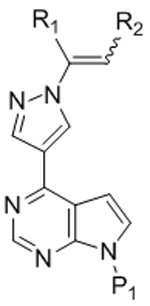
상기 식에서:
*는 키랄 탄소를 나타내고;
R1은 C3-7 시클로알킬, C1-6 알킬, 및 C1-6 플루오로알킬로부터 선택되고;
R2는 -C(=O)-NH2, -C(=O)O-R3, 및 시아노로부터 선택되고;
R3은 C1-4 알킬 또는 C1-4 플루오로알킬로부터 선택되고;
P1은 보호 그룹이다.A process for preparing a composition comprising a compound of formula (I) comprising reacting a compound of formula (II) with hydrogen gas in the presence of a hydrogenation catalyst:
(I)
[Formula II]
Wherein:
* Represents chiral carbon;
R 1 is selected from C 3-7 cycloalkyl, C 1-6 alkyl, and C 1-6 fluoroalkyl;
R 2 is selected from —C (═O) —NH 2 , —C (═O) OR 3 , and cyano;
R 3 is selected from C 1-4 alkyl or C 1-4 fluoroalkyl;
P 1 is a protection group.

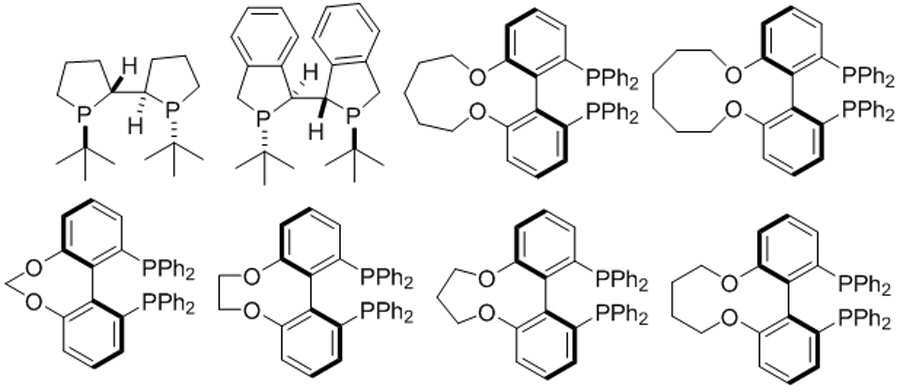

[화학식 Ia]

상기 식에서:
*는 키랄 탄소를 나타내고;
R1은 C3-7 시클로알킬, C1-6 알킬, 및 C1-6 플루오로알킬로부터 선택되고;
P1은 보호 그룹이다.The method of claim 2, wherein the product is a compound of formula la.
(Ia)
Wherein:
* Represents chiral carbon;
R 1 is selected from C 3-7 cycloalkyl, C 1-6 alkyl, and C 1-6 fluoroalkyl;
P 1 is a protection group.
[화학식 Ia]
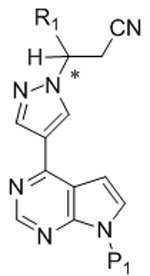
상기 식에서:
*는 키랄 탄소를 나타내고;
R1은 C3-7 시클로알킬, C1-6 알킬, 및 C1-6 플루오로알킬로부터 선택되고;
P1은 보호 그룹이다.The method of claim 11, further comprising reacting the compound of formula I under dehydration conditions to form a compound of formula Ia.
(Ia)
Wherein:
* Represents chiral carbon;
R 1 is selected from C 3-7 cycloalkyl, C 1-6 alkyl, and C 1-6 fluoroalkyl;
P 1 is a protection group.
[화학식 Ic]

상기 식에서:
*는 키랄 탄소를 나타내고;
R1은 C3-7 시클로알킬, C1-6 알킬, 및 C1-6 플루오로알킬로부터 선택되고;
P1은 보호 그룹이다.The method of claim 14 or 15, further comprising reacting the compound of formula I with a metal hydroxide to form a compound of formula Ic.
Formula Ic
Wherein:
* Represents chiral carbon;
R 1 is selected from C 3-7 cycloalkyl, C 1-6 alkyl, and C 1-6 fluoroalkyl;
P 1 is a protection group.
[화학식 Ib]

상기 식에서:
*는 키랄 탄소를 나타내고;
R1은 C3-7 시클로알킬, C1-6 알킬, 및 C1-6 플루오로알킬로부터 선택되고;
P1은 보호 그룹이다.19. The method of any one of claims 16-18, further comprising reacting the compound of formula (Ic) with ammonia or ammonium hydroxide in the presence of a coupling reagent to form a compound of formula (Ib).
Formula Ib
Wherein:
* Represents chiral carbon;
R 1 is selected from C 3-7 cycloalkyl, C 1-6 alkyl, and C 1-6 fluoroalkyl;
P 1 is a protection group.
[화학식 Ia]

상기 식에서:
*는 키랄 탄소를 나타내고;
R1은 C3-7 시클로알킬, C1-6 알킬, 및 C1-6 플루오로알킬로부터 선택되고;
P1은 보호 그룹이다.The method of claim 19 or 20, further comprising reacting the compound of formula Ib under dehydration conditions to form a compound of formula Ia.
(Ia)
Wherein:
* Represents chiral carbon;
R 1 is selected from C 3-7 cycloalkyl, C 1-6 alkyl, and C 1-6 fluoroalkyl;
P 1 is a protection group.
[화학식 Id]

[화학식 Ⅳ]

[화학식 V]

상기 식에서:
*는 키랄 탄소를 나타내고;
R1은 C3-7 시클로알킬, C1-6 알킬, 및 C1-6 플루오로알킬로부터 선택되고;
P1은 보호 그룹이다.Preparation of a composition comprising enantiomeric excess of (R)-or (S) -enantiomers of a compound of Formula (Id), comprising reacting a compound of Formula (IV) with a compound of Formula (V) in the presence of a chiral amine and an organic acid Way:
Formula Id
[Formula IV]
(V)
Wherein:
* Represents chiral carbon;
R 1 is selected from C 3-7 cycloalkyl, C 1-6 alkyl, and C 1-6 fluoroalkyl;
P 1 is a protection group.
[화학식 Ⅵ]

[화학식 V]

[화학식 Ⅶ]

상기 식에서:
*는 키랄 탄소를 나타내고;
R1은 C3-7 시클로알킬, C1-6 알킬, 및 C1-6 플루오로알킬로부터 선택되고;
X1은 할로겐이다.Preparation of a composition comprising enantiomeric excess of (R)-or (S) -enantiomers of a compound of Formula (VI), comprising reacting a compound of Formula (V) with a compound of Formula (V) in the presence of a chiral amine and an organic acid Way:
[Formula VI]
(V)
[Formula Ⅶ]
Wherein:
* Represents chiral carbon;
R 1 is selected from C 3-7 cycloalkyl, C 1-6 alkyl, and C 1-6 fluoroalkyl;
X 1 is halogen.
[화학식 A-1]

상기 식에서:
X는 CY3Y4이고, Y는 CY5Y6이거나; 또는
X는 S 또는 NY7이고, Y는 CY5Y6이거나; 또는
X는 CY3Y4이고, Y는 S이고;
Q1 및 Q2 각각은 H, C1-6 알킬, C1-6 할로알킬, 카복시, C1-6 알킬카복사미드, C1-6 알콕시카보닐, 및 페닐로부터 독립적으로 선택되고; 여기서, 상기 C1-6 알킬, C1-6 할로알킬, C1-6 알킬카복사미드, C1-6 알콕시카보닐, 및 페닐 각각은 히드록실, 카복시, 트리-C1-6 알킬실릴, 트리-C1-6 알킬실릴옥시, C6-10 아릴, C6-10 아릴아미노, C1-9 헤테로아릴, 및 C1-9 헤테로아릴아미노로부터 독립적으로 선택된 1, 2, 또는 3개의 그룹에 의해 임의로 치환되고; 여기서, 상기 C6-10 아릴, C6-10 아릴아미노, C1-9 헤테로아릴, 및 C1-9 헤테로아릴아미노 각각은 할로겐, C1-6 알킬, 및 C1-6 할로알킬로부터 독립적으로 선택된 1, 2, 3, 또는 4개의 그룹에 의해 임의로 치환되고;
Y1, Y2, Y3, Y4, Y5, Y6 각각은 H, 히드록실, 카복시, C1 -6 알킬, C1 -6 할로알킬, C1 -6 알콕시카보닐, 및 페닐로부터 독립적으로 선택되고; 또는
Y1 및 Y2는 함께, 옥소를 형성하거나; 또는
Y3 및 Y4는 함께, 옥소를 형성하거나; 또는
Y5 및 Y6는 함께, 옥소를 형성하거나; 또는
Y1 및 Y2는 이들이 부착되는 탄소와 함께, 5- 또는 6-원 시클로알킬 고리를 형성하거나; 또는
Q1 및 Y5는 이들이 부착되는 탄소 원자와 함께, 5- 또는 6-원 시클로알킬 고리를 형성한다.27. The method of any one of claims 24 to 26, wherein the chiral amine is the (R)-or (S) -enantiomer of the compound of formula A-1:
[Formula A-1]
Wherein:
X is CY 3 Y 4 and Y is CY 5 Y 6 ; or
X is S or NY 7 and Y is CY 5 Y 6 ; or
X is CY 3 Y 4 and Y is S;
Q 1 and Q 2 are each independently selected from H, C 1-6 alkyl, C 1-6 haloalkyl, carboxy, C 1-6 alkylcarboxamide, C 1-6 alkoxycarbonyl, and phenyl; Wherein said C 1-6 alkyl, C 1-6 haloalkyl, C 1-6 alkylcarboxamide, C 1-6 alkoxycarbonyl, and phenyl are each hydroxyl, carboxy, tri-C 1-6 alkylsilyl 1, 2, or 3 independently selected from tri-C 1-6 alkylsilyloxy, C 6-10 aryl, C 6-10 arylamino, C 1-9 heteroaryl, and C 1-9 heteroarylamino Optionally substituted by a group; Wherein each of C 6-10 aryl, C 6-10 arylamino, C 1-9 heteroaryl, and C 1-9 heteroarylamino is independent from halogen, C 1-6 alkyl, and C 1-6 haloalkyl Optionally substituted by 1, 2, 3, or 4 groups selected;
From Y 1, Y 2, Y 3 , Y 4, Y 5, Y 6 each are H, hydroxyl, carboxy, C 1 -6 alkyl, C 1 -6 haloalkyl, C 1 -6 alkoxycarbonyl, and phenyl Independently selected; or
Y 1 and Y 2 together form oxo; or
Y 3 and Y 4 together form oxo; or
Y 5 and Y 6 together form oxo; or
Y 1 and Y 2 together with the carbon to which they are attached form a 5- or 6-membered cycloalkyl ring; or
Q 1 and Y 5 together with the carbon atom to which they are attached form a 5- or 6-membered cycloalkyl ring.
[화학식 A-2]

상기 식에서,
*는 (R)- 또는 (S)-배열을 갖는 키랄 탄소이고;
Ar1 및 Ar2 각각은 독립적으로 C6-10 아릴이고, 이 아릴은 C1-6 알킬 및 C1-6 할로알킬로부터 독립적으로 선택된 1, 2, 3, 또는 4개의 그룹에 의해 임의로 치환되고;
각각의 Ra는 C1-6 알킬로부터 독립적으로 선택되고;
Rb은 H, C1-6 알킬, 및 C1-6 할로알킬로부터 선택된다.27. The method of any one of claims 24 to 26, wherein the chiral amine is the (R)-or (S) -enantiomer of the compound of formula A-2:
[Formula A-2]
Where
* Is a chiral carbon with (R)-or (S)-configuration;
Each of Ar 1 and Ar 2 is independently C 6-10 aryl, which aryl is optionally substituted by 1, 2, 3, or 4 groups independently selected from C 1-6 alkyl and C 1-6 haloalkyl; ;
Each R a is independently selected from C 1-6 alkyl;
R b is selected from H, C 1-6 alkyl, and C 1-6 haloalkyl.
각각의 Ra는 메틸, 에틸, 또는 t-부틸로부터 독립적으로 선택되고;
Rb는 H인 방법.The compound of claim 28, wherein Ar 1 and Ar 2 are each independently phenyl, which phenyl is optionally substituted by 1, 2, 3, or 4 groups independently selected from methyl and trifluoromethyl;
Each R a is independently selected from methyl, ethyl, or t-butyl;
R b is H.

[화학식 Ia]
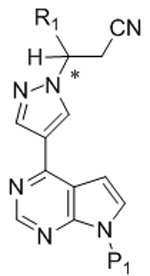
상기 식에서:
*는 키랄 탄소를 나타내고;
R1은 C3-7 시클로알킬, C1-6 알킬, 및 C1-6 플루오로알킬로부터 선택되고;
P1은 보호 그룹이다.The method of claim 24, further comprising reacting the compound of Formula Id with ammonia or ammonium hydroxide and iodine to form the compound of Formula Ia.
(Ia)
Wherein:
* Represents chiral carbon;
R 1 is selected from C 3-7 cycloalkyl, C 1-6 alkyl, and C 1-6 fluoroalkyl;
P 1 is a protection group.
[화학식 Ⅷ]
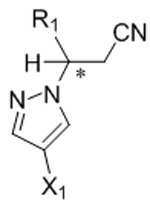
상기 식에서:
*는 키랄 탄소를 나타내고;
R1은 C3-7 시클로알킬, C1-6 알킬, 및 C1-6 플루오로알킬로부터 선택되고;
P1은 보호 그룹이고;
X1은 할로겐이다.The method of claim 25, further comprising reacting the compound of formula VI with ammonia or ammonium hydroxide and iodine to form a compound of formula VII.
[Formula Ⅷ]
Wherein:
* Represents chiral carbon;
R 1 is selected from C 3-7 cycloalkyl, C 1-6 alkyl, and C 1-6 fluoroalkyl;
P 1 is a protecting group;
X 1 is halogen.
[화학식 B-1]

[화학식 Ⅸ]

상기 식에서:
*는 키랄 탄소를 나타내고;
R1은 C3-7 시클로알킬, C1-6 알킬, 및 C1-6 플루오로알킬로부터 선택되고;
X1은 할로이고;
Rc 및 Rd 각각은 H 및 C1 -6 알킬로부터 독립적으로 선택되거나; 또는
Rc 및 Rd는, 이들이 부착되는 산소 원자 및 이 산소 원자가 부착되는 붕소 원자와 함께, 5- 내지 6-원 헤테로시클릭 고리를 형성하고, 이 고리는 1, 2, 3, 또는 4개의 C1-4 알킬 그룹으로 임의로 치환된다.The method of claim 36, further comprising reacting the compound of Formula VII with a compound of Formula B-1 to form a compound of Formula VII:
[Formula B-1]
[Formula Ⅸ]
Wherein:
* Represents chiral carbon;
R 1 is selected from C 3-7 cycloalkyl, C 1-6 alkyl, and C 1-6 fluoroalkyl;
X 1 is halo;
R c and R d each is selected from H and C 1 -6 independently selected from alkyl; or
R c and R d together with the oxygen atom to which they are attached and the boron atom to which the oxygen atom is attached form a 5- to 6-membered heterocyclic ring, which ring is 1, 2, 3, or 4 C Optionally substituted with 1-4 alkyl groups.
[화학식 X]

[화학식 Ia]
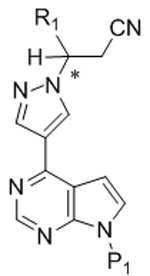
상기 식에서:
*는 키랄 탄소를 나타내고;
R1은 C3-7 시클로알킬, C1-6 알킬, 및 C1-6 플루오로알킬로부터 선택되고;
X2는 토실레이트 그룹, 트리플레이트 그룹, 아이오도, 클로로, 또는 브로모이고;
P1은 보호 그룹이고;
Rc 및 Rd 각각은 H 및 C1 -6 알킬로부터 독립적으로 선택되거나; 또는
Rc 및 Rd는, 이들이 부착되는 산소 원자 및 이 산소 원자가 부착되는 붕소 원자와 함께, 5- 내지 6-원 헤테로시클릭 고리를 형성하고, 이 고리는 1, 2, 3, 또는 4개의 C1-4 알킬 그룹으로 임의 치환된다.The method of claim 37 or 38, further comprising reacting the compound of formula (VIII) with a compound of formula (X) in the presence of a palladium catalyst and a base to form a compound of formula (Ia).
[Formula X]
(Ia)
Wherein:
* Represents chiral carbon;
R 1 is selected from C 3-7 cycloalkyl, C 1-6 alkyl, and C 1-6 fluoroalkyl;
X 2 is a tosylate group, a triflate group, iodo, chloro, or bromo;
P 1 is a protecting group;
R c and R d each is selected from H and C 1 -6 independently selected from alkyl; or
R c and R d together with the oxygen atom to which they are attached and the boron atom to which the oxygen atom is attached form a 5- to 6-membered heterocyclic ring, which ring is 1, 2, 3, or 4 C Optionally substituted with 1-4 alkyl group.
[화학식 Ⅸ]
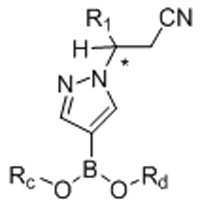
상기 식에서:
*는 키랄 탄소를 나타내고;
R1은 C3-7 시클로알킬, C1-6 알킬, 및 C1-6 플루오로알킬로부터 선택되고;
Rc 및 Rd 각각은 독립적으로 C1-6 알킬이거나; 또는
Rc 및 Rd는, 이들이 부착되는 산소 원자 및 이 산소 원자가 부착되는 붕소 원자와 함께, 5- 내지 6-원 헤테로시클릭 고리를 형성하고, 이 고리는 1, 2, 3, 또는 4개의 C1-4 알킬 그룹으로 임의로 치환된다.A composition comprising an enantiomeric excess of the (R)-or (S) -enantiomer of the compound of formula (VII):
[Formula Ⅸ]
Wherein:
* Represents chiral carbon;
R 1 is selected from C 3-7 cycloalkyl, C 1-6 alkyl, and C 1-6 fluoroalkyl;
Each of R c and R d is independently C 1-6 alkyl; or
R c and R d together with the oxygen atom to which they are attached and the boron atom to which the oxygen atom is attached form a 5- to 6-membered heterocyclic ring, which ring is 1, 2, 3, or 4 C Optionally substituted with 1-4 alkyl groups.

[화학식 Ⅸ]

[화학식 XI]

[화학식 Ⅲ]

상기 식에서:
*는 키랄 탄소이고;
X2는 토실레이트 그룹, 트리플레이트 그룹, 아이오도, 클로로, 또는 브로모이고;
R1은 C3-7 시클로알킬, C1-6 알킬, 및 C1-6 플루오로알킬로부터 선택되고;
Rc 및 Rd 각각은 독립적으로 C1-6 알킬이거나; 또는
Rc 및 Rd는, 이들이 부착되는 산소 원자 및 이 산소 원자가 부착되는 붕소 원자와 함께, 5- 내지 6-원 헤테로시클릭 고리를 형성하고, 이 고리는 1, 2, 3, 또는 4개의 C1-4 알킬 그룹으로 임의로 치환된다.49. The enantiomeric excess of (R)-of any of claims 44-48, wherein the compound of formula (VII) is reacted with a compound of formula (XI) in the presence of a palladium catalyst, a base, and a solvent. Or forming a composition comprising the (S) -enantiomer:
[Formula Ⅸ]
Formula XI
[Formula III]
Wherein:
* Is chiral carbon;
X 2 is a tosylate group, a triflate group, iodo, chloro, or bromo;
R 1 is selected from C 3-7 cycloalkyl, C 1-6 alkyl, and C 1-6 fluoroalkyl;
Each of R c and R d is independently C 1-6 alkyl; or
R c and R d together with the oxygen atom to which they are attached and the boron atom to which the oxygen atom is attached form a 5- to 6-membered heterocyclic ring, which ring is 1, 2, 3, or 4 C Optionally substituted with 1-4 alkyl groups.
[화학식 Ⅸ]

[화학식 X]

상기 식에서:
*는 키랄 탄소를 나타내고;
R1은 C3-7 시클로알킬, C1-6 알킬, 및 C1-6 플루오로알킬로부터 선택되고;
Rc 및 Rd 각각은 독립적으로 C1-6 알킬이거나; 또는
Rc 및 Rd는, 이들이 부착되는 산소 원자 및 이 산소 원자가 부착되는 붕소 원자와 함께, 5- 내지 6-원 헤테로시클릭 고리를 형성하고, 이 고리는 1, 2, 3, 또는 4개의 C1-4 알킬 그룹으로 임의 치환되고;
X2는 토실레이트 그룹, 트리플레이트 그룹, 아이오도, 클로로, 또는 브로모이고;
P1은 보호 그룹이다.49. The process of any one of claims 44 to 48, wherein under conditions and for a time sufficient to form a composition comprising an enantiomeric excess of the (R)-or (S) -enantiomer of the compound of formula (Ia), Further comprising reacting a compound of formula (VII) with a compound of formula (X) in the presence of a palladium catalyst, a base, and a solvent:
[Formula Ⅸ]
[Formula X]
Wherein:
* Represents chiral carbon;
R 1 is selected from C 3-7 cycloalkyl, C 1-6 alkyl, and C 1-6 fluoroalkyl;
Each of R c and R d is independently C 1-6 alkyl; or
R c and R d together with the oxygen atom to which they are attached and the boron atom to which the oxygen atom is attached form a 5- to 6-membered heterocyclic ring, which ring is 1, 2, 3, or 4 C Optionally substituted with 1-4 alkyl group;
X 2 is a tosylate group, a triflate group, iodo, chloro, or bromo;
P 1 is a protection group.
a) 화학식 Ⅳ의 화합물을 형성하기에 충분한 조건 하에서, 제1 염기의 존재하에서 화학식 Ia의 화합물의 거울상이성질체 잉여의 (R)- 또는 (S)-거울상이성질체를 포함하는 조성물을 화학식 D-1의 화합물로 처리하는 단계:
(b) 제2 염기의 존재하에서 화학식 Ⅳ의 화합물을 화학식 D-1의 화합물과 반응시키는 단계;
[화학식 Ia]
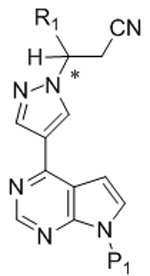
[화학식 D-1]

[화학식 Ⅳ]
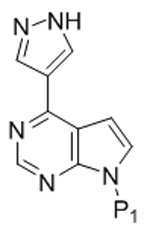
상기 식에서:
*는 키랄 탄소이고;
P1은 보호 그룹이고;
R1은 C3-7 시클로알킬, C1-6 알킬, 및 C1-6 플루오로알킬로부터 선택된다.A process for preparing a composition comprising a racemate of a compound of formula (Ia), comprising the following steps (a) and (b):
a) A composition comprising the enantiomeric excess of the (R)-or (S) -enantiomer of the compound of formula (Ia) in the presence of a first base under conditions sufficient to form a compound of formula (IV) Treatment with compound:
(b) reacting the compound of formula IV with a compound of formula D-1 in the presence of a second base;
(Ia)
[Formula D-1]
[Formula IV]
Wherein:
* Is chiral carbon;
P 1 is a protecting group;
R 1 is selected from C 3-7 cycloalkyl, C 1-6 alkyl, and C 1-6 fluoroalkyl.
[화학식 Ia]

[화학식 D-1]

상기 식에서:
*는 키랄 탄소이고;
P1은 보호 그룹이고;
R1은 C3-7 시클로알킬, C1-6 알킬, 및 C1-6 플루오로알킬로부터 선택된다.A process for preparing a composition comprising a racemate of a compound of formula (Ia), wherein under conditions sufficient to form said racemate of said compound of formula (Ia), in the presence of a base, the enantiomeric excess of the compound of formula (Ia) A method comprising treating a composition comprising a)-or (S) -enantiomer with a compound of Formula (D-1):
(Ia)
[Formula D-1]
Wherein:
* Is chiral carbon;
P 1 is a protecting group;
R 1 is selected from C 3-7 cycloalkyl, C 1-6 alkyl, and C 1-6 fluoroalkyl.
[화학식 Ia]
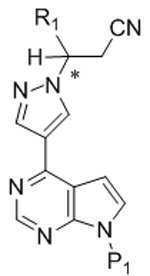
상기 식에서:
*는 키랄 탄소이고;
R1은 C3-7 시클로알킬, C1-6 알킬, 및 C1-6 플루오로알킬로부터 선택되고;
P1은 보호 그룹이다. The method of any one of claims 51-55, further comprising preparing a composition comprising an enantiomeric excess of the (R)-or (S) -enantiomer of the compound of formula (Ia). The preparation of this composition comprises the steps of passing a composition comprising a racemate of a compound of formula (Ia) to a chiral chromatography unit using a mobile phase and (R)-or (S) -enantiomer of the enantiomeric excess of the compound of formula (Ia) A method comprising collecting a composition comprising an isomer:
(Ia)
Wherein:
* Is chiral carbon;
R 1 is selected from C 3-7 cycloalkyl, C 1-6 alkyl, and C 1-6 fluoroalkyl;
P 1 is a protection group.
[화학식 Ia]

상기 식에서:
*는 키랄 탄소이고;
R1은 C3-7 시클로알킬, C1-6 알킬, 및 C1-6 플루오로알킬로부터 선택되고;
P1은 보호 그룹이다.
(a) 용매의 존재하에서 화학식 Ia의 화합물의 라세미체를 포함하는 조성물을 키랄 산과 반응시켜 화학식 Ia의 화합물의 염을 형성하는 단계;
(b) 상기 화학식 Ia의 화합물의 거울상이성질체 잉여의 (R)- 또는 (S)-거울상이성질체의 키랄 염을 포함하는 조성물을 분리하는 단계; 및
(c) 상기 상기 키랄 염을 염기로 처리하여 화학식 Ia의 화합물의 거울상이성질체 잉여의 (R)- 또는 (S)-거울상이성질체를 포함하는 조성물을 생성하는 단계.A process for preparing a composition comprising the enantiomeric excess of the (R)-or (S) -enantiomer of the compound of formula (Ia), comprising the following steps (a) to (c):
(Ia)
Wherein:
* Is chiral carbon;
R 1 is selected from C 3-7 cycloalkyl, C 1-6 alkyl, and C 1-6 fluoroalkyl;
P 1 is a protection group.
(a) reacting a composition comprising a racemate of a compound of formula (Ia) with chiral acid in the presence of a solvent to form a salt of a compound of formula (Ia);
(b) separating a composition comprising a chiral salt of the (R)-or (S) -enantiomer of the enantiomeric excess of the compound of Formula (Ia); And
(c) treating said chiral salt with a base to produce a composition comprising an enantiomeric excess of the (R)-or (S) -enantiomer of the compound of formula (Ia).
[화학식 XⅡ]

[화학식 X]

[화학식 XⅢ]

상기 식에서:
*는 키랄 탄소이고;
X2는 토실레이트 그룹, 트리플레이트 그룹, 아이오도, 클로로, 또는 브로모이고;
R1은 C3-7 시클로알킬, C1-6 알킬, 및 C1-6 플루오로알킬로부터 선택되고;
Rc 및 Rd 각각은 독립적으로 H 또는 C1-6 알킬이고; 또는
Rc 및 Rd는, 이들이 부착되는 산소 원자 및 이 산소 원자가 부착되는 붕소 원자와 함께, 5- 내지 6-원 헤테로시클릭 고리를 형성하고, 이 고리는 1, 2, 3, 또는 4개의 C1-4 알킬 그룹으로 임의 치환되고;
P1 및 P2 각각은 독립적으로 보호 그룹이다. A process for preparing a compound of formula (XII) comprising reacting a compound of formula (X) with a compound of formula (XIII) to form a compound of formula (XII) in the presence of a palladium catalyst, a base, and a solvent:
[Formula XII]
[Formula X]
[Formula XIII]
Wherein:
* Is chiral carbon;
X 2 is a tosylate group, a triflate group, iodo, chloro, or bromo;
R 1 is selected from C 3-7 cycloalkyl, C 1-6 alkyl, and C 1-6 fluoroalkyl;
Each of R c and R d is independently H or C 1-6 alkyl; or
R c and R d together with the oxygen atom to which they are attached and the boron atom to which the oxygen atom is attached form a 5- to 6-membered heterocyclic ring, which ring is 1, 2, 3, or 4 C Optionally substituted with 1-4 alkyl group;
P 1 and P 2 are each independently a protecting group.

[화학식 Ⅲ]

*는 키랄 탄소이고;
R1은 C3-7 시클로알킬, C1-6 알킬, 및 C1-6 플루오로알킬로부터 선택되고;
P1은 보호 그룹이다.64. The compound of any one of claims 10, 12, 13, 21, 35, 39, 50, and 56-63 under the deprotection conditions. Further comprising reacting a compound of to form a compound of Formula III:
[Formula III]
* Is chiral carbon;
R 1 is selected from C 3-7 cycloalkyl, C 1-6 alkyl, and C 1-6 fluoroalkyl;
P 1 is a protection group.
(a) 화학식 XⅧ의 화합물을 약 1 당량 이상의 C1 -6 알킬 그리냐드 시약 또는 C1-6 알킬 리튬 시약과 반응시킨 다음, 약 1 당량 이상의 화학식 XⅦ의 화합물로 처리하는 단계; 및
(b) 임의로, 단계 (a)의 생성물을 재보호하여 화학식 XⅥ의 화합물의 얻는 단계;
[화학식 XⅥ]

[화학식 XⅧ]
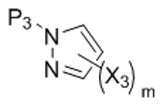
[화학식 XⅦ]

상기 식에서:
P3은 보호 그룹이고;
X3은 할로겐이고;
R4는 C1-6 알킬로부터 선택되고;
m은 1 및 2로부터 선택된 정수이다. A process for preparing a compound of formula XVI, comprising the following steps (a) and (b):
(a) reacting a compound of formula XⅧ with about 1 equivalent or more C 1 -6 alkyl Grignard reagent or a C 1-6 alkyl lithium reagent, and then treating with a compound of the formula about 1 equivalent or more XⅦ; And
(b) optionally, reprotecting the product of step (a) to obtain a compound of formula XVI;
[Formula XVI]
[Formula X ']
[Formula X ']
Wherein:
P 3 is a protecting group;
X 3 is halogen;
R 4 is selected from C 1-6 alkyl;
m is an integer selected from 1 and 2.
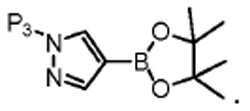
[화학식 XⅨ]

상기 식에서:
P3은 보호 그룹이고;
X3은 할로겐이고;
m은 1 및 2로부터 선택된 정수이다.79. The method of any one of claims 75-78, further comprising a process for preparing the compound of formula XVII comprising protecting the compound of formula XVII.
[Formula X ']
Wherein:
P 3 is a protecting group;
X 3 is halogen;
m is an integer selected from 1 and 2.
X3은 할로겐이고;
m은 1 및 2로부터 선택된 정수인 방법. 80. The method of any one of claims 75-79, further comprising preparing a compound of Formula XVII by a method comprising reacting 1H-pyrazole with a halogenating agent, wherein:
X 3 is halogen;
m is an integer selected from 1 and 2.
[화학식 XIa]
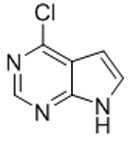
[화학식 F-1]

Formula XIa
[Formula F-1]
[화학식 F-2]

[Formula F-2]
[화학식 F-3]

[Formula F-3]
[화학식 F-4]

[Formula F-4]
[화학식 I]
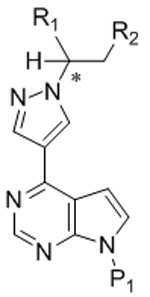
상기 식에서:
*는 키랄 탄소를 나타내고;
R1은 C3-7 시클로알킬, C1-6 알킬, 및 C1-6 플루오로알킬로부터 선택되고;
R2는 -C(=O)-NH2, -C(=O)O-R3, -C(=O)OH, 및 -C(=O)H로부터 선택되고;
R3은 C1-4 알킬 또는 C1-4 플루오로알킬로부터 선택되고;
P1은 보호 그룹이다.A composition comprising an enantiomeric excess of the (R)-or (S) -enantiomer of a compound of Formula (I):
(I)
Wherein:
* Represents chiral carbon;
R 1 is selected from C 3-7 cycloalkyl, C 1-6 alkyl, and C 1-6 fluoroalkyl;
R 2 is selected from —C (═O) —NH 2 , —C (═O) OR 3 , —C (═O) OH, and —C (═O) H;
R 3 is selected from C 1-4 alkyl or C 1-4 fluoroalkyl;
P 1 is a protection group.
[화학식 Ⅱ]
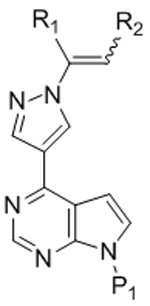
상기 식에서:
R1은 C3 -7 시클로알킬, C1 -6 알킬, 및 C1 -6 플루오로알킬로부터 선택되고;
R2는 -C(=O)-NH2 및 -C(=O)O-R3로부터 선택되고;
R3은 C1-4 알킬 또는 C1-4 플루오로알킬로부터 선택되고;
P1은 보호 그룹이다.A compound of formula II:
[Formula II]
Wherein:
R 1 is selected from alkyl to C 3 -7-cycloalkyl, C 1 -6 alkyl, and C 1 -6 fluoro;
R 2 is selected from —C (═O) —NH 2 and —C (═O) OR 3 ;
R 3 is selected from C 1-4 alkyl or C 1-4 fluoroalkyl;
P 1 is a protection group.
[화학식 Ⅲ']

상기 식에서, *는 키랄 탄소를 나타낸다.
(a) 화학식 XI'의 화합물을 수산화나트륨 및 N-피발로일옥시메틸 클로라이드로 처리하여 화학식 X'의 화합물을 형성하는 단계:
[화학식 XI']

[화학식 X']
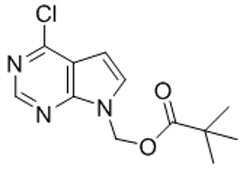
(b) Pd(트리페닐포스핀)4, 탄산칼륨, 및 용매의 존재하에서, 상기 화학식 X'의 화합물을 화학식 XⅢ'의 화합물로 처리하여 화학식 XⅡ'의 화합물을 형성하는 단계:
[화학식 XⅢ']
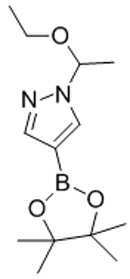
[화학식 XⅡ']

(c) 탈보호 조건 하에서, 상기 화학식 XⅡ'의 화합물을 반응시켜 화학식 Ⅳ'의 화합물을 얻는 단계:
[화학식 Ⅳ']

(d) 1,8-디아자-바이시클로[5.4.0]운덱-7-엔의 존재하에서, 상기 화학식 Ⅳ"의 화합물을 화학식 XⅣ'의 화합물과 반응시켜 화학식 Ⅱ'의 화합물을 얻는 단계:
[화학식 XⅣ']

[화학식 Ⅱ']
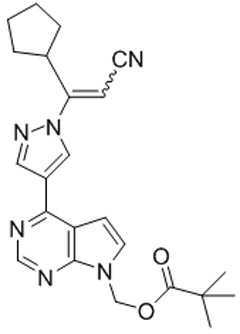
(e) 하기로부터 선택된 [Rh(COD)2]CF3SO3 및 키랄 포스핀 리간드의 존재하에서 상기 화학식 Ⅱ'의 화합물을 수소 가스와 반응시켜 화학식 I'의 화합물을 형성하는 단계:

[화학식 I']
;
상기 식에서, *는 키랄 탄소를 나타낸다.
(f) 탈보호 조건 하에서, 상기 화학식 I'의 화합물을 반응시켜 상기 화학식 Ⅲ'의 화합물을 형성하는 단계.A process for preparing a composition comprising the (R) -enantiomer of at least 90% of the enantiomeric excess of a compound of Formula III ', comprising the following steps (a) to (f):
[Formula III ']
Wherein * represents chiral carbon.
(a) treating a compound of formula XI 'with sodium hydroxide and N-pivaloyloxymethyl chloride to form a compound of formula X':
Formula XI '
Formula X '
(b) treating said compound of formula X 'with a compound of formula XIII' in the presence of Pd (triphenylphosphine) 4 , potassium carbonate, and a solvent to form a compound of formula XII ':
Formula XIII '
[Formula XII ']
(c) reacting the compound of formula XII 'under deprotection conditions to obtain a compound of formula IV':
[Formula IV ']
(d) reacting the compound of formula IV "with the compound of formula XIV 'in the presence of 1,8-diaza-bicyclo [5.4.0] undec-7-ene to obtain a compound of formula II':
[Formula XIV ']
[Formula II ']
(e) reacting the compound of formula II 'with hydrogen gas to form a compound of formula I' in the presence of [Rh (COD) 2 ] CF 3 SO 3 and a chiral phosphine ligand selected from:
[Formula I ']
;
Wherein * represents chiral carbon.
(f) reacting the compound of Formula I 'to form a compound of Formula III' under deprotection conditions.
(ⅰ) 약 1 내지 약 2 당량의 디메틸포름아미드의 존재하에서, 화학식 F-4의 화합물을 약 3 내지 약 5 당량의 POCl3와 반응시켜 화학식 F-3의 화합물을 형성하는 단계:
[화학식 F-4]

[화학식 F-3]

(ⅱ) 상기 화학식 F-3의 화합물을 메탄올 중 약 2 당량의 암모니아와 반응시켜 화학식 F-2의 화합물을 형성하는 단계:
[화학식 F-2]

(ⅲ) 약 1 내지 약 1.5 당량의 칼륨 tert-부톡시드의 존재하에서, 상기 화학식 F-2의 화합물을 화학식 [Ph3P+(CH2OCH3)]Cl-(여기서, Ph는 페닐이다)의 약 1 내지 약 1.5 당량의 위티그형 시약과 반응시켜 화학식 F-1의 화합물을 형성하는 단계:
[화학식 F-1]
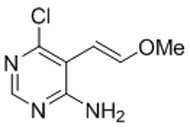
(ⅳ) 환류 하의 테트라히드로푸란에서 상기 화학식 F-1의 화합물을 수성 농축 염산으로 처리하여 화학식 XI'의 화합물을 형성하는 단계.94. The method of claim 93, further comprising preparing a compound of Formula XI ', wherein the preparation comprises the following steps (i) to (iii).
(Iii) reacting a compound of Formula F-4 with about 3 to about 5 equivalents of POCl 3 in the presence of about 1 to about 2 equivalents of dimethylformamide to form a compound of Formula F-3:
[Formula F-4]
[Formula F-3]
(Ii) reacting the compound of formula F-3 with about 2 equivalents of ammonia in methanol to form a compound of formula F-2:
[Formula F-2]
(Iii) in the presence of about 1 to about 1.5 equivalents of potassium tert-butoxide, the compound of Formula F-2 is represented by the formula [Ph 3 P + (CH 2 OCH 3 )] Cl-, where Ph is phenyl Reacting with about 1 to about 1.5 equivalents of a Wittig reagent to form a compound of Formula F-1:
[Formula F-1]
(Iii) treating said compound of Formula F-1 with aqueous concentrated hydrochloric acid in tetrahydrofuran under reflux to form a compound of Formula XI '.
(ⅰ) 1H-피라졸을 N-브로모석신이미드와 반응시켜 화학식 XⅨ'의 화합물을 형성하는 단계;
[화학식 XⅨ']

(ⅱ) 상기 화학식 XⅨ의 화합물을 보호하여 화학식 XⅧ'의 화합물을 형성하는 단계:
[화학식 XⅧ']

(ⅲ) 상기 화학식 XⅧ'의 화합물을 약 1 당량 이상의 이소프로필마그네슘 클로라이드와 반응시키셔, 그 다음 약 1 당량 이상의 화학식 XⅦ'의 화합물로 처리하여 화학식 XⅢ'의 화합물을 형성하는 단계:
[화학식 XⅦ']

(Iii) reacting 1H-pyrazole with N-bromosuccinimide to form a compound of formula X ′ ';
Formula X ''
(Ii) protecting said compound of formula X 'to form a compound of formula X'
Formula X ''
(Iii) reacting the compound of formula (XVII ') with at least about 1 equivalent of isopropylmagnesium chloride and then treating with at least about 1 equivalent of compound of formula (XVII') to form a compound of formula (XIII '):
Formula X ''
[화학식 XⅢ']
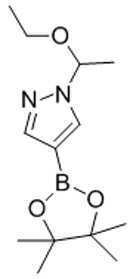
(ⅰ) 4-아이오도-1H-피라졸을 보호하여 화학식 XⅧ"의 화합물을 형성하는 단계:
[화학식 XⅧ"]

(ⅱ) 화학식 XⅧ"의 화합물을 테트라히드로푸란 중 약 1 당량 이상의 이소프로필마그네슘 클로라이드와 반응시키고, 그 다음 약 1 당량 이상의 화학식 XⅦ'의 화합물로 처리하여 화학식 XⅢ'의 화합물을 형성하는 단계.
[화학식 XⅦ']

Formula XIII '
(Iii) protecting 4-iodo-1H-pyrazole to form a compound of formula XVII ":
Formula X '"
(Ii) reacting the compound of formula XVII 'with at least about 1 equivalent of isopropylmagnesium chloride in tetrahydrofuran and then treating with at least about 1 equivalent of the compound of formula XVII' to form a compound of formula XIII '.
Formula X ''
용매는 2,2,2-트리플루오로에탄올 (TFE)이고;
수소화 촉매 부하는 약 0.005 내지 약 0.01 몰%이고;
화학식 Ⅱ의 화합물 대 수소화 촉매의 비는 약 20000/1 내지 약 10000/1이고;
수소 압력은 약 7 내지 약 60 bar이고;
반응은 약 실온 내지 약 75℃의 온도에서 수행되고;
반응은, 화학식 Ⅱ의 화합물 대 상기 화학식의 화합물의 전환율이 약 99.5% 이상일 때까지 수행되며;
반응은 약 10 내지 약 25시간인 방법.95. The method of claim 93, wherein in step (e):
The solvent is 2,2,2-trifluoroethanol (TFE);
The hydrogenation catalyst load is about 0.005 to about 0.01 mol%;
The ratio of the compound of Formula II to the hydrogenation catalyst is about 20000/1 to about 10000/1;
Hydrogen pressure is about 7 to about 60 bar;
The reaction is carried out at a temperature of about room temperature to about 75 ° C;
The reaction is carried out until the conversion of the compound of formula II to the compound of the formula is at least about 99.5%;
The reaction is about 10 to about 25 hours.
[화학식 Ⅲ']

상기 식에서, *는 키랄 탄소이다.
(a) 화학식 XI'의 화합물을 수산화나트륨 및 2-(트리메틸실릴)에톡시메틸로 처리하여 화학식 X"의 화합물을 형성하는 단계:
[화학식 XI']

[화학식 X"]

(b) Pd(트리페닐포스핀)4, 탄산칼륨, 및 용매의 존재하에서, 상기 화학식 X"의 화합물을 화학식 XⅢ'의 화합물로 처리하여 화학식 XⅡ"의 화합물을 형성하는 단계:
[화학식 XⅢ']

[화학식 XⅡ"]

(c) 탈보호 조건 하에서, 상기 화학식 XⅡ"의 화합물을 반응시켜 화학식 Ⅳ"의 화합물을 형성하는 단계:
[화학식 Ⅳ"]
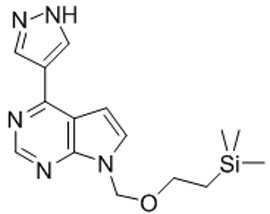
(d) 화학식 I"의 화합물의 라세미체를 포함하는 조성물을 형성하기에 충분한 조건 하에서, 상기 화학식 Ⅳ"의 화합물을 화학식 D-1'의 화합물과 반응시키는 단계:
[화학식 D-1']

[화학식 I"]

상기 식에서, *는 키랄 탄소이다.
(e) 상기 화학식 I"의 화합물의 상기 라세미체를 포함하는 상기 조성물을, 이동상을 사용하는 키랄 크로마토그래피 유닛에 통과시키고, 상기 화학식 I"의 화합물의 거울상이성질체 잉여의 (R)-거울상이성질체를 포함하는 조성물을 수집하는 단계; 및
(f) 상기 화학식 I"의 화합물을 리튬 테트라플루오로보레이트와, 그 다음 수성 수산화암모늄과 반응시켜서 상기 화학식 Ⅲ'의 화합물의 거울상이성질체 잉여의 (R)-거울상이성질체를 포함하는 조성물을 형성하는 단계.A process for preparing a composition comprising the enantiomeric excess of the (R) -enantiomer of the compound of formula III 'comprising the following steps (a) to (f):
[Formula III ']
Wherein * is chiral carbon.
(a) treating a compound of formula (XI ') with sodium hydroxide and 2- (trimethylsilyl) ethoxymethyl to form a compound of formula (X "):
Formula XI '
Formula X "
(b) treating the compound of Formula X ″ with a compound of Formula XIII ′ in the presence of Pd (triphenylphosphine) 4 , potassium carbonate, and a solvent to form a compound of Formula XII ″:
Formula XIII '
Formula XII "
(c) under deprotection conditions, reacting the compound of Formula XII ″ to form a compound of Formula IV ″:
[Formula IV ”]
(d) reacting said compound of formula IV "with a compound of formula D-1 'under conditions sufficient to form a composition comprising a racemate of the compound of formula I":
[Formula D-1 ']
Formula I "
Wherein * is chiral carbon.
(e) passing said composition comprising said racemate of said compound of formula (I ") through a chiral chromatography unit using a mobile phase and enantiomeric excess of said (I) enantiomer of said compound of formula (I") Collecting a composition comprising a; And
(f) reacting said compound of formula (I ") with lithium tetrafluoroborate and then aqueous ammonium hydroxide to form a composition comprising an enantiomeric excess of said (III) enantiomer of said compound of formula (III ') .
(a) 화학식 I"의 화합물의 라세미체를 형성하기에 충분한 조건 하에서, 아세토니트릴 중 탄산세슘의 존재하에서 화학식 I"의 화합물의 거울상이성질체 잉여의 (S)-거울상이성질체를 포함하는 조성물을 화학식 D-1'의 화합물로 처리하는 단계:
(b) 상기 화학식 I"의 화합물의 상기 라세미체를 포함하는 상기 조성물을, 이동상을 사용하는 키랄 크로마토그래피 유닛에 통과시키고, 상기 화학식 I"의 화합물의 거울상이성질체 잉여의 (R)-거울상이성질체를 포함하는 조성물을 수집하는 단계; 및
(c) 상기 화학식 I"의 화합물을 리튬 테트라플루오로보레이트와, 그 다음 수성 수산화암모늄과 반응시켜 상기 화학식 Ⅲ'의 화합물의 거울상이성질체 잉여의 (R)-거울상이성질체를 포함하는 조성물을 형성하는 단계;
[화학식 Ⅲ']
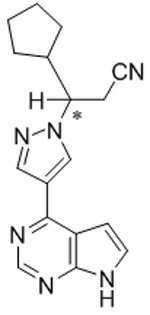
[화학식 I"]

[화학식 D-1']
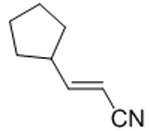
상기 식에서, *는 키랄 탄소이다.A process for preparing a composition comprising the enantiomeric excess of the (R) -enantiomer of the compound of Formula III ', comprising the following steps (a) to (c):
(a) A composition comprising an enantiomeric excess of the (S) -enantiomer of the compound of formula (I) in the presence of cesium carbonate in acetonitrile under conditions sufficient to form a racemate of the compound of formula (I " Treatment with a compound of D-1 ':
(b) said composition comprising said racemate of said compound of formula (I ") is passed through a chiral chromatography unit using a mobile phase and the enantiomeric excess of said enantiomer (R) -enantiomer of said compound of formula (I") Collecting a composition comprising a; And
(c) reacting said compound of formula (I ") with lithium tetrafluoroborate and then with aqueous ammonium hydroxide to form a composition comprising the enantiomeric excess of the (R) -enantiomer of said compound of formula (III ') ;
[Formula III ']
Formula I "
[Formula D-1 ']
Wherein * is chiral carbon.
(a) 화학식 XI'의 화합물을 수산화나트륨 및 2-(트리메틸실릴)에톡시메틸로 처리하여 화학식 X"의 화합물을 형성하는 단계:
(b) Pd(트리페닐포스핀)4, 탄산칼륨, 및 용매의 존재하에서, 상기 화학식 X"의 화합물을 화학식 XⅢ'의 화합물로 처리하여 화학식 XⅡ"의 화합물을 형성하는 단계:
(c) 탈보호 조건 하에서, 상기 화학식 XⅡ"의 화합물을 반응시켜 화학식 Ⅳ"의 화합물을 형성하는 단계:
(d) 화학식 I"의 화합물의 라세미체를 포함하는 조성물을 형성하기에 충분한 조건 하에서, 상기 화학식 Ⅳ"의 화합물을 화학식 D-1'의 화합물과 반응시키는 단계:
(e) 상기 화학식 I"의 화합물의 상기 라세미체를 포함하는 조성물을 이동상을 사용하는 키랄 크로마토그래피 유닛에 통과시키고 상기 화학식 I"의 화합물의 거울상이성질체 잉여의 (R)-거울상이성질체를 포함하는 조성물을 수집하는 단계; 및
(f) 상기 화학식 I"의 화합물을 붕소 트리플루오라이드 디에틸 에테레이트와, 그 다음 수성 수산화암모늄과 반응시켜서 상기 화학식 Ⅲ'의 화합물의 거울상이성질체 잉여의 (R)-거울상이성질체를 포함하는 조성물을 형성하는 단계:
[화학식 Ⅲ']
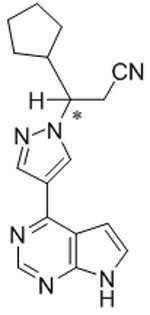
[화학식 XI']

[화학식 X"]
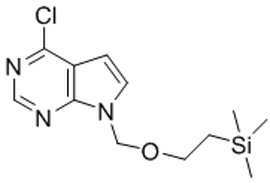
[화학식 XⅢ']

[화학식 XⅡ"]

[화학식 Ⅳ"]

[화학식 D-1']

[화학식 I"]

상기 식에서, *는 키랄 탄소이다.A process for preparing a composition comprising the enantiomeric excess of the (R) -enantiomer of the compound of formula III 'comprising the following steps (a) to (f):
(a) treating a compound of formula (XI ') with sodium hydroxide and 2- (trimethylsilyl) ethoxymethyl to form a compound of formula (X "):
(b) treating the compound of Formula X ″ with a compound of Formula XIII ′ in the presence of Pd (triphenylphosphine) 4 , potassium carbonate, and a solvent to form a compound of Formula XII ″:
(c) under deprotection conditions, reacting the compound of Formula XII ″ to form a compound of Formula IV ″:
(d) reacting said compound of formula IV "with a compound of formula D-1 'under conditions sufficient to form a composition comprising a racemate of the compound of formula I":
(e) passing said composition comprising said racemate of said compound of formula (I ") through a chiral chromatography unit using a mobile phase and comprising an enantiomeric excess of said (I) enantiomer of said compound of formula (I") Collecting the composition; And
(f) reacting the compound of formula (I ") with boron trifluoride diethyl etherate and then aqueous ammonium hydroxide to form a composition comprising the enantiomeric excess of the (R) -enantiomer of the compound of formula (III ') Forming Steps:
[Formula III ']
Formula XI '
Formula X "
Formula XIII '
Formula XII "
[Formula IV ”]
[Formula D-1 ']
Formula I "
Wherein * is chiral carbon.
(a) 화학식 I"의 화합물의 라세미체를 형성하기에 충분한 조건 하에서, 아세토니트릴 중 탄산세슘의 존재하에서, 화학식 I"의 화합물의 거울상이성질체 잉여의 (S)-거울상이성질체를 포함하는 조성물을 화학식 D-1'의 화합물로 처리하는 단계:
[화학식 Ⅲ']

[화학식 I"]

[화학식 D-1']

상기 식에서, *는 키랄 탄소이다.
(b) 상기 화학식 I"의 화합물의 상기 라세미체를 포함하는 상기 조성물을, 이동상을 사용하는 키랄 크로마토그래피 유닛에 통과시키고, 상기 화학식 I"의 화합물의 거울상이성질체 잉여의 (R)-거울상이성질체를 포함하는 조성물을 수집하는 단계; 및
(c) 상기 화학식 I"의 화합물을 붕소 트리플루오라이드 디에틸 에테레이트와, 그 다음 수성 수산화암모늄과 반응시켜 상기 화학식 Ⅲ'의 화합물의 거울상이성질체 잉여의 (R)-거울상이성질체를 포함하는 조성물을 형성하는 단계; A process for preparing a composition comprising the enantiomeric excess of the (R) -enantiomer of the compound of Formula III ', comprising the following steps (a) to (c):
(a) a composition comprising the enantiomeric excess of the (S) -enantiomer of the compound of formula (I) in the presence of cesium carbonate in acetonitrile under conditions sufficient to form a racemate of the compound of formula (I ") Treating with a compound of Formula D-1 ′:
[Formula III ']
Formula I "
[Formula D-1 ']
Wherein * is chiral carbon.
(b) said composition comprising said racemate of said compound of formula (I ") is passed through a chiral chromatography unit using a mobile phase and the enantiomeric excess of said enantiomer (R) -enantiomer of said compound of formula (I") Collecting a composition comprising a; And
(c) reacting the compound of formula (I ") with boron trifluoride diethyl etherate and then aqueous ammonium hydroxide to form a composition comprising an enantiomeric excess of the (R) -enantiomer of the compound of formula (III ') Forming;
[화학식 Ⅲ']

[화학식 I"]
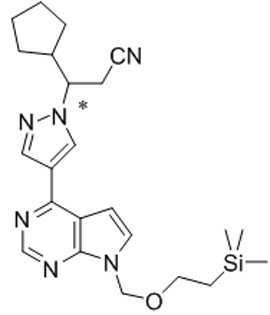
여기서, *는 키랄 탄소이다.A process for preparing a composition comprising the enantiomeric excess of the (III) enantiomer of a compound of formula (III '), wherein said compound of formula (I ") is reacted with boron trifluoride diethyl etherate and then aqueous ammonium hydroxide A method comprising forming a composition comprising an enantiomeric excess of the (R) -enantiomer of the compound of Formula III ':
[Formula III ']
Formula I "
Where * is chiral carbon.
107. The compound of claim 104, wherein said 2-propanol and n-heptane are (3R) -cyclopentyl-3- [4- (7H-pyrrolo [2,3-d] pyrimidin-4-yl) pyrazole in methanol. -1-yl] propionitrile phosphate salt.
Applications Claiming Priority (3)
| Application Number | Priority Date | Filing Date | Title |
|---|---|---|---|
| US14499109P | 2009-01-15 | 2009-01-15 | |
| US61/144,991 | 2009-01-15 | ||
| PCT/US2010/021003 WO2010083283A2 (en) | 2009-01-15 | 2010-01-14 | Processes for preparing jak inhibitors and related intermediate compounds |
Related Child Applications (1)
| Application Number | Title | Priority Date | Filing Date |
|---|---|---|---|
| KR1020187002501A Division KR101999933B1 (en) | 2009-01-15 | 2010-01-14 | Processes for Preparing JAK Inhibitors and Related Intermediate Compounds |
Publications (2)
| Publication Number | Publication Date |
|---|---|
| KR20110104119A true KR20110104119A (en) | 2011-09-21 |
| KR101824742B1 KR101824742B1 (en) | 2018-02-01 |
Family
ID=42026219
Family Applications (7)
| Application Number | Title | Priority Date | Filing Date |
|---|---|---|---|
| KR1020187002501A Active KR101999933B1 (en) | 2009-01-15 | 2010-01-14 | Processes for Preparing JAK Inhibitors and Related Intermediate Compounds |
| KR1020197019494A Active KR102138485B1 (en) | 2009-01-15 | 2010-01-14 | Processes for Preparing JAK Inhibitors and Related Intermediate Compounds |
| KR1020227024117A Ceased KR20220104280A (en) | 2009-01-15 | 2010-01-14 | Processes for Preparing JAK Inhibitors and Related Intermediate Compounds |
| KR1020217005098A Active KR102318359B1 (en) | 2009-01-15 | 2010-01-14 | Processes for Preparing JAK Inhibitors and Related Intermediate Compounds |
| KR1020117018779A Active KR101824742B1 (en) | 2009-01-15 | 2010-01-14 | Processes for Preparing JAK Inhibitors and Related Intermediate Compounds |
| KR1020207020974A Active KR102220482B1 (en) | 2009-01-15 | 2010-01-14 | Processes for Preparing JAK Inhibitors and Related Intermediate Compounds |
| KR1020217034202A Active KR102422043B1 (en) | 2009-01-15 | 2010-01-14 | Processes for Preparing JAK Inhibitors and Related Intermediate Compounds |
Family Applications Before (4)
| Application Number | Title | Priority Date | Filing Date |
|---|---|---|---|
| KR1020187002501A Active KR101999933B1 (en) | 2009-01-15 | 2010-01-14 | Processes for Preparing JAK Inhibitors and Related Intermediate Compounds |
| KR1020197019494A Active KR102138485B1 (en) | 2009-01-15 | 2010-01-14 | Processes for Preparing JAK Inhibitors and Related Intermediate Compounds |
| KR1020227024117A Ceased KR20220104280A (en) | 2009-01-15 | 2010-01-14 | Processes for Preparing JAK Inhibitors and Related Intermediate Compounds |
| KR1020217005098A Active KR102318359B1 (en) | 2009-01-15 | 2010-01-14 | Processes for Preparing JAK Inhibitors and Related Intermediate Compounds |
Family Applications After (2)
| Application Number | Title | Priority Date | Filing Date |
|---|---|---|---|
| KR1020207020974A Active KR102220482B1 (en) | 2009-01-15 | 2010-01-14 | Processes for Preparing JAK Inhibitors and Related Intermediate Compounds |
| KR1020217034202A Active KR102422043B1 (en) | 2009-01-15 | 2010-01-14 | Processes for Preparing JAK Inhibitors and Related Intermediate Compounds |
Country Status (29)
| Country | Link |
|---|---|
| US (10) | US8410265B2 (en) |
| EP (3) | EP4501410A3 (en) |
| JP (6) | JP5650662B2 (en) |
| KR (7) | KR101999933B1 (en) |
| CN (5) | CN105669676B (en) |
| AR (2) | AR082747A1 (en) |
| AU (5) | AU2010204772B2 (en) |
| BR (3) | BR122020005528B1 (en) |
| CA (2) | CA3121743A1 (en) |
| CL (3) | CL2011001668A1 (en) |
| CO (1) | CO6400137A2 (en) |
| EA (3) | EA020643B1 (en) |
| EC (1) | ECSP11011268A (en) |
| ES (2) | ES3001142T3 (en) |
| IL (7) | IL214061A (en) |
| JO (3) | JOP20190230A1 (en) |
| MA (1) | MA33038B1 (en) |
| MX (5) | MX357874B (en) |
| MY (3) | MY182004A (en) |
| NZ (5) | NZ617077A (en) |
| PE (4) | PE20160788A1 (en) |
| PH (1) | PH12016502060A1 (en) |
| PL (2) | PL2398774T3 (en) |
| PT (2) | PT3272738T (en) |
| SG (3) | SG10201705183SA (en) |
| TN (1) | TN2011000329A1 (en) |
| TW (7) | TWI665200B (en) |
| WO (1) | WO2010083283A2 (en) |
| ZA (1) | ZA201104909B (en) |
Families Citing this family (150)
| Publication number | Priority date | Publication date | Assignee | Title |
|---|---|---|---|---|
| WO2005105814A1 (en) * | 2004-04-28 | 2005-11-10 | Incyte Corporation | Tetracyclic inhibitors of janus kinases |
| EP2343298B9 (en) | 2005-12-13 | 2020-05-06 | Incyte Holdings Corporation | Heteroaryl substituted pyrrolo[2,3-b]pyridines and pyrrolo[2,3-b]pyrimidines as Janus kinase inhibitors |
| CL2008001709A1 (en) | 2007-06-13 | 2008-11-03 | Incyte Corp | Compounds derived from pyrrolo [2,3-b] pyrimidine, jak kinase modulators; pharmaceutical composition; and use in the treatment of diseases such as cancer, psoriasis, rheumatoid arthritis, among others. |
| RS53245B2 (en) | 2007-06-13 | 2022-10-31 | Incyte Holdings Corp | JANUS KINASE INHIBITOR SALTS (R)-3-(4-(7H-PYROLO(2,3-D) PYRIMIDIN-4-YL)-1H-PYRAZOL-1-YL)-3-CYCLOPENTYLPROPANE-NITRILE |
| US8309718B2 (en) * | 2007-11-16 | 2012-11-13 | Incyte Corporation | 4-pyrazolyl-N-arylpyrimidin-2-amines and 4-pyrazolyl-N-heteroarylpyrimidin-2-amines as janus kinase inhibitors |
| CL2009001884A1 (en) * | 2008-10-02 | 2010-05-14 | Incyte Holdings Corp | Use of 3-cyclopentyl-3- [4- (7h-pyrrolo [2,3-d] pyrimidin-4-yl) -1h-pyrazol-1-yl) propanonitrile, janus kinase inhibitor, and use of a composition that understands it for the treatment of dry eye. |
| JOP20190230A1 (en) | 2009-01-15 | 2017-06-16 | Incyte Corp | Methods for repairing JAK inhibitors and related intermediates |
| WO2010135650A1 (en) * | 2009-05-22 | 2010-11-25 | Incyte Corporation | N-(HETERO)ARYL-PYRROLIDINE DERIVATIVES OF PYRAZOL-4-YL-PYRROLO[2,3-d]PYRIMIDINES AND PYRROL-3-YL-PYRROLO[2,3-d]PYRIMIDINES AS JANUS KINASE INHIBITORS |
| HRP20192203T1 (en) | 2009-05-22 | 2020-03-06 | Incyte Holdings Corporation | 3-[4-(7h-pyrrolo[2,3-d]pyrimidin-4-yl)-1h-pyrazol-1-yl]octane- or heptane-nitrile as jak inhibitors |
| TW201113285A (en) * | 2009-09-01 | 2011-04-16 | Incyte Corp | Heterocyclic derivatives of pyrazol-4-yl-pyrrolo[2,3-d]pyrimidines as janus kinase inhibitors |
| BR112012008267B1 (en) | 2009-10-09 | 2022-10-04 | Incyte Holdings Corporation | 3-(4-(7H-PYROLO[2,3-D]PYRIMIDIN-4-IL)-1H-PYRAZOL-1-IL)-3-CYCLOPENTYLPROPANONITRILE 3-(4-(7H-PYROXYL, KETO, AND GLUCURONIDE) DERIVATIVES |
| JP5858434B2 (en) * | 2010-02-18 | 2016-02-10 | インサイト・ホールディングス・コーポレイションIncyte Holdings Corporation | Cyclobutane and methylcyclobutane derivatives as Janus kinase inhibitors |
| SI3354652T1 (en) | 2010-03-10 | 2020-08-31 | Incyte Holdings Corporation | Piperidin-4-yl azetidine derivatives as jak1 inhibitors |
| CN102985424B (en) | 2010-04-14 | 2015-03-11 | 阵列生物制药公司 | 5, 7-substituted-imidazo [1, 2-c] pyrimidines as inhibitors of jak kinases |
| MY161078A (en) | 2010-05-21 | 2017-04-14 | Incyte Holdings Corp | Topical formulation for a jak inhibitor |
| WO2012068440A1 (en) | 2010-11-19 | 2012-05-24 | Incyte Corporation | Heterocyclic-substituted pyrrolopyridines and pyrrolopyrimidines as jak inhibitors |
| JP5917545B2 (en) | 2010-11-19 | 2016-05-18 | インサイト・ホールディングス・コーポレイションIncyte Holdings Corporation | Cyclobutyl substituted pyrrolopyridine and pyrrolopyrimidine derivatives as JAK inhibitors |
| US8754114B2 (en) | 2010-12-22 | 2014-06-17 | Incyte Corporation | Substituted imidazopyridazines and benzimidazoles as inhibitors of FGFR3 |
| JP5936628B2 (en) | 2011-02-18 | 2016-06-22 | ノバルティス・ファルマ・アクチェンゲゼルシャフトNovartis Pharma AG | mTOR / JAK inhibitor combination therapy |
| CN102690281A (en) * | 2011-03-22 | 2012-09-26 | 上海药明康德新药开发有限公司 | Synthetic method of 1-methyl 4-pyrazole pinacol ester |
| PE20140832A1 (en) | 2011-06-20 | 2014-07-14 | Incyte Corp | DERIVATIVES OF AZETIDINYL PHENYL, PYRIDYL OR PYRAZINYL CARBOXAMIDE AS JAK INHIBITORS |
| EP2741747A1 (en) | 2011-08-10 | 2014-06-18 | Novartis Pharma AG | JAK P13K/mTOR COMBINATION THERAPY |
| TW201313721A (en) | 2011-08-18 | 2013-04-01 | Incyte Corp | Cyclohexyl azetidine derivatives as JAK inhibitors |
| UA111854C2 (en) | 2011-09-07 | 2016-06-24 | Інсайт Холдінгс Корпорейшн | METHODS AND INTERMEDIATE COMPOUNDS FOR JAK INHIBITORS |
| WO2013157021A1 (en) | 2012-04-20 | 2013-10-24 | Advinus Therapeutics Limited | Bicyclic compounds, compositions and medicinal applications thereof |
| US9193733B2 (en) | 2012-05-18 | 2015-11-24 | Incyte Holdings Corporation | Piperidinylcyclobutyl substituted pyrrolopyridine and pyrrolopyrimidine derivatives as JAK inhibitors |
| CN107652289B (en) | 2012-06-13 | 2020-07-21 | 因塞特控股公司 | Substituted tricyclic compounds as FGFR inhibitors |
| EP2861600A1 (en) | 2012-06-15 | 2015-04-22 | Concert Pharmaceuticals Inc. | Deuterated derivatives of ruxolitinib |
| WO2014011540A1 (en) | 2012-07-09 | 2014-01-16 | Emory University | Bone morphogenetic protein pathway activation, compositions for ossification, and methods related thereto |
| US9388185B2 (en) | 2012-08-10 | 2016-07-12 | Incyte Holdings Corporation | Substituted pyrrolo[2,3-b]pyrazines as FGFR inhibitors |
| EP2885303B1 (en) | 2012-08-17 | 2018-12-26 | CoNCERT Pharmaceuticals, Inc. | Deuterated baricitinib |
| WO2014060381A1 (en) | 2012-10-18 | 2014-04-24 | Bayer Cropscience Ag | Heterocyclic compounds as pesticides |
| WO2014067962A1 (en) | 2012-10-31 | 2014-05-08 | Bayer Cropscience Ag | Novel heterocyclic compounds as pest control agents |
| CA2888816A1 (en) | 2012-11-01 | 2014-05-08 | Incyte Corporation | Tricyclic fused thiophene derivatives as jak inhibitors |
| TWI702057B (en) | 2012-11-15 | 2020-08-21 | 美商英塞特控股公司 | Sustained-release dosage forms of ruxolitinib |
| US9266892B2 (en) | 2012-12-19 | 2016-02-23 | Incyte Holdings Corporation | Fused pyrazoles as FGFR inhibitors |
| ES2900492T3 (en) | 2013-03-06 | 2022-03-17 | Incyte Holdings Corp | Processes and intermediates to make a JAK inhibitor |
| KR102269032B1 (en) | 2013-04-19 | 2021-06-24 | 인사이트 홀딩스 코포레이션 | Bicyclic heterocycles as fgfr inhibitors |
| PL3786162T3 (en) | 2013-05-17 | 2024-04-08 | Incyte Holdings Corporation | Bipyrazole derivatives as jak inhibitors |
| RS60469B1 (en) | 2013-08-07 | 2020-07-31 | Incyte Corp | Sustained release dosage forms for a jak1 inhibitor |
| CN103601749B (en) * | 2013-11-26 | 2016-04-27 | 大连联化化学有限公司 | A kind of synthetic method of 1-alkyl pyrazole-4-pinacol borate |
| ES2654051T3 (en) | 2013-12-05 | 2018-02-12 | Pfizer Inc. | Pyrrolo [2,3-d] pyrimidinyl, pyrrolo [2,3-b] pyrazinyl and pyrrolo [2,3-d] pyridinyl acrylamides |
| CN104860950A (en) * | 2014-02-24 | 2015-08-26 | 重庆医药工业研究院有限责任公司 | Method used for preparing 4-chloropyrrolo[2,3-d]pyrimidine |
| LT3129021T (en) | 2014-04-08 | 2020-12-10 | Incyte Corporation | Treatment of b-cell malignancies by a combination jak and pi3k inhibitor |
| MA39987A (en) | 2014-04-30 | 2017-03-08 | Incyte Corp | Processes of preparing a jak1 inhibitor and new forms thereto |
| US9498467B2 (en) | 2014-05-30 | 2016-11-22 | Incyte Corporation | Treatment of chronic neutrophilic leukemia (CNL) and atypical chronic myeloid leukemia (aCML) by inhibitors of JAK1 |
| CN105218548A (en) * | 2014-06-09 | 2016-01-06 | 上海海和药物研究开发有限公司 | A kind of novel heterocyclic compounds and preparation method thereof and the purposes as kinase inhibitor |
| US20170239351A1 (en) | 2014-08-11 | 2017-08-24 | Acerta Pharma B.V. | Therapeutic Combinations of a BTK Inhibitor, a PI3K Inhibitor, a JAK-2 Inhibitor, a PD-1 Inhibitor, and/or a PD-L1 Inhibitor |
| TW201618773A (en) | 2014-08-11 | 2016-06-01 | 艾森塔製藥公司 | Therapeutic combinations of a BTK inhibitor, a PI3K inhibitor, a JAK-2 inhibitor, and/or a CDK4/6 inhibitor |
| PL3179991T3 (en) | 2014-08-11 | 2022-02-14 | Acerta Pharma B.V. | THERAPEUTIC COMBINATIONS OF BTK INHIBITOR AND BCL-2 INHIBITOR |
| WO2016035014A1 (en) * | 2014-09-01 | 2016-03-10 | Sun Pharmaceutical Industries Limited | Processes for the preparation of ruxolitinib phosphate |
| US10851105B2 (en) | 2014-10-22 | 2020-12-01 | Incyte Corporation | Bicyclic heterocycles as FGFR4 inhibitors |
| CZ2014773A3 (en) * | 2014-11-10 | 2016-05-18 | Zentiva, K.S. | Salts of (3R)-3-cyclopentyl-3-[4-(7H-pyrrolo[2,3-d]pyrimidin-4-yl)pyrazol-1-yl]propanenitrile |
| CN104496904B (en) * | 2014-11-28 | 2017-01-11 | 上海北卡医药技术有限公司 | Synthesis method of ruxolitinib intermediate |
| EP3227298A4 (en) | 2014-12-05 | 2018-05-23 | Sun Pharmaceutical Industries Ltd | Process for the preparation of baricitinib and an intermediate thereof |
| PE20171514A1 (en) | 2015-02-20 | 2017-10-20 | Incyte Corp | BICYCLE HETEROCYCLES AS FGFR INHIBITORS |
| WO2016134294A1 (en) | 2015-02-20 | 2016-08-25 | Incyte Corporation | Bicyclic heterocycles as fgfr4 inhibitors |
| MA41551A (en) | 2015-02-20 | 2017-12-26 | Incyte Corp | BICYCLIC HETEROCYCLES USED AS FGFR4 INHIBITORS |
| CZ2015496A3 (en) | 2015-07-14 | 2017-01-25 | Zentiva, K.S. | The crystalline salt forms of (3R)-3-cyclopentyl-3-[4-(7H-pyrrolo[2,3-d]pyrimidine-4-yl)-pyrazol-1-yl] of propanenitrile and their preparation |
| CN106397443A (en) * | 2015-07-17 | 2017-02-15 | 浙江九洲药业股份有限公司 | Pyrrole pyrimidine derivative intermediate preparation method |
| HU230805B1 (en) * | 2015-12-23 | 2018-06-28 | Egis Gyógyszergyár Zrt | Intermediate of baricitinib and process for its preparation |
| CN108699063B (en) * | 2015-12-31 | 2020-06-26 | 正大天晴药业集团股份有限公司 | Synthesis process of luccotinib |
| CZ201629A3 (en) | 2016-01-22 | 2017-08-02 | Zentiva, K.S. | Crystalline modifications of the (3R)-3-cyclopentyl-3- [4-(7H-pyrrolo [2,3-d] pyrimidin-4yl) pyrazol-1yl] propanenitrile salts and the method of their preparation |
| WO2017129116A1 (en) * | 2016-01-26 | 2017-08-03 | 杭州华东医药集团新药研究院有限公司 | Pyrrolopyrimidine five-membered azacyclic derivative and application thereof |
| CN107226814A (en) * | 2016-03-23 | 2017-10-03 | 罗欣生物科技(上海)有限公司 | A kind of Ba Ruike replaces the preparation method of Buddhist nun's intermediate |
| WO2017192905A1 (en) | 2016-05-04 | 2017-11-09 | Concert Pharmaceuticals, Inc. | Treatment of hair loss disorders with deuterated jak inhibitors |
| CN107513069A (en) * | 2016-06-16 | 2017-12-26 | 正大天晴药业集团股份有限公司 | The preparation method of chiral Pyrrolopyrimidine compounds |
| CN106188116B (en) * | 2016-07-14 | 2018-02-06 | 沧州普瑞东方科技有限公司 | A kind of method of the boric acid pinacol ester of synthesizing pyrazole 4 |
| CN107722012B (en) | 2016-08-11 | 2020-05-29 | 斯福瑞(南通)制药有限公司 | Process for preparing 4-chloro-7H-pyrrolo [2,3-d ] pyrimidines |
| CN107759623B (en) * | 2016-08-23 | 2020-08-14 | 苏州旺山旺水生物医药有限公司 | Intermediates of JAK inhibitors and preparation methods thereof |
| CN107759601B (en) * | 2016-08-23 | 2020-09-11 | 苏州旺山旺水生物医药有限公司 | A kind of preparation method of JAK inhibitor and its salt |
| AR111960A1 (en) | 2017-05-26 | 2019-09-04 | Incyte Corp | CRYSTALLINE FORMS OF A FGFR INHIBITOR AND PROCESSES FOR ITS PREPARATION |
| CN107501154B (en) * | 2017-09-13 | 2020-02-11 | 浙江普洛康裕制药有限公司 | Synthesis method of (S) -1- (2-chloroacetyl) pyrrolidine-2-carbonitrile |
| CN109651424B (en) * | 2017-10-11 | 2021-01-22 | 新发药业有限公司 | Synthesis method of 7-protecting group-4- (1-hydrogen-pyrazol-4-yl) pyrrole [2,3-d ] pyrimidine |
| TW201924683A (en) | 2017-12-08 | 2019-07-01 | 美商英塞特公司 | Low dose combination therapy for treatment of myeloproliferative neoplasms |
| US10766900B2 (en) | 2017-12-29 | 2020-09-08 | Formosa Laboratories, Inc. | Baricitinib intermediate, method for forming Baricitinib intermediate, and method for preparing Baricitinib or pharmaceutically acceptable salt thereof |
| PT3746429T (en) | 2018-01-30 | 2022-06-20 | Incyte Corp | Processes for preparing (1 -(3-fluoro-2-(trifluoromethyl)isonicotinyl)piperidine-4-one) |
| BR122023022189A2 (en) | 2018-02-16 | 2024-02-20 | Incyte Corporation | USES OF JAK1 PATHWAY INHIBITORS FOR THE TREATMENT OF CYTOKINE-RELATED DISORDERS |
| EP4424328A3 (en) | 2018-03-30 | 2024-12-04 | Incyte Corporation | Treatment of hidradenitis suppurativa using jak inhibitors |
| JP7565798B2 (en) | 2018-03-30 | 2024-10-11 | インサイト・コーポレイション | Biomarkers for Inflammatory Skin Disease |
| CA3097025A1 (en) | 2018-04-13 | 2019-10-17 | Incyte Corporation | Biomarkers for graft-versus-host disease |
| BR112020022373A2 (en) | 2018-05-04 | 2021-02-02 | Incyte Corporation | salts of a fgfr inhibitor |
| SG11202010636VA (en) | 2018-05-04 | 2020-11-27 | Incyte Corp | Solid forms of an fgfr inhibitor and processes for preparing the same |
| IL278889B2 (en) | 2018-06-01 | 2025-11-01 | Incyte Corp | Dosage regimen for the treatment of PI3K-related disorders |
| US12109193B2 (en) | 2018-07-31 | 2024-10-08 | Loxo Oncology Inc. | Spray-dried dispersions, formulations, and polymorphs of (s)-5-amino-3-(4-((5-fluoro-2-methoxybenzamido)methyl)phenyl)-1-(1,1,1-trifluoropropan-2-yl)-1H-pyrazole-4-carboxamide |
| AR116116A1 (en) * | 2018-09-04 | 2021-03-31 | Theravance Biopharma R&D Ip Llc | PROCESS FOR DEVELOPING JAK INHIBITORS AND INTERMEDIARIES THEREOF |
| WO2020072870A1 (en) | 2018-10-05 | 2020-04-09 | Johnson Matthey Public Limited Company | Co-crystal forms of baricitinib |
| EP3873433A1 (en) | 2018-10-31 | 2021-09-08 | Incyte Corporation | Combination therapy for treatment of hematological diseases |
| JP2022515198A (en) | 2018-12-19 | 2022-02-17 | アレイ バイオファーマ インコーポレイテッド | Substituted pyrazolo [1,5-a] pyridine compound as an inhibitor of FGFR tyrosine kinase |
| US12351571B2 (en) | 2018-12-19 | 2025-07-08 | Array Biopharma Inc. | Substituted quinoxaline compounds as inhibitors of FGFR tyrosine kinases |
| US12325707B2 (en) * | 2019-02-06 | 2025-06-10 | Sun Pharmaceutical Industries, Inc. | Process for preparing enantiomerically enriched JAK inhibitors |
| WO2020185532A1 (en) | 2019-03-08 | 2020-09-17 | Incyte Corporation | Methods of treating cancer with an fgfr inhibitor |
| JP2022526713A (en) | 2019-03-21 | 2022-05-26 | オンクセオ | Dbait molecule in combination with a kinase inhibitor for the treatment of cancer |
| CN110028509B (en) * | 2019-05-27 | 2020-10-09 | 上海勋和医药科技有限公司 | Pyrrolopyrimidines as selective JAK2 inhibitors, their synthesis methods and uses |
| WO2021007269A1 (en) | 2019-07-09 | 2021-01-14 | Incyte Corporation | Bicyclic heterocycles as fgfr inhibitors |
| WO2021067374A1 (en) | 2019-10-01 | 2021-04-08 | Incyte Corporation | Bicyclic heterocycles as fgfr inhibitors |
| CN110538183B (en) * | 2019-10-09 | 2021-05-04 | 吉林大学 | A composition for preventing and treating infantile eczema and preparation method thereof |
| US12360120B2 (en) | 2019-10-10 | 2025-07-15 | Incyte Corporation | Biomarkers for graft-versus-host disease |
| JP2022551649A (en) | 2019-10-10 | 2022-12-12 | インサイト・コーポレイション | Biomarkers for graft-versus-host disease |
| WO2021076602A1 (en) | 2019-10-14 | 2021-04-22 | Incyte Corporation | Bicyclic heterocycles as fgfr inhibitors |
| WO2021076728A1 (en) | 2019-10-16 | 2021-04-22 | Incyte Corporation | Bicyclic heterocycles as fgfr inhibitors |
| JP2023500906A (en) | 2019-11-08 | 2023-01-11 | インサーム(インスティテュ ナシオナル ドゥ ラ サンテ エ ドゥ ラ ルシェルシェ メディカル) | Methods of treating cancers with acquired resistance to kinase inhibitors |
| MX2022006176A (en) | 2019-11-22 | 2022-08-17 | Incyte Corp | COMBINATION THERAPY COMPRISING AN ALK2 INHIBITOR AND A JAK2 INHIBITOR. |
| CN115151539A (en) | 2019-12-04 | 2022-10-04 | 因赛特公司 | Derivatives of FGFR Inhibitors |
| JP7720840B2 (en) | 2019-12-04 | 2025-08-08 | インサイト・コーポレイション | Tricyclic heterocycles as FGFR inhibitors |
| WO2021146424A1 (en) | 2020-01-15 | 2021-07-22 | Incyte Corporation | Bicyclic heterocycles as fgfr inhibitors |
| WO2021148581A1 (en) | 2020-01-22 | 2021-07-29 | Onxeo | Novel dbait molecule and its use |
| WO2021236139A1 (en) | 2020-05-21 | 2021-11-25 | Concert Pharmaceuticals, Inc. | Novel deuterated jak inhibitor and uses thereof |
| HRP20241560T1 (en) | 2020-06-02 | 2025-01-17 | Incyte Corporation | METHODS FOR PRODUCING JAK1 INHIBITORS |
| US11833155B2 (en) | 2020-06-03 | 2023-12-05 | Incyte Corporation | Combination therapy for treatment of myeloproliferative neoplasms |
| CN111790439B (en) * | 2020-07-29 | 2022-12-27 | 成都能特科技发展有限公司 | Chiral secondary amine diphenylphosphine arylformamide bifunctional catalyst and preparation method and application thereof |
| CA3194469A1 (en) | 2020-08-12 | 2022-02-17 | Concert Pharmaceuticals, Inc. | Process for preparing enantiomerically enriched jak inhibitors |
| CN116761792A (en) * | 2020-08-18 | 2023-09-15 | 因赛特公司 | Methods and intermediates for preparing JAK inhibitors |
| AR123268A1 (en) * | 2020-08-18 | 2022-11-16 | Incyte Corp | PROCESS AND INTERMEDIATES TO PREPARE A JAK1 INHIBITOR |
| US11905292B2 (en) | 2020-08-18 | 2024-02-20 | Incyte Corporation | Process and intermediates for preparing a JAK inhibitor |
| US20230390292A1 (en) | 2020-10-28 | 2023-12-07 | Sun Pharmaceutical Industries, Inc. | Regimens for the treatment of hair loss disorders with deuterated jak inhibitors |
| IL303238A (en) | 2020-12-08 | 2023-07-01 | Incyte Corp | Jak1 pathway inhibitors for the treatment of vitiligo |
| CN112625030A (en) * | 2020-12-25 | 2021-04-09 | 杭州澳赛诺生物科技有限公司 | Synthetic method for synthesizing N-protected 3-bromopyrazole by one-pot method |
| CN114853760B (en) * | 2021-02-03 | 2025-12-05 | 南京正大天晴制药有限公司 | A method for preparing a ruxolitinib intermediate |
| CN114907353A (en) * | 2021-02-09 | 2022-08-16 | 明慧医药(杭州)有限公司 | Prodrug compound and preparation method and application thereof |
| CN112876503B (en) * | 2021-03-18 | 2022-04-29 | 中国科学院兰州化学物理研究所 | Borate compound for cancer boron neutron capture therapeutic drug and preparation thereof |
| US12065494B2 (en) | 2021-04-12 | 2024-08-20 | Incyte Corporation | Combination therapy comprising an FGFR inhibitor and a Nectin-4 targeting agent |
| TW202308610A (en) | 2021-05-03 | 2023-03-01 | 美商英塞特公司 | Jak1 pathway inhibitors for the treatment of prurigo nodularis |
| CN113264936B (en) * | 2021-05-25 | 2022-08-09 | 常州制药厂有限公司 | JAK inhibitor key intermediate and preparation method thereof |
| CN113292569A (en) * | 2021-05-25 | 2021-08-24 | 常州制药厂有限公司 | Preparation method of JAK inhibitor |
| CA3220155A1 (en) | 2021-06-09 | 2022-12-15 | Incyte Corporation | Tricyclic heterocycles as fgfr inhibitors |
| AR126102A1 (en) | 2021-06-09 | 2023-09-13 | Incyte Corp | TRICYCLIC HETEROCYCLES AS FGFR INHIBITORS |
| CN118317946A (en) * | 2021-07-12 | 2024-07-09 | 因赛特公司 | Methods and intermediates for preparing baricitinib |
| JP2024525235A (en) * | 2021-07-20 | 2024-07-10 | 上海椿安生物医薬科技有限公司 | Anti-inflammatory coupling compound drug for external use and its preparation and use |
| JP2024531188A (en) | 2021-08-11 | 2024-08-29 | サン ファーマシューティカル インダストリーズ,インコーポレイテッド | Treatment of Hair Loss Disorders with Deuterated JAK Inhibitors |
| CA3228509A1 (en) | 2021-08-12 | 2023-02-16 | Sun Pharmaceutical Industries, Inc. | Treatment of jak-inhibition-responsive disorders with prodrugs of jak inhibitors |
| WO2023042224A1 (en) * | 2021-09-18 | 2023-03-23 | Natco Pharma Limited | An improved process for the preparation of ruxolitinib phosphate |
| CN114044777B (en) * | 2022-01-10 | 2022-04-19 | 南京佰麦生物技术有限公司 | Preparation method of tricitabinib phosphate |
| US20250275977A1 (en) | 2022-05-04 | 2025-09-04 | Sun Pharmaceutical Industries, Inc. | Dosage regimens for treatment with deuterated jak inhibitors |
| US20250215005A1 (en) * | 2022-05-19 | 2025-07-03 | Glenmark Life Sciences Limited | Process for preparation of ruxolitinib |
| CN114805368B (en) * | 2022-05-25 | 2023-12-01 | 山东诺明康药物研究院有限公司 | Preparation method of pontinib |
| CN115028638A (en) * | 2022-06-09 | 2022-09-09 | 安徽大学 | A kind of preparation method of Ruxolitinib intermediate |
| CN117384163A (en) * | 2022-07-05 | 2024-01-12 | 盛世泰科生物医药技术(苏州)股份有限公司 | A compound containing geminal difluoro group and its preparation method and use |
| US20250215003A1 (en) * | 2022-08-22 | 2025-07-03 | Granules India Limited | An improved process for the preparation of ruxolitinib |
| WO2024099396A1 (en) * | 2022-11-11 | 2024-05-16 | 浙江奥翔药业股份有限公司 | Ruxolitinib crystal and pharmaceutical composition thereof |
| CN118255768A (en) * | 2022-12-26 | 2024-06-28 | 上海科胜药物研发有限公司 | Preparation method of JAK inhibitor and intermediate thereof |
| CN116082382B (en) * | 2023-02-13 | 2025-11-21 | 上海瀚合瑞医药科技有限公司 | Preparation method of key intermediate of ponatinib |
| CN118852013B (en) * | 2023-04-28 | 2025-09-26 | 武汉人福创新药物研发中心有限公司 | A preparation method of ruxolitinib and its intermediates |
| AU2024335978A1 (en) | 2023-09-04 | 2025-10-30 | Granules India Limited | Improved process for the preparation of ruxolitinib and novel crystalline form thereof |
| US12364699B2 (en) | 2023-10-10 | 2025-07-22 | Sun Pharmaceuticals Industries, Inc. | Method of treating hair loss disorders |
| CN117946120A (en) * | 2024-01-30 | 2024-04-30 | 正大制药(青岛)有限公司 | A preparation method of ruxolitinib phosphate related substance A |
| CN118047782A (en) * | 2024-02-06 | 2024-05-17 | 南京道尔医药研究院有限公司 | Process for preparing intermediate of ponatinib |
| US12247034B1 (en) * | 2024-04-19 | 2025-03-11 | Sun Pharmaceutical Industries, Inc. | Crystalline form of deuruxolitinib phosphate |
| CN118994172A (en) * | 2024-09-12 | 2024-11-22 | 广州科锐特生物科技有限公司 | Preparation method of poncirtinib phosphate |
| CN119528911B (en) * | 2024-10-21 | 2025-11-28 | 南通常佑药业科技有限公司 | Reu Ke Tie preparation method of nylon |
Family Cites Families (68)
| Publication number | Priority date | Publication date | Assignee | Title |
|---|---|---|---|---|
| US2985589A (en) | 1957-05-22 | 1961-05-23 | Universal Oil Prod Co | Continuous sorption process employing fixed bed of sorbent and moving inlets and outlets |
| JPS5519438A (en) | 1978-07-26 | 1980-02-12 | Mitsubishi Electric Corp | Brazing method |
| US4402832A (en) | 1982-08-12 | 1983-09-06 | Uop Inc. | High efficiency continuous separation process |
| US4498991A (en) | 1984-06-18 | 1985-02-12 | Uop Inc. | Serial flow continuous separation process |
| JP2513001B2 (en) * | 1988-11-01 | 1996-07-03 | 山川薬品工業株式会社 | Method for racemization of optically active tetrahydrofuran-2-carboxylic acid |
| DE4038356A1 (en) * | 1990-12-01 | 1992-06-04 | Bayer Ag | METHOD FOR RACEMIZING OPTICALLY ACTIVE L-ARYL ALKYLAMINES |
| JPH04308556A (en) * | 1991-04-05 | 1992-10-30 | Hokuriku Seiyaku Co Ltd | Method for racemizing optically active benzyl alcohol derivative |
| JPH06122686A (en) | 1992-10-12 | 1994-05-06 | Fujisawa Pharmaceut Co Ltd | Method for optical resolution of racemic modification |
| JPH07247286A (en) | 1994-01-18 | 1995-09-26 | Sankyo Co Ltd | Method for optically resolving nitrogen-containing cyclic compound |
| US5630943A (en) | 1995-11-30 | 1997-05-20 | Merck Patent Gesellschaft Mit Beschrankter Haftung | Discontinuous countercurrent chromatographic process and apparatus |
| GB9602516D0 (en) * | 1996-02-08 | 1996-04-10 | Chiroscience Ltd | Racemisation |
| US6063284A (en) | 1997-05-15 | 2000-05-16 | Em Industries, Inc. | Single column closed-loop recycling with periodic intra-profile injection |
| PA8474101A1 (en) * | 1998-06-19 | 2000-09-29 | Pfizer Prod Inc | PYROLEUM [2,3-D] PIRIMIDINE COMPOUNDS |
| FR2785196B1 (en) | 1998-10-29 | 2000-12-15 | Inst Francais Du Petrole | METHOD AND DEVICE FOR SEPARATION WITH VARIABLE LENGTH CHROMATOGRAPHIC AREAS |
| US6375839B1 (en) | 1998-10-29 | 2002-04-23 | Institut Francais Du Petrole | Process and device for separation with variable-length chromatographic zones |
| US6413419B1 (en) | 1998-10-29 | 2002-07-02 | Institut Francais Du Petrole | Process and device for separation with variable-length chromatographic |
| JP4078074B2 (en) | 1999-12-10 | 2008-04-23 | ファイザー・プロダクツ・インク | Pyrrolo [2,3-d] pyrimidine compound |
| CA2429133C (en) * | 2000-11-17 | 2009-08-18 | Takeda Chemical Industries, Ltd. | Novel imidazole derivatives, production method thereof and use thereof |
| IL164209A0 (en) | 2002-05-31 | 2005-12-18 | Eisai Co Ltd | Pyrazole derivatives and pharmaceutical compositions containing the same |
| BR0313078A (en) | 2002-08-06 | 2005-07-12 | Astrazeneca Ab | A compound or a pharmaceutically acceptable salt thereof, a pharmaceutical composition, and use of the compound or a pharmaceutically acceptable salt thereof. |
| JP2004143053A (en) * | 2002-10-22 | 2004-05-20 | Senju Pharmaceut Co Ltd | beta-AMINOHYDROXAMIC ACID DERIVATIVE AND USE THEREOF |
| ES2524803T3 (en) | 2002-12-19 | 2014-12-12 | The Scripps Research Institute | Compositions and methods to stabilize transthyretin and inhibit the abnormal folding of transthyretin |
| JP2005304368A (en) * | 2004-04-21 | 2005-11-04 | Toyo Kasei Kogyo Co Ltd | Method for producing optically active 4-(n-protected amino)-1-alken-3-ol and method for producing 3-benzamide-2-hydroxycarboxylic acid or its salt using the same |
| WO2005105814A1 (en) | 2004-04-28 | 2005-11-10 | Incyte Corporation | Tetracyclic inhibitors of janus kinases |
| US7709645B2 (en) | 2004-07-27 | 2010-05-04 | Sgx Pharmaceuticals, Inc. | Pyrrolo-pyridine kinase modulators |
| CA2573362A1 (en) * | 2004-07-27 | 2006-02-09 | Sgx Pharmaceuticals, Inc. | Pyrrolo-pyridine kinase modulators |
| AR054416A1 (en) | 2004-12-22 | 2007-06-27 | Incyte Corp | PIRROLO [2,3-B] PIRIDIN-4-IL-AMINAS AND PIRROLO [2,3-B] PIRIMIDIN-4-IL-AMINAS AS INHIBITORS OF THE JANUS KINASES. PHARMACEUTICAL COMPOSITIONS. |
| DE602006004844D1 (en) | 2005-02-03 | 2009-03-05 | Vertex Pharma | PYRROLOPYRIMIDINE USE AS PROTEIN KINASE INHIBITORS |
| US20060281755A1 (en) | 2005-06-10 | 2006-12-14 | Baumann Christian A | Synergistic modulation of flt3 kinase using aminopyrimidines kinase modulators |
| US20060281764A1 (en) | 2005-06-10 | 2006-12-14 | Gaul Michael D | Aminopyrimidines as kinase modulators |
| EP1926735A1 (en) | 2005-09-22 | 2008-06-04 | Incyte Corporation | Tetracyclic inhibitors of janus kinases |
| DK1937664T3 (en) | 2005-10-14 | 2011-07-18 | Sumitomo Chemical Co | Hydrazide compound and pesticide use of the same |
| EP2343298B9 (en) | 2005-12-13 | 2020-05-06 | Incyte Holdings Corporation | Heteroaryl substituted pyrrolo[2,3-b]pyridines and pyrrolo[2,3-b]pyrimidines as Janus kinase inhibitors |
| US20130137681A1 (en) | 2005-12-13 | 2013-05-30 | Incyte Corporation | HETEROARYL SUBSTITUTED PYRROLO[2,3-b]PYRIDINES AND PYRROLO[2,3-b]PYRIMIDINES AS JANUS KINASE INHIBITORS |
| KR100815432B1 (en) * | 2005-12-29 | 2008-03-20 | 엘아이지엔설팅주식회사 | A medium on which a business disaster management system, method, and computer readable program for executing the method are recorded. |
| SG170828A1 (en) * | 2006-04-05 | 2011-05-30 | Vertex Pharmaceuticals Inc Us | Deazapurines useful as inhibitors of janus kinases |
| DE102006016426A1 (en) * | 2006-04-07 | 2007-10-11 | Merck Patent Gmbh | Novel cyclobutyl compounds as kinase inhibitors |
| NL2000613C2 (en) | 2006-05-11 | 2007-11-20 | Pfizer Prod Inc | Triazole pyrazine derivatives. |
| WO2008013622A2 (en) | 2006-07-27 | 2008-01-31 | E. I. Du Pont De Nemours And Company | Fungicidal azocyclic amides |
| CN103288833B (en) | 2006-11-22 | 2018-01-12 | 因塞特控股公司 | Imidazo-triazine and imidazopyrimidine as kinase inhibitor |
| AR064416A1 (en) | 2006-12-21 | 2009-04-01 | Cancer Rec Tech Ltd | DERIVATIVES OF PURINE, PIRIDINE AND PYRIMIDINE CONDENSED WITH HETEROCICLES, MODULATORS OF PKA AND / OR PKB, PHARMACEUTICAL COMPOSITIONS CONTAINING THEM, AND USES FOR THE TREATMENT OF HYPERPROLIFERATIVE DISEASES. |
| JP5492565B2 (en) | 2006-12-22 | 2014-05-14 | インサイト・コーポレイション | Substituted heterocycles as JANUS kinase inhibitors |
| KR20080062876A (en) | 2006-12-29 | 2008-07-03 | 주식회사 대웅제약 | Novel Antifungal Triazole Derivatives |
| GB0704932D0 (en) * | 2007-03-14 | 2007-04-25 | Astex Therapeutics Ltd | Pharmaceutical compounds |
| EP2078020A4 (en) * | 2007-04-10 | 2011-10-19 | Sgx Pharmaceuticals Inc | Fused ring heterocycle kinase modulators |
| RS53245B2 (en) | 2007-06-13 | 2022-10-31 | Incyte Holdings Corp | JANUS KINASE INHIBITOR SALTS (R)-3-(4-(7H-PYROLO(2,3-D) PYRIMIDIN-4-YL)-1H-PYRAZOL-1-YL)-3-CYCLOPENTYLPROPANE-NITRILE |
| CL2008001709A1 (en) | 2007-06-13 | 2008-11-03 | Incyte Corp | Compounds derived from pyrrolo [2,3-b] pyrimidine, jak kinase modulators; pharmaceutical composition; and use in the treatment of diseases such as cancer, psoriasis, rheumatoid arthritis, among others. |
| CL2008001933A1 (en) * | 2007-06-29 | 2009-09-25 | Millennium Pharm Inc | Pyrimidine derived compounds, raph kinase inhibitors; intermediate compounds; preparation procedure; pharmaceutical composition; and its use to treat proliferative, cardiac, neurodegenerative, inflammatory, bone, immunological, viral disease, among others. |
| US8309718B2 (en) | 2007-11-16 | 2012-11-13 | Incyte Corporation | 4-pyrazolyl-N-arylpyrimidin-2-amines and 4-pyrazolyl-N-heteroarylpyrimidin-2-amines as janus kinase inhibitors |
| MY165582A (en) | 2008-03-11 | 2018-04-05 | Incyte Holdings Corp | Azetidine and cyclobutane derivatives as jak inhibitors |
| PT2297042E (en) * | 2008-03-19 | 2013-10-10 | Bial Portela & Ca Sa | Catalytic asymmetric hydrogenation |
| CL2009001884A1 (en) | 2008-10-02 | 2010-05-14 | Incyte Holdings Corp | Use of 3-cyclopentyl-3- [4- (7h-pyrrolo [2,3-d] pyrimidin-4-yl) -1h-pyrazol-1-yl) propanonitrile, janus kinase inhibitor, and use of a composition that understands it for the treatment of dry eye. |
| JOP20190230A1 (en) | 2009-01-15 | 2017-06-16 | Incyte Corp | Methods for repairing JAK inhibitors and related intermediates |
| IT1393787B1 (en) | 2009-03-30 | 2012-05-08 | Cps Color Equipment Spa | DISPENSE DEVICE FOR FLUID PRODUCTS AND ITS RELATION PROCEDURE |
| WO2010135650A1 (en) | 2009-05-22 | 2010-11-25 | Incyte Corporation | N-(HETERO)ARYL-PYRROLIDINE DERIVATIVES OF PYRAZOL-4-YL-PYRROLO[2,3-d]PYRIMIDINES AND PYRROL-3-YL-PYRROLO[2,3-d]PYRIMIDINES AS JANUS KINASE INHIBITORS |
| HRP20192203T1 (en) | 2009-05-22 | 2020-03-06 | Incyte Holdings Corporation | 3-[4-(7h-pyrrolo[2,3-d]pyrimidin-4-yl)-1h-pyrazol-1-yl]octane- or heptane-nitrile as jak inhibitors |
| TW201113285A (en) | 2009-09-01 | 2011-04-16 | Incyte Corp | Heterocyclic derivatives of pyrazol-4-yl-pyrrolo[2,3-d]pyrimidines as janus kinase inhibitors |
| BR112012008267B1 (en) | 2009-10-09 | 2022-10-04 | Incyte Holdings Corporation | 3-(4-(7H-PYROLO[2,3-D]PYRIMIDIN-4-IL)-1H-PYRAZOL-1-IL)-3-CYCLOPENTYLPROPANONITRILE 3-(4-(7H-PYROXYL, KETO, AND GLUCURONIDE) DERIVATIVES |
| JP5858434B2 (en) | 2010-02-18 | 2016-02-10 | インサイト・ホールディングス・コーポレイションIncyte Holdings Corporation | Cyclobutane and methylcyclobutane derivatives as Janus kinase inhibitors |
| SI3354652T1 (en) | 2010-03-10 | 2020-08-31 | Incyte Holdings Corporation | Piperidin-4-yl azetidine derivatives as jak1 inhibitors |
| MY161078A (en) | 2010-05-21 | 2017-04-14 | Incyte Holdings Corp | Topical formulation for a jak inhibitor |
| JP5917545B2 (en) | 2010-11-19 | 2016-05-18 | インサイト・ホールディングス・コーポレイションIncyte Holdings Corporation | Cyclobutyl substituted pyrrolopyridine and pyrrolopyrimidine derivatives as JAK inhibitors |
| WO2012068440A1 (en) | 2010-11-19 | 2012-05-24 | Incyte Corporation | Heterocyclic-substituted pyrrolopyridines and pyrrolopyrimidines as jak inhibitors |
| JP5936628B2 (en) | 2011-02-18 | 2016-06-22 | ノバルティス・ファルマ・アクチェンゲゼルシャフトNovartis Pharma AG | mTOR / JAK inhibitor combination therapy |
| PE20140832A1 (en) | 2011-06-20 | 2014-07-14 | Incyte Corp | DERIVATIVES OF AZETIDINYL PHENYL, PYRIDYL OR PYRAZINYL CARBOXAMIDE AS JAK INHIBITORS |
| EP2741747A1 (en) | 2011-08-10 | 2014-06-18 | Novartis Pharma AG | JAK P13K/mTOR COMBINATION THERAPY |
| TW201313721A (en) | 2011-08-18 | 2013-04-01 | Incyte Corp | Cyclohexyl azetidine derivatives as JAK inhibitors |
| UA111854C2 (en) | 2011-09-07 | 2016-06-24 | Інсайт Холдінгс Корпорейшн | METHODS AND INTERMEDIATE COMPOUNDS FOR JAK INHIBITORS |
-
2009
- 2009-01-15 JO JOP/2019/0230A patent/JOP20190230A1/en unknown
- 2009-01-15 JO JOP/2019/0231A patent/JOP20190231A1/en unknown
-
2010
- 2010-01-14 TW TW105127773A patent/TWI665200B/en active
- 2010-01-14 KR KR1020187002501A patent/KR101999933B1/en active Active
- 2010-01-14 PT PT171750318T patent/PT3272738T/en unknown
- 2010-01-14 MA MA34081A patent/MA33038B1/en unknown
- 2010-01-14 MX MX2017005254A patent/MX357874B/en unknown
- 2010-01-14 CN CN201610105708.2A patent/CN105669676B/en active Active
- 2010-01-14 JO JOP/2010/0010A patent/JO3441B1/en active
- 2010-01-14 MX MX2019003989A patent/MX383742B/en unknown
- 2010-01-14 EA EA201170935A patent/EA020643B1/en unknown
- 2010-01-14 CN CN201810240146.1A patent/CN108395433B/en active Active
- 2010-01-14 KR KR1020197019494A patent/KR102138485B1/en active Active
- 2010-01-14 KR KR1020227024117A patent/KR20220104280A/en not_active Ceased
- 2010-01-14 BR BR122020005528-6A patent/BR122020005528B1/en active IP Right Grant
- 2010-01-14 TW TW103136520A patent/TWI644915B/en active
- 2010-01-14 KR KR1020217005098A patent/KR102318359B1/en active Active
- 2010-01-14 SG SG10201705183SA patent/SG10201705183SA/en unknown
- 2010-01-14 CA CA3121743A patent/CA3121743A1/en active Pending
- 2010-01-14 TW TW099100946A patent/TWI462924B/en active
- 2010-01-14 MY MYPI2017001758A patent/MY182004A/en unknown
- 2010-01-14 EA EA201991779A patent/EA201991779A3/en unknown
- 2010-01-14 PE PE2016000575A patent/PE20160788A1/en unknown
- 2010-01-14 CN CN202411356199.1A patent/CN119306753A/en active Pending
- 2010-01-14 SG SG2011049624A patent/SG172468A1/en unknown
- 2010-01-14 PL PL10700665T patent/PL2398774T3/en unknown
- 2010-01-14 JP JP2011546324A patent/JP5650662B2/en active Active
- 2010-01-14 CA CA2749483A patent/CA2749483C/en active Active
- 2010-01-14 ES ES17175031T patent/ES3001142T3/en active Active
- 2010-01-14 CN CN201080012029.1A patent/CN102348693B/en active Active
- 2010-01-14 ES ES10700665.2T patent/ES2641761T3/en active Active
- 2010-01-14 NZ NZ617077A patent/NZ617077A/en unknown
- 2010-01-14 MX MX2018009174A patent/MX363976B/en unknown
- 2010-01-14 BR BR122020005540A patent/BR122020005540B8/en active IP Right Grant
- 2010-01-14 SG SG10201913261QA patent/SG10201913261QA/en unknown
- 2010-01-14 KR KR1020117018779A patent/KR101824742B1/en active Active
- 2010-01-14 TW TW108121541A patent/TWI720517B/en active
- 2010-01-14 CN CN201610105438.5A patent/CN105669675A/en active Pending
- 2010-01-14 MY MYPI2011003295A patent/MY163540A/en unknown
- 2010-01-14 TW TW110133797A patent/TWI814080B/en active
- 2010-01-14 US US12/687,623 patent/US8410265B2/en active Active
- 2010-01-14 EA EA201400575A patent/EA034207B1/en unknown
- 2010-01-14 KR KR1020207020974A patent/KR102220482B1/en active Active
- 2010-01-14 MX MX2011007102A patent/MX2011007102A/en active IP Right Grant
- 2010-01-14 NZ NZ706894A patent/NZ706894A/en unknown
- 2010-01-14 BR BRPI1006794-9A patent/BRPI1006794B1/en active IP Right Grant
- 2010-01-14 NZ NZ594057A patent/NZ594057A/en unknown
- 2010-01-14 NZ NZ725585A patent/NZ725585A/en unknown
- 2010-01-14 EP EP24208388.9A patent/EP4501410A3/en active Pending
- 2010-01-14 AU AU2010204772A patent/AU2010204772B2/en active Active
- 2010-01-14 PE PE2011001347A patent/PE20110858A1/en active IP Right Grant
- 2010-01-14 PE PE2017000602A patent/PE20171102A1/en unknown
- 2010-01-14 KR KR1020217034202A patent/KR102422043B1/en active Active
- 2010-01-14 PE PE2021000139A patent/PE20211639A1/en unknown
- 2010-01-14 NZ NZ739757A patent/NZ739757A/en unknown
- 2010-01-14 MX MX2014003735A patent/MX349632B/en unknown
- 2010-01-14 EP EP10700665.2A patent/EP2398774B1/en active Active
- 2010-01-14 TW TW110103076A patent/TWI740775B/en active
- 2010-01-14 PT PT107006652T patent/PT2398774T/en unknown
- 2010-01-14 WO PCT/US2010/021003 patent/WO2010083283A2/en not_active Ceased
- 2010-01-14 MY MYPI2014001582A patent/MY186533A/en unknown
- 2010-01-14 PL PL17175031.8T patent/PL3272738T3/en unknown
- 2010-01-14 EP EP17175031.8A patent/EP3272738B1/en active Active
- 2010-01-14 TW TW108106085A patent/TWI710562B/en active
- 2010-01-15 AR ARP100100103A patent/AR082747A1/en active IP Right Grant
-
2011
- 2011-07-04 ZA ZA2011/04909A patent/ZA201104909B/en unknown
- 2011-07-05 TN TN2011000329A patent/TN2011000329A1/en unknown
- 2011-07-07 CL CL2011001668A patent/CL2011001668A1/en unknown
- 2011-07-13 IL IL214061A patent/IL214061A/en active IP Right Grant
- 2011-07-14 CO CO11088391A patent/CO6400137A2/en active IP Right Grant
- 2011-08-11 EC EC2011011268A patent/ECSP11011268A/en unknown
-
2013
- 2013-02-07 US US13/761,830 patent/US8993582B2/en active Active
- 2013-02-07 US US13/761,742 patent/US9000161B2/en active Active
- 2013-02-07 US US13/761,771 patent/US8883806B2/en active Active
- 2013-09-11 CL CL2013002617A patent/CL2013002617A1/en unknown
-
2014
- 2014-11-13 JP JP2014230998A patent/JP6054355B2/en active Active
-
2015
- 2015-01-09 US US14/593,688 patent/US9290506B2/en active Active
- 2015-11-24 IL IL242750A patent/IL242750B/en active IP Right Grant
- 2015-11-24 IL IL242752A patent/IL242752A/en active IP Right Grant
- 2015-11-24 IL IL242751A patent/IL242751B/en active IP Right Grant
-
2016
- 2016-02-05 US US15/016,918 patent/US9908888B2/en active Active
- 2016-02-12 CL CL2016000346A patent/CL2016000346A1/en unknown
- 2016-08-15 AU AU2016216537A patent/AU2016216537B2/en active Active
- 2016-10-17 PH PH12016502060A patent/PH12016502060A1/en unknown
- 2016-11-30 JP JP2016233313A patent/JP6430464B2/en active Active
-
2018
- 2018-01-12 US US15/869,650 patent/US10364248B2/en active Active
- 2018-04-16 AU AU2018202625A patent/AU2018202625B2/en active Active
- 2018-10-31 JP JP2018204871A patent/JP6630802B2/en active Active
-
2019
- 2019-06-05 IL IL267122A patent/IL267122B/en active IP Right Grant
- 2019-06-10 US US16/436,195 patent/US10975085B2/en active Active
- 2019-12-09 JP JP2019221939A patent/JP6843955B2/en active Active
-
2020
- 2020-03-06 AU AU2020201709A patent/AU2020201709B2/en active Active
- 2020-05-04 IL IL274422A patent/IL274422B/en active IP Right Grant
-
2021
- 2021-02-16 US US17/176,914 patent/US12247030B2/en active Active
- 2021-02-24 JP JP2021027264A patent/JP2021100930A/en active Pending
- 2021-05-09 IL IL283038A patent/IL283038A/en unknown
-
2022
- 2022-03-09 AU AU2022201630A patent/AU2022201630B2/en active Active
- 2022-11-23 AR ARP220103220A patent/AR127757A2/en unknown
-
2025
- 2025-01-08 US US19/013,928 patent/US20250340559A1/en active Pending
Also Published As
Similar Documents
| Publication | Publication Date | Title |
|---|---|---|
| US12247030B2 (en) | Process for preparing compositions comprising an enantiomeric excess of a substituted pyrrolo[2,3-d]pyrimidine | |
| HK40123033A (en) | Processes for preparing jak inhibitors and related intermediate compounds | |
| HK1165424B (en) | Processes for preparing jak inhibitors and related intermediate compounds | |
| HK1165424A (en) | Processes for preparing jak inhibitors and related intermediate compounds |
Legal Events
| Date | Code | Title | Description |
|---|---|---|---|
| PA0105 | International application |
St.27 status event code: A-0-1-A10-A15-nap-PA0105 |
|
| PG1501 | Laying open of application |
St.27 status event code: A-1-1-Q10-Q12-nap-PG1501 |
|
| A201 | Request for examination | ||
| E13-X000 | Pre-grant limitation requested |
St.27 status event code: A-2-3-E10-E13-lim-X000 |
|
| P11-X000 | Amendment of application requested |
St.27 status event code: A-2-2-P10-P11-nap-X000 |
|
| P13-X000 | Application amended |
St.27 status event code: A-2-2-P10-P13-nap-X000 |
|
| PA0201 | Request for examination |
St.27 status event code: A-1-2-D10-D11-exm-PA0201 |
|
| R18-X000 | Changes to party contact information recorded |
St.27 status event code: A-3-3-R10-R18-oth-X000 |
|
| N231 | Notification of change of applicant | ||
| PN2301 | Change of applicant |
St.27 status event code: A-3-3-R10-R13-asn-PN2301 St.27 status event code: A-3-3-R10-R11-asn-PN2301 |
|
| R17-X000 | Change to representative recorded |
St.27 status event code: A-3-3-R10-R17-oth-X000 |
|
| P22-X000 | Classification modified |
St.27 status event code: A-2-2-P10-P22-nap-X000 |
|
| E902 | Notification of reason for refusal | ||
| PE0902 | Notice of grounds for rejection |
St.27 status event code: A-1-2-D10-D21-exm-PE0902 |
|
| T11-X000 | Administrative time limit extension requested |
St.27 status event code: U-3-3-T10-T11-oth-X000 |
|
| T11-X000 | Administrative time limit extension requested |
St.27 status event code: U-3-3-T10-T11-oth-X000 |
|
| T11-X000 | Administrative time limit extension requested |
St.27 status event code: U-3-3-T10-T11-oth-X000 |
|
| P11-X000 | Amendment of application requested |
St.27 status event code: A-2-2-P10-P11-nap-X000 |
|
| P13-X000 | Application amended |
St.27 status event code: A-2-2-P10-P13-nap-X000 |
|
| E902 | Notification of reason for refusal | ||
| PE0902 | Notice of grounds for rejection |
St.27 status event code: A-1-2-D10-D21-exm-PE0902 |
|
| T11-X000 | Administrative time limit extension requested |
St.27 status event code: U-3-3-T10-T11-oth-X000 |
|
| E13-X000 | Pre-grant limitation requested |
St.27 status event code: A-2-3-E10-E13-lim-X000 |
|
| P11-X000 | Amendment of application requested |
St.27 status event code: A-2-2-P10-P11-nap-X000 |
|
| P13-X000 | Application amended |
St.27 status event code: A-2-2-P10-P13-nap-X000 |
|
| E701 | Decision to grant or registration of patent right | ||
| PE0701 | Decision of registration |
St.27 status event code: A-1-2-D10-D22-exm-PE0701 |
|
| A107 | Divisional application of patent | ||
| PA0104 | Divisional application for international application |
St.27 status event code: A-0-1-A10-A18-div-PA0104 St.27 status event code: A-0-1-A10-A16-div-PA0104 |
|
| GRNT | Written decision to grant | ||
| PR0701 | Registration of establishment |
St.27 status event code: A-2-4-F10-F11-exm-PR0701 |
|
| PR1002 | Payment of registration fee |
St.27 status event code: A-2-2-U10-U12-oth-PR1002 Fee payment year number: 1 |
|
| PG1601 | Publication of registration |
St.27 status event code: A-4-4-Q10-Q13-nap-PG1601 |
|
| PR1001 | Payment of annual fee |
St.27 status event code: A-4-4-U10-U11-oth-PR1001 Fee payment year number: 4 |
|
| PR1001 | Payment of annual fee |
St.27 status event code: A-4-4-U10-U11-oth-PR1001 Fee payment year number: 5 |
|
| PR1001 | Payment of annual fee |
St.27 status event code: A-4-4-U10-U11-oth-PR1001 Fee payment year number: 6 |
|
| PR1001 | Payment of annual fee |
St.27 status event code: A-4-4-U10-U11-oth-PR1001 Fee payment year number: 7 |
|
| PR1001 | Payment of annual fee |
St.27 status event code: A-4-4-U10-U11-oth-PR1001 Fee payment year number: 8 |
|
| PR1001 | Payment of annual fee |
St.27 status event code: A-4-4-U10-U11-oth-PR1001 Fee payment year number: 9 |
|
| U11 | Full renewal or maintenance fee paid |
Free format text: ST27 STATUS EVENT CODE: A-4-4-U10-U11-OTH-PR1001 (AS PROVIDED BY THE NATIONAL OFFICE) Year of fee payment: 9 |