KR20100134056A - Harmful arthropod control composition and condensed heterocyclic compound - Google Patents
Harmful arthropod control composition and condensed heterocyclic compound Download PDFInfo
- Publication number
- KR20100134056A KR20100134056A KR1020107023492A KR20107023492A KR20100134056A KR 20100134056 A KR20100134056 A KR 20100134056A KR 1020107023492 A KR1020107023492 A KR 1020107023492A KR 20107023492 A KR20107023492 A KR 20107023492A KR 20100134056 A KR20100134056 A KR 20100134056A
- Authority
- KR
- South Korea
- Prior art keywords
- group
- substituted
- halogen atom
- hydrogen atom
- group selected
- Prior art date
- Legal status (The legal status is an assumption and is not a legal conclusion. Google has not performed a legal analysis and makes no representation as to the accuracy of the status listed.)
- Ceased
Links
Classifications
-
- A—HUMAN NECESSITIES
- A01—AGRICULTURE; FORESTRY; ANIMAL HUSBANDRY; HUNTING; TRAPPING; FISHING
- A01N—PRESERVATION OF BODIES OF HUMANS OR ANIMALS OR PLANTS OR PARTS THEREOF; BIOCIDES, e.g. AS DISINFECTANTS, AS PESTICIDES OR AS HERBICIDES; PEST REPELLANTS OR ATTRACTANTS; PLANT GROWTH REGULATORS
- A01N55/00—Biocides, pest repellants or attractants, or plant growth regulators, containing organic compounds containing elements other than carbon, hydrogen, halogen, oxygen, nitrogen and sulfur
-
- A—HUMAN NECESSITIES
- A01—AGRICULTURE; FORESTRY; ANIMAL HUSBANDRY; HUNTING; TRAPPING; FISHING
- A01N—PRESERVATION OF BODIES OF HUMANS OR ANIMALS OR PLANTS OR PARTS THEREOF; BIOCIDES, e.g. AS DISINFECTANTS, AS PESTICIDES OR AS HERBICIDES; PEST REPELLANTS OR ATTRACTANTS; PLANT GROWTH REGULATORS
- A01N43/00—Biocides, pest repellants or attractants, or plant growth regulators containing heterocyclic compounds
- A01N43/72—Biocides, pest repellants or attractants, or plant growth regulators containing heterocyclic compounds having rings with nitrogen atoms and oxygen or sulfur atoms as ring hetero atoms
- A01N43/74—Biocides, pest repellants or attractants, or plant growth regulators containing heterocyclic compounds having rings with nitrogen atoms and oxygen or sulfur atoms as ring hetero atoms five-membered rings with one nitrogen atom and either one oxygen atom or one sulfur atom in positions 1,3
- A01N43/76—1,3-Oxazoles; Hydrogenated 1,3-oxazoles
-
- A—HUMAN NECESSITIES
- A01—AGRICULTURE; FORESTRY; ANIMAL HUSBANDRY; HUNTING; TRAPPING; FISHING
- A01N—PRESERVATION OF BODIES OF HUMANS OR ANIMALS OR PLANTS OR PARTS THEREOF; BIOCIDES, e.g. AS DISINFECTANTS, AS PESTICIDES OR AS HERBICIDES; PEST REPELLANTS OR ATTRACTANTS; PLANT GROWTH REGULATORS
- A01N43/00—Biocides, pest repellants or attractants, or plant growth regulators containing heterocyclic compounds
- A01N43/72—Biocides, pest repellants or attractants, or plant growth regulators containing heterocyclic compounds having rings with nitrogen atoms and oxygen or sulfur atoms as ring hetero atoms
- A01N43/84—Biocides, pest repellants or attractants, or plant growth regulators containing heterocyclic compounds having rings with nitrogen atoms and oxygen or sulfur atoms as ring hetero atoms six-membered rings with one nitrogen atom and either one oxygen atom or one sulfur atom in positions 1,4
-
- A—HUMAN NECESSITIES
- A01—AGRICULTURE; FORESTRY; ANIMAL HUSBANDRY; HUNTING; TRAPPING; FISHING
- A01N—PRESERVATION OF BODIES OF HUMANS OR ANIMALS OR PLANTS OR PARTS THEREOF; BIOCIDES, e.g. AS DISINFECTANTS, AS PESTICIDES OR AS HERBICIDES; PEST REPELLANTS OR ATTRACTANTS; PLANT GROWTH REGULATORS
- A01N43/00—Biocides, pest repellants or attractants, or plant growth regulators containing heterocyclic compounds
- A01N43/90—Biocides, pest repellants or attractants, or plant growth regulators containing heterocyclic compounds having two or more relevant hetero rings, condensed among themselves or with a common carbocyclic ring system
-
- C—CHEMISTRY; METALLURGY
- C07—ORGANIC CHEMISTRY
- C07D—HETEROCYCLIC COMPOUNDS
- C07D413/00—Heterocyclic compounds containing two or more hetero rings, at least one ring having nitrogen and oxygen atoms as the only ring hetero atoms
- C07D413/02—Heterocyclic compounds containing two or more hetero rings, at least one ring having nitrogen and oxygen atoms as the only ring hetero atoms containing two hetero rings
- C07D413/04—Heterocyclic compounds containing two or more hetero rings, at least one ring having nitrogen and oxygen atoms as the only ring hetero atoms containing two hetero rings directly linked by a ring-member-to-ring-member bond
-
- C—CHEMISTRY; METALLURGY
- C07—ORGANIC CHEMISTRY
- C07D—HETEROCYCLIC COMPOUNDS
- C07D413/00—Heterocyclic compounds containing two or more hetero rings, at least one ring having nitrogen and oxygen atoms as the only ring hetero atoms
- C07D413/14—Heterocyclic compounds containing two or more hetero rings, at least one ring having nitrogen and oxygen atoms as the only ring hetero atoms containing three or more hetero rings
-
- C—CHEMISTRY; METALLURGY
- C07—ORGANIC CHEMISTRY
- C07D—HETEROCYCLIC COMPOUNDS
- C07D498/00—Heterocyclic compounds containing in the condensed system at least one hetero ring having nitrogen and oxygen atoms as the only ring hetero atoms
- C07D498/02—Heterocyclic compounds containing in the condensed system at least one hetero ring having nitrogen and oxygen atoms as the only ring hetero atoms in which the condensed system contains two hetero rings
- C07D498/04—Ortho-condensed systems
-
- C—CHEMISTRY; METALLURGY
- C07—ORGANIC CHEMISTRY
- C07F—ACYCLIC, CARBOCYCLIC OR HETEROCYCLIC COMPOUNDS CONTAINING ELEMENTS OTHER THAN CARBON, HYDROGEN, HALOGEN, OXYGEN, NITROGEN, SULFUR, SELENIUM OR TELLURIUM
- C07F7/00—Compounds containing elements of Groups 4 or 14 of the Periodic Table
- C07F7/02—Silicon compounds
- C07F7/08—Compounds having one or more C—Si linkages
- C07F7/10—Compounds having one or more C—Si linkages containing nitrogen having a Si-N linkage
Landscapes
- Organic Chemistry (AREA)
- Chemical & Material Sciences (AREA)
- Life Sciences & Earth Sciences (AREA)
- Health & Medical Sciences (AREA)
- Environmental Sciences (AREA)
- Engineering & Computer Science (AREA)
- Dentistry (AREA)
- General Health & Medical Sciences (AREA)
- Wood Science & Technology (AREA)
- Zoology (AREA)
- Plant Pathology (AREA)
- Pest Control & Pesticides (AREA)
- Agronomy & Crop Science (AREA)
- Agricultural Chemicals And Associated Chemicals (AREA)
- Pharmaceuticals Containing Other Organic And Inorganic Compounds (AREA)
- Plural Heterocyclic Compounds (AREA)
- Nitrogen And Oxygen Or Sulfur-Condensed Heterocyclic Ring Systems (AREA)
Abstract
일반식 (1)
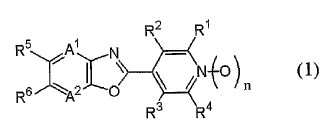
[식 중, A1 및 A2는 질소원자 등을 나타내고, R1 및 R4는 할로겐원자 등을 나타내고, R2 및 R3는 할로겐원자 등을 나타내고, R5 및 R6는 치환되어 있어도 좋은 C1-C6쇄식 탄화수소기 등을 나타내고(단, R5 및 R6는 동시에 수소원자를 나타내지 않는다), n은 0 또는 1을 나타낸다.]로 표시되는 축합복소환 화합물을 유효성분으로 함유하는 유해 절족동물 방제 조성물은 우수한 유해 절족동물 방제효력을 가진다.General formula (1)
[Wherein, A 1 and A 2 represent a nitrogen atom and the like, R 1 and R 4 represent a halogen atom and the like, R 2 and R 3 represent a halogen atom and the like, and R 5 and R 6 may be substituted. A C1-C6 chain hydrocarbon group and the like (wherein R 5 and R 6 do not simultaneously represent a hydrogen atom), n represents 0 or 1; Animal control compositions have excellent harmful arthropod control effects.
Description
본 발명은 유해 절족동물 방제 조성물 및 축합복소환 화합물에 관한 것이다.The present invention relates to harmful arthropod control compositions and condensed heterocyclic compounds.
지금까지 유해생물의 방제를 목적으로 여러 가지 화합물이 검토되고 있고, 실용에 제공되고 있다.Various compounds have been studied for the purpose of controlling harmful organisms and have been provided for practical use.
영국 공개특허 895,431호 명세서에는 벤즈옥사졸 화합물이 광차폐제(light-shielding agent) 및/또는 살균제로서 유용하다고 기재되어 있다. 영국 공개특허 2,311,010호 명세서 및 일본특허공개 소49-43974호 공보에는 벤즈옥사졸 화합물이 의약 화합물의 제조 중간체로서 기재되어 있다. Chem.Pharm.Bull., 30(8), 2996(1982)에는 어떤 종류의 벤즈옥사졸 화합물이 기재되어 있다.British Patent 895,431 discloses that benzoxazole compounds are useful as light-shielding agents and / or fungicides. In the specification of British Patent No. 2,311,010 and Japanese Patent Laid-Open No. 49-43974, benzoxazole compounds are described as preparation intermediates for pharmaceutical compounds. Chem. Pharm. Bull., 30 (8), 2996 (1982) describe certain types of benzoxazole compounds.
본 발명은, 유해 절족동물에 대하여 우수한 방제효력을 가지는 조성물을 제공하는 것을 과제로 한다.An object of the present invention is to provide a composition having excellent control effect against harmful arthropods.
본 발명자들은 상기의 과제를 해결하기 위하여 예의검토한 결과, 하기 일반식 (1)에서 표시되는 축합복소환 화합물이 유해 절족동물에 대하여 우수한 방제효력을 가진다는 것을 발견하여 본 발명에 이르렀다.MEANS TO SOLVE THE PROBLEM As a result of earnestly examining in order to solve the said subject, the present inventors discovered that the condensed heterocyclic compound represented by following General formula (1) has the outstanding control effect with respect to harmful arthropods, and came to this invention.
즉, 본 발명은,That is, the present invention,
[1] 일반식 (1)[1] general formula (1)

[식 중, A1 및 A2는 각각 독립하여 질소원자 또는 =C(R7)-를 나타내고;[Wherein, A 1 and A 2 each independently represent a nitrogen atom or = C (R 7 )-;
R1 및 R4는 각각 독립하여 할로겐원자 또는 수소원자를 나타내고;R 1 and R 4 each independently represent a halogen atom or a hydrogen atom;
R2 및 R3는 각각 독립하여 군 X로부터 선택되는 기로 치환되어 있어도 좋은 C1-C6쇄식 탄화수소기, 군 X로부터 선택되는 기로 치환되어 있어도 좋은 C3-C6지환식 탄화수소기, 군 Y로부터 선택되는 기로 치환되어 있어도 좋은 페닐기, 군 Y로부터 선택되는 기로 치환되어 있어도 좋은 벤질기, 군 Y로부터 선택되는 기로 치환되어 있어도 좋은 5원 복소환기 혹은 6원 복소환기, -OR8, -NR8R9, -NR8C(O)R9, -NR10C(O)NR9R14, -NR10CO2R15, -S(O)mR8, -CO2R10, -CONR8R9, -C(O)R10, -C(NOR8)R10, -CONR10NR11R12, 시아노기, 니트로기, 할로겐원자 또는 수소원자를 나타내고;R 2 and R 3 are each independently a C 1 -C 6 chain hydrocarbon group which may be substituted with a group selected from group X, a C 3 -C 6 alicyclic hydrocarbon group which may be substituted with a group selected from group X, a group selected from group Y A 5-membered heterocyclic group or a 6-membered heterocyclic group which may be substituted by a phenyl group which may be substituted, a benzyl group which may be substituted by a group selected from group Y, a group selected by group Y, -OR 8 , -NR 8 R 9 ,- NR 8 C (O) R 9 , -NR 10 C (O) NR 9 R 14 , -NR 10 CO 2 R 15 , -S (O) m R 8 , -CO 2 R 10 , -CONR 8 R 9 , -C (O) R 10 , -C (NOR 8 ) R 10 , -CONR 10 NR 11 R 12 , a cyano group, a nitro group, a halogen atom or a hydrogen atom;
R5 및 R6는 각각 독립하여 군 X로부터 선택되는 기로 치환되어 있어도 좋은 C1-C6쇄식 탄화수소기, 군 X로부터 선택되는 기로 치환되어 있어도 좋은 C3-C6지환식 탄화수소기, -OR13, -S(O)mR13, 할로겐원자 또는 수소원자를 나타내거나(단, R5 및 R6는 동시에 수소원자를 나타내지 않는다), 또는, R5와 R6와, R5 및 R6가 각각 결합하고 있는 6원환의 구성원자가 함께 이루어져서, 군 Z로부터 선택되는 기로 치환되어 있어도 좋은 5원환 또는 6원환을 형성하여도 좋고;R 5 and R 6 are each independently a C1-C6 chain hydrocarbon group which may be substituted with a group selected from group X, a C3-C6 alicyclic hydrocarbon group which may be substituted with a group selected from group X, -OR 13 , -S (O) m R 13 , a halogen atom or a hydrogen atom (wherein R 5 and R 6 do not represent a hydrogen atom at the same time), or R 5 and R 6 and R 5 and R 6 are respectively bonded The members of the 6-membered ring together may form together to form a 5- or 6-membered ring which may be substituted with a group selected from group Z;
R7는 할로겐원자로 치환되어 있어도 좋은 C1-C3알킬기, 할로겐원자로 치환되어 있어도 좋은 C1-C3알콕시기, 시아노기, 할로겐원자 또는 수소원자를 나타내고;R 7 represents a C 1 -C 3 alkyl group which may be substituted with a halogen atom, a C 1 -C 3 alkoxy group, cyano group, a halogen atom or a hydrogen atom which may be substituted with a halogen atom;
R8 및 R9는 각각 독립하여 군 X로부터 선택되는 기로 치환되어 있어도 좋은 C1-C6쇄식 탄화수소기, 군 X로부터 선택되는 기로 치환되어 있어도 좋은 C4-C7시클로알킬메틸기, 군 X로부터 선택되는 기로 치환되어 있어도 좋은 C3-C6지환식 탄화수소기, 군 Y로부터 선택되는 기로 치환되어 있어도 좋은 페닐기, 군 Y로부터 선택되는 기로 치환되어 있어도 좋은 벤질기, 군 Y로부터 선택되는 기로 치환되어 있어도 좋은 5원 복소환기 혹은 6원 복소환기, 또는, 수소원자를 나타내고(단, -S(O)mR8에 있어서의 m이 1 또는 2인 경우, R8는 수소원자를 나타내지 않는다);R 8 and R 9 are each independently substituted with a C 1 -C 6 chain hydrocarbon group which may be substituted with a group selected from group X, a C 4 -C 7 cycloalkylmethyl group which may be substituted with a group selected from group X, a group selected from group X A C3-C6 alicyclic hydrocarbon group which may be substituted, a phenyl group which may be substituted by a group selected from group Y, a benzyl group which may be substituted by a group selected from group Y, a 5-membered heterocyclic group which may be substituted by a group selected from group Y Or a 6-membered heterocyclic group or a hydrogen atom (wherein R 8 does not represent a hydrogen atom when m in —S (O) m R 8 is 1 or 2);
R10 및 R14는 각각 독립하여 할로겐원자로 치환되어 있어도 좋은 C1-C4알킬기 또는 수소원자를 나타내고;R 10 and R 14 each independently represent a C1-C4 alkyl group or a hydrogen atom which may be substituted with a halogen atom;
R11 및 R12는 각각 독립하여 할로겐원자로 치환되어 있어도 좋은 C1-C4알킬기, C2-C4알콕시카르보닐기 또는 수소원자를 나타내고;R 11 and R 12 each independently represent a C1-C4 alkyl group, a C2-C4 alkoxycarbonyl group or a hydrogen atom which may be substituted with a halogen atom;
R13는 군 X로부터 선택되는 기로 치환되어 있어도 좋은 C1-C6쇄식 탄화수소기 또는 군 X로부터 선택되는 기로 치환되어 있어도 좋은 C3-C6지환식 탄화수소기를 나타내고;R 13 represents a C 1 -C 6 chain hydrocarbon group which may be substituted with a group selected from group X or a C 3 -C 6 alicyclic hydrocarbon group which may be substituted with a group selected from group X;
R15는 할로겐원자로 치환되어 있어도 좋은 C1-C4알킬기를 나타내고;R 15 represents a C1-C4 alkyl group which may be substituted with a halogen atom;
m은 0, 1 또는 2를 나타내고;m represents 0, 1 or 2;
n은 0 또는 1을 나타내고;n represents 0 or 1;
군 X는 할로겐원자로 치환되어 있어도 좋은 C1-C4알콕시기, 시아노기 및 할로겐원자로 이루어지는 군을 나타내고;Group X represents a group consisting of a C1-C4 alkoxy group, a cyano group and a halogen atom which may be substituted with a halogen atom;
군 Y는 할로겐원자로 치환되어 있어도 좋은 C1-C4알킬기, 할로겐원자로 치환되어 있어도 좋은 C1-C4알콕시기, 시아노기, 니트로기 및 할로겐원자로 이루어지는 군을 나타내고;Group Y represents a group consisting of a C1-C4 alkyl group optionally substituted with a halogen atom, a C1-C4 alkoxy group optionally substituted with a halogen atom, a cyano group, a nitro group and a halogen atom;
군 Z는 할로겐원자로 치환되어 있어도 좋은 C1-C3알킬기 및 할로겐원자로 이루어지는 군을 나타낸다.]로 표시되는 축합복소환 화합물을 유효성분으로 함유하는 유해 절족동물 방제 조성물;Group Z represents a group consisting of a C 1 -C 3 alkyl group and a halogen atom which may be substituted with a halogen atom. A harmful arthropod control composition comprising the condensed heterocyclic compound represented by the above as an active ingredient;
[2] 축합복소환 화합물은 R2 및 R3가 각각 독립하여 군 X로부터 선택되는 기로 치환되어 있어도 좋은 C1-C6쇄식 탄화수소기, 군 X로부터 선택되는 기로 치환되어 있어도 좋은 C3-C6지환식 탄화수소기, 군 Y로부터 선택되는 기로 치환되어 있어도 좋은 페닐기, 군 Y로부터 선택되는 기로 치환되어 있어도 좋은 벤질기, 군 Y로부터 선택되는 기로 치환되어 있어도 좋은 5원 복소환기 혹은 6원 복소환기, -OR8, -NR8R9, -NR8C(O)R9, -S(O)mR8, -CO2R10, -CONR8R9, -CONR10NR11R12, 시아노기, 니트로기, 할로겐원자 또는 수소원자를 나타내고,[2] The condensed heterocyclic compound is a C1-C6 chain hydrocarbon group which R 2 and R 3 may each independently be substituted with a group selected from group X, or a C3-C6 alicyclic hydrocarbon which may be substituted with a group selected from group X Group, phenyl group which may be substituted by group selected from group Y, benzyl group which may be substituted by group selected from group Y, 5-membered heterocyclic group or 6-membered heterocyclic group which may be substituted by group selected from group Y, -OR 8 , -NR 8 R 9 , -NR 8 C (O) R 9 , -S (O) m R 8 , -CO 2 R 10 , -CONR 8 R 9 , -CONR 10 NR 11 R 12 , cyano group, nitro Group, halogen atom or hydrogen atom,
R8 및 R9가 각각 독립하여 군 X로부터 선택되는 기로 치환되어 있어도 좋은 C1-C6쇄식 탄화수소기, 군 X로부터 선택되는 기로 치환되어 있어도 좋은 C3-C6지환식 탄화수소기, 군 Y로부터 선택되는 기로 치환되어 있어도 좋은 페닐기, 군 Y로부터 선택되는 기로 치환되어 있어도 좋은 5원 복소환기 혹은 6원 복소환기 또는 수소원자를 나타내는 [1]에 기재된 유해 절족동물 방제 조성물;R 8 and R 9 are each independently a C 1 -C 6 chain hydrocarbon group which may be substituted with a group selected from group X, a C 3 -C 6 alicyclic hydrocarbon group which may be substituted with a group selected from group X, a group selected from group Y The harmful arthropod control composition as described in [1] which shows the 5-membered heterocyclic group or 6-membered heterocyclic group which may be substituted by the phenyl group which may be substituted, group selected from group Y, or a hydrogen atom;
[3] 축합복소환 화합물은 R1 및 R4가 수소원자인 [1] 또는 [2]에 기재된 유해 절족동물 방제 조성물;[3] Condensed heterocyclic compounds include the harmful arthropod control composition according to [1] or [2], wherein R 1 and R 4 are hydrogen atoms;
[4] 축합복소환 화합물은 R2가 수소원자 또는 할로겐원자인 [1],[2] 또는 [3]에 기재된 유해 절족동물 방제 조성물;[4] The condensed heterocyclic compound is a harmful arthropod control composition according to [1], [2] or [3], wherein R 2 is a hydrogen atom or a halogen atom;
[5] 축합복소환 화합물은 R3가 군 X로부터 선택되는 기로 치환되어 있어도 좋은 C3-C6지환식 탄화수소기, 군 Y로부터 선택되는 기로 치환되어 있어도 좋은 페닐기, 군 Y로부터 선택되는 기로 치환되어 있어도 좋은 벤질기, 또는, 군 Y로부터 선택되는 기로 치환되어 있어도 좋은 5원 복소환기 혹은 6원 복소환기인 [1], [2], [3] 또는 [4]에 기재된 유해 절족동물 방제 조성물;[5] The condensed heterocyclic compound may be substituted by a group R 3 is the group may be substituted by a group selected from X good optionally substituted by a group selected from C3-C6 alicyclic hydrocarbon group, the group Y selected from a phenyl group, the group Y [1], [2], [3], which is a good benzyl group or a 5- or 6-membered heterocyclic group which may be substituted by a group selected from group Y; Or the harmful arthropod control composition according to [4];
[6] 축합복소환 화합물은 R3가 군 X로부터 선택되는 기로 치환되어 있어도 좋은 C1-C6쇄식 탄화수소기, -OR8, -NR8R9, -NR8C(O)R9, -NR10C(O)NR9R14, -NR10CO2R15, -S(O)mR8, -CO2R10, -CONR8R9, -C(O)R10, -C(NOR8)R10, -CONR10NR11R12, 시아노기, 니트로기, 할로겐원자 또는 수소원자이고,[6] The condensed heterocyclic compound may be a C1-C6 chain hydrocarbon group in which R 3 may be substituted with a group selected from group X, -OR 8 , -NR 8 R 9 , -NR 8 C (O) R 9 , -NR 10 C ( O) NR 9 R 14 , -NR 10 CO 2 R 15 , -S (O) m R 8 , -CO 2 R 10 , -CONR 8 R 9 , -C (O) R 10 , -C (NOR 8 ) R 10 , -CONR 10 NR 11 R 12 , a cyano group, a nitro group, a halogen atom or a hydrogen atom,
R8 및 R9가 각각 독립하여 군 X로부터 선택되는 기로 치환되어 있어도 좋은 C1-C6쇄식 탄화수소기 또는 수소원자인(단, -S(O)mR8에 있어서의 m이 1 또는 2인 경우는, R8는 군 X로부터 선택되는 기로 치환되어 있어도 좋은 C1-C6쇄식 탄화수소기를 나타낸다) [1], [3] 또는 [4]에 기재된 유해 절족동물 방제 조성물;R 8 and R 9 are each independently a C1-C6 chain hydrocarbon group or hydrogen atom which may be substituted with a group selected from group X, provided that m in -S (O) m R 8 is 1 or 2 R 8 represents a C 1 -C 6 chain hydrocarbon group which may be substituted with a group selected from group X); the harmful arthropod control composition according to [1], [3] or [4];
[7] 축합복소환 화합물은 R3가 군 X로부터 선택되는 기로 치환되어 있어도 좋은 C1-C6쇄식 탄화수소기, -OR8, -NR8R9, -S(O)mR8, 할로겐원자 또는 수소원자이고,[7] The condensed heterocyclic compound may be a C1-C6 chain hydrocarbon group in which R 3 may be substituted with a group selected from group X, -OR 8 , -NR 8 R 9 , -S (O) m R 8 , a halogen atom or Hydrogen atom,
R8 및 R9가 각각 독립하여 군 X로부터 선택되는 기로 치환되어 있어도 좋은 C1-C6쇄식 탄화수소기 또는 수소원자인(단, -S(O)mR8에 있어서의 m이 1 또는 2인 경우, R8는 군 X로부터 선택되는 기로 치환되어 있어도 좋은 C1-C6쇄식 탄화수소기를 나타낸다) [1], [2], [3] 또는 [4]에 기재된 유해 절족동물 방제 조성물;R 8 and R 9 are each independently a C1-C6 chain hydrocarbon group or hydrogen atom which may be substituted with a group selected from group X, provided that m in -S (O) m R 8 is 1 or 2 , R 8 represents a C1-C6 chain hydrocarbon group which may be substituted with a group selected from group X)) The harmful arthropod control composition according to [1], [2], [3] or [4];
[8] 축합복소환 화합물은 R5 및 R6가 각각 독립하여 군 X로부터 선택되는 기로 치환되어 있어도 좋은 C1-C6쇄식 탄화수소기, -OR13, -S(O)mR13, 할로겐원자 또는 수소원자이고, R5 및 R6 중 적어도 하나가 군 X로부터 선택되는 기로 치환되어 있어도 좋은 C1-C6쇄식 탄화수소기, -OR13, -S(O)mR13, 또는 할로겐원자를 나타내고,[8] The condensed heterocyclic compound may be a C1-C6 chain hydrocarbon group which may be independently substituted with a group selected from group X, R 5 and R 6 , -OR 13 , -S (O) m R 13 , a halogen atom or A C1-C6 chain hydrocarbon group which is a hydrogen atom and at least one of R 5 and R 6 may be substituted with a group selected from group X, -OR 13 , -S (O) m R 13 , or a halogen atom;
R13가 군 X로부터 선택되는 기로 치환되어 있어도 좋은 C1-C6쇄식 탄화수소기인 [1], [2], [3], [4], [5], [6] 또는 [7]에 기재된 유해 절족동물 방제 조성물;The noxious deprivation as described in [1], [2], [3], [4], [5], [6], or [7], wherein R 13 is a C1-C6 chain hydrocarbon group which may be substituted with a group selected from group X. Animal control compositions;
[9] 일반식 (1)[9] general formula (1)

[식 중, A1 및 A2는 각각 독립하여 질소원자 또는 =C(R7)-를 나타내고;[Wherein, A 1 and A 2 each independently represent a nitrogen atom or = C (R 7 )-;
R1 및 R4는 각각 독립하여 할로겐원자 또는 수소원자를 나타내고;R 1 and R 4 each independently represent a halogen atom or a hydrogen atom;
R2 및 R3는 각각 독립하여 군 X로부터 선택되는 기로 치환되어 있어도 좋은 C1-C6쇄식 탄화수소기, 군 X로부터 선택되는 기로 치환되어 있어도 좋은 C3-C6지환식 탄화수소기, 군 Y로부터 선택되는 기로 치환되어 있어도 좋은 페닐기, 군 Y로부터 선택되는 기로 치환되어 있어도 좋은 벤질기, 군 Y로부터 선택되는 기로 치환되어 있어도 좋은 5원 복소환기 혹은 6원 복소환기, -OR8, -NR8R9, -NR8C(O)R9, -NR10C(O)NR9R14, -NR10CO2R15, -S(O)mR8, -CO2R10, -CONR8R9, -C(O)R10, -C(NOR8)R10, -CONR10NR11R12, 시아노기, 니트로기, 할로겐원자 또는 수소원자를 나타내고;R 2 and R 3 are each independently a C 1 -C 6 chain hydrocarbon group which may be substituted with a group selected from group X, a C 3 -C 6 alicyclic hydrocarbon group which may be substituted with a group selected from group X, a group selected from group Y A 5-membered heterocyclic group or a 6-membered heterocyclic group which may be substituted by a phenyl group which may be substituted, a benzyl group which may be substituted by a group selected from group Y, a group selected by group Y, -OR 8 , -NR 8 R 9 ,- NR 8 C (O) R 9 , -NR 10 C (O) NR 9 R 14 , -NR 10 CO 2 R 15 , -S (O) m R 8 , -CO 2 R 10 , -CONR 8 R 9 , -C (O) R 10 , -C (NOR 8 ) R 10 , -CONR 10 NR 11 R 12 , a cyano group, a nitro group, a halogen atom or a hydrogen atom;
R5 및 R6는 각각 독립하여 군 X로부터 선택되는 기로 치환되어 있어도 좋은 C1-C6쇄식 탄화수소기, 군 X로부터 선택되는 기로 치환되어 있어도 좋은 C3-C6지환식 탄화수소기, -OR13, -S(O)mR13, 할로겐원자 또는 수소원자를 나타내거나(단, R5 및 R6는 동시에 수소원자를 나타내지 않는다), 또는, R5와 R6와, R5 및 R6가 각각 결합하고 있는 6원환의 구성원자가 함께 이루어져서, 군 Z로부터 선택되는 기로 치환되어 있어도 좋은 5원환 또는 6원환을 형성하여도 좋고;R 5 and R 6 are each independently a C1-C6 chain hydrocarbon group which may be substituted with a group selected from group X, a C3-C6 alicyclic hydrocarbon group which may be substituted with a group selected from group X, -OR 13 , -S (O) m R 13 , a halogen atom or a hydrogen atom (wherein R 5 and R 6 do not represent a hydrogen atom at the same time), or R 5 and R 6 and R 5 and R 6 are respectively bonded The members of the 6-membered ring together may form together to form a 5- or 6-membered ring which may be substituted with a group selected from group Z;
R7는 할로겐원자로 치환되어 있어도 좋은 C1-C3알킬기, 할로겐원자로 치환되어 있어도 좋은 C1-C3알콕시기, 시아노기, 할로겐원자 또는 수소원자를 나타내고;R 7 represents a C 1 -C 3 alkyl group which may be substituted with a halogen atom, a C 1 -C 3 alkoxy group, cyano group, a halogen atom or a hydrogen atom which may be substituted with a halogen atom;
R8 및 R9는 각각 독립하여 군 X로부터 선택되는 기로 치환되어 있어도 좋은 C1-C6쇄식 탄화수소기, 군 X로부터 선택되는 기로 치환되어 있어도 좋은 C4-C7시클로알킬메틸기, 군 X로부터 선택되는 기로 치환되어 있어도 좋은 C3-C6지환식 탄화수소기, 군 Y로부터 선택되는 기로 치환되어 있어도 좋은 페닐기, 군 Y로부터 선택되는 기로 치환되어 있어도 좋은 벤질기, 군 Y로부터 선택되는 기로 치환되어 있어도 좋은 5원 복소환기 혹은 6원 복소환기, 또는, 수소원자를 나타내고(단, -S(O)mR8에 있어서의 m이 1 또는 2인 경우, R8는 수소원자를 나타내지 않는다);R 8 and R 9 are each independently substituted with a C 1 -C 6 chain hydrocarbon group which may be substituted with a group selected from group X, a C 4 -C 7 cycloalkylmethyl group which may be substituted with a group selected from group X, a group selected from group X A C3-C6 alicyclic hydrocarbon group which may be substituted, a phenyl group which may be substituted by a group selected from group Y, a benzyl group which may be substituted by a group selected from group Y, a 5-membered heterocyclic group which may be substituted by a group selected from group Y Or a 6-membered heterocyclic group or a hydrogen atom (wherein R 8 does not represent a hydrogen atom when m in —S (O) m R 8 is 1 or 2);
R10 및 R14는 각각 독립하여 할로겐원자로 치환되어 있어도 좋은 C1-C4알킬기 또는 수소원자를 나타내고;R 10 and R 14 each independently represent a C1-C4 alkyl group or a hydrogen atom which may be substituted with a halogen atom;
R11 및 R12는 각각 독립하여 할로겐원자로 치환되어 있어도 좋은 C1-C4알킬기, C2-C4알콕시카르보닐기 또는 수소원자를 나타내고;R 11 and R 12 each independently represent a C1-C4 alkyl group, a C2-C4 alkoxycarbonyl group or a hydrogen atom which may be substituted with a halogen atom;
R13는 군 X로부터 선택되는 기로 치환되어 있어도 좋은 C1-C6쇄식 탄화수소기 또는 군 X로부터 선택되는 기로 치환되어 있어도 좋은 C3-C6지환식 탄화수소기를 나타내고;R 13 represents a C 1 -C 6 chain hydrocarbon group which may be substituted with a group selected from group X or a C 3 -C 6 alicyclic hydrocarbon group which may be substituted with a group selected from group X;
R15는 할로겐원자로 치환되어 있어도 좋은 C1-C4알킬기를 나타내고;R 15 represents a C1-C4 alkyl group which may be substituted with a halogen atom;
m은 0, 1 또는 2를 나타내고;m represents 0, 1 or 2;
n은 0 또는 1을 나타내고;n represents 0 or 1;
군 X는 할로겐원자로 치환되어 있어도 좋은 C1-C4알콕시기, 시아노기 및 할로겐원자로 이루어지는 군을 나타내고;Group X represents a group consisting of a C1-C4 alkoxy group, a cyano group and a halogen atom which may be substituted with a halogen atom;
군 Y는 할로겐원자로 치환되어 있어도 좋은 C1-C4알킬기, 할로겐원자로 치환되어 있어도 좋은 C1-C4알콕시기, 시아노기, 니트로기 및 할로겐원자로 이루어지는 군을 나타내고;Group Y represents a group consisting of a C1-C4 alkyl group optionally substituted with a halogen atom, a C1-C4 alkoxy group optionally substituted with a halogen atom, a cyano group, a nitro group and a halogen atom;
군 Z는 할로겐원자로 치환되어 있어도 좋은 C1-C3알킬기 및 할로겐원자로 이루어지는 군을 나타낸다.]로 표시되는 축합복소환 화합물의 유효량을 유해 절족동물 또는 유해 절족동물의 생식장소에 시용하는 유해 절족동물의 방제방법;Group Z represents a group consisting of a C1-C3 alkyl group and a halogen atom which may be substituted with a halogen atom. Control of harmful arthropods using an effective amount of a condensed heterocyclic compound represented by Way;
[10] 유해 절족동물은 반시목 해충(Hemiptera insect pest)인 [9]에 기재된 유해 절족동물의 방제방법;[10] The noxious arthropod includes the method of controlling the noxious arthropod according to [9], which is a Hemiptera insect pest;
[11] 일반식 (2)[11] general formula (2)

[식 중, A1 및 A2는 각각 독립하여 질소원자 또는 =C(R7)-를 나타내고;[Wherein, A 1 and A 2 each independently represent a nitrogen atom or = C (R 7 )-;
R1 및 R4는 각각 독립하여 할로겐원자 또는 수소원자를 나타내고;R 1 and R 4 each independently represent a halogen atom or a hydrogen atom;
R2 및 R3는 각각 독립하여 군 X로부터 선택되는 기로 치환되어 있어도 좋은 C1-C6쇄식 탄화수소기, 군 X로부터 선택되는 기로 치환되어 있어도 좋은 C3-C6지환식 탄화수소기, 군 Y로부터 선택되는 기로 치환되어 있어도 좋은 페닐기, 군 Y로부터 선택되는 기로 치환되어 있어도 좋은 벤질기, 군 Y로부터 선택되는 기로 치환되어 있어도 좋은 5원 복소환기 혹은 6원 복소환기, -OR8, -NR8R9, -NR8C(O)R9, -NR10C(O)NR9R14, -NR10CO2R15, -S(O)mR8, -CO2R10, -CONR8R9, -C(O)R10, -C(NOR8)R10, -CONR10NR11R12, 시아노기, 니트로기, 할로겐원자 또는 수소원자를 나타내고;R 2 and R 3 are each independently a C 1 -C 6 chain hydrocarbon group which may be substituted with a group selected from group X, a C 3 -C 6 alicyclic hydrocarbon group which may be substituted with a group selected from group X, a group selected from group Y A 5-membered heterocyclic group or a 6-membered heterocyclic group which may be substituted by a phenyl group which may be substituted, a benzyl group which may be substituted by a group selected from group Y, a group selected by group Y, -OR 8 , -NR 8 R 9 ,- NR 8 C (O) R 9 , -NR 10 C (O) NR 9 R 14 , -NR 10 CO 2 R 15 , -S (O) m R 8 , -CO 2 R 10 , -CONR 8 R 9 , -C (O) R 10 , -C (NOR 8 ) R 10 , -CONR 10 NR 11 R 12 , a cyano group, a nitro group, a halogen atom or a hydrogen atom;
R5a 및 R6a는 각각 독립하여 할로겐원자로 치환된 C1-C6쇄식 탄화수소기, 할로겐원자로 치환된 C3-C6지환식 탄화수소기, -OR13a, -S(O)mR13a, 할로겐원자 또는 수소원자를 나타내거나(단, R5a 및 R6a가 동시에 할로겐원자 및 수소원자로 이루어지는 군으로부터 선택되는 기를 나타내지 않는다), 혹은, R5a와 R6a와, R5a 및 R6a가 각각 결합하고 있는 6원환의 구성원자가 함께 이루어져서, 할로겐원자로 치환된 5원환 또는 6원환을 형성하여도 좋고;R 5a and R 6a are each independently a C1-C6 chain hydrocarbon group substituted with a halogen atom, a C3-C6 alicyclic hydrocarbon group substituted with a halogen atom, -OR 13a , -S (O) m R 13a , a halogen atom or a hydrogen atom (Wherein R 5a and R 6a do not represent a group selected from the group consisting of a halogen atom and a hydrogen atom at the same time), or a 6-membered ring to which R 5a and R 6a and R 5a and R 6a are respectively bonded The member may be together to form a 5- or 6-membered ring substituted with a halogen atom;
R7는 할로겐원자로 치환되어 있어도 좋은 C1-C3알킬기, 할로겐원자로 치환되어 있어도 좋은 C1-C3알콕시기, 시아노기, 할로겐원자 또는 수소원자를 나타내고;R 7 represents a C 1 -C 3 alkyl group which may be substituted with a halogen atom, a C 1 -C 3 alkoxy group, cyano group, a halogen atom or a hydrogen atom which may be substituted with a halogen atom;
R8 및 R9는 각각 독립하여 군 X로부터 선택되는 기로 치환되어 있어도 좋은 C1-C6쇄식 탄화수소기, 군 X로부터 선택되는 기로 치환되어 있어도 좋은 C4-C7시클로알킬메틸기, 군 X로부터 선택되는 기로 치환되어 있어도 좋은 C3-C6지환식 탄화수소기, 군 Y로부터 선택되는 기로 치환되어 있어도 좋은 페닐기, 군 Y로부터 선택되는 기로 치환되어 있어도 좋은 벤질기, 군 Y로부터 선택되는 기로 치환되어 있어도 좋은 5원 복소환기 혹은 6원 복소환기 또는 수소원자를 나타내고(단, -S(O)mR8에 있어서의 m이 1 또는 2인 경우, R8는 수소원자를 나타내지 않는다);R 8 and R 9 are each independently substituted with a C 1 -C 6 chain hydrocarbon group which may be substituted with a group selected from group X, a C 4 -C 7 cycloalkylmethyl group which may be substituted with a group selected from group X, a group selected from group X A C3-C6 alicyclic hydrocarbon group which may be substituted, a phenyl group which may be substituted by a group selected from group Y, a benzyl group which may be substituted by a group selected from group Y, a 5-membered heterocyclic group which may be substituted by a group selected from group Y Or a 6-membered heterocyclic group or a hydrogen atom (provided that when the m in —S (O) m R 8 is 1 or 2, R 8 does not represent a hydrogen atom);
R10 및 R14는 각각 독립하여 할로겐원자로 치환되어 있어도 좋은 C1-C4알킬기 또는 수소원자를 나타내고;R 10 and R 14 each independently represent a C1-C4 alkyl group or a hydrogen atom which may be substituted with a halogen atom;
R11 및 R12는 각각 독립하여 할로겐원자로 치환되어 있어도 좋은 C1-C4알킬기, C2-C4알콕시카르보닐기 또는 수소원자를 나타내고;R 11 and R 12 each independently represent a C1-C4 alkyl group, a C2-C4 alkoxycarbonyl group or a hydrogen atom which may be substituted with a halogen atom;
R13a는 할로겐원자로 치환된 C1-C6쇄식 탄화수소기 또는 할로겐원자로 치환된 C3-C6지환식 탄화수소기를 나타내고;R 13a represents a C1-C6 chain hydrocarbon group substituted with a halogen atom or a C3-C6 alicyclic hydrocarbon group substituted with a halogen atom;
R15는 할로겐원자로 치환되어 있어도 좋은 C1-C4알킬기를 나타내고;R 15 represents a C1-C4 alkyl group which may be substituted with a halogen atom;
m은 0, 1 또는 2를 나타내고;m represents 0, 1 or 2;
n은 0 또는 1을 나타내고;n represents 0 or 1;
군 X는 할로겐원자로 치환되어 있어도 좋은 C1-C4알콕시기, 시아노기 및 할로겐원자로 이루어지는 군을 나타내고;Group X represents a group consisting of a C1-C4 alkoxy group, a cyano group and a halogen atom which may be substituted with a halogen atom;
군 Y는 할로겐원자로 치환되어 있어도 좋은 C1-C4알킬기, 할로겐원자로 치환되어 있어도 좋은 C1-C4알콕시기, 시아노기, 니트로기 및 할로겐원자로 이루어지는 군을 나타낸다.]로 표시되는 축합복소환 화합물;Group Y represents a group consisting of a C1-C4 alkyl group which may be substituted with a halogen atom, a C1-C4 alkoxy group that may be substituted with a halogen atom, a cyano group, a nitro group and a halogen atom.
[12] R2 및 R3는 각각 독립하여 군 X로부터 선택되는 기로 치환되어 있어도 좋은 C1-C6쇄식 탄화수소기, 군 X로부터 선택되는 기로 치환되어 있어도 좋은 C3-C6지환식 탄화수소기, 군 Y로부터 선택되는 기로 치환되어 있어도 좋은 페닐기, 군 Y로부터 선택되는 기로 치환되어 있어도 좋은 벤질기, 군 Y로부터 선택되는 기로 치환되어 있어도 좋은 5원 복소환기 혹은 6원 복소환기, -OR8, -NR8R9, -NR8C(O)R9, -S(O)mR8, -CO2R10, -CONR8R9, -CONR10NR11R12, 시아노기, 니트로기, 할로겐원자 또는 수소원자를 나타내고;[12] R 2 and R 3 are each independently a C 1 -C 6 chain hydrocarbon group which may be substituted by a group selected from group X, a C 3 -C 6 alicyclic hydrocarbon group which may be substituted by a group selected from group X, from group Y A phenyl group which may be substituted with a group selected, a benzyl group which may be substituted with a group selected from group Y, a 5-membered heterocyclic group or a 6-membered heterocyclic group which may be substituted with a group selected from group Y, -OR 8 , -NR 8 R 9 , -NR 8 C (O) R 9 , -S (O) m R 8 , -CO 2 R 10 , -CONR 8 R 9 , -CONR 10 NR 11 R 12 , cyano group, nitro group, halogen atom or A hydrogen atom;
R8 및 R9는 각각 독립하여 군 X로부터 선택되는 기로 치환되어 있어도 좋은 C1-C6쇄식 탄화수소기, 군 X로부터 선택되는 기로 치환되어 있어도 좋은 C3-C6지환식 탄화수소기, 군 Y로부터 선택되는 기로 치환되어 있어도 좋은 페닐기, 군 Y로부터 선택되는 기로 치환되어 있어도 좋은 5원 복소환기 혹은 6원 복소환기 또는 수소원자를 나타내는(단, -S(O)mR8에 있어서의 m이 1 또는 2인 경우, R8는 수소원자를 나타내지 않는다) [11]에 기재된 축합복소환 화합물;R 8 and R 9 are each independently a C 1 -C 6 chain hydrocarbon group which may be substituted with a group selected from group X, a C 3 -C 6 alicyclic hydrocarbon group which may be substituted with a group selected from group X, a group selected from group Y A 5-membered heterocyclic group or a 6-membered heterocyclic group or a hydrogen atom which may be substituted by a phenyl group which may be substituted, or a group selected from group Y, provided that m in -S (O) m R 8 is 1 or 2 In the case of R 8 does not represent a hydrogen atom) the condensed heterocyclic compound described in [11];
[13] R1 및 R4가 수소원자인 [11] 또는 [12]에 기재된 축합복소환 화합물;[13] the condensed heterocyclic compound described in [11] or [12], wherein R 1 and R 4 are hydrogen atoms;
[14] R2가 수소원자 또는 할로겐원자인 [11], [12] 또는 [13]에 기재된 축합복소환 화합물;[14] The condensed heterocyclic compound according to [11], [12] or [13], wherein R 2 is a hydrogen atom or a halogen atom;
[15] R3가 군 X로부터 선택되는 기로 치환되어 있어도 좋은 C3-C6지환식 탄화수소기, 군 Y로부터 선택되는 기로 치환되어 있어도 좋은 페닐기, 군 Y로부터 선택되는 기로 치환되어 있어도 좋은 벤질기, 또는, 군 Y로부터 선택되는 기로 치환되어 있어도 좋은 5원 복소환기 혹은 6원 복소환기인 [11], [12], [13] 또는 [14]에 기재된 축합복소환 화합물;[15] R 3 is the group may be substituted by a group selected from X good C3-C6 alicyclic hydrocarbon group, the group Y may be substituted by a group selected from optionally substituted by a group selected from a phenyl group, the group Y may good benzyl group, or Condensed heterocyclic compound according to [11], [12], [13], or [14], which is a 5-membered heterocyclic group or 6-membered heterocyclic group which may be substituted with a group selected from group Y;
[16] R3가 군 X로부터 선택되는 기로 치환되어 있어도 좋은 C1-C6쇄식 탄화수소기, -OR8, -NR8R9, -NR8C(O)R9, -NR10C(O)NR9R14, -NR10CO2R15, -S(O)mR8, -CO2R10, -CONR8R9, -C(O)R10, -C(NOR8)R10, -CONR10NR11R12, 시아노기, 니트로기, 할로겐원자 또는 수소원자이고,[16] C 1 -C 6 chain hydrocarbon group, wherein R 3 may be substituted with a group selected from group X, —OR 8 , —NR 8 R 9 , —NR 8 C (O) R 9 , -NR 10 C (O) NR 9 R 14 , -NR 10 CO 2 R 15 , -S (O) m R 8 , -CO 2 R 10 , -CONR 8 R 9 , -C (O) R 10 , -C (NOR 8 ) R 10 , -CONR 10 NR 11 R 12 , a cyano group, a nitro group, a halogen atom or a hydrogen atom,
R8 및 R9가 각각 독립하여 군 X로부터 선택되는 기로 치환되어 있어도 좋은 C1-C6쇄식 탄화수소기 또는 수소원자인(단, -S(O)mR8에 있어서의 m이 1 또는 2인 경우, R8는 군 X로부터 선택되는 기로 치환되어 있어도 좋은 C1-C6쇄식 탄화수소기를 나타낸다) [11], [13] 또는 [14]에 기재된 축합복소환 화합물;R 8 and R 9 are each independently a C1-C6 chain hydrocarbon group or hydrogen atom which may be substituted with a group selected from group X, provided that m in -S (O) m R 8 is 1 or 2 , R 8 represents a C1-C6 chain hydrocarbon group which may be substituted with a group selected from group X); a condensed heterocyclic compound as described in [11], [13] or [14];
[17] R3가 군 X로부터 선택되는 기로 치환되어 있어도 좋은 C1-C6쇄식 탄화수소기, -OR8, -NR8R9, -S(O)mR8, 할로겐원자 또는 수소원자이고,[17] R 3 is a C1-C6 chain hydrocarbon group which may be substituted with a group selected from group X, -OR 8 , -NR 8 R 9 , -S (O) m R 8 , a halogen atom or a hydrogen atom,
R8 및 R9가 각각 독립하여 군 X로부터 선택되는 기로 치환되어 있어도 좋은 C1-C6쇄식 탄화수소기 또는 수소원자인(단, -S(O)mR8에 있어서의 m이 1 또는 2인 경우, R8는 군 X로부터 선택되는 기로 치환되어 있어도 좋은 C1-C6쇄식 탄화수소기를 나타낸다) [11], [12], [13] 또는 [14]에 기재된 축합복소환 화합물.R 8 and R 9 are each independently a C1-C6 chain hydrocarbon group or hydrogen atom which may be substituted with a group selected from group X, provided that m in -S (O) m R 8 is 1 or 2 , R 8 represents a C1-C6 chain hydrocarbon group which may be substituted with a group selected from group X). The condensed heterocyclic compound according to [11], [12], [13] or [14].
[18] R5a 및 R6a 중 적어도 하나가 할로겐원자로 치환된 C1-C6쇄식 탄화수소기 또는 -OR13a이고, R13a가 할로겐원자로 치환된 C1-C6쇄식 탄화수소기인 [11], [12], [13], [14], [15], [16] 또는 [17]에 기재된 축합복소환 화합물;[18] [11], [12], [12], wherein at least one of R 5a and R 6a is a C1-C6 chain hydrocarbon group substituted with a halogen atom or -OR 13a and R 13a is a C1-C6 chain hydrocarbon group substituted with a halogen atom; 13], [14], [15], [16] or [17], a condensed heterocyclic compound;
을 포함한다..
이하, 일반식 (1)에서 나타내는 축합복소환 화합물을 「본 활성화합물」으로 기재하고, 본 발명의 유해 절족동물 방제 조성물을 「본발명 조성물」으로 기재하는 경우가 있다.Hereinafter, the condensed heterocyclic compound represented by General formula (1) may be described as "this active compound", and the harmful arthropod control composition of this invention may be described as "the present invention composition."
본발명의 조성물은 우수한 유해 절족동물의 방제효력을 가지고, 유해 절족동물에 대하여 우수한 방제효력을 가진다.The composition of the present invention has an excellent control effect of harmful arthropods, and has an excellent control effect against harmful arthropods.
본 활성화합물에서의 치환기에 대하여, 예를 들어서 이하에 설명한다.The substituent in this active compound is demonstrated below, for example.
본 명세서에서, 예를 들면, 「C4-C7시클로알킬메틸기」로 나타내는 「C4-C7」란, 시클로알킬메틸기의 전체를 구성하는 탄소원자수가 4~7의 범위인 것을 의미한다.In the present specification, for example, "C4-C7" represented by "C4-C7 cycloalkylmethyl group" means that the number of carbon atoms constituting the entire cycloalkylmethyl group is in the range of 4-7.
「할로겐원자」란, 불소원자, 염소원자, 브롬원자 및 요오드원자를 의미한다."Halogen atom" means a fluorine atom, a chlorine atom, a bromine atom and an iodine atom.
R2 또는 R3로 나타내는 「군 X로부터 선택되는 기로 치환되어 있어도 좋은 C1-C6쇄식 탄화수소기」로는 메틸기, 에틸기, 프로필기, 이소프로필기, 부틸기, 이소부틸기, sec-부틸기, tert-부틸기, 펜틸기, 헥실기 등의 C1-C6알킬기;Examples of the "C1-C6 chain hydrocarbon group which may be substituted with a group selected from group X" represented by R 2 or R 3 include methyl group, ethyl group, propyl group, isopropyl group, butyl group, isobutyl group, sec-butyl group and tert C1-C6 alkyl groups, such as a butyl group, a pentyl group, and a hexyl group;
메톡시메틸기, 에톡시메틸기 및 트리플루오로메틸기 등의 군 X로부터 선택되는 기로 치환된 C1-C6알킬기;C1-C6 alkyl group substituted with a group selected from the group X, such as a methoxymethyl group, an ethoxymethyl group, and a trifluoromethyl group;
에테닐기, 1-프로페닐기, 2-프로페닐기, 1-메틸에테닐기, 2-메틸-1-프로페닐기, 1-부테닐기, 2-부테닐기, 3-부테닐기, 1-펜테닐기, 1-헥세닐기 등의 C2-C6알케닐기;Ethenyl group, 1-propenyl group, 2-propenyl group, 1-methylethenyl group, 2-methyl-1-propenyl group, 1-butenyl group, 2-butenyl group, 3-butenyl group, 1-pentenyl group, 1 C2-C6 alkenyl groups, such as a hexenyl group;
군 X로부터 선택되는 기로 치환된 C2-C6알케닐기;C2-C6 alkenyl group substituted with a group selected from group X;
에티닐기, 프로파르길기, 2-부티닐기, 3-부티닐기, 1-펜티닐기, 1-헥시닐기 등의 C2-C6알키닐기;C2-C6 alkynyl groups, such as an ethynyl group, a propargyl group, 2-butynyl group, 3-butynyl group, 1-pentynyl group, and 1-hexynyl group;
군 X로부터 선택되는 기로 치환된 C2-C6알키닐기를 예로 들 수 있다.C2-C6 alkynyl group substituted by group selected from group X is mentioned.
R2 또는 R3로 나타내는 「군 X로부터 선택되는 기로 치환되어 있어도 좋은 C3-C6지환식 탄화수소기」로는 시클로프로필기, 시클로부틸기, 시클로펜틸기, 시클로헥실기를 예로 들 수 있다.As a "C3-C6 alicyclic hydrocarbon group which may be substituted by the group chosen from group X" represented by R <2> or R <3> , a cyclopropyl group, a cyclobutyl group, a cyclopentyl group, and a cyclohexyl group are mentioned.
R2 또는 R3로 나타내는 「군 Y로부터 선택되는 기로 치환되어 있어도 좋은 페닐기」로는 페닐기, 2-클로로페닐기, 3-클로로페닐기, 4-클로로페닐기, 2-메틸페닐기, 3-메틸페닐기, 4-메틸페닐기, 2-메톡시페닐기, 3-메톡시페닐기, 4-메톡시페닐기, 2-(트리플루오로메틸)페닐기, 3-(트리플루오로메틸)페닐기, 4-(트리플루오로메틸)페닐기, 2-니트로페닐기, 3-니트로페닐기, 4-니트로페닐기, 2-시아노페닐기, 3-시아노페닐기 및 4-시아노페닐기를 예로 들 수 있다.As a "phenyl group which may be substituted by the group chosen from group Y" represented by R <2> or R <3> , it is a phenyl group, 2-chlorophenyl group, 3-chlorophenyl group, 4-chlorophenyl group, 2-methylphenyl group, 3-methylphenyl group, 4- Methylphenyl group, 2-methoxyphenyl group, 3-methoxyphenyl group, 4-methoxyphenyl group, 2- (trifluoromethyl) phenyl group, 3- (trifluoromethyl) phenyl group, 4- (trifluoromethyl) phenyl group And 2-nitrophenyl group, 3-nitrophenyl group, 4-nitrophenyl group, 2-cyanophenyl group, 3-cyanophenyl group and 4-cyanophenyl group.
R2 또는 R3로 나타내는 「군 Y로부터 선택되는 기로 치환되어 있어도 좋은 벤질기」로는 벤질기, 2-클로로벤질기, 3-클로로벤질기, 4-클로로벤질기, 2-메틸벤질기, 3-메틸벤질기, 4-메틸벤질기, 2-메톡시벤질기, 3-메톡시벤질기 및 4-메톡시벤질기를 예로 들 수 있다.As a "benzyl group which may be substituted by the group chosen from group Y" represented by R <2> or R <3> , benzyl group, 2-chlorobenzyl group, 3-chlorobenzyl group, 4-chlorobenzyl group, 2-methylbenzyl group, 3 -Methylbenzyl group, 4-methylbenzyl group, 2-methoxybenzyl group, 3-methoxybenzyl group and 4-methoxybenzyl group are mentioned as an example.
R2 또는 R3로 나타내는 「군 Y로부터 선택되는 기로 치환되어 있어도 좋은 5원 복소환기」로는 피롤리딘-1-일기 및 테트라히드로푸란-2-일기 등의 5원 포화복소환기;As a "5-membered heterocyclic group which may be substituted by the group chosen from group Y" represented by R <2> or R <3> , 5-membered saturated heterocyclic groups, such as a pyrrolidin-1-yl group and tetrahydrofuran-2-yl group;
피라졸-1-일기, 3-클로로피라졸-1-일기, 3-브로모피라졸-1-일기, 3-니트로피라졸-1-일기, 3-메틸피라졸-1-일기, 3-(트리플루오로메틸)피라졸-1-일기, 4-메틸피라졸-1-일기, 4-클로로피라졸-1-일기, 4-브로모피라졸-1-일기, 4-시아노피라졸-1-일기, 이미다졸-1-일기, 4-(트리플루오로메틸)이미다졸-1-일기, 피롤-1-일기, 1,2,4-트리아졸-1-일기, 3-클로로-1,2,4-트리아졸-1-일기, 1,2,3,4-테트라졸-1-일기, 1,2,3,5-테트라졸-1-일기, 2-티에닐기 및 3-티에닐기 등의 5원 방향족 복소환기;를 예로 들 수 있다.Pyrazol-1-yl group, 3-chloropyrazol-1-yl group, 3-bromopyrazol-1-yl group, 3-nitropyrazol-1-yl group, 3-methylpyrazol-1-yl group, 3- ( Trifluoromethyl) pyrazol-1-yl group, 4-methylpyrazol-1-yl group, 4-chloropyrazol-1-yl group, 4-bromopyrazol-1-yl group, 4-cyanopyrazole-1 -Yl group, imidazol-1-yl group, 4- (trifluoromethyl) imidazol-1-yl group, pyrrole-1-yl group, 1,2,4-triazol-1-yl group, 3-chloro-1, 2,4-triazol-1-yl group, 1,2,3,4-tetrazol-1-yl group, 1,2,3,5-tetrazol-1-yl group, 2-thienyl group and 3-thienyl group 5 membered aromatic heterocyclic groups, such as these, are mentioned.
R2 또는 R3로 나타내는 「군 Y로부터 선택되는 기로 치환되어 있어도 좋은 6원 복소환기」로는 피페리딜기, 모르폴릴기, 티오모르폴릴기 및 4-메틸피페라진-1-일기 등의 6원 포화복소환기;As a "6-membered heterocyclic group which may be substituted by the group chosen from group Y" represented by R <2> or R <3> , 6-members, such as a piperidyl group, a morpholyl group, a thiomorpholyl group, and 4-methylpiperazin-1-yl group Saturated heterocyclic group;
2-피리딜기, 3-피리딜기 및 4-피리딜기 등의 6원 방향족 복소환기를 예로 들 수 있다.6-membered aromatic heterocyclic groups, such as 2-pyridyl group, 3-pyridyl group, and 4-pyridyl group, are mentioned.
R5 또는 R6로 나타내는 「군 X로부터 선택되는 기로 치환되어 있어도 좋은 C1-C6쇄식 탄화수소기」로는 메틸기, 에틸기, 프로필기, 이소프로필기, 이소부틸기, sec-부틸기, tert-부틸기, 1,1-디메틸프로필기, 2,2-디메틸프로필기, 1-에틸프로필기 등의 C1-C6알킬기;Examples of the "C1-C6 chain hydrocarbon group which may be substituted by group selected from group X" represented by R 5 or R 6 include methyl group, ethyl group, propyl group, isopropyl group, isobutyl group, sec-butyl group and tert-butyl group C1-C6 alkyl groups, such as a 1, 1- dimethyl propyl group, a 2, 2- dimethyl propyl group, and a 1-ethylpropin group;
메톡시메틸기, 1-메톡시에틸기, 1,1-디플루오로에틸기, 트리플루오로메틸기, 펜타플루오로에틸기 및 헵타플루오로이소프로필기 등의 군 X로부터 선택되는 기로 치환된 C1-C6알킬기;C 1 -C 6 alkyl group substituted with a group selected from the group X such as methoxymethyl group, 1-methoxyethyl group, 1,1-difluoroethyl group, trifluoromethyl group, pentafluoroethyl group and heptafluoroisopropyl group;
에테닐기, 1-프로페닐기, 2-프로페닐기, 1-메틸에테닐기, 1-메틸-1-프로페닐기, 1-메틸-2-프로페닐기, 1-부테닐기, 2-부테닐기 및 3-부테닐기 등의 C2-C6알케닐기;Ethenyl, 1-propenyl, 2-propenyl, 1-methylethenyl, 1-methyl-1-propenyl, 1-methyl-2-propenyl, 1-butenyl, 2-butenyl and 3- C2-C6 alkenyl groups, such as a butenyl group;
군 X로부터 선택되는 기로 치환된 C2-C6알케닐기;C2-C6 alkenyl group substituted with a group selected from group X;
에티닐기, 프로파르길기, 2-부티닐기, 3-부티닐기 등의 C2-C6알키닐기;C2-C6 alkynyl groups, such as an ethynyl group, a propargyl group, 2-butynyl group, and 3-butynyl group;
군 X로부터 선택되는 기로 치환된 C2-C6알키닐기;를 예로 들 수 있고, 바람직하게는 할로겐원자로 치환된 C1-C4알킬기를 예로 들 수 있고, 보다 바람직하게는 트리플루오로메틸기를 예로 들 수 있다.A C2-C6 alkynyl group substituted with a group selected from group X; for example, preferably a C1-C4 alkyl group substituted with a halogen atom, and more preferably a trifluoromethyl group. .
R5 또는 R6로 나타내는 「군 X로부터 선택되는 기로 치환되어 있어도 좋은 C3-C6지환식 탄화수소기」로는 시클로프로필기, 1-메틸시클로프로필기, 시클로부틸기, 시클로펜틸기, 1-메틸시클로펜틸기, 1-시클로펜테닐기 및 시클로헥실기를 예로 들 수 있다.Examples of the "C3-C6 alicyclic hydrocarbon group which may be substituted with a group selected from group X" represented by R 5 or R 6 include a cyclopropyl group, 1-methylcyclopropyl group, cyclobutyl group, cyclopentyl group, and 1-methylcyclo A pentyl group, a 1-cyclopentenyl group, and a cyclohexyl group are mentioned.
R5와 R6와, R5 및 R6가 각각 결합하고 있는 6원환의 구성원자로부터 형성되는 5원환 또는 6원환으로는 이하의 식 (a), (b), (c), (d), (e), (f), (g), (h) 또는 (i)로 나타내는 환을 예로 들 수 있다(여기에서 A5는 R5가 결합하는 6원환의 탄소원자를 나타내고, A6는 R6가 결합하는 6원환의 탄소원자를 나타낸다).As a 5-membered ring or 6-membered ring formed from the member of the 6-membered ring which R <5> and R <6> and R <5> and R <6> couple | bond together, respectively, the following formula (a), (b), (c), (d) or a ring represented by (e), (f), (g), (h) or (i) (wherein A 5 represents a 6-membered carbon atom to which R 5 is bonded and A 6 is R The 6- membered ring carbon atom to which 6 is bonded).
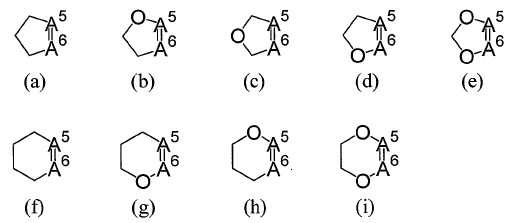
R7로 나타내는 「할로겐원자로 치환되어 있어도 좋은 C1-C3알킬」로는 메틸기, 에틸기, 프로필기, 이소프로필기 및 트리플루오로메틸기를 예로 들 수 있다.As a "C1-C3 alkyl which may be substituted by the halogen atom" represented by R <7> , a methyl group, an ethyl group, a propyl group, isopropyl group, and a trifluoromethyl group are mentioned.
R7로 나타내는 「할로겐원자로 치환되어 있어도 좋은 C1-C3알콕시기」로는 메톡시기, 에톡시기, 이소프로폭시기, 트리플루오로메톡시기 및 디플루오로메톡시기를 예로 들 수 있다.As a "C1-C3 alkoxy group which may be substituted by the halogen atom" represented by R <7> , a methoxy group, an ethoxy group, isopropoxy group, a trifluoromethoxy group, and a difluoromethoxy group are mentioned.
R8 또는 R9로 나타내는 「군 X로부터 선택되는 기로 치환되어 있어도 좋은 C1-C6쇄식 탄화수소기」로는 메틸기, 에틸기, 프로필기, 이소프로필기, 부틸기, 이소부틸기, sec-부틸기, tert-부틸기, 1-메틸부틸기, 2-메틸부틸기, 3-메틸부틸기, 1-에틸프로필기, 1,2-디메틸프로필기, 2,2-디메틸프로필기, 펜틸기, 1,2-디메틸부틸기, 2,2-디메틸부틸기, 1-메틸펜틸기, 2-메틸펜틸기, 3-메틸펜틸기, 4-메틸펜틸기, 헥실기 등의 C1-C6알킬기;Examples of the "C1-C6 chain hydrocarbon group which may be substituted with a group selected from group X" represented by R 8 or R 9 include methyl group, ethyl group, propyl group, isopropyl group, butyl group, isobutyl group, sec-butyl group and tert -Butyl group, 1-methylbutyl group, 2-methylbutyl group, 3-methylbutyl group, 1-ethylpropyl group, 1,2-dimethylpropyl group, 2,2-dimethylpropyl group, pentyl group, 1,2 C1-C6 alkyl groups such as -dimethylbutyl group, 2,2-dimethylbutyl group, 1-methylpentyl group, 2-methylpentyl group, 3-methylpentyl group, 4-methylpentyl group and hexyl group;
시아노메틸기, 디플루오로메틸기, 트리플루오로메틸기, 2,2-디플루오로에틸기, 2,2,2-트리플루오로에틸기 및 1-메틸-2,2,2-트리플루오로에틸기 등의 군 X로부터 선택되는 기로 치환된 C1-C6알킬기;Cyanomethyl group, difluoromethyl group, trifluoromethyl group, 2,2-difluoroethyl group, 2,2,2-trifluoroethyl group and 1-methyl-2,2,2-trifluoroethyl group C 1 -C 6 alkyl group substituted with a group selected from group X;
2-프로페닐기, 1-메틸-2-프로페닐기, 2-메틸-2-프로페닐기, 2-부테닐기, 3-부테닐기, 1-메틸-2-부테닐기, 1-메틸-3-부테닐기 등의 C3-C6알케닐기;2-propenyl group, 1-methyl-2-propenyl group, 2-methyl-2-propenyl group, 2-butenyl group, 3-butenyl group, 1-methyl-2-butenyl group, 1-methyl-3-butenyl group C3-C6 alkenyl groups, such as these;
3,3-디클로로-2-프로페닐기, 3,3-디플루오로-2-프로페닐기 등의 군 X로부터 선택되는 기로 치환된 C3-C6알케닐기;A C3-C6 alkenyl group substituted with a group selected from the group X such as a 3,3-dichloro-2-propenyl group and a 3,3-difluoro-2-propenyl group;
프로파르길기, 1-메틸-2-프로피닐기, 2-부티닐기, 3-부티닐기, 1-메틸-2-부티닐기 및 1-메틸-3-부티닐기 등의 C3-C6알키닐기;C3-C6 alkynyl groups such as propargyl, 1-methyl-2-propynyl, 2-butynyl, 3-butynyl, 1-methyl-2-butynyl and 1-methyl-3-butynyl;
군 X로부터 선택되는 기로 치환된 C3-C6알키닐기;를 예로 들 수 있다.C3-C6 alkynyl group substituted with a group selected from group X;
R8 또는 R9로 나타내는 C4-C7시클로알킬메틸기로는 시클로프로필메틸기, 시클로부틸메틸기, 시클로펜틸메틸기 및 시클로헥실메틸기를 예로 들 수 있다.Examples of the C4-C7 cycloalkylmethyl group represented by R 8 or R 9 include a cyclopropylmethyl group, a cyclobutylmethyl group, a cyclopentylmethyl group, and a cyclohexylmethyl group.
R8 또는 R9로 나타내는 C3-C6지환식 탄화수소기로는 시클로프로필기, 시클로부틸기, 시클로펜틸기, 시클로헥실기 및 2-시클로헥세닐기를 예로 들 수 있다.Examples of the C3-C6 alicyclic hydrocarbon group represented by R 8 or R 9 include a cyclopropyl group, a cyclobutyl group, a cyclopentyl group, a cyclohexyl group, and a 2-cyclohexenyl group.
R8 또는 R9로 나타내는 「군 Y로부터 선택되는 기로 치환되어 있어도 좋은 페닐기」로는 2-클로로페닐기, 3-클로로페닐기, 4-클로로페닐기, 2-메틸페닐기, 3-메틸페닐기, 4-메틸페닐기, 2-메톡시페닐기, 3-메톡시페닐기, 4-메톡시페닐기, 2-(트리플루오로메틸)페닐기, 3-(트리플루오로메틸)페닐기, 4-(트리플루오로메틸)페닐기, 2-시아노페닐기, 3-시아노페닐기, 4-시아노페닐기, 2-니트로페닐기, 3-니트로페닐기 및 4-니트로페닐기를 예로 들 수 있다.As a "phenyl group which may be substituted by the group chosen from group Y" represented by R <8> or R <9> , 2-chlorophenyl group, 3-chlorophenyl group, 4-chlorophenyl group, 2-methylphenyl group, 3-methylphenyl group, 4-methylphenyl group , 2-methoxyphenyl group, 3-methoxyphenyl group, 4-methoxyphenyl group, 2- (trifluoromethyl) phenyl group, 3- (trifluoromethyl) phenyl group, 4- (trifluoromethyl) phenyl group, 2 -Cyanophenyl group, 3-cyanophenyl group, 4-cyanophenyl group, 2-nitrophenyl group, 3-nitrophenyl group, and 4-nitrophenyl group are mentioned.
R8 또는 R9로 나타내는 「군 Y로부터 선택되는 기로 치환되어 있어도 좋은 벤질기」로는 벤질기, 2-클로로벤질기, 3-클로로벤질기, 4-클로로벤질기, 2-메틸벤질기, 3-메틸벤질기, 4-메틸벤질기, 2-메톡시벤질기, 3-메톡시벤질기 및 4-메톡시벤질기를 예로 들 수 있다.As a "benzyl group which may be substituted by the group chosen from group Y" represented by R <8> or R <9> , benzyl group, 2-chlorobenzyl group, 3-chlorobenzyl group, 4-chlorobenzyl group, 2-methylbenzyl group, 3 -Methylbenzyl group, 4-methylbenzyl group, 2-methoxybenzyl group, 3-methoxybenzyl group and 4-methoxybenzyl group are mentioned as an example.
R8 또는 R9로 나타내는 「5원 복소환기」로는 2-티에닐기 및 3-티에닐기 등의 5원 방향족 복소환기를 예로 들 수 있다.Examples of the "5-membered heterocyclic group" represented by R 8 or R 9 include 5-membered aromatic heterocyclic groups such as 2-thienyl group and 3-thienyl group.
R8 또는 R9로 나타내는 「6원 복소환기」로는 2-피리딜기, 3-피리딜기, 4-피리딜기, 2-피리미디닐기 및 4-피리미디닐기 등의 6원 방향족 복소환기를 예로 들 수 있다.Examples of the "6-membered heterocyclic group" represented by R 8 or R 9 include 6-membered aromatic heterocyclic groups such as 2-pyridyl group, 3-pyridyl group, 4-pyridyl group, 2-pyrimidinyl group and 4-pyrimidinyl group. Can be.
R10 또는 R14로 나타내는 「C1-C4알킬기」로는 메틸기, 에틸기, 프로필기, 이소프로필기, 부틸기, 이소부틸기, sec-부틸기 및 tert-부틸기를 예로 들 수 있다.Examples of the "C1-C4 alkyl group" represented by R 10 or R 14 include a methyl group, ethyl group, propyl group, isopropyl group, butyl group, isobutyl group, sec-butyl group and tert-butyl group.
R11 또는 R12로 나타내는 「할로겐원자로 치환되어 있어도 좋은 C1-C4알킬기」로는 메틸기, 에틸기, 2,2,2-트리플루오로에틸기, 프로필기, 이소프로필기, 부틸기, 이소부틸기, sec-부틸기 및 tert-부틸기를 예로 들 수 있다.Examples of the "C1-C4 alkyl group which may be substituted with a halogen atom" represented by R 11 or R 12 include methyl group, ethyl group, 2,2,2-trifluoroethyl group, propyl group, isopropyl group, butyl group, isobutyl group, sec -Butyl group and tert-butyl group are mentioned.
R11 또는 R12로 나타내는 「C2-C4알콕시카르보닐기」로는 메톡시카르보닐기, 에톡시카르보닐기, 프로폭시카르보닐기 및 이소프로폭시카르보닐기를 예로 들 수 있다.Examples of the "C2-C4 alkoxycarbonyl group" represented by R 11 or R 12 include a methoxycarbonyl group, an ethoxycarbonyl group, a propoxycarbonyl group, and an isopropoxycarbonyl group.
R13로 나타내는 「군 X로부터 선택되는 기로 치환되어 있어도 좋은 C1-C6쇄식 탄화수소기」로는 메틸기, 에틸기, 프로필기, 이소프로필기, 부틸기, 이소부틸기, sec-부틸기, 1-메틸부틸기, 2-메틸부틸기 등의 C1-C6알킬기;Examples of the "C1-C6 chain hydrocarbon group which may be substituted by group selected from group X" represented by R 13 include methyl group, ethyl group, propyl group, isopropyl group, butyl group, isobutyl group, sec-butyl group and 1-methylbutyl C1-C6 alkyl groups, such as a group and 2-methylbutyl group;
디플루오로메틸기, 트리플루오로메틸기, 2,2,2-트리플루오로에틸기 등의 군 X로부터 선택되는 기로 치환된 C1-C6알킬기;A C 1 -C 6 alkyl group substituted with a group selected from the group X, such as a difluoromethyl group, a trifluoromethyl group, and a 2,2,2-trifluoroethyl group;
2-프로페닐기, 1-메틸-2-프로페닐기, 2-메틸-2-프로페닐기, 2-부테닐기, 3-부테닐기 등의 C3-C6알케닐기;C3-C6 alkenyl groups such as 2-propenyl group, 1-methyl-2-propenyl group, 2-methyl-2-propenyl group, 2-butenyl group, and 3-butenyl group;
2-클로로-2-프로페닐기, 3,3-디플루오로-2-프로페닐기, 3,3-디클로로-2-프로페닐기 등의 군 X로부터 선택되는 기로 치환된 C3-C6알케닐기;A C3-C6 alkenyl group substituted with a group selected from the group X such as a 2-chloro-2-propenyl group, a 3,3-difluoro-2-propenyl group, and a 3,3-dichloro-2-propenyl group;
프로파르길기, 1-메틸-2-프로피닐기, 2-부티닐기, 3-부티닐기 등의 C3-C6알키닐기;C3-C6 alkynyl groups such as propargyl group, 1-methyl-2-propynyl group, 2-butynyl group and 3-butynyl group;
군 X로부터 선택되는 기로 치환된 C3-C6알키닐기;를 예로 들 수 있고, 바람직하게는 할로겐원자로 치환된 C1-C4알킬기를 예로 들 수 있고, 보다 바람직하게는 트리플루오로메틸기를 예로 들 수 있다.A C3-C6 alkynyl group substituted with a group selected from group X; for example, preferably a C1-C4 alkyl group substituted with a halogen atom, and more preferably a trifluoromethyl group. .
R13으로 나타내는 「군 X로부터 선택되는 기로 치환되어 있어도 좋은 C3-C6지환식 탄화수소기」로는 시클로프로필기, 시클로부틸기, 시클로펜틸기, 시클로헥실기 및 2-시클로헥세닐기를 예로 들 수 있다.As a "C3-C6 alicyclic hydrocarbon group which may be substituted by the group chosen from group X" represented by R <13> , a cyclopropyl group, a cyclobutyl group, a cyclopentyl group, a cyclohexyl group, and 2-cyclohexenyl group are mentioned, for example. .
R15로 나타내는 「C1-C4알킬기」로는 메틸기, 에틸기, 프로필기, 이소프로필기, 부틸기, 이소부틸기, sec-부틸기 및 tert-부틸기를 예로 들 수 있다.As a "C1-C4 alkyl group" represented by R <15> , a methyl group, an ethyl group, a propyl group, isopropyl group, a butyl group, isobutyl group, sec-butyl group, and tert- butyl group are mentioned.
본 활성화합물의 태양으로 하기 일반식 (2)로 표시되는 화합물을 예로 들 수 있다.As an aspect of this active compound, the compound represented by following General formula (2) is mentioned.
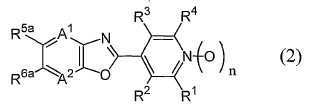
[식 중, A1, A2, R1, R2, R3, R4 및 n은 상기와 동일한 의미를 나타낸다.[In formula, A <1> , A <2> , R <1> , R <2> , R <3> , R <4> and n show the same meaning as the above.
R5a 및 R6a는 각각 독립하여 할로겐원자로 치환된 C1-C6쇄식 탄화수소기, 할로겐원자로 치환된 C3-C6지환식 탄화수소기, -OR13a, -S(O)mR13a, 할로겐원자 또는 수소원자를 나타내거나(단, R5a 및 R6a가 동시에 할로겐원자 및 수소원자로 이루어지는 군으로부터 선택되는 기를 나타내지 않는다), 혹은, R5a와 R6a와, R5a 및 R6a가 각각 결합하고 있는 6원환의 구성원자가 함께 이루어져서, 할로겐원자로 치환된 5원환 또는 6원환을 형성하여도 좋고;R 5a and R 6a are each independently a C1-C6 chain hydrocarbon group substituted with a halogen atom, a C3-C6 alicyclic hydrocarbon group substituted with a halogen atom, -OR 13a , -S (O) m R 13a , a halogen atom or a hydrogen atom (Wherein R 5a and R 6a do not represent a group selected from the group consisting of a halogen atom and a hydrogen atom at the same time), or a 6-membered ring to which R 5a and R 6a and R 5a and R 6a are respectively bonded The member may be together to form a 5- or 6-membered ring substituted with a halogen atom;
R13a는 할로겐원자로 치환된 C1-C6쇄식 탄화수소기 또는 할로겐원자로 치환된 C3-C6지환식 탄화수소기를 나타낸다.]R 13a represents a C1-C6 chain hydrocarbon group substituted with a halogen atom or a C3-C6 alicyclic hydrocarbon group substituted with a halogen atom.]
R5a 또는 R6a로 나타내는 「할로겐원자로 치환된 C1-C6쇄식 탄화수소기」로는 1,1-디플루오로에틸기, 트리플루오로메틸기, 펜타플루오로에틸기 및 헵타플루오로이소프로필기를 예로 들 수 있고, 바람직하게는 트리플루오로메틸기를 예로 들 수 있다.Examples of the "halogen atom-substituted C1-C6 chain hydrocarbon group" represented by R 5a or R 6a include a 1,1-difluoroethyl group, a trifluoromethyl group, a pentafluoroethyl group, and a heptafluoroisopropyl group. Preferably, a trifluoromethyl group is mentioned.
R5a 또는 R6a로 나타내는 C3-C6지환식 탄화수소기로는 시클로프로필기, 시클로부틸기, 시클로펜틸기 및 시클로헥실기를 예로 들 수 있다.Examples of the C3-C6 alicyclic hydrocarbon group represented by R 5a or R 6a include a cyclopropyl group, a cyclobutyl group, a cyclopentyl group, and a cyclohexyl group.
R5a와 R6a와, R5a 및 R6a가 각각 결합하고 있는 6원환의 구성원자로부터 형성되는 「할로겐원자로 치환된 5원환 또는 6원환」으로는 이하의 식 (j), (k), (l), (m), (n), (o), (p), (q), (r) 또는 (s)로 나타내는 환을 예로 들 수 있다(여기에서 A5는 R5a가 결합하는 6원환의 탄소원자를 나타내고, A6는 R6a가 결합하는 6원환의 탄소원자를 나타낸다).As a "5- or 6-membered ring substituted by halogen atom" formed from the members of the 6-membered ring to which R 5a and R 6a and R 5a and R 6a are respectively bonded, the following formulas (j), (k), ( l), a ring represented by (m), (n), (o), (p), (q), (r) or (s) is exemplified (wherein A 5 is 6 to which R 5a is bonded). An alicyclic carbon atom, and A 6 represents a 6-membered carbon atom to which R 6a is bonded).

R13a로 나타내는 「할로겐원자로 치환된 C1-C6쇄식 탄화수소기」로는 트리플루오로메틸기, 디플루오로메틸기 및 2,2,2-트리플루오로에틸기를 예로 들 수 있고, 바람직하게는 트리플루오로메틸기를 예로 들 수 있다.Examples of the "C1-C6 chain hydrocarbon group substituted with a halogen atom" represented by R 13a include a trifluoromethyl group, a difluoromethyl group, and a 2,2,2-trifluoroethyl group, and preferably a trifluoromethyl group For example.
R13a로 나타내는 「할로겐원자로 치환된 C3-C6지환식 탄화수소기」에 있어서의 C3-C6지환식 탄화수소기로는 시클로프로필기, 시클로부틸기, 시클로펜틸기 및 시클로헥실기를 예로 들 수 있다.Examples of the C3-C6 alicyclic hydrocarbon group in the "C3-C6 alicyclic hydrocarbon group substituted with halogen atom" represented by R 13a include a cyclopropyl group, a cyclobutyl group, a cyclopentyl group, and a cyclohexyl group.
본 발명의 태양으로는 이하의 화합물 중 적어도 1종을 유효성분으로 함유하는 조성물을 예로 들 수 있다.As a aspect of this invention, the composition containing at least 1 sort (s) of the following compounds as an active ingredient is mentioned.
일반식 (1)에 있어서 R2 및 R3가 각각 독립하여 군 X로부터 선택되는 기로 치환되어 있어도 좋은 C1-C6쇄식 탄화수소기, 군 X로부터 선택되는 기로 치환되어 있어도 좋은 C3-C6지환식 탄화수소기, 군 Y로부터 선택되는 기로 치환되어 있어도 좋은 페닐기, 군 Y로부터 선택되는 기로 치환되어 있어도 좋은 벤질기, 군 Y로부터 선택되는 기로 치환되어 있어도 좋은 5원 복소환기 혹은 6원 복소환기, -OR8, -NR8R9, -NR8C(O)R9, -S(O)mR8, -CO2R10, -CONR8R9, -CONR10NR11R12, 시아노기, 니트로기, 할로겐원자 또는 수소원자를 나타내고,In General Formula (1), R <2> and R <3> may respectively independently be substituted by the group selected from group X, the C1-C6 chain hydrocarbon group, and the C3-C6 alicyclic hydrocarbon group which may be substituted by group selected from group X. , A phenyl group which may be substituted by a group selected from group Y, a benzyl group which may be substituted by a group selected from group Y, a 5-membered heterocyclic group or a 6-membered heterocyclic group which may be substituted by a group selected from group Y, -OR 8 , -NR 8 R 9 , -NR 8 C (O) R 9 , -S (O) m R 8 , -CO 2 R 10 , -CONR 8 R 9 , -CONR 10 NR 11 R 12 , cyano group, nitro group , Halogen atom or hydrogen atom,
R8 및 R9가 각각 독립하여 군 X로부터 선택되는 기로 치환되어 있어도 좋은 C1-C6쇄식 탄화수소기, 군 X로부터 선택되는 기로 치환되어 있어도 좋은 C3-C6지환식 탄화수소기, 군 Y로부터 선택되는 기로 치환되어 있어도 좋은 페닐기, 군 Y로부터 선택되는 기로 치환되어 있어도 좋은 5원 복소환기 혹은 6원 복소환기 또는 수소원자인(단, -S(O)mR8에 있어서의 m이 1 또는 2인 경우, R8는 수소원자를 나타내지 않는다) 화합물;R 8 and R 9 are each independently a C 1 -C 6 chain hydrocarbon group which may be substituted with a group selected from group X, a C 3 -C 6 alicyclic hydrocarbon group which may be substituted with a group selected from group X, a group selected from group Y A 5- or 6-membered heterocyclic group or a hydrogen atom, which may be substituted by a phenyl group which may be substituted, or a group selected from group Y, provided that m in -S (O) m R 8 is 1 or 2 R 8 does not represent a hydrogen atom;
일반식 (1)에 있어서 R1 및 R4가 수소원자인 화합물;A compound in which R 1 and R 4 in formula (1) are hydrogen atoms;
일반식 (1)에 있어서 R2가 수소원자 또는 할로겐원자인 화합물;A compound in which R 2 in formula (1) is a hydrogen atom or a halogen atom;
일반식 (1)에 있어서 R3가 군 X로부터 선택되는 기로 치환되어 있어도 좋은 C3-C6지환식 탄화수소기, 군 Y로부터 선택되는 기로 치환되어 있어도 좋은 페닐기, 군 Y로부터 선택되는 기로 치환되어 있어도 좋은 벤질기, 또는, 군 Y로부터 선택되는 기로 치환되어 있어도 좋은 5원 복소환기 혹은 6원 복소환기인 화합물;In general formula (1), R <3> may be substituted by the C3-C6 alicyclic hydrocarbon group which may be substituted by the group chosen from group X, the phenyl group which may be substituted by the group chosen from group Y, and the group chosen from group Y. A compound which is a 5-membered heterocyclic group or a 6-membered heterocyclic group which may be substituted with a benzyl group or a group selected from group Y;
일반식 (1)에 있어서 R3가 군 X로부터 선택되는 기로 치환되어 있어도 좋은 C1-C6쇄식 탄화수소기, -OR8, -NR8R9, -NR8C(O)R9, -NR10C(O)NR9R14, -NR10CO2R15, -S(O)mR8, -CO2R10, -CONR8R9, -C(O)R10, -C(NOR8)R10, -CONR10NR11R12, 시아노기, 니트로기, 할로겐원자 또는 수소원자이고,Even if R 3 is substituted by a group selected from the group X in the general formula (1) C1-C6 good swaesik hydrocarbon group, -OR 8, -NR 8 R 9 , -NR 8 C (O) R 9, -NR 10 C (O) NR 9 R 14 , -NR 10 CO 2 R 15 , -S (O) m R 8 , -CO 2 R 10 , -CONR 8 R 9 , -C (O) R 10 , -C (NOR 8 ) R 10 , -CONR 10 NR 11 R 12 , a cyano group, a nitro group, a halogen atom or a hydrogen atom,
R8 및 R9가 각각 독립하여 군 X로부터 선택되는 기로 치환되어 있어도 좋은 C1-C6쇄식 탄화수소기 또는 수소원자인(단, -S(O)mR8에 있어서의 m이 1 또는 2인 경우, R8는 군 X로부터 선택되는 기로 치환되어 있어도 좋은 C1-C6쇄식 탄화수소기를 나타낸다) 화합물;R 8 and R 9 are each independently a C1-C6 chain hydrocarbon group or hydrogen atom which may be substituted with a group selected from group X, provided that m in -S (O) m R 8 is 1 or 2 , R 8 represents a C1-C6 chain hydrocarbon group which may be substituted with a group selected from group X);
일반식 (1)에 있어서 R3가 군 X로부터 선택되는 기로 치환되어 있어도 좋은 C1-C6쇄식 탄화수소기, -OR8, -NR8R9, -S(O)mR8, 할로겐원자 또는 수소원자이고,In General Formula (1), R 3 may be substituted with a group selected from group X, a C1-C6 chain hydrocarbon group, -OR 8 , -NR 8 R 9 , -S (O) m R 8 , a halogen atom or hydrogen Is an atom,
R8 및 R9가 각각 독립하여 군 X로부터 선택되는 기로 치환되어 있어도 좋은 C1-C6쇄식 탄화수소기 또는 수소원자인(단, -S(O)mR8에 있어서의 m이 1 또는 2인 경우, R8는 군 X로부터 선택되는 기로 치환되어 있어도 좋은 C1-C6쇄식 탄화수소기를 나타낸다) 화합물;R 8 and R 9 are each independently a C1-C6 chain hydrocarbon group or hydrogen atom which may be substituted with a group selected from group X, provided that m in -S (O) m R 8 is 1 or 2 , R 8 represents a C1-C6 chain hydrocarbon group which may be substituted with a group selected from group X);
일반식 (1)에 있어서 R5 및 R6가 각각 독립하여 군 X로부터 선택되는 기로 치환되어 있어도 좋은 C1-C6쇄식 탄화수소기, -OR13, -S(O)mR13, 할로겐원자 또는 수소원자이고(단, R5 및 R6가 동시에 수소원자를 나타내지 않는다),In formula (1), each of R 5 and R 6 independently may be substituted with a group selected from group X, a C1-C6 chain hydrocarbon group, -OR 13 , -S (O) m R 13 , a halogen atom or hydrogen Atoms, provided that R 5 and R 6 do not represent hydrogen atoms at the same time,
R13가 군 X로부터 선택되는 기로 치환되어 있어도 좋은 C1-C6쇄식 탄화수소기인 화합물;R 13 is a C1-C6 chain hydrocarbon group which may be substituted with a group selected from group X;
일반식 (1)에 있어서 R5가 할로겐원자로 치환되어 있어도 좋은 C1-C6쇄식 탄화수소기 또는 -OR13이고, R13가 할로겐원자로 치환되어 있어도 좋은 C1-C6쇄식 탄화수소기인 화합물;A compound of formula (1) wherein R 5 is a C1-C6 chain hydrocarbon group which may be substituted with a halogen atom or -OR 13 , and R 13 is a C1-C6 chain hydrocarbon group which may be substituted with a halogen atom;
식 (1)에 있어서 R6가 할로겐원자로 치환되어 있어도 좋은 C1-C6쇄식 탄화수소기 또는 -OR13이고, R13가 할로겐원자로 치환되어 있어도 좋은 C1-C6쇄식 탄화수소기인 화합물;A compound of formula (1) wherein R 6 is a C1-C6 chain hydrocarbon group which may be substituted with a halogen atom or -OR 13 , and R 13 is a C1-C6 chain hydrocarbon group which may be substituted with a halogen atom;
일반식 (1)에 있어서 R5가 할로겐원자로 치환된 C1-C6쇄식 탄화수소기 또는 -OR13이고, R13가 할로겐원자로 치환된 C1-C6쇄식 탄화수소기인 화합물;A compound represented by formula (1) wherein R 5 is a C1-C6 chain hydrocarbon group substituted with a halogen atom or -OR 13 , and R 13 is a C1-C6 chain hydrocarbon group substituted with a halogen atom;
일반식 (1)에 있어서 R6가 할로겐원자로 치환된 C1-C6쇄식 탄화수소기 또는 -OR13이고, R13가 할로겐원자로 치환된 C1-C6쇄식 탄화수소기인 화합물;A compound represented by formula (1) wherein R 6 is a C1-C6 chain hydrocarbon group substituted with a halogen atom or -OR 13 , and R 13 is a C1-C6 chain hydrocarbon group substituted with a halogen atom;
일반식 (1)에 있어서 R5가 할로겐원자로 치환된 C1-C6쇄식 탄화수소기인 화합물;A compound represented by formula (1) wherein R 5 is a C1-C6 chain hydrocarbon group substituted with a halogen atom;
일반식 (1)에 있어서 R5가 트리플루오로메틸기인 화합물;A compound in which R 5 in formula (1) is a trifluoromethyl group;
일반식 (1)에 있어서 R5가 tert-부틸기인 화합물;A compound wherein R 5 in the general formula (1) is a tert-butyl group;
일반식 (1)에 있어서 R6가 할로겐원자로 치환된 C1-C6쇄식 탄화수소기인 화합물;A compound represented by formula (1) wherein R 6 is a C1-C6 chain hydrocarbon group substituted with a halogen atom;
일반식 (1)에 있어서 R6가 트리플루오로메틸기인 화합물;A compound in which R 6 is a trifluoromethyl group in General Formula (1);
일반식 (1)에 있어서 R6가 tert-부틸기인 화합물;A compound in which R 6 is a tert-butyl group in formula (1);
일반식 (1)에 있어서 R5가 -OR13이고, R13가 할로겐원자로 치환된 C1-C6쇄식 탄화수소기인 화합물;A compound represented by formula (1) wherein R 5 is -OR 13 and R 13 is a C1-C6 chain hydrocarbon group substituted with a halogen atom;
일반식 (1)에 있어서 R5가 -OR13이고, R13가 트리플루오로메틸기 또는 디플루오로메틸기인 화합물;A compound in which in general formula (1), R 5 is -OR 13 and R 13 is a trifluoromethyl group or a difluoromethyl group;
일반식 (1)에 있어서 R6가 -OR13이고, R13가 할로겐원자로 치환된 C1-C6쇄식 탄화수소기인 화합물;A compound wherein R 6 in formula (1) is —OR 13 and R 13 is a C1-C6 chain hydrocarbon group substituted with a halogen atom;
일반식 (1)에 있어서 R6가 -OR13이고, R13가 트리플루오로메틸기 또는 디플루오로메틸기인 화합물;A compound in which in General Formula (1), R 6 is -OR 13 and R 13 is a trifluoromethyl group or a difluoromethyl group;
일반식 (1)에 있어서 R5가 할로겐원자로 치환되어 있어도 좋은 C1-C6쇄식 탄화수소기이고, R6가 수소원자 또는 할로겐원자인 화합물;A compound in which R 5 in General Formula (1) is a C1-C6 chain hydrocarbon group which may be substituted with a halogen atom, and R 6 is a hydrogen atom or a halogen atom;
일반식 (1)에 있어서 R5가 -OR13이고, R13가 할로겐원자로 치환되어 있어도 좋은 C1-C6쇄식 탄화수소기이고, R6가 수소원자 또는 할로겐원자인 화합물;A compound in which R 5 in formula (1) is -OR 13 , R 13 is a C1-C6 chain hydrocarbon group which may be substituted with a halogen atom, and R 6 is a hydrogen atom or a halogen atom;
일반식 (1)에 있어서 R5가 수소원자 또는 할로겐원자이고, R6가 할로겐원자로 치환되어 있어도 좋은 C1-C6쇄식 탄화수소기인 화합물;A compound represented by formula (1) wherein R 5 is a hydrogen atom or a halogen atom, and R 6 is a C1-C6 chain hydrocarbon group which may be substituted with a halogen atom;
일반식 (1)에 있어서 R5가 수소원자 또는 할로겐원자이고, R6가 -OR13이고, R13가 할로겐원자로 치환되어 있어도 좋은 C1-C6쇄식 탄화수소기인 화합물;A compound represented by formula (1) wherein R 5 is a hydrogen atom or a halogen atom, R 6 is -OR 13 , and R 13 is a C1-C6 chain hydrocarbon group which may be substituted with a halogen atom;
일반식 (1)에 있어서 R5가 할로겐원자로 치환된 C1-C6쇄식 탄화수소기이고, R6가 수소원자 또는 할로겐원자인 화합물;A compound of formula (1) wherein R 5 is a C1-C6 chain hydrocarbon group substituted with a halogen atom, and R 6 is a hydrogen atom or a halogen atom;
일반식 (1)에 있어서 R5가 -OR13이고, R13가 할로겐원자로 치환된 C1-C6쇄식 탄화수소기이고, R6가 수소원자 또는 할로겐원자인 화합물;A compound wherein R 5 in formula (1) is —OR 13 , R 13 is a C1-C6 chain hydrocarbon group substituted with a halogen atom, and R 6 is a hydrogen atom or a halogen atom;
일반식 (1)에 있어서 R5가 수소원자 또는 할로겐원자이고, R6가 할로겐원자로 치환된 C1-C6쇄식 탄화수소기인 화합물;A compound represented by formula (1) wherein R 5 is a hydrogen atom or a halogen atom, and R 6 is a C1-C6 chain hydrocarbon group substituted with a halogen atom;
일반식 (1)에 있어서 R5가 수소원자 또는 할로겐원자이고, R6가 -OR13이고, R13가 할로겐원자로 치환된 C1-C6쇄식 탄화수소기인 화합물;A compound represented by formula (1) wherein R 5 is a hydrogen atom or a halogen atom, R 6 is -OR 13 , and R 13 is a C1-C6 chain hydrocarbon group substituted with a halogen atom;
일반식 (1)에 있어서 R5가 트리플루오로메틸기이고, R6가 수소원자 또는 할로겐원자인 화합물;Compounds represented by formula (1) wherein R 5 is a trifluoromethyl group and R 6 is a hydrogen atom or a halogen atom;
일반식 (1)에 있어서 R5가 tert-부틸기이고, R6가 수소원자 또는 할로겐원자인 화합물;A compound in which in general formula (1), R 5 is a tert-butyl group, and R 6 is a hydrogen atom or a halogen atom;
일반식 (1)에 있어서 R5가 -OR13이고, R13가 트리플루오로메틸기 또는 디플루오로메틸기이고, R6가 수소원자 또는 할로겐원자인 화합물;A compound in which in general formula (1), R 5 is -OR 13 , R 13 is a trifluoromethyl group or a difluoromethyl group, and R 6 is a hydrogen atom or a halogen atom;
일반식 (1)에 있어서 R5가 수소원자 또는 할로겐원자이고, R6가 트리플루오로메틸기인 화합물;A compound represented by formula (1) wherein R 5 is a hydrogen atom or a halogen atom, and R 6 is a trifluoromethyl group;
일반식 (1)에 있어서 R5가 수소원자 또는 할로겐원자이고, R6가 tert-부틸기인 화합물;A compound in which in general formula (1), R 5 is a hydrogen atom or a halogen atom, and R 6 is a tert-butyl group;
일반식 (1)에 있어서 R5가 수소원자 또는 할로겐원자이고, R6가 -OR13이고, R13가 트리플루오로메틸기 또는 디플루오로메틸기인 화합물;Compounds represented by formula (1) wherein R 5 is a hydrogen atom or a halogen atom, R 6 is -OR 13 , and R 13 is a trifluoromethyl group or a difluoromethyl group;
일반식 (1)에 있어서 A1가 질소원자이고, A2가=C(R7)-이고, R7가 수소원자인 화합물;A compound in which A 1 is a nitrogen atom, A 2 is C (R 7 ) —, and R 7 is a hydrogen atom in formula (1);
일반식 (1)에 있어서 A1가=C(R7)-이고, A2가 질소원자이고, R7가 수소원자인 화합물;A compound in which A 1 is C (R 7 ) —, A 2 is a nitrogen atom and R 7 is a hydrogen atom in General Formula (1);
일반식 (1)에 있어서 A1 및 A2가=C(R7)-이고, R7가 수소원자인 화합물;In general formula (1) A 1 and A 2 are = C (R 7 )-and R 7 is a hydrogen atom;
일반식 (1)에 있어서 R2 및 R3가 각각 독립하여 할로겐원자로 치환되어 있어도 좋은 C1-C4알킬기, C2-C4알콕시알킬기, C2-C4알케닐기, 피롤리딜기, 피페리딜기, 모르폴릴기, 이미다졸릴기, 피라졸릴기, 트리아졸릴기, (C1-C3알킬기) 치환 피라졸릴기, (C1-C3할로겐화 알킬기) 치환 피라졸릴기, 페닐기, 피리딜기, -OR8a(R8a는 할로겐원자로 치환되어 있어도 좋은 C1-C4알킬기, 할로겐원자로 치환되어 있어도 좋은 C3-C4알케닐기, C3-C4알키닐기, 벤질기, C2-C4알콕시알킬기, C4-C7시클로알킬메틸기 또는 수소원자를 나타낸다), -NR8bR9a(R8b 및 R9a는 각각 할로겐원자로 치환되어 있어도 좋은 C1-C4알킬기 또는 수소원자를 나타낸다), -NHC(O)R9b(R9b는 할로겐원자로 치환되어 있어도 좋은 C1-C4알킬기를 나타낸다), -NHCO2R15a(R15a는 C1-C4알킬기를 나타낸다), -S(O)m1R8c(R8c는 할로겐원자로 치환되어 있어도 좋은 C1-C4알킬기를 나타낸다. m1은 1 또는 2를 나타낸다), -SR8d(R8d는 할로겐원자로 치환되어 있어도 좋은 C1-C4알킬기 또는 수소원자를 나타낸다), 시아노기, 할로겐원자 또는 수소원자인 화합물;In general formula (1), R <2> and R <3> may respectively independently be substituted by the halogen atom, the C1-C4 alkyl group, C2-C4 alkoxyalkyl group, C2-C4 alkenyl group, pyrrolidyl group, piperidyl group, and morpholinyl group , Imidazolyl group, pyrazolyl group, triazolyl group, (C1-C3 alkyl group) substituted pyrazolyl group, (C1-C3 halogenated alkyl group) substituted pyrazolyl group, phenyl group, pyridyl group, -OR 8a (R 8a is halogen C1-C4 alkyl group optionally substituted by atom, C3-C4 alkenyl group, C3-C4 alkynyl group optionally substituted by halogen atom, benzyl group, C2-C4 alkoxyalkyl group, C4-C7 cycloalkylmethyl group or hydrogen atom); -NR 8b R 9a (R 8b and R 9a each represent a C1-C4 alkyl group or a hydrogen atom which may be substituted with a halogen atom), -NHC (O) R 9b (R 9b may be substituted with a halogen atom C1-C4 represents an alkyl group), -NHCO 2 R 15a (R 15a represents a C1-C4 alkyl), -S (O) m1 R 8c (R 8c is Halogen atoms which may be substituted represents a good C1-C4 alkyl group. M1 is 1 or represents a 2), -SR 8d (R 8d represents a group optionally substituted with a halogen atom good C1-C4 alkyl group or a hydrogen atom), a cyano group, a halogen Compounds which are atoms or hydrogen atoms;
일반식 (1)에 있어서 R2 및 R3가 각각 독립하여 할로겐원자로 치환되어 있어도 좋은 C1-C4알킬기, -OR8a(R8a는 할로겐원자로 치환되어 있어도 좋은 C1-C4알킬기를 나타낸다), -NR8bR9a(R8b 및 R9a는 각각 할로겐원자로 치환되어 있어도 좋은 C1-C4알킬기 또는 수소원자를 나타낸다), -S(O)m1R8c(R8c는 할로겐원자로 치환되어 있어도 좋은 C1-C4알킬기를 나타낸다. m1은 1 또는 2를 나타낸다), -SR8d(R8d는 할로겐원자로 치환되어 있어도 좋은 C1-C4알킬기 또는 수소원자를 나타낸다), 할로겐원자 또는 수소원자인 화합물;In formula (1), R 2 and R 3 are each independently a C 1 -C 4 alkyl group which may be substituted with a halogen atom, -OR 8a (R 8a represents a C 1 -C 4 alkyl group which may be substituted with a halogen atom), -NR 8b R 9a (R 8b and R 9a are each a halogen atom or optionally substituted C1-C4 alkyl group or a hydrogen atom), -S (O) m1 R 8c (R 8c is optionally substituted with a halogen atom good C1-C4 alkyl group M1 represents 1 or 2), -SR 8d (R 8d represents a C1-C4 alkyl group or hydrogen atom which may be substituted by halogen atom), a halogen atom or a hydrogen atom;
일반식 (1)에 있어서 R5 및 R6 중 적어도 하나가 할로겐원자로 치환된 C1-C3알킬기, C1-C4알킬기 또는 -OR13a이고, R13a가 할로겐원자로 치환된 C1-C3알킬기인 화합물;A compound represented by formula (1) wherein at least one of R 5 and R 6 is a C 1 -C 3 alkyl group substituted with a halogen atom, a C 1 -C 4 alkyl group or -OR 13a , and R 13a is a C 1 -C 3 alkyl group substituted with a halogen atom;
일반식 (2)에 있어서 R2 및 R3는 각각 독립하여 군 X로부터 선택되는 기로 치환되어 있어도 좋은 C1-C6쇄식 탄화수소기, 군 X로부터 선택되는 기로 치환되어 있어도 좋은 C3-C6지환식 탄화수소기, 군 Y로부터 선택되는 기로 치환되어 있어도 좋은 페닐기, 군 Y로부터 선택되는 기로 치환되어 있어도 좋은 벤질기, 군 Y로부터 선택되는 기로 치환되어 있어도 좋은 5원 복소환기 혹은 6원 복소환기, -OR8, -NR8R9, -NR8C(O)R9, -S(O)mR8, -CO2R10, -CONR8R9, -CONR10NR11R12, 시아노기, 니트로기, 할로겐원자 또는 수소원자를 나타내고,In general formula (2), R <2> and R <3> is respectively independently the C1-C6 chain hydrocarbon group which may be substituted by the group chosen from group X, and the C3-C6 alicyclic hydrocarbon group which may be substituted by the group chosen from group X. , A phenyl group which may be substituted by a group selected from group Y, a benzyl group which may be substituted by a group selected from group Y, a 5-membered heterocyclic group or a 6-membered heterocyclic group which may be substituted by a group selected from group Y, -OR 8 , -NR 8 R 9 , -NR 8 C (O) R 9 , -S (O) m R 8 , -CO 2 R 10 , -CONR 8 R 9 , -CONR 10 NR 11 R 12 , cyano group, nitro group , Halogen atom or hydrogen atom,
R8 및 R9는 각각 독립하여 군 X로부터 선택되는 기로 치환되어 있어도 좋은 C1-C6쇄식 탄화수소기, 군 X로부터 선택되는 기로 치환되어 있어도 좋은 C3-C6지환식 탄화수소기, 군 Y로부터 선택되는 기로 치환되어 있어도 좋은 페닐기, 군 Y로부터 선택되는 기로 치환되어 있어도 좋은 5원 복소환기 혹은 6원 복소환기 또는 수소원자인(단, -S(O)mR8에 있어서의 m이 1 또는 2인 경우, R8는 수소원자를 나타내지 않는다) 화합물;R 8 and R 9 are each independently a C 1 -C 6 chain hydrocarbon group which may be substituted with a group selected from group X, a C 3 -C 6 alicyclic hydrocarbon group which may be substituted with a group selected from group X, a group selected from group Y A 5- or 6-membered heterocyclic group or a hydrogen atom, which may be substituted by a phenyl group which may be substituted, or a group selected from group Y, provided that m in -S (O) m R 8 is 1 or 2 R 8 does not represent a hydrogen atom;
일반식 (2)에 있어서 R1 및 R4가 수소원자인 화합물;A compound in which R 1 and R 4 in formula (2) are hydrogen atoms;
일반식 (2)에 있어서 R2가 수소원자 또는 할로겐원자인 화합물;A compound in which R 2 in the general formula (2) is a hydrogen atom or a halogen atom;
일반식 (2)에 있어서 R3가 군 X로부터 선택되는 기로 치환되어 있어도 좋은 C3-C6지환식 탄화수소기, 군 Y로부터 선택되는 기로 치환되어 있어도 좋은 페닐기, 군 Y로부터 선택되는 기로 치환되어 있어도 좋은 벤질기, 또는 군 Y로부터 선택되는 기로 치환되어 있어도 좋은 5원 복소환기 혹은 6원 복소환기인 화합물;In general formula (2), R <3> may be substituted by the C3-C6 alicyclic hydrocarbon group which may be substituted by the group chosen from group X, the phenyl group which may be substituted by the group chosen from group Y, and the group chosen from group Y. A compound which is a 5-membered heterocyclic group or a 6-membered heterocyclic group which may be substituted with a benzyl group or a group selected from group Y;
일반식 (2)에 있어서 R3가 군 X로부터 선택되는 기로 치환되어 있어도 좋은 C1-C6쇄식 탄화수소기, -OR8, -NR8R9, -NR8C(O)R9, -NR10C(O)NR9R14, -NR10CO2R15, -S(O)mR8, -CO2R10, -CONR8R9, -C(O)R10, -C(NOR8)R10, -CONR10NR11R12, 시아노기, 니트로기, 할로겐원자 또는 수소원자이며, R8 및 R9가 각각 독립하여 군 X로부터 선택되는 기로 치환되어 있어도 좋은 C1-C6쇄식 탄화수소기 또는 수소원자인(단, -S(O)mR8에 있어서의 m이 1 또는 2인 경우, R8는 군 X로부터 선택되는 기로 치환되어 있어도 좋은 C1-C6쇄식 탄화수소기를 나타낸다) 화합물;In General Formula (2), R 3 may be substituted with a group selected from group X, a C1-C6 chain hydrocarbon group, -OR 8 , -NR 8 R 9 , -NR 8 C (O) R 9 , -NR 10 C (O) NR 9 R 14 , -NR 10 CO 2 R 15 , -S (O) m R 8 , -CO 2 R 10 , -CONR 8 R 9 , -C (O) R 10 , -C (NOR 8 ) C 1 -C 6 -chain hydrocarbon, R 10 , -CONR 10 NR 11 R 12 , cyano group, nitro group, halogen atom or hydrogen atom, each of which R 8 and R 9 may be independently substituted with a group selected from group X A compound which is a group or a hydrogen atom (provided that when m in —S (O) m R 8 is 1 or 2, R 8 represents a C 1 -C 6 chain hydrocarbon group which may be substituted with a group selected from group X);
일반식 (2)에 있어서 R3가 군 X로부터 선택되는 기로 치환되어 있어도 좋은 C1-C6쇄식 탄화수소기, -OR8, -NR8R9, -S(O)mR8, 할로겐원자 또는 수소원자이고,In General Formula (2), R 3 may be substituted with a group selected from group X, a C1-C6 chain hydrocarbon group, -OR 8 , -NR 8 R 9 , -S (O) m R 8 , a halogen atom or hydrogen Is an atom,
R8 및 R9가 각각 독립하여 군 X로부터 선택되는 기로 치환되어 있어도 좋은 C1-C6쇄식 탄화수소기 또는 수소원자인(단, -S(O)mR8에 있어서의 m이 1 또는 2인 경우, R8는 군 X로부터 선택되는 기로 치환되어 있어도 좋은 C1-C6쇄식 탄화수소기를 나타낸다) 화합물;R 8 and R 9 are each independently a C1-C6 chain hydrocarbon group or hydrogen atom which may be substituted with a group selected from group X, provided that m in -S (O) m R 8 is 1 or 2 , R 8 represents a C1-C6 chain hydrocarbon group which may be substituted with a group selected from group X);
일반식 (2)에 있어서 R5a가 할로겐원자로 치환된 C1-C6쇄식 탄화수소기 또는 -OR13a이고, R13a가 할로겐원자로 치환된 C1-C6쇄식 탄화수소기인 화합물;A compound of formula (2) wherein R 5a is a C1-C6 chain hydrocarbon group substituted with a halogen atom or -OR 13a and R 13a is a C1-C6 chain hydrocarbon group substituted with a halogen atom;
일반식 (2)에 있어서 R6a가 할로겐원자로 치환된 C1-C6쇄식 탄화수소기 또는 -OR13a이고, R13a가 할로겐원자로 치환된 C1-C6쇄식 탄화수소기인 화합물.The compound of formula (2) wherein R 6a is a C1-C6 chain hydrocarbon group substituted with a halogen atom or -OR 13a and R 13a is a C1-C6 chain hydrocarbon group substituted with a halogen atom.
일반식 (2)에 있어서 R5a가 할로겐원자로 치환된 C1-C6쇄식 탄화수소기인 화합물;A compound represented by formula (2) wherein R 5a is a C1-C6 chain hydrocarbon group substituted with a halogen atom;
일반식 (2)에 있어서 R5a가 트리플루오로메틸기인 화합물;A compound in which R 5a is a trifluoromethyl group in General Formula (2);
일반식 (2)에 있어서 R6a가 할로겐원자로 치환된 C1-C6쇄식 탄화수소기인 화합물;A compound represented by formula (2) wherein R 6a is a C1-C6 chain hydrocarbon group substituted with a halogen atom;
일반식 (2)에 있어서 R6a가 트리플루오로메틸기인 화합물;A compound in which R 6a is a trifluoromethyl group in General Formula (2);
일반식 (2)에 있어서 R5a가 -OR13a이고, R13a가 할로겐원자로 치환된 C1-C6쇄식 탄화수소기인 화합물;A compound represented by formula (2) wherein R 5a is -OR 13a and R 13a is a C1-C6 chain hydrocarbon group substituted with a halogen atom;
일반식 (2)에 있어서 R5a가 -OR13a이고, R13a가 트리플루오로메틸기 또는 디플루오로메틸기인 화합물;A compound in which R 5a is -OR 13a in General Formula (2), and R 13a is a trifluoromethyl group or a difluoromethyl group;
일반식 (2)에 있어서 R6a가 -OR13a이고, R13a가 할로겐원자로 치환된 C1-C6쇄식 탄화수소기인 화합물;A compound wherein R 6a in Formula (2) is —OR 13a and R 13a is a C1-C6 chain hydrocarbon group substituted with a halogen atom;
일반식 (2)에 있어서 R6a가 -OR13a이고, R13a가 트리플루오로메틸기 또는 디플루오로메틸기인 화합물;A compound wherein R 6a is —OR 13a in General Formula (2) and R 13a is a trifluoromethyl group or a difluoromethyl group;
일반식 (2)에 있어서 R5a가 할로겐원자로 치환된 C1-C6쇄식 탄화수소기이고, R6a가 수소원자 또는 할로겐원자인 화합물;A compound wherein R 5a is a C1-C6 chain hydrocarbon group substituted with a halogen atom in formula (2), and R 6a is a hydrogen atom or a halogen atom;
일반식 (2)에 있어서 R5a가 -OR13a이고, R13a가 할로겐원자로 치환된 C1-C6쇄식 탄화수소기이고, R6a가 수소원자 또는 할로겐원자인 화합물;A compound wherein R 5a in Formula (2) is —OR 13a , R 13a is a C1-C6 chain hydrocarbon group substituted with a halogen atom, and R 6a is a hydrogen atom or a halogen atom;
일반식 (2)에 있어서 R5a가 수소원자 또는 할로겐원자이고, R6a가 할로겐원자로 치환된 C1-C6쇄식 탄화수소기인 화합물;A compound represented by formula (2) wherein R 5a is a hydrogen atom or a halogen atom, and R 6a is a C1-C6 chain hydrocarbon group substituted with a halogen atom;
일반식 (2)에 있어서 R5a가 수소원자 또는 할로겐원자이고, R6a가 -OR13a이고, R13a가 할로겐원자로 치환된 C1-C6쇄식 탄화수소기인 화합물;A compound represented by formula (2) wherein R 5a is a hydrogen atom or a halogen atom, R 6a is —OR 13a , and R 13a is a C1-C6 chain hydrocarbon group substituted with a halogen atom;
일반식 (2)에 있어서 R5a가 트리플루오로메틸기이고, R6a가 수소원자 또는 할로겐원자인 화합물;A compound in which in general formula (2) R 5a is a trifluoromethyl group and R 6a is a hydrogen atom or a halogen atom;
일반식 (2)에 있어서 R5a가 -OR13a이며, R13a가 트리플루오로메틸기 또는 디플루오로메틸기이고, R6a가 수소원자 또는 할로겐원자인 화합물;A compound in which R 5a is -OR 13a in General Formula (2), R 13a is a trifluoromethyl group or a difluoromethyl group, and R 6a is a hydrogen atom or a halogen atom;
일반식 (2)에 있어서 R5a가 수소원자 또는 할로겐원자이고, R6a가 트리플루오로메틸기인 화합물;A compound in which R 5a is a hydrogen atom or a halogen atom in formula (2), and R 6a is a trifluoromethyl group;
일반식 (2)에 있어서 R5a가 수소원자 또는 할로겐원자이고, R6a가 -OR13a이고, R13a가 트리플루오로메틸기 또는 디플루오로메틸기인 화합물;A compound in which in general formula (2) R 5a is a hydrogen atom or a halogen atom, R 6a is -OR 13a , and R 13a is a trifluoromethyl group or a difluoromethyl group;
일반식 (2)에 있어서 A1가 질소원자이고, A2가=C(R7)-이고, R7가 수소원자인 화합물;A compound wherein A 1 is a nitrogen atom, A 2 is C (R 7 ) —, and R 7 is a hydrogen atom in formula (2);
일반식 (2)에 있어서 A1가=C(R7)-이고, A2가 질소원자이고, R7가 수소원자인 화합물;A compound in which A 1 is C (R 7 ) —, A 2 is a nitrogen atom and R 7 is a hydrogen atom in formula (2);
일반식 (2)에 있어서 A1 및 A2가=C(R7)-이고, R7가 수소원자인 화합물;A compound in which A 1 and A 2 are C (R 7 ) — in Formula (2), and R 7 is a hydrogen atom;
일반식 (2)에 있어서 R2 및 R3가 각각 독립하여 할로겐원자로 치환되어 있어도 좋은 C1-C4알킬기, C2-C4알콕시알킬기, C2-C4알케닐기, 피롤리딜기, 피페리딜기, 모르폴릴기, 이미다졸릴기, 피라졸릴기, 트리아졸릴기, (C1-C3알킬기)치환 피라졸릴기, (C1-C3할로겐화 알킬기)치환 피라졸릴기, 페닐기, 피리딜기, -OR8a(R8a는 할로겐원자로 치환되어 있어도 좋은 C1-C4알킬기, 할로겐원자로 치환되어 있어도 좋은 C3-C4알케닐기, C3-C4알키닐기, 벤질기, C2-C4알콕시알킬기, C4-C7시클로알킬메틸기, 또는 수소원자를 나타낸다), -NR8bR9a(R8b 및 R9a는 각각 할로겐원자로 치환되어 있어도 좋은 C1-C4알킬기 또는 수소원자를 나타낸다), -NHC(O)R9b(R9b는 할로겐원자로 치환되어 있어도 좋은 C1-C4알킬기를 나타낸다), -NHCO2R15a(R15a는 C1-C4알킬기를 나타낸다), -S(O)m1R8c(R8c는 할로겐원자로 치환되어 있어도 좋은 C1-C4알킬기를 나타낸다. m1은 1 또는 2를 나타낸다), -SR8d(R8d는 할로겐원자로 치환되어 있어도 좋은 C1-C4알킬기 또는 수소원자를 나타낸다), 시아노기, 할로겐원자 또는 수소원자인 화합물;In general formula (2), R <2> and R <3> may respectively independently be substituted by the halogen atom, the C1-C4 alkyl group, C2-C4 alkoxyalkyl group, C2-C4 alkenyl group, pyrrolidyl group, piperidyl group, and morpholinyl group , Imidazolyl group, pyrazolyl group, triazolyl group, (C1-C3 alkyl group) substituted pyrazolyl group, (C1-C3 halogenated alkyl group) substituted pyrazolyl group, phenyl group, pyridyl group, -OR 8a (R 8a is halogen C1-C4 alkyl group optionally substituted by atom, C3-C4 alkenyl group, C3-C4 alkynyl group optionally substituted by halogen atom, benzyl group, C2-C4 alkoxyalkyl group, C4-C7 cycloalkylmethyl group, or hydrogen atom). , -NR 8b R 9a (R 8b and R 9a each represent a C1-C4 alkyl group or a hydrogen atom which may be substituted with a halogen atom), -NHC (O) R 9b (R 9b may be substituted with a halogen atom, C1- represents a C4 alkyl group), -NHCO 2 R 15a (R 15a represents a C1-C4 alkyl), -S (O) m1 R 8c (R 8c is Halogen atoms which may be substituted represents a good C1-C4 alkyl group. M1 is 1 or represents a 2), -SR 8d (R 8d represents a group optionally substituted with a halogen atom good C1-C4 alkyl group or a hydrogen atom), a cyano group, a halogen Compounds which are atoms or hydrogen atoms;
일반식 (2)에 있어서 R2 및 R3가 각각 독립하여 할로겐원자로 치환되어 있어도 좋은 C1-C4알킬기, -OR8a(R8a는 할로겐원자로 치환되어 있어도 좋은 C1-C4알킬기를 나타낸다), -NR8bR9a(R8b 및 R9a는 각각 할로겐원자로 치환되어 있어도 좋은 C1-C4알킬기 또는 수소원자를 나타낸다), -S(O)m1R8c(R8c는 할로겐원자로 치환되어 있어도 좋은 C1-C4알킬기를 나타낸다. m1은 1 또는 2를 나타낸다), -SR8d(R8d는 할로겐원자로 치환되어 있어도 좋은 C1-C4알킬기 또는 수소원자를 나타낸다), 할로겐원자 또는 수소원자인 화합물;In formula (2), R 2 and R 3 are each independently a C 1 -C 4 alkyl group which may be substituted with a halogen atom, -OR 8a (R 8a represents a C 1 -C 4 alkyl group which may be substituted with a halogen atom), -NR 8b R 9a (R 8b and R 9a are each a halogen atom or optionally substituted C1-C4 alkyl group or a hydrogen atom), -S (O) m1 R 8c (R 8c is optionally substituted with a halogen atom good C1-C4 alkyl group M1 represents 1 or 2), -SR 8d (R 8d represents a C1-C4 alkyl group or hydrogen atom which may be substituted by halogen atom), a halogen atom or a hydrogen atom;
일반식 (2)에 있어서 R5a 및 R6a 중 적어도 하나가 할로겐원자로 치환된 C1-C3알킬기 또는 -OR13a이고, R13a가 할로겐원자로 치환된 C1-C3알킬기인 화합물;
A compound of formula (2) wherein at least one of R 5a and R 6a is a C1-C3 alkyl group substituted with a halogen atom or -OR 13a and R 13a is a C1-C3 alkyl group substituted with a halogen atom;
다음에 본 활성화합물의 제조법에 대해 설명한다.Next, the manufacturing method of this active compound is demonstrated.
본 활성화합물은, 예를 들면, 이하의 (제조법 1)~(제조법 14)에 의해 제조할 수가 있다.This active compound can be manufactured by the following (manufacturing method 1)-(manufacturing method 14), for example.
각 제조법에서 특정의 식에 의해 나타내는 화합물은 그 식의 번호를 괄호 안에 상기 화합물의 뒤에 붙여서 기재하는 경우가 있다. 예를 들면, 일반식 (3)에서 나타나는 화합물은 「화합물 (3)」으로 기재하는 경우가 있다.
In each manufacturing method, the compound represented by a specific formula may be described by appending the number of the formula to the parenthesis after the compound. For example, the compound represented by General formula (3) may be described as "compound (3)."
(제조법 1)(Manufacturing method 1)
일반식 (1)에서 n이 0인 화합물 (5)는 화합물 (3)과 화합물 (4)를 산의 존재 하에 반응시킴으로써 제조할 수가 있다.Compound (5) in which n is 0 in General Formula (1) can be produced by reacting Compound (3) and Compound (4) in the presence of an acid.
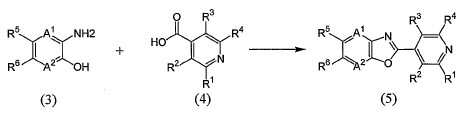
[식 중, R1, R2, R3, R4, R5, R6, A1 및 A2는 상기와 동일한 의미를 나타낸다][Wherein, R 1 , R 2 , R 3 , R 4 , R 5 , R 6 , A 1 and A 2 represent the same meaning as described above]
상기 산으로는 폴리인산이나 트리메틸실릴폴리포스페이트 등을 예로 들 수 있다.Examples of the acid include polyphosphoric acid and trimethylsilyl polyphosphate.
상기 반응은 산으로서 폴리인산을 사용하는 경우는 통상 무용매로 실시하나, 용매 중에서 실시하여도 좋다.In the case where polyphosphoric acid is used as the acid, the reaction is usually carried out without solvent, but may be carried out in a solvent.
상기 용매로는 테트라히드로푸란(이하, THF로 기재하는 경우가 있음), 에틸렌글리콜디메틸에테르, 1,4-디옥산 등의 에테르류, 톨루엔, 크실렌 등의 방향족 탄화수소류, 클로로벤젠, 디클로로벤젠 등의 할로겐화 탄화수소류 및 이들 혼합물을 예로 들 수 있다.Examples of the solvent include tetrahydrofuran (hereinafter sometimes referred to as THF), ethylene glycol dimethyl ether, ethers such as 1,4-dioxane, aromatic hydrocarbons such as toluene and xylene, chlorobenzene, dichlorobenzene, and the like. Halogenated hydrocarbons and mixtures thereof.
화합물 (3) 1몰에 있어서 화합물 (4)가 통상 1~3몰의 비율로 사용된다.In 1 mol of compound (3), compound (4) is normally used in the ratio of 1-3 mol.
상기 반응의 반응온도는 통상 50~200℃의 범위이고, 반응시간은 통상 0.5~24시간의 범위이다.The reaction temperature of the said reaction is the range of 50-200 degreeC normally, and reaction time is the range of 0.5-24 hours normally.
반응종료 후에는 반응혼합물을 물에 첨가한 후 유기용매로 추출하고, 유기층을 건조, 농축하는 등의 후처리 조작을 함으로써 화합물 (5)를 단리할 수가 있다. 단리된 화합물 (5)는 크로마토그래피, 재결정 등에 의해 더 정제할 수도 있다.
After completion of the reaction, compound (5) can be isolated by adding a reaction mixture to water, followed by extraction with an organic solvent, and drying and concentrating the organic layer. Isolated compound (5) may be further purified by chromatography, recrystallization or the like.
(제조법 2)(Manufacturing method 2)
상기 화합물 (5)는 화합물 (6)을 산화제의 존재 하에 반응시킴으로써 제조할 수가 있다.The compound (5) can be produced by reacting the compound (6) in the presence of an oxidizing agent.
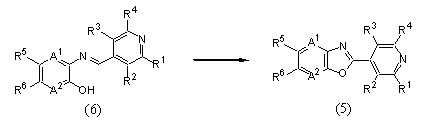
[식 중, R1, R2, R3, R4, R5, R6, A1 및 A2는 상기와 동일한 의미를 나타낸다][Wherein, R 1 , R 2 , R 3 , R 4 , R 5 , R 6 , A 1 and A 2 represent the same meaning as described above]
상기 반응은 통상 용매의 존재 하에서 실시된다.The reaction is usually carried out in the presence of a solvent.
상기 용매로는 THF, 에틸렌글리콜디메틸에테르, 1,4-디옥산 등의 에테르류, 헥산, 헵탄 등의 지방족 탄화수소류, 톨루엔, 크실렌 등의 방향족 탄화수소류, 디클로로메탄, 클로로포름, 클로로벤젠 등의 할로겐화 탄화수소류, 아세트산에틸, 아세트산부틸 등의 에스테르류, 메탄올, 에탄올 등의 알코올류, 아세트니트릴 등의 니트릴류, N,N-디메틸포름아미드(이하, DMF로 기재하는 경우가 있음) 등의 산아미드류, 지메틸설폭시드(이하, DMSO로 기재하는 경우가 있음) 등의 설폭시드류, 아세트산 및 이들 혼합물을 예로 들 수 있다.Examples of the solvent include ethers such as THF, ethylene glycol dimethyl ether and 1,4-dioxane, aliphatic hydrocarbons such as hexane and heptane, aromatic hydrocarbons such as toluene and xylene, halogenated dichloromethane, chloroform and chlorobenzene. Acids, such as hydrocarbons, esters, such as ethyl acetate and butyl acetate, alcohols, such as methanol and ethanol, nitriles, such as acetonitrile, and N, N- dimethylformamide (henceforth described in DMF) Examples thereof include sulfoxides such as Drew and Zymethyl sulfoxide (hereinafter sometimes referred to as DMSO), acetic acid, and mixtures thereof.
상기 산화제로는 아세트산납(IV), 산화납(IV) 등의 금속산화제, 요오드벤젠디아세테이트(diacetate) 등의 유기 과옥화물류(organic periodides) 등을 예로 들 수 있다.Examples of the oxidizing agent include metal oxidizing agents such as lead (IV) and lead (IV), and organic periodides such as iodine benzene diacetate.
화합물 (6) 1몰에 대해서 산화제가 통상 1~3몰의 비율로 사용된다.An oxidizing agent is normally used in the ratio of 1-3 mol with respect to 1 mol of compounds (6).
상기 반응의 반응온도는 통상 0~100℃의 범위이고, 반응시간은 통상 0.1~24시간의 범위이다.The reaction temperature of the said reaction is the range of 0-100 degreeC normally, and reaction time is the range of 0.1-24 hours normally.
반응종료 후에는 반응혼합물을 유기용매로 추출하고, 유기층을 건조, 농축하는 등의 후처리 조작을 함으로써 화합물 (5)를 단리할 수가 있다. 단리된 화합물 (5)는 크로마토그래피 재결정 등에 의해 더 정제할 수도 있다.
After completion of the reaction, the compound (5) can be isolated by performing a post-treatment operation such as extracting the reaction mixture with an organic solvent and drying and concentrating the organic layer. Isolated compound (5) may be further purified by chromatography recrystallization or the like.
(제조법 3)(Manufacturing method 3)
상기 화합물 (5)는 화합물 (7)을 탈수 축합제의 존재 하에 반응시킴으로써 제조할 수가 있다.The compound (5) can be produced by reacting the compound (7) in the presence of a dehydrating condensing agent.

[식 중, R1, R2, R3, R4, R5, R6, A1 및 A2는 상기와 동일한 의미를 나타낸다][Wherein, R 1 , R 2 , R 3 , R 4 , R 5 , R 6 , A 1 and A 2 represent the same meaning as described above]
상기 반응은 통상 용매의 존재 하에서 실시된다.The reaction is usually carried out in the presence of a solvent.
상기 용매로는 THF, 에틸렌글리콜디메틸에테르, 1,4-디옥산 등의 에테르류, 톨루엔, 크실렌 등의 방향족 탄화수소류, 디클로로메탄, 클로로포름, 사염화탄소, 클로로벤젠 등의 할로겐화 탄화수소류, 아세트산에틸, 아세트산부틸 등의 에스테르류, 아세트니트릴 등의 니트릴류 및 이들 혼합물을 예로 들 수 있다. 이 중 사염화탄소는 탈수 축합제로서 사용할 수가 있다.Examples of the solvent include ethers such as THF, ethylene glycol dimethyl ether, 1,4-dioxane, aromatic hydrocarbons such as toluene and xylene, halogenated hydrocarbons such as dichloromethane, chloroform, carbon tetrachloride and chlorobenzene, ethyl acetate and acetic acid. Esters such as butyl, nitriles such as acetonitrile, and mixtures thereof. Among these, carbon tetrachloride can be used as a dehydration condensing agent.
상기 탈수 축합제로는 트리페닐포스핀과 염기와 사염화탄소 혹은 사브롬화탄소의 혼합물, 트리페닐포스핀과 아조디카르본산디에틸에스테르 등의 아조디에스테르류의 혼합물 등을 예로 들 수 있다.Examples of the dehydrating condensing agent include a mixture of triphenylphosphine and a base, a carbon tetrachloride or carbon tetrabromide, and a mixture of azodiesters such as triphenylphosphine and azodicarboxylic acid diethyl ester.
상기 염기로는 트리에틸아민, 디이소프로필에틸아민 등의 제3급 아민류 등을 예로 들 수 있다.Examples of the base include tertiary amines such as triethylamine and diisopropylethylamine.
화합물 (7) 1몰에 대해서 탈수 축합제가 통상 1~3몰의 비율로 사용된다. 염기를 사용하는 경우, 그 비율은 화합물 (7) 1몰에 대해서 통상 1~5몰이다.A dehydration condensation agent is normally used in 1 to 3 mol ratio with respect to 1 mol of compound (7). When using a base, the ratio is 1-5 mol normally with respect to 1 mol of compounds (7).
성기 반응의 반응온도는 통상 -30~100℃의 범위이고, 반응시간은 통상 0.5~24시간의 범위이다.The reaction temperature of the genital reaction is usually in the range of -30 to 100 ° C, and the reaction time is usually in the range of 0.5 to 24 hours.
반응종료 후에는 반응혼합물을 유기용매로 추출하고, 유기층을 건조, 농축하는 등의 후처리 조작을 함으로써 화합물 (5)를 단리할 수가 있다. 단리된 화합물 (5)는 크로마토그래피, 재결정 등에 의해 더 정제할 수도 있다.
After completion of the reaction, the compound (5) can be isolated by performing a post-treatment operation such as extracting the reaction mixture with an organic solvent and drying and concentrating the organic layer. Isolated compound (5) may be further purified by chromatography, recrystallization or the like.
(제조법 4)(Manufacturing method 4)
상기 화합물 (5)는 화합물 (7)을 산의 존재 하에 반응시킴으로써 제조할 수가 있다.The compound (5) can be produced by reacting the compound (7) in the presence of an acid.
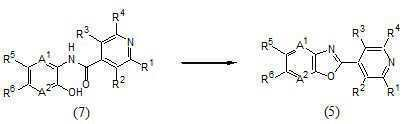
[식 중, R1, R2, R3, R4, R5, R6, A1 및 A2는 상기와 동일한 의미를 나타낸다][Wherein, R 1 , R 2 , R 3 , R 4 , R 5 , R 6 , A 1 and A 2 represent the same meaning as described above]
상기 반응은 통상 용매의 존재 하에서 실시된다.The reaction is usually carried out in the presence of a solvent.
상기 용매로는 THF, 에틸렌글리콜디메틸에테르, 1,4-디옥산 등의 에테르류, 톨루엔, 크실렌 등의 방향족 탄화수소류, 디클로로메탄, 클로로포름, 클로로벤젠 등의 할로겐화 탄화수소류 및 이들 혼합물을 예로 들 수 있다.Examples of the solvent include ethers such as THF, ethylene glycol dimethyl ether, 1,4-dioxane, aromatic hydrocarbons such as toluene and xylene, halogenated hydrocarbons such as dichloromethane, chloroform and chlorobenzene, and mixtures thereof. have.
상기 산으로는 p-톨루엔설폰산 등의 설폰산류, 폴리인산 등을 예로 들 수 있다.Examples of the acid include sulfonic acids such as p-toluenesulfonic acid, polyphosphoric acid, and the like.
화합물 (7) 1몰에 대해서 산이 통상 0.1~3몰의 비율로 사용된다.Acid is normally used in the ratio of 0.1-3 mol with respect to 1 mol of compounds (7).
상기 반응의 반응온도는 통상 50~200℃의 범위이고, 반응시간은 통상 1~24시간의 범위이다.The reaction temperature of the said reaction is the range of 50-200 degreeC normally, and reaction time is the range of 1-24 hours normally.
반응종료 후에는 반응혼합물을 유기용매로 추출하고, 유기층을 건조, 농축하는 등의 후처리 조작을 함으로써 화합물 (5)를 단리할 수가 있다. 단리된 화합물 (5)는 크로마토그래피, 재결정 등에 의해 더 정제할 수도 있다.
After completion of the reaction, the compound (5) can be isolated by performing a post-treatment operation such as extracting the reaction mixture with an organic solvent and drying and concentrating the organic layer. Isolated compound (5) may be further purified by chromatography, recrystallization or the like.
(제조법 5)(Manufacturing method 5)
일반식 (1)에서 n이 0이고, R3가―OR8인 화합물 (5-a)는 화합물 (8)과 화합물 (9)를 염기의 존재 하에 반응시킴으로써 제조할 수가 있다.In formula (1), compound (5-a) in which n is 0 and R 3 is —OR 8 can be produced by reacting compound (8) with compound (9) in the presence of a base.
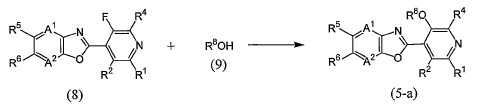
[식 중, R1, R2, R4, R5, R6, R8, A1 및 A2는 상기와 동일한 의미를 나타낸다.][Wherein, R 1 , R 2 , R 4 , R 5 , R 6 , R 8 , A 1 and A 2 represent the same meanings as above.]
상기 반응은 통상 용매의 존재 하에서 실시되나, 화합물 (9)를 용매량 사용하여도 좋다.Although the said reaction is normally performed in presence of a solvent, you may use a compound amount of compound (9).
상기 용매로는 THF, 에틸렌글리콜디메틸에테르, 1,4-디옥산 등의 에테르류, 톨루엔, 크실렌 등의 방향족 탄화수소류, 아세트니트릴 등의 니트릴류, DMF 등의 산아미드류, DMSO 등의 설폭시드류 및 이들 혼합물을 예로 들 수 있다.Examples of the solvent include ethers such as THF, ethylene glycol dimethyl ether, 1,4-dioxane, aromatic hydrocarbons such as toluene and xylene, nitriles such as acetonitrile, acid amides such as DMF, and sulfoxy such as DMSO. Drew and mixtures thereof are exemplified.
상기 염기로는 수소화나트륨 등의 알칼리금속 수소화물류, 탄산칼륨 등의 탄산염류 등을 예로 들 수 있다.Examples of the base include alkali metal hydrides such as sodium hydride and carbonates such as potassium carbonate.
화합물 (8) 1몰에 대해서 화합물 (9)가 통상 1~100몰의 비율, 염기가 통상 1~10몰의 비율로 사용된다.With respect to 1 mol of compound (8), compound (9) is normally used in the ratio of 1-100 mol, and a base is normally 1-10 mol.
상기 반응의 반응온도는 통상 0~120℃의 범위이고, 반응시간은 통상 0.5~24시간의 범위이다.The reaction temperature of the said reaction is the range of 0-120 degreeC normally, and reaction time is the range of 0.5-24 hours normally.
이 반응종료 후, 다시 수소첨가반응, 산화반응 및 환원반응 등의 공지의 반응을 실시함으로써 R8를 임의로 더 변환할 수도 있다.After the completion of this reaction, R 8 may be further optionally converted by performing known reactions such as hydrogenation, oxidation and reduction.
반응종료 후에는 반응혼합물을 유기용매로 추출하고, 유기층을 건조, 농축하는 등의 후처리 조작을 함으로써 화합물 (5-a)를 단리할 수가 있다. 단리된 화합물 (5-a)는 크로마토그래피, 재결정 등에 의해 더 정제할 수도 있다.
After completion of the reaction, the compound (5-a) can be isolated by post-treatment such as extracting the reaction mixture with an organic solvent, drying and concentrating the organic layer. Isolated compound (5-a) may be further purified by chromatography, recrystallization or the like.
(제조법 6)(Manufacture method 6)
일반식 (1)에서 n이 0이고, R3가 -SR8인 화합물 (5-b)는 화합물 (8)과 화합물 (10)을 염기의 존재 하에 반응시킴으로써 제조할 수가 있다.In formula (1), compound (5-b) in which n is 0 and R 3 is -SR 8 can be produced by reacting compound (8) and compound (10) in the presence of a base.
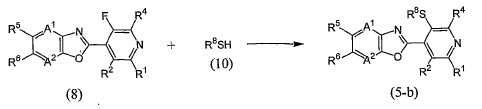
[식 중, R1, R2, R4, R5, R6, R8, A1 및 A2는 상기와 동일한 의미를 나타낸다.][Wherein, R 1 , R 2 , R 4 , R 5 , R 6 , R 8 , A 1 and A 2 represent the same meanings as above.]
상기 반응은 통상 용매의 존재 하에서 실시된다.The reaction is usually carried out in the presence of a solvent.
상기 용매로는 THF, 에틸렌글리콜디메틸에테르, 1,4-디옥산 등의 에테르류, 톨루엔, 크실렌 등의 방향족 탄화수소류, 아세트니트릴 등의 니트릴류, DMF 등의 산아미드류, DMSO 등의 설폭시드류 및 이들 혼합물을 예로 들 수 있다.Examples of the solvent include ethers such as THF, ethylene glycol dimethyl ether, 1,4-dioxane, aromatic hydrocarbons such as toluene and xylene, nitriles such as acetonitrile, acid amides such as DMF, and sulfoxy such as DMSO. Drew and mixtures thereof are exemplified.
상기 염기로는 수소화나트륨 등의 알칼리금속 수소화물류, 탄산칼륨 등의 탄산염류 등을 예로 들 수 있다.Examples of the base include alkali metal hydrides such as sodium hydride and carbonates such as potassium carbonate.
화합물 (8) 1몰에 대해서, 화합물 (10)이 통상 1~10몰의 비율, 염기가 통상 1~10몰의 비율로 사용된다.With respect to 1 mol of compound (8), the compound (10) is normally used in the ratio of 1-10 mol, and the base is normally 1-10 mol.
상기 반응의 반응온도는 통상 0~100℃의 범위이고, 반응시간은 통상 0.5~24시간의 범위이다.The reaction temperature of the said reaction is the range of 0-100 degreeC normally, and reaction time is the range of 0.5-24 hours normally.
반응종료 후에는 반응혼합물을 유기용매로 추출하고, 유기층을 건조, 농축하는 등의 후처리 조작을 함으로써 화합물 (5-b)를 단리할 수가 있다. 단리된 화합물 (5-b)는 크로마토그래피, 재결정 등에 의해 더 정제할 수도 있다.After completion of the reaction, the compound (5-b) can be isolated by performing a post-treatment operation such as extracting the reaction mixture with an organic solvent and drying and concentrating the organic layer. Isolated compound (5-b) may be further purified by chromatography, recrystallization or the like.
이 반응종료 후, 당업자에게 공지의 산화반응을 실시함으로써 -SR8를 -S(O)m1R8(m1은 1 또는 2를 나타낸다)로 더 변환할 수도 있다.
After completion of this reaction, -SR 8 may be further converted to -S (O) m1 R 8 (m1 represents 1 or 2) by carrying out an oxidation reaction known to those skilled in the art.
(제조법 7)(Manufacture method 7)
일반식 (1)에서 n이 0이고, R3가 -NR8R9인 화합물 (5-c)는 화합물 (8)과 화합물 (11)을 염기의 존재 하에 반응시킴으로써 제조할 수가 있다.In formula (1), compound (5-c) in which n is 0 and R 3 is -NR 8 R 9 can be prepared by reacting compound (8) with compound (11) in the presence of a base.

[식 중, R1, R2, R4, R5, R6, R8, R9,A1 및 A2는 상기와 동일한 의미를 나타낸다.][Wherein, R 1 , R 2 , R 4 , R 5 , R 6 , R 8 , R 9 , A 1 and A 2 represent the same meanings as above.]
상기 반응은 통상 용매의 존재 하에서 실시된다.The reaction is usually carried out in the presence of a solvent.
상기 용매로는 THF, 에틸렌글리콜디메틸에테르, 1,4-디옥산 등의 에테르류, 톨루엔, 크실렌 등의 방향족 탄화수소류, 아세트니트릴 등의 니트릴류, DMF 등의 산아미드류, DMSO 등의 설폭시드류 및 이들 혼합물을 예로 들 수 있다.Examples of the solvent include ethers such as THF, ethylene glycol dimethyl ether, 1,4-dioxane, aromatic hydrocarbons such as toluene and xylene, nitriles such as acetonitrile, acid amides such as DMF, and sulfoxy such as DMSO. Drew and mixtures thereof are exemplified.
상기 염기로는 수소화나트륨 등의 알칼리금속 수소화물류 , 탄산칼륨 등의 탄산염류 등을 예로 들 수 있다.Examples of the base include alkali metal hydrides such as sodium hydride and carbonates such as potassium carbonate.
화합물 (8) 1몰에 대해서 화합물 (11)이 통상 1~10몰의 비율, 염기가 통상 1~10몰의 비율로 사용된다.With respect to 1 mol of compound (8), compound (11) is normally used in the ratio of 1-10 mol, and a base is normally 1-10 mol.
상기 반응의 반응온도는 통상 0~100℃의 범위이고, 반응시간은 통상 0.1~24시간의 범위이다.The reaction temperature of the said reaction is the range of 0-100 degreeC normally, and reaction time is the range of 0.1-24 hours normally.
반응종료 후에는 반응혼합물을 유기용매로 추출하고, 유기층을 건조, 농축하는 등의 후처리 조작을 함으로써 화합물 (5-c)를 단리할 수가 있다. 단리된 화합물 (5-c)는 크로마토그래피, 재결정 등에 의해 더 정제할 수도 있다.
After completion of the reaction, the compound (5-c) can be isolated by performing a post-treatment operation such as extracting the reaction mixture with an organic solvent and drying and concentrating the organic layer. Isolated compound (5-c) may be further purified by chromatography, recrystallization or the like.
(제조법 8)(Manufacturing method 8)
일반식 (1)에서 n이 0이고, R3가 -NR8COR9인 화합물 (5-d)는 화합물 (12)와 일반식 (13)에서 나타내는 산무수물 또는 일반식 (14)에서 나타내는 산염화물을 반응시킴으로써 제조할 수가 있다.Compound (5-d) in which n is 0 in formula (1) and R 3 is -NR 8 COR 9 is an acid anhydride represented by compound (12) and formula (13) or an acid chloride represented by formula (14). It can manufacture by making it react.
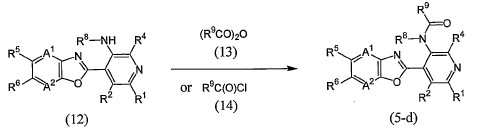
[식 중, R1, R2, R4, R5, R6, R8, R9, A1 및 A2는 상기와 동일한 의미를 나타낸다.][Wherein, R 1 , R 2 , R 4 , R 5 , R 6 , R 8 , R 9 , A 1 and A 2 represent the same meanings as above.]
상기 반응은 통상 용매의 존재 하에서 실시된다.The reaction is usually carried out in the presence of a solvent.
상기 용매로는 THF, 에틸렌글리콜디메틸에테르, 1,4-디옥산 등의 에테르류, 톨루엔, 크실렌 등의 방향족 탄화수소류, 아세트니트릴 등의 니트릴류, DMF 등의 산아미드류, DMSO 등의 설폭시드류, 피리딘, 퀴놀린 등의 함질소 방향족 화합물류 및 이들 혼합물을 예로 들 수 있다. 상기 반응이 화합물 (12)와 화합물 (13)의 반응인 경우, 예시한 용매를 대신하여 화합물 (13)을 용매량 사용하여도 좋다.Examples of the solvent include ethers such as THF, ethylene glycol dimethyl ether, 1,4-dioxane, aromatic hydrocarbons such as toluene and xylene, nitriles such as acetonitrile, acid amides such as DMF, and sulfoxy such as DMSO. Nitrogen-containing aromatic compounds, such as Drew, pyridine, and quinoline, and their mixture are mentioned. When the said reaction is reaction of compound (12) and compound (13), you may use a solvent amount of compound (13) instead of the illustrated solvent.
상기 반응은 필요에 따라서 염기를 첨가하여 실시할 수도 있다.The reaction may be carried out by adding a base as necessary.
상기 염기로는 수소화나트륨 등의 알칼리금속 수소화물류, 탄산칼륨 등의 탄산염류, 트리에틸아민, 디이소프로필에틸아민 등의 제3급 아민류 및 피리딘, 4-디메틸아미노피리딘 등의 함질소 방향족 화합물류 등을 예로 들 수 있다.Examples of the base include alkali metal hydrides such as sodium hydride, carbonates such as potassium carbonate, tertiary amines such as triethylamine and diisopropylethylamine, and nitrogen-containing aromatic compounds such as pyridine and 4-dimethylaminopyridine. Etc. can be mentioned.
화합물 (12) 1몰에 대해서, 화합물 (13) 또는 화합물 (14)가 통상 1~10몰의 비율로 사용된다. 염기를 첨가하여 반응시키는 경우, 그 염기의 양은 화합물 (12) 1몰에 대해서 통상 1~10몰의 비율이다.With respect to 1 mol of compound (12), compound (13) or compound (14) is usually used in a ratio of 1 to 10 mol. When adding and reacting a base, the amount of the base is usually 1-10 mol with respect to 1 mol of compounds (12).
상기 반응의 반응온도는 통상 0~120℃의 범위이고, 반응시간은 통상 0.1~24시간의 범위이다.The reaction temperature of the said reaction is the range of 0-120 degreeC normally, and reaction time is the range of 0.1-24 hours normally.
반응종료 후에는 반응혼합물을 유기용매로 추출하고, 유기층을 건조, 농축하는 등의 후처리 조작을 함으로써 화합물 (5-d)를 단리할 수가 있다. 단리된 화합물 (5-d)는 크로마토그래피, 재결정 등에 의해 더 정제할 수도 있다.
After completion of the reaction, the compound (5-d) can be isolated by performing a post-treatment operation such as extracting the reaction mixture with an organic solvent and drying and concentrating the organic layer. Isolated compound (5-d) may be further purified by chromatography, recrystallization or the like.
(제조법 9)(Manufacture method 9)
일반식 (1)에서 n이 0이고, R3가 아래와 같이 -R3x인 화합물 (5-e)는 화합물 (15)와 식 (16)에서 나타내는 보론산 화합물 또는 식 (17)에서 나타내는 주석 화합물을 팔라듐 화합물의 존재 하에 반응시킴으로써 제조할 수가 있다.Compound (5-e) wherein n is 0 in formula (1) and R 3 is -R 3x as follows is a boronic acid compound represented by compound (15) and formula (16) or a tin compound represented by formula (17). Can be produced by reacting in the presence of a palladium compound.
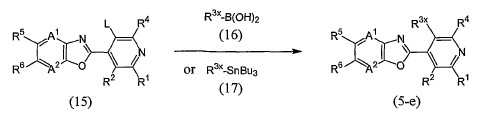
[식 중, R1, R2, R4, R5, R6, A1 및 A2는 상기와 동일한 의미를 나타내고, L은 브롬원자 또는 요오드원자를 나타내고, R3x는 군 Y로부터 선택되는 기로 치환되어 있어도 좋은 페닐기 또는 군 Y로부터 선택되는 기로 치환되어 있어도 좋은 5원 방향족 복소환기 혹은 6원 방향족 복소환기(단, 피리딘환과 탄소원자 상에서 결합하는 방향족 복소환기로 한정한다)를 나타낸다.][In formula, R <1> , R <2> , R <4> , R <5> , R <6> , A <1> and A <2> represent the same meaning as the above, L represents a bromine atom or an iodine atom, and R <3x> is chosen from group Y Or a 5-membered aromatic heterocyclic group or a 6-membered aromatic heterocyclic group which may be substituted with a phenyl group which may be substituted with a group or a group selected from group Y, provided that it is limited to an aromatic heterocyclic group bonded on a pyridine ring and a carbon atom.]
상기 반응은 통상 용매의 존재 하에서 실시된다.The reaction is usually carried out in the presence of a solvent.
상기 용매로는 THF, 에틸렌글리콜디메틸에테르, 1,4-디옥산 등의 에테르류, 메탄올, 에탄올 등의 알코올류, 헥산, 헵탄, 옥탄 등의 지방족 탄화수소류, 톨루엔, 크실렌 등의 방향족 탄화수소류, DMF 등의 산아미드류, 물 및 이들 혼합물 등을 예로 들 수 있다.Examples of the solvent include ethers such as THF, ethylene glycol dimethyl ether, 1,4-dioxane, alcohols such as methanol and ethanol, aliphatic hydrocarbons such as hexane, heptane and octane, aromatic hydrocarbons such as toluene and xylene, Acid amides, such as DMF, water, these mixtures, etc. are mentioned.
상기 팔라듐 화합물로는 아세트산 팔라듐, 테트라키스트리페닐포스핀팔라듐,{1,1'-비스(디페닐포스피노)페로센}디클로로팔라듐염화메틸렌착체 및 디클로로비스(트리페닐포스핀)팔라듐(II) 등을 예로 들 수 있다.Examples of the palladium compound include palladium acetate, tetrakistriphenylphosphine palladium, {1,1'-bis (diphenylphosphino) ferrocene} dichloropalladium methylene complex, dichlorobis (triphenylphosphine) palladium (II), and the like. For example.
화합물 (15) 1몰에 대해서, 화합물 (16) 또는 화합물 (17)이 통상 0.5~5몰의 비율, 팔라듐 화합물이 통상 0.001~0.1몰의 비율로 사용된다.With respect to 1 mol of compound (15), the compound (16) or the compound (17) is usually used in a proportion of 0.5 to 5 mol, and the palladium compound is usually used in a ratio of 0.001 to 0.1 mol.
상기 반응은 필요에 따라서 염기 및/또는 상관이동촉매의 존재 하에서 실시할 수도 있다.The reaction may be carried out in the presence of a base and / or a correlation transfer catalyst, if necessary.
상기 염기로는 아세트산나트륨, 아세트산칼륨, 탄산칼륨, 인산삼칼륨, 탄산수소나트륨 등의 무기염류를 예로 들 수 있다.Examples of the base include inorganic salts such as sodium acetate, potassium acetate, potassium carbonate, tripotassium phosphate and sodium hydrogen carbonate.
상기 상관이동촉매로는 테트라부틸암모늄브로미드, 벤질트리에틸암모늄브로미드 등의 제4급 암모늄염을 예로 들 수 있다.As said correlation transfer catalyst, quaternary ammonium salts, such as tetrabutylammonium bromide and benzyl triethylammonium bromide, are mentioned.
상기 염기나 상기 상관이동촉매의 양은 사용하는 화합물의 종류 등에 따라서 적절히 선택할 수가 있다.The amount of the base and the correlation transfer catalyst can be appropriately selected depending on the kind of the compound to be used and the like.
상기 반응의 반응온도는 통상 50~120℃의 범위이고, 반응시간은 통상 0.5~24시간의 범위이다.The reaction temperature of the said reaction is the range of 50-120 degreeC normally, and reaction time is the range of 0.5-24 hours normally.
반응종료 후에는 반응혼합물을 유기용매로 추출하고, 유기층을 건조, 농축하는 등의 후처리 조작을 함으로써 화합물 (5-e)을 단리할 수가 있다. 단리된 화합물 (5-e)는 크로마토그래피, 재결정 등에 의해 더 정제할 수도 있다.
After completion of the reaction, the compound (5-e) can be isolated by performing a post-treatment operation such as extracting the reaction mixture with an organic solvent and drying and concentrating the organic layer. Isolated compound (5-e) may be further purified by chromatography, recrystallization or the like.
(제조법 10)(Manufacturing method 10)
일반식 (1)에서 n이 0이고, R3가 하기 R3y인 화합물 (5-f)는 화합물 (8)과 화합물 (18)을 염기의 존재 하에 반응시킴으로써 제조할 수가 있다.Compound (5-f) in which n is 0 in Formula (1) and R 3 is R 3y below can be produced by reacting Compound (8) and Compound (18) in the presence of a base.

[식 중, R1, R2, R4, R5, R6, A1 및 A2는 상기와 동일한 의미를 나타내고, R3y는 군 Y로부터 선택되는 기로 치환되어 있어도 좋은 5원 복소환기 또는 6원 복소환기(단, 피리딘환과 질소원자 상에서 결합하는 복소환기에 한정한다)를 나타낸다.][In formula, R <1> , R <2> , R <4> , R <5> , R <6> , A <1> and A <2> represent the same meaning as the above, R <3y> may be substituted with the group chosen from group Y, or the 5-membered heterocyclic group or 6-membered heterocyclic group, provided that it is limited to a heterocyclic group bonded on a pyridine ring and a nitrogen atom.]
상기 반응은 통상 용매의 존재 하에서 실시된다.The reaction is usually carried out in the presence of a solvent.
상기 용매로는 THF, 에틸렌글리콜디메틸에테르, 1,4-디옥산 등의 에테르류, 톨루엔, 크실렌 등의 방향족 탄화수소류, 아세트니트릴 등의 니트릴류, DMF 등의 산아미드류, DMSO 등의 설폭시드류 및 이들 혼합물을 예로 들 수 있다.Examples of the solvent include ethers such as THF, ethylene glycol dimethyl ether, 1,4-dioxane, aromatic hydrocarbons such as toluene and xylene, nitriles such as acetonitrile, acid amides such as DMF, and sulfoxy such as DMSO. Drew and mixtures thereof are exemplified.
상기 염기로는 수소화나트륨 등의 알칼리금속 수소화물류, 탄산칼륨 등의 탄산염류 등을 예로 들 수 있다.Examples of the base include alkali metal hydrides such as sodium hydride and carbonates such as potassium carbonate.
화합물 (8) 1몰에 대해서, 화합물 (18)이 통상 1~10몰의 비율, 염기가 통상 1~10몰의 비율로 사용된다.With respect to 1 mol of compound (8), compound (18) is normally used in the ratio of 1-10 mol, and a base is normally 1-10 mol.
상기 반응의 반응온도는 통상 0~150℃의 범위이고, 반응시간은 통상 0.1~24시간의 범위이다.The reaction temperature of the said reaction is the range of 0-150 degreeC normally, and reaction time is the range of 0.1-24 hours normally.
이 반응종료 후, 수소첨가반응, 산화반응, 환원반응 및 가수분해반응 등의 공지의 반응을 실시함으로써 R3y를 임의로 더 변환할 수도 있다.After the completion of the reaction, R 3y may be further optionally converted by performing known reactions such as hydrogenation, oxidation, reduction and hydrolysis.
반응종료 후에는 반응혼합물을 유기용매로 추출하고, 유기층을 건조, 농축하는 등의 후처리 조작을 함으로써 화합물 (5-f)를 단리할 수가 있다. 단리된 화합물 (5-f)는 크로마토그래피, 재결정 등에 의해 더 정제할 수도 있다.
After completion of the reaction, the compound (5-f) can be isolated by performing a post-treatment operation such as extracting the reaction mixture with an organic solvent and drying and concentrating the organic layer. Isolated compound (5-f) may be further purified by chromatography, recrystallization or the like.
(제조법 11)(Manufacture method 11)
일반식 (1)에서 n이 1인 화합물 (19)는 화합물 (5)를 산화제의 존재 하에 반응시킴으로써 제조할 수가 있다.Compound (19) in which n is 1 in General Formula (1) can be produced by reacting Compound (5) in the presence of an oxidizing agent.
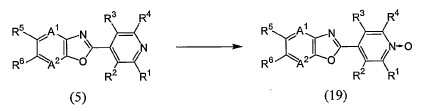
[식 중, R1, R2, R3, R4, R5, R6, A1 및 A2는 상기와 동일한 의미를 나타낸다.][Wherein, R 1 , R 2 , R 3 , R 4 , R 5 , R 6 , A 1 and A 2 represent the same meanings as above.]
상기 반응은 통상 용매의 존재 하에서 실시된다.The reaction is usually carried out in the presence of a solvent.
상기 용매로는 디클로로메탄, 클로로포름 등의 지방족할로겐화 탄화수소류, 아세트산, 물 및 이들 혼합물을 예로 들 수 있다.Examples of the solvent include aliphatic halogenated hydrocarbons such as dichloromethane and chloroform, acetic acid, water, and mixtures thereof.
상기 산화제로는 3-클로로과안식향산 등의 카르본산의 과산화물, 과산화수소수 등을 예로 들 수 있다.As said oxidizing agent, the peroxide of carboxylic acid, such as 3-chloro perbenzoic acid, hydrogen peroxide solution, etc. are mentioned, for example.
화합물 (5) 1몰에 대해서, 산화제가 통상 1~3몰의 비율로 사용된다.To 1 mol of compound (5), an oxidizing agent is usually used in the ratio of 1-3 mol.
상기 반응의 반응온도는 통상 -20~100℃의 범위이고, 반응시간은 통상 0.1~24시간의 범위이다.The reaction temperature of the reaction is usually in the range of -20 to 100 ° C, and the reaction time is usually in the range of 0.1 to 24 hours.
반응종료 후에는 반응혼합물을 유기용매로 추출하고, 유기층을 필요에 따라서 환원제의 수용액, 염기의 수용액으로 세정하고, 건조, 농축하는 등의 후처리 조작을 함으로써 화합물 (19)를 단리할 수가 있다. 단리된 화합물 (19)는 크로마토그래피, 재결정 등에 의해 더 정제할 수도 있다.After completion of the reaction, the reaction mixture can be extracted with an organic solvent, and the compound (19) can be isolated by performing post-treatment operations such as washing the organic layer with an aqueous solution of a reducing agent and an aqueous solution of a base, drying and concentrating as necessary. Isolated compound (19) may be further purified by chromatography, recrystallization or the like.
상기 환원제로는 아황산나트륨, 티오황산나트륨을 예로 들 수 있고, 상기 염기로는 탄산수소나트륨을 예로 들 수 있다.
Examples of the reducing agent include sodium sulfite and sodium thiosulfate. Examples of the base include sodium hydrogen carbonate.
(제조법 12)(Manufacture method 12)
일반식 (1)에서 n이 0이고, R3가 -OR8인 화합물 (5-a)는 화합물 (20)과 화합물 (21)을 염기의 존재 하에 반응시킴으로써 제조할 수가 있다.In formula (1), compound (5-a) in which n is 0 and R 3 is -OR 8 can be produced by reacting compound (20) and compound (21) in the presence of a base.

[식 중, R1, R2, R4, R5, R6, R8, A1 및 A2는 상기와 동일한 의미를 나타내고, Ⅹ는 염소원자, 브롬원자, 요오드원자, -OS(O)2CF3 및 -OS(O)2CH3 등의 이탈기를 나타낸다.][In formula, R <1> , R <2> , R <4> , R <5> , R <6> , R <8> , A <1> and A <2> have the same meaning as the above, and Ⅹ is a chlorine atom, a bromine atom, an iodine atom, -OS (O ) Leaving groups such as 2 CF 3 and -OS (O) 2 CH 3 .
상기 반응은 통상 용매의 존재 하에서 실시된다.The reaction is usually carried out in the presence of a solvent.
상기 용매로는 THF, 에틸렌글리콜디메틸에테르, 1,4-디옥산 등의 에테르류, 톨루엔, 크실렌 등의 방향족 탄화수소류, 아세트니트릴 등의 니트릴류, DMF 등의 산아미드류, DMSO 등의 설폭시드류 및 이들 혼합물을 예로 들 수 있다.Examples of the solvent include ethers such as THF, ethylene glycol dimethyl ether, 1,4-dioxane, aromatic hydrocarbons such as toluene and xylene, nitriles such as acetonitrile, acid amides such as DMF, and sulfoxy such as DMSO. Drew and mixtures thereof are exemplified.
상기 염기로는 수소화나트륨 등의 알칼리금속 수소화물류, 탄산칼륨 등의 탄산염류 등을 예로 들 수 있다.Examples of the base include alkali metal hydrides such as sodium hydride and carbonates such as potassium carbonate.
화합물 (20) 1몰에 대해서 화합물 (21)이 통상 1~10몰의 비율, 염기가 통상 1~10몰의 비율로 사용된다.With respect to 1 mol of compound (20), compound (21) is normally used in the ratio of 1-10 mol, and a base is normally 1-10 mol.
상기 반응의 반응온도는 통상 0~120℃의 범위이고, 반응시간은 통상 0.5~24시간의 범위이다.The reaction temperature of the said reaction is the range of 0-120 degreeC normally, and reaction time is the range of 0.5-24 hours normally.
이 반응종료 후, 수소첨가반응, 산화반응 및 환원반응 등의 공지의 반응을 실시함으로써 R8를 임의로 더 변환할 수도 있다.After the completion of the reaction, R 8 may be further optionally converted by performing known reactions such as hydrogenation, oxidation, and reduction.
반응종료 후에는 반응혼합물을 유기용매로 추출하고, 유기층을 건조, 농축하는 등의 후처리 조작을 함으로써 화합물 (5-a)를 단리할 수가 있다. 단리된 화합물 (5-a)는 크로마토그래피, 재결정 등에 의해 더 정제할 수도 있다.
After completion of the reaction, the compound (5-a) can be isolated by post-treatment such as extracting the reaction mixture with an organic solvent, drying and concentrating the organic layer. Isolated compound (5-a) may be further purified by chromatography, recrystallization or the like.
(제조법 13)(Manufacturing Method 13)
일반식 (5-g)로 표시되는 화합물은 화합물 (15)와 화합물 (22)을 팔라듐 화합물, 염기 및 구리염의 존재 하에 반응시킴으로써 제조할 수가 있다.The compound represented by general formula (5-g) can be produced by reacting compound (15) and compound (22) in the presence of a palladium compound, a base and a copper salt.

[식 중, R1, R2, R4, R5, R6, A1, A2 및 L은 상기와 동일한 의미를 나타내고, R3z는 군 X로부터 선택되는 기로 치환되어 있어도 좋은 C1-C4쇄식 탄화수소기를 나타낸다.][In formula, R <1> , R <2> , R <4> , R <5> , R <6> , A <1> , A <2> and L have the same meaning as the above, and R <3z> may be substituted by the group chosen from group X. Chain hydrocarbon group.]
상기 반응은 통상 염기를 용매로서 사용하여 실시되나, 보조용매를 사용하여도 좋다.The reaction is usually carried out using a base as a solvent, but a cosolvent may be used.
상기 염기로는 트리에틸아민, 디에틸아민, 디이소프로필에틸아민 등의 아민류를 예로 들 수 있다.Examples of the base include amines such as triethylamine, diethylamine and diisopropylethylamine.
상기 보조용매로는 THF, 에틸렌글리콜디메틸에테르, 1,4-디옥산 등의 에테르류, DMF 등의 산아미드류 및 이들 혼합물 등을 예로 들 수 있다.Examples of the cosolvent include ethers such as THF, ethylene glycol dimethyl ether, 1,4-dioxane, acid amides such as DMF, and mixtures thereof.
상기 팔라듐 화합물로는 테트라키스트리페닐포스핀팔라듐,{1,1'-비스(디페닐포스피노)페로센}디클로로팔라듐염화메틸렌착체 및 디클로로비스(트리페닐포스핀)팔라듐(II) 등을 예로 들 수 있다.Examples of the palladium compound include tetrakistriphenylphosphine palladium, {1,1'-bis (diphenylphosphino) ferrocene} dichloropalladium methylene complex, dichlorobis (triphenylphosphine) palladium (II), and the like. Can be.
상기 구리염으로는 요오드화구리(I) 등을 예로 들 수 있다.Copper iodide (I) etc. are mentioned as said copper salt.
화합물 (15) 1몰에 대해서, 화합물 (22)가 통상 0.5~5몰의 비율, 팔라듐 화합물이 통상 0.001~0.1몰, 구리염이 0.001~0.1의 비율로 사용된다.With respect to 1 mol of compound (15), the proportion of compound (22) is usually 0.5 to 5 mol, the palladium compound is usually 0.001 to 0.1 mol, and the copper salt is used at a ratio of 0.001 to 0.1.
상기 반응은 팔라듐 화합물, 염기 및 구리염에 첨가하고, 상기 팔라듐 화합물에 결찰할 수 있는 결찰 화합물을 첨가하여 실시할 수도 있다.The reaction may be carried out by adding to a palladium compound, a base and a copper salt, and adding a ligation compound capable of ligation to the palladium compound.
상기 결찰 화합물로는 트리페닐포스핀, 트리(tert-부틸)포스핀 등의 포스핀류를 예로 들 수 있다.Examples of the ligation compound include phosphines such as triphenylphosphine and tri (tert-butyl) phosphine.
상기 반응의 반응온도는 통상 0~100℃의 범위이고, 반응시간은 통상 0.5~24시간의 범위이다.The reaction temperature of the said reaction is the range of 0-100 degreeC normally, and reaction time is the range of 0.5-24 hours normally.
반응종료 후에는 반응혼합물을 유기용매로 추출하고, 유기층을 건조, 농축하는 등의 후처리 조작을 함으로써 화합물 (5-g)를 단리할 수가 있다. 단리된 화합물 (5-g)는 크로마토그래피, 재결정 등에 의해 더 정제할 수도 있다.After completion of the reaction, the compound (5-g) can be isolated by performing a post-treatment operation such as extracting the reaction mixture with an organic solvent and drying and concentrating the organic layer. Isolated compound (5-g) may be further purified by chromatography, recrystallization or the like.
이 반응종료 후, 수소첨가반응, 산화반응, 환원반응, 가수분해반응 등의 공지의 반응을 실시함으로써 R3z 및 R3z와 피리딘환을 결합하는 3중결합을 임의로 변환할 수도 있다.After the completion of the reaction, a triple bond which combines R 3z and R 3z with a pyridine ring may be arbitrarily converted by known reactions such as hydrogenation, oxidation, reduction, and hydrolysis.
또한, 일반식 (22)에서 R3z가 트리메틸실릴기인 화합물 (23)을 팔라듐 화합물, 염기 및 구리염의 존재 하에 화합물 (15)와 반응시키고, 또한, 이 반응에 의해 얻어진 화합물에 대해 공지의 탈실릴화 반응을 실시함으로써 일반식 (5-g)에서의 R3z가 수소원자인 화합물 (5-g1)을 얻을 수가 있다. 화합물 (5-g1)은 수소첨가반응 등의 공지의 반응을 실시함으로써 3중결합을 임의로 변환할 수도 있다.
Further, in the general formula (22), a compound (23) in which R 3z is a trimethylsilyl group is reacted with the compound (15) in the presence of a palladium compound, a base and a copper salt, and further known desilyl is known for the compound obtained by this reaction. By carrying out the reaction, compound (5-g1) in which R 3z in General Formula (5-g) is a hydrogen atom can be obtained. Compound (5-g1) can also arbitrarily convert triple bonds by performing well-known reactions, such as a hydrogenation reaction.
(제조법 14)(Production method 14)
일반식 (1)에서 n이 0이고, R3가 시아노기인 화합물 (5-h)은 화합물 (15)와 금속시안화물을 반응시킴으로써 제조할 수가 있다.In formula (1), compound (5-h) in which n is 0 and R 3 is a cyano group can be produced by reacting compound (15) with a metal cyanide.
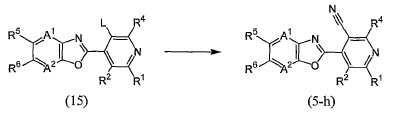
[식 중, R1, R2, R4, R5, R6, A1, A2 및 L은 상기와 동일한 의미를 나타낸다.][Wherein, R 1 , R 2 , R 4 , R 5 , R 6 , A 1 , A 2 and L represent the same meanings as above.]
상기 반응은 통상 용매의 존재 하에서 실시된다.The reaction is usually carried out in the presence of a solvent.
상기 용매로는 THF, 에틸렌글리콜디메틸에테르, 1,4-디옥산 등의 에테르류, DMF, 1-메틸-2-피롤리디논 등의 산아미드류, DMSO 등의 설폭시드류 및 이들 혼합물을 예로 들 수 있다.Examples of the solvent include ethers such as THF, ethylene glycol dimethyl ether, 1,4-dioxane, acid amides such as DMF, 1-methyl-2-pyrrolidinone, sulfoxides such as DMSO, and mixtures thereof. Can be mentioned.
상기 금속시안화물로는 시안화동(I) 등을 예로 들 수 있다.Copper cyanide (I) etc. are mentioned as said metal cyanide.
화합물 (15) 1몰에 대해서 금속시안화물가 통상 1~5몰의 비율로 사용된다.Metal cyanide is normally used in 1 to 5 mol ratio with respect to 1 mol of compound (15).
상기 반응의 반응온도는 통상 50~200℃의 범위이고, 반응시간은 통상 0.5~24시간의 범위이다.The reaction temperature of the said reaction is the range of 50-200 degreeC normally, and reaction time is the range of 0.5-24 hours normally.
반응종료 후에는 반응혼합물을 유기용매로 추출하고, 유기용매로 추출하고, 유기층을 건조, 농축하는 등의 후처리 조작을 함으로써 화합물 (5-h)를 단리할 수가 있다. 단리된 화합물 (5-h)는 크로마토그래피, 재결정 등에 의해 더 정제할 수도 있다.
After completion of the reaction, the compound (5-h) can be isolated by post-treatment such as extraction of the reaction mixture with an organic solvent, extraction with an organic solvent, drying and concentration of the organic layer. Isolated compound (5-h) may be further purified by chromatography, recrystallization or the like.
본 활성화합물의 제조에 사용하는 중간체는 시판되고 있거나, 공지의 문헌 등에 개시되고 있거나, 당업자에게 공지의 방법으로 제조할 수가 있다.Intermediates used in the preparation of the present active compounds are commercially available, disclosed in known literature and the like, or can be produced by methods known to those skilled in the art.
본 발명의 중간체는, 예를 들면, 하기의 방법에 의해 제조할 수가 있다.
The intermediate of the present invention can be produced, for example, by the following method.
(중간체 제조법 1)(Intermediate Manufacturing Method 1)
화합물 (3)은 하기 스킴에 나타내는 방법으로 제조할 수가 있다.Compound (3) can be manufactured by the method shown by the following scheme.
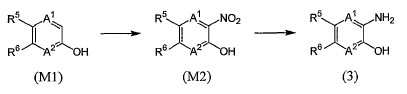
[식 중, R5, R6, A1 및 A2는 상기와 동일한 의미를 나타낸다.]
[Wherein, R 5 , R 6 , A 1 and A 2 represent the same meaning as described above.]
(공정 1)(Step 1)
화합물 (M2)은 화합물 (M1)과 니트로화제의 존재 하에서 반응시킴으로써 제조할 수가 있다.The compound (M2) can be produced by reacting the compound (M1) with the nitrating agent in the presence.
상기 반응은 통상 용매의 존재 하에서 실시된다.The reaction is usually carried out in the presence of a solvent.
상기 용매로는 클로로포름 등의 지방족할로겐화 탄화수소류, 아세트산, 농황산(concentrated sulfuric acid), 농질산(concentrated nitric acid), 물 및 이들 혼합물을 예로 들 수 있다.Examples of the solvent include aliphatic halogenated hydrocarbons such as chloroform, acetic acid, concentrated sulfuric acid, concentrated nitric acid, water, and mixtures thereof.
상기 니트로화제로는 농질산 등을 예로 들 수 있다.Examples of the nitrifying agent include concentrated nitric acid and the like.
화합물 (M1) 1몰에 대해서 니트로화제가 통상 1~3몰의 비율로 사용된다.A nitrating agent is normally used in the ratio of 1-3 mol with respect to 1 mol of compound (M1).
상기 반응의 반응온도는 통상-10~80℃의 범위이고, 반응시간은 통상 0.1~24시간의 범위이다.The reaction temperature of the said reaction is the range of -10-80 degreeC normally, and reaction time is the range of 0.1-24 hours normally.
반응종료 후에는 반응혼합물을 물에 첨가하고 유기용매로 추출하고, 유기층을 건조, 농축하는 등의 후처리 조작을 함으로써 화합물 (M2)를 단리할 수가 있다. 단리된 화합물 (M2)는 크로마토그래피, 재결정 등에 의해 더 정제할 수도 있다.
After completion of the reaction, the compound (M2) can be isolated by post-treatment such as adding the reaction mixture to water, extracting with an organic solvent, drying and concentrating the organic layer. Isolated compound (M2) may be further purified by chromatography, recrystallization or the like.
(공정 2)(Step 2)
화합물 (3)은 화합물 (M2)와 수소를 수소 첨가 촉매의 존재 하에 반응시킴으로써 제조할 수가 있다.Compound (3) can be produced by reacting compound (M2) with hydrogen in the presence of a hydrogenation catalyst.
상기 반응은 통상 1~100기압의 수소 분위기 하, 통상 용매의 존재 하에서 실시된다.The reaction is usually carried out in the presence of a solvent in a hydrogen atmosphere of 1 to 100 atm.
반응에 사용되는 용매로는 THF, 1,4-디옥산 등의 에테르류, 아세트산에틸, 아세트산부틸 등의 에스테르류, 메탄올, 에탄올 등의 알코올류, 물 및 이들 혼합물을 예로 들 수 있다.Examples of the solvent used for the reaction include ethers such as THF and 1,4-dioxane, esters such as ethyl acetate and butyl acetate, alcohols such as methanol and ethanol, water and mixtures thereof.
상기 수소 첨가 촉매로는 팔라듐탄소, 수산화팔라듐, 라네이니켈, 산화백금등의 천이 금속 화합물을 예로 들 수 있다.As said hydrogenation catalyst, transition metal compounds, such as palladium carbon, palladium hydroxide, a rain nickel, and platinum oxide, are mentioned.
화합물 (M2) 1몰에 대해서 수소가 통상 3몰의 비율, 수소 첨가 촉매가 통상 0.001~0.5몰의 비율로 사용된다.With respect to 1 mol of compound (M2), hydrogen is normally 3 mol, and a hydrogenation catalyst is normally used in the ratio of 0.001-0.5 mol.
상기 반응은 필요에 따라서 산이나 염기 등을 첨가하여 실시할 수도 있다.The reaction may be carried out by adding an acid, a base or the like as necessary.
상기 반응의 반응온도는 통상-20~100℃의 범위이고, 반응시간은 통상 0.1~24시간의 범위이다.The reaction temperature of the said reaction is the range of -20-100 degreeC normally, and reaction time is the range of 0.1-24 hours normally.
반응종료 후에는 반응혼합물을 여과하고, 필요에 따라서 유기용매로 추출하고, 유기층을 건조, 농축하는 등의 후처리 조작을 함으로써 화합물 (3)을 단리할 수가 있다. 단리된 화합물 (3)은 크로마토그래피, 재결정 등에 의해 더 정제할 수도 있다.
After completion of the reaction, the reaction mixture can be isolated by filtration, extraction with an organic solvent if necessary, and drying and concentrating the organic layer. Isolated compound (3) may be further purified by chromatography, recrystallization or the like.
(중간체 제조법 2)(Intermediate Production Method 2)
화합물 (6)은 화합물 (3)과 화합물 (M3)을 반응시킴으로써 제조할 수가 있다.Compound (6) can be produced by reacting Compound (3) with Compound (M3).

[식 중,R1, R2, R3, R4, R5, R6, A1 및 A2는 상기와 동일한 의미를 나타낸다.][Wherein, R 1 , R 2 , R 3 , R 4 , R 5 , R 6 , A 1 and A 2 represent the same meanings as above.]
상기 반응은 통상 용매의 존재 하에서 실시된다.The reaction is usually carried out in the presence of a solvent.
상기 용매로는 메탄올, 에탄올 등의 알코올류, THF, 에틸렌글리콜디메틸에테르, 1,4-디옥산 등의 에테르류, 톨루엔 등의 방향족 탄화수소류 및 이들 혼합물을 예로 들 수 있다.Examples of the solvent include alcohols such as methanol and ethanol, ethers such as THF, ethylene glycol dimethyl ether, 1,4-dioxane, aromatic hydrocarbons such as toluene, and mixtures thereof.
화합물 (3) 1몰에 대해서 화합물 (M3)이 통상 0.5~3몰의 비율로 사용된다.Compound (M3) is normally used in the ratio of 0.5-3 mol with respect to 1 mol of compound (3).
상기 반응은 필요에 따라서 산이나 염기 등을 첨가하여 실시할 수도 있다.The reaction may be carried out by adding an acid, a base or the like as necessary.
상기 반응의 반응온도는 통상 0~150℃의 범위이고, 반응시간은 통상 0.1~24시간의 범위이다.The reaction temperature of the said reaction is the range of 0-150 degreeC normally, and reaction time is the range of 0.1-24 hours normally.
반응종료 후에는 반응혼합물을 유기용매로 추출하고, 건조, 농축하는 등의 후처리 조작을 함으로써 화합물 (6)을 단리할 수가 있다. 단리된 화합물 (6)은 크로마토그래피, 재결정 등에 의해 더 정제할 수도 있다.
After completion of the reaction, the compound (6) can be isolated by post-treatment such as extraction of the reaction mixture with an organic solvent, drying and concentration. Isolated compound (6) may be further purified by chromatography, recrystallization or the like.
(중간체 제조법 3)(Intermediate Manufacturing Method 3)
화합물 (7)은 화합물 (3)과 화합물 (4)를 탈수 축합제의 존재 하에 반응시킴으로써 제조할 수가 있다.Compound (7) can be manufactured by making compound (3) and compound (4) react in presence of a dehydration condensing agent.

[식 중, R1, R2, R3, R4, R5, R6, A1 및 A2는 상기와 동일한 의미를 나타낸다.][Wherein, R 1 , R 2 , R 3 , R 4 , R 5 , R 6 , A 1 and A 2 represent the same meanings as above.]
상기 반응은 통상 용매의 존재 하에서 실시된다.The reaction is usually carried out in the presence of a solvent.
상기 용매로는 THF, 에틸렌글리콜디메틸에테르, 1,4-디옥산 등의 에테르류, 헥산, 헵탄, 옥탄 등의 지방족 탄화수소류, 톨루엔, 크실렌 등의 방향족 탄화수소류, 클로로벤젠 등의 할로겐화 탄화수소류, 아세트산에틸, 아세트산부틸 등의 에스테르류, 아세트니트릴 등의 니트릴류, DMF 등의 산아미드류, DMSO 등의 설폭시드류, 피리딘, 퀴놀린 등의 함질소 방향족 화합물류 및 이들 혼합물을 예로 들 수 있다.Examples of the solvent include ethers such as THF, ethylene glycol dimethyl ether, 1,4-dioxane, aliphatic hydrocarbons such as hexane, heptane and octane, aromatic hydrocarbons such as toluene and xylene, halogenated hydrocarbons such as chlorobenzene, Esters such as ethyl acetate and butyl acetate, nitriles such as acetonitrile, acid amides such as DMF, sulfoxides such as DMSO, nitrogen-containing aromatic compounds such as pyridine and quinoline, and mixtures thereof.
상기 탈수 축합제로는 1-에틸-3-(3-디메틸아미노프로필)카르보디이미드염산염(이하, WSC라고 함), 1,3-디시클로헥실카르보디이미드 등의 카르보디이미드류, (벤조트리아졸-1-일옥시)트리스(디메틸아미노)포스포늄헥사플루오로인산염(이하, BOP 시약이라고 함)을 예로 들 수 있다.Examples of the dehydrating condensing agent include carbodiimides such as 1-ethyl-3- (3-dimethylaminopropyl) carbodiimide hydrochloride (hereinafter referred to as WSC) and 1,3-dicyclohexylcarbodiimide, and (benzotria A sol-1-yloxy) tris (dimethylamino) phosphonium hexafluorophosphate (henceforth a BOP reagent) is mentioned.
화합물 (3) 1몰에 대해서, 화합물 (4)가 통상 1~3몰의 비율, 탈수 축합제가 통상 1~5몰의 비율로 사용된다.With respect to 1 mol of compound (3), the compound (4) is normally used in the ratio of 1-3 mol, and the dehydrating condensing agent is normally used in the ratio of 1-5 mol.
상기 반응의 반응온도는 통상 0~140℃의 범위이고, 반응시간은 통상 0.1~24시간의 범위이다.The reaction temperature of the said reaction is the range of 0-140 degreeC normally, and reaction time is the range of 0.1-24 hours normally.
반응종료 후에는 반응혼합물에 물을 첨가한 후, 유기용매로 추출하고, 유기층을 건조, 농축하는 등의 후처리 조작을 함으로써 화합물 (7)을 단리할 수가 있다. 단리된 화합물 (7)은 크로마토그래피, 재결정 등에 의해 더 정제할 수도 있다.
After completion of the reaction, compound (7) can be isolated by post-treatment such as adding water to the reaction mixture, extracting with an organic solvent, drying and concentrating the organic layer. Isolated compound (7) may be further purified by chromatography, recrystallization or the like.
(중간체 제조법 4)(Intermediate Manufacturing Method 4)
화합물 (7)은 화합물 (3)과 화합물 (M4)를 염기의 존재 하에 반응시킴으로써 제조할 수가 있다.Compound (7) can be produced by reacting Compound (3) and Compound (M4) in the presence of a base.
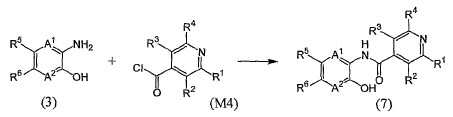
[식 중, R1, R2, R3, R4, R5, R6, A1 및 A2는 상기와 동일한 의미를 나타낸다.][Wherein, R 1 , R 2 , R 3 , R 4 , R 5 , R 6 , A 1 and A 2 represent the same meanings as above.]
상기 반응은 통상 용매의 존재 하에서 실시된다.The reaction is usually carried out in the presence of a solvent.
상기 용매로는 THF, 에틸렌글리콜디메틸에테르, 1,4-디옥산 등의 에테르류, 헥산, 헵탄, 옥탄 등의 지방족 탄화수소류, 톨루엔, 크실렌 등의 방향족 탄화수소류, 클로로벤젠 등의 할로겐화 탄화수소류, 아세트산에틸, 아세트산부틸 등의 에스테르류, 아세트니트릴 등의 니트릴류, DMF 등의 산아미드류, DMSO 등의 설폭시드류 및 이들 혼합물을 예로 들 수 있다.Examples of the solvent include ethers such as THF, ethylene glycol dimethyl ether, 1,4-dioxane, aliphatic hydrocarbons such as hexane, heptane and octane, aromatic hydrocarbons such as toluene and xylene, halogenated hydrocarbons such as chlorobenzene, Esters such as ethyl acetate and butyl acetate, nitriles such as acetonitrile, acid amides such as DMF, sulfoxides such as DMSO, and mixtures thereof.
상기 염기로는 탄산나트륨, 탄산칼륨 등의 알칼리금속 탄산염류, 트리에틸아민, 디이소프로필에틸아민 등의 제3급 아민류 및 피리딘, 4-디메틸아미노피리딘 등의 함질소 방향족 화합물류 등을 예로 들 수 있다.Examples of the base include alkali metal carbonates such as sodium carbonate and potassium carbonate, tertiary amines such as triethylamine and diisopropylethylamine, and nitrogen-containing aromatic compounds such as pyridine and 4-dimethylaminopyridine. have.
화합물 (3) 1몰에 대해서 화합물 (M4)가 통상 1~3몰의 비율, 염기가 통상 1~10몰의 비율로 사용된다.With respect to 1 mol of compound (3), compound (M4) is normally used in the ratio of 1-3 mol, and a base is normally 1-10 mol.
상기 반응의 반응온도는 통상-20~100℃의 범위이고, 반응시간은 통상 0.1~24시간의 범위이다.The reaction temperature of the said reaction is the range of -20-100 degreeC normally, and reaction time is the range of 0.1-24 hours normally.
반응종료 후에는 반응혼합물에 물을 첨가한 후, 유기용매로 추출하고, 유기층을 건조, 농축하는 등의 후처리 조작을 함으로써 화합물 (7)을 단리할 수가 있다. 단리된 화합물 (7)은 크로마토그래피, 재결정 등에 의해 더 정제할 수도 있다.
After completion of the reaction, compound (7) can be isolated by post-treatment such as adding water to the reaction mixture, extracting with an organic solvent, drying and concentrating the organic layer. Isolated compound (7) may be further purified by chromatography, recrystallization or the like.
(중간체 제조법 5)(Intermediate Manufacturing Method 5)
일반식 (4)에서 R1, R2, R4가 수소원자이고, R3가 아래와 같이 -R3p인 화합물 (4-a)는 하기 스킴에 나타내는 방법으로 제조할 수가 있다.In general formula (4), compound (4-a) whose R <1> , R <2> , R <4> is a hydrogen atom and R <3> is -R < 3p as follows can be manufactured by the method shown by the following scheme.
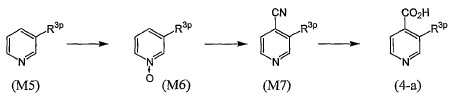
[식 중, R3p는 군 X로부터 선택되는 기로 치환되어 있어도 좋은 C1-C6쇄식 탄화수소기, 및, 군 X로부터 선택되는 기로 치환되어 있어도 좋은 C3-C6지환식 탄화수소기를 나타낸다. 군 X는 상기와 동일한 의미를 나타낸다.]
[ Wherein , R 3p represents a C 1 -C 6 chain hydrocarbon group which may be substituted with a group selected from group X, and a C 3 -C 6 alicyclic hydrocarbon group which may be substituted with a group selected from group X. Group X has the same meaning as above.]
(공정 1)(Step 1)
화합물 (M6)은 화합물 (M5)를 산화제의 존재 하에 반응시킴으로써 제조할 수가 있다.Compound (M6) can be produced by reacting compound (M5) in the presence of an oxidizing agent.
상기 반응은 통상 용매의 존재 하에서 실시된다.The reaction is usually carried out in the presence of a solvent.
상기 용매로는 디클로로메탄, 클로로포름 등의 지방족할로겐화 탄화수소류, 아세트산, 물 및 이들 혼합물을 예로 들 수 있다.Examples of the solvent include aliphatic halogenated hydrocarbons such as dichloromethane and chloroform, acetic acid, water, and mixtures thereof.
상기 산화제로는 3-클로로과안식향산 등의 카르본산의 과산화물, 과산화수소수를 예로 들 수 있다.As said oxidizing agent, the peroxide of hydrogen carboxylic acid, such as 3-chloro- and benzoic acid, and hydrogen peroxide number are mentioned, for example.
화합물 (M5) 1몰에 대해서 산화제가 통상 1~10몰의 비율로 사용된다.An oxidizing agent is normally used in 1-10 mol with respect to 1 mol of compounds (M5).
상기 반응의 반응온도는 통상 -20~120℃의 범위이고, 반응시간은 통상 0.1~24시간의 범위이다.The reaction temperature of the reaction is usually in the range of -20 to 120 ° C, and the reaction time is usually in the range of 0.1 to 24 hours.
반응종료 후에는 필요에 따라서 염기를 첨가하여 반응혼합물을 중화하고, 반응혼합물을 유기용매로 추출하고, 유기층을 필요에 따라서 환원제의 수용액, 염기의 수용액으로 세정하여, 건조, 농축하는 등의 후처리 조작을 함으로써 화합물 (M6)을 단리할 수가 있다. 단리된 화합물 (M6)은 크로마토그래피, 증류 등에 의해 더 정제할 수도 있다.After completion of the reaction, a base is added to neutralize the reaction mixture, if necessary, the reaction mixture is extracted with an organic solvent, and the organic layer is washed with an aqueous solution of a reducing agent and an aqueous solution of a base, dried and concentrated as necessary. Compound (M6) can be isolated by operation. Isolated compound (M6) may be further purified by chromatography, distillation or the like.
상기 염기로는 탄산나트륨, 탄산수소나트륨, 탄산칼륨 등의 알칼리금속 탄산염류를 예로 들 수 있고, 상기 환원제로는 아황산나트륨, 아황산수소나트륨, 티오황산나트륨을 예로 들 수 있다.
Examples of the base include alkali metal carbonates such as sodium carbonate, sodium bicarbonate and potassium carbonate. Examples of the reducing agent include sodium sulfite, sodium hydrogen sulfite and sodium thiosulfate.
(공정 2)(Step 2)
화합물 (M7)은 화합물 (M6)을 알킬화제 및 시아노화제의 존재 하에 반응시킴으로써 제조할 수가 있다.Compound (M7) can be prepared by reacting compound (M6) in the presence of an alkylating agent and a cyanoating agent.
상기 반응은 통상 용매의 존재 하에서 실시된다.The reaction is usually carried out in the presence of a solvent.
상기 용매로는 1,4-디옥산 등의 에테르류, 물 및 이들 혼합물을 예로 들 수 있다.Examples of the solvent include ethers such as 1,4-dioxane, water, and mixtures thereof.
상기 알킬화제로는 요오드메탄, 요오드에탄, 황산디메틸을 예로 들 수 있다.Examples of the alkylating agent include iodine methane, iodine ethane and dimethyl sulfate.
상기 시아노화제로는 시안화나트륨, 시안화칼륨을 예로 들 수 있다.Examples of the cyanoating agent include sodium cyanide and potassium cyanide.
화합물 (M6) 1몰에 대해서 알킬화제가 통상 1~10몰의 비율, 시아노화제가 통상 1~3몰의 비율로 사용된다.With respect to 1 mol of compound (M6), an alkylating agent is normally used in the ratio of 1-10 mol, and a cyanoating agent is normally used in the ratio of 1-3 mol.
상기 반응의 반응온도는 통상 0~100℃의 범위이고, 반응시간은 통상 0.1~24시간의 범위이다.The reaction temperature of the said reaction is the range of 0-100 degreeC normally, and reaction time is the range of 0.1-24 hours normally.
반응종료 후에는 반응혼합물을 유기용매로 추출하고, 유기층을 건조, 농축하는 등의 후처리 조작을 함으로써 화합물 (M7)을 단리할 수가 있다. 단리된 화합물 (M7)은 크로마토그래피, 재결정 등에 의해 더 정제할 수도 있다.
After completion of the reaction, the compound (M7) can be isolated by performing a post-treatment operation such as extracting the reaction mixture with an organic solvent and drying and concentrating the organic layer. Isolated compound (M7) may be further purified by chromatography, recrystallization or the like.
(공정 3)(Process 3)
화합물 (4-a)는 화합물 (M7)을 염기의 존재 하에서 가수분해반응시킴으로써 제조할 수가 있다.Compound (4-a) can be produced by hydrolyzing compound (M7) in the presence of a base.
상기 반응은 통상 용매의 존재 하에서 실시된다.The reaction is usually carried out in the presence of a solvent.
상기 용매로는 THF, 에틸렌글리콜디메틸에테르, tert-부틸메틸에테르, 1,4-디옥산 등의 에테르류, 메탄올, 에탄올 등의 알코올류, 물 및 이들 혼합물을 예로 들 수 있다.Examples of the solvent include ethers such as THF, ethylene glycol dimethyl ether, tert-butyl methyl ether, 1,4-dioxane, alcohols such as methanol and ethanol, water, and mixtures thereof.
상기 염기로는 수산화나트륨, 수산화칼륨 등의 알칼리금속 수산화물을 예로 들 수 있다.Examples of the base include alkali metal hydroxides such as sodium hydroxide and potassium hydroxide.
화합물 (M7) 1몰에 대해서 염기가 통상 1~10몰의 비율로 사용된다.A base is normally used in 1-10 mol with respect to 1 mol of compounds (M7).
상기 반응의 반응온도는 통상 0~120℃의 범위이고, 반응시간은 통상 0.1~24시간의 범위이다.The reaction temperature of the said reaction is the range of 0-120 degreeC normally, and reaction time is the range of 0.1-24 hours normally.
반응종료 후에는 반응액을 산성으로 한 후, 반응혼합물을 유기용매로 추출하고, 유기층을 건조, 농축하는 등의 후처리 조작을 함으로써 화합물 (4-a)를 단리할 수가 있다. 단리된 화합물 (4-a)는 크로마토그래피, 재결정 등에 의해 더 정제할 수도 있다.
After completion of the reaction, the reaction solution is made acidic, and then the compound (4-a) can be isolated by post-treatment such as extracting the reaction mixture with an organic solvent, drying and concentrating the organic layer. Isolated compound (4-a) may be further purified by chromatography, recrystallization or the like.
(중간체 제조법 6)(Intermediate Manufacturing Method 6)
일반식 (4)에서 R3가 하기 -OR8인 화합물 (4-b)는 하기 스킴에 나타내는 방법으로 제조할 수가 있다.The compound (4-b) in which R 3 is -OR 8 in General Formula (4) can be produced by the method shown in the following scheme.

[식 중, R1, R2, R4 및 R8는 상기와 동일한 의미를 나타낸다.]
[Wherein, R 1 , R 2 , R 4 and R 8 represent the same meaning as described above.]
(공정 1)(Step 1)
화합물 (M9)는 화합물 (M8)과 화합물 (9)를 염기의 존재 하에 반응시킴으로써 제조할 수가 있다.Compound (M9) can be produced by reacting compound (M8) and compound (9) in the presence of a base.
상기 반응은 통상 용매의 존재 하에서 실시된다.The reaction is usually carried out in the presence of a solvent.
상기 용매로는 THF, 에틸렌글리콜디메틸에테르, 1,4-디옥산 등의 에테르류, 톨루엔, 크실렌 등의 방향족 탄화수소류, 아세트니트릴 등의 니트릴류, DMF 등의 산아미드류, DMSO 등의 설폭시드류 및 이들 혼합물을 예로 들 수 있다.Examples of the solvent include ethers such as THF, ethylene glycol dimethyl ether, 1,4-dioxane, aromatic hydrocarbons such as toluene and xylene, nitriles such as acetonitrile, acid amides such as DMF, and sulfoxy such as DMSO. Drew and mixtures thereof are exemplified.
상기 염기로는 수소화나트륨 등의 알칼리금속 수소화물류 등을 예로 들 수 있다.Examples of the base include alkali metal hydrides such as sodium hydride.
화합물 (M8) 1몰에 대해서 화합물 (9)가 통상 1~10몰의 비율, 염기가 통상 1~10몰의 비율로 사용된다.With respect to 1 mol of compound (M8), compound (9) is normally used in the ratio of 1-10 mol, and a base is normally 1-10 mol.
상기 반응의 반응온도는 통상 -20~100℃의 범위이고, 반응시간은 통상 0.5~24시간의 범위이다.The reaction temperature of the reaction is usually in the range of -20 to 100 ° C, and the reaction time is usually in the range of 0.5 to 24 hours.
이 반응종료 후, 수소첨가반응, 산화반응 및 환원반응 등의 공지의 반응을 실시함으로써 R8를 임의로 더 변환할 수도 있다.After the completion of the reaction, R 8 may be further optionally converted by performing known reactions such as hydrogenation, oxidation, and reduction.
반응종료 후에는 반응혼합물을 유기용매로 추출하고, 유기층을 건조, 농축하는 등의 후처리 조작을 함으로써 화합물 (M9)를 단리할 수가 있다. 단리된 화합물 (M9)는 크로마토그래피, 재결정 등에 의해 더 정제할 수도 있다.
After completion of the reaction, the compound (M9) can be isolated by performing a post-treatment operation such as extracting the reaction mixture with an organic solvent and drying and concentrating the organic layer. Isolated compound (M9) may be further purified by chromatography, recrystallization or the like.
(공정 2)(Step 2)
화합물 (4-b)는 화합물 (M9)를 염기의 존재 하에서 가수분해반응시킴으로써 제조할 수가 있다.Compound (4-b) can be produced by hydrolyzing compound (M9) in the presence of a base.
상기 반응은 통상 용매의 존재 하에서 실시된다.The reaction is usually carried out in the presence of a solvent.
상기 용매로는 THF, 에틸렌글리콜디메틸에테르, tert-부틸메틸에테르, 1,4-디옥산 등의 에테르류, 메탄올, 에탄올 등의 알코올류, 물 및 이들 혼합물을 예로 들 수 있다.Examples of the solvent include ethers such as THF, ethylene glycol dimethyl ether, tert-butyl methyl ether, 1,4-dioxane, alcohols such as methanol and ethanol, water, and mixtures thereof.
상기 염기로는 수산화나트륨, 수산화칼륨 등의 알칼리금속 수산화물을 예로 들 수 있다.Examples of the base include alkali metal hydroxides such as sodium hydroxide and potassium hydroxide.
화합물 (M9) 1몰에 대해서 염기가 통상 1~10몰의 비율로 사용된다.A base is normally used in 1-10 mol with respect to 1 mol of compounds (M9).
상기 반응의 반응온도는 통상 0~120℃의 범위이고, 반응시간은 통상 0.1~24시간의 범위이다.The reaction temperature of the said reaction is the range of 0-120 degreeC normally, and reaction time is the range of 0.1-24 hours normally.
반응종료 후에는 반응액을 산성으로 한 후, 반응혼합물을 유기용매로 추출하고, 유기층을 건조, 농축하는 등의 후처리 조작을 함으로써 화합물 (4-b)를 단리할 수가 있다. 단리된 화합물 (4-b)는 크로마토그래피, 재결정 등에 의해 더 정제할 수도 있다.
After completion of the reaction, the reaction solution is made acidic, and then the compound (4-b) can be isolated by post-treatment such as extracting the reaction mixture with an organic solvent, drying and concentrating the organic layer. Isolated compound (4-b) may be further purified by chromatography, recrystallization or the like.
(중간체 제조법 7)(Intermediate Manufacturing Method 7)
일반식 (4)에서 R3가 하기 -SR8인 화합물 (4-c)는 하기 스킴에 나타내는 방법으로 제조할 수가 있다.The compound (4-c) in which R 3 is -SR 8 in General Formula (4) can be produced by the method shown in the following scheme.
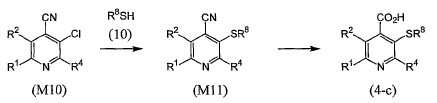
[식 중, R1, R2, R4 및 R8는 상기와 동일한 의미를 나타낸다.]
[Wherein, R 1 , R 2 , R 4 and R 8 represent the same meaning as described above.]
(공정 1)(Step 1)
화합물 (M11)은 화합물 (M10)과 화합물 (10)을 염기의 존재 하에 반응시킴으로써 제조할 수가 있다.Compound (M11) can be produced by reacting Compound (M10) and Compound (10) in the presence of a base.
상기 반응은 통상 용매의 존재 하에서 실시된다.The reaction is usually carried out in the presence of a solvent.
상기 용매로는 THF, 에틸렌글리콜디메틸에테르, 1,4-디옥산 등의 에테르류, 톨루엔, 크실렌 등의 방향족 탄화수소류, 아세트니트릴 등의 니트릴류, DMF 등의 산아미드류, DMSO 등의 설폭시드류 및 이들 혼합물을 예로 들 수 있다.Examples of the solvent include ethers such as THF, ethylene glycol dimethyl ether, 1,4-dioxane, aromatic hydrocarbons such as toluene and xylene, nitriles such as acetonitrile, acid amides such as DMF, and sulfoxy such as DMSO. Drew and mixtures thereof are exemplified.
상기 염기로는 수소화나트륨 등의 알칼리금속 수소화물류, 탄산칼륨 등의 탄산염류를 예로 들 수 있다.Examples of the base include alkali metal hydrides such as sodium hydride and carbonates such as potassium carbonate.
화합물 (M10) 1몰에 대해서 화합물 (10)이 통상 1~10몰의 비율, 염기가 통상 1~10몰의 비율로 사용된다.With respect to 1 mol of compound (M10), compound (10) is normally used in the ratio of 1-10 mol, and a base is normally 1-10 mol.
상기 반응의 반응온도는, 통상-20~100℃의 범위이고, 반응시간은 통상 0.5~24시간의 범위이다.The reaction temperature of the said reaction is the range of -20-100 degreeC normally, and reaction time is the range of 0.5-24 hours normally.
반응종료 후에는 반응혼합물을 유기용매로 추출하고, 유기층을 건조, 농축하는 등의 후처리 조작을 함으로써 화합물 (M11)을 단리할 수가 있다. 단리된 화합물 (M11)은 크로마토그래피, 재결정 등에 의해 더 정제할 수도 있다.
After completion of the reaction, the compound (M11) can be isolated by performing a post-treatment operation such as extracting the reaction mixture with an organic solvent and drying and concentrating the organic layer. Isolated compound (M11) may be further purified by chromatography, recrystallization or the like.
(공정 2)(Step 2)
화합물 (4-c)는 화합물 (M11)을 염기의 존재 하에서 가수분해반응시킴으로써 제조할 수가 있다.Compound (4-c) can be produced by hydrolyzing compound (M11) in the presence of a base.
상기 반응은 통상 용매의 존재 하에서 실시된다.The reaction is usually carried out in the presence of a solvent.
상기 용매로는 THF, 에틸렌글리콜디메틸에테르, tert-부틸메틸에테르, 1,4-디옥산 등의 에테르류, 메탄올, 에탄올 등의 알코올류, 물 및 이들 혼합물을 예로 들 수 있다.Examples of the solvent include ethers such as THF, ethylene glycol dimethyl ether, tert-butyl methyl ether, 1,4-dioxane, alcohols such as methanol and ethanol, water, and mixtures thereof.
상기 염기로는 수산화나트륨, 수산화칼륨 등의 알칼리금속 수산화물 등을 예로 들 수 있다.Examples of the base include alkali metal hydroxides such as sodium hydroxide and potassium hydroxide.
화합물 (M11) 1몰에 대해서, 염기가 통상 1~10몰의 비율로 사용된다. 상기 반응의 반응온도는 통상 0~120℃의 범위이고, 반응시간은 통상 0.1~24시간의 범위이다.With respect to 1 mol of compounds (M11), a base is normally used in 1-10 mol ratio. The reaction temperature of the said reaction is the range of 0-120 degreeC normally, and reaction time is the range of 0.1-24 hours normally.
반응종료 후에는 반응액을 산성으로 한 후, 반응혼합물을 유기용매로 추출하고, 유기층을 건조, 농축하는 등의 후처리 조작을 함으로써 화합물 (4-c)을 단리할 수가 있다. 단리된 화합물 (4-c)는 크로마토그래피, 재결정 등에 의해 더 정제할 수도 있다.
After completion of the reaction, the reaction solution is made acidic, and then the compound (4-c) can be isolated by post-treatment such as extracting the reaction mixture with an organic solvent, drying and concentrating the organic layer. Isolated compound (4-c) may be further purified by chromatography, recrystallization or the like.
다음에 본 활성화합물의 구체예를 이하에 나타낸다.Next, the specific example of this active compound is shown below.
하기 표에서 Me는 메틸기를 나타내고, Et는 에틸기를 나타내고, Pr는 프로필기를 나타내고, iPr는 이소프로필기를 나타내고, tBu는 tert-부틸기를 나타내고, Ph는 페닐기를 나타내고, 2-Py는 2-피리딜기를 나타내고, 3-Py는 3-피리딜기를 나타내고, 4-Py는 4-피리딜기를 나타내고, 1-Tz는 1,2,4-트리아졸-1-일기를 나타내고, 1-Pz는 피라졸-1-일기를 나타낸다.
In the following table, Me represents a methyl group, Et represents an ethyl group, Pr represents a propyl group, iPr represents an isopropyl group, tBu represents a tert-butyl group, Ph represents a phenyl group, and 2-Py represents 2-pyridyl Group, 3-Py represents 3-pyridyl group, 4-Py represents 4-pyridyl group, 1-Tz represents 1,2,4-triazol-1-yl group, and 1-Pz represents pyrazole It represents a -1-yl group.
식 (1-A)으로 표시되는 화합물.The compound represented by formula (1-A).

상기 식 (1-A)에서 R3, R5, R6, R7, A2 및 n의 각 치환기는 표 1~표 35에 기재된 조합이다.Each substituent of R <3> , R <5> , R <6> , R <7> , A <2> and n in said Formula (1-A) is a combination of Table 1-Table 35.

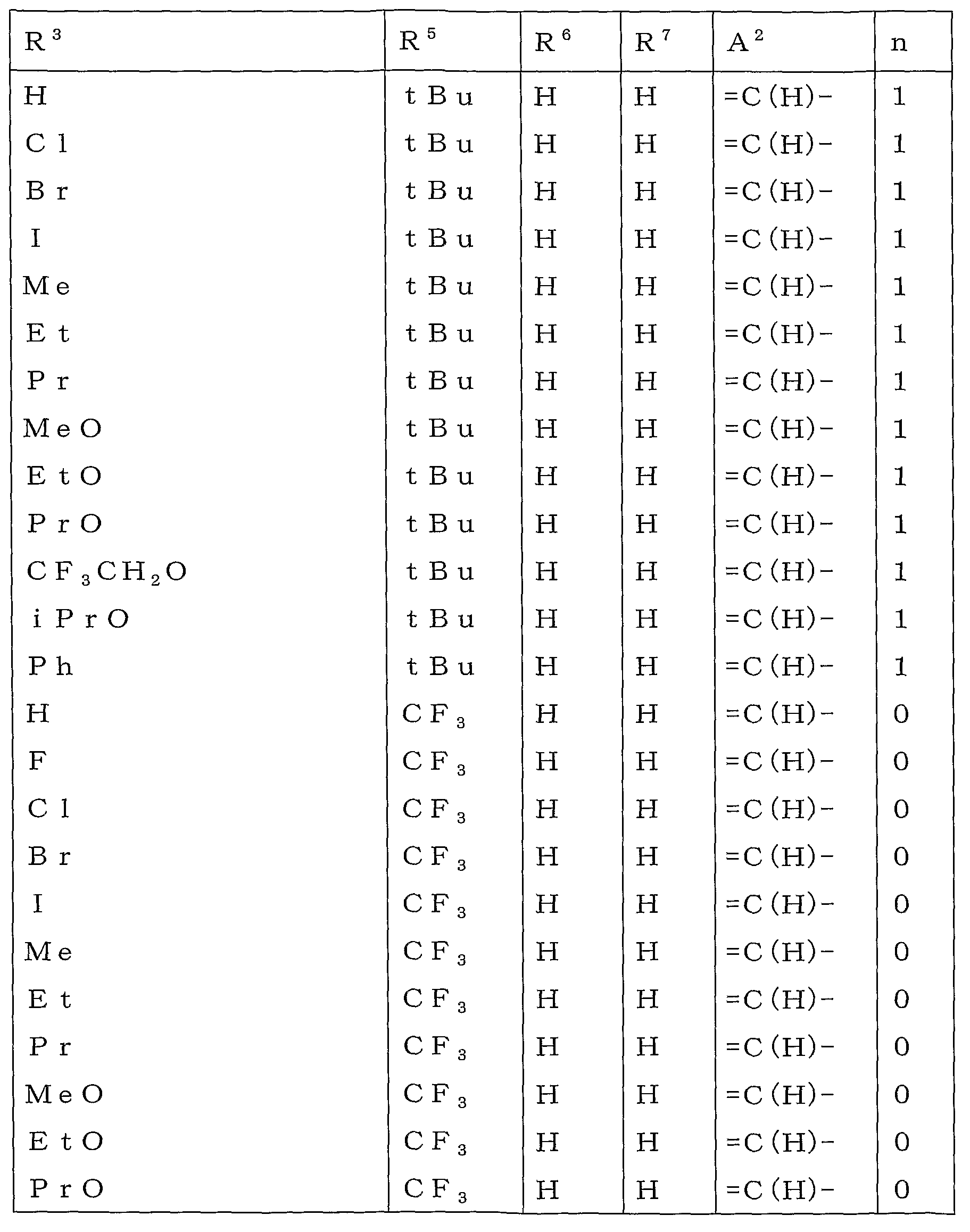


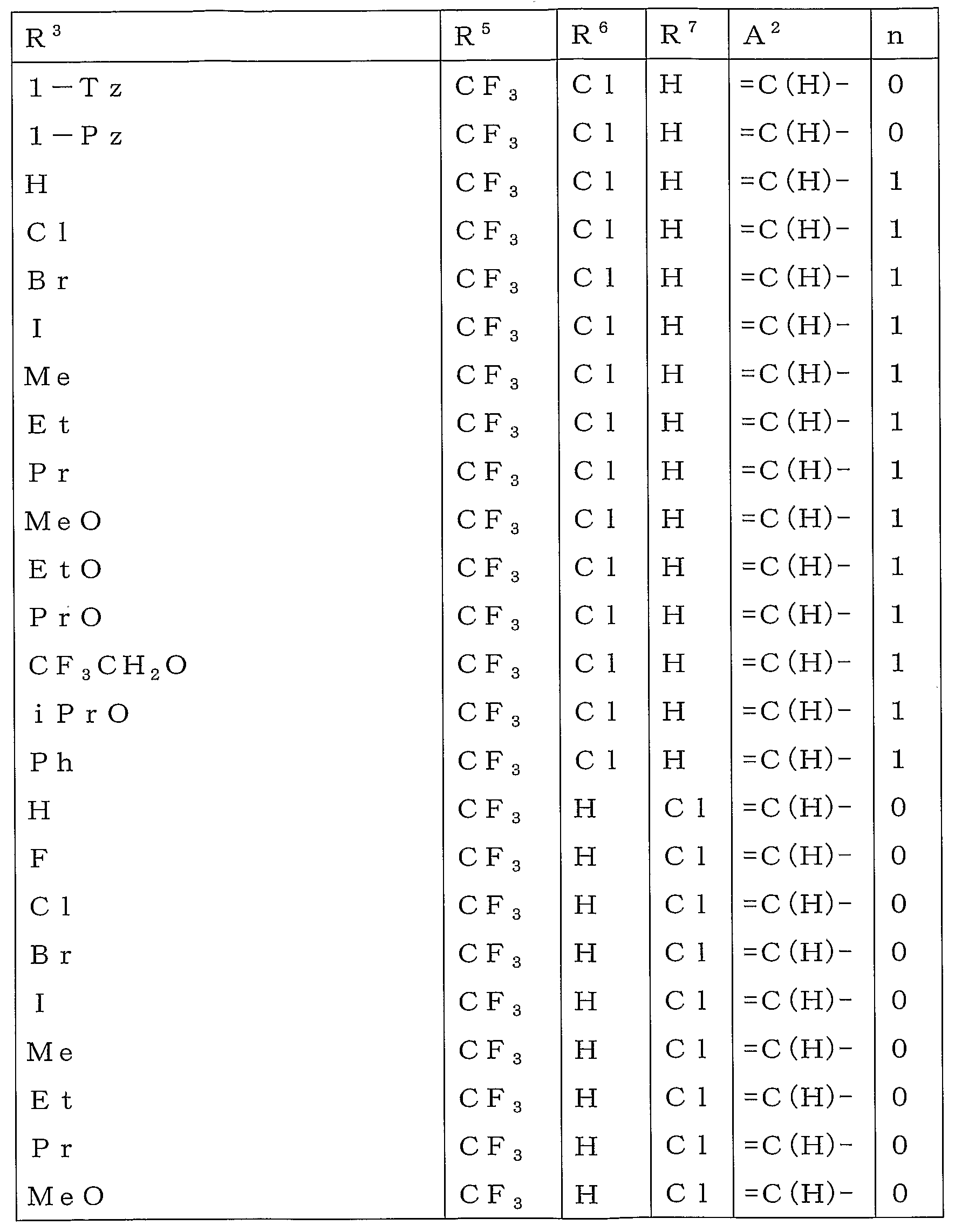


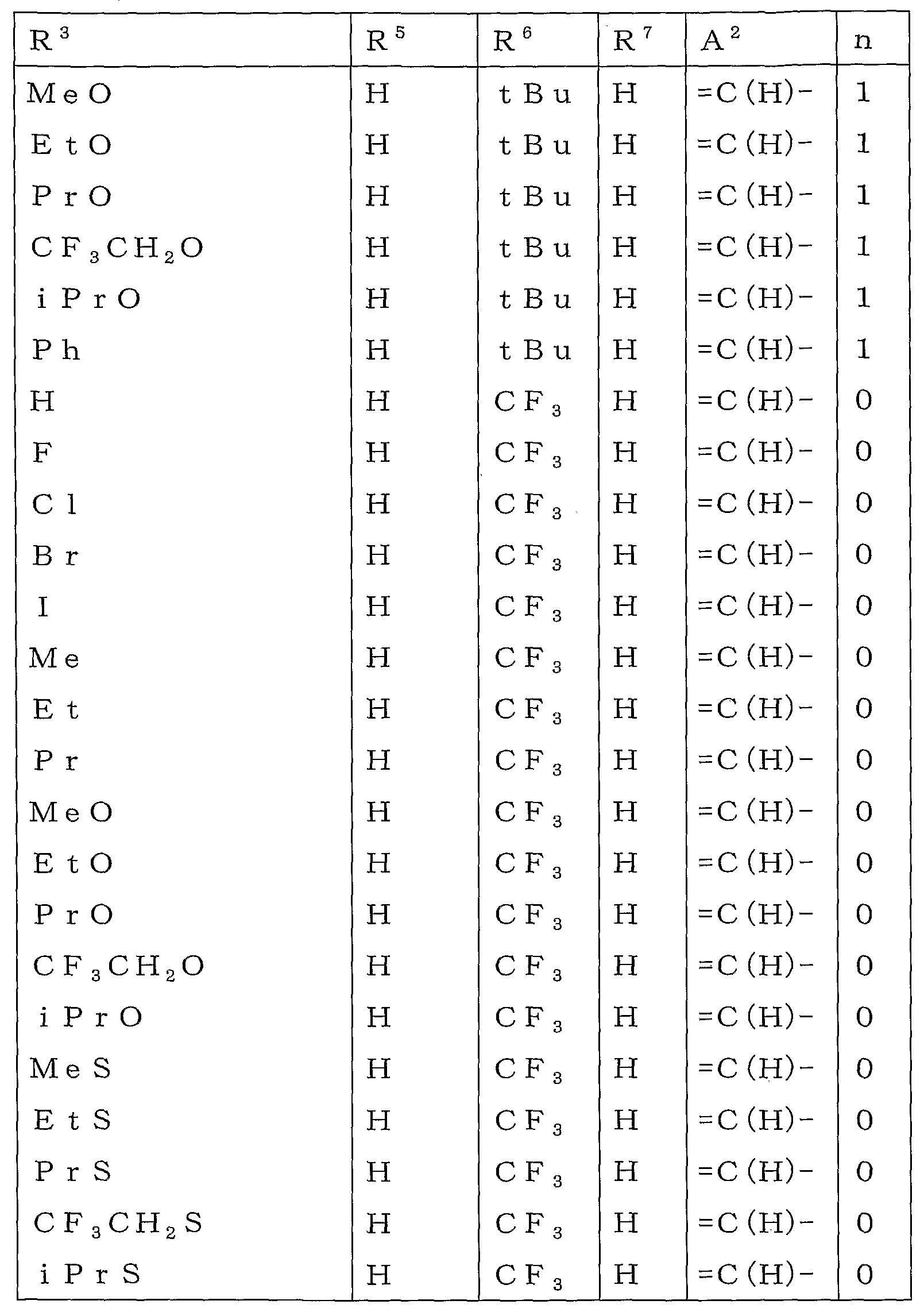


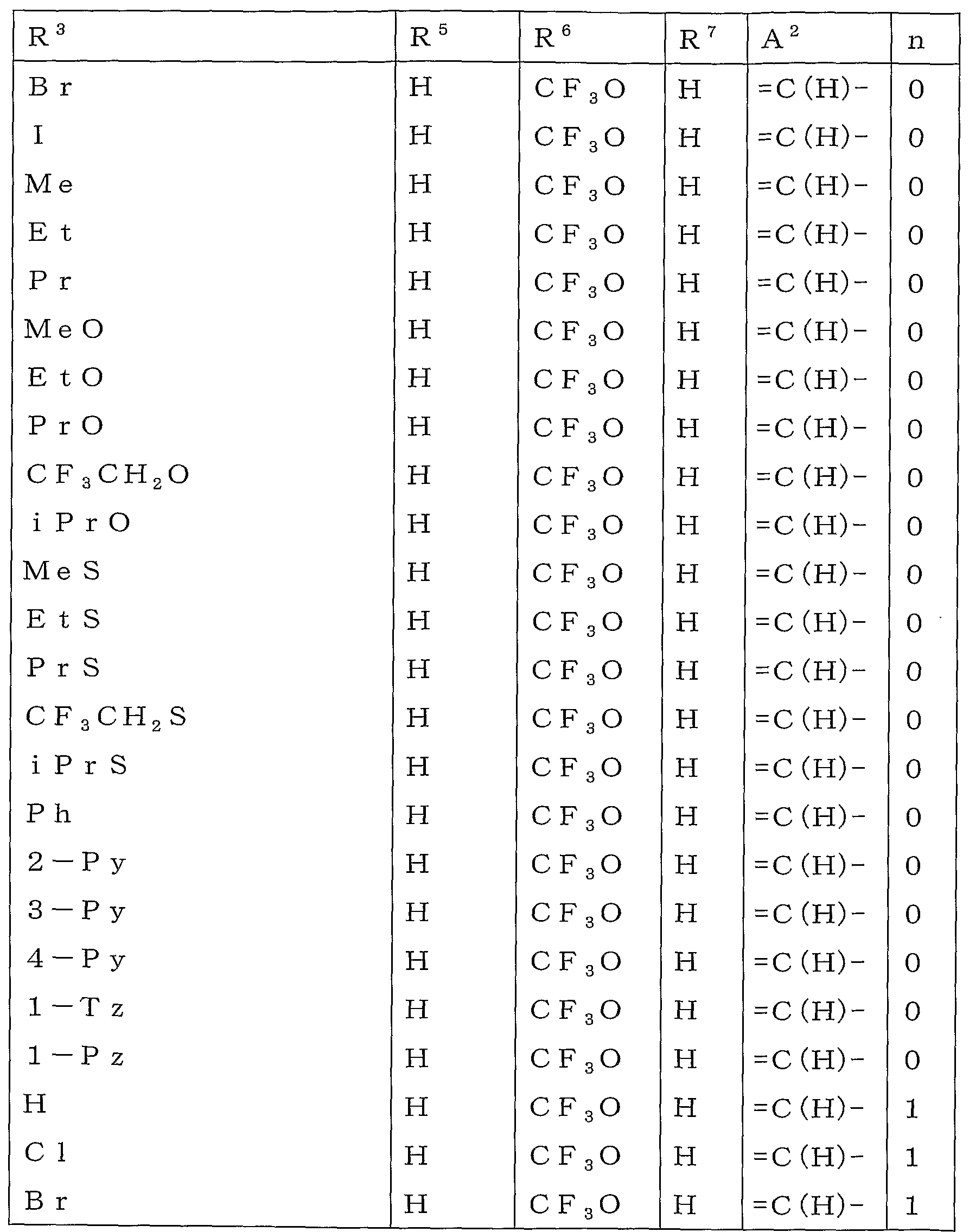


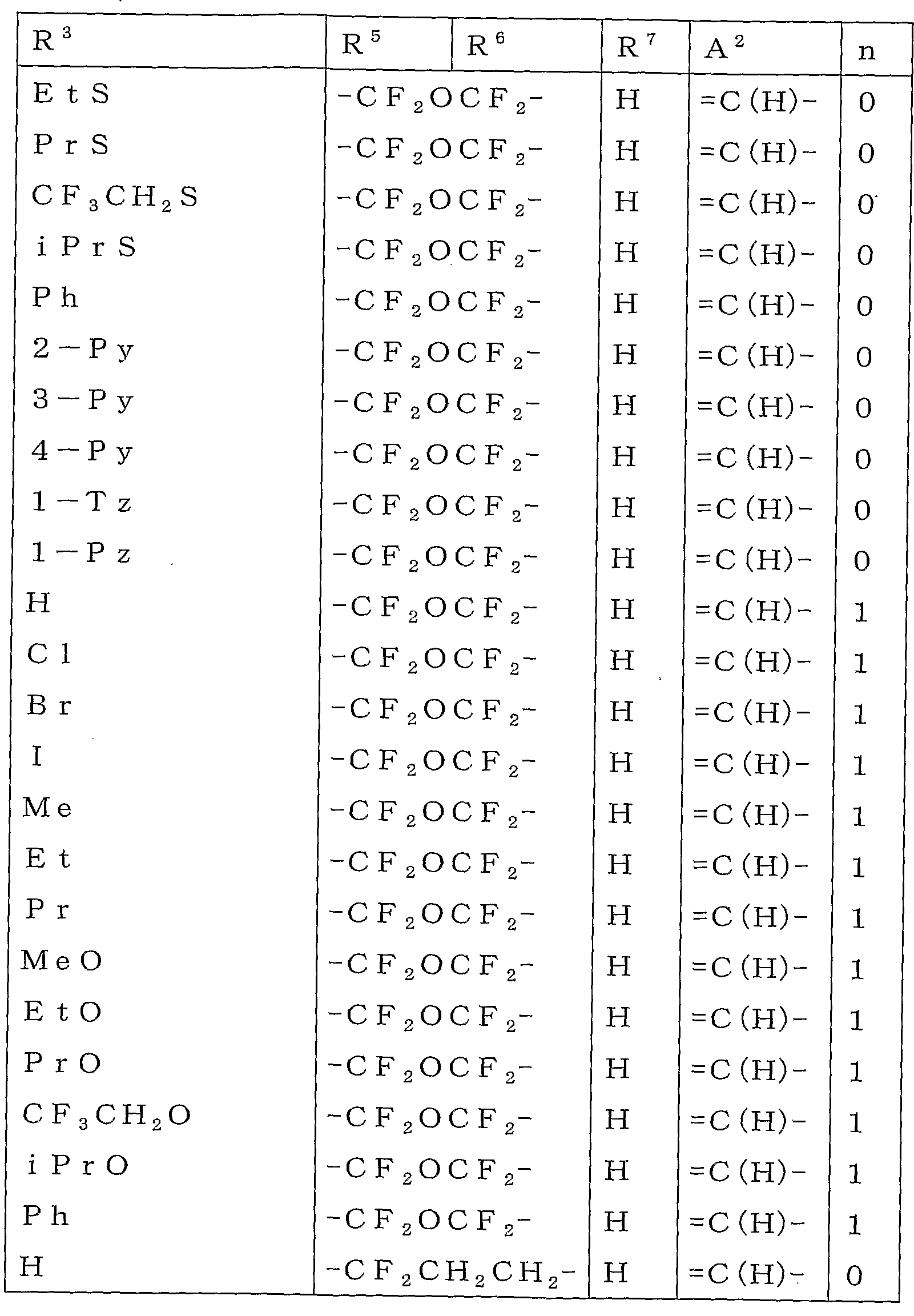


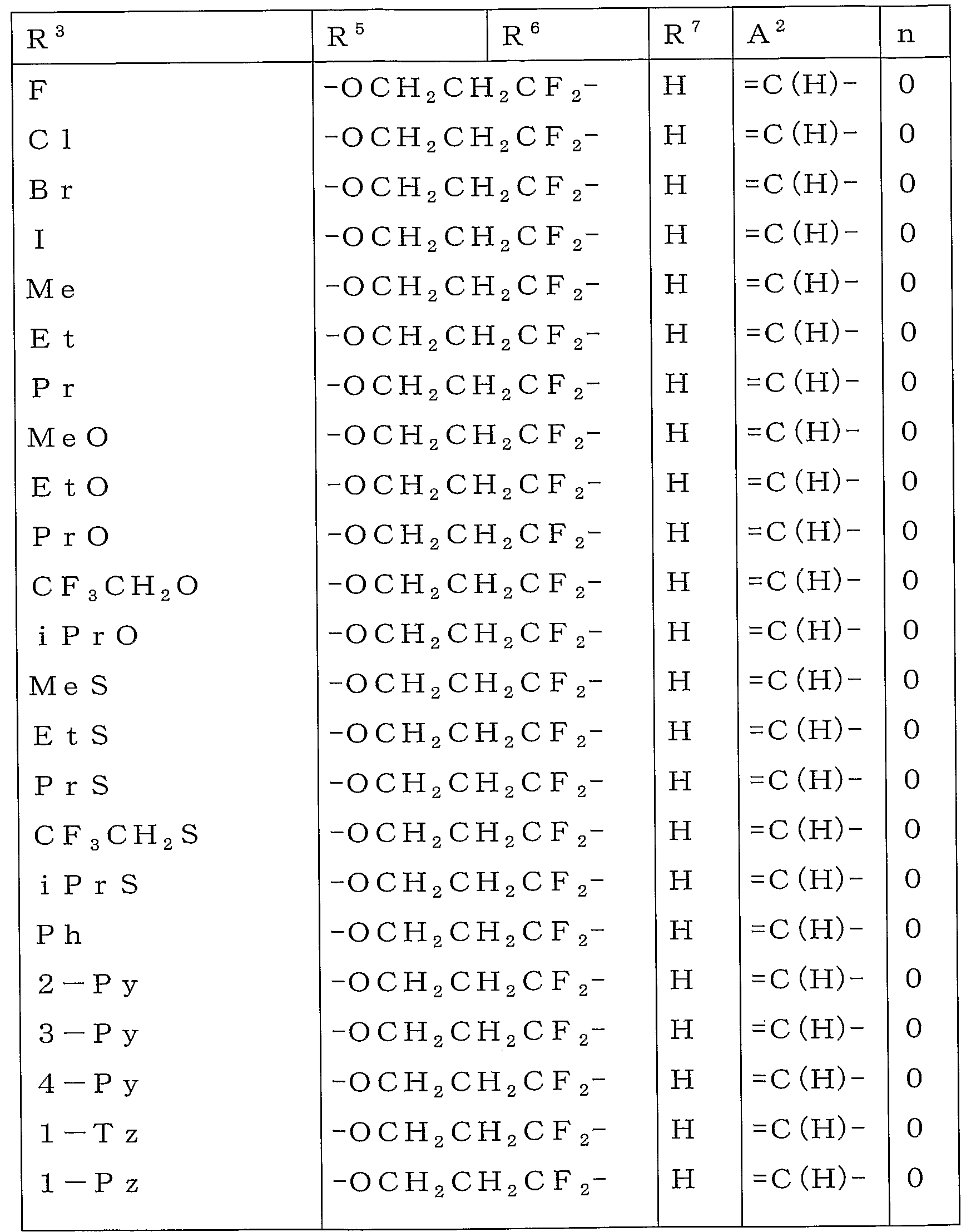
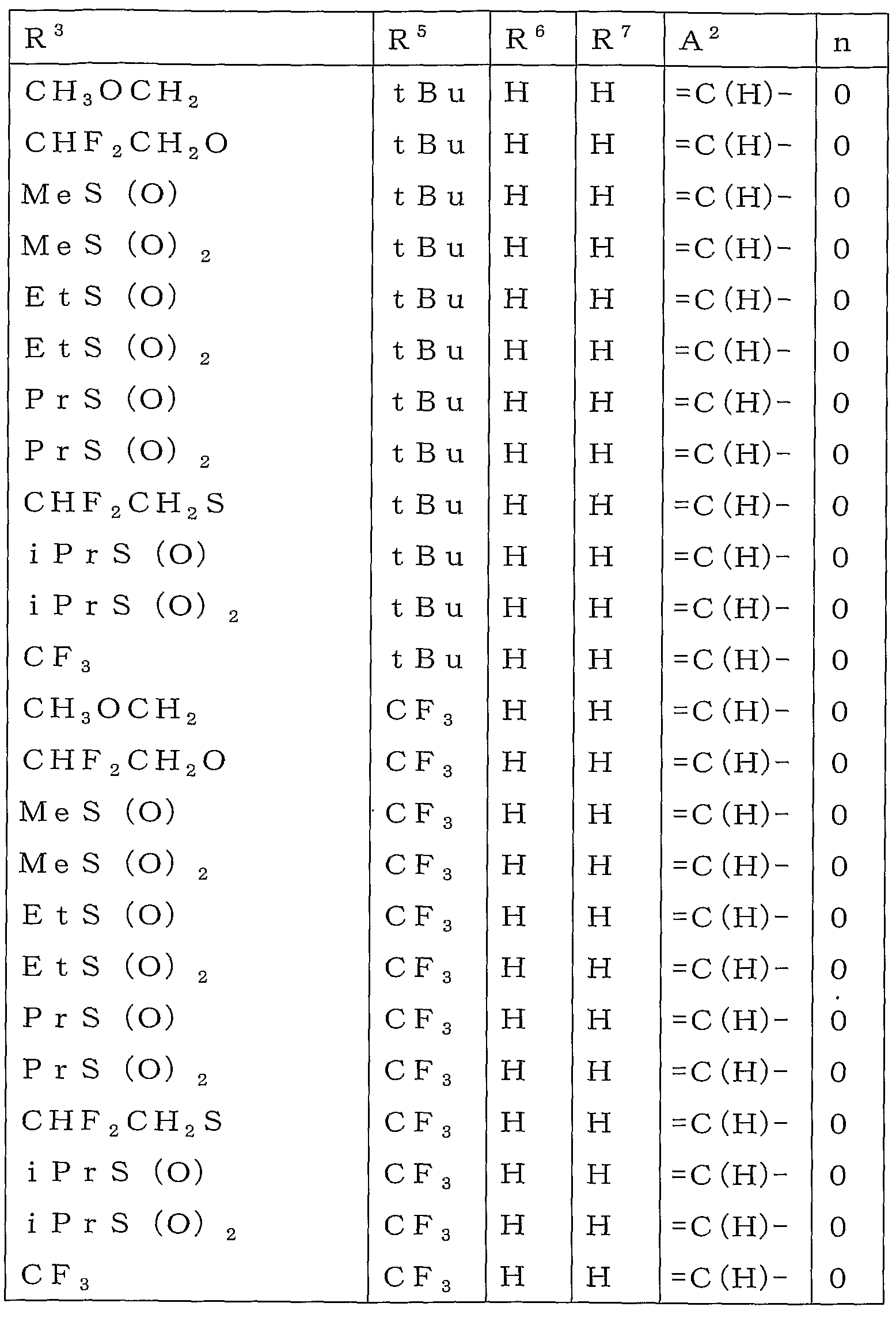
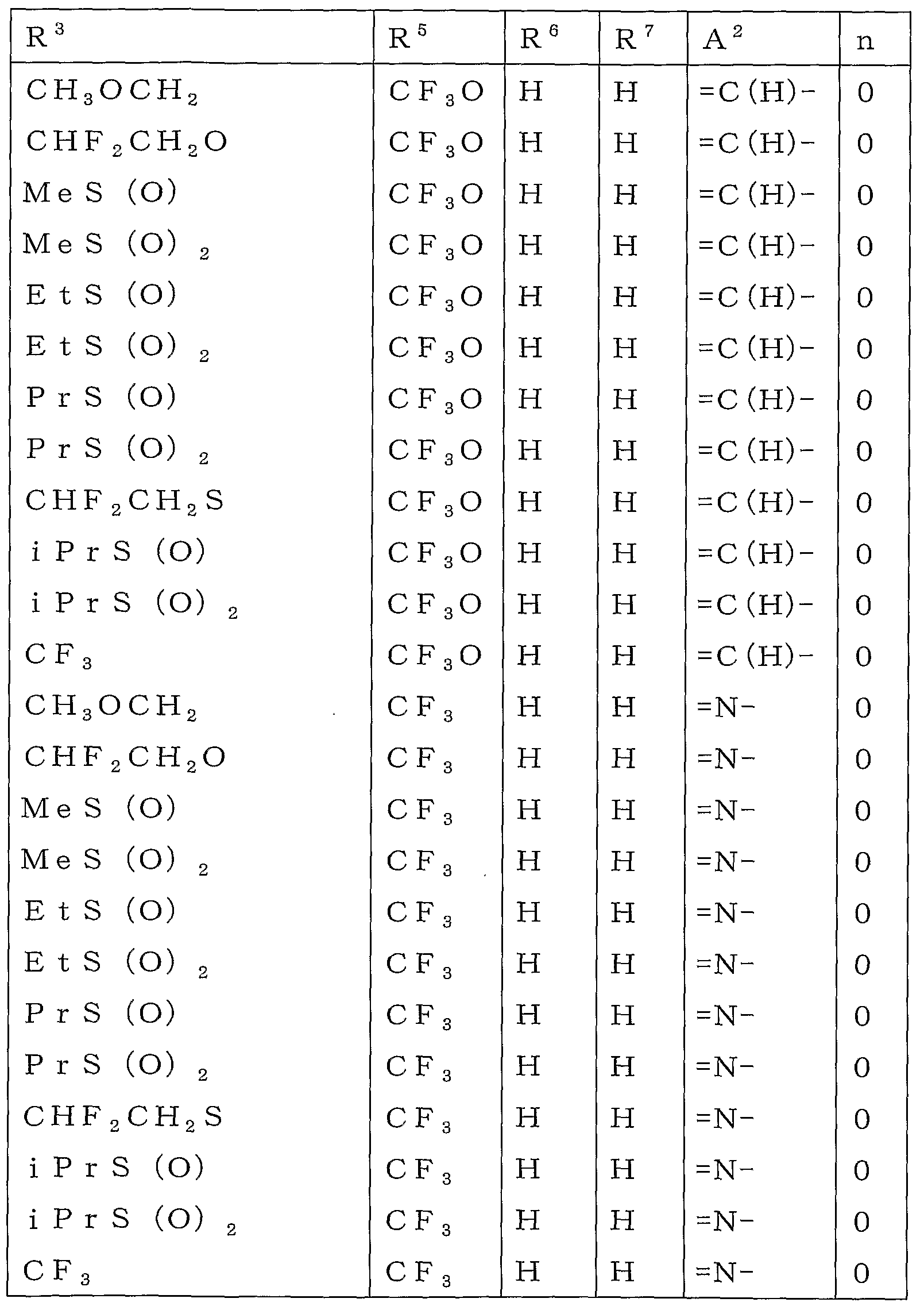
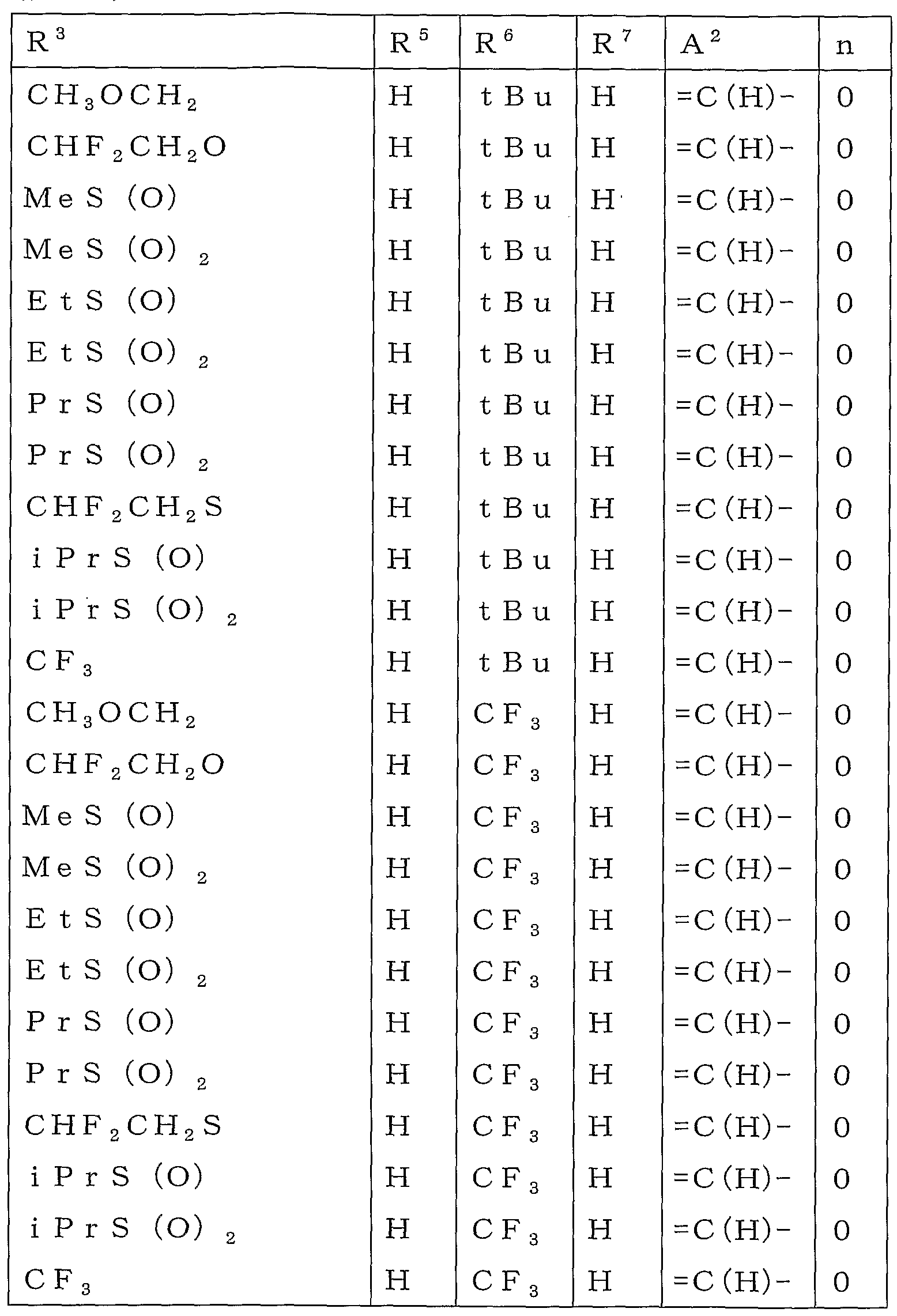


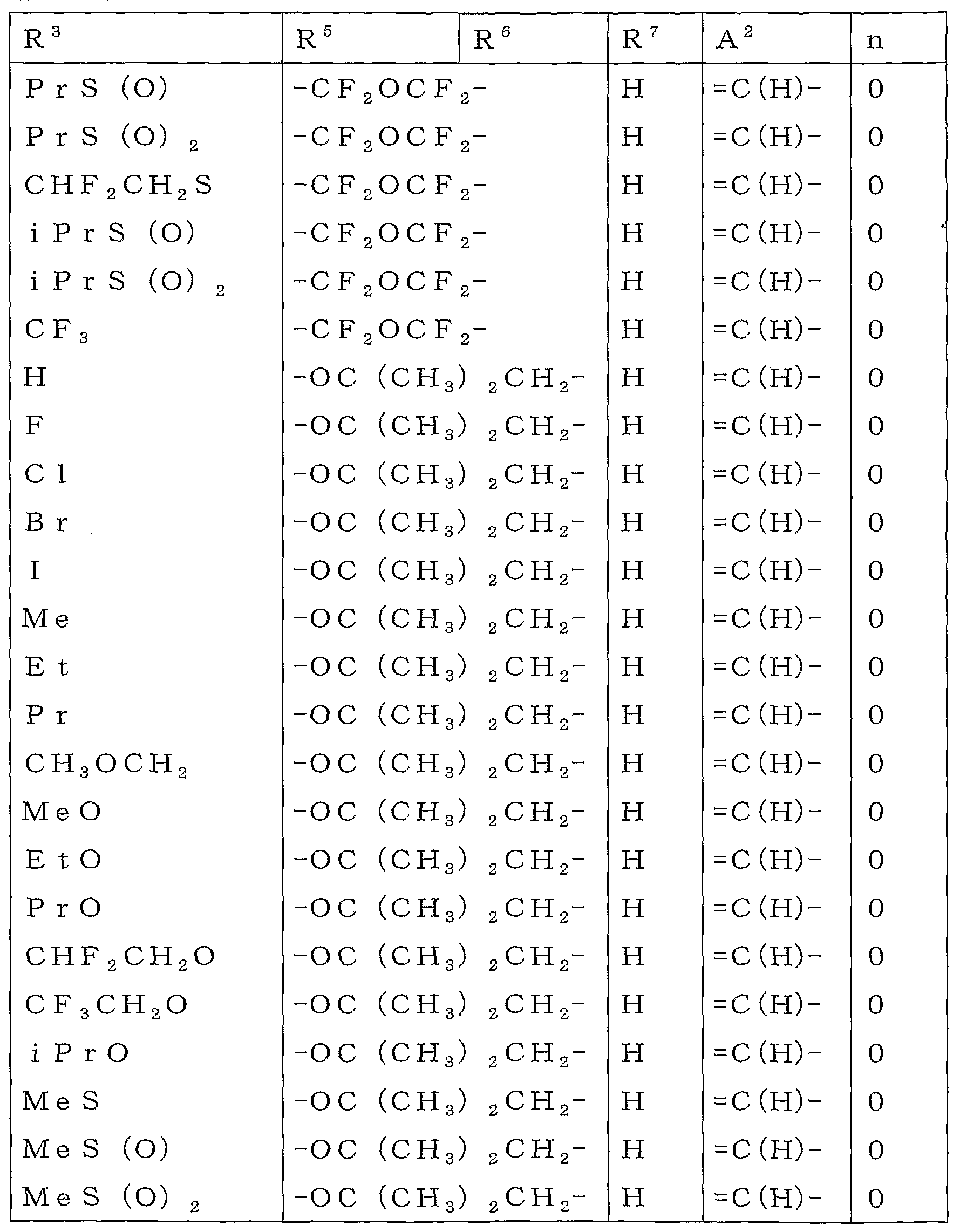
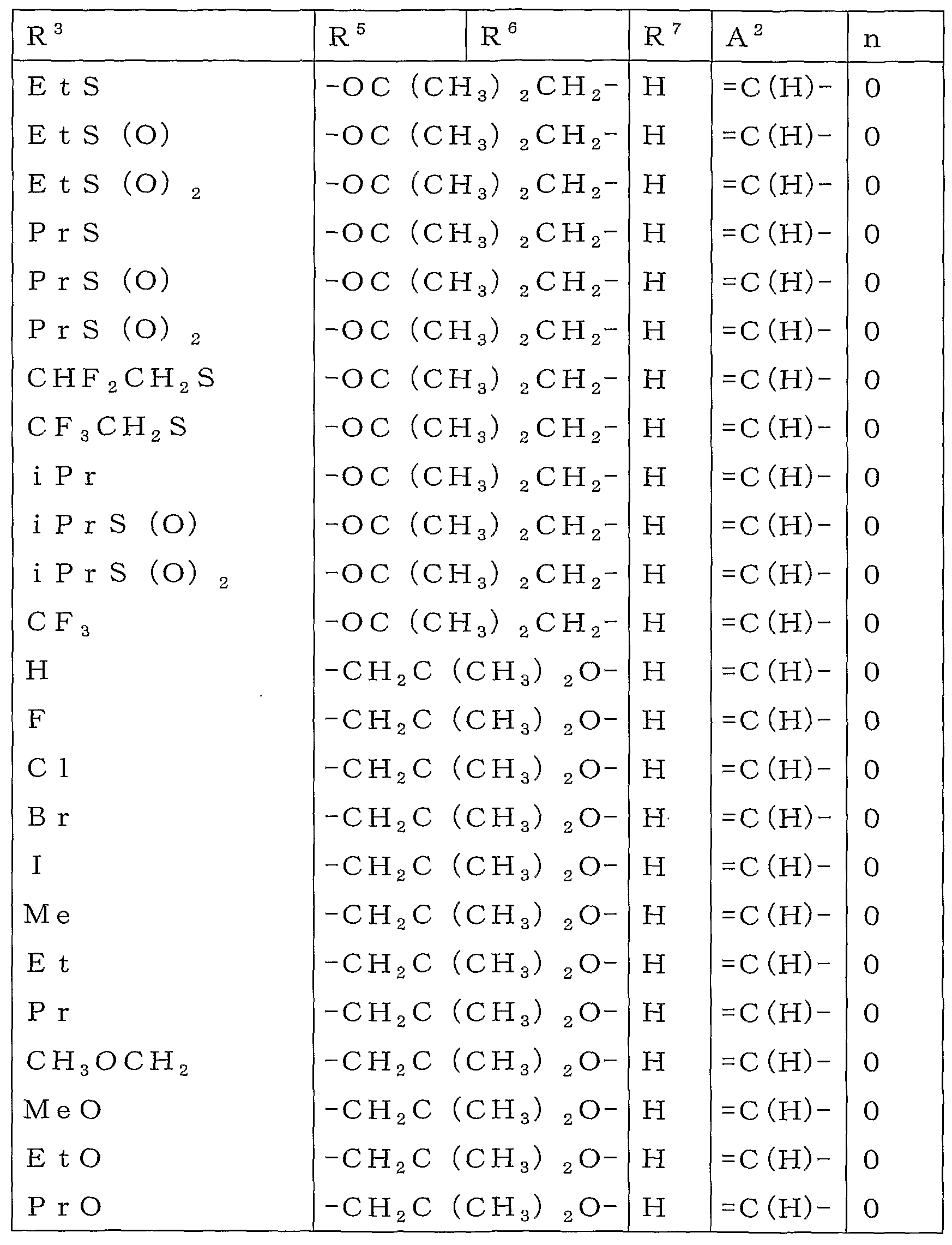
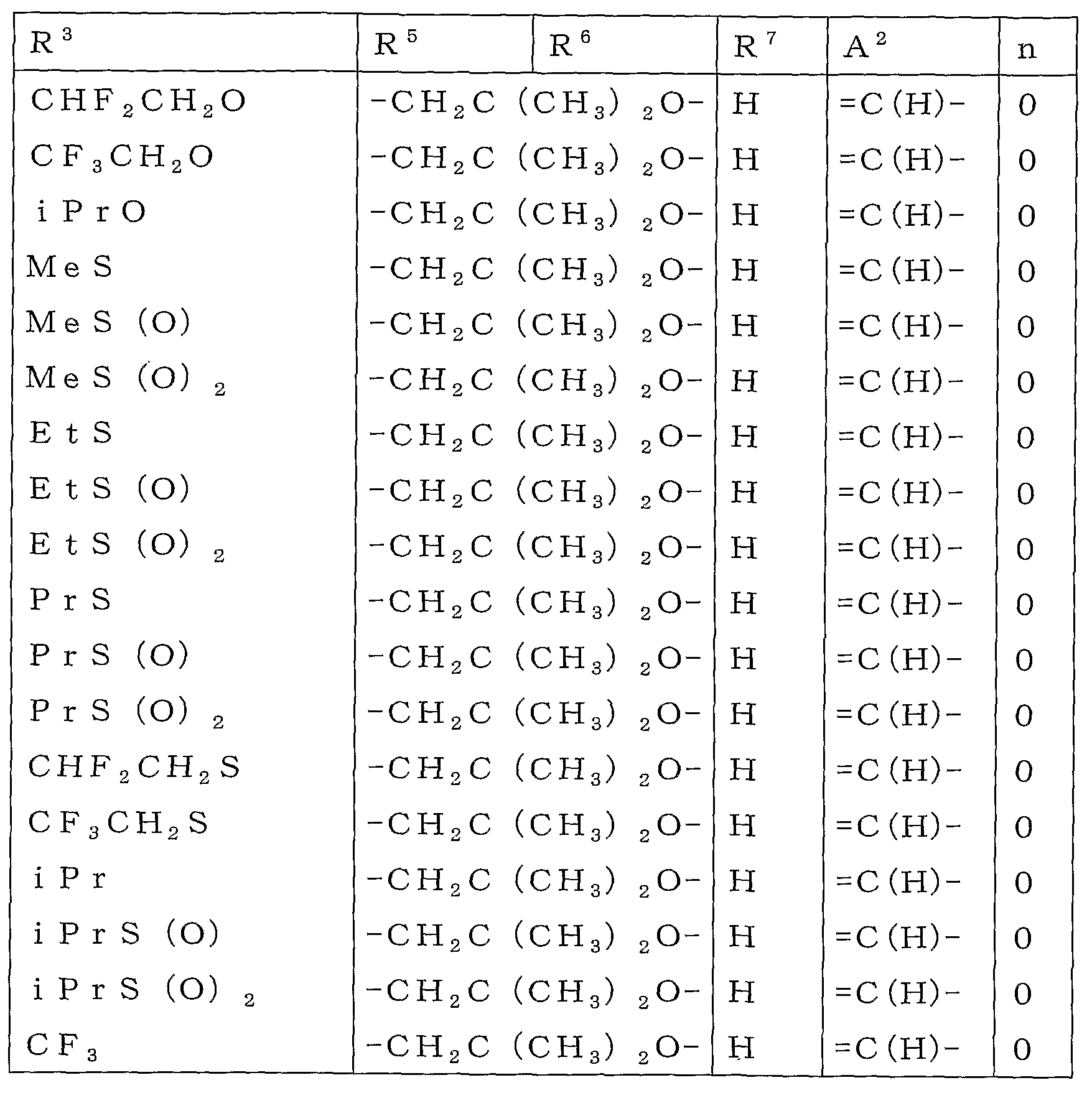
일반식 (1-B)로 표시되는 화합물.The compound represented by general formula (1-B).
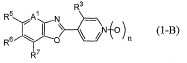
상기 일반식 (1-B)에서 R3, R5, R6, R7, A1 및 n의 각 치환기는 표 36~표 42에 기재된 조합이다.In said general formula (1-B), each substituent of R <3> , R <5> , R <6> , R <7> , A <1> and n is a combination of Table 36-42.


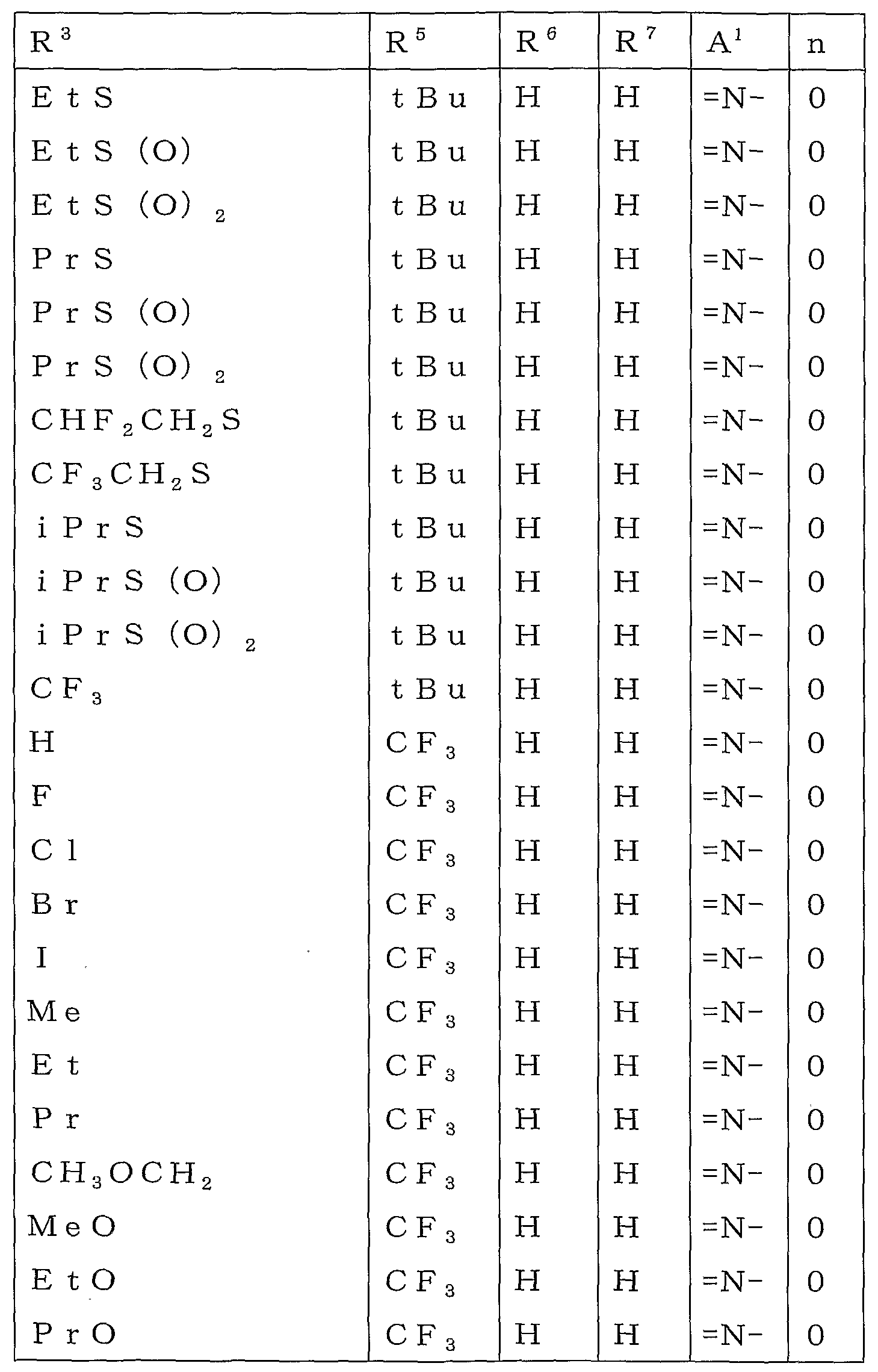
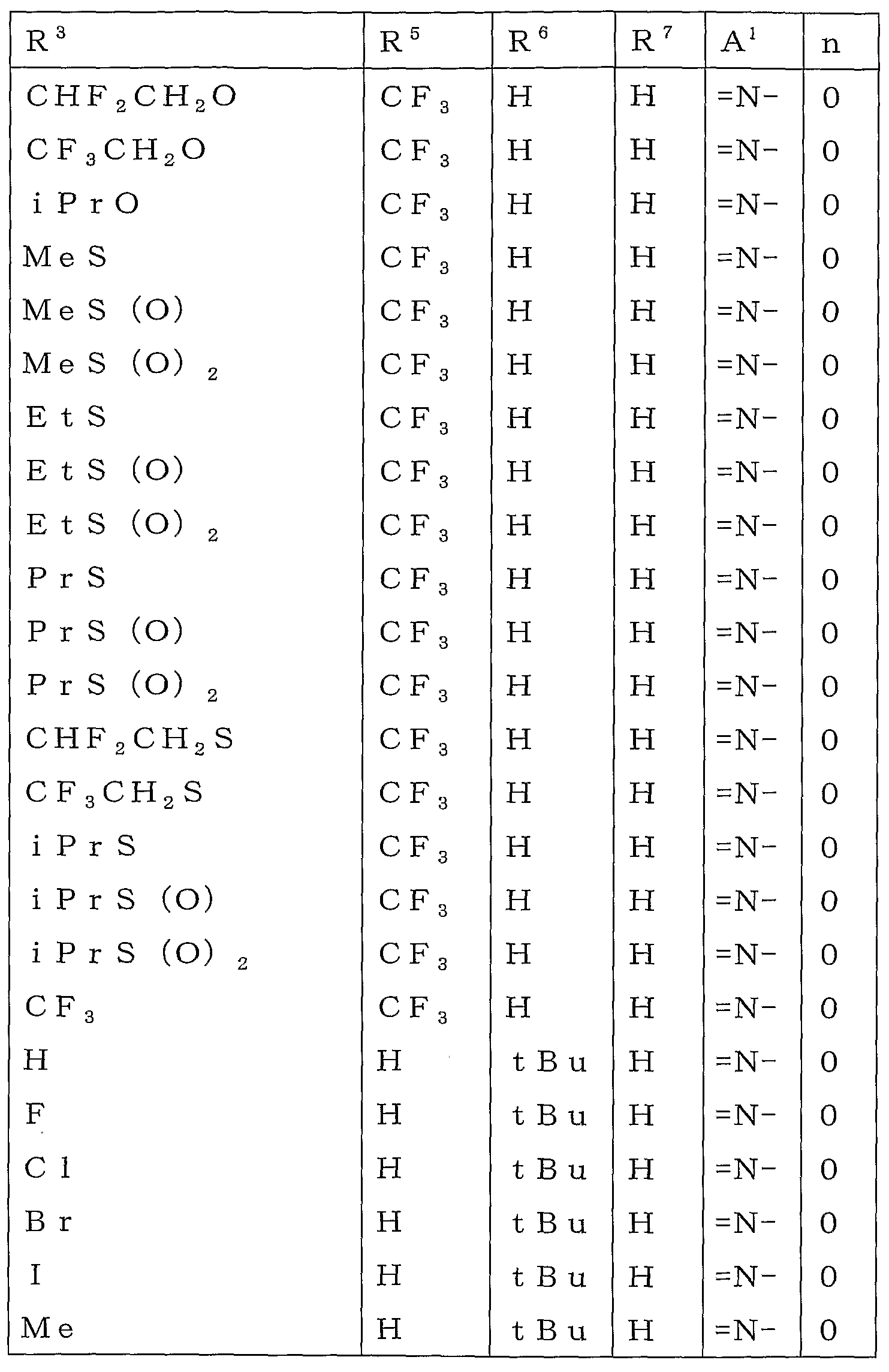


본발명 조성물은 본 활성화합물을 유효성분으로 함유한다.The present invention composition contains the active compound as an active ingredient.
본발명 조성물은 본 활성화합물을 1종 함유하여도 좋고, 2종 이상 함유하여도 좋고, 바람직하게는 1종 이상, 3종 이하 함유한다.This invention composition may contain 1 type of this active compound, may contain 2 or more types, Preferably it contains 1 or more types and 3 or less types.
일반적으로 본발명 조성물은 후술하는 담체 등을 함유하고 있고, 농약 또는 동물약을 얻을 수 있는 제제이다.Generally, this invention composition contains the carrier etc. which are mentioned later, and is an agent which can obtain an agricultural chemical or an animal medicine.
본발명 조성물은 본 활성화합물을 적당한 액체의 담체에 용해 또는 분산시키는, 본 활성화합물을 적당한 고체담체나 연고기재와 혼합하거나 흡착시키는, 본 활성화합물을 적당한 가스상 담체에 혼합 또는 분산시키는 등의 공지의 방법에 의해, 예를 들면, 하기의 제형으로서 조제할 수가 있다.The present invention compositions are known in the art such as mixing or dispersing the active compound in a suitable liquid carrier, mixing or adsorbing the active compound with a suitable solid carrier or aquatic material, or mixing or dispersing the active compound in a suitable gaseous carrier. By the method, for example, it can be prepared as the following formulation.
상기 제형으로는 유제, 액제, 마이크로에멀젼제, 유동화제, 유제, 수화제, 과립수화제, 분제, 입제(granule), 미립제, 종자 코팅제, 종자 침지제, 훈연제, 정제, 마이크로캡슐제, 분무제, 에어로졸제, 탄산가스제제, 모기향·전기모기매트·액체전기모기향 등의 가열 증산제, EW제, 연고, 독이(toxic bait), 캡슐제, 펠렛제, 필름, 주사제, 도포제, 수지제제, 샴푸제제 등을 예로 들 수 있다.The formulations include emulsions, liquids, microemulsions, glidants, emulsions, hydrating agents, granulating agents, powders, granules, particulates, seed coatings, seed dipping agents, smokers, tablets, microcapsules, sprays, aerosols. Agent, carbonic acid gas agent, moisturizing incense, electric mosquito repellent mat, liquid electric mosquito repellent, etc. For example.
상기 조제에 있어서 필요에 따라서 유화제, 현탁제, 전착제(spreading agent), 침투제, 습윤제, 증점제, 안정제, 고착제, 결합제, 분산제, 착색제 등의 제제용 보조제를 첨가하여도 좋다.In the said preparation, you may add the adjuvant for preparations, such as an emulsifier, a suspension agent, a spreading agent, a penetrant, a humectant, a thickener, a stabilizer, a fixing agent, a binder, a dispersing agent, and a coloring agent.
본발명 조성물은 본 활성화합물을 통상 0.01~95중량% 함유한다.The present invention composition usually contains 0.01 to 95% by weight of the active compound.
상기 액체담체로는 EPA 리스트(List No.4A 및 4B)에 기재되어 있는 물질, 물, 알코올류(예를 들면, 메틸알코올, 에틸알코올, n-프로필알코올, 이소프로필알코올, 부틸알코올, 헥실알코올, 벤질알코올, 에틸렌글리콜, 프로필렌글리콜, 페녹시에탄올 등), 케톤류(예를 들면, 아세톤, 메틸에틸케톤, 메틸이소부틸케톤, 시클로헥사논 등), 에테르류(예를 들면, 디이소프로필에테르, 1,4-디옥산, 테트라히드로푸란, 에틸렌글리콜모노메틸에테르, 에틸렌글리콜디메틸에테르, 디에틸렌글리콜모노메틸에테르, 프로필렌글리콜모노메틸에테르, 디프로필렌글리콜모노메틸에테르, 3-메톡시-3-메틸-1-부탄올 등), 지방족 탄화수소류(예를 들면, 헥산, 시클로헥산, 케로신, 등유, 연료유, 기계유 등), 방향족 탄화수소류(예를 들면, 톨루엔, 크실렌, 에틸벤젠, 도데실벤젠, 페닐크실릴에탄, 솔벤트나프타, 메틸나프탈렌 등), 할로겐화 탄화수소류(예를 들면, 디클로로메탄, 트리클로로에탄, 클로로포름, 사염화탄소 등), 산아미드류(예를 들면, N,N-디메틸포름아미드, N,N-디메틸아세트아미드, N-메틸피롤리돈, N-옥틸피롤리돈 등), 에스테르류(예를 들면, 유산부틸, 아세트산에틸, 아세트산부틸, 미리스틴산이소프로필, 올레인산에틸, 아디핀산디이소프로필, 아디핀산디이소부틸, 프로필렌글리콜모노메틸에테르아세테이트, 지방산글리세린에스테르,γ-부티로락톤 등), 니트릴류(예를 들면, 아세트니트릴, 이소부티로니트릴, 프로피오니트릴 등), 카르보네이트류(예를 들면, 탄산프로필렌 등), 식물유류(예를 들면, 대두유, 올리브오일, 아마인유, 코코넛오일, 야자유, 피넛유, 맥아유, 아몬드유, 참기름, 광유, 로즈마리유, 제라늄유, 유채씨유, 면실유, 옥수수유, 홍화유, 오렌지유 등) 등을 예로 들 수 있다. 상기 조제에 있어서 상기 액체담체는 1종만 사용하여도 좋고 2종 이상 사용하여도 좋으나, 1종 이상, 3종 이하로 사용하는 것이 바람직하다. 상기 액체담체를 2종 이상 사용하는 경우, 상술의 각 액체담체는 용도 등에 따라서 적당한 비율로 혼합하여 사용할 수가 있다.Examples of the liquid carrier include substances, water and alcohols (e.g., methyl alcohol, ethyl alcohol, n-propyl alcohol, isopropyl alcohol, butyl alcohol, hexyl alcohol, which are listed in the EPA list (List # Nos. 4A and 4B)). , Benzyl alcohol, ethylene glycol, propylene glycol, phenoxyethanol, and the like, ketones (for example, acetone, methyl ethyl ketone, methyl isobutyl ketone, cyclohexanone, etc.), ethers (for example, diisopropyl ether) , 1,4-dioxane, tetrahydrofuran, ethylene glycol monomethyl ether, ethylene glycol dimethyl ether, diethylene glycol monomethyl ether, propylene glycol monomethyl ether, dipropylene glycol monomethyl ether, 3-methoxy-3- Methyl-1-butanol, etc.), aliphatic hydrocarbons (eg, hexane, cyclohexane, kerosene, kerosene, fuel oil, mechanical oil, etc.), aromatic hydrocarbons (eg, toluene, xylene, ethylbenzene, dodecyl Benzene, phenyl Rylethane, solvent naphtha, methylnaphthalene, and the like, halogenated hydrocarbons (for example, dichloromethane, trichloroethane, chloroform, carbon tetrachloride, etc.), acid amides (for example, N, N-dimethylformamide, N, N-dimethylacetamide, N-methylpyrrolidone, N-octylpyrrolidone, etc., esters (for example, butyl lactate, ethyl acetate, butyl acetate, isopropyl myristin, ethyl oleate, adipic acid di) Isopropyl, diisobutyl adipic acid, propylene glycol monomethyl ether acetate, fatty acid glycerin ester, γ-butyrolactone, etc., nitriles (e.g. acetonitrile, isobutyronitrile, propionitrile, etc.) Bonates (e.g. propylene carbonate), vegetable oils (e.g. soybean oil, olive oil, linseed oil, coconut oil, palm oil, peanut oil, malt oil, almond oil, sesame oil, mineral oil, rosemary oil, geranium Yu, rapeseed Oil, cottonseed oil, corn oil, safflower oil, orange oil and the like). In the preparation, the liquid carrier may be used in one kind or two or more kinds, but is preferably used in one kind or three kinds or less. When using 2 or more types of said liquid carrier, each liquid carrier mentioned above can be mixed and used in an appropriate ratio according to a use etc.
상기 고체담체(희석·증량제)로는 EPA 리스트(List No.4A 및 4B)에 기재되어 있는 물질, 식물성 분말(예를 들면, 대두분, 담배분, 소맥분, 목분 등), 광물성 분말(예를 들면, 카올린클레이(kaoline clay), 후바사미클레이(Fubasami clay), 벤토나이트, 산성백토 등의 클레이, 활석분, 로우석분(Roseki powder) 등의 탈크, 규조토, 운모분 등의 실리카 등), 합성 함수산화규소, 알루미나, 탈크, 세라믹, 그 외의 무기광물(세리사이트, 석영, 유황, 활성탄, 탄산칼슘, 수화실리카 등), 화학비료(유안, 인안(인산 암모늄), 질안(질산 암모늄), 요소, 염안(염화 암모늄) 등의 미세 분말 및 입상물 등을 예로 들 수 있다. 상기 조제에 있어서 상기 고체담체는 1종만 사용하여도 좋고 2종 이상 사용하여도 좋으나, 1종 이상, 3종 이하로 사용하는 것이 바람직하다. 상기 고체담체를 2종 이상 사용하는 경우, 상술의 각 고체담체는 용도 등에 따라서 적당한 비율로 혼합하여 사용할 수가 있다.Examples of the solid carrier (diluent and extender) include substances described in the EPA Lists (List Nos. 4A and 4B), vegetable powders (for example, soy flour, tobacco powder, wheat flour, wood flour, etc.), mineral powders (for example, , Kaoline clay, fubasami clay, bentonite, clay such as acid clay, talc powder, talc such as Roseki powder, silica such as diatomaceous earth, mica powder, etc.), synthetic function Silicon oxide, alumina, talc, ceramics, and other inorganic minerals (sericite, quartz, sulfur, activated carbon, calcium carbonate, hydrated silica) Etc.), chemical fertilizers (oil, phosphorus (ammonium phosphate), nitrate (ammonium nitrate), urea, salts (ammonium chloride) such as fine powders and granular materials, etc. In the preparation, the solid carrier is 1 Although only 1 type may be used and 2 or more types may be used, it is preferable to use 1 or more types and 3 or less types. You can mix and use.
상기 가스상 담체로는 EPA 리스트(List No.4A 및 4B)에 기재되어 있는 물질, 플루오로카르본, 부탄가스, LPG(액화석유가스), 디메틸에테르, 탄산가스 등을 예로 들 수 있다. 상기 조제에 있어서 상기 가스상 담체는 1종만 사용하여도 좋고 2종 이상 사용하여도 좋으나, 1종 이상, 3종 이하로 사용하는 것이 바람직하다. 상기 가스상 담체를 2종 이상 사용하는 경우, 상술한 각 가스상 담체는 용도 등에 따라서 적당한 비율로 혼합하여 사용하여도 좋고, 상술한 액상 담체와 조합하여 사용하여도 좋다.Examples of the gaseous carrier include substances described in the EPA Lists (List # Nos. 4A and 4B), fluorocarbons, butane gas, LPG (liquefied petroleum gas), dimethyl ether, carbon dioxide gas, and the like. In the preparation, only one kind or two or more kinds of the gaseous carrier may be used, but one or more kinds or three or less kinds are preferably used. When using 2 or more types of said gaseous support, each gaseous support mentioned above may be mixed and used in a suitable ratio according to a use, etc., and may be used in combination with the above-mentioned liquid carrier.
상기 연고기재로는, 예를 들면, EPA 리스트(List No.4A 및 4B)에 기재되어 있는 물질, 폴리에틸렌글리콜, 펙틴, 예를 들면, 모노스테아린산글리세린에스테르등의 고급 지방산의 다가 알코올에스테르(polyhydric alcohol ester), 예를 들면, 메틸셀룰로오스 등의 셀룰로오스 유도체, 알긴산 나트륨, 고급 알코올, 예를 들면, 글리세린 등의 다가알코올, 바셀린, 백색 바셀린, 유동 파라핀, 돈지(lard), 각종 식물유, 라놀린, 탈수 라놀린, 경화유, 수지류 등을 예로 들 수 있다. 상기 조제에 있어서 상기 연고기재는 1종만 사용하여도 좋고 2종 이상 사용하여도 좋으나, 1종 이상, 3종 이하로 사용하는 것이 바람직하다. 상기 연고기재를 2종 이상 사용하는 경우, 상술한 각 연고기재는 용도 등에 따라 적당한 비율로 혼합하여 사용하여도 좋고, 하기에 나타내는 계면활성제를 첨가하여 사용할 수가 있다.Examples of the meat material include polyhydric alcohols of higher fatty acids such as a substance described in the EPA list (List # Nos. 4A and 4B), polyethylene glycol, pectin, for example, monostearic acid glycerin ester, and the like. ester), for example, cellulose derivatives such as methyl cellulose, sodium alginate, higher alcohols, for example, polyhydric alcohols such as glycerin, petrolatum, white petrolatum, liquid paraffin, lard, various vegetable oils, lanolin, dehydrated lanolin , Cured oil, resins, and the like. In the said preparation, although only 1 type may be used and 2 or more types may be used for the said meat material, It is preferable to use 1 type or more and 3 types or less. In the case of using two or more kinds of the above-described meat material, each of the above-described meat material may be used by mixing in an appropriate ratio depending on the use or the like, and may be used by adding a surfactant shown below.
상기의 제재에 있어서 계면활성제는 유화제, 전착제, 침투제, 분산제 등으로 사용할 수가 있다.In said preparation, surfactant can be used as an emulsifier, an electrodeposition agent, a penetrant, a dispersing agent, etc.
상기 계면활성제로는 비누류, 폴리옥시에틸렌알킬아릴에테르류[예를 들면, 노이겐(상품명), 이에이142(EA142(상품명));다이이치공업제약(주)(Dai-Ich Kogyo Seiyaku Co., Ltd.) 제, 노날(상품명);도호화학(주)(Toho Chemical Industry Co., Ltd.) 제], 알킬황산염류[예, 에말 10(상품명), 에말 40(상품명);카오(주)(Kao Corporation) 제], 알킬벤젠설폰산염류[예, 네오겐(상품명), 네오겐 T(상품명);다이이치공업제약(주) 제, 네오페렉스;카오(주) 제], 폴리에틸렌글리콜에테르류[예, 노니폴 85(상품명), 노니폴 100(상품명), 노니폴 160(상품명);산요화성(주)(Sanyo Chemical Industries Ltd.) 제], 폴리옥시에틸렌알킬에테르류[예, 노이겐 ET-135(상품명);다이이치공업제약(주) 제], 폴리옥시에틸렌폴리옥시프로필렌블록폴리머류[예, 뉴폴 PE-64(상품명);산요화성(주) 제], 다가알코올에스테르류[예, 트인 20(상품명), 트인 80(상품명);카오(주) 제], 알킬설포호박산염류[예, 산모린 OT20(상품명);산요화성(주) 제, 뉴칼겐 EX70(상품명);타케모토유지(주)(Takemoto Yushi K.K) 제], 알킬나프탈렌설폰산염류[예, 뉴칼겐 WG-1(상품명);타케모토유지(주) 제], 알케닐설폰산염[예를 들면, 소르폴 5115(상품명);도호화학(주) 제] 등의 비이온계 및 음이온계 계면활성제를 예로 들 수 있다. 이들 계면활성제는 1종 이상(바람직하게는 1종 이상, 3종 이하)을 적당한 비율로 혼합하여 사용할 수가 있다.Examples of the surfactant include soaps and polyoxyethylene alkylaryl ethers [for example, Neugen (trade name), EI 142 (EA142 (trade name)); Dai-Ich Kogyo Seiyaku Co., Ltd. , Ltd.), Nonal (brand name); Toho Chemical Industry Co., Ltd.], alkyl sulfates (e.g., Emal 10 (brand name), Emal 40 (brand name); Kao Corporation ) (Kao Corporation)], alkyl benzene sulfonates [e.g., neogen (brand name), neogen T (brand name); Daiichi Kogyo Pharmaceutical Co., Ltd., Neoperex; Cao Corporation make], polyethylene Glycol ethers [eg, Nonipol 85 (brand name), Nonipol 100 (brand name), Nonipol 160 (brand name); manufactured by Sanyo Chemical Industries Ltd.], polyoxyethylene alkyl ethers [eg, Neugen ET-135 Daiichi Kogyo Pharmaceutical Co., Ltd. product, polyoxyethylene polyoxypropylene block polymer [for example, Newpole PE-64 (brand name); Sanyo Chemical Co., Ltd. product], polyhydric alcohol esters [for example, twin-in] 20 (brand name), open 80 (brand name); Cao Co., Ltd.], alkyl sulfo pumpkin acid salts (for example, Sanmorin OT20 (brand name); Sanyo Chemical Co., Ltd. product, New Calgen EX70 (brand name); Takemoto Yuji Co., Ltd.) ) (Manufactured by Takemoto Yushi KK)], alkylnaphthalene sulfonates (e.g., New Calgen WG-1 (trade name); manufactured by Takemoto Yuji Co., Ltd.), alkenylsulfonic acid salt (for example, sorbol 5115 (trade name); Nonionic and anionic surfactant, such as Toho Chemical Co., Ltd. product, are mentioned. These surfactant can mix and use 1 or more types (preferably 1 or more types, 3 or less types) in a suitable ratio.
그 외에 제제용 보조제의 구체예로는 카제인, 젤라틴, 당류(전분, 아라비아 검, 셀룰로오스 유도체, 알긴산 등), 리그닌 유도체, 벤토나이트, 합성 수용성 고분자(폴리비닐알코올, 폴리비닐피롤리돈, 폴리아크릴산류 등), PAP(산성 인산이소프로필), BHT(2,6-디-tert-부틸-4-메틸페놀), BHA(2-tert-부틸-4-메톡시페놀과 3-tert-부틸-4-메톡시페놀의 혼합물)를 예로 들 수 있다.Specific examples of auxiliary agents for preparation include casein, gelatin, sugars (starch, gum arabic, cellulose derivatives, alginic acid, etc.), lignin derivatives, bentonite, synthetic water-soluble polymers (polyvinyl alcohol, polyvinylpyrrolidone, polyacrylic acid) Etc.), PAP (acidic isopropyl phosphate), BHT (2,6-di-tert-butyl-4-methylphenol), BHA (2-tert-butyl-4-methoxyphenol and 3-tert-butyl-4 -Mixtures of methoxyphenols).
본발명 조성물은 본 활성화합물에 첨가하고, 살충제, 살진드기제, 살선충제(acaricide), 살균제, 식물호르몬제, 식물성장 조절물질, 제초제, 공력제(synergist) 혹은 약해 경감제(antidote)를 함유하여도 좋다.The present invention composition is added to the active compound, and insecticides, acaricides, acaricides, fungicides, plant hormones, plant growth regulators, herbicides, synergists or antidotes. It may contain.
본발명 조성물에서의 본 활성화합물의 함유비율은 본발명 조성물 전량에 대해서 통상 0.01~95중량%, 바람직하게는 약 0.1~90중량%, 보다 바람직하게는 약 5~70중량%이다.The content ratio of the active compound in the present invention composition is usually 0.01 to 95% by weight, preferably about 0.1 to 90% by weight, more preferably about 5 to 70% by weight based on the total amount of the present invention composition.
구체적으로는 본발명 조성물이 유제, 액제, 수화제, 과립수화제의 형태인 경우, 상기 함유비율은 본발명 조성물 전량에 대해서 통상 약 1~90중량% 정도, 바람직하게는 약 5~50중량%이다. 본발명 조성물이 유제나 분제의 형태인 경우, 상기 함유비율은 통상 약 0.1~50중량%, 바람직하게는 약 0.1~20중량%이다. 본발명 조성물이 입제의 형태인 경우, 상기 함유비율은 통상 약 0.1~50중량%, 바람직하게는 약 0.5~20중량%가 적당하다.Specifically, when the present invention composition is in the form of an emulsion, a liquid, a hydrating agent, or a granulating agent, the content ratio is usually about 1 to 90% by weight, preferably about 5 to 50% by weight based on the total amount of the present invention composition. When the composition of the present invention is in the form of an emulsion or powder, the content ratio is usually about 0.1 to 50% by weight, preferably about 0.1 to 20% by weight. When the present invention composition is in the form of granules, the content ratio is usually about 0.1 to 50% by weight, preferably about 0.5 to 20% by weight.
본발명 조성물에 있어서 배합되는 다른 농약활성성분(예를 들면, 살충제, 제초제, 살진드기제 및/또는 살균제)은 본발명 조성물 전량에 대해서 바람직하게는 약 1~80중량%, 보다 바람직하게는 약 1~20중량%이다.Other pesticide active ingredients (e.g., insecticides, herbicides, acaricides and / or fungicides) to be incorporated in the present invention composition are preferably about 1 to 80% by weight, more preferably about about the total amount of the present invention composition. It is 1-20 weight%.
상기 유효성분 이외의 첨가제의 함량은 농약활성성분의 종류 또는 함량, 혹은 제제의 제형 등에 따라서 다르나, 통상 약 0.001~99.9중량%, 바람직하게는 약 1~99중량%이다. 예를 들면, 본발명 조성물 전량에 대해서 계면활성제를 통상 약 1~20중량%, 바람직하게는 약 1~15중량%, 유동조제를 약 1~20중량%, 담체를 약 1~90중량%, 바람직하게는 약 1~70중량%를 첨가할 수가 있다. 액제인 경우에는 본발명 조성물 전량에 대해서 계면활성제를 통상 약 1~20중량%, 바람직하게는 약 1~10중량%와 물을 약 20~90중량% 첨가할 수가 있다. 또, 유제, 수화제, 과립수화제 등은 사용시 물 등으로 적절히 희석증량(예를 들면, 약 100~5000배)하여 산포할 수가 있다.The amount of the additive other than the active ingredient varies depending on the type or content of the active ingredient of the pesticide, or the formulation of the preparation, and is usually about 0.001 to 99.9% by weight, preferably about 1 to 99% by weight. For example, the surfactant is generally about 1 to 20% by weight, preferably about 1 to 15% by weight, about 1 to 20% by weight of the flow aid, about 1 to 90% by weight, based on the total amount of the present invention composition, Preferably about 1 to 70% by weight can be added. In the case of a liquid formulation, the surfactant may generally be added in an amount of about 1 to 20% by weight, preferably about 1 to 10% by weight, and about 20 to 90% by weight of water, based on the total amount of the present invention composition. In addition, emulsions, hydrating agents, granulating hydrating agents and the like can be properly diluted and expanded (for example, about 100 to 5000 times) and dispersed with water.
살충제, 살진드기제, 살선충제, 살균제, 식물호르몬제, 식물성장 조절물질, 제초제, 공력제 및 약해 경감제의 대표예를 이하에 나타낸다.Representative examples of insecticides, acaricides, nematicides, fungicides, plant hormones, plant growth regulators, herbicides, aerosols and weakening agents are shown below.
살충제로는, 예를 들면,As an insecticide, for example,
(1) 유기인계 화합물(1) organophosphorus compounds
아세페이트(acephate), 인화알루미늄(Aluminium phosphide), 브타티오포스(butathiofos), 카두사포스(cadusafos), 클로르에톡시포스(chlorethoxyfos), 클로르펜빈호스(ch1orfenvinphos), 클로르피리포스(chlorpyrifos), 클로르피리포스메틸(chlorpyrifosmethyl), 시아노포스(cyanophos:CYAP), 다이아지논(diazinon), DCIP(dichlorodiisopropyl ether), 디클로펜티온(dichlofenthion:ECP), 디클로르보스(dichlorvos:DDVP), 디메토에이트(dimethoate), 디메틸빈포스(dimethylvinphos), 디설포톤(disulfoton), EPN, 에티온(ethion), 에토프로포스(ethoprophos), 에트림포스(etrimfos), 펜티온(fenthion:MPP), 페니트로티온(fenitrothion:MEP), 포스티아제이트(fosthiazate), 포르모티온(formothion), 인화수소(Hydrogen phosphide), 이소펜포스(isofenphos), 이속사티온(isoxathion), 말라티온(malathion), 메설펜포스(mesulfenfos), 메티다티온(methidathion:DMTP), 모노크로토포스(monocrotophos), 날레드(naled:BRP), 옥시데프로포스(oxydeprofos:ESP), 파라티온(parathion), 포살론(phosalone), 포스메트(phosmet:PMP), 피리미포스메틸(pirimiphosmethy1), 피리다펜티온(pyridafenthion), 퀴날포스(quinalphos), 펜토에이트(phenthoate:PAP), 프로페노포스(profenofos), 프로파포스(propaphos), 프로티오포스(prothiofos), 피라클로포스(pyraclorfos), 살리티온(salithion), 설프로포스(sulprofos), 테부피림포스(tebupirimfos), 테메포스(temephos), 테트라클로르빈포스(tetrach1orvinphos), 테르부포스(terbufos), 티오메톤(thiometon), 트리크롤폰(trichlorphon:DEP), 바미도티온(vamidothion), 포레이트(phorate), 카드사포스(cadusafos) 등;
Acephate, Aluminum phosphide, Butathiofos, Butadithiofos, Cadusafos, Chlorethoxyfos, Chlorfenbinphos, Chlorpyrifos, Chlorpyrifos Chlorpyrifosmethyl, cyanophos (CYAP), diazinon, dichlorodiisopropyl ether (DCIP), dichlofenthion (ECP), dichlorvos (DDVP), dimethoate (dimethoate), dimethylvinphos, disulfoton, EPN, ethion, ethoprophos, etrimfos, pentthion (MPP), phenythiion (fenitrothion: MEP), fosthiazate, formothion, hydrogen phosphide, isofenphos, isoxathion, malathion, mesulfen Mesulfenfos, metidathion (DMTP), monocrotophos, day Naled (BRP), oxydeprofos (ESP), parathion (phothalone), phosalone, phosmet (PMP), pyrimiphosmethy1, pyridafenthion ), Quinalphos, phenthoate (PAP), propenofos, propaphos, prothiofos, pyraclorfos, salityon, Sulprofos, tebupirimfos, temephos, tetrachlorbinphos, tetrach1orvinphos, Terbufos, thiometon, trichlorphon (DEP), vamidothion, forate, cadusafos, and the like;
(2) 카르바메이트(Carbamate)계 화합물(2) Carbamate Compound
알라니카르브(alanycarb), 벤디오카르브(bendiocarb), 벤푸라카르브(benfuracarb), BPMC, 카르바릴(carbary1), 카르보푸란(carbofuran), 카르보설판(carbosulfan), 클로에토카르브(cloethocarb), 에티오펜카르브(ethiofencarb), 페노브카르브(fenobucarb), 페노티오카르브(fenothiocarb), 페녹시카르브(fenoxycarb), 푸라티카르브(furathiocarb), 이소프로카르브(isoprocarb:MIPC), 메톨카르브(metolcarb), 메토밀(methomyl), 메티오카르브(methiocarb), NAC, 옥사밀(oxamyl), 피리미카브(pirimicarb), 프로폭서(propoxur:PHC), XMC, 티오디카르브(thiodicarb), 크실릴카르브(xylylcarb), 알디카르브(aldicarb) 등;
Alanycarb, bendiocarb, benfuracarb, BPMC, carbary1, carbofuran, carbosulfan, cloetocarb (cloethocarb), ethiofencarb, fenobucarb, fenothiocarb, phenoxycarb, furathiocarb, isoprocarb : MIPC, metolcarb, methoyl, methomyl, methiocarb, NAC, oxamyl, pirimicarb, propoxur (PHC), XMC, Thiodicarb, xylylcarb, aldicarb and the like;
(3) 합성 피레스로이드(pyrethroid)계 화합물(3) synthetic pyrethroid compounds
아크리나트린(acrinathrin), 알레트린(allethrin), 벤플루트린(benfluthrin), 베타시플루트린(beta-cyfluthrin), 비펜트린(bifenthrin), 시클로프로트린(cycloprothrin), 시플루트린(cyfluthrin), 시할로트린(cyhalothrin), 시페르메트린(cypermethrin), 델타메트린(deltamethrin), 에스펜발레레이트(esfenvalerate), 에토펜프록스(ethofenprox) , 펜프로파트린(fenpropathrin), 펜발레레이트(fenvalerate), 플루시트리네이트(flucythrinate), 플로페노프록스(flufenoprox), 풀메트린(flumethrin), 플루발리네이트(fluvalinate), 할로펜프록스(halfenprox), 이미프로트린(imiprothrin), 페르메트린(permethrin), 프랄레트린(prallethrin), 피레트린(pyrethrins), 레스메트린(resmethrin), 시그마-시페르메트린(sigma-cypermethrin), 실라플루오펜(silafluofen), 테플루트린(tefluthrin), 트랄로메트린(tralomethrin), 트랜스플루트린(transfluthrin), 테트라메트린(tetramethrin), 페노트린(phenothrin), 시페노트린(cyphenothrin), 알파시페르메트린(alpha-cypermethrin), 제타시페르메트린(zeta-cypermethrin), 람다시할로트린(lambda-cyhalothrin), 감마시할로트린(gamma-cyhalothrin), 푸라메트린(furamethrin), 타우플루발리네이트(tau-fluvalinate), 메트플루트린(metofluthrin), 프로플루트린(profluthrin), 디메플루트린(dimefluthrin), 2,3,5,6-테트라플루오로-4-(메톡시메틸)벤질(EZ)-(1RS,3RS;1RS,3SR)-2,2-디메틸-3-프로프-1-에닐시클로프로판카르복시레이트, 2,3,5,6-테트라플루오로-4-메틸벤질(EZ)-(1RS,3RS;1RS,3SR)-2,2-디메틸-3-프로프-1-에닐시클로프로판카르복시레이트, 2,3,5,6-테트라플루오로-4-(메톡시메틸)벤질(1RS,3RS;1RS,3SR)-2,2-디메틸-3-(2-메틸-1-프로페닐)시클로프로판카르복시레이트 등;
Acrithrin, alletrin, benfluthrin, beta-cyfluthrin, bifenthrin, cycloprothrin, cyfluthrin Cyhalothrin, cypermethrin, deltamethrin, esfenvalerate, ethofenprox, fenpropathrin, fenpropathin (fenvalerate), flucythrinate, flufenoprox, flumethrin, fluvalinate, hafenfenx, imiprothrin, fermtrin (permethrin, prallethrin, pyrethrins, resmethrin, sigma-cypermethrin, silafluofen, tefluthrin, Tralomethrin, transfluthrin, tetramethrin, fe Phenothrin, cyphenothrin, alpha-cypermethrin, zeta-cypermethrin, lambda-cyhalothrin, gammahalothrin (gamma-cyhalothrin), furanyl meth Lin (furamethrin), tau flu Bali carbonate (tau-fluvalinate), Lin meth flute (metofluthrin), Pro flute Lin (profluthrin), dimethoxy flute Lin (dimefluthrin), 2, 3,5, 6-tetrafluoro-4- (methoxymethyl) benzyl (EZ)-(1RS, 3RS; 1RS, 3SR) -2,2-dimethyl-3-prop-1-enylcyclopropanecarboxylate, 2,3 , 5,6-tetrafluoro-4-methylbenzyl (EZ)-(1RS, 3RS; 1RS, 3SR) -2,2-dimethyl-3-prop-1-enylcyclopropanecarboxylate, 2,3, 5,6-tetrafluoro-4- (methoxymethyl) benzyl (1RS, 3RS; 1RS, 3SR) -2,2-dimethyl-3- (2-methyl-1-propenyl) cyclopropanecarboxylate and the like;
(4) 네레이스톡신(nereistoxin)계 화합물(4) nereistoxin compounds
카르탑(cartap), 벤설탑(bensu1tap), 티오시클람(thiocyclam), 모노설탑(monosultap), 비설탑(bisultap) 등;
Cartap, bensu1tap, thiocyclam, monosultap, bisultap and the like;
(5) 네오니코티노이드(Neonicotinoid)계 화합물(5) Neonicotinoid Compounds
이미다클로프리드(imidac1oprid), 니텐피람(nitenpyram), 아세타미프리드(acetamiprid), 티아메톡삼(thiamethoxam), 티아클로프리드(thiacloprid),디노테푸란(dinotefuran), 클로티아니딘(clothianidin) 등;
Imidac1oprid, nitenpyram, acetamiprid, thiamethoxam, thiacloprid, dinotefuran, clotianidin and the like;
(6) 벤조일 요소계 화합물(6) benzoyl urea compounds
클로르플루아주론(chlorfluazuron), 비스트리플루론(bistrifluron), 디아펜티우론(diafenthiuron), 디플루벤주론(diflubenzuron), 플루아주론(fluazuron), 플루시클록수론(flucycloxuron), 플루페녹수론(flufenoxuron), 헥사플루무론(hexaflumuron), 루페누론(lufenuron), 노발루론(novaluron), 노비플루무론(noviflumuron), 테플루벤주론(teflubenzuron), 트리플루무론(triflumuron), 트리아주론(triazuron) 등;
Chlorfluazuron, bistrifluron, diafenthiuron, diflubenzuron, fluazuron, flucycloxuron, flufenoxuron ), Hexaflumuron, lufenuron, novaluron, noviflumuron, teflubenzuron, triflumurzu, triamuron, etc. ;
(7)페닐피라졸(Phenylpyrazole)계 화합물 ( 7) Phenylpyrazole Compound
아세트프롤(acetoprole), 에티프롤(ethiprole), 피프로닐(fiproni1), 바닐리프롤(vaniliprole), 피리프롤(pyriprole), 피라플루프롤(pyrafluprole) 등;
Acetprole, ethiprole, eproprole, fiproni1, vaniliprole, pyriprole, pyrafluprole and the like;
(8) Bt톡신계 살충제(8) Bt toxin insecticide
바실루스 튜린겐시스균 유래의 생아포(fresh spore) 및 생산결정독소와 그들의 혼합물;
Fresh spores and production crystalline toxins from Bacillus thuringiensis and mixtures thereof;
(9) 히드라진계 화합물(9) hydrazine compound
크로마페노지드(chromafenozide), 할로페노지드(halofenozide), 메톡시페노지드(methoxyfenozide), 테부페노지드(tebufenozide) 등;
Chromafenozide, halofenozide, methoxyfenozide, tebufenozide and the like;
(10) 유기염소계 화합물(10) Organochlorine Compound
알도린(aldrin), 디엘드린(dieldrin), 디에노클로르(dienochlor), 엔도설판(endosulfan), 메톡시크롤(methoxychlor) 등;
Aldorin, dieldrin, dienochlor, endosulfan, methoxychlor, and the like;
(11) 천연계 살충제(11) natural insecticides
머신유(machine oil), 황산니코틴(nicotine-sulfate);
Machine oil, nicotine-sulfate;
(12) 그 외의 살충제(12) other pesticides
아베르멕틴(avermectin-B), 브로모프로필레이트(bromopropylate), 부프로페진(buprofezin), 클로르페나피르(chlorphenapyr), 시로마진(cyromazine), D-D(1,3-Dichloropropene), 에마멕틴벤조에이트(emamectin-benzoate), 페나자퀸(fenazaquin), 플루피라조포스(flupyrazofos), 하이드로프렌(hydroprene), 메토프렌(methoprene), 인독사카르브(indoxacarb), 메톡사디아존(metoxadiazone), 밀베마이신 A(milbemycin-A), 피메트로진(pymetrozine), 피리달릴(pyridalyl), 피리프록시펜(pyriproxyfen), 스피노사드(spinosad), 설플루라미드(sulfluramid), 톨펜피라드(tolfenpyrad), 트리아자메이트(triazamate), 플루벤디아미드(flubendiamide), 레피멕틴(lepimectin), 비산(Arsenic acid), 벤클로티아즈(benclothiaz), 석회질소(Calcium cyanamide), 석회유황합제(Calcium polysulfide), 클로르 덴(chlordane), DDT, DSP, 플루페네림(flufenerim), 플로니카미드(flonicamid), 플루림펜(flurimfen), 포르메타네이트(formetanate), 메탐암모늄(metam-ammonium), 메탐나트륨(metam-sodium), 브롬화메틸(Methyl bromide), 올레인산칼륨(Potassium oleate), 프로트리펜뷰트(protrifenbute), 스피로메시펜(spiromesifen), 유황(Sulfur), 메타플루미존(metaflumizone), 스피로테트라매트(spirotetramat), 피리플루퀴나존(pyrifluquinazone), 스피네트람(spinetoram), 클로란트라닐리프롤(chlorantraniliprole), 트랄로피릴(tralopyril), 아래와 같이 일반식 (A)Avermectin-B, bromopropylate, buprofezin, chlorphenapyr, cyromazine, DD (1,3-Dichloropropene), emamtinbenzoate (emamectin-benzoate), penazaquin, flupyrazofos, hydroprene, metoprene, indoxacarrb, metoxadiazone, milbamycin Milbemycin-A, pymetrozine, pyridalyl, pyriproxyfen, spinosad, sulfluramid, tolfenpyrad, triaza Triazamate, flubendiamide, lepimectin, arsenic acid, benclothiaz, Calcium cyanamide, Calcium polysulfide, chlordene (chlordane), DDT, DSP, flufenerim, flonicamid, flurimfen, Formetanate, metam-ammonium, metham-sodium, methyl bromide, potassium oleate, protrifenbute, spiromesifen ), Sulfur, metaflumizone, spirotetramat, pyrifluquinazone, spinetoram, chlorantraniliprole, tralopyril ( tralopyril), the general formula (A)
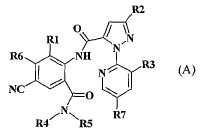
「식 중,`` In the meal,
R1는 Me, Cl, Br 또는 F,R 1 is Me, Cl, Br or F,
R2는 F, Cl, Br, C1-C4할로알킬, 또는 C1-C4할로알콕시,R2 is F, Cl, Br, C1-C4 haloalkyl, or C1-C4 haloalkoxy,
R3는 F, Cl 또는 Br,R3 is F, Cl or Br,
R4는 H, 1개 또는 그 이상의 할로겐원자; CN; SMe; S(O)Me; S(O)2Me 및 OMe로 치환되어 있어도 좋은 C1-C4알킬, C3-C4알케닐, C3-C4알키닐, 또는, C3-C5시클로알킬알킬,R4 is H, one or more halogen atoms; CN; SMe; S (O) Me; C 1 -C 4 alkyl, C 3 -C 4 alkenyl, C 3 -C 4 alkynyl, or C 3 -C 5 cycloalkylalkyl, which may be substituted with S (O) 2 Me and OMe,
R5는 H 또는 Me,R 5 is H or Me,
R6는 H, F 또는 Cl,R6 is H, F or Cl,
R7는 H, F 또는 Cl를 나타낸다.」R7 represents H, F or Cl. "
로 표시되는 화합물 등을 예로 들 수 있다.The compound etc. which are represented by are mentioned.
살진드기제(살진드기 활성성분)로는 아세퀴노실(acequinocyl), 아미트라즈(amitraz), 벤족시메이트(benzoximate), 비페나제이트(bifenaate), 브로모프로필레이트(bromopropylate), 치노메티오네이트(chinomethionat), 클로르벤질레이트(chlorobenzilate), CPCBS(chlorfenson), 클로펜테진(clofentezine), 시플루메토펜(cyflumetofen), 켈탄(디코폴:dicofol), 에톡사졸(etoxazole), 산화펜부타틴(fenbutatin oxide), 페노티오카르브(fenothiocarb), 펜피록시메이트(fenpyroximate), 플루아크리피림(fluacrypyrim), 플루프록시펜(fluproxyfen), 헥시티아족스(hexythiazox), 프로파르기트(propargite:BPPS), 폴리낙틴 복합체(polynactins), 피리다벤(pyridaben), 피리미디펜(Pyrimidifen), 테부펜시라드(tebufenpyrad), 테트라디폰(tetradifon), 스피로디클로펜(spirodiclofen), 스피로메시펜(spiromesifen), 스피로테트라매트(spirotetramat), 아미드플루메트(amidoflumet), 시에노피라펜(cyenopyrafen) 등을 예로 들 수 있고,Acaricides (actile mites) include acequinocyl, amitraz, benzoximate, bifenaate, bromopropylate and chinothio Chinomethionat, chlorobenzilate, CPCBS (chlorfenson), clofentezine, cyflumetofen, ketan (dicofol), ethoxazole, phenbutatin oxide (fenbutatin oxide), fenothiocarb, fenpyroximate, fluacrypyrim, fluproxyfen, hexythiazox, propargite: BPPS ), Polynactins, pyridaben, pyrimiden, pyrimidifen, tebufenpyrad, tetradifon, spirodiclofen, spiromesifen, Spirotetramat, amidoflumet, sea And the like furnace pyrazol pen (cyenopyrafen) for example,
살선충제(살선충 활성성분)로는 DCIP, 포스티아제이트(fosthiazate), 염산 레바미솔(levamisol), 메틸이소티오시아네이트(methyisothiocyanate), 주석산 모란텔(morantel tartarate), 이미시아포스(imicyafos) 등을 예로 들 수 있다.Nematicides (active nematicides) include DCIP, fosthiazate, levamisol hydrochloride, methylisothiocyanate, morantel tartarate, and imicyafos. Etc. can be mentioned.
살균제로는 프로피코나졸(propiconazole), 프로티오코나졸(prothioconazole), 트리아디메놀(triadimenol), 프로클로라즈(prochloraz), 펜코나졸(penconazole), 테부코나졸(tebuconazole), 플루실라조르(flusilazole), 디니코나졸(diniconazole), 브로무코나졸(bromuconazole), 에폭시코나졸(epoxiconazole), 디페노코나졸(difenoconazole), 시프로코나졸(cyproconazole), 메트코나졸(metconazole), 트리플루미졸(triflumizole), 테트라코나졸(tetraconazole), 미클로부타닐(myclobutanil), 펜부코나졸(fenbuconazole), 헥사코나졸(hexaconazole), 플루퀸코나졸(fluquinconazole), 트리티코나졸(triticonazole), 비테르타놀(bitertanol), 이마잘릴(imazalil), 플루트리아폴(flutriafol) 등의 아졸계 살균 화합물;The fungicides include propiconazole, prothioconazole, triadimenol, prochloraz, penconazole, tebuconazole and flusilazor ( flusilazole, diniconazole, bromuconazole, epoxyconazole, difenoconazole, cyproconazole, metconazole, triflumizole ), Tetraconazole, myclobutanil, fenbuconazole, hexaconazole, fluquinconazole, triticonazole, and bitteranol ( azole type bactericidal compounds such as bitertanol), imazalil and flutriafol;
펜프로피모르프(fenpropimorph), 트리데모르프(tridemorph), 펜프로피딘(fenpropidin) 등의 환상 아민계 살균 화합물;Cyclic amine-based bactericidal compounds such as fenpropimorph, tridemorph and fenpropidin;
카르벤다짐(carbendezim), 베노밀(benomyl), 티아벤다졸(thiabendazole), 티오파네이트메틸(thiophanate-methyl) 등의 벤즈이미다졸계 살균 화합물;Benzimidazole-based bactericidal compounds such as carbendezim, benomyl, thiabendazole, and thiophanate-methyl;
프로시미돈(procymidone); 시프로디닐(cyprodinil); 피리메타닐(pyrimethanil); 디에토펜카르브(diethofencarb); 티우람(thiuram); 플루아지남(fluazinam); 만코제브(mancozeb); 이프로디온(iprodione); 빈클로졸린(vinclozolin); 클로로탈로닐(chlorothalonil); 캡탄(captan); 메파니피림(mepanipyrim); 펜피클로닐(fenpiclonil); 플루디옥소닐(fludioxonil); 디클로플루아니드(dichlofluanid); 폴펫(folpet); 크레속심메틸(kresoxim-methyl); 아족시스트로빈(azoxystrobin); 트리플록시스트로빈(trifloxystrobin); 플루옥사스트로빈(fluoxastrobin); 피콕시스트로빈(picoxystrobin); 피라클로스트로빈(pyraclostrobin); 디목시스트로빈(dimoxystrobin); 피리벤카르브(pyribencarb); 스피록사민(spiroxamine); 퀴녹시펜(quinoxyfen); 펜헥사미드(fenhexamid); 파목사돈(famoxadone); 페나미돈(fenamidone); 족사미드(zoxamide); 에타복삼(ethaboxam); 아미설브롬(amisulbrom); 이프로발리카르브(iprovalicarb); 벤티아발리카르브(benthiavalicarb); 시아조파미드(cyazofamid); 만디프로파미드(mandipropamid); 보스칼리드(boscalid); 펜티오피라드(penthiopyrad); 메트라페논(metrafenone); 플루오피란(fluopiran); 빅사펜(bixafen); 시플루페나미드(cyflufenamid) 및 프로퀴나지드(proquinazid) 등을 예로 들 수 있다.Procymidone; Cyprodinil; Pyrimethanil; Diethofencarb; Thiuram; Fluazinam; Mancozeb; Iprodione; Vinclozolin; Chlorothalonil; Captan; Mepanipyrim; Fenpiclonil; Fludioxonil; Dichlofluanid; Folpet; Kresoxim-methyl; Azoxystrobin; Trifloxystrobin; Fluoxastrobin; Picoxystrobin; Pyraclostrobin; Dimoxystrobin; Pyribencarb; Spiroxamine; Quinoxyfen; Fenhexamid; Famoxadone; Fenamidone; Zoxamides; Ethaboxam; Amissulbrom; Iprovalicarb; Benthiavalicarb; Cyazofamid; Mandipropamid; Boscalid; Penthiopyrad; Metrafenone; Fluopiran; Bixafen; Examples include cyflufenamid and proquinazid.
제초제로는,As a herbicide,
(1) 페녹시 지방산계 제초성 화합물(1) phenoxy fatty acid herbicidal compound
2,4-PA, MCP, MCPB, 페노티올(phenothio1), 메코프롭(mecoprop), 플루록시피르(fluroxypyr), 트리클로피르(triclopyr), 클로메프롭(clomeprop), 나프로아닐리드(naproanilide) 등;2,4-PA, MCP, MCPB, phenothio1, mecoprop, fluroxypyr, triclopyr, clomeprop, naproanilide, etc. ;
(2) 안식향산계 제초성 화합물(2) Benzoic acid herbicidal compound
2,3,6-TBA, 디캄바(dicamba), 클로피랄리드(clopyralid), 피클로람(picloram), 아미노피랄리드(aminopyralid), 퀸클로락(quinclorac), 퀸메락(quinmerac) 등;2,3,6-TBA, dicamba, clopyralid, picloram, aminopyralid, quinclorac, quinmerac and the like;
(3) 요소계 제초성 화합물(3) Urea-based herbicidal compound
디우론(diuron), 리뉴론(linuron), 클로르톨르론(chlortoluron), 이소프로투론(isoproturon), 플루오메투론(fluometuron), 이소우론(isouron), 테부티우론(tebuthiuron), 메타벤즈티아주론(methabenzthiazuron), 쿠킬루론(cumy1uron), 다이무론(daimuron), 메틸다이무론(methyl-daimuron) 등;Diuron, linuron, chlortoluron, isoproturon, fluorometuron, isouron, tebuthiuron, metabenzthiazuron (methabenzthiazuron), cumy1uron, daimuron, methyl-daimuron and the like;
(4) 트리아진계 제초성 화합물(4) triazine herbicidal compound
아트라진(atrazine), 아메토린(ametoryn), 시아나진(cyanazine), 시마 진(simazine), 프로파진(propazine), 시메트린(simetryn), 디메타메트린(dimethametryn), 프로메트린(prometryn), 메트리부진(metribuzin), 트리아지플람(triaziflam) 등;Atrazine, amethorin, ametoryn, cyanazine, simazine, propazine, simethrin, dimethametryn, prometryn , Metribuzin, triaziflam and the like;
(5) 비피리디니움계 제초성 화합물(5) bipyridinium-based herbicidal compounds
파라콰트(paraquat), 디콰트(diquat) 등;Paraquat, diquat and the like;
(6) 히드록시벤조니트릴계 제초성 화합물(6) hydroxybenzonitrile herbicidal compound
브로목시닐(bromoxynil), 아이오키시닐(ioxynil) 등;Bromoxynil, ioxynil, and the like;
(7) 디니트로아닐린계 제초성 화합물(7) dinitroaniline-based herbicidal compounds
펜디메탈린(pendimethalin), 프로디아민(prodiamine), 트리플루랄린(trifluralin) 등;Pendimethalin (pendimethalin), prodiamine, trifluralin and the like;
(8) 유기 인계 제초성 화합물(8) organophosphorus herbicidal compounds
아미프로포스메틸(amiprofos-methyl), 부타미포스(butamifos), 벤설라이드(bensulide), 피페로포스(piperophos), 아닐로포스(anilofos), 글리포세이트(glyphosate), 글루포시네이트(glufosinate), 비알라포스(bialaphos) 등;Amiprofos-methyl, butamifos, bensulide, piperophos, anilofos, glyphosate, glufosinate , Bialaphos and the like;
(9) 카르바메이트계 제초성 화합물(9) carbamate-based herbicidal compounds
디알레이트(di-allate), 트리알레이트(tri-allate), EPTC, 부틸레이트(butylate), 벤티오카르브(benthiocarb), 에스프로카르브(esprocarb), 몰리네이트(molinate), 디메피퍼레이트(dimepiperate), 스웹(swep), 클로르프로팜(chlorpropham), 펜메디팜(phenmedipham), 페니소팜(phenisopham), 피리부티카르브(pyributicarb), 아슐람(asulam) 등;Di-allate, tri-allate, EPTC, butylate, benthiocarb, esprocarb, molinate, dimepiper Dimepiperate, swep, chlorpropham, phenmedipham, phenisopham, pyributicarb, asulam and the like;
(10) 산아미드계 제초성 화합물(10) Acid amide herbicidal compound
프로파닐(propanil), 프로피자미드(propyzamide), 브로모브티드(bromobutide), 에토벤자니드(etobenzanid) 등;Propane, propyzamide, bromobutide, etobenzanid and the like;
(11) 클로로아세트아닐리드계 제초성 화합물(11) Chloroacetanilide herbicidal compound
아세토클로르(acetochlor), 알라클로르(alachlor), 부타클로르(butachlor), 디메테나미드(dimethenamid), 프로파클로르(propachlor), 메타자클로르(metazachlor), 메톨라클로르(metolachlor), 프레틸라클로르(pretilachlor), 테닐클로르(thenylchlor), 페톡사미드(pethoxamid) 등;Acetochlor, alachlor, butachlor, dimethenamid, dimethenamid, propachlor, metazachlor, metolachlor, pretilachlor (pretilachlor), tenylchlor, pethoxamid and the like;
(12) 디페닐에테르계 제초성 화합물(12) Diphenyl ether herbicidal compound
아시플루오르펜(acifluorfen-sodium), 비페녹스(bifenox), 오옥시플루오르펜(oxyfluorfen), 락토펜(lactofen), 포메사펜(fomesafen), 클로메톡시닐(chlomethoxynil), 아클로니펜(aclonifen) 등;Acifluorfen-sodium, bifenox, oxyfluorfen, lactofen, pomesafen, fomesafen, chlomethoxynil, aclonifen, etc. ;
(13) 환상 이미드계 제초성 화합물(13) Cyclic imide herbicidal compound
옥사디아존(oxadiazon), 시니돈에틸(cinidon-ethyl), 카르펜트라존에틸(carfentrazone-ethyl), 수르펜트라존(surfentrazone), 플루미클로락펜틸(flumiclorac-pentyl), 플루미옥사진(flumioxazin), 피라플루펜에틸(pyraflufen-ethyl), 옥사디아르길(oxadiargy1), 펜톡사존(pentoxazone), 플루티아셋메틸(fluthiacet-methyl), 쿠타페나실(butafenacil), 벤즈펜디존(benzfendizone) 등;Oxadiazon, cinidon-ethyl, carfentrazone-ethyl, surfentrazone, flumiclorac-pentyl, flumioxazin ), Pyraflufen-ethyl, oxadiargy1, pentoxazone, fluthiacet-methyl, butafenacil, benzfendizone, etc. ;
(14) 피라졸계 제초성 화합물(14) pyrazole herbicidal compounds
벤조페납(benzofenap), 피라졸레이트(pyrazolate), 피라족시펜(pyrazoxyfen), 토프라메존(topramezone), 피라설포톨(pyrasulfotole) 등;Benzofenap, pyrazolate, pyrazoxyfen, topramezone, pyrasulfotole and the like;
(15) 트리케톤계 제초성 화합물(15) Triketone type herbicidal compound
이속사플루톨(isoxaflutole), 벤조비시클론(benzobicyclon), 설코트리온(sulcotrione), 메소트리온(mesotrione), 템보트리온(tembotrione), 테푸릴트리온(tefuryltrione) 등;Isoxaflutole, benzobicyclon, sulcotrione, mesotrione, tembotrione, tefuryltrione, and the like;
(16) 아릴옥시페녹시프로피온산계 제초성 화합물(16) Aryloxyphenoxypropionic acid herbicidal compound
크로디나폽프로파르길(clodinafop-propargyl), 시할로폽부틸(cyhalofop-butyl), 디클로폽메틸(diclofop-methyl), 페녹사프롭에틸(fenoxaprop-ethyl), 플루아지폽부틸(fluazifop-butyl), 할록시폽메틸(haloxyfop-methyl), 퀴잘로폽에틸(quizalofop-ethyl), 메타미폽(metamifop) 등;Chrodinafop-propargyl, cyhalofop-butyl, diclofop-methyl, fenoxaprop-ethyl, fluazifop- butyl), haloxyfop-methyl, quizalofopethyl, metamipop and the like;
(17) 트리온옥심계 제초성 화합물(17) Trionoxime herbicidal compound
알록시딤(alloxydim-sodium), 세톡시딤(sethoxydim), 부트록시딤(butroxydim), 클레소딤(clethodim), 클로프록시딤(cloproxydim), 시클록시딤(cycloxydim), 테프랄록시딤(tepraloxydim), 트랄콕시딤(tralkoxydim), 프로폭시딤(profoxydim) 등;Alloxydim-sodium, setoxydim, butroxydim, butroxydim, clethodim, cloproxydim, cycloxydim, tepraloxydim , Tralkoxydim, propoxydim and the like;
(18) 설포닐 요소계 제초성 화합물(18) sulfonyl urea herbicidal compounds
클로르설푸론(chlorsulfuron), 설포메트론메틸(sulfometuron-methyl), 메트설푸론메틸(metsu1furon-methy1), 클로리무론에틸(chlorimuron-ethyl), 트리베뉴론메틸(tribenuron-methyl), 트리아설푸론(triasulfuron), 벤설푸론메틸(bensulfuron-methyl), 티펜설푸론(thifensulfuron-methyl), 피라조설푸론에틸(pyrazosulfuron-ethyl), 프리미설푸론메틸(primisulfuron-methyl), 니코설푸론(nicosulfuron), 아미도설푸론(amidosulfuron), 시노설푸론(cinosulfuron), 이마조설푸론(imazosulfuron), 림설푸론(rimsulfuron), 할로설푸론메틸(halosulfuron-methyl), 프로설푸론(prosulfuron), 에타메트설푸론메틸(ethametsulfuron-methyl), 트리플루설푸론메틸(triflusulfuron-methyl), 플라자설푸론(flazasulfuron), 시클로설파무론(cyc1osulfamuron), 플루피르설푸론(flupyrsulfuron), 설포설푸론(sulfosulfuron), 아짐설푸론(azimsulfuron), 에톡시설푸론(ethoxysulfuron), 옥사설푸론(oxasulfuron), 요오드설푸론메틸나트륨(iodosulfuron-methyl-sodium), 포람설푸론(foramsulfuron), 메소설푸론메틸(mesosulfuron-methyl), 트리플록시설푸론(trifloxysulfuron), 트리토설푸론(tritosulfuron), 오르소토설파무론(orthosulfamuron), 플루세토설푸론(flucetosulfuron), 1-(2-클로로-6-프로필이미다조[1,2-a]피리다진-3-일설포닐)-3-(4,6-디메톡시피리미딘-2-일)우레아(1-(2-chloro-6-propylimidazo[1,2-a]pyridazin-3-ylsulfonyl)-3-(4,6-dimethoxypyrimidin-2-yl)urea) 등;Chlorsulfuron, sulsulmethuron-methyl, metsulfuron-methyl, metri1furon-methy1, chlorimuron-ethyl, tribenuron-methyl, triasulfuron (triasulfuron), bensulfuron-methyl, thifensulfuron-methyl, pyrazosulfuron-ethyl, primisulfuron-methyl, nicosulfuron, amymi Amidosulfuron, cinosulfuron, imazosulfuron, rimsulfuron, halosulfuron-methyl, prosulfuron, etametsulfuronmethyl -methyl, triflusulfuron-methyl, plazasulfuron, cyclosulfuron, cyc1osulfamuron, flupyrsulfuron, sulfosulfuron, azimsulfuron, Ethoxysulfuron, oxasulfuron, yo Sodium iosulsulfuron-methyl-sodium, foramsulfuron, mesosulfuron-methyl, trifloxysulfuron, tritosulfuron, orthothosulfuron orthosulfamuron), flucetosulfuron, 1- (2-chloro-6-propylimidazo [1,2-a] pyridazin-3-ylsulfonyl) -3- (4,6-dimethoxypy Rimidin-2-yl) urea (1- (2-chloro-6-propylimidazo [1,2-a] pyridazin-3-ylsulfonyl) -3- (4,6-dimethoxypyrimidin-2-yl) urea) and the like;
(19) 이미다졸리논계 제초성 화합물[이마자메타벤즈메틸(imazamethabenz-methyl), 이마자메타피르(imazamethapyr), 이마자목스(imazamox), 이마자피르(imazapyr), 이마자퀸(imazaquin), 이마제타피르(imazethapyr) 등;(19) imidazolinone-based herbicidal compounds (imazamethabenz-methyl, imazamethapyr, imazamox, imazapyr, imazaquinr, imazaquin, Imazethapyr and the like;
(20) 설폰아미드계 제초성 화합물(20) sulfonamide herbicidal compounds
플루메트설람(flumetsulam), 메토설람(metosulam), 디클로설람(diclosulam), 플로라설람(florasulam), 클로란설람메틸(cloransulam-methyl), 페녹스설람(penoxsulam), 피록스설람(pyroxsulam) 등;Flumetsulam, metosulam, diclosulam, florasulam, cloransulam-methyl, penoxsulam, pyroxsulam Etc;
(21) 피리미디닐옥시 안식향산계 제초성 화합물(21) Pyrimidinyloxy benzoic acid herbicidal compound
피리티오백나트륨(pyrithiobac-sodium), 비스피리백나트륨(bispyribac-sodium), 피리미노백메틸(pyriminobac-methyl), 피리벤족심(pyribenzoxim), 피리프탈리드(pyriftalid), 피리미설판(pyrimisulfan) 등;Pyrithiobac-sodium, bispyribac-sodium, pyriminobac-methyl, pyribenzoxim, pyriftalid, pyrimisulfan ) Etc;
(22) 그 외의 계통의 제초성 화합물(22) other herbicidal compounds
벤타존(bentazon), 브로마실(bromacil), 타바실(terbacil), 클로르티아미드(chlorthiamid), 이속사벤(isoxaben), 디노세브(dinoseb), 아미트롤(amitrole), 신메치린(cinmethylin), 트리디판(tridiphane), 달라폰(dalapon), 디플루펜조피르나트륨(diflufenzopyr-sodium), 디티오피르(dithiopyr), 티아조피르(thiazopyr), 플루카르바존나트륨(flucarbazone-sodium), 프로폭시카르바존나트륨(propoxycarbazone-sodium), 메페나셋(mefenacet), 플루페나셋(flufenacet), 펜트라자미드(fentrazamide), 카펜스트롤(cafenstrole), 인다노판(indanofan), 옥사디클로메폰(oxaziclomefone), 벤푸레세이트(benfuresate), ACN, 피리데이트(pyridate), 클로리다존(chloridazon), 노르플루라존(norflurazon), 플루타몬(flurtamone), 디플루페니칸(diflufenican), 피콜리나펜(picolinafen), 베플루부타미드(beflubutamid), 클로마존(clomazone), 아미카르바존(amicarbazone), 피녹사덴(pinoxaden), 피라클로닐(pyraclonil), 피록사설폰(pyroxasulfone), 티엔카르바존메틸(thiencarbazone-methyl) 등을 예로 들 수 있다.Betazon, bromacil, tabacyl, terbacil, chlorthiamid, isoxaben, dinoseb, amitrol, amitrole, cinmethylin, tree Tridiphane, dalapon, diflufenzopyr-sodium, dithiopyr, thiazopyr, flucarbazone-sodium, propoxycarbazone Sodium (propoxycarbazone-sodium), mefenacet, flufenacet, pentrazamide, fentrazamide, cafenstrole, indanofan, oxaziclomefone, ben Benfuresate, ACN, pyridate, chloridazon, norflurazon, flurtamone, diflufenican, picolinafen, bevin Beflubutamid, clomazone, amicarbazone, pinoxaden, pyraclo Examples thereof include pyraclonil, pyroxasulfone, thiencarbazonemethyl, and the like.
식물생장조절제로는 히멕사졸(hymexazol), 파클로부트라졸(paclobutrazol), 우니코나졸 P(uniconazole-P), 이나벤피드(inabenfide), 프로헥사디온칼슘(prohexadione-calcium), 아비글리신(aviglycine), 1-나프틸아세트아미드(1-naphthylacetamide), 앱시신산(abscisic acid), 인돌낙산(indolebutyric acid), 에티클로제이트에틸(ethychlozate ethyl), 에테폰(ethephon), 클록시포낙(cloxyfonac), 클로르메쿼트(chlormequat), 디클로르프롭(dichlorprop), 지베렐린(gibberellin), 프로히드로자스몬(prohydrojasmon), 벤질아미노푸린(benzylaminopurine), 포르클로르페뉴론(forchlorfenuron), 마레산히드라지드(maleic hydrazide), 과산화칼슘(calcium peroxide), 메피쿼트클로라이드(mepiquat-chloride)4-CPA(4-chlorophenoxyacetic acid) 등을 예로 들 수 있다.Plant growth regulators include hymexazol, paclobutrazol, uniconazole-P, inabenfide, prohexadione-calcium, and abiglycin ), 1-naphthylacetamide, abscisic acid, indolebutyric acid, etychlozate ethyl, ethephon, cloxyfonac, Chlormequat, dichlorprop, gibberellin, prohydrojasmon, benzylaminopurine, forchlorfenuron, maleic hydrazide, Calcium peroxide, mepiquat chloride 4-CPA, 4-chlorophenoxyacetic acid, and the like can be given.
공력제(synergists)로는 피페로닐부톡사이드(piperonyl butoxide), 세사멕스(sesamex), 설폭시드(sulfoxide), N-(2-에틸헥실)-8,9,10-트리노르본-5-엔-2,3-디카르복시이미드(MGK 264), N-데클리이미다졸(N-declyimidazole), WARF-안티레시스턴트(WARF-antiresistant), TBPT, TPP, IBP, PSCP, 요오드화메틸(CH3I), t-페닐부테논(t-phenylbutenone), 디에틸말레이트(diethylmaleate), DMC, FDMC, ETP, ETN 등을 예로 들 수 있다.Synergists include piperonyl butoxide, sesamex, sulfoxide, N- (2-ethylhexyl) -8,9,10-trinorborn-5-ene -2,3-dicarboxyimide (MGK 264), N-declyimidazole, WARF-antiresistant, TBPT, TPP, IBP, PSCP, methyl iodide (CH 3 I ), t-phenylbutenone (t-phenylbutenone), diethylmaleate, DMC, FDMC, ETP, ETN and the like.
약해 경감제로는 베녹사코르(benoxacor), 클로퀸토세트멕실(cloquintocet-mexyl), 시오메트리닐(cyometrinil), 다이무론(daimuron), 디클로르미드(dichlormid), 펜클로라졸에틸(fenchlorazole-ethyl), 펜클로림(fenclorim), 플루라졸(flurazole), 플럭소페님(fluxofenim), 푸리라졸(furilazole), 메펜피르디에틸(mefenpyr-diethyl), MG191, 옥사베트리닐(oxabetrinil), 알리도클로르(allidochlor), 이속사디펜에틸(isoxadifen-ethyl), 시프로설파미드(cyprosulfamide), 플럭소페님(fluxofenim), 1,8-나프탈산무수물(1,8-naphthalic anhydride) 등을 예로 들 수 있다.
As a weakening agent, benoxacor, cloquintocet-mexyl, cyometrinil, dimuron, dichlormid, phenchlorazole-ethyl ), Fenclorim, flurazole, fluxofenim, furilazole, mefenpyr-diethyl, MG191, oxabetrinil, aldodo Examples include chlorine (allidochlor), isoxadifen-ethyl, cyprosulfamide, fluxofenim, and 1,8-naphthalic anhydride. have.
본발명 조성물이나 본 활성화합물은 천적생물, 천적미생물 등의 유해생물 방제제와 동시에 사용할 수가 있다.The present invention composition and the present active compound can be used simultaneously with harmful organism control agents such as natural enemies and natural organisms.
이와 같은 천적생물, 천적미생물 등의 대표예를 이하에 나타낸다.Representative examples of such natural enemies and natural organisms are shown below.
반날갯과(staphylinidae), 고치벌과(Braconidae), 맵시벌과(Ichneumonidae), 세우다나스타투스(Pseudanastatus), 잎벌과(Tenthredinidae), 송곳벌과(Siricidae), 벌레살이송곳벌과(Orussidae), 진디과(Aphididae), 좀벌과(Eulophidae), 프랭클리노트리프스(Franklinothrips), 늑대거미과(Lycosidae), 면충좀벌과(Aphelinidae), 테사라토미내(Tessaratominae), 혹파리과(Cecidomyiidae), 꽃등에과(Syrphidae), 꽃노린재과(Anthocoridae), 이리응애과(Phytoseiidae), 풀잠자리과(Chrysopidae), 사마귀과(Mantidae), 무당벌레과(Coccinelidae), 잠자리과(Libellulidae), 먼지벌레과(Harpalidae), 개미과(Formicidae), 브베리아 균류(Beauveria), 버티실리움 균류(Verticillium), 패실로마이세스 균류(Paecilomyces), 경화병균류, 핵다각체병 바이러스(nucleopolyhedro virus), 과립병 바이러스(granulosis virus), 세포질 다각체병 바이러스(Cytoplasmic polyhedrosis virus), 곤충기생성선충(entomophilic nematodes), 패스튜리아속(Pasteuria sp.), 모노크로스포리움속(Monacrosporium sp.) 등의 살선충 균류를 예로 들 수 있다.
Staphylinidae, Brachionidae, Ichneumonidae, Cesudadanastatus, Tenhredinidae, Siricidae, Orussidae , Aphididae, Eulophidae, Franklinothrips, Lycosidae, Aphelinidae, Tessaratominae, Cecidomyiidae, Cactidomyiidae Syrphidae, Anthocoridae, Phytoseiidae, Chrysopidae, Mantisdae, Coccinelidae, Libellulidae, Hapalidae, Formicidae (Beauveria), Verticillium fungus, Verticillium fungus, Paecilomyces, Sclerosis fungus, Nucleopolyhedro virus, Granulosis virus, Cytoplasmic polyhedrosis virus , Insect parasitic nematodes For example, nematode fungi such as tomophilic nematodes, Pasturia sp., and Monocrosporium sp.
본 활성화합물의 유효량을 유해 절족동물 또는 유해 절족동물의 생식장소에 시용하는 유해 절족동물의 방제방법도 또한 본 발명 중 하나이다.A method for controlling noxious arthropods, wherein the effective amount of the active compound is applied to the noxious arthropod or the place of reproduction of the noxious arthropod, is also one of the present invention.
본 활성화합물이 효력을 나타내는 유해 절족동물로는 유해 곤충류나 유해 진드기류 등을 예로 들 수 있고, 이하의 것을 예로 들 수 있다.Examples of the harmful arthropods in which the active compound is effective include harmful insects, harmful mites, and the like.
반시목 해충: 애멸구(Laodelphax striatellus), 벼멸구(Nilaparvata lugens), 흰등멸구(Sogatella furcifera) 등의 멸구류, 끝동매미충(Nephotettix cincticeps), 두점끝동매미충(Nephotettix virescens), 오누키애매미충(Empoasca onukii) 등의 매미충류, 목화진딧물(Aphis gossypii), 복숭아혹진딧물(Myzus persicae), 양배추가루진딧물(Brevicoryne brassicae), 조팝나무진딧물(Aphis spiraecola), 감자수염진딧물(Macrosiphum euphorbiae), 싸리수염진딧물(Aulacorthum solani), 기장테두리진딧물(Rhopalosiphum padi), 귤소리진딧물(Toxoptera citricidus), 복숭아가루진딧물(Hyalopterus pruni) 등의 진디류, 풀색노린재(Nezara antennata), 톱다리개미허리노린재(Riptortus clavatus), 호리헤리노린재(Leptocorisa chinensis), 가시점둥글노린재(Eysarcoris parvus), 썩덩나무노린재(Halyomorpha mista) 등의 노린재류, 온실가루이(Trialeurodes vaporariorum), 담배가루이(Bemisia tabaci), 귤가루이(Dialeurodes citri), 귤가시가루이(Aleurocanthus spiniferus) 등의 가루이류, 귤붉은깍지벌레(Aonidiella aurantii), 산호제깍지벌레(Comstockaspis perniciosa), 시트러스 스노우 스케일(Unaspis citri), 루비깍지벌레(Ceroplastes rubens), 이세리아깍지벌레(Icerya purchasi), 온실가루깍지벌레(Planococcus kraunhiae), 뽕가루깍지벌레(Pseudococcus longispinis), 뽕나무깍지벌레(Pseudaulacaspis pentagona) 등의 깍지벌레류, 방패벌레류(tingis fly), 빈대(Cimex lectularius) 등의 빈대류, 나무이(psyllas) 등.Semi-arid pests: larvae (Laodelphax striatellus), rice locust (Nilaparvata lugens), white larvae (Sogatella furcifera), locusts, Nephotettix cincticeps, Nephotettix cicada larva (Nephotettix virescens) Cicada larvae, Cotton aphid (Aphis gossypii), Peach aphid (Myzus persicae), Cabbage aphid (Brevicoryne brassicae), Maple aphid (Aphis spiraecola), Potato beard aphid (Macrosiphum euphorbiacortis) , Aphids such as Rhodalosiphum padi, orange aphids (Toxoptera citricidus) and peach powder aphids (Hyalopterus pruni), full-colored nymph (Nezara antennata), saw-tailed anthilling (Riptortus clavatus) Stink bugs such as Leptocorisa chinensis, Eysarcoris parvus, and Halyomorpha mista, Trialurodes vap orariorum, Bemisia tabaci, Tangerine (Dialeurodes citri), Aleurocanthus spiniferus, and other powders, Aonidiella aurantii, Comstockaspis perniciosa, Citrus Snow Scale (Unaspis citri), Ruby Beetle (Ceroplastes rubens), Icerya purchasi, Greenhouse Beetle (Planococcus kraunhiae), Mulberry Beetle (Pseudococcus longispinis), Mulberry Bark Beetle (Pseudaagonaspis, etc.) Bedworms, tingis fly, bedbugs (Cimex lectularius), and psyllas.
인시류 해충: 이화명나방(Chilo suppressalis), 노란 이화명나방(Tryporyza incertulas), 혹명나방(Cnaphalocrocis medinalis), 목화명나방(Notarcha derogata), 화랑곡나방(Plodia interpunctella), 조명나방(Ostrinia furnacalis), 배추순나방(Hellula undalis), 잔디포충나방(Pediasia teterrellus) 등의 명나방류, 담배거세미나방(Spodoptera litura), 시로이치모지요트우(Spodoptera exigua), 파밤나방(Pseudaletia separata), 도둑나방(Mamestra brassicae), 검거세미나방(Agrotis ipsilon), 가두배추금날개밥나방(Plusia nigrisigna), 트리코플루시아속, 헬리오티스속, 헤리코베르파속 등의 밤나방류, 배추흰나비(Pieris rapae) 등의 흰나비류, 아독소피스속, 복숭아순나방(Grapholita molesta), 콩나방(Leguminivora glycinivorella), 팥나방(Matsumuraeses azukivora), 애모무늬잎말이나방(Adoxophyes orana fasciata), 아독소피에스 혼마이(Adoxophyes honmai), 차잎말이나방(Homona magnanima), 검모무늬잎말이나방(Archips fuscocupreanus), 코드린나방(Cydia pomonella) 등의 잎말이나방류, 동백가는나방(Caloptilia theivora), 사과굴나방(Phyllonorycter ringoneella)의 가는나방류, 복숭아심식나방(Carposina niponensis) 등의 심식나방류, 리오네티아속 등의 굴나방류, 리만트리아속, 유프로크티스속 등의 독나방류, 배추좀나방(Plutella xylostella) 등의 집나방류, 목화다래나방(Pectinophora gossypiella) 감자뿔나방(Phthorimaea operculella) 등의 뿔나방류, 미국흰불나방(Hyphantria cunea) 등의 불나방류, 옷좀나방(Tinea translucens), 애옷좀나방(Tineola bisselliella) 등의 곡식좀나방류 등.Species Pests: Chilo suppressalis, Yellow Moth (Tryporyza incertulas), Perch Moth (Cnaphalocrocis medinalis), Moth (Notarcha derogata), Flower Moth (Plodia interpunctella), Light Moth (Calispan) Moths (Hellula undalis), grasshopper moths (Pediasia teterrellus), moths of tobacco, Spodoptera litura, Spodoptera exigua, Pseudaletia separata, and burglar moth (Mamestra brass) , Arthropods (Agrotis ipsilon), crab cabbage wing moth (Plusia nigrisigna), chestnut moths such as tricoflucia, heliotis, and hercoperpa, white butterfly such as cabbage butterfly (Pieris rapae), and toxin Peas, Moth (Grapholita molesta), Bean Moth (Leguminivora glycinivorella), Red Bean Moth (Matsumuraeses azukivora), Adoxophyes orana fasciata, Adoxophyes honmai (Ado) xophyes honmai, Homona magnanima, gum leaf moth (Archips fuscocupreanus), cordy moth (Cydia pomonella), etc. Leaf camellia or camellia is Caloptilia theivora, Phyllonorycter Moths, carnivorous moths such as Carposina niponensis, oyster moths such as Lyonetia, poisonous moths such as Lymantria and Euproctis, and home moths such as Plutella xylostella Horned moths such as Moth (Pectinophora gossypiella) Potato horn moth (Phthorimaea operculella), fire moths such as the American White Moth (Hyphantria cunea), grain moths such as Tinea translucens and moths moth (Tineola bisselliella).
총채벌레목 해충: 꽃노랑총채벌레(Frankliniella occidentalis), 오이총채벌레(Thrips parmi), 볼록총채벌레(Scirtothrips dorsalis), 파총채벌레(Thrips tabaci), 대만총채벌레(Frankliniella intonsa) 등의 총채벌레류 등.Larvae Pests: Frankliniella occidentalis, Cucumber locust (Thrips parmi), Convex locust (Scirtothrips dordorsalis), Thrips tabaci, and Taiwan larvae (Frankliniella tonintonsa) Etc.
쌍시목 해충: 빨간집모기(Culex pipiens pallens), 작은빨간집모기(Culex tritaeniorhynchus), 열대집모기(Culex quinquefasciatus) 등의 집모기류, 이집트숲모기(Aedes aegypti), 흰줄숲모기(Aedes albopictus) 등의 에데스속, 중국얼룩날개모기(Anopheles sinensis) 등의 아노펠레스속, 깔따구류, 집파리(Musca domestica), 왕큰집파리(Muscina stabulans) 등의 집파리류, 검정파리류, 쉬파리류, 파니대류(Fanniidae), 씨고자리파리(Delia platura), 고자리파리(Delia antiqua) 등의 꽃파리류, 벼잎굴파리(Agromyza oryzae), 벼애잎굴파리(Hydrellia griseola), 토마토잎굴파리(Liriomyza sativae), 아메리카잎굴파리(Liriomyza trifolii), 완두굴파리(Chromatomyia horticola) 등의 굴파리류, 벼줄기굴파리(Chlorops oryzae) 등의 카르노이대류(carnoidea), 외파리(Dacus cucurbitae), 지중해과실파리(Ceratitis capitata) 등의 과실파리류, 초파리류, 오오키몬노바에(Megaselia spiracularis) 등의 벼룩파리류, 나방파리(Clogmia albipunctata) 등의 나방파리류, 먹파리류, 쇠등에(Tabanus trigonus) 등의 등에류, 침파리류 등.Double Pests: Mosquitoes (Culex pipiens pallens), small red mosquitoes (Culex tritaeniorhynchus), tropical mosquitoes (Culex quinquefasciatus) Ephesians, Anopheles sinensis, etc., Anopheles, Midgets, Housefly (Musca domestica), Housefly such as Muscina stabulans, Black fly, Squirrel, Fanny Flower flies such as Fanniidae, Delia platura, and Delia antiqua, Rice Leaf Oyster (Agromyza oryzae), Rice Leaf Oyster (Hydrellia griseola), Tomato Leaf Oyster (Liriomyza sativae) Fruit fly, such as oysters such as Liriomyza trifolii and pea oyster fly, Chromatomyia horticola, carnoidea such as Chloops oryzae, Dacus cucurbitae, and Certitis capitata , Drosophila, Flea flies, such as Ogasimonspiracularis, Moth flies, such as Clogmia albipunctata, Dwarf flies, and the like, Tabanus trigonus, etc.
초시목 해충: 웨스턴 옥수수 뿌리벌레(Diabrotica virgifera virgifera), 서던 옥수수 뿌리벌레(Diabrotica undecimpunctata howardi) 등의 옥수수 뿌리벌레류, 구리풍뎅이(Anomala cuprea), 오리나무풍뎅이(Anomala rufocuprea), 왜콩풍뎅이(Popillia japonica) 등의 풍뎅이류, 어리쌀바구미(Sitophilus zeamais), 벼물바구미(Lissorhoptrus oryzophilus), 팥바구미(Callosobruchuys chienensis), 벼뿌리바구미(Echinocnemus squameus), 목화바구미(Anthonomus grandis), 잔디왕바구미(Sphenophorus venatus) 등의 바구미류, 갈색거저리(Tenebrio molitor), 거짓쌀도둑거저리(Tribolium castaneum) 등의 거저리류,Herbaceous pests: Corn root beetles (Diabrotica virgifera virgifera), Southern corn root beetles (Diabrotica undecimpunctata howardi), corn beetles, Anomala cuprea, Anomala rufocuprea, and beetle beetles Scarabs, Sitophilus zeamais, Rice weevil (Lissorhoptrus oryzophilus), Red bean weevil (Callosobruchuys chienensis), Rice root weevil (Echinocnemus squameus) Weevils such as weevils, brown meals (Tenebrioitormolitor), mealworms such as Tribolium castaneum,
벼잎벌레(Oulema oryzae), 오이잎벌레(Aulacophora femoralis), 벼룩잎벌레(Phyllotreta striolata), 콜로라도잎벌레(Leptinotarsa decemlineata) 등의 잎벌레류, 애알락수시렁이(Anthrenus verbasci), 암검은수시렁이(Dermestes maculates) 등의 수시렁이류, 궐련벌레(Lasioderma serricorne) 등의 궐련벌레류, 이십팔점박이부당벌레(Epilachna vigintioctopunctata) 등의 무당벌레류, 넓적나무좀(Lyctus brunneus), 소나무좀(Tomicus piniperda) 등의 나무좀류, 개나무좀류, 표범벌레류, 알락하늘소(Anoplophora malasiaca) 등의 하늘소류, 방아벌레류(Agriotes spp.) 청딱지개미반날개(Paederus fuscipes) 등.Leaf beetles such as Olema oryzae, Cucumber leaf worm (Aulacophora femoralis), Flea leaf worm (Phyllotreta striolata), and Colorado leaf worm (Leptinotarsa, decemlineata), Anthrenus verbasci , Insects such as cigarettes (Lasiodermariserricorne), ladybugs such as twenty eight spotted ladybugs (Epilachna vigintioctopunctata), tree beetles such as Lycotus brunneus and pine beetles (Tomicus piniperda) , Leopards, Anoplophora malasiaca, etc., sky worms, insects (Agriotes ppspp.) Blue anthill wing (Paederus fuscipes) and the like.
직시목 해충: 풀무치(Locusta migratoria), 하늘밥도둑(Gryllotalpa africana), 벼메뚜기(Oxya yezoensis), 잔날개벼메뚜기(Oxya japonica), 귀뚜라미류 등.Direct Pests: Locusta migratoria, Gryllotalpa africana, Oxya yezoensis, Oxya japonica, Cricket, etc.
은시목 해충: 고양이벼룩(Ctenocephalides felis), 개벼룩(Ctenocephalides canis), 사람벼룩(Pulex irritans), 열대쥐벼룩(Xenopsylla cheopis) 등.Silver-necked pests: cat flea (Ctenocephalidestefelis), dog flea (Ctenocephalides canis), human fleas (Pulex irritans), and tropical rat fleas (Xenopsylla cheopis).
이눈 해충: 몸이(Pediculus humanus corporis), 사면발이(Phthirus pubis), 소이(Haematopinus eurysternus), 양이(Dalmalinia ovis), 돼지이(Haematopinus suis) 등.Eye Blight Pests: Pediculus humanus corporis, Phtharus pubis, Haematopinus eurysternus, Lamb (Dalmalinia ovis), Pork (Haematopinus suis).
막시목 해충: 애집개미(Monomorium pharaosis), 곰개미(Formica fusca japonica), 흰발마디개미(Ochetellus glaber), 그물등개미(Pristomyrmex pungens), 흑개미(Pheidole noda), 가위개미속(Acromyrmex spp.), 두배자루마디아과개미(Solenopsis spp.) 등의 개미류, 말벌류, 개미모양벌류, 무잎벌(Athalia rosae), 왜무잎벌(Athalia japonica) 등의 잎벌류 등.Maxima pests: Monomorium pharaosis, Bear ant (Formica fusca japonica), White-footed ants (Ochetellus glaber), Reticulated ants (Pristomyrmex pungens), Black ants (Pheidole noda), Scissors ants (Acromyrmex spp). Ants such as Solenopsis spp., Wasps, ant-like bees, leaf bees such as Athalia rosae and Athalia japonica.
바퀴목 해충: 독일바퀴(Blattella germanica), 먹바퀴(Periplaneta fuliginosa), 이질바퀴(Periplaneta americana), 페리플라네타 브루네아(Periplaneta brunnea), 진날개바퀴(Blatta orientalis) 등.Cockroach pests: German wheels (Blattella germanica), cockroach (Periplaneta fuliginosa), heteroplanes (Periplaneta americana), Periplaneta brunnea, and Batla orientalis.
진드기목 해충: 점박이응애(Tetranychus urticae), 차응애(Tetranychus kanzawai), 귤응애(Panonychus citri), 사과응애(Panonychus ulmi), 올리코니커스속 등의 응애류, 귤녹응애(Aculops pelekassi), 류유큐우귤녹응애(Phyllocoptruta citri), 토마토녹응애(Aculops lycopersici), 갈색녹응애(Calacarus carinatus), 갈색긴녹응애(Acaphylla theavagrans), 니세나시녹응애(Eriophyes chibaensis), 사과나무녹응애(Aculus schlechtendali) 등의 혹응애류, 차먼지응애(Polyphagotarsonemus latus) 등의 먼지응애류, 남부주름응애(Brevipalpus phoenicis) 등의 애응애류, 치레응애류, 작은소참진드기(Haemaphysalis longicornis), 개피참진드기(Haemaphysalis flava), 타이완참진드기(Dermacentor taiwanicus), 일본참진드기(Ixodes ovatus), 산림진드기(Ixodes persulcatus), 검은다리사슴진드기(Ixodes scapularis), 소참진드기(Boophilus microplus), 뿔참진드기(Rhipicephalus sanguineus) 등의 참진드기류, 긴털가루진드기(Tyrophagus putrescentiae), 시금치긴털가루진드기(Tyrophagus similis) 등의 가루진드기류, 큰다리먼지진드기(Dermatophagoides farinae), 세로무늬집먼지진드기(Dermatophagoides ptrenyssnus) 등의 발톱진드기류, 짧은빗살발톱진드기(Cheyletus eruditus), 긴집게다리새털진드기(Cheyletus malaccensis), 굵은발톱진드기(Cheyletus moorei) 등의 발톱진드기류, 집쥐진드기(Ornithonyssus bacoti), 노던파울진드기(Ornithonyssus sylvairum), 새진드기(Dermanyssus gallinae) 등의 새진드기류, 빨간쓰쓰가무시(Leptotrombidium akamushi) 등의 쓰쓰가무시류 등. 애어리염낭거미(Chiracanthium japonicum), 붉은등검정거미(Latrodectus hasseltii) 등의 거미류 등.Mite pests: Tetranychus urticae, Tetranychus kanzawai, Pantanhhus mcitri, Panonychus ulmi, and Oligonicus mite, Aculops pelekassi (Phyllocoptruta citri), tomato rust mite (Aculops lycopersici), brown rust mite (Calacarus carinatus), brown long rust mite (Acaphylla theavagrans), Eriophyes chibaensis, Aculus schlecht et al. Mites, dust mites such as Polyphagotarsonemus latus, mites such as Brevipalpus phoenicis, Haemaphysalis longicornis, Haemaphysalis longicornis, Haemaphysalis flavor, Thai derma taiwanicus, Japanese mite (Ixodes ovatus), forest mite (Ixodes persulcatus), black legged mite (Ixodes scapularis), small mite (Boophilus microplus), horn mite True mites, such as Rhipicephalus sanguineus, Dust mites such as Tyrophagus putrescentiae, Spinph long mites (Dyrophagus similis), Dermatophagoides farinae Claw mites such as claw mites, short-footed claw mites (Cheyletus eruditus), long-clawed mite (Cheyletus malaccensis), and claw mites (Cheyletus moorei), and house mites (Ornithonyssus bacotis) birds such as sylvairum), birds mites (Dermanyssus e gallinae), and birds such as red ptotrombidium akamushi. Arachnids such as Chiracanthium japonicum and Red-backed black spider (Latrodectus hasseltii).
순각강류: 돈벌레(Thereuonema hilgendorfi), 왕지네(Scolopendra subspinipes) 등.Crustaceans: Thereuonema hilgendorfi, Scolopendra subspinipes, etc.
배각강류: 고운까막노래기(Oxidus gracilis), 아카야스데(Nedyopus tambanus) 등.Baekgang River: Fine Black Song (Oxidus gracilis), Akayasude (Nedyopus tambanus), etc.
등각목류: 쥐며느리(Armadillidium vulgare) 등.Isometric: Armadillidium vulgare, etc.
복족강류: 두줄민달팽이(Limax marginatus), 노랑뾰족민달팽이(Limax flavus) 등.Gastropods: two-tailed slug (Limax marginatus), yellow-tailed slug (Limax flavus).
본 발명의 방제방법에 대하여 본 활성화합물의 효과가 높은 유해 절족동물로서는 반시목 해충을 예로 들 수 있다.As a noxious arthropod with a high effect of the active compound on the control method of the present invention, a semi-wood pest may be mentioned.
상술의 유해 절족동물 중에 목재 해충으로서 흰개미를 예로 들 수 있으나, 구체적으로는 다음의 것을 예로 들 수 있다.Although the termite is mentioned as a wood pest among the above-mentioned harmful arthropods, Specifically, the following are mentioned.
마스토테르미티대(Mastotermitidae), 테르몹시대(Termopsidae)[Zootermopsis속, Archotermopsis속, Hodotermopsis속, Porotermes속, Stolotermes속], 칼로테르미티대(Kalotermitidae)[Kalotermes속, Neotermes속, Cryptotermes속, Incistermes속, Glyptotermes속], 호도테르미티대(Hodotermitidae)[Hodotermes속, Microhodotermes속, Anacanthotermes속], 리노테르미티대(Rhinotermitidae)[Reticulitermes속, Heterotermes속, Coptotermes속, Schedolinotermes속], 세리테르미티대(Serritermitidae), 흰개미과(Termitidae)[Amitermes속, Drepanotermes속, Hopitalitermes속, Trinervitermes속, Macrotermes속, Odontotermes속, Microtermes속, Nasutitermes속, Pericapritermes속, Anoplotermes속];Mastotermitidae, Termopsidae [Zootermopsis, Archotermopsis, Hodotermopsis, Porotermes, Stolotermes], Kalotermitidae [Kalotermitidae, Neotermes, Cryptotermes, Incistermes Genus, Glyptotermes], Hodotermitidae [Hodotermes, Microhodotermes, Anacanthotermes], Rinotermitidae [Reticulitermes, Heterotermes, Coptotermes, Schedolinotermes], Ceritermite Serritermitidae), termites (genus Amitermes, Drepanotermes, Hopitalitermes, Trinervitermes, Macrotermes, Odontotermes, Microtermes, Nasutitermes, Pericapritermes, Anoplotermes);
그 중에서 방제 대상이 되는 흰개미의 구체예로는 일본흰개미(Reticulitermes speratus), 집흰개미(Coptotermes formosanus), 아메리카칸자이시로아리(Incisitermes minor), 건재흰개미(Cryptotermes domesticus), 오돈토테르메스 포르모사누스(Odontotermes formosanus), 네오테르메스 코슈넨시스(Neotermes koshunensis), 글립토테르메스 사트수멘시스(Glyptotermes satsumensis), 글립토테르메스 나카지마이(Glyptotermes nakajimai), 글립토테르메스 푸스쿠스(Glyptotermes fuscus), 글립토테르메스 코다마이(Glyptotermes kodamai), 글립토테르메스 쿠시멘시스(Glyptotermes kushimensis), 호도테르몹시스 자포니카(Hodotermopsis japonica), 콥토테르메스 구앙죠엔시스(Coptotermes guangzhoensis), 레티큘리테르메스 미야타케이(Reticulitermes miyatakei), 레티큘리테르메스 플라비셉스 아마미아누스(Reticulitermes flaviceps amamianus), 레티큘리테르메스 속(Reticulitermes sp.), 나수티테르메스 타카사고엔시스(Nasutitermes takasagoensis), 페리캅리테르메스 니토베이(Pericapritermes nitobei), 무샤시로아리(Sinocapritermes mushae), 레티큘리테루메스 플라비페스(Reticuliterumes flavipes), 레티큘리테르메스 헤스페루스(Reticulitermes hesperus), 레티큘리테르메스 비르기니쿠스(Reticulitermes virginicus), 레티큘리테르메스 티비알리스(Reticulitermes tibialis), 헤테로테르메스 아우레우스(Heterotermes aureus), 주에르몹시스 네바덴시스(Zootermopsis nevadensis) 등을 예로 들 수가 있다.Specific examples of termites to be controlled among them are Japanese termites (Reticulitermes atsperatus), house termites (Coptotermes formosanus), American Kanzashiroro (Incisitermes minor), dry wood termites (Cryptotermes domesticus), and Odontotermes formosaus. (Odontotermes formosanus), Neotermes koshunensis, Glyptotermes satsumensis, Glyptotermes nakajimai, Glyptotermes nakajimai, Glyptotermus fucuscuses Glyptotermesmaikodamai, Glyptotermes kushimensis, Hodotermopsis japonica, Coptotermes 구 guangzhoensis, Retmiya Reticulitermes miyatakei, Reticulitermes flaviceps amamianus s), Reticulitermes sp., Nasutitermes takasagoensis, Pericapritermes bei nitobei, Musinoroari (Sinocapritermes mushae), Reticulterumes Reticuliterumes flavipes, Reticulitermes hesperus, Reticulitermes virginicus, Reticulitermes tibialis, Heterotermes aureus Heterotermes aureus, Zoermopsis nevadensis, etc. are mentioned.
흰 개미 이외의 목재 해충으로는 넓적나무좀과, 개나무좀과, 권연벌레과, 하늘소과 등의 초시목 곤충을 예로 들 수 있다.Examples of wood pests other than white ants include broad-leafed insects such as broad-leafed tree, small-leaved tree, camphor beetle, and sky creeper.
본 활성화합물은 가축병 치료의 분야 및 축산업에 있어서, 또, 척추동물, 예를 들면, 사람, 소, 양, 염소, 돼지, 가금, 개, 고양이 및 물고기 등의 내부 또는 외부에 기생하는 절족동물을 구제하여 공중위생을 유지하는데 사용가능하다. 예를 들면, 상기 유해생물 중에는 사슴진드기류(Ixodes spp. 예를 들면, 사슴진드기(Ixodes scapularis)), 부필루스류(Boophilus spp. 예를 들면, 꼬리소진드기(Boophilus microplus)), 암플리옴마류(Amblyomma spp.), 히알롬마류(Hyalomma spp.), 갈색개진드기류(Rhipicephalus spp. 예를 들면, 뿔참진드기(Rhipicephalus sanguineus)), 작은소참진드기류(Haemaphysalis spp. 예를 들면, 해마피살리스 롱기코르니스(Haemaphysalis longicornis)), 데르마센토르류(dermacentor spp.), 오르니토오로스류(Ornithodoros spp. 예를 들면, 오르니토도로스 모우바타(Ornithodoros moubata)), 테르마히수스 갈리내(Dermahyssus gallinae), 오르니토니수스 실비아룸(Ornithonyssus sylviarum), 사르콥테스류(Sarcoptes spp. 예를 들면, 옴 진드기(Sarcoptes scabiei)), 소롭테스류(Psoroptes spp.), 코리옵테스류(Chorioptes spp.), 데모덱스류(Demodex spp.), 유트롬비쿨라류(Eutrombicula spp.), 애데스류(Aedes spp. 예를 들면, 흰줄숲모기(Aedes albopictus)), 아노펠레스류(Anopheles spp.), 쿨렉스류(Culex spp), 쿨리코데스류(Culicodes spp), 집파리류(Musca spp.), 히포데르마류(Hypoderma spp.), 가스테로필루스류(Gasterophilus spp.), 해마토비아류(Haematobia spp), 타바누스류(Tabanus spp), 시물리움류(Simulium spp.), 트리마토마류(Triatoma spp), 이목류(Phthiraptera(예를 들면 다말리니아류(Damalinia spp.), 리노흐나투스류(Linognathus spp.), 해마토피누스류(Haematopinus spp)), 테노세팔리데스류(Ctenocephalides spp. 예를 들면, 고양이벼룩(Ctenocephalides felis) Xenosylla spp), 및 애집개미(monomorium pharaonis) 등을 예로 들 수 있다.
The active compound is an arthropod that is parasitic inside or outside vertebrates, for example, humans, cattle, sheep, goats, pigs, poultry, dogs, cats, and fish, in the field of livestock disease treatment and livestock industry. It can be used to maintain public health by extinguishing. For example, among the harmful organisms are deer ticks (Ixodes spp. For example, Ixodes scapularis), bophylus spp. (For example, Boophilus microplus), ampliomma Amblyomma spp., Hyalomma spp., Brown mite (Rhipicephalus spp., Eg, Rippleicephalus sanguineus), Haemaphysalis spp. Haemaphysalis longicornis, dermacentor spp., Ornithodoros spp.For example Ornithodoros moubata, Termahysus Galina gallinae, Ornithonyssus sylviarum, Sarcoptes spp.For example, Sarcoptes scabiei, Psoroptes spp., Chorioptes spp. ), Demodex spp., Eurombicula spp.), Aedes spp. for example, Aedes albopictus, Anopheles spp., Culex spp, Culicodes spp, Housefly Musca spp., Hypoderma spp., Gasosterophilus spp., Haematobia spp, Tabanus spp, Simulium spp. ), Triatoma spp, Phthiraptera (e.g. Damalinia spp., Linognathus spp., Haematopinus spp), Tenosefalali Death (Ctenocephalides spp. For example, cat fleas (Ctenocephalides felis) Xenosylla spp, and monomorium pharaonis.
본 발명과 관련되는 방제방법에서는 다른 어떠한 성분도 첨가하지 않고 본 활성화합물을 그대로 시용할 수도 있고, 본 활성화합물과 상술한 살충제, 살진드기제, 살선충제, 살균제 등 그 외의 약제를 시용하여도 좋고, 본 활성화합물과 천적 생물이나 천적 미생물을 병용하여도 좋고, 본 활성화합물로서 본발명 조성물을 시용할 수도 있다.In the control method according to the present invention, the active compound may be applied as it is without adding any other ingredients, or the other active agents such as the active compound and the aforementioned insecticides, acaricides, nematicides, and fungicides may be applied. The present active compound may be used in combination with a natural or natural organism, or the present invention may be applied as the active compound.
상기 유해 절족동물의 생식장소로는 논, 건답(dry field), 밭, 차밭, 과수원, 비농경지, 가옥, 육묘트레이(seeding-rasing tray)나 육묘상자, 육묘배토(seeding-rasing soil) 및 육묘매트, 수경농장에서의 수경액 등을 예로 들 수 있다.Reproductive sites of the noxious arthropod include paddy fields, dry fields, fields, tea fields, orchards, non-crop land, houses, seeding-rasing trays or seedling boxes, seeding-rasing soils and seedlings. Mat, hydroponic fluid in hydroponic farms, and the like.
상기 방제방법에 있어서 본 활성화합물은 유해 절족동물 또는 유해 절족동물의 생식장소에 종래의 유해 절족동물 방제제와 동일한 방법으로 상기의 유해 절족동물에 접촉 혹은 섭취시킴으로써 시용 할 수가 있다.In the above-mentioned control method, the active compound can be applied by contacting or ingesting the noxious arthropod or the noxious arthropod in the reproductive area of the noxious arthropod in the same manner as the conventional noxious arthropod control agent.
이와 같은 시용방법으로는 산포처리, 토양처리, 종자처리 및 수경액처리를 예로 들 수 있다.Such application methods include spray treatment, soil treatment, seed treatment and hydroponic treatment.
상기 산포처리란, 경엽살포, 수간살포 등의 식물체 표면 혹은 유해 절족동물 자체에 유효성분(본 활성화합물)을 살포함으로써 유해 절족동물에 대한 방제효력을 발현하는 처리방법이다.The scattering treatment is a treatment method for expressing a control effect on harmful arthropods by spraying an active ingredient (the present active compound) on the surface of a plant such as foliage spray, trunk spray or the harmful arthropod itself.
상기 토양처리란, 예를 들면, 보호하고자 하는 작물의 근권에 유효성분을 주는 것으로, 유해 절족동물을 직접 방제하거나, 또는 식물체 내부에 유효성분을 침투이행시켜서 유해 절족동물을 방제하는 처리방법이다.The soil treatment is, for example, by giving an active ingredient to the root zone of the crop to be protected, is a treatment method for controlling harmful arthropods by directly controlling the harmful arthropods or by infiltrating the active ingredients into the plants.
상기 토양처리로는 구체적으로는 식혈처리(planting hole treatment)(식혈산포, 식혈처리 토양 혼화), 주원처리(seedling treatment)(주원산포, 주원 토양 혼화, 주원관주(seedling irrigation), 육묘기 후반주원처리), 식구처리(planting ditch treatment)(식구살포, 식구 토양 혼화), 작조처리(planting row treatment)(고랑살포, 고랑 토양 혼화, 생육기 고랑 살포), 파종시 작조처리(파종시 고랑살포, 파종시 고랑 토양 혼화), 전면처리(전면 토양 살포, 전면 토양 혼화), 측조처리, 수면처리(수면시용, 담수 후 수면시용), 그 외 토양 산포처리(생육기 입제 엽면 산포, 수관하 또는 주간 주변 산포, 토양 표면 산포, 토양 표면 혼화, 파혈 산포, 휴부 지표면 산포, 주간 산포), 그 외에 관주처리(토양관주, 육묘기관주, 액제 주입 처리, 지제부관주, 액제 드립일리게이션, 케미게이션), 육묘상자 처리(육묘상자 산포, 육묘상자 관주, 육묘상자 약액 담수), 육묘 트레이 처리(육묘 트레이 산포, 육묘 트레이관주, 육묘 트레이 약액 담수), 묘상처리(묘상산포, 묘상관주, 수묘대묘상산포, 묘침지), 상토 혼화 처리(상토 혼화, 파종 전 상토 혼화, 파종시 복토 전 살포, 파종시 복토 후 살포, 복토 혼화), 그 외에 처리(배토 혼화, 쟁기질, 표토 혼화, 낙우부 토양 혼화(rain-dropping portion of soil), 식목위치 처리(planting position treatment), 개화용 입제 산포(spraying of a granule agent to inflorescence), 페이스트 비료 혼화) 등을 예로 들 수 있다.Specifically, the soil treatment includes planting hole treatment (planting hole treatment, blood mixture soil mixing), main treatment (seedling treatment) (main plant scattering, main soil mixing, seedling irrigation, seedling treatment) ), Planting ditch treatment (plant spraying, plant soil mixing), planting row treatment (furrow spray, furrow soil mixing, growing season furrows), sowing planting process (sewing furrow, sowing Furrow soil mixing), full surface treatment (front soil spraying, full soil mixing), surface treatment, sleep treatment (for sleep, after fresh water), and other soil spreading treatments (growth foliar spread, water canopy or daytime periphery, Soil surface dispersion, soil surface mixing, bleeding dispersion, resting surface spread, daytime spread), and other irrigation treatment (soil irrigation, seedling trachea, liquid injection treatment, paper subsidiary irrigation, liquid drip silencing, chemistry), seedling box treatment (Seedling box spread, seedling box irrigation, seedling box chemical freshwater), seedling tray processing (seedling tray spread, seedling tray irrigation, seedling tray chemical freshwater), seedling processing (seedling spreading, seedling irrigation, seedling seedling spreading, seedling immersion) , Soil mixing treatment (soil mixing, soil mixing before sowing, soil spraying before sowing, soil spraying after sowing, soil mixing), and other treatments (soil mixing, plowing, topsoil mixing, rain-dropping portion of soil, planting position treatment, spraying of a granule agent to inflorescence, and paste fertilizer admixture.
상기 종자처리란, 보호하고자 하는 작물의 종자, 씨감자 또는 구근 등에 직접 혹은 그 근방을 유효성분으로 처리함으로써 유해 절족동물에 대한 방제효력을 발현하는 처리방법이다. 상기 종자처리로는 구체적으로는 스프레이 처리, 도말 처리, 침지 처리, 함침 처리, 도포 처리, 필름코팅 처리, 펠렛코팅 처리 등을 예로 들 수 있다.The seed treatment is a treatment method for expressing a control effect on harmful arthropods by treating seeds, seed potatoes or bulbs of a crop to be protected directly or in the vicinity thereof as an active ingredient. Specific examples of the seed treatment include spray treatment, smear treatment, dipping treatment, impregnation treatment, coating treatment, film coating treatment, pellet coating treatment, and the like.
상기 수경액처리란, 보호하고자 하는 작물의 근부 등으로부터 상기 작물의 내부에 유효성분을 침투이행시키기 위해서, 수경액 등을 유효성분으로 처리함으로써 상기 작물을 유해 절족동물에 의한 피해로부터 보호하는 처리방법이다. 상기 수경액처리로는 구체적으로 수경액 혼화, 수경액 혼입 등을 예로 들 수 있다.The hydroponic treatment is a treatment method for protecting the crop from damage by harmful arthropods by treating the hydroponic fluid with an active ingredient in order to infiltrate the active ingredient into the crop from the root of the crop to be protected. to be. Specific examples of the hydroponic treatment include hydraulic fluid mixing and hydrohydric mixing.
본 활성화합물은 밭, 논, 잔디, 과수원 등의 농경지 또는 비농경지용에 있어서의 유해 절족동물 방제제로서 사용할 수가 있다.This active compound can be used as a control agent for harmful arthropods in agricultural or non-agricultural fields such as fields, paddy fields, grasses, orchards.
본 활성화합물을 농업분야의 유해 절족동물 방제에 사용하는 경우, 그 시용량은 시용시기, 시용장소, 시용방법 등에 따라서 광범위하게 바꿀 수가 있으나, 일반적으로는 10000m2 당 1~10000g이다. 본 활성화합물이 유제, 수화제, 유동화제(flowable agent) 등에 제재화되어 있는 경우는 통상 상기 화합물의 농도가 0.01~10000ppm이 되도록 물로 희석해 시용하고, 입제, 분제 등은 통상 그대로 시용 한다.When the active compound is used for the control of harmful arthropods in the agricultural field, the dosage can vary widely depending on the time of application, the place of application, the method of application, etc., but it is generally 1 to 10,000 g per 10000 m 2 . When the active compound is formulated into an emulsion, a hydrating agent, a flowable agent, or the like, it is usually diluted and applied with water so that the concentration of the compound is 0.01 to 10,000 ppm, and granulation, powder, and the like are usually applied as it is.
본 활성화합물이나 그 물 희석액은 유해 절족동물 또는 식물에 직접 산포처리히여오 좋고, 상술한 토양처리에 제공하여도 좋다.This active compound or its water diluent may be directly sprayed on harmful arthropods or plants, or may be used for the above-described soil treatment.
본 활성화합물을 시트 형상이나 끈 형상으로 가공한 수지제제로서 작물에 감고, 작물 근방에 매달며, 주원토양(planting soil)에 까는 등의 방법에 의해 시용할 수도 있다.It is also possible to apply this active compound by the method of the resin preparation which processed into the sheet form or the string form, wound it on a crop, hanged in the vicinity of a crop, and spread it on planting soil.
본 활성화합물은 이하에 예를 드는 「작물」등을 재배하는 농경지 등에 있어서 상기 작물 등에 대해서 약해를 주지 않고, 상기 농경지의 해충을 방제할 수가 있는 경우가 있다.The present active compound may control pests of the cropland without harming the crops or the like in farmland or the like for growing "crops" or the like below.
농작물; 옥수수, 벼, 밀, 대맥, 호밀, 귀리, 수수, 목화, 대두, 피넛, 메밀국수, 첨채, 유채씨, 해바라기, 사탕수수, 담배 등.crops; Corn, rice, wheat, macaroni, rye, oats, sorghum, cotton, soybeans, peanuts, soba noodles, ecchi, rapeseed seeds, sunflowers, sugar cane, tobacco, etc.
채소; 가지과 채소(가지, 토마토, 피망, 고추, 고구마 등), 박과 채소(오이, 호박, 주키니, 수박, 멜론 등), 유채과 채소(무, 무청, 서양고추냉이, 콜라비, 배추, 양배추, 갓, 브로콜리, 콜리플라워 등), 국화과 채소(우엉, 쑥갓, 아티초크, 양상추 등), 백합과 채소(파, 양파, 마늘, 아스파라거스), 산형과 채소(당근, 파슬리, 샐러리, 파스닙 등), 명아주과 채소(시금치, 근대 등), 차조기과 채소(차조기, 민트, 바질 등), 딸기, 고구마, 참마, 토란 등.vegetable; Eggplant vegetables (eggplant, tomatoes, bell peppers, peppers, sweet potatoes, etc.), gourds and vegetables (cucumbers, pumpkins, zucchini, watermelons, melons, etc.), cress (radish, radish, horseradish, kohlrabi, cabbage, cabbage, fresh , Broccoli, cauliflower, etc.), asteraceae vegetables (burdock, garland chrysanthemum, artichoke, lettuce, etc.), lily and vegetable (scallions, onions, garlic, asparagus), mountain and vegetables (carrots, parsley, celery, parsnips), Tuna fruits (spinach, chard etc.), perilla vegetables (perilla, mint, basil, etc.), strawberries, sweet potatoes, yams, taro.
과수; 인과류(사과, 서양배, 일본배, 모과, 마르멜로 등), 핵과류(복숭아, 자두, 천도복숭아, 매실, 황도, 살구, 플룬 등), 감귤류(운슈(unshiu)귤, 오렌지, 레몬, 라임, 그레이프후르츠 등), 견과류(밤, 호두, 개암, 아몬드, 피스타치오, 캐슈너트, 마카다미아너트 등), 액과류(블루베리, 크랜베리, 블랙베리, 라즈베리 등), 포도, 감, 올리브, 비파, 바나나, 커피, 대추야자, 코코야자, 아브라야자 등. 과수 이외의 수목; 차나무, 뽕나무, 화목류, 가로수(물푸레나무, 자작나무, 미국산딸나무, 유칼리, 은행나무, 라일락, 단풍나무, 오크, 포퓰러, 박태기나무, 단풍나무, 플라타너스, 느티나무, 지빵나무, 전나무, 솔송나무, 두송, 소나무, 가문비나무, 비자나무), 야트로파 등.fruit tree; Causal fruits (apples, pears, Japanese pears, quince, quince, etc.), nuclear fruits (peaches, plums, nectarines, plums, zodiacal, apricots, prunes, etc.), citrus fruits (unshiu tangerines, oranges, lemons, limes) , Grapefruit, etc.), nuts (chestnuts, walnuts, hazelnuts, almonds, pistachios, cashew nuts, macadamia nuts, etc.), fruit juices (blueberries, cranberries, blackberries, raspberries, etc.), grapes, persimmons, olives, loquats, Banana, coffee, date palm, coco palm, abra palm etc. Trees other than fruit trees; Tea tree, mulberry, flower tree, row of trees (April, Birch, American Cornel, Eucalyptus, Ginkgo, Lilac, Maple, Oak, Poplar, Cucumber, Maple, Sycamore, Zelkova, Breadfruit, Fir, Pine Wood, birch, pine, spruce, non-tree), yatropa etc.
잔디; 잔디류(들잔디, 금잔디 등), 버뮤다그래스류(시노돈 댁틸론(cynodon dactylon) 등), 벤트그래스류(레드톱 그래스(redtop grass), 아그로스티스 스톨로니페라 엘.(Agrostis stolonifera L.), 아그로스티스 카필라리스 엘.(Agrostis capillaris L.) 등), 블루그래스류(켄터키 블루그래스(Kentuky blugrass), 포아트리비알리스 엘.(Poatrivialis L.) 등), 페스크류(큰김의털(Festuca arundinacea Schreb.), 왕김의털(Festuca rubra.), 눈붉은 개미털(creeping red fescue) 등), 라이그래스류(오스트레일리안 라이그래스(Australian ryegrass), 페레니얼 라이그래스(perennial ryegrass) 등), 오리새(Orchard Grass), 큰조아재비(timothy) 등.grass; Grass (grass, gold grass, etc.), bermudagrass (cynodon dactylon, etc.), bentgrass (redtop grass, Agrotistis stolonifera L.), Agrostis capillaris L., etc., Bluegrasses (Kentuky blugrass, Poatrivialis L., etc.), Pestles (Festuca arundinacea) Schreb.), Festuca rubra., Creeping red fescue, etc., lygras (Australian ryegrass, perennial ryegrass, etc.), Orchard Grass, timothy, etc.
그 외; 화훼, 관엽식물 등.etc; Flowers, houseplants, etc.
상기 「작물」에는 이속사플루톨(isoxaflutole) 등의 HPPD 저해제, 이마제타피르(imazethapyr), 티펜설푸론(thifensulfuron) 등의 ALS 저해제, EPSP 합성 효소 저해제, 글루타민 합성 효소 저해제, 아세틸 CoA 카르복시라아제 저해제, 브로목시닐(bromoxynil) 등의 제초제에 대한 내성을 고전적인 육종법, 혹은 유전자 재조합 기술에 의해 부여된 식물도 포함된다.The crops include HPPD inhibitors such as isoxaflutole, ALS inhibitors such as imazethapyr and thifensulfuron, EPSP synthase inhibitors, glutamine synthetase inhibitors, and acetyl CoA carboxylase. Also included are plants in which resistance to herbicides such as inhibitors, bromoxynil, and the like is given by classical breeding or genetic recombination techniques.
고전적인 육종법에 의해 내성이 부여된 「작물」의 예로서 이마제타피르 등의 이미다졸리논계 제초제에 내성의 Clearfield[등록상표] 카놀라(canola), 티펜설푸론 등의 설포닐우레아계 ALS 저해형 제초제에 내성의 STS 대두 등이 있다.As an example of a "crop" endowed by classical breeding, sulfonylurea ALS inhibitory types such as Clearfield (canola) and fensulfuron resistant to imidazolinone herbicides such as imazetapyr STS soybean resistant to herbicides.
마찬가지로 고전적인 육종법에 의해 트리온옥심계 제초제, 아릴옥시페녹시프로피온산계 제초제 등의 아세틸 CoA 카르복시라아제 저해제에 대한 내성이 부여된 작물의 예로서 SR 콘(SR corn) 등이 있다.Similarly, SR corn is an example of a crop that has been given resistance to acetyl CoA carboxylase inhibitors such as trionoxime herbicides and aryloxyphenoxypropionic acid herbicides by classical breeding methods.
아세틸 CoA 카르복시라아제 저해제에 대한 내성이 부여된 작물은 프로시딩 오브 내셔널 아카데미 오브 사이언스 오브 더 유나이티드 스테이트 오브 어메리카(Proc.Natl.Acad.Sci.USA) 87권, 7175~7179 페이지(1990년) 등에 기재되어 있다. 또 아세틸 CoA 카르복시라아제 저해제에 내성의 변이 아세틸 CoA 카르복시라아제가 위드 사이언스(Weed Science) 53권, 728~746 페이지(2005년) 등에 보고되고 있다. 이와 같이 한 변이 아세틸 CoA 카르복시라아제 유전자를 유전자 재조합 기술에 의해 작물에 도입하거나 혹은 저항성 부여에 관련되는 변이를 작물 아세틸 CoA 카르복시라아제에 도입함으로써 아세틸 CoA 카르복시라아제 저해제에 내성의 작물을 작출할 수가 있다.Crops conferred resistance to acetyl CoA carboxylase inhibitors are described in Proc.Natl.Acad.Sci.USA, Vol. 87, pp. 7175-7179 (1990), Proceedings of the National Academy of Sciences It is. Mutant acetyl CoA carboxylases resistant to acetyl CoA carboxylase inhibitors have been reported in Weed Science 53, pages 728-746 (2005). Thus, crops resistant to acetyl CoA carboxylase inhibitors can be produced by introducing one mutant acetyl CoA carboxylase gene into a crop by genetic recombination technology or introducing a mutation related to resistance to crop acetyl CoA carboxylase. There is a number.
또한, 키메라플라스티 기술(Gura T. 1999. Repairing the Genome‘s Spelling Mistakes. Science 285:316-318.)로 대표되는 염기 치환 변이 도입 핵산을 작물세포 내에 도입하여 작물(아세틸 CoA 카르복시라아제/제초제 표적) 유전자에 부위 특이적 아미노산 치환 변이를 발생시킴으로써 (아세틸 CoA 카르복시라아제 저해제/제초제)에 내성의 작물을 작출할 수가 있다.In addition, a base-substituted mutant introduced nucleic acid represented by chimera plasti technology (Gura T. 1999. Repairing the Genome'sSpelling Mistakes. By producing site-specific amino acid substitution mutations in the herbicide target) gene, crops resistant to (acetyl CoA carboxylase inhibitor / herbicide) can be produced.
유전자 재조합 기술에 의해 내성이 부여된 작물의 예로서 글리포세이트나 글루포시네이트에 내성의 옥수수 품종이 있고, RoundupReady[등록상표] 및 LibertyLink[등록상표] 등의 상품명으로 이미 판매되고 있다.Examples of crops to which resistance has been given by genetic recombination techniques include corn varieties resistant to glyphosate and glufosinate, and are already sold under trade names such as RoundupReady® and LibertyLink®.
상기 「작물」에는 유전자 재조합 기술을 사용하여여, 예를 들면, 바실루스속으로 알려져 있는 선택적 독소 등을 합성할 수 있게 된 식물도 포함된다.The above-mentioned "crops" also include plants which are capable of synthesizing a selective toxin known as the genus Bacillus by using a genetic recombination technique.
이와 같은 유전자 재조합 식물로 발현되는 독소로서 바실루스 세레우스나 바실루스 포필리에 유래의 살충성 단백질; 바실루스 튜린겐시스 유래의 Cry1Ab, Cry1Ac, Cry1F, Cry1Fa2, Cry2Ab, Cry3A, Cry3Bb1 또는 Cry9C 등의δ-엔도톡신, VIP1, VIP2, VIP3 또는 VIP3A 등의 살충 단백질; 선충 유래의 살충 단백질; 전갈 독소, 거미 독소, 벌 독소 또는 곤충 특이적 신경 독소 등 동물에 의해 생산되는 독소; 사조균류(filamentous fungi) 독소; 식물 렉틴; 아글루티닌; 트립신 저해제, 세린프로테아제 저해제, 파타틴, 시스타틴, 파파인 저해제 등의 프로테아제 저해제; 리신, 옥수수-RIP, 아브린, 루핀, 사폴린, 브리오딘 등의 리보솜 불활성화 단백질(RIP); 3-히드록시스테로이드옥시다제, 엑디스테로이드-UDP-글루코실트랜스퍼라제, 콜레스테롤옥시다제 등의 스테로이드 대사 효소; 엑디슨 저해제; HMG-CoA 리덕타제; 나트륨 채널, 칼슘 채널 저해제 등의 이온 채널 저해제; 청소년 호르몬 에스테라제; 이뇨 호르몬 수용체; 스틸벤 신세타제(stilbene synthetase); 비벤질 신세타제; 키티나제; 글루카나제 등을 예로 들 수 있다.As a toxin expressed by such a recombinant plant, insecticidal proteins derived from Bacillus cereus and Bacillus popphyli; Insecticidal proteins such as δ-endotoxin, VIP1, VIP2, VIP3 or VIP3A such as Cry1Ab, Cry1Ac, Cry1F, Cry1Fa2, Cry2Ab, Cry3A, Cry3Bb1 or Cry9C derived from Bacillus thuringiensis; Insecticidal proteins derived from nematodes; Toxins produced by animals, such as scorpion toxins, spider toxins, bee toxins, or insect specific neurotoxins; Filamentous fungi toxins; Plant lectins; Aglutinin; Protease inhibitors such as trypsin inhibitor, serine protease inhibitor, patatin, cystatin, papain inhibitor and the like; Ribosome inactivating proteins (RIPs) such as lysine, corn-RIP, abrine, lupine, sapoline, briodine; Steroid metabolizing enzymes such as 3-hydroxysteroid oxidase, exesteroids-UDP-glucosyltransferase, and cholesterol oxidase; Exedison inhibitors; HMG-CoA reductase; Ion channel inhibitors such as sodium channel and calcium channel inhibitors; Juvenile hormone esterase; Diuretic hormone receptors; Stilbene synthetase; Bibenzyl synthetase; Chitinase; Glucanase and the like.
또 이와 같은 유전자 재조합 작물로 발현되는 독소로서 상술한 살충 단백질의 하이브리드 독소, 일부를 결손한 독소, 수식된 독소도 포함된다. 하이브리드 독소는 재조합 기술을 사용하여, 이들 단백질이 다른 도메인의 새로운 조합에 의해 만들어진다. 일부를 결손한 독소로는 아미노산 서열의 일부를 결손한 Cry1Ab가 알려져 있다. 수식된 독소로는 천연형 독소의 아미노산 중 하나 또는 복수가 치환되어 있다.In addition, the toxin expressed by such a recombinant crop includes a hybrid toxin of the above-described insecticidal protein, a toxin missing part of it, and a modified toxin. Hybrid toxins use recombinant techniques such that these proteins are made by new combinations of different domains. As toxins which are partly missing, Cry1Ab which is missing part of the amino acid sequence is known. Modified toxins are substituted with one or more of the amino acids of the natural toxin.
이들 독소의 예 및 이들 독소를 합성할 수가 있는 재조합 식물은 EP-A-0374753, WO93/07278, WO95/34656, EP-A-0427529, EP-A-0451878, WO03/052073 등에 기재되어 있다.Examples of these toxins and recombinant plants capable of synthesizing these toxins are described in EP-A-0374753, WO93 / 07278, WO95 / 34656, EP-A-0427529, EP-A-0451878, WO03 / 052073 and the like.
이들 재조합 식물에 포함되는 독소는 특히 갑충목(Coleoptera) 해충, 쌍시목(Diptera) 해충, 인시목(Lepidoptera) 해충에 대한 내성을 식물에 부여한다.Toxins included in these recombinant plants in particular confer plants to resistance to Coleoptera pests, Diptera pests, and Lepidoptera pests.
또, 1개 또는 복수의 살충성의 해충 저항성 유전자를 포함하고, 1개 또는 복수의 독소를 발현하는 유전자 재조합 식물은 이미 알려져 있으며, 몇 개의 것은 시판되어 있다. 이들 유전자 재조합 식물은 YieldGard[등록상표](Cry1Ab 독소를 발현하는 옥수수 품종), YieldGard Rootworm[등록상표](Cry3Bb1 독소를 발현하는 옥수수 품종), YieldGard Plus[등록상표](Cry1Ab와 Cry3Bb1 독소를 발현하는 옥수수 품종), Herculex I[등록상표](Cry1Fa2 독소와 글루포시네이트에 대한 내성을 부여하기 위해 포스피노트리신 N-아세틸트랜스퍼라제(PAT)를 발현하는 옥수수 품종), NuCOTN33B[등록상표](Cry1Ac 독소를 발현하는 목화 품종), Bollgard I[등록상표](Cry1Ac 독소를 발현하는 목화 품종), Bollgard II[등록상표](Cry1Ac와 Cry2Ab 독소를 발현하는 목화 품종), VIPCOT[등록상표](VIP 독소를 발현하는 목화 품종), NewLeaf[등록상표](Cry3A 독소를 발현하는 고구마 품종), NatureGard[등록상표]Agrisure[등록상표]GT Advantage(GA21 글리포세이트 내성 형질), Agrisure[등록상표] CB Advantage(Bt11 콘 보러(corn borer)(CB) 형질), Protecta[등록상표]등을 예로 들 수 있다.In addition, genetically modified plants containing one or a plurality of insecticidal insect resistance genes and expressing one or a plurality of toxins are already known, and some are commercially available. These genetically modified plants are YieldGard® (corn varieties expressing the Cry1Ab toxin), YieldGard® Rootworm® (corn varieties expressing the Cry3Bb1 toxin), YieldGard®Plus® (trademarks expressing the Cry1Ab and Cry3Bb1 toxins). Corn varieties), Herculex I® (corn varieties expressing phosphinothricin® N-acetyltransferase (PAT) to confer resistance to Cry1Fa2 toxin and glufosinate), NuCOTN33B® (Cry1Ac) Cotton varieties expressing toxins), Bollgard I® (cotton varieties expressing Cry1Ac toxins), Bollgard II® (cotton varieties expressing Cry1Ac and Cry2Ab toxins), VIPCOT® (VIP toxins) Cotton varieties), NewLeaf® (sweet potato varieties expressing Cry3A toxin), NatureGard®Agrisure® GT Advantage (GA21® glycosate resistant trait), Agrisure® CB Advantage (Bt11 corn see (cor n borer) (CB) trait), Protecta® and the like.
상기 「작물」에는 유전자 재조합 기술을 사용하여 선택적인 작용을 가지는 항병원성 물질을 생산하는 능력이 부여된 것도 포함된다.The above-mentioned "crops" include those endowed with the ability to produce an antipathogenic substance having a selective action using a genetic recombination technique.
이와 같이 한 유전자 재조합 식물로 발현되는 항병원성 물질은 나트륨 채널 저해제, 칼슘 채널 저해제(바이러스가 생산하는 KP1, KP4, KP6 독소 등이 알려져 있다) 등의 이온 채널 저해제; 스틸벤 신타제; 비벤질 신타제; 키티나제; 그르카나제; PR단백질(PRPs, EP-A-0392225); 펩티드 항생 물질, 헤테로환을 가지는 항생 물질, 식물 병해 저항성에 관여하는 단백질 인자(WO03/000906에 기재되어 있다) 등의 미생물이 생산하는 항병원성 물질 등을 예로 들 수 있다. 이와 같은 항병원성 물질과 그것을 생산하는 유전자 재조합 식물은 EP-A-0392225, WO95/33818, EP-A-0353191 등에 기재되어 있다.As described above, antipathogenic substances expressed by a recombinant plant include ion channel inhibitors such as sodium channel inhibitors and calcium channel inhibitors (KP1, KP4, KP6 toxins produced by viruses are known); Stilbene synthase; Bibenzyl synthase; Chitinase; Grecanase; PR proteins (PRPs, EP-A-0392225); Examples include anti-pathogenic substances produced by microorganisms such as peptide antibiotics, antibiotics having heterocycles, and protein factors (described in WO03 / 000906) that are involved in plant disease resistance. Such anti-pathogenic substances and recombinant plants producing them are described in EP-A-0392225, WO95 / 33818, EP-A-0353191 and the like.
상기 「작물」에는 유전자 재조합 기술을 사용하여 유량성분 개질이나 아미노산 함량 증강 형질 등의 유용 형질을 부여한 작물도 포함된다. VISTIVE[등록상표](리놀렌 함량을 저감시킨 저리놀렌 대두) 혹은 high-lysine(high-oil) corn(리신 또는 오일 함유량을 증량한 콘) 등을 예로 들 수 있다.The above-mentioned "crops" also include crops to which useful traits such as flow rate modification and amino acid content enhancing traits have been imparted using genetic recombination techniques. Examples include VISTIVE® (low-linolene soybean with reduced linolenic content) or high-lysine (high-oil) corn (lysine or corn with increased oil content).
또한, 상기의 고전적인 제초제 형질 또는 제초제 내성 유전자, 살충성 해충 저항성 유전자, 항병원성 물질 생산 유전자, 유량성분 개질이나 아미노산 함량 증강 형질 등의 유용 형질에 대해 이들을 복수 조합한 스택(stack) 품종도 포함된다.Also included are stack varieties of multiple combinations of the above useful herbicide traits or herbicide resistance genes, insecticidal pest resistance genes, anti-pathogenic material genes, flow rate modifications or amino acid content enhancing traits. do.
본 활성화합물을 가옥 내에 생식하는 유해 절족동물(예를 들면, 파리, 모기, 바퀴벌레)의 방제에 사용하는 경우, 그 시용량은 면 상에 시용하는 경우 처리면적 1m2 당 통상 0.01~1000mg이고, 공간에 시용하는 경우 통상 처리공간 1m3 당 0.01~500mg이다. 본 활성화합물이 유제, 수화제, 유동화제 등에 제제화되어 있는 경우 통상 0.1~1000ppm이 되도록 물로 희석하여 시용하고, 유제, 에어로졸제, 훈연제, 독이제 등은 그대로 시용한다.
When the active compound is used for controlling harmful arthropods (eg, flies, mosquitoes, cockroaches) that live in a house, the dosage is usually 0.01 to 1000 mg per 1 m 2 of treatment area when applied on cotton. In the case of application in the range of 0.01 to 500 mg per 1 m 3 of treatment space. When the active compound is formulated in an emulsion, a hydrating agent, a fluidizing agent or the like, it is usually diluted and applied with water to 0.1 to 1000 ppm, and the emulsion, aerosol, smoker, poison, etc. are applied as it is.
실시예Example
이하, 본 발명을 제조예, 참고 제조예 및 시험예에 의해 더 자세하게 설명하한다. 그러나, 본 발명은 이들에 한정되지 않는다.
Hereinafter, the present invention will be described in more detail with reference to Production Examples, Reference Preparation Examples, and Test Examples. However, the present invention is not limited to these.
제조예Production Example 1 One
2-아미노-4-프로필페놀 1.2g, 이소니코틴산 0.98g 및 폴리인산 32.8g의 혼합물을 190℃에서 5시간 동안 가열교반하였다. 실온에 냉각한 후, 빙랭한 수산화나트륨수용액 중에 붓고, 아세트산에틸로 3회 추출하였다. 혼합된 유기층을 물, 포화식염수로 세정하고, 황산마그네슘으로 건조하였다. 활성탄을 첨가한 후, 셀라이트(등록상표)를 통하여 여과하여 여과액을 감압 하에서 농축하였다. 잔사를 실리카겔 칼럼크로마토그래피 처리하여, 5-프로필-2-(피리딘-4-일)-벤즈옥사졸(이하, 본 활성화합물 1이라고 함) 0.72g을 얻었다.A mixture of 1.2 g 2-amino-4-propylphenol, 0.98 g isonicotinic acid and 32.8 g polyphosphoric acid was heated and stirred at 190 ° C. for 5 hours. After cooling to room temperature, the mixture was poured into an ice-cold sodium hydroxide aqueous solution and extracted three times with ethyl acetate. The mixed organic layer was washed with water and brine, and dried over magnesium sulfate. After adding activated carbon, the filtrate was concentrated under reduced pressure by filtration through Celite (registered trademark). The residue was subjected to silica gel column chromatography to obtain 0.72 g of 5-propyl-2- (pyridin-4-yl) -benzoxazole (hereinafter referred to as Active Compound 1).

본 활성화합물 1Present active compound 1
1H-NMR(CDCl3)δ:8.81(dd, J=4.6, 1.7Hz, 2H), 8.08(dd, J=4.5, 1.7Hz, 2H), 7.62-7.60(m, 1H), 7.54-7.50(m, 1H), 7.27-7.23(m, 1H), 2.74(t, J=7.5Hz, 2H), 1.76-1.66(m, 2H), 1.31(t, J=7.5Hz, 3H)
1 H-NMR (CDCl 3 ) δ: 8.81 (dd, J = 4.6, 1.7 Hz, 2H), 8.08 (dd, J = 4.5, 1.7 Hz, 2H), 7.62-7.60 (m, 1H), 7.54-7.50 (m, 1H), 7.27-7.23 (m, 1H), 2.74 (t, J = 7.5 Hz, 2H), 1.76-1.66 (m, 2H), 1.31 (t, J = 7.5 Hz, 3H)
제조예Production Example 2 2
2-아미노-4-프로필페놀을 대신하여 2-아미노-4-메틸페놀을 사용하고, 제조예 1 기재의 방법에 준하여 5-메틸-2-(피리딘-4-일)-벤즈옥사졸(이하, 본 활성화합물 2라고 함)을 얻었다.2-amino-4-methylphenol was used in place of 2-amino-4-propylphenol, and 5-methyl-2- (pyridin-4-yl) -benzoxazole (hereinafter referred to as the method described in Preparation Example 1) , This active compound 2) was obtained.

본 활성Saw active 화합물 2Compound 2
1H-NMR(CDCl3)δ:8.81(dd, J=4.5, 1.6Hz, 2H), 8.07(dd, J=4.5, 1.6Hz, 2H), 7.62-7.59(m, 1H), 7.52-7.48(m, 1H), 7.25-7.22(m, 1H), 2.51(s, 3H)
1 H-NMR (CDCl 3 ) δ: 8.81 (dd, J = 4.5, 1.6 Hz, 2H), 8.07 (dd, J = 4.5, 1.6 Hz, 2H), 7.62-7.59 (m, 1H), 7.52-7.48 (m, 1H), 7.25-7.22 (m, 1H), 2.51 (s, 3H)
제조예Production Example 3 3
2-아미노-4-프로필페놀을 대신하여 2-아미노-4-에틸페놀을 사용하고, 제조예 1 기재의 방법에 준하여 5-에틸-2-(피리딘-4-일)-벤즈옥사졸(이하, 본 활성화합물 3이라고 함)을 얻었다.2-amino-4-ethylphenol was used in place of 2-amino-4-propylphenol, and 5-ethyl-2- (pyridin-4-yl) -benzoxazole (hereinafter referred to as the method described in Preparation Example 1) was used. , This active compound 3) was obtained.

본 활성Saw active 화합물 3Compound 3
1H-NMR(CDCl3)δ:8.81(dd, J=4.6, 1.7Hz, 2H), 8.07(dd, J=4.4, 1.7Hz, 2H), 7.64-7.62(m, 1H), 7.52(d, J=8.5Hz, 1H), 7.27(dd, J=8.5, 1.7Hz, 1H), 2.80(q, J=7.6Hz, 2H), 1.31(t, J=7.6Hz, 3H)
1 H-NMR (CDCl 3 ) δ: 8.81 (dd, J = 4.6, 1.7 Hz, 2H), 8.07 (dd, J = 4.4, 1.7 Hz, 2H), 7.64-7.62 (m, 1H), 7.52 (d , J = 8.5 Hz, 1H), 7.27 (dd, J = 8.5, 1.7 Hz, 1H), 2.80 (q, J = 7.6 Hz, 2H), 1.31 (t, J = 7.6 Hz, 3H)
제조예Production Example 4 4
2-아미노-4-프로필페놀을 대신하여 2-아미노-4-부틸페놀을 사용하고, 제조예 1 기재의 방법에 준하여 5-부틸-2-(피리딘-4-일)-벤즈옥사졸(이하, 본 활성화합물 4라고 함)을 얻었다.2-Amino-4-butylphenol was used in place of 2-amino-4-propylphenol, and 5-butyl-2- (pyridin-4-yl) -benzoxazole (hereinafter referred to according to the method described in Preparation Example 1) , Present active compound 4).

본 활성Saw active 화합물 4Compound 4
1H-NMR(CDCl3)δ:8.81(dd, J=4.4, 1.7Hz, 2H), 8.08(dd, J=4.6, 1.7Hz, 2H), 7.62-7.61(m, 1H), 7.53-7.50(m, 1H), 7.27-7.23(m, 1H), 2.76(t, J=7.6Hz, 2H), 1.71-1.62(m, 2H), 1.44-1.33(m, 2H), 0.95(t, J=7.3Hz, 3H)
1 H-NMR (CDCl 3 ) δ: 8.81 (dd, J = 4.4, 1.7 Hz, 2H), 8.08 (dd, J = 4.6, 1.7 Hz, 2H), 7.62-7.61 (m, 1H), 7.53-7.50 (m, 1H), 7.27-7.23 (m, 1H), 2.76 (t, J = 7.6 Hz, 2H), 1.71-1.62 (m, 2H), 1.44-1.33 (m, 2H), 0.95 (t, J = 7.3 Hz, 3H)
제조예Production Example 5 5
2-아미노-4-프로필페놀을 대신하여 2-아미노-4-이소프로필페놀을 사용하고, 제조예 1 기재의 방법에 준하여 5-이소프로필-2-(피리딘-4-일)-벤즈옥사졸(이하, 본 활성화합물 5라고 함)을 얻었다.2-Amino-4-isopropylphenol was used in place of 2-amino-4-propylphenol, and 5-isopropyl-2- (pyridin-4-yl) -benzoxazole was prepared according to the method described in Preparation Example 1. (Hereinafter referred to as active compound 5) was obtained.
사졸(이하, 본 활성화합물 5라고 함)을 얻었다.Soazole (hereinafter referred to as active compound 5) was obtained.

본 활성Saw active 화합물 5Compound 5
1H-NMR(CDCl3)δ:8.82(dd, J=4.5, 1.6Hz, 2H), 8.08(dd, J=4.5, 1.6Hz, 2H), 7.68(d, J=1.7Hz, 1H), 7.53(d, J=8.5Hz, 1H), 7.31(dd, J=8.4, 1.8Hz, 1H), 3.11-3.04(m, 1H), 1.33(d, J=6.8Hz, 6H)
1 H-NMR (CDCl 3 ) δ: 8.82 (dd, J = 4.5, 1.6 Hz, 2H), 8.08 (dd, J = 4.5, 1.6 Hz, 2H), 7.68 (d, J = 1.7 Hz, 1H), 7.53 (d, J = 8.5 Hz, 1H), 7.31 (dd, J = 8.4, 1.8 Hz, 1H), 3.11-3.04 (m, 1H), 1.33 (d, J = 6.8 Hz, 6H)
제조예Production Example 6 6
2-아미노-4-프로필페놀을 대신하여 2-아미노-4-tert-부틸페놀을 사용하고, 제조예 1 기재의 방법에 준하여 5-tert-부틸-2-(피리딘-4-일)-벤즈옥사졸(이하, 본 활성화합물 6이라고 함)을 얻었다.2-amino-4-tert-butylphenol was used in place of 2-amino-4-propylphenol, and 5-tert-butyl-2- (pyridin-4-yl) -benz was produced according to the method described in Preparation Example 1. Oxazole (hereinafter referred to as active compound 6) was obtained.

본 활성화합물 6Present active compound 6
1H-NMR(CDCl3)δ:8.83-8.80(m, 2H), 8.09-8.06(m, 2H), 7.86-7.83(m, 1H), 7.56-7.48(m, 2H), 1.41(s, 9H)
1 H-NMR (CDCl 3 ) δ: 8.83-8.80 (m, 2H), 8.09-8.06 (m, 2H), 7.86-7.83 (m, 1H), 7.56-7.48 (m, 2H), 1.41 (s, 9H)
제조예Production Example 7 7
2-아미노-4-프로필페놀을 대신하여 2-아미노-5-메틸페놀을 사용하고, 제조예 1 기재의 방법에 준하여 6-메틸-2-(피리딘-4-일)-벤즈옥사졸(이하, 본 활성화합물 7이라고 함)을 얻었다.2-amino-5-methylphenol was used in place of 2-amino-4-propylphenol, and 6-methyl-2- (pyridin-4-yl) -benzoxazole (hereinafter referred to according to the method described in Preparation Example 1). , The active compound 7) was obtained.

본 활성Saw active 화합물 7Compound 7
1H-NMR(CDCl3)δ:8.81(dd, J=4.5, 1.6Hz, 2H), 8.07(dd, J=4.5, 1.6Hz, 2H), 7.69(d, J=8.3Hz, 1H), 7.43(s, 1H), 7.23(d, J=8.3Hz, 1H), 2.53(s, 3H)
1 H-NMR (CDCl 3 ) δ: 8.81 (dd, J = 4.5, 1.6 Hz, 2H), 8.07 (dd, J = 4.5, 1.6 Hz, 2H), 7.69 (d, J = 8.3 Hz, 1H), 7.43 (s, 1H), 7.23 (d, J = 8.3Hz, 1H), 2.53 (s, 3H)
제조예Production Example 8 8
N-(4-tert-부틸-2-히드록시페닐)이소니코틴아미드 1.22g, 사염화탄소 15ml, 트리페닐포스핀 3.55g, 트리에틸아민 1.37g의 혼합물을 3시간 동안 가열환류하였다. 실온에 냉각한 후, 물을 첨가하고, 아세트산에틸로 2회 추출하였다. 혼합된 유기층을 포화식염수로 세정하고, 황산마그네슘으로 건조시킨 후, 감압 하에서 농축하였다. 잔사를 실리카겔 칼럼크로마토그래피 처리하여 6-tert-부틸-2-(피리딘-4-일)-벤즈옥사졸(이하, 본 활성화합물 8이라고 함) 0.30g을 얻었다.A mixture of 1.22 g of N- (4-tert-butyl-2-hydroxyphenyl) isonicotinamide, 15 ml of carbon tetrachloride, 3.55 g of triphenylphosphine and 1.37 g of triethylamine was heated to reflux for 3 hours. After cooling to room temperature, water was added and extracted twice with ethyl acetate. The combined organic layers were washed with saturated brine, dried over magnesium sulfate and concentrated under reduced pressure. The residue was subjected to silica gel column chromatography to obtain 0.30 g of 6-tert-butyl-2- (pyridin-4-yl) -benzoxazole (hereinafter referred to as active compound 8).

본 활성Saw active 화합물 8Compound 8
1H-NMR(CDCl3)δ:8.81(dd, J=4.6, 1.7Hz, 2H), 8.07(dd, J=4.4, 1.7Hz, 2H), 7.74(d, J=8.3Hz, 1H), 7.65(d, J=1.7Hz, 1H), 7.48(dd, J=8.5, 1.7Hz, 1H), 1.41(s, 9H)
1 H-NMR (CDCl 3 ) δ: 8.81 (dd, J = 4.6, 1.7 Hz, 2H), 8.07 (dd, J = 4.4, 1.7 Hz, 2H), 7.74 (d, J = 8.3 Hz, 1H), 7.65 (d, J = 1.7 Hz, 1H), 7.48 (dd, J = 8.5, 1.7 Hz, 1H), 1.41 (s, 9H)
제조예Production Example 9 9
2-아미노-4-프로필페놀을 대신하여 2-아미노-4-클로로페놀을 사용하고, 제조예 1 기재의 방법에 준하여 5-클로로-2-(피리딘-4-일)-벤즈옥사졸(이하, 본 활성화합물 9이라고 함)을 얻었다.2-Amino-4-chlorophenol was used in place of 2-amino-4-propylphenol, and 5-chloro-2- (pyridin-4-yl) -benzoxazole (hereinafter referred to as the method described in Preparation Example 1) , The active compound 9) was obtained.

본 활성Saw active 화합물 9Compound 9
1H-NMR(CDCl3)δ:8.84(dd, J=4.4, 1.7Hz, 2H), 8.07(dd, J=4.4, 1.7Hz, 2H), 7.80(d, J=2.0Hz, 1H), 7.56(d, J=8.8Hz, 1H), 7.41(dd, J=8.8, 2.0Hz, 1H)
1 H-NMR (CDCl 3 ) δ: 8.84 (dd, J = 4.4, 1.7 Hz, 2H), 8.07 (dd, J = 4.4, 1.7 Hz, 2H), 7.80 (d, J = 2.0 Hz, 1H), 7.56 (d, J = 8.8 Hz, 1H), 7.41 (dd, J = 8.8, 2.0 Hz, 1H)
제조예Production Example 10 10
2-아미노-4-프로필페놀을 대신하여 2-아미노-4-브로모페놀을 사용하고, 제조예 1 기재의 방법에 준하여 5-브로모-2-(피리딘-4-일)-벤즈옥사졸(이하, 본 활성화합물 10이라고 함)을 얻었다.2-Amino-4-bromophenol was used in place of 2-amino-4-propylphenol, and 5-bromo-2- (pyridin-4-yl) -benzoxazole was prepared according to the method described in Preparation Example 1. (Hereinafter referred to as the present active compound 10) was obtained.

본 활성Saw active 화합물 10Compound 10
1H-NMR(CDCl3)δ:8.83(dd, J=4.4, 1.7Hz, 2H), 8.07(dd, J=4.4, 1.6Hz, 2H), 7.96(d, J=1.9Hz, 1H), 7.55(d, J=8.6, 1.8Hz, 1H), 7.51(dd, J=8.5Hz, 1H)
1 H-NMR (CDCl 3 ) δ: 8.83 (dd, J = 4.4, 1.7 Hz, 2H), 8.07 (dd, J = 4.4, 1.6 Hz, 2H), 7.96 (d, J = 1.9 Hz, 1H), 7.55 (d, J = 8.6, 1.8 Hz, 1H), 7.51 (dd, J = 8.5 Hz, 1H)
제조예Production Example 11 11
N-(2-히드록시-5-메톡시페닐)이소니코틴아미드 1.17g, 트리페닐포스핀 1.26g 및 테트라히드로푸란 25ml의 혼합물에 빙랭 하에서 아조디카르본산디에틸에스테르 0.85g과 테트라히드로푸란 5ml의 혼합물을 적하한 후, 실온에 승온시켜서 4시간 동안 교반하였다. 반응혼합물에 물을 첨가하고, 아세트산에틸로 추출하였다. 혼합된 유기층을 물 및 포화식염수로 세정하고, 황산마그네슘으로 건조하였다. 활성탄을 첨가하고, 셀라이트(등록상표)를 통하여 여과하여 감압 하에서 농축하였다. 잔사를 실리카겔 칼럼크로마토그래피 처리하여 5-메톡시-2-(피리딘-4-일)-벤즈옥사졸(이하, 본 활성화합물 11이라고 함) 0.11g을 얻었다.To a mixture of 1.17 g of N- (2-hydroxy-5-methoxyphenyl) isonicotinamide, 1.26 g of triphenylphosphine and 25 ml of tetrahydrofuran, 0.85 g of azodicarboxylic acid diethyl ester and 5 ml of tetrahydrofuran under ice cooling After the mixture was added dropwise, the mixture was warmed to room temperature and stirred for 4 hours. Water was added to the reaction mixture, which was then extracted with ethyl acetate. The combined organic layers were washed with water and brine, and dried over magnesium sulfate. Activated carbon was added, filtered through Celite (R) and concentrated under reduced pressure. The residue was subjected to silica gel column chromatography to obtain 0.11 g of 5-methoxy-2- (pyridin-4-yl) -benzoxazole (hereinafter referred to as the present active compound 11).

본 활성Saw active 화합물 11Compound 11
1H-NMR(CDCl3)δ:8.81(dd, J=4.4, 1.7Hz, 2H), 8.07-8.05(m, 2H), 7.51(d, J=9.0Hz, 1H), 7.29(d, J=2.7Hz, 1H), 7.04(dd, J=9.0, 2.7Hz, 1H), 3.89(s, 3H)
1 H-NMR (CDCl 3 ) δ: 8.81 (dd, J = 4.4, 1.7 Hz, 2H), 8.07-8.05 (m, 2H), 7.51 (d, J = 9.0 Hz, 1H), 7.29 (d, J = 2.7 Hz, 1H), 7.04 (dd, J = 9.0, 2.7 Hz, 1H), 3.89 (s, 3H)
제조예Production Example 12 12
N-[5-(트리플루오로메톡시)-2-히드록시페닐]이소니코틴아미드 1.96g, 테트라히드로푸란 35ml, 트리페닐포스핀 1.73g의 혼합물에 실온 하에서 아조디카르본산디에틸에스테르 1.26g과 THF 5ml의 혼합물을 적하하여, 실온에서 2시간 동안 교반하였다. 트리페닐포스핀 1.73g 및 아조디카르본산디에틸에스테르의 40% 톨루엔 용액 3.15g을 추가하여 1시간 동안 교반하였다. 트리페닐포스핀 0.58g 및 아조디카르본산디에틸에스테르의 40% 톨루엔 용액 1.05g을 추가하고 다시 1시간 동안 교반한 후, 물 속에 부어서 아세트산에틸로 추출하였다. 혼합된 유기층을 물, 포화식염수로 세정하고, 황산마그네슘으로 건조하였다. 반응혼합물을 농축하고, 잔사를 실리카겔 칼럼크로마토그래피 처리하여 2-(피리딘-4-일)-5-(트리플루오로메톡시)벤즈옥사졸(이하, 본 활성화합물 12이라고 함) 0.41g을 얻었다.To a mixture of 1.96 g of N- [5- (trifluoromethoxy) -2-hydroxyphenyl] isonicotinamide, 35 ml of tetrahydrofuran and 1.73 g of triphenylphosphine, 1.26 g of azodicarboxylic acid diethyl ester and THF at room temperature 5 ml of the mixture was added dropwise and stirred at room temperature for 2 hours. 1.73 g of triphenylphosphine and 3.15 g of a 40% toluene solution of azodicarboxylic acid diethyl ester were added and stirred for 1 hour. 0.58 g of triphenylphosphine and 1.05 g of a 40% toluene solution of azodicarboxylic acid diethyl ester were added, stirred for 1 hour, and then poured into water and extracted with ethyl acetate. The mixed organic layer was washed with water and brine, and dried over magnesium sulfate. The reaction mixture was concentrated, and the residue was subjected to silica gel column chromatography to obtain 0.41 g of 2- (pyridin-4-yl) -5- (trifluoromethoxy) benzoxazole (hereinafter referred to as active compound 12).

본 활성화합물 12Present active compound 12
1H-NMR(CDCl3)δ:8.86-8.84(m, 2H), 8.10-8.07(m, 2H), 7.73-7.70(m, 1H), 7.64(d, J=8.8Hz, 1H), 7.35-7.30(m, 1H)
1 H-NMR (CDCl 3 ) δ: 8.86-8.84 (m, 2H), 8.10-8.07 (m, 2H), 7.73-7.70 (m, 1H), 7.64 (d, J = 8.8 Hz, 1H), 7.35 -7.30 (m, 1 H)
제조예Production Example 13 13
N-(2-히드록시-5-트리플루오로메틸페닐)이소니코틴아미드 1.69g, 테트라히드로푸란 25ml, 트리페닐포스핀 2.36g의 혼합용매에 실온 하에서 아조디카르본산디에틸에스테르의 40% 톨루엔 용액 3.91g을 적하하였다. 1.3시간 후에 트리페닐포스핀 0.6g, 아조디카르본산디에틸에스테르의 40% 톨루엔 용액 1.0g을 추가하여 다시 40분 동안 교반하였다. 물을 첨가하고, 아세트산에틸로 2회 추출하였다. 혼합된 유기층을 물, 포화식염수로 세정하고, 황산나트륨으로 건조한 후, 감압 하에서 농축하였다. 잔사를 디에틸에테르로 세정한 후, 메탄올 10ml, 1M 수산화나트륨수용액 10ml를 첨가하여 실온에서 2시간 동안 교반하였다. 반응혼합물에 빙랭 하에서 농염산을 첨가하여 산성으로 한 후, 아세트산에틸로 세정하였다. 에 1M 수산화나트륨수용액을 첨가하여 알칼리성으로 한 후, 아세트산에틸로 2회 추출하였다. 혼합된 유기층을 물, 포화식염수로 세정한 후, 황산마그네슘으로 건조하여 감압 하에서 농축하였다. 잔사를 실리카겔 칼럼크로마토그래피 처리하여 2-(피리딘-4-일)-5-(트리플루오로메틸)벤즈옥사졸(이하, 본 활성화합물 13이라고 함) 0.44g을 얻었다40% toluene solution of azodicarboxylic acid diethyl ester 3.91 in a mixed solvent of N- (2-hydroxy-5-trifluoromethylphenyl) isonicotinamide 1.25 g tetrahydrofuran 25 ml triphenylphosphine 2.36 g at room temperature g was added dropwise. After 1.3 hours, 0.6 g of triphenylphosphine and 1.0 g of a 40% toluene solution of azodicarboxylic acid diethyl ester were added, followed by further stirring for 40 minutes. Water was added and extracted twice with ethyl acetate. The mixed organic layer was washed with water and brine, dried over sodium sulfate and concentrated under reduced pressure. The residue was washed with diethyl ether, and then 10 ml of methanol and 10 ml of 1 M aqueous sodium hydroxide solution were added, and the mixture was stirred at room temperature for 2 hours. The reaction mixture was acidified by adding concentrated hydrochloric acid under ice cooling, and then washed with ethyl acetate. An aqueous 1 M sodium hydroxide solution was added to make the solution alkaline, followed by extraction twice with ethyl acetate. The mixed organic layer was washed with water and brine, dried over magnesium sulfate and concentrated under reduced pressure. The residue was subjected to silica gel column chromatography to obtain 0.44 g of 2- (pyridin-4-yl) -5- (trifluoromethyl) benzoxazole (hereinafter referred to as active compound 13).

본 활성화합물 13Present active compound 13
1H-NMR(CDCl3)δ:8.86(dd, J=4.4, 1.7Hz, 2H), 8.13-8.09(m, 3H), 7.75(d, J=8.5Hz, 1H), 7.72(dd, J=8.7, 1.6Hz, 1H)
1 H-NMR (CDCl 3 ) δ: 8.86 (dd, J = 4.4, 1.7 Hz, 2H), 8.13-8.09 (m, 3H), 7.75 (d, J = 8.5 Hz, 1H), 7.72 (dd, J = 8.7, 1.6 Hz, 1H)
제조예Production Example 14 14
2-(피리딘-4-일)-5-(트리플루오로메틸)벤즈옥사졸 0.47g과 클로로포름 5ml의 혼합물에 빙랭 하에서 65%m-클로로과안식향산 0.64g을 첨가하였다. 빙랭 하에서 30분 동안, 이어서 실온에서 1.5시간 동안 교반하였다. 반응혼합물을 클로로포름으로 희석하고, 5% 수산화나트륨수용액, 포화식염수로 세정하였다. 유기층을 무수황산나트륨으로 건조시킨 후, 감압 하에서 농축함으로써 4-[5-(트리플루오로메틸)벤즈옥사졸-2-일]피리딘 N-옥시드(이하, 본 활성화합물 14라고 함) 0.39g을 얻었다.To a mixture of 0.47 g of 2- (pyridin-4-yl) -5- (trifluoromethyl) benzoxazole and 5 ml of chloroform, 0.64 g of 65% m-chloroperbenzoic acid was added under ice cooling. Stir for 30 minutes under ice cooling and then 1.5 hours at room temperature. The reaction mixture was diluted with chloroform and washed with 5% aqueous sodium hydroxide solution and saturated brine. The organic layer was dried over anhydrous sodium sulfate, and then concentrated under reduced pressure, thereby obtaining 0.39 g of 4- [5- (trifluoromethyl) benzoxazol-2-yl] pyridine-N-oxide (hereinafter referred to as active compound 14). Got it.

본 활성Saw active 화합물 14Compound 14
1H-NMR(CDCl3)δ:8.34-8.31(m, 2H), 8.13-8.10(m, 2H), 8.08(s, 1H), 7.73-7.68(m, 2H)
1 H-NMR (CDCl 3 ) δ: 8.34-8.31 (m, 2H), 8.13-8.10 (m, 2H), 8.08 (s, 1H), 7.73-7.68 (m, 2H)
제조예Production Example 15 15
N-(2-히드록시-4-트리플루오로메틸페닐)이소니코틴아미드 0.8g, 사염화탄소 15ml, 트리페닐포스핀 2.23g 및 트리에틸아민 0.86g의 혼합물을 5시간 동안 가열환류하였다. 실온에 냉각한 후, 물을 첨가하고, 아세트산에틸로 2회 추출하였다. 혼합된 유기층을 물, 포화식염수로 세정하고, 황산마그네슘으로 건조시킨 후, 감압 하에서 농축하였다. 잔사를 실리카겔 칼럼크로마토그래피 처리하여 2-(피리딘-4-일)-6-(트리플루오로메틸)벤즈옥사졸(이하, 본 활성화합물 15라고 함) 0.25g을 얻었다.A mixture of 0.8 g of N- (2-hydroxy-4-trifluoromethylphenyl) isonicotinamide, 15 ml of carbon tetrachloride, 2.23 g of triphenylphosphine and 0.86 g of triethylamine was heated to reflux for 5 hours. After cooling to room temperature, water was added and extracted twice with ethyl acetate. The mixed organic layer was washed with water and brine, dried over magnesium sulfate, and concentrated under reduced pressure. The residue was subjected to silica gel column chromatography to obtain 0.25 g of 2- (pyridin-4-yl) -6- (trifluoromethyl) benzoxazole (hereinafter referred to as active compound 15).

본 활성Saw active 화합물 15Compound 15
1H-NMR(CDCl3)δ:8.87(dd, J=4.5, 1.6Hz, 2H), 8.11(dd, J=4.4, 1.5Hz, 2H), 7.95-7.91(m, 2H), 7.72-7.68(m, 1H)
1 H-NMR (CDCl 3 ) δ: 8.87 (dd, J = 4.5, 1.6 Hz, 2H), 8.11 (dd, J = 4.4, 1.5 Hz, 2H), 7.95-7.91 (m, 2H), 7.72-7.68 (m, 1 H)
제조예Production Example 16 16
N-(1,1,3,3-테트라플루오로-6-히드록시-1,3-디히드로이소벤조푸란-5-일)이소니코틴아미드 1.34g, 테트라히드로푸란 10ml 및 트리페닐포스핀 1.07g의 혼합물에 실온 하에서 아조디카르본산디에틸에스테르의 40% 톨루엔 용액 2.67g을 적하하여 교반하였다. 30분 후, 트리페닐포스핀 1.07g을 추가하고, 아조디카르본산디에틸에스테르의 40% 톨루엔 용액 2.67g을 적하하여 다시 2시간 동안 교반하였다. 물을 첨가한 후, 아세트산에틸로 2회 추출하였다. 혼합된 유기층을 물, 포화식염수로 세정하고, 황산마그네슘으로 건조시킨 후, 감압 하에서 농축하였다. 잔사를 실리카겔 칼럼크로마토그래피 처리하여 얻어진 고체를 이소프로필알코올로부터 재결정함으로써 5,5,7,7-테트라플루오로-2-피리딘-4-일-5,7-디히드로푸로[3',4':4,5]벤조[1,2-d]옥사졸(이하, 본 활성화합물 16이라고 함) 0.14g을 얻었다.1.34 g N- (1,1,3,3-tetrafluoro-6-hydroxy-1,3-dihydroisobenzofuran-5-yl) isonicotinamide, 10 ml of tetrahydrofuran and 1.07 triphenylphosphine 2.67 g of a 40% toluene solution of azodicarboxylic acid diethyl ester was added dropwise to the mixture of g under stirring at room temperature. After 30 minutes, 1.07 g of triphenylphosphine was added, and 2.67 g of a 40% toluene solution of azodicarboxylic acid diethyl ester was added dropwise and stirred for 2 hours. After adding water, the mixture was extracted twice with ethyl acetate. The mixed organic layer was washed with water and brine, dried over magnesium sulfate, and concentrated under reduced pressure. The residue was subjected to silica gel column chromatography to recrystallize the solid from isopropyl alcohol to give 5,5,7,7-tetrafluoro-2-pyridin-4-yl-5,7-dihydrofuro [3 ', 4']. 0.14 g of: 4,5] benzo [1,2-d] oxazole (hereinafter referred to as the present active compound 16) was obtained.
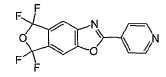
본 활성Saw active 화합물 16Compound 16
1H-NMR(CDCl3)δ:8.91(dd, J=4.4, 1.7Hz, 2H), 8.12(dd, J=4.5, 1.6Hz, 2H), 8.08(s, 1H), 7.91(s, 1H)
1 H-NMR (CDCl 3 ) δ: 8.91 (dd, J = 4.4, 1.7 Hz, 2H), 8.12 (dd, J = 4.5, 1.6 Hz, 2H), 8.08 (s, 1H), 7.91 (s, 1H )
제조예Production Example 17 17
3,5-디클로로-N-(2-히드록시-5-트리플루오로메틸페닐)이소니코틴아미드 0.35g, 사염화탄소 5ml, 트리페닐포스핀 0.78g 및 트리에틸아민 0.30g의 혼합물을 3시간 동안 가열환류하였다. 실온에 냉각한 후, 물을 첨가하고, 아세트산에틸로 2회 추출하였다. 혼합된 유기층을 포화식염수로 세정하고, 황산마그네슘으로 건조시킨 후, 감압 하에서 농축하였다. 잔사를 실리카겔 칼럼크로마토그래피 처리하여 2-(3,5-디클로로피리딘-4-일)-5-(트리플루오로메틸)벤즈옥사졸(이하, 본 활성화합물 17이라고 함) 0.18g을 얻었다.A mixture of 0.35 g of 3,5-dichloro-N- (2-hydroxy-5-trifluoromethylphenyl) isonicotinamide, 5 ml of carbon tetrachloride, 0.78 g of triphenylphosphine, and 0.30 g of triethylamine was heated and refluxed for 3 hours. It was. After cooling to room temperature, water was added and extracted twice with ethyl acetate. The combined organic layers were washed with saturated brine, dried over magnesium sulfate and concentrated under reduced pressure. The residue was subjected to silica gel column chromatography to obtain 0.18 g of 2- (3,5-dichloropyridin-4-yl) -5- (trifluoromethyl) benzoxazole (hereinafter referred to as the present active compound 1 7).
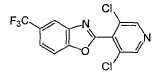
본 활성화합물 17Active Compound 17
1H-NMR(CDCl3)δ:8.72(s, 2H), 8.21(s, 1H), 7.79-7.77(m, 2H)
1 H-NMR (CDCl 3 ) δ: 8.72 (s, 2H), 8.21 (s, 1H), 7.79-7.77 (m, 2H)
제조예Production Example 18 18
2-(3-클로로피리딘-4-일)메틸리덴아미노-4-(트리플루오로메틸)페놀 0.71g과 메탄올 10ml의 혼합물에 실온 하에서 요오드벤젠디아세테이트 0.80g을 첨가하여 2.5시간 동안 교반하였다. 반응혼합물을 감압 하에서 농축한 후에 물을 첨가하고, 아세트산에틸로 추출하였다. 유기층을 포화식염수로 세정하고, 무수황산마그네슘으로 건조시킨 후, 감압 하에서 농축하였다. 잔사를 실리카겔 칼럼크로마토그래피 처리하여 2-(3-클로로피리딘-4-일)-5-(트리플루오로메틸)벤즈옥사졸(이하, 본 활성화합물 18이라고 함) 0.14g을 얻었다.To a mixture of 0.71 g of 2- (3-chloropyridin-4-yl) methylideneamino-4- (trifluoromethyl) phenol and 10 ml of methanol was added 0.80 g of iodinebenzenediacetate at room temperature and stirred for 2.5 hours. The reaction mixture was concentrated under reduced pressure, then water was added, and the mixture was extracted with ethyl acetate. The organic layer was washed with saturated brine, dried over anhydrous magnesium sulfate, and concentrated under reduced pressure. The residue was subjected to silica gel column chromatography to obtain 0.14 g of 2- (3-chloropyridin-4-yl) -5- (trifluoromethyl) benzoxazole (hereinafter referred to as the present active compound 18).

본 활성Saw active 화합물 18Compound 18
1H-NMR(CDCl3)δ:8.86(s, 1H), 8.70(d, J=5.1Hz, 1H), 8.20-8.18(m, 1H), 8.10(d, J=5.1Hz, 1H), 7.78(d, J=8.6Hz, 1H), 7.75(dd, J=8.5, 1.2Hz, 1H)
1 H-NMR (CDCl 3 ) δ: 8.86 (s, 1H), 8.70 (d, J = 5.1Hz, 1H), 8.20-8.18 (m, 1H), 8.10 (d, J = 5.1Hz, 1H), 7.78 (d, J = 8.6 Hz, 1H), 7.75 (dd, J = 8.5, 1.2 Hz, 1H)
제조예Production Example 19 19
3-클로로-N-[2-히드록시-5-(트리플루오로메틸)페닐]이소니코틴아미드 1.74g, 테트라히드로푸란 15ml 및 트리페닐포스핀 1.73g의 혼합물에 실온 하에서 아조디카르본산디에틸에스테르의 40% 톨루엔 용액 2.87g을 적하하여 50℃에서 30분 동안 교반하였다. 30분 후, 트리페닐포스핀 0.26g과 아조디카르본산디에틸에스테르의 40% 톨루엔 용액 0.43g을 추가하여 50℃에서 1시간 동안 가열교반하였다. 실온에 냉각한 후, 반응혼합물을 감압 하에서 농축하고, 잔사를 실리카겔 칼럼크로마토그래피 처리하여 본 활성화합물 18을 1.44g 얻었다.
Azodicarboxylic acid diethyl ester at room temperature in a mixture of 1.74 g of 3-chloro-N- [2-hydroxy-5- (trifluoromethyl) phenyl] isonicotinamide, 15 ml of tetrahydrofuran and 1.73 g of triphenylphosphine 2.87 g of 40% toluene solution was added dropwise and stirred at 50 ° C. for 30 minutes. After 30 minutes, 0.26 g of triphenylphosphine and 0.43 g of a 40% toluene solution of azodicarboxylic acid diethyl ester were added thereto, followed by heating and stirring at 50 ° C. for 1 hour. After cooling to room temperature, the reaction mixture was concentrated under reduced pressure, and the residue was subjected to silica gel column chromatography to obtain 1.44 g of present active compound 18.
제조예Production Example 20 20
2-(3-클로로피리딘-4-일)-5-(트리플루오로메틸)벤즈옥사졸 0.45g과 클로로포름 5ml의 혼합물에 빙랭 하에서 65%m-클로로과안식향산 0.53g을 첨가하였다. 실온에서 5.5시간 동안 교반한 후, 반응혼합물을 클로로포름으로 희석하고, 5% 수산화나트륨수용액, 포화식염수의 순서로 세정하였다. 유기층을 무수황산나트륨으로 건조시킨 후, 감압 하에서 농축하였다. 잔사를 실리카겔 칼럼크로마토그래피 처리하여 3-클로로-4-[5-(트리플루오로메틸)벤즈옥사졸-2-일]피리딘 N-옥시드(이하, 본 활성화합물 19라고 함) 0.25g을 얻었다.To a mixture of 0.45 g of 2- (3-chloropyridin-4-yl) -5- (trifluoromethyl) benzoxazole and 5 ml of chloroform, 0.53 g of 65% m-chloroperbenzoic acid was added under ice cooling. After stirring for 5.5 hours at room temperature, the reaction mixture was diluted with chloroform and washed with 5% aqueous sodium hydroxide solution and saturated brine. The organic layer was dried over anhydrous sodium sulfate and then concentrated under reduced pressure. The residue was subjected to silica gel column chromatography to obtain 0.25 g of 3-chloro-4- [5- (trifluoromethyl) benzoxazol-2-yl] pyridine N-oxide (hereinafter referred to as the present active compound 19). .

본 활성Saw active 화합물 19Compound 19
1H-NMR(CDCl3)δ:8.40(d, J=1.3Hz, 1H), 8.21(dd, J=7.1, 1.5Hz, 1H), 8.17-8.14(m, 2H), 7.77-7.72(m, 2H)
1 H-NMR (CDCl 3 ) δ: 8.40 (d, J = 1.3 Hz, 1H), 8.21 (dd, J = 7.1, 1.5 Hz, 1H), 8.17-8.14 (m, 2H), 7.77-7.72 (m , 2H)
제조예Production Example 21 21
2-(3-클로로피리딘-4-일)메틸리덴아미노-4-tert-부틸페놀 0.49g과 메탄올 10ml의 혼합물에 실온 하에서 요오드벤젠디아세테이트 0.57g을 첨가하여 2시간 동안 교반하였다. 반응혼합물을 농축한 후에 물을 첨가하고, 아세트산에틸로 추출하였다. 유기층을 포화탄산수소나트륨 수용액, 포화식염수의 순서로 세정하고, 무수황산마그네슘으로 건조시킨 후, 감압 하에서 농축하였다. 잔사를 실리카겔 칼럼크로마토그래피 처리하여 2-(3-클로로피리딘-4-일)-5-tert-부틸벤즈옥사졸(이하, 본 활성화합물 20이라고 함) 0.21g을 얻었다.To a mixture of 0.49 g of 2- (3-chloropyridin-4-yl) methylideneamino-4-tert-butylphenol and 10 ml of methanol was added 0.57 g of iodinebenzenediacetate at room temperature and stirred for 2 hours. After the reaction mixture was concentrated, water was added and the mixture was extracted with ethyl acetate. The organic layer was washed with a saturated aqueous sodium hydrogen carbonate solution and saturated brine in that order, dried over anhydrous magnesium sulfate, and concentrated under reduced pressure. The residue was subjected to silica gel column chromatography to obtain 0.21 g of 2- (3-chloropyridin-4-yl) -5-tert-butylbenzoxazole (hereinafter referred to as active compound 20).

본 활성Saw active 화합물 20Compound 20
1H-NMR(CDCl3)δ:8.81(s, 1H), 8.65(d, J=5.1Hz, 1H), 8.07(d, J=5.1Hz, 1H), 7.92-7.91(m, 1H), 7.57(dd, J=8.8, 0.7Hz, 1H), 7.53(dd, J=8.8, 1.8Hz, 1H), 1.41(s, 9H)
1 H-NMR (CDCl 3 ) δ: 8.81 (s, 1H), 8.65 (d, J = 5.1Hz, 1H), 8.07 (d, J = 5.1Hz, 1H), 7.92-7.91 (m, 1H), 7.57 (dd, J = 8.8, 0.7 Hz, 1H), 7.53 (dd, J = 8.8, 1.8 Hz, 1H), 1.41 (s, 9H)
제조예Production Example 22 22
2-클로로-N-[2-히드록시-5-(트리플루오로메틸)페닐]이소니코틴아미드 0.77g, 테트라히드로푸란 20ml 및 트리페닐포스핀 0.80g의 혼합물에 실온 하에서 아조디카르본산디에틸에스테르의 40% 톨루엔 용액 1.32g을 적하하여 실온에서 1.5시간, 이어서 60℃에서 1.5시간 동안 가열교반하였다. 실온에 냉각한 후, 반응혼합물을 감압 하에서 농축하고, 잔사를 실리카겔 칼럼크로마토그래피 처리하여 2-(2-클로로피리딘-4-일)-5-(트리플루오로메틸)벤즈옥사졸(이하, 본 활성화합물 21이라고 함) 0.60g을 얻었다.Azodicarboxylic acid diethyl ester at room temperature in a mixture of 0.77 g of 2-chloro-N- [2-hydroxy-5- (trifluoromethyl) phenyl] isonicotinamide, 20 ml of tetrahydrofuran and 0.80 g of triphenylphosphine 1.32 g of 40% toluene solution was added dropwise and stirred at room temperature for 1.5 hours, followed by heating at 60 ° C for 1.5 hours. After cooling to room temperature, the reaction mixture was concentrated under reduced pressure, and the residue was subjected to silica gel column chromatography to give 2- (2-chloropyridin-4-yl) -5- (trifluoromethyl) benzoxazole (hereinafter, Active compound 21) 0 . 60 g was obtained.

본 활성Saw active 화합물 21Compound 21
1H-NMR(CDCl3)δ:8.63(d, J=5.3, 1H), 8.17-8.12(m, 2H), 8.05-8.03(m, 1H), 7.77-7.72(m, 2H)
1 H-NMR (CDCl 3 ) δ: 8.63 (d, J = 5.3, 1H), 8.17-8.12 (m, 2H), 8.05-8.03 (m, 1H), 7.77-7.72 (m, 2H)
제조예Production Example 23 23
2-(2-클로로피리딘-4-일)-5-(트리플루오로메틸)벤즈옥사졸 0.40g과 클로로포름 4ml의 혼합물에 빙랭 하에서 65%m-클로로과안식향산 0.53g을 첨가하였다. 빙랭 하에서 30분 동안, 이어서 실온에서 3시간 동안 교반한 후, 50℃에서 1.5시간 동안 가열교반하였다. 65%m-클로로과안식향산 0.53g과 클로로포름 2ml를 추가하고, 60℃에서 5시간 동안 가열교반하였다. 실온에 냉각한 후, 반응혼합물을 아세트산에틸로 희석하고, 5% 수산화나트륨수용액, 포화식염수의 순서로 세정하였다. 유기층을 무수황산나트륨으로 건조시킨 후, 감압 하에서 농축함으로써 2-클로로-4-[5-(트리플루오로메틸)벤즈옥사졸-2-일]피리딘 N-옥시드(이하, 본 활성화합물 22라고 함) 0.38g을 얻었다.To a mixture of 0.40 g of 2- (2-chloropyridin-4-yl) -5- (trifluoromethyl) benzoxazole and 4 ml of chloroform, 0.53 g of 65% m-chloroperbenzoic acid was added under ice cooling. The mixture was stirred for 30 minutes under ice cooling, followed by 3 hours at room temperature, and then stirred at 1.5C for 1.5 hours. 0.53 g of 65% m-chloro and benzoic acid and 2 ml of chloroform were added thereto, and the mixture was heated and stirred at 60 ° C. for 5 hours. After cooling to room temperature, the reaction mixture was diluted with ethyl acetate and washed with 5% aqueous sodium hydroxide solution and saturated brine. The organic layer was dried over anhydrous sodium sulfate, and then concentrated under reduced pressure to thereby give 2-chloro-4- [5- (trifluoromethyl) benzoxazol-2-yl] pyridine-N-oxide (hereinafter referred to as the present active compound 22). ) 0.38 g.

본 활성Saw active 화합물 22Compound 22
1H-NMR(CDCl3)δ:8.45(d, J=7.1Hz, 1H), 8.36(d, J=2.2Hz, 1H), 8.10-8.08(m, 1H), 8.04(dd, J=7.1, 2.4Hz, 1H), 7.73-7.72(m, 2H)
1 H-NMR (CDCl 3 ) δ: 8.45 (d, J = 7.1 Hz, 1H), 8.36 (d, J = 2.2 Hz, 1H), 8.10-8.08 (m, 1H), 8.04 (dd, J = 7.1 , 2.4 Hz, 1H), 7.73-7.72 (m, 2H)
제조예Production Example 24 24
N-[2-히드록시-5-(트리플루오로메틸)페닐]-3-메틸이소니코틴아미드 0.38g, 테트라히드로푸란 5ml 및 트리페닐포스핀 0.42g의 혼합물에 실온 하에서 아조디카르본산디에틸에스테르의 40% 톨루엔 용액 0.69g을 적하하여 60℃에서 가열교반하였다. 3시간 후, 10% 수산화나트륨수용액 5ml를 첨가하고 60℃에서 2시간 동안 가열교반하였다. 실온에 냉각한 후, 반응혼합물에 물을 첨가하고, 아세트산에틸로 2회 추출하였다. 혼합된 유기층을 포화식염수로 세정하고, 무수황산마그네슘으로 건조시킨 후, 감압 하에서 농축하였다. 잔사를 실리카겔 칼럼크로마토그래피 처리하여 2-(3-메틸피리딘-4-일)-5-(트리플루오로메틸)벤즈옥사졸(이하, 본 활성화합물 23이라고 함) 0.29g을 얻었다.Azodicarboxylic acid diethyl ester at room temperature in a mixture of 0.38 g of N- [2-hydroxy-5- (trifluoromethyl) phenyl] -3-methylisonicotinamide, 5 ml of tetrahydrofuran and 0.42 g of triphenylphosphine 0.69 g of 40% toluene solution was added dropwise and stirred at 60 ° C. After 3 hours, 5 ml of 10% aqueous sodium hydroxide solution was added and stirred at 60 ° C. for 2 hours. After cooling to room temperature, water was added to the reaction mixture, and the mixture was extracted twice with ethyl acetate. The combined organic layers were washed with saturated brine, dried over anhydrous magnesium sulfate, and concentrated under reduced pressure. The residue was subjected to silica gel column chromatography to obtain 0.29 g of 2- (3-methylpyridin-4-yl) -5- (trifluoromethyl) benzoxazole (hereinafter referred to as the present active compound 23).

본 활성화합물 23Present active compound 23
1H-NMR(CDCl3)δ:8.69(s, 1H), 8.66(d, J=5.1Hz, 1H), 8.16-8.14(m, 1H), 8.04(d, J=5.3Hz, 1H), 7.75(d, J=8.8Hz, 1H), 7.71(dd, J=8.8, 1.2Hz, 1H), 2.83(s, 3H)
1 H-NMR (CDCl 3 ) δ: 8.69 (s, 1H), 8.66 (d, J = 5.1Hz, 1H), 8.16-8.14 (m, 1H), 8.04 (d, J = 5.3Hz, 1H), 7.75 (d, J = 8.8 Hz, 1H), 7.71 (dd, J = 8.8, 1.2 Hz, 1H), 2.83 (s, 3H)
제조예Production Example 25 25
2-(3-메틸피리딘-4-일)-5-(트리플루오로메틸)벤즈옥사졸 0.20g과 클로로포름 4ml의 혼합물에 빙랭 하에서 65%m-클로로과안식향산 0.30g을 첨가하였다. 실온에서 3시간 동안 교반한 후, 반응혼합물을 아세트산에틸로 희석하고, 5% 수산화나트륨수용액, 포화식염수의 순서로 세정하였다. 유기층을 무수황산나트륨으로 건조시킨 후, 감압 하에서 농축함으로써 3-메틸-4-[5-(트리플루오로메틸)벤즈옥사졸-2-일]피리딘 N-옥시드(이하, 본 활성화합물 24라고 함) 0.17g을 얻었다.To a mixture of 0.20 g of 2- (3-methylpyridin-4-yl) -5- (trifluoromethyl) benzoxazole and 4 ml of chloroform, 0.30 g of 65% m-chloroperbenzoic acid was added under ice cooling. After stirring at room temperature for 3 hours, the reaction mixture was diluted with ethyl acetate and washed with 5% aqueous sodium hydroxide solution and saturated brine. The organic layer was dried over anhydrous sodium sulfate, and then concentrated under reduced pressure to yield 3-methyl-4- [5- (trifluoromethyl) benzoxazol-2-yl] pyridine-N-oxide (hereinafter referred to as the present active compound 24). ) 0.17 g.

본 활성화합물 24Present active compound 24
1H-NMR(CDCl3)δ:8.22-8.21(m, 1H), 8.19-8.16(m, 1H), 8.12-8.09(m, 2H), 7.72-7.69(m, 2H), 2.81(s, 3H)
1 H-NMR (CDCl 3 ) δ: 8.22-8.21 (m, 1H), 8.19-8.16 (m, 1H), 8.12-8.09 (m, 2H), 7.72-7.69 (m, 2H), 2.81 (s, 3H)
제조예Production Example 26 26
3-플루오로-N-[2-히드록시-5-(트리플루오로메틸)페닐]이소니코틴아미드 0.51g, 테트라히드로푸란 5ml 및 트리페닐포스핀 0.53g의 혼합물에 실온 하에서 아조디카르본산디에틸에스테르의 40% 톨루엔 용액 0.89g을 적하하고, 50℃에서 1.5시간 동안 가열교반하였다. 실온에 냉각한 후, 반응혼합물을 감압 하에서 농축하고, 잔사를 실리카겔 칼럼크로마토그래피 처리하여 2-(3-플루오로피리딘-4-일)-5-(트리플루오로메틸)벤즈옥사졸(이하, 본 활성화합물 25이라고 함) 0.46g을 얻었다.Diethyl azodicarboxylic acid at room temperature in a mixture of 0.51 g of 3-fluoro-N- [2-hydroxy-5- (trifluoromethyl) phenyl] isonicotinamide, 5 ml of tetrahydrofuran and 0.53 g of triphenylphosphine 0.89 g of a 40% toluene solution of ester was added dropwise and stirred at 50 ° C. for 1.5 hours. After cooling to room temperature, the reaction mixture was concentrated under reduced pressure, and the residue was subjected to silica gel column chromatography to give 2- (3-fluoropyridin-4-yl) -5- (trifluoromethyl) benzoxazole (hereinafter, 0.46 g of the present active compound 25 was obtained.

본 활성화합물 25Present active compound 25
1H-NMR(CDCl3)δ:8.76(d, J=2.4Hz, 1H), 8.66(d, J=0.6Hz, 1H), 8.17(m, 1H), 8.15-8.12(m, 1H), 7.78(d, J=8.8Hz, 1H), 7.75(dd, J=8.8, 1.3Hz, 1H)
1 H-NMR (CDCl 3 ) δ: 8.76 (d, J = 2.4 Hz, 1H), 8.66 (d, J = 0.6 Hz, 1H), 8.17 (m, 1H), 8.15-8.12 (m, 1H), 7.78 (d, J = 8.8 Hz, 1H), 7.75 (dd, J = 8.8, 1.3 Hz, 1H)
제조예Production Example 27 27
2-(3-플루오로피리딘-4-일)-5-(트리플루오로메틸)벤즈옥사졸 0.34g과 클로로포름 6ml의 혼합물에 실온 하에서 65%m-클로로과안식향산 0.48g을 첨가하고, 50℃에서 1.5시간 동안 가열교반하였다. 실온에 냉각한 후, 반응혼합물을 아세트산에틸로 희석하고, 포화탄산수소나트륨 수용액으로 2회, 포화식염수로 1회의 순서로 세정하였다. 유기층을 무수황산나트륨으로 건조시킨 후, 감압 하에서 농축하고, 잔사를 실리카겔 칼럼크로마토그래피 처리하여 3-플루오로-4-[5-(트리플루오로메틸)벤즈옥사졸-2-일]피리딘 N-옥시드(이하, 본 활성화합물 26이라고 함) 0.23g을 얻었다.To a mixture of 0.34 g of 2- (3-fluoropyridin-4-yl) -5- (trifluoromethyl) benzoxazole and 6 ml of chloroform, 0.48 g of 65% m-chloroperbenzoic acid was added at room temperature, at 50 ° C. The mixture was heated and stirred for 1.5 hours. After cooling to room temperature, the reaction mixture was diluted with ethyl acetate, washed twice with saturated aqueous sodium hydrogen carbonate solution and once with saturated brine. The organic layer was dried over anhydrous sodium sulfate, and then concentrated under reduced pressure, and the residue was subjected to silica gel column chromatography to give 3-fluoro-4- [5- (trifluoromethyl) benzoxazol-2-yl] pyridin N-jade. 0.23 g of seeds (hereinafter referred to as the present active compound 26) were obtained.

본 활성Saw active 화합물 26Compound 26
1H-NMR(CDCl3)δ:8.32-8.29(m, 1H), 8.17-8.12(m, 3H), 7.76-7.71(m, 2H)
1 H-NMR (CDCl 3 ) δ: 8.32-8.29 (m, 1H), 8.17-8.12 (m, 3H), 7.76-7.71 (m, 2H)
제조예Production Example 28 28
3-브로모-N-[2-히드록시-5-(트리플루오로메틸)페닐]이소니코틴아미드 0.29g, 테트라히드로푸란 4ml 및 트리페닐포스핀 0.25g의 혼합물에 실온 하에서 아조디카르본산디에틸에스테르의 40% 톨루엔 용액 0.42g을 적하하고, 50℃에서 1.5시간 동안 가열교반하였다. 실온에 냉각한 후, 반응혼합물을 감압 하에서 농축하고, 잔사를 실리카겔 칼럼크로마토그래피 처리하여 2-(3-브로모피리딘-4-일)-5-(트리플루오로메틸)벤즈옥사졸(이하, 본 활성화합물 27이라고 함) 0.24g을 얻었다.Diethyl azodicarboxylic acid at room temperature in a mixture of 0.29 g of 3-bromo-N- [2-hydroxy-5- (trifluoromethyl) phenyl] isonicotinamide, 4 ml of tetrahydrofuran and 0.25 g of triphenylphosphine 0.42 g of a 40% toluene solution of ester was added dropwise and stirred at 50 ° C. for 1.5 hours. After cooling to room temperature, the reaction mixture was concentrated under reduced pressure, and the residue was subjected to silica gel column chromatography to give 2- (3-bromopyridin-4-yl) -5- (trifluoromethyl) benzoxazole (hereinafter, 0.24 g of the present active compound 27 was obtained.

본 활성Saw active 화합물 27Compound 27
1H-NMR(CDCl3)δ:9.00(s, 1H), 8.73(d, J=4.9Hz, 1H), 8.20(s, 1H), 8.06(d, J=4.9Hz, 1H), 7.78(d, J=8, 8Hz, 1H), 7.75(d, J=8.8Hz, 1H)
1 H-NMR (CDCl 3 ) δ: 9.00 (s, 1H), 8.73 (d, J = 4.9Hz, 1H), 8.20 (s, 1H), 8.06 (d, J = 4.9Hz, 1H), 7.78 ( d, J = 8, 8 Hz, 1H), 7.75 (d, J = 8.8 Hz, 1H)
제조예Production Example 29 29
2-(3-브로모피리딘-4-일)-5-(트리플루오로메틸)벤즈옥사졸 0.50g과 클로로포름 5ml의 혼합물에 65%m-클로로과안식향산 0.58g을 첨가하고, 50℃에서 1.5시간 동안 가열교반하였다. 실온에 냉각한 후, 반응혼합물을 아세트산에틸로 희석하고, 포화탄산수소나트륨 수용액(2회), 포화식염수의 순서로 세정하였다. 유기층을 무수황산나트륨으로 건조시킨 후, 감압 하에서 농축하고, 잔사를 실리카겔 칼럼크로마토그래피 처리하여 3-브로모-4-[5-(트리플루오로메틸)벤즈옥사졸-2-일]피리딘 N-옥시드(이하, 본 활성화합물 28이라고 함) 0.37g을 얻었다.To a mixture of 0.50 g of 2- (3-bromopyridin-4-yl) -5- (trifluoromethyl) benzoxazole and 5 ml of chloroform, 0.58 g of 65% m-chloroperbenzoic acid was added and 1.5 hours at 50 ° C. It was stirred while heating. After cooling to room temperature, the reaction mixture was diluted with ethyl acetate and washed with a saturated aqueous sodium hydrogen carbonate solution (twice) and saturated brine in that order. The organic layer was dried over anhydrous sodium sulfate, and then concentrated under reduced pressure, and the residue was subjected to silica gel column chromatography to give 3-bromo-4- [5- (trifluoromethyl) benzoxazol-2-yl] pyridin N-jade. 0.37 g of seeds (hereinafter, referred to as present active compound 28) was obtained.

본 활성Saw active 화합물 28Compound 28
1H-NMR(CDCl3)δ:8.56(d, J=1.7Hz, 1H), 8.24(dd, J=7.1, 1.7Hz, 1H), 8.16(s, 1H), 8.13(d, J=7.1Hz, 1H), 7.76-7.72(m, 2H)
1 H-NMR (CDCl 3 ) δ: 8.56 (d, J = 1.7 Hz, 1H), 8.24 (dd, J = 7.1, 1.7 Hz, 1H), 8.16 (s, 1H), 8.13 (d, J = 7.1 Hz, 1H), 7.76-7.72 (m, 2H)
제조예Production Example 30 30
N-[2-히드록시-5-(트리플루오로메틸)페닐]-3-요오드이소니코틴아미드 1.81g, 테트라히드로푸란 20ml 및 트리페닐포스핀 1.34g의 혼합물에 실온 하에서 아조디카르본산디에틸에스테르의 40% 톨루엔 용액 2.22g을 적하하여 50℃에서 1시간 동안 가열교반하였다. 실온에 냉각한 후, 반응혼합물을 감압 하에서 농축하고, 잔사를 실리카겔 칼럼크로마토그래피 처리하여 2-(3-요오드피리딘-4-일)-5-(트리플루오로메틸)벤즈옥사졸(이하, 본 활성화합물 29라고 함) 1.40g을 얻었다.Azodicarboxylic acid diethyl ester at room temperature in a mixture of 1.81 g of N- [2-hydroxy-5- (trifluoromethyl) phenyl] -3-iodineisonicotinamide, 20 ml of tetrahydrofuran and 1.34 g of triphenylphosphine 2.22 g of 40% toluene solution was added dropwise and stirred at 50 ° C. for 1 hour. After cooling to room temperature, the reaction mixture was concentrated under reduced pressure, and the residue was subjected to silica gel column chromatography to give 2- (3-iodinepyridin-4-yl) -5- (trifluoromethyl) benzoxazole (hereinafter, 1.40 g of the active compound 29 was obtained.

본 활성Saw active 화합물 29Compound 29
1H-NMR(CDCl3)δ:9.26(s, 1H), 8.73(d, J=5.1Hz, 1H), 8.21(s, 1H), 8.01(d, J=5.1Hz, 1H), 7.78(d, J=8.8Hz, 1H), 7.75(d, J=8.8Hz, 1H)
1 H-NMR (CDCl 3 ) δ: 9.26 (s, 1H), 8.73 (d, J = 5.1Hz, 1H), 8.21 (s, 1H), 8.01 (d, J = 5.1Hz, 1H), 7.78 ( d, J = 8.8 Hz, 1H), 7.75 (d, J = 8.8 Hz, 1H)
제조예Production Example 31 31
2-(3-요오드피리딘-4-일)-5-(트리플루오로메틸)벤즈옥사졸 0.30g과 클로로포름 3ml의 혼합물에 빙랭 하에서 65%m-클로로과안식향산 0.26g을 첨가하고, 실온에서 30분 동안 교반하였다. 50℃에서 1시간 동안 가열교반한 후, 65%m-클로로과안식향산 0.20g을 첨가하고, 50℃에서 다시 2시간 동안 가열교반하였다. 실온에 냉각한 후, 반응혼합물을 아세트산에틸로 희석하고, 포화탄산수소나트륨 수용액, 포화식염수의 순서로 세정하였다. 유기층을 무수황산나트륨으로 건조시킨 후, 감압 하에서 농축하고, 잔사를 실리카겔 칼럼크로마토그래피 처리하여 3-요오드-4-[5-(트리플루오로메틸)벤즈옥사졸-2-일]피리딘 N-옥시드(이하, 본 활성화합물 30이라고 함) 0.09g을 얻었다.To a mixture of 0.30 g of 2- (3-iodinepyridin-4-yl) -5- (trifluoromethyl) benzoxazole and 3 ml of chloroform, 0.26 g of 65% m-chloroperbenzoic acid was added under ice cooling, followed by 30 minutes at room temperature. Was stirred. After heating and stirring at 50 ° C. for 1 hour, 0.20 g of 65% m-chloroperbenzoic acid was added, followed by heating stirring at 50 ° C. for 2 hours. After cooling to room temperature, the reaction mixture was diluted with ethyl acetate and washed in the order of saturated aqueous sodium hydrogen carbonate solution and saturated brine. The organic layer was dried over anhydrous sodium sulfate, and then concentrated under reduced pressure, and the residue was subjected to silica gel column chromatography to treat 3-iodine-4- [5- (trifluoromethyl) benzoxazol-2-yl] pyridine-N-oxide. 0.09 g (hereinafter, referred to as the present active compound 30) was obtained.

본 활성Saw active 화합물 30Compound 30
1H-NMR(CDCl3)δ:8.83(d, J=1.7Hz, 1H), 8.25(dd, J=7.1, 1.7Hz, 1H), 8.18-8.15(m, 1H), 8.04(d, J=7.1Hz, 1H), 7.75-7.72(m, 2H)
1 H-NMR (CDCl 3 ) δ: 8.83 (d, J = 1.7 Hz, 1H), 8.25 (dd, J = 7.1, 1.7 Hz, 1H), 8.18-8.15 (m, 1H), 8.04 (d, J = 7.1 Hz, 1H), 7.75-7.72 (m, 2H)
제조예Production Example 32 32
2-(3-요오드피리딘-4-일)-5-(트리플루오로메틸)벤즈옥사졸 0.39g, 시안화동(I) 0.18g 및 1-메틸-2-피롤리디논 2ml의 혼합물을 80℃에서 2시간 동안 가열교반하였다. 반응혼합물에 물과 아세트산에틸을 첨가한 후, 셀라이트(등록상표)를 통해 여과하였다. 얻어진 여과액을 포화식염수로 세정하고, 무수황산나트륨으로 건조시킨 후, 감압 하에서 농축하였다. 잔사를 실리카겔 칼럼크로마토그래피 처리하여 2-(3-시아노피리딘-4-일)-5-(트리플루오로메틸)벤즈옥사졸(이하, 본 활성화합물 31이라고 함) 0.11g을 얻었다.A mixture of 0.39 g of 2- (3-iodinepyridin-4-yl) -5- (trifluoromethyl) benzoxazole, 0.18 g of copper cyanide (I) and 2 ml of 1-methyl-2-pyrrolidinone was heated to 80 ° C. The mixture was heated and stirred for 2 hours at. Water and ethyl acetate were added to the reaction mixture, which was then filtered through Celite. The obtained filtrate was washed with saturated brine, dried over anhydrous sodium sulfate, and then concentrated under reduced pressure. The residue was subjected to silica gel column chromatography to obtain 0.11 g of 2- (3-cyanopyridin-4-yl) -5- (trifluoromethyl) benzoxazole (hereinafter referred to as the present active compound 31).
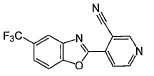
본 활성Saw active 화합물 31Compound 31
1H-NMR(CDCl3)δ:9.14(s, 1H), 9.02(d, J=5.4Hz, 1H), 8.29(d, J=5.1Hz, 1H), 8.25-8.22(m, 1H), 7.83(d, J=8.8Hz, 1H), 7.79(d, J=8.8, 1.3Hz, 1H)
1 H-NMR (CDCl 3 ) δ: 9.14 (s, 1H), 9.02 (d, J = 5.4Hz, 1H), 8.29 (d, J = 5.1Hz, 1H), 8.25-8.22 (m, 1H), 7.83 (d, J = 8.8 Hz, 1H), 7.79 (d, J = 8.8, 1.3 Hz, 1H)
제조예Production Example 33 33
2-(3-요오드피리딘-4-일)-5-(트리플루오로메틸)벤즈옥사졸 0.78g, 페닐보론산 0.27g, 테트라히드로푸란 5ml 및 디클로로비스(트리페닐포스핀)팔라듐(II) 0.14g의 혼합물에 10% 수산화나트륨수용액 3ml를 첨가하여 3시간 동안 가열환류하였다. 반응혼합물에 물을 첨가하고, 아세트산에틸로 2회 추출하였다. 혼합된 유기층을 물, 포화식염수로 세정하고, 무수황산마그네슘으로 건조시켰다. 감압 하에서 농축하고, 잔사를 실리카겔 칼럼크로마토그래피 처리하여 2-(3-페닐피리딘-4-일)-5-(트리플루오로메틸)벤즈옥사졸(이하, 본 활성화합물 32라고 함) 0.18g을 얻었다.0.78 g of 2- (3-iodinepyridin-4-yl) -5- (trifluoromethyl) benzoxazole, 0.27 g of phenylboronic acid, 5 ml of tetrahydrofuran and dichlorobis (triphenylphosphine) palladium (II) To 0.14 g of the mixture was added 3 ml of 10% aqueous sodium hydroxide solution and heated to reflux for 3 hours. Water was added to the reaction mixture, followed by extraction twice with ethyl acetate. The mixed organic layer was washed with water and brine, and dried over anhydrous magnesium sulfate. Concentrated under reduced pressure, and the residue was subjected to silica gel column chromatography to give 0.18 g of 2- (3-phenylpyridin-4-yl) -5- (trifluoromethyl) benzoxazole (hereinafter referred to as the present active compound 32). Got it.

본 활성Saw active 화합물 32Compound 32
1H-NMR(CDCl3)δ:8.81(d, J=5.1Hz, 1H), 8.80(s, 1H), 8.05-8.02(m, 2H), 7.62-7.59(m, 1H), 7.45-7.38(m, 4H), 7.35-7.30(m, 2H)
1 H-NMR (CDCl 3 ) δ: 8.81 (d, J = 5.1Hz, 1H), 8.80 (s, 1H), 8.05-8.02 (m, 2H), 7.62-7.59 (m, 1H), 7.45-7.38 (m, 4H), 7.35-7.30 (m, 2H)
제조예Production Example 35 35
2-(3-요오드피리딘-4-일)-5-(트리플루오로메틸)벤즈옥사졸 1.17g, (트리메틸실릴)아세틸렌 0.40g, 요오드화구리(I) 0.03g, 디클로로비스(트리페닐포스핀)팔라듐(II) 0.11g, 트리에틸아민 2.5ml 및 테트라히드로푸란 10ml의 혼합물을 50℃에서 2시간 동안 가열교반하였다. 실온에 냉각한 후, 반응혼합물에 tert-부틸메틸에테르를 첨가하고, 포화탄산수소나트륨 수용액, 이어서 포화식염수로 세정한 후, 유기층을 무수황산마그네슘으로 건조시켰다. 감압 하에서 농축하고, 잔사를 실리카겔 칼럼크로마토그래피 처리하여 5-(트리플루오로메틸)2-[3-(트리메틸실릴)에티닐-4-일]-벤즈옥사졸 0.50g을 얻었다.1.17 g of 2- (3-iodinepyridin-4-yl) -5- (trifluoromethyl) benzoxazole, 0.40 g of (trimethylsilyl) acetylene, 0.03 g of copper iodide (I), dichlorobis (triphenylphosphine) A mixture of 0.11 g of palladium (II), 2.5 ml of triethylamine and 10 ml of tetrahydrofuran was heated and stirred at 50 ° C. for 2 hours. After cooling to room temperature, tert-butylmethylether was added to the reaction mixture, washed with a saturated aqueous sodium hydrogen carbonate solution, followed by saturated brine, and the organic layer was dried over anhydrous magnesium sulfate. The mixture was concentrated under reduced pressure, and the residue was subjected to silica gel column chromatography to obtain 0.50 g of 5- (trifluoromethyl) 2- [3- (trimethylsilyl) ethynyl-4-yl] -benzoxazole.

1H-NMR(CDCl3)δ:8.93(d, J=0.7Hz, 1H), 8.71(d, J=5.3Hz, 1H), 8.13-8.11(m, 1H), 8.10(dd, J=5.3, 0.7Hz, 1H), 7.73-7.72(m, 2H), 0.35(s, 9H)
1 H-NMR (CDCl 3 ) δ: 8.93 (d, J = 0.7 Hz, 1H), 8.71 (d, J = 5.3 Hz, 1H), 8.13-8.11 (m, 1H), 8.10 (dd, J = 5.3 , 0.7 Hz, 1H), 7.73-7.72 (m, 2H), 0.35 (s, 9H)
5-(트리플루오로메틸)2-[3-(트리메틸실릴)에티닐-4-일]-벤즈옥사졸 0.74g과 메탄올 6ml의 혼합물에 탄산칼륨 0.20g을 첨가하고, 실온에서 1시간 동안 교반하였다. 반응혼합물에 물을 첨가하고, 아세트산에틸로 추출하였다. 유기층을 포화식염수로 세정한 후, 무수황산마그네슘으로 건조시켰다. 감압 하에서 농축하고, 잔사를 실리카겔 칼럼크로마토그래피 처리하여 2-(3-에티닐피리딘-4-일)-5-(트리플루오로메틸)벤즈옥사졸(이하, 본 활성화합물 34라고 함) 0.46g을 얻었다.To a mixture of 0.74 g of 5- (trifluoromethyl) 2- [3- (trimethylsilyl) ethynyl-4-yl] -benzoxazole and 6 ml of methanol, 0.20 g of potassium carbonate was added and stirred at room temperature for 1 hour. It was. Water was added to the reaction mixture, which was then extracted with ethyl acetate. The organic layer was washed with saturated brine and then dried over anhydrous magnesium sulfate. Concentrated under reduced pressure, and the residue was subjected to silica gel column chromatography to give 0.46 g of 2- (3-ethynylpyridin-4-yl) -5- (trifluoromethyl) benzoxazole (hereinafter referred to as active compound 34). Got.

본 활성화합물 34Present active compound 34
1H-NMR(CDCl3)δ:8.97(s, 1H), 8.76(d, J=5.1Hz, 1H), 8.19-8.17(m, 1H), 8.10(d, J=5.1Hz, 1H), 7.76(d, J=8.6Hz, 1H), 7.73(dd, J=8.5, 1.2Hz, 1H), 3.63(s, 1H)
1 H-NMR (CDCl 3 ) δ: 8.97 (s, 1H), 8.76 (d, J = 5.1Hz, 1H), 8.19-8.17 (m, 1H), 8.10 (d, J = 5.1Hz, 1H), 7.76 (d, J = 8.6 Hz, 1H), 7.73 (dd, J = 8.5, 1.2 Hz, 1H), 3.63 (s, 1H)
제조예Production Example 36 36
2-(3-에티닐피리딘-4-일)-5-(트리플루오로메틸)벤즈옥사졸 0.34g, 5% 팔라듐탄소 0.10g 및 아세트산에틸 8ml의 혼합물을 약 1기압의 수소 분위기하 실온에서 2시간 동안 교반하였다. 셀라이트(등록상표)를 통하여 여과하고, 여과액을 감압 하에서 농축하였다. 잔사를 실리카겔 칼럼크로마토그래피 처리하여 2-(3-에틸피리딘-4-일)-5-(트리플루오로메틸)벤즈옥사졸(이하, 본 활성화합물 35라고 함) 0.33g을 얻었다.A mixture of 0.34 g of 2- (3-ethynylpyridin-4-yl) -5- (trifluoromethyl) benzoxazole, 0.10 g of 5% palladium carbon and 8 ml of ethyl acetate was added at room temperature under a hydrogen atmosphere of about 1 atm. Stir for 2 hours. Filter through Celite (R) and the filtrate was concentrated under reduced pressure. The residue was subjected to silica gel column chromatography to obtain 0.33 g of 2- (3-ethylpyridin-4-yl) -5- (trifluoromethyl) benzoxazole (hereinafter referred to as active compound 35).
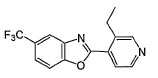
본 활성Saw active 화합물 35Compound 35
1H-NMR(CDCl3)δ:8.71(s, 1H), 8.66(d, J=5.1Hz, 1H), 8.16-8.14(m, 1H), 8.01(d, J=5.1Hz, 1H), 7.74(d, J=8.5Hz, 1H), 7.71(dd, J=8.8, 1.3Hz, 1H), 3.29(q, J=7.6Hz, 2H), 1.35(t, J=7.6Hz, 3H)
1 H-NMR (CDCl 3 ) δ: 8.71 (s, 1H), 8.66 (d, J = 5.1 Hz, 1H), 8.16-8.14 (m, 1H), 8.01 (d, J = 5.1 Hz, 1H), 7.74 (d, J = 8.5 Hz, 1H), 7.71 (dd, J = 8.8, 1.3 Hz, 1H), 3.29 (q, J = 7.6 Hz, 2H), 1.35 (t, J = 7.6 Hz, 3H)
제조예Production Example 37 37
3-tert-부톡시카르보닐아미노-N-[2-히드록시-5-(트리플루오로메틸)페닐]이소니코틴아미드 1.78g, 테트라히드로푸란 20ml 및 트리페닐포스핀 1.29g의 혼합물에 실온 하에서 아조디카르본산디에틸에스테르의 40% 톨루엔 용액 2.15g을 적하하였다. 실온에서 1시간 동안 교반하고, 이어서 50℃에서 30분 동안 가열교반하였다. 실온에 냉각한 후, 반응혼합물을 감압 하에서 농축하고, 잔사를 실리카겔 칼럼크로마토그래피 처리하여 2-(3-tert-부톡시카르보닐아미노피리딘-4-일)-5-(트리플루오로메틸)벤즈옥사졸(이하, 본 활성화합물 36이라고 함) 0.69g을 얻었다.To a mixture of 1.78 g of 3-tert-butoxycarbonylamino-N- [2-hydroxy-5- (trifluoromethyl) phenyl] isonicotinamide, 20 ml of tetrahydrofuran and 1.29 g of triphenylphosphine under room temperature 2.15 g of a 40% toluene solution of azodicarboxylic acid diethyl ester was added dropwise. Stirred at room temperature for 1 hour and then stirred at 50 ° C. for 30 minutes. After cooling to room temperature, the reaction mixture was concentrated under reduced pressure, and the residue was subjected to silica gel column chromatography to give 2- (3-tert-butoxycarbonylaminopyridin-4-yl) -5- (trifluoromethyl) benz 0.69 g of oxazole (hereinafter referred to as active compound 36) was obtained.
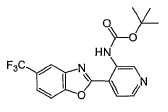
본 활성Saw active 화합물 36Compound 36
1H-NMR(CDCl3)δ:10.57(s, 1H), 9.88(s, 1H), 8.45(d, J=5.1Hz, 1H), 8.17(s, 1H), 7.99(d, J=5.1Hz, 1H), 7.78-7.73(m, 2H), 1.62(s, 9H)
1 H-NMR (CDCl 3 ) δ: 10.57 (s, 1H), 9.88 (s, 1H), 8.45 (d, J = 5.1Hz, 1H), 8.17 (s, 1H), 7.99 (d, J = 5.1 Hz, 1H), 7.78-7.73 (m, 2H), 1.62 (s, 9H)
제조예Production Example 38 38
2-(3-플루오로피리딘-4-일)-5-(트리플루오로메틸)벤즈옥사졸 0.28g, 탄산칼륨 0.27g 및 메탄올 3ml의 혼합물을 60℃에서 2시간 동안 가열교반하였다. 반응혼합물을 감압 하에서 농축하고, 물을 첨가한 후, 아세트산에틸로 2회 추출하였다. 혼합된 유기층을 물, 포화식염수로 세정하고, 무수황산마그네슘으로 건조시켰다. 감압 하에서 농축하고, 잔사를 실리카겔 칼럼크로마토그래피 처리하여 2-(3-메톡시피리딘-4-일)-5-(트리플루오로메틸)벤즈옥사졸(이하, 본 활성화합물 37이라고 함) 0.21g을 얻었다.A mixture of 0.28 g of 2- (3-fluoropyridin-4-yl) -5- (trifluoromethyl) benzoxazole, 0.27 g of potassium carbonate and 3 ml of methanol was heated and stirred at 60 ° C. for 2 hours. The reaction mixture was concentrated under reduced pressure, water was added, and then extracted twice with ethyl acetate. The mixed organic layer was washed with water and brine, and dried over anhydrous magnesium sulfate. Concentrated under reduced pressure, and the residue was subjected to silica gel column chromatography to give 0.21 g of 2- (3-methoxypyridin-4-yl) -5- (trifluoromethyl) benzoxazole (hereinafter referred to as active compound 37). Got.
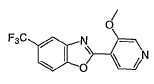
본 활성Saw active 화합물 37Compound 37
1H-NMR(CDCl3)δ:8.60(s, 1H), 8.46(d, J=4.9Hz, 1H), 8.16-8.14(m, 1H), 8.02(d, J=4.9Hz, 1H), 7.74(d, J=8.5Hz, 1H), 7.69(dd, J=8.5, 1.1Hz, 1H), 4.16(s, 3H)
1 H-NMR (CDCl 3 ) δ: 8.60 (s, 1H), 8.46 (d, J = 4.9Hz, 1H), 8.16-8.14 (m, 1H), 8.02 (d, J = 4.9Hz, 1H), 7.74 (d, J = 8.5 Hz, 1H), 7.69 (dd, J = 8.5, 1.1 Hz, 1H), 4.16 (s, 3H)
제조예Production Example 39 39
2-(3-플루오로피리딘-4-일)-5-(트리플루오로메틸)벤즈옥사졸 0.28g, 페놀 0.15g, 탄산칼륨 0.55g 및 DMF 2ml의 혼합물을 실온에서 1시간 동안 교반하고, 이어서 50℃에서 4시간 동안 가열교반하였다. 실온에 냉각한 후, 반응혼합물에 물을 첨가하고, 아세트산에틸로 2회 추출하였다. 혼합된 유기층을 포화식염수로 세정하고, 무수황산마그네슘으로 건조시킨 후, 감압 하에서 농축하였다. 잔사를 실리카겔 칼럼크로마토그래피 처리하여 2-(3-페녹시피리딘-4-일)-5-(트리플루오로메틸)벤즈옥사졸(이하, 본 활성화합물 38이라고 함) 0.24g을 얻었다.A mixture of 0.28 g of 2- (3-fluoropyridin-4-yl) -5- (trifluoromethyl) benzoxazole, 0.15 g of phenol, 0.55 g of potassium carbonate and 2 ml of DMF was stirred at room temperature for 1 hour, It was then stirred at 50 ° C. for 4 hours. After cooling to room temperature, water was added to the reaction mixture, and the mixture was extracted twice with ethyl acetate. The combined organic layers were washed with saturated brine, dried over anhydrous magnesium sulfate, and concentrated under reduced pressure. The residue was subjected to silica gel column chromatography to obtain 0.24 g of 2- (3-phenoxypyridin-4-yl) -5- (trifluoromethyl) benzoxazole (hereinafter referred to as active compound 38).
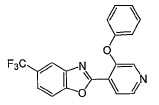
본 활성화합물 38Present active compound 38
1H-NMR(CDCl3)δ:8.57(d, J=4.9Hz, 1H), 8.47(s, 1H), 8.14(d, J=4.9Hz, 1H), 8.11(s, 1H), 7.69-7.65(m, 2H), 7.41-7.37(m, 2H), 7.20-7.16(m, 1H), 7.13-7.09(m, 2H)
1 H-NMR (CDCl 3 ) δ: 8.57 (d, J = 4.9Hz, 1H), 8.47 (s, 1H), 8.14 (d, J = 4.9Hz, 1H), 8.11 (s, 1H), 7.69- 7.65 (m, 2H), 7.41-7.37 (m, 2H), 7.20-7.16 (m, 1H), 7.13-7.09 (m, 2H)
제조예Production Example 40 40
55% 수소화나트륨(유성) 0.06g과 DMF 2ml의 혼합물을 실온에서 교반하고, 여기에 2,2,2-트리플루오로에탄올 0.13g과 DMF 0.5ml의 혼합용액을 첨가하였다. 같은 온도에서 15분 동안 교반한 후, 2-(3-플루오로피리딘-4-일)-5-(트리플루오로메틸)벤즈옥사졸 0.28g을 첨가하고, 실온에서 1시간 동안 교반하였다. 반응혼합물에 물을 첨가하고, 아세트산에틸로 2회 추출하였다. 혼합된 유기층을 포화식염수로 세정하고, 무수황산마그네슘으로 건조시킨 후, 감압 하에서 농축하였다. 잔사를 실리카겔 칼럼크로마토그래피 처리하여 2-[3-(2,2,2-트리플루오로에틸)옥시피리딘-4-일]-5-(트리플루오로메틸)벤즈옥사졸(이하, 본 활성화합물 39라고 함) 0.27g을 얻었다.A mixture of 0.06 g of 55% sodium hydride (oil) and 2 ml of DMF was stirred at room temperature, and a mixed solution of 0.13 g of 2,2,2-trifluoroethanol and 0.5 ml of DMF was added thereto. After stirring for 15 minutes at the same temperature, 0.28 g of 2- (3-fluoropyridin-4-yl) -5- (trifluoromethyl) benzoxazole was added and stirred at room temperature for 1 hour. Water was added to the reaction mixture, followed by extraction twice with ethyl acetate. The combined organic layers were washed with saturated brine, dried over anhydrous magnesium sulfate, and concentrated under reduced pressure. The residue was subjected to silica gel column chromatography to give 2- [3- (2,2,2-trifluoroethyl) oxypyridin-4-yl] -5- (trifluoromethyl) benzoxazole (hereafter, the present active compound 39)) to yield 0.27 g.

본 활성화합물 39Present active compound 39
1H-NMR(CDCl3)δ:8.61(s, 1H), 8.59(d, J=4.9Hz, 1H), 8.15-8.14(m, 1H), 8.11(d, J=5.1Hz, 1H), 7.76-7.71(m, 2H), 4.67(q, J=8.0Hz, 2H)
1 H-NMR (CDCl 3 ) δ: 8.61 (s, 1H), 8.59 (d, J = 4.9Hz, 1H), 8.15-8.14 (m, 1H), 8.11 (d, J = 5.1Hz, 1H), 7.76-7.71 (m, 2H), 4.67 (q, J = 8.0 Hz, 2H)
제조예Production Example 41 41
2-(3-플루오로피리딘-4-일)-5-(트리플루오로메틸)벤즈옥사졸 0.28g, 메틸메르캅탄나트륨염 0.14g 및 DMF 2ml의 혼합물을 50℃에서 2시간 동안 가열교반하였다. 실온에 냉각한 후, 반응혼합물에 물을 첨가하고, 아세트산에틸로 추출하였다. 유기층을 포화식염수로 세정하고, 무수황산마그네슘으로 건조시킨 후, 감압 하에서 농축하고 얻어진 잔사를 실리카겔 칼럼크로마토그래피 처리하여 2-[3-(메틸티오)피리딘-4-일]-5-(트리플루오로메틸)벤즈옥사졸(이하, 본 활성화합물 40이라고 함) 0.21g을 얻었다.A mixture of 0.28 g of 2- (3-fluoropyridin-4-yl) -5- (trifluoromethyl) benzoxazole, 0.14 g of methyl mercaptan sodium salt and 2 ml of DMF was heated and stirred at 50 ° C. for 2 hours. . After cooling to room temperature, water was added to the reaction mixture, which was then extracted with ethyl acetate. The organic layer was washed with saturated brine, dried over anhydrous magnesium sulfate, concentrated under reduced pressure and the obtained residue was subjected to silica gel column chromatography to give 2- [3- (methylthio) pyridin-4-yl] -5- (trifluoro 0.21 g of rhomethyl) benzoxazole (hereinafter referred to as active compound 40) was obtained.
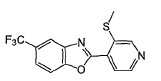
본 활성화합물 40Present Active Compound 40
1H-NMR(CDCl3)δ:8.68(s, 1H), 8.56(d, J=5.1Hz, 1H), 8.22-8.20(m, 1H), 8.02(d, J=5.1Hz, 1H), 7.74(d, J=8.5Hz, 1H), 7.71(dd, J=8.8, 1.4Hz, 1H), 2.68(s, 3H)
1 H-NMR (CDCl 3 ) δ: 8.68 (s, 1H), 8.56 (d, J = 5.1Hz, 1H), 8.22-8.20 (m, 1H), 8.02 (d, J = 5.1Hz, 1H), 7.74 (d, J = 8.5 Hz, 1H), 7.71 (dd, J = 8.8, 1.4 Hz, 1H), 2.68 (s, 3H)
제조예Production Example 42 42
2-(3-플루오로피리딘-4-일)-5-(트리플루오로메틸)벤즈옥사졸 0.28g, 에틸메르캅탄나트륨염 0.20g 및 DMF 2ml의 혼합물을 실온에서 1시간 동안 교반하였다. 반응혼합물에 물을 첨가하고, 아세트산에틸로 추출하였다. 유기층을 포화식염수로 세정하고, 무수황산마그네슘으로 건조시켰다. 감압 하에서 농축하고, 잔사를 실리카겔 칼럼크로마토그래피 처리하여 2-(3-에틸티오피리딘-4-일)-5-(트리플루오로메틸)벤즈옥사졸(이하, 본 활성화합물 41이라고 함) 0.28g을 얻었다.A mixture of 0.28 g of 2- (3-fluoropyridin-4-yl) -5- (trifluoromethyl) benzoxazole, 0.20 g of ethyl mercaptan sodium salt and 2 ml of DMF was stirred at room temperature for 1 hour. Water was added to the reaction mixture, which was then extracted with ethyl acetate. The organic layer was washed with saturated brine and dried over anhydrous magnesium sulfate. Concentrated under reduced pressure, and the residue was subjected to silica gel column chromatography to give 0.28 g of 2- (3-ethylthiopyridin-4-yl) -5- (trifluoromethyl) benzoxazole (hereinafter referred to as active compound 41). Got.

본 활성화합물 41Present active compound 41
1H-NMR(CDCl3)δ:8.72(s, 1H), 8.55(d, J=5.1Hz, 1H), 8.21(s, 1H), 8.01(d, J=5.1Hz, 1H), 7.76-7.70(m, 2H), 3.20(q, J=7.5Hz, 2H), 1.48(t, J=7.5Hz, 3H)
1 H-NMR (CDCl 3 ) δ: 8.72 (s, 1H), 8.55 (d, J = 5.1Hz, 1H), 8.21 (s, 1H), 8.01 (d, J = 5.1Hz, 1H), 7.76- 7.70 (m, 2H), 3.20 (q, J = 7.5 Hz, 2H), 1.48 (t, J = 7.5 Hz, 3H)
제조예Production Example 43 43
2-(3-플루오로피리딘-4-일)-5-(트리플루오로메틸)벤즈옥사졸 0.28g, 1-프로판티올 0.15g, 탄산칼륨 0.40g 및 DMF 2ml의 혼합물을 50℃에서 1시간 동안 가열교반하였다. 실온에 냉각한 후, 반응혼합물에 물을 첨가하고, 아세트산에틸로 추출하였다. 유기층을 포화식염수로 세정하고, 무수황산마그네슘으로 건조시켰다. 감압 하에서 농축하고, 잔사를 실리카겔 칼럼크로마토그래피 처리하여 2-(3-프로필티오피리딘-4-일)-5-(트리플루오로메틸)벤즈옥사졸(이하, 본 활성화합물 42라고 함) 0.30g을 얻었다.A mixture of 0.28 g of 2- (3-fluoropyridin-4-yl) -5- (trifluoromethyl) benzoxazole, 0.15 g of 1-propanethiol, 0.40 g of potassium carbonate and 2 ml of DMF at 50 ° C. for 1 hour It was stirred while heating. After cooling to room temperature, water was added to the reaction mixture, which was then extracted with ethyl acetate. The organic layer was washed with saturated brine and dried over anhydrous magnesium sulfate. Concentrated under reduced pressure, and the residue was subjected to silica gel column chromatography to give 0.30 g of 2- (3-propylthiopyridin-4-yl) -5- (trifluoromethyl) benzoxazole (hereinafter referred to as active compound 42). Got.

본 활성Saw active 화합물 42Compound 42
1H-NMR(CDCl3)δ:8.72(s, 1H), 8.55(d, J=5.1Hz, 1H), 8.23-8.21(m, 1H), 8.01(d, J=5.1Hz, 1H), 7.75(d, J=8.8Hz, 1H), 7.71(dd, J=8.8, 1.5Hz, 1H), 3.12(t, J=7.6Hz, 2H), 1.87-1.80(m, 2H), 1.13(t, J=7.6Hz, 3H)
1 H-NMR (CDCl 3 ) δ: 8.72 (s, 1H), 8.55 (d, J = 5.1Hz, 1H), 8.23-8.21 (m, 1H), 8.01 (d, J = 5.1Hz, 1H), 7.75 (d, J = 8.8 Hz, 1H), 7.71 (dd, J = 8.8, 1.5 Hz, 1H), 3.12 (t, J = 7.6 Hz, 2H), 1.87-1.80 (m, 2H), 1.13 (t , J = 7.6Hz, 3H)
제조예Production Example 44 44
2-(3-플루오로피리딘-4-일)-5-(트리플루오로메틸)벤즈옥사졸 0.28g, 탄산칼륨 0.50g 및 DMF 2ml의 혼합물에 2-프로판티올 0.15g과 DMF 0.5ml의 혼합물을 더해 60℃에서 2시간 동안 가열교반하였다. 실온에 냉각한 후, 반응혼합물에 물을 첨가하고, 아세트산에틸로 추출하였다. 유기층을 5% 탄산칼륨수용액, 포화식염수의 순서로 세정하고, 무수황산마그네슘으로 건조시켰다. 감압 하에서 농축하고, 잔사를 실리카겔 칼럼크로마토그래피 처리하여 2-(3-이소프로필티오피리딘-4-일)-5-(트리플루오로메틸)벤즈옥사졸(이하, 본 활성화합물 43이라고 함) 0.26g을 얻었다.To a mixture of 0.28 g of 2- (3-fluoropyridin-4-yl) -5- (trifluoromethyl) benzoxazole, 0.50 g of potassium carbonate and 2 ml of DMF, a mixture of 0.15 g of 2-propanethiol and 0.5 ml of DMF The mixture was heated and stirred at 60 ° C. for 2 hours. After cooling to room temperature, water was added to the reaction mixture, which was then extracted with ethyl acetate. The organic layer was washed with 5% aqueous potassium carbonate solution and saturated brine, and dried over anhydrous magnesium sulfate. Concentrated under reduced pressure, and the residue was subjected to silica gel column chromatography to give 2- (3-isopropylthiopyridin-4-yl) -5- (trifluoromethyl) benzoxazole (hereinafter referred to as the present active compound 43) 0.26 g was obtained.
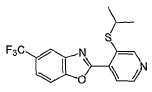
본 활성Saw active 화합물 43Compound 43
1H-NMR(CDCl3)δ:8.79(s, 1H), 8.57(d, J=5.1Hz, 1H), 8.22-8.20(m, 1H), 7.99(d, J=5.1Hz, 1H), 7.75(d, J=8.8Hz, 1H), 7.71(dd, J=8.8, 1.4Hz, 1H), 3.78(sep, J=6.6Hz, 1H), 1.45(d, J=6.6Hz, 6H)
1 H-NMR (CDCl 3 ) δ: 8.79 (s, 1H), 8.57 (d, J = 5.1Hz, 1H), 8.22-8.20 (m, 1H), 7.99 (d, J = 5.1Hz, 1H), 7.75 (d, J = 8.8 Hz, 1H), 7.71 (dd, J = 8.8, 1.4 Hz, 1H), 3.78 (sep, J = 6.6 Hz, 1H), 1.45 (d, J = 6.6 Hz, 6H)
제조예Production Example 45 45
2-프로판티올을 대신하여 tert-부틸메르캅탄을 사용하고, 제조예 43 기재의 방법에 준하여 2-(3-tert-부틸티오피리딘-4-일)-5-(트리플루오로메틸)벤즈옥사졸(이하, 본 활성화합물 44라고 함)을 얻었다.Tert-butylmercaptan was used in place of 2-propanethiol, and 2- (3-tert-butylthiopyridin-4-yl) -5- (trifluoromethyl) benzoxa was prepared according to the method described in Preparation Example 43. A sol (hereinafter referred to as present active compound 44) was obtained.

본 활성화합물 44Present active compound 44
1H-NMR(CDCl3)δ:8.99(d, J=0.7Hz, 1H), 8.77(d, J=5.1Hz, 1H), 8.18-8.16(m, 1H), 7.93(dd, J=5.1, 0.7Hz, 1H), 7.77(d, J=8.8Hz, 1H), 7.73(dd, J=8.8, 1.5Hz, 1H), 1.24(s, 9H)
1 H-NMR (CDCl 3 ) δ: 8.99 (d, J = 0.7 Hz, 1H), 8.77 (d, J = 5.1 Hz, 1H), 8.18-8.16 (m, 1H), 7.93 (dd, J = 5.1 , 0.7 Hz, 1H), 7.77 (d, J = 8.8 Hz, 1H), 7.73 (dd, J = 8.8, 1.5 Hz, 1H), 1.24 (s, 9H)
제조예Production Example 46 46
2-프로판티올을 대신하여 1-펜탄티올을 사용하고, 제조예 43 기재의 방법에 준하여 2-(3-펜틸티오피리딘-4-일)-5-(트리플루오로메틸)벤즈옥사졸(이하, 본 활성화합물 45라고 함)을 얻었다.1-pentanethiol was used in place of 2-propanethiol, and 2- (3-pentylthiopyridin-4-yl) -5- (trifluoromethyl) benzoxazole (hereinafter referred to as the procedure described in Preparation Example 43) , Present active compound 45).
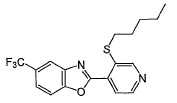
본 활성화합물 45Present Active Compound 45
1H-NMR(CDCl3)δ:8.72(s, 1H), 8.55(d, J=5.2Hz, 1H), 8.23-8.21(m, 1H), 8.00(d, J=5.1, 1H), 7.75(d, J=8.6Hz, 1H), 7.71(dd, J=8.8, 1.6Hz, 1H), 3.13(t, J=7.6Hz, 2H), 1.81(m, 2H), 1.50(m, 2H), 1.38(m, 2H), 0.92(t, J=7.5Hz, 3H)
1 H-NMR (CDCl 3 ) δ: 8.72 (s, 1H), 8.55 (d, J = 5.2Hz, 1H), 8.23-8.21 (m, 1H), 8.00 (d, J = 5.1, 1H), 7.75 (d, J = 8.6 Hz, 1H), 7.71 (dd, J = 8.8, 1.6 Hz, 1H), 3.13 (t, J = 7.6 Hz, 2H), 1.81 (m, 2H), 1.50 (m, 2H) , 1.38 (m, 2H), 0.92 (t, J = 7.5 Hz, 3H)
제조예Production Example 47 47
2-(3-플루오로피리딘-4-일)-5-(트리플루오로메틸)벤즈옥사졸 0.28g, 탄산칼륨 0.50g 및 DMF 2ml의 혼합물에 2,2,2-트리플루오로에탄티올 0.15g을 첨가하고, 실온에서 1.2시간 동안 교반하였다. 반응혼합물에 물을 첨가하고, 아세트산에틸로 2회 추출하였다. 혼합된 유기층을 포화식염수로 세정하고, 무수황산마그네슘으로 건조시켰다. 감압 하에서 농축하고, 잔사를 실리카겔 칼럼크로마토그래피 처리하여 2-[3-(2,2,2-트리플루오로에틸티오)피리딘-4-일]-5-(트리플루오로메틸)벤즈옥사졸(이하, 본 활성화합물 46이라고 함) 0.32g을 얻었다.0.15 2,2,2-trifluoroethanethiol in a mixture of 0.28 g of 2- (3-fluoropyridin-4-yl) -5- (trifluoromethyl) benzoxazole, 0.50 g of potassium carbonate and 2 ml of DMF g was added and stirred at rt for 1.2 h. Water was added to the reaction mixture, followed by extraction twice with ethyl acetate. The combined organic layers were washed with saturated brine and dried over anhydrous magnesium sulfate. Concentrated under reduced pressure, and the residue was subjected to silica gel column chromatography to give 2- [3- (2,2,2-trifluoroethylthio) pyridin-4-yl] -5- (trifluoromethyl) benzoxazole ( Hereinafter, 0.32 g of the present active compound 46) was obtained.

본 활성Saw active 화합물 46Compound 46
1H-NMR(CDCl3)δ:8.94(s, 1H), 8.74(d, J=5.1Hz, 1H), 8.22-8.21(m, 1H), 8.06(d, J=5.1Hz, 1H), 7.78-7.73(m, 2H), 3.76(q, J=9.5Hz, 2H)
1 H-NMR (CDCl 3 ) δ: 8.94 (s, 1H), 8.74 (d, J = 5.1 Hz, 1H), 8.22-8.21 (m, 1H), 8.06 (d, J = 5.1 Hz, 1H), 7.78-7.73 (m, 2H), 3.76 (q, J = 9.5 Hz, 2H)
제조예Production Example 48 48
2-프로판티올을 대신하여 벤질메르캅탄을 사용하고, 제조예 43 기재의 방법에 준하여 2-(3-벤질티오피리딘-4-일)-5-(트리플루오로메틸)벤즈옥사졸(이하, 본 활성화합물 47이라고 함)을 얻었다.Benzyl mercaptan was used in place of 2-propanethiol, and 2- (3-benzylthiopyridin-4-yl) -5- (trifluoromethyl) benzoxazole (hereinafter, This active compound 47) was obtained.
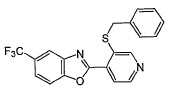
본 활성화합물 47Present Active Compound 47
1H-NMR(CDCl3)δ:8.75(s, 1H), 8.56(d, J=5.2Hz, 1H), 8.19-8.18(m, 1H), 8.00(dd, J=5.2, 0.8Hz, 1H), 7.74(d, J=8.6Hz, 1H), 7.70(dd, J=8.8, 1.5Hz, 1H), 7.43-7.40(m, 2H), 7.35-7.27(m, 3H), 4.36(s, 2H)
1 H-NMR (CDCl 3 ) δ: 8.75 (s, 1H), 8.56 (d, J = 5.2Hz, 1H), 8.19-8.18 (m, 1H), 8.00 (dd, J = 5.2, 0.8Hz, 1H ), 7.74 (d, J = 8.6 Hz, 1H), 7.70 (dd, J = 8.8, 1.5 Hz, 1H), 7.43-7.40 (m, 2H), 7.35-7.27 (m, 3H), 4.36 (s, 2H)
제조예Production Example 49 49
2-프로판티올을 대신하여 4-클로로벤질메르캅탄을 사용하고, 제조예 43 기재의 방법에 준하여 2-[3-(4-클로로벤질티오)피리딘-4-일]-5-(트리플루오로메틸)벤즈옥사졸(이하, 본 활성화합물 48이라고 함)을 얻었다.4-chlorobenzylmercaptan is used in place of 2-propanethiol and 2- [3- (4-chlorobenzylthio) pyridin-4-yl] -5- (trifluoro according to the method described in Preparation Example 43 Methyl) benzoxazole (hereinafter referred to as the present active compound 48) was obtained.
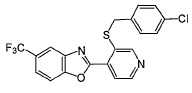
본 활성화합물 48Present Active Compound 48
1H-NMR(CDCl3)δ:8.71(s, 1H), 8.58(d, J=5.1Hz, 1H), 8.20-8.18(m, 1H), 8.00(d, J=5.1Hz, 1H), 7.75-7.70(m, 2H), 7.35-7.32(m, 2H), 7.29-7.26(m, 2H), 4.32(s, 2H)
1 H-NMR (CDCl 3 ) δ: 8.71 (s, 1H), 8.58 (d, J = 5.1 Hz, 1H), 8.20-8.18 (m, 1H), 8.00 (d, J = 5.1 Hz, 1H), 7.75-7.70 (m, 2H), 7.35-7.32 (m, 2H), 7.29-7.26 (m, 2H), 4.32 (s, 2H)
제조예Production Example 50 50
2-(3-플루오로피리딘-4-일)-5-(트리플루오로메틸)벤즈옥사졸 0.28g, 탄산칼륨 0.40g 및 DMF 2ml의 혼합물에 티오페놀 0.17g과 DMF 0.5ml의 혼합물을 첨가하여 실온에서 1시간 동안 교반하였다. 반응혼합물에 물을 첨가하고, 아세트산에틸로 추출하였다. 유기층을 포화식염수로 세정하고, 무수황산마그네슘으로 건조시킨 후, 감압 하에서 농축하였다. 잔사를 실리카겔 칼럼크로마토그래피 처리하여 2-[3-(페닐티오)피리딘-4-일]-5-(트리플루오로메틸)벤즈옥사졸(이하, 본 활성화합물 49라고 함) 0.30g을 얻었다.To a mixture of 0.28 g of 2- (3-fluoropyridin-4-yl) -5- (trifluoromethyl) benzoxazole, 0.40 g of potassium carbonate and 2 ml of DMF, a mixture of 0.17 g of thiophenol and 0.5 ml of DMF was added And stirred at room temperature for 1 hour. Water was added to the reaction mixture, which was then extracted with ethyl acetate. The organic layer was washed with saturated brine, dried over anhydrous magnesium sulfate, and concentrated under reduced pressure. The residue was subjected to silica gel column chromatography to obtain 0.30 g of 2- [3- (phenylthio) pyridin-4-yl] -5- (trifluoromethyl) benzoxazole (hereinafter referred to as active compound 49).

본 활성화합물 49Present active compound 49
1H-NMR(CDCl3)δ:8.51(d, J=5.1Hz, 1H), 8.23(s, 1H), 8.20(s, 1H), 8.02(d, J=5.1Hz, 1H), 7.76(d, J=8.8Hz, 1H), 7.74(dd, J=8.8, 1.4Hz, 1H), 7.65-7.61(m, 2H), 7.48-7.45(m, 3H)
1 H-NMR (CDCl 3 ) δ: 8.51 (d, J = 5.1 Hz, 1H), 8.23 (s, 1H), 8.20 (s, 1H), 8.02 (d, J = 5.1 Hz, 1H), 7.76 ( d, J = 8.8 Hz, 1H), 7.74 (dd, J = 8.8, 1.4 Hz, 1H), 7.65-7.61 (m, 2H), 7.48-7.45 (m, 3H)
제조예Production Example 51 51
티오페놀을 대신하여 4-클로로티오페놀을 사용하고, 제조예 50 기재의 방법에 준하여 2-[3-(4-클로로페닐티오)피리딘-4-일]-5-(트리플루오로메틸)벤즈옥사졸(이하, 본 활성화합물 50이라고 함)을 얻었다.4-chlorothiophenol was used in place of thiophenol, and 2- [3- (4-chlorophenylthio) pyridin-4-yl] -5- (trifluoromethyl) benz was prepared according to the method described in Preparation Example 50. Oxazole (hereinafter referred to as active compound 50) was obtained.
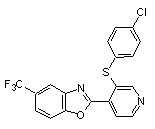
본 활성Saw active 화합물 50Compound 50
1H-NMR(CDCl3)δ:8.54(d, J=5.1Hz, 1H), 8.23-8.22(m, 1H), 8.20(s, 1H), 8.03(d, J=5.1Hz, 1H), 7.77(d, J=8.8Hz, 1H), 7.74(dd, J=8.8, 1.2Hz, 1H), 7.57-7.54(m, 2H), 7.46-7.43(m, 2H)
1 H-NMR (CDCl 3 ) δ: 8.54 (d, J = 5.1 Hz, 1H), 8.23-8.22 (m, 1H), 8.20 (s, 1H), 8.03 (d, J = 5.1 Hz, 1H), 7.77 (d, J = 8.8 Hz, 1H), 7.74 (dd, J = 8.8, 1.2 Hz, 1H), 7.57-7.54 (m, 2H), 7.46-7.43 (m, 2H)
제조예Production Example 53 53
2-(3-플루오로피리딘-4-일)-5-(트리플루오로메틸)벤즈옥사졸 1.41g, 프탈이미드칼륨 1.85g 및 DMF 8ml의 혼합물을 120℃에서 가열교반하였다. 6시간 후, 프탈이미드칼륨 0.92g을 첨가하고, 140℃에서 다시 1시간 동안 가열교반하였다. 실온에 냉각한 후, 반응혼합물에 물을 첨가하고, 아세트산에틸로 2회 추출하였다. 혼합된 유기층을 물, 포화식염수의 순서로 세정하고, 무수황산마그네슘으로 건조시킨 후, 감압 하에서 농축하였다. 잔사를 실리카겔 칼럼크로마토그래피 처리하여 N-{4-[5-(트리플루오로메틸)벤즈옥사졸-2-일]피리딘-3-일}프탈이미드 1.26g을 얻었다.A mixture of 1.41 g of 2- (3-fluoropyridin-4-yl) -5- (trifluoromethyl) benzoxazole, 1.85 g of potassium phthalimide and 8 ml of DMF was heated and stirred at 120 ° C. After 6 hours, 0.92 g of potassium phthalimide was added, and the mixture was further stirred at 140 ° C. for 1 hour. After cooling to room temperature, water was added to the reaction mixture, and the mixture was extracted twice with ethyl acetate. The mixed organic layer was washed with water and brine in that order, dried over anhydrous magnesium sulfate, and concentrated under reduced pressure. The residue was subjected to silica gel column chromatography to obtain 1.26 g of N- {4- [5- (trifluoromethyl) benzoxazol-2-yl] pyridin-3-yl} phthalimide.
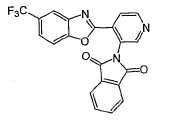
1H-NMR(CDCl3)δ:8.95(d, J=5.1Hz, 1H), 8.82(s, 1H), 8.27(d, J=5.1Hz, 1H), 8.04-7.99(m, 2H), 7.92-7.88(m, 2H), 7.73-7.70(m, 1H), 7.64(dd, J=8.8, 1.2Hz, 1H), 7.57(d, J=8.8Hz, 1H) 1 H-NMR (CDCl 3 ) δ: 8.95 (d, J = 5.1 Hz, 1H), 8.82 (s, 1H), 8.27 (d, J = 5.1 Hz, 1H), 8.04-7.99 (m, 2H), 7.92-7.88 (m, 2H), 7.73-7.70 (m, 1H), 7.64 (dd, J = 8.8, 1.2 Hz, 1H), 7.57 (d, J = 8.8 Hz, 1H)
N-{4-[5-(트리플루오로메틸)벤즈옥사졸-2-일]피리딘-3-일}프탈이미드 0.41g과 에탄올 5ml의 혼합물에 히드라진 1 수화물 0.3ml를 첨가하고, 실온에서 1.5시간 동안 교반하였다. 반응혼합물에 에탄올을 첨가하여 여과하고 여과액을 농축하였다. 잔사를 아세트산에틸로 희석한 후, 물, 이어서 포화식염수로 세정하였다. 유기층을 무수황산마그네슘으로 건조시킨 후, 감압 하에서 농축하고, 잔사를 실리카겔 칼럼크로마토그래피 처리하여 2-(3-아미노피리딘-4-일)-5-(트리플루오로메틸)벤즈옥사졸(이하, 본 활성화합물 52라고 함) 0.19g을 얻었다.0.3 ml of hydrazine monohydrate was added to a mixture of 0.41 g of N- {4- [5- (trifluoromethyl) benzoxazol-2-yl] pyridin-3-yl} phthalimide and 5 ml of ethanol, and at room temperature Stir for 1.5 hours. Ethanol was added to the reaction mixture, and the filtrate was concentrated. The residue was diluted with ethyl acetate and then washed with water followed by saturated brine. The organic layer was dried over anhydrous magnesium sulfate, concentrated under reduced pressure, and the residue was subjected to silica gel column chromatography to give 2- (3-aminopyridin-4-yl) -5- (trifluoromethyl) benzoxazole (hereinafter, 0.19 g of the active compound 52 was obtained.

본 활성Saw active 화합물 52Compound 52
1H-NMR(CDCl3)δ:8.34(d, J=0.5Hz, 1H), 8.08-8.06(m, 2H), 7.83(d, J=5.4Hz, 1H), 7.72(d, J=8.8Hz, 1H), 7.68(dd, J=8.8, 1.5Hz, 1H), 6.14(br s, 2H)
1 H-NMR (CDCl 3 ) δ: 8.34 (d, J = 0.5 Hz, 1H), 8.08-8.06 (m, 2H), 7.83 (d, J = 5.4 Hz, 1H), 7.72 (d, J = 8.8 Hz, 1H), 7.68 (dd, J = 8.8, 1.5 Hz, 1H), 6.14 (br s, 2H)
제조예Production Example 54 54
2-(3-플루오로피리딘-4-일)-5-(트리플루오로메틸)벤즈옥사졸 0.31g, 피롤리딘 0.21g, 탄산칼륨 0.55g 및 DMF 2ml의 혼합물을 60℃에서 1시간 동안 가열교반하였다. 실온에 냉각한 후, 반응혼합물에 물을 첨가하고, 아세트산에틸로 2회 추출하였다. 혼합된 유기층을 포화식염수로 세정하고, 무수황산마그네슘으로 건조시킨 후, 감압 하에서 농축하였다. 잔사를 실리카겔 칼럼크로마토그래피 처리하여 2-[3-(피롤리딘-1-일)피리딘-4-일]-5-(트리플루오로메틸)벤즈옥사졸(이하, 본 활성화합물 53이라고 함) 0.37g을 얻었다.A mixture of 0.31 g of 2- (3-fluoropyridin-4-yl) -5- (trifluoromethyl) benzoxazole, 0.21 g of pyrrolidine, 0.55 g of potassium carbonate and 2 ml of DMF at 60 ° C. for 1 hour It was heated and stirred. After cooling to room temperature, water was added to the reaction mixture, and the mixture was extracted twice with ethyl acetate. The combined organic layers were washed with saturated brine, dried over anhydrous magnesium sulfate, and concentrated under reduced pressure. The residue was subjected to silica gel column chromatography to give 2- [3- (pyrrolidin-1-yl) pyridin-4-yl] -5- (trifluoromethyl) benzoxazole (hereinafter referred to as active compound 53). 0.37 g was obtained.
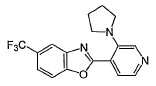
본 활성화합물 53Present active compound 53
1H-NMR(CDCl3)δ:8.40(s, 1H), 8.10(d, J=4.9Hz, 1H), 8.09-8.07(m, 1H), 7.71(d, J=8.5Hz, 1H), 7.69(dd, J=8.6, 1.7Hz, 1H), 7.56(d, J=5.1Hz, 1H), 3.28-3.24(m, 4H), 1.97-1.93(m, 4H)
1 H-NMR (CDCl 3 ) δ: 8.40 (s, 1H), 8.10 (d, J = 4.9Hz, 1H), 8.09-8.07 (m, 1H), 7.71 (d, J = 8.5Hz, 1H), 7.69 (dd, J = 8.6, 1.7 Hz, 1H), 7.56 (d, J = 5.1 Hz, 1H), 3.28-3.24 (m, 4H), 1.97-1.93 (m, 4H)
제조예Production Example 55 55
2-(3-플루오로피리딘-4-일)-5-(트리플루오로메틸)벤즈옥사졸 0.28g, 피페리딘 0.17g, 탄산칼륨 0.55g 및 DMF 2ml의 혼합물을 50℃에서 2시간, 이어서 80℃에서 1.3시간 동안 가열교반하였다. 반응혼합물에 물을 첨가하고, 아세트산에틸로 2회 추출하였다. 혼합된 유기층을 포화식염수로 세정하고, 무수황산마그네슘으로 건조시킨 후, 감압 하에서 농축하였다. 잔사를 실리카겔 칼럼크로마토그래피 처리하여 2-[3-(피페리딘-1-일)피리딘-4-일]-5-(트리플루오로메틸)벤즈옥사졸(이하, 본 활성화합물 54라고 함) 0.34g을 얻었다.A mixture of 0.28 g of 2- (3-fluoropyridin-4-yl) -5- (trifluoromethyl) benzoxazole, 0.17 g of piperidine, 0.55 g of potassium carbonate and 2 ml of DMF was added at 50 ° C. for 2 hours, It was then stirred at 80 ° C. for 1.3 hours. Water was added to the reaction mixture, followed by extraction twice with ethyl acetate. The combined organic layers were washed with saturated brine, dried over anhydrous magnesium sulfate, and concentrated under reduced pressure. The residue was subjected to silica gel column chromatography to give 2- [3- (piperidin-1-yl) pyridin-4-yl] -5- (trifluoromethyl) benzoxazole (hereinafter referred to as active compound 54). 0.34 g was obtained.

본 활성Saw active 화합물 54Compound 54
1H-NMR(CDCl3)δ:8.54(s, 1H), 8.36(d, J=5.1Hz, 1H), 8.12-8.11(m, 1H), 7.89(d, J=5.1Hz, 1H), 7.73(d, J=8.7Hz, 1H), 7.69(dd, J=8.8, 1.6Hz, 1H), 3.11-3.09(m, 4H), 1.81-1.75(m, 4H), 1.66-1.59(m, 2H)
1 H-NMR (CDCl 3 ) δ: 8.54 (s, 1H), 8.36 (d, J = 5.1 Hz, 1H), 8.12-8.11 (m, 1H), 7.89 (d, J = 5.1 Hz, 1H), 7.73 (d, J = 8.7 Hz, 1H), 7.69 (dd, J = 8.8, 1.6 Hz, 1H), 3.11-3.09 (m, 4H), 1.81-1.75 (m, 4H), 1.66-1.59 (m, 2H)
제조예Production Example 56 56
피페리딘을 대신하여 모르폴린을 사용하고, 제조예 55 기재의 방법에 준하여 2-[3-(모르폴린-4-일)피리딘-4-일]-5-(트리플루오로메틸)벤즈옥사졸(이하, 본 활성화합물 55라고 함)을 얻었다.Morpholine was used in place of piperidine and 2- [3- (morpholin-4-yl) pyridin-4-yl] -5- (trifluoromethyl) benzoxa was prepared according to the method described in Preparation Example 55. A sol (hereinafter referred to as the present active compound 55) was obtained.
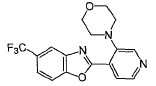
본 활성Saw active 화합물 55Compound 55
1H-NMR(CDCl3)δ:8.57(s, 1H), 8.46(d, J=4.9Hz, 1H), 8.13-8.11(m, 1H), 7.97(d, J=4.9Hz, 1H), 7.74(d, J=8.6Hz, 1H), 7.71(dd, J=8.7, 1.7Hz, 1H), 3.96-3.93(m, 4H), 3.21-3.18(m, 4H)
1 H-NMR (CDCl 3 ) δ: 8.57 (s, 1H), 8.46 (d, J = 4.9Hz, 1H), 8.13-8.11 (m, 1H), 7.97 (d, J = 4.9Hz, 1H), 7.74 (d, J = 8.6 Hz, 1H), 7.71 (dd, J = 8.7, 1.7 Hz, 1H), 3.96-3.93 (m, 4H), 3.21-3.18 (m, 4H)
제조예Production Example 57 57
2-(3-플루오로피리딘-4-일)-5-(트리플루오로메틸)벤즈옥사졸 0.31g, 이미다졸 0.14g, 탄산칼륨 0.55g 및 DMF 2ml의 혼합물을 실온에서 1.5시간, 이어서 60℃에서 1.5시간 동안 가열교반하였다. 실온에 냉각한 후, 반응혼합물에 물을 첨가하고, 아세트산에틸로 2회 추출하였다. 혼합된 유기층을 포화식염수로 세정하고, 무수황산마그네슘으로 건조시킨 후, 감압 하에서 농축하였다. 잔사를 실리카겔 칼럼크로마토그래피 처리하여 2-[3-(이미다졸-1-일)피리딘-4-일]-5-(트리플루오로메틸)벤즈옥사졸(이하, 본 활성화합물 56이라고 함) 0.31g을 얻었다.A mixture of 0.31 g of 2- (3-fluoropyridin-4-yl) -5- (trifluoromethyl) benzoxazole, 0.14 g of imidazole, 0.55 g of potassium carbonate and 2 ml of DMF was added at room temperature for 1.5 hours, followed by 60 The mixture was heated and stirred at 1.5 ° C. for 1.5 hours. After cooling to room temperature, water was added to the reaction mixture, and the mixture was extracted twice with ethyl acetate. The combined organic layers were washed with saturated brine, dried over anhydrous magnesium sulfate, and concentrated under reduced pressure. The residue was subjected to silica gel column chromatography to give 2- [3- (imidazol-1-yl) pyridin-4-yl] -5- (trifluoromethyl) benzoxazole (hereinafter referred to as active compound 56) 0.31 g was obtained.
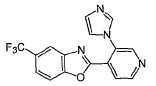
본 활성Saw active 화합물 56Compound 56
1H-NMR(CDCl3)δ:8.93(d, J=5.1Hz, 1H), 8.82(s, 1H), 8.23(d, J=5.1Hz, 1H), 8.08-8.06(m, 1H), 7.72-7.71(m, 1H), 7.69(dd, J=8.5, 1.3Hz, 1H), 7.59(d, J=8.5Hz, 1H), 7.29-7.28(m, 1H), 7.13-7.11(m, 1H)
1 H-NMR (CDCl 3 ) δ: 8.93 (d, J = 5.1 Hz, 1H), 8.82 (s, 1H), 8.23 (d, J = 5.1 Hz, 1H), 8.08-8.06 (m, 1H), 7.72-7.71 (m, 1H), 7.69 (dd, J = 8.5, 1.3 Hz, 1H), 7.59 (d, J = 8.5 Hz, 1H), 7.29-7.28 (m, 1H), 7.13-7.11 (m, 1H)
제조예Production Example 58 58
2-(3-플루오로피리딘-4-일)-5-(트리플루오로메틸)벤즈옥사졸 0.28g, 4-(트리플루오로메틸)-1H-이미다졸 0.18g, 탄산칼륨 0.55g 및 DMF 2ml의 혼합물을 50℃에서 1.5시간 동안 가열교반한 후, 실온에 냉각하였다. 반응혼합물에 물을 첨가하고, 아세트산에틸로 2회 추출하였다. 혼합된 유기층을 포화식염수로 세정하고, 무수황산마그네슘으로 건조시킨 후, 감압 하에서 농축하였다. 잔사를 실리카겔 칼럼크로마토그래피 처리하여 2-{3-[4-(트리플루오로메틸)이미다졸-1-일]피리딘-4-일}-5-(트리플루오로메틸)벤즈옥사졸(이하, 본 활성화합물 57이라고 함) 0.40g을 얻었다.0.28 g of 2- (3-fluoropyridin-4-yl) -5- (trifluoromethyl) benzoxazole, 0.18 g of 4- (trifluoromethyl) -1H-imidazole, 0.55 g of potassium carbonate and DMF 2 ml of the mixture was heated at 50 ° C. for 1.5 hours and then cooled to room temperature. Water was added to the reaction mixture, followed by extraction twice with ethyl acetate. The combined organic layers were washed with saturated brine, dried over anhydrous magnesium sulfate, and concentrated under reduced pressure. The residue was subjected to silica gel column chromatography to give 2- {3- [4- (trifluoromethyl) imidazol-1-yl] pyridin-4-yl} -5- (trifluoromethyl) benzoxazole (hereinafter, 0.40 g of the present active compound 57 was obtained.
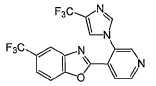
본 활성Saw active 화합물 57Compound 57
1H-NMR(CDCl3)δ:9.00(d, J=5.2Hz, 1H), 8.84(s, 1H), 8.31(d, J=5.1Hz, 1H), 8.06-8.04(m, 1H), 7.77-7.75(m, 1H), 7.74-7.70(m, 1H), 7.62(d, J=8.6Hz, 1H), 7.52-7.50(m, 1H)
1 H-NMR (CDCl 3 ) δ: 9.00 (d, J = 5.2 Hz, 1H), 8.84 (s, 1H), 8.31 (d, J = 5.1 Hz, 1H), 8.06-8.04 (m, 1H), 7.77-7.75 (m, 1H), 7.74-7.70 (m, 1H), 7.62 (d, J = 8.6 Hz, 1H), 7.52-7.50 (m, 1H)
제조예Production Example 59 59
2-(3-플루오로피리딘-4-일)-5-(트리플루오로메틸)벤즈옥사졸 0.24g, 피라졸 0.14g, 탄산칼륨 0.69g 및 DMF 4ml의 혼합물을 50℃에서 2시간 동안 가열교반하였다. 반응혼합물에 물을 첨가하고, 아세트산에틸로 2회 추출하였다. 혼합된 유기층을 포화식염수로 세정하고, 무수황산마그네슘으로 건조시킨 후, 감압 하에서 농축하였다. 잔사를 실리카겔 칼럼크로마토그래피 처리하여 2-[3-(피라졸-1-일)피리딘-4-일]-5-(트리플루오로메틸)벤즈옥사졸(이하, 본 활성화합물 58이라고 함) 0.22g을 얻었다.A mixture of 0.24 g of 2- (3-fluoropyridin-4-yl) -5- (trifluoromethyl) benzoxazole, 0.14 g of pyrazole, 0.69 g of potassium carbonate and 4 ml of DMF was heated at 50 ° C. for 2 hours. Stirred. Water was added to the reaction mixture, followed by extraction twice with ethyl acetate. The combined organic layers were washed with saturated brine, dried over anhydrous magnesium sulfate, and concentrated under reduced pressure. The residue was subjected to silica gel column chromatography to give 2- [3- (pyrazol-1-yl) pyridin-4-yl] -5- (trifluoromethyl) benzoxazole (hereinafter referred to as active compound 58) 0.22 g was obtained.

본 활성Saw active 화합물 58Compound 58
1H-NMR(CDCl3)δ:8.93(s, 1H), 8.87(d, J=5.1Hz, 1H), 8.10(d, J=5.1Hz, 1H), 8.08-8.06(m, 1H), 7.77(d, J=2.2Hz, 1H), 7.72(d, J=1.7Hz, 1H), 7.66(dd, J=8.6, 1.3Hz, 1H), 7.53(d, J=8.8Hz, 1H), 6.55-6.53(m, 1H)
1 H-NMR (CDCl 3 ) δ: 8.93 (s, 1H), 8.87 (d, J = 5.1 Hz, 1H), 8.10 (d, J = 5.1 Hz, 1H), 8.08-8.06 (m, 1H), 7.77 (d, J = 2.2 Hz, 1H), 7.72 (d, J = 1.7 Hz, 1H), 7.66 (dd, J = 8.6, 1.3 Hz, 1H), 7.53 (d, J = 8.8 Hz, 1H), 6.55-6.53 (m, 1 H)
제조예Production Example 60 60
2-(3-플루오로피리딘-4-일)-5-(트리플루오로메틸)벤즈옥사졸 0.28g, 3-브로모피라졸 0.19g, 탄산칼륨 0.55g 및 DMF 2ml의 혼합물을 50℃에서 1.5시간 동안 가열교반한 후, 실온에 냉각하였다. 반응혼합물에 물을 첨가하고, 아세트산에틸로 2회 추출하였다. 혼합된 유기층을 포화식염수로 세정하고, 무수황산마그네슘으로 건조시킨 후, 감압 하에서 농축하였다. 잔사를 실리카겔 칼럼크로마토그래피 처리하여 2-[3-(3-브로모피라졸-1-일)피리딘-4-일]-5-(트리플루오로메틸)벤즈옥사졸(이하, 본 활성화합물 59라고 함) 0.31g을 얻었다.A mixture of 0.28 g of 2- (3-fluoropyridin-4-yl) -5- (trifluoromethyl) benzoxazole, 0.19 g of 3-bromopyrazole, 0.55 g of potassium carbonate and 2 ml of DMF was 1.5 at 50 ° C. After stirring for heating for an hour, it was cooled to room temperature. Water was added to the reaction mixture, followed by extraction twice with ethyl acetate. The combined organic layers were washed with saturated brine, dried over anhydrous magnesium sulfate, and concentrated under reduced pressure. The residue was subjected to silica gel column chromatography to give 2- [3- (3-bromopyrazol-1-yl) pyridin-4-yl] -5- (trifluoromethyl) benzoxazole (hereinafter referred to as the present active compound 59). 0.31g was obtained.
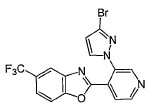
본 활성Saw active 화합물 59Compound 59
1H-NMR(CDCl3)δ:8.92(s, 1H), 8.89(d, J=5.1Hz, 1H), 8.16(d, J=5.1Hz, 1H), 8.08-8.07(m, 1H), 7.69(dd, J=8.8, 1.2Hz, 1H), 7.66(d, J=2.4Hz, 1H), 7.59(d, J=8.8Hz, 1H), 6.57(d, J=2.4Hz, 1H)
1 H-NMR (CDCl 3 ) δ: 8.92 (s, 1H), 8.89 (d, J = 5.1 Hz, 1H), 8.16 (d, J = 5.1 Hz, 1H), 8.08-8.07 (m, 1H), 7.69 (dd, J = 8.8, 1.2 Hz, 1H), 7.66 (d, J = 2.4 Hz, 1H), 7.59 (d, J = 8.8 Hz, 1H), 6.57 (d, J = 2.4 Hz, 1H)
제조예Production Example 61 61
2-(3-플루오로피리딘-4-일)-5-(트리플루오로메틸)벤즈옥사졸 0.28g, 3-트리플루오로메틸피라졸 0.18g, 탄산칼륨 0.55g 및 DMF 3ml의 혼합물을 60℃에서 1시간 동안 가열교반하였다. 실온에 냉각한 후, 반응혼합물에 물을 첨가하고, 아세트산에틸로 2회 추출하였다. 혼합된 유기층을 포화식염수로 세정하고, 무수황산마그네슘으로 건조시킨 후, 감압 하에서 농축하였다. 잔사를 실리카겔 칼럼크로마토그래피 처리하여 2-[3-(3-트리플루오로메틸피라졸-1-일)피리딘-4-일]-5-(트리플루오로메틸)벤즈옥사졸(이하, 본 활성화합물 60이라고 함) 0.34g을 얻었다.A mixture of 0.28 g of 2- (3-fluoropyridin-4-yl) -5- (trifluoromethyl) benzoxazole, 0.18 g of 3-trifluoromethylpyrazole, 0.55 g of potassium carbonate and 3 ml of DMF was added 60 The mixture was heated and stirred at 1 ° C. for 1 hour. After cooling to room temperature, water was added to the reaction mixture, and the mixture was extracted twice with ethyl acetate. The combined organic layers were washed with saturated brine, dried over anhydrous magnesium sulfate, and concentrated under reduced pressure. The residue was subjected to silica gel column chromatography to give 2- [3- (3-trifluoromethylpyrazol-1-yl) pyridin-4-yl] -5- (trifluoromethyl) benzoxazole (hereinafter the present activity). 0.34 g).

본 활성Saw active 화합물 60Compound 60
1H-NMR(CDCl3)δ:8.95(d, J=5.2Hz, 1H), 8.94(s, 1H), 8.22(dd, J=5.2, 0.7Hz, 1H), 8.05-8.03(m, 1H), 7.84-7.82(m, 1H), 7.68(dd, J=8.8, 1.3Hz, 1H), 7.54(d, J=8.8Hz, 1H), 6.83(d, J=2.2Hz, 1H)
1 H-NMR (CDCl 3 ) δ: 8.95 (d, J = 5.2 Hz, 1H), 8.94 (s, 1H), 8.22 (dd, J = 5.2, 0.7 Hz, 1H), 8.05-8.03 (m, 1H ), 7.84-7.82 (m, 1H), 7.68 (dd, J = 8.8, 1.3 Hz, 1H), 7.54 (d, J = 8.8 Hz, 1H), 6.83 (d, J = 2.2 Hz, 1H)
제조예Production Example 62 62
2-(3-플루오로피리딘-4-일)-5-(트리플루오로메틸)벤즈옥사졸 0.28g, 4-메틸피라졸 0.11g, 탄산칼륨 0.55g 및 DMF 3ml의 혼합물을 60℃에서 1.5시간 동안 가열교반하였다. 4-메틸피라졸 0.05g을 첨가하고, 다시 60℃에서 1.5시간 동안 가열교반한 후, 실온에 냉각하였다. 반응혼합물에 물을 첨가하고, 아세트산에틸로 2회 추출하였다. 혼합된 유기층을 포화식염수로 세정하고, 무수황산마그네슘으로 건조시킨 후, 감압 하에서 농축하였다. 잔사를 실리카겔 칼럼크로마토그래피 처리하여 2-[3-(4-메틸피라졸-1-일)피리딘-4-일]-5-(트리플루오로메틸)벤즈옥사졸(이하, 본 활성화합물 61이라고 함) 0.25g을 얻었다.A mixture of 0.28 g of 2- (3-fluoropyridin-4-yl) -5- (trifluoromethyl) benzoxazole, 0.11 g of 4-methylpyrazole, 0.55 g of potassium carbonate and 3 ml of DMF was 1.5 at 60 ° C. The mixture was heated and stirred for an hour. 0.05 g of 4-methylpyrazole was added and again stirred at 60 ° C. for 1.5 hours, and then cooled to room temperature. Water was added to the reaction mixture, followed by extraction twice with ethyl acetate. The combined organic layers were washed with saturated brine, dried over anhydrous magnesium sulfate, and concentrated under reduced pressure. The residue was subjected to silica gel column chromatography to give 2- [3- (4-methylpyrazol-1-yl) pyridin-4-yl] -5- (trifluoromethyl) benzoxazole (hereinafter referred to as the present active compound 61). 0.25g was obtained.

본 활성Saw active 화합물 61Compound 61
1H-NMR(CDCl3)δ:8.89(d, J=0.5Hz, 1H), 8.81(d, J=5.1Hz, 1H), 8.08-8.07(m, 1H), 8.04(dd, J=5.1, 0.6Hz, 1H), 7.67-7.65(m, 1H), 7.57-7.54(m, 2H), 7.51(s, 1H), 2.19(s, 3H)
1 H-NMR (CDCl 3 ) δ: 8.89 (d, J = 0.5 Hz, 1H), 8.81 (d, J = 5.1 Hz, 1H), 8.08-8.07 (m, 1H), 8.04 (dd, J = 5.1 , 0.6 Hz, 1H), 7.67-7.65 (m, 1H), 7.57-7.54 (m, 2H), 7.51 (s, 1H), 2.19 (s, 3H)
제조예Production Example 63 63
2-(3-플루오로피리딘-4-일)-5-(트리플루오로메틸)벤즈옥사졸 0.28g, 4-(트리플루오로메틸)피라졸 0.18g, 탄산칼륨 0.55g 및 DMF 2ml의 혼합물을 50℃에서 1.5시간 동안 가열교반한 후, 실온에 냉각하였다. 반응혼합물에 물을 첨가하고, 아세트산에틸로 2회 추출하였다. 혼합된 유기층을 포화식염수로 세정하고, 무수황산마그네슘으로 건조시킨 후, 감압 하에서 농축하였다. 잔사를 실리카겔 칼럼크로마토그래피 처리하여 2-{3-[4-(트리플루오로메틸)피라졸-1-일]피리딘-4-일}-5-(트리플루오로메틸)벤즈옥사졸(이하, 본 활성화합물 62라고 함) 0.36g을 얻었다.A mixture of 0.28 g of 2- (3-fluoropyridin-4-yl) -5- (trifluoromethyl) benzoxazole, 0.18 g of 4- (trifluoromethyl) pyrazole, 0.55 g of potassium carbonate and 2 ml of DMF The mixture was heated and stirred at 50 ° C. for 1.5 hours, and then cooled to room temperature. Water was added to the reaction mixture, followed by extraction twice with ethyl acetate. The combined organic layers were washed with saturated brine, dried over anhydrous magnesium sulfate, and concentrated under reduced pressure. The residue was subjected to silica gel column chromatography to give 2- {3- [4- (trifluoromethyl) pyrazol-1-yl] pyridin-4-yl} -5- (trifluoromethyl) benzoxazole (hereinafter, 0.36 g of the present active compound 62 was obtained.

본 활성Saw active 화합물 62Compound 62
1H-NMR(CDCl3)δ:8.96(d, J=5.1Hz, 1H), 8.93(d, J=0.5Hz, 1H), 8.21(dd, J=5.1, 0.5Hz, 1H), 8.13-8.11(m, 1H), 8.05-8.04(m, 1H), 7.95(s, 1H), 7.71-7.68(m, 1H), 7.56(d, J=8.8Hz, 1H)
1 H-NMR (CDCl 3 ) δ: 8.96 (d, J = 5.1Hz, 1H), 8.93 (d, J = 0.5Hz, 1H), 8.21 (dd, J = 5.1, 0.5Hz, 1H), 8.13- 8.11 (m, 1H), 8.05-8.04 (m, 1H), 7.95 (s, 1H), 7.71-7.68 (m, 1H), 7.56 (d, J = 8.8 Hz, 1H)
제조예Production Example 64 64
2-(3-플루오로피리딘-4-일)-5-(트리플루오로메틸)벤즈옥사졸 0.28g, 1H-1,2,4-트리아졸 0.10g, 탄산칼륨 0.55g 및 DMF 2ml의 혼합물을 50℃에서 1.5시간 동안 가열교반한 후, 실온에 냉각하였다. 반응혼합물에 물을 첨가하고, 아세트산에틸로 2회 추출하였다. 혼합된 유기층을 포화식염수로 세정하고, 무수황산마그네슘으로 건조시킨 후, 감압 하에서 농축하였다. 잔사를 실리카겔 칼럼크로마토그래피 처리하여 2-[3-(1,2,4-트리아졸-1-일)피리딘-4-일]-5-(트리플루오로메틸)벤즈옥사졸(이하, 본 활성화합물 63이라고 함) 0.26g을 얻었다.A mixture of 0.28 g of 2- (3-fluoropyridin-4-yl) -5- (trifluoromethyl) benzoxazole, 0.10 g of 1H-1,2,4-triazole, 0.55 g of potassium carbonate and 2 ml of DMF The mixture was heated and stirred at 50 ° C. for 1.5 hours, and then cooled to room temperature. Water was added to the reaction mixture, followed by extraction twice with ethyl acetate. The combined organic layers were washed with saturated brine, dried over anhydrous magnesium sulfate, and concentrated under reduced pressure. The residue was subjected to silica gel column chromatography to give 2- [3- (1,2,4-triazol-1-yl) pyridin-4-yl] -5- (trifluoromethyl) benzoxazole (hereinafter the present activity). 0.26 g).

본 활성화합물 63Present active compound 63
1H-NMR(CDCl3)δ:8.99(d, J=5.3Hz, 1H), 8.92(d, J=0.8Hz, 1H), 8.52(s, 1H), 8.25(dd, J=5.3, 0.6Hz, 1H), 8.19(s, 1H), 8.05-8.04(m, 1H), 7.71-7.69(m, 1H), 7.61-7.59(m, 1H)
1 H-NMR (CDCl 3 ) δ: 8.99 (d, J = 5.3 Hz, 1H), 8.92 (d, J = 0.8 Hz, 1H), 8.52 (s, 1H), 8.25 (dd, J = 5.3, 0.6 Hz, 1H), 8.19 (s, 1H), 8.05-8.04 (m, 1H), 7.71-7.69 (m, 1H), 7.61-7.59 (m, 1H)
제조예Production Example 65 65
N-[3-클로로-5-(트리플루오로메틸)-2-히드록시페닐]이소니코틴아미드 0.42g, 테트라히드로푸란 5ml 및 트리페닐포스핀 0.38g의 혼합물에 실온 하에서 아조디카르본산디에틸에스테르의 40% 톨루엔 용액 0.64g을 적하하여 실온에서 1시간, 이어서 50℃에서 2.5시간 동안 가열교반하였다. 실온에 냉각한 후, 반응혼합물을 감압 하에서 농축하고, 잔사를 실리카겔 칼럼크로마토그래피 처리하여 2-(피리딘-4-일)-7-클로로-5-(트리플루오로메틸)벤즈옥사졸(이하, 본 활성화합물 64라고 함)을 얻었다.Azodicarboxylic acid diethyl ester at room temperature in a mixture of 0.42 g of N- [3-chloro-5- (trifluoromethyl) -2-hydroxyphenyl] isonicotinamide, 5 ml of tetrahydrofuran and 0.38 g of triphenylphosphine 0.64 g of 40% toluene solution was added dropwise and stirred at room temperature for 1 hour and then at 50 ° C for 2.5 hours. After cooling to room temperature, the reaction mixture was concentrated under reduced pressure, and the residue was subjected to silica gel column chromatography to give 2- (pyridin-4-yl) -7-chloro-5- (trifluoromethyl) benzoxazole (hereinafter, This active compound 64) was obtained.

본 활성화합물 64Present Active Compound 64
1H-NMR(CDCl3)δ:8.89-8.88(m, 2H), 8.16-8.13(m, 2H), 8.02-8.01(m 1H), 7.72-7.71(m, 1H)
1 H-NMR (CDCl 3 ) δ: 8.89-8.88 (m, 2H), 8.16-8.13 (m, 2H), 8.02-8.01 (m 1H), 7.72-7.71 (m, 1H)
제조예Production Example 66 66
N-[2-히드록시-5-(펜타플루오로에틸)페닐]이소니코틴아미드 0.49g, 테트라히드로푸란 5ml 및 트리페닐포스핀 0.46g의 혼합물에 실온 하에서 아조디카르본산디에틸에스테르의 40% 톨루엔 용액 0.77g을 적하하여 1.8시간 동안 교반하였다. 반응혼합물을 감압 하에서 농축하고, 잔사를 실리카겔 칼럼크로마토그래피 처리하여 5-(펜타플루오로에틸)-2-(피리딘-4-일)-벤즈옥사졸(이하, 본 활성화합물 65라고 함) 0.41g을 얻었다.40% toluene of azodicarboxylic acid diethyl ester at room temperature in a mixture of 0.49 g of N- [2-hydroxy-5- (pentafluoroethyl) phenyl] isonicotinamide, 5 ml of tetrahydrofuran and 0.46 g of triphenylphosphine 0.77 g of the solution was added dropwise and stirred for 1.8 hours. The reaction mixture was concentrated under reduced pressure, and the residue was subjected to silica gel column chromatography to give 0.41 g of 5- (pentafluoroethyl) -2- (pyridin-4-yl) -benzoxazole (hereinafter referred to as active compound 65). Got.

본 활성Saw active 화합물 65Compound 65
1H-NMR(CDCl3)δ:8.88-8.86(m, 2H), 8.12-8.10(m, 3H), 7.77(d, J=8.8Hz, 1H), 7.70-7.67(m, 1H)
1 H-NMR (CDCl 3 ) δ: 8.88-8.86 (m, 2H), 8.12-8.10 (m, 3H), 7.77 (d, J = 8.8 Hz, 1H), 7.70-7.67 (m, 1H)
제조예Production Example 67 67
3-클로로-N-[2-히드록시-5-(펜타플루오로에틸)페닐]이소니코틴아미드 0.24g, 테트라히드로푸란 4ml 및 트리페닐포스핀 0.21g의 혼합물에 실온 하에서 아조디카르본산디에틸에스테르의 40% 톨루엔 용액 0.34g을 적하하여 1.8시간 동안 교반하였다. 반응혼합물을 감압 하에서 농축하고, 잔사를 실리카겔 칼럼크로마토그래피 처리하여 2-(3-클로로피리딘-4-일)-5-(펜타플루오로에틸)벤즈옥사졸(이하, 본 활성화합물 66이라고 함) 0.19g을 얻었다.Azodicarboxylic acid diethyl ester in a mixture of 0.24 g of 3-chloro-N- [2-hydroxy-5- (pentafluoroethyl) phenyl] isonicotinamide, 4 ml of tetrahydrofuran and 0.21 g of triphenylphosphine under room temperature 0.34 g of 40% toluene solution was added dropwise and stirred for 1.8 hours. The reaction mixture was concentrated under reduced pressure, and the residue was subjected to silica gel column chromatography to give 2- (3-chloropyridin-4-yl) -5- (pentafluoroethyl) benzoxazole (hereinafter referred to as the present active compound 66). 0.19 g was obtained.

본 활성Saw active 화합물 66Compound 66
1H-NMR(CDCl3)δ:8.86(s, 1H), 8.71(d, J=5.1Hz, 1H), 8.18(s, 1H), 8.10(d, J=5.1Hz, 1H), 7.80(d, J=8.5Hz, 1H), 7.72(d, J=8.8Hz, 1H)
1 H-NMR (CDCl 3 ) δ: 8.86 (s, 1H), 8.71 (d, J = 5.1Hz, 1H), 8.18 (s, 1H), 8.10 (d, J = 5.1Hz, 1H), 7.80 ( d, J = 8.5 Hz, 1H), 7.72 (d, J = 8.8 Hz, 1H)
제조예Production Example 68 68
N-[2-히드록시-5-(헵타플루오로이소프로필)페닐]이소니코틴아미드 0.79g, 테트라히드로푸란 8ml 및 트리페닐포스핀 0.60g의 혼합물에 실온 하에서 아조디카르본산디에틸에스테르의 40% 톨루엔 용액 0.99g을 적하하여 2.3시간 동안 교반하였다. 반응혼합물을 감압 하에서 농축하고, 잔사를 실리카겔 칼럼크로마토그래피 처리하여 2-(피리딘-4-일)-5-(헵타플루오로이소프로필)벤즈옥사졸(이하, 본 활성화합물 67이라고 함)을 얻었다.40% of azodicarboxylic acid diethyl ester at room temperature in a mixture of 0.79 g of N- [2-hydroxy-5- (heptafluoroisopropyl) phenyl] isonicotinamide, 8 ml of tetrahydrofuran and 0.60 g of triphenylphosphine 0.99 g of toluene solution was added dropwise and stirred for 2.3 hours. The reaction mixture was concentrated under reduced pressure, and the residue was subjected to silica gel column chromatography to obtain 2- (pyridin-4-yl) -5- (heptafluoroisopropyl) benzoxazole (hereinafter referred to as the present active compound 67). .

본 활성Saw active 화합물 67Compound 67
1H-NMR(CDCl3)δ:8.88-8.86(m, 2H), 8.14(s, 1H), 8.12-8.10(m, 2H), 7.78(d, J=8.8Hz, 1H), 7.71(d, J=8.8Hz, 1H)
1 H-NMR (CDCl 3 ) δ: 8.88-8.86 (m, 2H), 8.14 (s, 1H), 8.12-8.10 (m, 2H), 7.78 (d, J = 8.8 Hz, 1H), 7.71 (d , J = 8.8 Hz, 1H)
제조예Production Example 69 69
3-클로로-N-[2-히드록시-5-(헵타플루오로이소프로필)페닐]이소니코틴아미드 0.90g, 테트라히드로푸란 10ml 및 트리페닐포스핀 0.68g의 혼합물에 실온 하에서 아조디카르본산디에틸에스테르의 40% 톨루엔 용액 1.13g을 적하하여 1.2시간 동안 교반하였다. 반응혼합물을 감압 하에서 농축하고, 잔사를 실리카겔 칼럼크로마토그래피 처리하여 2-(3-클로로피리딘-4-일)-5-(헵타플루오로이소프로필)벤즈옥사졸(이하, 본 활성화합물 68이라고 함) 0.58g을 얻었다.Diethyl azodicarboxylic acid at room temperature in a mixture of 0.90 g of 3-chloro-N- [2-hydroxy-5- (heptafluoroisopropyl) phenyl] isonicotinamide, 10 ml of tetrahydrofuran and 0.68 g of triphenylphosphine 1.13 g of a 40% toluene solution of ester was added dropwise and stirred for 1.2 hours. The reaction mixture was concentrated under reduced pressure, and the residue was subjected to silica gel column chromatography to give 2- (3-chloropyridin-4-yl) -5- (heptafluoroisopropyl) benzoxazole (hereinafter referred to as the present active compound 68). ) 0.58 g.

본 활성Saw active 화합물 68Compound 68
1H-NMR(CDCl3)δ:8.86(s, 1H), 8.71(d, J=5.1Hz, 1H), 8.21(s, 1H), 8.09(d, J=4.9Hz, 1H), 7.81(d, J=8.8Hz, 1H), 7.74(d, J=8.7Hz, 1H)
1 H-NMR (CDCl 3 ) δ: 8.86 (s, 1H), 8.71 (d, J = 5.1Hz, 1H), 8.21 (s, 1H), 8.09 (d, J = 4.9Hz, 1H), 7.81 ( d, J = 8.8 Hz, 1H), 7.74 (d, J = 8.7 Hz, 1H)
제조예Production Example 70 70
2-(3-플루오로피리딘-4-일)-5-(트리플루오로메틸)벤즈옥사졸 0.28g, 탄산칼륨 0.27g 및 에탄올 3ml의 혼합물을 60℃에서 2시간, 90℃에서 2.5시간 동안 가열교반하였다. 실온에 냉각한 후, 반응혼합물을 감압 하에서 농축하고, 물을 첨가한 후, 아세트산에틸로 2회 추출하였다. 혼합된 유기층을 포화식염수로 세정하고, 무수황산마그네슘으로 건조시켰다. 감압 하에서 농축하고, 잔사를 실리카겔 칼럼크로마토그래피 처리하여 2-(3-에톡시피리딘-4-일)-5-(트리플루오로메틸)벤즈옥사졸(이하, 본 활성화합물 69라고 함) 0.18g을 얻었다.A mixture of 0.28 g of 2- (3-fluoropyridin-4-yl) -5- (trifluoromethyl) benzoxazole, 0.27 g of potassium carbonate and 3 ml of ethanol was mixed at 60 ° C. for 2 hours and 90 ° C. for 2.5 hours. It was heated and stirred. After cooling to room temperature, the reaction mixture was concentrated under reduced pressure, water was added, and then extracted twice with ethyl acetate. The combined organic layers were washed with saturated brine and dried over anhydrous magnesium sulfate. Concentrated under reduced pressure, and the residue was subjected to silica gel column chromatography to give 0.18 g of 2- (3-ethoxypyridin-4-yl) -5- (trifluoromethyl) benzoxazole (hereinafter referred to as the present active compound 69). Got.

본 활성Saw active 화합물 69Compound 69
1H-NMR(CDCl3)δ:8.57(s, 1H), 8.43(d, J=4.8Hz, 1H), 8.14-8.12(m, 1H), 8.00(d, J=4.8Hz, 1H), 7.75-7.67(m, 2H), 4.39(q, J=7.0Hz, 2H), 1.58(t, J=7.0Hz, 3H)
1 H-NMR (CDCl 3 ) δ: 8.57 (s, 1H), 8.43 (d, J = 4.8 Hz, 1H), 8.14-8.12 (m, 1H), 8.00 (d, J = 4.8 Hz, 1H), 7.75-7.67 (m, 2H), 4.39 (q, J = 7.0 Hz, 2H), 1.58 (t, J = 7.0 Hz, 3H)
제조예Production Example 71 71
2-(3-플루오로피리딘-4-일)-5-(트리플루오로메틸)벤즈옥사졸 0.28g 및 2-프로판올 3ml의 혼합물에 빙랭 하에서 60% 수소화나트륨(유성) 52mg을 첨가하여 그대로 1.5시간, 실온으로 높여서 다시 1.5시간 동안 교반하였다. 반응혼합물에 물을 첨가한 후, 아세트산에틸로 2회 추출하였다. 혼합된 유기층을 포화식염수로 세정하고, 무수황산마그네슘으로 건조시켰다. 감압 하에서 농축하고, 잔사를 실리카겔 칼럼크로마토그래피 처리하여 2-(3-이소프로폭시피리딘-4-일)-5-(트리플루오로메틸)벤즈옥사졸(이하, 본 활성화합물 70이라고 함) 0.12g을 얻었다.To a mixture of 0.28 g of 2- (3-fluoropyridin-4-yl) -5- (trifluoromethyl) benzoxazole and 3 ml of 2-propanol, 52 mg of 60% sodium hydride (oil) was added under ice cooling to give 1.5 The temperature was raised to room temperature and stirred for another 1.5 hours. Water was added to the reaction mixture, which was then extracted twice with ethyl acetate. The combined organic layers were washed with saturated brine and dried over anhydrous magnesium sulfate. Concentrated under reduced pressure, and the residue was subjected to silica gel column chromatography to give 2- (3-isopropoxypyridin-4-yl) -5- (trifluoromethyl) benzoxazole (hereinafter referred to as the present active compound 70) 0.12 g was obtained.

본 활성화합물 70Present Active Compound 70
1H-NMR(CDCl3)δδ:8.57(s, 1H), 8.41(d, J=5.1Hz, 1H), 8.13-8.12(m, 1H), 8.00(d, J=5.1Hz, 1H), 7.74-7.67(m, 2H), 4.87-4.78(m, 1H), 1.49(d, J=6.0Hz, 6H)
1 H-NMR (CDCl 3 ) δδ: 8.57 (s, 1H), 8.41 (d, J = 5.1Hz, 1H), 8.13-8.12 (m, 1H), 8.00 (d, J = 5.1Hz, 1H), 7.74-7.67 (m, 2H), 4.87-4.78 (m, 1H), 1.49 (d, J = 6.0 Hz, 6H)
제조예Production Example 72 72
2-(3-플루오로피리딘-4-일)-5-(트리플루오로메틸)벤즈옥사졸 0.28g, 탄산칼륨 0.27g 및 프로판올 3ml의 혼합물을 교반하면서 6시간 동안 가열환류하였다. 실온에 냉각한 후, 반응혼합물을 감압 하에서 농축하고, 물을 첨가한 후, 아세트산에틸로 2회 추출하였다. 혼합된 유기층을 포화식염수로 세정하고, 무수황산마그네슘으로 건조시켰다. 감압 하에서 농축하고, 잔사를 실리카겔 칼럼크로마토그래피 처리하여 2-(3-프로폭시피리딘-4-일)-5-(트리플루오로메틸)벤즈옥사졸(이하, 본 활성화합물 71이라고 함) 0.25g을 얻었다.A mixture of 0.28 g of 2- (3-fluoropyridin-4-yl) -5- (trifluoromethyl) benzoxazole, 0.27 g of potassium carbonate and 3 ml of propanol was heated to reflux for 6 hours with stirring. After cooling to room temperature, the reaction mixture was concentrated under reduced pressure, water was added, and then extracted twice with ethyl acetate. The combined organic layers were washed with saturated brine and dried over anhydrous magnesium sulfate. Concentrated under reduced pressure, and the residue was subjected to silica gel column chromatography to give 0.25 g of 2- (3-propoxypyridin-4-yl) -5- (trifluoromethyl) benzoxazole (hereinafter referred to as the present active compound 71). Got.
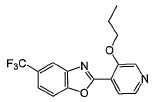
본 활성Saw active 화합물 71Compound 71
1H-NMR(CDCl3)δ:8.56(s, 1H), 8.43(d, J=5.0Hz, 1H), 8.13-8.11(m, 1H), 8.01(d, J=5.1Hz, 1H), 7.74-7.67(m, 2H), 4.27(t, J=6.5, 2H), 2.02-1.92(m, 2H), 1.15(t, J=7.5Hz, 3H)
1 H-NMR (CDCl 3 ) δ: 8.56 (s, 1H), 8.43 (d, J = 5.0Hz, 1H), 8.13-8.11 (m, 1H), 8.01 (d, J = 5.1Hz, 1H), 7.74-7.67 (m, 2H), 4.27 (t, J = 6.5, 2H), 2.02-1.92 (m, 2H), 1.15 (t, J = 7.5 Hz, 3H)
제조예Production Example 73 73
2-(3-플루오로피리딘-4-일)-5-(트리플루오로메틸)벤즈옥사졸 0.28g, 탄산칼륨 0.27g 및 부탄올 3ml의 혼합물을 100℃에서 6시간 동안 가열교반하였다. 탄산칼륨 0.14g을 첨가하고, 100℃에서 다시 4시간 동안 가열교반하였다. 실온에 냉각한 후, 반응혼합물에 물을 첨가한 후, 아세트산에틸로 2회 추출하였다. 혼합된 유기층을 포화식염수로 세정하고, 무수황산마그네슘으로 건조시켰다. 감압 하에서 농축하고, 잔사를 실리카겔 칼럼크로마토그래피 처리하여 2-(3-부톡시피리딘-4-일)-5-(트리플루오로메틸)벤즈옥사졸(이하, 본 활성화합물 72라고 함) 0.24g을 얻었다.A mixture of 0.28 g of 2- (3-fluoropyridin-4-yl) -5- (trifluoromethyl) benzoxazole, 0.27 g of potassium carbonate and 3 ml of butanol was heated and stirred at 100 ° C. for 6 hours. 0.14 g of potassium carbonate was added, and the mixture was further stirred at 100 DEG C for 4 hours. After cooling to room temperature, water was added to the reaction mixture, which was then extracted twice with ethyl acetate. The combined organic layers were washed with saturated brine and dried over anhydrous magnesium sulfate. Concentrated under reduced pressure, and the residue was subjected to silica gel column chromatography to give 0.24 g of 2- (3-butoxypyridin-4-yl) -5- (trifluoromethyl) benzoxazole (hereinafter referred to as active compound 72). Got.
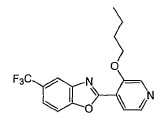
본 활성화합물 72Present Active Compound 72
1H-NMR(CDCl3)δ:8.57(s, 1H), 8.42(d, J=4.8Hz, 1H), 8.13-8.11(m, 1H), 8.01(d, J=4.8Hz, 1H), 7.73-7.67(m, 2H), 4.31(t, J=6.5Hz, 2H), 1.97-1.88(m, 2H), 1.67-1.55(m, 2H), 1.03(t, J=7.5Hz, 3H)
1 H-NMR (CDCl 3 ) δ: 8.57 (s, 1H), 8.42 (d, J = 4.8Hz, 1H), 8.13-8.11 (m, 1H), 8.01 (d, J = 4.8Hz, 1H), 7.73-7.67 (m, 2H), 4.31 (t, J = 6.5 Hz, 2H), 1.97-1.88 (m, 2H), 1.67-1.55 (m, 2H), 1.03 (t, J = 7.5 Hz, 3H)
제조예Production Example 74 74
2-(3-플루오로피리딘-4-일)-5-(트리플루오로메틸)벤즈옥사졸 0.28g, 탄산칼륨 0.27g 및 2-프로핀-1-올 3ml의 혼합물을 100℃에서 2시간 동안 가열교반하였다. 실온에 냉각한 후, 반응혼합물에 물을 첨가한 후, 아세트산에틸로 2회 추출하였다. 혼합된 유기층을 포화식염수로 세정하고, 무수황산마그네슘으로 건조시켰다. 감압 하에서 농축하고, 잔사를 실리카겔 칼럼크로마토그래피 처리하여 2-(3-(2-프로핀-1-일옥시)피리딘-4-일)-5-(트리플루오로메틸)벤즈옥사졸(이하, 본 활성화합물 73이라고 함) 0.20g을 얻었다.A mixture of 0.28 g of 2- (3-fluoropyridin-4-yl) -5- (trifluoromethyl) benzoxazole, 0.27 g of potassium carbonate and 3 ml of 2-propyn-1-ol was stirred at 100 ° C. for 2 hours. It was stirred while heating. After cooling to room temperature, water was added to the reaction mixture, which was then extracted twice with ethyl acetate. The combined organic layers were washed with saturated brine and dried over anhydrous magnesium sulfate. Concentrated under reduced pressure, and the residue was subjected to silica gel column chromatography to give 2- (3- (2-propyn-1-yloxy) pyridin-4-yl) -5- (trifluoromethyl) benzoxazole (hereinafter, 0.20 g of the present active compound 73 was obtained.

본 활성Saw active 화합물 73Compound 73
1H-NMR(CDCl3)δ:8.75(s, 1H), 8.51(d, J=4.8Hz, 1H), 8.16-8.14(m, 1H), 8.05(d, J=5.1Hz, 1H), 7.77-7.69(m, 2H), 5.05-5.03(m, 2H), 2.64-2.62(m, 1H)
1 H-NMR (CDCl 3 ) δ: 8.75 (s, 1H), 8.51 (d, J = 4.8Hz, 1H), 8.16-8.14 (m, 1H), 8.05 (d, J = 5.1Hz, 1H), 7.77-7.69 (m, 2H), 5.05-5.03 (m, 2H), 2.64-2.62 (m, 1H)
제조예Production Example 75 75
2-(3-플루오로피리딘-4-일)-5-(트리플루오로메틸)벤즈옥사졸 0.28g, 탄산칼륨 0.27g 및 아릴 알코올 3ml의 혼합물을 100℃에서 2시간 동안 가열교반하였다. 실온에 냉각한 후, 반응혼합물에 물을 첨가한 후, 아세트산에틸로 2회 추출하였다. 혼합된 유기층을 포화식염수로 세정하고, 무수황산마그네슘으로 건조시켰다. 감압 하에서 농축하고, 잔사를 실리카겔 칼럼크로마토그래피 처리하여 2-(3-아릴옥시피리딘-4-일)-5-(트리플루오로메틸)벤즈옥사졸(이하, 본 활성화합물 74라고 함) 0.24g을 얻었다.A mixture of 0.28 g of 2- (3-fluoropyridin-4-yl) -5- (trifluoromethyl) benzoxazole, 0.27 g of potassium carbonate and 3 ml of aryl alcohol was heated and stirred at 100 ° C. for 2 hours. After cooling to room temperature, water was added to the reaction mixture, which was then extracted twice with ethyl acetate. The combined organic layers were washed with saturated brine and dried over anhydrous magnesium sulfate. Concentrated under reduced pressure, and the residue was subjected to silica gel column chromatography to give 0.24 g of 2- (3-aryloxypyridin-4-yl) -5- (trifluoromethyl) benzoxazole (hereinafter referred to as active compound 74). Got.

본 활성Saw active 화합물 74Compound 74
1H-NMR(CDCl3)δ:8.57(s, 1H), 8.45(d, J=4.9Hz, 1H), 8.15-8.13(m, 1H), 8.03(d, J=4.9Hz, 1H), 7.75-7.68(m, 2H), 6.19-6.09(m, 1H), 5.70-5.62(m, 1H), 5.44-5.38(m, 1H), 4.92-4.86(m, 2H)
1 H-NMR (CDCl 3 ) δ: 8.57 (s, 1H), 8.45 (d, J = 4.9 Hz, 1H), 8.15-8.13 (m, 1H), 8.03 (d, J = 4.9 Hz, 1H), 7.75-7.68 (m, 2H), 6.19-6.09 (m, 1H), 5.70-5.62 (m, 1H), 5.44-5.38 (m, 1H), 4.92-4.86 (m, 2H)
제조예Production Example 76 76
2-(3-플루오로피리딘-4-일)-5-(트리플루오로메틸)벤즈옥사졸 0.28g, 탄산칼륨 0.27g 및 2,2,3,3,3-펜타플루오로프로판올 3ml의 혼합물을 교반하면서 5.5시간 동안 가열환류하였다. 실온에 냉각한 후, 반응혼합물에 물을 첨가한 후, 아세트산에틸로 2회 추출하였다. 혼합된 유기층을 포화식염수로 세정하고, 무수황산마그네슘으로 건조시켰다. 감압 하에서 농축하고, 잔사를 실리카겔 칼럼크로마토그래피 처리하여 2-[3-(2,2,3,3,3-펜타플루오로프로폭시)피리딘-4-일]-5-(트리플루오로메틸)벤즈옥사졸(이하, 본 활성화합물 75라고 함) 0.33g을 얻었다.A mixture of 0.28 g of 2- (3-fluoropyridin-4-yl) -5- (trifluoromethyl) benzoxazole, 0.27 g of potassium carbonate and 3 ml of 2,2,3,3,3-pentafluoropropanol It was heated to reflux for 5.5 hours with stirring. After cooling to room temperature, water was added to the reaction mixture, which was then extracted twice with ethyl acetate. The combined organic layers were washed with saturated brine and dried over anhydrous magnesium sulfate. Concentrated under reduced pressure, and the residue was subjected to silica gel column chromatography to give 2- [3- (2,2,3,3,3-pentafluoropropoxy) pyridin-4-yl] -5- (trifluoromethyl) 0.33 g of benzoxazole (hereinafter referred to as the present active compound 75) was obtained.

본 활성Saw active 화합물 75Compound 75
1H-NMR(CDCl3)δ:8.61-8.58(m, 2H), 8.14-8.11(m, 2H), 7.73-7.72(m, 2H), 4.77-4.70(m, 2H)
1 H-NMR (CDCl 3 ) δ: 8.61-8.58 (m, 2H), 8.14-8.11 (m, 2H), 7.73-7.72 (m, 2H), 4.77-4.70 (m, 2H)
제조예Production Example 77 77
N-[2-히드록시-5-(트리플루오로메틸티오)페닐]이소니코틴아미드 0.69g, 테트라히드로푸란 9ml 및 트리페닐포스핀 0.63g의 혼합물에 실온 하에서 아조디카르본산디에틸에스테르의 40% 톨루엔 용액 1.05g을 적하하여 3시간 동안 교반하였다. 트리페닐포스핀 0.21g, 아조디카르본산디에틸에스테르의 40% 톨루엔 용액 0.35g을 추가하고, 다시 2시간 동안 교반하였다. 반응혼합물을 감압 하에서 농축하고, 잔사를 실리카겔 칼럼크로마토그래피 처리하여 얻을 수 있던 결정을 메탄올로 세정함으로써 2-(피리딘-4-일)-5-(트리플루오로메틸티오)벤즈옥사졸(이하, 본 활성화합물 76이라고 함) 0.17g을 얻었다.40% of azodicarboxylic acid diethyl ester at room temperature in a mixture of 0.69 g of N- [2-hydroxy-5- (trifluoromethylthio) phenyl] isonicotinamide, 9 ml of tetrahydrofuran and 0.63 g of triphenylphosphine 1.05 g of toluene solution was added dropwise and stirred for 3 hours. 0.21 g of triphenylphosphine and 0.35 g of a 40% toluene solution of azodicarboxylic acid diethyl ester were added, followed by further stirring for 2 hours. The reaction mixture was concentrated under reduced pressure, and the residue obtained by silica gel column chromatography was washed with methanol to obtain 2- (pyridin-4-yl) -5- (trifluoromethylthio) benzoxazole (hereinafter, 0.17 g of the present active compound 76 was obtained.

본 활성Saw active 화합물 76Compound 76
1H-NMR(CDCl3)δ:8.86(dd, J=4.3, 1.7Hz, 2H), 8.17-8.16(m, 1H), 8.10(dd, J=4.3, 1.7Hz, 2H), 7.74(dd, J=8.7, 1.4Hz, 1H), 7.69(d, J=8.5Hz, 1H)
1 H-NMR (CDCl 3 ) δ: 8.86 (dd, J = 4.3, 1.7 Hz, 2H), 8.17-8.16 (m, 1H), 8.10 (dd, J = 4.3, 1.7 Hz, 2H), 7.74 (dd , J = 8.7, 1.4 Hz, 1H), 7.69 (d, J = 8.5 Hz, 1H)
제조예Production Example 78 78
3-클로로-N-[2-히드록시-5-(트리플루오로메틸티오)페닐]이소니코틴아미드 0.64g, 테트라히드로푸란 6ml 및 트리페닐포스핀 0.53g의 혼합물에 실온 하에서 아조디카르본산디에틸에스테르의 40% 톨루엔 용액 0.87g을 적하하여 1.5시간 동안 교반하였다. 반응혼합물을 감압 하에서 농축하고, 잔사를 실리카겔 칼럼크로마토그래피 처리하여 2-(3-클로로피리딘-4-일)-5-(트리플루오로메틸티오)벤즈옥사졸(이하, 본 활성화합물 77이라고 함) 0.57g을 얻었다.Diethyl azodicarboxylic acid at room temperature in a mixture of 0.64 g of 3-chloro-N- [2-hydroxy-5- (trifluoromethylthio) phenyl] isonicotinamide, 6 ml of tetrahydrofuran and 0.53 g of triphenylphosphine 0.87 g of a 40% toluene solution of the ester was added dropwise and stirred for 1.5 hours. The reaction mixture was concentrated under reduced pressure, and the residue was subjected to silica gel column chromatography to give 2- (3-chloropyridin-4-yl) -5- (trifluoromethylthio) benzoxazole (hereinafter referred to as the present active compound 77). ) 0.57 g.
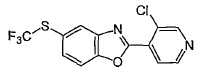
본 활성Saw active 화합물 77Compound 77
1H-NMR(CDCl3)δ:8.85(s, 1H), 8.70(d, J=5.1Hz, 1H), 8.24(d, J=1.7Hz, 1H), 8.09(d, J=5.1Hz, 1H), 7.78(dd, J=8.5, 1.7Hz, 1H), 7.72(d, J=8.5Hz, 1H)
1 H-NMR (CDCl 3 ) δ: 8.85 (s, 1H), 8.70 (d, J = 5.1Hz, 1H), 8.24 (d, J = 1.7Hz, 1H), 8.09 (d, J = 5.1Hz, 1H), 7.78 (dd, J = 8.5, 1.7 Hz, 1H), 7.72 (d, J = 8.5 Hz, 1H)
제조예Production Example 79 79
N-[5-클로로-2-히드록시-4-(트리플루오로메틸)페닐]이소니코틴아미드 0.55g, 테트라히드로푸란 6ml 및 트리페닐포스핀 0.50g의 혼합물에 실온 하에서 아조디카르본산디에틸에스테르의 40% 톨루엔 용액 0.83g을 적하하여 1.5시간 동안 교반하였다. 반응혼합물을 감압 하에서 농축하고, 잔사를 실리카겔 칼럼크로마토그래피 처리하여 얻어진 결정을 메탄올로 세정함으로써 5-클로로-2-(피리딘-4-일)-6-(트리플루오로메틸)벤즈옥사졸(이하, 본 활성화합물 78이라고 함) 0.11g을 얻었다.Azodicarboxylic acid diethyl ester at room temperature in a mixture of 0.55 g of N- [5-chloro-2-hydroxy-4- (trifluoromethyl) phenyl] isonicotinamide, 6 ml of tetrahydrofuran and 0.50 g of triphenylphosphine 0.83 g of 40% toluene solution was added dropwise and stirred for 1.5 hours. The reaction mixture was concentrated under reduced pressure, and the residue obtained by silica gel column chromatography was washed with methanol to give 5-chloro-2- (pyridin-4-yl) -6- (trifluoromethyl) benzoxazole (hereinafter 0.11 g of the present active compound 78 was obtained.

본 활성Saw active 화합물 78Compound 78
1H-NMR(CDCl3)δ:8.88(dd, J=4.3, 1.7Hz, 2H), 8.10(dd, J=4.5, 1.7Hz, 2H), 8.01(s, 1H), 7.97(s, 1H)
1 H-NMR (CDCl 3 ) δ: 8.88 (dd, J = 4.3, 1.7 Hz, 2H), 8.10 (dd, J = 4.5, 1.7 Hz, 2H), 8.01 (s, 1H), 7.97 (s, 1H )
제조예Production Example 80 80
3-클로로-N-[5-클로로-2-히드록시-4-(트리플루오로메틸)페닐]이소니코틴아미드 0.67g, 테트라히드로푸란 7ml 및 트리페닐포스핀 0.55g의 혼합물에 실온 하에서 아조디카르본산디에틸에스테르의 40% 톨루엔 용액 0.91g을 적하하여 1.5시간 동안 교반하였다. 트리페닐포스핀 0.14g, 아조디카르본산디에틸에스테르의 40% 톨루엔 용액 0.23g을 추가하고 다시 1시간 동안 교반하였다. 반응혼합물을 감압 하에서 농축하고, 잔사를 실리카겔 칼럼크로마토그래피 처리하여 얻어진 결정을 이소프로판올 및 헥산으로 세정함으로써 5-클로로-2-(3-클로로피리딘-4-일)-6-(트리플루오로메틸)벤즈옥사졸(이하, 본 활성화합물 79라고 함) 0.37g을 얻었다.Azodica at room temperature in a mixture of 0.67 g of 3-chloro-N- [5-chloro-2-hydroxy-4- (trifluoromethyl) phenyl] isonicotinamide, 7 ml of tetrahydrofuran and 0.55 g of triphenylphosphine 0.91 g of a 40% toluene solution of levonic acid diethyl ester was added dropwise and stirred for 1.5 hours. 0.14 g of triphenylphosphine and 0.23 g of a 40% toluene solution of azodicarboxylic acid diethyl ester were added and stirred for another 1 hour. The reaction mixture was concentrated under reduced pressure, and the residue was washed with isopropanol and hexane to wash the crystals obtained by silica gel column chromatography. 5-chloro-2- (3-chloropyridin-4-yl) -6- (trifluoromethyl) 0.37 g of benzoxazole (hereinafter referred to as the present active compound 79) was obtained.
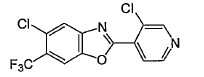
본 활성Saw active 화합물 79Compound 79
1H-NMR(CDCl3)δ:8.87(s, 1H), 8.72(d, J=5.1Hz, 1H), 8.09(d, J=5.1Hz, 1H), 8.06(s, 1H), 8.03(s, 1H)
1 H-NMR (CDCl 3 ) δ: 8.87 (s, 1H), 8.72 (d, J = 5.1Hz, 1H), 8.09 (d, J = 5.1Hz, 1H), 8.06 (s, 1H), 8.03 ( s, 1 H)
제조예Production Example 81 81
N-[4-클로로-2-히드록시-5-(트리플루오로메틸)페닐]이소니코틴아미드 1.01g, 테트라히드로푸란 10ml 및 트리페닐포스핀 0.92g의 혼합물에 실온 하에서 아조디카르본산디에틸에스테르의 40% 톨루엔 용액 1.53g을 적하하여 2시간 동안 교반하였다. 반응혼합물을 감압 하에서 농축하고, 잔사를 실리카겔 칼럼크로마토그래피 처리하여 얻어진 결정을 메탄올로 세정함으로써 6-클로로-2-(피리딘-4-일)-5-(트리플루오로메틸)벤즈옥사(이하, 본 활성화합물 80이라고 함) 0.66g을 얻었다.Azodicarboxylic acid diethyl ester at room temperature in a mixture of 1.01 g of N- [4-chloro-2-hydroxy-5- (trifluoromethyl) phenyl] isonicotinamide, 10 ml of tetrahydrofuran and 0.92 g of triphenylphosphine 1.53 g of 40% toluene solution was added dropwise and stirred for 2 hours. The reaction mixture was concentrated under reduced pressure, and the residue was purified by silica gel column chromatography to wash the crystals with methanol to give 6-chloro-2- (pyridin-4-yl) -5- (trifluoromethyl) benzoxa (hereinafter, 0.66 g of the present active compound 80 was obtained.

본 활성Saw active 화합물 80Compound 80
1H-NMR(CDCl3)δ:8.87(dd, J=4.3, 1.7Hz, 2H), 8.18(s, 1H), 8.08(dd, J=4.3, 1.7Hz, 2H), 7.81(s, 1H)
1 H-NMR (CDCl 3 ) δ: 8.87 (dd, J = 4.3, 1.7 Hz, 2H), 8.18 (s, 1H), 8.08 (dd, J = 4.3, 1.7 Hz, 2H), 7.81 (s, 1H )
제조예Production Example 82 82
3-클로로-N-[4-클로로-2-히드록시-5-(트리플루오로메틸)페닐]이소니코틴아미드 0.46g, 테트라히드로푸란 5ml 및 트리페닐포스핀 0.38g의 혼합물에 실온 하에서 아조디카르본산디에틸에스테르의 40% 톨루엔 용액 0.63g을 적하하여 2시간 동안 교반하였다. 반응혼합물을 감압 하에서 농축하고, 잔사를 실리카겔 칼럼크로마토그래피 처리하여 6-클로로-2-(3-클로로피리딘-4-일)-5-(트리플루오로메틸)벤즈옥사졸(이하, 본 활성화합물 81이라고 함) 0.39g을 얻었다.Azodica at room temperature in a mixture of 0.46 g of 3-chloro-N- [4-chloro-2-hydroxy-5- (trifluoromethyl) phenyl] isonicotinamide, 5 ml of tetrahydrofuran and 0.38 g of triphenylphosphine 0.63 g of a 40% toluene solution of diethyl ester of benzoic acid was added dropwise and stirred for 2 hours. The reaction mixture was concentrated under reduced pressure, and the residue was subjected to silica gel column chromatography to give 6-chloro-2- (3-chloropyridin-4-yl) -5- (trifluoromethyl) benzoxazole (hereinafter the present active compound). 81) 0.39 g.

본 활성화합물 81Present Active Compound 81
1H-NMR(CDCl3)δ:8.86(s, 1H), 8.71(d, J=5.1Hz, 1H), 8.26(s, 1H), 8.08(d, J=5.1Hz, 1H), 7.86(s, 1H)
1 H-NMR (CDCl 3 ) δ: 8.86 (s, 1H), 8.71 (d, J = 5.1Hz, 1H), 8.26 (s, 1H), 8.08 (d, J = 5.1Hz, 1H), 7.86 ( s, 1 H)
제조예Production Example 83 83
2-(3-아미노피리딘-4-일)-5-(트리플루오로메틸)벤즈옥사졸 0.28g, 무수아세트산 3ml의 혼합물을 60℃에서 2시간 동안 가열교반하였다. 실온에 냉각한 후, 반응혼합물에 물을 첨가한 후, 아세트산에틸로 2회 추출하였다. 혼합된 유기층을 포화탄산수소나트륨 수용액, 포화식염수로 세정하고, 무수황산마그네슘으로 건조한 후, 감압 하에서 농축하였다. 잔사를 아세트산에틸로 세정하여 N-[4-(5-트리플루오로메틸벤즈옥사졸-2-일)피리딘-3-일]아세트아미드(이하, 본 활성화합물 82라고 함) 0.17g을 얻었다.A mixture of 0.28 g of 2- (3-aminopyridin-4-yl) -5- (trifluoromethyl) benzoxazole and 3 ml of acetic anhydride was heated and stirred at 60 ° C. for 2 hours. After cooling to room temperature, water was added to the reaction mixture, which was then extracted twice with ethyl acetate. The mixed organic layer was washed with saturated aqueous sodium hydrogen carbonate solution and saturated brine, dried over anhydrous magnesium sulfate, and concentrated under reduced pressure. The residue was washed with ethyl acetate to obtain 0.17 g of N- [4- (5-trifluoromethylbenzoxazol-2-yl) pyridin-3-yl] acetamide (hereinafter referred to as the present active compound 82).

본 활성Saw active 화합물 82Compound 82
1H-NMR(DMSO-d6)δ:10.92(br s, 1H), 9.52(s, 1H), 8.57(d, J=5.1Hz, 1H), 8.44-8.42(m, 1H), 8.12(d, J=8.7Hz, 1H), 8.09-8.07(m, 1H), 7.93-7.90(m, 1H), 2.26(s, 3H)
1 H-NMR (DMSO-d 6 ) δ: 10.92 (br s, 1H), 9.52 (s, 1H), 8.57 (d, J = 5.1 Hz, 1H), 8.44-8.42 (m, 1H), 8.12 ( d, J = 8.7 Hz, 1H), 8.09-8.07 (m, 1H), 7.93-7.90 (m, 1H), 2.26 (s, 3H)
제조예Production Example 84 84
2-(3-플루오로피리딘-4-일)-5-(트리플루오로메틸)벤즈옥사졸 0.28g, 탄산칼륨 0.55g, 메틸아민염산염 0.14g 및 DMF 3ml의 혼합물을 60℃에서 3시간 동안 가열교반하였다. 탄산칼륨 0.55g, 메틸아민염산염 0.14g을 추가하고, 다시 2시간 동안 가열교반하였다. 반응혼합물에 물을 첨가한 후, 아세트산에틸로 2회 추출하였다. 혼합된 유기층을 포화식염수로 세정하고, 무수황산마그네슘으로 건조한 후, 감압 하에서 농축하였다. 잔사를 실리카겔 칼럼크로마토그래피 처리하여 얻어진 결정을 디에틸에테르로 세정함으로써 메틸-[4-(5-트리플루오로메틸벤즈옥사졸-2-일)피리딘-3-일]아민(이하, 본 활성화합물 83이라고 함) 0.13g을 얻었다.A mixture of 0.28 g of 2- (3-fluoropyridin-4-yl) -5- (trifluoromethyl) benzoxazole, 0.55 g of potassium carbonate, 0.14 g of methylamine hydrochloride and 3 ml of DMF at 60 ° C. for 3 hours Heat stirring. 0.55 g of potassium carbonate and 0.14 g of methylamine hydrochloride were added, followed by further stirring for 2 hours. Water was added to the reaction mixture, which was then extracted twice with ethyl acetate. The combined organic layers were washed with saturated brine, dried over anhydrous magnesium sulfate, and concentrated under reduced pressure. The residue obtained by silica gel column chromatography was washed with diethyl ether to obtain methyl- [4- (5-trifluoromethylbenzoxazol-2-yl) pyridin-3-yl] amine (hereinafter the present active compound). 83), 0.13 g was obtained.
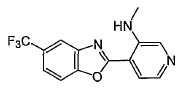
본 활성Saw active 화합물 83Compound 83
1H-NMR(CDCl3)δ:8.35(s, 1H), 8.08-8.04(m, 2H), 7.94-7.87(br m, 1H), 7.84(d, J=5.1Hz, 1H), 7.71(d, J=8.7Hz, 1H), 7.69-7.65(m, 1H), 3.16(d, J=5.1Hz, 3H)
1 H-NMR (CDCl 3 ) δ: 8.35 (s, 1H), 8.08-8.04 (m, 2H), 7.94-7.87 (br m, 1H), 7.84 (d, J = 5.1 Hz, 1H), 7.71 ( d, J = 8.7 Hz, 1H), 7.69-7.65 (m, 1H), 3.16 (d, J = 5.1 Hz, 3H)
제조예Production Example 85 85
2-(3-플루오로피리딘-4-일)-5-(트리플루오로메틸)벤즈옥사졸 0.28g, 탄산칼륨 0.55g, 에틸아민염산염 0.16g 및 DMF 3ml의 혼합물을 80℃에서 4.5시간 동안 가열교반하였다. 탄산칼륨 0.55g, 에틸아민염산염 0.16g, DMF 2ml를 추가하고, 다시 3시간 동안 가열교반하였다. 실온에 냉각한 후, 반응혼합물에 물을 첨가한 후, 아세트산에틸로 2회 추출하였다. 혼합된 유기층을 포화식염수로 세정하고, 무수황산마그네슘으로 건조한 후, 감압 하에서 농축하였다. 잔사를 실리카겔 칼럼크로마토그래피 처리하여 에틸-[4-(5-트리플루오로메틸벤즈옥사졸-2-일)피리딘-3-일]아민(이하, 본 활성화합물 84라고 함) 0.19g을 얻었다.A mixture of 0.28 g of 2- (3-fluoropyridin-4-yl) -5- (trifluoromethyl) benzoxazole, 0.55 g of potassium carbonate, 0.16 g of ethylamine hydrochloride and 3 ml of DMF at 4.5 ° C. for 4.5 hours Heat stirring. 0.55 g of potassium carbonate, 0.16 g of ethylamine hydrochloride, and 2 ml of DMF were added, followed by heating and stirring for 3 hours. After cooling to room temperature, water was added to the reaction mixture, which was then extracted twice with ethyl acetate. The combined organic layers were washed with saturated brine, dried over anhydrous magnesium sulfate, and concentrated under reduced pressure. The residue was subjected to silica gel column chromatography to obtain 0.19 g of ethyl- [4- (5-trifluoromethylbenzoxazol-2-yl) pyridin-3-yl] amine (hereinafter referred to as the present active compound 84).
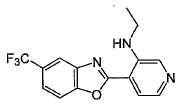
본 활성화합물 84Present active compound 84
1H-NMR(CDCl3)δ:8.35(s, 1H), 8.08-8.06(m, 1H), 8.04(d, J=5.1Hz, 1H), 7.92-7.87(br m, 1H), 7.85(d, J=5.1Hz, 1H), 7.71(d, J=8.7Hz, 1H), 7.69-7.65(m, 1H), 3.54-3.45(m, 2H), 1.46(t, J=7.1Hz, 3H)
1 H-NMR (CDCl 3 ) δ: 8.35 (s, 1H), 8.08-8.06 (m, 1H), 8.04 (d, J = 5.1 Hz, 1H), 7.92-7.87 (br m, 1H), 7.85 ( d, J = 5.1 Hz, 1H), 7.71 (d, J = 8.7 Hz, 1H), 7.69-7.65 (m, 1H), 3.54-3.45 (m, 2H), 1.46 (t, J = 7.1 Hz, 3H )
제조예Production Example 86 86
2-(3-플루오로피리딘-4-일)-5-(트리플루오로메틸)벤즈옥사졸 0.28g, 탄산칼륨 0.69g, 이소프로필아민 0.30g 및 DMF 3ml의 혼합물을 50℃에서 1.5시간, 80℃에서 4시간 동안 가열교반하였다. 이소프로필아민 0.30g을 추가하고, 다시 3시간 동안 가열교반하였다. 반응혼합물에 물을 첨가한 후, 아세트산에틸로 2회 추출하였다. 혼합된 유기층을 포화식염수로 세정하고, 무수황산마그네슘으로 건조한 후, 감압 하에서 농축하였다. 잔사를 실리카겔 칼럼크로마토그래피 처리하여 이소프로필-[4-(5-트리플루오로메틸벤즈옥사졸-2-일)피리딘-3-일]아민(이하, 본 활성화합물 85라고 함) 0.21g을 얻었다.A mixture of 0.28 g of 2- (3-fluoropyridin-4-yl) -5- (trifluoromethyl) benzoxazole, 0.69 g of potassium carbonate, 0.30 g of isopropylamine and 3 ml of DMF was heated at 50 ° C. for 1.5 hours, The mixture was heated and stirred at 80 ° C. for 4 hours. 0.30 g of isopropylamine was added and stirred again for 3 hours. Water was added to the reaction mixture, which was then extracted twice with ethyl acetate. The combined organic layers were washed with saturated brine, dried over anhydrous magnesium sulfate, and concentrated under reduced pressure. The residue was subjected to silica gel column chromatography to obtain 0.21 g of isopropyl- [4- (5-trifluoromethylbenzoxazol-2-yl) pyridin-3-yl] amine (hereinafter referred to as the present active compound 85). .
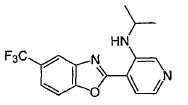
본 활성Saw active 화합물 85Compound 85
1H-NMR(CDCl3)δ:8.36(s, 1H), 8.09-8.07(m, 1H), 8.00(d, J=5.1Hz, 1H), 7.95-7.89(br m, 1H), 7.85(d, J=5.1Hz, 1H), 7.70(d, J=8.5Hz, 1H), 7.69-7.65(m, 1H), 4.03-3.94(m, 1H), 1.42(d, J=6.3Hz, 6H)
1 H-NMR (CDCl 3 ) δ: 8.36 (s, 1H), 8.09-8.07 (m, 1H), 8.00 (d, J = 5.1 Hz, 1H), 7.95-7.89 (br m, 1H), 7.85 ( d, J = 5.1 Hz, 1H), 7.70 (d, J = 8.5 Hz, 1H), 7.69-7.65 (m, 1H), 4.03-3.94 (m, 1H), 1.42 (d, J = 6.3 Hz, 6H )
제조예Production Example 87 87
3-클로로-N-(1,1,3,3-테트라플루오로-6-히드록시-1,3-디히드로이소벤조푸란-5-일)이소니코틴아미드 0.68g, 테트라히드로푸란 8ml 및 트리페닐포스핀 0.55g의 혼합물에 실온 하에서 아조디카르본산디에틸에스테르의 40% 톨루엔 용액 0.90g을 적하하여 1.5시간 동안 교반하였다. 반응혼합물을 감압 하에서 농축하고, 잔사를 실리카겔 칼럼크로마토그래피 처리하여 2-(3-클로로피리딘-4-일)-5,5,7,7-테트라플루오로-5,7-디히드로푸로[3',4':4,5]벤조[1,2-d]옥사졸(이하, 본 활성화합물 86이라고 함) 0.55g을 얻었다.0.68 g of 3-chloro-N- (1,1,3,3-tetrafluoro-6-hydroxy-1,3-dihydroisobenzofuran-5-yl) isonicotinamide, 8 ml of tetrahydrofuran and tri 0.90 g of a 40% toluene solution of azodicarboxylic acid diethyl ester was added dropwise to a mixture of 0.55 g of phenylphosphine at room temperature, followed by stirring for 1.5 hours. The reaction mixture was concentrated under reduced pressure, and the residue was subjected to silica gel column chromatography to give 2- (3-chloropyridin-4-yl) -5,5,7,7-tetrafluoro-5,7-dihydrofuro [3 0.55 g of ', 4': 4,5] benzo [1,2-d] oxazole (hereinafter referred to as active compound 86) was obtained.
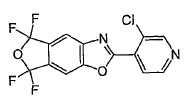
본 활성Saw active 화합물 86Compound 86
1H-NMR(CDCl3)δ:8.89(s, 1H), 8.74(d, J=5.1Hz, 1H), 8.16(s, 1H), 8.11(d, J=5.1Hz, 1H), 7.96(s, 1H)
1 H-NMR (CDCl 3 ) δ: 8.89 (s, 1H), 8.74 (d, J = 5.1Hz, 1H), 8.16 (s, 1H), 8.11 (d, J = 5.1Hz, 1H), 7.96 ( s, 1 H)
제조예Production Example 88 88
3-플루오로-N-(1,1,3,3-테트라플루오로-6-히드록시-1,3-디히드로이소벤조푸란-5-일)이소니코틴아미드 1.46g, 테트라히드로푸란 10ml 및 트리페닐포스핀 2.02g의 혼합물에 실온 하에서 아조디카르본산디에틸에스테르의 40% 톨루엔 용액 0.90g을 적하하여 1시간 동안 교반하였다. 반응혼합물을 감압 하에서 농축하고, 잔사를 실리카겔 칼럼크로마토그래피 처리하여 5,5,7,7-테트라플루오로-2-(3-플루오로피리딘-4-일)-5,7-디히드로푸로[3',4':4,5]벤조[1,2-d]옥사졸(이하, 본 활성화합물 87이라고 함) 1.09g을 얻었다.1.46 g of 3-fluoro-N- (1,1,3,3-tetrafluoro-6-hydroxy-1,3-dihydroisobenzofuran-5-yl) isonicotinamide, 10 ml of tetrahydrofuran and 0.90 g of a 40% toluene solution of azodicarboxylic acid diethyl ester was added dropwise to a mixture of triphenylphosphine 2.02 g at room temperature, followed by stirring for 1 hour. The reaction mixture was concentrated under reduced pressure, and the residue was subjected to silica gel column chromatography to give 5,5,7,7-tetrafluoro-2- (3-fluoropyridin-4-yl) -5,7-dihydrofuro [ 1.09 g of 3 ', 4': 4,5] benzo [1,2-d] oxazole (hereinafter referred to as the present active compound 87) was obtained.

본 활성Saw active 화합물 87Compound 87
1H-NMR(CDCl3)δ:8.80-8.78(m, 1H), 8.71-8.68(m, 1H), 8.17-8.12(m, 2H), 7.96-7.94(m, 1H)
1 H-NMR (CDCl 3 ) δ: 8.80-8.78 (m, 1H), 8.71-8.68 (m, 1H), 8.17-8.12 (m, 2H), 7.96-7.94 (m, 1H)
제조예Production Example 89 89
5,5,7,7-테트라플루오로-2-(3-플루오로피리딘-4-일)-5,7-디히드로푸로[3',4':4,5]벤조[1,2-d]옥사졸 0.28g, 탄산칼륨 0.24g 및 메탄올 3ml의 혼합물을 60℃에서 3.5시간 동안 가열교반하였다. 반응혼합물에 물을 첨가한 후, 아세트산에틸로 2회 추출하였다. 혼합된 유기층을 포화식염수로 세정하고, 무수황산마그네슘으로 건조시켰다. 감압 하에서 농축하고, 잔사를 실리카겔 칼럼크로마토그래피 처리하여 5,5,7,7-테트라플루오로-2-(3-메톡시피리딘-4-일)-5,7-디히드로푸로[3',4':4,5]벤조[1,2-d]옥사졸(이하, 본 활성화합물 88이라고 함) 0.13g을 얻었다.5,5,7,7-tetrafluoro-2- (3-fluoropyridin-4-yl) -5,7-dihydrofuro [3 ', 4': 4,5] benzo [1,2- d] A mixture of 0.28 g of oxazole, 0.24 g of potassium carbonate and 3 ml of methanol was heated and stirred at 60 ° C. for 3.5 hours. Water was added to the reaction mixture, which was then extracted twice with ethyl acetate. The combined organic layers were washed with saturated brine and dried over anhydrous magnesium sulfate. Concentrated under reduced pressure, and the residue was subjected to silica gel column chromatography to give 5,5,7,7-tetrafluoro-2- (3-methoxypyridin-4-yl) -5,7-dihydrofuro [3 ', 0.13 g of 4 ': 4,5] benzo [1,2-d] oxazole (hereinafter referred to as the present active compound 88) was obtained.

본 활성Saw active 화합물 88Compound 88
1H-NMR(CDCl3)δ:8.63(s, 1H), 8.49(d, J=4.9Hz, 1H), 8.10(s, 1H), 8.03(d, J=4.9Hz, 1H), 7.91(s, 1H), 4.17(s, 3H)
1 H-NMR (CDCl 3 ) δ: 8.63 (s, 1H), 8.49 (d, J = 4.9Hz, 1H), 8.10 (s, 1H), 8.03 (d, J = 4.9Hz, 1H), 7.91 ( s, 1H), 4.17 (s, 3H)
제조예Production Example 90 90
60% 수소화나트륨(유성) 44mg과 DMF 2ml의 혼합물을 실온에서 교반하고, 여기에 2,2,2-트리플루오로에탄올 0.11g 및 DMF 0.5ml의 혼합용액을 첨가하였다. 15분간 교반한 후, 5,5,7,7-테트라플루오로-2-(3-플루오로피리딘-4-일)-5,7-디히드로푸로[3',4':4,5]벤조[1,2-d]옥사졸 0.28g을 첨가하고, 실온에서 1시간 동안 교반하였다. 반응혼합물에 물을 첨가하고, 아세트산에틸로 2회 추출하였다. 혼합된 유기층을 포화식염수로 세정하고, 무수황산마그네슘으로 건조시킨 후, 감압 하에서 농축하였다. 잔사를 실리카겔 칼럼크로마토그래피 처리하여 5,5,7,7-테트라플루오로-2-[3-(2,2,2-트리플루오로에톡시)피리딘-4-일]-5,7-디히드로푸로[3',4':4,5]벤조[1,2-d]옥사졸(이하, 본 활성화합물 89라고 함) 0.25g을 얻었다.A mixture of 44 mg of 60% sodium hydride (oily) and 2 ml of DMF was stirred at room temperature, to which a mixed solution of 0.11 g of 2,2,2-trifluoroethanol and 0.5 ml of DMF was added. After stirring for 15 minutes, 5,5,7,7-tetrafluoro-2- (3-fluoropyridin-4-yl) -5,7-dihydrofuro [3 ', 4': 4,5] 0.28 g of benzo [1,2-d] oxazole was added and stirred at room temperature for 1 hour. Water was added to the reaction mixture, followed by extraction twice with ethyl acetate. The combined organic layers were washed with saturated brine, dried over anhydrous magnesium sulfate, and concentrated under reduced pressure. The residue was subjected to silica gel column chromatography to give 5,5,7,7-tetrafluoro-2- [3- (2,2,2-trifluoroethoxy) pyridin-4-yl] -5,7-di 0.25 g of hydrofuro [3 ', 4': 4,5] benzo [1,2-d] oxazole (hereinafter referred to as the present active compound 89) was obtained.

본 활성Saw active 화합물 89Compound 89
1H-NMR(CDCl3)δ:8.63-8.61(m, 2H), 8.12(d, J=4.9Hz, 1H), 8.11(s, 1H), 7.91(s, 1H), 4.69(q, J=7.8Hz, 2H)
1 H-NMR (CDCl 3 ) δ: 8.63-8.61 (m, 2H), 8.12 (d, J = 4.9Hz, 1H), 8.11 (s, 1H), 7.91 (s, 1H), 4.69 (q, J = 7.8 Hz, 2H)
제조예Production Example 91 91
3-플루오로-N-[4-클로로-2-히드록시-5-(트리플루오로메틸)페닐]이소니코틴아미드 2.08g, 테트라히드로푸란 13ml 및 트리페닐포스핀 1.79g의 혼합물에 실온 하에서 아조디카르본산디에틸에스테르의 40% 톨루엔 용액 2.98g을 적하하여 1시간 동안 교반하였다. 반응혼합물을 감압 하에서 농축하고, 잔사를 실리카겔 칼럼크로마토그래피 처리하여 6-클로로-2-(3-플루오로피리딘-4-일)-5-(트리플루오로메틸)벤즈옥사졸(이하, 본 활성화합물 90이라고 함) 1.74g을 얻었다.Azo at room temperature in a mixture of 2.08 g of 3-fluoro-N- [4-chloro-2-hydroxy-5- (trifluoromethyl) phenyl] isonicotinamide, 13 ml of tetrahydrofuran and 1.79 g of triphenylphosphine. 2.98 g of a 40% toluene solution of dicarboxylic acid diethyl ester was added dropwise and stirred for 1 hour. The reaction mixture was concentrated under reduced pressure, and the residue was subjected to silica gel column chromatography to give 6-chloro-2- (3-fluoropyridin-4-yl) -5- (trifluoromethyl) benzoxazole (hereinafter the present activity). 1.74 g).

본 활성Saw active 화합물 90Compound 90
1H-NMR(CDCl3)δ:8.77-8.75(m, 1H), 8.68-8.65(m, 1H), 8.24(s, 1H), 8.13-8.08(m, 1H), 7.85(s, 1H)
1 H-NMR (CDCl 3 ) δ: 8.77-8.75 (m, 1H), 8.68-8.65 (m, 1H), 8.24 (s, 1H), 8.13-8.08 (m, 1H), 7.85 (s, 1H)
제조예Production Example 92 92
6-클로로-2-(3-플루오로피리딘-4-일)-5-(트리플루오로메틸)벤즈옥사졸 0.28g, 탄산칼륨 0.24g 및 메탄올 3ml의 혼합물을 60℃에서 2시간 동안 가열교반하였다. 반응혼합물에 물을 첨가한 후, 아세트산에틸로 2회 추출하였다. 혼합된 유기층을 포화식염수로 세정하고, 무수황산마그네슘으로 건조시켰다. 감압 하에서 농축하고, 잔사를 실리카겔 칼럼크로마토그래피 처리하여 6-클로로-2-(3-메톡시피리딘-4-일)-5-(트리플루오로메틸)벤즈옥사졸(이하, 본 활성화합물 91이라고 함) 0.13g을 얻었다.A mixture of 0.28 g of 6-chloro-2- (3-fluoropyridin-4-yl) -5- (trifluoromethyl) benzoxazole, 0.24 g of potassium carbonate and 3 ml of methanol was heated and stirred at 60 ° C. for 2 hours. It was. Water was added to the reaction mixture, which was then extracted twice with ethyl acetate. The combined organic layers were washed with saturated brine and dried over anhydrous magnesium sulfate. Concentrated under reduced pressure, and the residue was subjected to silica gel column chromatography to give 6-chloro-2- (3-methoxypyridin-4-yl) -5- (trifluoromethyl) benzoxazole (hereinafter referred to as the present active compound 91). 0.13 g was obtained.

본 활성Saw active 화합물 91Compound 91
1H-NMR(CDCl3)δ:8.60(s, 1H), 8.47(d, J=4.9Hz, 1H), 8.21(s, 1H), 7.99(d, J=4.9Hz, 1H), 7.81(s, 1H), 4.16(s, 3H)
1 H-NMR (CDCl 3 ) δ: 8.60 (s, 1H), 8.47 (d, J = 4.9Hz, 1H), 8.21 (s, 1H), 7.99 (d, J = 4.9Hz, 1H), 7.81 ( s, 1H), 4.16 (s, 3H)
제조예Production Example 93 93
60% 수소화나트륨(유성) 46mg과 DMF 2ml의 혼합물을 실온에서 교반하고, 여기에 2,2,2-트리플루오로에탄올 0.12g 및 DMF 0.5ml의 혼합용액을 첨가하였다. 15분 후, 6-클로로-2-(3-플루오로피리딘-4-일)-5-(트리플루오로메틸)벤즈옥사졸 0.28g을 첨가하고, 실온에서 1시간 동안 교반하였다. 반응혼합물에 물을 첨가하고, 아세트산에틸로 2회 추출하였다. 혼합된 유기층을 포화식염수로 세정하고, 무수황산마그네슘으로 건조시킨 후, 감압 하에서 농축하였다. 잔사를 실리카겔 칼럼크로마토그래피 처리하여 6-클로로-2-[3-(2,2,2-트리플루오로에톡시)피리딘-4-일]-5-(트리플루오로메틸)벤즈옥사졸(이하, 본 활성화합물 92라고 함) 0.26g을 얻었다.A mixture of 46 mg of 60% sodium hydride (oily) and 2 ml of DMF was stirred at room temperature, to which a mixed solution of 0.12 g of 2,2,2-trifluoroethanol and 0.5 ml of DMF was added. After 15 minutes, 0.28 g of 6-chloro-2- (3-fluoropyridin-4-yl) -5- (trifluoromethyl) benzoxazole was added and stirred at room temperature for 1 hour. Water was added to the reaction mixture, followed by extraction twice with ethyl acetate. The combined organic layers were washed with saturated brine, dried over anhydrous magnesium sulfate, and concentrated under reduced pressure. The residue was subjected to silica gel column chromatography to give 6-chloro-2- [3- (2,2,2-trifluoroethoxy) pyridin-4-yl] -5- (trifluoromethyl) benzoxazole (hereinafter 0.26 g of the present active compound 92 was obtained.

본 활성Saw active 화합물 92Compound 92
1H-NMR(CDCl3)δ:8.60(s, 1H), 8.59(d, J=4.9Hz, 1H), 8.21(s, 1H), 8.08(d, J=5.1Hz, 1H), 7.81(s, 1H), 4.66(q, J=8.0Hz, 2H)
1 H-NMR (CDCl 3 ) δ: 8.60 (s, 1H), 8.59 (d, J = 4.9Hz, 1H), 8.21 (s, 1H), 8.08 (d, J = 5.1Hz, 1H), 7.81 ( s, 1H), 4.66 (q, J = 8.0 Hz, 2H)
제조예Production Example 94 94
3-클로로-N-[2-히드록시-5-(트리플루오로메틸티오)페닐]이소니코틴아미드를 대신하여 N-[4-클로로-2-히드록시-5-(트리플루오로메틸)페닐]-3-에틸이소니코틴아미드를 사용하고, 제조예 78 기재의 방법에 준하여 6-클로로-2-(3-에틸피리딘-4-일)-5-(트리플루오로메틸)벤즈옥사졸(이하, 본 활성화합물 93이라고 함) 0.17g을 얻었다.N- [4-chloro-2-hydroxy-5- (trifluoromethyl) phenyl in place of 3-chloro-N- [2-hydroxy-5- (trifluoromethylthio) phenyl] isonicotinamide ] -3-ethylisonicotinamide, and 6-chloro-2- (3-ethylpyridin-4-yl) -5- (trifluoromethyl) benzoxazole (hereinafter referred to as in Preparation Method 78). , Present active compound 93) was obtained.

본 활성Saw active 화합물 93Compound 93
1H-NMR(CDCl3)δ:8.72(s, 1H), 8.67(d, J=5.1Hz, 1H), 8.21(s, 1H), 7.98(d, J=5.1Hz, 1H), 7.81(s, 1H), 3.27(q, J=7.5Hz, 2H), 1.34(t, J=7.4Hz, 3H)
1 H-NMR (CDCl 3 ) δ: 8.72 (s, 1H), 8.67 (d, J = 5.1Hz, 1H), 8.21 (s, 1H), 7.98 (d, J = 5.1Hz, 1H), 7.81 ( s, 1H), 3.27 (q, J = 7.5 Hz, 2H), 1.34 (t, J = 7.4 Hz, 3H)
제조예Production Example 95 95
2-클로로-N-[2-히드록시-5-(트리플루오로메틸)페닐]이소니코틴아미드를 대신하여 3-클로로-N-[4-플루오로-2-히드록시-5-(트리플루오로메틸)페닐]이소니코틴아미드를 사용하고, 제조예 22 기재의 방법에 준하여 2-(3-클로로피리딘-4-일)-6-플루오로-5-(트리플루오로메틸)벤즈옥사졸(이하, 본 활성화합물 94라고 함) 0.63g을 얻었다.3-chloro-N- [4-fluoro-2-hydroxy-5- (trifluoro in place of 2-chloro-N- [2-hydroxy-5- (trifluoromethyl) phenyl] isonicotinamide 2- (3-chloropyridin-4-yl) -6-fluoro-5- (trifluoromethyl) benzoxazole (romethyl) phenyl] isonicotinamide, using the method described in Production Example 22 Hereinafter, 0.63 g of the present active compound 94) was obtained.

본 활성Saw active 화합물 94Compound 94
1H-NMR(CDCl3)δ:8.86(s, 1H), 8.70(d, J=5.1Hz, 1H), 8.17(d, J=6.3Hz, 1H), 8.06(d, J=5.1Hz, 1H), 7.54(d, J=9.0Hz, 1H)
1 H-NMR (CDCl 3 ) δ: 8.86 (s, 1H), 8.70 (d, J = 5.1Hz, 1H), 8.17 (d, J = 6.3Hz, 1H), 8.06 (d, J = 5.1Hz, 1H), 7.54 (d, J = 9.0 Hz, 1H)
제조예Production Example 96 96
3-클로로-N-[2-히드록시-5-(트리플루오로메틸티오)페닐]이소니코틴아미드를 대신하여 3-클로로-N-[2-플루오로-6-히드록시-3-(트리플루오로메틸)페닐]이소니코틴아미드를 사용하고, 제조예 78 기재의 방법에 준하여 2-(3-클로로피리딘-4-일)-4-플루오로-5-(트리플루오로메틸)벤즈옥사졸(이하, 본 활성화합물 95라고 함) 56mg을 얻었다.3-chloro-N- [2-fluoro-6-hydroxy-3- (tri) in place of 3-chloro-N- [2-hydroxy-5- (trifluoromethylthio) phenyl] isonicotinamide 2- (3-chloropyridin-4-yl) -4-fluoro-5- (trifluoromethyl) benzoxazole using fluoromethyl) phenyl] isonicotinamide according to the method described in Preparation Example 78 56 mg (hereinafter, referred to as the present active compound 95) were obtained.

본 활성화합물 95Present Active Compound 95
1H-NMR(CDCl3)δ:8.86(s, 1H), 8.71(d, J=5.1Hz, 1H), 8.12(d, J=5.1Hz, 1H), 7.73(dd, J=8.5, 6.3Hz, 1H), 7.57(d, J=8.6Hz, 1H)
1 H-NMR (CDCl 3 ) δ: 8.86 (s, 1H), 8.71 (d, J = 5.1Hz, 1H), 8.12 (d, J = 5.1Hz, 1H), 7.73 (dd, J = 8.5, 6.3 Hz, 1H), 7.57 (d, J = 8.6 Hz, 1H)
제조예Production Example 97 97
3-클로로-N-[2-히드록시-5-(트리플루오로메틸티오)페닐]이소니코틴아미드를 대신하여 N-[2-클로로-6-히드록시-3-(트리플루오로메틸)페닐]이소니코틴아미드를 사용하고, 제조예 78 기재의 방법에 준하여 4-클로로-2-(피리딘-4-일)-5-(트리플루오로메틸)벤즈옥사졸(이하, 본 활성화합물 96이라고 함) 91mg을 얻었다.N- [2-chloro-6-hydroxy-3- (trifluoromethyl) phenyl in place of 3-chloro-N- [2-hydroxy-5- (trifluoromethylthio) phenyl] isonicotinamide ] 4-Chloro-2- (pyridin-4-yl) -5- (trifluoromethyl) benzoxazole (hereinafter referred to as active compound 96) using isonicotinamide according to the method described in Preparation Example 78 ) 91 mg.
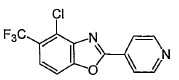
본 활성Saw active 화합물 96Compound 96
1H-NMR(CDCl3)δ:8.88(dd, J=4.4, 1.7Hz, 2H), 8.15(dd, J=4.5, 1.6Hz, 2H), 7.80(d, J=8.8Hz, 1H), 7.63(d, J=8.8Hz, 1H)
1 H-NMR (CDCl 3 ) δ: 8.88 (dd, J = 4.4, 1.7 Hz, 2H), 8.15 (dd, J = 4.5, 1.6 Hz, 2H), 7.80 (d, J = 8.8 Hz, 1H), 7.63 (d, J = 8.8 Hz, 1H)
제조예Production Example 98 98
2-클로로-N-[2-히드록시-5-(트리플루오로메틸)페닐]이소니코틴아미드를 대신하여 3-이소프로폭시-N-(1,1,3,3-테트라플루오로-6-히드록시-1,3-디히드로이소벤조푸란-5-일)이소니코틴아미드를 사용하고, 제조예 22 기재의 방법에 준하여 5,5,7,7-테트라플루오로-2-(3-이소프로폭시피리딘-4-일)-5,7-디히드로푸로[3',4':4,5]벤조[1,2-d]옥사졸(이하, 본 활성화합물 97이라고 함) 0.12g을 얻었다.3-isopropoxy-N- (1,1,3,3-tetrafluoro-6 on behalf of 2-chloro-N- [2-hydroxy-5- (trifluoromethyl) phenyl] isonicotinamide -Hydroxy-1,3-dihydroisobenzofuran-5-yl) isonicotinamide, using 5,5,7,7-tetrafluoro-2- (3- Isopropoxypyridin-4-yl) -5,7-dihydrofuro [3 ', 4': 4,5] benzo [1,2-d] oxazole (hereinafter referred to as active compound 97) Got.

본 활성Saw active 화합물 97Compound 97
1H-NMR(CDCl3)δ:8.59(s, 1H), 8.42(d, J=5.1Hz, 1H), 8.08(s, 1H), 8.01(d, J=5.1Hz, 1H), 7.89(s, 1H), 4.92-4.82(m, 1H), 1.50(d, J=6.1Hz, 6H)
1 H-NMR (CDCl 3 ) δ: 8.59 (s, 1H), 8.42 (d, J = 5.1Hz, 1H), 8.08 (s, 1H), 8.01 (d, J = 5.1Hz, 1H), 7.89 ( s, 1H), 4.92-4.82 (m, 1H), 1.50 (d, J = 6.1 Hz, 6H)
제조예Production Example 99 99
3-클로로-N-[2-히드록시-5-(트리플루오로메틸티오)페닐]이소니코틴아미드를 대신하여 3-에틸-N-(1,1,3,3-테트라플루오로-6-히드록시-1,3-디히드로이소벤조푸란-5-일)이소니코틴아미드를 사용하고, 제조예 78 기재의 방법에 준하여 2-(3-에틸피리딘-4-일)-5,5,7,7-테트라플루오로-5,7-디히드로푸로[3',4':4,5]벤조[1,2-d]옥사졸(이하, 본 활성화합물 98이라고 함) 0.40g을 얻었다.3-ethyl-N- (1,1,3,3-tetrafluoro-6- in place of 3-chloro-N- [2-hydroxy-5- (trifluoromethylthio) phenyl] isonicotinamide 2- (3-ethylpyridin-4-yl) -5,5,7 according to the method described in Preparation Example 78 using hydroxy-1,3-dihydroisobenzofuran-5-yl) isonicotinamide 0.40 g of, 7-tetrafluoro-5,7-dihydrofuro [3 ', 4': 4,5] benzo [1,2-d] oxazole (hereinafter referred to as the present active compound 98) was obtained.

본 활성Saw active 화합물 98Compound 98
1H-NMR(CDCl3)δ:8.75(s, 1H), 8.70(d, J=5.0Hz, 1H), 8.11(s, 1H), 8.02(d, J=5.1Hz, 1H), 7.91(s, 1H), 3.29(q, J=7.5Hz, 2H), 1.35(t, J=7.5Hz, 3H)
1 H-NMR (CDCl 3 ) δ: 8.75 (s, 1H), 8.70 (d, J = 5.0Hz, 1H), 8.11 (s, 1H), 8.02 (d, J = 5.1Hz, 1H), 7.91 ( s, 1H), 3.29 (q, J = 7.5 Hz, 2H), 1.35 (t, J = 7.5 Hz, 3H)
제조예Production Example 100 100
3-클로로-N-[2-히드록시-5-(트리플루오로메틸티오)페닐]이소니코틴아미드를 대신하여 N-(5-tert-부틸-2-히드록시페닐)-3-플루오로이소니코틴아미드를 사용하고, 제조예 78 기재의 방법에 준하여 5-tert-부틸-2-(3-플루오로피리딘-4-일)벤즈옥사졸(이하, 본 활성화합물 99라고 함) 3.1g을 얻었다.N- (5-tert-butyl-2-hydroxyphenyl) -3-fluoroisopropyl instead of 3-chloro-N- [2-hydroxy-5- (trifluoromethylthio) phenyl] isonicotinamide Using nicotinamide, 3.1 g of 5-tert-butyl-2- (3-fluoropyridin-4-yl) benzoxazole (hereinafter referred to as the active compound 99) was obtained according to the method described in Preparation Example 78. .
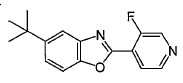
본 활성Saw active 화합물 99Compound 99
1H-NMR(CDCl3)δ:8.72-8.70(m, 1H), 8.62-8.59(m, 1H), 8.12-8.09(m, 1H), 7.91-7.89(m, 1H), 7.59-7.51(m, 2H), 1.41(s, 9H)
1 H-NMR (CDCl 3 ) δ: 8.72-8.70 (m, 1H), 8.62-8.59 (m, 1H), 8.12-8.09 (m, 1H), 7.91-7.89 (m, 1H), 7.59-7.51 ( m, 2H), 1.41 (s, 9H)
제조예Production Example 101 101
2-(3-플루오로피리딘-4-일)-5-(트리플루오로메틸)벤즈옥사졸을 대신하여 5-tert-부틸-2-(3-플루오로피리딘-4-일)벤즈옥사졸을 사용하고, 제조예 38 기재의 방법에 준하여 5-tert-부틸-2-(3-메톡시피리딘-4-일)벤즈옥사졸(이하, 본 활성화합물 100이라고 함) 0.27g을 얻었다.5-tert-butyl-2- (3-fluoropyridin-4-yl) benzoxazole in place of 2- (3-fluoropyridin-4-yl) -5- (trifluoromethyl) benzoxazole 0.27 g of 5-tert-butyl-2- (3-methoxypyridin-4-yl) benzoxazole (hereinafter referred to as the present active compound 100) was obtained according to the method described in Preparation Example 38.

본 활성화합물 100100 active compounds
1H-NMR(CDCl3)δ:8.56(s, 1H), 8.43(d, J=4.9Hz, 1H), 8.00(d, J=4.9Hz, 1H), 7.89(d, J=1.8Hz, 1H), 7.54(d, J=8.5Hz, 1H), 7.48(dd, J=8.8, 2.0Hz, 1H), 4.15(s, 3H), 1.40(s, 9H)
1 H-NMR (CDCl 3 ) δ: 8.56 (s, 1H), 8.43 (d, J = 4.9Hz, 1H), 8.00 (d, J = 4.9Hz, 1H), 7.89 (d, J = 1.8Hz, 1H), 7.54 (d, J = 8.5 Hz, 1H), 7.48 (dd, J = 8.8, 2.0 Hz, 1H), 4.15 (s, 3H), 1.40 (s, 9H)
제조예Production Example 102 102
2-(3-플루오로피리딘-4-일)-5-(트리플루오로메틸)벤즈옥사졸을 대신하여 5-tert-부틸-2-(3-플루오로피리딘-4-일)벤즈옥사졸을 사용하고, 제조예 40 기재의 방법에 준하여 5-tert-부틸-2-[3-(2,2,2-트리플루오로에톡시)피리딘-4-일]벤즈옥사졸(이하, 본 활성화합물 101이라고 함) 0.33g을 얻었다.5-tert-butyl-2- (3-fluoropyridin-4-yl) benzoxazole in place of 2- (3-fluoropyridin-4-yl) -5- (trifluoromethyl) benzoxazole 5-tert-butyl-2- [3- (2,2,2-trifluoroethoxy) pyridin-4-yl] benzoxazole according to the method described in Production Example 40 0.33 g).
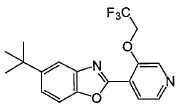
본 활성화합물 101Present Active Compound 101
1H-NMR(CDCl3)δ:8.59(s, 1H), 8.56(d, J=4.9Hz, 1H), 8.08(d, J=4.9Hz, 1H), 7.86(d, J=1.7Hz, 1H), 7.55(d, J=8.8Hz, 1H), 7.51(dd, J=8.7, 1.8Hz, 1H), 4.65(q, J=8.0Hz, 2H), 1.41(s, 9H)
1 H-NMR (CDCl 3 ) δ: 8.59 (s, 1H), 8.56 (d, J = 4.9Hz, 1H), 8.08 (d, J = 4.9Hz, 1H), 7.86 (d, J = 1.7Hz, 1H), 7.55 (d, J = 8.8 Hz, 1H), 7.51 (dd, J = 8.7, 1.8 Hz, 1H), 4.65 (q, J = 8.0 Hz, 2H), 1.41 (s, 9H)
제조예Production Example 103 103
5-tert-부틸-2-(3-플루오로피리딘-4-일)벤즈옥사졸 2.07g, 탄산칼륨 4.23g 및 벤질알코올 8ml의 혼합물을 100℃에서 8.5시간 동안 가열교반하였다. 실온까지 냉각한 후, 반응혼합물에 물을 첨가하고, 아세트산에틸로 2회 추출하였다. 혼합된 유기층을 포화식염수로 세정하고, 무수황산마그네슘으로 건조시켰다. 감압 하에서 농축하고, 잔사를 실리카겔 칼럼크로마토그래피 처리하여 2-(3-벤질옥시피리딘-4-일)-5-tert-부틸벤즈옥사졸(이하, 본 활성화합물 102라고 함) 2.2g을 얻었다.A mixture of 2.07 g of 5-tert-butyl-2- (3-fluoropyridin-4-yl) benzoxazole, 4.23 g of potassium carbonate and 8 ml of benzyl alcohol was heated and stirred at 100 ° C. for 8.5 hours. After cooling to room temperature, water was added to the reaction mixture, and the mixture was extracted twice with ethyl acetate. The combined organic layers were washed with saturated brine and dried over anhydrous magnesium sulfate. The mixture was concentrated under reduced pressure, and the residue was subjected to silica gel column chromatography to obtain 2.2 g of 2- (3-benzyloxypyridin-4-yl) -5-tert-butylbenzoxazole (hereinafter referred to as the present active compound 102).

본 활성Saw active 화합물 102Compound 102
1H-NMR(CDCl3)δ:8.56(s, 1H), 8.41(d, J=4.9Hz, 1H), 8.03(d, J=4.9Hz, 1H), 7.88-7.86(m, 1H), 7.59-7.55(m, 2H), 7.54-7.47(m, 2H), 7.43-7.37(m, 2H), 7.36-7.30(m, 1H), 5.42(s, 2H), 1.41(s, 9H)
1 H-NMR (CDCl 3 ) δ: 8.56 (s, 1H), 8.41 (d, J = 4.9Hz, 1H), 8.03 (d, J = 4.9Hz, 1H), 7.88-7.86 (m, 1H), 7.59-7.55 (m, 2H), 7.54-7.47 (m, 2H), 7.43-7.37 (m, 2H), 7.36-7.30 (m, 1H), 5.42 (s, 2H), 1.41 (s, 9H)
제조예Production Example 104 104
2-(3-벤질옥시피리딘-4-일)-5-tert-부틸벤즈옥사졸 2.1g, 5% 팔라듐탄소 0.58g 및 초산 50ml의 혼합물을 약 1기압의 수소 분위기하, 실온에서 6시간 교반하였다. 반응혼합물을 셀라이트(등록상표)를 통하여 여과하고, 여과액을 감압 하에서 농축하였다. 잔사를 실리카겔 칼럼크로마토그래피 처리하여 4-(5-tert-부틸벤즈옥사졸-2-일)피리딘-3-올(이하, 본 활성화합물 103이라고 함) 1.3g을 얻었다.A mixture of 2.1 g of 2- (3-benzyloxypyridin-4-yl) -5-tert-butylbenzoxazole, 0.58 g of 5% palladium carbon and 50 ml of acetic acid was stirred for 6 hours at room temperature under a hydrogen atmosphere of about 1 atmosphere It was. The reaction mixture was filtered through Celite (R) and the filtrate was concentrated under reduced pressure. The residue was subjected to silica gel column chromatography to obtain 1.3 g of 4- (5-tert-butylbenzoxazol-2-yl) pyridin-3-ol (hereinafter referred to as the present active compound 103).
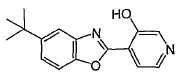
본 활성Saw active 화합물 103Compound 103
1H-NMR(CDCl3)δ:11.21(br s, 1H), 8.60(s, 1H), 8.31(d, J=4.9Hz, 1H), 7.83-7.80(m, 2H), 7.58(d, J=8.5Hz, 1H), 7.53(dd, J=8.7, 1.8Hz, 1H), 1.42(s, 9H)
1 H-NMR (CDCl 3 ) δ: 11.21 (br s, 1H), 8.60 (s, 1H), 8.31 (d, J = 4.9 Hz, 1H), 7.83-7.80 (m, 2H), 7.58 (d, J = 8.5 Hz, 1H), 7.53 (dd, J = 8.7, 1.8 Hz, 1H), 1.42 (s, 9H)
제조예Production Example 105 105
4-(5-tert-부틸벤즈옥사졸-2-일)피리딘-3-올 0.30g, 탄산칼륨 0.17g 및 DMF 3ml의 혼합물에 실온에서 요오드화이소프로필 0.21g을 첨가한 후, 60℃에서 2시간 동안 가열교반하였다. 실온까지 냉각한 후, 반응혼합물에 물을 첨가하고, 아세트산에틸로 2회 추출하였다. 혼합된 유기층을 포화식염수로 세정하고, 무수황산마그네슘으로 건조시켰다. 감압 하에서 농축하고, 잔사를 실리카겔 칼럼크로마토그래피 처리하여 5-tert-부틸-2-(3-이소프로폭시피리딘-4-일)벤즈옥사졸(이하, 본 활성화합물 104라고 함) 0.21g을 얻었다.To a mixture of 0.30 g of 4- (5-tert-butylbenzoxazol-2-yl) pyridin-3-ol, 0.17 g of potassium carbonate and 3 ml of DMF was added 0.21 g of isopropyl iodide at room temperature, followed by 2 at 60 ° C. The mixture was heated and stirred for an hour. After cooling to room temperature, water was added to the reaction mixture, and the mixture was extracted twice with ethyl acetate. The combined organic layers were washed with saturated brine and dried over anhydrous magnesium sulfate. Concentration under reduced pressure, and the residue was subjected to silica gel column chromatography to obtain 0.21 g of 5-tert-butyl-2- (3-isopropoxypyridin-4-yl) benzoxazole (hereinafter referred to as the present active compound 104). .
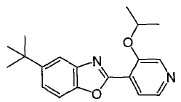
본 활성Saw active 화합물 104Compound 104
1H-NMR(CDCl3)δ:8.53(s, 1H), 8.38(d, J=4.9Hz, 1H), 7.98(d, J=5.0Hz, 1H), 7.86-7.84(m, 1H), 7.55-7.46(m, 2H), 4.81-4.70(m, 1H), 1.47(d, J=6.1Hz, 6H), 1.41(s, 9H)
1 H-NMR (CDCl 3 ) δ: 8.53 (s, 1H), 8.38 (d, J = 4.9 Hz, 1H), 7.98 (d, J = 5.0 Hz, 1H), 7.86-7.84 (m, 1H), 7.55-7.46 (m, 2H), 4.81-4.70 (m, 1H), 1.47 (d, J = 6.1 Hz, 6H), 1.41 (s, 9H)
제조예Production Example 106 106
3-클로로-N-[2-히드록시-5-(트리플루오로메틸티오)페닐]이소니코틴아미드를 대신하여 N-(5-tert-부틸-2-히드록시페닐)-3-에틸이소니코틴아미드를 사용하고, 제조예 78 기재의 방법에 준하여 5-tert-부틸-2-(3-에틸피리딘-4-일)벤즈옥사졸(이하, 본 활성화합물 105라고 함) 0.19g을 얻었다.N- (5-tert-butyl-2-hydroxyphenyl) -3-ethylisonicotin on behalf of 3-chloro-N- [2-hydroxy-5- (trifluoromethylthio) phenyl] isonicotinamide Using an amide, 0.19 g of 5-tert-butyl-2- (3-ethylpyridin-4-yl) benzoxazole (hereinafter referred to as the present active compound 105) was obtained according to the method described in Preparation Example 78.

본 활성Saw active 화합물 105Compound 105
1H-NMR(CDCl3)δ:8.67(s, 1H), 8.61(d, J=5.1Hz, 1H), 7.99(d, J=5.1Hz, 1H), 7.87-7.85(m, 1H), 7.56-7.47(m, 2H), 3.29(q, J=7.5Hz, 2H), 1.41(s, 9H), 1.34(t, J=7.5Hz, 3H)
1 H-NMR (CDCl 3 ) δ: 8.67 (s, 1H), 8.61 (d, J = 5.1Hz, 1H), 7.99 (d, J = 5.1Hz, 1H), 7.87-7.85 (m, 1H), 7.56-7.47 (m, 2H), 3.29 (q, J = 7.5 Hz, 2H), 1.41 (s, 9H), 1.34 (t, J = 7.5 Hz, 3H)
제조예Production Example 107 107
3-클로로-N-[2-히드록시-5-(트리플루오로메틸티오)페닐]이소니코틴아미드를 대신하여 N-(5-tert-부틸-2-히드록시페닐)-2-클로로-5-트리플루오로메틸이소니코틴아미드를 사용하고, 제조예 78 기재의 방법에 준하여 5-tert-부틸-2-[2-클로로-5-(트리플루오로메틸)피리딘-4-일]벤즈옥사졸(이하, 본 활성화합물 106이라고 함) 0.59g을 얻었다.N- (5-tert-butyl-2-hydroxyphenyl) -2-chloro-5 on behalf of 3-chloro-N- [2-hydroxy-5- (trifluoromethylthio) phenyl] isonicotinamide 5-tert-butyl-2- [2-chloro-5- (trifluoromethyl) pyridin-4-yl] benzoxazole using trifluoromethylisonicotinamide according to the method described in Preparation Example 78 0.59 g (hereinafter, referred to as the present active compound 106) was obtained.
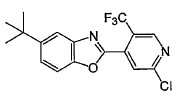
본 활성Saw active 화합물 106Compound 106
1H-NMR(CDCl3)δ:8.89(s, 1H), 8.23(s, 1H), 7.90-7.88(m, 1H), 7.58-7.57(m, 2H), 1.41(s, 9H)
1 H-NMR (CDCl 3 ) δ: 8.89 (s, 1H), 8.23 (s, 1H), 7.90-7.88 (m, 1H), 7.58-7.57 (m, 2H), 1.41 (s, 9H)
제조예Production Example 108 108
5-tert-부틸-2-(2-클로로-5-트리플루오로메틸피리딘-4-일)벤즈옥사졸 0.40g, 5% 팔라듐탄소 0.59g 및 아세트산 25ml의 혼합물을 약 1기압의 수소 분위기하, 실온에서 15시간 동안 교반하였다. 반응혼합물을 셀라이트(등록상표)를 통하여 여과하여 여과액을 감압 하에서 농축하였다. 잔사를 실리카겔 칼럼크로마토그래피 처리하여 5-tert-부틸-2-(3-트리플루오로메틸피리딘-4-일)벤즈옥사졸(이하, 본 활성화합물 107이라고 함) 0.19g을 얻었다.A mixture of 0.40 g of 5-tert-butyl-2- (2-chloro-5-trifluoromethylpyridin-4-yl) benzoxazole, 0.59 g of 5% palladium carbon and 25 ml of acetic acid was subjected to hydrogen atmosphere at about 1 atm. And stirred at room temperature for 15 hours. The reaction mixture was filtered through Celite (R) and the filtrate was concentrated under reduced pressure. The residue was subjected to silica gel column chromatography to obtain 0.19 g of 5-tert-butyl-2- (3-trifluoromethylpyridin-4-yl) benzoxazole (hereinafter referred to as the present active compound 107).

본 활성화합물 107The active compound 107
1H-NMR(CDCl3)δ:9.13(s, 1H), 8.98(d, J=5.1Hz, 1H), 8.14(d, J=5.1Hz, 1H), 7.89(dd, J=1.7, 0.7Hz, 1H), 7.58(d, J=8.6, 0.7Hz, 1H), 7.54(dd, J=8.8, 1.8Hz, 1H), 1.41(s, 9H)
1 H-NMR (CDCl 3 ) δ: 9.13 (s, 1H), 8.98 (d, J = 5.1Hz, 1H), 8.14 (d, J = 5.1Hz, 1H), 7.89 (dd, J = 1.7, 0.7 Hz, 1H), 7.58 (d, J = 8.6, 0.7 Hz, 1H), 7.54 (dd, J = 8.8, 1.8 Hz, 1H), 1.41 (s, 9H)
제조예Production Example 109 109
3-클로로-N-[2-히드록시-5-(트리플루오로메틸티오)페닐]이소니코틴아미드를 대신하여 3-클로로-N-(2-히드록시-5-트리플루오로메톡시페닐)이소니코틴아미드를 사용하고, 제조예 78 기재의 방법에 준하여 2-(3-클로로피리딘-4-일)-5-(트리플루오로메톡시)벤즈옥사졸(이하, 본 활성화합물 108이라고 함) 0.32g을 얻었다.3-chloro-N- (2-hydroxy-5-trifluoromethoxyphenyl) iso instead of 3-chloro-N- [2-hydroxy-5- (trifluoromethylthio) phenyl] isonicotinamide 0.32 g of 2- (3-chloropyridin-4-yl) -5- (trifluoromethoxy) benzoxazole (hereinafter referred to as the active compound 108) using nicotinamide according to the method described in Preparation Example 78 Got.

본 활성화합물 108Present active compound 108
1H-NMR(CDCl3)δ:8.85-8.84(m, 1H), 8.69(d, J=5.1Hz, 1H), 8.09-8.07(m, 1H), 7.79-7.77(m, 1H), 7.69-7.66(m, 1H), 7.38-7.34(m, 1H)
1 H-NMR (CDCl 3 ) δ: 8.85-8.84 (m, 1H), 8.69 (d, J = 5.1 Hz, 1H), 8.09-8.07 (m, 1H), 7.79-7.77 (m, 1H), 7.69 -7.66 (m, 1 H), 7.38-7.34 (m, 1 H)
제조예Production Example 110 110
2-클로로-N-[2-히드록시-5-(트리플루오로메틸)페닐]이소니코틴아미드를 대신하여 3-에틸-N-[2-히드록시-5-(트리플루오로메톡시)페닐]이소니코틴아미드를 사용하고, 제조예 22 기재의 방법에 준하여 2-(3-에틸피리딘-4-일)-5-(트리플루오로메톡시)벤즈옥사졸(이하, 본 활성화합물 109라고 함) 0.32g을 얻었다.3-ethyl-N- [2-hydroxy-5- (trifluoromethoxy) phenyl] in place of 2-chloro-N- [2-hydroxy-5- (trifluoromethyl) phenyl] isonicotinamide] 2- (3-ethylpyridin-4-yl) -5- (trifluoromethoxy) benzoxazole (hereinafter referred to as the active compound 109) using isonicotinamide according to the method described in Preparation Example 22. g was obtained.

본 활성Saw active 화합물 109Compound 109
1H-NMR(CDCl3)δ:8.70(s, 1H), 8.65(d, J=5.1Hz, 1H), 7.99(d, J=5.1Hz, 1H), 7.74-7.72(m, 1H), 7.65-7.62(m, 1H), 7.34-7.30(m, 1H), 3.28(q, J=7.5Hz, 2H), 1.34(t, J=7.5Hz, 3H)
1 H-NMR (CDCl 3 ) δ: 8.70 (s, 1H), 8.65 (d, J = 5.1Hz, 1H), 7.99 (d, J = 5.1Hz, 1H), 7.74-7.72 (m, 1H), 7.65-7.62 (m, 1H), 7.34-7.30 (m, 1H), 3.28 (q, J = 7.5 Hz, 2H), 1.34 (t, J = 7.5 Hz, 3H)
제조예Production Example 111 111
2,2,2-트리플루오로에탄올을 대신하여 2,2-디플루오로에탄올을 사용하고, 제조예 40 기재의 방법에 준하여 2-[3-(2,2-디플루오로에톡시)피리딘-4-일]-5-(트리플루오로메틸)벤즈옥사졸(이하, 본 활성화합물 110이라고 함) 0.24g을 얻었다.2,2-difluoroethanol was used in place of 2,2,2-trifluoroethanol and 2- [3- (2,2-difluoroethoxy) pyridine according to the method described in Preparation Example 40. 0.24 g of 4-yl] -5- (trifluoromethyl) benzoxazole (hereinafter referred to as the present active compound 110) was obtained.

본 활성Saw active 화합물 110Compound 110
1H-NMR(CDCl3)δ:8.59(s, 1H), 8.55(d, J=4.9Hz, 1H), 8.14(s, 1H), 8.07(d, J=4.9Hz, 1H), 7.76-7.70(m, 2H), 6.28(tt, J=54.9, 4.0Hz, 1H), 4.51(td, J=12.8, 4.0Hz, 2H)
1 H-NMR (CDCl 3 ) δ: 8.59 (s, 1H), 8.55 (d, J = 4.9Hz, 1H), 8.14 (s, 1H), 8.07 (d, J = 4.9Hz, 1H), 7.76- 7.70 (m, 2H), 6.28 (tt, J = 54.9, 4.0 Hz, 1H), 4.51 (td, J = 12.8, 4.0 Hz, 2H)
제조예Production Example 112 112
2,2,2-트리플루오로에탄올을 대신하여 1,1,1-트리플루오로-2-프로판올을 사용하고, 제조예 40 기재의 방법에 준하여 2-[3-(1-메틸-2,2,2-트리플루오로에톡시)피리딘-4-일]-5-(트리플루오로메틸)벤즈옥사졸(이하, 본 활성화합물 111이라고 함) 0.31g을 얻었다.1,1,1-trifluoro-2-propanol was used in place of 2,2,2-trifluoroethanol, and 2- [3- (1-methyl-2, 0.31 g of 2,2-trifluoroethoxy) pyridin-4-yl] -5- (trifluoromethyl) benzoxazole (hereinafter referred to as the present active compound 111) was obtained.

본 활성Saw active 화합물 111Compound 111
1H-NMR(CDCl3)δ:8.61(s, 1H), 8.55(d, J=4.9Hz, 1H), 8.14-8.12(m, 1H), 8.09(d, J=4.9Hz, 1H), 7.76-7.70(m, 2H), 4.97-4.87(m, 1H), 1.69(d, J=6.6Hz, 3H)
1 H-NMR (CDCl 3 ) δ: 8.61 (s, 1H), 8.55 (d, J = 4.9Hz, 1H), 8.14-8.12 (m, 1H), 8.09 (d, J = 4.9Hz, 1H), 7.76-7.70 (m, 2H), 4.97-4.87 (m, 1H), 1.69 (d, J = 6.6 Hz, 3H)
제조예Production Example 113 113
2,2,2-트리플루오로에탄올을 대신하여 2,2,3,3-테트라플루오로프로판올을 사용하고, 제조예 40 기재의 방법에 준하여 2-[3-(2,2,3,3-테트라플루오로프로폭시)피리딘-4-일]-5-(트리플루오로메틸)벤즈옥사졸(이하, 본 활성화합물 112라고 함) 0.34g을 얻었다.2,2,3,3-tetrafluoropropanol was used in place of 2,2,2-trifluoroethanol and 2- [3- (2,2,3,3) according to the method described in Preparation Example 40. 0.34 g of -tetrafluoropropoxy) pyridin-4-yl] -5- (trifluoromethyl) benzoxazole (hereinafter referred to as the present active compound 112) was obtained.

본 활성화합물 112This active compound 112
1H-NMR(CDCl3)δ:8.58(d, J=5.1Hz, 1H), 8.56(s, 1H), 8.13-8.12(m, 1H), 8.10(d, J=4.9Hz, 1H), 7.74-7.73(m, 2H), 6.75-6.44(m, 1H), 4.71-4.63(m, 2H)
1 H-NMR (CDCl 3 ) δ: 8.58 (d, J = 5.1Hz, 1H), 8.56 (s, 1H), 8.13-8.12 (m, 1H), 8.10 (d, J = 4.9Hz, 1H), 7.74-7.73 (m, 2H), 6.75-6.44 (m, 1H), 4.71-4.63 (m, 2H)
제조예Production Example 114 114
5-tert-부틸-2-(3-플루오로피리딘-4-일)벤즈옥사졸을 대신하여 2-(3-플루오로피리딘-4-일)-5-(트리플루오로메틸)벤즈옥사졸을 사용하고, 제조예 103 기재의 방법에 준하여 2-(3-벤질옥시피리딘-4-일)-5-(트리플루오로메틸)벤즈옥사졸(이하, 본 활성화합물 113이라고 함) 4.6g을 얻었다.2- (3-fluoropyridin-4-yl) -5- (trifluoromethyl) benzoxazole in place of 5-tert-butyl-2- (3-fluoropyridin-4-yl) benzoxazole 4.6 g of 2- (3-benzyloxypyridin-4-yl) -5- (trifluoromethyl) benzoxazole (hereinafter referred to as the present active compound 113) was prepared according to the method described in Preparation Example 103. Got it.

본 활성화합물 113Present Active Compound 113
1H-NMR(CDCl3)δ:8.62(s, 1H), 8.45(d, J=4.9Hz, 1H), 8.15-8.13(m, 1H), 8.05(d, J=5.0Hz, 1H), 7.73-7.67(m, 2H), 7.60-7.54(m, 2H), 7.45-7.39(m, 2H), 7.38-7.33(m, 1H), 5.44(s, 2H)
1 H-NMR (CDCl 3 ) δ: 8.62 (s, 1H), 8.45 (d, J = 4.9 Hz, 1H), 8.15-8.13 (m, 1H), 8.05 (d, J = 5.0 Hz, 1H), 7.73-7.67 (m, 2H), 7.60-7.54 (m, 2H), 7.45-7.39 (m, 2H), 7.38-7.33 (m, 1H), 5.44 (s, 2H)
제조예Production Example 115 115
2-(3-벤질옥시피리딘-4-일)-5-(트리플루오로메틸)벤즈옥사졸 4.69g, 5% 팔라듐탄소 1.0g 및 초산 70ml의 혼합물을 약 1기압의 수소 분위기하, 실온에서 9시간 동안 교반하였다. 반응혼합물을 셀라이트(등록상표)를 통하여 여과하여 여과액을 감압 하에서 농축하였다. 잔사를 실리카겔 칼럼크로마토그래피 처리하여 4-[5-(트리플루오로메틸)벤즈옥사졸-2-일]피리딘-3-올(이하, 본 활성화합물 114라고 함) 3.44g을 얻었다.A mixture of 4.69 g of 2- (3-benzyloxypyridin-4-yl) -5- (trifluoromethyl) benzoxazole, 1.0 g of 5% palladium carbon and 70 ml of acetic acid was mixed at room temperature under a hydrogen atmosphere of about 1 atmosphere Stir for 9 hours. The reaction mixture was filtered through Celite (R) and the filtrate was concentrated under reduced pressure. The residue was subjected to silica gel column chromatography to obtain 3.44 g of 4- [5- (trifluoromethyl) benzoxazol-2-yl] pyridin-3-ol (hereinafter referred to as the present active compound 114).
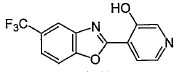
본 활성Saw active 화합물 114Compound 114
1H-NMR(CDCl3)δ:10.84(br s, 1H), 8.63(s, 1H), 8.35(d, J=4.9Hz, 1H), 8.12-8.09(m, 1H), 7.86(d, J=5.1Hz, 1H), 7.79(d, J=8.8Hz, 1H), 7.76(dd, J=8.5, 1.7Hz, 1H)
1 H-NMR (CDCl 3 ) δ: 10.84 (br s, 1H), 8.63 (s, 1H), 8.35 (d, J = 4.9 Hz, 1H), 8.12-8.09 (m, 1H), 7.86 (d, J = 5.1 Hz, 1H), 7.79 (d, J = 8.8 Hz, 1H), 7.76 (dd, J = 8.5, 1.7 Hz, 1H)
제조예Production Example 116 116
4-[5-(트리플루오로메틸)벤즈옥사졸-2-일]피리딘-3-올 0.28g, 탄산칼륨 0.28g 및 DMF 2ml의 혼합물에 실온에서 시클로펜틸브로미드 0.29g과 DMF 2ml의 혼합물을 첨가한 후, 60℃에서 4시간 동안 가열교반하였다. 실온까지 냉각한 후, 반응혼합물에 물을 첨가하고, 아세트산에틸로 2회 추출하였다. 혼합된 유기층을 물, 포화식염수로 세정하고, 무수황산마그네슘으로 건조시켰다. 감압 하에서 농축하고, 잔사를 실리카겔 칼럼크로마토그래피 처리하여 2-(3-시클로펜틸옥시피리딘-4-일)-5-(트리플루오로메틸)벤즈옥사졸(이하, 본 활성화합물 115라고 함) 0.29g을 얻었다.A mixture of 0.28 g of 4- [5- (trifluoromethyl) benzoxazol-2-yl] pyridin-3-ol, 0.28 g of potassium carbonate and 2 ml of DMF at room temperature, a mixture of 0.29 g of cyclopentylbromide and 2 ml of DMF After the addition, the mixture was heated and stirred at 60 ° C. for 4 hours. After cooling to room temperature, water was added to the reaction mixture, and the mixture was extracted twice with ethyl acetate. The mixed organic layer was washed with water and brine, and dried over anhydrous magnesium sulfate. Concentrated under reduced pressure, and the residue was subjected to silica gel column chromatography to give 2- (3-cyclopentyloxypyridin-4-yl) -5- (trifluoromethyl) benzoxazole (hereinafter referred to as the present active compound 115) 0.29 g was obtained.
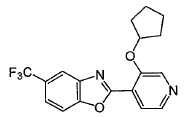
본 활성Saw active 화합물 115Compound 115
1H-NMR(CDCl3)δ:8.56(s, 1H), 8.39(d, J=4.9Hz, 1H), 8.13-8.10(m, 1H), 8.00(d, J=4.9Hz, 1H), 7.73-7.66(m, 2H), 5.13-5.06(m, 1H), 2.08-1.99(m, 4H), 1.96-1.84(m, 2H), 1.77-1.65(m, 2H)
1 H-NMR (CDCl 3 ) δ: 8.56 (s, 1H), 8.39 (d, J = 4.9Hz, 1H), 8.13-8.10 (m, 1H), 8.00 (d, J = 4.9Hz, 1H), 7.73-7.66 (m, 2H), 5.13-5.06 (m, 1H), 2.08-1.99 (m, 4H), 1.96-1.84 (m, 2H), 1.77-1.65 (m, 2H)
제조예Production Example 117 117
프로판올을 대신하여 이소부틸알코올을 사용하고, 제조예 72 기재의 방법에 준하여 2-(3-이소부톡시피리딘-4-일)-5-(트리플루오로메틸)벤즈옥사졸(이하, 본 활성화합물 116이라고 함) 0.24g을 얻었다.Isobutyl alcohol was used in place of propanol, and 2- (3-isobutoxypyridin-4-yl) -5- (trifluoromethyl) benzoxazole (hereinafter the present active compound) was prepared according to the method described in Preparation Example 72. 0.24 g).
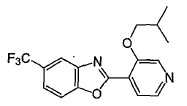
본 활성Saw active 화합물 116Compound 116
1H-NMR(CDCl3)δ:8.55(s, 1H), 8.42(d, J=5.1Hz, 1H), 8.12-8.11(m, 1H), 8.02(d, J=5.1Hz, 1H), 7.73-7.67(m, 2H), 4.06(d, J=6.3Hz, 2H), 2.32-2.20(m, 1H), 1.14(d, J=6.6Hz, 6H)
1 H-NMR (CDCl 3 ) δ: 8.55 (s, 1H), 8.42 (d, J = 5.1Hz, 1H), 8.12-8.11 (m, 1H), 8.02 (d, J = 5.1Hz, 1H), 7.73-7.67 (m, 2H), 4.06 (d, J = 6.3 Hz, 2H), 2.32-2.20 (m, 1H), 1.14 (d, J = 6.6 Hz, 6H)
제조예Production Example 118 118
프로판올을 대신하여 2,2-디메틸-1-프로판올을 사용하고, 제조예 72 기재의 방법에 준하여 2-[3-(2, 2-디메틸프로폭시)피리딘-4-일]-5-(트리플루오로메틸)벤즈옥사졸(이하, 본 활성화합물 117이라고 함) 0.23g을 얻었다.2,2-dimethyl-1-propanol was used in place of propanol and 2- [3- (2,2-dimethylpropoxy) pyridin-4-yl] -5- (tri 0.23 g of fluoromethyl) benzoxazole (hereinafter referred to as the present active compound 117) was obtained.

본 활성Saw active 화합물 117Compound 117
1H-NMR(CDCl3)δ:8.53(s, 1H), 8.42(d, J=4.9Hz, 1H), 8.12-8.10(m, 1H), 8.04(d, J=4.9Hz, 1H), 7.72-7.66(m, 2H), 3.93(s, 2H), 1.15(s, 9H)
1 H-NMR (CDCl 3 ) δ: 8.53 (s, 1H), 8.42 (d, J = 4.9Hz, 1H), 8.12-8.10 (m, 1H), 8.04 (d, J = 4.9Hz, 1H), 7.72-7.66 (m, 2H), 3.93 (s, 2H), 1.15 (s, 9H)
제조예Production Example 119 119
프로판올을 대신하여 시클로프로판메탄올을 사용하고, 제조예 72 기재의 방법에 준하여 2-[3-(시클로프로필메톡시)피리딘-4-일]-5-(트리플루오로메틸)벤즈옥사졸(이하, 본 활성화합물 118이라고 함) 0.23g을 얻었다.Using cyclopropanmethanol in place of propanol, and following the method described in Preparation Example 72, 2- [3- (cyclopropylmethoxy) pyridin-4-yl] -5- (trifluoromethyl) benzoxazole (hereafter 0.23 g of the active compound 118) was obtained.

본 활성Saw active 화합물 118Compound 118
1H-NMR(CDCl3)δ:8.57(s, 1H), 8.44(d, J=5.1Hz, 1H), 8.14-8.12(m, 1H), 8.01(d, J=5.0Hz, 1H), 7.75-7.68(m, 2H), 4.19(d, J=6.5Hz, 2H), 1.45-1.34(m, 1H), 0.73-0.65(m, 2H), 0.51-0.45(m, 2H)
1 H-NMR (CDCl 3 ) δ: 8.57 (s, 1H), 8.44 (d, J = 5.1Hz, 1H), 8.14-8.12 (m, 1H), 8.01 (d, J = 5.0Hz, 1H), 7.75-7.68 (m, 2H), 4.19 (d, J = 6.5 Hz, 2H), 1.45-1.34 (m, 1H), 0.73-0.65 (m, 2H), 0.51-0.45 (m, 2H)
제조예Production Example 120 120
시클로펜틸브로미드를 대신하여 2-브로모부탄을 사용하고, 제조예 116 기재의 방법에 준하여 2-(3-sec-부톡시피리딘-4-일)-5-(트리플루오로메틸)벤즈옥사졸(이하, 본 활성화합물 119라고 함) 0.14g을 얻었다.2-Bromobutane was used in place of cyclopentylbromide, and 2- (3-sec-butoxypyridin-4-yl) -5- (trifluoromethyl) benzoxa was prepared according to the method described in Preparation Example 116. 0.14 g of sol (hereinafter referred to as the present active compound 119) was obtained.
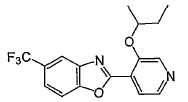
본 활성Saw active 화합물 119Compound 119
1H-NMR(CDCl3)δ:8.56(s, 1H), 8.39(d, J=5.1Hz, 1H), 8.13-8.11(m, 1H), 8.00(d, J=5.1Hz, 1H), 7.73-7.66(m, 2H), 4.68-4.58(m, 1H), 1.96-1.73(m, 2H), 1.45(d, J=6.1Hz, 3H), 1.07(t, J=7.4Hz, 3H)
1 H-NMR (CDCl 3 ) δ: 8.56 (s, 1H), 8.39 (d, J = 5.1Hz, 1H), 8.13-8.11 (m, 1H), 8.00 (d, J = 5.1Hz, 1H), 7.73-7.66 (m, 2H), 4.68-4.58 (m, 1H), 1.96-1.73 (m, 2H), 1.45 (d, J = 6.1 Hz, 3H), 1.07 (t, J = 7.4 Hz, 3H)
제조예Production Example 121 121
2-(3-플루오로피리딘-4-일)-5-(트리플루오로메틸)벤즈옥사졸 0.28g, 탄산칼륨 0.27g 및 2-메톡시에탄올 3ml의 혼합물을 80℃에서 2.5시간 동안 가열교반하였다. 실온까지 냉각한 후, 반응혼합물에 물을 첨가하고, 아세트산에틸로 2회 추출하였다. 혼합된 유기층을 포화식염수로 세정하고, 무수황산마그네슘으로 건조시켰다. 감압 하에서 농축하고, 잔사를 실리카겔 칼럼크로마토그래피 처리하여 2-[3-(2-메톡시에톡시)피리딘-4-일]-5-(트리플루오로메틸)벤즈옥사졸(이하, 본 활성화합물 120이라고 함) 0.23g을 얻었다.A mixture of 0.28 g of 2- (3-fluoropyridin-4-yl) -5- (trifluoromethyl) benzoxazole, 0.27 g of potassium carbonate and 3 ml of 2-methoxyethanol was heated and stirred at 80 ° C. for 2.5 hours. It was. After cooling to room temperature, water was added to the reaction mixture, and the mixture was extracted twice with ethyl acetate. The combined organic layers were washed with saturated brine and dried over anhydrous magnesium sulfate. Concentrated under reduced pressure, and the residue was subjected to silica gel column chromatography to give 2- [3- (2-methoxyethoxy) pyridin-4-yl] -5- (trifluoromethyl) benzoxazole (hereinafter the present active compound) 120) to give 0.23 g.

본 활성Saw active 화합물 120Compound 120
1H-NMR(CDCl3)δ:8.61(s, 1H), 8.46(d, J=4.9Hz, 1H), 8.13-8.11(m, 1H), 8.02(d, J=4.9Hz, 1H), 7.73-7.67(m, 2H), 4.48-4.42(m, 2H), 3.94-3.87(m, 2H), 3.50(s, 3H)
1 H-NMR (CDCl 3 ) δ: 8.61 (s, 1H), 8.46 (d, J = 4.9Hz, 1H), 8.13-8.11 (m, 1H), 8.02 (d, J = 4.9Hz, 1H), 7.73-7.67 (m, 2H), 4.48-4.42 (m, 2H), 3.94-3.87 (m, 2H), 3.50 (s, 3H)
제조예Production Example 122 122
2-메톡시에탄올을 대신하여 3-메톡시-1-프로판올을 사용하고, 제조예 121 기재의 방법에 준하여 2-[3-(3-메톡시프로폭시)피리딘-4-일]-5-(트리플루오로메틸)벤즈옥사졸(이하, 본 활성화합물 121이라고 함) 0.23g을 얻었다.3-methoxy-1-propanol was used in place of 2-methoxyethanol, and 2- [3- (3-methoxypropoxy) pyridin-4-yl] -5- was prepared according to the method described in Preparation Example 121. 0.23 g of (trifluoromethyl) benzoxazole (hereinafter referred to as the present active compound 121) was obtained.

본 활성Saw active 화합물 121Compound 121
1H-NMR(CDCl3)δ:8.59(s, 1H), 8.43(d, J=5.0Hz, 1H), 8.13-8.10(m, 1H), 8.01(d, J=4.9Hz, 1H), 7.74-7.67(m, 2H), 4.40(t, J=6.2Hz, 2H), 3.69(t, J=6.1Hz, 2H), 3.37(s, 3H), 2.23-2.17(m, 2H)
1 H-NMR (CDCl 3 ) δ: 8.59 (s, 1H), 8.43 (d, J = 5.0Hz, 1H), 8.13-8.10 (m, 1H), 8.01 (d, J = 4.9Hz, 1H), 7.74-7.67 (m, 2H), 4.40 (t, J = 6.2 Hz, 2H), 3.69 (t, J = 6.1 Hz, 2H), 3.37 (s, 3H), 2.23-2.17 (m, 2H)
제조예Production Example 123 123
시클로펜틸브로미드를 대신하여 2-브로모에틸에틸에테르를 사용하고, 제조예 116 기재의 방법에 준하여 2-[3-(2-에톡시에톡시)피리딘-4-일]-5-(트리플루오로메틸)벤즈옥사졸(이하, 본 활성화합물 122라고 함) 0.10g을 얻었다.2-bromoethylethyl ether was used in place of cyclopentylbromide, and 2- [3- (2-ethoxyethoxy) pyridin-4-yl] -5- (tri was prepared according to the method described in Preparation Example 116. 0.10 g of fluoromethyl) benzoxazole (hereinafter referred to as the present active compound 122) was obtained.
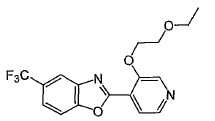
본 활성Saw active 화합물 122Compound 122
1H-NMR(CDCl3)δ:8.62(s, 1H), 8.45(d, J=4.9Hz, 1H), 8.12-8.10(m, 1H), 8.01(d, J=4.9Hz, 1H), 7.73-7.67(m, 2H), 4.48-4.43(m, 2H), 3.96-3.91(m, 2H), 3.66(q, J=7.1Hz, 2H), 1.24(t, J=7.1Hz, 3H)
1 H-NMR (CDCl 3 ) δ: 8.62 (s, 1H), 8.45 (d, J = 4.9Hz, 1H), 8.12-8.10 (m, 1H), 8.01 (d, J = 4.9Hz, 1H), 7.73-7.67 (m, 2H), 4.48-4.43 (m, 2H), 3.96-3.91 (m, 2H), 3.66 (q, J = 7.1 Hz, 2H), 1.24 (t, J = 7.1 Hz, 3H)
제조예Production Example 124 124
프로판올을 대신하여 펜탄올를 사용하고, 제조예 72 기재의 방법에 준하여 2-(3-펜틸옥시피리딘-4-일)-5-(트리플루오로메틸)벤즈옥사졸(이하, 본 활성화합물 123이라고 함) 0.29g을 얻었다.Pentanol was used in place of propanol, and 2- (3-pentyloxypyridin-4-yl) -5- (trifluoromethyl) benzoxazole (hereinafter referred to as the present active compound 123) was prepared according to the method described in Preparation Example 72. 0.29 g was obtained.

본 활성Saw active 화합물 123Compound 123
1H-NMR(CDCl3)δ:8.56(s, 1H), 8.42(d, J=4.9Hz, 1H), 8.13-8.10(m, 1H), 8.01(d, J=4.9Hz, 1H), 7.73-7.67(m, 2H), 4.29(t, J=6.5Hz, 2H), 1.99-1.90(m, 2H), 1.62-1.52(m, 2H), 1.49-1.37(m, 2H), 0.96(t, J=7.2Hz, 3H)
1 H-NMR (CDCl 3 ) δ: 8.56 (s, 1H), 8.42 (d, J = 4.9Hz, 1H), 8.13-8.10 (m, 1H), 8.01 (d, J = 4.9Hz, 1H), 7.73-7.67 (m, 2H), 4.29 (t, J = 6.5 Hz, 2H), 1.99-1.90 (m, 2H), 1.62-1.52 (m, 2H), 1.49-1.37 (m, 2H), 0.96 ( t, J = 7.2 Hz, 3H)
제조예Production Example 125 125
프로판올을 대신하여 헥산올를 사용하고, 제조예 72 기재의 방법에 준하여 2-(3-헥실옥시피리딘-4-일)-5-(트리플루오로메틸)벤즈옥사졸(이하, 본 활성화합물 124라고 함) 0.23g을 얻었다.Hexanol was used in place of propanol and 2- (3-hexyloxypyridin-4-yl) -5- (trifluoromethyl) benzoxazole (hereinafter referred to as the present active compound 124) was prepared according to the method described in Preparation Example 72. 0.23 g was obtained.
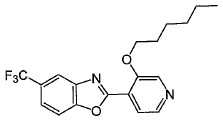
본 활성화합물 124This active compound 124
1H-NMR(CDCl3)δ:8.56(s, 1H), 8.42(d, J=5.0Hz, 1H), 8.15-8.09(m, 1H), 8.01(d, J=5.1Hz, 1H), 7.74-7.68(m, 2H), 4.32-4.27(m, 2H), 1.98-1.88(m, 2H), 1.61-1.52(m, 2H), 1.42-1.31(m, 4H), 0.95-0.88(m, 3H)
1 H-NMR (CDCl 3 ) δ: 8.56 (s, 1H), 8.42 (d, J = 5.0Hz, 1H), 8.15-8.09 (m, 1H), 8.01 (d, J = 5.1Hz, 1H), 7.74-7.68 (m, 2H), 4.32-4.27 (m, 2H), 1.98-1.88 (m, 2H), 1.61-1.52 (m, 2H), 1.42-1.31 (m, 4H), 0.95-0.88 (m , 3H)
제조예Production Example 126 126
3-클로로-N-[2-히드록시-5-(트리플루오로메틸티오)페닐]이소니코틴아미드를 대신하여 N-[2-히드록시-5-(트리플루오로메틸)페닐]-3-(트리플루오로메틸)이소니코틴아미드를 사용하고, 제조예 78 기재의 방법에 준하여 5-트리플루오로메틸-2-[3-(트리플루오로메틸)피리딘-4-일]-벤즈옥사(이하, 본 활성화합물 125라고 함) 0.55g을 얻었다.N- [2-hydroxy-5- (trifluoromethyl) phenyl] -3- on behalf of 3-chloro-N- [2-hydroxy-5- (trifluoromethylthio) phenyl] isonicotinamide 5-trifluoromethyl-2- [3- (trifluoromethyl) pyridin-4-yl] -benzoxa (hereinafter referred to as (trifluoromethyl) isonicotinamide, using the method described in Preparation Example 78). 0.55 g of the present active compound 125 was obtained.

본 활성Saw active 화합물 125Compound 125
1H-NMR(CDCl3)δ:9.18(s, 1H), 9.04(d, J=4.9Hz, 1H), 8.20-8.18(m, 1H), 8.16(d, J=5.1Hz, 1H), 7.81-7.74(m, 2H)
1 H-NMR (CDCl 3 ) δ: 9.18 (s, 1H), 9.04 (d, J = 4.9Hz, 1H), 8.20-8.18 (m, 1H), 8.16 (d, J = 5.1Hz, 1H), 7.81-7.74 (m, 2H)
제조예Production Example 127 127
4-[5-(트리플루오로메틸)벤즈옥사졸-2-일]피리딘-3-올 0.50g, 탄산칼륨 1.23g 및 DMF 14ml의 혼합물에 클로로디플루오로 메탄가스를 주입하면서 70℃에서 3시간 동안 가열교반하였다. 가스의 주입을 정지하고, 실온에 냉각한 후, 하룻밤 동안 정치하였다. 반응혼합물에 물을 첨가한 후, 아세트산에틸로 2회 추출하였다. 혼합된 유기층을 물, 포화식염수로 세정하고, 무수황산마그네슘으로 건조시켰다. 감압 하에서 농축하고, 잔사를 실리카겔 칼럼크로마토그래피 처리하여 2-(3-디플루오로메톡시피리딘-4-일)-5-(트리플루오로메틸)벤즈옥사졸(이하, 본 활성화합물 126이라고 함) 0.11g을 얻었다.To a mixture of 0.50 g of 4- [5- (trifluoromethyl) benzoxazol-2-yl] pyridin-3-ol, 1.23 g of potassium carbonate and 14 ml of DMF, chlorodifluoro methane gas was injected at 70 ° C. The mixture was heated and stirred for an hour. The injection of gas was stopped, cooled to room temperature, and allowed to stand overnight. Water was added to the reaction mixture, which was then extracted twice with ethyl acetate. The mixed organic layer was washed with water and brine, and dried over anhydrous magnesium sulfate. Concentrated under reduced pressure, and the residue was subjected to silica gel column chromatography to give 2- (3-difluoromethoxypyridin-4-yl) -5- (trifluoromethyl) benzoxazole (hereinafter referred to as the present active compound 126). 0.11 g was obtained.

본 활성Saw active 화합물 126Compound 126
1H-NMR(CDCl3)δ:8.80(s, 1H), 8.74(d, J=5.1Hz, 1H), 8.18-8.16(m, 1H), 8.15(d, J=5.1Hz, 1H), 7.79-7.72(m, 2H), 6.82(t, J=73.0Hz, 1H)
1 H-NMR (CDCl 3 ) δ: 8.80 (s, 1H), 8.74 (d, J = 5.1Hz, 1H), 8.18-8.16 (m, 1H), 8.15 (d, J = 5.1Hz, 1H), 7.79-7.72 (m, 2H), 6.82 (t, J = 73.0 Hz, 1H)
제조예Production Example 128 128
페놀을 대신하여 3-히드록시피리딘을 사용하고, 제조예 39 기재의 방법에 준하여 2-[3-(피리딘-3-일옥시)-피리딘-4-일]-5-(트리플루오로메틸)벤즈옥사졸(이하, 본 활성화합물 127이라고 함) 0.30g을 얻었다.3-hydroxypyridine was used in place of phenol, and 2- [3- (pyridin-3-yloxy) -pyridin-4-yl] -5- (trifluoromethyl) was obtained according to the method described in Preparation Example 39. 0.30 g of benzoxazole (hereinafter referred to as the present active compound 127) was obtained.
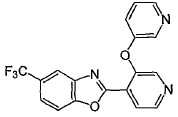
본 활성화합물 127Present active compound 127
1H-NMR(CDCl3)δ:8.67(d, J=5.1Hz, 1H), 8.54(s, 1H), 8.53-8.52(m, 1H), 8.45-8.42(m, 1H), 8.20-8.18(m, 1H), 8.10-8.08(m, 1H), 7.71-7.65(m, 2H), 7.40-7.36(m, 1H), 7.35-7.30(m, 1H)
1 H-NMR (CDCl 3 ) δ: 8.67 (d, J = 5.1Hz, 1H), 8.54 (s, 1H), 8.53-8.52 (m, 1H), 8.45-8.42 (m, 1H), 8.20-8.18 (m, 1H), 8.10-8.08 (m, 1H), 7.71-7.65 (m, 2H), 7.40-7.36 (m, 1H), 7.35-7.30 (m, 1H)
제조예Production Example 129 129
2-(3-요오드피리딘-4-일)-5-(트리플루오로메틸)벤즈옥사졸 0.40g, 3-피리딘보론산 0.21g, 1,4-디옥산 8ml 및 디클로로비스(트리페닐포스핀)팔라듐(II) 0.07g의 혼합물에 탄산나트륨 0.40g과 물 3ml의 혼합물을 첨가하여 2시간 동안 가열환류하였다. 실온에 냉각한 후, 반응혼합물에 물을 첨가하고, 아세트산에틸로 추출하였다. 혼합된 유기층을 물, 포화식염수로 세정하고, 무수황산마그네슘으로 건조시켰다. 감압 하에서 농축하고, 잔사를 실리카겔 칼럼크로마토그래피 처리하여 4-(5-트리플루오로메틸-벤즈옥사졸-2-일)-[3,3']비피리디닐(이하, 본 활성화합물 128이라고 함) 0.36g을 얻었다.0.40 g of 2- (3-iodinepyridin-4-yl) -5- (trifluoromethyl) benzoxazole, 0.21 g of 3-pyridineboronic acid, 8 ml of 1,4-dioxane and dichlorobis (triphenylphosphine A mixture of 0.40 g of sodium carbonate and 3 ml of water was added to a mixture of 0.07 g of palladium (II), and the mixture was heated to reflux for 2 hours. After cooling to room temperature, water was added to the reaction mixture, which was then extracted with ethyl acetate. The mixed organic layer was washed with water and brine, and dried over anhydrous magnesium sulfate. Concentrated under reduced pressure, and the residue was subjected to silica gel column chromatography to give 4- (5-trifluoromethyl-benzoxazol-2-yl)-[3,3 '] bipyridinyl (hereinafter referred to as the present active compound 128). ) 0.36 g.

본 활성Saw active 화합물 128Compound 128
1H-NMR(CDCl3)δ:8.89(d, J=5.1Hz, 1H), 8.77(s, 1H), 8.74-8.69(m, 1H), 8.68-8.62(m, 1H), 8.18-8.13(m, 1H), 8.04-7.99(m, 1H), 7.73-7.68(m, 1H), 7.67-7.62(m, 1H), 7.54-7.47(m, 1H), 7.43-7.36(m, 1H)
1 H-NMR (CDCl 3 ) δ: 8.89 (d, J = 5.1 Hz, 1H), 8.77 (s, 1H), 8.74-8.69 (m, 1H), 8.68-8.62 (m, 1H), 8.18-8.13 (m, 1H), 8.04-7.99 (m, 1H), 7.73-7.68 (m, 1H), 7.67-7.62 (m, 1H), 7.54-7.47 (m, 1H), 7.43-7.36 (m, 1H)
제조예Production Example 130 130
3-피리딘보론산을 대신하여 4-피리딘보론산을 사용하고, 제조예 129 기재의 방법에 준하여 4-(5-트리플루오로메틸-벤즈옥사졸-2-일)-[3,4']비피리디닐(이하, 본 활성화합물 129라고 함) 0.20g을 얻었다.4-Pyridineboronic acid was used in place of 3-pyridineboronic acid, and 4- (5-trifluoromethyl-benzoxazol-2-yl)-[3,4 '] was produced according to the method described in Preparation Example 129. 0.20 g of bipyridinyl (hereinafter referred to as the present active compound 129) was obtained.
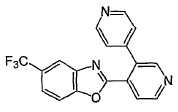
본 활성Saw active 화합물 129Compound 129
1H-NMR(CDCl3)δ:8.90(d, J=5.1Hz, 1H), 8.75(s, 1H), 8.70(dd, J=4.4, 1.7Hz, 2H), 8.14-8.12(m, 1H), 8.03-8.02(m, 1H), 7.67-7.63(m, 1H), 7.50(d, J=8.5Hz, 1H), 7.28(dd, J=4.4, 1.7, 2H)
1 H-NMR (CDCl 3 ) δ: 8.90 (d, J = 5.1 Hz, 1H), 8.75 (s, 1H), 8.70 (dd, J = 4.4, 1.7 Hz, 2H), 8.14-8.12 (m, 1H ), 8.03-8.02 (m, 1H), 7.67-7.63 (m, 1H), 7.50 (d, J = 8.5 Hz, 1H), 7.28 (dd, J = 4.4, 1.7, 2H)
제조예Production Example 131 131
2-(3-아미노피리딘-4-일)-5-(트리플루오로메틸)벤즈옥사졸 0.30g 및 트리플루오로아세트산무수물 3ml의 혼합물을 60℃에서 15분 동안 가열교반하였다. 실온까지 냉각한 후, 반응혼합물에 물 및 포화탄산수소나트륨 수용액을 첨가하였다. 석출한 결정을 여과하여 얻어진 결정을 아세트산에틸에 용해하였다. 얻어진 용액을 포화식염수로 세정하고, 무수황산마그네슘으로 건조한 후, 감압 하에서 농축하였다. 잔사를 실리카겔 칼럼크로마토그래피 처리하여 2,2,2-트리플루오로-N-[4-(5-트리플루오로메틸벤즈옥사졸-2-일)피리딘-3-일]아세트아미드(이하, 본 활성화합물 130이라고 함) 0.32g을 얻었다.A mixture of 0.30 g of 2- (3-aminopyridin-4-yl) -5- (trifluoromethyl) benzoxazole and 3 ml of trifluoroacetic anhydride was heated and stirred at 60 ° C. for 15 minutes. After cooling to room temperature, water and saturated aqueous sodium hydrogen carbonate solution were added to the reaction mixture. The crystal obtained by filtering the precipitated crystal was dissolved in ethyl acetate. The resulting solution was washed with saturated brine, dried over anhydrous magnesium sulfate, and concentrated under reduced pressure. The residue was subjected to silica gel column chromatography to give 2,2,2-trifluoro-N- [4- (5-trifluoromethylbenzoxazol-2-yl) pyridin-3-yl] acetamide (hereinafter, Bonn 0.32 g of the active compound 130 was obtained.

본 활성화합물 130Present active compound 130
1H-NMR(DMSO-d6)δ:12.66(br s, 1H), 10.11(s, 1H), 8.71(d, J=5.1Hz, 1H), 8.15-8.14(m, 1H), 8.12(d, J=5.1Hz, 1H), 7.85-7.79(m, 2H)
1 H-NMR (DMSO-d 6 ) δ: 12.66 (br s, 1H), 10.11 (s, 1H), 8.71 (d, J = 5.1 Hz, 1H), 8.15-8.14 (m, 1H), 8.12 ( d, J = 5.1 Hz, 1H), 7.85-7.79 (m, 2H)
제조예Production Example 132 132
2-(3-플루오로피리딘-4-일)-5-(트리플루오로메틸)벤즈옥사졸 0.28g, 탄산칼륨 0.14g 및 DMF 3ml의 혼합물에 디메틸아민의 THF 용액 3ml를 첨가하고, 60℃에서 3.3시간 동안 가열교반하였다. 실온까지 냉각한 후, 반응혼합물에 물을 첨가한 후, 아세트산에틸로 2회 추출하였다. 혼합된 유기층을 포화식염수로 세정하고, 무수황산마그네슘으로 건조한 후, 감압 하에서 농축하였다. 잔사를 실리카겔 칼럼크로마토그래피 처리하여 얻어진 결정을 디에틸에테르로 세정하고, 디메틸-{4-[5-(트리플루오로메틸)벤즈옥사졸-2-일]피리딘-3-일}아민(이하, 본 활성화합물 131이라고 함) 0.27g을 얻었다.To a mixture of 0.28 g of 2- (3-fluoropyridin-4-yl) -5- (trifluoromethyl) benzoxazole, 0.14 g of potassium carbonate and 3 ml of DMF, 3 ml of a THF solution of dimethylamine was added, and 60 ° C. The mixture was heated and stirred for 3.3 hours at. After cooling to room temperature, water was added to the reaction mixture, which was then extracted twice with ethyl acetate. The combined organic layers were washed with saturated brine, dried over anhydrous magnesium sulfate, and concentrated under reduced pressure. The residue obtained by silica gel column chromatography was washed with diethyl ether, and dimethyl- {4- [5- (trifluoromethyl) benzoxazol-2-yl] pyridin-3-yl} amine (hereinafter, 0.27 g of the present active compound 131 was obtained.

본 활성Saw active 화합물 131Compound 131
1H-NMR(CDCl3)δ:8.53(s, 1H), 8.28(d, J=5.1Hz, 1H), 8.13-8.11(m, 1H), 7.79(d, J=5.1Hz, 1H), 7.74-7.71(m, 1H), 7.70-7.67(m, 1H), 2.93(s, 6H)
1 H-NMR (CDCl 3 ) δ: 8.53 (s, 1H), 8.28 (d, J = 5.1Hz, 1H), 8.13-8.11 (m, 1H), 7.79 (d, J = 5.1Hz, 1H), 7.74-7.71 (m, 1 H), 7.70-7.67 (m, 1 H), 2.93 (s, 6 H)
제조예Production Example 133 133
이소프로필아민을 대신하여 N-이소프로필메틸아민을 사용하고, 제조예 86 기재의 방법에 준하여 이소프로필-메틸-{4-[5-(트리플루오로메틸)벤즈옥사졸-2-일]피리딘-3-일}아민(이하, 본 활성화합물 132라고 함) 0.17g을 얻었다.N-isopropylmethylamine was used in place of isopropylamine, and according to the method described in Preparation Example 86, isopropyl-methyl- {4- [5- (trifluoromethyl) benzoxazol-2-yl] pyridine 0.17 g of -3-yl} amine (hereinafter referred to as the present active compound 132) was obtained.
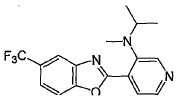
본 활성Saw active 화합물 132Compound 132
1H-NMR(CDCl3)δ:8.53(s, 1H), 8.29(d, J=4.9Hz, 1H), 8.11-8.09(m, 1H), 7.79(d, J=4.9Hz, 1H), 7.73-7.66(m, 2H), 3.57-3.45(m, 1H), 2.82(s, 3H), 1.15(d, J=6.6Hz, 6H)
1 H-NMR (CDCl 3 ) δ: 8.53 (s, 1H), 8.29 (d, J = 4.9 Hz, 1H), 8.11-8.09 (m, 1H), 7.79 (d, J = 4.9 Hz, 1H), 7.73-7.66 (m, 2H), 3.57-3.45 (m, 1H), 2.82 (s, 3H), 1.15 (d, J = 6.6 Hz, 6H)
제조예Production Example 134 134
2-(3-에틸티오피리딘-4-일)-5-(트리플루오로메틸)벤즈옥사졸 0.60g 및 클로로포름 8ml의 혼합물에 빙랭 하에서 70%m-클로로과안식향산 0.64g을 첨가하여 0℃에서 1시간 동안 교반하였다. 반응혼합물을 클로로포름으로 희석하고, 5% 수산화나트륨수용액, 포화식염수로 세정하였다. 무수황산마그네슘으로 건조한 후, 감압 하에서 농축하였다. 잔사를 실리카겔 칼럼크로마토그래피 처리하여 2-[3-(에탄설포닐)피리딘-4-일]-5-(트리플루오로메틸)벤즈옥사졸(이하, 본 활성화합물 133이라고 함) 0.21g 및 2-[3-(에탄설피닐)피리딘-4-일]-5-(트리플루오로메틸)벤즈옥사졸(이하, 본 활성화합물 134라고 함) 0.30g을 얻었다.To a mixture of 0.60 g of 2- (3-ethylthiopyridin-4-yl) -5- (trifluoromethyl) benzoxazole and 8 ml of chloroform, add 0.64 g of 70% m-chloro and benzoic acid under ice cooling to 1 at 0 ° C. Stir for hours. The reaction mixture was diluted with chloroform and washed with 5% aqueous sodium hydroxide solution and saturated brine. After drying over anhydrous magnesium sulfate, the mixture was concentrated under reduced pressure. The residue was subjected to silica gel column chromatography to give 0.21 g of 2- [3- (ethanesulfonyl) pyridin-4-yl] -5- (trifluoromethyl) benzoxazole (hereinafter referred to as active compound 133) and 2 0.30 g of-[3- (ethanesulfinyl) pyridin-4-yl] -5- (trifluoromethyl) benzoxazole (hereinafter referred to as the present active compound 134) was obtained.

본 활성Saw active 화합물 133Compound 133
1H-NMR(CDCl3)δ:9.44-9.43(m, 1H), 9.09(d, J=4.9Hz, 1H), 8.17-8.14(m, 1H), 7.96-7.94(m, 1H), 7.78-7.75(m, 2H), 3.93(q, J=7.5Hz, 2H), 1.46(t, J=7.6Hz, 3H) 1 H-NMR (CDCl 3 ) δ: 9.44-9.43 (m, 1H), 9.09 (d, J = 4.9 Hz, 1H), 8.17-8.14 (m, 1H), 7.96-7.94 (m, 1H), 7.78 -7.75 (m, 2H), 3.93 (q, J = 7.5 Hz, 2H), 1.46 (t, J = 7.6 Hz, 3H)
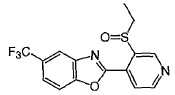
본 활성화합물 134The active compound 134
1H-NMR(CDCl3)δ:9.45-9.44(m, 1H), 8.99(d, J=5.1Hz, 1H), 8.18-8.17(m, 1H), 8.13-8.11(m, 1H), 7.81-7.76(m, 2H), 3.53-3.41(m, 1H), 3.15-3.04(m, 1H), 1.45(t, J=7.4Hz, 3H)
1 H-NMR (CDCl 3 ) δ: 9.45-9.44 (m, 1H), 8.99 (d, J = 5.1 Hz, 1H), 8.18-8.17 (m, 1H), 8.13-8.11 (m, 1H), 7.81 -7.76 (m, 2H), 3.53-3.41 (m, 1H), 3.15-3.04 (m, 1H), 1.45 (t, J = 7.4 Hz, 3H)
제조예Production Example 135 135
2-(3-에틸티오피리딘-4-일)-5-(트리플루오로메틸)벤즈옥사졸을 대신하여 2-(3-메틸티오피리딘-4-일)-5-(트리플루오로메틸)벤즈옥사졸을 사용하고, 제조예 134 기재의 방법에 준하여 2-[3-(메탄설포닐)피리딘-4-일]-5-(트리플루오로메틸)벤즈옥사졸(이하, 본 활성화합물 135라고 함) 0.26g 및 2-[3-(메탄설피닐)피리딘-4-일]-5-(트리플루오로메틸)벤즈옥사졸(이하, 본 활성화합물 136이라고 함) 0.37g을 얻었다.2- (3-methylthiopyridin-4-yl) -5- (trifluoromethyl) on behalf of 2- (3-ethylthiopyridin-4-yl) -5- (trifluoromethyl) benzoxazole 2- [3- (methanesulfonyl) pyridin-4-yl] -5- (trifluoromethyl) benzoxazole (hereinafter the present active compound 135) using benzoxazole and following the method described in Preparation Example 134 0.26 g and 0.37 g of 2- [3- (methanesulfinyl) pyridin-4-yl] -5- (trifluoromethyl) benzoxazole (hereinafter referred to as the present active compound 136) were obtained.

본 활성화합물 135Present Active Compound 135
1H-NMR(CDCl3)δ:9.51(s, 1H), 9.11(d, J=4.9Hz, 1H), 8.19-8.16(m, 1H), 7.97(d, J=5.0Hz, 1H), 7.80-7.76(m, 2H), 3.72(s, 3H) 1 H-NMR (CDCl 3 ) δ: 9.51 (s, 1H), 9.11 (d, J = 4.9 Hz, 1H), 8.19-8.16 (m, 1H), 7.97 (d, J = 5.0 Hz, 1H), 7.80-7.76 (m, 2H), 3.72 (s, 3H)
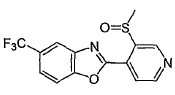
본 활성화합물 136Present Active Compound 136
1H-NMR(CDCl3)δ:9.55(s, 1H), 9.01(d, J=5.1Hz, 1H), 8.21-8.19(m, 1H), 8.12-8.10(m, 1H), 7.82-7.76(m, 2H), 3.13(s, 3H)
1 H-NMR (CDCl 3 ) δ: 9.55 (s, 1H), 9.01 (d, J = 5.1Hz, 1H), 8.21-8.19 (m, 1H), 8.12-8.10 (m, 1H), 7.82-7.76 (m, 2 H), 3.13 (s, 3 H)
제조예Production Example 136 136
3-클로로-N-[2-히드록시-5-(트리플루오로메틸티오)페닐]이소니코틴아미드를 대신하여 N-[2-히드록시-5-(트리플루오로메틸)페닐]-3-(메톡시메틸)이소니코틴아미드를 사용하고, 제조예 78 기재의 방법에 준하여 2-[3-(메톡시메틸)피리딘-4-일]-5-(트리플루오로메틸)벤즈옥사졸(이하, 본 활성화합물 137이라고 함) 0.26g을 얻었다.N- [2-hydroxy-5- (trifluoromethyl) phenyl] -3- on behalf of 3-chloro-N- [2-hydroxy-5- (trifluoromethylthio) phenyl] isonicotinamide 2- [3- (methoxymethyl) pyridin-4-yl] -5- (trifluoromethyl) benzoxazole (hereinafter referred to as (methoxymethyl) isonicotinamide) according to the method described in Preparation Example 78 0.26 g of the present active compound 137) was obtained.
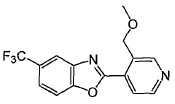
본 활성Saw active 화합물 137Compound 137
1H-NMR(CDCl3)δ:9.02-9.01(m, 1H), 8.78(d, J=5.1Hz, 1H), 8.17-8.15(m, 1H), 8.08-8.05(m, 1H), 7.77-7.71(m, 2H), 5.12(s, 2H), 3.57(s, 3H)
1 H-NMR (CDCl 3 ) δ: 9.02-9.01 (m, 1H), 8.78 (d, J = 5.1 Hz, 1H), 8.17-8.15 (m, 1H), 8.08-8.05 (m, 1H), 7.77 -7.71 (m, 2H), 5.12 (s, 2H), 3.57 (s, 3H)
제조예Production Example 137 137
2-클로로-N-[2-히드록시-5-(트리플루오로메틸)페닐]이소니코틴아미드를 대신하여 N-[2-히드록시-5-(트리플루오로메틸)피리딘-3-일]이소니코틴아미드를 사용하고, 제조예 22 기재의 방법에 준하여 2-피리딘-4-일-6-(트리플루오로메틸)옥사졸로[5,4-b]피리딘(이하, 본 활성화합물 138이라고 함) 0.32g을 얻었다.N- [2-hydroxy-5- (trifluoromethyl) pyridin-3-yl] in place of 2-chloro-N- [2-hydroxy-5- (trifluoromethyl) phenyl] isonicotinamide] 2-pyridin-4-yl-6- (trifluoromethyl) oxazolo [5,4-b] pyridine (hereinafter referred to as the present active compound 138) using isonicotinamide and using the method described in Preparation Example 22. ) 0.32 g.

본 활성화합물 138The active compound 138
1H-NMR(CDCl3)δ:8.90(dd, J=4.5, 1.6Hz, 2H), 8.76-8.74(m, 1H), 8.40-8.38(m, 1H), 8.14(dd, J=4.4, 1.7Hz, 2H)
1 H-NMR (CDCl 3 ) δ: 8.90 (dd, J = 4.5, 1.6 Hz, 2H), 8.76-8.74 (m, 1H), 8.40-8.38 (m, 1H), 8.14 (dd, J = 4.4, 1.7 Hz, 2H)
제조예Production Example 138 138
2-클로로-N-[2-히드록시-5-(트리플루오로메틸)페닐]이소니코틴아미드를 대신하여 3-클로로-N-[2-히드록시-5-(트리플루오로메틸)피리딘-3-일]이소니코틴아미드를 사용하고, 제조예 22 기재의 방법에 준하여 2-(3-클로로피리딘-4-일)-6-(트리플루오로메틸)옥사졸로[5,4-b]피리딘(이하, 본 활성화합물 139라고 함) 0.72g을 얻었다.3-chloro-N- [2-hydroxy-5- (trifluoromethyl) pyridine- on behalf of 2-chloro-N- [2-hydroxy-5- (trifluoromethyl) phenyl] isonicotinamide 2- (3-chloropyridin-4-yl) -6- (trifluoromethyl) oxazolo [5,4-b] pyridine using 3-yl] isonicotinamide according to the method described in Preparation 22 0.72 g (hereinafter, referred to as the present active compound 139) was obtained.

본 활성Saw active 화합물 139Compound 139
1H-NMR(CDCl3)δ:8.89(s, 1H), 8.80-8.77(m, 1H), 8.74(d, J=5.1Hz, 1H), 8.48-8.46(m, 1H), 8.13(d, J=5.1Hz, 1H)
1 H-NMR (CDCl 3 ) δ: 8.89 (s, 1H), 8.80-8.77 (m, 1H), 8.74 (d, J = 5.1Hz, 1H), 8.48-8.46 (m, 1H), 8.13 (d , J = 5.1Hz, 1H)
제조예Production Example 139 139
2-(3-클로로피리딘-4-일)-6-(트리플루오로메틸)옥사졸로[5,4-b]피리딘 0.45g 및 클로로포름 5ml의 혼합물에 빙랭하 70%m-클로로과안식향산 0.48g을 첨가하여 실온에서 4시간, 50℃에서 2시간 동안 가열교반하였다. 실온까지 냉각한 후, 반응혼합물을 클로로포름으로 희석하고, 5% 수산화나트륨수용액, 포화식염수의 순서로 세정하였다. 유기층을 무수황산마그네슘으로 건조시킨 후, 감압 하에서 농축하였다. 잔사를 실리카겔 칼럼크로마토그래피 처리하여 2-(3-클로로-1-옥시피리딘-4-일)-6-(트리플루오로메틸)옥사졸로[5,4-b]피리딘(이하, 본 활성화합물 140이라고 함) 0.36g을 얻었다.To a mixture of 0.45 g of 2- (3-chloropyridin-4-yl) -6- (trifluoromethyl) oxazolo [5,4-b] pyridine and 5 ml of chloroform, 0.48 g of 70% m-chloroperbenzoic acid under ice cooling was added. The mixture was heated and stirred at room temperature for 4 hours and at 50 ° C for 2 hours. After cooling to room temperature, the reaction mixture was diluted with chloroform and washed with 5% aqueous sodium hydroxide solution and saturated brine. The organic layer was dried over anhydrous magnesium sulfate, and then concentrated under reduced pressure. The residue was subjected to silica gel column chromatography to give 2- (3-chloro-1-oxypyridin-4-yl) -6- (trifluoromethyl) oxazolo [5,4-b] pyridine (hereinafter the present active compound 140 0.36 g was obtained.

본 활성Saw active 화합물 140Compound 140
1H-NMR(CDCl3)δ:8.77-8.74(m, 1H), 8.43-8.42(m, 1H), 8.41(d, J=1.7Hz, 1H), 8.23(dd, J=7.0, 1.6Hz, 1H), 8.19(d, J=6.9Hz, 1H)
1 H-NMR (CDCl 3 ) δ: 8.77-8.74 (m, 1H), 8.43-8.42 (m, 1H), 8.41 (d, J = 1.7 Hz, 1H), 8.23 (dd, J = 7.0, 1.6 Hz , 1H), 8.19 (d, J = 6.9 Hz, 1H)
제조예Production Example 140 140
2-클로로-N-[2-히드록시-5-(트리플루오로메틸)페닐]이소니코틴아미드를 대신하여 3-플루오로-N-[2-히드록시-5-(트리플루오로메틸)피리딘-3-일]이소니코틴아미드를 사용하고, 제조예 22 기재의 방법에 준하여 2-(3-플루오로피리딘-4-일)-6-(트리플루오로메틸)옥사졸로[5,4-b]피리딘(이하, 본 활성화합물 141이라고 함) 1.72g을 얻었다.3-fluoro-N- [2-hydroxy-5- (trifluoromethyl) pyridine on behalf of 2-chloro-N- [2-hydroxy-5- (trifluoromethyl) phenyl] isonicotinamide 2- (3-fluoropyridin-4-yl) -6- (trifluoromethyl) oxazolo [5,4-b using -3-yl] isonicotinamide according to the method described in Preparation Example 22 ] 1.72 g of pyridine (hereinafter referred to as the present active compound 141) was obtained.

본 활성Saw active 화합물 141Compound 141
1H-NMR(CDCl3)δ:8.81-8.76(m, 2H), 8.70(d, J=5.1Hz, 1H), 8.46-8.43(m, 1H), 8.17-8.13(m, 1H)
1 H-NMR (CDCl 3 ) δ: 8.81-8.76 (m, 2H), 8.70 (d, J = 5.1 Hz, 1H), 8.46-8.43 (m, 1H), 8.17-8.13 (m, 1H)
제조예Production Example 141 141
2-클로로-N-[2-히드록시-5-(트리플루오로메틸)페닐]이소니코틴아미드를 대신하여 N-[2-히드록시-5-(트리플루오로메틸)피리딘-3-일]-3-메틸이소니코틴아미드를 사용하고, 제조예 22 기재의 방법에 준하여 2-(3-메틸피리딘-4-일)-6-(트리플루오로메틸)옥사졸로[5,4-b]피리딘(이하, 본 활성화합물 142라고 함) 0.23g을 얻었다.N- [2-hydroxy-5- (trifluoromethyl) pyridin-3-yl] in place of 2-chloro-N- [2-hydroxy-5- (trifluoromethyl) phenyl] isonicotinamide] 2- (3-methylpyridin-4-yl) -6- (trifluoromethyl) oxazolo [5,4-b] pyridine using 3-methylisonicotinamide according to the method described in Preparation Example 22 0.23 g (hereinafter, referred to as the present active compound 142) was obtained.

본 활성Saw active 화합물 142Compound 142
1H-NMR(CDCl3)δ:8.76-8.74(m, 1H), 8.72(s, 1H), 8.70(d, J=5.1Hz, 1H), 8.43-8.41(m, 1H), 8.09(d, J=5.1Hz, 1H), 2.84(s, 3H)
1 H-NMR (CDCl 3 ) δ: 8.76-8.74 (m, 1H), 8.72 (s, 1H), 8.70 (d, J = 5.1Hz, 1H), 8.43-8.41 (m, 1H), 8.09 (d , J = 5.1 Hz, 1H), 2.84 (s, 3H)
제조예Production Example 142 142
2-클로로-N-[2-히드록시-5-(트리플루오로메틸)페닐]이소니코틴아미드를 대신하여 3-에틸-N-[2-히드록시-5-(트리플루오로메틸)피리딘-3-일]이소니코틴아미드를 사용하고, 제조예 22 기재의 방법에 준하여 2-(3-에틸피리딘-4-일)-6-(트리플루오로메틸)옥사졸로[5,4-b]피리딘(이하, 본 활성화합물 143이라고 함) 0.16g을 얻었다.3-ethyl-N- [2-hydroxy-5- (trifluoromethyl) pyridine- on behalf of 2-chloro-N- [2-hydroxy-5- (trifluoromethyl) phenyl] isonicotinamide 2- (3-ethylpyridin-4-yl) -6- (trifluoromethyl) oxazolo [5,4-b] pyridine using 3-yl] isonicotinamide according to the method described in Preparation Example 22 0.16 g (hereinafter, referred to as the present active compound 143) was obtained.
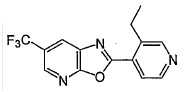
본 활성Saw active 화합물 143Compound 143
1H-NMR(CDCl3)δ:8.76-8.73(m, 2H), 8.70(d, J=5.1Hz, 1H), 8.43-8.41(m, 1H), 8.07(d, J=5.1Hz, 1H), 3.30(q, J=7.5Hz, 2H), 1.36(t, J=7.5Hz, 3H)
1 H-NMR (CDCl 3 ) δ: 8.76-8.73 (m, 2H), 8.70 (d, J = 5.1Hz, 1H), 8.43-8.41 (m, 1H), 8.07 (d, J = 5.1Hz, 1H ), 3.30 (q, J = 7.5 Hz, 2H), 1.36 (t, J = 7.5 Hz, 3H)
제조예Production Example 143 143
2-클로로-N-[2-히드록시-5-(트리플루오로메틸)페닐]이소니코틴아미드를 대신하여 N-[2-히드록시-5-(트리플루오로메틸)피리딘-3-일]-3-(트리플루오로메틸)이소니코틴아미드를 사용하고, 제조예 22 기재의 방법에 준하여 6-트리플루오로메틸-2-[3-(트리플루오로메틸)피리딘-4-일]-옥사졸로[5,4-b]피리딘(이하, 본 활성화합물 144라고 함) 0.22g을 얻었다.N- [2-hydroxy-5- (trifluoromethyl) pyridin-3-yl] in place of 2-chloro-N- [2-hydroxy-5- (trifluoromethyl) phenyl] isonicotinamide] 6-trifluoromethyl-2- [3- (trifluoromethyl) pyridin-4-yl] -oxa using -3- (trifluoromethyl) isonicotinamide and following the method described in Preparation Example 22. 0.22 g of zolo [5,4-b] pyridine (hereinafter referred to as active compound 144) was obtained.

본 활성화합물 144Present Active Compound 144
1H-NMR(CDCl3)δ:9.21(s, 1H), 9.08(d, J=5.1Hz, 1H), 8.81-8.79(m, 1H), 8.49-8.47(m, 1H), 8.17(d, J=5.1Hz, 1H)
1 H-NMR (CDCl 3 ) δ: 9.21 (s, 1H), 9.08 (d, J = 5.1 Hz, 1H), 8.81-8.79 (m, 1H), 8.49-8.47 (m, 1H), 8.17 (d , J = 5.1Hz, 1H)
제조예Production Example 144 144
3-클로로-N-[2-히드록시-5-(트리플루오로메틸티오)페닐]이소니코틴아미드를 대신하여 N-[2-히드록시-5-(트리플루오로메틸)피리딘-3-일]-3-메톡시이소니코틴아미드를 사용하고, 제조예 78 기재의 방법에 준하여 2-(3-메톡시피리딘-4-일)-6-(트리플루오로메틸)옥사졸로[5,4-b]피리딘(이하, 본 활성화합물 145라고 함) 0.27g을 얻었다.N- [2-hydroxy-5- (trifluoromethyl) pyridin-3-yl on behalf of 3-chloro-N- [2-hydroxy-5- (trifluoromethylthio) phenyl] isonicotinamide ] (3-methoxyisonicotinamide) and 2- (3-methoxypyridin-4-yl) -6- (trifluoromethyl) oxazolo [5,4- in accordance with the method described in Preparation Example 78 b] 0.27 g of pyridine (hereinafter referred to as the present active compound 145) was obtained.

본 활성Saw active 화합물 145Compound 145
1H-NMR(CDCl3)δ:8.75-8.72(m, 1H), 8.63(s, 1H), 8.49(d, J=4.9Hz, 1H), 8.41-8.40(m, 1H), 8.06-8.04(m, 1H), 4.18(s, 3H)
1 H-NMR (CDCl 3 ) δ: 8.75-8.72 (m, 1H), 8.63 (s, 1H), 8.49 (d, J = 4.9Hz, 1H), 8.41-8.40 (m, 1H), 8.06-8.04 (m, 1 H), 4.18 (s, 3 H)
제조예Production Example 145 145
3-클로로-N-[2-히드록시-5-(트리플루오로메틸티오)페닐]이소니코틴아미드를 대신하여 N-[2-히드록시-5-(트리플루오로메틸)피리딘-3-일]-3-메틸티오이소니코틴아미드를 사용하고, 제조예 78 기재의 방법에 준하여 2-(3-메틸티오피리딘-4-일)-6-(트리플루오로메틸)옥사졸로[5,4-b]피리딘(이하, 본 활성화합물 146이라고 함) 1.07g을 얻었다.N- [2-hydroxy-5- (trifluoromethyl) pyridin-3-yl on behalf of 3-chloro-N- [2-hydroxy-5- (trifluoromethylthio) phenyl] isonicotinamide ] (3-methylthioisonicotinamide) and 2- (3-methylthiopyridin-4-yl) -6- (trifluoromethyl) oxazolo [5,4- according to the method described in Preparation Example 78. b] 1.07 g of pyridine (hereinafter referred to as the present active compound 146) was obtained.
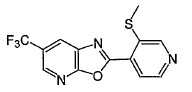
본 활성Saw active 화합물 146Compound 146
1H-NMR(CDCl3)δ:8.76-8.74(m, 1H), 8.71(s, 1H), 8.60(d, J=5.1Hz, 1H), 8.48-8.46(m, 1H), 8.09(d, J=5.1Hz, 1H), 2.70(s, 3H)
1 H-NMR (CDCl 3 ) δ: 8.76-8.74 (m, 1H), 8.71 (s, 1H), 8.60 (d, J = 5.1Hz, 1H), 8.48-8.46 (m, 1H), 8.09 (d , J = 5.1 Hz, 1H), 2.70 (s, 3H)
제조예Production Example 146 146
2-(3-에틸티오피리딘-4-일)-5-(트리플루오로메틸)벤즈옥사졸을 대신하여 2-(3-메틸티오피리딘-4-일)-6-트리플루오로메틸-옥사졸로[5,4-b]피리딘을 사용하고, 제조예 134 기재의 방법에 준하여 2-[3-(메탄설포닐)피리딘-4-일]-6-(트리플루오로메틸)옥사졸로[5,4-b]피리딘(이하, 본 활성화합물 147이라고 함) 0.20g 및 2-[3-(메탄설피닐)피리딘-4-일]-6-(트리플루오로메틸)옥사졸로[5,4-b]피리딘(이하, 본 활성화합물 148이라고 함) 0.29g을 얻었다.2- (3-methylthiopyridin-4-yl) -6-trifluoromethyl-oxa in place of 2- (3-ethylthiopyridin-4-yl) -5- (trifluoromethyl) benzoxazole 2- [3- (methanesulfonyl) pyridin-4-yl] -6- (trifluoromethyl) oxazolo [5 using a solo [5,4-b] pyridine and following the method described in Preparation Example 134 , 4-b] pyridine (hereinafter referred to as active compound 147) 0.20 g and 2- [3- (methanesulfinyl) pyridin-4-yl] -6- (trifluoromethyl) oxazolo [5,4 -b] 0.29 g of pyridine (hereinafter referred to as the present active compound 148) was obtained.

본 활성화합물 147Present Active Compound 147
1H-NMR(CDCl3)δ:9.52(d, J=0.5Hz, 1H), 9.14(t, J=5.1Hz, 1H), 8.81-8.79(m, 1H), 8.47-8.46(m, 1H), 8.00(dd, J=5.0, 0.6Hz, 1H), 3.69(s, 3H) 1 H-NMR (CDCl 3 ) δ: 9.52 (d, J = 0.5 Hz, 1H), 9.14 (t, J = 5.1 Hz, 1H), 8.81-8.79 (m, 1H), 8.47-8.46 (m, 1H ), 8.00 (dd, J = 5.0, 0.6 Hz, 1H), 3.69 (s, 3H)
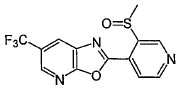
본 활성화합물 148Present Active Compound 148
1H-NMR(CDCl3)δ:9.59(s, 1H), 9.07-9.05(m, 1H), 8.82-8.80(m, 1H), 8.51-8.19(m, 1H), 8.19-8.16(m, 1H), 3.12(s, 3H)
1 H-NMR (CDCl 3 ) δ: 9.59 (s, 1H), 9.07-9.05 (m, 1H), 8.82-8.80 (m, 1H), 8.51-8.19 (m, 1H), 8.19-8.16 (m, 1H), 3.12 (s, 3H)
제조예Production Example 147 147
3-클로로-N-[2-히드록시-5-(트리플루오로메틸티오)페닐]이소니코틴아미드를 대신하여 N-[2-히드록시-5-(트리플루오로메틸)피리딘-3-일]-3-에틸티오이소니코틴아미드를 사용하고, 제조예 78 기재의 방법에 준하여 2-(3-에틸티오피리딘-4-일)-6-(트리플루오로메틸)옥사졸로[5,4-b]피리딘(이하, 본 활성화합물 149라고 함) 1.06g을 얻었다.N- [2-hydroxy-5- (trifluoromethyl) pyridin-3-yl on behalf of 3-chloro-N- [2-hydroxy-5- (trifluoromethylthio) phenyl] isonicotinamide ] -3-ethylthioisonicotinamide, and 2- (3-ethylthiopyridin-4-yl) -6- (trifluoromethyl) oxazolo [5,4- according to the method described in Preparation Example 78. b] 1.06 g of pyridine (hereinafter referred to as the present active compound 149) was obtained.

본 활성Saw active 화합물 149Compound 149
1H-NMR(CDCl3)δ:8.77-8.73(m, 2H), 8.59(d, J=5.1Hz, 1H), 8.48-8.47(m, 1H), 8.08-8.06(m, 1H), 3.21(q, J=7.4Hz, 2H), 1.49(t, J=7.3Hz, 3H)
1 H-NMR (CDCl 3 ) δ: 8.77-8.73 (m, 2H), 8.59 (d, J = 5.1 Hz, 1H), 8.48-8.47 (m, 1H), 8.08-8.06 (m, 1H), 3.21 (q, J = 7.4 Hz, 2H), 1.49 (t, J = 7.3 Hz, 3H)
제조예Production Example 148 148
2-(3-에틸티오피리딘-4-일)-5-(트리플루오로메틸)벤즈옥사졸을 대신하여 2-(3-에틸티오피리딘-4-일)-6-트리플루오로메틸-옥사졸로[5,4-b]피리딘을 사용하고, 제조예 134 기재의 방법에 준하여 2-[3-(에탄설포닐)피리딘-4-일]-6-(트리플루오로메틸)옥사졸로[5,4-b]피리딘(이하, 본 활성화합물 150이라고 함) 0.29g 및 2-[3-(에탄설피닐)피리딘-4-일]-6-(트리플루오로메틸)옥사졸로[5,4-b]피리딘(이하, 본 활성화합물 151이라고 함) 0.20g을 얻었다.2- (3-ethylthiopyridin-4-yl) -6-trifluoromethyl-oxa in place of 2- (3-ethylthiopyridin-4-yl) -5- (trifluoromethyl) benzoxazole 2- [3- (ethanesulfonyl) pyridin-4-yl] -6- (trifluoromethyl) oxazolo [5 using a solo [5,4-b] pyridine and following the method described in Preparation Example 134 , 4-b] pyridine (hereinafter referred to as active compound 150) 0.29 g and 2- [3- (ethanesulfinyl) pyridin-4-yl] -6- (trifluoromethyl) oxazolo [5,4 -b] 0.20 g of pyridine (hereinafter referred to as the present active compound 151) was obtained.
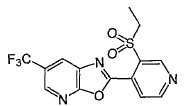
본 활성Saw active 화합물 150Compound 150
1H-NMR(CDCl3)δ:9.46-9.45(m, 1H), 9.14(d, J=4.9Hz, 1H), 8.80-8.79(m, 1H), 8.46-8.44(m, 1H), 7.99-7.97(m, 1H), 3.88(q, J=7.5Hz, 2H), 1.48(t, J=7.3Hz, 3H) 1 H-NMR (CDCl 3 ) δ: 9.46-9.45 (m, 1H), 9.14 (d, J = 4.9 Hz, 1H), 8.80-8.79 (m, 1H), 8.46-8.44 (m, 1H), 7.99 -7.97 (m, 1H), 3.88 (q, J = 7.5 Hz, 2H), 1.48 (t, J = 7.3 Hz, 3H)

본 활성화합물 151Present Active Compound 151
1H-NMR(CDCl3)δ:9.48(s, 1H), 9.04(d, J=5.1Hz, 1H), 8.82-8.80(m, 1H), 8.49-8.47(m, 1H), 8.19-8.17(m, 1H), 3.51-3.39(m, 1H), 3.14-3.04(m, 1H), 1.44(t, J=7.4Hz, 3H)
1 H-NMR (CDCl 3 ) δ: 9.48 (s, 1H), 9.04 (d, J = 5.1Hz, 1H), 8.82-8.80 (m, 1H), 8.49-8.47 (m, 1H), 8.19-8.17 (m, 1H), 3.51-3.39 (m, 1H), 3.14-3.04 (m, 1H), 1.44 (t, J = 7.4 Hz, 3H)
제조예Production Example 149 149
2-클로로-N-[2-히드록시-5-(트리플루오로메틸)페닐]이소니코틴아미드를 대신하여 N-[2-히드록시-5-(트리플루오로메틸)피리딘-3-일]-3-(메톡시메틸)이소니코틴아미드를 사용하고, 제조예 78 기재의 방법에 준하여 2-[3-(메톡시메틸)피리딘-4-일]-6-(트리플루오로메틸)옥사졸로[5,4-b]피리딘(이하, 본 활성화합물 152라고 함) 0.29g을 얻었다.N- [2-hydroxy-5- (trifluoromethyl) pyridin-3-yl] in place of 2-chloro-N- [2-hydroxy-5- (trifluoromethyl) phenyl] isonicotinamide] 2- [3- (methoxymethyl) pyridin-4-yl] -6- (trifluoromethyl) oxazolo using -3- (methoxymethyl) isonicotinamide and following the method described in Preparation Example 78 0.29 g of [5,4-b] pyridine (hereinafter referred to as the present active compound 152) was obtained.
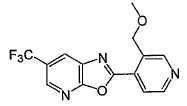
본 활성Saw active 화합물 152Compound 152
1H-NMR(CDCl3)δ:9.04(s, 1H), 8.82(d, J=5.1Hz, 1H), 8.77-8.75(m, 1H), 8.44-8.42(m, 1H), 8.12(d, J=5.1Hz, 1H), 5.11(s, 2H), 3.56(s, 3H)
1 H-NMR (CDCl 3 ) δ: 9.04 (s, 1H), 8.82 (d, J = 5.1 Hz, 1H), 8.77-8.75 (m, 1H), 8.44-8.42 (m, 1H), 8.12 (d , J = 5.1 Hz, 1H), 5.11 (s, 2H), 3.56 (s, 3H)
제조예Production Example 150 150
2-클로로-N-[2-히드록시-5-(트리플루오로메틸)페닐]이소니코틴아미드를 대신하여 N-[2-히드록시-6-(트리플루오로메틸)피리딘-3-일]-이소니코틴아미드를 사용하고, 제조예 22 기재의 방법에 준하여 2-(피리딘-4-일)-5-(트리플루오로메틸)옥사졸로[5,4-b]피리딘(이하, 본 활성화합물 153이라고 함) 0.27g을 얻었다.N- [2-hydroxy-6- (trifluoromethyl) pyridin-3-yl] in place of 2-chloro-N- [2-hydroxy-5- (trifluoromethyl) phenyl] isonicotinamide] 2- (pyridin-4-yl) -5- (trifluoromethyl) oxazolo [5,4-b] pyridine (hereinafter the present active compound) using isonicotinamide according to the method described in Preparation Example 22 153) was obtained.

본 활성Saw active 화합물 153Compound 153
1H-NMR(CDCl3)δ:8.91(dd, J=4.4, 1.7Hz, 2H), 8.30(d, J=8.0Hz, 1H), 8.14(dd, J=4.4, 1.7Hz, 2H), 7.85(d, J=8.0Hz, 1H)
1 H-NMR (CDCl 3 ) δ: 8.91 (dd, J = 4.4, 1.7 Hz, 2H), 8.30 (d, J = 8.0 Hz, 1H), 8.14 (dd, J = 4.4, 1.7 Hz, 2H), 7.85 (d, J = 8.0 Hz, 1H)
제조예Production Example 151 151
3-클로로-N-[2-히드록시-5-(트리플루오로메틸티오)페닐]이소니코틴아미드를 대신하여, 3-클로로-N-[2-히드록시-6-(트리플루오로메틸)피리딘-3-일]-이소니코틴아미드를 사용하고, 제조예 78 기재의 방법에 준하여 2-(3-클로로피리딘-4-일)-5-(트리플루오로메틸)옥사졸로[5,4-b]피리딘(이하, 본 활성화합물 154라고 함) 0.42g을 얻었다.3-chloro-N- [2-hydroxy-6- (trifluoromethyl) in place of 3-chloro-N- [2-hydroxy-5- (trifluoromethylthio) phenyl] isonicotinamide 2- (3-chloropyridin-4-yl) -5- (trifluoromethyl) oxazolo [5,4- using pyridin-3-yl] -isonicotinamide according to the method described in Preparation 78 b] 0.42 g of pyridine (hereinafter referred to as the active compound 154) was obtained.
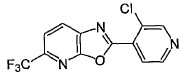
본 활성Saw active 화합물 154Compound 154
1H-NMR(CDCl3)δ:8.89(s, 1H), 8.74(d, J=5.1Hz, 1H), 8.38(d, J=8.0Hz, 1H), 8.14-8.12(m, 1H), 7.88(d, J=8.0Hz, 1H)
1 H-NMR (CDCl 3 ) δ: 8.89 (s, 1H), 8.74 (d, J = 5.1Hz, 1H), 8.38 (d, J = 8.0Hz, 1H), 8.14-8.12 (m, 1H), 7.88 (d, J = 8.0 Hz, 1H)
제조예Production Example 152 152
2-(3-클로로피리딘-4-일)-6-트리플루오로메틸-옥사졸로[5,4-b]피리딘을 대신하여 2-(3-클로로피리딘-4-일)-5-트리플루오로메틸-옥사졸로[5,4-b]피리딘을 사용하고, 제조예 139 기재의 방법에 준하여 2-(3-클로로-1-옥시피리딘-4-일)-5-(트리플루오로메틸)옥사졸로[5,4-b]피리딘(이하, 본 활성화합물 155라고 함) 0.14g을 얻었다.2- (3-chloropyridin-4-yl) -6-trifluoromethyl-oxazolo [5,4-b] pyridine in place of 2- (3-chloropyridin-4-yl) -5-trifluoro 2- (3-chloro-1-oxypyridin-4-yl) -5- (trifluoromethyl) using romethyl-oxazolo [5,4-b] pyridine and following the method described in Preparation Example 139. 0.14 g of oxazolo [5,4-b] pyridine (hereinafter referred to as the present active compound 155) was obtained.
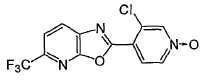
본 활성Saw active 화합물 155Compound 155
1H-NMR(CDCl3)δ:8.41(d, J=1.7Hz, 1H), 8.33(d, J=8.0Hz, 1H), 8.23(dd, J=7.1, 1.7Hz, 1H), 8.19(d, J=7.1Hz, 1H), 7.86(d, J=8.1Hz, 1H)
1 H-NMR (CDCl 3 ) δ: 8.41 (d, J = 1.7 Hz, 1H), 8.33 (d, J = 8.0 Hz, 1H), 8.23 (dd, J = 7.1, 1.7 Hz, 1H), 8.19 ( d, J = 7.1 Hz, 1H), 7.86 (d, J = 8.1 Hz, 1H)
제조예Production Example 153 153
2-아미노-4-프로필페놀을 대신하여 2-아미노-6-메틸피리딘-3-올을 사용하고, 제조예 1 기재의 방법에 준하여 5-메틸-2-피리딘-4-일-옥사졸로[4, 5-b]피리딘(이하, 본 활성화합물 156이라고 함) 0.62g을 얻었다.2-Amino-6-methylpyridin-3-ol was used in place of 2-amino-4-propylphenol, and 5-methyl-2-pyridin-4-yl-oxazolo was prepared according to the method described in Preparation Example 1. 4, 5-b] pyridine (hereinafter referred to as the present active compound 156) was obtained 0.62 g.

본 활성Saw active 화합물 156Compound 156
1H-NMR(CDCl3)δ:8.85(dd, J=4.5, 1.6Hz, 2H), 8.13(dd, J=4.5, 1.6Hz, 2H), 7.82(d, J=8.5Hz, 1H), 7.24(d, J=8.5Hz, 1H), 2.72(s, 3H)
1 H-NMR (CDCl 3 ) δ: 8.85 (dd, J = 4.5, 1.6 Hz, 2H), 8.13 (dd, J = 4.5, 1.6 Hz, 2H), 7.82 (d, J = 8.5 Hz, 1H), 7.24 (d, J = 8.5 Hz, 1H), 2.72 (s, 3H)
제조예Production Example 154 154
2-아미노-4-프로필페놀 및 이소니코틴산을 대신하여 2-아미노-6-메틸피리딘-3-올 및 3-클로로이소니코틴산을 사용하고, 제조예 1 기재의 방법에 준하여 2-(3-클로로피리딘-4-일)-5-메틸옥사졸로[4, 5-b]피리딘(이하, 본 활성화합물 157이라고 함) 0.44g을 얻었다.2-Amino-6-methylpyridin-3-ol and 3-chloroisonicotinic acid were used in place of 2-amino-4-propylphenol and isnicotinic acid, and 2- (3-chloro 0.44 g of pyridin-4-yl) -5-methyloxazolo [4,5-b] pyridine (hereinafter referred to as the active compound 157) was obtained.

본 활성Saw active 화합물 157Compound 157
1H-NMR(CDCl3)δ:8.83(s, 1H), 8.69(d, J=5.1Hz, 1H), 8.16(d, J=5.1Hz, 1H), 7.86(d, J=8.5Hz, 1H), 7.28(d, J=8.4Hz, 1H), 2.74(s, 3H)
1 H-NMR (CDCl 3 ) δ: 8.83 (s, 1H), 8.69 (d, J = 5.1Hz, 1H), 8.16 (d, J = 5.1Hz, 1H), 7.86 (d, J = 8.5Hz, 1H), 7.28 (d, J = 8.4 Hz, 1H), 2.74 (s, 3H)
제조예Production Example 155 155
2-클로로-N-[2-히드록시-5-(트리플루오로메틸)페닐]이소니코틴아미드를 대신하여 3-벤질옥시-N-[2-히드록시-5-(트리플루오로메틸)피리딘-3-일]-이소니코틴아미드를 사용하고, 제조예 22 기재의 방법에 준하여 2-[3-(벤질옥시)피리딘-4-일]-6-트리플루오로메틸-옥사졸로[5,4-b]피리딘(이하, 본 활성화합물 158이라고 함) 2.23g을 얻었다.3-benzyloxy-N- [2-hydroxy-5- (trifluoromethyl) pyridine on behalf of 2-chloro-N- [2-hydroxy-5- (trifluoromethyl) phenyl] isonicotinamide 2- [3- (benzyloxy) pyridin-4-yl] -6-trifluoromethyl-oxazolo [5,4 using 3-yl] -isonicotinamide according to the method described in Preparation Example 22 -b] 2.23 g of pyridine (hereinafter referred to as the active compound 158) was obtained.
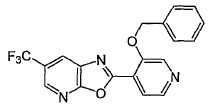
본 활성화합물 158Present Active Compound 158
1H-NMR(CDCl3)δ:8.75-8.73(m, 1H), 8.63(s, 1H), 8.47(d, J=4.9Hz, 1H), 8.40-8.38(m, 1H), 8.06(d, J=4.9Hz, 1H), 7.60-7.56(m, 2H), 7.45-7.40(m, 2H), 7.38-7.32(m, 1H), 5.47(s, 2H)
1 H-NMR (CDCl 3 ) δ: 8.75-8.73 (m, 1H), 8.63 (s, 1H), 8.47 (d, J = 4.9Hz, 1H), 8.40-8.38 (m, 1H), 8.06 (d , J = 4.9 Hz, 1H), 7.60-7.56 (m, 2H), 7.45-7.40 (m, 2H), 7.38-7.32 (m, 1H), 5.47 (s, 2H)
제조예Production Example 156 156
2-[3-(벤질옥시)피리딘-4-일]-6-트리플루오로메틸-옥사졸로[5,4-b]피리딘 1.7g, 아세트산에틸 40ml 및 10% 팔라듐탄소의 혼합물을 40bar, 40℃의 조건하에서 2시간 동안 반응시켰다. 반응액을 감압 하에서 농축하고, 잔사를 실리카겔 칼럼크로마토그래피 처리하여 4-(6-트리플루오로메틸-옥사졸로[5,4-b]피리딘-2-일)피리딘-3-올(이하, 본 활성화합물 159라고 함) 1.0g을 얻었다.A mixture of 1.7 g of 2- [3- (benzyloxy) pyridin-4-yl] -6-trifluoromethyl-oxazolo [5,4-b] pyridine, 40 ml of ethyl acetate, and 10% palladium carbon, 40 bar, 40 The reaction was carried out under conditions of ℃ for 2 hours. The reaction solution was concentrated under reduced pressure, and the residue was subjected to silica gel column chromatography to give 4- (6-trifluoromethyl-oxazolo [5,4-b] pyridin-2-yl) pyridin-3-ol (hereinafter, referred to as 1.0 g of the active compound was obtained.

본 활성Saw active 화합물 159Compound 159
1H-NMR(CDCl3)δ:10.57(s, 1H), 8.79-8.78(m, 1H), 8.67(s, 1H), 8.41-8.39(m, 2H), 7.91(d, J=5.1Hz, 1H)
1 H-NMR (CDCl 3 ) δ: 10.57 (s, 1H), 8.79-8.78 (m, 1H), 8.67 (s, 1H), 8.41-8.39 (m, 2H), 7.91 (d, J = 5.1Hz , 1H)
제조예Production Example 157 157
4-(6-트리플루오로메틸-옥사졸로[5,4-b]피리딘-2-일)피리딘-3-올 0.26g, 탄산칼륨 0.14g 및 DMF 3ml의 혼합물에 실온에서 요오드화이소프로필 0.17g을 첨가한 후, 60℃에서 1.5시간 동안 가열교반하였다. 탄산칼륨 38mg과 요오드화이소프로필 47mg을 추가하고, 60℃에서 2시간 동안 가열교반하였다. 실온까지 냉각한 후, 반응혼합물에 물을 첨가하고, 아세트산에틸로 2회 추출하였다. 혼합된 유기층을 물, 포화식염수로 세정하고, 무수황산마그네슘으로 건조시켰다. 감압 하에서 농축하고, 잔사를 실리카겔 칼럼크로마토그래피 처리하여 2-(3-이소프로폭시피리딘-4-일)-6-트리플루오로메틸-옥사졸로[5,4-b]피리딘(이하, 본 활성화합물 160이라고 함) 0.16g을 얻었다.0.17 g of isopropyl iodide at room temperature in a mixture of 0.26 g of 4- (6-trifluoromethyl-oxazolo [5,4-b] pyridin-2-yl) pyridin-3-ol, 0.14 g of potassium carbonate and 3 ml of DMF After the addition, the mixture was heated and stirred at 60 ° C. for 1.5 hours. 38 mg of potassium carbonate and 47 mg of isopropyl iodide were added, followed by heating and stirring at 60 ° C. for 2 hours. After cooling to room temperature, water was added to the reaction mixture, and the mixture was extracted twice with ethyl acetate. The mixed organic layer was washed with water and brine, and dried over anhydrous magnesium sulfate. Concentrated under reduced pressure, and the residue was subjected to silica gel column chromatography to give 2- (3-isopropoxypyridin-4-yl) -6-trifluoromethyl-oxazolo [5,4-b] pyridine (hereinafter, active) 0.16 g).
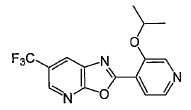
본 활성Saw active 화합물 160Compound 160
1H-NMR(CDCl3)δ:8.73-8.71(m, 1H), 8.60(s, 1H), 8.43-8.41(m, 1H), 8.39-8.38(m, 1H), 8.02(d, J=5.1Hz, 1H), 4.94-4.83(m, 1H), 1.52(d, J=6.1Hz, 6H)
1 H-NMR (CDCl 3 ) δ: 8.73-8.71 (m, 1H), 8.60 (s, 1H), 8.43-8.41 (m, 1H), 8.39-8.38 (m, 1H), 8.02 (d, J = 5.1 Hz, 1H), 4.94-4.83 (m, 1H), 1.52 (d, J = 6.1 Hz, 6H)
제조예Production Example 158 158
4-(6-트리플루오로메틸-옥사졸로[5,4-b]피리딘-2-일)피리딘-3-올 0.25g, 탄산칼륨 0.14g 및 DMF 3ml의 혼합물에 실온에서 요오드에탄 0.15g 및 DMF 1ml의 혼합물을 첨가한 후, 60℃에서 1.5시간 동안 가열교반하였다. 탄산칼륨 70mg과 요오드에탄 53mg을 추가하고, 60℃에서 3.5시간 동안 가열교반하였다. 실온까지 냉각한 후, 반응혼합물에 물을 첨가하고, 아세트산에틸로 2회 추출하였다. 혼합된 유기층을 물, 포화식염수로 세정하고, 무수황산마그네슘으로 건조시켰다. 감압 하에서 농축하고, 잔사를 실리카겔 칼럼크로마토그래피 처리하여 2-(3-에톡시피리딘-4-일)-6-트리플루오로메틸-옥사졸로[5,4-b]피리딘(이하, 본 활성화합물 161이라고 함) 60mg을 얻었다.0.15 g of iodineethane at room temperature in a mixture of 0.25 g of 4- (6-trifluoromethyl-oxazolo [5,4-b] pyridin-2-yl) pyridin-3-ol, 0.14 g of potassium carbonate and 3 ml of DMF and A mixture of 1 ml of DMF was added and then stirred at 60 ° C. for 1.5 hours. 70 mg of potassium carbonate and 53 mg of iodine ethane were added, followed by heating and stirring at 60 ° C. for 3.5 hours. After cooling to room temperature, water was added to the reaction mixture, and the mixture was extracted twice with ethyl acetate. The mixed organic layer was washed with water and brine, and dried over anhydrous magnesium sulfate. Concentrated under reduced pressure, and the residue was subjected to silica gel column chromatography to give 2- (3-ethoxypyridin-4-yl) -6-trifluoromethyl-oxazolo [5,4-b] pyridine (hereinafter the present active compound). 161) to 60 mg.

본 활성Saw active 화합물 161Compound 161
1H-NMR(CDCl3)δ:8.74-8.72(m, 1H), 8.60(s, 1H), 8.45(d, J=4.9Hz, 1H), 8.40-8.38(m, 1H), 8.04-8.02(m, 1H), 4.41(q, J=6.9Hz, 2H), 1.60(t, J=7.0Hz, 3H)
1 H-NMR (CDCl 3 ) δ: 8.74-8.72 (m, 1H), 8.60 (s, 1H), 8.45 (d, J = 4.9Hz, 1H), 8.40-8.38 (m, 1H), 8.04-8.02 (m, 1H), 4.41 (q, J = 6.9 Hz, 2H), 1.60 (t, J = 7.0 Hz, 3H)
제조예Production Example 159 159
4-(6-트리플루오로메틸-옥사졸로[5,4-b]피리딘-2-일)피리딘-3-올 0.31g, 탄산칼륨 0.23g 및 DMF 3ml의 혼합물에 실온에서 트리플루오로메탄설폰산(2,2-디플루오로에틸)에스테르 0.50g 및 DMF 7ml의 혼합물을 첨가한 후, 60℃에서 6시간 동안 가열교반하였다. 실온까지 냉각한 후, 반응혼합물에 물을 첨가하고, 아세트산에틸로 2회 추출하였다. 혼합된 유기층을 물, 포화식염수로 세정하고, 무수황산마그네슘으로 건조시켰다. 감압 하에서 농축하고, 잔사를 실리카겔 칼럼크로마토그래피 처리하여 2-[3-(2,2-디플루오로에톡시)피리딘-4-일]-6-트리플루오로메틸-옥사졸로[5,4-b]피리딘(이하, 본 활성화합물 162라고 함) 0.10g을 얻었다.Trifluoromethanesulfur at room temperature in a mixture of 0.31 g of 4- (6-trifluoromethyl-oxazolo [5,4-b] pyridin-2-yl) pyridin-3-ol, 0.23 g of potassium carbonate and 3 ml of DMF A mixture of 0.50 g of phonic acid (2,2-difluoroethyl) ester and 7 ml of DMF was added, followed by heat stirring at 60 ° C. for 6 hours. After cooling to room temperature, water was added to the reaction mixture, and the mixture was extracted twice with ethyl acetate. The mixed organic layer was washed with water and brine, and dried over anhydrous magnesium sulfate. Concentrated under reduced pressure, and the residue was subjected to silica gel column chromatography to give 2- [3- (2,2-difluoroethoxy) pyridin-4-yl] -6-trifluoromethyl-oxazolo [5,4- b] 0.10 g of pyridine (hereinafter referred to as the present active compound 162) was obtained.

본 활성Saw active 화합물 162Compound 162
1H-NMR(CDCl3)δ:8.76-8.74(m, 1H), 8.62(s, 1H), 8.57(d, J=5.1Hz, 1H), 8.41-8.40(m, 1H), 8.09(d, J=5.1Hz, 1H), 6.30(tt, J=54.8, 4.0Hz, 1H), 4.53(td, J=12.7, 4.1Hz, 2H)
1 H-NMR (CDCl 3 ) δ: 8.76-8.74 (m, 1H), 8.62 (s, 1H), 8.57 (d, J = 5.1Hz, 1H), 8.41-8.40 (m, 1H), 8.09 (d , J = 5.1 Hz, 1H), 6.30 (tt, J = 54.8, 4.0 Hz, 1H), 4.53 (td, J = 12.7, 4.1 Hz, 2H)
다음에 상기의 본 활성화합물의 제조 중간체의 제조에 대해 제조예를 나타낸다.Next, the manufacture example is shown about manufacture of the manufacturing intermediate of said active compound mentioned above.
참고 Reference 제조예Production Example 1 One
4-프로필페놀 5.0g 및 아세트산 35ml의 혼합물에 10~15℃로 유지한 채로 61%질산 3.80g과 아세트산 10ml의 혼합물을 적하하여 4시간 동안 교반하였다. 반응혼합물을 빙수 중에 부어서 아세트산에틸로 추출하였다. 혼합된 유기층을 물, 포화탄산수소나트륨 수용액 및 포화식염수로 세정하고, 황산마그네슘으로 건조한 후, 감압 하에서 농축함으로써 4-프로필-2-니트로페놀 6.65g을 얻었다.A mixture of 3.80 g of 61% nitric acid and 10 ml of acetic acid was added dropwise to a mixture of 5.0 g of 4-propylphenol and 35 ml of acetic acid at 10 to 15 ° C, followed by stirring for 4 hours. The reaction mixture was poured into ice water and extracted with ethyl acetate. The mixed organic layer was washed with water, saturated aqueous sodium hydrogen carbonate solution and saturated brine, dried over magnesium sulfate, and concentrated under reduced pressure to obtain 6.65 g of 4-propyl-2-nitrophenol.

1H-NMR(CDCl3)δ:10.46(s, 1H), 7.89(d, J=2.2Hz, 1H), 7.40(dd, J=8.5, 2.2Hz, 1H), 7.08(d, J=8.5Hz, 1H), 2.58(t, J=7.8Hz, 2H), 1.69-1.59(m, 2H), 0.94(t, J=7.3Hz, 3H) 1 H-NMR (CDCl 3 ) δ: 10.46 (s, 1H), 7.89 (d, J = 2.2 Hz, 1H), 7.40 (dd, J = 8.5, 2.2 Hz, 1H), 7.08 (d, J = 8.5 Hz, 1H), 2.58 (t, J = 7.8 Hz, 2H), 1.69-1.59 (m, 2H), 0.94 (t, J = 7.3 Hz, 3H)
4-프로필-2-니트로페놀 6.65g, 아세트산에틸 55ml 및 5% 팔라듐탄소 1.0g의 혼합물을 약 1기압의 수소 분위기하 실온에서 2시간 동안 교반하였다. 셀라이트(등록상표)를 통하여 여과하여 여과액을 감압 하에서 농축함으로써 2-아미노-4-프로필페놀 5.17g을 얻었다.A mixture of 6.65 g of 4-propyl-2-nitrophenol, 55 ml of ethyl acetate, and 1.0 g of 5% palladium carbon was stirred at room temperature under a hydrogen atmosphere of about 1 atmosphere for 2 hours. 5.17 g of 2-amino-4-propylphenol was obtained by filtering through Celite (registered trademark) and concentrating the filtrate under reduced pressure.

1H-NMR(CDCl3)δ:6.64(d, J=7.9Hz, 1H), 6.59(d, J=2.0Hz, 1H), 6.49(dd, J=8.0, 2.0Hz, 1H), 3.74(br s, 2H), 2.44(t, J=7.8Hz, 2H), 1.63-1.52(m, 2H), 0.91(t, J=7.3Hz, 3H)
1 H-NMR (CDCl 3 ) δ: 6.64 (d, J = 7.9 Hz, 1H), 6.59 (d, J = 2.0 Hz, 1H), 6.49 (dd, J = 8.0, 2.0 Hz, 1H), 3.74 ( br s, 2H), 2.44 (t, J = 7.8 Hz, 2H), 1.63-1.52 (m, 2H), 0.91 (t, J = 7.3 Hz, 3H)
참고 Reference 제조예Production Example 2 2
4-프로필페놀을 대신하여 4-부틸페놀을 사용하고, 참고 제조예 1 기재의 방법에 준하여 4-부틸-2-니트로페놀을 얻었다.4-butylphenol was used in place of 4-propylphenol, and 4-butyl-2-nitrophenol was obtained according to the method described in Reference Production Example 1.

1H-NMR(CDCl3)δ:10.46(s, 1H), 7.89(d, J=2.2Hz, 1H), 7.41(dd, J=8.5, 2.2Hz, 1H), 7.07(d, J=8.5Hz, 1H), 2.60(t, J=7.6Hz, 2H), 1.65-1.53(m, 2H), 1.41-1.30(m, 2H), 0.93(t, J=7.3Hz, 3H)
1 H-NMR (CDCl 3 ) δ: 10.46 (s, 1H), 7.89 (d, J = 2.2Hz, 1H), 7.41 (dd, J = 8.5, 2.2Hz, 1H), 7.07 (d, J = 8.5 Hz, 1H), 2.60 (t, J = 7.6 Hz, 2H), 1.65-1.53 (m, 2H), 1.41-1.30 (m, 2H), 0.93 (t, J = 7.3 Hz, 3H)
4-프로필-2-니트로페놀을 대신하여 4-부틸-2-니트로페놀을 사용하고, 참고 제조예 1 기재의 방법에 준하여 2-아미노-4-부틸페놀을 얻었다.4-Butyl-2-nitrophenol was used in place of 4-propyl-2-nitrophenol, and 2-amino-4-butylphenol was obtained following the method described in Reference Production Example 1.

1H-NMR(CDCl3)δ:6.64(d, J=8.0Hz, 1H), 6.59(d, J=2.0Hz, 1H), 6.49(dd, J=8.0, 2.0Hz, 1H), 3.60(br s, 2H), 2.47(t, J=7.6Hz, 2H), 1.59-1.49(m, 2H), 1.38-1.27(m, 2H), 0.91(t, J=7.3Hz, 3H)
1 H-NMR (CDCl 3 ) δ: 6.64 (d, J = 8.0 Hz, 1H), 6.59 (d, J = 2.0 Hz, 1H), 6.49 (dd, J = 8.0, 2.0 Hz, 1H), 3.60 ( br s, 2H), 2.47 (t, J = 7.6 Hz, 2H), 1.59-1.49 (m, 2H), 1.38-1.27 (m, 2H), 0.91 (t, J = 7.3 Hz, 3H)
참고 Reference 제조예Production Example 3 3
4-메톡시-2-니트로페놀 7g, 아세트산에틸 50ml 및 5% 팔라듐탄소 1.3g의 혼합물을 약 1기압의 수소 분위기하 실온에서 3.3시간 동안 교반하였다. 반응혼합물을 셀라이트(등록상표) 여과하여 여과액을 감압 하에서 농축함으로써 2-아미노-4-메톡시페놀을 얻었다. 이것을 더 정제하지 않고 다음의 반응에 사용하였다.A mixture of 7 g of 4-methoxy-2-nitrophenol, 50 ml of ethyl acetate, and 1.3 g of 5% palladium carbon was stirred for 3.3 hours at room temperature under a hydrogen atmosphere of about 1 atmosphere. The reaction mixture was filtered through Celite (registered trademark) and the filtrate was concentrated under reduced pressure to obtain 2-amino-4-methoxyphenol. This was used for the next reaction without further purification.
2-아미노-4-메톡시페놀의 조제물 2.5g, 이소니코틴산 클로라이드 염산염 3.2g 및 피리딘 20ml의 혼합물을 12시간 동안 가열환류하였다. 반응혼합물을 빙수 중에 붓고, 석출한 침전물을 여과하였다. 얻어진 고체를 아세트산에틸으로 녹이고, 물 및 포화식염수로 세정한 후, 황산마그네슘으로 건조하였다. 활성탄을 첨가한 후, 셀라이트(등록상표)를 통하여 여과하여 여과액을 감압 하에서 농축함으로써 N-(2-히드록시-5-메톡시페닐)이소니코틴아미드를 얻었다.A mixture of 2.5 g of the preparation of 2-amino-4-methoxyphenol, 3.2 g of isicotinic acid chloride hydrochloride and 20 ml of pyridine was heated to reflux for 12 hours. The reaction mixture was poured into ice water and the precipitate precipitated was filtered. The obtained solid was dissolved in ethyl acetate, washed with water and brine, and dried over magnesium sulfate. After adding activated carbon, the mixture was filtered through Celite (registered trademark) and the filtrate was concentrated under reduced pressure to obtain N- (2-hydroxy-5-methoxyphenyl) isonicotinamide.

1H-NMR(DMSO-d6)δ:9.50(br s, 1H), 8.79-8.75(m, 2H), 7.89-7.83(m, 2H), 7.36-7.30(m, 1H), 6.87-6.81(m, 1H), 6.70-6.64(m, 1H), 3.69(s, 3H)
1 H-NMR (DMSO-d 6 ) δ: 9.50 (br s, 1H), 8.79-8.75 (m, 2H), 7.89-7.83 (m, 2H), 7.36-7.30 (m, 1H), 6.87-6.81 (m, 1 H), 6.70-6.64 (m, 1 H), 3.69 (s, 3 H)
참고 Reference 제조예Production Example 4 4
4-프로필페놀을 대신하여 4-에틸페놀을 사용하고, 참고 제조예 1 기재의 방법에 준하여 4-에틸-2-니트로페놀을 얻었다.4-ethylphenol was used in place of 4-propylphenol, and 4-ethyl-2-nitrophenol was obtained according to the method described in Reference Production Example 1.

1H-NMR(CDCl3)δ:10.46(s, 1H), 7.91(d, J=2.1Hz, 1H), 7.43(dd, J=8.5, 2.2Hz, 1H), 7.08(d, J=8.7Hz, 1H), 2.64(q, J=7.8Hz, 2H), 1.25(t, J=7.8Hz, 3H) 1 H-NMR (CDCl 3 ) δ: 10.46 (s, 1H), 7.91 (d, J = 2.1Hz, 1H), 7.43 (dd, J = 8.5, 2.2Hz, 1H), 7.08 (d, J = 8.7 Hz, 1H), 2.64 (q, J = 7.8 Hz, 2H), 1.25 (t, J = 7.8 Hz, 3H)
4-프로필-2-니트로페놀을 대신하여 4-에틸-2-니트로페놀을 사용하고, 참고 제조예 1 기재의 방법에 준하여 2-아미노-4-에틸페놀을 얻었다.
4-ethyl-2-nitrophenol was used in place of 4-propyl-2-nitrophenol, and 2-amino-4-ethylphenol was obtained following the method described in Reference Production Example 1.

1H-NMR(CDCl3)δ:6.65(d, J=8.0Hz, 1H), 6.61(d, J=2.1Hz, 1H), 6.53-6.49(m, 1H), 3.84(br s, 2H), 2.51(q, J=7.6Hz, 2H), 1.18(t, J=7.6Hz, 3H)
1 H-NMR (CDCl 3 ) δ: 6.65 (d, J = 8.0Hz, 1H), 6.61 (d, J = 2.1Hz, 1H), 6.53-6.49 (m, 1H), 3.84 (br s, 2H) , 2.51 (q, J = 7.6 Hz, 2H), 1.18 (t, J = 7.6 Hz, 3H)
참고 Reference 제조예Production Example 5 5
4-프로필페놀을 대신하여 4-이소프로필페놀을 사용하고, 참고 제조예 1 기재의 방법에 준하여 4-이소프로필-2-니트로페놀을 얻었다.4-isopropylphenol was used in place of 4-propylphenol, and 4-isopropyl-2-nitrophenol was obtained according to the method described in Reference Production Example 1.

1H-NMR(CDCl3)δ:10.46(s, 1H), 7.93(d, J=2.1Hz, 1H), 7.47(dd, J=8.5, 2.2Hz, 1H), 7.09(d, J=8.6Hz, 1H), 2.97-2.86(m, 1H), 1.25(d, J=7.0Hz, 6H)
1 H-NMR (CDCl 3 ) δ: 10.46 (s, 1H), 7.93 (d, J = 2.1Hz, 1H), 7.47 (dd, J = 8.5, 2.2Hz, 1H), 7.09 (d, J = 8.6 Hz, 1H), 2.97-2.86 (m, 1H), 1.25 (d, J = 7.0 Hz, 6H)
4-프로필-2-니트로페놀을 대신하여 4-이소프로필-2-니트로페놀을 사용하고, 참고 제조예 1 기재의 방법에 준하여 2-아미노-4-이소프로필페놀을 얻었다.4-isopropyl-2-nitrophenol was used in place of 4-propyl-2-nitrophenol, and 2-amino-4-isopropylphenol was obtained following the method described in Reference Production Example 1.
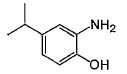
1H-NMR(CDCl3)δ:6.66(d, J=8.2Hz, 1H), 6.64(d, J=2.1Hz, 1H), 6.54(dd, J=8.0, 2.2Hz, 1H), 4.60(br s, 1H), 3.58(br s, 2H), 2.84-2.70(m, 1H), 1.19(d, J=7.0Hz, 6H)
1 H-NMR (CDCl 3 ) δ: 6.66 (d, J = 8.2 Hz, 1H), 6.64 (d, J = 2.1 Hz, 1H), 6.54 (dd, J = 8.0, 2.2 Hz, 1H), 4.60 ( br s, 1H), 3.58 (br s, 2H), 2.84-2.70 (m, 1H), 1.19 (d, J = 7.0 Hz, 6H)
참고 Reference 제조예Production Example 6 6
4-프로필페놀을 대신하여 4-tert-부틸페놀을 사용하고, 참고 제조예 1 기재의 방법에 준하여 4-tert-부틸-2-니트로페놀을 얻었다.4-tert-butylphenol was used in place of 4-propylphenol, and 4-tert-butyl-2-nitrophenol was obtained according to the method described in Reference Production Example 1.

1H-NMR(CDCl3)δ:10.47(s, 1H), 8.07(d, J=2.4Hz, 1H), 7.64(dd, J=8.8, 2.4Hz, 1H), 7.10(d, J=8.8Hz, 1H), 1.33(s, 9H)
1 H-NMR (CDCl 3 ) δ: 10.47 (s, 1H), 8.07 (d, J = 2.4Hz, 1H), 7.64 (dd, J = 8.8, 2.4Hz, 1H), 7.10 (d, J = 8.8 Hz, 1H), 1.33 (s, 9H)
4-프로필-2-니트로페놀을 대신하여 4-tert-부틸-2-니트로페놀을 사용하고, 참고 제조예 1 기재의 방법에 준하여 2-아미노-4-tert-부틸페놀을 얻었다.4-tert-butyl-2-nitrophenol was used in place of 4-propyl-2-nitrophenol, and 2-amino-4-tert-butylphenol was obtained according to the method described in Reference Production Example 1.

1H-NMR(CDCl3)δ:6.80(d, J=2.2Hz, 1H), 6.70(dd, J=8,2, 2.2Hz, 1H), 6.66(d, J=8.2, 1H), 3.59(br s, 2H), 1.26(s, 9H)
1 H-NMR (CDCl 3 ) δ: 6.80 (d, J = 2.2Hz, 1H), 6.70 (dd, J = 8,2, 2.2Hz, 1H), 6.66 (d, J = 8.2, 1H), 3.59 (br s, 2H), 1.26 (s, 9H)
참고 Reference 제조예Production Example 7 7
4-프로필-2-니트로페놀을 대신하여 2-니트로-4-트리플루오로메틸페놀을 사용하고, 참고 제조예 1 기재의 방법에 준하여 2-아미노-4-트리플루오로메틸페놀을 얻었다.2-Nitro-4-trifluoromethylphenol was used in place of 4-propyl-2-nitrophenol, and 2-amino-4-trifluoromethylphenol was obtained according to the method described in Reference Production Example 1.

1H-NMR(CDCl3)δ:6.98(d, J=2.2Hz, 1H), 6.95-6.92(m, 1H), 6.76(d, J=8.3, 1H), 5.33(br s, 1H), 3.80(br s, 2H)
1 H-NMR (CDCl 3 ) δ: 6.98 (d, J = 2.2 Hz, 1H), 6.95-6.92 (m, 1H), 6.76 (d, J = 8.3, 1H), 5.33 (br s, 1H), 3.80 (br s, 2 H)
2-아미노-4-트리플루오로메틸페놀 2.84g, 이소니코틴산 1.97g, WSC[1-에틸-3-(3-디메틸아미노프로필)카르보디이미드염산염] 3.69g 및 피리딘 20ml의 혼합물을 80℃에서 4시간 동안 가열교반하였다. 실온에 냉각한 후, 물을 첨가하고, 아세트산에틸로 2회 추출하였다. 혼합된 유기층을 물, 포화식염수로 세정하고, 황산마그네슘으로 건조한 후, 감압 하에서 농축하였다. 잔사를 아세트산에틸-헥산 혼합용매로 세정함으로써 N-(2-히드록시-5-트리플루오로메틸페닐)이소니코틴아미드 1.69g을 얻었다.A mixture of 2.84 g of 2-amino-4-trifluoromethylphenol, 1.97 g of isonicotinic acid, 3.69 g of WSC [1-ethyl-3- (3-dimethylaminopropyl) carbodiimide hydrochloride] and 20 ml of pyridine was prepared at 80 ° C. The mixture was heated and stirred for 4 hours. After cooling to room temperature, water was added and extracted twice with ethyl acetate. The mixed organic layer was washed with water and brine, dried over magnesium sulfate, and concentrated under reduced pressure. The residue was washed with an ethyl acetate-hexane mixed solvent to obtain 1.69 g of N- (2-hydroxy-5-trifluoromethylphenyl) isonicotinamide.

1H-NMR(DMSO-d6)δ:10.82(br s, 1H), 9.94(br s, 1H), 8.80-8.78(m, 2H), 8.05(d, J=2.0Hz, 1H), 7.88-7.86(m, 2H), 7.43(dd, J=8.5, 2.0Hz, 1H), 7.10(d, J=8.6Hz, 1H)
1 H-NMR (DMSO-d 6 ) δ: 10.82 (br s, 1H), 9.94 (br s, 1H), 8.80-8.78 (m, 2H), 8.05 (d, J = 2.0 Hz, 1H), 7.88 -7.86 (m, 2H), 7.43 (dd, J = 8.5, 2.0 Hz, 1H), 7.10 (d, J = 8.6 Hz, 1H)
참고 Reference 제조예Production Example 8 8
3-tert-부틸페놀 5g 및 아세트산 30ml의 혼합물에 10-15℃로 유지한 채로 70% 질산 3.0g과 아세트산 10ml의 혼합물을 적하하여 2시간 동안 교반하였다. 반응혼합물을 빙수 중에 부어서, 아세트산에틸로 2회 추출하였다. 혼합된 유기층을 물, 포화탄산수소나트륨 수용액 및 포화식염수로 세정하고, 황산마그네슘으로 건조한 후, 감압 하에서 농축하였다. 잔사를 실리카겔 칼럼크로마토그래피 처리하여 5-tert-부틸-2-니트로페놀 1.82g을 얻었다.A mixture of 3.0 g of 70% nitric acid and 10 ml of acetic acid was added dropwise to a mixture of 5 g of 3-tert-butylphenol and 30 ml of acetic acid at 10-15 ° C. and stirred for 2 hours. The reaction mixture was poured into ice water and extracted twice with ethyl acetate. The mixed organic layer was washed with water, saturated aqueous sodium hydrogen carbonate solution and saturated brine, dried over magnesium sulfate, and concentrated under reduced pressure. The residue was subjected to silica gel column chromatography to obtain 1.82 g of 5-tert-butyl-2-nitrophenol.

1H-NMR(CDCl3)δ:10.60(s, 1H), 8.01(d, J=9.0Hz, 1H), 7.13(d, J=2.2, 1H), 7.01(dd, J=9.0, 2.0Hz, 1H), 1.33(s, 9H)
1 H-NMR (CDCl 3 ) δ: 10.60 (s, 1H), 8.01 (d, J = 9.0Hz, 1H), 7.13 (d, J = 2.2, 1H), 7.01 (dd, J = 9.0, 2.0Hz , 1H), 1.33 (s, 9H)
4-프로필-2-니트로페놀을 대신하여 5-tert-부틸-2-니트로페놀을 사용하고, 참고 제조예 1 기재의 방법에 준하여 2-아미노-5-tert-부틸페놀을 얻었다.5-tert-butyl-2-nitrophenol was used in place of 4-propyl-2-nitrophenol, and 2-amino-5-tert-butylphenol was obtained according to the method described in Reference Production Example 1.
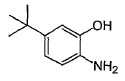
2-아미노-5-tert-부틸페놀 1.44g, 이소니코틴산 1.07g, WSC 2.17g 및 피리딘 15ml의 혼합물을 80℃에서 5시간 동안 가열교반하였다. 실온에 냉각한 후, 물을 첨가하였다. 석출한 고체를 여과하고, 물, 디에틸에테르로 세정함으로써 N-(4-tert-부틸-2-히드록시페닐)이소니코틴아미드 1.22g을 얻었다.A mixture of 1.44 g of 2-amino-5-tert-butylphenol, 1.07 g of isonicotinic acid, 2.17 g of WSC, and 15 ml of pyridine was heated and stirred at 80 ° C. for 5 hours. After cooling to room temperature, water was added. The precipitated solid was filtered and washed with water and diethyl ether to obtain 1.22 g of N- (4-tert-butyl-2-hydroxyphenyl) isonicotinamide.
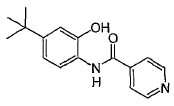
1H-NMR(CDCl3+DMSO-d6)δ:9.32(br s, 1H), 9.12(br s, 1H), 8.81-8.77(m, 2H), 7.85-7.78(m, 3H), 7.03(d, J=1.9, 1H), 6.93(dd, J=8.5, 1.9Hz, 1H), 1.31(s, 9H)
1 H-NMR (CDCl 3 + DMSO-d 6 ) δ: 9.32 (br s, 1H), 9.12 (br s, 1H), 8.81-8.77 (m, 2H), 7.85-7.78 (m, 3H), 7.03 (d, J = 1.9, 1H), 6.93 (dd, J = 8.5, 1.9 Hz, 1H), 1.31 (s, 9H)
참고 Reference 제조예Production Example 9 9
3-트리플루오로메틸페놀 7.5g에 실온에서 70% 질산 9ml를 적하하여 1시간 동안 교반하였다. 반응혼합물을 빙랭한 포화탄산수소나트륨 수용액 중에 붓고, 아세트산에틸로 2회 추출하였다. 혼합된 유기층을 물, 포화식염수로 세정하고, 황산마그네슘으로 건조한 후, 감압 하에서 농축하였다. 잔사를 실리카겔 칼럼크로마토그래피 처리하여 2-니트로-5-트리플루오로메틸페놀 1.56g을 얻었다.9 ml of 70% nitric acid was added dropwise to 7.5 g of 3-trifluoromethylphenol at room temperature, followed by stirring for 1 hour. The reaction mixture was poured into an ice-cold saturated aqueous sodium hydrogen carbonate solution and extracted twice with ethyl acetate. The mixed organic layer was washed with water and brine, dried over magnesium sulfate, and concentrated under reduced pressure. The residue was subjected to silica gel column chromatography to obtain 1.56 g of 2-nitro-5-trifluoromethylphenol.

1H-NMR(CDCl3)δ:10.59(s, 1H), 8.25(d, J=8.8Hz, 1H), 7.48-7.46(m, 1H), 7.27-7.23(m, 1H)
1 H-NMR (CDCl 3 ) δ: 10.59 (s, 1H), 8.25 (d, J = 8.8 Hz, 1H), 7.48-7.46 (m, 1H), 7.27-7.23 (m, 1H)
4-프로필-2-니트로페놀을 대신하여 2-니트로-5-트리플루오로메틸페놀을 사용하고, 참고 제조예 1 기재의 방법에 준하여 2-아미노-5-트리플루오로메틸페놀을 얻었다.
2-Nitro-5-trifluoromethylphenol was used in place of 4-propyl-2-nitrophenol, and 2-amino-5-trifluoromethylphenol was obtained according to the method described in Reference Production Example 1.

1H-NMR(CDCl3+DMSO-d6)δ:9.03(br s, 1H), 7.01(d, J=1.8Hz, 1H), 6.95-6.91(m, 1H), 6.71-6.66(m, 1H), 4.13(br s, 2H)
1 H-NMR (CDCl 3 + DMSO-d 6 ) δ: 9.03 (br s, 1H), 7.01 (d, J = 1.8 Hz, 1H), 6.95-6.91 (m, 1H), 6.71-6.66 (m, 1H), 4.13 (br s, 2H)
2-아미노-5-트리플루오로메틸페놀 1.30g, 이소니코틴산 0.9g, WSC 1.83g 및 피리딘 15ml의 혼합물을 80℃에서 3시간 동안 가열교반하였다. 실온에 냉각한 후, 물을 부었다. 석출한 고체를 여과하고, 물로 세정한 후, 감압 하에서 건조시킴으로써 N-(2-히드록시-4-트리플루오로메틸페닐)이소니코틴아미드 1.5g을 얻었다.A mixture of 1.30 g of 2-amino-5-trifluoromethylphenol, 0.9 g of isonicotinic acid, 1.83 g of WSC, and 15 ml of pyridine was heated and stirred at 80 ° C. for 3 hours. After cooling to room temperature, water was poured. The precipitated solid was filtered, washed with water and dried under reduced pressure to obtain 1.5 g of N- (2-hydroxy-4-trifluoromethylphenyl) isonicotinamide.
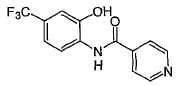
1H-NMR(DMSO-d6)δ:8.82-8.76(m, 2H), 7.98-7.93(m, 1H), 7.89-7.85(m, 2H), 7.23-7.17(m, 2H)
1 H-NMR (DMSO-d 6 ) δ: 8.82-8.76 (m, 2H), 7.98-7.93 (m, 1H), 7.89-7.85 (m, 2H), 7.23-7.17 (m, 2H)
참고 Reference 제조예Production Example 10 10
1,1,3,3-테트라플루오로-5-히드록시-6-니트로-1,3-디히드로이소벤조푸란 6.8g과 아세트산 20ml의 혼합물을 80℃로 가열한 전해철 7.8g, 아세트산 20ml, 물 20ml의 혼합물에 적하하여 1시간 동안 교반하였다. 실온에 냉각한 후, 물을 첨가하고, 아세트산에틸로 2회 추출하였다. 혼합된 유기층을 물, 포화탄산수소나트륨 수용액, 포화식염수로 세정하고, 황산마그네슘으로 건조시킨 후, 활성탄을 첨가하고, 그 후 셀라이트(등록상표)를 통하여 여과하였다. 여과액을 감압 하에서 농축함으로써 6-아미노-1,1,3,3-테트라플루오로-5-히드록시-1,3-디히드로이소벤조푸란 4.43g을 얻었다.7.8 g of electrolytic iron heated in a mixture of 6.8 g of 1,1,3,3-tetrafluoro-5-hydroxy-6-nitro-1,3-dihydroisobenzofuran and 20 ml of acetic acid at 80 ° C., 20 ml of acetic acid, It was added dropwise to a mixture of 20 ml of water and stirred for 1 hour. After cooling to room temperature, water was added and extracted twice with ethyl acetate. The mixed organic layers were washed with water, saturated aqueous sodium hydrogen carbonate solution and saturated brine, dried over magnesium sulfate, activated carbon was added, and then filtered through Celite (registered trademark). The filtrate was concentrated under reduced pressure to obtain 4.43 g of 6-amino-1,1,3,3-tetrafluoro-5-hydroxy-1,3-dihydroisobenzofuran.
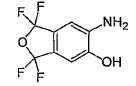
1H-NMR(DMSO-d6)δ:10.65(br s, 1H), 6.90(s, 1H), 6.84(s, 1H), 5.70(br s, 2H)
1 H-NMR (DMSO-d 6 ) δ: 10.65 (br s, 1H), 6.90 (s, 1H), 6.84 (s, 1H), 5.70 (br s, 2H)
6-아미노-1,1,3,3-테트라플루오로-5-히드록시-1,3-디히드로이소벤조푸란 2.0g, 이소니코틴산 1.1g, WSC 2.23g 및 피리딘 15ml의 혼합물을 80℃에서 3시간 동안 가열교반하였다. 실온에 냉각한 후, 물을 첨가하였다. 석출한 고체를 여과하고, 물로 세정한 후, 감압 하에서 건조시킴으로써 N-(1,1,3,3-테트라플루오로-6-히드록시-1,3-디히드로이소벤조푸란-5-일)이소니코틴아미드 1.34g을 얻었다.A mixture of 2.0 g of 6-amino-1,1,3,3-tetrafluoro-5-hydroxy-1,3-dihydroisobenzofuran, 1.1 g of isonicotinic acid, 2.23 g of WSC, and 15 ml of pyridine was prepared at 80 ° C. The mixture was heated and stirred for 3 hours. After cooling to room temperature, water was added. The precipitated solid was filtered, washed with water and dried under reduced pressure to thereby N- (1,1,3,3-tetrafluoro-6-hydroxy-1,3-dihydroisobenzofuran-5-yl). 1.34 g of isonicotinamide were obtained.
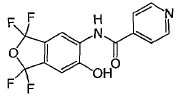
1H-NMR(DMSO-d6)δ:10.07(br s, 1H), 8.80(dd, J=4.4, 1.5Hz, 2H), 8.36(s, 1H), 7.87(dd, J=4.4, 1.5Hz, 2H), 7.28(s, 1H)
1 H-NMR (DMSO-d 6 ) δ: 10.07 (br s, 1H), 8.80 (dd, J = 4.4, 1.5 Hz, 2H), 8.36 (s, 1H), 7.87 (dd, J = 4.4, 1.5 Hz, 2H), 7.28 (s, 1H)
참고 Reference 제조예Production Example 11 11
3,5-디클로로이소니코틴산 1g, 염화티오닐 5ml의 혼합물을 7시간 동안 가열환류한 후, 실온에 냉각하여 감압 하에서 농축하였다. 잔사를 DMF 3ml로 녹이고, 2-아미노-4-트리플루오로메틸페놀, DMF 5ml 및 트리에틸아민 1.05g의 혼합물 중에 0℃에서 적하하였다. 실온에서 2시간 동안 교반한 후, 물을 첨가하고, 아세트산에틸로 2회 추출하였다. 혼합된 유기층을 물, 포화식염수로 세정하고, 황산마그네슘으로 건조시킨 후, 감압 하에서 농축하였다. 잔사를 디에틸에테르로 세정함으로써 3,5-디클로로-N-(2-히드록시-5-트리플루오로메틸페닐)이소니코틴아미드 0.75g을 얻었다.A mixture of 1 g of 3,5-dichloroisonicotinic acid and 5 ml of thionyl chloride was heated to reflux for 7 hours, then cooled to room temperature and concentrated under reduced pressure. The residue was dissolved in 3 ml of DMF and added dropwise at 0 ° C. in a mixture of 2-amino-4-trifluoromethylphenol, 5 ml of DMF, and 1.05 g of triethylamine. After stirring for 2 hours at room temperature, water was added and extracted twice with ethyl acetate. The mixed organic layer was washed with water and brine, dried over magnesium sulfate, and concentrated under reduced pressure. The residue was washed with diethyl ether to obtain 0.75 g of 3,5-dichloro-N- (2-hydroxy-5-trifluoromethylphenyl) isonicotinamide.
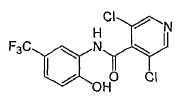
1H-NMR(CDCl3+DMSO-d6)δ:9.03(br s, 1H), 8.59(s, 2H), 8.45(d, J=2.0Hz, 1H), 7.30(dd, J=8.5, 2.2Hz, 1H), 7.04(d, J=8.5Hz, 1H)
1 H-NMR (CDCl 3 + DMSO-d 6 ) δ: 9.03 (br s, 1H), 8.59 (s, 2H), 8.45 (d, J = 2.0 Hz, 1H), 7.30 (dd, J = 8.5, 2.2 Hz, 1H), 7.04 (d, J = 8.5 Hz, 1H)
참고 Reference 제조예Production Example 12 12
2-아미노-4-(트리플루오로메틸)페놀 0.89g, 3-클로로-4-피리딘카르복시알데히드 0.71g 및 에탄올 5ml의 혼합물을 3시간 동안 가열환류하였다. 반응혼합물을 농축하고, 잔사를 아세트산에틸-헥산 혼합용매로 세정함으로써 2-(3-클로로피리딘-4-일)메틸리덴아미노-4-(트리플루오로메틸)페놀 0.71g을 얻었다.A mixture of 0.89 g of 2-amino-4- (trifluoromethyl) phenol, 0.71 g of 3-chloro-4-pyridinecarboxyaldehyde and 5 ml of ethanol was heated to reflux for 3 hours. The reaction mixture was concentrated, and the residue was washed with an ethyl acetate / hexane mixed solvent to obtain 0.71 g of 2- (3-chloropyridin-4-yl) methylideneamino-4- (trifluoromethyl) phenol.
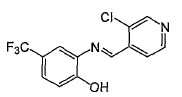
1H-NMR(CDCl3)δ:9.14(s, 1H), 8.76(s, 1H), 8.65(d, J=5.1Hz, 1H), 8.01(d, J=5.1Hz, 1H), 7.62(m, 1H), 7.56(d, J=8.6Hz, 1H), 7.35(br s, 1H), 7.14(d, J=8.6Hz, 1H)
1 H-NMR (CDCl 3 ) δ: 9.14 (s, 1H), 8.76 (s, 1H), 8.65 (d, J = 5.1Hz, 1H), 8.01 (d, J = 5.1Hz, 1H), 7.62 ( m, 1H), 7.56 (d, J = 8.6 Hz, 1H), 7.35 (br s, 1H), 7.14 (d, J = 8.6 Hz, 1H)
참고 Reference 제조예Production Example 13 13
2-아미노-4-(트리플루오로메틸)페놀 1.77g, 3-클로로이소니코틴산 1.58g, 피리딘 15ml의 혼합물에 WSC 2.70g을 첨가하고, 60℃에서 4시간 동안 가열교반하였다. 실온에 냉각한 후, 감압 하에서 농축하고, 잔사에 물을 첨가하여 아세트산에틸로 2회 추출하였다. 혼합된 유기층을 포화식염수로 세정하고, 무수황산나트륨으로 건조시킨 후, 감압 하에서 농축하였다. 잔사를 tert-부틸메틸에테르와 헥산의 혼합용매로 세정하여 3-클로로-N-[2-히드록시-5-(트리플루오로메틸)페닐]이소니코틴아미드 1.80g을 얻었다.2.70 g of WSC was added to a mixture of 1.77 g of 2-amino-4- (trifluoromethyl) phenol, 1.58 g of 3-chloroisonicotinic acid, and 15 ml of pyridine, and the mixture was heated and stirred at 60 ° C. for 4 hours. After cooling to room temperature, the mixture was concentrated under reduced pressure, water was added to the residue, and the mixture was extracted twice with ethyl acetate. The combined organic layers were washed with saturated brine, dried over anhydrous sodium sulfate, and then concentrated under reduced pressure. The residue was washed with a mixed solvent of tert-butylmethylether and hexane to obtain 1.80 g of 3-chloro-N- [2-hydroxy-5- (trifluoromethyl) phenyl] isonicotinamide.

1H-NMR(DMSO-d6)δ:10.89(br s, 1H), 10.19(br s, 1H), 8.75(s, 1H), 8.64(d, J=4.9Hz, 1H), 8.32(d, J=2.0Hz, 1H), 7.63(d, J=4.9Hz, 1H), 7.40(dd, J=8.5, 2.1Hz, 1H), 7.08(d, J=8.5Hz, 1H)
1 H-NMR (DMSO-d 6 ) δ: 10.89 (br s, 1H), 10.19 (br s, 1H), 8.75 (s, 1H), 8.64 (d, J = 4.9 Hz, 1H), 8.32 (d , J = 2.0Hz, 1H), 7.63 (d, J = 4.9Hz, 1H), 7.40 (dd, J = 8.5, 2.1Hz, 1H), 7.08 (d, J = 8.5Hz, 1H)
참고 Reference 제조예Production Example 14 14
2-아미노-4-(트리플루오로메틸)페놀 0.71g, 2-클로로이소니코틴산 0.63g, 피리딘 7ml의 혼합물에 WSC 1.05g을 첨가하고, 60℃에서 4시간 동안 가열교반하였다. 실온에 냉각한 후, 감압 하에서 농축하고, 잔사에 물을 첨가하여 아세트산에틸로 2회 추출하였다. 혼합된 유기층을 포화식염수로 세정하고, 무수황산나트륨으로 건조시킨 후, 감압 하에서 농축하였다. 잔사를 실리카겔 칼럼크로마토그래피 처리하여 2-클로로-N-[2-히드록시-5-(트리플루오로메틸)페닐]이소니코틴아미드 0.77g을 얻었다.1.05 g of WSC was added to a mixture of 0.71 g of 2-amino-4- (trifluoromethyl) phenol, 0.63 g of 2-chloroisonicotinic acid, and 7 ml of pyridine, and the mixture was heated and stirred at 60 ° C. for 4 hours. After cooling to room temperature, the mixture was concentrated under reduced pressure, water was added to the residue, and the mixture was extracted twice with ethyl acetate. The combined organic layers were washed with saturated brine, dried over anhydrous sodium sulfate, and then concentrated under reduced pressure. The residue was subjected to silica gel column chromatography to obtain 0.77 g of 2-chloro-N- [2-hydroxy-5- (trifluoromethyl) phenyl] isonicotinamide.

1H-NMR(DMSO-d6)δ:10.12(br s, 1H), 8.62(d, J=5.1Hz, 1H), 8.03-7.97(m, 2H), 7.87(dd, J=5.2, 1.3Hz, 1H), 7.46-7.43(m, 1H), 7.10(d, J=8.2Hz, 1H)
1 H-NMR (DMSO-d 6 ) δ: 10.12 (br s, 1H), 8.62 (d, J = 5.1 Hz, 1H), 8.03-7.97 (m, 2H), 7.87 (dd, J = 5.2, 1.3 Hz, 1H), 7.46-7.43 (m, 1H), 7.10 (d, J = 8.2 Hz, 1H)
참고 Reference 제조예Production Example 15 15
2-아미노-4-(트리플루오로메틸)페놀 0.62g, 3-메틸이소니코틴산 0.48g, WSC 0.86g 및 피리딘 5ml의 혼합물을 60℃에서 3시간 동안 가열교반하였다. 실온에 냉각한 후, 반응혼합물을 농축하였다. 잔사에 물을 첨가하고, 아세트산에틸로 추출한 후, 유기층을 물, 포화식염수의 순서로 세정하였다. 유기층을 무수황산나트륨으로 건조시킨 후, 감압 하에서 농축하고, 잔사를 tert-부틸메틸에테르와 헥산의 혼합용매로 세정함으로써 N-[2-히드록시-5-(트리플루오로메틸)페닐]-3-메틸이소니코틴아미드 0.38g을 얻었다.A mixture of 0.62 g of 2-amino-4- (trifluoromethyl) phenol, 0.48 g of 3-methylisonicotinic acid, 0.86 g of WSC, and 5 ml of pyridine was heated and stirred at 60 ° C. for 3 hours. After cooling to room temperature, the reaction mixture was concentrated. Water was added to the residue, followed by extraction with ethyl acetate, and then the organic layer was washed with water and saturated brine in that order. The organic layer was dried over anhydrous sodium sulfate, and then concentrated under reduced pressure, and the residue was washed with a mixed solvent of tert-butylmethylether and hexane to thereby prepare N- [2-hydroxy-5- (trifluoromethyl) phenyl] -3-. 0.38 g of methylisonicotinamide was obtained.

1H-NMR(DMSO-d6)δ:9.83(br s, 1H), 8.55(s, 1H), 8.52(d, J=5.1Hz, 1H), 8.18(s, 1H), 7.47(d, J=5.1Hz, 1H), 7.40(dd, J=8.8, 1.9Hz, 1H), 7.06(d, J=8.8Hz, 1H), 2.39(s, 3H)
1 H-NMR (DMSO-d 6 ) δ: 9.83 (br s, 1H), 8.55 (s, 1H), 8.52 (d, J = 5.1Hz, 1H), 8.18 (s, 1H), 7.47 (d, J = 5.1 Hz, 1H), 7.40 (dd, J = 8.8, 1.9 Hz, 1H), 7.06 (d, J = 8.8 Hz, 1H), 2.39 (s, 3H)
참고 Reference 제조예Production Example 16 16
디이소프로필아민 3.54g과 테트라히드로푸란 50ml의 혼합물을 드라이아이스-아세톤 배스(dry ice-acetone bath)에서 냉각하면서 교반 하에서 n-부틸리튬의 1.6M 헥산용액 20ml를 반응혼합물의 온도가 -40℃를 초과하지 않도록 첨가한 후, 30분 동안 교반하였다. 이어서 3-플루오로피리딘 2.91g과 테트라히드로푸란 3ml의 혼합물을 반응혼합물의 온도가 -60℃를 초과하지 않도록 첨가하고, 다시 30분 동안 교반하였다. 부순 드라이아이스를 반응혼합물에 첨가한 후에 냉각을 멈추고, 실온으로 돌아올 때까지 교반하였다. 물을 첨가하고, 감압 하에 헥산과 테트라히드로푸란의 대부분을 증류제거하였다. 잔사를 tert-부틸메틸에테르로 세정하고, 수층을 회수하였다. 얻어진 수층에 빙랭 하에서 농염산을 첨가하고, 혼합물의 pH를 3으로 하여 1시간 동안 교반하였다. 석출물을 여과하여 채집하고, 감압 하에서 건조시켜서 3-플루오로이소니코틴산 3.59g을 얻었다.While stirring a mixture of 3.54 g of diisopropylamine and 50 ml of tetrahydrofuran in a dry ice-acetone bath, 20 ml of a 1.6M hexane solution of n-butyllithium was stirred under stirring, and the temperature of the reaction mixture was -40 ° C. After addition was not exceeded, the mixture was stirred for 30 minutes. Then, a mixture of 2.91 g of 3-fluoropyridine and 3 ml of tetrahydrofuran was added so that the temperature of the reaction mixture did not exceed −60 ° C., and stirred for another 30 minutes. After adding crushed dry ice to the reaction mixture, cooling was stopped and stirred until it returned to room temperature. Water was added and most of the hexane and tetrahydrofuran were distilled off under reduced pressure. The residue was washed with tert-butyl methyl ether and the aqueous layer was recovered. Concentrated hydrochloric acid was added to the obtained aqueous layer under ice cooling, and the mixture was stirred at pH 3 for 1 hour. The precipitate was collected by filtration and dried under reduced pressure to obtain 3.59 g of 3-fluoroisonicotinic acid.

1H-NMR(DMSO-d6)δ:8.74(d, J=2.4Hz, 1H), 8.58(d, J=4.9Hz, 1H), 7.80-7.77(m, 1H)
1 H-NMR (DMSO-d 6 ) δ: 8.74 (d, J = 2.4 Hz, 1H), 8.58 (d, J = 4.9 Hz, 1H), 7.80-7.77 (m, 1H)
참고 Reference 제조예Production Example 17 17
3-플루오로이소니코틴산 0.49g, 2-아미노-4-(트리플루오로메틸)페놀 0.62g, WSC 1.00g 및 피리딘 6ml의 혼합물을 80℃에서 2시간 동안 가열교반하였다. 실온에 냉각한 후, 반응혼합물을 농축하였다. 잔사에 물을 첨가하고, 아세트산에틸로 추출한 후, 유기층을 포화식염수로 세정하였다. 유기층을 무수황산나트륨으로 건조시킨 후, 감압 하에서 농축하고, 잔사를 tert-부틸메틸에테르헥산 혼합용매로 세정함으로써 3-플루오로-N-[2-히드록시-5-(트리플루오로메틸)페닐]이소니코틴아미드 0.51g을 얻었다.A mixture of 0.49 g of 3-fluoroisonicotinic acid, 0.62 g of 2-amino-4- (trifluoromethyl) phenol, 1.00 g of WSC and 6 ml of pyridine was heated and stirred at 80 ° C. for 2 hours. After cooling to room temperature, the reaction mixture was concentrated. Water was added to the residue, followed by extraction with ethyl acetate, and then the organic layer was washed with saturated brine. The organic layer was dried over anhydrous sodium sulfate, and then concentrated under reduced pressure, and the residue was washed with a tert-butylmethyletherhexane mixed solvent to give 3-fluoro-N- [2-hydroxy-5- (trifluoromethyl) phenyl]. 0.51 g of isonicotinamide was obtained.
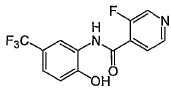
1H-NMR(DMSO-d6)δ:11.09(s, 1H), 9.98(br s, 1H), 8.76(m, 1H), 8.60(d, J=4.6Hz, 1H), 8.39(d, J=2.2Hz, 1H), 7.78-7.75(m 1H), 7.41(dd, J=8.6, 2.2Hz, 1H), 7.09(d, J=8.6Hz, 1H)
1 H-NMR (DMSO-d 6 ) δ: 11.09 (s, 1 H), 9.98 (br s, 1 H), 8.76 (m, 1 H), 8.60 (d, J = 4.6 Hz, 1 H), 8.39 (d, J = 2.2 Hz, 1H), 7.78-7.75 (m 1H), 7.41 (dd, J = 8.6, 2.2 Hz, 1H), 7.09 (d, J = 8.6 Hz, 1H)
참고 Reference 제조예Production Example 18 18
디이소프로필아민 3.54g과 테트라히드로푸란 50ml의 혼합물을 드라이아이스-아세톤 배스에서 냉각하면서 교반 하에서 n-부틸리튬의 1.6M 헥산용액 20ml를 반응혼합물의 온도가 -40℃를 초과하지 않도록 첨가한 후, 30분 동안 교반하였다. 이어서 3-브로모피리딘 4.74g과 테트라히드로푸란 5ml의 혼합물을 반응혼합물의 온도가 -60℃를 초과하지 않도록 첨가하고, 다시 30분 동안 교반하였다. 부순 드라이아이스를 반응혼합물에 첨가한 후에 냉각을 멈추고, 실온으로 돌아올 때까지 교반하였다. 물을 첨가하고, 감압 하에 헥산과 테트라히드로푸란의 대부분을 증류제거하였다. 잔사를 tert-부틸메틸에테르로 세정하고, 수층을 회수하였다. 얻어진 수층에 빙랭 하에서 농염산을 첨가하고, 혼합물의 pH를 3으로 하여 1시간 동안 교반한 후, 아세트산에틸로 3회 추출하였다. 혼합된 유기층을 포화식염수로 세정하고, 무수황산나트륨으로 건조시켰다. 감압 하에서 농축하여 3-브로모이소니코틴산 0.69g을 얻었다.After cooling a mixture of 3.54 g of diisopropylamine and 50 ml of tetrahydrofuran in a dry ice-acetone bath, 20 ml of a 1.6M hexane solution of n-butyllithium was added under stirring so that the temperature of the reaction mixture did not exceed -40 ° C. , Stirred for 30 minutes. Then a mixture of 4.74 g of 3-bromopyridine and 5 ml of tetrahydrofuran was added so that the temperature of the reaction mixture did not exceed −60 ° C. and stirred for another 30 minutes. After adding crushed dry ice to the reaction mixture, cooling was stopped and stirred until it returned to room temperature. Water was added and most of the hexane and tetrahydrofuran were distilled off under reduced pressure. The residue was washed with tert-butyl methyl ether and the aqueous layer was recovered. Concentrated hydrochloric acid was added to the obtained aqueous layer under ice cooling, the mixture was stirred at pH 3 for 1 hour, and then extracted three times with ethyl acetate. The combined organic layers were washed with saturated brine and dried over anhydrous sodium sulfate. Concentration under reduced pressure gave 0.69 g of 3-bromoisonicotinic acid.

1H-NMR(DMSO-d6)δ:8.74(s, 1H), 8.67(d, J=4.9Hz, 1H), 7.69(d, J=4.9Hz, 1H)
1 H-NMR (DMSO-d 6 ) δ: 8.74 (s, 1H), 8.67 (d, J = 4.9Hz, 1H), 7.69 (d, J = 4.9Hz, 1H)
참고 Reference 제조예Production Example 19 19
3-브로모이소니코틴산 0.69g, 2-아미노-4-(트리플루오로메틸)페놀 0.60g, WSC 1.00g 및 피리딘 6ml의 혼합물을 80℃에서 2시간 동안 가열교반하였다. 실온에 냉각한 후, 반응혼합물을 농축하였다. 잔사에 물을 첨가하고, 아세트산에틸로 추출하였다. 유기층을 포화식염수로 세정한 후, 무수황산나트륨으로 건조시켰다. 감압 하에서 농축하고, 잔사를 아세트산에틸과 헥산의 혼합용매로 세정함으로써 3-브로모-N-[2-히드록시-5-(트리플루오로메틸)페닐]이소니코틴아미드 0.29g을 얻었다.A mixture of 0.69 g of 3-bromoisonicotinic acid, 0.60 g of 2-amino-4- (trifluoromethyl) phenol, 1.00 g of WSC and 6 ml of pyridine was heated and stirred at 80 ° C. for 2 hours. After cooling to room temperature, the reaction mixture was concentrated. Water was added to the residue, followed by extraction with ethyl acetate. The organic layer was washed with saturated brine and then dried over anhydrous sodium sulfate. The mixture was concentrated under reduced pressure, and the residue was washed with a mixed solvent of ethyl acetate and hexane to obtain 0.29 g of 3-bromo-N- [2-hydroxy-5- (trifluoromethyl) phenyl] isonicotinamide.

참고 Reference 제조예Production Example 20 20
수산화나트륨 3.20g에 물을 첨가하고, 전량 30ml의 수용액으로 하였다. 3-요오드이소니코틴산 메틸에스테르(US6277871B1, O'Conner et al.) 5.83g을 첨가하여 60℃에서 3시간 동안 가열교반하였다. 반응혼합물을 빙랭하고, 농염산을 더하여 pH를 2~3로 조정하였다. 석출물을 여과하여 채집하고, 감압 하에서 건조시켜서 3-요오드이소니코틴산 5.21g을 얻었다.Water was added to 3.20 g of sodium hydroxide, and it was set as the aqueous solution of 30 ml whole quantity. 5.83 g of 3-iodine isonicotinic acid methyl ester (US6277871B1, O'Conner et al.) Was added thereto, followed by heating and stirring at 60 ° C. for 3 hours. The reaction mixture was ice-cooled, and concentrated hydrochloric acid was added to adjust the pH to 2-3. The precipitate was collected by filtration and dried under reduced pressure to obtain 5.21 g of 3-iodineisonicotinic acid.

1H-NMR(DMSO-d6)δ:9.04(s, 1H), 8.64(d, J=5.1Hz, 1H), 7.65(d, J=5.1Hz, 1H)
1 H-NMR (DMSO-d 6 ) δ: 9.04 (s, 1H), 8.64 (d, J = 5.1Hz, 1H), 7.65 (d, J = 5.1Hz, 1H)
참고 Reference 제조예Production Example 21 21
3-요오드이소니코틴산 1.78g, WSC 1.38g 및 피리딘 12ml의 혼합물을 50℃에서 15분 동안 가열교반한 후, 2-아미노-4-(트리플루오로메틸)페놀 1.15g을 첨가하고, 80℃에서 2시간 동안 가열교반하였다. 실온으로 되돌리고, 감압 하에서 농축한 후, 잔사에 물을 첨가하고, 아세트산에틸로 추출하였다. 유기층을 포화식염수로 세정하고, 무수황산나트륨으로 건조시킨 후, 감압 하에서 농축하여 N-[2-히드록시-5-(트리플루오로메틸)페닐]-3-요오드이소니코틴아미드 1.81g을 얻었다.A mixture of 1.78 g of 3-iodine isonicotinic acid, 1.38 g of WSC, and 12 ml of pyridine was heated and stirred at 50 ° C. for 15 minutes, followed by addition of 1.15 g of 2-amino-4- (trifluoromethyl) phenol, and at 80 ° C. The mixture was heated and stirred for 2 hours. After returning to room temperature and concentrating under reduced pressure, water was added to the residue and the mixture was extracted with ethyl acetate. The organic layer was washed with saturated brine, dried over anhydrous sodium sulfate, and then concentrated under reduced pressure to obtain 1.81 g of N- [2-hydroxy-5- (trifluoromethyl) phenyl] -3-iodineisonicotinamide.

1H-NMR(DMSO-d6)δ:10.85(br s, 1H), 10.09(br s, 1H), 8.97(s, 1H), 8.64-8.62(m, 1H), 8.29-8.27(m, 1H), 7.54-7.51(m 1H), 7.42-7.38(m, 1H), 7.07(d, J=8.5Hz, 1H)
1 H-NMR (DMSO-d 6 ) δ: 10.85 (br s, 1H), 10.09 (br s, 1H), 8.97 (s, 1H), 8.64-8.62 (m, 1H), 8.29-8.27 (m, 1H), 7.54-7.51 (m 1H), 7.42-7.38 (m, 1H), 7.07 (d, J = 8.5 Hz, 1H)
참고 Reference 제조예Production Example 22 22
니코틴산 3.69g과 톨루엔 30ml의 혼합물에 디이소프로필에틸아민 3.64g, 이어서 디페닐포스포릴아지드 8.67g을 첨가하고, 실온에서 30분 동안 교반하였다. tert-부틸알코올 4ml를 첨가하고, 80℃에서 6시간 동안 가열교반하였다. 실온에 냉각한 후, 반응혼합물을 아세트산에틸로 희석하고, 물, 이어서 포화식염수로 세정하였다. 무수황산나트륨으로 건조시킨 후, 감압 하에서 농축하였다. 잔사를 아세트산에틸과 헥산의 혼합용매로 세정함으로써 3-(tert-부톡시카르보닐아미노)피리딘 4.07g을 얻었다.To a mixture of 3.69 g nicotinic acid and 30 ml of toluene were added 3.64 g of diisopropylethylamine, followed by 8.67 g of diphenylphosphoryl azide and stirred at room temperature for 30 minutes. 4 ml of tert-butyl alcohol were added and stirred at 80 ° C. for 6 hours. After cooling to room temperature, the reaction mixture was diluted with ethyl acetate and washed with water, followed by saturated brine. After drying over anhydrous sodium sulfate, the mixture was concentrated under reduced pressure. The residue was washed with a mixed solvent of ethyl acetate and hexane to obtain 4.07 g of 3- (tert-butoxycarbonylamino) pyridine.
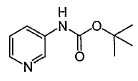
1H-NMR(CDCl3)δ:8.46(d, J=2.7Hz, 1H), 8.28(dd, J=4.9, 1.2Hz, 1H), 8.03-7.96(m, 1H), 7.25-7.21(m, 1H), 7.04(br s, 1H), 1.53(s, 9H)
1 H-NMR (CDCl 3 ) δ: 8.46 (d, J = 2.7 Hz, 1H), 8.28 (dd, J = 4.9, 1.2 Hz, 1H), 8.03-7.96 (m, 1H), 7.25-7.21 (m , 1H), 7.04 (br s, 1H), 1.53 (s, 9H)
3-(tert-부톡시카르보닐아미노)피리딘 1.16g과 테트라히드로푸란 25ml의 혼합물을 드라이아이스-아세톤 배스에서 냉각하면서 n-부틸리튬의 1.65M 헥산용액 8.5ml를 반응혼합물의 온도가 -60℃를 초과하지 않도록 첨가하고, 15분 동안 교반하였다. 냉각을 멈추고, 반응혼합물의 온도가 0℃에 달할 때까지 교반한 후, 다시 드라이아이스-아세톤 배스에서 냉각하였다. 이산화탄소를 주입한 후, 냉각을 멈추고, 반응혼합물을 실온 하에서 2시간 동안 교반하였다. 물을 첨가한 후, 테트라히드로푸란과 헥산의 대부분을 감압 하에서 농축함으로써 증류제거하였다. 잔사를 빙랭하고, 3N 염산을 첨가하여 pH를 약 3로 조정하였다. 아세트산에틸과 테트라히드로푸란의 혼합용매(4:1)로 수회 추출하고, 혼합된 유기층을 포화식염수로 세정하였다. 무수황산나트륨으로 건조시킨 후, 감압 하에서 농축함으로써 3-(tert-부톡시카르보닐아미노)이소니코틴산 0.53g을 얻었다.A mixture of 1.16 g of 3- (tert-butoxycarbonylamino) pyridine and 25 ml of tetrahydrofuran was cooled in a dry ice-acetone bath, and 8.5 ml of a 1.65 M hexane solution of n-butyllithium was reacted at -60 ° C. Was added not to exceed and stirred for 15 minutes. The cooling was stopped, stirred until the temperature of the reaction mixture reached 0 ° C, and then cooled again in a dry ice-acetone bath. After injecting carbon dioxide, cooling was stopped and the reaction mixture was stirred for 2 hours at room temperature. After adding water, most of tetrahydrofuran and hexane were distilled off by concentration under reduced pressure. The residue was ice-cooled and the pH was adjusted to about 3 by addition of 3N hydrochloric acid. The mixture was extracted several times with a mixed solvent of ethyl acetate and tetrahydrofuran (4: 1), and the mixed organic layer was washed with brine. After drying over anhydrous sodium sulfate, 0.53 g of 3- (tert-butoxycarbonylamino) isonicotinic acid was obtained by concentration under reduced pressure.
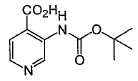
1H-NMR(DMSO-d6)δ:10.07(s, 1H), 9.37(s, 1H), 8.35(d, J=5.1Hz, 1H), 7.76(d, J=5.1Hz, 1H), 1.49(s, 9H)
1 H-NMR (DMSO-d 6 ) δ: 10.07 (s, 1H), 9.37 (s, 1H), 8.35 (d, J = 5.1Hz, 1H), 7.76 (d, J = 5.1Hz, 1H), 1.49 (s, 9H)
WSC 1.15g과 피리딘 8ml의 혼합물에 3-tert-부톡시카르보닐아미노이소니코틴산 1.43g을 첨가하고, 실온에서 15분 동안 교반하였다. 2-아미노-4-(트리플루오로메틸)페놀 1.06g을 첨가하고, 60℃에서 2시간 동안 가열교반한 후에 실온에 냉각하여 감압 하에서 농축하였다. 잔사에 물을 첨가하고, 아세트산에틸로 2회 추출하였다. 혼합된 유기층을 포화식염수로 세정하고, 무수황산나트륨으로 건조시킨 후, 감압 하에서 농축하여 3-tert-부톡시카르보닐아미노-N-[2-히드록시-5-(트리플루오로메틸)페닐]이소니코틴아미드 1.79g을 얻었다.To the mixture of 1.15 g of WSC and 8 ml of pyridine was added 1.43 g of 3-tert-butoxycarbonylaminoisonicotinic acid and stirred at room temperature for 15 minutes. 1.06 g of 2-amino-4- (trifluoromethyl) phenol was added, the mixture was heated and stirred at 60 DEG C for 2 hours, cooled to room temperature, and concentrated under reduced pressure. Water was added to the residue, and extracted twice with ethyl acetate. The combined organic layers were washed with saturated brine, dried over anhydrous sodium sulfate, and then concentrated under reduced pressure to 3-tert-butoxycarbonylamino-N- [2-hydroxy-5- (trifluoromethyl) phenyl] iso 1.79 g of nicotinamide was obtained.

참고 Reference 제조예Production Example 23 23
60% 수소화나트륨(유성) 5.0g 및 DMF 70ml의 혼합물에 빙랭 하에서 4-요오드페놀과 DMF 25ml의 혼합물을 적하하고, 1시간 동안 교반하였다. 실온으로 높인 후, 클로로메틸에틸에테르 12.9g과 DMF 10ml의 혼합물을 적하하고, 다시 1시간 동안 교반하였다. 반응혼합물을 빙수 중에 붓고, 아세트산에틸로 3회 추출하였다. 혼합된 유기층을 물, 포화식염수로 세정하고, 무수황산마그네슘으로 건조시켰다. 감압 하에서 농축하고, 1-에톡시메톡시-4-요오드벤젠의 조제물 32g을 얻었다. 이것을 더 정제하지 않고 다음의 반응에 사용하였다.To a mixture of 5.0 g of 60% sodium hydride (oily) and 70 ml of DMF was added dropwise a mixture of 4-iodinephenol and DMF 25 ml under ice cooling, followed by stirring for 1 hour. After raising to room temperature, a mixture of 12.9 g of chloromethylethyl ether and 10 ml of DMF was added dropwise, followed by stirring for 1 hour. The reaction mixture was poured into ice water and extracted three times with ethyl acetate. The mixed organic layer was washed with water and brine, and dried over anhydrous magnesium sulfate. It concentrated under reduced pressure and obtained 32 g of preparations of 1-ethoxymethoxy- 4-iodine benzene. This was used for the next reaction without further purification.
1-에톡시메톡시-4-요오드벤젠의 조제물 7.5g, 펜타플루오로프로피온산나트륨염 10.0g, 요오드화구리(I) 10.27g, DMF 120ml 및 톨루엔 45ml의 혼합물을 140~150℃에서 1시간 동안 가열교반하고, 톨루엔 약 40ml를 증류제거시켰다. 160~170℃에서 다시 5시간 동안 가열환류한 후, 실온까지 냉각하고, 빙수 중에 부었다. 디에틸에테르 200ml를 첨가하고, 셀라이트(등록상표)를 통하여 여과하여 여과액을 디에틸에테르로 추출하였다. 혼합된 유기층을 물, 포화식염수로 세정하고, 무수황산마그네슘으로 건조하였다. 감압 하에서 농축하고, 1-에톡시메톡시-4-펜타플루오로에틸벤젠 5.45g을 얻었다.A mixture of 7.5 g of 1-ethoxymethoxy-4-iodinebenzene, 10.0 g of pentafluoropropionate salt, 10.27 g of copper (I) iodide, 120 ml of DMF and 45 ml of toluene was stirred at 140 to 150 ° C. for 1 hour. After stirring by heating, about 40 ml of toluene was distilled off. After refluxing for 5 hours again at 160 ~ 170 ℃, cooled to room temperature and poured into ice water. 200 ml of diethyl ether was added, and the filtrate was extracted with diethyl ether by filtration through Celite (registered trademark). The mixed organic layer was washed with water and brine, and dried over anhydrous magnesium sulfate. Concentration under reduced pressure gave 5.45 g of 1-ethoxymethoxy-4-pentafluoroethylbenzene.

1H-NMR(CDCl3)δ:7.51(d, J=8.9Hz, 2H), 7.13(d, J=8.9Hz, 2H), 5.27(s, 2H), 3.73(q, J=7.0Hz, 2H), 1.23(t, J=7.0, 3H)
1 H-NMR (CDCl 3 ) δ: 7.51 (d, J = 8.9 Hz, 2H), 7.13 (d, J = 8.9 Hz, 2H), 5.27 (s, 2H), 3.73 (q, J = 7.0 Hz, 2H), 1.23 (t, J = 7.0, 3H)
1-에톡시메톡시-4-펜타플루오로에틸벤젠 7.39g, 아세톤 30ml 및 6M 염산 30ml를 50℃에서 2.5시간 동안 가열교반하였다. 실온에 냉각한 후, 수중에 붓고, 아세트산에틸로 추출하였다. 혼합된 유기층을 물, 포화식염수로 세정하고, 무수황산마그네슘으로 건조하였다. 감압 하에서 농축하고, 잔사를 실리카겔 칼럼크로마토그래피 처리하여 4-(펜타플루오로에틸)페놀을 얻었다.7.39 g of 1-ethoxymethoxy-4-pentafluoroethylbenzene, 30 ml of acetone and 30 ml of 6M hydrochloric acid were heated and stirred at 50 ° C. for 2.5 hours. After cooling to room temperature, it was poured into water and extracted with ethyl acetate. The mixed organic layer was washed with water and brine, and dried over anhydrous magnesium sulfate. The mixture was concentrated under reduced pressure, and the residue was subjected to silica gel column chromatography to obtain 4- (pentafluoroethyl) phenol.

1H-NMR(CDCl3)δ: 7.47(d, 8.5Hz, 2H), 6.93(d, 8.5Hz, 2H), 5.74(br s, 1H)
1 H-NMR (CDCl 3 ) δ: 7.47 (d, 8.5 Hz, 2H), 6.93 (d, 8.5 Hz, 2H), 5.74 (br s, 1H)
4-(펜타플루오로에틸)페놀 1.70g, 아세트산 6ml 및 농황산 2.0ml의 혼합물에 빙랭하 69% 질산 0.80g과 아세트산 1ml의 혼합물을 적하하고, 실온에서 3시간 동안 교반하였다. 반응혼합물을 빙수 중에 붓고, 아세트산에틸로 3회 추출하였다. 혼합된 유기층을 물, 포화식염수의 순서로 세정하고, 황산나트륨으로 건조시켰다. 감압 하에서 농축하고, 잔사를 실리카겔 칼럼크로마토그래피 처리하여 4-(펜타플루오로에틸)-2-니트로페놀 1.40g을 얻었다.To a mixture of 1.70 g of 4- (pentafluoroethyl) phenol, 6 ml of acetic acid, and 2.0 ml of concentrated sulfuric acid, a mixture of 0.80 g of 69% nitric acid and 1 ml of acetic acid under ice cooling was added dropwise, and stirred at room temperature for 3 hours. The reaction mixture was poured into ice water and extracted three times with ethyl acetate. The mixed organic layer was washed with water and brine in that order and dried over sodium sulfate. The mixture was concentrated under reduced pressure, and the residue was subjected to silica gel column chromatography to obtain 1.40 g of 4- (pentafluoroethyl) -2-nitrophenol.

1H-NMR(CDCl3)δ:10.02(s, 1H), 8.40(d, J=2.0Hz, 1H), 7.79(dd, J=9.0, 2.0Hz, 1H), 7.32(d, J=9.0Hz, 1H)
1 H-NMR (CDCl 3 ) δ: 10.02 (s, 1H), 8.40 (d, J = 2.0Hz, 1H), 7.79 (dd, J = 9.0, 2.0Hz, 1H), 7.32 (d, J = 9.0 Hz, 1H)
4-(펜타플루오로에틸)-2-니트로페놀 1.38g, 아세트산에틸 15ml 및 5% 팔라듐탄소 0.15g의 혼합물을 약 1기압의 수소 분위기하 실온에서 4시간 동안 교반하였다. 반응혼합물을 셀라이트(등록상표)를 통하여 여과하여 여과액을 감압 하에서 농축하고, 잔사를 헥산으로 세정함으로써 2-아미노-4-(펜타플루오로에틸)페놀 1.02g을 얻었다.A mixture of 1.38 g of 4- (pentafluoroethyl) -2-nitrophenol, 15 ml of ethyl acetate, and 0.15 g of 5% palladium carbon was stirred for 4 hours at room temperature under a hydrogen atmosphere of about 1 atmosphere. The reaction mixture was filtered through Celite (registered trademark), the filtrate was concentrated under reduced pressure, and the residue was washed with hexane to obtain 1.02 g of 2-amino-4- (pentafluoroethyl) phenol.

1H-NMR(CDCl3)δ:6.94(s, 1H), 6.91(d, J=8.3Hz, 1H), 6.78(d, J=8.3Hz, 1H), 5.34(br s, 1H), 3.82(br s, 2H)
1 H-NMR (CDCl 3 ) δ: 6.94 (s, 1H), 6.91 (d, J = 8.3 Hz, 1H), 6.78 (d, J = 8.3 Hz, 1H), 5.34 (br s, 1H), 3.82 (br s, 2H)
WSC 0.44g과 피리딘 4ml의 혼합물에 이소니코틴산 0.28g을 첨가하고, 실온에서 15분 동안 교반하였다. 상기 반응에서 얻어진 2-아미노-4-(펜타플루오로에틸)페놀 0.45g을 첨가하고 60℃에서 2시간 동안 가열교반하였다. 실온에 냉각한 후, 감압 하에서 농축하고, 잔사에 물을 첨가하여 아세트산에틸로 2회 추출하였다. 혼합된 유기층을 물, 포화식염수로 세정하고, 무수황산나트륨으로 건조시킨 후, 감압 하에서 농축하였다. 잔사를 실리카겔 칼럼크로마토그래피 처리하여 N-[2-히드록시-5-(펜타플루오로에틸)페닐]이소니코틴아미드 0.50g을 얻었다.To a mixture of 0.44 g of WSC and 4 ml of pyridine was added 0.28 g of isnicotinic acid and stirred at room temperature for 15 minutes. 0.45 g of 2-amino-4- (pentafluoroethyl) phenol obtained in the above reaction was added thereto, and the mixture was heated and stirred at 60 ° C. for 2 hours. After cooling to room temperature, the mixture was concentrated under reduced pressure, water was added to the residue, and the mixture was extracted twice with ethyl acetate. The mixed organic layer was washed with water and brine, dried over anhydrous sodium sulfate, and concentrated under reduced pressure. The residue was subjected to silica gel column chromatography to obtain 0.50 g of N- [2-hydroxy-5- (pentafluoroethyl) phenyl] isonicotinamide.

1H-NMR(DMSO-d6)δ:10.89(br s, 1H), 9.93(br s, 1H), 8.79(d, J=5.4Hz, 2H), 8.03(d, J=2.0Hz, 1H), 7.88(d, J=5.6Hz, 2H), 7.39(dd, J=8.5, 2.0Hz, 1H), 7.14(d, J=8.6Hz, 1H)
1 H-NMR (DMSO-d 6 ) δ: 10.89 (br s, 1H), 9.93 (br s, 1H), 8.79 (d, J = 5.4 Hz, 2H), 8.03 (d, J = 2.0 Hz, 1H ), 7.88 (d, J = 5.6 Hz, 2H), 7.39 (dd, J = 8.5, 2.0 Hz, 1H), 7.14 (d, J = 8.6 Hz, 1H)
참고 Reference 제조예Production Example 24 24
WSC 0.44g과 피리딘 4ml의 혼합물에 3-클로로이소니코틴산 0.36g을 첨가하고, 실온에서 15분 동안 교반하였다. 2-아미노-4-(펜타플루오로에틸)페놀 0.45g을 첨가하고 60℃에서 2시간 동안 가열교반하였다. 실온에 냉각한 후, 감압 하에서 농축하고, 잔사에 물을 첨가하여 아세트산에틸로 2회 추출하였다. 혼합된 유기층을 물, 포화식염수로 세정하고, 무수황산나트륨으로 건조시킨 후, 감압 하에서 농축하였다. 잔사를 실리카겔 칼럼크로마토그래피 처리하여 3-클로로-N-[2-히드록시-5-(펜타플루오로에틸)페닐]이소니코틴아미드 0.25g을 얻었다.0.36 g of 3-chloroisonicotinic acid was added to a mixture of 0.44 g of WSC and 4 ml of pyridine and stirred at room temperature for 15 minutes. 0.45 g of 2-amino-4- (pentafluoroethyl) phenol was added and stirred at 60 ° C. for 2 hours. After cooling to room temperature, the mixture was concentrated under reduced pressure, water was added to the residue, and the mixture was extracted twice with ethyl acetate. The mixed organic layer was washed with water and brine, dried over anhydrous sodium sulfate, and concentrated under reduced pressure. The residue was subjected to silica gel column chromatography to give 0.25 g of 3-chloro-N- [2-hydroxy-5- (pentafluoroethyl) phenyl] isonicotinamide.

1H-NMR(DMSO-d6)δ:10.99(br s, 1H), 10.20(br s, 1H), 8.75(s, 1H), 8.64(d, J=4.9Hz, 1H), 8.31(d, J=2.2Hz, 1H), 7.64(d, J=4.6Hz, 1H), 7.36(dd, J=8.6, 2.1Hz, 1H), 7.11(d, J=8.6Hz, 1H)
1 H-NMR (DMSO-d 6 ) δ: 10.99 (br s, 1H), 10.20 (br s, 1H), 8.75 (s, 1H), 8.64 (d, J = 4.9 Hz, 1H), 8.31 (d , J = 2.2Hz, 1H), 7.64 (d, J = 4.6Hz, 1H), 7.36 (dd, J = 8.6, 2.1Hz, 1H), 7.11 (d, J = 8.6Hz, 1H)
참고 Reference 제조예Production Example 25 25
4-(헵타플루오로이소프로필)아닐린 3.92g, 아세트산 20ml, 농황산 3.0g, 및 물 3ml의 혼합물에 아질산나트륨 1.14g의 수용액을 빙랭 하에서 서서히 적하하고, 빙랭 하에서 30분 동안, 이어서 80℃에서 1시간 동안 가열교반하였다. 실온에 냉각한 후, 반응혼합물을 물에 붓고, 아세트산에틸로 3회 추출하였다. 혼합된 유기층을 포화식염수로 세정하고, 무수황산나트륨으로 건조시킨 후, 감압 하에서 농축하였다. 잔사를 실리카겔 칼럼크로마토그래피 처리하여 4-(헵타플루오로이소프로필)페놀을 포함하는 혼합물 3.60g을 얻었다.To a mixture of 3.92 g of 4- (heptafluoroisopropyl) aniline, 20 ml of acetic acid, 3.0 g of concentrated sulfuric acid, and 3 ml of water, an aqueous solution of 1.14 g of sodium nitrite was slowly added dropwise under ice cooling, followed by ice cooling for 30 minutes, followed by 1 at 80 ° C. The mixture was heated and stirred for an hour. After cooling to room temperature, the reaction mixture was poured into water and extracted three times with ethyl acetate. The combined organic layers were washed with saturated brine, dried over anhydrous sodium sulfate, and then concentrated under reduced pressure. The residue was subjected to silica gel column chromatography to obtain 3.60 g of a mixture containing 4- (heptafluoroisopropyl) phenol.

1H-NMR(CDCl3)δ:7.48(d, J=8.9Hz, 2H), 6.96-6.92(m, 2H), 5.64(br s, 1H)
1 H-NMR (CDCl 3 ) δ: 7.48 (d, J = 8.9 Hz, 2H), 6.96-6.92 (m, 2H), 5.64 (br s, 1H)
4-(헵타플루오로이소프로필)페놀을 포함하는 혼합물 3.60g, 아세트산 8ml, 농황산 2.5g의 혼합물에 빙랭하 69% 질산 1.05g과 초산 1ml의 혼합물을 적하하고, 실온에서 2시간 동안 교반하였다. 반응혼합물을 물에 붓고, 아세트산에틸로 3회 추출하였다. 혼합된 유기층을 포화식염수로 세정하고, 무수황산나트륨으로 건조시켰다. 감압 하에서 농축하고, 잔사를 실리카겔 칼럼크로마토그래피 처리하여 4-(헵타플루오로이소프로필)-2-니트로페놀 2.96g을 얻었다.A mixture of 1.05 g of 69% nitric acid and 1 ml of acetic acid was added dropwise to a mixture of 3.60 g of a mixture containing 4- (heptafluoroisopropyl) phenol, 8 ml of acetic acid, and 2.5 g of concentrated sulfuric acid, followed by stirring at room temperature for 2 hours. The reaction mixture was poured into water and extracted three times with ethyl acetate. The combined organic layers were washed with saturated brine and dried over anhydrous sodium sulfate. The mixture was concentrated under reduced pressure, and the residue was subjected to silica gel column chromatography to obtain 2.96 g of 4- (heptafluoroisopropyl) -2-nitrophenol.

1H-NMR(CDCl3)δ:10.76(s, 1H), 8.42(d, J=2.4Hz, 1H), 7.79(dd, J=9.0, 2.0Hz, 1H), 7.34(d, J=9.0Hz, 1H)
1 H-NMR (CDCl 3 ) δ: 10.76 (s, 1H), 8.42 (d, J = 2.4Hz, 1H), 7.79 (dd, J = 9.0, 2.0Hz, 1H), 7.34 (d, J = 9.0 Hz, 1H)
4-(헵타플루오로이소프로필)-2-니트로페놀 2.95g, 아세트산에틸 20ml 및 5% 팔라듐탄소 0.30g의 혼합물을 수소 분위기하 실온에서 4시간 동안 교반하였다. 반응혼합물을 셀라이트(등록상표)를 통하여 여과하여 여과액을 감압 하에서 농축하였다. 잔사를 실리카겔 칼럼크로마토그래피 처리하여 2-아미노-4-(헵타플루오로이소프로필)페놀 2.08g을 얻었다.A mixture of 2.95 g of 4- (heptafluoroisopropyl) -2-nitrophenol, 20 ml of ethyl acetate, and 0.30 g of 5% palladium carbon was stirred at room temperature for 4 hours under a hydrogen atmosphere. The reaction mixture was filtered through Celite (R) and the filtrate was concentrated under reduced pressure. The residue was subjected to silica gel column chromatography to obtain 2.08 g of 2-amino-4- (heptafluoroisopropyl) phenol.

1H-NMR(CDCl3)δ:6.96(s, 1H), 6.89(d, J=8.6Hz, 1H), 6.78(d, J=8.6Hz, 1H), 5.38(br s, 1H), 3.84(br s, 2H)
1 H-NMR (CDCl 3 ) δ: 6.96 (s, 1H), 6.89 (d, J = 8.6 Hz, 1H), 6.78 (d, J = 8.6 Hz, 1H), 5.38 (br s, 1H), 3.84 (br s, 2H)
WSC 0.58g과 피리딘 5ml의 혼합물에 이소니코틴산 0.37g을 첨가하고, 실온에서 25분 동안 교반하였다. 2-아미노-4-(헵타플루오로이소프로필)페놀 0.75g을 첨가하고, 60℃에서 3시간 동안 가열교반하였다. 실온에 냉각한 후, 감압 하에서 농축하고, 잔사에 물을 첨가하여 아세트산에틸로 2회 추출하였다. 혼합된 유기층을 물, 포화식염수로 세정하고, 무수황산나트륨으로 건조시킨 후, 감압 하에서 농축하였다. 잔사를 실리카겔 칼럼크로마토그래피 처리하여 N-[2-히드록시-5-(헵타플루오로이소프로필)페닐]이소니코틴아미드 0.79g을 얻었다.0.37 g of isnicotinic acid was added to a mixture of 0.58 g of WSC and 5 ml of pyridine, and stirred at room temperature for 25 minutes. 0.75 g of 2-amino-4- (heptafluoroisopropyl) phenol were added and heat stirred at 60 ° C. for 3 hours. After cooling to room temperature, the mixture was concentrated under reduced pressure, water was added to the residue, and the mixture was extracted twice with ethyl acetate. The mixed organic layer was washed with water and brine, dried over anhydrous sodium sulfate, and concentrated under reduced pressure. The residue was subjected to silica gel column chromatography to obtain 0.79 g of N- [2-hydroxy-5- (heptafluoroisopropyl) phenyl] isonicotinamide.

1H-NMR(DMSO-d6)δ:10.83(br s, 1H), 9.92(br s, 1H), 8.80-8.78(m, 2H), 8.06(br s, 1H), 7.88-7.86(m, 2H), 7.36(dd, J=8.8, 2.0Hz, 1H), 7.15(d, J=8.8Hz, 1H)
1 H-NMR (DMSO-d 6 ) δ: 10.83 (br s, 1H), 9.92 (br s, 1H), 8.80-8.78 (m, 2H), 8.06 (br s, 1H), 7.88-7.86 (m , 2H), 7.36 (dd, J = 8.8, 2.0 Hz, 1H), 7.15 (d, J = 8.8 Hz, 1H)
참고 Reference 제조예Production Example 26 26
WSC 0.58g과 피리딘 5ml의 혼합물에 3-클로로이소니코틴산 0.48g을 첨가하고, 실온에서 25분 동안 교반하였다. 2-아미노-4-(헵타플루오로이소프로필)페놀 0.75g을 첨가하고, 60℃에서 3시간 동안 가열교반하였다. 실온에 냉각한 후, 3-클로로이소니코틴산 0.24g, WSC 0.29g을 첨가하고, 60℃에서 1.5시간 동안, 이어서 80℃에서 1.3시간 동안 가열교반하였다. 실온에 냉각한 후, 감압 하에서 농축하고, 잔사에 물을 첨가하였다. 아세트산에틸로 2회 추출하고, 혼합된 유기층을 포화식염수로 세정한 후, 무수황산나트륨으로 건조시켰다. 감압 하에서 농축하고, 잔사를 실리카겔 칼럼크로마토그래피 처리하여 3-클로로-N-[2-히드록시-5-(헵타플루오로이소프로필)페닐]이소니코틴아미드 0.90g을 얻었다.0.48 g of 3-chloroisonicotinic acid was added to a mixture of 0.58 g of WSC and 5 ml of pyridine and stirred at room temperature for 25 minutes. 0.75 g of 2-amino-4- (heptafluoroisopropyl) phenol were added and heat stirred at 60 ° C. for 3 hours. After cooling to room temperature, 0.24 g of 3-chloroisonicotinic acid and 0.29 g of WSC were added and heated and stirred at 60 ° C. for 1.5 hours and then at 80 ° C. for 1.3 hours. After cooling to room temperature, it was concentrated under reduced pressure and water was added to the residue. The mixture was extracted twice with ethyl acetate, and the mixed organic layers were washed with brine and dried over anhydrous sodium sulfate. Concentration under reduced pressure, and the residue was subjected to silica gel column chromatography to obtain 0.90 g of 3-chloro-N- [2-hydroxy-5- (heptafluoroisopropyl) phenyl] isonicotinamide.

1H-NMR(DMSO-d6)δ:10.19(br s, 1H), 8.75(s, 1H), 8.63(d, J=4.9Hz, 1H), 8.36(d, J=1.9Hz, 1H), 7.65(d, J=4.9Hz, 1H), 7.32(dd, J=8.8, 2.0Hz, 1H), 7.12(d, J=8.8Hz, 1H)
1 H-NMR (DMSO-d 6 ) δ: 10.19 (br s, 1H), 8.75 (s, 1H), 8.63 (d, J = 4.9 Hz, 1H), 8.36 (d, J = 1.9 Hz, 1H) , 7.65 (d, J = 4.9 Hz, 1H), 7.32 (dd, J = 8.8, 2.0 Hz, 1H), 7.12 (d, J = 8.8 Hz, 1H)
참고 Reference 제조예Production Example 27 27
2-클로로-4-(트리플루오로메틸)페놀 3.78g, 아세트산 12ml 및 농황산 3ml의 혼합물에 빙랭하 69% 질산 2.15g과 초산 2ml의 혼합물을 첨가하고, 실온에서 30분 동안, 이어서 60℃에서 2시간 동안 가열교반하였다. 실온에 냉각한 후, 반응혼합물을 물에 붓고, 아세트산에틸로 3회 추출하였다. 혼합된 유기층을 포화식염수로 세정하고, 무수황산나트륨으로 건조시킨 후, 감압 하에서 농축하였다. 잔사를 실리카겔 칼럼크로마토그래피 처리하여 2-클로로-6-니트로-4-(트리플루오로메틸)페놀을 포함하는 혼합물 5.01g을 얻었다.To a mixture of 3.78 g of 2-chloro-4- (trifluoromethyl) phenol, 12 ml of acetic acid, and 3 ml of concentrated sulfuric acid, a mixture of 2.15 g of 69% nitric acid and 2 ml of acetic acid under ice cooling was added, followed by 30 minutes at room temperature, followed by 60 ° C. The mixture was heated and stirred for 2 hours. After cooling to room temperature, the reaction mixture was poured into water and extracted three times with ethyl acetate. The combined organic layers were washed with saturated brine, dried over anhydrous sodium sulfate, and then concentrated under reduced pressure. The residue was subjected to silica gel column chromatography to obtain 5.01 g of a mixture containing 2-chloro-6-nitro-4- (trifluoromethyl) phenol.
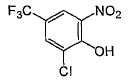
1H-NMR(CDCl3)δ:11.26(br s, 1H), 8.36(m, 1H), 7.95(d, J=2.2Hz, 1H)
1 H-NMR (CDCl 3 ) δ: 11.26 (br s, 1H), 8.36 (m, 1H), 7.95 (d, J = 2.2 Hz, 1H)
2-클로로-4-(트리플루오로메틸)-6-니트로페놀을 포함한 혼합물 5.01g, 아세트산에틸 15ml 및 5% 팔라듐탄소 1.0g의 혼합물을 약 1기압의 수소 분위기하 15시간 동안 교반하였다. 반응혼합물을 셀라이트(등록상표)를 통해 여과하여 여과액을 농축하였다. 잔사를 실리카겔 칼럼크로마토그래피 처리하여 2-아미노-6-클로로-4-(트리플루오로메틸)페놀 2.78g을 얻었다.A mixture of 5.01 g of a mixture containing 2-chloro-4- (trifluoromethyl) -6-nitrophenol, 15 ml of ethyl acetate and 1.0 g of 5% palladium carbon was stirred for about 15 hours under a hydrogen atmosphere of about 1 atmosphere. The reaction mixture was filtered through Celite (R) to concentrate the filtrate. The residue was subjected to silica gel column chromatography to obtain 2.78 g of 2-amino-6-chloro-4- (trifluoromethyl) phenol.

1H-NMR(CDCl3)δ:7.00(m, 1H), 6.84(d, J=2.2Hz, 1H), 5.80(br s, 1H), 4.05(br s, 2H)
1 H-NMR (CDCl 3 ) δ: 7.00 (m, 1H), 6.84 (d, J = 2.2 Hz, 1H), 5.80 (br s, 1H), 4.05 (br s, 2H)
WSC 0.58g과 피리딘 5ml의 혼합물에 이소니코틴산 0.37g을 첨가하고, 실온에서 15분 동안 교반하였다. 상기 반응으로 얻어진 2-아미노-6-클로로-4-(트리플루오로메틸)페놀 0.63g을 첨가하고, 60℃에서 3시간 동안 가열교반하였다. 실온에 냉각한 후, 감압 하에서 농축하고, 잔사에 물을 첨가하였다. 아세트산에틸로 2회 추출하고, 혼합된 유기층을 포화식염수로 세정한 후, 무수황산나트륨으로 건조시켰다. 감압 하에서 농축하고, 잔사를 tert-부틸메틸에테르와 헥산의 혼합용매로 세정하고, N-[3-클로로-5-(트리플루오로메틸)-2-히드록시페닐]이소니코틴아미드 0.42g을 얻었다.0.37 g of isnicotinic acid was added to a mixture of 0.58 g of WSC and 5 ml of pyridine, and stirred at room temperature for 15 minutes. 0.63 g of 2-amino-6-chloro-4- (trifluoromethyl) phenol obtained by the above reaction was added thereto, and the mixture was heated and stirred at 60 ° C for 3 hours. After cooling to room temperature, it was concentrated under reduced pressure and water was added to the residue. The mixture was extracted twice with ethyl acetate, and the mixed organic layers were washed with brine and dried over anhydrous sodium sulfate. Concentrated under reduced pressure, the residue was washed with a mixed solvent of tert-butylmethylether and hexane to obtain 0.42 g of N- [3-chloro-5- (trifluoromethyl) -2-hydroxyphenyl] isonicotinamide. .

1H-NMR(DMSO-d6)δ:10.27(br s, 1H), 8.81-8.79(m, 2H), 7.90-7.88(m, 2H), 7.86(d, J=2.0Hz, 1H), 7.68-7.67(m, 1H)
1 H-NMR (DMSO-d 6 ) δ: 10.27 (br s, 1H), 8.81-8.79 (m, 2H), 7.90-7.88 (m, 2H), 7.86 (d, J = 2.0 Hz, 1H), 7.68-7.67 (m, 1 H)
참고 Reference 제조예Production Example 28 28
4-트리플루오로메톡시페놀 4.0g 및 아세트산 25ml의 혼합물에 10-15℃로 유지한 채로 70% 질산 2.02g과 아세트산 10ml의 혼합물을 적하하여 5시간 교반하였다. 반응혼합물을 빙수 중에 부어서 아세트산에틸로 추출하였다. 혼합된 유기층을 물, 포화탄산수소나트륨 수용액 및 포화식염수로 세정하고, 황산나트륨으로 건조한 후, 감압 하에서 농축함으로써 4-트리플루오로메톡시-2-니트로페놀 4.53g을 얻었다.A mixture of 2.02 g of 70% nitric acid and 10 ml of acetic acid was added dropwise to a mixture of 4.0 g of 4-trifluoromethoxyphenol and 25 ml of acetic acid at 10-15 ° C, followed by stirring for 5 hours. The reaction mixture was poured into ice water and extracted with ethyl acetate. The mixed organic layer was washed with water, saturated aqueous sodium hydrogen carbonate solution and saturated brine, dried over sodium sulfate, and concentrated under reduced pressure to obtain 4.53 g of 4-trifluoromethoxy-2-nitrophenol.

1H-NMR(CDCl3)δ:10.50(s, 1H), 8.02-7.99(m, 1H), 7.50-7.45(m, 1H), 7.22(d, J=9.1Hz, 1H)
1 H-NMR (CDCl 3 ) δ: 10.50 (s, 1H), 8.02-7.99 (m, 1H), 7.50-7.45 (m, 1H), 7.22 (d, J = 9.1Hz, 1H)
4-트리플루오로메톡시-2-니트로페놀 4.53g, 아세트산에틸 35ml 및 5% 팔라듐탄소 1.0g의 혼합물을 약 1기압의 수소 분위기하 실온에서 1.7시간 동안 교반하였다. 셀라이트(등록상표)를 통하여 여과하여 여과액을 감압 하에서 농축함으로써 2-아미노-4-트리플루오로메톡시페놀 3.92g을 얻었다.A mixture of 4.53 g of 4-trifluoromethoxy-2-nitrophenol, 35 ml of ethyl acetate, and 1.0 g of 5% palladium carbon was stirred at room temperature under a hydrogen atmosphere of about 1 atmosphere for 1.7 hours. 3.92 g of 2-amino-4-trifluoromethoxyphenol was obtained by filtering through Celite (registered trademark) and concentrating the filtrate under reduced pressure.

2-아미노-4-트리플루오로메톡시페놀 2.5g, 트리에틸아민 2.62g 및 DMF 15ml의 혼합물에 빙랭 하에서 4-이소니코틴산 클로라이드 염산염 2.31g을 첨가하고, 3.3시간 동안 교반하였다. 반응혼합물을 수중에 붓고, 석출한 과결정을 여과하고 감압 하에서 건조시킴으로써 N-[5-(트리플루오로메톡시)-2-히드록시페닐]이소니코틴아미드 2.19g을 얻었다.To a mixture of 2.5 g of 2-amino-4-trifluoromethoxyphenol, 2.62 g of triethylamine and 15 ml of DMF, 2.31 g of 4-isonicotinic acid chloride hydrochloride was added under ice cooling and stirred for 3.3 hours. The reaction mixture was poured into water, and the precipitated overcrystals were filtered and dried under reduced pressure to obtain 2.19 g of N- [5- (trifluoromethoxy) -2-hydroxyphenyl] isonicotinamide.

1H-NMR(DMSO-d6)δ:8.78(dd, J=4.4, 1.7Hz, 2H), 7.86(dd, J=4.4, 1.6Hz, 2H), 7.80-7.77(m, 1H), 7.10-7.05(m, 1H), 6.99(d, J=8.7Hz, 1H)
1 H-NMR (DMSO-d 6 ) δ: 8.78 (dd, J = 4.4, 1.7 Hz, 2H), 7.86 (dd, J = 4.4, 1.6 Hz, 2H), 7.80-7.77 (m, 1H), 7.10 -7.05 (m, 1H), 6.99 (d, J = 8.7 Hz, 1H)
참고 Reference 제조예Production Example 29 29
2-아미노-4-tert-부틸페놀 0.41g, 3-클로로-4-피리딘카르복시알데히드 0.35g 및 에탄올 2.5ml의 혼합물을 3시간 동안 가열환류하였다. 반응혼합물을 농축하고, 잔사를 실리카겔 칼럼크로마토그래피 처리하여 2-(3-클로로피리딘-4-일)메틸리덴아미노-4-tert-부틸페놀 0.50g을 얻었다.A mixture of 0.41 g of 2-amino-4-tert-butylphenol, 0.35 g of 3-chloro-4-pyridinecarboxyaldehyde and 2.5 ml of ethanol was heated to reflux for 3 hours. The reaction mixture was concentrated and the residue was subjected to silica gel column chromatography to obtain 0.50 g of 2- (3-chloropyridin-4-yl) methylideneamino-4-tert-butylphenol.
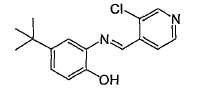
1H-NMR(CDCl3)δ:9.07(s, 1H), 8.71(s, 1H), 8.60(d, J=5.1Hz, 1H), 8.01(d, J=5.1Hz, 1H), 7.36-7.33(m, 2H), 7.02(s, 1H), 7.00-6.97(m, 1H), 1.35(s, 9H)
1 H-NMR (CDCl 3 ) δ: 9.07 (s, 1H), 8.71 (s, 1H), 8.60 (d, J = 5.1Hz, 1H), 8.01 (d, J = 5.1Hz, 1H), 7.36- 7.33 (m, 2H), 7.02 (s, 1H), 7.00-6.97 (m, 1H), 1.35 (s, 9H)
참고 Reference 제조예Production Example 30 30
4-(트리플루오로메틸티오)페놀 4.8g, 아세트산 20ml의 혼합물에 내부 온도(internal temperature)를 10-15℃로 유지한 채로 70% 질산 2.5g과 아세트산 1ml의 혼합물, 이어서 농황산 1.5ml를 적하하고, 실온에서 3시간 동안 교반하였다. 반응혼합물을 빙수 중에 붓고, 아세트산에틸로 추출하였다. 혼합된 유기층을 물, 포화탄산수소나트륨 수용액 및 포화식염수로 세정하고, 황산마그네슘으로 건조한 후, 감압 하에서 농축함으로써 2-니트로-4-(트리플루오로메틸티오)페놀 5.94g을 얻었다.
To a mixture of 4.8 g of 4- (trifluoromethylthio) phenol and 20 ml of acetic acid was added dropwise a mixture of 2.5 g of 70% nitric acid and 1 ml of acetic acid, followed by 1.5 ml of concentrated sulfuric acid, while maintaining an internal temperature of 10-15 ° C. And stirred at room temperature for 3 hours. The reaction mixture was poured into ice water and extracted with ethyl acetate. The mixed organic layer was washed with water, saturated aqueous sodium hydrogen carbonate solution and saturated brine, dried over magnesium sulfate, and concentrated under reduced pressure to obtain 5.94 g of 2-nitro-4- (trifluoromethylthio) phenol.

1H-NMR(CDCl3)δ:10.78(br s, 1H), 8.44(s, 1H), 7.83(d, J=8.8, 1H), 7.24(d, J=8.8Hz, 1H)
1 H-NMR (CDCl 3 ) δ: 10.78 (br s, 1H), 8.44 (s, 1H), 7.83 (d, J = 8.8, 1H), 7.24 (d, J = 8.8Hz, 1H)
2-니트로-4-(트리플루오로메틸티오)페놀 5.49g과 아세트산에틸 10ml의 혼합물을 80℃로 가열한 전해철 6.4g, 아세트산 10ml 및 물 20ml의 혼합물에 적하하고 30분 동안 교반하였다. 실온에 냉각한 후, 물을 첨가하고, 아세트산에틸로 2회 추출하였다. 혼합된 유기층을 물, 포화탄산수소나트륨 수용액, 포화식염수로 세정하고, 황산마그네슘으로 건조한 후, 감압 하에서 농축하였다. 잔사를 실리카겔 칼럼크로마토그래피 처리하여 2-아미노-4-(트리플루오로메틸티오)페놀 2.0g을 얻었다.A mixture of 5.49 g of 2-nitro-4- (trifluoromethylthio) phenol and 10 ml of ethyl acetate was added dropwise to a mixture of 6.4 g of electrolytic iron heated to 80 ° C., 10 ml of acetic acid, and 20 ml of water, and stirred for 30 minutes. After cooling to room temperature, water was added and extracted twice with ethyl acetate. The mixed organic layer was washed with water, saturated aqueous sodium hydrogen carbonate solution and brine, dried over magnesium sulfate, and concentrated under reduced pressure. The residue was subjected to silica gel column chromatography to obtain 2.0 g of 2-amino-4- (trifluoromethylthio) phenol.

1H-NMR(CDCl3)δ:7.04(d, J=2.0Hz, 1H), 6.97(dd, J=8.0, 2.0Hz, 1H), 6.73(d, J=8.0Hz, 1H), 5.16(br s, 1H), 3.74(br s, 2H)
1 H-NMR (CDCl 3 ) δ: 7.04 (d, J = 2.0 Hz, 1H), 6.97 (dd, J = 8.0, 2.0 Hz, 1H), 6.73 (d, J = 8.0 Hz, 1H), 5.16 ( br s, 1 H), 3.74 (br s, 2 H)
2-아미노-4-(트리플루오로메틸티오)페놀 0.70g, WSC 0.83g, 이소니코틴산 0.41g 및 피리딘 7ml의 혼합물을 80℃에서 3시간 동안 가열교반하였다. 실온에 냉각한 후, 물을 첨가하고, 아세트산에틸로 3회 추출하였다. 혼합된 유기층을 물, 포화식염수로 세정하고, 무수황산마그네슘으로 건조한 후, 감압 하에서 농축하였다. 잔사를 실리카겔 칼럼크로마토그래피 처리하여 N-[2-히드록시-5-(트리플루오로메틸티오)페닐]이소니코틴아미드 0.42g을 얻었다.A mixture of 0.70 g of 2-amino-4- (trifluoromethylthio) phenol, 0.83 g of WSC, 0.41 g of isnicotinic acid, and 7 ml of pyridine was heated and stirred at 80 ° C. for 3 hours. After cooling to room temperature, water was added and the mixture was extracted three times with ethyl acetate. The mixed organic layer was washed with water and brine, dried over anhydrous magnesium sulfate, and concentrated under reduced pressure. The residue was subjected to silica gel column chromatography to obtain 0.42 g of N- [2-hydroxy-5- (trifluoromethylthio) phenyl] isonicotinamide.

1H-NMR(DMSO-d6)δ:9.89(br s, 1H), 8.78(dd, J=4.3, 1.7Hz, 2H), 8.05(d, J=2.2Hz, 1H), 7.87(dd, J=4.3, 1.7Hz, 2H), 7.42(dd, J=8.5, 2.2Hz, 1H), 7.05(d, J=8.5Hz, 1H)
1 H-NMR (DMSO-d 6 ) δ: 9.89 (br s, 1 H), 8.78 (dd, J = 4.3, 1.7 Hz, 2H), 8.05 (d, J = 2.2 Hz, 1H), 7.87 (dd, J = 4.3, 1.7 Hz, 2H), 7.42 (dd, J = 8.5, 2.2 Hz, 1H), 7.05 (d, J = 8.5 Hz, 1H)
참고 Reference 제조예Production Example 31 31
2-아미노-4-(트리플루오로메틸티오)페놀 0.60g, 3-클로로이소니코틴산 0.45g, WSC 0.71g 및 피리딘 6ml의 혼합물을 80℃에서 3시간 동안 가열교반하였다. 실온에 냉각한 후, 물을 첨가하고, 아세트산에틸로 3회 추출하였다. 혼합된 유기층을 물, 포화식염수로 세정한 후, 무수황산마그네슘으로 건조한 후, 감압 하에서 농축하였다. 잔사를 실리카겔 칼럼크로마토그래피 처리하여 3-클로로-N-[2-히드록시-5-(트리플루오로메틸티오)페닐]이소니코틴아미드 0.63g을 얻었다.A mixture of 0.60 g of 2-amino-4- (trifluoromethylthio) phenol, 0.45 g of 3-chloroisonicotinic acid, 0.71 g of WSC and 6 ml of pyridine was heated and stirred at 80 ° C. for 3 hours. After cooling to room temperature, water was added and the mixture was extracted three times with ethyl acetate. The mixed organic layer was washed with water and brine, dried over anhydrous magnesium sulfate, and then concentrated under reduced pressure. The residue was subjected to silica gel column chromatography to obtain 0.63 g of 3-chloro-N- [2-hydroxy-5- (trifluoromethylthio) phenyl] isonicotinamide.

1H-NMR(DMSO-d6)δ:10.89(br s, 1H), 10.14(br s, 1H), 8.74(s, 1H), 8.63(d, J=4.8Hz, 1H), 8.31(d, J=2.2Hz, 1H), 7.63(d, J=4.8Hz, 1H), 7.39(dd, J=8.5, 2.2Hz, 1H), 7.03(d, J=8.5Hz, 1H)
1 H-NMR (DMSO-d 6 ) δ: 10.89 (br s, 1H), 10.14 (br s, 1H), 8.74 (s, 1H), 8.63 (d, J = 4.8 Hz, 1H), 8.31 (d , J = 2.2Hz, 1H), 7.63 (d, J = 4.8Hz, 1H), 7.39 (dd, J = 8.5, 2.2Hz, 1H), 7.03 (d, J = 8.5Hz, 1H)
참고 Reference 제조예Production Example 32 32
4-클로로-3-트리플루오로메틸페놀 5.0g과 아세트산 20ml의 혼합물에 빙랭 하에서 농황산 1.5ml, 이어서 69% 질산 2.6g을 적하하였다. 실온에서 농황산 3ml를 적하하여 3시간 동안 교반하였다. 반응혼합물을 빙수 중에 붓고, 아세트산에틸로 추출하였다. 혼합된 유기층을 물, 포화탄산수소나트륨 수용액, 포화식염수로 세정하고, 황산마그네슘으로 건조한 후, 감압 하에서 농축하였다. 잔사를 실리카겔 칼럼크로마토그래피 처리하여 4-클로로-2-니트로-5-트리플루오로메틸페놀 2.3g, 4-클로로-2-니트로-3-트리플루오로메틸페놀 1.57g을 얻었다.To a mixture of 5.0 g of 4-chloro-3-trifluoromethylphenol and 20 ml of acetic acid, 1.5 ml of concentrated sulfuric acid and then 2.6 g of 69% nitric acid were added dropwise under ice cooling. 3 ml of concentrated sulfuric acid was added dropwise at room temperature, followed by stirring for 3 hours. The reaction mixture was poured into ice water and extracted with ethyl acetate. The mixed organic layer was washed with water, saturated aqueous sodium hydrogen carbonate solution and brine, dried over magnesium sulfate, and concentrated under reduced pressure. The residue was subjected to silica gel column chromatography to obtain 2.3 g of 4-chloro-2-nitro-5-trifluoromethylphenol and 1.57 g of 4-chloro-2-nitro-3-trifluoromethylphenol.

1H-NMR(CDCl3)δ:10.43(s, 1H), 8.27(s, 1H), 7.57(s, 1H) 1 H-NMR (CDCl 3 ) δ: 10.43 (s, 1H), 8.27 (s, 1H), 7.57 (s, 1H)

1H-NMR(CDCl3)δ:7.53(d, J=9.0Hz, 1H), 7.24(d, J=9.0Hz, 1H)
1 H-NMR (CDCl 3 ) δ: 7.53 (d, J = 9.0Hz, 1H), 7.24 (d, J = 9.0Hz, 1H)
4-클로로-2-니트로-5-트리플루오로메틸페놀 2.3g과 아세트산에틸 10ml의 혼합물을 80℃로 가열한 전해철 2.6g, 아세트산 10ml 및 물 20ml의 혼합물에 적하하여 1시간 동안 교반하였다. 실온에 냉각한 후, 물을 첨가하고, 아세트산에틸로 추출하였다. 혼합된 유기층을 물, 포화탄산수소나트륨 수용액, 포화식염수로 세정하고, 황산마그네슘으로 건조한 후, 감압 하에서 농축하였다. 잔사를 실리카겔 칼럼크로마토그래피 처리하여 2-아미노-4-클로로-5-트리플루오로메틸페놀 1.7g을 얻었다.A mixture of 2.3 g of 4-chloro-2-nitro-5-trifluoromethylphenol and 10 ml of ethyl acetate was added dropwise to a mixture of 2.6 g of electrolytic iron heated to 80 ° C., 10 ml of acetic acid, and 20 ml of water, and stirred for 1 hour. After cooling to room temperature, water was added, followed by extraction with ethyl acetate. The mixed organic layer was washed with water, saturated aqueous sodium hydrogen carbonate solution and brine, dried over magnesium sulfate, and concentrated under reduced pressure. The residue was subjected to silica gel column chromatography to obtain 1.7 g of 2-amino-4-chloro-5-trifluoromethylphenol.
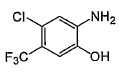
1H-NMR(CDCl3)δ:6.99(s, 1H), 6.77(s, 1H), 5.01(br s, 1H), 4.09(br s, 2H)
1 H-NMR (CDCl 3 ) δ: 6.99 (s, 1H), 6.77 (s, 1H), 5.01 (br s, 1H), 4.09 (br s, 2H)
2-아미노-4-클로로-5-트리플루오로메틸페놀 0.70g, WSC 0.79g, 이소니코틴산 0.39g 및 피리딘 6ml의 혼합물을 80℃에서 3시간 동안 가열교반하였다. 실온에 냉각한 후, 물을 첨가하고, 아세트산에틸로 3회 추출하였다. 혼합된 유기층을 물, 포화식염수로 세정하고, 무수황산마그네슘으로 건조한 후, 감압 하에서 농축하였다. 잔사를 실리카겔 칼럼크로마토그래피 처리하여 N-[5-클로로-2-히드록시-4-트리플루오로메틸페닐]이소니코틴아미드 0.54g을 얻었다.A mixture of 0.70 g of 2-amino-4-chloro-5-trifluoromethylphenol, 0.79 g of WSC, 0.39 g of isnicotinic acid, and 6 ml of pyridine was heated and stirred at 80 ° C. for 3 hours. After cooling to room temperature, water was added and the mixture was extracted three times with ethyl acetate. The mixed organic layer was washed with water and brine, dried over anhydrous magnesium sulfate, and concentrated under reduced pressure. The residue was subjected to silica gel column chromatography to obtain 0.54 g of N- [5-chloro-2-hydroxy-4-trifluoromethylphenyl] isonicotinamide.

1H-NMR(DMSO-d6)δ:10.08(br s, 1H), 8.80(dd, J=4.3, 1.7Hz, 2H), 8.13(s, 1H), 7.86(dd, J=4.3, 1.7Hz, 2H), 7.32(s, 1H)
1 H-NMR (DMSO-d 6 ) δ: 10.08 (br s, 1H), 8.80 (dd, J = 4.3, 1.7 Hz, 2H), 8.13 (s, 1H), 7.86 (dd, J = 4.3, 1.7 Hz, 2H), 7.32 (s, 1H)
참고 Reference 제조예Production Example 33 33
2-아미노-4-클로로-5-트리플루오로메틸페놀 0.60g, 3-클로로이소니코틴산 0.43g, WSC 0.67g 및 피리딘 5ml의 혼합물을 80℃에서 3시간 동안 가열교반하였다. 실온에 냉각한 후, 물을 첨가하고, 아세트산에틸로 3회 추출하였다. 혼합된 유기층을 물, 포화식염수로 세정한 후, 무수황산마그네슘으로 건조한 후, 감압 하에서 농축하였다. 잔사를 실리카겔 칼럼크로마토그래피 처리하여 3-클로로-N-[5-클로로-2-히드록시-4-트리플루오로메틸페닐]이소니코틴아미드 0.67g을 얻었다.A mixture of 0.60 g of 2-amino-4-chloro-5-trifluoromethylphenol, 0.43 g of 3-chloroisonicotinic acid, 0.67 g of WSC and 5 ml of pyridine was heated and stirred at 80 ° C. for 3 hours. After cooling to room temperature, water was added and the mixture was extracted three times with ethyl acetate. The mixed organic layer was washed with water and brine, dried over anhydrous magnesium sulfate, and then concentrated under reduced pressure. The residue was subjected to silica gel column chromatography to obtain 0.67 g of 3-chloro-N- [5-chloro-2-hydroxy-4-trifluoromethylphenyl] isonicotinamide.

1H-NMR(DMSO-d6)δ:8.75(s, 1H), 8.64(d, J=4.8Hz, 1H), 8.36(s, 1H), 7.62(d, J=4.8Hz, 1H), 7.28(s, 1H)
1 H-NMR (DMSO-d 6 ) δ: 8.75 (s, 1H), 8.64 (d, J = 4.8Hz, 1H), 8.36 (s, 1H), 7.62 (d, J = 4.8Hz, 1H), 7.28 (s, 1 H)
참고 Reference 제조예Production Example 34 34
4-클로로-2-니트로-3-트리플루오로메틸페놀 1.57g과 아세트산에틸 5ml의 혼합물을 80℃로 가열한 전해철 1.8g, 아세트산 7ml 및 물 7ml의 혼합물에 적하하고 30분 동안 교반하였다. 실온에 냉각한 후, 물을 첨가하고, 아세트산에틸로 추출하였다. 혼합된 유기층을 물, 포화탄산수소나트륨 수용액, 포화식염수로 세정하고, 황산마그네슘으로 건조한 후, 감압 하에서 농축하였다. 잔사를 실리카겔 칼럼크로마토그래피 처리하여 2-아미노-4-클로로-3-트리플루오로메틸페놀 1.1g을 얻었다.A mixture of 1.57 g of 4-chloro-2-nitro-3-trifluoromethylphenol and 5 ml of ethyl acetate was added dropwise to a mixture of 1.8 g of electrolytic iron heated to 80 ° C., 7 ml of acetic acid, and 7 ml of water, and stirred for 30 minutes. After cooling to room temperature, water was added, followed by extraction with ethyl acetate. The mixed organic layer was washed with water, saturated aqueous sodium hydrogen carbonate solution and brine, dried over magnesium sulfate, and concentrated under reduced pressure. The residue was subjected to silica gel column chromatography to obtain 1.1 g of 2-amino-4-chloro-3-trifluoromethylphenol.
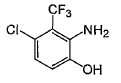
1H-NMR(CDCl3)δ:6.72(d, J=8.3Hz, 1H), 6.68(d, J=8.3Hz, 1H), 5.48 (br s, 1H), 4.67(br s, 2H)
1 H-NMR (CDCl 3 ) δ: 6.72 (d, J = 8.3Hz, 1H), 6.68 (d, J = 8.3Hz, 1H), 5.48 (br s, 1H), 4.67 (br s, 2H)
2-아미노-4-클로로-3-트리플루오로메틸페놀 0.75g, WSC 0.84g, 이소니코틴산 0.42g 및 피리딘 5ml의 혼합물을 80℃에서 3시간 동안 가열교반하였다. 이소니코틴산 0.1g을 첨가하고, 다시 3시간 동안 가열교반하였다. 실온에 냉각한 후, 물을 첨가하고, 아세트산에틸로 3회 추출하였다. 혼합된 유기층을 물, 포화식염수로 세정하고, 무수황산마그네슘으로 건조한 후, 감압 하에서 농축하였다. 잔사를 실리카겔 칼럼크로마토그래피 처리하여 N-[3-클로로-6-히드록시-2-트리플루오로메틸페닐]이소니코틴아미드 0.54g을 얻었다.A mixture of 0.75 g of 2-amino-4-chloro-3-trifluoromethylphenol, 0.84 g of WSC, 0.42 g of isnicotinic acid and 5 ml of pyridine was heated and stirred at 80 ° C. for 3 hours. 0.1 g of isonicotinic acid was added and stirred again for 3 hours. After cooling to room temperature, water was added and the mixture was extracted three times with ethyl acetate. The mixed organic layer was washed with water and brine, dried over anhydrous magnesium sulfate, and concentrated under reduced pressure. The residue was subjected to silica gel column chromatography to obtain 0.54 g of N- [3-chloro-6-hydroxy-2-trifluoromethylphenyl] isonicotinamide.
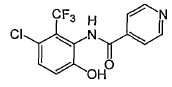
1H-NMR(DMSO-d6)δ:10.47(br s, 1H), 10.20(br s, 1H), 8.80(dd, J=4.6, 1.4Hz, 2H), 7.85(dd, J=4.6, 1.4Hz, 2H), 7.51(d, J=8.9Hz, 1H), 7.22(d, J=8.9Hz, 1H)
1 H-NMR (DMSO-d 6 ) δ: 10.47 (br s, 1H), 10.20 (br s, 1H), 8.80 (dd, J = 4.6, 1.4 Hz, 2H), 7.85 (dd, J = 4.6, 1.4 Hz, 2H), 7.51 (d, J = 8.9 Hz, 1H), 7.22 (d, J = 8.9 Hz, 1H)
참고 Reference 제조예Production Example 35 35
2,4-디클로로-5-니트로벤조트리플루오리드 10g, 아세트산칼륨 4.15g 및 DMF 60ml의 혼합물을 60℃에서 1시간, 80℃에서 3시간 동안 가열교반하였다. 아세트산칼륨 4.15g을 추가하고, 80℃에서 다시 1시간 동안 가열교반하였다. 실온에 냉각한 후, 1M 염산을 첨가하고, 아세트산에틸로 추출하였다. 혼합된 유기층을 물, 포화식염수로 세정하고, 황산마그네슘으로 건조한 후, 감압 하에서 농축하였다. 잔사를 실리카겔 칼럼크로마토그래피 처리하여 5-클로로-2-니트로-4-트리플루오로메틸페놀 7.55g을 얻었다.A mixture of 10 g of 2,4-dichloro-5-nitrobenzotrifluoride, 4.15 g of potassium acetate and 60 ml of DMF was heated and stirred at 60 ° C. for 1 hour and 80 ° C. for 3 hours. 4.15 g of potassium acetate was added, and the mixture was further stirred at 80 DEG C for 1 hour. After cooling to room temperature, 1M hydrochloric acid was added and extracted with ethyl acetate. The mixed organic layer was washed with water and brine, dried over magnesium sulfate, and concentrated under reduced pressure. The residue was subjected to silica gel column chromatography to obtain 7.55 g of 5-chloro-2-nitro-4-trifluoromethylphenol.

1H-NMR(CDCl3)δ:10.81(s, 1H), 8.49(s, 1H), 7.37(s, 1H)
1 H-NMR (CDCl 3 ) δ: 10.81 (s, 1H), 8.49 (s, 1H), 7.37 (s, 1H)
5-클로로-2-니트로-4-트리플루오로메틸페놀 7.55g과 아세트산에틸 10ml의 혼합물을 80℃로 가열한 전해철 8.7g, 아세트산 30ml, 물 50ml의 혼합물에 적하하고, 같은 온도에서 30분 동안 교반하였다. 실온에 냉각한 후, 물을 첨가하고, 아세트산에틸로 추출하였다. 혼합된 유기층을 물, 포화탄산수소나트륨 수용액, 포화식염수로 세정하고, 황산마그네슘으로 건조한 후, 감압 하에서 농축하였다. 잔사를 실리카겔 칼럼크로마토그래피 처리하여 2-아미노-5-클로로-4-트리플루오로메틸페놀 5.4g을 얻었다.A mixture of 7.55 g of 5-chloro-2-nitro-4-trifluoromethylphenol and 10 ml of ethyl acetate was added dropwise to a mixture of 8.7 g of electrolytic iron heated to 80 ° C., 30 ml of acetic acid, and 50 ml of water, for 30 minutes at the same temperature. Stirred. After cooling to room temperature, water was added, followed by extraction with ethyl acetate. The mixed organic layer was washed with water, saturated aqueous sodium hydrogen carbonate solution and brine, dried over magnesium sulfate, and concentrated under reduced pressure. The residue was subjected to silica gel column chromatography to obtain 5.4 g of 2-amino-5-chloro-4-trifluoromethylphenol.

1H-NMR(CDCl3)δ:7.03(s, 1H), 6.84(s, 1H), 5.93(br s, 1H), 3.81(br s, 2H)
1 H-NMR (CDCl 3 ) δ: 7.03 (s, 1H), 6.84 (s, 1H), 5.93 (br s, 1H), 3.81 (br s, 2H)
2-아미노-5-클로로-4-트리플루오로메틸페놀 1.2g, WSC 1.35g, 이소니코틴산 0.67g 및 피리딘 10ml의 혼합물을 80℃에서 3시간 동안 가열교반하였다. 실온에 냉각한 후, 물을 첨가하고, 아세트산에틸로 3회 추출하였다. 혼합된 유기층을 물, 포화식염수로 세정하고, 무수황산마그네슘으로 건조한 후, 감압 하에서 농축하였다. 잔사를 실리카겔 칼럼크로마토그래피 처리하여 N-[4-클로로-2-히드록시-5-트리플루오로메틸페닐]이소니코틴아미드 1.01g을 얻었다.A mixture of 1.2 g of 2-amino-5-chloro-4-trifluoromethylphenol, 1.35 g of WSC, 0.67 g of isnicotinic acid, and 10 ml of pyridine was heated and stirred at 80 ° C. for 3 hours. After cooling to room temperature, water was added and the mixture was extracted three times with ethyl acetate. The mixed organic layer was washed with water and brine, dried over anhydrous magnesium sulfate, and concentrated under reduced pressure. The residue was subjected to silica gel column chromatography to obtain 1.01 g of N- [4-chloro-2-hydroxy-5-trifluoromethylphenyl] isonicotinamide.

1H-NMR(DMSO-d6)δ:10.03(br s, 1H), 8.79(dd, J=4.3, 1.7Hz, 2H), 8.14(s, 1H), 7.86(dd, J=4.3, 1.7Hz, 2H), 7.16(s, 1H)
1 H-NMR (DMSO-d 6 ) δ: 10.03 (br s, 1H), 8.79 (dd, J = 4.3, 1.7 Hz, 2H), 8.14 (s, 1H), 7.86 (dd, J = 4.3, 1.7 Hz, 2H), 7.16 (s, 1H)
참고 Reference 제조예Production Example 36 36
2-아미노-5-클로로-4-트리플루오로메틸페놀 0.50g, 3-클로로이소니코틴산 0.36g, WSC 0.56g 및 피리딘 5ml의 혼합물을 80℃에서 3시간 동안 가열교반하였다. 실온에 냉각한 후, 물을 첨가하고, 아세트산에틸로 3회 추출하였다. 혼합된 유기층을 물, 포화식염수로 세정한 후, 무수황산마그네슘으로 건조한 후, 감압 하에서 농축하였다. 잔사를 실리카겔 칼럼크로마토그래피 처리하여 3-클로로-N-[4-클로로-2-히드록시-5-트리플루오로메틸페닐]이소니코틴아미드 0.46g을 얻었다.A mixture of 0.50 g of 2-amino-5-chloro-4-trifluoromethylphenol, 0.36 g of 3-chloroisonicotinic acid, 0.56 g of WSC, and 5 ml of pyridine was heated and stirred at 80 ° C. for 3 hours. After cooling to room temperature, water was added and the mixture was extracted three times with ethyl acetate. The mixed organic layer was washed with water and brine, dried over anhydrous magnesium sulfate, and then concentrated under reduced pressure. The residue was subjected to silica gel column chromatography to obtain 0.46 g of 3-chloro-N- [4-chloro-2-hydroxy-5-trifluoromethylphenyl] isonicotinamide.
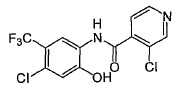
1H-NMR(DMSO-d6)δ:10.32(br s, 1H), 8.75(s, 1H), 8.64(d, J=4.8Hz, 1H), 8.43(s, 1H), 7.63(d, J=4.8Hz, 1H), 7.13(s, 1H)
1 H-NMR (DMSO-d 6 ) δ: 10.32 (br s, 1H), 8.75 (s, 1H), 8.64 (d, J = 4.8 Hz, 1H), 8.43 (s, 1H), 7.63 (d, J = 4.8 Hz, 1H), 7.13 (s, 1H)
참고 Reference 제조예Production Example 37 37
6-아미노-1,1,3,3-테트라플루오로-5-히드록시-1,3-디히드로이소벤조푸란 0.68g, 3-클로로이소니코틴산 0.48g, WSC 0.76g 및 피리딘 7ml의 혼합물을 80℃에서 3시간 동안 가열교반하였다. 실온에 냉각한 후, 물을 첨가하고, 아세트산에틸로 3회 추출하였다. 혼합된 유기층을 물, 포화식염수로 세정한 후, 무수황산마그네슘으로 건조한 후, 감압 하에서 농축하였다. 잔사를 실리카겔 칼럼크로마토그래피 처리하여 3-클로로-N-(1,1,3,3-테트라플루오로-6-히드록시-1,3-디히드로이소벤조푸란-5-일)이소니코틴아미드 0.68g을 얻었다.A mixture of 0.68 g of 6-amino-1,1,3,3-tetrafluoro-5-hydroxy-1,3-dihydroisobenzofuran, 0.48 g of 3-chloroisonicotinic acid, 0.76 g of WSC and 7 ml of pyridine The mixture was heated and stirred at 80 ° C. for 3 hours. After cooling to room temperature, water was added and the mixture was extracted three times with ethyl acetate. The mixed organic layer was washed with water and brine, dried over anhydrous magnesium sulfate, and then concentrated under reduced pressure. The residue was subjected to silica gel column chromatography to give 3-chloro-N- (1,1,3,3-tetrafluoro-6-hydroxy-1,3-dihydroisobenzofuran-5-yl) isonicotinamide 0.68 g was obtained.

1H-NMR(DMSO-d6)δ:10.47(br s, 1H), 8.76(s, 1H), 8.65(d, J=4.6Hz, 1H), 8.55(s, 1H), 7.64(d, J=4.8Hz, 1H), 7.27(s, 1H)
1 H-NMR (DMSO-d 6 ) δ: 10.47 (br s, 1H), 8.76 (s, 1H), 8.65 (d, J = 4.6 Hz, 1H), 8.55 (s, 1H), 7.64 (d, J = 4.8 Hz, 1H), 7.27 (s, 1H)
참고 Reference 제조예Production Example 38 38
6-아미노-1,1,3,3-테트라플루오로-5-히드록시-1,3-디히드로이소벤조푸란 1.5g, 3-플루오로이소니코틴산 0.95g, WSC 1.68g 및 피리딘 13ml의 혼합물을 80℃에서 2시간 동안 가열교반하였다. 실온에 냉각한 후, 물을 첨가하고, 아세트산에틸로 3회 추출하였다. 혼합된 유기층을 물, 포화식염수로 세정한 후, 무수황산마그네슘으로 건조한 후, 감압 하에서 농축하였다. 잔사를 실리카겔 칼럼크로마토그래피 처리하여 3-플루오로-N-(1,1,3,3-테트라플루오로-6-히드록시-1,3-디히드로이소벤조푸란-5-일)이소니코틴아미드 1.46g을 얻었다.A mixture of 1.5 g of 6-amino-1,1,3,3-tetrafluoro-5-hydroxy-1,3-dihydroisobenzofuran, 0.95 g of 3-fluoroisonicotinic acid, 1.68 g of WSC and 13 ml of pyridine Was stirred at 80 ° C. for 2 hours. After cooling to room temperature, water was added and the mixture was extracted three times with ethyl acetate. The mixed organic layer was washed with water and brine, dried over anhydrous magnesium sulfate, and then concentrated under reduced pressure. The residue was subjected to silica gel column chromatography to give 3-fluoro-N- (1,1,3,3-tetrafluoro-6-hydroxy-1,3-dihydroisobenzofuran-5-yl) isonicotinamide 1.46 g was obtained.
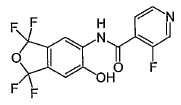
1H-NMR(DMSO-d6)δ:10.21 (br s, 1H), 8.79-8.77(m, 1H), 8.63-8.58(m, 2H), 7.81-7.76(m, 1H), 7.30 (s, 1H)
1 H-NMR (DMSO-d 6 ) δ: 10.21 (br s, 1H), 8.79-8.77 (m, 1H), 8.63-8.58 (m, 2H), 7.81-7.76 (m, 1H), 7.30 (s , 1H)
참고 Reference 제조예Production Example 39 39
2-아미노-5-클로로-4-트리플루오로메틸페놀 2.0g, 3-플루오로이소니코틴산 1.33g, WSC 2.36g 및 피리딘 15ml의 혼합물을 80℃에서 3.5시간 동안 가열교반하였다. 실온에 냉각한 후, 물을 첨가하고, 아세트산에틸로 3회 추출하였다. 혼합된 유기층을 물, 포화식염수로 세정한 후, 무수황산마그네슘으로 건조한 후, 감압 하에서 농축하였다. 잔사를 실리카겔 칼럼크로마토그래피 처리하여 3-플루오로-N-[4-클로로-2-히드록시-5-트리플루오로메틸페닐]이소니코틴아미드 2.08g을 얻었다.A mixture of 2.0 g of 2-amino-5-chloro-4-trifluoromethylphenol, 1.33 g of 3-fluoroisonicotinic acid, 2.36 g of WSC and 15 ml of pyridine was heated and stirred at 80 ° C. for 3.5 hours. After cooling to room temperature, water was added and the mixture was extracted three times with ethyl acetate. The mixed organic layer was washed with water and brine, dried over anhydrous magnesium sulfate, and then concentrated under reduced pressure. The residue was subjected to silica gel column chromatography to obtain 2.08 g of 3-fluoro-N- [4-chloro-2-hydroxy-5-trifluoromethylphenyl] isonicotinamide.
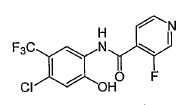
1H-NMR(DMSO-d6)δ:11.57 (br s, 1H), 10.08(br s, 1H), 8.77-8.75(m, 1H), 8.61-8.58(m, 1H), 8.48(s, 1H), 7.78-7.73(m, 1H), 7.15(s, 1H)
1 H-NMR (DMSO-d 6 ) δ: 11.57 (br s, 1H), 10.08 (br s, 1H), 8.77-8.75 (m, 1H), 8.61-8.58 (m, 1H), 8.48 (s, 1H), 7.78-7.73 (m, 1H), 7.15 (s, 1H)
참고 Reference 제조예Production Example 40 40
3-에틸이소니코틴산 0.62g 및 염화티오닐 4ml의 혼합물을 2.5시간 동안 가열환류하였다. 실온까지 냉각한 후, 반응혼합물을 감압 하에서 농축하고, 3-에틸이소니코틴산 클로라이드를 얻었다. 얻어진 3-에틸이소니코틴산 클로라이드 및 DMF 3ml의 혼합물을 2-아미노-5-클로로-4-트리플루오로메틸페놀 0.87g, 트리에틸아민 0.83g 및 DMF 3ml의 혼합물에 빙랭 하에서 적하하였다. 실온에서 2시간 동안 교반한 후, 반응혼합물에 물을 첨가하고, 아세트산에틸로 2회 추출하였다. 혼합된 유기층을 물, 포화식염수로 세정하고, 무수황산마그네슘으로 건조한 후, 감압 하에서 농축하였다. 잔사를 실리카겔 칼럼크로마토그래피 처리하여 N-[4-클로로-2-히드록시-5-(트리플루오로메틸)페닐]-3-에틸이소니코틴아미드 0.23g을 얻었다.A mixture of 0.62 g of 3-ethylisonicotinic acid and 4 ml of thionyl chloride was heated to reflux for 2.5 hours. After cooling to room temperature, the reaction mixture was concentrated under reduced pressure to obtain 3-ethylisonicotinic acid chloride. The resulting mixture of 3-ethylisonicotinic acid chloride and 3 ml of DMF was added dropwise to a mixture of 0.87 g of 2-amino-5-chloro-4-trifluoromethylphenol, 0.83 g of triethylamine, and 3 ml of DMF under ice cooling. After stirring for 2 hours at room temperature, water was added to the reaction mixture, and the mixture was extracted twice with ethyl acetate. The mixed organic layer was washed with water and brine, dried over anhydrous magnesium sulfate, and concentrated under reduced pressure. The residue was subjected to silica gel column chromatography to obtain 0.23 g of N- [4-chloro-2-hydroxy-5- (trifluoromethyl) phenyl] -3-ethylisonicotinamide.
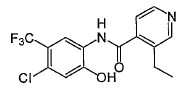
1H-NMR(DMSO-d6)δ:9.98(br s, 1H), 8.58-8.56(m, 1H), 8.53(d, J=4.8Hz, 1H), 8.25(s, 1H), 7.45(d, J=4.9Hz, 1H), 7.11(s, 1H), 2.76(q, J=7.6Hz, 2H), 1.19(t, J=7.6Hz, 3H)
1 H-NMR (DMSO-d 6 ) δ: 9.98 (br s, 1H), 8.58-8.56 (m, 1H), 8.53 (d, J = 4.8 Hz, 1H), 8.25 (s, 1H), 7.45 ( d, J = 4.9 Hz, 1H), 7.11 (s, 1H), 2.76 (q, J = 7.6 Hz, 2H), 1.19 (t, J = 7.6 Hz, 3H)
참고 Reference 제조예Production Example 41 41
3-클로로이소니코틴산 0.69g 및 염화티오닐 5ml, DMF 30mg의 혼합물을 3.5시간 동안 가열환류하였다. 실온까지 냉각한 후, 반응혼합물을 감압 하에서 농축하고, 3-클로로이소니코틴산 클로라이드를 얻었다. 얻어진 3-클로로이소니코틴산 클로라이드 및 DMF 4ml의 혼합물을 2-아미노-5-플루오로-4-트리플루오로메틸페놀 0.85g, 트리에틸아민 0.88g 및 DMF 4ml의 혼합물에 빙랭 하에서 적하하였다. 그 후, 실온에서 1시간, 50℃에서 1시간 동안 교반하였다. 실온에 냉각한 후, 반응혼합물에 물을 첨가하고, 아세트산에틸로 2회 추출하였다. 혼합된 유기층을 물, 포화식염수로 세정하고, 무수황산마그네슘으로 건조한 후, 감압 하에서 농축하였다. 얻어진 고체를 디에틸에테르로 세정하여 3-클로로-N-[4-플루오로-2-히드록시-5-(트리플루오로메틸)페닐]-이소니코틴아미드 0.77g을 얻었다.A mixture of 0.69 g of 3-chloroisonicotinic acid, 5 ml of thionyl chloride and 30 mg of DMF was heated to reflux for 3.5 hours. After cooling to room temperature, the reaction mixture was concentrated under reduced pressure to obtain 3-chloroisonicotinic acid chloride. The resulting mixture of 3-chloroisonicotinic acid chloride and 4 ml of DMF was added dropwise to a mixture of 0.85 g of 2-amino-5-fluoro-4-trifluoromethylphenol, 0.88 g of triethylamine and 4 ml of DMF under ice cooling. Thereafter, the mixture was stirred at room temperature for 1 hour and at 50 ° C for 1 hour. After cooling to room temperature, water was added to the reaction mixture, and the mixture was extracted twice with ethyl acetate. The mixed organic layer was washed with water and brine, dried over anhydrous magnesium sulfate, and concentrated under reduced pressure. The obtained solid was washed with diethyl ether to obtain 0.77 g of 3-chloro-N- [4-fluoro-2-hydroxy-5- (trifluoromethyl) phenyl] -isonicotinamide.
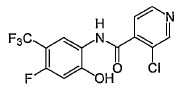
1H-NMR(DMSO-d6)δ:10.20(br s, 1H), 8.75(s, 1H), 8.64(d, J=4.8Hz, 1H), 8.23(d, J=8.5Hz, 1H), 7.62(d, J=4.8Hz, 1H), 6.91-6.85(m, 1H)
1 H-NMR (DMSO-d 6 ) δ: 10.20 (br s, 1H), 8.75 (s, 1H), 8.64 (d, J = 4.8 Hz, 1H), 8.23 (d, J = 8.5 Hz, 1H) , 7.62 (d, J = 4.8 Hz, 1H), 6.91-6.85 (m, 1H)
참고 Reference 제조예Production Example 42 42
2-아미노-5-플루오로-4-트리플루오로메틸페놀을 대신하여 2-아미노-3-플루오로-4-트리플루오로메틸페놀을 사용하고, 참고 제조예 41 기재의 방법에 준하여 3-클로로-N-[2-플루오로-6-히드록시-3-(트리플루오로메틸)페닐]-이소니코틴아미드를 얻었다.2-amino-3-fluoro-4-trifluoromethylphenol was used in place of 2-amino-5-fluoro-4-trifluoromethylphenol, and 3- according to the method described in Reference Preparation Example 41 Chloro-N- [2-fluoro-6-hydroxy-3- (trifluoromethyl) phenyl] -isonicotinamide was obtained.
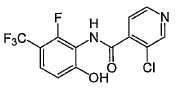
1H-NMR(DMSO-d6)δ:11.15(br s, 1H), 10.22(br s, 1H), 8.79(s, 1H), 8.67(d, J=4.6Hz, 1H), 7.62(d, J=4.6Hz, 1H), 7.58-7.52(m, 1H), 6.92(d, J=8.8Hz, 1H)
1 H-NMR (DMSO-d 6 ) δ: 11.15 (br s, 1H), 10.22 (br s, 1H), 8.79 (s, 1H), 8.67 (d, J = 4.6 Hz, 1H), 7.62 (d , J = 4.6 Hz, 1H), 7.58-7.52 (m, 1H), 6.92 (d, J = 8.8 Hz, 1H)
참고 Reference 제조예Production Example 43 43
2-아미노-3-클로로-4-트리플루오로메틸페놀 0.17g, 이소니코틴산 0.99g, WSC 0.19g 및 피리딘 3ml의 혼합물을 80℃에서 2시간 동안 가열교반하였다. 실온에 냉각한 후, 물을 첨가하고, 아세트산에틸로 3회 추출하였다. 혼합된 유기층을 물, 포화식염수로 세정한 후, 무수황산마그네슘으로 건조한 후, 감압 하에서 농축하였다. 잔사를 실리카겔 칼럼크로마토그래피 처리하여 N-[2-클로로-6-히드록시-3-(트리플루오로메틸)페닐]이소니코틴아미드 0.15g을 얻었다.A mixture of 0.17 g of 2-amino-3-chloro-4-trifluoromethylphenol, 0.99 g of isonicotinic acid, 0.19 g of WSC, and 3 ml of pyridine was heated and stirred at 80 ° C. for 2 hours. After cooling to room temperature, water was added and the mixture was extracted three times with ethyl acetate. The mixed organic layer was washed with water and brine, dried over anhydrous magnesium sulfate, and then concentrated under reduced pressure. The residue was subjected to silica gel column chromatography to obtain 0.15 g of N- [2-chloro-6-hydroxy-3- (trifluoromethyl) phenyl] isonicotinamide.

1H-NMR(DMSO-d6)δ:10.98(br s, 1H), 10.24(br s, 1H), 8.82-8.79(m, 2H), 7.94-7.85(m, 2H), 7.67(d, J=8.8Hz, 1H), 7.06(d, J=8.9Hz, 1H)
1 H-NMR (DMSO-d 6 ) δ: 10.98 (br s, 1H), 10.24 (br s, 1H), 8.82-8.79 (m, 2H), 7.94-7.85 (m, 2H), 7.67 (d, J = 8.8Hz, 1H), 7.06 (d, J = 8.9Hz, 1H)
참고 Reference 제조예Production Example 44 44
2-아미노-5-클로로-4-트리플루오로메틸페놀을 대신하여 6-아미노-1,1,3,3-테트라플루오로-5-히드록시-1,3-디히드로이소벤조푸란을 사용하고, 참고 제조예 40 기재의 방법에 준하여 3-에틸-N-(1,1,3,3-테트라플루오로-6-히드록시-1,3-디히드로이소벤조푸란-5-일)이소니코틴아미드를 얻었다.6-amino-1,1,3,3-tetrafluoro-5-hydroxy-1,3-dihydroisobenzofuran in place of 2-amino-5-chloro-4-trifluoromethylphenol And 3-ethyl-N- (1,1,3,3-tetrafluoro-6-hydroxy-1,3-dihydroisobenzofuran-5-yl) iso according to the method described in Reference Preparation Example 40 Nicotinamide was obtained.

1H-NMR(DMSO-d6)δ:10.10(br s, 1H), 8.60-8.58(m, 1H), 8.54(d, J=4.9Hz, 1H), 8.44(s, 1H), 7.45(d, J=4.9Hz, 1H), 7.26(s, 1H), 2.77(q, J=7.6Hz, 2H), 1.20(t, J=7.6Hz, 3H)
1 H-NMR (DMSO-d 6 ) δ: 10.10 (br s, 1H), 8.60-8.58 (m, 1H), 8.54 (d, J = 4.9 Hz, 1H), 8.44 (s, 1H), 7.45 ( d, J = 4.9 Hz, 1H), 7.26 (s, 1H), 2.77 (q, J = 7.6 Hz, 2H), 1.20 (t, J = 7.6 Hz, 3H)
참고 Reference 제조예Production Example 45 45
3-플루오로이소니코틴산 1.5g, 염화티오닐 5ml 및 DMF 50mg의 혼합물을 2시간 동안 가열환류하였다. 실온까지 냉각한 후, 반응혼합물을 감압 하에서 농축하고, 3-플루오로이소니코틴산 클로라이드를 얻었다. 얻어진 3-플루오로이소니코틴산 클로라이드 및 DMF 5ml의 혼합물을 2-아미노-4-tert-부틸페놀 1.76g, 트리에틸아민 2.18g 및 DMF 10ml의 혼합물에 빙랭 하에서 적하하고, 실온에서 1.5시간 동안 교반하여 다시 50℃에서 30분 동안 가열교반하였다. 실온에 냉각한 후, 반응혼합물에 물을 첨가하고, 석출한 여과하였다. 얻어진 결정을 아세트산에틸에 용해하고, 물, 포화식염수로 세정하고, 무수황산마그네슘으로 건조한 후, 감압 하에서 농축하여 N-(5-tert-부틸-2-히드록시페닐)-3-플루오로이소니코틴아미드 2.41g을 얻었다.A mixture of 1.5 g of 3-fluoroisonicotinic acid, 5 ml of thionyl chloride and 50 mg of DMF was heated to reflux for 2 hours. After cooling to room temperature, the reaction mixture was concentrated under reduced pressure to afford 3-fluoroisonicotinic acid chloride. The resulting mixture of 3-fluoroisonicotinic acid chloride and 5 ml of DMF was added dropwise to a mixture of 1.76 g of 2-amino-4-tert-butylphenol, 2.18 g of triethylamine, and 10 ml of DMF under ice cooling, and stirred at room temperature for 1.5 hours. The mixture was further stirred at 50 ° C. for 30 minutes. After cooling to room temperature, water was added to the reaction mixture, and the precipitate was filtered. The obtained crystals were dissolved in ethyl acetate, washed with water and brine, dried over anhydrous magnesium sulfate, and then concentrated under reduced pressure to obtain N- (5-tert-butyl-2-hydroxyphenyl) -3-fluoroisonicotine. 2.41 g of amide was obtained.

1H-NMR(DMSO-d6)δ:9.73(br s, 1H), 8.76-8.74(m, 1H), 8.61-8.58(m, 1H), 7.99(d, J=2.4Hz, 1H), 7.80-7.76(m, 1H), 7.06(dd, J=8.5, 2.4Hz, 1H), 6.84(d, J=8.5Hz, 1H), 1.26(s, 9H)
1 H-NMR (DMSO-d 6 ) δ: 9.73 (br s, 1H), 8.76-8.74 (m, 1H), 8.61-8.58 (m, 1H), 7.99 (d, J = 2.4 Hz, 1H), 7.80-7.76 (m, 1H), 7.06 (dd, J = 8.5, 2.4 Hz, 1H), 6.84 (d, J = 8.5 Hz, 1H), 1.26 (s, 9H)
참고 Reference 제조예Production Example 46 46
2-아미노-5-클로로-4-트리플루오로메틸페놀을 대신하여 2-아미노-4-tert-부틸페놀을 사용하고, 참고 제조예 40 기재의 방법에 준하여 N-(5-tert-부틸-2-히드록시페닐)-3-에틸이소니코틴아미드를 얻었다.2-amino-4-tert-butylphenol was used in place of 2-amino-5-chloro-4-trifluoromethylphenol, and N- (5-tert-butyl- was obtained according to the method described in Reference Preparation Example 40. 2-hydroxyphenyl) -3-ethylisonicotinamide was obtained.
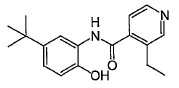
1H-NMR(DMSO-d6)δ:9.66(br s, 1H), 9.51(br s, 1H), 8.58-8.56(m, 1H), 8.52(d, J=4.9Hz, 1H), 7.65(d, J=2.4Hz, 1H), 7.45(d, J=4.9Hz, 1H), 7.07(dd, J=8.5, 2.4Hz, 1H), 6.83(d, J=8.5Hz, 1H), 2.79(q, J=7.6Hz, 2H), 1.21(t, J=7.6Hz, 3H)
1 H-NMR (DMSO-d 6 ) δ: 9.66 (br s, 1H), 9.51 (br s, 1H), 8.58-8.56 (m, 1H), 8.52 (d, J = 4.9 Hz, 1H), 7.65 (d, J = 2.4 Hz, 1H), 7.45 (d, J = 4.9 Hz, 1H), 7.07 (dd, J = 8.5, 2.4 Hz, 1H), 6.83 (d, J = 8.5 Hz, 1H), 2.79 (q, J = 7.6 Hz, 2H), 1.21 (t, J = 7.6 Hz, 3H)
참고 Reference 제조예Production Example 47 47
2-클로로-5-트리플루오로메틸이소니코틴산 0.66g과 염화티오닐 4ml의 혼합물을 2.5시간 동안 가열환류하였다. 실온까지 냉각한 후, 반응혼합물을 감압 하에서 농축하고, 2-클로로-5-트리플루오로메틸이소니코틴산 클로라이드를 얻었다. 얻어진 2-클로로-5-트리플루오로메틸이소니코틴산 클로라이드 및 DMF 4ml의 혼합물을 2-아미노-4-tert-부틸페놀 0.48g, 트리에틸아민 0.59g 및 DMF 4ml의 혼합물에 빙랭 하에서 적하하고, 실온에서 1시간 동안 교반하여, 다시 50℃에서 1시간 동안 가열교반하였다. 실온에 냉각한 후, 반응혼합물에 물을 첨가하고, 아세트산에틸로 2회 추출하였다. 혼합된 유기층을 물, 포화식염수로 세정하고, 무수황산마그네슘으로 건조한 후, 감압 하에서 농축하였다. 잔사를 실리카겔 칼럼크로마토그래피 처리하여 N-(5-tert-부틸-2-히드록시페닐)-2-클로로-5-트리플루오로메틸이소니코틴아미드 0.75g을 얻었다.A mixture of 0.66 g of 2-chloro-5-trifluoromethylisonicotinic acid and 4 ml of thionyl chloride was heated to reflux for 2.5 hours. After cooling to room temperature, the reaction mixture was concentrated under reduced pressure to obtain 2-chloro-5-trifluoromethylisonicotinic acid chloride. The resulting mixture of 2-chloro-5-trifluoromethylisonicotinic acid chloride and 4 ml of DMF was added dropwise to a mixture of 0.48 g of 2-amino-4-tert-butylphenol, 0.59 g of triethylamine and 4 ml of DMF under ice-cooling, and After stirring for 1 hour, the mixture was heated and stirred at 50 ° C for 1 hour. After cooling to room temperature, water was added to the reaction mixture, and the mixture was extracted twice with ethyl acetate. The mixed organic layer was washed with water and brine, dried over anhydrous magnesium sulfate, and concentrated under reduced pressure. The residue was subjected to silica gel column chromatography to obtain 0.75 g of N- (5-tert-butyl-2-hydroxyphenyl) -2-chloro-5-trifluoromethylisonicotinamide.

1H-NMR(DMSO-d6)δ:8.92(s, 1H), 7.98(s, 1H), 7.84(d, J=2.4Hz, 1H), 7.06(dd, J=8.5, 2.4Hz, 1H), 6.83(d, J=8.5Hz, 1H), 1.25(s, 9H)
1 H-NMR (DMSO-d 6 ) δ: 8.92 (s, 1H), 7.98 (s, 1H), 7.84 (d, J = 2.4Hz, 1H), 7.06 (dd, J = 8.5, 2.4Hz, 1H ), 6.83 (d, J = 8.5 Hz, 1H), 1.25 (s, 9H)
참고 Reference 제조예Production Example 48 48
2-아미노-4-트리플루오로메톡시페놀 0.35g, 3-클로로이소니코틴산 0.29g, (벤조트리아졸-1-일옥시)트리스(디메틸아미노)포스포늄헥사플루오로인산염(이하, BOP 시약이라고 함) 1.04g, 트리에틸아민 0.24g 및 DMF 5ml의 혼합물을 실온에서 2시간 동안 교반하였다. 반응혼합물에 물을 첨가하고, 석출한 여과하였다. 얻어진 고체를 아세트산에틸에 용해한 후, 유기층을 포화식염수로 세정하고, 무수황산마그네슘으로 건조한 후, 감압 하에서 농축하였다. 잔사를 실리카겔 칼럼크로마토그래피 처리하여 3-클로로-N-[2-히드록시-5-(트리플루오로메톡시)페닐]이소니코틴아미드 0.43g을 얻었다.0.35 g of 2-amino-4-trifluoromethoxyphenol, 0.29 g of 3-chloroisonicotinic acid, (benzotriazol-1-yloxy) tris (dimethylamino) phosphonium hexafluorophosphate (hereinafter referred to as BOP reagent) A mixture of 1.04 g), 0.24 g triethylamine and 5 ml DMF was stirred at room temperature for 2 hours. Water was added to the reaction mixture, and the precipitate was filtered. The obtained solid was dissolved in ethyl acetate, the organic layer was washed with saturated brine, dried over anhydrous magnesium sulfate, and then concentrated under reduced pressure. The residue was subjected to silica gel column chromatography to obtain 0.43 g of 3-chloro-N- [2-hydroxy-5- (trifluoromethoxy) phenyl] isonicotinamide.
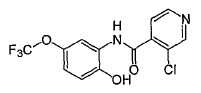
1H-NMR(DMSO-d6)δ:10.37(br s, 1H), 10.15(br s, 1H), 8.75-8.73(m, 1H), 8.64-8.61(m, 1H), 8.04-8.01(m, 1H), 7.63-7.60(m, 1H), 7.07-7.02(m, 1H), 6.98-6.94(m, 1H)
1 H-NMR (DMSO-d 6 ) δ: 10.37 (br s, 1H), 10.15 (br s, 1H), 8.75-8.73 (m, 1H), 8.64-8.61 (m, 1H), 8.04-8.01 ( m, 1H), 7.63-7.60 (m, 1H), 7.07-7.02 (m, 1H), 6.98-6.94 (m, 1H)
참고 Reference 제조예Production Example 49 49
3-트리플루오로메틸이소니코틴산 0.72g과 염화티오닐 4ml의 혼합물을 1.5시간 동안 가열환류하였다. 실온까지 냉각한 후, 반응혼합물을 감압 하에서 농축하고, 3-트리플루오로메틸이소니코틴산 클로라이드를 얻었다. 얻어진 3-트리플루오로메틸이소니코틴산 클로라이드 및 DMF 4ml의 혼합물을 2-아미노-4-트리플루오로메틸페놀 0.66g, 트리에틸아민 0.76g, DMF 4ml의 혼합물에 빙랭 하에서 적하하고, 실온에서 1시간 동안 교반하여, 다시 50℃에서 2.5시간 동안 가열교반하였다. 실온에 냉각한 후, 반응혼합물에 물을 첨가하고, 아세트산에틸로 2회 추출하였다. 혼합된 유기층을 물, 포화식염수로 세정하고, 무수황산마그네슘으로 건조한 후, 감압 하에서 농축하였다. 잔사를 디에틸에테르로 세정하여 N-[2-히드록시-5-(트리플루오로메틸)페닐]-3-(트리플루오로메틸)이소니코틴아미드 0.62g을 얻었다.A mixture of 0.72 g of 3-trifluoromethylisonicotinic acid and 4 ml of thionyl chloride was heated to reflux for 1.5 hours. After cooling to room temperature, the reaction mixture was concentrated under reduced pressure to obtain 3-trifluoromethylisonicotinic acid chloride. The resulting mixture of 3-trifluoromethylisonicotinic acid chloride and 4 ml of DMF was added dropwise to a mixture of 0.66 g of 2-amino-4-trifluoromethylphenol, 0.76 g of triethylamine, and 4 ml of DMF under ice-cooling, at room temperature for 1 hour. After stirring, the mixture was further stirred at 50 ° C. for 2.5 hours. After cooling to room temperature, water was added to the reaction mixture, and the mixture was extracted twice with ethyl acetate. The mixed organic layer was washed with water and brine, dried over anhydrous magnesium sulfate, and concentrated under reduced pressure. The residue was washed with diethyl ether to obtain 0.62 g of N- [2-hydroxy-5- (trifluoromethyl) phenyl] -3- (trifluoromethyl) isonicotinamide.

1H-NMR(DMSO-d6)δ:9.06-9.04(m, 1H), 8.98(d, J=5.1Hz, 1H), 8.28-8.25(m, 1H), 7.74(d, J=4.9Hz, 1H), 7.41-7.37(m, 1H), 7.06(d, J=8.8Hz, 1H)
1 H-NMR (DMSO-d 6 ) δ: 9.06-9.04 (m, 1H), 8.98 (d, J = 5.1Hz, 1H), 8.28-8.25 (m, 1H), 7.74 (d, J = 4.9Hz , 1H), 7.41-7.37 (m, 1H), 7.06 (d, J = 8.8 Hz, 1H)
참고 Reference 제조예Production Example 50 50
3-히드록시메틸피리딘 10.0g 및 THF 200ml의 혼합물에 실온에서 60% 수소화나트륨(유성) 3.7g을 조금씩 첨가한 후, 15분 동안 교반하였다. 여기에 요오드화메틸 13.0g을 적하하고, 실온에서 3시간 동안 교반하였다. 반응혼합물에 물 25ml를 첨가한 후, 감압 하에서 농축하였다. 잔사에 물 25ml를 첨가하고, 아세트산에틸로 3회 추출하였다. 혼합된 유기층을 포화식염수로 세정하고, 무수황산마그네슘으로 건조한 후, 감압 하에서 농축하였다. 잔사를 실리카겔 칼럼크로마토그래피 처리하여 3-메톡시메틸피리딘 8.17g을 얻었다.To a mixture of 10.0 g of 3-hydroxymethylpyridine and 200 ml of THF was added 3.7 g of 60% sodium hydride (oil) at room temperature, followed by stirring for 15 minutes. 13.0 g of methyl iodide was added dropwise thereto, and the mixture was stirred at room temperature for 3 hours. 25 ml of water was added to the reaction mixture, which was then concentrated under reduced pressure. 25 ml of water was added to the residue, and the mixture was extracted three times with ethyl acetate. The combined organic layers were washed with saturated brine, dried over anhydrous magnesium sulfate, and concentrated under reduced pressure. The residue was subjected to silica gel column chromatography to obtain 8.17 g of 3-methoxymethylpyridine.

1H-NMR(CDCl3)δ:8.59-8.57(m, 1H), 8.56-8.54(m, 1H), 7.70-7.66(m, 1H), 7.31-7.27(m, 1H), 4.47(s, 2H), 3.41(s, 3H)
1 H-NMR (CDCl 3 ) δ: 8.59-8.57 (m, 1H), 8.56-8.54 (m, 1H), 7.70-7.66 (m, 1H), 7.31-7.27 (m, 1H), 4.47 (s, 2H), 3.41 (s, 3H)
참고 Reference 제조예Production Example 51 51
3-메톡시메틸피리딘 7.74g, 아세트산 60ml 및 30% 과산화수소수 7.5g의 혼합물을 80℃에서 4시간 동안 가열교반하였다. 실온에 냉각한 후, 탄산나트륨을 조금씩 첨가하였다. 반응혼합물을 여과하고, 아세트산에틸로 세정하였다. 얻어진 여과액을 포화아황산수소나트륨 수용액, 포화식염수로 세정하고, 무수탄산나트륨으로 건조하였다. 활성탄을 첨가하고, 셀라이트(등록상표)를 통하여 여과하여 여과액을 감압 하에서 농축하여 3-메톡시메틸피리딘 N-옥시드 2.66g을 얻었다.A mixture of 7.74 g of 3-methoxymethylpyridine, 60 ml of acetic acid and 7.5 g of 30% hydrogen peroxide solution was heated and stirred at 80 ° C. for 4 hours. After cooling to room temperature, sodium carbonate was added portionwise. The reaction mixture was filtered and washed with ethyl acetate. The obtained filtrate was washed with saturated aqueous sodium hydrogen sulfite solution and saturated brine, and dried over anhydrous sodium carbonate. Activated charcoal was added, filtered through Celite (registered trademark), and the filtrate was concentrated under reduced pressure to obtain 2.66 g of 3-methoxymethylpyridine-N-oxide.

1H-NMR(CDCl3)δ:8.24-8.21(m, 1H), 8.16-8.13(m, 1H), 7.29-7.22(m, 2H), 4.43(s, 2H), 3.43(s, 3H)
1 H-NMR (CDCl 3 ) δ: 8.24-8.21 (m, 1H), 8.16-8.13 (m, 1H), 7.29-7.22 (m, 2H), 4.43 (s, 2H), 3.43 (s, 3H)
참고 Reference 제조예Production Example 52 52
3-메톡시메틸피리딘 N-옥시드 2.66g 및 요오드에탄 9.0g의 혼합물을 60℃에서 1시간 동안 가열교반하였다. 실온에 냉각한 후, 디에틸에테르를 첨가하고, 석출한 결정을 여과하였다. 얻어진 고체와 물 20ml의 혼합물에 50℃에서 시안화나트륨 1.80g과 물 7ml의 혼합물을 적하하고, 같은 온도에서 1시간 동안 가열교반하였다. 실온에 냉각한 후, 디에틸에테르로 3회 추출하였다. 혼합된 유기층을 포화식염수로 세정하고, 무수황산마그네슘으로 건조한 후, 감압 하에서 농축하였다. 잔사를 실리카겔 칼럼크로마토그래피 처리하여 3-메톡시메틸이소니코티노니트릴 0.89g을 얻었다.A mixture of 2.66 g of 3-methoxymethylpyridine N-oxide and 9.0 g of iodineethane was heated and stirred at 60 ° C. for 1 hour. After cooling to room temperature, diethyl ether was added, and the precipitated crystals were filtered out. A mixture of 1.80 g of sodium cyanide and 7 ml of water was added dropwise to a mixture of the obtained solid and 20 ml of water at 50 ° C, and the mixture was heated and stirred at the same temperature for 1 hour. After cooling to room temperature, the mixture was extracted three times with diethyl ether. The combined organic layers were washed with saturated brine, dried over anhydrous magnesium sulfate, and concentrated under reduced pressure. The residue was subjected to silica gel column chromatography to obtain 0.89 g of 3-methoxymethylisonicotinonitrile.

1H-NMR(CDCl3)δ:8.86(d, J=0.7Hz, 1H), 8.73(d, J=4.9Hz, 1H), 7.53(dd, J=4.9, 0.7Hz, 1H), 4.66(s, 2H), 3.51(s, 3H)
1 H-NMR (CDCl 3 ) δ: 8.86 (d, J = 0.7 Hz, 1H), 8.73 (d, J = 4.9 Hz, 1H), 7.53 (dd, J = 4.9, 0.7 Hz, 1H), 4.66 ( s, 2H), 3.51 (s, 3H)
참고 Reference 제조예Production Example 53 53
3-메톡시메틸이소니코티노니트릴 0.89g, 수산화나트륨 0.72g, 에탄올 6ml 및 물 6ml의 혼합물을 3시간 동안 가열환류하였다. 실온까지 냉각한 후, 감압 하에서 농축하였다. 얻어진 잔사의 pH가 약 3이 될 때까지 3M 염산을 첨가하고, 다시 감압 하에서 농축하였다. 얻어진 고체에 에탄올 40ml를 첨가하고, 5분 동안 가열환류한 후, 그대로 고온여과(hot filtration)하였다. 여과한 고체에 대해서 각 40ml의 에탄올로 다시 2회 동일한 조작을 실시하였다. 합한 여과액을 농축하여 3-메톡시이소니코틴산 1.0g을 얻었다.A mixture of 0.89 g of 3-methoxymethylisonicotinonitrile, 0.72 g of sodium hydroxide, 6 ml of ethanol and 6 ml of water was heated to reflux for 3 hours. After cooling to room temperature, it was concentrated under reduced pressure. 3M hydrochloric acid was added until the pH of the obtained residue became about 3, and it concentrated under reduced pressure again. 40 ml of ethanol was added to the obtained solid, heated to reflux for 5 minutes, and hot filtration as it was. The same operation was performed twice with each 40 ml of ethanol about the filtered solid. The combined filtrates were concentrated to obtain 1.0 g of 3-methoxyisonicotinic acid.

1H-NMR(DMSO-d6)δ:8.77-8.75(m, 1H), 8.67(d, J=5.1Hz, 1H), 7.72-7.69(m, 1H), 4.75(s, 2H), 3.35(s, 3H)
1 H-NMR (DMSO-d 6 ) δ: 8.77-8.75 (m, 1H), 8.67 (d, J = 5.1 Hz, 1H), 7.72-7.69 (m, 1H), 4.75 (s, 2H), 3.35 (s, 3H)
참고 Reference 제조예Production Example 54 54
2-아미노-4-(트리플루오로메틸)페놀 0.40g, 3-메톡시메틸이소니코틴산 0.38g, BOP 시약 1.30g, 트리에틸아민 0.30g, DMF 20ml의 혼합물을 실온에서 4시간 동안 교반하였다. 반응혼합물에 물을 첨가하고, 아세트산에틸로 2회 추출하였다. 혼합된 유기층을 포화식염수로 세정하고, 무수황산마그네슘으로 건조한 후, 감압 하에서 농축하였다. 잔사를 실리카겔 칼럼크로마토그래피 처리하여 N-[2-히드록시-5-(트리플루오로메틸)페닐]-3(메톡시메틸)이소니코틴아미드 0.64g을 얻었다.A mixture of 0.40 g of 2-amino-4- (trifluoromethyl) phenol, 0.38 g of 3-methoxymethylisonicotinic acid, 1.30 g of BOP reagent, 0.30 g of triethylamine, and 20 ml of DMF was stirred at room temperature for 4 hours. Water was added to the reaction mixture, followed by extraction twice with ethyl acetate. The combined organic layers were washed with saturated brine, dried over anhydrous magnesium sulfate, and concentrated under reduced pressure. The residue was subjected to silica gel column chromatography to obtain 0.64 g of N- [2-hydroxy-5- (trifluoromethyl) phenyl] -3 (methoxymethyl) isonicotinamide.
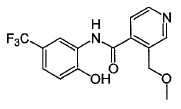
1H-NMR(DMSO-d6)δ:10.89(br s, 1H), 10.00(br s, 1H), 8.70(s, 1H), 8.69(d, J=4.9Hz, 1H), 8.32-8.30(m, 1H), 7.60(d, J=4.9Hz, 1H), 7.42-7.38(m, 1H), 7.08(d, J=8.5Hz, 1H), 4.63(s, 2H), 3.33(s, 3H)
1 H-NMR (DMSO-d 6 ) δ: 10.89 (br s, 1H), 10.00 (br s, 1H), 8.70 (s, 1H), 8.69 (d, J = 4.9 Hz, 1H), 8.32-8.30 (m, 1H), 7.60 (d, J = 4.9 Hz, 1H), 7.42-7.38 (m, 1H), 7.08 (d, J = 8.5 Hz, 1H), 4.63 (s, 2H), 3.33 (s, 3H)
참고 Reference 제조예Production Example 55 55
2-히드록시-3-니트로-5-트리플루오로메틸피리딘 3.13g, 메탄올 40ml 및 5% 팔라듐탄소 0.85g의 혼합물을 약 1기압의 수소 분위기하 실온에서 2시간 동안 교반하였다. 반응혼합물을 셀라이트(등록상표)를 통하여 여과하여 얻어진 여과액을 감압 하에서 농축하고, 3-아미노-2-히드록시-5-트리플루오로메틸피리딘 2.66g을 얻었다.A mixture of 3.13 g of 2-hydroxy-3-nitro-5-trifluoromethylpyridine, 40 ml of methanol and 0.85 g of 5% palladium carbon was stirred at room temperature under a hydrogen atmosphere of about 1 atmosphere for 2 hours. The reaction mixture was filtrated through Celite (registered trademark) and the filtrate was concentrated under a reduced pressure to obtain 2.66 g of 3-amino-2-hydroxy-5-trifluoromethylpyridine.

1H-NMR(DMSO-d6)δ:11.83(br s, 1H), 7.11-7.08(m, 1H), 6.49-6.48(m, 1H), 5.50(br s, 2H)
1 H-NMR (DMSO-d 6 ) δ: 11.83 (br s, 1H), 7.11-7.08 (m, 1H), 6.49-6.48 (m, 1H), 5.50 (br s, 2H)
참고 Reference 제조예Production Example 56 56
3-아미노-2-히드록시-5-트리플루오로메틸피리딘 1.0g, 이소니코틴산 0.69g, WSC 1.40g 및 피리딘 7ml의 혼합물을 80℃에서 2시간 동안 가열교반하였다. 실온에 냉각한 후, 반응혼합물에 물을 첨가하고, 아세트산에틸로 3회 추출하였다. 혼합된 유기층을 물, 포화식염수로 세정하고, 무수황산마그네슘으로 건조한 후, 감압 하에서 농축하였다. 잔사를 실리카겔 칼럼크로마토그래피 처리하여 N-[2-히드록시-5-(트리플루오로메틸)피리딘-3-일]이소니코틴아미드 1.22g을 얻었다.A mixture of 1.0 g of 3-amino-2-hydroxy-5-trifluoromethylpyridine, 0.69 g of isonicotinic acid, 1.40 g of WSC, and 7 ml of pyridine was heated and stirred at 80 ° C. for 2 hours. After cooling to room temperature, water was added to the reaction mixture, which was extracted three times with ethyl acetate. The mixed organic layer was washed with water and brine, dried over anhydrous magnesium sulfate, and concentrated under reduced pressure. The residue was subjected to silica gel column chromatography to obtain 1.22 g of N- [2-hydroxy-5- (trifluoromethyl) pyridin-3-yl] isonicotinamide.

1H-NMR(DMSO-d6)δ:12.76(br s, 1H), 9.76(s, 1H), 8.79(dd, J=4.5, 1.6Hz, 2H), 8.44(d, J=2.4Hz, 1H), 7.85-7.81(m, 3H)
1 H-NMR (DMSO-d 6 ) δ: 12.76 (br s, 1H), 9.76 (s, 1H), 8.79 (dd, J = 4.5, 1.6 Hz, 2H), 8.44 (d, J = 2.4 Hz, 1H), 7.85-7.81 (m, 3H)
참고 Reference 제조예Production Example 57 57
3-클로로이소니코틴산 0.88g, 염화티오닐 5ml 및 DMF 20mg의 혼합물을 3시간 동안 가열환류하였다. 실온까지 냉각한 후, 반응혼합물을 감압 하에서 농축하고, 3-클로로이소니코틴산 클로라이드를 얻었다. 얻어진 3-클로로이소니코틴산 클로라이드 및 DMF 4ml의 혼합물을 3-아미노-2-히드록시-5-트리플루오로메틸피리딘 1.0g, 트리에틸아민 1.14g 및 DMF 8ml의 혼합물에 빙랭 하에서 적하하고, 실온에서 1시간 교반하여, 다시 50℃에서 30분 동안 가열교반하였다. 실온에 냉각한 후, 반응혼합물에 물을 첨가하고, 아세트산에틸로 2회 추출하였다. 혼합된 유기층을 물, 포화식염수로 세정하고, 무수황산마그네슘으로 건조한 후, 감압 하에서 농축하였다. 잔사를 실리카겔 칼럼크로마토그래피 처리하여 3-클로로-N-[2-히드록시-5-(트리플루오로메틸)피리딘-3-일]이소니코틴아미드 0.87g을 얻었다.A mixture of 0.88 g of 3-chloroisonicotinic acid, 5 ml of thionyl chloride and 20 mg of DMF was heated to reflux for 3 hours. After cooling to room temperature, the reaction mixture was concentrated under reduced pressure to obtain 3-chloroisonicotinic acid chloride. The resulting mixture of 3-chloroisonicotinic acid chloride and 4 ml of DMF was added dropwise to a mixture of 1.0 g of 3-amino-2-hydroxy-5-trifluoromethylpyridine, 1.14 g of triethylamine, and 8 ml of DMF under ice-cooling, at room temperature The mixture was stirred for 1 hour and further stirred at 50 ° C. for 30 minutes. After cooling to room temperature, water was added to the reaction mixture, and the mixture was extracted twice with ethyl acetate. The mixed organic layer was washed with water and brine, dried over anhydrous magnesium sulfate, and concentrated under reduced pressure. The residue was subjected to silica gel column chromatography to obtain 0.87 g of 3-chloro-N- [2-hydroxy-5- (trifluoromethyl) pyridin-3-yl] isonicotinamide.

1H-NMR(CDCl3)δ:12.59(br s, 1H), 9.18(br s, 1H), 8.85-8.83(m, 1H), 8.77(s, 1H), 8.69(d, J=4.9Hz, 1H), 7.69(d, J=4.9Hz, 1H), 7.55-7.53(m, 1H)
1 H-NMR (CDCl 3 ) δ: 12.59 (br s, 1 H), 9.18 (br s, 1 H), 8.85-8.83 (m, 1 H), 8.77 (s, 1 H), 8.69 (d, J = 4.9 Hz , 1H), 7.69 (d, J = 4.9 Hz, 1H), 7.55-7.53 (m, 1H)
참고 Reference 제조예Production Example 58 58
3-클로로이소니코틴산을 대신하여 3-플루오로이소니코틴산을 사용하고, 참고 제조예 57 기재의 방법에 준하여 3-플루오로-N-[2-히드록시-5-(트리플루오로메틸)피리딘-3-일]이소니코틴아미드를 얻었다.3-Fluoroisonicotinic acid was used in place of 3-chloroisonicotinic acid, and 3-fluoro-N- [2-hydroxy-5- (trifluoromethyl) pyridine- was prepared according to the method described in Reference Preparation Example 57. 3-yl] isonicotinamide.

1H-NMR(DMSO-d6)δ:12.78(br s, 1H), 10.10(d, J=5.6Hz, 1H), 8.78(d, J=2.2Hz, 1H), 8.61(d, J=4.8Hz, 1H), 8.53(d, J=2.4Hz, 1H), 7.84-7.82(m, 1H), 7.80-7.77(m, 1H)
1 H-NMR (DMSO-d 6 ) δ: 12.78 (br s, 1H), 10.10 (d, J = 5.6 Hz, 1H), 8.78 (d, J = 2.2 Hz, 1H), 8.61 (d, J = 4.8 Hz, 1H), 8.53 (d, J = 2.4 Hz, 1H), 7.84-7.82 (m, 1H), 7.80-7.77 (m, 1H)
참고 Reference 제조예Production Example 59 59
3-클로로이소니코틴산을 대신하여 3-메틸이소니코틴산을 사용하고, 참고 제조예 57 기재의 방법에 준하여 N-[2-히드록시-5-(트리플루오로메틸)피리딘-3-일]-3-메틸이소니코틴아미드를 얻었다.N- [2-hydroxy-5- (trifluoromethyl) pyridin-3-yl] -3 using 3-methylisonicotinic acid in place of 3-chloroisonicotinic acid and according to the method described in Reference Preparation Example 57 -Methylisonicotinamide was obtained.

1H-NMR(CDCl3)δ:12.79(br s, 1H), 8.81-8.79(m, 1H), 8.73-8.70(m, 1H), 8.63-8.60(m, 2H), 7.56-7.54(m, 1H), 7.43-7.41(m, 1H), 2.53(s, 3H)
1 H-NMR (CDCl 3 ) δ: 12.79 (br s, 1H), 8.81-8.79 (m, 1H), 8.73-8.70 (m, 1H), 8.63-8.60 (m, 2H), 7.56-7.54 (m , 1H), 7.43-7.41 (m, 1H), 2.53 (s, 3H)
참고 Reference 제조예Production Example 60 60
3-클로로이소니코틴산을 대신하여 3-에틸이소니코틴산을 사용하고, 참고 제조예 57 기재의 방법에 준하여 3-에틸-N-[2-히드록시-5-(트리플루오로메틸)피리딘-3-일]이소니코틴아미드를 얻었다.3-ethylisonicotinic acid was used in place of 3-chloroisonicotinic acid, and 3-ethyl-N- [2-hydroxy-5- (trifluoromethyl) pyridine-3- was prepared according to the method described in Reference Preparation Example 57. Japanese] isonicotinamide was obtained.
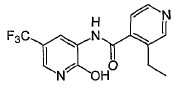
1H-NMR(DMSO-d6)δ:12.67(br s, 1H), 9.87(br s, 1H), 8.57(s, 1H), 8.52(d, J=4.8Hz, 1H), 8.45(d, J=2.4Hz, 1H), 7.82-7.79(m, 1H), 7.41(d, J=4.8Hz, 1H), 2.73(q, J=7.6Hz, 2H), 1.18(t, J=7.6Hz, 3H)
1 H-NMR (DMSO-d 6 ) δ: 12.67 (br s, 1H), 9.87 (br s, 1H), 8.57 (s, 1H), 8.52 (d, J = 4.8 Hz, 1H), 8.45 (d , J = 2.4 Hz, 1H), 7.82-7.79 (m, 1H), 7.41 (d, J = 4.8 Hz, 1H), 2.73 (q, J = 7.6 Hz, 2H), 1.18 (t, J = 7.6 Hz , 3H)
참고 Reference 제조예Production Example 61 61
3-클로로이소니코틴산을 대신하여 3-트리플루오로메틸이소니코틴산을 사용하고, 참고 제조예 57 기재의 방법에 준하여 N-(2-히드록시-5-트리플루오로메틸피리딘-3-일)-3-트리플루오로메틸이소니코틴아미드를 얻었다.3-trifluoromethylisonicotinic acid was used in place of 3-chloroisonicotinic acid, and N- (2-hydroxy-5-trifluoromethylpyridin-3-yl)-was obtained according to the method described in Reference Preparation Example 57. 3-trifluoromethylisonicotinamide was obtained.
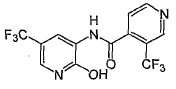
1H-NMR(DMSO-d6)δ:12.67(br s, 1H), 10.54(br s, 1H), 9.02(s, 1H), 8.95(d, J=5.1Hz, 1H), 8.48(d, J=2.7Hz, 1H), 7.83-7.80(m, 1H), 7.69(d, J=5.1Hz, 1H)
1 H-NMR (DMSO-d 6 ) δ: 12.67 (br s, 1 H), 10.54 (br s, 1 H), 9.02 (s, 1 H), 8.95 (d, J = 5.1 Hz, 1 H), 8.48 (d , J = 2.7 Hz, 1H), 7.83-7.80 (m, 1H), 7.69 (d, J = 5.1 Hz, 1H)
참고 Reference 제조예Production Example 62 62
3-메톡시이소니코티노니트릴 1.73g, 수산화나트륨 1.03g 및 에탄올 20ml의 혼합물을 20시간 동안 가열환류하였다. 실온까지 냉각한 후, 감압 하에서 농축하였다. 얻어진 잔사의 pH가 약 3이 될 때까지 3M 염산을 첨가하고, 다시 감압 하에서 농축하였다. 얻어진 고체에 에탄올 40ml를 첨가하고, 5분 동안 가열환류한 후, 그대로 고온여과하였다. 여과한 고체에 대해서 각 40ml의 에탄올로 다시 2회 동일한 조작을 실시하였다. 합한 여과액을 농축하여 3-메톡시이소니코틴산 1.97g을 얻었다.A mixture of 1.73 g of 3-methoxyisonicotinonitrile, 1.03 g of sodium hydroxide and 20 ml of ethanol was heated to reflux for 20 hours. After cooling to room temperature, it was concentrated under reduced pressure. 3M hydrochloric acid was added until the pH of the obtained residue became about 3, and it concentrated under reduced pressure again. 40 ml of ethanol was added to the obtained solid, and the mixture was heated to reflux for 5 minutes, followed by high temperature filtration as it was. The same operation was performed twice with each 40 ml of ethanol about the filtered solid. The combined filtrates were concentrated to give 1.97 g of 3-methoxyisonicotinic acid.

1H-NMR(DMSO-d6)δ:8.55(s, 1H), 8.30(d, J=4.9Hz, 1H), 7.53(d, J=4.7Hz, 1H), 3.94(s, 3H)
1 H-NMR (DMSO-d 6 ) δ: 8.55 (s, 1H), 8.30 (d, J = 4.9Hz, 1H), 7.53 (d, J = 4.7Hz, 1H), 3.94 (s, 3H)
참고 Reference 제조예Production Example 63 63
3-클로로이소니코틴산을 대신하여 3-메톡시이소니코틴산을 사용하고, 참고 제조예 57 기재의 방법에 준하여 N-[2-히드록시-5-(트리플루오로메틸)피리딘-3-일]-3-메톡시이소니코틴아미드를 얻었다.3-methoxyisonicotinic acid was used in place of 3-chloroisonicotinic acid, and N- [2-hydroxy-5- (trifluoromethyl) pyridin-3-yl]-was obtained according to the method described in Reference Preparation Example 57. 3-methoxyisonicotinamide was obtained.
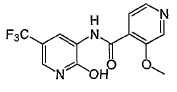
1H-NMR(DMSO-d6)δ:12.74(br s, 1H), 10.83(br s, 1H), 8.73(s, 1H), 8.57-8.55(m, 1H), 8.44(d, J=4.9Hz, 1H), 7.89(d, J=4.9Hz, 1H), 7.81-7.77(m, 1H), 4.18(s, 3H)
1 H-NMR (DMSO-d 6 ) δ: 12.74 (br s, 1H), 10.83 (br s, 1H), 8.73 (s, 1H), 8.57-8.55 (m, 1H), 8.44 (d, J = 4.9 Hz, 1H), 7.89 (d, J = 4.9 Hz, 1H), 7.81-7.77 (m, 1H), 4.18 (s, 3H)
참고 Reference 제조예Production Example 64 64
3-클로로이소니코티노니트릴 2.0g 및 DMF 8ml의 혼합물에 빙랭 하에서 나트륨티오메톡시드 1.02g을 첨가하고, 0℃에서 1시간 동안 교반하였다. 감압 하에서 농축한 후, 아세트산에틸을 첨가하여 불용물을 여과하여 분리하였다. 여과액을 감압 하에서 농축하고, 얻어진 잔사를 실리카겔 칼럼크로마토그래피 처리하여 3-메틸티오이소니코티노니트릴 2.11g을 얻었다.To a mixture of 2.0 g of 3-chloroisonicotinonitrile and 8 ml of DMF was added 1.02 g of sodium thiomethoxide under ice cooling and stirred at 0 ° C. for 1 hour. After concentration under reduced pressure, ethyl acetate was added and the insolubles were separated by filtration. The filtrate was concentrated under reduced pressure, and the obtained residue was subjected to silica gel column chromatography to obtain 2.11 g of 3-methylthioisonicotinonitrile.

1H-NMR(CDCl3)δ:8.65(s, 1H), 8.53(d, J=5.1Hz, 1H), 7.46-7.44(m, 1H), 2.66(s, 3H)
1 H-NMR (CDCl 3 ) δ: 8.65 (s, 1H), 8.53 (d, J = 5.1Hz, 1H), 7.46-7.44 (m, 1H), 2.66 (s, 3H)
참고 Reference 제조예Production Example 65 65
3-메톡시이소니코티노니트릴을 대신하여 3-메틸티오이소니코티노니트릴을 사용하고, 참고 제조예 62 기재의 방법에 준하여 3-메틸티오이소니코틴산을 얻었다.3-Methylthioisonicotinonitrile was used in place of 3-methoxyisonicotinonitrile, and 3-methylthioisonicotinic acid was obtained according to the method described in Reference Production Example 62.

1H-NMR(DMSO-d6)δ:13.73(br s, 1H), 8.62(s, 1H), 8.46(d, J=5.1Hz, 1H), 7.70(d, J=5.0Hz, 1H), 2.54(s, 3H)
1 H-NMR (DMSO-d 6 ) δ: 13.73 (br s, 1H), 8.62 (s, 1H), 8.46 (d, J = 5.1Hz, 1H), 7.70 (d, J = 5.0Hz, 1H) , 2.54 (s, 3H)
참고 Reference 제조예Production Example 66 66
3-클로로이소니코틴산을 대신하여 3-메틸티오이소니코틴산을 사용하고, 참고 제조예 57 기재의 방법에 준하여 N-[2-히드록시-5-(트리플루오로메틸)피리딘-3-일]-3-메틸티오이소니코틴아미드를 얻었다.3-Methylthioisonicotinic acid was used in place of 3-chloroisonicotinic acid, and N- [2-hydroxy-5- (trifluoromethyl) pyridin-3-yl]-was obtained according to the method described in Reference Preparation Example 57. 3-methylthioisonicotinamide was obtained.

1H-NMR(DMSO-d6)δ:12.68(br s, 1H), 10.00(br s, 1H), 8.65(s, 1H), 8.49(d, J=4.9Hz, 1H), 8.47-8.45(m, 1H), 7.82-7.78(m, 1H), 7.50-7.48(m, 1H), 2.55(s, 3H)
1 H-NMR (DMSO-d 6 ) δ: 12.68 (br s, 1H), 10.00 (br s, 1H), 8.65 (s, 1H), 8.49 (d, J = 4.9 Hz, 1H), 8.47-8.45 (m, 1H), 7.82-7.78 (m, 1H), 7.50-7.48 (m, 1H), 2.55 (s, 3H)
참고 Reference 제조예Production Example 67 67
나트륨티오메톡시드를 대신하여 나트륨티오에톡시드를 사용하고, 참고 제조예 64 기재의 방법에 준하여 3-에틸티오이소니코티노니트릴을 얻었다.Sodium thioethoxide was used in place of sodium thiomethoxide, and 3-ethylthioisonicotinonitrile was obtained in accordance with the method described in Reference Production Example 64.

1H-NMR(CDCl3)δ:8.73(s, 1H), 8.56(d, J=4.8Hz, 1H), 7.47(d, J=4.8Hz, 1H), 3.13(q, J=7.2Hz, 2H), 1.39(t, J=7.3Hz, 3H)
1 H-NMR (CDCl 3 ) δ: 8.73 (s, 1H), 8.56 (d, J = 4.8Hz, 1H), 7.47 (d, J = 4.8Hz, 1H), 3.13 (q, J = 7.2Hz, 2H), 1.39 (t, J = 7.3 Hz, 3H)
참고 Reference 제조예Production Example 68 68
3-메톡시이소니코티노니트릴을 대신하여 3-에틸티오이소니코티노니트릴을 사용하고, 참고 제조예 62 기재의 방법에 준하여 3-에틸티오이소니코틴산을 얻었다.3-ethylthioisonicotinonitrile was used in place of 3-methoxyisonicotinonitrile, and 3-ethylthioisonicotinic acid was obtained according to the method described in Reference Production Example 62.
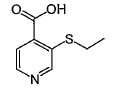
1H-NMR(DMSO-d6)δ:13.72(br s, 1H), 8.65(s, 1H), 8.45(d, J=5.1Hz, 1H), 7.67(d, J=5.0Hz, 1H), 3.09(q, J=7.3Hz, 2H), 1.27(t, J=7.4Hz, 3H)
1 H-NMR (DMSO-d 6 ) δ: 13.72 (br s, 1H), 8.65 (s, 1H), 8.45 (d, J = 5.1 Hz, 1H), 7.67 (d, J = 5.0 Hz, 1H) , 3.09 (q, J = 7.3 Hz, 2H), 1.27 (t, J = 7.4 Hz, 3H)
참고 Reference 제조예Production Example 69 69
3-클로로이소니코틴산을 대신하여 3-에틸티오이소니코틴산을 사용하고, 참고 제조예 57 기재의 방법에 준하여 N-[2-히드록시-5-(트리플루오로메틸)피리딘-3-일]-3-에틸티오이소니코틴아미드를 얻었다.3-ethylthioisonicotinic acid was used in place of 3-chloroisonicotinic acid, and N- [2-hydroxy-5- (trifluoromethyl) pyridin-3-yl]-was obtained according to the method described in Reference Preparation Example 57. 3-ethylthioisonicotinamide was obtained.
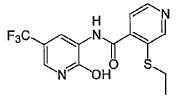
1H-NMR(DMSO-d6)δ:12.67(br s, 1H), 10.11(br s, 1H), 8.70(s, 1H), 8.52(d, J=4.9Hz, 1H), 8.49-8.47(m, 1H), 7.82-7.79(m, 1H), 7.50(d, J=5.0Hz, 1H), 3.04(q, J=7.4Hz, 2H), 1.21(t, J=7.3Hz, 3H)
1 H-NMR (DMSO-d 6 ) δ: 12.67 (br s, 1H), 10.11 (br s, 1H), 8.70 (s, 1H), 8.52 (d, J = 4.9 Hz, 1H), 8.49-8.47 (m, 1H), 7.82-7.79 (m, 1H), 7.50 (d, J = 5.0 Hz, 1H), 3.04 (q, J = 7.4 Hz, 2H), 1.21 (t, J = 7.3 Hz, 3H)
참고 Reference 제조예Production Example 70 70
3-아미노-2-히드록시-5-트리플루오로메틸피리딘 0.51g, 3-메톡시메틸이소니코틴산 0.48g, BOP 시약 1.65g, 트리에틸아민 0.38g, DMF6ml의 혼합물을 실온에서 1시간 동안 교반하고, 다시 50℃에서 2시간 동안 가열교반하였다. 반응혼합물에 물을 첨가하고, 아세트산에틸로 2회 추출하였다. 혼합된 유기층을 포화식염수로 세정하고, 무수황산마그네슘으로 건조한 후, 감압 하에서 농축하였다. 잔사를 실리카겔 칼럼크로마토그래피 처리하여 N-[2-히드록시-5-(트리플루오로메틸)피리딘-3-일]-3-(메톡시메틸)이소니코틴아미드 0.58g을 얻었다.A mixture of 0.51 g of 3-amino-2-hydroxy-5-trifluoromethylpyridine, 0.48 g of 3-methoxymethylisonicotinic acid, 1.65 g of BOP reagent, 0.38 g of triethylamine, and 6 ml of DMF6 was stirred at room temperature for 1 hour. Then, the mixture was heated and stirred at 50 ° C. for 2 hours. Water was added to the reaction mixture, followed by extraction twice with ethyl acetate. The combined organic layers were washed with saturated brine, dried over anhydrous magnesium sulfate, and concentrated under reduced pressure. The residue was subjected to silica gel column chromatography to obtain 0.58 g of N- [2-hydroxy-5- (trifluoromethyl) pyridin-3-yl] -3- (methoxymethyl) isonicotinamide.
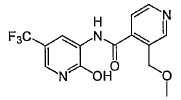
1H-NMR(DMSO-d6)δ:12.67(br s, 1H), 10.18(br s, 1H), 8.71-8.67(m, 2H), 8.54-8.51(m, 1H), 7.80(s, 1H), 7.58(d, J=4.8Hz, 1H), 4.58(s, 2H), 3.33(s, 3H)
1 H-NMR (DMSO-d 6 ) δ: 12.67 (br s, 1H), 10.18 (br s, 1H), 8.71-8.67 (m, 2H), 8.54-8.51 (m, 1H), 7.80 (s, 1H), 7.58 (d, J = 4.8 Hz, 1H), 4.58 (s, 2H), 3.33 (s, 3H)
참고 Reference 제조예Production Example 71 71
3-아미노-2-히드록시-6-트리플루오로메틸피리딘 0.80g, 트리에틸아민 1.14g 및 DMF 10ml의 혼합물에 빙랭 하에서 이소니코틴산 클로라이드 염산염 0.88g을 첨가하고, 실온에서 1시간 동안 교반하여, 다시 50℃에서 1시간 동안 가열교반하였다. 이소니코틴산 클로라이드 염산염 0.88g 및 트리에틸아민 1.1g을 추가하고, 50℃에서 다시 1.5시간 동안 가열교반하였다. 실온에 냉각한 후, 반응혼합물에 물을 첨가하고, 석출한 결정을 여과하였다. 얻어진 고체를 아세트산에틸에 용해한 후, 포화식염수로 세정하고, 무수황산마그네슘으로 건조한 후, 감압 하에서 농축하였다. 잔사를 실리카겔 칼럼크로마토그래피 처리하여 N-[2-히드록시-6-(트리플루오로메틸)피리딘-3-일]-이소니코틴아미드 0.91g을 얻었다.To a mixture of 0.80 g of 3-amino-2-hydroxy-6-trifluoromethylpyridine, 1.14 g of triethylamine, and 10 ml of DMF, 0.88 g of isicotinic acid chloride hydrochloride was added under ice cooling, and stirred at room temperature for 1 hour, Again, the mixture was heated and stirred at 50 ° C. for 1 hour. 0.88 g isonicotinic acid chloride hydrochloride and 1.1 g triethylamine were added, and the mixture was further stirred at 50 ° C. for 1.5 hours. After cooling to room temperature, water was added to the reaction mixture, and the precipitated crystals were filtered out. The obtained solid was dissolved in ethyl acetate, washed with saturated brine, dried over anhydrous magnesium sulfate, and concentrated under reduced pressure. The residue was subjected to silica gel column chromatography to obtain 0.91 g of N- [2-hydroxy-6- (trifluoromethyl) pyridin-3-yl] -isonicotinamide.
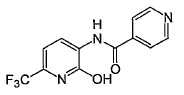
1H-NMR(DMSO-d6)δ:9.98(br s, 1H), 8.79(dd, J=4.4, 1.5Hz, 2H), 8.39(d, J=7.8Hz, 1H), 7.85(dd, J=4.5, 1.6Hz, 2H), 7.40-7.19(m, 1H)
1 H-NMR (DMSO-d 6 ) δ: 9.98 (br s, 1H), 8.79 (dd, J = 4.4, 1.5 Hz, 2H), 8.39 (d, J = 7.8 Hz, 1H), 7.85 (dd, J = 4.5, 1.6 Hz, 2H), 7.40-7.19 (m, 1H)
참고 Reference 제조예Production Example 72 72
3-아미노-2-히드록시-5-트리플루오로메틸피리딘을 대신하여 3-아미노-2-히드록시-6-트리플루오로메틸피리딘을 사용하고, 참고 제조예 57 기재의 방법에 준하여 N-[2-히드록시-6-(트리플루오로메틸)피리딘-3-일]-3-클로로이소니코틴아미드를 얻었다.3-amino-2-hydroxy-6-trifluoromethylpyridine was used in place of 3-amino-2-hydroxy-5-trifluoromethylpyridine and N- according to the method described in Reference Preparation Example 57. [2-hydroxy-6- (trifluoromethyl) pyridin-3-yl] -3-chloroisonicotinamide was obtained.

1H-NMR(DMSO-d6)δ:10.47(br s, 1H), 8.74(s, 1H), 8.63(d, J=4.9Hz, 1H), 8.57(s, 1H), 7.60(d, J=4.8Hz, 1H), 7.51-7.31(m, 1H)
1 H-NMR (DMSO-d 6 ) δ: 10.47 (br s, 1H), 8.74 (s, 1H), 8.63 (d, J = 4.9 Hz, 1H), 8.57 (s, 1H), 7.60 (d, J = 4.8 Hz, 1H), 7.51-7.31 (m, 1H)
참고 Reference 제조예Production Example 73 73
4-프로필-2-니트로페놀을 대신하여 6-메틸-2-니트로피리딘-3-올을 사용하고, 참고 제조예 1 기재의 방법에 준하여 2-아미노-6-메틸피리딘-3-올을 얻었다.6-Methyl-2-nitropyridin-3-ol was used in place of 4-propyl-2-nitrophenol, and 2-amino-6-methylpyridin-3-ol was obtained following the method described in Reference Preparation Example 1. .

1H-NMR(DMSO-d6)δ:9.11(br s, 1H), 6.71(d, J=7.5Hz, 1H), 6.21(d, J=7.5Hz, 1H), 5.30(br s, 2H), 2.14(s, 3H)
1 H-NMR (DMSO-d 6 ) δ: 9.11 (br s, 1H), 6.71 (d, J = 7.5 Hz, 1H), 6.21 (d, J = 7.5 Hz, 1H), 5.30 (br s, 2H ), 2.14 (s, 3H)
참고 Reference 제조예Production Example 74 74
60% 수소화나트륨(유성) 0.59g과 DMF 5ml의 혼합물을 빙랭 하에서 교반하고, 여기에 벤질알코올 1.59g을 첨가하였다. 같은 온도에서 10분 동안 교반한 후, 3-클로로이소니코티노니트릴 2.0g을 첨가하고, 같은 온도에서 30분 동안, 실온에서 1.5시간 동안 교반하였다. 감압 하에서 농축한 후, 아세트산에틸을 첨가하여 불용물을 여과하여 분리하였다. 여과액을 감압 하에서 농축하고, 얻어진 잔사를 실리카겔 칼럼크로마토그래피 처리하여 3-벤질옥시이소니코티노니트릴 2.64g을 얻었다.A mixture of 0.59 g of 60% sodium hydride (oil) and 5 ml of DMF was stirred under ice cooling, and 1.59 g of benzyl alcohol was added thereto. After stirring for 10 minutes at the same temperature, 2.0 g of 3-chloroisonicotinonitrile were added and stirred for 30 minutes at the same temperature and for 1.5 hours at room temperature. After concentration under reduced pressure, ethyl acetate was added and the insolubles were separated by filtration. The filtrate was concentrated under reduced pressure, and the obtained residue was subjected to silica gel column chromatography to obtain 2.64 g of 3-benzyloxyisonicotinonitrile.
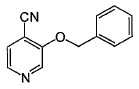
1H-NMR(CDCl3)δ:8.52(s, 1H), 8.36(d, J=4.6Hz, 1H), 7.48-7.33(m, 6H), 5.33(s, 2H)
1 H-NMR (CDCl 3 ) δ: 8.52 (s, 1H), 8.36 (d, J = 4.6Hz, 1H), 7.48-7.33 (m, 6H), 5.33 (s, 2H)
참고 Reference 제조예Production Example 75 75
3-메톡시이소니코티노니트릴을 대신하여 3-벤질옥시이소니코티노니트릴을 사용하고, 참고 제조예 62 기재의 방법에 준하여 3-벤질옥시이소니코틴산을 얻었다.3-benzyloxyisonicotinonitrile was used in place of 3-methoxyisonicotinonitrile and 3-benzyloxyisonicotinic acid was obtained according to the method described in Reference Production Example 62.

1H-NMR(DMSO-d6)δ:13.41(br s, 1H), 8.59(s, 1H), 8.29(d, J=4.6Hz, 1H), 7.53(d, J=4.6Hz, 1H), 7.51-7.46(m, 2H), 7.44-7.37(m, 2H), 7.36-7.30(m, 1H), 5.34(s, 2H)
1 H-NMR (DMSO-d 6 ) δ: 13.41 (br s, 1H), 8.59 (s, 1H), 8.29 (d, J = 4.6 Hz, 1H), 7.53 (d, J = 4.6 Hz, 1H) , 7.51-7.46 (m, 2H), 7.44-7.37 (m, 2H), 7.36-7.30 (m, 1H), 5.34 (s, 2H)
참고 Reference 제조예Production Example 76 76
3-메톡시메틸이소니코틴산을 대신하여 3-벤질옥시이소니코틴산을 사용하고, 참고 제조예 70 기재의 방법에 준하여 3-벤질옥시-N-[2-히드록시-5-(트리플루오로메틸)피리딘-3-일]-이소니코틴아미드를 얻었다.3-benzyloxy-isonicotinic acid was used in place of 3-methoxymethylisonicotinic acid, and 3-benzyloxy-N- [2-hydroxy-5- (trifluoromethyl) was prepared according to the method described in Reference Preparation Example 70. Pyridin-3-yl] -isonicotinamide was obtained.
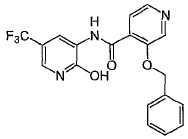
1H-NMR(DMSO-d6)δ:12.76(br s, 1H), 10.80(br s, 1H), 8.76(s, 1H), 8.57-8.55(m, 1H), 8.38(d, J=4.9Hz, 1H), 7.85(d, J=4.9Hz, 1H), 7.79(s, 1H), 7.63-7.58(m, 2H), 7.41-7.29(m, 3H), 5.61(s, 2H)
1 H-NMR (DMSO-d 6 ) δ: 12.76 (br s, 1H), 10.80 (br s, 1H), 8.76 (s, 1H), 8.57-8.55 (m, 1H), 8.38 (d, J = 4.9 Hz, 1H), 7.85 (d, J = 4.9 Hz, 1H), 7.79 (s, 1H), 7.63-7.58 (m, 2H), 7.41-7.29 (m, 3H), 5.61 (s, 2H)
참고 Reference 제조예Production Example 77 77
3-에틸피리딘 10.0g, 아세트산 60ml 및 30% 과산화수소수 12ml의 혼합물을 80℃에서 2.5시간 동안 가열교반하였다. 30% 과산화수소수 7ml를 첨가하고, 80℃에서 다시 7시간 동안 가열교반하였다. 실온에 냉각한 후, 탄산나트륨을 조금씩 첨가하였다. 반응혼합물을 여과하고, 아세트산에틸로 세정하였다. 얻어진 여과액을 포화아황산수소나트륨 수용액, 포화식염수로 세정하고, 무수탄산나트륨으로 건조하였다. 활성탄을 첨가하고, 셀라이트(등록상표)를 통하여 여과하여 여과액을 감압 하에서 농축하고 3-에틸피리딘 N-옥시드 6.0g을 얻었다.A mixture of 10.0 g of 3-ethylpyridine, 60 ml of acetic acid and 12 ml of 30% hydrogen peroxide solution was heated and stirred at 80 ° C. for 2.5 hours. 7 ml of 30% hydrogen peroxide solution was added and stirred at 80 ° C. again for 7 hours. After cooling to room temperature, sodium carbonate was added portionwise. The reaction mixture was filtered and washed with ethyl acetate. The obtained filtrate was washed with saturated aqueous sodium hydrogen sulfite solution and saturated brine, and dried over anhydrous sodium carbonate. Activated charcoal was added, the filtrate was concentrated through Celite (registered trademark), and the filtrate was concentrated under reduced pressure to obtain 6.0 g of 3-ethylpyridine-N-oxide.

1H-NMR(CDCl3)δ:8.12(s, 1H), 8.10-8.08(m, 1H), 7.23-7.18(m, 1H), 7.16-7.12(m, 1H), 2.64(q, J=7.6Hz, 2H), 1.26(t, J=7.7Hz, 3H)
1 H-NMR (CDCl 3 ) δ: 8.12 (s, 1H), 8.10-8.08 (m, 1H), 7.23-7.18 (m, 1H), 7.16-7.12 (m, 1H), 2.64 (q, J = 7.6 Hz, 2H), 1.26 (t, J = 7.7 Hz, 3H)
참고 Reference 제조예Production Example 78 78
3-에틸피리딘 N-옥시드 6.0g 및 요오드에탄 23g의 혼합물을 60℃에서 1시간 동안 가열교반하였다. 실온에 냉각한 후, 디에틸에테르를 첨가하고, 석출한 결정을 여과하였다. 얻어진 고체와 물 55ml의 혼합물에 50℃에서 시안화나트륨 4.46g과 물 16ml의 혼합물을 적하하고, 같은 온도에서 1시간 동안 가열교반하였다. 실온에 냉각한 후, 디에틸에테르로 3회 추출하였다. 혼합된 유기층을 포화식염수로 세정하고, 무수황산마그네슘으로 건조한 후, 감압 하에서 농축하였다. 잔사를 실리카겔 칼럼크로마토그래피 처리하여 3-에틸이소니코티노니트릴 2.7g을 얻었다.A mixture of 6.0 g of 3-ethylpyridine N-oxide and 23 g of iodineethane was heated and stirred at 60 ° C. for 1 hour. After cooling to room temperature, diethyl ether was added, and the precipitated crystals were filtered out. The mixture of 4.46 g of sodium cyanide and 16 ml of water was dripped at the mixture of the obtained solid and 55 ml of water at 50 degreeC, and it stirred for 1 hour by heating at the same temperature. After cooling to room temperature, the mixture was extracted three times with diethyl ether. The combined organic layers were washed with saturated brine, dried over anhydrous magnesium sulfate, and concentrated under reduced pressure. The residue was subjected to silica gel column chromatography to obtain 2.7 g of 3-ethylisonicotinonitrile.

1H-NMR(CDCl3)δ:8.69(s, 1H), 8.61(d, J=4.9Hz, 1H), 7.48-7.46(m, 1H), 2.90(q, J=7.6Hz, 2H), 1.35(t, J=7.6Hz, 3H)
1 H-NMR (CDCl 3 ) δ: 8.69 (s, 1H), 8.61 (d, J = 4.9Hz, 1H), 7.48-7.46 (m, 1H), 2.90 (q, J = 7.6Hz, 2H), 1.35 (t, J = 7.6 Hz, 3H)
참고 Reference 제조예Production Example 79 79
3-에틸이소니코티노니트릴 2.7g, 수산화나트륨 1.63g, 에탄올 20ml 및 물 20ml의 혼합물을 5시간 동안 가열환류하였다. 실온까지 냉각한 후, 감압 하에서 농축하였다. 얻어진 잔사의 pH가 약 3이 될 때까지 3M 염산을 첨가하고, 다시 감압 하에서 농축하였다. 얻어진 고체에 에탄올 50ml를 첨가하고, 5분 동안 가열환류한 후, 그대로 고온여과하였다. 여과한 고체에 대해서 각 50ml의 에탄올로 다시 2회 같은 조작을 실시하였다. 합한 여과액을 농축하여 3-에틸이소니코틴산 2.49g을 얻었다.A mixture of 2.7 g of 3-ethylisonicotinonitrile, 1.63 g of sodium hydroxide, 20 ml of ethanol and 20 ml of water was heated to reflux for 5 hours. After cooling to room temperature, it was concentrated under reduced pressure. 3M hydrochloric acid was added until the pH of the obtained residue became about 3, and it concentrated under reduced pressure again. 50 ml of ethanol was added to the obtained solid, heated to reflux for 5 minutes, and then filtered hot as it was. The same operation was performed twice with each 50 ml of ethanol about the filtered solid. The combined filtrates were concentrated to give 2.49 g of 3-ethylisonicotinic acid.
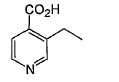
1H-NMR(DMSO-d6)δ:13.58(br s, 1H), 8.59(s, 1H), 8.54(d, J=5.0Hz, 1H), 7.60(d, J=5.0Hz, 1H), 2.89(q, J=7.5Hz, 2H), 1.17(t, J=7.4Hz, 3H)
1 H-NMR (DMSO-d 6 ) δ: 13.58 (br s, 1H), 8.59 (s, 1H), 8.54 (d, J = 5.0 Hz, 1H), 7.60 (d, J = 5.0 Hz, 1H) , 2.89 (q, J = 7.5 Hz, 2H), 1.17 (t, J = 7.4 Hz, 3H)
다음에 본 활성화합물의 제제예를 나타낸다. 또한, 부는 중량부를 나타낸다.
Next, the preparation example of this active compound is shown. In addition, a part represents a weight part.
제제예Formulation example 1 One
상술의 본 활성화합물 1~162 중 어느 1종 10부를 크실렌 35부와 N,N-디메틸포름아미드 35부의 혼합물에 용해하고, 폴리옥시에틸렌스티릴페닐에테르 14부 및 도데실벤젠설폰산칼슘 6부를 첨가하고, 잘 교반혼합하여 각각의 10% 유제를 얻는다.
10 parts of any one of the above-mentioned active compounds 1 to 162 is dissolved in a mixture of 35 parts of xylene and 35 parts of N, N-dimethylformamide, and 14 parts of polyoxyethylene styrylphenyl ether and 6 parts of calcium dodecylbenzenesulfonate Add and stir well to obtain each 10% emulsion.
제제예Formulation example 2 2
라우릴황산나트륨 4부, 리그닌설폰산칼슘 2부, 합성함수산화규소 미분말 20부 및 규조토 54부를 혼합해, 다시 상술의 본 활성화합물 1~162 중 어느 1종 20부를 첨가하고, 잘 교반혼합하여 각각의 20% 수화제를 얻는다.
4 parts of sodium lauryl sulfate, 2 parts of calcium lignin sulfonate, 20 parts of fine powder of synthetic silicon oxide, and 54 parts of diatomaceous earth were mixed, and 20 parts of any one of the above-mentioned active compounds 1 to 162 were added, followed by stirring and mixing, respectively. Get 20% Hydration of.
제제예Formulation example 3 3
상술의 본 활성화합물 1~162 중 어느 1종 2부에 합성함수산화규소 미분말 1부, 리그닌설폰산칼슘 2부, 벤토나이트 30부 및 카올린클레이 65부를 첨가하고, 충분히 교반혼합한다. 그 다음에 이들 혼합물에 적당량의 물을 첨가하고, 더 교반하고, 조립기(granulator)로 제립하고, 통풍건조하여 각각의 2% 입제를 얻는다.
To 2 parts of any one of the above-mentioned active compounds 1 to 162, 1 part of fine silicon oxide powder, 2 parts of lignin sulfonate, 30 parts of bentonite, and 65 parts of kaolin clay are added, followed by sufficiently stirring and mixing. Then, an appropriate amount of water is added to these mixtures, further stirred, granulated with a granulator, and air dried to obtain 2% of each granule.
제제예Formulation example 4 4
상술의 본 활성화합물 1~162 중 어느 1종 1부를 적당량의 아세톤에 용해하고, 이것에 합성함수산화규소 미분말 5부, PAP(산성인산이소프로필) 0.3부 및 후바사미클레이(Fubasami clay) 93.7부를 첨가하고, 충분히 교반혼합하고, 아세톤을 증발제거하여 각각의 1% 분제를 얻는다.
One part of any one of the above-mentioned active compounds 1 to 162 is dissolved in an appropriate amount of acetone, and 5 parts of synthetic silicon oxide fine powder, 0.3 parts of PAP (acidic isopropyl phosphate), and Fubasami clay 93.7 Part is added, thoroughly stirred and mixed, and the acetone is evaporated off to obtain each 1% powder.
제제예Formulation example 5 5
폴리옥시에틸렌알킬에테르설페이트암모늄염 및 화이트카본의 혼합물(중량비 1:1) 35부와, 상술의 본 활성화합물 1~162 중 어느 1종 10부와, 물 55부를 혼합하고, 습식분쇄법으로 미세 분쇄함으로써 각각의 10% 유동화제를 얻는다.
35 parts of a mixture of polyoxyethylene alkyl ether sulfate ammonium salt and white carbon (weight ratio 1: 1), 10 parts of any one of the above-mentioned active compounds 1 to 162, and 55 parts of water are mixed, and finely pulverized by a wet grinding method. Thereby obtaining each 10% glidant.
제제예Formulation example 6 6
상술의 본 활성화합물 1~162 중 어느 1종 0.1부를 크실렌 5부 및 트리클로로에탄 5부에 용해하고, 이것을 탈취등유 89.9부에 혼합해 각각의 0.1%유제를 얻는다.
0.1 part of any one of the above-mentioned active compounds 1 to 162 is dissolved in 5 parts of xylene and 5 parts of trichloroethane, and this is mixed with 89.9 parts of deodorizing kerosene to obtain respective 0.1% emulsions.
제제예Formulation example 7 7
상술의 본 활성화합물 1~162 중 어느 1종 10mg을 아세톤 0.5ml에 용해하고, 이 용액을 동물용 고형사료분말(사육 번식용 고형사료분말 CE-2, 일본클레어주식회사(Japan Clea Co., Ltd.) 상품) 5g으로 처리하여 균일하게 혼합한다. 그 다음에 아세톤을 증발건조시켜서 각각의 독이(poisonous bait)를 얻는다.
10 mg of any one of the above-mentioned active compounds 1 to 162 is dissolved in 0.5 ml of acetone, and this solution is used for animal solid feed powder (solid feed powder for breeding CE-2, Japan Clea Co., Ltd.). .) Commodity) Mix with 5g and mix uniformly. The acetone is then evaporated to dryness to obtain the respective poisonous bait.
제제예Formulation example 8 8
상술의 본 활성화합물 1~162 중 어느 1종 0.1부, 네오치오졸(Neo-chiozol)(추오화성주식회사(Chuo Kasei Co., Ltd.)) 49.9부를 에어로졸 캔에 넣고, 에어로졸 밸브를 장착한 후, 디메틸에테르 25부, LPG 25부를 충전하여 진탕하고, 액츄에이터를 장착함으로써 유제 에어로졸을 얻는다.
0.1 part of any one of the above-mentioned active compounds 1 to 162, 49.9 parts of Neo-chiozol (Chuo Kasei Co., Ltd.) are placed in an aerosol can, and an aerosol valve is mounted. , 25 parts of dimethyl ether and 25 parts of LPG are filled with shaking, and an emulsion aerosol is obtained by attaching an actuator.
제제예Formulation example 9 9
상술의 본 활성화합물 1~162 중 어느 1종 0.6부, BHT(2,6-디-tert-부틸-4-메틸페놀) 0.01부, 크실렌 5부, 탈취등유 3.39부 및 유화제{아트모스 300(아트모스케미컬사(ATMOS CHEMICAL LTD) 등록상표명)} 1부를 혼합용해한 것과 증류수 50부를 에어로졸 용기에 충전하고, 밸브를 장착한 후, 상기 밸브를 통해서 분사제(LPG) 40부를 가압충전하여 수성 에어로졸을 얻는다.
0.6 parts of any one of the above-mentioned active compounds 1 to 162, 0.01 parts of BHT (2,6-di-tert-butyl-4-methylphenol), 5 parts of xylene, 3.39 parts of deodorizing kerosene and an emulsifier {Atmos 300 ( ATMOS CHEMICAL LTD registered name}} 1 part mixed dissolved and 50 parts of distilled water is filled in an aerosol container, a valve is mounted, and 40 parts of LPG are pressurized and charged through the valve to form an aqueous aerosol. Get
제제예Formulation example 10 10
상술의 본 활성화합물 1~162 중 어느 1종 10부와, 본 활성화합물과 혼합하여 제재화할 수 있는 살충제, 살진드기제, 살선충제 또는 살균제, 식물호르몬제, 식물성장 조절물질, 제초제 등의 유해생물 방제제 등 (이성체 및 그의 염을 포함한다), 공력제, 또는, 약해 경감제 10부를 라우릴황산나트륨 4부, 리그닌설폰산칼슘 2부, 합성함수산화규소 미분말 20부 및 규조토 54부의 혼합물에 첨가하고, 잘 교반혼합하여 혼합 수화제를 얻는다.
10 parts of any one of the above-mentioned active compounds 1 to 162, insecticides, acaricides, nematicides or fungicides, plant hormones, plant growth regulators, herbicides, etc. 10 parts of aerobic control agents, including isomers and salts thereof, aerobic agents, or weakening agents, 4 parts of sodium lauryl sulfate, 2 parts of calcium lignin sulfonate, 20 parts of synthetic silicon oxide fine powder and 54 parts of diatomaceous earth Add to the mixture and stir well to obtain a mixed hydrating agent.
다음에 본 활성화합물의 유해 절족동물 방제효력을 시험예에 의해 나타낸다.Next, the control effect of the harmful arthropod of this active compound is shown by a test example.
시험예Test Example 1 One
본 활성화합물 1~3, 본 활성화합물 5, 본 활성화합물 6, 본 활성화합물 8~16, 본 활성화합물 18~20, 본 활성화합물 23~25, 본 활성화합물 27~32, 본 활성화합물 34, 본 활성화합물 35, 본 활성화합물 37, 본 활성화합물 39~44, 본 활성화합물 46, 본 활성화합물 52~58, 본 활성화합물 61, 본 활성화합물 63~74, 본 활성화합물 76~79, 본 활성화합물 81~86, 본 활성화합물 88, 본 활성화합물 89, 본 활성화합물 91~94, 본 활성화합물 97, 본 활성화합물 98, 본 활성화합물 100, 본 활성화합물 101, 본 활성화합물 104, 본 활성화합물 105, 본 활성화합물 110, 본 활성화합물 111, 본 활성화합물 115, 본 활성화합물 116, 본 활성화합물 118~120, 본 활성화합물 122, 본 활성화합물 125, 본 활성화합물 126, 본 활성화합물 128~136 및 본 활성화합물 138~145에 대하여 각각 제제예 5의 방법에 의해 제제를 얻었다. 유효성분 농도가 500ppm이 되도록 각 제제를 물로 희석하여 시험용 희석액을 조제하였다.Bonn Active Compounds 1 to 3, Bonn Active Compounds 5, Bonn Active Compounds 6, Bonn Active Compounds 8 to 16, Bonn Active Compounds 18 to 20, Bonn Active Compounds 23 to 25, Bonn Active Compounds 27 to 32, Bonn Active Compounds 34, Bonn Active Compound 35, Bonn Active Compound 37, Bonn Active Compound 39 ~ 44, Bonn Active Compound 46, Bonn Active Compound 52 ~ 58, Bonn Active Compound 61, Bonn Active Compound 63 ~ 74, Bonn Active Compound 76 ~ 79, Bonn Activity Compound 81 ~ 86, present active compound 88, present active compound 89, present active compound 91 ~ 94, present active compound 97, present active compound 98, present active compound 100, present active compound 101, present active compound 104, present active compound 105, present active compound 110, present active compound 111, present active compound 115, present active compound 116, present active compound 118 ~ 120, present active compound 122, present active compound 125, present active compound 126, present active compound 128 ~ 136 And the present active compounds 138 to 145, respectively, a formulation was obtained by the method of Preparation Example 5. Dilutions for testing were prepared by diluting each formulation with water so that the active ingredient concentration was 500 ppm.
한편, 플라스틱 컵에 심은 오이 유묘(幼苗)(제2 본엽 전개기)에 목화진딧물 약 30마리를 접종하고, 1일 동안 방치하였다. 이 유묘에 상기 희석액 중 어느 1종(10ml)을 산포하였다.On the other hand, about 30 cotton aphids were inoculated into cucumber seedlings (second main leaf development period) planted in a plastic cup, and left for 1 day. One kind (10 ml) of the dilutions was scattered in this seedling.
산포 5일 후에 상기 오이의 잎 상에 기생한 목화진딧물 생존충 수(生存蟲數)를 조사하여 이하의 식에 의해 방제가(control value)를 구하였다.After 5 days of spreading, the number of parasitic cotton aphids living on the leaves of the cucumber was examined to obtain a control value according to the following equation.
방제가(%)={1-(Cb×Tai)/(Cai×Tb)}×100Control value (%) = {1- (Cb × Tai) / (Cai × Tb)} × 100
또한, 식 중의 문자는 이하의 의미를 나타낸다.In addition, the character in a formula shows the following meaning.
Cb: 무처리구(non-treated section)의 처리 전의 충수Cb: appendix before treatment of non-treated section
Cai: 무처리구의 관찰 시의 충수Cai: Appendication in Observation of Untreated Zone
Tb: 처리구의 처리 전의 충수Tb: appendix before treatment
Tai: 처리구의 관찰 시의 충수Tai: Applause of Observation of Treatment
그 결과, 본 활성화합물 1~3, 본 활성화합물 5, 본 활성화합물 6, 본 활성화합물 8~16, 본 활성화합물 18~20, 본 활성화합물 23~25, 본 활성화합물 27~32, 본 활성화합물 34, 본 활성화합물 35, 본 활성화합물 37, 본 활성화합물 39~44, 본 활성화합물 46, 본 활성화합물 52~58, 본 활성화합물 61, 본 활성화합물 63~74, 본 활성화합물 76~79, 본 활성화합물 81~86, 본 활성화합물 88, 본 활성화합물 89, 본 활성화합물 91~94, 본 활성화합물 97, 본 활성화합물 98, 본 활성화합물 100, 본 활성화합물 101, 본 활성화합물 104, 본 활성화합물 105, 본 활성화합물 110, 본 활성화합물 111, 본 활성화합물 115, 본 활성화합물 116, 본 활성화합물 118~120, 본 활성화합물 122, 본 활성화합물 125, 본 활성화합물 126, 본 활성화합물 128~136 및 본 활성화합물 138~145중 어느 하나의 시험용 희석액으로 처리한 처리구는 각각 방제가 90% 이상을 나타내었다.
As a result, the present active compounds 1 to 3, the present active compound 5, the present active compound 6, the present active compound 8 to 16, the present active compound 18 to 20, the present active compound 23 to 25, the present active compound 27 to 32, and the present activity Compound 34, present active compound 35, present active compound 37, present active compound 39 ~ 44, present active compound 46, present active compound 52 ~ 58, present active compound 61, present active compound 63 ~ 74, present active compound 76 ~ 79 , Present active compound 81 ~ 86, present active compound 88, present active compound 89, present active compound 91 ~ 94, present active compound 97, present active compound 98, present active compound 100, present active compound 101, present active compound 104, Bonn Active Compound 105, Bonn Active Compound 110, Bonn Active Compound 111, Bonn Active Compound 115, Bonn Active Compound 116, Bonn Active Compound 118 ~ 120, Bonn Active Compound 122, Bonn Active Compound 125, Bonn Active Compound 126, Bonn Active Compound Treated with a test diluent of any one of 128 ~ 136 and the active compound 138 ~ 145 Each control showed 90% or more.
시험예Test Example 2 2
본 활성화합물 14, 본 활성화합물 18, 본 활성화합물 19, 본 활성화합물 23~27, 본 활성화합물 29, 본 활성화합물 30, 본 활성화합물 35, 본 활성화합물 37, 본 활성화합물 55, 본 활성화합물 56, 본 활성화합물 58, 본 활성화합물 63, 본 활성화합물 69~71, 본 활성화합물 76, 본 활성화합물 88, 본 활성화합물 93, 본 활성화합물 94, 본 활성화합물 107, 본 활성화합물 110, 본 활성화합물 119, 본 활성화합물 120, 본 활성화합물 125, 본 활성화합물 126, 본 활성화합물 128, 본 활성화합물 131, 본 활성화합물 133~136, 본 활성화합물 138~150 및 본 활성화합물 153~155에 대하여 각각 제제예 5의 방법에 의해 제제를 얻었다. 유효성분 농도가 500ppm이 되도록 각 제재를 물로 희석하여 시험용 희석액을 조제하였다.Bonn Active Compound 14, Bonn Active Compound 18, Bonn Active Compound 19, Bonn Active Compound 23 ~ 27, Bonn Active Compound 29, Bonn Active Compound 30, Bonn Active Compound 35, Bonn Active Compound 37, Bonn Active Compound 55, Bonn Active Compound 56, present active compound 58, present active compound 63, present active compound 69 ~ 71, present active compound 76, present active compound 88, present active compound 93, present active compound 94, present active compound 107, present active compound 110, present Active compound 119, present active compound 120, present active compound 125, present active compound 126, present active compound 128, present active compound 131, present active compound 133 ~ 136, present active compound 138 ~ 150 and present active compound 153 ~ 155 The formulations were obtained by the method of Formulation example 5, respectively. Dilutions for testing were prepared by diluting each agent with water so that the active ingredient concentration was 500 ppm.
한편, 우레탄제 매트에 심은 오이 유묘(제2 본엽 전개기)에 희석액 중 어느 1종(5ml)을 주원관주하고, 처리 1일 후에 목화진딧물(전 스테이지) 30마리를 오이 잎면에 접종하였다. 다시 7일 후에 상기 오이의 잎 상에 기생한 목화진딧물 생존충 수를 조사하여 이하의 식에 의해 방제가를 구하였다.On the other hand, any one kind (5 ml) of the diluent is mainly directed to the cucumber seedlings (the second main leaf development machine) planted in a urethane mat, One day after treatment, 30 cotton aphids (pre-stage) were inoculated on the cucumber leaf surface. After 7 days again, the number of parasitic cotton aphids on the leaves of the cucumber was examined to obtain a control value by the following equation.
방제가(%)={1-(Cb×Tai)/(Cai×Tb)}×100 Control value (%) = {1- (Cb × Tai) / (Cai × Tb)} × 100
또한, 식 중의 문자는 이하의 의미를 나타낸다.In addition, the character in a formula shows the following meaning.
Cb: 무처리구의 처리 전의 충수Cb: appendix before treatment
Cai: 무처리구의 관찰 시의 충수Cai: Appendication in Observation of Untreated Zone
Tb: 처리구의 처리 전의 충수Tb: appendix before treatment
Tai: 처리구의 관찰 시의 충수Tai: Applause of Observation of Treatment
그 결과, 본 활성화합물 14, 본 활성화합물 18, 본 활성화합물 19, 본 활성화합물 23~27, 본 활성화합물 29, 본 활성화합물 30, 본 활성화합물 35, 본 활성화합물 37, 본 활성화합물 55, 본 활성화합물 56, 본 활성화합물 58, 본 활성화합물 63, 본 활성화합물 69~71, 본 활성화합물 76, 본 활성화합물 88, 본 활성화합물 93, 본 활성화합물 94, 본 활성화합물 107, 본 활성화합물 110, 본 활성화합물 119, 본 활성화합물 120, 본 활성화합물 125, 본 활성화합물 126, 본 활성화합물 128, 본 활성화합물 131, 본 활성화합물 133~136, 본 활성화합물 138~150 및 본 활성화합물 153~155 중 어느 하나의 시험용 희석액으로 처리한 처리구는 각각 방제가 90% 이상을 나타내었다.
As a result, the present active compound 14, the present active compound 18, the present active compound 19, the present active compound 23-27, the present active compound 29, the present active compound 30, the present active compound 35, the present active compound 37, the present active compound 55, Bonn Active Compound 56, Bonn Active Compound 58, Bonn Active Compound 63, Bonn Active Compound 69 ~ 71, Bonn Active Compound 76, Bonn Active Compound 88, Bonn Active Compound 93, Bonn Active Compound 94, Bonn Active Compound 107, Bonn Active Compound 110, present active compound 119, present active compound 120, present active compound 125, present active compound 126, present active compound 128, present active compound 131, present active compound 133 ~ 136, present active compound 138 ~ 150 and present active compound 153 Treatments treated with any of the test dilutions of ˜155 exhibited greater than 90% control.
시험예Test Example 3 3
본 활성화합물 13, 본 활성화합물 14, 본 활성화합물 19, 본 활성화합물 24, 본 활성화합물 25, 본 활성화합물 30, 본 활성화합물 37, 본 활성화합물 58, 본 활성화합물 63, 본 활성화합물 125, 본 활성화합물 135, 본 활성화합물 139~142, 본 활성화합물 144 및 본 활성화합물 145에 대하여 각각 제제예 5의 방법에 의해 제제를 얻었다. 유효성분 농도가 500ppm이 되도록 각 제제를 물로 희석하여 시험용 희석액을 조제하였다.Main Active Compound 13, Main Active Compound 14, Main Active Compound 19, Main Active Compound 24, Main Active Compound 25, Main Active Compound 30, Main Active Compound 37, Main Active Compound 58, Main Active Compound 63, Main Active Compound 125, Formulations of the present active compound 135, the present active compounds 139 to 142, the present active compound 144 and the present active compound 145 were prepared by the method of Preparation Example 5, respectively. Dilutions for testing were prepared by diluting each formulation with water so that the active ingredient concentration was 500 ppm.
한편, 플라스틱 컵에 심은 오이 유묘(제2 본엽 전개기)에 희석액 중 어느 1종(5ml)을 주원관주하고, 7일 동안 25℃ 온실 내에 유지하였다. 목화진딧물(전 스테이지) 30마리를 오이 옆면에 접종하고, 다시 6일 동안 상기 온실 내에 유지한 후에, 상기 오이의 잎 상에 기생한 목화진딧물 생존충 수를 조사하여 이하의 식에 의해 방제가를 구하였다.On the other hand, any one kind (5 ml) of the dilution was mainly directed to the cucumber seedlings (the second main leaf developing machine) planted in a plastic cup, and kept in a 25 ° C. greenhouse for 7 days. Thirty cotton aphids (pre-stage) were inoculated on the sides of the cucumbers, and again maintained in the greenhouse for six days. Obtained.
방제가(%)={1-(Cb×Tai)/(Cai×Tb)}×100 Control value (%) = {1- (Cb × Tai) / (Cai × Tb)} × 100
또한, 식 중의 문자는 이하의 의미를 나타낸다.In addition, the character in a formula shows the following meaning.
Cb: 무처리구의 처리 전의 충수Cb: appendix before treatment
Cai: 무처리구의 관찰 시의 충수Cai: Appendication in Observation of Untreated Zone
Tb: 처리구의 처리 전의 충수Tb: appendix before treatment
Tai: 처리구의 관찰 시의 충수Tai: Applause of Observation of Treatment
그 결과, 본 활성화합물 13, 본 활성화합물 14, 본 활성화합물 19, 본 활성화합물 24, 본 활성화합물 25, 본 활성화합물 30, 본 활성화합물 37, 본 활성화합물 58, 본 활성화합물 63, 본 활성화합물 125, 본 활성화합물 135, 본 활성화합물 139~142, 본 활성화합물 144 및 145 중 어느 하나의 시험용 희석액으로 처리한 처리구는 각각 방제가 90% 이상을 나타내었다.
As a result, the present active compound 13, the present active compound 14, the present active compound 19, the present active compound 24, the present active compound 25, the present active compound 30, the present active compound 37, the present active compound 58, the present active compound 63, the present activity Treatments treated with any one of the test dilutions of Compound 125, present Active Compound 135, present Active Compounds 139-142, Present Active Compounds 144, and 145 each exhibited 90% or more control.
시험예Test Example 4 4
본 활성화합물 1, 본 활성화합물 3, 본 활성화합물 5, 본 활성화합물 6, 본 활성화합물 8, 본 활성화합물 11~20, 본 활성화합물 23~32, 본 활성화합물 34, 본 활성화합물 35, 본 활성화합물 37, 본 활성화합물 39~44, 본 활성화합물 46, 본 활성화합물 52, 본 활성화합물 53, 본 활성화합물 55~58, 본 활성화합물 63, 본 활성화합물 65~70, 본 활성화합물 72~74, 본 활성화합물 77~81, 본 활성화합물 83~86, 본 활성화합물 88, 본 활성화합물 89, 본 활성화합물 91~94, 본 활성화합물 97, 본 활성화합물 98, 본 활성화합물 100, 본 활성화합물 101, 본 활성화합물 104, 본 활성화합물 105, 본 활성화합물 107, 본 활성화합물 110, 본 활성화합물 111, 본 활성화합물 115~120, 본 활성화합물 122, 본 활성화합물 123, 본 활성화합물 125, 본 활성화합물 126, 본 활성화합물 128~136, 본 활성화합물 138~145, 본 활성화합물 153 및 본 활성화합물 154에 대하여 각각 제제예 5의 방법에 의해 제제를 얻었다. 유효성분 농도가 500ppm이 되도록 각 제제를 물로 희석하여 시험용 희석액을 조제하였다.Bonn Active Compound 1, Bonn Active Compound 3, Bonn Active Compound 5, Bonn Active Compound 6, Bonn Active Compound 8, Bonn Active Compound 11 ~ 20, Bonn Active Compound 23 ~ 32, Bonn Active Compound 34, Bonn Active Compound 35, Bonn Active compound 37, present active compound 39 ~ 44, present active compound 46, present active compound 52, present active compound 53, present active compound 55 ~ 58, present active compound 63, present active compound 65 ~ 70, present active compound 72 ~ 74, the present active compound 77-81, the present active compound 83-86, the present active compound 88, the present active compound 89, the present active compound 91-94, the present active compound 97, the present active compound 98, the present active compound 100, the present activity Compound 101, present active compound 104, present active compound 105, present active compound 107, present active compound 110, present active compound 111, present active compound 115 ~ 120, present active compound 122, present active compound 123, present active compound 125, Present active compound 126, present active compound 128 ~ 136, present active compound 138 ~ 145, present activated compound Formulations were prepared by the method of Preparation Example 5 on water 153 and the active compound 154, respectively. Dilutions for testing were prepared by diluting each formulation with water so that the active ingredient concentration was 500 ppm.
한편, 플라스틱 컵에 심은 토마토 유묘에 담배가루이(tobacco whitefly) 성충을 풀어주고 약 24시간 동안 산란시켰다. 상기 토마토 모종을 8일 동안 온실 내에 유지하고, 출산된 알에서 유충이 부화한 상태의 장소에 상기의 시험용 희석액 중 어느 1종을 10ml/컵의 비율로 산포하여 7일 동안 25℃온실 내에 유지하였다. 토마토잎 상의 생존유충 수를 조사하고, 다음의 식에 의해 방제가를 구하였다.Meanwhile, tomato seedlings planted in plastic cups were freed of adult tobacco whitefly and laid for about 24 hours. The tomato seedlings were kept in a greenhouse for 8 days, and any one of the above test dilutions was dispersed at a rate of 10 ml / cup in a place where the larvae hatched from the delivered eggs and kept in a 25 ° C. greenhouse for 7 days. . The number of surviving larvae on tomato leaves was investigated and the control value was obtained by the following equation.
방제가(%)={1-(Cb×Tai)/(Cai×Tb)}×100 Control value (%) = {1- (Cb × Tai) / (Cai × Tb)} × 100
덧붙여 식중의 문자는 이하의 의미를 나타낸다.In addition, the letter in a formula represents the following meaning.
Cb: 무처리구의 처리 전의 충수Cb: appendix before treatment
Cai: 무처리구의 관찰 시의 충수Cai: Appendication in Observation of Untreated Zone
Tb: 처리구의 처리 전의 충수Tb: appendix before treatment
Tai: 처리구의 관찰 시의 충수Tai: Applause of Observation of Treatment
그 결과, 본 활성화합물 1, 본 활성화합물 3, 본 활성화합물 5, 본 활성화합물 6, 본 활성화합물 8, 본 활성화합물 11~20, 본 활성화합물 23~32, 본 활성화합물 34, 본 활성화합물 35, 본 활성화합물 37, 본 활성화합물 39~44, 본 활성화합물 46, 본 활성화합물 52, 본 활성화합물 53, 본 활성화합물 55~58, 본 활성화합물 63, 본 활성화합물 65~70, 본 활성화합물 72~74, 본 활성화합물 77~81, 본 활성화합물 83~86, 본 활성화합물 88, 본 활성화합물 89, 본 활성화합물 91~94, 본 활성화합물 97, 본 활성화합물 98, 본 활성화합물 100, 본 활성화합물 101, 본 활성화합물 104, 본 활성화합물 105, 본 활성화합물 107, 본 활성화합물 110, 본 활성화합물 111, 본 활성화합물 115~120, 본 활성화합물 122, 본 활성화합물 123, 본 활성화합물 125, 본 활성화합물 126, 본 활성화합물 128~136, 본 활성화합물 138~본 활성화합물 145, 본 활성화합물 153 및 본 활성화합물 154 중 어느 하나의 시험용 희석액으로 처리한 처리구는 각각 방제가 90% 이상을 나타내었다.
As a result, the present active compound 1, the present active compound 3, the present active compound 5, the present active compound 6, the present active compound 8, the present active compound 11-20, the present active compound 23-32, the present active compound 34, the present active compound 35, Bonn Active Compound 37, Bonn Active Compound 39 ~ 44, Bonn Active Compound 46, Bonn Active Compound 52, Bonn Active Compound 53, Bonn Active Compound 55 ~ 58, Bonn Active Compound 63, Bonn Active Compound 65 ~ 70, Bonn Activity Compound 72 ~ 74, present active compound 77 ~ 81, present active compound 83 ~ 86, present active compound 88, present active compound 89, present active compound 91 ~ 94, present active compound 97, present active compound 98, present active compound 100 , Present active compound 101, present active compound 104, present active compound 105, present active compound 107, present active compound 110, present active compound 111, present active compound 115 ~ 120, present active compound 122, present active compound 123, present activity Compound 125, present active compound 126, present active compound 128 ~ 136, present active compound 138 ~ bon active Compound 145, the active compound 153 and the treatment group was treated with either the test of the dilution of the active compound 154 showed that more than 90% of control, respectively.
시험예Test Example 5 5
본 활성화합물 1, 본 활성화합물 4~6, 본 활성화합물 8, 본 활성화합물 12~15, 본 활성화합물 18~20, 본 활성화합물 24~30, 본 활성화합물 32, 본 활성화합물 34, 본 활성화합물 35, 본 활성화합물 37~44, 본 활성화합물 46, 본 활성화합물 52~54, 본 활성화합물 58, 본 활성화합물 59, 본 활성화합물 61, 본 활성화합물 67, 본 활성화합물 68, 본 활성화합물 71~86, 본 활성화합물 88, 본 활성화합물 89, 본 활성화합물 91~본 활성화합물 94, 본 활성화합물 97, 본 활성화합물 98, 본 활성화합물 100~105, 본 활성화합물 107, 본 활성화합물 110~113, 본 활성화합물 115~120, 본 활성화합물 122, 본 활성화합물 123, 본 활성화합물 125~136, 본 활성화합물 138, 본 활성화합물 139 및 본 활성화합물 142~145에 대하여 각각 제제예 5의 방법에 의해 제제를 얻었다. 유효성분 농도가 500ppm이 되도록 각 제제를 물로 희석하여 시험용 희석액을 조제하였다.Main Active Compound 1, Main Active Compound 4-6, Main Active Compound 8, Main Active Compound 12-15, Main Active Compound 18-20, Main Active Compound 24-30, Main Active Compound 32, Main Active Compound 34, Main Activity Compound 35, present active compound 37-44, present active compound 46, present active compound 52-54, present active compound 58, present active compound 59, present active compound 61, present active compound 67, present active compound 68, present active compound 71 ~ 86, present active compound 88, present active compound 89, present active compound 91 ~ present active compound 94, present active compound 97, present active compound 98, present active compound 100 ~ 105, present active compound 107, present active compound 110 113, present active compound 115-120, present active compound 122, present active compound 123, present active compound 125-136, present active compound 138, present active compound 139 and present active compound 142-145, respectively. The formulation was obtained by the method. Dilutions for testing were prepared by diluting each formulation with water so that the active ingredient concentration was 500 ppm.
한편, 플라스틱 컵에 심은 벼 유묘(파종 2주일 후, 제2엽 전개기)에 대하여 상기 희석액 중 어느 1종(10ml)을 산포하였다. 벼에 산포처리된 약액이 건조한 후, 벼멸구의 초령 유충을 30마리 풀어주고, 6일 동안 25℃의 온실 내에 유지하였다. 그 후 벼에 기생한 벼멸구의 수를 조사하여 이하의 식에 의해 방제가를 구하였다.On the other hand, any one kind (10 ml) of the said dilution liquid was spread | spreaded about the rice seedling (2 weeks after sowing, 2nd leaf spreader) planted in the plastic cup. After the sprayed chemicals were dried on rice, 30 larvae of larvae were released and kept in a greenhouse at 25 ° C. for 6 days. After that, the number of parasitic periphery parasitic on rice was examined and the control value was calculated by the following formula.
방제가(%)={1-(Cb×Tai)/(Cai×Tb)}×100 Control value (%) = {1- (Cb × Tai) / (Cai × Tb)} × 100
또한, 식 중의 문자는 이하의 의미를 나타낸다.In addition, the character in a formula shows the following meaning.
Cb: 무처리구의 처리 전의 충수Cb: appendix before treatment
Cai: 무처리구의 관찰 시의 충수Cai: Appendication in Observation of Untreated Zone
Tb: 처리구의 처리 전의 충수Tb: appendix before treatment
Tai: 처리구의 관찰 시의 충수Tai: Applause of Observation of Treatment
그 결과, 본 활성화합물 1, 본 활성화합물 4~6, 본 활성화합물 8, 본 활성화합물 12~15, 본 활성화합물 18~20, 본 활성화합물 24~30, 본 활성화합물 32, 본 활성화합물 34, 본 활성화합물 35, 본 활성화합물 37~44, 본 활성화합물 46, 본 활성화합물 52~54, 본 활성화합물 58, 본 활성화합물 59, 본 활성화합물 61, 본 활성화합물 67, 본 활성화합물 68, 본 활성화합물 71~86, 본 활성화합물 88, 본 활성화합물 89, 본 활성화합물 91~94, 본 활성화합물 97, 본 활성화합물 98, 본 활성화합물 100~105, 본 활성화합물 107, 본 활성화합물 110~113, 본 활성화합물 115~120, 본 활성화합물 122, 본 활성화합물 123, 본 활성화합물 125~136, 본 활성화합물 138, 본 활성화합물 139 및 본 활성화합물 142~145 중 어느 하나의 시험용 희석액으로 처리한 처리구는 각각 방제가 90% 이상을 나타내었다.
As a result, the present active compound 1, the present active compound 4-6, the present active compound 8, the present active compound 12-15, the present active compound 18-20, the present active compound 24-30, the present active compound 32, the present active compound 34 , Present active compound 35, present active compound 37 ~ 44, present active compound 46, present active compound 52 ~ 54, present active compound 58, present active compound 59, present active compound 61, present active compound 67, present active compound 68, Bonn Active Compounds 71 ~ 86, Bonn Active Compounds 88, Bonn Active Compounds 89, Bonn Active Compounds 91 ~ 94, Bonn Active Compounds 97, Bonn Active Compounds 98, Bonn Active Compounds 100 ~ 105, Bonn Active Compounds 107, Bonn Active Compounds 110 To 113, the active compound 115 to 120, the active compound 122, the active compound 123, the active compound 125 to 136, the active compound 138, the active compound 139 and any of the active compounds 142 to 145 The treated treatments showed more than 90% control.
시험예Test Example 6 6
본 활성화합물 14, 본 활성화합물 18, 본 활성화합물 24, 본 활성화합물 25, 본 활성화합물 30, 본 활성화합물 35, 본 활성화합물 37, 본 활성화합물 39, 본 활성화합물 41, 본 활성화합물 44, 본 활성화합물 46, 본 활성화합물 58, 본 활성화합물 69~72, 본 활성화합물 75, 본 활성화합물 92, 본 활성화합물 93, 본 활성화합물 97, 본 활성화합물 98, 본 활성화합물 100, 본 활성화합물 101, 본 활성화합물 107, 본 활성화합물 110, 본 활성화합물 111, 본 활성화합물 116~120, 본 활성화합물 125, 본 활성화합물 126, 본 활성화합물 139 및 본 활성화합물 142~144에 대하여 각각 제제예 5의 방법에 의해 제제를 얻었다. 유효성분 농도가 500ppm이 되도록 각 제제를 물로 희석하여 시험용 희석액을 조제하였다.Bonn Active Compound 14, Bonn Active Compound 18, Bonn Active Compound 24, Bonn Active Compound 25, Bonn Active Compound 30, Bonn Active Compound 35, Bonn Active Compound 37, Bonn Active Compound 39, Bonn Active Compound 41, Bonn Active Compound 44, Bonn Active Compound 46, Bonn Active Compound 58, Bonn Active Compound 69 ~ 72, Bonn Active Compound 75, Bonn Active Compound 92, Bonn Active Compound 93, Bonn Active Compound 97, Bonn Active Compound 98, Bonn Active Compound 100, Bonn Active Compound 101, present active compound 107, present active compound 110, present active compound 111, present active compound 116-120, present active compound 125, present active compound 126, present active compound 139 and present active compound 142-144, respectively. The formulation was obtained by the method of 5. Dilutions for testing were prepared by diluting each formulation with water so that the active ingredient concentration was 500 ppm.
한편, 플라스틱 컵에 심은 벼 유묘(파종 2주일 후, 제2엽 전개기)에 상기 희석액 중 어느 1종(5ml)을 주원관주하고, 7일 동안 25℃ 온실 내에 유지하였다. 벼멸구의 초령 유충을 30마리 풀어주고, 다시 6일 동안 상기 온실 내에 유지한 후에, 상기 벼잎 상에 기생한 벼멸구 생존충 수를 조사하여 이하의 식에 의해 방제가를 구하였다.On the other hand, any one of the diluents (5 ml) was mainly irrigated in a rice seedling (planted two weeks after seeding, two weeks after sowing) planted in a plastic cup, and kept in a 25 ° C. greenhouse for 7 days. After releasing 30 larvae of the larvae and keeping them in the greenhouse for 6 days again, the number of parasitic larvae parasitic on the rice leaf was examined and the control value was obtained by the following formula.
방제가(%)={1-(Cb×Tai)/(Cai×Tb)}×100Control value (%) = {1- (Cb × Tai) / (Cai × Tb)} × 100
또한, 식 중의 문자는 이하의 의미를 나타낸다.In addition, the character in a formula shows the following meaning.
Cb: 무처리구의 처리 전의 충수Cb: appendix before treatment
Cai: 무처리구의 관찰 시의 충수Cai: Appendication in Observation of Untreated Zone
Tb: 처리구의 처리 전의 충수Tb: appendix before treatment
Tai: 처리구의 관찰 시의 충수Tai: Applause of Observation of Treatment
그 결과, 본 활성화합물 14, 본 활성화합물 18, 본 활성화합물 24, 본 활성화합물 25, 본 활성화합물 30, 본 활성화합물 35, 본 활성화합물 37, 본 활성화합물 39, 본 활성화합물 41, 본 활성화합물 44, 본 활성화합물 46, 본 활성화합물 58, 본 활성화합물 69~72, 본 활성화합물 75, 본 활성화합물 92, 본 활성화합물 93, 본 활성화합물 97, 본 활성화합물 98, 본 활성화합물 100, 본 활성화합물 101, 본 활성화합물 107, 본 활성화합물 110, 본 활성화합물 111, 본 활성화합물 116~120, 본 활성화합물 125, 본 활성화합물 126, 본 활성화합물 139 및 본 활성화합물 142~144 중 어느 하나의 시험용 희석액으로 처리한 처리구는 각각 방제가 90% 이상을 나타내었다.
As a result, the present active compound 14, the present active compound 18, the present active compound 24, the present active compound 25, the present active compound 30, the present active compound 35, the present active compound 37, the present active compound 39, the present active compound 41, the present activity Compound 44, present active compound 46, present active compound 58, present active compound 69 ~ 72, present active compound 75, present active compound 92, present active compound 93, present active compound 97, present active compound 98, present active compound 100, Any of Active Compound 101, present Active Compound 107, present Active Compound 110, present Active Compound 111, present Active Compound 116-120, present Active Compound 125, present Active Compound 126, present Active Compound 139 and present Active Compound 142-144 Treatments treated with one test diluent each exhibited greater than 90% control.
시험예Test Example 7 7
본 활성화합물 13, 본 활성화합물 15, 본 활성화합물 18, 본 활성화합물 35, 본 활성화합물 37, 본 활성화합물 44, 본 활성화합물 65, 본 활성화합물 68 및 본 활성화합물 82에 대하여 각각 제제예 1의 방법에 의해 제제를 얻었다. 유효성분 농도가 100ppm이 되도록 각 제제를 물로 희석하여 시험용 희석액을 조제하였다.Formulation Example 1 of the present active compound 13, the present active compound 15, the present active compound 18, the present active compound 35, the present active compound 37, the present active compound 44, the present active compound 65, the present active compound 68, and the present active compound 82, respectively. The formulation was obtained by the method of. Dilutions for testing were prepared by diluting each formulation with water so that the active ingredient concentration was 100 ppm.
한편, 알루미늄 컵에 넣은 티슈 페이퍼에 상기 희석액 중 어느 1종(5ml)을 관주하고, 싹이 난 대두 3개와 함께 폴리에틸렌 컵 내에 넣고 누리장나무 방귀벌레(Halymorpha halys)를 각 10마리 풀어주고, 폴리에틸렌 뚜껑을 덮었다. 방충(放蟲) 7일 후에, 생존충 수를 조사하여 이하의 식에 의해 사망률을 구하였다.Meanwhile, one kind (5 ml) of the dilution was irrigated on tissue paper in an aluminum cup, and together with three sprouted soybeans, placed in a polyethylene cup, and 10 Halymorpha halys were released, and the polyethylene lid was removed. Covered. After 7 days of insect repellent, the number of surviving insects was examined and mortality was calculated by the following equation.
사충율(%)=(사망충수/공시충수)×100Mortality rate (%) = (death number / disclosure number) * 100
그 결과, 본 활성화합물 13, 본 활성화합물 15, 본 활성화합물 18, 본 활성화합물 35, 본 활성화합물 37, 본 활성화합물 44, 본 활성화합물 65, 본 활성화합물 68 및 본 활성화합물 82 중 어느 하나의 시험용 희석액으로 처리한 처리구는 각각 사충율 80% 이상을 나타내었다.
As a result, any one of the present active compound 13, the present active compound 15, the present active compound 18, the present active compound 35, the present active compound 37, the present active compound 44, the present active compound 65, the present active compound 68 and the present active compound 82 The treatment groups treated with the test dilution of showed a mortality rate of 80% or more.
시험예Test Example 8 8
본 활성화합물 2 및 본 활성화합물 13에 대하여 각각 제제예 5의 방법에 의해 제제를 얻었다. 유효성분 농도가 200ppm이 되도록 각 제제를 물로 희석하여 시험용 희석액을 조제하였다.Formulations were obtained for the active compound 2 and the active compound 13 by the method of Formulation Example 5, respectively. The test dilutions were prepared by diluting each formulation with water so that the active ingredient concentration was 200 ppm.
한편, 플라스틱 컵에 심은 오이 유묘(제2 본엽 전개기)에 목화진딧물 약 30마리를 접종하고, 1일 동안 방치하였다. 이 유묘에 상기 희석액 중 어느 1종(10ml)을 산포하였다.On the other hand, about 30 cotton aphids were inoculated into cucumber seedlings (second main leaf development period) planted in a plastic cup, and left for 1 day. One kind (10 ml) of the dilutions was scattered in this seedling.
산포 5일 후에 상기 오이의 잎 상에 기생한 목화진딧물 생존충 수를 조사하여 이하의 식에 의해 방제가를 구하였다.After 5 days of spreading, the number of live aphids parasitic on the leaves of the cucumber was examined to obtain a control value according to the following formula.
방제가(%)={1-(Cb×Tai)/(Cai×Tb)}×100Control value (%) = {1- (Cb × Tai) / (Cai × Tb)} × 100
또한, 식 중의 문자는 이하의 의미를 나타낸다.In addition, the character in a formula shows the following meaning.
Cb: 무처리구의 처리 전의 충수Cb: appendix before treatment
Cai: 무처리구의 관찰 시의 충수Cai: Appendication in Observation of Untreated Zone
Tb: 처리구의 처리 전의 충수Tb: appendix before treatment
Tai: 처리구의 관찰 시의 충수Tai: Applause of Observation of Treatment
그 결과, 본 활성화합물 2 및 본 활성화합물 13 중 어느 하나의 시험용 희석액으로 처리한 처리구는 각각 방제가 90% 이상을 나타내었다.
As a result, the treatment groups treated with the test diluent of any one of the active compound 2 and the active compound 13 showed 90% or more of control.
비교 compare 시험예Test Example
Chem.Pharm.Bull., 30(8), 2996(1982)에 기재된 하기 식 (B)에서 표시되는 화합물(이하, 비교 화합물 (B)라고 함)을 시험예 8과 동일한 시험에 제공한 바, 비교 화합물 (B)의 시험용 산포액으로 처리한 처리구는 방제가 30% 미만이었다.The compound represented by the following formula (B) described in Chem. Pharm. Bull., 30 (8), 2996 (1982) (hereinafter referred to as comparative compound (B)) was subjected to the same test as in Test Example 8. The treatment treated with the test dispersion of the comparative compound (B) had less than 30% control.

본발명 조성물은 우수한 유해 절족동물의 방제효과를 가지고 있으며, 유용하다.The present composition has excellent control of harmful arthropods and is useful.
Claims (18)

[식 중, A1 및 A2는 각각 독립하여 질소원자 또는 =C(R7)-를 나타내고;
R1 및 R4는 각각 독립하여 할로겐원자 또는 수소원자를 나타내고;
R2 및 R3는 각각 독립하여 군 X로부터 선택되는 기로 치환되어 있어도 좋은 C1-C6쇄식 탄화수소기, 군 X로부터 선택되는 기로 치환되어 있어도 좋은 C3-C6지환식 탄화수소기, 군 Y로부터 선택되는 기로 치환되어 있어도 좋은 페닐기, 군 Y로부터 선택되는 기로 치환되어 있어도 좋은 벤질기, 군 Y로부터 선택되는 기로 치환되어 있어도 좋은 5원 복소환기 혹은 6원 복소환기, -OR8, -NR8R9, -NR8C(O)R9, -NR10C(O)NR9R14, -NR10CO2R15, -S(O)mR8, -CO2R10, -CONR8R9, -C(O)R10, -C(NOR8)R10, -CONR10NR11R12, 시아노기, 니트로기, 할로겐원자 또는 수소원자를 나타내고;
R5 및 R6는 각각 독립하여 군 X로부터 선택되는 기로 치환되어 있어도 좋은 C1-C6쇄식 탄화수소기, 군 X로부터 선택되는 기로 치환되어 있어도 좋은 C3-C6지환식 탄화수소기, -OR13, -S(O)mR13, 할로겐원자 또는 수소원자를 나타내거나(단, R5 및 R6는 동시에 수소원자를 나타내지 않는다), 또는, R5와 R6와, R5 및 R6가 각각 결합하고 있는 6원환의 구성원자가 함께 이루어져서, 군 Z로부터 선택되는 기로 치환되어 있어도 좋은 5원환 또는 6원환을 형성하여도 좋고;
R7는 할로겐원자로 치환되어 있어도 좋은 C1-C3알킬기, 할로겐원자로 치환되어 있어도 좋은 C1-C3알콕시기, 시아노기, 할로겐원자 또는 수소원자를 나타내고;
R8 및 R9는 각각 독립하여 군 X로부터 선택되는 기로 치환되어 있어도 좋은 C1-C6쇄식 탄화수소기, 군 X로부터 선택되는 기로 치환되어 있어도 좋은 C4-C7시클로알킬메틸기, 군 X로부터 선택되는 기로 치환되어 있어도 좋은 C3-C6지환식 탄화수소기, 군 Y로부터 선택되는 기로 치환되어 있어도 좋은 페닐기, 군 Y로부터 선택되는 기로 치환되어 있어도 좋은 벤질기, 군 Y로부터 선택되는 기로 치환되어 있어도 좋은 5원 복소환기 혹은 6원 복소환기, 또는, 수소원자를 나타내고(단, -S(O)mR8에 있어서의 m이 1 또는 2인 경우, R8는 수소원자를 나타내지 않는다);
R10 및 R14는 각각 독립하여 할로겐원자로 치환되어 있어도 좋은 C1-C4알킬기 또는 수소원자를 나타내고;
R11 및 R12는 각각 독립하여 할로겐원자로 치환되어 있어도 좋은 C1-C4알킬기, C2-C4알콕시카르보닐기 또는 수소원자를 나타내고;
R13는 군 X로부터 선택되는 기로 치환되어 있어도 좋은 C1-C6쇄식 탄화수소기 또는 군 X로부터 선택되는 기로 치환되어 있어도 좋은 C3-C6지환식 탄화수소기를 나타내고;
R15는 할로겐원자로 치환되어 있어도 좋은 C1-C4알킬기를 나타내고;
m은 0, 1 또는 2를 나타내고;
n은 0 또는 1을 나타내고;
군 X는 할로겐원자로 치환되어 있어도 좋은 C1-C4알콕시기, 시아노기 및 할로겐원자로 이루어지는 군을 나타내고;
군 Y는 할로겐원자로 치환되어 있어도 좋은 C1-C4알킬기, 할로겐원자로 치환되어 있어도 좋은 C1-C4알콕시기, 시아노기, 니트로기 및 할로겐원자로 이루어지는 군을 나타내고;
군 Z는 할로겐원자로 치환되어 있어도 좋은 C1-C3알킬기 및 할로겐원자로 이루어지는 군을 나타낸다.]로 표시되는 축합복소환 화합물을 유효성분으로 함유하는 유해 절족동물 방제 조성물.General formula (1)
[Wherein, A 1 and A 2 each independently represent a nitrogen atom or = C (R 7 )-;
R 1 and R 4 each independently represent a halogen atom or a hydrogen atom;
R 2 and R 3 are each independently a C 1 -C 6 chain hydrocarbon group which may be substituted with a group selected from group X, a C 3 -C 6 alicyclic hydrocarbon group which may be substituted with a group selected from group X, a group selected from group Y A 5-membered heterocyclic group or a 6-membered heterocyclic group which may be substituted by a phenyl group which may be substituted, a benzyl group which may be substituted by a group selected from group Y, a group selected by group Y, -OR 8 , -NR 8 R 9 ,- NR 8 C (O) R 9 , -NR 10 C (O) NR 9 R 14 , -NR 10 CO 2 R 15 , -S (O) m R 8 , -CO 2 R 10 , -CONR 8 R 9 , -C (O) R 10 , -C (NOR 8 ) R 10 , -CONR 10 NR 11 R 12 , a cyano group, a nitro group, a halogen atom or a hydrogen atom;
R 5 and R 6 are each independently a C1-C6 chain hydrocarbon group which may be substituted with a group selected from group X, a C3-C6 alicyclic hydrocarbon group which may be substituted with a group selected from group X, -OR 13 , -S (O) m R 13 , a halogen atom or a hydrogen atom (wherein R 5 and R 6 do not represent a hydrogen atom at the same time), or R 5 and R 6 and R 5 and R 6 are respectively bonded The members of the 6-membered ring together may form together to form a 5- or 6-membered ring which may be substituted with a group selected from group Z;
R 7 represents a C 1 -C 3 alkyl group which may be substituted with a halogen atom, a C 1 -C 3 alkoxy group, cyano group, a halogen atom or a hydrogen atom which may be substituted with a halogen atom;
R 8 and R 9 are each independently substituted with a C 1 -C 6 chain hydrocarbon group which may be substituted with a group selected from group X, a C 4 -C 7 cycloalkylmethyl group which may be substituted with a group selected from group X, a group selected from group X A C3-C6 alicyclic hydrocarbon group which may be substituted, a phenyl group which may be substituted by a group selected from group Y, a benzyl group which may be substituted by a group selected from group Y, a 5-membered heterocyclic group which may be substituted by a group selected from group Y Or a 6-membered heterocyclic group or a hydrogen atom (wherein R 8 does not represent a hydrogen atom when m in —S (O) m R 8 is 1 or 2);
R 10 and R 14 each independently represent a C1-C4 alkyl group or a hydrogen atom which may be substituted with a halogen atom;
R 11 and R 12 each independently represent a C1-C4 alkyl group, a C2-C4 alkoxycarbonyl group or a hydrogen atom which may be substituted with a halogen atom;
R 13 represents a C 1 -C 6 chain hydrocarbon group which may be substituted with a group selected from group X or a C 3 -C 6 alicyclic hydrocarbon group which may be substituted with a group selected from group X;
R 15 represents a C1-C4 alkyl group which may be substituted with a halogen atom;
m represents 0, 1 or 2;
n represents 0 or 1;
Group X represents a group consisting of a C1-C4 alkoxy group, a cyano group and a halogen atom which may be substituted with a halogen atom;
Group Y represents a group consisting of a C1-C4 alkyl group optionally substituted with a halogen atom, a C1-C4 alkoxy group optionally substituted with a halogen atom, a cyano group, a nitro group and a halogen atom;
A group Z represents a group consisting of a C1-C3 alkyl group and a halogen atom which may be substituted with a halogen atom. The harmful arthropod control composition containing the condensed heterocyclic compound represented by the above as an active ingredient.
축합복소환 화합물은 R2 및 R3가 각각 독립하여 군 X로부터 선택되는 기로 치환되어 있어도 좋은 C1-C6쇄식 탄화수소기, 군 X로부터 선택되는 기로 치환되어 있어도 좋은 C3-C6지환식 탄화수소기, 군 Y로부터 선택되는 기로 치환되어 있어도 좋은 페닐기, 군 Y로부터 선택되는 기로 치환되어 있어도 좋은 벤질기, 군 Y로부터 선택되는 기로 치환되어 있어도 좋은 5원 복소환기 혹은 6원 복소환기, -OR8, -NR8R9, -NR8C(O)R9, -S(O)mR8, -CO2R10, -CONR8R9, -CONR10NR11R12, 시아노기, 니트로기, 할로겐원자 또는 수소원자를 나타내고,
R8 및 R9가 각각 독립하여 군 X로부터 선택되는 기로 치환되어 있어도 좋은 C1-C6쇄식 탄화수소기, 군 X로부터 선택되는 기로 치환되어 있어도 좋은 C3-C6지환식 탄화수소기, 군 Y로부터 선택되는 기로 치환되어 있어도 좋은 페닐기, 군 Y로부터 선택되는 기로 치환되어 있어도 좋은 5원 복소환기 혹은 6원 복소환기 또는 수소원자를 나타내는 것을 특징으로 하는 유해 절족동물 방제 조성물.The method of claim 1,
The condensed heterocyclic compound may be a C1-C6 chain hydrocarbon group which may be substituted with a group selected from group X, each of R 2 and R 3 independently, a C3-C6 alicyclic hydrocarbon group which may be substituted with a group selected from group X, Phenyl group which may be substituted by group selected from Y, Benzyl group which may be substituted by group selected from Y, 5-membered heterocyclic group or 6-membered heterocyclic group which may be substituted by group selected from Y, -OR 8 , -NR 8 R 9 , -NR 8 C (O) R 9 , -S (O) m R 8 , -CO 2 R 10 , -CONR 8 R 9 , -CONR 10 NR 11 R 12 , cyano group, nitro group, halogen Represents an atom or a hydrogen atom,
R 8 and R 9 are each independently a C 1 -C 6 chain hydrocarbon group which may be substituted with a group selected from group X, a C 3 -C 6 alicyclic hydrocarbon group which may be substituted with a group selected from group X, a group selected from group Y A harmful arthropod control composition comprising a 5-membered heterocyclic group or a 6-membered heterocyclic group or a hydrogen atom which may be substituted by a phenyl group which may be substituted, or a group selected from group Y.
축합복소환 화합물은 R1 및 R4가 수소원자인 것을 특징으로 하는 유해 절족동물 방제 조성물.3. The method according to claim 1 or 2,
The condensed heterocyclic compound is a harmful arthropod control composition, wherein R 1 and R 4 are hydrogen atoms.
축합복소환 화합물은 R2가 수소원자 또는 할로겐원자인 것을 특징으로 하는 유해 절족동물 방제 조성물.3. The method according to claim 1 or 2,
Condensed heterocyclic compound is a harmful arthropod control composition, characterized in that R 2 is a hydrogen atom or a halogen atom.
축합복소환 화합물은 R3가 군 X로부터 선택되는 기로 치환되어 있어도 좋은 C3-C6지환식 탄화수소기, 군 Y로부터 선택되는 기로 치환되어 있어도 좋은 페닐기, 군 Y로부터 선택되는 기로 치환되어 있어도 좋은 벤질기, 또는, 군 Y로부터 선택되는 기로 치환되어 있어도 좋은 5원 복소환기 혹은 6원 복소환기인 것을 특징으로 하는 유해 절족동물 방제 조성물.3. The method according to claim 1 or 2,
The condensed heterocyclic compound may be a C3-C6 alicyclic hydrocarbon group which R 3 may be substituted with a group selected from group X, a phenyl group which may be substituted with a group selected from group Y, or a benzyl group which may be substituted with a group selected from group Y. Or, it is a 5-membered heterocyclic group or 6-membered heterocyclic group which may be substituted by the group chosen from group Y, The harmful arthropod control composition characterized by the above-mentioned.
축합복소환 화합물은 R3가 군 X로부터 선택되는 기로 치환되어 있어도 좋은 C1-C6쇄식 탄화수소기, -OR8, -NR8R9, -NR8C(O)R9, -NR10C(O)NR9R14, -NR10CO2R15, -S(O)mR8, -CO2R10, -CONR8R9, -C(O)R10, -C(NOR8)R10, -CONR10NR11R12, 시아노기, 니트로기, 할로겐원자 또는 수소원자이고,
R8 및 R9가 각각 독립하여 군 X로부터 선택되는 기로 치환되어 있어도 좋은 C1-C6쇄식 탄화수소기 또는 수소원자인(단, -S(O)mR8에 있어서의 m이 1 또는 2인 경우는, R8는 군 X로부터 선택되는 기로 치환되어 있어도 좋은 C1-C6쇄식 탄화수소기를 나타낸다) 것을 특징으로 하는 유해 절족동물 방제 조성물.The method of claim 1,
The condensed heterocyclic compound may be a C1-C6 chain hydrocarbon group in which R 3 may be substituted with a group selected from group X, -OR 8 , -NR 8 R 9 , -NR 8 C (O) R 9 , -NR 10 C ( O) NR 9 R 14 , -NR 10 CO 2 R 15 , -S (O) m R 8 , -CO 2 R 10 , -CONR 8 R 9 , -C (O) R 10 , -C (NOR 8 ) R 10 , -CONR 10 NR 11 R 12 , a cyano group, a nitro group, a halogen atom or a hydrogen atom,
R 8 and R 9 are each independently a C1-C6 chain hydrocarbon group or hydrogen atom which may be substituted with a group selected from group X, provided that m in -S (O) m R 8 is 1 or 2 R 8 represents a C1-C6 chain hydrocarbon group which may be substituted with a group selected from group X).
축합복소환 화합물은 R3가 군 X로부터 선택되는 기로 치환되어 있어도 좋은 C1-C6쇄식 탄화수소기, -OR8, -NR8R9, -S(O)mR8, 할로겐원자 또는 수소원자이고,
R8 및 R9가 각각 독립하여 군 X로부터 선택되는 기로 치환되어 있어도 좋은 C1-C6쇄식 탄화수소기 또는 수소원자인(단, -S(O)mR8에 있어서의 m이 1 또는 2인 경우, R8는 군 X로부터 선택되는 기로 치환되어 있어도 좋은 C1-C6쇄식 탄화수소기를 나타낸다) 것을 특징으로 하는 유해 절족동물 방제 조성물.3. The method according to claim 1 or 2,
The condensed heterocyclic compound is a C1-C6 chain hydrocarbon group which R 3 may be substituted with a group selected from group X, -OR 8 , -NR 8 R 9 , -S (O) m R 8 , a halogen atom or a hydrogen atom ,
R 8 and R 9 are each independently a C1-C6 chain hydrocarbon group or hydrogen atom which may be substituted with a group selected from group X, provided that m in -S (O) m R 8 is 1 or 2 , R 8 represents a C1-C6 chain hydrocarbon group which may be substituted with a group selected from group X).
축합복소환 화합물은 R5 및 R6가 각각 독립하여 군 X로부터 선택되는 기로 치환되어 있어도 좋은 C1-C6쇄식 탄화수소기, -OR13, -S(O)mR13, 할로겐원자 또는 수소원자이고, R5 및 R6 중 적어도 하나가 군 X로부터 선택되는 기로 치환되어 있어도 좋은 C1-C6쇄식 탄화수소기, -OR13, -S(O)mR13, 또는 할로겐원자를 나타내고,
R13가 군 X로부터 선택되는 기로 치환되어 있어도 좋은 C1-C6쇄식 탄화수소기인 것을 특징으로 하는 유해 절족동물 방제 조성물.3. The method according to claim 1 or 2,
The condensed heterocyclic compound is a C1-C6 chain hydrocarbon group, -OR 13 , -S (O) m R 13 , a halogen atom or a hydrogen atom, each of R 5 and R 6 may be independently substituted with a group selected from group X. , At least one of R 5 and R 6 represents a C1-C6 chain hydrocarbon group which may be substituted with a group selected from group X, -OR 13 , -S (O) m R 13 , or a halogen atom,
A harmful arthropod control composition, wherein R 13 is a C1-C6 chain hydrocarbon group which may be substituted with a group selected from group X.

[식 중, A1 및 A2는 각각 독립하여 질소원자 또는 =C(R7)-를 나타내고;
R1 및 R4는 각각 독립하여 할로겐원자 또는 수소원자를 나타내고;
R2 및 R3는 각각 독립하여 군 X로부터 선택되는 기로 치환되어 있어도 좋은 C1-C6쇄식 탄화수소기, 군 X로부터 선택되는 기로 치환되어 있어도 좋은 C3-C6지환식 탄화수소기, 군 Y로부터 선택되는 기로 치환되어 있어도 좋은 페닐기, 군 Y로부터 선택되는 기로 치환되어 있어도 좋은 벤질기, 군 Y로부터 선택되는 기로 치환되어 있어도 좋은 5원 복소환기 혹은 6원 복소환기, -OR8, -NR8R9, -NR8C(O)R9, -NR10C(O)NR9R14, -NR10CO2R15, -S(O)mR8, -CO2R10, -CONR8R9, -C(O)R10, -C(NOR8)R10, -CONR10NR11R12, 시아노기, 니트로기, 할로겐원자 또는 수소원자를 나타내고;
R5 및 R6는 각각 독립하여 군 X로부터 선택되는 기로 치환되어 있어도 좋은 C1-C6쇄식 탄화수소기, 군 X로부터 선택되는 기로 치환되어 있어도 좋은 C3-C6지환식 탄화수소기, -OR13, -S(O)mR13, 할로겐원자 또는 수소원자를 나타내거나(단, R5 및 R6는 동시에 수소원자를 나타내지 않는다), 또는, R5와 R6와, R5 및 R6가 각각 결합하고 있는 6원환의 구성원자가 함께 이루어져서, 군 Z로부터 선택되는 기로 치환되어 있어도 좋은 5원환 또는 6원환을 형성하여도 좋고;
R7는 할로겐원자로 치환되어 있어도 좋은 C1-C3알킬기, 할로겐원자로 치환되어 있어도 좋은 C1-C3알콕시기, 시아노기, 할로겐원자 또는 수소원자를 나타내고;
R8 및 R9는 각각 독립하여 군 X로부터 선택되는 기로 치환되어 있어도 좋은 C1-C6쇄식 탄화수소기, 군 X로부터 선택되는 기로 치환되어 있어도 좋은 C4-C7시클로알킬메틸기, 군 X로부터 선택되는 기로 치환되어 있어도 좋은 C3-C6지환식 탄화수소기, 군 Y로부터 선택되는 기로 치환되어 있어도 좋은 페닐기, 군 Y로부터 선택되는 기로 치환되어 있어도 좋은 벤질기, 군 Y로부터 선택되는 기로 치환되어 있어도 좋은 5원 복소환기 혹은 6원 복소환기, 또는, 수소원자를 나타내고(단, -S(O)mR8에 있어서의 m이 1 또는 2인 경우, R8는 수소원자를 나타내지 않는다);
R10 및 R14는 각각 독립하여 할로겐원자로 치환되어 있어도 좋은 C1-C4알킬기 또는 수소원자를 나타내고;
R11 및 R12는 각각 독립하여 할로겐원자로 치환되어 있어도 좋은 C1-C4알킬기, C2-C4알콕시카르보닐기 또는 수소원자를 나타내고;
R13는 군 X로부터 선택되는 기로 치환되어 있어도 좋은 C1-C6쇄식 탄화수소기 또는 군 X로부터 선택되는 기로 치환되어 있어도 좋은 C3-C6지환식 탄화수소기를 나타내고;
R15는 할로겐원자로 치환되어 있어도 좋은 C1-C4알킬기를 나타내고;
m은 0, 1 또는 2를 나타내고;
n은 0 또는 1을 나타내고;
군 X는 할로겐원자로 치환되어 있어도 좋은 C1-C4알콕시기, 시아노기 및 할로겐원자로 이루어지는 군을 나타내고;
군 Y는 할로겐원자로 치환되어 있어도 좋은 C1-C4알킬기, 할로겐원자로 치환되어 있어도 좋은 C1-C4알콕시기, 시아노기, 니트로기 및 할로겐원자로 이루어지는 군을 나타내고;
군 Z는 할로겐원자로 치환되어 있어도 좋은 C1-C3알킬기 및 할로겐원자로 이루어지는 군을 나타낸다.]로 표시되는 축합복소환 화합물의 유효량을 유해 절족동물 또는 유해 절족동물의 생식장소에 시용하는 유해 절족동물의 방제방법.General formula (1)
[Wherein, A 1 and A 2 each independently represent a nitrogen atom or = C (R 7 )-;
R 1 and R 4 each independently represent a halogen atom or a hydrogen atom;
R 2 and R 3 are each independently a C 1 -C 6 chain hydrocarbon group which may be substituted with a group selected from group X, a C 3 -C 6 alicyclic hydrocarbon group which may be substituted with a group selected from group X, a group selected from group Y A 5-membered heterocyclic group or a 6-membered heterocyclic group which may be substituted by a phenyl group which may be substituted, a benzyl group which may be substituted by a group selected from group Y, a group selected by group Y, -OR 8 , -NR 8 R 9 ,- NR 8 C (O) R 9 , -NR 10 C (O) NR 9 R 14 , -NR 10 CO 2 R 15 , -S (O) m R 8 , -CO 2 R 10 , -CONR 8 R 9 , -C (O) R 10 , -C (NOR 8 ) R 10 , -CONR 10 NR 11 R 12 , a cyano group, a nitro group, a halogen atom or a hydrogen atom;
R 5 and R 6 are each independently a C1-C6 chain hydrocarbon group which may be substituted with a group selected from group X, a C3-C6 alicyclic hydrocarbon group which may be substituted with a group selected from group X, -OR 13 , -S (O) m R 13 , a halogen atom or a hydrogen atom (wherein R 5 and R 6 do not represent a hydrogen atom at the same time), or R 5 and R 6 and R 5 and R 6 are respectively bonded The members of the 6-membered ring together may form together to form a 5- or 6-membered ring which may be substituted with a group selected from group Z;
R 7 represents a C 1 -C 3 alkyl group which may be substituted with a halogen atom, a C 1 -C 3 alkoxy group, cyano group, a halogen atom or a hydrogen atom which may be substituted with a halogen atom;
R 8 and R 9 are each independently substituted with a C 1 -C 6 chain hydrocarbon group which may be substituted with a group selected from group X, a C 4 -C 7 cycloalkylmethyl group which may be substituted with a group selected from group X, a group selected from group X A C3-C6 alicyclic hydrocarbon group which may be substituted, a phenyl group which may be substituted by a group selected from group Y, a benzyl group which may be substituted by a group selected from group Y, a 5-membered heterocyclic group which may be substituted by a group selected from group Y Or a 6-membered heterocyclic group or a hydrogen atom (wherein R 8 does not represent a hydrogen atom when m in —S (O) m R 8 is 1 or 2);
R 10 and R 14 each independently represent a C1-C4 alkyl group or a hydrogen atom which may be substituted with a halogen atom;
R 11 and R 12 each independently represent a C1-C4 alkyl group, a C2-C4 alkoxycarbonyl group or a hydrogen atom which may be substituted with a halogen atom;
R 13 represents a C 1 -C 6 chain hydrocarbon group which may be substituted with a group selected from group X or a C 3 -C 6 alicyclic hydrocarbon group which may be substituted with a group selected from group X;
R 15 represents a C1-C4 alkyl group which may be substituted with a halogen atom;
m represents 0, 1 or 2;
n represents 0 or 1;
Group X represents a group consisting of a C1-C4 alkoxy group, a cyano group and a halogen atom which may be substituted with a halogen atom;
Group Y represents a group consisting of a C1-C4 alkyl group optionally substituted with a halogen atom, a C1-C4 alkoxy group optionally substituted with a halogen atom, a cyano group, a nitro group and a halogen atom;
Group Z represents a group consisting of a C1-C3 alkyl group and a halogen atom which may be substituted with a halogen atom. Control of harmful arthropods using an effective amount of a condensed heterocyclic compound represented by Way.
유해 절족동물은 반시목 해충(Hemiptera insect pest)인 것을 특징으로 하는 유해 절족동물의 방제방법.The method of claim 9,
The harmful arthropod is a method of controlling harmful arthropods, characterized in that the Hemiptera insect pest.
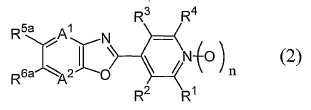
[식 중, A1 및 A2는 각각 독립하여 질소원자 또는 =C(R7)-를 나타내고;
R1 및 R4는 각각 독립하여 할로겐원자 또는 수소원자를 나타내고;
R2 및 R3는 각각 독립하여 군 X로부터 선택되는 기로 치환되어 있어도 좋은 C1-C6쇄식 탄화수소기, 군 X로부터 선택되는 기로 치환되어 있어도 좋은 C3-C6지환식 탄화수소기, 군 Y로부터 선택되는 기로 치환되어 있어도 좋은 페닐기, 군 Y로부터 선택되는 기로 치환되어 있어도 좋은 벤질기, 군 Y로부터 선택되는 기로 치환되어 있어도 좋은 5원 복소환기 혹은 6원 복소환기, -OR8, -NR8R9, -NR8C(O)R9, -NR10C(O)NR9R14, -NR10CO2R15, -S(O)mR8, -CO2R10, -CONR8R9, -C(O)R10, -C(NOR8)R10, -CONR10NR11R12, 시아노기, 니트로기, 할로겐원자 또는 수소원자를 나타내고;
R5a 및 R6a는 각각 독립하여 할로겐원자로 치환된 C1-C6쇄식 탄화수소기, 할로겐원자로 치환된 C3-C6지환식 탄화수소기, -OR13a, -S(O)mR13a, 할로겐원자 또는 수소원자를 나타내거나(단, R5a 및 R6a가 동시에 할로겐원자 및 수소원자로 이루어지는 군으로부터 선택되는 기를 나타내지 않는다), 혹은, R5a와 R6a와, R5a 및 R6a가 각각 결합하고 있는 6원환의 구성원자가 함께 이루어져서, 할로겐원자로 치환된 5원환 또는 6원환을 형성하여도 좋고;
R7는 할로겐원자로 치환되어 있어도 좋은 C1-C3알킬기, 할로겐원자로 치환되어 있어도 좋은 C1-C3알콕시기, 시아노기, 할로겐원자 또는 수소원자를 나타내고;
R8 및 R9는 각각 독립하여 군 X로부터 선택되는 기로 치환되어 있어도 좋은 C1-C6쇄식 탄화수소기, 군 X로부터 선택되는 기로 치환되어 있어도 좋은 C4-C7시클로알킬메틸기, 군 X로부터 선택되는 기로 치환되어 있어도 좋은 C3-C6지환식 탄화수소기, 군 Y로부터 선택되는 기로 치환되어 있어도 좋은 페닐기, 군 Y로부터 선택되는 기로 치환되어 있어도 좋은 벤질기, 군 Y로부터 선택되는 기로 치환되어 있어도 좋은 5원 복소환기 혹은 6원 복소환기 또는 수소원자를 나타내고(단, -S(O)mR8에 있어서의 m이 1 또는 2인 경우, R8는 수소원자를 나타내지 않는다);
R10 및 R14는 각각 독립하여 할로겐원자로 치환되어 있어도 좋은 C1-C4알킬기 또는 수소원자를 나타내고;
R11 및 R12는 각각 독립하여 할로겐원자로 치환되어 있어도 좋은 C1-C4알킬기, C2-C4알콕시카르보닐기 또는 수소원자를 나타내고;
R13a는 할로겐원자로 치환된 C1-C6쇄식 탄화수소기 또는 할로겐원자로 치환된 C3-C6지환식 탄화수소기를 나타내고;
R15는 할로겐원자로 치환되어 있어도 좋은 C1-C4알킬기를 나타내고;
m은 0, 1 또는 2를 나타내고;
n은 0 또는 1을 나타내고;
군 X는 할로겐원자로 치환되어 있어도 좋은 C1-C4알콕시기, 시아노기 및 할로겐원자로 이루어지는 군을 나타내고;
군 Y는 할로겐원자로 치환되어 있어도 좋은 C1-C4알킬기, 할로겐원자로 치환되어 있어도 좋은 C1-C4알콕시기, 시아노기, 니트로기 및 할로겐원자로 이루어지는 군을 나타낸다.]로 표시되는 축합복소환 화합물.General formula (2)
[Wherein, A 1 and A 2 each independently represent a nitrogen atom or = C (R 7 )-;
R 1 and R 4 each independently represent a halogen atom or a hydrogen atom;
R 2 and R 3 are each independently a C 1 -C 6 chain hydrocarbon group which may be substituted with a group selected from group X, a C 3 -C 6 alicyclic hydrocarbon group which may be substituted with a group selected from group X, a group selected from group Y A 5-membered heterocyclic group or a 6-membered heterocyclic group which may be substituted by a phenyl group which may be substituted, a benzyl group which may be substituted by a group selected from group Y, a group selected by group Y, -OR 8 , -NR 8 R 9 ,- NR 8 C (O) R 9 , -NR 10 C (O) NR 9 R 14 , -NR 10 CO 2 R 15 , -S (O) m R 8 , -CO 2 R 10 , -CONR 8 R 9 , -C (O) R 10 , -C (NOR 8 ) R 10 , -CONR 10 NR 11 R 12 , a cyano group, a nitro group, a halogen atom or a hydrogen atom;
R 5a and R 6a are each independently a C1-C6 chain hydrocarbon group substituted with a halogen atom, a C3-C6 alicyclic hydrocarbon group substituted with a halogen atom, -OR 13a , -S (O) m R 13a , a halogen atom or a hydrogen atom (Wherein R 5a and R 6a do not represent a group selected from the group consisting of a halogen atom and a hydrogen atom at the same time), or a 6-membered ring to which R 5a and R 6a and R 5a and R 6a are respectively bonded The member may be together to form a 5- or 6-membered ring substituted with a halogen atom;
R 7 represents a C 1 -C 3 alkyl group which may be substituted with a halogen atom, a C 1 -C 3 alkoxy group, cyano group, a halogen atom or a hydrogen atom which may be substituted with a halogen atom;
R 8 and R 9 are each independently substituted with a C 1 -C 6 chain hydrocarbon group which may be substituted with a group selected from group X, a C 4 -C 7 cycloalkylmethyl group which may be substituted with a group selected from group X, a group selected from group X A C3-C6 alicyclic hydrocarbon group which may be substituted, a phenyl group which may be substituted by a group selected from group Y, a benzyl group which may be substituted by a group selected from group Y, a 5-membered heterocyclic group which may be substituted by a group selected from group Y Or a 6-membered heterocyclic group or a hydrogen atom (provided that when the m in —S (O) m R 8 is 1 or 2, R 8 does not represent a hydrogen atom);
R 10 and R 14 each independently represent a C1-C4 alkyl group or a hydrogen atom which may be substituted with a halogen atom;
R 11 and R 12 each independently represent a C1-C4 alkyl group, a C2-C4 alkoxycarbonyl group or a hydrogen atom which may be substituted with a halogen atom;
R 13a represents a C1-C6 chain hydrocarbon group substituted with a halogen atom or a C3-C6 alicyclic hydrocarbon group substituted with a halogen atom;
R 15 represents a C1-C4 alkyl group which may be substituted with a halogen atom;
m represents 0, 1 or 2;
n represents 0 or 1;
Group X represents a group consisting of a C1-C4 alkoxy group, a cyano group and a halogen atom which may be substituted with a halogen atom;
Group Y represents a group consisting of a C 1 -C 4 alkyl group which may be substituted with a halogen atom, a C 1 -C 4 alkoxy group, cyano group, a nitro group and a halogen atom which may be substituted with a halogen atom.
R2 및 R3는 각각 독립하여 군 X로부터 선택되는 기로 치환되어 있어도 좋은 C1-C6쇄식 탄화수소기, 군 X로부터 선택되는 기로 치환되어 있어도 좋은 C3-C6지환식 탄화수소기, 군 Y로부터 선택되는 기로 치환되어 있어도 좋은 페닐기, 군 Y로부터 선택되는 기로 치환되어 있어도 좋은 벤질기, 군 Y로부터 선택되는 기로 치환되어 있어도 좋은 5원 복소환기 혹은 6원 복소환기, -OR8, -NR8R9, -NR8C(O)R9, -S(O)mR8, -CO2R10, -CONR8R9, -CONR10NR11R12, 시아노기, 니트로기, 할로겐원자 또는 수소원자를 나타내고;
R8 및 R9는 각각 독립하여 군 X로부터 선택되는 기로 치환되어 있어도 좋은 C1-C6쇄식 탄화수소기, 군 X로부터 선택되는 기로 치환되어 있어도 좋은 C3-C6지환식 탄화수소기, 군 Y로부터 선택되는 기로 치환되어 있어도 좋은 페닐기, 군 Y로부터 선택되는 기로 치환되어 있어도 좋은 5원 복소환기 혹은 6원 복소환기 또는 수소원자를 나타내는(단, -S(O)mR8에 있어서의 m이 1 또는 2인 경우, R8는 수소원자를 나타내지 않는다) 것을 특징으로 하는 축합복소환 화합물.12. The method of claim 11,
R 2 and R 3 are each independently a C 1 -C 6 chain hydrocarbon group which may be substituted with a group selected from group X, a C 3 -C 6 alicyclic hydrocarbon group which may be substituted with a group selected from group X, a group selected from group Y A 5-membered heterocyclic group or a 6-membered heterocyclic group which may be substituted by a phenyl group which may be substituted, a benzyl group which may be substituted by a group selected from group Y, a group selected by group Y, -OR 8 , -NR 8 R 9 ,- NR 8 C (O) R 9 , -S (O) m R 8 , -CO 2 R 10 , -CONR 8 R 9 , -CONR 10 NR 11 R 12 , cyano, nitro, halogen or hydrogen atom Represent;
R 8 and R 9 are each independently a C 1 -C 6 chain hydrocarbon group which may be substituted with a group selected from group X, a C 3 -C 6 alicyclic hydrocarbon group which may be substituted with a group selected from group X, a group selected from group Y A 5-membered heterocyclic group or a 6-membered heterocyclic group or a hydrogen atom which may be substituted by a phenyl group which may be substituted, or a group selected from group Y, provided that m in -S (O) m R 8 is 1 or 2 When R 8 does not represent a hydrogen atom).
R1 및 R4가 수소원자인 것을 특징으로 하는 축합복소환 화합물.The method of claim 11 or 12,
A condensed heterocyclic compound, wherein R 1 and R 4 are hydrogen atoms.
R2가 수소원자 또는 할로겐원자인 것을 특징으로 하는 축합복소환 화합물.The method of claim 11 or 12,
A condensed heterocyclic compound wherein R 2 is a hydrogen atom or a halogen atom.
R3가 군 X로부터 선택되는 기로 치환되어 있어도 좋은 C3-C6지환식 탄화수소기, 군 Y로부터 선택되는 기로 치환되어 있어도 좋은 페닐기, 군 Y로부터 선택되는 기로 치환되어 있어도 좋은 벤질기, 또는, 군 Y로부터 선택되는 기로 치환되어 있어도 좋은 5원 복소환기 혹은 6원 복소환기인 것을 특징으로 하는 축합복소환 화합물.The method of claim 11 or 12,
R 3 is the group may be substituted by a group selected from X good optionally substituted by a group selected from C3-C6 alicyclic hydrocarbon group, the group Y a phenyl group, optionally substituted by a group selected from the group Y good benzyl group, or a group Y It is a 5-membered heterocyclic group or 6-membered heterocyclic group which may be substituted by the group chosen from the condensed heterocyclic compound characterized by the above-mentioned.
R3가 군 X로부터 선택되는 기로 치환되어 있어도 좋은 C1-C6쇄식 탄화수소기, -OR8, -NR8R9, -NR8C(O)R9, -NR10C(O)NR9R14, -NR10CO2R15, -S(O)mR8, -CO2R10, -CONR8R9, -C(O)R10, -C(NOR8)R10, -CONR10NR11R12, 시아노기, 니트로기, 할로겐원자 또는 수소원자이고,
R8 및 R9가 각각 독립하여 군 X로부터 선택되는 기로 치환되어 있어도 좋은 C1-C6쇄식 탄화수소기 또는 수소원자인(단, -S(O)mR8에 있어서의 m이 1 또는 2인 경우, R8는 군 X로부터 선택되는 기로 치환되어 있어도 좋은 C1-C6쇄식 탄화수소기를 나타낸다) 것을 특징으로 하는 축합복소환 화합물.12. The method of claim 11,
C 1 -C 6 chain hydrocarbon group, R 3 may be substituted with a group selected from group X, -OR 8 , -NR 8 R 9 , -NR 8 C (O) R 9 , -NR 10 C (O) NR 9 R 14 , -NR 10 CO 2 R 15 , -S (O) m R 8 , -CO 2 R 10 , -CONR 8 R 9 , -C (O) R 10 , -C (NOR 8 ) R 10 , -CONR 10 NR 11 R 12 , a cyano group, a nitro group, a halogen atom or a hydrogen atom,
R 8 and R 9 are each independently a C1-C6 chain hydrocarbon group or hydrogen atom which may be substituted with a group selected from group X, provided that m in -S (O) m R 8 is 1 or 2 , R 8 represents a C1-C6 chain hydrocarbon group which may be substituted with a group selected from group X).
R3가 군 X로부터 선택되는 기로 치환되어 있어도 좋은 C1-C6쇄식 탄화수소기, -OR8, -NR8R9, -S(O)mR8, 할로겐원자 또는 수소원자이고,
R8 및 R9가 각각 독립하여 군 X로부터 선택되는 기로 치환되어 있어도 좋은 C1-C6쇄식 탄화수소기 또는 수소원자인(단, -S(O)mR8에 있어서의 m이 1 또는 2인 경우, R8는 군 X로부터 선택되는 기로 치환되어 있어도 좋은 C1-C6쇄식 탄화수소기를 나타낸다) 것을 특징으로 하는 축합복소환 화합물.The method of claim 11 or 12,
R 3 is a C1-C6 chain hydrocarbon group which may be substituted with a group selected from group X, -OR 8 , -NR 8 R 9 , -S (O) m R 8 , a halogen atom or a hydrogen atom,
R 8 and R 9 are each independently a C1-C6 chain hydrocarbon group or hydrogen atom which may be substituted with a group selected from group X, provided that m in -S (O) m R 8 is 1 or 2 , R 8 represents a C1-C6 chain hydrocarbon group which may be substituted with a group selected from group X).
R5a 및 R6a 중 적어도 하나가 할로겐원자로 치환된 C1-C6쇄식 탄화수소기 또는 -OR13a이고, R13a가 할로겐원자로 치환된 C1-C6쇄식 탄화수소기인 것을 특징으로 하는 축합복소환 화합물.The method of claim 11 or 12,
At least one of R 5a and R 6a is a C1-C6 chain hydrocarbon group substituted with a halogen atom or -OR 13a , and R 13a is a C1-C6 chain hydrocarbon group substituted with a halogen atom.
Applications Claiming Priority (2)
| Application Number | Priority Date | Filing Date | Title |
|---|---|---|---|
| JPJP-P-2008-109977 | 2008-04-21 | ||
| JP2008109977 | 2008-04-21 |
Publications (1)
| Publication Number | Publication Date |
|---|---|
| KR20100134056A true KR20100134056A (en) | 2010-12-22 |
Family
ID=41216960
Family Applications (1)
| Application Number | Title | Priority Date | Filing Date |
|---|---|---|---|
| KR1020107023492A Ceased KR20100134056A (en) | 2008-04-21 | 2009-04-21 | Harmful arthropod control composition and condensed heterocyclic compound |
Country Status (12)
| Country | Link |
|---|---|
| US (4) | US8242133B2 (en) |
| EP (1) | EP2274983B1 (en) |
| JP (1) | JP5369854B2 (en) |
| KR (1) | KR20100134056A (en) |
| CN (1) | CN102006776B (en) |
| AU (1) | AU2009238930B2 (en) |
| BR (1) | BRPI0910685B1 (en) |
| CA (1) | CA2721270C (en) |
| MX (1) | MX2010011460A (en) |
| MY (1) | MY154772A (en) |
| WO (1) | WO2009131237A1 (en) |
| ZA (1) | ZA201007363B (en) |
Cited By (5)
| Publication number | Priority date | Publication date | Assignee | Title |
|---|---|---|---|---|
| WO2012057268A1 (en) * | 2010-10-27 | 2012-05-03 | 住友化学株式会社 | Pest control composition and method for controlling pests |
| KR20150113091A (en) * | 2013-01-31 | 2015-10-07 | 스미또모 가가꾸 가부시끼가이샤 | Pest-control composition and pest-control method |
| KR20150113097A (en) * | 2013-01-31 | 2015-10-07 | 스미또모 가가꾸 가부시끼가이샤 | Pest-control method |
| KR20150113094A (en) * | 2013-01-31 | 2015-10-07 | 스미또모 가가꾸 가부시끼가이샤 | Pest-control composition and pest-control method |
| KR20150113972A (en) * | 2013-01-31 | 2015-10-08 | 스미또모 가가꾸 가부시끼가이샤 | Pest-control composition and pest-control method |
Families Citing this family (100)
| Publication number | Priority date | Publication date | Assignee | Title |
|---|---|---|---|---|
| JP5369854B2 (en) | 2008-04-21 | 2013-12-18 | 住友化学株式会社 | Harmful arthropod control composition and condensed heterocyclic compound |
| BR112012007237A2 (en) * | 2009-09-30 | 2019-09-24 | Sumitomo Chemical Co | composition and method for controlling arthropod pests |
| JP5540640B2 (en) * | 2009-10-07 | 2014-07-02 | 住友化学株式会社 | Heterocyclic compounds and their use for controlling harmful arthropods |
| ES2620177T3 (en) * | 2009-10-15 | 2017-06-27 | Guerbet | Imaging agents and their use for in vivo diagnosis of neurodegenerative diseases, particularly Alzheimer's disease and derived diseases |
| EP2490539A4 (en) * | 2009-10-20 | 2013-04-24 | Sumitomo Chemical Co | COMPOSITION AND METHOD FOR CONTROLLING INSECT PEST ARTHROPODES |
| AR079009A1 (en) * | 2009-10-20 | 2011-12-21 | Sumitomo Chemical Co | COMPOSITION AND METHOD TO CONTROL PESTS OF ARTROPODES |
| BR112012009259A2 (en) * | 2009-10-20 | 2019-09-24 | Sumitomo Chemical Co | composition and method for controlling arthropod pests. |
| TW201117724A (en) * | 2009-10-20 | 2011-06-01 | Sumitomo Chemical Co | Composition and method for controlling arthropod pests |
| US8796306B2 (en) * | 2010-06-23 | 2014-08-05 | Sumitomo Chemical Company, Limited | Noxious arthropod controlling composition and heterocyclic compound |
| JP2012092049A (en) * | 2010-10-27 | 2012-05-17 | Sumitomo Chemical Co Ltd | Pest control composition and method for controlling pest |
| JP2012092051A (en) * | 2010-10-27 | 2012-05-17 | Sumitomo Chemical Co Ltd | Pest control composition and method for controlling pest |
| JP2012092050A (en) * | 2010-10-27 | 2012-05-17 | Sumitomo Chemical Co Ltd | Pest control composition and method for controlling pest |
| JP2012092052A (en) * | 2010-10-27 | 2012-05-17 | Sumitomo Chemical Co Ltd | Pest control composition and method for controlling pest |
| JP2012092055A (en) * | 2010-10-27 | 2012-05-17 | Sumitomo Chemical Co Ltd | Harmful animal control composition and method for controlling harmful animal |
| JP2012092054A (en) * | 2010-10-27 | 2012-05-17 | Sumitomo Chemical Co Ltd | Harmful animal control composition and method for controlling harmful animal |
| WO2012087630A1 (en) | 2010-12-20 | 2012-06-28 | E.I. Du Pont De Nemours And Company | Pyridine and pyrimidine compounds for controlling invertebrate |
| MX2013006847A (en) | 2010-12-24 | 2013-07-29 | Sumitomo Chemical Co | FUSIONED HETEROCICLIC COMPOUND AND ITS USE FOR PEST CONTROL. |
| TWI589570B (en) * | 2011-08-04 | 2017-07-01 | 住友化學股份有限公司 | Fused heterocyclic compounds and their use in pest control |
| JP6217630B2 (en) * | 2012-05-30 | 2017-10-25 | 住友化学株式会社 | Fused heterocyclic compounds |
| BR112014029501B1 (en) | 2012-05-31 | 2020-05-19 | Sumitomo Chemical Co | fused heterocyclic compound, its use, pest control agent and method for pest control |
| WO2013187426A1 (en) * | 2012-06-15 | 2013-12-19 | 住友化学株式会社 | Pest control method for harmful arthropods |
| JPWO2013191188A1 (en) * | 2012-06-22 | 2016-05-26 | 住友化学株式会社 | Fused heterocyclic compounds |
| KR102062422B1 (en) | 2012-12-27 | 2020-01-03 | 수미토모 케미칼 컴퍼니 리미티드 | Fused oxazole compounds and use thereof for pest control |
| WO2014119494A1 (en) * | 2013-01-31 | 2014-08-07 | 住友化学株式会社 | Pest control composition and method for controlling pest |
| WO2014119699A1 (en) * | 2013-01-31 | 2014-08-07 | 住友化学株式会社 | Pest-control composition and pest-control method |
| BR112015017740A2 (en) * | 2013-02-06 | 2017-07-11 | Sumitomo Chemical Co | condensed heterocyclic compound |
| AU2013378362A1 (en) * | 2013-02-13 | 2015-08-13 | Sumitomo Chemical Company, Limited | Pest controlling composition and use thereof |
| EP2985278B1 (en) | 2013-02-28 | 2020-01-22 | Sumitomo Chemical Company, Limited | Fused heterocyclic compound and pest control applications thereof |
| UY35421A (en) | 2013-03-15 | 2014-10-31 | Nihon Nohyaku Co Ltd | CONDENSED HETEROCYCLIC COMPOUND OR ITS SALT, AGRICULTURAL OR HERITAGE INSECTICIDE THAT INCLUDES THE COMPOSITE AND METHOD OF USE OF THE INSECTICIDE |
| JP6350528B2 (en) * | 2013-07-01 | 2018-07-04 | 住友化学株式会社 | Fused heterocyclic compounds and their use for pest control |
| US11229208B2 (en) | 2013-07-02 | 2022-01-25 | Syngenta Participations Ag | Pesticidally active bi- or tricyclic heterocycles with sulfur containing substituents |
| WO2015000715A1 (en) | 2013-07-02 | 2015-01-08 | Syngenta Participations Ag | Pesticidally active bi- or tricyclic heterocycles with sulfur containing substituents |
| TWI652014B (en) * | 2013-09-13 | 2019-03-01 | 美商艾佛艾姆希公司 | Heterocyclic substituted bicycloazole insecticide |
| EP2873668A1 (en) | 2013-11-13 | 2015-05-20 | Syngenta Participations AG. | Pesticidally active bicyclic heterocycles with sulphur containing substituents |
| EP2878199A1 (en) * | 2013-11-27 | 2015-06-03 | Syngenta Participations AG. | Method of protecting a plant propagation material |
| WO2015091945A1 (en) | 2013-12-20 | 2015-06-25 | Syngenta Participations Ag | Pesticidally active substituted 5,5-bicyclic heterocycles with sulphur containing substituents |
| JP6428773B2 (en) * | 2014-07-04 | 2018-11-28 | 住友化学株式会社 | Pest control composition and use thereof |
| CN112961149A (en) | 2014-08-11 | 2021-06-15 | 安吉恩生物医药公司 | Cytochrome P450 inhibitors and uses thereof |
| JP6689821B2 (en) | 2014-08-12 | 2020-04-28 | シンジェンタ パーティシペーションズ アーゲー | Pesticidally Active Heterocyclic Derivatives Bearing Sulfur-Containing Substituents |
| JP2017537916A (en) * | 2014-12-02 | 2017-12-21 | バイエル・クロップサイエンス・アクチェンゲゼルシャフト | Bicyclic compounds as pest control agents |
| WO2016091731A1 (en) | 2014-12-11 | 2016-06-16 | Syngenta Participations Ag | Pesticidally active tetracyclic derivatives with sulfur containing substituents |
| EP3240778A4 (en) | 2014-12-31 | 2018-07-11 | Angion Biomedica Corp. | Methods and agents for treating disease |
| TWI696612B (en) | 2015-01-29 | 2020-06-21 | 日商日本農藥股份有限公司 | Condensed heterocyclic compound having a cycloalkylpyridyl group or a salt thereof, agricultural and horticultural insecticide containing the compound, and method of using the same |
| BR112017015870B1 (en) | 2015-02-12 | 2021-11-16 | Nissan Chemical Corporation | CONDENSED HETEROCYCLIC COMPOUND, PESTICIDE, AGRICULTURAL CHEMICAL, SEED AND SOIL TREATMENT AGENT |
| CN107810188B (en) | 2015-04-08 | 2020-09-22 | 拜耳作物科学股份公司 | Fused bicyclic heterocyclic derivatives as pest control agents and intermediate products |
| JP2018513190A (en) | 2015-04-24 | 2018-05-24 | シンジェンタ パーティシペーションズ アーゲー | Polycyclic derivatives having sulfur-substituted 5-membered heterocycles and active in pest control |
| JP2018524336A (en) | 2015-07-01 | 2018-08-30 | シンジェンタ パーティシペーションズ アーゲー | Polycyclic derivatives active for pest control having a sulfur-containing substituent |
| JP2018524337A (en) | 2015-07-01 | 2018-08-30 | シンジェンタ パーティシペーションズ アーゲー | Tetracyclic derivatives having sulfur-containing substituents and active in pest control |
| CN118955472A (en) | 2015-08-07 | 2024-11-15 | 拜耳作物科学股份公司 | 2-(Hetero)aryl substituted fused heterocyclic derivatives as pesticides |
| RU2721119C2 (en) | 2015-10-13 | 2020-05-15 | Нихон Нохияку Ко., Лтд. | Containing an oxime group of a condensed heterocyclic compound or a salt thereof, an agricultural and garden insecticide containing said compound, and a method of using said insecticide |
| RU2018119344A (en) | 2015-10-26 | 2019-11-28 | Байер Кропсайенс Акциенгезельшафт | CONDENSED BICYCLIC HETEROCYCLIC DERIVATIVES AS A MEANS FOR COMBATING Pests |
| JP2018537460A (en) | 2015-11-23 | 2018-12-20 | シンジェンタ パーティシペーションズ アーゲー | Pest control active heterocyclic derivatives with sulfur and cyclopropyl containing substituents |
| JP6577051B2 (en) | 2015-12-01 | 2019-09-18 | 日本農薬株式会社 | 3H-pyrrolopyridine compound or N-oxide thereof, or salts thereof, agricultural and horticultural insecticide containing the compound, and method of using the same |
| WO2017093180A1 (en) | 2015-12-01 | 2017-06-08 | Bayer Cropscience Aktiengesellschaft | Condensed bicyclic heterocycle derivatives as pest control agents |
| WO2017144341A1 (en) | 2016-02-23 | 2017-08-31 | Bayer Cropscience Aktiengesellschaft | Condensed bicyclic heterocycle derivatives as pest control agents |
| KR102066901B1 (en) | 2016-02-26 | 2020-01-16 | 니혼노야쿠가부시키가이샤 | Benzoxazole compounds or salts thereof and agricultural and horticultural insecticides containing the compounds and methods of using the same |
| CO2018009129A2 (en) | 2016-02-26 | 2018-09-20 | Nihon Nohyaku Co Ltd | Condensed heterocyclic compound linked to heterocycle or its salt, agricultural and horticultural insecticide comprising the compound and method for using the insecticide |
| MX2018010872A (en) | 2016-03-10 | 2019-02-07 | Nissan Chemical Corp | Condensed heterocyclic compound and pest control agent. |
| WO2017174414A1 (en) | 2016-04-05 | 2017-10-12 | Bayer Cropscience Aktiengesellschaft | Naphthaline-derivatives as pest control agents |
| EP3241830A1 (en) | 2016-05-04 | 2017-11-08 | Bayer CropScience Aktiengesellschaft | Condensed bicyclic heterocyclic derivatives as pesticides |
| CN109689662B (en) | 2016-07-19 | 2022-03-15 | 拜耳作物科学股份公司 | Fused bicyclic heterocyclic derivatives as pest control agents |
| BR112019003158B1 (en) | 2016-08-15 | 2022-10-25 | Bayer Cropscience Aktiengesellschaft | DERIVATIVES OF CONDENSED BICYCLIC HETEROCYCLE, THEIR USE, AGROCHEMICAL FORMULATION, AND METHOD TO CONTROL ANIMAL PESTS |
| CN109415357B (en) | 2016-09-01 | 2021-10-29 | 日本农药株式会社 | Condensed heterocyclic compound having hydrazone group or salts thereof, agricultural and horticultural insecticide containing the compound and method of use thereof |
| CN109963860A (en) | 2016-09-19 | 2019-07-02 | 拜耳作物科学股份公司 | Pyrazolo [1,5-A ] pyridine derivatives and their use as pesticides |
| EP3527567B1 (en) | 2016-10-13 | 2022-07-13 | Nihon Nohyaku Co., Ltd. | 1h-pyrrolopyridine compound or n-oxide or salt thereof, agricultural and horticultural insecticide containing said compound, and method of using said insecticide |
| US10779537B2 (en) | 2016-10-13 | 2020-09-22 | Nihon Nohyaku Co., Ltd. | 1H-pyrrolopyridine compound, N-oxide thereof or salt thereof, agricultural and horticultural insecticide comprising the compound, and method for using the insecticide |
| CN109890818B (en) | 2016-10-27 | 2022-11-25 | 先正达参股股份有限公司 | Pesticidally active heterocyclic derivatives with sulphur and hydroxylamine substituents |
| CN109906221B (en) | 2016-11-01 | 2021-10-01 | 日本农药株式会社 | N-Alkylsulfonyl indoline compound, agricultural and horticultural insecticides containing the same, and methods of using the same |
| MX2019004906A (en) | 2016-11-01 | 2019-06-20 | Nihon Nohyaku Co Ltd | Quinoline compound having oxime group, n-oxide or salt thereof, agricultural and horticultural insecticide comprising same and method for use thereof. |
| WO2018091389A1 (en) | 2016-11-17 | 2018-05-24 | Syngenta Participations Ag | Pesticidally active heterocyclic derivatives with sulphur containing substituents |
| US10961248B2 (en) | 2016-12-01 | 2021-03-30 | Syngenta Participations Ag | Pesticidally active heterocyclic derivatives with sulfur containing substituents |
| US20190308982A1 (en) | 2016-12-15 | 2019-10-10 | Syngenta Participations Ag | Pesticidally active heterocyclic derivatives with sulfur containing substituents |
| JP6728399B2 (en) | 2016-12-27 | 2020-07-22 | 日本農薬株式会社 | Fused heterocyclic compounds having oxime groups or salts thereof, agricultural and horticultural insecticides containing these compounds, and methods of using the same |
| RU2756207C2 (en) | 2016-12-27 | 2021-09-28 | Нихон Нохияку Ко., Лтд. | Compound of 4h-pyrrolopyridine or its salt, agricultural and horticultural insecticide, including the specified compound or its salt, and method for applying insecticide |
| WO2018138050A1 (en) | 2017-01-26 | 2018-08-02 | Bayer Aktiengesellschaft | Condensed bicyclic heterocyclene derivatives as pest control agents |
| TWI793104B (en) | 2017-02-21 | 2023-02-21 | 瑞士商先正達合夥公司 | Pesticidally active heterocyclic derivatives with sulfur containing substituents |
| EP3615540B1 (en) | 2017-04-24 | 2022-04-27 | Bayer Aktiengesellschaft | Condensed bicyclic heterocycle derivatives as pesticides |
| US20200216441A1 (en) | 2017-04-25 | 2020-07-09 | Syngenta Participations Ag | Pesticidally active heterocyclic derivatives with sulfur containing substituents |
| CN110582498B (en) | 2017-04-27 | 2022-06-24 | 日本农药株式会社 | Condensed heterocyclic compound or salt thereof, agricultural and horticultural insecticide containing the same, and method of using the same |
| EP3649118B8 (en) | 2017-07-05 | 2024-10-09 | Syngenta Crop Protection AG | Pesticidally active heterocyclic derivatives with sulfur containing substituents |
| USRE50663E1 (en) | 2017-10-04 | 2025-11-18 | Bayer Aktiengesellschaft | Heterocycle derivatives as pesticides |
| EP3305786A3 (en) | 2018-01-22 | 2018-07-25 | Bayer CropScience Aktiengesellschaft | Condensed bicyclic heterocycle derivatives as pesticides |
| JP2021514949A (en) | 2018-02-21 | 2021-06-17 | バイエル・アクチエンゲゼルシヤフト | Condensed bicyclic heterocyclic derivative as a pest control agent |
| CN111836815A (en) | 2018-03-12 | 2020-10-27 | 拜耳公司 | Fused bicyclic heterocyclic derivatives as pest control agents |
| AU2019254499A1 (en) | 2018-04-20 | 2020-12-03 | Bayer Aktiengesellschaft | Heterocyclene derivatives as pest control agents |
| WO2019229089A1 (en) | 2018-05-31 | 2019-12-05 | Syngenta Participations Ag | Pesticidally active heterocyclic derivatives with sulfur containing substituents |
| AR115495A1 (en) | 2018-06-06 | 2021-01-27 | Syngenta Crop Protection Ag | HETEROCYCLIC DERIVATIVES WITH SUBSTITUENTS CONTAINING ACTIVE SULFUR AS PESTICIDES |
| KR102808245B1 (en) | 2018-06-06 | 2025-05-14 | 신젠타 크롭 프로텍션 아게 | Insecticidally active heterocyclic derivatives having sulfoximine-containing substituents |
| BR112021003665A2 (en) | 2018-09-13 | 2021-05-18 | Bayer Aktiengesellschaft | heterocyclene derivatives as pest control agents |
| TW202035404A (en) | 2018-10-24 | 2020-10-01 | 瑞士商先正達農作物保護公司 | Pesticidally active heterocyclic derivatives with sulfoximine containing substituents |
| WO2020141135A1 (en) | 2018-12-31 | 2020-07-09 | Syngenta Crop Protection Ag | Pesticidally active heterocyclic derivatives with sulfur containing substituents |
| KR20210133240A (en) | 2019-02-26 | 2021-11-05 | 바이엘 악티엔게젤샤프트 | Fused Bicyclic Heterocycle Derivatives as Pesticides |
| EP3931192B1 (en) | 2019-02-26 | 2024-03-20 | Bayer Aktiengesellschaft | Condensed bicyclic heterocycle derivatives as pesticides |
| ES2969738T3 (en) | 2019-05-27 | 2024-05-22 | Nihon Nohyaku Co Ltd | Condensed heterocyclic compound having a nitrogen atom as a bridgehead or a salt thereof, agricultural or horticultural insecticide comprising the compound and method of using the insecticide |
| AR119140A1 (en) | 2019-06-13 | 2021-11-24 | Pi Industries Ltd | FUSED HETEROCYCLIC COMPOUNDS AND THEIR USE AS PEST CONTROL AGENTS |
| CN114450280B (en) | 2019-09-20 | 2025-02-25 | 先正达农作物保护股份公司 | Pesticide-active heterocyclic derivatives having sulfur-containing and sulfoximine substituents |
| JP7746286B2 (en) | 2020-04-30 | 2025-09-30 | シンジェンタ クロップ プロテクション アクチェンゲゼルシャフト | Pesticidal Active Heterocyclic Derivatives with Sulfur-Containing Substituents - Patent application |
| CN120882309A (en) | 2023-03-14 | 2025-10-31 | 先正达农作物保护股份公司 | Resistance to insecticides control of pests in (a) a plant |
| WO2025177312A1 (en) | 2024-02-23 | 2025-08-28 | Pi Industries Ltd. | Fused heterocyclic compounds and its uses thereof |
| WO2025177310A1 (en) | 2024-02-23 | 2025-08-28 | Pi Industries Ltd. | Fused heterocyclic compounds and its uses thereof |
Family Cites Families (35)
| Publication number | Priority date | Publication date | Assignee | Title |
|---|---|---|---|---|
| US1415954A (en) * | 1920-09-13 | 1922-05-16 | Schatte Charles | Phonograph stop mechanism |
| BE578935A (en) * | 1958-05-23 | |||
| FR1228524A (en) | 1958-05-23 | 1960-08-31 | ||
| GB1094199A (en) | 1963-12-12 | 1967-12-06 | Hodogaya Chemical Co Ltd | Process for the preparation of oxazole compounds |
| US3962452A (en) * | 1972-05-18 | 1976-06-08 | Lilly Industries, Ltd. | Benzoxazole derivatives as therapeutics |
| GB1435721A (en) * | 1972-05-18 | 1976-05-12 | Lilly Industries Ltd | Benzoxazole derivatives |
| US4021440A (en) * | 1972-05-18 | 1977-05-03 | Eli Lilly Industries Limited | Cyanomethyl substituted benzoxazoles |
| US3962441A (en) * | 1972-05-18 | 1976-06-08 | Lilly Industries, Ltd. | Benzoxazole derivatives in treating inflammation, pain and fever |
| JPS4943974A (en) | 1972-09-06 | 1974-04-25 | ||
| BR8600161A (en) | 1985-01-18 | 1986-09-23 | Plant Genetic Systems Nv | CHEMICAL GENE, HYBRID, INTERMEDIATE PLASMIDIO VECTORS, PROCESS TO CONTROL INSECTS IN AGRICULTURE OR HORTICULTURE, INSECTICIDE COMPOSITION, PROCESS TO TRANSFORM PLANT CELLS TO EXPRESS A PLANTINIDE TOXIN, PRODUCED BY CULTURES, UNITED BY BACILLA |
| CA1340685C (en) | 1988-07-29 | 1999-07-27 | Frederick Meins | Dna sequences encoding polypeptides having beta-1,3-glucanase activity |
| EP0374753A3 (en) | 1988-12-19 | 1991-05-29 | American Cyanamid Company | Insecticidal toxines, genes coding therefor, antibodies binding them, transgenic plant cells and plants expressing these toxines |
| ES2199931T3 (en) | 1989-03-24 | 2004-03-01 | Syngenta Participations Ag | TRANSGENIC PLANTS RESISTANT TO DISEASES. |
| DE3916729A1 (en) | 1989-05-23 | 1990-12-06 | Behringwerke Ag | FLUOROGENIC COMPOUNDS AND THEIR USE |
| ES2074547T3 (en) | 1989-11-07 | 1995-09-16 | Pioneer Hi Bred Int | LARVICID LECTINES, AND INDUCED RESISTANCE OF PLANTS TO INSECTS. |
| US5639949A (en) | 1990-08-20 | 1997-06-17 | Ciba-Geigy Corporation | Genes for the synthesis of antipathogenic substances |
| UA48104C2 (en) | 1991-10-04 | 2002-08-15 | Новартіс Аг | Dna fragment including sequence that codes an insecticide protein with optimization for corn, dna fragment providing directed preferable for the stem core expression of the structural gene of the plant related to it, dna fragment providing specific for the pollen expression of related to it structural gene in the plant, recombinant dna molecule, method for obtaining a coding sequence of the insecticide protein optimized for corn, method of corn plants protection at least against one pest insect |
| WO1994022846A1 (en) | 1993-03-30 | 1994-10-13 | Pfizer Inc. | Compounds enhancing antitumor activity of other cytotoxic agents |
| US5530195A (en) | 1994-06-10 | 1996-06-25 | Ciba-Geigy Corporation | Bacillus thuringiensis gene encoding a toxin active against insects |
| US6130217A (en) * | 1995-09-20 | 2000-10-10 | Pfizer Inc | Compounds enhancing antitumor activity of other cytotoxic agents |
| GB9605065D0 (en) * | 1996-03-11 | 1996-05-08 | Merck Sharp & Dohme | Therapeutic agents |
| GB9816654D0 (en) * | 1998-07-30 | 1998-09-30 | Zeneca Ltd | Chemical compounds |
| US6277871B1 (en) | 1998-11-20 | 2001-08-21 | Abbott Laboratories | Inhibitors of protein isoprenyl transferases |
| GB0002033D0 (en) * | 2000-01-28 | 2000-03-22 | Zeneca Ltd | Chemical compounds |
| JP2004524289A (en) | 2000-12-22 | 2004-08-12 | アストラゼネカ・アクチエボラーグ | Therapeutic compounds |
| US7777097B2 (en) | 2001-06-22 | 2010-08-17 | Syngenta Participations Ag | Plant disease resistance genes |
| GB0118357D0 (en) * | 2001-07-27 | 2001-09-19 | Syngenta Ltd | Chemical compounds |
| WO2003052073A2 (en) | 2001-12-17 | 2003-06-26 | Syngenta Participations Ag | Novel corn event |
| JP2008515992A (en) | 2004-10-13 | 2008-05-15 | ピーティーシー セラピューティクス,インコーポレーテッド | Use of prescribed compounds for the manufacture of medicaments for the prevention / treatment of diseases caused by somatic mutations |
| EP1692939A1 (en) * | 2005-02-19 | 2006-08-23 | Bayer CropScience S.A. | Pesticidal substituted piperidines |
| MY148644A (en) | 2005-07-18 | 2013-05-15 | Orion Corp | New pharmaceutical compounds |
| SI1986633T1 (en) | 2006-02-10 | 2015-03-31 | Summit Corporation Plc | Treatment of duchenne muscular dystrophy |
| WO2009027732A1 (en) * | 2007-08-24 | 2009-03-05 | Astrazeneca Ab | 5-6-bicyclic heteroaromatic compounds with antibacterial activity |
| JP5369854B2 (en) | 2008-04-21 | 2013-12-18 | 住友化学株式会社 | Harmful arthropod control composition and condensed heterocyclic compound |
| WO2009155017A2 (en) * | 2008-05-30 | 2009-12-23 | Merck & Co., Inc. | Novel substituted azabenzoxazoles |
-
2009
- 2009-04-20 JP JP2009101790A patent/JP5369854B2/en active Active
- 2009-04-21 US US12/937,385 patent/US8242133B2/en active Active
- 2009-04-21 MX MX2010011460A patent/MX2010011460A/en active IP Right Grant
- 2009-04-21 WO PCT/JP2009/058236 patent/WO2009131237A1/en not_active Ceased
- 2009-04-21 EP EP09734587.0A patent/EP2274983B1/en active Active
- 2009-04-21 KR KR1020107023492A patent/KR20100134056A/en not_active Ceased
- 2009-04-21 CA CA2721270A patent/CA2721270C/en active Active
- 2009-04-21 MY MYPI2010004916A patent/MY154772A/en unknown
- 2009-04-21 BR BRPI0910685-5A patent/BRPI0910685B1/en active IP Right Grant
- 2009-04-21 AU AU2009238930A patent/AU2009238930B2/en active Active
- 2009-04-21 CN CN200980113772.3A patent/CN102006776B/en active Active
-
2010
- 2010-10-14 ZA ZA2010/07363A patent/ZA201007363B/en unknown
-
2011
- 2011-12-30 US US13/341,244 patent/US8324387B2/en active Active
-
2012
- 2012-04-17 US US13/448,465 patent/US8445522B2/en active Active
-
2013
- 2013-03-08 US US13/789,875 patent/US8609705B2/en active Active
Cited By (5)
| Publication number | Priority date | Publication date | Assignee | Title |
|---|---|---|---|---|
| WO2012057268A1 (en) * | 2010-10-27 | 2012-05-03 | 住友化学株式会社 | Pest control composition and method for controlling pests |
| KR20150113091A (en) * | 2013-01-31 | 2015-10-07 | 스미또모 가가꾸 가부시끼가이샤 | Pest-control composition and pest-control method |
| KR20150113097A (en) * | 2013-01-31 | 2015-10-07 | 스미또모 가가꾸 가부시끼가이샤 | Pest-control method |
| KR20150113094A (en) * | 2013-01-31 | 2015-10-07 | 스미또모 가가꾸 가부시끼가이샤 | Pest-control composition and pest-control method |
| KR20150113972A (en) * | 2013-01-31 | 2015-10-08 | 스미또모 가가꾸 가부시끼가이샤 | Pest-control composition and pest-control method |
Also Published As
| Publication number | Publication date |
|---|---|
| US20110039843A1 (en) | 2011-02-17 |
| CN102006776B (en) | 2013-09-25 |
| CA2721270A1 (en) | 2009-10-29 |
| EP2274983A4 (en) | 2013-10-30 |
| WO2009131237A1 (en) | 2009-10-29 |
| BRPI0910685B1 (en) | 2018-01-16 |
| JP5369854B2 (en) | 2013-12-18 |
| US20120108586A1 (en) | 2012-05-03 |
| US20130190271A1 (en) | 2013-07-25 |
| AU2009238930A1 (en) | 2009-10-29 |
| CN102006776A (en) | 2011-04-06 |
| MX2010011460A (en) | 2010-11-12 |
| US8242133B2 (en) | 2012-08-14 |
| AU2009238930B2 (en) | 2013-07-25 |
| US8324387B2 (en) | 2012-12-04 |
| US8445522B2 (en) | 2013-05-21 |
| ZA201007363B (en) | 2012-01-25 |
| CA2721270C (en) | 2016-06-21 |
| MY154772A (en) | 2015-07-15 |
| EP2274983B1 (en) | 2017-05-31 |
| BRPI0910685A2 (en) | 2015-08-11 |
| US8609705B2 (en) | 2013-12-17 |
| JP2009280574A (en) | 2009-12-03 |
| EP2274983A1 (en) | 2011-01-19 |
| US20120245167A1 (en) | 2012-09-27 |
Similar Documents
| Publication | Publication Date | Title |
|---|---|---|
| JP5369854B2 (en) | Harmful arthropod control composition and condensed heterocyclic compound | |
| TWI589570B (en) | Fused heterocyclic compounds and their use in pest control | |
| CN102686585B (en) | Heterocyclic compound and its use for control of an arthropod pest | |
| JP6311603B2 (en) | Fused heterocyclic compounds | |
| JP5790440B2 (en) | Pyrimidine compounds and their use for pest control | |
| CN104507911B (en) | Amide compound | |
| CN105246876B (en) | Fused heterocyclic compounds and their use in pest control | |
| CN103037694B (en) | Composition and heterocyclic compound for controlling harmful arthropods | |
| CN104334551A (en) | Fused heterocyclic compound | |
| JP2011093899A (en) | Composition and method for controlling arthropod pest | |
| CN104395289A (en) | Amide compound and use thereof for pest control | |
| CN104968659A (en) | Condensed heterocyclic compound | |
| JP2011105710A (en) | Arthropod pest control composition and arthropod pest control method | |
| JP2011105711A (en) | Arthropod pest control composition and arthropod pest control method | |
| JP2011105705A (en) | Pyron compound and usage thereof for pest control | |
| JP2011105709A (en) | Arthropod pest control composition and arthropod pest control method | |
| JP2011105712A (en) | Arthropod pest control composition and arthropod pest control method | |
| JP2012036178A (en) | Pyridine compound and pest-control usage therefor |
Legal Events
| Date | Code | Title | Description |
|---|---|---|---|
| PA0105 | International application |
Patent event date: 20101020 Patent event code: PA01051R01D Comment text: International Patent Application |
|
| PG1501 | Laying open of application | ||
| A201 | Request for examination | ||
| PA0201 | Request for examination |
Patent event code: PA02012R01D Patent event date: 20140307 Comment text: Request for Examination of Application |
|
| E902 | Notification of reason for refusal | ||
| PE0902 | Notice of grounds for rejection |
Comment text: Notification of reason for refusal Patent event date: 20150904 Patent event code: PE09021S01D |
|
| PE0601 | Decision on rejection of patent |
Patent event date: 20160315 Comment text: Decision to Refuse Application Patent event code: PE06012S01D Patent event date: 20150904 Comment text: Notification of reason for refusal Patent event code: PE06011S01I |