KR20100093622A - Splice switching oligomers for tnf superfamily receptors and their use in treatment of disease - Google Patents
Splice switching oligomers for tnf superfamily receptors and their use in treatment of disease Download PDFInfo
- Publication number
- KR20100093622A KR20100093622A KR1020087013921A KR20087013921A KR20100093622A KR 20100093622 A KR20100093622 A KR 20100093622A KR 1020087013921 A KR1020087013921 A KR 1020087013921A KR 20087013921 A KR20087013921 A KR 20087013921A KR 20100093622 A KR20100093622 A KR 20100093622A
- Authority
- KR
- South Korea
- Prior art keywords
- sso
- nucleotides
- seq
- receptor
- lna
- Prior art date
- Legal status (The legal status is an assumption and is not a legal conclusion. Google has not performed a legal analysis and makes no representation as to the accuracy of the status listed.)
- Granted
Links
Images


Classifications
-
- C—CHEMISTRY; METALLURGY
- C12—BIOCHEMISTRY; BEER; SPIRITS; WINE; VINEGAR; MICROBIOLOGY; ENZYMOLOGY; MUTATION OR GENETIC ENGINEERING
- C12N—MICROORGANISMS OR ENZYMES; COMPOSITIONS THEREOF; PROPAGATING, PRESERVING, OR MAINTAINING MICROORGANISMS; MUTATION OR GENETIC ENGINEERING; CULTURE MEDIA
- C12N15/00—Mutation or genetic engineering; DNA or RNA concerning genetic engineering, vectors, e.g. plasmids, or their isolation, preparation or purification; Use of hosts therefor
- C12N15/09—Recombinant DNA-technology
- C12N15/11—DNA or RNA fragments; Modified forms thereof; Non-coding nucleic acids having a biological activity
- C12N15/113—Non-coding nucleic acids modulating the expression of genes, e.g. antisense oligonucleotides; Antisense DNA or RNA; Triplex- forming oligonucleotides; Catalytic nucleic acids, e.g. ribozymes; Nucleic acids used in co-suppression or gene silencing
- C12N15/1138—Non-coding nucleic acids modulating the expression of genes, e.g. antisense oligonucleotides; Antisense DNA or RNA; Triplex- forming oligonucleotides; Catalytic nucleic acids, e.g. ribozymes; Nucleic acids used in co-suppression or gene silencing against receptors or cell surface proteins
-
- A—HUMAN NECESSITIES
- A61—MEDICAL OR VETERINARY SCIENCE; HYGIENE
- A61K—PREPARATIONS FOR MEDICAL, DENTAL OR TOILETRY PURPOSES
- A61K31/00—Medicinal preparations containing organic active ingredients
- A61K31/70—Carbohydrates; Sugars; Derivatives thereof
- A61K31/7088—Compounds having three or more nucleosides or nucleotides
- A61K31/712—Nucleic acids or oligonucleotides having modified sugars, i.e. other than ribose or 2'-deoxyribose
-
- A—HUMAN NECESSITIES
- A61—MEDICAL OR VETERINARY SCIENCE; HYGIENE
- A61P—SPECIFIC THERAPEUTIC ACTIVITY OF CHEMICAL COMPOUNDS OR MEDICINAL PREPARATIONS
- A61P1/00—Drugs for disorders of the alimentary tract or the digestive system
- A61P1/04—Drugs for disorders of the alimentary tract or the digestive system for ulcers, gastritis or reflux esophagitis, e.g. antacids, inhibitors of acid secretion, mucosal protectants
-
- A—HUMAN NECESSITIES
- A61—MEDICAL OR VETERINARY SCIENCE; HYGIENE
- A61P—SPECIFIC THERAPEUTIC ACTIVITY OF CHEMICAL COMPOUNDS OR MEDICINAL PREPARATIONS
- A61P1/00—Drugs for disorders of the alimentary tract or the digestive system
- A61P1/16—Drugs for disorders of the alimentary tract or the digestive system for liver or gallbladder disorders, e.g. hepatoprotective agents, cholagogues, litholytics
-
- A—HUMAN NECESSITIES
- A61—MEDICAL OR VETERINARY SCIENCE; HYGIENE
- A61P—SPECIFIC THERAPEUTIC ACTIVITY OF CHEMICAL COMPOUNDS OR MEDICINAL PREPARATIONS
- A61P17/00—Drugs for dermatological disorders
- A61P17/06—Antipsoriatics
-
- A—HUMAN NECESSITIES
- A61—MEDICAL OR VETERINARY SCIENCE; HYGIENE
- A61P—SPECIFIC THERAPEUTIC ACTIVITY OF CHEMICAL COMPOUNDS OR MEDICINAL PREPARATIONS
- A61P19/00—Drugs for skeletal disorders
- A61P19/02—Drugs for skeletal disorders for joint disorders, e.g. arthritis, arthrosis
-
- A—HUMAN NECESSITIES
- A61—MEDICAL OR VETERINARY SCIENCE; HYGIENE
- A61P—SPECIFIC THERAPEUTIC ACTIVITY OF CHEMICAL COMPOUNDS OR MEDICINAL PREPARATIONS
- A61P29/00—Non-central analgesic, antipyretic or antiinflammatory agents, e.g. antirheumatic agents; Non-steroidal antiinflammatory drugs [NSAID]
-
- A—HUMAN NECESSITIES
- A61—MEDICAL OR VETERINARY SCIENCE; HYGIENE
- A61P—SPECIFIC THERAPEUTIC ACTIVITY OF CHEMICAL COMPOUNDS OR MEDICINAL PREPARATIONS
- A61P31/00—Antiinfectives, i.e. antibiotics, antiseptics, chemotherapeutics
-
- A—HUMAN NECESSITIES
- A61—MEDICAL OR VETERINARY SCIENCE; HYGIENE
- A61P—SPECIFIC THERAPEUTIC ACTIVITY OF CHEMICAL COMPOUNDS OR MEDICINAL PREPARATIONS
- A61P31/00—Antiinfectives, i.e. antibiotics, antiseptics, chemotherapeutics
- A61P31/04—Antibacterial agents
-
- A—HUMAN NECESSITIES
- A61—MEDICAL OR VETERINARY SCIENCE; HYGIENE
- A61P—SPECIFIC THERAPEUTIC ACTIVITY OF CHEMICAL COMPOUNDS OR MEDICINAL PREPARATIONS
- A61P31/00—Antiinfectives, i.e. antibiotics, antiseptics, chemotherapeutics
- A61P31/12—Antivirals
- A61P31/14—Antivirals for RNA viruses
-
- A—HUMAN NECESSITIES
- A61—MEDICAL OR VETERINARY SCIENCE; HYGIENE
- A61P—SPECIFIC THERAPEUTIC ACTIVITY OF CHEMICAL COMPOUNDS OR MEDICINAL PREPARATIONS
- A61P31/00—Antiinfectives, i.e. antibiotics, antiseptics, chemotherapeutics
- A61P31/12—Antivirals
- A61P31/20—Antivirals for DNA viruses
-
- A—HUMAN NECESSITIES
- A61—MEDICAL OR VETERINARY SCIENCE; HYGIENE
- A61P—SPECIFIC THERAPEUTIC ACTIVITY OF CHEMICAL COMPOUNDS OR MEDICINAL PREPARATIONS
- A61P35/00—Antineoplastic agents
-
- C—CHEMISTRY; METALLURGY
- C12—BIOCHEMISTRY; BEER; SPIRITS; WINE; VINEGAR; MICROBIOLOGY; ENZYMOLOGY; MUTATION OR GENETIC ENGINEERING
- C12N—MICROORGANISMS OR ENZYMES; COMPOSITIONS THEREOF; PROPAGATING, PRESERVING, OR MAINTAINING MICROORGANISMS; MUTATION OR GENETIC ENGINEERING; CULTURE MEDIA
- C12N15/00—Mutation or genetic engineering; DNA or RNA concerning genetic engineering, vectors, e.g. plasmids, or their isolation, preparation or purification; Use of hosts therefor
- C12N15/09—Recombinant DNA-technology
- C12N15/11—DNA or RNA fragments; Modified forms thereof; Non-coding nucleic acids having a biological activity
- C12N15/111—General methods applicable to biologically active non-coding nucleic acids
-
- C—CHEMISTRY; METALLURGY
- C12—BIOCHEMISTRY; BEER; SPIRITS; WINE; VINEGAR; MICROBIOLOGY; ENZYMOLOGY; MUTATION OR GENETIC ENGINEERING
- C12N—MICROORGANISMS OR ENZYMES; COMPOSITIONS THEREOF; PROPAGATING, PRESERVING, OR MAINTAINING MICROORGANISMS; MUTATION OR GENETIC ENGINEERING; CULTURE MEDIA
- C12N2310/00—Structure or type of the nucleic acid
- C12N2310/10—Type of nucleic acid
- C12N2310/11—Antisense
-
- C—CHEMISTRY; METALLURGY
- C12—BIOCHEMISTRY; BEER; SPIRITS; WINE; VINEGAR; MICROBIOLOGY; ENZYMOLOGY; MUTATION OR GENETIC ENGINEERING
- C12N—MICROORGANISMS OR ENZYMES; COMPOSITIONS THEREOF; PROPAGATING, PRESERVING, OR MAINTAINING MICROORGANISMS; MUTATION OR GENETIC ENGINEERING; CULTURE MEDIA
- C12N2310/00—Structure or type of the nucleic acid
- C12N2310/30—Chemical structure
- C12N2310/31—Chemical structure of the backbone
- C12N2310/315—Phosphorothioates
-
- C—CHEMISTRY; METALLURGY
- C12—BIOCHEMISTRY; BEER; SPIRITS; WINE; VINEGAR; MICROBIOLOGY; ENZYMOLOGY; MUTATION OR GENETIC ENGINEERING
- C12N—MICROORGANISMS OR ENZYMES; COMPOSITIONS THEREOF; PROPAGATING, PRESERVING, OR MAINTAINING MICROORGANISMS; MUTATION OR GENETIC ENGINEERING; CULTURE MEDIA
- C12N2310/00—Structure or type of the nucleic acid
- C12N2310/30—Chemical structure
- C12N2310/32—Chemical structure of the sugar
- C12N2310/321—2'-O-R Modification
-
- C—CHEMISTRY; METALLURGY
- C12—BIOCHEMISTRY; BEER; SPIRITS; WINE; VINEGAR; MICROBIOLOGY; ENZYMOLOGY; MUTATION OR GENETIC ENGINEERING
- C12N—MICROORGANISMS OR ENZYMES; COMPOSITIONS THEREOF; PROPAGATING, PRESERVING, OR MAINTAINING MICROORGANISMS; MUTATION OR GENETIC ENGINEERING; CULTURE MEDIA
- C12N2310/00—Structure or type of the nucleic acid
- C12N2310/30—Chemical structure
- C12N2310/32—Chemical structure of the sugar
- C12N2310/323—Chemical structure of the sugar modified ring structure
- C12N2310/3231—Chemical structure of the sugar modified ring structure having an additional ring, e.g. LNA, ENA
-
- C—CHEMISTRY; METALLURGY
- C12—BIOCHEMISTRY; BEER; SPIRITS; WINE; VINEGAR; MICROBIOLOGY; ENZYMOLOGY; MUTATION OR GENETIC ENGINEERING
- C12N—MICROORGANISMS OR ENZYMES; COMPOSITIONS THEREOF; PROPAGATING, PRESERVING, OR MAINTAINING MICROORGANISMS; MUTATION OR GENETIC ENGINEERING; CULTURE MEDIA
- C12N2310/00—Structure or type of the nucleic acid
- C12N2310/30—Chemical structure
- C12N2310/34—Spatial arrangement of the modifications
- C12N2310/346—Spatial arrangement of the modifications having a combination of backbone and sugar modifications
-
- C—CHEMISTRY; METALLURGY
- C12—BIOCHEMISTRY; BEER; SPIRITS; WINE; VINEGAR; MICROBIOLOGY; ENZYMOLOGY; MUTATION OR GENETIC ENGINEERING
- C12N—MICROORGANISMS OR ENZYMES; COMPOSITIONS THEREOF; PROPAGATING, PRESERVING, OR MAINTAINING MICROORGANISMS; MUTATION OR GENETIC ENGINEERING; CULTURE MEDIA
- C12N2310/00—Structure or type of the nucleic acid
- C12N2310/30—Chemical structure
- C12N2310/35—Nature of the modification
- C12N2310/352—Nature of the modification linked to the nucleic acid via a carbon atom
- C12N2310/3521—Methyl
-
- C—CHEMISTRY; METALLURGY
- C12—BIOCHEMISTRY; BEER; SPIRITS; WINE; VINEGAR; MICROBIOLOGY; ENZYMOLOGY; MUTATION OR GENETIC ENGINEERING
- C12N—MICROORGANISMS OR ENZYMES; COMPOSITIONS THEREOF; PROPAGATING, PRESERVING, OR MAINTAINING MICROORGANISMS; MUTATION OR GENETIC ENGINEERING; CULTURE MEDIA
- C12N2320/00—Applications; Uses
- C12N2320/30—Special therapeutic applications
- C12N2320/33—Alteration of splicing
Landscapes
- Health & Medical Sciences (AREA)
- Life Sciences & Earth Sciences (AREA)
- Engineering & Computer Science (AREA)
- Genetics & Genomics (AREA)
- Chemical & Material Sciences (AREA)
- Organic Chemistry (AREA)
- Biomedical Technology (AREA)
- General Health & Medical Sciences (AREA)
- Bioinformatics & Cheminformatics (AREA)
- Molecular Biology (AREA)
- Biotechnology (AREA)
- Wood Science & Technology (AREA)
- General Engineering & Computer Science (AREA)
- Zoology (AREA)
- Pharmacology & Pharmacy (AREA)
- Animal Behavior & Ethology (AREA)
- Medicinal Chemistry (AREA)
- Public Health (AREA)
- Veterinary Medicine (AREA)
- Nuclear Medicine, Radiotherapy & Molecular Imaging (AREA)
- General Chemical & Material Sciences (AREA)
- Chemical Kinetics & Catalysis (AREA)
- Biochemistry (AREA)
- Microbiology (AREA)
- Physics & Mathematics (AREA)
- Biophysics (AREA)
- Plant Pathology (AREA)
- Virology (AREA)
- Communicable Diseases (AREA)
- Oncology (AREA)
- Rheumatology (AREA)
- Epidemiology (AREA)
- Pain & Pain Management (AREA)
- Immunology (AREA)
- Orthopedic Medicine & Surgery (AREA)
- Physical Education & Sports Medicine (AREA)
- Gastroenterology & Hepatology (AREA)
- Dermatology (AREA)
- Pharmaceuticals Containing Other Organic And Inorganic Compounds (AREA)
- Medicines That Contain Protein Lipid Enzymes And Other Medicines (AREA)
Abstract
TNF 수용체 (TNFR1 및 TNFR2) 및 TNFR 수퍼패밀리에 속하는 다른 수용체를 암호화하는 pre-mRNA의 스플라이싱을 조절하는 화합물을 이용하여 이들 수용체의 발현을 제어하기 위한 방법 및 조성물이 개시된다. 특히 이러한 화합물들은 상기 수용체의 막횡단 도메인의 제거를 유발하고, TNF-α 활성 또는 관련 리간드의 활성을 감소시키는 길항제로 작용하는 수용체의 가용성 형태를 생산한다. TNF-α 활성을 감소시킴은 TNF-α 활성과 연계된 염증성 질환 또는 증상을 치료 및 개선하는 방법을 제공한다. 마찬가지로, 다른 리간드들과 연계된 질환들도 유사한 방식으로 치료될 수 있다. 특히, 본 발명의 화합물은 스플라이스-스플라이스 스위칭 올리고머 (SSO)로서, 생체내에서 안정한 작은 분자이며, 서열 특이적 방식으로 RNA에 혼성화되고, 그의 표적과 결합하여 알엔아제 H에 의해 분해되지 않는다. Methods and compositions are disclosed for controlling expression of these receptors using compounds that modulate the splicing of pre-mRNAs encoding TNF receptors (TNFR1 and TNFR2) and other receptors belonging to the TNFR superfamily. In particular, these compounds produce a soluble form of the receptor that acts as an antagonist to cause the removal of the transmembrane domain of the receptor and to reduce TNF-α activity or the activity of related ligands. Reducing TNF-α activity provides a method for treating and ameliorating an inflammatory disease or condition associated with TNF-α activity. Likewise, diseases associated with other ligands can be treated in a similar manner. In particular, the compounds of the present invention are splice-splice switching oligomers (SSOs), which are small molecules that are stable in vivo, hybridize to RNA in a sequence specific manner, and do not bind to their targets and are degraded by Alene H. .
Description
본 출원은 원용에 의해 본 명세서에 포함된 2006년 10월 20일자 출원 미국 가출원 제60/862,350호 및 2005년 11월 10일자 출원 미국 가출원 제60/735,429호에 대한 우선권을 주장한다.This application claims priority to US Provisional Application No. 60 / 862,350, filed Oct. 20, 2006 and US Provisional Application No. 60 / 735,429, filed November 10, 2005, incorporated herein by reference.
본 발명은 스플라이스 스위칭 (splice switching) 올리고뉴클레오티드 또는 스플라이스 스위칭 올리고머 (SSO)를 이용한 pre-mRNA 분자의 스플라이싱 (splicing)의 제어 (controlling) 및 단백질 발현의 조절 (regulating)을 위한 조성물 및 방법에 관한 것이다. SSO는 뉴클레오티드에 한정되지 않으며, 서열 특이성을 가지고 표적 RNA에 혼성화 (hybridize)할 수 있으며 알엔아제 H (RNase H)를 활성화시키거나 다른 방법으로 표적 RNA를 분해시키지 않는 임의의 중합체 또는 분자를 포함한다. 특히 기술된 구체예들은 종양괴사인자 (Tumor necrosis factor) (TNF) 수퍼패밀리 (superfamily)의 수용체에 관련된다.The present invention provides a composition for controlling the splicing of the pre-mRNA molecule and regulating protein expression using a splice switching oligonucleotide or a splice switching oligomer (SSO) and It is about a method. SSOs are not limited to nucleotides and include any polymer or molecule that can hybridize to a target RNA with sequence specificity and that does not activate or otherwise degrade the target RNA by RNase H. . Particularly described embodiments relate to receptors of the Tumor necrosis factor (TNF) superfamily.
진핵세포에 의한 mRNA의 생산은 2-단계 과정이다. 1 단계에서, 길고 연속적인 전사체 (transcript), 메신저 RNA 전구체 (pre-mRNA)가 형성된다. pre-mRNA는 단백질을 암호화하지 않는 서열 (인트론)들이 산재되어 있는 단백질 암호화 서열 (엑손)을 포함한다. 2 단계에서, 스플라이싱이라고 지칭하는 과정에 의해 전사체의 인트론들이 제거되고 엑손들이 연결된다. 이 과정이 완성된 기능성 mRNA를 생성시키는 중심 단계이다. 각 인트론의 5' 말단은 스플라이스-공여자 부위 (splice-donor site) 또는 5' 스플라이스 부위를 포함하고, 각 인트론의 3' 말단은 스플라이스 수용자 (splice-acceptor) 또는 3' 스플라이스 부위를 포함한다. pre-mRNA의 처리에는, 스플라이싱 및 핵으로부터의 mRNA 수송을 수행하며, 총괄하여 스플라이시오좀 (spliceosome)이라 지칭되는, 단백질 및 RNA 분자들을 포함하는 복합체 (complex)가 참여한다.Production of mRNA by eukaryotic cells is a two-step process. In a first step, long continuous transcripts, messenger RNA precursors (pre-mRNAs) are formed. Pre-mRNAs include protein coding sequences (exons) interspersed with sequences that do not encode proteins (introns). In the second step, introns of the transcript are removed and exons are linked by a process called splicing. This process is the central step in producing the finished functional mRNA. The 5 'end of each intron includes a splice-donor site or 5' splice site, and the 3 'end of each intron defines a splice-acceptor or 3' splice site. Include. The treatment of the pre-mRNA involves splicing and transport of mRNA from the nucleus and involves a complex comprising protein and RNA molecules, collectively referred to as the spliceosome.
대안적 (alternative) 스플라이스 부위가 존재할 경우, 스플라이싱 단계는 단일 유전자로부터 2 개 이상의 (관련된) 단백질의 합성을 허용한다 (예를 들어 참조: Gist, A., 2005, Scientific American, April, p.60). 생리적 메커니즘으로서 대안적 스플라이싱을 이용하는 유전자 중에는 염증 및 면역 시스템에 영향을 주는 단백질 사이토카인 (cytokine)의 세포-표면 수용체가 있다. 이러한 단백질은 막 내재 형태 (integral membrane form)로 발현되고 사이토카인 리간드 결합에 반응하여 신호를 전달한다. 이러한 사이토카인 수용체는 사이토카인에 결합하여 신호 전달 (signal transduction)을 방지할 수 있는 분비성 형태 (secreted form)로도 존재한다. 상기 2 가지 수용체 형태는 대안적 스플라이싱에 의해 생산되며, 분자의 막-횡단 도메인 (membrane-spanning domain)을 암호화하기 위해 필요한 하나 이상의 엑손의 결실에 있어서 서로 상이하다. 일부 수용체에 있어서는, 분비성 스플라 이스 변형체 (variant)와는 구별되는 수용체의 가용성 단편이, 내재형 막 부착 수용체 (integral membrane bound receptor)로부터 세포외 도메인 (extracellular domain)의 단백질 가수분해성 절단 (proteolytic cleavage)에 의해 생산된다.If an alternative splice site is present, the splicing step allows for the synthesis of two or more (related) proteins from a single gene (see, eg, Gist, A., 2005, Scientific American, April, p.60). Among genes that use alternative splicing as a physiological mechanism are cell-surface receptors of the protein cytokine that affect inflammation and the immune system. These proteins are expressed in the integral membrane form and transmit signals in response to cytokine ligand binding. These cytokine receptors also exist in secreted form, which can bind to cytokines and prevent signal transduction. The two receptor forms are produced by alternative splicing and differ from each other in the deletion of one or more exons required to encode the membrane-spanning domain of the molecule. For some receptors, soluble fragments of the receptor, which are distinct from secretory splice variants, are proteolytic cleavage of the extracellular domain from the integral membrane bound receptor. Is produced by).
이러한 수용체 패밀리의 하나는 TNF 수용체 (TNFR) 수퍼패밀리이다. 일반적으로 TNFR 수퍼패밀리는 TNF 수퍼패밀리 내에서 일반적으로 동정된 19 리간드 중의 하나 이상과의 결합에 기인하는 세포 신호를 매개하는 29 수용체로 구성된다. TNFR 수퍼패밀리는, 공통의 시스테인 풍부 도메인 (CRD)을 특징으로 하는 카복시-말단 세포내 도메인 및 아미노-말단 세포외 도메인을 가진 타입 I 막횡단 단백질 (transmembrane protein) 그룹이다. TNFR 수퍼패밀리는 2 개의 서브그룹으로 나누어진다: 세포내 사멸 도메인 (intracellular death domain) (DD)을 포함하는 수용체 및 포함하지 않는 수용체. DD는 수용체 활성화에 따라 아포토시스 (apoptosis)를 유도하는 80 아미노산 모티프 (motif)이다. 추가로, TNF-α 수용체 타입 I (인간 mRNA에 대한 GenBank 수납번호 X55313으로 예시되는 TNFSFR1A, 이하 "TNFR1"이라 칭함) 및 TNF-α 수용체 타입 II (인간 mRNA에 대한 GenBank 수납번호 NM_001066으로 예시되는 TNFSF1B, 이하 "TNFR2"라 칭함)는 다중 수용체 서브유닛 (multiple receptor subunit)의 조립 (assembly) 및 후속의 TNF-α 결합에 필요한 리간드-결합 어셈블리 전구체 도메인 (pre-ligand-binding assembly domain) (PLAD)이라고 지칭되는 고유 도메인을 공통적으로 가지고 있다. TNFR 수퍼패밀리의 대부분의 구성원들은 TNFR-관련 인자 (TRAF)와 결합함으로써 신호 전달을 활성화시킨다. 이러한 결합은 TNFR 수퍼패밀리 구성원들의 세포내 도메인의 특이적 모 티프에 의해 매개된다 (Palladino, M.A., et al., 2003, Nat. Rev. Drug Discov. 2:736-46). TNFR 수퍼패밀리의 다른 구성원들은 RANK (TNFRSF11A), CD40 (TNFRSF5), CD30 (TNFRSF8), 및 LT-βR (TNFRSF3)을 포함한다.One such family of receptors is the TNF receptor (TNFR) superfamily. In general, the TNFR superfamily consists of 29 receptors that mediate cellular signals due to binding to one or more of the 19 ligands generally identified within the TNF superfamily. The TNFR superfamily is a type I transmembrane protein group with a carboxy-terminal intracellular domain and an amino-terminal extracellular domain characterized by a common cysteine rich domain (CRD). The TNFR superfamily is divided into two subgroups: receptors that contain and intracellular death domains (DD). DD is an 80 amino acid motif that induces apoptosis upon receptor activation. Further, TNF-α receptor type I (TNFSFR1A exemplified by GenBank accession number X55313 for human mRNA, hereinafter referred to as “TNFR1”) and TNF-α receptor type II (TNFSF1B exemplified by GenBank accession number NM_001066 for human mRNA) (Hereinafter referred to as "TNFR2") is a ligand-binding assembly domain (PLAD) required for the assembly of multiple receptor subunits and subsequent TNF-α binding. It has a unique domain called. Most members of the TNFR superfamily activate signal transduction by binding to TNFR-related factors (TRAFs). This binding is mediated by specific motifs of the intracellular domains of TNFR superfamily members (Palladino, M.A., et al., 2003, Nat. Rev. Drug Discov. 2: 736-46). Other members of the TNFR superfamily include RANK (TNFRSF11A), CD40 (TNFRSF5), CD30 (TNFRSF8), and LT-βR (TNFRSF3).
TNF-α는 막-결합 동종삼량체 (membrane-bound homotrimer)로 존재하며 단백질 분해효소 TNF-α 전환효소 (TACE)에 의해 순환계 내로 방출되는 친염증성 사이토카인 (pro-inflammatory cytokine)이다. TNF-α는 상해 (injury) 및 감염에 대한 염증 반응의 매개자로서 순환계 내로 도입된다. TNF-α 활성은 류머티즘성 관절염 (rheumatoid arthritis), 크론병 (Crohn's disease), 궤양성 대장염 (ulcerative colitis), 건선 (psoriasis) 및 건선성 관절염 (psoriatic arthritis)과 같은 염증성 질환의 진행에 관련된다 (Palladino, M.A., et al., 2003, Nat. Rev. Drug Discov. 2:736-46). 중증의 감염 중에 경험하는 바와 같이, 높은 수준의 TNF-α에 대한 급성 노출 (acute exposure)은 패혈증 (sepsis)을 유발한다; 그 증상은 쇼크 (shock), 저산소증 (hypoxia), 다발성 장기부전 (multiple organ failure), 및 사망을 포함한다. 만성적 저용량 (low dose)의 TNF-α는 체중 감소, 탈수 (dehydration) 및 지방 손실 (fat loss)을 특징으로 하는 악액질 (cachexia)을 유발할 수 있으며, 악성종양 (malignancy)과 연계되어 있다.TNF-α is a pro-inflammatory cytokine that is present as a membrane-bound homotrimer and released into the circulation by the protease TNF-α convertase (TACE). TNF-α is introduced into the circulatory system as a mediator of the inflammatory response to injury and infection. TNF-α activity is involved in the progression of inflammatory diseases such as rheumatoid arthritis, Crohn's disease, ulcerative colitis, psoriasis and psoriatic arthritis ( Palladino, MA, et al., 2003, Nat. Rev. Drug Discov. 2: 736-46). As experienced during severe infection, acute exposure to high levels of TNF-α leads to sepsis; The symptoms include shock, hypoxia, multiple organ failure, and death. Chronic low dose TNF-α can cause cachexia, which is characterized by weight loss, dehydration and fat loss, and is associated with malignancy.
TNF-α 활성은 2 개의 상이한 유전자에 의해 암호화되는 2 개의 수용체, TNFR1 및 TNFR2에 의해 주로 매개된다. TNFR1은 약 55 킬로달톤 (kDal)의 분자량을 가진 막-결합 단백질인 반면, TNFR2는 분자량 75 kDal의 막-결합 단백질이다. 두 가지 수용체의 가용성 세포외 도메인은 모두 메탈로프로테아제 (metalloprotease)에 의하여 세포막으로부터 어느 정도 탈락된다. 더우기 TNFR2의 pre-mRNA는 대안적 스플라이싱을 받아 완전한 길이의 활성 막-결합 수용체 (mTNFR2) 또는 막횡단을 위한 암호화 서열을 포함하는 엑손 7 및 8이 결여된 분비성 디코이 수용체 (decoy receptor) (sTNFR2)가 된다 (Lainez et al., 2004, Int. Immunol., 16:169). sTNFR2는 TNF-α와 결합하지만 생리적 반응을 이끌어내지는 못하므로 TNF-α 활성을 감소시킨다. TNFR1의 내생적인 (endogenous) 분비성 스플라이스 변형체는 아직 동정되지 않았으나, 두 가지 수용체의 유사한 유전자 구조는 이러한 TNFR1 동종형 (isoform)을 생산할 잠재성을 강력히 시사한다TNF-α activity is primarily mediated by two receptors, TNFR1 and TNFR2, encoded by two different genes. TNFR1 is a membrane-binding protein with a molecular weight of about 55 kilodaltons (kDal), while TNFR2 is a membrane-binding protein with a molecular weight of 75 kDal. Soluble extracellular domains of both receptors are eliminated to some extent from the cell membrane by metalloprotease. Furthermore, pre-mRNAs of TNFR2 are alternatively spliced to release full-length active membrane-binding receptors (mTNFR2) or secretory decoy
TNFR1 및 TNFR2가 모두 결여된 유전자 적중 마우스 (knockout mouse)에 TNF 신호 경로를 표적화하는 약물을 처리한 결과, 이러한 약물이 뇌졸중 (stroke) 또는 외상성 뇌손상 (traumatic brain injury)의 치료에 유익할 수 있는 것으로 나타났다 (Bruce, et al., 1996, Nat. Med. 2:788). TNFR2 유전자 적중 마우스는 또한 각각 인간 대뇌 말라리아 (cerebral malaria) 및 다발성 경화증 (multiple sclerosis)의 모델인 실험적-유도된 대뇌 말라리아 (Lucas, R., et al., 1997, Eur. J. Immunol. 27:1719) 및 자가면역성 뇌척수염 (autoimmune encephalomyelitis) (Suvannavejh, G.C., et al., 2000, Cell. Immunol., 205:24)에서 TNFR2의 역할을 정립하기 위해서도 이용되었다.Treatment of drugs targeting the TNF signaling pathway to knockout mice lacking both TNFR1 and TNFR2 resulted in the treatment of these drugs for the treatment of stroke or traumatic brain injury. (Bruce, et al., 1996, Nat. Med. 2: 788). TNFR2 gene-targeted mice are also experimental-induced cerebral malaria (Lucas, R., et al., 1997, Eur. J. Immunol. 27), which are models of human cerebral malaria and multiple sclerosis, respectively: 1719) and autoimmune encephalomyelitis (Suvannavejh, GC, et al., 2000, Cell. Immunol., 205: 24).
TNFR2는 T 세포 상에 고밀도로 존재하며, 간질성 폐질환 (interstitial lung disease)의 폐 미소환경 (pulmonary microenvironment)에서 폐포염 (alveolitis)을 일으키는 면역 반응에 있어서 역할을 담당하는 것으로 보인다 (Agostini, C., et al., 1996, Am. J. Respir. Crit. Care Med., 153:1359). TNFR2는 또한 인간 지질 대사의 대사 장애와도 관계가 있으며 비만 및 인슐린 저항 (insulin resistance) (Fernandez-Real, et al., 2000, Diabetes Care, 23:831), 가족성 결합성 고지혈증 (familial combined hyperlipidemia) (Geurts, et al., 2000, Hum. Mol. Genet. 9:2067; van Greevenbroek, et al., 2000, Atherosclerosis, 153:1), 고혈압 (hypertension) 및 콜레스테롤 과잉혈증 (hypercholesterolemia) (Glenn, et al., 2000, Hum. Mol. Genet., 9:1943)과 관련지어져 왔다. 최근에 TNFR2는 인간 기면발작 (narcolepsy)와 관련지어졌다 (Komata, T., et al., 1999, Tissue Antigens, 53:527). 또한, TNFR2 다형성 (polymorphism)은 전신 홍반성 루프스 (systemic lupus erythematosus)에 대한 감수성을 유발하는 것으로 보인다 (Hohjoh, H., et al., 2000, Tissue Antigens, 56:446).TNFR2 is present at high density on T cells and appears to play a role in the immune response that causes alveolitis in the pulmonary microenvironment of interstitial lung disease (Agostini, C , et al., 1996, Am. J. Respir. Crit. Care Med., 153: 1359). TNFR2 is also associated with metabolic disorders of human lipid metabolism, obesity and insulin resistance (Fernandez-Real, et al., 2000, Diabetes Care, 23: 831), familial combined hyperlipidemia (Geurts, et al., 2000, Hum. Mol. Genet. 9: 2067; van Greevenbroek, et al., 2000, Atherosclerosis, 153: 1), hypertension and hypercholesterolemia (Glenn, et al., 2000, Hum. Mol. Genet., 9: 1943). Recently TNFR2 has been associated with human narcolepsy (Komata, T., et al., 1999, Tissue Antigens, 53: 527). In addition, TNFR2 polymorphism appears to induce susceptibility to systemic lupus erythematosus (Hohjoh, H., et al., 2000, Tissue Antigens, 56: 446).
CD40의 스플라이스 변형체 (Tone, M., et al., 2001, Proc. Natl. Acad. Sci. 98:1751) ("Tone"), 및 CD95 (FAS) (Shen, L., et al., 2002, Am. J. Path. 161:2123)은 악성 종양에서 발견되었다. 이들 스플라이스 변형체 중의 몇 가지는 결실에 의하거나 엑손 7의 해독틀 (reading frame)을 손상시키는 돌연변이에 의하여 막횡단 영역의 손실을 야기한다. 이들이 악성 전환 (malignant transformation)에 의해 유발되는 비정상적 변형체를 의미하는지 생리적 대체물 (physiological alternative)인지는 아직 알려지지 않았다.Splice variants of CD40 (Tone, M., et al., 2001, Proc. Natl. Acad. Sci. 98: 1751) (“Tone”), and CD95 (FAS) (Shen, L., et al., 2002, Am. J. Path. 161: 2123) was found in malignant tumors. Some of these splice variants cause loss of the transmembrane region either by deletion or by mutations that damage the reading frame of
TNF 수퍼패밀리 구성원들의 과도한 활성이 담당하는 역할로 인하여, 분비성 형태의 양이 증가하고 막 내재 형태의 양이 감소하도록 TNFR 수용체들의 대안적 스 플라이싱을 제어함이 유용할 수 있다. 본 발명은 이러한 목적을 달성하기 위한 스플라이스 스위칭 (splice switching) 올리고뉴클레오티드 또는 스플라이스 스위칭 올리고머 (SSO)를 제공한다. SSO는 안티센스 (antisence) 올리고뉴클레오티드 (ASON)와 유사하다. 그러나, ASON과는 대조적으로, SSO는 알엔아제 H에 의한 표적의 분해를 유발하지 않으면서 표적 RNA에 혼성화될 수 있다.Due to the role played by excessive activity of TNF superfamily members, it may be useful to control alternative splicing of TNFR receptors so that the amount of secretory form increases and the amount of membrane intrinsic form decreases. The present invention provides splice switching oligonucleotides or splice switching oligomers (SSOs) to achieve this object. SSO is similar to antisence oligonucleotide (ASON). However, in contrast to ASON, SSO can be hybridized to target RNA without causing degradation of the target by Alenease H.
SSO는 어떤 지중해 빈혈 (thalassemia)에서 발견된 비정상적인 스플라이싱을 조절하기 위해 이용되어왔다 (Kole에게 설정된 미국특허 제5,976,879; Lacerra, G., et al., 2000, Proc. Natl. Acad. Sci. 97:9591). IL-5 수용체 α-쇄 (IL-5Rα)에 관한 연구는 막-횡단 엑손을 저지하는 SSO가 분비성 형태의 합성을 증가시키고 막 내재 형태의 합성을 저해함을 입증하였다 (Bennet에게 설정된 미국특허 제6,210,892호; Karras, J.G., et al., 2000, Mol. Pharm, 58:380).SSO has been used to regulate abnormal splicing found in certain thalassemia (US Pat. No. 5,976,879 to Lace, Larra, G., et al., 2000, Proc. Natl. Acad. Sci. 97: 9591). Studies on the IL-5 receptor α-chain (IL-5Rα) have demonstrated that SSOs that block membrane-crossing exons increase the synthesis of secretory forms and inhibit the synthesis of endogenous forms (US patent set up in Bennet) 6,210,892; Karras, JG, et al., 2000, Mol. Pharm, 58: 380).
IL-5 수용체는 이종이량체 (heterodimer)로 나타나는 수용체 타입의 구성원이다. 인터류킨 5 수용체 (IL-5R)는 IL-3R 수용체 패밀리의 구성원으로서, 이는 또한 인터류킨 3 수용체 (IL-3R) 및 GM-CSF도 포함한다. IL-3R 패밀리 구성원은 공유된 공통의 β 쇄 및 사이토카인 리간드 특이성을 지닌 고유의 α 쇄로 이루어진 다중 서브유닛 (multisubunit) 수용체이다. IL-3R 패밀리 구성원은 조혈계 (hematopoietic system) 내에 발현된다. 특히 IL-5는 호산구 (eosinophil), 호염기구 (basophil) 및 B 세포에서만 독점적으로 발현된다 (Adachiand, T. & Alam, R., 1998, Am. J. Physiol. 275:C623-33). 본 발명의 TNFR 수퍼패밀리 및 상기 수용체는 서열 동질성 (homology)을 가지고 있지 않으며 별개의 신호 경로에 작용한 다.IL-5 receptors are members of the receptor type, represented by heterodimers.
SSO는 Tone에서 검출되는 주요 CD40 스플라이스 변형체를 생산하기 위해 이용되어 왔으며, 여기에서 막횡단 영역의 업스트림 (upstream)인 엑손 6의 결실은 단백질의 해독틀 변경을 야기한다. SSO가 예상되는 mRNA 스플라이스 변형체를 유발하였으나, 분비된 수용체가 검출되지 않았으므로 변형체 mRNA의 단백질 합성 (translation) 산물은 불안정한 것으로 보인다 (Siwkowski, A.M., et al., 2004, Nucleic Acids Res. 32; 2695).SSO has been used to produce major CD40 splice variants detected in Tone, where the deletion of
발명의 요약Summary of the Invention
본 발명은 TNF 수용체 (TNFR1 및 TNFR2) 및 TNFR 수퍼패밀리의 다른 사이토카인 수용체를 암호화하는 pre-mRNA의 스플라이싱을 제어함으로써 상기 수용체들의 발현을 제어하는 조성물 및 방법을 제공한다. 더욱 특이적으로, 본 발명은 분비성 형태의 발현 증가 및 막 내재 형태의 발현 감소를 유발한다. 추가로, 본 발명은 과도한 사이토카인 활성과 관련된 질환의 치료에 이용될 수 있다.The present invention provides compositions and methods for controlling the expression of these receptors by controlling the splicing of pre-mRNAs encoding TNF receptors (TNFR1 and TNFR2) and other cytokine receptors of the TNFR superfamily. More specifically, the present invention results in increased expression of secretory forms and decreased expression of membrane intrinsic forms. In addition, the present invention can be used to treat diseases associated with excessive cytokine activity.
막 내재 형태 mRNA 내에 존재하지만 1차 전사체 ("pre-mRNA")로부터 제거되어 분비성 형태 mRNA가 되게 하는 엑손 또는 엑손들을 "막횡단 엑손 (transmembrane exon)"이라 지칭한다. 본 발명은 수용체 pre-mRNA의 막횡단 엑손 및/또는 인접한 인트론에 상보적인 핵산 및 핵산 유사체를 포함한다. 상보성은 스플라이스 부위를 횡단하는 pre-mRNA 서열 내의 서열들에 기초할 수 있고, 이는 엑손-인트론 접합부 (junction)를 횡단하는 서열에 기초한 상보성을 포함하나 이에 한정되지 않으며, 또는 상보성이 인트론 서열에 단독으로 기초할 수 있거나, 상보성이 엑손 서열에 단독으로 기초할 수도 있다.Exons or exons that are present in membrane intrinsic form mRNA but are removed from primary transcripts ("pre-mRNA") to become secretory form mRNA are referred to as "transmembrane exons". The present invention includes nucleic acids and nucleic acid analogs that are complementary to the transmembrane exons and / or adjacent introns of the receptor pre-mRNA. Complementarity may be based on sequences within a pre-mRNA sequence that traverses a splice site, including but not limited to complementarity based on sequences that traverse an exon-intron junction, or complementarity to an intron sequence It may be based alone, or complementarity may be based alone on the exon sequence.
당업자에게 공지되고 이용 가능한 몇 가지 대안적 화학들 (alternative chemistries)이 있다. 한 가지 중요한 특징은 2'-데옥시 올리고뉴클레오티드 ("안티센스 올리고뉴클레오티드", 이하 "ASON"이라 지칭함)와 같이 알엔아제 H에 의한 표적의 분해를 유발하지 않으면서 표적 RNA에 혼성화되는 능력이다. 명확성을 기하기 위하여, 상기 화합물들을 스플라이스-스위칭 올리고머 (SSO)라고 지칭한다. SSO가 2' O-개질된 올리고뉴클레오티드 및 리보뉴클레오시드포스포로티오에이트와 함께 펩티드 핵산 및 리보퓨라노실-기초의 결합이 없는 다른 중합체를 포함하나 이에 한정되지 않음을, 당업자는 인식할 것이다.There are several alternative chemistries known and available to those skilled in the art. One important feature is the ability to hybridize to the target RNA without causing degradation of the target by R, such as 2′-deoxy oligonucleotides (“antisense oligonucleotides”, hereinafter referred to as “ASON”). For clarity, these compounds are referred to as splice-switching oligomers (SSO). Those skilled in the art will recognize that SSOs include, but are not limited to, 2 ′ O-modified oligonucleotides and ribonucleosidephosphorothioates and other polymers that lack peptide nucleic acid and ribofuranosyl-based binding. .
본 발명의 한 구체예는 환자 또는 생물 대상에게 SSO를 투여함으로써 염증성 질환 (disease) 또는 증상 (condition)을 치료하는 방법이다. 투여되는 SSO는 pre-mRNA의 스플라이싱을 변경시켜 TNFR 수퍼패밀리 수용체의 안정하고 분비성이며 리간드-결합성인 형태를 암호화하는 스플라이스 변형체를 생산함으로써, 상기 수용체에 대한 리간드의 활성을 감소시킨다. 또 다른 구체예에서, 본 발명은 세포에 SSO를 투여함으로써 TNFR 수퍼패밀리 수용체의 안정하고 분비성이며 리간드-결합성인 형태를 세포 내에서 생산하는 방법이다.One embodiment of the invention is a method of treating an inflammatory disease or condition by administering SSO to a patient or biological subject. SSO administered reduces the activity of the ligand on the receptor by altering the splicing of the pre-mRNA to produce a splice variant that encodes a stable, secretory and ligand-binding form of the TNFR superfamily receptor. In another embodiment, the invention is a method for producing a stable, secretory, ligand-binding form of a TNFR superfamily receptor in a cell by administering SSO to the cell.
본 발명의 상기 및 다른 목적 및 태양들이 본 명세서의 도면 및 이하 기술하는 명세서에서 상세히 논의된다.These and other objects and aspects of the invention are discussed in detail in the drawings herein and in the description set forth below.
발명의 상세한 설명Detailed description of the invention
본 명세서에서, 용어 "종양괴사인자 수용체 수퍼패밀리" 또는 "TNFR 수퍼패밀리" 또는 "TNFRSF"는, 공통의 시스테인 풍부 도메인 (CRD)을 특징으로 하는 카복시-말단 세포내 도메인 및 아미노-말단 세포외 도메인을 가진 타입 I 막횡단 단백질 그룹을 지칭한다. TNFR 수퍼패밀리는 수용체들로 구성되며, TNF 수퍼패밀리 내의 하나 이상의 리간드에 결합함으로써 세포 신호를 매개한다. TNFR 수퍼패밀리는 2 개의 서브그룹으로 나누어진다: 세포내 사멸 도메인 (DD)을 포함하는 수용체 및 포함하지 않는 수용체. DD는 수용체 활성화에 따라 아포토시스를 유도하는 80 아미노산 모티프이다. TNFR 수퍼패밀리의 구성원들은 TNFR1 (TNFRSF1A), TNFR2 (TNFRSF1B), RANK (TNFRSF11A), CD40 (TNFRSF5), CD30 (TNFRSF8), 및 LT-βR (TNFRSF3)을 포함하나 이에 한정되지는 않는다.As used herein, the terms "tumor necrosis factor receptor superfamily" or "TNFR superfamily" or "TNFRSF" refer to a carboxy-terminal intracellular domain and an amino-terminal extracellular domain characterized by a common cysteine rich domain (CRD). Refers to a type I transmembrane protein group with The TNFR superfamily consists of receptors and mediates cellular signals by binding to one or more ligands in the TNF superfamily. The TNFR superfamily is divided into two subgroups: receptors comprising and intracellular killing domains (DD). DD is an 80 amino acid motif that induces apoptosis upon receptor activation. Members of the TNFR superfamily include, but are not limited to, TNFR1 (TNFRSF1A), TNFR2 (TNFRSF1B), RANK (TNFRSF11A), CD40 (TNFRSF5), CD30 (TNFRSF8), and LT-βR (TNFRSF3).
본 명세서에서, 용어 "종양괴사인자 수퍼패밀리" 또는 "TNF 수퍼패밀리"는 TNFR 수퍼패밀리 내의 하나 이상의 수용체에 결합하는 리간드의 그룹을 지칭한다. TNF 패밀리 리간드와 그의 상응하는 수용체 또는 수용체들의 결합은 세포 신호전달을 매개한다. TNF 수퍼패밀리의 구성원들은 TNF-α, RANKL, CD40L, LT-α, 또는 LT-β를 포함하나 이에 한정되지는 않는다.As used herein, the term "tumor necrosis factor superfamily" or "TNF superfamily" refers to a group of ligands that bind to one or more receptors in the TNFR superfamily. The binding of the TNF family ligand and its corresponding receptor or receptors mediates cellular signaling. Members of the TNF superfamily include, but are not limited to, TNF-α, RANKL, CD40L, LT-α, or LT-β.
본 명세서에서, 용어 "염증성 질환 또는 증상"은, TNF 수퍼패밀리에 속하는 리간드와 그의 상응하는 수용체 또는 수용체들의 결합에 의해 적어도 부분적으로 유발되거나 악화되는 질환, 장애 (disorder), 또는 다른 의학적 증상을 지칭한다. 이러한 질환 또는 증상은, TNF 수퍼패밀리 리간드 수준의 증가, TNFR 수퍼패밀리 수용체 수준의 증가, 또는 상응하는 신호 경로의 감도 증가에 연계된 것들을 포함하나 이에 한정되지는 않는다. 염증성 질환 또는 증상의 예는 류머티즘성 관절염, 소아 류머티즘성 관절염 (juvenile rheumatoid arthritis), 건선, 건선성 관절염, 강직성 척추염 (ankylosing spondylitis), 염증성 장질환 (inflammatory bowel disease) (크론병 또는 궤양성 대장염을 포함함), 간염, 패혈증, 알콜성 간질환, 및 비-알콜성 지방간 (non-alcoholic steatosis)을 포함하나 이에 한정되지는 않는다.As used herein, the term “inflammatory disease or condition” refers to a disease, disorder, or other medical condition that is at least partially caused or exacerbated by the binding of a ligand belonging to the TNF superfamily and its corresponding receptor or receptors. do. Such diseases or symptoms include, but are not limited to, those associated with an increase in TNF superfamily ligand levels, an increase in TNFR superfamily receptor levels, or an increase in sensitivity of the corresponding signaling pathway. Examples of inflammatory diseases or symptoms include rheumatoid arthritis, juvenile rheumatoid arthritis, psoriasis, psoriatic arthritis, ankylosing spondylitis, inflammatory bowel disease (Crohn's disease or ulcerative colitis) ), Hepatitis, sepsis, alcoholic liver disease, and non-alcoholic steatosis.
본 명세서에서, 용어 "간염"은 간의 염증을 적어도 부분적인 특징으로 하는 소화기병학적 (gastroenterological) 질환, 증상, 또는 장애를 지칭한다. 간염의 예는 A형 간염 바이러스, B형 간염 바이러스, C형 간염 바이러스와 연계된 간염, 또는 허혈/재관류 (ischemia/reperfusion)와 연계된 간 염증을 포함하나 이에 한정되지는 않는다.As used herein, the term “hepatitis” refers to a gastroenterological disease, symptom, or disorder characterized at least in part by inflammation of the liver. Examples of hepatitis include but are not limited to hepatitis A virus, hepatitis B virus, hepatitis C associated with hepatitis C virus, or liver inflammation associated with ischemia / reperfusion.
본 명세서에서, 용어 "막 결합 형태" 또는 "막 내재 형태"는 세포막을 횡단하는 아미노산 서열과 함께 막의 양쪽 면에 아미노산 서열을 가진 단백질을 지칭한다.As used herein, the term "membrane bound form" or "membrane intrinsic form" refers to a protein having an amino acid sequence on both sides of the membrane along with an amino acid sequence that traverses the cell membrane.
본 명세서에서, 용어 "안정하고, 분비성이며, 리간드-결합성인 형태" 또는 "안정하고, 가용성이며, 리간드-결합성인 형태" (본 명세서에서 용어 "분비성" 및 "가용성"은 동의어이며 호환할 수 있음)는, 그들이 분비성이고 안정하면서도 상응하는 리간드에 대한 결합능을 보유하는 방식으로 천연의 막 결합 형태 수용체와 관련되어 있는 단백질을 지칭한다. 이러한 분비성 형태가 생리적인지 여부에 의해 상기 형태들이 정의되는 것이 아니라, 단지 이러한 스플라이스 변형체의 산물이 분비성이며, 안정하고, 생산되었을 때 리간드-결합능을 보유한다는 점에 유념해야 한다.As used herein, the terms "stable, secretory, ligand-binding form" or "stable, soluble, ligand-binding form" (herein, the terms "secretory" and "soluble" are synonymous and compatible Refers to proteins that are associated with natural membrane bound form receptors in such a way that they are secretory and stable while retaining the ability to bind corresponding ligands. It is to be noted that these forms are not defined by whether these secretory forms are physiological, but merely that the products of these splice variants are secretory, stable and retain their ligand-binding capacity when produced.
용어 "분비성"은 형태가 가용성, 즉 그가 세포막에 결합되어 있지 않음을 의미한다. 이러한 맥락에서, 당업자에게 공지된 종래의 활성조사를 이용하여 막과 관계 없는 분획, 예를 들어 세포 상등액 또는 혈청에서 형태의 대부분을 검출할 수 있다면, 그 형태를 가용성이라 할 것이다.The term "secretory" means that the form is soluble, ie it is not bound to the cell membrane. In this context, if most of the form can be detected in membrane-associated fractions, such as cell supernatants or serum, using conventional activity studies known to those skilled in the art, the form will be referred to as soluble.
용어 "안정한"은 분비된 형태가 당업자에 의해 종래의 활성조사를 이용하여 검출 가능함을 의미한다. 예를 들어, 수득한 세포, 세포 상등액, 또는 환자의 혈청으로부터 형태를 검출하기 위하여 웨스턴 블로팅, ELISA 활성조사를 이용할 수 있다.The term "stable" means that the secreted form can be detected by a person skilled in the art using conventional activity studies. For example, Western blotting, ELISA activity assays can be used to detect morphology from the obtained cells, cell supernatants, or serum of patients.
용어 "리간드-결합성"은, 형태가 상응하는 막 내재 형태의 특이적 리간드-결합 활성을, 반드시 전부는 아니더라도 적어도 어느 정도 유의적 수준으로 보유함을 의미한다. The term "ligand-binding" means that the form retains, if not necessarily, at least some significant level, the specific ligand-binding activity of the corresponding membrane intrinsic form.
본 명세서에서, 용어 "리간드의 활성을 감소시키는"은 수용체와 리간드의 결합 또는 상호작용으로부터 유발되는 세포내 신호전달을 감소시키는 임의의 작용을 지칭한다. 예를 들어, 리간드가 그의 수용체의 가용성 형태에 결합함에 의해서, 또는 리간드와의 결합에 이용 가능한 그의 수용체의 막 형태의 양을 감소시킴에 의해서, 활성이 감소할 수 있다.As used herein, the term "reducing the activity of a ligand" refers to any action that reduces intracellular signaling resulting from the binding or interaction of a receptor with a ligand. For example, the activity may be reduced by binding a ligand to the soluble form of its receptor, or by reducing the amount of membrane form of its receptor available for binding to the ligand.
본 명세서에서, 용어 "pre-mRNA의 스플라이싱 변경"은 스플라이스 산물의 비율 변경을 유발하는 세포 pre-mRNA 표적의 스플라이싱 변경을 지칭한다. 이러한 스플라이싱의 변경은 당업자에게 주지된 다양한 기술들에 의해서 검출될 수 있다. 예를 들어, 전체 세포 RNA에 대한 RT-PCR을 이용하여 SSO 존재 또는 부재 하에 스플라이스 산물의 비율을 검출할 수 있다.As used herein, the term “splicing alteration of pre-mRNA” refers to a splicing alteration of a cellular pre-mRNA target that results in a change in the rate of splice products. Such splicing changes can be detected by various techniques well known to those skilled in the art. For example, RT-PCR to whole cell RNA can be used to detect the proportion of splice products in the presence or absence of SSO.
본 명세서에서, 용어 "상보적인"은 표적 서열을 함유하는 DNA 또는 RNA와 SSO 사이에 안정하고 특이적인 결합이 일어나기에 충분한 정도의 상보성 또는 정밀한 대합 (pairing)을 지칭하기 위해 사용된다. SSO의 서열이 그의 표적 서열에 100% 상보적일 필요는 없다는 점이 당업계에 이해되어 있다. 스플라이싱이 허용되는 조건 하에서, 표적에의 결합이 일어나고 비-특이적 결합이 배제된다면, 충분한 정도의 상보성이 있다.As used herein, the term "complementary" is used to refer to a degree of complementarity or precise pairing sufficient to result in a stable and specific binding between SSO and DNA or RNA containing the target sequence. It is understood in the art that the sequence of an SSO need not be 100% complementary to its target sequence. Under conditions that allow splicing, there is a sufficient degree of complementarity if binding to the target occurs and non-specific binding is excluded.
가용성이고 안정하며 분비성인 리간드-결합 형태의 양을 증가시키고 막 내재 형태의 양을 감소시키도록 TNFR 수퍼패밀리에 속하는 수용체의 대안적 스플라이싱을 제어하기 위하여, 본 발명은 스플라이스 스위칭 올리고뉴클레오티드 또는 스플라이스 스위칭 올리고머 (SSO)를 채용한다. 본 발명의 방법 및 조성물은 과도한 TNF 수퍼패밀리 활성과 연계된 질환의 치료에 이용될 수 있다.In order to control the alternative splicing of receptors belonging to the TNFR superfamily to increase the amount of soluble, stable, and secretory ligand-binding forms and to reduce the amount of membrane intrinsic forms, the present invention provides splice switching oligonucleotides or Adopt a splice switching oligomer (SSO). The methods and compositions of the present invention can be used to treat diseases associated with excessive TNF superfamily activity.
따라서 본 발명의 한 구체예는 환자에게 SSO를 투여함으로써 염증성 질환 또는 증상을 치료하는 방법이다. 투여되는 SSO는 pre-mRNA의 스플라이싱을 변경하여 TNFR 수퍼패밀리 수용체의 안정하고 분비성인 리간드-결합 형태를 생산함으로써 그 수용체에 대한 리간드의 활성을 감소시킨다. 또 다른 구체예에서, 본 발명은 세포에 SSO를 투여함으로써 TNFR 수퍼패밀리 수용체의 안정하고 분비성인 리간드-결합 형태를 세포 내에서 생산하는 방법이다.Thus, one embodiment of the present invention is a method of treating an inflammatory disease or condition by administering SSO to a patient. SSO administered decreases the splicing of the pre-mRNA to produce a stable, secretory ligand-binding form of the TNFR superfamily receptor, thereby reducing the ligand's activity on that receptor. In another embodiment, the present invention is a method of producing a stable and secretory ligand-binding form of a TNFR superfamily receptor in a cell by administering SSO to the cell.
이하 논의되는 본 발명의 하기 태양들은 상기 구체예들에 적용된다.The following aspects of the invention discussed below apply to the above embodiments.
SSO의 길이는 안티센스 올리고뉴클레오티드 (ASON)와 유사하며, 통상 10 내지 24 뉴클레오티드 범위이다. 본 발명은, RNA에 혼성화 되면서도 종래의 안티센스 2'-데옥시 올리고뉴클레오티드와 같이 알엔아제 H에 의한 RNA의 파괴를 활성화시키지 않는 몇 가지 화학의 SSO들로 실시될 수 있다. 본 발명은 2'O-메틸 또는 2'O-메틸옥시에틸 포스포로티오에이트와 같은 2'O 개질된 핵산 올리고머를 이용하여 실시될 수 있다. 핵염기 (nucleobase)가 당에 연결될 필요는 없다; 소위 펩티드 핵산 올리고머 또는 몰폴린-기초의 올리고머가 사용될 수 있다. 이들 상이한 연결 화학의 비교는 문헌 (Sazani, P. et al., 2001, Nucleic Acids Res. 29:3695)에서 찾을 수 있다. 용어 스플라이스-스위칭 올리고뉴클레오티드는 상기 형태를 포함하도록 의도된다. 당업자는 안티센스 올리고뉴클레오티드 갭머 (gapmer)와 SSO 사이의 관계를 인식할 것이다. 갭머는 알엔아제 H 활성화 영역 (통상 2'-데옥시리보뉴클레오시드 포스포로티오에이트)를 함유하고 그 측면에 비-활성화 뉴클레아제 저항성 올리고머가 인접한 ASON이다. 일반적으로, 갭머 ASON 내의 측면 인접 서열 (flanking sequence)에 적합한 임의의 화학은 SSO에 이용될 수 있다.The length of the SSO is similar to antisense oligonucleotides (ASON) and usually ranges from 10 to 24 nucleotides. The present invention can be practiced with several chemistry SSOs that hybridize to RNA but do not activate the destruction of RNA by R-A, such as
본 발명의 SSO는 널리 공지된 고체상 합성 (solid phase synthesis) 기술을 통해 만들 수 있다. 당업계에 공지된 상기 합성을 위한 임의의 다른 수단들도 부가적으로 또는 대안적으로 이용될 수 있다. 포스포로티오에이트 및 알킬화 유도체와 같은 올리고뉴클레오티드를 제조하기 위해 유사한 기술을 사용함은 주지되어 있다.The SSOs of the present invention can be made via well known solid phase synthesis techniques. Any other means for the synthesis known in the art may additionally or alternatively be used. It is well known that similar techniques are used to prepare oligonucleotides such as phosphorothioates and alkylated derivatives.
특히 바람직한 화학은 잠금 핵산 (locked nucleic acid) (LNA)에 의해 제공된다 (Koshkin, A.A., et al., 1998, Tetrahedron 54:3607; Obika, S., et al., 1998, Tetrahedron Lett. 39:5401). 2'O 및 4'C 사이의 가교 (bridge)에 의해서 리보퓨라노실 부위가 2 환 (bicyclic)으로 된다는 점을 제외하고는, LNA는 종래의 포스포디에스테르-연결된 리보뉴클레오티드이다. 이러한 가교는 리보퓨라노즈 환의 입체구조 (conformation)를 속박하여 3'-엔도 입체구조가 되게하며, 이는 올리고뉴클레오티드가 상보적 RNA에 혼성화될 때 취하는 입체구조이다. LNA 합성에 있어서의 최근의 진보는 WO 03/095467에 기술되어 있다. 가장 대표적인 가교는 메틸렌 또는 에틸렌이다. 2'O,4'C-에틸렌-가교된 핵산 (ENA)은 다른 LNA와 함께 문헌 (Morita, et al., 2003, Bioorg. & Med. Chem. 11:2211)에 기술되어 있다. 그러나, 대안적 화학이 사용될 수도 있으며 2'O는 2'N으로 대체될 수 있다. LNA 및 종래의 뉴클레오티드는 혼합되어 키메릭 (chimeric) SSO를 형성할 수 있다. 예를 들어, LNA 및 2'데옥시뉴클레오티드가 교번하는 키메릭 SSO 또는 LNA 및 2'O-Me 또는 2'O-MOE가 교번하는 키메릭 SSO가 채용될 수 있다. 이러한 화학의 대안에서는, 단순히 2'-데옥시뉴클레오티드가 아니라, 포스포로티오에이트디에스테르 결합이 포스포디에스테르를 대체한다. 생체내 사용에 있어서, 포스포로티오에이트 연결이 바람직하다.Particularly preferred chemistry is provided by locked nucleic acid (LNA) (Koshkin, AA, et al., 1998, Tetrahedron 54: 3607; Obika, S., et al., 1998, Tetrahedron Lett. 39: 5401). LNA is a conventional phosphodiester-linked ribonucleotide, except that the ribofuranosyl moiety is bicyclic by a bridge between 2'O and 4'C. This crosslinking binds the conformation of the ribofuranose ring to the 3'-endo conformation, which is the conformation taken when the oligonucleotide hybridizes to the complementary RNA. Recent advances in LNA synthesis are described in WO 03/095467. The most representative crosslink is methylene or ethylene. 2'O, 4'C-ethylene-crosslinked nucleic acids (ENA) are described in Morita, et al., 2003, Bioorg. & Med. Chem. 11: 2211 along with other LNAs. However, alternative chemistries may be used and 2'O may be replaced with 2'N. LNAs and conventional nucleotides can be mixed to form chimeric SSOs. For example, chimeric SSOs that alternate LNA and 2'deoxynucleotide or chimeric SSOs that alternate LNA and 2'O-Me or 2'O-MOE can be employed. In this chemistry alternative, phosphorothioate diester bonds, rather than simply 2'-deoxynucleotides, replace phosphodiester. For in vivo use, phosphorothioate linkages are preferred.
LNA 뉴클레오티드가 SSO에 채용될 경우 비-LNA 뉴클레오티드도 함께 존재함이 바람직하다. LNA 뉴클레오티드는 혼성화에 대한 매우 높은 친화성을 가지므로 심각한 비-특이적 결합이 있을 수 있으며, 이는 유리-SSO의 유효농도 (effective concentration)을 감소시킬 수 있다. LNA 뉴클레오티드를 사용할 경우에는 이들을 2'-데옥시뉴클레오티드와 편리하게 교번시킬 수 있다. 교번의 양식은 결정적이지 않다. 교번하는 뉴클레오티드, 교번하는 디뉴클레오티드 또는 혼합 양식, 예를 들어 LDLDLD 또는 LLDLLD 또는 LDDLDD가 사용될 수 있다. 2'-데옥시뉴클레오티드 또는 2'-데옥시뉴클레오시드 포스포로티오에이트가 LNA 뉴클레오티드와 혼합될 경우, 알엔아제 H의 활성화를 방지하는 것이 중요하다. SSO의 약 1/3 내지 2/3의 LNA 뉴클레오티드가 적합할 것으로 예상된다. 예를 들어 SSO가 12량체라면, 적어도 4 개의 LNA 뉴클레오티드 및 4 개의 종래 뉴클레오티드가 존재할 것이다.When LNA nucleotides are employed in SSO, it is preferred that non-LNA nucleotides also be present. Since LNA nucleotides have a very high affinity for hybridization, there may be severe non-specific binding, which may reduce the effective concentration of free-SSO. If LNA nucleotides are used, they can be conveniently alternated with 2'-deoxynucleotides. The style of alternation is not decisive. Alternating nucleotides, alternating dinucleotides or mixed modalities may be used, for example LDLDLD or LLDLLD or LDDLDD. When 2'-deoxynucleotide or 2'-deoxynucleoside phosphorothioate is mixed with LNA nucleotides, it is important to prevent the activation of Rhenase H. It is expected that about one third to two thirds of the LNA nucleotides of the SSO will be suitable. For example, if the SSO is 12-mer, there will be at least 4 LNA nucleotides and 4 conventional nucleotides.
SSO의 기반은 종래의 사이토신, 구아닌, 아데닌 및 우라실 또는 티미딘일 수 있다. 대안으로서 개질된 염기도 사용될 수 있다. 결합 친화도를 증가시키는 개질된 염기는 특별한 관심의 대상이 된다. 바람직한 개질 염기의 한정되지 않는 한 가지 예는 소위 G-클램프 (G-clamp) 또는 9-(아미노에톡시)페녹사진 뉴클레오티드, 구아노신과 4 수소결합을 형성하는 사이토신 유사체이다 (Flanagan, W.M., et al., 1999, Proc. Natl. Acad. Sci. 96:3513; Holmes, S.C., 2003, Nucleic Acids Res. 31:2759).The basis of SSO can be conventional cytosine, guanine, adenine and uracil or thymidine. As an alternative, modified bases can also be used. Modified bases that increase binding affinity are of particular interest. One non-limiting example of a preferred modification base is the so-called G-clamp or 9- (aminoethoxy) phenoxazine nucleotide, a cytosine analog that forms a four hydrogen bond with guanosine (Flanagan, WM, et. al., 1999, Proc. Natl. Acad. Sci. 96: 3513; Holmes, SC, 2003, Nucleic Acids Res. 31: 2759).
알엔아제 H를 활성화시키지 않는 다수의 대안적 화학이 이용 가능하다. 예를 들어 적합한 SSO는 적어도 하나 또는 전부의 뉴클레오티드간 가교 (internucleotide bridging) 포스페이트 잔기들이 개질된 포스페이트, 예를 들어 메틸 포스포네이트, 메틸 포스포노티오에이트, 포스포로몰폴리데이트, 포스포로피페라지데이트, 및 포스포로아미데이트인 올리고뉴클레오티드일 수 있다. 예를 들어 뉴클레오티드간 가교 포스페이트 잔기는 하나 걸러 상기와 같이 개질될 수 있다. 또 다른 한정되지 않는 예에서, 상기 SSO는 적어도 하나 또는 전부의 뉴클레오티드가 2' 저급알킬 부위 (예를 들어 C1-C4, 직쇄 또는 측쇄의, 포화 또는 불포화 알킬, 예를 들어 메틸, 에틸, 에테닐, 프로필, 1-프로페닐, 2-프로페닐, 및 이소프로필)를 포함하는 올리고뉴클레오티드이다. 예를 들어 뉴클레오티드가 하나 걸러 상기와 같이 개질될 수 있다. [참조: 미국특허 제5,976,879 col. 4]There are a number of alternative chemistries available that do not activate allenase H. For example, suitable SSOs are phosphates modified with at least one or all internucleotide bridging phosphate residues, such as methyl phosphonate, methyl phosphonothioate, phosphoromomolpolydate, phosphoropiperazate And oligonucleotides that are phosphoramidates. For example, every other internucleotide crosslinked phosphate residue may be modified as above. In another non-limiting example, the SSO has at least one or all nucleotides selected from the 2 'lower alkyl moiety (e.g. C1-C4, straight or branched, saturated or unsaturated alkyl, e.g. methyl, ethyl, ethenyl , Propyl, 1-propenyl, 2-propenyl, and isopropyl). For example, every other nucleotide can be modified as above. [US Pat. No. 5,976,879 col. 4]
SSO의 길이 (즉 올리고머 내의 모노머 갯수)는 약 10 내지 약 30 염기의 길이가 될 것이다. 한 구체예에서, 20 염기의 2'O-Me-리보뉴클레오시드 포스포로티오에이트가 효과적이다. 친화도-증가 화학적 개질을 이용하면 SSO가 특이성을 유지하면서도 더 짧아질 수 있음을, 당업자는 인식한다. 표적 서열에 대한 특이적 인지력을 유지하고, SSO의 자가 혼성화를 형성하는 2 차 구조를 방지할 필요성 및 세포 진입성 (cell entry) 획득을 위한 제한에 의해서 SSO 크기에 상한선이 부과됨을, 당업자는 추가로 인식할 것이다. 이러한 제한은 SSO의 길이가 길어지면 (SSO의 친화도에 의존하는 일정한 길이를 초과) 특이성 저하, 불활성화 또는 활성 저하가 나타날 가능성이 높음을 의미한다.The length of the SSO (ie the number of monomers in the oligomer) will be from about 10 to about 30 bases in length. In one embodiment, 20 base of 2'O-Me-ribonucleoside phosphorothioate is effective. Those skilled in the art recognize that using affinity-increasing chemical modifications can shorten SSO while maintaining specificity. Those skilled in the art will add that an upper limit is placed on SSO size by the need to maintain specific cognition of the target sequence, prevent secondary structures that form self-hybridization of SSO, and to limit cell entry acquisition. Will be recognized. This restriction means that longer SSOs (over a certain length depending on the affinity of the SSOs) are more likely to show lower specificity, inactivation or lower activity.
본 발명의 SSO는, SSO의 활성, 세포내 분포 (cellular distribution) 또는 세포내 유입 (cellular uptake)을 증진하는 하나 이상의 부위 (moeity) 또는 접합체 (conjugate)를 SSO에 화학적으로 연결함을 수반하는 SSO의 개질을 포함하나, 이에 한정되지는 않는다. 상기 부위는 지질 부위, 예를 들어 콜레스테롤 부위, 콜린산, 티오에테르, 예를 들어 헥실-S-트리틸티올, 티오콜레스테롤, 지방족 쇄, 예를 들어 도데칸디올 또는 운데실 잔기, 인지질, 예를 들어 디-헥사데실-rac-글리세롤 또는 트리에틸암모늄 1,2-디-O-헥사데실-rac-글리세로-3-H-포스포네이트, 폴리아민 또는 폴리에틸렌 글리콜 쇄, 아다만탄 아세트산, 팔미틸 부위, 옥타데실아민 또는 헥실아미노-카보닐-옥시콜레스테롤 부위를 포함하나, 이에 한정되지 않는다.SSOs of the present invention involve SSOs chemically linking one or more moieties or conjugates to SSOs that enhance the activity, cellular distribution or cellular uptake of SSOs. Including, but not limited to, modifications of. Such sites may be lipid sites such as cholesterol sites, choline acid, thioethers such as hexyl-S-tritylthiol, thiocholesterol, aliphatic chains such as dodecanediol or undecyl residues, phospholipids such as For example di-hexadecyl-rac-glycerol or
주어진 SSO 내의 모든 위치가 균일하게 개질될 필요는 없으며, 사실상 상기 개질 중의 하나 이상이 단일 화합물 내에 또는 SSO 내의 단일 뉴클레오시드에도 혼입될 수 있다.Not all positions in a given SSO need to be uniformly modified, in fact one or more of the modifications may be incorporated into a single nucleoside in a single compound or in an SSO.
유입, 분포, 및/또는 흡수 (absorption)를 보조하기 위한 다른 분자, 분자 구조, 또는 화합물의 혼합물, 예를 들어 리포좀, 수용체 표적화 분자, 경구, 직장, 국소 또는 다른 제형에 SSO를 혼합, 캡슐화, 접합시키거나, 다른 방법으로 연계시킬 수 있다.Mixing, encapsulating SSO in other molecules, molecular structures, or mixtures of compounds, such as liposomes, receptor targeting molecules, oral, rectal, topical or other formulations, to aid influx, distribution, and / or absorption; May be joined or otherwise linked.
세포 분화 (cellular differentiation)는 스플라이시오좀의 분화를 포함하나 이에 한정되지 않음을 당업자는 인식한다. 따라서 본 발명의 모든 특정 SSO의 활성은 그들이 도입되는 세포 타입에 의존할 수 있다. 예를 들어 어떤 세포 타입에서 효과적인 SSO가 또 다른 세포 타입에서는 효과적이지 않을 수 있다.Those skilled in the art will recognize that cellular differentiation includes, but is not limited to, differentiation of spliciosomes. Thus the activity of all particular SSOs of the present invention may depend on the cell type into which they are introduced. For example, SSO that is effective in one cell type may not be effective in another cell type.
본 발명의 방법, 올리고뉴클레오티드, 및 제형은 인간 또는 동물 유전자에서 스플라이싱을 시험하기 위한 시험관내 또는 생체내 수단으로서도 또한 유용하다. 이러한 방법은 본 명세서에 기술된 절차 또는 당업자에게 자명할 그의 개질에 의해 수행될 수 있다.The methods, oligonucleotides, and formulations of the invention are also useful as in vitro or in vivo means for testing splicing in human or animal genes. Such methods may be performed by the procedures described herein or by modifications thereof that will be apparent to those skilled in the art.
본 발명은 의료 전문가가 TNF 수퍼패밀리 리간드의 효과 또는 이러한 리간드에 의해 활성화되는 신호 경로를 제한하고자 의도하는 임의의 증상을 치료하기 위해 이용될 수 있다. 특히, 본 발명은 염증성 질환을 치료하기 위해 이용될 수 있다. 한 구체예에서, 증상은 염증성 전신 질환, 예를 들어 류머티즘성 관절염 또는 건선성 관절염이다. 또 다른 구체예에서, 질환은 염증성 간질환이다. 염증성 간질환의 예는 A 형, B 형, 또는 C 형 간염 바이러스와 연계된 간염, 알콜성 간질환, 및 비-알콜성 지방간을 포함하나 이에 한정되지는 않는다. 또 다른 구체예에서, 염증성 질환은 건선과 같은 피부병이다.The present invention can be used to treat any condition in which a medical professional intends to limit the effects of TNF superfamily ligands or the signaling pathways activated by such ligands. In particular, the present invention can be used to treat inflammatory diseases. In one embodiment, the condition is an inflammatory systemic disease, such as rheumatoid arthritis or psoriatic arthritis. In another embodiment, the disease is inflammatory liver disease. Examples of inflammatory liver disease include, but are not limited to, hepatitis, alcoholic liver disease, and non-alcoholic fatty liver associated with hepatitis A, B, or C virus. In another embodiment, the inflammatory disease is a skin disease such as psoriasis.
본 발명의 이용은 공지의 TNF 길항제가 유용함이 입증된 질환의 치료를 포함하나 이에 한정되지는 않는다. 3 개의 특이적 TNF 길항제가 현재 FDA 승인을 득하였다. 그 약물들은 에타네르셉트 (Enbrel®), 인플릭시마브 (Remicade®) 및 아달리무마브 (Humira®)이다. 이들 약물 중의 하나 이상이 류머티즘성 관절염, 소아 류머티즘성 관절염, 건선, 건선성 관절염, 강직성 척추염, 및 염증성 장질환 (크론병 또는 궤양성 대장염)의 치료에 대하여 승인되었다.Use of the present invention includes, but is not limited to, the treatment of diseases in which known TNF antagonists have proven useful. Three specific TNF antagonists are currently FDA approved. The drugs are etanercept (Enbrel ® ), infliximab (Remicade ® ) and adalimumab (Humira ® ). One or more of these drugs have been approved for the treatment of rheumatoid arthritis, juvenile rheumatoid arthritis, psoriasis, psoriatic arthritis, ankylosing spondylitis, and inflammatory bowel disease (Crohn's disease or ulcerative colitis).
바람직한 구체예에서, 수용체는 TNFR1 또는 TNFR2 수용체이다. 다른 구체예에서, 수용체는 TNFR1 및 TNFR2에 대해 충분한 동질성을 가진 TNFR 수퍼패밀리의 구성원, 예를 들어 TNFRSF3, TNFRSF5, 또는 TNFRSF11A로서, 엑손 7 및 8에 대해 동질성을 가진 엑손들 중의 하나 또는 양자가 결실되면 분비성 형태가 유발된다. 본 발명의 실시 가능성은 상기 분비성 형태가 생리적인지 여부에 의해 결정되지 않으며, 단지 상기 스플라이스 변형체의 산물이 분비성이고, 안정하며, 리간드-결합능을 가진다는 점에 있음을, 당업자는 인식한다.In a preferred embodiment, the receptor is a TNFR1 or TNFR2 receptor. In another embodiment, the receptor is a member of the TNFR superfamily with sufficient homology to TNFR1 and TNFR2, such as TNFRSF3, TNFRSF5, or TNFRSF11A, wherein one or both of the exons homologous to
대상에 대한 SSO의 투여는 ASON에 대해 개발된 절차를 이용하여 달성될 수 있다. ASON은 실험동물 및 인간 환자에게 정맥투여에 의해 식염수 중의 6 mg/kg 까지의 용량으로 주당 3 회 성공적으로 투여되었다 (Yacysyhn, B.R., et al., 2002, Gut 51:30 (크론병의 치료를 위한 항-ICAM-1 ASON); Stevenson, J., et al., 1999, J. Clinical Oncology 17:2227 (PBMC에 표적화된 항-RAF-1 ASON)). TNF-α에 지향된 2'O-MOE 포스포로티오에이트 ASON의 약물 동력학이 보고되었다 (Geary, R.S., et al., 2003, Drug Metabolism and Disposition 31:1419). 혼합된 LNA/DNA 분자의 전신적 효능 또한 보고되었다 (Fluiter, K., et al., 2003, Nucleic Acids Res. 31:953).Administration of SSO to a subject can be accomplished using the procedures developed for ASON. ASON was successfully administered to experimental animals and human patients three times per week at a dose of up to 6 mg / kg in saline (Yacysyhn, BR, et al., 2002, Gut 51:30 (treatment of Crohn's disease). Anti-ICAM-1 ASON); Stevenson, J., et al., 1999, J. Clinical Oncology 17: 2227 (anti-RAF-1 ASON targeted to PBMC). Pharmacokinetics of 2'O-MOE phosphorothioate ASON directed to TNF-α has been reported (Geary, R.S., et al., 2003, Drug Metabolism and Disposition 31: 1419). Systemic efficacy of mixed LNA / DNA molecules has also been reported (Fluiter, K., et al., 2003, Nucleic Acids Res. 31: 953).
마우스 모델 시스템에서 2'O-MOE 포스포로티오에이트 및 PNA 화학을 이용하여 SSO의 전신적 활성을 조사하였다. 뇌, 위장 및 진피 (dermis)를 제외한 모든 조사 조직에서 유의적 활성이 관찰되었다 (Sazani, P., et al., 2002, Nature Biotechnology 20, 1228).Systemic activity of SSO was investigated using 2'O-MOE phosphorothioate and PNA chemistry in a mouse model system. Significant activity was observed in all irradiated tissues except brain, stomach and dermis (Sazani, P., et al., 2002,
일반적으로 종래의 안티센스 치료에 있어서 유용한 임의의 투여 방법이 본 발명의 SSO를 투여하기 위해 사용될 수 있다. 배양 세포에서 SSO를 시험하기 위해서는, ASON 또는 SSO를 시험하기 위해 개발된 임의의 기술을 사용할 수 있다.In general, any method of administration useful in conventional antisense treatment can be used to administer the SSO of the present invention. To test SSO in cultured cells, any technique developed for testing ASON or SSO can be used.
본 발명의 제형은 수성 담체와 같이 생리적 또는 약제학적으로 허용되는 담체 중의 SSO를 포함한다. 따라서 본 발명에 사용하기 위한 제형은 복막내, 정맥내, 동맥내, 피하, 또는 근육내 주사 또는 주입을 포함하는 비경구 투여에 적합한 것들과 함께, 국소적 (눈 및 질 전달을 포함하는 점막을 포함), 경구, 직장 또는 폐 (산제 또는 에어로졸의 흡입 (inhalation) 또는 통기 (insufflation)를 포함하여, 흡입기 (nebulizer)에 의하거나, 기관내 (intratracheal), 비내 (intranasal) 전달을 포함) 투여에 적합한 것들을 포함하나 이에 한정되지는 않는다. 제형은 단위 투여형 (dosage form)으로 편리하게 제공될 수 있으며 당업계에 주지된 임의의 방법으로 제조될 수 있다. 임의의 주어진 사례에 가장 적합한 투여 경로는 대상, 치료할 증상의 성질 및 중증도, 및 사용할 특정 활성 화합물에 의존한다.Formulations of the present invention include SSO in a physiologically or pharmaceutically acceptable carrier, such as an aqueous carrier. Thus, formulations for use in the present invention may be applied topically (mucosal including ocular and vaginal delivery, together with those suitable for parenteral administration, including intraperitoneal, intravenous, intraarterial, subcutaneous, or intramuscular injection or infusion. Oral, rectal or pulmonary (including inhalation or insufflation of powders or aerosols, by nebulizer, or by intratracheal or intranasal delivery) Including, but not limited to, suitable ones. The formulations may conveniently be presented in unit dosage form and may be prepared by any of the methods well known in the art. The route of administration best suited for any given case depends on the subject, the nature and severity of the condition to be treated, and the particular active compound to be used.
본 발명의 약제학적 조성물은 생리적 및 약제학적으로 허용되는 그의 염: 즉 모체 화합물 (parent compound)의 목적하는 생물학적 활성을 유지하며 바람직하지 않은 독성 효과를 부가하지 않는 염을 포함하며 이에 한정되지는 않는다. 이러한 염의 예는 (a) 양이온, 예를 들어 소듐, 포타슘, NH4 +, 마그네슘, 칼슘, 폴리아민, 예를 들어 스퍼민 및 스퍼미딘 등과 함께 형성된 염; (b) 무기산, 예를 들어 염산, 브롬화수소산, 황산, 인산, 질산 등과 함께 형성된 산 부가 염; (c) 유기산, 예를 들어 아세트산, 옥살산, 타르타르산, 숙신산, 말레산, 푸마르산, 글루콘산, 시트르산, 말산, 아스코르브산, 벤조산, 탄닌산, 팔미트산, 알긴산, 폴리글루탐산, 나프탈렌술폰산, 메탄술폰산, p-톨루엔술폰산, 나프탈렌디술폰산, 폴리갈락투론산 등과 함께 형성된 염; (d) 원소 음이온 (elemental anion), 예를 들어 염소, 브롬, 및 요오드로부터 형성된 염이다.Pharmaceutical compositions of the invention include, but are not limited to, physiologically and pharmaceutically acceptable salts thereof: salts that retain the desired biological activity of the parent compound and do not add undesirable toxic effects. . Examples of such salts include (a) salts formed with cations such as sodium, potassium, NH 4 + , magnesium, calcium, polyamines such as spermine and spermidine and the like; (b) acid addition salts formed with inorganic acids such as hydrochloric acid, hydrobromic acid, sulfuric acid, phosphoric acid, nitric acid, and the like; (c) organic acids such as acetic acid, oxalic acid, tartaric acid, succinic acid, maleic acid, fumaric acid, gluconic acid, citric acid, malic acid, ascorbic acid, benzoic acid, tannic acid, palmitic acid, alginic acid, polyglutamic acid, naphthalenesulfonic acid, methanesulfonic acid, salts formed with p-toluenesulfonic acid, naphthalenedisulfonic acid, polygalacturonic acid and the like; (d) salts formed from elemental anions such as chlorine, bromine, and iodine.
본 발명은, 앞서 논의한 바와 같이 TNF-α와 같은 사이토카인의 과도한 활성을 수반하는 염증성 장애를 앓고 있는 환자에서, TNFR 수퍼패밀리 구성원의 가용성 형태의 그에 상응하는 막 결합 형태에 대한 비율을 증가시키기 위한 의약품의 제조에 있어서 상기 설명한 특징들을 지닌 SSO의 용도를 제공한다. 본 발명에 따른 의약품의 제조에 있어서 SSO는 특히 허용 가능한 담체와 통상적으로 혼합된다. 담체는 당연히 제형 내의 다른 성분들과의 친화성 면에서 허용 가능해야 하며 환자에게 유해하지 않아야 한다. 담체는 고체 또는 액체일 수 있다. 하나 이상의 보조적인 치료적 성분을 임의로 포함하는 컴포넌트 (component)들의 혼합으로 본질적으로 구성되는 임의의 약학적 공지 기술에 의해 제조될 수 있는 본 발명의 제형 내에 SSO가 혼입된다.The present invention is directed to increasing the ratio of soluble forms of TNFR superfamily members to their corresponding membrane bound forms in patients suffering from inflammatory disorders involving excessive activity of cytokines such as TNF-α as discussed above. Provided is the use of SSO with the features described above in the manufacture of a medicament. In the preparation of a medicament according to the invention, the SSO is usually mixed with a particularly acceptable carrier. The carrier must of course be acceptable in terms of affinity with the other ingredients in the formulation and should not be harmful to the patient. The carrier can be a solid or a liquid. SSOs are incorporated into the formulations of the present invention which can be prepared by any of the known pharmaceutical techniques consisting essentially of a mixture of components, optionally comprising one or more accessory therapeutic ingredients.
본 발명의 제형은 활성 화합물의 멸균된 수성 및 비-수성 주사 용액을 포함할 수 있으며, 이 조제품은 바람직하게는 목적하는 수용자 (recipient)의 혈액과 등장성이고 필수적으로 발열 물질 (pyrogen)이 없어야 한다. 상기 조제품은 항-산화제, 완충제, 세균발육저지제 (bacteriostat), 및 제형을 목적하는 수용자의 혈액과 등장성으로 만드는 용질을 함유할 수 있다. 수성 및 비-수성 멸균 현탁액 (suspension)은 현탁제 (suspending agent) 및 농축제 (thickening agent)를 포함할 수 있으며 이에 한정되지 않는다. 제형은 단위 투여량 또는 다중-투여량 용기, 예를 들어 밀봉된 앰플 및 바이알 내에 제공될 수 있으며, 사용 직전에 멸균된 액상 담체, 예를 들어 식염수 또는 주사용수의 첨가 만을 필요로 하는 동결-건조된 (lyophilized) 조건에서 보관할 수 있다.Formulations of the present invention may comprise sterile aqueous and non-aqueous injection solutions of the active compounds, which preparations should preferably be isotonic with the blood of the intended recipient and essentially free of pyrogen. do. The preparation may contain anti-oxidants, buffers, bacteriostats, and solutes that make the formulation isotonic with the blood of the intended recipient. Aqueous and non-aqueous sterile suspensions may include, but are not limited to, suspending agents and thickening agents. The formulations may be presented in unit dose or multi-dose containers, such as sealed ampoules and vials, and freeze-dried only requiring the addition of a sterile liquid carrier, such as saline or water for injection, immediately before use. Can be stored in lyophilized conditions.
제형에서 SSO는 지질 입자 또는 베시클 (vesicle), 예를 들어 리포좀 (liposome) 또는 미세결정 (microcrystal) 내에 함유될 수 있으며, 이는 비경구 투여에 적합할 수 있다. 입자는 그 내부에 SSO를 함유하는 한, 유니라멜라 (unilamellar) 또는 플루리라멜라 (plurilamellar)와 같은 임의의 적합한 구조일 수 있다. 이러한 입자 및 베시클에는 N-[1-(2,3-디올레오일옥시)프로필]-N,N,N-트리메틸-암모늄메틸설페이트, 또는 "DOTAP"와 같은 양전하를 띈 지질이 특히 바람직하다. 상기 지질 입자의 제조는 주지되어 있다. [참조: 미국특허 제5,976,879 col. 6]SSO in the formulation may be contained in lipid particles or vesicles, for example liposomes or microcrystals, which may be suitable for parenteral administration. The particles can be of any suitable structure, such as unilamellar or plurilamellar, so long as they contain SSO therein. Particularly preferred for such particles and vesicles are N- [1- (2,3-dioleoyloxy) propyl] -N, N, N-trimethyl-ammoniummethylsulfate, or positively charged lipids such as "DOTAP". . The preparation of such lipid particles is well known. [US Pat. No. 5,976,879 col. 6]
SSO는 스플라이싱을 조절하는 임의의 요소 또는 요소들의 조합, 예를 들어 3' 스플라이스 부위, 5' 스플라이스 부위, 분기점 (branch point), 폴리피리미딘 트랙트 (polypyrimidine tract), 엑손 스플라이싱 촉진자 (exonic splicing enhancer), 엑손 스플라이싱 억제자 (exon splicing silencer), 인트론 스플라이싱 촉진자 (intronic splicing enhancer), 및 인트론 스플라이싱 억제자 (intronic splicing silencer)를 표적화할 수 있다. 도 4, 도 5, 및 도 8에 도시된 바와 같이 서열 및 위치가 확인된 SSO들의 활성을 나타내는 하기 표들을 지표로 SSO 서열을 결정할 수 있다. 당업자는 하기 사항들에 주목할 것이다: 1) 엑손에 대해 상보적인 SSO는 스플라이스 수용자 또는 스플라이스 공여자 부위에 대해 상보적일 필요가 없다, 표 1의 SSO A7-10, B7-7 및 B7-9에 유의; 2) 인트론의 서열 및 엑손의 단 1 개에 불과한 뉴클레오티드에 상보적인 SSO도 유효할 수 있다, 표 1의 A8-5 및 B7-6에 유의; 3) 엑손 바로 옆에 인접한 인트론에 상보적인 SSO도 효과적일 수 있다, 표 2의 3312에 유의; 4) 올리고뉴클레오티드 단독의 효능으로부터 다른 SSO들과의 조합으로서의 SSO의 효능을 통상적으로 예측할 수 있다.SSO can be any element or combination of elements that controls splicing, such as a 3 'splice site, a 5' splice site, a branch point, a polypyrimidine tract, exon splicing Exonic splicing enhancers, exon splicing silencers, intronic splicing enhancers, and intronic splicing silencers can be targeted. As shown in FIGS. 4, 5, and 8, the SSO sequence may be determined by the following tables indicating the activity of the SSOs whose sequences and positions have been identified. Those skilled in the art will note the following: 1) SSOs complementary to exons need not be complementary to splice acceptor or splice donor sites, as shown in SSO A7-10, B7-7 and B7-9 of Table 1; Significant; 2) SSOs complementary to the sequence of introns and only one nucleotide of exon may also be effective, paying attention to A8-5 and B7-6 in Table 1; 3) SSOs complementary to introns adjacent to exons may also be effective,
인간 TNF-α수용체를 지향하는 본 발명은 엑손 7 또는 8 및 그들의 인접 인트론을 포함하는 TNFR1 또는 TNFR2 유전자의 부분의 적어도 10 개, 바람직하게는 15 내지 20 개 뉴클레오티드에 상보적인 서열을 지닌 SSO를 이용하여 실시될 수 있음을, 당업자는 인식한다. 더욱 바람직하게는 엑손 자체의 적어도 하나의 뉴클레오티드가 상보적 서열 내에 포함된다. SEQ ID Nos: 1-4는 TNFR1(SEQ ID Nos: 1 및 2) 및 TNFR2 (SEQ ID Nos: 3 및 4)의 엑손 7 및 8의 서열 및 측면에 인접한 인트론의 50 개 인접 뉴클레오티드를 포함한다. LNA 또는 G-클램프 뉴클레오티드를 포함하며 이에 한정되지 않는 친화도-증진 개질을 이용할 경우, SSO의 길이를 상응하여 감소시킬 수 있음을 당업자는 인식한다. LNA 및 종래의 뉴클레오티드를 교번하여 사용할 경우 길이 16이 효과적이다. LNA 및 종래의 뉴클레오티드를 교번시키는 양식은 중요하지 않다.The invention directed to human TNF-α receptors utilizes SSOs having sequences complementary to at least 10, preferably 15 to 20 nucleotides, of a portion of the TNFR1 or TNFR2
부분적인 "헤어핀" 복나선 ("hairpin" duplex) 구조의 형성을 야기할 수 있는 자가-상보적 (self-complementary) SSO가 되지 않도록 SSO 서열을 신중하게 선택해야 함을 당업자는 인식할 것이다. 또한, 비-특이적 염기 대합의 가능성을 최소화하기 위하여 높은 GC 함량을 피해야 한다. 추가로, 예를 들어 BLAST에 의해 밝혀지는 바와 같이, 표적외 유전자 (off-target gene)에 부합하는 SSO 또한 피해야 한다.Those skilled in the art will appreciate that the SSO sequence should be carefully selected so that it does not become a self-complementary SSO that can lead to the formation of a partial "hairpin" duplex structure. In addition, high GC content should be avoided to minimize the possibility of non-specific base conjugation. In addition, SSOs that conform to off-target genes, as found for example by BLAST, should also be avoided.
어떤 상황에서는, 인간 및 적어도 하나의 다른 종을 표적화할 수 있는 SSO 서열을 선택함이 바람직할 수 있다. 인간에게 사용하기 전에 본 발명을 상기 다른 종에서 시험 및 최적화하기 위해 이러한 SSO를 사용할 수 있으며, 이는 규제 승인 및 약물 개발 목적에 있어서 유용하다. 예를 들어, 인간 TNFR2를 표적화하는 SEQ ID Nos: 74, 75, 77, 78, 80, 및 89는 상응하는 마카카 물라타 (Macaca Mullata) 서열에도 100% 상보적이다. 결과적으로 상기 서열은 인간에게 사용하기 전에 원숭이에서의 시험 치료에 사용될 수 있다.In some situations, it may be desirable to select an SSO sequence capable of targeting humans and at least one other species. Such SSO can be used to test and optimize the present invention in these other species prior to use in humans, which is useful for regulatory approval and drug development purposes. For example, SEQ ID Nos: 74, 75, 77, 78, 80, and 89 that target human TNFR2 are 100% complementary to the corresponding Macaca Mullata sequence. As a result, the sequence can be used for test treatment in monkeys before use in humans.
본 발명의 범위를 이탈하지 않으면서 다양한 생략, 부가 및 개질이 상기 본 발명에 대하여 이루어질 수 있음을 당업자는 인식할 것이며, 첨부하는 청구의 범위에 의해 규정되는 바와 같이 이러한 개질 및 변경은 모두 본 발명의 범위 내에 포함될 것을 의도한다. 모든 참조문헌, 특허, 특허출원 또는 다른 인용 문헌들은 원용으로서 본 명세서에 포함된다.Those skilled in the art will recognize that various omissions, additions, and modifications may be made to the above invention without departing from the scope of the invention, and all such modifications and changes are defined by the invention as defined by the appended claims. It is intended to be included within the scope of. All references, patents, patent applications or other cited references are incorporated herein by reference.
도 1은 종양괴사인자 수용체 pre-mRNA의 부분 및 TNFR1 및 TNFR2를 위한 스플라이스 산물의 구조를 도시한다. 이러한 전사체는 수용체의 막횡단 도메인을 암호화하는 엑손 7 및 엑손 8을 정상적으로 포함한다. 상기 엑손들 모두 또는 그 중의 하나에 지향된 SSO (막대)는 대안적 스플라이싱 결과를 유도하여 완전한 막횡단 도메인이 결여된 전사체를 야기한다.FIG. 1 shows the structure of splice products for TNFR1 and TNFR2 and portions of tumor necrosis factor receptor pre-mRNA. Such transcripts normally include
도 2는 세포 배양에서 쥐과 (murine) TNFR1에 대한 SSO의 스플라이싱 산물을 나타낸다. NIH-3T3 세포에 가상 트랜스펙션 (mock transfection) [리포펙타민®2000 (LFA2000 단독)]하거나, 엑손 7 누락 (skipping) TNFR1 SSO인 A7-5 또는 A7- 10을 단독으로, 또는 엑손 7 누락 SSO 및 엑손 8 누락 SSO인 A8-3의 배합물을, 표시된 농도로 트랜스펙션하였다. 24 시간 후에 전체 RNA를 분리하여 RT-PCR을 실시하였다. "전체 길이" TNFR1이 475 bp 밴드로 나타나도록, 엑손 5에서 엑손 9까지를 증폭하기 위한 PCR 프라이머를 사용하였다. 엑손 7이 결여된 전사체 (△ 엑손 7) 및, 엑손 7 및 엑손 8이 모두 결여된 전사체 (△ 엑손 7/8)은 각각 361 bp 및 332 bp 밴드로 나타난다.2 shows the splicing product of SSO against murine TNFR1 in cell culture. Virtual transfection (mock transfection) [Lipofectamine ® 2000 (LFA2000 alone), or missing exon 7 (skipping) TNFR1 solely for the A7-5 or SSO A7- 10, or
도 3은 세포 배양에서 쥐과 TNFR2에 대한 SSO의 스플라이싱 산물을 나타낸다. NIH-3T3 세포에 가상 트랜스펙션 (LFA2000 단독)하거나, 엑손 7 누락 TNFR2 SSO인 B7-6 또는 B7-1을 단독으로, 또는 엑손 7 누락 올리고뉴클레오티드 및 엑손 8 누락 올리고뉴클레오티드인 B8-4의 배합물을, 표시된 농도로 트랜스펙션하였다. 24 시간 후에 전체 RNA를 분리하여 RT-PCR을 실시하였다. "전체 길이" TNFR2가 486 bp 밴드로 나타나도록, 엑손 5에서 엑손 9까지를 증폭하기 위한 PCR 프라이머를 사용하였다. 엑손 7이 결여된 전사체 (△ 엑손 7) 및, 엑손 7 및 엑손 8이 모두 결여된 전사체 (△ 엑손 7/8)은 각각 408 bp 및 373 bp 밴드로 나타난다.3 shows the splicing product of SSO against murine TNFR2 in cell culture. Virtual transfection (LFA2000 alone) to NIH-3T3 cells, alone with B7-6 or B7-1, an
도 4a 및 도 4b는 쥐과 TNFR1의 엑손 7 (4a) 및 8 (4b)의 서열 및 그 측면에 인접한 인트론들의 서열을 나타낸다. 또한 스플라이스 스위칭 활성을 조사한 2'O-Me-올리고리보뉴클레오시드-포스포로티오에이트 SSO의 서열도 보여준다.4A and 4B show the sequences of exons 7 (4a) and 8 (4b) of murine TNFR1 and the sequences of introns flanking their sides. Also shown is the sequence of 2'O-Me-oligoribonucleoside-phosphothioate SSO examined for splice switching activity.
도 5a 및 도 5b는 쥐과 TNFR2의 엑손 7 (5a) 및 8 (5b)의 서열 및 그 측면에 인접한 인트론들의 서열을 나타낸다. 또한 스플라이스 스위칭 활성을 조사한 2'O-Me-올리고리보뉴클레오시드-포스포로티오에이트 SSO의 서열도 보여준다.5A and 5B show the sequences of exons 7 (5a) and 8 (5b) of murine TNFR2 and the sequences of introns flanking their sides. Also shown is the sequence of 2'O-Me-oligoribonucleoside-phosphothioate SSO examined for splice switching activity.
도 6은 막횡단 엑손을 암호화하는 영역에서 인간 및 쥐과의 TNF 수용체 유전자의 배열을 제공한다. 쥐과 서열인 SEQ ID Nos: 107, 108, 109, 및 110은 인간 서열인 SEQ ID Nos: 1, 2, 3, 및 4와 각각 동질성을 보인다.6 provides an arrangement of human and murine TNF receptor genes in the region encoding transmembrane exons. The murine sequences SEQ ID Nos: 107, 108, 109, and 110 show homology with the human sequences SEQ ID Nos: 1, 2, 3, and 4, respectively.
도 7은 마우스 간세포 초대 배양 (primary mouse hepatocyte culture)에서, 도 2 및 도 3에 기술된 바와 같이 활성조사를 수행한, SSO의 스플라이싱 산물을 나타낸다.FIG. 7 shows the splicing products of SSO, in which activity studies were performed as described in FIGS. 2 and 3 in primary mouse hepatocyte cultures.
도 8a - 도 8d는 표 2 및 표 3으로부터의 마우스 및 인간 TNFR2 (TNFRSF1B) (8a 및 8b) 및 TNFR1 (TNFRSF1A) (8c 및 8d) LNA SSO 서열을 제공한다. 도 8a 및 도 8c는 표적 엑손에 대한 각 SSO의 상대적 위치를 도식적으로 설명한다. 도 8b 및 도 8d는 pre-mRNA 서열 (5'에서 3'으로) 및 그에 혼성화된 SSO (3'에서 5'으로)를 나타낸다.8A-8D provide mouse and human TNFR2 (TNFRSF1B) (8a and 8b) and TNFR1 (TNFRSF1A) (8c and 8d) LNA SSO sequences from Tables 2 and 3. 8A and 8C diagrammatically illustrate the relative position of each SSO relative to the target exon. 8B and 8D show pre-mRNA sequences (5 ′ to 3 ′) and SSO hybridized therefrom (3 ′ to 5 ′).
도 9는 LAN SSO로 처리한 L929 쥐과 세포에서의 스플라이싱 산물을 나타낸다. 세포를 표시된 LNA SSO로 최종 농도 50 nM에서 트랜스펙션하였다. 24 시간 후에, 세포를 용해시키고 RT-PCR로 스플라이스 스위칭을 분석하였다. 상단 패널, 엑손 7을 표적화하는 SSO; 하단 패널, 엑손 8을 표적화하는 SSO. FL, 전체 길이 TNFR2 앰플리콘; △7, △8, △7/8, 각 TNFR2 스플라이스 변형체의 앰플리콘.9 shows splicing products in L929 murine cells treated with LAN SSO. Cells were transfected with the indicated LNA SSO at a final concentration of 50 nM. After 24 hours, cells were lysed and splice switching was analyzed by RT-PCR. Top panel,
도 10은 TNFR2를 표적화하는 LNA SSO 배합물을 이용한 L929 쥐과 세포에서의 스플라이싱 산물을 나타낸다. L929 세포에 표시된 단독 또는 다중 LNA SSO를 각각 50 nM로 처리하고 도 9에 기술한 바와 같이 24 시간 후에 분석하였다.Figure 10 shows splicing products in L929 murine cells using LNA SSO combinations targeting TNFR2. Single or multiple LNA SSOs indicated on L929 cells were treated with 50 nM each and analyzed after 24 hours as described in FIG. 9.
도 11은 TNFR1을 표적화하는 LNA SSO 배합물을 이용한 L929 쥐과 세포에서의 스플라이싱 산물을 나타낸다. L929 세포에 표시된 단독 또는 다중 LNA SSO를 각각 50 nM로 처리하고 24 시간 후에 도 9에 기술한 바와 같이 분석하였다.11 shows splicing products in L929 murine cells using LNA SSO combinations targeting TNFR1. Single or multiple LNA SSOs indicated on L929 cells were treated with 50 nM each and analyzed 24 hours later as described in FIG. 9.
도 12는 LNA SSO로 처리한 초대 마우스 간세포에서의 스플라이싱 산물을 나타낸다. 초대 마우스 간세포를 각각 최종 농도 33 nM의 표시된 단독 또는 다중 LNA SSO로 트랜스펙션하고 도 9에 기술된 바와 같이 분석하였다. 12 shows splicing products in primary mouse hepatocytes treated with LNA SSO. Primary mouse hepatocytes were transfected with indicated single or multiple LNA SSOs at a final concentration of 33 nM, respectively, and analyzed as described in FIG. 9.
도 13은 L929 세포 (좌) 및 초대 마우스 간세포 (우)에서의 분비성 TNFR2 스플라이스 변형체의 검출을 도식적으로 설명한다. 세포를 표시된 LNA SSO로 트랜스펙션하였다. 72 시간 후에, 세포외 배지를 수거하고 R&D 시스템즈 (Minneapolis, MN)의 Quantikine® 마우스 sTNF RII ELISA 키트로부터의 항체를 사용하여 효소결합 면역분석법 (ELISA)으로 분석하였다. 데이터를 mL 당 pg 가용성 TNFR2로 표시하였다.Figure 13 schematically illustrates the detection of secretory TNFR2 splice variants in L929 cells (left) and primary mouse hepatocytes (right). Cells were transfected with the indicated LNA SSO. After 72 hours, collected outside the cell culture medium, and use the antibody from the Quantikine ® mouse sTNF RII ELISA kit of R & D Systems (Minneapolis, MN) was analyzed by enzyme-linked immunosorbent assay (ELISA). Data is expressed in pg soluble TNFR2 per mL.
도 14는 TNFR2를 표적화하는 LNA SSO로 처리한 초대 인간 간세포에서의 스플라이싱 산물을 나타낸다. 초대 인간 간세포를 표시된 LNA SSO로 트랜스펙션하고 도 9에 기술된 바와 같이 24 시간 후에 RT-PCR로 스플라이스 스위칭을 분석하였다. "전체 길이" (FL) TNFR2가 463 bp 밴드로 나타나도록, 엑손 5에서 엑손 9까지를 증폭하기 위한 PCR 프라이머를 사용하였다. 엑손 7이 결여된 전사체 (△ 엑손 7), 엑손 8이 결여된 전사체 (△ 엑손 8) 및, 엑손 7 및 엑손 8이 모두 결여된 전사체 (△ 엑손 7/8)은 각각 385 bp, 428 bp, 및 350 bp 밴드로 나타난다.14 shows splicing products in primary human hepatocytes treated with LNA SSO targeting TNFR2. Primary human hepatocytes were transfected with the indicated LNA SSO and splice switching was analyzed by RT-PCR after 24 hours as described in FIG. 9. PCR primers were used to amplify
도 15는 마우스에서 LNA 3274 (상단) 및 3305 (하단)의 복막내 (i.p.) 주사 에 대한 스플라이싱 산물을 나타낸다. LNA 3274는 25 mg/kg/day로 4 일간 (4/1 및 4/10) 또는 10 일간 (10/1) 복막내 주사하였다. 최종 주사로부터 1 일 (4/1 및 10/1) 또는 10 일 (4/10) 후에 마우스들을 희생시키고 간으로부터의 전체 RNA를 TNFR2의 스플라이스 스위칭에 대해 RT-PCR로 분석하였다. LNA 3305는 표시된 일일 용량으로 4 일간 주사하였다. 익일에 마우스들을 희생시키고 3274 처리 동물들에서와 같이 간을 분석하였다.FIG. 15 shows splicing products for intraperitoneal (i.p.) injections of LNA 3274 (top) and 3305 (bottom) in mice.
도 16 (상단 패널)은 SSO 처리로부터 10 일 후의 마우스 혈청 중의 가용성 TNFR2 양을 도식적으로 설명한다. 표시된 SSO 또는 식염수를 25 mg/kg/일로 10 일간 마우스에게 복막내 주사하였다 (그룹당 n=5). 주사 개시 4 일전 및 최종 주사 후 표시된 일수에 혈청을 수집하였다. 도 13에 기술한 바와 같이 혈청을 ELISA로 분석하였다. 제 10 일에, 마우스들을 희생시키고 도 9에 기술한 바와 같이 RT-PCR로 TNFR2 스플라이스 스위칭에 대하여 간을 분석하였다 (하단 패널)FIG. 16 (top panel) schematically illustrates the amount of soluble TNFR2 in
도 17은 TNFR2 SSO 처리 후 혈청 중의 가용성 TNFR1의 양을 도식적으로 설명한다. 가용성 TNFR1에 대해 R&D 시스템즈 (Minneapolis, MN)의 Quantikine® 마우스 sTNF RI ELISA 키트로부터의 항체를 사용하여 도 16으로부터의 마우스 혈청을 ELISA로 분석하였다.17 schematically illustrates the amount of soluble TNFR1 in serum after TNFR2 SSO treatment. Mouse serum from the 16 available using antibodies from a Quantikine ® mouse sTNF RI ELISA kit of R & D Systems (Minneapolis, MN) for TNFR1 and analyzed by ELISA.
도 18 (상단 패널)은 SSO 처리로부터 27 일 후의 마우스 혈청 중의 가용성 TNFR2의 양을 도식적으로 설명한다. 최종 주사 후 27 일까지 혈청 샘플을 수집한 점을 제외하고는, 도 16에서와 같이 마우스들을 처리하였다. LNA 3083 및 3272는 TNFR2 스플라이스 스위칭 기능이 없는 대조군 SSO이다. 제 27 일에 마우스들을 희생시키고 도 9에 기술한 바와 같이 RT-PCR로 TNFR2 스플라이스 스위칭에 대해 간을 분석하였다.18 (top panel) schematically illustrates the amount of soluble TNFR2 in
도 19는 LNA 올리고뉴클레오티드-처리 마우스 혈청 중의 항-TNF-α 활성을 도시한다. L929 세포를 0.1 ng/mL의 TNF-α (TNF) 또는 표시된 올리고뉴클레오티드로 처리한 마우스로부터의 10% 혈청을 부가한 TNF-α (도 18 참조)로 처리하였다. 24 시간 후에 세포 생존력을 측정하여 처리하지 않은 세포들 (비처리)에 표준화 (normalize) 하였다.Figure 19 depicts anti-TNF-α activity in LNA oligonucleotide-treated mouse serum. L929 cells were treated with TNF-α (see FIG. 18) added 10% serum from mice treated with 0.1 ng / mL of TNF-α (TNF) or indicated oligonucleotides. After 24 hours cell viability was measured and normalized to untreated cells (untreated).
도 20은 도 19에 기술된 생존력 활성조사를 이용하여 LNA 올리고뉴클레오티드-처리 마우스 혈청의 항-TNF-α 활성을 재조합 가용성 TNFR2 (rsTNFR2) 및 Enbrel®의 활성과 도식적으로 비교한다.Compares the anti -TNF-α activity of the treated mice with serum activity and schematic of recombinant soluble TNFR2 (rsTNFR2) and Enbrel ® - Figure 20 is an LNA oligonucleotide viability using the active investigation nucleotides described in Figure 19.
실시예 1Example 1
재료 및 방법Materials and methods
올리고뉴클레오티드. 전체가 균일하게 개질된 2'-O-메틸-리보뉴클레오시드-포스포로티오에이트 (2'-OMe) 20량체는 Trilink Biotechnologies, SanDiego, CA에 의해 합성되었다. 그 서열은 표 1에 열거되어 있다. 표 2 및 표 3은 교번하는 2'데옥시- 및 2'O-4'-(메틸렌)-바이사이클릭-리보뉴클레오시드 포스포로티오에이트를 가진 키메릭 LNA SSO들의 서열을 나타낸다. 이들은 Santaris Pharma, Denmark에 의해 합성되었다. 각각의 LNA 올리고뉴클레오티드에 있어서, 5'-말단 뉴클레오시드는 2'O-4'-메틸렌-리보뉴클레오시드이고 3'-말단 리보뉴클레오시드는 2'데옥시-리보뉴클레오시드이다. Oligonucleotides. 2'-O-methyl-ribonucleoside-phosphothioate (2'-OMe) dimers, which were uniformly modified throughout, were synthesized by Trilink Biotechnologies, San Diego, CA. The sequence is listed in Table 1. Tables 2 and 3 show the sequences of chimeric LNA SSOs with alternating 2'deoxy- and 2'O-4 '-(methylene) -bicyclic-ribonucleoside phosphorothioates. These were synthesized by Santaris Pharma, Denmark. For each LNA oligonucleotide, the 5'-terminal nucleoside is 2'O-4'-methylene-ribonucleoside and the 3'-terminal ribonucleoside is 2'deoxy-ribonucleoside.
세포 배양 및 트랜스펙션 . NIH-3T3 세포는 10% 콜로라도 송아지 태아 혈청 (fetal calf serum) 및 항생제로 보충된 DMEM (Dulbecco's modified Eagle's media)에서 유지하였다 (37 ℃, 5% CO2). L929 세포는 10% 우태혈청 (fetal bovine serum) 및 항생제로 보충된 최소필수배지 (minimal essential media)에서 유지하였다 (37 ℃, 5% CO2). 트랜스펙션을 위하여 NIH-3T3 또는 L929 세포를 웰당 105 세포로 24-웰 플레이트에 접종하고, 24 시간 후에 트랜스펙션하였다. 표시된 농도에서 제조자 지침에 따라 올리고뉴클레오티드를 2 μL의 리포펙타민™ 2000 트랜스펙션 시약 (Invitrogen)과 복합체화 (complexed)시켰다. 뉴클레오티드/지질 복합체를 세포에 적용하고 수 시간 동안 배양하였다. 배지를 흡인 제거하고 TRI-시약™ (MRC, Cincinnati, OH)으로 세포를 수거하였다. Cell Culture and Transfection . NIH-3T3 cells were maintained in Dulbecco's modified Eagle's media (DMEM) supplemented with 10% Colorado fetal calf serum and antibiotics (37 ° C., 5% CO 2 ). L929 cells were maintained in minimal essential media supplemented with 10% fetal bovine serum and antibiotics (37 ° C., 5% CO 2 ). For transfection NIH-3T3 or L929 cells were seeded in 24-well plates at 10 5 cells per well and transfected 24 hours later. Oligonucleotides were complexed with 2 μL of
RT - PCR . TRI-시약 (MRC, Cincinnati, OH)으로 전체 RNA를 분리하고 공급자 지침에 따라 rTth 폴리머라제 (Applied Biosystems)를 이용하여 RT-PCR에 의해 TNFR1 또는 TNFR2 mRNA를 증폭하였다. 쥐과 TNFR1 mRNA는 순방향 (forward) 프라이머 PS009 (SEQ ID No: 111) (5'-GAA AGT GAG TGC GTC CCT TGC-3') 및 역방향 (reverse) 프라이머 PS010 (SEQ ID No: 112) (5'-GCA CGG AGC AGA GTG ATT CG-3')을 사용하여 증폭하였다. 쥐과 TNFR2 mRNA는 순방향 프라이머 PS003 (SEQ ID No: 113) (5'-GAG CCC CAA ATG GAA ATG TGC-3') 및 역방향 프라이머 PS004 (SEQ ID No: 114) (5'-GCT CAA GGC CTA CTG CC-3')을 사용하여 증폭하였다. 인간 TNFR2 mRNA는 순방향 프라이머 (SEQ ID No: 115) (5'-ACT GAA ACA TCA GAC GTG GTG TGC-3') 및 역방향 프라이머 (SEQ ID No: 116) (5'-CCT TAT CGG CAG GCA AGT GAG-3')을 사용하여 증폭하였다. 가시화 (visualization)를 위하여, PCR 단계에 Cy5-표지된 dCTP (GE Healthcare)를 포함시켰다 (50 μL PCR 반응당 0.1 μL). PCR 사이클을: 95 ℃, 60 sec; 56 ℃, 30 sec; 72 ℃, 60 sec로 총 22 사이클 진행하였다. PCR 산물을 10% 비-변성 (non-denaturing) 폴리아크릴아미드 겔 상에서 분리하고, Cy5-표지된 밴드들을 Typhoon™9400 스캐너 (GE Healthcare)로 가시화하였다. 스캔을 ImageQuant™ (GE Healthcare) 소프트웨어로 정량화하였다. RT - PCR . Total RNA was isolated with TRI-reagent (MRC, Cincinnati, OH) and amplified TNFR1 or TNFR2 mRNA by RT-PCR using rT th polymerase (Applied Biosystems) according to supplier instructions. Murine TNFR1 mRNA was forward primer PS009 (SEQ ID No: 111) (5'-GAA AGT GAG TGC GTC CCT TGC-3 ') and reverse primer PS010 (SEQ ID No: 112) (5'- Amplification using GCA CGG AGC AGA GTG ATT CG-3 '). Murine TNFR2 mRNA was identified as forward primer PS003 (SEQ ID No: 113) (5'-GAG CCC CAA ATG GAA ATG TGC-3 ') and reverse primer PS004 (SEQ ID No: 114) (5'-GCT CAA GGC CTA CTG CC Amplification using -3 '). Human TNFR2 mRNA has a forward primer (SEQ ID No: 115) (5'-ACT GAA ACA TCA GAC GTG GTG TGC-3 ') and a reverse primer (SEQ ID No: 116) (5'-CCT TAT CGG CAG GCA AGT GAG Amplification using -3 '). For visualization, the Cy5-labeled dCTP (GE Healthcare) was included in the PCR step (0.1 μL per 50 μL PCR reaction). PCR cycles: 95 ° C., 60 sec; 56 ° C., 30 sec; A total of 22 cycles were performed at 72 ° C. and 60 sec. PCR products were separated on 10% non-denaturing polyacrylamide gels and Cy5-labeled bands were visualized with a Typhoon ™ 9400 scanner (GE Healthcare). Scans were quantified with ImageQuant ™ (GE Healthcare) software.
마우스 간세포 배양. 간세포 수집을 위하여 마우스들의 간을 0.53 mg/ml의 콜라게나제 (Worthington Type 1, code CLS)를 함유하는 RPMI 배지로 관류 (perfused)시켰다. 관류 후에, 세포 현탁액을 수집하여 10% (부피비) FBS, 0.5% 페니실린-스트렙토마이신, 1 nM 인슐린 및 13 nM 덱사메타존을 함유하는 RPMI의 정지 용액 (stop solution)에 접종하였다. 약 3 × 10⁵ 세포가 6-웰 콜라겐-코팅 플레이트에 접종되었다. 1 시간 후에 접종 배지를 10% (부피비) FBS가 없는 접종배지로 구성된 유지 배지로 교체하였다. 24 시간 후에 올리고뉴클레오티드-지질 복합체를 양을 변화시키면서 적용하였다. 트랜스펙션 후 24 시간에 TRI-시약™으로 세포를 용해시켰다. Mouse Hepatocyte Culture. For hepatocyte collection, mice's livers were perfused with RPMI medium containing 0.53 mg / ml collagenase (
인간 간세포 배양. 인간 간세포는 ADMET technologies 또는 UNC-Chapel Hill의 The UNC Cellular Metabolism and Transport Core로부터 현탁액으로 입수하였다. 세포를 세척하여 10% FBS, 1 ㎍/mL 인간 인슐린, 및 13 nM 덱사메타존으로 보충한 RPMI 1640에 현탁하였다. 간세포를 3 mL 배지 중에 플레이트 당 0.5 × 10⁶ 세포로 6-웰 플레이트에 평판배양하였다. 1-1.5 시간 후에 비점착 (non-adherent) 세포를 제거하고, 1 ㎍/mL 인간 인슐린 및 130 nM 덱사메타존으로 보충한, FBS가 없는 RPMI 1640으로 배지를 교체하였다. Human Hepatocyte Culture. Human hepatocytes were obtained in suspension from ADMET technologies or The UNC Cellular Metabolism and Transport Core of UNC-Chapel Hill. The cells were washed and suspended in RPMI 1640 supplemented with 10% FBS, 1 μg / mL human insulin, and 13 nM dexamethasone. Hepatocytes were plated in 6-well plates at 0.5 x 10 6 cells per plate in 3 mL medium. After 1-1.5 hours non-adherent cells were removed and medium was replaced with RPMI 1640 without FBS supplemented with 1 μg / mL human insulin and 130 nM dexamethasone.
6-웰 플레이트에서 LNA SSO들을 간세포에 전달하기 위해 10 μL의 5 μM LNA 스톡을 100 μL의 OPTI-MEM™에 희석시키고, 4 μL의 리포펙타민™2000을 100 μL의 OPTI-MEM™에 희석시켰다. 2800 μL의 배지가 들어있는 6-웰 플레이트에서 200 μL의 복합체 용액을 세포에 적용하여, 총 3000 μL가 되도록 하였다. LNA의 최종 농도는 17 nM이었다. 24 시간 후에 세포를 TRI-시약™ 내에 수거하였다. 전체 RNA를 제조자 지침에 따라 분리하였다. 약 200 ng의 전체 RNA를 역전사-PCR (RT-PCR)에 제공하였다.Dilute 10 μL of 5 μM LNA stock in 100 μL of OPTI-MEM ™ and
ELISA . 세포 배양 배지 또는 마우스 혈청에서 가용성 TNFR2의 수준을 결정하기 위하여, R&D Systems (Minneapolis, MN)의 Quantikine® 마우스 sTNF RII ELISA 키트를 사용하였다. 세포 배양 배지 또는 마우스 혈청에서 가용성 TNFR1의 수준을 결정하기 위하여, R&D Systems (Minneapolis, MN)의 Quantikine® 마우스 sTNF RI ELISA 키트를 사용하였다. 검출을 위해 사용되는 항체는 수용체의 프로테 아제 절단 형태도 검출함에 유의한다. ELISA . To determine the level of soluble TNFR2 in cell culture medium or mouse serum, Quantikine ® mouse sTNF RII ELISA kit from R & D Systems (Minneapolis, MN) was used. To determine the level of soluble TNFR1 in cell culture medium or mouse serum, Quantikine ® mouse sTNF RI ELISA kit from R & D Systems (Minneapolis, MN) was used. Note that the antibody used for detection also detects the protease cleavage form of the receptor.
세포 배양 연구를 위하여, 트랜스펙션 후 72 시간에 세포외 배지를 수집하였다. 제조자 지침에 따라 50 μL의 희석하지 않은 배지를 사용하여 활성조사를 수행하였다. 활성조사 판독은 570 nm에서 파장을 보정하여 450 nm에서 마이크로플레이트 판독기를 이용하여 수행하였다.For cell culture studies, extracellular medium was collected 72 hours after transfection. Activity studies were performed using 50 μL of undiluted medium according to the manufacturer's instructions. Irradiation readings were performed using a microplate reader at 450 nm with wavelength correction at 570 nm.
마우스 생체내 연구를 위하여, 동물로부터의 혈액을 37 ℃에서 1 시간 동안 응고시키고 14,000 rpm에서 10 분간 원심분리하였다 (Jouan BRA4i 원심분리기). 혈청을 수집하여 제조자 지침에 따라 1:10으로 희석한 50 μL의 마우스 혈청을 사용하여 활성을 조사하였다. 활성조사 판독은 570 nm에서 파장을 보정하여 450 nm에서 마이크로플레이트 판독기를 이용하여 수행하였다.For mouse in vivo studies, blood from animals was coagulated at 37 ° C. for 1 hour and centrifuged at 14,000 rpm for 10 minutes (Jouan BRA4i centrifuge). Serum was collected and tested for activity using 50 μL mouse serum diluted 1:10 according to manufacturer's instructions. Irradiation readings were performed using a microplate reader at 450 nm with wavelength correction at 570 nm.
L929 세포독성 활성조사. 96-웰 플레이트에 플레이트 당 104 세포로 평판배양한 L929 세포를, 표시된 올리고뉴클레오티드로 처리한 마우스로부터의 10% 혈청 존재 하에, 총 100 μL의 세포 배양 배지 내에서 0.1 ng/mL TNF-α (TNF) 및 악티노마이신 D (ActD)로 처리하였다. 대조군 레인은 처리하지 않은 마우스로부터의 10% 혈청 내에서 평판배양하였다. 24 시간 후에 20 μL CellTiter 96® 수용액 (Promega)를 가하고 마이크로플레이트 판독기로 490 nm에서 흡광도를 측정하여 세포 생존력을 측정하였다. 세포 생존력을 TNF/ActD로 처리하지 않은 세포에 대해 표준화하였다. L929 Cytotoxic Activity Survey. L929 cells plated at 10 4 cells per plate in 96-well plates in the presence of 10% serum from mice treated with indicated oligonucleotides in 0.1 ng / mL TNF-α (in
실시예 2Example 2
SSO의 스플라이스 스위칭 활성 시험Splice Switching Activity Test of SSO
SSO를 합성하여 NIH-3T3 또는 L929 세포에 트랜스펙션하였다. 세포로부터의 전체 RNA를 RT-PCR로 분석하여 SSO의 스플라이스 스위칭 능력을 평가하였다. 표 1은 20 뉴클레오티드 2'O-Me-리보뉴클레오시드-포스포로티오에이트 쥐과 SSO들의 서열 및 스플라이스 스위칭 활성을 수록한다. 표 2는 16 뉴클레오티드 키메릭 LNA 쥐과 SSO들의 서열 및 스플라이스 스위칭 활성을 수록한다. 표 3은 16 뉴클레오티드 키메릭 LNA 인간 SSO들의 서열 및 스플라이스 스위칭 활성을 수록한다. 각각의 표는 상보적 영역에 의한 각 SSO의 표적 부위 및 뉴클레오티드의 숫자도 열거한다; 예를 들어 I6:E7(8:8)은 인트론 6의 가장 3' 쪽 8 뉴클레오티드 및 엑손 7의 가장 5' 쪽 8 뉴클레오티드에 대해 상보적임을 의미한다; E7(16)은 엑손 7 내의 16 뉴클레오티드에 상보적임을 의미하고; E8:I8(7:9)는 엑손 8의 가장 3' 쪽 7 뉴클레오티드 및 인트론 8의 가장 5' 쪽 9 뉴클레오티드에 대해 상보적임을 의미한다.SSO was synthesized and transfected into NIH-3T3 or L929 cells. Total RNA from cells was analyzed by RT-PCR to assess the splice switching ability of SSO. Table 1 lists the sequence and splice switching activity of 20


실시예 3Example 3
L929 마우스 세포에 대한 SSO의 효과Effect of SSO on L929 Mouse Cells
단일 LNA SSO를 L929 쥐과 세포에 트랜스펙션하고 TNFR2의 스플라이스 스위칭을 분석하였다. 도 9 (상단)는 마우스 엑손 7을 표적화하는 LNA들의 스플라이스 스위칭 결과를 나타낸다. 시험한 LNA들 중에서 적어도 9 개가 활성을 나타냈다. 특히 LNA 3312, 3274 및 3305는 엑손 7의 누락을 50% 이상까지 유도하였다; LNA 3305 처리는 거의 완전한 누락을 유발하였다. 도 9 (하단)는 마우스 엑손 8을 표적화하는 SSO들의 활성을 나타낸다. 데이터는 LNA 3315 및 3316이 엑손 8의 약 20% 누락을 유도함에 있어서 동일한 효능을 지녔음을 보여준다. 엑손 8이 작으므로 (35 nts), 엑손 8-포함 및 엑손 8-결실 PCR 단편들의 차이 또한 작음에 유의한다.Single LNA SSO was transfected into L929 murine cells and analyzed for splice switching of TNFR2. 9 (top) shows the splice switching results of LNAs targeting
실시예 4Example 4
L929 마우스 세포에 대한 다중 SSO의 효과Effect of Multiple SSO on L929 Mouse Cells
엑손 7 및 8을 표적화하는 LNA SSO들을 배합하여 L929 세포에 트랜스펙션하고, 이러한 처리가 TNFR2 △7/8 mRNA의 생성을 유발하는지 여부를 결정하였다. 도 10의 데이터는 엑손 8 표적화 3315 또는 3316을 엑손 7 표적화 LNA 3305, 3309, 3312, 또는 3274 중의 하나와 배합하였을 때 2 개 엑손 모두의 누락을 동시에 유도함을 보여준다. 특히, LNA 3305 및 3315의 배합은 60%를 초과하는 △7/8 mRNA로의 이행 (shift)을 유발하였으며, 나머지는 거의 전부 △7 mRNA였다. 다른 배합들도 효과적이었다; 3274 및 3315의 배합은 △7/8 mRNA로의 50% 이행을 유발하였다. 이러한 데이터는 대안적으로 스플라이싱된 TNFR2 mRNA를 유도함에 있어서 LNA SSO들이 매우 효과적임을 의미한다. 마찬가지로 TNFR1 엑손 7 및 8을 표적화하는 LNA SSO들의 배합도 L929 세포에서 그들 각각의 엑손들의 이행을 유도하였다 (도 11).LNA
실시예 5Example 5
초대 마우스 간세포에 대한 LNA SSO들의 효과Effect of LNA SSOs on Primary Mouse Hepatocytes
TNFR2 LNA SSO들을 초대 마우스 간세포에 트랜스펙션한 결과, 이러한 세포에서의 스플라이스 스위칭에 동일하게 효과적임을 발견하였다. 특히, LNA 3315와 배합한 LNA 3274 또는 3305의 처리는 L929 세포에서 발견한 것과 매우 유사한 스플라이스 이행 프로파일을 나타내었다 (도 12). 상기 데이터로부터 스플라이스 이행이 의도된 생체내 세포 표적에서도 일어남이 확인된다.Transfection of TNFR2 LNA SSOs into primary mouse hepatocytes found that they were equally effective for splice switching in these cells. In particular, treatment of
실시예 6Example 6
쥐과 세포로부터의 TNFR2 스플라이스 변형체의 분비Secretion of TNFR2 Splice Variants from Murine Cells
가용성 TNFR2 단백질의 생산 및 세포외 배지로의 분비를 유도하는 LNA SSO들의 능력을 시험하였다. L929 세포를 상기와 같이 LNA SSO들로 처리하고, 트랜스펙션 후 48 시간에 세포외 배지 시료를 수집하였다. 시료들을 가용성 TNFR2에 특이적인 ELISA로 정량분석하였다 (△7 및 △7/8 단백질 동종형에 대하여). 도 13 좌측 패널은 RNA 스플라이싱의 이행을 최상으로 유도한 LNA들이 또한 세포외 배지로 가장 많은 단백질을 분비하였음을 나타낸다. 특히, LNA 3305, 3312 및 3274가 가용성 TNFR2를 백그라운드 대비 적어도 3.5-배 증가시키고 250 pg/mL 가용성 스플라이스 변형체를 산출하면서 최상의 성과를 보였다. 유사하게 처리한 초대 마우스 간세포에서도 증가가 관찰되었다 (도 13, 우측 패널). 이러한 초대 세포에서, LNA 3274 또는 3305의 단독 처리는 세포외 배지 중의 가용성 TNFR2를 약 2.5-배 증가시켜 ~200 pg/mL의 가용성 스플라이스 변형체를 산출하였고, 3274 또는 3305를 3315와 배합하였을 때에도 단백질 생산이 증가하였다. 따라서, 스플라이스 변형체 mRNA의 유도는 가용성 TNFR2의 생산 및 분비와 관련되어 있다.The ability of LNA SSOs to induce the production of soluble TNFR2 protein and secretion into extracellular medium was tested. L929 cells were treated with LNA SSOs as above and extracellular media samples were collected 48 hours after transfection. Samples were quantified by ELISA specific for soluble TNFR2 (for Δ7 and Δ7 / 8 protein isotypes). 13 The left panel shows that LNAs that best induced the transition of RNA splicing also secreted the most protein into extracellular medium. In particular,
실시예 7Example 7
초대 인간 간세포에 대한 LNA SSO들의 효과Effect of LNA SSOs on Early Human Hepatocytes
인간 TNFR2 pre-mRNA에 대한 LNA SSO들을 초대 배양 인간 간세포에 트랜스펙션 시켰다. 도 14는 엑손 7에 표적화된 10 개 SSO 중 7 개가 스플라이스 스위칭 활성을 보였음을 나타낸다. 특히, LNA 3378, 3384 및 3479는 엑손 7의 적어도 75% 누락을 나타내었다. 유사하게, 5 개의 엑손 8 표적화 SSO 중의 4 개가 활성을 보였다. 흥미롭게도, LNA 3464, 3465, 또는 3466은 단독으로 △7/8 스플라이스 제거를 충분히 유도하였으며, 이는 마우스 세포에서는 관찰되지 않은 사실이다. 그러므로 엑손 7 및 엑손 8 모두의 누락을 유도하기 위하여 단지 하나의 SSO가 요구될 수 있다. 상기 데이터로부터, 의도하는 인간 치료적 표적에서 스플라이스 이행이 일어남이 확인된다.LNA SSOs for human TNFR2 pre-mRNA were transfected into primary cultured human hepatocytes. 14 shows that 7 out of 10 SSOs targeted to
실시예 8Example 8
마우스에서 LNA SSO의 생체내 주사In Vivo Injection of LNA SSO in Mice
식염수만으로 희석하여 3 mg/kg 내지 25 mg/kg의 투여량으로 LNA 3305를 마우스에게 1 일 1 회 4 일 동안 복막내 (i.p.) 주사하였다. 제 5 일에 마우스를 희생시켜 간으로부터의 전체 RNA를 RT-PCR로 분석하였다. 데이터는 세포 배양에서 발견된 것과 유사한 스플라이스 스위칭 효능을 나타냈다. 25 mg/kg의 최대 투여량에서, LNA 3305는 △7 mRNA로의 거의 완전한 전환을 유도하였다 (도 15, 하단 패널).The mice were intraperitoneally injected (i.p.) with
LNA 3274를 사용한 유사한 절차에 의해 △7 mRNA로의 약 20% 전환이 유도되었다. LNA 3274에 의한 △7 mRNA의 유도를 최적화하기 위하여, 투여량 처방 계획 및 최종 주사로부터 동물을 희생시키기까지의 시간 간격을 변화시켰다. 식염수만으로 희석하여 25 mg/kg으로 LNA 3274를 마우스에게 1 일 1 회 4 일 동안 주사하였다 (i.p.). 제 15 일에 분석한 마우스에서, 반면에 제 5 일에 분석한 마우스들은 20%에 불과한 △7 mRNA로의 이행을 나타냈다 (도 15, 상단 패널). 또한, 10 일 동안 주사를 투여 받고 제 11 일에 희생된 마우스들은 △7 mRNA의 50% 유도를 보였다 (도 15 상단). 이러한 생체내 데이터는 TNFR2 LNA SSO가 간에 잔존하여 투여 후 적어도 10 일간 스플라이스 스위칭을 유도함을 시사한다.A similar
실시예 9Example 9
순환상의 (circulatory) TNFR 스플라이스 변형체Circulatory TNFR Splice Variants
간에서의 △7 mRNA의 유도는, 분비되어 순환 내에 축적되는 가용성 TNFR을 생산할 것이다. 그러므로 마우스들을 LNA 3274, 3305, 또는 대조군 3083 단독으로 10 일간 25 mg/kg/일로 i.p. 처리하였다. 주사 전에 마우스들로부터 채혈하고 최종 주사로부터 1, 5 및 10 일 후에 다시 채혈하였다. 혈청 중의 가용성 TNFR2의 농도를 정량분석하였다. 도 16은 LNA 처리가 6000-8000 pg/mL의 가용성 TNFR2 (△7)를 유도하며, 이는 적어도 10일간 백그라운드에 비해 유의적으로 높았음을 보여준다. 동일한 시료를 가용성 TNFR1 생산에 대해 활성 조사하였다. 가용성 TNFR1의 증가는 관찰되지 않았다 (도 17).Induction of Δ7 mRNA in the liver will produce soluble TNFR which is secreted and accumulates in the circulation. Therefore, mice were treated with
더욱 긴 시간 지점에서 효과를 시험하기 위하여, 동일한 실험을 수행하면서 최종 주사로부터 27 일까지 혈청내 가용성 TNFR2에 대해 마우스들을 분석하였다. 그 결과는, 최종 LNA SSO 주사로부터 27일 후에 가용성 TNFR2 수준에는 단지 경미한 감소가 있을 뿐임을 보여준다 (도 18). 상기 데이터는 LNA의 효과가 적어도 27 일간 잔존함을 시사한다.To test the effect at longer time points, mice were analyzed for soluble TNFR2 in serum up to 27 days from the last injection while performing the same experiment. The results show that there is only a slight decrease in
실시예 10Example 10
LNA SSO로 처리한 마우스의 항-TNF-α 활성의 측정Measurement of Anti-TNF-α Activity in MNA Treated with LNA SSO
LNA 3274 처리 마우스로부터의 혈청의 항-TNF-α 활성을 L929 세포독성 활성조사에서 시험하였다. 이 활성조사에서는 배양된 L929 세포를 고정된 농도의 TNF-α의 세포독성 효과로부터 보호하는 능력에 대하여 혈청을 시험하였다. L929 세포를 100 μL의 완비된 MEM 배지 (10% 정규 FBS 함유) 중에 웰당 2 × 10⁴ 세포로 96-웰 플레이트에 접종하고 37 ℃에서 24 시간 동안 성장시켰다. 도 19에 나타낸 바와 같이, LNA 3274로 처리한 마우스들로부터의 혈청은 0.1 ng/mL TNF-α에 노출된 L929 세포의 생존력을 증가시켰으나, 대조군 LNA (3083 또는 3272)는 그렇지 않았다. 그러므로, LNA 3274 혈청은 △7 TNFR2 TNF-α 길항제를 함유하며, 이는 TNF-α에 결합하고 비활성화함으로써 세포를 TNF-α의 세포독성 효과로부터 보호하기에 충분하다. 이러한 항-TNF-α 활성은 3274 LNA의 최종 주사로부터 5 일 및 27 일 후의 동물들의 혈청에 존재하였다.Anti-TNF-α activity of serum from
실시예 11Example 11
다른 항-TNF-α 약제에 대한 LNA SSO의 비교Comparison of LNA SSO to Other Anti-TNF-α Agents
실시예 10에서와 같이 L929 세포를 접종하였다. (i) rsTNFR2 (재조합 가용성) (0.01-3 ㎍/ml), (ii) LNA3274 처리 마우스로부터의 혈청 (1.25-10%, 처리하지 않은 마우스로부터의 혈청에 희석) 또는 (iii) Enbrel® (0.45-150 pg/ml)과 함께 90 μL의 무혈청 MEM, 0.1 ng/ml TNF-α (TNF) 및 1 ㎍/ml의 악티노마이신 D (ActD)를 함유하고, 마우스 혈청의 최종 농도가 10%, 최종 부피 100 μL가 되도록 시료를 제조하였다. 시료들을 실온에서 30 분간 배양하였다. 이어서 시료들을 평판배양 세포에 적용하고 5% CO2 습윤 대기중에 37℃에서 ~24 시간 동안 배양하였다. 20 μL CellTiter 96® 수용액 (Promega)을 가하여 마이크로플레이트 판독기로 490 nm에서의 흡광도를 측정함으로써 세포 생존력을 측정하였다. 도 20에 나타낸 바와 같이, 세포 생존력은 TNF/ActD로 처리하지 않은 세포에 대하여 표준화하였다.L929 cells were inoculated as in Example 10. (i) rsTNFR2 (recombinant soluble) (0.01-3 μg / ml), (ii) serum from LNA3274 treated mice (1.25-10%, diluted in serum from untreated mice) or (iii) Enbrel ® (0.45 -150 pg / ml) with 90 μL of serum free MEM, 0.1 ng / ml TNF-α (TNF) and 1 μg / ml of actinomycin D (ActD), with a final concentration of 10% mouse serum The sample was prepared to have a final volume of 100 μL. Samples were incubated for 30 minutes at room temperature. Samples were then applied to plated cells and incubated at 37 ° C. for ˜ 24 hours in a 5% CO 2 wet atmosphere. 20 μL CellTiter 96 ® solution was added to (Promega) was measured for cell viability by measuring the absorbance at 490 nm by a microplate reader. As shown in FIG. 20, cell viability was normalized for cells not treated with TNF / ActD.


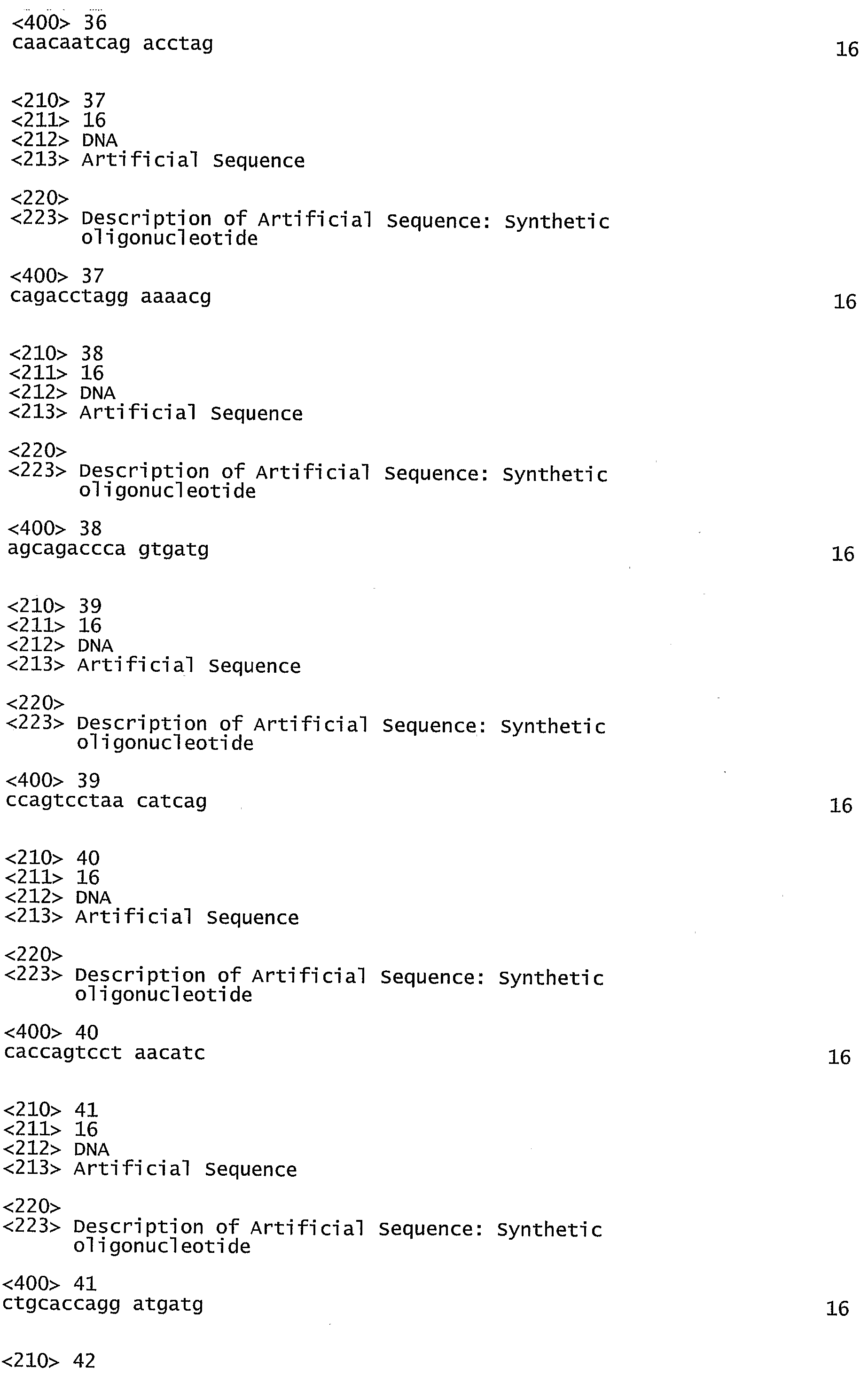


Claims (72)
Applications Claiming Priority (5)
| Application Number | Priority Date | Filing Date | Title |
|---|---|---|---|
| US73542905P | 2005-11-10 | 2005-11-10 | |
| US60/735,429 | 2005-11-10 | ||
| US86235006P | 2006-10-20 | 2006-10-20 | |
| US60/862,350 | 2006-10-20 | ||
| PCT/US2006/043651 WO2007058894A2 (en) | 2005-11-10 | 2006-11-10 | Splice switching oligomers for tnf superfamily receptors and their use in treatment of disease |
Related Child Applications (1)
| Application Number | Title | Priority Date | Filing Date |
|---|---|---|---|
| KR1020177029877A Division KR20170119730A (en) | 2005-11-10 | 2006-11-10 | Splice switching oligomers for tnf superfamily receptors and their use in treatment of disease |
Publications (2)
| Publication Number | Publication Date |
|---|---|
| KR20100093622A true KR20100093622A (en) | 2010-08-26 |
| KR101789603B1 KR101789603B1 (en) | 2017-11-21 |
Family
ID=37890099
Family Applications (2)
| Application Number | Title | Priority Date | Filing Date |
|---|---|---|---|
| KR1020177029877A Ceased KR20170119730A (en) | 2005-11-10 | 2006-11-10 | Splice switching oligomers for tnf superfamily receptors and their use in treatment of disease |
| KR1020087013921A Expired - Fee Related KR101789603B1 (en) | 2005-11-10 | 2006-11-10 | Splice switching oligomers for tnf superfamily receptors and their use in treatment of disease |
Family Applications Before (1)
| Application Number | Title | Priority Date | Filing Date |
|---|---|---|---|
| KR1020177029877A Ceased KR20170119730A (en) | 2005-11-10 | 2006-11-10 | Splice switching oligomers for tnf superfamily receptors and their use in treatment of disease |
Country Status (8)
| Country | Link |
|---|---|
| US (7) | US20070105807A1 (en) |
| EP (2) | EP2535413A3 (en) |
| JP (4) | JP2009515523A (en) |
| KR (2) | KR20170119730A (en) |
| AU (1) | AU2006315758A1 (en) |
| CA (1) | CA2629323A1 (en) |
| MX (1) | MX2008006089A (en) |
| WO (1) | WO2007058894A2 (en) |
Cited By (1)
| Publication number | Priority date | Publication date | Assignee | Title |
|---|---|---|---|---|
| KR20140090756A (en) * | 2013-01-10 | 2014-07-18 | (주) 수파드엘릭사 | Pharmaceutical composition for preventing or treating inflammation or skin aging and cosmetic composition for improving inflammation or skin aging |
Families Citing this family (61)
| Publication number | Priority date | Publication date | Assignee | Title |
|---|---|---|---|---|
| KR20020097241A (en) * | 2000-05-04 | 2002-12-31 | 에이브이아이 바이오파마 인코포레이티드 | Splice-region antisense composition and method |
| US20040219565A1 (en) | 2002-10-21 | 2004-11-04 | Sakari Kauppinen | Oligonucleotides useful for detecting and analyzing nucleic acids of interest |
| US20050234002A1 (en) | 2004-01-23 | 2005-10-20 | Mourich Dan V | Antisense oligomers and methods for inducing immune tolerance and immunosuppression |
| SI1766010T1 (en) | 2004-06-28 | 2011-06-30 | Univ Western Australia | Antisense oligonucleotides for inducing exon skipping and methods of use thereof |
| CA2596506C (en) | 2005-02-09 | 2021-04-06 | Avi Biopharma, Inc. | Antisense composition and method for treating muscle atrophy |
| US20070065840A1 (en) * | 2005-03-23 | 2007-03-22 | Irena Naguibneva | Novel oligonucleotide compositions and probe sequences useful for detection and analysis of microRNAS and their target mRNAS |
| EP1937312B1 (en) | 2005-08-30 | 2016-06-29 | Ionis Pharmaceuticals, Inc. | Chimeric oligomeric compounds for modulation of splicing |
| US7785834B2 (en) | 2005-11-10 | 2010-08-31 | Ercole Biotech, Inc. | Soluble TNF receptors and their use in treatment of disease |
| AU2007309650A1 (en) * | 2006-02-08 | 2008-05-02 | Ercole Biotech, Inc. | Soluble TNF receptors and their use in treatment of disease |
| US20090264353A1 (en) * | 2007-10-19 | 2009-10-22 | Santaris Pharma A/S | Splice Switching Oligomers for TNF Superfamily Receptors and their Use in Treatment of Disease |
| EP2113567B1 (en) | 2006-12-21 | 2019-04-03 | QIAGEN GmbH | MicroRNA target site blocking oligos and uses thereof |
| US20090137504A1 (en) * | 2006-12-21 | 2009-05-28 | Soren Morgenthaler Echwald | Microrna target site blocking oligos and uses thereof |
| KR20150036814A (en) * | 2007-05-01 | 2015-04-07 | 산타리스 팔마 에이/에스 | Splice switching oligomers for tnf superfamily receptors and their use in treatment of disease |
| EP2219680A2 (en) * | 2007-11-13 | 2010-08-25 | Isis Pharmaceuticals, Inc. | Compounds and methods for modulating protein expression |
| US20100113284A1 (en) * | 2008-04-04 | 2010-05-06 | Alexander Aristarkhov | Small interfering rna (sirna) target site blocking oligos and uses thereof |
| US20090326049A1 (en) * | 2008-04-04 | 2009-12-31 | Alexander Aristarkhov | Blocking oligos for inhibition of microrna and sirna activity and uses thereof |
| EP2119783A1 (en) * | 2008-05-14 | 2009-11-18 | Prosensa Technologies B.V. | Method for efficient exon (44) skipping in Duchenne Muscular Dystrophy and associated means |
| CA3066050A1 (en) | 2008-10-24 | 2010-04-29 | Sarepta Therapeutics, Inc. | Multiple exon skipping compositions for dmd |
| WO2010091308A2 (en) | 2009-02-06 | 2010-08-12 | Isis Pharmaceuticals, Inc. | Oligomeric compounds and methods |
| CN115227710A (en) | 2009-06-17 | 2022-10-25 | 冷泉港实验室 | Compositions and methods for modulating SMN2 splicing in a subject |
| US9364495B2 (en) | 2009-10-20 | 2016-06-14 | Roche Innovation Center Copenhagen A/S | Oral delivery of therapeutically effective LNA oligonucleotides |
| WO2011057350A1 (en) | 2009-11-12 | 2011-05-19 | The University Of Western Australia | Antisense molecules and methods for treating pathologies |
| EP2545173A2 (en) | 2010-03-12 | 2013-01-16 | Sarepta Therapeutics, Inc. | Antisense modulation of nuclear hormone receptors |
| US20130085139A1 (en) | 2011-10-04 | 2013-04-04 | Royal Holloway And Bedford New College | Oligomers |
| CN117126846A (en) | 2012-11-15 | 2023-11-28 | 罗氏创新中心哥本哈根有限公司 | Oligonucleotide conjugates |
| EP2931893A1 (en) * | 2012-12-13 | 2015-10-21 | Universität Leipzig | T-cell modulation by exon skipping |
| KR20200143739A (en) | 2012-12-20 | 2020-12-24 | 사렙타 쎄러퓨틱스 인코퍼레이티드 | Improved exon skipping compositions for treating muscular dystrophy |
| CA2893801A1 (en) | 2013-01-30 | 2014-08-07 | F. Hoffmann-La Roche Ag | Lna oligonucleotide carbohydrate conjugates |
| EP3495485A3 (en) | 2013-03-14 | 2019-08-21 | Sarepta Therapeutics, Inc. | Exon skipping compositions for treating muscular dystrophy |
| MX366485B (en) | 2013-03-14 | 2019-07-10 | Sarepta Therapeutics Inc | COMPOSITIONS FOR EXON JUMPING FOR THE TREATMENT OF MUSCULAR DYSTROPHY. |
| US20140329762A1 (en) | 2013-03-15 | 2014-11-06 | Sarepta Therapeutics, Inc. | Compositions for treating muscular dystrophy |
| WO2014172698A1 (en) | 2013-04-19 | 2014-10-23 | Isis Pharmaceuticals, Inc. | Compositions and methods for modulation nucleic acids through nonsense mediated decay |
| US10266828B2 (en) | 2013-12-16 | 2019-04-23 | Syddansk Universitet | RAS exon 2 skipping for cancer treatment |
| MA39835A (en) | 2014-04-17 | 2017-02-22 | Biogen Ma Inc | Compositions and methods for modulation of smn2 splicing in a subject |
| MA41795A (en) | 2015-03-18 | 2018-01-23 | Sarepta Therapeutics Inc | EXCLUSION OF AN EXON INDUCED BY ANTISENSE COMPOUNDS IN MYOSTATIN |
| EA201800367A1 (en) | 2015-12-10 | 2019-02-28 | ПиТиСи ТЕРАПЬЮТИКС, ИНК. | METHODS OF TREATMENT OF HUNTINGTON'S DISEASE |
| EP3478697A1 (en) | 2016-06-30 | 2019-05-08 | Sarepta Therapeutics, Inc. | Exon skipping oligomers for muscular dystrophy |
| LT3554553T (en) | 2016-12-19 | 2022-08-25 | Sarepta Therapeutics, Inc. | Exon skipping oligomer conjugates for muscular dystrophy |
| PL3554554T3 (en) | 2016-12-19 | 2022-12-19 | Sarepta Therapeutics, Inc. | Exon-skipping oligomer conjugates in muscular dystrophy |
| DK3554552T3 (en) | 2016-12-19 | 2022-10-24 | Sarepta Therapeutics Inc | EXON SKIPPING OLIGOMER CONJUGATES AGAINST MUSCULAR DYSTROPHY |
| JP7261174B2 (en) * | 2017-04-09 | 2023-04-19 | ローカス アイピー カンパニー、エルエルシー | Materials and methods for maintaining industrial, machinery and restaurant equipment |
| JP7376471B2 (en) | 2017-06-05 | 2023-11-08 | ピーティーシー セラピューティクス, インコーポレイテッド | Compounds to treat Huntington's disease |
| US11395822B2 (en) | 2017-06-28 | 2022-07-26 | Ptc Therapeutics, Inc. | Methods for treating Huntington's disease |
| BR112019027717A2 (en) | 2017-06-28 | 2020-07-28 | Ptc Therapeutics, Inc. | methods to treat huntington's disease |
| EA201991450A1 (en) | 2017-09-22 | 2019-12-30 | Сарепта Терапьютикс, Инк. | OLIGOMER CONJUGATES FOR EXONISM SKIP IN MUSCULAR DYSTROPHY |
| TW201925234A (en) * | 2017-11-27 | 2019-07-01 | 瑞士商貝里歐藥品股份有限公司 | Anti-huTNFR1 therapy of nonalcoholic steatohepatitis |
| JP7476101B2 (en) | 2017-12-22 | 2024-04-30 | ロシュ イノベーション センター コペンハーゲン エーエス | Gapmer oligonucleotides containing phosphorodithioate internucleoside linkages |
| EP3728590B1 (en) | 2017-12-22 | 2025-07-02 | Roche Innovation Center Copenhagen A/S | Novel thiophosphoramidites |
| EP3728592B1 (en) | 2017-12-22 | 2024-05-29 | Roche Innovation Center Copenhagen A/S | Oligonucleotides comprising a phosphorodithioate internucleoside linkage |
| AU2019243048A1 (en) | 2018-03-27 | 2020-10-15 | Ptc Therapeutics, Inc. | Compounds for treating Huntington's disease |
| US10765760B2 (en) | 2018-05-29 | 2020-09-08 | Sarepta Therapeutics, Inc. | Exon skipping oligomer conjugates for muscular dystrophy |
| EP4219717A3 (en) | 2018-06-13 | 2023-12-20 | Sarepta Therapeutics, Inc. | Exon skipping oligomers for muscular dystrophy |
| BR112020026534A2 (en) | 2018-06-27 | 2021-03-23 | Ptc Therapeutics, Inc. | HETEROARYL COMPOUNDS FOR THE TREATMENT OF HUNTINGTON'S DISEASE |
| SI3814357T1 (en) | 2018-06-27 | 2024-09-30 | Ptc Therapeutics, Inc. | Heterocyclic and heteroaryl compounds for treating huntington's disease |
| WO2020037415A1 (en) * | 2018-08-21 | 2020-02-27 | Deep Genomics Incorporated | Therapeutic splice-switching oligonucleotides |
| EP3844274A1 (en) | 2018-08-28 | 2021-07-07 | Roche Innovation Center Copenhagen A/S | Neoantigen engineering using splice modulating compounds |
| WO2021084495A1 (en) | 2019-11-01 | 2021-05-06 | Novartis Ag | The use of a splicing modulator for a treatment slowing progression of huntington's disease |
| TW202304446A (en) | 2021-03-29 | 2023-02-01 | 瑞士商諾華公司 | The use of a splicing modulator for a treatment slowing progression of huntington’s disease |
| US12502422B2 (en) | 2021-06-09 | 2025-12-23 | Oncocine Llc | Therapeutic mRNA vaccine for malignancies |
| US20240409932A1 (en) * | 2021-10-14 | 2024-12-12 | The University Of North Carolina At Chapel Hill | Correction of splicing mutations causing primary ciliary dyskinesia using oligonucleotides |
| WO2025043138A1 (en) * | 2023-08-24 | 2025-02-27 | Atherovax, Llc | Therapeutic vaccines for treatment of chronic inflammatory diseases |
Family Cites Families (30)
| Publication number | Priority date | Publication date | Assignee | Title |
|---|---|---|---|---|
| US5672347A (en) * | 1984-07-05 | 1997-09-30 | Genentech, Inc. | Tumor necrosis factor antagonists and their use |
| IL83878A (en) * | 1987-09-13 | 1995-07-31 | Yeda Res & Dev | Soluble protein corresponding to tnf inhibitory protein its preparation and pharmaceutical compositions containing it |
| US7264944B1 (en) * | 1989-04-21 | 2007-09-04 | Amgen Inc. | TNF receptors, TNF binding proteins and DNAs coding for them |
| JPH03164179A (en) * | 1989-04-21 | 1991-07-16 | Boehringer Ingelheim Internatl Gmbh | Tnf receptor, tnf binding protein and dna for coding said receptor and protein |
| ATE289350T1 (en) * | 1989-04-21 | 2005-03-15 | Amgen Inc | TNF RECEPTOR, TNF BINDING PROTEINS AND DNA CODING THEREOF |
| IL95031A (en) * | 1989-07-18 | 2007-03-08 | Amgen Inc | Method for the production of a human recombinant tumor necrosis factor inhibitor |
| US5945397A (en) * | 1989-09-05 | 1999-08-31 | Immunex Corporation | Purified p75 (type II) tumor necrosis factor receptor polypeptides |
| NZ235148A (en) * | 1989-09-05 | 1991-12-23 | Immunex Corp | Tumour necrosis factor receptor protein and dna sequences |
| US6541610B1 (en) * | 1989-09-05 | 2003-04-01 | Immunex Corporation | Fusion proteins comprising tumor necrosis factor receptor |
| US5395760A (en) * | 1989-09-05 | 1995-03-07 | Immunex Corporation | DNA encoding tumor necrosis factor-α and -β receptors |
| US5605690A (en) * | 1989-09-05 | 1997-02-25 | Immunex Corporation | Methods of lowering active TNF-α levels in mammals using tumor necrosis factor receptor |
| EP0417563B1 (en) * | 1989-09-12 | 2000-07-05 | F. Hoffmann-La Roche Ag | TNF-binding proteins |
| GB9022648D0 (en) * | 1990-10-18 | 1990-11-28 | Charing Cross Sunley Research | Polypeptide and its use |
| US6159464A (en) * | 1990-12-20 | 2000-12-12 | University Of Pittsburgh Of The Commonwealth System Of Higher Education | Viral vectors to inhibit leukocyte infiltration or cartilage degradation of joints |
| US6410324B1 (en) * | 2001-04-27 | 2002-06-25 | Isis Pharmaceuticals, Inc. | Antisense modulation of tumor necrosis factor receptor 2 expression |
| DK0698092T3 (en) * | 1993-05-11 | 2007-11-26 | Univ North Carolina | Anti-sense oligonucleotides which combat irregular splicing and methods for its use |
| IL107268A0 (en) * | 1993-10-12 | 1994-01-25 | Yeda Res & Dev | Molecules influencing the shedding of the tnf receptor, their preparation and their use |
| US6579697B1 (en) * | 1995-05-11 | 2003-06-17 | Yeda Research And Development Co. Ltd. | Modulator of TNF/NGF superfamily receptors and soluble oligomeric TNF/NGF superfamily receptors |
| US6451986B1 (en) * | 1998-06-22 | 2002-09-17 | Immunex Corporation | Site specific protein modification |
| JP2002519015A (en) * | 1998-06-26 | 2002-07-02 | アイシス・ファーマシューティカルス・インコーポレーテッド | Antisense modulation of TNFR1 expression |
| US20040147471A1 (en) * | 1998-06-26 | 2004-07-29 | Hong Zhang | Antisense modulation of TNFR1 expression |
| US6007995A (en) * | 1998-06-26 | 1999-12-28 | Isis Pharmaceuticals Inc. | Antisense inhibition of TNFR1 expression |
| US6210892B1 (en) * | 1998-10-07 | 2001-04-03 | Isis Pharmaceuticals, Inc. | Alteration of cellular behavior by antisense modulation of mRNA processing |
| US6136603A (en) * | 1999-03-26 | 2000-10-24 | Isis Pharmaceuticals Inc. | Antisense modulation of interleukin-5 signal transduction |
| JP2000325085A (en) * | 1999-05-21 | 2000-11-28 | Masafumi Matsuo | Pharmaceutical composition for treatment of duchenne muscular dystrophy |
| DK1180159T3 (en) * | 1999-05-28 | 2008-11-17 | Targeted Genetics Corp | Methods and Compositions to Lower the Level of Tumor Necrosis Factor (TNF) in TNF-Associated Disorders |
| EP1191097A1 (en) * | 2000-09-21 | 2002-03-27 | Leids Universitair Medisch Centrum | Induction of exon skipping in eukaryotic cells |
| WO2004083432A1 (en) * | 2003-03-21 | 2004-09-30 | Academisch Ziekenhuis Leiden | Modulation of exon recognition in pre-mrna by interfering with the secondary rna structure |
| SG145712A1 (en) * | 2003-08-01 | 2008-09-29 | Amgen Inc | Crystalline tumor necrosis factor receptor 2 polypeptides |
| US20050202531A1 (en) * | 2003-11-03 | 2005-09-15 | Compugen Ltd. | CD40 splice variants, compositions for making and methods of using the same |
-
2006
- 2006-11-10 EP EP12176988.9A patent/EP2535413A3/en not_active Withdrawn
- 2006-11-10 WO PCT/US2006/043651 patent/WO2007058894A2/en not_active Ceased
- 2006-11-10 MX MX2008006089A patent/MX2008006089A/en unknown
- 2006-11-10 EP EP06827673A patent/EP1951872A2/en not_active Ceased
- 2006-11-10 KR KR1020177029877A patent/KR20170119730A/en not_active Ceased
- 2006-11-10 CA CA002629323A patent/CA2629323A1/en not_active Abandoned
- 2006-11-10 KR KR1020087013921A patent/KR101789603B1/en not_active Expired - Fee Related
- 2006-11-10 AU AU2006315758A patent/AU2006315758A1/en not_active Abandoned
- 2006-11-10 JP JP2008540193A patent/JP2009515523A/en active Pending
- 2006-11-10 US US11/595,485 patent/US20070105807A1/en not_active Abandoned
-
2010
- 2010-11-24 US US12/954,250 patent/US20110237521A1/en not_active Abandoned
-
2013
- 2013-03-11 US US13/794,497 patent/US20140057968A1/en not_active Abandoned
-
2014
- 2014-05-14 JP JP2014100916A patent/JP2014221039A/en active Pending
-
2016
- 2016-07-15 JP JP2016140508A patent/JP2017000153A/en active Pending
-
2017
- 2017-01-17 US US15/408,237 patent/US20170191067A1/en not_active Abandoned
- 2017-11-03 US US15/803,579 patent/US20180051290A1/en not_active Abandoned
-
2018
- 2018-07-19 US US16/040,329 patent/US20190017052A1/en not_active Abandoned
- 2018-09-27 JP JP2018182340A patent/JP2019014733A/en active Pending
-
2019
- 2019-10-22 US US16/660,658 patent/US20200283776A1/en not_active Abandoned
Cited By (1)
| Publication number | Priority date | Publication date | Assignee | Title |
|---|---|---|---|---|
| KR20140090756A (en) * | 2013-01-10 | 2014-07-18 | (주) 수파드엘릭사 | Pharmaceutical composition for preventing or treating inflammation or skin aging and cosmetic composition for improving inflammation or skin aging |
Also Published As
| Publication number | Publication date |
|---|---|
| MX2008006089A (en) | 2009-05-28 |
| CA2629323A1 (en) | 2007-05-24 |
| EP2535413A2 (en) | 2012-12-19 |
| JP2009515523A (en) | 2009-04-16 |
| KR101789603B1 (en) | 2017-11-21 |
| JP2014221039A (en) | 2014-11-27 |
| US20200283776A1 (en) | 2020-09-10 |
| WO2007058894A2 (en) | 2007-05-24 |
| US20110237521A1 (en) | 2011-09-29 |
| US20140057968A1 (en) | 2014-02-27 |
| EP1951872A2 (en) | 2008-08-06 |
| AU2006315758A1 (en) | 2007-05-24 |
| JP2019014733A (en) | 2019-01-31 |
| US20070105807A1 (en) | 2007-05-10 |
| US20180051290A1 (en) | 2018-02-22 |
| US20190017052A1 (en) | 2019-01-17 |
| JP2017000153A (en) | 2017-01-05 |
| WO2007058894A3 (en) | 2007-08-23 |
| US20170191067A1 (en) | 2017-07-06 |
| KR20170119730A (en) | 2017-10-27 |
| EP2535413A3 (en) | 2016-04-13 |
Similar Documents
| Publication | Publication Date | Title |
|---|---|---|
| KR101789603B1 (en) | Splice switching oligomers for tnf superfamily receptors and their use in treatment of disease | |
| EP2147103B1 (en) | Splice switching oligomers for tnf superfamily receptors and their use in treatment of disease | |
| US20090264353A1 (en) | Splice Switching Oligomers for TNF Superfamily Receptors and their Use in Treatment of Disease | |
| US7785834B2 (en) | Soluble TNF receptors and their use in treatment of disease | |
| EP2089521A1 (en) | Soluble tnf receptors and their use in treatment of disease | |
| AU2019200435A1 (en) | Splice switching oligomers for tnf superfamily receptors and their use in treatment of disease | |
| US20190359986A1 (en) | Splice switching oligomers for tnf superfamily receptors and their use in treatment of disease | |
| US20150252371A1 (en) | Splice Switching Oligomers for TNF Superfamily Receptors and Their Use in Treatment of Disease | |
| HK1180004A (en) | Splice switching oligomers for the tnf superfamily receptors and their use in treatment of disease | |
| AU2012261660A1 (en) | Splice switching oligomers for tnf superfamily receptors and their use in treatment of disease | |
| AU2014200020A1 (en) | Soluble tnf receptors and their use in treatment of disease |
Legal Events
| Date | Code | Title | Description |
|---|---|---|---|
| PA0105 | International application |
St.27 status event code: A-0-1-A10-A15-nap-PA0105 |
|
| AMND | Amendment | ||
| P11-X000 | Amendment of application requested |
St.27 status event code: A-2-2-P10-P11-nap-X000 |
|
| P13-X000 | Application amended |
St.27 status event code: A-2-2-P10-P13-nap-X000 |
|
| T11-X000 | Administrative time limit extension requested |
St.27 status event code: U-3-3-T10-T11-oth-X000 |
|
| T11-X000 | Administrative time limit extension requested |
St.27 status event code: U-3-3-T10-T11-oth-X000 |
|
| T11-X000 | Administrative time limit extension requested |
St.27 status event code: U-3-3-T10-T11-oth-X000 |
|
| T11-X000 | Administrative time limit extension requested |
St.27 status event code: U-3-3-T10-T11-oth-X000 |
|
| T11-X000 | Administrative time limit extension requested |
St.27 status event code: U-3-3-T10-T11-oth-X000 |
|
| T11-X000 | Administrative time limit extension requested |
St.27 status event code: U-3-3-T10-T11-oth-X000 |
|
| T11-X000 | Administrative time limit extension requested |
St.27 status event code: U-3-3-T10-T11-oth-X000 |
|
| T11-X000 | Administrative time limit extension requested |
St.27 status event code: U-3-3-T10-T11-oth-X000 |
|
| T11-X000 | Administrative time limit extension requested |
St.27 status event code: U-3-3-T10-T11-oth-X000 |
|
| T11-X000 | Administrative time limit extension requested |
St.27 status event code: U-3-3-T10-T11-oth-X000 |
|
| T11-X000 | Administrative time limit extension requested |
St.27 status event code: U-3-3-T10-T11-oth-X000 |
|
| T11-X000 | Administrative time limit extension requested |
St.27 status event code: U-3-3-T10-T11-oth-X000 |
|
| T11-X000 | Administrative time limit extension requested |
St.27 status event code: U-3-3-T10-T11-oth-X000 |
|
| T11-X000 | Administrative time limit extension requested |
St.27 status event code: U-3-3-T10-T11-oth-X000 |
|
| T11-X000 | Administrative time limit extension requested |
St.27 status event code: U-3-3-T10-T11-oth-X000 |
|
| T11-X000 | Administrative time limit extension requested |
St.27 status event code: U-3-3-T10-T11-oth-X000 |
|
| T11-X000 | Administrative time limit extension requested |
St.27 status event code: U-3-3-T10-T11-oth-X000 |
|
| T11-X000 | Administrative time limit extension requested |
St.27 status event code: U-3-3-T10-T11-oth-X000 |
|
| T11-X000 | Administrative time limit extension requested |
St.27 status event code: U-3-3-T10-T11-oth-X000 |
|
| T11-X000 | Administrative time limit extension requested |
St.27 status event code: U-3-3-T10-T11-oth-X000 |
|
| T11-X000 | Administrative time limit extension requested |
St.27 status event code: U-3-3-T10-T11-oth-X000 |
|
| T11-X000 | Administrative time limit extension requested |
St.27 status event code: U-3-3-T10-T11-oth-X000 |
|
| T11-X000 | Administrative time limit extension requested |
St.27 status event code: U-3-3-T10-T11-oth-X000 |
|
| N231 | Notification of change of applicant | ||
| P11-X000 | Amendment of application requested |
St.27 status event code: A-2-2-P10-P11-nap-X000 |
|
| PN2301 | Change of applicant |
St.27 status event code: A-3-3-R10-R13-asn-PN2301 St.27 status event code: A-3-3-R10-R11-asn-PN2301 |
|
| PG1501 | Laying open of application |
St.27 status event code: A-1-1-Q10-Q12-nap-PG1501 |
|
| PE0801 | Dismissal of amendment |
St.27 status event code: A-2-2-P10-P12-nap-PE0801 |
|
| A201 | Request for examination | ||
| AMND | Amendment | ||
| E13-X000 | Pre-grant limitation requested |
St.27 status event code: A-2-3-E10-E13-lim-X000 |
|
| P11-X000 | Amendment of application requested |
St.27 status event code: A-2-2-P10-P11-nap-X000 |
|
| P13-X000 | Application amended |
St.27 status event code: A-2-2-P10-P13-nap-X000 |
|
| PA0201 | Request for examination |
St.27 status event code: A-1-2-D10-D11-exm-PA0201 |
|
| R18-X000 | Changes to party contact information recorded |
St.27 status event code: A-3-3-R10-R18-oth-X000 |
|
| E902 | Notification of reason for refusal | ||
| PE0902 | Notice of grounds for rejection |
St.27 status event code: A-1-2-D10-D21-exm-PE0902 |
|
| T11-X000 | Administrative time limit extension requested |
St.27 status event code: U-3-3-T10-T11-oth-X000 |
|
| T11-X000 | Administrative time limit extension requested |
St.27 status event code: U-3-3-T10-T11-oth-X000 |
|
| T11-X000 | Administrative time limit extension requested |
St.27 status event code: U-3-3-T10-T11-oth-X000 |
|
| T11-X000 | Administrative time limit extension requested |
St.27 status event code: U-3-3-T10-T11-oth-X000 |
|
| AMND | Amendment | ||
| E13-X000 | Pre-grant limitation requested |
St.27 status event code: A-2-3-E10-E13-lim-X000 |
|
| P11-X000 | Amendment of application requested |
St.27 status event code: A-2-2-P10-P11-nap-X000 |
|
| P13-X000 | Application amended |
St.27 status event code: A-2-2-P10-P13-nap-X000 |
|
| E601 | Decision to refuse application | ||
| PE0601 | Decision on rejection of patent |
St.27 status event code: N-2-6-B10-B15-exm-PE0601 |
|
| T11-X000 | Administrative time limit extension requested |
St.27 status event code: U-3-3-T10-T11-oth-X000 |
|
| AMND | Amendment | ||
| J201 | Request for trial against refusal decision | ||
| P11-X000 | Amendment of application requested |
St.27 status event code: A-2-2-P10-P11-nap-X000 |
|
| P13-X000 | Application amended |
St.27 status event code: A-2-2-P10-P13-nap-X000 |
|
| PJ0201 | Trial against decision of rejection |
St.27 status event code: A-3-3-V10-V11-apl-PJ0201 |
|
| PB0901 | Examination by re-examination before a trial |
St.27 status event code: A-6-3-E10-E12-rex-PB0901 |
|
| B601 | Maintenance of original decision after re-examination before a trial | ||
| PB0601 | Maintenance of original decision after re-examination before a trial |
St.27 status event code: N-3-6-B10-B17-rex-PB0601 |
|
| PN2301 | Change of applicant |
St.27 status event code: A-3-3-R10-R13-asn-PN2301 St.27 status event code: A-3-3-R10-R11-asn-PN2301 |
|
| J301 | Trial decision |
Free format text: TRIAL NUMBER: 2014101004747; TRIAL DECISION FOR APPEAL AGAINST DECISION TO DECLINE REFUSAL REQUESTED 20140729 Effective date: 20160608 Free format text: TRIAL DECISION FOR APPEAL AGAINST DECISION TO DECLINE REFUSAL REQUESTED 20140729 Effective date: 20160608 |
|
| PJ1301 | Trial decision |
St.27 status event code: A-3-3-V10-V15-crt-PJ1301 Decision date: 20160608 Appeal event data comment text: Appeal Kind Category : Appeal against decision to decline refusal, Appeal Ground Text : 2008 7013921 Appeal request date: 20140729 Appellate body name: Patent Examination Board Decision authority category: Office appeal board Decision identifier: 2014101004747 |
|
| PS0901 | Examination by remand of revocation |
St.27 status event code: A-6-3-E10-E12-rex-PS0901 |
|
| S901 | Examination by remand of revocation | ||
| E902 | Notification of reason for refusal | ||
| PE0902 | Notice of grounds for rejection |
St.27 status event code: A-1-2-D10-D21-exm-PE0902 |
|
| T11-X000 | Administrative time limit extension requested |
St.27 status event code: U-3-3-T10-T11-oth-X000 |
|
| T11-X000 | Administrative time limit extension requested |
St.27 status event code: U-3-3-T10-T11-oth-X000 |
|
| T11-X000 | Administrative time limit extension requested |
St.27 status event code: U-3-3-T10-T11-oth-X000 |
|
| T11-X000 | Administrative time limit extension requested |
St.27 status event code: U-3-3-T10-T11-oth-X000 |
|
| T11-X000 | Administrative time limit extension requested |
St.27 status event code: U-3-3-T10-T11-oth-X000 |
|
| T13-X000 | Administrative time limit extension granted |
St.27 status event code: U-3-3-T10-T13-oth-X000 |
|
| T11-X000 | Administrative time limit extension requested |
St.27 status event code: U-3-3-T10-T11-oth-X000 |
|
| T13-X000 | Administrative time limit extension granted |
St.27 status event code: U-3-3-T10-T13-oth-X000 |
|
| T11-X000 | Administrative time limit extension requested |
St.27 status event code: U-3-3-T10-T11-oth-X000 |
|
| T13-X000 | Administrative time limit extension granted |
St.27 status event code: U-3-3-T10-T13-oth-X000 |
|
| T11-X000 | Administrative time limit extension requested |
St.27 status event code: U-3-3-T10-T11-oth-X000 |
|
| T13-X000 | Administrative time limit extension granted |
St.27 status event code: U-3-3-T10-T13-oth-X000 |
|
| P11-X000 | Amendment of application requested |
St.27 status event code: A-2-2-P10-P11-nap-X000 |
|
| P13-X000 | Application amended |
St.27 status event code: A-2-2-P10-P13-nap-X000 |
|
| GRNO | Decision to grant (after opposition) | ||
| PS0701 | Decision of registration after remand of revocation |
St.27 status event code: A-3-4-F10-F13-rex-PS0701 |
|
| R18-X000 | Changes to party contact information recorded |
St.27 status event code: A-3-3-R10-R18-oth-X000 |
|
| A107 | Divisional application of patent | ||
| PA0104 | Divisional application for international application |
St.27 status event code: A-0-1-A10-A18-div-PA0104 St.27 status event code: A-0-1-A10-A16-div-PA0104 |
|
| GRNT | Written decision to grant | ||
| PR0701 | Registration of establishment |
St.27 status event code: A-2-4-F10-F11-exm-PR0701 |
|
| PR1002 | Payment of registration fee |
St.27 status event code: A-2-2-U10-U12-oth-PR1002 Fee payment year number: 1 |
|
| R18-X000 | Changes to party contact information recorded |
St.27 status event code: A-5-5-R10-R18-oth-X000 |
|
| PG1601 | Publication of registration |
St.27 status event code: A-4-4-Q10-Q13-nap-PG1601 |
|
| PR1001 | Payment of annual fee |
St.27 status event code: A-4-4-U10-U11-oth-PR1001 Fee payment year number: 4 |
|
| PR1001 | Payment of annual fee |
St.27 status event code: A-4-4-U10-U11-oth-PR1001 Fee payment year number: 5 |
|
| PR1001 | Payment of annual fee |
St.27 status event code: A-4-4-U10-U11-oth-PR1001 Fee payment year number: 6 |
|
| PC1903 | Unpaid annual fee |
St.27 status event code: A-4-4-U10-U13-oth-PC1903 Not in force date: 20231019 Payment event data comment text: Termination Category : DEFAULT_OF_REGISTRATION_FEE |
|
| R18-X000 | Changes to party contact information recorded |
St.27 status event code: A-5-5-R10-R18-oth-X000 |
|
| PC1903 | Unpaid annual fee |
St.27 status event code: N-4-6-H10-H13-oth-PC1903 Ip right cessation event data comment text: Termination Category : DEFAULT_OF_REGISTRATION_FEE Not in force date: 20231019 |