KR20080064209A - Spray condensation method using an extruder for the preparation of multiparticulate azithromycin compositions preferably containing poloxamer and glycerides - Google Patents
Spray condensation method using an extruder for the preparation of multiparticulate azithromycin compositions preferably containing poloxamer and glycerides Download PDFInfo
- Publication number
- KR20080064209A KR20080064209A KR1020087015425A KR20087015425A KR20080064209A KR 20080064209 A KR20080064209 A KR 20080064209A KR 1020087015425 A KR1020087015425 A KR 1020087015425A KR 20087015425 A KR20087015425 A KR 20087015425A KR 20080064209 A KR20080064209 A KR 20080064209A
- Authority
- KR
- South Korea
- Prior art keywords
- azithromycin
- multiparticulates
- carrier
- ester
- mixture
- Prior art date
- Legal status (The legal status is an assumption and is not a legal conclusion. Google has not performed a legal analysis and makes no representation as to the accuracy of the status listed.)
- Withdrawn
Links
- MQTOSJVFKKJCRP-BICOPXKESA-N azithromycin Chemical compound O([C@@H]1[C@@H](C)C(=O)O[C@@H]([C@@]([C@H](O)[C@@H](C)N(C)C[C@H](C)C[C@@](C)(O)[C@H](O[C@H]2[C@@H]([C@H](C[C@@H](C)O2)N(C)C)O)[C@H]1C)(C)O)CC)[C@H]1C[C@@](C)(OC)[C@@H](O)[C@H](C)O1 MQTOSJVFKKJCRP-BICOPXKESA-N 0.000 title claims abstract description 377
- 229960004099 azithromycin Drugs 0.000 title claims abstract description 360
- 238000000034 method Methods 0.000 title claims abstract description 103
- 239000000203 mixture Substances 0.000 title claims description 225
- 125000005456 glyceride group Chemical group 0.000 title claims description 10
- 238000009833 condensation Methods 0.000 title description 30
- RVGRUAULSDPKGF-UHFFFAOYSA-N Poloxamer Chemical compound C1CO1.CC1CO1 RVGRUAULSDPKGF-UHFFFAOYSA-N 0.000 title description 15
- 230000005494 condensation Effects 0.000 title description 14
- 229920001983 poloxamer Polymers 0.000 title description 13
- 238000002360 preparation method Methods 0.000 title description 10
- 229960000502 poloxamer Drugs 0.000 title description 8
- 239000007921 spray Substances 0.000 title description 5
- VQEMDSRIOVZAOM-UHFFFAOYSA-N 4-(4-methylsulfonylphenyl)-1,3-thiazol-2-amine Chemical compound C1=CC(S(=O)(=O)C)=CC=C1C1=CSC(N)=N1 VQEMDSRIOVZAOM-UHFFFAOYSA-N 0.000 claims description 60
- 229960004924 azithromycin dihydrate Drugs 0.000 claims description 60
- -1 polyoxyethylene Polymers 0.000 claims description 58
- 230000015572 biosynthetic process Effects 0.000 claims description 47
- 239000000725 suspension Substances 0.000 claims description 44
- 239000000969 carrier Substances 0.000 claims description 32
- 239000001993 wax Substances 0.000 claims description 30
- 238000004090 dissolution Methods 0.000 claims description 26
- VBICKXHEKHSIBG-UHFFFAOYSA-N 1-monostearoylglycerol Chemical compound CCCCCCCCCCCCCCCCCC(=O)OCC(O)CO VBICKXHEKHSIBG-UHFFFAOYSA-N 0.000 claims description 24
- 239000004200 microcrystalline wax Substances 0.000 claims description 23
- 235000019808 microcrystalline wax Nutrition 0.000 claims description 23
- 238000002844 melting Methods 0.000 claims description 22
- 230000008018 melting Effects 0.000 claims description 22
- 238000005507 spraying Methods 0.000 claims description 18
- 238000012545 processing Methods 0.000 claims description 15
- 235000002639 sodium chloride Nutrition 0.000 claims description 12
- 239000003937 drug carrier Substances 0.000 claims description 11
- 229940075507 glyceryl monostearate Drugs 0.000 claims description 11
- 239000001788 mono and diglycerides of fatty acids Substances 0.000 claims description 11
- 229920001223 polyethylene glycol Polymers 0.000 claims description 11
- PVNIQBQSYATKKL-UHFFFAOYSA-N tripalmitin Chemical compound CCCCCCCCCCCCCCCC(=O)OCC(OC(=O)CCCCCCCCCCCCCCC)COC(=O)CCCCCCCCCCCCCCC PVNIQBQSYATKKL-UHFFFAOYSA-N 0.000 claims description 10
- DCXXMTOCNZCJGO-UHFFFAOYSA-N tristearoylglycerol Chemical compound CCCCCCCCCCCCCCCCCC(=O)OCC(OC(=O)CCCCCCCCCCCCCCCCC)COC(=O)CCCCCCCCCCCCCCCCC DCXXMTOCNZCJGO-UHFFFAOYSA-N 0.000 claims description 10
- 238000004519 manufacturing process Methods 0.000 claims description 9
- 229920003171 Poly (ethylene oxide) Polymers 0.000 claims description 8
- 239000012188 paraffin wax Substances 0.000 claims description 8
- 235000019809 paraffin wax Nutrition 0.000 claims description 8
- 235000019271 petrolatum Nutrition 0.000 claims description 8
- LWIHDJKSTIGBAC-UHFFFAOYSA-K tripotassium phosphate Chemical compound [K+].[K+].[K+].[O-]P([O-])([O-])=O LWIHDJKSTIGBAC-UHFFFAOYSA-K 0.000 claims description 8
- 235000013871 bee wax Nutrition 0.000 claims description 7
- 239000012166 beeswax Substances 0.000 claims description 7
- TWRXJAOTZQYOKJ-UHFFFAOYSA-L Magnesium chloride Chemical compound [Mg+2].[Cl-].[Cl-] TWRXJAOTZQYOKJ-UHFFFAOYSA-L 0.000 claims description 6
- CSNNHWWHGAXBCP-UHFFFAOYSA-L Magnesium sulfate Chemical compound [Mg+2].[O-][S+2]([O-])([O-])[O-] CSNNHWWHGAXBCP-UHFFFAOYSA-L 0.000 claims description 6
- WCUXLLCKKVVCTQ-UHFFFAOYSA-M Potassium chloride Chemical compound [Cl-].[K+] WCUXLLCKKVVCTQ-UHFFFAOYSA-M 0.000 claims description 6
- CDBYLPFSWZWCQE-UHFFFAOYSA-L Sodium Carbonate Chemical compound [Na+].[Na+].[O-]C([O-])=O CDBYLPFSWZWCQE-UHFFFAOYSA-L 0.000 claims description 6
- FAPWRFPIFSIZLT-UHFFFAOYSA-M Sodium chloride Chemical compound [Na+].[Cl-] FAPWRFPIFSIZLT-UHFFFAOYSA-M 0.000 claims description 6
- KWGKDLIKAYFUFQ-UHFFFAOYSA-M lithium chloride Chemical compound [Li+].[Cl-] KWGKDLIKAYFUFQ-UHFFFAOYSA-M 0.000 claims description 6
- 239000000263 2,3-dihydroxypropyl (Z)-octadec-9-enoate Substances 0.000 claims description 5
- RZRNAYUHWVFMIP-GDCKJWNLSA-N 3-oleoyl-sn-glycerol Chemical compound CCCCCCCC\C=C/CCCCCCCC(=O)OC[C@H](O)CO RZRNAYUHWVFMIP-GDCKJWNLSA-N 0.000 claims description 5
- CZMRCDWAGMRECN-UGDNZRGBSA-N Sucrose Chemical compound O[C@H]1[C@H](O)[C@@H](CO)O[C@@]1(CO)O[C@@H]1[C@H](O)[C@@H](O)[C@H](O)[C@@H](CO)O1 CZMRCDWAGMRECN-UGDNZRGBSA-N 0.000 claims description 5
- 229930006000 Sucrose Natural products 0.000 claims description 5
- 125000003976 glyceryl group Chemical group [H]C([*])([H])C(O[H])([H])C(O[H])([H])[H] 0.000 claims description 5
- FETSQPAGYOVAQU-UHFFFAOYSA-N glyceryl palmitostearate Chemical compound OCC(O)CO.CCCCCCCCCCCCCCCC(O)=O.CCCCCCCCCCCCCCCCCC(O)=O FETSQPAGYOVAQU-UHFFFAOYSA-N 0.000 claims description 5
- 229940046813 glyceryl palmitostearate Drugs 0.000 claims description 5
- RZRNAYUHWVFMIP-UHFFFAOYSA-N monoelaidin Natural products CCCCCCCCC=CCCCCCCCC(=O)OCC(O)CO RZRNAYUHWVFMIP-UHFFFAOYSA-N 0.000 claims description 5
- 239000005720 sucrose Substances 0.000 claims description 5
- DHMQDGOQFOQNFH-UHFFFAOYSA-N Glycine Chemical compound NCC(O)=O DHMQDGOQFOQNFH-UHFFFAOYSA-N 0.000 claims description 4
- 239000008172 hydrogenated vegetable oil Substances 0.000 claims description 4
- 239000008389 polyethoxylated castor oil Substances 0.000 claims description 4
- JNYAEWCLZODPBN-JGWLITMVSA-N (2r,3r,4s)-2-[(1r)-1,2-dihydroxyethyl]oxolane-3,4-diol Chemical compound OC[C@@H](O)[C@H]1OC[C@H](O)[C@H]1O JNYAEWCLZODPBN-JGWLITMVSA-N 0.000 claims description 3
- UXVMQQNJUSDDNG-UHFFFAOYSA-L Calcium chloride Chemical compound [Cl-].[Cl-].[Ca+2] UXVMQQNJUSDDNG-UHFFFAOYSA-L 0.000 claims description 3
- FBPFZTCFMRRESA-FSIIMWSLSA-N D-Glucitol Natural products OC[C@H](O)[C@H](O)[C@@H](O)[C@H](O)CO FBPFZTCFMRRESA-FSIIMWSLSA-N 0.000 claims description 3
- FBPFZTCFMRRESA-JGWLITMVSA-N D-glucitol Chemical compound OC[C@H](O)[C@@H](O)[C@H](O)[C@H](O)CO FBPFZTCFMRRESA-JGWLITMVSA-N 0.000 claims description 3
- WQZGKKKJIJFFOK-GASJEMHNSA-N Glucose Natural products OC[C@H]1OC(O)[C@H](O)[C@@H](O)[C@@H]1O WQZGKKKJIJFFOK-GASJEMHNSA-N 0.000 claims description 3
- QNAYBMKLOCPYGJ-REOHCLBHSA-N L-alanine Chemical compound C[C@H](N)C(O)=O QNAYBMKLOCPYGJ-REOHCLBHSA-N 0.000 claims description 3
- PMZURENOXWZQFD-UHFFFAOYSA-L Sodium Sulfate Chemical compound [Na+].[Na+].[O-]S([O-])(=O)=O PMZURENOXWZQFD-UHFFFAOYSA-L 0.000 claims description 3
- DBMJMQXJHONAFJ-UHFFFAOYSA-M Sodium laurylsulphate Chemical compound [Na+].CCCCCCCCCCCCOS([O-])(=O)=O DBMJMQXJHONAFJ-UHFFFAOYSA-M 0.000 claims description 3
- TVXBFESIOXBWNM-UHFFFAOYSA-N Xylitol Natural products OCCC(O)C(O)C(O)CCO TVXBFESIOXBWNM-UHFFFAOYSA-N 0.000 claims description 3
- 235000004279 alanine Nutrition 0.000 claims description 3
- 125000005907 alkyl ester group Chemical group 0.000 claims description 3
- 150000005215 alkyl ethers Chemical class 0.000 claims description 3
- WQZGKKKJIJFFOK-VFUOTHLCSA-N beta-D-glucose Chemical compound OC[C@H]1O[C@@H](O)[C@H](O)[C@@H](O)[C@@H]1O WQZGKKKJIJFFOK-VFUOTHLCSA-N 0.000 claims description 3
- 239000001110 calcium chloride Substances 0.000 claims description 3
- 229910001628 calcium chloride Inorganic materials 0.000 claims description 3
- 235000011148 calcium chloride Nutrition 0.000 claims description 3
- 239000008103 glucose Substances 0.000 claims description 3
- 229910001629 magnesium chloride Inorganic materials 0.000 claims description 3
- 235000011147 magnesium chloride Nutrition 0.000 claims description 3
- 229910052943 magnesium sulfate Inorganic materials 0.000 claims description 3
- 235000019341 magnesium sulphate Nutrition 0.000 claims description 3
- 239000000845 maltitol Substances 0.000 claims description 3
- VQHSOMBJVWLPSR-WUJBLJFYSA-N maltitol Chemical compound OC[C@H](O)[C@@H](O)[C@@H]([C@H](O)CO)O[C@H]1O[C@H](CO)[C@@H](O)[C@H](O)[C@H]1O VQHSOMBJVWLPSR-WUJBLJFYSA-N 0.000 claims description 3
- 235000010449 maltitol Nutrition 0.000 claims description 3
- 229940035436 maltitol Drugs 0.000 claims description 3
- HEBKCHPVOIAQTA-UHFFFAOYSA-N meso ribitol Natural products OCC(O)C(O)C(O)CO HEBKCHPVOIAQTA-UHFFFAOYSA-N 0.000 claims description 3
- 239000001103 potassium chloride Substances 0.000 claims description 3
- 235000011164 potassium chloride Nutrition 0.000 claims description 3
- 229910000160 potassium phosphate Inorganic materials 0.000 claims description 3
- 235000011009 potassium phosphates Nutrition 0.000 claims description 3
- OTYBMLCTZGSZBG-UHFFFAOYSA-L potassium sulfate Chemical compound [K+].[K+].[O-]S([O-])(=O)=O OTYBMLCTZGSZBG-UHFFFAOYSA-L 0.000 claims description 3
- 229910052939 potassium sulfate Inorganic materials 0.000 claims description 3
- 235000011151 potassium sulphates Nutrition 0.000 claims description 3
- 229910000029 sodium carbonate Inorganic materials 0.000 claims description 3
- 235000017550 sodium carbonate Nutrition 0.000 claims description 3
- 239000011780 sodium chloride Substances 0.000 claims description 3
- 235000019333 sodium laurylsulphate Nutrition 0.000 claims description 3
- 229910052938 sodium sulfate Inorganic materials 0.000 claims description 3
- 235000011152 sodium sulphate Nutrition 0.000 claims description 3
- 235000010356 sorbitol Nutrition 0.000 claims description 3
- 239000000600 sorbitol Substances 0.000 claims description 3
- 235000010447 xylitol Nutrition 0.000 claims description 3
- 239000000811 xylitol Substances 0.000 claims description 3
- HEBKCHPVOIAQTA-SCDXWVJYSA-N xylitol Chemical compound OC[C@H](O)[C@@H](O)[C@H](O)CO HEBKCHPVOIAQTA-SCDXWVJYSA-N 0.000 claims description 3
- 229960002675 xylitol Drugs 0.000 claims description 3
- 229920000136 polysorbate Polymers 0.000 claims description 2
- 239000004471 Glycine Substances 0.000 claims 1
- 150000002398 hexadecan-1-ols Chemical class 0.000 claims 1
- 229940068965 polysorbates Drugs 0.000 claims 1
- 230000008569 process Effects 0.000 abstract description 21
- 239000000546 pharmaceutical excipient Substances 0.000 description 136
- 239000002253 acid Substances 0.000 description 69
- XLYOFNOQVPJJNP-UHFFFAOYSA-N water Substances O XLYOFNOQVPJJNP-UHFFFAOYSA-N 0.000 description 64
- 239000002245 particle Substances 0.000 description 59
- 125000004185 ester group Chemical group 0.000 description 56
- LFQSCWFLJHTTHZ-UHFFFAOYSA-N Ethanol Chemical compound CCO LFQSCWFLJHTTHZ-UHFFFAOYSA-N 0.000 description 39
- 239000000523 sample Substances 0.000 description 39
- 229940079593 drug Drugs 0.000 description 38
- 239000003814 drug Substances 0.000 description 38
- 239000013078 crystal Substances 0.000 description 30
- 150000002148 esters Chemical class 0.000 description 30
- 239000012530 fluid Substances 0.000 description 30
- KWYUFKZDYYNOTN-UHFFFAOYSA-M Potassium hydroxide Chemical compound [OH-].[K+] KWYUFKZDYYNOTN-UHFFFAOYSA-M 0.000 description 28
- GLDOVTGHNKAZLK-UHFFFAOYSA-N octadecan-1-ol Chemical compound CCCCCCCCCCCCCCCCCCO GLDOVTGHNKAZLK-UHFFFAOYSA-N 0.000 description 28
- KFZMGEQAYNKOFK-UHFFFAOYSA-N Isopropanol Chemical compound CC(C)O KFZMGEQAYNKOFK-UHFFFAOYSA-N 0.000 description 27
- 239000002552 dosage form Substances 0.000 description 25
- 150000004683 dihydrates Chemical group 0.000 description 23
- 238000002156 mixing Methods 0.000 description 21
- 239000007787 solid Substances 0.000 description 21
- 238000006467 substitution reaction Methods 0.000 description 21
- 229920001992 poloxamer 407 Polymers 0.000 description 19
- 238000007127 saponification reaction Methods 0.000 description 19
- 238000012216 screening Methods 0.000 description 18
- 239000012453 solvate Substances 0.000 description 18
- DMBUODUULYCPAK-UHFFFAOYSA-N 1,3-bis(docosanoyloxy)propan-2-yl docosanoate Chemical compound CCCCCCCCCCCCCCCCCCCCCC(=O)OCC(OC(=O)CCCCCCCCCCCCCCCCCCCCC)COC(=O)CCCCCCCCCCCCCCCCCCCCC DMBUODUULYCPAK-UHFFFAOYSA-N 0.000 description 17
- 239000000872 buffer Substances 0.000 description 17
- 238000013270 controlled release Methods 0.000 description 17
- 239000000463 material Substances 0.000 description 17
- 239000000155 melt Substances 0.000 description 17
- 230000000694 effects Effects 0.000 description 16
- 239000006199 nebulizer Substances 0.000 description 16
- OKKJLVBELUTLKV-UHFFFAOYSA-N Methanol Chemical compound OC OKKJLVBELUTLKV-UHFFFAOYSA-N 0.000 description 15
- 239000000126 substance Substances 0.000 description 15
- 238000004458 analytical method Methods 0.000 description 14
- 238000006243 chemical reaction Methods 0.000 description 14
- GOQYKNQRPGWPLP-UHFFFAOYSA-N n-heptadecyl alcohol Natural products CCCCCCCCCCCCCCCCCO GOQYKNQRPGWPLP-UHFFFAOYSA-N 0.000 description 14
- 239000002904 solvent Substances 0.000 description 14
- 238000007922 dissolution test Methods 0.000 description 13
- 238000000634 powder X-ray diffraction Methods 0.000 description 13
- 238000012360 testing method Methods 0.000 description 13
- WEVYAHXRMPXWCK-UHFFFAOYSA-N Acetonitrile Chemical compound CC#N WEVYAHXRMPXWCK-UHFFFAOYSA-N 0.000 description 12
- 238000010438 heat treatment Methods 0.000 description 10
- BXWNKGSJHAJOGX-UHFFFAOYSA-N hexadecan-1-ol Chemical compound CCCCCCCCCCCCCCCCO BXWNKGSJHAJOGX-UHFFFAOYSA-N 0.000 description 10
- 239000007788 liquid Substances 0.000 description 10
- 239000000843 powder Substances 0.000 description 10
- HQUPLSLYZHKKQT-WVVFQGGUSA-N (2r,3s,4r,5r,8r,10r,11r,12s,13s,14r)-11-[(2s,3r,4s,6r)-4-(dimethylamino)-3-hydroxy-6-methyloxan-2-yl]oxy-2-ethyl-3,4,10-trihydroxy-13-[(2r,4r,5s,6s)-5-hydroxy-4-methoxy-4,6-dimethyloxan-2-yl]oxy-3,5,6,8,10,12,14-heptamethyl-1-oxa-6-azacyclopentadecan-15-o Chemical compound O.O([C@@H]1[C@@H](C)C(=O)O[C@@H]([C@@]([C@H](O)[C@@H](C)N(C)C[C@H](C)C[C@@](C)(O)[C@H](O[C@H]2[C@@H]([C@H](C[C@@H](C)O2)N(C)C)O)[C@H]1C)(C)O)CC)[C@H]1C[C@@](C)(OC)[C@@H](O)[C@H](C)O1 HQUPLSLYZHKKQT-WVVFQGGUSA-N 0.000 description 9
- 239000012080 ambient air Substances 0.000 description 9
- 229960003256 azithromycin monohydrate Drugs 0.000 description 9
- 230000008901 benefit Effects 0.000 description 9
- 238000004128 high performance liquid chromatography Methods 0.000 description 9
- 150000003839 salts Chemical class 0.000 description 9
- 239000003795 chemical substances by application Substances 0.000 description 8
- 230000009257 reactivity Effects 0.000 description 8
- 239000002202 Polyethylene glycol Substances 0.000 description 7
- 239000007789 gas Substances 0.000 description 7
- 239000002609 medium Substances 0.000 description 7
- 239000011734 sodium Substances 0.000 description 7
- 238000009987 spinning Methods 0.000 description 7
- 229910001220 stainless steel Inorganic materials 0.000 description 7
- 239000010935 stainless steel Substances 0.000 description 7
- 238000003756 stirring Methods 0.000 description 7
- RYFMWSXOAZQYPI-UHFFFAOYSA-K trisodium phosphate Chemical class [Na+].[Na+].[Na+].[O-]P([O-])([O-])=O RYFMWSXOAZQYPI-UHFFFAOYSA-K 0.000 description 7
- 102000001708 Protein Isoforms Human genes 0.000 description 6
- 108010029485 Protein Isoforms Proteins 0.000 description 6
- VYPSYNLAJGMNEJ-UHFFFAOYSA-N Silicium dioxide Chemical compound O=[Si]=O VYPSYNLAJGMNEJ-UHFFFAOYSA-N 0.000 description 6
- HEMHJVSKTPXQMS-UHFFFAOYSA-M Sodium hydroxide Chemical compound [OH-].[Na+] HEMHJVSKTPXQMS-UHFFFAOYSA-M 0.000 description 6
- 238000009472 formulation Methods 0.000 description 6
- 239000011521 glass Substances 0.000 description 6
- 238000000227 grinding Methods 0.000 description 6
- 125000002887 hydroxy group Chemical group [H]O* 0.000 description 6
- 239000012535 impurity Substances 0.000 description 6
- BDERNNFJNOPAEC-UHFFFAOYSA-N propan-1-ol Chemical compound CCCO BDERNNFJNOPAEC-UHFFFAOYSA-N 0.000 description 6
- 239000006104 solid solution Substances 0.000 description 6
- 239000012085 test solution Substances 0.000 description 6
- WYURNTSHIVDZCO-UHFFFAOYSA-N tetrahydrofuran Substances C1CCOC1 WYURNTSHIVDZCO-UHFFFAOYSA-N 0.000 description 6
- 150000007513 acids Chemical class 0.000 description 5
- 150000001298 alcohols Chemical class 0.000 description 5
- 239000012298 atmosphere Substances 0.000 description 5
- 229960000541 cetyl alcohol Drugs 0.000 description 5
- 230000008859 change Effects 0.000 description 5
- 238000001816 cooling Methods 0.000 description 5
- 239000000796 flavoring agent Substances 0.000 description 5
- 235000019634 flavors Nutrition 0.000 description 5
- 210000001035 gastrointestinal tract Anatomy 0.000 description 5
- 150000004677 hydrates Chemical class 0.000 description 5
- 238000000338 in vitro Methods 0.000 description 5
- VTHJTEIRLNZDEV-UHFFFAOYSA-L magnesium dihydroxide Chemical compound [OH-].[OH-].[Mg+2] VTHJTEIRLNZDEV-UHFFFAOYSA-L 0.000 description 5
- 239000000347 magnesium hydroxide Substances 0.000 description 5
- 229910001862 magnesium hydroxide Inorganic materials 0.000 description 5
- 239000000758 substrate Substances 0.000 description 5
- 239000004094 surface-active agent Substances 0.000 description 5
- 229920002153 Hydroxypropyl cellulose Polymers 0.000 description 4
- 229920002023 Pluronic® F 87 Polymers 0.000 description 4
- UIIMBOGNXHQVGW-UHFFFAOYSA-M Sodium bicarbonate Chemical compound [Na+].OC([O-])=O UIIMBOGNXHQVGW-UHFFFAOYSA-M 0.000 description 4
- 235000021355 Stearic acid Nutrition 0.000 description 4
- 239000004809 Teflon Substances 0.000 description 4
- 229920006362 Teflon® Polymers 0.000 description 4
- GWEVSGVZZGPLCZ-UHFFFAOYSA-N Titan oxide Chemical compound O=[Ti]=O GWEVSGVZZGPLCZ-UHFFFAOYSA-N 0.000 description 4
- 238000002835 absorbance Methods 0.000 description 4
- 239000003570 air Substances 0.000 description 4
- 239000003513 alkali Substances 0.000 description 4
- 239000002178 crystalline material Substances 0.000 description 4
- 239000007857 degradation product Substances 0.000 description 4
- 229930195733 hydrocarbon Natural products 0.000 description 4
- 150000002430 hydrocarbons Chemical class 0.000 description 4
- 235000010977 hydroxypropyl cellulose Nutrition 0.000 description 4
- 239000001863 hydroxypropyl cellulose Substances 0.000 description 4
- 150000004682 monohydrates Chemical class 0.000 description 4
- QIQXTHQIDYTFRH-UHFFFAOYSA-N octadecanoic acid Chemical compound CCCCCCCCCCCCCCCCCC(O)=O QIQXTHQIDYTFRH-UHFFFAOYSA-N 0.000 description 4
- OQCDKBAXFALNLD-UHFFFAOYSA-N octadecanoic acid Natural products CCCCCCCC(C)CCCCCCCCC(O)=O OQCDKBAXFALNLD-UHFFFAOYSA-N 0.000 description 4
- 239000003960 organic solvent Substances 0.000 description 4
- DNIAPMSPPWPWGF-UHFFFAOYSA-N propylene glycol Substances CC(O)CO DNIAPMSPPWPWGF-UHFFFAOYSA-N 0.000 description 4
- 230000002829 reductive effect Effects 0.000 description 4
- 238000003860 storage Methods 0.000 description 4
- 125000001424 substituent group Chemical group 0.000 description 4
- 235000000346 sugar Nutrition 0.000 description 4
- 238000013268 sustained release Methods 0.000 description 4
- 239000012730 sustained-release form Substances 0.000 description 4
- 229940001496 tribasic sodium phosphate Drugs 0.000 description 4
- 239000003643 water by type Substances 0.000 description 4
- CSCPPACGZOOCGX-UHFFFAOYSA-N Acetone Chemical compound CC(C)=O CSCPPACGZOOCGX-UHFFFAOYSA-N 0.000 description 3
- BZLVMXJERCGZMT-UHFFFAOYSA-N Methyl tert-butyl ether Chemical compound COC(C)(C)C BZLVMXJERCGZMT-UHFFFAOYSA-N 0.000 description 3
- LRHPLDYGYMQRHN-UHFFFAOYSA-N N-Butanol Chemical compound CCCCO LRHPLDYGYMQRHN-UHFFFAOYSA-N 0.000 description 3
- 229910019142 PO4 Inorganic materials 0.000 description 3
- 238000004364 calculation method Methods 0.000 description 3
- 230000015556 catabolic process Effects 0.000 description 3
- KRKNYBCHXYNGOX-UHFFFAOYSA-N citric acid Chemical compound OC(=O)CC(O)(C(O)=O)CC(O)=O KRKNYBCHXYNGOX-UHFFFAOYSA-N 0.000 description 3
- 150000001875 compounds Chemical class 0.000 description 3
- 238000006731 degradation reaction Methods 0.000 description 3
- 238000009826 distribution Methods 0.000 description 3
- 230000032050 esterification Effects 0.000 description 3
- 238000005886 esterification reaction Methods 0.000 description 3
- 238000000605 extraction Methods 0.000 description 3
- 238000001125 extrusion Methods 0.000 description 3
- 239000010419 fine particle Substances 0.000 description 3
- 230000002496 gastric effect Effects 0.000 description 3
- 230000014509 gene expression Effects 0.000 description 3
- 230000002209 hydrophobic effect Effects 0.000 description 3
- 238000001727 in vivo Methods 0.000 description 3
- 239000003208 petroleum Substances 0.000 description 3
- 239000012071 phase Substances 0.000 description 3
- 235000021317 phosphate Nutrition 0.000 description 3
- 229960004063 propylene glycol Drugs 0.000 description 3
- 238000010992 reflux Methods 0.000 description 3
- 239000001488 sodium phosphate Substances 0.000 description 3
- 239000000243 solution Substances 0.000 description 3
- 125000006850 spacer group Chemical group 0.000 description 3
- 239000008117 stearic acid Substances 0.000 description 3
- 150000008163 sugars Chemical class 0.000 description 3
- 230000001225 therapeutic effect Effects 0.000 description 3
- 238000005809 transesterification reaction Methods 0.000 description 3
- LENZDBCJOHFCAS-UHFFFAOYSA-N tris Chemical compound OCC(N)(CO)CO LENZDBCJOHFCAS-UHFFFAOYSA-N 0.000 description 3
- USFZMSVCRYTOJT-UHFFFAOYSA-N Ammonium acetate Chemical compound N.CC(O)=O USFZMSVCRYTOJT-UHFFFAOYSA-N 0.000 description 2
- 239000005695 Ammonium acetate Substances 0.000 description 2
- IJGRMHOSHXDMSA-UHFFFAOYSA-N Atomic nitrogen Chemical compound N#N IJGRMHOSHXDMSA-UHFFFAOYSA-N 0.000 description 2
- BVKZGUZCCUSVTD-UHFFFAOYSA-M Bicarbonate Chemical class OC([O-])=O BVKZGUZCCUSVTD-UHFFFAOYSA-M 0.000 description 2
- VTYYLEPIZMXCLO-UHFFFAOYSA-L Calcium carbonate Chemical compound [Ca+2].[O-]C([O-])=O VTYYLEPIZMXCLO-UHFFFAOYSA-L 0.000 description 2
- XDTMQSROBMDMFD-UHFFFAOYSA-N Cyclohexane Chemical compound C1CCCCC1 XDTMQSROBMDMFD-UHFFFAOYSA-N 0.000 description 2
- 239000001856 Ethyl cellulose Substances 0.000 description 2
- ZZSNKZQZMQGXPY-UHFFFAOYSA-N Ethyl cellulose Chemical compound CCOCC1OC(OC)C(OCC)C(OCC)C1OC1C(O)C(O)C(OC)C(CO)O1 ZZSNKZQZMQGXPY-UHFFFAOYSA-N 0.000 description 2
- LYCAIKOWRPUZTN-UHFFFAOYSA-N Ethylene glycol Chemical compound OCCO LYCAIKOWRPUZTN-UHFFFAOYSA-N 0.000 description 2
- 229920000168 Microcrystalline cellulose Polymers 0.000 description 2
- 241000234295 Musa Species 0.000 description 2
- 235000018290 Musa x paradisiaca Nutrition 0.000 description 2
- AMQJEAYHLZJPGS-UHFFFAOYSA-N N-Pentanol Chemical compound CCCCCO AMQJEAYHLZJPGS-UHFFFAOYSA-N 0.000 description 2
- 239000004677 Nylon Substances 0.000 description 2
- GSEJCLTVZPLZKY-UHFFFAOYSA-N Triethanolamine Chemical class OCCN(CCO)CCO GSEJCLTVZPLZKY-UHFFFAOYSA-N 0.000 description 2
- SNAAJJQQZSMGQD-UHFFFAOYSA-N aluminum magnesium Chemical compound [Mg].[Al] SNAAJJQQZSMGQD-UHFFFAOYSA-N 0.000 description 2
- 235000001014 amino acid Nutrition 0.000 description 2
- 150000001413 amino acids Chemical class 0.000 description 2
- 229940043376 ammonium acetate Drugs 0.000 description 2
- 235000019257 ammonium acetate Nutrition 0.000 description 2
- 239000007864 aqueous solution Substances 0.000 description 2
- 238000000065 atmospheric pressure chemical ionisation Methods 0.000 description 2
- 239000002585 base Substances 0.000 description 2
- WPYMKLBDIGXBTP-UHFFFAOYSA-N benzoic acid Chemical compound OC(=O)C1=CC=CC=C1 WPYMKLBDIGXBTP-UHFFFAOYSA-N 0.000 description 2
- 239000008280 blood Substances 0.000 description 2
- 210000004369 blood Anatomy 0.000 description 2
- 150000001732 carboxylic acid derivatives Chemical class 0.000 description 2
- 239000003153 chemical reaction reagent Substances 0.000 description 2
- 239000007958 cherry flavor Substances 0.000 description 2
- 229940075614 colloidal silicon dioxide Drugs 0.000 description 2
- 239000000112 cooling gas Substances 0.000 description 2
- 239000000110 cooling liquid Substances 0.000 description 2
- 230000007423 decrease Effects 0.000 description 2
- 230000003111 delayed effect Effects 0.000 description 2
- 229940111685 dibasic potassium phosphate Drugs 0.000 description 2
- 229940095079 dicalcium phosphate anhydrous Drugs 0.000 description 2
- ZPWVASYFFYYZEW-UHFFFAOYSA-L dipotassium hydrogen phosphate Chemical compound [K+].[K+].OP([O-])([O-])=O ZPWVASYFFYYZEW-UHFFFAOYSA-L 0.000 description 2
- BNIILDVGGAEEIG-UHFFFAOYSA-L disodium hydrogen phosphate Chemical compound [Na+].[Na+].OP([O-])([O-])=O BNIILDVGGAEEIG-UHFFFAOYSA-L 0.000 description 2
- 239000000194 fatty acid Substances 0.000 description 2
- 239000012458 free base Substances 0.000 description 2
- 229960001031 glucose Drugs 0.000 description 2
- 239000008187 granular material Substances 0.000 description 2
- 235000010979 hydroxypropyl methyl cellulose Nutrition 0.000 description 2
- 239000001866 hydroxypropyl methyl cellulose Substances 0.000 description 2
- 229920003088 hydroxypropyl methyl cellulose Polymers 0.000 description 2
- UFVKGYZPFZQRLF-UHFFFAOYSA-N hydroxypropyl methyl cellulose Chemical compound OC1C(O)C(OC)OC(CO)C1OC1C(O)C(O)C(OC2C(C(O)C(OC3C(C(O)C(O)C(CO)O3)O)C(CO)O2)O)C(CO)O1 UFVKGYZPFZQRLF-UHFFFAOYSA-N 0.000 description 2
- 239000004615 ingredient Substances 0.000 description 2
- 239000003112 inhibitor Substances 0.000 description 2
- 150000007529 inorganic bases Chemical class 0.000 description 2
- 239000003120 macrolide antibiotic agent Substances 0.000 description 2
- 239000000395 magnesium oxide Substances 0.000 description 2
- CPLXHLVBOLITMK-UHFFFAOYSA-N magnesium oxide Inorganic materials [Mg]=O CPLXHLVBOLITMK-UHFFFAOYSA-N 0.000 description 2
- 239000000391 magnesium silicate Substances 0.000 description 2
- HQKMJHAJHXVSDF-UHFFFAOYSA-L magnesium stearate Chemical compound [Mg+2].CCCCCCCCCCCCCCCCCC([O-])=O.CCCCCCCCCCCCCCCCCC([O-])=O HQKMJHAJHXVSDF-UHFFFAOYSA-L 0.000 description 2
- AXZKOIWUVFPNLO-UHFFFAOYSA-N magnesium;oxygen(2-) Chemical compound [O-2].[Mg+2] AXZKOIWUVFPNLO-UHFFFAOYSA-N 0.000 description 2
- 238000004949 mass spectrometry Methods 0.000 description 2
- 230000007246 mechanism Effects 0.000 description 2
- 235000019813 microcrystalline cellulose Nutrition 0.000 description 2
- 239000008108 microcrystalline cellulose Substances 0.000 description 2
- 229940016286 microcrystalline cellulose Drugs 0.000 description 2
- 239000011859 microparticle Substances 0.000 description 2
- 238000003801 milling Methods 0.000 description 2
- 239000000178 monomer Substances 0.000 description 2
- 229930014626 natural product Natural products 0.000 description 2
- 229920001778 nylon Polymers 0.000 description 2
- 239000003921 oil Substances 0.000 description 2
- 235000019198 oils Nutrition 0.000 description 2
- 229940124531 pharmaceutical excipient Drugs 0.000 description 2
- 150000003013 phosphoric acid derivatives Chemical class 0.000 description 2
- 230000000704 physical effect Effects 0.000 description 2
- 239000006069 physical mixture Substances 0.000 description 2
- 229940044476 poloxamer 407 Drugs 0.000 description 2
- 229920000053 polysorbate 80 Polymers 0.000 description 2
- 239000000047 product Substances 0.000 description 2
- 239000008213 purified water Substances 0.000 description 2
- 239000000700 radioactive tracer Substances 0.000 description 2
- 239000000377 silicon dioxide Substances 0.000 description 2
- 235000012239 silicon dioxide Nutrition 0.000 description 2
- 235000017557 sodium bicarbonate Nutrition 0.000 description 2
- 229910000030 sodium bicarbonate Inorganic materials 0.000 description 2
- 229960002920 sorbitol Drugs 0.000 description 2
- 241000894007 species Species 0.000 description 2
- 230000003068 static effect Effects 0.000 description 2
- 210000002784 stomach Anatomy 0.000 description 2
- 229960004793 sucrose Drugs 0.000 description 2
- 239000004408 titanium dioxide Substances 0.000 description 2
- 229940062627 tribasic potassium phosphate Drugs 0.000 description 2
- 229910000406 trisodium phosphate Inorganic materials 0.000 description 2
- 235000019801 trisodium phosphate Nutrition 0.000 description 2
- 239000000230 xanthan gum Substances 0.000 description 2
- 235000010493 xanthan gum Nutrition 0.000 description 2
- 229920001285 xanthan gum Polymers 0.000 description 2
- 229940082509 xanthan gum Drugs 0.000 description 2
- LNAZSHAWQACDHT-XIYTZBAFSA-N (2r,3r,4s,5r,6s)-4,5-dimethoxy-2-(methoxymethyl)-3-[(2s,3r,4s,5r,6r)-3,4,5-trimethoxy-6-(methoxymethyl)oxan-2-yl]oxy-6-[(2r,3r,4s,5r,6r)-4,5,6-trimethoxy-2-(methoxymethyl)oxan-3-yl]oxyoxane Chemical compound CO[C@@H]1[C@@H](OC)[C@H](OC)[C@@H](COC)O[C@H]1O[C@H]1[C@H](OC)[C@@H](OC)[C@H](O[C@H]2[C@@H]([C@@H](OC)[C@H](OC)O[C@@H]2COC)OC)O[C@@H]1COC LNAZSHAWQACDHT-XIYTZBAFSA-N 0.000 description 1
- HNSDLXPSAYFUHK-UHFFFAOYSA-N 1,4-bis(2-ethylhexyl) sulfosuccinate Chemical class CCCCC(CC)COC(=O)CC(S(O)(=O)=O)C(=O)OCC(CC)CCCC HNSDLXPSAYFUHK-UHFFFAOYSA-N 0.000 description 1
- OKMWKBLSFKFYGZ-UHFFFAOYSA-N 1-behenoylglycerol Chemical compound CCCCCCCCCCCCCCCCCCCCCC(=O)OCC(O)CO OKMWKBLSFKFYGZ-UHFFFAOYSA-N 0.000 description 1
- HBXWUCXDUUJDRB-UHFFFAOYSA-N 1-octadecoxyoctadecane Chemical compound CCCCCCCCCCCCCCCCCCOCCCCCCCCCCCCCCCCCC HBXWUCXDUUJDRB-UHFFFAOYSA-N 0.000 description 1
- HZAXFHJVJLSVMW-UHFFFAOYSA-N 2-Aminoethan-1-ol Chemical compound NCCO HZAXFHJVJLSVMW-UHFFFAOYSA-N 0.000 description 1
- HNUQMTZUNUBOLQ-UHFFFAOYSA-N 2-[2-[2-[2-[2-[2-[2-[2-[2-(2-octadecoxyethoxy)ethoxy]ethoxy]ethoxy]ethoxy]ethoxy]ethoxy]ethoxy]ethoxy]ethanol Chemical compound CCCCCCCCCCCCCCCCCCOCCOCCOCCOCCOCCOCCOCCOCCOCCOCCO HNUQMTZUNUBOLQ-UHFFFAOYSA-N 0.000 description 1
- RFVNOJDQRGSOEL-UHFFFAOYSA-N 2-hydroxyethyl octadecanoate Chemical compound CCCCCCCCCCCCCCCCCC(=O)OCCO RFVNOJDQRGSOEL-UHFFFAOYSA-N 0.000 description 1
- 206010067484 Adverse reaction Diseases 0.000 description 1
- 239000004475 Arginine Substances 0.000 description 1
- 239000005711 Benzoic acid Substances 0.000 description 1
- LSNNMFCWUKXFEE-UHFFFAOYSA-M Bisulfite Chemical compound OS([O-])=O LSNNMFCWUKXFEE-UHFFFAOYSA-M 0.000 description 1
- 239000004135 Bone phosphate Substances 0.000 description 1
- OKTJSMMVPCPJKN-UHFFFAOYSA-N Carbon Chemical compound [C] OKTJSMMVPCPJKN-UHFFFAOYSA-N 0.000 description 1
- 239000004215 Carbon black (E152) Substances 0.000 description 1
- 206010010904 Convulsion Diseases 0.000 description 1
- 239000004971 Cross linker Substances 0.000 description 1
- 206010012735 Diarrhoea Diseases 0.000 description 1
- 102000004190 Enzymes Human genes 0.000 description 1
- 108090000790 Enzymes Proteins 0.000 description 1
- ULGZDMOVFRHVEP-RWJQBGPGSA-N Erythromycin Chemical compound O([C@@H]1[C@@H](C)C(=O)O[C@@H]([C@@]([C@H](O)[C@@H](C)C(=O)[C@H](C)C[C@@](C)(O)[C@H](O[C@H]2[C@@H]([C@H](C[C@@H](C)O2)N(C)C)O)[C@H]1C)(C)O)CC)[C@H]1C[C@@](C)(OC)[C@@H](O)[C@H](C)O1 ULGZDMOVFRHVEP-RWJQBGPGSA-N 0.000 description 1
- 229930006677 Erythromycin A Natural products 0.000 description 1
- IAYPIBMASNFSPL-UHFFFAOYSA-N Ethylene oxide Chemical compound C1CO1 IAYPIBMASNFSPL-UHFFFAOYSA-N 0.000 description 1
- 239000004705 High-molecular-weight polyethylene Substances 0.000 description 1
- 229920005479 Lucite® Polymers 0.000 description 1
- 241000124008 Mammalia Species 0.000 description 1
- MBBZMMPHUWSWHV-BDVNFPICSA-N N-methylglucamine Chemical compound CNC[C@H](O)[C@@H](O)[C@H](O)[C@H](O)CO MBBZMMPHUWSWHV-BDVNFPICSA-N 0.000 description 1
- 240000007817 Olea europaea Species 0.000 description 1
- NBIIXXVUZAFLBC-UHFFFAOYSA-N Phosphoric acid Chemical group OP(O)(O)=O NBIIXXVUZAFLBC-UHFFFAOYSA-N 0.000 description 1
- 229920002511 Poloxamer 237 Polymers 0.000 description 1
- 229920002517 Poloxamer 338 Polymers 0.000 description 1
- 229920002594 Polyethylene Glycol 8000 Polymers 0.000 description 1
- 229920002675 Polyoxyl Polymers 0.000 description 1
- GOOHAUXETOMSMM-UHFFFAOYSA-N Propylene oxide Chemical compound CC1CO1 GOOHAUXETOMSMM-UHFFFAOYSA-N 0.000 description 1
- 206010047700 Vomiting Diseases 0.000 description 1
- 238000010521 absorption reaction Methods 0.000 description 1
- GTDPSWPPOUPBNX-UHFFFAOYSA-N ac1mqpva Chemical compound CC12C(=O)OC(=O)C1(C)C1(C)C2(C)C(=O)OC1=O GTDPSWPPOUPBNX-UHFFFAOYSA-N 0.000 description 1
- 238000009825 accumulation Methods 0.000 description 1
- 230000006838 adverse reaction Effects 0.000 description 1
- 235000010443 alginic acid Nutrition 0.000 description 1
- 239000000783 alginic acid Substances 0.000 description 1
- 229920000615 alginic acid Polymers 0.000 description 1
- 229960001126 alginic acid Drugs 0.000 description 1
- 150000004781 alginic acids Chemical class 0.000 description 1
- 150000001335 aliphatic alkanes Chemical class 0.000 description 1
- 230000003113 alkalizing effect Effects 0.000 description 1
- AZDRQVAHHNSJOQ-UHFFFAOYSA-N alumane Chemical class [AlH3] AZDRQVAHHNSJOQ-UHFFFAOYSA-N 0.000 description 1
- WNROFYMDJYEPJX-UHFFFAOYSA-K aluminium hydroxide Chemical compound [OH-].[OH-].[OH-].[Al+3] WNROFYMDJYEPJX-UHFFFAOYSA-K 0.000 description 1
- 150000001412 amines Chemical class 0.000 description 1
- 229940069428 antacid Drugs 0.000 description 1
- 239000003159 antacid agent Substances 0.000 description 1
- 239000003242 anti bacterial agent Substances 0.000 description 1
- 230000000844 anti-bacterial effect Effects 0.000 description 1
- 229940088710 antibiotic agent Drugs 0.000 description 1
- 239000002216 antistatic agent Substances 0.000 description 1
- ODKSFYDXXFIFQN-UHFFFAOYSA-N arginine Natural products OC(=O)C(N)CCCNC(N)=N ODKSFYDXXFIFQN-UHFFFAOYSA-N 0.000 description 1
- 238000000149 argon plasma sintering Methods 0.000 description 1
- 238000000889 atomisation Methods 0.000 description 1
- 150000001540 azides Chemical class 0.000 description 1
- 239000011324 bead Substances 0.000 description 1
- 235000010233 benzoic acid Nutrition 0.000 description 1
- 239000012496 blank sample Substances 0.000 description 1
- 229920001400 block copolymer Polymers 0.000 description 1
- 230000037396 body weight Effects 0.000 description 1
- 238000009835 boiling Methods 0.000 description 1
- NKWPZUCBCARRDP-UHFFFAOYSA-L calcium bicarbonate Chemical compound [Ca+2].OC([O-])=O.OC([O-])=O NKWPZUCBCARRDP-UHFFFAOYSA-L 0.000 description 1
- 229910000020 calcium bicarbonate Inorganic materials 0.000 description 1
- YYRMJZQKEFZXMX-UHFFFAOYSA-L calcium bis(dihydrogenphosphate) Chemical compound [Ca+2].OP(O)([O-])=O.OP(O)([O-])=O YYRMJZQKEFZXMX-UHFFFAOYSA-L 0.000 description 1
- 229910000019 calcium carbonate Inorganic materials 0.000 description 1
- FUFJGUQYACFECW-UHFFFAOYSA-L calcium hydrogenphosphate Chemical compound [Ca+2].OP([O-])([O-])=O FUFJGUQYACFECW-UHFFFAOYSA-L 0.000 description 1
- 229910000389 calcium phosphate Inorganic materials 0.000 description 1
- 159000000007 calcium salts Chemical class 0.000 description 1
- 239000002775 capsule Substances 0.000 description 1
- 229910052799 carbon Inorganic materials 0.000 description 1
- 125000004432 carbon atom Chemical group C* 0.000 description 1
- 150000004649 carbonic acid derivatives Chemical class 0.000 description 1
- 150000007942 carboxylates Chemical class 0.000 description 1
- 150000001733 carboxylic acid esters Chemical class 0.000 description 1
- 150000001735 carboxylic acids Chemical class 0.000 description 1
- 239000004359 castor oil Substances 0.000 description 1
- 235000019438 castor oil Nutrition 0.000 description 1
- 235000010980 cellulose Nutrition 0.000 description 1
- 229920002678 cellulose Polymers 0.000 description 1
- 238000005119 centrifugation Methods 0.000 description 1
- 229960004106 citric acid Drugs 0.000 description 1
- 235000015165 citric acid Nutrition 0.000 description 1
- 150000001860 citric acid derivatives Chemical class 0.000 description 1
- 239000011248 coating agent Substances 0.000 description 1
- 238000000576 coating method Methods 0.000 description 1
- 239000003086 colorant Substances 0.000 description 1
- 238000004320 controlled atmosphere Methods 0.000 description 1
- 230000036461 convulsion Effects 0.000 description 1
- 239000012809 cooling fluid Substances 0.000 description 1
- RKTYLMNFRDHKIL-UHFFFAOYSA-N copper;5,10,15,20-tetraphenylporphyrin-22,24-diide Chemical compound [Cu+2].C1=CC(C(=C2C=CC([N-]2)=C(C=2C=CC=CC=2)C=2C=CC(N=2)=C(C=2C=CC=CC=2)C2=CC=C3[N-]2)C=2C=CC=CC=2)=NC1=C3C1=CC=CC=C1 RKTYLMNFRDHKIL-UHFFFAOYSA-N 0.000 description 1
- 239000003431 cross linking reagent Substances 0.000 description 1
- 238000002425 crystallisation Methods 0.000 description 1
- 230000008025 crystallization Effects 0.000 description 1
- 230000018044 dehydration Effects 0.000 description 1
- 238000006297 dehydration reaction Methods 0.000 description 1
- VTJCSBJRQLZNHE-CSMHCCOUSA-N desosamine Chemical group C[C@@H](O)C[C@H](N(C)C)[C@@H](O)C=O VTJCSBJRQLZNHE-CSMHCCOUSA-N 0.000 description 1
- 238000001514 detection method Methods 0.000 description 1
- 229940061607 dibasic sodium phosphate Drugs 0.000 description 1
- 235000019700 dicalcium phosphate Nutrition 0.000 description 1
- 235000014113 dietary fatty acids Nutrition 0.000 description 1
- ZBCBWPMODOFKDW-UHFFFAOYSA-N diethanolamine Chemical compound OCCNCCO ZBCBWPMODOFKDW-UHFFFAOYSA-N 0.000 description 1
- FSBVERYRVPGNGG-UHFFFAOYSA-N dimagnesium dioxido-bis[[oxido(oxo)silyl]oxy]silane hydrate Chemical compound O.[Mg+2].[Mg+2].[O-][Si](=O)O[Si]([O-])([O-])O[Si]([O-])=O FSBVERYRVPGNGG-UHFFFAOYSA-N 0.000 description 1
- 239000006185 dispersion Substances 0.000 description 1
- 239000012738 dissolution medium Substances 0.000 description 1
- 238000012377 drug delivery Methods 0.000 description 1
- 238000009506 drug dissolution testing Methods 0.000 description 1
- 230000009977 dual effect Effects 0.000 description 1
- 210000001198 duodenum Anatomy 0.000 description 1
- 238000010828 elution Methods 0.000 description 1
- 238000005538 encapsulation Methods 0.000 description 1
- 238000005516 engineering process Methods 0.000 description 1
- 239000003623 enhancer Substances 0.000 description 1
- 229960003276 erythromycin Drugs 0.000 description 1
- 235000019325 ethyl cellulose Nutrition 0.000 description 1
- 229920001249 ethyl cellulose Polymers 0.000 description 1
- 235000010944 ethyl methyl cellulose Nutrition 0.000 description 1
- 229930195729 fatty acid Natural products 0.000 description 1
- 239000012527 feed solution Substances 0.000 description 1
- 230000037406 food intake Effects 0.000 description 1
- 238000007499 fusion processing Methods 0.000 description 1
- 210000004051 gastric juice Anatomy 0.000 description 1
- ZEMPKEQAKRGZGQ-XOQCFJPHSA-N glycerol triricinoleate Natural products CCCCCC[C@@H](O)CC=CCCCCCCCC(=O)OC[C@@H](COC(=O)CCCCCCCC=CC[C@@H](O)CCCCCC)OC(=O)CCCCCCCC=CC[C@H](O)CCCCCC ZEMPKEQAKRGZGQ-XOQCFJPHSA-N 0.000 description 1
- 229940049654 glyceryl behenate Drugs 0.000 description 1
- JYVHOGDBFNJNMR-UHFFFAOYSA-N hexane;hydrate Chemical compound O.CCCCCC JYVHOGDBFNJNMR-UHFFFAOYSA-N 0.000 description 1
- 239000008240 homogeneous mixture Substances 0.000 description 1
- 230000036571 hydration Effects 0.000 description 1
- 238000006703 hydration reaction Methods 0.000 description 1
- 239000010514 hydrogenated cottonseed oil Substances 0.000 description 1
- 150000004679 hydroxides Chemical class 0.000 description 1
- 150000001261 hydroxy acids Chemical class 0.000 description 1
- WGCNASOHLSPBMP-UHFFFAOYSA-N hydroxyacetaldehyde Natural products OCC=O WGCNASOHLSPBMP-UHFFFAOYSA-N 0.000 description 1
- 238000002347 injection Methods 0.000 description 1
- 239000007924 injection Substances 0.000 description 1
- 230000010354 integration Effects 0.000 description 1
- 230000000968 intestinal effect Effects 0.000 description 1
- 238000004898 kneading Methods 0.000 description 1
- 230000000670 limiting effect Effects 0.000 description 1
- 238000004811 liquid chromatography Methods 0.000 description 1
- 239000007791 liquid phase Substances 0.000 description 1
- 150000002646 long chain fatty acid esters Chemical class 0.000 description 1
- 150000004668 long chain fatty acids Chemical class 0.000 description 1
- ZLNQQNXFFQJAID-UHFFFAOYSA-L magnesium carbonate Chemical compound [Mg+2].[O-]C([O-])=O ZLNQQNXFFQJAID-UHFFFAOYSA-L 0.000 description 1
- 239000001095 magnesium carbonate Substances 0.000 description 1
- 229910000021 magnesium carbonate Inorganic materials 0.000 description 1
- 229960000816 magnesium hydroxide Drugs 0.000 description 1
- 229960000869 magnesium oxide Drugs 0.000 description 1
- 159000000003 magnesium salts Chemical class 0.000 description 1
- 235000012243 magnesium silicates Nutrition 0.000 description 1
- 235000019359 magnesium stearate Nutrition 0.000 description 1
- 235000019793 magnesium trisilicate Nutrition 0.000 description 1
- 229940099273 magnesium trisilicate Drugs 0.000 description 1
- 229910000386 magnesium trisilicate Inorganic materials 0.000 description 1
- 229910000000 metal hydroxide Inorganic materials 0.000 description 1
- 150000004692 metal hydroxides Chemical class 0.000 description 1
- 229910044991 metal oxide Inorganic materials 0.000 description 1
- 150000004706 metal oxides Chemical class 0.000 description 1
- 229920000609 methyl cellulose Polymers 0.000 description 1
- 235000010981 methylcellulose Nutrition 0.000 description 1
- 239000001923 methylcellulose Substances 0.000 description 1
- 229920003087 methylethyl cellulose Polymers 0.000 description 1
- 239000000693 micelle Substances 0.000 description 1
- 238000013508 migration Methods 0.000 description 1
- 230000005012 migration Effects 0.000 description 1
- 235000019691 monocalcium phosphate Nutrition 0.000 description 1
- 235000019659 mouth feeling Nutrition 0.000 description 1
- 229910052757 nitrogen Inorganic materials 0.000 description 1
- 229940126701 oral medication Drugs 0.000 description 1
- 150000007530 organic bases Chemical class 0.000 description 1
- 230000003647 oxidation Effects 0.000 description 1
- 238000007254 oxidation reaction Methods 0.000 description 1
- 238000005453 pelletization Methods 0.000 description 1
- 235000020030 perry Nutrition 0.000 description 1
- 239000010957 pewter Substances 0.000 description 1
- 229910000498 pewter Inorganic materials 0.000 description 1
- KJFMBFZCATUALV-UHFFFAOYSA-N phenolphthalein Chemical compound C1=CC(O)=CC=C1C1(C=2C=CC(O)=CC=2)C2=CC=CC=C2C(=O)O1 KJFMBFZCATUALV-UHFFFAOYSA-N 0.000 description 1
- 239000010452 phosphate Substances 0.000 description 1
- 229920003023 plastic Polymers 0.000 description 1
- 239000004033 plastic Substances 0.000 description 1
- 229920001993 poloxamer 188 Polymers 0.000 description 1
- 229940044519 poloxamer 188 Drugs 0.000 description 1
- 229920000642 polymer Polymers 0.000 description 1
- 239000004926 polymethyl methacrylate Substances 0.000 description 1
- 235000010482 polyoxyethylene sorbitan monooleate Nutrition 0.000 description 1
- 229950008882 polysorbate Drugs 0.000 description 1
- 238000001556 precipitation Methods 0.000 description 1
- 238000007712 rapid solidification Methods 0.000 description 1
- 230000001172 regenerating effect Effects 0.000 description 1
- QEVHRUUCFGRFIF-MDEJGZGSSA-N reserpine Chemical compound O([C@H]1[C@@H]([C@H]([C@H]2C[C@@H]3C4=C(C5=CC=C(OC)C=C5N4)CCN3C[C@H]2C1)C(=O)OC)OC)C(=O)C1=CC(OC)=C(OC)C(OC)=C1 QEVHRUUCFGRFIF-MDEJGZGSSA-N 0.000 description 1
- 239000012260 resinous material Substances 0.000 description 1
- 230000002441 reversible effect Effects 0.000 description 1
- 229920006395 saturated elastomer Polymers 0.000 description 1
- 229930195734 saturated hydrocarbon Natural products 0.000 description 1
- 238000002098 selective ion monitoring Methods 0.000 description 1
- 238000010008 shearing Methods 0.000 description 1
- 238000004467 single crystal X-ray diffraction Methods 0.000 description 1
- 239000002002 slurry Substances 0.000 description 1
- 229910052708 sodium Inorganic materials 0.000 description 1
- NLJMYIDDQXHKNR-UHFFFAOYSA-K sodium citrate Chemical compound O.O.[Na+].[Na+].[Na+].[O-]C(=O)CC(O)(CC([O-])=O)C([O-])=O NLJMYIDDQXHKNR-UHFFFAOYSA-K 0.000 description 1
- 229960000999 sodium citrate dihydrate Drugs 0.000 description 1
- 235000011008 sodium phosphates Nutrition 0.000 description 1
- 239000012439 solid excipient Substances 0.000 description 1
- 239000008247 solid mixture Substances 0.000 description 1
- 239000007790 solid phase Substances 0.000 description 1
- 238000007711 solidification Methods 0.000 description 1
- 230000008023 solidification Effects 0.000 description 1
- 238000001694 spray drying Methods 0.000 description 1
- 238000010561 standard procedure Methods 0.000 description 1
- 238000000547 structure data Methods 0.000 description 1
- 125000000472 sulfonyl group Chemical group *S(*)(=O)=O 0.000 description 1
- 238000003786 synthesis reaction Methods 0.000 description 1
- 239000000454 talc Substances 0.000 description 1
- 229910052623 talc Inorganic materials 0.000 description 1
- 239000010409 thin film Substances 0.000 description 1
- 238000012546 transfer Methods 0.000 description 1
- 235000019731 tricalcium phosphate Nutrition 0.000 description 1
- 238000002604 ultrasonography Methods 0.000 description 1
- 238000009827 uniform distribution Methods 0.000 description 1
- 239000003981 vehicle Substances 0.000 description 1
- 230000000007 visual effect Effects 0.000 description 1
- 238000005303 weighing Methods 0.000 description 1
Classifications
-
- A—HUMAN NECESSITIES
- A61—MEDICAL OR VETERINARY SCIENCE; HYGIENE
- A61K—PREPARATIONS FOR MEDICAL, DENTAL OR TOILETRY PURPOSES
- A61K9/00—Medicinal preparations characterised by special physical form
- A61K9/14—Particulate form, e.g. powders, Processes for size reducing of pure drugs or the resulting products, Pure drug nanoparticles
- A61K9/16—Agglomerates; Granulates; Microbeadlets ; Microspheres; Pellets; Solid products obtained by spray drying, spray freeze drying, spray congealing,(multiple) emulsion solvent evaporation or extraction
-
- A—HUMAN NECESSITIES
- A61—MEDICAL OR VETERINARY SCIENCE; HYGIENE
- A61K—PREPARATIONS FOR MEDICAL, DENTAL OR TOILETRY PURPOSES
- A61K9/00—Medicinal preparations characterised by special physical form
- A61K9/14—Particulate form, e.g. powders, Processes for size reducing of pure drugs or the resulting products, Pure drug nanoparticles
- A61K9/141—Intimate drug-carrier mixtures characterised by the carrier, e.g. ordered mixtures, adsorbates, solid solutions, eutectica, co-dried, co-solubilised, co-kneaded, co-milled, co-ground products, co-precipitates, co-evaporates, co-extrudates, co-melts; Drug nanoparticles with adsorbed surface modifiers
- A61K9/145—Intimate drug-carrier mixtures characterised by the carrier, e.g. ordered mixtures, adsorbates, solid solutions, eutectica, co-dried, co-solubilised, co-kneaded, co-milled, co-ground products, co-precipitates, co-evaporates, co-extrudates, co-melts; Drug nanoparticles with adsorbed surface modifiers with organic compounds
-
- A—HUMAN NECESSITIES
- A61—MEDICAL OR VETERINARY SCIENCE; HYGIENE
- A61K—PREPARATIONS FOR MEDICAL, DENTAL OR TOILETRY PURPOSES
- A61K31/00—Medicinal preparations containing organic active ingredients
- A61K31/70—Carbohydrates; Sugars; Derivatives thereof
- A61K31/7028—Compounds having saccharide radicals attached to non-saccharide compounds by glycosidic linkages
- A61K31/7032—Compounds having saccharide radicals attached to non-saccharide compounds by glycosidic linkages attached to a polyol, i.e. compounds having two or more free or esterified hydroxy groups, including the hydroxy group involved in the glycosidic linkage, e.g. monoglucosyldiacylglycerides, lactobionic acid, gangliosides
-
- A—HUMAN NECESSITIES
- A61—MEDICAL OR VETERINARY SCIENCE; HYGIENE
- A61K—PREPARATIONS FOR MEDICAL, DENTAL OR TOILETRY PURPOSES
- A61K31/00—Medicinal preparations containing organic active ingredients
- A61K31/70—Carbohydrates; Sugars; Derivatives thereof
- A61K31/7042—Compounds having saccharide radicals and heterocyclic rings
- A61K31/7052—Compounds having saccharide radicals and heterocyclic rings having nitrogen as a ring hetero atom, e.g. nucleosides, nucleotides
-
- A—HUMAN NECESSITIES
- A61—MEDICAL OR VETERINARY SCIENCE; HYGIENE
- A61K—PREPARATIONS FOR MEDICAL, DENTAL OR TOILETRY PURPOSES
- A61K9/00—Medicinal preparations characterised by special physical form
- A61K9/14—Particulate form, e.g. powders, Processes for size reducing of pure drugs or the resulting products, Pure drug nanoparticles
- A61K9/16—Agglomerates; Granulates; Microbeadlets ; Microspheres; Pellets; Solid products obtained by spray drying, spray freeze drying, spray congealing,(multiple) emulsion solvent evaporation or extraction
- A61K9/1605—Excipients; Inactive ingredients
- A61K9/1617—Organic compounds, e.g. phospholipids, fats
-
- A—HUMAN NECESSITIES
- A61—MEDICAL OR VETERINARY SCIENCE; HYGIENE
- A61K—PREPARATIONS FOR MEDICAL, DENTAL OR TOILETRY PURPOSES
- A61K9/00—Medicinal preparations characterised by special physical form
- A61K9/14—Particulate form, e.g. powders, Processes for size reducing of pure drugs or the resulting products, Pure drug nanoparticles
- A61K9/16—Agglomerates; Granulates; Microbeadlets ; Microspheres; Pellets; Solid products obtained by spray drying, spray freeze drying, spray congealing,(multiple) emulsion solvent evaporation or extraction
- A61K9/1605—Excipients; Inactive ingredients
- A61K9/1629—Organic macromolecular compounds
- A61K9/1641—Organic macromolecular compounds obtained otherwise than by reactions only involving carbon-to-carbon unsaturated bonds, e.g. polyethylene glycol, poloxamers
-
- A—HUMAN NECESSITIES
- A61—MEDICAL OR VETERINARY SCIENCE; HYGIENE
- A61K—PREPARATIONS FOR MEDICAL, DENTAL OR TOILETRY PURPOSES
- A61K9/00—Medicinal preparations characterised by special physical form
- A61K9/14—Particulate form, e.g. powders, Processes for size reducing of pure drugs or the resulting products, Pure drug nanoparticles
- A61K9/16—Agglomerates; Granulates; Microbeadlets ; Microspheres; Pellets; Solid products obtained by spray drying, spray freeze drying, spray congealing,(multiple) emulsion solvent evaporation or extraction
- A61K9/1682—Processes
- A61K9/1694—Processes resulting in granules or microspheres of the matrix type containing more than 5% of excipient
-
- A—HUMAN NECESSITIES
- A61—MEDICAL OR VETERINARY SCIENCE; HYGIENE
- A61P—SPECIFIC THERAPEUTIC ACTIVITY OF CHEMICAL COMPOUNDS OR MEDICINAL PREPARATIONS
- A61P31/00—Antiinfectives, i.e. antibiotics, antiseptics, chemotherapeutics
- A61P31/04—Antibacterial agents
-
- A—HUMAN NECESSITIES
- A61—MEDICAL OR VETERINARY SCIENCE; HYGIENE
- A61K—PREPARATIONS FOR MEDICAL, DENTAL OR TOILETRY PURPOSES
- A61K9/00—Medicinal preparations characterised by special physical form
- A61K9/0087—Galenical forms not covered by A61K9/02 - A61K9/7023
- A61K9/0095—Drinks; Beverages; Syrups; Compositions for reconstitution thereof, e.g. powders or tablets to be dispersed in a glass of water; Veterinary drenches
Landscapes
- Health & Medical Sciences (AREA)
- Life Sciences & Earth Sciences (AREA)
- Bioinformatics & Cheminformatics (AREA)
- Engineering & Computer Science (AREA)
- Veterinary Medicine (AREA)
- Animal Behavior & Ethology (AREA)
- General Health & Medical Sciences (AREA)
- Public Health (AREA)
- Medicinal Chemistry (AREA)
- Chemical & Material Sciences (AREA)
- Pharmacology & Pharmacy (AREA)
- Epidemiology (AREA)
- Molecular Biology (AREA)
- Biophysics (AREA)
- Communicable Diseases (AREA)
- Chemical Kinetics & Catalysis (AREA)
- General Chemical & Material Sciences (AREA)
- Nuclear Medicine, Radiotherapy & Molecular Imaging (AREA)
- Organic Chemistry (AREA)
- Oncology (AREA)
- Pharmaceuticals Containing Other Organic And Inorganic Compounds (AREA)
- Medicinal Preparation (AREA)
- Glanulating (AREA)
Abstract
Description
본 발명은 바람직하지 못한 아지트로마이신 에스터를 허용가능한 농도로 갖는 다미립자를 생성시키는, 아지트로마이신 및 약학적으로 허용가능한 담체를 포함하는 다미립자의 용융-응결 제조 방법에 관한 것이다.The present invention relates to a process for preparing melt-condensation of multiparticulates comprising azithromycin and a pharmaceutically acceptable carrier, producing multiparticulates having an acceptable concentration of undesirable azithromycin esters.
다미립자는, 전체적으로 의도하는 치료 유효 용량의 약물을 나타내는 다수의 입자들을 포함하는 널리 공지된 투여형이다. 경구 섭취 시, 다미립자는 일반적으로 위장관에 자유롭게 분산되고, 위로부터 비교적 신속하고 재생적으로 배출되며, 흡수를 극대화하고 부작용을 최소화한다. 예를 들어 문헌[Multiparticulate Oral Drug Delivery(Marcel Dekker, 1994) 및 Pharmaceutical Pelletization Technology(Marcel Dekker, 1989)]을 참조하시오.Multiparticulates are well known dosage forms comprising a plurality of particles, which collectively represent a desired therapeutically effective dose of a drug. Upon oral ingestion, multiparticulates are generally freely dispersed in the gastrointestinal tract, relatively quickly and regenerating from the stomach, maximizing absorption and minimizing side effects. See, eg, Multiparticulate Oral Drug Delivery (Marcel Dekker, 1994) and Pharmaceutical Pelletization Technology (Marcel Dekker, 1989).
약물을 용융시키고, 이를 소적으로 형성시키고, 상기 소적을 냉각시켜 작은 약물 입자를 제조함에 의한 약물 입자의 제법은 공지되어 있다. 상기와 같은 다미립자 제조 방법을 일반적으로는 "용융-응결" 방법이라 칭한다. 미국 특허 제 4,086,346 및 4,092,089 호를 참조하시오. 상기 특허는 모두 압출기에서 펜아세틴을 급속히 용융시키고 상기 용융물을 분무하여 펜아세틴 과립을 제조함을 개시한다.The preparation of drug particles by melting the drug, forming it into droplets and cooling the droplets to produce small drug particles is known. Such multiparticulate production methods are generally referred to as "melt-condensation" methods. See US Pat. Nos. 4,086,346 and 4,092,089. The patents all disclose the rapid melting of penacetin in an extruder and spraying the melt to produce penacetin granules.
아지트로마이신은 에리트로마이신 A로부터 유도된 광범위한 항균 화합물인 9a-아자-9a메틸-9-데옥소-9a-호모에리트로마이신 A 약물의 일반명이다. 따라서, 아지트로마이신 및 그의 특정 유도체들은 항생 물질로서 유용하다.Azithromycin is the generic name for the 9a-aza-9amethyl-9-deoxo-9a-homoerythromycin A drug, which is a broad spectrum antibacterial compound derived from erythromycin A. Thus, azithromycin and certain derivatives thereof are useful as antibiotics.
아지트로마이신의 경구 투여는 경련, 설사, 오심, 구토 등의 부작용을 발생시킬 수 있는 것으로 잘 알려져 있다. 상기와 같은 부작용들은 낮은 용량에서보다 높은 용량에서 더 크다. 다미립자는 비교적 감소된 부작용으로 보다 높은 경구 용량을 허용하는 아지트로마이신의 공지된 개선된 투여형이다. 미국 특허 제 6,068,859 호를 참조하시오. 아지트로마이신의 상기와 같은 다미립자는 비교적 다량의 약물을 비교적 긴 기간에 걸쳐 조절된 비율로 전달할 수 있으므로 단일 용량의 약물 투여에 특히 적합하다. 상기와 같은 아지트로마이신 다미립자에 대한 다수의 제형화 방법, 예를 들어 압출/구형화, 분무-건조, 및 분무-코팅이 상기 '859 특허에 개시되어 있다. 그러나, 종종 상기와 같은 방법 및 상기와 같은 다미립자 중의 특정 부형제들의 포함은 상기 다미립자의 제조 공정 도중 또는 제조 공정 후에 상기 아지트로마이신을 분해시킬 수 있다. 상기 분해는 아지트로마이신과 상기 다미립자의 제조에 사용된 담체 또는 부형제 성분들과의 화학 반응으로 인해 발생하며, 그 결과 아지트로마이신의 분해 형태인 아지트로마이신 에스터가 형성된다.Oral administration of azithromycin is well known to cause side effects such as convulsions, diarrhea, nausea and vomiting. Such side effects are greater at higher doses than at lower doses. Multiparticulates are known improved dosage forms of azithromycin that allow higher oral doses with relatively reduced side effects. See US Pat. No. 6,068,859. Such multiparticulates of azithromycin are particularly suitable for the administration of a single dose of drug because they can deliver a relatively large amount of drug at a controlled rate over a relatively long period of time. Many formulation methods for such azithromycin multiparticulates are disclosed in the '859 patent, such as extrusion / spherization, spray-drying, and spray-coating. However, often such methods and the inclusion of certain excipients in such multiparticulates can degrade the azithromycin during or after the production process of the multiparticulates. The degradation occurs due to the chemical reaction of azithromycin with the carrier or excipient components used in the preparation of the multiparticulates, resulting in the formation of the azithromycin ester, which is a degraded form of azithromycin.
공개된 미국 특허 출원 제 2001/0006650A1 호에는 분무-응결 방법에 의한 "고체 용액" 비들렛(beadlet)의 형성이 개시되어 있으며, 이때 상기 비들렛은 소수성 장쇄 지방산 또는 에스터에 용해된 약물과 계면활성제로 이루어진다. 그러나, 아지트로마이신은 상기 비들렛에 포함시키기에 적합한 약물로서 개시되어 있지 않고, 내용 중에 아지트로마이신 에스터의 형성에 대한 문제점을 인정하고 있지 않으며, 상기 약물, 소수성 물질 및 계면활성제의 용융물의 특히 유효한 제조 방법으로서 압출기의 사용을 개시하고 있지 않다.Published US Patent Application 2001 / 0006650A1 discloses the formation of “solid solution” beadlets by spray-condensation methods, wherein the beadlets are drugs and surfactants dissolved in hydrophobic long-chain fatty acids or esters. Is done. However, azithromycin is not disclosed as a drug suitable for inclusion in the beadlet and does not recognize the problem of the formation of azithromycin esters in the content, and in particular a melt of the drug, hydrophobic material and surfactant The use of extruders is not disclosed as an effective production method.
상기 '859 특허는 또한 아지트로마이신을 액체 왁스와 함께 교반하여 균질한 혼합물을 제조하고, 상기 혼합물을 고체로 냉각시키고, 이어서 상기 고체 혼합물을 스크린에 강제로 통과시켜 과립을 형성시킴으로써 아지트로마이신 함유 다미립자를 제조함을 개시한다. 상기 방법에는 아지트로마이신 결정이 상기 다미립자의 표면에 존재하여 상기 결정을 투여형 중의 다른 아지트로마이신 에스터-형성 부형제에 노출시킬 가능성; 불균일한 크기 및 보다 큰 입자가 형성되어 보다 큰 입자 크기 분포가 발생함; 상기 혼합물의 고형화에 필요한 시간 동안 현탁된 약물의 침전으로 인해 아지트로마이신 함량이 불균일해짐; 승온에서 상기 액체 왁스에의 보다 긴 노출로 인해 약물 분해가 발생함; 입자가 불균일하게 성형됨; 및 상기 입자의 응결 위험성을 포함한, 상기와 같은 방법에 대한 여러 가지 결점들이 존재한다. The '859 patent also contains azithromycin by stirring azithromycin with liquid wax to produce a homogeneous mixture, cooling the mixture to a solid and then forcing the solid mixture through a screen to form granules. Disclosed is to prepare multiparticulates. The method includes the possibility that azithromycin crystals are present on the surface of the multiparticulates to expose the crystals to other azithromycin ester-forming excipients in the dosage form; Non-uniform size and larger particles are formed resulting in larger particle size distribution; Azithromycin content becomes uneven due to precipitation of the drug suspended for the time necessary for solidifying the mixture; Drug degradation occurs due to longer exposure to the liquid wax at elevated temperature; The particles are shaped unevenly; And several drawbacks to such methods, including the risk of condensation of the particles.
따라서 상기 언급한 결점들을 극복하고 부형제 및 공정 조건들을 아지트로마 이신 에스터의 형성을 감소시키도록 선택하여 훨씬 더 큰 순도의 약물을 다미립자 투여형으로 생성시키는, 아지트로마이신 다미립자의 용융-응결 제조 방법이 필요하다.Thus melt-condensation preparation of azithromycin multiparticulates, which overcomes the above-mentioned drawbacks and selects excipients and process conditions to reduce the formation of azithromycin esters, resulting in even higher purity drugs in multiparticulate dosage forms. I need a way.
본 발명은 허용가능한 바람직하지 못한 아지트로마이신 에스터 농도를 갖는 다미립자를 생성시키는, 아지트로마이신 및 약학적으로 허용가능한 담체를 포함하는 다미립자의 용융-응결 제조 방법을 제공함으로써 종래 기술의 결점들을 극복한다.The present invention overcomes the drawbacks of the prior art by providing a method for preparing melt-condensation of multiparticulates comprising azithromycin and a pharmaceutically acceptable carrier, producing multiparticulates having acceptable and undesirable azithromycin ester concentrations. Overcome
본 발명에 따라, 아지트로마이신 에스터 형성이 하기 다수의 방식으로 현저하게 억제됨을 발견하였다: (1) 상기 약물과의 에스터 형성을 매우 느린 속도로 나타내는 특정 물질 군으로부터 담체를 선택하고; (2) 본래 보다 높은 에스터 형성 속도를 갖는 담체를 선택하는 경우 공정 변수들을 선택하고; (3) 약물 및 담체의 용융된 혼합물이 실질적으로 균일한 조성을 갖도록 하고, 바람직하게는 상기 용융 담체 중의 약물의 균질한 현탁액이도록 하고, 상기 혼합물의 용융 수단 중의 체류 시간을 최소화하도록 함으로써. (3)을 수행하는 특히 유효한 수단은 압출기의 사용에 의한 것이다. 상기 약물과 담체 혼합물은, 상기 물질을 분무하여 소적을 형성시키고 이를 후속적으로 응결시켜 다미립자를 형성시키기에 충분히 상기 혼합물의 충분한 분획을 용융시킴에 있어서 "용융됨"에 주목해야 한다. 그러나, 전형적으로는 상기 아지트로마이신 중 많은 부분 및 임의로 상기 담체의 일부가 고체 상태로 남아있을 수 있다. 아지트로마이신의 경우, 상기 아지트로마이신이 가능한 한 많이 결정 상태로 남아있는 것이 종종 바람직하다. 따라서, 상기 "용융" 혼합물은 종종 용융 담체 및 약물 중의 고체 약물 및 임의의 부형제의 현탁액이다.In accordance with the present invention, it has been found that azithromycin ester formation is significantly inhibited in a number of ways: (1) selecting a carrier from a particular group of substances that exhibit ester formation with the drug at a very slow rate; (2) selecting process variables when choosing a carrier that originally had a higher rate of ester formation; (3) by allowing the molten mixture of drug and the carrier to have a substantially uniform composition, preferably a homogeneous suspension of the drug in the molten carrier, and minimizing the residence time in the melting means of the mixture. Particularly effective means of carrying out (3) are by use of an extruder. It should be noted that the drug and carrier mixture is “melted” in melting sufficient fraction of the mixture to spray the material to form droplets and subsequently condense to form multiparticulates. Typically, however, many of the azithromycin and optionally some of the carriers may remain in a solid state. In the case of azithromycin, it is often desirable for the azithromycin to remain in the crystalline state as much as possible. Thus, such “melt” mixtures are often suspensions of solid drugs and optional excipients in molten carriers and drugs.
아지트로마이신 에스터 형성의 허용가능한 수준은 다미립자의 형성이 시작되고 투여될 때까지 계속되는 기간 동안 약 10 중량% 미만의 아지트로마이신 에스터가 형성되는 수준으로, 이는 원래 상기 다미립자 중에 존재하는 아지트로마이신의 전체 중량에 대한 아지트로마이신 에스터의 중량이 바람직하게는 약 5 중량% 미만, 보다 바람직하게는 약 1 중량% 미만, 훨씬 더 바람직하게는 약 0.5 중량% 미만, 가장 바람직하게는 약 0.1 중량% 미만임을 의미한다.Acceptable levels of azithromycin ester formation are those at which less than about 10% by weight of azithromycin esters are formed over a period of time from which the formation of multiparticulates begins and continues until administration, which is the azithromycin originally present in the multiparticulates The weight of the azithromycin ester relative to the total weight of mycin is preferably less than about 5% by weight, more preferably less than about 1% by weight, even more preferably less than about 0.5% by weight, most preferably about 0.1% by weight. Means less than%.
일반적으로 말하자면, 아지트로마이신과 에스터를 형성하는 속도가 본래 낮은 담체 군을 화학적 치환체로서 산 및/또는 에스터 치환체를 전혀 또는 비교적 거의 함유하지 않는 약학적으로 허용가능한 담체로서 개시할 수 있다. 본 발명에서 "산 및/또는 에스터 치환체"에 대한 모든 언급은 각각 (1) 카복실산, 설폰산, 및 인산 치환체 또는 (2) 카복실산 에스터, 설포닐 에스터, 및 포스페이트 에스터 치환체에 대한 것이다. 환원하자면, 아지트로마이신과 에스터를 형성하는 속도가 본래 높은 담체 군을 비교적 더 많은 수의 산 및/또는 에스터 치환체를 함유하는 약학적으로 허용가능한 담체로서 개시할 수 있으며; 한계 내에서 상기 담체 군에 대한 가공 조건을 사용하여 에스터 형성 속도를 허용가능한 수준으로 억제할 수 있다.Generally speaking, a group of carriers inherently low in forming esters with azithromycin can be disclosed as pharmaceutically acceptable carriers which contain no or relatively little acid and / or ester substituents as chemical substituents. All references to “acid and / or ester substituents” herein are directed to (1) carboxylic acid, sulfonic acid, and phosphoric acid substituents or (2) carboxylic acid esters, sulfonyl esters, and phosphate ester substituents, respectively. In other words, a group of carriers inherently having high rates of ester formation with azithromycin can be disclosed as pharmaceutically acceptable carriers containing a relatively larger number of acid and / or ester substituents; Within limits, processing conditions for such groups of carriers can be used to suppress ester formation rates to acceptable levels.
따라서, 하나의 태양에서 본 발명은 (a) 압출기에서 아지트로마이신 및 약학적으로 허용가능한 담체를 포함하는 용융된 혼합물을 형성시키고, (b) 상기 단계 (a)의 용융된 혼합물을 분무 수단으로 전달하여 상기 용융된 혼합물로부터 소적을 형성시키고, (c) 상기 단계 (b)의 소적을 응결시켜 다미립자를 형성시키는 단계들을 포함하는, 다미립자의 제조 방법을 제공한다.Thus, in one aspect the present invention provides a process for preparing a molten mixture comprising (a) an azithromycin and a pharmaceutically acceptable carrier in an extruder, and (b) the molten mixture of step (a) as a spraying means. Delivering to form droplets from the molten mixture, and (c) condensing the droplets of step (b) to form multiparticulates.
또 다른 태양에서, 본 발명은 (a) 아지트로마이신 및 약학적으로 허용가능한 담체를 포함하는 용융된 혼합물을 형성시키고, (b) 상기 단계 (a)의 용융된 혼합물을 분무 수단으로 전달하여 상기 용융된 혼합물로부터 소적을 형성시키고, (c) 상기 단계 (b)의 소적을 응결시켜 다미립자를 형성시키는 단계들을 포함하고, 이때 상기 다미립자 중의 아지트로마이신 에스터의 농도가 약 10 중량% 미만인 다미립자의 제조 방법을 제공한다.In another aspect, the present invention provides a method for forming a molten mixture comprising (a) azithromycin and a pharmaceutically acceptable carrier, and (b) delivering the molten mixture of step (a) to a spraying means to Forming droplets from the molten mixture, and (c) condensing the droplets of step (b) to form multiparticulates, wherein the concentration of azithromycin ester in the multiparticulates is less than about 10% by weight. Provided are methods for producing the fine particles.
상기 태양들 모두에서, 본 발명의 방법들은 아지트로마이신 다미립자의 제조에 사용된 상기 공지된 방법들의 결점들을 극복한다.In all of the above aspects, the methods of the present invention overcome the drawbacks of the known methods used in the preparation of azithromycin multiparticulates.
공지된 방법에 비해 본 발명 방법의 한 가지 이점은 용융된 혼합물의 형성이, 담체가 아지트로마이신 약물 결정의 전체 표면을 습윤시킬 수 있게 하여, 상기 약물 결정이 다미립자 중에서 상기 담체에 의해 완전히 캡슐화되게 한다는 것이다. 상기와 같은 캡슐화는 상기 다미립자로부터 아지트로마이신의 방출을 보다 양호하게 조절할 수 있게 하며 상기 약물이 투여형 중의 다른 부형제들과 접촉하는 것을 제거한다.One advantage of the methods of the present invention over known methods is that the formation of a molten mixture allows the carrier to wet the entire surface of the azithromycin drug crystals so that the drug crystals are fully encapsulated by the carrier in multiparticulates. To make it happen. Such encapsulation allows better control of the release of azithromycin from the multiparticulates and eliminates contact of the drug with other excipients in the dosage form.
공지된 방법에 비해 본 발명 방법의 또 다른 이점은 기계적 수단에 의해 형 성된 다미립자에 비해 보다 좁은 입자 크기 분포를 생성시킨다는 것이다. 상기 소적의 형성에 분무를 사용하는 것은 표면 장력 등의 자연 현상을 이용하여 균일한 크기의 구형 다미립자를 형성시킴을 이용한다. 입자 크기를 상기 분무 수단을 통해, 예를 들어 회전 분무기의 속도를 조절함으로써 조절할 수 있다.Another advantage of the process of the present invention over known methods is that it produces a narrower particle size distribution compared to multiparticulates formed by mechanical means. Using spray to form the droplets utilizes spherical multiparticulates of uniform size using natural phenomena such as surface tension. Particle size can be adjusted via said spraying means, for example by adjusting the speed of a rotary atomizer.
공지된 방법에 비해 본 발명 방법의 또 다른 이점은 비교적 균일한 약물 함량을 갖는 아지트로마이신 함유 소적이 형성된다는 점에서 보다 양호한 함량 균일성을 생성시킨다는 것이다.Another advantage of the methods of the present invention over known methods is that they produce better content uniformity in that azithromycin containing droplets are formed having a relatively uniform drug content.
공지된 방법에 비해 본 발명 방법의 더욱 또 다른 이점은 상기 약물이 용융 상태로 있는 시간의 양을 줄일 수 있다는 것이다. 상기 작은 소적들은 부피에 비해 높은 표면적을 갖기 때문에, 상기 응결 단계가 신속하게 수행될 수 있다. Yet another advantage of the methods of the present invention over known methods is that the amount of time the drug is in the molten state can be reduced. Since the small droplets have a high surface area relative to the volume, the condensation step can be performed quickly.
공지된 방법에 비해 본 발명 방법의 더욱 또 다른 이점은 본 발명의 방법을 사용하여 약 40 ㎛ 정도로 작은 평균 입자 직경을 갖는 보다 작은 다미립자를 제조할 수 있다는 것이다. 보다 작은 입자 크기는 종종 환자의 보다 양호한 "입안 느낌"을 발생시킨다.A further advantage of the process of the invention over known methods is that the process of the invention can be used to produce smaller multiparticulates having an average particle diameter as small as about 40 μm. Smaller particle sizes often result in better “mouth feeling” of the patient.
또한, 본 발명의 방법은 다미립자들이 서로 응집할 위험을 감소시킨다. 상기 분무 단계는 종종 소적들이 형성 중에 서로로부터 떨어져 이동하게 하여, 다미립자가 서로로부터 분리되어 형성될 수 있게 한다.In addition, the method of the present invention reduces the risk of multiparticulates clumping together. The spraying step often causes droplets to move away from each other during formation, allowing multiparticulates to be formed separately from each other.
마지막으로, 본 발명의 방법은 전형적으로는 기계적 수단에 의해 형성된 다미립자에 비해 보다 매끄럽고, 보다 둥근 입자를 생성시킨다. 이는 보다 양호한 유동 특성을 생성시키고, 이는 차례로 가공을 용이하게 한다.Finally, the process of the invention typically produces smoother, rounder particles as compared to multiparticulates formed by mechanical means. This produces better flow properties, which in turn facilitates processing.
본 발명에 사용된 바와 같이 "약"이란 용어는 명시된 값의 명시된 값 ± 10%를 의미한다.As used herein, the term "about" means a specified value ± 10% of the specified value.
본 발명의 방법에 의해 제조된 조성물은 다수의 "다미립자"를 포함한다. "다미립자"란 용어는 전체가 아지트로마이신의 의도된 치료 유효 용량을 나타내는 다수의 입자들을 포함하는 투여형을 포함함을 의미한다. 상기 입자는 일반적으로는 약 40 내지 약 3000 ㎛, 바람직하게는 약 50 내지 약 1000 ㎛, 가장 바람직하게는 약 100 내지 약 300 ㎛의 평균 직경을 갖는다. 다미립자는 환자의 체중에 적합하도록 투여형 중의 입자의 질량을 간단히 비례 축소시킴으로써 치료가 필요한 환자 개인의 체중에 따라 투여형의 비례 축소에 사용할 수 있기 때문에 바람직하다. 상기는 또한 다량의 약물을, 간단한 투여형, 예를 들어 경구로 쉽게 먹을 수 있는 슬러리로 제형화될 수 있는 향낭에 혼입시킬 수 있기 때문에 유리하다. 다미립자는 또한 다른 투여 형들에 대해, 특히 경구 복용 시 (1) 위장(GI) 관에서의 개선된 분산, (2) 보다 균일한 GI 관 통과 시간, 및 (3) 감소된 환자-간 및 환자-내 변화성을 포함한 다수의 치료 이점들을 갖는다.The composition prepared by the method of the invention comprises a plurality of "multiparticulates". The term "multiparticulates" is meant to encompass dosage forms comprising a plurality of particles, all of which represent an intended therapeutically effective dose of azithromycin. The particles generally have an average diameter of about 40 to about 3000 μm, preferably about 50 to about 1000 μm, most preferably about 100 to about 300 μm. Multiparticulates are preferred because they can be used to proportionally reduce the dosage form according to the weight of the individual patient in need of treatment by simply proportionally reducing the mass of the particles in the dosage form to suit the weight of the patient. It is also advantageous because a large amount of drug can be incorporated into sachets that can be formulated in simple dosage forms, for example, orally easy to eat slurries. Multiparticulates are also useful for other dosage forms, especially when taken orally (1) improved dispersion in the gastrointestinal (GI) tract, (2) more uniform GI tract transit time, and (3) reduced patient-liver and patient It has a number of therapeutic advantages, including resistance to change.
아지트로마이신 에스터는 상기 다미립자-형성 공정 중에, 완성된 투여형의 제조에 필요한 다른 가공 단계 중에, 또는 제조 후, 투여 전 보관 중에 형성시킬 수 있다. 상기 아지트로마이신 투여형은 투여 전 2 년 이하까지 또는 심지어 보다 긴 기간 동안 보관될 수 있기 때문에, 상기 보관된 투여형 중의 아지트로마이신 에 스터의 농도는 투여 전에 상기 값을 초과하지 않는 것이 바람직하다.Azithromycin esters can be formed during the multiparticulate-forming process, during other processing steps required for the preparation of the finished dosage form, or after storage, and after storage, prior to storage. Since the azithromycin dosage form can be stored up to two years before administration or even longer, the concentration of azithromycin ester in the stored dosage form preferably does not exceed the value before administration. .
상기 다미립자는 임의의 형상 및 질감을 가질 수 있지만, 구형이고 매끄러운 표면 감촉이 바람직하다. 이러한 물리적 특성들은 탁월한 유동 특성, 개선된 "입안 느낌", 목넘김의 용이성 및 경우에 따라 균일한 코팅 용이성을 생성시킨다.The multiparticulates can have any shape and texture, but spherical and smooth surface feel is preferred. These physical properties create excellent flow properties, improved “feeling of mouth”, ease of slack and, in some cases, uniform ease of coating.
본 발명은 단일 용량 요법에서 환자에게 비교적 다량의 아지트로마이신을 투여하는데 특히 유용하다. 상기 다미립자 투여형 내에 함유된 아지트로마이신의 양은 바람직하게는 250 ㎎A 이상이며, 7 gA 정도로 높을 수 있다("㎎A" 및 "gA"는 각각 투여형 중의 활성 아지트로마이신의 밀리그램 및 그램을 의미한다). 상기 투여형 중에 함유된 양은 바람직하게는 약 1.5 내지 약 4 gA, 보다 바람직하게는 약 1.5 내지 약 3 gA, 가장 바람직하게는 1.8 내지 2.2 gA이다. 작은 환자들의 경우, 예를 들어 체중이 약 30 ㎏ 이하인 어린이의 경우, 상기 다미립자 투여형을 환자의 체중에 따라 비례 축소시킬 수 있으며; 하나의 태양에서, 상기 투여형은 환자 체중 ㎏ 당 약 30 내지 약 90 ㎎A, 바람직하게는 약 45 내지 약 75 ㎎A, 보다 바람직하게는 약 60 ㎎A를 함유한다.The present invention is particularly useful for administering relatively large amounts of azithromycin to patients in a single dose regimen. The amount of azithromycin contained in the multiparticulate dosage form is preferably at least 250 mgA and can be as high as 7 gA (“mgA” and “gA” are the milligrams and grams of active azithromycin in the dosage form, respectively). Means). The amount contained in the dosage form is preferably about 1.5 to about 4 gA, more preferably about 1.5 to about 3 gA, most preferably 1.8 to 2.2 gA. For small patients, for example a child weighing about 30 kg or less, the multiparticulate dosage form can be scaled down in proportion to the weight of the patient; In one embodiment, the dosage form contains about 30 to about 90 mgA, preferably about 45 to about 75 mgA, more preferably about 60 mgA per kg body weight of the patient.
본 발명의 방법에 의해 제조되는 다미립자를 사용 환경에 도입 후 아지트로마이신의 조절된 방출을 위해 디자인한다. 본 발명에 사용된 "사용 환경"은 포유동물, 특히 인간의 GI 관의 생체 내 환경, 또는 시험 용액의 시험관 내 환경일 수 있다. 전형적인 시험 용액은 37 ℃에서 (1) 효소가 없는 위액을 모방한 0.1N HCl; (2) 아지트로마이신의 과도한 산 분해를 피하도록 위액을 모방한 0.01N HCl; 및 (3) 효소가 없는 장액을 모방한, KOH를 사용하여 pH 6.8로 조절한 50 mM KH2PO4를 포함하는 수용액을 포함한다. 본 발명자들은 또한 NaOH를 사용하여 pH를 6.0으로 조절한, 100 mM Na2HPO4를 포함하는 시험관 내 시험 용액이 용해 프로파일을 근거로 상이한 제형들을 구별 짓는 식별 수단을 제공함을 발견하였다. 상기와 같은 용액에서의 시험관 내 용해 시험은 생체 내 수행 능 및 생체 이용률의 양호한 지표를 제공하는 것으로 결정되었다. 시험관 내 시험 및 시험 용액에 대한 추가의 상세한 내용은 본 발명에 개시되어 있다.Multiparticulates prepared by the method of the present invention are designed for controlled release of azithromycin after introduction into the environment of use. As used herein, the “use environment” may be the in vivo environment of a GI tract in a mammal, especially a human, or the in vitro environment of a test solution. Typical test solutions include: (1) 0.1 N HCl, which mimics enzyme-free gastric fluid at 37 ° C .; (2) 0.01 N HCl mimicking gastric juice to avoid excessive acid degradation of azithromycin; And (3) an aqueous solution comprising 50 mM KH 2 PO 4 adjusted to pH 6.8 using KOH, mimicking intestinal fluid without enzymes. We also found that an in vitro test solution comprising 100 mM Na 2 HPO 4 , adjusted to pH 6.0 using NaOH, provided an identification means to distinguish different formulations based on dissolution profile. In vitro dissolution testing in such solutions has been determined to provide good indicators of in vivo performance and bioavailability. Further details of in vitro tests and test solutions are disclosed herein.
본 발명에 따라, 부형제의 반응 속도를 실행자가, 보다 느린 에스터 형성 속도를 나타내는 부형제가 바람직한 반면 보다 빠른 에스터 형성 속도를 나타내는 부형제는 바람직하지 않다는 일반적인 지침에 따라 정보에 입각한 선택을 할 수 있도록 계산할 수 있다.According to the present invention, the reaction rate of an excipient can be calculated so that practitioners can make an informed choice according to the general guidelines that excipients with slower ester formation rates are preferred while excipients with faster ester formation rates are undesirable. Can be.
용융-응결 방법Melt-Condensation Method
본 발명에 사용되는 기본 방법은 (a) 아지트로마이신 및 약학적으로 허용가능한 담체를 포함하는 용융된 혼합물을 형성시키고, (b) 상기 단계 (a)의 용융된 혼합물을 분무 수단으로 전달하여 상기 용융된 혼합물로부터 소적을 형성시키고, (c) 상기 단계 (b)의 소적을 응결시켜 다미립자를 형성시키는 단계들을 포함한다.The basic method used in the present invention comprises (a) forming a molten mixture comprising azithromycin and a pharmaceutically acceptable carrier, and (b) delivering the molten mixture of step (a) to a spraying means to Forming droplets from the molten mixture, and (c) condensing the droplets of step (b) to form multiparticulates.
상기 용융된 혼합물은 아지트로마이신과 약학적으로 허용가능한 담체를 포함한다. 상기 용융된 혼합물 중의 아지트로마이신은 담체에 용해된 것이거나, 상기 용융 담체 중에 분포된 결정성 아지트로마이신의 현탁액이거나, 또는 상기와 같은 상태 또는 이들 사이에 있는 상태들의 임의의 조합일 수 있다. 바람직하게는 상기 용융된 혼합물은 용융 담체 중에 용융되거나 용해되는 아지트로마이신의 분획이 비교적 적게 유지되는 상기 용융 담체 중의 결정성 아지트로마이신의 균질한 현탁액이다. 바람직하게는 전체 아지트로마이신의 약 30 중량% 미만이 상기 용융 담체 중에서 용융 또는 용해된다. 상기 아지트로마이신은 결정성 이무수물로서 존재하는 것이 바람직하다.The molten mixture includes azithromycin and a pharmaceutically acceptable carrier. The azithromycin in the molten mixture may be dissolved in a carrier, a suspension of crystalline azithromycin distributed in the molten carrier, or any combination of such conditions or states in between. Preferably the molten mixture is a homogeneous suspension of crystalline azithromycin in the molten carrier in which the fraction of azithromycin that melts or dissolves in the molten carrier is kept relatively low. Preferably less than about 30% by weight of the total azithromycin is melted or dissolved in the molten carrier. The azithromycin is preferably present as a crystalline dianhydride.
따라서, 본 발명에 사용된 "용융된 혼합물"은 상기 혼합물이 소적으로 형성되거나 분무될 수 있기에 충분한 유체로 되기에 충분히 가열된 아지트로마이신과 담체의 혼합물을 지칭한다. 상기 용융된 혼합물의 분무를 하기에 개시되는 분무 방법들 중 임의의 방법을 사용하여 수행할 수 있다. 일반적으로는, 상기 혼합물은 상기가 하나 이상의 힘, 예를 들어 압력, 전단력, 및 예를 들어 원심분리기 또는 회전 원반 분무기에 의해 발휘되는 원심력 등이 가해졌을 때 유동하게 된다는 의미에서 용융된 것이다. 따라서, 상기 아지트로마이신/담체 혼합물은 상기 혼합물의 임의의 부분이, 상기 혼합물이 전체로서 분무될 수 있기에 충분히 유체이도록 충분한 유체가 될 때 "용융된" 것으로 간주할 수 있다. 일반적으로는, 혼합물은 상기 용융된 혼합물의 점도가 약 20,000 cp 미만, 바람직하게는 약 15,000 cp 미만, 가장 바람직하게는 약 10,000 cp 미만일 때 분무에 충분한 유체이다. 종종, 상기 혼합물은 상기 혼합물이 상기 담체 성분들 중 하나 이상의 융점보다 높게 가열될 때(이 경우 상기 담체는 비교적 급한 융점을 갖기에 충분히 결정성이다); 또는 상기 담체 성분들이 상기 성분들 중 하나 이상의 연화점보다 높은 온도에서 비결정성일 때 용융하게 된다. 따라서 상기 용융된 혼합물은 종종 유체 기질 중의 고체 입자의 현탁액이다. 하나의 바람직한 실시태양에서, 상기 용융된 혼합물은 실질적으로 유체인 담체 중에 현탁된 실질적으로 결정성인 아지트로마이신 입자의 혼합물을 포함한다. 상기와 같은 경우에, 아지트로마이신의 일부는 유체 담체에 용해되고 상기 담체 중 일부는 고체로 남아 있을 수 있다.Thus, "melted mixture" as used herein refers to a mixture of azithromycin and a carrier that is sufficiently heated to be a fluid sufficient for the mixture to be formed or sprayed into droplets. Spraying of the molten mixture can be carried out using any of the spraying methods disclosed below. Generally, the mixture is melted in the sense that it will flow when one or more forces are applied, such as pressure, shear force, and centrifugal force exerted by, for example, a centrifuge or rotary disc nebulizer. Thus, the azithromycin / carrier mixture can be considered “melted” when any portion of the mixture is fluid enough to be fluid enough for the mixture to be sprayed as a whole. Generally, the mixture is a fluid sufficient for spraying when the viscosity of the molten mixture is less than about 20,000 cp, preferably less than about 15,000 cp, most preferably less than about 10,000 cp. Often, the mixture is heated when the mixture is heated above the melting point of one or more of the carrier components, in which case the carrier is sufficiently crystalline to have a relatively rapid melting point; Or when the carrier components are amorphous at temperatures above the softening point of at least one of the components. The molten mixture is therefore often a suspension of solid particles in a fluid substrate. In one preferred embodiment, the molten mixture comprises a mixture of substantially crystalline azithromycin particles suspended in a substantially fluid carrier. In such cases, some of the azithromycin may be dissolved in the fluid carrier and some of the carrier may remain solid.
실질적으로 임의의 방법을 사용하여 용융된 혼합물을 제조할 수 있다. 하나의 방법은 상기 담체를 상기가 유체일 때까지 탱크에서 가열하고 이어서 아지트로마이신을 상기 용융된 담체에 가함을 포함한다. 일반적으로, 상기 담체를 상기가 유체가 되는 온도보다 약 10 ℃ 이상 더 높은 온도로 가열한다. 상기 방법을 상기 용융된 혼합물의 적어도 일부가 분무 시까지 유체로 남아있도록 수행한다. 일단 상기 담체가 유체로 되었으면, 아지트로마이신을 상기 유체 담체 또는 "용융물"에 가할 수 있다. "용융"이란 용어는 일반적으로, 명확하게는 결정성 물질이 그의 결정에서 액체 상태로 이동하는 것을 지칭하며, 이는 그의 융점에서 일어나고, "용융된"이란 용어는 본 발명에 사용된 바와 같이, 일반적으로 유체 상태에 있는 상기와 같은 결정성 물질을 지칭하며, 상기 용어들은 보다 광범위하게, "용융"의 경우 유체 상태의 결정성 물질과 유사한 방식으로 펌핑되거나 분무될 수 있다는 의미에서 임의의 물질 또는 물질들의 혼합물을 유체로 되기에 충분히 가열함을 지칭한다. 마찬가지로 "용융된"은 상기와 같은 유체 상태에 있는 임의의 물질 또는 물질들의 혼합물을 지칭한다. 한편으로, 상기 아지트로마이신 및 고체 담체를 모두 탱크에 가하고 상기 혼합물을 상기 담체가 유체로 될 때까지 가열할 수 있다.Virtually any method can be used to prepare the molten mixture. One method involves heating the carrier in a tank until it is a fluid and then adding azithromycin to the molten carrier. Generally, the carrier is heated to a temperature at least about 10 ° C. higher than the temperature at which it becomes fluid. The method is performed such that at least a portion of the molten mixture remains in fluid until spraying. Once the carrier is in fluid, azithromycin can be added to the fluid carrier or “melt”. The term "melt" generally refers to the migration of a crystalline material from its crystal to a liquid state, which occurs at its melting point, and the term "melted" is generally used, as used herein. Refers to such crystalline material in a fluid state, which terms are more broadly any substance or substance in the sense that in the case of "melt" it can be pumped or sprayed in a similar manner as the crystalline material in fluid state. Refers to heating the mixture sufficiently to become a fluid. Likewise “melted” refers to any substance or mixture of substances that is in such a fluid state. On the other hand, both the azithromycin and the solid carrier can be added to the tank and the mixture can be heated until the carrier becomes a fluid.
일단 담체가 유체로 되고 아지트로마이신이 첨가되었으면, 상기 혼합물을 상기 아지트로마이신이 상기 담체 중에 실질적으로 균일하게 분포되도록 혼합한다. 혼합을 일반적으로는 기계적 수단, 예를 들어 오버헤드 혼합기, 자기 구동 혼합기 및 교반 봉, 행성 혼합기 및 균질화기를 사용하여 수행한다. 임의로, 상기 탱크의 내용물을 상기 탱크 밖으로 펌핑하여 직렬의 정적 혼합기 또는 압출기를 통해 다시 상기 탱크로 반송시킬 수 있다. 상기 용융된 공급물의 혼합에 사용되는 전단의 크기는 상기 용융된 혼합물 중의 아지트로마이신의 실질적으로 균일한 분포를 보장하기에 충분히 커야 한다. 그러나, 상기 전단은 상기 아지트로마이신의 형태가 변할 정도로, 즉 결정성 아지트로마이신의 일부가 비결정성으로 되거나 또는 새로운 결정 형태의 아지트로마이신으로 변할 정도로 너무 크지 않은 것이 바람직하다. 상기 공급물이 담체 중의 결정성 아지트로마이신의 현탁액인 경우, 상기 전단은 상기 아지트로마이신 결정의 입자 크기를 실질적으로 감소시킬 정도로 너무 크지 않은 것이 또한 바람직하다. 상기 공급물 용액을 수 분 내지 수 시간 혼합할 수 있으며, 이때 혼합 시간은 상기 공급물의 점도 및 담체에 대한 아지트로마이신의 용해도에 따라 변한다. 상기 혼합 시간을 제한하여 아지트로마이신의 용해를 그의 통상적인 용해도 한계 이하로 방지함으로써 에스터의 형성을 추가로 최소화시킬 수 있다. 일반적으로, 상기 혼합 시간을 상기 결정성 아지트로마이신이 용융된 담체를 통해 실질적으로 균일하게 분산되는데 필요한 최소 시간 근처까지 제한하는 것이 바람직하다.Once the carrier is fluidized and azithromycin has been added, the mixture is mixed so that the azithromycin is distributed substantially uniformly in the carrier. Mixing is generally carried out using mechanical means, such as overhead mixers, magnetically driven mixers and stirring rods, planetary mixers and homogenizers. Optionally, the contents of the tank can be pumped out of the tank and returned to the tank through a series of static mixers or extruders. The size of the shear used to mix the molten feed should be large enough to ensure a substantially uniform distribution of azithromycin in the molten mixture. However, it is preferred that the shear is not so large that the form of the azithromycin changes, ie, that some of the crystalline azithromycin becomes amorphous or changes to a new crystalline form of azithromycin. If the feed is a suspension of crystalline azithromycin in the carrier, it is also preferred that the shear is not too large to substantially reduce the particle size of the azithromycin crystals. The feed solution can be mixed for several minutes to several hours, wherein the mixing time varies depending on the viscosity of the feed and the solubility of azithromycin in the carrier. The formation of esters can be further minimized by limiting the mixing time to prevent dissolution of azithromycin below its usual solubility limit. In general, it is desirable to limit the mixing time to near the minimum time needed for the crystalline azithromycin to be dispersed substantially uniformly through the molten carrier.
조성물이 결정성 수화물 또는 용매화물 형태로 아지트로마이신을 함유하는 상기와 같은 탱크 시스템을 사용하여 상기 용융된 혼합물을 제조하는 경우, 상기 용융된 혼합물 중의 물 또는 용매의 활성을, 상기 아지트로마이신 결정의 수화 수 또는 용매화물이 상기 용융된 담체에의 용해에 의해 제거되지 않도록 충분히 높게함으로써 상기 아지트로마이신을 상기 형태로 유지시킬 수 있다. 상기 용융된 담체에 대한 물 또는 용매의 활성을 높게 유지시키기 위해서, 상기 용융된 혼합물 위의 기체 상 분위기를 높은 수 또는 용매 활성으로 유지시키는 것이 바람직하다. 본 발명자들은 결정성 아지트로마이신 이수화물을 무수 용융 담체 및/또는 무수 기체 상 분위기와 접촉시키는 경우 상기를 상기 용융된 담체에 훨씬 더 큰 정도로 용해시킬 수 있고 또한 다른 덜 안정한 비 결정성 또는 결정성 형태의 아지트로마이신, 예를 들어 일수화물로 전환시킬 수 있음을 발견하였다. 결정성 아지트로마이신 이수화물이 수화의 수 손실에 의해 비 결정성 결정 형태로 전환되지 않도록 하는 하나의 방법은 혼합 중에 상기 혼합 탱크의 헤드 공간을 가습하는 것이다. 한편으로, 공정 온도에서 상기 용융된 담체에 대한 수 용해도의 30 내지 100 중량% 정도의 소량의 물을 상기 공급물에 가하여 상기 아지트로마이신 이수화물 결정성 형태의 손실을 방지하기에 충분한 물이 존재하도록 한다. 상기 헤드 공간의 가습 및 공급물에의 수 첨가를 또한 병행하여 양호한 결과를 얻을 수 있다. 이는 2003년 12월 4일자로 출원된 통상적으로 양도된 미국 특허 출원 제 60/527316 호("약학적 다미립자의 제조 방법", 대리인 사건 번호 PC25021)에 보다 충분히 개시되어 있다.When the composition is prepared using the above tank system containing azithromycin in crystalline hydrate or solvate form, the activity of water or solvent in the molten mixture is determined by the azithromycin crystals. The azithromycin can be maintained in this form by making it high enough so that the hydrated water or solvate of is not removed by dissolution in the molten carrier. In order to maintain high activity of water or solvent on the molten carrier, it is preferred to maintain the gaseous atmosphere on the molten mixture in high water or solvent activity. We are able to dissolve the crystalline azithromycin dihydrate in a much greater extent in contact with the anhydrous molten carrier and / or anhydrous gaseous atmosphere and also to other less stable amorphous or crystalline It has been found that it can be converted to forms of azithromycin, for example monohydrate. One way to ensure that crystalline azithromycin dihydrate is not converted to the amorphous crystalline form by water loss of hydration is to humidify the head space of the mixing tank during mixing. On the one hand, sufficient water is present to prevent the loss of the azithromycin dihydrate crystalline form by adding a small amount of water of about 30 to 100% by weight of water solubility to the molten carrier at the process temperature to the feed. Do it. Humidification of the headspace and water addition to the feed can also be done in parallel to obtain good results. This is more fully disclosed in commonly assigned US patent application Ser. No. 60/527316, filed Dec. 4, 2003 ("Method for Manufacturing Pharmaceutical Multiparticulates", Representative Event No. PC25021).
상기 용융된 혼합물의 또 다른 제조 방법은 2 개의 탱크를 사용하는 것으로, 하나의 탱크에서는 제 1 담체를 용융시키고 또 다른 탱크에서는 제 2 담체를 용융시킨다. 아지트로마이신을 상기 탱크들 중 하나에 가하고 상술한 바와 같이 혼합한다. 상기 탱크에서의 수 활성에 대한 동일한 주의를 상기와 같은 이중 탱크 시스템에서도 기울여야 한다. 이어서 상기 두 용융물을 직렬 정적 혼합기 또는 압출기를 통해 펌핑하여 하기 개시하는 분무 공정으로 향하는 단일의 용융된 혼합물을 생성시킨다. 상기와 같은 이중 시스템은 상기 부형제들 중 하나가 아지트로마이신에 대해 높은 반응성을 갖거나 또는 상기 부형제들이 상호 반응성인 경우, 예를 들어 하나의 담체가 제 2 담체와 반응하여 가교결합된 다미립자를 형성시키는 가교결합제인 경우 이점을 갖는다. 후자의 예로서 이온 가교결합제를 부형제로서 알긴산과 함께 사용하는 것이 있다.Another method of producing the molten mixture uses two tanks, in which one tank melts the first carrier and the other tank melts the second carrier. Azithromycin is added to one of the tanks and mixed as described above. The same attention to water activity in the tank should be given to such a double tank system. The two melts are then pumped through a series static mixer or extruder to produce a single molten mixture directed to the spraying process described below. Such a dual system can be used in the case where one of the excipients has a high reactivity to azithromycin or the excipients are mutually responsive, for example, one carrier reacts with the second carrier to crosslink the multiparticulates. There is an advantage in the case of the crosslinking agent to be formed. An example of the latter is the use of ionic crosslinkers with alginic acid as excipients.
상기 용융된 혼합물의 제조에 사용될 수 있는 또 다른 방법은 연속 교반식 탱크 시스템을 사용하는 것이다. 이 시스템에서, 아지트로마이신 및 담체를 연속 교반 수단이 장착된 가열된 탱크에, 상기 용융된 혼합물을 상기 탱크로부터 연속 제거하면서 연속적으로 가한다. 상기 탱크의 내용물을 그의 온도가 상기 용융된 혼합물이 유체가 되는 온도보다 약 10 ℃ 이상 더 높도록 충분히 가열한다. 상기 아지트로마이신 및 담체를 상기 탱크로부터 제거되는 용융된 공급물이 목적하는 조성을 갖도록 하는 비율로 가한다. 상기 아지트로마이신을 전형적으로는 고체 형태로 가하며 탱크에 가하기 전에 예열할 수 있다. 수화된 결정 형태로 첨가하고 예열하는 경우, 상기 아지트로마이신을 충분히 높은 수 활성을 갖는 조건 하에서, 전형적으로는 30 내지 100% RH에서 가열하여 앞서 기술한 바와 같이 수화 및 그에 따 른 상기 아지트로마이신 결정 형태의 전환을 방지해야 한다. 상기 담체를 또한 상기 연속 교반식 탱크 시스템에 가하기 전에 예열하거나 또는 심지어 미리 용융시킬 수도 있다. 광범위하게 다양한 혼합 방법을 상기와 같은 시스템, 예를 들어 상술한 바와 같은 시스템과 함께 사용할 수 있다.Another method that can be used to prepare the molten mixture is to use a continuous stirred tank system. In this system, azithromycin and carrier are added continuously to a heated tank equipped with continuous stirring means while continuously removing the molten mixture from the tank. The contents of the tank are sufficiently heated so that their temperature is at least about 10 ° C. higher than the temperature at which the molten mixture becomes fluid. The azithromycin and carrier are added in a proportion such that the molten feed removed from the tank has the desired composition. The azithromycin is typically added in solid form and can be preheated prior to addition to the tank. When added and preheated in hydrated crystal form, the azithromycin is hydrated and thus the azithromycin as described above by heating at 30-100% RH, typically under conditions with sufficiently high water activity. Conversion of crystalline forms should be prevented. The carrier may also be preheated or even premelted prior to addition to the continuous stirred tank system. A wide variety of mixing methods can be used with such systems, such as the systems described above.
상기 용융된 혼합물을 또한 연속 밀, 예를 들어 다이노(Dyno)(등록상표) 밀을 사용하여 형성시킬 수 있으며, 상기 밀에서 고체 아지트로마이신 및 담체를 분쇄 매질, 예를 들어 직경이 0.25 내지 5 ㎜인 비드를 함유하는 상기 밀의 분쇄 챔버로 공급한다. 상기 분쇄 챔버는 전형적으로 재킷이 있어서 가열 또는 냉각 유체가 상기 챔버 주위를 순환하여 상기 챔버의 온도를 조절할 수 있다. 상기 용융된 혼합물은 상기 분쇄 챔버에서 형성되고, 상기 분쇄 매질을 상기 용융된 혼합물로부터 제거하는 분리기를 통해 상기 챔버를 빠져 나온다.The molten mixture can also be formed using a continuous mill, such as a Dyno® mill, in which the solid azithromycin and carrier are ground in a milling medium, eg 0.25 to 5 in diameter. The mill is fed to a milling chamber of the mill containing beads that are mm. The grinding chamber is typically jacketed so that a heating or cooling fluid can circulate around the chamber to regulate the temperature of the chamber. The molten mixture is formed in the grinding chamber and exits the chamber through a separator that removes the grinding media from the molten mixture.
상기 용융된 혼합물의 특히 바람직한 제조 방법은 압출기에 의한 것이다. "압출기"란 가열 및/또는 전단력에 의해 용융된 압출물을 생성시키고/시키거나 고체 및/또는 액체(예를 들어 용융된) 공급물로부터 균일하게 혼합된 압출물을 생성시키는 장치 또는 장치들의 수집물을 의미한다. 상기와 같은 장치로는 비 제한적으로 단일-스크류 압출기; 트윈-스크류 압출기, 예를 들어 공회전, 역회전, 맞물림, 및 비-맞물림 압출기; 다수 스크류 압출기; 용융된 공급물의 압출을 위한 가열된 실린더와 피스톤으로 이루어진 램 압출기; 용융된 공급물을 동시에 가열 및 펌핑하는, 일반적으로는 역회전하는 가열식 기어 펌프로 이루어진 기어-펌프 압출기; 및컨베이어 압출기가 있다. 컨베이어 압출기는 고체 및/또는 분말화된 공급물을 운반하 기 위한 컨베이어 수단, 예를 들어 스크류 컨베이어 또는 공기작용 컨베이어 및 펌프를 포함한다. 상기 컨베이어 수단의 적어도 일부를 용융된 혼합물을 생성하기에 충분히 높은 온도로 가열한다. 상기 용융된 혼합물을 임의로 축적 탱크로 배향시키고, 그 후에 상기 용융된 혼합물을 상기 혼합물을 분무기로 향하게 하는 펌프로 배향시킬 수 있다. 임의로, 상기 용융된 혼합물이 실질적으로 균질하도록 펌프 전에 또는 펌프 후에 직렬 혼합기를 사용할 수 있다. 각각의 상기 압출기에서 용융된 혼합물을 혼합하여 균일하게 혼합된 압출물을 형성시킨다. 상기와 같은 혼합은 다양한 기계 및 가공 수단, 예를 들어 혼합 요소, 혼련 요소 및 역류에 의한 전단 혼합에 의해 수행될 수 있다. 따라서, 상기와 같은 장치에서, 상기 조성물을 압출기로 공급하며, 상기 압출기는 용융된 혼합물을 생성시키고 이를 분무기로 배향시킬 수 있다.A particularly preferred method of producing the molten mixture is by extruder. “Extruder” is a collection of devices or apparatuses that produce a molten extrudate by heating and / or shearing forces and / or produces a homogeneously mixed extrudate from a solid and / or liquid (eg molten) feed Means water. Such devices include, but are not limited to, single-screw extruders; Twin-screw extruders such as idling, counterrotating, interlocking, and non-engaging extruders; Multiple screw extruders; A ram extruder consisting of a heated cylinder and a piston for extruding the molten feed; A gear-pump extruder, typically consisting of a heated gear pump, generally rotating in reverse, which heats and pumps the molten feed; And a conveyor extruder. Conveyor extruders include conveyor means, such as screw conveyors or pneumatic conveyors and pumps, for conveying solid and / or powdered feeds. At least a portion of the conveyor means is heated to a temperature high enough to produce a molten mixture. The molten mixture may optionally be directed to an accumulation tank, after which the molten mixture may be directed to a pump that directs the mixture to a nebulizer. Optionally, a tandem mixer may be used before or after the pump such that the molten mixture is substantially homogeneous. The molten mixture is mixed in each of the extruders to form a uniformly mixed extrudate. Such mixing can be carried out by shear mixing by various mechanical and processing means, for example mixing elements, kneading elements and countercurrent. Thus, in such an apparatus, the composition is fed to an extruder, which can produce a molten mixture and orient it with a nebulizer.
하나의 실시태양에서, 상기 조성물을 고체 분말의 형태로 상기 압출기에 공급한다. 상기 분말화된 공급물을 높은 함량 균일성을 갖는 분말화된 혼합물을 수득하기 위해 당해 분야에 널리 공지된 방법을 사용하여 제조할 수 있다. 문헌[Remington's Pharmaceutical Science(16th ed. 1980)]을 참조하시오. 일반적으로는 상기 아지트로마이신과 담체의 입자 크기가 유사하여 균일한 블렌드를 형성하는 것이 바람직하다. 그러나, 이는 본 발명의 성공적인 실시에 필수적인 것은 아니다.In one embodiment, the composition is fed to the extruder in the form of a solid powder. The powdered feed can be prepared using methods well known in the art to obtain powdered mixtures with high content uniformity. See Remington's Pharmaceutical Science (16th ed. 1980). In general, it is preferable that the particle size of the azithromycin and the carrier is similar to form a uniform blend. However, this is not essential to the successful implementation of the invention.
분말화된 공급물의 제조 방법의 예는 하기와 같다: 먼저, 담체를 그의 입자 크기가 아지트로마이신의 입자 크기와 대략 같도록 분쇄하고; 이어서 상기 아지트 로마이신과 담체를 V-블렌더에서 20 분 동안 블렌딩하고; 이어서 생성된 블렌드의 덩어리를 풀어 큰 입자를 제거하고 최종적으로 추가로 4 분간 블렌딩한다. 일부의 경우 상기 물질 중 다수가 왁스형 물질인 경향이 있고 분쇄 공정 중에 발생한 열이 상기 분쇄 장치를 진득진득하게 할 수 있기 때문에 상기 담체를 목적하는 입자 크기로 분쇄하기가 어렵다. 상기와 같은 경우에 하기 개시하는 바와 같이, 용융-응결 공정을 사용하여 상기 담체의 작은 입자들을 형성시킬 수 있다. 이어서 생성되는 응결된 담체 입자들을 아지트로마이신과 블렌딩하여 상기 압출기에 대한 공급물을 생성시킬 수 있다.An example of a method of making a powdered feed is as follows: first, the carrier is ground such that its particle size is approximately equal to the particle size of azithromycin; The azit romanic acid and the carrier are then blended in a V-blender for 20 minutes; The resulting blend is then agglomerated to remove large particles and finally blended for an additional 4 minutes. In some cases, it is difficult to crush the carrier to the desired particle size because many of the materials tend to be waxy materials and the heat generated during the grinding process can lead to the grinding device being filled. In such cases, as disclosed below, the melt-condensation process may be used to form small particles of the carrier. The resulting condensed carrier particles can then be blended with azithromycin to produce a feed to the extruder.
상기 압출기에 대한 분말화된 공급물의 또 다른 제조 방법은 담체를 탱크에서 용융시키고 상기 탱크 시스템에 대해 개시한 바와 같이 아지트로마이신을 혼합하고, 이어서 용융된 혼합물을 냉각시켜 아지트로마이신과 담체의 고형화된 혼합물을 생성시킨다. 이어서 상기 고형화된 혼합물을 균일한 입자 크기로 분쇄하여 압출기로 공급할 수 있다.Another method for preparing a powdered feed to the extruder is to melt the carrier in a tank and mix the azithromycin as described for the tank system, and then cool the molten mixture to solidify the azithromycin with the carrier. To produce a mixed mixture. The solidified mixture may then be ground to a uniform particle size and fed to the extruder.
또한 2-공급 압출기 시스템을 사용하여 용융된 혼합물을 생성시킬 수 있다. 이 시스템에서 상기 담체와 아지트로마이신은 모두 분말화된 형태로, 동일하거나 상이한 공급구를 통해 압출기로 공급된다. 이러한 방식으로, 상기 성분들의 블렌딩 필요성이 제거된다.It is also possible to produce a molten mixture using a two-feed extruder system. In this system both the carrier and the azithromycin are supplied in powdered form to the extruder through the same or different feed ports. In this way, the need for blending the components is eliminated.
한편으로, 분말 형태의 담체를 하나의 지점에서 압출기로 공급하여, 상기 압출기가 상기 담체를 용융시키게 할 수 있다. 이어서 아지트로마이신을 상기 압출기의 길이를 따라 있는 제 2 공급물 전달 출입구 부분을 통해 용융된 담체에 가하 고, 이에 의해 아지트로마이신과 용융된 담체와의 접촉 시간을 감소시켜 아지트로마이신 에스터의 형성을 추가로 감소시킨다. 상기 제 2 공급물 전달 출입구가 압출기의 배출구에 가까울수록, 압출기에서의 아지트로마이신의 체류 시간이 적어진다. 담체가 하나보다 많은 부형제를 포함하는 경우 다수-공급 압출기를 사용할 수 있다.On the other hand, the carrier in powder form can be fed to the extruder at one point, causing the extruder to melt the carrier. Azithromycin is then added to the molten carrier through the second feed delivery entrance portion along the length of the extruder, thereby reducing the contact time of the azithromycin with the molten carrier to form the azithromycin ester. Further decreases. The closer the second feed delivery entrance is to the outlet of the extruder, the less residence time of the azithromycin in the extruder. Multi-feed extruders can be used when the carrier comprises more than one excipient.
또 다른 방법에서, 상기 조성물은 압출기로 공급될 때, 분말이기보다는 보다 큰 고체 입자 또는 고체 덩어리의 형태이다. 예를 들어, 고형화된 혼합물을 상술한 바와 같이 제조하고 이어서 램 압출기의 실린더에 맞도록 성형시키고 분쇄 없이 직접 사용할 수 있다.In another method, the composition, when fed to the extruder, is in the form of larger solid particles or solid masses rather than powders. For example, the solidified mixture can be prepared as described above and then molded to fit the cylinder of the ram extruder and used directly without grinding.
또 다른 방법에서, 담체를 먼저 예를 들어 탱크에서 용융시키고 용융된 형태로 압출기로 공급할 수 있다. 이어서 전형적으로는 분말화된 형태인 아지트로마이신을, 담체를 압출기로 공급하는데 사용되는 동일하거나 상이한 전달 출입구를 통해 상기 압출기에 도입시킬 수 있다. 이 시스템은 상기 담체에 대한 용융 단계를 혼합 단계와 분리시키고, 아지트로마이신과 용융된 담체와의 접촉을 감소시키고 아지트로마이신 에스터의 형성을 추가로 감소시키는 이점을 갖는다.In another method, the carrier can first be melted, for example in a tank, and fed to the extruder in molten form. Azithromycin, typically in powdered form, can then be introduced into the extruder through the same or different delivery entrances used to feed the carrier to the extruder. This system has the advantage of separating the melting step for the carrier from the mixing step, reducing the contact of azithromycin with the molten carrier and further reducing the formation of azithromycin esters.
상기 각각의 방법에서, 압출기를 상기가 바람직하게는 담체 중에 아지트로마이신 결정이 균일하게 분배된 용융된 혼합물을 생성시키도록 디자인해야 한다. 일반적으로, 압출물의 온도는 아지트로마이신과 담체 혼합물이 유체가 되는 온도보다 약 10 ℃ 이상 더 높아야 한다. 상기 담체가 단일 결정성 물질인 경우에 상기 온도는 전형적으로는 상기 담체의 융점보다 약 10 ℃ 이상 더 높다. 상기 압출기에 서 다양한 대역을 목적하는 압출물 온도뿐만 아니라 목적하는 혼합 또는 전단 정도를 획득하기 위해 당해 분야에 널리 공지된 과정을 사용하여 적합한 온도로 가열해야 한다. 기계적 혼합에 대해 상기 나타낸 바와 같이, 전단 수준은 비교적 낮지만, 실질적으로 균일한 용융된 혼합물을 생성하기에 충분한 것이 바람직하다.In each of the above methods, the extruder should be designed such that it produces a molten mixture, preferably in which the azithromycin crystals are uniformly distributed in the carrier. In general, the temperature of the extrudate should be at least about 10 ° C. higher than the temperature at which the azithromycin and carrier mixture becomes fluid. When the carrier is a single crystalline material, the temperature is typically at least about 10 ° C. above the melting point of the carrier. The extruder must be heated to a suitable temperature using procedures well known in the art to obtain the desired extrudate temperature as well as the desired extrudate temperature for various zones. As indicated above for mechanical mixing, the shear level is relatively low, but preferably sufficient to produce a substantially uniform molten mixture.
상기 담체가 아지트로마이신과 높은 반응성을 갖는 경우에, 압출기에서 물질의 체류 시간은 아지트로마이신 에스터의 형성을 더욱 제한하기 위해서 실용적인 한 짧게 유지되어야 한다. 상기와 같은 경우에 상기 압출기를 균일하게 분포된 결정성 아지트로마이신을 갖는 용융된 혼합물을 생성시키는데 필요한 시간이 아지트로마이신 에스터의 형성을 허용가능한 수준으로 유지시키기에 충분히 짧도록 디자인해야 한다. 보다 짧은 체류 시간을 성취하기 위해 압출기를 디자인하는 방법은 당해 분야에 공지되어 있다. 이어서 상기 압출기에서의 체류 시간을 아지트로마이신 에스터 형성이 허용가능한 수준 이하로 유지되기에 충분히 낮게 유지시켜야 한다.If the carrier has high reactivity with azithromycin, the residence time of the material in the extruder should be kept as short as practical to further limit the formation of azithromycin esters. In such cases, the extruder should be designed such that the time required to produce a molten mixture with uniformly distributed crystalline azithromycin is short enough to maintain the formation of azithromycin esters at an acceptable level. Methods of designing extruders to achieve shorter residence times are known in the art. The residence time in the extruder should then be kept low enough to keep the azithromycin ester formation below an acceptable level.
용융된 공급물 혼합물의 다른 제조 방법에 대해 상술한 바와 같이, 결정성 수화물, 예를 들어 아지트로마이신의 이수화물 형태를 사용하는 경우, 약물/담체 혼합물 중의 수 활성을 높게 유지시켜 상기 아지트로마이신의 탈수를 감소시키는 것이 바람직할 것이다. 이는 분말화된 공급물 블렌드에 물을 가하거나 조절된 양의 물을 별도의 전달 출입구 내로 계량 첨가하여 압출기 내에 물을 직접 주입함으로써 수행될 수 있다. 상기 두 경우 모두, 충분한 물을 가하여 상기 수 활성이 결정성 아지트로마이신의 목적하는 형태를 유지하기에 충분히 높도록 해야 한다. 아 지트로마이신이 이수화물 결정 형태인 경우, 아지트로마이신과 접촉하는 임의의 물질의 수 활성을 30% RH 내지 100% RH 범위로 유지시키는 것이 바람직할 수 있다. 이는 용융된 담체 중의 물의 농도를 최대 가공 온도에서 상기 용융된 담체에 대한 수 용해도의 30% 내지 100%가 되게 함으로써 수행될 수 있다. 일부의 경우, 100% 수 용해도 한계보다 조금 과잉의 물을 상기 혼합물에 가할 수 있다.As described above for other methods of preparing the molten feed mixture, when using the dihydrate form of crystalline hydrates such as azithromycin, the azithromycin is maintained by maintaining high water activity in the drug / carrier mixture. It would be desirable to reduce the dehydration of. This can be done by adding water to the powdered feed blend or by metering the controlled amount of water into a separate delivery entrance to directly inject water into the extruder. In both cases, sufficient water should be added to ensure that the water activity is high enough to maintain the desired form of crystalline azithromycin. When azithromycin is in the dihydrate crystal form, it may be desirable to maintain the water activity of any substance in contact with azithromycin in the range of 30% RH to 100% RH. This can be done by bringing the concentration of water in the molten carrier to 30% to 100% of the solubility of water in the molten carrier at the maximum processing temperature. In some cases, excess water may be added to the mixture slightly above the 100% water solubility limit.
일단 용융된 혼합물이 형성되었으면, 상기를, 용융된 공급물을 작은 소적들로 파괴시키는 분무기로 전달한다. 사실상, 펌프 및 다양한 유형의 공기작용 장치, 예를 들어 가압된 용기 또는 피스톤 용기의 사용을 포함하여, 용융된 혼합물을 분무기로 전달하는 어떠한 방법도 사용할 수 있다. 압출기를 사용하여 용융된 혼합물을 형성시키는 경우, 상기 압출기 자체를 용융된 혼합물을 분무기로 전달하는데 사용할 수 있다. 전형적으로는, 상기 용융된 혼합물을, 상기 혼합물을 분무기로 전달하여 상기 혼합물이 고형화되는 것을 막고 상기 용융된 혼합물을 계속 유동시키면서 승온에서 유지시킨다.Once the molten mixture has formed, it is transferred to a nebulizer that breaks the molten feed into small droplets. Indeed, any method of delivering the molten mixture to the nebulizer can be used, including the use of pumps and various types of pneumatic devices such as pressurized or piston vessels. If an extruder is used to form the molten mixture, the extruder itself can be used to deliver the molten mixture to the nebulizer. Typically, the molten mixture is delivered to a nebulizer to prevent the mixture from solidifying and to maintain the molten mixture at elevated temperature while continuing to flow.
일반적으로, 분무는 다수의 방식들 중 하나, 예를 들어 (1) "가압" 또는 단일-유동 노즐에 의해; (2) 2-유동 노즐에 의해; (3) 원심분리 또는 회전-원반 분무기에 의해; (4) 초음파 노즐에 의해; 및 (5) 기계적 진동 노즐에 의해 발생한다. 분무 공정에 대한 상세한 설명을 문헌[Lefebvre, Atomization and Sprays(1989) 또는 Perry's Chemical Engineers' Handbook(7th Ed. 1997)]에서 찾을 수 있다.In general, spraying is carried out in one of a number of ways, for example (1) by "pressurizing" or a single-flow nozzle; (2) by two-flow nozzles; (3) by centrifugation or rotary-disk nebulizers; (4) by an ultrasonic nozzle; And (5) mechanical vibration nozzles. A detailed description of the spraying process can be found in Lefebvre, Atomization and Sprays (1989) or Perry's Chemical Engineers' Handbook (7th Ed. 1997).
일반적으로는 용융된 혼합물을 고압에서 오리피스로 전달하는 많은 유형과 디자인의 가압 노즐이 존재한다. 상기 용융된 혼합물은 필라멘트로서 또는 필라멘 트로 파괴되는 얇은 시트로서 상기 오리피스를 빠져나와, 후속적으로 소적으로 파괴된다. 가압 노즐을 가로지르는 작동 압력 강하는, 용융된 공급물의 점도, 오리피스의 크기, 및 다미립자의 목적하는 크기에 따라 1 barg 내지 70 barg의 범위이다.Generally, there are many types and designs of pressure nozzles for delivering a molten mixture to an orifice at high pressure. The molten mixture exits the orifice as a filament or as a thin sheet that breaks into filaments, which are subsequently destroyed by droplets. The operating pressure drop across the pressure nozzle ranges from 1 barg to 70 barg, depending on the viscosity of the molten feed, the size of the orifice, and the desired size of the multiparticulates.
2-유동 노즐에서, 용융된 혼합물은 상기 혼합물을 분무시키기에 충분한 속도로 유동하는 기체 스트림, 전형적으로는 공기 또는 질소와 접촉한다. 내부-혼합 형태에서, 상기 용융된 혼합물과 기체는 상기 노즐 오리피스를 통해 배출되기 전에 상기 노즐 내부에서 혼합된다. 외부-혼합 형태에서는 상기 노즐 밖에서 고속 기체가 용융된 혼합물과 접촉한다. 상기와 같은 2-유동 노즐을 통한 기체의 압력 강하 범위는 전형적으로 0.5 barg 내지 10 barg이다.In a two-flow nozzle, the molten mixture is in contact with a gas stream, typically air or nitrogen, flowing at a rate sufficient to spray the mixture. In an in-mix form, the molten mixture and gas are mixed inside the nozzle before exiting through the nozzle orifice. In the external-mixed form, the high velocity gas contacts the molten mixture outside the nozzle. The pressure drop range of gas through such a two-flow nozzle is typically from 0.5 barg to 10 barg.
원심분리 분무기(또한 회전 분무기 또는 회전-원반 분무기로서 공지됨)에서, 용융된 혼합물은 회전하는 표면상으로 공급되고, 여기에서 상기는 원심력에 의해 퍼지게 된다. 상기 회전하는 표면은 여러 형태를 취할 수 있으며, 예로서 평평한 원반, 컵, 바람개비형 원반 및 홈이 파인 바퀴 형이 있다. 상기 원반의 표면을 또한 가열하여 다미립자의 형성을 도울 수 있다. 여러 분무 기전들이 용융된 혼합물의 상기 원반으로의 흐름, 상기 원반의 회전 속도, 상기 원반의 직경, 상기 공급물의 점도, 및 상기 공급물의 표면 장력 및 밀도에 따라 평평한 원반 및 컵 원심분리 분무기에서 관찰된다. 낮은 유속에서, 용융된 혼합물은 상기 원반의 표면을 가로질러 확산하고 상기 원반의 테두리에 도달하면 분리된 소적을 형성하며, 이는 이어서 상기 원반으로부터 튀어나간다. 상기 용융된 혼합물의 원반으로의 흐름이 증가 함에 따라, 상기 혼합물은 분리된 소적이라기보다는, 필라멘트로서 상기 원반을 떠나는 경향이 있다. 상기 필라멘트는 후속적으로 매우 균일한 크기의 소적들로 파괴된다. 훨씬 더 높은 유속에서, 상기 용융된 혼합물은 얇은 연속 시트로서 상기 원반 테두리를 떠나며, 이는 후속적으로 불규칙한 크기의 필라멘트 및 소적들로 붕괴된다. 상기 회전하는 표면의 직경은 일반적으로는 다미립자의 목적하는 크기에 따라, 2 내지 50 ㎝의 범위이고 회전 속도는 500 rpm 내지 100,000 rpm 또는 그 이상의 범위이다.In centrifugal nebulizers (also known as rotary nebulizers or rotary-disc nebulizers), the molten mixture is fed onto a rotating surface, where it is spread by centrifugal force. The rotating surface can take many forms, such as flat discs, cups, pinwheel discs and grooved wheels. The surface of the disc can also be heated to assist in the formation of multiparticulates. Several spraying mechanisms are observed in flat disc and cup centrifugal nebulizers depending on the flow of the molten mixture to the disc, the speed of rotation of the disc, the diameter of the disc, the viscosity of the feed, and the surface tension and density of the feed. . At low flow rates, the molten mixture diffuses across the surface of the disk and forms separate droplets when it reaches the edge of the disk, which then bounces off the disk. As the flow of the molten mixture to the disc increases, the mixture tends to leave the disc as a filament rather than as separate droplets. The filament is subsequently broken into droplets of very uniform size. At even higher flow rates, the molten mixture leaves the disc rim as a thin continuous sheet, which subsequently collapses into irregularly sized filaments and droplets. The diameter of the rotating surface is generally in the range of 2 to 50 cm and the rotational speed in the range of 500 rpm to 100,000 rpm or more, depending on the desired size of the multiparticulates.
초음파 노즐에서, 용융된 혼합물은 변환기와 호른(초음파 진동수로 진동한다)을 통해 또는 그 위로 공급되어 작은 소적들로 분무된다. 기계적 진동 노즐에서, 상기 용융된 혼합물은 조절된 진동수에서 진동하는 바늘을 통해 공급되어 작은 소적들로 분무된다. 상기 두 경우 모두, 생성된 입자 크기는 액체 유속, 초음파 또는 진동의 진동수 및 오리피스 직경에 의해 결정된다.In the ultrasonic nozzle, the molten mixture is supplied through or above the transducer and the horn (vibrates at ultrasonic frequencies) and sprayed into small droplets. In a mechanical vibrating nozzle, the molten mixture is fed through a vibrating needle at a controlled frequency and sprayed into small droplets. In both cases, the resulting particle size is determined by the liquid flow rate, the frequency of ultrasound or vibration and the orifice diameter.
바람직한 실시태양에서, 상기 분무기는 원심분리 또는 회전-원반 분무기, 예를 들어 니로(Niro) A/S(Soeborg, Denmark)에 의해 제작된 FX1 100-㎜ 회전 분무기이다.In a preferred embodiment, the nebulizer is a centrifugal or rotary-disk nebulizer, for example the FX1 100-mm rotary nebulizer manufactured by Niro A / S (Soeborg, Denmark).
아지트로마이신 및 담체를 포함하는 용융된 혼합물은 상술한 바와 같이 용융된 혼합물로서 분무 공정으로 전달된다. 바람직하게는, 상기 공급물은 약물/담체 용융물의 적합한 균질성을 위해 응결 전에 5 초 이상, 보다 바람직하게는 10 초 이상, 가장 바람직하게는 15 초 이상 용융된다. 또한, 상기 용융된 혼합물은 아지트로마이신 에스터의 형성을 제한하기 위해서 약 20 분까지는 용융된 채로 있는 것이 바람직하다. 상술한 바와 같이, 선택된 담체의 반응성에 따라, 아지트로마이신 혼합물이 용융되는 시간을 아지트로마이신 에스터 형성을 허용가능한 수준으로 추가 제한하기 위해서 20 분을 훨씬 못 미치게 추가로 감소시키는 것이 바람직할 수 있다. 상기와 같은 경우, 상기와 같은 혼합물을 15 분 미만 동안 용융된 상태로 유지시킬 수 있으며, 일부의 경우 심지어 10 분 미만으로 유지시킬 수 있다. 압출기를 사용하여 용융된 공급물을 생성시키는 경우, 상기 시간은 물질이 압출기에 공급되는 때로부터 용융된 공급물이 응결되는 때까지의 평균 시간을 지칭한다. 상기와 같은 평균 시간은 당해 분야의 널리 공지된 과정에 의해 결정될 수 있다. 예를 들어, 소량의 염료 또는 다른 추적 물질을, 압출기가 공칭 조건 하에서 작동되는 동안 공급물에 가한다. 이어서 응결된 다미립자를 시간에 따라 수거하고 상기 염료 또는 추적 물질에 대해 분석하여, 이로부터 평균 시간을 측정한다. 특히 바람직한 실시태양에서, 아지트로마이신을 실질적으로 결정성 이수화물 상태로 유지시킨다. 이를 성취하기 위해서, 공급물을, 바람직하게는 물을 용융된 혼합물의 최대 온도에서 30% 이상의 상대 습도로 가함으로써 수화시킨다.The molten mixture comprising azithromycin and the carrier is delivered to the spraying process as the molten mixture as described above. Preferably, the feed is melted for at least 5 seconds, more preferably at least 10 seconds and most preferably at least 15 seconds before condensation for proper homogeneity of the drug / carrier melt. It is also preferred that the molten mixture remains molten for up to about 20 minutes to limit the formation of azithromycin esters. As noted above, depending on the reactivity of the chosen carrier, it may be desirable to further reduce the time that the azithromycin mixture melts further by less than 20 minutes to further limit the azithromycin ester formation to acceptable levels. . In such cases, such mixtures can be kept molten for less than 15 minutes, and in some cases even less than 10 minutes. When using an extruder to produce a molten feed, this time refers to the average time from when the material is fed to the extruder until the molten feed condenses. Such average time can be determined by well known procedures in the art. For example, a small amount of dye or other tracer is added to the feed while the extruder is operating under nominal conditions. The coagulated multiparticulates are then collected over time and analyzed for the dye or tracer to determine the mean time therefrom. In a particularly preferred embodiment, the azithromycin is maintained in a substantially crystalline dihydrate state. To accomplish this, the feed is hydrated, preferably by adding water to a relative humidity of at least 30% at the maximum temperature of the molten mixture.
일단 용융된 혼합물이 분무되었으면, 소적을 전형적으로는 상기 소적의 고형화 온도 미만의 온도에서 기체 또는 액체와 접촉시켜 응결시킨다. 전형적으로는, 상기 소적을 약 60 초 미만, 바람직하게는 약 10 초 미만, 보다 바람직하게는 약 1 초 미만으로 응결시킨다. 종종, 주변 온도에서의 응결은 상기 소적의 충분히 빠른 고형화를 생성시켜 과도한 아지트로마이신 에스터 형성을 피한다. 그러나, 상기 응결 단계는 종종 폐쇄된 공간에서 발생하여 다미립자의 수거를 단순화한다. 이러 한 경우에, 상기 응결 매질(기체 또는 액체)의 온도는 상기 소적이 상기 폐쇄된 공간 내로 도입됨에 따라 시간에 따라 증가하여, 아지트로마이신 에스터의 형성을 가능하게 할 것이다. 따라서, 냉각 기체 또는 액체를 종종 상기 폐쇄된 공간을 통해 순환시켜 일정한 응결 온도를 유지시킨다. 사용되는 담체가 아지트로마이신과 매우 반응성인 경우, 상기 아지트로마이신이 상기 용융된 담체에 노출되는 시간을 허용가능하게 낮은 수준으로 유지시켜야 한다. 상기와 같은 경우에, 냉각 기체 또는 액체를 주변 온도보다 낮게 냉각시켜 급속 응결을 촉진시킬 수 있으며, 따라서 아지트로마이신 에스터의 형성을 추가로 감소시킬 수 있다.Once the molten mixture has been sprayed, the droplets are condensed by contact with gas or liquid, typically at temperatures below the solidification temperature of the droplets. Typically, the droplets are condensed in less than about 60 seconds, preferably less than about 10 seconds, more preferably less than about 1 second. Often, condensation at ambient temperature results in sufficiently rapid solidification of the droplets to avoid excessive azithromycin ester formation. However, the condensation step often occurs in a closed space to simplify the collection of multiparticulates. In this case, the temperature of the condensation medium (gas or liquid) will increase over time as the droplets are introduced into the enclosed space, allowing the formation of azithromycin esters. Thus, cooling gas or liquid is often circulated through the enclosed space to maintain a constant condensation temperature. If the carrier used is highly reactive with azithromycin, the time for which the azithromycin is exposed to the molten carrier should be kept at an acceptable low level. In such a case, the cooling gas or liquid can be cooled below ambient temperature to promote rapid condensation, thus further reducing the formation of azithromycin esters.
바람직한 실시태양에서, 다미립자 중의 아지트로마이신은 결정성 수화물, 예를 들어 결정성 이수화물의 형태이다. 상기 결정성 수화물의 형태를 유지하고 다른 결정성 형태로의 전환을 방지하기 위해서, 상기 응결 분위기 또는 액체 중의 수 농도를 앞서 나타낸 바와 같이 수화 수의 손실을 피하기 위해 높게 유지시켜야 한다. 일반적으로, 상기 응결 매질의 습도를 30% RH 이상으로 유지시켜 상기 아지트로마이신의 결정성 형태를 유지시켜야 한다.In a preferred embodiment, the azithromycin in the multiparticulates is in the form of crystalline hydrates such as crystalline dihydrate. In order to maintain the form of the crystalline hydrate and to prevent conversion to other crystalline forms, the water concentration in the condensation atmosphere or liquid should be kept high to avoid loss of hydrated water as indicated above. Generally, the humidity of the condensation medium should be maintained above 30% RH to maintain the crystalline form of the azithromycin.
아지트로마이신Azithromycin
본 발명의 다미립자는 아지트로마이신을 포함한다. 바람직하게는, 상기 아지트로마이신은 다미립자의 전체 중량의 약 5 중량% 내지 약 90 중량%, 보다 바람직하게는 약 10 중량% 내지 약 80 중량%, 훨씬 더 바람직하게는 약 30 중량% 내지 약 60 중량%를 구성한다.Multiparticulates of the invention include azithromycin. Preferably, the azithromycin is from about 5% to about 90%, more preferably from about 10% to about 80%, even more preferably from about 30% to about 30% by weight of the total weight of the multiparticulates. Constitute 60% by weight.
본 발명에 사용된 "아지트로마이신"은 아지트로마이신의 모든 다형체, 동형 체, 위형체, 포접 화합물, 염, 용매화물 및 수화물뿐만 아니라 무수 아지트로마이신을 포함하는 아지트로마이신의 모든 비결정성 및 결정성 형태를 의미한다. 청구의 범위에서 치료량 또는 방출 속도에 대한 아지트로마이신의 언급은 활성 아지트로마이신, 즉 749 g/몰의 분자량을 갖는 비-염, 비-수화된 아잘라이드 분자에 대한 것이다.As used herein, “azithromycin” refers to all amorphous forms of azithromycin, including all polymorphs, isoforms, gasotypes, clathrates, salts, solvates and hydrates of azithromycin, as well as anhydrous azithromycin. And crystalline forms. In the claims, reference to azithromycin for therapeutic or release rates refers to active azithromycin, ie non-salt, non-hydrated azalide molecules having a molecular weight of 749 g / mol.
바람직하게는, 본 발명의 아지트로마이신은 미국 특허 제 6,268,489 호에 개시된 아지트로마이신 이수화물이다.Preferably, the azithromycin of the present invention is the azithromycin dihydrate disclosed in US Pat. No. 6,268,489.
본 발명의 또 다른 실시태양에서, 상기 아지트로마이신은 비-이수화물 아지트로마이신, 비-이수화물 아지트로마이신들의 혼합물, 또는 아지트로마이신 이수화물와 비-이수화물 아지트로마이신과의 혼합물을 포함한다. 적합한 비-이수화물 아지트로마이신의 예는 비 제한적으로 또 다른 결정 형태 B, D, E, F, G, H, J, M, N, O, P, Q 및 R을 포함한다.In another embodiment of the invention, the azithromycin comprises non-dihydrate azithromycin, a mixture of non-dihydrate azithromycins, or a mixture of azithromycin dihydrate and non-dihydrate azithromycin. do. Examples of suitable non-dihydrate azithromycins include, but are not limited to, other crystal forms B, D, E, F, G, H, J, M, N, O, P, Q and R.
아지트로마이신은 또한 I 군 및 II 군 동형체로서 발생하며, 이들은 아지트로마이신의 수화물 및/또는 용매화물이다. 공동 중의 용매 분자는 특정 조건 하에서 용매와 물 사이를 교환하는 경향이 있다. 따라서, 상기 동형체의 용매/물 함량은 특정한 정도로 변할 수 있다.Azithromycin also occurs as group I and II isoforms, which are hydrates and / or solvates of azithromycin. Solvent molecules in the cavity tend to exchange between solvent and water under certain conditions. Thus, the solvent / water content of the isoform can vary to a certain extent.
아지트로마이신의 흡습성 수화물인 아지트로마이신 형태 B는 미국 특허 제 4,474,768 호에 개시되어 있다.Azithromycin Form B, a hygroscopic hydrate of azithromycin, is disclosed in US Pat. No. 4,474,768.
아지트로마이신 형태 D, E, F, G, H, J, M, N, O, P, Q 및 R은 2003년 8월 28일자로 공개된, 통상적으로 소유된 미국 특허 공보 제 20030162730 호에 개시되 어 있다.Azithromycin forms D, E, F, G, H, J, M, N, O, P, Q and R are disclosed in commonly owned US Patent Publication No. 20030162730, published August 28, 2003 It is done.
형태 B, F, G, H, J, M, N, O 및 P는 I 군 아지트로마이신에 속하며 a = 16.3±0.3 Å, b = 16.2±0.3 Å, c = 18.4±0.3 Å, 및 베타 = 109±2°의 셀 치수를 갖는 단사정계 P21 이격 그룹을 갖는다.Forms B, F, G, H, J, M, N, O and P belong to group I azithromycin with a = 16.3 ± 0.3 mm 3, b = 16.2 ± 0.3 mm 3, c = 18.4 ± 0.3 mm 3, and beta = It has a monoclinic P2 1 spacing group with a cell dimension of 109 ± 2 °.
F 형 아지트로마이신은 단결정 구조로 화학식 C38H72N2O12·H2O·0.5C2H5OH의 아지트로마이신 에탄올 용매화물이며 아지트로마이신 일수화물 반-에탄올 용매화물이다. F 형은 분말 샘플 중에 2 내지 5 중량%의 물 및 1 내지 4 중량%의 에탄올을 함유함을 추가의 특징으로 한다. 상기 F 형의 단결정은 단사정계 이격 그룹 P21으로 결정화되며, 일수화물/반-에탄올레이트로서 2 개의 아지트로마이신 분자, 2 개의 수 분자 및 하나의 에탄올 분자를 함유하는 비대칭 단위를 갖는다. 모든 I 군 아지트로마이신 결정 형태는 동형체이다. 이론적인 수 및 에탄올 함량은 각각 2.3 및 2.9 중량%이다.To F azithromycin of the formula C 38 H 72 N 2 O 12 · H 2 O · 0.5C 2 H 5 OH and azithromycin ethanol solvate of an azithromycin monohydrate half from a single crystal structure is the ethanol solvate. Form F is further characterized as containing 2 to 5 wt% water and 1 to 4 wt% ethanol in the powder sample. The single crystal of form F is crystallized into monoclinic spaced group P2 1 and has an asymmetric unit containing two azithromycin molecules, two water molecules and one ethanol molecule as monohydrate / semi-ethanolate. All group I azithromycin crystal forms are isoforms. Theoretical water and ethanol contents are 2.3 and 2.9 wt%, respectively.
G 형 아지트로마이신은 단결정 구조로 화학식 C38H72N2O12·1.5H2O를 가지며 아지트로마이신 1.5수화물이다. G 형은 분말 샘플 중에 2.5 내지 6 중량%의 물 및 <1 중량%의 유기 용매(들)를 함유함을 추가의 특징으로 한다. G 형의 단결정 구조는 비대칭 단위당 2 개의 아지트로마이신 분자와 3 개의 물 분자로 이루어지며, 이는 3.5 중량%의 이론적인 수 함량을 갖는 1.5배 수화물에 상응한다. 상기 G 형 분말 샘플의 수 함량은 약 2.5 내지 약 6 중량%의 범위이다. 전체 잔류 유기 용매는 결정화에 사용되는 상응하는 용매의 1 중량% 미만이다.G-type azithromycin has a single crystal structure and has the formula C 38 H 72 N 2 O 12 .1.5H 2 O and is azithromycin 1.5-hydrate. Form G is further characterized as containing 2.5-6% by weight of water and <1% by weight of organic solvent (s) in the powder sample. The single crystal structure of type G consists of two azithromycin molecules and three water molecules per asymmetric unit, corresponding to 1.5 hydrates with a theoretical water content of 3.5% by weight. The water content of the G-type powder sample ranges from about 2.5 to about 6 weight percent. The total residual organic solvent is less than 1% by weight of the corresponding solvent used for crystallization.
H 형 아지트로마이신은 화학식 C38H72N2O12·H2O·0.5C3H8O2를 가지며 아지트로마이신 일수화물 반-1,2 프로판다이올 용매화물로서 특성화될 수 있다. H 형은 아지트로마이신 유리 염기의 일수화물/반-프로필렌 글리콜 용매화물이다.Type H azithromycin has the formula C 38 H 72 N 2 O 12 .H 2 O.0.5C 3 H 8 O 2 and can be characterized as azithromycin monohydrate half-1,2 propanediol solvate. Form H is a monohydrate / semi-propylene glycol solvate of azithromycin free base.
J 형 아지트로마이신은 단결정 구조로 화학식 C38H72N2O12·H2O·0.5C3H7OH를 가지며 아지트로마이신 일수화물 반-n-프로판올 용매화물이다. J 형은 분말 샘플 중에 2 내지 5 중량%의 물 및 1 내지 5 중량%의 n-프로판올을 함유함을 추가의 특징으로 한다. 계산된 용매화물 함량은 약 3.8 중량% n-프로판올 및 약 2.3 중량% 물이다.J-type azithromycin is azithromycin monohydrate half-n-propanol solvate having a single crystal structure and having the formula C 38 H 72 N 2 O 12 .H 2 O.0.5C 3 H 7 OH. Form J is further characterized as containing 2-5% by weight of water and 1-5% by weight of n-propanol in the powder sample. The calculated solvate content is about 3.8 wt% n-propanol and about 2.3 wt% water.
M 형 아지트로마이신은 화학식 C38H72N2O12·H2O·0.5C3H7OH를 가지며, 아지트로마이신 일수화물 반-아이소프로판올 용매화물이다. M 형은 분말 샘플 중에 2 내지 5 중량%의 물 및 1 내지 4 중량%의 2-프로판올을 함유함을 추가의 특징으로 한다. M 형의 단결정 구조는 일수화물/반-아이소프로판올레이트일 수 있다.M-type azithromycin has the formula C 38 H 72 N 2 O 12 H 2 O 0.5 C 3 H 7 OH and is azithromycin monohydrate half-isopropanol solvate. Form M is further characterized as containing 2 to 5 wt% water and 1 to 4 wt% 2-propanol in the powder sample. The single crystal structure of type M may be monohydrate / semi-isopropanolate.
N 형 아지트로마이신은 I 군의 동형체들의 혼합물이다. 상기 혼합물은 가변적인 퍼센트의 F, G, H, J, M 및 다른 동형체들 및 가변적인 양의 물 및 유기 용매, 예를 들어 에탄올, 아이소프로판올, n-프로판올, 프로필렌 글리콜, 아세톤, 아세토나이트릴, 부탄올, 펜탄올 등을 함유할 수 있다. 물의 중량% 범위는 1 내지 5.3 중량%일 수 있으며 유기 용매의 전체 중량 %는 2 내지 5 중량%일 수 있고 이때 각각의 용매는 0.5 내지 4 중량%를 구성한다.Type N azithromycin is a mixture of isoforms of group I. The mixture may contain varying percentages of F, G, H, J, M and other isoforms and varying amounts of water and organic solvents such as ethanol, isopropanol, n-propanol, propylene glycol, acetone, acetonite Reels, butanol, pentanol, and the like. The weight percent range of water can be 1 to 5.3 weight percent and the total weight percent of organic solvent can be 2 to 5 weight percent, with each solvent making up 0.5 to 4 weight percent.
O 형 아지트로마이신은 화학식 C38H72N2O12·0.5H2O·0.5C4H9OH를 가지며 단결 정 구조 데이터에 의해 아지트로마이신 유리 염기의 반수화물 반-n-부탄올 용매이다.Type A azithromycin is a hemihydrate half-n-butanol solvent of azithromycin free base according to the formula C 38 H 72 N 2 O 12 .0.5H 2 O.0.5C 4 H 9 OH and according to the single crystal structure data. .
P 형 아지트로마이신은 화학식 C38H72N2O12·H2O·0.5C5H12O를 가지며, 아지트로마이신 일수화물 반-n-펜탄올 용매이다.P-type azithromycin has the formula C 38 H 72 N 2 O 12 H 2 O 0.5 C 5 H 12 O and is an azithromycin monohydrate half-n-pentanol solvent.
Q 형은 I 및 II 군과 별개이며, 화학식 C38H72N2O12·H2O·0.5C4H8O를 갖고 아지트로마이신 일수화물 반-테트라하이드로퓨란(THF) 용매화물이다. 상기는 약 4%의 물 및 약 4.5 중량%의 THF를 함유한다.Form Q is separate from groups I and II and has the formula C 38 H 72 N 2 O 12 .H 2 O.0.5C 4 H 8 O and is azithromycin monohydrate half-tetrahydrofuran (THF) solvate. It contains about 4% water and about 4.5 wt% THF.
D, E 및 R 형은 II 군 아지트로마이신에 속하며, a = 8.9±0.4 Å, b = 12.3±0.5 Å, 및 c = 45.8±0.5 Å의 셀 치수를 갖는 사방정계 P212121 이격 그룹을 함유한다.Forms D, E, and R belong to group II azithromycin and are tetragonal P2 1 2 1 2 1 with cell dimensions of a = 8.9 ± 0.4 mm 3, b = 12.3 ± 0.5 mm 3, and c = 45.8 ± 0.5 mm 3 Contains groups.
D 형 아지트로마이신은 단결정 구조로 화학식 C38H72N2O12·H2O·C6H12를 가지며, 아지트로마이신 일수화물 모노사이클로헥산 용매화물이다. D 형은 분말 샘플 중에 2 내지 6 중량%의 물 및 3 내지 12 중량%의 사이클로헥산을 함유함을 추가의 특징으로 한다. 단결정 데이터로부터, D 형의 계산된 물 및 사이클로헥산 함량은 각각 2.1 및 9.9 중량%이다.D-type azithromycin has a single crystal structure and has the formula C 38 H 72 N 2 O 12 .H 2 O.C 6 H 12 , and is an azithromycin monohydrate monocyclohexane solvate. Form D is further characterized as containing 2-6 wt% water and 3-12 wt% cyclohexane in the powder sample. From the single crystal data, the calculated water and cyclohexane content of Form D are 2.1 and 9.9 wt%, respectively.
E 형 아지트로마이신은 화학식 C38H72N2O12·H2O·C4H8O를 가지며 단결정 분석에 의해 아지트로마이신 일수화물 모노-THF 용매화물이다.Type E azithromycin has the formula C 38 H 72 N 2 O 12 .H 2 O.C 4 H 8 O and is azithromycin monohydrate mono-THF solvate by single crystal analysis.
R 형 아지트로마이신은 화학식 C38H72N2O12·H2O·C5H12O를 가지며 아지트로마이 신 일수화물 모노-메틸 3급-부틸 에테르 용매화물이다. R 형은 2.1 중량%의 이론적인 수 함량 및 10.3 중량%의 이론적인 메틸 3급-부틸 에테르 함량을 갖는다.Type R azithromycin has the formula C 38 H 72 N 2 O 12 .H 2 O.C 5 H 12 O and is azithromycin monohydrate mono-methyl tert-butyl ether solvate. Form R has a theoretical water content of 2.1% by weight and a theoretical methyl tert-butyl ether content of 10.3% by weight.
비-이수화물 아지트로마이신의 다른 예에는 비 제한적으로 아지트로마이신의 에탄올 용매화물 또는 아지트로마이신의 아이소프로판올 용매화물이 포함된다. 아지트로마이신의 상기와 같은 에탄올 및 아이소프로판올 용매화물의 예들이 미국 특허 제 6,365,574 및 6,245,903 호 및 2003년 8월 28일자로 공개된, 미국 특허 출원 공보 제 20030162730 호에 개시되어 있다.Other examples of non-dihydrate azithromycin include, but are not limited to, ethanol solvates of azithromycin or isopropanol solvates of azithromycin. Examples of such ethanol and isopropanol solvates of azithromycin are disclosed in US Pat. Nos. 6,365,574 and 6,245,903 and US Patent Application Publication No. 20030162730, published August 28, 2003.
비-이수화물 아지트로마이신의 추가의 예로는 비 제한적으로 2001년 11월 29일자로 공개된 미국 특허 출원 공보 제 20010047089 호, 및 2002년 8월 15일자로 공개된 제 20020111318 호뿐만 아니라 국제 출원 공보 WO 01/00640, WO 01/49697, WO 02/10181 및 WO 02/42315에 개시된 아지트로마이신 일수화물이 있다.Further examples of non-dihydrate azithromycin include, but are not limited to, US Patent Application Publication No. 20010047089, published November 29, 2001, and International Application Publication No. 20020111318, published August 15, 2002. Azithromycin monohydrates disclosed in WO 01/00640, WO 01/49697, WO 02/10181 and WO 02/42315.
비-이수화물 아지트로마이신의 추가의 예로는 비 제한적으로 2003년 7월 24일자로 공개된 미국 특허 출원 공보 제 20030139583 호 및 미국 특허 제 6,528,492 호에 개시된 바와 같은 무수 아지트로마이신이 있다.Further examples of non-dihydrate azithromycin are anhydrous azithromycin as disclosed in US Patent Application Publication No. 20030139583 and US Pat. No. 6,528,492, published non-limitingly, 24 July 2003.
적합한 아지트로마이신 염의 예로는 비 제한적으로 미국 특허 제 4,474,768 호에 개시된 바와 같은 아지트로마이신 염이 있다.Examples of suitable azithromycin salts include, but are not limited to, azithromycin salts as disclosed in US Pat. No. 4,474,768.
바람직하게는, 다미립자 중의 아지트로마이신의 70 중량% 이상이 결정성이다. 상기 다미립자 중의 아지트로마이신 결정성 정도는 "실질적으로 결정성"일 수 있으며, 이는 상기 다미립자 중의 결정성 아지트로마이신의 양이 약 80% 이상임을 의미하고, "거의 완전히 결정성"임은 결정성 아지트로마이신의 양이 약 90% 이상임 을 의미하거나, 또는 "필수적으로 결정성"임은 다미립자 중의 결정성 아지트로마이신의 양이 95% 이상임을 의미한다.Preferably, at least 70% by weight of the azithromycin in the multiparticulates is crystalline. The degree of azithromycin crystallinity in the multiparticulates may be "substantially crystalline," meaning that the amount of crystalline azithromycin in the multiparticulates is at least about 80%, and is "almost completely crystalline". Meaning that the amount of crystalline azithromycin is at least about 90%, or "essentially crystalline" means that the amount of crystalline azithromycin in the multiparticulates is at least 95%.
다미립자 중의 아지트로마이신의 결정도를 분말 X 선 회절(PXRD) 분석을 사용하여 측정할 수 있다. 전형적인 과정에서, PXRD 분석을 브룩커(Bruker) AXS D8 어드밴스 회절계 상에서 수행할 수 있다. 이 분석에서, 약 500 ㎎의 샘플을 루사이트(Lucite) 샘플 컵에 충전하고 샘플 표면을 유리 현미경 슬라이드로 매끄럽게 하여 상기 샘플 컵의 상부가 평평한 일관되게 매끄러운 샘플 표면을 제공한다. 샘플을 30 rpm의 속도로 ψ 평면에서 회전시켜 결정 배향 영향을 최소화한다. X-선 공급원(S/B KCuα, λ = 1.54 Å)을 45 kV의 전압 및 40 mA의 전류에서 작동시킨다. 각 샘플에 대한 데이터를 연속적인 검출기 스캔 모드로 약 12 초/단계의 스캔 속도 및 0.02°/단계의 단계 크기에서 약 20 내지 약 60 분의 기간에 걸쳐 수집하였다. 회절 사진(Diffractogram)을 10 내지 16°의 2θ 범위에 걸쳐 수집한다.Crystallinity of azithromycin in multiparticulates can be measured using powder X-ray diffraction (PXRD) analysis. In a typical procedure, PXRD analysis can be performed on a Brooker AXS D8 Advanced Diffractometer. In this analysis, about 500 mg of sample is filled into a Lucite sample cup and the sample surface is smoothed with a glass microscope slide to provide a consistently smooth sample surface with the top of the sample cup flat. The sample is rotated in the ψ plane at a speed of 30 rpm to minimize the crystal orientation effect. The X-ray source (S / B KCu α , λ = 1.54 kV) is operated at a voltage of 45 kV and a current of 40 mA. Data for each sample was collected in a continuous detector scan mode over a period of about 20 to about 60 minutes at a scan rate of about 12 seconds / step and a step size of 0.02 ° / step. Diffractograms are collected over a 2θ range of 10-16 °.
시험 샘플의 결정도를 하기와 같이 눈금 표준과의 비교에 의해 측정한다. 눈금 표준은 20 중량%/80 중량% 아지트로마이신/담체, 및 80 중량%/20 중량% 아지트로마이신/담체의 물리적 혼합물로 이루어진다. 각각의 물리적 혼합물을 터뷸라(Turbula) 혼합기에서 함께 15 분 블렌딩한다. 장치 소프트웨어를 사용하여, 회절 사진 곡선 아래의 면적을 선형 기준선을 사용하여 10 내지 16°의 2θ 범위에 걸쳐 적분한다. 이러한 적분 범위는 담체-관련된 피크는 제외하면서 가능한 한 많은 아지트로마이신-특이적 피크를 포함한다. 또한, 대략 10°2θ에서 적분된 면적 에서의 큰 스캔-스캔 변이성에 기인한 큰 아지트로마이신-특이적 피크는 생략한다. 결정성 아지트로마이신 퍼센트 대 회절 사진 곡선 아래 면적의 선형 눈금 곡선을 상기 눈금 표준으로부터 작성한다. 이어서 시험 샘플의 결정도를 상기 눈금 결과 및 시험 샘플에 대한 곡선 아래 면적을 사용하여 측정한다. 결과를 평균 아지트로마이신 결정도 퍼센트(결정 질량에 의한)로서 기록한다.The crystallinity of the test sample is measured by comparison with a graduation standard as follows. The graduation standard consists of a physical mixture of 20 wt% / 80 wt% azithromycin / carrier, and 80 wt% / 20 wt% azithromycin / carrier. Each physical mixture is blended together for 15 minutes in a Turbula mixer. Using the device software, the area under the diffraction picture curve is integrated over a 2θ range of 10-16 ° using a linear baseline. This integration range includes as many azithromycin-specific peaks as possible, excluding carrier-related peaks. In addition, large azithromycin-specific peaks due to large scan-scan variability in the integrated area at approximately 10 ° 2θ are omitted. A linear scale curve of percent crystalline azithromycin versus area under the diffraction photo curve is generated from the scale standard. The crystallinity of the test sample is then measured using the scale results and the area under the curve for the test sample. The results are reported as average azithromycin crystallinity percentage (by crystal mass).
결정성 아지트로마이신이 바람직한데, 그 이유는 상기가 비결정성 형태보다 더 화학적 및 물리적으로 안정하기 때문이다. 상기 화학적 안정성은 결정성 형태에서 아지트로마이신 분자가 낮은 열역학적 에너지 상태에 있는 강성 3 차원 구조로 얽혀있다는 사실로부터 발생한다. 따라서, 예를 들어 담체와의 반응을 위해 상기 구조로부터 아지트로마이신 분자를 제거하는 것은 상당량의 에너지를 취할 것이다. 또한, 결정력은 결정 구조 중의 아지트로마이신 분자의 이동성을 감소시킨다. 그 결과 담체 상의 산 및 에스터 치환체와의 아지트로마이신과의 반응 속도가 비결정성 아지트로마이신을 함유하는 제형과 비교 시 결정성 아지트로마이신에서 현저하게 감소한다.Crystalline azithromycin is preferred because it is more chemically and physically stable than the amorphous form. The chemical stability arises from the fact that in the crystalline form the azithromycin molecules are entangled in a rigid three-dimensional structure in a low thermodynamic energy state. Thus, for example, removing azithromycin molecules from the structure for reaction with a carrier will take a significant amount of energy. Crystallinity also reduces the mobility of the azithromycin molecules in the crystal structure. As a result, the rate of reaction with azithromycin with acid and ester substituents on the carrier is significantly reduced in crystalline azithromycin as compared to formulations containing amorphous azithromycin.
아지트로마이신 에스터의 형성Formation of Azithromycin Esters
아지트로마이신 에스터는 아지트로마이신의 하이드록실 치환체의 직접적인 에스터화 또는 트랜스에스터화를 통해 형성될 수 있다. 직접적인 에스터화란 카복실산 잔기를 갖는 부형제가 아지트로마이신의 하이드록실 치환체와 반응하여 아지트로마이신 에스터를 형성할 수 있음을 의미한다. 트랜스에스터화란 에스터 치환체를 갖는 부형제가 하이드록실 그룹과 반응하여 담체의 카복실레이트를 아지트로 마이신으로 전달하여, 또한 아지트로마이신 에스터를 생성시킴을 의미한다. 아지트로마이신 에스터의 의미 있는 합성은 상기 에스터가 전형적으로는 데소스아민 고리의 2' 탄소(C2')에 결합된 하이드록실 그룹에서 형성되지만; 클라디노스 고리 상의 4" 탄소(C4")에 결합된 하이드록실 또는 마크로라이드 고리 상의 C6, C11 또는 C12 탄소에 결합된 하이드록실에서의 에스터화도 또한 아지트로마이신 제형에서 발생할 수 있음을 보인다. 아지트로마이신과 C16 내지 C22 지방산 글리세릴 트라이에스터와의 트랜스에스터화 반응의 예를 하기에 나타낸다.Azithromycin esters can be formed through direct esterification or transesterification of the hydroxyl substituents of azithromycin. Direct esterification means that excipients having carboxylic acid residues can react with hydroxyl substituents of azithromycin to form azithromycin esters. Transesterification means that excipients with ester substituents react with hydroxyl groups to transfer the carboxylate of the carrier to azithromycin, which also produces azithromycin esters. A meaningful synthesis of azithromycin esters is that the ester is typically formed from a hydroxyl group bonded to the 2 'carbon (C2') of the desosamine ring; It has also been shown that esterification in hydroxyls bound to 4 "carbons (C4") on the Cladinos ring or hydroxyls bound to C6, C11 or C12 carbons on the macrolide ring can also occur in azithromycin formulations. Examples of transesterification reactions of azithromycin with C 16 to C 22 fatty acid glyceryl triesters are shown below.
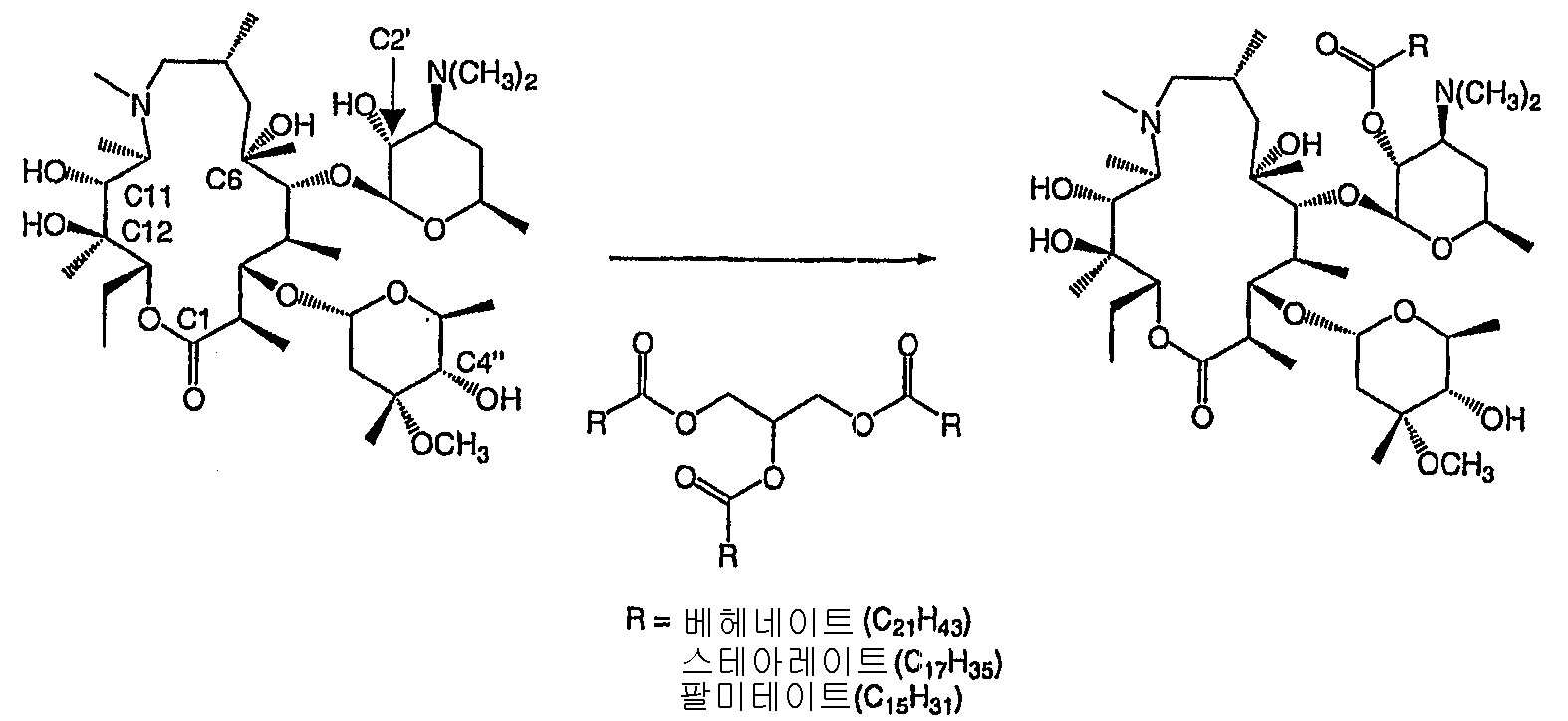
전형적으로는 상기와 같은 반응에서, 상기 부형제 상의 하나의 산 또는 하나의 에스터 치환체는 각각 한 분자의 아지트로마이신과 반응할 수 있지만, 아지트로마이신의 단일 분자 상의 2 개 이상의 에스터의 형성도 가능하다. 부형제가 아지트로마이신과의 반응으로 아지트로마이신 에스터를 형성하는 능력을 평가하는 편리한 방법 중 하나는 조성물 중의 아지트로마이신 그램 당 담체 상의 산 또는 에스터 치환체의 몰 또는 당량 수이다. 예를 들어, 부형제가 조성물 중에 아지트로마이신 그램 당 0.13 밀리당량(meq)의 산 또는 에스터 치환체를 갖고 이들 산 또는 에스터 치환체가 모두 아지트로마이신과 반응하여 일 치환된 아지트로마이신 에스터를 형성하는 경우, 0.13 meq의 아지트로마이신 에스터가 형성될 것이다. 아지트로마이신의 분자량은 749 g/몰이므로, 이는 조성물 중에 처음 존재한 아지트로마이신 매 g에 대해 약 0.1 g의 아지트로마이신이 상기 조성물 중에서 아지트로마이신 에스터로 전환될 것임을 의미한다. 따라서, 다미립자 중의 아지트로마이신 에스터의 농도는 10 중량%가 될 것이다. 그러나, 조성물 중의 모든 산 및 에스터 치환체가 반응하여 아지트로마이신 에스터를 형성할 것 같지는 않다. 하기 논의되는 바와 같이, 다미립자 중의 아지트로마이신의 결정도가 클수록 부형제 상의 산 및 에스터 치환체의 농도가 커질 수 있으며 여전히 허용가능한 양의 아지트로마이신 에스터를 갖는 조성물이 생성될 수 있다.Typically in such reactions, one acid or one ester substituent on the excipient can each react with one molecule of azithromycin, but the formation of two or more esters on a single molecule of azithromycin is also possible. . One convenient way to assess the ability of an excipient to form azithromycin esters in reaction with azithromycin is the number of moles or equivalents of acid or ester substituent on the carrier per gram of azithromycin in the composition. For example, when an excipient has 0.13 milliquivalents (meq) of acid or ester substituent per gram of azithromycin in the composition and both of these acid or ester substituents react with azithromycin to form a monosubstituted azithromycin ester , 0.13 meq of azithromycin ester will be formed. Since the molecular weight of azithromycin is 749 g / mol, this means that for every gram of azithromycin first present in the composition, about 0.1 g of azithromycin will be converted to azithromycin ester in the composition. Therefore, the concentration of azithromycin ester in the multiparticulates will be 10% by weight. However, not all acid and ester substituents in the composition are likely to react to form azithromycin esters. As discussed below, the greater the crystallinity of the azithromycin in the multiparticulates, the greater the concentration of acid and ester substituents on the excipient and can still produce a composition with an acceptable amount of azithromycin ester.
소정의 부형제에 대해 온도 T(℃)에서의 아지트로마이신 에스터 형성률 Re(중량%/일)를 하기 수학 식 1에 따라 0차 반응 모델을 사용하여 예견할 수 있다:Azithromycin ester formation rate R e (wt% / day) at temperature T (° C.) for a given excipient can be predicted using a zero-order reaction model according to Equation 1:

상기에서,In the above,
C에스터 는 형성된 아지트로마이신 에스터의 전체 농도(중량%)이고,C ester is the total concentration of azithromycin esters formed (% by weight),
t는 온도 T에서 아지트로마이신과 부형제간의 접촉 시간(일)이다.t is the contact time in days between the azithromycin and excipient at temperature T.
부형제와 아지트로마이신 에스터를 형성하는 반응 속도를 측정하기 위한 하 나의 과정은 하기와 같다. 부형제를 그의 융점보다 높은 일정한 온도로 가열하고 동일한 중량의 아지트로마이신을 상기 용융된 부형제에 가하여, 용융된 부형제 중의 아지트로마이신의 현탁액 또는 용액을 제조한다. 이어서 상기 용융된 혼합물의 샘플을 주기적으로 회수하여 하기 개시된 과정을 사용하여 아지트로마이신 에스터의 형성에 대해 분석한다. 이어서 에스터 형성률을 상기 수학 식 1을 사용하여 측정할 수 있다.One procedure for measuring the reaction rate to form excipients and azithromycin esters is as follows. The excipient is heated to a constant temperature above its melting point and the same weight of azithromycin is added to the molten excipient to prepare a suspension or solution of azithromycin in the molten excipient. Samples of the molten mixture are then periodically recovered and analyzed for formation of azithromycin esters using the procedure described below. Subsequently, the ester formation rate can be measured using Equation 1 above.
한편으로, 상기 부형제 및 아지트로마이신을 상기 부형제의 용융 온도보다 아래의 온도에서 블렌딩하고 상기 블렌드를 편리한 온도, 예를 들어 50 ℃에서 보관할 수 있다. 상기 블렌드의 샘플을 주기적으로 회수하고 하기 개시하는 바와 같이 아지트로마이신 에스터에 대해 분석할 수 있다. 이어서 에스터 형성률을 상기 수학 식 1을 사용하여 측정할 수 있다.On the one hand, the excipient and azithromycin may be blended at a temperature below the melting temperature of the excipient and the blend may be stored at a convenient temperature, for example 50 ° C. Samples of the blends can be collected periodically and analyzed for azithromycin esters as described below. Subsequently, the ester formation rate can be measured using Equation 1 above.
당해 분야에 널리 공지된 다수의 방법들을 사용하여 다미립자 중의 아지트로마이신 에스터의 농도를 측정할 수 있다. 전형적인 방법은 고성능 액체 크로마토그래피/질량 분광측정(LC/MS) 분석에 의한 것이다. 이 방법에서, 상기 아지트로마이신 및 임의의 아지트로마이신 에스터를 적합한 용매, 예를 들어 메탄올 또는 아이소프로필 알콜을 사용하여 다미립자로부터 추출한다. 이어서 상기 추출 용매를 0.45 ㎛ 나일론 주사기 필터를 사용하여 여과하여 용매 중에 존재하는 임의의 입자들을 제거할 수 있다. 이어서 상기 추출 용매 중에 존재하는 다양한 종들을 당해 분야에 널리 공지된 과정을 사용하여 고성능 액체 크로마토그래피(HPLC)에 의해 분리시킬 수 있다. 질량 분광계를 사용하여 종들을 검출하고, 아지트로마이신 및 아 지트로마이신 에스터의 농도를 내부 또는 외부 아지트로마이신 대조군을 근거로 한 질량-분광계 피크 면적으로부터 계산한다. 바람직하게는, 상기 에스터의 진정한 표준이 합성되었다면, 아지트로마이신 에스터에 대한 외부 표준을 사용할 수 있다. 이어서 상기 아지트로마이신 에스터 값을 샘플 중의 전체 아지트로마이신의 퍼센트로서 기록한다.A number of methods well known in the art can be used to determine the concentration of azithromycin esters in multiparticulates. Typical methods are by high performance liquid chromatography / mass spectrometry (LC / MS) analysis. In this method, the azithromycin and any azithromycin esters are extracted from the multiparticulates using a suitable solvent such as methanol or isopropyl alcohol. The extraction solvent can then be filtered using a 0.45 μm nylon syringe filter to remove any particles present in the solvent. The various species present in the extraction solvent can then be separated by high performance liquid chromatography (HPLC) using procedures well known in the art. Species are detected using a mass spectrometer and the concentrations of azithromycin and azithromycin esters are calculated from the mass-spectrometer peak areas based on internal or external azithromycin controls. Preferably, if a true standard of the ester has been synthesized, then an external standard for azithromycin esters can be used. The azithromycin ester value is then reported as a percentage of total azithromycin in the sample.
약 10 중량% 미만의 전체 아지트로마이신 에스터 함량을 만족시키기 위해서, 아지트로마이신 에스터 형성률 Re(중량%/일)는 하기이어야 한다:In order to satisfy the total azithromycin ester content of less than about 10% by weight, the azithromycin ester formation rate R e (% by weight / day) should be:
Re ≤ 3.6 x 10⁸ · e-7070/(T+273) R e ≤ 3.6 x 10 8 · e -7070 / (T + 273)
상기에서, T는 온도(℃)이다.In the above, T is the temperature (° C).
약 5 중량% 미만의 바람직한 전체 아지트로마이신 에스터 함량을 만족시키기 위해서, 전체 아지트로마이신 에스터 형성률 Re(중량%/일)는 하기이어야 한다:In order to satisfy the desired total azithromycin ester content of less than about 5% by weight, the total azithromycin ester formation rate R e (% by weight / day) should be:
Re ≤ 1.8 x 10⁸ · e-7070/(T+273) R e ≤ 1.8 x 10 8 · e -7070 / (T + 273)
약 1 중량% 미만의 보다 바람직한 전체 아지트로마이신 에스터 함량을 만족시키기 위해서, 전체 아지트로마이신 에스터 형성률 Re(중량%/일)는 하기이어야 한다:In order to satisfy the more preferred total azithromycin ester content of less than about 1% by weight, the total azithromycin ester formation rate R e (% by weight / day) should be:
Re ≤ 3.6 x 10⁷ · e-7070/(T+273) R e ≤ 3.6 x 10 7 · e -7070 / (T + 273)
약 0.5 중량% 미만의 훨씬 더 바람직한 전체 아지트로마이신 에스터 함량을 만족시키기 위해서, 전체 아지트로마이신 에스터 형성률 Re(중량%/일)는 하기이어야 한다:In order to satisfy even more preferred total azithromycin ester content of less than about 0.5% by weight, the total azithromycin ester formation rate R e (% by weight / day) should be:
Re ≤ 1.8 x 10⁷ · e-7070/(T+273) R e ≤ 1.8 x 10 7 · e -7070 / (T + 273)
약 0.1 중량% 미만의 가장 바람직한 전체 아지트로마이신 에스터 함량을 만족시키기 위해서, 전체 아지트로마이신 에스터 형성률 Re(중량%/일)는 하기이어야 한다:In order to satisfy the most preferred total azithromycin ester content of less than about 0.1% by weight, the total azithromycin ester formation rate R e (% by weight / day) should be:
Re ≤ 3.6 x 10⁶ · e-7070/(T+273) R e ≤ 3.6 x 10 6 · e -7070 / (T + 273)
부형제와 반응하여 아지트로마이신 에스터를 형성하는 아지트로마이신의 능력을 평가하기 위한 편리한 방법은 부형제의 산/에스터 치환도를 확인하는 것이다. 이를, 각 부형제 분자 상의 산 및 에스터 치환체 수를 각 부형제 분자의 분자량으로 나누어, 각 부형제 분자 그램 당 산 및 에스터 치환체의 수를 산출함으로써 측정할 수 있다. 다수의 적합한 부형제들은 실제로 다수의 특정한 분자 유형들의 혼합물이므로, 상기 계산에 치환체 수 및 분자량의 평균값을 사용할 수 있다. 이어서 조성물 중의 아지트로마이신 그램당 산 및 에스터 치환체의 농도를 상기 수에 조성물 중의 부형제의 질량을 곱하고 조성물 중의 아지트로마이신의 질량으로 나누어 측정할 수 있다. 예를 들어, 글리세릴 모노스테아레이트 CH3(CH2)16COOCH2CHOHCH2OH는 358.6 g/몰의 분자량 및 몰 당 하나의 에스터 치환체를 갖는다. 따라서, 부형제 그램 당 에스터 치환체 농도는 1 eq ± 358.6 g, 또는 0.0028 eq/부형제 g 또는 2.8 meq/부형제 g이다. 30 중량% 아지트로마이신 및 70 중량% 글리세릴 모노스테아레이트를 함유하는 다미립자가 형성되는 경우, 아지트로마이신 그램당 에스터 치환체 농도는 하기와 같을 것이다:A convenient way to assess the ability of azithromycin to react with excipients to form azithromycin esters is to determine the acid / ester substitution degree of the excipient. This can be measured by dividing the number of acid and ester substituents on each excipient molecule by the molecular weight of each excipient molecule and calculating the number of acid and ester substituents per gram of each excipient molecule. Since many suitable excipients are actually mixtures of many specific molecular types, one can use the average of the number of substituents and the molecular weight in the calculation. The concentration of acid and ester substituent per gram of azithromycin in the composition can then be determined by multiplying the number by the mass of the excipient in the composition and dividing by the mass of azithromycin in the composition. For example, glyceryl monostearate CH 3 (CH 2 ) 16 COOCH 2 CHOHCH 2 OH has a molecular weight of 358.6 g / mol and one ester substituent per mole. Thus, the ester substituent concentration per gram of excipient is 1 eq ± 358.6 g, or 0.0028 eq / g excipient or 2.8 meq / g excipient. When multiparticulates containing 30 wt% azithromycin and 70 wt% glyceryl monostearate are formed, the ester substituent concentration per gram of azithromycin will be as follows:
2.8 meq/g x 70/30 = 6.5 meq/g.2.8 meq / g × 70/30 = 6.5 meq / g.
상기 계산을 사용하여 임의의 부형제 후보 상의 산 및 에스터 치환체의 농도를 계산할 수 있다.The calculation can be used to calculate the concentration of acid and ester substituents on any excipient candidate.
그러나, 대부분의 경우에, 상기 부형제 후보를 순수한 형태로 입수할 수 없으며, 상기 후보는 다수의 주 분자 유형들의 혼합물뿐만 아니라 산 또는 에스터일 수 있는 소량의 불순물 또는 분해 산물을 구성할 수 있다. 또한, 다수의 부형제 후보들은 천연 산물이거나 또는 광범위한 화합물들을 함유할 수 있는 천연 산물로부터 유도되어, 불가능하지는 않지만, 상기 계산을 대단히 어렵게 만든다. 이러한 이유들로 인해, 본 발명자들은 상기와 같은 물질들에 대한 산/에스터 치환의 정도를 종종 부형제의 비누화 가 또는 비누화 값을 사용함으로써 가장 쉽게 추정할 수 있음을 발견하였다. 상기 비누화 가는 물질 1 그램 중에 존재하는 임의의 산 또는 에스터 치환체를 중화 또는 가수분해하는데 필요한 수산화 칼륨의 밀리그램 수이다. 상기 비누화 가의 측정은 다수의 상업적으로 입수할 수 있는 약학적 부형제를 특성화하는 표준 방식이며 제조자들은 종종 부형제의 비누화 가를 제공한다. 상기 비누화 가는 부형제 자체 상에 존재하는 산 및 에스터 치환체에 기인할 뿐만 아니라 상기 부형제 중의 불순물 또는 분해 산물에 기인하여 존재하는 임의의 상기와 같은 치환체들에도 기인할 것이다. 따라서, 상기 비누화 가는 종종 상기 부형제 중의 산/에스터 치환 정도의 보다 정확한 측정을 제공할 것이다. In most cases, however, the excipient candidates are not available in pure form, and the candidates may constitute a mixture of multiple main molecular types as well as small amounts of impurities or degradation products, which may be acids or esters. In addition, many excipient candidates are derived from natural products that may be natural products or may contain a wide range of compounds, making this calculation very difficult, if not impossible. For these reasons, the inventors have found that the degree of acid / ester substitution for such materials can be most easily estimated by using the saponification value or saponification value of the excipients often. The saponified fine is the number of milligrams of potassium hydroxide required to neutralize or hydrolyze any acid or ester substituent present in one gram of material. Determination of the saponification value is a standard way to characterize many commercially available pharmaceutical excipients and manufacturers often provide saponification value of the excipient. The saponified fine will be attributable not only to the acid and ester substituents present on the excipient itself, but also to any such substituents present due to impurities or degradation products in the excipient. Thus, the saponification value will often provide a more accurate measure of the degree of acid / ester substitution in the excipient.
후보 부형제의 비누화 가를 측정하기 위한 하나의 과정은 하기와 같다. 먼저 5 내지 10 g의 수산화 칼륨을 1 리터의 95% 에탄올에 가하고 혼합물을 환류 응축기 하에서 약 1 시간 동안 비등시켜 수산화 칼륨 용액을 제조한다. 이어서 상기 에탄올을 증류시키고 15.5 ℃ 미만으로 냉각시킨다. 증류된 에탄올을 상기 온도 아래에서 유지시키면서 수산화 칼륨 40 g을 상기 에탄올에 용해시켜 알칼리성 시약을 제조한다. 이어서 4 내지 5 g의 상기 부형제 샘플을 환류 응축기가 장착된 플라스크에 가한다. 이어서 상기 알칼리성 시약 50 ㎖ 샘플을 상기 플라스크에 가하고 상기 혼합물을 비누화가 완료될 때까지, 일반적으로는 약 1 시간까지 환류 조건 하에서 비등시킨다. 이어서 상기 용액을 냉각시키고 페놀프탈레인 용액(95% 에탄올 중의 1%) 1 ㎖을 상기 혼합물에 가하고 상기 혼합물을 분홍색이 단지 사라질 때까지 0.5N HCl로 적정한다. 이어서 물질 그램당 수산화 칼륨 ㎎의 비누화 가를 하기식으로부터 계산한다:One procedure for determining the saponification value of candidate excipients is as follows. Potassium hydroxide solution is prepared by first adding 5-10 g of potassium hydroxide to 1 liter of 95% ethanol and boiling the mixture under reflux condenser for about 1 hour. The ethanol is then distilled and cooled to below 15.5 ° C. An alkaline reagent is prepared by dissolving 40 g of potassium hydroxide in the ethanol while maintaining the distilled ethanol below this temperature. 4-5 g of the excipient sample are then added to a flask equipped with a reflux condenser. A 50 ml sample of the alkaline reagent is then added to the flask and the mixture is boiled under reflux conditions, typically up to about 1 hour, until saponification is complete. The solution is then cooled and 1 ml of phenolphthalein solution (1% in 95% ethanol) is added to the mixture and the mixture is titrated with 0.5N HCl until the pink just disappears. The saponification value of potassium hydroxide per gram of substance is then calculated from the following formula:
비누화 가 = [28.05 x (B-S)] ÷ 샘플 중량Saponification Value = [28.05 x (B-S)] ÷ Sample Weight
상기에서,In the above,
B는 블랭크 샘플(부형제를 함유하지 않는 샘플)을 적정하는데 필요한 HCl ㎖의 수이고,B is the number of ml of HCl required to titrate the blank sample (sample without excipients),
S는 샘플을 적정하는데 필요한 HCl ㎖의 수이다.S is the number of ml HCl needed to titrate the sample.
상기와 같은 물질의 비누화 가 측정 방법에 대한 추가의 상세한 설명이 문 헌[Welcher, Standard Methods of Chemical Analysis(1975)]에 제공되어 있다. 또한 미국 시험 및 물질 협회(ASTM)는 다양한 물질들에 대한 비누화 가의 측정을 위한 여러 가지 시험들, 예를 들어 ASTM D1387-89, D94-00 및 D558-95를 확립하였다. 이러한 방법들은 또한 잠재적인 부형제에 대한 비누화 가의 측정에 적합할 수 있다.Further details on how to measure the saponification of such materials are provided in Welcher, Standard Methods of Chemical Analysis (1975). The American Test and Materials Association (ASTM) has also established several tests for the determination of saponification value for various materials, for example ASTM D1387-89, D94-00, and D558-95. These methods may also be suitable for the determination of saponification value for potential excipients.
일부 부형제의 경우, 상기 다미립자의 제조에 사용되는 가공 조건들(에를 들어 고온)이 부형제의 화학적 구조를 변화시켜, 예를 들어 산화에 의해 산 및/또는 에스터 치환체를 형성시킬 수 있다. 따라서, 부형제의 비누화 가를, 상기 부형제를 상기 다미립자의 제조에 예상되는 가공 조건들에 노출시킨 후에 측정해야 한다. 이러한 식으로, 아지트로마이신 에스터를 형성시킬 수 있는 부형제로부터의 잠재적인 분해 산물이 밝혀질 수 있다.For some excipients, the processing conditions used in the preparation of the multiparticulates (eg high temperature) may change the chemical structure of the excipient, for example to form acid and / or ester substituents by oxidation. Therefore, the saponification value of the excipient should be measured after exposing the excipient to the processing conditions expected for the preparation of the multiparticulates. In this way, potential degradation products from excipients that can form azithromycin esters can be identified.
부형제 상의 산 및 에스터 치환 정도를 하기와 같이 비누화 가로부터 계산할 수 있다. 상기 비누화 가를 수산화 칼륨의 분자량, 56.11 g/몰로 나누어 부형제 1 g 중에 존재하는 임의의 산 또는 에스터 치환체를 중화 또는 가수분해시키는데 필요한 수산화 칼륨의 밀리몰 값을 생성시킨다. 1 몰의 수산화 칼륨이 1 당량의 산 또는 에스터 치환체를 중화시킬 것이므로, 상기 비누화 가를 수산화 칼륨의 분자량으로 나누면 또한 부형제 1 g 중에 존재하는 산 또는 에스터 치환체의 meq 값이 생성된다.The degree of acid and ester substitution on the excipient can be calculated from the saponification number as follows. The saponified value is divided by the molecular weight of potassium hydroxide, 56.11 g / mol to produce millimolar values of potassium hydroxide required to neutralize or hydrolyze any acid or ester substituent present in 1 g of excipient. Since one mole of potassium hydroxide will neutralize one equivalent of acid or ester substituent, dividing the saponified value by the molecular weight of potassium hydroxide also produces the meq value of the acid or ester substituent present in 1 g of excipient.
예를 들어, 제조자가 명시한 바와 같이, 165의 비누화가를 갖는 글리세릴 모노스테아레이트를 수득할 수 있다. 따라서, 글리세릴 모노스테아레이트의 그램 당 산/에스터 치환도 또는 그의 산/에스터 농도는 하기와 같다:For example, as specified by the manufacturer, glyceryl monostearate with a saponification value of 165 can be obtained. Accordingly, the acid / ester substitution degree or acid / ester concentration thereof per gram of glyceryl monostearate is as follows:
165 ÷ 56.11 = 2.9 meq/부형제 g.165 ÷ 56.11 = 2.9 meq / excipient g.
30 중량% 아지트로마이신 및 70 중량% 글리세릴 모노스테아레이트를 갖는 상기 예의 조성물을 사용하는 경우, 아지트로마이신 g 당 형성된 에스터의 이론치 농도는 아지트로마이신이 모두 반응했다고 가정할 때 하기와 같을 것이다:Using the above example compositions having 30 wt% azithromycin and 70 wt% glyceryl monostearate, the theoretical concentration of esters formed per gram of azithromycin will be as follows assuming that all of the azithromycins have reacted: :
2.9 meq/g x 70/30 = 6.8 meq/g.2.9 meq / g × 70/30 = 6.8 meq / g.
다미립자가 2 개 이상의 부형제를 포함하는 경우, 모든 부형제 중의 산 및 에스터 그룹의 전체 농도를 사용하여 상기 다미립자 중의 아지트로마이신 그램 당 산/에스터 치환도를 측정해야 한다. 예를 들어, 부형제 A가 조성물 중에 존재하는 아지트로마이신 g당 3.5 meq의 산/에스터 치환체 농도[A]를 갖고 부형제 B가 0.5 meq/g 아지트로마이신의 [A]를 가지며, 상기 둘 모두 조성물 중의 부형제 전체 중량의 50 중량%의 양으로 존재하는 경우, 부형제들의 혼합물은 (3.5 + 0.5) ÷ 2의 유효 [A] 또는 2.0 meq/g 아지트로마이신을 갖는다. 이러한 방식으로 훨씬 더 큰 정도의 산/에스터 치환을 갖는 일부 부형제들을 상기 조성물에 사용할 수 있다.If the multiparticulates comprise two or more excipients, the total concentration of acid and ester groups in all excipients should be used to determine the degree of acid / ester substitution per gram of azithromycin in the multiparticulates. For example, excipient A has an acid / ester substituent concentration [A] of 3.5 meq per gram of azithromycin present in the composition and excipient B has a [A] of 0.5 meq / g azithromycin, both of which have a composition When present in an amount of 50% by weight of the total weight of the excipient in the mixture, the mixture of excipients has an effective [A] or 2.0 meq / g azithromycin of (3.5 + 0.5) ÷ 2. In this way some excipients with even greater degrees of acid / ester substitution can be used in the composition.
본 발명에 유용한 부형제 및 담체를 아지트로마이신 에스터를 형성하는 경향과 관련하여 4 개의 일반적인 범주, 즉 (1) 비-반응성; (2) 저 반응성; (3) 중간 반응성; 및 (4) 매우 반응성으로 나눌 수 있다. 압출기를 사용하여 담체, 임의의 부형제 및 약물의 용융된 혼합물을 제조하는 경우, 본 발명의 방법은 상기 압출기의 사용이 분무 단계 전에 훨씬 더 중간인 온도의 사용을 허용하므로 중간 반응성 및 매우 반응성인 담체 및 임의의 부형제를 사용하는 아지트로마이신 다미립자의 제조에 특히 유용하다.Excipients and carriers useful in the present invention are divided into four general categories with respect to the tendency to form azithromycin esters: (1) non-reactive; (2) low reactivity; (3) moderate reactivity; And (4) highly reactive. When using an extruder to produce a molten mixture of carrier, optional excipients and drug, the process of the present invention allows for the use of such extruders, allowing for the use of a much more intermediate temperature prior to the spraying step, thus providing a medium and highly reactive carrier. And azithromycin multiparticulates using any excipient.
비-반응성 담체 및 부형제는 일반적으로 산 또는 에스터 치환체를 갖지 않으며 산 또는 에스터를 함유하는 불순물이 없다. 일반적으로는, 비-반응성 물질은 0.0001 meq/g 부형제 미만의 산/에스터 농도를 가질 것이다. 비-반응성 담체 및 부형제는 대부분의 물질이 소량의 불순물을 함유하므로 매우 드물다. 따라서 비 반응성 담체 및 부형제를 고도로 정제해야 한다. 또한, 비 반응성 담체 및 부형제는 종종 탄화수소이며, 따라서 상기 담체 또는 부형제 중의 다른 원소들의 존재가 산 또는 에스터 불순물을 생성시킬 수 있다. 비-반응성 담체 및 부형제에 대한 아지트로마이신 에스터 형성률은 본질적으로 0이며, 아지트로마이신의 부형제와의 반응 속도를 측정하기 위해 상술한 조건 하에서 아지트로마이신 에스터는 형성되지 않는다. 비-반응성 담체 및 부형제의 예는 하기 탄화수소의 고도로 정제된 형태를 포함한다: 합성 왁스, 미정질 왁스 및 파라핀 왁스.Non-reactive carriers and excipients generally have no acid or ester substituents and are free of impurities containing acid or ester. Generally, the non-reactive material will have an acid / ester concentration of less than 0.0001 meq / g excipient. Non-reactive carriers and excipients are very rare because most materials contain small amounts of impurities. Therefore, highly reactive carriers and excipients must be highly purified. In addition, non-reactive carriers and excipients are often hydrocarbons, so the presence of other elements in the carrier or excipient can produce acid or ester impurities. The azithromycin ester formation rate for non-reactive carriers and excipients is essentially zero, and no azithromycin esters are formed under the conditions described above to determine the rate of reaction of azithromycin with excipients. Examples of non-reactive carriers and excipients include the highly purified forms of the following hydrocarbons: synthetic waxes, microcrystalline waxes and paraffin waxes.
낮은 반응성 담체 및 부형제는 또한 산 또는 에스터 치환체를 갖지 않지만, 종종 산 또는 에스터 치환체를 함유하는 소량의 불순물 또는 분해 산물을 함유한다. 일반적으로는, 저 반응성 담체 및 부형제는 약 0.1 meq/g 부형제 미만의 산/에스터 농도를 갖는다. 일반적으로는, 저 반응성 담체 및 부형제는 100 ℃에서 측정 시 약 0.005 중량%/일 미만의 아지트로마이신 에스터 형성률을 가질 것이다. 저 반응성 부형제의 예에는 장쇄 알콜, 예를 들어 스테아릴 알콜, 세틸 알콜 및 폴리에틸렌 글리콜; 및 에테르-치환된 셀룰로즈, 예를 들어 미정질 셀룰로즈, 하이드 록시프로필 셀룰로즈, 하이드록시프로필 메틸 셀룰로즈 및 에틸셀룰로즈가 있다.Low reactive carriers and excipients also have no acid or ester substituents, but often contain small amounts of impurities or degradation products containing acid or ester substituents. Generally, low reactivity carriers and excipients have an acid / ester concentration of less than about 0.1 meq / g excipient. Generally, the low reactivity carriers and excipients will have an azithromycin ester formation rate of less than about 0.005% by weight per day measured at 100 ° C. Examples of low reactive excipients include long chain alcohols such as stearyl alcohol, cetyl alcohol and polyethylene glycol; And ether-substituted celluloses such as microcrystalline cellulose, hydroxypropyl cellulose, hydroxypropyl methyl cellulose and ethylcellulose.
중간 반응성 담체 및 부형제는 종종 산 또는 에스터 치환체를 함유하지만, 상기 부형제의 분자량에 비해 비교적 적다. 일반적으로는 중간 반응성 담체 및 부형제는 약 0.1 내지 약 3.5 meq/g 부형제의 산/에스터 농도를 갖는다. 예로서 장쇄 지방산 에스터, 예를 들어 글리세릴 모노올리에이트, 글리세릴 모노스테아레이트, 글리세릴 팔미토스테아레이트, 폴리에톡실화된 피마자유 유도체, 글리세릴 다이베헤네이트, 및 모노-, 다이- 및 트라이알킬 글리세라이드의 혼합물, 예를 들어 글리세릴 모노-, 다이- 및 트라이베헤네이트의 혼합물, 글리세릴 트라이스테아레이트, 글리세릴 트라이팔미테이트 및 수소화된 식물성 오일; 및 왁스, 예를 들어 카누바 왁스 및 백랍 및 황랍이 있다.Intermediate reactive carriers and excipients often contain acid or ester substituents, but are relatively small relative to the molecular weight of such excipients. Generally the intermediate reactive carrier and excipient have an acid / ester concentration of about 0.1 to about 3.5 meq / g excipient. Long chain fatty acid esters such as glyceryl monooleate, glyceryl monostearate, glyceryl palmitostearate, polyethoxylated castor oil derivatives, glyceryl dibehenate, and mono-, di- and Mixtures of trialkyl glycerides such as mixtures of glyceryl mono-, di- and tribehenate, glyceryl tristearate, glyceryl tripalmitate and hydrogenated vegetable oils; And waxes such as canuba wax and pewter and yellow wax.
매우 반응성인 담체 및 부형제는 대개는 다수의 산 또는 에스터 치환체 또는 저 분자량을 갖는다. 일반적으로는, 매우 반응성인 담체 및 부형제는 약 3.5 meq/g 부형제 초과의 산/에스터 농도를 가지며 100 ℃에서 약 40 중량%/일 초과의 아지트로마이신 에스터 형성률을 갖는다. 예로서 카복실산, 예를 들어 스테아르산, 벤조산, 및 시트르산이 있다. 일반적으로는, 매우 반응성인 담체 및 부형제 상의 산/에스터 농도는 너무 높아서, 이들 담체 또는 부형제가 제형 중에서 아지트로마이신과 직접 접촉하게 되는 경우 상기 조성물의 가공 또는 보관 중에 허용가능하지 않은 고 농도의 아지트로마이신 에스터가 형성된다. 따라서, 상기와 같은 매우 반응성인 담체 및 부형제는 바람직하게는 오직, 다미립자 중에 사용되는 담체 및 부형제 상의 산 및 에스터의 전체 량이 낮도록 보다 낮은 반응성을 갖는 담체 또는 부형제와 함께 사용된다.Highly reactive carriers and excipients usually have many acid or ester substituents or low molecular weights. In general, highly reactive carriers and excipients have an acid / ester concentration of greater than about 3.5 meq / g excipient and an azithromycin ester formation rate of greater than about 40 wt% / day at 100 ° C. Examples are carboxylic acids such as stearic acid, benzoic acid, and citric acid. In general, acid / ester concentrations on highly reactive carriers and excipients are so high that unacceptable high concentrations of azide during processing or storage of the composition when these carriers or excipients come into direct contact with azithromycin in the formulation. Roman esters are formed. Thus, such highly reactive carriers and excipients are preferably used only with carriers or excipients having lower reactivity such that the total amount of acids and esters on the carriers and excipients used in the multiparticulates is low.
담체carrier
상기 다미립자는 약학적으로 허용가능한 담체를 포함한다. "약학적으로 허용가능한"이란 상기 담체가 조성물의 다른 성분들과 상용성이고, 그의 수용자에게 유해하지 않아야 함을 의미한다. 상기 담체는 상기 다미립자에 대한 기질로서 작용하거나 또는 상기 다미립자로부터 아지트로마이신의 방출 속도에 영향을 미치는 작용을 하거나 또는 이 둘 다로서 작용한다. 담체는 일반적으로는 다미립자의 전체 질량을 기준으로, 다미립자의 약 10 내지 약 95 중량%, 바람직하게는 다미립자의 약 20 내지 약 90 중량%, 보다 바람직하게는 다미립자의 약 40 내지 약 70 중량%를 구성할 것이다. 상기 담체는 바람직하게는 약 40 ℃의 온도에서 고체이다. 본 발명자들은 상기 담체가 40 ℃에서 고체가 아닌 경우, 특히 승온, 예를 들어 40 ℃에서 보관 시 조성물의 물리적 특성이 시간에 따라 변할 수 있음을 발견하였다. 따라서, 상기 담체는 약 50 ℃에서 고체인 것이 바람직하며, 보다 바람직하게는 60 ℃에서 고체이다. 가공의 용이성을 위해서, 상기 고체는 약 130 ℃ 미만, 바람직하게는 약 115 ℃ 미만, 보다 바람직하게는 약 100 ℃ 미만의 온도에서 유체 또는 액체(예를 들어 용융된 것)인 것이 바람직하다. 바람직한 실시태양에서, 상기 담체는 아지트로마이신의 융점 미만인 융점을 갖는다. 예를 들어, 아지트로마이신 이수화물은 113 내지 115 ℃의 융점을 갖는다. 따라서, 아지트로마이신 이수화물을 본 발명의 다미립자에 사용하는 경우, 상기 담체는 약 113 ℃ 미만인 융점을 갖는 것이 바람직하다.The multiparticulates include a pharmaceutically acceptable carrier. "Pharmaceutically acceptable" means that the carrier is compatible with the other ingredients of the composition and should not be harmful to its recipient. The carrier acts as a substrate for the multiparticulates or acts to affect the rate of release of azithromycin from the multiparticulates or both. The carrier is generally from about 10 to about 95 weight percent of the multiparticulates, preferably from about 20 to about 90 weight percent of the multiparticulates, more preferably from about 40 to about 40 weight percent of the multiparticulates, based on the total mass of the multiparticulates. Will constitute 70% by weight. The carrier is preferably solid at a temperature of about 40 ° C. We have found that when the carrier is not solid at 40 ° C., the physical properties of the composition may change over time, especially when stored at elevated temperatures, for example 40 ° C. Thus, the carrier is preferably solid at about 50 ° C., more preferably solid at 60 ° C. For ease of processing, the solids are preferably fluids or liquids (eg, molten) at temperatures below about 130 ° C., preferably below about 115 ° C., more preferably below about 100 ° C. In a preferred embodiment, the carrier has a melting point that is less than the melting point of azithromycin. For example, azithromycin dihydrate has a melting point of 113-115 ° C. Thus, when azithromycin dihydrate is used in the multiparticulates of the invention, it is preferred that the carrier has a melting point of less than about 113 ° C.
본 발명의 다미립자에 사용하기에 적합한 담체의 예로는 왁스, 예를 들어 합성 왁스, 미정질 왁스, 파라핀 왁스, 카누바 왁스 및 밀랍; 글리세라이드, 예를 들어 글리세릴 모노올리에이트, 글리세릴 모노스테아레이트, 글리세릴 팔미토스테아레이트, 폴리에톡실화된 피마자유 유도체, 수소화된 식물성 오일, 글리세릴 모노-, 다이- 또는 트라이베헤네이트, 글리세릴 트라이스테아레이트, 글리세릴 트라이팔미테이트; 장쇄 알콜, 예를 들어 스테아릴 알콜, 세틸 알콜, 및 폴리에틸렌 글리콜; 및 이들의 혼합물이 있다.Examples of suitable carriers for use in the multiparticulates of the present invention include waxes such as synthetic waxes, microcrystalline waxes, paraffin waxes, canuba waxes and beeswax; Glycerides such as glyceryl monooleate, glyceryl monostearate, glyceryl palmitostearate, polyethoxylated castor oil derivatives, hydrogenated vegetable oils, glyceryl mono-, di- or tribehenate Glyceryl tristearate, glyceryl tripalmitate; Long chain alcohols such as stearyl alcohol, cetyl alcohol, and polyethylene glycol; And mixtures thereof.
부형제Excipient
상기 다미립자는 다미립자의 형성을 돕거나, 상기 다미립자로부터의 아지트로마이신의 방출 속도에 영향을 미치거나, 또는 당해 분야에 공지된 다른 목적을 위해 부형제를 임의로 포함할 수 있다.The multiparticulates may optionally include excipients for aiding the formation of the multiparticulates, affecting the rate of release of azithromycin from the multiparticulates, or for other purposes known in the art.
상기 다미립자는 용해 촉진제를 임의로 포함할 수 있다. 용해 촉진제는 상기 다미립자로부터 약물의 용해속도를 증가시킨다. 일반적으로, 용해 촉진제는 양쪽성 화합물이며 일반적으로는 담체보다 더 친수성이다. 용해 촉진제는 일반적으로는 상기 다미립자의 전체 중량의 약 0.1 내지 약 30 중량%를 구성할 것이다. 전형적인 용해 촉진제에는 알콜, 예를 들어 스테아릴 알콜, 세틸 알콜, 및 폴리에틸렌 글리콜; 계면활성제, 예를 들어 폴록사머(예를 들어, 폴록사머 188, 폴록사머 237, 폴록사머 338, 및 폴록사머 407), 도큐세이트 염, 폴리옥시에틸렌 알킬 에테르, 폴리옥시에틸렌 피마자유 유도체, 폴리솔베이트, 폴리옥시에틸렌 알킬 에스터, 나트륨 라우릴 설페이트, 및 솔비탄 모노에스터; 당, 예를 들어 글루코스, 슈크로 스, 자일리톨, 솔비톨 및 말티톨; 염, 예를 들어 염화 나트륨, 염화 칼륨, 염화 리튬, 염화 칼슘, 염화 마그네슘, 황산 나트륨, 황산 칼륨, 탄산 나트륨, 황산 마그네슘, 및 인산 칼륨; 아미노산, 예를 들어 알라닌 및 글리신; 및 이들의 혼합물이 포함된다. 바람직하게는, 상기 용해 촉진제는 하나 이상의 계면활성제이며, 가장 바람직하게는 상기 용해 촉진제는 하나 이상의 폴록사머이다.The multiparticulates may optionally include a dissolution promoter. Dissolution promoters increase the rate of dissolution of the drug from the multiparticulates. In general, the dissolution promoter is an amphoteric compound and is generally more hydrophilic than the carrier. The dissolution promoter will generally comprise about 0.1 to about 30 weight percent of the total weight of the multiparticulates. Typical dissolution promoters include alcohols such as stearyl alcohol, cetyl alcohol, and polyethylene glycol; Surfactants such as poloxamers (eg poloxamer 188, poloxamer 237, poloxamer 338, and poloxamer 407), docusate salts, polyoxyethylene alkyl ethers, polyoxyethylene castor oil derivatives, polysols Baits, polyoxyethylene alkyl esters, sodium lauryl sulfate, and sorbitan monoesters; Sugars such as glucose, sucrose, xylitol, sorbitol and maltitol; Salts such as sodium chloride, potassium chloride, lithium chloride, calcium chloride, magnesium chloride, sodium sulfate, potassium sulfate, sodium carbonate, magnesium sulfate, and potassium phosphate; Amino acids such as alanine and glycine; And mixtures thereof. Preferably, the dissolution promoter is at least one surfactant, and most preferably the dissolution promoter is at least one poloxamer.
임의의 특정한 이론 또는 기전에 얽매이고자 하는 것은 아니지만, 상기 다미립자 중에 존재하는 용해 촉진제는 수성 사용 환경이 상기 다미립자를 침투하는 속도에 영향을 미치며, 따라서 아지트로마이신이 방출되는 속도에 영향을 미치는 것으로 여겨진다. 또한, 상기와 같은 부형제는 종종 상기 담체를 마이셀에 용해시킴으로써 담체 자체의 수 용해를 도와 상기 아지트로마이신 방출 속도를 향상시킬 수 있다. 용해 촉진제 및 아지트로마이신 다미립자에 적합한 부형제의 선택에 대한 추가의 상세한 설명이 2003년 12월 4일자로 출원된, 통상적으로 양도된 미국 특허 출원 제 60/527319 호("용해 촉진제에 의해 형성된 조절된 방출 다미립자", 대리인 사건 번호 PC25016)에 개시되어 있다.While not wishing to be bound by any particular theory or mechanism, dissolution promoters present in the multiparticulates affect the rate at which the aqueous environment of use penetrates the multiparticulates, thus affecting the rate at which azithromycin is released. It is considered to be. In addition, such excipients can often dissolve the carrier in micelles to aid in water dissolution of the carrier itself, thereby improving the rate of azithromycin release. Further details on the selection of suitable excipients for dissolution promoters and azithromycin multiparticulates are commonly assigned U.S. Patent Application No. 60/527319, filed December 4, 2003 ("Control Formed by Dissolution Promoters"). Release multiparticulates ", agent event number PC25016).
상기 다미립자로부터의 아지트로마이신의 방출을 억제하거나 지연시키는 작용제를 또한 상기 다미립자에 포함시킬 수 있다. 상기와 같은 용해 억제제는 일반적으로 흡습성이다. 용해 억제제의 예로는 탄화수소 왁스, 예를 들어 미정질 및 파라핀 왁스; 및 약 20,000 달톤 초과의 분자량을 갖는 폴리에틸렌 글리콜이 있다.Agents that inhibit or delay the release of azithromycin from the multiparticulates may also be included in the multiparticulates. Such dissolution inhibitors are generally hygroscopic. Examples of dissolution inhibitors include hydrocarbon waxes such as microcrystalline and paraffin waxes; And polyethylene glycols having molecular weights greater than about 20,000 Daltons.
상기 다미립자에 임의로 포함시킬 수 있는 또 다른 유용한 부형제 군에는 상기 다미립자의 제조에 사용되는 용융된 공급물의 점도를 조절하는데 사용되는 물질 이 포함된다. 상기와 같은 점도-조절 부형제는 일반적으로는 상기 다미립자의 전체 질량을 기준으로 상기 다미립자의 0 내지 25 중량%를 구성할 것이다. 상기 용융된 공급물의 점도는 좁은 입자 크기 분포를 갖는 다미립자의 수득에 중요 변수이다. 예를 들어, 회전-원반 분무기를 사용하는 경우, 상기 용융된 혼합물의 점도는 바람직하게는 약 1 cp 이상 약 10,000 cp 미만, 보다 바람직하게는 50 cp 이상 약 1000 cp 미만이다. 상기 용융된 혼합물이 상기 바람직한 범위 밖에 있는 점도를 갖는 경우, 점도 조절 부형제를 첨가하여 바람직한 점도 범위를 갖는 용융된 혼합물을 수득할 수 있다. 점도 감소 부형제의 예로는 스테아릴 알콜, 세틸 알콜, 저 분자량 폴리에틸렌 글리콜(예를 들어 약 1000 달톤 미만), 아이소프로필 알콜, 및 물이 있다. 점도 증가 부형제의 예로는 미정질 왁스, 파라핀 왁스, 합성 왁스, 고 분자량 폴리에틸렌 글리콜(예를 들어 약 5000 달톤 초과), 에틸 셀룰로즈, 하이드록시프로필 셀룰로즈, 하이드록시프로필 메틸 셀룰로즈, 메틸 셀룰로즈, 이산화 규소, 미정질 셀룰로즈, 마그네슘 실리케이트, 당 및 염이 있다.Another group of useful excipients that may optionally be included in the multiparticulates includes materials used to control the viscosity of the molten feed used to prepare the multiparticulates. Such viscosity-controlling excipients will generally comprise from 0 to 25% by weight of the multiparticulates, based on the total mass of the multiparticulates. The viscosity of the molten feed is an important parameter in obtaining multiparticulates with a narrow particle size distribution. For example, when using a rotary-disk atomizer, the viscosity of the molten mixture is preferably at least about 1 cp and less than about 10,000 cp, more preferably at least 50 cp and less than about 1000 cp. If the molten mixture has a viscosity that is outside the above preferred range, a viscosity controlling excipient may be added to obtain a molten mixture having a preferred viscosity range. Examples of viscosity reducing excipients are stearyl alcohol, cetyl alcohol, low molecular weight polyethylene glycol (eg less than about 1000 Daltons), isopropyl alcohol, and water. Examples of viscosity increasing excipients include microcrystalline waxes, paraffin waxes, synthetic waxes, high molecular weight polyethylene glycols (eg greater than about 5000 Daltons), ethyl cellulose, hydroxypropyl cellulose, hydroxypropyl methyl cellulose, methyl cellulose, silicon dioxide, Microcrystalline cellulose, magnesium silicates, sugars and salts.
다른 부형제들을 가하여 상기 다미립자의 방출 특성을 조절하거나 가공을 개선시킬 수 있으며 이들은 전형적으로는 다미립자의 전체 질량을 기준으로 상기 다미립자의 0 내지 50 중량%를 구성할 것이다. 예를 들어, 수용액에 대한 아지트로마이신의 용해도는 pH의 증가에 따라 감소하므로, 염기를 상기 조성물에 포함시켜 아지트로마이신이 수성 사용 환경에서 방출되는 속도를 감소시킬 수 있다. 상기 조성물에 포함시킬 수 있는 염기의 예로는 2- 및 3 염기성 인산 나트륨, 2- 및 3 염기성 인산 칼슘, 모노-, 다이- 및 트라이에탄올아민, 중탄산 나트륨 및 시트르산 나트륨 이수화물뿐만 아니라 당해 분야에 공지된 수화된 형태 및 무수 형태를 포함하여 다른 옥사이드, 하이드록사이드, 포스페이트, 카보네이트, 바이카보네이트 및 시트레이트 염이 있다. 더욱 다른 부형제들을 첨가하여 상기 다미립자상의 정 전하를 감소시킬 수 있다. 상기와 같은 정전기 방지제의 예로는 활석 및 이산화 규소가 있다. 풍미제, 착색제 및 다른 부형제들도 또한 그들의 통상적인 목적을 위해 통상적인 양으로 첨가될 수 있다.Other excipients may be added to control the release properties of the multiparticulates or to improve processing, which will typically comprise 0-50% by weight of the multiparticulates based on the total mass of the multiparticulates. For example, since the solubility of azithromycin in aqueous solutions decreases with increasing pH, bases can be included in the composition to reduce the rate at which azithromycin is released in an aqueous use environment. Examples of bases that can be included in the composition include 2- and tribasic sodium phosphates, 2- and tribasic calcium phosphates, mono-, di- and triethanolamines, sodium bicarbonate and sodium citrate dihydrate, as well as known in the art. Other oxides, hydroxides, phosphates, carbonates, bicarbonates and citrate salts, including both hydrated and anhydrous forms. Further excipients may be added to reduce the positive charge on the multiparticulates. Examples of such antistatic agents include talc and silicon dioxide. Flavors, colorants and other excipients may also be added in conventional amounts for their conventional purposes.
하나의 실시태양에서, 상기 담체 및 하나 이상의 선택적인 부형제들은 고체 용액을 형성하며, 이는 상기 담체 및 하나 이상의 선택적인 부형제들이 단일의 열역학적으로 안정한 상을 형성함을 의미한다. 상기와 같은 경우에, 약 40 ℃ 미만의 온도에서 고체가 아닌 부형제들을 사용할 수 있으나, 단 상기 담체/부형제 혼합물은 약 40 ℃ 이하의 온도에서 고체이다. 이는 사용되는 부형제의 융점 및 조성물 중에 포함되는 담체의 상대적인 양에 따라 변할 것이다. 일반적으로는, 하나의 부형제의 융점이 높을수록, 담체를 40 ℃ 이하에서 여전히 고체상으로 유지시키면서 조성물에 첨가시킬 수 있는 저 융점 부형제의 양이 커진다.In one embodiment, the carrier and one or more optional excipients form a solid solution, which means that the carrier and one or more optional excipients form a single thermodynamically stable phase. In such cases, non-solid excipients may be used at temperatures below about 40 ° C. provided that the carrier / excipient mixture is solid at temperatures below about 40 ° C. This will vary depending on the melting point of the excipients used and the relative amounts of carriers included in the composition. In general, the higher the melting point of one excipient, the greater the amount of low melting excipient that can be added to the composition while still maintaining the carrier in the solid phase at 40 ° C. or lower.
또 다른 실시태양에서, 상기 담체 및 하나 이상의 선택적인 부형제는 고체 용액을 형성하지 않으며, 이는 상기 담체 및 하나 이상의 선택적인 부형제가 둘 이상의 열역학적으로 안정한 상을 형성함을 의미한다. 상기와 같은 경우에, 상기 담체/부형제 혼합물은 상기 다미립자의 제조에 사용되는 가공 온도에서 전적으로 용융되거나 또는 하나의 물질이 고체인 반면 다른 것(들)은 용융될 수 있으며, 이는 상기 용융된 혼합물 중의 하나의 물질의 현탁액을 생성시킬 수 있다.In another embodiment, the carrier and one or more optional excipients do not form a solid solution, meaning that the carrier and one or more optional excipients form two or more thermodynamically stable phases. In such cases, the carrier / excipient mixture may be melted entirely at the processing temperature used for the preparation of the multiparticulates or one material may be solid while the other (s) may be melted, which is the molten mixture It is possible to produce a suspension of one of the materials.
상기 담체 및 하나 이상의 선택적인 부형제가 고체 용액을 형성하지 않지만, 예를 들어 특정의 조절된-방출 프로파일을 획득하기를 원하는 경우, 추가의 부형제를 상기 조성물에 포함시켜 상기 담체, 하나 이상의 선택적인 부형제 및 추가의 부형제를 포함하는 고체 용액을 생성시킬 수 있다. 예를 들어, 미정질 왁스 및 폴록사머를 포함하는 담체를 사용하여 목적하는 방출 프로파일을 갖는 다미립자를 수득하는 것이 바람직할 수 있다. 이러한 경우에 고체 용액은, 상기 미정질 왁스의 소수성 성질 및 상기 폴록사머의 친수성 성질에 부분적으로 기인하여, 형성되지 않는다. 소량의 제 3 성분, 예를 들어 스테아릴 알콜을 제형 중에 포함시킴으로써, 고체 용액을 수득할 수 있으며, 따라서 목적하는 방출 프로파일을 갖는 다미립자가 생성될 수 있다.Although the carrier and one or more optional excipients do not form a solid solution, for example, if one wishes to obtain a specific controlled-release profile, additional excipients may be included in the composition such that the carrier, one or more optional excipients And further excipients. For example, it may be desirable to obtain multiparticulates with the desired release profile using a carrier comprising microcrystalline wax and poloxamer. In this case a solid solution is not formed due in part to the hydrophobic nature of the microcrystalline wax and the hydrophilic nature of the poloxamer. By including a small amount of a third component, for example stearyl alcohol, in the formulation, a solid solution can be obtained, thus producing multiparticulates having the desired release profile.
하나의 실시태양에서, 상기 아지트로마이신은 용융된 담체에 대해 낮은 용해도를 갖는다. 상기 낮은 용해도는 상기 다미립자 형성 공정 동안 비결정성 아지트로마이신의 형성을 제한하여, 저 농도의 아지트로마이신 에스터를 갖는 조성물을 생성시킬 것이다. "용융된 담체에 대한 용해도"란 상기 담체 중에 용해된 아지트로마이신의 질량을 담체 및 상기 용융된 혼합물이 형성되는 가공 조건에서 용해된 아지트로마이신의 전체 질량으로 나눈 것을 의미한다. 바람직하게는, 상기 담체에 대한 아지트로마이신의 용해도는 약 20 중량% 미만, 보다 바람직하게는 약 10 중량% 미만, 가장 바람직하게는 약 5 중량% 미만이다. 용융된 담체에 대한 아지트로마이신의 용해도를, 결정성 아지트로마이신을 담체의 용융된 샘플에 서서히 가하고 아지트로마이신이 상기 용융된 샘플에 더 이상 용해되지 않는 시점을 육안으로 또 는 정량적인 분석 기법, 예를 들어 광 산란을 사용하여 측정함으로써 측정할 수 있다. 한편으로, 과잉의 결정성 아지트로마이신을 상기 용융된 담체의 샘플에 첨가하여 현탁액을 제조할 수 있다. 이어서 상기 현탁액을 여과하고 원심분리하여 임의의 용해되지 않은 결정성 아지트로마이신을 제거할 수 있으며 상기 액체 상에 용해된 아지트로마이신의 양을 표준 정량분석 기법, 예를 들어 고성능 액체 크로마토그래피(HPLC)에 의해 측정할 수 있다. 이러한 시험을 수행할 때, 상기 아지트로마이신이 노출되는 상기 담체, 분위기 또는 기체에서의 수 활성을 상기 아지트로마이신의 결정 형태가 앞서 언급한 바와 같이 시험 중에 변하지 않도록 충분히 높게 유지시켜야 한다.In one embodiment, the azithromycin has low solubility in the molten carrier. The low solubility will limit the formation of amorphous azithromycin during the multiparticulate formation process, resulting in a composition with low concentrations of azithromycin esters. "Solubility in molten carrier" means the mass of azithromycin dissolved in the carrier divided by the total mass of azithromycin dissolved at the processing conditions in which the carrier and the molten mixture are formed. Preferably, the solubility of azithromycin in the carrier is less than about 20 weight percent, more preferably less than about 10 weight percent and most preferably less than about 5 weight percent. Visual or quantitative analytical technique of solubility of azithromycin in a molten carrier, slowly adding crystalline azithromycin to the molten sample of the carrier and no longer dissolving azithromycin in the molten sample. For example, it can measure by measuring using light scattering. On the other hand, a suspension can be prepared by adding excess crystalline azithromycin to the sample of the molten carrier. The suspension can then be filtered and centrifuged to remove any undissolved crystalline azithromycin and the amount of azithromycin dissolved in the liquid phase is measured using standard quantitative techniques such as high performance liquid chromatography (HPLC). ) Can be measured. When performing this test, the water activity in the carrier, atmosphere or gas to which the azithromycin is exposed should be kept high enough so that the crystal form of the azithromycin does not change during the test as mentioned above.
아지트로마이신이 가공 온도에서 담체에 대해 높은 용해도를 가질 때, 상기 용해된 아지트로마이신은 결정성 아지트로마이신보다 더 반응성이다. 따라서, 상기와 같은 경우에, 상기 담체의 산/에스터 치환체의 농도는, 상기 형성되는 아지트로마이신 다미립자가 허용가능하게 낮은 아지트로마이신 에스터 농도를 갖도록 낮아야 한다. 바람직하게는, 가공 온도에서 담체에 대한 아지트로마이신의 용해도가 약 20 중량% 미만이고 상기 조성물 중의 나머지 아지트로마이신이 결정성인 경우, 상기 담체 상의 산/에스터 치환도는 상기 조성물 중의 아지트로마이신 g당 약 1.0 meq 미만이어야 한다. 즉, 상기 조성물이 1 g의 아지트로마이신을 함유하는 경우, 상기 담체 상의 산 및 에스터 치환체의 총 당량 수는 약 1.0 meq 미만이어야 한다. 보다 바람직하게는 상기 담체 상의 산/에스터 치환도는 약 0.2 meq/g 아지트로마이신 미만, 훨씬 더 바람직하게는 약 0.1 meq/g 아지트로마이신 미만, 가장 바람직하 게는 약 0.02 meq/g 미만이어야 한다.When azithromycin has high solubility in the carrier at processing temperatures, the dissolved azithromycin is more reactive than crystalline azithromycin. Thus, in such cases, the concentration of the acid / ester substituent of the carrier should be low such that the azithromycin multiparticulates formed have an acceptable low azithromycin ester concentration. Preferably, when the solubility of azithromycin in the carrier at processing temperature is less than about 20% by weight and the remaining azithromycin in the composition is crystalline, the acid / ester substitution degree on the carrier is g of azithromycin g in the composition. It should be less than about 1.0 meq per sugar. That is, when the composition contains 1 g of azithromycin, the total number of acid and ester substituents on the carrier should be less than about 1.0 meq. More preferably, the acid / ester substitution degree on the carrier should be less than about 0.2 meq / g azithromycin, even more preferably less than about 0.1 meq / g azithromycin, most preferably less than about 0.02 meq / g. do.
본 발명자들은 허용가능한 양, 즉 약 10 중량% 미만의 아지트로마이신 에스터를 갖는 다미립자의 경우, 담체 상의 산 및 에스터 치환체 농도와 상기 다미립자 중의 아지트로마이신의 결정도 사이에 교환 관계가 존재함을 발견하였다. 일반적으로 말하자면, 상기 다미립자 중의 아지트로마이신의 결정도가 클수록, 상기 담체의 산/에스터 치환도가 커져서 허용가능한 양의 아지트로마이신 에스터를 갖는 다미립자를 수득할 수 있다. 상기 관계를 하기 수학 식 2에 의해 정량화할 수 있다:We have found that for multiparticulates having an acceptable amount, i.e., less than about 10% by weight of azithromycin esters, there is an exchange relationship between the acid and ester substituent concentration on the carrier and the crystallinity of the azithromycin in the multiparticulates Found. Generally speaking, the greater the crystallinity of the azithromycin in the multiparticulates, the greater the acid / ester substitution of the carrier to obtain multiparticulates having an acceptable amount of azithromycin ester. The relationship can be quantified by Equation 2:

상기에서,In the above,
[A]는 담체 상의 산/에스터 치환의 전체 농도(meq/g 아지트로마이신)로, 2 meq/g 이하이고,[A] is the total concentration of acid / ester substitution on the carrier (meq / g azithromycin), not more than 2 meq / g,
x는 조성물 중의 결정성인 아지트로마이신의 중량 분획이다.x is the weight fraction of azithromycin that is crystalline in the composition.
상기 담체가 하나보다 많은 부형제를 포함하는 경우, [A]의 값은 상기 담체를 구성하는 모든 부형제들 상의 산/에스터 치환의 전체 농도(meq/g 아지트로마이신의 단위)를 지칭한다.When the carrier comprises more than one excipient, the value of [A] refers to the total concentration of acid / ester substitution on all excipients constituting the carrier (units of meq / g azithromycin).
약 5 중량% 미만의 아지트로마이신 에스터를 갖는 보다 바람직한 다미립자의 경우, 상기 아지트로마이신 및 담체는 하기의 수학식 3을 만족할 것이다:For more preferred multiparticulates having less than about 5% by weight of azithromycin esters, the azithromycin and carrier will satisfy the following equation:

약 1 중량% 미만의 아지트로마이신 에스터를 갖는 훨씬 더 바람직한 다미립자의 경우, 상기 아지트로마이신 및 담체는 하기의 수학식 4를 만족할 것이다:For even more preferred multiparticulates having less than about 1% by weight of azithromycin esters, the azithromycin and carrier will satisfy Equation 4 below:

약 0.5 중량% 미만의 아지트로마이신 에스터를 갖는 더욱 더 바람직한 다미립자의 경우, 상기 아지트로마이신 및 담체는 하기의 수학식 5를 만족할 것이다:For even more preferred multiparticulates having less than about 0.5% by weight of azithromycin esters, the azithromycin and carrier will satisfy the following equation:

약 0.1 중량% 미만의 아지트로마이신 에스터를 갖는 가장 바람직한 다미립자의 경우, 상기 아지트로마이신 및 담체는 하기의 수학식 6을 만족할 것이다:For most preferred multiparticulates having less than about 0.1% by weight of azithromycin esters, the azithromycin and carrier will satisfy the following formula:

상기 수학적 표현 II 내지 VI로부터 담체의 산/에스터 치환도와 조성물 중의 아지트로마이신의 결정도 사이의 교환을 측정할 수 있다. 임의의 경우에, 3.5 meq/g 아지트로마이신 초과의 산/에스터 농도를 갖는 담체를 사용하지 않는 것이 바람직한데, 그 이유는 상기와 같이 높은 산/에스터 치환도는 종종 허용가능하지 않은 높은 농도의 아지트로마이신 에스터를 함유하는 조성물을 생성시킬 것이기 때 문이다.From the mathematical expressions II-VI, the exchange between the acid / ester substitution of the carrier and the crystallinity of the azithromycin in the composition can be measured. In any case, it is preferred not to use a carrier with an acid / ester concentration of greater than 3.5 meq / g azithromycin, because such high concentrations of acid / ester substitutions are often unacceptable at high concentrations. This will result in a composition containing azithromycin esters.
하나의 실시태양에서, 상기 다미립자는 상기 다미립자의 전체 질량을 기준으로 약 20 내지 약 75 중량%의 아지트로마이신, 약 25 내지 약 80 중량%의 담체, 및 약 0.1 내지 약 30 중량%의 용해 촉진제를 포함한다.In one embodiment, the multiparticulates contain from about 20 to about 75 weight percent azithromycin, from about 25 to about 80 weight percent carrier, and from about 0.1 to about 30 weight percent based on the total mass of the multiparticulates. Dissolution promoter.
보다 바람직한 실시태양에서, 상기 다미립자는 약 35 내지 약 55 중량%의 아지트로마이신; 약 40 내지 약 65 중량%의, 왁스, 예를 들어 합성 왁스, 미정질 왁스, 파라핀 왁스, 카누바 왁스 및 밀랍; 글리세라이드, 예를 들어 글리세릴 모노올리에이트, 글리세릴 모노스테아레이트, 글리세릴 팔미토스테아레이트, 폴리에톡실화된 피마자유 유도체, 수소화된 식물성 오일, 글리세릴 모노-, 다이- 또는 트라이베헤네이트, 글리세릴 트라이스테아레이트, 글리세릴 트라이팔미테이트 및 이들의 혼합물 중에서 선택되는 부형제; 및 약 0.1 내지 약 15 중량%의, 계면활성제, 예를 들어 폴록사머, 폴리옥시에틸렌 알킬 에테르, 폴리옥시에틸렌 글리콜, 폴리솔베이트, 폴리옥시에틸렌 알킬 에스터, 나트륨 라우릴 설페이트, 및 솔비탄 모노에스터; 알콜, 예를 들어 스테아릴 알콜, 세틸 알콜 및 폴리에틸렌 글리콜; 당, 예를 들어 글루코스, 슈크로스, 자일리톨, 솔비톨 및 말티톨; 염, 예를 들어 염화 나트륨, 염화 칼륨, 염화 리튬, 염화 칼슘, 염화 마그네슘, 황산 나트륨, 황산 칼륨, 탄산 나트륨, 황산 마그네슘, 및 인산 칼륨; 아미노산, 예를 들어 알라닌 및 글리신; 및 이들의 혼합물 중에서 선택된 용해 촉진제를 포함한다.In a more preferred embodiment, the multiparticulates comprise about 35 to about 55 weight percent azithromycin; About 40 to about 65 weight percent wax, such as synthetic wax, microcrystalline wax, paraffin wax, canuba wax and beeswax; Glycerides such as glyceryl monooleate, glyceryl monostearate, glyceryl palmitostearate, polyethoxylated castor oil derivatives, hydrogenated vegetable oils, glyceryl mono-, di- or tribehenate Excipients selected from glyceryl tristearate, glyceryl tripalmitate and mixtures thereof; And from about 0.1 to about 15 weight percent of a surfactant such as poloxamer, polyoxyethylene alkyl ether, polyoxyethylene glycol, polysorbate, polyoxyethylene alkyl ester, sodium lauryl sulfate, and sorbitan monoester ; Alcohols such as stearyl alcohol, cetyl alcohol and polyethylene glycol; Sugars such as glucose, sucrose, xylitol, sorbitol and maltitol; Salts such as sodium chloride, potassium chloride, lithium chloride, calcium chloride, magnesium chloride, sodium sulfate, potassium sulfate, sodium carbonate, magnesium sulfate, and potassium phosphate; Amino acids such as alanine and glycine; And dissolution accelerators selected from mixtures thereof.
또 다른 실시태양에서, 본 발명의 방법에 의해 제조된 다미립자는 (a) 아지트로마이신; (b) 탄소수 16 이상의 하나 이상의 알킬레이트 치환체를 갖는 글리세 라이드 담체; 및 (c) 폴록사머를 포함한다. 상기 다미립자 중의 약물의 70 중량% 이상이 결정성이다. 이러한 특정 담체 부형제의 선택은 광범위한 방출 속도에 걸쳐 상기 아지트로마이신의 방출 속도를 정확하게 조절할 수 있게 한다. 상기 글리세라이드 담체와 폴록사머의 상대적인 양의 작은 변화는 상기 약물의 방출 속도를 크게 변화시킨다. 이는 약물, 글리세라이드 담체 및 폴록사머의 적합한 비율을 선택함으로써 상기 다미립자로부터의 약물의 방출 속도를 정확하게 조절할 수 있게 한다. 이러한 기질 물질은 상기 다미립자로부터 약물을 거의 전부 방출한다는 추가의 이점을 갖는다. 상기와 같은 다미립자들이 2003년 12월 3일자로 출원된, 통상적으로 양도된 미국 특허 출원 제 60/527329 호("조절된 방출 프로파일을 갖는 다미립자 결정성 약물 조성물", 대리인 사건 번호 PC25020)에 보다 충분히 개시되어 있다.In another embodiment, the multiparticulates prepared by the method of the present invention comprise (a) azithromycin; (b) a glyceride carrier having at least one alkylate substituent having at least 16 carbon atoms; And (c) poloxamer. At least 70% by weight of the drug in the multiparticulates is crystalline. The choice of this particular carrier excipient allows for precise control of the release rate of the azithromycin over a wide range of release rates. Small changes in the relative amounts of the glyceride carrier and poloxamer significantly change the release rate of the drug. This makes it possible to precisely control the release rate of the drug from the multiparticulates by selecting a suitable ratio of drug, glyceride carrier and poloxamer. Such substrate materials have the additional advantage of releasing almost all of the drug from the multiparticulates. Such multiparticulates are filed in commonly assigned U.S. Patent Application No. 60/527329, filed Dec. 3, 2003 ("Multiparticulate Crystalline Drug Composition with a Controlled Release Profile", Representative Event No. PC25020). More fully disclosed.
하나의 태양에서, 상기 다미립자들은 비-붕해 기질의 형태로 존재한다. "비-붕해 기질"이란 상기 담체의 적어도 일부가 상기 미립자를 수성 사용 환경에 도입시킨 후에 용해되거나 붕해되지 않음을 의미한다. 이러한 경우에, 상기 아지트로마이신 및 임의로 상기 담체 또는 선택적인 부형제, 예를 들어 용해 촉진제의 일부가 용해에 의해 상기 미립자로부터 방출된다. 상기 담체의 적어도 일부는 용해되거나 붕해되지 않으며, 사용 환경이 생체 내인 경우 분비되거나 또는 사용 환경이 시험관 내인 경우 시험 용액 중에 현탁된 채로 있는다. 이러한 태양에서, 상기 담체는 수성 사용 환경에 대해 낮은 용해도를 갖는 것이 바람직하다. 바람직하게는 상기 수성 사용 환경에 대한 담체의 용해도는 약 1 ㎎/㎖ 미만, 보다 바람직하게는 약 0.1 ㎎/㎖ 미만, 가장 바람직하게는 약 0.01 ㎎/㎖ 미만이다. 적합한 저 용해도 담체의 예로는 왁스, 예를 들어 합성 왁스, 미정질 왁스, 파라핀 왁스, 카누바 왁스 및 밀랍; 글리세라이드, 예를 들어 글리세릴 모노올리에이트, 글리세릴 모노스테아레이트, 글리세릴 팔미토스테아레이트, 글리세릴 모노-, 다이- 또는 트라이베헤네이트, 글리세릴 트라이스테아레이트, 글리세릴 트라이팔미테이트 및 이들의 혼합물이 있다.In one embodiment, the multiparticulates are in the form of a non-disintegrating substrate. By "non-disintegrating substrate" is meant that at least a portion of the carrier does not dissolve or disintegrate after introducing the microparticles into an aqueous use environment. In this case, the azithromycin and optionally some of the carrier or optional excipient such as a dissolution promoter are released from the microparticles by dissolution. At least a portion of the carrier does not dissolve or disintegrate and is secreted when the environment of use is in vivo or is suspended in the test solution when the environment of use is in vitro. In this aspect, it is preferred that the carrier has low solubility in aqueous use environments. Preferably the solubility of the carrier in the aqueous use environment is less than about 1 mg / ml, more preferably less than about 0.1 mg / ml, most preferably less than about 0.01 mg / ml. Examples of suitable low solubility carriers include waxes such as synthetic waxes, microcrystalline waxes, paraffin waxes, canuba waxes and beeswax; Glycerides such as glyceryl monooleate, glyceryl monostearate, glyceryl palmitostearate, glyceryl mono-, di- or tribehenate, glyceryl tristearate, glyceryl tripalmitate and these There is a mixture of.
조절된 방출Controlled release
본 발명의 방법에 의해 제조된 다미립자 조성물을 사용 환경에 도입 후의 아지트로마이신의 조절된 방출을 위해 디자인한다. "조절된 방출"이란 지속적인 방출, 지연된 방출, 및 지연된 시간에 따른 지속적인 방출을 의미한다. 상기 조성물은 아지트로마이신의 방출이 부작용을 개선시키기에 충분히 느린 속도로 이루어짐으로써 작용할 수 있다. 상기 조성물은 또한 십이지장에서 먼 GI 관 부분에 아지트로마이신의 대부분을 방출시킬 수 있다. 하기에서, 치료량 또는 방출 속도에 관한 "아지트로마이신"의 언급은 활성 아지트로마이신, 즉 749 g/몰의 분자량을 갖는 비-염, 비-수화된 마크로라이드 분자에 대한 것이다.The multiparticulate composition prepared by the method of the invention is designed for controlled release of azithromycin after introduction into the environment of use. "Controlled release" means sustained release, delayed release, and sustained release over a delayed time. The composition can work by releasing azithromycin at a rate slow enough to improve side effects. The composition can also release most of the azithromycin in the portion of the GI tract far from the duodenum. In the following, reference to “azithromycin” in terms of therapeutic amount or release rate refers to active azithromycin, ie non-salt, non-hydrated macrolide molecules having a molecular weight of 749 g / mol.
하나의 태양에서, 본 발명의 방법에 의해 제조된 조성물은 통상적으로 양도된 미국 특허 제 6,068,859 호에 개시한 방출 프로파일에 따라 아지트로마이신을 방출한다.In one embodiment, the composition prepared by the method of the present invention releases azithromycin according to the release profile disclosed in commonly assigned US Pat. No. 6,068,859.
또 다른 태양에서, 본 발명의 방법에 의해 제조된 조성물은 37 ℃에서 pH 6.0의 Na2HPO4 완충액 900 ㎖을 포함하는 교반된 완충 시험 매질에 상기 조성물을 함유하는 투여형을 투여함에 따라, 하기의 속도로 아지트로마이신을 상기 시험 매질에 방출한다: (i) 0.25 시간에서 투여형 중의 약 15 내지 약 55 중량%, 그러나 1.1 gA 이하의 아지트로마이신; (ii) 0.5 시간에서 투여형 중의 약 30 내지 약 75 중량%, 그러나 1.5 gA 이하, 바람직하게는 1.3 gA 이하의 아지트로마이신; 및 (iii) 완충된 시험 매질에 투여 후 1 시간째에 투여형 중의 약 50 중량% 초과의 아지트로마이신. 또한, 본 발명의 조성물을 함유하는 투여형들은 금식 상태 환자에서, 투여로부터 2 시간 이상 동안 0.5 ㎍/㎖ 이상의 최대 아지트로마이신 혈중 농도를 달성하는 아지트로마이신 방출 프로파일 및 투여 96 시간 이내에 10 ㎍·시간/㎖ 이상의 아지트로마이신 혈중 농도 대 시간 곡선 아래 면적을 나타낸다.In another embodiment, a composition prepared by the method of the present invention is administered at a 37 ° C., by administering a dosage form containing the composition to a stirred buffer test medium comprising 900 ml of Na 2 HPO 4 buffer at pH 6.0. Azithromycin is released into the test medium at a rate of: (i) from about 15 to about 55 weight percent of the dosage form, but up to 1.1 gA of azithromycin at 0.25 hours; (ii) about 30 to about 75 weight percent of the dosage form at 0.5 hours, but no more than 1.5 gA, preferably no more than 1.3 gA azithromycin; And (iii) greater than about 50% by weight of azithromycin in the dosage form one hour after administration to the buffered test medium. In addition, dosage forms containing a composition of the present invention are azithromycin release profiles that achieve a maximum azithromycin blood concentration of at least 0.5 μg / ml for at least 2 hours from dosing and 10 μg within 96 hours of dosing in fasting patients. The area under the azithromycin blood concentration versus time curve above hour / ml is shown.
본 발명의 방법에 의해 제조된 다미립자를 하나 이상의 약학적으로 허용가능한 물질과 혼합 또는 블렌딩하여 적합한 투여형을 제조할 수 있다. 적합한 투여형으로는 정제, 캡슐, 향낭, 조성용 경구 분말 등이 있다.Suitable dosage forms can be prepared by mixing or blending the multiparticulates prepared by the methods of the invention with one or more pharmaceutically acceptable substances. Suitable dosage forms include tablets, capsules, sachets, oral powders for composition, and the like.
상기 다미립자를 또한 알칼리제와 함께 투여하여 부작용의 발생률을 감소시킬 수 있다. 본 발명에 사용된 "알칼리제"란 용어는 조성된 현탁액에서 또는 환자에게 경구 투여 후 상기 환자의 위에서 pH를 상승시키는 하나 이상의 약학적으로 허용가능한 부형제를 의미한다. 알칼리제에는 예를 들어 제산제뿐만 아니라 다른 약학적으로 허용가능한 (1) 유기 및 무기 염기, (2) 유기 및 무기 강산의 염, (3) 유기 및 무기 약산의 염, 및 (4) 완충제가 포함된다. 전형적인 알칼리제로는 비 제한적으로 알루미늄 염, 예를 들어 마그네슘 알루미늄 실리케이트; 마그네슘 염, 예를 들어 마그네슘 카보네이트, 마그네슘 트라이실리케이트, 마그네슘 알루미늄 실리케이트, 마그네슘 스테아레이트; 칼슘 염, 예를 들어 칼슘 카보네이트; 바이카보네이트, 예를 들어 칼슘 바이카보네이트 및 나트륨 바이카보네이트; 포스페이트, 예를 들어 일염기성 칼슘 포스페이트, 이염기성 칼슘 포스페이트, 이염기성 나트륨 포스페이트, 삼염기성 나트륨 포스페이트(TSP), 이염기성 칼륨 포스페이트, 삼염기성 칼륨 포스페이트; 금속 수산화물, 예를 들어 수산화 알루미늄, 수산화 나트륨 및 수산화 마그네슘; 금속 산화물, 예를 들어 산화 마그네슘; N-메틸 글루카민; 알기닌 및 그의 염; 아민, 예를 들어 모노에탄올아민, 다이에탄올아민, 트라이에탄올아민, 및 트리스(하이드록시메틸)아미노메탄(TRIS); 및 이들의 조합이 있다. 바람직하게는, 상기 알칼리제는 TRIS, 수산화 마그네슘, 산화 마그네슘, 이염기성 나트륨 포스페이트, TSP, 이염기성 칼륨 포스페이트, 삼염기성 칼륨 포스페이트 또는 이들의 조합이다. 보다 바람직하게는 상기 알칼리제는 TSP와 수산화 마그네슘의 조합이다. 알칼리제는 2003년 12월 4일자로 출원된, 통상적으로 양도된 미국 특허 출원 제 60/527084 호("부작용이 감소된 아지트로마이신 투여형", 대리인 사건 번호 PC25240)에 아지트로마이신 함유 다미립자에 대해서 보다 충분히 개시되어 있다.The multiparticulates can also be administered with an alkali to reduce the incidence of side effects. As used herein, the term "alkaline agent" refers to one or more pharmaceutically acceptable excipients that raise the pH in the composition's suspension or in the stomach of the patient after oral administration to the patient. Alkali agents include, for example, antacids as well as other pharmaceutically acceptable (1) organic and inorganic bases, (2) salts of organic and inorganic strong acids, (3) salts of organic and inorganic weak acids, and (4) buffers. . Typical alkalizing agents include, but are not limited to, aluminum salts such as magnesium aluminum silicate; Magnesium salts such as magnesium carbonate, magnesium trisilicate, magnesium aluminum silicate, magnesium stearate; Calcium salts such as calcium carbonate; Bicarbonates such as calcium bicarbonate and sodium bicarbonate; Phosphates such as monobasic calcium phosphate, dibasic calcium phosphate, dibasic sodium phosphate, tribasic sodium phosphate (TSP), dibasic potassium phosphate, tribasic potassium phosphate; Metal hydroxides such as aluminum hydroxide, sodium hydroxide and magnesium hydroxide; Metal oxides such as magnesium oxide; N-methyl glucamine; Arginine and its salts; Amines such as monoethanolamine, diethanolamine, triethanolamine, and tris (hydroxymethyl) aminomethane (TRIS); And combinations thereof. Preferably, the alkali agent is TRIS, magnesium hydroxide, magnesium oxide, dibasic sodium phosphate, TSP, dibasic potassium phosphate, tribasic potassium phosphate or a combination thereof. More preferably, the alkali agent is a combination of TSP and magnesium hydroxide. Alkaline agents are described in azithromycin-containing multiparticulates in commonly assigned U.S. Patent Application No. 60/527084, filed Dec. 4, 2003 ("Azithromycin Dosage Reducing Adverse Reactions", Representative Event No. PC25240). More fully disclosed.
본 발명의 방법에 의해 제조된 다미립자를 후-처리하여 상기 약물의 결정도 및/또는 다미립자의 안정성을 개선시킬 수 있다. 하나의 실시태양에서, 상기 다미 립자는 아지트로마이신 및 하나 이상의 담체를 포함하며, 이때 상기 담체는 Tm℃의 융점을 가지며; 상기 다미립자를 제조 후 (i) 상기 다미립자를 약 35 ℃ 이상 약 (Tm℃ - 10 ℃) 미만의 온도로 가열하고, (ii) 상기 다미립자를 이동성 향상제에 노출시키는 것 중 하나 이상에 의해 처리한다. 상기 후-처리 단계 결과 상기 다미립자 중의 약물 결정도가 증가하고 전형적으로는 상기 다미립자의 화학적 안정성, 물리적 안정성 및 용해 안정성 중 하나 이상이 개선된다. 후-처리 공정은 2003년 12월 4일자로 출원된, 통상적으로 양도된 미국 특허 출원 제 60/527245 호("개선된 안정성을 갖는 다미립자 조성물", 대리인 사건 번호 PC11900)에 보다 충분히 개시되어 있다.Post-treatment of the multiparticulates produced by the method of the present invention can improve the crystallinity and / or stability of the multiparticulates of the drug. In one embodiment, the multiparticulates comprise azithromycin and one or more carriers, wherein the carriers have a melting point of T m ° C; After the production of the multiparticulates, at least one of (i) heating the multiparticulates to a temperature of at least about 35 ° C. to less than about (T m ° C.-10 ° C.), and (ii) exposing the multiparticulates to a mobility enhancer. To deal with. The post-treatment step results in increased drug crystallinity in the multiparticulates and typically improves one or more of the chemical, physical and dissolution stability of the multiparticulates. The post-treatment process is more fully disclosed in commonly assigned U. S. Patent Application No. 60/527245, filed December 4, 2003 ("Multiparticulate Composition with Improved Stability", Representative Event No. PC11900). .
추가의 노력 없이도, 당해 분야의 통상적인 숙련가는 상기 설명을 사용하여 본 발명을 그의 최대 범위로 사용할 수 있을 것이라 믿는다. 따라서, 하기의 특정한 실시태양들은 본 발명의 범위의 단지 예시적인 것으로서 해석되어야 하며 제한적인 것으로 해석되어서는 안 된다. 당해 분야의 통상적인 숙련가들은 하기 실시예들의 조건 및 공정들에 대한 공지된 변화들을 사용할 수 있음을 이해할 것이다.Without further effort, a person of ordinary skill in the art, using the above description, believes that the present invention may be used to its fullest extent. Accordingly, the following specific embodiments are to be construed as illustrative only and not as restrictive of the scope of the invention. Those skilled in the art will appreciate that known variations to the conditions and processes of the following examples can be used.
선별 실시예 1 내지 3Screening Examples 1 to 3
상이한 온도 및 상이한 기간 동안에 용융물 중에 에스터를 형성하는 아지트로마이신의 성향을 연구하였다. 글리세릴 베헤네이트(13 내지 21 중량% 모노베헤 네이트, 40 내지 60 중량% 다이베헤네이트, 및 21 내지 35 중량%의 트라이베헤네이트)(COMPRITOL 888 ATO, Gattefosse Corporation of Paramus, New Jersey)의 혼합물을 유리 바이알에 2.5 g 샘플로 넣고 100 ℃(실시예 1), 90 ℃(실시예 2), 및 80 ℃(실시예 3)에서 온도-조절된 오일 욕에서 용융시켰다. 이어서 이들 3 개의 용융물 각각에 아지트로마이신 이수화물 2.5 g을 가하여 용융된 COMPRITOL 888 ATO 중의 아지트로마이신의 현탁액을 형성시켰다. 상기 현탁액을 15 분간 교반한 후에, 상기 현탁액 50 내지 100 ㎎ 샘플을 각각의 용융된 샘플들로부터 제거하고 이를 실온으로 냉각시켜 응결시켰다. 각 현탁액을 계속 교반하면서, 추가의 샘플들을 상기 현탁액 형성 후 30, 60 및 120 분째에 수거하였다. 모든 수거된 샘플들을 분석할 때까지 -20 ℃에서 보관하였다.The propensity of azithromycin to form esters in the melt at different temperatures and for different time periods was studied. A mixture of glyceryl behenate (13 to 21 wt% monobehenate, 40 to 60 wt% dibehenate, and 21 to 35 wt% tribehenate) (COMPRITOL 888 ATO, Gattefosse Corporation of Paramus, New Jersey) 2.5 g samples were placed in glass vials and melted in a temperature-controlled oil bath at 100 ° C. (Example 1), 90 ° C. (Example 2), and 80 ° C. (Example 3). 2.5 g of azithromycin dihydrate was then added to each of these three melts to form a suspension of azithromycin in molten COMPRITOL 888 ATO. After stirring the suspension for 15 minutes, 50-100 mg samples of the suspension were removed from each of the molten samples and allowed to condense by cooling to room temperature. With continued stirring of each suspension, additional samples were collected 30, 60 and 120 minutes after the suspension was formed. All collected samples were stored at -20 ° C until analysis.
아지트로마이신 에스터를 피네간(Finnegan) LCQ 클래식 질량 분광계를 사용하여 액체 크로마토그래피/질량 분광계(LC/MS) 분석에 의해 각 샘플에서 확인하였다. 1.25 ㎎/㎖ 농도의 아지트로마이신을 갖는 샘플을 아이소프로필 알콜을 사용한 추출에 의해 제조하고 15 분간 초음파 처리하였다. 이어서 상기 샘플들을 0.45 ㎛ 나일론 주사기 필터로 여과하고, 이어서 휴렛 팩카드 HP1100 액체 크로마토그래프 상에서 하이퍼실(Hypersil) BDS C18 4.6 ㎜ x 250 ㎜(5 ㎛) HPLC 컬럼을 사용하여 HPLC에 의해 분석하였다. 샘플 용출에 사용된 이동 상은 하기 조성의 아이소프로필 알콜 및 25 mM 암모늄 아세테이트 완충액(pH 대략 7)의 구배였다: 50/50(v/v) 아이소프로필 알콜/암모늄 아세테이트의 초기 조건; 이어서 상기 아이소프로필 알콜 퍼센트를 30 분에 걸쳐 100%로 증가시키고 추가로 15 분 동안 100%에서 유지시 켰다. 유속은 0.80 ㎖/분이었다. 상기 방법은 75 ㎕의 주입 부피 및 43 ℃ 컬럼 온도를 사용하였다.Azithromycin esters were identified in each sample by liquid chromatography / mass spectrometry (LC / MS) analysis using a Finnegan LCQ Classical Mass Spectrometer. Samples with azithromycin at a concentration of 1.25 mg / ml were prepared by extraction with isopropyl alcohol and sonicated for 15 minutes. The samples were then filtered with a 0.45 μm nylon syringe filter and then analyzed by HPLC using a Hypersil BDS C18 4.6 mm × 250 mm (5 μm) HPLC column on a Hewlett Packard HP1100 liquid chromatograph. The mobile phase used for sample elution was a gradient of isopropyl alcohol and 25 mM ammonium acetate buffer (pH approximately 7) of the following composition: initial conditions of 50/50 (v / v) isopropyl alcohol / ammonium acetate; The percent isopropyl alcohol was then increased to 100% over 30 minutes and held at 100% for an additional 15 minutes. Flow rate was 0.80 ml / min. The method used 75 μl injection volume and 43 ° C. column temperature.
LC/MS를 선택적인 이온-모니터링과 함께 양-이온 모드로 사용되는 대기압 화학적 이온화(APCI)에 의한 검출에 사용하였다. 아지트로마이신 에스터 형성을 아지트로마이신 대조군에 근거한 질량 분광계 피크로부터 계산하였다. 상기 아지트로마이신 에스터 값을 상기 샘플 중의 전체 아지트로마이신의 퍼센트로서 기록한다. 상기 시험의 결과를 표 1에 나타내며, 이는 상기 아지트로마이신이 용융된 현탁액 중에 오래 있을수록, 또한 용융 온도가 높을수록, 아지트로마이신 에스터의 농도가 커짐을 가리킨다.LC / MS was used for detection by atmospheric pressure chemical ionization (APCI) used in positive-ion mode with selective ion-monitoring. Azithromycin ester formation was calculated from mass spectrometer peaks based on azithromycin controls. The azithromycin ester value is reported as a percentage of total azithromycin in the sample. The results of the test are shown in Table 1, which indicates that the longer the azithromycin is in the molten suspension, and the higher the melting temperature, the greater the concentration of azithromycin ester.

이어서 상기 데이터를 상기 수학 식 1에 대입하여 사용된 용융 온도에서의 아지트로마이신 에스터 형성 속도 Re(중량%/일)를 개시하였다:The data was then substituted into Equation 1 to start the azithromycin ester formation rate R e (% by weight / day) at the melting temperature used:
수학식 1Equation 1

표 1의 데이터로부터 계산된 반응 속도를 표 2에 나타낸다.The reaction rates calculated from the data in Table 1 are shown in Table 2.

선별 실시예 4 내지 25Screening Examples 4-25
상이한 온도 및 상이한 기간 동안에 에스터를 형성하는 아지트로마이신의 성향을 연구하였다. 선별 실시예 4 내지 25를 각종 상이한 부형제, 온도 및 노출 시간을 모두 표 3에 나타낸 바와 같이 사용함을 제외하고 실시예 1 내지 3과 같이 제조하였다. 선별되는 다양한 담체들의 화학적 구성은 하기와 같다: MYVAPLEX 600은 글리세릴 모노스테아레이트이고; GELUCIRE 50/13은 모노-, 다이- 및 트라이-알킬 글리세라이드 및 폴리에틸렌 글리콜의 모노- 및 다이-지방산 에스터의 혼합물이며; 카누바 왁스는 산과 하이드록시산, 옥시다가 알콜, 탄화수소, 수지 물질, 및 물의 복합적 혼합물이고; 미정질 왁스는 석유로부터 얻은 직쇄 및 랜덤하게 분지된 포화된 알칸들의 석유-유래된 혼합물이며; 파라핀 왁스는 고체 포화된 탄화수소의 정제된 혼합물이고; 스테아릴 알콜은 1-옥탄데칸올이며; 스테아르산은 옥타데칸산이고; PLURONIC F127은 에틸렌 옥사이드와 프로필렌 옥사이드의 블록 공중합체로, 폴록사머 407로서 지칭하고 또한 LUTROL F-127(BASF Corporation of Mt. Olive, New Jersey)로서 시판되며; PEG 8000은 8000 달톤의 분자량을 갖는 폴리에틸렌 글리콜이고; BRIJ 76은 폴리옥실 10 스테아릴 에테르이며; MYRJ 59는 폴리옥시에틸렌 스테아레이트이고; TWEEN 80은 폴리옥시에틸렌 20 솔비탄 모노올리에이트이다. 표 3은 또한 형성된 아지트로마이신 에스터의 농도를 나타낸다. 표 4는 계산된 반응 속도를 나타낸다.The propensity of azithromycin to form esters at different temperatures and at different time periods was studied. Screening Examples 4 to 25 were prepared as in Examples 1 to 3 except that various different excipients, temperatures and exposure times were all used as shown in Table 3. The chemical composition of the various carriers selected is as follows: MYVAPLEX 600 is glyceryl monostearate; GELUCIRE 50/13 is a mixture of mono-, di- and tri-alkyl glycerides and mono- and di-fatty acid esters of polyethylene glycol; Canuba wax is a complex mixture of acid and hydroxy acids, oxidaga alcohols, hydrocarbons, resinous materials, and water; Microcrystalline wax is a petroleum-derived mixture of straight and randomly branched saturated alkanes obtained from petroleum; Paraffin wax is a purified mixture of solid saturated hydrocarbons; Stearyl alcohol is 1-octanedecanol; Stearic acid is octadecanoic acid; PLURONIC F127 is a block copolymer of ethylene oxide and propylene oxide, referred to as poloxamer 407 and also marketed as LUTROL F-127 (BASF Corporation of Mt. Olive, New Jersey); PEG 8000 is polyethylene glycol having a molecular weight of 8000 Daltons; BRIJ 76 is polyoxyl 10 stearyl ether; MYRJ 59 is polyoxyethylene stearate; TWEEN 80 is polyoxyethylene 20 sorbitan monooleate. Table 3 also shows the concentration of azithromycin esters formed. Table 4 shows the calculated reaction rates.

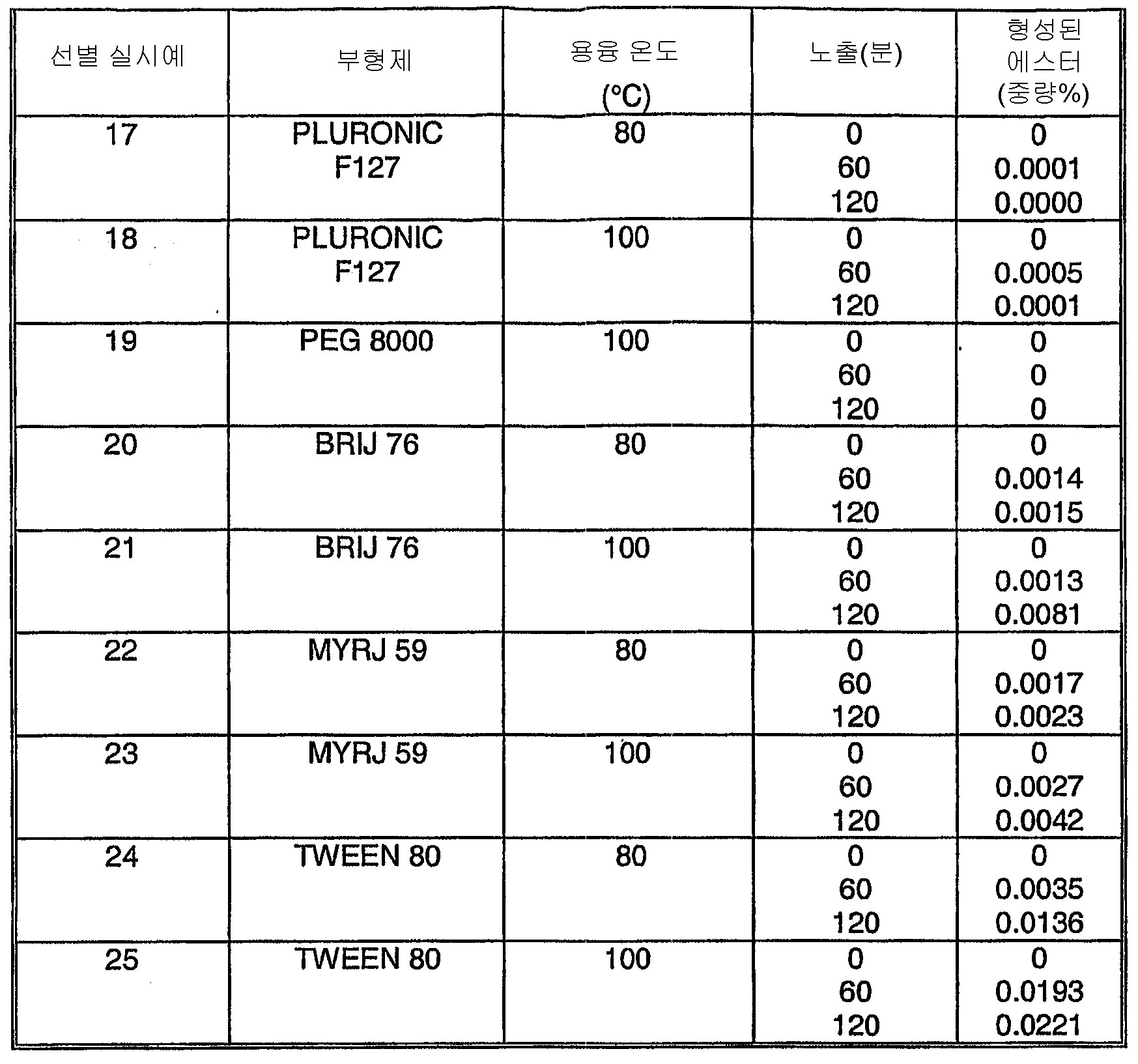

MYVAPLEX 600과 스테아르산에 대한 높은 반응 속도는 이들 담체가 적합한 후보가 아님을 가리킨다.High reaction rates for MYVAPLEX 600 and stearic acid indicate that these carriers are not suitable candidates.
선별 실시예 26Screening Example 26
본 실시예는 산/에스터 치환도를 부형제의 비누화 가로부터 측정하는 방법을 예시한다. 표 5에 나타낸 부형제들에 대한 산/에스터 치환도[A]를, 문헌[Pharmaceutical Excipients 2000]에 나타낸 담체의 비누화 가를 56.11로 나누어 측정하였다.This example illustrates how to measure acid / ester substitution from the saponification value of an excipient. The acid / ester substitution degree [A] for the excipients shown in Table 5 was determined by dividing the saponification value of the carrier shown in Pharmaceutical Excipients 2000 by 56.11.
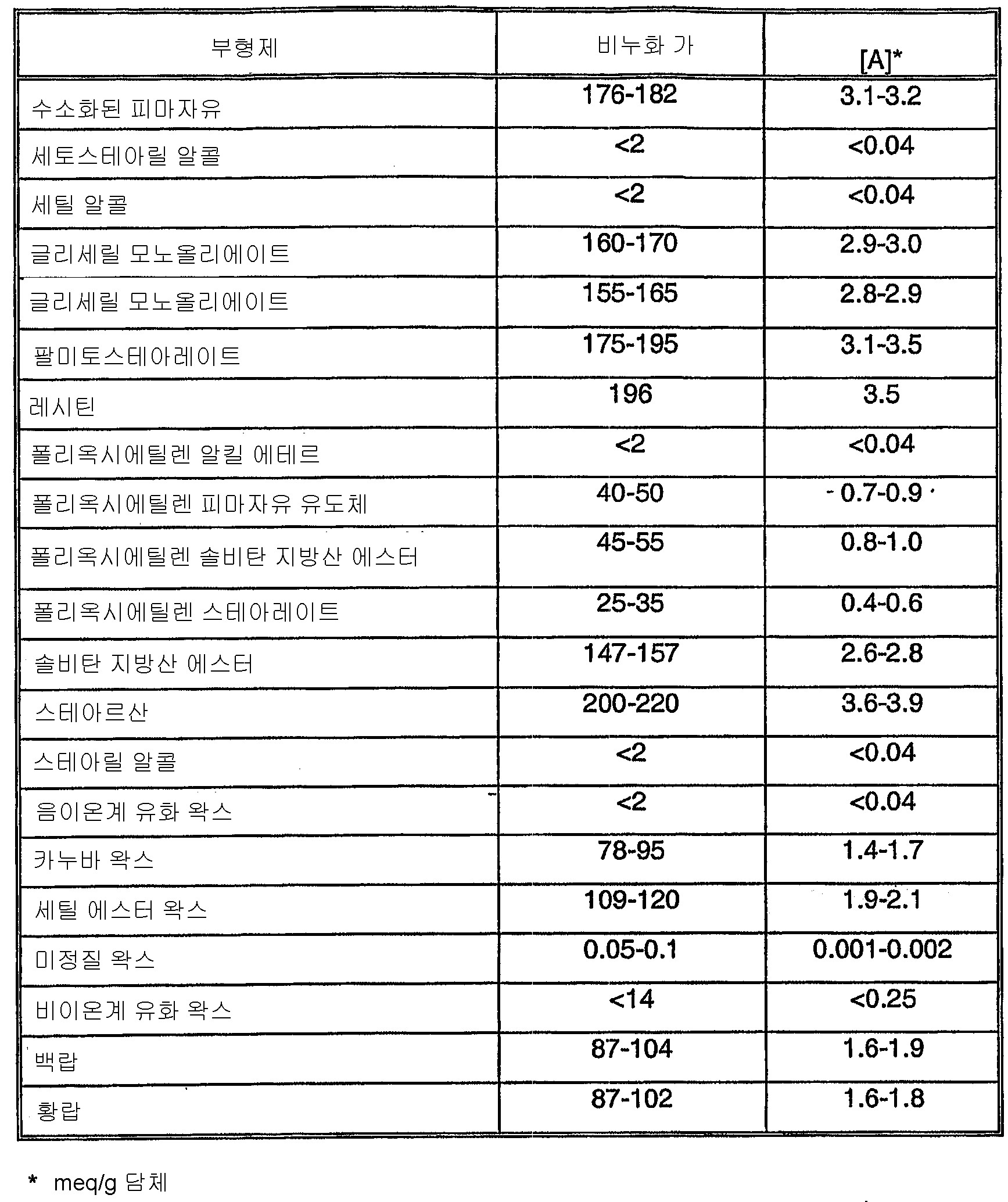
선별 실시예 27Screening Example 27
본 실시예는 산/에스터 치환도를 부형제의 비누화 가로부터 측정하는 방법을 예시한다. 표 6에 나타낸 부형제들에 대한 산/에스터 치환도[A]를, 제조자가 제공한 비누화 가를 56.11로 나누어 측정하였다.This example illustrates how to measure acid / ester substitution from the saponification value of an excipient. The acid / ester substitution degree [A] for the excipients shown in Table 6 was determined by dividing the saponification number provided by the manufacturer by 56.11.
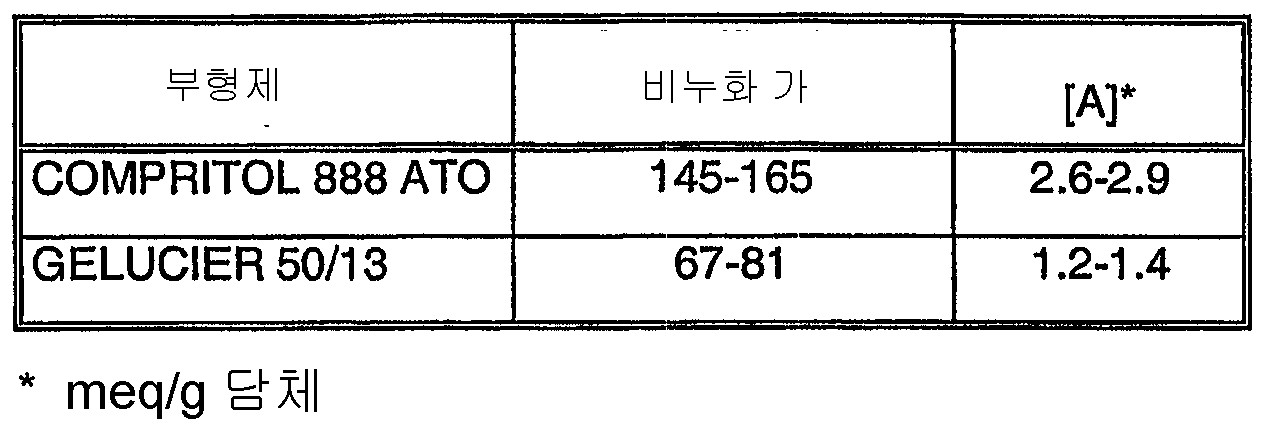
선별 실시예 28Screening Example 28
본 실시예는 산/에스터 치환도를 부형제의 구조로부터 측정하는 방법을 예시한다. 표 7에 나타낸 부형제들에 대한 산/에스터 치환도를, 상기 부형제 상의 산 및 에스터 치환체 몰 수를 그의 분자량으로 나누어 측정하였다. 중합체의 경우, 산/에스터 치환도를, 단량체 상의 산 및 에스터 치환체의 평균 몰 수를 상기 단량체의 분자량으로 나누어 계산하였다.This example illustrates how to measure acid / ester substitution from the structure of an excipient. The acid / ester substitution degree for the excipients shown in Table 7 was determined by dividing the mole number of acid and ester substituents on the excipient by their molecular weight. For polymers, acid / ester substitution was calculated by dividing the average mole number of acid and ester substituents on the monomers by the molecular weight of the monomers.

선별 실시예 29Screening Example 29
밀랍에 대한 아지트로마이신 이수화물의 용해도를 하기 과정을 사용하여 측정하였다. 밀랍 5 g 샘플을 유리 바이알에 넣고 상기 바이알을 고온-수욕에 넣어 상기 샘플을 65 ℃에서 용융시켰다. 이어서 아지트로마이신 이수화물의 결정을 교반하면서 상기 용융된 왁스에 서서히 가하였다. 상기 처음에 첨가된 결정을 상기 왁스에 용해시켰다. 총 0.3 g의 아지트로마이신 이수화물을 상기 용융된 왁스에 첨가한 경우 상기 아지트로마이신 이수화물은 전부 상기 왁스에 용해된 반면, 추가로 0.1 g의 아지트로마이신 이수화물을 가한 경우 상기 결정은 30 분 교반 후에 용해되지 않았다. 따라서, 밀랍에 대한 아지트로마이신 이수화물의 용해도는 약 6 중량%인 것으로 측정되었다.The solubility of azithromycin dihydrate in beeswax was measured using the following procedure. A 5 g sample of beeswax was placed in a glass vial and the vial was placed in a hot-water bath to melt the sample at 65 ° C. Crystals of azithromycin dihydrate were then added slowly to the molten wax with stirring. The initially added crystals were dissolved in the wax. When a total of 0.3 g of azithromycin dihydrate was added to the molten wax, all of the azithromycin dihydrate was dissolved in the wax, whereas when additional 0.1 g of azithromycin dihydrate was added, the crystal was 30 It did not dissolve after min stirring. Thus, the solubility of azithromycin dihydrate in beeswax was determined to be about 6% by weight.
선별 실시예 30 내지 40Screening Examples 30-40
선별 실시예 29에 개략된 과정을 사용하여, 표 8에 나타낸 부형제들에 대한 아지트로마이신 이수화물의 용해도를 상기 표 중에 나타낸 온도에서 측정하였다. 또한, 아지트로마이신 이수화물의 용해도를 표 8에 나타낸 중량비의 담체 혼합물에 대해 측정하였다.Using the procedure outlined in Screening Example 29, the solubility of azithromycin dihydrate in the excipients shown in Table 8 was measured at the temperatures shown in the table above. In addition, the solubility of azithromycin dihydrate was measured for the carrier mixtures in the weight ratios shown in Table 8.

실시예 1Example 1
본 실시예는 용융된 혼합물을 분무기로 압출시키고 생성된 소적들을 응결시킴으로써 다미립자를 제조함을 예시한다. 50 중량% 아지트로마이신 이수화물, 45 중량% COMPRITOL 888 ATO, 및 5 중량% PLURONIC F127을 포함하는 다미립자를 하기 용융-융결 과정을 사용하여 제조하였다. 먼저, COMPRITOL 112.5 g, PLURONIC F127 12.5 g 및 물 2 g을 기계적 혼합 패들이 장착된 밀폐된, 재킷이 있는 스테인레스-강 탱크에 가하였다. 97 ℃ 가열 유체를 상기 탱크의 재킷을 통해 순환시켰다. 약 40 분 후에, 상기 혼합물은 용융되어 약 95 ℃의 온도를 가졌다. 이어서 상기 혼합물을 370 rpm에서 15 분 동안 혼합하였다. 이어서 95 ℃ 및 100% RH에서 예열시킨 아지트로마이신 이수화물 125 g을 상기 용융물에 가하고 370 rpm의 속도로 5 분간 혼합하여 용융된 성분들 중의 아지트로마이신 이수화물의 공급물 현탁액을 생성시켰다.This example illustrates the preparation of multiparticulates by extruding the molten mixture into a nebulizer and condensing the resulting droplets. Multiparticulates comprising 50 wt% azithromycin dihydrate, 45 wt% COMPRITOL 888 ATO, and 5 wt% PLURONIC F127 were prepared using the following melt-fusion process. First, 112.5 g of COMPRITOL, 12.5 g of PLURONIC F127 and 2 g of water were added to a closed, jacketed stainless-steel tank equipped with a mechanical mixing paddle. 97 ° C. heating fluid was circulated through the tank's jacket. After about 40 minutes, the mixture melted and had a temperature of about 95 ° C. The mixture was then mixed at 370 rpm for 15 minutes. 125 g of azithromycin dihydrate preheated at 95 ° C. and 100% RH was then added to the melt and mixed for 5 minutes at a speed of 370 rpm to produce a feed suspension of azithromycin dihydrate in the molten components.
이어서 기어 펌프를 사용하여, 상기 공급물 현탁액을 회전-원반 분무기의 중앙에 250 g/분의 속도로 펌핑하였다. 주문 맞춤한 상기 회전 원반 분무기는 직경이 10.1 ㎝(4 in)인 볼 형상의 스테인레스 강 원반으로 이루어진다. 상기 원반의 표면을 상기 원반 바로 아래에 있는 박막 가열기로 약 100 ℃로 가열한다. 상기 원반은 상기 원반을 대략 10,000 RPM 까지 구동시키는 모터 상에 적재된다. 상기 전체 조립체는 직경이 대략 8 피트인 비닐 봉지에 둘러싸여 응결을 허용하고 상기 분무기에 의해 형성된 미세미립자들을 포획한다. 공기를 상기 원반 아래의 출입구로부터 도입시켜 응결 시 상기 다미립자를 냉각시키고 상기 봉지를 그의 확대된 크기 및 형상으로 팽창시킨다.Using a gear pump, the feed suspension was then pumped at the rate of 250 g / min to the center of the disk-dispenser. The rotary disk atomizer, which was customized, consisted of a ball-shaped stainless steel disk that was 10.1 cm (4 in) in diameter. The surface of the disk is heated to about 100 ° C. with a thin film heater directly below the disk. The disc is loaded on a motor that drives the disc to approximately 10,000 RPM. The entire assembly is surrounded by a plastic bag approximately 8 feet in diameter to allow for condensation and capture the fine particles formed by the atomizer. Air is introduced from the entrance below the disc to cool the multiparticulates upon condensation and expand the bag to its enlarged size and shape.
상기 회전 원반 분무기에 적합한 상업적인 등가물은 니로 A/S(Soeborg, Denmark)에 의해 제작된 FX1 100-㎜ 회전 분무기이다.A commercial equivalent suitable for the rotary disk sprayer is the FX1 100-mm rotary sprayer manufactured by Niro A / S (Soeborg, Denmark).
상기 회전 원반 분무기의 표면을 100 ℃에서 유지시키고, 상기 원반을 아지트로마이신 다미립자가 형성되는 동안 7500 rpm으로 회전시켰다.The surface of the rotating disk atomizer was maintained at 100 ° C. and the disk was spun at 7500 rpm while the azithromycin multiparticulates formed.
상기 회전 원반 분무기에 의해 형성된 입자들을 주변 공기 중에서 응결시켜 총 205 g의 다미립자를 수거하였다. 평균 입자 크기는 호리바(Horiba) LA-910 입자 크기 분석기를 사용하여 170 ㎛인 것으로 측정되었다. 상기 다미립자의 샘플들을 또한 PXRD에 의해 평가하였으며, 이는 상기 다미립자 중의 아지트로마이신의 83±10%가 결정성 이수화물임을 나타내었다.A total of 205 g of multiparticulates were collected by condensation of particles formed by the rotating disk atomizer in ambient air. Average particle size was determined to be 170 μm using a Horiba LA-910 particle size analyzer. Samples of the multiparticulates were also evaluated by PXRD, indicating that 83 ± 10% of the azithromycin in the multiparticulates was crystalline dihydrate.
상기 다미립자로부터 아지트로마이신의 방출 속도를 하기 과정을 사용하여 측정하였다. 상기 다미립자 750 ㎎ 샘플을 50 rpm에서 회전하는 테플론-코팅된 패들이 장착된 USP 유형 2 디소이트(dissoette) 플라스크에 넣었다. 상기 플라스크는 37.0±0.5℃에서 유지된 위 완충액을 모방한 0.01N HCl(pH 2) 750 ㎖을 함유하였다. 상기 다미립자를 상기 플라스크에 가하기 전에 상기 모방된 위 완충액 10 ㎖로 미리 적셨다. 이어서 상기 플라스크 중의 유체 3 ㎖ 샘플을 상기 다미립자를 상기 플라스크에 가한 다음 5, 15, 30 및 60 분째에 수거하였다. 상기 샘플들을 0.45 ㎛ 주사기 필터를 사용하여 여과한 후에 HPLC(휴렛 팩카드 1100, Waters Symmetry C8 컬럼, 1.0 ㎖/분의 45:30:25 아세토나이트릴:메탄올:25mM KH2PO4 완충액, 흡광도를 다이오드 배열 분광광도계를 사용하여 210 ㎚에서 측정하였다)를 통해 분석하였다.The release rate of azithromycin from the multiparticulates was measured using the following procedure. The multiparticulate 750 mg sample was placed in a USP Type 2 dissoette flask equipped with a Teflon-coated paddle rotating at 50 rpm. The flask contained 750 ml of 0.01 N HCl (pH 2) mimicking gastric buffer maintained at 37.0 ± 0.5 ° C. The multiparticulates were previously wetted with 10 ml of the mimicked gastric buffer before adding to the flask. A 3 ml sample of fluid in the flask was then collected at 5, 15, 30 and 60 minutes after the multiparticulates were added to the flask. The samples were filtered using a 0.45 μm syringe filter followed by HPLC (Hewlett Packard 1100, Waters Symmetry C 8 column, 1.0 mL / min 45:30:25 acetonitrile: methanol: 25 mM KH 2 PO 4 buffer, absorbance Was measured at 210 nm using a diode array spectrophotometer).
상기 용해 시험 결과를 표 9에 나타내며, 이는 상기 다미립자 코어로부터 아지트로마이신의 조절된 방출이 성취되었음을 보인다.The dissolution test results are shown in Table 9, indicating that controlled release of azithromycin from the multiparticulate core was achieved.
상기 다미립자의 샘플들을 선별 실시예 1 내지 3에서와 같이 LC/MS에 의해 아지트로마이신 에스터에 대해 분석하였다. 상기 분석의 결과는 상기 다미립자 중의 아지트로마이신 에스터 농도가 0.05 중량%임을 나타내었다.Samples of the multiparticulates were analyzed for azithromycin esters by LC / MS as in Screening Examples 1-3. The results of the analysis indicated that the concentration of azithromycin ester in the multiparticulates was 0.05% by weight.
실시예 2Example 2
50 중량% 아지트로마이신 이수화물, 40 중량% COMPRITOL 888 ATO, 및 10 중량% PLURONIC F127을 포함하는 다미립자를, 상기 아지트로마이신 이수화물을 융융된 COMPRITOL 888 ATO 및 PLURONIC F127에 가한 후 및 상기 다미립자를 회전 원반 분무기로 형성시키기 전에 상기 현탁액을 15 분간 교반함을 제외하고, 실시예 1에서와 같이 제조하였다. 상기와 같이 형성된 다미립자는 약 170 ㎛의 평균 입자 직경을 가졌다. PXRD 분석은 상기 다미립자 중의 아지트로마이신의 74±10%가 결정성 이수화물임을 가리켰다.Multiparticulates comprising 50 wt% azithromycin dihydrate, 40 wt% COMPRITOL 888 ATO, and 10 wt% PLURONIC F127, after the azithromycin dihydrate is added to the fused COMPRITOL 888 ATO and PLURONIC F127 and the The suspension was prepared as in Example 1, except that the suspension was stirred for 15 minutes before forming fine particles into a rotating disk atomizer. The multiparticulates formed as above had an average particle diameter of about 170 μm. PXRD analysis indicated that 74 ± 10% of the azithromycin in the multiparticulates was crystalline dihydrate.
상기 다미립자로부터의 아지트로마이신의 방출 속도를 실시예 1에서와 같이 측정하였다. 이러한 시험의 결과를 표 10에 나타낸다.The release rate of azithromycin from the multiparticulates was measured as in Example 1. The results of these tests are shown in Table 10.

상기 다미립자의 샘플들을 선별 실시예 1 내지 3에서와 같이 LC/MS에 의해 아지트로마이신 에스터에 대해 분석하였다. 상기 분석의 결과는 상기 다미립자 중의 아지트로마이신 에스터 농도가 0.33 중량%임을 나타내었다. 따라서, 상기 아지트로마이신을 보다 장시간 동안 용융된 담체에 노출시킨 결과 상기 다미립자 중에 존재하는 아지트로마이신 에스터의 양이 증가하였다.Samples of the multiparticulates were analyzed for azithromycin esters by LC / MS as in Screening Examples 1-3. The results of the analysis indicated that the concentration of azithromycin ester in the multiparticulates was 0.33% by weight. Thus, exposure of the azithromycin to the molten carrier for a longer time increased the amount of azithromycin ester present in the multiparticulates.
실시예 3Example 3
50 중량% 아지트로마이신 이수화물, 45 중량% 카누바 왁스, 및 5 중량% PLURONIC F127을 포함하는 다미립자를 하기 용융-응결 과정을 사용하여 제조하였다. 우선, 카누바 왁스 112.5 g 및 PLURONIC F127 12.5 g을 약 93 ℃의 온도에서 용기 중에서 용융시켰다. 이어서 아지트로마이신 이수화물 125 g을 상기 용융물에 현탁하고 약 15 분 동안 손으로 혼합하여 용융된 성분 중의 아지트로마이신 이수화물의 공급물 현탁액을 생성시켰다.Multiparticulates comprising 50 wt% azithromycin dihydrate, 45 wt% Kanuba wax, and 5 wt% PLURONIC F127 were prepared using the following melt-condensation procedure. First, 112.5 g of Kanuba wax and 12.5 g of PLURONIC F127 were melted in a vessel at a temperature of about 93 ° C. 125 g of azithromycin dihydrate were then suspended in the melt and mixed by hand for about 15 minutes to produce a feed suspension of azithromycin dihydrate in the molten component.
이어서 기어 펌프를 사용하여 상기 공급물 현탁액을 250 g/분의 속도로, 5000 rpm으로 회전하고 표면이 약 98 ℃에서 유지되는 실시예 1의 회전 원반 분무기의 중심에 펌핑하였다. 상기 회전 원반 분무기에 의해 형성된 입자를 주변 공기에서 응결시키고 총 167 g의 다미립자를 수거하였다.The feed suspension was then pumped using a gear pump to the center of the spinning disk sprayer of Example 1, rotating at 5000 rpm at a speed of 250 g / min and maintaining the surface at about 98 ° C. The particles formed by the rotating disk atomizer were condensed in ambient air and a total of 167 g of multiparticulates were collected.
상기 다미립자로부터의 아지트로마이신의 방출 속도를 실시예 1에서와 같이 측정하였다. 상기 용해 시험의 결과를 표 11에 나타내며, 이는 상기 다미립자 코어로부터 아지트로마이신의 조절된 방출이 성취되었음을 보인다.The release rate of azithromycin from the multiparticulates was measured as in Example 1. The results of the dissolution test are shown in Table 11, which indicates that controlled release of azithromycin from the multiparticulate core was achieved.

상기 다미립자의 샘플들을 약 190일 동안 실온에서 보관하였으며 이어서 선별 실시예 1 내지 3에서와 같이 LC/MS에 의해 아지트로마이신 에스터에 대해 분석하였다. 상기 분석의 결과는 상기 다미립자 중의 아지트로마이신 에스터 농도가 0.012 중량%임을 나타내었다.Samples of the multiparticulates were stored at room temperature for about 190 days and then analyzed for azithromycin esters by LC / MS as in Screening Examples 1-3. The results of the analysis indicated that the concentration of azithromycin ester in the multiparticulates was 0.012% by weight.
실시예 4Example 4
40 중량% 아지트로마이신 이수화물 및 60 중량% 미정질 왁스를 포함하는 다미립자를 하기 용융-응결 과정을 사용하여 제조하였다. 먼저, 미정질 왁스 150 g 및 물 5 g을 기계적 혼합 패들이 장착된 밀폐된, 재킷이 있는 스테인레스-강 탱크에 가하였다. 97 ℃ 가열 유체를 상기 탱크의 재킷을 통해 순환시켰다. 약 40 분 후에, 상기 왁스는 용융되어 약 94 ℃의 온도를 가졌다. 이어서 95 ℃ 및 100% RH에서 예열시킨 아지트로마이신 이수화물 100 g 및 물 2 g을 상기 용융된 왁스에 가하고 370 rpm의 속도로 75 분간 혼합하여 미정질 왁스 중의 아지트로마이신 이수화물의 공급물 현탁액을 생성시켰다Multiparticulates comprising 40 wt% azithromycin dihydrate and 60 wt% microcrystalline wax were prepared using the following melt-condensation procedure. First, 150 g of microcrystalline wax and 5 g of water were added to a closed, jacketed stainless-steel tank equipped with a mechanical mixing paddle. 97 ° C. heating fluid was circulated through the tank's jacket. After about 40 minutes, the wax melted and had a temperature of about 94 ° C. Then 100 g of azithromycin dihydrate preheated at 95 ° C. and 100% RH and 2 g of water were added to the molten wax and mixed for 75 minutes at a speed of 370 rpm to prepare a feed suspension of azithromycin dihydrate in microcrystalline wax. Generated
이어서 기어 펌프를 사용하여 상기 공급물 현탁액을 250 cc/분의 속도로, 7500 rpm으로 회전하고 표면이 약 100 ℃에서 유지되는 실시예 1의 회전 원반 분무기의 중심에 펌핑하였다. 상기 회전 원반 분무기에 의해 형성된 입자들을 주변 공기 중에서 응결시켰다. 평균 입자 크기는 호리바 LA-910 입자 크기 분석기를 사용하여 170 ㎛인 것으로 측정되었다. 상기 다미립자의 샘플들을 또한 PXRD에 의해 평가하였으며, 이는 상기 다미립자 중의 아지트로마이신의 93±10%가 결정성 이수화물임을 나타내었다.The feed suspension was then pumped using a gear pump to the center of the spinning disk sprayer of Example 1, rotating at 7500 rpm at a speed of 250 cc / min and maintaining the surface at about 100 ° C. Particles formed by the rotating disk atomizer were condensed in ambient air. Average particle size was determined to be 170 μm using a Horiba LA-910 particle size analyzer. Samples of the multiparticulates were also evaluated by PXRD, indicating that 93 ± 10% of the azithromycin in the multiparticulates was crystalline dihydrate.
상기 다미립자로부터의 아지트로마이신의 방출 속도를 실시예 1에서와 같이 측정하였다. 상기 용해 시험의 결과를 표 12에 나타내며, 이는 상기 코어로부터 아지트로마이신의 조절된 방출이 성취되었음을 보인다.The release rate of azithromycin from the multiparticulates was measured as in Example 1. The results of the dissolution test are shown in Table 12, which shows that controlled release of azithromycin from the core has been achieved.

실시예 5Example 5
실시예 4와 동일한 조성의 다미립자를, 아지트로마이신 이수화물을 주변 상대 습도에서 100 ℃로 예열하고 상기 아지트로마이신 이수화물을 용융된 미정질 왁스와 혼합할 때 추가의 물을 공급물 탱크에 가하지 않음을 제외하고, 실시예 4에서와 같이 제조하였다. 평균 입자 크기는 호리바 LA-910 입자-크기 분석기를 사용하여 180 ㎛인 것으로 측정되었다. 상기 다미립자 샘플을 또한 PXRD에 의해 평가하였으며, 이는 상기 다미립자 중의 아지트로마이신의 단지 67%만이 결정성이고, 이수화물 및 비-이수화물 결정 형태가 상기 다미립자 중에 존재함을 보였다.The multiparticulates of the same composition as in Example 4 were preheated with azithromycin dihydrate to 100 ° C. at ambient relative humidity and additional water was added to the feed tank when the azithromycin dihydrate was mixed with the molten microcrystalline wax. Prepared as in Example 4 except no addition. Average particle size was determined to be 180 μm using a Horiba LA-910 particle-size analyzer. The multiparticulate samples were also evaluated by PXRD, which showed that only 67% of the azithromycin in the multiparticulates was crystalline and that dihydrate and non-dihydrate crystal forms were present in the multiparticulates.
상기 다미립자의 샘플들을 선별 실시예 1 내지 3에서와 같이 아지트로마이신 에스터에 대해 분석하였다. 상기 분석의 결과는 상기 다미립자 중의 아지트로마이신 에스터 농도가 0.01 중량%임을 나타내었다.Samples of the multiparticulates were analyzed for azithromycin esters as in Screening Examples 1-3. The results of the analysis indicated that the azithromycin ester concentration in the multiparticulates was 0.01% by weight.
실시예 6Example 6
40 중량% 아지트로마이신 이수화물, 59 중량% 미정질 왁스 및 1 중량% PLURONIC F127을 포함하는 다미립자를 하기 용융-응결 과정을 사용하여 제조하였다. 먼저, 아지트로마이신 이수화물 200 g, 미정질 왁스 295 g 및 PLURONIC F127 5 g을 트윈-쉘 블렌더에서 10 분 동안 블렌딩하였다. 이어서 상기 블렌드를 0.050" 스크린을 사용하고 전방에 나이프가 있는 피츠패트릭(Fitzpatric) L1A 밀에서 3000 rpm에서 덩어리를 풀었다. 이어서 상기 블렌드를 트윈-쉘 블렌더에서 추가로 10 분 동안 혼합하였다.Multiparticulates comprising 40 wt% azithromycin dihydrate, 59 wt% microcrystalline wax, and 1 wt% PLURONIC F127 were prepared using the following melt-condensation procedure. First, 200 g of azithromycin dihydrate, 295 g of microcrystalline wax and 5 g of PLURONIC F127 were blended in a twin-shell blender for 10 minutes. The blend was then unwound at 3000 rpm in a Fitzpatric L1A mill with a 0.050 "screen and with a knife in front. The blend was then mixed for an additional 10 minutes in a twin-shell blender.
이어서, 상기 블렌드 250 g을 기계적 혼합 패들이 장착된 밀폐된, 재킷이 있는 스테인레스-강 탱크에 가하였다. 99 ℃ 가열 유체를 상기 탱크의 재킷을 통해 순환시켰다. 약 60 분 후에, 상기 블렌드를 용융시켰으며, 물 1 g을 상기 탱크에 가하고 370 rpm에서 혼합하였다. 15 분의 혼합 후에, 추가로 1 g의 물을 상기 탱크에 가하였다. 총 4 g의 물을 상기 탱크에 가할 때까지 이를 반복하였다.250 g of the blend were then added to a closed, jacketed stainless-steel tank equipped with a mechanical mixing paddle. A 99 ° C. heating fluid was circulated through the tank's jacket. After about 60 minutes, the blend was melted and 1 g of water was added to the tank and mixed at 370 rpm. After 15 minutes of mixing, an additional 1 g of water was added to the tank. This was repeated until a total of 4 g of water was added to the tank.
총 60 분의 혼합 후에, 기어 펌프를 사용하여 상기 공급물 현탁액을 250 cc/분의 속도로, 5000 rpm으로 회전하고 표면이 약 100 ℃에서 유지되는 실시예 1의 회전 원반 분무기의 중앙에 펌핑하였다. 상기 회전 원반 분무기에 의해 형성된 입자들을 주변 공기 중에서 응결시켰다. 평균 입자 크기는 호리바 LA-910 입자 크기 분석기를 사용하여 250 ㎛인 것으로 측정되었다. 상기 다미립자의 샘플들을 또한 PXRD에 의해 평가하였으며, 이는 상기 다미립자 중의 아지트로마이신의 16%가 결정성이고, 이수화물 및 비-이수화물 결정 형태가 상기 다미립자 중에 존재함을 보였다.After a total of 60 minutes of mixing, a gear pump was used to pump the feed suspension to the center of the spinning disk sprayer of Example 1, rotating at 5000 rpm and at a surface of about 100 ° C. at a rate of 250 cc / min. . Particles formed by the rotating disk atomizer were condensed in ambient air. Average particle size was determined to be 250 μm using a Horiba LA-910 particle size analyzer. Samples of the multiparticulates were also evaluated by PXRD, which showed that 16% of the azithromycin in the multiparticulates was crystalline and that dihydrate and non-dihydrate crystal forms were present in the multiparticulates.
상기 다미립자의 샘플들을 선별 실시예 1 내지 3에서와 같이 아지트로마이신 에스터에 대해 분석하였다. 상기 분석의 결과는 상기 다미립자 중의 아지트로마이신 에스터 농도가 0.005 중량%임을 나타내었다.Samples of the multiparticulates were analyzed for azithromycin esters as in Screening Examples 1-3. The results of the analysis indicated that the azithromycin ester concentration in the multiparticulates was 0.005% by weight.
상기 다미립자로부터의 아지트로마이신의 방출 속도를 실시예 1에서와 같이 측정하였다. 상기 용해 시험의 결과를 표 13에 나타내며, 이는 상기 코어로부터 아지트로마이신의 조절된 방출이 성취되었음을 입증한다.The release rate of azithromycin from the multiparticulates was measured as in Example 1. The results of the dissolution test are shown in Table 13, demonstrating that controlled release of azithromycin from the core has been achieved.

실시예 7Example 7
40 중량% 아지트로마이신 이수화물, 55 중량% 미정질 왁스 및 5 중량% 석유를 포함하는 다미립자를 하기 용융-응결 과정을 사용하여 제조하였다. 먼저, 미정질 왁스 137.5 g, 석유 12.5 g 및 물 2 g을 기계적 혼합 패들이 장착된 밀폐된, 재킷이 있는 스테인레스-강 탱크에 가하였다. 101 ℃ 가열 유체를 상기 탱크의 재킷을 통해 순환시켰다. 약 50 분 후에, 상기 혼합물은 용융되었다. 이어서 95 ℃ 및 100% RH에서 예열시킨 아지트로마이신 이수화물 100 g을 상기 용융물에 가하고 370 rpm의 속도로 75 분간 혼합하여 미정질 왁스 중의 아지트로마이신 이수화물의 공급물 현탁액을 생성시켰다Multiparticulates comprising 40 wt% azithromycin dihydrate, 55 wt% microcrystalline wax and 5 wt% petroleum were prepared using the following melt-condensation procedure. First, 137.5 g of microcrystalline wax, 12.5 g of oil and 2 g of water were added to a closed, jacketed stainless-steel tank equipped with a mechanical mixing paddle. A 101 ° C. heating fluid was circulated through the tank's jacket. After about 50 minutes, the mixture melted. Then 100 g of azithromycin dihydrate preheated at 95 ° C. and 100% RH was added to the melt and mixed for 75 minutes at a speed of 370 rpm to produce a feed suspension of azithromycin dihydrate in microcrystalline wax.
이어서 기어 펌프를 사용하여 상기 공급물 현탁액을 250 cc/분의 속도로, 7500 rpm으로 회전하고 표면이 약 100 ℃에서 유지되는 실시예 1의 회전 원반 분무기의 중앙에 펌핑하였다. 상기 회전 원반 분무기에 의해 형성된 입자들을 주변 공기 중에서 응결시켰다. 평균 입자 크기는 호리바 LA-910 입자 크기 분석기를 사용하여 170 ㎛인 것으로 측정되었다. 상기 다미립자의 샘플들을 또한 PXRD에 의해 평가하였으며, 이는 상기 다미립자 중의 아지트로마이신의 85±10%가 결정성 이수화물임을 나타내었다.The feed suspension was then pumped using a gear pump to the center of the spinning disk nebulizer of Example 1, rotating at 7500 rpm at a rate of 250 cc / min and maintaining the surface at about 100 ° C. Particles formed by the rotating disk atomizer were condensed in ambient air. Average particle size was determined to be 170 μm using a Horiba LA-910 particle size analyzer. Samples of the multiparticulates were also evaluated by PXRD, indicating that 85 ± 10% of the azithromycin in the multiparticulates was crystalline dihydrate.
상기 다미립자의 샘플들을 선별 실시예 1 내지 3에서와 같이 아지트로마이신 에스터에 대해 분석하였다. 상기 다미립자에서 아지트로마이신 에스터는 검출되지 않았다.Samples of the multiparticulates were analyzed for azithromycin esters as in Screening Examples 1-3. Azithromycin esters were not detected in the multiparticulates.
상기 다미립자로부터의 아지트로마이신의 방출 속도를 실시예 1에서와 같이 측정하였다. 상기 용해 시험의 결과를 표 14에 나타내며, 이는 상기 코어로부터 아지트로마이신의 조절된 방출이 성취되었음을 보인다.The release rate of azithromycin from the multiparticulates was measured as in Example 1. The results of the dissolution test are shown in Table 14, which shows that controlled release of azithromycin from the core has been achieved.

실시예 8Example 8
38 중량% 아지트로마이신 이수화물, 13 중량% Na3PO4, 33 중량% 미정질 왁스, 8 중량% PLURONIC F87 및 8 중량% 스테아릴 알콜을 포함하는 다미립자를 하기 용융-응결 과정을 사용하여 제조하였다. 먼저, 미정질 왁스 166.5 g, Na3PO4 62.5 g, PLURONIC F87 41.5 g 및 스테아릴 알콜 41.5 g을 95 ℃ 수 욕에서 유리 비이커에서 가열하였다. 약 60 분 후에, 상기 혼합물은 용융되었다. 이어서, 아지트로마이신 이수화물 187.5 g을 상기 용융물에 가하고 주걱을 사용하여 약 15 분 동안 혼합하여 다른 성분 중의 아지트로마이신 이수화물 및 Na3PO4의 공급물 현탁액을 생성시켰다.Multiparticulates comprising 38 wt% azithromycin dihydrate, 13 wt% Na 3 PO 4 , 33 wt% microcrystalline wax, 8 wt% PLURONIC F87, and 8 wt% stearyl alcohol, using the following melt-condensation process Prepared. First, 166.5 g of microcrystalline wax, 62.5 g of Na 3 PO 4 , 41.5 g of PLURONIC F87 and 41.5 g of stearyl alcohol were heated in a glass beaker in a 95 ° C. water bath. After about 60 minutes, the mixture melted. 187.5 g of azithromycin dihydrate was then added to the melt and mixed for about 15 minutes using a spatula to produce a feed suspension of azithromycin dihydrate and Na 3 PO 4 in the other ingredients.
이어서 기어 펌프를 사용하여 상기 공급물 현탁액을 250 cc/분의 속도로, 7000 rpm으로 회전하고 표면이 약 100 ℃에서 유지되는 실시예 1의 회전 원반 분무기의 중앙에 펌핑하였다. 상기 회전 원반 분무기에 의해 형성된 입자들을 주변 공기 중에서 응결시켰다. 평균 입자 크기는 호리바 LA-910 입자 크기 분석기를 사용하여 250 ㎛인 것으로 측정되었다. 상기 다미립자의 샘플들을 또한 PXRD에 의해 평가하였으며, 이는 상기 다미립자 중의 아지트로마이신의 약 89%가 결정성 이수화물임을 나타내었다.The feed suspension was then pumped using a gear pump to the center of the spinning disk sprayer of Example 1, rotating at 250 cc / min, at 7000 rpm and having a surface maintained at about 100 ° C. Particles formed by the rotating disk atomizer were condensed in ambient air. Average particle size was determined to be 250 μm using a Horiba LA-910 particle size analyzer. Samples of the multiparticulates were also evaluated by PXRD, indicating that about 89% of the azithromycin in the multiparticulates was crystalline dihydrate.
상기 다미립자의 샘플들을 선별 실시예 1 내지 3에서와 같이 아지트로마이신 에스터에 대해 분석하였다. 상기 다미립자에서 아지트로마이신 에스터는 검출되지 않았다.Samples of the multiparticulates were analyzed for azithromycin esters as in Screening Examples 1-3. Azithromycin esters were not detected in the multiparticulates.
상기 다미립자로부터의 아지트로마이신의 방출 속도를 실시예 1에서와 같이 측정하였다. 상기 용해 시험의 결과를 표 15에 나타내며, 이는 상기 코어로부터 아지트로마이신의 조절된 방출이 성취되었음을 보인다.The release rate of azithromycin from the multiparticulates was measured as in Example 1. The results of the dissolution test are shown in Table 15, which shows that controlled release of azithromycin from the core has been achieved.

실시예 9Example 9
45 중량% 아지트로마이신 이수화물, 37 중량% 미정질 왁스, 9 중량% PLURONIC F87 및 9 중량% 스테아릴 알콜을 포함하는 다미립자를 하기 용융-응결 과정을 사용하여 제조하였다. 먼저, 미정질 왁스 370 g, PLURONIC F87 90 g 및 스테아릴 알콜 90 g을 93 ℃ 수 욕에서 유리 비이커에서 가열하였다. 약 60 분 후에, 상기 혼합물은 용융되었다. 이어서, 아지트로마이신 이수화물 450 g을 상기 용융물에 가하고 주걱을 사용하여 약 25 분 동안 혼합하여 다른 성분들 중의 아지트로마이신 이수화물의 공급물 현탁액을 생성시켰다.Multiparticulates comprising 45 wt% azithromycin dihydrate, 37 wt% microcrystalline wax, 9 wt% PLURONIC F87, and 9 wt% stearyl alcohol were prepared using the following melt-condensation process. First, 370 g of microcrystalline wax, 90 g of PLURONIC F87 and 90 g of stearyl alcohol were heated in a glass beaker in a 93 ° C. water bath. After about 60 minutes, the mixture melted. Then 450 g of azithromycin dihydrate was added to the melt and mixed for about 25 minutes using a spatula to produce a feed suspension of azithromycin dihydrate in the other components.
이어서 기어 펌프를 사용하여 상기 공급물 현탁액을 250 cc/분의 속도로, 8000 rpm으로 회전하고 표면이 약 100 ℃에서 유지되는 실시예 1의 회전 원반 분무기의 중앙에 펌핑하였다. 상기 회전 원반 분무기에 의해 형성된 입자들을 주변 공기 중에서 응결시켰다. 평균 입자 크기는 호리바 LA-910 입자 크기 분석기를 사용하여 190 ㎛인 것으로 측정되었다. 상기 다미립자의 샘플들을 또한 PXRD에 의해 평가하였으며, 이는 상기 다미립자 중의 아지트로마이신의 약 84%가 결정성 이수화물임을 나타내었다.The feed suspension was then pumped using a gear pump to the center of the spinning disk sprayer of Example 1, rotating at 250 cc / min, at 8000 rpm and having a surface maintained at about 100 ° C. Particles formed by the rotating disk atomizer were condensed in ambient air. Average particle size was determined to be 190 μm using a Horiba LA-910 particle size analyzer. Samples of the multiparticulates were also evaluated by PXRD, indicating that about 84% of the azithromycin in the multiparticulates is crystalline dihydrate.
상기 다미립자의 샘플들을 선별 실시예 1 내지 3에서와 같이 아지트로마이신 에스터에 대해 분석하였다. 상기 다미립자에서 아지트로마이신 에스터는 검출되지 않았다.Samples of the multiparticulates were analyzed for azithromycin esters as in Screening Examples 1-3. Azithromycin esters were not detected in the multiparticulates.
상기 다미립자로부터의 아지트로마이신의 방출 속도를 실시예 1에서와 같이 측정하였다. 상기 용해 시험의 결과를 표 16에 나타내며, 이는 상기 코어로부터 아지트로마이신의 조절된 방출이 성취되었음을 보인다.The release rate of azithromycin from the multiparticulates was measured as in Example 1. The results of the dissolution test are shown in Table 16, which shows that controlled release of azithromycin from the core has been achieved.

실시예 10Example 10
70 중량% 아지트로마이신 이수화물 및 30 중량% 스테아릴 알콜을 포함하는 다미립자를 하기 용융-응결 과정을 사용하여 제조하였다. 먼저, 스테아릴 알콜 121 g을 95 ℃ 수 욕에서 유리 비이커에서 용융시켰다. 이어서, 아지트로마이신 이수화물 282 g을 상기 용융물에 가하고 주걱을 사용하여 약 15 분 동안 혼합하여 스테아릴 알콜 중의 아지트로마이신 이수화물의 공급물 현탁액을 생성시켰다.Multiparticulates comprising 70 wt% azithromycin dihydrate and 30 wt% stearyl alcohol were prepared using the following melt-condensation procedure. First, 121 g of stearyl alcohol was melted in a glass beaker in a 95 ° C. water bath. 282 g of azithromycin dihydrate were then added to the melt and mixed for about 15 minutes using a spatula to produce a feed suspension of azithromycin dihydrate in stearyl alcohol.
이어서 기어 펌프를 사용하여 상기 공급물 현탁액을 250 cc/분의 속도로, 6700 rpm으로 회전하고 표면이 약 95 ℃에서 유지되는 실시예 1의 회전 원반 분무기의 중앙에 펌핑하였다. 상기 회전 원반 분무기에 의해 형성된 입자들을 주변 공기 중에서 응결시켰다. 입자 크기는 호리바 LA-910 입자 크기 분석기를 사용하여 약 229 ㎛인 것으로 측정되었다.The feed suspension was then pumped using a gear pump to the center of the spinning disk nebulizer of Example 1, rotating at 6700 rpm at a speed of 250 cc / min and maintaining the surface at about 95 ° C. Particles formed by the rotating disk atomizer were condensed in ambient air. Particle size was determined to be about 229 μm using Horiba LA-910 particle size analyzer.
상기 다미립자의 샘플들을 선별 실시예 1 내지 3에서와 같이 아지트로마이신 에스터에 대해 분석하였다. 상기 다미립자에서 아지트로마이신 에스터는 검출되지 않았다.Samples of the multiparticulates were analyzed for azithromycin esters as in Screening Examples 1-3. Azithromycin esters were not detected in the multiparticulates.
상기 다미립자로부터의 아지트로마이신의 방출 속도를 실시예 1에서와 같이 측정하였다. 상기 용해 시험의 결과를 표 17에 나타내며, 이는 상기 코어로부터 아지트로마이신의 조절된 방출이 성취되었음을 보인다.The release rate of azithromycin from the multiparticulates was measured as in Example 1. The results of the dissolution test are shown in Table 17, which shows that controlled release of azithromycin from the core has been achieved.
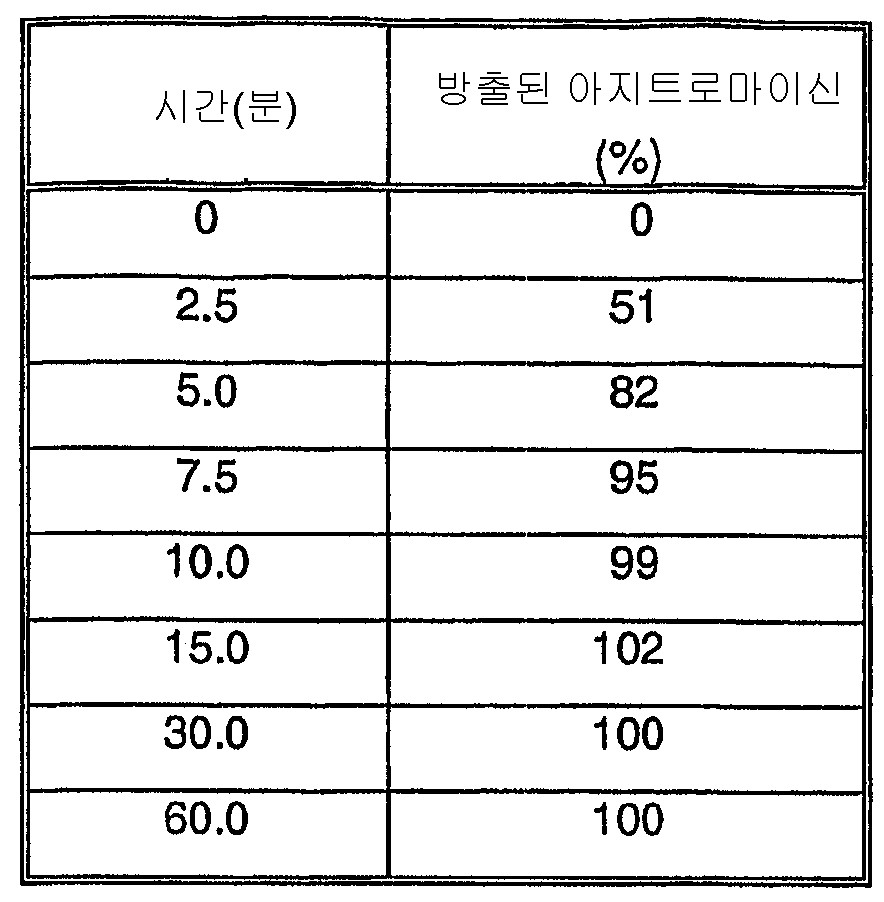
실시예 11Example 11
50 중량% 아지트로마이신 이수화물, 40 중량% COMPRITOL 888 ATO, 및 10 중량% PLURONIC F127을 포함하는 다미립자를 하기 과정을 사용하여 제조하였다. 먼저, 아지트로마이신 이수화물 250 g, COMPRITOL 888 ATO 200 g, 및 PLURONIC F127 50 g을 20 분 동안 트윈쉘 블렌더에서 블렌딩하였다. 이어서 상기 블렌드를 0.065" 스크린을 사용하고 전방에 나이프가 있는 피츠패트릭 L1A 밀에서 3000 rpm에서 덩어리를 풀었다. 이어서 상기 블렌드를 트윈-쉘 블렌더에서 다시 20 분 동안 블렌딩하여 예비블렌드 공급물을 형성시켰다.Multiparticulates comprising 50 wt% azithromycin dihydrate, 40 wt% COMPRITOL 888 ATO, and 10 wt% PLURONIC F127 were prepared using the following procedure. First, 250 g of azithromycin dihydrate, 200 g of COMPRITOL 888 ATO, and 50 g of PLURONIC F127 were blended in a twin shell blender for 20 minutes. The blend was then agglomerated at 3000 rpm on a Fitzpatrick L1A mill with a 0.065 "screen and in front of the knife. The blend was then blended again in a twin-shell blender for 20 minutes to form a preblend feed. .
상기 예비블렌드 공급물을 B&P 19-㎜ 트윈-스크류 압출기(25 L/D 비를 갖는 MP19-TC, B&P Process Equipment and Systems, LLC, Saginaw, MI로부터 구입)에 130 g/분의 속도로 전달하여, 약 90 ℃의 온도에서 COMPRITOL 888 ATO/PLURONIC F127 중의 아지트로마이신 이수화물의 용융된 공급물 현탁액을 제조하였다. 이어서 상기 공급물 현탁액을 5500 rpm에서 회전하는, 실시예 1의 회전-원반 분무기로 전달하였다. 상기 트윈-스크류 압출기 중의 아지트로마이신 이수화물의 최대 체류 시간은 약 60 초이며, 상기 아지트로마이신 이수화물을 상기 용융된 현탁액에 노출시키는 총 시간은 약 3 분 미만이었다. 상기 회전-원반 분무기에 의해 형성된 입자를 주변 공기 중에서 응결시키고 총 270 g의 다미립자를 수거하였다.The preblend feed was delivered to a B & P 19-mm twin-screw extruder (purchased from MP19-TC, B & P Process Equipment and Systems, LLC, Saginaw, MI, having a 25 L / D ratio) at a rate of 130 g / min. A molten feed suspension of azithromycin dihydrate in COMPRITOL 888 ATO / PLURONIC F127 was prepared at a temperature of about 90 ° C. The feed suspension was then delivered to the spinning-disk nebulizer of Example 1, rotating at 5500 rpm. The maximum residence time of azithromycin dihydrate in the twin-screw extruder was about 60 seconds and the total time of exposing the azithromycin dihydrate to the molten suspension was less than about 3 minutes. Particles formed by the rotary-disk atomizer were condensed in ambient air and a total of 270 g of multiparticulates were collected.
상기와 같이 형성된 다미립자를 하기와 같이 후 처리하였다. 상기 다미립자 샘플을 약 2 ㎝의 깊이를 갖는 얕은 선반에 놓았다. 이어서 상기 선반을 47 ℃ 및 70% RH로 조절된 대기 오븐에 24 시간 동안 두었다.The multiparticulates formed as above were post-treated as follows. The multiparticulate samples were placed on a shallow shelf with a depth of about 2 cm. The shelf was then placed in a stand-by oven controlled at 47 ° C. and 70% RH for 24 hours.
실시예 12 내지 16Examples 12-16
표 18에 나타낸 변수들에 따라 다양한 비로 아지트로마이신 이수화물, COMPRITOL 888 ATO, 및 PLURONIC F127을 포함하는 다미립자들을 실시예 11에서와 같이 제조하였다.Multiparticulates were prepared as in Example 11, including azithromycin dihydrate, COMPRITOL 888 ATO, and PLURONIC F127, in various ratios according to the parameters shown in Table 18.

실시예 11 내지 16의 다미립자로부터의 아지트로마이신 방출 속도를 하기 과정을 사용하여 측정하였다. 상기 다미립자 샘플을 50 rpm에서 회전하는 테플론-코팅된 패들이 장착된 USP 유형 2 디소이트 플라스크에 넣었다. 실시예 11 내지 13 및 16의 경우, 다미립자 1060 ㎎을 상기 용해 매질에 가하고; 실시예 14의 경우, 1048 ㎎을 가하고; 실시예 15의 경우, 1000 ㎎을 가하였다. 상기 플라스크는 37.0±0.5℃에서 유지된 50 mM KH2PO4 완충액(pH 6.8) 1000 ㎖을 함유하였다. 상기 다미립자를 상기 플라스크에 가하기 전에 상기 완충액 10 ㎖로 미리 적셨다. 이어서 상기 플라스크 중의 유체 3 ㎖ 샘플을 상기 다미립자를 상기 플라스크에 가한 다음 5, 15, 30, 60, 120 및 180 분째에 수거하였다. 상기 샘플들을 0.45 ㎛ 주사기 필터를 사용하여 여과한 후에 HPLC(휴렛 팩카드 1100, Waters Symmetry C8 컬럼, 1.0 ㎖/분의 45:30:25 아세토나이트릴:메탄올:25mM KH2PO4 완충액, 흡광도를 다이오드 배열 분광광도계를 사용하여 210 ㎚에서 측정하였다)를 통해 분석하였다. 상기 용해 시험 결과를 표 19에 나타내며, 이는 상기 아지트로마이신의 조절된 방출이 성취되었음을 보인다.The rate of azithromycin release from the multiparticulates of Examples 11-16 was measured using the following procedure. The multiparticulate samples were placed in a USP Type 2 Desodium flask equipped with a Teflon-coated paddle rotating at 50 rpm. For Examples 11-13 and 16, 1060 mg of multiparticulates were added to the dissolution medium; For Example 14, 1048 mg was added; For Example 15, 1000 mg was added. The flask contained 1000 ml of 50 mM KH 2 PO 4 buffer (pH 6.8) maintained at 37.0 ± 0.5 ° C. The multiparticulates were previously wetted with 10 ml of the buffer before adding to the flask. A 3 ml sample of fluid in the flask was then collected at 5, 15, 30, 60, 120 and 180 minutes after the multiparticulates were added to the flask. The samples were filtered using a 0.45 μm syringe filter followed by HPLC (Hewlett Packard 1100, Waters Symmetry C 8 column, 1.0 mL / min 45:30:25 acetonitrile: methanol: 25 mM KH 2 PO 4 buffer, absorbance Was measured at 210 nm using a diode array spectrophotometer). The dissolution test results are shown in Table 19, which shows that controlled release of the azithromycin was achieved.

실시예 17 내지 19Examples 17-19
실시예 17 내지 19의 경우, 표 20에 나타낸 변수들에 따라 다양한 비로 아지트로마이신 이수화물 및 COMPRITOL 888 ATO를 포함하는 다미립자들을 실시예 11에서와 같이 제조하였다.For Examples 17-19, multiparticulates were prepared as in Example 11, including azithromycin dihydrate and COMPRITOL 888 ATO in various ratios according to the parameters shown in Table 20.

하기를 제외하고, 실시예 17 내지 20의 다미립자로부터의 아지트로마이신 방출 속도를 실시예 11 내지 16에서와 같이 측정하였다. 실시예 17의 경우, 샘플 크기는 1342 ㎎이었고; 실시예 18의 경우, 1790 ㎎, 실시예 19의 경우 2680 ㎎이었다. 상기 용해 시험의 결과를 표 21에 나타내며, 이는 아지트로마이신의 조절된 방출이 성취되었으며 상기 속도는 다미립자 조성에 따라 변함을 보인다.Azithromycin release rates from the multiparticulates of Examples 17-20 were measured as in Examples 11-16, except as follows. For Example 17, the sample size was 1342 mg; In Example 18, it was 1790 mg, and in Example 19, 2680 mg. The results of the dissolution test are shown in Table 21, which shows that controlled release of azithromycin has been achieved and the rate varies with the multiparticulate composition.

실시예 20Example 20
표 22에 나타낸 변수들에 따라 다양한 비로 아지트로마이신 이수화물, 담체로서 수소화된 면실유(STEROTEX NF, ABITEC Corp. of Columbus, Ohio 사제) 및 PLURONIC F127을 포함하는 다미립자들을 실시예 11에서와 같이 제조하였다.Multiparticulates were prepared as in Example 11, including azithromycin dihydrate, hydrogenated cottonseed oil (STEROTEX NF, manufactured by ABITEC Corp. of Columbus, Ohio) and PLURONIC F127 as carriers at various ratios according to the parameters shown in Table 22. It was.

실시예 20의 다미립자로부터의 아지트로마이신 방출 속도를, 샘플 크기 1060 ㎎으로, 실시예 12 내지 16에서와 같이 측정하였다. 상기 용해 시험의 결과를 표 23에 나타내며, 이는 아지트로마이신의 조절된 방출이 성취되었으며 상기 속도는 다미립자 조성에 따라 변함을 보인다.The azithromycin release rate from the multiparticulates of Example 20 was measured at a sample size of 1060 mg, as in Examples 12-16. The results of the dissolution test are shown in Table 23, which shows that controlled release of azithromycin has been achieved and the rate varies with the multiparticulate composition.

실시예 21Example 21
50 중량% 아지트로마이신 이수화물, 47 중량% COMPRITOL 888 ATO, 및 3 중량% PLURONIC F127을 포함하는 다미립자를 제조하였다. 먼저, 아지트로마이신 이수화물 15 ㎏, COMPRITOL 888 ATO 14.1 ㎏ 및 PLURONIC F127 0.9 ㎏을 칭량하고 상기 열거한 순서로 콰드로(Quadro) 194S 코밀(Comil) 밀에 통과시켰다. 상기 밀 속도는 600 rpm으로 고정시켰다. 상기 밀에는 No. 2C-075-H050/60 스크린(독특하게 둥근), No. 2C-1607-049 평 날 임펠러, 및 상기 임펠러와 스크린 사이에 있는 0.225 in 이격자가 장착되어 있다. 상기 혼합물을 20 rpm에서 회전하는 서보-리프트(Servo-Lift) 100-L 스테인레스 강철 통 블렌더를 사용하여 총 500 회전수 동안 블렌딩하여, 예비블렌드 공급물을 제조하였다.Multiparticulates were prepared comprising 50 wt% azithromycin dihydrate, 47 wt% COMPRITOL 888 ATO, and 3 wt% PLURONIC F127. First, 15 kg azithromycin dihydrate, 14.1 kg COMPRITOL 888 ATO and 0.9 kg PLURONIC F127 were weighed and passed through a Quadro 194S Comil mill in the order listed above. The mill speed was fixed at 600 rpm. The mill has no. 2C-075-H050 / 60 screen (uniquely round), No. 2C-1607-049 is equipped with a flat blade impeller and a 0.225 in. Spacer between the impeller and the screen. The mixture was blended for a total of 500 revolutions using a Servo-Lift 100-L stainless steel barrel blender rotating at 20 rpm to prepare a preblend feed.
상기 예비블렌드 공급물을 트윈-스크류 압출기(모델 ZSE 50, American Leistritz Extruder Corporation, Somerville, NJ)로 25 ㎏/시간의 속도로 전달하였다. 상기 압출기는 약 300 rpm으로 공회전 모드로 작동하였으며, 용융/분무-응결(MSC) 유닛과 접하고 있다. 상기 압출기는 9 개의 구획화된 배럴 대역과 36 스크류 직경(1.8 m)의 전체 압출기 길이를 가졌다. 물을 4 번 배럴에 8.3 g/분의 속도로 주입하였다. 상기 압출기의 압출 속도를 상기가 약 90 ℃의 온도에서 COMPRITOL 888 ATO/PLURONIC F127 중의 아지트로마이신 이수화물의 용융된 공급물 현탁액을 생성시키는 속도로 고정시켰다.The preblend feed was delivered to a twin-screw extruder (model ZSE 50, American Leistritz Extruder Corporation, Somerville, NJ) at a rate of 25 kg / hour. The extruder was operated in idle mode at about 300 rpm and was in contact with a melt / spray-condensation (MSC) unit. The extruder had nine compartmentd barrel zones and a total extruder length of 36 screw diameters (1.8 m). Water was injected into barrel 4 at a rate of 8.3 g / minute. The extrusion rate of the extruder was fixed at a rate at which it produced a molten feed suspension of azithromycin dihydrate in COMPRITOL 888 ATO / PLURONIC F127 at a temperature of about 90 ° C.
이어서 상기 공급물 현탁액을 90 ℃에서 유지되고 7600 rpm에서 회전하는, 실시예 1의 회전-원반 분무기로 전달하였다. 상기 아지트로마이신 이수화물을 상기 용융된 현탁액에 노출시키는 총 시간은 약 10 분 미만이었다. 상기 회전-원반 분무기에 의해 형성된 입자를 상기 생성물 수거 챔버를 통해 순환하는 냉각 공기의 존재 하에서 냉각 및 응결시켰다. 평균 입자 크기는 호리바 LA-910 입자-크기 분석기를 사용하여 188 ㎛인 것으로 측정되었다. 상기 다미립자 샘플을 또한 PXRD에 의해 평가하였으며, 이는 상기 다미립자 중의 아지트로마이신의 99%가 결정성 이수화물 형임을 보였다.The feed suspension was then delivered to the rotary-disk nebulizer of Example 1, maintained at 90 ° C. and rotating at 7600 rpm. The total time of exposing the azithromycin dihydrate to the molten suspension was less than about 10 minutes. Particles formed by the rotary-disk atomizer were cooled and condensed in the presence of cooling air circulating through the product collection chamber. Average particle size was determined to be 188 μm using a Horiba LA-910 particle-size analyzer. The multiparticulate samples were also evaluated by PXRD, which showed that 99% of the azithromycin in the multiparticulates was in crystalline dihydrate form.
실시예 21의 다미립자를 하기와 같이 후-처리하였다. 상기 다미립자 샘플을 밀폐된 배럴에 넣었다. 이어서 상기 배럴을 40 ℃에서 조절된 대기 챔버에 3 주간 두었다.The multiparticulates of Example 21 were post-treated as follows. The multiparticulate samples were placed in a closed barrel. The barrel was then placed in a controlled atmosphere chamber at 40 ° C. for 3 weeks.
실시예 21의 다미립자로부터의 아지트로마이신의 방출 속도를 하기 과정을 사용하여 측정하였다. 약 4 g의 다미립자(약 2000 ㎎A의 약물 함유)를 93 중량% 슈크로즈, 1.7 중량% 트라이나트륨 포스페이트, 1.2 중량% 마그네슘 하이드록사이드, 0.3 중량% 하이드록시프로필 셀룰로즈, 0.3 중량% 잔탄 검, 0.5 중량% 콜로이드성 이산화 규소, 1.9 중량% 이산화 티탄, 0.7 중량% 체리향 풍미제 및 1.1 중량% 바나나 향 풍미제로 이루어진 투여 비히클 약 21 g을 함유하는 125 ㎖ 병에 넣었다. 이어서 정제 수 60 ㎖을 가하고 상기 병을 30 초간 진탕시켰다. 상기 내용물을 50 rpm에서 회전하는 테플론-코팅된 패들이 장착된 USP 유형 2 디소이트 플라스크에 넣었다. 상기 플라스크는 37.0±0.5℃에서 유지된 100 mM Na2HPO4 완충액(pH 6.0) 840 ㎖을 함유하였다. 상기 병을 상기 플라스크로부터의 완충액 20 ㎖로 헹구고, 상기 헹굼물을 다시 상기 플라스크에 가하여 최종 부피를 900 ㎖로 만들었다. 이어서 상기 플라스크 중의 유체 3 ㎖ 샘플을, 상기 다미립자를 상기 플라스크에 가한 다음 15, 30, 60, 120 및 180 분째에 수거하였다. 상기 샘플들을 0.45 ㎛ 주사기 필터를 사용하여 여과한 후에 HPLC(휴렛 팩카드 1100, Waters Symmetry C8 컬럼, 1.0 ㎖/분의 45:30:25 아세토나이트릴:메탄올:25mM KH2PO4 완충액, 흡광도를 다이오드 배열 분광광도계를 사용하여 210 ㎚에서 측정하였다)를 통해 분석하였다. 상기 용해 시험 결과를 표 24에 나타내며, 이는 상기 아지트로마이신의 지속적인 방출이 성취되었음을 보인다.The release rate of azithromycin from the multiparticulates of Example 21 was measured using the following procedure. About 4 g of multiparticulates (containing about 2000 mgA of drug) was added at 93 wt% sucrose, 1.7 wt% trisodium phosphate, 1.2 wt% magnesium hydroxide, 0.3 wt% hydroxypropyl cellulose, 0.3 wt% xanthan gum And a 125 ml bottle containing about 21 g of a dosing vehicle consisting of 0.5 wt% colloidal silicon dioxide, 1.9 wt% titanium dioxide, 0.7 wt% cherry flavor and 1.1 wt% banana flavor flavor. 60 ml of purified water was then added and the bottle was shaken for 30 seconds. The contents were placed in a USP Type 2 Desodium flask equipped with a Teflon-coated paddle rotating at 50 rpm. The flask contained 840 ml of 100 mM Na 2 HPO 4 buffer (pH 6.0) maintained at 37.0 ± 0.5 ° C. The bottle was rinsed with 20 ml of buffer from the flask and the rinse was added back to the flask to bring the final volume to 900 ml. A 3 ml sample of fluid in the flask was then collected at 15, 30, 60, 120 and 180 minutes after the multiparticulates were added to the flask. The samples were filtered using a 0.45 μm syringe filter followed by HPLC (Hewlett Packard 1100, Waters Symmetry C 8 column, 1.0 mL / min 45:30:25 acetonitrile: methanol: 25 mM KH 2 PO 4 buffer, absorbance Was measured at 210 nm using a diode array spectrophotometer). The dissolution test results are shown in Table 24, which shows that sustained release of the azithromycin was achieved.

실시예 21Example 21
50 중량% 아지트로마이신 이수화물, 47 중량% COMPRITOL 888 ATO, 및 3 중량% LUTROL F127을 포함하는 다미립자를 제조하였다. 먼저, 아지트로마이신 이수화물 140 ㎏을 칭량하고 콰드로 코밀 194S에 900 rpm의 밀 속도로 통과시켰다. 상기 밀에는 No. 2C-075-H050/60 스크린(독특하게 둥근, 0.075"), No. 2F-1607-254 임펠러, 및 상기 임펠러와 스크린 사이에 있는 0.225 in 이격자가 장착되어 있다. 이어서, LUTROL 8.4 ㎏에 이어 COMPRITOL 888 ATO 131.6 ㎏을 칭량하고 콰드로 194S 코밀 밀에 통과시켰다. 상기 밀 속도는 650 rpm에서 고정시켰다. 상기 밀에는 No. 2C-075-R03751 스크린(0.075"), No. 2C-1601-001 임펠러, 및 상기 임펠러와 스크린 사이에 있는 0.225 in 이격자가 장착되어 있다. 상기 혼합물을 10 rpm에서 회전하는 겔레이(Gallay) 38 입방 피트 스테인레스 강철 통 블렌더를 사용하여 40 분간 블렌딩하여, 예비블렌드 공급물을 제조하였다.Multiparticulates were prepared comprising 50 wt% azithromycin dihydrate, 47 wt% COMPRITOL 888 ATO, and 3 wt% LUTROL F127. First, 140 kg of azithromycin dihydrate were weighed and passed through a Quadro Comil 194S at a mill speed of 900 rpm. The mill has no. It is equipped with a 2C-075-H050 / 60 screen (uniquely round, 0.075 "), No. 2F-1607-254 impeller, and a 0.225 in spacer between the impeller and the screen. The LUTROL 8.4 kg followed by the COMPRITOL 888 131.6 kg ATO was weighed and passed through a Quadro 194S Comil mill.The mill speed was fixed at 650 rpm. The mill was No. 2C-075-R03751 screen (0.075 "), No. It is equipped with a 2C-1601-001 impeller and a 0.225 in spacer between the impeller and the screen. The mixture was blended for 40 minutes using a Galllay 38 cubic feet stainless steel keg blender rotating at 10 rpm to prepare a preblend feed.
상기 예비블렌드 공급물을 레이스트리츠 50 ㎜ 트윈-스크류 압출기(모델 ZSE 50, American Leistritz Extruder Corporation, Somerville, NJ)로 약 20 ㎏/시간의 속도로 전달하였다. 상기 압출기는 약 100 rpm으로 공회전 모드로 작동하였으며, 용융/분무-응결(MSC) 유닛과 접하고 있다. 상기 압출기는 5 개의 구획화된 배럴 대역과 20 스크류 직경(1.0 m)의 전체 압출기 길이를 가졌다. 물을 2 번 배럴에 6.7 g/분의 속도로 주입하였다(2 중량%). 상기 압출기의 압출 속도를 약 90 ℃의 온도에서 COMPRITOL 888 ATO/LUTROL F127 중의 아지트로마이신 이수화물의 용융된 공급물 현탁액을 생성하도록 조절하였다.The preblend feed was delivered at a rate of about 20 kg / hour to a Laistries 50 mm twin-screw extruder (Model ZSE 50, American Leistritz Extruder Corporation, Somerville, NJ). The extruder was operated in idle mode at about 100 rpm and was in contact with a melt / spray-condensation (MSC) unit. The extruder had five compartmentalized barrel zones and an overall extruder length of 20 screw diameters (1.0 m). Water was injected into barrel 2 at a rate of 6.7 g / min (2% by weight). The extrusion rate of the extruder was adjusted to produce a molten feed suspension of azithromycin dihydrate in COMPRITOL 888 ATO / LUTROL F127 at a temperature of about 90 ° C.
상기 공급물 현탁액을 6400 rpm에서 회전하는, 실시예 1의 회전-원반 분무기로 전달하였다. 상기 아지트로마이신 이수화물을 상기 용융된 현탁액에 노출시키는 총 시간은 10 분 미만이었다. 상기 회전-원반 분무기에 의해 형성된 입자를 상기 생성물 수거 챔버를 통해 순환하는 냉각 공기의 존재 하에서 냉각 및 응결시켰다. 평균 입자 크기는 맬버른(Malvern) 입자-크기 분석기를 사용하여 약 200 ㎛인 것으로 측정되었다. The feed suspension was delivered to the rotary-disk nebulizer of Example 1, rotating at 6400 rpm. The total time of exposing the azithromycin dihydrate to the molten suspension was less than 10 minutes. Particles formed by the rotary-disk atomizer were cooled and condensed in the presence of cooling air circulating through the product collection chamber. The average particle size was determined to be about 200 μm using a Malvern particle-size analyzer.
상기와 같이 제조된 다미립자를 밀폐된 배럴에 샘플을 넣어 후처리하고, 이어서 40 ℃에서 조절된 분위기 챔버에 10일간 두었다. 상기 후처리된 다미립자 샘플을 PXRD에 의해 평가하였으며, 이는 상기 다미립자 중의 아지트로마이신의 약 99%가 결정성 이수화물 형임을 보였다.The multiparticulates prepared as described above were post-processed by placing the sample in a sealed barrel, and then placed in an atmosphere chamber controlled at 40 ° C for 10 days. The post-treated multiparticulate samples were evaluated by PXRD, which showed that about 99% of the azithromycin in the multiparticulates was in crystalline dihydrate form.
상기 다미립자로부터의 아지트로마이신의 방출 속도를, 약 2000 ㎎A의 아지트로마이신을 함유하는 다미립자 샘플을 19.36 g 슈크로즈, 352 ㎎ 트라이나트륨 포스페이트, 250 ㎎ 수산화 마그네슘, 67 ㎎ 하이드록시프로필 셀룰로즈, 67 ㎎ 잔탄 검, 110 ㎎ 콜로이드성 이산화 규소, 400 ㎎ 이산화 티탄, 140 ㎎ 체리향 풍미제 및 230 ㎎ 바나나 향 풍미제와 함께 125 ㎖ 병에 넣었다. 이어서 정제 수 60 ㎖을 가하고 상기 병을 30 초간 진탕시켰다. 상기 내용물을 50 rpm에서 회전하는 테플론-코팅된 패들이 장착된 USP 유형 2 디소이트 플라스크에 넣었다. 상기 플라스크는 37.0±0.5℃에서 유지된 100 mM Na2HPO4 완충액(pH 6.0)을 포함하는 완충액 시험 용액 840 ㎖을 함유하였다. 상기 병을 상기 플라스크로부터의 완충액 20 ㎖로 헹구고, 상기 헹굼물을 다시 상기 플라스크에 가하여 최종 부피를 900 ㎖로 만들었다. 이어서 상기 플라스크 중의 유체 3 ㎖ 샘플을 상기 다미립자를 상기 플라스크에 가한 다음 15, 30, 60, 120 및 180 분째에 수거하였다. 상기 샘플들을 0.45 ㎛ 주사기 필터를 사용하여 여과한 후에 HPLC(휴렛 팩카드 1100, Waters Symmetry C8 컬럼, 1.0 ㎖/분의 45:30:25 아세토나이트릴:메탄올:25mM KH2PO4 완충액, 흡광도를 다이오드 배열 분광광도계를 사용하여 210 ㎚에서 측정하였다)를 통해 분석하였다. 상기 용해 시험 결과를 표 25에 나타내며, 이는 상기 아지트로마이신의 지속적인 방출이 성취되었음을 보인다.The rate of release of azithromycin from the multiparticulates was determined using 19.36 g sucrose, 352 mg trisodium phosphate, 250 mg magnesium hydroxide, 67 mg hydroxypropyl cellulose in a multiparticulate sample containing about 2000 mgA of azithromycin. It was placed in a 125 ml bottle with 67 mg xanthan gum, 110 mg colloidal silicon dioxide, 400 mg titanium dioxide, 140 mg cherry flavor and 230 mg banana flavor flavor. 60 ml of purified water was then added and the bottle was shaken for 30 seconds. The contents were placed in a USP Type 2 Desodium flask equipped with a Teflon-coated paddle rotating at 50 rpm. The flask contained 840 ml of a buffer test solution containing 100 mM Na 2 HPO 4 buffer (pH 6.0) maintained at 37.0 ± 0.5 ° C. The bottle was rinsed with 20 ml of buffer from the flask and the rinse was added back to the flask to bring the final volume to 900 ml. A 3 ml sample of fluid in the flask was then collected at 15, 30, 60, 120 and 180 minutes after the multiparticulates were added to the flask. The samples were filtered using a 0.45 μm syringe filter followed by HPLC (Hewlett Packard 1100, Waters Symmetry C 8 column, 1.0 mL / min 45:30:25 acetonitrile: methanol: 25 mM KH 2 PO 4 buffer, absorbance Was measured at 210 nm using a diode array spectrophotometer). The dissolution test results are shown in Table 25, which shows that sustained release of the azithromycin was achieved.
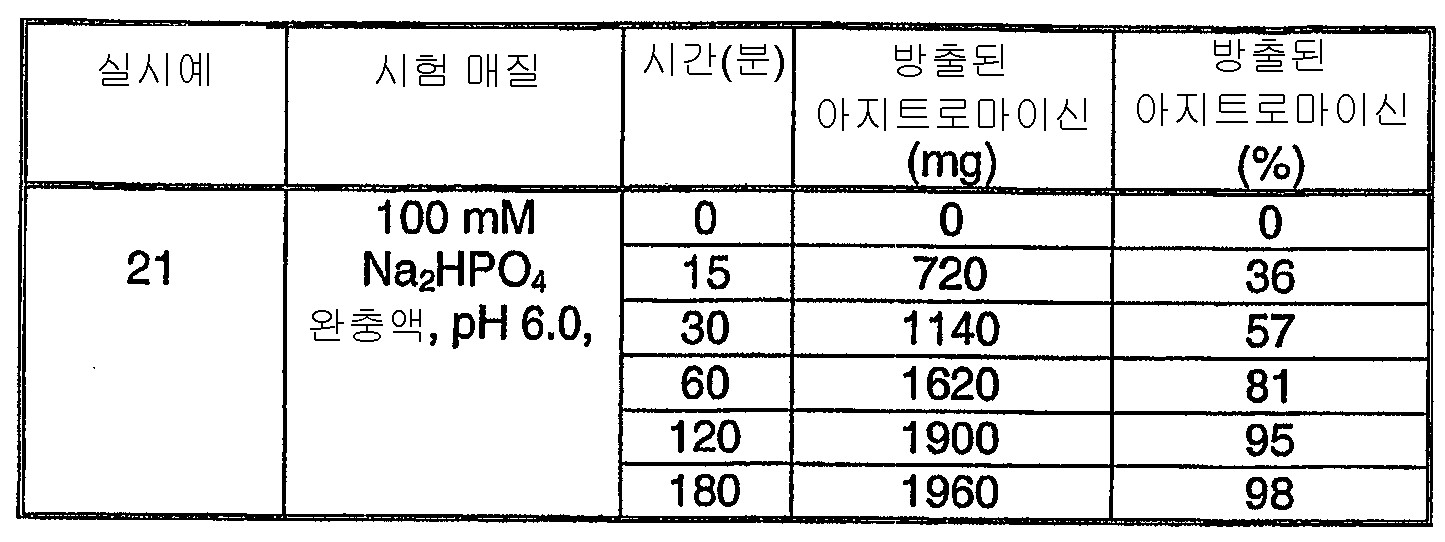
상기 명세서에 사용된 용어 및 표현들을 본 발명에서는 제한이 아닌 설명으로서 사용하고, 상기와 같은 용어 및 표현의 사용에 본 발명에 나타내고 개시한 특징들의 등가물 또는 그의 일부를 배제시키고자 하지 않으며, 본 발명의 범위는 오직 하기 청구의 범위에 의해서만 정의되고 한정됨을 인식한다.The terms and expressions used in the above specification are used in the present invention as descriptions, not limitations, and do not intend to exclude equivalents or portions thereof of the features shown and disclosed in the present invention in the use of the terms and expressions as described above. It is to be understood that the scope of is defined and limited only by the claims that follow.
Claims (12)
Applications Claiming Priority (2)
| Application Number | Priority Date | Filing Date | Title |
|---|---|---|---|
| US52724403P | 2003-12-04 | 2003-12-04 | |
| US60/527,244 | 2003-12-04 |
Related Parent Applications (1)
| Application Number | Title | Priority Date | Filing Date |
|---|---|---|---|
| KR1020067011027A Division KR20060109481A (en) | 2003-12-04 | 2004-11-22 | Spray condensation method using an extruder for the preparation of multiparticulate azithromycin compositions preferably containing poloxamer and glycerides |
Publications (1)
| Publication Number | Publication Date |
|---|---|
| KR20080064209A true KR20080064209A (en) | 2008-07-08 |
Family
ID=34652484
Family Applications (2)
| Application Number | Title | Priority Date | Filing Date |
|---|---|---|---|
| KR1020087015425A Withdrawn KR20080064209A (en) | 2003-12-04 | 2004-11-22 | Spray condensation method using an extruder for the preparation of multiparticulate azithromycin compositions preferably containing poloxamer and glycerides |
| KR1020067011027A Ceased KR20060109481A (en) | 2003-12-04 | 2004-11-22 | Spray condensation method using an extruder for the preparation of multiparticulate azithromycin compositions preferably containing poloxamer and glycerides |
Family Applications After (1)
| Application Number | Title | Priority Date | Filing Date |
|---|---|---|---|
| KR1020067011027A Ceased KR20060109481A (en) | 2003-12-04 | 2004-11-22 | Spray condensation method using an extruder for the preparation of multiparticulate azithromycin compositions preferably containing poloxamer and glycerides |
Country Status (15)
| Country | Link |
|---|---|
| US (1) | US20050158391A1 (en) |
| EP (1) | EP1701702A1 (en) |
| JP (1) | JP2007513143A (en) |
| KR (2) | KR20080064209A (en) |
| CN (1) | CN1889931A (en) |
| AR (1) | AR046468A1 (en) |
| AU (1) | AU2004294813A1 (en) |
| BR (1) | BRPI0416535A (en) |
| CA (1) | CA2547773A1 (en) |
| IL (1) | IL175745A0 (en) |
| NO (1) | NO20062389L (en) |
| RU (1) | RU2006119464A (en) |
| TW (1) | TW200528138A (en) |
| WO (1) | WO2005053653A1 (en) |
| ZA (1) | ZA200604495B (en) |
Families Citing this family (9)
| Publication number | Priority date | Publication date | Assignee | Title |
|---|---|---|---|---|
| WO2011039686A1 (en) | 2009-09-30 | 2011-04-07 | Pfizer Inc. | Latrepirdine oral sustained release dosage forms |
| CA2859174C (en) * | 2011-12-12 | 2019-03-05 | Orbis Biosciences, Inc. | Sustained release particle formulations |
| WO2013088274A1 (en) | 2011-12-14 | 2013-06-20 | Wockhardt Limited | Anhydrous amorphous azithromycin composition free of azithromycin dihydrate |
| JP6041823B2 (en) | 2013-03-16 | 2016-12-14 | ファイザー・インク | Tofacitinib oral sustained release dosage form |
| US11510877B2 (en) | 2017-10-10 | 2022-11-29 | Capsugel Belgium Nv | Gelling multiparticulates |
| CN109288798A (en) * | 2018-12-08 | 2019-02-01 | 海南医学院 | A kind of preparation method of azithromycin taste-masked microspheres |
| WO2021014360A1 (en) | 2019-07-23 | 2021-01-28 | Pfizer Inc. | Oral modified release dosage forms |
| EP4057989A1 (en) | 2019-11-14 | 2022-09-21 | Pfizer Inc. | 1-(((2s,3s,4s)-3-ethyl-4-fluoro-5-oxopyrrolidin-2-yl)methoxy)-7-methoxyisoquinoline-6-carboxamide combinations and oral dosage forms |
| WO2021231847A1 (en) * | 2020-05-15 | 2021-11-18 | Massachusetts Institute Of Technology | Oleogel and oleopaste compositions and uses thereof |
Family Cites Families (96)
| Publication number | Priority date | Publication date | Assignee | Title |
|---|---|---|---|---|
| US3590A (en) * | 1844-05-17 | Rule or measure | ||
| US6650A (en) * | 1849-08-14 | Edmund blunt | ||
| US2955956A (en) * | 1957-05-15 | 1960-10-11 | Morton Salt Co | Process and apparatus for coating granules |
| US4086346A (en) * | 1974-04-06 | 1978-04-25 | Bayer Aktiengesellschaft | Preparation of melt-sprayed spherical phenacetin granules |
| US4092089A (en) * | 1974-04-06 | 1978-05-30 | Bayer Aktiengesellschaft | Apparatus for the preparation of melt-sprayed spherical phenacetin granules |
| US4053264A (en) * | 1976-01-30 | 1977-10-11 | United Technologies Corporation | Apparatus for making metal powder |
| US4293570A (en) * | 1979-04-02 | 1981-10-06 | Chimicasa Gmbh | Process for the preparation of sweetener containing product |
| SI8110592A8 (en) * | 1981-03-06 | 1996-06-30 | Pliva Pharm & Chem Works | Process for preparing of n-methyl-11-aza-10-deoxo-10-dihydroerythromycine a and derivatives thereof |
| US4474768A (en) * | 1982-07-19 | 1984-10-02 | Pfizer Inc. | N-Methyl 11-aza-10-deoxo-10-dihydro-erytromycin A, intermediates therefor |
| KR920006865B1 (en) * | 1984-05-18 | 1992-08-21 | 워싱톤 유니버시티 테크놀러지 어소우시에이츠 인코오퍼레이티드 | Method and apparatus for coating particles or liquid droplets |
| US4874611A (en) * | 1985-06-20 | 1989-10-17 | The Dow Chemical Company | Microencapsulated ant bait |
| US5100592A (en) * | 1986-03-12 | 1992-03-31 | Washington University Technology Associated, Inc. | Method and apparatus for granulation and granulated product |
| US5019302A (en) * | 1986-03-12 | 1991-05-28 | Washington University Technology Associates, Inc. | Method for granulation |
| US5387431A (en) * | 1991-10-25 | 1995-02-07 | Fuisz Technologies Ltd. | Saccharide-based matrix |
| US5456932A (en) * | 1987-04-20 | 1995-10-10 | Fuisz Technologies Ltd. | Method of converting a feedstock to a shearform product and product thereof |
| US5236734A (en) * | 1987-04-20 | 1993-08-17 | Fuisz Technologies Ltd. | Method of preparing a proteinaceous food product containing a melt spun oleaginous matrix |
| MX12213A (en) * | 1987-07-09 | 1993-05-01 | Pfizer | METHOD OF PREPARATION OF CRYSTALLINE AZYTHROMYCIN DIHYDRATE |
| WO1989002271A1 (en) * | 1987-09-10 | 1989-03-23 | Pfizer | Azithromycin and derivatives as antiprotozoal agents |
| DE3812567A1 (en) * | 1988-04-15 | 1989-10-26 | Basf Ag | METHOD FOR PRODUCING PHARMACEUTICAL MIXTURES |
| US5064650A (en) * | 1988-04-19 | 1991-11-12 | Southwest Research Institute | Controlled-release salt sensitive capsule for oral use and adhesive system |
| US4931285A (en) * | 1988-04-28 | 1990-06-05 | Alza Corporation | Aqueous based pharmaceutical coating composition for dosage forms |
| US5160743A (en) * | 1988-04-28 | 1992-11-03 | Alza Corporation | Annealed composition for pharmaceutically acceptable drug |
| US5024842A (en) * | 1988-04-28 | 1991-06-18 | Alza Corporation | Annealed coats |
| US5047244A (en) * | 1988-06-03 | 1991-09-10 | Watson Laboratories, Inc. | Mucoadhesive carrier for delivery of therapeutical agent |
| US5084287A (en) * | 1990-03-15 | 1992-01-28 | Warner-Lambert Company | Pharmaceutically useful micropellets with a drug-coated core and controlled-release polymeric coat |
| US5213810A (en) * | 1990-03-30 | 1993-05-25 | American Cyanamid Company | Stable compositions for parenteral administration and method of making same |
| DE69111287T2 (en) * | 1990-04-18 | 1995-12-21 | Asahi Chemical Ind | Spherical nuclei, spherical granules and processes for their production. |
| US5183690A (en) * | 1990-06-25 | 1993-02-02 | The United States Of America, As Represented By The Secretary Of Agriculture | Starch encapsulation of biologically active agents by a continuous process |
| GB9014646D0 (en) * | 1990-07-02 | 1990-08-22 | Courtaulds Coatings Holdings | Coating compositions |
| US5194262A (en) * | 1990-10-22 | 1993-03-16 | Revlon Consumer Products Corporation | Encapsulated antiperspirant salts and deodorant/antiperspirants |
| US5196199A (en) * | 1990-12-14 | 1993-03-23 | Fuisz Technologies Ltd. | Hydrophilic form of perfluoro compounds and method of manufacture |
| US5292657A (en) * | 1990-12-31 | 1994-03-08 | Pioneer Hi-Bred International, Inc. | Process for preparing rotary disc fatty acid microspheres of microorganisms |
| US5143662A (en) * | 1991-02-12 | 1992-09-01 | United States Surgical Corporation | Process for preparing particles of bioabsorbable polymer |
| US5405617A (en) * | 1991-11-07 | 1995-04-11 | Mcneil-Ppc, Inc. | Aliphatic or fatty acid esters as a solventless carrier for pharmaceuticals |
| GB9201857D0 (en) * | 1992-01-29 | 1992-03-18 | Smithkline Beecham Plc | Novel compound |
| JP3265680B2 (en) * | 1992-03-12 | 2002-03-11 | 大正製薬株式会社 | Oral pharmaceutical composition |
| DE4214272A1 (en) * | 1992-05-04 | 1993-11-11 | Nukem Gmbh | Method and device for producing microspheres |
| CA2095776C (en) * | 1992-05-12 | 2007-07-10 | Richard C. Fuisz | Rapidly dispersable compositions containing polydextrose |
| US5792474A (en) * | 1992-05-22 | 1998-08-11 | Goedecke Aktiengesellschaft | Process for the production of retarded pharmaceutical compositions |
| US5518730A (en) * | 1992-06-03 | 1996-05-21 | Fuisz Technologies Ltd. | Biodegradable controlled release flash flow melt-spun delivery system |
| TW271400B (en) * | 1992-07-30 | 1996-03-01 | Pfizer | |
| US5348758A (en) * | 1992-10-20 | 1994-09-20 | Fuisz Technologies Ltd. | Controlled melting point matrix formed with admixtures of a shearform matrix material and an oleaginous material |
| US5380473A (en) * | 1992-10-23 | 1995-01-10 | Fuisz Technologies Ltd. | Process for making shearform matrix |
| GB9224855D0 (en) * | 1992-11-27 | 1993-01-13 | Smithkline Beecham Plc | Pharmaceutical compositions |
| US5569467A (en) * | 1993-05-15 | 1996-10-29 | Societe De Conseils De Recherches Et D'applications (S.C.R.A.S.) | Process for the preparation of microballs and microballs thus obtained |
| IL109770A0 (en) * | 1993-05-29 | 1994-11-28 | Smithkline Beecham Corp | Thermal infusion process for preparing controlled release solid dosage forms of medicaments for oral administration and controlled release solid dosage forms of medicaments prepared thereby |
| US5597416A (en) * | 1993-10-07 | 1997-01-28 | Fuisz Technologies Ltd. | Method of making crystalline sugar and products resulting therefrom |
| US5935600A (en) * | 1993-09-10 | 1999-08-10 | Fuisz Technologies Ltd. | Process for forming chewable quickly dispersing comestible unit and product therefrom |
| US5433951A (en) * | 1993-10-13 | 1995-07-18 | Bristol-Myers Squibb Company | Sustained release formulation containing captopril and method |
| AT401871B (en) * | 1994-01-28 | 1996-12-27 | Gebro Broschek Gmbh | METHOD FOR THE PRODUCTION OF S (+) - IBUPROFEN PARTICLES WITH IMPROVED FLOW PROPERTIES AND THE USE THEREOF FOR THE PRODUCTION OF MEDICINAL PRODUCTS |
| EP0788346B9 (en) * | 1994-03-18 | 2007-02-14 | Supernus Pharmaceuticals, Inc. | Emulsified drug delivery systems |
| US5605889A (en) * | 1994-04-29 | 1997-02-25 | Pfizer Inc. | Method of administering azithromycin |
| PL179910B1 (en) * | 1994-05-06 | 2000-11-30 | Pfizer | Controlled release dosage form containing azithromycin |
| DE19509807A1 (en) * | 1995-03-21 | 1996-09-26 | Basf Ag | Process for the preparation of active substance preparations in the form of a solid solution of the active substance in a polymer matrix, and active substance preparations produced using this method |
| US5567439A (en) * | 1994-06-14 | 1996-10-22 | Fuisz Technologies Ltd. | Delivery of controlled-release systems(s) |
| US5582855A (en) * | 1994-07-01 | 1996-12-10 | Fuisz Technologies Ltd. | Flash flow formed solloid delivery systems |
| US5556652A (en) * | 1994-08-05 | 1996-09-17 | Fuisz Technologies Ltd. | Comestibles containing stabilized highly odorous flavor component delivery systems |
| US5601761A (en) * | 1994-09-26 | 1997-02-11 | The Dow Chemical Company | Encapsulated active materials and method for preparing same |
| US5683720A (en) * | 1994-10-28 | 1997-11-04 | Fuisz Technologies Ltd. | Liquiflash particles and method of making same |
| US5965164A (en) * | 1994-10-28 | 1999-10-12 | Fuisz Technologies Ltd. | Recipient-dosage delivery system |
| US5965161A (en) * | 1994-11-04 | 1999-10-12 | Euro-Celtique, S.A. | Extruded multi-particulates |
| FR2732621B1 (en) * | 1995-04-10 | 1997-06-06 | Rhone Poulenc Chimie | PEARLS OF A PRODUCT HAVING THE SURFUSION PHENOMENON AND THEIR PRODUCTION METHOD |
| ES2279519T3 (en) * | 1995-05-02 | 2007-08-16 | Taisho Pharmaceutical Co. Ltd | COMPOSITION FOR ADMINISTRATION BY ORAL ROUTE. |
| US5883103A (en) * | 1995-06-07 | 1999-03-16 | Shire Laboratories Inc. | Oral acyclovir delivery |
| US5747058A (en) * | 1995-06-07 | 1998-05-05 | Southern Biosystems, Inc. | High viscosity liquid controlled delivery system |
| AU6403196A (en) * | 1995-06-30 | 1997-02-05 | Baylor University | Polyester/carboxylic acid composite materials |
| EP0784933A3 (en) * | 1995-10-16 | 1997-11-26 | Leaf, Inc. | Extended release of additives in comestible products |
| US5919489A (en) * | 1995-11-01 | 1999-07-06 | Abbott Laboratories | Process for aqueous granulation of clarithromycin |
| US5705190A (en) * | 1995-12-19 | 1998-01-06 | Abbott Laboratories | Controlled release formulation for poorly soluble basic drugs |
| DE19629753A1 (en) * | 1996-07-23 | 1998-01-29 | Basf Ag | Process for the production of solid dosage forms |
| US6139872A (en) * | 1996-08-14 | 2000-10-31 | Henkel Corporation | Method of producing a vitamin product |
| TW474824B (en) * | 1996-09-13 | 2002-02-01 | Basf Ag | The production of solid pharmaceutical forms |
| US5948407A (en) * | 1997-03-19 | 1999-09-07 | Shire Laboratories Inc. | Oral induction of tolerance to parenterally administered non-autologous polypeptides |
| US6010718A (en) * | 1997-04-11 | 2000-01-04 | Abbott Laboratories | Extended release formulations of erythromycin derivatives |
| US6551616B1 (en) * | 1997-04-11 | 2003-04-22 | Abbott Laboratories | Extended release formulations of erythromycin derivatives |
| DE19729487A1 (en) * | 1997-07-10 | 1999-01-14 | Dresden Arzneimittel | Process for the preparation of active ingredient preparations with controlled release from a matrix |
| SI9700186B (en) * | 1997-07-14 | 2006-10-31 | Lek, Tovarna Farmacevtskih In Kemicnih Izdelkov, D.D. | Novel pharmaceutical preparation with controlled release of active healing substances |
| US5869098A (en) * | 1997-08-20 | 1999-02-09 | Fuisz Technologies Ltd. | Fast-dissolving comestible units formed under high-speed/high-pressure conditions |
| ATE286721T1 (en) * | 1997-09-19 | 2005-01-15 | Shire Lab Inc | SOLID SOLUTION BEADS |
| IE970731A1 (en) * | 1997-10-07 | 2000-10-04 | Fuisz Internat Ltd | Product and method for the treatment of hyperlipidemia |
| US6013280A (en) * | 1997-10-07 | 2000-01-11 | Fuisz Technologies Ltd. | Immediate release dosage forms containing microspheres |
| US6096340A (en) * | 1997-11-14 | 2000-08-01 | Andrx Pharmaceuticals, Inc. | Omeprazole formulation |
| US5891845A (en) * | 1997-11-21 | 1999-04-06 | Fuisz Technologies Ltd. | Drug delivery systems utilizing liquid crystal structures |
| SI1037607T1 (en) * | 1997-12-08 | 2004-08-31 | Altana Pharma Ag | Novel suppository form comprising an acid-labile active compound |
| US6270804B1 (en) * | 1998-04-03 | 2001-08-07 | Biovail Technologies Ltd. | Sachet formulations |
| US6117452A (en) * | 1998-08-12 | 2000-09-12 | Fuisz Technologies Ltd. | Fatty ester combinations |
| US6086920A (en) * | 1998-08-12 | 2000-07-11 | Fuisz Technologies Ltd. | Disintegratable microspheres |
| US6248363B1 (en) * | 1999-11-23 | 2001-06-19 | Lipocine, Inc. | Solid carriers for improved delivery of active ingredients in pharmaceutical compositions |
| US6395300B1 (en) * | 1999-05-27 | 2002-05-28 | Acusphere, Inc. | Porous drug matrices and methods of manufacture thereof |
| US20030180352A1 (en) * | 1999-11-23 | 2003-09-25 | Patel Mahesh V. | Solid carriers for improved delivery of active ingredients in pharmaceutical compositions |
| ATE388159T1 (en) * | 2000-01-04 | 2008-03-15 | Teva Pharma | METHOD FOR PRODUCING AZITHROMYCINE DIHYDRATE |
| IT1320176B1 (en) * | 2000-12-22 | 2003-11-26 | Nicox Sa | SOLID DISPERSIONS OF NITRATED ACTIVE INGREDIENTS. |
| NZ526993A (en) * | 2001-02-13 | 2005-01-28 | Astrazeneca Ab | Pharmaceutical formulation of a drug substance that has a pH-dependent solubility in water |
| AR038375A1 (en) * | 2002-02-01 | 2005-01-12 | Pfizer Prod Inc | PHARMACEUTICAL COMPOSITIONS OF INHIBITORS OF THE PROTEIN OF TRANSFER OF ESTERES DE COLESTERILO |
| BR0307344A (en) * | 2002-02-01 | 2004-12-14 | Pfizer Prod Inc | Pharmaceutical compositions of amorphous dispersions of drugs and lipophilic microphase forming materials |
| US6682759B2 (en) * | 2002-02-01 | 2004-01-27 | Depomed, Inc. | Manufacture of oral dosage forms delivering both immediate-release and sustained-release drugs |
-
2004
- 2004-11-22 KR KR1020087015425A patent/KR20080064209A/en not_active Withdrawn
- 2004-11-22 WO PCT/IB2004/003839 patent/WO2005053653A1/en not_active Ceased
- 2004-11-22 BR BRPI0416535-7A patent/BRPI0416535A/en not_active IP Right Cessation
- 2004-11-22 CA CA002547773A patent/CA2547773A1/en not_active Abandoned
- 2004-11-22 AU AU2004294813A patent/AU2004294813A1/en not_active Abandoned
- 2004-11-22 RU RU2006119464/15A patent/RU2006119464A/en unknown
- 2004-11-22 CN CNA2004800358177A patent/CN1889931A/en active Pending
- 2004-11-22 EP EP04798952A patent/EP1701702A1/en not_active Withdrawn
- 2004-11-22 KR KR1020067011027A patent/KR20060109481A/en not_active Ceased
- 2004-11-22 JP JP2006542040A patent/JP2007513143A/en not_active Abandoned
- 2004-12-01 TW TW093137051A patent/TW200528138A/en unknown
- 2004-12-03 AR ARP040104514A patent/AR046468A1/en unknown
- 2004-12-03 US US11/003,856 patent/US20050158391A1/en not_active Abandoned
-
2006
- 2006-05-18 IL IL175745A patent/IL175745A0/en unknown
- 2006-05-24 NO NO20062389A patent/NO20062389L/en not_active Application Discontinuation
- 2006-06-01 ZA ZA200604495A patent/ZA200604495B/en unknown
Also Published As
| Publication number | Publication date |
|---|---|
| ZA200604495B (en) | 2008-03-26 |
| KR20060109481A (en) | 2006-10-20 |
| AU2004294813A1 (en) | 2005-06-16 |
| BRPI0416535A (en) | 2007-01-09 |
| AR046468A1 (en) | 2005-12-07 |
| CA2547773A1 (en) | 2005-06-16 |
| JP2007513143A (en) | 2007-05-24 |
| RU2006119464A (en) | 2007-12-20 |
| US20050158391A1 (en) | 2005-07-21 |
| CN1889931A (en) | 2007-01-03 |
| NO20062389L (en) | 2006-06-16 |
| IL175745A0 (en) | 2006-09-05 |
| TW200528138A (en) | 2005-09-01 |
| WO2005053653A1 (en) | 2005-06-16 |
| EP1701702A1 (en) | 2006-09-20 |
Similar Documents
| Publication | Publication Date | Title |
|---|---|---|
| EP1537859B1 (en) | Azithromycin dosage forms with reduced side effects | |
| JP2007513145A (en) | Method for producing pharmaceutical fine particles | |
| KR20080064209A (en) | Spray condensation method using an extruder for the preparation of multiparticulate azithromycin compositions preferably containing poloxamer and glycerides | |
| US20080199527A1 (en) | Enteric Coated Azithromycin Multiparticulates | |
| AU2004216676B2 (en) | Azithromycin dosage forms with reduced side effects | |
| US20050152982A1 (en) | Controlled release multiparticulates formed with dissolution enhancers | |
| US20050123615A1 (en) | Controlled release dosage forms of azithromycin | |
| MXPA06006265A (en) | Spray-congeal process using an extruder for preparing multiparticulate azithromycin compositions containing preferably a poloxamer and a glyceride | |
| AU2004294818A1 (en) | Azithromycin multiparticulate dosage forms by liquid-based processes |
Legal Events
| Date | Code | Title | Description |
|---|---|---|---|
| A107 | Divisional application of patent | ||
| PA0104 | Divisional application for international application |
Comment text: Divisional Application for International Patent Patent event code: PA01041R01D Patent event date: 20080625 |
|
| PG1501 | Laying open of application | ||
| PC1203 | Withdrawal of no request for examination | ||
| WITN | Application deemed withdrawn, e.g. because no request for examination was filed or no examination fee was paid |