KR20080038206A - Vertical-Channel Junction Field Effect Transistor with Buried Gate and Method of Fabrication - Google Patents
Vertical-Channel Junction Field Effect Transistor with Buried Gate and Method of Fabrication Download PDFInfo
- Publication number
- KR20080038206A KR20080038206A KR1020087005536A KR20087005536A KR20080038206A KR 20080038206 A KR20080038206 A KR 20080038206A KR 1020087005536 A KR1020087005536 A KR 1020087005536A KR 20087005536 A KR20087005536 A KR 20087005536A KR 20080038206 A KR20080038206 A KR 20080038206A
- Authority
- KR
- South Korea
- Prior art keywords
- layer
- gate
- semiconductor device
- conductivity type
- channel
- Prior art date
- Legal status (The legal status is an assumption and is not a legal conclusion. Google has not performed a legal analysis and makes no representation as to the accuracy of the status listed.)
- Abandoned
Links
- 238000004519 manufacturing process Methods 0.000 title claims abstract description 15
- 230000005669 field effect Effects 0.000 title claims description 6
- 239000004065 semiconductor Substances 0.000 claims abstract description 80
- 239000000463 material Substances 0.000 claims description 54
- 229910010271 silicon carbide Inorganic materials 0.000 claims description 46
- HBMJWWWQQXIZIP-UHFFFAOYSA-N silicon carbide Chemical group [Si+]#[C-] HBMJWWWQQXIZIP-UHFFFAOYSA-N 0.000 claims description 39
- 238000000034 method Methods 0.000 claims description 30
- 239000000758 substrate Substances 0.000 claims description 28
- 229910052751 metal Inorganic materials 0.000 claims description 27
- 239000002184 metal Substances 0.000 claims description 27
- 238000000151 deposition Methods 0.000 claims description 14
- 238000005530 etching Methods 0.000 claims description 14
- 230000012010 growth Effects 0.000 claims description 13
- 239000002019 doping agent Substances 0.000 claims description 10
- 239000003989 dielectric material Substances 0.000 claims description 3
- 230000002093 peripheral effect Effects 0.000 claims description 2
- 230000006698 induction Effects 0.000 claims 1
- 230000003068 static effect Effects 0.000 claims 1
- 230000000903 blocking effect Effects 0.000 abstract description 6
- 230000002950 deficient Effects 0.000 abstract description 2
- 108091006146 Channels Proteins 0.000 description 50
- 108090000699 N-Type Calcium Channels Proteins 0.000 description 32
- 102000004129 N-Type Calcium Channels Human genes 0.000 description 31
- 238000010586 diagram Methods 0.000 description 13
- 230000008569 process Effects 0.000 description 9
- 238000000137 annealing Methods 0.000 description 5
- IJGRMHOSHXDMSA-UHFFFAOYSA-N Atomic nitrogen Chemical compound N#N IJGRMHOSHXDMSA-UHFFFAOYSA-N 0.000 description 4
- 230000007547 defect Effects 0.000 description 4
- 238000013461 design Methods 0.000 description 4
- 238000005468 ion implantation Methods 0.000 description 4
- 238000002161 passivation Methods 0.000 description 4
- 208000012868 Overgrowth Diseases 0.000 description 3
- 230000015572 biosynthetic process Effects 0.000 description 3
- 238000001312 dry etching Methods 0.000 description 3
- 239000007943 implant Substances 0.000 description 3
- 238000002955 isolation Methods 0.000 description 3
- 238000000206 photolithography Methods 0.000 description 3
- 238000001878 scanning electron micrograph Methods 0.000 description 3
- 229910021332 silicide Inorganic materials 0.000 description 3
- XUIMIQQOPSSXEZ-UHFFFAOYSA-N Silicon Chemical compound [Si] XUIMIQQOPSSXEZ-UHFFFAOYSA-N 0.000 description 2
- 229910052782 aluminium Inorganic materials 0.000 description 2
- XAGFODPZIPBFFR-UHFFFAOYSA-N aluminium Chemical compound [Al] XAGFODPZIPBFFR-UHFFFAOYSA-N 0.000 description 2
- 230000005684 electric field Effects 0.000 description 2
- 238000005516 engineering process Methods 0.000 description 2
- 238000002513 implantation Methods 0.000 description 2
- 229910052757 nitrogen Inorganic materials 0.000 description 2
- 238000000059 patterning Methods 0.000 description 2
- 230000005855 radiation Effects 0.000 description 2
- FVBUAEGBCNSCDD-UHFFFAOYSA-N silicide(4-) Chemical compound [Si-4] FVBUAEGBCNSCDD-UHFFFAOYSA-N 0.000 description 2
- 229910052710 silicon Inorganic materials 0.000 description 2
- 239000010703 silicon Substances 0.000 description 2
- WKBOTKDWSSQWDR-UHFFFAOYSA-N Bromine atom Chemical compound [Br] WKBOTKDWSSQWDR-UHFFFAOYSA-N 0.000 description 1
- 229910001218 Gallium arsenide Inorganic materials 0.000 description 1
- 108010075750 P-Type Calcium Channels Proteins 0.000 description 1
- OAICVXFJPJFONN-UHFFFAOYSA-N Phosphorus Chemical compound [P] OAICVXFJPJFONN-UHFFFAOYSA-N 0.000 description 1
- 230000002411 adverse Effects 0.000 description 1
- 230000004888 barrier function Effects 0.000 description 1
- GDTBXPJZTBHREO-UHFFFAOYSA-N bromine Substances BrBr GDTBXPJZTBHREO-UHFFFAOYSA-N 0.000 description 1
- 229910052794 bromium Inorganic materials 0.000 description 1
- 230000015556 catabolic process Effects 0.000 description 1
- 238000005229 chemical vapour deposition Methods 0.000 description 1
- 239000013078 crystal Substances 0.000 description 1
- 230000008021 deposition Effects 0.000 description 1
- 238000011161 development Methods 0.000 description 1
- 238000009792 diffusion process Methods 0.000 description 1
- 230000000694 effects Effects 0.000 description 1
- 238000000407 epitaxy Methods 0.000 description 1
- 238000011156 evaluation Methods 0.000 description 1
- 230000007773 growth pattern Effects 0.000 description 1
- 238000010438 heat treatment Methods 0.000 description 1
- 239000012535 impurity Substances 0.000 description 1
- 238000011835 investigation Methods 0.000 description 1
- 150000002500 ions Chemical class 0.000 description 1
- 238000004518 low pressure chemical vapour deposition Methods 0.000 description 1
- 230000000873 masking effect Effects 0.000 description 1
- 238000004377 microelectronic Methods 0.000 description 1
- 230000003647 oxidation Effects 0.000 description 1
- 238000007254 oxidation reaction Methods 0.000 description 1
- 238000012856 packing Methods 0.000 description 1
- 230000035515 penetration Effects 0.000 description 1
- 229910052698 phosphorus Inorganic materials 0.000 description 1
- 239000011574 phosphorus Substances 0.000 description 1
- 230000000704 physical effect Effects 0.000 description 1
- 238000012545 processing Methods 0.000 description 1
- 230000004044 response Effects 0.000 description 1
- 229920006395 saturated elastomer Polymers 0.000 description 1
- 230000035945 sensitivity Effects 0.000 description 1
- 238000000926 separation method Methods 0.000 description 1
- 239000000126 substance Substances 0.000 description 1
- 238000013519 translation Methods 0.000 description 1
Images


Classifications
-
- H—ELECTRICITY
- H10—SEMICONDUCTOR DEVICES; ELECTRIC SOLID-STATE DEVICES NOT OTHERWISE PROVIDED FOR
- H10D—INORGANIC ELECTRIC SEMICONDUCTOR DEVICES
- H10D30/00—Field-effect transistors [FET]
- H10D30/01—Manufacture or treatment
- H10D30/051—Manufacture or treatment of FETs having PN junction gates
- H10D30/0512—Manufacture or treatment of FETs having PN junction gates of FETs having PN homojunction gates
- H10D30/0515—Manufacture or treatment of FETs having PN junction gates of FETs having PN homojunction gates of vertical FETs having PN homojunction gates
-
- H—ELECTRICITY
- H10—SEMICONDUCTOR DEVICES; ELECTRIC SOLID-STATE DEVICES NOT OTHERWISE PROVIDED FOR
- H10D—INORGANIC ELECTRIC SEMICONDUCTOR DEVICES
- H10D30/00—Field-effect transistors [FET]
- H10D30/80—FETs having rectifying junction gate electrodes
- H10D30/83—FETs having PN junction gate electrodes
- H10D30/831—Vertical FETs having PN junction gate electrodes
-
- H—ELECTRICITY
- H10—SEMICONDUCTOR DEVICES; ELECTRIC SOLID-STATE DEVICES NOT OTHERWISE PROVIDED FOR
- H10D—INORGANIC ELECTRIC SEMICONDUCTOR DEVICES
- H10D62/00—Semiconductor bodies, or regions thereof, of devices having potential barriers
- H10D62/10—Shapes, relative sizes or dispositions of the regions of the semiconductor bodies; Shapes of the semiconductor bodies
- H10D62/102—Constructional design considerations for preventing surface leakage or controlling electric field concentration
- H10D62/103—Constructional design considerations for preventing surface leakage or controlling electric field concentration for increasing or controlling the breakdown voltage of reverse-biased devices
- H10D62/105—Constructional design considerations for preventing surface leakage or controlling electric field concentration for increasing or controlling the breakdown voltage of reverse-biased devices by having particular doping profiles, shapes or arrangements of PN junctions; by having supplementary regions, e.g. junction termination extension [JTE]
- H10D62/106—Constructional design considerations for preventing surface leakage or controlling electric field concentration for increasing or controlling the breakdown voltage of reverse-biased devices by having particular doping profiles, shapes or arrangements of PN junctions; by having supplementary regions, e.g. junction termination extension [JTE] having supplementary regions doped oppositely to or in rectifying contact with regions of the semiconductor bodies, e.g. guard rings with PN or Schottky junctions
-
- H—ELECTRICITY
- H10—SEMICONDUCTOR DEVICES; ELECTRIC SOLID-STATE DEVICES NOT OTHERWISE PROVIDED FOR
- H10D—INORGANIC ELECTRIC SEMICONDUCTOR DEVICES
- H10D62/00—Semiconductor bodies, or regions thereof, of devices having potential barriers
- H10D62/10—Shapes, relative sizes or dispositions of the regions of the semiconductor bodies; Shapes of the semiconductor bodies
- H10D62/17—Semiconductor regions connected to electrodes not carrying current to be rectified, amplified or switched, e.g. channel regions
- H10D62/343—Gate regions of field-effect devices having PN junction gates
-
- H—ELECTRICITY
- H10—SEMICONDUCTOR DEVICES; ELECTRIC SOLID-STATE DEVICES NOT OTHERWISE PROVIDED FOR
- H10D—INORGANIC ELECTRIC SEMICONDUCTOR DEVICES
- H10D62/00—Semiconductor bodies, or regions thereof, of devices having potential barriers
- H10D62/80—Semiconductor bodies, or regions thereof, of devices having potential barriers characterised by the materials
- H10D62/83—Semiconductor bodies, or regions thereof, of devices having potential barriers characterised by the materials being Group IV materials, e.g. B-doped Si or undoped Ge
- H10D62/832—Semiconductor bodies, or regions thereof, of devices having potential barriers characterised by the materials being Group IV materials, e.g. B-doped Si or undoped Ge being Group IV materials comprising two or more elements, e.g. SiGe
- H10D62/8325—Silicon carbide
Landscapes
- Junction Field-Effect Transistors (AREA)
- Metal-Oxide And Bipolar Metal-Oxide Semiconductor Integrated Circuits (AREA)
Abstract
반도체 디바이스 및 그 디바이스를 제조하는 방법이 기술된다. 디바이스는 SiC로 구현될 수 있고, 에피택셜 성장된 n형 드리프트 및 p형 트렌칭된 게이트 영역, 및 트렌칭된 p-게이트 영역의 상부 상의 n형 에피택셜 재성장된 채널 영역을 포함할 수 있다. 소스 영역은 채널 영역의 상부 상에 에피택셜 재성장되거나 채널 영역에 선택적으로 주입될 수 있다. 그리고나서, 소스, 게이트 및 드레인 영역으로의 저항성 컨택트가 형성될 수 있다. 디바이스는 가드 링, 접합 종단부 확장(JTE), 또는 다른 적합한 p-n 차단 구조와 같은 에지 종단부 구조를 포함할 수 있다. 디바이스는 다른 임계 전압으로 제조될 수 있고, 동일한 채널 도핑에 대해 결핍형 및 인핸스드 동작 모드 양쪽에 대해 구현될 수 있다. 디바이스는 이산 전력 트랜지스터로서, 그리고 디지털, 아날로그, 및 모놀리딕 마이크로파 집적 회로에 이용될 수 있다.A semiconductor device and a method of manufacturing the device are described. The device may be implemented with SiC and may include epitaxially grown n-type drift and p-type trenched gate regions, and n-type epitaxial regrown channel regions on top of the trenched p-gate regions. The source region may be epitaxial regrowth on top of the channel region or selectively implanted into the channel region. Then, ohmic contacts to the source, gate and drain regions can be formed. The device may include an edge termination structure, such as a guard ring, junction termination extension (JTE), or other suitable p-n blocking structure. The device can be fabricated with different threshold voltages and can be implemented for both deficient and enhanced modes of operation for the same channel doping. The device can be used as discrete power transistors and in digital, analog, and monolithic microwave integrated circuits.
Description
<관련 출원의 상호 참조><Cross Reference of Related Application>
본 출원은 2005년 8월 8일 제출된 미국 특허 출원 일련번호 제11/198,298호의 부분 계속 출원으로서, 전체 내용은 본 명세서에 참조로서 포함된다.This application is a partial continuing application of US Patent Application Serial No. 11 / 198,298, filed August 8, 2005, the entire contents of which are incorporated herein by reference.
<연방 지원의 조사에 관한 선언><Declaration about investigation of federal support>
본 발명은 미국 공군 연구실에 의해 수여된 F33615-01-D-2103 하의 미국 정부 후원으로 만들어졌다. 미국 정부는 본 발명에 특정한 권리를 가질 수 있다.The invention was made with a US government sponsor under F33615-01-D-2103 awarded by the US Air Force Laboratory. The US government may have certain rights in the invention.
본 발명은 일반적으로는 반도체 디바이스에 관한 것으로, 특히 매립된 게이트를 구비하는 수직형-채널 접합 필드 효과 트랜지스터(vertical-channel junction field effect transistor; VJFET) 및 이들 디바이스를 제조하는 방법에 관한 것이다.TECHNICAL FIELD The present invention relates generally to semiconductor devices, and more particularly, to vertical-channel junction field effect transistors (VJFETs) with embedded gates and methods of manufacturing these devices.
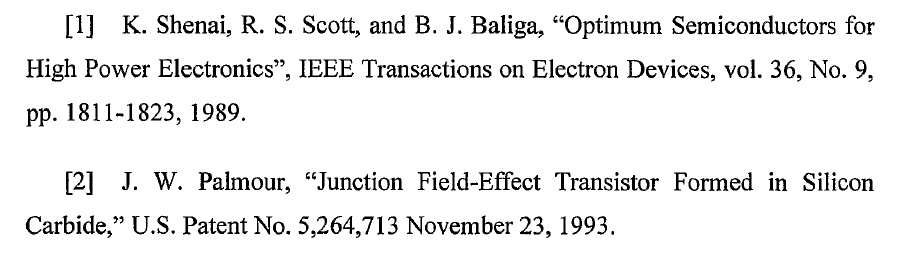
실리콘 카바이드(SiC), 즉 넓은 대역갭 반도체 재료는 고-전력, 고온, 및/또는 방사 저항형 전자장치에 이용하는데 매우 매력적이다. SiC 전력 스위치는 넓은 에너지 대역갭, 높은 브레이크다운 필드 세기, 높게 포화되는 전자 드리프트 속도 및 종래 실리콘 카운터 파트와 비교할 때 높은 열적 전도성과 같은 그 뛰어난 재료 물리적 특성으로 인해 이들 어플리케이션들에 대한 합리적인 추천 대상이다. 상기 장점들뿐만 아니라, SiC 전력 디바이스는 종래 실리콘 전력 디바이스보다 더 낮은 특정 온-저항으로 동작할 수 있다[1].Silicon carbide (SiC), or wide bandgap semiconductor materials, is very attractive for use in high-power, high temperature, and / or radiation resistant electronics. SiC power switches are a reasonable recommendation for these applications due to their excellent material physical properties such as wide energy bandgap, high breakdown field strength, highly saturated electron drift rate, and high thermal conductivity compared to conventional silicon counter parts. . In addition to the above advantages, SiC power devices can operate with lower specific on-resistance than conventional silicon power devices [1].
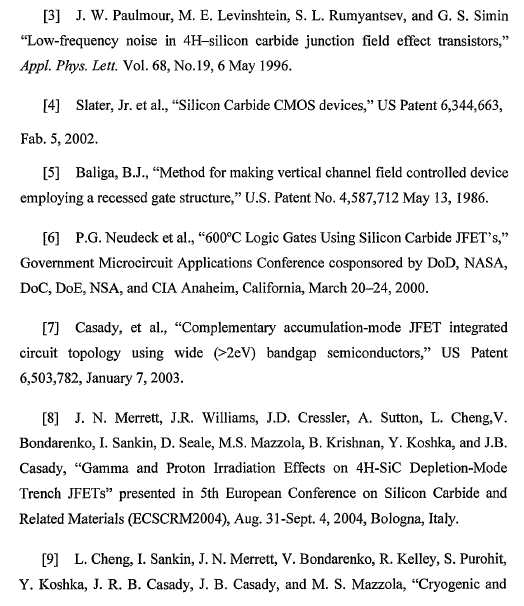
SiC의 JFET는 그 p-n 접합 게이트의 본질적인 안정성으로 인해 높은 전력 어플리케이션에 대해 특히 매력적이고, 이는 MOS 구조의 채널 이동성과 관련된 게이트 산화 문제와, 금속-반도체 쇼트키 배리어를 가지는 MESFET에서 고온 신뢰성 문제로부터 자유롭다. SiC's JFET is particularly attractive for high power applications due to the inherent stability of its pn junction gate, which is free from gate oxidation issues associated with channel mobility of MOS structures and high temperature reliability issues in MESFETs with metal-semiconductor Schottky barriers. It is.
재료 특성 및 처리 기술의 근본적인 차이로 인해, JFET에서 전통적인 Si 또는 GaAs 마이크로전자공학 기술은 SiC로 용이하게 전달될 수 없다. SiC JFET에 대한 다수의 레포트는 지난 십년 동안에 나타났다(예를 들면 [2-4]). 리세스형 게이트 구조를 채용하는 수직형 채널 JFET의 예는 미국특허 제4,587,712호[5]에 나타나 있다. SiC로 형성된 수평형 JFET의 예는 미국특허 제5,264,713호[2]에 나타나 있다. 저항성 부하를 가지는 디지털 IC에 대한 인핸스드-모드 JFET은 2000년에 보고되었다[6]. JFET-기반 IC는 미국특허 제6,503,782호[7]에 개시된 바와 같이 보상형 n형 및 p형 채널 또는 인핸스드-공핍형(n형 채널) 형태 중 어느 하나로 구현될 수 있다. SiC JFET는 넓은 온도 범위에 대해 최소의 임계 전압 시프트를 증명하면서도 내방사성(radiation tolerant)인 것으로 증명되었다[8, 9].Due to fundamental differences in material properties and processing techniques, traditional Si or GaAs microelectronic technologies in JFETs cannot be easily transferred to SiC. Many reports on SiC JFETs have appeared in the last decade (eg [2-4]). An example of a vertical channel JFET employing a recessed gate structure is shown in US Pat. No. 4,587,712 [5]. An example of a horizontal JFET formed of SiC is shown in US Pat. No. 5,264,713 [2]. Enhanced-mode JFETs for digital ICs with resistive loads were reported in 2000 [6]. JFET-based ICs can be implemented in either a compensated n-type and p-type channel or an enhanced-depleted (n-type channel) form, as disclosed in US Pat. No. 6,503,782 [7]. SiC JFETs have been proven to be radiation tolerant while demonstrating minimal threshold voltage shifts over a wide temperature range [8, 9].
저비용 대량 제조에 대한 대부분의 장애는 게이트-레벨 프로세스 공정에 기인한다. 뿐만 아니라, p형 게이트 컨택트는 SiC의 큰 대역갭으로 인해 SiC에서 제 조하기 어려울 수 있다. 실제로, p형 SiC로의 낮은 저항성 컨택트는 고농도로 도핑된(heavily doped) p형 SiC 상에만 형성된다.Most obstacles to low cost mass fabrication are due to gate-level process processes. In addition, p-type gate contacts can be difficult to fabricate in SiC due to the large bandgap of SiC. In fact, low ohmic contacts to p-type SiC are only formed on heavily doped p-type SiC.
VJFET(즉, 수직형 채널 구조를 가지는 JFET)는 수평 채널 구조를 가지는 JFET보다 더 작게 제조될 수 있고, 이는 이산 트랜지스터들의 대량 제조에서 더 낮은 비용을 유도하고 대규모 집적 회로에서 팩킹 밀도를 증가시킬 수 있다. SiC VJFET에서 수직형 채널을 얻기 위해, 이온 주입이 종종 이용되어 P+ 게이트 영역을 형성한다[8-10]. 그러나, 주입 테일(implantation tail)의 실제 깊이 프로파일, 결함 밀도, 열적 어닐링 후의 주입된 이온의 재분포, 및 다른 바이어스 및/또는 온도 스트레스 하에서 도펀트 원자 및 포인트 결함의 이온화 백분율에 대한 불확실성의 조합으로 인해, 이온 주입에 의해 채널 길이를 정확하게 제어하는 것이 어려울 수 있다.VJFETs (ie, JFETs with vertical channel structures) can be made smaller than JFETs with horizontal channel structures, which can lead to lower costs in mass production of discrete transistors and increase packing density in large scale integrated circuits. have. To obtain a vertical channel in a SiC VJFET, ion implantation is often used to form the P + gate region [8-10]. However, due to a combination of the actual depth profile of the implant tail, the defect density, the redistribution of implanted ions after thermal annealing, and uncertainty about the percentage of ionization of dopant atoms and point defects under different bias and / or temperature stresses It may be difficult to accurately control the channel length by ion implantation.
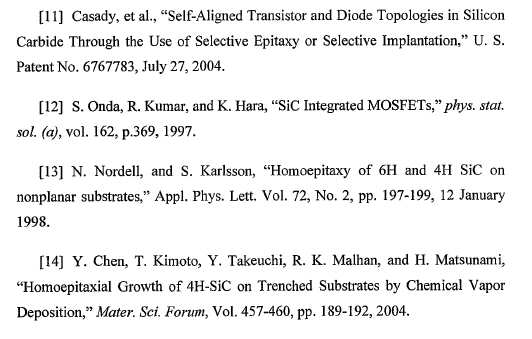
수직형 채널을 형성하는 다른 방법이 채용되었다. 하나의 방법은 미국특허 제6,767,783호에 개시된 바와 같이 P+ 게이트 영역을 에피택셜 선택적으로 성장시키는 것이다[11].Other methods of forming vertical channels have been employed. One method is to epitaxially grow the P + gate region as disclosed in US Pat. No. 6,767,783 [11].
그러나, 제조 동안에 채널 길이의 정확한 제어를 허용하는 VJFET에 대한 개선된 높은 볼륨의, 저비용 제조 방법에 대한 필요성이 여전히 존재한다.However, there is still a need for improved high volume, low cost manufacturing methods for VJFETs that allow for accurate control of channel length during manufacturing.
제1 실시예에 따르면, 제1 도전성 타입의 반도체 재료를 포함하는 기판층; 제1 도전성 타입의 반도체 재료를 포함하는, 기판층 상의 드리프트 층; 제1 도전성 타입과 다른 제2 도전성 타입의 반도체 재료를 포함하는, 드리프트 층 상의 게이트 영역; 게이트 영역의 제1 부분을 커버링하는, 드리프트 층 상의 제1 도전성 타입의 채널층; 및 채널층 상의 제1 도전성 타입의 소스층을 포함하고, 소스층은 채널층 상에 에피택셜 성장에 의해 피착되는 반도체 디바이스가 제공된다. 디바이스의 드리프트 층은 제1 도전성 타입의 반도체 재료를 포함하는 버퍼층 상에 있고 버퍼층은 반도체 기판 상에 있을 수 있다. 기판층, 드리프트 층, 게이트 영역 및 채널 층의 반도체 재료는 실리콘 카바이드일 수 있다. 제1 도전성 타입의 반도체 재료는 n형 반도체 재료이고 제2 도전성 타입의 반도체 재료는 p형 반도체 재료일 수 있다.According to a first embodiment, there is provided a semiconductor device comprising: a substrate layer comprising a semiconductor material of a first conductivity type; A drift layer on a substrate layer comprising a semiconductor material of a first conductivity type; A gate region on the drift layer comprising a semiconductor material of a second conductivity type different from the first conductivity type; A channel layer of a first conductivity type on the drift layer, covering the first portion of the gate region; And a source layer of a first conductivity type on the channel layer, wherein the source layer is deposited by epitaxial growth on the channel layer. The drift layer of the device may be on a buffer layer comprising a semiconductor material of a first conductivity type and the buffer layer may be on a semiconductor substrate. The semiconductor material of the substrate layer, the drift layer, the gate region and the channel layer may be silicon carbide. The semiconductor material of the first conductivity type may be an n-type semiconductor material and the semiconductor material of the second conductivity type may be a p-type semiconductor material.
제2 실시예에 따르면, 제2 도전성 타입의 반도체 기판 상에 존재하는 드리프트 층의 재료를 노출시키도록, 제2 도전성 타입과 다른 제1 도전성 타입의 반도체 재료의 드리프트 층 상에서 제2 도전성 타입의 반도체 재료의 게이트 층을 통해 선택적으로 에칭하는 단계; 게이트 층을 커버하도록, 게이트 및 드리프트 층의 노출 부분 상에 제1 도전성 타입의 반도체 재료의 채널층을 피착하는 단계; 에피택셜 성장에 의해, 채널층 상에 제1 도전성 타입의 반도체 재료의 소스층을 피착하는 단계; 기저 게이트 층의 일부를 노출시키도록, 디바이스의 주변부 영역에서 채널층을 통해 선택적으로 에칭하는 단계 - 디바이스의 게이트 층의 미노출된 부분은 채널 및 소스층에 의해 커버된 채로 유지됨 -; 소스층, 채널층 및 게이트 층의 노출된 표면 상에 유전체 재료층을 피착하는 단계; 기저 게이트 층을 노출시키도록, 채널층의 에칭 동안에 노출된 게이트층의 일부 위에서 상기 유전체 층을 통해 선택적으로 에칭하는 단계; 및 기저 소스층을 노출시키도록, 게이트 층의 미노출된 부분 상의 소스층 위의 유전체 층을 통해 선택적으로 에칭하는 단계를 포함하는 반도체 디바이스 제조 방법이 제공된다. 채널층은 게이트 및 드리프트 층의 노출된 부분 상에 에피택셜 성장에 의해 피착될 수 있다.According to the second embodiment, the semiconductor of the second conductivity type on the drift layer of the semiconductor material of the first conductivity type different from the second conductivity type to expose the material of the drift layer present on the semiconductor substrate of the second conductivity type. Selectively etching through the gate layer of material; Depositing a channel layer of semiconductor material of a first conductivity type on the exposed portion of the gate and drift layer to cover the gate layer; Depositing a source layer of a semiconductor material of a first conductivity type on the channel layer by epitaxial growth; Selectively etching through the channel layer in the peripheral region of the device to expose a portion of the base gate layer, wherein the unexposed portions of the gate layer of the device remain covered by the channel and source layers; Depositing a dielectric material layer on exposed surfaces of the source layer, channel layer, and gate layer; Selectively etching through the dielectric layer over a portion of the exposed gate layer during etching of the channel layer to expose a base gate layer; And selectively etching through the dielectric layer over the source layer on the unexposed portion of the gate layer to expose the underlying source layer. The channel layer may be deposited by epitaxial growth on the exposed portions of the gate and drift layer.
도 1a는 에피택셜 재성장되거나 선택적으로 주입된 소스 영역 및 패시베이트된 가드 링(passivated guard ring)을 구비하는 멀티-핑거 수직형 트렌치 JFET의 개략적인 2-차원 예시이다.FIG. 1A is a schematic two-dimensional illustration of a multi-finger vertical trench JFET having an epitaxial regrown or selectively implanted source region and a passivated guard ring.
도 1b는 에피택셜 재성장되거나 선택적으로 주입된 소스 영역 및 매립된 가드 링을 구비하는 멀티-핑거 수직형 트렌치 JFET의 개략적인 2-차원 예시이다.1B is a schematic two-dimensional illustration of a multi-finger vertical trench JFET having an epitaxial regrown or selectively implanted source region and a buried guard ring.
도 2는 수직형 트렌치 JFET의 제조에 이용될 수 있는 에피택셜 성장된 N+ 버퍼, N-형 드리프트, 및 P+ 게이트 층을 구비하는 기판의 개략도이다.2 is a schematic diagram of a substrate having an epitaxially grown N + buffer, an N-type drift, and a P + gate layer that may be used to fabricate a vertical trench JFET.
도 3은 N-형 드리프트 층의 상부에 형성된 트렌칭된 P+ 게이트 및 가드 링 영역의 개략도이다.3 is a schematic diagram of trenched P + gate and guard ring regions formed on top of an N-type drift layer.
도 4는 N형 채널층으로 트렌치-필링되고 평탄화된 도 3에 도시된 구조의 P+ 게이트 및 가드 링 영역의 개략도이다.4 is a schematic diagram of the P + gate and guard ring regions of the structure shown in FIG. 3 trench-filled and planarized with an N-type channel layer.
도 5a는 도 4에 도시된 구조의 N형 채널층의 상부 상에 호모에피택셜 재성장된 N+ 소스 영역의 개략도이다.FIG. 5A is a schematic diagram of a homo epitaxial regrown N + source region on top of an N-type channel layer of the structure shown in FIG. 4. FIG.
도 5b는 도 4에 도시된 구조의 N형 채널층에 선택적으로 주입된 N+ 소스 영역의 개략도이다.5B is a schematic diagram of an N + source region selectively implanted into an N-type channel layer of the structure shown in FIG. 4.
도 6a는 에피택셜 재성장된 N형 소스 영역으로 P+ 게이트 패드 및 가드 링을 노출시키도록 패터닝되어 에치백되는 N형 채널 및 소스 영역의 개략도이다.6A is a schematic diagram of an N-type channel and source region patterned and etched back to expose P + gate pads and guard rings to an epitaxial regrown N-type source region.
도 6b는 선택적으로 주입된 N형 소스 영역으로 P+ 게이트 패드 및 가드 링을 노출시키도록 패터닝되어 에치백되는 N형 채널 및 소스 영역의 개략도이다.6B is a schematic diagram of an N-type channel and source region that is patterned and etched back to expose P + gate pads and guard rings to an selectively implanted N-type source region.
도 6c는 매립된 가드 링과 에피택셜 재성장된 N형 소스 영역으로 P+ 게이트 패드를 노출시키도록 패터닝되어 에치백되는 N형 채널 및 소스 영역의 개략도이다.6C is a schematic diagram of an N-type channel and source region patterned and etched back to expose a P + gate pad to an embedded guard ring and epitaxially regrown N-type source region.
도 6d는 매립된 가드 링과 선택적으로 주입된 N형 소스 영역으로 P+ 게이트 패드를 노출시키도록 패터닝되어 에치백되는 N형 채널 및 소스 영역의 개략도이다.6D is a schematic of an N-type channel and source region patterned and etched back to expose P + gate pads with embedded guard rings and optionally implanted N-type source regions.
도 7a는 에피택셜 재성장된 소스 및 노출된 P+ 게이트 패드 및 가드 링 영역의 상부 상에 전기적 분리 및 패시베이션 모두를 위해 어느 곳이든 블랭킷 피착되는 유전체 층(들)의 개략도이다.FIG. 7A is a schematic diagram of dielectric layer (s) blanket deposited anywhere for both electrical isolation and passivation on top of an epitaxial regrown source and exposed P + gate pad and guard ring regions. FIG.
도 7b는 선택적으로 주입된 소스 및 매립된 가드 링 영역의 상부 상에 전기적 분리 및 패시베이션 모두를 위해 어느 곳이든 블랭킷 피착되는 유전체 층(들)의 개략도이다.7B is a schematic diagram of dielectric layer (s) blanket deposited anywhere for both electrical isolation and passivation on top of an optionally implanted source and buried guard ring region.
도 8a는 게이트 및 에피택셜 재성장된 소스 영역의 상부 상에 금속 컨택트 윈도우를 열도록 패터닝되어 에치백되는 유전체층(들)의 개략도이다.8A is a schematic diagram of a dielectric layer (s) patterned and etched back to open a metal contact window on top of a gate and epitaxial regrown source region.
도 8b는 게이트 및 선택적으로 주입된 소스 영역의 상부 상에 금속 컨택트 윈도우를 열도록 패터닝되어 에치백되는 유전체층(들)의 개략도이다.8B is a schematic of the dielectric layer (s) patterned and etched back to open a metal contact window on top of the gate and optionally implanted source regions.
도 9a는 게이트, 드레인 및 에피택셜 재성장된 소스 영역으로의 전기적으로 도전되는 컨택트를 형성하도록 피착되는 금속의 개략도이다.9A is a schematic diagram of a metal deposited to form electrically conductive contacts to gate, drain and epitaxial regrown source regions.
도 9b는 게이트, 드레인 및 선택적으로 주입된 소스 영역으로의 전기적으로 도전되는 컨택트를 형성하도록 피착되는 금속의 개략도이다.9B is a schematic of the metal deposited to form electrically conductive contacts to the gate, drain and optionally implanted source regions.
도 10a는 자기-평탄화 에피택셜 재성장된 채널 및 소스 영역을 가지는 매립된-게이트 VJFET의 스캐닝 전자 마이크로그래프(SEM)이다.10A is a scanning electron micrograph (SEM) of a buried-gate VJFET having self-planarized epitaxial regrown channels and source regions.
도 10b는 에피택셜 재성장된 자기-평탄화 채널 및 소스를 가지는 매립된-게이트 VJFET의 확대된 SEM 이미지이다.10B is an enlarged SEM image of a buried-gate VJFET having epitaxial regrown self-leveling channels and sources.
도 11a는 0.5㎟ 액티브 영역과 함께 호모에피택셜 성장된 드리프트, 매립된 게이트, 평탄화된 채널 및 소스 영역을 구비하는 SiC의 사내 제조된 VJFET에 대해 제로 게이트 바이어스에서 드레인 I-V 특성을 나타내는 그래프이다.FIG. 11A is a graph showing drain I-V characteristics at zero gate bias for an in-house fabricated VJFET of SiC with homoepitaxially grown drift, buried gate, planarized channel and source region with 0.5
도 11b는 0.5㎟ 액티브 영역과 함께 호모에피택셜 성장된 드리프트, 매립된 게이트, 평탄화된 채널 및 소스 영역을 구비하는 SiC의 사내 제조된 VJFET에 대해 실온에서 측정된 스위칭 파형이다.FIG. 11B is a switching waveform measured at room temperature for an in-house fabricated VJFET of SiC with homoepitaxially grown drift, buried gate, planarized channel and source region with 0.5
도 12는 하나의 실시예에 따른 SiC의 패키징된 VJFET의 사진이다.12 is a photograph of a packaged VJFET of SiC according to one embodiment.
참조 번호Reference number
1. 기판1. Substrate
2. N+ 버퍼층2. N + buffer layer
3. N형 드리프트 영역3. N-type drift region
4. P형 매립된 게이트 핑거4. P-type buried gate finger
5. 금속 컨택트를 위한 P형 게이트 패드5. P-type gate pads for metal contacts
6(a). P형 패시베이팅된 가드 링6 (a). P-type passivated guard ring
6(b). P형 매립된 가드 링6 (b). P-type buried guard ring
7. N형 평탄화된 채널 영역7. N-type flattened channel region
8. 가드 링 영역 내의 N형 트렌치-필 8. N-type trench-fill in guard ring area
9(a). 호모에피택셜 재성장된 N형 소스 영역9 (a). Homoepitaxial regrown N-type source region
9(b). 선택적으로 주입된 N형 소스 영역9 (b). Optionally implanted N-type source region
10. 분리 유전체10. Separation Dielectric
11. 패시베이션 유전체11. Passivation Dielectric
12. 드레인 금속 컨택트12. Drain metal contact
13. 게이트 금속 컨택트13. Gate Metal Contact
14. 소스 금속 컨택트14. Source metal contacts
본 발명의 목적은 동일한 다이 상에서 제조된 다른 디바이스와 전기적으로 분리될 수 있고 동일한 다이 상에 제조된 디바이스가 다른 임계 전압을 가지도록 구현될 수 있는, SiC로 된 에피택셜 성장되거나 주입된 소스 영역과 함께, 모두 에 피택셜 성장된 드리프트, 매립된 게이트, 패시베이팅되거나 매립된 가드 링, 평탄화된 채널을 구비하는 수직형-채널 접합 필드-효과 트랜지스터(JFET)를 제공하는 것이다.It is an object of the present invention to provide an epitaxially grown or implanted source region of SiC that can be electrically isolated from other devices fabricated on the same die and that devices fabricated on the same die can be implemented to have different threshold voltages. Together, they provide a vertical-channel junction field-effect transistor (JFET) with epitaxially grown drift, buried gate, passivated or buried guard ring, and planarized channel.
본 발명의 다른 목적은 실리콘 카바이드 패터닝된 기판 상의 채널 및 소스 영역의 호모-에피택셜 과도-성장에 의해 트렌칭된 p-게이트의 평탄화의 개념 및 예를 제공하는 것이다.It is another object of the present invention to provide concepts and examples of planarization of trenched p-gates by homo-epitaxial over-growth of channel and source regions on silicon carbide patterned substrates.
본 발명의 다른 목적은 소스 영역이 실리콘 카바이드 패터닝된 기판 상의 주입에 의해 형성되고 단지 채널 영역만의 호모-에피택셜 과도-성장에 의해 트렌칭된 p-게이트의 평탄화의 개념 및 예를 제공하는 것이다.It is another object of the present invention to provide concepts and examples of planarization of p-gates in which the source region is formed by implantation on a silicon carbide patterned substrate and trenched only by homo-epitaxial over-growth of only the channel region. .
본 발명의 다른 목적은 상기 디바이스의 제조 방법을 제공하는 것이다.Another object of the present invention is to provide a method of manufacturing the device.
본 발명은 일반적으로는 수직형 채널을 가지는 접합 필드-효과 트랜지스터(JFET)에 관한 것이다. 특히, 본 발명은 실리콘 카바이드(SiC)로 형성된 그러한 트랜지스터에 관한 것이다.The present invention generally relates to a junction field-effect transistor (JFET) having a vertical channel. In particular, the present invention relates to such transistors formed of silicon carbide (SiC).
본 디바이스는 동일한 타입의 버퍼층을 구비하고 전기적으로 p형이거나 n형이 될 수 있는 실리콘 카바이드 기판 상에 구축된다. n형 기판을 이용하기 위해, 디바이스는 에피택셜 성장된 n형 드리프트 및 p형 트렌칭된 게이트 영역, 및 에피택셜 재성장된 n형 평탄화된 채널 및 에피택셜 재성장되거나 주입된 소스층을 포함한다. 디바이스 구조는 종래 포토리소그래피 및 플라즈마 건식-에칭을 이용하여 정의된다. 소스 및 게이트 영역으로의 저항성 컨택트는 웨이퍼의 상부 상에 형성되는데 대해, 드레인 영역으로의 저항성 컨택트는 웨이퍼의 후방측 상에 형성된다. 수직형 채널 폭에 따라, 제안된 JFET는 다른 임계 전압을 가지고 있고 동일한 채널 도핑에 대해 결핍형 및 인핸스드 모드 동작 모두에 대해 구현될 수 있다. 동일한 웨이퍼 또는 다이 상에 제조되었으므로, 다른 임계 전압을 가지는 제안된 디바이스들이 디지털 및 아날로그 집적 회로 모두에 이용될 수 있다. 뿐만 아니라, 상기 설명된 디바이스들은 모놀리딕 마이크로파 집적 회로(monolithic microwave integrated circuits; MMIC)에 이용될 수 있다. 더구나, 상기 설명된 디바이스는 전력 스위칭 회로에 이용하기 위해 동일한 웨이퍼 또는 다이 상에 전력 정류기로 모놀리딕하게 제조될 수 있다.The device is built on a silicon carbide substrate that has the same type of buffer layer and can be electrically p-type or n-type. To use an n-type substrate, the device includes epitaxially grown n-type drift and p-type trenched gate regions, and epitaxially grown n-type planarized channels and epitaxial regrown or implanted source layers. The device structure is defined using conventional photolithography and plasma dry-etching. Resistive contacts to the source and gate regions are formed on the top of the wafer, whereas resistive contacts to the drain region are formed on the back side of the wafer. Depending on the vertical channel width, the proposed JFET has different threshold voltages and can be implemented for both deficient and enhanced mode operation for the same channel doping. Since fabricated on the same wafer or die, proposed devices with different threshold voltages can be used for both digital and analog integrated circuits. In addition, the devices described above can be used in monolithic microwave integrated circuits (MMIC). Moreover, the devices described above can be made monolithically with power rectifiers on the same wafer or die for use in power switching circuits.
이하에 더 상세하게 설명된 바와 같이, P+ 층은 n형 드리프트 영역의 상부에 에피택셜 성장되고, 이어서 드리프트 영역까지 에칭되어 패터닝된 P+ 층을 형성한다. 이와 같이, P+ 게이트 핑거, 외부 컨택트를 위한 게이트 패드, 및 에지 종단부을 위한 P+ 가드 링이 형성될 수 있다. 그리고나서, n형 채널 및 n+ 소스 영역은 구조화된 P+ 게이트 및 가드 링 영역 상에 과도-성장될 수 있다. 다르게는, 단지 n형 채널만이 성장된 후, n형 도핑을 생성하여 소스 영역을 형성하는 불순물 원자의 선택적 주입이 이어진다.As described in more detail below, the P + layer is epitaxially grown on top of the n-type drift region and then etched to the drift region to form a patterned P + layer. As such, P + gate fingers, gate pads for external contacts, and P + guard rings for edge terminations can be formed. The n-type channel and n + source region can then be over-grown on the structured P + gate and guard ring region. Alternatively, only n-type channels are grown, followed by selective implantation of impurity atoms that produce n-type doping to form the source region.
상기 설명된 바와 같이 에피택셜 성장된 p형 게이트 VJFET를 가지는 디바이스는 주입된 게이트를 가지는 VJFET 디바이스보다 여러 장점들을 가지고 있다. 이들 장점들은 이하를 포함한다.As described above, a device having an epitaxially grown p-type gate VJFET has several advantages over a VJFET device having an implanted gate. These advantages include the following.
● 수직형 채널 치수는 정확하고 용이하게 제어될 수 있다.Vertical channel dimensions can be controlled accurately and easily.
● 고농도로 도핑된 p형 게이트 영역은 고온 포스트 어닐링없이 달성될 수 있으므로, 낮은 게이트 컨택트 저항율 및 향상된 게이트 변조 민감도를 유도한다.Highly doped p-type gate region can be achieved without high temperature post annealing, leading to low gate contact resistivity and improved gate modulation sensitivity.
● 채널 및 게이트 영역이 주입 손상을 가지지 않고, 따라서 게이트 저항, 인터페이스 전하의 문제, 및 채널 구성의 변동의 감소로 나타나게 된다.The channel and gate regions do not have implant damage and thus appear to reduce gate resistance, problems with interface charge, and variations in channel configuration.
● P형 도펀트 및 결함의 이온화로 인해, 더 강력하고/신뢰성있는 p-게이트, 더 적은 누설 전류, 및 온도에 따른 더 적은 임계 전압 시프트.Stronger / reliable p-gates, less leakage current, and less threshold voltage shift with temperature due to ionization of P-type dopants and defects.
● 30-50% 더 적은 프로세스 공정으로 제조를 단순화시키고, 따라서 더 높은 수율 및 크게 감소된 제조 비용으로 나타나게 된다.30-50% fewer processes simplify manufacturing, thus resulting in higher yields and significantly reduced manufacturing costs.
일단 매립된 에피택셜 게이트가 형성되면, 채널 및 소스 영역은 트렌칭된 게이트 및 가드 링 영역 상에 과도 성장될 수 있다. 게이트 트렌치는 채널로서 기능하는 저농도로 도핑된(lightly doped) n형 SiC로 채워질 수 있다. 설계 채널 길이 및 대응하는 임계 전압과 차단 성능을 얻기 위해, 소스-채널 인터페이스는 게이트 핑거의 상부로부터 분리될 수 있다. 또한, 소스 영역의 두께는 금속 저항성 컨택트 형성 동안에 소스 영역으로의 금속-실리사이드의 침투 깊이보다 더 커야 한다.Once the buried epitaxial gate is formed, the channel and source regions can be overgrown on the trenched gate and guard ring regions. The gate trench may be filled with lightly doped n-type SiC that functions as a channel. The source-channel interface can be separated from the top of the gate finger to achieve design channel length and corresponding threshold voltage and blocking performance. In addition, the thickness of the source region should be greater than the penetration depth of the metal-silicide into the source region during metal resistive contact formation.
채널 및 소스 영역의 과도 성장 후에 남아있는 포토리소그래피 및 금속 컨택트 공정에 대한 표면 토폴로지의 영향을 고려할 때, p-게이트 트렌치 영역의 상부 상에 상당히 평탄화된 채널 및 소스 층을 가지는 것이 바람직하다. 그러나, 교대하는 트렌치 및 p-게이트 핑거는 정상적으로는 재성장된 채널 에피택셜층의 평면 성장에 나쁘게 작용한다. 실질적으로 평면인 채널층은 인자들의 적절한 조합을 채 용함으로써 형성될 수 있다. 이들 인자들은 트렌치 측벽, 기저부 및 상부의 결정학적 배향, 및 트렌치 측벽 상에서의 에피택시 성장 레이트에 대한 C/Si 비율을 포함한다. p-바디 트렌치 측벽 상에 과도 성장된 얇은 n형 에피층을 구비하는 에피-채널(EC)-FET로 지정된 MOS 트랜지스터가 공개되어 있다[12]. 뿐만 아니라, 스트라이프 메사 및 트렌치로 패터닝된 기판 상에서 저압 화학적 증착(CVD)을 이용한 6H- 및 4H-SiC의 호모에피택셜 성장 및 다른 C/Si 비율에서 스트라이프 메사 근처 및 트렌치 내의 성장 양태가 조사되었다[13]. 뿐만 아니라, 화학적 층착에 의한 트렌칭된 기판 상에서의 4H-SiC의 호모에피택셜 성장도 또한 조사되었다[14]. 큰 C/Si 비율에서 높은 슈퍼-포화는 원자의 짧은 확산 길이 및 격자 면들간의 성장 동역학의 차이로 인해, 패싯(facet) 및 오버행(overhang)의 형성을 증가시키는 것이 발견되었다[13]. 본 발명자들은 트렌치 배향(orientation)을 최적화함으로써 평탄화된 n형 채널 및 소스 영역이 키-홀이 없는(즉, 단결정 에피택셜 재료에 보이드(void) 또는 인클루전(inclusion)이 없는) 트렌칭된 SiC 기판 상에 호모애피택셜 과도-성장(homoepitaxially over-grown)될 수 있다는 것을 발견하였다.Given the effect of surface topology on photolithography and metal contact processes remaining after overgrowth of channel and source regions, it is desirable to have a substantially planarized channel and source layer on top of the p-gate trench regions. However, alternating trench and p-gate fingers normally adversely affect planar growth of the regrown channel epitaxial layer. A substantially planar channel layer can be formed by employing an appropriate combination of factors. These factors include the trench sidewalls, the crystallographic orientation of the base and top, and the C / Si ratio for the epitaxy growth rate on the trench sidewalls. A MOS transistor designated as an epi-channel (EC) -FET having a thin n-type epilayer overly grown on p-body trench sidewalls is disclosed [12]. In addition, homoepitaxial growth of 6H- and 4H-SiC using low pressure chemical vapor deposition (CVD) on striped mesa and trench patterned substrates and growth patterns near and in stripe mesa at different C / Si ratios were investigated [ 13]. In addition, homoepitaxial growth of 4H-SiC on the trenched substrate by chemical layer deposition was also investigated [14]. High super-saturation at large C / Si ratios has been found to increase the formation of facets and overhangs due to short diffusion lengths of atoms and differences in growth kinetics between lattice planes [13]. By optimizing the trench orientation, the inventors have found that planarized n-type channels and source regions are trenched without key-holes (ie, voids or inclusions in single crystal epitaxial materials). It has been found that it can be homoepitaxially over-grown on a SiC substrate.
여기에 기재된 기술의 개발에 이어서, 매립된 p+ 게이트를 가지는 SiC 전력 트랜지스터가 개시되어 있다(National Institute of Advanced Industrial Science and Technology에서 그 명칭이 "Top Performance of SiC Power Transistor Designated for Inverters"인 2005년 3월 28일의 보도 발표의 영문 번역). 그러나, 본 공보에 기재된 디바이스는 이온 주입 및 1600℃에서의 열 처리(즉, 어닐링)에 의해 형성된 소스 영역을 포함한다. 이들 추가적인 프로세스 공정들은 디바이 스를 제조하는 비용 및 디바이스를 제조하는데 필요한 시간 모두를 증가시킨다. 더구나, 이온 주입 및 매우 높은 온도(≥1500℃)에서의 포스트 주입 어닐링 동안에 유발되는 손상은 컨택트 저항 및 게이트-대-소스 누설 전류가 증가하도록 유발하고, 따라서 포워드 도전 및 차단 성능을 포함한 디바이스 성능을 크게 저하시킬 수 있다. 그러므로, 에피택셜 성장된 소스, 채널, 게이트 및 드리프트층을 가지는 여기에 기재된 디바이스는 더 낮은 비용으로 만들어질 수 있고 개선된 디바이스 성능을 나타낼 수 있다.Following the development of the techniques described herein, SiC power transistors with buried p + gates are disclosed (2005, entitled "Top Performance of SiC Power Transistor Designated for Inverters," at the National Institute of Advanced Industrial Science and Technology). English translation of the press release on May 28). However, the device described in this publication includes a source region formed by ion implantation and heat treatment (ie annealing) at 1600 ° C. These additional process processes increase both the cost of manufacturing the device and the time required to manufacture the device. Moreover, damage caused during ion implantation and post implant annealing at very high temperatures (≥1500 ° C.) causes the contact resistance and gate-to-source leakage current to increase, thus resulting in device performance including forward conduction and blocking performance. It can greatly reduce. Therefore, devices described herein having epitaxially grown sources, channels, gates, and drift layers can be made at lower cost and can exhibit improved device performance.
본 명세서에 기재된 디바이스들은 실리콘 카바이드(SiC)로 구현될 수 있다. 실리콘 카바이드는 200개 이상의 다른 폴리-타입으로 결정화된다. 가장 중요한 것은 3C-SiC(큐빅 단위 셀, 섬아연광), 2H-SiC, 4H-SiC, 6H-SiC(6각 단위 셀, 부르자일(wurtzile)), 15R-SiC(사방 육면 단위 셀)이다. 그러나, 4H-폴리-타입은 그 높은 전자 이동성으로 인해 전력 디바이스에 더욱 매력적이다. 4H-SiC가 바람직하지만, 여기에 기재된 디바이스 및 집적 회로는 실리콘 카바이드의 다른 폴리-타입으로 만들어질 수 있다.The devices described herein may be implemented with silicon carbide (SiC). Silicon carbide is crystallized into more than 200 different poly-types. The most important are 3C-SiC (cubic unit cell, flash lead), 2H-SiC, 4H-SiC, 6H-SiC (hexagonal unit cell, wurtzile), 15R-SiC (or all hexagonal unit cell). However, the 4H-poly-type is more attractive to power devices because of its high electron mobility. Although 4H-SiC is preferred, the devices and integrated circuits described herein may be made of other poly-types of silicon carbide.
수직형-채널 접합 필드-효과 트랜지스터(VJFET)로서 지칭되는 반도체 디바이스로서 도시된 개략적인 2-차원 뷰의 예가 도 1a 및 1b에 도시되어 있다. 도 1a 및 1b에 도시된 디바이스는 동일한 타입의 버퍼층을 가지고 p형 또는 n형일 수 있는 실리콘 카바이드 기판 상에 구축된다. 도 1a 및 1b에 도시된 디바이스는 에피택셜 성장된 n형 드리프트 및 p형 트렌칭된 게이트 영역, 에피택셜 재성장된 n형 채널층, 및 트렌칭된 p-게이트의 상부 상의 에피택셜 재성장되거나 선택적으로 주 입된 소스 영역을 포함한다. 디바이스 구조는 종래 포토리소그래피 및 플라즈마 건식-에칭을 이용하여 정의될 수 있다. 소스 및 게이트 영역으로의 저항성 컨택트는 웨이퍼의 상부에 형성되지만 드레인 영역으로의 저항성 컨택트는 웨이퍼의 후방측에 형성된다. 가드 링 영역은 도 1a에 도시된 바와 같이 패시베이션 유전체층에 노출되거나, 도 1b에 도시된 바와 같이 저농도로 도핑된d) N형 채널층에 매립될 수 있다.An example of a schematic two-dimensional view shown as a semiconductor device referred to as a vertical-channel junction field-effect transistor (VJFET) is shown in FIGS. 1A and 1B. The devices shown in FIGS. 1A and 1B are built on a silicon carbide substrate, which may be p-type or n-type with buffer layers of the same type. The devices shown in FIGS. 1A and 1B are epitaxially regrown or selectively on top of epitaxially grown n-type drift and p-type trenched gate regions, epitaxially regrown n-type channel layers, and trenched p-gates. It includes an imported source region. The device structure can be defined using conventional photolithography and plasma dry-etching. Resistive contacts to the source and gate regions are formed on top of the wafer while resistive contacts to the drain region are formed on the back side of the wafer. The guard ring region can be exposed to the passivation dielectric layer as shown in FIG. 1A or buried in a d) N-type channel layer that is lightly doped as shown in FIG. 1B.
에피택셜 성장된 N+ 버퍼층, N형 드리프트 층, 및 P+ 층을 포함하는 시작 N+ 기판을 도시하는 개략도가 도 2에 도시되어 있다. 최소 결함 밀도를 가지는 고품질의, 고농도로 도핑된, 얇은 N+ 버퍼층은 N형 드리프트층과 N+ 버퍼층의 인터페이스에서 전계의 양호한 스톱으로서 기능한다. 저농도로 도핑된 N형 드리프트 영역은 차단 성능을 제공하는데 대해, 고농도로 도핑된 P+ 에피층은 p형 게이트 및 가드 링 영역을 형성하는데 이용될 수 있다.A schematic diagram showing a starting N + substrate comprising an epitaxially grown N + buffer layer, an N-type drift layer, and a P + layer is shown in FIG. 2. A high quality, heavily doped, thin N + buffer layer with a minimum defect density serves as a good stop of the electric field at the interface of the N type drift layer and the N + buffer layer. The lightly doped N-type drift region provides blocking performance, whereas the heavily doped P + epi layer can be used to form the p-type gate and guard ring regions.
도 2에 도시된 구조의 P+ 에피층은 도 3에 예시된 바와 같이 패터닝될 수 있다. 패터닝은 마스크(예를 들면, 포토-레지스트, 리프트-오프 금속, 산화물, 또는 임의의 다른 주지된 마스킹 재료)를 이용하여 수행되고, 그리고나서 n형 드리프트 영역에까지 에칭다운되어, 채널 변조를 위한 P+ 게이트 핑거 및 트렌치, 금속 컨택트를 위한 P+ 게이트 패드, 및 전계의 에지 종단부를 위한 P+ 가드 링을 동시에 형 성한다.The P + epi layer of the structure shown in FIG. 2 may be patterned as illustrated in FIG. 3. Patterning is performed using a mask (eg, photo-resist, lift-off metal, oxide, or any other well-known masking material), and then etched down to the n-type drift region to form P for channel modulation. Simultaneously form + gate fingers and trenches, P + gate pads for metal contacts, and P + guard rings for edge terminations of the electric field.
그리고나서, 도 3에 도시된 구조의 트렌칭된 P+ 에피층은 호모에피택셜 N형 채널 층으로 필링되어 평탄화된 후, 이어서 도 4에 도시된 바와 같이 호모에피택셜 재성장되거나 주입된 N+ 소스를 형성하게 된다. 자기-평탄화 재성장은 결정학적 기초면으로부터 오프-컷(off-cut)의 방향(예를 들면, [0001]) 및 기판의 주된 편평부에 대해 최적 결정학적 및 트렌치 배향을 이용하여 수행될 수 있다. <112-0> 방향을 향해 [0001]의 8° 또는 4° 오프되어 커팅된 4H-SiC 및 <112-0> 방향을 향해 [0001]의 3.5° 오프되어 커팅된 6H-SiC에도 동일하게 적용된다. 주된 편평부에 대한 오프-컷의 직교 배향은 동일하게 잘 동작된다.Then, the trenched P + epilayer of the structure shown in FIG. 3 is filled with a homoepitaxial N-type channel layer and flattened, followed by a homoepitaxial regrown or implanted N + source as shown in FIG. 4. Will form. Self-planarized regrowth can be performed using an optimal crystallographic and trench orientation with respect to the major flat portions of the substrate and the direction of off-cut (eg, off-cut) from the crystallographic base plane. . The same applies to 4H-SiC cut off at 8 ° or 4 ° off in the direction <112-0> and 6H-SiC cut off at 3.5 ° off in the direction toward <112-0>. do. The orthogonal orientation of the off-cut relative to the major flats works equally well.
도 2 내지 도 4에 도시된 방법에서, SiC 층들은 주지된 기술을 이용하여 도너 또는 억셉터 재료로 층들을 도핑함으로써 형성될 수 있다. 도너 재료의 예는 질소 및 인을 포함한다. 질소는 바람직한 도너 재료이다. SiC를 도핑하기 위한 억셉터 재료의 예는 브롬 및 알루미늄을 포함한다. 알루미늄은 바람직한 억셉터 재료이다. 그러나, 상기 재료는 단지 예에 불과하고, 실리콘 카바이드에 도핑될 수 있는 임의의 억셉터 및 도너 재료가 이용될 수 있다. 본 명세서에 기재된 수직형-채널 JFET의 다양한 층들의 도핑 레벨 및 두께는 특정 어플리케이션에 대해 원하는 특성을 가지는 디바이스를 생성하도록 가변될 수 있다. 마찬가지로, 디바이스의 다양한 특징들의 치수도 특정 어플리케이션에 대해 원하는 특성을 가지는 디바이스를 생산하도록 가변될 수 있다.In the method shown in FIGS. 2-4, SiC layers may be formed by doping layers with donor or acceptor material using well known techniques. Examples of donor materials include nitrogen and phosphorus. Nitrogen is the preferred donor material. Examples of acceptor materials for doping SiC include bromine and aluminum. Aluminum is the preferred acceptor material. However, the material is merely an example, and any acceptor and donor material that can be doped into silicon carbide can be used. The doping levels and thicknesses of the various layers of the vertical-channel JFET described herein can be varied to create a device with desired characteristics for a particular application. Likewise, the dimensions of the various features of the device can be varied to produce a device having the desired characteristics for a particular application.
도 4에 도시된 구조의 N+ 소스 영역은 도 5a에 도시된 바와 같이, N형 채널층의 상부에 호모에피택셜 재성장될 수 있다. 도 4에 도시된 구조의 N+ 소스 영역은 도 5b에 도시된 바와 같이 N형 채널층에 선택적으로 주입될 수 있다.The N + source region of the structure shown in FIG. 4 may be homoepitaxial regrown on top of the N-type channel layer, as shown in FIG. 5A. The N + source region of the structure shown in FIG. 4 can be selectively implanted into the N-type channel layer as shown in FIG. 5B.
금속 컨택트를 위한 P+ 게이트 패드 영역을 노출시키기 위해, 에피택셜 재성장된 N+ 소스 영역을 가지는 N형 채널은 패터닝되고 도 6a에 도시된 바와 같이 P+ 게이트 및 가드 링 영역까지 에칭될 수 있다. 다르게는, 에피택셜 재성장된 N+ 소스 영역을 가지는 N형 채널이 패터닝되고, 도 6c에 도시된 바와 같이 P+ 게이트 패드 영역에까지만 에칭될 수 있다. 도 6a에 도시된 바와 같은 P+ 게이트 트렌치 및 핑거, 또는 도 6c에 도시된 바와 같은 P+ 게이트 트렌치, 핑거 및 가드 링은 N+ 소스 영역 아래의 N형 채널 영역에 매립될 수 있다. N형 채널층이 P+ 가드 링의 상부에 남아있는 경우, 에피택셜 재성장된 N+ 소스 영역은 플라즈마 건식-에칭 또는 다른 적합한 방법에 의해 P+ 가드 링 영역의 상부로부터 완전하게 제거될 필요가 있다.To expose the P + gate pad region for the metal contacts, an N-type channel having an epitaxial regrown N + source region may be patterned and etched to the P + gate and guard ring region as shown in FIG. 6A. Alternatively, an N-type channel having an epitaxially regrown N + source region can be patterned and etched only up to the P + gate pad region as shown in FIG. 6C. P + gate trenches and fingers as shown in FIG. 6A, or P + gate trenches, fingers and guard rings as shown in FIG. 6C may be embedded in an N-type channel region below the N + source region. If the N-type channel layer remains on top of the P + guard ring, the epitaxially regrown N + source region needs to be completely removed from the top of the P + guard ring region by plasma dry-etching or other suitable method. .
금속 컨택트로부터 P+ 게이트 패드 영역을 노출시키기 위해, 선택적으로 주입된 N+ 소스 영역을 가지는 N형 채널이 패터닝되고, 도 6b에 도시된 바와 같은 P+ 게이트 및 가드 링 영역 모두까지, 또는 도 6d에 도시된 바와 같이 단지 P+ 게이트 패드 영역에까지만 에칭된다. 도 6b에 도시된 바와 같은 P+ 게이트 트렌치 및 핑거, 또는 도 6d에 도시된 바와 같은 P+ 게이트 트렌치, 핑거 및 가드 링은 N+ 소스 영역 아래의 N형 채널 영역으로 매립될 수 있다.To expose the P + gate pad region from the metal contact, an N-type channel with an selectively implanted N + source region is patterned, up to both the P + gate and guard ring regions as shown in FIG. 6B, or FIG. 6D. As shown in Fig. 4, only the P + gate pad region is etched. P + gate trenches and fingers as shown in FIG. 6B, or P + gate trenches, fingers and guard rings as shown in FIG. 6D may be embedded into an N-type channel region below the N + source region.
그리고나서, 소스 및 게이트 금속 컨택트간의 전기적 분리, 및 소스 및 게이트 금속 컨택트 외부 및 가드 링 또는 매립된 가드 링 영역의 상부를 위한 유전체 층 또는 스택은 도 7a 및 7b에 도시된 바와 같이, 웨이퍼 상에 임의의 장소에 성장되거나 피착될 수 있다. 소스 영역은 도 7a에 도시된 바와 같이 N형 채널 영역의 상부 상에 에피택셜 재성장되거나 도 7b에 도시된 바와 같이 N형 채널 영역에 선택적으로 주입될 수 있다. P+ 가드 링 영역은 도 7a에 도시된 바와 같이 유전체층 또는 스택에 노출되거나 도 7b에 도시된 바와 같이 N형 채널 영역에 매립될 수 있다. 최대 오프-상태 드레인-대-소스 차단 성능을 얻기 위해, n형 및 p형 SiC와 유전체층/스택간의 인터페이스 특성은 최소 개수의 인터페이스 전하에 대해 고려될 필요가 있다.Then, a dielectric layer or stack for electrical isolation between the source and gate metal contacts and the top of the source and gate metal contacts and the top of the guard ring or embedded guard ring region is deposited on the wafer, as shown in FIGS. 7A and 7B. It can be grown or deposited anywhere. The source region may be epitaxially regrown on top of the N-type channel region as shown in FIG. 7A or selectively implanted into the N-type channel region as shown in FIG. 7B. The P + guard ring region may be exposed to a dielectric layer or stack as shown in FIG. 7A or embedded in an N-type channel region as shown in FIG. 7B. In order to achieve maximum off-state drain-to-source blocking performance, the interface characteristics between n-type and p-type SiC and dielectric layers / stacks need to be considered for the minimum number of interface charges.
그리고나서, 유전체 층 또는 스택이 패터닝되고 P+ 게이트 패드 및 N+ 소스 영역까지 에칭되어, 도 8a 및 8b에 도시된 바와 같이 저항성 컨택트 윈도우를 연다. 이것은 저항성 컨택트 형성을 위한 자기-정렬된 프로세스를 이용하여 달성될 수 있다. 그렇게 하기 위해, 유전체 층 또는 스택은 전기적 저항성 컨택트에 대한 금속(들)에 대해 비반응성일 필요가 있다. 얇은 유전체 층 또는 스택은 리프트-오프 프로세스가 소스 및 게이트 컨택트 금속(들)을 패터닝하는데 이용되는 경우에 측벽 상에 남아야할 필요는 없다. 소스 영역은 도 8a에 도시된 바와 같이 N형 채널 영역의 상부에 에피택셜 재성장되거나, 도 8b에 도시된 바와 같이 N형 채널 영역에 선택적으로 주입될 수 있다. P+ 가드 링 영역은 도 8a에 도시된 바와 같이 유전체 층 또는 스택에 노출되거나, 도 8b에 도시된 바와 같이 N형 채널 영역에 매립될 수 있다.The dielectric layer or stack is then patterned and etched to the P + gate pad and N + source regions to open the resistive contact window as shown in FIGS. 8A and 8B. This can be accomplished using a self-aligned process for resistive contact formation. To do so, the dielectric layer or stack needs to be non-responsive to the metal (s) for the electrically resistive contact. The thin dielectric layer or stack need not remain on the sidewalls when a lift-off process is used to pattern the source and gate contact metal (s). The source region may be epitaxially regrown on top of the N-type channel region as shown in FIG. 8A, or selectively implanted into the N-type channel region as shown in FIG. 8B. The P + guard ring region can be exposed to a dielectric layer or stack as shown in FIG. 8A or embedded in an N-type channel region as shown in FIG. 8B.
그리고나서, 금속층/스택은 웨이퍼의 후방측 뿐만 아니라, 소스 메사(mesa) 및 게이트 패드 영역의 상부에 피착되고, 이어서 고온 어닐링이 진행되어 소스, 게이트 및 드레인 영역으로의 저항성 컨택트를 형성한다. 그리고나서, 미반응된 금속이 에치 오프될 수 있다. 최종적으로, 도전 금속층 또는 스택은 소스 및 게이트 패드 영역 상에서 패터닝되고, 전기적 접속을 위해 웨이퍼 후방측(즉, 드레인 영역)에 피착된다. 소스 영역은 도 9a에 도시된 바와 같이 N형 채널 영역의 상부 상에 에피택셜 재성장되거나, 도 9b에 도시된 바와 같이 N형 채널 영역에 선택적으로 주입될 수 있다. P+ 가드 링 영역은 도 9a에 도시된 바와 같이 유전체 층 또는 스택에 노출되거나 도 9b에 도시된 바와 같이 N형 채널 영역에 매립될 수 있다.The metal layer / stack is then deposited not only on the back side of the wafer, but also on top of the source mesa and gate pad regions, followed by high temperature annealing to form resistive contacts to the source, gate and drain regions. The unreacted metal can then be etched off. Finally, the conductive metal layer or stack is patterned on the source and gate pad regions and deposited on the backside of the wafer (ie drain region) for electrical connection. The source region may be epitaxially regrown on top of the N-type channel region as shown in FIG. 9A, or selectively implanted into the N-type channel region as shown in FIG. 9B. The P + guard ring region may be exposed to a dielectric layer or stack as shown in FIG. 9A or embedded in an N-type channel region as shown in FIG. 9B.
본 명세서에 기술된 디바이스들은 동일한 다이 상에 제조될 수 있고, 수직형 채널의 적절한 폭을 선택함으로써 인핸스먼트 및 공핍형 동작 모드 양쪽에 대해 구현될 수 있다. 뿐만 아니라, 제공된 디바이스는 추가적인 패터닝 공정을 추가하여 N형 드리프트 층 상의 금속 컨택트를 위한 윈도우를 개방하도록 함으로써 동일한 다이 상에서 정류 다이오드와 함께 모놀리딕하게 제조될 수 있다. 뿐만 아니라, 기판 및 에피층의 전기적 극성을 전환시킴으로써, P 채널을 가지는 VJFET가 제조될 수 있다.The devices described herein can be fabricated on the same die and implemented for both enhancement and depletion modes of operation by selecting the appropriate width of the vertical channel. In addition, the provided device can be made monolithically with a rectifying diode on the same die by adding an additional patterning process to open the window for the metal contact on the N-type drift layer. In addition, by switching the electrical polarities of the substrate and the epi layer, a VJFET having a P channel can be manufactured.
동일한 다이 상에 제조된 VJFET는 결과적으로 다른 임계 전압으로 나타나는 수직형 채널의 다른 폭(즉, "소스 핑거"의 폭)을 가질 수 있다. 레이아웃 설계에 의해 디바이스의 임계 전압을 정의할 수 있는 가능성은 모놀리딕 집적 회로의 설계에 대해 추가적인 유연성을 제공한다. 예를 들면, 동일한 칩 상에서 복수의 임계 전압을 가진다는 것은 RF 설계에 대해 더 많은 유연성 및 더 높은 무결성을 가능하게 한다. 그러한 유연성은 예를 들면, MOSFET 또는 수평 JFET와 같은 수평 채널을 가지는 디바이스의 경우에 달성하기 매우 어렵다.VJFETs fabricated on the same die may have different widths of the vertical channel (ie, the width of the "source finger") resulting in different threshold voltages. The possibility of defining the threshold voltage of the device by layout design provides additional flexibility for the design of monolithic integrated circuits. For example, having multiple threshold voltages on the same chip enables more flexibility and higher integrity for RF designs. Such flexibility is very difficult to achieve in the case of devices with horizontal channels, for example MOSFETs or horizontal JFETs.
자기-평탄화 에피택셜 재성장된 채널 및 소스층을 가지는 VJFET는 도 10a에 단면으로 도시되어 있다. 도 10a에 도시된 바와 같이, 재성장은 P+ 에피층을 에칭함으로써 형성된 트렌치에서 발생한다. 결과적인 P+ 게이트 핑거는 금속 실리사이드 커버링을 가지는 P+ 게이트 패드에서와 같이 도 10a에서 명백하게 볼 수 있다. 도 10b에서, 에피택셜 성장된 n+ 소스층(9)은 연하게 컬러링된 n-채널 에피택셜 층(7)에 의해 P+ 게이트 핑거(4)로부터 분리된 더 어두운 영역으로 보여질 수 있다. 에피택셜 성장된 n+ 소스층(9)은 금속 실리사이드 소스 컨택트(14)에 의해 커버되 는 것으로 도시되어 있다.A VJFET with self-planarized epitaxial regrown channel and source layers is shown in cross section in FIG. 10A. As shown in FIG. 10A, regrowth occurs in the trench formed by etching the P + epilayer. The resulting P + gate finger can be seen clearly in FIG. 10A as in the P + gate pad with metal silicide covering. In FIG. 10B, the epitaxially grown n +
호모에피택셜 성장된 드리프트, 매립된 게이트, 평탄화된 채널 및 0.5㎟ 액티브 영역을 가지는 소스 영역을 구비하는 SiC의 VJFET가 제조되어 평가되었다. 이러한 평가의 결과가 도 11a에 도시되어 있다. 도 11a로부터 알 수 있는 바와 같이, 이러한 디바이스는 제로 게이트 바이어스에서 매우 낮은 특정 온-저항(<2.8mΩ·㎠), 매우 강력한 게이트-대-소스 p-n 접합, 및 짧은 전체 응답 시간(즉, < 230㎱ = 상승시간 + 하강시간 + 온 및 오프 지연 시간)을 가지는 것으로 도시되어 있다. 이산 수직형 채널 전력 VJFET에 대해 측정된 드레인 I-V 특성은 도 11a에 도시되어 있다. 실온에서 측정된 스위칭 파형은 도 11b에 도시되어 있다.VJFETs of SiC with homoepitaxially grown drift, buried gates, planarized channels and source regions with 0.5
SiC의 패키징된 VJFET의 사진은 도 12에 도시되어 있다.A photograph of a packaged VJFET of SiC is shown in FIG. 12.
여기에 기재된 반도체 디바이스는 가드 링, 접합 종단부 확장(junction termination extensions; JTE), 또는 다른 적합한 p-n 차단 구조와 같은 에지 종단부 구조를 포함할 수 있다.The semiconductor devices described herein may include edge termination structures such as guard rings, junction termination extensions (JTE), or other suitable p-n blocking structures.
본 명세서에 기재된 디바이스들은 특정 어플리케이션에 의해 요구되는 높은 전류 레벨을 달성하기 위해 병렬로 배열될 수 있다. 디바이스의 SiC 층들은 적합한 기판 상에 에피택셜 성장에 의해 형성될 수 있다. 층들은 에피택셜 성장 동안에 도핑될 수 있다.The devices described herein can be arranged in parallel to achieve the high current levels required by a particular application. SiC layers of the device may be formed by epitaxial growth on a suitable substrate. The layers may be doped during epitaxial growth.
전술한 명세서가 도시의 목적으로 제공된 예들로 본 발명의 원리를 교시하고 있지만, 당업자라면 본 발명의 실제 범위를 벗어나지 않고 형태 및 세부사항의 다양한 변경이 만들어질 수 있다는 것을 이해할 것이다.While the foregoing specification teaches the principles of the invention with examples provided for purposes of illustration, those skilled in the art will understand that various changes in form and details may be made without departing from the true scope of the invention.
참고문헌references


Claims (37)
Applications Claiming Priority (2)
| Application Number | Priority Date | Filing Date | Title |
|---|---|---|---|
| US11/198,298 US20070029573A1 (en) | 2005-08-08 | 2005-08-08 | Vertical-channel junction field-effect transistors having buried gates and methods of making |
| US11/198,298 | 2005-08-08 |
Publications (1)
| Publication Number | Publication Date |
|---|---|
| KR20080038206A true KR20080038206A (en) | 2008-05-02 |
Family
ID=37716867
Family Applications (1)
| Application Number | Title | Priority Date | Filing Date |
|---|---|---|---|
| KR1020087005536A Abandoned KR20080038206A (en) | 2005-08-08 | 2005-11-16 | Vertical-Channel Junction Field Effect Transistor with Buried Gate and Method of Fabrication |
Country Status (9)
| Country | Link |
|---|---|
| US (2) | US20070029573A1 (en) |
| EP (2) | EP1913640A4 (en) |
| JP (1) | JP2009505394A (en) |
| KR (1) | KR20080038206A (en) |
| CN (2) | CN102136501A (en) |
| AU (1) | AU2005335231B2 (en) |
| CA (1) | CA2618979A1 (en) |
| NZ (1) | NZ565719A (en) |
| WO (1) | WO2007018578A2 (en) |
Families Citing this family (58)
| Publication number | Priority date | Publication date | Assignee | Title |
|---|---|---|---|---|
| US7821015B2 (en) | 2006-06-19 | 2010-10-26 | Semisouth Laboratories, Inc. | Silicon carbide and related wide-bandgap transistors on semi insulating epitaxy |
| US8193537B2 (en) * | 2006-06-19 | 2012-06-05 | Ss Sc Ip, Llc | Optically controlled silicon carbide and related wide-bandgap transistors and thyristors |
| KR100911883B1 (en) | 2007-11-09 | 2009-08-11 | 한국전기연구원 | Silicon Carbide Vertical Junction Field Effect Transistor Apparatus |
| US7560325B1 (en) * | 2008-04-14 | 2009-07-14 | Semisouth Laboratories, Inc. | Methods of making lateral junction field effect transistors using selective epitaxial growth |
| US7688117B1 (en) | 2008-04-21 | 2010-03-30 | The United States Of America As Represented By The Administrator Of National Aeronautics And Space Administration | N channel JFET based digital logic gate structure |
| US9379011B2 (en) | 2008-12-19 | 2016-06-28 | Asm International N.V. | Methods for depositing nickel films and for making nickel silicide and nickel germanide |
| JP5376365B2 (en) | 2009-04-16 | 2013-12-25 | 三菱電機株式会社 | Semiconductor device |
| NZ597036A (en) * | 2009-06-19 | 2014-01-31 | Power Integrations Inc | Methods of making vertical junction field effect transistors and bipolar junction transistors without ion implantation and devices made therewith |
| US8169022B2 (en) * | 2009-06-19 | 2012-05-01 | Ss Sc Ip, Llc | Vertical junction field effect transistors and diodes having graded doped regions and methods of making |
| WO2011025973A1 (en) * | 2009-08-28 | 2011-03-03 | Microsemi Corporation | Silicon carbide dual-mesa static induction transistor |
| CN101840935B (en) * | 2010-05-17 | 2012-02-29 | 电子科技大学 | SOI Lateral MOSFET Devices |
| JP2013530527A (en) | 2010-05-25 | 2013-07-25 | エスエス エスシー アイピー、エルエルシー | Self-aligned semiconductor device with reduced gate-source leakage under reverse bias and fabrication method |
| US8481380B2 (en) | 2010-09-23 | 2013-07-09 | International Business Machines Corporation | Asymmetric wedge JFET, related method and design structure |
| US8519410B1 (en) | 2010-12-20 | 2013-08-27 | Microsemi Corporation | Silicon carbide vertical-sidewall dual-mesa static induction transistor |
| US8884270B2 (en) * | 2011-04-18 | 2014-11-11 | Power Integrations, Inc. | Vertical junction field effect transistors with improved thermal characteristics and methods of making |
| US8871617B2 (en) * | 2011-04-22 | 2014-10-28 | Asm Ip Holding B.V. | Deposition and reduction of mixed metal oxide thin films |
| US8618583B2 (en) | 2011-05-16 | 2013-12-31 | International Business Machines Corporation | Junction gate field effect transistor structure having n-channel |
| US8698164B2 (en) * | 2011-12-09 | 2014-04-15 | Avogy, Inc. | Vertical GaN JFET with gate source electrodes on regrown gate |
| US8933532B2 (en) * | 2011-10-11 | 2015-01-13 | Avogy, Inc. | Schottky diode with buried layer in GaN materials |
| US8749015B2 (en) | 2011-11-17 | 2014-06-10 | Avogy, Inc. | Method and system for fabricating floating guard rings in GaN materials |
| KR101943356B1 (en) * | 2011-12-14 | 2019-01-29 | 엘지전자 주식회사 | Nitride semiconductor using selective growth and method thereof |
| CA2872941C (en) * | 2012-05-17 | 2021-03-30 | General Electric Company | Semiconductor device with junction termination extension |
| US9123533B2 (en) * | 2012-08-10 | 2015-09-01 | Avogy, Inc. | Method and system for in-situ etch and regrowth in gallium nitride based devices |
| US8981432B2 (en) * | 2012-08-10 | 2015-03-17 | Avogy, Inc. | Method and system for gallium nitride electronic devices using engineered substrates |
| US8969994B2 (en) * | 2012-08-14 | 2015-03-03 | Avogy, Inc. | Method of fabricating a gallium nitride merged P-i-N Schottky (MPS) diode by regrowth and etch back |
| JP5939127B2 (en) * | 2012-10-22 | 2016-06-22 | 住友電気工業株式会社 | Silicon carbide semiconductor device |
| CN102916049B (en) * | 2012-10-30 | 2015-04-22 | 成都芯源系统有限公司 | Semiconductor device including junction field effect transistor and method of manufacturing the same |
| US9472684B2 (en) | 2012-11-13 | 2016-10-18 | Avogy, Inc. | Lateral GaN JFET with vertical drift region |
| US8937317B2 (en) | 2012-12-28 | 2015-01-20 | Avogy, Inc. | Method and system for co-packaging gallium nitride electronics |
| US9059199B2 (en) * | 2013-01-07 | 2015-06-16 | Avogy, Inc. | Method and system for a gallium nitride vertical transistor |
| US9306061B2 (en) | 2013-03-13 | 2016-04-05 | Cree, Inc. | Field effect transistor devices with protective regions |
| US9142668B2 (en) | 2013-03-13 | 2015-09-22 | Cree, Inc. | Field effect transistor devices with buried well protection regions |
| US9240476B2 (en) | 2013-03-13 | 2016-01-19 | Cree, Inc. | Field effect transistor devices with buried well regions and epitaxial layers |
| US9012984B2 (en) | 2013-03-13 | 2015-04-21 | Cree, Inc. | Field effect transistor devices with regrown p-layers |
| US9035322B2 (en) * | 2013-03-26 | 2015-05-19 | Infineon Technologies Ag | Silicon carbide device and a method for manufacturing a silicon carbide device |
| US9257511B2 (en) | 2013-03-26 | 2016-02-09 | Infineon Technologies Ag | Silicon carbide device and a method for forming a silicon carbide device |
| US9324645B2 (en) | 2013-05-23 | 2016-04-26 | Avogy, Inc. | Method and system for co-packaging vertical gallium nitride power devices |
| US9324809B2 (en) | 2013-11-18 | 2016-04-26 | Avogy, Inc. | Method and system for interleaved boost converter with co-packaged gallium nitride power devices |
| KR101518905B1 (en) * | 2013-12-30 | 2015-05-11 | 현대자동차 주식회사 | Shottky barrier diode and method for manufacturing the same |
| JP6221859B2 (en) * | 2014-03-14 | 2017-11-01 | 豊田合成株式会社 | Manufacturing method of semiconductor device |
| CN104241338B (en) * | 2014-09-29 | 2017-06-13 | 中国科学院微电子研究所 | A kind of SiC metal oxide semiconductor transistor and its manufacturing method |
| CN104952937B (en) * | 2015-06-18 | 2018-02-06 | 贵州煜立电子科技有限公司 | A kind of preparation method and structure of Current limited Control diode |
| US20170018657A1 (en) * | 2015-07-14 | 2017-01-19 | United Silicon Carbide, Inc. | Vertical jfet made using a reduced mask set |
| US9607842B1 (en) | 2015-10-02 | 2017-03-28 | Asm Ip Holding B.V. | Methods of forming metal silicides |
| US9653618B1 (en) * | 2015-10-21 | 2017-05-16 | United Silicon Carbide, Inc. | Planar triple-implanted JFET |
| DE112017003653B4 (en) * | 2016-07-20 | 2024-11-21 | Mitsubishi Electric Corporation | SILICON CARBIDE SEMICONDUCTOR UNIT AND METHOD FOR PRODUCING THE SAME |
| US10535741B2 (en) * | 2017-01-28 | 2020-01-14 | Gangfeng Ye | GaN lateral vertical JFET with regrown channel and dielectric gate |
| SE541291C2 (en) | 2017-09-15 | 2019-06-11 | Ascatron Ab | Feeder design with high current capability |
| SE541402C2 (en) | 2017-09-15 | 2019-09-17 | Ascatron Ab | Integration of a schottky diode with a mosfet |
| SE541290C2 (en) | 2017-09-15 | 2019-06-11 | Ascatron Ab | A method for manufacturing a grid |
| SE541466C2 (en) | 2017-09-15 | 2019-10-08 | Ascatron Ab | A concept for silicon carbide power devices |
| US11164813B2 (en) * | 2019-04-11 | 2021-11-02 | Cree, Inc. | Transistor semiconductor die with increased active area |
| US12074079B2 (en) | 2019-04-11 | 2024-08-27 | Wolfspeed, Inc. | Wide bandgap semiconductor device with sensor element |
| WO2020256719A1 (en) | 2019-06-19 | 2020-12-24 | Power Integrations, Inc. | Coupled polysilicon guard rings for enhancing breakdown voltage in a power semiconductor device |
| CN113410135B (en) * | 2021-06-15 | 2023-06-30 | 西安微电子技术研究所 | Manufacturing method of anti-radiation junction field effect transistor |
| CN114497179A (en) * | 2021-12-16 | 2022-05-13 | 苏州锴威特半导体股份有限公司 | Internal multi-section terminal structure of power device and preparation method |
| CN114678419A (en) * | 2022-05-27 | 2022-06-28 | 深圳平创半导体有限公司 | Semiconductor device and manufacturing method thereof, power switch device and power amplifier device |
| US12446270B2 (en) * | 2022-08-22 | 2025-10-14 | Globalfoundries U.S. Inc. | Junction field-effect transistors implemented in a wide bandgap semiconductor material |
Family Cites Families (23)
| Publication number | Priority date | Publication date | Assignee | Title |
|---|---|---|---|---|
| US4587712A (en) | 1981-11-23 | 1986-05-13 | General Electric Company | Method for making vertical channel field controlled device employing a recessed gate structure |
| JP2808122B2 (en) * | 1988-11-11 | 1998-10-08 | 株式会社小松製作所 | Method for manufacturing semiconductor device |
| US5264713A (en) | 1991-06-14 | 1993-11-23 | Cree Research, Inc. | Junction field-effect transistor formed in silicon carbide |
| US5468661A (en) * | 1993-06-17 | 1995-11-21 | Texas Instruments Incorporated | Method of making power VFET device |
| US6344663B1 (en) | 1992-06-05 | 2002-02-05 | Cree, Inc. | Silicon carbide CMOS devices |
| US5391895A (en) * | 1992-09-21 | 1995-02-21 | Kobe Steel Usa, Inc. | Double diamond mesa vertical field effect transistor |
| US6097046A (en) * | 1993-04-30 | 2000-08-01 | Texas Instruments Incorporated | Vertical field effect transistor and diode |
| US5554561A (en) * | 1993-04-30 | 1996-09-10 | Texas Instruments Incorporated | Epitaxial overgrowth method |
| US5910665A (en) * | 1995-12-29 | 1999-06-08 | Texas Instruments Incorporated | Low capacitance power VFET method and device |
| US5909110A (en) * | 1996-12-17 | 1999-06-01 | Texas Insturments Incorporated | Integrated voltage regulator circuit with vertical transistor |
| DE19859502C2 (en) * | 1998-12-22 | 2000-12-07 | Siemens Ag | Junction field effect transistor with a higher doped connection region |
| JP2001244479A (en) * | 2000-02-29 | 2001-09-07 | Tokin Corp | Semiconductor device and manufacturing method therefor |
| US6503782B2 (en) | 2001-03-02 | 2003-01-07 | Mississippi State University Research And Technology Corporation (Rtc) | Complementary accumulation-mode JFET integrated circuit topology using wide (>2eV) bandgap semiconductors |
| US6569738B2 (en) * | 2001-07-03 | 2003-05-27 | Siliconix, Inc. | Process for manufacturing trench gated MOSFET having drain/drift region |
| EP1428248B1 (en) * | 2001-07-12 | 2011-11-23 | Mississippi State University | Method of making transistor topologies in silicon carbide through the use of selective epitaxy |
| JP2003068760A (en) * | 2001-08-29 | 2003-03-07 | Denso Corp | Silicon carbide semiconductor device and method of manufacturing the same |
| US6855981B2 (en) * | 2001-08-29 | 2005-02-15 | Denso Corporation | Silicon carbide power device having protective diode |
| JP4085604B2 (en) * | 2001-08-29 | 2008-05-14 | 株式会社デンソー | Method for manufacturing silicon carbide semiconductor device |
| US6784505B2 (en) * | 2002-05-03 | 2004-08-31 | Fairchild Semiconductor Corporation | Low voltage high density trench-gated power device with uniformly doped channel and its edge termination technique |
| US20050067630A1 (en) * | 2003-09-25 | 2005-03-31 | Zhao Jian H. | Vertical junction field effect power transistor |
| US7105875B2 (en) * | 2004-06-03 | 2006-09-12 | Wide Bandgap, Llc | Lateral power diodes |
| US7119380B2 (en) * | 2004-12-01 | 2006-10-10 | Semisouth Laboratories, Inc. | Lateral trench field-effect transistors in wide bandgap semiconductor materials, methods of making, and integrated circuits incorporating the transistors |
| JP5196513B2 (en) * | 2005-03-09 | 2013-05-15 | 独立行政法人産業技術総合研究所 | Silicon carbide transistor device |
-
2005
- 2005-08-08 US US11/198,298 patent/US20070029573A1/en not_active Abandoned
- 2005-11-16 EP EP05858324A patent/EP1913640A4/en not_active Withdrawn
- 2005-11-16 AU AU2005335231A patent/AU2005335231B2/en not_active Ceased
- 2005-11-16 CA CA002618979A patent/CA2618979A1/en not_active Abandoned
- 2005-11-16 CN CN2011100439354A patent/CN102136501A/en active Pending
- 2005-11-16 WO PCT/US2005/041438 patent/WO2007018578A2/en not_active Ceased
- 2005-11-16 EP EP11189795.5A patent/EP2442365A3/en not_active Withdrawn
- 2005-11-16 CN CN2005800516635A patent/CN101416319B/en not_active Expired - Fee Related
- 2005-11-16 KR KR1020087005536A patent/KR20080038206A/en not_active Abandoned
- 2005-11-16 NZ NZ565719A patent/NZ565719A/en not_active IP Right Cessation
- 2005-11-16 JP JP2008525974A patent/JP2009505394A/en active Pending
-
2007
- 2007-11-06 US US11/935,442 patent/US7638379B2/en not_active Expired - Fee Related
Also Published As
| Publication number | Publication date |
|---|---|
| EP1913640A2 (en) | 2008-04-23 |
| CN101416319A (en) | 2009-04-22 |
| JP2009505394A (en) | 2009-02-05 |
| AU2005335231A1 (en) | 2007-02-15 |
| WO2007018578A2 (en) | 2007-02-15 |
| CN102136501A (en) | 2011-07-27 |
| US20080124853A1 (en) | 2008-05-29 |
| AU2005335231B2 (en) | 2012-07-05 |
| CN101416319B (en) | 2011-04-20 |
| WO2007018578A3 (en) | 2008-08-07 |
| US7638379B2 (en) | 2009-12-29 |
| CA2618979A1 (en) | 2007-02-15 |
| EP1913640A4 (en) | 2009-09-02 |
| EP2442365A2 (en) | 2012-04-18 |
| EP2442365A3 (en) | 2013-07-17 |
| NZ565719A (en) | 2011-04-29 |
| US20070029573A1 (en) | 2007-02-08 |
Similar Documents
| Publication | Publication Date | Title |
|---|---|---|
| KR20080038206A (en) | Vertical-Channel Junction Field Effect Transistor with Buried Gate and Method of Fabrication | |
| JP5417585B2 (en) | Lateral trench field effect transistor in a wide bandgap semiconductor material, method of manufacturing the transistor, and integrated circuit incorporating the transistor | |
| JP5559530B2 (en) | Junction barrier Schottky rectifier and manufacturing method thereof | |
| US10453951B2 (en) | Semiconductor device having a gate trench and an outside trench | |
| US7705362B2 (en) | Silicon carbide devices with hybrid well regions | |
| US5719409A (en) | Silicon carbide metal-insulator semiconductor field effect transistor | |
| KR20120031071A (en) | Vertical junction field effect transistors and diodes having graded doped regions and methods of making | |
| US7355223B2 (en) | Vertical junction field effect transistor having an epitaxial gate | |
| JP4774196B2 (en) | Silicon carbide bipolar junction transistor with grown base region | |
| US7521731B2 (en) | Semiconductor device and method of manufacturing the same | |
| Malhan et al. | Normally-off trench JFET technology in 4H silicon carbide | |
| WO2012145147A2 (en) | Vertical junction field effect transistors with improved thermal characteristics and methods of making | |
| EP1863096B1 (en) | Semiconductor device and method of manufacturing the same | |
| CN101083280B (en) | Semiconductor device and method of manufacturing same | |
| EP0890183B1 (en) | A FIELD EFFECT TRANSISTOR OF SiC AND A METHOD FOR PRODUCTION THEREOF | |
| KR100766668B1 (en) | Semiconductor device and manufacturing method thereof |
Legal Events
| Date | Code | Title | Description |
|---|---|---|---|
| PA0105 | International application |
Patent event date: 20080306 Patent event code: PA01051R01D Comment text: International Patent Application |
|
| PG1501 | Laying open of application | ||
| A201 | Request for examination | ||
| PA0201 | Request for examination |
Patent event code: PA02012R01D Patent event date: 20101115 Comment text: Request for Examination of Application |
|
| N231 | Notification of change of applicant | ||
| PN2301 | Change of applicant |
Patent event date: 20111027 Comment text: Notification of Change of Applicant Patent event code: PN23011R01D |
|
| E902 | Notification of reason for refusal | ||
| PE0902 | Notice of grounds for rejection |
Comment text: Notification of reason for refusal Patent event date: 20120508 Patent event code: PE09021S01D |
|
| E90F | Notification of reason for final refusal | ||
| PE0902 | Notice of grounds for rejection |
Comment text: Final Notice of Reason for Refusal Patent event date: 20121210 Patent event code: PE09021S02D |
|
| E701 | Decision to grant or registration of patent right | ||
| PE0701 | Decision of registration |
Patent event code: PE07011S01D Comment text: Decision to Grant Registration Patent event date: 20130807 |
|
| PC1904 | Unpaid initial registration fee |