KR102755124B1 - Cylindrical secondary battery, and battery pack and vehicle including the cylindrical secondary battery - Google Patents
Cylindrical secondary battery, and battery pack and vehicle including the cylindrical secondary battery Download PDFInfo
- Publication number
- KR102755124B1 KR102755124B1 KR1020220136870A KR20220136870A KR102755124B1 KR 102755124 B1 KR102755124 B1 KR 102755124B1 KR 1020220136870 A KR1020220136870 A KR 1020220136870A KR 20220136870 A KR20220136870 A KR 20220136870A KR 102755124 B1 KR102755124 B1 KR 102755124B1
- Authority
- KR
- South Korea
- Prior art keywords
- active material
- battery
- tab
- cylindrical battery
- positive electrode
- Prior art date
- Legal status (The legal status is an assumption and is not a legal conclusion. Google has not performed a legal analysis and makes no representation as to the accuracy of the status listed.)
- Active
Links
Images



Classifications
-
- H—ELECTRICITY
- H01—ELECTRIC ELEMENTS
- H01M—PROCESSES OR MEANS, e.g. BATTERIES, FOR THE DIRECT CONVERSION OF CHEMICAL ENERGY INTO ELECTRICAL ENERGY
- H01M10/00—Secondary cells; Manufacture thereof
- H01M10/04—Construction or manufacture in general
- H01M10/0422—Cells or battery with cylindrical casing
-
- H—ELECTRICITY
- H01—ELECTRIC ELEMENTS
- H01M—PROCESSES OR MEANS, e.g. BATTERIES, FOR THE DIRECT CONVERSION OF CHEMICAL ENERGY INTO ELECTRICAL ENERGY
- H01M4/00—Electrodes
- H01M4/02—Electrodes composed of, or comprising, active material
- H01M4/13—Electrodes for accumulators with non-aqueous electrolyte, e.g. for lithium-accumulators; Processes of manufacture thereof
- H01M4/131—Electrodes based on mixed oxides or hydroxides, or on mixtures of oxides or hydroxides, e.g. LiCoOx
-
- H—ELECTRICITY
- H01—ELECTRIC ELEMENTS
- H01M—PROCESSES OR MEANS, e.g. BATTERIES, FOR THE DIRECT CONVERSION OF CHEMICAL ENERGY INTO ELECTRICAL ENERGY
- H01M4/00—Electrodes
- H01M4/02—Electrodes composed of, or comprising, active material
- H01M4/13—Electrodes for accumulators with non-aqueous electrolyte, e.g. for lithium-accumulators; Processes of manufacture thereof
- H01M4/133—Electrodes based on carbonaceous material, e.g. graphite-intercalation compounds or CFx
-
- H—ELECTRICITY
- H01—ELECTRIC ELEMENTS
- H01M—PROCESSES OR MEANS, e.g. BATTERIES, FOR THE DIRECT CONVERSION OF CHEMICAL ENERGY INTO ELECTRICAL ENERGY
- H01M4/00—Electrodes
- H01M4/02—Electrodes composed of, or comprising, active material
- H01M4/13—Electrodes for accumulators with non-aqueous electrolyte, e.g. for lithium-accumulators; Processes of manufacture thereof
- H01M4/134—Electrodes based on metals, Si or alloys
-
- H—ELECTRICITY
- H01—ELECTRIC ELEMENTS
- H01M—PROCESSES OR MEANS, e.g. BATTERIES, FOR THE DIRECT CONVERSION OF CHEMICAL ENERGY INTO ELECTRICAL ENERGY
- H01M4/00—Electrodes
- H01M4/02—Electrodes composed of, or comprising, active material
- H01M4/36—Selection of substances as active materials, active masses, active liquids
- H01M4/362—Composites
- H01M4/366—Composites as layered products
-
- H—ELECTRICITY
- H01—ELECTRIC ELEMENTS
- H01M—PROCESSES OR MEANS, e.g. BATTERIES, FOR THE DIRECT CONVERSION OF CHEMICAL ENERGY INTO ELECTRICAL ENERGY
- H01M4/00—Electrodes
- H01M4/02—Electrodes composed of, or comprising, active material
- H01M4/36—Selection of substances as active materials, active masses, active liquids
- H01M4/38—Selection of substances as active materials, active masses, active liquids of elements or alloys
- H01M4/386—Silicon or alloys based on silicon
-
- H—ELECTRICITY
- H01—ELECTRIC ELEMENTS
- H01M—PROCESSES OR MEANS, e.g. BATTERIES, FOR THE DIRECT CONVERSION OF CHEMICAL ENERGY INTO ELECTRICAL ENERGY
- H01M4/00—Electrodes
- H01M4/02—Electrodes composed of, or comprising, active material
- H01M4/36—Selection of substances as active materials, active masses, active liquids
- H01M4/48—Selection of substances as active materials, active masses, active liquids of inorganic oxides or hydroxides
- H01M4/483—Selection of substances as active materials, active masses, active liquids of inorganic oxides or hydroxides for non-aqueous cells
-
- H—ELECTRICITY
- H01—ELECTRIC ELEMENTS
- H01M—PROCESSES OR MEANS, e.g. BATTERIES, FOR THE DIRECT CONVERSION OF CHEMICAL ENERGY INTO ELECTRICAL ENERGY
- H01M4/00—Electrodes
- H01M4/02—Electrodes composed of, or comprising, active material
- H01M4/36—Selection of substances as active materials, active masses, active liquids
- H01M4/48—Selection of substances as active materials, active masses, active liquids of inorganic oxides or hydroxides
- H01M4/52—Selection of substances as active materials, active masses, active liquids of inorganic oxides or hydroxides of nickel, cobalt or iron
- H01M4/525—Selection of substances as active materials, active masses, active liquids of inorganic oxides or hydroxides of nickel, cobalt or iron of mixed oxides or hydroxides containing iron, cobalt or nickel for inserting or intercalating light metals, e.g. LiNiO2, LiCoO2 or LiCoOxFy
-
- H—ELECTRICITY
- H01—ELECTRIC ELEMENTS
- H01M—PROCESSES OR MEANS, e.g. BATTERIES, FOR THE DIRECT CONVERSION OF CHEMICAL ENERGY INTO ELECTRICAL ENERGY
- H01M4/00—Electrodes
- H01M4/02—Electrodes composed of, or comprising, active material
- H01M4/36—Selection of substances as active materials, active masses, active liquids
- H01M4/58—Selection of substances as active materials, active masses, active liquids of inorganic compounds other than oxides or hydroxides, e.g. sulfides, selenides, tellurides, halogenides or LiCoFy; of polyanionic structures, e.g. phosphates, silicates or borates
- H01M4/583—Carbonaceous material, e.g. graphite-intercalation compounds or CFx
- H01M4/587—Carbonaceous material, e.g. graphite-intercalation compounds or CFx for inserting or intercalating light metals
-
- H—ELECTRICITY
- H01—ELECTRIC ELEMENTS
- H01M—PROCESSES OR MEANS, e.g. BATTERIES, FOR THE DIRECT CONVERSION OF CHEMICAL ENERGY INTO ELECTRICAL ENERGY
- H01M4/00—Electrodes
- H01M4/02—Electrodes composed of, or comprising, active material
- H01M4/62—Selection of inactive substances as ingredients for active masses, e.g. binders, fillers
- H01M4/624—Electric conductive fillers
- H01M4/625—Carbon or graphite
-
- H—ELECTRICITY
- H01—ELECTRIC ELEMENTS
- H01M—PROCESSES OR MEANS, e.g. BATTERIES, FOR THE DIRECT CONVERSION OF CHEMICAL ENERGY INTO ELECTRICAL ENERGY
- H01M50/00—Constructional details or processes of manufacture of the non-active parts of electrochemical cells other than fuel cells, e.g. hybrid cells
- H01M50/10—Primary casings; Jackets or wrappings
- H01M50/102—Primary casings; Jackets or wrappings characterised by their shape or physical structure
- H01M50/107—Primary casings; Jackets or wrappings characterised by their shape or physical structure having curved cross-section, e.g. round or elliptic
-
- H—ELECTRICITY
- H01—ELECTRIC ELEMENTS
- H01M—PROCESSES OR MEANS, e.g. BATTERIES, FOR THE DIRECT CONVERSION OF CHEMICAL ENERGY INTO ELECTRICAL ENERGY
- H01M50/00—Constructional details or processes of manufacture of the non-active parts of electrochemical cells other than fuel cells, e.g. hybrid cells
- H01M50/10—Primary casings; Jackets or wrappings
- H01M50/14—Primary casings; Jackets or wrappings for protecting against damage caused by external factors
-
- H—ELECTRICITY
- H01—ELECTRIC ELEMENTS
- H01M—PROCESSES OR MEANS, e.g. BATTERIES, FOR THE DIRECT CONVERSION OF CHEMICAL ENERGY INTO ELECTRICAL ENERGY
- H01M50/00—Constructional details or processes of manufacture of the non-active parts of electrochemical cells other than fuel cells, e.g. hybrid cells
- H01M50/10—Primary casings; Jackets or wrappings
- H01M50/147—Lids or covers
- H01M50/148—Lids or covers characterised by their shape
- H01M50/152—Lids or covers characterised by their shape for cells having curved cross-section, e.g. round or elliptic
-
- H—ELECTRICITY
- H01—ELECTRIC ELEMENTS
- H01M—PROCESSES OR MEANS, e.g. BATTERIES, FOR THE DIRECT CONVERSION OF CHEMICAL ENERGY INTO ELECTRICAL ENERGY
- H01M50/00—Constructional details or processes of manufacture of the non-active parts of electrochemical cells other than fuel cells, e.g. hybrid cells
- H01M50/10—Primary casings; Jackets or wrappings
- H01M50/147—Lids or covers
- H01M50/166—Lids or covers characterised by the methods of assembling casings with lids
- H01M50/167—Lids or covers characterised by the methods of assembling casings with lids by crimping
-
- H—ELECTRICITY
- H01—ELECTRIC ELEMENTS
- H01M—PROCESSES OR MEANS, e.g. BATTERIES, FOR THE DIRECT CONVERSION OF CHEMICAL ENERGY INTO ELECTRICAL ENERGY
- H01M50/00—Constructional details or processes of manufacture of the non-active parts of electrochemical cells other than fuel cells, e.g. hybrid cells
- H01M50/10—Primary casings; Jackets or wrappings
- H01M50/172—Arrangements of electric connectors penetrating the casing
- H01M50/174—Arrangements of electric connectors penetrating the casing adapted for the shape of the cells
- H01M50/179—Arrangements of electric connectors penetrating the casing adapted for the shape of the cells for cells having curved cross-section, e.g. round or elliptic
-
- H—ELECTRICITY
- H01—ELECTRIC ELEMENTS
- H01M—PROCESSES OR MEANS, e.g. BATTERIES, FOR THE DIRECT CONVERSION OF CHEMICAL ENERGY INTO ELECTRICAL ENERGY
- H01M50/00—Constructional details or processes of manufacture of the non-active parts of electrochemical cells other than fuel cells, e.g. hybrid cells
- H01M50/20—Mountings; Secondary casings or frames; Racks, modules or packs; Suspension devices; Shock absorbers; Transport or carrying devices; Holders
- H01M50/249—Mountings; Secondary casings or frames; Racks, modules or packs; Suspension devices; Shock absorbers; Transport or carrying devices; Holders specially adapted for aircraft or vehicles, e.g. cars or trains
-
- H—ELECTRICITY
- H01—ELECTRIC ELEMENTS
- H01M—PROCESSES OR MEANS, e.g. BATTERIES, FOR THE DIRECT CONVERSION OF CHEMICAL ENERGY INTO ELECTRICAL ENERGY
- H01M50/00—Constructional details or processes of manufacture of the non-active parts of electrochemical cells other than fuel cells, e.g. hybrid cells
- H01M50/50—Current conducting connections for cells or batteries
- H01M50/502—Interconnectors for connecting terminals of adjacent batteries; Interconnectors for connecting cells outside a battery casing
- H01M50/503—Interconnectors for connecting terminals of adjacent batteries; Interconnectors for connecting cells outside a battery casing characterised by the shape of the interconnectors
-
- H—ELECTRICITY
- H01—ELECTRIC ELEMENTS
- H01M—PROCESSES OR MEANS, e.g. BATTERIES, FOR THE DIRECT CONVERSION OF CHEMICAL ENERGY INTO ELECTRICAL ENERGY
- H01M50/00—Constructional details or processes of manufacture of the non-active parts of electrochemical cells other than fuel cells, e.g. hybrid cells
- H01M50/50—Current conducting connections for cells or batteries
- H01M50/531—Electrode connections inside a battery casing
- H01M50/538—Connection of several leads or tabs of wound or folded electrode stacks
-
- H—ELECTRICITY
- H01—ELECTRIC ELEMENTS
- H01M—PROCESSES OR MEANS, e.g. BATTERIES, FOR THE DIRECT CONVERSION OF CHEMICAL ENERGY INTO ELECTRICAL ENERGY
- H01M50/00—Constructional details or processes of manufacture of the non-active parts of electrochemical cells other than fuel cells, e.g. hybrid cells
- H01M50/50—Current conducting connections for cells or batteries
- H01M50/543—Terminals
- H01M50/552—Terminals characterised by their shape
- H01M50/559—Terminals adapted for cells having curved cross-section, e.g. round, elliptic or button cells
-
- H—ELECTRICITY
- H01—ELECTRIC ELEMENTS
- H01M—PROCESSES OR MEANS, e.g. BATTERIES, FOR THE DIRECT CONVERSION OF CHEMICAL ENERGY INTO ELECTRICAL ENERGY
- H01M50/00—Constructional details or processes of manufacture of the non-active parts of electrochemical cells other than fuel cells, e.g. hybrid cells
- H01M50/50—Current conducting connections for cells or batteries
- H01M50/572—Means for preventing undesired use or discharge
- H01M50/574—Devices or arrangements for the interruption of current
- H01M50/583—Devices or arrangements for the interruption of current in response to current, e.g. fuses
-
- H—ELECTRICITY
- H01—ELECTRIC ELEMENTS
- H01M—PROCESSES OR MEANS, e.g. BATTERIES, FOR THE DIRECT CONVERSION OF CHEMICAL ENERGY INTO ELECTRICAL ENERGY
- H01M50/00—Constructional details or processes of manufacture of the non-active parts of electrochemical cells other than fuel cells, e.g. hybrid cells
- H01M50/50—Current conducting connections for cells or batteries
- H01M50/572—Means for preventing undesired use or discharge
- H01M50/584—Means for preventing undesired use or discharge for preventing incorrect connections inside or outside the batteries
- H01M50/59—Means for preventing undesired use or discharge for preventing incorrect connections inside or outside the batteries characterised by the protection means
- H01M50/593—Spacers; Insulating plates
-
- H—ELECTRICITY
- H01—ELECTRIC ELEMENTS
- H01M—PROCESSES OR MEANS, e.g. BATTERIES, FOR THE DIRECT CONVERSION OF CHEMICAL ENERGY INTO ELECTRICAL ENERGY
- H01M4/00—Electrodes
- H01M4/02—Electrodes composed of, or comprising, active material
- H01M2004/021—Physical characteristics, e.g. porosity, surface area
-
- H—ELECTRICITY
- H01—ELECTRIC ELEMENTS
- H01M—PROCESSES OR MEANS, e.g. BATTERIES, FOR THE DIRECT CONVERSION OF CHEMICAL ENERGY INTO ELECTRICAL ENERGY
- H01M2220/00—Batteries for particular applications
- H01M2220/20—Batteries in motive systems, e.g. vehicle, ship, plane
-
- H—ELECTRICITY
- H01—ELECTRIC ELEMENTS
- H01M—PROCESSES OR MEANS, e.g. BATTERIES, FOR THE DIRECT CONVERSION OF CHEMICAL ENERGY INTO ELECTRICAL ENERGY
- H01M50/00—Constructional details or processes of manufacture of the non-active parts of electrochemical cells other than fuel cells, e.g. hybrid cells
- H01M50/20—Mountings; Secondary casings or frames; Racks, modules or packs; Suspension devices; Shock absorbers; Transport or carrying devices; Holders
- H01M50/204—Racks, modules or packs for multiple batteries or multiple cells
- H01M50/207—Racks, modules or packs for multiple batteries or multiple cells characterised by their shape
- H01M50/213—Racks, modules or packs for multiple batteries or multiple cells characterised by their shape adapted for cells having curved cross-section, e.g. round or elliptic
-
- Y—GENERAL TAGGING OF NEW TECHNOLOGICAL DEVELOPMENTS; GENERAL TAGGING OF CROSS-SECTIONAL TECHNOLOGIES SPANNING OVER SEVERAL SECTIONS OF THE IPC; TECHNICAL SUBJECTS COVERED BY FORMER USPC CROSS-REFERENCE ART COLLECTIONS [XRACs] AND DIGESTS
- Y02—TECHNOLOGIES OR APPLICATIONS FOR MITIGATION OR ADAPTATION AGAINST CLIMATE CHANGE
- Y02E—REDUCTION OF GREENHOUSE GAS [GHG] EMISSIONS, RELATED TO ENERGY GENERATION, TRANSMISSION OR DISTRIBUTION
- Y02E60/00—Enabling technologies; Technologies with a potential or indirect contribution to GHG emissions mitigation
- Y02E60/10—Energy storage using batteries
Landscapes
- Chemical & Material Sciences (AREA)
- Chemical Kinetics & Catalysis (AREA)
- Electrochemistry (AREA)
- General Chemical & Material Sciences (AREA)
- Engineering & Computer Science (AREA)
- Inorganic Chemistry (AREA)
- Materials Engineering (AREA)
- Composite Materials (AREA)
- Aviation & Aerospace Engineering (AREA)
- Manufacturing & Machinery (AREA)
- Connection Of Batteries Or Terminals (AREA)
- Secondary Cells (AREA)
- Sealing Battery Cases Or Jackets (AREA)
- Battery Electrode And Active Subsutance (AREA)
Abstract
본 발명의 일 실시예에 따른 원통형 배터리는, 제1 전극 탭 및 제2 전극 탭을 구비하는 전극 조립체; 일 측에 형성된 개방부를 통해 상기 전극 조립체를 수용하며, 상기 제1 전극 탭과 전기적으로 연결되는 배터리 하우징; 상기 전극 조립체의 일 면에 배치되는 지지부, 상기 지지부로부터 연장되어 상기 제1 전극 탭과 결합되는 적어도 하나의 제1 탭 결합부 및 상기 제1 탭 결합부의 단부로부터 연장되어 상기 배터리 하우징의 내측 면 상에 결합되는 적어도 하나의 하우징 결합부를 포함하고 상기 배터리 하우징 내에 위치하는 제1 집전판; 상기 전극 조립체의 일 면의 반대편에 위치하는 타 면에 배치되는 테두리부, 상기 테두리부로부터 내측으로 연장되며 상기 제2 전극 탭과 결합되는 제2 탭 결합부 및 상기 제2 탭 결합부와 이격되어 위치하는 단자 결합부를 구비하는 제2 집전판; 상기 배터리 하우징의 개방부를 밀폐하도록 구성되는 캡 플레이트; 및 상기 단자 결합부와 결합함으로써 상기 제2 전극 탭과 전기적으로 연결되는 배터리 단자;을 포함한다.According to one embodiment of the present invention, a cylindrical battery comprises: an electrode assembly having a first electrode tab and a second electrode tab; a battery housing that accommodates the electrode assembly through an opening formed on one side and is electrically connected to the first electrode tab; a first current collector plate positioned within the battery housing, the first current collector plate including a support portion disposed on one side of the electrode assembly, at least one first tab coupling portion extending from the support portion and coupled with the first electrode tab, and at least one housing coupling portion extending from an end of the first tab coupling portion and coupled on an inner surface of the battery housing; a second current collector plate having a border portion disposed on another side opposite to one side of the electrode assembly, a second tab coupling portion extending inwardly from the border portion and coupled with the second electrode tab, and a terminal coupling portion positioned spaced apart from the second tab coupling portion; a cap plate configured to seal the opening of the battery housing; and a battery terminal that is electrically connected to the second electrode tab by being coupled with the terminal coupling portion.
Description
본 발명은, 원통형 배터리 및 이에 적용되는 집전판, 그리고 이러한 원통형 배터리를 포함하는 배터리 팩 및 자동차에 관한 것이다. The present invention relates to a cylindrical battery and a current collector applied thereto, and a battery pack and a vehicle including the cylindrical battery.
좀 더 구체적으로는, 본 발명은, 배터리의 사용 과정에서 외부 충격이나 진동이 가해지더라도 부품 간의 용접 부위에 힘이 집중되지 않도록 할 수 있는 구조를 갖는 원통형 배터리 및 이에 적용되는 집전판, 그리고 이를 포함하는 배터리 팩 및 자동차에 관한 것이다.More specifically, the present invention relates to a cylindrical battery having a structure that prevents force from being concentrated on a welding area between parts even when external impact or vibration is applied during use of the battery, a current collector applied thereto, and a battery pack and an automobile including the same.
또한, 본 발명은 전기화학적 특성이 향상된 전기화학소자용 양극 및 상기 양극을 포함하는 전극 조립체에 관한 것이다.In addition, the present invention relates to an anode for an electrochemical device having improved electrochemical characteristics and an electrode assembly including the anode.
제품 군에 따른 적용 용이성이 높고, 높은 에너지 밀도 등의 전기적 특성을 가지는 이차 전지는 휴대용 기기뿐만 아니라 전기적 구동원에 의하여 구동하는 전기 자동차(EV, Electric Vehicle), 하이브리드 자동차(HEV, Hybrid Electric Vehicle) 등에 보편적으로 응용되고 있다. Secondary batteries, which have high applicability according to product group and electrical characteristics such as high energy density, are widely used in portable devices as well as electric vehicles (EVs) and hybrid electric vehicles (HEVs) driven by electrical power sources.
이러한 이차 전지는 화석 연료의 사용을 획기적으로 감소시킬 수 있다는 일차적인 장점뿐만 아니라 에너지의 사용에 따른 부산물이 전혀 발생되지 않는다는 장점 또한 갖기 때문에 친환경 및 에너지 효율성 제고를 위한 새로운 에너지원으로 주목 받고 있다.These secondary batteries are attracting attention as a new energy source for environmental friendliness and energy efficiency because they not only have the primary advantage of being able to drastically reduce the use of fossil fuels, but also have the advantage of not generating any by-products from energy use.
현재 널리 사용되는 이차 전지의 종류에는 리튬 이온 전지, 리튬 폴리머 전지, 니켈 카드뮴 전지, 니켈 수소 전지, 니켈 아연 전지 등이 있다. 이러한 단위 이차 전지 셀의 작동 전압은 약 2.5V ~ 4.5V이다. 따라서, 이보다 더 높은 출력 전압이 요구될 경우, 복수 개의 배터리를 직렬로 연결하여 배터리 팩을 구성한다. 또한, 배터리 팩에 요구되는 충방전 용량에 따라 다수의 배터리를 병렬 연결하여 배터리 팩을 구성하기도 한다. 따라서, 배터리 팩에 포함되는 배터리의 개수 및 전기적 연결 형태는 요구되는 출력 전압 및/또는 충방전 용량에 따라 다양하게 설정될 수 있다.The types of secondary batteries widely used today include lithium ion batteries, lithium polymer batteries, nickel cadmium batteries, nickel hydrogen batteries, and nickel zinc batteries. The operating voltage of these unit secondary battery cells is approximately 2.5 V to 4.5 V. Therefore, when a higher output voltage is required, a battery pack is configured by connecting multiple batteries in series. In addition, a battery pack is configured by connecting multiple batteries in parallel depending on the charge/discharge capacity required for the battery pack. Therefore, the number of batteries included in the battery pack and the electrical connection type can be set in various ways depending on the required output voltage and/or charge/discharge capacity.
한편, 이차 전지 셀의 종류로서, 원통형, 각형 및 파우치형 배터리가 알려져 있다. 원통형 배터리의 경우, 양극과 음극 사이에 절연체인 분리막을 개재하고 이를 권취하여 젤리롤 형태의 전극 조립체를 형성하고, 이를 전해질과 함께 배터리 하우징 내부에 삽입하여 전지를 구성한다. 그리고 양극 및 음극 각각의 무지부에는 스트립 형태의 전극 탭이 연결될 수 있으며, 전극 탭은 전극 조립체와 외부로 노출되는 전극 단자 사이를 전기적으로 연결시킨다. 참고로, 양극 전극 단자는 배터리 하우징의 개방구를 밀봉하는 밀봉체의 캡 플레이트이고, 음극 전극 단자는 배터리 하우징이다. Meanwhile, as types of secondary battery cells, cylindrical, square, and pouch-shaped batteries are known. In the case of a cylindrical battery, an insulator, a separator, is interposed between the positive and negative electrodes, and this is wound to form a jellyroll-shaped electrode assembly, which is then inserted into the battery housing together with an electrolyte to form a battery. In addition, a strip-shaped electrode tab may be connected to each of the non-conductive portions of the positive and negative electrodes, and the electrode tab electrically connects the electrode assembly and the electrode terminal exposed to the outside. For reference, the positive electrode terminal is a cap plate of a sealing body that seals the opening of the battery housing, and the negative electrode terminal is the battery housing.
그런데, 이와 같은 구조를 갖는 종래의 원통형 배터리에 의하면, 양극 무지부 및/또는 음극 무지부와 결합되는 스트립 형태의 전극 탭에 전류가 집중되기 때문에 저항이 크고 열이 많이 발생하며 집전 효율이 좋지 않다는 문제점이 있었다.However, according to conventional cylindrical batteries having such a structure, there was a problem that the resistance was high, a lot of heat was generated, and the current collection efficiency was poor because the current was concentrated on the strip-shaped electrode tabs connected to the positive electrode non-conductive part and/or the negative electrode non-conductive part.
18650이나 21700의 폼 팩터를 가진 소형 원통형 배터리는 저항과 발열이 큰 이슈가 되지 않는다. 하지만, 원통형 배터리를 전기 자동차에 적용하기 위해 폼 팩터를 증가시킬 경우, 급속 충전 과정에서 전극 탭 주변에서 많은 열이 발생하면서 원통형 배터리가 발화하는 문제가 발생할 수 있다.For small cylindrical batteries with form factors of 18650 or 21700, resistance and heat generation are not major issues. However, if the form factor is increased to apply cylindrical batteries to electric vehicles, the problem of cylindrical batteries catching fire may occur as a lot of heat is generated around the electrode tabs during the rapid charging process.
이러한 문제점을 해결하기 위해, 젤리롤 타입의 전극 조립체의 상단 및 하단에 각각 양극 무지부 및 음극 무지부가 위치하도록 설계하고, 이러한 무지부에 집전판을 용접시켜 집전 효율이 개선된 구조를 갖는 원통형 배터리(소위 탭-리스(Tab-less) 원통형 배터리)이 제시되었다.To solve these problems, a cylindrical battery (so-called tab-less cylindrical battery) was proposed that has a structure in which a positive electrode non-conductive part and a negative electrode non-conductive part are respectively positioned at the top and bottom of a jellyroll-type electrode assembly, and a collector plate is welded to these non-conductive parts to improve current collection efficiency.
다음은, 도 1 내지 도 4를 참조하여, 종래의 원통형 배터리에 대해서 좀 더 구체적으로 설명하기로 한다. Next, a conventional cylindrical battery will be described in more detail with reference to FIGS. 1 to 4.
도 1 내지 도 3은 탭-리스 원통형 배터리의 제조 과정을 보여주는 도면이다. 도 1은 전극의 구조를 나타내고, 도 2는 전극의 권취 공정을 나타내고, 도 3은 무지부의 절곡면에 집전판이 용접되는 공정을 나타낸다. 도 4는 탭-리스 원통형 배터리를 길이 방향(Y)으로 자른 단면도이다.Figures 1 to 3 are drawings showing the manufacturing process of a tab-less cylindrical battery. Figure 1 shows the structure of an electrode, Figure 2 shows the winding process of the electrode, and Figure 3 shows the process of welding a collector plate to the folded surface of a non-conductive portion. Figure 4 is a cross-sectional view of a tab-less cylindrical battery cut in the longitudinal direction (Y).
도 1 내지 도 4를 참조하면, 양극(500)은 양극 시트(500S)에 양극 활물질부(520)와 권취방향을 따라 한쪽 장변 측에 양극 무지부(530)를 포함하고, 음극(400)은 음극시트(400S)에 음극 활물질부(420)와 권취방향을 따라 한 쪽 장변 측에 음극 무지부(430)를 포함하는 구조를 갖는다. 전극 조립체(300)는 양극(500)과 음극(400)을 도 2에 도시된 것처럼 2장의 분리막(600)과 함께 순차적으로 적층시킨 후 일방향(X)으로 권취시켜 제작한다. 이 때, 양극(500)의 무지부(530)와 음극(400)의 무지부(430)는 서로 반대 방향으로 배치된다.Referring to FIGS. 1 to 4, the positive electrode (500) has a structure in which a positive electrode active material portion (520) is included in a positive electrode sheet (500S) and a positive electrode non-coated portion (530) is located on one long side along the winding direction, and the negative electrode (400) has a structure in which a negative electrode active material portion (420) is included in a negative electrode sheet (400S) and a negative electrode non-coated portion (430) is located on one long side along the winding direction. The electrode assembly (300) is manufactured by sequentially stacking the positive electrode (500) and the negative electrode (400) together with two separators (600) as shown in FIG. 2 and then winding them in one direction (X). At this time, the non-coated portion (530) of the positive electrode (500) and the non-coated portion (430) of the negative electrode (400) are arranged in opposite directions.
권취 공정 이후, 양극(500)의 무지부(530)와 음극(400)의 무지부(430)는 코어측으로 절곡된다. 그 이후에는, 무지부(530,430)에 집전판(50, 30)를 각각 용접시켜 결합시킨다.After the winding process, the non-conductive portion (530) of the positive electrode (500) and the non-conductive portion (430) of the negative electrode (400) are folded toward the core side. Thereafter, the collector plates (50, 30) are welded to the non-conductive portions (530, 430), respectively, to join them.
양극 무지부(530)와 음극 무지부(430)에는 별도의 전극 탭이 결합되어 있지 않으며, 집전판(50, 30)가 외부의 전극 단자와 연결되며, 전류 패스가 전극 조립체(300)의 권취 축 방향(화살표 참조)을 따라 큰 단면적으로 형성되므로 배터리의 저항을 낮출 수 있는 장점이 있다. 저항은 전류가 흐르는 통로의 단면적에 반비례하기 때문이다.The positive electrode uncharged portion (530) and the negative electrode uncharged portion (430) are not connected with separate electrode tabs, the current collector plates (50, 30) are connected to external electrode terminals, and the current path is formed with a large cross-sectional area along the winding axis direction of the electrode assembly (300) (see arrow), so there is an advantage in that the resistance of the battery can be reduced. This is because the resistance is inversely proportional to the cross-sectional area of the path through which the current flows.
하지만, 원통형 배터리의 폼 팩터가 증가하고 급속 충전 시 충전 전류의 크기가 커지면 탭-리스 원통형 배터리에서도 발열 문제가 또 다시 발생한다. However, as the form factor of cylindrical batteries increases and the charging current during rapid charging increases, the heating problem occurs again in tab-less cylindrical batteries.
구체적으로, 종래의 탭-리스 원통형 배터리(1)는 도 4에 도시된 바와 같이 배터리 하우징(20)과 밀봉체(A)를 포함한다. 밀봉체(A)는 캡 플레이트(40), 실링 가스켓(G1) 및 연결 플레이트(C1)를 포함한다. 실링 가스켓(G1)은 캡 플레이트(40)의 가장자리를 감싸며 크림핑부(22)에 의해 고정된다. 또한, 전극 조립체(300)는 상하 유동을 방지하기 위해 비딩부(21)에 의해 배터리 하우징(20) 내에 고정된다. Specifically, a conventional tab-less cylindrical battery (1) includes a battery housing (20) and a sealing member (A) as illustrated in FIG. 4. The sealing member (A) includes a cap plate (40), a sealing gasket (G1), and a connecting plate (C1). The sealing gasket (G1) wraps around an edge of the cap plate (40) and is fixed by a crimping member (22). In addition, the electrode assembly (300) is fixed within the battery housing (20) by a beading member (21) to prevent up-and-down movement.
통상적으로 양극 단자는 밀봉체(A)의 캡 플레이트(40)고 음극 단자는 배터리 하우징(20)이다. 따라서, 양극(500)의 무지부(530)에 결합된 제2 집전판(50)은 스트립 형태의 리드(L)를 통해 캡 플레이트(40)에 부착된 연결 플레이트(C1)에 전기적으로 연결된다. 또한, 음극(400)의 무지부(430)에 결합된 제1 집전판(30)은 배터리 하우징(20)의 바닥에 전기적으로 연결된다. 인슐레이터(S)는 제2 집전판(50)을 커버하여 극성이 다른 배터리 하우징(20)과 양극(500)의 무지부(530)가 서로 접촉하여 단락을 일으키는 것을 방지한다.Typically, the positive terminal is the cap plate (40) of the sealing body (A) and the negative terminal is the battery housing (20). Accordingly, the second collector plate (50) coupled to the non-conductive portion (530) of the positive electrode (500) is electrically connected to the connecting plate (C1) attached to the cap plate (40) via a strip-shaped lead (L). In addition, the first collector plate (30) coupled to the non-conductive portion (430) of the negative electrode (400) is electrically connected to the bottom of the battery housing (20). The insulator (S) covers the second collector plate (50) to prevent the battery housing (20) and the non-conductive portion (530) of the positive electrode (500) from coming into contact with each other, thereby causing a short circuit.
제2 집전판(50)이 연결 플레이트(C1)에 연결될 때에는 스트립 형태의 리드(L)가 사용된다. 리드(L)는 제2 집전판(50)에 별도로 부착하거나, 제2 집전판(50)과 일체로 제작된다. 그런데, 리드(L)는 두께가 얇은 스트립 형태이므로 단면적이 작아서 급속충전 전류가 흐를 경우 열이 많이 발생한다. 또한, 리드(L)에서 발생한 과도한 열은 전극 조립체(300) 측으로 전달되어 분리막(600)을 수축시킴으로써 열 폭주의 주요 원인인 내부 단락을 일으킬 수 있다. When the second collector plate (50) is connected to the connecting plate (C1), a strip-shaped lead (L) is used. The lead (L) is attached separately to the second collector plate (50) or is manufactured integrally with the second collector plate (50). However, since the lead (L) is in the form of a thin strip, its cross-sectional area is small, so a lot of heat is generated when a rapid charging current flows. In addition, excessive heat generated from the lead (L) is transferred to the electrode assembly (300) side, causing the separator (600) to shrink, which can cause an internal short circuit, which is a main cause of thermal runaway.
리드(L)는 또한 배터리 하우징(20) 내에서 상당한 설치 공간을 차지한다. 따라서, 리드(L)가 포함된 원통형 배터리(1)는 공간 효율성이 낮아서 에너지 밀도를 증가시키는데 한계가 있다. The lead (L) also takes up a considerable amount of installation space within the battery housing (20). Therefore, the cylindrical battery (1) including the lead (L) has low space efficiency and thus has limitations in increasing energy density.
뿐만 아니라, 종래의 탭-리스 원통형 배터리(1)를 직렬 및/또는 병렬로 연결하기 위해서는 밀봉체(A)의 캡 플레이트(40)와 배터리 하우징(20)의 바닥 면에 버스 바 부품을 연결해야 하므로 공간 효율성이 떨어진다. 전기 자동차에 탑재되는 배터리 팩은 수 백 개의 원통형 배터리(1)를 포함한다. 따라서, 전기적 배선의 비효율성은 전기 자동차의 조립 과정, 그리고 배터리 팩의 유지 보수 시에도 상당한 번거로움을 초래한다. 따라서, 복수의 원통형 배터리의 전기적 연결 구조를 단순하게 할 수 있도록, 양극 단자와 음극 단자가 동일 방향에 적용된 구조를 갖는 원통형 배터리에 대한 개발이 요구된다.In addition, in order to connect conventional tab-less cylindrical batteries (1) in series and/or in parallel, a bus bar part must be connected to the cap plate (40) of the sealing body (A) and the bottom surface of the battery housing (20), which reduces space efficiency. A battery pack mounted on an electric vehicle includes hundreds of cylindrical batteries (1). Therefore, the inefficiency of electrical wiring causes considerable inconvenience in the assembling process of the electric vehicle and also in the maintenance of the battery pack. Therefore, in order to simplify the electrical connection structure of a plurality of cylindrical batteries, development of a cylindrical battery having a structure in which the positive terminal and the negative terminal are applied in the same direction is required.
한편, 종래의 원통형 배터리는, 전극 조립체와 외부 단자를 이어주는 탭을 전극 조립체의 포일에 용접하여 연결하는 구조를 갖는 것이 일반적이었다. 이러한 구조의 원통형 배터리는, 전류의 경로(path)가 한정적이고 전극 조립체의 자체 저항이 매우 높을 수 밖에 없었다.Meanwhile, conventional cylindrical batteries generally had a structure in which the tab connecting the electrode assembly and the external terminal was welded to the foil of the electrode assembly. Cylindrical batteries with this structure had a limited current path and the electrode assembly's own resistance could not help but be very high.
이에 따라, 전극 조립체와 외부 단자를 이어주는 탭의 개수를 늘려 저항을 낮추는 방식이 시도되었으나, 이처럼 탭의 개수를 늘리는 것만으로는 원하는 수준으로 저항을 낮추고 전류의 경로(path)를 충분히 확보하는 데에 한계가 있었다.Accordingly, a method of lowering the resistance by increasing the number of tabs connecting the electrode assembly and the external terminal was attempted, but simply increasing the number of tabs had limitations in lowering the resistance to the desired level and securing a sufficient path for the current.
이에 따라, 전극 조립체의 자체 저항 감소를 위해 새로운 전극 조립체 구조의 개발 및 이러한 전극 조립체의 구조에 적합한 집전판 구조의 개발이 필요하다. 특히, 이러한 새로운 구조의 전극 조립체 및 집전판의 적용은, 예를 들어 전기 자동차와 같이 고출력/고용량을 갖는 배터리 팩을 요구하는 디바이스에 그 필요성이 더욱 크다. Accordingly, in order to reduce the self-resistance of the electrode assembly, development of a new electrode assembly structure and development of a current collector structure suitable for the structure of the electrode assembly are required. In particular, the application of the electrode assembly and current collector of the new structure is more necessary for devices that require a battery pack with high output/high capacity, such as electric vehicles.
또한, 집전판과 배터리 하우징 사이의 결합력이 향상된 상태로 유지되는 구조를 갖는 원통형 배터리 및 이러한 원통형 배터리에 적용되는 집전판 구조의 개발에 대한 필요성이 있다.In addition, there is a need for the development of a cylindrical battery having a structure in which the bonding force between the collector plate and the battery housing is maintained in an enhanced state, and a collector plate structure applied to such a cylindrical battery.
아울러, 집전판과 배터리 하우징이 결합될 경우, 배터리 하우징 내부의 데드 스페이스를 최소화함으로써, 원통형 배터리의 에너지 밀도를 향상시킨 원통형 배터리의 개발에 대한 필요성이 대두되었다.In addition, the need for the development of a cylindrical battery that improves the energy density of a cylindrical battery by minimizing dead space inside the battery housing when the collector plate and the battery housing are combined has arisen.
한편, 배터리의 적용 영역은 매우 다양하다. 이 중, 예를 들어 전기 자동차와 같은 디바이스에 적용되는 배터리 팩은 대용량 및 고출력이 요구된다. 또한, 이러한 대용량 및 고출력을 갖는 배터리 팩은, 예를 들어 원통형 배터리를 단위 전지로서 포함할 수 있다.Meanwhile, the application areas of batteries are very diverse. Among these, for example, battery packs applied to devices such as electric vehicles require large capacity and high output. In addition, such battery packs having large capacity and high output may include, for example, cylindrical batteries as unit cells.
대용량 및 고출력 특성을 갖는 원통형 배터리의 경우, 집전 효율을 높이기 위해 젤리롤의 양 면 전체에 걸쳐 전극 탭이 구비되고, 젤리롤의 양 면 상에 각각 집전판이 결합될 수 있다. 이러한 구조의 적용을 통해 전극 탭과 집전판의 접촉 면적을 극대화 하고, 이로써 부품 간의 연결 부위에서 발생되는 저항을 최소화 할 수 있다.In the case of cylindrical batteries with large capacity and high output characteristics, electrode tabs may be provided across both sides of the jellyroll to increase current collection efficiency, and current collector plates may be bonded to each side of the jellyroll. By applying this structure, the contact area between the electrode tabs and the current collector plates can be maximized, thereby minimizing the resistance generated at the connection point between components.
상술한 바와 같이, 원통형 배터리가 예를 들어 자동차와 같은 디바이스에 적용되는 경우, 사용 과정에서 외부 충격 및 진동이 빈번하게 가해질 수 있으며, 이로 인해 부품 간의 전기적 연결을 위한 결합 부위에 파손이 발생될 수 있다. 이러한 결합 부위의 파손은 제품 불량을 야기한다.As described above, when a cylindrical battery is applied to a device such as an automobile, external shocks and vibrations may be frequently applied during use, which may cause damage to the joints for electrical connection between parts. Damage to these joints may result in product defects.
또는, 전기적 연결을 위한 결합 부위가 파손되어 전기적 연결이 완전히 차단되지는 않더라도, 용접 부위가 일부 손상되어 부품 간의 결합 면적이 감소되는 경우에도 저항의 증가로 인한 과도한 열의 발생이나 부품의 형태 변형으로 인한 내부 쇼트의 발생 등의 문제가 있을 수 있다.Alternatively, even if the joint for electrical connection is broken and the electrical connection is not completely cut off, if the welding area is partially damaged and the bonding area between the parts is reduced, problems such as excessive heat generation due to increased resistance or internal short circuits due to deformation of the parts may occur.
따라서, 사용 과정에서 외부 충격 및/또는 진동이 가해지더라도 부품 간의 결합 부위에 힘이 집중되지 않도록 할 수 있는 구조를 갖는 원통형 배터리의 개발이 요구된다.Therefore, there is a need to develop a cylindrical battery having a structure that can prevent force from being concentrated at the joint between parts even when external impact and/or vibration is applied during use.
다른 한편으로, 종래의 2차 입자를 포함하는 양극 활물질을 적용하여 전극 제조 시 입자 깨짐이 발생하고 충방전 시의 내부 크랙 발생으로 인한 가스 발생량이 증가하여 전지 안정성에 문제가 발생할 수 있다.On the other hand, when applying a cathode active material containing conventional secondary particles, particle breakage may occur during electrode manufacturing, and the amount of gas generated may increase due to internal cracks occurring during charge and discharge, which may cause problems with battery stability.
이를 해결하기 위해 1차 입자의 크기가 비교적 큰 단입자 또는 유사-단입자 형태의 양극 활물질이 개발되었으나, 상기 단입자 또는 유사-단입자 형태의 양극 활물질을 고로딩 전극에 적용하고 압연하는 경우 전극 공극률이 목표한 수준까지 달성되지 않은 상태에서 전극이 깨져버리는 문제점이 있었으며, 리튬 이차 전지의 저항 특성과 충방전 효율이 좋지 않은 문제가 있었다.To solve this problem, single-particle or pseudo-single-particle cathode active materials having relatively large primary particles have been developed. However, when the single-particle or pseudo-single-particle cathode active materials are applied to a high-loading electrode and rolled, there is a problem that the electrode breaks before the electrode porosity reaches the target level, and there is a problem that the resistance characteristics and charge/discharge efficiency of the lithium secondary battery are poor.
본 발명은, 상술한 문제점을 고려하여 창안된 것으로서, 배터리의 사용 과정에서 외부 충격 및/또는 진동이 가해지더라도 그 충격 및/또는 진동이 특정 부위에 집중되지 않고 분산될 수 있도록 함으로써 부품 간의 결합 부위에 파손이 발생되는 것을 방지하는 것을 일 목적으로 한다.The present invention has been created in consideration of the above-described problems, and has as its primary purpose the prevention of damage to joints between components by allowing external shock and/or vibration to be dispersed rather than concentrated on a specific area during the use of a battery.
한편, 본 발명은, 전류 차단 부재의 추가적인 설치를 하지 않더라도, 집전판 자체에서 전류 차단 기능을 수행할 수 있도록 함으로써 단락 등으로 인한 과전류 발생 시에 전류가 신속히 차단되어 배터리 사용상의 안전성이 확보될 수 있도록 하는 것을 또 다른 목적으로 한다. Meanwhile, another purpose of the present invention is to ensure the safety of battery use by enabling the current blocking function to be performed by the current collector plate itself without additional installation of a current blocking member, thereby quickly blocking the current when an overcurrent occurs due to a short circuit or the like.
다만, 본 발명이 해결하고자 하는 기술적 과제는 상술한 과제에 제한되지 않으며, 언급되지 않은 또 다른 과제들은 아래에 기재된 발명의 설명으로부터 당업자에게 명확하게 이해될 수 있을 것이다.However, the technical problems to be solved by the present invention are not limited to the problems described above, and other problems not mentioned can be clearly understood by those skilled in the art from the description of the invention described below.
한편, 본 발명은, 상술한 문제점을 고려하여 창안된 것으로서, 저저항 구조를 갖는 전극 조립체에 적합한 구조를 갖는 집전판 및 이를 포함하는 원통형 배터리를 제공하는 것을 목적으로 한다.Meanwhile, the present invention has been created in consideration of the above-described problems, and aims to provide a current collector having a structure suitable for an electrode assembly having a low-resistance structure, and a cylindrical battery including the same.
또한, 본 발명은, 진동 및 충격이 가해지더라도 전극 조립체와의 용접 부위 및/또는 배터리 하우징과의 용접 부위에 파손이 발생될 가능성을 크게 낮출 수 있는 구조를 갖는 집전판 및 이를 포함하는 원통형 배터리를 제공하는 것을 일 목적으로 한다.In addition, the present invention aims to provide a current collector having a structure capable of significantly reducing the possibility of damage occurring at a welding portion with an electrode assembly and/or a welding portion with a battery housing even when vibration and impact are applied, and a cylindrical battery including the same.
또한, 본 발명은, 원통형 배터리를 제조함에 있어서, 배터리 하우징과 집전판의 전기적 연결을 위한 용접 공정의 편의성을 높이고, 이로써 생산성을 향상시킬 수 있는 구조를 갖는 집전판 및 이를 포함하는 원통형 배터리를 제공하는 것을 일 목적으로 한다.In addition, the present invention aims to provide a collector plate having a structure capable of increasing the convenience of a welding process for electrically connecting a battery housing and a collector plate in manufacturing a cylindrical battery, thereby improving productivity, and a cylindrical battery including the collector plate.
다만, 본 발명이 해결하고자 하는 기술적 과제는 상술한 과제에 제한되지 않으며, 언급되지 않은 또 다른 과제들은 아래에 기재된 발명의 설명으로부터 당업자에게 명확하게 이해될 수 있을 것이다.However, the technical problems to be solved by the present invention are not limited to the problems described above, and other problems not mentioned can be clearly understood by those skilled in the art from the description of the invention described below.
한편, 본 발명은 상기와 같은 문제점을 해결하기 위한 것으로, 양극 활물질로 단입자 또는 유사-단입자를 적용함으로써 우수한 열 안정성을 구현할 수 있고 전기 전도성이 높으며 압연특성이 높은 전기화학소자용 전극 및 이를 포함하는 전기화학소자용 전극 조립체를 제공하고자 한다.Meanwhile, the present invention is intended to solve the above problems, and to provide an electrode for an electrochemical device having excellent thermal stability, high electrical conductivity, and high rolling characteristics by applying single particles or quasi-single particles as a cathode active material, and an electrode assembly for an electrochemical device including the same.
또한, 본 발명은 음극에 실리콘계 음극 활물질이 적용되어 에너지 밀도가 개선된 전극 조립체를 제공하는 것을 또 다른 목적으로 한다.In addition, another object of the present invention is to provide an electrode assembly having improved energy density by applying a silicon-based negative electrode active material to the negative electrode.
또한, 본 발명은 리튬의 석출 우려 없이 양극 활물질부 구간이 증가된 전극 조립체를 제공하는 것을 목적으로 하는 것이다.In addition, the present invention aims to provide an electrode assembly having an increased positive electrode active material section without concern for lithium precipitation.
마지막으로 본 발명은 부피가 증가하여도 우수한 열 안전성을 나타낼 수 있는 원통형 리튬 이차 전지를 제공한다.Finally, the present invention provides a cylindrical lithium secondary battery that can exhibit excellent thermal safety even when its volume increases.
본 발명의 또 다른 기술적 과제는 양극 활물질로 단입자 또는 유사-단입자를 적용함으로써 우수한 열 안정성을 구현할 수 있고 전기 전도성이 높으며 압연특성이 높은 전극 및 이를 포함하는 전극 조립체를 제공하는데 있다.Another technical task of the present invention is to provide an electrode having excellent thermal stability, high electrical conductivity, and high rolling characteristics by applying single particles or pseudo-single particles as a cathode active material, and an electrode assembly including the same.
본 발명의 또 다른 기술적 과제는 음극에 실리콘계 음극 활물질을 포함시켜 에너지 밀도가 개선된 전극 조립체를 제공하는데 있다.Another technical challenge of the present invention is to provide an electrode assembly having improved energy density by including a silicon-based negative electrode active material in the negative electrode.
본 발명의 또 다른 기술적 과제는 리튬의 석출 우려 없이 양극 활물질부 구간이 증가된 전극 조립체를 제공하는데 있다.Another technical challenge of the present invention is to provide an electrode assembly having an increased positive electrode active material section without concern for lithium precipitation.
본 발명의 또 다른 기술적 과제는 폼 팩터의 증가로 인해 배터리의 부피가 증가하여도 우수한 열 안전성을 나타낼 수 있는 원통형 배터리를 제공하는데 있다.Another technical challenge of the present invention is to provide a cylindrical battery that can exhibit excellent thermal safety even when the volume of the battery increases due to an increase in the form factor.
다만, 본 발명이 해결하고자 하는 기술적 과제는 상술한 과제에 제한되지 않으며, 언급되지 않은 또 다른 과제들은 아래에 기재된 발명의 설명으로부터 통상의 기술자에게 명확하게 이해될 수 있을 것이다.However, the technical problems to be solved by the present invention are not limited to the problems described above, and other problems not mentioned can be clearly understood by those skilled in the art from the description of the invention described below.
상술한 과제를 해결하기 위한 본 발명의 일 실시예에 따른 원통형 배터리는, 제1 전극 탭 및 제2 전극 탭을 구비하는 전극 조립체; 상기 전극 조립체를 수용하며, 상기 제2 전극 탭과 전기적으로 연결되는 배터리 하우징; 상기 전극 조립체의 일 면에 배치되는 지지부, 상기 지지부로부터 연장되어 상기 제1 전극 탭과 결합되는 적어도 하나의 제1 탭 결합부 및 지지부로부터 연장되어 상기 배터리 하우징의 내측 면 상에 결합되는 적어도 하나의 하우징 결합부를 포함하고 상기 배터리 하우징 내에 위치하는 제1 집전판; 상기 전극 조립체의 일 면의 반대편에 위치하는 타 면에 배치되는 테두리부, 상기 테두리부로부터 내측으로 연장되며 상기 제2 전극 탭과 결합되는 제2 탭 결합부 및 상기 제2 탭 결합부와 이격되어 위치하는 단자 결합부를 구비하는 제2 집전판; 상기 배터리 하우징의 개방부를 밀폐하도록 구성되는 캡 플레이트; 및 상기 단자 결합부와 결합함으로써 상기 제2 전극 탭과 전기적으로 연결되는 배터리 단자; 를 포함한다.According to one embodiment of the present invention for solving the above-described problem, a cylindrical battery comprises: an electrode assembly having a first electrode tab and a second electrode tab; a battery housing accommodating the electrode assembly and electrically connected to the second electrode tab; a first current collector plate positioned within the battery housing, the first current collector plate including a support portion disposed on one surface of the electrode assembly, at least one first tab coupling portion extending from the support portion and coupled with the first electrode tab, and at least one housing coupling portion extending from the support portion and coupled on an inner surface of the battery housing; a second current collector plate having a border portion disposed on another surface opposite to one surface of the electrode assembly, a second tab coupling portion extending inwardly from the border portion and coupled with the second electrode tab, and a terminal coupling portion positioned spaced apart from the second tab coupling portion; a cap plate configured to seal an opening of the battery housing; and a battery terminal electrically connected to the second electrode tab by being coupled with the terminal coupling portion.
상기 배터리 하우징은, 상기 개방부에 인접한 단부에 형성되며 내측을 향해 압입된 비딩부를 포함할 수 있다.The above battery housing may include a beaded portion formed at an end adjacent to the opening and pressed inwardly.
상기 제1 하우징 결합부는, 상기 배터리 하우징의 비딩부 상에 결합될 수 있다.The above first housing coupling portion can be coupled onto the beading portion of the battery housing.
상기 제1 하우징 결합부는, 상기 배터리 하우징의 내측 면 상에 결합되는 제1 접촉부; 및 상기 지지부와 상기 접촉부 사이를 연결하는 제1 연결부; 를 포함할 수 있다.The first housing coupling portion may include a first contact portion coupled on an inner surface of the battery housing; and a first connecting portion connecting between the support portion and the contact portion.
상기 제1 접촉부는, 적어도 일부가 상기 배터리 하우징의 내주면을 따라 연장된 형태를 가질 수 있다.The above first contact portion may have a shape in which at least a portion thereof extends along the inner circumferential surface of the battery housing.
상기 제1 연결부는, 연장 방향이 전환되는 제1 밴딩부를 적어도 하나 구비할 수 있다.The above first connecting portion may have at least one first bending portion whose extension direction is changed.
상기 제1 집전판은, 상기 제1 탭 결합부의 단부로부터 연장되어 상기 배터리 하우징의 내측 면 상에 결합되는 제2 하우징 결합부; 를 더 포함할 수 있다.The first collector plate may further include a second housing coupling portion extending from an end of the first tab coupling portion and coupled on an inner surface of the battery housing.
상기 제2 하우징 결합부는, 상기 배터리 하우징의 내측 면 상에 결합되는 제2 접촉부; 및 상기 지지부와 상기 접촉부 사이를 연결하는 제2 연결부; 를 포함할 수 있다.The second housing coupling portion may include a second contact portion coupled on an inner surface of the battery housing; and a second connecting portion connecting between the support portion and the contact portion.
상기 제2 접촉부는, 적어도 일부가 상기 배터리 하우징의 내주면을 따라 연장된 형태를 가질 수 있다.The second contact portion may have a shape in which at least a portion thereof extends along the inner circumferential surface of the battery housing.
상기 제2 연결부는, 연장 방향이 전환되는 제2 밴딩부를 적어도 하나 구비할 수 있다.The second connecting portion may have at least one second bending portion whose extension direction is changed.
상기 테두리부는, 중심부가 비어 있는 림 형태를 가질 수 있다.The above-mentioned border portion may have a rim shape with an empty center.
상기 제2 탭 결합부 및 상기 단자 결합부는, 상기 테두리부에 의해 전기적으로 연결될 수 있다.The above second tab coupling portion and the terminal coupling portion can be electrically connected by the edge portion.
상기 단자 결합부는, 상기 테두리부의 내측 공간의 중심부에 위치할 수 있다.The above terminal joint may be located at the center of the inner space of the frame.
상기 제2 집전판은, 상기 테두리부로부터 내측으로 연장되어 상기 단자 결합부와 연결되는 이음부를 더 포함할 수 있다.The above second collector plate may further include a joint portion extending inwardly from the edge portion and connected to the terminal coupling portion.
상기 이음부는, 적어도 그 일부가, 상기 제2 탭 결합부와 비교하여 그 폭이 더 작게 형성될 수 있다.The above joint may be formed so that at least a portion thereof has a smaller width compared to the second tab joint.
상기 이음부는, 상기 테두리부의 내측면으로부터 상기 단자 결합부를 향하는 방향을 따라 그 폭이 점점 좁아지는 테이퍼부를 구비할 수 있다.The above joint may have a tapered portion whose width gradually narrows in a direction from the inner surface of the edge portion toward the terminal coupling portion.
상기 제2 탭 결합부는, 복수개가 구비될 수 있다.The above second tab coupling part may be provided in multiple numbers.
복수의 상기 제2 탭 결합부는, 상기 테두리부의 연장 방향을 따라 서로 동일 간격으로 배치될 수 있다.The plurality of second tab connecting portions can be arranged at equal intervals from each other along the extension direction of the edge portion.
복수의 상기 제2 탭 결합부 각각의 연장 길이는, 서로 동일하게 형성될 수 있다.The extension lengths of each of the plurality of second tab joints can be formed to be identical to each other.
상기 단자 결합부는, 복수의 상기 제2 탭 결합부에 의해 둘러 싸이도록 배치될 수 있다.The above terminal connecting portion may be arranged to be surrounded by a plurality of the second tab connecting portions.
상기 이음부는, 서로 인접한 한 쌍의 제2 탭 결합부 사이에 위치하며, 상기 이음부로부터 상기 테두리부의 연장 방향을 따라 상기 한 쌍의 제2 탭 결합부 중 어느 하나에 이르는 거리는, 상기 이음부로부터 상기 테두리부의 연장 방향을 따라 상기 한 쌍의 제2 탭 결합부 중 나머지 하나에 이르는 거리와 동일할 수 있다.The above joint is positioned between a pair of second tab couplings adjacent to each other, and a distance from the joint to one of the pair of second tab couplings along the extension direction of the edge portion may be equal to a distance from the joint to the other of the pair of second tab couplings along the extension direction of the edge portion.
상기 이음부는, 복수개가 구비될 수 있다.The above joints may be provided in multiple numbers.
복수의 이음부 각각은, 서로 인접한 한 쌍의 제2 탭 결합부 사이에 배치될 수 있다.Each of the plurality of joints can be positioned between a pair of adjacent second tab joints.
복수의 상기 이음부는, 상기 테두리부의 연장 방향을 따라 서로 동일 간격으로 배치될 수 있다.The plurality of above joints can be arranged at equal intervals from each other along the extension direction of the above edge portion.
상기 이음부는, 상기 이음부의 폭을 감소시키도록 형성된 노칭부를 구비할 수 있다.The above joint may have a notched portion formed to reduce the width of the joint.
상기 이음부는, 상기 이음부의 폭을 감소시키도록 형성된 노칭부를 구비하며, 상기 노칭부는, 상기 단자 결합부보다 상기 테이퍼부에 더 가깝게 위치할 수 있다.The above joint has a notched portion formed to reduce the width of the joint, and the notched portion can be positioned closer to the tapered portion than to the terminal joining portion.
상기 단자 결합부는, 상기 젤리롤의 권취 중심부에 형성된 홀과 대응되는 위치에 배치될 수 있다.The above terminal connecting portion can be positioned at a position corresponding to a hole formed at the center of the winding of the jelly roll.
상기 제2 전극 탭은, 상기 배터리 하우징의 상기 개방부의 반대 편에 위치하는 폐쇄부를 향해 연장될 수 있다.The second electrode tab may extend toward a closing portion located opposite the opening portion of the battery housing.
상기 제2 탭 결합부는, 상기 제2 전극 탭의 단부가 상기 제2 집전판과 나란한 방향을 따라 절곡되어 형성된 결합 면 상에 결합될 수 있다.The above second tab joint can be joined on a joining surface formed by bending an end of the second electrode tab along a direction parallel to the second collector plate.
상기 캡 플레이트는, 상기 전극 조립체와 연결되지 않아 극성을 갖지 않도록 구성될 수 있다.The above cap plate may be configured to have no polarity as it is not connected to the electrode assembly.
상기 배터리 단자는, 상기 배터리 하우징의 상기 개방부의 반대 편에 위치하는 폐쇄부를 관통할 수 있다.The above battery terminal may penetrate a closure located on an opposite side of the opening of the battery housing.
상기 원통형 배터리는, 상기 폐쇄부와 상기 제2 집전판 사이에 개재되는 인슐레이터를 더 포함할 수 있다.The above cylindrical battery may further include an insulator interposed between the closure portion and the second collector plate.
상기 배터리 단자는, 상기 인슐레이터를 통과하여 상기 제2 집전판의 상기 단자 결합부와 결합될 수 있다.The above battery terminal can be connected to the terminal joint of the second current collector plate through the insulator.
상기 제1전극의 활물질층은, 단입자, 유사-단입자 또는 이들의 조합을 포함하는 양극 활물질을 포함하고, 상기 양극 활물질의 체적 누적 분포에서 나타나는 최소 입자 크기인 Dmin은 1.0㎛ 이상이고, 상기 양극 활물질의 체적 누적 분포에서 체적 누적량이 50%일 때의 입자 크기인 D50이 5.0㎛ 이하이고, 상기 양극 활물질의 체적 누적 분포에서 나타나는 최대 입자 크기인 Dmax가 12㎛ 내지 17㎛일 수 있다.The active material layer of the first electrode includes a positive electrode active material including single particles, quasi-single particles, or a combination thereof, and a minimum particle size D min appearing in a volume cumulative distribution of the positive electrode active material is 1.0 ㎛ or more, a particle size D 50 when the volume cumulative amount in the volume cumulative distribution of the positive electrode active material is 5.0 ㎛ or less, and a maximum particle size D max appearing in the volume cumulative distribution of the positive electrode active material may be 12 ㎛ to 17 ㎛.
상기 양극 활물질은 체적 누적 입도 분포 그래프에서 단일 피크(single peak)를 나타내는 유니모달 입도 분포를 가지며, 하기 식으로 표시되는 입도 분포(PSD, Particle Size Distribution)이 3 이하일 수 있다.The above positive electrode active material has a unimodal particle size distribution showing a single peak in a volume cumulative particle size distribution graph, and a particle size distribution (PSD, Particle Size Distribution) expressed by the following equation may be 3 or less.
식: 입도 분포(PSD) = (Dmax - Dmin)/D50 Formula: Particle size distribution (PSD) = (D max - D min )/D 50
상기 단입자, 유사-단입자 또는 이들의 조합은 상기 제1전극의 활물질층에 포함된 양극 활물질의 전체 중량을 기준으로 95wt% 내지 100wt%의 양으로 포함될 수 있다.The above single particles, quasi-single particles or a combination thereof may be included in an amount of 95 wt% to 100 wt% based on the total weight of the positive active material included in the active material layer of the first electrode.
상기 양극 활물질은 전이금속 전체 몰수를 기준으로 Ni을 80몰% 이상으로 포함하는 리튬 니켈계 산화물을 포함할 수 있다.The above positive electrode active material may include a lithium nickel-based oxide containing Ni at 80 mol% or more based on the total molar number of transition metals.
상기 제1전극의 활물질층은 공극율이 15% 내지 23%이고, 상기 제1전극의 활물질층은 0.05wt% 내지 5wt%의 중량 비율로 인편상 흑연을 포함할 수 있다.The active material layer of the first electrode has a porosity of 15% to 23%, and the active material layer of the first electrode may include flake graphite in a weight ratio of 0.05 wt% to 5 wt%.
상기 제1전극의 활물질층은 탄소나노튜브를 더 포함할 수 있다.The active material layer of the first electrode may further include carbon nanotubes.
상기 제2전극의 활물질층은, 실리콘계 음극 활물질 및 탄소계 음극 활물질을 포함하고, 상기 실리콘계 음극 활물질 및 탄소계 음극 활물질은 1 : 99 내지 20 : 80의 중량비로 포함될 수 있다.The active material layer of the second electrode includes a silicon-based negative electrode active material and a carbon-based negative electrode active material, and the silicon-based negative electrode active material and the carbon-based negative electrode active material may be included in a weight ratio of 1:99 to 20:80.
본 발명의 일 실시예에 따른 배터리 팩은, 상술한 바와 같은 본 발명의 일 실시예에 따른 원통형 배터리를 포함한다.A battery pack according to one embodiment of the present invention includes a cylindrical battery according to one embodiment of the present invention as described above.
본 발명의 일 실시예에 따른 자동차는, 상술한 바와 같은 본 발명의 일 실시예에 따른 배터리 팩을 포함한다.A vehicle according to one embodiment of the present invention includes a battery pack according to one embodiment of the present invention as described above.
본 발명의 일 측면에 따르면, 배터리의 사용 과정에서 외부 충격 및/또는 진동이 가해지더라도 그 충격 및/또는 진동이 특정 부위에 집중되지 않고 분산될 수 있도록 함으로써 부품 간의 결합 부위에 파손이 발생되는 것을 방지할 수 있다.According to one aspect of the present invention, even if external shock and/or vibration is applied during the use of a battery, the shock and/or vibration is dispersed rather than concentrated on a specific area, thereby preventing damage to a joint between parts.
한편, 본 발명의 다른 측면에 따르면, 전류 차단 부재의 추가적인 설치를 하지 않더라도, 집전판 자체에서 전류 차단 기능을 수행할 수 있게 되며, 이에 따라 단락 등으로 인한 과전류 발생 시에 전류가 신속히 차단되어 배터리 사용상의 안전성이 확보될 수 있다.Meanwhile, according to another aspect of the present invention, even without additional installation of a current blocking member, the current blocking function can be performed by the current collector plate itself, and accordingly, when an overcurrent occurs due to a short circuit or the like, the current is quickly blocked, so that the safety of battery use can be secured.
본 발명에 따르면, 전극 조립체와 배터리 하우징 사이를 전기적으로 연결함에 있어서 저항을 크게 낮출 수 있다.According to the present invention, resistance can be significantly reduced in electrical connection between an electrode assembly and a battery housing.
또한, 본 발명에 따르면, 배터리의 사용 가정에서 진동 및 충격이 가해지더라도 집전판과 전극 조립체 간의 용접 부위 및/또는 집전판과 배터리 하우징 간의 용접 부위에 파손이 발생될 가능성을 크게 낮출 수 있다.In addition, according to the present invention, even if vibration and impact are applied during use of the battery, the possibility of damage occurring at the welding portion between the current collector plate and the electrode assembly and/or the welding portion between the current collector plate and the battery housing can be significantly reduced.
또한, 본 발명에 따르면, 원통형 배터리를 제조함에 있어서, 배터리 하우징과 집전판의 전기적 연결을 위한 용접 공정의 편의성을 높이고, 이로써 생산성을 향상시킬 수 있게 된다.In addition, according to the present invention, in manufacturing a cylindrical battery, the convenience of the welding process for electrical connection between the battery housing and the current collector plate can be increased, thereby improving productivity.
본 발명의 또 다른 측면에 따르면, 양극이, Dmin이 1.0㎛ 이상인 양극 활물질 분말을 포함함으로써, 전지의 열 안전성을 더욱 개선할 수 있다. 본 발명자들의 연구에 따르면, 양극 활물질로 단입자 및/또는 유사-단입자를 적용하더라도, 양극 활물질 분말의 입도에 따라 압연 후 입자 깨짐 억제 및 열 안전성 개선 효과가 상이한 것으로 나타났다. 특히, 양극 활물질 분말 내에 입경이 1.0㎛ 미만인 입자들이 포함될 경우, 압연 공정에서 선압이 증가하여 입자 깨짐이 증가하고 열 안정성이 저하되어 대형 원통형 전지 적용 시에 열 안전성을 충분히 확보할 수 없었다. 따라서, 본 발명에서는 최소 입자 크기(Dmin)가 1.0㎛ 이상으로 제어된 양극 활물질 분말을 사용함으로써, 열 안전성 개선 효과를 극대화할 수 있도록 하였다. According to another aspect of the present invention, the thermal safety of the battery can be further improved by the positive electrode including a positive electrode active material powder having a D min of 1.0 ㎛ or more. According to the research of the present inventors, even when single particles and/or quasi-single particles are applied as the positive electrode active material, the effects of suppressing particle breakage after rolling and improving thermal safety are different depending on the particle size of the positive electrode active material powder. In particular, when particles having a particle size of less than 1.0 ㎛ are included in the positive electrode active material powder, the linear pressure increases in the rolling process, which increases particle breakage and deteriorates thermal stability, so that thermal safety cannot be sufficiently secured when applied to a large cylindrical battery. Therefore, in the present invention, the effect of improving thermal safety can be maximized by using a positive electrode active material powder whose minimum particle size (D min ) is controlled to 1.0 ㎛ or more.
본 발명의 또 다른 측면에 따르면, 양극이, D50, Dmax, 및 입도 분포(PSD)가 적절하게 조절된 양극 활물질 분말을 포함함으로써, 단입자 적용으로 인한 저항 증가를 최소화할 수 있도록 함으로써, 우수한 용량 특성 및 출력 특성을 구현할 수 있도록 하였다. According to another aspect of the present invention, the positive electrode comprises positive electrode active material powder having appropriately controlled D 50 , D max , and particle size distribution (PSD), thereby minimizing an increase in resistance due to application of a single particle, thereby realizing excellent capacity characteristics and output characteristics.
본 발명의 또 다른 측면에 따르면, 양극은 도전성 코팅층이 피복된 단입자계 양극 활물질을 포함하거나 신규 CNT가 도전재로 함유됨으로써 전극의 도전성이 개선될 수 있다. According to another aspect of the present invention, the conductivity of the electrode can be improved by including a single particle type positive electrode active material coated with a conductive coating layer or containing novel CNTs as a conductive material.
본 발명의 또 다른 측면에 따르면, 양극 활물질층에 인편상 흑연이 포함되므로 양극 활물질층을 압연하는 경우, 상기 인편상 흑연이 상기 양극 활물질에 미끄러짐 효과를 제공하여 전극의 압연 특성이 향상되고, 전극 공극률을 목표하는 수준까지 낮출 수 있다. 이에 따라, 원통형 배터리의 안정성, 초기 저항 특성, 및 충방전 효율이 개선된다. According to another aspect of the present invention, since the positive electrode active material layer includes flaky graphite, when the positive electrode active material layer is rolled, the flaky graphite provides a sliding effect to the positive electrode active material, thereby improving the rolling characteristics of the electrode and reducing the electrode porosity to a target level. Accordingly, the stability, initial resistance characteristics, and charge/discharge efficiency of the cylindrical battery are improved.
본 발명의 또 다른 측면에 따르면, 음극에 용량이 큰 실리콘계 음극 활물질이 포함됨으로써 더 높은 에너지 밀도를 구현할 수 있다.According to another aspect of the present invention, a silicon-based negative electrode active material having a large capacity is included in the negative electrode, thereby realizing a higher energy density.
본 발명의 또 다른 측면에 따르면, 양극 활물질의 로딩량이 적은 로딩 감소부가 양극에 포함되므로 리튬의 석출 우려 없이 양극 활물질부의 구간을 늘릴 수 있다.According to another aspect of the present invention, since a loading reduction portion having a small loading amount of positive electrode active material is included in the positive electrode, the section of the positive electrode active material portion can be increased without concern about lithium precipitation.
본 발명의 또 다른 측면에 따르면, 스트립 형태의 전극 탭을 구비한 종래의 배터리와 비교하여 배터리의 내부 발열을 효과적으로 감소시킬 수 있으므로 배터리의 열 안전성이 개선될 수 있다.According to another aspect of the present invention, compared to a conventional battery having a strip-shaped electrode tab, internal heat generation of the battery can be effectively reduced, so that the thermal safety of the battery can be improved.
다만, 본 발명을 통해 얻을 수 있는 기술적 효과는 상술한 효과에 제한되지 않으며, 언급되지 않은 또 다른 효과들은 아래에 기재된 발명의 설명으로부터 당업자에게 명확하게 이해될 수 있을 것이다.However, the technical effects that can be obtained through the present invention are not limited to the effects described above, and other effects that are not mentioned can be clearly understood by those skilled in the art from the description of the invention described below.
본 명세서에 첨부되는 다음의 도면들은 본 발명의 바람직한 실시예를 예시하는 것이며, 후술되는 발명의 상세한 설명과 함께 본 발명의 기술사상을 더욱 이해시키는 역할을 하는 것이므로, 본 발명은 그러한 도면에 기재된 사항에만 한정되어 해석되어서는 아니 된다.
도 1은 종래의 탭-리스 원통형 배터리 셀에 사용되는 전극의 구조를 나타낸 평면도이다.
도 2는 종래의 탭-리스 원통형 배터리 셀에 포함되는 전극 조립체의 권취 공정을 나타낸 도면이다.
도 3은 도 2의 전극 조립체에서 무지부의 절곡면에 집전판이 용접되는 공정을 나타낸 도면이다.
도 4는 종래의 탭-리스 원통형 배터리 셀을 길이 방향(Y)으로 자른 단면도이다.
도 5는 본 발명의 일 실시예에 따른 원통형 배터리의 내부 구조를 나타내는 단면도이다.
도 6은 본 발명의 일 실시예에 따른 제1 집전판을 나타내는 도면이다.
도 7 내지 도 9는 본 발명의 일 실시예에 따른 제1 집전판의 제1 연결부의 다양한 예시적 형태를 나타내는 도면이다.
도 10 및 도 11은 각각 전극 조립체의 높이에 따른 제1 연결부의 형태를 나타내는 도면이다.
도 12는 본 발명의 다른 실시예에 따른 제1 집전판을 나타내는 도면이다.
도 13은 본 발명의 또 다른 실시예에 따른 제1 집전판을 나타내는 도면이다.
도 14는 도 13에 도시된 제1 집전판의 제2 연결부의 예시적 형태를 나타내는 도면이다.
도 15 및 도 16은 앞선 실시예들에서 설명 및 도시된 것과는 다른 형태를 갖는 본 발명의 제1 집전판을 나타내는 도면이다.
도 17은 본 발명의 일 실시예에 따른 원통형 배터리 및 복수의 원통형 배터리의 전기적 연결을 위한 버스바를 나타내는 사시도이다.
도 18은 본 발명의 일 실시예에 따른 원통형 배터리의 상부 구조를 나타내는 단면도이다.
도 19는 본 발명의 일 실시예에 따른 원통형 배터리를 나타내는 부분 단면도이다.
도 20은 본 발명의 전극 조립체와 제2 집전판이 결합된 모습을 나타내는 도면이다.
도 21 내지 도 24는 본 발명의 일 실시예에 따른 제2 집전판의 다양한 형태를 나타내는 도면이다.
도 25 및 도 26은 본 발명의 다른 실시예에 따른 제2 집전판의 다양한 형태를 나타내는 도면이다.
도 27은 본 발명의 일 실시예에 따른 원통형 배터리의 하부 구조를 나타내는 부분 단면도이다.
도 28은 본 발명의 일 실시예에 따른 원통형 배터리의 하면을 나타내는 도면이다.
도 29는 본 발명의 일 실시예에 따른 배터리 팩을 나타내는 개략도이다.
도 30은 본 발명의 일 실시예에 따른 자동차를 나타내는 도면이다.
도 31은 종래에 일반적으로 사용되던 탄소나노튜브(기존 CNT)의 주사현미경 사진이다.
도 32는 본 발명의 실시예에 따른 신규 CNT의 주사현미경 사진이다.
도 33은 기준 CNT와 신규 CNT의 물성을 비교하여 나타낸 표이다.
도 34 내지 도 37은 양극 활물질로 단입자계 활물질 입자가 적용된 경우 도전재 비율별 면저항 및 고온 수명 특성을 보여주는 그래프들이다.
도 38은 BET 비표면적이 300m2/g 내지 500m2/g인 탄소나노튜브(신규 CNT)를 적용한 경우와 BET가 200m2/g 이상 300m2/g 미만인 탄소나노튜브(기존 CNT)를 적용한 경우의 양극 슬러리의 고형분 함량과 점도 및 MP 코팅층과 MP 계면층에서의 저항값을 비교하여 나타낸 표이다.
도 39a는 본 발명의 실시예 2-1에서 사용된 양극 활물질의 SEM 사진이다.
도 39b는 본 발명의 실시예 2-2에서 사용된 양극 활물질의 SEM 사진이다.
도 39c는 본 발명의 비교예 2-2에서 사용된 양극 활물질의 SEM 사진이다.
도 40a는 본 발명의 실시예 1에 의해 제조된 4680 셀의 핫 박스 테스트 결과를 보여주는 그래프이다.
도 40b는 본 발명의 비교예 1에 의해 제조된 4680 셀의 핫 박스 테스트 결과를 보여주는 그래프이다.
도 40c는 본 발명의 실시예 2-1의 샘플 1 및 비교예 2-1에 의해 제조된 4680 셀의 핫 박스 테스트 결과를 보여주는 그래프이다.
도 40d는 본 발명의 실시예 2-1의 샘플 2, 3, 실시예 2-2의 샘플 1, 2 및 비교예 2-2에 의해 제조된 4680 셀의 핫 박스 테스트 결과를 보여주는 그래프이다.
도 41a는 본 발명의 실시예 2-1에서 제조된 양극의 단면 SEM 사진이다.
도 41b는 비교예 2-1에서 제조된 양극의 단면 SEM 사진이다.
도 42a는 본 발명의 실시예 3-3, 비교예 3-1, 및 비교예 3-2에 따른 양극을 포함하는 코인 하프 셀을 4.2V까지 충전하면서 SOC에 따른 저항 특성을 측정한 결과를 나타낸 그래프이다.
도 42b는 본 발명의 실시예 3-1, 실시예 3-3 및 비교예 3-1에 따른 4680 셀에 대한 충방전 사이클 실험을 통해 얻은 용량 유지율(Capacity Retention) 및 저항 증가율(DCIR increase)의 측정 결과를 나타낸 그래프이다.
도 43은 본 발명의 일 실시예에 따른 전극 조립체를 나타낸 도면이다.
도 44는 도 43의 절단선 A-A'를 따라 자른 단면을 나타낸 단면도이다.
도 45 및 도 46은 본 발명의 일 실시예에 따라 음극을 제조하는 공정을 나타낸 도면들이다.
도 47은 본 발명의 일 실시예에 따른 음극을 나타낸 사시도이다.
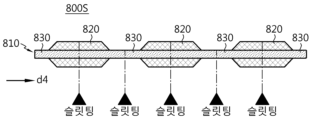
도 48 및 도 49는 본 발명의 일 실시예에 따라 양극을 제조하는 공정을 나타낸 도면들이다.
도 50은 본 발명의 일 실시예에 따른 양극을 나타낸 사시도이다.
도 51은 본 발명의 비교예에 따른 전극 조립체를 나타낸 도면이다.
도 52는 도 51의 절단선 B-B'를 따라 자른 단면을 나타낸 단면도이다.
도 53은 본 발명의 비교예에 따라 음극을 제조하는 공정을 나타낸 도면이다.
도 54는 본 발명의 비교예에 따라 양극을 제조하는 공정을 나타낸 도면이다.
도 55는 실리콘계 음극 활물질과 탄소계 음극 활물질의 혼합물을 음극 활물질로 사용한 배터리에서, 실리콘계 음극 활물질의 함량과 실리콘계 음극 활물질의 도핑 유무에 따른 에너지 밀도의 변화를 보여주는 그래프이다.The following drawings attached to this specification illustrate preferred embodiments of the present invention and, together with the detailed description of the invention described below, serve to further understand the technical idea of the present invention; therefore, the present invention should not be interpreted as being limited to matters described in such drawings.
Figure 1 is a plan view showing the structure of an electrode used in a conventional tab-less cylindrical battery cell.
Figure 2 is a drawing showing a winding process of an electrode assembly included in a conventional tab-less cylindrical battery cell.
Figure 3 is a drawing showing a process of welding a collector plate to a folded surface of a non-conductive portion in the electrode assembly of Figure 2.
Figure 4 is a cross-sectional view of a conventional tab-less cylindrical battery cell cut in the longitudinal direction (Y).
FIG. 5 is a cross-sectional view showing the internal structure of a cylindrical battery according to one embodiment of the present invention.
FIG. 6 is a drawing showing a first collector plate according to one embodiment of the present invention.
FIGS. 7 to 9 are drawings showing various exemplary forms of a first connecting portion of a first collector plate according to one embodiment of the present invention.
Figures 10 and 11 are drawings showing the shape of the first connecting portion according to the height of the electrode assembly, respectively.
FIG. 12 is a drawing showing a first collector plate according to another embodiment of the present invention.
FIG. 13 is a drawing showing a first collector plate according to another embodiment of the present invention.
FIG. 14 is a drawing showing an exemplary form of a second connecting portion of the first collector plate illustrated in FIG. 13.
FIGS. 15 and 16 are drawings showing a first collector plate of the present invention having a different form from that described and illustrated in the preceding embodiments.
FIG. 17 is a perspective view showing a cylindrical battery and a bus bar for electrical connection of a plurality of cylindrical batteries according to one embodiment of the present invention.
FIG. 18 is a cross-sectional view showing the upper structure of a cylindrical battery according to one embodiment of the present invention.
FIG. 19 is a partial cross-sectional view showing a cylindrical battery according to one embodiment of the present invention.
Figure 20 is a drawing showing the electrode assembly of the present invention and the second collector plate combined.
FIGS. 21 to 24 are drawings showing various shapes of a second collector plate according to one embodiment of the present invention.
FIGS. 25 and 26 are drawings showing various shapes of a second collector plate according to another embodiment of the present invention.
FIG. 27 is a partial cross-sectional view showing the lower structure of a cylindrical battery according to one embodiment of the present invention.
FIG. 28 is a drawing showing the lower surface of a cylindrical battery according to one embodiment of the present invention.
FIG. 29 is a schematic diagram showing a battery pack according to one embodiment of the present invention.
FIG. 30 is a drawing showing a vehicle according to one embodiment of the present invention.
Figure 31 is a scanning electron microscope photograph of a conventionally used carbon nanotube (existing CNT).
Figure 32 is a scanning electron microscope photograph of a novel CNT according to an embodiment of the present invention.
Figure 33 is a table comparing the properties of reference CNTs and novel CNTs.
Figures 34 to 37 are graphs showing surface resistance and high-temperature life characteristics according to the conductive material ratio when single-particle active material particles are applied as the positive electrode active material.
Figure 38 is a table comparing the solid content and viscosity of positive electrode slurry and the resistance value in the MP coating layer and MP interface layer when carbon nanotubes (new CNTs) having a BET surface area of 300 m 2 /g to 500 m 2 / g are applied and when carbon nanotubes (existing CNTs) having a BET surface area of 200 m 2 /g or more and less than 300
Figure 39a is a SEM photograph of the positive electrode active material used in Example 2-1 of the present invention.
Figure 39b is a SEM photograph of the positive electrode active material used in Example 2-2 of the present invention.
Figure 39c is a SEM photograph of the positive electrode active material used in Comparative Example 2-2 of the present invention.
FIG. 40a is a graph showing the results of a hot box test of a 4680 cell manufactured by Example 1 of the present invention.
Figure 40b is a graph showing the results of a hot box test of a 4680 cell manufactured by Comparative Example 1 of the present invention.
FIG. 40c is a graph showing the results of a hot box test of a 4680 cell manufactured by
FIG. 40d is a graph showing the results of a hot box test of 4680 cells manufactured by
Figure 41a is a cross-sectional SEM photograph of the anode manufactured in Example 2-1 of the present invention.
Figure 41b is a cross-sectional SEM photograph of the anode manufactured in Comparative Example 2-1.
FIG. 42a is a graph showing the results of measuring resistance characteristics according to SOC while charging coin half cells including positive electrodes according to Example 3-3, Comparative Example 3-1, and Comparative Example 3-2 of the present invention up to 4.2 V.
Figure 42b is a graph showing the results of measuring capacity retention and resistance increase rate (DCIR increase) obtained through charge/discharge cycle experiments on 4680 cells according to Examples 3-1, 3-3, and Comparative Example 3-1 of the present invention.
FIG. 43 is a drawing showing an electrode assembly according to one embodiment of the present invention.
Figure 44 is a cross-sectional view showing a section taken along the cutting line A-A' of Figure 43.
FIGS. 45 and 46 are drawings showing a process for manufacturing a cathode according to one embodiment of the present invention.
Figure 47 is a perspective view showing a cathode according to one embodiment of the present invention.
FIGS. 48 and 49 are drawings showing a process for manufacturing an anode according to one embodiment of the present invention.
Figure 50 is a perspective view showing an anode according to one embodiment of the present invention.
Figure 51 is a drawing showing an electrode assembly according to a comparative example of the present invention.
Figure 52 is a cross-sectional view showing a section taken along the cutting line B-B' of Figure 51.
Figure 53 is a drawing showing a process for manufacturing a cathode according to a comparative example of the present invention.
Figure 54 is a drawing showing a process for manufacturing an anode according to a comparative example of the present invention.
Figure 55 is a graph showing the change in energy density in a battery using a mixture of a silicon-based negative electrode active material and a carbon-based negative electrode active material as the negative electrode active material, depending on the content of the silicon-based negative electrode active material and the presence or absence of doping of the silicon-based negative electrode active material.
이하, 첨부된 도면을 참조하여 본 발명의 바람직한 실시예를 상세히 설명하기로 한다. 이에 앞서, 본 명세서 및 청구범위에 사용된 용어나 단어는 통상적이거나 사전적인 의미로 한정해서 해석되어서는 아니 되며, 발명자는 그 자신의 발명을 가장 최선의 방법으로 설명하기 위해 용어의 개념을 적절하게 정의할 수 있다는 원칙에 입각하여 본 발명의 기술적 사상에 부합하는 의미와 개념으로 해석되어야만 한다. 따라서, 본 명세서에 기재된 실시예와 도면에 도시된 구성은 본 발명의 가장 바람직한 일부 실시예에 불과할 뿐이고 본 발명의 기술적 사상을 모두 대변하는 것은 아니므로, 본 출원시점에 있어서 이들을 대체할 수 있는 다양한 균등물과 변형예들이 있을 수 있음을 이해하여야 한다.Hereinafter, preferred embodiments of the present invention will be described in detail with reference to the attached drawings. Prior to this, terms or words used in this specification and claims should not be interpreted as limited to their usual or dictionary meanings, and should be interpreted as meanings and concepts that conform to the technical idea of the present invention based on the principle that the inventor can appropriately define the concept of the term in order to explain his or her own invention in the best way. Therefore, the embodiments described in this specification and the configurations illustrated in the drawings are only some of the most preferred embodiments of the present invention and do not represent all of the technical idea of the present invention, and it should be understood that there may be various equivalents and modified examples that can replace them at the time of filing this application.
또한, 발명의 이해를 돕기 위하여, 첨부된 도면은 실제 축척대로 도시된 것이 아니라 일부 구성요소의 치수가 과장되게 도시될 수 있다. 또한, 서로 다른 실시예에서 동일한 구성요소에 대해서는 동일한 참조번호가 부여될 수 있다. In addition, to facilitate understanding of the invention, the attached drawings are not drawn to scale and some components may have exaggerated dimensions. In addition, the same reference numbers may be given to the same components in different embodiments.
도면에 나타난 각 구성의 크기 및 두께는 설명의 편의를 위해 임의로 나타내었으므로, 본 발명이 반드시 도시된 바에 한정되지 않는다. 도면에서 여러 층 및 영역을 명확하게 표현하기 위하여 두께를 확대하여 나타내었다. 그리고 도면에서, 설명의 편의를 위해, 일부 층 및 영역의 두께를 과장되게 나타내었다.The size and thickness of each component shown in the drawing are arbitrarily shown for the convenience of explanation, so the present invention is not necessarily limited to what is shown. In the drawing, the thickness is shown enlarged to clearly express various layers and regions. In addition, in the drawing, the thickness of some layers and regions is shown exaggeratedly for the convenience of explanation.
또한, 층, 막, 영역, 판 등의 부분이 다른 부분 "위에" 또는 “상에” 있다고 할 때, 이는 다른 부분 "바로 위에" 있는 경우뿐만 아니라 그 중간에 또 다른 부분이 있는 경우도 포함한다. 반대로 어떤 부분이 다른 부분 "바로 위에" 있다고 할 때에는 중간에 다른 부분이 없는 것을 뜻한다. 또한, 기준이 되는 부분 "위에" 또는 “상에” 있다고 하는 것은 기준이 되는 부분의 위 또는 아래에 위치하는 것이고, 반드시 중력 반대 방향을 향하여 “위에” 또는 “상에” 위치하는 것을 의미하는 것은 아니다.Also, when we say that a part such as a layer, film, region, or plate is "over" or "on" another part, this includes not only cases where it is "directly over" the other part, but also cases where there is another part in between. Conversely, when we say that a part is "directly over" another part, it means that there is no other part in between. Also, when we say that a part is "over" or "on" a reference part, it means that it is located above or below the reference part, and does not necessarily mean that it is located "over" or "on" the opposite direction of gravity.
또한, 명세서 전체에서, 어떤 부분이 어떤 구성요소를 "포함" 한다고 할 때, 이는 특별히 반대되는 기재가 없는 한 다른 구성요소를 제외하는 것이 아니라 다른 구성요소를 더 포함할 수 있는 것을 의미한다.Additionally, throughout the specification, whenever a part is said to "include" a component, this does not mean that it excludes other components, but rather that it may include other components, unless otherwise specifically stated.
또한, 명세서 전체에서, "평면상"이라 할 때, 이는 대상 부분을 위에서 보았을 때를 의미하며, "단면상"이라 할 때, 이는 대상 부분을 수직으로 자른 단면을 옆에서 보았을 때를 의미한다.Additionally, throughout the specification, when we say "in plan", we mean when the target portion is viewed from above, and when we say "in cross section", we mean when the target portion is viewed from the side in a cross-section cut vertically.
먼저, 도 5를 참조하면, 본 발명의 일 실시예에 따른 원통형 배터리(1)는 전극 조립체(300), 배터리 하우징(20), 제1 집전판(30), 캡 플레이트(40) 및 배터리 단자(60)를 포함한다. 상기 원통형 배터리(1)는, 그 밖에도 실링 가스켓(G1) 및/또는 절연 가스켓(G2) 및/또는 제2 집전판(50) 및/또는 인슐레이터(S)를 더 포함할 수도 있다.First, referring to FIG. 5, a cylindrical battery (1) according to one embodiment of the present invention includes an electrode assembly (300), a battery housing (20), a first current collector plate (30), a cap plate (40), and a battery terminal (60). The cylindrical battery (1) may further include a sealing gasket (G1) and/or an insulating gasket (G2) and/or a second current collector plate (50) and/or an insulator (S).
상기 전극 조립체(300)는, 제1 전극 탭(11) 및 제2 전극 탭(12)을 구비한다. 상기 전극 조립체(300)는, 제1 극성을 갖는 제1 전극, 제2 극성을 갖는 제2 전극 및 제1 전극과 제2 전극 사이에 개재되는 분리막을 포함한다. 상기 제1 전극은 음극 또는 양극이고, 제2 전극은 제1 전극과 반대되는 극성을 갖는 전극에 해당한다. 좀 더 구체적으로는, 상기 전극 조립체(300)는 제1 전극, 분리막, 제2 전극, 분리막을 순차적으로 적어도 1회 적층하여 형성된 적층체를 권취시킴으로써 제조될 수 있다. 즉, 본 발명에 적용되는 전극 조립체(300)는, 젤리-롤 타입의 전극 조립체일 수 있다. 이러한 젤리-롤 타입의 전극 조립체(300)는, 대략 그 중심부에 형성되어 높이 방향(도 5에 도시된 원통형 배터리(1)의 높이 방향과 나란한 방향)을 따라 연장되는 권취 중심 홀(H1)을 구비할 수 있다. 한편, 상기 전극 조립체(300)의 외주면 상에는 배터리 하우징(20)과의 절연을 위해 추가적인 분리막이 구비될 수 있다. The electrode assembly (300) has a first electrode tab (11) and a second electrode tab (12). The electrode assembly (300) includes a first electrode having a first polarity, a second electrode having a second polarity, and a separator interposed between the first electrode and the second electrode. The first electrode is a cathode or an anode, and the second electrode corresponds to an electrode having a polarity opposite to that of the first electrode. More specifically, the electrode assembly (300) can be manufactured by winding up a laminate formed by sequentially stacking the first electrode, the separator, the second electrode, and the separator at least once. That is, the electrode assembly (300) applied to the present invention can be a jelly-roll type electrode assembly. This jelly-roll type electrode assembly (300) may have a winding center hole (H1) formed approximately at the center thereof and extending along the height direction (parallel to the height direction of the cylindrical battery (1) illustrated in FIG. 5). Meanwhile, an additional separator may be provided on the outer peripheral surface of the electrode assembly (300) for insulation from the battery housing (20).
상기 제1 전극은, 제1 전극 집전체 및 제1 전극 집전체의 일 면 또는 양 면 상에 도포된 제1 전극 활물질층을 포함한다. 상기 제1 전극 집전체의 폭 방향(도 5에 도시된 원통형 배터리(1)의 높이 방향과 나란한 방향) 일 측 단부에는 제1 전극 활물질이 도포되지 않은 무지부가 존재한다. 상기 제1 전극 무지부는, 제1 전극이 펼쳐진 상태를 기준으로 볼 때 제1 전극의 길이 방향을 따라 일 측 단부로부터 타 측 단부까지 연장된 형태를 갖는다. 상기 제1 전극 무지부는, 상술한 바와 같은 제1 전극 탭(11)으로서 기능한다. 상기 제1 전극 탭(11)은, 배터리 하우징(20) 내에 수용된 전극 조립체(300)의 높이 방향(도 5에 도시된 원통형 배터리(1)의 높이 방향과 나란한 방향) 상부에 구비된다. 상기 제1 전극 탭(11)은, 예를 들어 음극 탭일 수 있다.The first electrode includes a first electrode current collector and a first electrode active material layer applied on one or both surfaces of the first electrode current collector. At one end of the first electrode current collector in the width direction (parallel to the height direction of the cylindrical battery (1) illustrated in FIG. 5), there is a non-coated portion on which the first electrode active material is not applied. The first electrode non-coated portion has a shape extending from one end to the other end along the length direction of the first electrode when the first electrode is unfolded. The first electrode non-coated portion functions as the first electrode tab (11) as described above. The first electrode tab (11) is provided on the upper portion of the electrode assembly (300) accommodated in the battery housing (20) in the height direction (parallel to the height direction of the cylindrical battery (1) illustrated in FIG. 5). The first electrode tab (11) may be, for example, a negative electrode tab.
상기 제2 전극은, 제2 전극 집전체 및 제2 전극 집전체의 일 면 또는 양 면 상에 도포된 제2 전극 활물질층을 포함한다. 상기 제2 전극 집전체의 폭 방향(도 5에 도시된 원통형 배터리(1)의 높이 방향과 나란한 방향) 타 측 단부에는 제2 전극 활물질이 도포되지 않은 무지부가 존재한다. 상기 제2 전극 무지부는, 제2 전극이 펼쳐진 상태를 기준으로 볼 때 제2 전극의 길이 방향을 따라 일 측 단부로부터 타 측 단부까지 연장된 형태를 갖는다. 상기 제2 전극 무지부는, 상술한 바와 같은 제2 전극 탭(12)으로서 기능한다. 상기 제2 전극 탭(12)은, 배터리 하우징(20) 내에 수용된 전극 조립체(300)의 높이 방향 하부에 구비된다. 상기 제2 전극 탭(12)은, 예를 들어 양극 탭일 수 있다.The second electrode includes a second electrode current collector and a second electrode active material layer applied on one or both surfaces of the second electrode current collector. On the other end of the second electrode current collector in the width direction (parallel to the height direction of the cylindrical battery (1) illustrated in FIG. 5), there is a non-coated portion on which the second electrode active material is not applied. The second electrode non-coated portion has a shape extending from one end to the other end along the length direction of the second electrode when the second electrode is unfolded. The second electrode non-coated portion functions as the second electrode tab (12) as described above. The second electrode tab (12) is provided on the lower portion in the height direction of the electrode assembly (300) accommodated in the battery housing (20). The second electrode tab (12) may be, for example, a positive electrode tab.
즉, 상기 제1 전극 탭(11)과 제2 전극 탭(12)은, 원통형 배터리(1)의 높이 방향을 따라 서로 반대 방향으로 연장 돌출된다.That is, the first electrode tab (11) and the second electrode tab (12) extend and protrude in opposite directions along the height direction of the cylindrical battery (1).
다만, 본 발명이 전극 조립체(300)의 이러한 형태에 대하여 한정하는 것은 아니다.However, the present invention is not limited to this form of the electrode assembly (300).
상기 배터리 하우징(20)은, 일 측에 개방부가 형성된 대략 원통형의 수용체로서, 도전성을 갖는 금속 재질이다. 상기 배터리 하우징(20)의 측면, 그리고 상기 개방부의 반대 편에 위치하는 하면(도 5를 기준으로 아래쪽 면)은 일체로 형성될 수 있다. 즉, 상기 배터리 하우징(20)은, 그 높이 방향 상단은 개방되어 있고, 하단은 폐쇄된 형태를 가질 수 있다. 상기 배터리 하우징(20)의 하면은 대략 플랫한 형태를 가질 수 있다. 상기 배터리 하우징(20)은, 그 높이 방향 일 측에 형성된 개방부를 통해 전극 조립체(300)를 수용한다. 상기 배터리 하우징(20)은, 상기 개방부를 통해 전해질도 함께 수용할 수 있다. 다만, 본 발명이 배터리 하우징(20)의 이러한 형태에 대하여 한정하는 것은 아니다.The battery housing (20) is a roughly cylindrical receiver having an opening formed on one side, and is made of a conductive metal material. The side surface of the battery housing (20) and the lower surface (lower surface based on FIG. 5) located opposite the opening may be formed integrally. That is, the battery housing (20) may have an open upper surface in the height direction and a closed lower surface. The lower surface of the battery housing (20) may have a roughly flat shape. The battery housing (20) accommodates an electrode assembly (300) through an opening formed on one side in the height direction. The battery housing (20) may also accommodate an electrolyte through the opening. However, the present invention is not limited to this shape of the battery housing (20).
상기 배터리 하우징(20)은, 전극 조립체(300)와 전기적으로 연결된다. 상기 배터리 하우징(20)은, 전극 조립체(300)의 제1 전극 탭(11)과 연결된다. 따라서, 상기 배터리 하우징(20)은, 전기적으로 제1 전극 탭(11)과 동일한 극성을 갖는다.The above battery housing (20) is electrically connected to the electrode assembly (300). The battery housing (20) is connected to the first electrode tab (11) of the electrode assembly (300). Therefore, the battery housing (20) has the same electrical polarity as the first electrode tab (11).
상기 배터리 하우징(20)은, 상기 개방부에 인접한 단부에 형성되며 내측을 향해 압입된 비딩부(21)를 포함할 수 있다. 상기 배터리 하우징(20)은 상단부에 형성되는 비딩부(21)를 구비할 수 있다. 상기 배터리 하우징(20)은, 비딩부(21)보다 더 상부에 형성되는 크림핑부(22)를 더 구비할 수도 있다. 상기 비딩부(21)는, 배터리 하우징(20)의 외주면 둘레가 소정의 깊이로 압입된 형태를 갖는다. 상기 비딩부(21)는, 전극 조립체(300)의 상부에 형성된다. 상기 비딩부(21)가 형성된 영역에서의 배터리 하우징(20)의 내경은, 전극 조립체(300)의 직경보다 더 작게 형성된다.The battery housing (20) may include a beading portion (21) formed at an end adjacent to the opening and pressed inwardly. The battery housing (20) may have a beading portion (21) formed at an upper end. The battery housing (20) may further have a crimping portion (22) formed higher than the beading portion (21). The beading portion (21) has a shape in which the outer peripheral surface of the battery housing (20) is pressed to a predetermined depth. The beading portion (21) is formed at an upper portion of the electrode assembly (300). The inner diameter of the battery housing (20) in the area where the beading portion (21) is formed is formed smaller than the diameter of the electrode assembly (300).
상기 비딩부(21)는, 캡 플레이트(40)가 안착될 수 있는 지지 면을 제공한다. 또한, 상기 비딩부(21)는, 후술할 제1 집전판(30)의 가장자리 둘레 중 적어도 일부가 안착 및 결합될 수 있는 지지 면을 제공할 수 있다. 즉, 상기 비딩부(21)의 상면에는, 본 발명의 제1 집전판(30)의 가장자리 둘레 중 적어도 일부 및/또는 본 발명의 캡 플레이트(40)의 가장자리 둘레가 안착될 수 있다. 도 10 및 도 11과 같이, 상기 제1 집전판(30)의 가장자리 둘레 중 적어도 일부 및/또는 캡 플레이트(40)의 가장자리 둘레를 안정적을 지지할 수 있도록 하기 위해, 상기 비딩부(21)의 상면은 적어도 일부가 배터리 하우징(20)의 하면에 대략 나란한 방향을 따라, 즉 배터리 하우징(20)의 측벽에 대략 수직한 방향을 따라 연장된 형태를 가질 수도 있다. The above beading portion (21) provides a support surface on which the cap plate (40) can be secured. In addition, the beading portion (21) can provide a support surface on which at least a portion of the edge perimeter of the first current collector plate (30), which will be described later, can be secured and coupled. That is, at least a portion of the edge perimeter of the first current collector plate (30) of the present invention and/or the edge perimeter of the cap plate (40) of the present invention can be secured on the upper surface of the beading portion (21). As shown in FIGS. 10 and 11, in order to stably support at least a portion of the edge perimeter of the first current collector plate (30) and/or the edge perimeter of the cap plate (40), at least a portion of the upper surface of the beading portion (21) may have a shape in which it extends along a direction substantially parallel to the lower surface of the battery housing (20), that is, along a direction substantially perpendicular to the side wall of the battery housing (20).
상기 크림핑부(22)는, 비딩부(21)의 상부에 형성된다. 상기 크림핑부(22)는, 비딩부(21)의 상부에 배치되는 캡 플레이트(40)의 가장자리 둘레를 감싸도록 연장 및 밴딩(bending)된 형태를 갖는다. 이러한 크림핑부(22)의 형상에 의해 캡 플레이트(40)는 비딩부(21) 상에 고정된다. 물론, 이러한 크림핑부(22)가 생략되고 다른 고정 구조를 통해 캡 플레이트(40)가 배터리 하우징(20)의 개방부를 커버하면서 고정되도록 하는 것도 가능 하다.The crimping portion (22) is formed on the upper portion of the beading portion (21). The crimping portion (22) has an extended and bent shape to wrap around the edge of the cap plate (40) positioned on the upper portion of the beading portion (21). The cap plate (40) is fixed on the beading portion (21) by the shape of the crimping portion (22). Of course, it is also possible to omit the crimping portion (22) and fix the cap plate (40) while covering the opening of the battery housing (20) through another fixing structure.
다만, 본 발명은, 배터리 하우징(20)이 이러한 비딩부(21) 및/또는 크림핑부(22)를 구비하지 않는 경우를 배제하지 않는다. 본 발명에 있어서 배터리 하우징(20)이 비딩부(21) 및/또는 크림핑부(22)를 구비하지 않는 경우, 전극 조립체(300)의 고정 및/또는 캡 플레이트(40)의 고정 및/또는 배터리 하우징(20)의 밀봉은, 예를 들어 전극 조립체(300)에 대한 스토퍼로서 기능할 수 있는 부품의 추가 적용 및/또는 캡 플레이트(40)가 안착될 수 있는 구조물의 추가 적용 및/또는 배터리 하우징(20)과 캡 플레이트(40) 간의 용접 등을 통해 실현할 수 있다.However, the present invention does not exclude a case where the battery housing (20) does not have the beading portion (21) and/or the crimping portion (22). In the present invention, when the battery housing (20) does not have the beading portion (21) and/or the crimping portion (22), fixing of the electrode assembly (300) and/or fixing of the cap plate (40) and/or sealing of the battery housing (20) can be realized, for example, by additionally applying a component that can function as a stopper for the electrode assembly (300) and/or additionally applying a structure on which the cap plate (40) can be secured and/or welding between the battery housing (20) and the cap plate (40).
상기 배터리 하우징(20)은 그 폐쇄단, 즉 상면을 이루는 영역이 대략 0.5mm 내지 1.0mm 범위의 두께를 가질 수 있으며, 좀 더 바람직하게는 대략 0.6mm 내지 0.8mm 범위의 두께를 가질 수 있다. 상기 배터리 하우징(20)은, 그 외주면을 이루는 측벽부가 대략 0.3mm 내지 0.8mm 범위의 두께를 가질 수 있으며, 좀 더 바람직하게는 대략 0.40mm 내지 0.60mm 범위를 가질 수 있다. 본 발명의 일 실시예에 따르면, 배터리 하우징(20)에는 도금 층이 형성될 수 있다. 이 경우, 상기 도금 층은, 예를 들어 니켈(Ni)을 포함할 수 있다. 상기 도금 층의 두께는 대략 1.5㎛ 내지 6.0㎛ 범위일 수 있다.The battery housing (20) may have a thickness of about 0.5 mm to 1.0 mm at its closed end, that is, its upper surface, more preferably, about 0.6 mm to 0.8 mm. The battery housing (20) may have a thickness of about 0.3 mm to 0.8 mm at its outer surface, more preferably, about 0.40 mm to 0.60 mm. According to one embodiment of the present invention, a plating layer may be formed on the battery housing (20). In this case, the plating layer may include, for example, nickel (Ni). The thickness of the plating layer may be about 1.5 μm to 6.0 μm.
상기 배터리 하우징(20)의 두께는 얇을수록 내부 공간이 커지게 되고, 이로써 에너지 밀도가 향상되어 큰 용량을 갖는 원통형 배터리(1)를 제조할 수 있게 된다. 반대로 두께가 두꺼울수록 폭발 테스트 시 인접 셀로 화염이 연쇄적으로 전파되지 않아 안전성의 측면에서는 유리할 수 있다.The thinner the thickness of the battery housing (20), the larger the internal space becomes, thereby improving the energy density and enabling the manufacture of a cylindrical battery (1) with a large capacity. Conversely, the thicker the thickness, the less likely it is that flames will spread chainwise to adjacent cells during an explosion test, which may be advantageous in terms of safety.
도금 층의 두께는 얇을수록 부식에 취약하고, 두꺼울수록 제조공정이 어렵거나 도금 박리가 발생할 수 있는 가능성이 높아진다. 이러한 조건을 모두 고려하여 최적의 배터리 하우징(20)의 두께를 설정하고 최적의 도금 층의 두께를 설정할 필요가 있다. 더욱이, 이러한 조건을 모두 고려하여 배터리 하우징(20)의 폐쇄부의 두께 및 측벽부의 두께를 각각 제어할 필요가 있다.The thinner the plating layer, the more susceptible it is to corrosion, and the thicker it is, the more difficult the manufacturing process is or the more likely it is that plating peeling may occur. It is necessary to set the optimal thickness of the battery housing (20) and the optimal thickness of the plating layer by considering all of these conditions. Furthermore, it is necessary to control the thickness of the closed portion and the thickness of the side wall of the battery housing (20) by considering all of these conditions.
다음은, 도 5 내지 도 9를 참조하여, 본 발명의 일 실시예에 따른 제1 집전판(30)을 상세히 설명하기로 한다.Next, a first collector plate (30) according to one embodiment of the present invention will be described in detail with reference to FIGS. 5 to 9.
먼저, 도 5 및 도 6를 참조하면, 본 발명의 일 실시예에 따른 제1 집전판(30)은, 배터리 하우징(20) 내부에 수용되며, 전극 조립체(300)와 전기적으로 연결되고, 또한 배터리 하우징(20)과 전기적으로 연결된다. 즉, 상기 제1 집전판(30)은, 전극 조립체(300)와 배터리 하우징(20) 사이를 전기적으로 연결한다.First, referring to FIGS. 5 and 6, a first current collector (30) according to one embodiment of the present invention is accommodated inside a battery housing (20), is electrically connected to an electrode assembly (300), and is also electrically connected to the battery housing (20). That is, the first current collector (30) electrically connects between the electrode assembly (300) and the battery housing (20).
상기 제1 집전판(30)은, 상기 전극 조립체(300)의 일 면에 배치되는 지지부(31), 상기 지지부(31)로부터 연장되어 제1 전극 탭(11)과 결합되는 복수의 제1 탭 결합부(32) 및 상기 지지부(31)로부터 연장되어 배터리 하우징(20)의 내측 면 상에 결합되는 복수의 제1 하우징 결합부(33)를 포함한다. 상기 제1 탭 결합부(32)와 제1 하우징 결합부(33)는, 지지부(31)를 통해 간접적으로 연결되며, 서로 직접 연결되지 않는다. 따라서, 본 발명의 원통형 배터리(1)에 외부 충격이 가해졌을 때, 제1 집전판(30)과 전극 조립체(300)의 결합 부위 및 제1 집전판(30)과 배터리 하우징(20)의 결합 부위에 손상 발생 가능성을 최소화 할 수 있다.The first current collector plate (30) includes a support member (31) arranged on one surface of the electrode assembly (300), a plurality of first tab coupling members (32) extending from the support member (31) and coupled with the first electrode tab (11), and a plurality of first housing coupling members (33) extending from the support member (31) and coupled on the inner surface of the battery housing (20). The first tab coupling members (32) and the first housing coupling members (33) are indirectly connected through the support member (31), and are not directly connected to each other. Therefore, when an external impact is applied to the cylindrical battery (1) of the present invention, the possibility of damage occurring to the coupling portion between the first current collector plate (30) and the electrode assembly (300) and the coupling portion between the first current collector plate (30) and the battery housing (20) can be minimized.
상기 지지부(31) 및 복수의 제1 탭 결합부(32)는 전극 조립체(300)의 상부에 배치되며, 배터리 하우징(20)에 비딩부(21)가 형성되는 경우에 있어서 비딩부(21)보다 하부에 위치한다. The above support member (31) and the plurality of first tab connecting members (32) are positioned on the upper portion of the electrode assembly (300) and, when the beading member (21) is formed in the battery housing (20), are positioned lower than the beading member (21).
상기 지지부(31)는, 전극 조립체(300)의 대략 중심부에 형성되는 권취 홀(H1)과 대응되는 위치에 형성되는 제1 집전판 홀(H2)을 구비한다. 서로 연통되는 권취 홀(H1) 및 제1 집전판 홀(H2)은, 후술할 배터리 단자(60)와 제2 집전판(50) 간의 용접 또는 배터리 단자(60)와 리드 탭(미도시) 간의 용접을 위한 용접봉의 삽입 또는 레이저의 조사를 위한 통로로서 기능할 수 있다. The above-described support member (31) is provided with a first collector plate hole (H2) formed at a position corresponding to a winding hole (H1) formed at approximately the center of the electrode assembly (300). The winding hole (H1) and the first collector plate hole (H2), which are connected to each other, can function as a passage for insertion of a welding rod or irradiation of a laser for welding between a battery terminal (60) and a second collector plate (50) described later or welding between a battery terminal (60) and a lead tab (not shown).
상기 복수의 제1 탭 결합부(32)들은 지지부(31)로부터 대략 방사상으로 배터리 하우징(20)의 측벽을 향해 연장된 형태를 가질 수 있다. 상기 복수의 제1 탭 결합부(32)들 각각은 지지부(31)의 둘레를 따라 상호 이격되어 위치할 수 있다. 한편, 상기 제1 집전판(30)과 전극 조립체(300) 간의 결합 면적 증대를 통한 결합력 확보 및 전기저항 감소를 위해, 상기 제1 탭 결합부(32) 뿐만 아니라 지지부(31) 역시 제1 전극 탭(11)과 결합할 수도 있다. 상기 제1 전극 탭(11)의 단부는 제1 탭 결합부(32)와 나란하도록 밴딩된 형태로 포밍될 수 있다. 이처럼 제1 전극 탭(11)의 단부가 포밍되어 제1 탭 결합부(32)와 나란한 상태로 제1 탭 결합부(32)와 결합되는 경우, 결합 면적을 증대시켜 결합력 향상 및 전기 저항 감소 효과를 얻을 수 있으며, 또한 전극 조립체(300)의 총고를 최소화 하여 에너지 밀도 향상 효과를 얻을 수 있다.The plurality of first tab coupling portions (32) may have a shape that extends approximately radially from the support portion (31) toward the side wall of the battery housing (20). Each of the plurality of first tab coupling portions (32) may be positioned spaced apart from each other along the perimeter of the support portion (31). Meanwhile, in order to secure bonding strength and reduce electrical resistance by increasing the bonding area between the first current collector plate (30) and the electrode assembly (300), not only the first tab coupling portions (32) but also the support portion (31) may be bonded to the first electrode tab (11). The end of the first electrode tab (11) may be formed in a bended shape so as to be parallel to the first tab coupling portion (32). In this way, when the end of the first electrode tab (11) is formed and joined to the first tab joining portion (32) in a state parallel to the first tab joining portion (32), the joining area can be increased to obtain the effect of improving the joining force and reducing the electric resistance, and also the effect of improving the energy density can be obtained by minimizing the total height of the electrode assembly (300).
상기 복수의 제1 하우징 결합부(33)들은 제1 집전판(30)의 지지부(31)로부터 대략 방사상으로 배터리 하우징(20)의 측벽을 향해 연장된 형태를 가질 수 있다. 상기 복수의 제1 하우징 결합부(33)들 각각은 지지부(31)의 둘레를 따라 상호 이격되어 위치할 수 있다. 서로 이웃하는 제1 탭 결합부(32) 사이에는 적어도 하나의 제1 하우징 결합부(33)가 위치할 수 있다. 상기 복수의 제1 하우징 결합부(33)들은, 배터리 하우징(20)의 내측 면 중, 예를 들어 비딩부(21)에 결합될 수 있다. 상기 제1 하우징 결합부(33)들은, 특히 비딩부(21)의 상면에 결합될 수 있다. 본 발명의 원통형 배터리(1)에 있어서, 이러한 구조를 적용하는 경우, 제1 집전판(30)이 결합된 상태의 전극 조립체(300)를 배터리 하우징(20) 내에 수용시키는 공정을 통해 제1 하우징 결합부(33)가 자연스럽게 비딩부(21) 상에 안착될 수 있다. 따라서, 배터리 하우징(20)과 제1 집전판(30)의 용접 공정이 수월하게 진행될 수 있다. 또한, 비딩부(21)의 상면이 배터리 하우징(20)의 하면에 대략 나란한 방향, 즉 배터리 하우징(20)의 측벽에 대략 수직한 방향을 따라 연장된 형태를 갖도록 하고 제1 하우징 결합부(33) 역시 동일한 방향을 따라 연장된 형태를 갖도록 함으로써 제1 하우징 결합부(33)가 비딩부(21) 상에 안정적으로 접촉하도록 할 수 있다. 또한, 이처럼 상기 제1 하우징 결합부(33)가 비딩부(21) 상에 안정적으로 접촉됨에 따라 두 부품 간의 용접이 원활하게 이루어질 수 있고, 이로써 두 부품 간의 결합력 향상 및 결합 부위에서의 저항 증가 최소화 효과를 얻을 수 있다.The plurality of first housing coupling portions (33) may have a shape that extends approximately radially from the support portion (31) of the first current collector plate (30) toward the side wall of the battery housing (20). Each of the plurality of first housing coupling portions (33) may be positioned spaced apart from each other along the periphery of the support portion (31). At least one first housing coupling portion (33) may be positioned between adjacent first tab coupling portions (32). The plurality of first housing coupling portions (33) may be coupled to, for example, a beading portion (21) on an inner surface of the battery housing (20). The first housing coupling portions (33) may be coupled to, in particular, an upper surface of the beading portion (21). In the cylindrical battery (1) of the present invention, when such a structure is applied, the first housing joining portion (33) can be naturally placed on the beading portion (21) through a process of accommodating the electrode assembly (300) in which the first current collector (30) is joined into the battery housing (20). Accordingly, the welding process of the battery housing (20) and the first current collector (30) can be easily performed. In addition, the upper surface of the beading portion (21) can be extended in a direction approximately parallel to the lower surface of the battery housing (20), that is, in a direction approximately perpendicular to the side wall of the battery housing (20), and the first housing joining portion (33) can also be extended in the same direction, thereby allowing the first housing joining portion (33) to stably contact the beading portion (21). In addition, as the first housing joint (33) is stably brought into contact with the beading portion (21), welding between the two parts can be smoothly performed, thereby improving the bonding strength between the two parts and minimizing the increase in resistance at the joint area.
다음으로, 도 7 내지 도 11을 참조하면, 상기 제1 하우징 결합부(33)는 배터리 하우징(20)의 내측 면 상에 결합되는 제1 접촉부(33a) 및 지지부(31)와 제1 접촉부(33a) 사이를 연결하는 제1 연결부(33b)를 포함한다.Next, referring to FIGS. 7 to 11, the first housing coupling portion (33) includes a first contact portion (33a) coupled on the inner surface of the battery housing (20) and a first connecting portion (33b) connecting the support portion (31) and the first contact portion (33a).
상기 제1 접촉부(33a)는, 배터리 하우징(20)의 내측 면 상에 결합된다. 상기 배터리 하우징(20)에 비딩부(21)가 형성되는 경우에 있어서, 상기 제1 접촉부(33a)는 상술한 바와 같이 비딩부(21) 상에 결합될 수 있다. 이 경우, 상술한 바와 같이, 안정적인 접촉 및 결합을 위해 비딩부(21) 및 제1 접촉부(33a)는 모두 배터리 하우징(20)의 하면에 대략 나란한 방향, 즉 배터리 하우징(20)의 측벽에 대략 수직한 방향을 따라 연장된 형태를 가질 수 있다.The first contact portion (33a) is coupled on the inner surface of the battery housing (20). In the case where the beading portion (21) is formed on the battery housing (20), the first contact portion (33a) may be coupled on the beading portion (21) as described above. In this case, as described above, for stable contact and coupling, both the beading portion (21) and the first contact portion (33a) may have a shape that extends along a direction substantially parallel to the lower surface of the battery housing (20), that is, a direction substantially perpendicular to the side wall of the battery housing (20).
상기 제1 연결부(33b)는, 지지부(31)와 제1 접촉부(33a) 사이에서 그 연장 방향이 전환되는 제1 밴딩부(B1)를 적어도 하나 구비할 수 있다. 즉, 상기 제1 연결부(33b)는, 일정 범위 내에서 수축 및 신장이 가능한, 예를 들어 스프링 유사 구조 또는 자바라 유사 구조를 가질 수 있다. 이러한 제1 연결부(33b)의 구조는, 일정 범위 내에서 전극 조립체(300)의 높이 산포가 존재하더라도, 제1 집전판(30)이 결합된 전극 조립체(300)를 배터리 하우징(20) 내에 수용시키는 과정에서 제1 접촉부(33a)가 비딩부(21) 상에 밀착될 수 있도록 한다. The first connecting portion (33b) may have at least one first bending portion (B1) whose extension direction is switched between the support portion (31) and the first contact portion (33a). That is, the first connecting portion (33b) may have, for example, a spring-like structure or a javara-like structure that can contract and expand within a certain range. The structure of the first connecting portion (33b) allows the first contact portion (33a) to be in close contact with the beading portion (21) during the process of accommodating the electrode assembly (300) to which the first current collector (30) is coupled within a certain range, even if there is a height dispersion of the electrode assembly (300) within a certain range.
예를 들어, 상기 제1 집전판(30)에 외부 힘이 가해지지 않아 변형이 없는 상태에서의 상기 제1 접촉부(33a)와 지지부(31) 사이의 연직 방향 거리(D)는, 제1 집전판(30)이 결합된 상태의 전극 조립체(300)가 배터리 하우징(20) 내에 안착되었을 때의 비딩부(21)의 상면과 지지부(31) 사이의 연직 방향 거리와 동일하거나 제1 연결부(33b)의 신장 가능 범위 내에서 더 작게 형성되는 것이 바람직하다. 상기 제1 연결부(33b)가 이와 같은 조건을 충족하도록 구성되는 경우, 배터리 하우징(20) 내에 제1 집전판(30)이 결합된 전극 조립체(300)를 안착시켰을 때 제1 접촉부(33a)는 비딩부(21) 상에 자연스럽게 밀착될 수 있다.For example, when no external force is applied to the first collector plate (30) and there is no deformation, the vertical distance (D) between the first contact portion (33a) and the support portion (31) is preferably formed to be equal to or smaller than the vertical distance between the upper surface of the beading portion (21) and the support portion (31) when the electrode assembly (300) in which the first collector plate (30) is coupled is seated in the battery housing (20), or within the extensible range of the first connecting portion (33b). When the first connecting portion (33b) is configured to satisfy such a condition, when the electrode assembly (300) in which the first collector plate (30) is coupled is seated in the battery housing (20), the first contact portion (33a) can be naturally brought into close contact with the beading portion (21).
뿐만 아니라, 이러한 제1 연결부(33b)의 수축 및 신장 가능한 구조는 원통형 배터리(1)(도 5 참조)의 사용 과정에서 진동 및/또는 충격이 발생하여 전극 조립체(300)가 상하로 움직이더라도 일정 범위 내에서는 전극 조립체(300)의 움직임에 따른 충격이 완화 되도록 한다. 즉, 상기 제1 연결부(33b)의 수축 및 신장 가능한 구조는, 제1 접촉부(33a)와 배터리 하우징(20) 간의 결합 부위 및 제1 탭 결합부(32)와 제1 전극 탭(11) 간의 결합 부위에 충격이 전달되지 않도록 완충 작용을 할 수 있다(도 5 내지 도 9를 참조).In addition, the contractible and expandable structure of the first connecting portion (33b) allows the shock resulting from the movement of the electrode assembly (300) to be alleviated within a certain range even when vibration and/or shock occur during the use of the cylindrical battery (1) (see FIG. 5) and the electrode assembly (300) moves up and down. That is, the contractible and expandable structure of the first connecting portion (33b) can have a buffering effect so that shock is not transmitted to the joining portion between the first contact portion (33a) and the battery housing (20) and the joining portion between the first tab joining portion (32) and the first electrode tab (11) (see FIGS. 5 to 9).
다음으로, 도 12를 참조하면, 본 발명의 다른 실시예에 따른 제1 집전판(30)이 나타나 있다. 본 발명의 다른 실시예에 따른 제1 집전판(30)은, 앞서 설명된 제1 집전판(30)(도 6를 예시적으로 참조하여 설명한 제1 집전판)과 비교하여 제1 접촉부(33a)의 형태에 있어서 차이가 있을 뿐, 그 외에는 앞서 설명된 제1 집전판(30)의 구조가 실질적으로 동일하게 적용될 수 있다.Next, referring to FIG. 12, a first collector plate (30) according to another embodiment of the present invention is shown. The first collector plate (30) according to another embodiment of the present invention is different from the first collector plate (30) described above (the first collector plate described with reference to FIG. 6 as an example) in the shape of the first contact portion (33a), but other than that, the structure of the first collector plate (30) described above can be applied substantially identically.
도 5 및 도 12를 참조하면, 제1 접촉부(33a)는 적어도 일부가 배터리 하우징(20)의 내주면을 따라 연장된 형태를 가질 수 있다. 이 경우, 접촉 면적의 극대화를 위해, 상기 제1 집전판(30)은, 복수의 제1 하우징 결합부(33) 각각의 제1 접촉부(33a)의 연장된 길이의 합이 배터리 하우징(20)의 내주와 대략 동일하도록 구성될 수 있다.Referring to FIG. 5 and FIG. 12, the first contact portion (33a) may have a form in which at least a portion thereof extends along the inner circumference of the battery housing (20). In this case, in order to maximize the contact area, the first current collector plate (30) may be configured such that the sum of the extended lengths of the first contact portions (33a) of each of the plurality of first housing coupling portions (33) is approximately equal to the inner circumference of the battery housing (20).
다음으로, 도 5와 함께 도 13 및 도 14를 참조하면, 본 발명의 또 다른 실시예에 따른 제1 집전판(30)이 나타나 있다. 본 발명의 또 다른 실시예에 따른 제1 집전판(30)은, 앞선 실시예들에 따른 제1 집전판(30)들(도 6 및 도 12을 예시적으로 참조하여 설명한 제1 집전판(30)과 비교하여 제2 하우징 결합부(34)가 더 구비된다는 점에서 차이가 있을 뿐, 그 외에는 앞서 설명된 제1 집전판(30)들의 구조가 실질적으로 동일하게 적용될 수 있다.Next, referring to FIG. 13 and FIG. 14 together with FIG. 5, a first collector plate (30) according to another embodiment of the present invention is shown. The first collector plate (30) according to another embodiment of the present invention is different from the first collector plates (30) according to the previous embodiments (the first collector plate (30) described with reference to FIG. 6 and FIG. 12 as examples) in that it further includes a second housing coupling portion (34), but otherwise, the structure of the first collector plates (30) described above can be substantially identically applied.
상기 제2 하우징 결합부(34)는, 제1 탭 결합부(32)의 단부로부터 연장되어 배터리 하우징(20)의 내측 면 상에 결합된다. 복수의 상기 제1 탭 결합부(32)들 중 적어도 하나의 단부에는 이러한 제2 하우징 결합부(34)가 구비된다. 상기 제2 하우징 결합부(34)는 배터리 하우징(20)의 내측 면 상에 결합되는 제2 접촉부(34a) 및 지지부(31)와 제2 접촉부(34a) 사이를 연결하는 제2 연결부(34b)를 포함한다. The second housing coupling portion (34) extends from an end of the first tab coupling portion (32) and is coupled on the inner surface of the battery housing (20). The second housing coupling portion (34) is provided on the end of at least one of the plurality of first tab coupling portions (32). The second housing coupling portion (34) includes a second contact portion (34a) coupled on the inner surface of the battery housing (20) and a second connection portion (34b) connecting the support portion (31) and the second contact portion (34a).
상기 제2 접촉부(34a)는, 배터리 하우징(20)의 내측 면 상에 결합된다. 상기 배터리 하우징(20)에 비딩부(21)가 형성되는 경우에 있어서, 제2 접촉부(34a)는 전술한 제1 접촉부(33a)와 마찬가지로 비딩부(21) 상에 결합될 수 있다. 이 경우, 상술한 바와 같이, 안정적인 접촉 및 결합을 위해, 비딩부(21) 및 제2 접촉부(34a)는 모두 배터리 하우징(20)의 하면에 대략 나란한 방향, 즉 배터리 하우징(20)의 측벽에 대략 수직한 방향을 따라 연장된 형태를 가질 수 있다.The second contact portion (34a) is coupled on the inner surface of the battery housing (20). In the case where the beading portion (21) is formed on the battery housing (20), the second contact portion (34a) may be coupled on the beading portion (21) like the first contact portion (33a) described above. In this case, as described above, for stable contact and coupling, both the beading portion (21) and the second contact portion (34a) may have a shape that extends along a direction substantially parallel to the lower surface of the battery housing (20), that is, a direction substantially perpendicular to the side wall of the battery housing (20).
한편, 도면에 도시되지는 않았으나, 도 12에 도시된 제1 접촉부(33a)의 형태처럼, 제2 접촉부(34a) 역시 적어도 일부가 배터리 하우징(20)의 내주면을 따라 연장된 형태를 가질 수 있다. 이 경우, 제1 집전판(30)과 배터리 하우징(20) 간의 접촉 면적 극대화를 위해, 상기 제1 집전판(30)은, 복수의 제2 하우징 결합부(34) 각각의 제2 접촉부(34a)의 연장된 길이의 합이 배터리 하우징(20)의 내주와 대략 동일하도록 구성될 수 있다.Meanwhile, although not shown in the drawing, like the shape of the first contact portion (33a) shown in FIG. 12, the second contact portion (34a) may also have a shape in which at least a portion thereof extends along the inner circumference of the battery housing (20). In this case, in order to maximize the contact area between the first current collector plate (30) and the battery housing (20), the first current collector plate (30) may be configured such that the sum of the extended lengths of the second contact portions (34a) of each of the plurality of second housing coupling portions (34) is approximately equal to the inner circumference of the battery housing (20).
상기 제2 연결부(34b)는, 앞서 설명한 제1 연결부(33b)와 마찬가지로, 제1 탭 결합부(32)와 제2 접촉부(34a) 사이에서 그 연장 방향이 전환되는 제2 밴딩부(B2)를 적어도 하나 구비할 수 있다. 상기 제2 밴딩부(B2)의 형성으로 인해 제2 연결부(34b)가 수축 및 신장이 가능한 구조를 가지며, 이에 따라 원통형 배터리(1)의 조립 공정 상의 장점 및 완충 효과를 갖는다는 점은 앞서 설명한 바와 동일하다.The second connecting portion (34b) may have at least one second bending portion (B2) whose extension direction is switched between the first tab connecting portion (32) and the second contact portion (34a), similar to the first connecting portion (33b) described above. As described above, due to the formation of the second bending portion (B2), the second connecting portion (34b) has a structure that can contract and expand, and thus has advantages in the assembly process of the cylindrical battery (1) and a buffering effect.
본 발명의 도면에서는 상기 제2 밴딩부(B1)가 하나 구비된 경우만을 도시하고 있으나, 본 발명이 이에 한정되는 것은 아니며, 앞서 도 8 및 도 9를 예시적으로 참조하여 설명한 제1 연결부(33b)와 마찬가지로, 제2 밴딩부(B2) 역시 복수개 구비될 수 있다.In the drawings of the present invention, only a case in which the second banding portion (B1) is provided is illustrated, but the present invention is not limited thereto, and, similar to the first connecting portion (33b) exemplarily explained with reference to FIGS. 8 and 9 above, a plurality of second banding portions (B2) may also be provided.
도 5를 참조하면, 상기 캡 플레이트(40)는, 배터리 하우징(20)의 일 측에 형성된 상기 개방부를 커버한다. 본 발명의 배터리 하우징(20)이 비딩부(21)를 구비하는 경우, 상기 캡 플레이트(40)는, 배터리 하우징(20)에 형성된 비딩부(21) 상에 안착될 수 있다. 또한, 본 발명의 배터리 하우징(20)이 크림핑부(22)를 구비하는 경우, 상기 캡 플레이트(40)는, 크림핑부(22)에 의해 고정된다. 이 경우, 고정력의 향상 및 배터리 하우징(20)의 밀폐성 향상을 위해 배터리 하우징(20)과 캡 플레이트(40) 사이 및 제1 집전판(30)과 캡 플레이트(40) 사이에는 실링 가스켓(G1)이 개재될 수도 있다. 다만, 본 발명에 있어서 캡 플레이트(40)는 전류의 통로로서 기능해야 하는 부품은 아니다. 따라서, 용접 또는 다른 부품의 적용에 따른 고정을 통해 배터리 하우징(20)과 캡 플레이트(40)를 견고히 고정시키고 배터리 하우징(20)의 개방부의 밀폐성을 확보할 수만 있다면, 이러한 실링 가스켓(G1)의 적용이 필수적인 것은 아니다.Referring to FIG. 5, the cap plate (40) covers the opening formed on one side of the battery housing (20). When the battery housing (20) of the present invention has a beading portion (21), the cap plate (40) can be seated on the beading portion (21) formed on the battery housing (20). In addition, when the battery housing (20) of the present invention has a crimping portion (22), the cap plate (40) is fixed by the crimping portion (22). In this case, a sealing gasket (G1) may be interposed between the battery housing (20) and the cap plate (40) and between the first current collector (30) and the cap plate (40) in order to improve the fixing force and the sealing property of the battery housing (20). However, in the present invention, the cap plate (40) is not a component that must function as a current passage. Therefore, the application of this sealing gasket (G1) is not essential as long as the battery housing (20) and the cap plate (40) can be firmly fixed through fixation by welding or application of other parts and the sealing of the opening of the battery housing (20) can be secured.
상기 캡 플레이트(40)는, 강성 확보를 위해 예를 들어 금속 재질로 이루어질 수 있다. 본 발명의 원통형 배터리(1)에 있어서, 캡 플레이트(40)는, 전도성을 갖는 금속 재질인 경우에도, 극성을 갖지 않을 수 있다. 극성을 갖지 않는다는 것은, 상기 캡 플레이트(40)가 배터리 하우징(20) 및 하기 설명할 배터리 단자(60)와 전기적으로 절연되어 있음을 의미할 수 있다. 따라서, 상기 캡 플레이트(40)는, 양극 단자 또는 음극 단자로서 기능하지 않는다. 따라서, 상기 캡 플레이트(40)는, 전극 조립체(300) 및 배터리 하우징(20)과 전기적으로 연결될 필요가 없으며, 그 재질이 반드시 전도성 금속이어야 하는 것도 아니다.The cap plate (40) may be made of, for example, a metal material to secure rigidity. In the cylindrical battery (1) of the present invention, the cap plate (40) may not have polarity even if it is made of a conductive metal material. Not having polarity may mean that the cap plate (40) is electrically insulated from the battery housing (20) and the battery terminal (60) to be described below. Therefore, the cap plate (40) does not function as a positive terminal or a negative terminal. Accordingly, the cap plate (40) does not need to be electrically connected to the electrode assembly (300) and the battery housing (20), and its material does not necessarily have to be a conductive metal.
한편, 상기 실링 가스켓(G1)이 적용되는 경우를 예시로 들어 설명하면, 상기 실링 가스켓(G1)은, 상기 캡 플레이트(40)를 감싸는 대략 링 형상을 가질 수 있다. 상기 실링 가스켓(G1)은, 캡 플레이트(40)의 상면, 하면 및 측면을 동시에 커버할 수 있다. 실링 가스켓(G1)의 부위 중에서 캡 플레이트(40)의 하면을 커버하는 부위의 반경 방향 길이는, 실링 가스켓(G1)의 부위 중에서 상기 캡 플레이트(40)의 상면을 커버하는 부위의 반경 방향 길이보다 작거나 같을 수 있다. 실링 가스켓(G1)의 부위 중에서 캡 플레이트(40)의 하면을 커버하는 부위의 반경 방향 길이가 지나치게 길면, 배터리 하우징(20)을 상하로 압축하는 과정에서 실링 가스켓(G1)이 제1 집전판(30)을 가압하여, 제1 집전판(30)이 손상되거나 배터리 하우징(20)이 손상될 가능성이 있다. 따라서, 실링 가스켓(G1)의 부위 중에서 캡 플레이트(40)의 하면을 커버하는 부위의 반경 방향 길이를 일정 수준으로 작게 유지할 필요가 있다. 예를 들면, 도 5와 같이 실링 가스켓(G1)의 부위 중에서 캡 플레이트(40)의 하면을 커버하는 부위의 반경 방향 길이가, 실링 가스켓(G1)의 부위 중에서 상기 캡 플레이트(40)의 상면을 커버하는 부위의 반경 방향 길이보다 작게 형성될 수 있다. 또는, 실링 가스켓(G1)의 부위 중에서 캡 플레이트(40)의 하면을 커버하는 부위의 반경 방향 길이는, 실링 가스켓(G1)의 부위 중에서 상기 캡 플레이트(40)의 상면을 커버하는 부위의 반경 방향 길이와 동일할 수 있다.Meanwhile, if an example of a case in which the sealing gasket (G1) is applied is explained, the sealing gasket (G1) may have an approximate ring shape that surrounds the cap plate (40). The sealing gasket (G1) may cover the upper surface, lower surface, and side surface of the cap plate (40) at the same time. The radial length of the portion of the sealing gasket (G1) that covers the lower surface of the cap plate (40) may be smaller than or equal to the radial length of the portion of the sealing gasket (G1) that covers the upper surface of the cap plate (40). If the radial length of the portion of the sealing gasket (G1) that covers the lower surface of the cap plate (40) is excessively long, the sealing gasket (G1) may press the first collector plate (30) in the process of compressing the battery housing (20) up and down, which may cause damage to the first collector plate (30) or damage to the battery housing (20). Therefore, it is necessary to keep the radial length of the portion covering the lower surface of the cap plate (40) among the portions of the sealing gasket (G1) small to a certain level. For example, as shown in FIG. 5, the radial length of the portion covering the lower surface of the cap plate (40) among the portions of the sealing gasket (G1) may be formed smaller than the radial length of the portion covering the upper surface of the cap plate (40) among the portions of the sealing gasket (G1). Alternatively, the radial length of the portion covering the lower surface of the cap plate (40) among the portions of the sealing gasket (G1) may be the same as the radial length of the portion covering the upper surface of the cap plate (40) among the portions of the sealing gasket (G1).
한편, 상기 캡 플레이트(40)는, 배터리 하우징(20) 내부에 발생된 가스로 인한 내압 증가를 방지하기 위해 형성되는 벤팅부(41)를 구비할 수 있다. 상기 벤팅부(41)는, 캡 플레이트(40)의 일부에 형성되며 내부 압력이 가해졌을 때 용이하게 파단될 수 있도록 주변 영역보다 구조적으로 취약한 영역에 해당한다. 상기 벤팅부(41)는, 예를 들어 주변 영역과 비교하여 더 얇은 두께를 갖는 영역일 수 있다. 따라서, 상기 원통형 배터리(1)에 이상이 발생하여 배터리 하우징(20)의 내부 압력이 일정 수준 이상으로 증가하게 되면 벤팅부(41)가 파단되어 배터리 하우징(20)의 내부에 생성된 가스가 배출될 수 있다. 상기 벤팅부(41)는, 예를 들어 캡 플레이트(40)의 어느 일 면 상에 또는 양 면 상에 노칭(notching)을 하여 부분적으로 배터리 하우징(20)의 두께를 감소시킴으로써 형성될 수 있다.Meanwhile, the cap plate (40) may be provided with a venting portion (41) formed to prevent an increase in internal pressure due to gas generated inside the battery housing (20). The venting portion (41) is formed on a part of the cap plate (40) and corresponds to a region structurally weaker than the surrounding region so that it can be easily broken when internal pressure is applied. The venting portion (41) may be, for example, a region having a thinner thickness than the surrounding region. Therefore, when an abnormality occurs in the cylindrical battery (1) and the internal pressure of the battery housing (20) increases above a certain level, the venting portion (41) may be broken and the gas generated inside the battery housing (20) may be discharged. The venting portion (41) may be formed, for example, by notching on one side or both sides of the cap plate (40) to partially reduce the thickness of the battery housing (20).
상기 배터리 단자(60)는, 상기 제2 전극 탭(12)과 전기적으로 연결된다. 상기 배터리 단자(60)는 배터리 하우징(20)의 개방부의 반대 편에서 배터리 하우징(20)을 관통하여 전극 조립체(300)의 제2 전극 탭(12)과 전기적으로 연결될 수 있다. 상기 배터리 단자(60)는, 단자 노출부(60a) 및 단자 삽입부(60b)를 포함할 수 있다. 상기 단자 노출부(60a)는, 배터리 하우징(20)의 폐쇄면의 외측으로 노출된다. 상기 단자 노출부(60a)는, 배터리 하우징(20)의 폐쇄면의 대략 중심부에 위치할 수 있다. 단자 노출부(60a)의 최대 지름은 배터리 하우징(20)에 형성된 관통 홀의 최대 지름보다 더 크게 형성될 수 있다. 단자 삽입부(60b)는, 배터리 하우징(20)의 폐쇄면의 대략 중심부를 관통하여 제2 전극 탭(12)과 전기적으로 연결될 수 있다. 단자 삽입부(60b)는, 배터리 하우징(20)의 내측 면 상에 리벳(rivet) 결합될 수 있다. 즉, 단자 삽입부(60b)의 단부는, 배터리 하우징(20)의 내측 면을 향해 휘어진 형태를 가질 수 있다. 단자 삽입부(60b)의 단부의 최대 지름은 배터리 하우징(20)의 관통 홀의 최대 지름보다 더 클 수 있다. 상기 배터리 단자(60)의 일부는 배터리 하우징(20)의 외부로 노출되고 나머지 일부는 배터리 하우징(20)의 내부에 위치할 수 있다. 상기 배터리 단자(60)는, 예를 들어 후술할 제2 전극 탭(12)에 결합되는 제2 집전판(50)과 결합되거나 또는 제2 전극 탭(12)에 결합되는 리드 탭(미도시)과 결합됨으로써 전극 조립체(300)와 전기적으로 연결될 수 있다. 단자 삽입부(60b)의 내측면은 제2 전극 탭(12)에 연결된 제2 집전판(50)과 용접될 수 있다. 제2 집전판(50)과 배터리 하우징(20)의 내측면 사이에는 후술할 인슐레이터(S)가 개재될 수 있다. The above battery terminal (60) is electrically connected to the second electrode tab (12). The battery terminal (60) may be electrically connected to the second electrode tab (12) of the electrode assembly (300) by penetrating the battery housing (20) on the opposite side of the opening of the battery housing (20). The battery terminal (60) may include a terminal exposed portion (60a) and a terminal insertion portion (60b). The terminal exposed portion (60a) is exposed to the outside of the closed surface of the battery housing (20). The terminal exposed portion (60a) may be located at approximately the center of the closed surface of the battery housing (20). The maximum diameter of the terminal exposed portion (60a) may be formed larger than the maximum diameter of the through hole formed in the battery housing (20). The terminal insertion portion (60b) may be electrically connected to the second electrode tab (12) by penetrating approximately the center of the closed surface of the battery housing (20). The terminal insertion portion (60b) may be riveted onto the inner surface of the battery housing (20). That is, the end of the terminal insertion portion (60b) may have a shape that is bent toward the inner surface of the battery housing (20). The maximum diameter of the end of the terminal insertion portion (60b) may be larger than the maximum diameter of the through hole of the battery housing (20). A part of the battery terminal (60) may be exposed to the outside of the battery housing (20) and the remaining part may be located inside the battery housing (20). The battery terminal (60) may be electrically connected to the electrode assembly (300) by, for example, being coupled to a second current collector (50) coupled to a second electrode tab (12) to be described later or by being coupled to a lead tab (not shown) coupled to the second electrode tab (12). The inner surface of the terminal insertion portion (60b) can be welded to the second collector plate (50) connected to the second electrode tab (12). An insulator (S), which will be described later, can be interposed between the second collector plate (50) and the inner surface of the battery housing (20).
이러한 배터리 단자(60)의 극성 및 기능을 고려할 때, 배터리 단자(60)는 이와 반대 극성을 갖는 배터리 하우징(20)과는 절연 상태를 유지해야 한다. 이를 위해, 배터리 단자(60)와 배터리 하우징(20) 사이에는 절연 가스켓(G2)이 적용될 수 있다. 이와는 달리, 배터리 단자(60)의 표면 중 일부에 절연성 물질로 코팅을 함으로써 절연을 실현할 수도 있다. 또는, 상기 배터리 단자(60)와 배터리 하우징(20)의 접촉이 불가능하도록 상호 이격된 상태로 배치를 하되, 배터리 단자(60)를 구조적으로 단단히 고정시키는 방식을 적용할 수도 있다. 또는, 앞서 설명한 방식들 중 복수의 방식을 함께 적용할 수도 있다.Considering the polarity and function of the battery terminal (60), the battery terminal (60) must be insulated from the battery housing (20) having the opposite polarity. To this end, an insulating gasket (G2) may be applied between the battery terminal (60) and the battery housing (20). Alternatively, insulation may be achieved by coating a portion of the surface of the battery terminal (60) with an insulating material. Alternatively, a method may be applied in which the battery terminal (60) and the battery housing (20) are arranged in a mutually spaced state so that contact between them is impossible, while the battery terminal (60) is structurally firmly fixed. Alternatively, a plurality of methods among the methods described above may be applied together.
즉, 본 발명의 원통형 배터리(1)는, 한 쌍의 전극 단자(60, T1)가 동일 방향에 위치하는 구조를 갖는다. 따라서, 복수의 원통형 배터리(1)를 전기적으로 연결시키는 경우에 있어서, 버스바 등의 전기적 연결 부품을 원통형 배터리(1)의 일 측에만 배치시키는 것이 가능하다. 이는, 배터리 팩 구조의 단순화 및 에너지 밀도의 향상을 가져올 수 있다. 또한, 상기 원통형 배터리(1)는, 대략 플랫한 형태를 갖는 배터리 하우징(20)의 일 면을 제1 전극 단자(T1)로 이용할 수 있는 구조를 가짐으로써 버스바 등의 전기적 연결 부품을 제1 전극 단자(T1)에 접합시키는데 있어서 충분한 접합 면적을 확보할 수 있다. 이에 따라, 상기 원통형 배터리(1)는, 전기적 연결 부품과 제1 전극 단자(T1) 간의 충분한 접합 강도를 확보할 수 있으며, 접합 부위에서의 저항을 바람직한 수준으로 낮출 수 있다.That is, the cylindrical battery (1) of the present invention has a structure in which a pair of electrode terminals (60, T1) are positioned in the same direction. Therefore, when electrically connecting a plurality of cylindrical batteries (1), it is possible to place electrical connection components such as a bus bar on only one side of the cylindrical battery (1). This can lead to simplification of the battery pack structure and improvement of energy density. In addition, the cylindrical battery (1) has a structure in which one side of the battery housing (20) having a substantially flat shape can be used as the first electrode terminal (T1), thereby securing a sufficient bonding area when connecting an electrical connection component such as a bus bar to the first electrode terminal (T1). Accordingly, the cylindrical battery (1) can secure sufficient bonding strength between the electrical connection component and the first electrode terminal (T1), and can lower the resistance at the bonding portion to a desirable level.
한편, 전기적 절연을 위해 절연 가스켓(G2)을 적용하고 배터리 단자(60)의 고정을 위해 리벳팅이 적용되는 경우, 절연 가스켓(G2)은 배터리 단자(60)의 리벳팅 시에 함께 변형되어 배터리 하우징(20)의 상단 폐쇄부의 내측면을 향해 절곡될 수 있다. 상기 절연 가스켓(G2)이 수지 재질로 이루어지는 경우에 있어서, 절연 가스켓(G2)은 열 융착에 의해 상기 배터리 하우징(20) 및 배터리 단자(60)와 결합될 수 있다. 이 경우, 절연 가스켓(G2)과 배터리 단자(60)의 결합 계면 및 절연 가스켓(G2)과 배터리 하우징(20)의 결합 계면에서의 기밀성이 강화될 수 있다.Meanwhile, when an insulating gasket (G2) is applied for electrical insulation and riveting is applied for fixing the battery terminal (60), the insulating gasket (G2) may be deformed together with the battery terminal (60) when riveting and may be bent toward the inner surface of the upper closing portion of the battery housing (20). When the insulating gasket (G2) is made of a resin material, the insulating gasket (G2) may be combined with the battery housing (20) and the battery terminal (60) by heat fusion. In this case, the sealing at the bonding interface between the insulating gasket (G2) and the battery terminal (60) and the bonding interface between the insulating gasket (G2) and the battery housing (20) may be strengthened.
본 발명에 있어서, 배터리 하우징(20)의 표면 전체는 제1 전극 단자(T1)로 기능할 수 있다. 예를 들어, 상기 제1 전극 탭(11)이 음극 탭인 경우, 제1 전극 단자(T1)는 음극 단자일 수 있다. 본 발명에 따른 원통형 배터리(1)는, 이처럼 배터리 하우징(20)의 개방부 반대 편에 위치하는 하면 상에 노출되는 배터리 단자(60) 및 배터리 하우징(20)의 하면 중 배터리 단자(60)가 차지하는 영역을 제외한 나머지 영역을 각각 제2 전극 단자(T2) 및 제1 전극 단자(T1)으로 이용할 수 있는 구조를 갖는다. 따라서, 본 발명에 따른 원통형 배터리(1)는, 복수의 원통형 배터리(1)를 전기적으로 연결함에 있어서 일 방향에서 양극/음극을 모두 연결할 수 있어 전기적 연결 구조를 간소화 할 수 있다. 또한, 본 발명에 따른 원통형 배터리(1)는, 배터리 하우징(20)의 개방부 반대 편에 위치한 하면의 대부분을 전극 단자로 이용 가능한 구조를 가지므로, 전기적 연결을 위한 부품을 용접할 수 있는 충분한 면적의 확보가 가능한 장점을 갖는다.In the present invention, the entire surface of the battery housing (20) can function as a first electrode terminal (T1). For example, when the first electrode tab (11) is a negative tab, the first electrode terminal (T1) can be a negative terminal. The cylindrical battery (1) according to the present invention has a structure in which the battery terminal (60) exposed on the lower surface opposite the opening of the battery housing (20) and the remaining area of the lower surface of the battery housing (20), excluding the area occupied by the battery terminal (60), can be used as the second electrode terminal (T2) and the first electrode terminal (T1), respectively. Therefore, the cylindrical battery (1) according to the present invention can connect both positive and negative electrodes in one direction when electrically connecting a plurality of cylindrical batteries (1), thereby simplifying the electrical connection structure. In addition, the cylindrical battery (1) according to the present invention has a structure in which most of the lower surface located opposite the opening of the battery housing (20) can be used as an electrode terminal, and thus has the advantage of securing a sufficient area for welding parts for electrical connection.
한편, 본 발명에 있어서, 배터리 하우징(20)의 표면 전체는 제1 전극 단자(T1) 기능할 수 있다. 상기 제1 전극 탭(11)이 음극 탭인 경우, 제1 전극 단자(T1)는 음극 단자일 수 있다. 본 발명에 따른 원통형 배터리(1)는, 이처럼 배터리 하우징(20)의 개방부 반대 편에 위치하는 하면 상에 노출되는 배터리 단자(60) 및 배터리 하우징(20)의 하면 중 배터리 단자(60)가 차지하는 영역을 제외한 나머지 영역을 각각 제2 전극 단자(T2) 및 제1 전극 단자(T1)으로 이용할 수 있는 구조를 갖는다. 따라서, 본 발명에 따른 원통형 배터리(1)는, 복수의 원통형 배터리(1)를 전기적으로 연결함에 있어서 일 방향에서 양극/음극을 모두 연결할 수 있어 전기적 연결 구조를 간소화 할 수 있다. 또한, 본 발명에 따른 원통형 배터리(1)는, 배터리 하우징(20)의 개방부 반대 편에 위치한 하면의 대부분을 전극 단자로 이용 가능한 구조를 가지므로, 전기적 연결을 위한 부품을 용접할 수 있는 충분한 면적의 확보가 가능한 장점을 갖는다.Meanwhile, in the present invention, the entire surface of the battery housing (20) can function as a first electrode terminal (T1). When the first electrode tab (11) is a negative tab, the first electrode terminal (T1) can be a negative terminal. The cylindrical battery (1) according to the present invention has a structure in which the battery terminal (60) exposed on the lower surface located opposite the opening of the battery housing (20) and the remaining area of the lower surface of the battery housing (20), excluding the area occupied by the battery terminal (60), can be used as the second electrode terminal (T2) and the first electrode terminal (T1), respectively. Therefore, the cylindrical battery (1) according to the present invention can connect both positive and negative electrodes in one direction when electrically connecting a plurality of cylindrical batteries (1), thereby simplifying the electrical connection structure. In addition, the cylindrical battery (1) according to the present invention has a structure in which most of the lower surface located opposite the opening of the battery housing (20) can be used as an electrode terminal, and thus has the advantage of securing a sufficient area for welding parts for electrical connection.
도 15를 참조하면, 본 발명의 제1 집전판(30)은 적어도 하나의 주액 홀(H4)을 구비할 수 있다. 상기 주액 홀(H4)은, 예를 들어 제1 탭 결합부(32)에 구비될 수 있다. 상기 제1 탭 결합부(32)가 복수개 구비되는 경우에 있어서, 적어도 하나의 제1 탭 결합부(32)에 상기 주액 홀(H4)이 구비될 수 있다. 상기 주액 홀(H4)은, 예를 들어 제1 탭 결합부(32) 상에 형성되는 적어도 하나의 웰딩 라인(W)의 일 측에 구비되거나 또는 양 측에 각각 구비될 수 있다. 도 5 및 도 15를 참조하면, 본 발명의 일 실시예에 따른 원통형 배터리(1)를 제조함에 있어서, 전극 조립체(300)와 제1 집전판(30)을 포함하는 결합체를 배터리 하우징(20) 내에 수용시킨 후 전해액을 주액할 수 있다. 이 때, 상기 주액 홀(H4)로 인해 주액성이 향상될 수 있다.Referring to FIG. 15, the first collector plate (30) of the present invention may have at least one injection hole (H4). The injection hole (H4) may be provided, for example, in the first tab coupling portion (32). In the case where a plurality of first tab coupling portions (32) are provided, the injection hole (H4) may be provided in at least one first tab coupling portion (32). The injection hole (H4) may be provided, for example, on one side of at least one welding line (W) formed on the first tab coupling portion (32) or on both sides. Referring to FIG. 5 and FIG. 15, in manufacturing a cylindrical battery (1) according to one embodiment of the present invention, an assembly including an electrode assembly (300) and a first collector plate (30) may be accommodated in a battery housing (20), and then an electrolyte may be injected. At this time, the injection property can be improved due to the injection hole (H4).
도 16을 참조하면, 본 발명의 제1 하우징 결합부(33)의 제1 연결부(33b) 및/또는 제2 하우징 결합부(34)의 제2 연결부(34b)는 1회 밴딩된 형태를 가질 수 있다. 도 7 및 도 14에 도시된 것과는 다른 방향으로 밴딩된 형태를 가질 수 있다. 즉, 제1 연결부(33b)에 형성되는 제1 밴딩부(B1) 및/또는 제2 연결부(34b) 상에 형성되는 제2 밴딩부(B2)는 원통형 배터리(1)(도 5 참조)의 중심부를 향하는 방향으로 돌출된 형태를 가질 수 있다. 이러한 제1 연결부(33b) 및/또는 제2 연결부(34b)의 밴딩 방향은 사이징(sizing) 공정 진행 시에 제1 집전판(30)과 전극 조립체(300)의 결합 부위 및/또는 제1 집전판(30)과 배터리 하우징(20)의 결합 부위에 손상이 발생되는 것을 방지하기 위함이다. 사이징(sizing)이란, 원통형 배터리(1)를 제조함에 있어서, 원통형 배터리(1)의 총고를 감소시키기 위해 배터리 하우징(20)의 비딩부(21) 영역이 차지하는 높이를 축소시키기 위한 압축 공정이다. 상기 밴딩부(B1, B2) 형성 여부 및 밴딩부(B1, B2)의 돌출 방향을 달리하여 사이징 공정 이 후의 용접부 손상 정도를 확인해 본 결과, 원통형 배터리(1)의 중심부를 향하는 방향으로 밴딩부(B1, B2)가 돌출된 구조를 갖는 원통형 배터리(1)에서는 거의 손상이 발생되지 않는다는 것이 확인되었다.Referring to FIG. 16, the first connection portion (33b) of the first housing coupling portion (33) of the present invention and/or the second connection portion (34b) of the second housing coupling portion (34) may have a form that is bent once. It may have a form that is bent in a different direction from that shown in FIGS. 7 and 14. That is, the first bending portion (B1) formed on the first connection portion (33b) and/or the second bending portion (B2) formed on the second connection portion (34b) may have a form that protrudes in a direction toward the center of the cylindrical battery (1) (see FIG. 5). The bending direction of the first connecting portion (33b) and/or the second connecting portion (34b) is to prevent damage from occurring at the joining portion of the first current collector (30) and the electrode assembly (300) and/or the joining portion of the first current collector (30) and the battery housing (20) during the sizing process. Sizing is a compression process for reducing the height occupied by the beading portion (21) area of the battery housing (20) in order to reduce the overall height of the cylindrical battery (1) when manufacturing the cylindrical battery (1). As a result of checking the degree of damage to the weld after the sizing process by varying the formation of the bending portions (B1, B2) and the protrusion direction of the bending portions (B1, B2), it was confirmed that almost no damage occurred in the cylindrical battery (1) having a structure in which the bending portions (B1, B2) protrude in a direction toward the center of the cylindrical battery (1).
다음은, 도 17 내지 도 30을 참조하여, 상술한 원통형 배터리(1)에 대해서 좀 더 구체적으로 설명하기로 한다. 이하의 설명에서는 앞선 설명에서와 동일한 구성요소를 설명함에 있어서 선택적으로 적용이 될 수 있는 다른 실시예가 존재할 수 있다. 또한 이하의 설명에서는 앞선 설명과 일부 중복 기재가 존재할 수 있다.Next, the cylindrical battery (1) described above will be described in more detail with reference to FIGS. 17 to 30. In the following description, there may be other embodiments that can be selectively applied when describing the same components as in the previous description. In addition, there may be some overlapping descriptions in the following description and the previous description.
도 17 및 도 18를 참조하면, 본 발명의 일 실시예에 따른 원통형 배터리(1)는 전극 조립체(300), 배터리 하우징(20), 캡 플레이트(40), 제2 집전판(50) 및 배터리 단자(60)를 포함한다. 상기 원통형 배터리(1)는, 상술한 구성요소들 이 외에도 추가적으로 실링 가스켓(G1) 및/또는 절연 가스켓(G2) 및/또는 인슐레이터(S) 및/또는 제1 집전판(30)을 더 포함할 수도 있다.Referring to FIGS. 17 and 18, a cylindrical battery (1) according to one embodiment of the present invention includes an electrode assembly (300), a battery housing (20), a cap plate (40), a second current collector (50), and a battery terminal (60). In addition to the above-described components, the cylindrical battery (1) may further include a sealing gasket (G1) and/or an insulating gasket (G2) and/or an insulator (S) and/or a first current collector (30).
상기 전극 조립체(300)는, 제1 전극 탭(11) 및 제2 전극 탭(12)을 포함한다. 상기 제2 전극 탭(12)은, 배터리 하우징(20) 내에 수용된 전극 조립체(300)의 높이 방향(Z축에 나란한 방향) 상부에 구비될 수 있다. 상기 제1 전극 탭(11)은, 배터리 하우징(20) 내에 수용된 전극 조립체(300)의 높이 방향(Z축에 나란한 방향) 하부에 구비될 수 있다.The electrode assembly (300) includes a first electrode tab (11) and a second electrode tab (12). The second electrode tab (12) may be provided at an upper portion in the height direction (parallel to the Z-axis) of the electrode assembly (300) accommodated in the battery housing (20). The first electrode tab (11) may be provided at a lower portion in the height direction (parallel to the Z-axis) of the electrode assembly (300) accommodated in the battery housing (20).
상기 제2 전극 탭(12) 및 제1 전극 탭(11)은, 전극 조립체(300)의 폭 방향, 즉 원통형 배터리(1)의 높이 방향(Z축에 나란한 방향)을 따라 서로 반대 방향으로 연장될 수 있다. 상기 제2 전극 탭(12)은, 배터리 하우징(20)의 폐쇄부를 향해 연장되며, 제1 전극 탭(11)은 배터리 하우징(20)의 개방부를 향해 연장될 수 있다.The second electrode tab (12) and the first electrode tab (11) may extend in opposite directions along the width direction of the electrode assembly (300), i.e., along the height direction (parallel to the Z-axis) of the cylindrical battery (1). The second electrode tab (12) may extend toward the closed portion of the battery housing (20), and the first electrode tab (11) may extend toward the open portion of the battery housing (20).
상기 배터리 하우징(20)은, 하방에 개방부가 형성된 대략 원통형의 수용체로서, 예를 들어 금속과 같은 도전성을 갖는 재질로 이루어진다. 상기 배터리 하우징(20)의 높이 하단에는 개방부가 형성되며, 상단에는 폐쇄부가 형성될 수 있다. 상기 배터리 하우징(20)은, 하방에 형성된 개방부를 통해 전극 조립체(300)를 수용하며, 전해질도 함께 수용할 수 있다. 도 19 및 도 28을 참조하면, 상기 배터리 하우징(20)은, 그 하단에 형성된 비딩부(21) 및 크림핑부(22)를 구비할 수 있다. 상기 비딩부(21)는, 전극 조립체(300)의 하부에 위치할 수 있다. 상기 비딩부(21)는, 배터리 하우징(20)이 외주면 둘레를 압입하여 형성된다. 상기 비딩부(21)는, 배터리 하우징(20)의 폭과 대략 대응되는 사이즈를 가질 수 있는 전극 조립체(300)가 배터리 하우징(20)의 하단에 형성된 개방부를 통해 빠져나오지 않도록 하며, 캡 플레이트(40)가 안착되는 지지부로서 기능할 수 있다.The battery housing (20) is a roughly cylindrical receiver having an opening formed at the bottom, and is made of a conductive material such as metal, for example. An opening may be formed at the bottom of the battery housing (20), and a closed portion may be formed at the top. The battery housing (20) accommodates an electrode assembly (300) through the opening formed at the bottom, and may also accommodate an electrolyte. Referring to FIG. 19 and FIG. 28, the battery housing (20) may have a beading portion (21) and a crimping portion (22) formed at the bottom. The beading portion (21) may be located at the bottom of the electrode assembly (300). The beading portion (21) is formed by pressing the outer circumference of the battery housing (20). The above beading portion (21) prevents an electrode assembly (300) having a size roughly corresponding to the width of the battery housing (20) from coming out through an opening formed at the bottom of the battery housing (20), and can function as a support portion on which a cap plate (40) is secured.
상기 크림핑부(22)는, 비딩부(21)의 하부에 형성될 수 있다. 상기 크림핑부(22)는, 비딩부(21)의 하방에 배치되는 캡 플레이트(40)의 외주면, 그리고 캡 플레이트(40)의 하면의 일부를 감싸도록 연장 및 절곡된 형태를 갖는다.The above crimping portion (22) can be formed at the lower portion of the beading portion (21). The above crimping portion (22) has an extended and bent shape to surround the outer surface of the cap plate (40) positioned below the beading portion (21) and a portion of the lower surface of the cap plate (40).
도 18 및 도 27을 참조하면, 상기 캡 플레이트(40)는, 배터리 하우징(20)의 하단에 형성된 개방부를 밀폐할 수 있다. 즉, 상기 캡 플레이트(40)는, 원통형 배터리(1)의 하면을 이룰 수 있다. Referring to FIG. 18 and FIG. 27, the cap plate (40) can seal an opening formed at the bottom of the battery housing (20). That is, the cap plate (40) can form the lower surface of the cylindrical battery (1).
본 발명의 일 실시예에 따른 원통형 배터리(1)는, 후술할 바와 같이 상부에 양극 단자 및 음극 단자가 모두 존재하는 구조를 가지며, 이로 인해 상부의 구조가 하부의 구조보다 더 복잡하다. 따라서, 상기 배터리 하우징(20)의 내부에 발생된 가스의 원활한 배출을 위해 원통형 배터리(1)의 하면을 이루는 캡 플레이트(40)에 벤팅부(41)가 형성될 수 있다. 도 27에 도시된 바와 같이, 상기 캡 플레이트(40)의 하단부는 배터리 하우징(20)의 하단부보다 더 상방에 배치되는 것이 바람직하다. 이 경우, 상기 배터리 하우징(20)의 하단부가 지면에 닿거나 또는 모둘이나 팩 구성을 위한 하우징의 바닥면에 닿더라도, 캡 플레이트(40)는 지면 또는 모듈이나 팩 구성을 위한 하우징의 바닥면에 닿지 않게 된다. 따라서, 상기 원통형 배터리(1)의 무게로 인해 벤팅부(41)의 파단에 요구되는 압력이 설계치와 달라지는 현상을 방지할 수 있으며, 이에 따라 벤팅부(41)의 파단 원활성이 확보될 수 있다.According to one embodiment of the present invention, a cylindrical battery (1) has a structure in which both a positive terminal and a negative terminal are present at the upper portion, as will be described later, and thus the upper portion is more complex than the lower portion. Accordingly, a venting portion (41) may be formed on a cap plate (40) forming the lower surface of the cylindrical battery (1) to smoothly discharge gas generated inside the battery housing (20). As illustrated in FIG. 27, it is preferable that the lower portion of the cap plate (40) be positioned higher than the lower portion of the battery housing (20). In this case, even if the lower portion of the battery housing (20) touches the ground or the bottom surface of a housing for configuring a module or pack, the cap plate (40) does not touch the ground or the bottom surface of a housing for configuring a module or pack. Accordingly, the phenomenon in which the pressure required for rupture of the venting portion (41) differs from the design value due to the weight of the cylindrical battery (1) can be prevented, and thus the smooth rupture of the venting portion (41) can be secured.
한편, 상기 벤팅부(41)가 도 27 및 도 28에 도시된 바와 같이 폐루프 형태를 갖는 경우, 파단의 용이성 측면에서는 캡 플레이트(40)의 중심부로부터 벤팅부(41)에 이르는 거리가 클수록 유리하다. 이는, 동일한 벤팅 압이 작용했을 때, 상기 캡 플레이트(40)의 중심부로부터 벤팅부(41)에 이르는 거리가 커질수록 벤팅부(41)에 작용하는 힘이 커져 파단이 용이해지기 때문이다. 또한, 벤팅 가스의 배출 원활성의 측면에서도 캡 플레이트(40)의 중심부로부터 벤팅부(41)에 이르는 거리가 클수록 유리하다. 이러한 관점에서 볼 때, 상기 벤팅부(41)는, 캡 플레이트(40)의 가장 자리 둘레 영역으로부터 하방(도 17을 기준으로 아래를 향하는 방향)으로 돌출된 대략 플랫한 영역의 가장자리 둘레를 따라 형성되는 것이 유리할 수 있다.Meanwhile, when the venting portion (41) has a closed loop shape as illustrated in FIGS. 27 and 28, the greater the distance from the center of the cap plate (40) to the venting portion (41), the easier it is to break. This is because, when the same venting pressure is applied, the greater the distance from the center of the cap plate (40) to the venting portion (41), the greater the force applied to the venting portion (41), making breakage easier. In addition, the greater the distance from the center of the cap plate (40) to the venting portion (41) is also advantageous in terms of the smooth discharge of venting gas. From this viewpoint, it may be advantageous for the venting portion (41) to be formed along the edge perimeter of a substantially flat area that protrudes downward (in the downward direction based on FIG. 17) from the edge perimeter area of the cap plate (40).
본 발명의 도 28에서는, 상기 벤팅부(41)가 캡 플레이트(40) 상에 대략 원을 그리며 연속적으로 형성된 경우를 도시하고 있으나, 이로써 본 발명이 한정되는 것은 아니다. 상기 벤팅부(41)는 캡 플레이트(40) 상에 대략 원을 그리며 불연속적으로 형성될 수도 있고, 대략 직선 형태 또는 그 밖의 다른 형태로 형성될 수도 있다.In FIG. 28 of the present invention, the case where the venting portion (41) is formed continuously in an approximately circular manner on the cap plate (40) is illustrated, but the present invention is not limited thereto. The venting portion (41) may be formed discontinuously in an approximately circular manner on the cap plate (40), or may be formed in an approximately straight line shape or other shape.
도 18 내지 도 20을 참조하면, 상기 제2 집전판(50)은, 전극 조립체(300)의 상부에 결합된다. 상기 제2 집전판(50)은, 도전성을 갖는 금속 재질로 이루어지며, 제2 전극 탭(12)과 연결된다.Referring to FIGS. 18 to 20, the second collector plate (50) is coupled to the upper portion of the electrode assembly (300). The second collector plate (50) is made of a conductive metal material and is connected to the second electrode tab (12).
도 20을 참조하면, 상기 제2 집전판(50)은, 제2 전극 탭(12)의 단부가 제2 집전판(50)과 나란한 방향으로 절곡되어 형성된 결합 면 상에 결합될 수 있다. 상기 제2 전극 탭(12)의 절곡 방향은, 예를 들어 전극 조립체(300)의 권취 중심 홀(H1)를 향하는 방향일 수 있다. 상기 제2 전극 탭(12)이 이처럼 절곡된 형태를 갖는 경우, 제2 전극 탭(12)이 차지하는 공간이 축소되어 에너지 밀도의 향상을 가져올 수 있다. 또한, 상기 제2 전극 탭(12)과 제2 집전판(50) 간의 결합 면적의 증가로 인해 결합력 향상 및 저항 감소 효과를 가져올 수 있다.Referring to FIG. 20, the second collector plate (50) can be coupled on a bonding surface formed by bending an end of the second electrode tab (12) in a direction parallel to the second collector plate (50). The bending direction of the second electrode tab (12) can be, for example, a direction toward the winding center hole (H1) of the electrode assembly (300). When the second electrode tab (12) has such a bent shape, the space occupied by the second electrode tab (12) is reduced, which can lead to an improvement in energy density. In addition, the increase in the bonding area between the second electrode tab (12) and the second collector plate (50) can lead to an improvement in bonding strength and a reduction in resistance.
도 18 내지 도 20과 함께 도 21 내지 도 24를 참조하면, 상기 제2 집전판(50)은, 테두리부(51), 제2 탭 결합부(52) 및 단자 결합부(53)를 포함한다. 상기 테두리부(51)는, 중심부에 빈 공간(E)이 형성된 대략 림(rim) 형태를 가질 수 있다. 본 발명의 도면에서는 상기 테두리부(51)가 대략 원형의 림 형태를 갖는 경우만으로 도시하고 있으나, 이로써 본 발명이 한정되는 것은 아니다. 상기 테두리부(51)는, 도시된 것과는 달리 대략 사각의 림 형태 또는 그 밖의 다른 형태를 가질 수도 있는 것이다.Referring to FIGS. 21 to 24 together with FIGS. 18 to 20, the second collector plate (50) includes a rim portion (51), a second tab coupling portion (52), and a terminal coupling portion (53). The rim portion (51) may have an approximately rim shape with an empty space (E) formed in the center. Although the drawings of the present invention illustrate only a case where the rim portion (51) has an approximately circular rim shape, the present invention is not limited thereto. Unlike what is illustrated, the rim portion (51) may have an approximately square rim shape or other shapes.
상기 제2 탭 결합부(52)는, 테두리부(51)로부터 내측으로 연장되며 제1 전극 탭(11)과 결합된다. 상기 단자 결합부(53)는, 제2 탭 결합부(52)와 이격되어 테두리부(51)의 내측에 위치한다. 상기 단자 결합부(53)는, 상기 배터리 단자(60)와 용접에 의해 결합될 수 있다. 상기 단자 결합부(53)는, 예를 들어 테두리부(51)의 내측 공간의 중심부에 위치할 수 있다. 상기 단자 결합부(53)는, 전극 조립체(300)의 권취 중심 홀(H1)에 형성된 홀과 대응되는 위치에 배치될 수 있다.The second tab coupling portion (52) extends inwardly from the edge portion (51) and is coupled with the first electrode tab (11). The terminal coupling portion (53) is located on the inner side of the edge portion (51) and spaced apart from the second tab coupling portion (52). The terminal coupling portion (53) can be coupled to the battery terminal (60) by welding. The terminal coupling portion (53) can be located, for example, at the center of the inner space of the edge portion (51). The terminal coupling portion (53) can be positioned at a position corresponding to a hole formed in the winding center hole (H1) of the electrode assembly (300).
상기 제2 탭 결합부(52) 및 단자 결합부(53)는 직접적으로 연결되지 않고 서로 이격되도록 배치되며 테두리부(51)에 의해 전기적으로 연결된다. 이처럼, 본 발명의 일 실시예에 따른 제2 집전판(50)은, 제2 탭 결합부(52)와 단자 결합부(53)가 서로 직접 연결되어 있지 않고, 테두리부(51)를 통해서 연결된 구조를 가짐으로써 원통형 배터리(1)에 충격 및/또는 진동이 발생되는 경우 제2 탭 결합부(52)와 제2 전극 탭(12) 간의 결합 부위와 단자 결합부(53)와 배터리 단자(60) 간의 결합 부위에 가해지는 충격을 분산시킬 수 있다. 따라서, 본 발명의 제2 집전판(50)은, 외부 충격으로 인한 용접부위의 파손을 최소화 또는 방지할 수 있다. 본 발명의 제2 집전판(50)은, 외부 충격이 가해졌을 때 테두리부(51)와 단자 결합부(53)의 연결 부위에 응력이 집중될 수 있는 구조를 갖는데, 이러한 연결 부위는 부품 간의 결합을 위한 용접부가 형성된 부위가 아니기 때문에 외부 충격으로 인한 용접부 파손에 따른 제품 불량 발생을 방지할 수 있는 것이다.The second tab coupling portion (52) and the terminal coupling portion (53) are not directly connected, but are arranged to be spaced apart from each other, and are electrically connected by the frame portion (51). In this way, the second current collector plate (50) according to one embodiment of the present invention has a structure in which the second tab coupling portion (52) and the terminal coupling portion (53) are not directly connected to each other, but are connected through the frame portion (51), so that when impact and/or vibration occurs in the cylindrical battery (1), the impact applied to the joint portion between the second tab coupling portion (52) and the second electrode tab (12) and the joint portion between the terminal coupling portion (53) and the battery terminal (60) can be dispersed. Therefore, the second current collector plate (50) of the present invention can minimize or prevent damage to the welding portion due to external impact. The second collector plate (50) of the present invention has a structure in which stress can be concentrated at the connection portion of the edge portion (51) and the terminal connection portion (53) when an external impact is applied. Since this connection portion is not a portion where a welding portion is formed for connection between parts, it is possible to prevent the occurrence of product defects due to damage to the welding portion caused by an external impact.
상기 제2 집전판(50)은, 테두리부(51)로부터 내측으로 연장되어 단자 결합부(53)와 연결되는 이음부(54)를 더 포함할 수 있다. 상기 이음부(54)는, 적어도 그 일부가 제2 탭 결합부(52)와 비교하여 그 폭이 더 작게 형성될 수 있다. 이 경우, 상기 이음부(54)에서 전기 저항이 증가하여 이음부(54)를 통해 전류가 흐를 때 다른 부위와 비교하여 더 큰 저항이 발생하게 되며, 이로 인해 과전류 발생 시에 이음부(54)의 일부가 파단되어 과전류를 차단할 수 있게 된다. 상기 이음부(54)는 이러한 과전류 차단 기능을 고려하여 그 폭이 적절한 수준으로 조절될 수 있다.The second collector plate (50) may further include a joint (54) that extends inwardly from the edge portion (51) and is connected to the terminal coupling portion (53). At least a portion of the joint (54) may be formed to have a smaller width compared to the second tab coupling portion (52). In this case, the electrical resistance increases in the joint (54), and when current flows through the joint (54), a greater resistance occurs compared to other portions, and as a result, a portion of the joint (54) may be broken when an overcurrent occurs, thereby blocking the overcurrent. The width of the joint (54) may be adjusted to an appropriate level in consideration of this overcurrent blocking function.
상기 이음부(54)는, 테두리부(51)의 내측면으로부터 단자 결합부(53)를 향하는 방향을 따라 그 폭이 점점 좁아지는 테이퍼부(54a)를 구비할 수 있다. 상기 테이퍼부(54a)가 구비되는 경우, 이음부(54)와 테두리부(51)의 연결 부위에서 부품의 강성이 향상될 수 있다.The above joint (54) may be provided with a tapered portion (54a) whose width gradually narrows in the direction from the inner surface of the edge portion (51) toward the terminal connecting portion (53). When the tapered portion (54a) is provided, the rigidity of the part may be improved at the connection portion between the joint (54) and the edge portion (51).
상기 제2 탭 결합부(52)는, 복수개가 구비될 수 있다. 복수의 상기 제2 탭 결합부(52)는, 테두리부(51)의 연장 방향을 따라 서로 동일 간격으로 배치될 수 있다. 복수의 상기 제2 탭 결합부(52) 각각의 연장 길이는 서로 동일할 수 있다. 상기 단자 결합부(53)는, 복수의 상기 제2 탭 결합부(52)에 의해 둘러 싸이도록 배치될 수 있다. 상기 이음부(54)는, 서로 인접한 한 쌍의 제2 탭 결합부(52) 사이에 위치할 수 있다. 이 경우, 상기 이음부(54)로부터 테두리부(51)의 연장 방향을 따라 상기 한 쌍의 제2 탭 결합부(52) 중 어느 하나에 이르는 거리는, 이음부(54)로부터 테두리부(51)의 연장 방향을 따라 상기 한 쌍의 제2 탭 결합부(52) 중 나머지 하나에 이르는 거리와 동일할 수 있다.The second tab coupling portions (52) may be provided in plurality. The plurality of second tab coupling portions (52) may be arranged at equal intervals along the extension direction of the edge portion (51). The extension lengths of each of the plurality of second tab coupling portions (52) may be equal to each other. The terminal coupling portion (53) may be arranged so as to be surrounded by the plurality of second tab coupling portions (52). The joint portion (54) may be located between a pair of adjacent second tab coupling portions (52). In this case, the distance from the joint portion (54) to one of the pair of second tab coupling portions (52) along the extension direction of the edge portion (51) may be equal to the distance from the joint portion (54) to the other of the pair of second tab coupling portions (52) along the extension direction of the edge portion (51).
상기 이음부(54)는, 복수개가 구비될 수 있다. 복수의 이음부(54) 각각은, 서로 인접한 한 쌍의 제2 탭 결합부(52) 사이에 배치될 수 있다. 복수의 상기 이음부(54)는, 테두리부(51)의 연장 방향을 따라 서로 동일한 간격으로 배치될 수 있다.The above joints (54) may be provided in multiple numbers. Each of the multiple joints (54) may be arranged between a pair of second tab connecting parts (52) adjacent to each other. The multiple joints (54) may be arranged at equal intervals along the extension direction of the edge part (51).
상술한 바와 같이 제2 탭 결합부(52) 및/또는 이음부(54)가 복수개 구비되는 경우에 있어서, 제2 탭 결합부(52)들 간의 거리 및/또는 이음부(54)들 간의 거리 및/또는 제2 탭 결합부(52)와 이음부(54) 간의 거리가 일정하게 형성되면, 제2 탭 결합부(52)로부터 이음부(54)를 향하는 전류 또는 이음부(54)로부터 제2 탭 결합부(52)를 향하는 전류의 흐름이 원활하게 형성될 수 있다. As described above, in a case where a plurality of second tab coupling portions (52) and/or joints (54) are provided, if the distance between the second tab coupling portions (52) and/or the distance between the joints (54) and/or the distance between the second tab coupling portions (52) and the joint (54) are formed constant, the flow of current from the second tab coupling portion (52) toward the joint (54) or the flow of current from the joint (54) toward the second tab coupling portion (52) can be formed smoothly.
도 25 및 도 26을 참고하면, 상기 이음부(54)는, 이음부(54)의 폭을 부분적으로 감소시키도록 형성되는 노칭부(N)를 구비할 수 있다. 상기 노칭부(N)가 구비되는 경우, 노칭부(N)가 형성된 영역에서의 전기 저항이 증가하게 되고, 이로써 과전류 발생 시에 신속한 전류 차단이 가능하게 된다.Referring to FIGS. 25 and 26, the joint (54) may be provided with a notched portion (N) formed to partially reduce the width of the joint (54). When the notched portion (N) is provided, the electrical resistance in the area where the notched portion (N) is formed increases, thereby enabling rapid current cutoff when an overcurrent occurs.
상기 이음부(54)가 테이퍼부(54a)를 구비하는 경우에 있어서, 상기 노칭부(N)는 단자 결합부(53)보다 테이퍼부(54a)에 더 가깝게 위치할 수 있다. 이 경우, 점점 그 폭이 좁아지는 테이퍼부(54a)의 구조로 인해 발열량이 큰 영역과 인접한 영역에 노칭부(N)가 위치함으로써 좀 더 신속한 과전류 차단이 가능하게 된다.In the case where the above joint (54) has a tapered portion (54a), the notched portion (N) may be positioned closer to the tapered portion (54a) than to the terminal connecting portion (53). In this case, due to the structure of the tapered portion (54a) whose width gradually narrows, the notched portion (N) is positioned in an area adjacent to an area with a large amount of heat generation, thereby enabling faster overcurrent blocking.
도 17 내지 도 19 및 도 21을 참조하면, 상기 배터리 단자(60)는, 전도성을 갖는 금속 재질로 이루어지며, 제2 집전판(50)의 단자 결합부(53)와 결합된다. 상기 배터리 단자(60)는, 배터리 하우징(20)의 개방부의 반대 편에 위치하는 폐쇄부를 관통하도록 구성될 수 있다. 본 발명의 원통형 배터리(1)가 인슐레이터(S)를 구비하는 경우, 배터리 단자(60)는, 인슐레이터(S)를 통과하여 제2 집전판(50)의 단자 결합부(53)와 결합하도록 구성된다.Referring to FIGS. 17 to 19 and FIG. 21, the battery terminal (60) is made of a conductive metal material and is coupled with the terminal coupling portion (53) of the second current collector (50). The battery terminal (60) may be configured to penetrate a closed portion located on the opposite side of the open portion of the battery housing (20). When the cylindrical battery (1) of the present invention has an insulator (S), the battery terminal (60) is configured to pass through the insulator (S) and be coupled with the terminal coupling portion (53) of the second current collector (50).
이처럼, 상기 배터리 단자(60)는, 제2 집전판(50)을 통해 전극 조립체(300)의 제2 전극 탭(12)과 전기적으로 연결되며, 이로써 제2 극성을 갖는다. 따라서, 상기 배터리 단자(60)는, 본 발명의 원통형 배터리(1)의 제2 전극 단자로서 기능할 수 있다. 또한, 본 발명의 원통형 배터리(1)에 있어서, 제1 극성을 갖는 배터리 하우징(20)의 폐쇄부 측에 형성되는 대략 플랫한 면이 제1 전극 단자(T1)로서 기능할 수 있다. 도 17을 참조하면, 본 발명의 원통형 배터리(1)의 제2 전극 단자(T2) 및 제1 전극 단자(T1) 각각에 버스바(U)가 연결되어 있다. 상기 제2 전극 단자(T2) 및 제1 전극 단자(T1) 각각에 있어서, 버스바(U)와의 결합을 위한 충분한 결합 면적을 확보하기 위해, 제2 전극 단자(T2) 중 배터리 하우징(20)의 외측으로 노출된 영역의 폭(D1)은, 제1 전극 단자(T1), 즉 배터리 하우징(20)의 상면의 폭(D2) 대비 대략 10% 내지 60% 범위로 설정될 수 있다.In this way, the battery terminal (60) is electrically connected to the second electrode tab (12) of the electrode assembly (300) through the second current collector (50), thereby having a second polarity. Therefore, the battery terminal (60) can function as a second electrode terminal of the cylindrical battery (1) of the present invention. In addition, in the cylindrical battery (1) of the present invention, an approximately flat surface formed on the closed side of the battery housing (20) having the first polarity can function as a first electrode terminal (T1). Referring to FIG. 17, a bus bar (U) is connected to each of the second electrode terminal (T2) and the first electrode terminal (T1) of the cylindrical battery (1) of the present invention. In order to secure a sufficient bonding area for bonding with the bus bar (U) in each of the second electrode terminal (T2) and the first electrode terminal (T1), the width (D1) of the area of the second electrode terminal (T2) exposed to the outside of the battery housing (20) may be set to be in the range of approximately 10% to 60% of the width (D2) of the first electrode terminal (T1), i.e., the upper surface of the battery housing (20).
도 18 및 도 19, 그리고 도 21을 함께 참조하면, 상기 인슐레이터(S)는, 제2 집전판(50)과 배터리 하우징(20)의 내측 면 사이에 구비될 수 있다. 상기 인슐레이터(S)는, 제2 집전판(50)과 배터리 하우징(20) 사이의 접촉을 방지한다. 인슐레이터(S)는 제2 집전판(50)의 상부와 전극 조립체(300)의 상단 가장 자리 부분을 커버한다. 이로써, 전극 조립체(300)의 외주측 무지부가 다른 극성을 가진 배터리 하우징(20)의 내측면과 접촉하여 단락을 일으키는 것을 방지할 수 있다. 상기 인슐레이터(S)는, 전극 조립체(300)의 외주면의 상단과 배터리 하우징(20)이 내측 면 사이에도 개재될 수 있다. 이는, 상기 배터리 하우징(20)의 폐쇄부를 향해 연장된 제2 전극 탭(12)과 배터리 하우징(20)의 내주면 사이의 접촉을 방지하기 위함이다.Referring to FIGS. 18 and 19, and FIG. 21 together, the insulator (S) may be provided between the second collector plate (50) and the inner surface of the battery housing (20). The insulator (S) prevents contact between the second collector plate (50) and the battery housing (20). The insulator (S) covers the upper portion of the second collector plate (50) and the upper edge portion of the electrode assembly (300). This prevents the outer uncharged portion of the electrode assembly (300) from contacting the inner surface of the battery housing (20) having a different polarity, thereby causing a short circuit. The insulator (S) may also be interposed between the upper portion of the outer surface of the electrode assembly (300) and the inner surface of the battery housing (20). This is to prevent contact between the second electrode tab (12) extending toward the closing portion of the battery housing (20) and the inner surface of the battery housing (20).
본 발명의 원통형 배터리(1)가 인슐레이터(S)를 구비하는 경우, 배터리 단자(60)는 인슐레이터(S)를 통과하여 제2 집전판(50)에 결합된다. 이처럼 배터리 단자(60)가 통과될 수 있도록 하기 위해, 상기 인슐레이터(S)는 제2 집전판(50)의 단자 결합부(53)와 대응되는 위치에 형성되는 개구를 구비할 수 있다.When the cylindrical battery (1) of the present invention has an insulator (S), the battery terminal (60) passes through the insulator (S) and is connected to the second current collector (50). In order to allow the battery terminal (60) to pass through, the insulator (S) may have an opening formed at a position corresponding to the terminal connecting portion (53) of the second current collector (50).
도 17을 참조하면, 상기 제1 집전판(30)은, 전극 조립체(300)의 하부에 결합될 수 있다. 상기 제1 집전판(30)은, 도전성을 갖는 금속 재질로 이루어지며, 제1 전극 탭(11)과 결합된다. 또한, 상기 집전판(50)은, 배터리 하우징(20)과 전기적으로 연결된다. 상기 제1 집전판(30)은, 그 가장자리 둘레 영역이 배터리 하우징(20)의 내측 면과 실링 가스켓(G1) 사이에 개재되어 고정될 수 있다. 이 경우, 상기 제1 집전판(30)은, 배터리 하우징(20)의 비딩부(21)에 의해 형성되는 안착 면 상에 용접될 수도 있다.Referring to FIG. 17, the first current collector plate (30) may be coupled to the lower portion of the electrode assembly (300). The first current collector plate (30) is made of a conductive metal material and is coupled to the first electrode tab (11). In addition, the current collector plate (50) is electrically connected to the battery housing (20). The first current collector plate (30) may be fixed such that its edge periphery area is interposed between the inner surface of the battery housing (20) and the sealing gasket (G1). In this case, the first current collector plate (30) may be welded on a mounting surface formed by the beading portion (21) of the battery housing (20).
도 20를 참조하면, 상기 제1 집전판(30)은, 제1 전극 탭(11)의 단부가 제1 집전판(30)과 나란한 방향으로 절곡되어 형성된 결합 면 상에 결합될 수 있다. 상기 제1 전극 탭(11)의 절곡 방향은, 예를 들어 전극 조립체(300)의 권취 중심 홀 (H1)를 향하는 방향일 수 있다. 상기 제1 전극 탭(11)이 이처럼 절곡된 형태를 갖는 경우, 제1 전극 탭(11)이 차지하는 공간이 축소되어 에너지 밀도의 향상을 가져올 수 있다. 또한, 상기 제1 전극 탭(11)과 제1 집전판(30) 간의 결합력 향상 및 저항 감소 효과를 가져올 수 있다.Referring to FIG. 20, the first current collector plate (30) can be coupled on a bonding surface formed by bending an end of the first electrode tab (11) in a direction parallel to the first current collector plate (30). The bending direction of the first electrode tab (11) can be, for example, a direction toward the winding center hole (H1) of the electrode assembly (300). When the first electrode tab (11) has such a bent shape, the space occupied by the first electrode tab (11) is reduced, which can lead to an improvement in energy density. In addition, the bonding strength between the first electrode tab (11) and the first current collector plate (30) can be improved and the resistance can be reduced.
바람직하게, 원통형 배터리 셀은, 예를 들어 폼 팩터의 비(원통형 배터리 셀의 직경을 높이로 나눈 값, 즉 높이(H) 대비 직경(Φ)의 비로 정의됨)가 대략 0.4 보다 큰 원통형 배터리 셀일 수 있다. Preferably, the cylindrical battery cell can be, for example, a cylindrical battery cell having a form factor ratio (defined as the ratio of the diameter (Φ) to the height (H) of the cylindrical battery cell) of greater than about 0.4.
여기서, 폼 팩터란, 원통형 배터리의 직경 및 높이를 나타내는 값을 의미한다. 본 발명의 일 실시예에 따른 원통형 배터리는, 예를 들어 46110 배터리, 48750 배터리, 48110 배터리, 48800 배터리, 46800 배터리일 수 있다. 폼 팩터를 나타내는 수치에서, 앞의 숫자 2개는 배터리의 직경을 나타내고, 그 다음 숫자 2개는 배터리의 높이를 나타내고, 마지막 숫자 0은 배터리의 단면이 원형임을 나타낸다. Here, the form factor means a value indicating the diameter and height of a cylindrical battery. The cylindrical battery according to one embodiment of the present invention may be, for example, a 46110 battery, a 48750 battery, a 48110 battery, a 48800 battery, or a 46800 battery. In the numerical value indicating the form factor, the first two numbers indicate the diameter of the battery, the next two numbers indicate the height of the battery, and the
본 발명의 일 실시예에 따른 배터리 배터리는, 대략 원기둥 형태의 배터리로서, 그 직경이 대략 46mm이고, 그 높이는 대략 110mm이고, 폼 팩터의 비는 대략 0.518인 원통형 배터리일 수 있다. A battery according to one embodiment of the present invention may be a cylindrical battery having a generally cylindrical shape, a diameter of approximately 46 mm, a height of approximately 110 mm, and a form factor ratio of approximately 0.518.
다른 실시예에 따른 배터리 배터리는, 대략 원기둥 형태의 배터리로서, 그 직경이 대략 48mm이고, 그 높이는 대략 75mm이고, 폼 팩터의 비는 대략 0.640인 원통형 배터리일 수 있다. In another embodiment, the battery may be a cylindrical battery having a generally cylindrical shape, a diameter of approximately 48 mm, a height of approximately 75 mm, and a form factor ratio of approximately 0.640.
또 다른 실시예에 따른 배터리 배터리는, 대략 원기둥 형태의 배터리로서, 그 직경이 대략 48mm이고, 그 높이는 대략 110mm이고, 폼 팩터의 비는 대략 0.518인 원통형 배터리일 수 있다. According to another embodiment, the battery may be a cylindrical battery having a generally cylindrical shape, a diameter of approximately 48 mm, a height of approximately 110 mm, and a form factor ratio of approximately 0.518.
또 다른 실시예에 따른 배터리 배터리는, 대략 원기둥 형태의 배터리로서, 그 직경이 대략 48mm이고, 그 높이는 대략 80mm이고, 폼 팩터의 비는 대략 0.600인 원통형 배터리일 수 있다. According to another embodiment, the battery may be a cylindrical battery having a generally cylindrical shape, a diameter of approximately 48 mm, a height of approximately 80 mm, and a form factor ratio of approximately 0.600.
또 다른 실시예에 따른 배터리 배터리는, 대략 원기둥 형태의 배터리로서, 그 직경이 대략 46mm이고, 그 높이는 대략 80mm이고, 폼 팩터의 비는 대략 0.575인 원통형 배터리일 수 있다. According to another embodiment, the battery may be a cylindrical battery having a generally cylindrical shape, a diameter of approximately 46 mm, a height of approximately 80 mm, and a form factor ratio of approximately 0.575.
종래에는, 폼 팩터의 비가 대략 0.4 이하인 배터리 배터리들이 이용되었다. 즉, 종래에는, 예를 들어 18650 배터리, 21700 배터리 등이 이용되었다. 18650배터리의 경우, 그 직경이 대략 18mm이고, 그 높이는 대략 65mm이고, 폼 팩터의 비는 대략 0.277이다. 21700 배터리의 경우, 그 직경이 대략 21mm이고, 그 높이는 대략 70mm이고, 폼 팩터의 비는 대략 0.300이다.Conventionally, battery batteries having a form factor ratio of approximately 0.4 or less have been used. That is, conventionally, for example, 18650 batteries, 21700 batteries, etc. have been used. In the case of an 18650 battery, the diameter is approximately 18 mm, the height is approximately 65 mm, and the form factor ratio is approximately 0.277. In the case of a 21700 battery, the diameter is approximately 21 mm, the height is approximately 70 mm, and the form factor ratio is approximately 0.300.
도 29를 참조하면, 본 발명의 일 실시예에 따른 배터리 팩(3)은, 상술한 바와 같은 본 발명의 일 실시예에 따른 원통형 배터리(1)를 포함한다. 본 발명의 도면에서는, 도면 도시의 편의상 전기적 연결을 위한 버스바, 냉각 유닛, 전력 단자 등의 부품은 생략되었다.Referring to FIG. 29, a battery pack (3) according to one embodiment of the present invention includes a cylindrical battery (1) according to one embodiment of the present invention as described above. In the drawing of the present invention, components such as a bus bar for electrical connection, a cooling unit, and a power terminal are omitted for convenience of illustration.
도 30을 참조하면, 본 발명의 일 실시예에 따른 자동차(5)는, 예를 들어 전기 자동차, 하이브리드 자동차 또는 플러그인 하이브리드 자동차일 수 있으며, 본 발명의 일 실시예에 따른 배터리 팩(3)을 포함한다. 상기 자동차(5)는, 4륜 자동차 및 2륜 자동차를 포함한다. 상기 자동차(5)는, 본 발명의 일 실시예에 따른 배터리 팩(3)으로부터 전력을 공급 받아 동작한다.Referring to FIG. 30, a vehicle (5) according to one embodiment of the present invention may be, for example, an electric vehicle, a hybrid vehicle, or a plug-in hybrid vehicle, and includes a battery pack (3) according to one embodiment of the present invention. The vehicle (5) includes a four-wheeled vehicle and a two-wheeled vehicle. The vehicle (5) operates by receiving power from the battery pack (3) according to one embodiment of the present invention.
이하에서는, 본 발명에 따른 원통형 배터리에 사용되는 양극 활물질의 실시예에 관하여 설명한다.Hereinafter, examples of positive electrode active materials used in cylindrical batteries according to the present invention will be described.
실시예에 있어서, "1차 입자"는 주사전자현미경 또는 후방산란전자 회전패턴 분석기(Electron Back Scatter Diffraction; EBSD)를 이용하여 5000배 내지 20000배의 시야에서 관찰했을 때 외관상 입계가 존재하지 않는 입자 단위를 의미한다. "1차 입자의 평균 입경"은 주사전자현미경 또는 EBSD 이미지에서 관찰되는 1차 입자들의 입경을 측정한 후 계산된 이들의 산술평균 값을 의미한다. In the embodiments, the term "primary particle" refers to a particle unit in which no grain boundary exists in appearance when observed at a magnification of 5,000 to 20,000 times using a scanning electron microscope or an electron backscatter diffraction (EBSD) analyzer. The term "average particle diameter of primary particles" refers to an arithmetic mean value calculated after measuring the particle diameters of primary particles observed in a scanning electron microscope or EBSD image.
"2차 입자"는 복수개의 1차 입자들이 응집되어 형성된 입자이다. 본 발명에서는 1차 입자가 수십 ~ 수백 개 응집되어 형성되는 종래의 2차 입자와 구별하기 위해 1차 입자가 10개 이하로 응집된 2차 입자를 유사-단입자로 지칭하기로 한다."Secondary particles" are particles formed by agglomeration of multiple primary particles. In the present invention, secondary particles formed by agglomeration of tens to hundreds of primary particles are referred to as quasi-single particles, in order to distinguish them from conventional secondary particles formed by agglomeration of tens to hundreds of primary particles.
본 발명에서 "비표면적"은 BET법에 의해 측정한 것으로서, 구체적으로는 BEL Japan사의 BELSORP-mino II를 이용하여 액체 질소 온도 하(77K)에서의 질소 가스 흡착량으로부터 산출될 수 있다. In the present invention, the “specific surface area” is measured by the BET method, and specifically, can be calculated from the nitrogen gas adsorption amount at liquid nitrogen temperature (77K) using BELSORP-mino II of BEL Japan.
본 발명에서 “Dmin”, “D50” 및 “Dmax”는 레이저 회절법(laser diffraction method)를 이용하여 측정된 양극 활물질의 체적 누적 분포의 입도 값이다. 구체적으로는 Dmin은 체적 누적 분포에서 나타나는 최소 입자 크기이며, D50은 체적 누적량이 50%일 때의 입자 크기이고, Dmax는 체적 누적 분포에서 나타나는 최대 입자 크기이다. 양극 활물질이 단입자인 경우 D50은 1차 입자의 평균 입경을 의미한다. 또한, 양극 활물질이 유사-단입자인 경우, D50은 1차 입자들이 응집되어 형성된 입자의 평균 입경을 의미한다.In the present invention, “D min ”, “D 50 ” and “D max ” are particle size values of the volume cumulative distribution of the positive active material measured using the laser diffraction method. Specifically, D min is the minimum particle size appearing in the volume cumulative distribution, D 50 is the particle size when the volume cumulative amount is 50%, and D max is the maximum particle size appearing in the volume cumulative distribution. When the positive active material is a single particle, D 50 means the average particle diameter of the primary particles. In addition, when the positive active material is a quasi-single particle, D 50 means the average particle diameter of the particles formed by agglomeration of primary particles.
상기 체적 누적 분포의 입도 값은, 예를 들면, 양극 활물질을 분산매 중에 분산시킨 후, 시판되는 레이저 회절 입도 측정 장치(예를 들면, Microtrac MT 3000)에 도입하여 약 28kHz의 초음파를 출력 60W로 조사한 후, 체적 누적 입도 분포 그래프를 얻어 측정될 수 있다.The particle size value of the above volume cumulative distribution can be measured, for example, by dispersing the positive active material in a dispersion medium, introducing it into a commercially available laser diffraction particle size measuring device (e.g., Microtrac MT 3000), irradiating it with ultrasonic waves of about 28 kHz at an output of 60 W, and then obtaining a volume cumulative particle size distribution graph.
본 발명에서 “본질적으로 A로 이루어진다(consist essentially of A)”는, A 성분과 본 발명의 기본적이고 신규한 특징에 실질적으로 영향을 미치지 않는 언급되지 않은 임의의 성분들을 포함하는 것을 나타낸다. 본 발명의 기본적이고 신규한 특징은 전지 제조 시 입자 깨짐을 최소화하는 것, 이러한 입자 깨짐에 의해 발생하는 가스를 최소화하는 것 및 내부 크랙의 발생을 최소화하는 것 중 적어도 하나를 포함한다. 당해 기술 분야의 통상의 기술자라면 이러한 특성들의 물질적 영향을 인지할 수 있다. In the present invention, “consisting essentially of A” means including component A and any unmentioned components that do not substantially affect the basic and novel characteristics of the present invention. The basic and novel characteristics of the present invention include at least one of minimizing particle breakage during battery manufacturing, minimizing gases generated by such particle breakage, and minimizing the occurrence of internal cracks. A person skilled in the art will recognize the material effects of these properties.
본 발명자들은 높은 용량을 구현하면서도 안전성이 우수한 전기화학소자용 양극 및 이를 포함하는 전기화학소자를 개발하기 위해 연구를 거듭한 결과, 양극 활물질로 1개의 1차 입자로 이루어진 단입자 또는 10개 이하의 1차 입자들의 응집체인 유사-단입자 형태의 양극 활물질을 단독으로 사용하는 경우, 대형 원통형 배터리의 안전성을 획기적으로 향상시킬 수 있음을 확인하였다.The inventors of the present invention have conducted repeated studies to develop a cathode for an electrochemical device having excellent safety while implementing high capacity and an electrochemical device including the same. As a result, they have confirmed that when a cathode active material in the form of a single particle consisting of one primary particle or a pseudo-single particle which is an aggregate of 10 or fewer primary particles is used alone, the safety of a large cylindrical battery can be dramatically improved.
일 측면에 따르면, 양극은 양극 집전체; 및 상기 양극 집전체의 적어도 일측면 상에 형성된 양극 활물질층;을 포함하고, 상기 양극 활물질층은 양극 활물질을 포함할 수 있고, 선택적으로, 도전재 및/또는 바인더를 포함할 수 있다. According to one aspect, the positive electrode includes a positive electrode current collector; and a positive electrode active material layer formed on at least one side of the positive electrode current collector; wherein the positive electrode active material layer may include a positive electrode active material and, optionally, may include a conductive material and/or a binder.
양극은 긴 시트 형상의 양극 집전체의 적어도 일면 또는 양면에 양극 활물질층이 형성된 구조로 이루어질 수 있으며, 상기 양극 활물질층은 양극 활물질 및 바인더를 포함할 수 있다. The positive electrode may be formed of a structure in which a positive electrode active material layer is formed on at least one side or both sides of a long sheet-shaped positive electrode current collector, and the positive electrode active material layer may include a positive electrode active material and a binder.
구체적으로는 상기 양극은 긴 시트 형상의 양극 집전체의 일면 또는 양면에 양극 활물질, 도전재, 및 바인더를 디메틸셀폭사이드(dimethyl sulfoxide, DMSO), 이소프로필 알코올(isopropyl alcohol), N-메틸피롤리돈(NMP), 아세톤(acetone), 물 등과 같은 용매에 분산시켜 제조된 양극 슬러리를 도포하고, 건조 공정을 통해 양극 슬러리의 용매를 제거한 후, 압연시키는 방법으로 제조될 수 있다. 한편, 상기 양극 슬러리 도포 시에 양극 집전체의 일부 영역, 예를 들면 양극 집전체의 일 단부에 양극 슬러리를 도포하지 않는 방법으로 무지부(미코팅부)를 포함하는 양극을 제조할 수 있다. Specifically, the positive electrode can be manufactured by a method of applying a positive electrode slurry prepared by dispersing a positive electrode active material, a conductive material, and a binder in a solvent such as dimethyl sulfoxide (DMSO), isopropyl alcohol, N-methylpyrrolidone (NMP), acetone, or water on one or both sides of a long sheet-shaped positive electrode collector, removing the solvent of the positive electrode slurry through a drying process, and then rolling. Meanwhile, a positive electrode including an uncoated portion (uncoated portion) can be manufactured by not applying the positive electrode slurry to some area of the positive electrode collector, for example, one end of the positive electrode collector, during the application of the positive electrode slurry.
다른 측면에서, 상기 양극 활물질은 단입자계 활물질 입자를 포함한다. 일 실시양태에 있어서, 상기 단입자계 활물질 입자는 상기 양극 활물질 100wt% 대비 90wt% 이상, 95wt% 이상, 98wt% 이상, 또는 99wt% 이상일 수 있다. 구체적인 일 실시양태에 있어서, 상기 양극 활물질은 상기 단입자계 활물질 입자만으로 구성될 수 있다. In another aspect, the positive electrode active material comprises single-particle active material particles. In one embodiment, the single-particle active material particles may be 90 wt% or more, 95 wt% or more, 98 wt% or more, or 99 wt% or more relative to 100 wt% of the positive electrode active material. In a specific embodiment, the positive electrode active material may be composed solely of the single-particle active material particles.
본 명세서에서 상기 단입자계 활물질 입자는 단입자, 유사 단입자 또는 이 둘 모두를 모두 포함하는 것으로 지칭한다. 상기 단입자는 1개의 1차 입자로 이루어진 입자이며 상기 유사-단입자는 10개 이하의 1차 입자들의 응집체이다. In this specification, the single particle active material particle refers to a single particle, a pseudo-single particle, or both. The single particle is a particle composed of one primary particle, and the pseudo-single particle is an aggregate of 10 or fewer primary particles.
종래에는 리튬 배터리의 양극 활물질로 수십 ~ 수백개의 1차 입자들이 응집된 구형의 2차 입자를 사용하는 것이 일반적이었다. 그러나 이와 같이 많은 1차 입자들이 응집된 2차 입자 형태의 양극 활물질의 경우, 양극 제조 시에 압연 공정에서 1차 입자들이 떨어져나가는 입자 깨짐이 발생하기 쉽고, 충방전 과정에서 입자 내부에 크랙이 발생한다는 문제점이 있다. 양극 활물질의 입자 깨짐이나 입자 내부의 크랙이 발생할 경우, 전해액과의 접촉 면적이 증가하게 되기 때문에 전해액과의 부반응으로 인한 가스 발생이 증가한다는 문제점이 있다. 원통형 배터리 내부에서 가스 발생이 증가하면 전지 내부의 압력이 증가하여 전지 폭발이 발생될 위험이 있다. 특히, 원통형 배터리의 부피를 증가시킬 경우, 부피 증가에 따라 전지 내부의 활물질 양이 증가하고, 이로 인해 가스 발생량도 현저하게 증가하기 때문에 전지의 발화 및/또는 폭발 위험성이 더 커지게 된다. In the past, it was common to use spherical secondary particles in which tens to hundreds of primary particles were aggregated as the cathode active material of lithium batteries. However, in the case of cathode active materials in the form of secondary particles in which many primary particles are aggregated, there is a problem that the primary particles are easily broken during the rolling process during the cathode manufacturing process, and cracks occur inside the particles during the charge and discharge process. If the cathode active material particles break or cracks occur inside the particles, the contact area with the electrolyte increases, which increases the problem of gas generation due to side reactions with the electrolyte. If the gas generation inside a cylindrical battery increases, the pressure inside the battery increases, which may cause a battery explosion. In particular, if the volume of the cylindrical battery is increased, the amount of active material inside the battery increases as the volume increases, and as a result, the amount of gas generation also increases significantly, which increases the risk of ignition and/or explosion of the battery.
이에 비해, 1개의 1차 입자로 이루어진 단입자나 1차 입자가 10개 이하로 응집된 유사-단입자 형태의 단입자계 활물질 입자는 1차 입자가 수십~수백개 응집되어 있는 기존의 2차 입자 형태의 양극 활물질에 비해 입자 강도가 높기 때문에 압연 시의 입자 깨짐이 거의 발생하지 않는다. 또한, 단입자계 활물질 입자의 경우, 입자를 구성하는 1차 입자들의 개수가 적기 때문에 충방전 시에 1차 입자들의 부피 팽창, 수축에 따른 변화가 적고, 이에 따라 입자 내부의 크랙 발생도 현저하게 감소한다. In comparison, single-particle system active material particles in the form of single particles consisting of one primary particle or quasi-single particles in which primary particles are aggregated into tens to hundreds have higher particle strength than conventional secondary particle type positive electrode active materials in which primary particles are aggregated into tens to hundreds, so particle breakage hardly occurs during rolling. In addition, in the case of single-particle system active material particles, since the number of primary particles constituting the particle is small, the change due to volume expansion and contraction of the primary particles during charge and discharge is small, and accordingly, the occurrence of cracks inside the particle is significantly reduced.
따라서, 본 발명과 같이 단입자계 활물질 입자를 사용할 경우, 입자 깨짐 및 내부 크랙 발생으로 인한 가스 발생량을 현저하게 감소시킬 수 있다. 이에 따라, 대형 원통형 배터리에 적용되는 경우 우수한 안전성을 구현할 수 있다. Therefore, when using single-particle active material particles as in the present invention, the amount of gas generated due to particle breakage and internal crack occurrence can be significantly reduced. Accordingly, excellent safety can be realized when applied to large cylindrical batteries.
한편, 상기 단입자 및/또는 유사-단입자는 양극에 포함되는 전체 양극 활물질의 중량을 기준으로 95wt% 내지 100wt%, 바람직하게는 98wt% 내지 100wt%, 더 바람직하게는 99wt% 내지 100wt%, 보다 더 바람직하게는 100wt%의 양으로 포함되는 것이 바람직하다. Meanwhile, it is preferred that the single particles and/or quasi-single particles are included in an amount of 95 wt% to 100 wt%, preferably 98 wt% to 100 wt%, more preferably 99 wt% to 100 wt%, and even more preferably 100 wt%, based on the weight of the total positive electrode active material included in the positive electrode.
단입자 및/또는 유사-단입자의 함량이 상기 범위를 만족할 때, 대형 전지 적용 시에 충분한 안전성을 얻을 수 있다. 2차 입자 형태의 양극 활물질이 전체 양극 활물질 중 5wt%를 초과하는 양으로 포함될 경우, 전극 제조 및 충방전 시에 2차 입자로부터 발생한 미분으로 인해 전해액과의 부반응이 증가하여 가스 발생 억제 효과가 떨어지고, 이로 인해 대형 전지에 적용 시에 안정성 개선 효과가 저하될 수 있기 때문이다. When the content of single particles and/or quasi-single particles satisfies the above range, sufficient safety can be obtained when applied to large batteries. When the positive electrode active material in the form of secondary particles is included in an amount exceeding 5 wt% of the total positive electrode active material, the side reaction with the electrolyte increases due to fine particles generated from the secondary particles during electrode manufacture and charge/discharge, thereby reducing the gas generation suppression effect, and thus the stability improvement effect may be reduced when applied to large batteries.
한편, 본 발명에 따른 단입자 및/또는 유사-단입자를 포함하는 양극 활물질은 Dmin이 1.0㎛ 이상, 1.1㎛ 이상, 1.15㎛ 이상, 1.2㎛ 이상, 1.25㎛ 이상, 1.3㎛ 이상 또는 1.5㎛ 이상일 수 있다. 양극 활물질의 Dmin이 1.0㎛ 미만일 경우, 양극 압연 공정에서 선압이 증가하여 입자 깨짐이 발생하기 쉽고, 열 안정성이 저하되어 대형 원통형 전지 적용 시에 열 안전성을 충분히 확보할 수 없다. Meanwhile, the cathode active material including single particles and/or quasi-single particles according to the present invention may have a D min of 1.0 ㎛ or more, 1.1 ㎛ or more, 1.15 ㎛ or more, 1.2 ㎛ or more, 1.25 ㎛ or more, 1.3 ㎛ or more, or 1.5 ㎛ or more. When the D min of the cathode active material is less than 1.0 ㎛, the line pressure increases in the cathode rolling process, which easily causes particle breakage, and the thermal stability deteriorates, making it difficult to sufficiently secure thermal safety when applied to large cylindrical batteries.
한편, 저항 및 출력 특성을 고려할 때, 상기 양극 활물질의 Dmin은 3㎛ 이하, 2.5㎛ 이하 또는 2㎛ 이하일 수 있다. Dmin이 너무 크면, 입자 내 리튬 이온 확산 거리가 증가하여 저항 및 출력 특성이 저하될 수 있다. Meanwhile, considering the resistance and output characteristics, the D min of the positive electrode active material may be 3 μm or less, 2.5 μm or less, or 2 μm or less. If the D min is too large, the diffusion distance of lithium ions within the particles may increase, which may deteriorate the resistance and output characteristics.
예를 들면, 상기 양극 활물질의 Dmin은 1.0㎛ 내지 3㎛, 1.0㎛ 내지 2.5㎛, 또는 1.3㎛ 내지 2.0㎛일 수 있다. For example, the D min of the positive electrode active material may be 1.0 μm to 3 μm, 1.0 μm to 2.5 μm, or 1.3 μm to 2.0 μm.
한편, 상기 양극 활물질은, D50이 5㎛ 이하, 4㎛ 이하, 또는 3㎛ 이하일 수 있으며, 예를 들면, 0.5㎛ 내지 5㎛, 바람직하게는 1㎛ 내지 5㎛, 더 바람직하게는 2㎛ 내지 5㎛일 수 있다. Meanwhile, the positive electrode active material may have a D50 of 5 ㎛ or less, 4 ㎛ or less, or 3 ㎛ or less, for example, 0.5 ㎛ to 5 ㎛, preferably 1 ㎛ to 5 ㎛, more preferably 2 ㎛ to 5 ㎛.
단입자 및/또는 유사-단입자 형태의 양극 활물질은 입자 내부에서 리튬 이온의 확산 경로가 되는 1차 입자들 사이의 계면이 적기 때문에 2차 입자 형태의 양극 활물질보다 리튬 이동성이 떨어지고, 이로 인해 저항이 증가한다는 문제점이 있다. 이러한 저항 증가는 입자의 크기가 커질수록 더욱 심화되며, 저항이 증가하면 용량 및 출력 특성이 악영향을 미친다. 따라서, 양극 활물질의 D50을 5㎛ 이하로 조절함으로써 양극 활물질 입자 내부에서의 리튬 이온 확산 거리를 최소화함으로써 저항 증가를 억제할 수 있다.Single particle and/or quasi-single particle type cathode active materials have a problem in that lithium mobility is lower than that of secondary particle type cathode active materials because the interface between primary particles, which serves as a diffusion path for lithium ions inside the particles, is small, which increases resistance. This increase in resistance becomes more severe as the particle size increases, and an increase in resistance adversely affects the capacity and output characteristics. Therefore, by controlling the D 50 of the cathode active material to 5 ㎛ or less, the lithium ion diffusion distance inside the cathode active material particles can be minimized, thereby suppressing the increase in resistance.
또한, 상기 양극 활물질은 Dmax가 12㎛ 내지 17㎛, 바람직하게는 12㎛ 내지 16㎛, 더 바람직하게는 12㎛ 내지 15㎛일 수 있다. 양극 활물질의 Dmax가 상기 범위를 만족할 때, 저항 특성 및 용량 특성이 더욱 우수하게 나타난다. 양극 활물질의 Dmax가 너무 큰 경우는 단입자들 간의 응집이 발생한 것으로, 응집된 입자 내부에서의 리튬 이동 경로가 길어져 리튬 이동성이 떨어지고, 이로 인해 저항이 증가할 수 있다. 한편, 양극 활물질의 Dmax가 너무 작은 경우는 과도한 해쇄 공정이 이루어진 경우로, 과도한 해쇄로 인해 Dmin이 1㎛ 미만으로 작아질 수 있어 압연 시 입자 깨짐이 유발되고 열 안정성이 저하될 수 있다. In addition, the positive electrode active material may have a D max of 12 μm to 17 μm, preferably 12 μm to 16 μm, and more preferably 12 μm to 15 μm. When the D max of the positive electrode active material satisfies the above range, the resistance characteristics and capacity characteristics are more excellent. If the D max of the positive electrode active material is too large, agglomeration between single particles occurs, and the lithium movement path inside the agglomerated particles becomes longer, so that the lithium mobility decreases, which may increase the resistance. On the other hand, if the D max of the positive electrode active material is too small, the disintegration process is excessive, and due to the excessive disintegration, D min may decrease to less than 1 μm, which may cause particle breakage during rolling and deteriorate thermal stability.
한편, 상기 양극 활물질은, 하기 식 (1)로 표시되는 입도 분포(PSD, Particle Size Distribution)이 3 이하, 바람직하게는 2 내지 3, 더 바람직하게는 2.3 내지 3일 수 있다. Meanwhile, the positive electrode active material may have a particle size distribution (PSD) represented by the following formula (1) of 3 or less, preferably 2 to 3, and more preferably 2.3 to 3.
식 (1): 입도 분포(PSD) = (Dmax - Dmin)/D50 Equation (1): Particle size distribution (PSD) = (D max - D min )/D 50
양극 활물질이 상기와 같은 입도 분포를 가질 때, 양극의 전극 밀도를 적절하게 유지할 수 있고, 입자 깨짐 및 저항 증가를 효과적으로 억제할 수 있다. When the positive electrode active material has the particle size distribution as described above, the electrode density of the positive electrode can be appropriately maintained, and particle breakage and increase in resistance can be effectively suppressed.
한편, 상기 양극 활물질은 1차 입자의 평균 입경이 5㎛ 이하, 4㎛ 이하, 3㎛ 이하, 또는 2㎛ 이하일 수 있으며, 예를 들면, 0.5㎛ 내지 5㎛, 바람직하게는 1㎛ 내지 5㎛, 더 바람직하게는 2㎛ 내지 5㎛일 수 있다. 1차 입자의 평균 입경이 상기 범위를 만족할 경우, 전기 화학적 특성이 우수한 단입자 및/또는 유사-단입자 형태의 양극 활물질을 형성할 수 있다. 1차 입자의 평균 입경이 너무 작으면, 양극 활물질을 형성하는 1차 입자의 응집 개수가 많아져 압연 시에 입자 깨짐 발생 억제 효과가 떨어지고, 1차 입자의 평균 입경이 너무 크면 1차 입자 내부에서의 리튬 확산 경로가 길어져 저항이 증가하고 출력 특성이 떨어질 수 있다. Meanwhile, the average particle size of the primary particles of the positive electrode active material may be 5 ㎛ or less, 4 ㎛ or less, 3 ㎛ or less, or 2 ㎛ or less, for example, 0.5 ㎛ to 5 ㎛, preferably 1 ㎛ to 5 ㎛, more preferably 2 ㎛ to 5 ㎛. When the average particle size of the primary particles satisfies the above range, a positive electrode active material in the form of a single particle and/or a pseudo-single particle having excellent electrochemical properties can be formed. When the average particle size of the primary particles is too small, the number of agglomerates of the primary particles forming the positive electrode active material increases, which reduces the effect of suppressing particle breakage during rolling, and when the average particle size of the primary particles is too large, the lithium diffusion path inside the primary particles becomes long, which may increase the resistance and reduce the output characteristics.
본 발명에 있어서, 상기 양극 활물질은 유니모달 입도 분포를 갖는 것이 바람직하다. 종래에는 양극 활물질층의 전극 밀도를 향상시키기 위해 평균 입경이 큰 대입경 양극 활물질과 평균 입경이 작은 소입경 양극 활물질을 혼합하여 사용하는 바이모달 양극 활물질이 많이 사용되어 왔다. 그러나, 단입자 또는 유사-단입자 형태의 양극 활물질의 경우, 입경이 증가하면 리튬 이동 경로가 길어져 저항이 현저하게 증가하기 때문에 대입경 입자를 혼합하여 사용할 경우, 용량 및 출력 특성이 저하되는 문제점이 발생할 수 있다. 따라서, 본 발명에서는 유니모달 분포를 갖는 양극 활물질을 사용함으로써, 저항 증가를 최소화할 수 있도록 하였다. In the present invention, it is preferable that the positive electrode active material has a unimodal particle size distribution. In the past, bimodal positive electrode active materials have been widely used in order to improve the electrode density of the positive electrode active material layer, in which a large-particle positive electrode active material having a large average particle size and a small-particle positive electrode active material having a small average particle size are mixed and used. However, in the case of positive electrode active materials in the form of single particles or pseudo-single particles, when the particle size increases, the lithium movement path becomes longer and the resistance increases significantly, so when large-particle particles are mixed and used, there may be a problem in that the capacity and output characteristics are deteriorated. Therefore, in the present invention, by using a positive electrode active material having a unimodal distribution, the increase in resistance can be minimized.
한편, 상기 양극 활물질은 리튬 니켈계 산화물을 포함하는 것일 수 있으며, 구체적으로는, 전이금속 전체 몰수를 기준으로 Ni을 80몰% 이상으로 포함하는 리튬 니켈계 산화물을 포함하는 것일 수 있다. 바람직하게는, 상기 리튬 니켈계 산화물은 Ni을 80몰% 이상 100몰% 미만, 82몰% 이상 100몰% 미만, 또는 83몰% 이상 100몰% 미만으로 포함할 수 있다. 상기와 같이 Ni 함량이 높은 리튬 니켈계 산화물을 사용할 경우, 높은 용량을 구현할 수 있다.Meanwhile, the positive electrode active material may include a lithium nickel-based oxide, and specifically, may include a lithium nickel-based oxide containing Ni in an amount of 80 mol% or more based on the total molar number of transition metals. Preferably, the lithium nickel-based oxide may contain Ni in an amount of 80 mol% or more and less than 100 mol%, 82 mol% or more and less than 100 mol%, or 83 mol% or more and less than 100 mol%. When a lithium nickel-based oxide having a high Ni content as described above is used, a high capacity can be realized.
더 구체적으로는, 상기 양극 활물질은, 하기 [화학식 1]로 표시되는 리튬 니켈계 산화물을 포함하는 것일 수 있다. More specifically, the positive electrode active material may include a lithium nickel-based oxide represented by the following [chemical formula 1].
[화학식 1] [Chemical Formula 1]
LiaNibCocM1 dM2 eO2 Li a Ni b Co c M 1 d M 2 e O 2
상기 화학식 1에서, M1은 Mn, Al 또는 이들의 조합일 수 있으며, 바람직하게는 Mn 또는 Mn 및 Al일 수 있다.In the
상기 M2는 Zr, W, Y, Ba, Ca, Ti, Mg, Ta 및 Nb로 이루어진 군에서 선택되는 1종 이상이며, 바람직하게는 Zr, Y, Mg, 및 Ti로 이루어진 군에서 선택된 1종 이상일 수 있고, 더 바람직하게는 Zr, Y 또는 이들의 조합일 수 있다. M2 원소는 필수적으로 포함되는 것은 아니나, 적절한 양으로 포함될 경우, 소성 시의 입자 성장을 촉진하거나, 결정 구조 안정성을 향상시키는 역할을 수행할 수 있다.The above M 2 is at least one selected from the group consisting of Zr, W, Y, Ba, Ca, Ti, Mg, Ta, and Nb, preferably at least one selected from the group consisting of Zr, Y, Mg, and Ti, and more preferably Zr, Y, or a combination thereof. The M 2 element is not essential, but when included in an appropriate amount, it can promote grain growth during sintering or play a role in improving crystal structure stability.
상기 a는 리튬 니켈계 산화물 내의 리튬 몰비를 나타내는 것으로, 0.8≤a ≤1.2, 0.85≤a ≤1.15, 또는 0.9≤a ≤1.2일 수 있다. 리튬의 몰비가 상기 범위를 만족할 때, 리튬 니켈계 산화물의 결정 구조가 안정적으로 형성될 수 있다. The above a represents the molar ratio of lithium in the lithium nickel-based oxide, and may be 0.8≤a ≤1.2, 0.85≤a ≤1.15, or 0.9≤a ≤1.2. When the molar ratio of lithium satisfies the above range, the crystal structure of the lithium nickel-based oxide can be stably formed.
상기 b는 리튬 니켈계 산화물 내 리튬을 제외한 전체 금속 중 니켈의 몰비를 나타내는 것으로, 0.8≤b<1, 0.82≤b<1, 0.83≤b<1, 0.85≤b<1, 0.88≤b<1 또는 0.90≤b<1일 수 있다. 니켈의 몰비가 상기 범위를 만족할 때, 높은 에너지 밀도를 나타내어 고용량 구현이 가능하다. The above b represents the molar ratio of nickel among the total metal excluding lithium in the lithium nickel-based oxide, and may be 0.8≤b<1, 0.82≤b<1, 0.83≤b<1, 0.85≤b<1, 0.88≤b<1, or 0.90≤b<1. When the molar ratio of nickel satisfies the above range, high energy density is exhibited, enabling high capacity implementation.
상기 c는 리튬 니켈계 산화물 내의 리튬을 제외한 전체 금속 중 코발트 몰비를 나타내는 것으로, 0<c<0.2, 0<c<0.18, 0.01≤c≤0.17, 0.01≤c≤0.15, 0.01≤c≤0.12 또는 0.01≤c≤0.10일 수 있다. 코발트의 몰비가 상기 범위를 만족할 때, 양호한 저항 특성 및 출력 특성을 구현할 수 있다.The above c represents the molar ratio of cobalt among the total metals excluding lithium in the lithium nickel-based oxide, and may be 0<c<0.2, 0<c<0.18, 0.01≤c≤0.17, 0.01≤c≤0.15, 0.01≤c≤0.12, or 0.01≤c≤0.10. When the molar ratio of cobalt satisfies the above range, good resistance characteristics and output characteristics can be implemented.
상기 d는 리튬 니켈계 산화물 내의 리튬을 제외한 전체 금속 중 M1 원소의 몰비를 나타내는 것으로, 0<d<0.2, 0<d<0.18, 0.01≤d≤0.17, 0.01≤d≤0.15, 0.01≤d≤0.12, 또는 0.01≤d≤0.10일 수 있다. M1 원소의 몰비가 상기 범위를 만족할 때, 양극 활물질의 구조 안정성이 우수하게 나타난다. The above d represents the molar ratio of the M 1 element among the total metal excluding lithium in the lithium nickel-based oxide, and may be 0<d<0.2, 0<d<0.18, 0.01≤d≤0.17, 0.01≤d≤0.15, 0.01≤d≤0.12, or 0.01≤d≤0.10. When the molar ratio of the M 1 element satisfies the above range, the structural stability of the positive electrode active material is excellent.
상기 e는 리튬 니켈계 산화물 내의 리튬을 제외한 전체 금속 중 M2 원소의 몰비를 나타내는 것으로, 0≤e≤0.1, 또는 0≤e≤0.05일 수 있다. The above e represents the molar ratio of the M 2 element among the total metals excluding lithium in the lithium nickel-based oxide, and may be 0≤e≤0.1, or 0≤e≤0.05.
한편, 본 발명에 따른 양극 활물질은, 필요에 따라, 상기 리튬 니켈계 산화물 입자 표면에, Al, Ti, W, B, F, P, Mg, Ni, Co, Fe, Cr, V, Cu, Ca, Zn, Zr, Nb. Mo, Sr, Sb, Bi, Si 및 S로 이루어진 군으로부터 선택되는 1종 이상의 코팅 원소를 포함하는 코팅층을 더 포함할 수 있다. 바람직하게는 상기 코팅 원소는 Al, B, Co 또는 이들의 조합일 수 있다. Meanwhile, the cathode active material according to the present invention may further include, if necessary, a coating layer comprising one or more coating elements selected from the group consisting of Al, Ti, W, B, F, P, Mg, Ni, Co, Fe, Cr, V, Cu, Ca, Zn, Zr, Nb. Mo, Sr, Sb, Bi, Si and S, on the surface of the lithium nickel-based oxide particles. Preferably, the coating element may be Al, B, Co or a combination thereof.
리튬 니켈계 산화물 입자 표면에 코팅층이 존재할 경우, 코팅층에 의해 전해질과 리튬 니켈계 산화물의 접촉이 억제되며, 이로 인해 전해질과의 부반응으로 인한 전이금속 용출이나 가스 발생을 감소시키는 효과를 얻을 수 있다. When a coating layer exists on the surface of lithium nickel-based oxide particles, contact between the electrolyte and lithium nickel-based oxide is suppressed by the coating layer, thereby reducing the elution of transition metals or gas generation due to side reactions with the electrolyte.
상기 양극 활물질은 양극 활물질층 총 중량에 대하여 80 wt% 내지 99wt%, 바람직하게는 85wt% 내지 99wt%, 더 바람직하게는 90wt% 내지 99wt%로 포함될 수 있다.The above positive electrode active material may be included in an amount of 80 wt% to 99 wt%, preferably 85 wt% to 99 wt%, and more preferably 90 wt% to 99 wt%, based on the total weight of the positive electrode active material layer.
한편, 상기 양극 집전체로는, 당해 기술 분야에서 사용되는 다양한 양극 집전체들이 사용될 수 있다. 예를 들어, 상기 양극 집전체로는, 스테인리스 스틸, 알루미늄, 니켈, 티탄, 소성 탄소 또는 알루미늄이나 스테인레스 스틸 표면에 탄소, 니켈, 티탄, 은 등으로 표면 처리한 것 등이 사용될 수 있다. 상기 양극 집전체는 통상적으로 3㎛ 내지 500㎛의 두께를 가질 수 있으며, 상기 양극 집전체 표면 상에 미세한 요철을 형성하여 양극 활물질의 접착력을 높일 수도 있다. 상기 양극 집전체는 예를 들어 필름, 시트, 호일, 네트, 다공질체, 발포체, 부직포체 등 다양한 형태로 사용될 수 있다.Meanwhile, as the positive electrode collector, various positive electrode collectors used in the relevant technical field can be used. For example, as the positive electrode collector, stainless steel, aluminum, nickel, titanium, sintered carbon, or aluminum or stainless steel surface-treated with carbon, nickel, titanium, silver, etc. can be used. The positive electrode collector can typically have a thickness of 3 ㎛ to 500 ㎛, and fine unevenness can be formed on the surface of the positive electrode collector to increase the adhesive strength of the positive electrode active material. The positive electrode collector can be used in various forms, such as a film, a sheet, a foil, a net, a porous body, a foam, a non-woven fabric, etc.
한편, 본 발명의 일 실시양태에 있어서, 상기 단입자계 활물질 입자들 전부 또는 일부는 입자 표면이 전도성 코팅층으로 피복된 코어-쉘(Core-shell) 구조를 가질 수 있다. 상기 전도성 코팅층은 입자의 적어도 일부 또는 전부를 피복할 수 있다. 상기 전도성 코팅층은 전도성 나노 물질을 포함하는 것이다.Meanwhile, in one embodiment of the present invention, all or some of the single-particle active material particles may have a core-shell structure in which the particle surface is covered with a conductive coating layer. The conductive coating layer may cover at least a part or all of the particles. The conductive coating layer includes a conductive nanomaterial.
상기 단입자계 활물질 입자의 경우, 종래의 2차 입자 형태의 양극 활물질에 비해 저항이 높고, 도전재와의 접촉 면적이 작기 때문에 전기 전도도가 떨어진다는 문제점이 있다. 전기 전도도를 개선하기 위해 도전재를 과량으로 투입할 경우, 양극 슬러리 내에서 응집이 발생하여 점도가 증가하고, 이로 인해 코팅성이 떨어지는 문제가 발생한다. 따라서, 원활한 코팅성을 구현하기 위해서는 고형분 함량을 감소시켜 양극 슬러리의 점도를 낮춰야 하는데, 양극 슬러리 내 고형분 함량이 감소하면 활물질 함량이 감소하여 용량 특성이 떨어질 수 있다. 본 발명은 이러한 문제점을 해결하기 위해 단입자계 활물질 입자 표면을 전도성 나노 물질로 코팅함으로써, 양극 슬러리에 별도의 도전재를 첨가하지 않더라도 우수한 전기 전도성을 구현할 수 있도록 하였다. In the case of the above single-particle active material particles, there are problems in that the resistance is high compared to the conventional secondary particle type positive electrode active material, and the electrical conductivity is low because the contact area with the conductive material is small. If an excessive amount of conductive material is added to improve the electrical conductivity, coagulation occurs in the positive electrode slurry, which increases the viscosity and causes a problem in that the coatability is low. Therefore, in order to implement smooth coatability, the solid content must be reduced to lower the viscosity of the positive electrode slurry, but if the solid content in the positive electrode slurry is reduced, the active material content may be reduced and the capacity characteristics may be lowered. In order to solve these problems, the present invention coats the surface of the single-particle active material particles with a conductive nanomaterial, thereby enabling excellent electrical conductivity to be implemented even without adding a separate conductive material to the positive electrode slurry.
본 발명의 일 실시양태에 있어서, 상기 단입자계 활물질 입자 표면에 전도성 나노 물질을 코팅한 양극 활물질을 적용할 경우, 상기 양극 활물질층은 도전성 코팅층을 제외한 부분에 도전재를 사용하지 않을 수 있다. 이와 같이 양극 슬러리의 응집을 유발하는 도전재를 추가적으로 사용하지 않아도 되기 때문에 양극 슬러리의 점도가 감소하고 고형분 함량을 증가시킬 수 있으며, 전극 코팅 공정성 및 전극 접착력이 개선되는 효과를 얻을 수 있다. In one embodiment of the present invention, when applying a positive electrode active material having a conductive nano-material coated on the surface of the single-particle active material particle, the positive electrode active material layer may not use a conductive material in a portion other than the conductive coating layer. In this way, since there is no need to additionally use a conductive material that causes agglomeration of the positive electrode slurry, the viscosity of the positive electrode slurry can be reduced and the solid content can be increased, and the effects of improving the electrode coating processability and electrode adhesion can be obtained.
본 발명에서 상기 전도성 나노 물질은, 입자 상에 원활하게 코팅될 수 있도록 나노 사이즈의 크기를 가지고, 전도성이 있는 물질이면 되고, 그 종류가 특별히 한정되는 것은 아니다. 예를 들면, 상기 전도성 나노 물질은 탄소나노튜브, 탄소나노입자 등일 수 있다.In the present invention, the conductive nanomaterial may be a conductive material having a nano-size that can be smoothly coated on particles, and the type thereof is not particularly limited. For example, the conductive nanomaterial may be a carbon nanotube, a carbon nanoparticle, or the like.
상기 전도성 나노 물질은 다양한 형태를 가질 수 있으며, 예를 들면, 구상, 인편상, 또는 섬유상 등일 수 있다. The conductive nanomaterials can have various forms, for example, spherical, spherical, or fibrous.
한편, 상기 전도성 코팅층은 코어부인 단입자계 활물질 입자와 전도성 나노 물질을 혼합한 후, 열처리하는 방법으로 형성될 수 있다. 이때, 상기 혼합은 고상 혼합 또는 액상 혼합으로 이루어질 수 있다. Meanwhile, the conductive coating layer can be formed by mixing core single-particle active material particles and conductive nanomaterials, and then performing heat treatment. At this time, the mixing can be done by solid-phase mixing or liquid-phase mixing.
본 발명의 일 실시양태에 있어서, 상기 양극 활물질층은 인편상 흑연을 포함한다. 양극 활물질로 상기 단입자계 활물질을 사용할 때, 양극 활물질층이 인편상 흑연을 포함하면, 양극 활물질층을 압연하는 경우, 상기 인편상 흑연이 상기 양극 활물질에 미끄러짐 효과를 제공하여 전극의 압연 특성이 향상되고, 전극 공극률을 목표하는 수준까지 낮출 수 있다. 이에 따라, 본 발명에 따른 양극이 적용된 배터리는 안정성, 초기 저항 특성, 및 충방전 효율이 개선될 수 있다.In one embodiment of the present invention, the positive electrode active material layer includes flaky graphite. When the single-particle active material is used as the positive electrode active material, if the positive electrode active material layer includes flaky graphite, when the positive electrode active material layer is rolled, the flaky graphite provides a slipping effect to the positive electrode active material, so that the rolling characteristics of the electrode are improved, and the electrode porosity can be reduced to a target level. Accordingly, a battery to which the positive electrode according to the present invention is applied can have improved stability, initial resistance characteristics, and charge/discharge efficiency.
본 발명의 일 실시양태에 있어서, 상기 인편상 흑연은 상기 양극 활물질층 100wt% 대비 0.1wt% 내지 5wt%로 포함될 수 있으며, 바람직하게는 0.1wt% 내지 3wt%로 포함될 수 있다.In one embodiment of the present invention, the flake graphite may be included in an amount of 0.1 wt% to 5 wt% relative to 100 wt% of the positive electrode active material layer, and preferably, may be included in an amount of 0.1 wt% to 3 wt%.
인편상 흑연의 함량이 상기 범위를 만족할 때, 양극 압연 특성이 개선되어 우수한 전극 밀도를 구현할 수 있다. 인편상 흑연 함량이 너무 적으면 압연 특성 개선 효과가 미미하고, 너무 많으면 슬러리 점도 상승 및 상안정성 저하를 유발할 수 있고, 도전재와의 결합을 통해 전극 균일성 저하로 저항이 증가할 가능성이 있다.When the content of flake graphite satisfies the above range, the anode rolling characteristics are improved, and excellent electrode density can be realized. If the content of flake graphite is too small, the effect of improving the rolling characteristics is minimal, and if it is too large, it may cause an increase in slurry viscosity and a decrease in phase stability, and there is a possibility that the resistance will increase due to a decrease in electrode uniformity through combination with a conductive material.
한편, 본 발명에서 사용되는 인편상 흑연은, 이로써 제한되는 것은 아니나, 평균 입경이 1㎛ 내지 20㎛, 바람직하게는 2㎛ 내지 10㎛, 더 바람직하게는 3㎛ 내지 5㎛일 수 있다. 인편상 흑연의 크기가 너무 작으면, 원하는 공극률을 구현하기 어렵고, 전류 밀도를 낮춰 용량이 낮아질 수 있다. 이때, 상기 인편상 흑연의 평균 입경은 레이저 회절 방법(ISO 13320)으로 측정될 수 있다. Meanwhile, the flake graphite used in the present invention may have, but is not limited to, an average particle size of 1 ㎛ to 20 ㎛, preferably 2 ㎛ to 10 ㎛, and more preferably 3 ㎛ to 5 ㎛. If the size of the flake graphite is too small, it is difficult to implement a desired porosity, and the current density may be lowered, resulting in a lower capacity. At this time, the average particle size of the flake graphite can be measured by a laser diffraction method (ISO 13320).
또한, 상기 인편상 흑연은 종횡비가 0.1 내지 500, 바람직하게는, 1 내지 100, 더 바람직하게는 1 내지 30일 수 있다. 인편상 흑연의 종횡비가 상기 범위를 만족할 경우, 전도성을 개선하여 전극 저항을 낮추는 효과가 발생한다.In addition, the flake graphite may have an aspect ratio of 0.1 to 500, preferably 1 to 100, and more preferably 1 to 30. When the aspect ratio of the flake graphite satisfies the above range, the effect of improving conductivity and lowering electrode resistance occurs.
또한, 상기 인편상 흑연은 밀도가 2.0g/cm3 내지 2.5g/cm3, 바람직하게는 2.1g/cm3 내지 2.4g/cm3, 더 바람직하게는 2.2g/cm3 내지 2.3g/cm3일 수 있다. In addition, the graphite flakes may have a density of 2.0 g/cm 3 to 2.5 g/cm 3 , preferably 2.1 g/cm 3 to 2.4 g/cm 3 , more preferably 2.2 g/cm 3 to 2.3 g/cm 3 .
한편, 본 발명에 있어서, 상기 양극 활물질층의 공극률은 15% 내지 23%, 바람직하게는 17% 내지 23%, 더 바람직하게는 18% 내지 23%일 수 있다. 양극 활물질층의 공극률이 상기 범위를 만족할 때, 전극 밀도가 증가하여 우수한 용량을 구현할 수 있으며, 저항이 감소한다. 공극률이 너무 낮으면 전해액 함침성이 떨어져 전해액 미함침에 의한 리튬 석출이 발생할 수 있고, 너무 높으면 전극간의 접촉이 좋지 않아 저항이 증가되고 에너지 밀도가 감소하여 용량 개선 효과가 미미하다. Meanwhile, in the present invention, the porosity of the positive electrode active material layer may be 15% to 23%, preferably 17% to 23%, and more preferably 18% to 23%. When the porosity of the positive electrode active material layer satisfies the above range, the electrode density increases to realize excellent capacity and the resistance decreases. If the porosity is too low, the electrolyte impregnation property is reduced, and lithium precipitation due to non-impregnation of the electrolyte may occur, and if it is too high, the contact between the electrodes is not good, so the resistance increases and the energy density decreases, and the capacity improvement effect is minimal.
상기 양극 활물질층의 공극률 수치는 i) 상기 양극 활물질이 단입자계 활물질 입자를 포함하는 것과 ii) 상기 양극 활물질에 인편상 흑연을 첨가하는 것으로써 달성될 수 있다. The porosity value of the above positive electrode active material layer can be achieved by i) the positive electrode active material including single-particle active material particles and ii) adding flake graphite to the positive electrode active material.
양극 활물질층의 로딩량이 비교적 높은 고로딩 전극을 구현함에 있어서, 본 발명과 같이 단입자 또는 유사-단입자 형태의 양극 활물질을 사용하는 경우, 종래 2차 입자 형태의 양극 활물질에 비해 압연 시의 활물질의 입자 깨짐이 현저히 감소되고, 양극 집전체(Al Foil)의 손상이 줄어들기 때문에 상대적으로 높은 선압으로 압연이 가능하여 양극 활물질층의 공극률은 상기와 같은 수치범위까지 감소하여 에너지밀도를 높일 수 있다. In implementing a high-loading electrode having a relatively high loading amount of the positive electrode active material layer, when using a positive electrode active material in the form of a single particle or a pseudo-single particle as in the present invention, compared to a positive electrode active material in the form of a secondary particle in the related art, particle breakage of the active material during rolling is significantly reduced, and damage to the positive electrode current collector (Al Foil) is reduced, so rolling is possible at a relatively high preload, and the porosity of the positive electrode active material layer is reduced to the above-mentioned numerical range, thereby increasing the energy density.
또한, 본 발명과 같이 양극 활물질층에 인편상 흑연이 포함되는 경우 압연 시 상기 인편상 흑연이 미끄러짐 효과를 제공하고 상기 양극 활물질층의 공극을 채울 수 있기 때문에 양극 활물질층의 공극률은 상기와 같은 수치범위까지 감소될 수 있다.In addition, when the positive electrode active material layer includes flaky graphite as in the present invention, the flaky graphite provides a sliding effect during rolling and can fill the pores of the positive electrode active material layer, so the porosity of the positive electrode active material layer can be reduced to the numerical range described above.
또한, 상기 양극은, 로딩량이 570mg/25cm2 이상, 바람직하게는 600mg/25cm2 내지 800g/25m2, 더 바람직하게는 600mg/25cm2 내지 750mg/25cm2일 수 있다. 구체적으로, 본 발명에 따른 리튬 이차 전지의 경우 단입자 및/또는 유사-단입자 양극 활물질 및 인편상 흑연을 적용함으로써 전극의 압연 특성이 향상되기 때문에 상기 양극의 로딩량이 비교적 높은 수준으로 확보될 수 있으며, 이를 통해 고용량 특성을 구현할 수 있다.In addition, the positive electrode may have a loading of 570 mg/25 cm 2 or more, preferably 600 mg/25 cm 2 to 800 g/25 m 2 , more preferably 600 mg/25 cm 2 to 750 mg/25 cm 2 . Specifically, in the case of the lithium secondary battery according to the present invention, since the rolling characteristics of the electrode are improved by applying the single-particle and/or quasi-single-particle positive electrode active material and flake graphite, the loading of the positive electrode can be secured at a relatively high level, thereby implementing high-capacity characteristics.
본 발명의 일 실시양태에 있어서, 상기 양극 활물질층은 도전재를 더 포함할 수 있다. 상기 도전재는 전극에 도전성을 부여하기 위해 사용되는 것으로서, 배터리 내부에서 화학변화를 야기하지 않고 전자 전도성을 갖는 것이면 특별한 제한없이 사용가능하다. 구체적인 예로는 천연 흑연이나 인조 흑연 등의 흑연; 카본 블랙, 아세틸렌블랙, 케첸블랙, 채널 블랙, 퍼네이스 블랙, 램프 블랙, 서머 블랙, 탄소섬유, 탄소나노튜브 등의 탄소계 물질; 구리, 니켈, 알루미늄, 은 등의 금속 분말 또는 금속 섬유; 산화아연, 티탄산 칼륨 등의 도전성 휘스커; 산화 티탄 등의 도전성 금속 산화물; 또는 폴리페닐렌 유도체 등의 전도성 고분자 등을 들 수 있으며, 이들 중 1종 단독 또는 2종 이상의 혼합물이 사용될 수 있다. 상기 도전재는 통상적으로 양극 활물질층 총 중량에 대하여 1wt% 내지 30wt%, 바람직하게는 1wt% 내지 20wt%, 더 바람직하게는 1wt% 내지 10wt%로 포함될 수 있다. In one embodiment of the present invention, the positive electrode active material layer may further include a conductive material. The conductive material is used to provide conductivity to the electrode, and can be used without particular limitation as long as it does not cause a chemical change inside the battery and has electronic conductivity. Specific examples thereof include graphite such as natural graphite or artificial graphite; carbon-based materials such as carbon black, acetylene black, Ketjen black, channel black, furnace black, lamp black, summer black, carbon fiber, and carbon nanotube; metal powder or metal fiber such as copper, nickel, aluminum, and silver; conductive whiskers such as zinc oxide and potassium titanate; conductive metal oxides such as titanium oxide; or conductive polymers such as polyphenylene derivatives, and the like. One of these may be used alone or a mixture of two or more may be used. The above-mentioned challenging agent may be typically included in an amount of 1 wt% to 30 wt%, preferably 1 wt% to 20 wt%, and more preferably 1 wt% to 10 wt%, based on the total weight of the positive electrode active material layer.
본 발명의 구체적인 일 실시양태에 있어서, 상기 도전재는 탄소나노튜브를 포함할 수 있다. In a specific embodiment of the present invention, the conductive material may include a carbon nanotube.
본 발명의 일 실시양태에 있어서, 상기 양극 활물질은 도전재로 비표면적이 높고 벽수(Wall number)가 작은 다중벽 탄소나노튜브를 포함할 수 있다. 상기 다중벽 탄소나노튜브는 도전재 100wt% 중 50wt% 이상, 70wt% 이상, 90wt% 이상 또는 99wt% 이상 포함될 수 있다. 본 발명의 구체적인 일 실시예에서 상기 도전재는 상기 다중벽 탄소나노튜브만으로 구성될 수 있다. In one embodiment of the present invention, the positive electrode active material may include multi-walled carbon nanotubes as a conductive material having a high specific surface area and a small wall number. The multi-walled carbon nanotubes may be included in an amount of 50 wt% or more, 70 wt% or more, 90 wt% or more, or 99 wt% or more of 100 wt% of the conductive material. In a specific embodiment of the present invention, the conductive material may be composed solely of the multi-walled carbon nanotubes.
본 발명에 있어서, 상기 다중벽 탄소나노튜브는 BET 비표면적이 300m2/g 내지 500m2/g인 것이다. 이를 종래 기술과 구별하기 위해서 '신규 CNT'라고 지칭한다. In the present invention, the multi-walled carbon nanotube has a BET surface area of 300 m 2 /g to 500 m 2 /g. In order to distinguish it from the prior art, it is referred to as a 'novel CNT'.
종래에 일반적으로 사용되던 탄소나노튜브(기존 CNT)는 BET 비표면적이 300m2/g 미만이었다. 본 발명에서 사용되는 신규 CNT(도 31)와 기존 CNT(도 32)의 주사전자현미경 이미지 및 물성을 비교(도 33)하면 다음과 같다. The carbon nanotubes (existing CNTs) that were commonly used in the past had a BET surface area of less than 300 m 2 /g. The scanning electron microscope images and properties of the novel CNTs (Fig. 31) used in the present invention and the existing CNTs (Fig. 32) are compared (Fig. 33) as follows.
상기 SEM 이미지를 통해 알 수 있듯이, 본 발명에 적용되는 신규 CNT는 번들형 타입이며, 다중벽(multiwall) 구조이나, 기존 CNT 대비 BET가 높으며, Wall 수 및 직경이 작다. As can be seen from the above SEM image, the novel CNT applied to the present invention is a bundle type and has a multiwall structure, but has a higher BET and a smaller number of walls and diameter compared to existing CNTs.
2차 입자 형태의 양극 활물질을 사용할 경우, 기존 CNT를 0.4wt% ~ 0.6wt% 수준으로 사용하더라도 충분한 전기 전도성을 구현할 수 있었다. 그러나, 단입자 또는 유사-단입자 양극 활물질의 경우, 종래의 2차 입자 형태의 양극 활물질에 비해 저항이 높고, 도전재와의 접촉 면적이 작아 전기 전도도가 떨어지기 때문에, BET 비표면적이 300m2/g 미만인 기존 CNT를 사용하여 충분한 전기 전도성을 구현하기 위해서는 도전재 함량이 0.9wt% 이상이 되어야 한다. When a secondary particle-shaped cathode active material is used, sufficient electrical conductivity can be achieved even when the existing CNT is used at the level of 0.4 wt% to 0.6 wt%. However, in the case of single-particle or quasi-single-particle cathode active materials, the resistance is high and the contact area with the conductive material is small compared to the conventional secondary particle-shaped cathode active materials, so the electrical conductivity is low. Therefore, in order to achieve sufficient electrical conductivity using existing CNTs having a BET surface area of less than 300 m 2 /g, the conductive material content must be 0.9 wt% or more.
도 34 내지 도 37는 양극 활물질로 단입자 또는 유사-단입자를 적용할 경우, 도전재 비율별 면저항 및 고온 수명 특성을 보여주는 그래프들이다. Figures 34 to 37 are graphs showing surface resistance and high-temperature life characteristics according to the ratio of conductive material when single particles or quasi-single particles are applied as positive electrode active materials.
상기 그래프들을 통해, 양극 활물질로 단입자 또는 유사-단입자를 적용할 경우, 기존의 2차 입자 형태의 양극 활물질을 적용하는 경우에 비해 도전재 사용량이 증가하여야 함을 알 수 있다. Through the above graphs, it can be seen that when single particles or quasi-single particles are applied as the positive electrode active material, the amount of conductive material used must increase compared to when the existing secondary particle type positive electrode active material is applied.
그러나, 탄소나노튜브 함유량이 0.9wt% 이상으로 증가하면 양극 슬러리 내에서 응집이 발생하여 점도가 증가하고, 이로 인해 코팅성이 떨어진다. 따라서, 원활한 코팅성을 구현하기 위해서는 양극 슬러리 내 고형분 함량을 감소시켜 양극 슬러리의 점도를 낮춰야 하는데 양극 슬러리 내 고형분 함량이 감소하면 활물질 함량이 감소하여 용량 특성이 떨어진다는 문제점이 있다. However, when the carbon nanotube content increases to more than 0.9 wt%, agglomeration occurs in the positive electrode slurry, which increases the viscosity and reduces the coatability. Therefore, in order to implement smooth coatability, the solid content in the positive electrode slurry must be reduced to lower the viscosity of the positive electrode slurry. However, there is a problem in that when the solid content in the positive electrode slurry is reduced, the active material content is reduced, which reduces the capacity characteristics.
본 발명자들은 이와 같은 문제점을 해결하기 위해 연구를 거듭한 결과, 단입자계 활물질 입자인 양극 활물질과 함께 도전재로 BET 비표면적이 300m2/g 내지 500m2/g인 탄소나노튜브를 적용할 경우, 상대적으로 적은 양의 탄소나노튜브만으로도 충분한 전기 전도성을 확보할 수 있으며, 이에 따라 양극 슬러리의 고형분 함량을 70wt% ~ 80wt% 정도로 높게 형성하여도 슬러리 점도를 낮게 유지할 수 있음을 확인하였다.The inventors of the present invention have conducted repeated studies to solve such problems and have found that when carbon nanotubes having a BET surface area of 300 m 2 /g to 500 m 2 /g are used as a conductive material together with a cathode active material, which is a single-particle active material particle, sufficient electrical conductivity can be secured even with a relatively small amount of carbon nanotubes, and accordingly, even when the solid content of the cathode slurry is formed high at about 70 wt% to 80 wt%, the viscosity of the slurry can be maintained low.
구체적으로는, 본 발명에서 사용되는 상기 탄소나노튜브는 BET 비표면적이 300m2/g 내지 500m2/g, 바람직하게는 300m2/g 내지 450m2/g인 다중벽 탄소나노튜브일 수 있다. BET 비표면적이 상기 범위를 만족할 때, 적은 양의 탄소나노튜브로도 충분한 전기 전도성을 확보할 수 있다.Specifically, the carbon nanotube used in the present invention may be a multi-walled carbon nanotube having a BET surface area of 300 m 2 /g to 500 m 2 /g, preferably 300 m 2 /g to 450 m 2 /g. When the BET surface area satisfies the above range, sufficient electrical conductivity can be secured even with a small amount of carbon nanotubes.
또한, 상기 탄소나노튜브는 벽수(wall number)가 2 내지 8, 바람직하게는 2 내지 6, 더 바람직하게는 3 ~ 6인 다중벽 탄소나노튜브일 수 있다. Additionally, the carbon nanotube may be a multi-walled carbon nanotube having a wall number of 2 to 8, preferably 2 to 6, more preferably 3 to 6.
또한, 상기 탄소나노튜브는 직경이 1nm ~ 8nm 바람직하게는 3nm ~ 8nm, 더 바람직하게는 3nm ~ 6nm 일 수 있다. Additionally, the carbon nanotube may have a diameter of 1 nm to 8 nm, preferably 3 nm to 8 nm, and more preferably 3 nm to 6 nm.
상기 탄소나노튜브는 양극 활물질층 총 중량에 대하여 0.7wt% 이하, 바람직하게는 0.3wt% 내지 0.7wt%, 더 바람직하게는 0.4wt% 내지 0.6wt%로 포함될 수 있다. 탄소나노튜브의 함량이 상기 범위를 만족할 때, 충분한 전기 전도성을 구현할 수 있으며, 양극 슬러리 내에서의 고형분 함량을 높게 유지할 수 있어 양극 활물질층 내에서 양극 활물질의 함량을 높게 형성할 수 있고, 이로 인해 우수한 용량 특성을 구현할 수 있다. The above carbon nanotubes may be included in an amount of 0.7 wt% or less, preferably 0.3 wt% to 0.7 wt%, and more preferably 0.4 wt% to 0.6 wt%, based on the total weight of the positive electrode active material layer. When the content of the carbon nanotubes satisfies the above range, sufficient electrical conductivity can be implemented, and the solid content in the positive electrode slurry can be maintained high, so that the content of the positive electrode active material can be formed high in the positive electrode active material layer, thereby implementing excellent capacity characteristics.
도 38에 도시된 표는 BET 비표면적이 300m2/g 내지 500m2/g인 탄소나노튜브(신규 CNT)를 적용한 경우와 BET가 200m2/g 이상 300m2/g 미만인 탄소나노튜브(기존 CNT)를 적용한 경우의 양극 슬러리의 고형분 함량과 점도 및 MP 코팅층과 MP 계면층에서의 저항값을 비교한 것이다. 상기 표를 통해, 신규 CNT를 적용할 경우, 기존 CNT에 비해 양극 슬러리의 고형분 함량이 더 높은 경우에도 더 낮은 점도를 나타내며, 전기 전도성도 우수함을 확인할 수 있다. The table illustrated in FIG. 38 compares the solid content and viscosity of the positive electrode slurry and the resistance value in the MP coating layer and the MP interface layer when carbon nanotubes (novel CNTs) having a BET surface area of 300 m 2 /g to 500 m 2 /g are applied and when carbon nanotubes (existing CNTs) having a BET surface area of 200 m 2 /g or more and less than 300
상기 바인더는 양극 활물질 입자들 간의 부착 및 양극 활물질과 양극 집전체와의 접착력을 향상시키는 역할을 수행하는 것으로, 구체적인 예로는 폴리비닐리덴플로라이드(PVDF), 비닐리덴플루오라이드-헥사플루오로프로필렌 코폴리머(PVDF-co-HFP), 폴리비닐알코올, 폴리아크릴로니트릴(polyacrylonitrile), 카르복시메틸셀룰로우즈(CMC), 전분, 히드록시프로필셀룰로우즈, 재생 셀룰로우즈, 폴리비닐피롤리돈, 폴리테트라플루오로에틸렌, 폴리에틸렌, 폴리프로필렌, 에틸렌-프로필렌-디엔 모노머 고무(EPDM rubber), 술폰화-EPDM, 스티렌 부타디엔 고무(SBR), 불소 고무, 또는 이들의 다양한 공중합체 등을 들 수 있으며, 이들 중 1종 단독 또는 2종 이상의 혼합물이 사용될 수 있다. 상기 바인더는 양극 활물질층 총 중량에 대하여 1 wt% 내지 30 wt%, 바람직하게는 1 wt% 내지 20wt%, 더 바람직하게는 1 wt% 내지 10wt%로 포함될 수 있다. The above binder serves to improve the adhesion between positive electrode active material particles and the adhesiveness between the positive electrode active material and the positive electrode current collector, and specific examples thereof include polyvinylidene fluoride (PVDF), vinylidene fluoride-hexafluoropropylene copolymer (PVDF-co-HFP), polyvinyl alcohol, polyacrylonitrile, carboxymethyl cellulose (CMC), starch, hydroxypropyl cellulose, regenerated cellulose, polyvinyl pyrrolidone, polytetrafluoroethylene, polyethylene, polypropylene, ethylene-propylene-diene monomer rubber (EPDM rubber), sulfonated-EPDM, styrene butadiene rubber (SBR), fluororubber, or various copolymers thereof, and one of these may be used alone or a mixture of two or more thereof may be used. The above binder may be included in an amount of 1 wt% to 30 wt%, preferably 1 wt% to 20 wt%, and more preferably 1 wt% to 10 wt%, based on the total weight of the positive electrode active material layer.
본 발명의 또 다른 측면은 상기 양극을 포함하는 전극 조립체 및 이를 포함하는 배터리에 대한 것이다. 상기 전극 조립체는 음극 및 양극을 포함하며, 상기 양극은 전술한 바와 같은 구성적 특징을 갖는 것이다. Another aspect of the present invention relates to an electrode assembly including the positive electrode and a battery including the same. The electrode assembly includes a negative electrode and a positive electrode, and the positive electrode has the structural characteristics as described above.
상기 전극 조립체는 예를 들어서, 분리막이 음극과 양극 사이에 개재된 상태로 적층되어 스택형 또는 스택/폴딩의 구조체를 형성하거나 권취되어 젤리롤 구조체를 형성할 수 있다. 아울러, 젤리롤 구조체를 형성했을 때, 음극과 양극이 서로 접하는 것을 방지하기 위해 외측에 분리막이 추가 배치될 수 있다.The above electrode assembly may be, for example, laminated to form a stacked or stacked/folded structure with a separator interposed between the negative electrode and the positive electrode, or may be wound to form a jellyroll structure. In addition, when the jellyroll structure is formed, a separator may be additionally arranged on the outside to prevent the negative electrode and the positive electrode from coming into contact with each other.
상기 음극은 음극 집전체; 및 상기 음극 집전체의 적어도 일측면상에 형성된 음극 활물질층;을 포함한다. 상기 음극은 긴 시트 형상의 음극 집전체의 일면 또는 양면에 음극 활물질층이 형성된 구조로 이루어질 수 있으며, 상기 음극 활물질층은 음극 활물질, 도전재 및 바인더를 포함할 수 있다. The above negative electrode includes a negative current collector; and a negative active material layer formed on at least one side of the negative current collector. The negative electrode may have a structure in which a negative active material layer is formed on one side or both sides of a long sheet-shaped negative current collector, and the negative active material layer may include a negative active material, a conductive material, and a binder.
구체적으로는 상기 음극은 긴 시트 형상의 음극 집전체의 일면 또는 양면에 음극 활물질, 도전재, 및 바인더를 디메틸셀폭사이드(dimethyl sulfoxide, DMSO), 이소프로필 알코올(isopropyl alcohol), N-메틸피롤리돈(NMP), 아세톤(acetone), 물 등과 같은 용매에 분산시켜 제조된 음극 슬러리를 도포하고, 건조 공정을 통해 음극 슬러리의 용매를 제거한 후, 압연시키는 방법으로 제조될 수 있다. 상기 음극 슬러리 도포 시에 음극 집전체의 일부 영역, 예를 들면 음극 집전체의 일 단부에 음극 슬러리를 도포하지 않는 방법으로 무지부를 포함하는 음극을 제조할 수 있다. Specifically, the negative electrode can be manufactured by a method of applying a negative electrode slurry prepared by dispersing a negative electrode active material, a conductive material, and a binder in a solvent such as dimethyl sulfoxide (DMSO), isopropyl alcohol, N-methylpyrrolidone (NMP), acetone, or water to one or both sides of a long sheet-shaped negative electrode collector, removing the solvent of the negative electrode slurry through a drying process, and then rolling. An anode including a non-coated region can be manufactured by not applying the negative electrode slurry to some areas of the negative electrode collector, for example, one end of the negative electrode collector, during the application of the negative electrode slurry.
상기 음극 활물질은 리튬의 가역적인 인터칼레이션 및 디인터칼레이션이 가능한 화합물이 사용될 수 있다. 음극 활물질의 구체적인 예로는 인조흑연, 천연흑연, 흑연화 탄소섬유, 비정질 탄소 등의 탄소질 재료; Si, Si-Me 합금(여기서, Me은 Al, Sn, Mg, Cu, Fe, Pb, Zn, Mn, Cr, Ti, 및 Ni로 이루어진 군에서 선택되는 1종 이상), SiOy(여기서, 0<y<2), Si-C 복합체 등과 같은 실리콘계 물질; 리튬 금속 박막; Sn, Al 등과 같이 리튬과 합금화가 가능한 금속 물질; 등을 들 수 있으며, 이들 중 어느 하나 또는 둘 이상의 혼합물이 사용될 수 있다. The negative electrode active material may be a compound capable of reversible intercalation and deintercalation of lithium. Specific examples of the negative electrode active material include carbonaceous materials such as artificial graphite, natural graphite, graphitized carbon fiber, and amorphous carbon; silicon-based materials such as Si, Si-Me alloy (wherein Me is at least one selected from the group consisting of Al, Sn, Mg, Cu, Fe, Pb, Zn, Mn, Cr, Ti, and Ni), SiO y (wherein 0<y<2), and Si-C composites; lithium metal thin film; metal materials capable of alloying with lithium, such as Sn, Al, etc.; and any one or a mixture of two or more of these may be used.
본 발명에 있어서 상기 음극은 실리콘계 음극 활물질을 포함할 수 있다. 상기 실리콘계 음극 활물질은 Si, Si-Me 합금(여기서, Me은 Al, Sn, Mg, Cu, Fe, Pb, Zn, Mn, Cr, Ti, 및 Ni로 이루어진 군에서 선택되는 1종 이상), SiOy(여기서, 0<y<2), Si-C 복합체 또는 이들의 조합일 수 있으며, 바람직하게는 SiOy(여기서, 0<y<2)일 수 있다. 실리콘계 음극 활물질은 높은 이론 용량을 가지기 때문에 실리콘계 음극 활물질을 포함할 경우, 용량 특성을 향상시킬 수 있다. In the present invention, the negative electrode may include a silicon-based negative electrode active material. The silicon-based negative electrode active material may be Si, a Si-Me alloy (wherein Me is at least one selected from the group consisting of Al, Sn, Mg, Cu, Fe, Pb, Zn, Mn, Cr, Ti, and Ni), SiO y (wherein 0<y<2), a Si-C composite, or a combination thereof, and preferably SiO y (wherein 0<y<2). Since the silicon-based negative electrode active material has a high theoretical capacity, when the silicon-based negative electrode active material is included, the capacity characteristics can be improved.
상기 실리콘계 음극 활물질은, Mb 금속으로 도핑된 것일 수 있으며, 이때, 상기 Mb 금속은 1족 금속 원소, 2족 금속 원소일 수 있으며, 구체적으로는, Li, Mg 등일 수 있다. 구체적으로는 상기 실리콘 음극 활물질은 Mb 금속으로 도핑된 Si, SiOy(여기서, 0<y<2), Si-C 복합체 등일 수 있다. 금속 도핑된 실리콘계 음극 활물질의 경우, 도핑 원소로 인해 활물질 용량은 다소 저하되나 높은 효율을 갖기 때문에, 높은 에너지 밀도를 구현할 수 있다. The above silicon-based negative electrode active material may be doped with an M b metal, and at this time, the M b metal may be a
도 55에는 실리콘계 음극 활물질과 탄소계 음극 활물질의 혼합물을 음극 활물질로 사용한 배터리에서, 실리콘계 음극 활물질의 함량과 실리콘계 음극 활물질의 도핑 유무에 따른 에너지 밀도의 변화를 보여주는 그래프가 도시되어 있다.Figure 55 shows a graph showing the change in energy density according to the content of silicon-based negative electrode active material and the presence or absence of doping of the silicon-based negative electrode active material in a battery using a mixture of silicon-based negative electrode active material and carbon-based negative electrode active material as the negative electrode active material.
도 55에서 Low efficiency SiO는 미도핑 SiO이며, Ultra-High efficiency SiO는 Mg/Li 도핑된 SiO를 의미한다. 도 55을 통해, 전체 음극 활물질 중 실리콘계 음극 활물질의 함량이 증가할수록 에너지 밀도가 향상됨을 확인할 수 있다. 또한, 실리콘계 음극 활물질 중에서 도핑된 실리콘계 음극 활물질의 비율이 증가할수록 에너지 밀도의 개선 효과가 더 우수함을 확인할 수 있다. In Fig. 55, low efficiency SiO means undoped SiO, and ultra-high efficiency SiO means Mg/Li doped SiO. Through Fig. 55, it can be confirmed that the energy density is improved as the content of the silicon-based negative electrode active material among the total negative electrode active material increases. In addition, it can be confirmed that the effect of improving the energy density is better as the ratio of the doped silicon-based negative electrode active material among the silicon-based negative electrode active material increases.
상기 실리콘계 음극 활물질은 입자 표면에 탄소 코팅층을 더 포함할 수 있다. 이때, 상기 탄소 코팅량은 실리콘계 음극 활물질 전체 중량을 기준으로 20wt% 이하, 바람직하게는 1 ~ 20wt%일 수 있다. 상기 탄소 코팅층은, 건식 코팅, 습식 코팅, 화학기상증착(CVD), 물리기상증착(PVD), 원자층증착(ALD) 등의 방식을 통해 형성할 수 있다.The above silicon-based negative electrode active material may further include a carbon coating layer on the particle surface. At this time, the amount of the carbon coating may be 20 wt% or less, preferably 1 to 20 wt%, based on the total weight of the silicon-based negative electrode active material. The carbon coating layer may be formed by a method such as dry coating, wet coating, chemical vapor deposition (CVD), physical vapor deposition (PVD), or atomic layer deposition (ALD).
본 발명의 일 실시양태에 있어서, 상기 실리콘계 음극 활물질은 1000~4000mAh/g의 용량을 가질 수 있으며, 초기 효율이 60~95% 정도일 수 있다. In one embodiment of the present invention, the silicon-based negative electrode active material may have a capacity of 1000 to 4000 mAh/g and an initial efficiency of about 60 to 95%.
본 발명의 또 다른 실시양태에 있어서, 상기 실리콘계 음극 활물질의 D50은 3um 내지 8um일 수 있고, Dmin ~ Dmax는 0.5um~30um의 범위에 포함될 수 있다.In another embodiment of the present invention, D 50 of the silicon-based negative electrode active material may be 3 um to 8 um, and D min to D max may be in a range of 0.5 um to 30 um.
상기 음극은, 필요에 따라, 음극 활물질로 탄소계 음극 활물질을 더 포함할 수 있다. 상기 탄소계 음극 활물질은, 예를 들면, 인조흑연, 천연흑연, 흑연화 탄소섬유, 비정질탄소, 연화탄소 (soft carbon), 경화탄소 (hard carbon) 등일 수 있으나, 이에 한정되는 것은 아니다.The above negative electrode may further include a carbon-based negative electrode active material as a negative electrode active material, if necessary. The carbon-based negative electrode active material may be, for example, artificial graphite, natural graphite, graphitized carbon fiber, amorphous carbon, soft carbon, hard carbon, etc., but is not limited thereto.
음극 활물질로 실리콘계 음극 활물질과 탄소계 음극 활물질의 혼합물을 사용할 경우, 상기 실리콘계 음극 활물질 및 탄소계 음극 활물질의 혼합비는 중량 비율로 1 : 99 내지 20 : 80, 바람직하게는 1 : 99 내지 15 : 85, 더 바람직하게는 1 : 99 내지 10 : 90일 수 있다. When a mixture of a silicon-based negative electrode active material and a carbon-based negative electrode active material is used as the negative electrode active material, the mixing ratio of the silicon-based negative electrode active material and the carbon-based negative electrode active material may be 1:99 to 20:80 in weight ratio, preferably 1:99 to 15:85, and more preferably 1:99 to 10:90.
상기 음극 활물질은 음극 활물질층 총 중량에 대하여 80wt% 내지 99wt%, 바람직하게는 85wt% 내지 99wt%, 더 바람직하게는 90wt% 내지 99wt%로 포함될 수 있다.The above negative electrode active material may be included in an amount of 80 wt% to 99 wt%, preferably 85 wt% to 99 wt%, and more preferably 90 wt% to 99 wt%, based on the total weight of the negative electrode active material layer.
필요에 따라서, 상기 음극 활물질은 리튬 금속과 Sn, Al 등과 같이 리튬과 합금화가 가능한 금속 물질 중 선택된 1종 이상을 더 포함할 수 있다. If necessary, the negative electrode active material may further include lithium metal and at least one metal material capable of being alloyed with lithium, such as Sn or Al.
상기 음극 집전체로는, 당해 기술 분야에서 일반적으로 사용되는 음극 집전체들이 사용될 수 있으며, 예를 들면, 구리, 스테인레스 스틸, 알루미늄, 니켈, 티탄, 소성 탄소, 구리나 스테인레스 스틸의 표면에 탄소, 니켈, 티탄, 은 등으로 표면처리한 것, 알루미늄-카드뮴 합금 등이 사용될 수 있다. 상기 음극 집전체는 통상적으로 3㎛ 내지 500㎛의 두께를 가질 수 있으며, 양극 집전체와 마찬가지로, 상기 집전체 표면에 미세한 요철을 형성하여 음극 활물질의 결합력을 강화시킬 수도 있다. 예를 들어, 음극 집전체는 필름, 시트, 호일, 네트, 다공질체, 발포체, 부직포체 등 다양한 형태로 사용될 수 있다.As the above negative electrode collector, negative electrode collectors generally used in the relevant technical field can be used, and for example, copper, stainless steel, aluminum, nickel, titanium, sintered carbon, copper or stainless steel surface-treated with carbon, nickel, titanium, silver, etc., aluminum-cadmium alloy, etc. can be used. The negative electrode collector can typically have a thickness of 3 ㎛ to 500 ㎛, and, like the positive electrode collector, fine unevenness can be formed on the surface of the collector to strengthen the bonding strength of the negative electrode active material. For example, the negative electrode collector can be used in various forms such as a film, a sheet, a foil, a net, a porous body, a foam, and a non-woven fabric.
상기 도전재는 음극에 도전성을 부여하기 위해 사용되는 것으로서, 배터리 내부에서 화학변화를 야기하지 않고 전자 전도성을 갖는 것이면 특별한 제한없이 사용 가능하다. 구체적인 도전재의 예로는 천연 흑연이나 인조 흑연 등의 흑연; 카본 블랙, 아세틸렌블랙, 케첸블랙, 채널 블랙, 퍼네이스 블랙, 램프 블랙, 서머 블랙, 탄소섬유, 탄소나노튜브 등의 탄소계 물질; 구리, 니켈, 알루미늄, 은 등의 금속 분말 또는 금속 섬유; 산화아연, 티탄산 칼륨 등의 도전성 휘스커; 산화 티탄 등의 도전성 금속 산화물; 또는 폴리페닐렌 유도체 등의 전도성 고분자 등을 들 수 있으며, 이들 중 1종 단독 또는 2종 이상의 혼합물이 사용될 수 있다. 상기 도전재는 통상적으로 음극 활물질층 총 중량에 대하여 1wt% 내지 30 wt%, 바람직하게는 1wt% 내지 20wt%, 더 바람직하게는 1wt% 내지 10wt%로 포함될 수 있다.The conductive material is used to provide conductivity to the negative electrode, and can be used without special restrictions as long as it does not cause a chemical change inside the battery and has electronic conductivity. Specific examples of the conductive material include graphite such as natural graphite or artificial graphite; carbon-based materials such as carbon black, acetylene black, Ketjen black, channel black, furnace black, lamp black, summer black, carbon fiber, and carbon nanotube; metal powder or metal fiber such as copper, nickel, aluminum, and silver; conductive whiskers such as zinc oxide and potassium titanate; conductive metal oxides such as titanium oxide; or conductive polymers such as polyphenylene derivatives, and the like, and one of these may be used alone or a mixture of two or more may be used. The conductive material may be typically included in an amount of 1 wt% to 30 wt%, preferably 1 wt% to 20 wt%, and more preferably 1 wt% to 10 wt%, based on the total weight of the negative electrode active material layer.
상기 바인더는 음극 활물질 입자들 간의 부착 및 음극 활물질과 음극 집전체와의 접착력을 향상시키는 역할을 한다. 구체적인 바인더의 예로는 폴리비닐리덴플로라이드(PVDF), 비닐리덴플루오라이드-헥사플루오로프로필렌 코폴리머(PVDF-co-HFP), 폴리비닐알코올, 폴리아크릴로니트릴(polyacrylonitrile), 카르복시메틸셀룰로우즈(CMC), 전분, 히드록시프로필셀룰로우즈, 재생 셀룰로우즈, 폴리비닐피롤리돈, 폴리테트라플루오로에틸렌, 폴리에틸렌, 폴리프로필렌, 에틸렌-프로필렌-디엔 모노머 고무(EPDM rubber), 술폰화-EPDM, 스티렌-부타디엔 고무(SBR), 불소 고무, 또는 이들의 다양한 공중합체 등을 들 수 있으며, 이들 중 1종 단독 또는 2종 이상의 혼합물이 사용될 수 있다. 상기 바인더는 음극 활물질층 총 중량에 대하여 1wt% 내지 30 wt%, 바람직하게는 1wt% 내지 20wt%, 더 바람직하게는 1wt% 내지 10wt%로 포함될 수 있다.The above binder serves to improve adhesion between negative active material particles and adhesion between the negative active material and the negative current collector. Specific examples of the binder include polyvinylidene fluoride (PVDF), vinylidene fluoride-hexafluoropropylene copolymer (PVDF-co-HFP), polyvinyl alcohol, polyacrylonitrile, carboxymethyl cellulose (CMC), starch, hydroxypropyl cellulose, regenerated cellulose, polyvinyl pyrrolidone, polytetrafluoroethylene, polyethylene, polypropylene, ethylene-propylene-diene monomer rubber (EPDM rubber), sulfonated-EPDM, styrene-butadiene rubber (SBR), fluororubber, or various copolymers thereof, and one of these may be used alone or a mixture of two or more thereof may be used. The above binder may be included in an amount of 1 wt% to 30 wt%, preferably 1 wt% to 20 wt%, and more preferably 1 wt% to 10 wt%, based on the total weight of the negative electrode active material layer.
상기 전극 조립체는 분리막을 더 포함하며 상기 분리막은 음극과 양극 사이에 개재되는 방식으로 전극 조립체 내에 배치된다. 상기 분리막은 음극과 양극을 분리하고 리튬 이온의 이동 통로를 제공하는 것으로, 통상 리튬 배터리에서 세퍼레이터로 사용되는 것이라면 특별한 제한 없이 사용가능하다. The above electrode assembly further includes a separator, and the separator is arranged in the electrode assembly in a manner interposed between the negative electrode and the positive electrode. The separator separates the negative electrode and the positive electrode and provides a passage for lithium ions to move, and any separator that is typically used as a separator in a lithium battery may be used without special restrictions.
상기 분리막으로는 다공성 고분자 필름, 예를 들어 에틸렌 단독중합체, 프로필렌 단독중합체, 에틸렌/부텐 공중합체, 에틸렌/헥센 공중합체 및 에틸렌/메타크릴레이트 공중합체 등과 같은 폴리올레핀계 고분자로 제조한 다공성 고분자 필름 또는 이들의 2층 이상의 적층 구조체가 사용될 수 있다. 또 통상적인 다공성 부직포, 예를 들어 고융점의 유리 섬유, 폴리에틸렌테레프탈레이트 섬유 등으로 된 부직포가 사용될 수도 있다. 또, 내열성 또는 기계적 강도 확보를 위해 세라믹 성분 또는 고분자 물질이 포함된 코팅된 분리막이 사용될 수도 있다. As the above-mentioned separator, a porous polymer film, for example, a porous polymer film made of a polyolefin polymer such as an ethylene homopolymer, a propylene homopolymer, an ethylene/butene copolymer, an ethylene/hexene copolymer, and an ethylene/methacrylate copolymer, or a laminated structure of two or more layers thereof can be used. In addition, a conventional porous nonwoven fabric, for example, a nonwoven fabric made of high-melting-point glass fiber, polyethylene terephthalate fiber, etc. can be used. In addition, a coated separator containing a ceramic component or a polymer material to secure heat resistance or mechanical strength can be used.
본 발명의 또 다른 측면은 상기 전극 조립체를 포함하는 배터리에 대한 것이다. 상기 배터리는 전지 케이스에 전극 조립체와 전해액이 함께 수납되어 있는 것으로서 상기 전지 케이스로는 파우치 타입이나 금속 캔 타입 등 본 기술 분야에서 통상적으로 사용되는 것이면 특별한 제한 없이 적절한 것이 선택될 수 있다. Another aspect of the present invention relates to a battery including the electrode assembly. The battery comprises an electrode assembly and an electrolyte housed together in a battery case. As the battery case, any suitable battery type, such as a pouch type or a metal can type, commonly used in the art may be selected without any particular limitation.
본 발명에서 사용되는 전해질로는 리튬 배터리에 사용 가능한 다양한 전해질들, 예를 들면, 유기계 액체 전해질, 무기계 액체 전해질, 고체 고분자 전해질, 겔형 고분자 전해질, 고체 무기 전해질, 용융형 무기 전해질 등이 사용될 수 있으며, 그 종류가 특별히 한정되는 것은 아니다. The electrolyte used in the present invention may include various electrolytes that can be used in lithium batteries, for example, organic liquid electrolytes, inorganic liquid electrolytes, solid polymer electrolytes, gel-type polymer electrolytes, solid inorganic electrolytes, molten inorganic electrolytes, etc., and the type thereof is not particularly limited.
구체적으로는, 상기 전해질은 유기 용매 및 리튬염을 포함할 수 있다. Specifically, the electrolyte may include an organic solvent and a lithium salt.
상기 유기 용매로는 전지의 전기 화학적 반응에 관여하는 이온들이 이동할 수 있는 매질 역할을 할 수 있는 것이라면 특별한 제한없이 사용될 수 있다. 구체적으로 상기 유기 용매로는, 메틸 아세테이트(methyl acetate), 에틸 아세테이트(ethyl acetate), γ-부티로락톤(γ-butyrolactone),ε-카프로락톤(ε-caprolactone) 등의 에스테르계 용매; 디부틸 에테르(dibutyl ether) 또는 테트라히드로퓨란(tetrahydrofuran) 등의 에테르계 용매; 시클로헥사논(cyclohexanone) 등의 케톤계 용매; 벤젠(benzene), 플루오로벤젠(fluorobenzene) 등의 방향족 탄화수소계 용매; 디메틸카보네이트(dimethylcarbonate, DMC), 디에틸카보네이트(diethylcarbonate, DEC), 메틸에틸카보네이트(methylethylcarbonate, MEC), 에틸메틸카보네이트(ethylmethylcarbonate, EMC), 에틸렌카보네이트(ethylene carbonate, EC), 프로필렌카보네이트(propylene carbonate, PC) 등의 카보네이트계 용매; 에틸알코올, 이소프로필 알코올 등의 알코올계 용매; R-CN(R은 C2 내지 C20의 직쇄상, 분지상 또는 환 구조의 탄화수소기이며, 이중결합 방향 환 또는 에테르 결합을 포함할 수 있다) 등의 니트릴류; 디메틸포름아미드 등의 아미드류; 1,3-디옥솔란 등의 디옥솔란류; 또는 설포란(sulfolane)류 등이 사용될 수 있다. 이중에서도 카보네이트계 용매가 바람직하고, 전지의 충방전 성능을 높일 수 있는 높은 이온전도도 및 고유전율을 갖는 환형 카보네이트(예를 들면, 에틸렌카보네이트 또는 프로필렌카보네이트 등)와, 저점도의 선형 카보네이트계 화합물(예를 들면, 에틸메틸카보네이트, 디메틸카보네이트 또는 디에틸카보네이트 등)의 혼합물이 보다 바람직하다. As the organic solvent, any solvent that can act as a medium through which ions involved in the electrochemical reaction of the battery can move may be used without particular limitation. Specifically, the organic solvent may include ester solvents such as methyl acetate, ethyl acetate, γ-butyrolactone, and ε-caprolactone; ether solvents such as dibutyl ether or tetrahydrofuran; ketone solvents such as cyclohexanone; aromatic hydrocarbon solvents such as benzene and fluorobenzene; Examples of solvents that can be used include carbonate solvents, such as dimethylcarbonate (DMC), diethylcarbonate (DEC), methylethylcarbonate (MEC), ethylmethylcarbonate (EMC), ethylene carbonate (EC), and propylene carbonate (PC); alcohol solvents, such as ethyl alcohol and isopropyl alcohol; nitriles, such as R-CN (wherein R represents a C2 to C20 linear, branched, or cyclic hydrocarbon group, which may include a double-bonded aromatic ring or an ether bond); amides, such as dimethylformamide; dioxolanes, such as 1,3-dioxolane; and sulfolanes. Among these, a carbonate solvent is preferable, and a mixture of a cyclic carbonate (e.g., ethylene carbonate or propylene carbonate, etc.) having high ionic conductivity and high dielectric constant that can improve the charge/discharge performance of the battery and a low-viscosity linear carbonate compound (e.g., ethyl methyl carbonate, dimethyl carbonate, or diethyl carbonate, etc.) is more preferable.
상기 리튬염은 리튬 배터리에서 사용되는 리튬 이온을 제공할 수 있는 화합물이라면 특별한 제한 없이 사용될 수 있다. 구체적으로 상기 리튬염은, LiPF6, LiClO4, LiAsF6, LiBF4, LiSbF6, LiAl04, LiAlCl4, LiCF3SO3, LiC4F9SO3, LiN(C2F5SO3)2, LiN(C2F5SO2)2, LiN(CF3SO2)2, LiCl, LiI, 또는 LiB(C2O4)2 등이 사용될 수 있다. 상기 리튬염의 농도는 0.1M 내지 5.0M, 바람직하게는 0.1M 내지 3,0M 범위 내에서 사용하는 것이 좋다. 리튬염의 농도가 상기 범위에 포함되면, 전해질이 적절한 전도도 및 점도를 가지므로 우수한 전해질 성능을 나타낼 수 있고, 리튬 이온이 효과적으로 이동할 수 있다.The lithium salt above can be used without any particular limitation as long as it is a compound capable of providing lithium ions used in a lithium battery. Specifically, the lithium salt may be LiPF 6 , LiClO 4 , LiAsF 6 , LiBF 4 , LiSbF 6 , LiAl0 4 , LiAlCl 4 , LiCF 3 SO 3 , LiC 4 F 9 SO 3 , LiN(C 2 F 5 SO 3 ) 2 , LiN(C 2 F 5 SO 2 ) 2 , LiN(CF 3 SO 2 ) 2 , LiCl, LiI, or LiB(C 2 O 4 ) 2 . It is preferable to use the concentration of the lithium salt in the range of 0.1 M to 5.0 M, preferably 0.1 M to 3.0 M. When the concentration of the lithium salt is within the above range, the electrolyte has appropriate conductivity and viscosity, so that it can exhibit excellent electrolyte performance and lithium ions can move effectively.
상기 전해질에는 상기 전해질 구성 성분들 외에도 전지의 수명 특성 향상, 전지 용량 감소 억제, 전지의 방전 용량 향상 등을 목적으로 첨가제를 추가로 포함할 수 있다. 예를 들어, 상기 첨가제로는 디플루오로 에틸렌카보네이트 등과 같은 할로알킬렌카보네이트계 화합물, 피리딘, 트리에틸포스파이트, 트리에탄올아민, 환상 에테르, 에틸렌 디아민, n-글라임(glyme), 헥사메틸인산 트리아미드, 니트로벤젠 유도체, 유황, 퀴논 이민 염료, N-치환 옥사졸리디논, N,N-치환 이미다졸리딘, 에틸렌 글리콜 디알킬 에테르, 암모늄염, 피롤, 2-메톡시 에탄올 또는 삼염화 알루미늄 등을 단독 또는 혼합하여 사용할 수 있으나, 이에 한정되는 것은 아니다. 상기 첨가제는 전해질 총 중량에 대하여 0.1wt% 내지 10wt%, 바람직하게는 0.1wt% 내지 5 wt%로 포함될 수 있다. In addition to the electrolyte components, the electrolyte may further contain additives for the purposes of improving the life characteristics of the battery, suppressing battery capacity decrease, and improving the discharge capacity of the battery. For example, the additives may include, but are not limited to, haloalkylene carbonate compounds such as difluoroethylene carbonate, pyridine, triethylphosphite, triethanolamine, cyclic ethers, ethylene diamine, n-glyme, hexamethylphosphoric acid triamide, nitrobenzene derivatives, sulfur, quinone imine dyes, N-substituted oxazolidinones, N,N-substituted imidazolidines, ethylene glycol dialkyl ethers, ammonium salts, pyrrole, 2-methoxy ethanol, or aluminum trichloride. The additives may be contained in an amount of 0.1 wt% to 10 wt%, preferably 0.1 wt% to 5 wt%, based on the total weight of the electrolyte.
본 발명의 또 다른 실시양태에 있어서, 상기 양극은 인접 영역보다 양극 활물질의 로딩량이 적은 로딩 감소부를 포함할 수 있다. 양극이 이와 같은 구조를 가지면 리튬의 석출 우려 없이 양극 활물질부의 구간을 늘릴 수 있다. 이에 따라, 전극 조립체의 에너지 밀도를 향상시킬 수 있다. In another embodiment of the present invention, the positive electrode may include a loading reduction portion having a lower loading amount of the positive electrode active material than the adjacent region. If the positive electrode has such a structure, the section of the positive electrode active material portion can be increased without worrying about lithium precipitation. Accordingly, the energy density of the electrode assembly can be improved.
최근 높은 에너지 밀도의 구현과 비용 절감을 위해, 배터리의 사이즈를 증가시키는 방향으로 개발이 진행되고 있다. 배터리의 사이즈에 따라 에너지가 증가할수록 배터리 당 저항이 감소되어야 한다. 저항의 감소를 위해 전극에 전극 탭을 부착시키는 방식이 아닌 전극의 집전체를 전극 탭으로 활용하는 방식이 사용될 수 있다. 이 때, 전극 집전체 상에 전극 슬러리를 도포하는 전극 제조 공정의 특성 상, 음극 슬러리가 도포된 음극 활물질부와 음극 집전체의 경계 부분에 로딩량이 감소되는 부분이 발생한다. N/P ratio를 고려했을 때, 상기 로딩량이 감소되는 부분과 대면하는 양극 활물질부에 금속 리튬이 석출될 우려가 있다. 여기서, N/P ratio는 음극의 면적 및 질량당 용량을 감안하여 산출한 음극의 용량을, 양극의 면적 및 질량당 용량을 감안하여 얻은 양극의 용량으로 나눈 값인데, 일반적으로 1이상의 값을 갖는다. 즉, 음극의 용량을 많게 제작한다. 참고로 N/P ratio가 1이 되지 않으면, 충방전 시 금속 리튬이 석출되기 쉽고, 이는 고율 충방전 시에 전지의 안전성을 급격히 열화시키는 원인으로 작용한다. 다시 말해, N/P ratio는 전지의 안전성 및 용량에 중대한 영향을 미친다. 상기와 같이 금속 리튬의 석출 우려로, 음극의 로딩량이 감소되는 부분과 대면하는 양극 부분에 양극 활물질부를 위치시킬 수 없다. 이는 배터리의 에너지 밀도를 높이지 못하는 원인이 된다. 이에 본 발명은 양극 활물질부의 구간을 늘려 에너지 밀도를 개선하였다.Recently, in order to realize high energy density and reduce cost, development is being conducted in the direction of increasing the size of the battery. As the energy increases according to the size of the battery, the resistance per battery should decrease. In order to reduce the resistance, a method of utilizing the current collector of the electrode as an electrode tab can be used instead of a method of attaching an electrode tab to the electrode. At this time, due to the characteristics of the electrode manufacturing process of applying electrode slurry on the electrode current collector, a portion where the loading amount is reduced occurs at the boundary between the negative electrode active material portion where the negative electrode slurry is applied and the negative electrode current collector. Considering the N/P ratio, there is a concern that metallic lithium may be precipitated in the positive electrode active material portion facing the portion where the loading amount is reduced. Here, the N/P ratio is a value obtained by dividing the negative electrode capacity calculated by considering the area and mass of the negative electrode by the positive electrode capacity obtained by considering the area and mass of the positive electrode, and generally has a value greater than 1. In other words, the negative electrode capacity is manufactured to be large. For reference, if the N/P ratio is not 1, metallic lithium is likely to precipitate during charge and discharge, which causes rapid deterioration of the safety of the battery during high-rate charge and discharge. In other words, the N/P ratio has a significant impact on the safety and capacity of the battery. As described above, due to concerns about metallic lithium precipitation, the cathode active material portion cannot be positioned in the cathode portion facing the portion where the loading amount of the anode is reduced. This causes the energy density of the battery to fail to increase. Therefore, the present invention improves the energy density by increasing the section of the cathode active material portion.
도 43은 본 발명의 일 실시예에 따른 전극 조립체를 나타낸 도면이고, 도 44는 도 43의 절단선 A-A'를 따라 자른 단면을 나타낸 단면도이다. FIG. 43 is a drawing showing an electrode assembly according to one embodiment of the present invention, and FIG. 44 is a cross-sectional view showing a cross-section taken along the cutting line A-A' of FIG. 43.
도 43 및 도 44를 참고하면, 본 발명의 일 실시예에 따른 전극 조립체(300)는, 음극(400), 양극(500) 및 분리막(600)을 포함한다. 분리막(600)은, 음극(400)과 양극(500) 사이에 위치한다. 음극(400), 양극(500) 및 분리막(600)이 함께 권취되어 젤리롤 구조체(300S)를 형성한다. 여기서, 젤리롤 구조체(300S)는, 음극(400), 양극(500) 및 분리막(600)이 권취되어 형성된 구조물을 지칭한다. 아울러, 젤리롤 구조체(300S)를 형성했을 때, 음극(400)과 양극(500)이 서로 접하는 것을 방지하기 위해 외측에 분리막(600)이 추가 배치되는 것이 바람직하다.Referring to FIGS. 43 and 44, an electrode assembly (300) according to one embodiment of the present invention includes a cathode (400), a cathode (500), and a separator (600). The separator (600) is positioned between the cathode (400) and the anode (500). The cathode (400), the anode (500), and the separator (600) are rolled together to form a jellyroll structure (300S). Here, the jellyroll structure (300S) refers to a structure formed by rolling the cathode (400), the anode (500), and the separator (600). In addition, when the jellyroll structure (300S) is formed, it is preferable that a separator (600) is additionally arranged on the outside to prevent the cathode (400) and the anode (500) from coming into contact with each other.
음극(400)은, 음극 집전체(410) 및 음극 집전체(410) 상에 음극 활물질이 도포되어 형성된 음극 활물질부(420)를 포함한다. 특히, 도시된 바와 같이 음극 집전체(410)의 양면 모두에 음극 활물질이 도포되어 음극 활물질부(420)가 형성될 수 있다. 또한, 음극 집전체(410) 중 음극 활물질이 도포되지 않은 음극 무지부(430)가 제1방향(d1)으로 연장된다. 음극 무지부(430)는 권취되는 음극(400)의 일 단부를 따라 이어진다. 또한, 음극 무지부(430)는 제1방향(d1)으로 분리막(600)보다 연장된다. 이에 따라, 젤리롤 구조체(300S)의 제1방향의 일 단부에는 음극 무지부(430)가 노출될 수 있다. The negative electrode (400) includes a negative electrode current collector (410) and a negative electrode active material portion (420) formed by applying a negative electrode active material on the negative electrode current collector (410). In particular, as illustrated, the negative electrode active material may be applied to both sides of the negative electrode current collector (410) to form the negative electrode active material portion (420). In addition, among the negative electrode current collectors (410), a negative electrode non-coated portion (430) on which the negative electrode active material is not applied extends in the first direction (d1). The negative electrode non-coated portion (430) extends along one end of the negative electrode (400) to be wound. In addition, the negative electrode non-coated portion (430) extends further than the separator (600) in the first direction (d1). Accordingly, the negative electrode non-coated portion (430) may be exposed at one end of the jellyroll structure (300S) in the first direction.
양극(500)은, 양극 집전체(510) 및 양극 집전체(510) 상에 양극 활물질이 도포되어 형성된 양극 활물질부(520)를 포함한다. 특히, 도시된 바와 같이 양극 집전체(510)의 양면 모두에 양극 활물질이 도포되어 양극 활물질부(520)가 형성될 수 있다. 또한, 양극 집전체(510) 중 양극 활물질이 도포되지 않은 양극 무지부(530)가 제2방향(d2)으로 연장된다. 양극 무지부(530)는 권취되는 양극(500)의 일 단부를 따라 이어진다. 또한 양극 무지부(530)는 제2방향(d2)으로 분리막(600)보다 연장된다. 이에 따라, 젤리롤 구조체(300S)의 제2방향의 일 단부에는 양극 무지부(530)가 노출될 수 있다. The positive electrode (500) includes a positive electrode current collector (510) and a positive electrode active material portion (520) formed by applying a positive electrode active material on the positive electrode current collector (510). In particular, as illustrated, the positive electrode active material may be applied to both surfaces of the positive electrode current collector (510) to form the positive electrode active material portion (520). In addition, among the positive electrode current collectors (510), a positive electrode non-coated portion (530) on which the positive electrode active material is not applied extends in the second direction (d2). The positive electrode non-coated portion (530) extends along one end of the positive electrode (500) to be wound. In addition, the positive electrode non-coated portion (530) extends further than the separator (600) in the second direction (d2). Accordingly, the positive electrode non-coated portion (530) may be exposed at one end of the jellyroll structure (300S) in the second direction.
여기서 제1방향(d1)과 제2방향(d2)은 서로 대향하는 방향이다. 또한, 제1방향(d1)과 제2방향(d2)은 젤리롤 구조체(300S)의 높이 방향과 평행한 방향일 수 있다.Here, the first direction (d1) and the second direction (d2) are directions that are opposite to each other. In addition, the first direction (d1) and the second direction (d2) may be directions parallel to the height direction of the jelly roll structure (300S).
본 실시예에 따른 전극 조립체(300)는, 별도의 전극 탭을 부착하는 형태가 아니라, 저항 감소를 위해 음극 집전체(410)의 음극 무지부(430)와 양극 집전체(510)의 양극 무지부(530) 자체를 전극 탭으로 활용하는 형태이다. The electrode assembly (300) according to the present embodiment is not of a type that attaches a separate electrode tab, but of a type that utilizes the negative electrode uncoated portion (430) of the negative electrode current collector (410) and the positive electrode uncoated portion (530) of the positive electrode current collector (510) themselves as electrode tabs to reduce resistance.
도면에 도시하지 않았지만, 음극 무지부(430) 및/또는 양극 무지부(530)는 앞서 설명한 전극의 무지부 구조를 실질적으로 동일하게 구비할 수 있다.Although not shown in the drawing, the cathode uncoated portion (430) and/or the anode uncoated portion (530) may have substantially the same structure as the uncoated portion of the electrode described above.
일 실시 양태에서, 양극 활물질부(520)는, 인접 구역보다 양극 활물질의 로딩량이 적은 로딩 감소부(500D)를 포함하고, 로딩 감소부(500D)는, 양극(500)의 제1방향(d1)의 일 단부에 위치한다. 또한, 보다 구체적으로, 로딩 감소부(500D)는 제1방향(d1)으로 갈수록 상기 양극 활물질의 로딩량이 점차 감소할 수 있다. In one embodiment, the positive electrode active material portion (520) includes a loading reduction portion (500D) having a lower loading amount of the positive electrode active material than an adjacent region, and the loading reduction portion (500D) is located at one end of the positive electrode (500) in the first direction (d1). In addition, more specifically, the loading reduction portion (500D) may gradually decrease the loading amount of the positive electrode active material as it goes in the first direction (d1).
여기서, 로딩량은 단위면적당 활물질의 도포량을 의미한다. 로딩량이 많은 부분은, 단위 면적에 많은 음극 활물질 또는 양극 활물질이 도포되어 음극 활물질부 또는 양극 활물질부의 두께가 상대적으로 두꺼울 수 있다. 로딩량이 적은 부분은, 단위 면적에 적은 음극 활물질 또는 양극 활물질이 도포되어 음극 활물질부 또는 양극 활물질부의 두께가 상대적으로 얇을 수 있다. Here, the loading amount refers to the amount of active material applied per unit area. In a part with a large loading amount, a large amount of negative active material or positive active material is applied per unit area, so that the thickness of the negative active material portion or positive active material portion may be relatively thick. In a part with a small loading amount, a small amount of negative active material or positive active material is applied per unit area, so that the thickness of the negative active material portion or positive active material portion may be relatively thin.
활물질을 포함하는 슬러리를 도포하여 활물질부를 형성할 수 있는데, 이러한 공정에서 무지부와 활물질부 사이에는 점차 로딩량이 감소하는 경계부가 형성될 수 있다. An active material portion can be formed by applying a slurry containing an active material, and in this process, a boundary portion with a gradually decreasing loading amount can be formed between the non-conductive portion and the active material portion.
구체적으로, 음극 활물질부(420)는, 음극 활물질부(420)와 음극 무지부(430)간의 경계를 형성하는 음극 경계부(420B)를 포함할 수 있다. 음극 경계부(420B)는 음극 무지부(430)가 위치한 방향으로 갈수록 로딩량이 감소할 수 있다. Specifically, the negative active material portion (420) may include a negative boundary portion (420B) that forms a boundary between the negative active material portion (420) and the negative electrode non-conductive portion (430). The negative boundary portion (420B) may have a loading amount that decreases as it moves in the direction in which the negative electrode non-conductive portion (430) is located.
마찬가지로, 양극 활물질부(520)는, 양극 활물질부(520)와 양극 무지부(530) 간의 경계를 형성하는 양극 경계부(520B)를 포함할 수 있다. 양극 경계부(520B)는 양극 무지부(530)가 위치한 방향으로 갈수록 로딩량이 감소할 수 있다.Likewise, the positive electrode active material portion (520) may include a positive electrode boundary portion (520B) that forms a boundary between the positive electrode active material portion (520) and the positive electrode non-conductive portion (530). The positive electrode boundary portion (520B) may have a loading amount that decreases as it moves in the direction in which the positive electrode non-conductive portion (530) is located.
위와 같이 로딩량이 점차 감소하는 음극 경계부(420B)나 양극 경계부(520B)는 활물질을 포함하는 슬러리를 음극 집전체(410)나 양극 집전체(510)에 도포하는 과정에서 자연히 발생한다. As described above, the negative electrode boundary (420B) or positive electrode boundary (520B) in which the loading amount gradually decreases occurs naturally during the process of applying the slurry containing the active material to the negative electrode current collector (410) or positive electrode current collector (510).
이때, 제2방향(d2)과 수직한 방향을 기준으로, 양극 경계부(520B)와 대응하는 영역에서는, 양극 활물질의 양이 음극 활물질의 양보다 적을 수 있다. 이는 N/P ratio가 1보다 큰 값을 갖는 것이기 때문에 금속 리튬이 석출되는 문제 등이 발생하지 않는다. At this time, based on the direction perpendicular to the second direction (d2), in the region corresponding to the positive electrode boundary (520B), the amount of positive electrode active material may be less than the amount of negative electrode active material. This is because the N/P ratio has a value greater than 1, so problems such as precipitation of metallic lithium do not occur.
문제는, 음극 경계부(420B)와 대응하는 영역이다. 제1방향(d1)과 수직한 방향을 기준으로, 음극 경계부(420B)와 대응하는 영역에서는, 음극 활물질의 양이 양극 활물질의 양보다 적을 수 있다. 이는 N/P ratio가 1보다 작은 값을 갖는 것으로 금속 리튬이 석출되는 문제가 발생할 수 있다.The problem is the area corresponding to the negative electrode boundary (420B). In the area corresponding to the negative electrode boundary (420B) based on the direction perpendicular to the first direction (d1), the amount of the negative electrode active material may be less than the amount of the positive electrode active material. This means that the N/P ratio has a value less than 1, which may cause a problem in which metallic lithium is precipitated.
이에 본 실시예에서는 양극(500)에 로딩 감소부(500D)를 마련하였고, 제1방향(d1)과 수직한 방향을 기준으로, 로딩 감소부(500D)와 대응하는 부분에 음극 활물질부(420)가 위치할 수 있다. 보다 구체적으로, 제1방향(d1)과 수직한 방향을 기준으로, 로딩 감소부(500D)와 대응하는 부분에 음극 경계부(420B)가 위치할 수 있다. Accordingly, in this embodiment, a loading reduction portion (500D) is provided on the positive electrode (500), and a negative electrode active material portion (420) may be positioned at a portion corresponding to the loading reduction portion (500D) based on a direction perpendicular to the first direction (d1). More specifically, a negative electrode boundary portion (420B) may be positioned at a portion corresponding to the loading reduction portion (500D) based on a direction perpendicular to the first direction (d1).
로딩량이 점차 감소하는 음극 경계부(420B)와 대응하는 위치에 인접 구역보다 양극 활물질의 로딩량이 적은 로딩 감소부(500D)를 마련하여, 리튬의 석출 우려 없이 양극 활물질이 도포된 구간을 늘릴 수 있다. 특히, 음극 무지부(430)가 위치한 방향으로 갈수록 로딩량이 점차 감소하는 음극 경계부(420B)의 형상과 대응하도록, 로딩 감소부(500D)가 제1방향(d1)으로 갈수록 상기 양극 활물질의 로딩량이 점차 감소하는 형태를 가질 수 있다. 따라서, 음극 경계부(420B)가 형성된 영역에서의 음극(400)과 양극(500)에 대한 N/P ratio를 높게 유지할 수 있어, 리튬의 석출을 방지할 수 있다. By providing a loading reduction section (500D) having a lower loading amount of positive active material than an adjacent area at a position corresponding to a negative electrode boundary section (420B) where the loading amount gradually decreases, the area where the positive active material is applied can be increased without concern about lithium precipitation. In particular, in order to correspond to the shape of the negative electrode boundary section (420B) where the loading amount gradually decreases as it goes in the direction where the negative electrode non-conductive section (430) is located, the loading reduction section (500D) can have a shape in which the loading amount of the positive active material gradually decreases as it goes in the first direction (d1). Therefore, the N/P ratio for the negative electrode (400) and the positive electrode (500) in the area where the negative electrode boundary section (420B) is formed can be maintained high, thereby preventing lithium precipitation.
이하에서는, 도 45 내지 도 50를 참고하여 본 발명의 일 실시예에 따른 전극 조립체의 제조 방법에 대해 자세히 설명하도록 한다.Hereinafter, a method for manufacturing an electrode assembly according to one embodiment of the present invention will be described in detail with reference to FIGS. 45 to 50.
도 45 및 도 46은 본 발명의 일 실시예에 따라 음극을 제조하는 과정을 나타낸 도면들이다. 구체적으로, 도 45은 음극 시트를 위에서 바라본 평면도이고, 도 46은 도 45의 음극 시트를 정면에서 바라본 정면도이다. FIGS. 45 and 46 are drawings showing a process for manufacturing a cathode according to one embodiment of the present invention. Specifically, FIG. 45 is a plan view of the cathode sheet as viewed from above, and FIG. 46 is a front view of the cathode sheet of FIG. 45 as viewed from the front.
도 45 및 도 46을 참고하면, 본 발명의 일 실시예에 따른 전극 조립체의 제조 방법은, 음극 집전체(410) 상에 음극 활물질이 도포된 음극 활물질부(420)와 음극 활물질이 도포되지 않은 음극 무지부(430)가 번갈아 위치하도록 음극 시트(400S)를 제조하는 단계를 포함한다. Referring to FIGS. 45 and 46, a method for manufacturing an electrode assembly according to one embodiment of the present invention includes a step of manufacturing a negative electrode sheet (400S) such that a negative electrode active material portion (420) on which a negative electrode active material is applied and a negative electrode non-conductive portion (430) on which a negative electrode active material is not applied are alternately positioned on a negative electrode current collector (410).
구체적으로, 음극 활물질을 제3 방향(d3)을 따라 이어지도록 도포하여 음극 활물질부(420)를 형성할 수 있다. 또한, 제3 방향(d3)과 수직한 제4 방향(d4)을 따라 도포 영역을 이격시켜 다수의 음극 활물질부(420)가 제4 방향(d4)을 따라 이격되게 위치시킬 수 있다. 즉, 다수의 음극 활물질부(420) 사이에 음극 무지부(430)가 위치하도록 도포 공정을 진행할 수 있다. Specifically, the negative active material may be applied along the third direction (d3) to form the negative active material portion (420). In addition, the application areas may be spaced apart along the fourth direction (d4) perpendicular to the third direction (d3) so that a plurality of negative active material portions (420) may be positioned spaced apart along the fourth direction (d4). That is, the application process may be performed so that the negative non-conductive portion (430) is positioned between a plurality of negative active material portions (420).
여기서 제3 방향(d3)과 제4 방향(d4)은 음극 시트(400S)를 기준으로 설명하기 위한 방향들로써, 앞서 설명한 젤리롤 구조체(300S)에서의 제1방향(d1) 및 제2방향(d2)과는 무관한 방향들이다.Here, the third direction (d3) and the fourth direction (d4) are directions for explanation based on the negative electrode sheet (400S), and are directions unrelated to the first direction (d1) and the second direction (d2) in the jelly roll structure (300S) described above.
이후, 음극 무지부(430)와 음극 활물질부(420)를 슬릿팅(Slitting)하여 음극(400)을 제조하는 단계가 이어질 수 있다. 도 47은 본 발명의 일 실시예에 따른 음극을 나타낸 사시도이다. Thereafter, a step of manufacturing a negative electrode (400) by slitting the negative electrode non-conductive portion (430) and the negative electrode active material portion (420) may follow. Fig. 47 is a perspective view showing a negative electrode according to one embodiment of the present invention.
도 45 내지 도 47를 참고하면, 도 45 및 도 46에서 점선으로 표시한 부분과 같이, 음극 무지부(430)와 음극 활물질부(420) 각각에 대해 제3 방향(d3)과 나란한 방향으로 슬릿팅을 실시할 수 있다. 이에 따라 음극 시트(400S)로부터 도 47에 도시된 바와 같은 음극(400)을 여러 개 제조할 수 있다. 즉, 도 47의 음극(400)은 도 45 및 도 46의 음극 시트(400S)를 슬릿팅하여 제조된 여러 음극 중 하나에 해당한다. 음극 시트(400S) 중 음극 무지부(430)와 음극 활물질부(420)를 각각 슬릿팅함으로써, 일 측으로 음극 무지부(430)가 연장된 음극(400)이 제조될 수 있다.Referring to FIGS. 45 to 47, as indicated by dotted lines in FIGS. 45 and 46, slitting may be performed in a direction parallel to the third direction (d3) for each of the negative electrode non-coated portion (430) and the negative electrode active material portion (420). Accordingly, multiple negative electrodes (400) as illustrated in FIG. 47 may be manufactured from the negative electrode sheet (400S). That is, the negative electrode (400) of FIG. 47 corresponds to one of multiple negative electrodes manufactured by slitting the negative electrode sheet (400S) of FIGS. 45 and 46. By slitting the negative electrode non-coated portion (430) and the negative electrode active material portion (420) of the negative electrode sheet (400S), a negative electrode (400) in which the negative electrode non-coated portion (430) extends to one side may be manufactured.
음극 활물질부(420) 형성 시, 음극 활물질을 포함하는 슬러리를 음극 집전체(410) 상에 도포할 수 있는데, 이러한 슬러리 도포 과정에서, 음극 활물질부(420)와 음극 무지부(430) 사이의 경계에는 음극 무지부(430)가 위치한 방향으로 갈수록 로딩량이 감소하는 음극 경계부(420B)가 형성될 수 있다. When forming the negative active material portion (420), a slurry containing the negative active material can be applied onto the negative current collector (410). During this slurry application process, a negative electrode boundary portion (420B) can be formed at the boundary between the negative active material portion (420) and the negative electrode non-conductive portion (430), where the loading amount decreases as it goes in the direction in which the negative electrode non-conductive portion (430) is located.
도 48 및 도 49는 본 발명의 일 실시예에 따라 양극을 제조하는 공정을 나타낸 도면들이다. 구체적으로, 도 48은 양극 시트를 위에서 바라본 평면도이고, 도 49는 도 48의 양극 시트를 정면에서 바라본 정면도이다. FIGS. 48 and 49 are drawings showing a process for manufacturing an anode according to one embodiment of the present invention. Specifically, FIG. 48 is a plan view of the anode sheet as viewed from above, and FIG. 49 is a front view of the anode sheet of FIG. 48 as viewed from the front.
도 48 및 도 49를 참고하면, 본 발명의 일 실시예에 따른 전극 조립체의 제조 방법은, 양극 집전체(510) 상에 양극 활물질이 도포된 양극 활물질부(520)와 양극 활물질이 도포되지 않은 양극 무지부(530)가 번갈아 위치하도록 양극 시트(500S)를 제조하는 단계를 포함한다.Referring to FIGS. 48 and 49, a method for manufacturing an electrode assembly according to one embodiment of the present invention includes a step of manufacturing a positive electrode sheet (500S) such that a positive electrode active material portion (520) on which a positive electrode active material is applied and a positive electrode non-active portion (530) on which a positive electrode active material is not applied are alternately positioned on a positive electrode current collector (510).
구체적으로, 양극 활물질을 제3 방향(d3)을 따라 이어지도록 도포하여 양극 활물질부(520)를 형성할 수 있다. 또한, 제3 방향(d3)과 수직한 제4 방향(d4)을 따라 도포 간격을 조절하여 다수의 양극 활물질부(520)가 이격되게 위치시킬 수 있다. 즉, 다수의 양극 활물질부(520) 사이에 양극 무지부(530)가 위치하도록 도포 공정을 진행할 수 있다. Specifically, the positive electrode active material may be applied along the third direction (d3) to form a positive electrode active material portion (520). In addition, the application interval may be adjusted along the fourth direction (d4) perpendicular to the third direction (d3) to position a plurality of positive electrode active material portions (520) spaced apart from each other. That is, the application process may be performed so that the positive electrode non-conductive portion (530) is positioned between a plurality of positive electrode active material portions (520).
여기서 제3 방향(d3)과 제4 방향(d4)은 양극 시트(500S)를 기준으로 설명하기 위한 방향들로써, 앞서 설명한 젤리롤 구조체(300S)에서의 제1방향(d1) 및 제2방향(d2)과는 무관한 방향들이다.Here, the third direction (d3) and the fourth direction (d4) are directions for explanation based on the positive electrode sheet (500S), and are directions unrelated to the first direction (d1) and the second direction (d2) in the jelly roll structure (300S) described above.
이후, 양극 무지부(530)와 양극 활물질부(520)를 슬릿팅하여 양극(500)을 제조하는 단계가 이어질 수 있다. 도 50는 본 발명의 일 실시예에 따른 양극(500)을 나타낸 사시도이다. Thereafter, a step of manufacturing a positive electrode (500) by slitting the positive electrode non-conductive portion (530) and the positive electrode active material portion (520) may follow. FIG. 50 is a perspective view showing a positive electrode (500) according to one embodiment of the present invention.
도 48 내지 도 50를 참고하면, 도 48 및 도 49에서 점선으로 표시한 부분과 같이, 양극 무지부(530)와 양극 활물질부(520) 각각에 대해 제3 방향(d3)과 나란한 방향으로 슬릿팅을 실시할 수 있다. 이에 따라 양극 시트(500S)로부터 도 50에 도시된 바와 같은 양극(500)을 여러 개 제조 할 수 있다. 즉, 도 50의 양극(500)은 도 48 및 도 49의 양극 시트(500S)를 슬릿팅하여 제조된 여러 양극 중 하나에 해당한다. 양극 시트(500S) 중 양극 무지부(530)와 양극 활물질부(520)를 각각 슬릿팅함으로써, 일 측으로 양극 무지부(530)가 연장된 양극(500)이 제조될 수 있다.Referring to FIGS. 48 to 50, as indicated by dotted lines in FIGS. 48 and 49, slitting can be performed in a direction parallel to the third direction (d3) for each of the positive electrode non-coated portion (530) and the positive electrode active material portion (520). Accordingly, a plurality of positive electrodes (500) as illustrated in FIG. 50 can be manufactured from the positive electrode sheet (500S). That is, the positive electrode (500) of FIG. 50 corresponds to one of the plurality of positive electrodes manufactured by slitting the positive electrode sheet (500S) of FIGS. 48 and 49. By slitting the positive electrode non-coated portion (530) and the positive electrode active material portion (520) of the positive electrode sheet (500S), a positive electrode (500) in which the positive electrode non-coated portion (530) extends to one side can be manufactured.
양극 활물질부(520) 형성 시, 양극 활물질을 포함하는 슬러리를 양극 집전체(510) 상에 도포할 수 있는데, 이러한 슬러리 도포 과정에서, 양극 활물질부(520)와 양극 무지부(530) 사이의 경계에는 양극 무지부(530)가 위치한 방향으로 갈수록 로딩량이 감소하는 양극 경계부(520B)가 형성될 수 있다.When forming the positive electrode active material portion (520), a slurry containing the positive electrode active material can be applied onto the positive electrode current collector (510). During this slurry application process, an anode boundary portion (520B) can be formed at the boundary between the positive electrode active material portion (520) and the positive electrode non-coated portion (530), where the loading amount decreases as it goes in the direction in which the positive electrode non-coated portion (530) is located.
도 43, 도 47 및 도 50를 함께 참고하면, 제조된 음극(400) 및 양극(500)을 분리막(600)과 함께 권취하여 젤리롤 구조체(300S)를 형성하는 단계가 이어질 수 있다. 이때, 젤리롤 구조체(300S)에서 음극 무지부(430)는 제1방향(d1)으로 분리막(600)보다 연장되고, 양극 무지부(530)는 제1방향(d1)과 대향하는 제2방향(d2)으로 분리막(600)보다 연장될 수 있다.Referring to FIG. 43, FIG. 47 and FIG. 50 together, a step of winding the manufactured negative electrode (400) and positive electrode (500) together with a separator (600) to form a jellyroll structure (300S) may follow. At this time, in the jellyroll structure (300S), the negative electrode non-coated portion (430) may extend longer than the separator (600) in the first direction (d1), and the positive electrode non-coated portion (530) may extend longer than the separator (600) in the second direction (d2) opposite to the first direction (d1).
도 48 내지 도 50를 다시 참고하면, 본 발명의 일 실시예에 따른 전극 조립체의 제조 방법에 있어서, 양극 시트(500S)는, 인접 구역보다 상기 양극 활물질의 로딩량이 적은 로딩 감소 영역(500DA)을 포함한다. 로딩 감소 영역(500DA)을 형성하는 방법에 특별한 제한은 없고, 일례로 슬러리의 도포 정도를 조절하여 형성할 수 있다.Referring again to FIGS. 48 to 50, in a method for manufacturing an electrode assembly according to one embodiment of the present invention, a positive electrode sheet (500S) includes a loading reduction area (500DA) having a lower loading amount of the positive electrode active material than an adjacent area. There is no particular limitation on a method for forming the loading reduction area (500DA), and for example, it may be formed by controlling the degree of application of slurry.
상기 양극(500)을 제조하는 단계에서, 양극 활물질부(520) 중 로딩 감소 영역(500DA)을 슬릿팅한다. 슬릿팅된 로딩 감소 영역(500DA)이, 도 43 및 도 44에 나타난 젤리롤 구조체(300S)에서 인접 구역보다 양극 활물질의 로딩량이 적은 로딩 감소부(500D)를 형성한다.In the step of manufacturing the above positive electrode (500), the loading reduction area (500DA) among the positive electrode active material portion (520) is slit. The slit loading reduction area (500DA) forms a loading reduction portion (500D) in which the loading amount of the positive electrode active material is lower than that of the adjacent area in the jelly roll structure (300S) shown in FIGS. 43 and 44.
구체적으로, 양극 시트(500S)에 형성된 양극 활물질부(520)에 인접 구역보다 상기 양극 활물질의 로딩량이 적은 로딩 감소 영역(500DA)이 형성된다. 도 49에 나타난 바와 같이, 로딩 감소 영역(500DA)은 양극 활물질부(520)의 중앙에 형성될 수 있다. 한편, 로딩 감소 영역(500DA)은 로딩 감소 영역(500DA)의 중앙부(500C)로 갈수록 상기 양극 활물질의 로딩량이 점차 감소하도록 구성될 수 있고, 상기 양극(500)을 제조하는 단계에서, 로딩 감소 영역(500DA)의 중앙부(500C)를 슬릿팅함에 따라, 본 실시예에 따른 로딩 감소부(500D)가 마련될 수 있다. Specifically, a loading reduction area (500DA) is formed in a positive electrode active material portion (520) formed on a positive electrode sheet (500S) in which the loading amount of the positive electrode active material is lower than that of an adjacent area. As shown in FIG. 49, the loading reduction area (500DA) may be formed in the center of the positive electrode active material portion (520). Meanwhile, the loading reduction area (500DA) may be configured so that the loading amount of the positive electrode active material gradually decreases as it goes toward the center portion (500C) of the loading reduction area (500DA), and in the step of manufacturing the positive electrode (500), the loading reduction area (500D) according to the present embodiment may be provided by slitting the center portion (500C) of the loading reduction area (500DA).
즉, 양극 활물질을 포함하는 슬러리를 도포함에 있어 로딩 감소 영역(500DA)을 형성하고, 로딩 감소 영역(500DA)의 중앙부(500C)를 슬릿팅함으로써, 로딩 감소부(500D)가 형성된 양극(500)을 여러 개 제조할 수 있다. That is, when applying a slurry containing a positive electrode active material, a loading reduction area (500DA) is formed, and by slitting the central portion (500C) of the loading reduction area (500DA), multiple positive electrodes (500) having a loading reduction portion (500D) formed can be manufactured.
도 50를 참고하면, 제조된 양극(500)의 일 단부에는 로딩 감소부(500D)가 마련될 수 있고, 상기 일 단부와 대향하는 상기 양극(500)의 타 단부에는 양극 무지부(530)가 마련될 수 있다. Referring to FIG. 50, a loading reduction portion (500D) may be provided at one end of the manufactured anode (500), and an anode non-loading portion (530) may be provided at the other end of the anode (500) opposite to the one end.
도 43 및 도 44를 참고하면, 이러한 양극(500)이 권취되어 젤리롤 구조체(300S)를 형성할 때, 로딩 감소부(500D)는, 양극(500)의 제1방향(d1)의 일 단부에 위치하고, 양극 무지부(530)는 양극(500)의 제2방향(d2)의 일 단부에 위치할 수 있다.Referring to FIGS. 43 and 44, when the positive electrode (500) is wound to form a jellyroll structure (300S), the loading reduction portion (500D) may be located at one end of the positive electrode (500) in the first direction (d1), and the positive electrode non-loading portion (530) may be located at one end of the positive electrode (500) in the second direction (d2).
또한, 로딩 감소 영역(500DA)의 중앙부(500C)를 슬릿팅함에 따라, 로딩 감소부(500D)는, 제1방향(d1)으로 갈수록 양극 활물질의 로딩량이 점차 감소할 수 있다. In addition, by slitting the central portion (500C) of the loading reduction area (500DA), the loading amount of the positive electrode active material can gradually decrease as it goes in the first direction (d1).
또한, 젤리롤 구조체(300S)에서, 제1방향(d1)과 수직한 방향을 기준으로, 로딩 감소부(500D)와 대응하는 부분에 음극 활물질부(420)가 위치할 수 있다. 보다 구체적으로, 젤리롤 구조체(300S)에서, 제1방향(d1)과 수직한 방향을 기준으로, 로딩 감소부(500D)와 대응하는 부분에 음극 경계부(420B)가 위치할 수 있다.In addition, in the jellyroll structure (300S), the negative active material portion (420) may be positioned at a portion corresponding to the loading reduction portion (500D) based on a direction perpendicular to the first direction (d1). More specifically, in the jellyroll structure (300S), the negative electrode boundary portion (420B) may be positioned at a portion corresponding to the loading reduction portion (500D) based on a direction perpendicular to the first direction (d1).
로딩 감소부(500D)와 음극 경계부(420B) 간의 대응하는 위치 관계에 대해서는 앞서 설명한 내용과 중복이므로 생략하도록 한다.The corresponding positional relationship between the loading reduction section (500D) and the cathode boundary section (420B) is omitted as it overlaps with the previously described content.
이하에서는, 도 51내지 도 54를 참고하여, 본 발명의 비교예에 따른 전극 조립체에 대해 설명하고, 본 실시예에 따른 전극 조립체가 비교예에 따른 전극 조립체에 비해 갖는 장점을 설명하도록 한다.Hereinafter, with reference to FIGS. 51 to 54, an electrode assembly according to a comparative example of the present invention will be described, and the advantages of the electrode assembly according to the present embodiment compared to the electrode assembly according to the comparative example will be described.
도 51은 본 발명의 비교예에 따른 전극 조립체를 나타낸 도면이다. 도 52은 도 51의 절단선 B-B'를 따라 자른 단면을 나타낸 단면도이다.Fig. 51 is a drawing showing an electrode assembly according to a comparative example of the present invention. Fig. 52 is a cross-sectional view showing a cross-section taken along the cutting line B-B' of Fig. 51.
도 51 및 도 52을 참고하면, 본 발명의 비교예에 따른 전극 조립체(600)는, 음극(700), 양극(800) 및 분리막(900)을 포함하고, 음극(700), 양극(800) 및 분리막(900)이 권취되어 젤리롤 구조체(600S)를 형성한다.Referring to FIGS. 51 and 52, an electrode assembly (600) according to a comparative example of the present invention includes a cathode (700), an anode (800), and a separator (900), and the cathode (700), the anode (800), and the separator (900) are rolled to form a jellyroll structure (600S).
음극(700)은, 음극 집전체(710), 음극 활물질부(720) 및 음극 무지부(730)를 포함할 수 있다. 또한, 음극 무지부(730)가 제1방향(d1)으로 연장될 수 있고, 음극 활물질부(720)는, 음극 활물질부(720)와 음극 무지부(730)의 경계를 형성하고 로딩량이 점차 감소하는 음극 경계부(720B)를 포함할 수 있다.The negative electrode (700) may include a negative current collector (710), a negative active material portion (720), and a negative electrode non-coated portion (730). In addition, the negative electrode non-coated portion (730) may extend in the first direction (d1), and the negative electrode active material portion (720) may include a negative electrode boundary portion (720B) that forms a boundary between the negative electrode active material portion (720) and the negative electrode non-coated portion (730) and in which the loading amount gradually decreases.
도 53은 본 발명의 비교예에 따라 음극(700)을 제조하는 공정을 나타낸 도면이다.Figure 53 is a drawing showing a process for manufacturing a cathode (700) according to a comparative example of the present invention.
도 53을 참고하면, 음극 활물질부(720)와 음극 무지부(730)가 제4 방향(d4)을 따라 번갈아 위치하도록 음극 시트(700S)가 제조된 후, 음극 무지부(730)와 음극 활물질부(720)를 슬릿팅(Slitting)하여 다수의 음극(700)을 제조할 수 있다. Referring to FIG. 53, after a negative electrode sheet (700S) is manufactured so that the negative electrode active material portion (720) and the negative electrode non-conductive portion (730) are alternately positioned along the fourth direction (d4), the negative electrode non-conductive portion (730) and the negative electrode active material portion (720) are slit to manufacture a plurality of negative electrodes (700).
한편, 도 51 및 도 52을 다시 참고하면, 양극(800)은, 양극 집전체(810), 양극 활물질부(820) 및 양극 무지부(880)를 포함할 수 있다. 또한, 양극 무지부(830)가 제1방향(d1)과 대향하는 제2방향(d2)으로 연장될 수 있고, 양극 활물질부(820)는, 양극 활물질부(820)와 양극 무지부(830)의 경계를 형성하고 로딩량이 점차 감소하는 양극 경계부(820B)를 포함할 수 있다. Meanwhile, referring again to FIG. 51 and FIG. 52, the positive electrode (800) may include a positive electrode current collector (810), a positive electrode active material portion (820), and a positive electrode non-coated portion (880). In addition, the positive electrode non-coated portion (830) may extend in a second direction (d2) opposite to the first direction (d1), and the positive electrode active material portion (820) may include a positive electrode boundary portion (820B) that forms a boundary between the positive electrode active material portion (820) and the positive electrode non-coated portion (830) and in which the loading amount gradually decreases.
도 54는 본 발명의 비교예에 따라 양극(800)을 제조하는 공정을 나타낸 도면이다.Figure 54 is a drawing showing a process for manufacturing an anode (800) according to a comparative example of the present invention.
도 54를 참고하면, 양극 활물질부(820)와 양극 무지부(830)가 제4 방향(d4)을 따라 번갈아 위치하도록 양극 시트(800S)가 제조된 후, 양극 무지부(830)와 양극 활물질부(820)를 슬릿팅(Slitting)하여 다수의 양극(800)을 제조할 수 있다.Referring to FIG. 54, after a positive electrode sheet (800S) is manufactured so that the positive electrode active material portion (820) and the positive electrode non-conductive portion (830) are alternately positioned along the fourth direction (d4), the positive electrode non-conductive portion (830) and the positive electrode active material portion (820) are slit to manufacture a plurality of positive electrodes (800).
이후, 제조된 음극(700)과 양극(800)을 분리막(900)과 함께 권취하여 본 발명의 비교예에 따른 전극 조립체(600)를 제조할 수 있다. Thereafter, the manufactured negative electrode (700) and positive electrode (800) can be wound together with a separator (900) to manufacture an electrode assembly (600) according to a comparative example of the present invention.
즉, 본 발명의 비교예에 따른 전극 조립체(600)는 로딩 감소부(500D, 도 44 참고)를 제외하고 본 실시예에 따른 전극 조립체(300)와 유사한 구조를 가질 수 있다. That is, the electrode assembly (600) according to the comparative example of the present invention may have a structure similar to the electrode assembly (300) according to the present embodiment, except for the loading reduction portion (500D, see FIG. 44).
도 51 및 도 52을 참고하면, 본 비교예에 따른 전극 조립체(600)의 경우, 제1방향(d1)과 수직한 방향을 기준으로, 음극 경계부(720B)와 대응하는 부분에 양극 활물질부(820)가 위치할 수 없다. 만일 양극 활물질부(820)가 음극 경계부(720B)와 대응하는 부분에까지 연장된다면 해당 부분은 낮은 N/P ratio 값을 보이는 부분이고, 금속 리튬이 석출될 가능성이 높다. 따라서, 리튬 석출을 방지하기 위해 양극 활물질부(820)의 길이를 제한할 수밖에 없다. 즉, 도시된 B1의 영역에만 양극 활물질부(820)를 형성할 수 있고, B2의 영역에는 양극 활물질부(820)를 형성할 수 없다. 이는, 음극 경계부(720B)로 인해 양극 활물질부(820)의 길이를 축소하는 결과가 된다.Referring to FIGS. 51 and 52, in the case of the electrode assembly (600) according to the comparative example, the positive active material portion (820) cannot be positioned at a portion corresponding to the negative electrode boundary portion (720B) based on the direction perpendicular to the first direction (d1). If the positive active material portion (820) extends to a portion corresponding to the negative electrode boundary portion (720B), the portion has a low N/P ratio value, and there is a high possibility that metallic lithium will be precipitated. Therefore, in order to prevent lithium precipitation, the length of the positive active material portion (820) must be limited. That is, the positive active material portion (820) can be formed only in the region B1 illustrated, and the positive active material portion (820) cannot be formed in the region B2. This results in the length of the positive active material portion (820) being reduced due to the negative electrode boundary portion (720B).
반면, 도 43 및 도 44를 참고하면, 본 실시예에 따른 전극 조립체(300)의 경우, 제1방향(d1)과 수직한 방향을 기준으로, 음극 경계부(420B)와 대응하는 부분에 양극 활물질부(520), 특히 로딩 감소부(500D)가 위치할 수 있다. 음극 경계부(420B)와 대응하는 위치에 인접 구역보다 양극 활물질의 로딩량이 적은 로딩 감소부(500D)가 마련되기 때문에 해당 부분에서의 N/P ratio를 높게 유지할 수 있고, 리튬의 석출을 방지할 수 있다. 이에 따라, A1의 영역만큼 양극 활물질부(520)를 형성할 수 있고, 양극 활물질부(520)가 형성될 수 없는 A2의 영역을 줄일 수 있다. 일례로, 음극(400)의 높이 방향 폭 대비 양극(500)의 높이 방향 폭을 98% 이상으로 높일 수 있다. On the other hand, referring to FIGS. 43 and 44, in the case of the electrode assembly (300) according to the present embodiment, the positive electrode active material portion (520), particularly the loading reduction portion (500D), may be positioned at a portion corresponding to the negative electrode boundary portion (420B) based on the direction perpendicular to the first direction (d1). Since the loading reduction portion (500D) having a lower loading amount of the positive electrode active material than the adjacent area is provided at a position corresponding to the negative electrode boundary portion (420B), the N/P ratio in the relevant portion can be maintained high, and lithium precipitation can be prevented. Accordingly, the positive electrode active material portion (520) can be formed as much as the area of A1, and the area of A2 where the positive electrode active material portion (520) cannot be formed can be reduced. For example, the height direction width of the positive electrode (500) can be increased to 98% or more compared to the height direction width of the negative electrode (400).
도 43 및 도 44의 A1의 영역과 도 51 및 도 52의 B1의 영역을 비교하면, 본 실시예에 따른 전극 조립체(300)는 양극 활물질부의 길이를 로딩 감소부(500D)만큼 늘일 수 있기 때문에 비교예에 따른 전극 조립체(600)보다 한정된 공간에서 더 높은 에너지 밀도를 가질 수 있다.Comparing the area of A1 in FIGS. 43 and 44 with the area of B1 in FIGS. 51 and 52, the electrode assembly (300) according to the present embodiment can have a higher energy density in a limited space than the electrode assembly (600) according to the comparative example because the length of the positive electrode active material portion can be increased by the loading reduction portion (500D).
본 발명의 또 다른 측면은 양극, 음극, 상기 양극과 음극 사이에 개재된 분리막이 일 방향으로 권취된 구조를 가지는 젤리롤 타입의 전극 조립체와, 상기 전극 조립체가 수납되는 원통형 배터리 하우징; 및 상기 배터리 하우징의 상부에 배치되어 상기 배터리 하우징을 밀봉하는 밀봉체인 전지 캡을 포함하는 원통형 배터리에 대한 것이다. 여기에서 상기 양극은 본 발명에 따른 것으로서 양극 활물질로 평균 입경 D50이 5㎛ 이하인 단입자계 활물질 입자를 포함하는 것이다. 상기 원통형 배터리는 전해액을 더 포함할 수 있으며 전해액에 대해서는 전술한 내용을 참조할 수 있다. Another aspect of the present invention relates to a cylindrical battery including a jellyroll type electrode assembly having a structure in which a cathode, an anode, and a separator interposed between the cathode and the anode are wound in one direction; a cylindrical battery housing in which the electrode assembly is accommodated; and a battery cap which is a sealing body disposed on an upper portion of the battery housing to seal the battery housing. Here, the cathode is according to the present invention and includes single-particle active material particles having an average particle diameter D 50 of 5 ㎛ or less as a cathode active material. The cylindrical battery may further include an electrolyte, and with respect to the electrolyte, reference may be made to the foregoing.
상기 전극 조립체는 전술한 바와 같은 스택 타입, 스택/폴딩 타입 또는 젤리롤 타입의 구조를 가질 수 있다. 본 발명의 구체적인 일 실시양태에 있어서, 상기 전극 조립체는 전술한 바와 같이 양극이 로딩 감소부를 갖는 것일 수 있다.The above electrode assembly may have a structure of a stack type, a stack/folding type or a jellyroll type as described above. In a specific embodiment of the present invention, the electrode assembly may have a positive electrode having a loading reducing portion as described above.
종래의 원통형 배터리의 경우, 스트립 형태의 전극 탭에 전류가 집중되어 저항이 크고, 열이 많이 발생하며, 집전 효율이 좋지 않다는 문제점이 있다. In the case of conventional cylindrical batteries, there is a problem that the current is concentrated on the strip-shaped electrode tabs, resulting in high resistance, a lot of heat generation, and poor current collection efficiency.
최근 전기 자동차 기술의 발전에 따라 고용량 전지에 대한 요구가 증가함에 따라 부피가 큰 대형 원통형 배터리 개발이 요구되고 있다. 종래에 일반적으로 사용되던 소형 원통형 배터리, 즉, 1865이나 2170의 폼 팩터를 갖는 원통형 배터리의 경우, 용량이 작기 때문에 저항이나 발열이 전지 성능에 심각한 영향을 미치지 않았다. 그러나, 종래의 소형 원통형 배터리의 사양을 대형 원통형 배터리에 그대로 적용할 경우, 전지 안전성에 심각한 문제가 발생할 수 있다. Recently, with the development of electric vehicle technology, the demand for high-capacity batteries has increased, and thus the development of large-volume, large-sized cylindrical batteries is required. In the case of small-sized cylindrical batteries that were commonly used in the past, that is, cylindrical batteries with form factors of 1865 or 2170, resistance or heat generation did not have a serious effect on battery performance because the capacity was small. However, if the specifications of conventional small-sized cylindrical batteries are directly applied to large-sized cylindrical batteries, serious problems may occur in battery safety.
전지의 크기가 커지면 전지 내부에서 발생하는 열과 가스의 양도 함께 증가하게 되는데, 이러한 열과 가스로 인해 전지 내부의 온도 및 압력이 상승하여 전지가 발화하거나 폭발할 수 있기 때문이다. 이를 방지하기 위해서는 전지 내부의 열과 가스가 외부로 적절하게 배출되어야 하며, 이를 위해서는 전지 외부로 열을 배출하는 통로가 되는 전지의 단면적이 부피 증가에 맞게 증가하여야 한다. 그러나 통상 단면적의 증가분은 부피 증가분에 미치지 못하기 때문에 전지가 대형화될수록 전지 내부의 발열량이 증가하고 이로 인해 폭발 위험성이 커지고, 출력이 저하되는 등의 문제가 발생하게 된다. 또한, 고전압에서 급속 충전을 수행할 경우, 짧은 시간 동안 전극 탭 주변에서 많은 열이 발생하면서 전지가 발화되는 문제도 발생할 수 있다. 이에 본 발명은 고용량을 구현할 수 있도록 큰 부피를 가지면서도 높은 안전성을 갖는 원통형 배터리를 제안하였다.As the size of the battery increases, the amount of heat and gas generated inside the battery also increases. This heat and gas may cause the temperature and pressure inside the battery to rise, which may cause the battery to ignite or explode. To prevent this, the heat and gas inside the battery must be properly discharged to the outside. To this end, the cross-sectional area of the battery, which acts as a passage for dissipating heat outside the battery, must increase in proportion to the increase in volume. However, since the increase in the cross-sectional area is usually less than the increase in volume, as the battery becomes larger, the amount of heat generated inside the battery increases, which increases the risk of explosion and causes problems such as reduced output. In addition, when rapid charging is performed at high voltage, a problem may occur in which the battery ignites as a large amount of heat is generated around the electrode tabs in a short period of time. Accordingly, the present invention proposes a cylindrical battery that has a large volume to implement high capacity while also having high safety.
또한, 상기 단입자 또는 유사-단입자 형태의 양극 활물질이 적용된 고로딩 전극이 원통형 배터리에 적용될 수 있으므로 원통형 배터리의 초기 저항 특성과 충방전 효율을 개선할 수 있다. In addition, since the high-loading electrode to which the above-mentioned single-particle or quasi-single-particle type cathode active material is applied can be applied to a cylindrical battery, the initial resistance characteristics and charge/discharge efficiency of the cylindrical battery can be improved.
본 발명에 따른 원통형 배터리는, 단입자 또는 유사-단입자 형태의 양극 활물질을 적용하여 종래에 비해 가스 발생량을 현저하게 감소시켰으며, 이에 따라 폼 팩터의 비가 0.4 이상인 대형 원통형 배터리에서도 우수한 안전성을 구현할 수 있다. The cylindrical battery according to the present invention significantly reduces the amount of gas generated compared to conventional batteries by applying a cathode active material in the form of a single particle or pseudo-single particle, and thus can realize excellent safety even in a large cylindrical battery having a form factor ratio of 0.4 or more.
본 발명에 따른 원통형 배터리는, 바람직하게는, 전극 탭을 포함하지 않는 탭-리스(Tab-less) 구조의 배터리일 수 있으나, 이에 한정되는 것은 아니다. The cylindrical battery according to the present invention may preferably be a battery having a tab-less structure that does not include electrode tabs, but is not limited thereto.
상기 탭-리스 구조의 배터리는, 예를 들면, 양극 및 음극이 각각 활물질층이 형성되지 않은 무지부를 포함하고, 전극 조립체의 상단 및 하단에 각각 양극 무지부 및 음극 무지부가 위치하고, 상기 양극 무지부 및 음극 무지부에 집전판이 결합되어 있고, 상기 집전판이 전극 단자와 연결되는 있는 구조일 수 있다. The battery of the above tab-less structure may have, for example, a structure in which the positive and negative electrodes each include a non-conductive portion on which an active material layer is not formed, the positive electrode non-conductive portion and the negative electrode non-conductive portion are respectively positioned at the top and bottom of the electrode assembly, a collector plate is bonded to the positive electrode non-conductive portion and the negative electrode non-conductive portion, and the collector plate is connected to the electrode terminal.
원통형 배터리를 상기와 같이 탭-리스 구조로 형성할 경우, 전극 탭을 구비한 종래의 전지에 비해 전류 집중이 덜하기 때문에 전지 내부의 발열을 효과적으로 감소시킬 수 있고, 이에 따라 전지의 열 안전성이 개선되는 효과를 얻을 수 있다. When a cylindrical battery is formed with a tab-less structure as described above, the current concentration is less than that of a conventional battery equipped with electrode tabs, so the heat generation inside the battery can be effectively reduced, and thus the thermal safety of the battery can be improved.
이하, 구체적인 실시예를 통해 본 발명을 보다 자세히 설명한다. Hereinafter, the present invention will be described in more detail through specific examples.
실시예 1Example 1
평균 입경 D50이 3 ㎛인 유니모달 입도 분포를 가지며, 단입자 형태인 양극 활물질 Li[Ni(0.9Co0.06Mn0.03Al0.01]O2 : 탄소나노튜브 : PVDF 바인더를 97.8 : 0.6 : 1.6의 중량비로 N-메틸피롤리돈 중에서 혼합하여 양극 슬러리를 제조하였다. 상기 양극 슬러리를 알루미늄 집전체 시트의 일면에 도포한 후, 120℃에서 건조 후, 압연하여 양극을 제조하였다.A cathode slurry was prepared by mixing a cathode active material, Li[Ni ( 0.9Co0.06Mn0.03Al0.01 ]O2 : carbon nanotube:PVDF binder, in a weight ratio of 97.8: 0.6 :1.6 in N- methylpyrrolidone , which has a unimodal particle size distribution with an average particle diameter D50 of 3 ㎛ and is in the form of a single particle. The cathode slurry was applied to one surface of an aluminum current collector sheet, dried at 120°C, and then rolled to prepare a cathode.
음극 활물질 (graphite : SiO = 95 : 5 중량비 혼합물) : 도전재( super C), : 스티렌-부타디엔 고무(SBR) : 카르복시메틸 셀룰로오스(CMC)를 96 : 2 : 1.5 : 0.5의 중량비로 물 중에서 혼합하여 음극 슬러리를 제조하였다. 상기 음극 슬러리를 구리 집전체 시트의 일면에 도포한 후 150℃에서 건조 후 압연하여 음극을 제조하였다.A negative electrode slurry was prepared by mixing negative electrode active material (graphite: SiO = 95:5 weight ratio mixture): conductive material (super C): styrene-butadiene rubber (SBR): carboxymethyl cellulose (CMC) in a weight ratio of 96:2:1.5:0.5 in water. The negative electrode slurry was applied to one surface of a copper current collector sheet, dried at 150°C, and then rolled to prepare a negative electrode.
상기와 같이 제조된 양극과 음극 사이에 분리막을 개재하여 분리막/양극/분리막/음극 순서로 적층한 후 권취하여 젤리-롤 타입의 전극 조립체를 제조하였다. 상기와 같이 제조된 전극 조립체를 원통형 전지 캔에 삽입한 후 전해액을 주입하여 4680 셀을 제조하였다.A jelly-roll type electrode assembly was manufactured by interposing a separator between the positive and negative electrodes manufactured as described above, stacking them in the order of separator/positive electrode/separator/negative electrode, and then winding them. The electrode assembly manufactured as described above was inserted into a cylindrical battery can, and an electrolyte was injected to manufacture a 4680 cell.
비교예 1Comparative Example 1
양극 활물질로 대입경 평균 입경 D50이 9㎛이고, 소입경 평균 입경 D50이 4㎛인 바이모달 입도 분포를 가지며, 2차 입자 형태인 Li[Ni0.9Co0.05Mn0.04Al0.01]O2을 사용한 점을 제외하고는 실시예 1과 동일한 방법으로 4680 셀을 제조하였다. A 4680 cell was manufactured in the same manner as in Example 1, except that Li[Ni 0.9 Co 0.05 Mn 0.04 Al 0.01 ]O 2 in the form of secondary particles and having a bimodal particle size distribution with an average
실험예 1Experimental Example 1
실시예 1 및 비교예 1에 의해 제조된 4680 셀에 대하여 핫 박스 테스트(hot box test)를 실시하였다.A hot box test was performed on the 4680 cells manufactured in Example 1 and Comparative Example 1.
구체적으로는, 실시예 1 및 비교예 1에 의해 제조된 4680 셀 각각을 상온에서 핫 박스 챔버(hot box chamber)에 넣고, 5℃/min의 승온 속도로 130℃까지 승온시킨 후 30분 동안 유지시키는 핫 박스 평가를 진행하고, 시간에 따른 전지의 온도 변화를 측정하였다. 정확한 평가를 위해 실시예 1의 셀에 대해서는 2회의 핫 박스 평가를 실시하였다. 측정 결과는 도 40a 및 도 40b에 도시하였다.Specifically, each of the 4680 cells manufactured by Example 1 and Comparative Example 1 was placed in a hot box chamber at room temperature, heated to 130°C at a heating rate of 5°C/min, and maintained for 30 minutes to conduct a hot box evaluation, and the temperature change of the battery over time was measured. For an accurate evaluation, the hot box evaluation was performed twice on the cell of Example 1. The measurement results are shown in FIGS. 40a and 40b.
도 40a는 실시예 1에 의해 제조된 4680 셀의 핫 박스 테스트 결과를 보여주는 그래프이며, 도 40b는 비교예 1에 의해 제조된 4680 셀의 핫 박스 테스트 결과를 보여주는 그래프이다.FIG. 40a is a graph showing the results of a hot box test of a 4680 cell manufactured by Example 1, and FIG. 40b is a graph showing the results of a hot box test of a 4680 cell manufactured by Comparative Example 1.
도 40a 및 도 40b를 통해, 단입자 양극 활물질을 사용한 실시예 1의 리튬 이차 전지의 경우, 65분 경과 시까지 전지의 전압 및 온도가 안정적으로 유지되는데 반해, 비교예 1의 리튬 이차 전지는 35분 경과 후에 전지 온도가 급격하게 상승하였음을 확인할 수 있다. Through FIGS. 40a and 40b, it can be confirmed that in the case of the lithium secondary battery of Example 1 using a single-particle positive electrode active material, the voltage and temperature of the battery were maintained stably until 65 minutes had elapsed, whereas in the case of the lithium secondary battery of Comparative Example 1, the battery temperature rapidly increased after 35 minutes.
실시예 2-1 Example 2-1
유니모달 입도 분포를 가지며, Dmin = 1.78㎛, D50 = 4.23㎛, Dmax=13.1㎛이고, 단입자 및 유사-단입자가 혼합되어 있는 양극 활물질(조성: Li[Ni0.9Co0.06Mn0.03Al0.01]O2)을 준비하였다. 도 39a에는 실시예 2-1에서 사용된 양극 활물질의 SEM 사진이 도시되어 있다. A cathode active material (composition: Li[Ni 0.9 Co 0.06 Mn 0.03 Al 0.01 ]O 2 ) having a unimodal particle size distribution, D min = 1.78 μm, D 50 = 4.23 μm, D max = 13.1 μm, and a mixture of single particles and quasi-single particles was prepared. Figure 39a shows an SEM image of the cathode active material used in Example 2-1.
양극 활물질 : 탄소나노튜브 : PVDF 바인더를 97.8 : 0.6 : 1.6의 중량비로 N-메틸피롤리돈 중에서 혼합하여 양극 슬러리를 제조하였다. 상기 양극 슬러리를 알루미늄 집전체 시트의 일면에 도포한 후, 120℃에서 건조 후, 압연하여 양극을 제조하였다.A cathode slurry was prepared by mixing cathode active material: carbon nanotube: PVDF binder in a weight ratio of 97.8: 0.6: 1.6 in N-methylpyrrolidone. The cathode slurry was applied to one surface of an aluminum current collector sheet, dried at 120°C, and then rolled to prepare a cathode.
음극 활물질 (graphite : SiO = 95 : 5 중량비 혼합물) : 도전재(Super C), : 스티렌-부타디엔 고무(SBR) : 카르복시메틸 셀룰로오스(CMC)를 96 : 2 : 1.5 : 0.5의 중량비로 물 중에서 혼합하여 음극 슬러리를 제조하였다. 상기 음극 슬러리를 구리 집전체 시트의 일면에 도포한 후 150℃에서 건조 후 압연하여 음극을 제조하였다.A negative electrode slurry was prepared by mixing negative electrode active material (graphite: SiO = 95:5 weight ratio mixture): conductive material (Super C): styrene-butadiene rubber (SBR): carboxymethyl cellulose (CMC) in a weight ratio of 96:2:1.5:0.5 in water. The negative electrode slurry was applied to one surface of a copper current collector sheet, dried at 150°C, and then rolled to prepare a negative electrode.
상기와 같이 제조된 양극과 음극 사이에 분리막을 개재하여 분리막/양극/분리막/음극 순서로 적층한 후 권취하여 젤리-롤 타입의 전극 조립체를 제조하였다. 상기와 같이 제조된 전극 조립체를 전지 캔에 삽입한 후 전해액을 주입하여 4680 셀을 제조하였다.A jelly-roll type electrode assembly was manufactured by interposing a separator between the positive and negative electrodes manufactured as described above, stacking them in the order of separator/positive electrode/separator/negative electrode, and then winding them. The electrode assembly manufactured as described above was inserted into a battery can, and an electrolyte was injected to manufacture a 4680 cell.
실시예 2-2Example 2-2
양극 활물질로 유니모달 입도 분포를 가지며, Dmin = 1.38㎛, D50 = 4.69㎛, Dmax=18.5㎛이고, 단입자 및 유사-단입자가 혼합되어 있는 양극 활물질(조성: Li[Ni0.9Co0.06Mn0.03Al0.01]O2)을 사용한 점을 제외하고는, 실시예 2-1과 동일한 방법으로 4680 셀을 제조하였다. 도 39b에는 실시예 2-2에서 사용된 양극 활물질의 SEM 사진이 도시되어 있다.A 4680 cell was manufactured in the same manner as in Example 2-1, except that the cathode active material (composition: Li[Ni 0.9 Co 0.06 Mn 0.03 Al 0.01 ]O 2 ) having a unimodal particle size distribution with D min = 1.38 μm ,
비교예 2-1Comparative Example 2-1
양극 활물질로 대입경 평균 입경 D50이 9㎛이고, 소입경 평균 입경 D50이 4㎛인 바이모달 입도 분포를 가지며, 2차 입자 형태인 양극 활물질(조성: Li[Ni0.9Co0.05Mn0.04Al0.01]O2)을 사용한 점을 제외하고는, 실시예 2-1과 동일한 방법으로 4680 셀을 제조하였다. A 4680 cell was manufactured in the same manner as in Example 2-1 , except that a cathode active material (composition: Li[Ni 0.9 Co 0.05 Mn 0.04 Al 0.01 ]O 2 ) in the form of secondary particles was used, having a bimodal particle size distribution with an average
비교예 2-2Comparative Example 2-2
양극 활물질로 유니모달 입도 분포를 가지며, Dmin = 0.892㎛, D50 = 3.02㎛, Dmax=11㎛이고, 단입자 및 유사-단입자가 혼합되어 있는 양극 활물질(조성: Li[Ni0.9Co0.06Mn0.03Al0.01]O2)을 사용한 점을 제외하고는, 실시예 2-1과 동일한 방법으로 4680 셀을 제조하였다. A 4680 cell was manufactured in the same manner as in Example 2-1, except that a cathode active material (composition: Li[Ni 0.9 Co 0.06 Mn 0.03 Al 0.01 ]O 2 ) having a unimodal particle size distribution, D min = 0.892 μm,
도 39c에는 비교예 2-2에서 사용된 양극 활물질의 SEM 사진이 도시되어 있다. Figure 39c shows an SEM image of the positive electrode active material used in Comparative Example 2-2.
실험예 2-1Experimental Example 2-1
실시예 2-1 ~ 2-2 및 비교예 2-1 ~ 2-2에 의해 제조된 4680 셀에 대하여 핫 박스 테스트(hot box test)를 실시하였다.A hot box test was performed on the 4680 cells manufactured by Examples 2-1 to 2-2 and Comparative Examples 2-1 to 2-2.
구체적으로는, 실시예 2-1 및 비교예 2-1에 의해 제조된 4680 셀 각각을 상온에서 핫 박스 챔버(hot box chamber)에 넣고, 5℃/min의 승온 속도로 130℃까지 승온시킨 후 30분 동안 유지시킨 후 전지의 온도 변화를 측정하였다. 테스트 중에 열 폭주 및 발화가 발생하지 않는 경우를 Pass, 열 폭주 및/또는 발화가 발생한 경우를 Fail로 표시하였다. 또한 테스트의 정확도를 위해, 실시예 2-1 ~ 2-2의 셀에 대해서는 테스트를 2회 이상 실시하였다.Specifically, each of the 4680 cells manufactured by Example 2-1 and Comparative Example 2-1 was placed in a hot box chamber at room temperature, heated to 130°C at a heating rate of 5°C/min, maintained for 30 minutes, and then the temperature change of the cell was measured. If no thermal runaway or ignition occurred during the test, it was marked as Pass, and if thermal runaway and/or ignition occurred, it was marked as Fail. In addition, for the accuracy of the test, the test was performed at least twice for the cells of Examples 2-1 to 2-2.
측정 결과는 하기 표 1 및 도 40c, 도 40d에 도시하였다. 도 40c는 실시예 2-1의 샘플 1 및 비교예 2-1에 의해 제조된 4680 셀의 핫 박스 테스트 결과를 보여주는 그래프이며, 도 40d는 실시예 2-1의 샘플 2, 3, 실시예 2-2의 샘플 1, 2 및 비교예 2-2에 의해 제조된 4680 셀의 핫 박스 테스트 결과를 보여주는 그래프이다.The measurement results are shown in Table 1 below and FIGS. 40c and 40d. FIG. 40c is a graph showing the results of a hot box test of a 4680 cell manufactured by
상기 표 1, 도 40c 및 도 40d를 참조하면, Dmin이 1.0㎛ 이상인 단입자/유사-단입자 형태의 양극 활물질을 적용한 실시예 2-1의 4680 셀의 경우, 65분 경과 시까지 전지의 전압 및 온도가 안정적으로 유지되는데 반해, 양극 활물질로 2차 입자를 적용한 비교예 2-1 및 Dmin이 1.0㎛ 미만인 단입자/유사-단입자 형태의 양극 활물질을 적용한 비교예 2-2의 4680 셀은 전지 온도가 급격하게 상승하였음을 확인할 수 있다.Referring to Table 1 above, FIGS. 40c and 40d, in the case of the 4680 cell of Example 2-1 that applied the single particle/quasi-single particle type positive electrode active material having a D min of 1.0 ㎛ or more, the voltage and temperature of the battery were stably maintained for up to 65 minutes, whereas in the case of the 4680 cell of Comparative Example 2-1 that applied secondary particles as the positive electrode active material and the 4680 cell of Comparative Example 2-2 that applied the single particle/quasi-single particle type positive electrode active material having a D min of less than 1.0 ㎛, it can be confirmed that the battery temperature increased rapidly.
실험예 2-2Experimental Example 2-2
실시예 2-1 및 비교예 2-1에서 제조된 양극의 압연 후 양극 활물질 입자 깨짐 정도를 확인하기 위해, 이온 밀링 장치로 양극을 절단한 후 단면을 SEM으로 촬영하였다. 도 41a에는 실시예 2-1에서 제조된 양극의 단면 SEM 사진이 도시되어 있으며, 도 41b에는 비교예 2-1에서 제조된 양극의 단면 SEM 사진이 도시되어 있다. In order to check the degree of breakage of the positive electrode active material particles after rolling of the positive electrodes manufactured in Example 2-1 and Comparative Example 2-1, the positive electrodes were cut using an ion milling device and the cross-sections were photographed using SEM. Fig. 41a shows a cross-sectional SEM photograph of the positive electrode manufactured in Example 2-1, and Fig. 41b shows a cross-sectional SEM photograph of the positive electrode manufactured in Comparative Example 2-1.
도 41a 및 도 41b를 통해, 실시예 2-1의 양극은 압연 후에도 양극 활물질의 입자 깨짐이 거의 없는데 반해, 2차 입자를 사용한 비교예 2-2의 양극은 압연 후 양극 활물질 입자 깨짐이 다수 관찰되었다.Through FIGS. 41a and 41b, the positive electrode of Example 2-1 showed almost no particle breakage of the positive electrode active material even after rolling, whereas the positive electrode of Comparative Example 2-2 using secondary particles showed many particle breakages of the positive electrode active material after rolling.
실시예 3-1Example 3-1
유니모달 입도 분포를 가지며, Dmin = 1.78㎛, D50 = 4.23㎛, Dmax=13.1㎛이고, 단입자 및 유사-단입자가 혼합되어 있는 양극 활물질 분말(조성: Li[Ni0.9Co0.06Mn0.03Al0.01]O2), 인편상 흑연(SFG6L), 도전재(다중벽 탄소나노튜브), 및 PVDF 바인더를 96.3 : 1.5 : 0.4 : 1.8의 중량비로 N-메틸피롤리돈 중에서 혼합하여 양극 슬러리를 제조하였다. 상기 양극 슬러리를 알루미늄 집전체 시트의 일면에 도포한 후 건조하고 3.0ton/cm의 선압으로 압연하여 양극을 제조하였다. 상기와 같이 제조된 양극의 양극 활물질층 공극률을 측정하였고, 공극률은 17.5%로 측정되었다.A cathode active material powder (composition: Li[Ni 0.9 Co 0.06 Mn 0.03 Al 0.01 ] O 2 ) having a unimodal particle size distribution (D min = 1.78 μm, D 50 = 4.23 μm, D max = 13.1 μm) and containing single particles and quasi- single particles, flake graphite (SFG6L), a conductive material (multi-walled carbon nanotubes), and a PVDF binder were mixed in a weight ratio of 96.3 : 1.5 : 0.4 : 1.8 in N-methylpyrrolidone to prepare a cathode slurry. The cathode slurry was applied to one surface of an aluminum current collector sheet, dried, and rolled at a linear pressure of 3.0 ton/cm to prepare a cathode. The porosity of the cathode active material layer of the cathode thus prepared was measured, and was measured to be 17.5%.
실시예 3-2Example 3-2
양극 활물질, 인편상 흑연, 도전재, 및 바인더를 97.2 : 0.6 : 0.4 : 1.8의 중량비로 혼합한 점을 제외하고는 실시예 3-1과 동일하게 양극을 제조하고, 양극 활물질층의 공극률을 측정하였다. 상기 양극 활물질층의 공극률은 19%로 측정되었다.A positive electrode was manufactured in the same manner as in Example 3-1, except that the positive electrode active material, graphite flakes, conductive agent, and binder were mixed in a weight ratio of 97.2:0.6:0.4:1.8, and the porosity of the positive electrode active material layer was measured. The porosity of the positive electrode active material layer was measured to be 19%.
실시예 3-3Example 3-3
양극 활물질, 인편상 흑연, 도전재, 및 바인더를 97.4 : 0.4 : 0.4 : 1.8의 중량비로 혼합한 점을 제외하고는 실시예 3-1과 동일하게 양극을 제조하고, 양극 활물질층의 공극률을 측정하였다. 상기 양극 활물질층의 공극률은 20%로 측정되었다.A positive electrode was manufactured in the same manner as in Example 3-1, except that the positive electrode active material, graphite flakes, conductive agent, and binder were mixed in a weight ratio of 97.4:0.4:0.4:1.8, and the porosity of the positive electrode active material layer was measured. The porosity of the positive electrode active material layer was measured to be 20%.
실시예 3-4Example 3-4
양극 활물질, 인편상 흑연, 도전재, 및 바인더를 97.6 : 0.2 : 0.4 : 1.8의 중량비로 혼합한 점을 제외하고는 실시예 3-1과 동일하게 양극을 제조하고, 양극 활물질층의 공극률을 측정하였다. 상기 양극 활물질층의 공극률은 21%로 측정되었다.A positive electrode was manufactured in the same manner as in Example 3-1, except that the positive electrode active material, graphite flakes, conductive agent, and binder were mixed in a weight ratio of 97.6:0.2:0.4:1.8, and the porosity of the positive electrode active material layer was measured. The porosity of the positive electrode active material layer was measured to be 21%.
비교예 3-1Comparative Example 3-1
인편상 흑연을 첨가하지 않고, 양극 활물질, 도전재, 및 바인더를 97.8 : 0.4 : 1.8의 중량비로 N-메틸피롤리돈 중에서 혼합하여 양극 슬러리를 제조한 점을 제외하고는 실시예 3-1과 동일하게 양극을 제조하고, 양극 활물질층의 공극률을 측정하였다. 상기 양극 활물질층의 공극률은 24%로 측정되었다.A positive electrode was manufactured in the same manner as in Example 3-1, except that the positive electrode active material, conductive agent, and binder were mixed in a weight ratio of 97.8:0.4:1.8 in N-methylpyrrolidone without adding graphite, and the porosity of the positive electrode active material layer was measured. The porosity of the positive electrode active material layer was measured to be 24%.
비교예 3-2Comparative Example 3-2
인편상 흑연을 첨가하지 않고, 양극 활물질, 도전재, 및 바인더를 97.8 : 0.4 : 1.8의 중량비로 N-메틸피롤리돈 중에서 혼합하여 양극 슬러리를 제조하고, 2.0ton/cm의 선압으로 압연한 점을 제외하고는 실시예 3-1과 동일하게 양극을 제조하고, 양극 활물질층의 공극률을 측정하였다. 상기 양극 활물질층의 공극률은 30%로 측정되었다.A positive electrode was manufactured in the same manner as in Example 3-1, except that a positive electrode slurry was manufactured by mixing a positive electrode active material, a conductive agent, and a binder in a weight ratio of 97.8:0.4:1.8 in N-methylpyrrolidone without adding graphite, and rolling was performed at a linear pressure of 2.0 ton/cm. The porosity of the positive electrode active material layer was measured. The porosity of the positive electrode active material layer was measured to be 30%.
실험예 3-1 - 충방전 용량 및 충방전 효율 측정Experimental Example 3-1 - Measurement of charge/discharge capacity and charge/discharge efficiency
실시예 3-1 내지 3-4 및 비교예 3-1 및 3-2에 따른 양극을 포함하는 코인 하프 셀을 제조하였고, 0.2C 전류 조건으로 4.25V까지 충전한 후, 0.2C 전류조건으로 2.5V까지 방전하여 각 코인 하프 셀의 충전 용량(mAh/g) 및 방전 용량(mAh/g)측정하였다. 측정 결과는 아래 표 2에 나타내었다.Coin half cells including the positive electrodes according to Examples 3-1 to 3-4 and Comparative Examples 3-1 and 3-2 were manufactured, and after being charged to 4.25 V under 0.2 C current conditions, they were discharged to 2.5 V under 0.2 C current conditions, and the charge capacity (mAh/g) and discharge capacity (mAh/g) of each coin half cell were measured. The measurement results are shown in Table 2 below.
(mAh/g)Charging capacity
(mAh/g)
(mAh/g)Discharge capacity
(mAh/g)
[표 2]를 통해, 인편상 흑연을 첨가한 양극을 사용한 실시예 3-1 ~ 3-4의 경우, 비교예 3-1 ~ 3-2에 비해 낮은 공극률을 나타냈으며, 우수한 용량 특성을 나타냄을 확인할 수 있다. Through [Table 2], it can be confirmed that Examples 3-1 to 3-4 using a cathode with added graphite showed a lower porosity and superior capacity characteristics compared to Comparative Examples 3-1 to 3-2.
실험예 3-2 - 저항 특성 확인Experimental Example 3-2 - Resistance Characteristics Verification
실시예 3-3, 비교예 3-1, 및 비교예 3-2에 따른 양극을 포함하는 코인 하프 셀을 4.2V까지 충전하면서, SOC에 따른 저항 특성을 측정하였다. 실험 결과를 도 42a에 나타내었다.The resistance characteristics according to SOC were measured while charging the coin half-cells including the positive electrodes according to Example 3-3, Comparative Example 3-1, and Comparative Example 3-2 up to 4.2 V. The experimental results are shown in Fig. 42a.
도 42a를 참조하면, SOC10% 기준으로 양극 활물질층에 인편상 흑연을 첨가한 실시예 3-3의 저항 값이 인편상 흑연을 포함하지 않은 비교예 3-1 및 비교예 3-2보다 낮음을 확인할 수 있다. 이는 양극 활물질층에 인편상 흑연을 첨가할 경우, 낮은 SOC 에서의 저항 특성이 개선되는 효과가 있음을 보여준다. Referring to Fig. 42a, it can be confirmed that the resistance value of Example 3-3, in which flake graphite was added to the positive electrode active material layer based on
실험예 3-3 - 고온 수명 특성 및 저항 증가율 측정 Experimental Example 3-3 - Measurement of high temperature life characteristics and resistance increase rate
실시예 3-1, 실시예 3-3, 및 비교예 3-1에 따른 양극과 음극 사이에 분리막을 개재하여 분리막/양극/분리막/음극 순서로 적층한 후 권취하여 젤리-롤 타입의 전극 조립체를 제조하였다. 상기와 같이 제조된 전극 조립체를 원통형 전지 캔에 삽입한 후 전해액을 주입하여 4680 셀을 제조하였다.A jelly-roll type electrode assembly was manufactured by interposing a separator between the positive and negative electrodes according to Example 3-1, Example 3-3, and Comparative Example 3-1, laminating them in the order of separator/positive electrode/separator/negative electrode, and then winding them. The electrode assembly manufactured as described above was inserted into a cylindrical battery can, and then an electrolyte was injected to manufacture a 4680 cell.
이때, 상기 음극은, 음극 활물질 (graphite : SiO = 95 : 5 중량비 혼합물) : 도전재( super C), : 스티렌-부타디엔 고무(SBR) : 카르복시메틸 셀룰로오스(CMC)를 96 : 2 : 1.5 : 0.5의 중량비로 물 중에서 혼합하여 음극 슬러리를 제조한 후. 상기 음극 슬러리를 구리 집전체 시트의 일면에 도포한 후 150℃에서 건조 후 압연하여 제조하였다.At this time, the negative electrode was manufactured by mixing negative electrode active material (graphite: SiO = 95:5 weight ratio mixture): conductive material (super C): styrene-butadiene rubber (SBR): carboxymethyl cellulose (CMC) in a weight ratio of 96:2:1.5:0.5 in water to manufacture negative electrode slurry. The negative electrode slurry was then applied to one surface of a copper current collector sheet, dried at 150°C, and then rolled.
상기와 같이 제조된 4680 셀을 40℃에서 0.5C으로 4.2V까지 충전한 후, 0.5C으로 2.5V까지 방전하는 것을 1 사이클로 하여 50 사이클을 충방전을 수행한 후 용량 유지율(Capacity Retention) 및 저항 증가율(DCIR increase)을 측정하였다. 측정 결과는 도 42b에 나타내었다.The 4680 cell manufactured as described above was charged to 4.2 V at 0.5 C at 40° C., then discharged to 2.5 V at 0.5 C for 50 cycles (one cycle counted as charge/discharge), and then the capacity retention rate and the DCIR increase rate were measured. The measurement results are shown in Fig. 42b.
도 42b를 참조하면, 실시예 3-1 및 3-3의 이차 전지의 경우, 비교예 3-1의 이차 전지에 비하여 사이클 수에 따른 용량 유지율의 변화가 작고, 사이클 수에 따른 저항 증가율의 변화도 작게 나타났다.Referring to Fig. 42b, in the case of the secondary batteries of Examples 3-1 and 3-3, the change in the capacity retention rate according to the number of cycles was smaller than that of the secondary battery of Comparative Example 3-1, and the change in the resistance increase rate according to the number of cycles was also smaller.
이상에서 본 발명은 비록 한정된 실시예와 도면에 의해 설명되었으나, 본 발명은 이것에 의해 한정되지 않으며 본 발명이 속하는 기술분야에서 통상의 지식을 가진 자에 의해 본 발명의 기술사상과 아래에 기재될 특허청구범위의 균등범위 내에서 다양한 수정 및 변형이 가능함은 물론이다.Although the present invention has been described above by means of limited embodiments and drawings, the present invention is not limited thereto, and various modifications and variations are possible by those skilled in the art within the scope of the technical idea of the present invention and the equivalent scope of the patent claims to be described below.
Claims (41)
일 측에 형성된 개방부를 통해 상기 전극 조립체를 수용하며, 상기 제1 전극 탭과 전기적으로 연결되는 배터리 하우징;
상기 전극 조립체의 일 면에 배치되는 지지부, 상기 지지부로부터 연장되어 상기 제1 전극 탭과 결합되는 적어도 하나의 제1 탭 결합부 및 상기 지지부로부터 연장되어 상기 배터리 하우징의 내측 면 상에 결합되는 적어도 하나의 제1 하우징 결합부를 포함하고 상기 배터리 하우징 내에 위치하는 제1 집전판;
상기 전극 조립체의 일 면의 반대편에 위치하는 타 면에 배치되는 테두리부, 상기 테두리부로부터 내측으로 연장되며 상기 제2 전극 탭과 결합되는 제2 탭 결합부 및 상기 제2 탭 결합부와 이격되어 위치하는 단자 결합부를 구비하는 제2 집전판;
상기 배터리 하우징의 개방부를 밀폐하도록 구성되는 캡 플레이트; 및
상기 단자 결합부와 결합함으로써 상기 제2 전극 탭과 전기적으로 연결되는 배터리 단자;
를 포함하는 원통형 배터리.An electrode assembly having a first electrode tab and a second electrode tab;
A battery housing that accommodates the electrode assembly through an opening formed on one side and is electrically connected to the first electrode tab;
A first current collector plate positioned within the battery housing, the first current collector plate including a support portion disposed on one side of the electrode assembly, at least one first tab coupling portion extending from the support portion and coupled with the first electrode tab, and at least one first housing coupling portion extending from the support portion and coupled on an inner surface of the battery housing;
A second collector plate having a frame portion positioned on the other side opposite to one side of the electrode assembly, a second tab engaging portion extending inwardly from the frame portion and engaging with the second electrode tab, and a terminal engaging portion positioned spaced apart from the second tab engaging portion;
A cap plate configured to seal the opening of the battery housing; and
A battery terminal electrically connected to the second electrode tab by being coupled to the terminal joint;
A cylindrical battery comprising:
상기 배터리 하우징은,
상기 개방부에 인접한 단부에 형성되며 내측을 향해 압입된 비딩부를 포함하고,
상기 제1 하우징 결합부는,
상기 비딩부 상에 결합되는 것을 특징으로 하는 원통형 배터리.In the first paragraph,
The above battery housing,
It includes a beading portion formed at an end adjacent to the above opening and pressed inward,
The above first housing joint is,
A cylindrical battery characterized by being coupled to the above beading portion.
상기 제1 하우징 결합부는,
상기 배터리 하우징의 내측 면 상에 결합되는 제1 접촉부; 및
상기 지지부와 상기 제1 접촉부 사이를 연결하는 제1 연결부;
를 포함하는 것을 특징으로 하는 원통형 배터리.In the first paragraph,
The above first housing joint is,
A first contact portion coupled on the inner surface of the battery housing; and
A first connecting portion connecting the support portion and the first contact portion;
A cylindrical battery characterized by including a .
상기 제1 접촉부는,
적어도 일부가 상기 배터리 하우징의 내주면을 따라 연장된 형태를 갖는 것을 특징으로 하는 원통형 배터리.In the third paragraph,
The above first contact part is,
A cylindrical battery characterized in that at least a portion has a shape extending along the inner circumference of the battery housing.
상기 제1 연결부는,
연장 방향이 전환되는 제1 밴딩부를 적어도 하나 구비하는 것을 특징으로 하는 원통형 배터리.In the third paragraph,
The above first connecting part is,
A cylindrical battery characterized by having at least one first banding portion whose extension direction is changed.
상기 제1 집전판은,
상기 제1 탭 결합부의 단부로부터 연장되어 상기 배터리 하우징의 내측 면 상에 결합되는 제2 하우징 결합부;
를 더 포함하는 것을 특징으로 하는 원통형 배터리.In the first paragraph,
The above first collector plate,
A second housing coupling portion extending from an end of the first tab coupling portion and coupled on an inner surface of the battery housing;
A cylindrical battery characterized by further including:
상기 제2 하우징 결합부는,
상기 배터리 하우징의 내측 면 상에 결합되는 제2 접촉부; 및
상기 지지부와 상기 제2 접촉부 사이를 연결하는 제2 연결부;
를 포함하는 것을 특징으로 하는 원통형 배터리.In Article 6,
The above second housing joint is,
a second contact portion coupled on the inner surface of the battery housing; and
A second connecting portion connecting the support portion and the second contact portion;
A cylindrical battery characterized by including a .
상기 제2 접촉부는,
적어도 일부가 상기 배터리 하우징의 내주면을 따라 연장된 형태를 갖는 것을 특징으로 하는 원통형 배터리.In Article 7,
The above second contact part,
A cylindrical battery characterized in that at least a portion has a shape extending along the inner circumference of the battery housing.
상기 제2 연결부는,
연장 방향이 전환되는 제2 밴딩부를 적어도 하나 구비하는 것을 특징으로 하는 원통형 배터리.
In Article 7,
The above second connecting part,
A cylindrical battery characterized by having at least one second banding portion whose extension direction is changed.
상기 테두리부는,
중심부가 비어 있는 림 형태를 갖는 것을 특징으로 하는 원통형 배터리.In the first paragraph,
The above border part,
A cylindrical battery characterized by having a rim shape with a hollow center.
상기 제2 탭 결합부 및 상기 단자 결합부는,
상기 테두리부에 의해 전기적으로 연결되는 것을 특징으로 하는 원통형 배터리.In the first paragraph,
The above second tab joint and the above terminal joint,
A cylindrical battery characterized in that it is electrically connected by the above-mentioned frame.
상기 단자 결합부는,
상기 테두리부의 내측 공간의 중심부에 위치하는 것을 특징으로 하는 원통형 배터리.In the first paragraph,
The above terminal joint is,
A cylindrical battery characterized by being located at the center of the inner space of the above-mentioned frame.
상기 제2 집전판은,
상기 테두리부로부터 내측으로 연장되어 상기 단자 결합부와 연결되는 이음부를 더 포함하는 것을 특징으로 하는 원통형 배터리.In the first paragraph,
The above second collector plate,
A cylindrical battery further characterized by including a joint extending inwardly from the above-mentioned edge portion and connected to the terminal joint portion.
상기 이음부는,
적어도 그 일부가, 상기 제2 탭 결합부와 비교하여 그 폭이 더 작게 형성되는 것을 특징으로 하는 원통형 배터리.In Article 13,
The above joint is,
A cylindrical battery, characterized in that at least a portion thereof is formed with a smaller width compared to the second tab joint.
상기 이음부는,
상기 테두리부의 내측면으로부터 상기 단자 결합부를 향하는 방향을 따라 그 폭이 점점 좁아지는 테이퍼부를 구비하는 것을 특징으로 하는 원통형 배터리.In Article 14,
The above joint is,
A cylindrical battery characterized by having a tapered portion whose width gradually narrows in a direction from the inner surface of the above-mentioned edge portion toward the above-mentioned terminal joint portion.
상기 제2 탭 결합부는,
복수개가 구비되는 것을 특징으로 하는 원통형 배터리.In Article 13,
The above second tab joint is,
A cylindrical battery characterized by having a plurality of batteries.
복수의 상기 제2 탭 결합부는,
상기 테두리부의 연장 방향을 따라 서로 동일 간격으로 배치되는 것을 특징으로 하는 원통형 배터리.In Article 16,
A plurality of the above second tab joints are,
A cylindrical battery characterized in that the edges are arranged at equal intervals along the extension direction of the above-mentioned edge portion.
복수의 상기 제2 탭 결합부 각각의 연장 길이는,
서로 동일한 것을 특징으로 하는 원통형 배터리.In Article 16,
The extension length of each of the plurality of second tab joints is:
Cylindrical batteries having identical features.
상기 단자 결합부는,
복수의 상기 제2 탭 결합부에 의해 둘러 싸이도록 배치되는 것을 특징으로 하는 원통형 배터리.In Article 16,
The above terminal joint is,
A cylindrical battery characterized in that it is arranged so as to be surrounded by a plurality of said second tab coupling portions.
상기 이음부는, 서로 인접한 한 쌍의 제2 탭 결합부 사이에 위치하며,
상기 이음부로부터 상기 테두리부의 연장 방향을 따라 상기 한 쌍의 제2 탭 결합부 중 어느 하나에 이르는 거리는, 상기 이음부로부터 상기 테두리부의 연장 방향을 따라 상기 한 쌍의 제2 탭 결합부 중 나머지 하나에 이르는 거리와 동일한 것을 특징으로 하는 원통형 배터리.In Article 16,
The above joint is located between a pair of second tab joints adjacent to each other,
A cylindrical battery, characterized in that the distance from the joint to one of the pair of second tab couplings along the extension direction of the edge portion is equal to the distance from the joint to the other one of the pair of second tab couplings along the extension direction of the edge portion.
상기 이음부는,
복수개가 구비되는 것을 특징으로 하는 원통형 배터리.In Article 16,
The above joint is,
A cylindrical battery characterized by having a plurality of batteries.
복수의 이음부 각각은,
서로 인접한 한 쌍의 제2 탭 결합부 사이에 배치되는 것을 특징으로 하는 원통형 배터리.In Article 21,
Each of the multiple joints,
A cylindrical battery characterized in that it is disposed between a pair of second tab joints adjacent to each other.
복수의 상기 이음부는,
상기 테두리부의 연장 방향을 따라 서로 동일 간격으로 배치되는 것을 특징으로 하는 원통형 배터리.In Article 21,
The above joints are,
A cylindrical battery characterized in that the edges are arranged at equal intervals along the extension direction of the above-mentioned edge portion.
상기 이음부는,
상기 이음부의 폭을 감소시키도록 형성된 노칭부를 구비하는 것을 특징으로 하는 원통형 배터리.In Article 13,
The above joint is,
A cylindrical battery characterized by having a notched portion formed to reduce the width of the above joint.
상기 이음부는, 상기 이음부의 폭을 감소시키도록 형성된 노칭부를 구비하며,
상기 노칭부는, 상기 단자 결합부보다 상기 테이퍼부에 더 가깝게 위치하는 것을 특징으로 하는 원통형 배터리.In Article 15,
The above joint has a notched portion formed to reduce the width of the above joint,
A cylindrical battery, characterized in that the notched portion is located closer to the tapered portion than to the terminal joining portion.
상기 단자 결합부는,
상기 전극 조립체의 권취 중심부에 형성된 홀과 대응되는 위치에 배치되는 것을 특징으로 하는 원통형 배터리.In the first paragraph,
The above terminal joint is,
A cylindrical battery characterized in that the electrode assembly is positioned corresponding to a hole formed at the center of the winding of the electrode assembly.
상기 제2 전극 탭은, 상기 배터리 하우징의 상기 개방부의 반대 편에 위치하는 폐쇄부를 향해 연장되는 것을 특징으로 하는 원통형 배터리.In the first paragraph,
A cylindrical battery, characterized in that the second electrode tab extends toward a closed portion located opposite the opening portion of the battery housing.
상기 제2 탭 결합부는,
상기 제2 전극 탭의 단부가 상기 제2 집전판과 나란한 방향을 따라 절곡되어 형성된 결합 면 상에 결합되는 것을 특징으로 하는 원통형 배터리.In Article 27,
The above second tab joint is,
A cylindrical battery characterized in that an end of the second electrode tab is joined to a joining surface formed by bending along a direction parallel to the second collector plate.
상기 캡 플레이트는,
상기 전극 조립체와 연결되지 않아 극성을 갖지 않는 것을 특징으로 하는 원통형 배터리.In the first paragraph,
The above cap plate,
A cylindrical battery characterized in that it has no polarity because it is not connected to the above electrode assembly.
상기 배터리 단자는,
상기 배터리 하우징의 상기 개방부의 반대 편에 위치하는 폐쇄부를 관통하는 것을 특징으로 하는 원통형 배터리.In the first paragraph,
The above battery terminals,
A cylindrical battery characterized by penetrating a closed portion located opposite the opening of the battery housing.
상기 원통형 배터리는,
상기 폐쇄부와 상기 제2 집전판 사이에 개재되는 인슐레이터를 더 포함하는 것을 특징으로 하는 원통형 배터리.In Article 30,
The above cylindrical battery,
A cylindrical battery further comprising an insulator interposed between the closing portion and the second collector plate.
상기 배터리 단자는,
상기 인슐레이터를 통과하여 상기 제2 집전판의 상기 단자 결합부와 결합되는 것을 특징으로 하는 원통형 배터리.In Article 31,
The above battery terminals,
A cylindrical battery characterized in that it passes through the insulator and is connected to the terminal joint of the second collector plate.
상기 제2전극의 활물질층은, 단입자, 유사-단입자 또는 이들의 조합을 포함하는 양극 활물질을 포함하고,
상기 양극 활물질의 체적 누적 분포에서 나타나는 최소 입자 크기인 Dmin은 1.0㎛ 이상이고,
상기 양극 활물질의 체적 누적 분포에서 체적 누적량이 50%일 때의 입자 크기인 D50이 5.0㎛ 이하이고
상기 양극 활물질의 체적 누적 분포에서 나타나는 최대 입자 크기인 Dmax가 12㎛ 내지 17㎛인 것을 특징으로 하는 원통형 배터리.In the first paragraph,
The active material layer of the second electrode includes a cathode active material including single particles, quasi-single particles, or a combination thereof,
The minimum particle size D min appearing in the volume cumulative distribution of the above positive electrode active material is 1.0㎛ or more,
In the volume cumulative distribution of the above positive electrode active material, the particle size D50 when the volume cumulative amount is 50% is 5.0㎛ or less.
A cylindrical battery characterized in that the maximum particle size D max appearing in the volume cumulative distribution of the positive electrode active material is 12 ㎛ to 17 ㎛.
상기 양극 활물질은 체적 누적 입도 분포 그래프에서 단일 피크(single peak)를 나타내는 유니모달 입도 분포를 가지며, 하기 식으로 표시되는 입도 분포(PSD, Particle Size Distribution)이 3 이하인
입도 분포(PSD) = (Dmax - Dmin)/D50
것을 특징으로 하는 원통형 배터리.In Article 33,
The above cathode active material has a unimodal particle size distribution showing a single peak in the volume cumulative particle size distribution graph, and has a particle size distribution (PSD, Particle Size Distribution) of 3 or less, expressed by the following formula.
Particle size distribution (PSD) = (D max - D min )/D 50
A cylindrical battery characterized by:
상기 단입자, 유사-단입자 또는 이들의 조합은 상기 제2전극의 활물질층에 포함된 양극 활물질의 전체 중량을 기준으로 95wt% 내지 100wt%의 양으로 포함된 것을 특징으로 하는 원통형 배터리.In Article 33,
A cylindrical battery, characterized in that the single particles, quasi-single particles or a combination thereof are included in an amount of 95 wt% to 100 wt% based on the total weight of the positive electrode active material included in the active material layer of the second electrode.
상기 양극 활물질은 전이금속 전체 몰수를 기준으로 Ni을 80몰% 이상으로 포함하는 리튬 니켈계 산화물을 포함하는 것을 특징으로 하는 원통형 배터리.In Article 33,
A cylindrical battery characterized in that the positive electrode active material includes a lithium nickel-based oxide containing Ni at 80 mol% or more based on the total molar number of transition metals.
상기 제2전극의 활물질층은 공극율이 15% 내지 23%이고,
상기 제2전극의 활물질층은 0.05wt% 내지 5wt%의 중량 비율로 인편상 흑연을 포함하는 것을 특징으로 하는 원통형 배터리.In Article 33,
The active material layer of the second electrode has a porosity of 15% to 23%,
A cylindrical battery, characterized in that the active material layer of the second electrode contains flake graphite in a weight ratio of 0.05 wt% to 5 wt%.
상기 제2전극의 활물질층은 탄소나노튜브를 더 포함하는 것을 특징으로 하는 원통형 배터리.In Article 33,
A cylindrical battery, characterized in that the active material layer of the second electrode further includes carbon nanotubes.
상기 제1전극의 활물질층은, 실리콘계 음극 활물질 및 탄소계 음극 활물질을 포함하고,
상기 실리콘계 음극 활물질 및 탄소계 음극 활물질은 1 : 99 내지 20 : 80의 중량비로 포함되는 것을 특징으로 하는 원통형 배터리.
In Article 33,
The active material layer of the first electrode includes a silicon-based negative electrode active material and a carbon-based negative electrode active material,
A cylindrical battery characterized in that the silicon-based negative electrode active material and the carbon-based negative electrode active material are included in a weight ratio of 1:99 to 20:80.
A motor vehicle comprising a battery pack according to Article 40.
Applications Claiming Priority (2)
| Application Number | Priority Date | Filing Date | Title |
|---|---|---|---|
| KR20210142188 | 2021-10-22 | ||
| KR1020210142188 | 2021-10-22 |
Publications (2)
| Publication Number | Publication Date |
|---|---|
| KR20230058300A KR20230058300A (en) | 2023-05-03 |
| KR102755124B1 true KR102755124B1 (en) | 2025-01-22 |
Family
ID=86023608
Family Applications (1)
| Application Number | Title | Priority Date | Filing Date |
|---|---|---|---|
| KR1020220136870A Active KR102755124B1 (en) | 2021-10-22 | 2022-10-21 | Cylindrical secondary battery, and battery pack and vehicle including the cylindrical secondary battery |
Country Status (7)
| Country | Link |
|---|---|
| US (1) | US20240258619A1 (en) |
| EP (1) | EP4333194A4 (en) |
| JP (1) | JP7699298B2 (en) |
| KR (1) | KR102755124B1 (en) |
| CN (2) | CN219350568U (en) |
| CA (1) | CA3235753A1 (en) |
| WO (1) | WO2023068892A1 (en) |
Families Citing this family (4)
| Publication number | Priority date | Publication date | Assignee | Title |
|---|---|---|---|---|
| KR102809521B1 (en) * | 2020-02-13 | 2025-05-19 | 주식회사 엘지에너지솔루션 | Battery Cell Modules Equipped With Rail-Type Sockets and Battery Pack Having The Same |
| CN219350568U (en) * | 2021-10-22 | 2023-07-14 | 株式会社Lg新能源 | Cylindrical battery, battery pack including the same, and automobile |
| CN219350420U (en) * | 2021-10-22 | 2023-07-14 | 株式会社Lg新能源 | Cylindrical battery, battery pack including the same, and automobile |
| KR20250155926A (en) * | 2024-04-24 | 2025-10-31 | 삼성에스디아이 주식회사 | Rechargeable battery |
Citations (2)
| Publication number | Priority date | Publication date | Assignee | Title |
|---|---|---|---|---|
| US20140162097A1 (en) | 2008-11-21 | 2014-06-12 | Johnson Controls - Saft Advanced Power Solutions Llc | Current collector for an electromechanical cell |
| CN113346201A (en) | 2021-05-21 | 2021-09-03 | 湖北亿纬动力有限公司 | Cylindrical battery, battery module and battery pack |
Family Cites Families (12)
| Publication number | Priority date | Publication date | Assignee | Title |
|---|---|---|---|---|
| JPH10106532A (en) * | 1996-09-30 | 1998-04-24 | Sanyo Electric Co Ltd | Sealed storage battery |
| JP4479013B2 (en) * | 1998-02-13 | 2010-06-09 | 株式会社ジーエス・ユアサコーポレーション | Cylindrical battery |
| JP4436587B2 (en) * | 2002-01-31 | 2010-03-24 | パナソニック株式会社 | Battery and battery pack |
| JP4567374B2 (en) * | 2003-08-28 | 2010-10-20 | パナソニック株式会社 | Battery and manufacturing method thereof |
| KR100536253B1 (en) * | 2004-03-24 | 2005-12-12 | 삼성에스디아이 주식회사 | Secondary battery |
| KR100599802B1 (en) * | 2004-09-21 | 2006-07-12 | 삼성에스디아이 주식회사 | Secondary Battery, Electrode Assembly and Current Collecting Plate Used in the Same |
| JP4977951B2 (en) * | 2004-11-30 | 2012-07-18 | 株式会社Gsユアサ | Sealed battery, method of manufacturing the same, and assembled battery composed of a plurality of sealed batteries |
| KR102177485B1 (en) * | 2015-01-14 | 2020-11-11 | 엘에스엠트론 주식회사 | Electric energy storage device improved in inner terminal combination structure |
| KR102647962B1 (en) * | 2018-07-13 | 2024-03-14 | 주식회사 엘지에너지솔루션 | Secondary battery and method for manufacturing the battery |
| KR102724017B1 (en) | 2019-04-04 | 2024-10-31 | 이구루코교 가부시기가이샤 | Capacity control valve |
| KR20220118955A (en) * | 2021-02-19 | 2022-08-26 | 주식회사 엘지에너지솔루션 | Battery cell, and battery pack and vehicle including the same |
| CN219350568U (en) * | 2021-10-22 | 2023-07-14 | 株式会社Lg新能源 | Cylindrical battery, battery pack including the same, and automobile |
-
2022
- 2022-10-18 CN CN202222745322.1U patent/CN219350568U/en active Active
- 2022-10-18 CN CN202211271806.5A patent/CN116014368A/en active Pending
- 2022-10-21 EP EP22884113.6A patent/EP4333194A4/en active Pending
- 2022-10-21 CA CA3235753A patent/CA3235753A1/en active Pending
- 2022-10-21 KR KR1020220136870A patent/KR102755124B1/en active Active
- 2022-10-21 JP JP2024523964A patent/JP7699298B2/en active Active
- 2022-10-21 WO PCT/KR2022/016202 patent/WO2023068892A1/en not_active Ceased
- 2022-10-21 US US18/290,462 patent/US20240258619A1/en active Pending
Patent Citations (2)
| Publication number | Priority date | Publication date | Assignee | Title |
|---|---|---|---|---|
| US20140162097A1 (en) | 2008-11-21 | 2014-06-12 | Johnson Controls - Saft Advanced Power Solutions Llc | Current collector for an electromechanical cell |
| CN113346201A (en) | 2021-05-21 | 2021-09-03 | 湖北亿纬动力有限公司 | Cylindrical battery, battery module and battery pack |
Also Published As
| Publication number | Publication date |
|---|---|
| WO2023068892A1 (en) | 2023-04-27 |
| CA3235753A1 (en) | 2023-04-27 |
| JP7699298B2 (en) | 2025-06-26 |
| JP2024539235A (en) | 2024-10-28 |
| KR20230058300A (en) | 2023-05-03 |
| US20240258619A1 (en) | 2024-08-01 |
| EP4333194A1 (en) | 2024-03-06 |
| CN219350568U (en) | 2023-07-14 |
| CN116014368A (en) | 2023-04-25 |
| EP4333194A4 (en) | 2025-05-07 |
Similar Documents
| Publication | Publication Date | Title |
|---|---|---|
| KR102867671B1 (en) | Cylindrical battery, and battery pack and vehicle including the same | |
| KR102803284B1 (en) | Cylindrical secondary battery, and battery pack and vehicle including the same | |
| KR102825231B1 (en) | Electrode assembly, cylindrical battery, and battery pack and vehicle including the same | |
| KR102761587B1 (en) | Cylindrical secondary battery, and battery pack and vehicle including the same | |
| KR102800929B1 (en) | Cylindrical secondary battery, and battery pack and vehicle including the same | |
| CN218827726U (en) | Cylindrical battery and its battery pack and automobile | |
| KR102702209B1 (en) | Cylindrical secondary battery, and battery pack and vehicle including the cylindrical secondary battery | |
| KR102787830B1 (en) | Cylindrical secondary battery cell, and battery pack and vehicle including the same | |
| KR102861143B1 (en) | Cylindrical secondary battery, and battery pack and vehicle including the same | |
| KR102755124B1 (en) | Cylindrical secondary battery, and battery pack and vehicle including the cylindrical secondary battery | |
| KR102833894B1 (en) | Cylindrical battery, and battery pack and vehicle including the same | |
| KR20230058294A (en) | Cylindrical secondary battery, and battery pack and vehicle including the same | |
| KR102861777B1 (en) | Cylindrical secondary battery, and battery pack and vehicle including the cylindrical secondary battery | |
| CN116014262B (en) | Cylindrical battery, battery pack including the cylindrical battery, and automobile |
Legal Events
| Date | Code | Title | Description |
|---|---|---|---|
| PA0109 | Patent application |
St.27 status event code: A-0-1-A10-A12-nap-PA0109 |
|
| PG1501 | Laying open of application |
St.27 status event code: A-1-1-Q10-Q12-nap-PG1501 |
|
| A201 | Request for examination | ||
| A302 | Request for accelerated examination | ||
| PA0201 | Request for examination |
St.27 status event code: A-1-2-D10-D11-exm-PA0201 |
|
| PA0302 | Request for accelerated examination |
St.27 status event code: A-1-2-D10-D17-exm-PA0302 St.27 status event code: A-1-2-D10-D16-exm-PA0302 |
|
| E902 | Notification of reason for refusal | ||
| PE0902 | Notice of grounds for rejection |
St.27 status event code: A-1-2-D10-D21-exm-PE0902 |
|
| P11-X000 | Amendment of application requested |
St.27 status event code: A-2-2-P10-P11-nap-X000 |
|
| P13-X000 | Application amended |
St.27 status event code: A-2-2-P10-P13-nap-X000 |
|
| E701 | Decision to grant or registration of patent right | ||
| PE0701 | Decision of registration |
St.27 status event code: A-1-2-D10-D22-exm-PE0701 |
|
| PG1601 | Publication of registration |
St.27 status event code: A-4-4-Q10-Q13-nap-PG1601 |
|
| P22-X000 | Classification modified |
St.27 status event code: A-4-4-P10-P22-nap-X000 |