KR102738305B1 - Microarray converter - Google Patents
Microarray converter Download PDFInfo
- Publication number
- KR102738305B1 KR102738305B1 KR1020207035394A KR20207035394A KR102738305B1 KR 102738305 B1 KR102738305 B1 KR 102738305B1 KR 1020207035394 A KR1020207035394 A KR 1020207035394A KR 20207035394 A KR20207035394 A KR 20207035394A KR 102738305 B1 KR102738305 B1 KR 102738305B1
- Authority
- KR
- South Korea
- Prior art keywords
- array
- dna
- chip
- spot
- cavity
- Prior art date
- Legal status (The legal status is an assumption and is not a legal conclusion. Google has not performed a legal analysis and makes no representation as to the accuracy of the status listed.)
- Active
Links
Classifications
-
- B—PERFORMING OPERATIONS; TRANSPORTING
- B01—PHYSICAL OR CHEMICAL PROCESSES OR APPARATUS IN GENERAL
- B01J—CHEMICAL OR PHYSICAL PROCESSES, e.g. CATALYSIS OR COLLOID CHEMISTRY; THEIR RELEVANT APPARATUS
- B01J19/00—Chemical, physical or physico-chemical processes in general; Their relevant apparatus
- B01J19/0046—Sequential or parallel reactions, e.g. for the synthesis of polypeptides or polynucleotides; Apparatus and devices for combinatorial chemistry or for making molecular arrays
-
- G—PHYSICS
- G16—INFORMATION AND COMMUNICATION TECHNOLOGY [ICT] SPECIALLY ADAPTED FOR SPECIFIC APPLICATION FIELDS
- G16B—BIOINFORMATICS, i.e. INFORMATION AND COMMUNICATION TECHNOLOGY [ICT] SPECIALLY ADAPTED FOR GENETIC OR PROTEIN-RELATED DATA PROCESSING IN COMPUTATIONAL MOLECULAR BIOLOGY
- G16B25/00—ICT specially adapted for hybridisation; ICT specially adapted for gene or protein expression
- G16B25/30—Microarray design
-
- B—PERFORMING OPERATIONS; TRANSPORTING
- B01—PHYSICAL OR CHEMICAL PROCESSES OR APPARATUS IN GENERAL
- B01J—CHEMICAL OR PHYSICAL PROCESSES, e.g. CATALYSIS OR COLLOID CHEMISTRY; THEIR RELEVANT APPARATUS
- B01J2219/00—Chemical, physical or physico-chemical processes in general; Their relevant apparatus
- B01J2219/00274—Sequential or parallel reactions; Apparatus and devices for combinatorial chemistry or for making arrays; Chemical library technology
- B01J2219/00277—Apparatus
- B01J2219/00351—Means for dispensing and evacuation of reagents
- B01J2219/00382—Stamping
-
- B—PERFORMING OPERATIONS; TRANSPORTING
- B01—PHYSICAL OR CHEMICAL PROCESSES OR APPARATUS IN GENERAL
- B01J—CHEMICAL OR PHYSICAL PROCESSES, e.g. CATALYSIS OR COLLOID CHEMISTRY; THEIR RELEVANT APPARATUS
- B01J2219/00—Chemical, physical or physico-chemical processes in general; Their relevant apparatus
- B01J2219/00274—Sequential or parallel reactions; Apparatus and devices for combinatorial chemistry or for making arrays; Chemical library technology
- B01J2219/00277—Apparatus
- B01J2219/00497—Features relating to the solid phase supports
- B01J2219/00527—Sheets
-
- B—PERFORMING OPERATIONS; TRANSPORTING
- B01—PHYSICAL OR CHEMICAL PROCESSES OR APPARATUS IN GENERAL
- B01J—CHEMICAL OR PHYSICAL PROCESSES, e.g. CATALYSIS OR COLLOID CHEMISTRY; THEIR RELEVANT APPARATUS
- B01J2219/00—Chemical, physical or physico-chemical processes in general; Their relevant apparatus
- B01J2219/00274—Sequential or parallel reactions; Apparatus and devices for combinatorial chemistry or for making arrays; Chemical library technology
- B01J2219/00583—Features relative to the processes being carried out
- B01J2219/00585—Parallel processes
-
- B—PERFORMING OPERATIONS; TRANSPORTING
- B01—PHYSICAL OR CHEMICAL PROCESSES OR APPARATUS IN GENERAL
- B01J—CHEMICAL OR PHYSICAL PROCESSES, e.g. CATALYSIS OR COLLOID CHEMISTRY; THEIR RELEVANT APPARATUS
- B01J2219/00—Chemical, physical or physico-chemical processes in general; Their relevant apparatus
- B01J2219/00274—Sequential or parallel reactions; Apparatus and devices for combinatorial chemistry or for making arrays; Chemical library technology
- B01J2219/00583—Features relative to the processes being carried out
- B01J2219/00596—Solid-phase processes
-
- B—PERFORMING OPERATIONS; TRANSPORTING
- B01—PHYSICAL OR CHEMICAL PROCESSES OR APPARATUS IN GENERAL
- B01J—CHEMICAL OR PHYSICAL PROCESSES, e.g. CATALYSIS OR COLLOID CHEMISTRY; THEIR RELEVANT APPARATUS
- B01J2219/00—Chemical, physical or physico-chemical processes in general; Their relevant apparatus
- B01J2219/00274—Sequential or parallel reactions; Apparatus and devices for combinatorial chemistry or for making arrays; Chemical library technology
- B01J2219/00583—Features relative to the processes being carried out
- B01J2219/00603—Making arrays on substantially continuous surfaces
- B01J2219/00605—Making arrays on substantially continuous surfaces the compounds being directly bound or immobilised to solid supports
- B01J2219/00608—DNA chips
-
- B—PERFORMING OPERATIONS; TRANSPORTING
- B01—PHYSICAL OR CHEMICAL PROCESSES OR APPARATUS IN GENERAL
- B01J—CHEMICAL OR PHYSICAL PROCESSES, e.g. CATALYSIS OR COLLOID CHEMISTRY; THEIR RELEVANT APPARATUS
- B01J2219/00—Chemical, physical or physico-chemical processes in general; Their relevant apparatus
- B01J2219/00274—Sequential or parallel reactions; Apparatus and devices for combinatorial chemistry or for making arrays; Chemical library technology
- B01J2219/00583—Features relative to the processes being carried out
- B01J2219/00603—Making arrays on substantially continuous surfaces
- B01J2219/00605—Making arrays on substantially continuous surfaces the compounds being directly bound or immobilised to solid supports
- B01J2219/00623—Immobilisation or binding
- B01J2219/00626—Covalent
-
- B—PERFORMING OPERATIONS; TRANSPORTING
- B01—PHYSICAL OR CHEMICAL PROCESSES OR APPARATUS IN GENERAL
- B01J—CHEMICAL OR PHYSICAL PROCESSES, e.g. CATALYSIS OR COLLOID CHEMISTRY; THEIR RELEVANT APPARATUS
- B01J2219/00—Chemical, physical or physico-chemical processes in general; Their relevant apparatus
- B01J2219/00274—Sequential or parallel reactions; Apparatus and devices for combinatorial chemistry or for making arrays; Chemical library technology
- B01J2219/00583—Features relative to the processes being carried out
- B01J2219/00603—Making arrays on substantially continuous surfaces
- B01J2219/00659—Two-dimensional arrays
-
- B—PERFORMING OPERATIONS; TRANSPORTING
- B01—PHYSICAL OR CHEMICAL PROCESSES OR APPARATUS IN GENERAL
- B01J—CHEMICAL OR PHYSICAL PROCESSES, e.g. CATALYSIS OR COLLOID CHEMISTRY; THEIR RELEVANT APPARATUS
- B01J2219/00—Chemical, physical or physico-chemical processes in general; Their relevant apparatus
- B01J2219/00274—Sequential or parallel reactions; Apparatus and devices for combinatorial chemistry or for making arrays; Chemical library technology
- B01J2219/00718—Type of compounds synthesised
- B01J2219/0072—Organic compounds
- B01J2219/00722—Nucleotides
-
- B—PERFORMING OPERATIONS; TRANSPORTING
- B01—PHYSICAL OR CHEMICAL PROCESSES OR APPARATUS IN GENERAL
- B01J—CHEMICAL OR PHYSICAL PROCESSES, e.g. CATALYSIS OR COLLOID CHEMISTRY; THEIR RELEVANT APPARATUS
- B01J2219/00—Chemical, physical or physico-chemical processes in general; Their relevant apparatus
- B01J2219/00274—Sequential or parallel reactions; Apparatus and devices for combinatorial chemistry or for making arrays; Chemical library technology
- B01J2219/00718—Type of compounds synthesised
- B01J2219/0072—Organic compounds
- B01J2219/00725—Peptides
Landscapes
- Chemical & Material Sciences (AREA)
- Physics & Mathematics (AREA)
- Health & Medical Sciences (AREA)
- Life Sciences & Earth Sciences (AREA)
- Organic Chemistry (AREA)
- Bioinformatics & Computational Biology (AREA)
- Medical Informatics (AREA)
- Bioinformatics & Cheminformatics (AREA)
- Molecular Biology (AREA)
- Biotechnology (AREA)
- Evolutionary Biology (AREA)
- General Health & Medical Sciences (AREA)
- Engineering & Computer Science (AREA)
- Spectroscopy & Molecular Physics (AREA)
- Theoretical Computer Science (AREA)
- Genetics & Genomics (AREA)
- Biophysics (AREA)
- Chemical Kinetics & Catalysis (AREA)
- Apparatus Associated With Microorganisms And Enzymes (AREA)
Abstract
본 발명은 원래의 어레이가 변환 매트릭스를 포함하는 공동 칩을 사용하여 평면 캐리어 상으로 카피될 수 있으며 변환된 제2의 어레이가 생성되는 방식으로 정보 또는 공간적 정렬이 변화되는 마이크로어레이 변환 방법에 관한 것이다. 본 발명은 또한 그와 같은 방법을 수행하기 위한 장치에 관한 것이다.The present invention relates to a method for transforming microarrays, wherein the original array can be copied onto a planar carrier using a common chip including a transformation matrix, and the information or spatial alignment is changed in such a way that a transformed second array is generated. The present invention also relates to an apparatus for performing such a method.
Description
DNA 마이크로어레이는 고체 기판 상의 DNA를 포함하는 다수의 서로 다른 스폿의 모음을 의미하는 것으로 이해된다. DNA 마이크로어레이의 제조에는, 원리상 하기 3종의 서로 다른 제조 유형 사이에 구별이 이루어진다:DNA microarray is understood to mean a collection of a large number of different spots containing DNA on a solid substrate. In the manufacture of DNA microarrays, a distinction is made between three different types of manufacture in principle:
1. 스폿화 DNA 마이크로어레이1. Spotted DNA microarray
a. 마이크로어레이 스포터 [8]a. Microarray spotter [8]
2. 제자리 합성 DNA 마이크로어레이2. In situ synthetic DNA microarray
a. 스폿 합성; 잉크젯 프린팅 [2], [3]a. Spot synthesis; inkjet printing [2], [3]
b. 포토마스크를 이용한 포토리소그래피 [10]b. Photolithography using a photomask [10]
c. 미세 거울을 이용한 포토리소그래피 [9]c. Photolithography using micro-mirrors [9]
3. DNA 폴리머라제를 이용한 합성3. Synthesis using DNA polymerase
상대적으로 새로운 DNA 마이크로어레이 제조 방법은 DNA 주형을 사용하여 폴리머라제에 의해 표면 상에서 DNA를 합성하는 것에 있다 (WO2009034181A2호, WO2010100265A1호). 여기서, 고체 표면에는 소위 프라이머 (DNA 폴리머라제의 합성 개시 지점)가 제공된다. 이후, 이 동일한 표면에, 개별 합성 성분, DNA 폴리머라제 및 주형으로 구성되는 혼합물이 적용된다. 여기서, 합성은 수천개 스폿까지 대규모로 동시에 수행된다. 이러한 스폿 각각의 반응 공간은 개별적인 합성 반응을 보장하기 위하여 서로 물리적으로 분리되어 있다. 이는 확산을 제한하도록 구성되는 미세공동을 통한 공간적 분리로 나타날 수 있다.A relatively new method for fabricating DNA microarrays is to synthesize DNA on a surface by a polymerase using a DNA template (WO2009034181A2, WO2010100265A1). Here, a so-called primer (a starting point for the synthesis of DNA polymerase) is provided on a solid surface. Subsequently, a mixture consisting of the individual synthesis components, DNA polymerase and template, is applied to this same surface. Here, the synthesis is carried out simultaneously on a large scale, up to several thousand spots. The reaction spaces of each of these spots are physically separated from each other to ensure individual synthesis reactions. This can be achieved by spatial separation via microcavities that are designed to limit diffusion.
제조 유형 사이의 기본적인 차이는 DNA 분자가 (1)의 경우 미리 제조된다는 것과 (2 및 3)의 경우 DNA 마이크로어레이 제조 동안 제조된다는 것에 있다.The basic difference between the fabrication types is that the DNA molecules are fabricated in advance in case (1) and during the fabrication of the DNA microarray in cases (2 and 3).
상기 언급된 모든 DNA 마이크로어레이 제조 기술에서, 개별 어레이는 매 경우 새롭게 제조되는데, 다시 말하자면 완전히 스크래치부터 제조된다. 이와 같은 이유로, 이미 존재하는 DNA 마이크로어레이를 복제하는 것이 그의 목표인 일부 접근법이 존재한다:In all of the above mentioned DNA microarray fabrication techniques, each array is fabricated anew, i.e., completely from scratch. For this reason, there are some approaches whose goal is to replicate already existing DNA microarrays:
혼성화에 의한 DNA 마이크로어레이의 복제:Replication of DNA microarrays by hybridization:
여기에서는, DNA 혼합수집물로부터의 상보성 DNA 가닥이 기존 DNA 마이크로어레이 상으로 혼성화된다. 상보성 DNA 분자는 매 경우 그에 의해 그들이 양자가 접촉되는 두 번째 기판에 결합될 수 있는 반응성 기를 가지고 있다. 상기 기판은 이후 원래 DNA 마이크로어레이의 상보성 DNA 분자를 함유하고, 동일한 공간적 해상을 가지게 된다. 이와 같은 방식으로 제조되는 카피는 아날로그 사진의 음화와 유사하다 ([4], [5], [6], [11], [12], US20060141245A1호, WO2006112815A2호).Here, complementary DNA strands from a DNA mixture are hybridized onto an existing DNA microarray. The complementary DNA molecules have reactive groups which enable them to bind to a second substrate, with which they are in bilateral contact in each case. The substrate then contains complementary DNA molecules of the original DNA microarray and has the same spatial resolution. Copies produced in this way are similar to negatives of analog photographs ([4], [5], [6], [11], [12], US20060141245A1, WO2006112815A2).
혼성화 및 DNA 폴리머라제를 이용한 연장에 의한 DNA 마이크로어레이 복제:DNA microarray replication by hybridization and extension using DNA polymerase:
이 방법은 상기한 방법과 매우 유사하다. 그러나, 혼성화되는 DNA 분자가 복제될 DNA 마이크로어레이의 DNA 분자에 비해 상당히 더 짧다. 이 경우, 혼성화되는 DNA 분자는 DNA 폴리머라제에 의한 DNA 연장 반응을 위한 프라이머로 사용된다. 폴리머라제는 주형을 사용하여 DNA 가닥을 연장할 수 있는 효소이다. 이와 같은 방법에 의해, 원리상 긴 DNA 분자를 가지는 DNA 마이크로어레이를 복제하는 것이 가능하다. 이와 같은 방식으로 제조되는 카피는 아날로그 사진의 음화와 유사하다 ([6], US20100256017A1호, WO2008022332A2호).This method is very similar to the above method. However, the DNA molecules to be hybridized are considerably shorter than the DNA molecules of the DNA microarray to be replicated. In this case, the DNA molecules to be hybridized are used as primers for DNA extension reaction by DNA polymerase. The polymerase is an enzyme that can extend DNA strands using a template. By this method, it is possible in principle to replicate DNA microarrays having long DNA molecules. The copies produced in this way are similar to negatives of analog photographs ([6], US20100256017A1, WO2008022332A2).
마스터 공동 칩에 의한 복제 및 이후의 PCRCloning by master co-chip and subsequent PCR
마스터 공동 칩은 그의 표면 상에 DNA 프라이머를 가지고 있으며, 그것은 이미 존재하는 DNA 마이크로어레이의 DNA에 대하여 상보성이다. 이와 같은 칩은 PCR 혼합물로 충전된 후, 복제될 DNA 마이크로어레이 상에 배치된다. PCR에 의해, DNA 마이크로어레이의 DNA 정보는 마스터 공동 칩으로 전달되어 저장된다. 두 번째 단계에서, 공동 칩은 다시 PCR 혼합물로 충전되며, 그것을 폐쇄하기 위하여 빈 마이크로어레이 플레이트가 칩 상에 놓여진다. 이후, 마스터 공동 칩으로부터 새로운 표면으로 DNA 분자를 전달하기 위하여 다시 PCR이 수행된다. 따라서, 이것은 원래 DNA 마이크로어레이의 정확한 카피를 나타낸다 (WO2010100265A1호).The master cavity chip has DNA primers on its surface, which are complementary to the DNA of the already existing DNA microarray. Such a chip is filled with a PCR mixture and then placed on the DNA microarray to be replicated. By PCR, the DNA information of the DNA microarray is transferred to the master cavity chip and stored. In a second step, the cavity chip is again filled with a PCR mixture and an empty microarray plate is placed on the chip to close it. Then, PCR is performed again to transfer DNA molecules from the master cavity chip to the new surface. Therefore, this represents an exact copy of the original DNA microarray (WO2010100265A1).
선행 기술에는, 기존의 DNA 마이크로어레이가 복제되는 동시에 또한 원하는 대로 변형될 (변환될) 수 있는 방법이 존재하지 않는다.In the prior art, there is no method by which an existing DNA microarray can be simultaneously replicated and modified (transformed) as desired.
선행 기술에 속하는 다양한 방법은 여러 단점을 가지고 있다:Various methods belonging to the prior art have several drawbacks:
통상적인 제조 유형 (어레이 제조):Typical manufacturing types (array manufacturing):
여기에서는, DNA 마이크로어레이의 복제가 가능하지 않다. 제조되어 생성되는 마이크로어레이는 이러한 방법으로는 더 이상 변형/변환될 수 없다. 스크래치로부터 그것이 새롭게 생성되어야 한다. 따라서, 차후의 변환은 가능하지 않다. 스폿 크기 및 형상은 각 제조 유형에 의해 결정되며, 원하는 대로 선택될 수 없다. 또한, 스폿의 정렬이 제조 유형에 의해 제한된다. 상기 언급된 방법 중 어느 것에 의해서도 DNA 마이크로어레이의 변환은 가능하지 않다.Here, replication of DNA microarrays is not possible. The microarrays that are manufactured and produced cannot be further modified/converted by this method. They must be newly generated from scratch. Therefore, subsequent conversion is not possible. Spot size and shape are determined by each manufacturing type and cannot be selected as desired. In addition, the alignment of spots is limited by the manufacturing type. Conversion of DNA microarrays is not possible by any of the above mentioned methods.
이미 존재하는 DNA 마이크로어레이를 복제하기 위한 기존의 방법:Existing methods for replicating existing DNA microarrays:
스폿 크기 또는 그의 특정 위치의 변화가 가능하지 않다 (공간적 변환 없음). 마찬가지로, 형상 변환이 가능하지 않은데, 항상 개시 어레이가 스폿의 형상을 특정하고 사전결정하기 때문이다. 또한, 서열 변환은 기존 DNA의 연장 또는 단축의 형태로만 가능하다. 추가적인 변환에 대해서는 기술된 바가 없다. 병합 또는 조합론 형태의 서열 변환은 기존의 방법으로는 가능하지 않다.No change in spot size or its specific location is possible (no spatial transformation). Likewise, shape transformation is not possible, since the initiating array always specifies and predetermines the shape of the spot. In addition, sequence transformation is only possible in the form of elongation or shortening of the existing DNA. No additional transformations have been described. Sequence transformation in the form of merging or combinatorial is not possible by existing methods.
선행 기술에서, 어레이는 기본적으로 카피 과정 동안 프린터에 의해 프린팅된다. 서로 다른 각 DNA 스폿에 대하여 개별적인 DNA 샘플이 사용되어야 하는데, 이는 오랜 준비를 필요로 한다. 이에 따라, 과정이 시간을 낭비하며, 비용 집약적이 된다. 또한, 프린팅 과정 사이의 오랜 세척이 필요한데, 스폿 사이의 오염을 방지하고 감소시키기 위해서이다. 또한, 혼합 및 상호 오염을 방지하기 위해서는, 충분히 크게 되도록 스폿의 간격을 선택할 필요가 있다.In the prior art, the array is basically printed by the printer during the copy process. For each different DNA spot, a separate DNA sample must be used, which requires a long preparation. As a result, the process is time-consuming and cost-intensive. In addition, a long washing is required between printing processes, in order to prevent and reduce contamination between spots. In addition, the spacing between spots needs to be selected to be sufficiently large in order to prevent mixing and cross-contamination.
선행 기술 방법의 추가적인 단점은 스폿의 형상이 매우 제한되어서, 대략 원형인 스폿만이 가능하다는 것이다.An additional drawback of the prior art methods is that the shape of the spot is very limited, with only approximately circular spots being possible.
액체 스폿의 건조는 스폿의 균질성에 영향을 줌으로써, 가장자리 영역과 스폿 중앙부 사이의 결과 차이를 초래한다.Drying of the liquid spot affects the homogeneity of the spot, resulting in differences in results between the edge region and the center of the spot.
광 합성photosynthesis
어레이가 포토리소그래피에 의해 제조된다. 이는 하기의 문제점을 초래한다.The array is manufactured by photolithography, which causes the following problems:
각 합성 단계는 개별 마스크를 필요로 하며, 오로지 하나의 베이스(base)에 의해 DNA 가닥을 연장한다. 각 단계에는, 특정 백분율의 오차가 존재한다. 그 결과, DNA 가닥의 길이가 결과의 질에 영향을 준다. 각 합성 단계 후, 세척 단계가 수행되어야 하며, 마스크가 교체되어야 하는데, 그 결과 방법이 시간을 낭비하며, 비용 집약적이 된다. 고도의 비용 및 시간 소비하에서만 어레이 설계가 변화될 수 있다.Each synthesis step requires a separate mask and extends the DNA strand by only one base. Each step has a certain percentage of error. As a result, the length of the DNA strand affects the quality of the result. After each synthesis step, a washing step must be performed and the mask must be changed, which makes the method time-consuming and cost-intensive. The array design can be changed only under high cost and time consumption.
프로젝터/비머에서와 같은 미세 거울을 사용한 마스크가 없는 리소그래피는 사실상 여러 마스크의 사용을 쓸모없게 하기는 하지만, 결과적으로 스폿의 형상이 직사각형 또는 정사각형 형상으로 제한된다.Maskless lithography using micro-mirrors, such as those in projectors/beamers, virtually eliminates the use of multiple masks, but consequently limits the spot shape to rectangular or square shapes.
고체 상 PCRSolid phase PCR
DNA가 유리 공동 칩에서 디지털 방식으로 분배되고 무작위화되며, PCR에 의해 복제된다. 유리 공동 칩의 제조는 매우 복잡하며; 또한 패턴 및 스폿 형상이 제조에 의해 원형 및 육각형 정렬로 제한된다. 또한, 하나의 어레이 상에서의 다수의 서로 다른 공동 형상은 가능하지 않다. 이와 같은 방법에서, 확장 및 감축과 같은 작업은 가능하지 않다. 스폿을 이동하거나 병합하는 것 역시 가능하지 않다. 따라서, 어레이의 변환은 배제된다.DNA is digitally distributed and randomized on a glass cavity chip and replicated by PCR. The fabrication of the glass cavity chip is very complex; furthermore, the pattern and spot shapes are limited to circular and hexagonal alignments by fabrication. Furthermore, multiple different cavity shapes on a single array are not possible. In this method, operations such as expansion and reduction are not possible. Moving or merging spots is also not possible. Therefore, transformation of the array is ruled out.
오늘날까지, 선행 기술에서, DNA 마이크로어레이가 변환될 수 있는 방법은 알려져 있거나 기술되어 있지 않다. 복제 유형만이 기술되어 있다. 그러나, 마이크로어레이의 변환은 예를 들면 완전히 새로운 DNA 어레이의 제조와 같은 상상이 되지 않는 뜻밖의 가능성을 연다.To date, no method has been known or described in the prior art by which DNA microarrays can be converted. Only the type of replication has been described. However, the conversion of microarrays opens up unimaginable and unexpected possibilities, such as the production of completely new DNA arrays.
여기에서의 과제 또는 목표는 원래 마이크로어레이의 정보를 저장하고 변형시키는 것이다. 저장은 보통 만족스럽게 수행될 수 있는 반면, 동반하는 변환은 주요 과제가 되고 있다.The task or goal here is to store and transform the information of the original microarray. While storage can usually be performed satisfactorily, the accompanying transformation becomes a major challenge.
선행 기술의 마이크로어레이는 그것이 제조된 후에는 더 이상 변화될 수 없는데, 가능한 연장 또는 단축은 예외이다. 그러나, 일차 DNA의 저조한 품질로 인하여 이 역시 종종 제한된 정도로만 가능하다. 또한, 기존의 마이크로어레이 포맷은 순수하게 물리적으로는 "재포맷"될 수 없는데, 다시 말하자면 실험 및 장치가 항상 기존 마이크로어레이에 대하여 적합화되어야 하거나, 또는 일치하는 마이크로어레이가 가용하지 않은 경우, 실험이 중단되어야 한다. 또한, 해당 제조 후에는, 2개의 마이크로어레이가 "조립"되어 하나의 마이크로어레이를 형성할 수 없다.Prior art microarrays cannot be further modified after they have been manufactured, except for possible lengthening or shortening. However, due to the poor quality of the primary DNA, this is often only possible to a limited extent. Furthermore, existing microarray formats cannot be "reformatted" purely physically, i.e. experiments and devices must always be adapted to the existing microarray, or if a matching microarray is not available, the experiment must be stopped. Furthermore, after their manufacture, two microarrays cannot be "assembled" to form one microarray.
상기 목표는 독립 청구항에 의해 달성된다. 유리한 실시양태는 종속 청구항으로부터 비롯된다.The above object is achieved by the independent claims. Advantageous embodiments arise from the dependent claims.
바람직한 제1 실시양태에서, 본 발명은 하기의 단계를 포함하는, 마이크로어레이 변환 방법에 관한 것이다:In a first preferred embodiment, the present invention relates to a method for converting a microarray, comprising the steps of:
a) 주형 분자를 포함하는 다수의 스폿을 포함하며 여기서 주형 분자는 바람직하게는 올리고뉴클레오티드인 주형 어레이를 제공하는 단계,a) providing a template array comprising a plurality of spots comprising template molecules, wherein the template molecules are preferably oligonucleotides;
b) 전달 매트릭스(transfer matrix)를 포함하는 공동 칩을 제공하는 단계,b) a step of providing a common chip including a transfer matrix;
c) 공동 칩에 반응 혼합물을 제공하는 단계,c) providing a reaction mixture to the common chip;
d) 공동 칩 상에 주형 어레이를 배치하는 단계,d) a step of placing a mold array on a common chip;
e) 주형 어레이의 스폿의 올리고뉴클레오티드를 공동 칩 상으로 카피하는 카피 과정 단계,e) A copy process step for copying oligonucleotides of spots on the template array onto a common chip;
f) 어레이 표면을 제공하는 단계,f) a step of providing an array surface,
g) 공동 칩에 반응 혼합물을 제공하는 단계,g) providing a reaction mixture to the common chip;
h) 공동 칩 상에 어레이 표면을 배치하는 단계,h) a step of placing the array surface on the common chip;
i) 공동 칩의 스폿의 올리고뉴클레오티드를 DNA, RNA 또는 단백질로서 어레이 표면 상으로 카피하는 카피 과정 단계이며, 여기서 이 새로 형성된 추가적인 어레이가 스폿 형상, 스폿 크기, 스폿 위치 면에서 및/또는 함유된 정보 면에서 주형 어레이와 상이한 것인 단계.i) a copy process step of copying oligonucleotides of spots of the common chip as DNA, RNA or protein onto the array surface, wherein this newly formed additional array is different from the template array in terms of spot shape, spot size, spot position and/or contained information.
이에 따라, 본 발명에 의하면, 개시 어레이에 비해 변환된 마이크로어레이가 제조된다.Accordingly, according to the present invention, a transformed microarray is manufactured compared to the initiation array.
전달 매트릭스는 공동의 정렬 및 그의 설계는 물론, 그의 특성인 것으로 이해된다.The transfer matrix is understood to be a common alignment and its design as well as its properties.
반응 혼합물 및/또는 기타 반응 성분은 공동 칩에 사전저장되는 것이 바람직할 수 있다.It may be desirable for the reaction mixture and/or other reaction components to be pre-stored on a common chip.
이에 따라, DNA 마이크로어레이를 변환시키기 위하여, 하나 이상의 단계에서 복제 및 변환이 일어날 수 있는 특별한 방법이 개발되었다. 임의의 원하는 형상을 가지는 특별한 공동 칩이 생성될 수 있다. 그것은 원래 마이크로어레이의 주형 분자가 저장될 수 있는 특정 형상을 가지는 소형 공동을 포함한다.Accordingly, a special method has been developed for converting DNA microarrays, in which replication and conversion can occur in one or more steps. A special cavity chip having any desired shape can be created. It contains a small cavity having a specific shape in which the template molecules of the original microarray can be stored.
이와 같은 의미에서, "저장된"은 주형 분자의 정보가 지속되는 방식으로 전달되었음을 의미하는 것으로 이해된다. 이는 주형 분자의 1:1 카피 형태로 이루어질 수 있다. 그러나, 예를 들면 서열 정보가 유지되는 RNA에서 cDNA로의 변환 역시 가능하다. 원래의 주형 분자 또는 그 일부가 공동 칩으로 전달될 수도 있다.In this sense, "stored" is understood to mean that the information of the template molecule is transferred in a manner that is persistent. This can be done in the form of a 1:1 copy of the template molecule. However, conversion from RNA to cDNA, for example, where the sequence information is maintained, is also possible. The original template molecule or a portion thereof can also be transferred to the common chip.
형상구조 1을 가지는 원래의 올리고뉴클레오티드 마이크로어레이 (특히 바람직하게는 DNA 마이크로어레이)는 형상구조 2를 가지는 공동 칩으로 전달되는 것이 바람직하다. 전달은 바람직하게는 PCR에 의해 일어날 수 있다. 그러나, 본원에서는 예를 들면 DNA와 같은 생체분자가 증폭될 수 있는 다른 방법 역시 가능한데, 예를 들면 등온 DNA 증폭, HDA, RPA 또는 LAMP이다. 본 발명의 의미상 카피 과정으로도 지칭되는 이와 같은 전달 반응 동안의 프라이머 선택은 추가적으로 원래 어레이의 어떤 스폿이 전달될 것인지를 결정한다. 적절하게는, 공동 칩의 형상구조 2는 2차 마이크로어레이가 그에 의해 형성되는 어레이 표면으로도 지칭되는 평면 지지체로 전달될 수 있다. 이후, 형상구조 3을 가지는 공동 칩에서 추가적인 변환 단계가 수행될 수 있으며, 다음에는 그에 의해 3차 어레이가 형성된다. 이에 따라, 원리상, 원래의 마이크로어레이를 임의의 원하는 차수로 단계적으로 새롭게 재정렬하는 것이 가능하다.The original oligonucleotide microarray (in particular preferably a DNA microarray) having the geometry 1 is preferably transferred to the common chip having the geometry 2. The transfer can preferably take place by PCR. However, other methods are also possible in the present invention by which biomolecules such as DNA can be amplified, for example isothermal DNA amplification, HDA, RPA or LAMP. The primer selection during this transfer reaction, which is also referred to as a copy process in the sense of the present invention, additionally determines which spots of the original array will be transferred. Suitably, the geometry 2 of the common chip can be transferred to a planar support, also referred to as an array surface, on which a second microarray is formed. Subsequently, an additional transformation step can be performed on the common chip having the geometry 3, thereby forming a third array. In principle, it is thus possible to re-arrange the original microarray stepwise in any desired order.
본 발명의 의미상, "카피하는 것"은 1:1 카피 (즉 예를 들면 DNA에서 DNA로)는 물론, 정보가 카피되나 생성물이 개시 분자와 상이한, 다시 말해서 예를 들면 DNA에서 단백질로, RNA에서 cDNA로, RNA에서 단백질로, 또는 DNA에서 RNA로의 다른 방법 모두를 의미한다. 개시 분자와 상이한 생성물 분자는 유도체로도 지칭된다. 개시 분자의 임의의 유도체도 가능하며, 관련 기술분야 통상의 기술자라면 각 생성물 분자를 제조하는 방법을 알고 있을 것이다.In the meaning of the present invention, "copying" means both a 1:1 copy (i.e., for example, DNA to DNA), as well as other methods in which the information is copied but the product is different from the starting molecule, i.e., for example, DNA to protein, RNA to cDNA, RNA to protein, or DNA to RNA. A product molecule that is different from the starting molecule is also referred to as a derivative. Any derivative of the starting molecule is possible, and those skilled in the art will know how to make each product molecule.
카피 단계는 바람직하게는 선행 기술에 알려져 있는 수단을 사용하여 수행되지만; 동일하거나 유사한 생화학적 반응 또는 증폭을 야기하는 대안적인 방법에 의해 그것이 대체될 수도 있다. DNA에서 RNA로의 변환에는 RNA 폴리머라제를 사용하는 것이 바람직하다. RNA에서 cDNA로의 변환에는 바람직하게는 리버스 트랜스크립타제가 사용된다. DNA 및/또는 RNA에서 단백질로의 변환에는 바람직하게는 무-세포 시험관내 전사 및/또는 번역 혼합물이 사용된다. DNA가 DNA로 카피되어야 하는 경우에는, 폴리머라제, RPA (복제 단백질 A) 또는 헬리카제-의존성 증폭 (HDA)용 시스템이 사용될 수 있다.The copying step is preferably carried out using means known in the art; however, it may be replaced by alternative methods which result in the same or similar biochemical reaction or amplification. For the conversion of DNA to RNA, RNA polymerase is preferably used. For the conversion of RNA to cDNA, reverse transcriptase is preferably used. For the conversion of DNA and/or RNA to protein, a cell-free in vitro transcription and/or translation mixture is preferably used. If DNA is to be copied to DNA, a polymerase, RPA (replication protein A) or helicase-dependent amplification (HDA) system can be used.
통상적인 변환 과정은 바람직하게는 하기와 같이 이루어진다:A typical conversion process would preferably be as follows:
1. 반응 혼합물, 예를 들면 PCR 혼합물 또는 무-세포 발현 시스템을 사용한 공동 칩의 충전1. Filling of the co-chip using a reaction mixture, e.g., a PCR mixture or a cell-free expression system.
2. 공동 칩 상에의 원래 어레이의 배치2. Placement of the original array on the common chip
3. 카피 반응, 예를 들면 PCR의 수행3. Performing copy reactions, such as PCR.
4. 세척 및 블로킹4. Washing and blocking
5. 임의적으로: 공동에서의 주형 분자의 변형5. Randomly: deformation of the template molecule in the cavity
6. 임의적으로: 동일한 공동 칩을 사용하나 또 다른 원래 마이크로어레이를 사용하는 단계 1-4의 반복6. Optionally: Repeat steps 1-4 using the same common chip but using another original microarray.
7. 반응 혼합물을 사용한 공동 칩의 충전, 및 빈 어레이 표면을 사용한 그의 폐쇄7. Filling of the cavity chip using the reaction mixture and its closure using the empty array surface
8. 카피 반응, 예를 들면 PCR의 수행8. Performing copy reactions, e.g. PCR
9. 새로 제조된 어레이 및 공동 칩의 세척 및 블로킹.9. Washing and blocking of newly manufactured arrays and cavity chips.
특히, 상기 임의적인 단계는 임의의 원하는 방식으로 서로 병합될 수 있다. 본원에서, 결과적인 변환된 스폿의 산출 형상은 공동 칩의 공동 형상에 의해 주어진다. 특히, 상기한 과정은 이미 변환된 어레이에 대하여 다중으로 다시 사용될 수도 있다.In particular, the above arbitrary steps can be combined with each other in any desired manner. In the present invention, the output shape of the resulting transformed spot is given by the joint shape of the joint chip. In particular, the above process can be reused multiple times for already transformed arrays.
공간적 정렬, 예를 들어 다시 말하자면 생성되는 패턴은 바람직하게는 공동 칩으로 카피하는 첫 번째 단계에 의해 정해진다. 그러나, 이후에도 역시 분자의 변형이 일어날 수 있으며, 그에 따라 정보의 변환은 다수의 회수로 일어날 수 있다.The spatial alignment, i.e. the pattern to be generated, is preferably determined by the first step of copying the common chip. However, subsequent modifications of the molecules may also occur, and thus the information may be transformed multiple times.
역시 바람직한 것은 분자의 변형, 연장, 단축, 유도체화 및/또는 역전이 공동 칩의 공동에서 및/또는 카피 과정 동안 일어나는 방법이다. 유도체화는 정보, 예를 들면 서열 정보가 유지되는 개시 분자의 변환을 의미하는 것으로 이해된다. 본 발명의 의미상, 여기에는 DNA 또는 RNA의 펩티드 서열로의 번역도 포함된다.Also preferred are methods in which the modification, extension, shortening, derivatization and/or inversion of the molecule occurs in the cavity of the co-chip and/or during the copying process. Derivatization is understood to mean the transformation of the starting molecule in which information, for example sequence information, is maintained. In the sense of the present invention, this also includes the translation of DNA or RNA into peptide sequences.
단계 a) 내지 e)는 적어도 1회 반복되는 것이 특히 바람직한데, 이 경우 동일한 공동 칩을 사용하지만 상이한 주형 어레이를 사용하거나, 또는 동일한 주형 어레이를 상이하거나 동일한 배향으로 사용한다.It is particularly preferred that steps a) to e) are repeated at least once, in which case the same cavity chip is used but a different mold array, or the same mold array is used in a different or identical orientation.
동일한 주형 어레이가 동일한 공동 칩으로 다수 카피되는 경우, 주형 어레이와 공동 칩은 반복 동안 서로와 관련하여 변화된 배향으로 정렬되는 것이 특히 유리하다. 이는 예를 들면 공동 칩의 회전에 의해 일어날 수 있다. 배향은 예를 들면 상승작용성 효과를 수득하기 위하여 동일하게 유지될 수도 있다.When the same mold array is copied multiple times with the same cavity chip, it is particularly advantageous if the mold array and the cavity chip are aligned with a changed orientation relative to each other during the repetition. This can be done, for example, by rotation of the cavity chip. The orientation can also be kept the same, for example, to obtain a synergistic effect.
카피 단계는 증폭 단계를 포함하는 것이 특히 바람직하다.It is particularly preferred that the copying step includes an amplification step.
증폭은 PCR, 등온 증폭 또는 RT-PCT일 수 있다. 그러나, 증폭 단계가 전사 또는 단백질 발현을 말할 수도 있다.Amplification may be PCR, isothermal amplification, or RT-PCR. However, the amplification step may also refer to transcription or protein expression.
반응 혼합물은 PCR 혼합물, 등온 증폭 혼합물, 역전사 혼합물, 전사 혼합물 또는 무-세포 발현 혼합물인 것이 바람직하다.The reaction mixture is preferably a PCR mixture, an isothermal amplification mixture, a reverse transcription mixture, a transcription mixture or a cell-free expression mixture.
또한, 단백질 합성이 일어나, 예를 들면 반응 혼합물 중에서 효소가 수득되고, 그것이 DNA를 RNA로 전사하거나 RNA를 단백질로 번역하는 것이 바람직하다.Additionally, it is desirable that protein synthesis occurs, for example, that an enzyme is obtained from the reaction mixture, which transcribes DNA into RNA or translates RNA into protein.
여기에서는, 이후 공동 칩으로부터 빈 어레이 표면 상으로 카피하는 단계에서만 가능한 단백질 합성이 일어나는 것이 바람직하다.Here, it is desirable that protein synthesis only occur during the subsequent step of copying from the common chip onto the empty array surface.
다른 적정한 혼합물이 사용될 수도 있는데, 이 경우 관련 기술분야 통상의 기술자라면 과정에서 본 발명의 단계를 제거하지 않으면서도 그것을 선택할 수 있다.Other suitable mixtures may also be used, in which case a person skilled in the art can select them without eliminating any of the steps of the present invention in the process.
특히 바람직하게는, 주형 분자는 올리고뉴클레오티드, 바람직하게는 DNA 분자 또는 RNA 분자이다.Particularly preferably, the template molecule is an oligonucleotide, preferably a DNA molecule or an RNA molecule.
또한, 이와 같은 방식으로 주형 분자 또는 그로부터 유래하는 분자의 혼합물을 생성시키고/거나 각 스폿으로부터의 주형 분자의 다수의 서열, 또는 이들 부분적 서열의 유도체를 포함하는 DNA 또는 RNA를 생성시키기 위해서는, 주형 어레이의 몇 개의 스폿을 공동 칩 및/또는 추가적인 어레이에서 병합하는 것이 바람직하다.Additionally, in order to generate a mixture of template molecules or molecules derived therefrom in this manner and/or to generate DNA or RNA comprising multiple sequences of template molecules from each spot, or derivatives of these partial sequences, it is desirable to merge several spots of the template array in a common chip and/or in additional arrays.
또한, 이와 같은 방식으로 카피의 혼합물을 생성시키고/거나 각 스폿으로부터 주형 분자의 다수의 부분적 서열 또는 이들 부분적 서열의 유도체를 포함하는 카피를 생성시키기 위해서는, 적어도 2개의 주형 어레이의 스폿을 추가적인 어레이에서 병합하는 것이 바람직하다.Additionally, in order to generate a mixture of copies in this manner and/or to generate copies comprising multiple partial sequences of the template molecule or derivatives of these partial sequences from each spot, it is preferred to merge spots of at least two template arrays in an additional array.
추가적인 바람직한 실시양태에서, 본 발명은 주형 어레이의 스폿이 추가적인 어레이에서는 다수의 스폿으로 하위분할되는 방법에 관한 것이다.In a further preferred embodiment, the present invention relates to a method wherein a spot of a template array is subdivided into a plurality of spots in an additional array.
용액에 추가적인 DNA 분자를 첨가하고, 그와 같은 DNA 서열에 의해 분자 (주형 분자 또는 생성물 분자 또는 중간물 분자)이 연장되거나 변형되는 것 또한 바람직하다.It is also desirable to add additional DNA molecules to the solution, such that the molecules (template molecules or product molecules or intermediate molecules) are extended or modified by such DNA sequences.
주형 분자는 그 전체 또는 그 중 일부가 바람직하게는 10-30개 염기쌍의 짧은 동일 DNA 서열을 가지는 DNA 분자인 것이 특히 바람직하다.It is particularly preferred that the template molecule is a DNA molecule, all or part of which has a short identical DNA sequence, preferably of 10-30 base pairs.
선행 청구항 중 적어도 하나에 따른 방법에서, 공동 칩의 공동은 프라이머로 코팅된다.In a method according to at least one of the preceding claims, the cavity of the common chip is coated with a primer.
바람직하게는, 상기 프라이머는 3' 말단 또는 5' 말단 상에 추가적인 DNA 서열을 보유한다.Preferably, the primer has additional DNA sequence on the 3' end or the 5' end.
상기 추가적인 서열이 위치 정보에 대한 바코드로 사용될 수 있고/거나, 프라이머가 전사 및/또는 무-세포 합성을 위한 서열을 포함할 수 있는 방법이 바람직하다.It is preferred that the above additional sequences can be used as barcodes for positional information and/or that the primers can include sequences for transcription and/or cell-free synthesis.
변환은 공간적 및/또는 시간적으로 제한되는 것이 바람직하다. 공간적 제한은 바람직하게는 공동의 가장자리에 의해 주어진다. 시간적 제한은 여러 인자에 의해 초래될 수 있다. 시간적으로 제한되는 반응 조건은 예를 들면 초과되거나 미만일 수 없는 온도, 시간 경과에 따라 변화하는 pH 값, 광의 조사 또는 전기장일 수 있다.The transformation is preferably spatially and/or temporally limited. The spatial limitation is preferably given by the edges of the cavity. The temporal limitation can be caused by several factors. Temporally limited reaction conditions can be, for example, a temperature that cannot be exceeded or below, a pH value that changes over time, light irradiation or an electric field.
본 발명은 해당 공간적 구조와 관련하여, 특히 스폿 형상, 스폿 크기 및 스폿 위치와 관련하여 기존 마이크로어레이를 변화시키는 것을 가능하게 한다. 스폿의 형상을 원하는 대로, 아니면 그의 위치를 (스폿을 제거하는 구성) 변화시키는 것이 가능하다. 형상구조에 따라, 이는 여러 가지 적용으로 나타날 수 있다:The present invention allows to change existing microarrays with respect to their spatial structure, in particular with respect to spot shape, spot size and spot position. It is possible to change the shape of the spot as desired, or its position (a configuration that removes the spot). Depending on the geometry, this can result in several applications:
a) 관련 크기 변화가 없는 변환의 경우, 스폿은 대략 동일한 크기를 가지는 스폿으로 변환되거나, 아니면 스폿의 형상이 과정에서 원하는 대로 변화될 수 있다. 변환 과정으로 인하여, 극히 선명한 가장자리가 형성되며, 이와 같은 방식으로 지금까지 불가능했던 형상구조를 가지는 스폿이 생성될 수 있다.a) For transformations without size changes, spots are transformed into spots of approximately the same size, or the shape of the spot can be changed as desired during the process. The transformation process results in extremely sharp edges, and in this way spots with hitherto impossible shape structures can be created.
b) 더 작은 크기로의 변환의 경우, 스폿이 다수의 소형 스폿으로 "분할"될 수 있으며, 그것은 다시 임의의 원하는 형상을 가질 수 있다.b) For transformation to a smaller size, the spot can be "split" into a number of smaller spots, which can again have any desired shape.
c) 더 큰 크기로의 변환의 경우에는, 2개 이상의 스폿 또는 그의 DNA가 융합될 수 있다. 여기에서는, 과정 선택 및 프라이머 서열에 따라, DNA가 동시에 또는 순차적으로 표적 스폿 상에 카피될 수 있다. 다시 말하자면, 이후 종료시, DNA는 표면 상 혼합물 (표면 상에 병존하는 몇 가지 서열), 아니면 또한 하나의 서열이 다른 서열에 결합되어 있는 조합 구축물일 수 있으며, 그에 의해 완전히 상이한 유전자 생성물이 생성될 수도 있다.c) For conversion to larger sizes, two or more spots or their DNAs can be fused. Here, depending on the process selection and the primer sequence, the DNA can be copied onto the target spots simultaneously or sequentially. In other words, upon termination, the DNA can be either a mixture on the surface (several sequences coexisting on the surface), or it can also be a combinatorial construct in which one sequence is linked to another, thereby generating completely different gene products.
다중적인 변환 수행능력으로 인하여, 마이크로어레이는 이론적으로는 원하는 대로 재포맷될 수 있으며, 스폿은 제거되거나 다른 어레이로부터 첨가될 수 있고, DNA 또는 기타 생체분자는 단축되거나 연장될 수 있다. 본 발명의 한 가지 장점은 그에 의해 유전자 구축물 또는 유전자 라이브러리를 조합 구성하거나 재포맷하는 것이 가능하다는 것이다.Because of the ability to perform multiple transformations, the microarrays can theoretically be reformatted as desired; spots can be removed or added from other arrays, and DNA or other biomolecules can be shortened or lengthened. One advantage of the present invention is that it allows for the combinatorial construction or reformatting of genetic constructs or genetic libraries.
원래 마이크로어레이의 정적인 형상이 공동 전달 및 재포맷을 통한 변환에 의해 변화되고 재포맷될 수 있다는 것이 본 발명의 결과로서 알려지게 되었다는 것은 완전히 놀라운 것이었다. 푸리에 변환(Fourier transformation)과 유사하게, 본 발명에 의해, 원리상으로는 임의의 원하는 형상구조가 생성될 수 있다. 다음에는, 수학의 아핀(affine) 또는 부분적 아핀 맵핑이 어레이의 형상구조 및 그의 생체분자에 적용될 수 있다. 마찬가지로, DNA 또는 다른 생체분자에 의한 첨가가 일어날 수 있으며 (예를 들면 결찰 또는 연장 증폭에 의함), 차감도 일어날 수 있다 (예를 들면 단축된 DNA 생성물을 생성시키는 프라이머를 사용한 PCR에 의하거나, 또는 특정 서열에서 DNA를 절단하는 반응 효소에 의함). 이에 따라, 이제는 물리적 DNA- 또는 RNA-기반 마이크로어레이에 대하여 수학의 추상(abstract) 및 이론적 변환도 가능해진다.It was completely surprising that it was discovered as a result of the present invention that the static geometry of the original microarray could be changed and reformatted by transformation via cotransfer and reformatting. Similar to the Fourier transformation, by the present invention any desired geometry can in principle be generated. Then, an affine or partially affine mapping of mathematics can be applied to the geometry of the array and its biomolecules. Likewise, addition by DNA or other biomolecules can take place (e.g. by ligation or extension amplification) and subtraction can take place (e.g. by PCR using primers which produce shortened DNA products, or by enzymes which cleave DNA at specific sequences). Thus, mathematical abstraction and theoretical transformations are now also possible for physical DNA- or RNA-based microarrays.
1차 변환 (제1 변환의 수행)의 장점은 다중적이다. 이에 따라, 예를 들면 마이크로어레이는 원하는 스폿 형상으로 복제될 수 있다. 오늘날까지, 제조 결과로서의 어레이는 "원형"이었다. 본 발명에 의하면, 임의의 원하는 구조가 가능하다. 이에 따라, 예를 들면 육각형의 1차 변환 어레이를 제조한 다음 (도 1도 비교), 이어지는 변환에서 어레이를 다시 원으로 전환하는 것이 가능하였다. 정 반대로도 동일하게 나타날 수 있었다. 또한, 통상적으로 제조되는 마이크로어레이는 항상 제조 과정으로 인하여 개별 스폿 내에서 비균질하다. 반면, 본 발명의 변환 과정은 전체 표면에 걸쳐 균질하며, 그에 따라 매우 정밀하며 거의 모든 형상구조를 포함하는 매우 균질한 스폿이 형성된다. 따라서, 한 가지 적용분야는 어레이의 품질을 향상시키는 것에 있다. 이에 따라, 마이크로어레이 제조자는 마스터 어레이를 제조한 다음, 형상구조상 고-품질인 균질한 1차 어레이를 생성시키기 위하여 변환을 사용할 수 있다. 여기서, 마스터 어레이의 형상구조상 품질은 낮으며, DNA 품질만이 높은데, 이것이 높은 품질 및 형상구조 또는 구조를 가지는 1차 어레이로 이어진다.The advantages of the first transformation (performance of the first transformation) are multiple. Thus, for example, the microarray can be replicated in the desired spot geometry. Until now, the arrays as a result of the production have been "circular". According to the invention, any desired geometry is possible. Thus, for example, it is possible to produce a hexagonal first transformation array (compare also FIG. 1 ) and then, in a subsequent transformation, to transform the array back into a circle. The opposite is also possible. Furthermore, conventionally produced microarrays are always inhomogeneous within the individual spots due to the production process. In contrast, the transformation process of the invention is homogeneous over the entire surface, and therefore very precise and very homogeneous spots are formed, including almost all geometrical structures. One area of application therefore lies in improving the quality of the arrays. Thus, a microarray manufacturer can produce a master array and then use the transformation to produce a high-quality, homogeneous first array in terms of geometry. Here, the master array has low morphological quality and only the DNA quality is high, which leads to a primary array with high quality and morphological structure or structure.
추가적인 장점은 스폿 상에서 DNA (스폿 당 2종 이상의 종) 또는 구축물 (예를 들면 융합 DNA)과 같은 생체분자의 혼합물을 생성시키기 위하여 다수의 스폿이 병합될 수 있다는 것이다. 상응하는 표시를 도 2에 나타내었다.An additional advantage is that multiple spots can be merged to generate mixtures of biomolecules such as DNA (more than one species per spot) or constructs (e.g. fusion DNA) on the spot. A corresponding representation is shown in Figure 2.
추가적인 장점은 스폿이 다수의 소형 스폿으로 절단될 수 있다는 것에 있다. 이는 더 정밀한 측정치, 더 큰 균질성, 더 우수한 결합 동역학 (에킨스(Ekins)에 따른 주변 피분석물 이론(Ambient Analyte Theory)에 따름), 및 이에 따른 더 높은 신호 수율을 가능하게 한다.An additional advantage is that the spot can be split into multiple smaller spots. This allows for more precise measurements, greater homogeneity, better binding kinetics (according to Ambient Analyte Theory according to Ekins), and thus higher signal yield.
개시 어레이 이외에, 변환 과정은 하나의 공동 칩, 소량의 반응 혼합물, 예를 들면 PCR 혼합물 (일반적으로 5 내지 10 μL 사이), 그리고 1차 어레이가 적용되는 카피 표면만을 필요로 한다. 이에 따라, (오늘날까지 기술적으로 실현가능하지 않던) 독특한 형상구조의 제조가 가능해진다. 또한, 과거에 제한된 정도로 명백하게 기술적으로 실현가능하였던 형상구조는 이제는 실질적으로 더 비용 효과적으로 제조된다. 복수 복제물의 제조도 이제는 문제 없이 가능하다. 수학의 아핀 맵핑에 상당하는 형상구조 변환 (전단, 신장, 회전, 전단 신장)에 의하거나, 또는 부분적 영역 또는 개별 스폿에 대해서만의 이러한 작업의 적용에 의한 오늘날까지 기술적으로 실현가능하지 않았던 임의의 원하는 형상구조의 재포맷은 다수의 잠재적인 용도를 가능하게 하는 본 발명의 추가적인 장점을 구성한다.Besides the starting array, the transformation process only requires one common chip, a small amount of reaction mixture, e.g. a PCR mixture (typically between 5 and 10 μL), and a copy surface on which the primary array is applied. This allows the production of unique geometries (which were technically infeasible up to now). Furthermore, geometries which were technically feasible to a limited extent in the past can now be produced substantially more cost-effectively. The production of multiple copies is also now possible without problems. The reformatting of any desired geometries which were technically infeasible up to now by geometry transformations (shearing, stretching, rotation, shear stretching) corresponding to mathematical affine mapping or by applying such operations only to partial areas or individual spots constitutes an additional advantage of the present invention which opens up numerous potential applications.
장치가 그의 사용 차수에 따라 어레이의 아핀 맵핑을 생성시키는 공동 칩 형태의 일련의 변환 매트릭스(transformation matrix)를 포함하는 것 역시 바람직할 수 있다. 이는 예를 들면 장치가 (상응하는 공동 칩 상에) 다양한 개별 매트릭스를 가질 수 있다는 것을 의미하는데, 이 경우 하나의 매트릭스는 이동하며, 또 다른 것은 확장되고, 다음 것은 감축된다. 예를 들면 모두가 항상 동일한 크기로 확장/감축된 다음, 이동하고, 이후 모두가 다시 이전의 크기로 돌아오는 것 역시 가능하다. 이와 같은 일련의 변환 매트릭스는 이후 상호 치환될 수 있는 일련의 개별 작업이 된다. 다른 말로 하면, 수학적 아핀 맵핑에서와 같이, 반사 후 이어지는 180° 회전으로 점 반사가 수행될 수 있다.It may also be desirable for the device to include a series of transformation matrices in the form of a common chip that generates an affine mapping of the array according to its order of use. This means, for example, that the device can have (on corresponding common chips) different individual matrices, where one matrix is translated, another is expanded, and the next is reduced. For example, they could all always be expanded/reduced to the same size, then translated, and then all returned to their previous size again. Such a series of transformation matrices then becomes a series of individual operations that can be mutually permuted. In other words, a point reflection can be performed with a 180° rotation followed by a reflection, as in mathematical affine mapping.
또한, DNA, RNA 또는 단백질 1을 제조하는 데에는 변환 방법을 사용하는 것이 바람직하다. 바람직하게도, 새로운 DNA 조합을 생성시키는 것이 가능하다.Additionally, it is desirable to use a transformation method to produce DNA, RNA or protein 1. Preferably, it is possible to generate new DNA combinations.
추가적인 바람직한 실시양태에서, 본 발명은 하기를 포함하는, 본 발명에 따른 변환을 수행하기 위한 장치에 관한 것이다:In a further preferred embodiment, the present invention relates to a device for performing a transformation according to the present invention, comprising:
전달 매트릭스를 포함하는 공동 칩, A joint chip containing a transmission matrix,
적어도 하나의 주형 어레이, 및 at least one mold array, and
적어도 하나의 어레이 표면. At least one array surface.
여기서, 전달 매트릭스는 반응을 공간적으로 제한하는 것이 바람직하다. 이는 특히 공동 및 그의 가장자리에 의해 일어난다.Here, it is desirable that the transfer matrix spatially confines the reaction. This happens in particular by the cavity and its edges.
특히 바람직한 실시양태에서, 본 발명은 본 발명의 변환 방법을 수행하기 위한 공동 칩에 관한 것이다.In a particularly preferred embodiment, the present invention relates to a joint chip for performing the conversion method of the present invention.
하기하는 제원은 공동 칩에 특히 적합하다. 이러한 제원은 청구되는 방법 및 또한 청구되는 장치 모두에 적용될 수 있다.The following specifications are particularly suitable for a common chip. These specifications can be applied to both the claimed method and also the claimed device.
공동 칩의 공동은 100 nL 미만의 부피를 포함하는 것이 특히 바람직하다. 50 nL 미만의 부피가 특히 바람직하며, 20 nL 미만의 부피가 가장 특히 바람직하다. 피코리터 범위의 부피로도 특히 우수한 결과가 달성될 수 있었음은 놀라운 것이었다.It is particularly preferred that the cavity of the co-chip comprises a volume of less than 100 nL. A volume of less than 50 nL is particularly preferred, and a volume of less than 20 nL is most particularly preferred. It was surprising that particularly good results could be achieved even with volumes in the picoliter range.
그러나, 관련 기술분야 통상의 기술자라면, 특정 용도의 경우, 예를 들어 세포 또는 조직이 개시 재료로서 사용되는 경우에는, 더 큰 공동이 유리할 수 있다는 것을 알고 있다.However, those skilled in the art will recognize that for certain applications, for example when cells or tissues are used as the starting material, a larger cavity may be advantageous.
공동의 형상은 원하는 대로 선택될 수 있다. 원형, 육각형 또는 삼각형 형상이 가능하다. 그러나, 원칙적으로는, 임의의 원하는 형상이 사용될 수 있다.The shape of the joint can be chosen as desired. It can be circular, hexagonal or triangular. However, in principle, any desired shape can be used.
하기의 제원이 시험에서 특히 우수한 결과를 달성하였다:The following specifications achieved particularly good results in the tests:
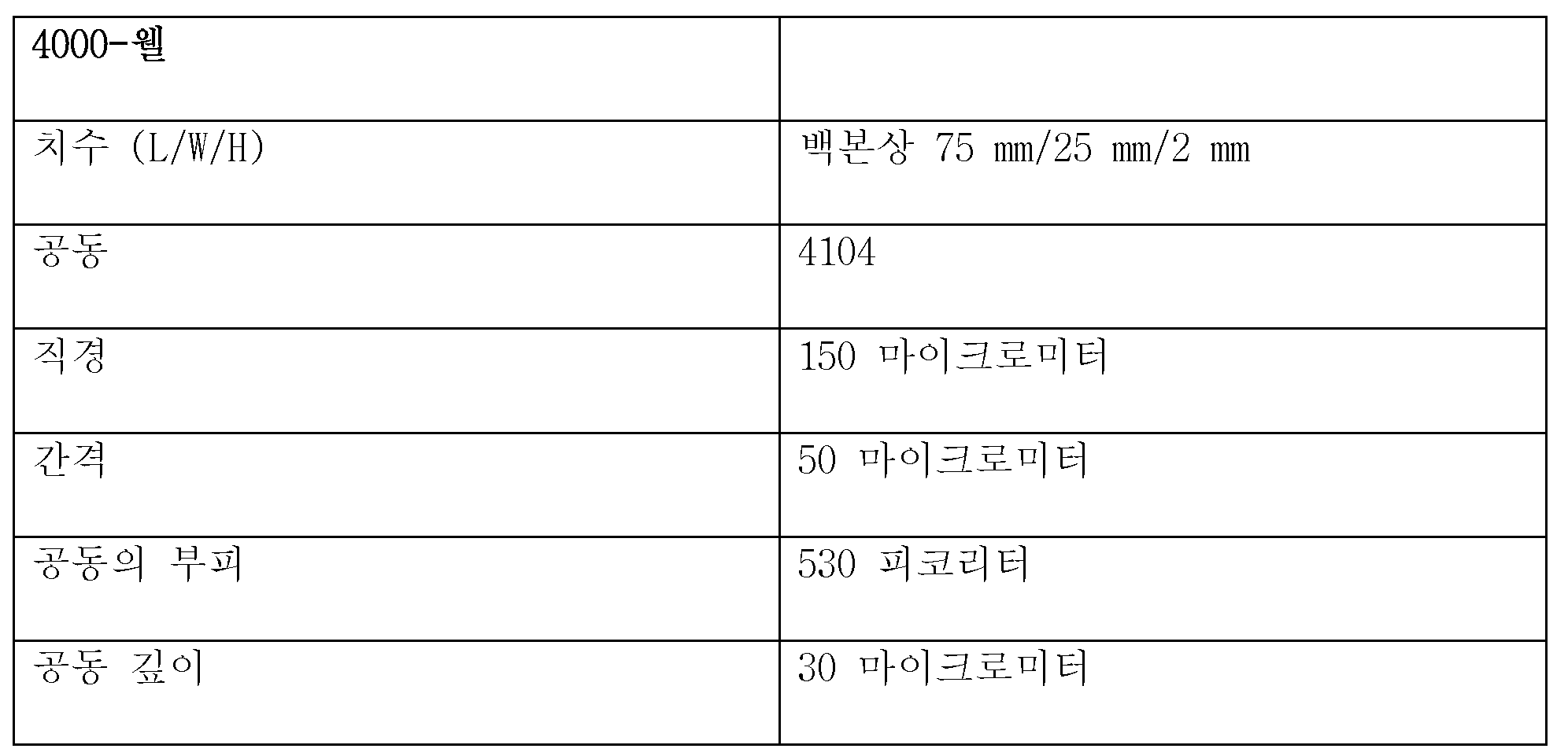
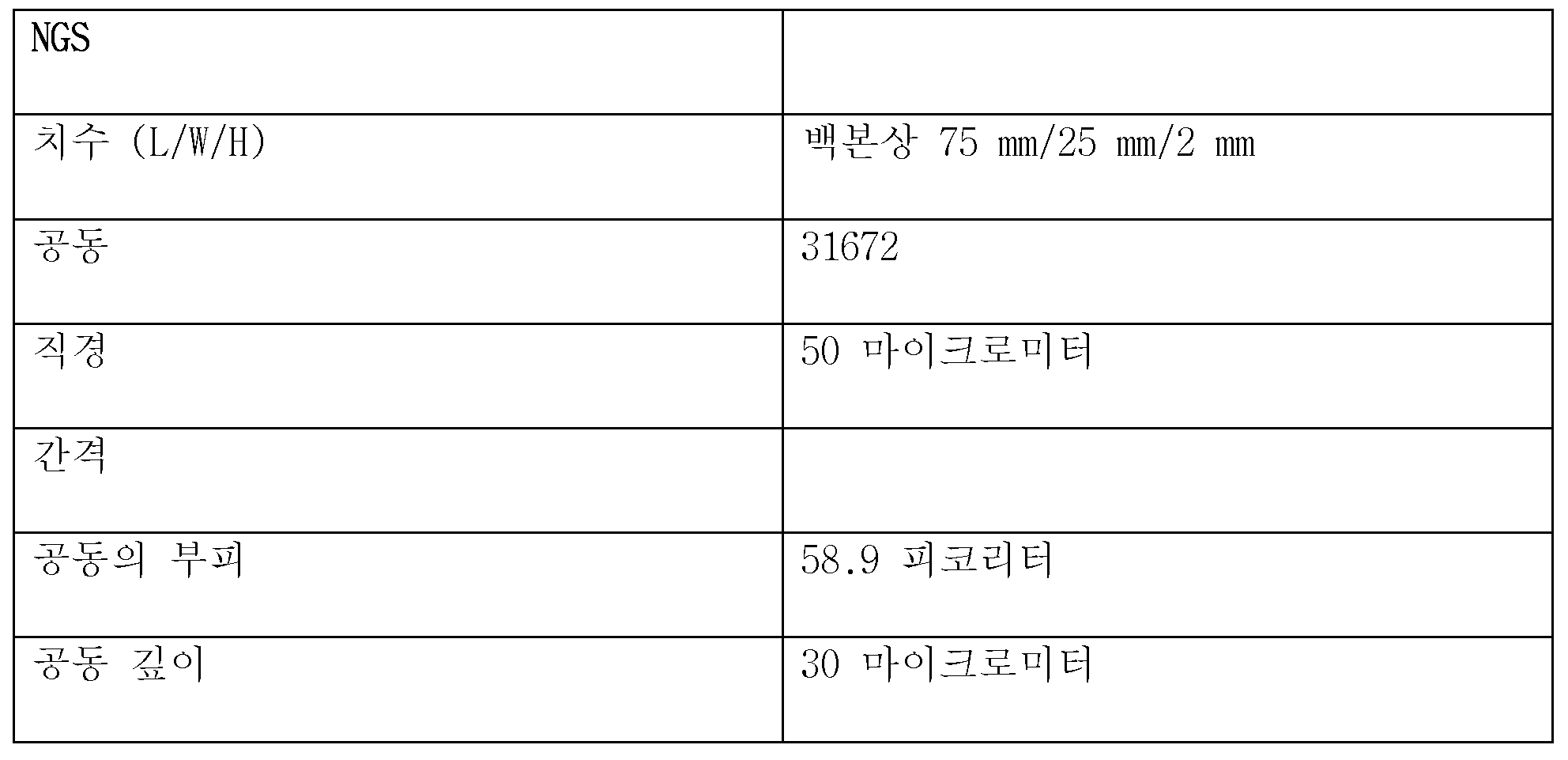
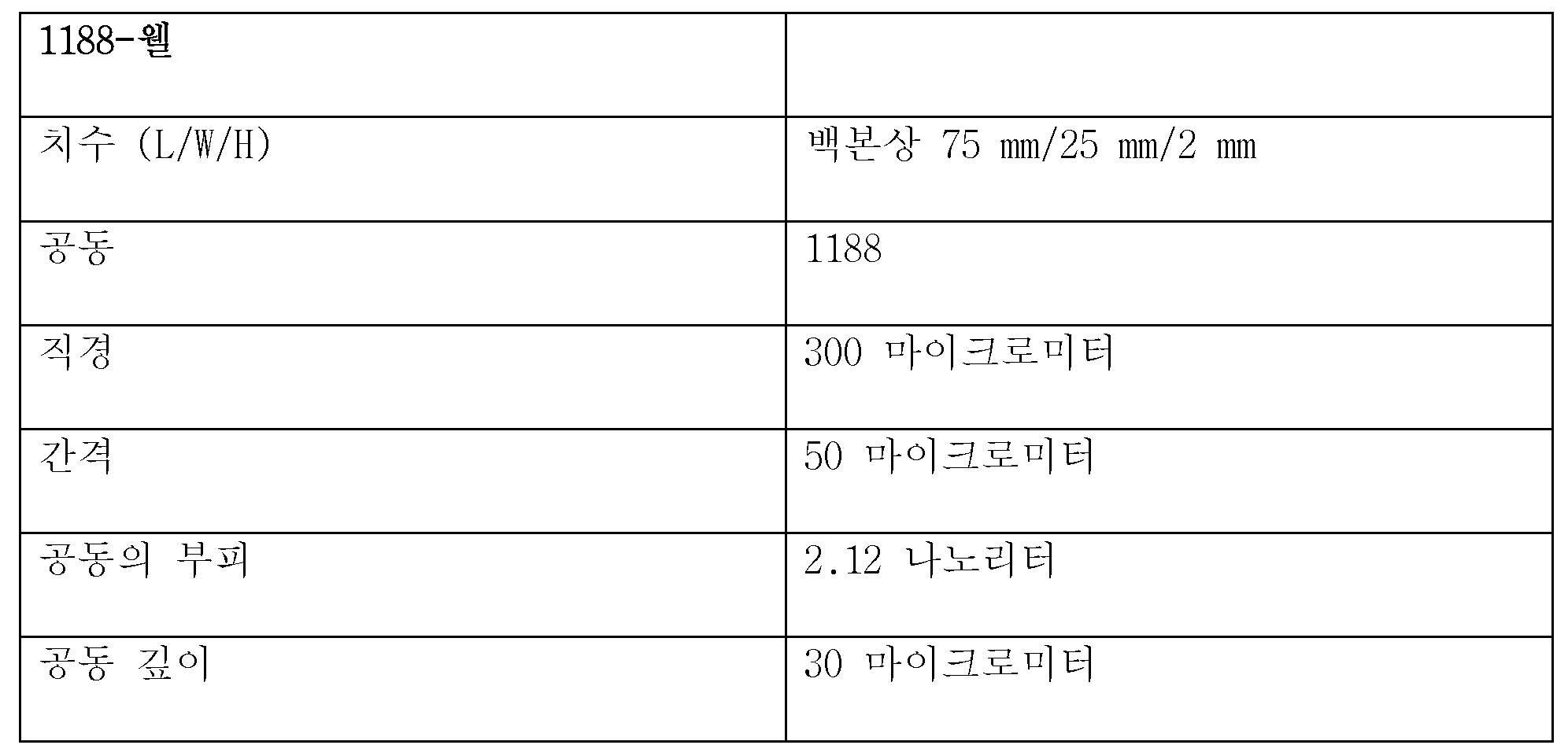
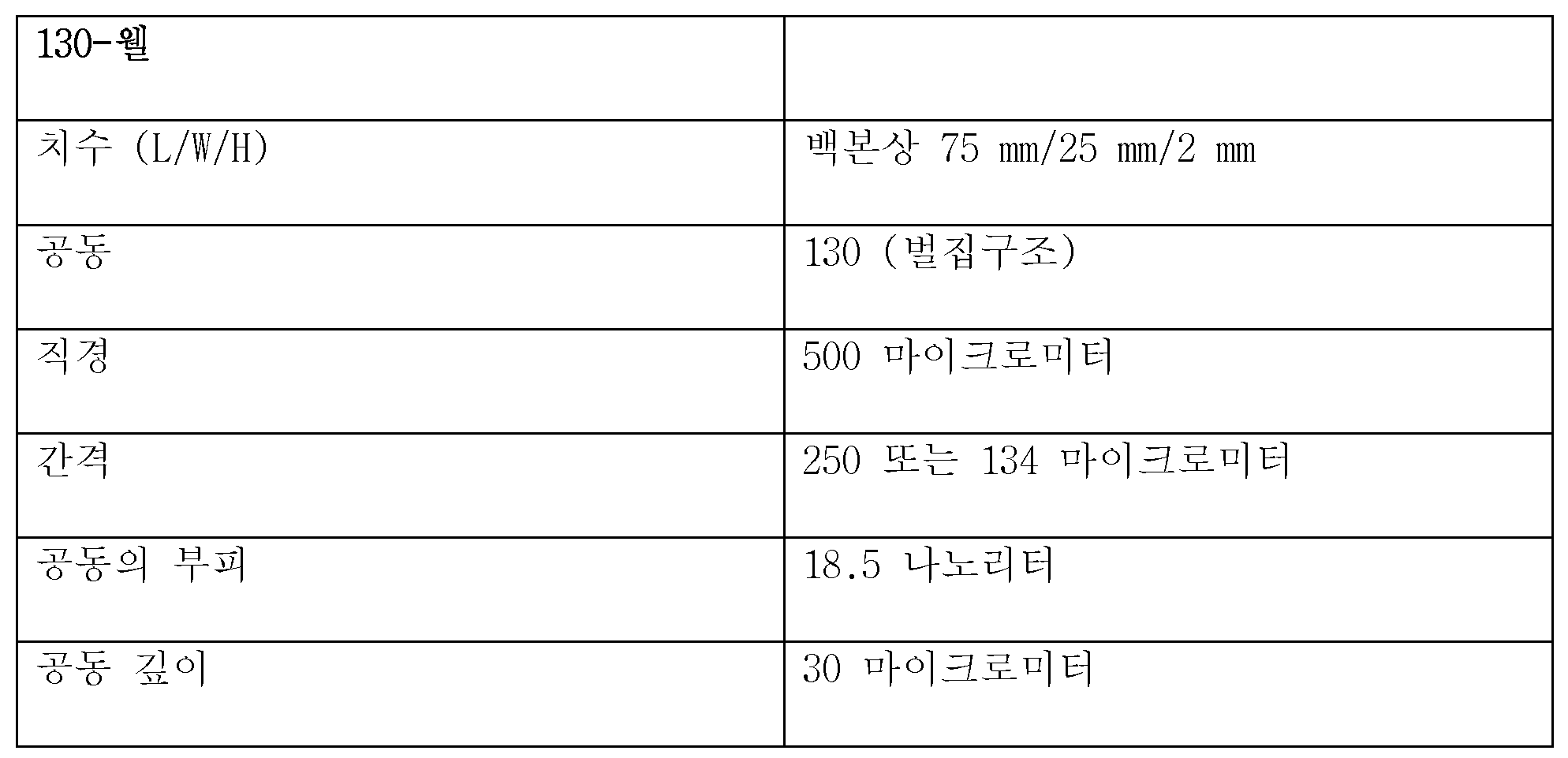
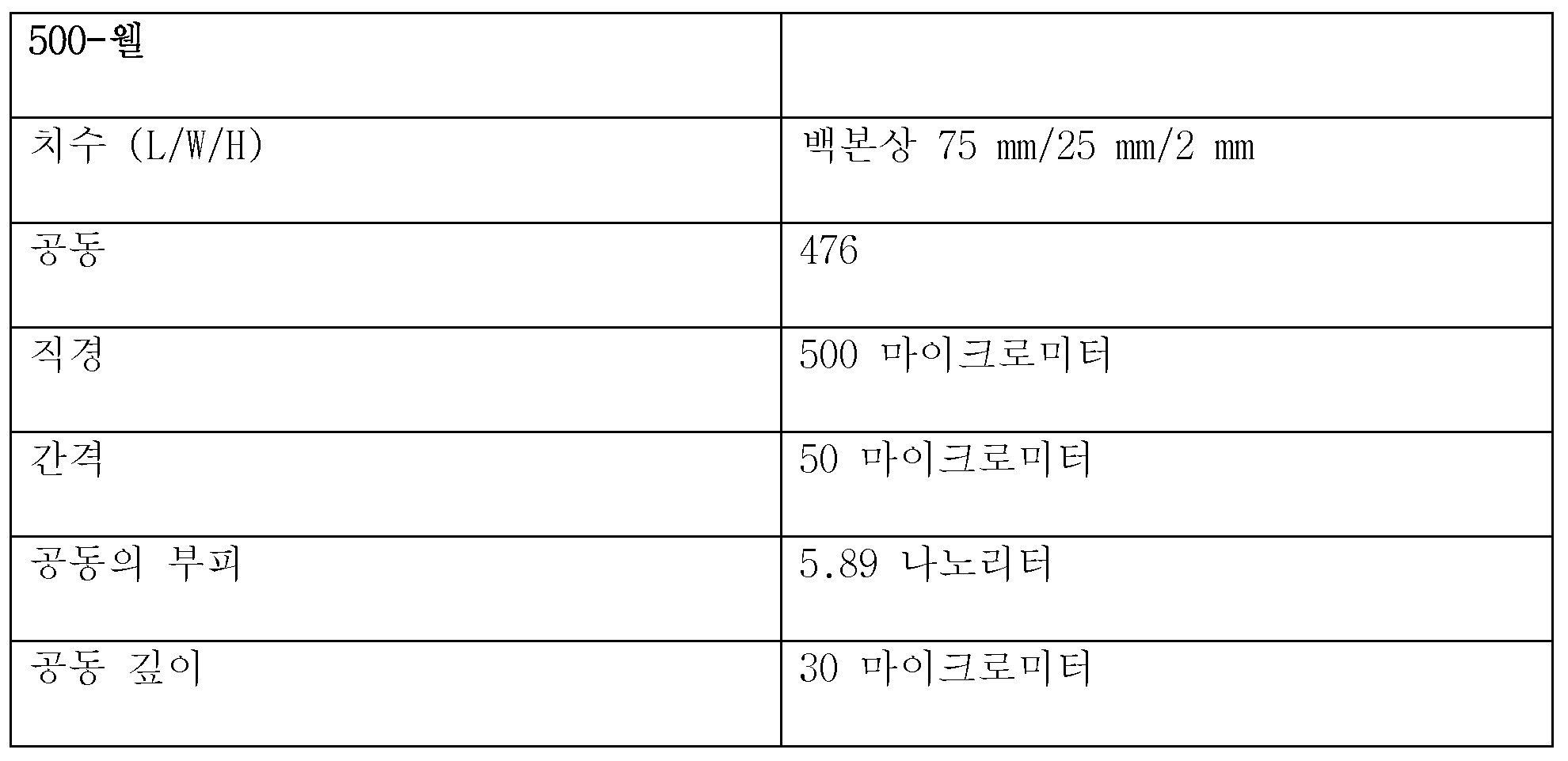
실시예Example 및 도면and drawings
하기에서는, 도면 및 실시예를 참조하여 본 발명을 설명하며, 그에 의해 상기 도면 및 실시예로 제한되는 것은 아니다.Below, the present invention is described with reference to the drawings and examples, but is not limited thereto.
실시예Example 1: 서열, 형상 및/또는 공간적 변환1: Sequence, shape and/or spatial transformations
a) 스폿마다 상이한 정보의 a) Different information for each spot SeqTSeqT 부가Add
단계 1:Step 1:
2개의 일차 어레이가 개시점을 형성한다. 여기서, 2개의 어레이는 동일하거나 서로 다른 스폿 크기, 대칭성 및 간격을 가질 수 있다. 표면 상에서의 DNA 분자의 배향 및 DNA의 길이는 여기에서 역할을 하지 않는다. 2개 어레이의 유일한 공통적인 특징은 모든 DNA 분자가 소위 중복 영역인 대략 10-30개 염기쌍의 동일한 짧은 상동성 DNA 서열을 가져야 한다는 것이다.Two primary arrays form the starting point. Here, the two arrays can have identical or different spot sizes, symmetries and spacings. The orientation of the DNA molecules on the surface and the length of the DNA do not play a role here. The only common feature of the two arrays is that all the DNA molecules must have an identical short homologous DNA sequence of about 10-30 base pairs, the so-called overlapping region.
단계 2:Step 2:
먼저, 전달 칩 및 통상적인 PCR 혼합물을 이용하여, PCR에 의해 일차 어레이 중 하나의 스캔(scan)을 생성시킨다. PCR의 완료 후에는, 개시 DNA 마이크로어레이 상에도 존재하는 동일한 DNA 종이 전달 칩에 존재한다. 그의 공간적 정렬 역시 유지되었다. 그에 의해, 공간적 정보는 물론, 일차 어레이의 내용물 정보도 그와 같이 전달 칩으로 전달되었다.First, using the transfer chip and a conventional PCR mixture, a scan of one of the primary arrays is generated by PCR. After completion of the PCR, the same DNA species that are present on the starting DNA microarray are present on the transfer chip. Their spatial alignment is also maintained. As a result, not only the spatial information but also the content information of the primary array are transferred to the transfer chip.
단계 3:Step 3:
이후, 이와 같은 전달 칩을 두 번째 일차 어레이 상에 배치한다. 다시, 표준 PCR 혼합물에 의해 스캔을 수행한다. 2개의 원래 DNA 마이크로어레이의 상동성인 서열로 인하여, 이후에는 두 가지 시나리오가 고려가능하다. 두 번째 마이크로어레이의 DNA 스폿이 아직 비어있는 공동을 만나는 경우라면, DNA 분자는 앞의 첫 번째 스캔에서와 같이 바로 해당 공동으로 전달된다. 그러나, DNA 스폿이 첫 번째 개시 어레이의 DNA가 이미 존재하는 공동을 만나는 경우라면, 공동 표면 상에서 2개의 DNA 가닥이 서로 융합된다. 새로운 DNA 분자가 형성되는데, 그것은 첫 번째 DNA 마이크로어레이의 정보 및 또한 두 번째 원래 DNA 마이크로어레이의 정보 모두를 보유한다.Afterwards, such a transfer chip is placed on the second primary array. Again, scanning is performed with a standard PCR mixture. Due to the homologous sequences of the two original DNA microarrays, two scenarios are then conceivable. If the DNA spot of the second microarray encounters a cavity that is still empty, the DNA molecule is transferred directly into that cavity as in the first scan. However, if the DNA spot encounters a cavity in which DNA of the first initiating array already exists, the two DNA strands are fused together on the cavity surface. A new DNA molecule is formed, which contains both the information of the first DNA microarray and also the information of the second original DNA microarray.
단계 4:Step 4:
전달 칩의 융합된 DNA 분자 또는 원래 DNA 분자 형태로 저장된 정보는 PCR 및 표준 PCR 혼합물에 의해 새로운 빈 특수하게 관능화된 표면 상으로 카피될 수 있다.The information stored in the form of fused DNA molecules or original DNA molecules on the transfer chip can be copied onto a new blank specially functionalized surface by PCR and standard PCR mixtures.
b) 스폿마다 동일한 정보의 b) Same information for each spot SeqTSeqT 부가Add
본 단계에서는, 영역에 걸쳐, 또는 복수의 스폿에서 동일한 DNA 부문이 첨가되거나, 또는 임의적으로 제거될 수 있다. 영역에 걸친 도입은 전달 매트릭스에 비해 상당히 더 큰 구조를 가지거나, 또는 연장이 수행되어야 하는 DNA가 용액 중에서 직접 도입되는 경우 전체 전달 매트릭스에 걸치는 어레이에 의해 일어날 수 있다.In this step, the same DNA segments can be added or removed, either across a region or at multiple spots. The introduction across a region can occur by an array that has a significantly larger structure than the delivery matrix, or across the entire delivery matrix if the DNA to be extended is introduced directly from solution.
단계 1:Step 1:
특정 수의 서로 다른 DNA 분자를 포함하는 일차 어레이를 사용한다. 스폿 크기, 대칭성, 간격, 양은 여기에서 역할을 하지 않으며, 표면 상에서의 DNA 분자의 배향도 역할을 하지 않는다.A primary array containing a specific number of different DNA molecules is used. Spot size, symmetry, spacing, and quantity do not play a role here, nor does the orientation of the DNA molecules on the surface.
단계 2:Step 2:
차후의 스캔을 수행하기 위하여, 2종의 서로 다른 전달 칩 사이에서 선택이 이루어질 수 있다:To perform subsequent scans, a selection can be made between two different transducer chips:
i) 차후의 PCR에 필요한 프라이머만으로 코팅된 전달 칩.i) A transfer chip coated only with primers required for subsequent PCR.
ii) 프라이머 서열의 5' 말단에 임의의 원하는 길이를 가지는 추가적인 DNA 서열이 존재하는 전달 칩.ii) A delivery chip having an additional DNA sequence of any desired length at the 5' end of the primer sequence.
또한, 추가적인 DNA 서열이 도입될 수 있는데, 여기서 상기 서열은 용액 중에서 첨가됨으로써, 전체 전달 영역이 이와 같은 DNA 서열에 의해 연장되거나 변화된다.Additionally, additional DNA sequences can be introduced, whereby the entire delivery region is extended or changed by such DNA sequences by adding them in solution.
먼저, 전달 칩 및 통상적인 PCR 혼합물을 이용하여, PCR에 의해 일차 어레이 중 하나의 스캔을 생성시킨다. PCR의 완료 후에는, 개시 DNA 마이크로어레이 상에도 존재하는 동일한 DNA 종이 전달 칩에 존재한다. 그의 공간적 정렬 역시 유지된다. 그에 의해, 일차 어레이의 공간적 정보 및 내용물 정보 모두가 그와 같이 전달 칩으로 전달되었다.First, using the transfer chip and a conventional PCR mixture, a scan of one of the primary arrays is generated by PCR. After completion of the PCR, the same DNA species that are present on the starting DNA microarray are present on the transfer chip. Their spatial alignment is also maintained. As a result, both the spatial information and the content information of the primary array are transferred to the transfer chip as such.
단계 3:Step 3:
다음에, 전달 칩에 새로운 DNA 혼합물, 그리고 이미 존재하는 DNA 분자와 상동성인 서열을 가지는 주형을 충전한다. 이와 같은 주형은 과량으로 첨가되며, 그에 따라 상기 주형이 차후의 융합 PCR에서 고갈될 수는 없다. 다음에는, 비-관능화 표면에 의해 공동 칩을 폐쇄한 다음, 표준 PCR을 수행한다.Next, the transfer chip is charged with a new DNA mixture and a template having a sequence homologous to the existing DNA molecules. This template is added in excess so that the template cannot be depleted in the subsequent fusion PCR. Next, the cavity chip is closed by a non-functionalized surface, and then standard PCR is performed.
단계 4:Step 4:
전달 칩의 DNA 분자 형태로 저장된 정보는 PCR 및 표준 PCR 혼합물에 의해 새로운 빈 특수하게 관능화된 표면 상으로 카피될 수 있다.The information stored in the form of DNA molecules on the transfer chip can be copied onto a new blank, specially functionalized surface by PCR and standard PCR mixtures.
c) c) SeqTSeqT 차감Deduction
단계 1:Step 1:
특정 수의 서로 다른 DNA 분자를 포함하는 일차 어레이를 사용한다. 스폿 크기, 대칭성, 간격, 양은 여기에서 역할을 하지 않으며, 표면 상에서의 DNA 분자의 배향도 역할을 하지 않는다.A primary array containing a specific number of different DNA molecules is used. Spot size, symmetry, spacing, and quantity do not play a role here, nor does the orientation of the DNA molecules on the surface.
단계 2:Step 2:
먼저, 전달 칩 및 통상적인 PCR 혼합물을 이용하여, PCR에 의해 일차 어레이 중 하나의 스캔을 생성시킨다. 여기서 일차 어레이의 DNA는 전체 길이 또는 부분 길이에 사용되는 프라이머의 선택에 의해 PCR을 이용하여 전달 칩으로 전달될 수 있다. 공간적 정보는 완전히 유지된다.First, a scan of one of the primary arrays is generated by PCR using a transfer chip and a conventional PCR mixture. Here, the DNA of the primary array can be transferred to the transfer chip using PCR by selection of primers used for full length or partial length. Spatial information is fully maintained.
단계 3:Step 3:
전달 칩의 DNA 분자 형태로 저장된 정보는 PCR 및 표준 PCR 혼합물에 의해 새로운 빈 특수하게 관능화된 표면 상으로 카피될 수 있다.The information stored in the form of DNA molecules on the transfer chip can be copied onto a new blank, specially functionalized surface by PCR and standard PCR mixtures.
d) ST 줌d) ST zoom
단계 1:Step 1:
특정 수의 서로 다른 DNA 분자를 포함하는 일차 어레이를 사용한다. 스폿 크기, 대칭성, 간격, 양은 여기에서 역할을 하지 않으며, 표면 상에서의 DNA 분자의 배향도 역할을 하지 않는다.A primary array containing a specific number of different DNA molecules is used. Spot size, symmetry, spacing, and quantity do not play a role here, nor does the orientation of the DNA molecules on the surface.
단계 2:Step 2:
먼저, 전달 칩 및 통상적인 PCR 혼합물을 이용하여, PCR에 의해 일차 어레이 중 하나의 스캔을 생성시킨다. 여기서, 전달 칩의 형상구조 및 정렬은 상기 전달 칩이 개시 마이크로어레이의 것과 동일하도록 선택된다. 이에 따라, 개별 공동하에는 매 경우 하나의 개시 어레이 DNA 스폿이 배치된다. 공동 직경은 공동이 일차 어레이의 DNA 스폿에 비해 더 크거나 더 작은 것 중 어느 하나가 되도록 선택된다. PCR의 완료 후에는, 원래 DNA 스폿의 공간적 및 내용물 정보를 전달 칩의 각 공동으로 전달한다.First, using a transfer chip and a conventional PCR mixture, a scan of one of the primary arrays is generated by PCR. Here, the geometry and alignment of the transfer chip are selected so that the transfer chip is identical to that of the initiating microarray. Accordingly, one initiating array DNA spot is placed in each individual cavity. The cavity diameter is selected so that the cavity is either larger or smaller than the DNA spot of the primary array. After completion of PCR, the spatial and content information of the original DNA spot is transferred to each cavity of the transfer chip.
단계 3:Step 3:
전달 칩의 DNA 분자 형태로 저장된 정보는 PCR 및 표준 PCR 혼합물에 의해 새로운 빈 특수하게 관능화된 표면 상으로 카피될 수 있다.The information stored in the form of DNA molecules on the transfer chip can be copied onto a new blank, specially functionalized surface by PCR and standard PCR mixtures.
e) ST 회전e) ST rotation
단계 1:Step 1:
특정 수의 서로 다른 DNA 분자를 포함하는 일차 어레이를 사용한다. 스폿 크기, 대칭성, 간격, 양은 여기에서 역할을 하지 않으며, 표면 상에서의 DNA 분자의 배향도 역할을 하지 않는다.A primary array containing a specific number of different DNA molecules is used. Spot size, symmetry, spacing, and quantity do not play a role here, nor does the orientation of the DNA molecules on the surface.
단계 2:Step 2:
먼저, 전달 칩 및 통상적인 PCR 혼합물을 이용하여, PCR에 의해 일차 어레이 중 하나의 스캔을 생성시킨다. PCR의 완료 후에는, 개시 DNA 마이크로어레이 상에도 존재하는 동일한 DNA 종이 전달 칩에 존재한다. 그들의 공간적 정렬 역시 유지되었다. 그에 의해, 일차 어레이의 공간적 정보 및 내용물 정보 모두가 그와 같이 전달 칩으로 전달되었다.First, using the transfer chip and a conventional PCR mixture, a scan of one of the primary arrays is generated by PCR. After completion of the PCR, the same DNA species that are present on the starting DNA microarray are present on the transfer chip. Their spatial alignment is also maintained. As a result, both the spatial information and the content information of the primary array are transferred to the transfer chip as such.
단계 3:Step 3:
특정 각도로, 그리고 특정 점 주변으로 전달 칩을 회전시킨다.Rotates the transmission chip at a specific angle and around a specific point.
단계 4:Step 4:
전달 칩의 DNA 분자 형태로 저장된 정보는 PCR 및 표준 PCR 혼합물에 의해 새로운 빈 특수하게 관능화된 표면 상으로 카피될 수 있다.The information stored in the form of DNA molecules on the transfer chip can be copied onto a new blank, specially functionalized surface by PCR and standard PCR mixtures.
f) ST 이동f) ST movement
단계 1:Step 1:
특정 수의 서로 다른 DNA 분자를 포함하는 일차 어레이를 사용한다. 스폿 크기, 대칭성, 간격, 양은 여기에서 역할을 하지 않으며, 표면 상에서의 DNA 분자의 배향도 역할을 하지 않는다.A primary array containing a specific number of different DNA molecules is used. Spot size, symmetry, spacing, and quantity do not play a role here, nor does the orientation of the DNA molecules on the surface.
단계 2:Step 2:
먼저, 전달 칩 및 통상적인 PCR 혼합물을 이용하여, PCR에 의해 일차 어레이 중 하나의 스캔을 생성시킨다. PCR의 완료 후에는, 개시 DNA 마이크로어레이 상에도 존재하는 동일한 DNA 종이 전달 칩에 존재한다. 그들의 공간적 정렬 역시 유지되었다. 그에 의해, 일차 어레이의 공간적 정보 및 내용물 정보 모두가 그와 같이 전달 칩으로 전달되었다.First, using the transfer chip and a conventional PCR mixture, a scan of one of the primary arrays is generated by PCR. After completion of the PCR, the same DNA species that are present on the starting DNA microarray are present on the transfer chip. Their spatial alignment is also maintained. As a result, both the spatial information and the content information of the primary array are transferred to the transfer chip as such.
단계 3:Step 3:
x 또는 y 방향으로 특정 길이만큼 전달 칩을 이동시킨다.Moves the transfer chip a specific length in the x or y direction.
단계 4:Step 4:
전달 칩의 DNA 분자 형태로 저장된 정보는 PCR 및 표준 PCR 혼합물에 의해 새로운 빈 특수하게 관능화된 표면 상으로 카피될 수 있다.The information stored in the form of DNA molecules on the transfer chip can be copied onto a new blank, specially functionalized surface by PCR and standard PCR mixtures.
g) ST 병합g) ST merge
단계 1:Step 1:
특정 수의 서로 다른 DNA 분자를 포함하는 일차 어레이를 사용한다. 스폿 크기, 대칭성, 간격, 양은 여기에서 역할을 하지 않으며, 표면 상에서의 DNA 분자의 배향도 역할을 하지 않는다.A primary array containing a specific number of different DNA molecules is used. Spot size, symmetry, spacing, and quantity do not play a role here, nor does the orientation of the DNA molecules on the surface.
단계 2:Step 2:
먼저, 전달 칩 및 통상적인 PCR 혼합물을 이용하여, PCR에 의해 일차 어레이 중 하나의 스캔을 생성시킨다. 여기서, 전달 칩의 구조는 임의의 원하는 수의 일차 어레이 스폿이 동일한 구조의 전달 칩으로 전달되도록 선택된다. 생체분자는 결과적으로 융합되지 않으며, 그보다는 대신 동일한 구조로 혼합되기만 한다. PCR 완료 후에는, 혼합물 또는 개별 DNA 종이 전달 칩의 구조 중에 존재한다.First, a scan of one of the primary arrays is generated by PCR using a transfer chip and a conventional PCR mixture. Here, the structure of the transfer chip is selected so that any desired number of primary array spots are transferred to a transfer chip of the same structure. The biomolecules are not fused as a result, but rather are simply mixed into the same structure. After completion of PCR, the mixture or individual DNA species are present in the structure of the transfer chip.
단계 3:Step 3:
전달 칩의 DNA 분자 형태로 저장된 정보는 PCR 및 표준 PCR 혼합물에 의해 새로운 빈 특수하게 관능화된 표면 상으로 카피될 수 있다. 이후 수득되는 이차 어레이는 혼합 스폿으로 구성된다. 전달 칩 구조의 선택에 따라서는, 개별 단일클론 스폿이 여전히 존재할 수 있다.The information stored in the form of DNA molecules on the transfer chip can be copied onto a new blank, specially functionalized surface by PCR and standard PCR mixtures. The resulting secondary array is then composed of mixed spots. Depending on the choice of the transfer chip architecture, individual monoclonal spots may still be present.
h) ST 해상h) ST maritime
단계 1:Step 1:
특정 수의 서로 다른 DNA 분자를 포함하는 일차 어레이를 사용한다. 스폿 크기, 대칭성, 간격, 양은 여기에서 역할을 하지 않으며, 표면 상에서의 DNA 분자의 배향도 역할을 하지 않는다.A primary array containing a specific number of different DNA molecules is used. Spot size, symmetry, spacing, and quantity do not play a role here, nor does the orientation of the DNA molecules on the surface.
단계 2:Step 2:
먼저, 전달 칩 및 통상적인 PCR 혼합물을 이용하여, PCR에 의해 일차 어레이 중 하나의 스캔을 생성시킨다. 여기서, 전달 칩의 구조는 일차 어레이에 비해 더 많거나 더 적은 구조가 존재하도록 선택된다. PCR 완료 후에는, 예를 들면 일차 어레이의 하나의 스폿이 이후 전달 칩의 다수의 더 작은 구조로 전달되었거나 (더 높은 해상도), 일차 어레이의 다수의 스폿이 전달 칩의 더 큰 구조로 전달되었다 (더 낮은 해상도).First, using a transfer chip and a conventional PCR mixture, a scan of one of the primary arrays is generated by PCR. Here, the structures of the transfer chip are selected so that there are more or fewer structures compared to the primary array. After PCR is completed, for example, one spot of the primary array is transferred to a number of smaller structures of the transfer chip (higher resolution), or a number of spots of the primary array are transferred to a larger structure of the transfer chip (lower resolution).
단계 3:Step 3:
전달 칩의 DNA 분자 형태로 저장된 정보는 PCR 및 표준 PCR 혼합물에 의해 새로운 빈 특수하게 관능화된 표면 상으로 카피될 수 있다. 이후 수득되는 이차 어레이는 일차 어레이에 비해 더 많거나 더 적은 스폿으로 구성된다.The information stored in the form of DNA molecules on the transfer chip can be copied onto a new blank, specially functionalized surface by PCR and standard PCR mixtures. The resulting secondary array is then composed of more or fewer spots compared to the primary array.
i) i) ShaTShaT
단계 1:Step 1:
특정 수의 서로 다른 DNA 분자를 포함하는 일차 어레이를 사용한다. 스폿 크기, 대칭성, 간격, 양은 여기에서 역할을 하지 않으며, 표면 상에서의 DNA 분자의 배향도 역할을 하지 않는다.A primary array containing a specific number of different DNA molecules is used. Spot size, symmetry, spacing, and quantity do not play a role here, nor does the orientation of the DNA molecules on the surface.
단계 2:Step 2:
먼저, 전달 칩 및 통상적인 PCR 혼합물을 이용하여, PCR에 의해 일차 어레이 중 하나의 스캔을 생성시킨다. 여기서, 전달 칩의 구조는 그것이 일차 어레이의 스폿의 것과 상이한 형상을 가지도록 선택된다 (예를 들면, 별 또는 스폿 연장). PCR 완료 후에는, 개시 DNA 마이크로어레이 상에도 존재하는 동일한 DNA 종이 전달 칩에 존재한다. 그들의 공간적 정렬 역시 유지되었다. 그에 의해, 일차 어레이의 공간적 정보 및 내용물 정보 모두가 그와 같이 전달 칩으로 전달되었다.First, a scan of one of the primary arrays is generated by PCR using a transfer chip and a conventional PCR mixture. Here, the structure of the transfer chip is selected so that it has a different shape from that of the spots of the primary array (e.g., a star or spot extension). After completion of PCR, the same DNA species that are also present on the starting DNA microarray are present on the transfer chip. Their spatial alignment is also maintained. As a result, both the spatial information and the content information of the primary array are thus transferred to the transfer chip.
단계 3:Step 3:
전달 칩의 DNA 분자 형태로 저장된 정보는 PCR 및 표준 PCR 혼합물에 의해 새로운 빈 특수하게 관능화된 표면 상으로 카피될 수 있다. 이제 수득되는 이차 어레이는 일차 어레이에 비해 상이한 형상을 가지는 스폿으로 구성된다.The information stored in the form of DNA molecules on the transfer chip can be copied onto a new blank, specially functionalized surface by PCR and a standard PCR mixture. The resulting secondary array is now composed of spots having a different shape compared to the primary array.
도 1. 역행 변환 (큰 것에서 작은 것으로). 육각형의 어레이가 소형의 원으로 변환되었다. 도면은 2개의 육각형 부문을 보여준다. Figure 1. Inverse transformation (from large to small). An array of hexagons is transformed into a small circle. The drawing shows two hexagonal segments.
도 2. 진행 변환 (작은 것에서 큰 것으로). 분명하게 더 큰 공동을 가지는 좌측의 어레이가 대형 스폿을 가지는 어레이 (우측)로 변환되었다. 여기에서는, 원래 스폿의 정확한 위치에 따라, 서로 다른 생성물이 생성될 수 있다. 아래 박스의 예에서는, 아래의 적색 스폿 (A)이 분명하게 더 큰 직경을 가지는 적색의 원 (A)으로 변환되었다. 그러나, 위의 적색 스폿 (A)은 그 위의 녹색 스폿 (C)과 융합되어 황색의 원 (B)을 형성하였다. 이 박스의 바로 위에는 녹색 스폿 (좌측은 소형, 우측은 대형)이 위치하는데, 그것은 다시 순수한 형태로 변환되었다. 상부 좌측 박스의 경우, 2개의 녹색 (C) 및 2개의 적색 스폿 (A) (좌측)이 신호등 구성 (적색 (A), 황색 (B), 녹색 (C) (우측))으로 전환되었다. Figure 2. Progressive transformation (small to large). The array on the left, which clearly has a larger cavity, has been transformed into an array with large spots (right). Here, depending on the exact location of the original spots, different products can be generated. In the example of the lower box, the red spot (A) below has been transformed into a red circle (A) with a clearly larger diameter. However, the upper red spot (A) has been fused with the green spot (C) above it to form a yellow circle (B). Directly above this box is a green spot (small on the left, large on the right), which has been transformed back into its pure form. In the upper left box, two green (C) and two red spots (A) (left) have been transformed into a traffic light configuration (red (A), yellow (B), green (C) (right)).
도 3. 변환의 할당. 여기에서는, 변환을 더 분명하게 나타내기 위하여 도 2의 데이터를 중첩시켰다. 이제는 어떤 소형 스폿이 더 큰 스폿의 시드로서 기여하였는지를 매우 잘 볼 수 있다. 이와 같은 실험에서, 소형 적색 스폿 중 일부는 신호를 생성시키지 않았다. 녹색 스폿의 경우, 상당히 더 분명한 바: 할당이 존재한다.Figure 3. Allocation of transformations . Here, the data from Figure 2 is superimposed to make the transformations more clear. It is now very clear which small spots contributed as seeds for the larger spots. In this experiment, some of the small red spots did not generate a signal. For the green spots, it is much clearer: there is an allocation.
도 4 내지 17. 본 발명의 특히 바람직한 실시양태. Figures 4 to 17. Particularly preferred embodiments of the present invention.
도 4: 배치 최적화 Figure 4: Placement Optimization
문제점: 마이크로어레이가 프린팅되는데, 다시 말하자면 소형 액적이 표면 상에 투하되고, 그로 인하여 서로 다른 크기를 가지거나 (A), 위치가 정확하지 않거나 (B), 또는 비균질하거나 불규칙한 형상을 가지는 (C) 등이다. 다시 말하자면, 스폿의 자동화된 획득은 어렵다.Problem: Microarrays are printed, that is, tiny droplets are deposited on a surface, which may have different sizes (A), inaccurate positions (B), or inhomogeneous or irregular shapes (C). In other words, automated acquisition of spots is difficult.
해결책: 최적의 공간적 위치를 포함하는 변환을 수행한다.Solution: Perform a transformation that includes the optimal spatial location.
도 5: 구조 최적화 Figure 5: Structural Optimization
문제점: 마이크로어레이가 프린팅되는데, 다시 말하자면 액적이 보통 원형 내지 난형 형상을 가지며, 이후 임의의 원하는 구조가 생성될 수 있다.Problem: Microarrays are printed, i.e. droplets, usually of circular or oval shape, from which any desired structure can then be created.
해결책: 오늘날까지 생성될 수 없었던 형상을 포함한 개별 형상을 각 스폿에 제공하는 변환을 수행한다.Solution: Perform a transformation that gives each spot an individual shape, including shapes that could not be created until today.
도 6: 감축 1 Figure 6: Reduction 1
문제점: 어레이의 포맷이 프린팅 과정에 의해 확립되는데, 다시 말하자면 최소한의 침착 품질로 인한 스폿 크기의 하위 한계가 존재하며, 마찬가지로 스폿의 혼합을 방지하기 위한 그의 간격에 한계가 존재한다.Problem: The format of the array is established by the printing process, which means there is a lower limit to the spot size due to the minimum deposition quality, and likewise a limit to its spacing to avoid mixing of spots.
해결책: 이후 변환에서 더 작은 스폿이 생성될 수 있다.Solution: Subsequent transformations may produce smaller spots.
도 7 및 8: 감축 2a 및 2b Figures 7 and 8: Reductions 2a and 2b
문제점: 어레이의 포맷이 프린팅 과정에 의해 확립되는데, 다시 말하자면 최소한의 침착 품질로 인한 스폿 크기의 하위 한계가 존재하며, 마찬가지로 스폿의 혼합을 방지하기 위한 그의 간격에 한계가 존재한다.Problem: The format of the array is established by the printing process, which means there is a lower limit to the spot size due to the minimum deposition quality, and likewise a limit to its spacing to avoid mixing of spots.
해결책: 2회의 변환이 수행되는데, 1회는 모든 것을 "수축"시키며, 이후 1회는 더 작은 스폿을 생성시킨다.Solution: Two transformations are performed, one that "shrinks" everything, and then a second that creates smaller spots.
도 9: 확장 1 Figure 9: Extension 1
문제점: 어레이의 포맷이 프린팅 과정에 의해 확립되는데, 다시 말하자면 최대한의 침착 양 및 농도로 인한 스폿 크기의 상위 한계가 존재한다.Problem: The format of the array is established by the printing process, which means there is an upper limit to the spot size due to the maximum deposit amount and concentration.
해결책: 이후 변환에서 더 큰 스폿이 생성될 수 있다.Solution: Larger spots may be created in subsequent transformations.
도 10, 11 및 12: 확장 2a, 2b 및 2c Figures 10, 11 and 12: Extensions 2a, 2b and 2c
문제점: 어레이의 포맷이 프린팅 과정에 의해 확립되는데, 다시 말하자면 최대한의 침착 양 및 농도로 인한 스폿 크기의 상위 한계가 존재한다.Problem: The format of the array is established by the printing process, which means there is an upper limit to the spot size due to the maximum deposit amount and concentration.
해결책: 제1 변환에서 스폿이 이격된 다음, 오염을 방지하기 위하여 그것이 먼저 감축된 (!) 이후, 확장된다.Solution: In the first transformation the spot is spaced, then it is first reduced (!) to prevent contamination, and then expanded.
도 13 및 14: 위치 교체 a 및 b Figures 13 and 14: Position swap a and b
문제점: 프린팅 후 어레이의 포맷이 확립되며; 위치의 변화로 인하여 자동적으로 새로운 프린팅을 필요로 한다.Problem: After printing, the format of the array is established; any change in position automatically requires a new print.
해결책: 제1 변환에서 위치가 교체되며, 이후 제2 변환에서 스폿 형상구조가 확립된다.Solution: The positions are swapped in the first transformation, and then the spot shape structure is established in the second transformation.
도 15: 병합 Fig. 15: Merge
문제점: 개별 스폿의 DNA가 나중에 융합되거나 혼합됨으로써, 부가 효과(additive effect) (예를 들면 2종의 DNA가 처음에 단백질과 연결 상호작용하는 경우) 또는 알로스테릭 효과(allosteric effect) (단백질을 활성화하거나 상기 단백질에 의해 활성화됨으로써 이후 또 다른 DNA, 예를 들면 개시 서열 또는 lac-프로모터 또는 lac-리프레서에 결합하기 위하여 DNA가 필요한 경우)를 발생시킬 수 없다.Problem: The DNA of individual spots cannot be fused or mixed later, resulting in additive effects (e.g., when two DNAs initially bind and interact with the protein) or allosteric effects (when a DNA is required to activate the protein or to be activated by the protein and then subsequently bind to another DNA, e.g., the initiation sequence or the lac-promoter or lac-repressor).
해결책: 2개 이상의 스폿이 융합될 수 있어서, DNA가 서로 나란하게 존재하거나 차례대로 선형으로 존재할 수 있다.Solution: Two or more spots can be fused, so that the DNA can be parallel to each other or in a linear fashion one after the other.
도 16: 분할 Fig. 16: Split
문제점: 스폿이 나중에 다시 감축됨으로써, 예를 들면 더 고도의 신호 (불포화 조건하) 또는 더 빠른 동역학 (주변 피분석물 이론)을 달성할 수 없다.Problem: Since the spot is later reduced again, for example, higher signal (under saturation conditions) or faster kinetics (ambient analyte theory) cannot be achieved.
해결책: 변환시, 스폿이 더 작은 스폿으로 분할된다.Solution: When converting, the spot is split into smaller spots.
도 17: 조합 혼합물 Fig. 17: Combination mixture
문제점: 다중적이나 동일한 부분 서열을 보유하는 DNA 스폿의 생성이 완전히 비결집성인 서열의 생성만큼 복잡하다.Problem: The generation of DNA spots containing multiple but identical subsequences is as complex as the generation of completely non-coherent sequences.
해결책: 먼저 DNA가 주형 1로부터 제거된 다음, 주형 2로부터 그것이 제거됨으로써, 조합 혼합물의 생성으로 이어진다. 이에 따라, 원래 어레이 상의 n 및 m개의 스폿을 사용하여 총 n*m개의 조합 혼합물을 생성시키는 것이 가능하다.Solution: First, DNA is removed from template 1, and then from template 2, leading to the generation of a combinatorial mixture. Accordingly, it is possible to generate a total of n*m combinatorial mixtures using n and m spots on the original array.
혼합은 병존 (다수의 DNA 서열이 표면 상에 서로 나란하게 존재) 및 인접 (DNA 서열이 차례대로 서로 선형 연결되는데, 다시 말하자면 연장됨) 모두로 수행될 수 있다. 그것은 생화학적 증폭 단계 동안의 프라이머 및 DNA 서열의 선택에 의해 수행될 수 있다 (모든 프라이머가 동일함 = 보통 서로 나란함, 그리고 프라이머가 유사함 = 보통 인접 = 보통 연장 PCR).Mixing can be done both in parallel (multiple DNA sequences are present parallel to each other on the surface) and contiguous (DNA sequences are connected linearly one after another, i.e. extended). It can be done by the choice of primers and DNA sequences during the biochemical amplification step (all primers are identical = usually parallel, and primers are similar = usually contiguous = usually extended PCR).
도 18 내지 22는 본 발명의 특히 바람직한 장치를 나타낸다. Figures 18 to 22 illustrate particularly preferred devices of the present invention.
도 23은 통상적인 변환 과정의 도해 표시를 나타낸다. 소형 스폿의 더 큰 면적의 스폿으로의 변환은 물론, 대형 면적 스폿의 3개의 더 작은 스폿으로의 변환도 표시하였다. a: 반응 혼합물, 예를 들면 PCR 혼합물 또는 무-세포 발현 시스템을 사용한 공동 칩의 충전, 및 공동 칩 상에의 원래 어레이의 배치. b: 카피 반응, 예를 들면 PCR의 수행. c: 칩의 개방, 세척 및 블로킹. d: 반응 혼합물을 사용한 공동 칩의 충전, 및 빈 어레이 표면을 이용한 그의 폐쇄. e: 카피 반응, 예를 들면 PCR의 수행. f: 새로 형성된 어레이 (변환된 어레이) 및 공동 칩의 세척 및 블로킹. Figure 23 shows a schematic representation of a typical transformation process. The transformation of a small spot into a larger area spot, as well as the transformation of a large area spot into three smaller spots, is shown. a: Filling of the cavity chip with a reaction mixture, e.g. a PCR mixture or a cell-free expression system, and placement of the original array on the cavity chip. b: Performing a copy reaction, e.g. a PCR. c: Opening, washing and blocking of the chip. d: Filling of the cavity chip with a reaction mixture, and closing it with an empty array surface. e: Performing a copy reaction, e.g. a PCR. f: Washing and blocking of the newly formed array (transformed array) and the cavity chip.
도 24는 가능한 적용의 추가적인 예를 나타낸다. Figure 24 shows additional examples of possible applications.
약어 및 설명:Abbreviations and Descriptions:
전달 칩 : 공동 칩으로도 지칭됨; 생체분자의 안정적인 저장에 사용될 수 있는 장치Transfer chip: Also called a co-chip; a device that can be used for stable storage of biomolecules.
일차 어레이 : 주형 어레이로도 지칭됨; 개시점으로 사용되며 현행 기술에 따라 제조된 마이크로어레이; 바람직하게는 DNA 또는 RNA 어레이Primary array: Also referred to as a template array; a microarray used as a starting point and manufactured according to current technology; preferably a DNA or RNA array.
이차 어레이 : 어레이 변환이 수행된 후 생성되는 마이크로어레이. 이것은 어레이 변환의 최종 결과를 나타냄.Secondary array: A microarray created after array transformation is performed. This represents the final result of the array transformation.
ST : 공간적 변환 - 일차 어레이에 비교하였을 때의 위치 및/또는 형상구조상 정보의 변화ST: Spatial transformation - change in positional and/or shape-structure information compared to the primary array.
ST 줌 : 공간적 변환 줌 - 위치 정보는 유지되나; 스폿이 확장되거나 감축되는 것 중 어느 하나를 나타냄.ST Zoom: Spatial Transform Zoom - position information is maintained; however, the spot is either expanded or reduced.
ST 회전 : 공간적 변환 회전 - 특정 점 주변으로의 특정 각도 (이동에 부가)만큼의 일차 어레이의 회전ST Rotation: Spatial translation rotation - rotation of the primary array by a certain angle (in addition to translation) around a certain point.
ST 이동 : 공간적 변환 이동 - 개시 어레이와 비교하였을 때의 어레이의 위치 변화ST move: spatial translation move - the change in position of the array compared to the starting array.
ST 신장 : 형상 변환의 여분ST Height: Extra Shape Transformation
ST 병합 : 이미 존재하는 정보에 대한 새로운 정보의 부가 또는 연결. 원래 정보의 구성이 과정에서 변화되지는 않음.ST Merge: Addition or linking of new information to existing information. The composition of the original information is not changed in the process.
ST 해상 : 공간적 변환 해상 변화; 개시 어레이에 대비한 스폿 수의 증가 또는 감소ST Resolution: Spatial Transformation Resolution Change; Increase or decrease the number of spots relative to the starting array.
ShaT : 형상 변환 - 일차 어레이의 어레이 스폿의 원래 형상의 변화ShaT: Shape transformation - change of original shape of array spots in primary array
SeqT : 서열 변환 - 일차 어레이에 대비한 생체분자의 변화SeqT: Sequence transformation - Biomolecule transformation in comparison to primary arrays
(부가성) SeqT 부가 : 이미 존재하는 정보에 대한 새로운 정보의 부가를 가능하게 하는 서열 변환(Additive) SeqT appending: Sequence transformation that enables the addition of new information to existing information.
(차감성) SeqT 차감 : 정보의 부분적이거나 완전한 제거를 가능하게 하는 서열 변환(Subtraction) SeqT Subtraction: Sequence transformation that enables partial or complete removal of information.
수학의 아핀 및 부분적 아핀 맵핑의 이론에 따라, 사용된 모든 변환은 전단사(bijective), 단사(injective) 및/또는 전사(surjective)일 수 있으며, 또한 부가성, 차감성 또는 동일성일 수 있다. 여기에서는 하기의 의미가 적용된다:According to the theory of affine and partial affine mappings in mathematics, all transformations used may be bijective, injective and/or surjective, and may also be additive, subtractive or identical. Here, the following meanings apply:
전단사: 전달 칩의 각 공동이 일차 어레이의 정확하게 하나의 스폿을 만난다. 스폿이 소외되지 않는다.Transmission: Each cavity of the transmission chip encounters exactly one spot in the primary array. No spot is left out.
단사: 전달 칩의 공동이 매 경우 일차 어레이의 하나의 스폿을 만난다. 스폿이 소외될 수 있다.Single shot: The cavity of the transmission chip encounters one spot of the primary array at a time. Spots may be excluded.
전사: 전달 칩의 각 공동이 일차 어레이의 하나 이상의 스폿을 만난다. 스폿이 소외되지 않는다.TRANSITION: Each cavity of the transfer chip meets one or more spots in the primary array. No spot is left out.
[참고문헌][References]
1. [Kishawi, Iman: Agilent Array Technology and Custom Capabilities, Agilent Technologies, October 2008, pages 1-53]1. [Kishawi, Iman: Agilent Array Technology and Custom Capabilities , Agilent Technologies, October 2008, pages 1-53]
2. [LeProust, Emily: Agilent's Microarray Platform: How High-Fidelity DNA Synthesis Maximizes the Dynamic Range of Gene Expression Measurements, Agilent Technologies, December 21, 2015, pages 1-12]2. [LeProust, Emily: Agilent's Microarray Platform: How High-Fidelity DNA Synthesis Maximizes the Dynamic Range of Gene Expression Measurements , Agilent Technologies, December 21, 2015, pages 1-12]
3. [Blanchard, A. P., Kaiser, R. J.; Hood, L. E.: High-density oligonucleotide arrays, Biosensors & Bioelectronics, Vol. 11, No. 6/7, 1996, pages 687-690]3. [Blanchard, AP, Kaiser, RJ; Hood, LE: High-density oligonucleotide arrays , Biosensors & Bioelectronics, Vol. 11, No. 6/7, 1996, pages 687-690]
4. [Lin, H., Sun, L., Crooks, R. M.: Replication of a DNA Microarray, CHEM. SOC. 9 VOL. 127, NO. 32, July 23, 2005, pages 11210-11211]4. [Lin, H., Sun, L., Crooks, RM: Replication of a DNA Microarray , CHEM. SOC. 9 VOL. 127, NO. 32, July 23, 2005, pages 11210-11211]
5. [Kim, J., Crooks, R. M.: Parallel Fabrication of RNA Microarrays by Mechanical Transfer from a DNA Master, Anal. Chem., October 27, 2007, pages 8994-8999]5. [Kim, J., Crooks, RM: Parallel Fabrication of RNA Microarrays by Mechanical Transfer from a DNA Master , Anal. Chem., October 27, 2007, pages 8994-8999]
6. [Kim, J., Crooks, R. M.: Replication of DNA Microarrays Prepared by In Situ Oligonucleotide Polymerization and Mechanical Transfer, Analytical Chemistry, Vol. 79, No. 19, October 1, 2007, pages 7267-7274]6. [Kim, J., Crooks, RM: Replication of DNA Microarrays Prepared by In Situ Oligonucleotide Polymerization and Mechanical Transfer , Analytical Chemistry, Vol. 79, no. 19, October 1, 2007, pages 7267-7274]
7. [Lin, H. et al.: Replication of DNA Microarrays from Zip Code Masters, CHEM. SOC. Vol. 128, No. 10, February 18, 2006, pages 3268-3272]7. [Lin, H. et al.: Replication of DNA Microarrays from Zip Code Masters , CHEM. SOC. Vol. 128, no. 10, February 18, 2006, pages 3268-3272]
8. De Risi, J., et al.: Use of a cDNA microarray to analyse gene expression patterns in human cancer, Nat. Genet., December 1996, pages 457-460.]8. De Risi, J., et al.: Use of a cDNA microarray to analyze gene expression patterns in human cancer , Nat. Genet., December 1996, pages 457-460.]
9. Nuwaysir, E. F., et al.: Gene Expression Analysis Using Oligonucleotide Arrays Produced by Maskless Photolithography, Genome Research, April 16, 2002, pages 1749-1755]9. Nuwaysir, EF, et al.: Gene Expression Analysis Using Oligonucleotide Arrays Produced by Maskless Photolithography , Genome Research, April 16, 2002, pages 1749-1755]
10. [Pease, A. C., et al.: Light-generated oligonucleotide arrays for rapid DNA sequence analysis, Proc. Natl. Acad. Sci. USA, Vol. 91, Biochemistry, May 1994, pages 5022-5026]10. [Pease, AC, et al.: Light-generated oligonucleotide arrays for rapid DNA sequence analysis , Proc. Natl. Acad. Sci. USA, Vol. 91, Biochemistry, May 1994, pages 5022-5026]
11. [Yu, A. Amy et al.: Supramolecular Nanostamping : Using DNA as Movable Type, Nano Letters 2005, Vol. 5, No. 6, March 14, 2005, pages 1061-1064]11. [Yu, A. Amy et al.: Supramolecular Nanostamping : Using DNA as Movable Type , Nano Letters 2005, Vol. 5, No. 6, March 14, 2005, pages 1061-1064]
12. [Yu, A., Stellacci, F.: Contact Printing Beyond Surface Roughness: Liquid Supramolecular Nanostamping, Advanced Materials, 2007, pages 4338-4342].12. [Yu, A., Stellacci, F.: Contact Printing Beyond Surface Roughness: Liquid Supramolecular Nanostamping , Advanced Materials, 2007, pages 4338-4342].
Claims (17)
b) 전달 매트릭스를 포함하는 공동 칩을 제공하는 단계,
c) 공동 칩에 반응 혼합물을 제공하는 단계,
d) 공동 칩 상에 주형 어레이를 배치하는 단계,
e) 주형 어레이의 스폿의 주형 분자를 공동 칩 상으로 카피하는 카피 과정 단계,
f) 어레이 표면을 가지는 두 번째 어레이를 제공하는 단계,
g) 공동 칩에 반응 혼합물을 반복 제공하는 단계,
h) 공동 칩 상에 두 번째 어레이 표면을 배치하는 단계,
i) 공동 칩의 스폿의 카피된 주형 분자를 DNA, RNA 또는 단백질로서 두 번째 어레이 표면 상으로 카피하는 카피 과정 단계이며, 여기서 이 새로 형성된 두 번째 어레이가 스폿 형상, 스폿 크기, 스폿 위치 면에서 및/또는 함유된 정보 면에서 첫 번째 어레이와 상이한 것이고,
결과적인 변환된 스폿의 산출 형상은 공동 칩의 공동 형상에 의해 주어지며,
새로 형성된 두 번째 어레이가 함유된 정보 면에서 상이한 경우, 분자의 변형, 연장, 단축 및/또는 역전이 공동 칩의 공동에서 및/또는 카피 과정 동안 일어나는 것이고,
새로 형성된 두 번째 어레이가 스폿 위치 면에서 상이하고, 동일한 첫 번째 주형 어레이가 동일한 공동 칩으로 다수 카피되는 경우, 첫 번째 주형 어레이와 공동 칩은 반복 동안 서로와 관련하여 변화된 배향으로 정렬되는 것이 특히 유리하며,
새로 형성된 두 번째 어레이가 스폿 크기 면에서 상이한 경우, 주형 분자 또는 그로부터 유래하는 분자의 혼합물을 생성시키고/거나 각 스폿으로부터의 주형 분자의 다수의 부분적 서열 또는 이들 부분적 서열의 유도체를 포함하는 DNA 또는 RNA를 생성시키기 위하여, 첫 번째 주형 어레이의 다수의 스폿이 공동 칩 및/또는 두 번째 어레이에서 병합되는 것인 단계
를 포함하는, 마이크로어레이 변환 방법.a) providing a first template array comprising a plurality of spots comprising template molecules;
b) providing a joint chip including a transmission matrix;
c) providing a reaction mixture to the common chip;
d) a step of placing a mold array on a common chip;
e) A copy process step for copying the template molecules of the spots of the template array onto the common chip;
f) providing a second array having an array surface;
g) a step of repeatedly providing the reaction mixture to the common chip;
h) a step of placing a second array surface on the common chip;
i) a copy process step of copying the copied template molecule of the spot of the common chip as DNA, RNA or protein onto the surface of the second array, wherein the newly formed second array is different from the first array in terms of spot shape, spot size, spot position and/or contained information,
The resulting output shape of the transformed spot is given by the cavity shape of the cavity chip,
If the newly formed second array is different in terms of the information contained therein, then the deformation, elongation, shortening and/or inversion of the molecule occurs in the cavity of the common chip and/or during the copying process,
If the newly formed second array differs in terms of spot locations and the same first mold array is copied multiple times with the same cavity chip, it is particularly advantageous for the first mold array and the cavity chip to be aligned with a changed orientation relative to each other during the repetition.
A step in which a plurality of spots of the first template array are merged in a common chip and/or a second array, to generate a mixture of template molecules or molecules derived therefrom and/or to generate DNA or RNA comprising a plurality of partial sequences of template molecules or derivatives of these partial sequences from each spot, when the newly formed second array differs in spot size.
A method for converting microarrays, comprising:
추가적인 서열이 위치 정보에 대한 바코드로 사용될 수 있고/거나,
프라이머가 전사 및/또는 무-세포 합성을 위한 서열을 함유할 수 있는 것인 방법.In Article 9,
Additional sequences may be used as barcodes for location information, and/or
A method wherein the primer may contain sequences for transcription and/or cell-free synthesis.
적어도 하나의 첫 번째 주형 어레이, 및
어레이 표면을 갖는 적어도 하나의 두 번째 어레이
을 포함하는, 제1항 또는 제2항에 따른 변환을 수행하기 위한 장치. A cavity chip for performing the method according to claim 1 or 2, comprising a transfer matrix including a cavity, wherein the cavity is aligned so that a transformation can occur;
At least one first mold array, and
At least one second array having an array surface
A device for performing a conversion according to claim 1 or 2, comprising:
Applications Claiming Priority (3)
| Application Number | Priority Date | Filing Date | Title |
|---|---|---|---|
| DE102018111569 | 2018-05-15 | ||
| DE102018111569.5 | 2018-05-15 | ||
| PCT/EP2019/062502 WO2019219757A1 (en) | 2018-05-15 | 2019-05-15 | Microarray transformer |
Publications (2)
| Publication Number | Publication Date |
|---|---|
| KR20210006976A KR20210006976A (en) | 2021-01-19 |
| KR102738305B1 true KR102738305B1 (en) | 2024-12-03 |
Family
ID=66589560
Family Applications (1)
| Application Number | Title | Priority Date | Filing Date |
|---|---|---|---|
| KR1020207035394A Active KR102738305B1 (en) | 2018-05-15 | 2019-05-15 | Microarray converter |
Country Status (5)
| Country | Link |
|---|---|
| US (1) | US12465902B2 (en) |
| EP (1) | EP3793720A1 (en) |
| KR (1) | KR102738305B1 (en) |
| CN (1) | CN112218708B (en) |
| WO (1) | WO2019219757A1 (en) |
Families Citing this family (2)
| Publication number | Priority date | Publication date | Assignee | Title |
|---|---|---|---|---|
| DE102021109811B3 (en) | 2021-04-19 | 2022-09-22 | Biocopy Gmbh | Process for the production of complex arrays |
| USD1039133S1 (en) * | 2021-08-12 | 2024-08-13 | Honeywell International Inc. | Face mask |
Citations (3)
| Publication number | Priority date | Publication date | Assignee | Title |
|---|---|---|---|---|
| WO2010100265A1 (en) * | 2009-03-06 | 2010-09-10 | Hahn-Schickard-Gesellschaft für angewandte Forschung e.V. | Device and method for producing a replicate or derivative from an array of molecules, and applications thereof |
| WO2013186539A1 (en) | 2012-06-11 | 2013-12-19 | University Court Of The University Of St Andrews | Genetically modified schmallenberg virus (sbv) for use as vaccine |
| US20170312727A1 (en) | 2012-06-14 | 2017-11-02 | Albert-Ludwigs-Universitaet Freiburg | Analysis method on the basis of an array |
Family Cites Families (38)
| Publication number | Priority date | Publication date | Assignee | Title |
|---|---|---|---|---|
| ATE278807T1 (en) * | 1992-02-19 | 2004-10-15 | New York Health Res Inst | NEW ARRANGEMENTS OF OLIGONUCLEOTIDES AND THEIR USE FOR SORTING, ISOLATION, SEQUENCING AND MANIPULATION OF NUCLEIC ACIDS |
| US8236493B2 (en) * | 1994-10-21 | 2012-08-07 | Affymetrix, Inc. | Methods of enzymatic discrimination enhancement and surface-bound double-stranded DNA |
| US20020159919A1 (en) * | 1998-01-09 | 2002-10-31 | Carl Churchill | Method and apparatus for high-speed microfluidic dispensing using text file control |
| US20030148360A1 (en) * | 1999-01-29 | 2003-08-07 | Surmodics, Inc. | Replicable probe array |
| EP1276900A2 (en) * | 2000-01-11 | 2003-01-22 | Maxygen, Inc. | Integrated systems and methods for diversity generation and screening |
| US6692972B1 (en) * | 2000-08-24 | 2004-02-17 | University Of Chicago | Device for producing microscopic arrays of molecules, a method for producing microscopic arrays of molecules |
| US7807447B1 (en) * | 2000-08-25 | 2010-10-05 | Merck Sharp & Dohme Corp. | Compositions and methods for exon profiling |
| US20030082604A1 (en) * | 2000-09-27 | 2003-05-01 | Swanson Melvin J. | High density arrays |
| WO2003046508A2 (en) * | 2001-11-09 | 2003-06-05 | Biomicroarrays, Inc. | High surface area substrates for microarrays and methods to make same |
| US20040038388A1 (en) * | 2001-12-19 | 2004-02-26 | Affymetrix, Inc. | Manufacturing process for array plate assembly |
| US7335153B2 (en) * | 2001-12-28 | 2008-02-26 | Bio Array Solutions Ltd. | Arrays of microparticles and methods of preparation thereof |
| CA2529016A1 (en) * | 2003-06-12 | 2004-12-23 | Accupath Diagnostic Laboratories, Inc. | Method and system for the analysis of high density cells samples |
| US7862849B2 (en) | 2003-10-17 | 2011-01-04 | Massachusetts Institute Of Technology | Nanocontact printing |
| AU2005330718B2 (en) | 2005-04-12 | 2011-05-12 | Massachusetts Institute Of Technology | Nanocontact printing |
| WO2008022332A2 (en) | 2006-08-18 | 2008-02-21 | Board Of Regents, The University Of Texas System | System, method and kit for replicating a dna array |
| US20100190654A1 (en) * | 2006-12-05 | 2010-07-29 | Liquidia Technologies , Inc. | Nanoarrays and methods and materials for fabricating same |
| ITBO20070627A1 (en) | 2007-09-14 | 2009-03-15 | Twof Inc | METHOD FOR THE PREPARATION OF MICROARRAY DNA WITH HIGH LINEAR DENSITY PROBES |
| CA2699518A1 (en) | 2007-09-17 | 2009-03-26 | Twof, Inc. | Supramolecular nanostamping printing device |
| US20090180931A1 (en) * | 2007-09-17 | 2009-07-16 | Sequenom, Inc. | Integrated robotic sample transfer device |
| WO2009145818A1 (en) * | 2008-03-31 | 2009-12-03 | Pacific Biosciences Of California, Inc | Single molecule loading methods and compositions |
| WO2009132028A1 (en) * | 2008-04-21 | 2009-10-29 | Complete Genomics, Inc. | Array structures for nucleic acid detection |
| US20110172105A1 (en) * | 2008-06-04 | 2011-07-14 | Salk Institute For Biological Studies | GREPSEQ: An Almost Inexhaustible, Cost-Effective, High-Throughput Protocol for the Generation of Selector Sequences |
| US8680023B2 (en) * | 2008-08-21 | 2014-03-25 | International Business Machines Corporation | Methods for screening and arraying microrganisms such as viruses using subtractive contact printing background |
| US8808986B2 (en) * | 2008-08-27 | 2014-08-19 | Gen9, Inc. | Methods and devices for high fidelity polynucleotide synthesis |
| DE102011010307A1 (en) * | 2011-02-03 | 2012-08-09 | Albert-Ludwigs-Universität Freiburg | Apparatus and method for producing protein microarrays |
| WO2012109460A1 (en) * | 2011-02-09 | 2012-08-16 | Adeptrix Corp. | Devices and methods for producing and analyzing microarrays |
| AU2012304203A1 (en) * | 2011-09-01 | 2014-03-20 | University Of South Australia | Patterning method |
| WO2013158740A1 (en) * | 2012-04-18 | 2013-10-24 | Biofire Diagnostics, Inc. | Microspotting device |
| CN102649931A (en) * | 2012-05-28 | 2012-08-29 | 上海理工大学 | Preparation method for microarray biochip |
| GB201212775D0 (en) * | 2012-07-18 | 2012-08-29 | Dna Electronics Ltd | Sensing apparatus and method |
| CA2881685C (en) * | 2012-08-14 | 2023-12-05 | 10X Genomics, Inc. | Microcapsule compositions and methods |
| US20140235505A1 (en) * | 2012-11-06 | 2014-08-21 | Wisconsin Alumni Research Foundation | Rna array compositions and methods |
| US9512422B2 (en) * | 2013-02-26 | 2016-12-06 | Illumina, Inc. | Gel patterned surfaces |
| WO2014179735A1 (en) * | 2013-05-03 | 2014-11-06 | Cambrian Genomics, Inc. | Method and apparatus for producing sequence verified dna |
| CN106460032B (en) * | 2013-12-05 | 2019-12-24 | 生捷科技控股公司 | Preparation of patterned arrays |
| EP3077545B1 (en) * | 2013-12-05 | 2020-09-16 | Centrillion Technology Holdings Corporation | Methods for sequencing nucleic acids |
| JP6466966B2 (en) * | 2014-11-27 | 2019-02-06 | 株式会社日立ハイテクノロジーズ | Method for manufacturing spot array substrate |
| EP3527672B1 (en) * | 2015-06-09 | 2022-10-05 | Centrillion Technology Holdings Corporation | Oligonucleotide arrays for sequencing nucleic acids |
-
2019
- 2019-05-15 KR KR1020207035394A patent/KR102738305B1/en active Active
- 2019-05-15 CN CN201980033002.1A patent/CN112218708B/en active Active
- 2019-05-15 US US17/054,976 patent/US12465902B2/en active Active
- 2019-05-15 EP EP19724814.9A patent/EP3793720A1/en active Pending
- 2019-05-15 WO PCT/EP2019/062502 patent/WO2019219757A1/en not_active Ceased
Patent Citations (3)
| Publication number | Priority date | Publication date | Assignee | Title |
|---|---|---|---|---|
| WO2010100265A1 (en) * | 2009-03-06 | 2010-09-10 | Hahn-Schickard-Gesellschaft für angewandte Forschung e.V. | Device and method for producing a replicate or derivative from an array of molecules, and applications thereof |
| WO2013186539A1 (en) | 2012-06-11 | 2013-12-19 | University Court Of The University Of St Andrews | Genetically modified schmallenberg virus (sbv) for use as vaccine |
| US20170312727A1 (en) | 2012-06-14 | 2017-11-02 | Albert-Ludwigs-Universitaet Freiburg | Analysis method on the basis of an array |
Also Published As
| Publication number | Publication date |
|---|---|
| EP3793720A1 (en) | 2021-03-24 |
| WO2019219757A1 (en) | 2019-11-21 |
| CN112218708A (en) | 2021-01-12 |
| KR20210006976A (en) | 2021-01-19 |
| US12465902B2 (en) | 2025-11-11 |
| CN112218708B (en) | 2023-06-16 |
| US20210213414A1 (en) | 2021-07-15 |
Similar Documents
| Publication | Publication Date | Title |
|---|---|---|
| US20210340606A1 (en) | Device and method for producing a replicate or derivative from an array of molecules, and applications thereof | |
| US8987174B2 (en) | Methods for manufacturing molecular arrays | |
| Lam et al. | From combinatorial chemistry to chemical microarray | |
| Granjeaud et al. | Expression profiling: DNA arrays in many guises | |
| Dufva | Fabrication of high quality microarrays | |
| Barbulovic-Nad et al. | Bio-microarray fabrication techniques—a review | |
| EP2670525B1 (en) | Device and method for the generation of molecular microarrays | |
| KR102738305B1 (en) | Microarray converter | |
| Lietard et al. | High-density DNA and RNA microarrays-photolithographic synthesis, hybridization and preparation of large nucleic acid libraries | |
| US6423552B1 (en) | Method for the preparation of compound micro array chips and the compound micro array chips produced according to said method | |
| Krämer et al. | How to copy and paste DNA microarrays | |
| Rouse et al. | Microarray technology–an intellectual property retrospective | |
| EP1397216B1 (en) | Method for parallel synthesis and transfer of molecules to a substrate | |
| Breitenstein et al. | Immobilization of different biomolecules by atomic force microscopy | |
| Dill et al. | Recent advances in microarrays | |
| Furka | The parallel and combinatorial synthesis and screening in drug discovery | |
| Kim et al. | Fabrication of microcolumn arrays for high-throughput oligonucleotide synthesis using 3D printing | |
| Elingarami et al. | Current Advances in Combinatorial Chemistry Application in Biochips Nanotechnology | |
| BIYANI et al. | DNA-linked protein array for high-throughput proteomics: From spatially unknown DNA arrays to identifiable protein arrays | |
| He et al. | A novel strategy for in situ maskless synthesis of biochips: Self-driving micro-fluid porous type printing (SMPTP) | |
| Jeffrey | PROTEIN ARRAYS | |
| Stich | ⑥ Biochips | |
| Baptista et al. | Protein microarrays |
Legal Events
| Date | Code | Title | Description |
|---|---|---|---|
| PA0105 | International application |
Patent event date: 20201209 Patent event code: PA01051R01D Comment text: International Patent Application |
|
| PG1501 | Laying open of application | ||
| PA0201 | Request for examination |
Patent event code: PA02012R01D Patent event date: 20220513 Comment text: Request for Examination of Application |
|
| E902 | Notification of reason for refusal | ||
| PE0902 | Notice of grounds for rejection |
Comment text: Notification of reason for refusal Patent event date: 20240320 Patent event code: PE09021S01D |
|
| E701 | Decision to grant or registration of patent right | ||
| PE0701 | Decision of registration |
Patent event code: PE07011S01D Comment text: Decision to Grant Registration Patent event date: 20241122 |
|
| GRNT | Written decision to grant | ||
| PR0701 | Registration of establishment |
Comment text: Registration of Establishment Patent event date: 20241129 Patent event code: PR07011E01D |
|
| PR1002 | Payment of registration fee |
Payment date: 20241129 End annual number: 3 Start annual number: 1 |
|
| PG1601 | Publication of registration |