KR102707719B1 - Organic EL device, amine compound having benzoazole ring structure, and method for using the same in a capping layer of an organic EL device - Google Patents
Organic EL device, amine compound having benzoazole ring structure, and method for using the same in a capping layer of an organic EL device Download PDFInfo
- Publication number
- KR102707719B1 KR102707719B1 KR1020207019216A KR20207019216A KR102707719B1 KR 102707719 B1 KR102707719 B1 KR 102707719B1 KR 1020207019216 A KR1020207019216 A KR 1020207019216A KR 20207019216 A KR20207019216 A KR 20207019216A KR 102707719 B1 KR102707719 B1 KR 102707719B1
- Authority
- KR
- South Korea
- Prior art keywords
- group
- carbon atoms
- substituted
- substituent
- linear
- Prior art date
- Legal status (The legal status is an assumption and is not a legal conclusion. Google has not performed a legal analysis and makes no representation as to the accuracy of the status listed.)
- Active
Links
- -1 amine compound Chemical class 0.000 title claims abstract description 65
- SIKJAQJRHWYJAI-UHFFFAOYSA-N Indole Chemical group C1=CC=C2NC=CC2=C1 SIKJAQJRHWYJAI-UHFFFAOYSA-N 0.000 title claims abstract description 31
- 238000000034 method Methods 0.000 title claims description 35
- 230000005525 hole transport Effects 0.000 claims abstract description 17
- YXFVVABEGXRONW-UHFFFAOYSA-N Toluene Chemical compound CC1=CC=CC=C1 YXFVVABEGXRONW-UHFFFAOYSA-N 0.000 claims description 135
- 125000004432 carbon atom Chemical group C* 0.000 claims description 114
- 125000001424 substituent group Chemical group 0.000 claims description 93
- 150000001875 compounds Chemical class 0.000 claims description 63
- 125000002029 aromatic hydrocarbon group Chemical group 0.000 claims description 39
- 125000006615 aromatic heterocyclic group Chemical group 0.000 claims description 33
- IJGRMHOSHXDMSA-UHFFFAOYSA-N Atomic nitrogen Chemical compound N#N IJGRMHOSHXDMSA-UHFFFAOYSA-N 0.000 claims description 25
- 125000003545 alkoxy group Chemical group 0.000 claims description 23
- 125000000217 alkyl group Chemical group 0.000 claims description 23
- 125000004104 aryloxy group Chemical group 0.000 claims description 23
- 125000003342 alkenyl group Chemical group 0.000 claims description 22
- 125000004435 hydrogen atom Chemical group [H]* 0.000 claims description 22
- 125000000000 cycloalkoxy group Chemical group 0.000 claims description 20
- 125000000753 cycloalkyl group Chemical group 0.000 claims description 17
- 125000004433 nitrogen atom Chemical group N* 0.000 claims description 16
- 125000004093 cyano group Chemical group *C#N 0.000 claims description 15
- 229910052805 deuterium Inorganic materials 0.000 claims description 15
- 125000004431 deuterium atom Chemical group 0.000 claims description 15
- 125000000449 nitro group Chemical group [O-][N+](*)=O 0.000 claims description 15
- 229910052757 nitrogen Inorganic materials 0.000 claims description 14
- 238000002835 absorbance Methods 0.000 claims description 11
- 229910052799 carbon Inorganic materials 0.000 claims description 11
- 229910052801 chlorine Inorganic materials 0.000 claims description 11
- 125000001309 chloro group Chemical group Cl* 0.000 claims description 11
- 229910052731 fluorine Inorganic materials 0.000 claims description 11
- 125000001153 fluoro group Chemical group F* 0.000 claims description 11
- 125000001570 methylene group Chemical group [H]C([H])([*:1])[*:2] 0.000 claims description 10
- 125000004429 atom Chemical group 0.000 claims description 8
- 230000008033 biological extinction Effects 0.000 claims description 8
- 125000004430 oxygen atom Chemical group O* 0.000 claims description 7
- 229910052717 sulfur Inorganic materials 0.000 claims description 7
- 125000004434 sulfur atom Chemical group 0.000 claims description 7
- 125000003118 aryl group Chemical group 0.000 claims description 6
- 125000001072 heteroaryl group Chemical group 0.000 claims description 6
- 125000005647 linker group Chemical group 0.000 claims description 6
- 125000002102 aryl alkyloxo group Chemical group 0.000 claims description 5
- 125000005843 halogen group Chemical group 0.000 claims description 5
- 125000003808 silyl group Chemical group [H][Si]([H])([H])[*] 0.000 claims description 5
- 238000000862 absorption spectrum Methods 0.000 claims description 4
- OKTJSMMVPCPJKN-UHFFFAOYSA-N Carbon Chemical compound [C] OKTJSMMVPCPJKN-UHFFFAOYSA-N 0.000 claims description 3
- 125000003354 benzotriazolyl group Chemical group N1N=NC2=C1C=CC=C2* 0.000 claims description 2
- 239000010410 layer Substances 0.000 description 166
- 239000000463 material Substances 0.000 description 72
- 239000000126 substance Substances 0.000 description 38
- 239000010408 film Substances 0.000 description 31
- 239000012043 crude product Substances 0.000 description 26
- 239000000843 powder Substances 0.000 description 26
- 238000005481 NMR spectroscopy Methods 0.000 description 25
- 238000002347 injection Methods 0.000 description 21
- 239000007924 injection Substances 0.000 description 21
- 239000000203 mixture Substances 0.000 description 20
- AOSZTAHDEDLTLQ-AZKQZHLXSA-N (1S,2S,4R,8S,9S,11S,12R,13S,19S)-6-[(3-chlorophenyl)methyl]-12,19-difluoro-11-hydroxy-8-(2-hydroxyacetyl)-9,13-dimethyl-6-azapentacyclo[10.8.0.02,9.04,8.013,18]icosa-14,17-dien-16-one Chemical compound C([C@@H]1C[C@H]2[C@H]3[C@]([C@]4(C=CC(=O)C=C4[C@@H](F)C3)C)(F)[C@@H](O)C[C@@]2([C@@]1(C1)C(=O)CO)C)N1CC1=CC=CC(Cl)=C1 AOSZTAHDEDLTLQ-AZKQZHLXSA-N 0.000 description 17
- 229940126657 Compound 17 Drugs 0.000 description 17
- 238000002156 mixing Methods 0.000 description 17
- 239000010409 thin film Substances 0.000 description 17
- 238000000605 extraction Methods 0.000 description 16
- 239000000706 filtrate Substances 0.000 description 16
- 238000005259 measurement Methods 0.000 description 16
- 238000004020 luminiscence type Methods 0.000 description 15
- 230000015572 biosynthetic process Effects 0.000 description 14
- 239000000243 solution Substances 0.000 description 14
- 238000006243 chemical reaction Methods 0.000 description 13
- 230000000052 comparative effect Effects 0.000 description 13
- 229910001873 dinitrogen Inorganic materials 0.000 description 13
- 230000001678 irradiating effect Effects 0.000 description 13
- 238000010992 reflux Methods 0.000 description 13
- 238000003786 synthesis reaction Methods 0.000 description 13
- 238000001914 filtration Methods 0.000 description 12
- 229910052739 hydrogen Inorganic materials 0.000 description 12
- 239000001257 hydrogen Substances 0.000 description 12
- 238000002604 ultrasonography Methods 0.000 description 12
- VYPSYNLAJGMNEJ-UHFFFAOYSA-N Silicium dioxide Chemical compound O=[Si]=O VYPSYNLAJGMNEJ-UHFFFAOYSA-N 0.000 description 11
- 238000000151 deposition Methods 0.000 description 11
- 239000000741 silica gel Substances 0.000 description 11
- 229910002027 silica gel Inorganic materials 0.000 description 11
- CSCPPACGZOOCGX-UHFFFAOYSA-N Acetone Chemical compound CC(C)=O CSCPPACGZOOCGX-UHFFFAOYSA-N 0.000 description 10
- 238000010521 absorption reaction Methods 0.000 description 10
- 238000001816 cooling Methods 0.000 description 10
- 229910052751 metal Inorganic materials 0.000 description 10
- 239000002184 metal Substances 0.000 description 10
- 238000000746 purification Methods 0.000 description 10
- CYPYTURSJDMMMP-WVCUSYJESA-N (1e,4e)-1,5-diphenylpenta-1,4-dien-3-one;palladium Chemical compound [Pd].[Pd].C=1C=CC=CC=1\C=C\C(=O)\C=C\C1=CC=CC=C1.C=1C=CC=CC=1\C=C\C(=O)\C=C\C1=CC=CC=C1.C=1C=CC=CC=1\C=C\C(=O)\C=C\C1=CC=CC=C1 CYPYTURSJDMMMP-WVCUSYJESA-N 0.000 description 9
- 239000007787 solid Substances 0.000 description 9
- ZYMYFVCUEKJGCL-UHFFFAOYSA-N 2-(4-bromophenyl)benzotriazole Chemical compound C1=CC(Br)=CC=C1N1N=C2C=CC=CC2=N1 ZYMYFVCUEKJGCL-UHFFFAOYSA-N 0.000 description 8
- 230000008021 deposition Effects 0.000 description 8
- PQXKHYXIUOZZFA-UHFFFAOYSA-M lithium fluoride Chemical compound [Li+].[F-] PQXKHYXIUOZZFA-UHFFFAOYSA-M 0.000 description 8
- VLKZOEOYAKHREP-UHFFFAOYSA-N n-Hexane Chemical compound CCCCCC VLKZOEOYAKHREP-UHFFFAOYSA-N 0.000 description 8
- 239000000758 substrate Substances 0.000 description 8
- BWHDROKFUHTORW-UHFFFAOYSA-N tritert-butylphosphane Chemical compound CC(C)(C)P(C(C)(C)C)C(C)(C)C BWHDROKFUHTORW-UHFFFAOYSA-N 0.000 description 8
- 239000006185 dispersion Substances 0.000 description 7
- 230000009477 glass transition Effects 0.000 description 7
- 239000002356 single layer Substances 0.000 description 7
- 238000001179 sorption measurement Methods 0.000 description 7
- 238000004528 spin coating Methods 0.000 description 7
- 238000007740 vapor deposition Methods 0.000 description 7
- 238000005406 washing Methods 0.000 description 7
- IAZDPXIOMUYVGZ-WFGJKAKNSA-N Dimethyl sulfoxide Chemical compound [2H]C([2H])([2H])S(=O)C([2H])([2H])[2H] IAZDPXIOMUYVGZ-WFGJKAKNSA-N 0.000 description 6
- LFQSCWFLJHTTHZ-UHFFFAOYSA-N Ethanol Chemical compound CCO LFQSCWFLJHTTHZ-UHFFFAOYSA-N 0.000 description 6
- 239000003463 adsorbent Substances 0.000 description 6
- 230000000903 blocking effect Effects 0.000 description 6
- 230000008018 melting Effects 0.000 description 6
- 238000002844 melting Methods 0.000 description 6
- BWHMMNNQKKPAPP-UHFFFAOYSA-L potassium carbonate Chemical compound [K+].[K+].[O-]C([O-])=O BWHMMNNQKKPAPP-UHFFFAOYSA-L 0.000 description 6
- 239000004927 clay Substances 0.000 description 5
- 238000004440 column chromatography Methods 0.000 description 5
- 230000000694 effects Effects 0.000 description 5
- 239000011521 glass Substances 0.000 description 5
- 239000012044 organic layer Substances 0.000 description 5
- 229910052708 sodium Inorganic materials 0.000 description 5
- 239000011734 sodium Substances 0.000 description 5
- MFRIHAYPQRLWNB-UHFFFAOYSA-N sodium tert-butoxide Chemical compound [Na+].CC(C)(C)[O-] MFRIHAYPQRLWNB-UHFFFAOYSA-N 0.000 description 5
- 150000001721 carbon Chemical group 0.000 description 4
- 150000004696 coordination complex Chemical class 0.000 description 4
- 239000003480 eluent Substances 0.000 description 4
- LXNAVEXFUKBNMK-UHFFFAOYSA-N palladium(II) acetate Substances [Pd].CC(O)=O.CC(O)=O LXNAVEXFUKBNMK-UHFFFAOYSA-N 0.000 description 4
- YJVFFLUZDVXJQI-UHFFFAOYSA-L palladium(ii) acetate Chemical compound [Pd+2].CC([O-])=O.CC([O-])=O YJVFFLUZDVXJQI-UHFFFAOYSA-L 0.000 description 4
- 125000001997 phenyl group Chemical group [H]C1=C([H])C([H])=C(*)C([H])=C1[H] 0.000 description 4
- 150000004322 quinolinols Chemical class 0.000 description 4
- 125000006617 triphenylamine group Chemical group 0.000 description 4
- YJLIKUSWRSEPSM-WGQQHEPDSA-N (2r,3r,4s,5r)-2-[6-amino-8-[(4-phenylphenyl)methylamino]purin-9-yl]-5-(hydroxymethyl)oxolane-3,4-diol Chemical compound C=1C=C(C=2C=CC=CC=2)C=CC=1CNC1=NC=2C(N)=NC=NC=2N1[C@@H]1O[C@H](CO)[C@@H](O)[C@H]1O YJLIKUSWRSEPSM-WGQQHEPDSA-N 0.000 description 3
- KQZLRWGGWXJPOS-NLFPWZOASA-N 1-[(1R)-1-(2,4-dichlorophenyl)ethyl]-6-[(4S,5R)-4-[(2S)-2-(hydroxymethyl)pyrrolidin-1-yl]-5-methylcyclohexen-1-yl]pyrazolo[3,4-b]pyrazine-3-carbonitrile Chemical compound ClC1=C(C=CC(=C1)Cl)[C@@H](C)N1N=C(C=2C1=NC(=CN=2)C1=CC[C@@H]([C@@H](C1)C)N1[C@@H](CCC1)CO)C#N KQZLRWGGWXJPOS-NLFPWZOASA-N 0.000 description 3
- WZZBNLYBHUDSHF-DHLKQENFSA-N 1-[(3s,4s)-4-[8-(2-chloro-4-pyrimidin-2-yloxyphenyl)-7-fluoro-2-methylimidazo[4,5-c]quinolin-1-yl]-3-fluoropiperidin-1-yl]-2-hydroxyethanone Chemical compound CC1=NC2=CN=C3C=C(F)C(C=4C(=CC(OC=5N=CC=CN=5)=CC=4)Cl)=CC3=C2N1[C@H]1CCN(C(=O)CO)C[C@@H]1F WZZBNLYBHUDSHF-DHLKQENFSA-N 0.000 description 3
- VCUXVXLUOHDHKK-UHFFFAOYSA-N 2-(2-aminopyrimidin-4-yl)-4-(2-chloro-4-methoxyphenyl)-1,3-thiazole-5-carboxamide Chemical compound ClC1=CC(OC)=CC=C1C1=C(C(N)=O)SC(C=2N=C(N)N=CC=2)=N1 VCUXVXLUOHDHKK-UHFFFAOYSA-N 0.000 description 3
- PYRKKGOKRMZEIT-UHFFFAOYSA-N 2-[6-(2-cyclopropylethoxy)-9-(2-hydroxy-2-methylpropyl)-1h-phenanthro[9,10-d]imidazol-2-yl]-5-fluorobenzene-1,3-dicarbonitrile Chemical compound C1=C2C3=CC(CC(C)(O)C)=CC=C3C=3NC(C=4C(=CC(F)=CC=4C#N)C#N)=NC=3C2=CC=C1OCCC1CC1 PYRKKGOKRMZEIT-UHFFFAOYSA-N 0.000 description 3
- KCBAMQOKOLXLOX-BSZYMOERSA-N CC1=C(SC=N1)C2=CC=C(C=C2)[C@H](C)NC(=O)[C@@H]3C[C@H](CN3C(=O)[C@H](C(C)(C)C)NC(=O)CCCCCCCCCCNCCCONC(=O)C4=C(C(=C(C=C4)F)F)NC5=C(C=C(C=C5)I)F)O Chemical compound CC1=C(SC=N1)C2=CC=C(C=C2)[C@H](C)NC(=O)[C@@H]3C[C@H](CN3C(=O)[C@H](C(C)(C)C)NC(=O)CCCCCCCCCCNCCCONC(=O)C4=C(C(=C(C=C4)F)F)NC5=C(C=C(C=C5)I)F)O KCBAMQOKOLXLOX-BSZYMOERSA-N 0.000 description 3
- KFZMGEQAYNKOFK-UHFFFAOYSA-N Isopropanol Chemical compound CC(C)O KFZMGEQAYNKOFK-UHFFFAOYSA-N 0.000 description 3
- OKKJLVBELUTLKV-UHFFFAOYSA-N Methanol Chemical compound OC OKKJLVBELUTLKV-UHFFFAOYSA-N 0.000 description 3
- 229910000861 Mg alloy Inorganic materials 0.000 description 3
- 150000001454 anthracenes Chemical class 0.000 description 3
- 239000007864 aqueous solution Substances 0.000 description 3
- 150000004982 aromatic amines Chemical class 0.000 description 3
- 239000011575 calcium Substances 0.000 description 3
- 150000001716 carbazoles Chemical class 0.000 description 3
- 125000000609 carbazolyl group Chemical group C1(=CC=CC=2C3=CC=CC=C3NC12)* 0.000 description 3
- 229940125833 compound 23 Drugs 0.000 description 3
- 229940125877 compound 31 Drugs 0.000 description 3
- 239000007772 electrode material Substances 0.000 description 3
- 125000005842 heteroatom Chemical group 0.000 description 3
- 150000002391 heterocyclic compounds Chemical class 0.000 description 3
- 230000006872 improvement Effects 0.000 description 3
- 125000001041 indolyl group Chemical group 0.000 description 3
- 238000010030 laminating Methods 0.000 description 3
- 239000007788 liquid Substances 0.000 description 3
- ZBELDPMWYXDLNY-UHFFFAOYSA-N methyl 9-(4-bromo-2-fluoroanilino)-[1,3]thiazolo[5,4-f]quinazoline-2-carboximidate Chemical compound C12=C3SC(C(=N)OC)=NC3=CC=C2N=CN=C1NC1=CC=C(Br)C=C1F ZBELDPMWYXDLNY-UHFFFAOYSA-N 0.000 description 3
- 239000012046 mixed solvent Substances 0.000 description 3
- DYGBNAYFDZEYBA-UHFFFAOYSA-N n-(cyclopropylmethyl)-2-[4-(4-methoxybenzoyl)piperidin-1-yl]-n-[(4-oxo-1,5,7,8-tetrahydropyrano[4,3-d]pyrimidin-2-yl)methyl]acetamide Chemical compound C1=CC(OC)=CC=C1C(=O)C1CCN(CC(=O)N(CC2CC2)CC=2NC(=O)C=3COCCC=3N=2)CC1 DYGBNAYFDZEYBA-UHFFFAOYSA-N 0.000 description 3
- IOMMMLWIABWRKL-WUTDNEBXSA-N nazartinib Chemical compound C1N(C(=O)/C=C/CN(C)C)CCCC[C@H]1N1C2=C(Cl)C=CC=C2N=C1NC(=O)C1=CC=NC(C)=C1 IOMMMLWIABWRKL-WUTDNEBXSA-N 0.000 description 3
- NFHFRUOZVGFOOS-UHFFFAOYSA-N palladium;triphenylphosphane Chemical compound [Pd].C1=CC=CC=C1P(C=1C=CC=CC=1)C1=CC=CC=C1.C1=CC=CC=C1P(C=1C=CC=CC=1)C1=CC=CC=C1.C1=CC=CC=C1P(C=1C=CC=CC=1)C1=CC=CC=C1.C1=CC=CC=C1P(C=1C=CC=CC=1)C1=CC=CC=C1 NFHFRUOZVGFOOS-UHFFFAOYSA-N 0.000 description 3
- 125000002080 perylenyl group Chemical group C1(=CC=C2C=CC=C3C4=CC=CC5=CC=CC(C1=C23)=C45)* 0.000 description 3
- 229910000027 potassium carbonate Inorganic materials 0.000 description 3
- 125000001567 quinoxalinyl group Chemical group N1=C(C=NC2=CC=CC=C12)* 0.000 description 3
- 238000000926 separation method Methods 0.000 description 3
- FJIUYTGNNNECJA-UHFFFAOYSA-N 2-(3-bromophenyl)benzotriazole Chemical compound BrC=1C=C(C=CC=1)N1N=C2C(=N1)C=CC=C2 FJIUYTGNNNECJA-UHFFFAOYSA-N 0.000 description 2
- WXNYCQRAJCGMGJ-UHFFFAOYSA-N 2-phenyl-n-(2-phenylphenyl)-n-[4-[4-(2-phenyl-n-(2-phenylphenyl)anilino)phenyl]phenyl]aniline Chemical compound C1=CC=CC=C1C1=CC=CC=C1N(C=1C(=CC=CC=1)C=1C=CC=CC=1)C1=CC=C(C=2C=CC(=CC=2)N(C=2C(=CC=CC=2)C=2C=CC=CC=2)C=2C(=CC=CC=2)C=2C=CC=CC=2)C=C1 WXNYCQRAJCGMGJ-UHFFFAOYSA-N 0.000 description 2
- VQGHOUODWALEFC-UHFFFAOYSA-N 2-phenylpyridine Chemical compound C1=CC=CC=C1C1=CC=CC=N1 VQGHOUODWALEFC-UHFFFAOYSA-N 0.000 description 2
- 125000003903 2-propenyl group Chemical group [H]C([*])([H])C([H])=C([H])[H] 0.000 description 2
- URLPKNHBAFPQDK-UHFFFAOYSA-N 3-(benzotriazol-2-yl)-N,N-bis(4-phenylphenyl)aniline Chemical compound N=1N(N=C2C=1C=CC=C2)C=1C=C(C=CC=1)N(C1=CC=C(C=C1)C1=CC=CC=C1)C1=CC=C(C=C1)C1=CC=CC=C1 URLPKNHBAFPQDK-UHFFFAOYSA-N 0.000 description 2
- FGVBQDJWTRBTLG-UHFFFAOYSA-N 3-(benzotriazol-2-yl)-N-[3-(benzotriazol-2-yl)phenyl]-N-(4-naphthalen-2-ylphenyl)aniline Chemical compound C1=CC2=NN(N=C2C=C1)C1=CC(=CC=C1)N(C1=CC=C(C=C1)C1=CC2=C(C=CC=C2)C=C1)C1=CC(=CC=C1)N1N=C2C=CC=CC2=N1 FGVBQDJWTRBTLG-UHFFFAOYSA-N 0.000 description 2
- XENJSQFXCHUQKX-UHFFFAOYSA-N 4-(benzotriazol-2-yl)-N,N-bis[4-(benzotriazol-2-yl)phenyl]aniline Chemical compound N=1N(N=C2C=1C=CC=C2)C1=CC=C(C=C1)N(C1=CC=C(C=C1)N1N=C2C(=N1)C=CC=C2)C1=CC=C(C=C1)N1N=C2C(=N1)C=CC=C2 XENJSQFXCHUQKX-UHFFFAOYSA-N 0.000 description 2
- AWXGSYPUMWKTBR-UHFFFAOYSA-N 4-carbazol-9-yl-n,n-bis(4-carbazol-9-ylphenyl)aniline Chemical compound C12=CC=CC=C2C2=CC=CC=C2N1C1=CC=C(N(C=2C=CC(=CC=2)N2C3=CC=CC=C3C3=CC=CC=C32)C=2C=CC(=CC=2)N2C3=CC=CC=C3C3=CC=CC=C32)C=C1 AWXGSYPUMWKTBR-UHFFFAOYSA-N 0.000 description 2
- ZOKIJILZFXPFTO-UHFFFAOYSA-N 4-methyl-n-[4-[1-[4-(4-methyl-n-(4-methylphenyl)anilino)phenyl]cyclohexyl]phenyl]-n-(4-methylphenyl)aniline Chemical compound C1=CC(C)=CC=C1N(C=1C=CC(=CC=1)C1(CCCCC1)C=1C=CC(=CC=1)N(C=1C=CC(C)=CC=1)C=1C=CC(C)=CC=1)C1=CC=C(C)C=C1 ZOKIJILZFXPFTO-UHFFFAOYSA-N 0.000 description 2
- UDDATXIGLCWITG-UHFFFAOYSA-N 4-naphthalen-2-ylaniline Chemical compound C1=CC(N)=CC=C1C1=CC=C(C=CC=C2)C2=C1 UDDATXIGLCWITG-UHFFFAOYSA-N 0.000 description 2
- JAUCIDPGGHZXRP-UHFFFAOYSA-N 4-phenyl-n-(4-phenylphenyl)aniline Chemical compound C=1C=C(C=2C=CC=CC=2)C=CC=1NC(C=C1)=CC=C1C1=CC=CC=C1 JAUCIDPGGHZXRP-UHFFFAOYSA-N 0.000 description 2
- DPSSUEMVIPENJZ-UHFFFAOYSA-N 5-bromo-2-phenylbenzotriazole Chemical compound N1=C2C=C(Br)C=CC2=NN1C1=CC=CC=C1 DPSSUEMVIPENJZ-UHFFFAOYSA-N 0.000 description 2
- VFUDMQLBKNMONU-UHFFFAOYSA-N 9-[4-(4-carbazol-9-ylphenyl)phenyl]carbazole Chemical group C12=CC=CC=C2C2=CC=CC=C2N1C1=CC=C(C=2C=CC(=CC=2)N2C3=CC=CC=C3C3=CC=CC=C32)C=C1 VFUDMQLBKNMONU-UHFFFAOYSA-N 0.000 description 2
- OLFDSQWDRDEQFG-UHFFFAOYSA-N 9-[4-(benzotriazol-2-yl)phenyl]-3,6-diphenylcarbazole Chemical compound N=1N(N=C2C=1C=CC=C2)C1=CC=C(C=C1)N1C2=CC=C(C=C2C=2C=C(C=CC1=2)C1=CC=CC=C1)C1=CC=CC=C1 OLFDSQWDRDEQFG-UHFFFAOYSA-N 0.000 description 2
- 101000837344 Homo sapiens T-cell leukemia translocation-altered gene protein Proteins 0.000 description 2
- SHJACJAYDJXWLR-UHFFFAOYSA-N N,N-bis[4-(1,3-benzoxazol-2-yl)phenyl]-9,9-diphenylfluoren-2-amine Chemical compound O1C(=NC2=C1C=CC=C2)C1=CC=C(C=C1)N(C1=CC=2C(C3=CC=CC=C3C=2C=C1)(C1=CC=CC=C1)C1=CC=CC=C1)C1=CC=C(C=C1)C=1OC2=C(N=1)C=CC=C2 SHJACJAYDJXWLR-UHFFFAOYSA-N 0.000 description 2
- JWUXYHOTRHIZSH-UHFFFAOYSA-N N,N-bis[4-(benzotriazol-2-yl)phenyl]-4-naphthalen-2-ylaniline Chemical compound N=1N(N=C2C=1C=CC=C2)C1=CC=C(C=C1)N(C1=CC=C(C=C1)C1=CC2=CC=CC=C2C=C1)C1=CC=C(C=C1)N1N=C2C(=N1)C=CC=C2 JWUXYHOTRHIZSH-UHFFFAOYSA-N 0.000 description 2
- WHKOBAQHFGENCZ-UHFFFAOYSA-N N,N-bis[4-(benzotriazol-2-yl)phenyl]-9,9-dimethylfluoren-2-amine Chemical compound N=1N(N=C2C=1C=CC=C2)C1=CC=C(C=C1)N(C1=CC=2C(C3=CC=CC=C3C=2C=C1)(C)C)C1=CC=C(C=C1)N1N=C2C(=N1)C=CC=C2 WHKOBAQHFGENCZ-UHFFFAOYSA-N 0.000 description 2
- GXPRRLFBEBKZTF-UHFFFAOYSA-N N-[4-(benzotriazol-2-yl)phenyl]-4-phenyl-N-(4-phenylphenyl)aniline Chemical compound N=1N(N=C2C=1C=CC=C2)C1=CC=C(C=C1)N(C1=CC=C(C=C1)C1=CC=CC=C1)C1=CC=C(C=C1)C1=CC=CC=C1 GXPRRLFBEBKZTF-UHFFFAOYSA-N 0.000 description 2
- MDEQAMCZUCCMIP-UHFFFAOYSA-N N-[4-[4-(benzotriazol-2-yl)phenyl]phenyl]-4-phenyl-N-(4-phenylphenyl)aniline Chemical compound N=1N(N=C2C=1C=CC=C2)C1=CC=C(C=C1)C1=CC=C(C=C1)N(C1=CC=C(C=C1)C1=CC=CC=C1)C1=CC=C(C=C1)C1=CC=CC=C1 MDEQAMCZUCCMIP-UHFFFAOYSA-N 0.000 description 2
- KDLHZDBZIXYQEI-UHFFFAOYSA-N Palladium Chemical compound [Pd] KDLHZDBZIXYQEI-UHFFFAOYSA-N 0.000 description 2
- 229920001609 Poly(3,4-ethylenedioxythiophene) Polymers 0.000 description 2
- XUIMIQQOPSSXEZ-UHFFFAOYSA-N Silicon Chemical compound [Si] XUIMIQQOPSSXEZ-UHFFFAOYSA-N 0.000 description 2
- 102100028692 T-cell leukemia translocation-altered gene protein Human genes 0.000 description 2
- 125000002178 anthracenyl group Chemical group C1(=CC=CC2=CC3=CC=CC=C3C=C12)* 0.000 description 2
- HFACYLZERDEVSX-UHFFFAOYSA-N benzidine Chemical class C1=CC(N)=CC=C1C1=CC=C(N)C=C1 HFACYLZERDEVSX-UHFFFAOYSA-N 0.000 description 2
- 150000001556 benzimidazoles Chemical class 0.000 description 2
- 125000000499 benzofuranyl group Chemical group O1C(=CC2=C1C=CC=C2)* 0.000 description 2
- 125000001164 benzothiazolyl group Chemical group S1C(=NC2=C1C=CC=C2)* 0.000 description 2
- 125000004196 benzothienyl group Chemical group S1C(=CC2=C1C=CC=C2)* 0.000 description 2
- 125000004541 benzoxazolyl group Chemical group O1C(=NC2=C1C=CC=C2)* 0.000 description 2
- MUALRAIOVNYAIW-UHFFFAOYSA-N binap Chemical group C1=CC=CC=C1P(C=1C(=C2C=CC=CC2=CC=1)C=1C2=CC=CC=C2C=CC=1P(C=1C=CC=CC=1)C=1C=CC=CC=1)C1=CC=CC=C1 MUALRAIOVNYAIW-UHFFFAOYSA-N 0.000 description 2
- UFVXQDWNSAGPHN-UHFFFAOYSA-K bis[(2-methylquinolin-8-yl)oxy]-(4-phenylphenoxy)alumane Chemical compound [Al+3].C1=CC=C([O-])C2=NC(C)=CC=C21.C1=CC=C([O-])C2=NC(C)=CC=C21.C1=CC([O-])=CC=C1C1=CC=CC=C1 UFVXQDWNSAGPHN-UHFFFAOYSA-K 0.000 description 2
- 229910052792 caesium Inorganic materials 0.000 description 2
- TVFDJXOCXUVLDH-UHFFFAOYSA-N caesium atom Chemical compound [Cs] TVFDJXOCXUVLDH-UHFFFAOYSA-N 0.000 description 2
- XJHCXCQVJFPJIK-UHFFFAOYSA-M caesium fluoride Chemical compound [F-].[Cs+] XJHCXCQVJFPJIK-UHFFFAOYSA-M 0.000 description 2
- 238000011088 calibration curve Methods 0.000 description 2
- 125000004623 carbolinyl group Chemical group 0.000 description 2
- 239000003054 catalyst Substances 0.000 description 2
- 238000005859 coupling reaction Methods 0.000 description 2
- 125000004988 dibenzothienyl group Chemical group C1(=CC=CC=2SC3=C(C21)C=CC=C3)* 0.000 description 2
- 239000002019 doping agent Substances 0.000 description 2
- 125000001301 ethoxy group Chemical group [H]C([H])([H])C([H])([H])O* 0.000 description 2
- 125000001495 ethyl group Chemical group [H]C([H])([H])C([H])([H])* 0.000 description 2
- 125000003914 fluoranthenyl group Chemical group C1(=CC=C2C=CC=C3C4=CC=CC=C4C1=C23)* 0.000 description 2
- 125000003983 fluorenyl group Chemical group C1(=CC=CC=2C3=CC=CC=C3CC12)* 0.000 description 2
- 125000002541 furyl group Chemical group 0.000 description 2
- 125000003454 indenyl group Chemical group C1(C=CC2=CC=CC=C12)* 0.000 description 2
- 125000005956 isoquinolyl group Chemical group 0.000 description 2
- 125000002496 methyl group Chemical group [H]C([H])([H])* 0.000 description 2
- 125000001624 naphthyl group Chemical group 0.000 description 2
- 150000004866 oxadiazoles Chemical class 0.000 description 2
- 125000001792 phenanthrenyl group Chemical group C1(=CC=CC=2C3=CC=CC=C3C=CC12)* 0.000 description 2
- BASFCYQUMIYNBI-UHFFFAOYSA-N platinum Chemical compound [Pt] BASFCYQUMIYNBI-UHFFFAOYSA-N 0.000 description 2
- 229920001467 poly(styrenesulfonates) Polymers 0.000 description 2
- 239000002861 polymer material Substances 0.000 description 2
- 125000003226 pyrazolyl group Chemical group 0.000 description 2
- 125000001725 pyrenyl group Chemical group 0.000 description 2
- 125000004076 pyridyl group Chemical group 0.000 description 2
- 229940083082 pyrimidine derivative acting on arteriolar smooth muscle Drugs 0.000 description 2
- 150000003230 pyrimidines Chemical class 0.000 description 2
- 125000000168 pyrrolyl group Chemical group 0.000 description 2
- 125000005493 quinolyl group Chemical group 0.000 description 2
- SBIBMFFZSBJNJF-UHFFFAOYSA-N selenium;zinc Chemical compound [Se]=[Zn] SBIBMFFZSBJNJF-UHFFFAOYSA-N 0.000 description 2
- 229910052710 silicon Inorganic materials 0.000 description 2
- 239000010703 silicon Substances 0.000 description 2
- 229940042055 systemic antimycotics triazole derivative Drugs 0.000 description 2
- 125000001544 thienyl group Chemical group 0.000 description 2
- 150000003918 triazines Chemical class 0.000 description 2
- DETFWTCLAIIJRZ-UHFFFAOYSA-N triphenyl-(4-triphenylsilylphenyl)silane Chemical compound C1=CC=CC=C1[Si](C=1C=CC(=CC=1)[Si](C=1C=CC=CC=1)(C=1C=CC=CC=1)C=1C=CC=CC=1)(C=1C=CC=CC=1)C1=CC=CC=C1 DETFWTCLAIIJRZ-UHFFFAOYSA-N 0.000 description 2
- ODHXBMXNKOYIBV-UHFFFAOYSA-N triphenylamine Chemical compound C1=CC=CC=C1N(C=1C=CC=CC=1)C1=CC=CC=C1 ODHXBMXNKOYIBV-UHFFFAOYSA-N 0.000 description 2
- 125000003960 triphenylenyl group Chemical group C1(=CC=CC=2C3=CC=CC=C3C3=CC=CC=C3C12)* 0.000 description 2
- 125000000391 vinyl group Chemical group [H]C([*])=C([H])[H] 0.000 description 2
- PXLYGWXKAVCTPX-UHFFFAOYSA-N 1,2,3,4,5,6-hexamethylidenecyclohexane Chemical class C=C1C(=C)C(=C)C(=C)C(=C)C1=C PXLYGWXKAVCTPX-UHFFFAOYSA-N 0.000 description 1
- XNCMQRWVMWLODV-UHFFFAOYSA-N 1-phenylbenzimidazole Chemical compound C1=NC2=CC=CC=C2N1C1=CC=CC=C1 XNCMQRWVMWLODV-UHFFFAOYSA-N 0.000 description 1
- ZABORCXHTNWZRV-UHFFFAOYSA-N 10-[4-(4,6-diphenyl-1,3,5-triazin-2-yl)phenyl]phenoxazine Chemical compound O1C2=CC=CC=C2N(C2=CC=C(C=C2)C2=NC(=NC(=N2)C2=CC=CC=C2)C2=CC=CC=C2)C2=C1C=CC=C2 ZABORCXHTNWZRV-UHFFFAOYSA-N 0.000 description 1
- IVCGJOSPVGENCT-UHFFFAOYSA-N 1h-pyrrolo[2,3-f]quinoline Chemical class N1=CC=CC2=C(NC=C3)C3=CC=C21 IVCGJOSPVGENCT-UHFFFAOYSA-N 0.000 description 1
- PRWATGACIORDEL-UHFFFAOYSA-N 2,4,5,6-tetra(carbazol-9-yl)benzene-1,3-dicarbonitrile Chemical compound C12=CC=CC=C2C2=CC=CC=C2N1C1=C(C#N)C(N2C3=CC=CC=C3C3=CC=CC=C32)=C(N2C3=CC=CC=C3C3=CC=CC=C32)C(N2C3=CC=CC=C3C3=CC=CC=C32)=C1C#N PRWATGACIORDEL-UHFFFAOYSA-N 0.000 description 1
- GEQBRULPNIVQPP-UHFFFAOYSA-N 2-[3,5-bis(1-phenylbenzimidazol-2-yl)phenyl]-1-phenylbenzimidazole Chemical compound C1=CC=CC=C1N1C2=CC=CC=C2N=C1C1=CC(C=2N(C3=CC=CC=C3N=2)C=2C=CC=CC=2)=CC(C=2N(C3=CC=CC=C3N=2)C=2C=CC=CC=2)=C1 GEQBRULPNIVQPP-UHFFFAOYSA-N 0.000 description 1
- 125000004974 2-butenyl group Chemical group C(C=CC)* 0.000 description 1
- RKVIAZWOECXCCM-UHFFFAOYSA-N 2-carbazol-9-yl-n,n-diphenylaniline Chemical compound C1=CC=CC=C1N(C=1C(=CC=CC=1)N1C2=CC=CC=C2C2=CC=CC=C21)C1=CC=CC=C1 RKVIAZWOECXCCM-UHFFFAOYSA-N 0.000 description 1
- NSMJMUQZRGZMQC-UHFFFAOYSA-N 2-naphthalen-1-yl-1H-imidazo[4,5-f][1,10]phenanthroline Chemical compound C12=CC=CN=C2C2=NC=CC=C2C2=C1NC(C=1C3=CC=CC=C3C=CC=1)=N2 NSMJMUQZRGZMQC-UHFFFAOYSA-N 0.000 description 1
- PCMKGEAHIZDRFL-UHFFFAOYSA-N 3,6-diphenyl-9h-carbazole Chemical compound C1=CC=CC=C1C1=CC=C(NC=2C3=CC(=CC=2)C=2C=CC=CC=2)C3=C1 PCMKGEAHIZDRFL-UHFFFAOYSA-N 0.000 description 1
- GOLORTLGFDVFDW-UHFFFAOYSA-N 3-(1h-benzimidazol-2-yl)-7-(diethylamino)chromen-2-one Chemical compound C1=CC=C2NC(C3=CC4=CC=C(C=C4OC3=O)N(CC)CC)=NC2=C1 GOLORTLGFDVFDW-UHFFFAOYSA-N 0.000 description 1
- OGGKVJMNFFSDEV-UHFFFAOYSA-N 3-methyl-n-[4-[4-(n-(3-methylphenyl)anilino)phenyl]phenyl]-n-phenylaniline Chemical compound CC1=CC=CC(N(C=2C=CC=CC=2)C=2C=CC(=CC=2)C=2C=CC(=CC=2)N(C=2C=CC=CC=2)C=2C=C(C)C=CC=2)=C1 OGGKVJMNFFSDEV-UHFFFAOYSA-N 0.000 description 1
- JCUWSSPGVGNXND-UHFFFAOYSA-N 4-(benzotriazol-2-yl)aniline Chemical compound C1=CC(N)=CC=C1N1N=C2C=CC=CC2=N1 JCUWSSPGVGNXND-UHFFFAOYSA-N 0.000 description 1
- OGHOZWNRKYYYHY-UHFFFAOYSA-N 4-naphthalen-1-ylaniline Chemical compound C1=CC(N)=CC=C1C1=CC=CC2=CC=CC=C12 OGHOZWNRKYYYHY-UHFFFAOYSA-N 0.000 description 1
- ZCYVEMRRCGMTRW-UHFFFAOYSA-N 7553-56-2 Chemical group [I] ZCYVEMRRCGMTRW-UHFFFAOYSA-N 0.000 description 1
- QRMLAMCEPKEKHS-UHFFFAOYSA-N 9,9-dimethyl-n-(4-phenylphenyl)fluoren-2-amine Chemical compound C1=C2C(C)(C)C3=CC=CC=C3C2=CC=C1NC(C=C1)=CC=C1C1=CC=CC=C1 QRMLAMCEPKEKHS-UHFFFAOYSA-N 0.000 description 1
- GUTJITRKAMCHSD-UHFFFAOYSA-N 9,9-dimethylfluoren-2-amine Chemical compound C1=C(N)C=C2C(C)(C)C3=CC=CC=C3C2=C1 GUTJITRKAMCHSD-UHFFFAOYSA-N 0.000 description 1
- MQRGCMXCVJPWHI-UHFFFAOYSA-N 9,9-diphenylfluoren-2-amine Chemical compound C12=CC(N)=CC=C2C2=CC=CC=C2C1(C=1C=CC=CC=1)C1=CC=CC=C1 MQRGCMXCVJPWHI-UHFFFAOYSA-N 0.000 description 1
- MZYDBGLUVPLRKR-UHFFFAOYSA-N 9-(3-carbazol-9-ylphenyl)carbazole Chemical compound C12=CC=CC=C2C2=CC=CC=C2N1C1=CC(N2C3=CC=CC=C3C3=CC=CC=C32)=CC=C1 MZYDBGLUVPLRKR-UHFFFAOYSA-N 0.000 description 1
- FOUNKDBOYUMWNP-UHFFFAOYSA-N 9-[4-[2-(4-carbazol-9-ylphenyl)-2-adamantyl]phenyl]carbazole Chemical compound C12=CC=CC=C2C2=CC=CC=C2N1C(C=C1)=CC=C1C1(C=2C=CC(=CC=2)N2C3=CC=CC=C3C3=CC=CC=C32)C(C2)CC3CC1CC2C3 FOUNKDBOYUMWNP-UHFFFAOYSA-N 0.000 description 1
- GFEWJHOBOWFNRV-UHFFFAOYSA-N 9-[4-[9-(4-carbazol-9-ylphenyl)fluoren-9-yl]phenyl]carbazole Chemical compound C12=CC=CC=C2C2=CC=CC=C2N1C(C=C1)=CC=C1C1(C=2C=CC(=CC=2)N2C3=CC=CC=C3C3=CC=CC=C32)C2=CC=CC=C2C2=CC=CC=C12 GFEWJHOBOWFNRV-UHFFFAOYSA-N 0.000 description 1
- 229910001316 Ag alloy Inorganic materials 0.000 description 1
- WKBOTKDWSSQWDR-UHFFFAOYSA-N Bromine atom Chemical group [Br] WKBOTKDWSSQWDR-UHFFFAOYSA-N 0.000 description 1
- 229910000882 Ca alloy Inorganic materials 0.000 description 1
- OYPRJOBELJOOCE-UHFFFAOYSA-N Calcium Chemical compound [Ca] OYPRJOBELJOOCE-UHFFFAOYSA-N 0.000 description 1
- RYGMFSIKBFXOCR-UHFFFAOYSA-N Copper Chemical compound [Cu] RYGMFSIKBFXOCR-UHFFFAOYSA-N 0.000 description 1
- 229910000846 In alloy Inorganic materials 0.000 description 1
- UZBTUYSRXFYQMD-UHFFFAOYSA-N N,N-bis[4-(1,3-benzoxazol-2-yl)phenyl]-4-naphthalen-1-ylaniline Chemical compound O1C(=NC2=C1C=CC=C2)C1=CC=C(C=C1)N(C1=CC=C(C=C1)C1=CC=CC2=CC=CC=C12)C1=CC=C(C=C1)C=1OC2=C(N=1)C=CC=C2 UZBTUYSRXFYQMD-UHFFFAOYSA-N 0.000 description 1
- JUWOXNLQFPWZBG-UHFFFAOYSA-N N,N-bis[4-(benzotriazol-2-yl)phenyl]-4-naphthalen-1-ylaniline Chemical compound C1=CC2=NN(N=C2C=C1)C1=CC=C(C=C1)N(C1=CC=C(C=C1)N1N=C2C=CC=CC2=N1)C1=CC=C(C=C1)C1=C2C=CC=CC2=CC=C1 JUWOXNLQFPWZBG-UHFFFAOYSA-N 0.000 description 1
- CBENFWSGALASAD-UHFFFAOYSA-N Ozone Chemical compound [O-][O+]=O CBENFWSGALASAD-UHFFFAOYSA-N 0.000 description 1
- NRCMAYZCPIVABH-UHFFFAOYSA-N Quinacridone Chemical compound N1C2=CC=CC=C2C(=O)C2=C1C=C1C(=O)C3=CC=CC=C3NC1=C2 NRCMAYZCPIVABH-UHFFFAOYSA-N 0.000 description 1
- 229910052772 Samarium Inorganic materials 0.000 description 1
- 239000007983 Tris buffer Substances 0.000 description 1
- 229910052769 Ytterbium Inorganic materials 0.000 description 1
- FUHDUDFIRJUPIV-UHFFFAOYSA-N [4-[9-(4-carbazol-9-ylphenyl)fluoren-9-yl]phenyl]-triphenylsilane Chemical compound C1=CC=CC=C1[Si](C=1C=CC(=CC=1)C1(C2=CC=CC=C2C2=CC=CC=C21)C=1C=CC(=CC=1)N1C2=CC=CC=C2C2=CC=CC=C21)(C=1C=CC=CC=1)C1=CC=CC=C1 FUHDUDFIRJUPIV-UHFFFAOYSA-N 0.000 description 1
- JZXXUZWBECTQIC-UHFFFAOYSA-N [Li].C1=CC=CC2=NC(O)=CC=C21 Chemical compound [Li].C1=CC=CC2=NC(O)=CC=C21 JZXXUZWBECTQIC-UHFFFAOYSA-N 0.000 description 1
- JHYLKGDXMUDNEO-UHFFFAOYSA-N [Mg].[In] Chemical compound [Mg].[In] JHYLKGDXMUDNEO-UHFFFAOYSA-N 0.000 description 1
- CUJRVFIICFDLGR-UHFFFAOYSA-N acetylacetonate Chemical compound CC(=O)[CH-]C(C)=O CUJRVFIICFDLGR-UHFFFAOYSA-N 0.000 description 1
- 125000000641 acridinyl group Chemical group C1(=CC=CC2=NC3=CC=CC=C3C=C12)* 0.000 description 1
- 125000003670 adamantan-2-yl group Chemical group [H]C1([H])C(C2([H])[H])([H])C([H])([H])C3([H])C([*])([H])C1([H])C([H])([H])C2([H])C3([H])[H] 0.000 description 1
- 229910052783 alkali metal Inorganic materials 0.000 description 1
- 229910052784 alkaline earth metal Inorganic materials 0.000 description 1
- 229910045601 alloy Inorganic materials 0.000 description 1
- 239000000956 alloy Substances 0.000 description 1
- 229910052782 aluminium Inorganic materials 0.000 description 1
- XAGFODPZIPBFFR-UHFFFAOYSA-N aluminium Chemical compound [Al] XAGFODPZIPBFFR-UHFFFAOYSA-N 0.000 description 1
- REDXJYDRNCIFBQ-UHFFFAOYSA-N aluminium(3+) Chemical compound [Al+3] REDXJYDRNCIFBQ-UHFFFAOYSA-N 0.000 description 1
- SNAAJJQQZSMGQD-UHFFFAOYSA-N aluminum magnesium Chemical compound [Mg].[Al] SNAAJJQQZSMGQD-UHFFFAOYSA-N 0.000 description 1
- 229940058303 antinematodal benzimidazole derivative Drugs 0.000 description 1
- 230000008901 benefit Effects 0.000 description 1
- 150000001555 benzenes Chemical group 0.000 description 1
- 150000001562 benzopyrans Chemical class 0.000 description 1
- 125000000051 benzyloxy group Chemical group [H]C1=C([H])C([H])=C(C([H])=C1[H])C([H])([H])O* 0.000 description 1
- 150000001642 boronic acid derivatives Chemical class 0.000 description 1
- 229910052791 calcium Inorganic materials 0.000 description 1
- ZFXVRMSLJDYJCH-UHFFFAOYSA-N calcium magnesium Chemical compound [Mg].[Ca] ZFXVRMSLJDYJCH-UHFFFAOYSA-N 0.000 description 1
- 150000001718 carbodiimides Chemical class 0.000 description 1
- 239000003795 chemical substances by application Substances 0.000 description 1
- 239000000470 constituent Substances 0.000 description 1
- 229910052802 copper Inorganic materials 0.000 description 1
- 239000010949 copper Substances 0.000 description 1
- 238000002425 crystallisation Methods 0.000 description 1
- 230000008025 crystallization Effects 0.000 description 1
- 125000000113 cyclohexyl group Chemical group [H]C1([H])C([H])([H])C([H])([H])C([H])(*)C([H])([H])C1([H])[H] 0.000 description 1
- 125000002933 cyclohexyloxy group Chemical group C1(CCCCC1)O* 0.000 description 1
- 125000001511 cyclopentyl group Chemical group [H]C1([H])C([H])([H])C([H])([H])C([H])(*)C1([H])[H] 0.000 description 1
- 125000001887 cyclopentyloxy group Chemical group C1(CCCC1)O* 0.000 description 1
- 230000003111 delayed effect Effects 0.000 description 1
- 230000009977 dual effect Effects 0.000 description 1
- 238000011156 evaluation Methods 0.000 description 1
- 239000000284 extract Substances 0.000 description 1
- PCHJSUWPFVWCPO-UHFFFAOYSA-N gold Chemical compound [Au] PCHJSUWPFVWCPO-UHFFFAOYSA-N 0.000 description 1
- 229910052737 gold Inorganic materials 0.000 description 1
- 239000010931 gold Substances 0.000 description 1
- 238000010438 heat treatment Methods 0.000 description 1
- RBTKNAXYKSUFRK-UHFFFAOYSA-N heliogen blue Chemical compound [Cu].[N-]1C2=C(C=CC=C3)C3=C1N=C([N-]1)C3=CC=CC=C3C1=NC([N-]1)=C(C=CC=C3)C3=C1N=C([N-]1)C3=CC=CC=C3C1=N2 RBTKNAXYKSUFRK-UHFFFAOYSA-N 0.000 description 1
- 229910010272 inorganic material Inorganic materials 0.000 description 1
- 239000011147 inorganic material Substances 0.000 description 1
- 229910052740 iodine Inorganic materials 0.000 description 1
- 229910052741 iridium Inorganic materials 0.000 description 1
- GKOZUEZYRPOHIO-UHFFFAOYSA-N iridium atom Chemical compound [Ir] GKOZUEZYRPOHIO-UHFFFAOYSA-N 0.000 description 1
- 125000000959 isobutyl group Chemical group [H]C([H])([H])C([H])(C([H])([H])[H])C([H])([H])* 0.000 description 1
- 125000001972 isopentyl group Chemical group [H]C([H])([H])C([H])(C([H])([H])[H])C([H])([H])C([H])([H])* 0.000 description 1
- 125000000555 isopropenyl group Chemical group [H]\C([H])=C(\*)C([H])([H])[H] 0.000 description 1
- 125000001449 isopropyl group Chemical group [H]C([H])([H])C([H])(*)C([H])([H])[H] 0.000 description 1
- 230000031700 light absorption Effects 0.000 description 1
- 239000004973 liquid crystal related substance Substances 0.000 description 1
- 239000011777 magnesium Substances 0.000 description 1
- ORUIBWPALBXDOA-UHFFFAOYSA-L magnesium fluoride Chemical compound [F-].[F-].[Mg+2] ORUIBWPALBXDOA-UHFFFAOYSA-L 0.000 description 1
- 229910001635 magnesium fluoride Inorganic materials 0.000 description 1
- 238000004519 manufacturing process Methods 0.000 description 1
- 229910044991 metal oxide Inorganic materials 0.000 description 1
- 150000004706 metal oxides Chemical class 0.000 description 1
- 238000012986 modification Methods 0.000 description 1
- 230000004048 modification Effects 0.000 description 1
- IBHBKWKFFTZAHE-UHFFFAOYSA-N n-[4-[4-(n-naphthalen-1-ylanilino)phenyl]phenyl]-n-phenylnaphthalen-1-amine Chemical compound C1=CC=CC=C1N(C=1C2=CC=CC=C2C=CC=1)C1=CC=C(C=2C=CC(=CC=2)N(C=2C=CC=CC=2)C=2C3=CC=CC=C3C=CC=2)C=C1 IBHBKWKFFTZAHE-UHFFFAOYSA-N 0.000 description 1
- 125000004108 n-butyl group Chemical group [H]C([H])([H])C([H])([H])C([H])([H])C([H])([H])* 0.000 description 1
- 125000001280 n-hexyl group Chemical group C(CCCCC)* 0.000 description 1
- 125000000740 n-pentyl group Chemical group [H]C([H])([H])C([H])([H])C([H])([H])C([H])([H])C([H])([H])* 0.000 description 1
- 125000004123 n-propyl group Chemical group [H]C([H])([H])C([H])([H])C([H])([H])* 0.000 description 1
- 125000004593 naphthyridinyl group Chemical group N1=C(C=CC2=CC=CN=C12)* 0.000 description 1
- 125000001971 neopentyl group Chemical group [H]C([*])([H])C(C([H])([H])[H])(C([H])([H])[H])C([H])([H])[H] 0.000 description 1
- 239000011368 organic material Substances 0.000 description 1
- 150000007978 oxazole derivatives Chemical class 0.000 description 1
- TWNQGVIAIRXVLR-UHFFFAOYSA-N oxo(oxoalumanyloxy)alumane Chemical compound O=[Al]O[Al]=O TWNQGVIAIRXVLR-UHFFFAOYSA-N 0.000 description 1
- 229910052763 palladium Inorganic materials 0.000 description 1
- CSHWQDPOILHKBI-UHFFFAOYSA-N peryrene Natural products C1=CC(C2=CC=CC=3C2=C2C=CC=3)=C3C2=CC=CC3=C1 CSHWQDPOILHKBI-UHFFFAOYSA-N 0.000 description 1
- XEXYATIPBLUGSF-UHFFFAOYSA-N phenanthro[9,10-b]pyridine-2,3,4,5,6,7-hexacarbonitrile Chemical group N1=C(C#N)C(C#N)=C(C#N)C2=C(C(C#N)=C(C(C#N)=C3)C#N)C3=C(C=CC=C3)C3=C21 XEXYATIPBLUGSF-UHFFFAOYSA-N 0.000 description 1
- 150000005041 phenanthrolines Chemical class 0.000 description 1
- 125000004625 phenanthrolinyl group Chemical group N1=C(C=CC2=CC=C3C=CC=NC3=C12)* 0.000 description 1
- 230000000704 physical effect Effects 0.000 description 1
- 229910052697 platinum Inorganic materials 0.000 description 1
- 229920000642 polymer Polymers 0.000 description 1
- 239000000047 product Substances 0.000 description 1
- 125000002572 propoxy group Chemical group [*]OC([H])([H])C(C([H])([H])[H])([H])[H] 0.000 description 1
- 125000001436 propyl group Chemical group [H]C([*])([H])C([H])([H])C([H])([H])[H] 0.000 description 1
- 150000003220 pyrenes Chemical class 0.000 description 1
- 150000003222 pyridines Chemical class 0.000 description 1
- 125000000714 pyrimidinyl group Chemical group 0.000 description 1
- 238000010791 quenching Methods 0.000 description 1
- 230000000171 quenching effect Effects 0.000 description 1
- 229910052761 rare earth metal Inorganic materials 0.000 description 1
- 150000002910 rare earth metals Chemical class 0.000 description 1
- 238000001953 recrystallisation Methods 0.000 description 1
- 238000002310 reflectometry Methods 0.000 description 1
- 238000011160 research Methods 0.000 description 1
- PYWVYCXTNDRMGF-UHFFFAOYSA-N rhodamine B Chemical class [Cl-].C=12C=CC(=[N+](CC)CC)C=C2OC2=CC(N(CC)CC)=CC=C2C=1C1=CC=CC=C1C(O)=O PYWVYCXTNDRMGF-UHFFFAOYSA-N 0.000 description 1
- YYMBJDOZVAITBP-UHFFFAOYSA-N rubrene Chemical compound C1=CC=CC=C1C(C1=C(C=2C=CC=CC=2)C2=CC=CC=C2C(C=2C=CC=CC=2)=C11)=C(C=CC=C2)C2=C1C1=CC=CC=C1 YYMBJDOZVAITBP-UHFFFAOYSA-N 0.000 description 1
- KZUNJOHGWZRPMI-UHFFFAOYSA-N samarium atom Chemical compound [Sm] KZUNJOHGWZRPMI-UHFFFAOYSA-N 0.000 description 1
- 150000003967 siloles Chemical class 0.000 description 1
- 239000002904 solvent Substances 0.000 description 1
- 238000004544 sputter deposition Methods 0.000 description 1
- 229910052712 strontium Inorganic materials 0.000 description 1
- CIOAGBVUUVVLOB-UHFFFAOYSA-N strontium atom Chemical compound [Sr] CIOAGBVUUVVLOB-UHFFFAOYSA-N 0.000 description 1
- 238000000859 sublimation Methods 0.000 description 1
- 230000008022 sublimation Effects 0.000 description 1
- 125000000999 tert-butyl group Chemical group [H]C([H])([H])C(*)(C([H])([H])[H])C([H])([H])[H] 0.000 description 1
- 150000004867 thiadiazoles Chemical class 0.000 description 1
- 150000007979 thiazole derivatives Chemical class 0.000 description 1
- 238000002834 transmittance Methods 0.000 description 1
- TVIVIEFSHFOWTE-UHFFFAOYSA-K tri(quinolin-8-yloxy)alumane Chemical compound [Al+3].C1=CN=C2C([O-])=CC=CC2=C1.C1=CN=C2C([O-])=CC=CC2=C1.C1=CN=C2C([O-])=CC=CC2=C1 TVIVIEFSHFOWTE-UHFFFAOYSA-K 0.000 description 1
- 125000005259 triarylamine group Chemical group 0.000 description 1
- 125000004306 triazinyl group Chemical group 0.000 description 1
- 239000013638 trimer Substances 0.000 description 1
- 125000000026 trimethylsilyl group Chemical group [H]C([H])([H])[Si]([*])(C([H])([H])[H])C([H])([H])[H] 0.000 description 1
- 238000001771 vacuum deposition Methods 0.000 description 1
- NAWDYIZEMPQZHO-UHFFFAOYSA-N ytterbium Chemical compound [Yb] NAWDYIZEMPQZHO-UHFFFAOYSA-N 0.000 description 1
Images

Classifications
-
- H—ELECTRICITY
- H10—SEMICONDUCTOR DEVICES; ELECTRIC SOLID-STATE DEVICES NOT OTHERWISE PROVIDED FOR
- H10K—ORGANIC ELECTRIC SOLID-STATE DEVICES
- H10K85/00—Organic materials used in the body or electrodes of devices covered by this subclass
- H10K85/60—Organic compounds having low molecular weight
- H10K85/631—Amine compounds having at least two aryl rest on at least one amine-nitrogen atom, e.g. triphenylamine
- H10K85/636—Amine compounds having at least two aryl rest on at least one amine-nitrogen atom, e.g. triphenylamine comprising heteroaromatic hydrocarbons as substituents on the nitrogen atom
-
- C—CHEMISTRY; METALLURGY
- C07—ORGANIC CHEMISTRY
- C07D—HETEROCYCLIC COMPOUNDS
- C07D249/00—Heterocyclic compounds containing five-membered rings having three nitrogen atoms as the only ring hetero atoms
- C07D249/16—Heterocyclic compounds containing five-membered rings having three nitrogen atoms as the only ring hetero atoms condensed with carbocyclic rings or ring systems
- C07D249/18—Benzotriazoles
- C07D249/20—Benzotriazoles with aryl radicals directly attached in position 2
-
- C—CHEMISTRY; METALLURGY
- C07—ORGANIC CHEMISTRY
- C07D—HETEROCYCLIC COMPOUNDS
- C07D401/00—Heterocyclic compounds containing two or more hetero rings, having nitrogen atoms as the only ring hetero atoms, at least one ring being a six-membered ring with only one nitrogen atom
- C07D401/02—Heterocyclic compounds containing two or more hetero rings, having nitrogen atoms as the only ring hetero atoms, at least one ring being a six-membered ring with only one nitrogen atom containing two hetero rings
- C07D401/10—Heterocyclic compounds containing two or more hetero rings, having nitrogen atoms as the only ring hetero atoms, at least one ring being a six-membered ring with only one nitrogen atom containing two hetero rings linked by a carbon chain containing aromatic rings
-
- C—CHEMISTRY; METALLURGY
- C07—ORGANIC CHEMISTRY
- C07D—HETEROCYCLIC COMPOUNDS
- C07D403/00—Heterocyclic compounds containing two or more hetero rings, having nitrogen atoms as the only ring hetero atoms, not provided for by group C07D401/00
- C07D403/02—Heterocyclic compounds containing two or more hetero rings, having nitrogen atoms as the only ring hetero atoms, not provided for by group C07D401/00 containing two hetero rings
- C07D403/04—Heterocyclic compounds containing two or more hetero rings, having nitrogen atoms as the only ring hetero atoms, not provided for by group C07D401/00 containing two hetero rings directly linked by a ring-member-to-ring-member bond
-
- C—CHEMISTRY; METALLURGY
- C07—ORGANIC CHEMISTRY
- C07D—HETEROCYCLIC COMPOUNDS
- C07D403/00—Heterocyclic compounds containing two or more hetero rings, having nitrogen atoms as the only ring hetero atoms, not provided for by group C07D401/00
- C07D403/02—Heterocyclic compounds containing two or more hetero rings, having nitrogen atoms as the only ring hetero atoms, not provided for by group C07D401/00 containing two hetero rings
- C07D403/10—Heterocyclic compounds containing two or more hetero rings, having nitrogen atoms as the only ring hetero atoms, not provided for by group C07D401/00 containing two hetero rings linked by a carbon chain containing aromatic rings
-
- C—CHEMISTRY; METALLURGY
- C07—ORGANIC CHEMISTRY
- C07D—HETEROCYCLIC COMPOUNDS
- C07D403/00—Heterocyclic compounds containing two or more hetero rings, having nitrogen atoms as the only ring hetero atoms, not provided for by group C07D401/00
- C07D403/02—Heterocyclic compounds containing two or more hetero rings, having nitrogen atoms as the only ring hetero atoms, not provided for by group C07D401/00 containing two hetero rings
- C07D403/12—Heterocyclic compounds containing two or more hetero rings, having nitrogen atoms as the only ring hetero atoms, not provided for by group C07D401/00 containing two hetero rings linked by a chain containing hetero atoms as chain links
-
- C—CHEMISTRY; METALLURGY
- C07—ORGANIC CHEMISTRY
- C07D—HETEROCYCLIC COMPOUNDS
- C07D403/00—Heterocyclic compounds containing two or more hetero rings, having nitrogen atoms as the only ring hetero atoms, not provided for by group C07D401/00
- C07D403/14—Heterocyclic compounds containing two or more hetero rings, having nitrogen atoms as the only ring hetero atoms, not provided for by group C07D401/00 containing three or more hetero rings
-
- C—CHEMISTRY; METALLURGY
- C07—ORGANIC CHEMISTRY
- C07D—HETEROCYCLIC COMPOUNDS
- C07D405/00—Heterocyclic compounds containing both one or more hetero rings having oxygen atoms as the only ring hetero atoms, and one or more rings having nitrogen as the only ring hetero atom
- C07D405/14—Heterocyclic compounds containing both one or more hetero rings having oxygen atoms as the only ring hetero atoms, and one or more rings having nitrogen as the only ring hetero atom containing three or more hetero rings
-
- C—CHEMISTRY; METALLURGY
- C07—ORGANIC CHEMISTRY
- C07D—HETEROCYCLIC COMPOUNDS
- C07D409/00—Heterocyclic compounds containing two or more hetero rings, at least one ring having sulfur atoms as the only ring hetero atoms
- C07D409/14—Heterocyclic compounds containing two or more hetero rings, at least one ring having sulfur atoms as the only ring hetero atoms containing three or more hetero rings
-
- C—CHEMISTRY; METALLURGY
- C07—ORGANIC CHEMISTRY
- C07D—HETEROCYCLIC COMPOUNDS
- C07D413/00—Heterocyclic compounds containing two or more hetero rings, at least one ring having nitrogen and oxygen atoms as the only ring hetero atoms
- C07D413/02—Heterocyclic compounds containing two or more hetero rings, at least one ring having nitrogen and oxygen atoms as the only ring hetero atoms containing two hetero rings
- C07D413/10—Heterocyclic compounds containing two or more hetero rings, at least one ring having nitrogen and oxygen atoms as the only ring hetero atoms containing two hetero rings linked by a carbon chain containing aromatic rings
-
- C—CHEMISTRY; METALLURGY
- C07—ORGANIC CHEMISTRY
- C07D—HETEROCYCLIC COMPOUNDS
- C07D417/00—Heterocyclic compounds containing two or more hetero rings, at least one ring having nitrogen and sulfur atoms as the only ring hetero atoms, not provided for by group C07D415/00
- C07D417/02—Heterocyclic compounds containing two or more hetero rings, at least one ring having nitrogen and sulfur atoms as the only ring hetero atoms, not provided for by group C07D415/00 containing two hetero rings
- C07D417/10—Heterocyclic compounds containing two or more hetero rings, at least one ring having nitrogen and sulfur atoms as the only ring hetero atoms, not provided for by group C07D415/00 containing two hetero rings linked by a carbon chain containing aromatic rings
-
- H—ELECTRICITY
- H05—ELECTRIC TECHNIQUES NOT OTHERWISE PROVIDED FOR
- H05B—ELECTRIC HEATING; ELECTRIC LIGHT SOURCES NOT OTHERWISE PROVIDED FOR; CIRCUIT ARRANGEMENTS FOR ELECTRIC LIGHT SOURCES, IN GENERAL
- H05B33/00—Electroluminescent light sources
- H05B33/02—Details
-
- H—ELECTRICITY
- H10—SEMICONDUCTOR DEVICES; ELECTRIC SOLID-STATE DEVICES NOT OTHERWISE PROVIDED FOR
- H10K—ORGANIC ELECTRIC SOLID-STATE DEVICES
- H10K50/00—Organic light-emitting devices
-
- H—ELECTRICITY
- H10—SEMICONDUCTOR DEVICES; ELECTRIC SOLID-STATE DEVICES NOT OTHERWISE PROVIDED FOR
- H10K—ORGANIC ELECTRIC SOLID-STATE DEVICES
- H10K50/00—Organic light-emitting devices
- H10K50/10—OLEDs or polymer light-emitting diodes [PLED]
-
- H—ELECTRICITY
- H10—SEMICONDUCTOR DEVICES; ELECTRIC SOLID-STATE DEVICES NOT OTHERWISE PROVIDED FOR
- H10K—ORGANIC ELECTRIC SOLID-STATE DEVICES
- H10K50/00—Organic light-emitting devices
- H10K50/80—Constructional details
- H10K50/85—Arrangements for extracting light from the devices
- H10K50/858—Arrangements for extracting light from the devices comprising refractive means, e.g. lenses
-
- H—ELECTRICITY
- H10—SEMICONDUCTOR DEVICES; ELECTRIC SOLID-STATE DEVICES NOT OTHERWISE PROVIDED FOR
- H10K—ORGANIC ELECTRIC SOLID-STATE DEVICES
- H10K85/00—Organic materials used in the body or electrodes of devices covered by this subclass
- H10K85/60—Organic compounds having low molecular weight
- H10K85/631—Amine compounds having at least two aryl rest on at least one amine-nitrogen atom, e.g. triphenylamine
-
- H—ELECTRICITY
- H10—SEMICONDUCTOR DEVICES; ELECTRIC SOLID-STATE DEVICES NOT OTHERWISE PROVIDED FOR
- H10K—ORGANIC ELECTRIC SOLID-STATE DEVICES
- H10K85/00—Organic materials used in the body or electrodes of devices covered by this subclass
- H10K85/60—Organic compounds having low molecular weight
- H10K85/649—Aromatic compounds comprising a hetero atom
- H10K85/654—Aromatic compounds comprising a hetero atom comprising only nitrogen as heteroatom
-
- H—ELECTRICITY
- H10—SEMICONDUCTOR DEVICES; ELECTRIC SOLID-STATE DEVICES NOT OTHERWISE PROVIDED FOR
- H10K—ORGANIC ELECTRIC SOLID-STATE DEVICES
- H10K2102/00—Constructional details relating to the organic devices covered by this subclass
- H10K2102/301—Details of OLEDs
- H10K2102/302—Details of OLEDs of OLED structures
- H10K2102/3023—Direction of light emission
- H10K2102/3026—Top emission
-
- H—ELECTRICITY
- H10—SEMICONDUCTOR DEVICES; ELECTRIC SOLID-STATE DEVICES NOT OTHERWISE PROVIDED FOR
- H10K—ORGANIC ELECTRIC SOLID-STATE DEVICES
- H10K50/00—Organic light-emitting devices
- H10K50/10—OLEDs or polymer light-emitting diodes [PLED]
- H10K50/14—Carrier transporting layers
- H10K50/15—Hole transporting layers
-
- H—ELECTRICITY
- H10—SEMICONDUCTOR DEVICES; ELECTRIC SOLID-STATE DEVICES NOT OTHERWISE PROVIDED FOR
- H10K—ORGANIC ELECTRIC SOLID-STATE DEVICES
- H10K50/00—Organic light-emitting devices
- H10K50/10—OLEDs or polymer light-emitting diodes [PLED]
- H10K50/14—Carrier transporting layers
- H10K50/16—Electron transporting layers
-
- H—ELECTRICITY
- H10—SEMICONDUCTOR DEVICES; ELECTRIC SOLID-STATE DEVICES NOT OTHERWISE PROVIDED FOR
- H10K—ORGANIC ELECTRIC SOLID-STATE DEVICES
- H10K50/00—Organic light-emitting devices
- H10K50/10—OLEDs or polymer light-emitting diodes [PLED]
- H10K50/17—Carrier injection layers
- H10K50/171—Electron injection layers
Landscapes
- Chemical & Material Sciences (AREA)
- Organic Chemistry (AREA)
- Physics & Mathematics (AREA)
- Optics & Photonics (AREA)
- Spectroscopy & Molecular Physics (AREA)
- Engineering & Computer Science (AREA)
- Materials Engineering (AREA)
- Electroluminescent Light Sources (AREA)
- Plural Heterocyclic Compounds (AREA)
- Heterocyclic Carbon Compounds Containing A Hetero Ring Having Nitrogen And Oxygen As The Only Ring Hetero Atoms (AREA)
- Nitrogen And Oxygen Or Sulfur-Condensed Heterocyclic Ring Systems (AREA)
Abstract
적어도 양극 전극, 정공 수송층, 발광층, 전자 수송층, 음극 전극 및 캡핑층을 이 순서로 갖는 유기 EL 소자에 있어서, 상기 캡핑층이 하기 일반식 (A-1) 로 나타내는 벤조아졸 고리 구조를 갖는 아민 화합물을 함유하는, 유기 EL 소자.
An organic EL device having at least an anode electrode, a hole transport layer, a light-emitting layer, an electron transport layer, a cathode electrode, and a capping layer in this order, wherein the capping layer contains an amine compound having a benzoazole ring structure represented by the following general formula (A-1).
Description
본 발명은, 각종 표시 장치에 바람직한 자발광 소자인 유기 일렉트로 루미네선스 소자 (이하, 유기 EL 소자라고 약칭한다) 에 적합한 화합물과 소자에 관한 것으로, 상세하게는 벤조아졸 고리 구조를 갖는 화합물과, 그 화합물을 사용한 유기 EL 소자와, 그 화합물을 유기 EL 소자에 사용하는 방법에 관한 것이다.The present invention relates to a compound and a device suitable for an organic electroluminescent device (hereinafter, abbreviated as organic EL device), which is a self-luminous device desirable for various display devices, and more specifically, to a compound having a benzoazole ring structure, an organic EL device using the compound, and a method for using the compound in an organic EL device.
유기 EL 소자는 자기 발광성 소자이기 때문에, 액정 소자에 비하여 밝아 시인성이 우수하고, 선명한 표시가 가능한 것으로부터, 활발한 연구가 이루어져 왔다.Since organic EL devices are self-luminous devices, they are brighter than liquid crystal devices, have excellent visibility, and enable clear displays, and thus active research has been conducted on them.
1987년에 이스트만·코닥사의 C. W. Tang 등은 각종 역할을 각 재료에 분담한 적층 구조 소자를 개발함으로써 유기 재료를 사용한 유기 EL 소자를 실용적인 것으로 하였다. 그들은 전자를 수송할 수 있는 형광체와 정공을 수송할 수 있는 유기물을 적층하고, 양방의 전하를 형광체의 층 안에 주입하여 발광시킴으로써, 10 V 이하의 전압으로 1000 ㏅/㎡ 이상의 고휘도가 얻어지게 되었다 (예를 들어, 특허문헌 1 및 특허문헌 2 참조).In 1987, C. W. Tang et al. of Eastman Kodak made practical organic EL devices using organic materials by developing a layered structure device in which each material plays a different role. They layered a fluorescent substance capable of transporting electrons and an organic substance capable of transporting holes, and by injecting charges from both sides into the fluorescent substance layer to emit light, they were able to obtain high brightness of 1000 ㏅/㎡ or more at a voltage of 10 V or less (see, for example, Patent Documents 1 and 2).
현재까지, 유기 EL 소자의 실용화를 위해서 많은 개량이 이루어져, 적층 구조의 각종 역할을 더욱 세분화하여, 기판 상에 순차적으로, 양극, 정공 주입층, 정공 수송층, 발광층, 전자 수송층, 전자 주입층, 음극을 형성한 전계 발광 소자에 있어서, 고효율과 고내구성이, 저부로부터 발광하는 보텀 이미션 구조의 발광 소자에 의해, 달성되게 되었다 (예를 들어, 비특허문헌 1 참조)To date, many improvements have been made for the practical use of organic EL devices, and the various roles of the laminated structure have been further subdivided, and in an electroluminescent device in which an anode, a hole injection layer, a hole transport layer, a light-emitting layer, an electron transport layer, an electron injection layer, and a cathode are sequentially formed on a substrate, high efficiency and high durability have been achieved by a light-emitting device having a bottom emission structure that emits light from the bottom (see, for example, Non-Patent Document 1).
최근, 높은 일 함수를 가진 금속을 양극으로 이용하여, 상부로부터 발광하는 톱 이미션 구조의 발광 소자가 사용되게 되었다. 화소 회로를 갖는 저부로부터 광을 취출하는 보텀 이미션 구조에서는, 발광부의 면적이 제한되게 되는 데에 반하여, 톱 이미션 구조의 발광 소자에서는, 상부로부터 광을 취출함으로써 화소 회로가 차단되는 경우가 없기 때문에 발광부를 넓게 취할 수 있는 이점이 있다. 톱 이미션 구조의 발광 소자에서는, 음극에 LiF/Al/Ag (예를 들어, 비특허문헌 2 참조), Ca/Mg (예를 들어, 비특허문헌 3 참조), LiF/MgAg 등의 반투명 전극이 사용된다.Recently, a light-emitting element having a top-emission structure that emits light from the top has been used, using a metal with a high work function as an anode. In a bottom-emission structure that extracts light from a bottom having a pixel circuit, the area of the light-emitting portion is limited, whereas in a light-emitting element having a top-emission structure, since the pixel circuit is not blocked by extracting light from the top, there is an advantage in that the light-emitting portion can be widened. In a light-emitting element having a top-emission structure, a semitransparent electrode such as LiF/Al/Ag (see, for example, Non-Patent Document 2), Ca/Mg (see, for example, Non-Patent Document 3), or LiF/MgAg is used for the cathode.
이와 같은 발광 소자에서는, 발광층에서 발광한 광이 다른 막에 입사하는 경우에, 어느 각도 이상으로 입사하면, 발광층과 다른 막의 계면에서 전반사되게 된다. 이 때문에, 발광한 광의 일부 밖에 이용할 수 없었다. 최근, 광의 취출 효율을 향상시키기 위해서, 굴절률이 낮은 반투명 전극의 외측에, 굴절률이 높은 「캡핑층」 을 형성한 발광 소자가 제안되어 있다 (예를 들어, 비특허문헌 2 및 3 참조).In such a light-emitting element, when light emitted from the light-emitting layer is incident on another film, if it is incident at an angle greater than a certain angle, it is totally reflected at the interface between the light-emitting layer and the other film. For this reason, only a portion of the emitted light could be utilized. Recently, in order to improve the light extraction efficiency, a light-emitting element has been proposed in which a "capping layer" having a high refractive index is formed on the outside of a semitransparent electrode having a low refractive index (see, for example, Non-Patent Documents 2 and 3).
톱 이미션 구조의 발광 소자에 있어서의 캡핑층의 효과는 Ir(ppy)3 을 발광 재료로 사용한 발광 소자에 있어서, 캡핑층이 없는 경우에는 전류 효율이 38 ㏅/A 였던 데에 반하여, 캡핑층으로서 막 두께 60 ㎚ 의 ZnSe 를 사용한 발광 소자에서는, 64 ㏅/A 로 약 1.7 배의 효율 향상이 확인되었다. 또한, 반투명 전극과 캡핑층의 투과율의 극대점과 효율의 극대점이 반드시 일치하지 않는 것이 나타나 있어, 광의 취출 효율의 최대점은 간섭 효과에 의해 결정되는 것이 나타나 있다 (예를 들어, 비특허문헌 3 참조).The effect of the capping layer in a light-emitting device having a top emission structure is that, in a light-emitting device using Ir(ppy)3 as a light-emitting material, the current efficiency was 38 cU/A when there was no capping layer, whereas in a light-emitting device using ZnSe having a film thickness of 60 nm as a capping layer, the efficiency was confirmed to be improved by about 1.7 times to 64 cU/A. In addition, it was shown that the maximum points of the transmittance of the semitransparent electrode and the capping layer and the maximum points of the efficiency do not necessarily coincide, and it was shown that the maximum point of the light extraction efficiency is determined by the interference effect (for example, see Non-Patent Document 3).
종래, 캡핑층의 형성에는, 정세도가 높은 메탈 마스크를 사용하는 것이 제안되어 있지만, 고온 조건하에서의 사용에서는 메탈 마스크에 있어서 열에 의한 변형이 발생함으로써 위치 맞춤 정밀도가 저하하는 문제점이 있었다. 때문에, ZnSe 는, 융점이 1100 ℃ 이상으로 높고 (예를 들어, 비특허문헌 3 참조), 정세도가 높은 메탈 마스크에서는 정확한 위치에 증착할 수 없어, 발광 소자 그 자체에도 영향을 줄 가능성이 있다. 또한, 스퍼터법에 의한 성막에서도, 발광 소자에 영향을 주게 되는 것으로부터, 무기물을 구성 재료로 하는 캡핑층은 사용에 적합하지 않다.Conventionally, it has been proposed to use a high-precision metal mask for forming a capping layer, but there has been a problem that the alignment accuracy deteriorates due to heat-induced deformation in the metal mask when used under high-temperature conditions. Therefore, ZnSe has a high melting point of 1100°C or higher (see, for example, Non-Patent Document 3), and cannot be deposited at an accurate position with a high-precision metal mask, which may affect the light-emitting element itself. In addition, since the film formed by a sputtering method also affects the light-emitting element, a capping layer composed of an inorganic material is not suitable for use.
그 외에, 굴절률을 조정하는 캡핑층으로서, 트리스(8-하이드록시퀴놀린)알루미늄 (이하, Alq3 이라고 생략한다) 을 사용하는 경우 (예를 들어, 비특허문헌 2 참조), Alq3 은 녹색 발광 재료 또는 전자 수송 재료로서 일반적으로 사용되는 유기 EL 재료로서 알려져 있지만, 청색 발광 재료로 사용되는 450 ㎚ 부근에 약한 흡수를 가지기 때문에, 청색 발광 소자의 경우, 색 순도의 저하 및 광의 취출 효율이 저하하는 문제점도 있었다.In addition, when tris(8-hydroxyquinoline)aluminum (hereinafter, abbreviated as Alq 3 ) is used as a capping layer for adjusting the refractive index (see, for example, Non-Patent Document 2), Alq 3 is known as an organic EL material generally used as a green light-emitting material or an electron transport material, but since it has weak absorption in the vicinity of 450 nm when used as a blue light-emitting material, in the case of a blue light-emitting element, there was also a problem of a decrease in color purity and a decrease in light extraction efficiency.
또한, 종래의 캡핑층으로 제작한 소자에서는 태양광의 파장 400 ㎚ 내지 410 ㎚ 의 광이 통광하여, 소자 내부의 재료에 영향을 주어, 색 순도의 저하 및 광의 취출 효율이 저하하는 문제점도 있었다.In addition, in devices manufactured with a conventional capping layer, there was a problem in that light with a wavelength of 400 nm to 410 nm of sunlight penetrated the device, affecting the materials inside the device, resulting in a decrease in color purity and a decrease in light extraction efficiency.
유기 EL 소자의 소자 특성을 개선시키기 위해서, 특히, 태양광의 파장 400 ㎚ 내지 410 ㎚ 의 광을 흡수하고, 소자 내부의 재료에 영향을 주지 않도록, 또한 광의 취출 효율을 대폭으로 개선시키기 위해서, 캡핑층의 재료로서, 흡광 계수가 높고, 굴절률이 높고, 박막의 안정성이나 내구성이 우수한 재료가 요구되고 있다.In order to improve the device characteristics of an organic EL device, in particular, a material having a high absorption coefficient, a high refractive index, and excellent thin film stability and durability is required as a material for a capping layer that absorbs light of a wavelength of 400 nm to 410 nm of sunlight, does not affect materials inside the device, and significantly improves light extraction efficiency.
본 발명의 목적은, 유기 EL 소자의 소자 특성을 개선시키기 위해서, 특히, 태양광의 파장 400 ㎚ 내지 410 ㎚ 의 광을 흡광하여 소자 내부의 재료에 영향을 주지 않도록, 또한 광의 취출 효율을 대폭으로 개선시키기 위해서, (1) 흡광 계수가 높고, (2) 굴절률이 높고, (3) 박막의 안정성이 양호하고, (4) 내구성이 우수하고, (5) 내광성이 우수하고, (6) 청, 녹, 및 적색 각각의 파장 영역에 있어서 흡수를 가지지 않는 재료로 구성되는 캡핑층을 구비한 유기 EL 소자를 제공하는 것에 있다.The purpose of the present invention is to provide an organic EL device having a capping layer made of a material having (1) a high absorption coefficient, (2) a high refractive index, (3) good thin film stability, (4) excellent durability, (5) excellent light resistance, and (6) no absorption in each of blue, green, and red wavelength regions, in order to improve the device characteristics of an organic EL device, and in particular, to absorb light having a wavelength of 400 nm to 410 nm of sunlight without affecting materials inside the device, and to significantly improve light extraction efficiency.
본 발명에 적합한 캡핑층의 재료에 있어서의 물리적인 특성으로는, (1) 흡광 계수가 높은 것, (2) 굴절률이 높은 것, (3) 증착이 가능한 것, (4) 박막 상태가 안정적인 것, (5) 유리 전이 온도가 높은 것을 들 수 있다. 또한, 본 발명에 적합한 소자의 물리적인 특성으로는, (1) 400 ㎚ 내지 410 ㎚ 의 광을 흡수하는 것, (2) 광의 취출 효율이 높은 것, (3) 색 순도의 저하가 없는 것, (4) 시간 경과적 변화하지 않고 광을 투과하는 것, (5) 장수명인 것을 들 수 있다.The physical characteristics of the capping layer material suitable for the present invention include: (1) high absorption coefficient, (2) high refractive index, (3) possible for deposition, (4) stable thin film state, and (5) high glass transition temperature. In addition, the physical characteristics of the device suitable for the present invention include: (1) absorbing light of 400 nm to 410 nm, (2) high light extraction efficiency, (3) no decrease in color purity, (4) transmitting light without changing over time, and (5) long life.
그래서 본 발명자들은 상기의 목적을 달성하기 위해서, 아릴아민계 재료가 박막의 안정성이나 내구성이 우수한 것에 주목하여, 굴절률이 높은 특정한 벤조아졸 고리 구조를 갖는 아민 화합물을 농도 10-5 ㏖/ℓ 의 흡수 스펙트럼에 있어서 파장 400 ㎚ 내지 410 ㎚ 에 있어서의 흡광도가 높은 재료를 선별하였다. 그것을, 캡핑층을 구성하는 재료로서 사용한 유기 EL 소자를 제작하고, 소자의 특성 평가를 예의 실시한 결과, 본 발명을 완성하기에 이르렀다.Therefore, in order to achieve the above-mentioned purpose, the inventors of the present invention focused on the fact that arylamine-based materials have excellent stability and durability of thin films, and selected a material having a specific benzoazole ring structure and a high refractive index and a high absorbance in the wavelength range of 400 nm to 410 nm in an absorption spectrum at a concentration of 10 -5 mol/ℓ. They produced an organic EL device using the same as a material constituting a capping layer and conducted a preliminary evaluation of the device's characteristics, thereby completing the present invention.
즉, 본 발명에 의하면, 이하의 유기 EL 소자가 제공된다.That is, according to the present invention, the following organic EL device is provided.
적어도 양극 전극, 정공 수송층, 발광층, 전자 수송층, 음극 전극 및 캡핑층을 이 순서로 갖는 유기 EL 소자에 있어서, 상기 캡핑층이 하기 일반식 (A-1) 로 나타내는 벤조아졸 고리 구조를 갖는 아민 화합물을 함유하는 유기 EL 소자.An organic EL device having at least an anode electrode, a hole transport layer, a light-emitting layer, an electron transport layer, a cathode electrode, and a capping layer in this order, wherein the capping layer contains an amine compound having a benzoazole ring structure represented by the following general formula (A-1).
[화학식 1][Chemical Formula 1]
(식 중, A 는 하기 일반식 (B-1) 로 나타내는 R1 ∼ R6 중, 1 개 지점을 결합 부위로 하는 1 가기를 나타내고, B 및 C 는 서로 동일해도 되고 상이해도 되고, 하기 일반식 (B-1) 로 나타내는 R1 ∼ R6 중, 1 개 지점을 결합 부위로 하는 1 가기, 치환 혹은 무치환의 방향족 탄화수소기, 치환 혹은 무치환의 방향족 복소 고리기 또는 치환 혹은 무치환의 축합 다고리 방향족기를 나타내고, Ar 은 각각, 서로 동일해도 되고 상이해도 되고, 치환 혹은 무치환의 방향족 탄화수소기, 치환 혹은 무치환의 방향족 복소 고리기, 치환 혹은 무치환의 축합 다고리 방향족기의 2 가기 또는 단결합을 나타낸다. 또한, 질소 원자를 개재하여 서로 인접하는 Ar 이 단결합, 치환 혹은 무치환의 메틸렌기, 산소 원자 또는 황 원자에 의해 결합하여 고리를 형성해도 된다.)(In the formula, A represents a primary group having a bonding site at one point among R 1 to R 6 represented by the following general formula (B-1), B and C, which may be the same or different, represent a primary group having a bonding site at one point among R 1 to R 6 represented by the following general formula (B-1), a substituted or unsubstituted aromatic hydrocarbon group, a substituted or unsubstituted aromatic heterocyclic group, or a substituted or unsubstituted condensed polycyclic aromatic group, and Ar each may be the same or different and represents a secondary group of a substituted or unsubstituted aromatic hydrocarbon group, a substituted or unsubstituted aromatic heterocyclic group, or a substituted or unsubstituted condensed polycyclic aromatic group, or a single bond. In addition, Ar, which are adjacent to each other via a nitrogen atom, may be bonded to form a ring via a single bond, a substituted or unsubstituted methylene group, an oxygen atom, or a sulfur atom.)
[화학식 2][Chemical formula 2]
(식 중, R1 ∼ R6 은 서로 동일해도 되고 상이해도 되고, 결합 부위로서의 연결기, 수소 원자, 중수소 원자, 불소 원자, 염소 원자, 시아노기, 니트로기, 치환기를 가지고 있어도 되는 탄소 원자수 1 내지 6 의 직사슬형 혹은 분기형의 알킬기, 치환기를 가지고 있어도 되는 탄소 원자수 5 내지 10 의 시클로알킬기, 치환기를 가지고 있어도 되는 탄소 원자수 2 내지 6 의 직사슬형 혹은 분기형의 알케닐기, 치환기를 가지고 있어도 되는 탄소 원자수 1 내지 6 의 직사슬형 혹은 분기형의 알킬옥시기, 치환기를 가지고 있어도 되는 탄소 원자수 5 내지 10 의 시클로알킬옥시기, 치환 혹은 무치환의 방향족 탄화수소기, 치환 혹은 무치환의 방향족 복소 고리기, 치환 혹은 무치환의 축합 다고리 방향족기, 또는 치환 혹은 무치환의 아릴옥시기를 나타내고, X 및 Y 는 탄소 원자 또는 질소 원자를 나타낸다. 단, X 및 Y 가 질소 원자인 경우, X 또는 Y 는 R5 또는 R6 을 갖지 않는 것으로 하고, X 및 Y 가 탄소 원자인 경우는 제외로 한다.)(In the formula, R 1 to R 6 may be the same or different, and represent a linking group as a bonding site, a hydrogen atom, a deuterium atom, a fluorine atom, a chlorine atom, a cyano group, a nitro group, a linear or branched alkyl group having 1 to 6 carbon atoms which may have a substituent, a cycloalkyl group having 5 to 10 carbon atoms which may have a substituent, a linear or branched alkenyl group having 2 to 6 carbon atoms which may have a substituent, a linear or branched alkyloxy group having 1 to 6 carbon atoms which may have a substituent, a cycloalkyloxy group having 5 to 10 carbon atoms which may have a substituent, a substituted or unsubstituted aromatic hydrocarbon group, a substituted or unsubstituted aromatic heterocyclic group, a substituted or unsubstituted condensed polycyclic aromatic group, or a substituted or unsubstituted aryloxy group, and X and Y represent a carbon atom or nitrogen. represents an atom. However, when X and Y are nitrogen atoms, X or Y does not have R 5 or R 6 , and when X and Y are carbon atoms, this is excluded.)
또한, 본 발명에 의하면 하기 일반식 (A-1) 로 나타내는 벤조아졸 고리 구조를 갖는 아민 화합물이 제공된다.In addition, according to the present invention, an amine compound having a benzoazole ring structure represented by the following general formula (A-1) is provided.
[화학식 3][Chemical Formula 3]
(식 중, A 는 하기 일반식 (B-1) 로 나타내는 R1 ∼ R6 중, 1 개 지점을 결합 부위로 하는 1 가기를 나타내고, B 및 C 는 서로 동일해도 되고 상이해도 되고, 하기 일반식 (B-1) 로 나타내는 R1 ∼ R6 중, 1 개 지점을 결합 부위로 하는 1 가기, 치환 혹은 무치환의 방향족 탄화수소기, 치환 혹은 무치환의 방향족 복소 고리기 또는 치환 혹은 무치환의 축합 다고리 방향족기를 나타내고, Ar 은 각각, 서로 동일해도 되고 상이해도 되고, 치환 혹은 무치환의 방향족 탄화수소기, 치환 혹은 무치환의 방향족 복소 고리기, 치환 혹은 무치환의 축합 다고리 방향족기의 2 가기 또는 단결합을 나타낸다. 또한, 질소 원자를 개재하여 서로 인접하는 Ar 이 단결합, 치환 혹은 무치환의 메틸렌기, 산소 원자 또는 황 원자에 의해 결합하여 고리를 형성해도 된다.)(In the formula, A represents a primary group having a bonding site at one point among R 1 to R 6 represented by the following general formula (B-1), B and C, which may be the same or different, represent a primary group having a bonding site at one point among R 1 to R 6 represented by the following general formula (B-1), a substituted or unsubstituted aromatic hydrocarbon group, a substituted or unsubstituted aromatic heterocyclic group, or a substituted or unsubstituted condensed polycyclic aromatic group, and Ar each may be the same or different and represents a secondary group or a single bond of a substituted or unsubstituted aromatic hydrocarbon group, a substituted or unsubstituted aromatic heterocyclic group, or a substituted or unsubstituted condensed polycyclic aromatic group. In addition, Ar, which are adjacent to each other via a nitrogen atom, may be bonded to each other via a single bond, a substituted or unsubstituted methylene group, an oxygen atom, or a sulfur atom to form a ring.)
[화학식 4][Chemical Formula 4]
(식 중, R1 ∼ R6 은 서로 동일해도 되고 상이해도 되고, 결합 부위로서의 연결기, 수소 원자, 중수소 원자, 불소 원자, 염소 원자, 시아노기, 니트로기, 치환기를 가지고 있어도 되는 탄소 원자수 1 내지 6 의 직사슬형 혹은 분기형의 알킬기, 치환기를 가지고 있어도 되는 탄소 원자수 5 내지 10 의 시클로알킬기, 치환기를 가지고 있어도 되는 탄소 원자수 2 내지 6 의 직사슬형 혹은 분기형의 알케닐기, 치환기를 가지고 있어도 되는 탄소 원자수 1 내지 6 의 직사슬형 혹은 분기형의 알킬옥시기, 치환기를 가지고 있어도 되는 탄소 원자수 5 내지 10 의 시클로알킬옥시기, 치환 혹은 무치환의 방향족 탄화수소기, 치환 혹은 무치환의 방향족 복소 고리기, 치환 혹은 무치환의 축합 다고리 방향족기, 또는 치환 혹은 무치환의 아릴옥시기를 나타내고, X 및 Y 는 탄소 원자 또는 질소 원자를 나타낸다. 단, X 및 Y 가 질소 원자인 경우, X 또는 Y 는 R5 또는 R6 을 갖지 않는 것으로 하고, X 및 Y 가 탄소 원자인 경우는 제외로 한다.)(In the formula, R 1 to R 6 may be the same or different, and represent a linking group as a bonding site, a hydrogen atom, a deuterium atom, a fluorine atom, a chlorine atom, a cyano group, a nitro group, a linear or branched alkyl group having 1 to 6 carbon atoms which may have a substituent, a cycloalkyl group having 5 to 10 carbon atoms which may have a substituent, a linear or branched alkenyl group having 2 to 6 carbon atoms which may have a substituent, a linear or branched alkyloxy group having 1 to 6 carbon atoms which may have a substituent, a cycloalkyloxy group having 5 to 10 carbon atoms which may have a substituent, a substituted or unsubstituted aromatic hydrocarbon group, a substituted or unsubstituted aromatic heterocyclic group, a substituted or unsubstituted condensed polycyclic aromatic group, or a substituted or unsubstituted aryloxy group, and X and Y represent a carbon atom or nitrogen. represents an atom. However, when X and Y are nitrogen atoms, X or Y does not have R 5 or R 6 , and when X and Y are carbon atoms, this is excluded.)
본 발명의 유기 EL 소자는, 투명 또는 반투명 전극의 외측에 형성한, 반투명 전극보다 굴절률이 높은 캡핑층을 가짐으로써, 광의 취출 효율을 대폭으로 향상시킬 수 있는 유기 EL 소자를 얻는 것을 가능하게 하였다. 또한, 캡핑층에, 상기 일반식 (A-1) 로 나타내는 벤조아졸 고리 화합물을 갖는 아민 화합물을 사용함으로써, 400 ℃ 이하의 온도에서 성막할 수 있기 때문에, 발광 소자에 데미지를 주지 않고, 또한, 고정세 마스크를 사용하여 각 색의 광의 취출 효율을 최적화할 수 있음과 함께, 풀 컬러 디스플레이에 바람직하게 적용할 수 있어, 색 순도가 양호하여 선명하고 밝은 화상을 표시하는 것이 가능해졌다.The organic EL device of the present invention has a capping layer having a higher refractive index than the semitransparent electrode formed on the outside of a transparent or semitransparent electrode, thereby making it possible to obtain an organic EL device capable of significantly improving the light extraction efficiency. Furthermore, by using an amine compound having a benzoazole ring compound represented by the general formula (A-1) in the capping layer, film formation can be performed at a temperature of 400°C or lower, so that damage to the light-emitting device is not caused, and further, the light extraction efficiency of each color can be optimized by using a high-definition mask, and it can be suitably applied to a full-color display, making it possible to display a clear and bright image with good color purity.
본 발명의 유기 EL 소자는, 캡핑층의 재료로서, 흡광 계수가 높고, 굴절률이 높고, 박막의 안정성이나 내구성, 내광성이 우수한 유기 EL 소자용의 재료를 사용하고 있기 때문에, 종래의 유기 EL 소자에 비하여, 태양광의 영향을 받지 않고, 색 순도를 유지하고, 광의 취출 효율의 대폭적인 향상을 가능하게 하였다. 또한, 고효율, 장수명의 유기 EL 소자를 실현하는 것이 가능해졌다.Since the organic EL device of the present invention uses a material for an organic EL device having a high absorption coefficient, a high refractive index, and excellent thin film stability, durability, and light resistance as a material for a capping layer, it is possible to maintain color purity without being affected by sunlight, and to significantly improve light extraction efficiency, compared to conventional organic EL devices. In addition, it has become possible to realize an organic EL device with high efficiency and long life.
도 1 은, 실시예 17 ∼ 29, 비교예 1, 2 의 유기 EL 소자 구성을 나타낸 도면이다.Figure 1 is a drawing showing the configuration of organic EL devices of Examples 17 to 29 and Comparative Examples 1 and 2.
이하, 본 발명의 실시형태에 대하여 상세하게 설명한다. 먼저, 본 실시형태에 대하여, 그 양태를 열거하여 설명한다. 또한, 본원에 있어서 「내지」 라는 용어는 범위를 나타내는 용어이다. 예를 들어 「5 내지 10」 이라는 기재는, 「5 이상 10 이하」 를 의미하고, 「내지」 의 전후에 기재되는 수치 자체도 포함하는 범위를 나타낸다.Hereinafter, embodiments of the present invention will be described in detail. First, the embodiments of the present invention will be described by listing their aspects. In addition, the term "to" in the present application is a term indicating a range. For example, the description "5 to 10" means "5 or more and 10 or less", and indicates a range that includes the numerical values described before and after "to".
1) 적어도 양극 전극, 정공 수송층, 발광층, 전자 수송층, 음극 전극 및 캡핑층을 이 순서로 갖는 유기 EL 소자에 있어서, 상기 캡핑층이 하기 일반식 (A-1) 로 나타내는 벤조아졸 고리 구조를 갖는 아민 화합물을 함유하는, 유기 EL 소자.1) An organic EL device having at least an anode electrode, a hole transport layer, a light-emitting layer, an electron transport layer, a cathode electrode, and a capping layer in this order, wherein the capping layer contains an amine compound having a benzoazole ring structure represented by the following general formula (A-1).
[화학식 5][Chemical Formula 5]
(식 중, A 는 하기 일반식 (B-1) 로 나타내는 R1 ∼ R6 중, 1 개 지점을 결합 부위로 하는 1 가기를 나타내고, B 및 C 는 서로 동일해도 되고 상이해도 되고, 하기 일반식 (B-1) 로 나타내는 R1 ∼ R6 중, 1 개 지점을 결합 부위로 하는 1 가기, 치환 혹은 무치환의 방향족 탄화수소기, 치환 혹은 무치환의 방향족 복소 고리기 또는 치환 혹은 무치환의 축합 다고리 방향족기를 나타내고, Ar 은 각각, 서로 동일해도 되고 상이해도 되고, 치환 혹은 무치환의 방향족 탄화수소기, 치환 혹은 무치환의 방향족 복소 고리기, 치환 혹은 무치환의 축합 다고리 방향족기의 2 가기 또는 단결합을 나타낸다. 또한, 질소 원자를 개재하여 서로 인접하는 Ar 이 단결합, 치환 혹은 무치환의 메틸렌기, 산소 원자 또는 황 원자에 의해 결합하여 고리를 형성해도 된다.)(In the formula, A represents a primary group having a bonding site at one point among R 1 to R 6 represented by the following general formula (B-1), B and C, which may be the same or different, represent a primary group having a bonding site at one point among R 1 to R 6 represented by the following general formula (B-1), a substituted or unsubstituted aromatic hydrocarbon group, a substituted or unsubstituted aromatic heterocyclic group, or a substituted or unsubstituted condensed polycyclic aromatic group, and Ar each may be the same or different and represents a secondary group or a single bond of a substituted or unsubstituted aromatic hydrocarbon group, a substituted or unsubstituted aromatic heterocyclic group, or a substituted or unsubstituted condensed polycyclic aromatic group. In addition, Ar, which are adjacent to each other via a nitrogen atom, may be bonded to each other via a single bond, a substituted or unsubstituted methylene group, an oxygen atom, or a sulfur atom to form a ring.)
[화학식 6][Chemical formula 6]
(식 중, R1 ∼ R6 은 서로 동일해도 되고 상이해도 되고, 결합 부위로서의 연결기, 수소 원자, 중수소 원자, 불소 원자, 염소 원자, 시아노기, 니트로기, 치환기를 가지고 있어도 되는 탄소 원자수 1 내지 6 의 직사슬형 혹은 분기형의 알킬기, 치환기를 가지고 있어도 되는 탄소 원자수 5 내지 10 의 시클로알킬기, 치환기를 가지고 있어도 되는 탄소 원자수 2 내지 6 의 직사슬형 혹은 분기형의 알케닐기, 치환기를 가지고 있어도 되는 탄소 원자수 1 내지 6 의 직사슬형 혹은 분기형의 알킬옥시기, 치환기를 가지고 있어도 되는 탄소 원자수 5 내지 10 의 시클로알킬옥시기, 치환 혹은 무치환의 방향족 탄화수소기, 치환 혹은 무치환의 방향족 복소 고리기, 치환 혹은 무치환의 축합 다고리 방향족기, 또는 치환 혹은 무치환의 아릴옥시기를 나타내고, X 및 Y 는 탄소 원자 또는 질소 원자를 나타낸다. 단, X 및 Y 가 질소 원자인 경우, X 또는 Y 는 R5 또는 R6 을 갖지 않는 것으로 하고, X 및 Y 가 탄소 원자인 경우는 제외로 한다.)(In the formula, R 1 to R 6 may be the same or different, and represent a linking group as a bonding site, a hydrogen atom, a deuterium atom, a fluorine atom, a chlorine atom, a cyano group, a nitro group, a linear or branched alkyl group having 1 to 6 carbon atoms which may have a substituent, a cycloalkyl group having 5 to 10 carbon atoms which may have a substituent, a linear or branched alkenyl group having 2 to 6 carbon atoms which may have a substituent, a linear or branched alkyloxy group having 1 to 6 carbon atoms which may have a substituent, a cycloalkyloxy group having 5 to 10 carbon atoms which may have a substituent, a substituted or unsubstituted aromatic hydrocarbon group, a substituted or unsubstituted aromatic heterocyclic group, a substituted or unsubstituted condensed polycyclic aromatic group, or a substituted or unsubstituted aryloxy group, and X and Y represent a carbon atom or nitrogen. represents an atom. However, when X and Y are nitrogen atoms, X or Y does not have R 5 or R 6 , and when X and Y are carbon atoms, this is excluded.)
2) 상기 벤조아졸 고리 구조를 갖는 아민 화합물은, 파장 400 ㎚ 내지 410 ㎚ 에서 0.20 이상의 소쇠 계수를 갖고, 또한, 농도 1.0 × 10⁻⁵ ㏖/ℓ 의 톨루엔 용액의 흡수 스펙트럼에 있어서, 파장 400 ㎚ 내지 410 ㎚ 에 있어서의 0.20 이상의 흡광도를 갖는, 1) 에 기재된 유기 EL 소자.2) The organic EL device according to 1), wherein the amine compound having the benzoazole ring structure has an extinction coefficient of 0.20 or more at a wavelength of 400 nm to 410 nm, and further has an absorbance of 0.20 or more at a wavelength of 400 nm to 410 nm in an absorption spectrum of a toluene solution having a concentration of 1.0 × 10 -5 mol/ℓ.
3) 상기 일반식 (B-1) 이 하기 일반식 (B-2) 또는 (B-3) 으로 나타내는, 1) 에 기재된 유기 EL 소자.3) An organic EL device described in 1), wherein the general formula (B-1) is represented by the following general formula (B-2) or (B-3).
[화학식 7][Chemical formula 7]
[화학식 8][Chemical formula 8]
(식 중, 파선부를 결합 부위로 하고, R7 ∼ R11 은 서로 동일해도 되고 상이해도 되고, 수소 원자, 중수소 원자, 불소 원자, 염소 원자, 시아노기, 니트로기, 치환기를 가지고 있어도 되는 탄소 원자수 1 내지 6 의 직사슬형 혹은 분기형의 알킬기, 치환기를 가지고 있어도 되는 탄소 원자수 5 내지 10 의 시클로알킬기, 치환기를 가지고 있어도 되는 탄소 원자수 2 내지 6 의 직사슬형 혹은 분기형의 알케닐기, 치환기를 가지고 있어도 되는 탄소 원자수 1 내지 6 의 직사슬형 혹은 분기형의 알킬옥시기, 치환기를 가지고 있어도 되는 탄소 원자수 5 내지 10 의 시클로알킬옥시기, 치환 혹은 무치환의 방향족 탄화수소기, 치환 혹은 무치환의 방향족 복소 고리기, 치환 혹은 무치환의 축합 다고리 방향족기, 또는 치환 혹은 무치환의 아릴옥시기를 나타내고, X 및 Y 는 탄소 원자 또는 질소 원자를 나타낸다. 단, X 및 Y 가 질소 원자인 경우, Y 는 R11 을 갖지 않는 것으로 하고, X 및 Y 가 탄소 원자인 경우는 제외로 한다.)(In the formula, the broken line is a bonding site, R 7 to R 11 may be the same or different, and represent a hydrogen atom, a deuterium atom, a fluorine atom, a chlorine atom, a cyano group, a nitro group, a linear or branched alkyl group having 1 to 6 carbon atoms which may have a substituent, a cycloalkyl group having 5 to 10 carbon atoms which may have a substituent, a linear or branched alkenyl group having 2 to 6 carbon atoms which may have a substituent, a linear or branched alkyloxy group having 1 to 6 carbon atoms which may have a substituent, a cycloalkyloxy group having 5 to 10 carbon atoms which may have a substituent, a substituted or unsubstituted aromatic hydrocarbon group, a substituted or unsubstituted aromatic heterocyclic group, a substituted or unsubstituted condensed polycyclic aromatic group, or a substituted or unsubstituted aryloxy group, and X and Y represent carbon represents an atom or a nitrogen atom. However, when X and Y are nitrogen atoms, Y does not have R 11 , and when X and Y are carbon atoms, this is excluded.)
4) 상기 일반식 (B-1) 이 하기 일반식 (B-4) 또는 (B-5) 로 나타내는, 1) 에 기재된 유기 EL 소자.4) An organic EL device described in 1), wherein the general formula (B-1) is represented by the following general formula (B-4) or (B-5).
[화학식 9][Chemical formula 9]
[화학식 10][Chemical Formula 10]
(식 중, 파선부를 결합 부위로 하고, R12 ∼ R15 는 서로 동일해도 되고 상이해도 되고, 수소 원자, 중수소 원자, 불소 원자, 염소 원자, 시아노기, 니트로기, 치환기를 가지고 있어도 되는 탄소 원자수 1 내지 6 의 직사슬형 혹은 분기형의 알킬기, 치환기를 가지고 있어도 되는 탄소 원자수 5 내지 10 의 시클로알킬기, 치환기를 가지고 있어도 되는 탄소 원자수 2 내지 6 의 직사슬형 혹은 분기형의 알케닐기, 치환기를 가지고 있어도 되는 탄소 원자수 1 내지 6 의 직사슬형 혹은 분기형의 알킬옥시기, 치환기를 가지고 있어도 되는 탄소 원자수 5 내지 10 의 시클로알킬옥시기, 치환 혹은 무치환의 방향족 탄화수소기, 치환 혹은 무치환의 방향족 복소 고리기, 치환 혹은 무치환의 축합 다고리 방향족기, 또는 치환 혹은 무치환의 아릴옥시기를 나타낸다.)(In the formula, the broken line is a bonding site, and R 12 to R 15 may be the same or different, and represent a hydrogen atom, a deuterium atom, a fluorine atom, a chlorine atom, a cyano group, a nitro group, a linear or branched alkyl group having 1 to 6 carbon atoms which may have a substituent, a cycloalkyl group having 5 to 10 carbon atoms which may have a substituent, a linear or branched alkenyl group having 2 to 6 carbon atoms which may have a substituent, a linear or branched alkyloxy group having 1 to 6 carbon atoms which may have a substituent, a cycloalkyloxy group having 5 to 10 carbon atoms which may have a substituent, a substituted or unsubstituted aromatic hydrocarbon group, a substituted or unsubstituted aromatic heterocyclic group, a substituted or unsubstituted condensed polycyclic aromatic group, or a substituted or unsubstituted aryloxy group.)
5) 상기 일반식 (A-1) 에 있어서, A, B 및 C 가 벤조아졸 고리 구조를 갖는, 1) ∼ 4) 중 어느 하나에 기재된 유기 EL 소자.5) An organic EL device according to any one of 1) to 4), wherein in the general formula (A-1), A, B and C have a benzoazole ring structure.
6) 상기 일반식 (A-1) 에 있어서, A 및 B 가 벤조아졸 고리 구조를 갖고, 또한, C 가, 치환 혹은 무치환의 방향족 탄화수소기, 치환 혹은 무치환의 방향족 복소 고리기 또는 치환 혹은 무치환의 축합 다고리 방향족기를 나타내는, 1) ∼ 4) 중 어느 하나에 기재된 유기 EL 소자.6) An organic EL device according to any one of 1) to 4), wherein in the general formula (A-1), A and B have a benzoazole ring structure, and further, C represents a substituted or unsubstituted aromatic hydrocarbon group, a substituted or unsubstituted aromatic heterocyclic group, or a substituted or unsubstituted condensed polycyclic aromatic group.
7) 상기 일반식 (A-1) 에 있어서, A 가 벤조아졸 고리 구조를 갖고, 또한, B 및 C 가, 치환 혹은 무치환의 방향족 탄화수소기, 치환 혹은 무치환의 방향족 복소 고리기 또는 치환 혹은 무치환의 축합 다고리 방향족기를 나타내는, 1) ∼ 4) 중 어느 하나에 기재된 유기 EL 소자.7) An organic EL device according to any one of 1) to 4), wherein in the general formula (A-1), A has a benzoazole ring structure, and further, B and C represent a substituted or unsubstituted aromatic hydrocarbon group, a substituted or unsubstituted aromatic heterocyclic group, or a substituted or unsubstituted condensed polycyclic aromatic group.
8) 상기 일반식 (A-1) 에 있어서, A, B 및 C 가 동일한, 1) 에 기재된 유기 EL 소자.8) An organic EL device described in 1), wherein in the general formula (A-1), A, B and C are the same.
9) 상기 일반식 (A-1) 에 있어서, A 및 B 가 동일한, 5) 또는 6) 에 기재된 유기 EL 소자.9) An organic EL device according to 5) or 6), wherein A and B in the general formula (A-1) are the same.
10) 상기 일반식 (A-1) 에 있어서, A, B 및 C 가 동일하지 않은, 5) ∼ 7) 중 어느 하나에 기재된 유기 EL 소자.10) An organic EL device according to any one of 5) to 7), wherein in the general formula (A-1), A, B and C are not the same.
11) 상기 일반식 (A-1) 에 있어서, A 및 B 가 동일하지 않은, 5) ∼ 7) 중 어느 하나에 기재된 유기 EL 소자.11) An organic EL device according to any one of 5) to 7), wherein in the general formula (A-1), A and B are not the same.
12) 상기 캡핑층의 두께가, 30 ㎚ ∼ 120 ㎚ 의 범위 내인, 1) 에 기재된 유기 EL 소자.12) An organic EL device as described in 1), wherein the thickness of the capping layer is within a range of 30 nm to 120 nm.
13) 상기 캡핑층의 굴절률이, 파장이 400 ㎚ ∼ 410 ㎚ 의 범위 내의 광에 대하여, 1.85 이상인, 1) 에 기재된 유기 EL 소자.13) An organic EL device according to 1), wherein the refractive index of the capping layer is 1.85 or more for light having a wavelength in the range of 400 nm to 410 nm.
14) 1) 에 기재된 상기 일반식 (A-1) 에 있어서의 A 또는 B 가 4) 에 기재된 상기 일반식 (B-4) 또는 (B-5) 로 나타내는, 벤조트리아졸 고리 구조를 갖는 아민 화합물을 유기 EL 소자의 캡핑층에 사용하는 방법.14) A method for using an amine compound having a benzotriazole ring structure, wherein A or B in the general formula (A-1) described in 1) is represented by the general formula (B-4) or (B-5) described in 4), in a capping layer of an organic EL device.
15) 하기 일반식 (A-1) 로 나타내는 벤조아졸 고리 구조를 갖는 아민 화합물.15) An amine compound having a benzoazole ring structure represented by the following general formula (A-1).
[화학식 11][Chemical Formula 11]
(식 중, A 는 하기 일반식 (B-1) 로 나타내는 R1 ∼ R6 중, 1 개 지점을 결합 부위로 하는 1 가기를 나타내고, B 및 C 는 서로 동일해도 되고 상이해도 되고, 하기 일반식 (B-1) 로 나타내는 R1 ∼ R6 중, 1 개 지점을 결합 부위로 하는 1 가기, 치환 혹은 무치환의 방향족 탄화수소기, 치환 혹은 무치환의 방향족 복소 고리기 또는 치환 혹은 무치환의 축합 다고리 방향족기를 나타내고, Ar 은 각각, 서로 동일해도 되고 상이해도 되고, 치환 혹은 무치환의 방향족 탄화수소기, 치환 혹은 무치환의 방향족 복소 고리기, 치환 혹은 무치환의 축합 다고리 방향족기의 2 가기 또는 단결합을 나타낸다. 또한, 질소 원자를 개재하여 서로 인접하는 Ar 이 단결합, 치환 혹은 무치환의 메틸렌기, 산소 원자 또는 황 원자에 의해 결합하여 고리를 형성해도 된다.)(In the formula, A represents a primary group having a bonding site at one point among R 1 to R 6 represented by the following general formula (B-1), B and C, which may be the same or different, represent a primary group having a bonding site at one point among R 1 to R 6 represented by the following general formula (B-1), a substituted or unsubstituted aromatic hydrocarbon group, a substituted or unsubstituted aromatic heterocyclic group, or a substituted or unsubstituted condensed polycyclic aromatic group, and Ar each may be the same or different and represents a secondary group or a single bond of a substituted or unsubstituted aromatic hydrocarbon group, a substituted or unsubstituted aromatic heterocyclic group, or a substituted or unsubstituted condensed polycyclic aromatic group. In addition, Ar, which are adjacent to each other via a nitrogen atom, may be bonded to each other via a single bond, a substituted or unsubstituted methylene group, an oxygen atom, or a sulfur atom to form a ring.)
[화학식 12][Chemical Formula 12]
(식 중, R1 ∼ R6 은 서로 동일해도 되고 상이해도 되고, 결합 부위로서의 연결기, 수소 원자, 중수소 원자, 불소 원자, 염소 원자, 시아노기, 니트로기, 치환기를 가지고 있어도 되는 탄소 원자수 1 내지 6 의 직사슬형 혹은 분기형의 알킬기, 치환기를 가지고 있어도 되는 탄소 원자수 5 내지 10 의 시클로알킬기, 치환기를 가지고 있어도 되는 탄소 원자수 2 내지 6 의 직사슬형 혹은 분기형의 알케닐기, 치환기를 가지고 있어도 되는 탄소 원자수 1 내지 6 의 직사슬형 혹은 분기형의 알킬옥시기, 치환기를 가지고 있어도 되는 탄소 원자수 5 내지 10 의 시클로알킬옥시기, 치환 혹은 무치환의 방향족 탄화수소기, 치환 혹은 무치환의 방향족 복소 고리기, 치환 혹은 무치환의 축합 다고리 방향족기, 또는 치환 혹은 무치환의 아릴옥시기를 나타내고, X 및 Y 는 탄소 원자 또는 질소 원자를 나타낸다. 단, X 및 Y 가 질소 원자인 경우, X 또는 Y 는 R5 또는 R6 을 갖지 않는 것으로 하고, X 및 Y 가 탄소 원자인 경우는 제외로 한다.)(In the formula, R 1 to R 6 may be the same or different, and represent a linking group as a bonding site, a hydrogen atom, a deuterium atom, a fluorine atom, a chlorine atom, a cyano group, a nitro group, a linear or branched alkyl group having 1 to 6 carbon atoms which may have a substituent, a cycloalkyl group having 5 to 10 carbon atoms which may have a substituent, a linear or branched alkenyl group having 2 to 6 carbon atoms which may have a substituent, a linear or branched alkyloxy group having 1 to 6 carbon atoms which may have a substituent, a cycloalkyloxy group having 5 to 10 carbon atoms which may have a substituent, a substituted or unsubstituted aromatic hydrocarbon group, a substituted or unsubstituted aromatic heterocyclic group, a substituted or unsubstituted condensed polycyclic aromatic group, or a substituted or unsubstituted aryloxy group, and X and Y represent a carbon atom or nitrogen. represents an atom. However, when X and Y are nitrogen atoms, X or Y does not have R 5 or R 6 , and when X and Y are carbon atoms, this is excluded.)
일반식 (A-1), (B-1), (B-2), (B-3), (B-4) 및 (B-5) 중의 B, C, Ar 및 R1 내지 R15 로 나타내는 「치환 혹은 무치환의 방향족 탄화수소기」, 「치환 혹은 무치환의 방향족 복소 고리기」 또는 「치환 혹은 무치환의 축합 다고리 방향족기」 에 있어서의 「방향족 탄화수소기」, 「방향족 복소 고리기」 또는 「축합 다고리 방향족기」 로는, 구체적으로, 페닐기, 비페닐릴기, 터페닐릴기, 나프틸기, 안트라세닐기, 페난트레닐기, 플루오레닐기, 스피로비플루오레닐기, 인데닐기, 피레닐기, 페릴레닐기, 플루오란테닐기, 트리페닐레닐기, 피리딜기, 피리미디닐기, 트리아지닐기, 푸릴기, 피롤릴기, 티에닐기, 퀴놀릴기, 이소퀴놀릴기, 벤조푸라닐기, 벤조티에닐기, 인돌릴기, 카르바졸릴기, 벤조옥사졸릴기, 벤조티아졸릴기, 퀴녹살리닐기, 벤조이미다졸릴기, 피라졸릴기, 디벤조푸라닐기, 디벤조티에닐기, 나프티리디닐기, 페난트롤리닐기, 아크리디닐기, 및 카르볼리닐기 등 외에, 탄소수 6 ∼ 30 으로 이루어지는 아릴기, 또는 탄소수 2 ∼ 20 으로 이루어지는 헤테로아릴기에서 선택된다.In the "substituted or unsubstituted aromatic hydrocarbon group", "substituted or unsubstituted aromatic heterocyclic group" or "substituted or unsubstituted fused polycyclic aromatic group" represented by B, C, Ar and R 1 to R 15 in the general formulas (A-1), (B-1), (B-2), (B-3), (B-4) and (B-5), the "aromatic hydrocarbon group", "aromatic heterocyclic group" or "fused polycyclic aromatic group" specifically includes a phenyl group, a biphenylyl group, a terphenylyl group, a naphthyl group, an anthracenyl group, a phenanthrenyl group, a fluorenyl group, a spirobifluorenyl group, an indenyl group, a pyrenyl group, a perylenyl group, a fluoranthenyl group, a triphenylenyl group, a pyridyl group, a pyrimidinyl group, a triazinyl group, a furyl group, In addition to a pyrrolyl group, a thienyl group, a quinolyl group, an isoquinolyl group, a benzofuranyl group, a benzothienyl group, an indolyl group, a carbazolyl group, a benzoxazolyl group, a benzothiazolyl group, a quinoxalinyl group, a benzoimidazolyl group, a pyrazolyl group, a dibenzofuranyl group, a dibenzothienyl group, a naphthyridinyl group, a phenanthrolinyl group, an acridinyl group, and a carbolinyl group, an aryl group having 6 to 30 carbon atoms, or a heteroaryl group having 2 to 20 carbon atoms.
일반식 (B-1), (B-2), (B-3), (B-4) 및 (B-5) 중의 R1 내지 R15 로 나타내는 「치환기를 가지고 있어도 되는 탄소 원자수 1 ∼ 6 의 직사슬형 혹은 분기형의 알킬기」, 「치환기를 가지고 있어도 되는 탄소 원자수 5 ∼ 10 의 시클로알킬기」, 「치환기를 가지고 있어도 되는 탄소 원자수 2 ∼ 6 의 직사슬형 혹은 분기형의 알케닐기」, 「치환기를 가지고 있어도 되는 탄소 원자수 1 ∼ 6 의 직사슬형 혹은 분기형의 알킬옥시기」, 「치환기를 가지고 있어도 되는 탄소 원자수 5 ∼ 10 의 시클로알킬옥시기」, 또는 「치환 혹은 무치환의 아릴옥시기」 에 있어서의 「탄소 원자수 1 ∼ 6 의 직사슬형 혹은 분기형의 알킬기」, 「탄소 원자수 5 ∼ 10 의 시클로알킬기」, 「탄소 원자수 2 ∼ 6 의 직사슬형 혹은 분기형의 알케닐기」, 「탄소 원자수 1 ∼ 6 의 직사슬형 혹은 분기형의 알킬옥시기」, 「탄소 원자수 5 ∼ 10 의 시클로알킬옥시기」, 또는 「아릴옥시기」 로는, 구체적으로, 메틸기, 에틸기, n-프로필기, 이소프로필기, n-부틸기, 이소부틸기, tert-부틸기, n-펜틸기, 이소펜틸기, 네오펜틸기, n-헥실기, 시클로펜틸기, 시클로헥실기, 1-아다만틸기, 2-아다만틸기, 비닐기, 알릴기, 이소프로페닐기, 2-부테닐기, 메틸옥시기, 에틸옥시기, n-프로필옥시기, 시클로펜틸옥시기, 시클로헥실옥시기, 1-아다만틸옥시기, 페닐옥시기, 톨릴옥시기, 및 비페닐옥시기 등을 들 수 있다."A linear or branched alkyl group having 1 to 6 carbon atoms which may have a substituent", "a cycloalkyl group having 5 to 10 carbon atoms which may have a substituent", "a linear or branched alkenyl group having 2 to 6 carbon atoms which may have a substituent", "a linear or branched alkyloxy group having 1 to 6 carbon atoms which may have a substituent", "a cycloalkyloxy group having 5 to 10 carbon atoms which may have a substituent", or a "substituted or unsubstituted aryloxy group" represented by R 1 to R 15 in general formulae (B-1), (B-2), (B-3), (B-4), and (B-5), "a linear or branched alkyl group having 1 to 6 carbon atoms", "a cycloalkyloxy group having 5 to 10 carbon atoms which may have a substituent", or "a linear or branched alkyl group having 1 to 6 carbon atoms", "a cycloalkyloxy group having 5 to 10 carbon atoms which may have a substituent", or "a substituted or unsubstituted aryloxy group" As the "cycloalkyl group of", "linear or branched alkenyl group having 2 to 6 carbon atoms", "linear or branched alkyloxy group having 1 to 6 carbon atoms", "cycloalkyloxy group having 5 to 10 carbon atoms", or "aryloxy group", specifically, a methyl group, an ethyl group, an n-propyl group, an isopropyl group, an n-butyl group, an isobutyl group, a tert-butyl group, an n-pentyl group, an isopentyl group, a neopentyl group, an n-hexyl group, a cyclopentyl group, a cyclohexyl group, a 1-adamantyl group, a 2-adamantyl group, a vinyl group, an allyl group, an isopropenyl group, a 2-butenyl group, a methyloxy group, an ethyloxy group, a n-propyloxy group, a cyclopentyloxy group, a cyclohexyloxy group, Examples thereof include 1-adamantyloxy group, phenyloxy group, tolyloxy group, and biphenyloxy group.
일반식 (A-1), (B-1), (B-2), (B-3), (B-4) 및 (B-5) 중의 B, C, Ar 및 R1 내지 R15 로 나타내는 「치환 방향족 탄화수소기」, 「치환 방향족 복소 고리기」, 「치환 축합 다고리 방향족기」, 「치환기를 가지고 있어도 되는 탄소 원자수 1 ∼ 6 의 직사슬형 혹은 분기형의 알킬기」, 「치환기를 가지고 있어도 되는 탄소 원자수 5 ∼ 10 의 시클로알킬기」, 「치환기를 가지고 있어도 되는 탄소 원자수 2 ∼ 6 의 직사슬형 혹은 분기형의 알케닐기」, 「치환기를 가지고 있어도 되는 탄소 원자수 1 ∼ 6 의 직사슬형 혹은 분기형의 알킬옥시기」, 「치환기를 가지고 있어도 되는 탄소 원자수 5 ∼ 10 의 시클로알킬옥시기」, 「치환 아릴옥시기」, 또는 「치환 메틸렌기」 에 있어서의 「치환기」 로는, 구체적으로, 중수소 원자, 시아노기, 니트로기 ; 불소 원자, 염소 원자, 브롬 원자, 요오드 원자 등의 할로겐 원자 ; 트리메틸실릴기, 트리페닐실릴기 등의 실릴기 ; 메틸기, 에틸기, 프로필기 등의 탄소 원자수 1 ∼ 6 의 직사슬형 혹은 분기형의 알킬기 ; 메틸옥시기, 에틸옥시기, 프로필옥시기 등의 탄소 원자수 1 ∼ 6 의 직사슬형 혹은 분기형의 알킬옥시기 ; 비닐기, 알릴기 등의 알케닐기 ; 페닐옥시기, 톨릴옥시기 등의 아릴옥시기 ; 벤질옥시기, 페네틸옥시기 등의 아릴알킬옥시기 ; 페닐기, 비페닐릴기, 터페닐릴기, 나프틸기, 안트라세닐기, 페난트레닐기, 플루오레닐기, 스피로비플루오레닐기, 인데닐기, 피레닐기, 페릴레닐기, 플루오란테닐기, 트리페닐레닐기 등의 방향족 탄화수소기 혹은 축합 다고리 방향족기 ; 피리딜기, 티에닐기, 푸릴기, 피롤릴기, 퀴놀릴기, 이소퀴놀릴기, 벤조푸라닐기, 벤조티에닐기, 인돌릴기, 카르바졸릴기, 벤조옥사졸릴기, 벤조티아졸릴기, 퀴녹살리닐기, 벤조이미다졸릴기, 피라졸릴기, 디벤조푸라닐기, 디벤조티에닐기, 카르볼리닐기 등 외에, 탄소수 6 ∼ 30 으로 이루어지는 아릴기, 또는 탄소수 2 ∼ 20 으로 이루어지는 헤테로아릴기 등을 들 수 있고, 이들 치환기는 추가로, 상기 예시한 치환기가 치환되어 있어도 된다. 또한, 이들 치환기와 치환된 벤젠 고리 또는 동일한 벤젠 고리에 복수 치환된 치환기끼리가 단결합, 치환 혹은 무치환의 메틸렌기, 산소 원자 또는 황 원자를 개재하여 서로 결합하여 고리를 형성하고 있어도 된다."Substituted aromatic hydrocarbon group", "substituted aromatic heterocyclic group", "substituted condensed polycyclic aromatic group", " C1-6 linear or branched alkyl group which may have a substituent", " C5-10 linear or branched cycloalkyl group which may have a substituent", "C2-6 linear or branched alkenyl group which may have a substituent", "C1-6 linear or branched alkyloxy group which may have a substituent", "C5-10 linear or branched cycloalkyloxy group which may have a substituent", "C5-10 linear or branched alkyloxy group which may have a substituent", "C5-10 cycloalkyloxy group which may have a substituent", "Substituted aryloxy group", Or, specifically, the "substituent" in the "substituted methylene group" includes a deuterium atom, a cyano group, a nitro group; a halogen atom such as a fluorine atom, a chlorine atom, a bromine atom, or an iodine atom; a silyl group such as a trimethylsilyl group or a triphenylsilyl group; a linear or branched alkyl group having 1 to 6 carbon atoms such as a methyl group, an ethyl group, or a propyl group; a linear or branched alkyloxy group having 1 to 6 carbon atoms such as a methyloxy group, an ethyloxy group, or a propyloxy group; an alkenyl group such as a vinyl group or an allyl group; an aryloxy group such as a phenyloxy group or a tolyloxy group; an arylalkyloxy group such as a benzyloxy group or a phenethyloxy group; Aromatic hydrocarbon groups or condensed polycyclic aromatic groups such as a phenyl group, a biphenylyl group, a terphenylyl group, a naphthyl group, an anthracenyl group, a phenanthrenyl group, a fluorenyl group, a spirobifluorenyl group, an indenyl group, a pyrenyl group, a perylenyl group, a fluoranthenyl group, and a triphenylenyl group; In addition to a pyridyl group, a thienyl group, a furyl group, a pyrrolyl group, a quinolyl group, an isoquinolyl group, a benzofuranyl group, a benzothienyl group, an indolyl group, a carbazolyl group, a benzoxazolyl group, a benzothiazolyl group, a quinoxalinyl group, a benzoimidazolyl group, a pyrazolyl group, a dibenzofuranyl group, a dibenzothienyl group, a carbolinyl group, and the like, examples thereof include an aryl group having 6 to 30 carbon atoms, or a heteroaryl group having 2 to 20 carbon atoms, and these substituents may further be substituted by the above-mentioned substituents. In addition, a benzene ring substituted with these substituents or multiple substituted substituents on the same benzene ring may be bonded to each other via a single bond, a substituted or unsubstituted methylene group, an oxygen atom, or a sulfur atom to form a ring.
또한, 본 실시형태의 유기 EL 소자에 있어서, 상기 일반식 (A-1) 에 있어서의 Ar 은 치환 혹은 무치환의 방향족 탄화수소기가 바람직하고, 치환 혹은 무치환의 페닐기가 보다 바람직하다.In addition, in the organic EL device of the present embodiment, Ar in the general formula (A-1) is preferably a substituted or unsubstituted aromatic hydrocarbon group, and more preferably a substituted or unsubstituted phenyl group.
또한, 본 실시형태의 유기 EL 소자에 있어서, 상기 캡핑층의 두께는, 30 ㎚ ∼ 120 ㎚ 의 범위인 것이 바람직하고, 40 ㎚ ∼ 80 ㎚ 의 범위인 것이 보다 바람직하다.In addition, in the organic EL device of the present embodiment, the thickness of the capping layer is preferably in the range of 30 nm to 120 nm, and more preferably in the range of 40 nm to 80 nm.
또한, 본 실시형태의 유기 EL 소자에 있어서, 파장이 400 ㎚ ∼ 410 ㎚ 의 범위 내의 광에 대하여, 그 캡핑층의 굴절률이 1.85 이상인 것이 바람직하고, 1.90 이상인 것이 보다 바람직하다.In addition, in the organic EL device of the present embodiment, the refractive index of the capping layer is preferably 1.85 or more, and more preferably 1.90 or more, for light having a wavelength in the range of 400 nm to 410 nm.
또한, 본 실시형태의 유기 EL 소자에 있어서, 상기 캡핑층을 2 종류 이상의 상이한 구성 재료를 적층 또는 혼합층함으로써 제작해도 된다.In addition, in the organic EL device of the present embodiment, the capping layer may be manufactured by laminating or mixing two or more different types of constituent materials.
본 실시형태의 상기 일반식 (A-1) 로 나타내는 벤조아졸 고리 구조를 갖는 아민 화합물은 신규 화합물이며, 이들 화합물의 주골격인 벤조아졸 유도체는, 예를 들어, 이하와 같이, 그 자체 공지된 수법에 의해 합성을 할 수 있다 (예를 들어, 비특허문헌 4 참조). 또한, 합성한 할로겐화벤조아졸 유도체와 아릴아민을 동 촉매나 팔라듐 촉매 등에 의한 커플링 반응을 실시함으로써, 본 실시형태의 상기 일반식 (A-1) 로 나타내는 벤조아졸 고리 구조를 갖는 아민 화합물을 합성할 수 있다. 그 외에, 할로겐화벤조아졸 유도체를 보론산 유도체, 또는 보론산에스테르 유도체로 함으로써, 할로겐화아릴아민과의 커플링 반응에 의해, 동일하게 본 실시형태의 상기 일반식 (A-1) 로 나타내는 벤조아졸 고리 구조를 갖는 아민 화합물을 합성할 수 있다 (예를 들어, 비특허문헌 5, 6 참조).The amine compound having a benzoazole ring structure represented by the general formula (A-1) of the present embodiment is a novel compound, and the benzoazole derivative which is the main skeleton of these compounds can be synthesized by a method known per se, for example, as follows (see, for example, Non-Patent Document 4). In addition, by performing a coupling reaction using a copper catalyst, a palladium catalyst, or the like between the synthesized halogenated benzoazole derivative and an arylamine, it is possible to synthesize an amine compound having a benzoazole ring structure represented by the general formula (A-1) of the present embodiment. In addition, by changing the halogenated benzoazole derivative to a boronic acid derivative or a boronic acid ester derivative, it is possible to synthesize an amine compound having a benzoazole ring structure represented by the general formula (A-1) of the present embodiment in the same manner by a coupling reaction with a halogenated arylamine (see, for example, Non-Patent Documents 5 and 6).
[화학식 13][Chemical Formula 13]
본 실시형태의 유기 EL 소자에 바람직하게 사용되는, 상기 일반식 (A-1) 로 나타내는 벤조아졸 화합물 중에서, 바람직한 화합물의 구체예를 이하에 나타내지만, 이들 화합물로 한정되는 것은 아니다.Among the benzoazole compounds represented by the general formula (A-1) that are preferably used in the organic EL device of the present embodiment, specific examples of preferred compounds are shown below, but are not limited to these compounds.
[화학식 14][Chemical Formula 14]
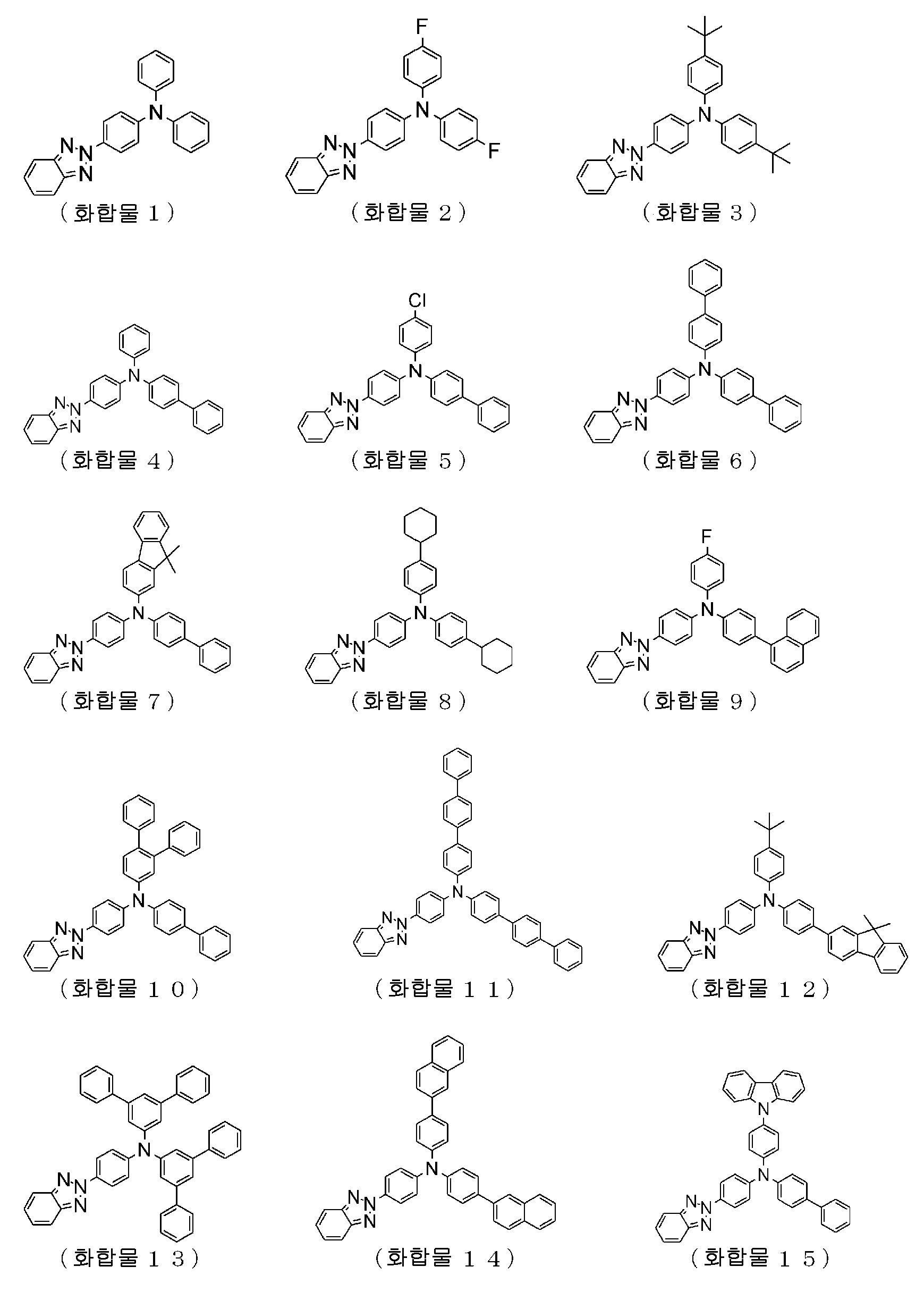
[화학식 15][Chemical Formula 15]
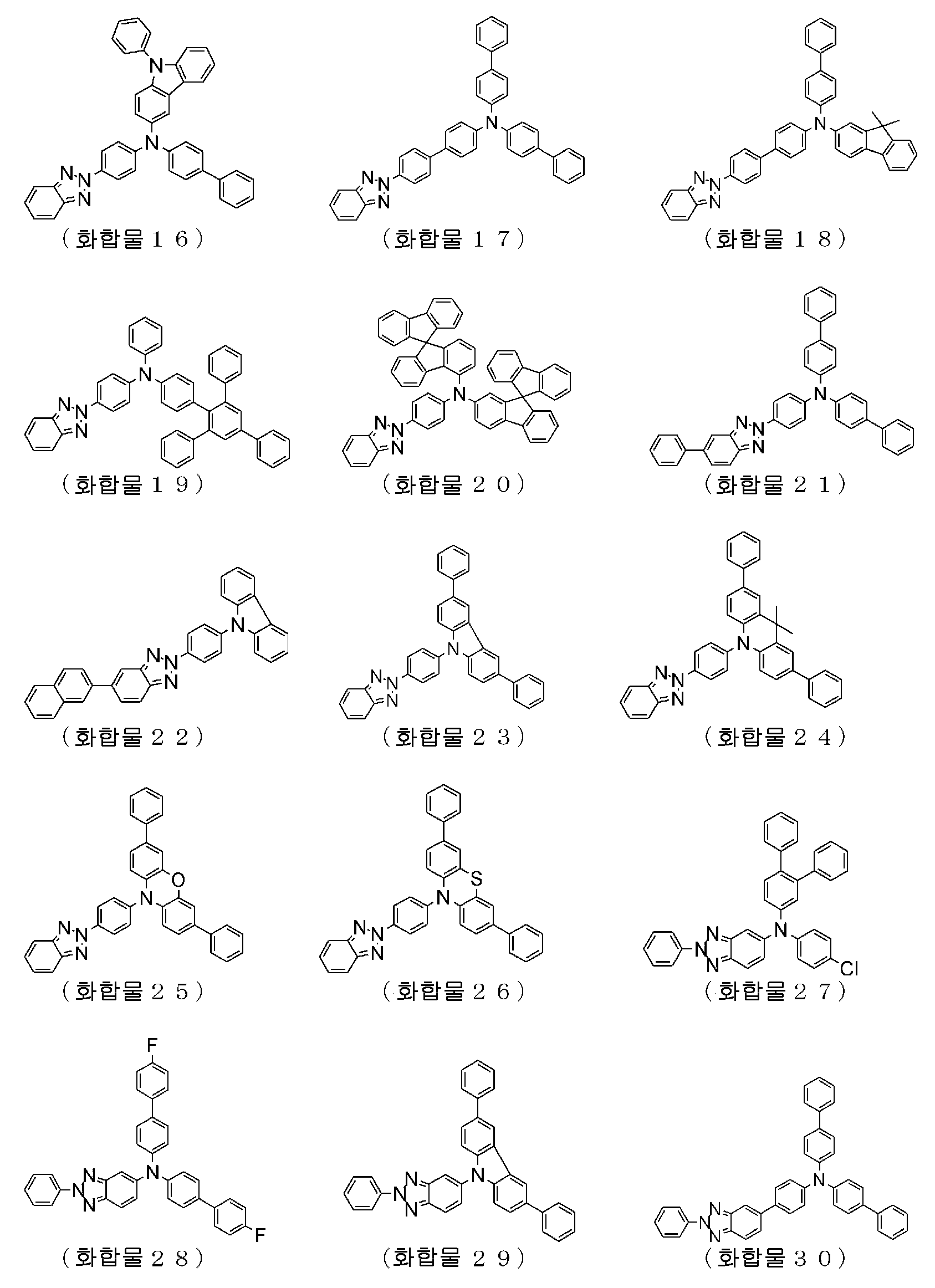
[화학식 16][Chemical Formula 16]
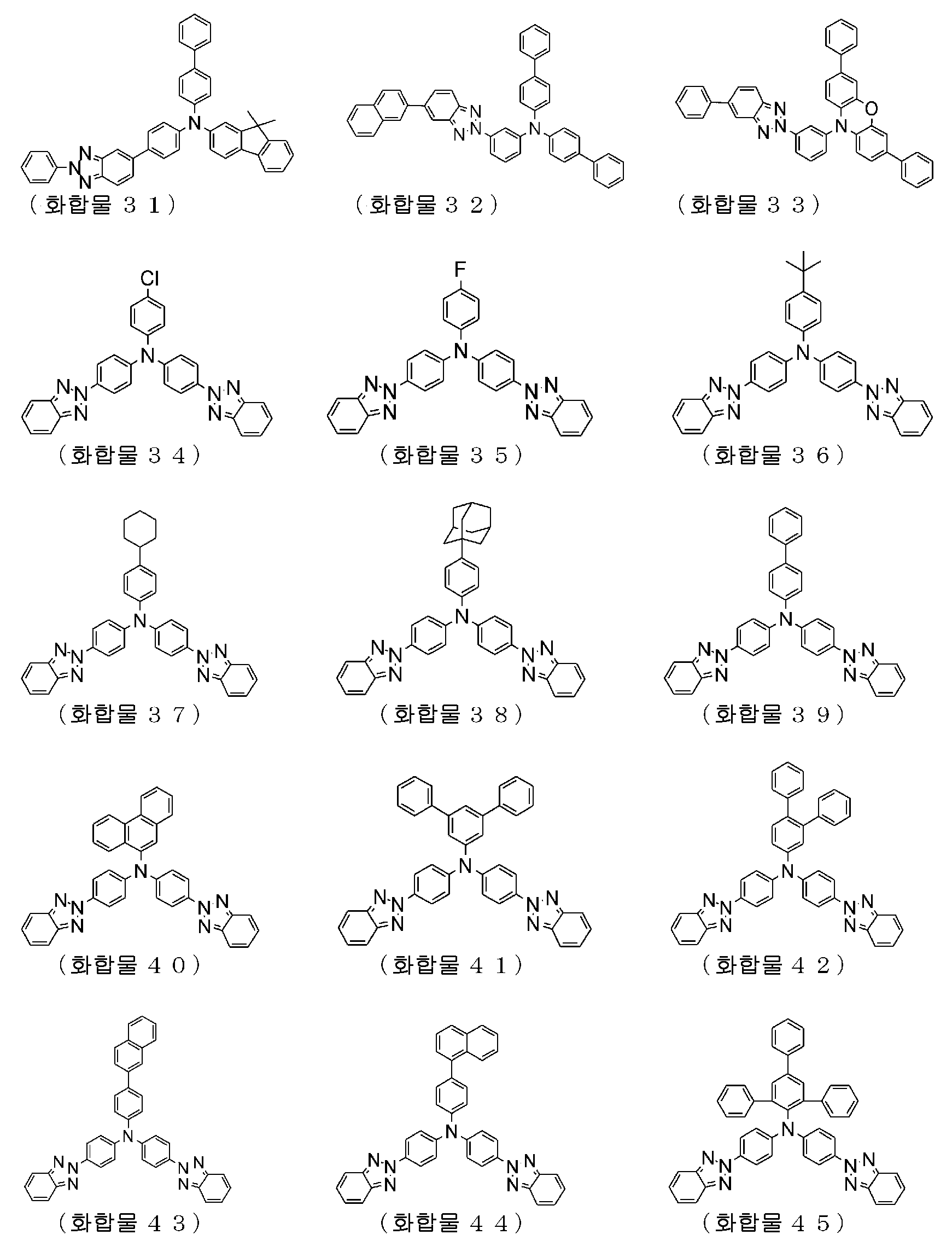
[화학식 17][Chemical Formula 17]
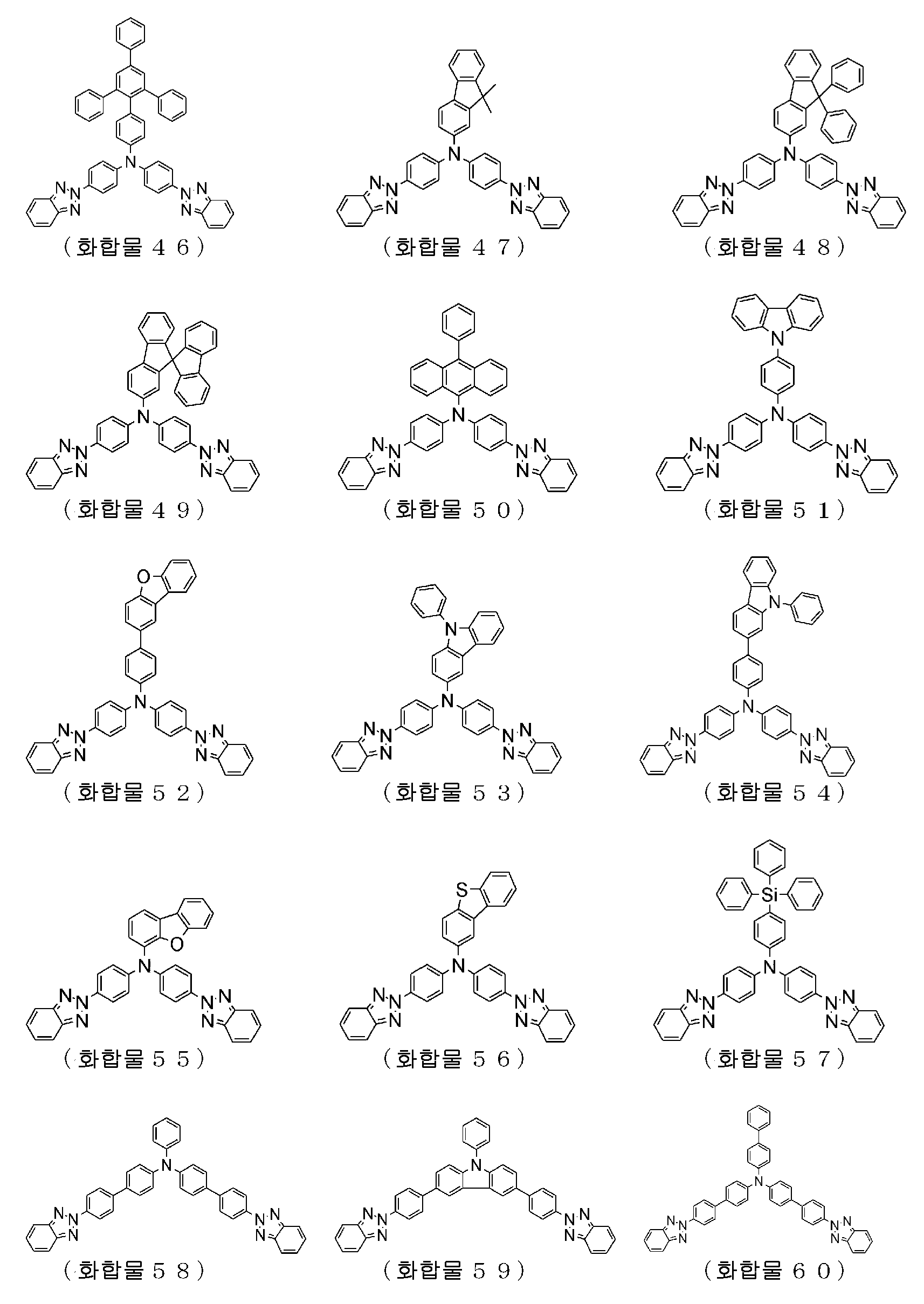
[화학식 18][Chemical Formula 18]
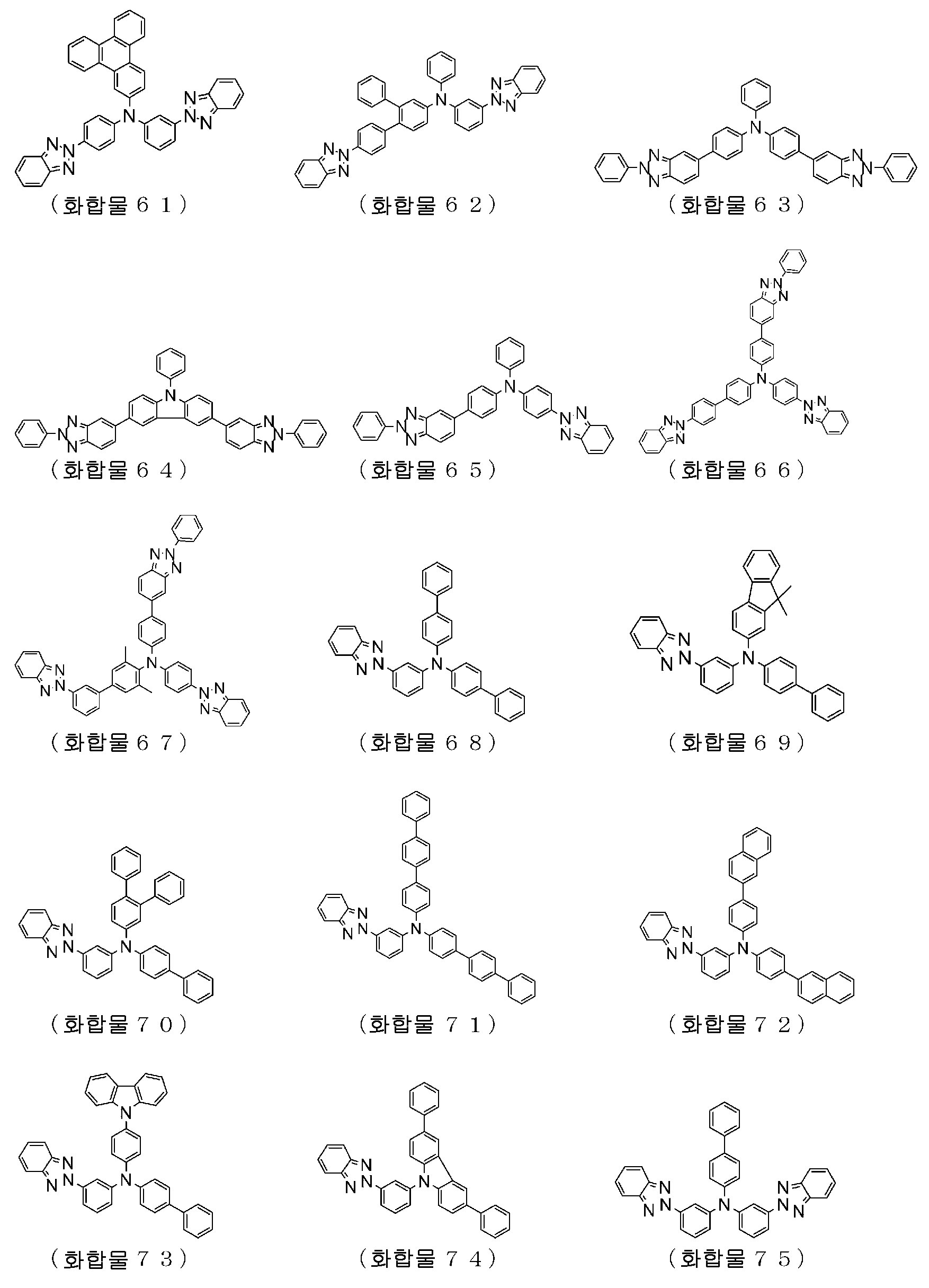
[화학식 19][Chemical Formula 19]
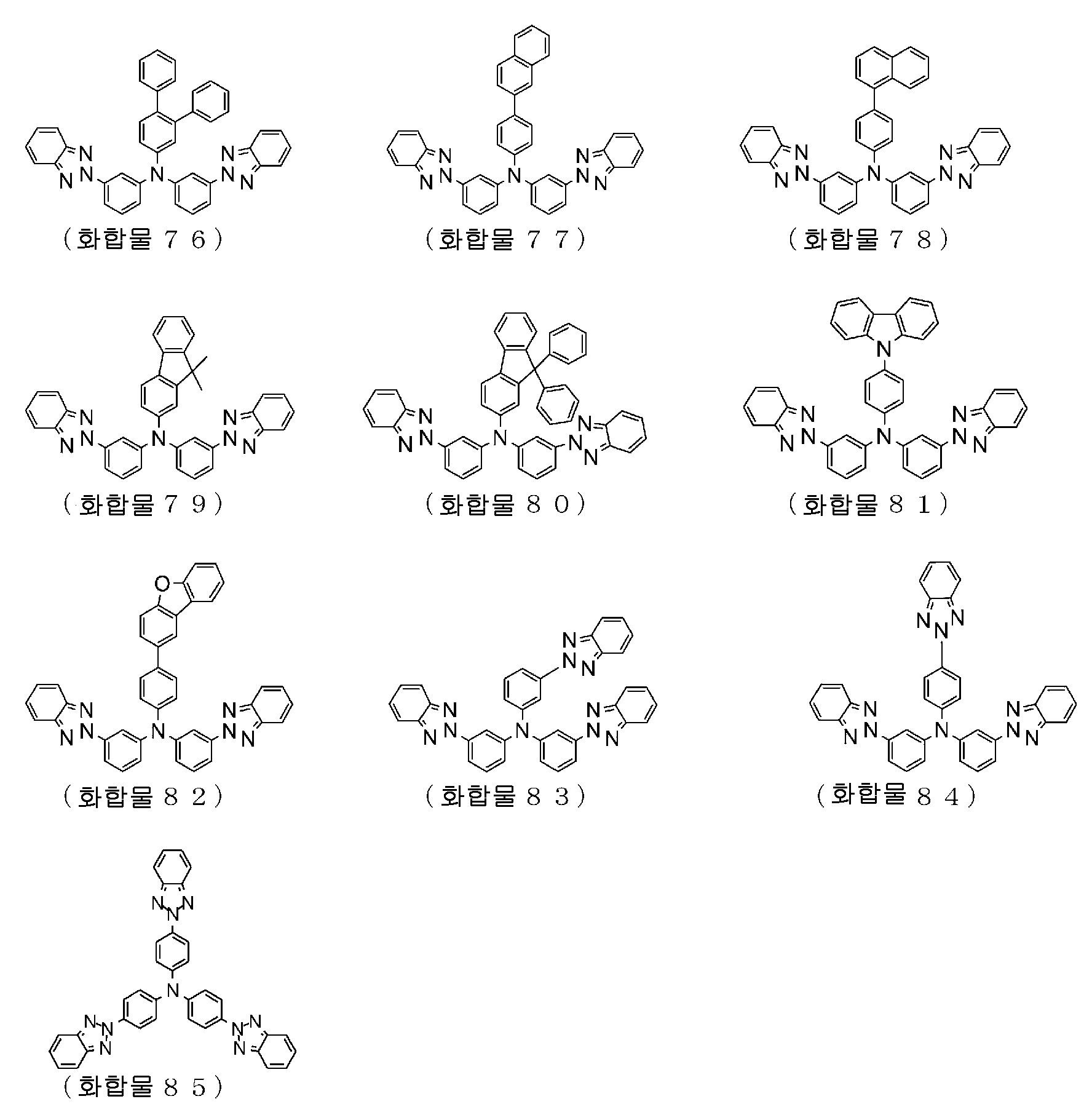
일반식 (A-1) 로 나타내는 화합물의 정제는 칼럼 크로마토그래프에 의한 정제, 실리카 겔, 활성탄, 활성 백토 등에 의한 흡착 정제, 용매에 의한 재결정이나 정석법, 승화 정제법 등에 의해 실시되고, 화합물의 동정은 NMR 분석으로 실시된다. 물성치로서, 융점, 유리 전이점 (Tg) 과 굴절률의 측정은 이하의 순서로 실시된다. 또한, 융점은 증착성의 지표가 되는 것이고, 유리 전이점 (Tg) 은 박막 상태의 안정성의 지표가 되고, 굴절률은 광의 취출 효율의 향상에 관한 지표가 되는 것이다.The purification of the compound represented by the general formula (A-1) is performed by purification by column chromatography, adsorption purification by silica gel, activated carbon, activated clay, etc., recrystallization or crystallization by a solvent, sublimation purification, etc., and the identification of the compound is performed by NMR analysis. As physical properties, melting point, glass transition point (Tg), and refractive index are measured in the following order. In addition, the melting point is an indicator of the vapor deposition property, the glass transition point (Tg) is an indicator of the stability of the thin film state, and the refractive index is an indicator of the improvement in the light extraction efficiency.
융점과 유리 전이점 (Tg) 은, 일반식 (A-1) 로 나타내는 화합물의 분말체를 사용하여 고감도 시차 주사 열량계 (브루커·에이엑스에스 제조, DSC3100SA) 에 의해 측정된다.The melting point and glass transition point (Tg) are measured by a high-sensitivity differential scanning calorimeter (DSC3100SA, manufactured by Bruker AXS) using a powder of a compound represented by the general formula (A-1).
굴절률과 소쇠 계수는, 실리콘 기판 상에 80 ㎚ 의 일반식 (A-1) 로 나타내는 화합물의 박막을 제작하여, 분광 측정 장치 (필 메트릭스사 제조, F10-RT-UV) 를 사용하여 측정된다.The refractive index and extinction coefficient are measured by forming a thin film of a compound represented by the general formula (A-1) of 80 nm on a silicon substrate and using a spectrophotometer (F10-RT-UV, manufactured by Philmatrix).
흡광도는, 농도 1.0 × 10⁻⁵ ㏖/ℓ 의 일반식 (A-1) 로 나타내는 화합물을 포함하는 톨루엔 용액을 조절하여, 자외 가시 근적외 분광 광도계 (니혼 분광 제조, V-650) 를 사용하여 측정된다. 흡광 계수는, 톨루엔 용액의 농도를 5.0 × 10⁻⁶ ㏖/ℓ, 1.0 × 10⁻⁵ ㏖/ℓ, 1.5 × 10⁻⁵ ㏖/ℓ, 2.0 × 10⁻⁵ ㏖/ℓ 의 4 종류의 농도로 조절하여, 자외 가시 근적외 분광 광도계 (니혼 분광 제조, V-650) 를 사용하여 피크 파장에 있어서의 흡광도를 측정하여 얻어지는 검량선으로부터 산출된다.The absorbance is measured using an ultraviolet-visible-near-infrared spectrophotometer (V-650, manufactured by Nippon Asokyo) by adjusting a toluene solution containing a compound represented by the general formula (A-1) at a concentration of 1.0 × 10 -5 mol /ℓ. The extinction coefficient is calculated from a calibration curve obtained by measuring the absorbance at the peak wavelength using an ultraviolet-visible-near-infrared spectrophotometer (V-650, manufactured by Nippon Asokyo) by adjusting the concentration of the toluene solution to four types of concentrations: 5.0 × 10 -6 mol/ℓ, 1.0 × 10 -5 mol/ℓ, 1.5 × 10 -5 mol/ℓ, and 2.0 × 10 -5 mol/ℓ.
본 실시형태의 유기 EL 소자의 구조로는, 예를 들어, 톱 이미션 구조의 발광 소자의 경우, 유리 기판 상에 순차적으로, 양극, 정공 수송층, 발광층, 전자 수송층, 음극 및 캡핑층으로 이루어지는 것, 또한, 양극과 정공 수송층 사이에 정공 주입층을 갖는 것, 정공 수송층과 발광층 사이에 전자 저지층을 갖는 것, 발광층과 전자 수송층 사이에 정공 저지층을 갖는 것, 전자 수송층과 음극 사이에 전자 주입층을 갖는 것을 들 수 있다. 이들 다층 구조에 있어서는 유기층을 몇 층 정도 생략 혹은 겸하는 것이 가능하고, 예를 들어 정공 주입층과 정공 수송층을 겸한 구성, 정공 수송층과 전자 저지층을 겸한 구성, 정공 저지층과 전자 수송층을 겸한 구성, 전자 수송층과 전자 주입층을 겸한 구성으로 하는 것, 등도 가능하다. 또한, 동일한 기능을 갖는 유기층을 2 층 이상 적층한 구성으로 하는 것도 가능하고, 정공 수송층을 2 층 적층한 구성, 발광층을 2 층 적층한 구성, 전자 수송층을 2 층 적층한 구성, 캡핑층을 2 층 적층한 구성, 등도 가능하다.The structure of the organic EL element of the present embodiment may, for example, in the case of a light-emitting element having a top emission structure, be sequentially formed on a glass substrate of an anode, a hole transport layer, a light-emitting layer, an electron transport layer, a cathode, and a capping layer, further including a hole injection layer between the anode and the hole transport layer, an electron blocking layer between the hole transport layer and the light-emitting layer, a hole blocking layer between the light-emitting layer and the electron transport layer, and an electron injection layer between the electron transport layer and the cathode. In these multilayer structures, it is possible to omit or include a number of organic layers, and for example, a configuration that also includes a hole injection layer and a hole transport layer, a configuration that also includes a hole transport layer and an electron blocking layer, a configuration that also includes a hole blocking layer and an electron transport layer, a configuration that also includes an electron transport layer and an electron injection layer, etc. are also possible. In addition, it is also possible to have a configuration in which two or more organic layers having the same function are laminated, and a configuration in which two layers of hole transport layers are laminated, a configuration in which two layers of light-emitting layers are laminated, a configuration in which two layers of electron transport layers are laminated, a configuration in which two layers of capping layers are laminated, etc. are also possible.
유기 EL 소자의 각 층의 막 두께의 합계는, 200 ㎚ ∼ 750 ㎚ 정도가 바람직하고, 350 ㎚ ∼ 600 ㎚ 정도가 보다 바람직하다. 또한, 캡핑층의 막 두께는, 예를 들어, 30 ㎚ ∼ 120 ㎚ 가 바람직하고, 40 ㎚ ∼ 80 ㎚ 가 보다 바람직하다. 이 경우, 양호한 광의 취출 효율이 얻어진다. 또한, 캡핑층의 막 두께는, 발광 소자에 사용하는 발광 재료의 종류, 캡핑층 이외의 유기 EL 소자의 두께 등에 따라, 적절히 변경할 수 있다.The total film thickness of each layer of the organic EL element is preferably about 200 nm to 750 nm, and more preferably about 350 nm to 600 nm. In addition, the film thickness of the capping layer is preferably, for example, about 30 nm to 120 nm, and more preferably about 40 nm to 80 nm. In this case, good light extraction efficiency is obtained. In addition, the film thickness of the capping layer can be appropriately changed depending on the type of light-emitting material used in the light-emitting element, the thickness of the organic EL element other than the capping layer, and the like.
본 실시형태의 유기 EL 소자의 양극으로는, ITO 나 금과 같은 일 함수가 큰 전극 재료가 사용된다.As the anode of the organic EL device of the present embodiment, an electrode material with a large work function, such as ITO or gold, is used.
본 실시형태의 유기 EL 소자의 정공 주입층으로서, 분자 중에 트리페닐아민 구조를 3 개 이상, 단결합 또는 헤테로 원자를 포함하지 않는 2 가기로 연결된 구조를 갖는 아릴아민 화합물, 예를 들어, 스타버스트형의 트리페닐아민 유도체, 여러 가지 트리페닐아민 4 량체 등의 재료나 동 프탈로시아닌으로 대표되는 포르피린 화합물, 헥사시아노아자트리페닐렌과 같은 억셉터성의 복소 고리 화합물이나 도포형의 고분자 재료를 사용할 수 있다. 이들은, 단독으로 성막해도 되지만, 다른 재료와 함께 혼합하여 성막한 단층으로서 사용해도 되고, 단독으로 성막한 층끼리, 혼합하여 성막한 층끼리, 또는 단독으로 성막한 층과 혼합하여 성막한 층의 적층 구조로 해도 된다. 이들 재료는 증착법 외에, 스핀 코트법이나 잉크젯법 등의 공지된 방법에 의해 박막 형성을 실시할 수 있다.As the hole injection layer of the organic EL device of the present embodiment, an arylamine compound having three or more triphenylamine structures in the molecule and a divalently linked structure that does not include a single bond or heteroatom, such as a starburst-type triphenylamine derivative, various triphenylamine tetramers, a porphyrin compound represented by copper phthalocyanine, an acceptor heterocyclic compound such as hexacyanoazatriphenylene, or a coating-type polymer material can be used. These may be formed into a film alone, or may be used as a single layer formed by mixing with other materials, or may be formed into a laminated structure of layers formed alone, layers formed by mixing, or layers formed alone and mixed. These materials can be formed into a thin film by a known method such as a spin coating method or an inkjet method in addition to a vapor deposition method.
본 실시형태의 유기 EL 소자의 정공 수송층으로서, N,N'-디페닐-N,N'-디(m-톨릴)벤지딘 (이후, TPD 라고 약칭한다) 이나 N,N'-디페닐-N,N'-디(α-나프틸)벤지딘 (이후, NPD 라고 약칭한다), N,N,N',N'-테트라비페닐릴벤지딘 등의 벤지딘 유도체, 1,1-비스[4-(디-4-톨릴아미노)페닐]시클로헥산 (이후, TAPC 라고 약칭한다), 특히 분자 중에 트리페닐아민 구조를 2 개, 단결합 또는 헤테로 원자를 포함하지 않는 2 가기로 연결된 구조를 갖는 아릴아민 화합물, 예를 들어, N,N,N',N'-테트라비페닐릴벤지딘 등을 사용하는 것이 바람직하다. 또한, 분자 중에 트리페닐아민 구조를 3 개 이상, 단결합, 또는 헤테로 원자를 포함하지 않는 2 가기로 연결된 구조를 갖는 아릴아민 화합물, 예를 들어, 여러 가지 트리페닐아민 3 량체 및 4 량체 등을 사용하는 것이 바람직하다. 이들은, 단독으로 성막해도 되지만, 다른 재료와 함께 혼합하여 성막한 단층으로서 사용해도 되고, 단독으로 성막한 층끼리, 혼합하여 성막한 층끼리, 또는 단독으로 성막한 층과 혼합하여 성막한 층의 적층 구조로 해도 된다. 또한, 정공의 주입·수송층으로서, 폴리(3,4-에틸렌디옥시티오펜) (이후, PEDOT 라고 약칭한다)/폴리(스티렌술포네이트) (이후, PSS 라고 약칭한다) 등의 도포형의 고분자 재료를 사용할 수 있다. 이들 재료는 증착법 외에, 스핀 코트법이나 잉크젯법 등의 공지된 방법에 의해 박막 형성을 실시할 수 있다.As the hole transport layer of the organic EL device of the present embodiment, it is preferable to use benzidine derivatives such as N,N'-diphenyl-N,N'-di(m-tolyl)benzidine (hereinafter abbreviated as TPD) or N,N'-diphenyl-N,N'-di(α-naphthyl)benzidine (hereinafter abbreviated as NPD), N,N,N',N'-tetrabiphenylylbenzidine, 1,1-bis[4-(di-4-tolylamino)phenyl]cyclohexane (hereinafter abbreviated as TAPC), and especially an arylamine compound having two triphenylamine structures in the molecule and a divalently linked structure that does not contain a single bond or a heteroatom, for example, N,N,N',N'-tetrabiphenylylbenzidine. In addition, it is preferable to use an arylamine compound having three or more triphenylamine structures in the molecule, a single bond, or a divalently linked structure that does not include a hetero atom, for example, various triphenylamine trimers and tetramers. These may be used as a film formed alone, or as a single layer formed by mixing with other materials, or as a laminated structure of layers formed alone, layers formed by mixing, or layers formed alone and mixed. In addition, as a hole injection/transport layer, a coating-type polymer material such as poly(3,4-ethylenedioxythiophene) (hereinafter abbreviated as PEDOT)/poly(styrenesulfonate) (hereinafter abbreviated as PSS) can be used. These materials can be formed into a thin film by a known method such as a spin coating method or an inkjet method in addition to a vapor deposition method.
또한, 정공 주입층 혹은 정공 수송층에 있어서, 그 층에 통상적으로 사용되는 재료에 대하여, 추가로 트리스브로모페닐아민헥사클로르안티몬, 라디알렌 유도체 (예를 들어, 특허문헌 3 참조) 등을 P 도핑한 것이나, TPD 등의 벤지딘 유도체의 구조를 그 부분 구조로 갖는 고분자 화합물 등을 사용할 수 있다.In addition, in the hole injection layer or the hole transport layer, in addition to the materials commonly used in the layer, it is possible to use a P-doped material such as trisbromophenylamine hexachloroantimony, a radialene derivative (see, for example, Patent Document 3), or a polymer compound having a structure of a benzidine derivative such as TPD as its partial structure.
본 실시형태의 유기 EL 소자의 전자 저지층으로서, 4,4',4"-트리(N-카르바졸릴)트리페닐아민 (이후, TCTA 라고 약칭한다), 9,9-비스[4-(카르바졸-9-일)페닐]플루오렌, 1,3-비스(카르바졸-9-일)벤젠 (이후, mCP 라고 약칭한다), 2,2-비스(4-카르바졸-9-일-페닐)아다만탄 (이후, Ad-Cz 라고 약칭한다) 등의 카르바졸 유도체, 9-[4-(카르바졸-9-일)페닐]-9-[4-(트리페닐실릴)페닐]-9H-플루오렌으로 대표되는 트리페닐실릴기와 트리아릴아민 구조를 갖는 화합물 등의 전자 저지 작용을 갖는 화합물을 사용할 수 있다. 이들은, 단독으로 성막해도 되지만, 다른 재료와 함께 혼합하여 성막한 단층으로서 사용해도 되고, 단독으로 성막한 층끼리, 혼합하여 성막한 층끼리, 또는 단독으로 성막한 층과 혼합하여 성막한 층의 적층 구조로 해도 된다. 이들 재료는 증착법 외에, 스핀 코트법이나 잉크젯법 등의 공지된 방법에 의해 박막 형성을 실시할 수 있다.As the electron blocking layer of the organic EL device of the present embodiment, compounds having an electron blocking action, such as carbazole derivatives such as 4,4',4"-tri(N-carbazolyl)triphenylamine (hereinafter abbreviated as TCTA), 9,9-bis[4-(carbazol-9-yl)phenyl]fluorene, 1,3-bis(carbazol-9-yl)benzene (hereinafter abbreviated as mCP), 2,2-bis(4-carbazol-9-yl-phenyl)adamantane (hereinafter abbreviated as Ad-Cz), and compounds having a triphenylsilyl group and a triarylamine structure represented by 9-[4-(carbazol-9-yl)phenyl]-9-[4-(triphenylsilyl)phenyl]-9H-fluorene, can be used. These may be formed as a film alone, but may also be used as a single layer formed by mixing with other materials, or as layers formed alone or mixed. It may be formed by laminating layers formed by mixing layers formed alone or by laminating layers formed alone. In addition to the vapor deposition method, these materials can be formed into a thin film by a known method such as the spin coating method or the inkjet method.
본 실시형태의 유기 EL 소자의 발광층으로서, Alq3 을 비롯한 퀴놀리놀 유도체의 금속 착물 외에, 각종 금속 착물, 안트라센 유도체, 비스스티릴벤젠 유도체, 피렌 유도체, 옥사졸 유도체, 폴리파라페닐렌비닐렌 유도체 등을 사용할 수 있다. 또한, 발광층을 호스트 재료와 도펀트 재료로 구성해도 되고, 호스트 재료로서, 안트라센 유도체가 바람직하게 사용되지만, 그 외에, 상기 발광 재료에 더하여, 인돌 고리를 축합 고리의 부분 구조로서 갖는 복소 고리 화합물, 카르바졸 고리를 축합 고리의 부분 구조로서 갖는 복소 고리 화합물, 카르바졸 유도체, 티아졸 유도체, 벤즈이미다졸 유도체, 폴리디알킬플루오렌 유도체 등을 사용할 수 있다. 또한 도펀트 재료로는, 퀴나크리돈, 쿠마린, 루브렌, 페릴렌 및 그들의 유도체, 벤조피란 유도체, 로다민 유도체, 아미노스티릴 유도체 등을 사용할 수 있다. 이들은, 단독으로 성막해도 되지만, 다른 재료와 함께 혼합하여 성막한 단층으로서 사용해도 되고, 단독으로 성막한 층끼리, 혼합하여 성막한 층끼리, 또는 단독으로 성막한 층과 혼합하여 성막한 층의 적층 구조로 해도 된다.As the light-emitting layer of the organic EL device of the present embodiment, in addition to the metal complex of a quinolinol derivative including Alq 3 , various metal complexes, anthracene derivatives, bisstyrylbenzene derivatives, pyrene derivatives, oxazole derivatives, polyparaphenylenevinylene derivatives, and the like can be used. In addition, the light-emitting layer may be composed of a host material and a dopant material, and as the host material, an anthracene derivative is preferably used, but in addition to this, in addition to the light-emitting material, a heterocyclic compound having an indole ring as a partial structure of the condensed ring, a heterocyclic compound having a carbazole ring as a partial structure of the condensed ring, a carbazole derivative, a thiazole derivative, a benzimidazole derivative, a polydialkylfluorene derivative, and the like can be used. In addition, as a dopant material, quinacridone, coumarin, rubrene, perylene and derivatives thereof, benzopyran derivatives, rhodamine derivatives, aminostyryl derivatives, and the like can be used. These can be used as a single layer formed by mixing with other materials, or as a laminated structure of layers formed by mixing with other materials, or layers formed by mixing with ...
또한, 발광 재료로서 인광 발광체를 사용하는 것도 가능하다. 인광 발광체로는, 이리듐이나 백금 등의 금속 착물의 인광 발광체를 사용할 수 있다. Ir(ppy)3 등의 녹색의 인광 발광체, FIrpic, FIr6 등의 청색의 인광 발광체, Btp2Ir(acac) 등의 적색의 인광 발광체 등이 이용되고, 이 때의 호스트 재료로는 정공 주입·수송성의 호스트 재료로서 4,4'-디(N-카르바졸릴)비페닐 (이후, CBP 라고 약칭한다) 이나 TCTA, mCP 등의 카르바졸 유도체를 사용할 수 있다. 전자 수송성의 호스트 재료로서, p-비스(트리페닐실릴)벤젠 (이후, UGH2 라고 약칭한다) 이나 2,2',2"-(1,3,5-페닐렌)-트리스(1-페닐-1H-벤즈이미다졸) (이후, TPBI 라고 약칭한다) 등을 사용할 수 있고, 고성능의 유기 EL 소자를 제작할 수 있다.In addition, it is also possible to use a phosphorescent emitter as a light-emitting material. As the phosphorescent emitter, a phosphorescent emitter of a metal complex such as iridium or platinum can be used. Green phosphorescent emitters such as Ir(ppy) 3 , blue phosphorescent emitters such as FIrpic and FIr6 , and red phosphorescent emitters such as Btp 2 Ir(acac) are used, and as a host material having hole injection and transport properties, 4,4'-di(N-carbazolyl)biphenyl (hereinafter abbreviated as CBP) or carbazole derivatives such as TCTA and mCP can be used. As an electron-transport host material, p-bis(triphenylsilyl)benzene (hereinafter abbreviated as UGH2) or 2,2',2"-(1,3,5-phenylene)-tris(1-phenyl-1H-benzimidazole) (hereinafter abbreviated as TPBI) can be used, and high-performance organic EL devices can be produced.
인광성의 발광 재료의 호스트 재료로의 도프는 농도 소광을 피하기 위해서, 발광층 전체에 대하여 1 ∼ 30 중량 퍼센트의 범위로, 공증착에 의해 도프하는 것이 바람직하다.In order to avoid concentration quenching, doping of the phosphorescent light-emitting material into the host material is preferably done by co-deposition in a range of 1 to 30 weight percent with respect to the entire light-emitting layer.
또한, 발광 재료로서 PIC-TRZ, CC2TA, PXZ-TRZ, 4CzIPN 등의 CDCB 유도체 등의 지연 형광을 방사하는 재료를 사용하는 것도 가능하다 (예를 들어, 비특허문헌 7 참조). 이들 재료는 증착법 외에, 스핀 코트법이나 잉크젯법 등의 공지된 방법에 의해 박막 형성을 실시할 수 있다.In addition, it is also possible to use materials that emit delayed fluorescence, such as CDCB derivatives such as PIC-TRZ, CC2TA, PXZ-TRZ, and 4CzIPN, as luminescent materials (see, for example, Non-patent Document 7). In addition to the deposition method, these materials can be formed into a thin film by a known method such as the spin coating method or the inkjet method.
본 실시형태의 유기 EL 소자의 정공 저지층으로서, 바토쿠프로인 (이후, BCP 라고 생략한다) 등의 페난트롤린 유도체나, 알루미늄 (III) 비스(2-메틸-8-퀴놀리나토)-4-페닐페놀레이트 (이후, BAlq 라고 생략한다) 등의 퀴놀리놀 유도체의 금속 착물, 각종 희토류 착물, 트리아졸 유도체, 트리아진 유도체, 피리미딘 유도체, 옥사디아졸 유도체, 벤조아졸 유도체 등, 정공 저지 작용을 갖는 화합물을 사용할 수 있다. 이들 재료는 전자 수송층의 재료를 겸해도 된다. 이들은, 단독으로 성막해도 되지만, 다른 재료와 함께 혼합하여 성막한 단층으로서 사용해도 되고, 단독으로 성막한 층끼리, 혼합하여 성막한 층끼리, 또는 단독으로 성막한 층과 혼합하여 성막한 층의 적층 구조로 해도 된다. 이들 재료는 증착법 외에, 스핀 코트법이나 잉크젯법 등의 공지된 방법에 의해 박막 형성을 실시할 수 있다.As the hole-blocking layer of the organic EL device of the present embodiment, a compound having a hole-blocking effect, such as a phenanthroline derivative such as batocuproine (hereinafter abbreviated as BCP), a metal complex of a quinolinol derivative such as aluminum (III) bis(2-methyl-8-quinolinato)-4-phenylphenolate (hereinafter abbreviated as BAlq), various rare earth complexes, triazole derivatives, triazine derivatives, pyrimidine derivatives, oxadiazole derivatives, benzoazole derivatives, or the like can be used. These materials may also serve as materials for the electron transport layer. These may be formed into a film alone, or may be used as a single layer formed by mixing with other materials, or may be formed into a laminated structure of layers formed alone, layers formed by mixing, or layers formed alone and mixed. These materials can be formed into a thin film by a known method such as a spin coating method or an inkjet method in addition to a vapor deposition method.
본 실시형태의 유기 EL 소자의 전자 수송층으로서, Alq3, BAlq 를 비롯한 퀴놀리놀 유도체의 금속 착물 외에, 각종 금속 착물, 트리아졸 유도체, 트리아진 유도체, 피리미딘 유도체, 옥사디아졸 유도체, 피리딘 유도체, 벤즈이미다졸 유도체, 벤조아졸 유도체, 티아디아졸 유도체, 안트라센 유도체, 카르보디이미드 유도체, 퀴녹살린 유도체, 피리도인돌 유도체, 페난트롤린 유도체, 실롤 유도체 등을 사용할 수 있다. 이들은, 단독으로 성막해도 되지만, 다른 재료와 함께 혼합하여 성막한 단층으로서 사용해도 되고, 단독으로 성막한 층끼리, 혼합하여 성막한 층끼리, 또는 단독으로 성막한 층과 혼합하여 성막한 층의 적층 구조로 해도 된다. 이들 재료는 증착법 외에, 스핀 코트법이나 잉크젯법 등의 공지된 방법에 의해 박막 형성을 실시할 수 있다.As the electron transport layer of the organic EL device of the present embodiment, in addition to metal complexes of quinolinol derivatives such as Alq 3 and BAlq, various metal complexes, triazole derivatives, triazine derivatives, pyrimidine derivatives, oxadiazole derivatives, pyridine derivatives, benzimidazole derivatives, benzoazole derivatives, thiadiazole derivatives, anthracene derivatives, carbodiimide derivatives, quinoxaline derivatives, pyridoindole derivatives, phenanthroline derivatives, silole derivatives, and the like can be used. These may be formed into a film alone, or may be used as a single layer formed by mixing with other materials, or may be formed into a laminated structure of layers formed alone, layers formed by mixing, or layers formed alone and mixed. These materials can be formed into a thin film by a known method such as a spin coating method or an inkjet method in addition to a vapor deposition method.
본 실시형태의 유기 EL 소자의 전자 주입층으로서, 불화리튬, 불화세슘 등의 알칼리 금속염, 불화마그네슘 등의 알칼리 토금속염, 리튬퀴놀리놀 등의 퀴놀리놀 유도체의 금속 착물, 산화알루미늄 등의 금속 산화물, 혹은 이테르븀 (Yb), 사마륨 (Sm), 칼슘 (Ca), 스트론튬 (Sr), 세슘 (Cs) 등의 금속 등을 사용할 수 있지만, 전자 수송층과 음극의 바람직한 선택에 있어서는, 이것을 생략할 수 있다.As the electron injection layer of the organic EL device of the present embodiment, an alkali metal salt such as lithium fluoride or cesium fluoride, an alkaline earth metal salt such as magnesium fluoride, a metal complex of a quinolinol derivative such as lithium quinolinol, a metal oxide such as aluminum oxide, or a metal such as ytterbium (Yb), samarium (Sm), calcium (Ca), strontium (Sr), cesium (Cs) can be used. However, in the preferable selection of the electron transport layer and the cathode, this can be omitted.
또한, 전자 주입층 혹은 전자 수송층에 있어서, 그 층에 통상적으로 사용되는 재료에 대하여, 추가로 세슘 등의 금속을 N 도핑한 것을 사용할 수 있다.In addition, in the electron injection layer or electron transport layer, a material that is additionally doped with a metal such as cesium and is N-doped can be used in addition to the material normally used in the layer.
본 실시형태의 유기 EL 소자의 음극으로서, 알루미늄과 같은 일 함수가 낮은 전극 재료나, 마그네슘은 합금, 마그네슘칼슘 합금, 마그네슘인듐 합금, 알루미늄마그네슘 합금과 같은, 보다 일 함수가 낮은 합금이나 ITO, IZO 등이 전극 재료로서 사용된다.As the cathode of the organic EL device of the present embodiment, an electrode material having a low work function such as aluminum, an alloy having a lower work function such as a magnesium alloy, a magnesium-calcium alloy, a magnesium-indium alloy, an aluminum-magnesium alloy, or ITO, IZO, etc. is used as the electrode material.
본 실시형태의 유기 EL 소자의 캡핑층으로서, 상기 일반식 (A-1) 로 나타내는 벤조아졸 고리 구조를 갖는 아민 화합물 등을 사용하는 것이 바람직하다. 이들은, 단독으로 성막해도 되지만, 다른 재료와 함께 혼합하여 성막한 단층으로서 사용해도 되고, 단독으로 성막한 층끼리, 혼합하여 성막한 층끼리, 또는 단독으로 성막한 층과 혼합하여 성막한 층의 적층 구조로 해도 된다. 이들 재료는 증착법 외에, 스핀 코트법이나 잉크젯법 등의 공지된 방법에 의해 박막 형성을 실시할 수 있다.As the capping layer of the organic EL device of the present embodiment, it is preferable to use an amine compound having a benzoazole ring structure represented by the general formula (A-1). These may be used alone as a film-forming agent, or as a single layer formed by mixing with other materials, or as a laminated structure of layers formed alone, layers formed by mixing, or layers formed alone and layers formed by mixing. These materials can be formed into a thin film by a known method such as a spin coating method or an inkjet method in addition to a vapor deposition method.
또한, 상기에서는, 톱 이미션 구조의 유기 EL 소자에 대하여 설명했지만, 본 발명은 이것으로 한정되는 것이 아니고, 보텀 이미션 구조의 유기 EL 소자나, 상부 및 저부의 양방으로부터 발광하는 듀얼 이미션 구조의 유기 EL 소자에 대해서도, 동일하게 적용할 수 있다. 이들의 경우, 광이 발광 소자로부터 외부로 취출되는 방향에 있는 전극은, 투명 또는 반투명일 필요가 있다.In addition, although the above description was made with respect to an organic EL element having a top emission structure, the present invention is not limited thereto, and can be applied in the same manner to an organic EL element having a bottom emission structure or an organic EL element having a dual emission structure that emits light from both the top and bottom. In these cases, the electrode located in the direction in which light is emitted from the light-emitting element to the outside needs to be transparent or translucent.
캡핑층을 구성하는 재료의 굴절률은, 인접하는 전극의 굴절률보다 큰 것이 바람직하다. 즉, 캡핑층에 의해, 유기 EL 소자에 있어서의 광의 취출 효율은 향상되는데, 그 효과는 캡핑층과 캡핑층에 접하고 있는 재료의 계면에서의 반사율이 큰 것이, 광 간섭의 효과가 크기 때문에 유효하다. 그 때문에, 캡핑층을 구성하는 재료의 굴절률은, 인접하는 전극의 굴절률보다 큰 것이 바람직하고, 굴절률이 1.70 이상 있으면 되지만, 1.80 이상이 보다 바람직하고, 1.85 이상인 것이 특히 바람직하다.The refractive index of the material constituting the capping layer is preferably larger than the refractive index of the adjacent electrode. That is, the light extraction efficiency in the organic EL element is improved by the capping layer, and this effect is effective because the reflectivity at the interface between the capping layer and the material in contact with the capping layer is large, which increases the effect of light interference. Therefore, the refractive index of the material constituting the capping layer is preferably larger than the refractive index of the adjacent electrode, and the refractive index should be 1.70 or higher, more preferably 1.80 or higher, and particularly preferably 1.85 or higher.
이하, 본 발명의 실시형태에 대하여, 실시예에 의해 구체적으로 설명하지만, 본 발명은 그 요지를 벗어나지 않는 한, 이하의 실시예에 한정되는 것은 아니다.Hereinafter, embodiments of the present invention will be specifically described by way of examples, but the present invention is not limited to the following examples unless it departs from the gist thereof.
실시예 1Example 1
<{4'-(벤조트리아졸-2-일)비페닐-4-일}-비스-(비페닐-4-일)-아민 (화합물 17) 의 합성><Synthesis of {4'-(benzotriazol-2-yl)biphenyl-4-yl}-bis-(biphenyl-4-yl)-amine (compound 17)>
질소 치환한 반응 용기에, 2-(4-브로모페닐)-2H-벤조트리아졸 : 3.7 g, 비스-(비페닐-4-일)-{4-(4,4,5,5-테트라메틸-[1,3,2]디옥사보란-2-일)-페닐}-아민 : 9.4 g, 톨루엔 : 80 ㎖, 에탄올 : 20 ㎖ 를 첨가하고, 계속해서, 미리 탄산칼륨 : 5.6 g 을 H2O : 20 ㎖ 에 용해시킨 수용액을 첨가하여 30 분간 초음파를 조사하면서 질소 가스를 통기하였다. 테트라키스트리페닐포스핀팔라듐 : 0.8 g 을 첨가하여 가열 환류하에서 4 시간 교반하였다. 방랭한 후, H2O 를 첨가하고, 분액 조작으로 유기층을 추출하고, 감압하 농축하여 미정제 생성물을 얻었다. 얻어진 미정제 생성물을 칼럼 크로마토그래프 (담체 : 실리카 겔, 용리액 : 톨루엔/n-헥산) 에 의해 정제하여, {4'-(벤조트리아졸-2-일)비페닐-4-일}-비스-(비페닐-4-일)-아민 (화합물 17) 의 황색 분말체 : 6.4 g (수율 85 %) 을 얻었다.In a nitrogen-exchanged reaction vessel, 2-(4-bromophenyl)-2H-benzotriazole: 3.7 g, bis-(biphenyl-4-yl)-{4-(4,4,5,5-tetramethyl-[1,3,2]dioxaboran-2-yl)-phenyl}-amine: 9.4 g, toluene: 80 mL, and ethanol: 20 mL were added, and then, an aqueous solution in which 5.6 g of potassium carbonate was dissolved in 20 mL of H 2 O in advance was added, and nitrogen gas was passed while irradiating the mixture with ultrasound for 30 minutes. Tetrakistriphenylphosphine palladium: 0.8 g was added, and the mixture was stirred under reflux for 4 hours. After cooling, H 2 O was added, and the organic layer was extracted by a liquid separation procedure, and concentrated under reduced pressure to obtain a crude product. The obtained crude product was purified by column chromatography (carrier: silica gel, eluent: toluene/n-hexane) to obtain 6.4 g (yield 85%) of a yellow powder of {4'-(benzotriazol-2-yl)biphenyl-4-yl}-bis-(biphenyl-4-yl)-amine (compound 17).
[화학식 20][Chemical formula 20]
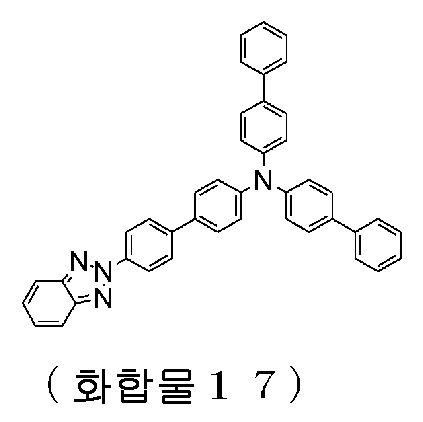
얻어진 황색 분말체에 대하여 NMR 을 사용하여 구조를 동정하였다.The structure of the obtained yellow powder was identified using NMR.
1H-NMR(THF-d8) 로 이하의 30 개의 수소의 시그널을 검출하였다.The following 30 hydrogen signals were detected by 1H -NMR (THF-d 8 ).
δ(ppm) = 8.46(2H), 7.94-7.92(2H), 7.88(2H), 7.69(2H), 7.62(4H), 7.59(4H), 7.43-7.38(6H), 7.29-7.23(8H).δ(ppm) = 8.46(2H), 7.94-7.92(2H), 7.88(2H), 7.69(2H), 7.62(4H), 7.59(4H), 7.43-7.38(6H), 7.29-7.23(8H) .
실시예 2Example 2
<{4-(벤조트리아졸-2-일)페닐}-비스(비페닐-4-일)-아민 (화합물 6) 의 합성><Synthesis of {4-(benzotriazol-2-yl)phenyl}-bis(biphenyl-4-yl)-amine (compound 6)>
반응 용기에 2-(4-브로모페닐)-2H-벤조트리아졸 : 9.0 g, 비스-(비페닐-4-일)-아민 : 9.6 g, t-부톡시나트륨 : 4.3 g, 톨루엔 : 150 ㎖ 를 첨가하고, 30 분간 초음파를 조사하면서 질소 가스를 통기하였다. 아세트산팔라듐 (Ⅱ) : 0.1 g, 트리-(t-부틸)포스핀의 50 % (w/v) 톨루엔 용액 : 0.24 ㎖ 를 첨가하고 가열 환류하에서 2 시간 교반하였다. 방랭한 후, 톨루엔을 첨가하여 분산 세정을 실시하여, 불용물을 여과하고, 여과액에 실리카 겔, 활성 백토를 첨가하여 흡착 정제를 실시하였다. 흡착제를 여과에 의해 제거하고, 여과액을 농축하여 미정제 생성물을 얻었다. 미정제 생성물을 톨루엔/아세톤 혼합 용매에 의해 정석 정제하고, 석출된 고체를 채취하여, {4-(벤조트리아졸-2-일)페닐}-비스(비페닐-4-일)-아민 (화합물 6) 의 황색 분말체 : 11.6 g (수율 75.3 %) 을 얻었다.In a reaction vessel, 2-(4-bromophenyl)-2H-benzotriazole: 9.0 g, bis-(biphenyl-4-yl)-amine: 9.6 g, t-sodium butoxy: 4.3 g, and toluene: 150 mL were added, and nitrogen gas was passed while irradiating with ultrasound for 30 minutes. Palladium (II) acetate: 0.1 g, a 50% (w/v) toluene solution of tri-(t-butyl)phosphine: 0.24 mL were added, and the mixture was stirred under reflux for 2 hours. After cooling, toluene was added to perform dispersion washing, the insoluble matters were filtered out, and silica gel and activated clay were added to the filtrate to perform adsorption purification. The adsorbent was removed by filtration, and the filtrate was concentrated to obtain a crude product. The crude product was purified by filtration using a mixed solvent of toluene/acetone, and the precipitated solid was collected to obtain 11.6 g (yield 75.3%) of a yellow powder of {4-(benzotriazol-2-yl)phenyl}-bis(biphenyl-4-yl)-amine (compound 6).
[화학식 21][Chemical Formula 21]
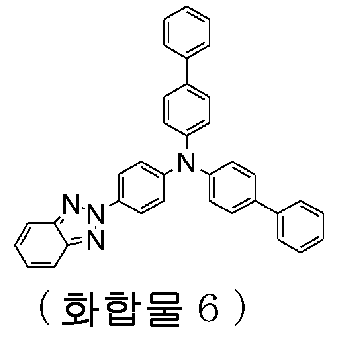
얻어진 황색 분말체에 대하여 NMR 을 사용하여 구조를 동정하였다.The structure of the obtained yellow powder was identified using NMR.
1H-NMR(CDCl3) 로 이하의 26 개의 수소의 시그널을 검출하였다.The following 26 hydrogen signals were detected by 1H -NMR (CDCl 3 ).
δ(ppm) = 8.27-8.31(2H), 7.95-7.99(2H), 7.58-7.66(8H), 7.28-7.51(14H).δ(ppm) = 8.27-8.31(2H), 7.95-7.99(2H), 7.58-7.66(8H), 7.28-7.51(14H).
실시예 3Example 3
<{4-(벤조트리아졸-2-일)페닐}-(비페닐-4-일)-9,9-디메틸-9H-플루오렌-2-일)-아민 (화합물 7) 의 합성><Synthesis of {4-(benzotriazol-2-yl)phenyl}-(biphenyl-4-yl)-9,9-dimethyl-9H-fluoren-2-yl)-amine (compound 7)>
반응 용기에 2-(4-브로모페닐)-2H-벤조트리아졸 : 8.3 g, (비페닐-4-일)-(9,9-디메틸-9H-플루오렌-2-일)-아민 : 10.0 g, t-부톡시나트륨 : 4.0 g, 톨루엔 : 150 ㎖ 를 첨가하고, 30 분간 초음파를 조사하면서 질소 가스를 통기하였다. 아세트산팔라듐 (Ⅱ) : 0.1 g, 트리-(t-부틸)포스핀의 50 % (w/v) 톨루엔 용액 : 0.22 ㎖ 를 첨가하고 가열 환류하에서 2 시간 교반하였다. 방랭한 후, 톨루엔을 첨가하여 분산 세정을 실시하여, 불용물을 여과하고, 여과액에 실리카 겔, 활성 백토를 첨가하여 흡착 정제를 실시하였다. 흡착제를 여과에 의해 제거하고, 여과액을 농축하여 미정제 생성물을 얻었다. 미정제 생성물을 아세톤에 의해 정석 정제하고, 석출된 고체를 채취하여, {4-(벤조트리아졸-2-일)페닐}-(비페닐-4-일)-9,9-디메틸-9H-플루오렌-2-일)-아민 (화합물 7) 의 황색 분말체 : 12.3 g (수율 80.4 %) 을 얻었다.In a reaction vessel, 2-(4-bromophenyl)-2H-benzotriazole: 8.3 g, (biphenyl-4-yl)-(9,9-dimethyl-9H-fluoren-2-yl)-amine: 10.0 g, t-sodium butoxy: 4.0 g, and toluene: 150 mL were added, and nitrogen gas was passed while irradiating with ultrasound for 30 minutes. Palladium (II) acetate: 0.1 g, a 50% (w/v) toluene solution of tri-(t-butyl)phosphine: 0.22 mL were added, and the mixture was stirred under reflux for 2 hours. After cooling, toluene was added to perform dispersion washing, the insoluble matters were filtered out, and silica gel and activated clay were added to the filtrate to perform adsorption purification. The adsorbent was removed by filtration, and the filtrate was concentrated to obtain a crude product. The crude product was purified by acetone, and the precipitated solid was collected to obtain 12.3 g (yield 80.4%) of a yellow powder of {4-(benzotriazol-2-yl)phenyl}-(biphenyl-4-yl)-9,9-dimethyl-9H-fluoren-2-yl)-amine (Compound 7).
[화학식 22][Chemical Formula 22]
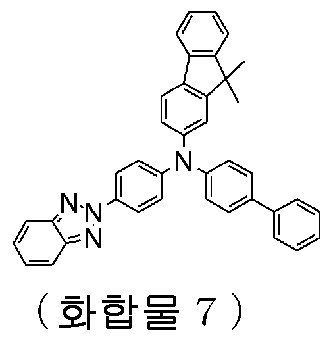
얻어진 황색 분말체에 대하여 NMR 을 사용하여 구조를 동정하였다.The structure of the obtained yellow powder was identified using NMR.
1H-NMR(CDCl3) 로 이하의 30 개의 수소의 시그널을 검출하였다.The following 30 hydrogen signals were detected by 1H -NMR (CDCl 3 ).
δ(ppm) = 8.24-8.27(2H), 7.94-7.97(2H), 7.57-7.72(6H), 7.28-7.50(13H), 7.16-7.20(1H), 1.48(6H).δ(ppm) = 8.24-8.27(2H), 7.94-7.97(2H), 7.57-7.72(6H), 7.28-7.50(13H), 7.16-7.20(1H), 1.48(6H).
실시예 4Example 4
<9-{4-(벤조트리아졸-2-일)페닐}-3,6-디페닐-9H-카르바졸 (화합물 23) 의 합성><Synthesis of 9-{4-(benzotriazol-2-yl)phenyl}-3,6-diphenyl-9H-carbazole (compound 23)>
반응 용기에 2-(4-브로모페닐)-2H-벤조트리아졸 : 7.6 g, 3,6-디페닐-9H-카르바졸 : 8.0 g, t-부톡시나트륨 : 3.6 g, 톨루엔 : 130 ㎖ 를 첨가하고, 30 분간 초음파를 조사하면서 질소 가스를 통기하였다. 아세트산팔라듐 (Ⅱ) : 0.1 g, 트리-(t-부틸)포스핀의 50 % (w/v) 톨루엔 용액 : 0.20 ㎖ 를 첨가하여 가열 환류하에서 12 시간 교반하였다. 방랭한 후, 톨루엔을 첨가하여 분산 세정을 실시하여, 불용물을 여과하고, 여과액에 실리카 겔, 활성 백토를 첨가하여 흡착 정제를 실시하였다. 흡착제를 여과에 의해 제거하고, 여과액을 농축하여 미정제 생성물을 얻었다. 미정제 생성물을 아세톤에 의해 정석 정제하고, 석출된 고체를 채취하여, 9-{4-(벤조트리아졸-2-일)페닐}-3,6-디페닐-9H-카르바졸 (화합물 23) 의 황색 분말체 : 6.9 g (수율 54 %) 을 얻었다.In a reaction vessel, 2-(4-bromophenyl)-2H-benzotriazole: 7.6 g, 3,6-diphenyl-9H-carbazole: 8.0 g, t-sodium butoxy: 3.6 g, and toluene: 130 mL were added, and nitrogen gas was passed while irradiating with ultrasound for 30 minutes. Palladium (II) acetate: 0.1 g, a 50% (w/v) toluene solution of tri-(t-butyl)phosphine: 0.20 mL were added, and the mixture was stirred under reflux for 12 hours. After cooling, toluene was added to perform dispersion washing, the insoluble matters were filtered out, and silica gel and activated clay were added to the filtrate to perform adsorption purification. The adsorbent was removed by filtration, and the filtrate was concentrated to obtain a crude product. The crude product was purified by acetone, and the precipitated solid was collected to obtain 6.9 g (yield 54%) of a yellow powder of 9-{4-(benzotriazol-2-yl)phenyl}-3,6-diphenyl-9H-carbazole (compound 23).
[화학식 23][Chemical Formula 23]

얻어진 황색 분말체에 대하여 NMR 을 사용하여 구조를 동정하였다.The structure of the obtained yellow powder was identified using NMR.
1H-NMR(CDCl3) 로 이하의 30 개의 수소의 시그널을 검출하였다.The following 30 hydrogen signals were detected by 1H -NMR (CDCl 3 ).
δ(ppm) = 8.67-8.68(2H), 8.45(2H), 8.00-8.03(2H), 7.73-7.87(8H), 7.39-7.57(10H).δ(ppm) = 8.67-8.68(2H), 8.45(2H), 8.00-8.03(2H), 7.73-7.87(8H), 7.39-7.57(10H).
실시예 5Example 5
<{(2-페닐벤조트리아졸-5-일)페닐-4-일}-비스-(비페닐-4-일)-아민 (화합물 30) 의 합성><Synthesis of {(2-phenylbenzotriazol-5-yl)phenyl-4-yl}-bis-(biphenyl-4-yl)-amine (compound 30)>
질소 치환한 반응 용기에, 5-브로모-2-페닐-2H-벤조트리아졸 : 2.3 g, 비스-(비페닐-4-일)-{4-(4,4,5,5-테트라메틸-[1,3,2]디옥사보란-2-일)-페닐}-아민 : 5.3 g, 톨루엔 : 52 ㎖, 에탄올 : 13 ㎖ 를 첨가하고, 계속해서, 미리 탄산칼륨 : 3.5 g 을 H2O : 13 ㎖ 에 용해시킨 수용액을 첨가하여 30 분간 초음파를 조사하면서 질소 가스를 통기하였다. 테트라키스트리페닐포스핀팔라듐 : 0.5 g 을 첨가하여 가열 환류하에서 6 시간 교반하였다. 방랭한 후, H2O 를 첨가하고, 분액 조작으로 유기층을 추출하고, 감압하 농축하여 미정제 생성물을 얻었다. 얻어진 미정제 생성물을 칼럼 크로마토그래프 (담체 : 실리카 겔, 용리액 : 톨루엔/n-헥산) 에 의해 정제하여, {(2-페닐벤조트리아졸-5-일)페닐-4-일}-비스-(비페닐-4-일)-아민 (화합물 30) 의 황색 분말체 : 3.5 g (수율 71 %) 을 얻었다.In a nitrogen-purged reaction vessel, 5-bromo-2-phenyl-2H-benzotriazole: 2.3 g, bis-(biphenyl-4-yl)-{4-(4,4,5,5-tetramethyl-[1,3,2]dioxaboran-2-yl)-phenyl}-amine: 5.3 g, toluene: 52 mL, ethanol: 13 mL were added, and then, an aqueous solution in which 3.5 g of potassium carbonate was dissolved in 13 mL of H 2 O in advance was added, and nitrogen gas was passed while irradiating the mixture with ultrasound for 30 minutes. Tetrakistriphenylphosphine palladium: 0.5 g was added, and the mixture was stirred under reflux for 6 hours. After cooling, H 2 O was added, and the organic layer was extracted by a liquid separation procedure, and concentrated under reduced pressure to obtain a crude product. The obtained crude product was purified by column chromatography (carrier: silica gel, eluent: toluene/n-hexane) to obtain 3.5 g (yield 71%) of a yellow powder of {(2-phenylbenzotriazol-5-yl)phenyl-4-yl}-bis-(biphenyl-4-yl)-amine (compound 30).
[화학식 24][Chemical Formula 24]

얻어진 황색 분말체에 대하여 NMR 을 사용하여 구조를 동정하였다.The structure of the obtained yellow powder was identified using NMR.
1H-NMR(THF-d8) 로 이하의 30 개의 수소의 시그널을 검출하였다.The following 30 hydrogen signals were detected by 1H -NMR (THF-d8).
δ(ppm) = 8.41(2H), 8.15(1H), 7.98(1H), 7.80(1H), 7.72(2H), 7.56-7.65(10H), 7.47(1H), 7.40(4H), 7.24-7.29(8H).δ(ppm) = 8.41(2H), 8.15(1H), 7.98(1H), 7.80(1H), 7.72(2H), 7.56-7.65(10H), 7.47(1H), 7.40(4H), 7.24-7.29 (8H).
실시예 6Example 6
<{(2-페닐벤조트리아졸-5-일)페닐-4-일}-(비페닐-4-일)-9,9-디메틸-9H-플루오렌-2-일) (화합물 31) 의 합성><Synthesis of {(2-phenylbenzotriazol-5-yl)phenyl-4-yl}-(biphenyl-4-yl)-9,9-dimethyl-9H-fluoren-2-yl) (Compound 31)>
질소 치환한 반응 용기에, 5-브로모-2-페닐-2H-벤조트리아졸 : 2.2 g, 비스-(비페닐-4-일)-{4-(4,4,5,5-테트라메틸-[1,3,2]디옥사보란-2-일)-페닐}-아민 : 5.4 g, 톨루엔 : 48 ㎖, 에탄올 : 12 ㎖ 를 첨가하고, 계속해서, 미리 탄산칼륨 : 3.3 g 을 H2O : 12 ㎖ 에 용해시킨 수용액을 첨가하여 30 분간 초음파를 조사하면서 질소 가스를 통기하였다. 테트라키스트리페닐포스핀팔라듐 : 0.5 g 을 첨가하여 가열 환류하에서 5 시간 교반하였다. 방랭한 후, H2O 를 첨가하고, 분액 조작으로 유기층을 추출하고, 감압하 농축하여 미정제 생성물을 얻었다. 얻어진 미정제 생성물을 칼럼 크로마토그래프 (담체 : 실리카 겔, 용리액 : 톨루엔/n-헥산) 에 의해 정제하여, {(2-페닐벤조트리아졸-5-일)페닐-4-일}-(비페닐-4-일)-9,9-디메틸-9H-플루오렌-2-일) (화합물 31) 의 황색 분말체 : 3.9 g (수율 77 %) 을 얻었다.In a nitrogen-purged reaction vessel, 5-bromo-2-phenyl-2H-benzotriazole: 2.2 g, bis-(biphenyl-4-yl)-{4-(4,4,5,5-tetramethyl-[1,3,2]dioxaboran-2-yl)-phenyl}-amine: 5.4 g, toluene: 48 mL, ethanol: 12 mL were added, and then, an aqueous solution in which 3.3 g of potassium carbonate was dissolved in 12 mL of H 2 O in advance was added, and nitrogen gas was passed while irradiating the mixture with ultrasound for 30 minutes. Tetrakistriphenylphosphine palladium: 0.5 g was added, and the mixture was stirred under reflux for 5 hours. After cooling, H 2 O was added, and the organic layer was extracted by a liquid separation procedure, and concentrated under reduced pressure to obtain a crude product. The obtained crude product was purified by column chromatography (carrier: silica gel, eluent: toluene/n-hexane) to obtain 3.9 g (yield 77%) of a yellow powder of {(2-phenylbenzotriazol-5-yl)phenyl-4-yl}-(biphenyl-4-yl)-9,9-dimethyl-9H-fluoren-2-yl) (Compound 31).
[화학식 25][Chemical Formula 25]
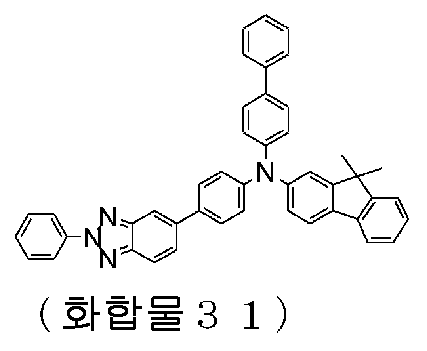
얻어진 황색 분말체에 대하여 NMR 을 사용하여 구조를 동정하였다.The structure of the obtained yellow powder was identified using NMR.
1H-NMR(THF-d8) 로 이하의 34 개의 수소의 시그널을 검출하였다.The following 34 hydrogen signals were detected by 1H -NMR (THF-d8).
δ(ppm) = 8.41(2H), 8.16(1H), 7.98(1H), 7.81(1H), 7.72(2H), 7.69(2H), 7.63(2H), 7.59(2H), 7.58(2H), 7.47(1H), 7.38-7.43(4H), 7.21-7.30(7H), 7.12(1H), 1.44(6H).δ(ppm) = 8.41(2H), 8.16(1H), 7.98(1H), 7.81(1H), 7.72(2H), 7.69(2H), 7.63(2H), 7.59(2H), 7.58(2H), 7.47(1H), 7.38-7.43(4H), 7.21-7.30(7H), 7.12(1H), 1.44(6H).
실시예 7Example 7
<비스-{4-(벤조트리아졸-2-일)페닐}-{4-(나프탈렌-2-일)페닐}아민 (화합물 43) 의 합성><Synthesis of bis-{4-(benzotriazol-2-yl)phenyl}-{4-(naphthalen-2-yl)phenyl}amine (compound 43)>
반응 용기에 4-(나프탈렌-2-일)페닐-아민 : 5.0 g, 2-(4-브로모페닐)-2H-벤조트리아졸 : 13.1 g, t-부톡시나트륨 : 6.6 g, 톨루엔 : 130 ㎖ 를 첨가하고, 30 분간 초음파를 조사하면서 질소 가스를 통기하였다. 트리스(디벤질리덴아세톤)디팔라듐 (0) : 0.21 g, 2,2'-비스(디페닐포스피노)-1,1'-비나프틸 : 0.28 g 을 첨가하여 가열 환류하에서 1 일 교반하였다. 80 ℃ 까지 방랭한 후, 불용물을 여과하고, 여과액에 실리카 겔을 첨가하여, 흡착 정제를 실시하였다. 흡착제를 여과에 의해 제거하고, 여과액을 농축하여 미정제 생성물을 얻었다. 미정제 생성물을 톨루엔에 의해 정석 정제하고, 석출된 고체를 채취하여, 비스-{4-(벤조트리아졸-2-일)페닐}-{4-(나프탈렌-2-일)페닐}아민 (화합물 43) 의 황색 분말체 : 6.5 g (수율 47 %) 을 얻었다.In a reaction vessel, 4-(naphthalen-2-yl)phenyl-amine: 5.0 g, 2-(4-bromophenyl)-2H-benzotriazole: 13.1 g, t-sodium butoxy: 6.6 g, and toluene: 130 mL were added, and nitrogen gas was passed while irradiating with ultrasound for 30 minutes. Tris(dibenzylideneacetone)dipalladium (0): 0.21 g, 2,2'-bis(diphenylphosphino)-1,1'-binaphthyl: 0.28 g were added, and the mixture was stirred under reflux for 1 day. After cooling to 80 ° C., the insoluble matter was filtered, and silica gel was added to the filtrate to perform adsorption purification. The adsorbent was removed by filtration, and the filtrate was concentrated to obtain a crude product. The crude product was purified by filtration with toluene, and the precipitated solid was collected to obtain 6.5 g (yield 47%) of a yellow powder of bis-{4-(benzotriazol-2-yl)phenyl}-{4-(naphthalen-2-yl)phenyl}amine (compound 43).
[화학식 26][Chemical Formula 26]
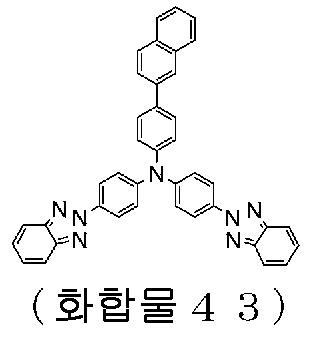
얻어진 황색 분말체에 대하여 NMR 을 사용하여 구조를 동정하였다.The structure of the obtained yellow powder was identified using NMR.
1H-NMR(CDCl3) 로 이하의 27 개의 수소의 시그널을 검출하였다.The following 27 hydrogen signals were detected by 1H -NMR (CDCl 3 ).
δ(ppm) = 8.33-8.35(4H), 8.31(1H), 7.73-7.98(10H), 7.34-7.55(12H)δ(ppm) = 8.33-8.35(4H), 8.31(1H), 7.73-7.98(10H), 7.34-7.55(12H)
실시예 8Example 8
<비스-{4-(벤조옥사졸-2-일)페닐}-{4-(나프탈렌-1-일)페닐}아민 (화합물 44) 의 합성><Synthesis of bis-{4-(benzoxazol-2-yl)phenyl}-{4-(naphthalen-1-yl)phenyl}amine (compound 44)>
반응 용기에 4-(나프탈렌-1-일)페닐-아민 : 5.0 g, 2-(4-브로모페닐)-2H-벤조트리아졸 : 13.8 g, t-부톡시나트륨 : 6.6 g, 톨루엔 : 50 ㎖ 를 첨가하고, 30 분간 초음파를 조사하면서 질소 가스를 통기하였다. 트리스(디벤질리덴아세톤)디팔라듐 (0) : 0.6 g, 트리-(t-부틸)포스핀의 50 % (w/v) 톨루엔 용액 : 0.6 ㎖ 를 첨가하여 가열 환류하에서 8 시간 교반하였다. 80 ℃ 까지 방랭한 후, 불용물을 여과하고, 여과액을 농축하여 미정제 생성물을 얻었다. 미정제 생성물을 아세톤에 의해 정석 정제하고, 석출된 고체를 채취하여, 비스-{4-(벤조트리아졸-2-일)페닐}-{4-(나프탈렌-1-일)페닐}아민 (화합물 44) 의 황색 분말체 : 6.4 g (수율 46 %) 을 얻었다.In a reaction vessel, 4-(naphthalen-1-yl)phenyl-amine: 5.0 g, 2-(4-bromophenyl)-2H-benzotriazole: 13.8 g, t-butoxysodium: 6.6 g, and toluene: 50 mL were added, and nitrogen gas was passed while irradiating the mixture with ultrasound for 30 minutes. Tris(dibenzylideneacetone)dipalladium (0): 0.6 g, a 50% (w/v) toluene solution of tri-(t-butyl)phosphine: 0.6 mL were added, and the mixture was stirred under reflux for 8 hours. After cooling to 80 °C, the insoluble matter was filtered, and the filtrate was concentrated to obtain a crude product. The crude product was purified by acetone, and the precipitated solid was collected to obtain 6.4 g (yield 46%) of a yellow powder of bis-{4-(benzotriazol-2-yl)phenyl}-{4-(naphthalen-1-yl)phenyl}amine (compound 44).
[화학식 27][Chemical Formula 27]
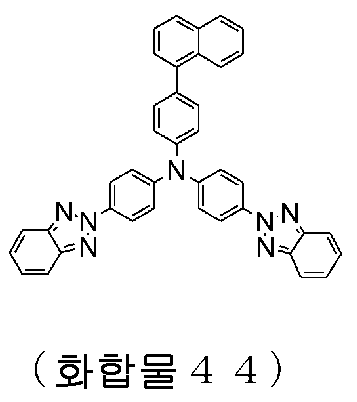
얻어진 황색 분말체에 대하여 NMR 을 사용하여 구조를 동정하였다.The structure of the obtained yellow powder was identified using NMR.
1H-NMR(DMSO-d6) 로 이하의 27 개의 수소의 시그널을 검출하였다.The following 27 hydrogen signals were detected by 1H -NMR (DMSO-d6).
δ(ppm) = 8.33-8.36(4H), 7.96-8.06(7H), 7.37-7.63(16H)δ(ppm) = 8.33-8.36(4H), 7.96-8.06(7H), 7.37-7.63(16H)
실시예 9Example 9
<비스-{4-(벤조트리아졸-2-일)페닐}-(9,9-디메틸-9H-플루오렌-2-일)-아민 (화합물 47) 의 합성><Synthesis of bis-{4-(benzotriazol-2-yl)phenyl}-(9,9-dimethyl-9H-fluoren-2-yl)-amine (compound 47)>
반응 용기에 9,9-디메틸-9H-플루오렌-2-일-아민 : 3.8 g, 2-(4-브로모페닐)-2H-벤조트리아졸 : 10.9 g, t-부톡시나트륨 : 5.2 g, 톨루엔 : 40 ㎖ 를 첨가하고, 30 분간 초음파를 조사하면서 질소 가스를 통기하였다. 트리스(디벤질리덴아세톤)팔라듐 (0) : 0.5 g, 트리-(t-부틸)포스핀의 50 % (w/v) 톨루엔 용액 : 0.44 ㎖ 를 첨가하여 가열 환류하에서 7 시간 교반하였다. 톨루엔을 첨가하여 분산 세정을 실시하여, 불용물을 열 여과하고, 여과액을 농축하여 미정제 생성물을 얻었다. 미정제 생성물을 톨루엔/메탄올 혼합 용매에 의해 정석 정제하고, 석출된 고체를 채취하여, 비스-{4-(벤조트리아졸-2-일)페닐}-(9,9-디메틸-9H-플루오렌-2-일)-아민 (화합물 47) 의 황색 분말체 : 6.8 g (수율 63 %) 을 얻었다.In a reaction vessel, 9,9-dimethyl-9H-fluoren-2-yl-amine: 3.8 g, 2-(4-bromophenyl)-2H-benzotriazole: 10.9 g, t-butoxysodium: 5.2 g, and toluene: 40 mL were added, and nitrogen gas was passed while irradiating the mixture with ultrasound for 30 minutes. Tris(dibenzylideneacetone)palladium (0): 0.5 g, and a 50% (w/v) toluene solution of tri-(t-butyl)phosphine: 0.44 mL were added, and the mixture was stirred under heating and reflux for 7 hours. Dispersion washing was performed by adding toluene, the insoluble matter was heat-filtered, and the filtrate was concentrated to obtain a crude product. The crude product was purified by filtration using a mixed solvent of toluene/methanol, and the precipitated solid was collected to obtain 6.8 g (yield 63%) of bis-{4-(benzotriazol-2-yl)phenyl}-(9,9-dimethyl-9H-fluoren-2-yl)-amine (compound 47) as a yellow powder.
[화학식 28][Chemical formula 28]
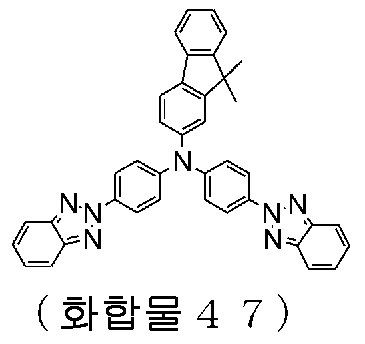
얻어진 황색 분말체에 대하여 NMR 을 사용하여 구조를 동정하였다.The structure of the obtained yellow powder was identified using NMR.
1H-NMR(DMSO-d6) 로 이하의 28 개의 수소의 시그널을 검출하였다.The following 28 hydrogen signals were detected by 1H -NMR (DMSO-d6).
δ(ppm) = 8.29-8.31(4H), 8.01-8.04(4H), 7.81-7.90(2H), 7.19-7.56(13H), 1.43(6H).δ(ppm) = 8.29-8.31(4H), 8.01-8.04(4H), 7.81-7.90(2H), 7.19-7.56(13H), 1.43(6H).
실시예 10Example 10
<비스-{4-(벤조옥사졸-2-일)페닐}-(9,9-디페닐-9H-플루오렌-2-일)-아민 (화합물 48) 의 합성><Synthesis of bis-{4-(benzoxazol-2-yl)phenyl}-(9,9-diphenyl-9H-fluoren-2-yl)-amine (compound 48)>
반응 용기에 9,9-디페닐-9H-플루오렌-2-일-아민 : 5.0 g, 2-(4-브로모페닐)-2H-벤조트리아졸 : 9.0 g, t-부톡시나트륨 : 4.3 g, 톨루엔 : 60 ㎖ 를 첨가하고, 30 분간 초음파를 조사하면서 질소 가스를 통기하였다. 트리스(디벤질리덴아세톤)팔라듐 (0) : 0.4 g, 트리-(t-부틸)포스핀의 50 % (w/v) 톨루엔 용액 : 0.4 ㎖ 를 첨가하여 가열 환류하에서 7 시간 교반하였다. 방랭한 후, 톨루엔을 첨가하여 분산 세정을 실시하여, 불용물을 여과하고, 여과액을 농축하여 미정제 생성물을 얻었다. 미정제 생성물을 톨루엔에 의해 정석 정제하고, 석출된 고체를 채취하여, 비스-{4-(벤조옥사졸-2-일)페닐}-(9,9-디페닐-9H-플루오렌-2-일)-아민 (화합물 48) 의 황색 분말체 : 8.1 g (수율 75 %) 을 얻었다.In a reaction vessel, 9,9-diphenyl-9H-fluoren-2-yl-amine: 5.0 g, 2-(4-bromophenyl)-2H-benzotriazole: 9.0 g, t-butoxysodium: 4.3 g, and toluene: 60 mL were added, and nitrogen gas was passed while irradiating the mixture with ultrasonic waves for 30 minutes. Tris(dibenzylideneacetone)palladium (0): 0.4 g, a 50% (w/v) toluene solution of tri-(t-butyl)phosphine: 0.4 mL were added, and the mixture was stirred under reflux for 7 hours. After cooling, toluene was added to perform dispersion washing, the insoluble matter was filtered, and the filtrate was concentrated to obtain a crude product. The crude product was purified by filtration with toluene, and the precipitated solid was collected to obtain 8.1 g (yield 75%) of a yellow powder of bis-{4-(benzoxazol-2-yl)phenyl}-(9,9-diphenyl-9H-fluoren-2-yl)-amine (compound 48).
[화학식 29][Chemical Formula 29]
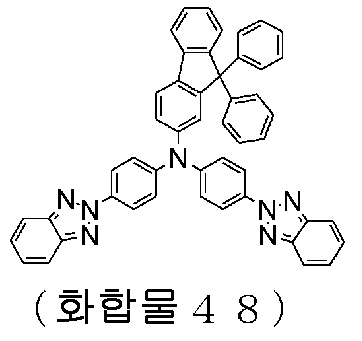
얻어진 황색 분말체에 대하여 NMR 을 사용하여 구조를 동정하였다.The structure of the obtained yellow powder was identified using NMR.
1H-NMR(DMSO-d6) 로 이하의 32 개의 수소의 시그널을 검출하였다.The following 32 hydrogen signals were detected by 1H -NMR (DMSO-d6).
δ(ppm) = 8.24-8.27(4H), 7.91-8.04(6H), 7.40-7.54(6H), 7.23-7.34(12H), 7.09-7.12(4H).δ(ppm) = 8.24-8.27(4H), 7.91-8.04(6H), 7.40-7.54(6H), 7.23-7.34(12H), 7.09-7.12(4H).
실시예 11Example 11
<{3-(벤조트리아졸-2-일)페닐}-비스(비페닐-4-일)-아민 (화합물 68) 의 합성><Synthesis of {3-(benzotriazol-2-yl)phenyl}-bis(biphenyl-4-yl)-amine (compound 68)>
반응 용기에 2-(3-브로모페닐)-2H-벤조트리아졸 : 9.6 g, 비스-(비페닐-4-일)-아민 : 9.0 g, t-부톡시나트륨 : 4.3 g, 톨루엔 : 150 ㎖ 를 첨가하고, 30 분간 초음파를 조사하면서 질소 가스를 통기하였다. 아세트산팔라듐 (Ⅱ) : 0.1 g, 트리-(t-부틸)포스핀의 50 % (w/v) 톨루엔 용액 : 0.24 ㎖ 를 첨가하여 가열 환류하에서 2 시간 교반하였다. 방랭한 후, 톨루엔을 첨가하여 분산 세정을 실시하여, 불용물을 여과하고, 여과액에 실리카 겔, 활성 백토를 첨가하여 흡착 정제를 실시하였다. 흡착제를 여과에 의해 제거하고, 여과액을 농축하여 미정제 생성물을 얻었다. 미정제 생성물을 톨루엔/아세톤 혼합 용매에 의해 정석 정제하고, 석출된 고체를 채취하여, {3-(벤조트리아졸-2-일)페닐}-비스(비페닐-4-일)-아민 (화합물 68) 의 황색 분말체 : 8.2 g (수율 53 %) 을 얻었다.In a reaction vessel were added 2-(3-bromophenyl)-2H-benzotriazole: 9.6 g, bis-(biphenyl-4-yl)-amine: 9.0 g, t-sodium butoxy: 4.3 g, and toluene: 150 mL, and nitrogen gas was passed while irradiating with ultrasound for 30 minutes. Palladium (II) acetate: 0.1 g, a 50% (w/v) toluene solution of tri-(t-butyl)phosphine: 0.24 mL were added, and the mixture was stirred under reflux for 2 hours. After cooling, toluene was added to perform dispersion washing, the insoluble matters were filtered out, and silica gel and activated clay were added to the filtrate to perform adsorption purification. The adsorbent was removed by filtration, and the filtrate was concentrated to obtain a crude product. The crude product was purified by filtration using a mixed solvent of toluene/acetone, and the precipitated solid was collected to obtain 8.2 g (yield 53%) of a yellow powder of {3-(benzotriazol-2-yl)phenyl}-bis(biphenyl-4-yl)-amine (compound 68).
[화학식 30][Chemical formula 30]
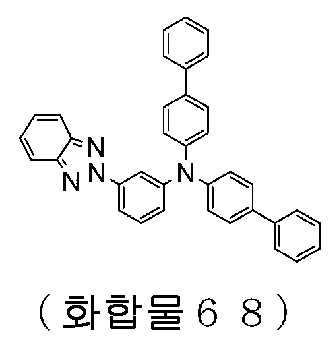
실시예 12Example 12
<비스-{3-(벤조트리아졸-2-일)페닐}-{4-(나프탈렌-2-일)페닐}아민 (화합물 77) 의 합성><Synthesis of bis-{3-(benzotriazol-2-yl)phenyl}-{4-(naphthalen-2-yl)phenyl}amine (compound 77)>
반응 용기에 4-(나프탈렌-2-일)페닐-아민 : 6.1 g, 2-(3-브로모페닐)-2H-벤조트리아졸 : 16.0 g, t-부톡시나트륨 : 8.0 g, 톨루엔 : 170 ㎖ 를 첨가하고, 30 분간 초음파를 조사하면서 질소 가스를 통기하였다. 트리스(디벤질리덴아세톤)디팔라듐 (0) : 0.25 g, 2,2'-비스(디페닐포스피노)-1,1'-비나프틸 : 0.35 g 을 첨가하여 가열 환류하에서 하룻밤 교반하였다. 톨루엔을 추가하여 80 ℃ 까지 방랭한 후, 불용물을 여과하고, 여과액에 실리카 겔을 첨가하고, 흡착 정제를 실시하였다. 흡착제를 여과에 의해 제거하고, 여과액을 농축하여 미정제 생성물을 얻었다. 미정제 생성물을 톨루엔에 의해 정석 정제하고, 석출된 고체를 채취하여, 비스-{3-(벤조트리아졸-2-일)페닐}-{4-(나프탈렌-2-일)페닐}아민 (화합물 77) 의 황색 분말체 : 6.2 g (수율 37 %) 을 얻었다.In a reaction vessel, 4-(naphthalen-2-yl)phenyl-amine: 6.1 g, 2-(3-bromophenyl)-2H-benzotriazole: 16.0 g, t-butoxysodium: 8.0 g, and toluene: 170 mL were added, and nitrogen gas was passed while irradiating with ultrasound for 30 minutes. Tris(dibenzylideneacetone)dipalladium (0): 0.25 g, 2,2'-bis(diphenylphosphino)-1,1'-binaphthyl: 0.35 g were added, and the mixture was stirred under reflux overnight. Toluene was added, the mixture was cooled to 80 ° C., the insoluble matter was filtered, silica gel was added to the filtrate, and adsorption purification was performed. The adsorbent was removed by filtration, and the filtrate was concentrated to obtain a crude product. The crude product was purified by filtration with toluene, and the precipitated solid was collected to obtain 6.2 g (yield 37%) of a yellow powder of bis-{3-(benzotriazol-2-yl)phenyl}-{4-(naphthalen-2-yl)phenyl}amine (compound 77).
[화학식 31][Chemical Formula 31]
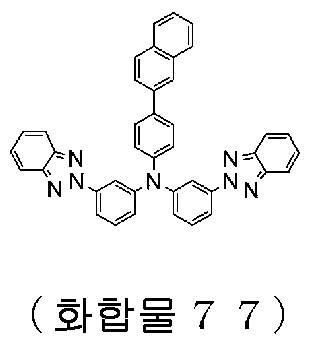
얻어진 황색 분말체에 대하여 NMR 을 사용하여 구조를 동정하였다.The structure of the obtained yellow powder was identified using NMR.
1H-NMR(CDCl3) 로 이하의 27 개의 수소의 시그널을 검출하였다.The following 27 hydrogen signals were detected by 1H -NMR (CDCl 3 ).
δ(ppm) = 8.24-8.25(2H), 8.08-8.11(3H), 7.89-7.96(7H), 7.72-7.81(3H), 7.30-7.55(12H).δ(ppm) = 8.24-8.25(2H), 8.08-8.11(3H), 7.89-7.96(7H), 7.72-7.81(3H), 7.30-7.55(12H).
실시예 13Example 13
<트리스-(4-벤조트리아졸-2-일-페닐)-아민 (화합물 85) 의 합성><Synthesis of tris-(4-benzotriazol-2-yl-phenyl)-amine (compound 85)>
반응 용기에 4-벤조트리아졸-2-일-페닐아민 : 2.5 g, t-부톡시나트륨 : 3.4 g, 톨루엔 : 60 ㎖ 를 첨가하고, 30 분간 초음파를 조사하면서 질소 가스를 통기하였다. 트리스(디벤질리덴아세톤)팔라듐 (0) : 0.2 g, 트리-(t-부틸)포스핀의 50 % (w/v) 톨루엔 용액 : 0.5 ㎖ 를 첨가하여 가열 환류하에서 하룻밤 교반하였다. 톨루엔을 첨가하여 분산 세정을 실시하여, 불용물을 열 여과하고, 여과액을 농축하여 미정제 생성물을 얻었다. 얻어진 미정제 생성물을 칼럼 크로마토그래프 (담체 : 실리카 겔, 용리액 : 톨루엔/n-헥산) 에 의해 정제하여, 트리스-(4-벤조트리아졸-2-일-페닐)-아민 (화합물 85) 의 황색 분말체 : 3.3 g (수율 46.5 %) 을 얻었다.In a reaction vessel, 4-benzotriazol-2-yl-phenylamine: 2.5 g, t-butoxysodium: 3.4 g, toluene: 60 mL were added, and nitrogen gas was passed while irradiating with ultrasound for 30 minutes. Tris(dibenzylideneacetone)palladium(0): 0.2 g, 50% (w/v) toluene solution of tri-(t-butyl)phosphine: 0.5 mL were added, and the mixture was stirred under reflux overnight. Dispersion washing was performed by adding toluene, the insoluble matter was heat-filtered, and the filtrate was concentrated to obtain a crude product. The obtained crude product was purified by column chromatography (carrier: silica gel, eluent: toluene/n-hexane) to obtain 3.3 g (yield 46.5%) of yellow powder of tris-(4-benzotriazol-2-yl-phenyl)-amine (compound 85).
[화학식 32][Chemical formula 32]
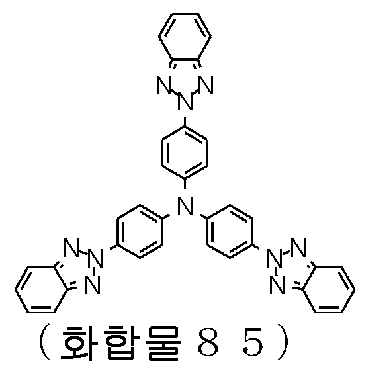
얻어진 황색 분말체에 대하여 NMR 을 사용하여 구조를 동정하였다.The structure of the obtained yellow powder was identified using NMR.
1H-NMR(CDCl3) 로 이하의 24 개의 수소의 시그널을 검출하였다.The following 24 hydrogen signals were detected by 1H -NMR (CDCl 3 ).
δ(ppm) = 8.26(6H), 7.93(6H), 7.42(6H), 7.33(6H).δ(ppm) = 8.26(6H), 7.93(6H), 7.42(6H), 7.33(6H).
실시예 14Example 14
일반식 (A-1) 로 나타내는 벤조아졸 화합물에 대하여, 고감도 시차 주사 열량계 (브루커·에이엑스에스 제조, DSC3100SA) 에 의해 융점과 유리 전이점을 측정하였다.For the benzoazole compound represented by the general formula (A-1), the melting point and glass transition point were measured by a high-sensitivity differential scanning calorimeter (DSC3100SA, manufactured by Bruker AXS).
융점 유리 전이점Melting point glass transition point
실시예 1 의 화합물 207 ℃ 102 ℃Compound of Example 1 207 ℃ 102 ℃
실시예 2 의 화합물 187 ℃ 100 ℃Compound of Example 2 187 ℃ 100 ℃
실시예 3 의 화합물 관측되지 않음 101 ℃Compound of Example 3 Not observed at 101℃
실시예 4 의 화합물 관측되지 않음 106 ℃Compound of Example 4 Not observed at 106°C
실시예 5 의 화합물 109 ℃ 100 ℃Compound of Example 5 109 ℃ 100 ℃
실시예 6 의 화합물 125 ℃ 106 ℃Compound of Example 6 125 ℃ 106 ℃
실시예 7 의 화합물 271 ℃ 110 ℃Compound of Example 7 271 ℃ 110 ℃
실시예 8 의 화합물 224 ℃ 113 ℃Compound of Example 8 224 ℃ 113 ℃
실시예 9 의 화합물 228 ℃ 119 ℃Compound of Example 9 228 ℃ 119 ℃
실시예 10 의 화합물 267 ℃ 146 ℃Compound of Example 10 267 ℃ 146 ℃
실시예 11 의 화합물 관측되지 않음 100 ℃Compound of Example 11 Not observed at 100 ℃
실시예 12 의 화합물 관측되지 않음 105 ℃Compound of Example 12 Not observed at 105°C
실시예 13 의 화합물 관측되지 않음 117 ℃Compound of Example 13 Not observed 117 ℃
일반식 (A-1) 로 나타내는 벤조아졸 고리 구조를 갖는 화합물은 100 ℃ 이상의 유리 전이점을 가지고 있고, 이것은 박막 상태가 안정적인 것을 나타내는 것이다.A compound having a benzoazole ring structure represented by the general formula (A-1) has a glass transition point of 100°C or higher, which indicates that the thin film state is stable.
실시예 15Example 15
일반식 (A-1) 로 나타내는 벤조아졸 고리 구조를 갖는 아민 화합물을 사용하여, 실리콘 기판 상에 막 두께 80 ㎚ 의 증착막을 제작하고, 분광 측정 장치 (필 메트릭스사 제조, F10-RT-UV) 를 사용하여, 파장 400 ㎚, 410 ㎚ 에 있어서의 굴절률 n 과 소쇠 계수 k 를 측정하였다. 비교를 위해서, 하기 구조식의 비교 화합물 (2-1) 및 Alq3 에 대해서도 측정하였다 (예를 들어, 특허문헌 4 참조). 측정 결과를 표 1 에 정리하여 나타냈다.Using an amine compound having a benzoazole ring structure represented by the general formula (A-1), a deposition film having a thickness of 80 nm was produced on a silicon substrate, and using a spectroscopic measurement device (F10-RT-UV, manufactured by Philmetrics Inc.), the refractive index n and the extinction coefficient k at wavelengths of 400 nm and 410 nm were measured. For comparison, measurements were also made for a comparative compound (2-1) and Alq 3 having the following structural formula (see, for example, Patent Document 4). The measurement results are summarized and shown in Table 1.
[화학식 33][Chemical formula 33]
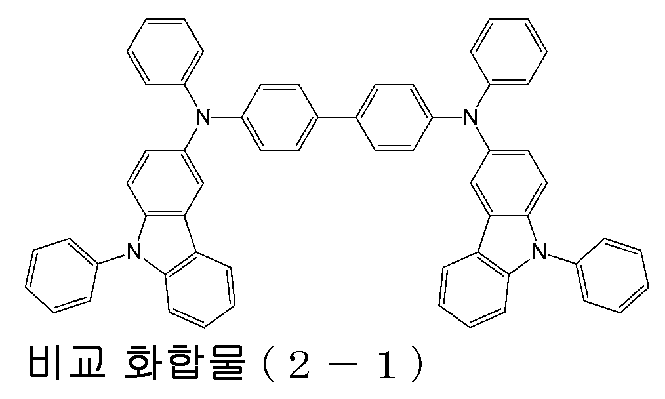
[화학식 34][Chemical Formula 34]
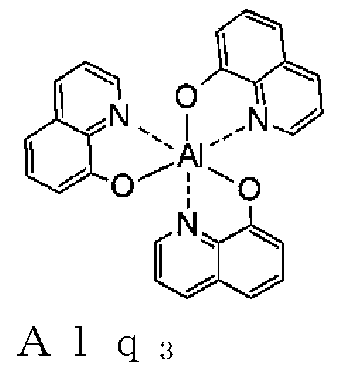
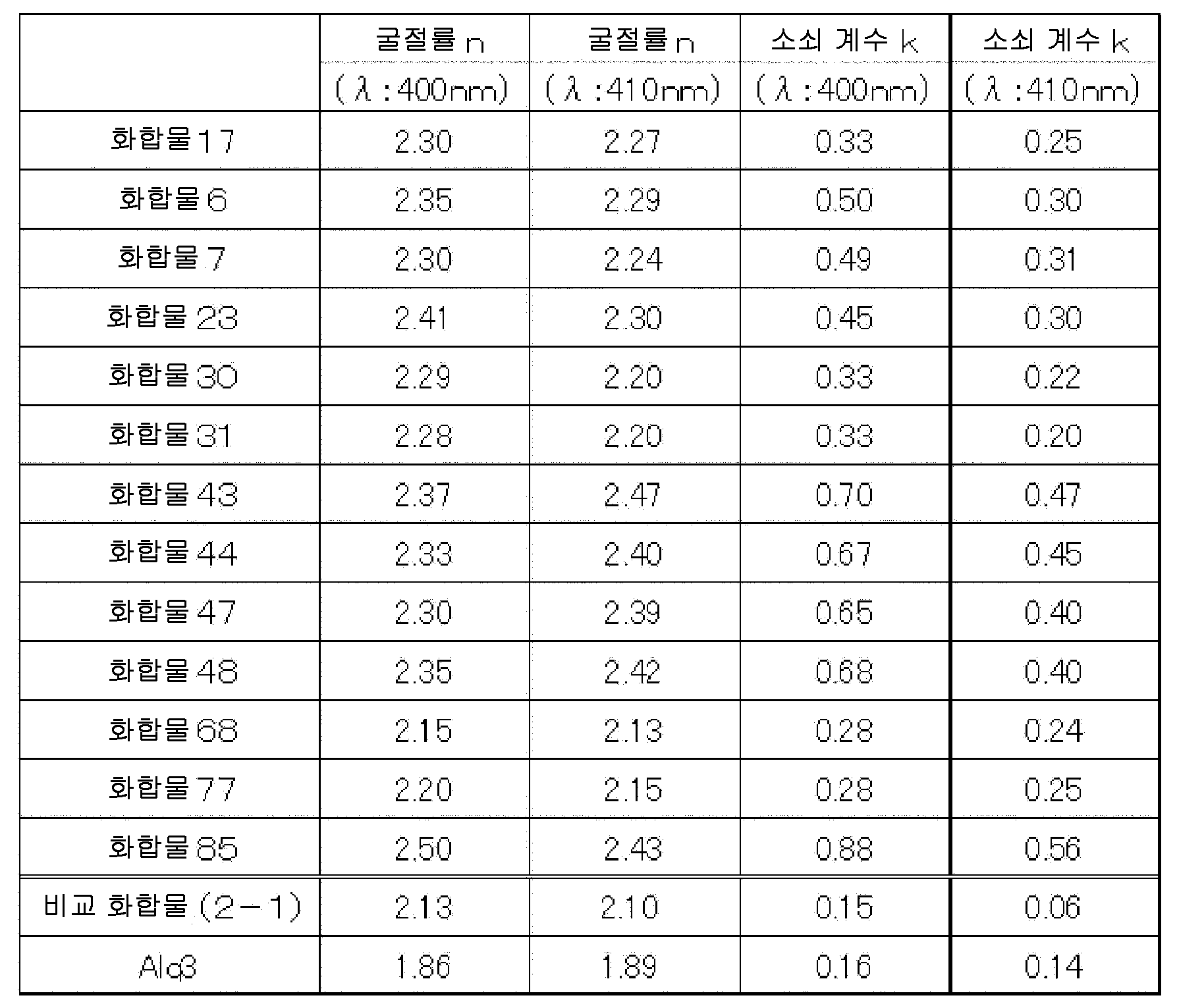
이와 같이 본 실시예의 화합물은 비교 화합물 (2-1) 및 Alq3 의 굴절률과 동등 이상의 값을 가지고 있어, 유기 EL 소자에 있어서의 광의 취출 효율의 향상을 기대할 수 있다. 또한, 파장 400 ㎚ 내지 410 ㎚ 에 있어서의 소쇠 계수는, 파장 410 ㎚ 에 있어서의 소쇠 계수보다 큰 값이었다. 파장 400 ㎚ 내지 410 ㎚ 에서의 소쇠 계수가 비교 화합물 (2-1) 및 Alq3 은 0.20 미만인 데에 반하여, 본 실시예의 화합물은 큰 값을 가지고 있고, 이것은 태양광의 파장 400 ㎚ 내지 410 ㎚ 의 광을 잘 흡광하여 소자 내부의 재료에 영향을 주지 않는 것을 나타낸다.As such, the compound of the present example has a refractive index equal to or greater than that of the comparative compound (2-1) and Alq 3 , so that improvement in the light extraction efficiency in the organic EL element can be expected. In addition, the extinction coefficient at a wavelength of 400 nm to 410 nm was a larger value than the extinction coefficient at a wavelength of 410 nm. While the extinction coefficient at a wavelength of 400 nm to 410 nm of the comparative compound (2-1) and Alq 3 was less than 0.20, the compound of the present example had a large value, which indicates that it absorbs sunlight well at a wavelength of 400 nm to 410 nm and does not affect the material inside the element.
실시예 16Example 16
본 실시예의 화합물을, 농도 1.0 × 10⁻⁵ ㏖/ℓ 의 톨루엔 용액으로서 조절하여, 파장 400 ㎚, 410 ㎚ 에 있어서의 당해 용액의 흡광도를 측정하였다. 또한, 톨루엔 용액의 농도를 5.0 × 10⁻⁶ ㏖/ℓ, 1.0 × 10⁻⁵ ㏖/ℓ, 1.5 × 10⁻⁵ ㏖/ℓ, 2.0 × 10⁻⁵ ㏖/ℓ 의 4 종류의 농도로 조절하여, 자외 가시 근적외 분광 광도계 (니혼 분광 제조, V-650) 를 사용하여 흡광도를 측정하고, 피크 파장에 있어서의 흡광도의 검량선으로부터 흡광 계수를 산출하였다. 비교를 위해서, 상기 구조식의 비교 화합물 (2-1) 및 Alq3 에 대해서도 측정하였다. 측정 결과를 표 2 에 정리하여 나타냈다.The compound of this example was adjusted to a toluene solution having a concentration of 1.0 × 10 -5 mol/L, and the absorbance of the solution at wavelengths of 400 nm and 410 nm was measured. In addition, the concentration of the toluene solution was adjusted to four types of concentrations, 5.0 × 10 -6 mol/L, 1.0 × 10 -5 mol/L, 1.5 × 10 -5 mol/L, and 2.0 × 10 -5 mol/L, and the absorbance was measured using an ultraviolet-visible-near-infrared spectrophotometer (V-650, Nippon Associativity), and the absorption coefficient was calculated from the calibration curve of the absorbance at the peak wavelength. For comparison, measurements were also performed for the comparative compound (2-1) and Alq 3 of the above structural formula. The measurement results are summarized and shown in Table 2.
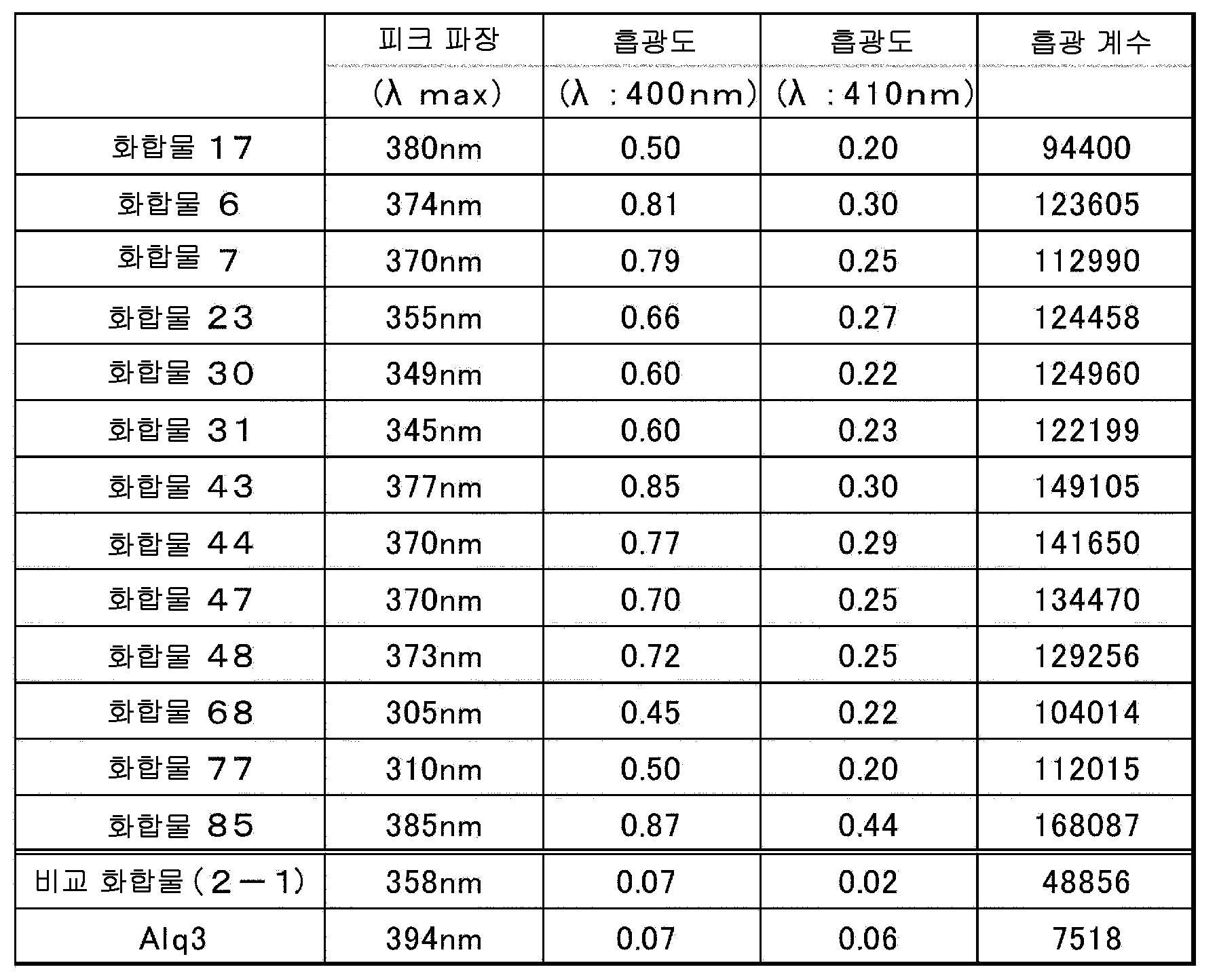
또한, 흡수 스펙트럼에 있어서, 파장 400 ㎚ 내지 410 ㎚ 에 있어서의 흡광도는, 파장 410 ㎚ 에 있어서의 흡광도보다 큰 값이었다. 이와 같이 파장 400 ㎚ 내지 410 ㎚ 에서의 흡광도가 비교 화합물 (2-1) 및 Alq3 에서는 0.10 이하인 데에 반하여, 본 실시예의 화합물에서는 0.20 이상의 큰 값이고, 이것은 태양광의 파장 400 ㎚ 내지 410 ㎚ 의 광을 잘 흡광하는 것을 나타낸다. 또한, 흡광 계수에 관해서도 비교 화합물 (2-1) 및 Alq3 과 비교하여, 본 실시예의 화합물은 큰 값을 가지고 있어, 동일한 농도 조건이면 광을 잘 흡광한다. 박막에 관해서도 막 두께에 있어서 후막화할수록 잘 흡광하여, 내광성이 우수한 재료인 것을 알 수 있다.In addition, in the absorption spectrum, the absorbance at a wavelength of 400 nm to 410 nm was a larger value than the absorbance at a wavelength of 410 nm. Thus, while the absorbance at a wavelength of 400 nm to 410 nm was 0.10 or less for the comparative compound (2-1) and Alq 3 , the compound of the present example had a large value of 0.20 or more, which indicates that it absorbs light of a wavelength of sunlight of 400 nm to 410 nm well. In addition, with respect to the absorption coefficient, the compound of the present example has a large value compared to the comparative compound (2-1) and Alq 3 , and absorbs light well under the same concentration conditions. With respect to the thin film, it can be seen that the thicker the film thickness, the better the light absorption, and that it is a material with excellent light resistance.
실시예 17Example 17
유기 EL 소자를, 도 1 에 나타내는 바와 같이, 유리 기판 (1) 상에 금속 양극 (2) 으로서 반사 ITO 전극을 미리 형성한 것 위에, 정공 주입층 (3), 정공 수송층 (4), 발광층 (5), 전자 수송층 (6), 전자 주입층 (7), 음극 (8), 캡핑층 (9) 을 이 순서로 증착하여, 제작하였다.As shown in Fig. 1, an organic EL device was manufactured by depositing a hole injection layer (3), a hole transport layer (4), a light-emitting layer (5), an electron transport layer (6), an electron injection layer (7), a cathode (8), and a capping layer (9) in this order on a glass substrate (1) on which a reflective ITO electrode was previously formed as a metal anode (2).
구체적으로는, 막 두께 50 ㎚ 의 ITO, 막 두께 100 ㎚ 의 은 합금의 반사막, 막 두께 5 ㎚ 의 ITO 를 순서대로 성막한 유리 기판 (1) 을 이소프로필알코올 중에서 20 분간 초음파 세정한 후, 250 ℃ 로 가열한 핫 플레이트 상에서 10 분간 건조를 실시하였다. 그 후, UV 오존 처리를 2 분간 실시한 후, 이 ITO 가 부착된 유리 기판을 진공 증착기 내에 장착하고, 0.001 Pa 이하까지 감압하였다. 계속해서, 투명 양극 (2) 을 덮도록 정공 주입층 (3) 으로서, 하기 구조식의 전자 억셉터 (Acceptor-1) 와 하기 구조식의 화합물 (3-1) 을, 증착 속도비가 Acceptor-1 : 화합물 (3-1) = 3 : 97 이 되는 증착 속도로 2 원 증착을 실시하여, 막 두께 10 ㎚ 가 되도록 정공 주입층 (3) 을 형성하였다. 이 정공 주입층 (3) 상에, 정공 수송층 (4) 으로서 하기 구조식의 화합물 (3-1) 의 층을 막 두께 140 ㎚ 가 되도록 형성하였다. 이 정공 수송층 (4) 상에, 발광층 (5) 으로서 하기 구조식의 화합물 (3-2) 와 하기 구조식의 화합물 (3-3) 을, 증착 속도비가 (3-2) : (3-3) = 5 : 95 가 되는 증착 속도로 2 원 증착을 실시하여, 막 두께 20 ㎚ 가 되도록 발광층 (5) 을 형성하였다. 이 발광층 (5) 상에, 전자 수송층 (6) 으로서 하기 구조식의 화합물 (3-4) 와 하기 구조식의 화합물 (3-5) 를, 증착 속도비가 (3-4) : (3-5) = 50 : 50 이 되는 증착 속도로 2 원 증착을 실시하여, 막 두께 30 ㎚ 가 되도록 전자 수송층 (6) 을 형성하였다. 이 전자 수송층 (6) 상에, 전자 주입층 (7) 으로서 불화리튬의 층을 막 두께 1 ㎚ 가 되도록 형성하였다.Specifically, a glass substrate (1) on which a film of ITO having a film thickness of 50 nm, a film of a silver alloy reflective film having a film thickness of 100 nm, and a film of ITO having a film thickness of 5 nm were sequentially formed was ultrasonically cleaned in isopropyl alcohol for 20 minutes, and then dried for 10 minutes on a hot plate heated to 250°C. Thereafter, UV ozone treatment was performed for 2 minutes, and the glass substrate with the ITO attached thereto was mounted in a vacuum deposition machine and the pressure was reduced to 0.001 Pa or less. Subsequently, as a hole injection layer (3) covering the transparent anode (2), an electron acceptor (Acceptor-1) of the structural formula below and a compound (3-1) of the structural formula below were deposited in two stages at a deposition rate such that the deposition rate ratio was Acceptor-1: Compound (3-1) = 3:97, to form a hole injection layer (3) with a film thickness of 10 nm. On the hole injection layer (3), a layer of a compound (3-1) of the structural formula below was formed as a hole transport layer (4) with a film thickness of 140 nm. On the hole transport layer (4), as an emitting layer (5), a compound (3-2) of the structural formula below and a compound (3-3) of the structural formula below were deposited in two stages at a deposition rate such that the deposition rate ratio was (3-2): (3-3) = 5:95, to form a emitting layer (5) with a film thickness of 20 nm. On this light-emitting layer (5), a compound (3-4) of the structural formula below and a compound (3-5) of the structural formula below were deposited as an electron transport layer (6) by binary deposition at a deposition rate ratio of (3-4) : (3-5) = 50 : 50, thereby forming an electron transport layer (6) with a film thickness of 30 nm. On this electron transport layer (6), a layer of lithium fluoride was formed as an electron injection layer (7) with a film thickness of 1 nm.
이 전자 주입층 (7) 상에, 음극 (8) 으로서 마그네슘은 합금의 층을 막 두께 12 ㎚ 가 되도록 형성하였다. 마지막으로, 캡핑층 (9) 으로서 실시예 1 의 화합물 17 의 층을 막 두께 60 ㎚ 가 되도록 형성하였다. 제작한 유기 EL 소자에 대하여, 대기 중, 상온에서 특성 측정을 실시하였다.On this electron injection layer (7), a layer of magnesium alloy was formed as a cathode (8) with a film thickness of 12 nm. Finally, a layer of compound 17 of Example 1 was formed as a capping layer (9) with a film thickness of 60 nm. Characteristics of the fabricated organic EL device were measured in the air at room temperature.
제작한 유기 EL 소자에 직류 전압을 인가한 발광 특성의 측정 결과를 표 3 에 정리하여 나타냈다.The results of measuring the luminescence characteristics of the fabricated organic EL device by applying a DC voltage are summarized in Table 3.
[화학식 35][Chemical Formula 35]
실시예 18Example 18
실시예 17 에 있어서, 캡핑층 (9) 의 재료로서 실시예 1 의 화합물 17 대신에 실시예 2 의 화합물 6 을 사용한 것 이외에는, 동일한 조건으로 유기 EL 소자를 제작하였다. 제작한 유기 EL 소자에 대하여, 대기 중, 상온에서 특성 측정을 실시하였다. 제작한 유기 EL 소자에 직류 전압을 인가했을 때의 발광 특성의 측정 결과를 표 3 에 정리하여 나타냈다.In Example 17, an organic EL device was manufactured under the same conditions as in Example 2, except that compound 6 of Example 2 was used instead of compound 17 of Example 1 as the material of the capping layer (9). The characteristics of the manufactured organic EL device were measured in the air at room temperature. The results of the measurement of the luminescence characteristics when a DC voltage was applied to the manufactured organic EL device are summarized and shown in Table 3.
실시예 19Example 19
실시예 17 에 있어서, 캡핑층 (9) 의 재료로서 실시예 1 의 화합물 17 대신에 실시예 3 의 화합물 7 을 사용한 것 이외에는, 동일한 조건으로 유기 EL 소자를 제작하였다. 제작한 유기 EL 소자에 대하여, 대기 중, 상온에서 특성 측정을 실시하였다. 제작한 유기 EL 소자에 직류 전압을 인가했을 때의 발광 특성의 측정 결과를 표 3 에 정리하여 나타냈다.In Example 17, an organic EL device was manufactured under the same conditions as in Example 3, except that compound 7 of Example 3 was used instead of compound 17 of Example 1 as the material for the capping layer (9). The characteristics of the manufactured organic EL device were measured in the air at room temperature. The results of the measurement of the luminescence characteristics when a DC voltage was applied to the manufactured organic EL device are summarized and shown in Table 3.
실시예 20Example 20
실시예 17 에 있어서, 캡핑층 (9) 의 재료로서 실시예 1 의 화합물 17 대신에 실시예 4 의 화합물 23 을 사용한 것 이외에는, 동일한 조건으로 유기 EL 소자를 제작하였다. 제작한 유기 EL 소자에 대하여, 대기 중, 상온에서 특성 측정을 실시하였다. 제작한 유기 EL 소자에 직류 전압을 인가했을 때의 발광 특성의 측정 결과를 표 3 에 정리하여 나타냈다.In Example 17, an organic EL device was manufactured under the same conditions as in Example 4, except that compound 23 of Example 4 was used instead of compound 17 of Example 1 as the material of the capping layer (9). The characteristics of the manufactured organic EL device were measured in the air at room temperature. The results of the measurement of the luminescence characteristics when a DC voltage was applied to the manufactured organic EL device are summarized and shown in Table 3.
실시예 21Example 21
실시예 17 에 있어서, 캡핑층 (9) 의 재료로서 실시예 1 의 화합물 17 대신에 실시예 5 의 화합물 30 을 사용한 것 이외에는, 동일한 조건으로 유기 EL 소자를 제작하였다. 제작한 유기 EL 소자에 대하여, 대기 중, 상온에서 특성 측정을 실시하였다. 제작한 유기 EL 소자에 직류 전압을 인가했을 때의 발광 특성의 측정 결과를 표 3 에 정리하여 나타냈다.In Example 17, an organic EL device was manufactured under the same conditions as in Example 5, except that compound 30 of Example 5 was used instead of compound 17 of Example 1 as the material of the capping layer (9). The characteristics of the manufactured organic EL device were measured in the air at room temperature. The results of the measurement of the luminescence characteristics when a DC voltage was applied to the manufactured organic EL device are summarized and shown in Table 3.
실시예 22Example 22
실시예 17 에 있어서, 캡핑층 (9) 의 재료로서 실시예 1 의 화합물 17 대신에 실시예 6 의 화합물 31 을 사용한 것 이외에는, 동일한 조건으로 유기 EL 소자를 제작하였다. 제작한 유기 EL 소자에 대하여, 대기 중, 상온에서 특성 측정을 실시하였다. 제작한 유기 EL 소자에 직류 전압을 인가했을 때의 발광 특성의 측정 결과를 표 3 에 정리하여 나타냈다.In Example 17, an organic EL device was manufactured under the same conditions, except that compound 31 of Example 6 was used instead of compound 17 of Example 1 as the material of the capping layer (9). The characteristics of the manufactured organic EL device were measured in the air at room temperature. The results of measuring the luminescence characteristics when a DC voltage was applied to the manufactured organic EL device are summarized and shown in Table 3.
실시예 23Example 23
실시예 17 에 있어서, 캡핑층 (9) 의 재료로서 실시예 1 의 화합물 17 대신에 실시예 7 의 화합물 43 을 사용한 것 이외에는, 동일한 조건으로 유기 EL 소자를 제작하였다. 제작한 유기 EL 소자에 대하여, 대기 중, 상온에서 특성 측정을 실시하였다. 제작한 유기 EL 소자에 직류 전압을 인가했을 때의 발광 특성의 측정 결과를 표 3 에 정리하여 나타냈다.In Example 17, an organic EL device was manufactured under the same conditions as in Example 7, except that compound 43 of Example 7 was used instead of compound 17 of Example 1 as the material of the capping layer (9). The characteristics of the manufactured organic EL device were measured in the air at room temperature. The results of the measurement of the luminescence characteristics when a DC voltage was applied to the manufactured organic EL device are summarized and shown in Table 3.
실시예 24Example 24
실시예 17 에 있어서, 캡핑층 (9) 의 재료로서 실시예 1 의 화합물 17 대신에 실시예 8 의 화합물 44 를 사용한 것 이외에는, 동일한 조건으로 유기 EL 소자를 제작하였다. 제작한 유기 EL 소자에 대하여, 대기 중, 상온에서 특성 측정을 실시하였다. 제작한 유기 EL 소자에 직류 전압을 인가했을 때의 발광 특성의 측정 결과를 표 3 에 정리하여 나타냈다.In Example 17, an organic EL device was manufactured under the same conditions as in Example 8, except that compound 44 of Example 8 was used instead of compound 17 of Example 1 as the material of the capping layer (9). The characteristics of the manufactured organic EL device were measured in the air at room temperature. The results of the measurement of the luminescence characteristics when a DC voltage was applied to the manufactured organic EL device are summarized and shown in Table 3.
실시예 25Example 25
실시예 17 에 있어서, 캡핑층 (9) 의 재료로서 실시예 1 의 화합물 17 대신에 실시예 9 의 화합물 47 을 사용한 것 이외에는, 동일한 조건으로 유기 EL 소자를 제작하였다. 제작한 유기 EL 소자에 대하여, 대기 중, 상온에서 특성 측정을 실시하였다. 제작한 유기 EL 소자에 직류 전압을 인가했을 때의 발광 특성의 측정 결과를 표 3 에 정리하여 나타냈다.In Example 17, an organic EL device was manufactured under the same conditions as in Example 9, except that compound 47 of Example 9 was used instead of compound 17 of Example 1 as the material for the capping layer (9). The characteristics of the manufactured organic EL device were measured in the air at room temperature. The results of measuring the luminescence characteristics when a DC voltage was applied to the manufactured organic EL device are summarized and shown in Table 3.
실시예 26Example 26
실시예 17 에 있어서, 캡핑층 (9) 의 재료로서 실시예 1 의 화합물 17 대신에 실시예 10 의 화합물 48 을 사용한 것 이외에는, 동일한 조건으로 유기 EL 소자를 제작하였다. 제작한 유기 EL 소자에 대하여, 대기 중, 상온에서 특성 측정을 실시하였다. 제작한 유기 EL 소자에 직류 전압을 인가했을 때의 발광 특성의 측정 결과를 표 3 에 정리하여 나타냈다.In Example 17, an organic EL device was manufactured under the same conditions as in Example 10, except that compound 48 of Example 10 was used instead of compound 17 of Example 1 as the material of the capping layer (9). The characteristics of the manufactured organic EL device were measured in the air at room temperature. The results of the measurement of the luminescence characteristics when a DC voltage was applied to the manufactured organic EL device are summarized and shown in Table 3.
실시예 27Example 27
실시예 17 에 있어서, 캡핑층 (9) 의 재료로서 실시예 1 의 화합물 17 대신에 실시예 11 의 화합물 68 을 사용한 것 이외에는, 동일한 조건으로 유기 EL 소자를 제작하였다. 제작한 유기 EL 소자에 대하여, 대기 중, 상온에서 특성 측정을 실시하였다. 제작한 유기 EL 소자에 직류 전압을 인가했을 때의 발광 특성의 측정 결과를 표 3 에 정리하여 나타냈다.In Example 17, an organic EL device was manufactured under the same conditions as in Example 11, except that compound 68 of Example 11 was used instead of compound 17 of Example 1 as the material of the capping layer (9). The characteristics of the manufactured organic EL device were measured in the air at room temperature. The results of the measurement of the luminescence characteristics when a DC voltage was applied to the manufactured organic EL device are summarized and shown in Table 3.
실시예 28Example 28
실시예 17 에 있어서, 캡핑층 (9) 의 재료로서 실시예 1 의 화합물 17 대신에 실시예 12 의 화합물 77 을 사용한 것 이외에는, 동일한 조건으로 유기 EL 소자를 제작하였다. 제작한 유기 EL 소자에 대하여, 대기 중, 상온에서 특성 측정을 실시하였다. 제작한 유기 EL 소자에 직류 전압을 인가했을 때의 발광 특성의 측정 결과를 표 3 에 정리하여 나타냈다.In Example 17, an organic EL device was manufactured under the same conditions as in Example 12, except that compound 77 of Example 12 was used instead of compound 17 of Example 1 as the material for the capping layer (9). The characteristics of the manufactured organic EL device were measured in the air at room temperature. The results of the measurement of the luminescence characteristics when a DC voltage was applied to the manufactured organic EL device are summarized and shown in Table 3.
실시예 29Example 29
실시예 17 에 있어서, 캡핑층 (9) 의 재료로서 실시예 1 의 화합물 17 대신에 실시예 13 의 화합물 85 를 사용한 것 이외에는, 동일한 조건으로 유기 EL 소자를 제작하였다. 제작한 유기 EL 소자에 대하여, 대기 중, 상온에서 특성 측정을 실시하였다. 제작한 유기 EL 소자에 직류 전압을 인가했을 때의 발광 특성의 측정 결과를 표 3 에 정리하여 나타냈다.In Example 17, an organic EL device was manufactured under the same conditions as in Example 13, except that compound 85 of Example 13 was used instead of compound 17 of Example 1 as the material for the capping layer (9). The characteristics of the manufactured organic EL device were measured in the air at room temperature. The results of the measurement of the luminescence characteristics when a DC voltage was applied to the manufactured organic EL device are summarized and shown in Table 3.
[비교예 1][Comparative Example 1]
비교를 위해서, 실시예 17 에 있어서, 캡핑층 (9) 으로서 실시예 1 의 화합물 17 대신에 상기 구조식의 비교 화합물 (2-1) 의 층을 막 두께 60 ㎚ 가 되도록 형성한 것 이외에는, 동일한 조건으로 유기 EL 소자를 제작하였다. 제작한 유기 EL 소자에 대하여, 대기 중, 상온에서 특성 측정을 실시하였다. 제작한 유기 EL 소자에 직류 전압을 인가한 발광 특성의 측정 결과를 표 3 에 정리하여 나타냈다.For comparison, in Example 17, an organic EL device was manufactured under the same conditions as in Example 17, except that a layer of the comparative compound (2-1) of the structural formula was formed to a film thickness of 60 nm instead of the compound 17 of Example 1 as the capping layer (9). The characteristics of the manufactured organic EL device were measured at room temperature in the air. The results of the measurement of the luminescence characteristics by applying a DC voltage to the manufactured organic EL device are summarized and shown in Table 3.
[비교예 2][Comparative Example 2]
비교를 위해서, 실시예 17 에 있어서, 캡핑층 (9) 으로서 실시예 1 의 화합물 17 대신에 Alq3 의 층을 막 두께 60 ㎚ 가 되도록 형성한 것 이외에는, 동일한 조건으로 유기 EL 소자를 제작하였다. 제작한 유기 EL 소자에 대하여, 대기 중, 상온에서 특성 측정을 실시하였다. 제작한 유기 EL 소자에 직류 전압을 인가한 발광 특성의 측정 결과를 표 3 에 정리하여 나타냈다.For comparison, in Example 17, an organic EL device was manufactured under the same conditions as in Example 17, except that a layer of Alq 3 was formed with a film thickness of 60 nm instead of the compound 17 of Example 1 as the capping layer (9). The characteristics of the manufactured organic EL device were measured in the air at room temperature. The results of measuring the luminescence characteristics of the manufactured organic EL device by applying a DC voltage are summarized in Table 3.
실시예 17 ∼ 29 와 비교예 1 및 비교예 2 에서 제작한 유기 EL 소자를 사용하여, 소자 수명을 측정한 결과를 표 3 에 정리하여 나타냈다. 소자 수명은, 10 ㎃/㎠ 의 정전류 구동을 실시했을 때, 초기 휘도를 100 % 로 했을 때의 95 % 감쇠로 감쇠할 때까지의 시간으로서 측정하였다.The results of measuring the device life using the organic EL devices manufactured in Examples 17 to 29 and Comparative Examples 1 and 2 are summarized in Table 3. The device life was measured as the time until the device decayed to 95% of the initial luminance when the device was driven at a constant current of 10 mA/cm2.
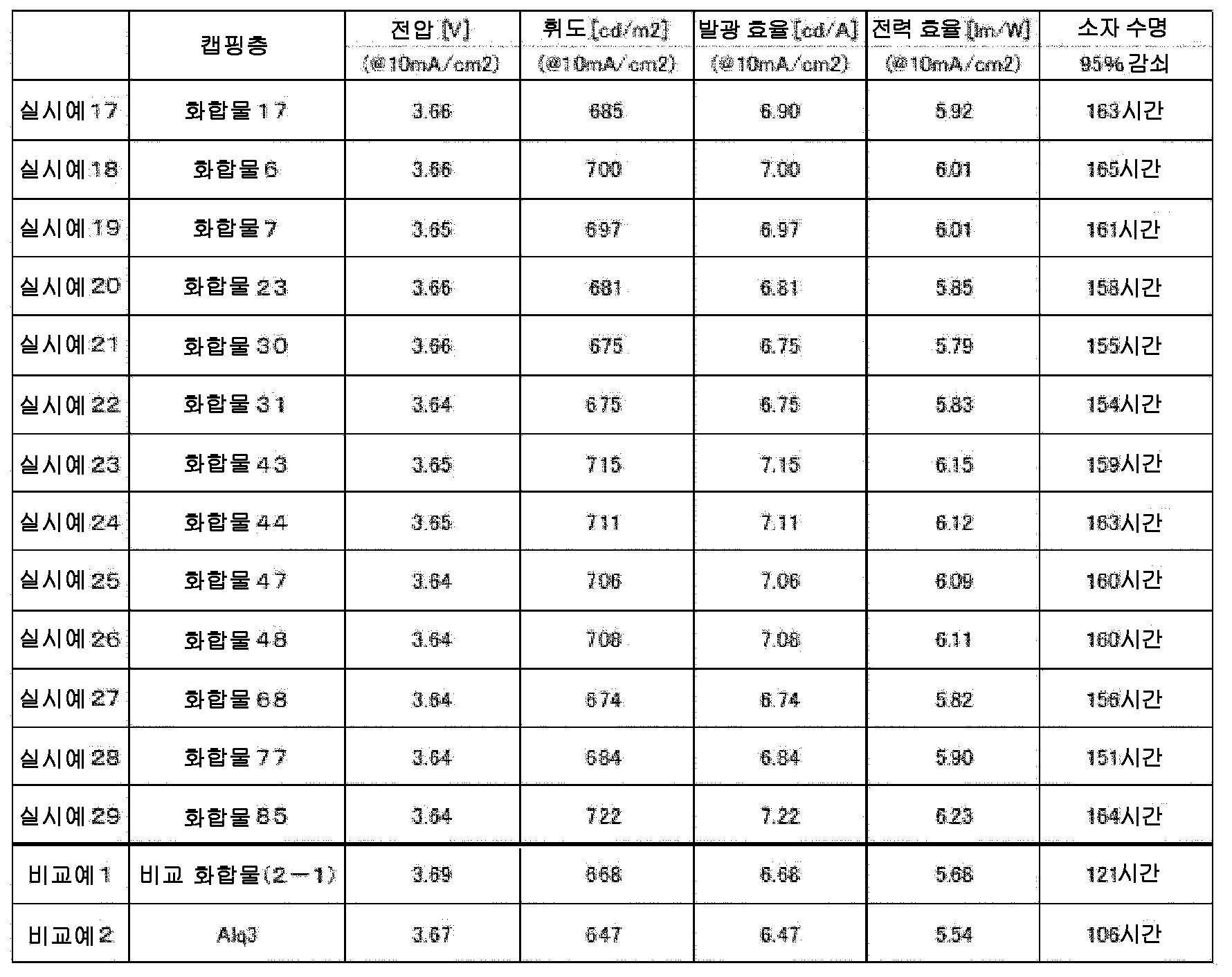
표 3 에 나타내는 바와 같이, 전류 밀도 10 ㎃/㎠ 시에 있어서의 구동 전압은, 비교예 1 과 비교예 2 의 소자와 실시예 17 ∼ 29 의 소자에서는 대략 동등하다. 한편, 휘도, 발광 효율, 전력 효율, 수명은, 비교예 1 과 비교예 2 의 소자에 대하여, 실시예 17 ∼ 29 의 소자에서 향상되었다. 이것은, 캡핑층이 굴절률이 높고, 본 실시예의 유기 EL 소자에 바람직하게 사용되는 재료를 포함함으로써, 광의 취출 효율을 대폭으로 개선할 수 있는 것을 나타내고 있다.As shown in Table 3, the driving voltage at a current density of 10 mA/cm2 is approximately the same in the devices of Comparative Examples 1 and 2 and in the devices of Examples 17 to 29. On the other hand, the brightness, luminous efficiency, power efficiency, and lifespan were improved in the devices of Examples 17 to 29 with respect to the devices of Comparative Examples 1 and 2. This shows that the light extraction efficiency can be significantly improved by including a material having a high refractive index and preferably used in the organic EL device of the present example.
본 발명을 특정한 양태를 참조하여 상세하게 설명했지만, 본 발명의 정신과 범위를 벗어나지 않고 여러 가지 변경 및 수정이 가능하다는 것은, 당업자에게 있어서 분명하다.Although the present invention has been described in detail with reference to specific embodiments, it will be apparent to those skilled in the art that various changes and modifications can be made therein without departing from the spirit and scope of the invention.
또한, 본원은, 2018년 1월 10일자로 출원된 일본 특허출원(특원 2018-001564) 에 기초하고 있고, 그 전체가 인용에 의해 원용된다. 또한, 여기에 인용되는 모든 참조는 전체로서 받아들여진다.In addition, this application is based on Japanese patent application (Special Application No. 2018-001564) filed on January 10, 2018, which is incorporated herein by reference in its entirety. In addition, all references cited herein are incorporated in their entirety.
산업상 이용가능성Industrial applicability
이상과 같이, 본 발명의 유기 EL 소자에 바람직하게 사용되는, 일반식 (A-1) 로 나타내는 벤조아졸 고리 구조를 갖는 아민 화합물은, 흡광 계수가 높고, 굴절률이 높고, 광의 취출 효율을 대폭으로 개선할 수 있고, 박막 상태가 안정적이기 때문에, 유기 EL 소자용의 화합물로서 우수하다. 그 화합물을 사용하여 유기 EL 소자를 제작함으로써, 높은 효율을 얻을 수 있음과 함께, 태양광의 광을 흡광하여 소자 내부의 재료에 영향을 주지 않도록, 내구성이나 내광성을 개선시킬 수 있다. 또한, 청, 녹 및 적 각각의 파장 영역에 있어서 흡수를 가지지 않는 그 화합물을 사용함으로써, 색 순도가 양호하여 선명하고 밝은 화상을 표시하고자 하는 경우에, 특히 바람직하다. 예를 들어, 가정 전화 제품이나 조명의 용도에 대한 전개가 가능하다.As described above, the amine compound having a benzoazole ring structure represented by the general formula (A-1) preferably used in the organic EL device of the present invention has a high absorption coefficient, a high refractive index, can significantly improve light extraction efficiency, and has a stable thin film state, and therefore is excellent as a compound for an organic EL device. By using the compound to manufacture an organic EL device, high efficiency can be obtained, and durability and light resistance can be improved so that sunlight is absorbed and the material inside the device is not affected. In addition, by using the compound that does not have absorption in each of the blue, green, and red wavelength regions, it is particularly preferable in cases where it is desired to display a clear and bright image with good color purity. For example, it can be used for home telephone products and lighting.
1 ; 유리 기판
2 ; 투명 양극
3 ; 정공 주입층
4 ; 정공 수송층
5 ; 발광층
6 ; 전자 수송층
7 ; 전자 주입층
8 ; 음극
9 ; 캡핑층1; Glass substrate
2; transparent anode
3; Hole injection layer
4 ; Hole transport layer
5; luminescent layer
6 ; Electron transport layer
7; Electron injection layer
8 ; cathode
9 ; Capping layer
Claims (15)
[식 중, A 는 하기 일반식 (B-1) 로 나타내는 R1 ∼ R6 중, 1 개 지점을 결합 부위로 하는 1 가기를 나타내고, B 및 C 는 서로 동일해도 되고 상이해도 되고, 하기 일반식 (B-1) 로 나타내는 R1 ∼ R6 중, 1 개 지점을 결합 부위로 하는 1 가기, 치환 혹은 무치환의 방향족 탄화수소기, 치환 혹은 무치환의 방향족 복소 고리기 또는 치환 혹은 무치환의 축합 다고리 방향족기를 나타내고, Ar 은 각각, 서로 동일해도 되고 상이해도 되고, 치환 혹은 무치환의 방향족 탄화수소기, 치환 혹은 무치환의 방향족 복소 고리기, 치환 혹은 무치환의 축합 다고리 방향족기의 2 가기 또는 단결합을 나타낸다. 또한, 질소 원자를 개재하여 서로 인접하는 Ar 이 단결합, 치환 혹은 무치환의 메틸렌기, 산소 원자 또는 황 원자에 의해 결합하여 고리를 형성해도 된다.
(식 중, R1 ∼ R6 은 서로 동일해도 되고 상이해도 되고, 결합 부위로서의 연결기, 수소 원자, 중수소 원자, 불소 원자, 염소 원자, 시아노기, 니트로기, 치환기를 가지고 있어도 되는 탄소 원자수 1 내지 6 의 직사슬형 혹은 분기형의 알킬기, 치환기를 가지고 있어도 되는 탄소 원자수 5 내지 10 의 시클로알킬기, 치환기를 가지고 있어도 되는 탄소 원자수 2 내지 6 의 직사슬형 혹은 분기형의 알케닐기, 치환기를 가지고 있어도 되는 탄소 원자수 1 내지 6 의 직사슬형 혹은 분기형의 알킬옥시기, 치환기를 가지고 있어도 되는 탄소 원자수 5 내지 10 의 시클로알킬옥시기, 치환 혹은 무치환의 방향족 탄화수소기, 치환 혹은 무치환의 방향족 복소 고리기, 치환 혹은 무치환의 축합 다고리 방향족기, 또는 치환 혹은 무치환의 아릴옥시기를 나타내고, X 및 Y 는 탄소 원자 또는 질소 원자를 나타낸다. 단, X 및 Y 가 질소 원자인 경우, X 또는 Y 는 R5 또는 R6 을 갖지 않는 것으로 하고, X 및 Y 가 탄소 원자인 경우는 제외로 한다.)
여기서, 일반식 (A-1) 중의 B, C, Ar 및 일반식 (B-1) 중의 R1 내지 R6 으로 나타내는 「치환 방향족 탄화수소기」, 「치환 방향족 복소 고리기」, 「치환 축합 다고리 방향족기」, 「치환기를 가지고 있어도 되는 탄소 원자수 1 ∼ 6 의 직사슬형 혹은 분기형의 알킬기」, 「치환기를 가지고 있어도 되는 탄소 원자수 5 ∼ 10 의 시클로알킬기」, 「치환기를 가지고 있어도 되는 탄소 원자수 2 ∼ 6 의 직사슬형 혹은 분기형의 알케닐기」, 「치환기를 가지고 있어도 되는 탄소 원자수 1 ∼ 6 의 직사슬형 혹은 분기형의 알킬옥시기」, 「치환기를 가지고 있어도 되는 탄소 원자수 5 ∼ 10 의 시클로알킬옥시기」, 「치환 아릴옥시기」, 또는 「치환 메틸렌기」에 있어서의 「치환기」는, 중수소 원자, 시아노기, 니트로기, 할로겐 원자, 실릴기, 탄소 원자수 1 ∼ 6 의 직사슬형 혹은 분기형의 알킬기, 탄소 원자수 1 ∼ 6 의 직사슬형 혹은 분기형의 알킬옥시기, 알케닐기, 아릴옥시기, 아릴알킬옥시기, 방향족 탄화수소기, 축합 다고리 방향족기, 탄소수 6 ∼ 30 으로 이루어지는 아릴기, 및 탄소수 2 ∼ 20 으로 이루어지는 헤테로아릴기로 이루어지는 군에서 선택된다.]An organic EL device having at least an anode electrode, a hole transport layer, a light-emitting layer, an electron transport layer, a cathode electrode, and a capping layer in this order, wherein the capping layer contains an amine compound having a benzoazole ring structure represented by the following general formula (A-1).
[In the formula, A represents a primary group having a bonding site at one point among R 1 to R 6 represented by the following general formula (B-1), B and C, which may be the same or different, represent a primary group having a bonding site at one point among R 1 to R 6 represented by the following general formula (B-1), a substituted or unsubstituted aromatic hydrocarbon group, a substituted or unsubstituted aromatic heterocyclic group, or a substituted or unsubstituted condensed polycyclic aromatic group, and Ar each may be the same or different and represents a secondary group or a single bond of a substituted or unsubstituted aromatic hydrocarbon group, a substituted or unsubstituted aromatic heterocyclic group, or a substituted or unsubstituted condensed polycyclic aromatic group. Furthermore, Ar, which are adjacent to each other via a nitrogen atom, may be bonded to form a ring via a single bond, a substituted or unsubstituted methylene group, an oxygen atom, or a sulfur atom.
(In the formula, R 1 to R 6 may be the same or different, and represent a linking group as a bonding site, a hydrogen atom, a deuterium atom, a fluorine atom, a chlorine atom, a cyano group, a nitro group, a linear or branched alkyl group having 1 to 6 carbon atoms which may have a substituent, a cycloalkyl group having 5 to 10 carbon atoms which may have a substituent, a linear or branched alkenyl group having 2 to 6 carbon atoms which may have a substituent, a linear or branched alkyloxy group having 1 to 6 carbon atoms which may have a substituent, a cycloalkyloxy group having 5 to 10 carbon atoms which may have a substituent, a substituted or unsubstituted aromatic hydrocarbon group, a substituted or unsubstituted aromatic heterocyclic group, a substituted or unsubstituted condensed polycyclic aromatic group, or a substituted or unsubstituted aryloxy group, and X and Y represent a carbon atom or nitrogen. represents an atom. However, when X and Y are nitrogen atoms, X or Y does not have R 5 or R 6 , and when X and Y are carbon atoms, this is excluded.)
Here, in the "substituted aromatic hydrocarbon group", "substituted aromatic heterocyclic group", "substituted condensed polycyclic aromatic group", "linear or branched alkyl group having 1 to 6 carbon atoms which may have a substituent", "cycloalkyl group having 5 to 10 carbon atoms which may have a substituent", "linear or branched alkenyl group having 2 to 6 carbon atoms which may have a substituent", "linear or branched alkyloxy group having 1 to 6 carbon atoms which may have a substituent", "cycloalkyloxy group having 5 to 10 carbon atoms which may have a substituent", "substituted aryloxy group", or "substituted methylene group" represented by B, C, Ar in the general formula (A-1) and R 1 to R 6 in the general formula (B-1), [The "substituent" is selected from the group consisting of a deuterium atom, a cyano group, a nitro group, a halogen atom, a silyl group, a linear or branched alkyl group having 1 to 6 carbon atoms, a linear or branched alkyloxy group having 1 to 6 carbon atoms, an alkenyl group, an aryloxy group, an arylalkyloxy group, an aromatic hydrocarbon group, a condensed polycyclic aromatic group, an aryl group having 6 to 30 carbon atoms, and a heteroaryl group having 2 to 20 carbon atoms.]
상기 벤조아졸 고리 구조를 갖는 아민 화합물은, 파장 400 ㎚ 내지 410 ㎚ 에서 0.20 이상의 소쇠 계수를 갖고, 또한, 농도 1.0 × 10⁻⁵ ㏖/ℓ 의 톨루엔 용액의 흡수 스펙트럼에 있어서, 파장 400 ㎚ 내지 410 ㎚ 에 있어서의 0.20 이상의 흡광도를 갖는, 유기 EL 소자.In paragraph 1,
An organic EL device wherein the amine compound having the benzoazole ring structure has an extinction coefficient of 0.20 or more at a wavelength of 400 nm to 410 nm, and further has an absorbance of 0.20 or more at a wavelength of 400 nm to 410 nm in an absorption spectrum of a toluene solution having a concentration of 1.0 × 10 -5 mol/ℓ.
상기 일반식 (B-1) 이 하기 일반식 (B-2) 또는 (B-3) 으로 나타내는, 유기 EL 소자.
(식 중, 파선부를 결합 부위로 하고, R7 ∼ R11 은 서로 동일해도 되고 상이해도 되고, 수소 원자, 중수소 원자, 불소 원자, 염소 원자, 시아노기, 니트로기, 치환기를 가지고 있어도 되는 탄소 원자수 1 내지 6 의 직사슬형 혹은 분기형의 알킬기, 치환기를 가지고 있어도 되는 탄소 원자수 5 내지 10 의 시클로알킬기, 치환기를 가지고 있어도 되는 탄소 원자수 2 내지 6 의 직사슬형 혹은 분기형의 알케닐기, 치환기를 가지고 있어도 되는 탄소 원자수 1 내지 6 의 직사슬형 혹은 분기형의 알킬옥시기, 치환기를 가지고 있어도 되는 탄소 원자수 5 내지 10 의 시클로알킬옥시기, 치환 혹은 무치환의 방향족 탄화수소기, 치환 혹은 무치환의 방향족 복소 고리기, 치환 혹은 무치환의 축합 다고리 방향족기, 또는 치환 혹은 무치환의 아릴옥시기를 나타내고, X 및 Y 는 탄소 원자 또는 질소 원자를 나타낸다. 단, X 및 Y 가 질소 원자인 경우, Y 는 R11 을 갖지 않는 것으로 하고, X 및 Y 가 탄소 원자인 경우는 제외로 한다.
여기서, 일반식 (B-2) 및 (B-3) 중의 R7 내지 R11 로 나타내는 「치환 방향족 탄화수소기」, 「치환 방향족 복소 고리기」, 「치환 축합 다고리 방향족기」, 「치환기를 가지고 있어도 되는 탄소 원자수 1 ∼ 6 의 직사슬형 혹은 분기형의 알킬기」, 「치환기를 가지고 있어도 되는 탄소 원자수 5 ∼ 10 의 시클로알킬기」, 「치환기를 가지고 있어도 되는 탄소 원자수 2 ∼ 6 의 직사슬형 혹은 분기형의 알케닐기」, 「치환기를 가지고 있어도 되는 탄소 원자수 1 ∼ 6 의 직사슬형 혹은 분기형의 알킬옥시기」, 「치환기를 가지고 있어도 되는 탄소 원자수 5 ∼ 10 의 시클로알킬옥시기」, 또는 「치환 아릴옥시기」에 있어서의 「치환기」는, 중수소 원자, 시아노기, 니트로기, 할로겐 원자, 실릴기, 탄소 원자수 1 ∼ 6 의 직사슬형 혹은 분기형의 알킬기, 탄소 원자수 1 ∼ 6 의 직사슬형 혹은 분기형의 알킬옥시기, 알케닐기, 아릴옥시기, 아릴알킬옥시기, 방향족 탄화수소기, 축합 다고리 방향족기, 탄소수 6 ∼ 30 으로 이루어지는 아릴기, 및 탄소수 2 ∼ 20 으로 이루어지는 헤테로아릴기로 이루어지는 군에서 선택된다.)In paragraph 1,
An organic EL device, wherein the above general formula (B-1) is represented by the following general formula (B-2) or (B-3).
(In the formula, the broken line is a bonding site, R 7 to R 11 may be the same or different, and represent a hydrogen atom, a deuterium atom, a fluorine atom, a chlorine atom, a cyano group, a nitro group, a linear or branched alkyl group having 1 to 6 carbon atoms which may have a substituent, a cycloalkyl group having 5 to 10 carbon atoms which may have a substituent, a linear or branched alkenyl group having 2 to 6 carbon atoms which may have a substituent, a linear or branched alkyloxy group having 1 to 6 carbon atoms which may have a substituent, a cycloalkyloxy group having 5 to 10 carbon atoms which may have a substituent, a substituted or unsubstituted aromatic hydrocarbon group, a substituted or unsubstituted aromatic heterocyclic group, a substituted or unsubstituted condensed polycyclic aromatic group, or a substituted or unsubstituted aryloxy group, and X and Y represent carbon Indicates an atom or a nitrogen atom. However, when X and Y are nitrogen atoms, Y does not have R 11 , and when X and Y are carbon atoms, this is excluded.
Here, the "substituent" in the "substituted aromatic hydrocarbon group", "substituted aromatic heterocyclic group", "substituted condensed polycyclic aromatic group", "linear or branched alkyl group having 1 to 6 carbon atoms which may have a substituent", "cycloalkyl group having 5 to 10 carbon atoms which may have a substituent", "linear or branched alkenyl group having 2 to 6 carbon atoms which may have a substituent", "linear or branched alkyloxy group having 1 to 6 carbon atoms which may have a substituent", "cycloalkyloxy group having 5 to 10 carbon atoms which may have a substituent", or "substituted aryloxy group" represented by R7 to R11 in general formulas (B-2) and (B-3) is a deuterium atom, a cyano group, a nitro group, (is selected from the group consisting of a halogen atom, a silyl group, a linear or branched alkyl group having 1 to 6 carbon atoms, a linear or branched alkyloxy group having 1 to 6 carbon atoms, an alkenyl group, an aryloxy group, an arylalkyloxy group, an aromatic hydrocarbon group, a condensed polycyclic aromatic group, an aryl group having 6 to 30 carbon atoms, and a heteroaryl group having 2 to 20 carbon atoms.)
상기 일반식 (B-1) 이 하기 일반식 (B-4) 또는 (B-5) 로 나타내는, 유기 EL 소자.
(식 중, 파선부를 결합 부위로 하고, R12 ∼ R15 는 서로 동일해도 되고 상이해도 되고, 수소 원자, 중수소 원자, 불소 원자, 염소 원자, 시아노기, 니트로기, 치환기를 가지고 있어도 되는 탄소 원자수 1 내지 6 의 직사슬형 혹은 분기형의 알킬기, 치환기를 가지고 있어도 되는 탄소 원자수 5 내지 10 의 시클로알킬기, 치환기를 가지고 있어도 되는 탄소 원자수 2 내지 6 의 직사슬형 혹은 분기형의 알케닐기, 치환기를 가지고 있어도 되는 탄소 원자수 1 내지 6 의 직사슬형 혹은 분기형의 알킬옥시기, 치환기를 가지고 있어도 되는 탄소 원자수 5 내지 10 의 시클로알킬옥시기, 치환 혹은 무치환의 방향족 탄화수소기, 치환 혹은 무치환의 방향족 복소 고리기, 치환 혹은 무치환의 축합 다고리 방향족기, 또는 치환 혹은 무치환의 아릴옥시기를 나타낸다.
여기서, 일반식 (B-4) 및 (B-5) 중의 R12 내지 R15 로 나타내는 「치환 방향족 탄화수소기」, 「치환 방향족 복소 고리기」, 「치환 축합 다고리 방향족기」, 「치환기를 가지고 있어도 되는 탄소 원자수 1 ∼ 6 의 직사슬형 혹은 분기형의 알킬기」, 「치환기를 가지고 있어도 되는 탄소 원자수 5 ∼ 10 의 시클로알킬기」, 「치환기를 가지고 있어도 되는 탄소 원자수 2 ∼ 6 의 직사슬형 혹은 분기형의 알케닐기」, 「치환기를 가지고 있어도 되는 탄소 원자수 1 ∼ 6 의 직사슬형 혹은 분기형의 알킬옥시기」, 「치환기를 가지고 있어도 되는 탄소 원자수 5 ∼ 10 의 시클로알킬옥시기」, 또는 「치환 아릴옥시기」에 있어서의 「치환기」는, 중수소 원자, 시아노기, 니트로기, 할로겐 원자, 실릴기, 탄소 원자수 1 ∼ 6 의 직사슬형 혹은 분기형의 알킬기, 탄소 원자수 1 ∼ 6 의 직사슬형 혹은 분기형의 알킬옥시기, 알케닐기, 아릴옥시기, 아릴알킬옥시기, 방향족 탄화수소기, 축합 다고리 방향족기, 탄소수 6 ∼ 30 으로 이루어지는 아릴기, 및 탄소수 2 ∼ 20 으로 이루어지는 헤테로아릴기로 이루어지는 군에서 선택된다.)In paragraph 1,
An organic EL device, wherein the above general formula (B-1) is represented by the following general formula (B-4) or (B-5).
(In the formula, the dashed line represents a bonding site, and R 12 to R 15 may be the same or different, and represent a hydrogen atom, a deuterium atom, a fluorine atom, a chlorine atom, a cyano group, a nitro group, a linear or branched alkyl group having 1 to 6 carbon atoms which may have a substituent, a cycloalkyl group having 5 to 10 carbon atoms which may have a substituent, a linear or branched alkenyl group having 2 to 6 carbon atoms which may have a substituent, a linear or branched alkyloxy group having 1 to 6 carbon atoms which may have a substituent, a cycloalkyloxy group having 5 to 10 carbon atoms which may have a substituent, a substituted or unsubstituted aromatic hydrocarbon group, a substituted or unsubstituted aromatic heterocyclic group, a substituted or unsubstituted condensed polycyclic aromatic group, or a substituted or unsubstituted aryloxy group.
Here, the "substituent" in the "substituted aromatic hydrocarbon group", "substituted aromatic heterocyclic group", "substituted condensed polycyclic aromatic group", "linear or branched alkyl group having 1 to 6 carbon atoms which may have a substituent", "cycloalkyl group having 5 to 10 carbon atoms which may have a substituent", "linear or branched alkenyl group having 2 to 6 carbon atoms which may have a substituent", "linear or branched alkyloxy group having 1 to 6 carbon atoms which may have a substituent", "cycloalkyloxy group having 5 to 10 carbon atoms which may have a substituent", or "substituted aryloxy group" represented by R 12 to R 15 in general formulas (B-4) and (B-5) is a deuterium atom, a cyano group, (is selected from the group consisting of a nitro group, a halogen atom, a silyl group, a linear or branched alkyl group having 1 to 6 carbon atoms, a linear or branched alkyloxy group having 1 to 6 carbon atoms, an alkenyl group, an aryloxy group, an arylalkyloxy group, an aromatic hydrocarbon group, a condensed polycyclic aromatic group, an aryl group having 6 to 30 carbon atoms, and a heteroaryl group having 2 to 20 carbon atoms.)
상기 일반식 (A-1) 에 있어서, A, B 및 C 가 벤조아졸 고리 구조를 갖는, 유기 EL 소자.In any one of claims 1 to 4,
An organic EL device, wherein in the general formula (A-1), A, B and C have a benzoazole ring structure.
상기 일반식 (A-1) 에 있어서, A 및 B 가 벤조아졸 고리 구조를 갖고, 또한, C 가, 치환 혹은 무치환의 방향족 탄화수소기, 치환 혹은 무치환의 방향족 복소 고리기 또는 치환 혹은 무치환의 축합 다고리 방향족기를 나타내는, 유기 EL 소자.In any one of claims 1 to 4,
An organic EL device, wherein in the general formula (A-1) above, A and B have a benzoazole ring structure, and further, C represents a substituted or unsubstituted aromatic hydrocarbon group, a substituted or unsubstituted aromatic heterocyclic group, or a substituted or unsubstituted condensed polycyclic aromatic group.
상기 일반식 (A-1) 에 있어서, A 가 벤조아졸 고리 구조를 갖고, 또한, B 및 C 가, 치환 혹은 무치환의 방향족 탄화수소기, 치환 혹은 무치환의 방향족 복소 고리기 또는 치환 혹은 무치환의 축합 다고리 방향족기를 나타내는, 유기 EL 소자.In any one of claims 1 to 4,
An organic EL device, wherein in the general formula (A-1) above, A has a benzoazole ring structure, and further, B and C represent a substituted or unsubstituted aromatic hydrocarbon group, a substituted or unsubstituted aromatic heterocyclic group, or a substituted or unsubstituted condensed polycyclic aromatic group.
상기 일반식 (A-1) 에 있어서, A, B 및 C 가 동일한, 유기 EL 소자.In paragraph 5,
An organic EL device in which A, B, and C in the above general formula (A-1) are the same.
상기 일반식 (A-1) 에 있어서, A 및 B 가 동일한, 유기 EL 소자.In paragraph 5,
An organic EL device in which A and B in the general formula (A-1) above are the same.
상기 일반식 (A-1) 에 있어서, A, B 및 C 가 동일하지 않은, 유기 EL 소자.In paragraph 5,
An organic EL device, wherein in the general formula (A-1), A, B, and C are not identical.
상기 일반식 (A-1) 에 있어서, A 및 B 가 동일하지 않은, 유기 EL 소자.In paragraph 5,
An organic EL device, wherein in the general formula (A-1) above, A and B are not the same.
상기 캡핑층의 두께가, 30 ㎚ ∼ 120 ㎚ 의 범위 내인, 유기 EL 소자.In paragraph 1,
An organic EL device, wherein the thickness of the capping layer is in a range of 30 nm to 120 nm.
상기 캡핑층의 굴절률이, 파장이 400 ㎚ ∼ 410 ㎚ 의 범위 내의 광에 대하여, 1.85 이상인, 유기 EL 소자.In paragraph 1,
An organic EL device, wherein the refractive index of the capping layer is 1.85 or more for light having a wavelength in the range of 400 nm to 410 nm.
[식 중, A 는 하기 일반식 (B-1) 로 나타내는 R1 ∼ R6 중, 1 개 지점을 결합 부위로 하는 1 가기를 나타내고, B 및 C 는 서로 동일해도 되고 상이해도 되고, 하기 일반식 (B-1) 로 나타내는 R1 ∼ R6 중, 1 개 지점을 결합 부위로 하는 1 가기, 치환 혹은 무치환의 방향족 탄화수소기, 치환 혹은 무치환의 방향족 복소 고리기 또는 치환 혹은 무치환의 축합 다고리 방향족기를 나타내고, Ar 은 각각, 서로 동일해도 되고 상이해도 되고, 치환 혹은 무치환의 방향족 탄화수소기, 치환 혹은 무치환의 방향족 복소 고리기, 또는 치환 혹은 무치환의 축합 다고리 방향족기의 2 가기를 나타낸다. 또한, 질소 원자를 개재하여 서로 인접하는 Ar 이 단결합, 치환 혹은 무치환의 메틸렌기, 산소 원자 또는 황 원자에 의해 결합하여 고리를 형성해도 된다.
(식 중, R1 ∼ R6 은 서로 동일해도 되고 상이해도 되고, 결합 부위로서의 연결기, 수소 원자, 중수소 원자, 불소 원자, 염소 원자, 시아노기, 니트로기, 치환기를 가지고 있어도 되는 탄소 원자수 1 내지 6 의 직사슬형 혹은 분기형의 알킬기, 치환기를 가지고 있어도 되는 탄소 원자수 5 내지 10 의 시클로알킬기, 치환기를 가지고 있어도 되는 탄소 원자수 2 내지 6 의 직사슬형 혹은 분기형의 알케닐기, 치환기를 가지고 있어도 되는 탄소 원자수 1 내지 6 의 직사슬형 혹은 분기형의 알킬옥시기, 치환기를 가지고 있어도 되는 탄소 원자수 5 내지 10 의 시클로알킬옥시기, 치환 혹은 무치환의 방향족 탄화수소기, 치환 혹은 무치환의 방향족 복소 고리기, 치환 혹은 무치환의 축합 다고리 방향족기, 또는 치환 혹은 무치환의 아릴옥시기를 나타내고, X 및 Y 는 탄소 원자 또는 질소 원자를 나타낸다. 단, X 및 Y 가 질소 원자인 경우, X 또는 Y 는 R5 또는 R6 을 갖지 않는 것으로 하고, X 및 Y 가 탄소 원자인 경우는 제외로 한다.)
여기서, 일반식 (A-1) 중의 B, C, Ar 및 일반식 (B-1) 중의 R1 내지 R6 으로 나타내는 「치환 방향족 탄화수소기」, 「치환 방향족 복소 고리기」, 「치환 축합 다고리 방향족기」, 「치환기를 가지고 있어도 되는 탄소 원자수 1 ∼ 6 의 직사슬형 혹은 분기형의 알킬기」, 「치환기를 가지고 있어도 되는 탄소 원자수 5 ∼ 10 의 시클로알킬기」, 「치환기를 가지고 있어도 되는 탄소 원자수 2 ∼ 6 의 직사슬형 혹은 분기형의 알케닐기」, 「치환기를 가지고 있어도 되는 탄소 원자수 1 ∼ 6 의 직사슬형 혹은 분기형의 알킬옥시기」, 「치환기를 가지고 있어도 되는 탄소 원자수 5 ∼ 10 의 시클로알킬옥시기」, 「치환 아릴옥시기」, 또는 「치환 메틸렌기」에 있어서의 「치환기」는, 중수소 원자, 시아노기, 니트로기, 할로겐 원자, 실릴기, 탄소 원자수 1 ∼ 6 의 직사슬형 혹은 분기형의 알킬기, 탄소 원자수 1 ∼ 6 의 직사슬형 혹은 분기형의 알킬옥시기, 알케닐기, 아릴옥시기, 아릴알킬옥시기, 방향족 탄화수소기, 축합 다고리 방향족기, 탄소수 6 ∼ 30 으로 이루어지는 아릴기, 및 탄소수 2 ∼ 20 으로 이루어지는 헤테로아릴기로 이루어지는 군에서 선택된다.]
하기 식으로 나타내는 화합물을 제외한, 아민 화합물.
An amine compound having a benzoazole ring structure represented by the following general formula (A-1):
[In the formula, A represents a primary group among R 1 to R 6 represented by the following general formula (B-1) having a bonding site at 1 point, B and C, which may be the same or different, represent a primary group among R 1 to R 6 represented by the following general formula (B-1) having a bonding site at 1 point, a substituted or unsubstituted aromatic hydrocarbon group, a substituted or unsubstituted aromatic heterocyclic group, or a substituted or unsubstituted condensed polycyclic aromatic group, and Ar each may be the same or different and represents a secondary group of a substituted or unsubstituted aromatic hydrocarbon group, a substituted or unsubstituted aromatic heterocyclic group, or a substituted or unsubstituted condensed polycyclic aromatic group. Furthermore, Ar, which are adjacent to each other via a nitrogen atom, may be bonded to each other via a single bond, a substituted or unsubstituted methylene group, an oxygen atom, or a sulfur atom to form a ring.
(In the formula, R 1 to R 6 may be the same or different, and represent a linking group as a bonding site, a hydrogen atom, a deuterium atom, a fluorine atom, a chlorine atom, a cyano group, a nitro group, a linear or branched alkyl group having 1 to 6 carbon atoms which may have a substituent, a cycloalkyl group having 5 to 10 carbon atoms which may have a substituent, a linear or branched alkenyl group having 2 to 6 carbon atoms which may have a substituent, a linear or branched alkyloxy group having 1 to 6 carbon atoms which may have a substituent, a cycloalkyloxy group having 5 to 10 carbon atoms which may have a substituent, a substituted or unsubstituted aromatic hydrocarbon group, a substituted or unsubstituted aromatic heterocyclic group, a substituted or unsubstituted condensed polycyclic aromatic group, or a substituted or unsubstituted aryloxy group, and X and Y represent a carbon atom or nitrogen. represents an atom. However, when X and Y are nitrogen atoms, X or Y does not have R 5 or R 6 , and when X and Y are carbon atoms, this is excluded.)
Here, in the "substituted aromatic hydrocarbon group", "substituted aromatic heterocyclic group", "substituted condensed polycyclic aromatic group", "linear or branched alkyl group having 1 to 6 carbon atoms which may have a substituent", "cycloalkyl group having 5 to 10 carbon atoms which may have a substituent", "linear or branched alkenyl group having 2 to 6 carbon atoms which may have a substituent", "linear or branched alkyloxy group having 1 to 6 carbon atoms which may have a substituent", "cycloalkyloxy group having 5 to 10 carbon atoms which may have a substituent", "substituted aryloxy group", or "substituted methylene group" represented by B, C, Ar in the general formula (A-1) and R 1 to R 6 in the general formula (B-1), [The "substituent" is selected from the group consisting of a deuterium atom, a cyano group, a nitro group, a halogen atom, a silyl group, a linear or branched alkyl group having 1 to 6 carbon atoms, a linear or branched alkyloxy group having 1 to 6 carbon atoms, an alkenyl group, an aryloxy group, an arylalkyloxy group, an aromatic hydrocarbon group, a condensed polycyclic aromatic group, an aryl group having 6 to 30 carbon atoms, and a heteroaryl group having 2 to 20 carbon atoms.]
Amine compounds, excluding compounds represented by the following formula.
Applications Claiming Priority (3)
| Application Number | Priority Date | Filing Date | Title |
|---|---|---|---|
| JPJP-P-2018-001564 | 2018-01-10 | ||
| JP2018001564 | 2018-01-10 | ||
| PCT/JP2019/000452 WO2019139065A1 (en) | 2018-01-10 | 2019-01-10 | Organic el element, amine compound having benzoazole ring structure, and method in which said amine compound is used in capping layer of organic el element |
Publications (2)
| Publication Number | Publication Date |
|---|---|
| KR20200107950A KR20200107950A (en) | 2020-09-16 |
| KR102707719B1 true KR102707719B1 (en) | 2024-09-19 |
Family
ID=67219766
Family Applications (1)
| Application Number | Title | Priority Date | Filing Date |
|---|---|---|---|
| KR1020207019216A Active KR102707719B1 (en) | 2018-01-10 | 2019-01-10 | Organic EL device, amine compound having benzoazole ring structure, and method for using the same in a capping layer of an organic EL device |
Country Status (7)
| Country | Link |
|---|---|
| US (2) | US11974499B2 (en) |
| EP (1) | EP3740036A4 (en) |
| JP (2) | JP7285221B2 (en) |
| KR (1) | KR102707719B1 (en) |
| CN (1) | CN111567141B (en) |
| TW (1) | TWI839340B (en) |
| WO (1) | WO2019139065A1 (en) |
Families Citing this family (8)
| Publication number | Priority date | Publication date | Assignee | Title |
|---|---|---|---|---|
| KR102533036B1 (en) * | 2017-03-28 | 2023-05-15 | 호도가야 가가쿠 고교 가부시키가이샤 | organic electroluminescence device |
| KR20210035041A (en) * | 2019-09-23 | 2021-03-31 | 주식회사 동진쎄미켐 | New organic compound for capping layer and electroluminescent device comprising to the same |
| CN112864334B (en) * | 2019-11-12 | 2023-03-24 | 广州华睿光电材料有限公司 | Organic electroluminescent device containing light extraction layer material |
| JP7794640B2 (en) * | 2020-01-08 | 2026-01-06 | 保土谷化学工業株式会社 | organic electroluminescence element |
| CN116075509A (en) * | 2020-07-31 | 2023-05-05 | 东进世美肯株式会社 | Novel compound for covering layer and organic light-emitting device comprising the same |
| CN115943142B (en) * | 2020-07-31 | 2026-01-23 | 东进世美肯株式会社 | Novel compound for capping layer and organic light-emitting element comprising same |
| CN111892586B (en) * | 2020-09-08 | 2021-08-24 | 长春海谱润斯科技股份有限公司 | Benzo five-membered N-containing heterocyclic heteroaryl amine compound and organic electroluminescent device thereof |
| KR20220051976A (en) * | 2020-10-20 | 2022-04-27 | 롬엔드하스전자재료코리아유한회사 | Organic electroluminescent compound and organic electroluminescent device comprising the same |
Citations (7)
| Publication number | Priority date | Publication date | Assignee | Title |
|---|---|---|---|---|
| JP2002151268A (en) * | 2000-09-01 | 2002-05-24 | Konica Corp | Organic compound, inorganic phosphor, color conversion filter, and organic electroluminescent element |
| JP2003068464A (en) * | 2001-08-27 | 2003-03-07 | Canon Inc | Organic light emitting device |
| KR100861168B1 (en) * | 2007-05-28 | 2008-09-30 | 경희대학교 산학협력단 | Blue organic electroluminescent material and electroluminescent device using same as light emitting layer material |
| JP2013072087A (en) * | 2011-09-26 | 2013-04-22 | Nitto Denko Corp | Highly fluorescent and photo-stable chromophore for increased collecting efficiency of solar light |
| JP2016086147A (en) * | 2014-10-29 | 2016-05-19 | 保土谷化学工業株式会社 | Organic electroluminescence device |
| WO2017011531A2 (en) * | 2015-07-13 | 2017-01-19 | President And Fellows Of Harvard College | Organic light-emitting diode materials |
| WO2017183625A1 (en) * | 2016-04-22 | 2017-10-26 | 保土谷化学工業株式会社 | Organic electroluminescence element |
Family Cites Families (16)
| Publication number | Priority date | Publication date | Assignee | Title |
|---|---|---|---|---|
| JPH0848645A (en) | 1992-11-25 | 1996-02-20 | Sumitomo Chem Co Ltd | Method for producing carbonyl compound |
| DE69412567T2 (en) | 1993-11-01 | 1999-02-04 | Hodogaya Chemical Co., Ltd., Tokio/Tokyo | Amine compound and electroluminescent device containing it |
| JP3194657B2 (en) | 1993-11-01 | 2001-07-30 | 松下電器産業株式会社 | EL device |
| EP0666298A3 (en) | 1994-02-08 | 1995-11-15 | Tdk Corp | Organic EL element and compound used therein. |
| JP3828595B2 (en) | 1994-02-08 | 2006-10-04 | Tdk株式会社 | Organic EL device |
| US9051274B2 (en) | 2011-06-24 | 2015-06-09 | Semiconductor Energy Laboratory Co., Ltd. | Triarylamine compound, light-emitting element, light-emitting device, electronic device, and lighting device |
| JP6338374B2 (en) | 2011-09-12 | 2018-06-06 | 保土谷化学工業株式会社 | Organic electroluminescence device |
| EP2684932B8 (en) | 2012-07-09 | 2016-12-21 | Hodogaya Chemical Co., Ltd. | Diarylamino matrix material doped with a mesomeric radialene compound |
| US9512136B2 (en) | 2012-11-26 | 2016-12-06 | Universal Display Corporation | Organic electroluminescent materials and devices |
| WO2015001726A1 (en) * | 2013-07-03 | 2015-01-08 | 保土谷化学工業株式会社 | Organic electroluminescent element |
| KR101612160B1 (en) * | 2013-07-22 | 2016-04-12 | 주식회사 두산 | Organic compound and organic electroluminescent device comprising the same |
| KR102313854B1 (en) | 2014-04-04 | 2021-10-20 | 유디씨 아일랜드 리미티드 | Fluorescent organic light emitting elements having high efficiency |
| JP3194657U (en) | 2014-09-19 | 2014-12-04 | 恵美子 青柳 | Thermal necklace |
| JP6755113B2 (en) * | 2016-04-11 | 2020-09-16 | 出光興産株式会社 | Organic electroluminescence element |
| KR102164767B1 (en) | 2016-04-12 | 2020-10-14 | 주식회사 엘지화학 | Capping layer comprising an organic compound and organic electroluminescent device comprising the same |
| JP2018001564A (en) | 2016-06-30 | 2018-01-11 | 富士ゼロックス株式会社 | Three-dimensional shaping device and three-dimensional shaping program |
-
2019
- 2019-01-10 US US16/959,734 patent/US11974499B2/en active Active
- 2019-01-10 KR KR1020207019216A patent/KR102707719B1/en active Active
- 2019-01-10 WO PCT/JP2019/000452 patent/WO2019139065A1/en not_active Ceased
- 2019-01-10 JP JP2019564725A patent/JP7285221B2/en active Active
- 2019-01-10 EP EP19738462.1A patent/EP3740036A4/en active Pending
- 2019-01-10 CN CN201980008139.1A patent/CN111567141B/en active Active
- 2019-01-10 TW TW108100997A patent/TWI839340B/en active
-
2023
- 2023-04-24 JP JP2023070987A patent/JP7579384B2/en active Active
-
2024
- 2024-03-27 US US18/618,748 patent/US20240260457A1/en active Pending
Patent Citations (7)
| Publication number | Priority date | Publication date | Assignee | Title |
|---|---|---|---|---|
| JP2002151268A (en) * | 2000-09-01 | 2002-05-24 | Konica Corp | Organic compound, inorganic phosphor, color conversion filter, and organic electroluminescent element |
| JP2003068464A (en) * | 2001-08-27 | 2003-03-07 | Canon Inc | Organic light emitting device |
| KR100861168B1 (en) * | 2007-05-28 | 2008-09-30 | 경희대학교 산학협력단 | Blue organic electroluminescent material and electroluminescent device using same as light emitting layer material |
| JP2013072087A (en) * | 2011-09-26 | 2013-04-22 | Nitto Denko Corp | Highly fluorescent and photo-stable chromophore for increased collecting efficiency of solar light |
| JP2016086147A (en) * | 2014-10-29 | 2016-05-19 | 保土谷化学工業株式会社 | Organic electroluminescence device |
| WO2017011531A2 (en) * | 2015-07-13 | 2017-01-19 | President And Fellows Of Harvard College | Organic light-emitting diode materials |
| WO2017183625A1 (en) * | 2016-04-22 | 2017-10-26 | 保土谷化学工業株式会社 | Organic electroluminescence element |
Also Published As
| Publication number | Publication date |
|---|---|
| JP2023100735A (en) | 2023-07-19 |
| JPWO2019139065A1 (en) | 2021-01-14 |
| TW201936893A (en) | 2019-09-16 |
| JP7579384B2 (en) | 2024-11-07 |
| CN111567141B (en) | 2023-06-13 |
| EP3740036A1 (en) | 2020-11-18 |
| CN111567141A (en) | 2020-08-21 |
| TWI839340B (en) | 2024-04-21 |
| US20240260457A1 (en) | 2024-08-01 |
| US11974499B2 (en) | 2024-04-30 |
| US20200365809A1 (en) | 2020-11-19 |
| EP3740036A4 (en) | 2021-10-13 |
| KR20200107950A (en) | 2020-09-16 |
| WO2019139065A1 (en) | 2019-07-18 |
| JP7285221B2 (en) | 2023-06-01 |
Similar Documents
| Publication | Publication Date | Title |
|---|---|---|
| US11997870B2 (en) | Organic electroluminescent element and method for producing same | |
| JP7579384B2 (en) | Amine compounds having a benzazole ring structure | |
| JP7366899B2 (en) | organic electroluminescent device | |
| JP7794640B2 (en) | organic electroluminescence element | |
| JP7732986B2 (en) | organic electroluminescence element | |
| WO2023022186A1 (en) | Organic electroluminescent element and compound for same | |
| WO2022264974A1 (en) | Amine compound having azabenzoxazole ring structure, and organic electroluminescent element using same | |
| TWI845811B (en) | Organic electroluminescent element and method for manufacturing the same | |
| KR102743517B1 (en) | Organic electroluminescent devices | |
| KR20250170064A (en) | Carbazole compounds and organic electroluminescent devices | |
| WO2023074767A1 (en) | Amine compound and organic electroluminescent element using same |
Legal Events
| Date | Code | Title | Description |
|---|---|---|---|
| PA0105 | International application |
Patent event date: 20200702 Patent event code: PA01051R01D Comment text: International Patent Application |
|
| PG1501 | Laying open of application | ||
| PA0201 | Request for examination |
Patent event code: PA02012R01D Patent event date: 20210924 Comment text: Request for Examination of Application |
|
| E902 | Notification of reason for refusal | ||
| PE0902 | Notice of grounds for rejection |
Comment text: Notification of reason for refusal Patent event date: 20231208 Patent event code: PE09021S01D |
|
| E701 | Decision to grant or registration of patent right | ||
| PE0701 | Decision of registration |
Patent event code: PE07011S01D Comment text: Decision to Grant Registration Patent event date: 20240801 |
|
| GRNT | Written decision to grant | ||
| PR0701 | Registration of establishment |
Comment text: Registration of Establishment Patent event date: 20240912 Patent event code: PR07011E01D |
|
| PR1002 | Payment of registration fee |
Payment date: 20240912 End annual number: 3 Start annual number: 1 |
|
| PG1601 | Publication of registration |