KR102533036B1 - organic electroluminescence device - Google Patents
organic electroluminescence device Download PDFInfo
- Publication number
- KR102533036B1 KR102533036B1 KR1020197026785A KR20197026785A KR102533036B1 KR 102533036 B1 KR102533036 B1 KR 102533036B1 KR 1020197026785 A KR1020197026785 A KR 1020197026785A KR 20197026785 A KR20197026785 A KR 20197026785A KR 102533036 B1 KR102533036 B1 KR 102533036B1
- Authority
- KR
- South Korea
- Prior art keywords
- group
- substituted
- unsubstituted
- organic
- carbon atoms
- Prior art date
- Legal status (The legal status is an assumption and is not a legal conclusion. Google has not performed a legal analysis and makes no representation as to the accuracy of the status listed.)
- Active
Links
Images

Classifications
-
- C—CHEMISTRY; METALLURGY
- C09—DYES; PAINTS; POLISHES; NATURAL RESINS; ADHESIVES; COMPOSITIONS NOT OTHERWISE PROVIDED FOR; APPLICATIONS OF MATERIALS NOT OTHERWISE PROVIDED FOR
- C09K—MATERIALS FOR MISCELLANEOUS APPLICATIONS, NOT PROVIDED FOR ELSEWHERE
- C09K11/00—Luminescent, e.g. electroluminescent, chemiluminescent materials
- C09K11/06—Luminescent, e.g. electroluminescent, chemiluminescent materials containing organic luminescent materials
-
- C—CHEMISTRY; METALLURGY
- C07—ORGANIC CHEMISTRY
- C07C—ACYCLIC OR CARBOCYCLIC COMPOUNDS
- C07C211/00—Compounds containing amino groups bound to a carbon skeleton
- C07C211/43—Compounds containing amino groups bound to a carbon skeleton having amino groups bound to carbon atoms of six-membered aromatic rings of the carbon skeleton
- C07C211/54—Compounds containing amino groups bound to a carbon skeleton having amino groups bound to carbon atoms of six-membered aromatic rings of the carbon skeleton having amino groups bound to two or three six-membered aromatic rings
-
- C—CHEMISTRY; METALLURGY
- C07—ORGANIC CHEMISTRY
- C07C—ACYCLIC OR CARBOCYCLIC COMPOUNDS
- C07C211/00—Compounds containing amino groups bound to a carbon skeleton
- C07C211/43—Compounds containing amino groups bound to a carbon skeleton having amino groups bound to carbon atoms of six-membered aromatic rings of the carbon skeleton
- C07C211/57—Compounds containing amino groups bound to a carbon skeleton having amino groups bound to carbon atoms of six-membered aromatic rings of the carbon skeleton having amino groups bound to carbon atoms of six-membered aromatic rings being part of condensed ring systems of the carbon skeleton
- C07C211/61—Compounds containing amino groups bound to a carbon skeleton having amino groups bound to carbon atoms of six-membered aromatic rings of the carbon skeleton having amino groups bound to carbon atoms of six-membered aromatic rings being part of condensed ring systems of the carbon skeleton with at least one of the condensed ring systems formed by three or more rings
-
- H—ELECTRICITY
- H10—SEMICONDUCTOR DEVICES; ELECTRIC SOLID-STATE DEVICES NOT OTHERWISE PROVIDED FOR
- H10K—ORGANIC ELECTRIC SOLID-STATE DEVICES
- H10K50/00—Organic light-emitting devices
- H10K50/10—OLEDs or polymer light-emitting diodes [PLED]
- H10K50/11—OLEDs or polymer light-emitting diodes [PLED] characterised by the electroluminescent [EL] layers
-
- H—ELECTRICITY
- H10—SEMICONDUCTOR DEVICES; ELECTRIC SOLID-STATE DEVICES NOT OTHERWISE PROVIDED FOR
- H10K—ORGANIC ELECTRIC SOLID-STATE DEVICES
- H10K50/00—Organic light-emitting devices
- H10K50/10—OLEDs or polymer light-emitting diodes [PLED]
- H10K50/14—Carrier transporting layers
-
- H—ELECTRICITY
- H10—SEMICONDUCTOR DEVICES; ELECTRIC SOLID-STATE DEVICES NOT OTHERWISE PROVIDED FOR
- H10K—ORGANIC ELECTRIC SOLID-STATE DEVICES
- H10K50/00—Organic light-emitting devices
- H10K50/10—OLEDs or polymer light-emitting diodes [PLED]
- H10K50/14—Carrier transporting layers
- H10K50/15—Hole transporting layers
-
- H—ELECTRICITY
- H10—SEMICONDUCTOR DEVICES; ELECTRIC SOLID-STATE DEVICES NOT OTHERWISE PROVIDED FOR
- H10K—ORGANIC ELECTRIC SOLID-STATE DEVICES
- H10K50/00—Organic light-emitting devices
- H10K50/10—OLEDs or polymer light-emitting diodes [PLED]
- H10K50/17—Carrier injection layers
-
- H—ELECTRICITY
- H10—SEMICONDUCTOR DEVICES; ELECTRIC SOLID-STATE DEVICES NOT OTHERWISE PROVIDED FOR
- H10K—ORGANIC ELECTRIC SOLID-STATE DEVICES
- H10K85/00—Organic materials used in the body or electrodes of devices covered by this subclass
- H10K85/30—Coordination compounds
-
- H—ELECTRICITY
- H10—SEMICONDUCTOR DEVICES; ELECTRIC SOLID-STATE DEVICES NOT OTHERWISE PROVIDED FOR
- H10K—ORGANIC ELECTRIC SOLID-STATE DEVICES
- H10K85/00—Organic materials used in the body or electrodes of devices covered by this subclass
- H10K85/60—Organic compounds having low molecular weight
-
- H—ELECTRICITY
- H10—SEMICONDUCTOR DEVICES; ELECTRIC SOLID-STATE DEVICES NOT OTHERWISE PROVIDED FOR
- H10K—ORGANIC ELECTRIC SOLID-STATE DEVICES
- H10K85/00—Organic materials used in the body or electrodes of devices covered by this subclass
- H10K85/60—Organic compounds having low molecular weight
- H10K85/615—Polycyclic condensed aromatic hydrocarbons, e.g. anthracene
-
- H—ELECTRICITY
- H10—SEMICONDUCTOR DEVICES; ELECTRIC SOLID-STATE DEVICES NOT OTHERWISE PROVIDED FOR
- H10K—ORGANIC ELECTRIC SOLID-STATE DEVICES
- H10K85/00—Organic materials used in the body or electrodes of devices covered by this subclass
- H10K85/60—Organic compounds having low molecular weight
- H10K85/631—Amine compounds having at least two aryl rest on at least one amine-nitrogen atom, e.g. triphenylamine
-
- H—ELECTRICITY
- H10—SEMICONDUCTOR DEVICES; ELECTRIC SOLID-STATE DEVICES NOT OTHERWISE PROVIDED FOR
- H10K—ORGANIC ELECTRIC SOLID-STATE DEVICES
- H10K85/00—Organic materials used in the body or electrodes of devices covered by this subclass
- H10K85/60—Organic compounds having low molecular weight
- H10K85/631—Amine compounds having at least two aryl rest on at least one amine-nitrogen atom, e.g. triphenylamine
- H10K85/633—Amine compounds having at least two aryl rest on at least one amine-nitrogen atom, e.g. triphenylamine comprising polycyclic condensed aromatic hydrocarbons as substituents on the nitrogen atom
-
- H—ELECTRICITY
- H10—SEMICONDUCTOR DEVICES; ELECTRIC SOLID-STATE DEVICES NOT OTHERWISE PROVIDED FOR
- H10K—ORGANIC ELECTRIC SOLID-STATE DEVICES
- H10K85/00—Organic materials used in the body or electrodes of devices covered by this subclass
- H10K85/60—Organic compounds having low molecular weight
- H10K85/649—Aromatic compounds comprising a hetero atom
- H10K85/654—Aromatic compounds comprising a hetero atom comprising only nitrogen as heteroatom
-
- C—CHEMISTRY; METALLURGY
- C07—ORGANIC CHEMISTRY
- C07C—ACYCLIC OR CARBOCYCLIC COMPOUNDS
- C07C2603/00—Systems containing at least three condensed rings
- C07C2603/02—Ortho- or ortho- and peri-condensed systems
- C07C2603/04—Ortho- or ortho- and peri-condensed systems containing three rings
- C07C2603/06—Ortho- or ortho- and peri-condensed systems containing three rings containing at least one ring with less than six ring members
- C07C2603/10—Ortho- or ortho- and peri-condensed systems containing three rings containing at least one ring with less than six ring members containing five-membered rings
- C07C2603/12—Ortho- or ortho- and peri-condensed systems containing three rings containing at least one ring with less than six ring members containing five-membered rings only one five-membered ring
- C07C2603/18—Fluorenes; Hydrogenated fluorenes
-
- C—CHEMISTRY; METALLURGY
- C09—DYES; PAINTS; POLISHES; NATURAL RESINS; ADHESIVES; COMPOSITIONS NOT OTHERWISE PROVIDED FOR; APPLICATIONS OF MATERIALS NOT OTHERWISE PROVIDED FOR
- C09K—MATERIALS FOR MISCELLANEOUS APPLICATIONS, NOT PROVIDED FOR ELSEWHERE
- C09K2211/00—Chemical nature of organic luminescent or tenebrescent compounds
- C09K2211/10—Non-macromolecular compounds
- C09K2211/1003—Carbocyclic compounds
- C09K2211/1007—Non-condensed systems
-
- C—CHEMISTRY; METALLURGY
- C09—DYES; PAINTS; POLISHES; NATURAL RESINS; ADHESIVES; COMPOSITIONS NOT OTHERWISE PROVIDED FOR; APPLICATIONS OF MATERIALS NOT OTHERWISE PROVIDED FOR
- C09K—MATERIALS FOR MISCELLANEOUS APPLICATIONS, NOT PROVIDED FOR ELSEWHERE
- C09K2211/00—Chemical nature of organic luminescent or tenebrescent compounds
- C09K2211/10—Non-macromolecular compounds
- C09K2211/1003—Carbocyclic compounds
- C09K2211/1011—Condensed systems
-
- C—CHEMISTRY; METALLURGY
- C09—DYES; PAINTS; POLISHES; NATURAL RESINS; ADHESIVES; COMPOSITIONS NOT OTHERWISE PROVIDED FOR; APPLICATIONS OF MATERIALS NOT OTHERWISE PROVIDED FOR
- C09K—MATERIALS FOR MISCELLANEOUS APPLICATIONS, NOT PROVIDED FOR ELSEWHERE
- C09K2211/00—Chemical nature of organic luminescent or tenebrescent compounds
- C09K2211/10—Non-macromolecular compounds
- C09K2211/1003—Carbocyclic compounds
- C09K2211/1014—Carbocyclic compounds bridged by heteroatoms, e.g. N, P, Si or B
-
- H—ELECTRICITY
- H10—SEMICONDUCTOR DEVICES; ELECTRIC SOLID-STATE DEVICES NOT OTHERWISE PROVIDED FOR
- H10K—ORGANIC ELECTRIC SOLID-STATE DEVICES
- H10K2101/00—Properties of the organic materials covered by group H10K85/00
- H10K2101/10—Triplet emission
-
- H—ELECTRICITY
- H10—SEMICONDUCTOR DEVICES; ELECTRIC SOLID-STATE DEVICES NOT OTHERWISE PROVIDED FOR
- H10K—ORGANIC ELECTRIC SOLID-STATE DEVICES
- H10K85/00—Organic materials used in the body or electrodes of devices covered by this subclass
- H10K85/60—Organic compounds having low molecular weight
- H10K85/615—Polycyclic condensed aromatic hydrocarbons, e.g. anthracene
- H10K85/626—Polycyclic condensed aromatic hydrocarbons, e.g. anthracene containing more than one polycyclic condensed aromatic rings, e.g. bis-anthracene
Landscapes
- Chemical & Material Sciences (AREA)
- Engineering & Computer Science (AREA)
- Materials Engineering (AREA)
- Physics & Mathematics (AREA)
- Spectroscopy & Molecular Physics (AREA)
- Organic Chemistry (AREA)
- Optics & Photonics (AREA)
- Inorganic Chemistry (AREA)
- Electroluminescent Light Sources (AREA)
Abstract
[과제] 본 발명의 목적은, 고발광 효율, 고내구성의 유기 EL 소자용의 재료로서, 정공 및 전자의 주입·수송 성능, 전자 저지 능력, 박막 상태에서의 안정성이나 내구성이 우수한 유기 EL 소자용의 각종 재료를, 각각의 재료가 가지는 특성이 효과적으로 발현할 수 있도록 조합함으로써, 저구동 전압, 고발광 효율로서, 또한 장수명인 유기 EL 소자를 제공하는 것에 있다.
[해결 수단] 적어도 양극, 정공 주입층, 정공 수송층, 발광층, 전자 수송층 및 음극을 이 순으로 가지는 유기 EL 소자에 있어서, 상기 정공 주입층이 하기 일반식(1)로 표시되는 아릴아민 화합물 및 하기 일반식(2)로 표시되는 라디알렌 유도체를 함유하는 것을 특징으로 하는 유기 EL 소자.
[화 1]

(1)
[화 2]

[Solution] In an organic EL device having at least an anode, a hole injection layer, a hole transport layer, a light emitting layer, an electron transport layer and a cathode in this order, the hole injection layer comprises an arylamine compound represented by the following general formula (1) and An organic EL device characterized by containing a radialene derivative represented by formula (2).
[Tue 1]
(One)
[Tue 2]
Description
본 발명은, 각종 표시 장치에 호적한 자발광 소자인 유기 일렉트로루미네선스 소자에 관한 것이며, 자세하게는 전자 억셉터(acceptor)를 도프한 특정의 아릴아민 화합물을 이용한 유기 일렉트로루미네선스 소자(이하, 유기 EL 소자라고 약칭한다)에 관한 것이다.The present invention relates to an organic electroluminescent element that is a self-luminous element suitable for various display devices, and in detail, an organic electroluminescent element using a specific arylamine compound doped with an electron acceptor (hereinafter , abbreviated as an organic EL element).
유기 EL 소자는 자기 발광성 소자이기 때문에, 액정 소자에 비해 밝아 시인성(視認性)이 우수하고, 선명한 표시가 가능한 것으로 인해, 활발한 연구가 이루어져 왔다.Since the organic EL element is a self-luminous element, it is brighter than a liquid crystal element, and has excellent visibility and enables clear display, so active research has been conducted.
1987년에 이스트먼 코닥(Eastman Kodak)사의 C.W.Tang 등은 각종 역할을 각 재료에 분담한 적층 구조 소자를 개발하는 것에 의해 유기 재료를 이용한 유기 EL 소자를 실용적인 것으로 했다. 그들은 전자를 수송할 수 있는 형광체와 정공을 수송할 수 있는 유기물을 적층하고, 양쪽의 전하를 형광체층 중에 주입해서 발광시키는 것에 의해, 10V 이하의 전압으로 1000cd/㎡ 이상의 고휘도가 얻어지게 되었다(예를 들면, 특허 문헌 1 및 특허 문헌 2 참조).In 1987, C.W.Tang and others of Eastman Kodak Co., Ltd. developed a multilayer structure element in which various roles were assigned to each material, thereby making an organic EL element using an organic material practical. They laminated a phosphor capable of transporting electrons and an organic material capable of transporting holes, and by injecting charges from both into the phosphor layer to emit light, high luminance of 1000 cd/m or more was obtained at a voltage of 10 V or less (e.g. For example, see Patent Document 1 and Patent Document 2).
현재까지, 유기 EL 소자의 실용화를 위해서 많은 개량이 이루어지고, 적층 구조의 각종 역할을 더욱 더 세분화해서, 기판상에 순차적으로, 양극, 정공 주입층, 정공 수송층, 발광층, 전자 수송층, 전자 주입층, 음극을 마련한 전계 발광 소자에 의해서 고효율과 내구성이 달성되게 되었다(예를 들면, 비특허 문헌 1 참조).Up to now, many improvements have been made for practical use of organic EL devices, further subdividing the various roles of the laminated structure, and sequentially on a substrate, an anode, a hole injection layer, a hole transport layer, a light emitting layer, an electron transport layer, and an electron injection layer. , High efficiency and durability have been achieved by an electroluminescent device provided with a cathode (for example, see Non-Patent Document 1).
또, 발광 효율의 더 높은 향상을 목적으로 해서 삼중항 여기자의 이용이 시도되고, 인광 발광성 화합물의 이용이 검토되고 있다(예를 들면, 비특허 문헌 2 참조). In addition, for the purpose of further improving the luminous efficiency, the use of triplet excitons has been attempted, and the use of phosphorescent compounds has been studied (for example, see Non-Patent Document 2).
그리고, 열 활성화 지연 형광(TADF)에 의한 발광을 이용하는 소자도 개발되어 있다. 2011년에 큐슈(九洲) 대학의 아다치(安達) 등은, 열 활성화 지연 형광 재료를 이용한 소자에 의해서 5.3%의 외부 양자 효율을 실현시켰다(예를 들면, 비특허 문헌 3 참조).In addition, a device using light emission by thermally activated delayed fluorescence (TADF) has also been developed. In 2011, Adachi et al. of Kyushu University realized an external quantum efficiency of 5.3% with a device using a thermally activated delayed fluorescent material (see, for example, Non-Patent Document 3).
발광층은, 일반적으로 호스트 재료라고 칭해지는 전하 수송성의 화합물에, 형광성 화합물이나 인광 발광성 화합물 또는 지연 형광을 방사하는 재료를 도프해서 제작할 수도 있다. 상기 비특허 문헌에 기재되어 있는 바와 같이, 유기 EL 소자에 있어서의 유기 재료의 선택은, 그 소자의 효율이나 내구성 등 모든 특성에 큰 영향을 미친다(예를 들면, 비특허 문헌 2 참조).The light-emitting layer can also be produced by doping a fluorescent compound, a phosphorescence-emitting compound, or a material that emits delayed fluorescence to a charge-transporting compound generally referred to as a host material. As described in the above non-patent literature, the selection of an organic material in an organic EL device has a great influence on all characteristics such as efficiency and durability of the device (see Non-Patent Document 2, for example).
유기 EL 소자에 있어서는, 양(兩)전극으로부터 주입된 전하가 발광층에서 재결합해서 발광이 얻어지지만, 정공, 전자의 양전하를 어떻게 효율 좋게 발광층에 넘겨줄지가 중요하며, 캐리어 밸런스가 우수한 소자로 할 필요가 있다. 또, 정공 주입성을 높이고, 음극으로부터 주입된 전자를 블로킹하는 전자 저지성을 높이는 것에 의해서, 정공과 전자가 재결합할 확률을 향상시키며, 나아가서는 발광층 내에서 생성한 여기자를 감금하는 것에 의해서, 고발광 효율을 얻을 수가 있다. 그 때문에 정공 수송 재료가 완수하는 역할은 중요하며, 정공 주입성이 높고, 정공의 이동도가 크고, 전자 저지성이 높으며, 나아가서는 전자에 대한 내구성이 높은 정공 수송 재료가 요구되고 있다.In an organic EL device, charge injected from both electrodes recombines in the light emitting layer to emit light, but it is important how to efficiently pass the positive charge of holes and electrons to the light emitting layer, and it is necessary to make the device excellent in carrier balance. there is In addition, the probability of recombination of holes and electrons is improved by increasing the hole injecting property and blocking the electrons injected from the cathode, and furthermore, by confining excitons generated in the light emitting layer, high Luminous efficiency can be obtained. Therefore, the role played by hole transport materials is important, and hole transport materials with high hole injectability, high hole mobility, high electron blocking properties, and high durability against electrons are required.
또, 소자의 수명에 관해서는 재료의 내열성이나 아몰퍼스성도 중요하다. 내열성이 낮은 재료에서는, 소자 구동시에 생기는 열에 의해, 낮은 온도에서도 열 분해가 일어나, 재료가 열화(劣化)한다. 아몰퍼스성이 낮은 재료에서는, 짧은 시간이라도 박막의 결정화가 일어나, 소자가 열화해 버린다. 그 때문에 사용하는 재료에는 내열성이 높고, 아몰퍼스성이 양호한 성질이 요구된다.Moreover, heat resistance and amorphous property of a material are also important regarding the life of an element. In a material with low heat resistance, thermal decomposition occurs even at a low temperature due to heat generated during element driving, and the material deteriorates. In materials with low amorphous properties, crystallization of the thin film occurs even in a short time, and the device deteriorates. Therefore, the material to be used is required to have high heat resistance and good amorphous properties.
지금까지 유기 EL 소자에 이용되어 온 정공 수송 재료로서는, N,N'-디페닐-N,N'-디(α-나프틸)벤지딘(NPD)이나 여러 가지의 방향족 아민 유도체가 알려져 있었다(예를 들면, 특허 문헌 1 및 특허 문헌 2 참조). NPD는 양호한 정공 수송 능력을 갖고 있지만, 내열성의 지표로 되는 유리 전이점(Tg)이 96℃로 낮고, 고온 조건하에서는 결정화에 의한 소자 특성의 저하가 일어나 버린다(예를 들면, 비특허 문헌 4 참조). 또, 상기 특허 문헌에 기재된 방향족 아민 유도체 중에는, 정공의 이동도가 10-3㎠/Vs 이상으로 우수한 이동도를 가지는 화합물이 알려져 있지만(예를 들면, 특허 문헌 1 및 특허 문헌 2 참조), 전자 저지성이 불충분하기 때문에, 전자의 일부가 발광층을 빠져나가 버려, 발광 효율의 향상을 기대할 수 없는 등, 더 높은 고효율화를 위해, 보다 전자 저지성이 높고, 박막이 보다 안정적이며 내열성이 높은 재료가 요구되고 있었다. 또, 내구성이 높은 방향족 아민 유도체의 보고가 있지만(예를 들면, 특허 문헌 3 참조), 전자 사진 감광체에 이용되는 전하 수송 재료로서 이용한 것으로, 유기 EL 소자로서 이용한 예는 없었다.As hole transport materials that have been used in organic EL devices so far, N,N'-diphenyl-N,N'-di(α-naphthyl)benzidine (NPD) and various aromatic amine derivatives have been known (eg For example, see Patent Document 1 and Patent Document 2). Although NPD has good hole transport ability, the glass transition point (Tg), which is an indicator of heat resistance, is as low as 96°C, and crystallization causes deterioration in device characteristics under high temperature conditions (see, for example, Non-Patent Document 4). ). In addition, among the aromatic amine derivatives described in the above patent documents, compounds having excellent hole mobility of 10 −3 cm 2 /Vs or more are known (see, for example, Patent Document 1 and Patent Document 2), but electron Since some of the electrons pass through the light emitting layer due to insufficient blocking properties, and improvement in luminous efficiency cannot be expected, a material with higher electron blocking properties, a more stable thin film, and high heat resistance is needed for higher efficiency. was being demanded In addition, although aromatic amine derivatives with high durability have been reported (see, for example, Patent Document 3), they have been used as charge transport materials used in electrophotographic photoreceptors and have not been used as organic EL devices.
내열성이나 정공 주입성 등의 특성을 개량한 화합물로서, 치환 카르바졸 구조를 가지는 아릴아민 화합물이 제안되어 있다(예를 들면, 특허 문헌 4 및 특허 문헌 5 참조). 또한, 정공 주입층 혹은 정공 수송층에 있어서, 그 층에 통상 사용되는 재료에 대해, 트리스브로모페닐아민헥사크롤안티몬, 라디알렌(radialene) 유도체, F4-TCNQ 등을 더 P도핑하는 것에 의해서, 정공 주입성을 높일 수 있는 것이 제안되어 있지만(특허 문헌 6 및 비특허 문헌 5 참조), 이들 화합물을 정공 주입층 또는 정공 수송층에 이용한 소자에서는, 저구동 전압화나 내열성이나 발광 효율 등의 개량은 되어 있지만, 아직도 충분하다고는 할 수 없고, 더 높은 저구동 전압화나, 더 높은 고발광 효율화가 요구되고 있다.As compounds with improved properties such as heat resistance and hole injectability, arylamine compounds having a substituted carbazole structure have been proposed (see Patent Document 4 and Patent Document 5, for example). Further, in the hole injection layer or the hole transport layer, by further P-doping trisbromophenylaminehexachloroantimony, a radialene derivative, F4-TCNQ, or the like with respect to materials normally used for the layer, hole It has been proposed that the injectability can be improved (refer to Patent Document 6 and Non-Patent Document 5), but in devices using these compounds for the hole injection layer or hole transport layer, lower driving voltage, heat resistance, luminous efficiency, etc. have been improved. However, it cannot be said that it is still sufficient, and a higher low driving voltage and higher luminous efficiency are required.
유기 EL 소자의 소자 특성의 개선이나 소자 제작의 양품률 향상을 위해서, 정공 및 전자의 주입·수송 성능, 박막의 안정성이나 내구성이 우수한 재료를 조합함으로써, 정공 및 전자가 고효율로 재결합할 수 있는, 발광 효율이 높고, 구동 전압이 낮고, 장수명인 소자가 요구되고 있다.In order to improve the device characteristics of organic EL devices and improve the yield rate of device manufacturing, by combining materials with excellent hole and electron injection and transport performance, thin film stability and durability, holes and electrons can recombine with high efficiency, Devices with high luminous efficiency, low driving voltage, and long life are in demand.
또한, 유기 EL 소자의 소자 특성을 개선시키기 위해서, 정공 및 전자의 주입·수송 성능, 박막의 안정성이나 내구성이 우수한 재료를 조합함으로써, 캐리어 밸런스가 잡힌 고효율, 저구동 전압, 장수명인 소자가 요구되고 있다. In addition, in order to improve the device characteristics of an organic EL device, a device having high efficiency, low driving voltage and long lifespan with carrier balance is required by combining materials having excellent hole and electron injection/transport performance, thin film stability and durability. there is.
본 발명의 목적은, 고발광 효율, 고내구성의 유기 EL 소자용의 재료로서, 정공 및 전자의 주입·수송 성능, 전자 저지 능력, 박막 상태에서의 안정성이나 내구성이 우수한 유기 EL 소자용의 각종 재료를, 각각의 재료가 가지는 특성이 효과적으로 발현할 수 있도록 조합함으로써, 저구동 전압, 고발광 효율로서, 또한 장수명인 유기 EL 소자를 제공하는 것에 있다.An object of the present invention is a material for an organic EL device having high luminous efficiency and high durability, and various materials for an organic EL device having excellent hole and electron injection/transport performance, electron blocking ability, and stability and durability in a thin film state. It is to provide an organic EL element with a low driving voltage, high luminous efficiency, and long life by combining these so that the characteristics of each material can be effectively expressed.
본 발명이 제공하려고 하는 유기 EL 소자가 구비해야 할 물리적인 특성으로서는, (1) 발광 개시 전압이 낮은 것, (2) 실용 구동 전압이 낮은 것, (3) 발광 효율 및 전력 효율이 높은 것, (4) 장수명인 것을 들 수가 있다.As the physical characteristics that the organic EL device to be provided by the present invention should have, (1) a low emission start voltage, (2) a low practical driving voltage, (3) high luminous efficiency and power efficiency, (4) It can be mentioned that it has a long lifespan.
그래서 본 발명자들은 상기의 목적을 달성하기 위해서, 특정의 전자 억셉터를 도프한 아릴아민계의 재료가 정공 주입 및 수송 능력, 박막의 안정성이나 내구성이 우수한 것에 착안하여, 특정의 (구조를 가지는) 아릴아민 화합물을 선택해서, 양극으로부터의 정공을 효율 좋게 주입·수송할 수 있도록 하고, 정공 주입층의 재료에 전자 억셉터를 도프한 여러 가지의 유기 EL 소자를 제작하여, 소자의 특성 평가를 예의(銳意) 행했다. 그 결과, 본 발명을 완성하기에 이르렀다.Therefore, in order to achieve the above object, the present inventors focused on the fact that an arylamine-based material doped with a specific electron acceptor has excellent hole injection and transport ability, stability and durability of a thin film, and developed a specific (with a structure) By selecting an arylamine compound, making it possible to efficiently inject and transport holes from the anode, fabricating various organic EL devices in which the material of the hole injection layer is doped with an electron acceptor, and evaluating the characteristics of the device carefully (銳意) did. As a result, it came to complete this invention.
즉 본 발명에 따르면, 이하의 유기 EL 소자가 제공된다.That is, according to the present invention, the following organic EL device is provided.
1) 적어도 양극, 정공 주입층, 정공 수송층, 발광층, 전자 수송층 및 음극을 이 순으로 가지는 유기 EL 소자에 있어서, 상기 정공 주입층이 하기 일반식(1)로 표시되는 아릴아민 화합물 및 하기 일반식(2)로 표시되는 라디알렌 유도체를 함유하는 것을 특징으로 하는 유기 EL 소자. 1) In an organic EL device having at least an anode, a hole injection layer, a hole transport layer, a light emitting layer, an electron transport layer and a cathode in this order, the hole injection layer is an arylamine compound represented by the following general formula (1) and the following general formula An organic EL device characterized by containing the radialene derivative represented by (2).

(1) (One)
(식중, R1은 중수소 원자, 불소 원자, 염소 원자, 시아노기, 니트로기, 치환기를 가지고 있어도 좋은 탄소 원자수 1∼6의 직쇄상(直鎖狀) 혹은 분기상(分岐狀)의 알킬기, 치환기를 가지고 있어도 좋은 탄소 원자수 5∼10의 시클로알킬기, 치환기를 가지고 있어도 좋은 탄소 원자수 2∼6의 직쇄상 혹은 분기상의 알케닐기, 치환기를 가지고 있어도 좋은 탄소 원자수 1∼6의 직쇄상 혹은 분기상의 알킬옥시기, 또는 치환기를 가지고 있어도 좋은 탄소 원자수 5∼10의 시클로알킬옥시기를 나타낸다. R2, R3은 중수소 원자, 불소 원자, 염소 원자, 시아노기, 니트로기, 치환기를 가지고 있어도 좋은 탄소 원자수 1∼6의 직쇄상 혹은 분기상의 알킬기, 치환기를 가지고 있어도 좋은 탄소 원자수 5∼10의 시클로알킬기, 치환기를 가지고 있어도 좋은 탄소 원자수 2∼6의 직쇄상 혹은 분기상의 알케닐기, 치환기를 가지고 있어도 좋은 탄소 원자수 1∼6의 직쇄상 혹은 분기상의 알킬옥시기, 치환기를 가지고 있어도 좋은 탄소 원자수 5∼10의 시클로알킬옥시기, 치환 혹은 무치환의 방향족 탄화수소기, 치환 혹은 무치환의 방향족 복소환기, 치환 혹은 무치환의 축합 다환 방향족기, 또는 치환 혹은 무치환의 아릴옥시기를 나타낸다. r1∼r3은 동일해도 달라도 좋고, r1은 0∼5를 나타내고, r2, r3은 0∼4를 나타낸다. r1이 2∼5인 경우, 또는, r2, r3이 2∼4인 경우, 동일한 벤젠 고리에 복수개 결합하는 R1∼R3은 상호 동일해도 달라도 좋고, 단결합, 치환 혹은 무치환의 메틸렌기, 산소 원자 또는 유황(硫黃) 원자를 거쳐 서로 결합해서 고리를 형성해도 좋다. Ar1∼Ar3은 상호 동일해도 달라도 좋고, 치환 혹은 무치환의 방향족 탄화수소기, 치환 혹은 무치환의 방향족 복소환기, 또는 치환 혹은 무치환의 축합 다환 방향족기를 나타낸다.) (Wherein, R 1 is a deuterium atom, a fluorine atom, a chlorine atom, a cyano group, a nitro group, a linear or branched alkyl group having 1 to 6 carbon atoms which may have a substituent, A cycloalkyl group of 5 to 10 carbon atoms which may have a substituent, a linear or branched alkenyl group of 2 to 6 carbon atoms which may have a substituent, a straight chain of 1 to 6 carbon atoms which may have a substituent, or represents a branched alkyloxy group or a cycloalkyloxy group having 5 to 10 carbon atoms which may have a substituent R 2 and R 3 may each have a deuterium atom, a fluorine atom, a chlorine atom, a cyano group, a nitro group, or a substituent A preferred straight-chain or branched alkyl group of 1 to 6 carbon atoms, a cycloalkyl group of 5 to 10 carbon atoms which may have a substituent, a straight-chain or branched alkenyl group of 2 to 6 carbon atoms which may have a substituent, Linear or branched alkyloxy group of 1 to 6 carbon atoms which may have a substituent, cycloalkyloxy group of 5 to 10 carbon atoms which may have a substituent, substituted or unsubstituted aromatic hydrocarbon group, substituted or unsubstituted represents a substituted aromatic heterocyclic group, a substituted or unsubstituted condensed polycyclic aromatic group, or a substituted or unsubstituted aryloxy group, r 1 to r 3 may be the same or different, r 1 represents 0 to 5, r 2 , r 3 represents 0 to 4. When r 1 is 2 to 5, or when r 2 and r 3 are 2 to 4, a plurality of R 1 to R 3 bonded to the same benzene ring may be the same or different. , may be bonded to each other via a single bond, a substituted or unsubstituted methylene group, an oxygen atom or a sulfur atom to form a ring Ar 1 to Ar 3 may be the same or different, and may be substituted or unsubstituted aromatic represents a hydrocarbon group, a substituted or unsubstituted aromatic heterocyclic group, or a substituted or unsubstituted condensed polycyclic aromatic group.)

(2) (2)
(식중, Ar4∼Ar6은 상호 동일해도 달라도 좋고, 전자 수용체기를 치환기로서 가지는 방향족 탄화수소기, 방향족 복소환기, 또는 축합 다환 방향족기를 나타낸다.) (In the formula, Ar 4 to Ar 6 may be the same or different, and represent an aromatic hydrocarbon group, an aromatic heterocyclic group, or a condensed polycyclic aromatic group having an electron acceptor group as a substituent.)
2) 상기 정공 수송층이, 정공 수송성의 아릴아민 화합물을 함유하는, 상기 1)에 기재된 유기 EL 소자. 2) The organic EL device according to 1) above, wherein the hole transport layer contains a hole transport arylamine compound.
3) 상기 정공 수송층이, 상기 일반식(1)로 표시되는 아릴아민 화합물을 함유하는 것을 특징으로 하는, 상기 1) 또는 2)에 기재된 유기 EL 소자. 3) The organic EL device according to 1) or 2), wherein the hole transport layer contains an arylamine compound represented by the general formula (1).
4) 상기 일반식(1)에 있어서, Ar1∼Ar3이 치환 혹은 무치환의 방향족 탄화수소기인 상기 1) 내지 3) 중 어느 하나에 기재된 유기 EL 소자. 4) The organic EL device according to any one of 1) to 3), wherein in the general formula (1), Ar 1 to Ar 3 are substituted or unsubstituted aromatic hydrocarbon groups.
5) 상기 일반식(1)에 있어서, Ar1∼Ar3이 치환 혹은 무치환의 페닐기, 비페닐릴기, 터페닐릴기 또는 플루오레닐기인 상기 1) 내지 3) 중 어느 하나에 기재된 유기 EL 소자. 5) The organic EL device according to any one of 1) to 3), wherein in the general formula (1), Ar 1 to Ar 3 are a substituted or unsubstituted phenyl group, biphenylyl group, terphenylyl group or fluorenyl group. .
일반식(1) 중의 R1∼R3으로 나타내어지는 「치환기를 가지고 있어도 좋은 탄소 원자수 1∼6의 직쇄상 혹은 분기상의 알킬기」, 「치환기를 가지고 있어도 좋은 탄소 원자수 5∼10의 시클로알킬기」 또는 「치환기를 가지고 있어도 좋은 탄소 원자수 2∼6의 직쇄상 혹은 분기상의 알케닐기」에 있어서의 「탄소 원자수 1∼6의 직쇄상 혹은 분기상의 알킬기」, 「탄소 원자수 5∼10의 시클로알킬기」 또는 「탄소 원자수 2∼6의 직쇄상 혹은 분기상의 알케닐기」로서는, 구체적으로, 메틸기, 에틸기, n-프로필기, 이소프로필기, n-부틸기, 이소부틸기, tert-부틸기, n-펜틸기, 이소펜틸기, 네오펜틸기, n-헥실기, 시클로펜틸기, 시클로헥실기, 1-아다만틸기, 2-아다만틸기, 비닐기, 알릴기, 이소프로페닐기, 2-부테닐기 등을 들 수 있다. 또한, 이들 기끼리가 단결합, 치환 혹은 무치환의 메틸렌기, 산소 원자 또는 황 원자를 거쳐 서로 결합해서 고리를 형성해도 좋다. 또, 이들 기가 동일한 벤젠 고리에 복수개 결합해 있는 경우(r1이 2∼5의 정수인 경우, 또는 r2, r3이 2∼4의 정수인 경우), 이들 기끼리가 단결합, 치환 혹은 무치환의 메틸렌기, 산소 원자 또는 황 원자를 거쳐 서로 결합해서 고리를 형성하고 있어도 좋다."Linear or branched alkyl group having 1 to 6 carbon atoms which may have a substituent" represented by R 1 to R 3 in formula (1), "cycloalkyl group having 5 to 10 carbon atoms which may have a substituent"" or "linear or branched alkyl group having 1 to 6 carbon atoms" in "linear or branched alkenyl group having 2 to 6 carbon atoms, which may have a substituent", "alkyl group having 5 to 10 carbon atoms" Examples of the "cycloalkyl group" or the "linear or branched alkenyl group having 2 to 6 carbon atoms" include methyl, ethyl, n-propyl, isopropyl, n-butyl, isobutyl, tert-butyl group, n-pentyl group, isopentyl group, neopentyl group, n-hexyl group, cyclopentyl group, cyclohexyl group, 1-adamantyl group, 2-adamantyl group, vinyl group, allyl group, isopropenyl group, A 2-butenyl group etc. are mentioned. Further, these groups may be bonded to each other via a single bond, a substituted or unsubstituted methylene group, an oxygen atom or a sulfur atom to form a ring. Further, when a plurality of these groups are bonded to the same benzene ring (when r 1 is an integer of 2 to 5, or when r 2 and r 3 are integers of 2 to 4), these groups are single bond, substituted or unsubstituted may be bonded to each other via a methylene group, an oxygen atom or a sulfur atom to form a ring.
일반식(1) 중의 R1∼R3으로 나타내어지는 「치환기를 가지는 탄소 원자수 1∼6의 직쇄상 혹은 분기상의 알킬기」, 「치환기를 가지는 탄소 원자수 5∼10의 시클로알킬기」 또는 「치환기를 가지는 탄소 원자수 2∼6의 직쇄상 혹은 분기상의 알케닐기」에 있어서의 「치환기」로서는, 구체적으로, 중수소 원자, 시아노기, 니트로기;불소 원자, 염소 원자, 브롬(臭素) 원자, 요오드(沃素) 원자 등의 할로겐 원자;메틸옥시기, 에틸옥시기, 프로필옥시기 등의 탄소 원자수 1∼6의 직쇄상 혹은 분기상의 알킬옥시기;비닐기, 알릴기 등의 알케닐기;페닐옥시기, 트릴옥시기 등의 아릴옥시기;벤질옥시기, 펜에틸옥시기 등의 아릴알킬옥시기;페닐기, 비페닐일기, 터페닐일기, 나프틸기, 안트라센일기, 페난트렌일기, 플루오렌일기, 인덴일기, 피렌일기, 페릴렌일기, 플루오란텐일기, 트리페닐렌일기 등의 방향족 탄화수소기 혹은 축합 다환 방향족기;피리딜기, 피리미딘일기, 트리아진일기, 티에닐기, 푸릴기, 피롤일기, 퀴놀릴기, 이소퀴놀릴기, 벤조퓨란일기, 벤조티에닐기, 인돌일기, 카르바졸릴기, 벤조옥사졸릴기, 벤조티아졸릴기, 퀴녹살린일기, 벤조이미다졸릴기, 피라졸릴기, 디벤조퓨란일기, 디벤조티에닐기, 카르볼린일기 등의 방향족 복소환기;디페닐 아미노기, 디나프틸 아미노기 등의 방향족 탄화수소기 혹은 축합 다환 방향족기로 치환된 2치환 아미노기;디피리딜 아미노기, 디티에닐 아미노기 등의 방향족 복소환기로 치환된 2치환 아미노기; 방향족 탄화수소기, 축합 다환 방향족기 또는 방향족 복소환기로부터 선택되는 치환기로 치환된 2치환 아미노기와 같은 기를 들 수 있고, 이들 치환기는 또, 상기 예시한 치환기가 치환되어 있어도 좋다. 또, 이들 치환기끼리가 단결합, 치환 혹은 무치환의 메틸렌기, 산소 원자 또는 황 원자를 거쳐 서로 결합해서 고리를 형성하고 있어도 좋다. "Linear or branched alkyl group having 1 to 6 carbon atoms having a substituent", "cycloalkyl group having 5 to 10 carbon atoms having a substituent" or "substituent having a substituent" represented by R 1 to R 3 in Formula (1) As the "substituent" in the "linear or branched alkenyl group having 2 to 6 carbon atoms", specifically, a deuterium atom, a cyano group, a nitro group; a fluorine atom, a chlorine atom, a bromine atom, iodine Halogen atoms such as (沃素) atoms; Straight-chain or branched alkyloxy groups having 1 to 6 carbon atoms, such as methyloxy groups, ethyloxy groups and propyloxy groups; Alkenyl groups such as vinyl groups and allyl groups; Aryloxy groups such as group and triloxy group; Arylalkyloxy groups such as benzyloxy group and phenethyloxy group; Phenyl group, biphenylyl group, terphenylyl group, naphthyl group, anthracenyl group, phenanthrenyl group, fluorenyl group, Aromatic hydrocarbon groups or condensed polycyclic aromatic groups such as indenyl group, pyrenyl group, perylene group, fluoranthenyl group, triphenylenyl group; pyridyl group, pyrimidinyl group, triazinyl group, thienyl group, furyl group, pyrroyl group, Quinolyl group, isoquinolyl group, benzofuranyl group, benzothienyl group, indolyl group, carbazolyl group, benzooxazolyl group, benzothiazolyl group, quinoxalinyl group, benzoimidazolyl group, pyrazolyl group, di Aromatic heterocyclic groups such as benzofuranyl group, dibenzothienyl group, and carbolinyl group; disubstituted amino groups substituted with aromatic hydrocarbon groups such as diphenylamino group and dinaphthylamino group or condensed polycyclic aromatic groups; dipyridyl amino group and dithienyl disubstituted amino groups substituted with aromatic heterocyclic groups such as amino groups; groups such as disubstituted amino groups substituted with substituents selected from aromatic hydrocarbon groups, condensed polycyclic aromatic groups and aromatic heterocyclic groups, and these substituents are further exemplified above; Substituents may be substituted. Further, these substituents may be bonded to each other via a single bond, a substituted or unsubstituted methylene group, an oxygen atom or a sulfur atom to form a ring.
일반식(1) 중의 R1∼R3으로 나타내어지는 「치환기를 가지고 있어도 좋은 탄소 원자수 1∼6의 직쇄상 혹은 분기상의 알킬옥시기」 또는 「치환기를 가지고 있어도 좋은 탄소 원자수 5∼10의 시클로알킬옥시기」에 있어서의 「탄소 원자수 1∼6의 직쇄상 혹은 분기상의 알킬옥시기」 또는 「탄소 원자수 5∼10의 시클로알킬옥시기」로서는, 구체적으로, 메틸옥시기, 에틸옥시기, n-프로필옥시기, 이소프로필 옥시기, n-부틸옥시기, tert-부틸옥시기, n-펜틸옥시기, n-헥실옥시기, 시클로펜틸옥시기, 시클로헥실옥시기, 시클로헵틸옥시기, 시클로옥틸옥시기, 1-아다만틸옥시기, 2-아다만틸옥시기 등을 들 수 있다. 또한, 이들 기끼리가 단결합, 치환 혹은 무치환의 메틸렌기, 산소 원자 또는 황 원자를 거쳐 서로 결합해서 고리를 형성해도 좋다. 또, 이들 기가 동일한 벤젠 고리에 복수개 결합하고 있는 경우(r1이 2∼5의 정수인 경우, 또는 r2, r3이 2∼4의 정수인 경우), 이들 기끼리가 단결합, 치환 혹은 무치환의 메틸렌기, 산소 원자 또는 황 원자를 거쳐 서로 결합해서 고리를 형성하고 있어도 좋다. "straight-chain or branched alkyloxy group having 1 to 6 carbon atoms which may have a substituent" represented by R 1 to R 3 in Formula (1) or "a C 5 to 10 carbon atom which may have a substituent" Specifically, as the "straight-chain or branched alkyloxy group having 1 to 6 carbon atoms" or the "cycloalkyloxy group having 5 to 10 carbon atoms" in "cycloalkyloxy group", methyloxy group, ethyl oxide group, n-propyloxy group, isopropyloxy group, n-butyloxy group, tert-butyloxy group, n-pentyloxy group, n-hexyloxy group, cyclopentyloxy group, cyclohexyloxy group, cycloheptyloxy group Group, cyclooctyloxy group, 1-adamantyloxy group, 2-adamantyloxy group, etc. are mentioned. Further, these groups may be bonded to each other via a single bond, a substituted or unsubstituted methylene group, an oxygen atom or a sulfur atom to form a ring. In addition, when a plurality of these groups are bonded to the same benzene ring (when r 1 is an integer of 2 to 5, or when r 2 and r 3 are integers of 2 to 4), these groups are single bond, substituted or unsubstituted may be bonded to each other via a methylene group, an oxygen atom or a sulfur atom to form a ring.
또, 이들 기는 치환기를 가지고 있어도 좋고, 치환기로서, 상기 일반식(1) 중의 R1∼R3으로 나타내어지는 「치환기를 가지는 탄소 원자수 1∼6의 직쇄상 혹은 분기상의 알킬기」, 「치환기를 가지는 탄소 원자수 5∼10의 시클로알킬기」 또는 「치환기를 가지는 탄소 원자수 2∼6의 직쇄상 혹은 분기상의 알케닐기」에 있어서의 「치환기」에 관해서 나타낸 것과 마찬가지의 것을 들 수 있고, 취할 수 있는 양태도, 마찬가지의 것을 들 수가 있다.In addition, these groups may have a substituent, and as a substituent, "linear or branched alkyl group having 1 to 6 carbon atoms having a substituent" represented by R 1 to R 3 in the above general formula (1), "substituent Cycloalkyl group having 5 to 10 carbon atoms" or "straight-chain or branched alkenyl group having 2 to 6 carbon atoms having a substituent", the same as those shown for "substituent" can be mentioned, and can be taken As for the aspect with which there exists, the same thing can be mentioned.
일반식(1) 중의 R2, R3으로 나타내어지는 「치환 혹은 무치환의 방향족 탄화수소기」, 「치환 혹은 무치환의 방향족 복소환기」 또는 「치환 혹은 무치환의 축합 다환 방향족기」에 있어서의 「방향족 탄화수소기」, 「방향족 복소환기」 또는 「축합 다환 방향족기」로서는, 구체적으로, 페닐기, 비페닐릴기, 터페닐릴기, 나프틸기, 안트라세닐기, 페난트레닐기, 플루오레닐기, 인데닐기, 피레닐기, 페릴레닐기, 플루오란테닐기, 트리페닐레닐기, 피리딜기, 피리미디닐기, 트리아지닐기, 푸릴기, 피롤릴기, 티에닐기, 퀴놀릴기, 이소퀴놀릴기, 벤조퓨라닐기, 벤조티에닐기, 인돌릴기, 카르바졸릴기, 벤조옥사졸릴기, 벤조티아졸릴기, 퀴녹살리닐, 벤조이미다졸릴기, 피라졸릴기, 디벤조퓨라닐기, 디벤조티에닐기, 나프티리디닐기, 페난트롤리닐기, 아크리디닐기, 및 카르볼리닐기 등을 들 수 있다.In the "substituted or unsubstituted aromatic hydrocarbon group", "substituted or unsubstituted aromatic heterocyclic group" or "substituted or unsubstituted condensed polycyclic aromatic group" represented by R 2 and R 3 in Formula (1) Examples of the "aromatic hydrocarbon group", "aromatic heterocyclic group" or "condensed polycyclic aromatic group" include a phenyl group, a biphenylyl group, a terphenylyl group, a naphthyl group, anthracenyl group, a phenanthrenyl group, a fluorenyl group, and an indenyl group. , Pyrenyl group, perylenyl group, fluoranthenyl group, triphenylenyl group, pyridyl group, pyrimidinyl group, triazinyl group, furyl group, pyrrolyl group, thienyl group, quinolyl group, isoquinolyl group, benzofuranyl group , benzothienyl group, indolyl group, carbazolyl group, benzoxazolyl group, benzothiazolyl group, quinoxalinyl group, benzoimidazolyl group, pyrazolyl group, dibenzofuranyl group, dibenzothienyl group, naphthyridinyl group , a phenanthrolinyl group, an acridinyl group, and a carbolinyl group.
여기서, R2와 R3은, 단결합, 또는 치환 혹은 무치환의 메틸렌기, 산소 원자, 유황 원자를 거쳐 서로 결합해서 고리를 형성해도 좋다. 또한, 이들 기가 동일한 벤젠 고리에 복수개 결합하고 있는 경우(r2 또는 r3이 2∼4의 정수인 경우), 이들 기끼리가 단결합, 치환 혹은 무치환의 메틸렌기, 산소 원자 또는 황 원자를 거쳐 서로 결합해서 고리를 형성하고 있어도 좋다. Here, R 2 and R 3 may be bonded to each other via a single bond or a substituted or unsubstituted methylene group, oxygen atom or sulfur atom to form a ring. In addition, when a plurality of these groups are bonded to the same benzene ring (when r 2 or r 3 is an integer of 2 to 4), these groups are bonded to each other via a single bond, a substituted or unsubstituted methylene group, an oxygen atom or a sulfur atom, They may be bonded to each other to form a ring.
또, 이들 기는 치환기를 가지고 있어도 좋고, 치환기로서, 상기 일반식(1) 중의 R1∼R3으로 나타내어지는 「치환기를 가지는 탄소 원자수 1∼6의 직쇄상 혹은 분기상의 알킬기」, 「치환기를 가지는 탄소 원자수 5∼10의 시클로알킬기」 또는 「치환기를 가지는 탄소 원자수 2∼6의 직쇄상 혹은 분기상의 알케닐기」에 있어서의 「치환기」에 관해서 나타낸 것과 마찬가지의 것을 들 수 있고, 취할 수 있는 양태도, 마찬가지의 것을 들 수 있다.In addition, these groups may have a substituent, and as a substituent, "linear or branched alkyl group having 1 to 6 carbon atoms having a substituent" represented by R 1 to R 3 in the above general formula (1), "substituent Cycloalkyl group having 5 to 10 carbon atoms" or "straight-chain or branched alkenyl group having 2 to 6 carbon atoms having a substituent", the same as those shown for "substituent" can be mentioned, and can be taken As for the aspect with which there exists, the same thing is mentioned.
일반식(1) 중의 R2, R3으로 나타내어지는 「치환 혹은 무치환의 아릴옥시기」에 있어서의 「아릴옥시기」로서는, 구체적으로, 페닐옥시기, 비페닐릴옥시기, 터페닐릴옥시기, 나프틸옥시기, 안트라세닐옥시기, 페난트레닐옥시기, 플루오레닐옥시기, 인데닐옥시기, 피레닐옥시기, 페릴레닐옥시기 등을 들 수 있다.
여기서, R2와 R3은, 단결합, 또는 치환 혹은 무치환의 메틸렌기, 산소 원자, 유황 원자를 거쳐 서로 결합해서 고리를 형성해도 좋다. 또한, 이들 기가 동일한 벤젠 고리에 복수개 결합하고 있는 경우(r2 또는 r3이 2∼4의 정수인 경우), 이들 기끼리가 단결합, 치환 혹은 무치환의 메틸렌기, 산소 원자 또는 황 원자를 거쳐 서로 결합해서 고리를 형성하고 있어도 좋다. Specific examples of the "aryloxy group" in the "substituted or unsubstituted aryloxy group" represented by R 2 and R 3 in Formula (1) include a phenyloxy group, a biphenylyloxy group, and a terphenylyloxy group. , naphthyloxy group, anthracenyloxy group, phenanthrenyloxy group, fluorenyloxy group, indenyloxy group, pyrenyloxy group, perylenyloxy group and the like.
Here, R 2 and R 3 may be bonded to each other via a single bond or a substituted or unsubstituted methylene group, oxygen atom or sulfur atom to form a ring. In addition, when a plurality of these groups are bonded to the same benzene ring (when r 2 or r 3 is an integer of 2 to 4), these groups are bonded to each other via a single bond, a substituted or unsubstituted methylene group, an oxygen atom or a sulfur atom, They may be bonded to each other to form a ring.
또, 이들 기는 치환기를 가지고 있어도 좋고, 치환기로서, 상기 일반식(1) 중의 R1∼R3으로 나타내어지는 「치환기를 가지는 탄소 원자수 1∼6의 직쇄상 혹은 분기상의 알킬기」, 「치환기를 가지는 탄소 원자수 5∼10의 시클로알킬기」 또는 「치환기를 가지는 탄소 원자수 2∼6의 직쇄상 혹은 분기상의 알케닐기」에 있어서의 「치환기」에 관해서 나타낸 것과 마찬가지의 것을 들 수 있고, 취할 수 있는 양태도, 마찬가지의 것을 들 수 있다. In addition, these groups may have a substituent, and as a substituent, "linear or branched alkyl group having 1 to 6 carbon atoms having a substituent" represented by R 1 to R 3 in the above general formula (1), "substituent Cycloalkyl group having 5 to 10 carbon atoms" or "straight-chain or branched alkenyl group having 2 to 6 carbon atoms having a substituent", the same as those shown for "substituent" can be mentioned, and can be taken As for the aspect with which there exists, the same thing is mentioned.
일반식(1) 중의 Ar1∼Ar3으로 나타내어지는 「치환 혹은 무치환의 방향족 탄화수소기」, 「치환 혹은 무치환의 방향족 복소환기」 또는 「치환 혹은 무치환의 축합 다환 방향족기」에 있어서의 「방향족 탄화수소기」, 「방향족 복소환기」 또는 「축합 다환 방향족기」로서는, 상기 일반식(1) 중의 R2, R3으로 나타내어지는 「치환 혹은 무치환의 방향족 탄화수소기」, 「치환 혹은 무치환의 방향족 복소환기」 또는 「치환 혹은 무치환의 축합 다환 방향족기」에 있어서의 「방향족 탄화수소기」, 「방향족 복소환기」 또는 「축합 다환 방향족기」에 관해서 나타낸 것과 마찬가지의 것을 들 수 있다. In the "substituted or unsubstituted aromatic hydrocarbon group", "substituted or unsubstituted aromatic heterocyclic group" or "substituted or unsubstituted condensed polycyclic aromatic group" represented by Ar 1 to Ar 3 in Formula (1) As the "aromatic hydrocarbon group", "aromatic heterocyclic group" or "condensed polycyclic aromatic group", the "substituted or unsubstituted aromatic hydrocarbon group" represented by R 2 and R 3 in the above general formula (1), "substituted or unsubstituted Examples of the same as those described for the "aromatic hydrocarbon group", "aromatic heterocyclic group" or "condensed polycyclic aromatic group" in "substituted aromatic heterocyclic group" or "substituted or unsubstituted condensed polycyclic aromatic group" are exemplified.
또, 이들 기는 치환기를 가지고 있어도 좋고, 치환기로서, 구체적으로, 중수소 원자, 시아노기, 니트로기;불소 원자, 염소 원자, 브롬(臭素) 원자, 요오드(沃素) 원자 등의 할로겐 원자;메틸기 등의 탄소 원자수 1∼6의 직쇄상 혹은 분기상의 알킬기; 메틸옥시기, 에틸옥시기, 프로필옥시기 등의 탄소 원자수 1∼6의 직쇄상 혹은 분기상의 알킬옥시기; 비닐기, 알릴기 등의 알케닐기;페닐옥시기, 트릴옥시기 등의 아릴옥시기;벤질옥시기, 펜에틸옥시기 등의 아릴알킬옥시기;페닐기, 비페닐일기, 터페닐일기, 나프틸기, 안트라센일기, 페난트렌일기, 플루오렌일기, 인덴일기, 피렌일기, 페릴렌일기, 플루오란텐일기, 트리페닐렌일기 등의 방향족 탄화수소기 혹은 축합 다환 방향족기;피리딜기, 피리미딘일기, 트리아진일기, 티에닐기, 푸릴기, 피롤일기, 퀴놀릴기, 이소퀴놀릴기, 벤조퓨란일기, 벤조티에닐기, 인돌일기, 카르바졸릴기, 벤조옥사졸릴기, 벤조티아졸릴기, 퀴녹살린일기, 벤조이미다졸릴기, 피라졸릴기, 디벤조퓨란일기, 디벤조티에닐기, 카르볼린일기 등의 방향족 복소환기;디페닐 아미노기, 디나프틸 아미노기 등의 방향족 탄화수소기 혹은 축합 다환 방향족기로 치환된 2치환 아미노기;디피리딜 아미노기, 디티에닐 아미노기 등의 방향족 복소환기로 치환된 2치환 아미노기; 방향족 탄화수소기, 축합 다환 방향족기 또는 방향족 복소환기로부터 선택되는 치환기로 치환된 2치환 아미노기와 같은 기를 들 수 있고, 이들 치환기는 또, 상기 예시한 치환기가 치환되어 있어도 좋다. 또, 이들 치환기끼리가 단결합, 치환 혹은 무치환의 메틸렌기, 산소 원자 또는 황 원자를 거쳐 서로 결합해서 고리를 형성하고 있어도 좋다. In addition, these groups may have a substituent, and specifically as a substituent, a deuterium atom, a cyano group, a nitro group; a fluorine atom, a chlorine atom, a bromine atom, a halogen atom such as an iodine atom; a methyl group, etc. C1-C6 linear or branched alkyl group; C1-C6 linear or branched alkyloxy group, such as a methyloxy group, an ethyloxy group, and a propyloxy group; Alkenyl groups such as vinyl and allyl groups; Aryloxy groups such as phenyloxy and triloxy; Arylalkyloxy groups such as benzyloxy and phenethyloxy; phenyl, biphenylyl, terphenylyl and naphthyl groups; , Aromatic hydrocarbon groups or condensed polycyclic aromatic groups such as anthracenyl group, phenanthrenyl group, fluorenyl group, indenyl group, pyrenyl group, perylene group, fluoranthenyl group, triphenylenyl group; pyridyl group, pyrimidinyl group, tri Azinyl group, thienyl group, furyl group, pyrrole group, quinolyl group, isoquinolyl group, benzofuranyl group, benzothienyl group, indolyl group, carbazolyl group, benzooxazolyl group, benzothiazolyl group, quinoxalinyl group , An aromatic heterocyclic group such as a benzoimidazolyl group, a pyrazolyl group, a dibenzofuranyl group, a dibenzothienyl group, and a carbolinyl group; an aromatic hydrocarbon group such as a diphenylamino group and a dinaphthylamino group or a condensed polycyclic aromatic group substituted 2-substituted amino group; 2-substituted amino group substituted with an aromatic heterocyclic group such as dipyridyl amino group and dithienyl amino group; These substituents may be further substituted by the substituents exemplified above. Further, these substituents may be bonded to each other via a single bond, a substituted or unsubstituted methylene group, an oxygen atom or a sulfur atom to form a ring.
일반식(2) 중의 Ar4∼Ar6으로 나타내어지는 「전자 수용체기를 치환기로서 가지는 방향족 탄화수소기, 방향족 복소환기, 또는 축합 다환 방향족기」에 있어서의 「전자 수용체기」로서는, 불소 원자, 염소 원자, 브롬 원자, 시아노기, 트리플루오로메틸기, 니트로기 등을 들 수 있다.As the "electron acceptor group" in the "aromatic hydrocarbon group, aromatic heterocyclic group, or condensed polycyclic aromatic group having an electron acceptor group as a substituent" represented by Ar 4 to Ar 6 in Formula (2), a fluorine atom or a chlorine atom , a bromine atom, a cyano group, a trifluoromethyl group, a nitro group, and the like.
일반식(2) 중의 Ar4∼Ar6으로 나타내어지는 「전자 수용체기를 치환기로서 가지는 방향족 탄화수소기, 방향족 복소환기, 또는 축합 다환 방향족기」에 있어서의 「방향족 탄화수소기」, 「방향족 복소환기」 또는 「축합 다환 방향족기」로서는, 상기 일반식(1) 중의 Ar1∼Ar3으로 나타내어지는 「치환 혹은 무치환의 방향족 탄화수소기」, 「치환 혹은 무치환의 방향족 복소환기」 또는 「치환 혹은 무치환의 축합 다환 방향족기」에 있어서의 「방향족 탄화수소기」, 「방향족 복소환기」 또는 「축합 다환 방향족기」에 관해서 나타낸 것과 마찬가지의 것을 들 수 있다."Aromatic hydrocarbon group", "aromatic heterocyclic group" in "aromatic hydrocarbon group having an electron acceptor group as a substituent, aromatic heterocyclic group, or condensed polycyclic aromatic group" represented by Ar 4 to Ar 6 in Formula (2), or As the "condensed polycyclic aromatic group", the "substituted or unsubstituted aromatic hydrocarbon group" represented by Ar 1 to Ar 3 in the above general formula (1), "substituted or unsubstituted aromatic heterocyclic group", or "substituted or unsubstituted The same thing as what was shown about "aromatic hydrocarbon group", "aromatic heterocyclic group", or "condensed polycyclic aromatic group" in "Condensed polycyclic aromatic group of" is mentioned.
또, 이들 기는 전자 수용체기 이외에도 치환기를 가지고 있어도 좋고, 치환기로서는, 구체적으로, 중수소 원자;페닐기, 비페닐릴기, 터페닐릴기, 나프틸기, 안트라세닐기, 페난트렌일기, 플루오레닐기, 인데닐기, 피레닐기, 페릴레닐기, 플루오란테닐기, 트리페닐레닐기 등의 방향족 탄화수소기 혹은 축합 다환 방향족기;피리딜기, 피리미디닐기, 트리아지닐기, 티에닐기, 푸릴기, 피롤릴기, 퀴놀릴기, 이소퀴놀릴기, 벤조퓨라닐기, 벤조티에닐기, 인돌릴기, 카르바졸릴기, 벤조옥사졸릴기, 벤조티아졸릴기, 퀴녹살릴닐기, 벤조이미다졸릴기, 피라졸릴기, 디벤조퓨라닐기, 디벤조티에닐기, 카르볼리닐기 등의 방향족 복소환기를 들 수 있고, 이들 치환기는, 또 상기 예시한 치환기, 혹은 전자 수용체기가 치환되어 있어도 좋다. 그리고, 이들 치환기끼리가 단결합, 치환 혹은 무치환의 메틸렌기, 산소 원자 또는 유황 원자를 거쳐 서로 결합해서 고리를 형성하고 있어도 좋다. Moreover, these groups may have a substituent other than an electron acceptor group, and as a substituent, specifically, a heavy hydrogen atom; Aromatic hydrocarbon groups or condensed polycyclic aromatic groups such as pyrenyl, perylenyl, fluoranthenyl, and triphenylenyl groups; pyridyl, pyrimidinyl, triazinyl, thienyl, furyl, pyrrolyl, and quinolyl group, isoquinolyl group, benzofuranyl group, benzothienyl group, indolyl group, carbazolyl group, benzoxazolyl group, benzothiazolyl group, quinoxalylyl group, benzoimidazolyl group, pyrazolyl group, dibenzofura Aromatic heterocyclic groups, such as a yl group, a dibenzothienyl group, and a carbolinyl group, are mentioned, These substituents may further be substituted by the substituents illustrated above or an electron acceptor group. Further, these substituents may be bonded to each other via a single bond, a substituted or unsubstituted methylene group, an oxygen atom or a sulfur atom to form a ring.
일반식(1) 중의 Ar1∼Ar3으로서는, 치환 혹은 무치환의 플루오레닐기, 치환 혹은 무치환의 방향족 탄화수소기가 바람직하고, 치환 혹은 무치환의 페닐기, 치환 혹은 무치환의 비페닐릴기, 치환 혹은 무치환의 터페닐릴기, 또는 치환 혹은 무치환의 플루오레닐기가 보다 바람직하다. r1∼r3은 0∼2가 바람직하고, 0 또는 1이 보다 바람직하다. As Ar 1 to Ar 3 in the general formula (1), a substituted or unsubstituted fluorenyl group or a substituted or unsubstituted aromatic hydrocarbon group is preferable, and a substituted or unsubstituted phenyl group, a substituted or unsubstituted biphenylyl group, or a substituted Alternatively, an unsubstituted terphenylyl group or a substituted or unsubstituted fluorenyl group is more preferable. 0-2 are preferable and, as for r1 - r3 , 0 or 1 is more preferable.
본 발명의 유기 EL 소자의 정공 주입층에 있어서, 상기 일반식(1)로 표시되는 아릴아민 화합물에 도프되는 전자 억셉터로서는, 상기 일반식(2)로 표시되는 라디알렌 유도체(특허 문헌 6 참조)가 이용된다. In the hole injection layer of the organic EL device of the present invention, as the electron acceptor doped in the arylamine compound represented by the general formula (1), the radialene derivative represented by the general formula (2) (see Patent Document 6 ) is used.
일반식(2) 중의 Ar4∼Ar6으로서는, 「방향족 탄화수소기」, 「축합 다환 방향족기」, 또는 피리딜기가 바람직하고, 페닐기, 비페닐릴기, 터페닐릴기, 나프틸기, 페난트레닐기, 플루오레닐기, 피리딜기가 보다 바람직하다. As Ar 4 to Ar 6 in the general formula (2), an "aromatic hydrocarbon group", a "condensed polycyclic aromatic group", or a pyridyl group is preferable, and a phenyl group, a biphenylyl group, a terphenylyl group, a naphthyl group, a phenanthrenyl group, A fluorenyl group and a pyridyl group are more preferable.
일반식(2) 중의 Ar4∼Ar6은, 적어도 부분적으로, 바람직하게는 완전히, 불소 원자, 염소 원자, 시아노기, 트리플루오로메틸기 등의 「전자 수용체기」로 치환되어 있는 양태가 바람직하다. It is preferred that Ar 4 to Ar 6 in the general formula (2) be at least partially, preferably completely, substituted with an "electron acceptor group" such as a fluorine atom, a chlorine atom, a cyano group, or a trifluoromethyl group. .
일반식(2) 중의 Ar4∼Ar6으로서는, 테트라플루오로피리딜기, 테트라플루오로-(트리플루오로메틸)페닐기, 시아노테트라플루오로페닐기, 디클로로-디플루오로-(트리플루오로메틸)페닐기, 펜타플루오로페닐기 등의 불소 원자, 염소 원자, 시아노기, 또는 트리플루오로메틸기로 완전히 치환된 페닐기 혹은 피리딜기가 바람직하다.Examples of Ar 4 to Ar 6 in Formula (2) include a tetrafluoropyridyl group, a tetrafluoro-(trifluoromethyl)phenyl group, a cyanotetrafluorophenyl group, and a dichloro-difluoro-(trifluoromethyl) group. A phenyl group completely substituted with a fluorine atom such as a phenyl group or a pentafluorophenyl group, a chlorine atom, a cyano group, or a trifluoromethyl group, or a pyridyl group is preferable.
본 발명의 유기 EL 소자에 호적하게 이용되는, 상기 일반식(1)로 표시되는 아릴아민 화합물은, 유기 EL 소자의 정공 주입층, 전자 저지층 또는 정공 수송층의 구성 재료로서 사용할 수가 있다. 정공의 이동도가 높고 정공 주입층 또는 정공 수송층의 재료로서 바람직한 화합물이다. 또, 전자 저지 성능이 높고, 전자 저지층의 재료로서 바람직한 화합물이다. The arylamine compound represented by the general formula (1), which is suitably used in the organic EL device of the present invention, can be used as a constituent material of a hole injection layer, electron blocking layer or hole transport layer of the organic EL device. It is a compound that has high hole mobility and is preferable as a material for a hole injection layer or a hole transport layer. In addition, it is a compound that has high electron blocking performance and is suitable as a material for an electron blocking layer.
본 발명의 유기 EL 소자에 호적하게 이용되는, 상기 일반식(2)로 표시되는 라디알렌 유도체는, 유기 EL 소자의 정공 주입층 혹은 정공 수송층에 통상 사용되는 재료에 대한 P도핑 재료로서 바람직한 화합물이다. The radialene derivative represented by the general formula (2), which is suitably used in the organic EL device of the present invention, is a compound suitable as a P-doping material for a material commonly used in a hole injection layer or a hole transport layer of an organic EL device. .
본 발명의 유기 EL 소자는, 정공의 주입·수송 성능, 박막의 안정성이나 내구성이 우수한 유기 EL 소자용의 재료를, 캐리어 밸런스를 고려하면서 조합하고 있기 때문에, 종래의 유기 EL 소자에 비해, 양극으로부터 정공 수송층으로의 정공 수송 효율이 향상하는 것에 의해서, 저구동 전압을 유지하면서, 발광 효율이 향상함과 동시에, 유기 EL 소자의 내구성을 향상시킬 수가 있다. Since the organic EL device of the present invention combines organic EL device materials excellent in hole injection/transport performance, thin film stability and durability while considering the carrier balance, compared to conventional organic EL devices, from the anode By improving the hole transport efficiency to the hole transport layer, it is possible to improve the durability of the organic EL device while maintaining the low driving voltage and improving the luminous efficiency.
저구동 전압, 고발광 효율, 또한 장수명인 유기 EL 소자를 실현하는 것이 가능해졌다.It has become possible to realize an organic EL element with a low driving voltage, high luminous efficiency, and long life.
본 발명의 유기 EL 소자는, 정공 주입층의 재료로서 정공의 주입·수송의 역할을 효과적으로 발현할 수 있는 특정의 (구조를 가지는) 아릴아민 화합물을 선택하고, 특정의 전자 억셉터를 P도핑하는 것에 의해서, 양극으로부터 정공 수송층으로 정공을 효율 좋게 주입·수송할 수 있고, 발광층으로의 정공의 주입·수송 효율을 향상할 수 있었던 것에 의해서, 정공 주입·수송 성능이 우수하고, 저구동 전압이고, 고발광 효율인 유기 EL 소자를 실현할 수가 있다. In the organic EL device of the present invention, as a material for the hole injection layer, a specific arylamine compound (having a structure) that can effectively play a role of hole injection/transport is selected, and a specific electron acceptor is P-doped. As a result, holes can be efficiently injected and transported from the anode to the hole transport layer, and the injection and transport efficiency of holes into the light emitting layer can be improved, resulting in excellent hole injection and transport performance and low driving voltage, An organic EL element with high luminous efficiency can be realized.
또, 특정의 (구조를 가지는) 아릴아민 화합물을 P도핑하지 않고, 정공 수송층의 재료에 선택하는 것에 의해서, 캐리어 밸런스를 정치화(精緻化)할 수 있도록 조합하고, 저구동 전압으로서, 고발광 효율, 또한 장수명인 유기 EL 소자를 실현할 수가 있다.In addition, by selecting a specific (structured) arylamine compound as the material of the hole transport layer without P-doping, the carrier balance is combined so as to be stagnant, and a low drive voltage and high luminous efficiency , and an organic EL element with a long life can be realized.
본 발명에 따르면, 종래의 유기 EL 소자의 저구동 전압을 유지하면서, 발광 효율, 특히 내구성을 개량할 수가 있다.According to the present invention, it is possible to improve luminous efficiency, particularly durability, while maintaining the low driving voltage of conventional organic EL devices.
도 1은 실시예 4∼6, 비교예 1∼2의 유기 EL 소자 구성을 도시한 도면이다. 1 is a diagram showing the organic EL element configurations of Examples 4 to 6 and Comparative Examples 1 to 2.
본 발명의 유기 EL 소자에 호적하게 이용되는, 상기 일반식(1)로 표시되는 아릴아민 화합물 중에서, 바람직한 화합물의 구체예를 이하에 나타내지만, 이들 화합물에 한정되는 것은 아니다. Among the arylamine compounds represented by the general formula (1), which are suitably used in the organic EL device of the present invention, specific examples of preferable compounds are shown below, but are not limited to these compounds.

(1-1) (1-1)

(1-2) (1-2)

(1-3) (1-3)

(1-4) (1-4)

(1-5) (1-5)

(1-6) (1-6)

(1-7) (1-7)

(1-8) (1-8)

(1-9) (1-9)

(1-10) (1-10)

(1-11) (1-11)

(1-12) (1-12)

(1-13) (1-13)

(1-14) (1-14)

(1-15) (1-15)

(1-16) (1-16)

(1-17) (1-17)

(1-18) (1-18)

(1-19) (1-19)

(1-20) (1-20)

(1-21) (1-21)

(1-22) (1-22)

(1-23) (1-23)

(1-24) (1-24)

(1-25) (1-25)
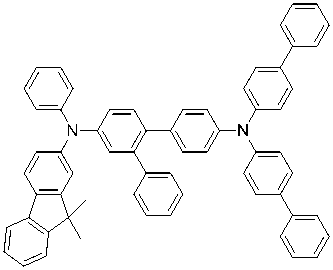
(1-26) (1-26)

(1-27) (1-27)

(1-28) (1-28)

(1-29) (1-29)
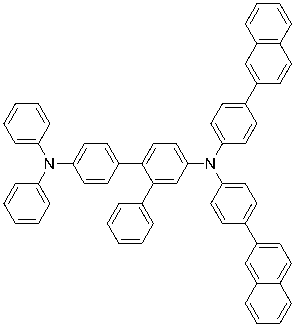
(1-30) (1-30)
일반식(1)로 표시되는 아릴아민 화합물의 정제는 컬럼크로마토그래프에 의한 정제, 실리카 겔, 활성탄, 활성 백토 등에 의한 흡착 정제, 용매에 의한 재결정이나 정석법(晶析法), 승화 정제법 등에 의해서 행했다. 화합물의 동정(同定)은, NMR 분석에 의해서 행했다. 물성값으로서, 융점, 유리 전이점(Tg)과 일함수의 측정을 행했다. 융점은 증착성의 지표로 되는 것이고, 유리 전이점(Tg)은 박막 상태의 안정성의 지표로 되며, 일함수는 정공 수송성이나 정공 저지성의 지표로 되는 것이다.Purification of the arylamine compound represented by the general formula (1) includes purification by column chromatography, adsorption purification by silica gel, activated carbon, activated clay, etc., recrystallization or crystallization by solvent, sublimation purification, etc. done by Identification of the compound was performed by NMR analysis. As physical property values, melting point, glass transition point (Tg) and work function were measured. The melting point is an index of vapor deposition, the glass transition point (Tg) is an index of stability in a thin film state, and the work function is an index of hole transport or hole blocking properties.
그 외에, 본 발명의 유기 EL 소자에 이용되는 화합물은, 컬럼크로마토그래프에 의한 정제, 실리카 겔, 활성탄, 활성 백토 등에 의한 흡착 정제, 용매에 의한 재결정이나 정석법 등에 의해서 정제를 행한 후, 마지막에 승화 정제법에 의해서 정제한 것을 이용했다. In addition, the compound used in the organic EL device of the present invention is purified by column chromatography, adsorption purification using silica gel, activated carbon, activated clay, etc., recrystallization or crystallization using a solvent, and finally What was purified by the sublimation purification method was used.
본 발명의 유기 EL 소자의 구조로서는, 기판 상에 순차적으로, 양극, 정공 주입층, 정공 수송층, 발광층, 전자 수송층 및 음극으로 이루어지는 것, 또, 정공 수송층과 발광층 사이에 전자 저지층을 가지는 것, 발광층과 전자 수송층 사이에 정공 저지층을 가지는 것, 전자 수송층과 음극 사이에 전자 주입층을 가지는 것을 들 수 있다. 이들 다층 구조에 있어서는 유기층을 몇층이나 생략 혹은 겸하는 것이 가능하고, 예를 들면 정공 주입층과 정공 수송층을 겸한 구성으로 하는 것, 전자 주입층과 전자 수송층을 겸한 구성으로 하는 것 등도 할 수 있다. 또, 동일한 기능을 가지는 유기층을 2층 이상 적층한 구성으로 하는 것이 가능하고, 정공 수송층을 2층 적층한 구성, 발광층을 2층 적층한 구성, 전자 수송층을 2층 적층한 구성 등도 할 수 있다. 본 발명의 유기 EL 소자의 구조로서, 정공 수송층이 제1 정공 수송층과 제2 정공 수송층의 2층이 적층된 구성으로 하는 것도 바람직하다. As the structure of the organic EL device of the present invention, an anode, a hole injection layer, a hole transport layer, a light emitting layer, an electron transport layer, and a cathode are sequentially formed on a substrate, and an electron blocking layer is provided between the hole transport layer and the light emitting layer. What has a hole blocking layer between a light emitting layer and an electron transport layer, and what has an electron injection layer between an electron transport layer and a cathode are mentioned. In these multilayer structures, it is possible to omit or combine several layers of organic layers, for example, a hole injection layer and a hole transport layer, or an electron injection layer and an electron transport layer may be used. In addition, it is possible to have a configuration in which two or more organic layers having the same function are laminated, and a configuration in which two hole transport layers are laminated, a configuration in which two light emitting layers are laminated, and an electron transport layer are laminated in two layers are also possible. As the structure of the organic EL device of the present invention, it is also preferable that the hole transport layer has a structure in which two layers of a first hole transport layer and a second hole transport layer are laminated.
본 발명의 유기 EL 소자의 양극으로서는, ITO나 금과 같은 일함수가 큰 전극 재료가 이용된다. As the anode of the organic EL device of the present invention, an electrode material having a large work function such as ITO or gold is used.
본 발명의 유기 EL 소자의 정공 주입층으로서는, 상기 일반식(1)로 표시되는 아릴아민 화합물에 대해, 특정의 전자 억셉터를 P도핑한 것이 호적하게 이용된다.As the hole injection layer of the organic EL device of the present invention, one obtained by P-doping a specific electron acceptor with respect to the arylamine compound represented by the general formula (1) is preferably used.
상기 일반식(1)로 표시되는 아릴아민 화합물과 혼합 혹은 동시에 사용할 수 있는, 정공 주입·수송성의 재료로서는, 스타버스트형의 트리페닐아민 유도체, 여러 가지의 트리페닐아민 4량체 등의 재료;구리 프탈로시아닌으로 대표되는 포르피린 화합물;헥사시아노아자트리페닐렌과 같은 억셉터성의 복소환 화합물이나 도포형의 고분자 재료 등을 이용할 수가 있다. 이들 재료는 증착법 외에, 스핀 코트법이나 잉크젯법 등의 공지의 방법에 의해서 박막 형성을 행할 수가 있다. Examples of the hole injecting/transporting material that can be used in combination or simultaneously with the arylamine compound represented by the general formula (1) include starburst type triphenylamine derivatives, various triphenylamine tetramers, and the like; copper; A porphyrin compound typified by phthalocyanine; an acceptor heterocyclic compound such as hexacyanoazatriphenylene, a coating-type polymeric material, or the like can be used. These materials can be formed into a thin film by a known method such as a spin coat method or an ink jet method other than a vapor deposition method.
본 발명의 유기 EL 소자의 정공 수송층으로서는, 상기 일반식(1)로 표시되는 아릴아민 화합물 외에, N,N'-디페닐-N,N'-디(m-트릴)벤지딘(TPD), N,N'-디페닐-N,N'-디(α-나프틸)벤지딘(NPD), N,N,N',N'-테트라비페닐릴벤지딘 등의 벤지딘 유도체, 1,1-비스[4-(디-4-톨릴아미노)페닐]시클로헥산(TAPC) 등과 같은, 단결합 또는 헤테로 원자를 포함하지 않는 2가기로 연결한 분자중에 트리페닐아민 구조를 2개 가지는 아릴아민 화합물, 단결합 또는 헤테로 원자를 포함하지 않는 2가기로 연결한 분자중에 트리페닐아민 구조를 4개 가지는 아릴아민 화합물, 및 여러 가지의 트리페닐아민 3량체 등을 이용할 수가 있다. 또, 정공의 주입·수송층으로서, 폴리(3,4-에틸렌디옥시티오펜)(PEDOT)/폴리(스티렌설포네이트)(PSS) 등의 도포형의 고분자 재료를 이용할 수가 있다. As the hole transport layer of the organic EL device of the present invention, in addition to the arylamine compound represented by the above general formula (1), N,N'-diphenyl-N,N'-di(m-tril)benzidine (TPD), N Benzidine derivatives such as N'-diphenyl-N,N'-di(α-naphthyl)benzidine (NPD), N,N,N',N'-tetrabiphenylylbenzidine, 1,1-bis[ Arylamine compounds having two triphenylamine structures in molecules connected by divalent groups not containing single bonds or heteroatoms, such as 4-(di-4-tolylamino)phenyl]cyclohexane (TAPC), and single bonds Alternatively, arylamine compounds having four triphenylamine structures in molecules linked by divalent groups not containing heteroatoms, various triphenylamine trimers, and the like can be used. Also, as the hole injection/transport layer, a coating type polymeric material such as poly(3,4-ethylenedioxythiophene) (PEDOT)/poly(styrenesulfonate) (PSS) can be used.
본 발명의 유기 EL 소자의 정공 수송층으로서는, 정공 수송성의 아릴아민 화합물이 호적하게 이용되고, 특히 상기 일반식(1)로 표시되는 아릴아민 화합물이 호적하게 이용된다. 그리고, P도핑하지 않는 것이 호적하게 이용된다. 이들은, 단독으로 성막해도 좋지만, 다른 재료와 함께 혼합해서 성막한 단층으로서 사용해도 좋고, 단독으로 성막한 층끼리, 혼합해서 성막한 층끼리, 또는 단독으로 성막한 층과 혼합해서 성막한 층의 적층 구조로 해도 좋다. 이들 재료는 증착법 외에, 스핀 코트법이나 잉크젯법 등의 공지의 방법에 의해서 박막 형성을 행할 수가 있다.As the hole transport layer of the organic EL device of the present invention, a hole transporting arylamine compound is preferably used, and in particular, an arylamine compound represented by the general formula (1) is preferably used. And, what is not doped with P is used suitably. These may be formed into a film independently, but may be used as a single layer formed by mixing with other materials, layering of layers formed independently, layers formed by mixing, or layers formed by mixing with layers formed into a film alone. You can do it as a structure. These materials can be formed into a thin film by a known method such as a spin coat method or an ink jet method other than a vapor deposition method.
본 발명의 유기 EL 소자의 전자 저지층으로서는, 분자 중에 트리페닐아민 구조를 4개, 단결합 또는 헤테로 원자를 포함하지 않는 2가기로 연결한 구조를 가지는 아릴아민 화합물, 분자 중에 트리페닐아민 구조를 2개, 단결합 또는 헤테로 원자를 포함하지 않는 2가기로 연결한 구조를 가지는 아릴아민 화합물, 4,4',4''-트리(N-카르바졸릴)트리페닐아민(TCTA), 9,9-비스[4-(카르바졸-9-일)페닐]플루오렌, 1,3-비스(카르바졸-9-일)벤젠(mCP), 2,2-비스(4-카르바졸-9-일페닐)아다만탄(Ad-Cz) 등의 카르바졸 유도체, 9-[4-(카르바졸-9-일)페닐]-9-[4-(트리페닐시릴)페닐]-9H-플루오렌으로 대표되는 트리페닐시릴기와 트리아릴아민 구조를 가지는 화합물 등의 전자 저지 작용을 가지는 화합물을 이용할 수가 있다. 이들은, 단독으로 성막해도 좋지만, 다른 재료와 함께 혼합해서 성막한 단층으로서 사용해도 좋고, 단독으로 성막한 층끼리, 혼합해서 성막한 층끼리, 또는 단독으로 성막한 층과 혼합해서 성막한 층의 적층 구조로 해도 좋다. 이들 재료는 증착법 외에, 스핀 코트법이나 잉크젯법 등의 공지의 방법에 의해서 박막 형성을 행할 수가 있다. As the electron blocking layer of the organic EL device of the present invention, an arylamine compound having a structure in which four triphenylamine structures are connected in a molecule by divalent groups not containing single bonds or heteroatoms, and a triphenylamine structure in a molecule are used. An arylamine compound having a structure in which two pieces are connected by a divalent group not containing a single bond or a hetero atom, 4,4',4''-tri(N-carbazolyl)triphenylamine (TCTA), 9, 9-bis[4-(carbazol-9-yl)phenyl]fluorene, 1,3-bis(carbazol-9-yl)benzene (mCP), 2,2-bis(4-carbazole-9- Carbazole derivatives such as ylphenyl)adamantane (Ad-Cz), 9-[4-(carbazol-9-yl)phenyl]-9-[4-(triphenylsilyl)phenyl]-9H-fluorene A compound having an electron blocking action, such as a compound having a triphenylsilyl group represented by , and a triarylamine structure, can be used. These may be formed into a film independently, but may be used as a single layer formed by mixing with other materials, layering of layers formed independently, layers formed by mixing, or layers formed by mixing with layers formed into a film alone. You can do it as a structure. These materials can be formed into a thin film by a known method such as a spin coat method or an ink jet method other than a vapor deposition method.
본 발명의 유기 EL 소자에서는, 발광층에 인접하는 층(예를 들면, 정공 수송층, 전자 저지층 등)에 있어서, 전자 억셉터를 P도핑하지 않는 것이 바람직하다. In the organic EL device of the present invention, it is preferable not to P-dope the electron acceptor in the layer adjacent to the light emitting layer (eg, hole transport layer, electron blocking layer, etc.).
이들 층에는, 전자 저지성이 높은 아릴아민 화합물이 호적하게 이용되고, 상기 일반식(1)로 표시되는 아릴아민 화합물 등이 바람직하게 이용된다. For these layers, an arylamine compound having high electron blocking properties is suitably used, and an arylamine compound represented by the general formula (1) or the like is preferably used.
또, 이들 층의 막두께는, 통상 이용되는 막두께라면 특별히 한정하는 것은 아니지만, 예를 들면, 정공 수송층으로서는 20∼100㎚, 전자 저지층으로서는 5∼30㎚로 이용된다. In addition, the film thickness of these layers is not particularly limited as long as it is a film thickness normally used. For example, 20 to 100 nm is used as a hole transport layer and 5 to 30 nm is used as an electron blocking layer.
본 발명의 유기 EL 소자의 발광층으로서는, 아민 유도체, 피렌 유도체 외에, Alq3을 비롯한 퀴놀리놀 유도체의 금속 착체 등의 각종 금속 착체, 안트라센 유도체, 비스스티릴벤젠 유도체, 옥사졸 유도체, 폴리파라페닐렌비닐렌 유도체 등을 이용할 수가 있다. 또, 발광층을 호스트 재료와 도펀트 재료로 구성해도 좋고, 호스트 재료로서, 티아졸 유도체, 벤즈이미다졸 유도체, 폴리디알킬플루오렌 유도체 등을 이용할 수가 있다. 또 도펀트 재료로서는, 아민 유도체, 피렌 유도체 외에, 퀴나크리돈, 쿠마린, 루브렌, 페릴렌, 및 그들의 유도체, 벤조피란 유도체, 인데노페난트렌 유도체, 로다민 유도체, 아미노스티릴 유도체 등을 이용할 수가 있다. 이들은, 단독으로 성막해도 좋지만, 다른 재료와 함께 혼합해서 성막한 단층으로서 사용해도 좋고, 단독으로 성막한 층끼리, 혼합해서 성막한 층끼리, 또는 단독으로 성막한 층과 혼합해서 성막한 층의 적층 구조로 해도 좋다. As the light-emitting layer of the organic EL device of the present invention, in addition to amine derivatives and pyrene derivatives, various metal complexes such as Alq 3 and other metal complexes of quinolinol derivatives, anthracene derivatives, bisstyrylbenzene derivatives, oxazole derivatives, and polyparaphenyl Renvinylene derivatives and the like can be used. Further, the light emitting layer may be composed of a host material and a dopant material, and a thiazole derivative, a benzimidazole derivative, a polydialkylfluorene derivative or the like can be used as the host material. As the dopant material, in addition to amine derivatives and pyrene derivatives, quinacridone, coumarin, rubrene, perylene, and their derivatives, benzopyran derivatives, indenophenanthrene derivatives, rhodamine derivatives, aminostyryl derivatives, and the like can be used. there is. These may be formed into a film independently, but may be used as a single layer formed by mixing with other materials, layering of layers formed independently, layers formed by mixing, or layers formed by mixing with layers formed into a film alone. You can do it as a structure.
또, 발광 재료로서 인광 발광체를 사용하는 것도 가능하다. 인광 발광체로서는, 이리듐이나 백금 등의 금속 착체의 인광 발광체를 사용할 수가 있다. Ir(ppy)3 등의 녹색 인광 발광체, FIrpic, FIr6 등의 청색 인광 발광체, Btp2Ir(acac) 등의 적색 인광 발광체 등이 이용되고, 이 때의 호스트 재료로서는 정공 주입·수송성의 호스트 재료로서 4,4'-디(N-카르바졸릴)비페닐(CBP)이나 TCTA, mCP 등의 카르바졸 유도체 등을 이용할 수가 있다. 전자 수송성의 호스트 재료로서, p-비스(트리페닐시릴)벤젠(UGH2)이나 2,2',2''-(1,3,5-페닐렌)-트리스(1-페닐-1H-벤즈이미다졸)(TPBI) 등을 이용할 수 있고, 고성능의 유기 EL 소자를 제작할 수가 있다.In addition, it is also possible to use a phosphorescent light emitting body as a light emitting material. As the phosphorescent emitter, a phosphorescent emitter of a metal complex such as iridium or platinum can be used. Green phosphorescent emitters such as Ir(ppy) 3 , FIrpic, FIr 6 A blue phosphorescent emitter such as Btp 2 Ir(acac) or the like, a red phosphorescent emitter such as Btp 2 Ir(acac), etc. are used, and as a host material in this case, a 4,4'-di(N-carbazolyl) ratio as a host material having hole injection/transport properties. Carbazole derivatives such as phenyl (CBP), TCTA, and mCP can be used. As an electron-transporting host material, p-bis(triphenylsilyl)benzene (UGH2) or 2,2',2''-(1,3,5-phenylene)-tris(1-phenyl-1H-benzimide) dazole) (TPBI) or the like can be used, and a high-performance organic EL device can be manufactured.
인광성 발광 재료의 호스트 재료에의 도프는 농도 소광(消光)을 피하기 위해, 발광층 전체에 대해서 1∼30중량퍼센트의 범위에서, 공증착에 의해서 도프하는 것이 바람직하다.The doping of the phosphorescent light emitting material into the host material is preferably done by co-evaporation in the range of 1 to 30% by weight relative to the entire light emitting layer in order to avoid concentration quenching.
또, 발광 재료로서 PIC-TRZ, CC2TA, PXZ-TRZ, 4CzIPN 등의 CDCB 유도체 등의 지연 형광을 방사하는 재료를 사용하는 것도 가능하다(예를 들면, 비특허 문헌 3 참조).In addition, it is also possible to use a material that emits delayed fluorescence, such as CDCB derivatives such as PIC-TRZ, CC2TA, PXZ-TRZ, and 4CzIPN, as the light emitting material (for example, see Non-Patent Document 3).
이들 재료는 증착법 외에, 스핀 코트법이나 잉크젯법 등의 공지의 방법에 의해서 박막 형성을 행할 수가 있다. These materials can be formed into a thin film by a known method such as a spin coat method or an ink jet method other than a vapor deposition method.
본 발명의 유기 EL 소자의 정공 저지층으로서, 바소큐프로인(Bathocuproine)(BCP) 등의 페난트롤린 유도체나, 알루미늄(Ⅲ) 비스(2-메틸-8-퀴놀리나토)-4-페닐페놀레이트(BAlq) 등의 퀴놀리놀 유도체의 금속 착체 외에, 각종 희토류 착체, 트리아졸 유도체, 트리아진 유도체, 옥사디아졸 유도체 등, 정공 저지 작용을 가지는 화합물을 이용할 수가 있다. 이들 재료는 전자 수송층의 재료를 겸해도 좋다. 이들은, 단독으로 성막해도 좋지만, 다른 재료와 함께 혼합해서 성막한 단층으로서 사용해도 좋고, 단독으로 성막한 층끼리, 혼합해서 성막한 층끼리, 또는 단독으로 성막한 층과 혼합해서 성막한 층의 적층 구조로 해도 좋다. 이들 재료는 증착법 외에, 스핀 코트법이나 잉크젯법 등의 공지의 방법에 의해서 박막 형성을 행할 수가 있다.As the hole-blocking layer of the organic EL device of the present invention, a phenanthroline derivative such as bathocuproine (BCP) or aluminum (III) bis(2-methyl-8-quinolinato)-4-phenyl In addition to metal complexes of quinolinol derivatives such as phenolate (BAlq), compounds having a hole blocking action such as various rare earth complexes, triazole derivatives, triazine derivatives, and oxadiazole derivatives can be used. These materials may serve as materials for the electron transport layer. These may be formed into a film independently, but may be used as a single layer formed by mixing with other materials, layering of layers formed independently, layers formed by mixing, or layers formed by mixing with layers formed into a film alone. You can do it as a structure. These materials can be formed into a thin film by a known method such as a spin coat method or an ink jet method other than a vapor deposition method.
본 발명의 유기 EL 소자의 전자 수송층으로서는, Alq3, BAlq를 비롯한 퀴놀리놀 유도체의 금속 착체, 각종 금속 착체, 트리아졸 유도체, 트리아진 유도체, 옥사디아졸 유도체, 피리딘 유도체, 피리미딘 유도체, 벤즈이미다졸 유도체, 티아디아졸 유도체, 안트라센 유도체, 카르보디이미드 유도체, 퀴녹살린 유도체, 피리드인돌 유도체, 페난트롤린 유도체, 시롤 유도체 등을 이용할 수가 있다. 이들은, 단독으로 성막해도 좋지만, 다른 전자 수송성의 재료와 함께 혼합해서 성막한 단층으로서 사용해도 좋고, 단독으로 성막한 층끼리, 혼합해서 성막한 층끼리, 또는 단독으로 성막한 층과 혼합해서 성막한 층의 적층 구조로 해도 좋다. 이들 재료는 증착법 외에, 스핀 코트법이나 잉크젯법 등의 공지의 방법에 의해서 박막 형성을 행할 수가 있다.As the electron transport layer of the organic EL device of the present invention, metal complexes of quinolinol derivatives including Alq 3 and BAlq, various metal complexes, triazole derivatives, triazine derivatives, oxadiazole derivatives, pyridine derivatives, pyrimidine derivatives, benz Imidazole derivatives, thiadiazole derivatives, anthracene derivatives, carbodiimide derivatives, quinoxaline derivatives, pyridindole derivatives, phenanthroline derivatives, sirole derivatives and the like can be used. These may be formed into a film independently, but may be used as a single layer formed by mixing together with other electron transporting materials, and may be used as a single layer formed by mixing with each other, layers formed by mixing, or forming a film by mixing with layers formed alone. It is good also as a laminated structure of layers. These materials can be formed into a thin film by a known method such as a spin coat method or an ink jet method other than a vapor deposition method.
본 발명의 유기 EL 소자의 전자 주입층으로서, 불화 리튬, 불화 세슘 등의 알칼리 금속염, 불화 마그네슘 등의 알칼리 토류 금속염, 산화 알루미늄 등의 금속 산화물 등을 이용할 수 있지만, 전자 수송층과 음극의 바람직한 선택에 있어서는, 이것을 생략할 수가 있다. As the electron injection layer of the organic EL device of the present invention, an alkali metal salt such as lithium fluoride or cesium fluoride, an alkaline earth metal salt such as magnesium fluoride, or a metal oxide such as aluminum oxide can be used. , this can be omitted.
본 발명의 유기 EL 소자의 음극으로서, 알루미늄과 같은 일함수가 낮은 전극 재료나, 마그네슘 은 합금, 마그네슘 인듐 합금, 알루미늄 마그네슘 합금과 같은, 보다 일함수가 낮은 합금이 전극 재료로서 이용된다. As the cathode of the organic EL device of the present invention, an electrode material having a low work function such as aluminum or an alloy having a lower work function such as a magnesium silver alloy, a magnesium indium alloy, and an aluminum magnesium alloy is used as the electrode material.
이하, 본 발명의 실시 형태에 대해서, 실시예에 의해 구체적으로 설명하겠지만, 본 발명은 이하의 실시예에 한정되는 것은 아니다. EMBODIMENT OF THE INVENTION Hereinafter, although embodiment of this invention is demonstrated concretely by Example, this invention is not limited to the following example.
실시예 1Example 1
<4,4'-비스{비페닐-4-일-페닐아미노}비페닐(화합물 1-1)의 합성> <Synthesis of 4,4′-bis{biphenyl-4-yl-phenylamino}biphenyl (Compound 1-1)>
질소 치환한 반응 용기에, N-페닐-비페닐-4-아민 10.0g, 4,4'-디요오드비페닐 7.2g, 탄산 칼륨 7.4g, 차아황산 나트륨 0.6g, 구리가루 0.1g, 도데실벤젠 7.2ml, 크실렌 7.2ml를 더하고, 210℃에서 20시간 교반했다. 반응액을 냉각하면서 톨루엔을 더하고, 50℃에서 열 여과해서 여과액(濾液)을 실온까지 냉각한 후에, 교반하면서 메탄올을 더하고, 석출한 고체를 여과에 의해 채취했다. 얻어진 고체를 톨루엔-메탄올로 재결정하고, 4,4'-비스{비페닐-4-일-페닐아미노}비페닐(화합물 1-1)의 황백색 분체 10.0g(수율 88%)을 얻었다. In a reaction vessel purged with nitrogen, N-phenyl-biphenyl-4-amine 10.0 g, 4,4'-diiodobiphenyl 7.2 g, potassium carbonate 7.4 g, sodium hyposulfite 0.6 g, copper powder 0.1 g, dodecyl 7.2 ml of benzene and 7.2 ml of xylene were added, and it stirred at 210 degreeC for 20 hours. After adding toluene while cooling the reaction liquid and carrying out thermal filtration at 50°C and cooling the filtrate to room temperature, methanol was added while stirring, and the precipitated solid was collected by filtration. The obtained solid was recrystallized from toluene-methanol to obtain 10.0 g (yield: 88%) of a yellowish-white powder of 4,4′-bis{biphenyl-4-yl-phenylamino}biphenyl (Compound 1-1).
얻어진 황백색 분체에 대해서 NMR을 사용해서 구조를 동정했다. About the obtained yellowish-white powder, the structure was identified using NMR.
1H-NMR(CDCl3)로 이하의 36개의 수소의 시그널을 검출했다. The following 36 hydrogen signals were detected by 1 H-NMR (CDCl 3 ).
δ(ppm)=7.38-7.72(16H), 7.10-7.38(18H), 7.07-7.08(2H). δ (ppm) = 7.38 - 7.72 (16H), 7.10 - 7.38 (18H), 7.07 - 7.08 (2H).

(1-1) (1-1)
실시예 2Example 2
<4-{(9,9-디메틸플루오렌-2-일)-(비페닐-4-일)아미노}-4'-(디페닐아미노)-2-페닐-비페닐(화합물 1-20)의 합성> <4-{(9,9-dimethylfluorene-2-yl)-(biphenyl-4-yl)amino}-4'-(diphenylamino)-2-phenyl-biphenyl (compound 1-20) Synthesis of >
질소 치환한 반응 용기에, (9,9-디메틸플루오렌-2-일)-(비페닐-4-일)-(6-브로모비페닐-3-일)아민 10.0g, 4-(디페닐아미노)페닐 보론산 7.9g, 테트라키스 트리페닐포스핀 팔라듐(0) 0.60g, 탄산 칼륨 5.0g, 톨루엔 80ml, 에탄올 40ml, 물 30ml를 더해서 가열하고, 100℃에서 하룻밤 교반했다. 냉각하고, 분액 조작에 의해 유기층을 채취한 후, 농축하고, 컬럼 크로마토그래프(담체:실리카 겔, 용리액:디클로로메탄/헵탄)에 의해서 정제하는 것에 의해, 4-{(9,9-디메틸플루오렌-2-일)-(비페닐-4-일)아미노}-4'-(디페닐아미노)-2-페닐-비페닐(화합물 1-20)의 백색 분체 11.5g(수율 75%)을 얻었다. In a reaction vessel purged with nitrogen, (9,9-dimethylfluorene-2-yl)-(biphenyl-4-yl)-(6-bromobiphenyl-3-yl)amine 10.0 g, 4-(diphenyl) 7.9 g of amino) phenyl boronic acid, 0.60 g of tetrakis triphenylphosphine palladium (0), 5.0 g of potassium carbonate, 80 ml of toluene, 40 ml of ethanol, and 30 ml of water were added, heated, and stirred at 100°C overnight. After cooling, the organic layer was collected by liquid separation, concentrated, and purified by column chromatography (carrier: silica gel, eluent: dichloromethane/heptane) to obtain 4-{(9,9-dimethylfluorene -2-yl)-(biphenyl-4-yl)amino}-4'-(diphenylamino)-2-phenyl-biphenyl (compound 1-20) 11.5 g (yield: 75%) of white powder was obtained .
얻어진 백색 분체에 대해서 NMR을 사용해서 구조를 동정했다. About the obtained white powder, the structure was identified using NMR.
1H-NMR(CDCl3)로 이하의 44개의 수소의 시그널을 검출했다. The following 44 hydrogen signals were detected by 1 H-NMR (CDCl 3 ).
δ(ppm)=7.71-7.64(4H), 7.58-7.56(2H), 7.49-6.94(32H), 1.51(6H).δ (ppm) = 7.71 - 7.64 (4H), 7.58 - 7.56 (2H), 7.49 - 6.94 (32H), 1.51 (6H).

(1-20) (1-20)
실시예 3Example 3
<4,4'-비스[(9,9-디메틸플루오렌-2-일)-페닐아미노]비페닐(화합물 1-21)의 합성> <Synthesis of 4,4′-bis[(9,9-dimethylfluoren-2-yl)-phenylamino]biphenyl (Compound 1-21)>
질소 치환한 반응 용기에, 4,4'-비스(페닐아미노)비페닐 10.0g, 2-브로모-9,9-디메틸플루오렌 17.1g, 톨루엔 100ml, tert-부톡시나트륨 8.6g을 더하고, 30분간 초음파를 조사하면서 질소 가스를 통기(通氣)했다. 초산 팔라듐 0.1g, tert-부틸포스핀의 50%(w/w) 톨루엔 용액 0.2 g을 더해서 가열하고, 100℃에서 3시간 교반했다. 80℃까지 냉각해서 열 여과했다. 여과액에 실리카 겔, 활성 백토를 더하고 흡착 정제를 행하고, 여과에 의해 고체를 제거했다. 여과액을 농축하고, 석출한 고체를 여과에 의해 채취했다. 얻어진 고체를 톨루엔으로 재결정하고, 4,4'-비스[(9,9-디메틸플루오렌-2-일-페닐아미노]비페닐(화합물 1-21)의 황색 분체 16.4g(수율 77%)를 얻었다. To a reaction vessel purged with nitrogen, 10.0 g of 4,4'-bis(phenylamino)biphenyl, 17.1 g of 2-bromo-9,9-dimethylfluorene, 100 ml of toluene, and 8.6 g of sodium tert-butoxy were added, Nitrogen gas was aerated while irradiating ultrasonic waves for 30 minutes. 0.1 g of palladium acetate and 0.2 g of a 50% (w/w) toluene solution of tert-butylphosphine were added, heated, and stirred at 100°C for 3 hours. It cooled to 80 degreeC and heat-filtered. Silica gel and activated clay were added to the filtrate, adsorption purification was performed, and solids were removed by filtration. The filtrate was concentrated and the precipitated solid was collected by filtration. The obtained solid was recrystallized from toluene to obtain 16.4 g (77% yield) of yellow powder of 4,4′-bis[(9,9-dimethylfluoren-2-yl-phenylamino]biphenyl (Compound 1-21). got it
얻어진 황색 분체에 대해서 NMR을 사용해서 구조를 동정했다. About the obtained yellow powder, the structure was identified using NMR.
1H-NMR(CDCl3)로 이하의 44개의 수소의 시그널을 검출했다. The following 44 hydrogen signals were detected by 1 H-NMR (CDCl 3 ).
δ(ppm)=7.62-7.65(4H), 7.52-7.53(4H), 7.10-7.45(20H), 7.06-7.10(4H), 1.47(12H). δ (ppm) = 7.62 - 7.65 (4H), 7.52 - 7.53 (4H), 7.10 - 7.45 (20H), 7.06 - 7.10 (4H), 1.47 (12H).

(1-21) (1-21)
실시예 4Example 4
유기 EL 소자는, 도 1에 도시하는 바와 같이, 유리 기판(1) 상에 투명 양극(2)으로서 ITO 전극을 미리 형성한 것의 위에, 정공 주입층(3), 정공 수송층(4), 발광층(5), 전자 수송층(6), 전자 주입층(7), 음극(알루미늄 전극)(8)의 순으로 증착해서 제작했다. As shown in FIG. 1, the organic EL element includes a hole injection layer 3, a hole transport layer 4, a light emitting layer ( 5), the electron transport layer 6, the electron injection layer 7, and the cathode (aluminum electrode) 8 were deposited in this order to prepare.
구체적으로는, 막두께 150㎚의 ITO를 성막한 유리 기판(1)을 이소프로필 알콜중에서 초음파 세정을 20분간 행한 후, 200℃로 가열한 핫플레이트 상에서 10분간 건조를 행했다. 그 후, UV 오존 처리를 15분간 행한 후, 이 ITO 달린 유리 기판을 진공 증착기 내에 장착하고, 0.001Pa 이하까지 감압했다. 계속해서, 투명 양극(2)을 덮도록 정공 주입층(3)으로서, 하기 구조식의 전자 억셉터(Acceptor-1)와 화합물(1-1)을, 증착 속도비가 Acceptor-1:화합물(1-1)=3:97로 되는 증착 속도로 이원 증착을 행하고, 막두께 30㎚로 되도록 형성했다. 이 정공 주입층(3) 위에, 정공 수송층(4)으로서 화합물(1-1)을 막두께 40㎚로 되도록 형성했다. 이 정공 수송층(4) 위에, 발광층(5)으로서 하기 구조식의 화합물 EMD-1과 하기 구조식의 화합물 EMH-1을, 증착 속도비가 EMD-1:EMH-1=5:95로 되는 증착 속도로 이원 증착을 행하고, 막두께 20㎚로 되도록 형성했다. 이 발광층(5) 위에, 전자 수송층(6)으로서 하기 구조식의 화합물(ETM-1)과 하기 구조식의 화합물(ETM-2)를, 증착 속도비가 ETM-1:ETM-2=50:50으로 되는 증착 속도로 이원 증착을 행하고, 막두께 30㎚로 되도록 형성했다. 이 전자 수송층(6) 위에, 전자 주입층(7)으로서 불화 리튬을 막두께 1㎚로 되도록 형성했다. 마지막에, 알루미늄을 100㎚ 증착해서 음극(8)을 형성했다. 제작한 유기 EL 소자에 대해서, 대기중, 상온에서 특성 측정을 행했다. 제작한 유기 EL 소자에 직류 전압을 인가했을 때의 발광 특성의 측정 결과를 표 1에 정리해서 나타냈다. Specifically, the glass substrate 1 on which ITO with a thickness of 150 nm was formed was subjected to ultrasonic cleaning in isopropyl alcohol for 20 minutes, and then dried for 10 minutes on a hot plate heated to 200°C. Thereafter, after performing UV ozone treatment for 15 minutes, this glass substrate with ITO was mounted in a vacuum evaporator, and the pressure was reduced to 0.001 Pa or less. Subsequently, as the hole injection layer 3 so as to cover the transparent anode 2, an electron acceptor (Acceptor-1) and compound (1-1) of the following structural formula were used at a deposition rate ratio of Acceptor-1: Compound (1-). 1) Two-way deposition was performed at a deposition rate of 3:97 to form a film thickness of 30 nm. On the hole injection layer 3, as the hole transport layer 4, compound 1-1 was formed to a film thickness of 40 nm. On this hole transport layer 4, as the light emitting layer 5, compound EMD-1 of the following structural formula and compound EMH-1 of the following structural formula are deposited at a deposition rate such that the deposition rate ratio EMD-1:EMH-1 = 5:95. Vapor deposition was performed and it formed so that it might become a film thickness of 20 nm. On this light emitting layer 5, as the electron transport layer 6, a compound of the following structural formula (ETM-1) and a compound of the following structural formula (ETM-2) are deposited at a deposition rate ratio of ETM-1:ETM-2 = 50:50. It formed so that it might become a film thickness of 30 nm by performing binary vapor deposition at the deposition rate. On the electron transport layer 6, as an electron injection layer 7, lithium fluoride was formed to a film thickness of 1 nm. Finally, 100 nm of aluminum was deposited to form the cathode 8. About the fabricated organic electroluminescent element, the characteristic measurement was performed in air|atmosphere at normal temperature. Table 1 summarizes the measurement results of light emission characteristics when a DC voltage is applied to the fabricated organic EL device.

(Acceptor-1) (Acceptor-1)

(1-1) (1-1)

(EMD-1)(EMD-1)

(EMH-1) (EMH-1)

(ETM-1) (ETM-1)

(ETM-2) (ETM-2)
실시예 5Example 5
실시예 4에 있어서, 정공 주입층 및 정공 수송층의 재료로서 화합물(1-1) 대신에 화합물(1-20)을 이용한 것 이외는, 마찬가지 조건에서 유기 EL 소자를 제작했다. 제작한 유기 EL 소자에 대해서, 대기중, 상온에서 특성 측정을 행했다. 제작한 유기 EL 소자에 직류 전압을 인가했을 때의 발광 특성의 측정 결과를 표 1에 정리해서 나타냈다.In Example 4, an organic EL device was fabricated under the same conditions except that compound (1-20) was used instead of compound (1-1) as the material for the hole injection layer and the hole transport layer. About the fabricated organic electroluminescent element, the characteristic measurement was performed in air|atmosphere at normal temperature. Table 1 summarizes the measurement results of light emission characteristics when a DC voltage is applied to the fabricated organic EL device.

(1-20) (1-20)
실시예 6Example 6
실시예 4에 있어서, 정공 주입층 및 정공 수송층의 재료로서 화합물(1-1) 대신에 화합물(1-21)을 이용한 것 이외는, 마찬가지 조건에서 유기 EL 소자를 제작했다. 제작한 유기 EL 소자에 대해서, 대기중, 상온에서 특성 측정을 행했다. 제작한 유기 EL 소자에 직류 전압을 인가했을 때의 발광 특성의 측정 결과를 표 1에 정리해서 나타냈다.In Example 4, an organic EL device was fabricated under the same conditions as in Example 4, except that compound (1-21) was used instead of compound (1-1) as the material for the hole injection layer and the hole transport layer. About the fabricated organic electroluminescent element, the characteristic measurement was performed in air|atmosphere at normal temperature. Table 1 summarizes the measurement results of light emission characteristics when a DC voltage is applied to the fabricated organic EL device.
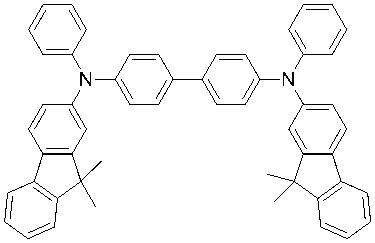
(1-21) (1-21)
[비교예 1] [Comparative Example 1]
비교를 위해서, 실시예 4에 있어서, 정공 주입층 및 정공 수송층의 재료로서 화합물(1-1) 대신에 하기 구조식의 것(HTM-1)을 이용한 것 이외는, 마찬가지 조건에서 유기 EL 소자를 제작했다. 제작한 유기 EL 소자에 대해서, 대기중, 상온에서 특성 측정을 행했다. 제작한 유기 EL 소자에 직류 전압을 인가했을 때의 발광 특성의 측정 결과를 표 1에 정리해서 나타냈다. For comparison, an organic EL device was fabricated under the same conditions as in Example 4, except that a material of the following structural formula (HTM-1) was used instead of compound (1-1) as a material for the hole injection layer and the hole transport layer. did. About the fabricated organic electroluminescent element, the characteristic measurement was performed in air|atmosphere at normal temperature. Table 1 summarizes the measurement results of light emission characteristics when a DC voltage is applied to the fabricated organic EL device.

(HTM-1) (HTM-1)
[비교예 2] [Comparative Example 2]
비교를 위해서, 실시예 4에 있어서, 정공 주입층 및 정공 수송층의 재료로서 화합물(1-1) 대신에 하기 구조식의 것(HTM-2)을 이용한 것 이외는, 마찬가지 조건에서 유기 EL 소자를 제작했다. 제작한 유기 EL 소자에 대해서, 대기중, 상온에서 특성 측정을 행했다. 제작한 유기 EL 소자에 직류 전압을 인가했을 때의 발광 특성의 측정 결과를 표 1에 정리해서 나타냈다.For comparison, an organic EL device was fabricated under the same conditions as in Example 4, except that a material of the following structural formula (HTM-2) was used instead of compound (1-1) as a material for the hole injection layer and the hole transport layer. did. About the fabricated organic electroluminescent element, the characteristic measurement was performed in air|atmosphere at normal temperature. Table 1 summarizes the measurement results of light emission characteristics when a DC voltage is applied to the fabricated organic EL device.

(HTM-2) (HTM-2)
실시예 4∼6 및 비교예 1, 2에서 제작한 유기 EL 소자를 이용해서, 소자 수명을 측정한 결과를 표 1에 정리해서 나타냈다. 소자 수명은, 발광 개시시의 발광 휘도(초기 휘도)를 2000cd/㎡로 해서 정전류 구동을 행했을 때, 발광 휘도가 1900cd/㎡(초기 휘도를 100%로 했을 때의 95%에 상당:95% 감쇠)로 감쇠할 때까지의 시간으로서 측정했다. Using the organic EL devices produced in Examples 4 to 6 and Comparative Examples 1 and 2, the results of measuring device life were collectively shown in Table 1. The life of the element is 1900 cd/m2 (equivalent to 95% when the initial luminance is 100%: 95% Attenuation) was measured as the time until attenuation.

표 1에 나타내는 바와 같이, 실시예 4∼6과 비교예 1, 2의 비교에 있어서, 전류 밀도 10㎃/㎠의 전류를 흘렸을 때의 발광 효율은, 비교예 1, 2의 유기 EL 소자의 8.04∼8.10cd/A에 대해, 실시예 4∼6의 유기 EL 소자에서는 8.31∼8.70cd/A로 고효율이었다. 또, 전력 효율에 있어서도, 비교예 1, 2의 유기 EL 소자의 6.84∼6.89lm/W에 대해, 실시예 4∼6의 유기 EL 소자에서는 7.24∼7.58lm/W로 고효율이었다. 또, 소자 수명(95% 감쇠)에 있어서는, 비교예 1, 2의 유기 EL 소자의 269∼277시간에 대해, 실시예 4∼6의 유기 EL 소자에서는 325∼361시간으로 장수명화하고 있음을 알 수 있다. As shown in Table 1, in the comparison between Examples 4 to 6 and Comparative Examples 1 and 2, the luminous efficiency when a current having a current density of 10 mA/cm 2 was applied was 8.04 for the organic EL device of Comparative Examples 1 and 2. Compared to ~8.10 cd/A, organic EL devices of Examples 4 to 6 had high efficiencies of 8.31 to 8.70 cd/A. Also, in terms of power efficiency, the organic EL devices of Examples 4 to 6 were 7.24 to 7.58 lm/W, compared to 6.84 to 6.89 lm/W for the organic EL devices of Comparative Examples 1 and 2, and the efficiency was high. In addition, in terms of device lifetime (95% attenuation), it was found that the organic EL devices of Examples 4 to 6 had a longer lifetime of 325 to 361 hours, compared to 269 to 277 hours for the organic EL devices of Comparative Examples 1 and 2. can
본 발명의 유기 EL 소자는, 정공 주입층의 재료로서 특정의 아릴아민 화합물을 선택하고, 특정의 전자 억셉터를 P도핑하는 것에 의해서, 양극으로부터 정공 수송층으로 정공을 효율 좋게 주입·수송할 수 있고, 유기 EL 소자 내부의 캐리어 밸런스를 개선하고, 종래의 유기 EL 소자와 비교해서, 고발광 효율, 또한 장수명인 유기 EL 소자를 실현할 수 있음을 알 수 있었다.The organic EL device of the present invention can efficiently inject and transport holes from the anode to the hole transport layer by selecting a specific arylamine compound as a material for the hole injection layer and P-doping the specific electron acceptor, , it was found that the carrier balance inside the organic EL element could be improved, and an organic EL element with high luminous efficiency and long life compared to conventional organic EL elements could be realized.
[산업상 이용가능성] [Industrial Applicability]
본 발명의, 특정의 아릴아민 화합물과 특정의 전자 억셉터를 유기 EL 소자 내부의 캐리어 밸런스를 정치화할 수 있도록 조합한 유기 EL 소자는, 발광 효율이 향상함과 동시에, 유기 EL 소자의 내구성을 개선시킬 수 있고, 예를 들면, 가정 전화(家庭電化) 제품이나 조명 용도로의 전개가 가능해졌다.The organic EL device of the present invention, in which a specific arylamine compound and a specific electron acceptor are combined so as to politicize the carrier balance inside the organic EL device, improves the luminous efficiency and durability of the organic EL device. It has become possible, for example, to develop into household telephone products and lighting applications.
1: 유리 기판
2: 투명 양극
3: 정공 주입층
4: 정공 수송층
5: 발광층
6: 전자 수송층
7: 전자 주입층
8: 음극 1: glass substrate
2: transparent anode
3: hole injection layer
4: hole transport layer
5: light emitting layer
6: electron transport layer
7: electron injection layer
8: cathode
Claims (5)
[화 1]

(1)
(식중, R1은 중수소 원자, 불소 원자, 염소 원자, 시아노기, 니트로기, 치환 혹은 무치환의 탄소 원자수 1∼6의 직쇄상 혹은 분기상의 알킬기, 치환 혹은 무치환의 탄소 원자수 5∼10의 시클로알킬기, 치환 혹은 무치환의 탄소 원자수 2∼6의 직쇄상 혹은 분기상의 알케닐기, 치환 혹은 무치환의 탄소 원자수 1∼6의 직쇄상 혹은 분기상의 알킬옥시기, 또는 치환 혹은 무치환의 탄소 원자수 5∼10의 시클로알킬옥시기를 나타낸다. R2, R3은 중수소 원자, 불소 원자, 염소 원자, 시아노기, 니트로기, 치환 혹은 무치환의 탄소 원자수 1∼6의 직쇄상 혹은 분기상의 알킬기, 치환 혹은 무치환의 탄소 원자수 5∼10의 시클로알킬기, 치환 혹은 무치환의 탄소 원자수 2∼6의 직쇄상 혹은 분기상의 알케닐기, 치환 혹은 무치환의 탄소 원자수 1∼6의 직쇄상 혹은 분기상의 알킬옥시기, 치환 혹은 무치환의 탄소 원자수 5∼10의 시클로알킬옥시기, 치환 혹은 무치환의 방향족 탄화수소기, 치환 혹은 무치환의 방향족 복소환기, 치환 혹은 무치환의 축합 다환 방향족기, 또는 치환 혹은 무치환의 아릴옥시기를 나타낸다. r1∼r3은 동일해도 달라도 좋고, r1은 0∼5를 나타내고, r2, r3은 0∼4를 나타낸다. r1이 2∼5인 경우, 또는, r2, r3이 2∼4인 경우, 동일한 벤젠 고리에 복수개 결합하는 R1∼R3은 상호 동일해도 달라도 좋고, 단결합, 치환 혹은 무치환의 메틸렌기, 산소 원자 또는 유황 원자를 거쳐 서로 결합해서 고리를 형성해도 좋다. Ar1은 치환 또는 무치환의 페닐기, 비페닐릴기, 터페닐릴기, 안트라세닐기, 페난트레닐기, 플루오레닐기, 인데닐기, 피레닐기, 페릴레닐기, 플루오란테닐기, 트리페닐레닐기, 피리딜기, 피리미디닐기, 트리아지닐기, 푸릴기, 피롤릴기, 티에닐기, 퀴놀릴기, 이소퀴놀릴기, 벤조퓨라닐기, 벤조티에닐기, 인돌릴기, 카르바졸릴기, 벤조옥사졸릴기, 벤조티아졸릴기, 퀴녹살리닐기, 벤조이미다졸릴기, 피라졸릴기, 디벤조퓨라닐기, 디벤조티에닐기, 나프틸리디닐기, 페난트롤리닐기, 아크리디닐기, 또는 카르볼리닐기를 나타내고, Ar2 및 Ar3은 상호 동일해도 달라도 좋고, 치환 혹은 무치환의 방향족 탄화수소기, 치환 혹은 무치환의 방향족 복소환기, 또는 치환 혹은 무치환의 축합 다환 방향족기를 나타낸다. 여기서, Ar1~Ar3이 치환기를 갖는 경우, 치환기로서 중수소 원자, 시아노기, 니트로기, 할로겐 원자, 탄소 원자수 1 내지 6의 직쇄상 또는 분기상의 알킬기, 탄소 원자수 1 내지 6의 직쇄상 또는 분기상의 알킬옥시기, 알케닐기, 아릴옥시기, 아릴알킬옥시기, 방향족 탄화수소기, 축합 다환 방향족기 또는 방향족 복소환기를 가진다.)
[화 2]

(2)
(식중, Ar4∼Ar6은 상호 동일해도 달라도 좋고, 전자 수용체기를 치환기로서 가지는 방향족 탄화수소기, 방향족 복소환기, 또는 축합 다환 방향족기를 나타낸다.)In an organic electroluminescent device having at least an anode, a hole injection layer, a hole transport layer, a light emitting layer, an electron transport layer and a cathode in this order, the hole injection layer comprises an arylamine compound represented by the following general formula (1) and the following general formula: An organic electroluminescence device characterized by containing a radialene derivative represented by formula (2).
[Tue 1]
(One)
(Wherein, R 1 is a deuterium atom, a fluorine atom, a chlorine atom, a cyano group, a nitro group, a substituted or unsubstituted linear or branched alkyl group having 1 to 6 carbon atoms, or a substituted or unsubstituted carbon atom having 5 to 6 atoms. Cycloalkyl group of 10, substituted or unsubstituted linear or branched alkenyl group having 2 to 6 carbon atoms, substituted or unsubstituted linear or branched alkyloxy group having 1 to 6 carbon atoms, or substituted or unsubstituted Represents a substituted cycloalkyloxy group having 5 to 10 carbon atoms R 2 and R 3 are deuterium atoms, fluorine atoms, chlorine atoms, cyano groups, nitro groups, substituted or unsubstituted straight-chain groups having 1 to 6 carbon atoms or a branched alkyl group, a substituted or unsubstituted cycloalkyl group having 5 to 10 carbon atoms, a substituted or unsubstituted linear or branched alkenyl group having 2 to 6 carbon atoms, or a substituted or unsubstituted cycloalkyl group having 1 to 10 carbon atoms 6 linear or branched alkyloxy group, substituted or unsubstituted cycloalkyloxy group having 5 to 10 carbon atoms, substituted or unsubstituted aromatic hydrocarbon group, substituted or unsubstituted aromatic heterocyclic group, substituted or unsubstituted represents a condensed polycyclic aromatic group or a substituted or unsubstituted aryloxy group, r 1 to r 3 may be the same or different, r 1 represents 0 to 5, and r 2 and r 3 represent 0 to 4. r When 1 is 2 to 5, or when r 2 and r 3 are 2 to 4, R 1 to R 3 bonded to the same benzene ring in a plurality of groups may be the same or different, and are single bonds, substituted or unsubstituted methylene Ar 1 is a substituted or unsubstituted phenyl group, biphenylyl group, terphenylyl group, anthracenyl group, phenanthrenyl group, fluorenyl group, or indenyl group. , Pyrenyl group, perylenyl group, fluoranthenyl group, triphenylenyl group, pyridyl group, pyrimidinyl group, triazinyl group, furyl group, pyrrolyl group, thienyl group, quinolyl group, isoquinolyl group, benzofuranyl group , benzothienyl group, indolyl group, carbazolyl group, benzoxazolyl group, benzothiazolyl group, quinoxalinyl group, benzoimidazolyl group, pyrazolyl group, dibenzofuranyl group, dibenzothienyl group, naphthylidei Represents a yl group, a phenanthrolinyl group, an acridinyl group, or a carbolinyl group, Ar 2 and Ar 3 may be the same or different, and are a substituted or unsubstituted aromatic hydrocarbon group, a substituted or unsubstituted aromatic heterocyclic group, or a substituted or unsubstituted aromatic hydrocarbon group. Represents an unsubstituted condensed polycyclic aromatic group. Here, when Ar 1 to Ar 3 have a substituent, the substituent is a deuterium atom, a cyano group, a nitro group, a halogen atom, a linear or branched alkyl group having 1 to 6 carbon atoms, or a linear chain having 1 to 6 carbon atoms. or a branched alkyloxy group, alkenyl group, aryloxy group, arylalkyloxy group, aromatic hydrocarbon group, condensed polycyclic aromatic group or aromatic heterocyclic group.)
[Tue 2]
(2)
(In the formula, Ar 4 to Ar 6 may be the same or different, and represent an aromatic hydrocarbon group, an aromatic heterocyclic group, or a condensed polycyclic aromatic group having an electron acceptor group as a substituent.)
상기 정공 수송층이, 정공 수송성의 아릴아민 화합물을 함유하는, 유기 일렉트로루미네선스 소자. According to claim 1,
The organic electroluminescence device, wherein the hole transport layer contains a hole transport arylamine compound.
상기 정공 수송층이, 상기 일반식(1)로 표시되는 아릴아민 화합물을 함유하는 것을 특징으로 하는, 유기 일렉트로루미네선스 소자. According to claim 1 or 2,
An organic electroluminescence device characterized in that the hole transport layer contains an arylamine compound represented by the general formula (1).
상기 일반식(1)에 있어서, Ar1은 치환 또는 무치환의 페닐기, 비페닐릴기, 터페닐릴기, 안트라세닐기, 페난트레닐기, 플루오레닐기, 인데닐기, 피레닐기, 페릴레닐기, 플루오란테닐기 또는 트리페닐레닐기이며, Ar2 및 Ar3은 치환 혹은 무치환의 방향족 탄화수소기인 유기 일렉트로루미네선스 소자. According to claim 1 or 2,
In the general formula (1), Ar 1 is a substituted or unsubstituted phenyl group, biphenylyl group, terphenylyl group, anthracenyl group, phenanthrenyl group, fluorenyl group, indenyl group, pyrenyl group, perylenyl group, fluoro A lanthenyl group or a triphenylenyl group, and Ar 2 and Ar 3 are substituted or unsubstituted aromatic hydrocarbon groups.
상기 일반식(1)에 있어서, Ar1∼Ar3이 치환 혹은 무치환의 페닐기, 비페닐릴기, 터페닐릴기 또는 플루오레닐기인 유기 일렉트로루미네선스 소자.According to claim 1 or 2,
In the general formula (1), Ar 1 to Ar 3 are substituted or unsubstituted phenyl, biphenylyl, terphenylyl or fluorenyl groups.
Applications Claiming Priority (3)
| Application Number | Priority Date | Filing Date | Title |
|---|---|---|---|
| JP2017063510 | 2017-03-28 | ||
| JPJP-P-2017-063510 | 2017-03-28 | ||
| PCT/JP2018/008131 WO2018180215A1 (en) | 2017-03-28 | 2018-03-02 | Organic electroluminescent element |
Publications (2)
| Publication Number | Publication Date |
|---|---|
| KR20190128169A KR20190128169A (en) | 2019-11-15 |
| KR102533036B1 true KR102533036B1 (en) | 2023-05-15 |
Family
ID=63677156
Family Applications (1)
| Application Number | Title | Priority Date | Filing Date |
|---|---|---|---|
| KR1020197026785A Active KR102533036B1 (en) | 2017-03-28 | 2018-03-02 | organic electroluminescence device |
Country Status (7)
| Country | Link |
|---|---|
| US (1) | US11925107B2 (en) |
| EP (1) | EP3605638B1 (en) |
| JP (1) | JP7149263B2 (en) |
| KR (1) | KR102533036B1 (en) |
| CN (2) | CN117677263A (en) |
| TW (1) | TWI750355B (en) |
| WO (1) | WO2018180215A1 (en) |
Families Citing this family (5)
| Publication number | Priority date | Publication date | Assignee | Title |
|---|---|---|---|---|
| CN109428005B (en) * | 2017-08-30 | 2020-05-08 | 昆山国显光电有限公司 | Organic Electroluminescent Devices |
| CN110483495B (en) * | 2019-09-16 | 2020-04-28 | 长春海谱润斯科技有限公司 | A kind of heterocyclic compound and its organic electroluminescent device |
| US20230100661A1 (en) * | 2020-02-20 | 2023-03-30 | Hodogaya Chemical Co., Ltd. | High molecular weight compound and light emitting diode including said high molecular weight compound |
| CN115918300A (en) * | 2020-06-22 | 2023-04-04 | 诺瓦尔德股份有限公司 | Organic electronic devices comprising compounds of formula (I), display devices comprising said organic electronic devices, and compounds of formula (I) used in organic electronic devices |
| CN114335362B (en) * | 2020-09-30 | 2024-02-13 | 江苏三月科技股份有限公司 | A composition for OLED and organic electroluminescent device |
Citations (3)
| Publication number | Priority date | Publication date | Assignee | Title |
|---|---|---|---|---|
| WO2012008281A1 (en) * | 2010-07-13 | 2012-01-19 | 東レ株式会社 | Light emitting element |
| JP2014110135A (en) * | 2012-11-30 | 2014-06-12 | Canon Inc | Process of manufacturing organic el device |
| JP2015518653A (en) * | 2012-04-02 | 2015-07-02 | ノヴァレッド ゲーエムベーハー | Use of semiconductor compounds in organic light-emitting devices |
Family Cites Families (42)
| Publication number | Priority date | Publication date | Assignee | Title |
|---|---|---|---|---|
| JPS4943840B1 (en) | 1970-12-25 | 1974-11-25 | ||
| JP3194657B2 (en) | 1993-11-01 | 2001-07-30 | 松下電器産業株式会社 | EL device |
| JP3828595B2 (en) | 1994-02-08 | 2006-10-04 | Tdk株式会社 | Organic EL device |
| KR100787425B1 (en) | 2004-11-29 | 2007-12-26 | 삼성에스디아이 주식회사 | Phenylcarbazole compound and organic electroluminescent device using same |
| WO2008062636A1 (en) | 2006-11-24 | 2008-05-29 | Idemitsu Kosan Co., Ltd. | Aromatic amine derivative and organic electroluminescent element using the same |
| EP3457451B1 (en) * | 2007-04-30 | 2019-07-17 | Novaled GmbH | The use of oxocarbon, pseudooxocarbon and radialene compounds |
| US8057712B2 (en) * | 2008-04-29 | 2011-11-15 | Novaled Ag | Radialene compounds and their use |
| KR101042954B1 (en) * | 2008-07-30 | 2011-06-20 | 삼성모바일디스플레이주식회사 | Amine compound, organic light emitting device including the same, and flat panel display device having the organic light emitting device |
| US8603642B2 (en) * | 2009-05-13 | 2013-12-10 | Global Oled Technology Llc | Internal connector for organic electronic devices |
| JP4975083B2 (en) | 2009-11-06 | 2012-07-11 | 三菱電機株式会社 | Light source lighting device and lighting device |
| WO2011131185A1 (en) * | 2010-04-21 | 2011-10-27 | Novaled Ag | Mixture for producing a doped semiconductor layer |
| CN103518271B (en) * | 2011-05-12 | 2016-06-29 | 东丽株式会社 | Light emitting element material and light-emitting component |
| CN104094434B (en) * | 2012-02-15 | 2016-12-28 | 东丽株式会社 | Light emitting element material and light-emitting component |
| EP2684932B8 (en) | 2012-07-09 | 2016-12-21 | Hodogaya Chemical Co., Ltd. | Diarylamino matrix material doped with a mesomeric radialene compound |
| CN106103440B (en) * | 2014-04-18 | 2019-03-26 | 保土谷化学工业株式会社 | Compounds with tetraazatriphenylene ring structure, light-emitting materials and organic electroluminescent devices |
| JP2016002437A (en) * | 2014-06-19 | 2016-01-12 | 株式会社Kitamura Japan | Stuffing material |
| EP2963697B1 (en) * | 2014-06-30 | 2020-09-23 | Novaled GmbH | Electrically doped organic semiconducting material and organic light emitting device comprising it |
| JP2016086147A (en) * | 2014-10-29 | 2016-05-19 | 保土谷化学工業株式会社 | Organic electroluminescence device |
| JP6675321B2 (en) | 2014-12-05 | 2020-04-01 | 保土谷化学工業株式会社 | Organic electroluminescence device |
| KR20170137795A (en) * | 2015-04-10 | 2017-12-13 | 호도가야 가가쿠 고교 가부시키가이샤 | Organic electroluminescence element |
| JP2018527740A (en) * | 2015-06-23 | 2018-09-20 | ノヴァレッド ゲーエムベーハー | Organic light emitting device comprising a polar matrix and a metal dopant |
| CN108369994B (en) * | 2015-12-08 | 2020-05-19 | 保土谷化学工业株式会社 | Organic electroluminescent element |
| KR102615636B1 (en) * | 2016-01-13 | 2023-12-20 | 삼성디스플레이 주식회사 | Organic light-emitting device |
| US11944004B2 (en) * | 2016-02-12 | 2024-03-26 | Hodogaya Chemical Co., Ltd. | Organic electroluminescence element |
| EP3432688B1 (en) * | 2016-04-22 | 2023-12-20 | Hodogaya Chemical Co., Ltd. | Organic electroluminescence element |
| US11158813B2 (en) * | 2017-03-15 | 2021-10-26 | Hodogaya Chemical Co., Ltd. | Organic electroluminescent device |
| EP3664173B1 (en) * | 2017-08-04 | 2023-11-29 | Hodogaya Chemical Co., Ltd. | Organic electroluminescence element containing compound having benzoazole ring structure |
| US11605785B2 (en) * | 2017-09-25 | 2023-03-14 | Hodogaya Chemical Co., Ltd. | Organic electroluminescence device |
| CN111344879B (en) * | 2017-11-16 | 2023-04-18 | 保土谷化学工业株式会社 | organic electroluminescent element |
| US11706943B2 (en) * | 2017-12-21 | 2023-07-18 | Hodogaya Chemical Co., Ltd. | Organic electroluminescent element and method for producing same |
| US11974499B2 (en) * | 2018-01-10 | 2024-04-30 | Hodogaya Chemical Co., Ltd. | Organic EL device, amine compound having benzazole ring structure, and method in which said amine compound is used in capping layer of organic EL device |
| KR102813012B1 (en) * | 2018-06-25 | 2025-05-26 | 호도가야 가가쿠 고교 가부시키가이샤 | Compounds having a triarylamine structure and organic electroluminescent devices |
| JP7039412B2 (en) * | 2018-07-25 | 2022-03-22 | 保土谷化学工業株式会社 | Azaindeno [1, 2, c] A compound having a phenanthrene ring structure and an organic electroluminescence device using the compound. |
| EP3890043A4 (en) * | 2018-11-29 | 2022-08-24 | Hodogaya Chemical Co., Ltd. | COMPOUND WITH AZABENZOXAZOLE RING STRUCTURE AND ORGANIC ELECTROLUMINESCENT ELEMENT |
| CN112805846B (en) * | 2018-11-29 | 2024-09-13 | 保土谷化学工业株式会社 | Organic electroluminescent element |
| EP3904487A4 (en) * | 2018-12-25 | 2022-08-24 | Hodogaya Chemical Co., Ltd. | ORGANIC ELECTROLUMINESCENT ELEMENT |
| TWI866952B (en) * | 2019-02-07 | 2024-12-21 | 日商保土谷化學工業股份有限公司 | Organic electroluminescent device |
| CN113195482B (en) * | 2019-02-13 | 2024-12-20 | 保土谷化学工业株式会社 | Compounds having benzoxazole ring structure and organic electroluminescent element |
| WO2020171221A1 (en) * | 2019-02-22 | 2020-08-27 | 保土谷化学工業株式会社 | Arylamine compound having benzoazole ring structure, and organic electroluminescent element |
| KR102876616B1 (en) * | 2020-01-22 | 2025-10-24 | 호도가야 가가쿠 고교 가부시키가이샤 | organic electroluminescent devices |
| KR20220146425A (en) * | 2020-02-26 | 2022-11-01 | 호도가야 가가쿠 고교 가부시키가이샤 | Arylamine compounds and electronic devices using the same |
| WO2021177022A1 (en) * | 2020-03-03 | 2021-09-10 | 保土谷化学工業株式会社 | Organic electroluminescent element |
-
2018
- 2018-03-02 KR KR1020197026785A patent/KR102533036B1/en active Active
- 2018-03-02 EP EP18776764.5A patent/EP3605638B1/en active Active
- 2018-03-02 CN CN202311715858.1A patent/CN117677263A/en active Pending
- 2018-03-02 US US16/495,523 patent/US11925107B2/en active Active
- 2018-03-02 CN CN201880012743.7A patent/CN110326123A/en active Pending
- 2018-03-02 WO PCT/JP2018/008131 patent/WO2018180215A1/en not_active Ceased
- 2018-03-02 JP JP2019509067A patent/JP7149263B2/en active Active
- 2018-03-20 TW TW107109413A patent/TWI750355B/en active
Patent Citations (3)
| Publication number | Priority date | Publication date | Assignee | Title |
|---|---|---|---|---|
| WO2012008281A1 (en) * | 2010-07-13 | 2012-01-19 | 東レ株式会社 | Light emitting element |
| JP2015518653A (en) * | 2012-04-02 | 2015-07-02 | ノヴァレッド ゲーエムベーハー | Use of semiconductor compounds in organic light-emitting devices |
| JP2014110135A (en) * | 2012-11-30 | 2014-06-12 | Canon Inc | Process of manufacturing organic el device |
Also Published As
| Publication number | Publication date |
|---|---|
| JPWO2018180215A1 (en) | 2020-02-06 |
| US20200013958A1 (en) | 2020-01-09 |
| WO2018180215A1 (en) | 2018-10-04 |
| TW201840811A (en) | 2018-11-16 |
| EP3605638B1 (en) | 2023-11-08 |
| TWI750355B (en) | 2021-12-21 |
| CN110326123A (en) | 2019-10-11 |
| KR20190128169A (en) | 2019-11-15 |
| US11925107B2 (en) | 2024-03-05 |
| EP3605638A1 (en) | 2020-02-05 |
| JP7149263B2 (en) | 2022-10-06 |
| EP3605638A4 (en) | 2021-01-06 |
| CN117677263A (en) | 2024-03-08 |
Similar Documents
| Publication | Publication Date | Title |
|---|---|---|
| KR102300867B1 (en) | Organic electroluminescence element | |
| KR101975611B1 (en) | Compounds having indolocarbazole ring structure, and organic electroluminescent elements | |
| EP2471771B1 (en) | Compound having carbazole ring structure and organic electroluminescent device | |
| EP3291323B1 (en) | Organic electroluminescent element | |
| KR102355739B1 (en) | Organic electroluminescence element | |
| KR102813012B1 (en) | Compounds having a triarylamine structure and organic electroluminescent devices | |
| KR102205133B1 (en) | Organic electroluminescence element | |
| KR102704734B1 (en) | Organic electroluminescent devices | |
| US20120205642A1 (en) | Organic electroluminescent device | |
| KR20130112850A (en) | Compounds with acridan ring structures and organic electroluminescence elements | |
| JP6815320B2 (en) | Organic electroluminescence device | |
| KR102533036B1 (en) | organic electroluminescence device | |
| KR20200121293A (en) | Organic Electroluminescence Device | |
| JP2021192441A (en) | Organic electroluminescence device material | |
| KR102785437B1 (en) | Organic electroluminescent devices | |
| TWI894213B (en) | Aromatic amine compound and electronic device using the same | |
| JP7421494B2 (en) | organic electroluminescent device | |
| KR102705588B1 (en) | Compounds having a benzimidazole ring structure and organic electroluminescent devices | |
| KR20230088341A (en) | Arylamine compounds, organic electroluminescent devices, and electronic devices | |
| KR20230042440A (en) | organic electroluminescence device | |
| JP2023022389A (en) | Spirobifluorene compound and organic electroluminescent element | |
| KR102921680B1 (en) | organic electroluminescent devices | |
| JP2025156207A (en) | Compound, organic electroluminescent element, and electronic device | |
| KR20230127061A (en) | Arylamine compound, organic electroluminescence element and electronic device | |
| KR20240129758A (en) | Arylamine compound, organic electroluminescence element, and electronic device |
Legal Events
| Date | Code | Title | Description |
|---|---|---|---|
| PA0105 | International application |
Patent event date: 20190911 Patent event code: PA01051R01D Comment text: International Patent Application |
|
| PG1501 | Laying open of application | ||
| PA0201 | Request for examination |
Patent event code: PA02012R01D Patent event date: 20210225 Comment text: Request for Examination of Application |
|
| E902 | Notification of reason for refusal | ||
| PE0902 | Notice of grounds for rejection |
Comment text: Notification of reason for refusal Patent event date: 20221004 Patent event code: PE09021S01D |
|
| E701 | Decision to grant or registration of patent right | ||
| PE0701 | Decision of registration |
Patent event code: PE07011S01D Comment text: Decision to Grant Registration Patent event date: 20230405 |
|
| GRNT | Written decision to grant | ||
| PR0701 | Registration of establishment |
Comment text: Registration of Establishment Patent event date: 20230511 Patent event code: PR07011E01D |
|
| PR1002 | Payment of registration fee |
Payment date: 20230511 End annual number: 3 Start annual number: 1 |
|
| PG1601 | Publication of registration |