KR102544901B1 - Lithium-ion battery safety monitoring - Google Patents
Lithium-ion battery safety monitoring Download PDFInfo
- Publication number
- KR102544901B1 KR102544901B1 KR1020187003546A KR20187003546A KR102544901B1 KR 102544901 B1 KR102544901 B1 KR 102544901B1 KR 1020187003546 A KR1020187003546 A KR 1020187003546A KR 20187003546 A KR20187003546 A KR 20187003546A KR 102544901 B1 KR102544901 B1 KR 102544901B1
- Authority
- KR
- South Korea
- Prior art keywords
- lib
- response
- voltage
- current
- parameter
- Prior art date
- Legal status (The legal status is an assumption and is not a legal conclusion. Google has not performed a legal analysis and makes no representation as to the accuracy of the status listed.)
- Active
Links
- 238000012544 monitoring process Methods 0.000 title claims abstract description 51
- 229910001416 lithium ion Inorganic materials 0.000 title claims abstract description 41
- HBBGRARXTFLTSG-UHFFFAOYSA-N Lithium ion Chemical compound [Li+] HBBGRARXTFLTSG-UHFFFAOYSA-N 0.000 title claims abstract description 40
- 230000004044 response Effects 0.000 claims abstract description 266
- 238000000034 method Methods 0.000 claims abstract description 65
- 239000002131 composite material Substances 0.000 claims abstract description 29
- 239000002243 precursor Substances 0.000 claims abstract description 22
- 230000008859 change Effects 0.000 claims description 67
- 238000007600 charging Methods 0.000 claims description 49
- 230000000638 stimulation Effects 0.000 claims description 45
- 230000006870 function Effects 0.000 claims description 25
- 229910052744 lithium Inorganic materials 0.000 claims description 25
- 238000006243 chemical reaction Methods 0.000 claims description 23
- WHXSMMKQMYFTQS-UHFFFAOYSA-N Lithium Chemical compound [Li] WHXSMMKQMYFTQS-UHFFFAOYSA-N 0.000 claims description 22
- 230000010287 polarization Effects 0.000 claims description 20
- 238000005259 measurement Methods 0.000 claims description 17
- 230000007704 transition Effects 0.000 claims description 16
- 238000007599 discharging Methods 0.000 claims description 15
- 238000007747 plating Methods 0.000 claims description 10
- 230000009471 action Effects 0.000 claims description 9
- 239000004576 sand Substances 0.000 claims description 4
- 238000004393 prognosis Methods 0.000 claims 1
- 210000004027 cell Anatomy 0.000 description 106
- 238000004891 communication Methods 0.000 description 18
- 210000001787 dendrite Anatomy 0.000 description 16
- 238000013500 data storage Methods 0.000 description 11
- RYGMFSIKBFXOCR-UHFFFAOYSA-N Copper Chemical compound [Cu] RYGMFSIKBFXOCR-UHFFFAOYSA-N 0.000 description 10
- 229910052802 copper Inorganic materials 0.000 description 10
- 239000010949 copper Substances 0.000 description 10
- 230000036541 health Effects 0.000 description 10
- 230000007246 mechanism Effects 0.000 description 10
- 238000007726 management method Methods 0.000 description 9
- 238000004458 analytical method Methods 0.000 description 8
- 238000002485 combustion reaction Methods 0.000 description 8
- 238000009792 diffusion process Methods 0.000 description 8
- 239000003792 electrolyte Substances 0.000 description 7
- 239000000203 mixture Substances 0.000 description 7
- 230000003213 activating effect Effects 0.000 description 6
- 238000013461 design Methods 0.000 description 6
- 238000011161 development Methods 0.000 description 6
- 230000000670 limiting effect Effects 0.000 description 6
- 238000001816 cooling Methods 0.000 description 5
- 230000000875 corresponding effect Effects 0.000 description 5
- 238000001514 detection method Methods 0.000 description 5
- 238000004146 energy storage Methods 0.000 description 5
- 239000007789 gas Substances 0.000 description 5
- 230000008569 process Effects 0.000 description 5
- 239000000126 substance Substances 0.000 description 5
- 238000013480 data collection Methods 0.000 description 4
- 230000007547 defect Effects 0.000 description 4
- 230000000694 effects Effects 0.000 description 4
- 230000007613 environmental effect Effects 0.000 description 4
- 238000010801 machine learning Methods 0.000 description 4
- 238000003860 storage Methods 0.000 description 4
- 238000012546 transfer Methods 0.000 description 4
- 230000000007 visual effect Effects 0.000 description 4
- OKTJSMMVPCPJKN-UHFFFAOYSA-N Carbon Chemical compound [C] OKTJSMMVPCPJKN-UHFFFAOYSA-N 0.000 description 3
- 230000006399 behavior Effects 0.000 description 3
- 230000015572 biosynthetic process Effects 0.000 description 3
- 230000001351 cycling effect Effects 0.000 description 3
- 238000000151 deposition Methods 0.000 description 3
- 238000010586 diagram Methods 0.000 description 3
- 238000003487 electrochemical reaction Methods 0.000 description 3
- 230000005284 excitation Effects 0.000 description 3
- 238000004880 explosion Methods 0.000 description 3
- 239000012530 fluid Substances 0.000 description 3
- 239000007788 liquid Substances 0.000 description 3
- 238000007620 mathematical function Methods 0.000 description 3
- 238000011084 recovery Methods 0.000 description 3
- 239000004065 semiconductor Substances 0.000 description 3
- 230000035939 shock Effects 0.000 description 3
- 241000894007 species Species 0.000 description 3
- 230000001052 transient effect Effects 0.000 description 3
- 238000013459 approach Methods 0.000 description 2
- QVGXLLKOCUKJST-UHFFFAOYSA-N atomic oxygen Chemical compound [O] QVGXLLKOCUKJST-UHFFFAOYSA-N 0.000 description 2
- 239000003990 capacitor Substances 0.000 description 2
- 230000015556 catabolic process Effects 0.000 description 2
- 230000001413 cellular effect Effects 0.000 description 2
- 238000010277 constant-current charging Methods 0.000 description 2
- 239000000356 contaminant Substances 0.000 description 2
- 238000012937 correction Methods 0.000 description 2
- 230000006378 damage Effects 0.000 description 2
- 230000007423 decrease Effects 0.000 description 2
- 238000006731 degradation reaction Methods 0.000 description 2
- 230000008021 deposition Effects 0.000 description 2
- 230000006866 deterioration Effects 0.000 description 2
- 238000002405 diagnostic procedure Methods 0.000 description 2
- 238000011156 evaluation Methods 0.000 description 2
- 239000000284 extract Substances 0.000 description 2
- 238000000605 extraction Methods 0.000 description 2
- 229910002804 graphite Inorganic materials 0.000 description 2
- 239000010439 graphite Substances 0.000 description 2
- 231100001261 hazardous Toxicity 0.000 description 2
- 238000010438 heat treatment Methods 0.000 description 2
- 230000002427 irreversible effect Effects 0.000 description 2
- 238000004519 manufacturing process Methods 0.000 description 2
- 230000000116 mitigating effect Effects 0.000 description 2
- 238000012806 monitoring device Methods 0.000 description 2
- 230000003287 optical effect Effects 0.000 description 2
- 239000005486 organic electrolyte Substances 0.000 description 2
- 229910052760 oxygen Inorganic materials 0.000 description 2
- 239000001301 oxygen Substances 0.000 description 2
- 230000000737 periodic effect Effects 0.000 description 2
- 229920000642 polymer Polymers 0.000 description 2
- 238000012545 processing Methods 0.000 description 2
- 230000000284 resting effect Effects 0.000 description 2
- 230000035945 sensitivity Effects 0.000 description 2
- 239000007787 solid Substances 0.000 description 2
- 230000035882 stress Effects 0.000 description 2
- 238000012360 testing method Methods 0.000 description 2
- 206010010099 Combined immunodeficiency Diseases 0.000 description 1
- XUIMIQQOPSSXEZ-UHFFFAOYSA-N Silicon Chemical compound [Si] XUIMIQQOPSSXEZ-UHFFFAOYSA-N 0.000 description 1
- JDZCKJOXGCMJGS-UHFFFAOYSA-N [Li].[S] Chemical compound [Li].[S] JDZCKJOXGCMJGS-UHFFFAOYSA-N 0.000 description 1
- 238000009825 accumulation Methods 0.000 description 1
- 230000004913 activation Effects 0.000 description 1
- 230000002776 aggregation Effects 0.000 description 1
- 238000004220 aggregation Methods 0.000 description 1
- 238000013473 artificial intelligence Methods 0.000 description 1
- 230000004888 barrier function Effects 0.000 description 1
- 230000008901 benefit Effects 0.000 description 1
- 230000005540 biological transmission Effects 0.000 description 1
- 238000004364 calculation method Methods 0.000 description 1
- 229910052799 carbon Inorganic materials 0.000 description 1
- 230000003197 catalytic effect Effects 0.000 description 1
- 230000010267 cellular communication Effects 0.000 description 1
- 238000001360 collision-induced dissociation Methods 0.000 description 1
- 150000001875 compounds Chemical class 0.000 description 1
- 239000004020 conductor Substances 0.000 description 1
- 238000010280 constant potential charging Methods 0.000 description 1
- 230000001276 controlling effect Effects 0.000 description 1
- 239000002826 coolant Substances 0.000 description 1
- 230000002596 correlated effect Effects 0.000 description 1
- 230000008878 coupling Effects 0.000 description 1
- 238000010168 coupling process Methods 0.000 description 1
- 238000005859 coupling reaction Methods 0.000 description 1
- 238000000354 decomposition reaction Methods 0.000 description 1
- 230000003247 decreasing effect Effects 0.000 description 1
- 230000007812 deficiency Effects 0.000 description 1
- 230000002950 deficient Effects 0.000 description 1
- 230000032798 delamination Effects 0.000 description 1
- 230000005611 electricity Effects 0.000 description 1
- 239000007772 electrode material Substances 0.000 description 1
- 239000008151 electrolyte solution Substances 0.000 description 1
- 239000003571 electronic cigarette Substances 0.000 description 1
- 238000002847 impedance measurement Methods 0.000 description 1
- 230000001976 improved effect Effects 0.000 description 1
- 230000006698 induction Effects 0.000 description 1
- 230000001939 inductive effect Effects 0.000 description 1
- 230000010354 integration Effects 0.000 description 1
- 238000009830 intercalation Methods 0.000 description 1
- 230000002687 intercalation Effects 0.000 description 1
- 238000012417 linear regression Methods 0.000 description 1
- 229910003002 lithium salt Inorganic materials 0.000 description 1
- 159000000002 lithium salts Chemical class 0.000 description 1
- 229910052987 metal hydride Inorganic materials 0.000 description 1
- 238000001465 metallisation Methods 0.000 description 1
- 239000003921 oil Substances 0.000 description 1
- 238000005457 optimization Methods 0.000 description 1
- 239000005416 organic matter Substances 0.000 description 1
- 239000003960 organic solvent Substances 0.000 description 1
- 238000013021 overheating Methods 0.000 description 1
- 230000037361 pathway Effects 0.000 description 1
- 230000000149 penetrating effect Effects 0.000 description 1
- 230000000704 physical effect Effects 0.000 description 1
- 239000005518 polymer electrolyte Substances 0.000 description 1
- 230000003449 preventive effect Effects 0.000 description 1
- 230000001902 propagating effect Effects 0.000 description 1
- 230000009467 reduction Effects 0.000 description 1
- 230000001105 regulatory effect Effects 0.000 description 1
- 230000027756 respiratory electron transport chain Effects 0.000 description 1
- 230000002441 reversible effect Effects 0.000 description 1
- 238000000926 separation method Methods 0.000 description 1
- 229910052710 silicon Inorganic materials 0.000 description 1
- 239000010703 silicon Substances 0.000 description 1
- 239000000779 smoke Substances 0.000 description 1
- 230000004936 stimulating effect Effects 0.000 description 1
- 230000008961 swelling Effects 0.000 description 1
- 230000008646 thermal stress Effects 0.000 description 1
- 238000006276 transfer reaction Methods 0.000 description 1
- 238000010200 validation analysis Methods 0.000 description 1
- 238000009423 ventilation Methods 0.000 description 1
- XLYOFNOQVPJJNP-UHFFFAOYSA-N water Substances O XLYOFNOQVPJJNP-UHFFFAOYSA-N 0.000 description 1
Images


Classifications
-
- G—PHYSICS
- G01—MEASURING; TESTING
- G01R—MEASURING ELECTRIC VARIABLES; MEASURING MAGNETIC VARIABLES
- G01R31/00—Arrangements for testing electric properties; Arrangements for locating electric faults; Arrangements for electrical testing characterised by what is being tested not provided for elsewhere
- G01R31/36—Arrangements for testing, measuring or monitoring the electrical condition of accumulators or electric batteries, e.g. capacity or state of charge [SoC]
- G01R31/382—Arrangements for monitoring battery or accumulator variables, e.g. SoC
- G01R31/3842—Arrangements for monitoring battery or accumulator variables, e.g. SoC combining voltage and current measurements
-
- G—PHYSICS
- G01—MEASURING; TESTING
- G01R—MEASURING ELECTRIC VARIABLES; MEASURING MAGNETIC VARIABLES
- G01R31/00—Arrangements for testing electric properties; Arrangements for locating electric faults; Arrangements for electrical testing characterised by what is being tested not provided for elsewhere
- G01R31/36—Arrangements for testing, measuring or monitoring the electrical condition of accumulators or electric batteries, e.g. capacity or state of charge [SoC]
- G01R31/367—Software therefor, e.g. for battery testing using modelling or look-up tables
-
- G—PHYSICS
- G01—MEASURING; TESTING
- G01R—MEASURING ELECTRIC VARIABLES; MEASURING MAGNETIC VARIABLES
- G01R31/00—Arrangements for testing electric properties; Arrangements for locating electric faults; Arrangements for electrical testing characterised by what is being tested not provided for elsewhere
- G01R31/36—Arrangements for testing, measuring or monitoring the electrical condition of accumulators or electric batteries, e.g. capacity or state of charge [SoC]
- G01R31/389—Measuring internal impedance, internal conductance or related variables
-
- G—PHYSICS
- G01—MEASURING; TESTING
- G01R—MEASURING ELECTRIC VARIABLES; MEASURING MAGNETIC VARIABLES
- G01R31/00—Arrangements for testing electric properties; Arrangements for locating electric faults; Arrangements for electrical testing characterised by what is being tested not provided for elsewhere
- G01R31/36—Arrangements for testing, measuring or monitoring the electrical condition of accumulators or electric batteries, e.g. capacity or state of charge [SoC]
- G01R31/392—Determining battery ageing or deterioration, e.g. state of health
-
- G—PHYSICS
- G01—MEASURING; TESTING
- G01R—MEASURING ELECTRIC VARIABLES; MEASURING MAGNETIC VARIABLES
- G01R31/00—Arrangements for testing electric properties; Arrangements for locating electric faults; Arrangements for electrical testing characterised by what is being tested not provided for elsewhere
- G01R31/50—Testing of electric apparatus, lines, cables or components for short-circuits, continuity, leakage current or incorrect line connections
-
- G—PHYSICS
- G01—MEASURING; TESTING
- G01R—MEASURING ELECTRIC VARIABLES; MEASURING MAGNETIC VARIABLES
- G01R31/00—Arrangements for testing electric properties; Arrangements for locating electric faults; Arrangements for electrical testing characterised by what is being tested not provided for elsewhere
- G01R31/50—Testing of electric apparatus, lines, cables or components for short-circuits, continuity, leakage current or incorrect line connections
- G01R31/52—Testing for short-circuits, leakage current or ground faults
-
- H—ELECTRICITY
- H01—ELECTRIC ELEMENTS
- H01M—PROCESSES OR MEANS, e.g. BATTERIES, FOR THE DIRECT CONVERSION OF CHEMICAL ENERGY INTO ELECTRICAL ENERGY
- H01M10/00—Secondary cells; Manufacture thereof
- H01M10/05—Accumulators with non-aqueous electrolyte
- H01M10/052—Li-accumulators
- H01M10/0525—Rocking-chair batteries, i.e. batteries with lithium insertion or intercalation in both electrodes; Lithium-ion batteries
-
- Y—GENERAL TAGGING OF NEW TECHNOLOGICAL DEVELOPMENTS; GENERAL TAGGING OF CROSS-SECTIONAL TECHNOLOGIES SPANNING OVER SEVERAL SECTIONS OF THE IPC; TECHNICAL SUBJECTS COVERED BY FORMER USPC CROSS-REFERENCE ART COLLECTIONS [XRACs] AND DIGESTS
- Y02—TECHNOLOGIES OR APPLICATIONS FOR MITIGATION OR ADAPTATION AGAINST CLIMATE CHANGE
- Y02E—REDUCTION OF GREENHOUSE GAS [GHG] EMISSIONS, RELATED TO ENERGY GENERATION, TRANSMISSION OR DISTRIBUTION
- Y02E60/00—Enabling technologies; Technologies with a potential or indirect contribution to GHG emissions mitigation
- Y02E60/10—Energy storage using batteries
Landscapes
- Physics & Mathematics (AREA)
- General Physics & Mathematics (AREA)
- Chemical & Material Sciences (AREA)
- Engineering & Computer Science (AREA)
- Materials Engineering (AREA)
- Manufacturing & Machinery (AREA)
- Chemical Kinetics & Catalysis (AREA)
- Electrochemistry (AREA)
- General Chemical & Material Sciences (AREA)
- Secondary Cells (AREA)
- Tests Of Electric Status Of Batteries (AREA)
- Charge And Discharge Circuits For Batteries Or The Like (AREA)
Abstract
충전식 리튬 이온 배터리(LIB)의 안전성을 감시하는 방법 및 시스템이 제공된다. LIB의 초기 전기 상태가 결정되고, 시변 응답을 발생시키기 위해 DC 전기 자극을 인가 또는 제거함으로써 변경된다. 상기 LIB의 시변 응답이 측정되고, 상기 측정된 응답의 기능 형태와 연관된 적어도 하나의 1차 응답 파라미터가 추출된다. 적어도 하나의 2차 응답 파라미터가 상기 1차 응답 파라미터로부터 도출된다. 복합 응답 파라미터가 상기 1차 응답 파라미터 및 상기 2차 응답 파라미터로부터 또한 도출될 수 있다. 단락 회로 전조 조건의 가능성이 상기 1차 응답 파라미터, 상기 2차 응답 파라미터 및/또는 상기 복합 응답 파라미터에 따라 결정된다. 상기 결정된 가능성에 기초하여, 잠재적 단락 회로 도출 위험요소의 경고가 제공되고 및/또는 단락 회로 도출 위험요소를 완화 또는 금지하는 보정 방책이 구현될 수 있다.Methods and systems for monitoring the safety of rechargeable lithium ion batteries (LIBs) are provided. The initial electrical state of the LIB is determined and altered by applying or removing a DC electrical stimulus to generate a time-varying response. The time-varying response of the LIB is measured, and at least one first-order response parameter associated with a functional form of the measured response is extracted. At least one second order response parameter is derived from the first order response parameter. A composite response parameter may also be derived from the primary response parameter and the secondary response parameter. The likelihood of a short circuit precursor condition is determined according to the primary response parameter, the secondary response parameter and/or the composite response parameter. Based on the determined likelihood, warnings of potential short circuit drawing hazards may be provided and/or corrective measures may be implemented to mitigate or inhibit short circuit drawing hazards.
Description
본 발명은 일반적으로 배터리 및 소비자 안전에 관한 것으로, 특히 리튬 이온 배터리의 안전성을 감시하는 진단 툴에 관한 것이다.The present invention relates generally to battery and consumer safety, and more particularly to diagnostic tools for monitoring the safety of lithium ion batteries.
리튬 이온 배터리(LIB)는 가전 제품에서 일반적으로 사용하는 충전식 배터리의 일 유형이다. LIB의 양전극(캐소드)은 전형적으로 리튬 층간 삽입 화합물을 포함하고 음전극(애노드)은 흑연으로 제조되어, 리튬 이온이 충전시에는 양전극으로부터 음전극으로 흐르고 방전시에는 역방향으로 흐른다. LIB는 다른 유형의 충전식 배터리에 비하여 매우 높은 에너지 밀도, 예를 들면 일부 니켈-금속 수소화물 전지보다 2배 이상의 에너지 밀도를 갖는 점이 특징이다. LIB는 또한 고전력 밀도, 광범위의 온도에 걸친 양호한 성능 및 낮은 자기 방전율에 가치가 있다. 더욱이, LIB는 다양한 셀 설계 및 구성(예를 들면, 프리즘, 원통, 평판, 코인 또는 파우치(pouch) 설계)에서 사용하는 것뿐만 아니라 액체 유기 전해질 및 중합체 전해질과 함께 사용하는 것에 대한 적응성이 높다.A lithium ion battery (LIB) is a type of rechargeable battery commonly used in consumer electronics. The positive electrode (cathode) of a LIB typically contains a lithium intercalation compound and the negative electrode (anode) is made of graphite, so that lithium ions flow from the positive electrode to the negative electrode during charging and in the reverse direction during discharging. LIBs are characterized by very high energy densities compared to other types of rechargeable batteries, eg more than twice the energy density of some nickel-metal hydride cells. LIBs are also valued for their high power density, good performance over a wide temperature range and low self-discharge rate. Furthermore, LIBs are highly adaptable for use in a variety of cell designs and configurations (eg, prismatic, cylindrical, flat plate, coin, or pouch designs) as well as for use with liquid organic electrolytes and polymer electrolytes.
그러나 LIB는 때때로 불에 잘 붙는다는 점에서 중대한 단점을 또한 갖는다. 이러한 불은 전형적으로 잠복 결함 및/또는 동작 결함의 누적에 의해 발생할 수 있는 내부 단락 회로에 의해 야기된다. 잠복 결함은 오염물질의 존재, 또는 애노드와 캐소드 사이에서 또는 그들 각각의 집전체 사이에서 발생할 수 있는 접촉과 같은 제조상의 결함을 포함할 수 있다. 동작 결함은 예를 들면 사용 중에 LIB에서 리튬 금속 도금에 의해 야기되는 리튬 수상돌기(dendrite)의 성장(또는 리튬 도금 자체); 구리 도금에 의해 야기되는 구리 수상돌기의 성장(또는 구리 도금 자체); 및 애노드와 캐소드가 물리적으로 접촉하는 기회를 생성하는 물리적 또는 열적 응력에 기인하여 분리막에 형성되는 째진 틈(tear) 또는 구멍(hole)을 포함할 수 있다. LIB 셀에서의 단락 회로는 물리적 충격(예를 들면, 떨어뜨림 또는 진동), 큰 온도 변화, 충격 쇼크(impact shock) 등과 같은 열화 및 환경 효과로부터 또한 야기할 수 있다. 단락 회로는 셀 내의 배터리 화학물질에서 연쇄 반응을 일으켜서 셀 내에서 급격한 온도 증가 및 결과적인 압력 상승을 일으키고, 셀을 파열 또는 연소시킬 수 있다. 열은 이어서 다른 배터리 셀로 전이하여 전체 배터리가 폭발하거나 화염에 휩싸이게 할 수 있다.However, LIBs also have a significant drawback in that they are sometimes highly flammable. These fires are typically caused by internal short circuits that can be caused by the accumulation of latent faults and/or operational faults. Latent defects may include manufacturing defects such as the presence of contaminants, or contact that may occur between the anode and cathode or between their respective current collectors. Operational defects include, for example, growth of lithium dendrites (or the lithium plating itself) caused by lithium metal plating on the LIB during use; growth of copper dendrites caused by copper plating (or copper plating itself); and a tear or hole formed in the separator due to physical or thermal stress that creates an opportunity for the anode and cathode to physically contact. A short circuit in a LIB cell can also result from degradation and environmental effects such as physical shock (eg, drop or vibration), large temperature changes, impact shock, and the like. A short circuit can cause a chain reaction in the battery chemistry within the cell, causing a rapid increase in temperature and consequent pressure rise within the cell, and can rupture or burn the cell. The heat can then transfer to other battery cells and cause the entire battery to explode or burst into flames.
단락 회로가 발생한 때, 내부 LIB 셀 온도는 단 몇 초만에 안전하지 않은 수준까지 상승하여 열폭주 및 결과적인 연소를 유도할 수 있다. LIB가 다른 유형의 배터리에 비하여 더 반응적이고 열적 안정성이 낮기 때문에, LIB는 고온 동작(예를 들면, 80℃ 이상) 또는 과충전(예를 들면, 저온에서의 고속 충전)과 같은 소정의 조건에서 열폭주를 받기가 더 쉽다. 고온에서, 캐소드 분해는 산소를 생성하고, 이 산소는 배터리 셀의 유기물(예를 들면, 인화성 유기 용매 전해질 및 탄소 애노드)과 방열성으로 반응한다. 높은 방열성의 연쇄 반응은 극히 빠르고 열폭주를 일으켜서 단 수 초만에 과도한 온도 및 압력(예를 들면, 700~1000℃ 및 약 500psi)에 도달할 수 있다. 연쇄 반응이 시작되면, 그 반응은 효과적으로 정지할 수 없고, 따라서 제1 장소에서 이 연쇄 반응의 시작을 금지하는 것이 사람이 다치고 재산이 손상되는 것을 방지할뿐만 아니라 배터리 동작을 유지하기 위해 매우 중요하다.When a short circuit occurs, the internal LIB cell temperature can rise to unsafe levels in just a few seconds, leading to thermal runaway and consequent combustion. Because LIBs are more reactive and have less thermal stability than other types of batteries, LIBs do not exhibit thermal resistance under certain conditions, such as high temperature operation (e.g., above 80°C) or overcharging (e.g., fast charging at low temperatures). It's easier to get a runaway. At high temperatures, cathodic decomposition generates oxygen, which reacts exothermically with the battery cell's organic matter (eg, flammable organic solvent electrolyte and carbon anode). The highly exothermic chain reaction is extremely rapid and can cause thermal runaway, reaching excessive temperatures and pressures (e.g., 700-1000°C and about 500 psi) in a matter of seconds. Once a chain reaction starts, it cannot be effectively stopped, so preventing this chain reaction from starting in the first place is very important not only to prevent people from getting hurt and property damaged, but also to maintain battery operation. do.
간단히 말해서, LIB 셀에서 초기에 내부적으로 발생된 오류 또는 결함은 단락 회로를 야기할 수 있고, 이 단락 회로는 가열 및 후속적으로 방열성 연쇄 반응을 유도하여 열폭주 및 궁극적으로 발화/폭발을 일으킬 수 있다.Simply put, an initial internally generated fault or fault in a LIB cell can cause a short circuit, which can induce heating and subsequently a dissipative chain reaction that can lead to thermal runaway and ultimately fire/explosion. there is.
과도한 고전압 또는 저온에서 충전하거나 및/또는 너무 빨리 충전하면 애노드에서 리튬 수상돌기가 형성되고, 이 수상돌기는 단락 회로를 유도할 수 있다(수상돌기가 분리막에 침투하여 캐소드 접촉을 일으킴으로써 및/또는 전극의 기계적 응력에 의해서). 반대로, 너무 낮은 전압에서의 방전은 구리 수상돌기 성장을 촉진하여(즉, 여기에서 구리는 애노드 집전체에 존재한다) 역시 단락 회로를 일으킬 수 있다. 높은 주변 온도, 급속 충전, 고부하 방전 및 배터리 패키지 내의 이웃 셀들 간의 근접으로 인한 셀 가열은 모두 열폭주의 가능성을 증가시키는 요소들이다.Charging at excessively high voltage or low temperature and/or charging too quickly will form lithium dendrites at the anode, which can induce a short circuit (by penetrating the separator and making cathodic contact and/or by the mechanical stress of the electrode). Conversely, discharge at too low a voltage promotes copper dendrite growth (i.e., where copper is present in the anode current collector) and can also cause a short circuit. High ambient temperatures, rapid charging, high load discharge, and cell heating due to proximity between neighboring cells in a battery package are all factors that increase the likelihood of thermal runaway.
따라서 심각한 안전성 위험요소가 랩톱 및 셀폰으로부터 전기/하이브리드 자동차 및 항공기에 이르기까지 광범위한 LIB 함유 기기 및 컴포넌트에서 나타나고, 해마다 위험한 사건들이 보고되고 많은 제품이 리콜된다. 그러한 사건들의 위험은 셀 및 배터리 패키지의 성능 및 크기에서의 요구가 증가할 때 상승하고, 그 에너지 밀도가 더 커지며, LIB는 공중에 대한 노출이 더 큰 추가적인 상업 제품에서 더 널리 유행한다. LIB 셀의 연소는 임의의 사전 경고 없이 정상 사용시에도 발생할 수 있고, 일부 경우에는 비극적인 결과를 가져올 수 있다. 결과적으로, 많은 제조업자들은 대체로 LIB의 사용을 피하고 있고, 예를 들면 LIB의 많은 장점에도 불구하고 최근의 전기 자동차 및 하이브리드 자동차의 중요한 부분에는 LIB에 의한 전원을 사용하지 않는다.Therefore, serious safety hazards are present in a wide range of LIB-containing devices and components, from laptops and cell phones to electric/hybrid cars and aircraft, with dangerous incidents reported and many product recalls every year. The risk of such events rises as demands on the performance and size of cells and battery packages increase, their energy densities become greater, and LIBs become more prevalent in additional commercial products with greater exposure to the air. Combustion of LIB cells can occur even in normal use without any prior warning, and in some cases can have catastrophic results. As a result, many manufacturers generally avoid using LIBs. For example, in spite of many advantages of LIBs, important parts of recent electric vehicles and hybrid vehicles do not use LIB power sources.
현재 이용 가능한 배터리 진단 툴은 특정 셀 파라미터를 수동으로 검출 또는 감시하는 본질적으로 반응성 시스템이고, 잠재적인 위험요소를 미리 식별하여 LIB 셀이 불붙는 것을 예방하는데 있어서 비효과적일 수 있다(또는 효과가 충분하지 않을 수 있다). 현존하는 진단 접근법은 일반적으로 셀 또는 배터리의 일상적인 동작 전류 및 전압을 측정하고, 때로는 저항 및/또는 임피던스와 아마도 온도를 또한 측정한다. 일부 방법은 개회로 모드로의 LIB 충전/방전 전류를 급히 차단하고(예를 들면, 셀 전압의 거의 순간적인 변화를 포착하기 위한 수십 마이크로초의 짧은 지속기간), 그 다음에 셀 용량, 오믹 저항 및 충전 상태를 결정하기 위해 충전/방전을 재개한다. 일부 제조업자는 과충전, 과방전, 과열, 단락 회로화 또는 다른 잠재적으로 위험한 상황으로부터 보호하기 위해 셀 또는 배터리 패키지 수준에서 LIB의 보호 메카니즘을 통합한다. 일부 메카니즘은 만일 소정의 동작 한계가 초과되면 배터리 전류를 차단할 수 있다. 그럼에도 불구하고, 그러한 반응 조절 시스템의 반응 시간은 일반적으로 열폭주 및 이어지는 필연적인 배터리 연소의 발생을 방지하기엔 불충분하다. 특히, 종래의 시스템은 전형적으로 온도 및 셀 동작 전압 및 전류(및 때로는 교류 임피던스)만을 추적하는데, 이들은 모두 비가역적 열폭주 및 셀 연소를 유도하는 연쇄 반응을 방지하기에 너무 늦은 때 위험요소 발생의 후기 단계에서 의미 있게 검출 가능한 변화만을 묘사한다. LIB 안전성 감시의 복잡도 및 필요한 속도는 다수의 셀이 존재할 때, 예를 들면 복수의 셀이 직렬 또는 병렬(또는 직렬과 병렬의 조합)로 접속된 때 크게 증가한다. 예를 들면, 칩이 12개의 셀에 접속되고 31개의 칩에 데이지 체인(daisy-chain) 방식으로 연결(직렬로 접속)된 경우, 총 12×31=372개의 셀이 (바람직하게) 개별적으로 감시되어야 한다.Currently available battery diagnostic tools are inherently reactive systems that passively detect or monitor certain cell parameters, and may be ineffective (or effective enough) in preventing LIB cells from burning by identifying potential hazards in advance. may not). Existing diagnostic approaches generally measure the daily operating current and voltage of a cell or battery, and sometimes also measure resistance and/or impedance and possibly temperature. Some methods abruptly turn off the LIB charge/discharge current into open-circuit mode (short duration of tens of microseconds, for example, to capture near-instantaneous changes in cell voltage), followed by cell capacitance, ohmic resistance and Resume charge/discharge to determine state of charge. Some manufacturers incorporate protection mechanisms in LIBs at the cell or battery package level to protect against overcharging, overdischarging, overheating, short circuiting or other potentially hazardous situations. Some mechanisms may cut off battery current if certain operating limits are exceeded. Nevertheless, the response time of such a response control system is generally insufficient to prevent the occurrence of thermal runaway and subsequent consequential burnout of the battery. In particular, conventional systems typically only track temperature and cell operating voltage and current (and sometimes alternating current impedance), all of which pose a hazard when it is too late to prevent a chain reaction leading to irreversible thermal runaway and cell burnout. Only meaningfully detectable changes at later stages are depicted. The complexity and required speed of LIB safety monitoring greatly increases when a large number of cells are present, for example, when the plurality of cells are connected in series or parallel (or a combination of series and parallel). For example, if the chips are connected to 12 cells and daisy-chained (connected in series) to 31 chips, a total of 12×31=372 cells are (preferably) individually monitored. It should be.
"배터리 특히 리튬 배터리의 충전 상태 결정 방법 및 장치"의 명칭으로 펠레드(Peled) 등에게 허여된 미국 특허 제4,725,784호에는 리튬 배터리와 같이 일정한 방전 곡선을 가진 배터리의 충전 상태를 결정하는 방법이 개시되어 있다. 배터리 온도가 측정되고, 그 다음에 배터리가 짧은 시구간 동안 높은 방전을 행하도록 부하가 걸린다. 짧은 회복 시간 후에, 회복된 개회로 전압 및 대응하는 배터리 회복 시간이 측정된다. 배터리의 잔여 충전 상태는 측정된 온도 및 회복된 개회로 전압으로부터, 예를 들면 참조 표를 이용하여 결정된다.U.S. Patent No. 4,725,784 entitled "Method and Apparatus for Determining SOC of Battery Particularly Lithium Battery" to Peled et al. discloses a method for determining SOC of a battery having a constant discharge curve such as a lithium battery. has been The battery temperature is measured, and then the battery is loaded to make a high discharge for a short period of time. After a short recovery time, the recovered open circuit voltage and corresponding battery recovery time are measured. The remaining state of charge of the battery is determined from the measured temperature and the recovered open circuit voltage, for example using a lookup table.
"배터리 관리 장치"의 명칭으로 남바(Namba)에게 허여된 미국 특허 제7,202,632호에는 잔류 용량 및 열화 정도를 결정하는 것과 같은 배터리 관리 목적으로 배터리 임피던스의 변화를 감시하는 것이 개시되어 있다. 임피던스는 전류 및 온도의 변동이 미리 정해진 범위 내에 있을 때 단자 전압, 개회로 전압 및 배터리의 전류를 이용하여 계산된다. 계산된 임피던스는 배터리의 초기 상태로부터 미리 획득된 초기 임피던스와 비교되어, 배터리의 열화 정도에 따라 임피던스 보정치를 결정한다.U.S. Patent No. 7,202,632 to Namba entitled "Battery Management Apparatus" discloses monitoring changes in battery impedance for battery management purposes, such as determining residual capacity and degree of deterioration. Impedance is calculated using the terminal voltage, open circuit voltage and current of the battery when fluctuations in current and temperature are within a predetermined range. The calculated impedance is compared with an initial impedance obtained in advance from an initial state of the battery, and an impedance correction value is determined according to the degree of deterioration of the battery.
"다중 셀 배터리 팩에서 열폭주의 전파 완화"의 명칭으로 베르디쳅스키(Berdichevsky) 등에게 허여된 미국 특허 제7,433,794호에는 전기 자동차 다중 셀 배터리 팩에서 열폭주를 완화시키는 방법이 개시되어 있다. 배터리 팩 및 복수의 셀 내의 열원이 먼저 식별된다. 배터리 팩과 셀의 온도는 예를 들면 습도, 연기, 유기 증기, 온도, 전압 또는 전류를 감시함으로써 미리 정해진 조건들을 검출하는 동안 제어된다. 조건을 검출한 때, 과열된 셀이 인근 셀로 전파되지 못하게 하는 미리 정해진 동작이 수행된다.U.S. Patent No. 7,433,794 to Berdichevsky et al., titled "Thermal Runaway Propagation Mitigation in Multi-Cell Battery Packs," discloses a method for mitigating thermal runaway in electric vehicle multi-cell battery packs. Heat sources within the battery pack and the plurality of cells are first identified. The temperature of the battery pack and cells is controlled while detecting predetermined conditions, for example by monitoring humidity, smoke, organic vapors, temperature, voltage or current. Upon detecting the condition, predetermined actions are taken to prevent overheated cells from propagating to nearby cells.
"임피던스 및/또는 배터리 상태의 결정을 이용하여 배터리의 건강 상태를 결정하는 방법"의 명칭으로 데스프레즈(Desprez) 등에게 허여된 미국 특허 제8,269,502호에는 배터리 충전 또는 사용량을 제어하기 위해 충전식 배터리의 건강 상태(state of health, SOH)를 연속적으로 평가하는 것에 대해 개시되어 있다. 적어도 하나의 배터리 셀의 임피던스가 실시간으로 결정된다. 그 다음에 적어도 하나의 신뢰 계수가 배터리 셀의 적어도 하나의 변수의 함수로서 결정된다(전류; 온도; 충전 상태; 및/또는 그 도함수 또는 적분). 주어진 시점에서 배터리의 SOH는 주어진 시점에 임피던스의 함수로서 보정되고 신뢰 계수에 의해 가중된 이전 시점에서의 SOH를 이용하여 결정된다.U.S. Patent No. 8,269,502 to Desprez et al. entitled "Method of Determining State of Health of Battery Using Determination of Impedance and/or State of Battery" discloses a method for controlling rechargeable batteries to control battery charge or usage. Continuously assessing the state of health (SOH) of a person is disclosed. Impedance of at least one battery cell is determined in real time. At least one confidence coefficient is then determined as a function of at least one variable of the battery cell (current; temperature; state of charge; and/or derivative or integral thereof). The SOH of the battery at a given point in time is determined using the SOH at a previous point in time calibrated as a function of impedance at a given point in time and weighted by a confidence factor.
"배터리 전압 변동 패턴에 기초하여 배터리의 건강 상태를 추정하는 장치 및 방법"의 명칭으로 엘지화학(LG Chem Ltd.)이 출원한 PCT 국제 공개 번호 WO2010/016647에는 배터리의 충전 상태(SOC)에 기초하여 건강 상태(SOH)를 추정하는 방법이 개시되어 있다. 배터리 전압, 전류 및 온도 데이터가 각각의 SOH 추정시에 센서로부터 획득된다. 제1 SOC는 배터리 전류 데이터를 이용한 전류 적분에 의해 추정된다. 개회로 전압은 배터리 전압 변동 패턴으로부터 추정된다. 추정된 개회로 전압 및 배터리 온도에 대응하는 제2 SOC는 개회로 전압/온도와 SOC 간의 상관관계를 이용하여 추정된다. 제1 SOC 변동에 대한 제2 SOC 변동의 비의 가중 평균치에 대한 수렴 값이 계산된다. 상기 가중 평균 수렴 값에 대응하는 배터리 용량이 상기 가중 평균 수렴 값과 용량 간의 상관관계를 이용하여 추정된다. 추정된 배터리 용량과 초기 배터리 용량의 상대적 비율이 배터리 SOH로서 저장된다.PCT International Publication No. WO2010/016647 filed by LG Chem Ltd. entitled "Apparatus and method for estimating health state of battery based on battery voltage variation pattern" A method for estimating the state of health (SOH) is disclosed. Battery voltage, current and temperature data are acquired from the sensor at each SOH estimation. The first SOC is estimated by current integration using battery current data. The open circuit voltage is estimated from the battery voltage variation pattern. The second SOC corresponding to the estimated open circuit voltage and battery temperature is estimated using a correlation between the open circuit voltage/temperature and SOC. A convergence value for the weighted average of the ratios of the second SOC fluctuation to the first SOC fluctuation is calculated. A battery capacity corresponding to the weighted average convergence value is estimated using a correlation between the weighted average convergence value and capacity. The relative ratio of the estimated battery capacity and the initial battery capacity is stored as the battery SOH.
"병렬 접속된 배터리의 차동 전류 모니터링"의 명칭으로 맥코이(McCoy) 등이 출원한 미국 특허 출원 공개 제2012/0182021호에는 병렬 접속된 2개의 배터리 간의 전류 차를 측정하는 배터리 감시 시스템이 개시되어 있다. 차동 전류는 2개의 배터리 사이에 위치된 스위치 및 전류 측정 장치를 이용하여 측정될 수 있다. 측정된 차동 전류는 배터리들 중 하나에서 장애를 검출하기 위해 사용된다.U.S. Patent Application Publication No. 2012/0182021 filed by McCoy et al. entitled "Monitoring Differential Current of Parallel Connected Batteries" discloses a battery monitoring system that measures the current difference between two batteries connected in parallel. . Differential current can be measured using a switch and current measuring device placed between the two batteries. The measured differential current is used to detect a failure in one of the batteries.
"배터리 건강 감시 시스템 및 방법"의 명칭으로 로베(Love) 등이 출원한 미국 특허 출원 공개 제2013/0141109호에는 충전식 배터리의 건강 상태 감시 및 서비스에서 제외되는 결함 배터리의 식별 방법이 개시되어 있다. 임피던스 응답을 얻기 위해 임피던스 분광 장비로 주파수 스윕(frequency sweep) 전역에서 교류 전류 또는 전압 섭동을 인가하고, 권장되는 배터리 전압 창 내에서 각종 충전 상태의 임피던스 응답에 관한 데이터를 수집하고, 수집된 데이터를 임피던스 곡선 위에 그리고, 각종의 충전 상태에서 임피던스 곡선을 분석함으로써 배터리의 정밀 주파수가 결정된다. 교류 전류 또는 전압 섭동은 정밀 주파수에서 인가되고 임피던스 응답을 발생한다. 임피던스 응답의 값이 기록되고, 임피던스 값이 포함되는 배터리 분류 구역이 결정된다.U.S. Patent Application Publication No. 2013/0141109 filed by Love et al. entitled "Battery Health Monitoring System and Method" discloses a method for monitoring the health condition of a rechargeable battery and identifying a defective battery excluded from service. To obtain the impedance response, an impedance spectrometer applies an alternating current or voltage perturbation across a frequency sweep, collects data on the impedance response of various charging states within the recommended battery voltage window, and analyzes the collected data. The precise frequency of the battery is determined by drawing over the impedance curve and analyzing the impedance curve at various states of charge. An alternating current or voltage perturbation is applied at a precise frequency and produces an impedance response. The value of the impedance response is recorded, and the battery classification zone in which the impedance value is included is determined.
"전기 또는 전기화학 시스템을 측정 및 분석하는 방법 및 장치"의 명칭으로 월드 에너지 랩스(2)(World Energy Labs(2) Inc.)가 출원한 PCT 국제 공개 WO2004/106946에는 시변 전기 신호에 의해 여기된 때 전기/전기화학 요소 또는 셀에서 생성된 시변 응답을 측정 및 분석하는 방법 및 장치가 개시되어 있다. 응답 신호 및 선택적으로 여기 신호는 동기식으로 샘플링되고, 샘플링된 값들을 분석하여 충전 상태 및 건강 상태를 비롯한 각종 특성들을 결정한다. 이 방법은 전기 임피던스(또는 어드미턴스)의 속성을 나타내는 시스템의 시간 도메인 응답을 평가하기 위해 사용될 수 있다. 이 방법은 측정 및 분석의 결과가 제공되는 개루프 형태, 또는 결과들이 시스템 또는 장치의 행동을 조절하게끔 피드백을 제공하기 위해 사용되는 폐루프 형태로 동작할 수 있다.PCT International Publication WO2004/106946 filed by World Energy Labs(2) Inc. entitled "Method and Apparatus for Measuring and Analyzing Electricity or Electrochemical Systems" discloses excitation by a time-varying electrical signal. A method and apparatus for measuring and analyzing the time-varying response produced by an electro/electrochemical element or cell when The response signal and optionally the excitation signal are synchronously sampled, and the sampled values are analyzed to determine various characteristics including state of charge and state of health. This method can be used to evaluate the time domain response of a system representing properties of electrical impedance (or admittance). The method can operate in open loop form where the results of measurement and analysis are provided, or in closed loop form where the results are used to provide feedback to adjust the behavior of a system or device.
본 발명의 일 양태에 따라서, 충전식 리튬 이온 배터리(LIB)의 안전성을 감시하는 방법이 제공된다. 이 방법은 LIB의 초기 전기 상태를 결정하고, 시변 응답을 발생하도록 상기 LIB에 직류(DC) 전기 자극을 인가하거나 제거함으로써 LIB의 전기 상태를 변경하고, 상기 변경된 전기 상태에 대한 상기 LIB의 시변 응답을 측정하는 단계를 포함한다. 상기 방법은 또한 적어도 상기 측정된 응답의 기능 형태와 연관된 적어도 하나의 1차 응답 파라미터를 추출하고, 상기 1차 응답 파라미터로부터 적어도 하나의 2차 응답 파라미터를 도출하는 단계를 포함한다. 상기 방법은 또한 상기 1차 응답 파라미터 및/또는 상기 2차 응답 파라미터에 따라 단락 회로 전조 조건(SCPC)의 가능성을 결정하는 단계를 포함한다. 상기 방법은 또한 상기 1차 응답 파라미터 및/또는 상기 2차 응답 파라미터로부터 적어도 하나의 복합 응답 파라미터를 도출하여 상기 SCPC 가능성이 상기 복합 응답 파라미터에 따라 또한 결정되게 하는 단계를 포함할 수 있다. 상기 방법은 또한 상기 결정된 SCPC 가능성에 따라 잠재적 단락 회로 도출 위험요소(SCDH)의 경고를 제공하는 단계를 포함할 수 있다. 상기 방법은 또한 상기 결정된 SCPC 가능성에 따라 SCDH를 완화 또는 금지하도록 적어도 하나의 보정 방책을 구현하는 단계를 포함할 수 있다. 상기 보정 방책은 상기 LIB에 특정 방전 전압을 인가하여 상기 인가된 방전 전압이 상기 LIB 내 리튬 도금의 적어도 일부를 산화시키게 하는 단계를 포함할 수 있다. 상기 LIB의 전기 상태를 변경하는 단계는 방전 전압; 충전 전압; 정전위(potentiostatic) 전압; 선형으로 변하는 전압; 방전 전류; 충전 전류; 정전류(galvanostatic) 전류; 선형으로 변하는 전류; 방전 저항 부하; 방전 정전력(constant power); 및/또는 충전 정전력과 같은 전기 자극 중의 적어도 하나를 포함할 수 있다. 상기 LIB의 전기 상태를 변경하는 단계는 상기 LIB를 방전 상태 또는 충전 상태로부터 개회로 상태 또는 휴지 상태로 전환하고; 상기 LIB를 개회로 상태 또는 방전 상태 또는 휴지 상태로부터 충전 상태로 전환하고; 및/또는 상기 LIB를 개회로 상태 또는 충전 상태 또는 휴지 상태로부터 방전 상태로 전환하는 동작 중의 적어도 하나를 포함할 수 있다. 상기 LIB의 전기 상태를 변경하는 단계는 i) 순간 전압 변화; ii) 이중 층(double-layer) 충전 위상; 및 iii) 패러데이 반응 위상을 포함한 적어도 하나의 응답 부분이 특징인 전압 응답을 발생하도록 스텝 전류를 인가하는 것을 포함할 수 있다. 상기 LIB의 전기 상태를 변경하는 단계는 i) 저분극에서 전압에 대한 전류의 선형 의존 영역; 및 ii) 고분극에서 전압에 대한 전류의 대수 의존 영역을 포함한 적어도 하나의 응답 부분이 특징인 전류 응답을 발생하도록 선형 전압 스캔(scan)을 인가하는 것을 포함할 수 있다. 상기 1차 응답 파라미터는 다른 시간에서의 전압 응답치; 다른 시간에서의 전류 응답치; 및 전기 상태 변경에 관한 파라미터 중의 적어도 하나를 포함할 수 있다. 상기 제2 응답 파라미터는 순간 전압 강하(iR 강하); iR 강하의 저항; 이중 층 용량(C); 이중 층 충전 또는 방전 위상의 시상수(전이 시간 Tr); 샌드 방정식(Sand equation) 파라미터; 이중 층 충전 또는 방전 중의 전압 변화; 인가된 전류 스텝의 패러데이 반응 위상 중의 전압 변화; 반응 저항(Rrxn); 교환 전류 밀도(io); 타펠(Tafel) 기울기(βa 또는 βc); 반응 분극(Rpol); 전류 편차 값(id); 인가 전압의 함수로서의 전류 응답; 전압 스캔의 전압-전류 기능 형태의 도함수 및 2차 도함수; 전류치의 도함수; 랜드레스-세빅(Randles-Sevcik) 방정식 파라미터; 인가 전류의 함수로서의 전압 응답; 순간 전류 변화; 순간 전류 변화의 저항값; 코트렐(Cottrell) 방정식 파라미터; 및/또는 LIB 전극의 활성 영역의 변화 중의 적어도 하나를 포함할 수 있다. 상기 방법은 또한 상기 LIB와 연관된 온도를 측정하는 단계를 포함할 수 있고, 이때 상기 LIB의 전기 상태를 변경하는 단계와 상기 LIB의 시변 응답을 측정하는 단계는 상기 측정된 온도를 고려한다. 상기 방법은 또한 사용자 피드백 또는 이력 데이터에 따라 SCPC 가능성의 결정을 수정하는 단계를 포함할 수 있다. 상기 방법은 또한 상기 측정된 응답이 미리 정해진 한계를 넘어서 벗어나는지 결정하는 단계를 포함할 수 있다. 상기 SCPC 가능성은 1차 파라미터, 2차 파라미터 및/또는 복합 파라미터의 변화율에 따라 결정될 수 있다. 상기 SCPC 가능성은 1차 파라미터, 2차 파라미터 및/또는 복합 파라미터의 파라미터들 간의 일관성에 따라 결정될 수 있다. 상기 방법은 상기 LIB의 적어도 하나의 인증 특징을 결정하는 예비 단계를 포함할 수 있고, 그래서 상기 방법 단계의 구현은 상기 인증 특징에 조건적이다. 상기 SCDH는 i) LIB의 연소 이벤트; ii) LIB의 자기 방전; 또는 iii) LIB의 휴면 양성(benign) 단락 회로 상태를 포함할 수 있다.According to one aspect of the present invention, a method for monitoring the safety of a rechargeable lithium ion battery (LIB) is provided. The method determines the initial electrical state of the LIB, changes the electrical state of the LIB by applying or removing a direct current (DC) electrical stimulus to the LIB to generate a time-varying response, and the time-varying response of the LIB to the changed electrical state. It includes the step of measuring The method also includes extracting at least one primary response parameter associated with at least a functional form of the measured response, and deriving at least one secondary response parameter from the primary response parameter. The method also includes determining a likelihood of a short circuit precursor condition (SCPC) according to the first response parameter and/or the second order response parameter. The method may also include deriving at least one composite response parameter from the primary response parameter and/or the secondary response parameter such that the SCPC likelihood is also determined according to the composite response parameter. The method may also include providing a warning of a potential short circuit drawing hazard (SCDH) according to the determined SCPC likelihood. The method may also include implementing at least one corrective policy to mitigate or inhibit SCDH in accordance with the determined SCPC likelihood. The corrective measure may include applying a specific discharge voltage to the LIB such that the applied discharge voltage oxidizes at least a portion of the lithium plating in the LIB. Changing the electrical state of the LIB may include a discharge voltage; charging voltage; potentiostatic voltage; voltage varying linearly; discharge current; charging current; galvanostatic current; linearly varying current; discharge resistance load; discharge constant power; and/or electrical stimulation such as charging electrostatic power. The step of changing the electrical state of the LIB switches the LIB from a discharge state or a charge state to an open circuit state or an idle state; transition the LIB from an open circuit state or a discharge state or an idle state to a charged state; and/or at least one of converting the LIB from an open circuit state, a charging state, or an idle state to a discharging state. Changing the electrical state of the LIB may include i) instantaneous voltage change; ii) double-layer charge phase; and iii) applying a step current to generate a voltage response characterized by at least one response portion comprising a Faraday reactive phase. Changing the electrical state of the LIB comprises: i) a region of linear dependence of current versus voltage at hypopolarization; and ii) applying a linear voltage scan to generate a current response characterized by at least one response portion comprising a region of logarithmic dependence of current versus voltage at high polarization. The primary response parameters include voltage response values at different times; current responses at different times; And it may include at least one of parameters related to electrical state change. The second response parameter may include an instantaneous voltage drop (iR drop); Resistance to iR drop; double layer capacity (C); time constant of the double layer charge or discharge phase (transition time T r ); Sand equation parameters; voltage change during double layer charging or discharging; voltage change during the Faraday response phase of the applied current step; reaction resistance (Rrxn); exchange current density (i o ); Tafel slope (βa or βc); response polarization (Rpol); current deviation value (i d ); current response as a function of applied voltage; derivatives and second derivatives of the voltage-current functional form of the voltage scan; derivative of current value; Randles-Sevcik equation parameters; voltage response as a function of applied current; instantaneous current change; Resistance value of instantaneous current change; Cottrell equation parameters; and/or a change in the active area of the LIB electrode. The method may also include measuring a temperature associated with the LIB, where changing an electrical state of the LIB and measuring a time-varying response of the LIB take the measured temperature into account. The method may also include modifying the determination of SCPC likelihood according to user feedback or historical data. The method may also include determining if the measured response deviates beyond a predetermined limit. The SCPC possibility may be determined according to a rate of change of a primary parameter, a secondary parameter, and/or a composite parameter. The SCPC possibility may be determined according to consistency among parameters of the primary parameter, the secondary parameter, and/or the composite parameter. The method may include a preliminary step of determining at least one authentication characteristic of the LIB, such that implementation of the method step is conditional on the authentication characteristic. The SCDH is i) a burning event of LIB; ii) self-discharge of the LIB; or iii) a dormant benign short circuit condition of the LIB.
본 발명의 다른 양태에 따라서, 충전식 리튬 이온 배터리(LIB)의 안전성을 감시하는 시스템이 제공된다. 이 시스템은 시변 응답을 발생하도록 상기 LIB에 직류(DC) 전기 자극을 인가하거나 제거함으로써 LIB의 전기 상태를 변경하도록 구성된 자극 인가 장치를 포함한다. 상기 시스템은 또한 상기 변경된 전기 상태에 대한 상기 LIB의 시변 응답을 측정하도록 구성된 응답 측정 장치를 포함한다. 상기 시스템은 또한 적어도 상기 측정된 응답의 기능 형태와 연관된 적어도 하나의 1차 응답 파라미터를 추출하도록 구성되고, 또한, 상기 1차 응답 파라미터로부터 적어도 하나의 2차 응답 파라미터를 도출하도록 구성된 프로세서를 포함한다. 상기 프로세서는 또한 상기 1차 응답 파라미터 및/또는 상기 2차 응답 파라미터에 따라 단락 회로 전조 조건(SCPC)의 가능성을 결정하도록 구성된다. 상기 프로세서는 또한 상기 1차 응답 파라미터 및/또는 상기 2차 응답 파라미터로부터 적어도 하나의 복합 응답 파라미터를 도출하여 상기 SCPC 가능성이 상기 복합 응답 파라미터에 따라 또한 결정되게 하도록 구성될 수 있다. 상기 SCPC 가능성은 1차 파라미터, 2차 파라미터 및/또는 복합 파라미터의 변화율에 따라 결정될 수 있다. 상기 시스템은 또한 상기 결정된 SCPC 가능성에 따라 잠재적 단락 회로 도출 위험요소(SCDH)의 경고를 제공하도록 구성된 통지 유닛을 포함할 수 있다. 상기 시스템은 또한 상기 결정된 SCPC 가능성에 따라 SCDH를 완화 또는 금지하도록 적어도 하나의 보정 방책을 구현하도록 구성된 안전성 프로토콜(protocol) 유닛을 포함할 수 있다. 상기 보정 방책은 상기 LIB에 특정 방전 전압을 인가하여 상기 인가된 방전 전압이 상기 LIB 내 리튬 도금의 적어도 일부를 산화시키게 하는 것을 포함할 수 있다. 상기 자극 인가 장치는 i) 순간 전압 변화; ii) 이중 층 충전 위상; 및 iii) 패러데이 반응 위상을 포함한 적어도 하나의 응답 부분이 특징인 전압 응답을 발생하도록 스텝 전류를 인가하게끔 구성될 수 있다. 상기 자극 인가 장치는 i) 저분극에서 전압에 대한 전류의 선형 의존 영역; 및 ii) 고분극에서 전압에 대한 전류의 대수 의존 영역을 포함한 적어도 하나의 응답 부분이 특징인 전류 응답을 발생하도록 선형 전압 스캔을 인가하게끔 구성될 수 있다. 상기 시스템은 또한 상기 LIB와 연관된 온도를 측정하도록 구성된 적어도 하나의 온도 센서를 포함할 수 있고, 이때 상기 LIB의 전기 상태를 변경하는 단계와 상기 LIB의 시변 응답을 측정하는 단계는 상기 측정된 온도를 고려한다. 상기 SCPC 가능성 결정은 사용자 피드백 또는 이력 성능 데이터에 기초하여 수정될 수 있다. 상기 SCDH는 i) LIB의 연소 이벤트; ii) LIB의 자기 방전; 또는 iii) LIB의 휴면 양성 단락 회로 상태를 포함할 수 있다.According to another aspect of the present invention, a system for monitoring the safety of a rechargeable lithium ion battery (LIB) is provided. The system includes a stimulation application device configured to change an electrical state of the LIB by applying or removing direct current (DC) electrical stimulation to the LIB to generate a time-varying response. The system also includes a response measurement device configured to measure a time-varying response of the LIB to the changed electrical state. The system also includes a processor configured to extract at least one primary response parameter associated with at least a functional form of the measured response, and further configured to derive at least one secondary response parameter from the primary response parameter. . The processor is also configured to determine a likelihood of a short circuit precursor condition (SCPC) according to the first response parameter and/or the second response parameter. The processor may also be configured to derive at least one composite response parameter from the primary response parameter and/or the secondary response parameter such that the SCPC likelihood is also determined according to the composite response parameter. The SCPC possibility may be determined according to a rate of change of a primary parameter, a secondary parameter, and/or a composite parameter. The system may also include a notification unit configured to provide a warning of a potential short circuit drawing hazard (SCDH) according to the determined SCPC likelihood. The system may also include a safety protocol unit configured to implement at least one corrective policy to mitigate or inhibit SCDH depending on the determined SCPC likelihood. The corrective measure may include applying a specific discharge voltage to the LIB such that the applied discharge voltage oxidizes at least a portion of lithium plating in the LIB. The stimulation application device may include i) instantaneous voltage change; ii) double layer charge phase; and iii) a voltage response characterized by at least one response portion comprising a Faraday reactive phase. The stimulation application device comprises: i) a region of linear dependence of current versus voltage in hypopolarization; and ii) a current response characterized by a region of logarithmic dependence of current versus voltage at high polarization. The system can also include at least one temperature sensor configured to measure a temperature associated with the LIB, wherein changing an electrical state of the LIB and measuring a time-varying response of the LIB determine the measured temperature. Consider The SCPC feasibility determination may be modified based on user feedback or historical performance data. The SCDH is i) a burning event of LIB; ii) self-discharge of the LIB; or iii) a dormant positive short circuit condition of the LIB.
본 발명은 첨부 도면과 함께하는 이하의 상세한 설명으로부터 더 잘 이해될 것이다.
도 1은 본 발명의 실시형태에 따라 구성되고 동작하는 리튬 이온 배터리(LIB)의 안전성을 감시하는 시스템의 개략도이다.
도 2a는 본 발명의 실시형태에 따라 동작하는, 각종 자극에 응답하는 LIB의 예시적인 방전 전압 프로파일을 묘사한 타이밍 그래프이다.
도 2b는 본 발명의 실시형태에 따라 동작하는, 각종 자극에 응답하는 LIB의 예시적인 충전 프로파일을 묘사한 타이밍 그래프이다.
도 3은 본 발명의 실시형태에 따라 동작하는, 개회로 상태에서 각종 자극에 응답하는 LIB의 예시적인 전압 프로파일을 묘사한 타이밍 그래프이다.
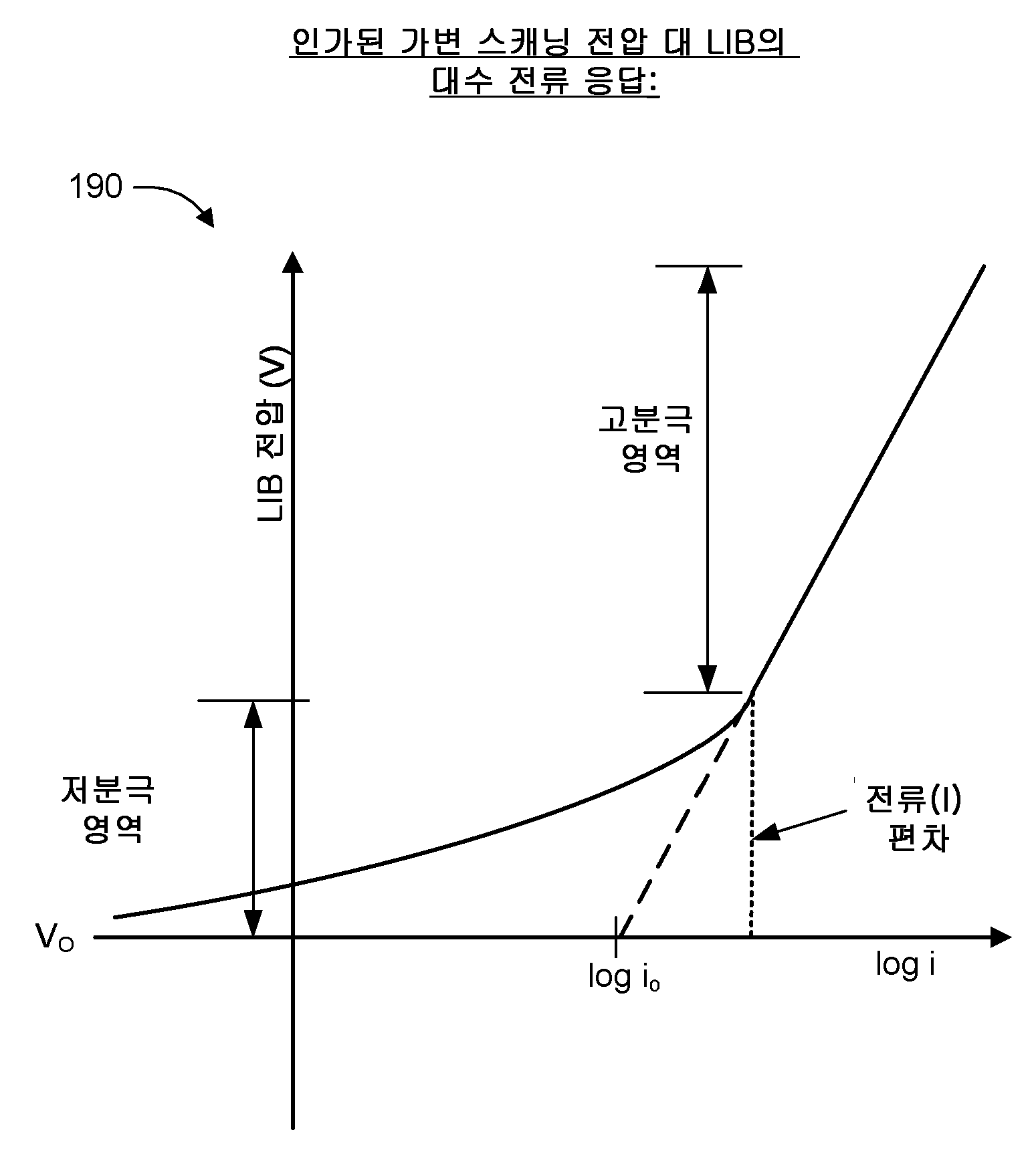
도 4는 본 발명의 실시형태에 따라 동작하는, LIB의 대수 전류 응답의 함수로서 예시적인 인가 전압 스캔을 묘사한 그래프이다.
도 5a는 본 발명의 실시형태에 따라 동작하는, 인가된 구형파 방전 전류에 대한 LIB의 예시적인 전압 응답을 묘사한 타이밍 그래프이다.
도 5b는 전압 응답 프로파일의 다른 세그멘트를 묘사한 도 5a의 타이밍 그래프이다.
도 5c는 전압 응답 프로파일의 순간 전압 변화 및 나머지 분극 성분을 묘사한 도 5a의 타이밍 그래프이다.
도 5d는 전압 응답 프로파일의 기능 형태를 묘사한 도 5a의 타이밍 그래프이다.
도 6a는 본 발명의 실시형태에 따라 동작하는, 예시적인 정전위 -스텝 전압 자극을 묘사한 타이밍 그래프이다.
도 6b는 본 발명의 실시형태에 따라 동작하는, 도 6a의 인가된 -스텝 전압 자극에 대한 LIB의 예시적인 전류 응답을 묘사한 타이밍 그래프이다.
도 7은 본 발명의 실시형태에 따라 동작하는, LIB의 안전성을 감시하는 방법의 블록도이다.
도 8은 감시되는 LIB의 내부 저항의 변화를 묘사한 2개의 상이한 유형의 파라미터의 활용을 비교하여 보인 막대 그래프이다.BRIEF DESCRIPTION OF THE DRAWINGS The present invention will be better understood from the following detailed description taken in conjunction with the accompanying drawings.
1 is a schematic diagram of a system for monitoring the safety of a lithium ion battery (LIB) constructed and operative in accordance with an embodiment of the present invention.
2A is a timing graph depicting exemplary discharge voltage profiles of a LIB in response to various stimuli, operating in accordance with an embodiment of the present invention.
2B is a timing graph depicting an exemplary charging profile of a LIB in response to various stimuli, operating in accordance with an embodiment of the present invention.
3 is a timing graph depicting exemplary voltage profiles of a LIB in response to various stimuli in an open loop state, operating in accordance with an embodiment of the present invention.
4 is a graph depicting an exemplary applied voltage scan as a function of the logarithmic current response of a LIB, operating in accordance with an embodiment of the present invention.
5A is a timing graph depicting an exemplary voltage response of a LIB to an applied square wave discharge current, operating in accordance with an embodiment of the present invention.
FIG. 5B is a timing graph of FIG. 5A depicting another segment of the voltage response profile.
5C is a timing graph of FIG. 5A depicting the instantaneous voltage change and remaining polarization components of the voltage response profile.
Figure 5d is a timing graph of Figure 5a depicting the functional form of the voltage response profile.
6A is a timing graph depicting an exemplary potentiostatic-step voltage stimulation, operating in accordance with an embodiment of the present invention.
6B is a timing graph depicting an exemplary current response of the LIB to the applied-step voltage stimulus of FIG. 6A, operating in accordance with an embodiment of the present invention.
7 is a block diagram of a method for monitoring the safety of a LIB, operating in accordance with an embodiment of the present invention.
8 is a bar graph comparing utilization of two different types of parameters depicting changes in the internal resistance of the LIB being monitored.
본 발명은 리튬 이온 배터리(LIB)의 안전성을 감시하는 개선된 진단 방법 및 시스템을 제공함으로써 종래 기술의 단점들을 극복한다. 진단 방법은 그 개발의 조기 단계에서 LIB 셀의 곧 나타날 단락 회로의 가능성을 결정하고, 그에 따라서 결과적인 가능한 LIB 연소 발생을 실시간으로 식별하여 사용자 안전을 보장하는 적어도 하나의 예방 방책을 구현하게 한다. 특히, 상기 방법은 열폭주 및 필연적인 연소로 발전할 수 있는 내부 셀 오류의 조기 단계 예측자 또는 표시자를 나타내는 특정 표식(marker)을 독특하게 검출하고 처리한다. 상기 표식들은 변경된 전기 상태에 대한 LIB의 시변 응답의 1차, 2차 및 복합 응답 파라미터의 형태를 가질 수 있다. 예를 들면, 시변 응답은 LIB에 인가된 (가변적이거나 일정한) 전압, 전류, 저항 또는 전력에 응답하여 변하는 LIB의 전압, 전류, 저항, 전력 및/또는 온도를 포함할 수 있다.The present invention overcomes the deficiencies of the prior art by providing an improved diagnostic method and system for monitoring the safety of lithium ion batteries (LIBs). The diagnostic method determines the likelihood of an imminent short-circuit of a LIB cell at an early stage of its development and thus identifies in real time the resulting possible LIB burning occurrence to implement at least one preventive measure that ensures user safety. In particular, the method uniquely detects and addresses certain markers that represent early stage predictors or indicators of internal cell failure that may develop into thermal runaway and consequential burnout. The indications may take the form of first-order, second-order, and composite response parameters of the LIB's time-varying response to a changed electrical state. For example, the time-varying response can include the voltage, current, resistance, power, and/or temperature of the LIB that changes in response to (variable or constant) voltage, current, resistance, or power applied to the LIB.
내부 LIB 단락 회로는 초기에 고저항으로 시작하고, 이 고저항은 이어서 연장된 사이클링 또는 길어진 지속기간을 가진 값으로 감소한다. 초기의 "소프트 쇼트"(soft short)는 비교적 긴 유도 시간 및 고저항이 특징인 양성(benign) 상태로부터 훨씬 더 낮은 저항(셀 연령으로서)을 가진 "하드 쇼트"(hard short)로 천천히 전이할 수 있다. 임계적인 저저항에 도달한 때, 발생된 열은 유기 전해질을 가연성 증기로 분해하기 시작하여 캐소드를 절연파괴시키고 산소를 방출한다. 열적 열화에 의해 형성되는 열 및 연소 가능한 생성물은 급격히 반응하여 온도를 수 백도까지 상승시키고 연쇄 반응을 또한 일으킨다. 비가역적인 열폭주는 후속적으로 LIB 셀의 발화 또는 폭발을 유도할 수 있다. 따라서 개시되는 방법은 LIB의 거의 알 수 없는 초기 소프트 쇼트를, 쇼트로 유도할 수 있는 제1 징후를 식별함으로써 그 개발 단계에서 조기에 식별하고, 열폭주가 시작하기 훨씬 전에 상기 징후를 검출한다. 개시되는 발명은 각종 응용에서 나타나는 실질적으로 모든 유형의 LIB에서 전개 가능하고, 광범위한 환경 및 동작 조건에서 동작 가능하다.The internal LIB short circuit initially starts with a high resistance, which then decreases to a value with extended cycling or lengthened duration. An initial “soft short” will slowly transition from a benign state characterized by relatively long induction time and high resistance to a “hard short” with much lower resistance (as cell age). can When a critical low resistance is reached, the generated heat begins to decompose the organic electrolyte into flammable vapors, which degrade the cathode and release oxygen. The heat and combustible products formed by thermal degradation react rapidly, raising the temperature to hundreds of degrees and also starting a chain reaction. Irreversible thermal runaway can subsequently lead to LIB cell ignition or explosion. Thus, the disclosed method identifies the almost unknown incipient soft shorts of LIBs early in their development by identifying the first signs that can lead to shorts, and detects these signs well before thermal runaway begins. The disclosed invention is deployable in virtually all types of LIBs found in various applications, and is operable in a wide range of environmental and operating conditions.
여기에서 사용하는 용어인 일반적으로 "배터리", 특히 "리튬 이온 배터리(LIB)", 및 그 임의의 변체는 임의의 구성(예를 들면, 직렬, 병렬, 및 직렬과 병렬의 조합)으로 접속된 임의 수의 전기화학 셀(또는 셀들의 그룹)을 포함하고, 또한 단일 셀 배터리를 포함할 뿐만 아니라 모든 유형의 셀 지오메트리(예를 들면, 비제한적으로, 원통, 프리즘, 파우치, 코인 및 버튼 셀을 포함함), 크기 및 셀 디자인(예를 들면, 비제한적으로, 젤리롤 디자인 셀, 감겨진 셀, 보빈(bobbin) 셀, Z-접힘 전극을 가진 셀, 도그본(dog-bone) 접힘 전극을 가진 셀, 타원 접힘 전극을 가진 셀, 및 평행판 전극 셀을 포함하고, 바이폴라 여부는 상관없음)을 포함한 임의의 배터리를 말한다. LIB는 일반적으로 적어도 한 쌍의 전극(애노드, 캐소드), 리튬 이온을 전도하는 전해질(액체, 고체, 반고체 및/또는 중합체), 및 분리막을 포함한다. 배터리는 적어도 하나의 전기 또는 전자 장치 또는 컴포넌트(예를 들면, 비제한적으로, 커패시터; 수퍼커패시터; 인쇄 회로 기판(PCB); 배터리 관리 시스템; 전자 제어 유닛; 파워 어댑터; 충전기; 무선 충전 시스템; 퓨즈; 센서; 정 온도 계수(PTC) 장치; 전류 차단 장치(CID); 및 이들의 임의 조합을 포함함)와 통합되거나 그 부품을 형성할 수 있다.As used herein, a "battery" in general, and in particular a "lithium ion battery (LIB)", and any variant thereof, is a battery connected in any configuration (e.g., series, parallel, and combinations of series and parallel). Any number of electrochemical cells (or groups of cells), also including single cell batteries, as well as cell geometries of any type (such as, but not limited to, cylindrical, prismatic, pouch, coin and button cells) ), size and cell design (eg, but not limited to, jellyroll design cells, wound cells, bobbin cells, cells with Z-fold electrodes, dog-bone fold electrodes). cells with elliptical folded electrodes, and cells with parallel plate electrodes, whether bipolar or not). A LIB generally includes at least one pair of electrodes (anode, cathode), an electrolyte (liquid, solid, semi-solid and/or polymer) that conducts lithium ions, and a separator. A battery may include at least one electrical or electronic device or component (eg, but not limited to, a capacitor; a supercapacitor; a printed circuit board (PCB); a battery management system; an electronic control unit; a power adapter; a charger; a wireless charging system; a fuse). sensors; positive temperature coefficient (PTC) devices; current interrupt devices (CIDs; and any combination thereof);
여기에서의 "리튬 이온(Li-ion)"은 리튬-금속 충전식 배터리, 리튬 이온 충전식 배터리 및 리튬 이온 중합체 충전식 배터리뿐만 아니라, 비제한적으로, 예비형 배터리, 열형 배터리, 소위 리튬 이온 커패시터 및 리튬-공기 및 리튬-유황 배터리를 포함한 이러한 유형의 배터리를 또한 포함한다는 점에 주목한다."Li-ion" herein refers to lithium-metal rechargeable batteries, lithium ion rechargeable batteries and lithium ion polymer rechargeable batteries, as well as, but not limited to, reserve batteries, thermal batteries, so-called lithium ion capacitors and lithium-ion batteries. It is noted that this type of battery, including air and lithium-sulfur batteries, is also included.
뒤에서 상세히 설명하는 바와 같이, "단락 회로 전조 조건(SCPC)"은 적어도 하나의 LIB 셀에서 (비양성) 내부 단락 회로를 유도하고 이어서 다수의 바람직하지 않은 결과들을 유도할 수 있는 임의의 조건으로서 여기에서 규정된다. 따라서 여기에서 용어 "단락 회로 도출 위험요소(SCDH)"는 i) 열폭주 및 후속적인 연소(즉, "연소 이벤트")가 뒤따르는 발열 연쇄 반응; ii) LIB 셀의 원치않은 자기 방전; 또는 iii) 알 수 없는 시구간 동안 휴면 양성 SCPC 상태로 유지하는 LIB 셀을 포함하고 궁극적으로 연소 이벤트로 발전할 미지의 확률을 가진 LIB (하드) 단락 회로의 가능한 결과들 중의 임의의 하나를 말한다. 여기에서 사용하는 용어 "연소 이벤트"는, 비제한적으로, 적어도 부분적으로, 화재, 폭발, 타오름(enflaming), 파열, 전해질 용액 누출, 팽윤, 분출 등을 받는 LIB(및/또는 관련 전자 컴포넌트)를 포함한, 열폭주에 따르거나 열폭주에 의해 야기되는 모든 형태의 잠재적으로 불안전한 배터리 상태를 포함하도록 넓게 사용된다.As explained in detail below, a “short circuit precursor condition (SCPC)” is herein referred to as any condition that can induce a (non-positive) internal short circuit in at least one LIB cell and subsequently lead to a number of undesirable consequences. stipulated in Accordingly, the term "short circuit draw hazard (SCDH)" herein refers to i) an exothermic chain reaction followed by thermal runaway and subsequent combustion (ie, a "combustion event"); ii) unwanted self-discharge of LIB cells; or iii) any one of the possible consequences of a LIB (hard) short circuit with an unknown probability involving a LIB cell remaining in a dormant positive SCPC state for an unknown period of time and ultimately developing into a combustion event. As used herein, the term "combustion event" refers to a LIB (and/or related electronic component) subject to, at least in part, fire, explosion, enflaming, rupture, electrolyte solution leakage, swelling, ejection, etc., without limitation. It is broadly used to include all types of potentially unsafe battery conditions resulting from or caused by thermal runaway, including thermal runaway.
여기에서 사용하는 용어 "충전 상태" 및 "방전 상태"와 각각의 문법적 변체는 LIB 셀이 얼마나 많이 충전/방전되었는지(예를 들면, "50% 충전 상태" 또는 "25% 방전 깊이")를 말할 수 있고, 용어 "충전" 및 "방전"은 셀이 능동적으로 충전/방전되는 것을 말할 수 있다.As used herein, the terms "state of charge" and "state of discharge" and their respective grammatical variants refer to how much a LIB cell has been charged/discharged (e.g., "50% state of charge" or "25% depth of discharge"). The terms “charging” and “discharging” may refer to actively charging/discharging a cell.
이제, 도 1을 참조하면, 본 발명의 실시형태에 따라 구성되고 동작하는 리튬 이온 배터리(LIB)(110)의 안전성을 감시하는 시스템(100)이 개략적으로 도시되어 있다. 시스템(100)은 전기 자극 인가 장치(112), 응답 측정 장치(114), 온도 센서(116), 프로세서(118), 통지 유닛(120), 안전성 프로토콜 유닛(122), 데이터 저장 유닛(124), 사용자 인터페이스(126) 및 데이터 통신 링크(128)를 포함한다. 프로세서(118)는 전기 자극 인가 장치(112), 응답 측정 장치(114), 온도 센서(116), 통지 유닛(120), 안전성 프로토콜 유닛(122), 데이터 저장 유닛(124), 사용자 인터페이스(126) 및 데이터 통신 링크(128)와 결합된다.Referring now to FIG. 1 , there is schematically illustrated a
전기 자극 인가 장치(112)는 예를 들면 인가 전압 또는 인가 전류와 같은 소정 형태의 전기 자극을 LIB(110)에 인가하고, 및/또는 LIB(110)를 휴지 조건 또는 개회로 조건으로/으로부터 변환시키는 것과 같이, LIB(110)의 전기 상태를 소정 방식으로 변경하도록 구성된다. 전기 자극 인가 장치(112)는 반복 빈도, 유형, 크기 및 지속기간과 같은 인가 자극의 상이한 파라미터들을 확립 또는 조정하기 위해 자동으로 또는 수동으로 제어될 수 있다. 인가 자극의 조정은 실시간으로 행하여질 수 있고 및/또는 사전 구성될 수 있다. 자극은 적어도 계획된 시구간 동안 또는 LIB의 동작 변화에 응답하여 인가될 수 있고, 및/또는 LIB(110)의 어떤 내부 또는 외부 이벤트에 의해 발생될 수 있다. 전기 자극 인가 장치(112)의 예로는, 비제한적으로, 전압 발생기, 전류 발생기, 전자 회로, 회로를 개방하고 및/또는 LIB를 휴지 상태로 두도록 구성된 장치, 부하(예를 들면, 저항성 부하)를 인가하는 장치, 전원 장치, 전기 컨버터(AC 및/또는 DC), 전기 인버터(AC 및/또는 DC), LIB 충전기, LIB 파워 어댑터, LIB 무선 충전기 등이 있다(전체적으로 또는 부분적으로, 상기 장치들 중 적어도 하나를 통합한 기구를 포함함).The electrical
응답 측정 장치(114)는 인가된 전기 자극(및/또는 인가된 전기 상태 변경)에 대한 LIB(110)의 응답을 측정하는 것을 포함하여 LIB(110)의 전기 상태 및 특성을 측정하도록 구성된다. 응답 측정 장치(114)의 예로는, 비제한적으로, 전압 감시 장치, 전류 감시 장치, 전자 회로, 응답 분석기, 전압계, 전류계, 저항계, 임피던스 측정 장치, 주파수 응답 분석기, LCD 미터 등이 있다((전체적으로 또는 부분적으로, 상기 장치들 중 적어도 하나를 통합한 기구를 포함함).
온도 센서(116)는 LIB(110)의 온도를 검출하고 및/또는 LIB(110) 부근의 주변 온도를 검출한다. 온도 센서(116)는 복수의 센서(예를 들면, 배터리 온도를 검출하는 제1 센서, 및 주변 온도를 검출하는 제2 센서)에 의해 구현될 수 있다. LIB(110)의 온도는 다수의 요소(예를 들면, 배터리 크기; 배터리 연령; 동작 지속기간; 충전 또는 방전율; 배터리가 매립되는 응용의 유형)에 의존할 수 있고, 뒤에서 더 자세히 설명하는 바와 같이, 인가된 전기 자극에 대한 LIB(110)의 응답에 영향을 줄 수 있다. 온도 센서(116)는 예를 들면 열전쌍, 반도체 또는 실리콘 다이오드, 광학 고온계, 적외선 측정 장치, 또는 열 정보를 검출하도록 작용하는 임의의 다른 유형의 센서에 의해 구체화될 수 있다.
통지 유닛(120)은 LIB(110)의 안전성 조건의 표시를 제공한다. 특히, 통지 유닛(120)은 단락 회로 전조 조건이 검출된 경우에 경보 또는 경고를 제공하도록 구성된다. 통지 유닛(120)은 또한 예를 들면 LIB(110)의 건강 상태(SOH) 및/또는 충전 상태(SOC)에 관한 추가 유형의 표시를 제공할 수 있다. 통지 유닛(120)은 시각적 표시(예를 들면, 텍스트, 마킹 및/또는 기호들을 디스플레이하는 것, 그래픽 정보의 색을 변경하는 것 등) 및/또는 청각적 표시(예를 들면, 알람, 경적음, 부저, 벨, 호출음)와 같은 각종의 경고 수단을 활용할 수 있다. 통지 유닛(120)은 예를 들면 상기 표시를 클라우드 컴퓨팅 네트워크의 원격 서버 또는 애플리케이션; 서비스 센터, 감시국 등 중의 적어도 하나에 예를 들면 데이터 통신 링크(128)를 통해 전송함으로써 원격 위치에 제공하도록 또한 구성될 수 있다. 따라서, 통지 유닛(120)은 청각적 통신(예를 들면, 오디오 스피커, 음성 발생 유닛) 및/또는 시각적 통신(예를 들면, 디스플레이 화면; 그래픽 사용자 인터페이스; 플래시 라이트)용으로 구성된 하나 이상의 장치 또는 기구를 포함할 수 있다. 통지 유닛(120)은 옵션으로 사용자 인터페이스(126)와 통합될 수 있고, 또는 별도의 유닛으로 될 수 있다. 복수의 통지 유닛(120)이 상이한 위치에서(예를 들면, LIB(110)의 위치에서, 서비스 센터에서, 및/또는 원격 감시국에서) 예컨대 동시에 경고를 제공할 수 있다.
안전성 프로토콜 유닛(122)은 예를 들면 LIB(110)의 전기 상태를 변경함으로써 LIB(110)의 잠재적으로 위험한 조건을 없애거나 중화시키는 적어도 하나의 처리 또는 동작을 구현 또는 발생하도록 구성된다. 예를 들면, LIB(110)의 SCPC가 식별된 때, 안전성 프로토콜 유닛(122)은 문제 있는 LIB 셀을 LIB(110)의 다른 셀로부터 전기적으로 격리시킬 수 있고, 또는 LIB(110)에 대한 전원 공급을 자동으로 차단할 수 있다. 다른 예로서, 안전성 프로토콜 유닛(122)은 의심되는 LIB를 교체하고, 다중 셀 배터리의 보조 시스템을 통해 셀 균형화를 개시하고, 또는 방전 전압을 인가하여 도금된 리튬을 제거하도록 구성될 수 있다. 또 다른 예로서, 안전성 프로토콜 유닛(122)은 예를 들면 유체 기반 또는 공기 기반 냉각 메카니즘을 적용하거나, 및/또는 고온 가스를 LIB(110)로부터 배출함으로써 LIB(110)의 적어도 일부를 즉시 냉각시킬 수 있다. 안전성 프로토콜 유닛(122)은 소정 배터리가 특수한 안전성 조건에 맞닥뜨린 때 상기 소정 배터리에 대하여 선택적인 보정 방책을 수행하도록 사전 구성된 것과 같이 자동화될 수 있다. 안전성 프로토콜 유닛(122)은 또한 예를 들면 최적의 안전성 방책을 선택하고 실제 배터리 시나리오에 따라 상기 선택된 안전성 방책의 설정을 실시간으로 규정함으로써 수동으로 제어 및 동작될 수 있다.The
사용자 인터페이스(126)는 시스템(100)의 사용자가 시스템(100)의 각종 컴포넌트와 연관된 각종 파라미터 또는 세팅을 제어하게 한다. 예를 들면, 사용자 인터페이스(126)는 사용자가 통지 유닛(120)의 파라미터 또는 세팅(예를 들면, 제공되는 경보의 유형을 선택하는 것, 및 어떤 검출 한계 또는 조건에서 경보를 제공할 것인지) 및/또는 안전성 프로토콜 유닛(122)의 파라미터 또는 세팅(예를 들면, 구현될 안전성 프로토콜의 유형을 선택하는 것, 및 어떤 조건하에서)을 조정하게 할 수 있다. 사용자 인터페이스(126)는 또한 자극 인가 장치(112) 및/또는 응답 측정 장치(114)의 동작 세팅을 선택하도록 구성될 수 있다. 사용자 인터페이스(126)는 커서 또는 터치화면 메뉴 인터페이스, 및/또는 사용자가 음성 명령으로 명령어 또는 데이터를 입력할 수 있게 하는 음성 인식 능력을 포함할 수 있다. 사용자 인터페이스(126)는 원격에서, 예를 들면 서비스 센터, 감시국, 및/또는 클라우드 컴퓨팅 네트워크의 원격 서버, 애플리케이션 또는 데이터베이스로부터 (예를 들면, 데이터 통신 링크(128)를 통해) 입력 데이터를 수신하도록 또한 구성될 수 있고, 이때 입력은 미리 정해진 커맨드에 의해 또는 실시간으로 제공될 수 있다.
데이터 저장 유닛(124)은 시스템(100)의 동작과 관련된 데이터의 저장을 제공한다. 예를 들면, 데이터 저장 유닛(124)은 배터리 크기, 동작 한계, 전압/전류 한계, 충전/방전율, 온도 계수 및/또는 각종 전기 자극 및 응답에 대한 요소(예를 들면, 필요한 경우에 LIB에 인가되는 자극의 적당한 조정을 가능하게 하는 것)와 같이, 다른 유형 또는 구성의 LIB에 관한 미리 규정된 데이터를 포함할 수 있다. 데이터 저장 유닛(124)은 또한 인가되는 자극 및 응답 데이터(시간의 경과에 따른 이들의 변체를 포함함), 자극의 인가 전 및 후의 셀 동작 파라미터(예를 들면, 전압, 전류, 온도), LIB 주위의 환경 온도, 사이클 번호, 충전 상태, 건강 상태, 방전 깊이, 자극이 인가된 때 LIB의 상태(예를 들면, LIB가 충전 상태, 방전 상태, 휴지 상태 또는 개회로 상태에 있는지), 측정된 응답에 대한 예상 응답치, LIB의 물리적 및 화학적 특성에 관한 데이터, 및 동작 중에 LIB 행동에 대한 정보(예를 들면, 환경 온도의 함수로서 충전 및 방전 중의 공칭 용량 및 전압, 및 대응하는 충전 및 방전의 비율) 등과 같은, 감시되는 LIB(110)에 관한 실시간 데이터를 저장할 수 있다. 데이터 저장 유닛(124)은 감시 세션의 이력적 개관, 및 감시되는 LIB의 시간 경과에 따른 전기 상태 및 측정 응답을 포함한 크라우드소스 데이터(및 안전성 결과)와 같은, 이전에 감시된 LIB(LIB(110)를 포함함)에 관한 정보를 또한 저장할 수 있다. 데이터 저장 유닛(124)은 강화된 접근 특권을 가진 감독자 계정과 같이, 소정의 사용자에게만 제한되는 정보를 포함할 수 있다.Data storage unit 124 provides storage of data related to the operation of
데이터 통신 링크(128)는 내부 시스템 컴포넌트들 간에 또는 외부 위치로/로부터 정보를 전송 및 수신하게 한다. 데이터 통신 링크(128)는 임의의 적당한 형태(예를 들면, 전자, 광학, 전자기 및/또는 무선 주파수 기반 신호)로 유선 또는 무선 통신(예를 들면, 셀룰러, 블루투스, 와이파이 통신 등)을 하는 수단을 포함할 수 있다. 데이터 통신 링크(128)는 또한 예를 들면 LIB(110) 부근의 무선 또는 셀룰러 네트워크에 접근함으로써 기존 시스템 통신 플랫폼에 매립되거나 기존 시스템 통신 플랫폼과 결합될 수 있다.
프로세서(118)는 시스템(100)의 각 컴포넌트로부터 명령어 및 데이터를 수신한다. 프로세서(118)는 뒤에서 더 자세히 설명하는 바와 같이, 단락 회로 전조 조건이 발생한 때를 검출하기 위해 LIB(110)와 연관된 많은 파라미터(1차 파라미터, 2차 파라미터 및 복합 파라미터를 포함함)의 처리 및 분석을 수행한다. 프로세서(118)는 또한 LIB(110)의 검출된 안전성 위험요소 또는 안전성 상태(SoS)에 따라 경고를 발생하거나 보정 방책을 각각 구현하도록 통지 유닛(120) 및/또는 안전성 프로토콜 유닛(122)에 명령어를 제공할 수 있다. 프로세서(118)는 시스템(100)의 다른 컴포넌트로부터 떨어진 장소에 위치할 수 있다. 예를 들면, 프로세서(118)는 통신 매체 또는 네트워크를 통해 접근 가능한 원격 컴퓨터 또는 원격 컴퓨팅 시스템 또는 머신(클라우드 기반 컴퓨팅 시스템을 포함함)과 같은 서버의 일부일 수 있다. 대안적으로, 프로세서(118)는 LIB(110) 부근에 위치하거나 및/또는 시스템(100)의 다른 컴포넌트 내에 집적될 수 있다. 예를 들면, 프로세서(118)는 무선 접속, 유선 접속 또는 통신 버스를 통해 시스템(100)의 각종 컴포넌트에 결합될 수 있다. 대안적으로, 프로세서(118)는 응답 측정 장치(114)와 연관된 컴퓨터와 통합될 수 있다. 프로세서(118)는 또한 예를 들면 기계 학습 기술을 통해 시스템(100)의 기능을 최적화하도록 구성될 수 있다.
시스템(100)의 각 컴포넌트는 하드웨어, 소프트웨어 또는 이들의 조합에 기초를 둘 수 있다. 시스템(100)의 각각의 개별 컴포넌트와 연관된 기능은 단일 장소에 또는 복수의 장소에 있을 수 있는 복수의 컴포넌트에 분산될 수 있다. 예를 들면, 프로세서(118)와 연관된 기능은 복수의 처리 유닛(예를 들면, 응답 분석용의 전용 이미지 프로세서)들 간에 분산될 수 있다. 시스템(100)은 선택적으로 개시된 주제의 구현을 위해 도 1에 도시되지 않은 추가 컴포넌트들을 포함하거나 및/또는 추가 컴포넌트들과 연관될 수 있다. 예를 들면, 시스템(100)은 각종 컴포넌트에 전력을 제공하는 전원 장치(도시 생략됨)를 포함할 수 있고, 셀 동작 파라미터 또는 다른 유형의 데이터의 임시 저장을 위한 추가 메모리 또는 저장 유닛(도시 생략됨)을 또한 포함할 수 있다. 시스템(100)은 추가로 온/오프 스위치, 및 라이트 또는 다른 시각적 표식(예를 들면, 진행중인 기능이 발생하고 있거나 완료된 것을 표시하기 위한 것; 시스템 상태 등을 표시하기 위한 것)을 포함할 수 있다. 시스템(100)의 일부 컴포넌트들은 선택적이고, 본 발명의 적어도 일부 실시형태에서는 활용되지 않는다는 점에 주목한다.Each component of
시스템(100)은 자극 인가 장치(112) 및/또는 시스템(100)의 다른 컴포넌트를 작동시키기 위한 인증 기능 또는 유닛(도시 생략됨)을 추가로 포함할 수 있다. 본 발명의 일 실시형태에서, 그러한 인증은 인증 특징을 구별하기 위해 LIB(110)를 자극하는 시스템(100)의 컴포넌트의 형태를 취할 수 있다. 예를 들면, 시스템(100)은 LIB(110)가 개시된 방법을 적용하기 위한 허용된 LIB임을 증명하기 위해 (예를 들면, 소프트웨어 프로그램의 형태로) LIB(110)에 매립된 전자 회로에 저장된 데이터를 시험하거나, 특징적 기능 형태를 가진 "사전 검사 자극"에 대한 응답을 기록할 수 있다. 다른 실시형태에서, LIB(110)는 시스템(100)에 다운로드되고 개시된 방법의 작동을 위해 필요한 매립 데이터(예를 들면, 소프트웨어 프로그램의 형태)를 구비한 전자 회로가 제공될 수 있다.
이제, 시스템(100)의 동작을 일반적인 용어로 설명하고, 그 다음에 특정 구현예의 구체적인 예가 제공될 것이다. 시스템(100)은 LIB(110)가 기능하는 동안 계속적으로 동작하거나, 및/또는 외부 장치 또는 미리 정해진 이벤트에 의해 작동되도록 구성될 수 있다. 예를 들면, 시스템(100)은 충전기의 접속 또는 분리에 의해 및/또는 LIB(110)가 통합된 장치(예를 들면, 배터리 관리 시스템, 전자 제어 유닛, 파워 어댑터 등)의 작동에 의해 작동될 수 있다. 시스템(100)은 LIB(110)의 초기 전기 상태를 먼저 측정한다. 시스템(100)은 그 다음에 예컨대 (자극 인가 장치(112)를 통해) LIB(110)에 DC 전기 자극을 인가(또는 제거)하거나 LIB(110)를 개회로 상태 또는 휴지 상태로 전이시킴으로써 상기 초기 전기 상태에 따라 LIB(110)의 전기 상태를 변경한다. 시스템(100)은 또한 장래의 인가되는 자극 또는 전기 상태 변경을 예기하고 LIB(110)의 전기 상태를 주기적으로 및/또는 연속적으로 감시할 수 있다.Operation of the
각종 자극/변경이 인가되는 LIB(110)의 초기 상태는 충전 모드(정전류, 정전압, 정전력, 또는 이들의 조합 또는 변체); 방전 모드(정전류, 정전압, 정전력, 저항 부하, 또는 이들의 조합 또는 변체); 개회로(전자 회로로부터의 물리적 분리); 또는 휴지 모드(LIB에 전류, 전압, 전력 또는 저항이 인가되지 않지만 LIB는 여전히 시스템 전자장치에 접속되어 있고, 전자 컴포넌트로부터의 누설 전류 또는 전기 배출(electrical drain)의 가능성이 있음)일 수 있다. 일반적으로, 초기 상태에 대한 인가되는 자극은 임의의 충전 상태 또는 방전의 깊이로부터 임의의 순서로 전압 인가(방전 또는 충전); 전류 인가(방전 또는 충전); 저항 부하 인가(방전); 정전력 인가(전압과 전류의 방전 또는 충전이 조절되고, 정전력을 유지하도록 전압과 전류 중 어느 하나가 조정될 수 있음); 개회로 적용; 휴지 모드 적용; 및 전술한 임의의 것들 간의 전이의 조합 중 적어도 하나를 포함할 수 있다.The initial state of the
LIB(110)의 전기 상태 변경은 LIB(110)를 방전 상태 또는 충전 상태로부터 개회로 상태로 전환; LIB(110)를 방전 상태 또는 충전 상태로부터 휴지 상태로 전환; LIB(110)를 개회로 상태, 휴지 상태, 다른 충전 상태 또는 방전 상태로부터 충전 상태로 전환; 및 LIB(110)를 개회로 상태, 휴지 상태, 다른 방전 상태 또는 충전 상태로부터 방전 상태로 전환하는 것 중 적어도 하나를 또한 포함할 수 있다. 일반적으로, "방전"과 "충전"은 전류, 전압, 전력 또는 저항 부하(방전의 경우) 중의 임의의 하나에 의해 이루어질 수 있다. 예를 들면, LIB(110)의 충전 또는 방전은 LIB(110)가 임시 개회로 조건으로 전이하는 것을 방해할 수 있다. 다른 예로서, 이러한 임시 개회로 조건 중에, LIB(110)가 그 각각의 충전 또는 방전 상태로 복귀하기 전에 자극이 인가된다. 대안적으로, LIB(110)는 개회로 상태 전에 그 초기 상태가 아닌 다른 조건으로 복귀될 수 있다(즉, LIB(110)는 만일 사전 개회로 조건이 충전이었으면 방전 상태로, 또는 만일 사전 개회로 조건이 방전이었으면 충전 상태로, 또는 만일 사전 개회로 조건이 방전이었으면 다른 방전 상태로, 또는 만일 사전 개회로 조건이 충전이었으면 다른 충전 상태로, 또는 이들의 조합으로 전이한다). 인가된 자극의 값은 예컨대 시간과 관련한 규정된 변화율로 값을 증가 및/또는 감소시키는 것을 포함하여 그 인가 과정에서 변할 수도 있고 일정할 수도 있다.A change in the electrical state of the
LIB(110)에 인가되는 자극의 크기 및 지속기간은 LIB(110)에 대한 임의의 피해 발생을 피하도록 선택될 수 있다. 이와 같이, 인가되는 자극의 크기(예를 들면, 전압 수준 또는 전류 수준), 또는 인가 자극에 관한 다른 파라미터는 자극의 인가 중에(및 전기 상태 간의 전이 중에) 그에 따라서 변화 또는 조정될 수 있다. 전형적인 전압 제한은 LIB 셀이 충전시에 약 4.1-4.25 볼트를 초과하지 않고, 방전시에 2.5-2.75 볼트 이하로 떨어지지 않아야 한다는 점이다. 그러나 이러한 제한은 셀 화학에 의존한다(예를 들면, 일부 LIB는 4.2 볼트 이상에서 동작할 수 있고, 일부 LIB는 2.5 볼트 이하로 방전될 수 있다). 본 발명은 LIB의 모든 전압 범위에 대하여 적용할 수 있다.The magnitude and duration of the stimulus applied to the
인가 자극의 형상은 펄스; 하프펄스; 사각 또는 스텝 스캔 또는 램프; 정현파; 직사각; 삼각; 톱니파; 및 계단 파형 중의 적어도 하나와 같은 임의의 신호 패턴을 포함할 수 있다. 자극 파형은 아날로그 또는 디지털(예를 들면, 작은 이산 단계들)일 수 있다. 자극 패턴(또는 임의의 그 세그멘트)은 선형 또는 비선형일 수 있고, 단일 전이 또는 복수 전이를 포함한 대칭 또는 비대칭일 수 있으며, 각종의 시간 길이 및 비율로 인가되는 일정하거나 가변적인 펄스 폭 및 일정하거나 가변적인 펄스 크기를 포함할 수 있다. 자극은 배경이 일정한지 여부와 상관 없이 배경 전류/전압/전력에 대하여 인가될 수 있다. 자극은 복수의 주기를 통해 (변동 있게 또는 변동 없이) 반복적으로 또는 순차적으로 인가되는 상이한 자극 세그멘트를 포함한 반복 패턴을 포함할 수 있다. 인가되는 자극의 과정 중에 LIB의 충전 상태 또는 방전 상태는 0% 내지 100% 사이의 범위일 수 있다는 점에 또한 주목한다.The shape of the applied stimulus is pulse; half pulse; square or step scan or ramp; sinusoid; rectangle; triangle; sawtooth; and an arbitrary signal pattern such as at least one of a step waveform. The stimulus waveform can be analog or digital (eg small discrete steps). Stimulation patterns (or any segments thereof) can be linear or non-linear, symmetric or asymmetric, with single or multiple transitions, constant or variable pulse widths applied at various lengths and rates, and constant or variable pulse widths. pulse size can be included. Stimulation can be applied against a background current/voltage/power regardless of whether or not the background is constant. The stimulation may include a repeating pattern comprising different stimulation segments that are repeatedly or sequentially applied (variably or without variation) over a plurality of cycles. It is also noted that during the course of the applied stimulus, the state of charge or discharge of the LIB may range between 0% and 100%.
이제, 도 2a를 참조하면, 본 발명의 실시형태에 따라 동작하는, 각종 자극에 응답하는 LIB의 예시적인 방전 전압 프로파일을 묘사한 타이밍 그래프(160)가 개략적으로 도시되어 있다. 그래프(160)의 예에서, 배경 방전 전압은 저항 또는 전류 배출에 대한 전압의 관측된 변화를 표시할 수 있다. 부분 "A"는 (임시) 저저항 또는 고 방전 전류의 인가 및 그 각각의 해제 후의 전압 응답을 예시한다. 부분 "B"는 (임시) 고저항 또는 저 방전 전류의 인가 및 그 각각의 해제 후의 대략적인 전압 응답을 예시한다. 부분 "C"와 "D"는 인가되는 "A"형 자극의 순서(즉, 저저항 또는 고 방전 전류 및 그 해제의 순서)에 대한 전압 응답을 표시한다.Referring now to FIG. 2A , a
이제, 도 2b를 참조하면, 본 발명의 실시형태에 따라 동작하는, 각종 자극에 응답하는 LIB의 예시적인 충전 프로파일을 묘사한 타이밍 그래프(170)가 도시되어 있다. 그래프(170)의 예에서, 충전 모드는 점선의 좌측에 있는 정전류이고, 충전 모드는 점선의 우측에 있는 정전압이다. 점선의 좌측에서, 상측 곡선 세그멘트(172)는 정전류(AC) 충전 모드 중에 인가된 하측 곡선 세그멘트(174)의 전류 변경 스텝(AS)(즉, 구형파)에 대한 전압 응답(AR)의 표시를 나타내고, 이때 인가되는 충전 전류(AS)는 충전 정전류(AC)보다 낮다. 전류 스텝(AS)이 해제된 후, 충전 전류는 원래(AC)의 정전류 충전 레벨로 복귀하고 결과적으로 전압이 변화한다. 점선의 우측에 있는 하측 곡선 세그멘트(178)는 충전 모드 중에 인가된 상측 곡선 세그멘트(176)의 정전압 스텝(BS)(즉, 구형파)에 대한 전류 응답(BR)을 나타내고, 이때 스텝의 인가 전압은 충전 정전압보다 낮다. 대안적인 예로서, 스텝 전류 자극(AS)은 배경의 충전 정전류보다 더 클 수 있고, 방전 전류일 수 있고, 개회로 조건일 수 있고, 또는 휴지 조건일 수 있으며, 한편, 스텝 전압 자극(BS)은 충전 정전압보다 더 클 수 있고, 방전 전압일 수 있고, 개회로 조건일 수 있고, 또는 휴지 조건일 수 있다. 또 다른 예로서, 다른 전기 자극의 시퀀스가 다른 조합으로 인가될 수 있다. 시퀀스 내의 각 자극은 변화하는 펄스 폭, 변화하는 스텝 크기 또는 규모(magnitude) 등과 같은 상이한 특성을 가질 수 있다. 예를 들면, 충전 정전류(또는 전압)는 충전치보다 더 큰 충전 전류가 뒤따르거나 충전치보다 더 낮은 충전 전류가 뒤따를 수 있다. 이러한 시퀀스는 그 다음에 추가의 사이클에서 반복될 수 있고, 또는 변경될 수 있다(예를 들면, 제1 자극 그룹 뒤에 다른 자극 그룹이 이어지고 및/또는 동일한 자극 그룹이 다른 순서의 개별 자극 부분과 함께 인가되도록, 등).Referring now to FIG. 2B , a
일 실시예에 따르면, 인가 자극의 펄스 길이는 주기 시간에 비하여 짧고, 공칭 전류/전압에 관계가 있는 전류/전압 규모의 차도 또한 비교적 작다. 예를 들면, 펄스 폭은 0.25초 미만 또는 0.1초 미만과 같이 1초 미만일 수 있다. 대안적으로, 펄스 폭은 수 초(예를 들면, 약 6초, 12초 또는 30초) 동안 지속될 수 있다.According to one embodiment, the pulse length of the applied stimulus is short compared to the cycle time, and the difference in current/voltage scale relative to the nominal current/voltage is also relatively small. For example, the pulse width may be less than 1 second, such as less than 0.25 seconds or less than 0.1 seconds. Alternatively, the pulse width may last for several seconds (eg, about 6, 12 or 30 seconds).
이제, 도 3을 참조하면, 본 발명의 실시형태에 따라 동작하는, 개회로 상태에서 각종 자극에 응답하는 LIB의 예시적인 전압 프로파일을 묘사한 타이밍 그래프(180)가 도시되어 있다. 그래프(180)의 예에서, y축은 LIB의 셀 전압을 표시하고, 정전압치 "V0"는 개회로 전압이다. 부분 "A"는 방전 자극(전압, 전류, 저항 부하 또는 전력 중의 어느 하나)에 기인하는 전압의 응답이고, 부분 "B"는 충전 자극(전압, 전류 또는 전력 중의 어느 하나)에 기인하는 응답이다. 또한, 다른 전기 자극의 시퀀스가 다른 조합으로, 예를 들면 충전 자극인 제1 전압 스텝 다음에 방전 자극인 제2 전압 스텝 등과 같이 인가될 수 있다.Referring now to FIG. 3 , a
다시, 도 1을 참조하면, LIB(110)의 전기 상태가 변경된 후에, 프로세서(118)는 LIB(110)의 응답(응답 측정 장치(114)를 이용하여 측정된 것)을 분석하고 그 응답으로부터 단락 회로 전조 조건의 가능성을 결정한다. "단락 회로 전조 조건(SCPC)"은 LIB(110) 내에서 (비양성의) 내부 단락 회로를 유도할 수 있는 임의의 조건을 포함하고, 이것은 그 다음에 "단락 회로 도출 위험요소(SCDH)"를 유도한다. 단락 회로 도출 위험요소는 i) 열폭주 및 후속 연소가 뒤따르는 내부 LIB 반응; ii) LIB 셀의 자기 방전; 또는 iii) 궁극적으로 연소 이벤트로 발전하는 미지의 확률을 가진 미지의 시구간 동안 휴면 양성 상태로 유지하는 LIB 셀을 포함한다. 단락 회로 전조 조건의 예로는, 비제한적으로, 내부 셀 물리적 결함(예를 들면, 애노드와 캐소드가 물리적으로 접촉하게 하는 통로를 제공하는 찢어진 분리막 또는 기계적 변형에 기인하는 것); 리튬 수상돌기의 성장(예를 들면, 충전, 특히 저온에서의 고속 충전에 기인하는 것); 구리 수상돌기의 성장(예를 들면, 과잉 방전에 기인하는 것); 셀 내의 오염물질의 존재; 셀의 잘못된 성분 또는 상태; 셀의 퇴화된 상태; 셀의 남용 또는 과도한 동작 조건; 셀을 내부적으로, 특히 초기에 양성의 사소한 방식으로 손상시키는 물리적 충격 또는 응력(예를 들면, 전극의 체적 변화를 일으키고 그 집전체로부터 전극의 층간박리 및 다른 전극과의 후속적인 간헐적 또는 다른 방식의 접촉을 일으킬 수 있는 반복적 사이클링); 및 이들의 조합이 있다. 응답의 분석에 대해서는 뒤에서 더 설명할 것이다.Referring again to FIG. 1 , after the electrical state of
만일 단락 회로 전조 조건이 검출되고 LIB(110)가 단락 회로 도출 위험요소(즉, 열폭주, 자기 방전 또는 휴면 양성 상태)로 진행할 가능성이 충분히 높으면, 경보가 제공되고(통지 유닛(120)을 통해) 및/또는 적어도 하나의 보정 방책이 구현될 수 있다(안전성 프로토콜 유닛(122)을 통해). 보정 방책은 SCDH의 발생을 완화 또는 금지하는 임의 유형의 동작 또는 처리를 포함할 수 있다. 그 예로는 LIB 셀 또는 셀 그룹을 배터리의 나머지로부터 전기적으로 또는 열적으로 격리하는 것; 의심되는 LIB 셀 또는 셀 그룹의 운영 창에서 제한을 부여하는 것(예를 들면, 충전시 또는 방전시 전압 범위 또는 전류 범위를 제한하는 것, 충전 또는 방전의 지속기간 또는 속도를 제한하는 것, 주변의 열적 조건에 대하여 셀 동작을 조정하는 것, 특정 범위 내로 충전 상태(SoC)를 제한하는 것, 소정 범위 내로 방전 깊이(DoD)를 제한하는 것 등); 배터리에의 전력 공급을 중지하는 것; LIB를 개회로 상태 또는 휴지 상태로 전환하는 것; 의심되는 LIB 셀 또는 셀 그룹을 냉각시키는 것(예를 들면, 액체 또는 기체 기반 냉각재를 포함한 냉각 메카니즘을 적용함으로써, 냉각 팬을 작동시킴으로써, 셀로부터 고온 가스를 배출함으로써); 열 장벽을 작동시키는 것; 진화 수단 또는 진화 물질을 작동시키는 것; 통풍 또는 배기 메카니즘을 작동시키는 것; 열적으로 차단 가능한 전기 도체를 작동시키는 것; 동작 중인 장치로부터 LIB(또는 개별 셀 또는 셀 그룹) 간의 약한 결합을 활성화하는 것; 의심되는 셀을 장치로부터 물리적으로 제거 또는 분리하는 것, 또는 만일 다중 셀 팩이면 의심되는 셀을 다중 셀 팩으로부터 물리적으로 분리 또는 제거하는 것; 및/또는 배터리의 추가적인 평가(예를 들면, 인증 센터에서 서비스하기 위한 관련 장비를 취하는 것) 등이 있다. 추가적인 보정 방책은 LIB(110)의 단락 회로를 실제로 제거 또는 중화하기 위해 시도할 수 있고, LIB(110)가 임의의 예방 차원의 제한 없이 동작을 계속할 수 있게 한다. 예를 들면, 특정 방전 전압이 리튬 도금에 기인하는 SCPC를 갖는 것으로 식별된 LIB 셀에 인가될 수 있고, 이때 상기 인가된 방전 전압은 LIB 셀에 도금된 리튬의 적어도 일부를 벗기는(산화시키는) 반응을 일으킨다. 적당한 특정 방전 전압은 LIB에 인가된 적어도 하나의 자극에 대한 적어도 하나의 응답의 기능 형태로부터 결정될 수 있다.If a short circuit precursor condition is detected and there is a sufficiently high probability that the
이제, 도 4를 참조하면, 본 발명의 실시형태에 따라 동작하는, LIB의 대수 전류 응답의 함수로서 예시적인 인가 전압 스캔을 묘사한 그래프(190)가 도시되어 있다. 그래프의 y축은 스캔 중의 인가 전압을 나타내고, 이 전압은 미리 정해진 고정 비율(dV/dt, 여기에서 "V"는 인가 전압이고 "t"는 시간이다)로 스캔된다. 그래프(190)의 x축은 LIB의 전류 응답의 자연 대수를 표시한다. 스캔은 LIB의 개회로 전압(V0) 부근에서 시작된다. 전압 스캔은 시작 전압으로부터 충전 방향 또는 방전 방향 또는 그 조합으로 이루어질 수 있다. 예를 들면, 스캔은 스캔 전압이 개회로 전압을 통과하고 그 다음에 음극 영역으로 들어가도록 개회로 전압에서 양극을 시작하고 그 다음에 음극으로 스캔할 수 있다. 대안적으로, 스캔은 스캔 전압이 개회로 전압을 통과하고 그 다음에 양극 영역으로 들어가도록 개회로 전압에서 음극을 시작하고 그 다음에 양극으로 스캔할 수 있다. 스캔의 전압 제한은 인가 전압 대 측정 전류 관계의 기능 형태를 획득하도록 설정될 수 있다. 그래프(190)는 전압-전류 관계가 선형인 낮은 인가 전압치에서의 저분극 영역과, 전압-전류 관계가 인가 전압과 측정 전류의 (자연) 대수의 선형 관계에 의해 특징화되는 더 큰 인가 전압에서의 고분극 영역을 보이고 있다. 스캔 속도는 적당한 한계 내에서 설정될 수 있다. 예를 들면, 스캔 속도는 약 1mV/sec 내지 10mV/sec의 범위 내에서 설정될 수 있다.Referring now to FIG. 4 , a
다수의 유용한 파라미터가 도 4의 예시적인 프로토콜 내의 측정 전류 응답으로부터 추출될 수 있다. 일부 일반적인 예로는 내부 단락의 형성 및 전개에 기인하는 변화일 수 있는 셀 저항 측정치; LIB 전극 표면에서의 전기화학 반응 속도를 나타내는 측정치; 리튬 또는 구리 수상돌기와 같이, 내부 단락의 형성 및 전개에 기인하는 전극 표면의 화학물질의 변화에 의해 영향을 받을 수 있는 전극의 성질(예를 들면, 특히 표면에서의 그 조성)을 나타내는 측정치; 내부 단락이 발생한 때 전극 표면적 및 거칠기와 같은 물리적 품질(예를 들면, 리튬 수상돌기 또는 구리 수상돌기가 LIB에서 형성 및 성장할 때 전극들의 계면의 특성이 그에 따라 변할 것이다); 전극 표면의 화학적 조성 및 물리적 특성에서의 내부 단락 회로 효과에 의해 영향을 받고 이로써 반응 메카니즘에 충격을 주는, 전극 표면에서 발생하는 반응 메카니즘을 나타내는 측정치; 전류-전압 관계의 고정 데이터가 실제 데이터로부터 벗어날 때 미리 정해진 규칙에 따른 전류치의 측정치 등이 있다.A number of useful parameters can be extracted from the measured current response within the exemplary protocol of FIG. 4 . Some common examples include cell resistance measurements, which can be changes due to the formation and development of internal shorts; A measurement representing the electrochemical reaction rate at the LIB electrode surface; measurements indicative of properties of the electrode (eg, particularly its composition at the surface) that may be affected by changes in the chemistry of the electrode surface due to the formation and development of internal shorts, such as lithium or copper dendrites; physical qualities such as electrode surface area and roughness when an internal short circuit occurs (eg, when lithium dendrites or copper dendrites form and grow in the LIB, the properties of the interface of the electrodes will change accordingly); measurements indicative of the reaction mechanism occurring at the electrode surface, which is affected by the internal short-circuit effect in the chemical composition and physical properties of the electrode surface and thereby impacts the reaction mechanism; When the fixed data of the current-voltage relationship deviate from the actual data, there is a measured value of the current value according to a predetermined rule.
도 4의 프로토콜에서 추출될 수 있는 특히 유용한 파라미터는 반응 분극; 교환 전류 밀도; 및 타펠 기울기를 포함한다. 낮은 인가 전압치(즉, 저분극 영역)에서, 전류-전압 관계는 전형적으로 선형이고, 이 영역에서 곡선의 기울기는 반응 분극(Rpol)이라고 부르는 저항 파라미터를 제공하도록 옴의 법칙에 의해 계산될 수 있다. LIB의 저항은 내부 단락의 형성 및 전개에 응답하여 변화하는 것으로 알려져 있고, 따라서 Rpol은 단락의 점진적 성장의 표시자로서 사용될 수 있다. 분극 저항 측정은 개회로 전압(V0)에 가까운 전압 범위를 통한 스캔에 의해 수행될 수 있다.Particularly useful parameters that can be extracted from the protocol of Figure 4 are the reaction polarization; exchange current density; and the Tafel slope. At low applied voltage values (i.e., the low polarization region), the current-voltage relationship is typically linear, and the slope of the curve in this region can be calculated by Ohm's law to give a resistance parameter called the response polarization (Rpol). there is. The resistance of LIBs is known to change in response to the formation and development of internal shorts, so Rpol can be used as an indicator of the gradual growth of shorts. Polarization resistance measurement can be performed by scanning through a voltage range close to the open circuit voltage (V 0 ).
전형적으로 "i0"로서 표시되는 교환 전류 밀도 파라미터는 셀 전해질과의 LIB 전극 계면에서 본질적인 전자 전달 속도를 반영하고, 전극 물질의 촉매 특성을 표시한다. 교환 전류는 임계적으로 전극의 성질(예를 들면, 특히 표면에서의 그 조성)에 의존하고, 그 표면적 및 거칠기와 같은 물리적 품질에 의존한다. 내부 단락이 발생한 때(예를 들면, 리튬 수상돌기 또는 구리 수상돌기가 LIB에서 형성 및 전개될 때) 전극들의 계면의 특성이 그에 따라 변할 것이다. 예를 들면, 흑연 또는 다른 유형의 애노드의 표면은 수상돌기 내로 성장하여 셀을 단락 회로화할 수 있는 리튬 금속 증착에 의해 적어도 부분적으로 덮여질 수 있다. 이 초기 리튬 증착은 애노드에서 충전 및 방전의 속도 동역학을 변화시킬 것이고, 또한 그 표면적에 영향을 주어서 교환 전류 밀도의 값에 영향을 준다. 교환 전류 밀도의 결정은 전하 전달 제어(인가 전압이 측정 전류의 로그에 비례하는 영역에서 비교적 높은 인가 전압과 연관됨)하에 있을 때 전류-전압 관계에 대한 각종 맞춤 프로토콜에 의해 사용될 수 있고 제로 전류(개회로 전압)에 외삽된다.The exchange current density parameter, typically denoted as "i 0 ", reflects the intrinsic electron transfer rate at the LIB electrode interface with the cell electrolyte and indicates the catalytic properties of the electrode material. The exchange current critically depends on the nature of the electrode (eg its composition, in particular at the surface) and depends on its physical qualities such as its surface area and roughness. When an internal short circuit occurs (eg, when lithium dendrites or copper dendrites form and develop in the LIB), the properties of the interface of the electrodes will change accordingly. For example, the surface of a graphite or other type of anode can be at least partially covered by lithium metal deposition that can grow into dendrites and short-circuit the cell. This initial lithium deposition will change the rate kinetics of charging and discharging at the anode and also affect its surface area and thus the value of the exchange current density. Determination of the exchange current density can be used by various custom protocols for current-voltage relationships when under charge transfer control (corresponding to a relatively high applied voltage in the region where the applied voltage is proportional to the logarithm of the measured current) and zero current ( open circuit voltage).
타펠 기울기("타펠 상수"라고도 부르고 가끔 β로 표시됨)는 이 관계가 인가 전압과 함께 측정 전압의 로그의 선형 관계에 의해 특징화되는 영역(즉, 그래프(190)의 고분극 영역)에서, 비교적 높은 인가 전압에서 전류 응답의 로그 값과 함께 인가 전압의 변화율로부터 결정될 수 있다. 특히, 타펠 기울기는 하기의 공지된 타펠 방정식으로 표시될 수 있다:The Tafel slope (also called the “Tafel constant” and sometimes denoted β) is relatively high in the region where this relationship is characterized by a linear relationship of the logarithm of the measured voltage with the applied voltage (i.e., the highly polarized region of graph 190). It can be determined from the rate of change of the applied voltage together with the logarithmic value of the current response at high applied voltages. In particular, the Tafel slope can be represented by the well-known Tafel equation:
E = βa log i measured / 로그 교환 전류 밀도(양극 스캔의 경우), 및E = βa log i measured / log exchange current density (for bipolar scan), and
E = -βc log i measured / 로그 교환 전류 밀도(음극 스캔의 경우).E = -βc log i measured / log exchange current density (for cathodic scan).
여기에서 "i0"는 교환 전류 밀도이고, "βa"는 양극(충전) 스캔시의 타펠 기울기이며, "βc"는 음극(방전) 스캔시의 타펠 기울기이고, "E"는 전류(i)가 통과한 때 측정된 전위와 LIB의 평형 또는 개회로 전압 간의 차이다. 타펠 기울기는 전하 이동 반응 및 반응의 메카니즘에 참여하는 전자의 수에 대한 정보를 제공한다. 따라서 전극에서 반응의 변화는 타펠 기울기의 값에 반영될 것이다.where "i 0 " is the exchange current density, "βa" is the Tafel slope during the positive (charge) scan, "βc" is the Tafel slope during the negative (discharge) scan, and "E" is the current (i) It is the difference between the potential measured when , and the equilibrium or open-circuit voltage of the LIB. The Tafel slope provides information about the charge transfer reaction and the number of electrons participating in the mechanism of the reaction. Therefore, the change in response at the electrode will be reflected in the value of the Tafel slope.
프로세서(118)는 예상 응답과 비교하여 LIB(110)의 측정 응답을 또한 분석할 수 있다는 점에 주목한다. 특히, 특정 응답 특성은 예상 범위 내의 값을 가진 관련 응답 파라미터와 같은 특정 인가 자극에 응답하여 예상될 수 있다. 따라서 만일 실제 응답 파라미터가 예상치를 초과하면, 그 응답은 부정확한 것 또는 의심스러운 것으로 표시될 수 있다(예를 들면, 추가 검증을 야기하거나, 및/또는 인가 자극을 반복 또는 변경함).Note that
이제, 도 5a, 5b, 5c 및 5d를 참조한다. 도 5a는 본 발명의 실시형태에 따라 동작하는, 인가된 구형파 방전 전류에 대한 LIB의 예시적인 전압 응답을 묘사한 타이밍 그래프(210)이다. 도 5b는 전압 응답 프로파일의 다른 세그멘트를 묘사한 타이밍 그래프(210)이다. 도 5c는 전압 응답 프로파일의 순간 전압 변화 및 나머지 분극 성분을 묘사한 타이밍 그래프(210)이다. 도 5d는 전압 응답 프로파일의 기능 형태를 묘사한 타이밍 그래프(210)이다.Reference is now made to Figures 5a, 5b, 5c and 5d. 5A is a
그래프(210)의 y축은 LIB의 전압 응답을 표시하고, x축은 시간을 표시한다. 그래프(210)는 저항 부하 또는 일정한 방전 전류가 개회로 조건으로부터 스텝(구형파)으로서 인가되고 그 다음에 개회로 조건으로 복귀하도록 해제된 때 LIB에서의 효과를 예시한다. 도 5a의 프로토콜은 저항성(iR) 손실에 기인하는 순간 전압 변화; 후속되는 이중 층 충전 위상; 및 전압 변화가 활성화(동역학) 및 집중도 손실(도 5d에 도시된 것처럼)에 기인하는 패러데이(전하 이동) 반응 위상을 포함한 전압 응답의 기능 형태를 야기한다.The y-axis of the
전압의 섹션 211은 LIB의 사전 스텝(pre-step) 조건에 대응한다. 섹션 212는 자극이 인가된 때의 전압을 표시하고, 섹션 213과 214는 자극이 해제된 후의 전압을 표시한다. LIB의 사전 스텝 조건이 대안적으로 충전, 방전 또는 휴지 상태 중의 하나일 때 유사한 곡선이 얻어질 수 있다. 스텝 전류 프로토콜은 만일 스텝 바로 전의 초기 정전압 레벨이 충전 전압이면 정전류 충전 모드에 있는 LIB 조건에 대응한다. 스텝 자극은 사전 스텝 레벨보다 더 높은 충전 전류치, 사전 스텝 레벨보다 더 낮은 충전 전류치, 방전 전류, 휴지 조건, 또는 개회로 조건인 전압일 수 있다.
다수의 유용한 파라미터가 그래프(210)의 예시적인 프로토콜의 측정 전압 응답으로부터 추출될 수 있다. 일 예는 SCPC와 같은 셀 오류의 가능한 조기 표식을 검출하는데 유용한 정보를 제공하는 LIB의 내부 저항을 포함한다. 다른 추출된 파라미터는 자극이 인가될 때의 전압의 순간 강하 및 현재 스텝 자극이 해제된 때의 전압의 순간 상승을 포함할 수 있고, 이것은 "iR 강하"(iR drop)라고 부른다. iR 강하는 LIB의 전체 내부 저항의 값을 제공한다. iR 강하의 저항은 순간 전압 변화를 현재 스텝의 값으로 나눔으로써 계산된다. 자극 스텝이 해제된 때, 사전 자극 조건 동안보다 자극 인가 동안 셀의 전체 내부 저항을 표시하는 회복 iR 강하가 있다.A number of useful parameters can be extracted from the measured voltage response of the example protocol of
추출된 파라미터의 다른 예는 LIB의 전극 표면의 표면적 및 조성에 관련된다. 측정된 전체 이중 층 용량은 전극 표면적 및 그 조성의 함수이다. 전극의 표면적과 조성은 전극 위에 리튬 수상돌기를 증착함으로써 변화하는 것으로 기대된다. 따라서 이중 층 용량의 변동은 SCPC와 같은 잘못된 조건의 진행을 반영한다.Another example of an extracted parameter relates to the surface area and composition of the LIB's electrode surface. The total double layer capacity measured is a function of the electrode surface area and its composition. The surface area and composition of the electrode is expected to be changed by depositing lithium dendrites on the electrode. Thus, fluctuations in the double layer capacity reflect the progression of faulty conditions such as SCPC.
이중 층 용량은 하기 수학식을 통해 도 5d에 "이중 층 충전"이라고 표시된 영역(전형적으로 시스템 과전위가 낮고 및/또는 거의 평형인 비교적 낮은 전류 스텝에 대한 것)에서의 과도 전압으로부터 계산될 수 있다.The double layer capacitance can be calculated from the transient voltage in the region labeled “double layer charge” in FIG. 5D (typically for relatively low current steps where the system overpotential is low and/or near equilibrium) via the following equation: there is.
[수학식 1][Equation 1]
I = C dV/dtI = CdV/dt
여기에서 "I"는 스텝 중에 인가된 전류치이고, "dV/dt"는 이중 층 충전 영역에서의 과도 전압의 측정 기울기이며, "C"는 활성 표면적에 관련된 계산된 이중 층 용량이다. "C"의 변화는 셀 전극의 활성 표면적의 변화를 표시한다. 대안적으로, 다른 전류 레벨의 몇 개의 전류 스텝이 각각 인가되고 과도적인 dV/dt가 각각의 스텝마다 측정될 수 있다. 스텝 전류 대 dV/dt의 선도(plot)의 기울기는 "C"에 대응한다.where "I" is the current applied during the step, "dV/dt" is the measured slope of the transient voltage in the double layer charging region, and "C" is the calculated double layer capacitance related to the active surface area. A change in "C" indicates a change in the active surface area of the cell electrode. Alternatively, several current steps of different current levels may be applied each and the transient dV/dt measured for each step. The slope of the plot of step current versus dV/dt corresponds to "C".
다른 하나의 유용한 추출 파라미터는 순간 전압 강하 및 자극 해제 후의 스텝의 나머지 분극을 말하는 "반응 저항(Rrxn)"이다. 상기 나머지 분극은 2개의 주요 성분, 즉 이 경우에 리튬 이온의 확산에 기인하는 집중 분극 손실, 및 동역학(전자 속도 전달 동역학)으로 구성된다. 전압 변화를 전류 자극으로 나누면 반응 저항이 구해진다. 반응 저항은 수상돌기에 의해 방해되는 확산 경로, 반응 동역학에 영향을 주는 전극 표면의 조성 변화 등과 같은 내부 단락에 민감한 셀의 특성에 의해 영향을 받을 것이다.Another useful extraction parameter is “response resistance (R rxn ),” which refers to the remaining polarization of a step after the momentary voltage drop and excitation release. The remaining polarization consists of two main components: the lumped polarization loss due to the diffusion of lithium ions in this case, and the kinetics (electron velocity transfer kinetics). Dividing the voltage change by the current stimulus gives the response resistance. The reaction resistance will be influenced by the properties of the cell susceptible to internal short circuits, such as diffusion pathways obstructed by dendrites and changes in the composition of the electrode surface that affect the reaction kinetics.
도 5a에서, 시구간 Δt2는 스텝 해제의 시작과 미리 정해진 안정 상태에 도달하는 전압 간의 시간인 전이 시간 "Tr"(RC 시상수라고도 부름)을 표시한다. 스텝이 인가된 때 유사한 "Ta" 주기가 있다. Tr과 Ta는 셀 전해질 내의 전기화학 활성종의 농도에 관계되고, 그들의 확산 상수, 전극의 면적, 및 화학량론적 반응에 수반된 전자의 수와 같은 요소에 의존한다. 후자의 요소들이 일정하게 유지되어야 하기 때문에, Tr 및 Ta의 변화에 의해 표시되는 이들의 변화는 SCPC와 같은 셀 장애의 시작에 상관되는 셀의 기본적인 화학적 변화를 검출하는데 사용될 수 있다. 샌드 방정식을 통하여, 의존성은 다음과 같다(여기에서 첨자 "x"는 "r" 또는 "a"를 표시한다)In FIG. 5A , time period Δt 2 denotes the transition time “T r ” (also called the RC time constant), which is the time between the start of step release and the voltage reaching a predetermined steady state. There is a similar "T a " period when the step is applied. T r and T a are related to the concentration of electrochemically active species in the cell electrolyte and depend on factors such as their diffusion constant, the area of the electrode, and the number of electrons involved in the stoichiometric reaction. Since the latter factors must remain constant, their changes, indicated by changes in T r and T a , can be used to detect fundamental chemical changes in the cell that correlate with the onset of cell failures such as SCPC. Through Sand's equation, the dependence is (where subscript "x" denotes "r" or "a")
[수학식 2][Equation 2]
Tx 0 .5 = Π0 . 5nFAD0 .5C/2IT x 0.5 = Π 0 . 5 nFAD 0.5 C /2I
여기에서 "T"는 전이 시간이고, "n"은 반응에 참여한 전자의 수이며, "F"는 패러데이 상수이고, "A"는 전극 계면의 면적이고, "D"는 확산 계수(이 경우에는 리튬 이온의 확산 계수)이고, "C"는 벌크 LIB 셀 전해질 내 리튬 이온의 농도이고, "I"는 인가 전류이다.where "T" is the transition time, "n" is the number of electrons participating in the reaction, "F" is the Faraday constant, "A" is the area of the electrode interface, and "D" is the diffusion coefficient (in this case diffusion coefficient of lithium ions), "C" is the concentration of lithium ions in the bulk LIB cell electrolyte, and "I" is the applied current.
다른 하나의 유용한 추출 파라미터는 "타펠 상수(i0)"이다. 타펠 상수는 전극의 활동 및 반응의 동역학을 평가하는데 유용한 전기화학 반응률 상수이다. 타펠 상수는 저분극(비교적 낮은 전류 스텝 또는 파)에 대한 하기 수학식에 의해 Rrxn이 결정된 때 전류 스텝 데이터로부터 계산될 수 있다.Another useful extraction parameter is the “Tafel constant (i 0 )”. The Tafel constant is an electrochemical reaction rate constant useful for evaluating the kinetics of activity and reaction of an electrode. The Tafel constant can be calculated from current step data when Rrxn is determined by the following equation for low polarization (relatively low current step or wave):
[수학식 3][Equation 3]
i0 = RT/Rrxn F ni 0 = RT/Rrxn F n
여기에서 "R"은 보편 기체 상수이고, "F"는 패러데이 상수이고, "n"은 화학량론적 반응에 참여한 전자의 수이고, "T"는 켈빈 온도(도)이다. 대안적으로, 타펭 상수는 Rrxn을 도출하기 위해 사용된 전압 및 전류의 기본 측정치로부터 직접 계산될 수 있다.where “R” is the universal gas constant, “F” is the Faraday constant, “n” is the number of electrons participating in the stoichiometric reaction, and “T” is the Kelvin temperature (degrees). Alternatively, the Tapeng constant can be calculated directly from the basic measurements of voltage and current used to derive R rxn .
이제, 도 6a 및 도 6b를 참조한다. 도 6a는 본 발명의 실시형태에 따라 동작하는, 예시적인 정전위 스텝 전압 자극을 묘사한 타이밍 그래프(220)이다. 도 6b는 본 발명의 실시형태에 따라 동작하는, 도 6a의 인가된 스텝 전압 자극에 대한 LIB의 예시적인 전류 응답을 묘사한 타이밍 그래프(230)이다. 인가된 스텝 전압은 LIB(110)에서 전기화학 반응을 일으키도록 충분히 크게 확립된다. 스텝 전압은 스텝 바로 앞의 초기 정전압 레벨이 충전 전압인 경우에 정전압 충전 모드에 있는 LIB에 대응한다. 스텝 전압 자극은 사전 스텝 레벨보다 더 높은 충전 전류치, 사전 스텝 레벨보다 더 낮은 충전 전류치, 방전 전류, 휴지 조건, 또는 개회로 조건인 전압일 수 있다.Reference is now made to FIGS. 6A and 6B. 6A is a
전류 응답(I)은 공지의 코트렐 방정식에 의해 묘사될 수 있다.The current response (I) can be described by the well-known Cottrell equation.
[수학식 4][Equation 4]
I = nFAD1 / 2Cbulk/(Π×t)1/2 I = nFAD 1/2 C bulk / (Π × t) 1/2
여기에서 "F"는 패러데이 상수이고, "n"은 반응에 참여한 전자의 수이고, "D"는 확산 계수(이 경우에는 리튬 이온의 확산 계수)이고, "C"는 전기활성종(이 경우에는 LIB 셀의 전해질 내의 리튬 이온)의 벌크 농도이고, "A"는 전극 계면의 표면적이다. 전술한 바와 같이, 전극 면적은 SCDH를 유도할 수 있는 리튬 및/또는 구리 수상돌기의 증착시에 변할 것이고, 따라서 전류 응답의 기능 형태(t-1/2의 함수로서 전류의 선형성 정도)뿐만 아니라 전류 응답으로부터 도출된 파라미터가 단락 회로 전조 조건의 표시자로서 사용될 수 있다.where "F" is the Faraday constant, "n" is the number of electrons participating in the reaction, "D" is the diffusion coefficient (in this case, the diffusion coefficient of lithium ions), and "C" is the electroactive species (in this case, is the bulk concentration of lithium ions in the electrolyte of the LIB cell, and "A" is the surface area of the electrode interface. As mentioned above, the electrode area will change upon deposition of lithium and/or copper dendrites that can induce SCDH, and thus the functional form of the current response (degree of linearity of the current as a function of t -1/2 ) as well as A parameter derived from the current response can be used as an indicator of a short circuit precursor condition.
측정된 전류 응답으로부터 추출될 수 있는 유용한 파라미터는 LIB의 저항이고, 이것은 스텝의 전압치로 전류의 순간 변화를 나눈 값으로부터 계산될 수 있다. 다른 하나의 유용한 파라미터는 전극 인터페이스의 면적이고, 그 값의 변화는 리튬 수상돌기의 성장과 같은 SCPC를 표시할 수 있다.A useful parameter that can be extracted from the measured current response is the LIB's resistance, which can be calculated from the instantaneous change in current divided by the voltage value of the step. Another useful parameter is the area of the electrode interface, and changes in that value can indicate SCPC-like growth of lithium dendrites.
본 발명의 실시형태에 따르면, 개시된 감시 방법의 적용으로 수집된 데이터는 "크라우드소싱"(crowdsourcing)형 모델과 닮은 미래의 감시 세션의 예측 능력을 강화하기 위해 많은 사용자로부터 집계될 수 있다. 예를 들면, 집계된 데이터는 추출된 파라미터 값 및 도출된 파라미터 값과 상관될 수 있는 성능 패턴을 식별하기 위해 사용될 수 있다.In accordance with embodiments of the present invention, data collected by application of the disclosed monitoring method may be aggregated from a large number of users to enhance the ability to predict future monitoring sessions resembling a “crowdsourcing” type model. For example, the aggregated data can be used to identify extracted parameter values and performance patterns that can be correlated with the derived parameter values.
예시적인 시나리오에서, 자동차의 플릿와이드(fleet-wide) 안전 관리 네트워크의 일부로서 전기 자동차의 플릿(fleet)의 최적화는 수집된 성능(예를 들면, 크라우드소스된) 데이터를 이용하여 달성될 수 있다. 수집된 데이터는 일반적으로 "연결된 자동차"(connected vehicle)라고 부르는 것에 의해 가능하게 되는 것처럼, 전용 무선 송신기를 통해서 또는 기존의 전용 무선 통신 플랫폼(예를 들면, GM OnStar™ 서비스)과의 인터페이싱에 의해 중앙 설비에 무선으로 통신될 수 있다. 전송은 와이파이, 블루투스, 셀룰러 통신 네트워크 등을 통합할 수 있는 데이터 통신 링크(128)를 통해 구현될 수 있다. 다른 예로서, 수집된 성능 데이터는 예를 들면 인터넷, 텍스트 메시징 서비스(SMS), 소셜 미디어 플랫폼 등을 이용하여 중앙 집중화 방식 또는 분산 방식으로 적어도 하나의 데이터 처리 유닛과 통신될 수 있다. 이 방식으로, 본 발명의 시스템 및 방법은 모든 사용자 중에서 배터리 사용량 및 안전 상태를 추적 및 분석할 수 있다. 데이터는 예를 들면 공통 특징(예를 들면, 동일 유형의 배터리, 동일 모델 자동차의 플릿마다, 유사한 사용량 패턴마다, 지리적 영역 등)에 기초하여 사용자를 다른 그룹 또는 카테고리로 분할함으로써 분석될 수 있다. 더 많은 통계가 누적되었을 때, 예측 능력은 배터리 수명의 조기 단계에서 고장을 예측하기 위해, 예측의 신뢰도를 높이기 위해, 그 정확성을 개선하기 위해, 통계의 분산을 줄이기 위해 정제될 수 있다. 예를 들면, 단일 사용 사례(use case)의 안전성 예측을 위해 중요한 것으로 인식되지 않는 정상적 배터리 행동의 미묘한 변화는 전술한 크라우드소싱 데이터 집계 및 분석 모델을 이용하여 고장의 표식으로서 궁극적으로 식별될 수 있다. 동일한 원리가 동일한 LIB에서 잠재적인 안전성 위험요소의 미래의 감시 및 검출을 향상시키기 위해 개별 LIB 또는 관련 LIB 전원형 장치로부터 수집된 데이터(즉, 복수의 감시 세션에서의 이력적 성능 데이터)를 정제하는데 또한 적용될 수 있다는 점에 또한 주목하고, 이것은 "기계 학습"이라고 부를 수 있다. 이러한 기계 학습은 공통의 특성을 가진 LIB의 그룹(또는 관련 장치)에 또한 적용될 수 있다.In an exemplary scenario, optimization of a fleet of electric vehicles as part of a fleet-wide safety management network of vehicles may be achieved using collected performance (eg, crowdsourced) data. . The data collected is either via a dedicated radio transmitter or by interfacing with an existing dedicated radio communications platform (eg GM OnStar™ service), as made possible by what is commonly referred to as a “connected vehicle”. It can be communicated wirelessly to a central facility. Transmission may be implemented over a
이제, 도 7을 참조하면, 본 발명의 실시형태에 따라 동작하는, LIB의 안전성을 감시하는 방법의 블록도가 도시되어 있다. 단계 252에서, 리튬 이온 배터리(LIB)의 초기 전기 상태가 결정된다. 도 1을 참조하면, 응답 관리 장치(114)는 예를 들면 전압; 전류; LIB(110)가 충전 상태인지 방전 상태인지 개회로 상태인지 또는 휴지 상태인지; 및 SoC 또는 방전 깊이 중의 적어도 하나를 결정함으로써 LIB(110)의 초기 전기 상태를 측정한다. LIB(110)의 초기 전기 상태는 실시간 측정에 의해 결정될 수 있고, 수동으로 제공될 수 있고, 및/또는 다른 소스로부터 획득될 수 있다. 예를 들면, 시스템(100)은 사이클 번호, 충전 용량 또는 상태(SoC) 및 건강 상태(SoH)와 같은, 데이터 저장 유닛(124)에 저장된 배터리 파라미터로부터 LIB(110)의 전기 상태에 관한 정보를 획득할 수 있다.Referring now to FIG. 7 , a block diagram of a method for monitoring the safety of a LIB, operating in accordance with an embodiment of the present invention, is shown. At
단계 254에서, LIB의 전기 상태가 시변 응답을 발생하도록 변경된다. 도 1을 참조하면, LIB(110)의 초기 전기 상태는 예를 들면 DC 전기 자극을 자극 인가 장치(112)에 의해 LIB(110)에 인가함으로써 변경된다. 예를 들면, 자극 인가 장치(112)는 LIB(110)에 DC 전류 자극 또는 DC 전압 자극을 인가할 수 있다(그래프(190, 220)로 나타낸 것처럼). 자극은 스텝에서처럼 일정한 레벨로, 또는 일정하거나 변화하는 변화율의 전압 램프와 같은 시변 모드로 유지될 수 있다. 대안적으로, LIB(110)는 충전 모드 또는 방전 모드로부터 개회로 상태 또는 휴지 상태로 전이될 수 있다.At
예를 들면, 자극 인가 장치(112)는 LIB(110)에 전류 스텝 자극을 인가하여 순간 IR 전압 강하, 후속적인 이중 층 충전 위상, 및 후속적인 패러데이 반응 위상 중의 적어도 하나에 의해 기능 형태로 특징화되는 임시 전압 응답을 야기할 수 있다(그래프(210)로 나타낸 것처럼). 다른 예로서, 자극 인가 장치(112)는 LIB(110)에 전압 스캔 자극을 인가하여 전류가 인가 전압과 선형인 저분극 영역, 및 전류의 자연 대수가 인가 전압과 선형인 고분극 영역 중의 적어도 하나에 의해 기능 형태로 특징화되는 전류 응답을 야기할 수 있다. 또 다른 예로서, 자극 인가 장치(112)는 LIB(110)에 전압 스텝 자극을 인가하여 전류의 순간 변화; 및 후속적인 시간에 따른 점진적 변화 중의 적어도 하나에 의해 특징화되는 임시 전류 응답을 야기할 수 있다. 또 다른 예로서, 자극 인가 장치(112)는 LIB(110)에 전압 스캔 자극을 인가하여 인가 전압치의 함수로서 전류의 기능 형태에 의해 특징화되는 전류 응답을 야기할 수 있다. 전압 스캔은 2개의 전압(시작 전압과 끝 전압) 사이에서 선형일 수 있고, 또는 그러한 전압 한계 사이에서 주기적일 수 있으며, 그 경우에 그러한 전압들 사이의 적어도 하나의 주기가 인가될 수 있다. 또 다른 예로서, 자극 인가 장치(112)는 LIB(110)에 전류 스캔 자극(일정한 비율로 또는 시간의 함수로서 일정하지 않은 비율로 변화하는 전류)을 인가하여 전압 응답을 야기할 수 있다.For example, the
LIB(110)의 전기 상태를 변경하기 전에, 프로세서(118)는 LIB(110)의 초기 전기 상태에 관한 정보를 처리하고, 그 다음에 그에 따라서 어떻게 진행할 것인지 결정할 수 있다. 특히 프로세서(118)는 현재 시점에서 LIB(110)의 전기 상태를 변경할 것인지 여부를 결정할 수 있고, 만일 변경해야 하면 인가된 자극 또는 변경된 상태의 값 및/또는 유형을 수정하는 것과 같이 어떤 방식으로 변경할 것인지 결정할 수 있다. 예를 들면, 초기 전기 상태에 기초해서, 프로세서(118)는 LIB(110)가 그 기존 전기 상태에서 계속하여 동작하도록, 또는 대안적으로 LIB(110)의 동작을 종료하도록, 또는 대안적으로 LIB(110)의 동작 조건을 초기 전기 상태 전에 시행되었던 것과 다른 조건으로 변경하도록 결정할 수 있다.Prior to changing the electrical state of
단계 256에서, 변경된 전기 상태에 대한 LIB의 응답이 측정된다. 도 1을 참조하면, 응답 관리 장치(114)는 변경된 전기 상태, 예를 들면, 인가된 DC 전기 자극에 대한 LIB(110)의 시변 응답을 측정한다. 예를 들면, 응답 관리 장치(114)는 인가 전류에 대한 LIB(110)의 전압 응답 프로파일을 측정하거나(그래프(210)로 나타낸 것처럼), 또는 인가된 스텝 전압 또는 전압 스캔에 대한 LIB(110)의 전류 응답 프로파일을 측정한다(그래프(190, 230)로 나타낸 것처럼). 측정은 기능 형태 또는 응답 형상을 포함한 응답 프로파일의 모든 특징과, 특히 응답 프로파일의 다른 세그멘트를 고려한 시간에 따른 응답치의 변화를 포함한다.At
단계 258에서, 배터리 온도 및/또는 주변 온도가 측정된다. 도 1을 참조하면, 온도 센서(116)는 예를 들면 감시 세션 전에, 중에 및 후에 LIB(110)의 온도를 측정한다. 또한, 온도 센서(116)는 LIB(110) 부근의 주변 온도를 측정할 수 있다. 시스템(100)은 LIB(110)의 변경된 전기 상태를 인가하는 법 및 인가할 것인지, 및 LIB(110)의 응답 데이터를 처리할 때를 결정할 때 상기 측정된 온도치를 고려할 수 있다.At
단계 260에서, 응답이 미리 정해진 한계 이상으로 벗아나는지 결정된다. 도 1을 참조하면, 프로세서(118)는 LIB(110)의 응답 특성(예를 들면, 전압 프로파일 또는 전류 프로파일)을 체크하여 응답이 미리 정해진 동작 한계로부터 벗어나는지 확인한다. 예를 들면, LIB 전압은 충전시에 약 4.1-4.25 볼트를 넘지 않고 방전시에 약 2.5-2.75 볼트 아래로 떨어지지 않도록 지향될 수 있다(예를 들면, 셀 화학작용, 셀 설계 및 제조자 사양이 조정되고, 이들 모두는 데이터 저장 유닛(124)을 통해 접근될 수 있다). 만일 응답이 미리 정해진 한계로부터 벗어나면, 인가되는 자극을 중지하고 LIB(110)를 자극의 인가 전에 있었던 상태로 복귀시키는 것; LIB(110)를 다른 상태로 전이시키는 것; 또는 LIB(110)의 동작을 종료시키는 것과 같은 각종 방책이 취해질 수 있다.In
단계 262에서, 1차 응답 파라미터가 추출된다. 도 1을 참조하면, 프로세서(118)는 LIB(110)의 응답(그 기능 형태를 포함함)을 분석하고 파라미터들의 초기 집합을 추출한다. 예를 들면, 인가된 전기 자극의 유형에 따라서, 1차 응답 파라미터는 전압 응답의 각종 세그멘트를 따르는 상이한 시점에서 전압 응답의 값, 및/또는 전류 응답의 각종 세그멘트를 따르는 상이한 시점에서 전류 응답의 값을 포함할 수 있다. 1차 응답 파라미터는 또한 응답/변경 적용 전, 중 및 후를 포함한 시점에 응답을 생성하기 위해 적용되는 변경의 값을 포함한다.At
1차 응답 파라미터는 변경의 적용 전, 중 및/또는 직후의 미리 정해진 시구간을 포함한, 전기 상태의 변경에 걸치는 임의의 시점에서 추출될 수 있다. 예를 들면, 데이터 수집 기간은 경우에 따라 적어도 사전 변경 기간으로부터 변경된 상태 기간으로의 전이, 변경된 상태 기간으로부터 변경 후 상태로의 전이, 및/또는 하나의 변경된 상태로부터 다른 변경된 상태로의 전이를 포함하도록 선택될 수 있다. 데이터 수집은 미리 정해진 수의 데이터 기록 포인트(예를 들면, 전체 300 포인트)에 대해서, 또는 고정된 데이터 수집률(즉, 초당 10 포인트 같이 단위 시간당 설정된 수의 포인트)로 구현될 수 있다. 대안적으로, 데이터 수집률은 측정된 1차 응답의 소정 변화(예를 들면, 1mV 또는 1mA의 각 변화에 대하여 1 포인트와 같이 기록당 전압 또는 전류의 미리 정해진 변화)에 링크될 수 있다.The primary response parameter may be extracted at any point in time over a change in electrical state, including a predetermined time period before, during, and/or immediately after application of the change. For example, the data collection period includes, as the case may be, at least a transition from a pre-change period to a changed state period, a transition from a changed state period to a post-change state, and/or a transition from one changed state to another changed state. can be chosen to Data collection can be implemented for a predetermined number of data recording points (eg, 300 points in total), or at a fixed data collection rate (ie, a set number of points per unit time, such as 10 points per second). Alternatively, the data collection rate may be linked to a predetermined change in measured first-order response (eg, a predetermined change in voltage or current per recording, such as 1 point for each change of 1 mV or 1 mA).
또한, 1차 응답 파라미터의 각각의 기록된 데이터 포인트와 관련된 인가 자극의 값이 또한 기록될 수 있다. 예를 들어서 만일 자극이 전류 스텝이면, 전류의 값은 전압 응답의 각각의 데이터 획득 포인트에 대하여 기록된다. 또한, 각각의 수집된 1차 응답 데이터 포인트(및 관련 자극 파라미터)의 시간(및 날짜)이 역시 기록될 수 있다. 타임스탬프는 예를 들면 절대 시간(즉, LIB 동작의 시작으로부터의 시간); 상대 시간(즉, 감시 세션의 시작으로부터의 시간), 또는 실시간(즉, LIB 동작과 관계없는 실제 현지 시간)으로서 표시될 수 있다. 임의 유형의 기록 데이터에 대한 측정의 단위는 예를 들면 시스템(100)에 의해 미리 정해지거나; 시스템(100)에 의해 자동으로 조정되며, 및/또는 사용자 또는 외부 소스에 의해 확립될 수 있다(미리 정해지거나 실시간으로).Additionally, the value of the applied stimulus associated with each recorded data point of the primary response parameter may also be recorded. For example, if the stimulus is a current step, the value of the current is recorded for each data acquisition point of the voltage response. In addition, the time (and date) of each collected primary response data point (and associated stimulation parameters) may also be recorded. The timestamp may be, for example, absolute time (ie, time from the start of the LIB operation); It can be displayed as relative time (i.e. time from the start of the monitoring session), or real time (i.e. actual local time independent of LIB operation). Units of measurement for any type of recorded data may be predetermined by, for example,
일반적으로, 본 발명의 "1차 응답 파라미터"는 단일 추출 1차 응답 파라미터에 적어도 하나의 수학적 함수를 적용함으로써 도출된 임의의 파라미터를 또한 포함할 수 있다. 그러한 수학적 함수는 예를 들면 로그, 자연대수, 거듭제곱, 루트, 역, 지수, 삼각함수(예를 들면, 사인, 코사인, 탄젠트, 코사인, 코탄젠트), 및/또는 업계에 공지된 다른 수학 함수 중의 적어도 하나를 포함한 임의의 시퀀스 또는 조합으로 적용될 수 있다.In general, a "primary response parameter" of the present invention may also include any parameter derived by applying at least one mathematical function to a single extracted primary response parameter. Such mathematical functions include, for example, logarithms, natural logarithms, powers, roots, inverses, exponents, trigonometric functions (eg, sine, cosine, tangent, cosine, cotangent), and/or among other mathematical functions known in the art. It can be applied in any sequence or combination, including at least one.
단계 264에서, 2차 응답 파라미터가 도출된다. 도 1을 참조하면, 프로세서(118)는 추출된 1차 응답 파라미터로부터 제2 파라미터 그룹을 도출한다. 예를 들어서 만일 인가된 전기 자극이 전류 스텝이면, 2차 응답 파라미터는 순간 전압 강하(iR 강하); iR 강하의 저항; 이중 층 용량(C); 이중 층 충전 위상의 시상수(전이 시간 Tr); 샌드 방정식 파라미터(수학식 2에 제공됨); 이중 층 충전 양식(regime)의 끝에서의 전압치의 변화 및 인가 전류 스텝의 끝에서의 전압; 및 교환 전류 밀도(i0)를 포함할 수 있다.At
만일 인가된 전기 자극이 전류 응답이 전류의 로그로서 기록되는 전압 스캔이면, 2차 응답 파라미터는 타펠 기울기(βa 또는 βc); 교환 전류 밀도(i0); 반응 분극(Rpol); 전류 편차 값(id); 인가 전압의 함수로서의 전류 응답, 및 이들로부터 도출된 파라미터를 포함할 수 있다.If the applied electrical stimulation is a voltage scan where the current response is recorded as the logarithm of the current, the second order response parameter is the Tafel slope (βa or βc); exchange current density (i 0 ); response polarization (Rpol); current deviation value (i d ); current response as a function of applied voltage, and parameters derived therefrom.
만일 인가된 전기 자극이 전류 응답이 인가 전압의 함수로서 기록되는 전압 스캔이면, 2차 응답 파라미터는 예를 들면 스캔의 전압-전류 기능 형태의 도함수 및 2차 도함수; 그려지거나 다른 방식으로 취해진 스캔 대 스캔 속도 또는 스캔 속도의 제곱근의 기능적 특징에서의 전류치의 도함수를 포함할 수 있다. 만일 전압 응답이 (그래프(190)에서와 같은 대수 전류가 아닌) 전류의 함수로서 직접 그려지면, 추가의 파라미터는 하기의 랜드레스-세빅 방정식으로부터 도출될 수 있다.If the applied electrical stimulation is a voltage scan in which the current response is recorded as a function of the applied voltage, the second order response parameter may be, for example, the derivative in the form of a voltage-current function of the scan and the second derivative; may include a derivative of the current value in a scan-to-scan rate or a functional characteristic of the square root of the scan rate drawn or otherwise taken. If the voltage response is plotted directly as a function of current (rather than logarithmic current as in graph 190), additional parameters can be derived from the Landless-Sebic equation below.
[수학식 5][Equation 5]
if = 269n3/2 AD1/2 v 1/2 Ci f = 269n3/2 AD1/2 v 1/2 C
여기에서, "if"는 스캔의 기능적 특징에서의 전류이고; "n"은 반응에 참여하는 전자의 수이고; "A"는 전극 계면의 기하학적 표면적이고; "D"는 전기활성종(이 경우에는 리튬 이온)의 확산 계수이고; "v"는 스캔 속도이고; "C"는 전해질(이 경우에는 리튬 염) 내 전기활성종의 벌크 농도이다. 스캔은 2개의 전압 한계 사이에서 주기적일 수 있고, 상기 한계들 사이에서 적어도 1회 구동할 수 있다.where "i f " is the current in the functional character of the scan; “n” is the number of electrons participating in the reaction; “A” is the geometrical surface area of the electrode interface; "D" is the diffusion coefficient of the electroactive species (lithium ion in this case); “v” is the scan rate; "C" is the bulk concentration of the electroactive species in the electrolyte (lithium salt in this case). The scan can be periodic between two voltage limits, and drive at least once between the limits.
만일 인가된 전기 자극이 전류 스캔이면, 2차 응답 파라미터는 예를 들면 전압, 인가 전류의 함수로서의 전압 응답, 및 이들로부터 도출된 파라미터를 포함할 수 있다.If the applied electrical stimulation is a current scan, the secondary response parameters may include, for example, voltage, voltage response as a function of applied current, and parameters derived therefrom.
만일 인가된 전기 자극이 전위 스텝이면, 2차 응답 파라미터는 순간 전류 변화; 저항치; 및 LIB 전극의 활성 영역에서의 변화(수학식 4를 통해)를 포함할 수 있다.If the applied electrical stimulation is a potential step, the secondary response parameter is the instantaneous current change; resistance value; and a change in the active region of the LIB electrode (through Equation 4).
프로세서(118)는 예를 들면 관련 파라미터를 도출하기 위한 계산을 수행할 때 각종 선 맞춤법(예를 들면, 데이터 저장 유닛(124)에 저장됨)을 활용할 수 있다는 점에 주목한다. 선 맞춤법의 선택은 미리 정해지거나, 또는 1차 응답 파라미터의 분석에 기초를 둘 수 있다.Note that
일반적으로, 본 발명의 "2차 응답 파라미터"는 복수의 파라미터, 예를 들면, 적어도 하나의 1차 응답 파라미터와 적어도 하나의 자극 파라미터의 임의 조합에 수학적 연산을 적용함으로써 도출된 임의의 파라미터를 또한 포함할 수 있다. 그러한 수학적 연산은 예를 들면 시간 또는 다른 1차 응답 파라미터에 관한 도함수, 적분, 시간 또는 다른 1차 응답 파라미터에 관한 제2 또는 더 높은 수준의 도함수, 변경된 전기 상태에 대한 응답의 기능 형태의 선형 회귀, 제산, 승산, 감산, 가산, 다항식 곡선 맞춤을 포함한 곡선 맞춤, 및 업계에 공지된 다른 수학적 연산을 포함한 임의의 시퀀스 또는 조합으로 적용될 수 있다. 2차 파라미터는 또한 수학적, 물리적 또는 화학적 상수 또는 계수와 2차 파라미터의 조합으로부터 도출될 수 있다.In general, a "second order response parameter" of the present invention is also any parameter derived by applying a mathematical operation to any combination of a plurality of parameters, e.g., at least one first order response parameter and at least one stimulation parameter. can include Such mathematical operations may include, for example, derivatives with respect to time or other first-order response parameters, integrals, second or higher-order derivatives with respect to time or other first-order response parameters, linear regression in the form of a function of response to a changed electrical state. , division, multiplication, subtraction, addition, curve fitting including polynomial curve fitting, and other mathematical operations known in the art. A second order parameter may also be derived from a combination of a second order parameter with a mathematical, physical or chemical constant or coefficient.
단계 266에서, 복합 응답 파라미터가 도출된다. 도 1을 참조하면, 프로세서(118)는 예를 들면 추출된 1차 파라미터 및 도출된 2차 파라미터의 조합에 적어도 하나의 수학적 연산을 적용함으로써 상기 추출된 1차 파라미터 및 상기 도출된 2차 파라미터로부터 제3 파라미터 그룹을 도출한다. 복합 파라미터의 예로는 Id/Rrxn, 1/β×1/Rrxn, iR 강하의 Rpol/R, i0/Rrxn, i0/Rpol, id/Rpol, iR 강하의 1/R×1/Rpol, 1/Rrxn×iR 강하의 1/R, 1/Rrxn×1/Rpol, i0×1/β, id×1/β, β/Rrxn, β/Rpol, β/iR 강하의 R, β/i0, β/id, id×Rpol, i0×Rpol, 1/β×iR 강하의 1/R, 1/β×1/Rpol이 있다.At
단계 268에서, 단락 회로 전조 조건의 가능성이 측정된 응답의 기능 형태, 및 1차, 2차 및/또는 복합 응답 파라미터에 기초하여 결정된다. 도 1을 참조하면, 프로세서(118)는 1차, 2차 및 복합 응답 파라미터의 일부 조합을 포함하는, 변경된 상태에 대하여 LIB(110)의 시변 응답으로부터 도출된 수집 정보에 따라 LIB(110)에서의 단락 회로(즉 "단락 회로 전조 조건")의 조기 단계의 가능성을 결정한다.At
결정된 가능성은 응답의 기능 형태와 같은 응답 프로파일에 관한 적절한 정보, 및 예를 들면 파라미터의 값에만 기초를 둘 때 가능한 것보다 더 조기에 SCPC의 가능성을 계획할 수 있는 추세를 표시하기 위해 시간에 따른 1차, 2차 및 복합 응답 파라미터의 변화율을 고려한다. 다시 말해서, 각종 응답 파라미터의 변화는 소정 SCPC의 전개의 경향을 표시하기 위해 사용될 수 있고, 이러한 경향은 다른 방식에서 명백하지 않을 수 있다. 프로세서(118)는 수집된 정보를 이용하여 적절한 메트릭을 결정할 수 있고, 이로부터 SCPC의 가능성이 결정될 수 있다.The determined probabilities are measured over time to indicate pertinent information about the response profile, such as the functional form of the response, and trends that, for example, can project the probabilities of SCPCs earlier than would be possible based only on the values of parameters. Consider the rates of change of the first, second and composite response parameters. In other words, changes in various response parameters can be used to indicate trends in the evolution of a given SCPC, which trends may not otherwise be apparent.
프로세서(118)는 또한 SCPC의 가능성을 결정하기 위해 1차 파라미터, 2차 파라미터 및 복합 파라미터 사이(즉, 파라미터들의 동일한 카테고리 내 및/또는 다른 카테고리들 사이)의 일관성을 고려할 수 있다는 점에 주목한다. 이러한 일관성 분석은 위양성 검출(false positive detection) 또는 위음성 검출(false negative detection)을 줄이는데 도움이 될 수 있다. SCPC 예측은 어떤 특정(1차/2차/복합) 파라미터를 고려하는가에 따라서 크게 변할 수 있다. 예를 들면, 5개 파라미터의 그룹 중에서, 4개의 파라미터는 실질적으로 높은 SCPC 가능성을 표시하고 제5 파라미터는 훨씬 낮은 가능성을 표시할 수 있다. 그러므로 만일 제5 파라미터만을 고려하면 위음성 결정을 야기할 수 있다. 따라서, 프로세서(118)는 복수의 응답 파라미터의 분석으로부터 도출된 SCPC 가능성의 집계 결과를 활용할 수 있다. 또한, 프로세서(118)는 초기 예측의 신뢰 수준에 기초하여 SCPC 가능성 예측을 검증 또는 정제하기 위해 추가의 응답 파라미터를 조사할 수 있다.Note that the
단계 270에서, 잠재적 단락 회로 도출 위험 요소의 경보가 제공된다. 도 1을 참조하면, 만일 프로세서(118)가 예컨대 미리 정해진 확률 수준(예를 들면, 적어도 50%)에 따라 LIB(110)의 단락 회로 전조 조건이 충분히 가능성이 있다고 결정하면, 통지 유닛(120)은 경보 또는 경고를 제공하도록 지시된다. 예를 들면, 통지 유닛(120)은 LIB(110)가 검출된 SCPC에 이어서 곧 SCDH(예를 들면, 연소 이벤트, 자기 방전 또는 휴면 양성 상태)를 받을 수 있다고 표시하는 시각적 표시(예를 들면, 텍스트, 마킹 및/또는 기호들을 디스플레이하는 것, 그래픽 정보의 색을 변경하는 것) 및/또는 청각적 표시(예를 들면, 알람, 경적음)를 제공한다. 통지 유닛(120)은 또한 데이터 통신 링크(128)를 통해 원격 위치에 경보를 통신할 수 있다.At
단계 272에서, 적어도 하나의 보정 방책이 단락 회로 도출 위험요소를 완화 또는 금지하도록 구현된다. 도 1을 참조하면, 만일 프로세서(118)가 예컨대 미리 정해진 확률 수준(예를 들면, 적어도 50%)에 따라 LIB(110)의 단락 회로 전조 조건이 충분히 가능성이 있다고 결정하면, 안전성 프로토콜 유닛(122)은 적어도 하나의 보정 방책을 구현하도록 지시된다. 예를 들면, 안전성 프로토콜 유닛(122)은 문제가 있는 LIB 셀을 LIB(110)의 다른 셀로부터 전기적으로 격리시키거나, 또는 LIB(110)의 충전을 자동으로 금지시킬 수 있다. 다른 예로서, 안전성 프로토콜 유닛(122)은 예를 들면 유체 기반 또는 공기 기반 냉각 메카니즘을 적용하거나, 및/또는 고온 가스를 LIB(110)로부터 배출함으로써 LIB(110)의 적어도 일부를 즉시 냉각시킬 수 있다. 시스템(100)은 또한 LIB(110)가 현재 전력을 공급하는 컴포넌트(예를 들면, 전자 장치 또는 시스템)의 동작을 중지시키고, 잠재적 SCDH의 가능성을 확인하기 위해 LIB(110)의 추가의 평가를 제공하도록 감독자(예를 들면, LIB(110)의 부근에 있거나 원격 위치에 있는 감독자)에게 통지할 수 있다. 추가의 보정 방책은 예를 들면 리튬 도금 도출 SCPC로 식별된 LIB에 특정 방전 전압을 인가함으로써 단락 회로를 실제로 제거하도록 시도하고, 그 응용은 리튬 도금의 적어도 일부를 벗긴다(산화시킨다).At
단계 274에서, 단락 회로 전조 조건의 결정이 사용자 피드백 또는 이력 데이터에 기초하여 수정된다. 도 1을 참조하면, 프로세서(118)는 단락 회로 전조 조건의 가능성을 결정할 때 사용자 명령어뿐만 아니라 이전의 감시 세션 및/또는 복수의 사용자로부터 누적된 집계된 이력 데이터를 고려할 수 있다. 예를 들면, 사용자는 "더 보수적인 안전성 메트릭"을 적용하게 하는 특정 명령어를 제공하여(사용자 인터페이스(126)를 통해), SCPC가 다른 방식보다 더 낮은 확률로 확립되게 할 수 있다(예를 들어서 만일 이전에 50% 가능성을 적용하였으면, 이제는 40% 또는 30%로 낮추어질 수 있다). 대안적으로, 사용자는 만일 이전에 50% 가능성을 적용하였으면, 이제는 60% 또는 70%로 상승될 수 있도록 SCPC를 확립하기 위해 더 높은 확률 수준을 적용하도록 지시할 수 있다. 더욱이, 데이터 저장 유닛(124)은 각종 유형의 LIB(LIB(110) 자체를 포함함)의 이전 감시 세션과 연관된 저장된 정보를 포함할 수 있다. 프로세서(118)는 유사한 응답 프로파일에 의해 특징화되는 유사한 LIB의 실제 결과(예를 들면, 어떤 조건이 실제로 SCDH 이벤트를 발생하였는지, 및/또는 어떤 상태하에서 SCDH가 실제로 그러한 LIB에서 발생하였는지)에 기초하여 SCPC를 확립하기 위한 확률을 높이거나 낮추도록 적절한 저장 정보를 고려할 수 있다. 저장 정보는 이력 데이터에 기초하여 다른 LIB의 특성을 자동으로 학습하기 위해 사용되는 인공 지능 기술뿐만 아니라 미래의 감시 세션에 데이터를 적용하기 위한 최적의 기술에 의해 획득 또는 갱신될 수 있다. 프로세서(118)는 또한 동일한 LIB에서의 잠재적 단락 회로 도출 위험요소의 미래의 감시 및 결정을 향상시키기 위해 개별 LIB로부터 수집된 소정의 이력적 성능 데이터를 고려할 수 있다(즉, "기계 학습" 접근법을 이용해서).At
이제, 도 8을 참조하면, 감시되는 LIB의 내부 저항의 변화를 묘사한 2개의 상이한 유형의 파라미터의 활용을 비교하여 보인 막대 그래프(290)가 도시되어 있다. 그래프(290)는 주변 온도에서 18650-모델 LIB(공칭 용량 2.6 amp-hours)의 1kHz의 AC 임피던스로 측정된 내부 저항이 2개의 상이한 충전 상태에서 57mΩ으로부터 55mΩ까지 변할 때 2개의 파라미터의 백분율 변화를 비교한다. 제1 파라미터는 AC 임피던스이고 제2 파라미터는 본 발명에 따라 도출된 예시적인 복합 파라미터, 즉 id×1/βa이다. AC 임피던스의 변화는 약 4%이다. AC 임피던스는 내부 단락 회로의 전개에 대한 대용물로서 취해진다. 기준 값으로서 57mΩ을 사용하면, 내부 셀 저항의 2mΩ 감소는 약 1.5Ω의 내부 단락 회로 저항을 표시한다(내부 단락 저항은 전체 셀 저항에 병행하는 것으로서 보여질 수 있기 때문에). 그러한 낮은 단락 저항에서, 열폭주는 거의 즉시 개시하는 것으로 기대할 수 있다. 이와 대조적으로, 복합 파라미터(id×1/βa)는 동일한 조건하에서 약 390% 변화를 나타낸다. 약 25Ω의 내부 단락 저항을 표시하는 약 1%의 AC 임피던스의 변화의 경우에, 동일한 복합 파라미터는 약 175%만큼 변하였다(그래프(290)에 도시되지 않음). 따라서 예시적인 복합 파라미터는 AC 임피던스 파라미터에 비하여 (내부 저항 변화 및 그에 따라서 SCPC의 조기 검출에 대하여) 훨씬 더 큰 감도를 제공한다. 25Ω과 같은 비교적 높은 내부 단락 회로 저항치에서도, LIB가 임박한 열폭주의 상태에 아직 도달하지 않았을 때, 예시적인 복합 파라미터는 훨씬 더 큰 감도를 나타내고, SCDH를 완화 또는 금지하기 위해 훨씬 조기의 단계에서 보정 동작의 구현을 가능하게 한다.Referring now to FIG. 8 , a
본 발명의 개시된 방법은 이 방법이 잠재적인 단락 회로 도출 위험요소의 조기 검출 및 경고를 허용하는 유용한 정보를 제공하는 특정 응답을 이끌어내는 특수한 방법으로 LIB를 자극하거나 변경하는 것을 수반한다는 점에서 능동(즉, 수동이 아닌) 기술이라는 점을 이해할 것이다. 경고는 LIB에서 (양성) 내부 단락 회로의 시작 전에 제공될 수 있고, 그 결과, 보정 동작은 연소 이벤트와 같은 단락 회로 도출 위험요소를 효과적으로 완화 또는 금지하기 위해 제때에 구현될 수 있다. 개시된 방법은 감시되는 LIB에서 내부 단락 회로의 발생에 특히 민감하고 그러한 발생을 검출하기에 적절한 표식을 식별한다. 개시된 방법은 또한 LIB의 수동 감시를 위한 부가 센서, 배선 및 하드웨어와 같은 추가의 전용 하드웨어를 요구하지 않고 구현을 위한 기존의 배선 및 전자 하부구조를 활용할 수 있다. 그 결과, 개시된 방법은 비교적 저렴하고 설치, 유지 및 업그레이드가 용이하며, 추가의 무게 또는 부피를 필요로 하지 않는다. 더욱이, 개시된 방법은 자동화 감시를 제공할 수 있고, 감시는 단일 LIB 셀 또는 복수의 LIB 셀 또는 셀 모듈에 적용할 수 있으며, 셀 또는 모듈이 직렬로 접속되는지 및/또는 병렬로 접속되는지는 관계가 없다. 또한, 개시된 방법은 복수의 플랫폼 및 각종 LIB 유형/설계/구성에서 구현될 수 있어서 다양성 및 융통성을 제공한다. 개시된 방법은 마이크로프로세서 및 ASIC 칩과 같은 반도체 집적 회로 칩에 매립될 있고, 및/또는, 비제한적인 예를 들자면, 충전기(유선 또는 무선), 충전 스테이션, 파워 어댑터(유선 또는 무선), 배터리 관리 시스템, 전자 제어 유닛, 컴퓨터 등을 포함한, LIB를 체크, 관리 또는 감시하는 기존의 기구 또는 컴포넌트 내의 소프트웨어에 통합될 수 있다.The disclosed method of the present invention is active in that it involves stimulating or altering the LIB in a specific way that elicits a specific response that provides useful information allowing for early detection and warning of potential short circuit inducing hazards ( That is, it will be appreciated that it is a non-manual) technique. A warning can be provided prior to the onset of a (positive) internal short circuit in the LIB, so that corrective actions can be implemented in time to effectively mitigate or inhibit short circuit drawing hazards such as burn events. The disclosed method identifies indicators that are particularly sensitive to the occurrence of internal short circuits in a monitored LIB and are suitable for detecting such occurrences. The disclosed method may also utilize existing wiring and electronic infrastructure for implementation without requiring additional dedicated hardware, such as additional sensors, wiring, and hardware for passive monitoring of LIBs. As a result, the disclosed method is relatively inexpensive, easy to install, maintain, and upgrade, and does not require additional weight or bulk. Moreover, the disclosed method can provide automated monitoring, and monitoring can be applied to a single LIB cell or multiple LIB cells or cell modules, irrespective of whether the cells or modules are connected in series and/or in parallel. does not exist. Additionally, the disclosed method can be implemented on multiple platforms and various LIB types/designs/configurations, providing versatility and flexibility. The disclosed method may be embedded in semiconductor integrated circuit chips such as microprocessors and ASIC chips, and/or, by way of non-limiting examples, chargers (wired or wireless), charging stations, power adapters (wired or wireless), battery management It may be integrated into software within existing instruments or components that check, manage or monitor LIBs, including systems, electronic control units, computers, and the like.
본 발명의 개시된 방법은 전용 ASIC 장치(단일 칩/복수의 칩/마이크로프로세서) 또는 다른 집적 회로 또는 인쇄 회로 또는 반도체 장치에 매립될 수 있다. 개시된 방법은 또한 LIB의 동작 및 안전을 조작 또는 관리하기 위해 사용되는 소프트웨어 또는 임의의 컴퓨터 또는 전자 판독가능 매체에 통합될 수 있다. 개시된 방법은 또한 LIB를 테스트, 측정 또는 순환시키는 기구, LIB 제조 공정에서 사용하는 기구, 전위차계(potentiostat), 갈바노스탯(galvanostat), QA/QC 장비 등에 통합될 수 있다.The disclosed method of the present invention may be embedded in a dedicated ASIC device (single chip/multiple chips/microprocessor) or other integrated circuit or printed circuit or semiconductor device. The disclosed method may also be incorporated into software or any computer or electronic readable medium used to manipulate or manage the operation and safety of the LIB. The disclosed methods may also be incorporated into instruments for testing, measuring or cycling LIBs, instruments used in the LIB manufacturing process, potentiostats, galvanostats, QA/QC equipment, and the like.
본 발명은 매우 다양한 응용에서 배터리 안전을 감시하는데 적용할 수 있다. 특히, 개시된 안전성 감시 방법은, 비제한적인 예를 들자면, 가전제품(예를 들면, 모바일 폰; 랩톱 컴퓨터; 태블릿 컴퓨터; 전자책 리더; 스마트워치 또는 다른 웨어러블 전자 제품 등), 차량(예를 들면, 항공기; 육상 자동차; 전기 기차; 순수 전기 자동차(EV), 하이브리드 및 플러그인을 포함한 전기 자동차(EV); 전기 버스; 전기 카트; 전기 휠체어; 지게차를 포함한 전기 중장비; 전기 보트 및 잠수함 및 다른 해양 선박; 전기 자전거(e-바이크); 전기 스쿠터(e-스쿠터); UAV 드론; 통신 장치(예를 들면, 라디오, 양방향 라디오, 수신기, 송신기, 송수신기 등); 전기 장비(예를 들면, 파워 툴; 전자 담배; 이식 장치를 비롯한 의료 기기; 및 에너지 축적 설비(예를 들면, 충전 스테이션, 그리드 에너지 축적 시스템, 솔라 패널 에너지 축적, 풍력 터빈 에너지 축적, 수력전기 및 파도와 조수 에너지 축적; 위성)를 포함한 임의의 기술 분야에서 임의의 리튬 이온 배터리 전원형 장치, 제품 또는 시스템에 적용될 수 있다. The present invention is applicable to battery safety monitoring in a wide variety of applications. In particular, the disclosed safety monitoring method can be applied to, by way of non-limiting examples, consumer electronics (e.g., mobile phones; laptop computers; tablet computers; e-book readers; smart watches or other wearable electronics, etc.); vehicles (e.g., , aircraft; land vehicles; electric trains; electric vehicles (EVs), including pure electric vehicles (EVs), hybrids and plug-ins; electric buses; electric carts; electric wheelchairs; electric heavy equipment including forklifts; electric boats and submarines and other marine vessels Electric bicycles (e-bikes); Electric scooters (e-scooters); UAV drones; Communication devices (eg radios, two-way radios, receivers, transmitters, transceivers, etc.); Electrical equipment (eg power tools; including electronic cigarettes; medical devices including implantable devices; and energy storage facilities (eg charging stations, grid energy storage systems, solar panel energy storage, wind turbine energy storage, hydroelectricity and wave and tidal energy storage; satellites). It can be applied to any lithium ion battery powered device, product or system in any technical field.
더욱이, 본 발명의 안전성 감시 방법은 생물 의학 응용과 같은 전기 자극뿐만 아니라 공기 응용(예를 들면, 공기 밸브, 기류) 및 유체 시스템(예를 들면, 오일 시스템 및 수도 설비)과 같은 비전기 자극을 이용하는 비배터리 응용에까지 또한 확대될 수 있다.Moreover, the safety monitoring method of the present invention provides not only electrical stimulation, such as biomedical applications, but also non-electric stimulation, such as air applications (eg, air valves, airflow) and fluid systems (eg, oil systems and water utilities). It can also be extended to use non-battery applications.
비록 당업자가 본 발명을 실시할 수 있도록 개시된 주제의 각종 실시형태를 설명하였지만, 전술한 설명은 단지 예를 든 것으로 의도된다. 전술한 설명은 개시된 주제의 범위를 한정하는 것으로 사용되지 않아야 하고, 개시된 주제의 범위는 첨부된 특허 청구범위를 참조하여 결정되어야 한다.Although various embodiments of the disclosed subject matter have been described to enable those skilled in the art to practice the invention, the foregoing description is intended to be illustrative only. The foregoing description should not be used to limit the scope of the disclosed subject matter, and the scope of the disclosed subject matter should be determined with reference to the appended claims.
Claims (29)
상기 LIB의 초기 전기 상태를 결정하는 단계 - 상기 초기 전기 상태는, 상기 LIB의 충전/방전과 관련된 상태 또는 파라미터; 전류; 및 전압, 중 적어도 하나와 관련됨 - ;
시변(time-varying) 응답을 트리거(trigger)하도록 상기 LIB에 직류(direct current; DC) 전기 자극을 인가 또는 제거함으로써 상기 LIB의 전기 상태를 변경하는 단계;
상기 변경된 전기 상태에 대한 상기 LIB의 시변 응답을 측정하는 단계;
상기 측정된 응답의 기능 형태(functional form)와 연관된 적어도 하나의 1차 응답 파라미터를 추출하는 단계 - 상기 1차 응답 파라미터는, 전압 응답 프로파일에 따른 적어도 하나의 전압 응답 값, 전류 응답 프로파일에 따른 적어도 하나의 전류 응답 값, 및 상기 전기 상태 변경과 관련되는 적어도 하나의 파라미터로 이루어진 리스트로부터 선택됨 - ;
상기 1차 응답 파라미터로부터 적어도 하나의 2차 응답 파라미터를 도출하는 단계 - 상기 2차 응답 파라미터는, 적어도 하나의 1차 응답 파라미터 및 적어도 하나의 전기 자극 파라미터, 중 적어도 하나에 적어도 하나의 수학적 연산을 적용함으로써 도출됨 - ; 및
적어도 상기 2차 응답 파라미터에 따라 단락 회로 전조 조건(short circuit precursor condition)의 가능성을 결정하는 단계
를 포함하는, 충전식 리튬 이온 배터리(LIB)의 안전성을 감시하는 방법.In a method for monitoring the safety of a rechargeable lithium-ion battery (LIB),
Determining an initial electrical state of the LIB - the initial electrical state may include a state or parameter related to charging/discharging of the LIB; electric current; and voltage;
changing an electrical state of the LIB by applying or removing direct current (DC) electrical stimulation to the LIB to trigger a time-varying response;
measuring a time-varying response of the LIB to the changed electrical state;
Extracting at least one first-order response parameter associated with a functional form of the measured response, wherein the first-order response parameter includes at least one voltage response value according to a voltage response profile, at least one according to a current response profile selected from a list consisting of one current response value, and at least one parameter related to the electrical state change;
deriving at least one second-order response parameter from the first-order response parameter, the second-order response parameter performing at least one mathematical operation on at least one of the at least one first-order response parameter and the at least one electrical stimulation parameter; - derived by applying; and
determining a likelihood of a short circuit precursor condition according to at least the second order response parameter;
A method for monitoring the safety of a rechargeable lithium ion battery (LIB), comprising:
상기 1차 응답 파라미터 및 상기 2차 응답 파라미터에 적어도 하나의 수학적 연산을 적용함으로써 적어도 하나의 복합(composite) 응답 파라미터를 도출하는 단계를 더 포함하고;
상기 단락 회로 전조 조건의 가능성은 또한 상기 복합 응답 파라미터에 따라 결정되는 것인, 충전식 리튬 이온 배터리(LIB)의 안전성을 감시하는 방법.According to claim 1,
further comprising deriving at least one composite response parameter by applying at least one mathematical operation to the first response parameter and the second response parameter;
wherein the likelihood of a short circuit precursor condition is also determined according to the composite response parameter.
상기 결정된 단락 회로 전조 조건의 가능성에 따라 잠재적 단락 회로 도출 위험요소(hazard)의 경고(alert)를 제공하는 단계; 및
상기 결정된 단락 회로 전조 조건의 가능성에 따라 단락 회로 도출 위험요소를 완화 또는 금지하도록 적어도 하나의 시정 조치(corrective measure)를 구현하는 단계
로 이루어진 그룹으로부터 선택되는 적어도 하나의 단계를 더 포함하는, 충전식 리튬 이온 배터리(LIB)의 안전성을 감시하는 방법.According to claim 1,
providing an alert of a potential short-circuit drawing hazard according to the determined probability of the short-circuit precursor condition; and
implementing at least one corrective measure to mitigate or inhibit the short circuit drawing hazard according to the determined likelihood of the short circuit precursor condition;
A method for monitoring the safety of a rechargeable lithium ion battery (LIB), further comprising at least one step selected from the group consisting of.
상기 시정 조치는, 상기 LIB에 방전 전압을 인가하여, 상기 방전 전압이 상기 LIB 내 리튬 도금의 적어도 일부를 산화시키는 단계를 포함하는 것인, 충전식 리튬 이온 배터리(LIB)의 안전성을 감시하는 방법.According to claim 3,
Wherein the corrective action comprises applying a discharge voltage to the LIB such that the discharge voltage oxidizes at least a portion of lithium plating in the LIB.
상기 LIB의 전기 상태를 변경하는 단계는,
방전 전압;
충전 전압;
정전위 전압;
선형적 가변 전압;
방전 전류;
충전 전류;
정전류 전류;
선형적 가변 전류;
방전 저항 부하;
방전 정전력;
충전 정전력; 및
이들의 임의의 조합
으로 이루어진 리스트로부터 선택된 적어도 하나의 전기 자극을 인가하는 단계를 포함하는 것인, 충전식 리튬 이온 배터리(LIB)의 안전성을 감시하는 방법.According to claim 1,
The step of changing the electrical state of the LIB,
discharge voltage;
charging voltage;
constant potential voltage;
linearly variable voltage;
discharge current;
charging current;
constant current;
linearly variable current;
discharge resistance load;
discharge constant power;
charge constant power; and
any combination of these
A method for monitoring the safety of a rechargeable lithium ion battery (LIB) comprising applying at least one electrical stimulus selected from the list consisting of.
상기 LIB의 전기 상태를 변경하는 단계는:
상기 LIB를 방전 상태로부터 개회로 상태 또는 휴지 상태로 전환하는 동작;
상기 LIB를 충전 상태로부터 개회로 상태 또는 휴지 상태로 전환하는 동작;
상기 LIB를 개회로 상태 또는 방전 상태 또는 휴지 상태로부터 충전 상태로 전환하는 동작;
상기 LIB를 개회로 상태 또는 충전 상태 또는 휴지 상태로부터 방전 상태로 전환하는 동작;
i) 순간 전압 변화; ii) 이중 층 충전 위상(phase); 및 iii) 패러데이 반응 위상으로 이루어진 리스트로부터 선택된 적어도 하나의 응답 부분에 의해 특징지어진 전압 응답을 트리거하도록 스텝(step) 전류를 인가하는 동작;
i) 저분극에서 전압에 대한 전류의 선형 의존 영역; 및 ii) 고분극에서 전압에 대한 전류의 대수 의존 영역으로 이루어진 리스트로부터 선택된 적어도 하나의 응답 부분에 의해 특징지어진 전류 응답을 트리거하도록 선형 전압 스캔을 인가하는 동작; 및
상기의 동작들의 임의의 조합
으로 이루어진 리스트로부터 선택된 적어도 하나의 동작을 포함하는 것인, 충전식 리튬 이온 배터리(LIB)의 안전성을 감시하는 방법.According to claim 1,
Changing the electrical state of the LIB is:
converting the LIB from a discharge state to an open circuit state or an idle state;
converting the LIB from a charged state to an open circuit state or an idle state;
converting the LIB from an open circuit state or a discharge state or an idle state to a charged state;
converting the LIB from an open circuit state or a charging state or an idle state to a discharging state;
i) instantaneous voltage change; ii) double layer filling phase; and iii) applying a step current to trigger a voltage response characterized by at least one response portion selected from the list consisting of a Faraday response phase;
i) the region of linear dependence of current on voltage at hypopolarization; and ii) applying a linear voltage scan to trigger a current response characterized by at least one response portion selected from the list consisting of a region of logarithmic dependence of current versus voltage at high polarization; and
Any combination of the above operations
A method for monitoring the safety of a rechargeable lithium ion battery (LIB) comprising at least one operation selected from a list consisting of.
상기 2차 응답 파라미터는:
순간 전압 강하(iR 강하);
상기 iR 강하의 저항;
이중 층 용량(C);
이중 층 충전 또는 방전 위상의 시상수(전이 시간 Tr);
샌드 방정식(Sand equation) 파라미터;
이중 층 충전 또는 방전 동안의 전압 변화;
상기 인가된 전류 스텝의 패러데이 반응 위상 동안의 전압 변화;
반응 저항(Rrxn);
교환 전류 밀도(io);
타펠 기울기(βa 또는 βc);
반응 분극(Rpol);
전류 편차 값(id);
인가된 전압의 함수로서의 전류 응답;
전압 스캔의 전압-전류 기능 형태의 도함수 및 2차 도함수;
전류값의 도함수;
랜들스-세브직(Randles-Sevcik) 방정식 파라미터;
인가 전류의 함수로서의 전압 응답;
순간 전류 변화;
상기 순간 전류 변화의 저항값;
코트렐(Cottrell) 방정식 파라미터; 및
LIB 전극의 활성 영역의 변화
로 이루어진 리스트로부터 선택되는 것인, 충전식 리튬 이온 배터리(LIB)의 안전성을 감시하는 방법.According to claim 1,
The secondary response parameter is:
instantaneous voltage drop (iR drop);
resistance of the iR drop;
double layer capacity (C);
time constant of the double layer charge or discharge phase (transition time T r );
Sand equation parameters;
voltage change during double layer charge or discharge;
voltage change during the Faraday response phase of the applied current step;
reaction resistance (Rrxn);
exchange current density (i o );
Tafel slope (βa or βc);
response polarization (Rpol);
current deviation value (i d );
current response as a function of applied voltage;
derivatives and second derivatives of the voltage-current functional form of the voltage scan;
derivative of current value;
parameters of the Randles-Sevcik equation;
voltage response as a function of applied current;
instantaneous current change;
a resistance value of the instantaneous current change;
Cottrell equation parameters; and
Changes in the active area of the LIB electrode
A method for monitoring the safety of a rechargeable lithium ion battery (LIB), selected from the list consisting of.
상기 LIB와 연관된 온도를 측정하는 단계를 더 포함하고,
상기 LIB의 전기 상태는 측정된 온도에 따라 변경되는 것인, 충전식 리튬 이온 배터리(LIB)의 안전성을 감시하는 방법.According to claim 1,
Further comprising measuring a temperature associated with the LIB;
The method of monitoring the safety of a rechargeable lithium ion battery (LIB), wherein the electrical state of the LIB is changed according to the measured temperature.
사용자 피드백 또는 이력 성능 데이터에 따라 상기 단락 회로 전조 조건의 가능성의 결정을 수정하는 단계를 더 포함하는, 충전식 리튬 이온 배터리(LIB)의 안전성을 감시하는 방법.According to claim 1,
A method for monitoring the safety of a rechargeable lithium ion battery (LIB) further comprising modifying the determination of the likelihood of the short circuit precursor condition according to user feedback or historical performance data.
상기 단락 회로 전조 조건의 가능성을 결정하는 단계는, 상기 1차 응답 파라미터, 상기 2차 응답 파라미터, 및 상기 복합 응답 파라미터, 중 적어도 하나의 변화율에 따라 상기 가능성을 결정하는 단계를 포함하는 것인, 충전식 리튬 이온 배터리(LIB)의 안전성을 감시하는 방법.According to claim 2,
Determining the possibility of the short circuit precursor condition comprises determining the possibility according to a rate of change of at least one of the primary response parameter, the secondary response parameter, and the composite response parameter. A method for monitoring the safety of rechargeable lithium-ion batteries (LIBs).
시변 응답을 트리거하도록 상기 LIB에 직류(DC) 전기 자극을 인가 또는 제거함으로써 상기 LIB의 전기 상태를 변경하도록 구성되는 자극 인가 장치;
상기 변경된 전기 상태에 대한 상기 LIB의 시변 응답을 측정하도록 구성되는 응답 측정 장치; 및
상기 응답 측정 장치와 결합되는 프로세서 - 상기 프로세서는 상기 측정된 응답의 기능 형태와 연관된 적어도 하나의 1차 응답 파라미터를 추출하도록 구성되고, 상기 1차 응답 파라미터는, 전압 응답 프로파일에 따른 적어도 하나의 전압 응답 값, 전류 응답 프로파일에 따른 적어도 하나의 전류 응답 값, 및 상기 전기 상태 변경과 관련되는 적어도 하나의 파라미터로 이루어진 리스트로부터 선택되고, 상기 프로세서는 또한 상기 1차 응답 파라미터로부터 적어도 하나의 2차 응답 파라미터를 도출하도록 구성되며, 상기 2차 응답 파라미터는, 적어도 하나의 1차 응답 파라미터 및 적어도 하나의 전기 자극 파라미터, 중 적어도 하나에 적어도 하나의 수학적 연산을 적용함으로써 도출되고, 상기 프로세서는 또한 적어도 상기 2차 응답 파라미터에 따라 단락 회로 전조 조건의 가능성을 결정하도록 구성됨 -
를 포함하는, 충전식 리튬 이온 배터리(LIB)의 안전성을 감시하는 시스템.In a system for monitoring the safety of a rechargeable lithium ion battery (LIB),
a stimulus application device configured to change an electrical state of the LIB by applying or removing direct current (DC) electrical stimulation to the LIB to trigger a time-varying response;
a response measurement device configured to measure a time-varying response of the LIB to the changed electrical state; and
a processor coupled with the response measurement device, the processor configured to extract at least one first order response parameter associated with a functional form of the measured response, the first order response parameter comprising: at least one voltage according to a voltage response profile; a response value, at least one current response value according to a current response profile, and at least one parameter related to the change in electrical state, the processor further comprising at least one secondary response from the first response parameter. parameter, wherein the secondary response parameter is derived by applying at least one mathematical operation to at least one of at least one primary response parameter and at least one electrical stimulation parameter, wherein the processor further comprises at least the Configured to determine the likelihood of a short circuit precursor condition according to a secondary response parameter -
A system for monitoring the safety of a rechargeable lithium ion battery (LIB) comprising a.
상기 프로세서는 또한, 상기 1차 응답 파라미터 및 상기 2차 응답 파라미터에 적어도 하나의 수학적 연산을 적용함으로써 적어도 하나의 복합 응답 파라미터를 도출하도록, 그리고 추가로 상기 복합 응답 파라미터에 따라 상기 단락 회로 전조 조건의 가능성을 결정하도록 구성되는 것인, 충전식 리튬 이온 배터리(LIB)의 안전성을 감시하는 시스템.According to claim 11,
The processor is further configured to derive at least one composite response parameter by applying at least one mathematical operation to the first order response parameter and the second order response parameter, and further to determine the short circuit precursor condition according to the composite response parameter. A system for monitoring the safety of a rechargeable lithium ion battery (LIB), the system being configured to determine the feasibility.
상기 프로세서는 또한, 상기 1차 응답 파라미터, 상기 2차 응답 파라미터, 및 상기 복합 응답 파라미터, 중 적어도 하나의 변화율에 따라 상기 단락 회로 전조 조건의 가능성을 결정하도록 구성되는 것인, 충전식 리튬 이온 배터리(LIB)의 안전성을 감시하는 시스템.According to claim 12,
Wherein the processor is further configured to determine the possibility of the short circuit precursor condition according to a rate of change of at least one of the first response parameter, the second response parameter, and the composite response parameter, a rechargeable lithium ion battery ( LIB) safety monitoring system.
상기 단락 회로 전조 조건의 결정된 가능성에 따라 잠재적 단락 회로 도출 위험요소의 경고를 제공하도록 구성되는 통지 유닛을 더 포함하는, 충전식 리튬 이온 배터리(LIB)의 안전성을 감시하는 시스템.According to claim 11,
and a notification unit configured to provide a warning of a potential short circuit drawing hazard according to the determined likelihood of the short circuit precursor condition.
상기 단락 회로 전조 조건의 결정된 가능성에 따라 단락 회로 도출 위험요소를 완화 또는 금지하도록 적어도 하나의 시정 조치를 구현하도록 구성되는 안전성 프로토콜 유닛을 더 포함하는, 충전식 리튬 이온 배터리(LIB)의 안전성을 감시하는 시스템.According to claim 11,
monitoring the safety of a rechargeable lithium ion battery (LIB), further comprising a safety protocol unit configured to implement at least one corrective action to mitigate or inhibit a short circuit drawing hazard according to the determined likelihood of the short circuit precursor condition. system.
상기 시정 조치는, 상기 LIB에 방전 전압을 인가하여 상기 방전 전압이 상기 LIB 내 리튬 도금의 적어도 일부를 산화시키는 것을 포함하는 것인, 충전식 리튬 이온 배터리(LIB)의 안전성을 감시하는 시스템.According to claim 15,
wherein the corrective action comprises applying a discharge voltage to the LIB so that the discharge voltage oxidizes at least a portion of the lithium plating in the LIB.
상기 자극 인가 장치는,
i) 순간 전압 변화; ii) 이중 층 충전 위상; 및 iii) 패러데이 반응 위상으로 이루어진 리스트로부터 선택된 적어도 하나의 응답 부분에 의해 특징지어진 전압 응답을 트리거하기 위한 스텝 전류; 및
i) 저분극에서 전압에 대한 전류의 선형 의존 영역; 및 ii) 고분극에서 전압에 대한 전류의 대수 의존 영역으로 이루어진 리스트로부터 선택된 적어도 하나의 응답 부분에 의해 특징지어진 전류 응답을 트리거하기 위한 선형 전압 스캔
으로 이루어진 그룹으로부터 선택된 적어도 하나의 동작을 적용하도록 구성되는 것인, 충전식 리튬 이온 배터리(LIB)의 안전성을 감시하는 시스템.According to claim 11,
The stimulation application device,
i) instantaneous voltage change; ii) double layer charge phase; and iii) a step current for triggering a voltage response characterized by at least one response portion selected from the list consisting of a Faraday response phase; and
i) the region of linear dependence of current on voltage at hypopolarization; and ii) a linear voltage scan to trigger a current response characterized by at least one response portion selected from the list consisting of the region of logarithmic dependence of current versus voltage at high polarization.
A system for monitoring the safety of a rechargeable lithium ion battery (LIB), configured to apply at least one operation selected from the group consisting of.
상기 LIB와 연관된 온도를 측정하도록 구성되는 적어도 하나의 온도 센서를 더 포함하고,
상기 자극 인가 장치는 측정된 온도에 따라 상기 LIB의 전기 상태를 변경하도록 구성되는 것인, 충전식 리튬 이온 배터리(LIB)의 안전성을 감시하는 시스템.According to claim 11,
further comprising at least one temperature sensor configured to measure a temperature associated with the LIB;
The system for monitoring the safety of a rechargeable lithium ion battery (LIB), wherein the stimulus applying device is configured to change an electrical state of the LIB according to the measured temperature.
상기 프로세서는 또한, 사용자 피드백 또는 이력 성능 데이터에 기초하여 상기 단락 회로 전조 조건의 가능성의 결정을 수정하도록 구성되는 것인, 충전식 리튬 이온 배터리(LIB)의 안전성을 감시하는 시스템.According to claim 11,
wherein the processor is further configured to modify the determination of the likelihood of the short circuit prognosis condition based on user feedback or historical performance data.
Applications Claiming Priority (3)
| Application Number | Priority Date | Filing Date | Title |
|---|---|---|---|
| IL239852 | 2015-07-08 | ||
| IL239852A IL239852A (en) | 2015-07-08 | 2015-07-08 | Lithium-ion battery safety monitoring |
| PCT/IL2016/050720 WO2017006319A1 (en) | 2015-07-08 | 2016-07-06 | Lithium-ion battery safety monitoring |
Publications (2)
| Publication Number | Publication Date |
|---|---|
| KR20180028467A KR20180028467A (en) | 2018-03-16 |
| KR102544901B1 true KR102544901B1 (en) | 2023-06-16 |
Family
ID=57612802
Family Applications (1)
| Application Number | Title | Priority Date | Filing Date |
|---|---|---|---|
| KR1020187003546A Active KR102544901B1 (en) | 2015-07-08 | 2016-07-06 | Lithium-ion battery safety monitoring |
Country Status (7)
| Country | Link |
|---|---|
| US (1) | US10302703B2 (en) |
| EP (1) | EP3320355B1 (en) |
| JP (1) | JP7090025B2 (en) |
| KR (1) | KR102544901B1 (en) |
| CN (1) | CN107923944B (en) |
| IL (1) | IL239852A (en) |
| WO (1) | WO2017006319A1 (en) |
Families Citing this family (93)
| Publication number | Priority date | Publication date | Assignee | Title |
|---|---|---|---|---|
| US11397215B2 (en) | 2010-05-21 | 2022-07-26 | Qnovo Inc. | Battery adaptive charging using battery physical phenomena |
| US12081057B2 (en) | 2010-05-21 | 2024-09-03 | Qnovo Inc. | Method and circuitry to adaptively charge a battery/cell |
| JP2015155859A (en) * | 2014-02-21 | 2015-08-27 | ソニー株式会社 | Battery remaining amount estimating device, battery pack, power storage device, electric vehicle, and battery remaining amount estimating method |
| CN107438917B (en) * | 2016-07-01 | 2019-09-10 | 深圳市大疆创新科技有限公司 | Metal battery and its battery management system, control method |
| JP7116886B2 (en) * | 2017-02-20 | 2022-08-12 | 株式会社Gsユアサ | state estimator |
| JP6575548B2 (en) * | 2017-03-22 | 2019-09-18 | トヨタ自動車株式会社 | Battery state estimation device |
| US11237216B1 (en) | 2017-08-15 | 2022-02-01 | Qnovo Inc. | Method of detecting metal plating in intercalation cells |
| WO2019037113A1 (en) * | 2017-08-25 | 2019-02-28 | 深圳市云中飞网络科技有限公司 | Terminal device and battery safety monitoring method and monitoring system therefor |
| WO2019037108A1 (en) * | 2017-08-25 | 2019-02-28 | 深圳市云中飞网络科技有限公司 | Terminal device, adapter, battery safety monitoring method and monitoring system |
| EP3480611B1 (en) * | 2017-08-25 | 2022-12-28 | Guangdong Oppo Mobile Telecommunications Corp., Ltd. | Terminal device, adapter, battery safety monitoring method and monitoring system |
| US20190120908A1 (en) * | 2017-10-25 | 2019-04-25 | Samsung Electronics Co., Ltd. | Apparatus and methods for identifying anomaly(ies) in re-chargeable battery of equipment and connected component(s) |
| CN109752663A (en) | 2017-11-01 | 2019-05-14 | 微宏动力系统(湖州)有限公司 | A kind of measurement method of the internal resistance of cell |
| KR102634520B1 (en) | 2017-11-20 | 2024-02-06 | 인프리아 코포레이션 | Organotin clusters, solutions of organotin clusters, and applications to high-resolution patterning. |
| EP3721529A1 (en) | 2017-12-07 | 2020-10-14 | Yazami Ip Pte. Ltd. | Non-linear voltammetry-based method for charging a battery and fast charging system implementing this method |
| WO2019111226A1 (en) * | 2017-12-07 | 2019-06-13 | Yazami Ip Pte. Ltd. | Non-linear voltammetry-based method for charging a battery and fast charging system implementing this method |
| CN108226693B (en) * | 2017-12-18 | 2020-02-07 | 清华大学 | Method and apparatus for detecting short circuit in battery in real time, and computer-readable storage medium |
| CN108445344B (en) * | 2018-03-15 | 2019-02-22 | 北方工业大学 | Method and system for predicting electrode short circuit based on current |
| TWI778248B (en) | 2018-04-05 | 2022-09-21 | 美商英培雅股份有限公司 | Tin dodecamers and radiation patternable coatings with strong euv absorption |
| JP7113912B2 (en) | 2018-04-24 | 2022-08-05 | エフ.ホフマン-ラ ロシュ アーゲー | Method of determining system resistance in handheld medical device and handheld medical device |
| CN108919126A (en) * | 2018-05-16 | 2018-11-30 | 深圳市仕威新能源有限公司 | A kind of battery pack monitoring system |
| US12255293B2 (en) * | 2018-05-28 | 2025-03-18 | Yazami Ip Pte. Ltd. | Method and system for detecting internal short-circuit (ISC) in batteries and battery cells implementing such ISC detection method |
| US20190379090A1 (en) * | 2018-06-12 | 2019-12-12 | GM Global Technology Operations LLC | On-vehicle algorithms to determine if lithium plating has occurred |
| KR102261177B1 (en) | 2018-08-01 | 2021-06-07 | 주식회사 엘지에너지솔루션 | Secondary battery for testing internal short, method and apparatus for testing internal short of secondary battery using the same |
| US10481623B1 (en) * | 2018-12-17 | 2019-11-19 | Chongqing Jinkang New Energy Automobile Co., Ltd. | Optimizing a temperature profile in a thermal management system of an electric vehicle |
| JP6574890B1 (en) * | 2018-12-27 | 2019-09-11 | 日本たばこ産業株式会社 | Power supply unit for aerosol inhaler, method for diagnosing power state of aerosol inhaler, and diagnostic program for power state of aerosol inhaler |
| JP6609687B1 (en) * | 2018-12-27 | 2019-11-20 | 日本たばこ産業株式会社 | Power supply unit for aerosol inhaler, its control method and control program |
| US11119494B2 (en) * | 2019-01-07 | 2021-09-14 | Wing Aviation Llc | Using machine learning techniques to estimate available energy for vehicles |
| US11781939B2 (en) * | 2019-01-29 | 2023-10-10 | Ford Global Technologies, Llc | Coolant system visual leak detection systems and methods |
| US11555858B2 (en) * | 2019-02-25 | 2023-01-17 | Toyota Research Institute, Inc. | Systems, methods, and storage media for predicting a discharge profile of a battery pack |
| US11084387B2 (en) * | 2019-02-25 | 2021-08-10 | Toyota Research Institute, Inc. | Systems, methods, and storage media for arranging a plurality of cells in a vehicle battery pack |
| US11658350B2 (en) * | 2019-02-28 | 2023-05-23 | Purdue Research Foundation | Smart battery management systems |
| AT522520B1 (en) * | 2019-04-17 | 2021-06-15 | Avl List Gmbh | Method for a control of a protection method for protecting an electrode of a battery device |
| US11199590B2 (en) * | 2019-04-26 | 2021-12-14 | Panasonic Intellectual Property Management Co., Ltd. | Safety estimation device for batteries and safety estimation method for batteries |
| DE102019111958A1 (en) * | 2019-05-08 | 2020-11-12 | TWAICE Technologies GmbH | Characterization of lithium plating in rechargeable batteries |
| CN110154822A (en) * | 2019-05-14 | 2019-08-23 | 中科院合肥技术创新工程院 | A kind of charge/discharge control method applied to electric car Intelligent battery management system |
| EP3751299B1 (en) * | 2019-06-11 | 2023-08-09 | Volvo Car Corporation | Detecting latent faults within a cell of an energy storage system |
| US11614493B2 (en) * | 2019-08-12 | 2023-03-28 | Nissan Motor Co., Ltd. | Secondary battery short-circuiting assessment device, short-circuiting assessment method, and short-circuiting assessment system |
| CN110687456A (en) * | 2019-11-06 | 2020-01-14 | 中国矿业大学(北京) | An experimental system and experimental steps for simulating thermal runaway induced by external short circuit of lithium battery |
| DE102019134510A1 (en) * | 2019-12-16 | 2021-06-17 | Preh Gmbh | Method for determining an imminent failure of a battery cell and battery management system |
| CN111190114B (en) * | 2019-12-17 | 2022-03-04 | 上海电气国轩新能源科技有限公司 | Accelerated testing method for long-cycle lithium iron phosphate battery for energy storage |
| WO2021133902A1 (en) * | 2019-12-23 | 2021-07-01 | Appareo IoT, LLC | Remote battery estimation |
| KR102280709B1 (en) * | 2020-01-07 | 2021-07-21 | 충남대학교산학협력단 | Soh estimation method of battery management apparatus and soh estimation formula creating method therefor |
| FR3106415B1 (en) * | 2020-01-21 | 2022-04-01 | Ifp Energies Now | Methods for rapid and off-line diagnosis of accumulators and associated devices |
| JP2021117221A (en) * | 2020-01-24 | 2021-08-10 | 株式会社デンソー | Battery measuring device |
| US11460512B2 (en) * | 2020-03-25 | 2022-10-04 | Analog Devices International Unlimited Company | Battery module testing |
| CN111614422B (en) * | 2020-03-31 | 2022-08-05 | 上海同湛新能源科技有限公司 | Simulation test system for daisy chain communication |
| CN113514771B (en) * | 2020-04-10 | 2024-07-19 | 广汽埃安新能源汽车有限公司 | Battery impedance life estimation method and system |
| DE102020112801A1 (en) * | 2020-05-12 | 2021-11-18 | Bayerische Motoren Werke Aktiengesellschaft | Process for the detection of fine connections, test stand and production line |
| CN111923783B (en) * | 2020-06-19 | 2022-03-18 | 浙江大学 | Electric forklift low-temperature lithium battery management system and control method thereof |
| FR3112213B1 (en) * | 2020-07-01 | 2022-11-04 | Commissariat Energie Atomique | Test method(s) of one or more microbattery devices and system implementing the test method(s) |
| US11125707B1 (en) | 2020-08-18 | 2021-09-21 | Element Energy, Inc. | Methods and systems for in-situ impedance spectroscopy analysis of battery cells in multi-cell battery packs |
| CN111967190B (en) * | 2020-08-24 | 2023-01-31 | 哈尔滨理工大学 | A lithium battery safety assessment method and device based on lithium dendrite morphology image recognition |
| CN111913118A (en) * | 2020-09-04 | 2020-11-10 | 湖州快驴科技有限公司 | Detection method capable of detecting battery history information |
| JP7625813B2 (en) * | 2020-09-25 | 2025-02-04 | 株式会社Gsユアサ | Estimation device, estimation method, and computer program |
| DE102020125127A1 (en) * | 2020-09-25 | 2022-03-31 | Elringklinger Ag | Method for determining the condition of a rechargeable battery system |
| US11656287B2 (en) * | 2020-11-05 | 2023-05-23 | Samsung Sdi Co., Ltd. | Battery defect screening device and method |
| CN114583291B (en) * | 2020-11-30 | 2024-04-19 | 郑州宇通集团有限公司 | Thermal response safety unit and single battery for battery cell matching |
| CN112731158B (en) * | 2020-12-18 | 2024-05-24 | 武汉长海高新技术有限公司 | A data post-processing method for power battery test system |
| KR102892907B1 (en) * | 2020-12-22 | 2025-12-01 | 삼성전자주식회사 | Method and apparatus for detecting short circuit of battery |
| HUE064875T2 (en) | 2021-01-28 | 2024-04-28 | Contemporary Amperex Technology Co Ltd | Method and apparatus for detecting anomaly of lithium battery, and battery management system and battery system |
| CN113125974B (en) * | 2021-04-22 | 2023-06-16 | 远景动力技术(江苏)有限公司 | Method and device for detecting lithium precipitation of battery |
| KR20220147500A (en) * | 2021-04-27 | 2022-11-03 | 삼성전자주식회사 | Methods and systems for safety assessment of a battery |
| KR102464114B1 (en) * | 2021-05-14 | 2022-11-07 | 주식회사 원익피앤이 | Monitoring server for monitoring battery equipment and monitoring system including the same |
| KR102662557B1 (en) * | 2021-06-02 | 2024-05-03 | 경북대학교 산학협력단 | METHOD FOR ABNORMAL STATUS DIAGNOSIS OF LiFePO4 BATTERY CAPACITY RETENTION USING HIGH VOLAGE INFORMATION, RECORDING MEDIUM AND DEVICE FOR PERFORMING THE METHOD |
| CN113504790B (en) * | 2021-07-08 | 2022-08-26 | 中国南方电网有限责任公司超高压输电公司大理局 | Unmanned aerial vehicle flight control method and device and unmanned aerial vehicle |
| US12429526B2 (en) * | 2021-07-23 | 2025-09-30 | Phoenix Broadband Technologies, Llc | Method and apparatus for estimating the available runtime of a battery backup system |
| CN113689649B (en) * | 2021-07-31 | 2022-11-15 | 华能新能源股份有限公司 | Fire early warning method, fire early warning system and computer equipment |
| CN113839105B (en) * | 2021-09-13 | 2024-02-06 | 中国科学院广州能源研究所 | Method for actively protecting internal short circuit of battery |
| FR3128176B1 (en) * | 2021-10-14 | 2023-09-01 | Psa Automobiles Sa | PROCESS FOR REGENERATION OF A BATTERY |
| US11420534B1 (en) | 2021-10-30 | 2022-08-23 | Beta Air, Llc | System and methods for preconditioning a power source of an electric aircraft |
| KR102790688B1 (en) * | 2021-11-08 | 2025-04-08 | 주식회사 플렉싱크 | A Battery SOH Forecastion Method and Battery Managing Method Using the Same |
| US11549994B1 (en) | 2021-11-18 | 2023-01-10 | Beta Air, Llc | Pack monitoring unit for an electric aircraft battery pack and methods of use for battery management |
| US12280675B2 (en) | 2021-11-18 | 2025-04-22 | Beta Air Llc | Pack monitoring unit for an electric aircraft battery pack and methods of use for battery management |
| KR102650095B1 (en) * | 2021-11-30 | 2024-03-21 | 주식회사 민테크 | Method and apparatus for detecting defects of rechargeable battery |
| KR20230086193A (en) * | 2021-12-08 | 2023-06-15 | 주식회사 엘지에너지솔루션 | Method and apparatus for diagnosing battery cell |
| KR102862044B1 (en) * | 2021-12-15 | 2025-09-19 | 삼성전자주식회사 | Method and apparatus for detecting internal short circuit in battery |
| US11694560B1 (en) | 2021-12-28 | 2023-07-04 | Beta Air, Llc | Computing device and method for predicting battery temperature in an electric aircraft |
| EP4484970A1 (en) * | 2022-02-27 | 2025-01-01 | denchi, Inc. | Impedance measurement device, measurement method, and secondary battery diagnosis system |
| US20250096336A1 (en) * | 2022-03-28 | 2025-03-20 | Iontra Inc | Electrodynamic parameters |
| US12456877B2 (en) | 2022-04-05 | 2025-10-28 | Semiconductor Components Industries, Llc | Battery hazard detection |
| US12345768B2 (en) * | 2022-04-28 | 2025-07-01 | Texas Instruments Incorporated | Temperature estimation using electrochemical impedance spectroscopy |
| US11993368B2 (en) | 2022-04-29 | 2024-05-28 | Beta Air, Llc | Hybrid electric vertical takeoff and landing aircraft |
| US12314061B2 (en) * | 2022-10-17 | 2025-05-27 | The Boeing Company | Vehicle data validation systems and methods |
| CN115792522B (en) * | 2022-12-08 | 2023-07-28 | 青岛艾测科技有限公司 | Capacitive load insulation detection method, device and equipment |
| US20240222821A1 (en) * | 2023-01-04 | 2024-07-04 | Bae Systems Controls Inc. | Sensors for battery protection |
| CN116699420B (en) * | 2023-05-30 | 2025-08-26 | 深蓝汽车科技有限公司 | Lithium-ion battery internal resistance calculation method, device, electronic device and storage medium |
| KR20250041676A (en) * | 2023-09-18 | 2025-03-26 | 현대자동차주식회사 | Apparatus for diagnosing state of battery and method thereof |
| CN117577978B (en) * | 2024-01-19 | 2024-04-02 | 四川新能源汽车创新中心有限公司 | A method for determining battery thermal stability conditions and a battery storage method |
| KR20250128724A (en) * | 2024-02-21 | 2025-08-28 | 주식회사 엘지에너지솔루션 | Apparatus and method for estimating capacity of battery |
| KR20250140876A (en) * | 2024-03-19 | 2025-09-26 | 주식회사 엘지에너지솔루션 | Apparatus for diagnosing battery and operating method thereof |
| CN119812401B (en) * | 2024-04-30 | 2025-11-25 | 中国科学院沈阳自动化研究所 | An automatic measurement and control method and system for zinc deposition process in zinc-based flow batteries |
| US20250389782A1 (en) * | 2024-06-20 | 2025-12-25 | GM Global Technology Operations LLC | Internal short circuit detection |
| CN118836930B (en) * | 2024-09-20 | 2024-12-31 | 北京中铁科客货运输技术有限公司 | Safety monitoring system of lithium battery container |
Citations (4)
| Publication number | Priority date | Publication date | Assignee | Title |
|---|---|---|---|---|
| US20030206021A1 (en) * | 1997-07-25 | 2003-11-06 | Laletin William H. | Method and apparatus for measuring and analyzing electrical or electrochemical systems |
| JP2009032506A (en) * | 2007-07-26 | 2009-02-12 | Panasonic Corp | Method and apparatus for detecting internal short circuit in non-aqueous electrolyte secondary battery |
| JP2010086901A (en) * | 2008-10-02 | 2010-04-15 | Nissan Motor Co Ltd | Deterioration diagnosing device and degradation diagnosing method of lithium secondary battery |
| JP2012003863A (en) * | 2010-06-14 | 2012-01-05 | Toyohashi Univ Of Technology | Method and device for detecting lithium dendrite precipitation |
Family Cites Families (25)
| Publication number | Priority date | Publication date | Assignee | Title |
|---|---|---|---|---|
| US4725784A (en) | 1983-09-16 | 1988-02-16 | Ramot University Authority For Applied Research & Industrial Development Ltd. | Method and apparatus for determining the state-of-charge of batteries particularly lithium batteries |
| US5049803A (en) | 1989-05-10 | 1991-09-17 | Allied-Signal Inc. | Method and apparatus for charging and testing batteries |
| US20060190204A1 (en) | 1996-03-27 | 2006-08-24 | Mchardy John | Analyzing the response of an electrochemical system to a time-varying electrical stimulation |
| US5889385A (en) * | 1997-08-19 | 1999-03-30 | Advanced Charger Technology, Inc. | Equalization of series-connected cells of a battery using controlled charging and discharging pulses |
| JP4179528B2 (en) * | 2001-05-23 | 2008-11-12 | 株式会社デンソー | Secondary battery inspection method |
| JP4638251B2 (en) | 2005-02-07 | 2011-02-23 | 富士重工業株式会社 | Battery management device |
| JP5225559B2 (en) * | 2006-06-06 | 2013-07-03 | パナソニック株式会社 | Battery pack abnormality determination method and battery pack |
| JP4995643B2 (en) * | 2007-06-11 | 2012-08-08 | パナソニック株式会社 | Method and apparatus for detecting internal short circuit in non-aqueous electrolyte secondary battery |
| US7433794B1 (en) | 2007-07-18 | 2008-10-07 | Tesla Motors, Inc. | Mitigation of propagation of thermal runaway in a multi-cell battery pack |
| JP2009049005A (en) * | 2007-07-26 | 2009-03-05 | Panasonic Corp | Device and method for battery internal short circuit detection, battery pack, and electronic device system |
| JP2009170397A (en) * | 2007-12-18 | 2009-07-30 | Mitsumi Electric Co Ltd | Battery pack, portable device using battery pack, internal short detection method in battery pack, internal short detection program |
| JP2009199934A (en) * | 2008-02-22 | 2009-09-03 | Nissan Motor Co Ltd | Power supply system, vehicle mounted with the same, and control method for power supply system |
| KR100970841B1 (en) | 2008-08-08 | 2010-07-16 | 주식회사 엘지화학 | Battery capacity deterioration estimation apparatus and method using battery voltage behavior |
| JP5289083B2 (en) * | 2009-02-05 | 2013-09-11 | 三洋電機株式会社 | Secondary battery abnormality detection device and secondary battery device |
| FR2943794B1 (en) | 2009-03-24 | 2011-05-06 | Saft Groupe Sa | METHOD FOR DETERMINING THE HEALTH CONDITION OF A BATTERY |
| KR101318488B1 (en) * | 2009-11-20 | 2013-10-16 | 파나소닉 주식회사 | Charge control circuit, cell pack, and charging system |
| JP5520580B2 (en) * | 2009-11-25 | 2014-06-11 | 古河電気工業株式会社 | Storage battery cell short-circuit detection method and detection device |
| US8943335B2 (en) | 2010-12-22 | 2015-01-27 | Atmel Corporation | Battery management and protection system using a module in a sleepwalking mode to monitor operational characteristics of a battery |
| US9678163B2 (en) | 2011-01-18 | 2017-06-13 | Tiax Llc | Differential current monitoring for parallel-connected batteries |
| JP5229352B2 (en) * | 2011-05-17 | 2013-07-03 | パルステック工業株式会社 | Secondary battery inspection device and inspection method |
| JP2013085363A (en) * | 2011-10-07 | 2013-05-09 | Hitachi Vehicle Energy Ltd | Battery state management device, battery state management method |
| JP2013089363A (en) * | 2011-10-14 | 2013-05-13 | Toyohashi Univ Of Technology | Method and device for determining deposition of lithium dendrite |
| WO2013085996A1 (en) | 2011-12-05 | 2013-06-13 | The Goverment Of The United States Of Amreica, As Represented By The Secretary Of The Navy | Battery health monitoring system and method |
| US9882196B2 (en) * | 2014-07-02 | 2018-01-30 | Pellion Technologies, Inc. | Multi-electrode electrochemical cell and method of making the same |
| CN104614632B (en) * | 2015-01-19 | 2017-11-28 | 清华大学 | A kind of recognition methods of battery micro-short circuit |
-
2015
- 2015-07-08 IL IL239852A patent/IL239852A/en active IP Right Grant
-
2016
- 2016-07-06 CN CN201680036649.6A patent/CN107923944B/en active Active
- 2016-07-06 US US15/740,631 patent/US10302703B2/en active Active
- 2016-07-06 EP EP16820953.4A patent/EP3320355B1/en active Active
- 2016-07-06 JP JP2018520050A patent/JP7090025B2/en active Active
- 2016-07-06 WO PCT/IL2016/050720 patent/WO2017006319A1/en not_active Ceased
- 2016-07-06 KR KR1020187003546A patent/KR102544901B1/en active Active
Patent Citations (5)
| Publication number | Priority date | Publication date | Assignee | Title |
|---|---|---|---|---|
| US20030206021A1 (en) * | 1997-07-25 | 2003-11-06 | Laletin William H. | Method and apparatus for measuring and analyzing electrical or electrochemical systems |
| JP2009032506A (en) * | 2007-07-26 | 2009-02-12 | Panasonic Corp | Method and apparatus for detecting internal short circuit in non-aqueous electrolyte secondary battery |
| US20100188054A1 (en) * | 2007-07-26 | 2010-07-29 | Jun Asakura | Battery internal short-circuit detecting device and method, battery pack, and electronic device system |
| JP2010086901A (en) * | 2008-10-02 | 2010-04-15 | Nissan Motor Co Ltd | Deterioration diagnosing device and degradation diagnosing method of lithium secondary battery |
| JP2012003863A (en) * | 2010-06-14 | 2012-01-05 | Toyohashi Univ Of Technology | Method and device for detecting lithium dendrite precipitation |
Also Published As
| Publication number | Publication date |
|---|---|
| US10302703B2 (en) | 2019-05-28 |
| EP3320355B1 (en) | 2020-05-06 |
| US20180196107A1 (en) | 2018-07-12 |
| EP3320355A1 (en) | 2018-05-16 |
| JP2018524792A (en) | 2018-08-30 |
| KR20180028467A (en) | 2018-03-16 |
| CN107923944B (en) | 2021-03-09 |
| CN107923944A (en) | 2018-04-17 |
| JP7090025B2 (en) | 2022-06-23 |
| IL239852A (en) | 2016-12-29 |
| WO2017006319A1 (en) | 2017-01-12 |
| EP3320355A4 (en) | 2019-03-06 |
Similar Documents
| Publication | Publication Date | Title |
|---|---|---|
| KR102544901B1 (en) | Lithium-ion battery safety monitoring | |
| US12107240B2 (en) | Smart battery management systems | |
| US8952823B2 (en) | Battery early warning and monitoring system | |
| US9454888B2 (en) | Advanced battery early warning and monitoring system | |
| US10073143B2 (en) | Method for detecting anomalies in a battery cell, and short-circuit sensor system | |
| US20120123712A1 (en) | Determining remaining life fraction for battery networks in-situ | |
| EP3559689B1 (en) | Method and electronic device for detecting internal short circuit in battery | |
| US20240295610A1 (en) | Methods and systems for safety monitoring of rechargeable lithium battery powering electrical device | |
| US11196269B2 (en) | Battery cell protection system | |
| CN110133503B (en) | Battery cell detection method and device | |
| CN116953534A (en) | Vehicle-mounted storage battery failure judging method and device | |
| KR20230124620A (en) | Methods, apparatus and systems comprising secondary electrochemical unit anomaly detection and/or overcharge protection based on inverse coulombic efficiency | |
| Wang et al. | [Retracted] Research on the Early Warning Mechanism for Thermal Runaway of Lithium‐Ion Power Batteries in Electric Vehicles | |
| CN119601799A (en) | Multi-parameter collaborative optimization of battery charge and discharge management system and its thermal management technology | |
| KR20230025130A (en) | Apparatus for managing battery and battery inspection system comprising the same | |
| JP2018129896A (en) | Battery Management Unit | |
| CN117607719A (en) | Battery detection and recovery method, device, equipment and storage medium | |
| Das et al. | Early detection of thermal runaway of lithium-ion battery-an experimental study | |
| Dey et al. | Online Internal Resistance Computation-Based Early Sensing of Thermal Runaway for Smart Fault Handling System (FHS) of Li-Ion Batteries | |
| CN118584343A (en) | Safety monitoring method and system for rechargeable lithium batteries for powering electrical equipment | |
| KR20240017360A (en) | How to Determine the Safe State (SOS) of a Rechargeable Battery | |
| KR20230040607A (en) | Battery module with fire prevention function and battery module fire prevention method | |
| CN119861305B (en) | Lithium battery short circuit diagnosis and detection method and system | |
| KR102817657B1 (en) | Apparatus and method for proactive detection of thermal runaway using BMS with EIS | |
| KR102899567B1 (en) | Battery management apparatus and operating method of the same |
Legal Events
| Date | Code | Title | Description |
|---|---|---|---|
| PA0105 | International application |
Patent event date: 20180205 Patent event code: PA01051R01D Comment text: International Patent Application |
|
| PG1501 | Laying open of application | ||
| PA0201 | Request for examination |
Patent event code: PA02012R01D Patent event date: 20201120 Comment text: Request for Examination of Application |
|
| E902 | Notification of reason for refusal | ||
| PE0902 | Notice of grounds for rejection |
Comment text: Notification of reason for refusal Patent event date: 20221029 Patent event code: PE09021S01D |
|
| E701 | Decision to grant or registration of patent right | ||
| PE0701 | Decision of registration |
Patent event code: PE07011S01D Comment text: Decision to Grant Registration Patent event date: 20230419 |
|
| GRNT | Written decision to grant | ||
| PR0701 | Registration of establishment |
Comment text: Registration of Establishment Patent event date: 20230614 Patent event code: PR07011E01D |
|
| PR1002 | Payment of registration fee |
Payment date: 20230614 End annual number: 3 Start annual number: 1 |
|
| PG1601 | Publication of registration |