KR102413982B1 - Mixed catalyst systems for the production of multimodal elastomers - Google Patents
Mixed catalyst systems for the production of multimodal elastomers Download PDFInfo
- Publication number
- KR102413982B1 KR102413982B1 KR1020197004232A KR20197004232A KR102413982B1 KR 102413982 B1 KR102413982 B1 KR 102413982B1 KR 1020197004232 A KR1020197004232 A KR 1020197004232A KR 20197004232 A KR20197004232 A KR 20197004232A KR 102413982 B1 KR102413982 B1 KR 102413982B1
- Authority
- KR
- South Korea
- Prior art keywords
- fraction
- weight
- multimodal
- hmw
- multimodal elastomer
- Prior art date
- Legal status (The legal status is an assumption and is not a legal conclusion. Google has not performed a legal analysis and makes no representation as to the accuracy of the status listed.)
- Active
Links
- 229920001971 elastomer Polymers 0.000 title claims abstract description 115
- 239000000806 elastomer Substances 0.000 title claims abstract description 112
- 239000003054 catalyst Substances 0.000 title claims abstract description 61
- 238000004519 manufacturing process Methods 0.000 title description 9
- 229920002397 thermoplastic olefin Polymers 0.000 claims abstract description 75
- JRQJLSWAMYZFGP-UHFFFAOYSA-N 1,1'-biphenyl;phenol Chemical compound OC1=CC=CC=C1.C1=CC=CC=C1C1=CC=CC=C1 JRQJLSWAMYZFGP-UHFFFAOYSA-N 0.000 claims abstract description 9
- VGGSQFUCUMXWEO-UHFFFAOYSA-N Ethene Chemical compound C=C VGGSQFUCUMXWEO-UHFFFAOYSA-N 0.000 claims description 56
- 239000005977 Ethylene Substances 0.000 claims description 56
- 239000004711 α-olefin Substances 0.000 claims description 50
- 239000002131 composite material Substances 0.000 claims description 45
- -1 polypropylene Polymers 0.000 claims description 44
- 238000000034 method Methods 0.000 claims description 38
- 239000004743 Polypropylene Substances 0.000 claims description 37
- 229920001155 polypropylene Polymers 0.000 claims description 37
- 239000000178 monomer Substances 0.000 claims description 27
- 238000005227 gel permeation chromatography Methods 0.000 claims description 26
- 230000008569 process Effects 0.000 claims description 24
- 229920001577 copolymer Polymers 0.000 claims description 20
- KWKAKUADMBZCLK-UHFFFAOYSA-N 1-octene Chemical group CCCCCCC=C KWKAKUADMBZCLK-UHFFFAOYSA-N 0.000 claims description 19
- 239000000945 filler Substances 0.000 claims description 7
- 238000010528 free radical solution polymerization reaction Methods 0.000 claims description 6
- TVMXDCGIABBOFY-UHFFFAOYSA-N n-Octanol Natural products CCCCCCCC TVMXDCGIABBOFY-UHFFFAOYSA-N 0.000 claims description 5
- 238000006116 polymerization reaction Methods 0.000 abstract description 16
- JRZJOMJEPLMPRA-UHFFFAOYSA-N olefin Natural products CCCCCCCC=C JRZJOMJEPLMPRA-UHFFFAOYSA-N 0.000 abstract description 8
- 150000001336 alkenes Chemical class 0.000 abstract description 7
- 239000004609 Impact Modifier Substances 0.000 abstract description 4
- 229920000642 polymer Polymers 0.000 description 64
- 239000000203 mixture Substances 0.000 description 47
- 239000000523 sample Substances 0.000 description 23
- 239000002904 solvent Substances 0.000 description 18
- 238000009826 distribution Methods 0.000 description 17
- 230000009977 dual effect Effects 0.000 description 17
- HQQADJVZYDDRJT-UHFFFAOYSA-N ethene;prop-1-ene Chemical group C=C.CC=C HQQADJVZYDDRJT-UHFFFAOYSA-N 0.000 description 17
- CTQNGGLPUBDAKN-UHFFFAOYSA-N O-Xylene Chemical compound CC1=CC=CC=C1C CTQNGGLPUBDAKN-UHFFFAOYSA-N 0.000 description 16
- 230000000052 comparative effect Effects 0.000 description 16
- DIOQZVSQGTUSAI-UHFFFAOYSA-N decane Chemical compound CCCCCCCCCC DIOQZVSQGTUSAI-UHFFFAOYSA-N 0.000 description 16
- 238000005259 measurement Methods 0.000 description 15
- RELMFMZEBKVZJC-UHFFFAOYSA-N 1,2,3-trichlorobenzene Chemical compound ClC1=CC=CC(Cl)=C1Cl RELMFMZEBKVZJC-UHFFFAOYSA-N 0.000 description 14
- 238000001746 injection moulding Methods 0.000 description 14
- 238000001542 size-exclusion chromatography Methods 0.000 description 14
- 239000000454 talc Substances 0.000 description 14
- 229910052623 talc Inorganic materials 0.000 description 14
- 238000002347 injection Methods 0.000 description 13
- 239000007924 injection Substances 0.000 description 13
- 125000002496 methyl group Chemical group [H]C([H])([H])* 0.000 description 13
- 239000008096 xylene Substances 0.000 description 12
- 229920001400 block copolymer Polymers 0.000 description 11
- 150000001875 compounds Chemical class 0.000 description 11
- 125000001183 hydrocarbyl group Chemical group 0.000 description 11
- 238000002844 melting Methods 0.000 description 11
- 230000008018 melting Effects 0.000 description 11
- QQONPFPTGQHPMA-UHFFFAOYSA-N propylene Natural products CC=C QQONPFPTGQHPMA-UHFFFAOYSA-N 0.000 description 11
- 125000004805 propylene group Chemical group [H]C([H])([H])C([H])([*:1])C([H])([H])[*:2] 0.000 description 11
- 238000009472 formulation Methods 0.000 description 10
- 229920005604 random copolymer Polymers 0.000 description 10
- 230000001976 improved effect Effects 0.000 description 9
- 229910052799 carbon Inorganic materials 0.000 description 8
- 125000004435 hydrogen atom Chemical group [H]* 0.000 description 8
- 238000002156 mixing Methods 0.000 description 8
- 239000002667 nucleating agent Substances 0.000 description 8
- 238000000518 rheometry Methods 0.000 description 8
- 238000000926 separation method Methods 0.000 description 8
- 238000005481 NMR spectroscopy Methods 0.000 description 7
- 239000002585 base Substances 0.000 description 7
- 238000000113 differential scanning calorimetry Methods 0.000 description 7
- 239000000463 material Substances 0.000 description 7
- IJGRMHOSHXDMSA-UHFFFAOYSA-N Atomic nitrogen Chemical compound N#N IJGRMHOSHXDMSA-UHFFFAOYSA-N 0.000 description 6
- 238000010828 elution Methods 0.000 description 6
- 229920001519 homopolymer Polymers 0.000 description 6
- 239000003446 ligand Substances 0.000 description 6
- 229910052751 metal Inorganic materials 0.000 description 6
- 239000002184 metal Substances 0.000 description 6
- 239000000243 solution Substances 0.000 description 6
- 229910052739 hydrogen Inorganic materials 0.000 description 5
- 239000001257 hydrogen Substances 0.000 description 5
- 238000010348 incorporation Methods 0.000 description 5
- 229920003023 plastic Polymers 0.000 description 5
- 239000004033 plastic Substances 0.000 description 5
- 238000002360 preparation method Methods 0.000 description 5
- 239000012629 purifying agent Substances 0.000 description 5
- 239000011347 resin Substances 0.000 description 5
- 229920005989 resin Polymers 0.000 description 5
- 239000000126 substance Substances 0.000 description 5
- 238000012360 testing method Methods 0.000 description 5
- NLZUEZXRPGMBCV-UHFFFAOYSA-N Butylhydroxytoluene Chemical compound CC1=CC(C(C)(C)C)=C(O)C(C(C)(C)C)=C1 NLZUEZXRPGMBCV-UHFFFAOYSA-N 0.000 description 4
- 239000000654 additive Substances 0.000 description 4
- 125000004429 atom Chemical group 0.000 description 4
- 230000002902 bimodal effect Effects 0.000 description 4
- 235000010354 butylated hydroxytoluene Nutrition 0.000 description 4
- 239000003795 chemical substances by application Substances 0.000 description 4
- 238000001125 extrusion Methods 0.000 description 4
- 238000010438 heat treatment Methods 0.000 description 4
- 125000000743 hydrocarbylene group Chemical group 0.000 description 4
- 230000010354 integration Effects 0.000 description 4
- 238000000465 moulding Methods 0.000 description 4
- 230000007935 neutral effect Effects 0.000 description 4
- 229910052757 nitrogen Inorganic materials 0.000 description 4
- 239000002245 particle Substances 0.000 description 4
- 239000008188 pellet Substances 0.000 description 4
- 229910052717 sulfur Inorganic materials 0.000 description 4
- PBKONEOXTCPAFI-UHFFFAOYSA-N 1,2,4-trichlorobenzene Chemical compound ClC1=CC=C(Cl)C(Cl)=C1 PBKONEOXTCPAFI-UHFFFAOYSA-N 0.000 description 3
- 239000004322 Butylated hydroxytoluene Substances 0.000 description 3
- 239000004793 Polystyrene Substances 0.000 description 3
- 238000004458 analytical method Methods 0.000 description 3
- 125000000129 anionic group Chemical group 0.000 description 3
- 239000003963 antioxidant agent Substances 0.000 description 3
- 230000008901 benefit Effects 0.000 description 3
- 229940095259 butylated hydroxytoluene Drugs 0.000 description 3
- 238000004364 calculation method Methods 0.000 description 3
- 238000006243 chemical reaction Methods 0.000 description 3
- 239000003426 co-catalyst Substances 0.000 description 3
- 238000012937 correction Methods 0.000 description 3
- 238000002425 crystallisation Methods 0.000 description 3
- 230000008025 crystallization Effects 0.000 description 3
- 239000006185 dispersion Substances 0.000 description 3
- HEAMQYHBJQWOSS-UHFFFAOYSA-N ethene;oct-1-ene Chemical compound C=C.CCCCCCC=C HEAMQYHBJQWOSS-UHFFFAOYSA-N 0.000 description 3
- 210000003195 fascia Anatomy 0.000 description 3
- 229920001903 high density polyethylene Polymers 0.000 description 3
- 239000004700 high-density polyethylene Substances 0.000 description 3
- 125000005647 linker group Chemical group 0.000 description 3
- 239000011159 matrix material Substances 0.000 description 3
- 238000012986 modification Methods 0.000 description 3
- 230000004048 modification Effects 0.000 description 3
- 229910052760 oxygen Inorganic materials 0.000 description 3
- 230000000737 periodic effect Effects 0.000 description 3
- 230000000704 physical effect Effects 0.000 description 3
- 229920002223 polystyrene Polymers 0.000 description 3
- 238000012545 processing Methods 0.000 description 3
- 239000000047 product Substances 0.000 description 3
- 125000001424 substituent group Chemical group 0.000 description 3
- 239000013598 vector Substances 0.000 description 3
- RFFLAFLAYFXFSW-UHFFFAOYSA-N 1,2-dichlorobenzene Chemical compound ClC1=CC=CC=C1Cl RFFLAFLAYFXFSW-UHFFFAOYSA-N 0.000 description 2
- VXNZUUAINFGPBY-UHFFFAOYSA-N 1-Butene Chemical compound CCC=C VXNZUUAINFGPBY-UHFFFAOYSA-N 0.000 description 2
- ZGEGCLOFRBLKSE-UHFFFAOYSA-N 1-Heptene Chemical compound CCCCCC=C ZGEGCLOFRBLKSE-UHFFFAOYSA-N 0.000 description 2
- AFFLGGQVNFXPEV-UHFFFAOYSA-N 1-decene Chemical compound CCCCCCCCC=C AFFLGGQVNFXPEV-UHFFFAOYSA-N 0.000 description 2
- LIKMAJRDDDTEIG-UHFFFAOYSA-N 1-hexene Chemical compound CCCCC=C LIKMAJRDDDTEIG-UHFFFAOYSA-N 0.000 description 2
- AQZWEFBJYQSQEH-UHFFFAOYSA-N 2-methyloxaluminane Chemical compound C[Al]1CCCCO1 AQZWEFBJYQSQEH-UHFFFAOYSA-N 0.000 description 2
- WSSSPWUEQFSQQG-UHFFFAOYSA-N 4-methyl-1-pentene Chemical compound CC(C)CC=C WSSSPWUEQFSQQG-UHFFFAOYSA-N 0.000 description 2
- 239000004698 Polyethylene Substances 0.000 description 2
- 230000003213 activating effect Effects 0.000 description 2
- 238000012644 addition polymerization Methods 0.000 description 2
- 230000003078 antioxidant effect Effects 0.000 description 2
- 238000000149 argon plasma sintering Methods 0.000 description 2
- 230000015572 biosynthetic process Effects 0.000 description 2
- 238000000071 blow moulding Methods 0.000 description 2
- 238000003490 calendering Methods 0.000 description 2
- 230000008859 change Effects 0.000 description 2
- 150000004696 coordination complex Chemical class 0.000 description 2
- 230000001186 cumulative effect Effects 0.000 description 2
- 125000000058 cyclopentadienyl group Chemical group C1(=CC=CC1)* 0.000 description 2
- 230000001419 dependent effect Effects 0.000 description 2
- 230000000694 effects Effects 0.000 description 2
- 238000002474 experimental method Methods 0.000 description 2
- 239000006260 foam Substances 0.000 description 2
- 238000005187 foaming Methods 0.000 description 2
- 230000004927 fusion Effects 0.000 description 2
- 125000005843 halogen group Chemical group 0.000 description 2
- 125000005842 heteroatom Chemical group 0.000 description 2
- 238000009863 impact test Methods 0.000 description 2
- 230000001939 inductive effect Effects 0.000 description 2
- 239000004615 ingredient Substances 0.000 description 2
- 229910052747 lanthanoid Inorganic materials 0.000 description 2
- 150000002602 lanthanoids Chemical class 0.000 description 2
- 238000004811 liquid chromatography Methods 0.000 description 2
- 239000000155 melt Substances 0.000 description 2
- 125000001570 methylene group Chemical group [H]C([H])([*:1])[*:2] 0.000 description 2
- 229940078552 o-xylene Drugs 0.000 description 2
- YWAKXRMUMFPDSH-UHFFFAOYSA-N pentene Chemical compound CCCC=C YWAKXRMUMFPDSH-UHFFFAOYSA-N 0.000 description 2
- 229920000573 polyethylene Polymers 0.000 description 2
- 229920006124 polyolefin elastomer Polymers 0.000 description 2
- 239000000843 powder Substances 0.000 description 2
- 238000005057 refrigeration Methods 0.000 description 2
- 238000004611 spectroscopical analysis Methods 0.000 description 2
- 238000003786 synthesis reaction Methods 0.000 description 2
- 238000003856 thermoforming Methods 0.000 description 2
- XLYOFNOQVPJJNP-UHFFFAOYSA-N water Substances O XLYOFNOQVPJJNP-UHFFFAOYSA-N 0.000 description 2
- 239000003643 water by type Substances 0.000 description 2
- FMZUHGYZWYNSOA-VVBFYGJXSA-N (1r)-1-[(4r,4ar,8as)-2,6-diphenyl-4,4a,8,8a-tetrahydro-[1,3]dioxino[5,4-d][1,3]dioxin-4-yl]ethane-1,2-diol Chemical class C([C@@H]1OC(O[C@@H]([C@@H]1O1)[C@H](O)CO)C=2C=CC=CC=2)OC1C1=CC=CC=C1 FMZUHGYZWYNSOA-VVBFYGJXSA-N 0.000 description 1
- 125000006702 (C1-C18) alkyl group Chemical group 0.000 description 1
- QVLAWKAXOMEXPM-DICFDUPASA-N 1,1,1,2-tetrachloro-2,2-dideuterioethane Chemical compound [2H]C([2H])(Cl)C(Cl)(Cl)Cl QVLAWKAXOMEXPM-DICFDUPASA-N 0.000 description 1
- NMXLXQGHBSPIDR-UHFFFAOYSA-N 2-(2-methylpropyl)oxaluminane Chemical compound CC(C)C[Al]1CCCCO1 NMXLXQGHBSPIDR-UHFFFAOYSA-N 0.000 description 1
- MGTZNGICWXYDPR-ZJWHSJSFSA-N 3-[[(2r)-2-[[(2s)-2-(azepane-1-carbonylamino)-4-methylpentanoyl]amino]-3-(1h-indol-3-yl)propanoyl]amino]butanoic acid Chemical compound N([C@@H](CC(C)C)C(=O)N[C@H](CC=1C2=CC=CC=C2NC=1)C(=O)NC(C)CC(O)=O)C(=O)N1CCCCCC1 MGTZNGICWXYDPR-ZJWHSJSFSA-N 0.000 description 1
- 239000005995 Aluminium silicate Substances 0.000 description 1
- ZOXJGFHDIHLPTG-UHFFFAOYSA-N Boron Chemical compound [B] ZOXJGFHDIHLPTG-UHFFFAOYSA-N 0.000 description 1
- 241001441571 Hiodontidae Species 0.000 description 1
- 239000005909 Kieselgur Substances 0.000 description 1
- 239000002841 Lewis acid Substances 0.000 description 1
- 239000002879 Lewis base Substances 0.000 description 1
- ISWSIDIOOBJBQZ-UHFFFAOYSA-N Phenol Chemical compound OC1=CC=CC=C1 ISWSIDIOOBJBQZ-UHFFFAOYSA-N 0.000 description 1
- OAICVXFJPJFONN-UHFFFAOYSA-N Phosphorus Chemical compound [P] OAICVXFJPJFONN-UHFFFAOYSA-N 0.000 description 1
- 229920000034 Plastomer Polymers 0.000 description 1
- VYPSYNLAJGMNEJ-UHFFFAOYSA-N Silicium dioxide Chemical compound O=[Si]=O VYPSYNLAJGMNEJ-UHFFFAOYSA-N 0.000 description 1
- NINIDFKCEFEMDL-UHFFFAOYSA-N Sulfur Chemical compound [S] NINIDFKCEFEMDL-UHFFFAOYSA-N 0.000 description 1
- RTAQQCXQSZGOHL-UHFFFAOYSA-N Titanium Chemical compound [Ti] RTAQQCXQSZGOHL-UHFFFAOYSA-N 0.000 description 1
- QCWXUUIWCKQGHC-UHFFFAOYSA-N Zirconium Chemical compound [Zr] QCWXUUIWCKQGHC-UHFFFAOYSA-N 0.000 description 1
- 238000010521 absorption reaction Methods 0.000 description 1
- 239000002671 adjuvant Substances 0.000 description 1
- 125000005234 alkyl aluminium group Chemical group 0.000 description 1
- 125000000217 alkyl group Chemical group 0.000 description 1
- 235000012211 aluminium silicate Nutrition 0.000 description 1
- 150000001412 amines Chemical class 0.000 description 1
- 239000002249 anxiolytic agent Substances 0.000 description 1
- 239000012298 atmosphere Substances 0.000 description 1
- QVGXLLKOCUKJST-UHFFFAOYSA-N atomic oxygen Chemical compound [O] QVGXLLKOCUKJST-UHFFFAOYSA-N 0.000 description 1
- 238000010923 batch production Methods 0.000 description 1
- 150000001558 benzoic acid derivatives Chemical class 0.000 description 1
- LLEMOWNGBBNAJR-UHFFFAOYSA-N biphenyl-2-ol Chemical compound OC1=CC=CC=C1C1=CC=CC=C1 LLEMOWNGBBNAJR-UHFFFAOYSA-N 0.000 description 1
- 229910052796 boron Inorganic materials 0.000 description 1
- 238000011088 calibration curve Methods 0.000 description 1
- 150000001721 carbon Chemical group 0.000 description 1
- 125000004432 carbon atom Chemical group C* 0.000 description 1
- 239000006229 carbon black Substances 0.000 description 1
- 150000001768 cations Chemical class 0.000 description 1
- 238000004587 chromatography analysis Methods 0.000 description 1
- XEHUIDSUOAGHBW-UHFFFAOYSA-N chromium;pentane-2,4-dione Chemical compound [Cr].CC(=O)CC(C)=O.CC(=O)CC(C)=O.CC(=O)CC(C)=O XEHUIDSUOAGHBW-UHFFFAOYSA-N 0.000 description 1
- 238000000576 coating method Methods 0.000 description 1
- 238000007906 compression Methods 0.000 description 1
- 230000006835 compression Effects 0.000 description 1
- 230000003750 conditioning effect Effects 0.000 description 1
- 238000011109 contamination Methods 0.000 description 1
- 238000010924 continuous production Methods 0.000 description 1
- 238000001816 cooling Methods 0.000 description 1
- 238000007334 copolymerization reaction Methods 0.000 description 1
- 238000007405 data analysis Methods 0.000 description 1
- 230000003247 decreasing effect Effects 0.000 description 1
- 230000001627 detrimental effect Effects 0.000 description 1
- 238000009792 diffusion process Methods 0.000 description 1
- 238000007580 dry-mixing Methods 0.000 description 1
- 239000013536 elastomeric material Substances 0.000 description 1
- ZSWFCLXCOIISFI-UHFFFAOYSA-N endo-cyclopentadiene Natural products C1C=CC=C1 ZSWFCLXCOIISFI-UHFFFAOYSA-N 0.000 description 1
- 230000002708 enhancing effect Effects 0.000 description 1
- 238000000605 extraction Methods 0.000 description 1
- 238000010101 extrusion blow moulding Methods 0.000 description 1
- 239000000835 fiber Substances 0.000 description 1
- 239000000706 filtrate Substances 0.000 description 1
- 238000001914 filtration Methods 0.000 description 1
- 239000002828 fuel tank Substances 0.000 description 1
- 239000003365 glass fiber Substances 0.000 description 1
- 230000009477 glass transition Effects 0.000 description 1
- 238000009499 grossing Methods 0.000 description 1
- 229910052735 hafnium Inorganic materials 0.000 description 1
- VBJZVLUMGGDVMO-UHFFFAOYSA-N hafnium atom Chemical compound [Hf] VBJZVLUMGGDVMO-UHFFFAOYSA-N 0.000 description 1
- 238000011065 in-situ storage Methods 0.000 description 1
- 230000000977 initiatory effect Effects 0.000 description 1
- 229910010272 inorganic material Inorganic materials 0.000 description 1
- 239000011147 inorganic material Substances 0.000 description 1
- 238000003780 insertion Methods 0.000 description 1
- 230000037431 insertion Effects 0.000 description 1
- 230000001788 irregular Effects 0.000 description 1
- NUHSROFQTUXZQQ-UHFFFAOYSA-N isopentenyl diphosphate Chemical compound CC(=C)CCO[P@](O)(=O)OP(O)(O)=O NUHSROFQTUXZQQ-UHFFFAOYSA-N 0.000 description 1
- 125000001449 isopropyl group Chemical group [H]C([H])([H])C([H])(*)C([H])([H])[H] 0.000 description 1
- NLYAJNPCOHFWQQ-UHFFFAOYSA-N kaolin Chemical compound O.O.O=[Al]O[Si](=O)O[Si](=O)O[Al]=O NLYAJNPCOHFWQQ-UHFFFAOYSA-N 0.000 description 1
- 150000007517 lewis acids Chemical class 0.000 description 1
- 150000007527 lewis bases Chemical class 0.000 description 1
- 239000002923 metal particle Substances 0.000 description 1
- CPOFMOWDMVWCLF-UHFFFAOYSA-N methyl(oxo)alumane Chemical class C[Al]=O CPOFMOWDMVWCLF-UHFFFAOYSA-N 0.000 description 1
- 239000012046 mixed solvent Substances 0.000 description 1
- 239000003921 oil Substances 0.000 description 1
- 230000003647 oxidation Effects 0.000 description 1
- 238000007254 oxidation reaction Methods 0.000 description 1
- 239000001301 oxygen Substances 0.000 description 1
- 238000004806 packaging method and process Methods 0.000 description 1
- AQSJGOWTSHOLKH-UHFFFAOYSA-N phosphite(3-) Chemical class [O-]P([O-])[O-] AQSJGOWTSHOLKH-UHFFFAOYSA-N 0.000 description 1
- 229910052698 phosphorus Inorganic materials 0.000 description 1
- 239000011574 phosphorus Substances 0.000 description 1
- 239000000049 pigment Substances 0.000 description 1
- 229920005638 polyethylene monopolymer Polymers 0.000 description 1
- 229920006254 polymer film Polymers 0.000 description 1
- 239000002685 polymerization catalyst Substances 0.000 description 1
- 235000013824 polyphenols Nutrition 0.000 description 1
- 229920005629 polypropylene homopolymer Polymers 0.000 description 1
- 239000011148 porous material Substances 0.000 description 1
- 238000010926 purge Methods 0.000 description 1
- 239000002516 radical scavenger Substances 0.000 description 1
- 239000000376 reactant Substances 0.000 description 1
- 238000010992 reflux Methods 0.000 description 1
- 239000012783 reinforcing fiber Substances 0.000 description 1
- 239000012488 sample solution Substances 0.000 description 1
- 229910052709 silver Inorganic materials 0.000 description 1
- 239000004332 silver Substances 0.000 description 1
- WXMKPNITSTVMEF-UHFFFAOYSA-M sodium benzoate Chemical compound [Na+].[O-]C(=O)C1=CC=CC=C1 WXMKPNITSTVMEF-UHFFFAOYSA-M 0.000 description 1
- 235000010234 sodium benzoate Nutrition 0.000 description 1
- 239000004299 sodium benzoate Substances 0.000 description 1
- 239000007787 solid Substances 0.000 description 1
- 229910001220 stainless steel Inorganic materials 0.000 description 1
- 239000010935 stainless steel Substances 0.000 description 1
- 238000003860 storage Methods 0.000 description 1
- 238000005728 strengthening Methods 0.000 description 1
- 239000011593 sulfur Substances 0.000 description 1
- 239000003760 tallow Substances 0.000 description 1
- 229920001897 terpolymer Polymers 0.000 description 1
- 229920001169 thermoplastic Polymers 0.000 description 1
- 229920002725 thermoplastic elastomer Polymers 0.000 description 1
- 239000004416 thermosoftening plastic Substances 0.000 description 1
- 229910052719 titanium Inorganic materials 0.000 description 1
- 239000010936 titanium Substances 0.000 description 1
- 125000000391 vinyl group Chemical group [H]C([*])=C([H])[H] 0.000 description 1
- 229920002554 vinyl polymer Polymers 0.000 description 1
- 239000002699 waste material Substances 0.000 description 1
- 238000005303 weighing Methods 0.000 description 1
- 229910052726 zirconium Inorganic materials 0.000 description 1
Images


Classifications
-
- C—CHEMISTRY; METALLURGY
- C08—ORGANIC MACROMOLECULAR COMPOUNDS; THEIR PREPARATION OR CHEMICAL WORKING-UP; COMPOSITIONS BASED THEREON
- C08F—MACROMOLECULAR COMPOUNDS OBTAINED BY REACTIONS ONLY INVOLVING CARBON-TO-CARBON UNSATURATED BONDS
- C08F210/00—Copolymers of unsaturated aliphatic hydrocarbons having only one carbon-to-carbon double bond
- C08F210/16—Copolymers of ethene with alpha-alkenes, e.g. EP rubbers
-
- C—CHEMISTRY; METALLURGY
- C08—ORGANIC MACROMOLECULAR COMPOUNDS; THEIR PREPARATION OR CHEMICAL WORKING-UP; COMPOSITIONS BASED THEREON
- C08F—MACROMOLECULAR COMPOUNDS OBTAINED BY REACTIONS ONLY INVOLVING CARBON-TO-CARBON UNSATURATED BONDS
- C08F2/00—Processes of polymerisation
- C08F2/38—Polymerisation using regulators, e.g. chain terminating agents, e.g. telomerisation
-
- C—CHEMISTRY; METALLURGY
- C08—ORGANIC MACROMOLECULAR COMPOUNDS; THEIR PREPARATION OR CHEMICAL WORKING-UP; COMPOSITIONS BASED THEREON
- C08F—MACROMOLECULAR COMPOUNDS OBTAINED BY REACTIONS ONLY INVOLVING CARBON-TO-CARBON UNSATURATED BONDS
- C08F210/00—Copolymers of unsaturated aliphatic hydrocarbons having only one carbon-to-carbon double bond
- C08F210/02—Ethene
-
- C—CHEMISTRY; METALLURGY
- C08—ORGANIC MACROMOLECULAR COMPOUNDS; THEIR PREPARATION OR CHEMICAL WORKING-UP; COMPOSITIONS BASED THEREON
- C08F—MACROMOLECULAR COMPOUNDS OBTAINED BY REACTIONS ONLY INVOLVING CARBON-TO-CARBON UNSATURATED BONDS
- C08F210/00—Copolymers of unsaturated aliphatic hydrocarbons having only one carbon-to-carbon double bond
- C08F210/14—Monomers containing five or more carbon atoms
-
- C—CHEMISTRY; METALLURGY
- C08—ORGANIC MACROMOLECULAR COMPOUNDS; THEIR PREPARATION OR CHEMICAL WORKING-UP; COMPOSITIONS BASED THEREON
- C08F—MACROMOLECULAR COMPOUNDS OBTAINED BY REACTIONS ONLY INVOLVING CARBON-TO-CARBON UNSATURATED BONDS
- C08F4/00—Polymerisation catalysts
- C08F4/42—Metals; Metal hydrides; Metallo-organic compounds; Use thereof as catalyst precursors
- C08F4/44—Metals; Metal hydrides; Metallo-organic compounds; Use thereof as catalyst precursors selected from light metals, zinc, cadmium, mercury, copper, silver, gold, boron, gallium, indium, thallium, rare earths or actinides
- C08F4/60—Metals; Metal hydrides; Metallo-organic compounds; Use thereof as catalyst precursors selected from light metals, zinc, cadmium, mercury, copper, silver, gold, boron, gallium, indium, thallium, rare earths or actinides together with refractory metals, iron group metals, platinum group metals, manganese, rhenium technetium or compounds thereof
- C08F4/62—Refractory metals or compounds thereof
- C08F4/64—Titanium, zirconium, hafnium or compounds thereof
- C08F4/64003—Titanium, zirconium, hafnium or compounds thereof the metallic compound containing a multidentate ligand, i.e. a ligand capable of donating two or more pairs of electrons to form a coordinate or ionic bond
- C08F4/64168—Tetra- or multi-dentate ligand
- C08F4/64186—Dianionic ligand
- C08F4/64193—OOOO
-
- C—CHEMISTRY; METALLURGY
- C08—ORGANIC MACROMOLECULAR COMPOUNDS; THEIR PREPARATION OR CHEMICAL WORKING-UP; COMPOSITIONS BASED THEREON
- C08F—MACROMOLECULAR COMPOUNDS OBTAINED BY REACTIONS ONLY INVOLVING CARBON-TO-CARBON UNSATURATED BONDS
- C08F4/00—Polymerisation catalysts
- C08F4/42—Metals; Metal hydrides; Metallo-organic compounds; Use thereof as catalyst precursors
- C08F4/44—Metals; Metal hydrides; Metallo-organic compounds; Use thereof as catalyst precursors selected from light metals, zinc, cadmium, mercury, copper, silver, gold, boron, gallium, indium, thallium, rare earths or actinides
- C08F4/60—Metals; Metal hydrides; Metallo-organic compounds; Use thereof as catalyst precursors selected from light metals, zinc, cadmium, mercury, copper, silver, gold, boron, gallium, indium, thallium, rare earths or actinides together with refractory metals, iron group metals, platinum group metals, manganese, rhenium technetium or compounds thereof
- C08F4/62—Refractory metals or compounds thereof
- C08F4/64—Titanium, zirconium, hafnium or compounds thereof
- C08F4/659—Component covered by group C08F4/64 containing a transition metal-carbon bond
- C08F4/65904—Component covered by group C08F4/64 containing a transition metal-carbon bond in combination with another component of C08F4/64
-
- C—CHEMISTRY; METALLURGY
- C08—ORGANIC MACROMOLECULAR COMPOUNDS; THEIR PREPARATION OR CHEMICAL WORKING-UP; COMPOSITIONS BASED THEREON
- C08F—MACROMOLECULAR COMPOUNDS OBTAINED BY REACTIONS ONLY INVOLVING CARBON-TO-CARBON UNSATURATED BONDS
- C08F4/00—Polymerisation catalysts
- C08F4/42—Metals; Metal hydrides; Metallo-organic compounds; Use thereof as catalyst precursors
- C08F4/44—Metals; Metal hydrides; Metallo-organic compounds; Use thereof as catalyst precursors selected from light metals, zinc, cadmium, mercury, copper, silver, gold, boron, gallium, indium, thallium, rare earths or actinides
- C08F4/60—Metals; Metal hydrides; Metallo-organic compounds; Use thereof as catalyst precursors selected from light metals, zinc, cadmium, mercury, copper, silver, gold, boron, gallium, indium, thallium, rare earths or actinides together with refractory metals, iron group metals, platinum group metals, manganese, rhenium technetium or compounds thereof
- C08F4/62—Refractory metals or compounds thereof
- C08F4/64—Titanium, zirconium, hafnium or compounds thereof
- C08F4/659—Component covered by group C08F4/64 containing a transition metal-carbon bond
- C08F4/6592—Component covered by group C08F4/64 containing a transition metal-carbon bond containing at least one cyclopentadienyl ring, condensed or not, e.g. an indenyl or a fluorenyl ring
-
- C—CHEMISTRY; METALLURGY
- C08—ORGANIC MACROMOLECULAR COMPOUNDS; THEIR PREPARATION OR CHEMICAL WORKING-UP; COMPOSITIONS BASED THEREON
- C08L—COMPOSITIONS OF MACROMOLECULAR COMPOUNDS
- C08L23/00—Compositions of homopolymers or copolymers of unsaturated aliphatic hydrocarbons having only one carbon-to-carbon double bond; Compositions of derivatives of such polymers
- C08L23/02—Compositions of homopolymers or copolymers of unsaturated aliphatic hydrocarbons having only one carbon-to-carbon double bond; Compositions of derivatives of such polymers not modified by chemical after-treatment
- C08L23/04—Homopolymers or copolymers of ethene
- C08L23/08—Copolymers of ethene
- C08L23/0807—Copolymers of ethene with unsaturated hydrocarbons only containing four or more carbon atoms
- C08L23/0815—Copolymers of ethene with unsaturated hydrocarbons only containing four or more carbon atoms with aliphatic 1-olefins containing one carbon-to-carbon double bond
-
- C—CHEMISTRY; METALLURGY
- C08—ORGANIC MACROMOLECULAR COMPOUNDS; THEIR PREPARATION OR CHEMICAL WORKING-UP; COMPOSITIONS BASED THEREON
- C08L—COMPOSITIONS OF MACROMOLECULAR COMPOUNDS
- C08L23/00—Compositions of homopolymers or copolymers of unsaturated aliphatic hydrocarbons having only one carbon-to-carbon double bond; Compositions of derivatives of such polymers
- C08L23/02—Compositions of homopolymers or copolymers of unsaturated aliphatic hydrocarbons having only one carbon-to-carbon double bond; Compositions of derivatives of such polymers not modified by chemical after-treatment
- C08L23/10—Homopolymers or copolymers of propene
- C08L23/12—Polypropene
-
- C—CHEMISTRY; METALLURGY
- C08—ORGANIC MACROMOLECULAR COMPOUNDS; THEIR PREPARATION OR CHEMICAL WORKING-UP; COMPOSITIONS BASED THEREON
- C08L—COMPOSITIONS OF MACROMOLECULAR COMPOUNDS
- C08L23/00—Compositions of homopolymers or copolymers of unsaturated aliphatic hydrocarbons having only one carbon-to-carbon double bond; Compositions of derivatives of such polymers
- C08L23/02—Compositions of homopolymers or copolymers of unsaturated aliphatic hydrocarbons having only one carbon-to-carbon double bond; Compositions of derivatives of such polymers not modified by chemical after-treatment
- C08L23/16—Ethene-propene or ethene-propene-diene copolymers
-
- C—CHEMISTRY; METALLURGY
- C08—ORGANIC MACROMOLECULAR COMPOUNDS; THEIR PREPARATION OR CHEMICAL WORKING-UP; COMPOSITIONS BASED THEREON
- C08F—MACROMOLECULAR COMPOUNDS OBTAINED BY REACTIONS ONLY INVOLVING CARBON-TO-CARBON UNSATURATED BONDS
- C08F2/00—Processes of polymerisation
- C08F2/01—Processes of polymerisation characterised by special features of the polymerisation apparatus used
-
- C—CHEMISTRY; METALLURGY
- C08—ORGANIC MACROMOLECULAR COMPOUNDS; THEIR PREPARATION OR CHEMICAL WORKING-UP; COMPOSITIONS BASED THEREON
- C08F—MACROMOLECULAR COMPOUNDS OBTAINED BY REACTIONS ONLY INVOLVING CARBON-TO-CARBON UNSATURATED BONDS
- C08F2500/00—Characteristics or properties of obtained polyolefins; Use thereof
- C08F2500/05—Bimodal or multimodal molecular weight distribution
-
- C—CHEMISTRY; METALLURGY
- C08—ORGANIC MACROMOLECULAR COMPOUNDS; THEIR PREPARATION OR CHEMICAL WORKING-UP; COMPOSITIONS BASED THEREON
- C08F—MACROMOLECULAR COMPOUNDS OBTAINED BY REACTIONS ONLY INVOLVING CARBON-TO-CARBON UNSATURATED BONDS
- C08F2500/00—Characteristics or properties of obtained polyolefins; Use thereof
- C08F2500/08—Low density, i.e. < 0.91 g/cm3
-
- C—CHEMISTRY; METALLURGY
- C08—ORGANIC MACROMOLECULAR COMPOUNDS; THEIR PREPARATION OR CHEMICAL WORKING-UP; COMPOSITIONS BASED THEREON
- C08L—COMPOSITIONS OF MACROMOLECULAR COMPOUNDS
- C08L2205/00—Polymer mixtures characterised by other features
- C08L2205/02—Polymer mixtures characterised by other features containing two or more polymers of the same C08L -group
- C08L2205/025—Polymer mixtures characterised by other features containing two or more polymers of the same C08L -group containing two or more polymers of the same hierarchy C08L, and differing only in parameters such as density, comonomer content, molecular weight, structure
-
- C—CHEMISTRY; METALLURGY
- C08—ORGANIC MACROMOLECULAR COMPOUNDS; THEIR PREPARATION OR CHEMICAL WORKING-UP; COMPOSITIONS BASED THEREON
- C08L—COMPOSITIONS OF MACROMOLECULAR COMPOUNDS
- C08L2207/00—Properties characterising the ingredient of the composition
- C08L2207/04—Thermoplastic elastomer
-
- C—CHEMISTRY; METALLURGY
- C08—ORGANIC MACROMOLECULAR COMPOUNDS; THEIR PREPARATION OR CHEMICAL WORKING-UP; COMPOSITIONS BASED THEREON
- C08L—COMPOSITIONS OF MACROMOLECULAR COMPOUNDS
- C08L2207/00—Properties characterising the ingredient of the composition
- C08L2207/06—Properties of polyethylene
Landscapes
- Chemical & Material Sciences (AREA)
- Medicinal Chemistry (AREA)
- Organic Chemistry (AREA)
- Polymers & Plastics (AREA)
- Health & Medical Sciences (AREA)
- Chemical Kinetics & Catalysis (AREA)
- Materials Engineering (AREA)
- Engineering & Computer Science (AREA)
- Crystallography & Structural Chemistry (AREA)
- Transition And Organic Metals Composition Catalysts For Addition Polymerization (AREA)
- Graft Or Block Polymers (AREA)
- Addition Polymer Or Copolymer, Post-Treatments, Or Chemical Modifications (AREA)
- Compositions Of Macromolecular Compounds (AREA)
- Polyoxymethylene Polymers And Polymers With Carbon-To-Carbon Bonds (AREA)
Abstract
본 개시의 구현예는 혼합 촉매 시스템, 특히 기하 구속 촉매 및 바이페닐 페놀 촉매를 사용한 올레핀 중합에 의해 제조된 다중모드 엘라스토머에 관한 것이다. 다중모드 엘라스토머는 열가소성 올레핀에 충격 보강제로서 혼입될 수 있다.Embodiments of the present disclosure relate to multimodal elastomers prepared by olefin polymerization using a mixed catalyst system, particularly a geometrically constrained catalyst and a biphenyl phenol catalyst. Multimodal elastomers can be incorporated into thermoplastic olefins as impact modifiers.
Description
본 발명의 구현예는 다중모드(multimodal) 엘라스토머에 관한 것으로서, 특히 혼합 촉매 시스템을 사용하는 올레핀 중합으로 제조된 다중모드 폴리올레핀 엘라스토머에 관한 것이다.Embodiments of the present invention relate to multimodal elastomers, and more particularly to multimodal polyolefin elastomers prepared by olefin polymerization using a mixed catalyst system.
에틸렌과 α-올레핀을 포함하는 올레핀계 엘라스토머는 다양한 촉매 시스템을 통해 제조된다. 올레핀계 중합체의 중합 공정에 사용되는 이러한 촉매 시스템의 선택은 이러한 올레핀계 중합체의 특성 및 특징에 기여하는 중요한 인자이다. 충격 강도를 향상시키거나 충격 강도를 유지하면서 다른 특성을 향상시키기 위해 많은 상이한 중합체와 재료가 중합체 제제에 첨가되었다. 예를 들어, 열가소성 올레핀(TPO)은 바람직한 충격 강도 특성 때문에 일반적으로 사용되는 중합체 제제이다.Olefin-based elastomers containing ethylene and α-olefins are prepared through various catalyst systems. The choice of such catalyst system used in the polymerization process of olefinic polymers is an important factor contributing to the properties and characteristics of such olefinic polymers. Many different polymers and materials have been added to polymer formulations to enhance impact strength or to enhance other properties while maintaining impact strength. For example, thermoplastic olefins (TPOs) are commonly used polymer formulations because of their desirable impact strength properties.
TPO는 에틸렌계 랜덤 공중합체, 에틸렌/프로필렌 고무(EPM) 또는 에틸렌/프로필렌 다이엔 단량체 삼원 공중합체(EPDM)와 같은 엘라스토머 재료와, 아이소택틱(isotactic) 폴리프로필렌과 같은 더 단단한 재료와의 혼합으로 제조된다. 활석과 같은 충진제를 비롯한 기타 재료 또는 성분이 용도에 따라 제제에 첨가될 수 있다. TPO는 종종 강성(탄성률)과 저온 충격의 균형 및 폭넓은 사용 온도가 특징이다. TPO는 종종 자동차 범퍼 페이셔(bumper fascia), 계기판, 필러(pillar) 및 에어백 커버를 포함한 많은 용도에 사용하기 위한 제품으로 사출 성형된다. TPO 화합물의 경우, 의도된 용도에 따라 용이하게 충진할 수 있는 점도뿐만 아니라 길고 얇은 유동 경로에 대한 개선된 유동성이 모색된다. TPO is a mixture of an elastomeric material such as an ethylene-based random copolymer, ethylene/propylene rubber (EPM) or ethylene/propylene diene monomer terpolymer (EPDM), with a harder material such as isotactic polypropylene. is manufactured with Other materials or ingredients, including fillers such as talc, may be added to the formulation depending on the application. TPOs are often characterized by a balance of stiffness (modulus of elasticity) and low temperature impact and a wide range of operating temperatures. TPOs are often injection molded into products for use in many applications, including automotive bumper fascias, instrument panels, pillars and airbag covers. For TPO compounds, improved flowability is sought for long and thin flow paths as well as viscosities that can be easily filled depending on the intended use.
다중모드 엘라스토머는 TPO에 사용하기 위한 효과적인 충격 보강제(impact modifier)이다. 그러나, 다중모드 엘라스토머를 TPO에 혼합할 때 해로울 수 있는 다량의 장쇄 분지 및 고점도를 갖지 않도록 다중모드 엘라스토머는 제어될 필요가 있다. 따라서, 개선된 다중모드 엘라스토머 및 이를 제조하는 방법에 대한 지속적인 필요가 있을 수 있다.Multimodal elastomers are effective impact modifiers for use in TPO. However, multimodal elastomers need to be controlled so that they do not have high viscosities and high amounts of long chain branching which can be detrimental when mixing multimodal elastomers into TPO. Accordingly, there may be a continuing need for improved multimodal elastomers and methods of making them.
본 개시의 구현예는 혼합된 촉매 시스템, 특히 기하 구속 촉매(constrained geometry catalyst) 및 바이페닐 페놀 촉매를 사용하여 올레핀 중합에 의해 다중모드 엘라스토머를 제조함으로써 이러한 필요를 충족시킨다. 본 개시의 다중모드 엘라스토머 제품은 충격 보강제로서 사용하기에 효과적인 고분자량 분획물을 가질 수 있지만, TPO 내 혼합에 충분한 저전단 점도를 가질 수 있다.Embodiments of the present disclosure meet this need by making multimodal elastomers by olefin polymerization using a mixed catalyst system, particularly a constrained geometry catalyst and a biphenyl phenol catalyst. The multimodal elastomeric article of the present disclosure may have a high molecular weight fraction effective for use as an impact modifier, but may have a low shear viscosity sufficient for mixing in the TPO.
본 개시의 하나의 구현예에 따라, 다중모드 엘라스토머는 에틸렌과 적어도 하나의 α-올레핀 공단량체의 공중합체를 포함하며, 다중모드 엘라스토머는 20 내지 90 중량%의 고분자량(HMW) 분획물(HMW 분획물은 겔 투과 크로마토그래피(GPC)로 측정했을 때 수 평균 분자량(Mn)이 적어도 50 kg/mol이고, HMW 분획물은 적어도 35 중량%의 에틸렌 및 적어도 30 중량%의 α-올레핀 공단량체를 포함함); 저분자량(LMW) 분획물(LMW 분획물은 Mn이 4 내지 25 kg/mol이며, LMW 분획물은 적어도 50 중량%의 에틸렌과 적어도 29 중량%의 α-올레핀 공단량체를 포함하고, HMW 분획물의 Mn 대 LMW 분획물의 Mn의 비가 적어도 5 대 1임)을 포함하되, 다중모드 엘라스토머는 0.853 내지 0.875 g/cc의 밀도, 100 rad/s에서 2,500 Pa-s 미만의 전단 점도 및 0.1 rad/s에서 120,000 Pa-s 미만의 전단 점도를 갖는다.According to one embodiment of the present disclosure, the multimodal elastomer comprises a copolymer of ethylene and at least one α-olefin comonomer, wherein the multimodal elastomer comprises 20 to 90 wt % of a high molecular weight (HMW) fraction (HMW fraction). has a number average molecular weight (Mn) of at least 50 kg/mol, as determined by gel permeation chromatography (GPC), and the HMW fraction comprises at least 35 wt% ethylene and at least 30 wt% α-olefin comonomer) ; a low molecular weight (LMW) fraction (the LMW fraction having an Mn of 4 to 25 kg/mol, the LMW fraction comprising at least 50 wt % ethylene and at least 29 wt % α-olefin comonomer, the Mn to LMW of the HMW fraction wherein the Mn ratio of the fractions is at least 5 to 1), wherein the multimodal elastomer has a density of 0.853 to 0.875 g/cc, a shear viscosity of less than 2,500 Pa-s at 100 rad/s and 120,000 Pa-s at 0.1 rad/s has a shear viscosity of less than s.
추가 구현예는 다중모드 엘라스토머 및 폴리프로필렌을 포함하는 열가소성 올레핀에 관한 것이다.Further embodiments relate to multimodal elastomers and thermoplastic olefins including polypropylene.
다중모드 엘라스토머를 제조하는 방법에 따르면, 방법은 하나 또는 다수의 반응기를 포함하는 반응기 시스템에 적어도 하나의 에틸렌 단량체, 적어도 하나의 α-올레핀 공단량체, 바이페닐 페놀 복합체를 포함하는 제1 촉매 및 기하 구속 복합체(constrained gemetry complex)를 포함하는 제2 촉매를 첨가하는 단계를 포함한다. 방법은 적어도 100℃의 온도에서 용액 중합을 통해 다중모드 엘라스토머를 제조하는 단계를 더 포함한다. 다중모드 엘라스토머는 고분자량(HMW) 분획물과 저분자량(LMW) 분획물을 포함하고, HMW 분획물은 겔 투과 크로마토그래피(GPC)로 측정했을 때, HMW 분획물은 수 평균 분자량(Mn)이 적어도 50 kg/mol이고, HMW 분획물은 적어도 35 중량%의 에틸렌 및 적어도 30 중량%의 α-올레핀 공단량체를 포함하고, LMW 분획물은 Mn이 4 내지 25 kg/mol이며, LMW 분획물은 적어도 50 중량%의 에틸렌과 적어도 29 중량%의 α-올레핀 공단량체를 포함한다. 또한, 다중모드 엘라스토머는 적어도 5:1의 HMW 분획물의 Mn 대 LMW 분획물의 Mn의 비; 0.853 내지 0.875 g/cc의 밀도; 100 rad/s에서 2,500 Pa-s 미만의 전단 점도; 및 0.1 rad/s 전단에서 120,000 Pa.s 미만의 전단 점도를 포함한다.According to a method of making a multimodal elastomer, the method comprises a first catalyst comprising at least one ethylene monomer, at least one α-olefin comonomer, a biphenyl phenol complex and a geometry in a reactor system comprising one or multiple reactors. and adding a second catalyst comprising a constrained geometry complex. The method further comprises preparing the multimodal elastomer via solution polymerization at a temperature of at least 100°C. The multimodal elastomer comprises a high molecular weight (HMW) fraction and a low molecular weight (LMW) fraction, wherein the HMW fraction has a number average molecular weight (Mn) of at least 50 kg/ mol, the HMW fraction comprises at least 35 wt% ethylene and at least 30 wt% α-olefin comonomer, the LMW fraction has a Mn of 4 to 25 kg/mol, the LMW fraction comprises at least 50 wt% ethylene and at least 29% by weight of an α-olefin comonomer. In addition, the multimodal elastomer may have a ratio of Mn of the HMW fraction to Mn of the LMW fraction of at least 5:1; a density of 0.853 to 0.875 g/cc; a shear viscosity of less than 2,500 Pa-s at 100 rad/s; and a shear viscosity of less than 120,000 Pa.s at 0.1 rad/s shear.
구현예의 부가적인 특징들 및 이점들은 이하의 상세한 설명 및 청구범위에 기재될 것이고, 부분적으로는 그 기재를 통해 당업자에게 명백하거나 본원에 기재된 구현예를 실시함으로써 쉽게 인식될 것이다.Additional features and advantages of the embodiments will be set forth in the following detailed description and claims, and in part will be apparent to those skilled in the art from the description or will be readily recognized by practicing the embodiments described herein.
전술한 설명 및 하기의 설명 모두는 다양한 구현예를 설명하고 청구된 기술 요지의 본질 및 특성을 이해하기 위한 개요 또는 틀을 제공하도록 의도된 것으로 이해되어야 한다. 첨부된 도면들은 다양한 구현예의 추가적인 이해를 제공하기 위해 포함되며, 본 명세서에 포함되어 본 명세서의 일부를 구성한다. 도면은 본원에 설명된 다양한 구현예를 도시하며, 상기 설명과 함께 청구된 기술 요지의 원리 및 작동을 설명하는 역할을 한다.
도 1은 본 개시의 하나 이상의 구현예에 따른 다중모드 및 단일모드 엘라스토머에 대한 데이터를 도시하는 GPC 곡선이다.
도 2는 본 개시의 하나 이상의 구현예에 따른 다중모드 및 단일모드 엘라스토머에 대한 190℃에서의 동적 기계 분광기(DMS) 레올로지 데이터의 그래프이다.It is to be understood that both the foregoing description and the following description are intended to describe various embodiments and provide an overview or framework for understanding the nature and nature of the claimed subject matter. The accompanying drawings are included to provide a further understanding of various embodiments, and are incorporated in and constitute a part of this specification. The drawings illustrate various embodiments described herein, and together with the description serve to explain the principles and operation of the claimed subject matter.
1 is a GPC curve depicting data for multimodal and monomodal elastomers in accordance with one or more embodiments of the present disclosure.
2 is a graph of dynamic mechanical spectroscopy (DMS) rheology data at 190° C. for multimodal and monomodal elastomers in accordance with one or more embodiments of the present disclosure.
본 개시의 구현예는 에틸렌과 적어도 하나의 α-올레핀 공단량체의 공중합체를 포함하는 다중모드 엘라스토머에 관한 것이다.Embodiments of the present disclosure relate to multimodal elastomers comprising a copolymer of ethylene and at least one α-olefin comonomer.
본원에 사용된 용어 "다중모드"는 겔 투과 크로마토그래피(GPC) 곡선에서의 분자량 분포(MWD)가 2개 이상의 성분 중합체, 예를 들어 2개 이상의 피크를 나타내거나, 하나의 성분 중합체가 다른 성분 중합체의 MWD에 대해 혹, 어깨 또는 꼬리로서 존재할 수도 있음을 의미한다.As used herein, the term “multimodal” means that the molecular weight distribution (MWD) in a gel permeation chromatography (GPC) curve exhibits two or more component polymers, e.g., two or more peaks, or that one component polymer exhibits two or more peaks in the other component. It means that it may exist as a hump, shoulder or tail for the MWD of the polymer.
본원의 하나 이상의 구현예에서, 다중모드 엘라스토머는 이중모드(bimodal) 엘라스토머일 수 있다. 본원에서 사용되는 용어 "이중모드"는 GPC 곡선 내의 MWD가 2성분 중합체를 나타내는 것을 의미하며, 여기서 하나의 성분 중합체는 다른 성분 중합체의 MWD에 대해 혹, 어깨 또는 꼬리로서 존재할 수도 있다. 이중모드 MWD는 고분자량(HMW) 에틸렌계 폴리머 분획물과 저분자량(LMW) 에틸렌계 폴리머 분획물의 두 가지 주요 구성 요소로 디콘볼루션될 수 있다. 하기에서 더 기술하는 바와 같이, HMW 분획물은 GPC에 따라 더 높은 수-평균 분자량(Mn)을 가질 수 있고, LMW 분획물보다 더 높거나 더 낮은 α-올레핀 공단량체 함량을 가질 수 있다. 디콘볼루션 후, 각 성분의 Mn 및 중량 평균 분자량(Mw)이 수득될 수 있다. In one or more embodiments herein, the multimodal elastomer may be a bimodal elastomer. As used herein, the term “bimodal” means that the MWD in the GPC curve represents a bicomponent polymer, wherein one component polymer may exist as a hump, shoulder or tail with respect to the MWD of the other component polymer. Bimodal MWD can be deconvolved into two main components: a high molecular weight (HMW) ethylene-based polymer fraction and a low molecular weight (LMW) ethylene-based polymer fraction. As further described below, the HMW fraction may have a higher number-average molecular weight (Mn) according to GPC and may have a higher or lower α-olefin comonomer content than the LMW fraction. After deconvolution, the Mn and weight average molecular weight (Mw) of each component can be obtained.
다중모드 엘라스토머Multimodal Elastomers
하나 이상의 구현예에서, 다중모드 엘라스토머는 20 내지 90 중량%의 HMW 분획물을 포함할 수 있으며, HMW 분획물은 GPC에 따라 측정 시 적어도 50 kg/mol의 Mn을 갖는다. 추가 구현예에서, 다중모드 엘라스토머는 30 내지 90 중량%, 또는 50 내지 85 중량%, 또는 50 중량% 내지 70 중량%의 HMW 분획물을 포함할 수 있다. 또한, 추가 구현예에서, HMW 분획물은 75 kg/mol 초과 또는 100 kg/mol 초과 또는 150 kg/mol 초과 또는 200 kg/mol 초과의 Mn을 가질 수 있다. 바꿔 말하면, HMW 분획물 분자량의 적합한 범위는 50 kg/mol 내지 600 kg/mol, 또는 100 kg/mol 내지 400 kg/mol 또는 150 kg/mol 내지 300 kg/mol을 포함한다.In one or more embodiments, the multimodal elastomer can comprise from 20 to 90 weight percent of an HMW fraction, wherein the HMW fraction has an Mn of at least 50 kg/mol as measured according to GPC. In further embodiments, the multimodal elastomer may comprise 30 to 90% by weight, alternatively 50 to 85% by weight, alternatively 50 to 70% by weight of HMW fraction. Also, in further embodiments, the HMW fraction may have a Mn greater than 75 kg/mol or greater than 100 kg/mol or greater than 150 kg/mol or greater than 200 kg/mol. In other words, suitable ranges for the molecular weight of the HMW fraction include 50 kg/mol to 600 kg/mol, or 100 kg/mol to 400 kg/mol or 150 kg/mol to 300 kg/mol.
다중모드 엘라스토머는 4 내지 25 kg/mol의 Mn을 갖는 LMW 분획물을 포함할 수 있다. 추가 구현예에서, LMW 분획물은 5 kg/mol 내지 25 kg/mol, 또는 7 kg/mol 내지 25 kg/mol, 또는 10 kg/mol 내지 20 kg/mol일 수 있다. 또한, 다중모드 엘라스토머는 10 내지 70 중량%, 또는 20 내지 60 중량%, 또는 30 내지 50 중량%의 LMW 분획물을 포함할 수 있다.The multimodal elastomer may comprise an LMW fraction having an Mn of 4 to 25 kg/mol. In a further embodiment, the LMW fraction may be from 5 kg/mol to 25 kg/mol, or from 7 kg/mol to 25 kg/mol, or from 10 kg/mol to 20 kg/mol. In addition, the multimodal elastomer may comprise from 10 to 70% by weight, alternatively from 20 to 60% by weight, alternatively from 30 to 50% by weight of the LMW fraction.
하나 이상의 구현예에서, HMW 분획물의 Mn 대 LMW 분획물의 Mn의 비는 적어도 5:1, 또는 적어도 8:1, 또는 적어도 10:1이다. 이론에 구애되지 않고, HMW 분획물의 더 높은 Mn 및 LMW 분획물의 더 낮은 Mn은 다중모드 엘라스토머가 TPO의 충격 보강 특성을 개선시키면서 TPO에서 혼합될 때 및 사출 성형과 같은 TPO 공정 중에 양호한 가공성을 보장한다. 다중모드 엘라스토머의 충격 보강 특성은 HMW 분획물의 더 높은 Mn에 크게 기인할 수 있는 반면, 다중모드 엘라스토머의 가공 이점은 주로 LMW 분획물에 크게 기인한다. 이하에서 더 설명되는 바와 같이, 혼합 촉매 시스템은 LMW와 HMW 분획물 사이에서 Mn의 원하는 변화를 일으킨다.In one or more embodiments, the ratio of Mn of the HMW fraction to Mn of the LMW fraction is at least 5:1, or at least 8:1, or at least 10:1. Without wishing to be bound by theory, the higher Mn of the HMW fraction and the lower Mn of the LMW fraction ensure good processability when the multimodal elastomer is blended in TPO and during TPO processes such as injection molding while improving the impact modulating properties of TPO . The impact modulating properties of multimodal elastomers can be largely attributed to the higher Mn of the HMW fraction, whereas the processing advantages of multimodal elastomers are largely attributed to the LMW fraction. As explained further below, the mixed catalyst system results in a desired change in Mn between the LMW and HMW fractions.
전술한 바와 같이, 다중모드 엘라스토머는 중합된 형태로 에틸렌과 α-올레핀 공단량체를 포함한다. 적합한 α-올레핀 공단량체는 3 내지 20 개의 탄소 원자(C3-C20)를 함유하는 α-올레핀 공단량체를 포함할 수 있다. 일부 구현예에서, α-올레핀은 C4-C20 α-올레핀, C4-C12 α-올레핀, C3-C12 α-올레핀, C3-C10 α-올레핀, C3-C8 α-올레핀, C4-C8 α-올레핀, 또는 C6-C8 α-올레핀일 수 있다. 일부 구현예에서, α-올레핀 공단량체는 프로필렌, 1-뷰텐, 1-펜텐, 1-헥센, 4-메틸-1-펜텐, 1-헵텐, 1-옥텐, 1-노넨 및 1-데센으로 이루어진 군에서 선택된다. 특정 구현예에서, α-올레핀 공단량체는 1-옥텐이다.As noted above, the multimodal elastomer comprises ethylene and α-olefin comonomers in polymerized form. Suitable α-olefin comonomers may include α-olefin comonomers containing 3 to 20 carbon atoms (C 3 -C 20 ). In some embodiments, the α-olefin is C 4 -C 20 α-olefin, C 4 -C 12 α-olefin, C 3 -C 12 α-olefin, C 3 -C 10 α-olefin, C 3 -C 8 α-olefin, C 4 -C 8 α-olefin, or C 6 -C 8 α-olefin. In some embodiments, the α-olefin comonomer consists of propylene, 1-butene, 1-pentene, 1-hexene, 4-methyl-1-pentene, 1-heptene, 1-octene, 1-nonene and 1-decene. selected from the group. In certain embodiments, the α-olefin comonomer is 1-octene.
HMW 분획물 및 LMW 분획물에 대해 α-올레핀 공단량체의 다양한 혼입 수준이 고려된다. 후술되는 바와 같이, α-올레핀 공단량체 혼입의 정도는 사용된 혼합 촉매 시스템, 즉 LMW 분획물의 올레핀 중합을 주로 유도하는 기하 구속 복합체(CGC) 촉매, 및 주로 HMW 분획물의 올레핀 중합을 주로 유도하는 비스페닐 페놀(BPP) 촉매에 따라 달라진다. 하나 이상의 구현예에서, HMW 분획물은 30 중량% 이상의 α-올레핀 공단량체, 또는 40 중량% 이상의 α-올레핀 공단량체를 포함할 수 있다. 다른 구현예에서, LMW 분획물은 적어도 29 중량%의 α-올레핀 공단량체, 또는 적어도 35 중량%의 α-올레핀 공단량체를 포함할 수 있다. 다른 구현예에서, HMW 분획물 및 LMW 분획물은 각각 50 중량% 미만의 α-올레핀 공단량체를 포함할 수 있다.Various levels of incorporation of the α-olefin comonomer are contemplated for the HMW fraction and the LMW fraction. As will be discussed below, the degree of α-olefin comonomer incorporation depends on the mixed catalyst system used, i.e. the geometrically constrained composite (CGC) catalyst, which leads primarily to the olefin polymerization of the LMW fraction, and the bis which leads primarily to the olefin polymerization of the HMW fraction. Dependent on the phenyl phenol (BPP) catalyst. In one or more embodiments, the HMW fraction may comprise at least 30 wt % α-olefin comonomer, or at least 40 wt % α-olefin comonomer. In other embodiments, the LMW fraction may comprise at least 29% by weight of α-olefin comonomer, or at least 35% by weight of α-olefin comonomer. In other embodiments, the HMW fraction and the LMW fraction may each comprise less than 50% by weight of an α-olefin comonomer.
HMW 분획물에 대해 다양한 혼입 수준이 또한 고려된다. 예를 들어, HMW 분획물은 적어도 35 중량%의 에틸렌 단량체, 또는 적어도 50 중량%의 에틸렌 단량체, 또는 적어도 60 중량%, 또는 적어도 70 중량%를 포함할 수 있다. 다른 구현예에서, LMW 분획물은 50 중량% 이상의 에틸렌 단량체, 또는 60 중량% 이상의 에틸렌 단량체, 또는 70 중량% 이상의 에틸렌 단량체를 포함할 수 있다.Various levels of incorporation are also contemplated for the HMW fraction. For example, the HMW fraction may comprise at least 35 wt% ethylene monomer, or at least 50 wt% ethylene monomer, or at least 60 wt%, or at least 70 wt%. In other embodiments, the LMW fraction may comprise at least 50 wt% ethylene monomer, or at least 60 wt% ethylene monomer, or at least 70 wt% ethylene monomer.
추가 구현예에서, HMW 분획물에 혼입된 α-올레핀 공단량체의 중량%는 LMW 분획물에 혼입된 α-올레핀 공단량체의 중량%보다 크다. 또한, HMW 분획물 중의 α-올레핀 공단량체의 중량%는 LMW 분획물 중의 α-올레핀 공단량체의 중량%보다 4 중량% 이상, 또는 5 중량% 이상, 또는 10 중량% 이상, 또는 15 중량% 이상 크다. 다중모드 엘라스토머가 단일 반응기 또는 이중 반응기에서 제조될 수 있는 반면, 이중 반응기 시스템은 HMW 분획물에 혼입된 α-올레핀 공단량체의 양 대 LMW 분획물에 혼입된 α-올레핀 공단량체의 양 사이에 더 큰 차이를 달성할 수 있다.In a further embodiment, the weight percent of α-olefin comonomer incorporated into the HMW fraction is greater than the weight percent of α-olefin comonomer incorporated into the LMW fraction. Further, the weight percent of α-olefin comonomer in the HMW fraction is at least 4 wt%, or at least 5 wt%, or at least 10 wt%, or at least 15 wt% greater than the wt% of a-olefin comonomer in the LMW fraction. Whereas multimodal elastomers can be made in a single reactor or dual reactor, dual reactor systems have a greater difference between the amount of α-olefin comonomer incorporated in the HMW fraction versus the amount of α-olefin comonomer incorporated in the LMW fraction. can be achieved
하나 이상의 구현예에서, 다중모드 엘라스토머는 ASTM D792에 따라 측정된 0.900 g/cc 미만의 밀도를 가질 수 있다. 추가 구현예에서, 다중모드 엘라스토머는 0.850 내지 0.880 g/cc, 또는 0.853 내지 0.875 g/cc, 또는 0.860 내지 0.875 g/cc의 밀도를 갖는다.In one or more embodiments, the multimodal elastomer can have a density of less than 0.900 g/cc as measured according to ASTM D792. In further embodiments, the multimodal elastomer has a density from 0.850 to 0.880 g/cc, or from 0.853 to 0.875 g/cc, or from 0.860 to 0.875 g/cc.
원하는 레올로지 및 가공성에 도달되면, 다중모드 엘라스토머는 전단 점도가 0.1 rad/s(V0.1)에서 120,000 Pa-s 미만, 또는 90,000 Pa.s 미만 또는 60,000 Pa-s 미만 그리고 100 rad/s(V100)에서 2500 Pa-s 미만, 또는 2000 Pa-s 미만, 또는 1200 Pa-s 미만일 수 있다. 다시 말하면, 전술한 다중모드 엘라스토머는 저전단 및 고전단 점도에 의해 입증되는 바와 같이 TPO의 분산 및 TPO의 원하는 사출 성형 가공성에 대해 원하는 레올로지를 제공할 것이다.When the desired rheology and processability are reached, the multimodal elastomer has a shear viscosity of less than 120,000 Pa-s at 0.1 rad/s (V0.1), or less than 90,000 Pa.s or less than 60,000 Pa-s and 100 rad/s (V0.1). V100) less than 2500 Pa-s, or less than 2000 Pa-s, or less than 1200 Pa-s. In other words, the multimodal elastomers described above will provide the desired rheology for the dispersion of TPO and the desired injection molding processability of TPO, as evidenced by the low shear and high shear viscosities.
다중모드 엘라스토머의 제조 방법Methods of making multimodal elastomers
상기한 바와 같이, 다중모드 엘라스토머는 혼합 촉매 시스템을 이용한 올레핀 중합에 의해 제조된다. 본원에 사용된 "혼합 촉매"는 촉매의 조합, 구체적으로 기하 구속 복합체(CGC) 촉매 및 바이페닐 페놀(BPP) 촉매를 사용함을 의미하지만, CGC와 BPP 촉매가 함께 혼합되거나 심지어 동일한 반응기에 포함될 필요는 없다. 다중모드 엘라스토머는 단일 반응기 또는 직렬 다단(cascading) 반응기에서 제자리에(in-situ) 포함하는 임의의 수의 방법 또는 후반응기 혼합에 의해 제조될 수 있다. 하나 이상의 통상적인 반응기, 예컨대, 루프 반응기, 등온 반응기, 교반 탱크 반응기, 회분식 반응기를 병렬, 직렬 및/또는 이들의 임의의 조합으로 사용하여, 다양한 중합 공정이 예를 들어 용액 중합화에 이용될 수 있다.As noted above, multimodal elastomers are prepared by olefin polymerization using a mixed catalyst system. As used herein, "mixed catalyst" means using a combination of catalysts, specifically a geometrically constrained complex (CGC) catalyst and a biphenyl phenol (BPP) catalyst, but the CGC and BPP catalysts need to be mixed together or even included in the same reactor. there is no Multimodal elastomers can be prepared by any number of methods including in-situ or post-reactor mixing in a single reactor or in a cascading reactor. Using one or more conventional reactors such as loop reactors, isothermal reactors, stirred tank reactors, batch reactors in parallel, series and/or any combination thereof, a variety of polymerization processes can be utilized, for example, for solution polymerizations. have.
하나의 구현예에서, 다중모드 엘라스토머를 제조하는 방법은 바이페닐 페놀(BPP) 복합체 촉매 및 기하 구속 복합체(CGC) 촉매의 존재하에 에틸렌계 단량체 및 적어도 하나의 α-올레핀 공단량체를 반응기 시스템에 첨가하는 단계, 및 적어도 100℃의 온도에서 용액 중합을 통해 다중모드 엘라스토머를 제조하는 단계를 포함한다. 본원에 사용된 "반응기 시스템"은 직렬 또는 병렬인 단일 반응기 또는 다중 반응기를 의미할 수 있다. 단일 반응기 구현예에서, 에틸렌, 하나 이상의 α-올레핀 공단량체 및 CGC 및 BPP 촉매가 단일 반응기에 첨가되고, 용액 중합은 단일 반응기에서 다중모드 엘라스토머를 생성한다. 이중 반응기 구현예에 대해 다중 반응 방법론이 고려된다. 예를 들어, 하나의 반응기에서는 에틸렌, 하나 이상의 α-올레핀 공단량체 및 BPP 촉매를 사용하여 HMW 분획물을 제조하는 반면에, 제2 반응기에서는 에틸렌, 하나 이상의 α-올레핀 공단량체 및 CGC 촉매를 사용하여 LMW 분획물을 제조하는 반응기가 병렬로 배치될 수 있음이 고려된다. 이어서, LMW와 HMW 분획물을 반응기 중 하나에서 화합시켜 다중모드 엘라스토머를 제조한다.In one embodiment, a method of making a multimodal elastomer comprises adding an ethylenic monomer and at least one α-olefin comonomer to a reactor system in the presence of a biphenyl phenol (BPP) complex catalyst and a geometrically constrained complex (CGC) catalyst. and preparing the multimodal elastomer through solution polymerization at a temperature of at least 100°C. As used herein, “reactor system” may refer to a single reactor or multiple reactors in series or parallel. In a single reactor embodiment, ethylene, one or more α-olefin comonomers and CGC and BPP catalysts are added to a single reactor, and solution polymerization produces the multimodal elastomer in a single reactor. Multiple reaction methodologies are contemplated for dual reactor embodiments. For example, in one reactor the HMW fraction is produced using ethylene, one or more α-olefin comonomers and a BPP catalyst, while in a second reactor, ethylene, one or more α-olefin comonomers and a CGC catalyst are used to produce the HMW fraction. It is contemplated that the reactors producing the LMW fraction may be arranged in parallel. The LMW and HMW fractions are then combined in one of the reactors to produce a multimodal elastomer.
다양한 구현예가 CGC 촉매에 대해 고려된다. 당업자에게 익숙한 바와 같이, 기하 구속 촉매는 CGC 전촉매 및 공촉매, 및 다른 선택적인 성분을 포함하는 다성분 촉매 시스템이다. 본원에서 사용되는 CGC 전촉매는 3~10족의 금속 또는 원소 주기율표의 란탄족 계열 및 구속 유도성 모이어티로 치환된 비국소화 n-결합 모이어티를 포함하는 금속 배위 복합체를 갖는 것으로 기술될 수 있다. 복합체는 금속 원자에 대한 구속된 기하학적 구조를 가지므로, 비국소화 치환 n-결합 모이어티의 중심과 적어도 하나의 잔존하는 치환기의 중심 사이의 금속에서의 각이 그러한 구속 유도성 치환기가 결여된 유사한 n-결합 모이어티를 함유하는 유사한 복합체에서의 그러한 각도보다 작다.Various embodiments are contemplated for CGC catalysts. As is familiar to those skilled in the art, geometrically constrained catalysts are multi-component catalyst systems comprising CGC procatalysts and cocatalysts, and other optional components. As used herein, a CGC procatalyst can be described as having a metal coordination complex comprising a non-localized n-bonding moiety substituted with a constrained inducible moiety and a metal of Groups 3-10 or the lanthanide series of the Periodic Table of the Elements. . Since the complex has a constrained geometry to the metal atom, the angle in the metal between the center of the delocalized substituted n-bonding moiety and the center of the at least one remaining substituent is a similar n lacking such constrained inducible substituent. - less than that angle in a similar complex containing a binding moiety.
또한, CGC 전촉매는 화학식 I의 금속 복합체로 정의될 수 있다:CGC procatalysts can also be defined as metal complexes of formula (I):
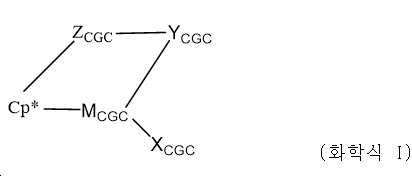
식 중 during the ceremony
MCGC는 원소 주기율표의 3~10족 금속 또는 란탄족 계열이고, Cp*는 η5 결합 방식으로 MCGC에 결합된 사이클로펜타다이엔일 또는 치환된 사이클로펜타다이엔일기이며,M CGC is a group 3-10 metal or lanthanide series of the Periodic Table of the Elements, Cp* is a cyclopentadienyl or substituted cyclopentadienyl group bonded to M CGC in an η5 bond,
ZCGC는 붕소 또는 원소 주기율표의 제14족의 구성원을 포함하는 모이어티이고,Z CGC is boron or a moiety comprising a member of group 14 of the Periodic Table of the Elements,
XCGC는 각각 독립적으로 최대 30개의 비수소 원자를 갖는 음이온성 리간드기 또는 중성 루이스 염기 리간드기이며, n은 0, 1, 2, 3 또는 4이고 MCGC의 원자가보다 2만큼 작고,X CGC is each independently an anionic ligand group having up to 30 non-hydrogen atoms or a neutral Lewis base ligand group, n is 0, 1, 2, 3 or 4 and is 2 less than the valence of M CGC ;
YCGC는 질소, 인, 산소 또는 황을 포함하고 최대 20개의 비수소 원자를 갖는 ZCGC 및 MCGC에 결합된 음이온성 또는 비음이온성 리간드기이다.Y CGC is an anionic or non-anionic ligand group bound to Z CGC and M CGC containing nitrogen, phosphorus, oxygen or sulfur and having up to 20 non-hydrogen atoms.
화학식(I)의 복합체는 양이온 형성 공촉매, 강한 루이스 산 또는 이들의 조합과 같은 하나 이상의 공촉매와의 조합에 의해 활성화될 수 있기 때문에 공촉매는 종종 활성화 공촉매라고 불린다. 적합한 공촉매는 알킬 알루미늄, 중합체 또는 올리고머 알루미녹세인뿐만 아니라 불활성, 상용성, 비배위성, 이온 형성 화합물을 포함할 수 있다. 중합체 또는 올리고머 알루목세인의 예는 메틸알루목세인, 트라이아이소뷰틸알루미늄-개질 메틸알루목세인 및 아이소뷰틸알루목세인을 포함할 수 있다. 하나 이상의 특정 구현예에서, 예시적인 적합한 공촉매는 이에 제한되지 않지만, 개질된 메틸 알루미녹세인(MMAO), 비스(수소화된 탤로(tallow) 알킬)메틸, 테트라키스(펜타플루오로페닐)보레이트(1-) 아민(RIBS-2) 또는 그 조합물을 포함할 수 있다.A cocatalyst is often referred to as an activating cocatalyst because the complex of formula (I) can be activated by combination with one or more cocatalysts, such as cation forming cocatalysts, strong Lewis acids, or combinations thereof. Suitable cocatalysts may include alkyl aluminum, polymeric or oligomeric aluminoxanes, as well as inert, compatible, non-coordinating, ion-forming compounds. Examples of polymeric or oligomeric alumoxanes may include methylalumoxane, triisobutylaluminum-modified methylalumoxane and isobutylalumoxane. In one or more specific embodiments, exemplary suitable cocatalysts include, but are not limited to, modified methyl aluminoxane (MMAO), bis(hydrogenated tallow alkyl)methyl, tetrakis(pentafluorophenyl)borate ( 1-) amine (RIBS-2) or a combination thereof.
CGC 촉매의 추가 세부 사항 및 예는 미국 특허 번호 제5,272,236호, 제5,278,272호, 제6,812,289호 및 제WO 93/08221호에 제공되며, 이들 모두는 전체가 본원에 참고로 포함된다.Additional details and examples of CGC catalysts are provided in US Pat. Nos. 5,272,236, 5,278,272, 6,812,289 and WO 93/08221, all of which are incorporated herein by reference in their entirety.
비스페닐 페놀(BPP) 촉매에 대해서도 다양한 구현예가 고려된다. CGC 촉매와 마찬가지로, BPP 촉매는 공촉매 및 활성화 공촉매뿐만 아니라 추가 선택적인 성분을 포함하는 다성분 촉매 시스템이다. BPP 전촉매는 하기 화학식 II에 나타낸 바와 같은 금속 복합체를 포함할 수 있다:Various embodiments are also contemplated for bisphenyl phenol (BPP) catalysts. Like CGC catalysts, BPP catalysts are multi-component catalyst systems comprising a cocatalyst and an activating cocatalyst as well as additional optional components. The BPP procatalyst may comprise a metal complex as shown in Formula II:
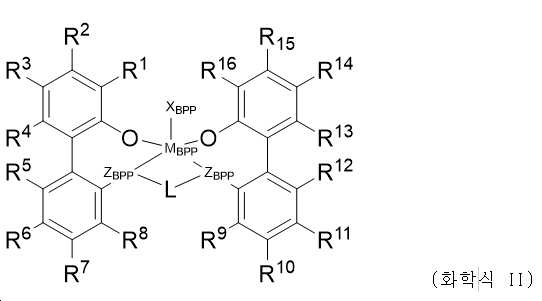
식 중, MBPP는 각각 독립적으로 +2, +3 또는 +4의 공식 산화 상태에 있는 타이타늄, 지르코늄 또는 하프늄이고; n은 0 내지 3의 정수이며, n이 0일 때 XBPP는 부재하고; 각각의 XBPP는 독립적으로 중성, 단일음이온성 또는 이음이온성(dianionic)의 한자리 리간드이며; 또는 2개의 XBPP는 함께 중성, 단일음이온성 또는 이음이온성의 두자리 리간드를 형성하며; XBPP 및 n은 화학식 (I)의 금속-리간드 복합체가 전반적으로 중성인 방식으로 선택되며; 각각의 Z는 독립적으로 ZBPP는 O, S, N(C1-C40)하이드로카빌, 또는 P(C1-C40)하이드로카빌이고; L은 (C2-C40)하이드로카빌렌 또는 (C2-C40)헤테로하이드로카빌렌이며, 여기서 (C2-C40)하이드로카빌렌은 (L이 결합된) 화학식(I)에서 Z 원자를 연결하는 2-탄소 원자 내지 10-탄소 원자 링커 골격을 포함하고는 부분을 가지고, (C2-C40) 헤테로하이드로카빌렌은 화학식(I)에서 Z 원자를 연결하는 3-탄소 원자 내지 10-탄소 원자 링커 골격을 포함하는 부분을 가지며, 여기서 (C2-C40)헤테로하이드로카빌렌의 3-원자 링커 내지 10-원자 링커의 3 내지 10개의 원자 각각은 독립적으로 탄소 원자 또는 헤테로원자이며, 여기서 각각의 헤테로 원자는 독립적으로 O, S, S (O), S(O)2, Si(RC)2, Ge(RC)2, P(RP), 또는 N(RN)이고, 독립적으로 각각의 RC는 (C1-C40)하이드로카빌로 이루어진 군에서 선택되며, 각각의 RP는 (C1-C40)하이드로카빌이고, 각각의 RN은 (C1-C40)하이드로카빌이거나 부재하며; R1-16은 각각 독립적으로 (C1-C40)하이드로카빌, (C1-C40)헤테로하이드로카빌, Si(RC)3, Ge(RC)3, P(RP)2, N(RN)2, ORC, SRC, NO2, CN, CF3, RCS(O)-, RCS(O)2-, (RC)2C=N-, RCC(O)O-, RCOC(O)-, RCC(O)N(R)-, (RC)2NC(O)-, 할로젠 원자, 수소 원자, 및 이들의 조합물로 이루어진 군에서 선택된다.wherein M BPP is each independently titanium, zirconium, or hafnium in a formal oxidation state of +2, +3 or +4; n is an integer from 0 to 3, wherein when n is 0, X BPP is absent; each X BPP is independently a monodentate ligand, neutral, monoanionic or dianionic; or two X BPPs together form a bidentate ligand of neutral, monoanionic or dianionic nature; X BPP and n are selected in such a way that the metal-ligand complex of formula (I) is generally neutral; each Z is independently Z BPP is O, S, N(C 1 -C 40 )hydrocarbyl, or P(C 1 -C 40 )hydrocarbyl; L is (C 2 -C 40 )hydrocarbylene or (C 2 -C 40 )heterohydrocarbylene, wherein (C 2 -C 40 )hydrocarbylene is Z in formula (I) to which (L is attached) Has a moiety comprising a linker skeleton of 2-carbon atoms to 10-carbon atoms connecting atoms, (C 2 -C 40 ) heterohydrocarbylene is a 3-carbon atom connecting atoms to Z in formula (I) a moiety comprising a 10-carbon atom linker backbone, wherein each of 3 to 10 atoms of the 3-membered linker of (C 2 -C 40 )heterohydrocarbylene to the 10-membered linker is independently a carbon atom or a heteroatom wherein each heteroatom is independently O, S, S (O), S(O) 2 , Si( RC ) 2 , Ge( RC ) 2 , P (RP ), or N(R N ) ), independently each R C is selected from the group consisting of (C 1 -C 40 )hydrocarbyl, each R P is (C 1 -C 40 )hydrocarbyl, and each R N is (C 1 -C 40 )hydrocarbyl or absent; R 1-16 are each independently (C 1 -C 40 )hydrocarbyl, (C 1 -C 40 )heterohydrocarbyl, Si(R C ) 3 , Ge(R C ) 3 , P(R P ) 2 , N(R N ) 2 , OR C , SR C , NO 2 , CN, CF 3 , R C S(O)-, R C S(O) 2 -, (R C ) 2 C=N-, R C C(O)O-, R C OC(O)-, R C C(O)N(R)-, (R C ) 2 NC(O)-, halogen atom, hydrogen atom, and combinations thereof is selected from the group consisting of
추가 구현예에서, R1~R16 부위 중 적어도 하나는 Si(Y1)(Y2)(Y3)기로 치환될 수 있고, Y1은 (C3-C40)하이드로카빌 또는 (C2-C40)헤테로하이드로카빌이며, Y2는 (C1-C40)하이드로카빌 또는 (C1-C40)헤테로하이드로카빌이고, Y3는 (C1-C40)하이드로카빌 또는 (C1-C40)헤테로하이드로카빌이며, 추가로, Y1, Y2 및 Y3가 모두 아이소프로필기는 아니며; 하이드로카빌, 헤테로하이드로카빌, Si(RC)3, Ge(RC)3, P(RP)2, N(RN)2, ORC, SRC, RCS(O)-, RCS(O)2-, (RC)2C=N-, RCC(O)O-, RCOC(O)-, RCC(O)N(R)-, (RC)2NC(O)-, 하이드로카빌렌 및 헤테로하이드로카빌렌기 각각은 독립적으로 하나 이상의 RS 치환기로 치환되거나 치환되지 않고, 각각의 RS는 독립적으로 할로젠 원자, 폴리플루오로 치환, 퍼플루오로 치환, 비치환 (C1-C18)알킬, F3C-, FCH2O-, F2HCO-, F3CO-, R3Si-, R3Ge-, RO-, RS-, RS(O)-, RS(O)2-, R2P-, R2N-, R2C=N-, NC-, RC(O)O-, ROC(O)-, RC(O)N(R)-, 또는 R2NC(O)-이거나, 2개의 RS를 함께 취해 비치환 (C1-C18)하이드로카빌렌을 형성하며, 각각의 R은 독립적으로 비치환 (C1-C18)하이드로카빌이다.In a further embodiment, at least one of the R 1 -R 16 moieties may be substituted with a Si(Y 1 )(Y 2 )(Y 3 ) group, and Y 1 is (C 3 -C 40 )hydrocarbyl or (C 2 ) -C 40 )heterohydrocarbyl, Y 2 is (C 1 -C 40 )hydrocarbyl or (C 1 -C 40 )heterohydrocarbyl, Y 3 is (C 1 -C 40 )hydrocarbyl or (C 1 ) -C 40 )heterohydrocarbyl, and further, Y 1 , Y 2 and Y 3 are not all isopropyl groups; Hydrocarbyl, heterohydrocarbyl, Si(RC)3, Ge(RC)3, P(RP)2, N(RN)2, ORC, SRC, RCS(O)-, RCS(O)2-, (RC )2C=N-, RCC(O)O-, RCOC(O)-, RCC(O)N(R)-, (RC)2NC(O)-, hydrocarbylene and heterohydrocarbylene groups each independently substituted or unsubstituted with one or more R S substituents, each R S is independently a halogen atom, polyfluoro substituted, perfluoro substituted, unsubstituted (C 1 -C 18 )alkyl, F3C-, FCH2O-, F 2 HCO-, F3CO-, R 3 Si-, R 3 Ge-, RO-, RS-, RS(O)-, RS(O) 2 -, R 2 P-, R 2 N-, R 2 C =N-, NC-, RC(O)O-, ROC(O)-, RC(O)N(R)-, or R 2 NC(O)-, or by taking two R S together, unsubstituted ( form C 1 -C 18 )hydrocarbylene, and each R is independently unsubstituted (C 1 -C 18 )hydrocarbyl.
혼합 촉매 시스템 내에서, BPP 촉매는 CGC와 동일한 공촉매 또는 상이한 공촉매를 포함할 수 있다. 적합한 BPP 공촉매는 상기 제공된 공촉매 목록에서 선택될 수 있다.In a mixed catalyst system, the BPP catalyst may comprise the same co-catalyst as the CGC or a different co-catalyst. A suitable BPP cocatalyst may be selected from the list of cocatalysts provided above.
BPP 촉매의 추가 세부 사항 및 예는 미국 공개 번호 제2015/0344602호, 제2015/0337063호 및 제2015/0337062호뿐만 아니라 미국 특허 제9,000,108호에 제공되며, 이들 모두는 전체가 본원에 참조로서 포함된다.Additional details and examples of BPP catalysts are provided in US Publication Nos. 2015/0344602, 2015/0337063, and 2015/0337062, as well as US Pat. No. 9,000,108, all of which are incorporated herein by reference in their entirety. do.
열가소성 올레핀Thermoplastic Olefins
전술한 바와 같이, 본 발명의 다중모드 엘라스토머는 충격 보강제로서 열가소성 올레핀(TPO)에 혼입된다. 본 개시에 따르면, TPO는 다중모드 엘라스토머, 폴리프로필렌, 및 선택적인 부가 구현예 예를 들어 추가 엘라스토머, 블록 복합체, 충진제 또는 조합물을 포함한다.As noted above, the multimodal elastomer of the present invention is incorporated into a thermoplastic olefin (TPO) as an impact modifier. According to the present disclosure, the TPO comprises a multimodal elastomer, polypropylene, and optional additional embodiments such as additional elastomers, block composites, fillers or combinations.
TPO 내의 다중모드 엘라스토머에 있어서 다양한 양이 고려된다. 하나 이상의 구현예에서, TPO는 TPO 조성물의 총 중량을 기준으로 다중모드 엘라스토머의 10 내지 40 중량%, 또는 15 내지 30 중량%, 또는 16 내지 27 중량%, 또는 18 내지 25 중량%를 포함할 수 있다.Various amounts are contemplated for multimodal elastomers in TPO. In one or more embodiments, the TPO may comprise from 10 to 40% by weight, alternatively from 15 to 30% by weight, alternatively from 16 to 27% by weight, alternatively from 18 to 25% by weight of the multimodal elastomer, based on the total weight of the TPO composition. have.
폴리프로필렌polypropylene
TPO의 폴리프로필렌은 다중모드 엘라스토머 조성물과의 혼합을 통해 강화된 매트릭스 폴리머이다. 다양한 폴리프로필렌 조성물이 적합하다고 여겨진다. 폴리프로필렌 중합체 염기는 단일중합체 폴리프로필렌의 아이소택틱 형태의 폴리프로필렌을 포함할 수 있고/있거나 다른 형태의 폴리프로필렌(예컨대, 신다이오택틱(syndiotactic) 또는 어택틱(atactic))이 또한 사용될 수 있다. 프로필렌 중합체 염기는 랜덤 공중합체 폴리프로필렌의 총 중량을 기준으로 0.5 중량% 내지 5.0 중량%의 에틸렌 함량을 갖는 랜덤 공중합체 폴리프로필렌을 포함할 수 있다. 프로필렌 중합체 염기는 프로필렌 중합체 염기의 총 중량을 기준으로 95 중량% 내지 100 중량%의 랜덤 공중합체 폴리프로필렌을 포함할 수 있다. 폴리프로필렌 중합체 염기는 프로필렌에 분산된 고무상을 포함하는 충격 공중합체를 포함할 수 있다. 사용된 폴리프로필렌의 분자량 및 이에 따른 용융 유속은 용도에 따라 다를 수 있다. 다양한 폴리프로필렌 중합체의 논의는 예컨대, 문헌 [Modern Plastics Encyclopedia/89, mid October 1988 Issue, Volume 65, Number 11, pp. 86-92]에 기재되어 있다.Polypropylene of TPO is a matrix polymer reinforced through mixing with a multimodal elastomeric composition. A variety of polypropylene compositions are believed to be suitable. The polypropylene polymer base may include polypropylene in the isotactic form of homopolymer polypropylene and/or other forms of polypropylene (eg, syndiotactic or atactic) may also be used. . The propylene polymer base may comprise a random copolymer polypropylene having an ethylene content of 0.5% to 5.0% by weight, based on the total weight of the random copolymer polypropylene. The propylene polymer base may comprise 95% to 100% by weight of the random copolymer polypropylene, based on the total weight of the propylene polymer base. The polypropylene polymer base may comprise an impact copolymer comprising a rubber phase dispersed in propylene. The molecular weight of the polypropylene used and thus the melt flow rate may vary depending on the application. A discussion of various polypropylene polymers can be found, for example, in Modern Plastics Encyclopedia/89, mid October 1988 Issue, Volume 65, Number 11, pp. 86-92].
프로필렌 중합체 염기는 내부에 정화제 및/또는 핵 형성제를 포함할 수 있다. 예를 들어, 정화제 및/또는 핵 형성제는 용융 상태에서 폴리프로필렌 사슬이 결정화되고 응집되는 방식을 변경시킬 수 있다. 이들 제제는 결정화 개시 온도를 증가시킬 수 있다. 정화제(또는 청징제)는 일반적으로 유기, 비-중합체 분자이다. 정화제는 또한 일반적으로 핵 형성제로서 작용할 수 있지만, 핵 형성제는 반드시 정화제인 것은 아니다. 예시적인 정화제는 다이벤질리덴 소비톨의 화학적 유도체이고 폴리프로필렌 수지의 프로세싱 윈도우(processing window)내에서 용융 온도를 갖는다. 핵 형성제는 일반적으로 작은 평균 입자 크기 및 높은 융점을 갖는 무기 물질이다. 핵 형성된 수지가 압출기에서 용융될 때, 핵 형성제는 전형적으로 고체 상태로 유지될 수 있으며, 폴리프로필렌 구립형이 주위에서 형성될 수 있는 부위를 제공할 수 있다. 예시적인 핵 형성제는 벤조산의 화학적 유도체이다. 예를 들어, 핵 형성제는 나트륨 벤조에이트, 카올린 및/또는 활석일 수 있다.The propylene polymer base may include purifying and/or nucleating agents therein. For example, purifying and/or nucleating agents can alter the way polypropylene chains crystallize and aggregate in the molten state. These agents can increase the crystallization initiation temperature. Purifiers (or clarifiers) are generally organic, non-polymeric molecules. A purifying agent may also generally act as a nucleating agent, although the nucleating agent is not necessarily a purifying agent. An exemplary purifying agent is a chemical derivative of dibenzylidene sorbitol and has a melting temperature within the processing window of the polypropylene resin. Nucleating agents are generally inorganic materials with a small average particle size and a high melting point. When the nucleated resin is melted in the extruder, the nucleating agent can typically remain in a solid state and provide sites around which polypropylene spheroids can form. Exemplary nucleating agents are chemical derivatives of benzoic acid. For example, the nucleating agent may be sodium benzoate, kaolin and/or talc.
특정 TPO 구현예는 하기에 상세히 설명되는 바와 같이 폴리프로필렌 및 블럭 복합 상용화제와 혼합된 다중모드 엘라스토머를 포함할 수 있다. 이러한 구현예에서, 폴리프로필렌은 단독중합체 폴리프로필렌의 아이소택틱 형태일 수 있지만, 다른 형태의 폴리프로필렌(예컨대, 신다이오택틱 또는 어택틱)도 사용될 수 있다. 그러나, 폴리프로필렌 충격 공중합체(예컨대, 에틸렌을 프로필렌과 반응시키는 2차 공중합 단계가 사용되는 공중합체) 및 (또한 반응기가 개질되고 보통 프로필렌과 공중합된 에틸렌을 함유하는) 랜덤 공중합체가 본원에 개시된 TPO 제제에 사용될 수 있다. 다양한 폴리프로필렌 중합체에 대한 완전한 논의는 문헌 [Modern Plastics Encyclopedia/89, mid October 1988 Issue, Volume 65, Number 11, pp. 86-92]에 기재되어 있으며, 그 전체 개시가 본원에 참조로서 포함된다.Certain TPO embodiments may include a multimodal elastomer mixed with polypropylene and a block composite compatibilizer, as detailed below. In this embodiment, the polypropylene may be the isotactic form of the homopolymer polypropylene, although other forms of polypropylene (eg, syndiotactic or atactic) may also be used. However, polypropylene impact copolymers (e.g., copolymers in which a secondary copolymerization step of reacting ethylene with propylene is used) and random copolymers (which also contain ethylene copolymerized with propylene and modified reactive groups) are disclosed herein. It can be used in TPO formulations. A complete discussion of the various polypropylene polymers can be found in Modern Plastics Encyclopedia/89, mid October 1988 Issue, Volume 65, Number 11, pp. 86-92, the entire disclosure of which is incorporated herein by reference.
본 개시에 사용되는 폴리프로필렌의 분자량 및 이에 따른 용융 유속은 용도에 따라 다르다. 본원에서 유용한 폴리프로필렌에 대한 용융 유속(MFR)은 ASTM D1238에 따라 230℃, 2.16kg의 하중에서 측정될 때, 일반적으로 약 0.1 g/10분 (g/10 분) 내지 약 200 g/10분, 바람직하게는 약 0.5 g/10분 내지 약 150 g/10분, 특히 약 4 g/10분 내지 약 100 g/10분이다. 전술한 바와 같이, 프로필렌 중합체는 폴리프로필렌 단일중합체일 수 있거나, 랜덤 공중합체 또는 심지어 (이미 고무상을 함유하는) 충격 공중합체일 수 있다. 충격 공중합체의 예는 LyondellBasell Industries의 Pro-fax SD242 또는 SK Global Chemical의 YUPLENE BX3900을 포함한다. 적합한 단일중합체의 예는 Braskem의 H734-52RNA 또는 LyondellBasell Industries의 Adstif HA801U를 포함한다. 랜덤 공중합체의 예는 Braskem의 6D43을 포함하며, 적합한 랜덤 프로필렌-에틸렌 플라스토머 및 엘라스토머는 VISTAMAXX™(ExxonMobil 제조) 및 Midland, MI 소재의 The Dow Chemical Co.의 VERSIFY™을 포함할 수 있다.The molecular weight of the polypropylene used in the present disclosure and hence the melt flow rate depends on the application. Melt flow rate (MFR) for polypropylene useful herein is generally from about 0.1 g/10 min (g/10 min) to about 200 g/10 min, as measured at 230° C. and a load of 2.16 kg according to ASTM D1238. , preferably from about 0.5 g/10 min to about 150 g/10 min, especially from about 4 g/10 min to about 100 g/10 min. As mentioned above, the propylene polymer may be a polypropylene homopolymer, or it may be a random copolymer or even an impact copolymer (which already contains a rubber phase). Examples of impact copolymers include Pro-fax SD242 from LyondellBasell Industries or YUPLENE BX3900 from SK Global Chemical. Examples of suitable homopolymers include H734-52RNA from Braskem or Adstif HA801U from LyondellBasell Industries. Examples of random copolymers include 6D43 from Braskem, and suitable random propylene-ethylene plastomers and elastomers may include VISTAMAXX™ (manufactured by ExxonMobil) and VERSIFY™ from The Dow Chemical Co., Midland, MI.
TPO 중에 다양한 양의 폴리프로필렌이 고려된다. 예를 들어, TPO는 30 내지 85 중량%, 또는 40 내지 85 중량%, 또는 50 내지 85 중량%, 또는 50 내지 80 중량%를 포함할 수 있다.Various amounts of polypropylene are contemplated among the TPO. For example, the TPO may comprise from 30 to 85% by weight, alternatively from 40 to 85% by weight, alternatively from 50 to 85% by weight, alternatively from 50 to 80% by weight.
블록 복합체 상용화제Block Composite Compatibilizer
TPO의 제조에서, 블록 복합체 또는 블록 복합체 상용화제를 사용하여 다중모드 엘라스토머, 폴리프로필렌 및 기타 선택적 성분(예컨대, 추가 엘라스토머)을 화합시킨다. 블록 복합체는 폴리프로필렌 매트릭스에서 다중모드 엘라스토머의 분산을 향상시킬 수 있다.In the preparation of TPO, a block composite or block composite compatibilizer is used to compound the multimodal elastomer, polypropylene and other optional components (eg, additional elastomers). The block composite can improve the dispersion of the multimodal elastomer in the polypropylene matrix.
"블록 공중합체" 또는 "분절된 공중합체"라는 용어는 펜던트 또는 그라프트 방식보다는 선형 방식으로 접합된 두 개 이상의 화학적으로 구별되는 영역 또는 분절("블록"이라 지칭됨)을 포함하는 중합체, 즉 중합된 작용성과 관련하여 말단-대-말단으로 접합된(공유 결합된) 화학적으로 분화된 단위를 포함하는 중합체를 지칭한다. 하나의 구현예에서, 블록은 그 안에 혼입된 공단량체의 양 또는 유형, 밀도, 결정화도의 양, 결정화도의 유형(예컨대, 폴리에틸렌 대 폴리프로필렌), 이러한 조성물의 중합체에 기인한 결정 크기, 입체 규칙성의 유형 또는 정도(아이소택틱 또는 신다이오택틱), 위치-규칙성 또는 위치-불규칙성, 장쇄 분지 또는 하이퍼-분지를 포함하는 분지의 양, 동종성, 또는 임의의 다른 화학적 또는 물리적 성질에 따라 다르다. 본 개시의 블록 공중합체는 바람직한 구현예에서 촉매와 조합된 셔틀링제(들)의 효과에 기인한 중합체 다분산도(PDI 또는 Mw/Mn) 및 블록 길이 분포의 독특한 분포를 특징으로 한다.The term "block copolymer" or "segmented copolymer" refers to a polymer comprising two or more chemically distinct regions or segments (referred to as "blocks") joined in a linear rather than pendant or graft manner, i.e. Refers to a polymer comprising chemically differentiated units joined (covalently linked) end-to-end with respect to polymerized functionality. In one embodiment, the block contains the amount or type of comonomer incorporated therein; type or degree (isotactic or syndiotactic), regio-regularity or regio-regularity, amount of branching, including long chain branching or hyper-branching, homogeneity, or any other chemical or physical property. The block copolymers of the present disclosure are characterized in a preferred embodiment by a unique distribution of polymer polydispersity (PDI or Mw/Mn) and block length distribution due to the effect of the shuttling agent(s) in combination with the catalyst.
"블록 복합체(BC)"라는 용어는 연질 공중합체, 경질 공중합체 및 블록 공중합체, 예를 들어 즉, 연질 분절 및 경질 분절을 갖는 다이블록을 포함하는 중합체를 지칭하되, 블록 공중합체의 경질 분절은 블록 복합체의 경질 공중합체와 본질적으로 동일한 조성이고 블록 공중합체의 연질 분절은 블록 복합체의 연질 공중합체와 본질적으로 동일한 조성이다. 블록 공중합체는 선형 또는 분지형일 수 있다.The term "block composite (BC)" refers to soft copolymers, hard copolymers and block copolymers, i.e., polymers comprising soft segments and diblocks having hard segments, wherein the hard segments of the block copolymer The silver is of essentially the same composition as the hard copolymer of the block composite and the soft segments of the block copolymer are of essentially the same composition as the soft copolymer of the block composite. Block copolymers may be linear or branched.
"경질" 분절은 단량체가 90 mol% 초과, 바람직하게는 93 mol% 초과, 보다 바람직하게는 95 mol% 초과, 가장 바람직하게는 98 mol% 초과의 양으로 존재하는 중합 단위의 고결정질 블록을 지칭한다. 즉, 경질 분절내의 공단량체 함량은 가장 바람직하게는 2 mol% 미만, 보다 바람직하게는 5 mol% 미만, 바람직하게는 7 mol% 미만 및 10 mol% 미만이다. 일부 구현예에서, 경질 분절은 전체 또는 실질적으로 모든 단량체(예컨대, 프로필렌 단위)를 포함한다."Hard" segments refer to highly crystalline blocks of polymerized units wherein the monomer is present in an amount greater than 90 mol %, preferably greater than 93 mol %, more preferably greater than 95 mol % and most preferably greater than 98 mol % do. That is, the comonomer content in the hard segment is most preferably less than 2 mol%, more preferably less than 5 mol%, preferably less than 7 mol% and less than 10 mol%. In some embodiments, the hard segment comprises all or substantially all monomers (eg, propylene units).
한편, "연질" 분절은 공단량체 함량이 10 mol% 초과 및 90 mol% 미만, 바람직하게는 20 mol% 초과 및 80 mol% 미만, 가장 바람직하게는 33 mol% 초과 및 75 mol% 미만인 중합 단위의 무정형, 실질적으로 무정형 또는 엘라스토머성 블록을 지칭한다.On the other hand, the "soft" segment is a polymerized unit having a comonomer content of more than 10 mol% and less than 90 mol%, preferably more than 20 mol% and less than 80 mol%, most preferably more than 33 mol% and less than 75 mol%. refers to an amorphous, substantially amorphous or elastomeric block.
단량체 및 블록 복합체의 부가 공단량체에 대해 다양한 올레핀이 고려된다. 하나의 구현예에서, 단량체는 프로필렌이고 부가 공단량체는 에틸렌이다.Various olefins are contemplated for addition comonomers of the monomer and block complexes. In one embodiment, the monomer is propylene and the addition comonomer is ethylene.
특히, 공단량체가 에틸렌인 경우에는 바람직하게는 10 mol% 내지 90 mol%, 보다 바람직하게는 20 mol% 내지 80 mol%, 가장 바람직하게는 33 mol% 내지 75 mol%의 양으로 존재한다. 바람직하게는, 공중합체는 90 mol% 내지 100 mol%의 프로필렌인 경질 분절을 포함한다. 경질 분절은 90 mol% 초과, 바람직하게는 93 mol% 초과, 보다 바람직하게는 95 mol% 초과 프로필렌, 가장 바람직하게는 98 mol% 초과 프로필렌일 수 있다. 이러한 경질 분절은 80℃ 초과, 또는 100℃ 초과, 또는 115℃ 초과, 또는 120℃ 초과인 해당 융점(Tm)을 갖는다. 또한, 블록 복합체는 바람직하게는 100℃ 초과, 바람직하게는 120℃ 초과, 더욱 바람직하게는 125℃ 초과인 Tm을 갖는다. 바람직하게는, 블록 복합체의 MFR은 0.1 내지 1000 dg/분, 보다 바람직하게는 0.1 내지 50 dg/분, 보다 바람직하게는 0.1 내지 30 dg/분이다. 또한, 본 개시의 구현예의 블록 복합체는 10,000 내지 약 2,500,000, 바람직하게는 35,000 내지 1,000,000, 보다 바람직하게는 50,000 내지 300,000, 바람직하게는 50,000 내지 200,000의 중량 평균 분자량(Mw)을 갖는다.In particular, when the comonomer is ethylene, it is preferably present in an amount of from 10 mol% to 90 mol%, more preferably from 20 mol% to 80 mol%, most preferably from 33 mol% to 75 mol%. Preferably, the copolymer comprises a hard segment that is from 90 mol% to 100 mol% propylene. The hard segment may be greater than 90 mol%, preferably greater than 93 mol%, more preferably greater than 95 mol% propylene and most preferably greater than 98 mol% propylene. Such hard segments have a corresponding melting point (T m ) that is greater than 80°C, or greater than 100°C, or greater than 115°C, or greater than 120°C. In addition, the block composite preferably has a T m greater than 100° C., preferably greater than 120° C., more preferably greater than 125° C. Preferably, the MFR of the block composite is 0.1 to 1000 dg/min, more preferably 0.1 to 50 dg/min, more preferably 0.1 to 30 dg/min. In addition, the block composite of an embodiment of the present disclosure has a weight average molecular weight (Mw) of 10,000 to about 2,500,000, preferably 35,000 to 1,000,000, more preferably 50,000 to 300,000, preferably 50,000 to 200,000.
본 발명의 블록 복합체 중합체는 종래의 랜덤 공중합체, 중합체의 물리적 혼합 및 순차적인 단량체 첨가를 통해 제조된 블록 공중합체와 구별될 수 있다. 블록 복합체는 1) 후술하는 바와 같이, 비슷한 함량의 공단량체에 대한 더 높은 용융 온도, 블록 지수 및 블록 복합체 지수와 같은 특성에 의해 랜덤 공중합체와 구별되고, 2) 블록 지수, 블록 복합체 지수, 보다 우수한 인장 강도, 개선된 파단 강도, 보다 미세한 형태, 개선된 광학 및 저온에서 보다 큰 충격 강도와 같은 특성에 의해 물리적 혼합과 구별되며, 3) 분자량 분포, 레올로지, 전단 박화, 레올로지 비율 및 블록 다분산도 존재에 의해 순차적 단량체 첨가에 의해 제조된 블록 공중합체와 구별될 수 있다.The block composite polymer of the present invention can be distinguished from a conventional random copolymer, a block copolymer prepared through physical mixing of the polymer and sequential monomer addition. Block composites are distinguished from random copolymers by 1) properties such as higher melting temperature, block index, and block composite index for a similar content of comonomer, as described below, and 2) block index, block composite index, and It is distinguished from physical mixing by properties such as superior tensile strength, improved breaking strength, finer morphology, improved optics and greater impact strength at low temperature, 3) molecular weight distribution, rheology, shear thinning, rheological ratio and block It can be distinguished from block copolymers prepared by sequential monomer addition by the presence of polydispersity.
블록 복합체는 블록 복합체 지수(BCI)에 의해 정의될 수 있다. BCI란 용어는 본원에서 블록 공중합체의 중량 백분율을 100%로 나눈 값(즉, 중량 분율)과 동일하게 정의된다. 블록 복합체 지수의 값은 0 내지 최대 1.0까지의 범위일 수 있는데, 1.0은 블록 공중합체의 100%와 같고, 0은 전통적인 혼합 또는 랜덤 공중합체와 같은 재료에 대한 값일 것이다. 달리 말하면, 불용성 분획물의 경우 BCI는 1.000이고, 가용성 분획물의 경우 BCI는 0의 값으로 지정된다. 하나 이상의 구현예에서, BCI는 약 0.4 미만 또는 약 0.1 내지 약 0.3일 수 있다. 다른 구현예에서, BCI는 약 0.4 초과 내지 약 1.0 이하이다. 또한, BCI는 약 0.4 내지 약 0.7, 약 0.5 내지 약 0.7, 또는 약 0.6 내지 약 0.9의 범위에 있을 수 있다. 일부 구현예에서, BCI는 약 0.3 내지 약 0.9, 약 0.3 내지 약 0.8, 또는 약 0.3 내지 약 0.7, 약 0.3 내지 약 0.6, 약 0.3 내지 약 0.5, 또는 약 0.3 약 0.4, 또는 약 0.4 내지 약 0.5의 범위에 있다. 다른 구현예에서, BCI는 약 0.4 내지 약 1.0, 약 0.5 내지 약 1.0, 또는 약 0.6 내지 약 1.0, 약 0.7 내지 약 1.0, 약 0.8 내지 약 1.0, 또는 약 0.9 내지 1.0의 범위에 있다.A block composite may be defined by a block composite index (BCI). The term BCI is defined herein equal to the weight percentage of the block copolymer divided by 100% (ie, weight fraction). The value of the block composite index can range from 0 to a maximum of 1.0, where 1.0 is equal to 100% of the block copolymer, and 0 will be the value for materials such as traditional mixed or random copolymers. In other words, for the insoluble fraction, the BCI is 1.000, and for the soluble fraction, the BCI is assigned a value of zero. In one or more embodiments, the BCI may be less than about 0.4 or from about 0.1 to about 0.3. In other embodiments, the BCI is greater than about 0.4 and less than or equal to about 1.0. Further, the BCI may range from about 0.4 to about 0.7, from about 0.5 to about 0.7, or from about 0.6 to about 0.9. In some embodiments, the BCI is about 0.3 to about 0.9, about 0.3 to about 0.8, or about 0.3 to about 0.7, about 0.3 to about 0.6, about 0.3 to about 0.5, or about 0.3 about 0.4, or about 0.4 to about 0.5 is in the range of In other embodiments, the BCI ranges from about 0.4 to about 1.0, from about 0.5 to about 1.0, or from about 0.6 to about 1.0, from about 0.7 to about 1.0, from about 0.8 to about 1.0, or from about 0.9 to 1.0.
특히, BCI는 중합체가 단순히 iPP 단일중합체(즉, 경질 분절)와 에틸렌-프로필렌(EP) 공중합체(즉, 연질 분절)의 혼합인 경우에, 달리 존재하지 않을 상당한 양의 에틸렌을 불용성 분획물이 함유한다는 것을 나타내는 것에 기초한다. 이 "여분의 에틸렌"을 고려하기 위해, 질량 균형 계산을 수행하여 자일렌 불용성 및 가용성 분획물의 양 및 각 분획물에 존재하는 에틸렌의 중량%로 블록 복합체 지수를 추정할 수 있다. 이 "여분의 에틸렌"을 고려하기 위해, 질량 균형 계산을 수행하여 자일렌 불용성 및 가용성 분획물의 양 및 각 분획물에 존재하는 에틸렌의 중량%로 블록 복합체 지수를 추정할 수 있다.In particular, BCI indicates that the insoluble fraction contains significant amounts of ethylene that would not otherwise be present if the polymer was simply a mixture of an iPP homopolymer (i.e. hard segment) and an ethylene-propylene (EP) copolymer (i.e. soft segment). It is based on indicating that To account for this "extra ethylene", a mass balance calculation can be performed to estimate the block composite index in terms of the amount of xylene insoluble and soluble fractions and the weight percent of ethylene present in each fraction. To account for this "extra ethylene", a mass balance calculation can be performed to estimate the block composite index in terms of the amount of xylene insoluble and soluble fractions and the weight percent of ethylene present in each fraction.
수식 1에 따른 각각의 분획물에서의 에틸렌의 중량%의 합은 (중합체 중) 에틸렌의 전체 중량%이다. 이 질량 균형 수식은 또한 이원 혼합에서 각 성분의 양을 정량화하거나 삼원 또는 n-원 혼합으로 확장하는 데에도 사용될 수 있다.The sum of the weight percent of ethylene in each fraction according to

수식 2 내지 4를 적용하면, 불용성 분획물에 존재하는 (여분의 에틸렌의 공급원을 제공하는) 연질 블록의 양이 계산된다. 수식 2의 좌변에 불용성 분획물의 C2의 중량%를 대입하여, IPP 경질 분절의 중량% 및 EP 연질 분절의 중량%가 수식 3 및 4를 이용하여 계산될 수 있다. EP 연질에서 에틸렌의 중량%는 자일렌 가용성 분획물 중의 에틸렌의 중량%와 동일하게 설정됨을 유의한다. iPP 블록 중의 에틸렌의 중량%는 0으로 설정되거나 DSC 융점 또는 다른 조성 측정에서 달리 알려진 경우 그 값을 그 자리에 넣을 수 있다.Applying

불용성 분획물에 EP 공중합체가 존재하는 유일한 방법인, 불용성 분획물에 존재하는 "여분의 에틸렌"을 고려한 후, EP 중합체 사슬은 iPP 중합체 블록에 연결되어야 한다(그렇지 않으면 그것은 자일렌 가용성 분획물로 추출되었을 것이다). 따라서, iPP 블록이 결정화되면, EP 블록이 가용화되는 것을 방지하고/하거나 그 가능성이 감소될 수 있다.After taking into account the "extra ethylene" present in the insoluble fraction, which is the only way EP copolymer is present in the insoluble fraction, the EP polymer chain must be linked to the iPP polymer block (otherwise it would have been extracted into the xylene soluble fraction). ). Thus, if the iPP block is crystallized, the EP block may be prevented from becoming solubilized and/or the likelihood thereof may be reduced.
BCI를 추정하려면 각 블록의 상대적 양을 고려해야 한다. 이의 근사값을 구하기 위해 EP 연질과 iPP 경질 사이의 비율이 사용된다. EP 연질 중합체 및 iPP 경질 중합체의 비율은 중합체에서 측정된 총 에틸렌의 질량 균형에서 수식 2를 사용하여 계산될 수 있다. 대안으로, 이는 중합 도중 소비되는 단량체 및 공단량체의 질량 균형에서도 추정될 수 있다. iPP 경질의 중량 분율 및 EP 연질의 중량 분율은 수식 2를 사용하여 계산되며, iPP 경질은 에틸렌을 함유하지 않는다고 가정한다. EP 연질의 에틸렌의 중량%는 자일렌 가용성 분획물에 존재하는 에틸렌의 양이다.To estimate the BCI, we need to consider the relative amount of each block. To approximate this, the ratio between EP soft and iPP hard is used. The ratio of EP soft polymer and iPP hard polymer can be calculated using
예를 들면, iPP-EP 중합체가 47 중량% C2 전체를 포함하고, 67 중량% C2와 에틸렌을 함유하지 않는 iPP 단일중합체로 EP 연질 중합체를 제조하는 조건하에서 제조되는 경우, EP 연질 및 iPP 경질의 양은 각각 70 중량% 및 30 중량%이다. EP의 비율이 70 중량%이고 iPP가 30 중량%인 경우, EP:iPP 블록의 상대적인 비는 2.33:1로 나타낼 수 있다. 따라서, 당업자가 중합체의 자일렌 추출을 수행하고 40 중량%의 불용성 및 60 중량%의 가용성을 회수하는 경우, 이는 예상치 못한 결과일 것이며, 블록 공중합체의 분획물이 존재했다는 결론에 이르게 할 것이다. 불용성 분획물의 에틸렌 함량이 25 중량%의 C2로 이어서 측정되는 경우, 이러한 부가 에틸렌을 고려하기 위해 수식 2 내지 4를 계산할 수 있고, 그 결과 37.3 중량%의 EP 연질 중합체와 62.7 중량%의 iPP 경질 중합체가 불용성 분획물에 존재한다.For example, if the iPP-EP polymer is prepared under conditions to make the EP soft polymer with an iPP homopolymer comprising all 47 wt % C 2 and 67 wt % C 2 and no ethylene, EP soft and iPP The amount of hard is 70% by weight and 30% by weight, respectively. When the ratio of EP is 70% by weight and iPP is 30% by weight, the relative ratio of EP:iPP blocks can be expressed as 2.33:1. Thus, if one of ordinary skill in the art performed a xylene extraction of the polymer and recovered 40% by weight insoluble and 60% by weight soluble, this would be an unexpected result and lead to the conclusion that a fraction of block copolymer was present. If the ethylene content of the insoluble fraction is then measured as 25 wt % C 2 ,
경질 및 연질 블록의 조성을 추정하는 데 사용되는 분석 측정에서의 오차 및 총 폴리머 조성으로 이루어진 추정치에 따라, 5 내지 10%의 상대 오차가 블록 복합체 지수의 계산된 값에서 가능하다. 이러한 추정치는 DSC 융점, NMR 분석 또는 공정 조건으로 측정된 iPP 경질 블록의 중량% C2를 포함하고, 자일렌 가용물의 조성, 또는 NMR 또는 연질 블록의 DSC 융점(검출된 경우)에 의해 추정되는 연질 블록의 평균 중량% C2를 포함한다. 그러나 전반적으로, 블록 복합체 지수 계산은 불용성 분획물에 EP 공중합체가 존재하는 유일한 방법인, 불용성 분획물에 존재하는 '부가' 에틸렌의 예상치 못한 양을 합리적으로 고려하며, EP 중합체 사슬은 iPP 중합체 블록에 연결되어야 한다(그렇지 않으면 그것은 자일렌 가용성 분획물로 추출되었을 것이다).A relative error of 5 to 10% is possible in the calculated value of the block composite index, depending on the estimate made up of the total polymer composition and the error in the analytical measurements used to estimate the composition of the hard and soft blocks. These estimates include the weight % C2 of the iPP hard block as determined by DSC melting point, NMR analysis or process conditions, and the composition of the xylene solubles, or soft block estimated by NMR or DSC melting point of the soft block (if detected) an average weight percent of C2. Overall, however, the block composite index calculation reasonably takes into account the unexpected amount of 'addition' ethylene present in the insoluble fraction, which is the only way EP copolymer is present in the insoluble fraction, and the EP polymer chains are linked to the iPP polymer block. (otherwise it would have been extracted as a xylene soluble fraction).
블록 복합체 및 결정질 블록 복합체 중합체는 바람직하게는 추가의 중합성 단량체 또는 단량체의 혼합물을 부가 중합 조건하에 적어도 하나의 부가 중합 촉매, 공촉매 및 사슬 셔틀링제를 포함하는 조성물과 접촉시키는 단계를 포함하는 공정에 의해 제조된다. 상기 공정은 안정 상태 중합 조건하에서 작동하는 둘 이상의 반응기에서 또는 플러그 흐름 중합 조건하에서 작동하는 반응기의 둘 이상의 구역에서 분화된 공정 조건하에 성장하는 중합체 사슬의 적어도 일부를 형성하는 것을 특징으로 한다. 특정 구현예에서, 본 개시의 블록 복합체는 블록 길이의 가장 가능성 있는 분포를 가지는 블록 중합체의 일부를 포함한다.The block composite and crystalline block composite polymers are preferably a process comprising contacting an additional polymerizable monomer or mixture of monomers with a composition comprising at least one addition polymerization catalyst, a cocatalyst and a chain shuttling agent under addition polymerization conditions. manufactured by The process is characterized in that at least a portion of the polymer chain growing under differentiated process conditions is formed in two or more reactors operating under steady state polymerization conditions or in two or more zones of a reactor operating under plug flow polymerization conditions. In certain embodiments, the block composites of the present disclosure comprise a portion of the block polymer having the most probable distribution of block lengths.
블록 복합체 및 결정질 블록 복합체를 제조하는데 유용한 적합한 공정은 예를 들어, 2008년 10월 30일에 공개된 미국 공개 번호 제2008/0269412호에서 찾을 수 있고, 이는 본원에 그 전체가 참조로서 포함된다. 특히, 중합은 바람직하게는 촉매 성분, 단량체 및 선택적으로 용매, 보강제, 스캐빈저 및 중합 보조제가 하나 이상의 반응기 또는 구역에 연속적으로 공급되고 중합체 생성물이 그로부터 연속적으로 제거되는 연속 중합, 바람직하게는 연속 용액 중합으로서 수행된다. 이 문맥에서 사용되는 "연속" 또는 "연속적으로"라는 용어의 범위 내에는, 작고 규칙적인 간격 또는 불규칙적인 간격으로 반응물이 간헐적으로 첨가되고 생성물이 제거되어 시간이 흐름에 따라 전체 공정은 실질적으로 연속적인, 공정이 포함된다. 게다가, 전술한 바와 같이, 사슬 셔틀링제(들)는 제 1 반응기 또는 구역에서, 출구에서 또는 제1 반응기의 출구 약간 앞에서 또는 제1 반응기 또는 구역과 제2 또는 임의의 후속 반응기 또는 구역 사이를 포함하는 중합 중의 임의의 시점에서 첨가될 수 있다. 단량체, 온도, 압력에서의 차이, 또는 직렬로 연결된 둘 이상의 반응기 또는 구역 사이의 중합 조건의 다른 차이로 인해, 공단량체 함량, 결정화도, 밀도, 입체 규칙성, 위치 규칙성, 또는 기타 화학적 또는 물리적 차이와 같은 상이한 조성의 중합체 분절은 동일한 분자 내의 상이한 반응기 또는 구역에서 형성된다. 각 분절 또는 블록의 크기는 연속 중합체 반응 조건에 의해 결정되며, 바람직하게는 중합체 크기의 가장 가능성 있는 분포이다.Suitable processes useful for making block composites and crystalline block composites can be found, for example, in US Publication No. 2008/0269412, published October 30, 2008, which is incorporated herein by reference in its entirety. In particular, the polymerization is preferably a continuous polymerization, preferably continuous, in which catalyst components, monomers and optionally solvents, adjuvants, scavengers and polymerization aids are continuously fed to one or more reactors or zones and the polymer product is continuously removed therefrom. It is carried out as solution polymerization. Within the scope of the terms "continuous" or "continuously" as used in this context, is the intermittent addition of reactants and removal of products at small regular or irregular intervals so that over time the overall process is substantially continuous. Inclusive, fairness. Moreover, as noted above, the chain shuttling agent(s) comprises at, at the outlet or slightly before the outlet of the first reactor or between the first reactor or zone and the second or any subsequent reactor or zone. It can be added at any point during the polymerization. comonomer content, crystallinity, density, stereoregularity, regioregularity, or other chemical or physical differences due to differences in monomers, temperature, pressure, or other differences in polymerization conditions between two or more reactors or zones connected in series Polymer segments of different composition, such as are formed in different reactors or zones within the same molecule. The size of each segment or block is determined by the continuous polymer reaction conditions and is preferably the most probable distribution of polymer sizes.
블록 복합체가 연속 공정으로 제조될 때, 블록 복합체는 1.7 내지 15, 또는 1.8 내지 3.5, 또는 1.8 내지 2.2, 또는 1.8 내지 2.1의 PDI를 가질 수 있다. 회분식 또는 반회분식(semi-batch) 공정으로 제조될 때, 블록 복합체는 1.0 내지 2.9, 1.3 내지 2.5, 또는 1.4 내지 2.0, 또는 1.4 내지 1.8의 PDI 값을 가질 수 있다. 이러한 블록 복합체는 예를 들어, 미국 공개 번호 제2011/0082257호, 제2011/0082258호 및 제2011/0082249호에 개시되어 있으며, 이들 모두는 블록 복합체, 이들을 제조하는 공정 및 이들을 분석하는 방법과 관련하여 본원에 참조로서 포함된다.When the block composite is produced in a continuous process, the block composite may have a PDI of 1.7 to 15, or 1.8 to 3.5, or 1.8 to 2.2, or 1.8 to 2.1. When produced in a batch or semi-batch process, the block composite may have a PDI value of 1.0 to 2.9, 1.3 to 2.5, or 1.4 to 2.0, or 1.4 to 1.8. Such block composites are disclosed, for example, in US Publication Nos. 2011/0082257, 2011/0082258 and 2011/0082249, all of which relate to block composites, processes for making them, and methods for analyzing them. and is incorporated herein by reference.
하나의 구현예에서, 블록 복합체는 TPO의 총 중량을 기준으로 2 중량% 내지 15 중량%, 바람직하게는 2 중량% 내지 10 중량%, 더욱 바람직하게는 2 중량% 내지 5 중량%의 양으로 존재한다.In one embodiment, the block composite is present in an amount of from 2% to 15% by weight, preferably from 2% to 10% by weight, more preferably from 2% to 5% by weight, based on the total weight of the TPO. do.
첨가제 및 충진제Additives and Fillers
산화 방지제(예컨대, 간섭 페놀류(hindered phenolics)(예컨대, Irganox™ 1010), 포스파이트(예컨대, Irgafos™ 168)), 점착 첨가제(예컨대, PIB), 안티블록 첨가제, 안료, 충진제(예컨대, 활석, 규조토, 나노-충진제, 점토, 금속 입자, 유리 섬유 또는 입자, 카본 블랙, 기타 강화 섬유 등)등도 또한 제제에 포함될 수 있다. 바람직하게는, 조성물은 TPO의 총 중량을 기준으로 0 내지 30 중량%, 또는 0 내지 20 중량%, 또는 5 내지 20 중량%의 양의 활석을 포함한다. 일부 구현예에서, 바람직한 TPO는 활석을 포함하지 않고 제조된다. 기타 첨가제는 0.01 내지 1 중량%의 양으로 존재할 수 있다.Antioxidants (e.g. hindered phenolics (e.g. Irganox™ 1010), phosphites (e.g. Irgafos™ 168)), adhesion additives (e.g. PIB), antiblock additives, pigments, fillers (e.g. talc, diatomaceous earth, nano-fillers, clays, metal particles, glass fibers or particles, carbon black, other reinforcing fibers, etc.) may also be included in the formulation. Preferably, the composition comprises talc in an amount of from 0 to 30% by weight, alternatively from 0 to 20% by weight, alternatively from 5 to 20% by weight, based on the total weight of the TPO. In some embodiments, preferred TPOs are prepared without talc. Other additives may be present in an amount of 0.01 to 1% by weight.
일반 물품 제조General Goods Manufacturing
본 개시의 TPO 조성물은 임의의 통상적인 압출, 캘린더링, 중공 성형(blow molding)(예컨대, 문헌 [Modern Plastics Encyclopedia/89, Mid October 1988 Issue, Volume 65, Number 11, pp. 217- 218, "Extrusion-Blow Molding"]에 기재되어 있고 그 개시 내용이 본원에 참조로서 포함됨), 사출 성형(예컨대, 문헌 [Modern Plastics Encyclopedia/89, Mid October 1988 Issue, Volume 65, Number 11, pp. 264-268, "Introduction to Injection Molding" 및 pp. 270-271, "Injection Molding Thermoplastics"]에 기재되어 있고, 이들 개시 내용이 본원에 참조로서 포함됨), 발포 또는 열성형 공정을 사용하여 부품, 시트, 또는 기타 제조 물품으로 제조될 수 있다. 이러한 공정의 특정 예는 시트 압출, 프로파일 압출 및 사출 성형을 포함한다. 이러한 공정은 표면이 매끄럽거나 엠보싱된 물품 또는 제품을 생산할 수 있다. 조성물의 성분은 미리 혼합된 공정에 공급되거나, 성분이 압출, 캘린더링, 중공 성형, 발포 또는 열성형 공정 중에 형성되도록 전환 압출기와 같은 공정 장비에 직접 공급될 수 있다. 조성물은 또한 물품의 제조 전에 또 다른 중합체와 혼합될 수 있다. 이러한 혼합은 본 발명의 열가소성 엘라스토머 조성물의 펠릿과 또 다른 중합체의 펠릿과의 건식 혼합과 같은 다양한 종래 기술 중 임의의 방법에 의해 발생할 수 있다.The TPO compositions of the present disclosure may be subjected to any conventional extrusion, calendering, blow molding (eg, Modern Plastics Encyclopedia/89, Mid October 1988 Issue, Volume 65, Number 11, pp. 217-218, " Extrusion-Blow Molding", the disclosure of which is incorporated herein by reference), injection molding (eg, Modern Plastics Encyclopedia/89, Mid October 1988 Issue, Volume 65, Number 11, pp. 264-268 , "Introduction to Injection Molding" and pp. 270-271, "Injection Molding Thermoplastics", the disclosures of which are incorporated herein by reference), foaming or thermoforming processes to form parts, sheets, or other It can be made into an article of manufacture. Specific examples of such processes include sheet extrusion, profile extrusion, and injection molding. These processes can produce articles or articles with smooth or embossed surfaces. The components of the composition may be fed to a pre-mixed process or may be fed directly to process equipment such as a conversion extruder such that the components are formed during an extrusion, calendering, blow molding, foaming or thermoforming process. The composition may also be mixed with another polymer prior to manufacture of the article. Such mixing may occur by any of a variety of prior art methods, such as dry mixing of pellets of the thermoplastic elastomer composition of the present invention with pellets of another polymer.
본 발명의 조성물로 제조될 수 있는 물품의 완전하지 않은 부분적인 목록은 계기판, 계기판용 발포체, 연료 탱크, 자동차 차체, 범퍼 페이셔, 차체측 몰딩, 자동차 구조용 늑재(ribbing), 내부 필러, 외부 트림(trim), 내부 트림, 에어 댐(air dam), 에어 덕트(air duct), 그릴 및 휠 커버와 같은 자동차 차체 부품, 및 중합체 필름, 중합체 시트, 발포체, 튜브, 섬유, 코팅제, 쓰레기통, 예를 들어 냉동 용기를 포함하는 저장 또는 포장 용기와 같은 비자동차 용도를 포함한다. 물론, 당업자는 냉동 용기와 같은 최종 사용 물품의 투명성을 향상시키거나 유지하기 위해 굴절률을 유리하게 사용하도록 중합체를 결합할 수 있다.An incomplete, partial list of articles that can be made from the compositions of the present invention is instrument panels, instrument panel foams, fuel tanks, automobile bodies, bumper fascias, body side moldings, automobile structural ribbing, interior pillars, exterior trims. automotive body parts such as trim, interior trim, air dams, air ducts, grilles and wheel covers, and polymer films, polymer sheets, foams, tubes, fibers, coatings, waste bins, e.g. for non-vehicular applications such as storage or packaging containers, including refrigeration containers. Of course, one of ordinary skill in the art would be able to combine the polymers to advantageously use the refractive index to enhance or maintain the transparency of the end use article, such as a refrigeration container.
추가 물품은 정원용 가구, 잔디 깎는 기계 및 기타 정원용 기기 부품, 냉장고 및 기타 가전 제품 부품, 레크리에이션 차량 부품, 골프 카트 부품, 유틸리티 카트 부품, 책상 모서리, 장난감 및 선박 부품을 포함한다. 조성물은 또한 지붕 물품과 같은 지붕 재료 용도에 사용될 수 있다. 조성물은 플라스틱 재목, 갑판, 사이딩, 처마널, 처마밑면 및 기타 건물 내·외부 트림 물품과 같은 건축물 용도에 더 사용될 수 있다. 조성물은 신발의 구성 요소를 제조하는 데 더 사용될 수 있다. 조성물은 핸드폰, 개인용 디지털 플레이어, 개인 휴대 정보 단말기(personal digital assistant) 등과 같은 휴대용 전자 장치의 구성 요소를 제조하는 데 사용될 수 있다. 당업자는 과도한 실험 없이 이 목록을 용이하게 증대시킬 수 있다. 추가 물품은 압출 프로파일을 포함한다.Additional items include garden furniture, lawn mowers and other garden appliance parts, refrigerator and other appliance parts, recreational vehicle parts, golf cart parts, utility cart parts, desk corners, toys and marine parts. The composition may also be used in roofing material applications such as roofing articles. The composition may further be used in architectural applications such as plastic lumber, decking, siding, fascia, soffit and other building interior and exterior trim items. The composition may further be used to manufacture a component of a shoe. The composition can be used to manufacture components of portable electronic devices such as cell phones, personal digital players, personal digital assistants, and the like. Those skilled in the art can readily augment this list without undue experimentation. Additional articles include extruded profiles.
실시예Example
이하의 실시예는 전술한 본 개시의 하나 이상의 추가 특징을 예시한다. 다음 다중모드 엘라스토머, 블록 복합체 및 열가소성 올레핀을 제조하는 공정에 사용되는 재료는 하기 표 1에 제공된다. 게다가, 표 1에 또한 연구된 비교 단일모드 엘라스토머가 열거되어 있다.The following examples illustrate one or more additional features of the present disclosure described above. The materials used in the process for making the following multimodal elastomers, block composites and thermoplastic olefins are provided in Table 1 below. In addition, Table 1 also lists the comparative monomodal elastomers studied.
표 1: 재료Table 1: Materials
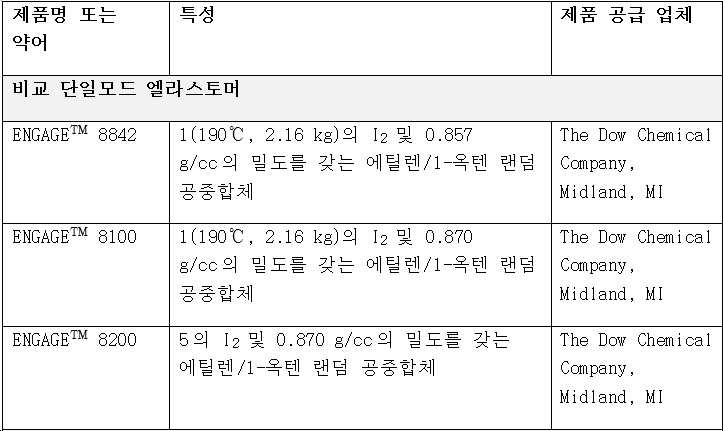
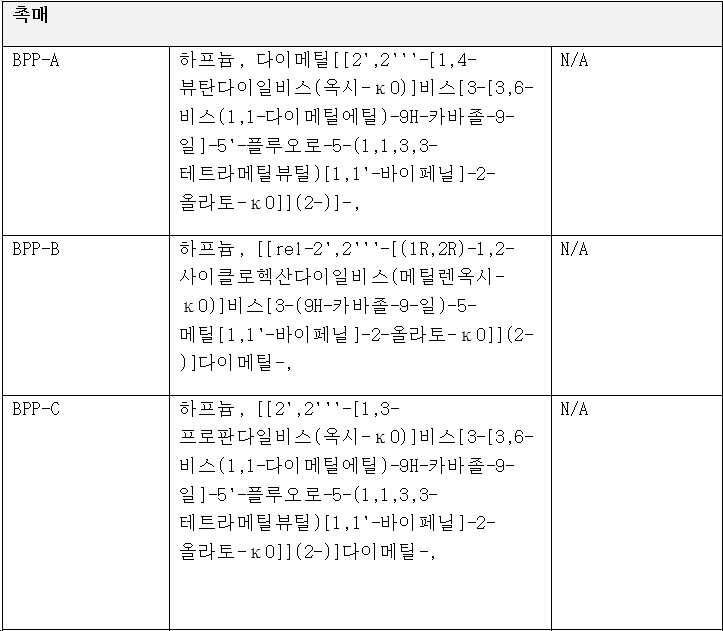

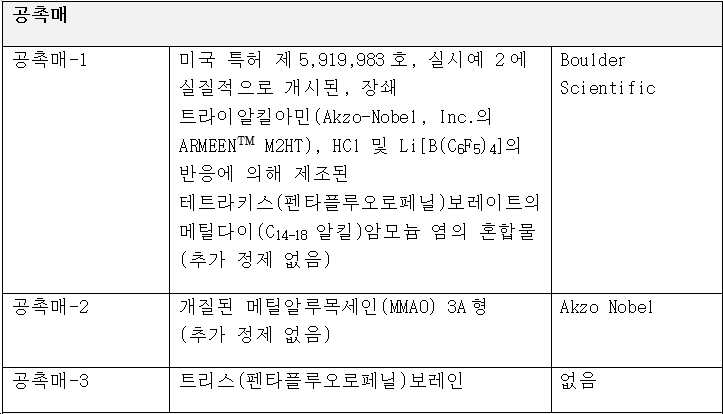
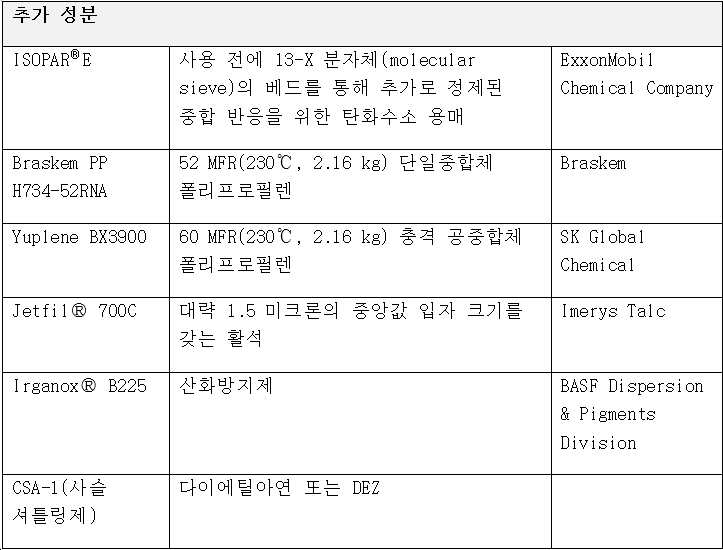
다중모드 엘라스토머의 제조Preparation of multimodal elastomers
이중 반응기 또는 단일 반응기 중 하나를 사용하여 다중모드 엘라스토머를 제조하였다. 이들 반응기는 유압으로 충진되며 정상 상태 조건에서 작동했다. 다중모드 엘라스토머를 제조하기 위해 사용된 촉매와 공촉매는 하기 표 2에 열거되어 있다. 바이페닐 페놀 복합체를 포함하는 제1 촉매와 기하 구속 복합체를 포함하는 제2 촉매의 조합을 사용하여 본 발명의 다중모드 엘라스토머를 제조하였다. 단일 반응기에서 2개의 바이페닐 페놀 복합체 촉매의 조합을 사용하여 비교 다중모드 엘라스토머인 비교 C를 제조하였다. 단일 반응기 다중모드 엘라스토머의 경우, 에틸렌과 옥텐 단량체, 용매, 수소, 촉매와 공촉매를 표 3 및 표 4에 개략된 공정 조건에 따라 반응기에 공급하여 다중모드 엘라스토머를 제조한다. 다중모드 실시예 1 내지 4 및 비교 다중모드 실시예(비교 A, 비교 B 및 비교 C)를 연속 교반조 반응기에서 제조하였다. 다중모드 실시예 5 내지 9는 루프 반응기에서 제조하였다.Multimodal elastomers were prepared using either dual reactors or single reactors. These reactors were hydraulically filled and operated under steady state conditions. The catalysts and co-catalysts used to prepare the multimodal elastomer are listed in Table 2 below. The multimodal elastomer of the present invention was prepared using a combination of a first catalyst comprising a biphenyl phenol complex and a second catalyst comprising a geometric constraint complex. Comparative C, a comparative multimodal elastomer, was prepared using a combination of two biphenyl phenol complex catalysts in a single reactor. For the single reactor multimodal elastomer, ethylene and octene monomers, solvent, hydrogen, catalyst and cocatalyst are fed to the reactor according to the process conditions outlined in Tables 3 and 4 to prepare the multimodal elastomer. Multimode Examples 1-4 and Comparative Multimode Examples (Comp A, Comp B and Comp C) were prepared in a continuous stirred bath reactor. Multimode Examples 5 to 9 were prepared in a loop reactor.
상기한 단일 반응기 다중모드 엘라스토머에 추가하여, 표 5는 병렬로 연결된 2개의 반응기를 사용하여 제조된 다중모드 엘라스토머에 대한 공정 조건을 제공한다. 여기서 각 반응기는 유압으로 충진되며 정상 상태 조건에서 작동했다. 에틸렌과 옥텐 단량체, 용매(ISOPAR®E), 수소, BPP-B 촉매, 공촉매-1 및 공촉매-2를 표 5에 개략된 공정 조건에 따른 제1 반응기(루프 반응기)에 공급하였다. 추가 에틸렌과 옥텐 단량체, 용매, 수소, CGC-A 촉매, 공촉매-2 및 공촉매-3을 표 5에 개략된 공정 조건에 따라 제2 반응기(연속 교반조 반응기)에 첨가하였다. 두 반응기의 내용물을 결합한 다음 용매를 제거하여 다중모드 엘라스토머를 생산한다.In addition to the single reactor multimodal elastomers described above, Table 5 provides process conditions for multimodal elastomers made using two reactors connected in parallel. Here, each reactor was hydraulically filled and operated under steady-state conditions. Ethylene and octene monomers, solvent (ISOPAR ® E), hydrogen, BPP-B catalyst, cocatalyst-1 and cocatalyst-2 were fed to the first reactor (loop reactor) according to the process conditions outlined in Table 5. Additional ethylene and octene monomers, solvent, hydrogen, CGC-A catalyst, cocatalyst-2 and cocatalyst-3 were added to the second reactor (continuous stirred bath reactor) according to the process conditions outlined in Table 5. The contents of the two reactors are combined and then the solvent is removed to produce a multimodal elastomer.
다중모드 엘라스토머의 특성은 표 6에 기재되어 있다.The properties of the multimodal elastomer are listed in Table 6.
표 2: 다중모드 엘라스토머 생산에 사용되는 촉매 및 공촉매
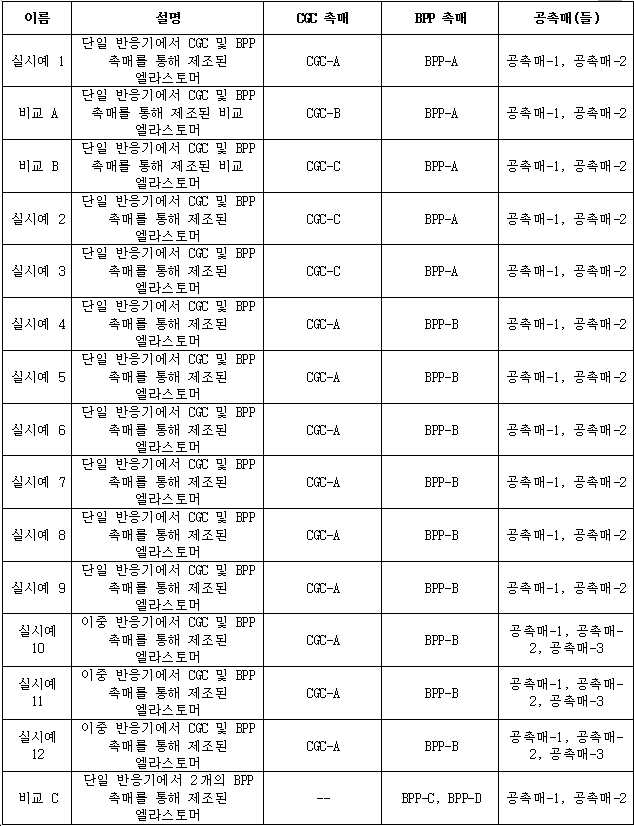
표 3: 이중 촉매, 단일 반응기 다중모드 엘라스토머의 공정 조건 - 1부Table 3: Process Conditions for Dual Catalyst, Single Reactor Multimodal Elastomers -

표 4: 이중 촉매, 단일 반응기 다중모드 엘라스토머의 공정 조건 - 2 부Table 4: Process Conditions for Dual Catalyst, Single Reactor Multimodal Elastomers -
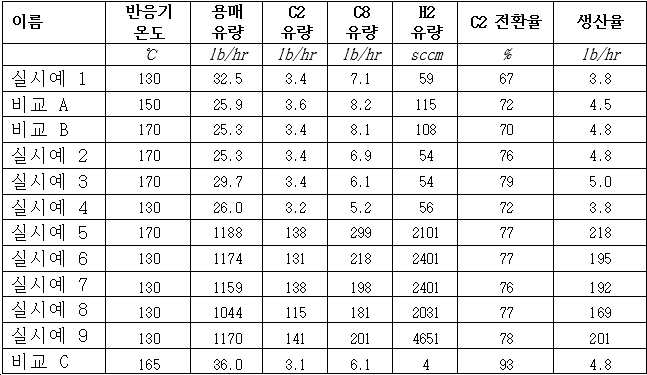
표 5: 이중 촉매, 이중 반응기 다중모드 엘라스토머의 공정 조건Table 5: Process conditions for dual catalyst, dual reactor multimodal elastomers
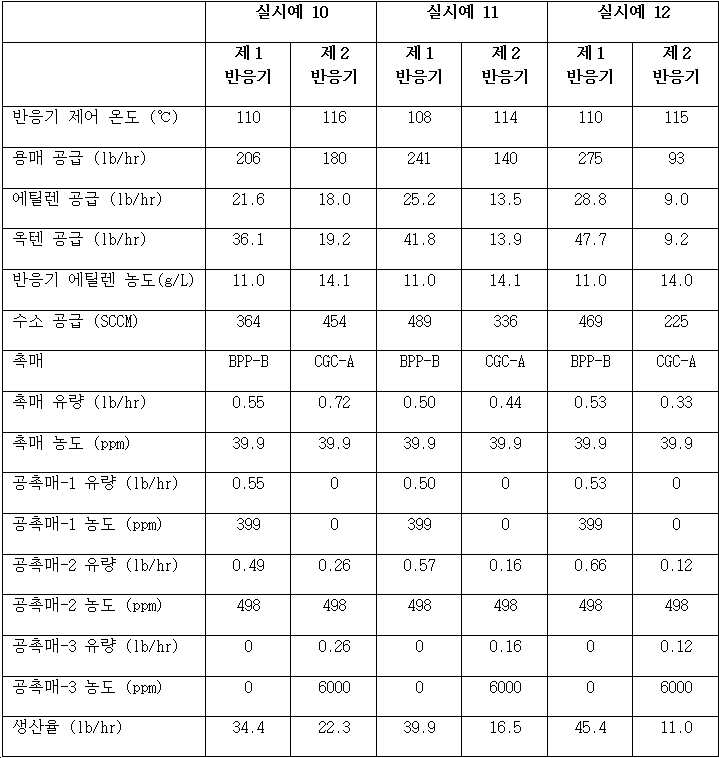
표6. 다중모드(이중 촉매/단일 반응기 및 이중 촉매/이중 반응기) 및 단일모드 엘라스토머의 물리적 특성Table 6. Physical properties of multimodal (dual catalyst/single reactor and dual catalyst/dual reactor) and monomodal elastomers

- 측정되지 않음- not measured
* HMW C8 중량% - LMW C8 중량%* HMW C8 wt% - LMW C8 wt%
도 1을 참조하면, 단일모드 엘라스토머 비교예인 ENGAGE™ 8100과 함께 이중 촉매, 단일 반응기 다중모드 엘라스토머 실시예(실시예 5), 이중 촉매, 이중 반응기 다중모드 엘라스토머 실시예(실시예 10)에 대한 GPC 데이터가 도시되어 있다. 도시된 바와 같이, 다중모드 엘라스토머가 단일 반응기 시스템 또는 이중 반응기 시스템에서 제조되었는지 여부에 관계없이, 다중모드 엘라스토머는 단일모드 엘라스토머보다 더 넓은 분자량 분포 및 더 큰 분자량을 갖는다. 표 6을 참조하면, 모든 실시예는 단일모드 ENGAGETM 실시예보다 큰 Mn을 갖는 HMW 분획물을 갖는다. TPO 화합물에서의 적용을 위해, 고분자량 엘라스토머는 충격 강화 성능에 바람직하지만, PP 매트릭스 내 엘라스토머의 분산을 허용하고 사출 성형 가공성을 위한 TPO 화합물의 전체 저점도를 허용하도록 고분자량은 엘라스토머의 전체 점도에 대해 균형을 이루어야 한다. 동일한 엘라스토머에 대한 DMS 레올로지 데이터를 도 2에 도시하였다. 도시된 바와 같이, 다중모드 실시예 5 및 10 및 단일모드 엘라스토머 ENGAGETM 8100은 매우 유사한 전단 점도를 갖는다. 따라서, 다중모드 엘라스토머는 TPO에서의 충격 강화에 바람직한 보다 큰 분자량을 가질 수 있지만, 단일모드 엘라스토머와 유사한 높은 전단 점도(V100)를 유지하는데, 이는 가공성에 바람직하다. 고전단 점도는 이축(twin screw) 압출기에서의 전형적인 혼합 조건 또는 사출 성형 조건하에서 엘라스토머의 레올로지를 더 잘 나타낸다.1 , GPC for the dual catalyst, single reactor multimodal elastomer example (Example 5), the dual catalyst, dual reactor multimodal elastomer example (Example 10) with ENGAGE™ 8100, a single mode elastomer comparative example. Data is shown. As shown, regardless of whether the multimodal elastomer is made in a single reactor system or a dual reactor system, the multimodal elastomer has a broader molecular weight distribution and higher molecular weight than the monomodal elastomer. Referring to Table 6, all examples have HMW fractions with greater Mn than the monomodal ENGAGE TM examples. For applications in TPO compounds, high molecular weight elastomers are desirable for their impact enhancing performance, but high molecular weights are dependent on the overall viscosity of the elastomer to allow dispersion of the elastomer in the PP matrix and to allow for an overall low viscosity of the TPO compound for injection molding processability. have to be balanced about DMS rheology data for the same elastomer is shown in FIG. 2 . As shown, the multimodal Examples 5 and 10 and the monomodal elastomer ENGAGE ™ 8100 have very similar shear viscosities. Thus, multimodal elastomers may have higher molecular weights desirable for impact strengthening in TPO, but retain a high shear viscosity (V100) similar to monomodal elastomers, which is desirable for processability. High shear viscosity better represents the rheology of the elastomer under injection molding conditions or mixing conditions typical of a twin screw extruder.
일부 경우에, 단일 반응기에서 CGC 촉매와 BPP 촉매의 조합은 낮은 점도 및 높은 Mw를 갖는 HMW 분획물을 허용하지 않는다. 예를 들어, 비교 A와 비교 B는 LMW 분율이 5~6 중량%에 불과하다. V100의 엘라스토머는 본 발명의 실시예들 중 임의의 것보다 더 높은 2000 Pa-s보다 크지만, HMW Mn 값은 단지 67 및 61 kg/mol이며, 이는 본 발명의 실시예보다 현저히 작다.In some cases, the combination of CGC catalyst and BPP catalyst in a single reactor does not allow for HMW fractions with low viscosity and high Mw. For example, Comparative A and Comparative B have only 5-6 wt% LMW fraction. The elastomer of V100 is greater than 2000 Pa-s, which is higher than any of the inventive examples, but the HMW Mn values are only 67 and 61 kg/mol, which is significantly lower than the inventive examples.
또한, 표 6에 나타낸 바와 같이, 2개의 BPP 촉매를 포함하는 비교 C는 29 중량% 미만, 특히 25 중량%의 옥텐 혼입을 갖는 LMW 분획물을 생성한다. 하기 표에 나타낸 바와 같이 α-올레핀이 29 중량% 미만이고 에틸렌이 71 중량%를 초과하면 다중모드 엘라스토머가 TPO에 혼입될 때 불리하다.Also, as shown in Table 6, Comparative C comprising two BPP catalysts produces a LMW fraction with octene incorporation of less than 29% by weight, in particular 25% by weight. As shown in the table below, less than 29 weight percent α-olefin and greater than 71 weight percent ethylene are disadvantageous when the multimodal elastomer is incorporated into the TPO.
블록 복합체 상용화제(BC1, BC2 및 BC3)의 제조Preparation of block composite compatibilizers (BC1, BC2 and BC3)
하기 기술된 예시적인 TPO 화합물에 혼입된 블록 복합체 상용화제는 BC1, BC2 및 BC3으로 명명된다. 직렬로 연결된 두 개의 반응기를 사용하여 이들을 제조하였다. 각 반응기는 유압으로 충진되었으며 정상 상태 조건에서 작동하도록 설정되었다. 프로필렌 및 에틸렌 단량체, 용매, 수소, BPP-B, 공촉매-1, 공촉매-2 및 CSA-1을 표 7에 개략된 공정 조건에 따라 제1 반응기에 공급한다. 표 7에 기재된 제1 반응기 내용물은 직렬로 연결된 제 2 반응기로 흐른다. 추가 단량체, 용매, 수소, BPP-B, 공촉매-1 및 선택적으로 공촉매-2가 제2 반응기에 첨가된다.The block composite compatibilizers incorporated into the exemplary TPO compounds described below are designated BC1, BC2 and BC3. They were prepared using two reactors connected in series. Each reactor was hydraulically filled and set to operate under steady state conditions. Propylene and ethylene monomers, solvent, hydrogen, BPP-B, cocatalyst-1, cocatalyst-2 and CSA-1 are fed to the first reactor according to the process conditions outlined in Table 7. The contents of the first reactor listed in Table 7 flow into a second reactor connected in series. Additional monomers, solvent, hydrogen, BPP-B, cocatalyst-1 and optionally cocatalyst-2 are added to the second reactor.
블록 복합체의 특성은 표 8에 개략되어 있으며 블록 복합체 지수 값은 표 9에 기재된다.The properties of the block composites are outlined in Table 8 and the block composite index values are listed in Table 9.
표 7 - 블록 복합체용 중합체 공정Table 7 - Polymer Process for Block Composites

표 8- 블록 복합체의 물리적 특성Table 8- Physical properties of block composites
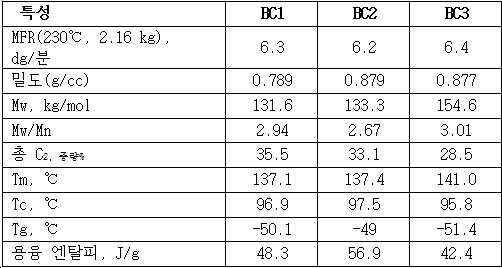
표 9- 블록 복합체 지수Table 9- Block Composite Index
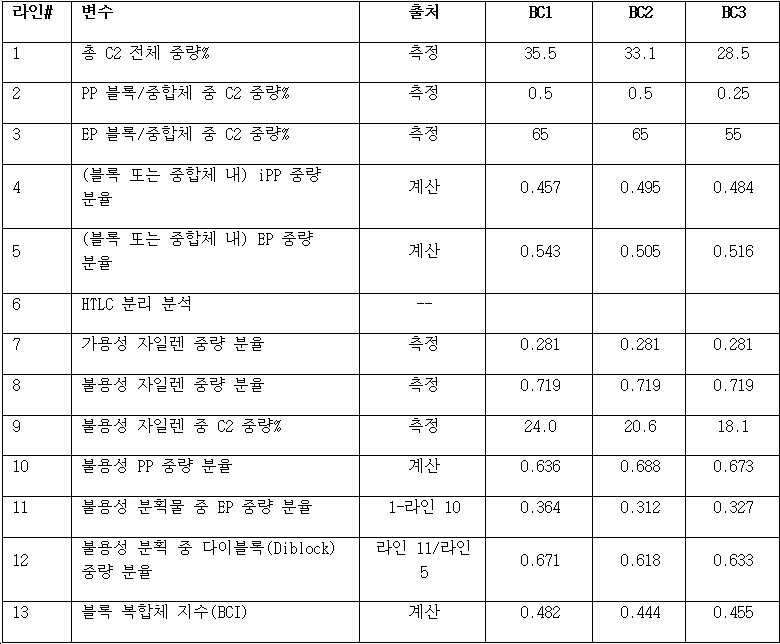
TPO 합성TPO synthesis
수조 및 스트랜드 절단기가 장착된 Coperion ZSK-25 mm 이축 압출기로 TPO 화합물을 제조하였다. 합성 조건은 하기 표 12에 열거되어 있다. 주 공급목을 통해 모든 성분을 첨가하였다. 표 10 및 표 11에 열거된 TPO 제제의 중합체 성분을 Irganox® B225 산화 방지제와 함께 건식 혼합하고 손실 중량 공급기를 통해 공급하였다. 산화 방지제 분말을 펠렛에 부착시키는 것을 돕기 위해 몇 방울의 오일을 펠렛에 첨가하였다. 하기 표 11에 열거된 활석을 갖는 TPO 제제의 경우, 활석은 별도의 분말 공급기를 통해 주 공급목에 공급하였다.TPO compounds were prepared with a Coperion ZSK-25 mm twin screw extruder equipped with a water bath and strand cutter. Synthetic conditions are listed in Table 12 below. All ingredients were added via the main feedstock. The polymer components of the TPO formulations listed in Tables 10 and 11 were dry mixed with Irganox® B225 antioxidant and fed through a lossy weight feeder. A few drops of oil were added to the pellets to help adhere the antioxidant powder to the pellets. For the TPO formulations with talc listed in Table 11 below, the talc was fed to the main feedstock via a separate powder feeder.
표 10: 활석 없는 TPO 제제Table 10: TPO formulation without talc

표 11: 활석 충진 TPO 제제Table 11: Talc Filled TPO Formulations

표 12: 합성 조건Table 12: Synthesis conditions

ASTM D638 유형 I 인장봉, ISO A 인장봉 및 유동 나선이 사출 성형되었다. Axxicon 성형 베이스가 장착된 Krauss-Maffei KM 110-390/390 CL 사출 성형기에서 사용되는 전형적인 성형 조건은 표 13에 있다. 나선형 유동 주형은 2mm x 5mm x 1150mm의 채널 치수였다. 유동의 길이는 표 13에 열거된 조건에 따라 성형 후 기록되었다. ASTM D638 Type I tension rods, ISO A tension rods and flow spirals were injection molded. Typical molding conditions used on a Krauss-Maffei KM 110-390/390 CL injection molding machine equipped with an Axxicon molding base are given in Table 13. The spiral flow mold had channel dimensions of 2 mm x 5 mm x 1150 mm. The length of flow was recorded after molding according to the conditions listed in Table 13.
표 13: 사출 성형 조건 Table 13: Injection Molding Conditions

표 14: 활석이 없는 TPO 화합물의 TPO 특성Table 14: TPO properties of TPO compounds without talc

표 15: 충진 TPO 화합물에 대한 TPO 특성Table 15: TPO Properties for Filled TPO Compounds
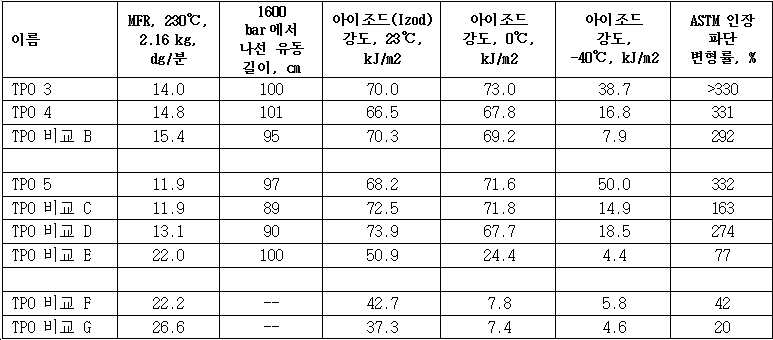
TPO 특성을 표 14 및 표 15에 나타낸다. 표 14를 참조하면, 다중모드 엘라스토머 실시예 5(단일 반응기) 및 10(이중 반응기)을 각각 포함하는 미충진(무활석) TPO 화합물, TPO 1 및 2는 ENGAGE 단일모드 엘라스토머를 포함하는 TPO 비교 A에 비해 보다 높은 사출 성형 유동을 나타내었다. 게다가, TPO 1 및 2는 TPO 비교 A와 비교하여 개선된 노치 충격 인성을 나타냈다. 특히, 0℃ 및 23℃의 온도에서 샤르피 강도가 현저히 개선되었다. 또한, TPO 1 및 2는 TPO 비교 A보다 훨씬 높은 인장 파단신율도 제공하며, 특히 단일 반응기 다중모드 엘라스토머인 TPO 1에서 더욱 그렇다.TPO properties are shown in Tables 14 and 15. Referring to Table 14, unfilled (talc-free) TPO compounds comprising multimodal elastomer Examples 5 (single reactor) and 10 (dual reactor), respectively,
활석 충진제를 갖는 TPO 화합물을 나타내는 표 15를 참조하면, 보다 양호한 저온 노치 충격 인성이 개선된 또는 유사한 사출 성형 유동과 조합하여 달성된다. 특히, TPO 3 및 4의 -40℃의 온도에서 아이조드 강도는 ENGAGE™ 8842 단일모드 엘라스토머를 포함하는 TPO 비교 B보다 훨씬 더 컸다. 10 중량%의 활석을 포함한 TPO 3은 TPO 비교 B보다 -40℃의 온도에서 적어도 4배 더 큰 아이조드 강도를 나타냈다. 20 중량%의 활석에서, TPO 5는 ENGAGE 단일모드 엘라스토머를 포함하는 TPO 비교 C 및 D보다 -40℃의 온도에서 적어도 3배 더 큰 아이조드 강도를 나타냈다. TPO 5는 또한 TPO 비교 C 및 D보다 높은 사출 성형 유동을 가졌다. 약간 낮은 사출 성형 유동과 비교하여, TPO 5는 아이조드 강도가 -40℃에서 TPO 비교 E보다 적어도 10배 더 큰, TPO 비교 E에 비해 상당히 개선된 아이조드 충격 강도를 나타내었다. Referring to Table 15 showing TPO compounds with talc filler, better low temperature notch impact toughness is achieved in combination with improved or similar injection molding flow. In particular, the Izod strength at a temperature of −40° C. of
표 15를 다시 참조하면, 2개의 바이페닐 페놀 촉매로 제조된 다중모드 엘라스토머인 TPO 비교 G는 활석 충진 제제인 TPO 비교 F의 단일모드 대조군 ENGAGE™ 8842에 비해 개선된 충격 성능을 나타내지 않는다.Referring back to Table 15, TPO Comparative G, a multimodal elastomer made with two biphenyl phenol catalysts, does not show improved impact performance compared to the monomodal control ENGAGE™ 8842 of TPO Comparative F, a talc filled formulation.
측정 표준measurement standard
용융 지수 또는 I 2 : ASTM D 1238, 조건 190℃, 2.16 kg을 사용하여 측정. Melt Index or I 2 : Measured using ASTM D 1238, Condition 190° C., 2.16 kg.
용융 유속 또는 MFR: ASTM D 1238, 조건 230℃, 2.16 kg을 사용하여 측정. Melt Flow Rate or MFR: Measured using ASTM D 1238, Condition 230°C, 2.16 kg.
무니: 무니 점도는 ML 1+4 조건을 사용하여 125℃에서 ASTM D1646에 따라 측정되었다. Mooney: Mooney viscosity was measured according to ASTM D1646 at 125°
밀도: ASTM D792에 따라 측정. Density: Measured according to ASTM D792.
동적 기계 분광법(DMS) - 레올로지: 25 mm 스테인리스 스틸 평행판이 장착된 고급 레오메트릭 확장 시스템(ARES)을 사용하여 DMS로 샘플 레올로지를 분석했다. 190℃에서 질소 퍼지(purge)하에 0.1 내지 100 rad/s의 주파수 범위에서 일정한 온도의 동적 주파수 스위프를 수행하였다. 직경이 대략 25.4 mm인 샘플을 압축 성형된 판에서부터 절단하였다. 샘플을 하부 플레이트상에 놓고 5분 동안 용융시켰다. 이어서, 플레이트를 2.0 mm의 갭으로 폐쇄하고 샘플을 직경 25 mm로 재단하였다. 시험을 시작 전에 샘플을 190℃에서 5분간 평형을 유지하도록 하였다. 복합 점도는 10%의 일정한 변형 진폭에서 측정되었다. 0.1 rad/s(V0.1) 및 100 rad/s(V100)에서의 점도가 보고되었다. Dynamic Mechanical Spectroscopy (DMS) - Rheology: Sample rheology was analyzed by DMS using an Advanced Rheometric Extension System (ARES) equipped with a 25 mm stainless steel parallel plate. A constant temperature dynamic frequency sweep was performed in a frequency range of 0.1 to 100 rad/s under nitrogen purge at 190°C. Samples approximately 25.4 mm in diameter were cut from compression molded plates. The sample was placed on the lower plate and allowed to melt for 5 minutes. The plate was then closed with a gap of 2.0 mm and the sample was cut to a diameter of 25 mm. Samples were allowed to equilibrate at 190° C. for 5 minutes before starting the test. The composite viscosity was measured at a constant strain amplitude of 10%. Viscosity at 0.1 rad/s (V0.1) and 100 rad/s (V100) are reported.
고온 겔 투과 크로마토그래피(HT-GPC):High Temperature Gel Permeation Chromatography (HT-GPC):
PolymerChar Inc(발렌시아, 스페인)의 적외선 농도 검출기(IR-5)로 구성된 고온 겔 투과 크로마토그래피 시스템(GPC IR)을 분자량(MW) 및 분자량 분포(MWD) 측정에 사용했다. 담체 용매는 1,2,4-트라이클로로벤젠(TCB)이었다. 오토 샘플러 구획을 160℃에서 작동시키고 컬럼 구획을 150℃에서 작동시켰다. 사용된 컬럼은 4개의 Polymer Laboratories Mixed A LS, 20 미크론 컬럼이었다. 크로마토그래피 용매(TCB) 및 샘플 제조 용매는 250 ppm의 뷰틸화 하이드록시톨루엔(BHT) 및 질소를 살포한 동일한 용매 공급원으로부터 얻었다. 샘플은 TCB에 2 mg/mL의 농도로 제조되었다. 폴리에틸렌 샘플을 160℃에서 2시간 동안 부드럽게 흔들었다. 사출량은 200 μl이고, 유속은 1.0 ml/분이었다.A high temperature gel permeation chromatography system (GPC IR) consisting of an infrared concentration detector (IR-5) from PolymerChar Inc (Valencia, Spain) was used for molecular weight (MW) and molecular weight distribution (MWD) measurements. The carrier solvent was 1,2,4-trichlorobenzene (TCB). The auto sampler compartment was operated at 160°C and the column compartment was operated at 150°C. The columns used were 4 Polymer Laboratories Mixed A LS, 20 micron columns. Chromatographic solvent (TCB) and sample preparation solvent were obtained from the same solvent source sparged with 250 ppm of butylated hydroxytoluene (BHT) and nitrogen. Samples were prepared in TCB at a concentration of 2 mg/mL. The polyethylene sample was gently shaken at 160° C. for 2 hours. The injection volume was 200 μl and the flow rate was 1.0 ml/min.
GPC 컬럼 세트의 보정은 21개의 좁은 분자량 분포 폴리스타이렌 표준으로 수행하였다. 분자량의 표준은 580 내지 8,400,000 g/mol 범위이며, 개개의 분자량 사이에 적어도 10의 간격을 두고 6개의 "칵테일" 혼합물로 배열되었다.Calibration of the GPC column set was performed with 21 narrow molecular weight distribution polystyrene standards. Molecular weight standards ranged from 580 to 8,400,000 g/mol, arranged in six "cocktail" mixtures with a spacing of at least 10 between the individual molecular weights.
폴리스타이렌 표준 피크 분자량은 하기 수식을 사용하여 폴리에틸렌 분자량으로 전환되었다(문헌 [Williams and Ward, J. Polym. Sci., Polym. Let., 6, 621 (1968)]에 기재된 바와 같음):Polystyrene standard peak molecular weights were converted to polyethylene molecular weights using the following formula (as described in Williams and Ward, J. Polym. Sci., Polym. Let., 6, 621 (1968)):

여기서, B는 1.0의 값을 가지며 A의 실험적으로 결정된 값은 대략 0.42이다. Here, B has a value of 1.0 and the experimentally determined value of A is approximately 0.42.
3차 다항식을 사용하여 수식(1)에서 얻어진 각각의 폴리에틸렌-등가 보정점을 폴리스타이렌 표준의 관찰된 용출 부피에 맞추었다.Using a cubic polynomial, each polyethylene-equivalent calibration point obtained in Equation (1) was fitted to the observed elution volume of the polystyrene standard.
수 평균 분자량, 중량 평균 분자량 및 z-평균 분자량은 하기 수식들에 따라 계산되었다:The number average molecular weight, weight average molecular weight and z-average molecular weight were calculated according to the following formulas:
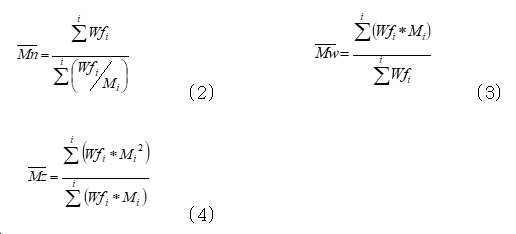
여기서 Wf i 는 i번째 성분의 중량 분율이고, M i 는 i번째 성분의 분자량이다. where Wf i is the weight fraction of the i -th component, and M i is the molecular weight of the i -th component.
MWD는 중량 평균 분자량(Mw) 대 수 평균 분자량(Mn)의 비로 표현되었다.MWD was expressed as the ratio of weight average molecular weight (Mw) to number average molecular weight (Mn).
정확한 A값은 수식(3)을 사용하여 계산된 Mw 및 대응하는 보존 부피 다항식이 표준 선형 폴리에틸렌 단일중합체 참조의 120,000 g/mol의 공지된 Mw 값과 일치할 때까지 수식(1)에서 A 값을 조정하여 결정하였다.The exact value of A is obtained by subtracting the value of A from Equation (1) until the Mw calculated using Equation (3) and the corresponding conservation volume polynomial match the known Mw value of 120,000 g/mol of a standard linear polyethylene homopolymer reference. It was decided by adjusting.
GPC 디콘볼루션:GPC Deconvolution:
GPC 데이터는 2개의 분자량 성분에 대해 가장 적절한 적합성을 제공하기 위해 디콘볼루션되었다. 상업적으로 그리고 문헌 모두에서 사용 가능한 여러 가지 디콘볼루션 알고리즘이 있다. 이들은 사용된 가정에 따라 상이한 답에 이를 수 있다. 여기에 요약된 알고리즘은 두 개의 가장 가능성 있는 분자량 분포(뿐만 아니라 조정 가능한 오차항)의 디콘볼루션 문제에 최적화되어 있다. 대형 단량체 혼입 및 반응기 조건(즉, 온도, 농도)의 작은 변동으로 인한 기본 분포의 변화를 허용하기 위해 기저 함수를 정규 분포 항을 포함하도록 수정하였다. 이 항은 각 성분에 대한 기저 함수가 분자량 축을 따라 다양한 정도로 번질 수 있게 한다. 이점은 제한 사항(낮은 LCB, 완벽한 농도 및 온도 제어)에서 기저 함수는 단순하고 가장 가능성있는 플로리(Flory) 분포가 될 것이라는 점이다.The GPC data were deconvolved to give the best fit for the two molecular weight components. There are several deconvolution algorithms available both commercially and in the literature. These may lead to different answers depending on the assumptions used. The algorithm summarized here is optimized for the problem of deconvolution of the two most probable molecular weight distributions (as well as tunable error terms). To allow for changes in the underlying distribution due to large monomer incorporation and small fluctuations in reactor conditions (ie, temperature, concentration), the basis function was modified to include a normal distribution term. This term allows the basis function for each component to be spread to varying degrees along the molecular weight axis. The advantage is that in the constraints (low LCB, perfect concentration and temperature control) the basis function will be a simple and most likely Flory distribution.
3개의 성분(j=1,2,3)은 조정 가능한 오차 항인 제3 성분(j=3)으로 유도된다. GPC 데이터는 정규화되어야 하며 중량 분율 대 Log10 분자량 벡터로 적절하게 변형되어야 한다. 바꾸어 말하면, 디콘볼루션에 대한 각각의 전위 곡선은 높이 벡터 hi로 구성되고, 여기서 높이는 Log10 분자량의 공지된 간격으로 보고되고, hi는 용출 부피 도메인에서 Log10 분자량 도메인으로 적절하게 변형되었으며, hi는 정규화된다. 또한 이들 데이터는 Microsoft EXCEL™ 응용 프로그램에서 이용 가능하게 만들어져야 한다.The three components (j=1,2,3) are derived from the third component (j=3) which is an adjustable error term. GPC data should be normalized and appropriately transformed into weight fraction versus Log 10 molecular weight vectors. In other words, each dislocation curve for deconvolution consists of a height vector h i , where the heights are reported at known intervals of Log 10 molecular weight, and h i is appropriately transformed from the elution volume domain to the Log 10 molecular weight domain and , h i are normalized. In addition, these data must be made available to the Microsoft EXCEL™ application.
디콘볼루션에는 몇 가지 가정이 있다. 각각의 성분 j는 매개 변수 σj를 사용하여 정상 또는 가우스 확산 함수로 콘볼루션된 가장 가능성 있는 플로리 분포로 구성된다. 그 결과 3개의 기저 함수가 카이 제곱(Х2), 최소화 루틴에서 hi인 GPC 데이터 벡터의 n지점에 가장 잘 맞는 매개 변수를 찾는 데 사용된다.Deconvolution has several assumptions. Each component j consists of the most probable Flory distribution convolved with a normal or Gaussian diffusion function using the parameter σ j . As a result, the three basis functions are chi-square (Х 2 ), which is used in the minimization routine to find the parameter that best fits the n-point of the GPC data vector with h i .
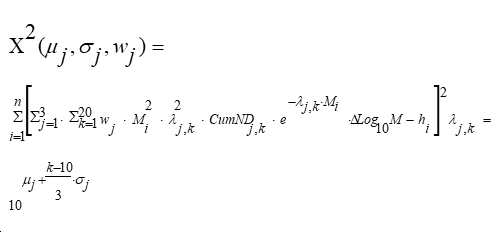
변수 CumNDj,k는 다음과 같이 매개 변수가 설정된 EXCEL™ 함수 "NORMDIST(x, mean, standard_dev, cumulative)"를 사용하여 계산된다.The variable CumND j,k is calculated using the EXCEL™ function "NORMDIST(x, mean, standard_dev, cumulative)" with parameters set as follows:
x = μj+(k-10)*σj/3x = μ j +(k-10)*σ j /3
평균 = μj mean = μ j
표준 편차 = σj standard deviation = σ j
누적 = TRUECumulative = TRUE
하기 표 16에 이들 변수와 정의가 요약되어 있다. 이 작업에는 EXCEL™ 소프트웨어 응용 프로그램인 Solver를 사용하는 것이 적합하다. 적절한 최소화를 위해 Solver에 제약 조건이 추가되었다.Table 16 below summarizes these variables and their definitions. The EXCEL™ software application, Solver, is suitable for this task. Constraints have been added to the solver for proper minimization.
표 16: 변수 정의Table 16: Variable Definitions
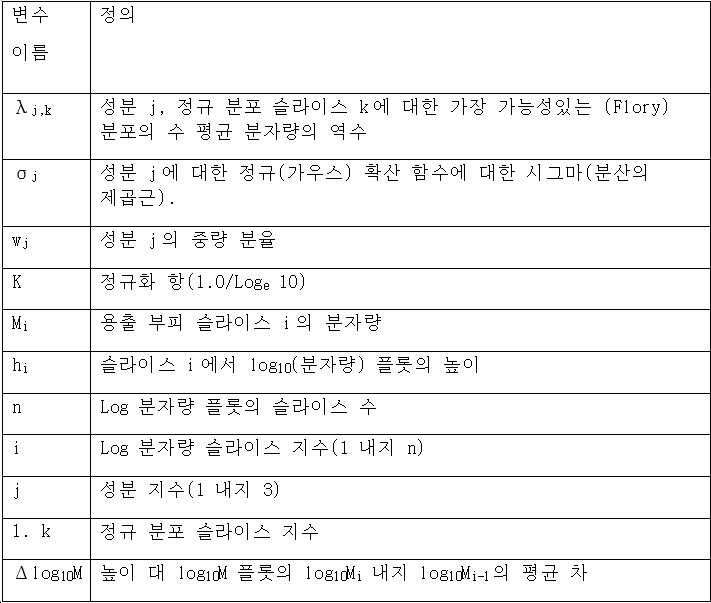
카이 제곱 최소화에서 유도된 8개의 매개 μ1, μ2, μ3, σ1, σ2, σ3, w1, 및 w2이다. 이어서, 항 w3은 w1 및 w2에서 유도되며, 그 이유는 3개의 성분의 합이 1과 같아야 하기 때문이다. 표 II는 EXCEL 프로그램에서 사용된 Solver 제약 조건을 요약한 것이다.There are eight parameters μ 1 , μ 2 , μ 3 , σ 1 , σ 2 , σ 3 , w 1 , and w 2 derived from chi-square minimization. Then, the term w 3 is derived from w 1 and w 2 , since the sum of the three components must equal 1. Table II summarizes the solver constraints used in the EXCEL program.
표 17: 제약 조건 요약Table 17: Constraint summary
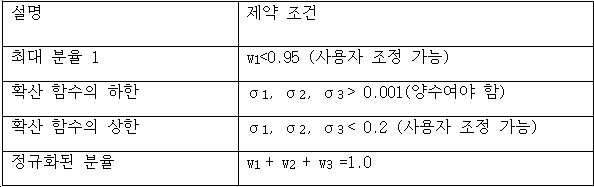
알아야 할 추가 제약 조건은 μj > 0만 허용되는 제한을 포함하지만, Solver가 적절하게 초기화된 경우, Solver 루틴이 임의의 μj를 약 0.005 미만의 값으로 이동하지 않으므로 이 제약 조건을 입력할 필요가 없다. 또한 wj는 모두 양수임을 알 수 있다. 이 제약 조건은 Solver 외부에서 처리될 수 있다. wj가 0.0 <P1 <P2 <1.0의 간격을 따라 두 점을 선택함으로써 발생하는 것으로 이해되면, 이에 의해 w1 = P1, w2 = P2 - P1 및 w3 = 1.0 - P2이며, 다음 제약 P1 및 P2는 wj에 대해 상기 요구되는 제약 조건에 상당한다.Additional constraints to be aware of include the restriction that only μ j > 0 is allowed, but we need to enter this constraint as the solver routine will not move any μ j to a value less than about 0.005 if the solver is properly initialized. there is no Also, it can be seen that w j is all positive numbers. This constraint can be handled outside the solver. If w j is understood to occur by choosing two points along an interval of 0.0 <P 1 <P 2 <1.0, then w 1 = P 1 , w 2 = P 2 - P 1 and w 3 = 1.0 - P 2 , and the following constraints P1 and P2 correspond to the above required constraints for w j .
표 18은 옵션 탭에 있는 Solver 설정의 요약이다.Table 18 is a summary of the Solver settings on the Options tab.
표 18: Solver 설정Table 18: Solver settings

μ1, μ2, w1 및 w2의 값에 대한 제1 추측은 관찰된 GPC 분포에 대해 관찰된 중량 평균, 수 평균, 및 z-평균 분자량을 제공하는 두 개의 이상적인 플로리 성분을 가정함으로써 얻어질 수 있다.A first guess for the values of μ 1 , μ 2 , w 1 and w 2 is obtained by assuming two ideal Flory components giving the observed weight average, number average, and z-average molecular weight for the observed GPC distribution. can get
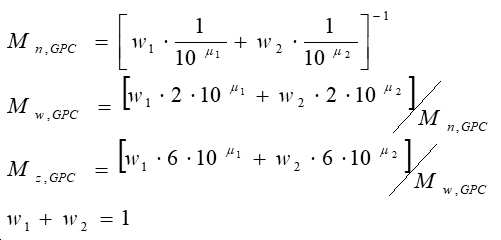
그런 다음, μ1, μ2, w1 및 w2의 값이 계산된다. 이 값들은 최소 오차항 w3을 허용하고 최소화 단계를 위해 Solver에 들어가기 전에 표 II의 제약 조건을 충족시키도록 주의 깊게 조정해야 한다. σj의 시작 값은 모두 0.05로 설정된다.Then, the values of μ 1 , μ 2 , w 1 and w 2 are calculated. These values should be carefully adjusted to allow for a minimum error term w 3 and satisfy the constraints in Table II before entering the solver for the minimization step. The starting values of σ j are all set to 0.05.
HT GPC IR로부터 옥텐 함량 측정:Determination of octene content from HT GPC IR:
옥텐 함량은 Polymer Char Inc.의 IR-5 조성물 검출기를 사용하여 측정하였다. 중합체의 "메틸", "메틸렌" 및 "측정"("메틸" + "메틸렌")의 IR 고정 밴드 신호는 IR-5 조성물 모드로 수집 및 처리하였다. 조성물 검출기는 0 내지 40의 옥텐 중량% 및 하나의 폴리옥텐(PO) 단일중합체(100 중량% 옥탄)를 갖는 11 메탈로센 용액 제조 에틸렌/옥텐 (EO) 공중합체를 사용하여 보정하였다. 모든 중합체는 각각 약 40K 또는 100K의 Mw를 갖는다. 피크 위치의 신호를 보정에 사용하였다. 이들 EO 공중합체와 PO 공중합체에 옥텐 중량%와 IR-5 "메틸"/"측정" 신호 비율의 선형 관계가 만들어졌다.The octene content was measured using an IR-5 composition detector from Polymer Char Inc. IR fixed band signals of "methyl", "methylene" and "measurement" ("methyl" + "methylene") of the polymer were collected and processed in IR-5 composition mode. The composition detector was calibrated using 11 metallocene solution prepared ethylene/octene (EO) copolymers with 0-40 wt% octene and one polyoctene (PO) homopolymer (100 wt% octane). All polymers have a Mw of about 40K or 100K respectively. The signal at the peak position was used for calibration. A linear relationship of octene weight percent and IR-5 "methyl"/"measured" signal ratio was established for these EO and PO copolymers.
수지의 옥텐 중량% 분포는 IR-5 "메틸"/"측정" 신호와 옥탄 중량%와 IR-5 "메틸"/"측정"신호 비율의 선형 보정을 사용하여 얻어졌다. 중합체 사슬 말단 효과는 각 사슬의 말단에서 하나의 바이닐 및 메틸로 정정되었다.The octene weight percent distribution of the resin was obtained using a linear calibration of the IR-5 "methyl"/"measure" signal and the ratio of octane weight percent and IR-5 "methyl"/"measure" signal. Polymer chain end effects were corrected for one vinyl and one methyl at the end of each chain.
이중모드 수지의 경우, 각 분획물의 옥텐 중량%는 다음과 같이 계산하였다. 고 중량 분율(주 피크)의 경우, 주 피크 면적에서의 분포 곡선의 평탄역을 사용하여 옥텐 중량%를 계산하였다. 저 중량 분율 면적(작은 피크)의 경우, 주 피크의 오염을 피하기 위해 좁은 MW 범위(log MW 척도에서 0.3)에서 옥텐 중량%를 계산하고 용출 저농도 말단에서 산란 옥텐 중량% 신호를 계산했다.In the case of a bimodal resin, the octene weight percent of each fraction was calculated as follows. For the high weight fraction (main peak), the octene weight percent was calculated using the flat area of the distribution curve at the main peak area. For low weight fraction areas (small peaks), octene wt% was calculated in a narrow MW range (0.3 on a log MW scale) to avoid contamination of the main peak, and scattered octene wt% signals were calculated at the elution low end.
굴곡 탄성률: 굴곡 탄성률 시험은 73℉ 및 50% 상대 습도에서 40시간 이상 컨디셔닝한 후 2mm/분에서 ISO 178 또는 0.05 인치/분에서 ASTM D790에 따라 수행되었다. 1% 할선 탄성률(secant modulus)은 적어도 5개의 시편에 대한 평균으로 보고되었다. 시편은 시험을 위해 사출 성형된 ISO A 또는 ASTM D638 유형 I 인장봉에서 채취하였다. Flexural Modulus: Flexural modulus testing was performed according to ISO 178 at 2 mm/min or ASTM D790 at 0.05 inches/min after conditioning at 73°F and 50% relative humidity for at least 40 hours. A 1% secant modulus was reported as an average for at least 5 specimens. Specimens were taken from injection molded ISO A or ASTM D638 Type I tensile bars for testing.
아이조드 충격 강도: 노치 아이조드 충격 시험은 62mm x 19mm x 3.175mm 치수를 갖는 ASTM D638, 유형 1 인장봉에서 절단한 사출 성형된 ASTM 시편상에서 수행되었다. 샘플을 노처(notcher)를 사용하여 노치하여 ASTM D256에 따라 노치 깊이 10.16 ± 0.05 mm를 생성하였다. 23, 0 및 -40℃의 시험 온도에서 ASTM D256을 사용하여 각 샘플의 5개의 시편을 시험하였다. kJ/m2의 에너지 값이 보고되었다. Izod Impact Strength: Notched Izod impact tests were performed on injection molded ASTM specimens cut from ASTM D638,
샤르피 충격 강도: 노치 샤르피 충격 시험은 ISO A 인장봉에서 절단한 사출 성형된 ISO 시편상에서 수행되었다. ISO 179에 따라 노처를 사용하여 샘플을 노치하였다. 23, 0 및 -30℃의 시험 온도에서 ISO 179를 사용하여 각 샘플의 10개의 시편을 시험하였다. kJ/m2의 에너지 값이 보고되었다. Charpy Impact Strength: Notched Charpy impact tests were performed on injection molded ISO specimens cut from ISO A tensile bars. Samples were notched using a notcher according to ISO 179. Ten specimens of each sample were tested using ISO 179 at test temperatures of 23, 0 and -30°C. Energy values of kJ/m 2 are reported.
인장: 인장 특성은 사출 성형된 ASTM D638, 유형 1 인장봉 및 분당 2 인치의 크로스헤드 속도를 사용하는 ASTM D638 또는 사출 성형된 ISO A 인장봉 및 50 mm/분의 크로스헤드 속도를 사용하는 ISO 527에 따라 측정되었다. Tensile: Tensile properties are as follows: ASTM D638 using injection molded ASTM D638,
시차 주사 열량분석법(DSC)이 중합체(예컨대, 에틸렌계(PE) 중합체)의 결정화도를 측정하는 데 사용된다. 약 5 내지 8 mg의 중합체 샘플을 칭량하고 DSC 팬(pan)에 위치시킨다. 닫힌 대기를 보장하기 위해 팬상에 뚜껑을 주름밀봉(crimp)하였다. 샘플 팬을 DSC 셀에 넣은 다음 PE의 경우 약 10℃/분의 속도로 180℃의 온도(폴리프로필렌 또는 "PP"의 경우 230℃)로 가열한다. 샘플을 이 온도에서 3분간 유지한다. 그런 다음 샘플을 PE의 경우 10℃/분의 속도로 -60℃의 온도(PP의 경우 -40℃)로 냉각시키고 3분 동안 해당 온도에서 등온 유지한다. 다음에 샘플을 완전히 용융될 때까지 10℃/분의 속도로 가열한다(제2 가열). % 결정화도는 제2 가열 곡선에서 결정된 융해열(Hf)을 PE의 경우 이론적인 융해열 292 J/g(PP의 경우 165 J/g)로 나눈 다음, 이 수량에 100을 곱하여 계산한다(예를 들면, % 결정화도 = (Hf /292 J/g) × 100 (PE의 경우)). Differential scanning calorimetry (DSC) is used to determine the crystallinity of a polymer (eg, an ethylenic (PE) polymer). About 5 to 8 mg of polymer sample is weighed and placed in a DSC pan. The lid was crimped onto the pan to ensure a closed atmosphere. The sample pan is placed in a DSC cell and heated to a temperature of 180° C. (230° C. for polypropylene or “PP”) at a rate of about 10° C./min for PE. The sample is held at this temperature for 3 minutes. The sample is then cooled to a temperature of −60° C. (−40° C. for PP) at a rate of 10° C./min for PE and held isothermal at that temperature for 3 minutes. The sample is then heated at a rate of 10° C./min until completely melted (second heat). The % crystallinity is calculated by dividing the heat of fusion (H f ) determined from the second heating curve by the theoretical heat of fusion of 292 J/g for PE (165 J/g for PP), then multiplying this quantity by 100 (e.g. , % crystallinity = (H f /292 J/g) × 100 (for PE)).
달리 언급하지 않는 한, 각 중합체의 융점(T m )은 제2 가열 곡선(피크 Tm)으로 결정되고, 결정화 온도(T c )는 제1 냉각 곡선(피크 TC)으로 결정된다. DSC와 관련하여 선형 기준치에 대한 최대 가열 유속에서의 온도가 융점으로 사용된다. 선형 기준치는 용융 시작점(유리 전이 온도 초과)에서 용융 피크의 종료점까지로 구성된다. 예를 들어, 온도는 실온에서 10 ℃/분으로 200℃까지 상승되고, 200℃에서 5분간 유지되고, 10℃/분으로 0℃로 감소되며, 0℃에서 5분간 유지될 수 있고, 그 후 10 ℃/분으로 0℃에서 200℃까지 상승될 수 있으며, 이 제2 가열 사이클에서부터 데이터를 취할 수 있다.Unless otherwise stated, the melting point (T m ) of each polymer is determined by the second heating curve (peak Tm) and the crystallization temperature (T c ) is determined by the first cooling curve (peak TC). With respect to DSC, the temperature at the maximum heating flow rate relative to a linear reference is used as the melting point. A linear baseline consists of the melting onset (above the glass transition temperature) to the endpoint of the melting peak. For example, the temperature may be raised from room temperature to 200°C at 10°C/min, held at 200°C for 5 minutes, decreased to 0°C at 10°C/min, held at 0°C for 5 minutes, and then It can be ramped from 0°C to 200°C at 10°C/min, and data can be taken from this second heating cycle.
고온 액체 크로마토그래피(HTLC): 고온 액체 크로마토그래피 실험 방법 계측은 HTLC 실험이며, 이는 사소한 변형으로 공개된 방법에 따라 수행된다(문헌 [Lee, D.; Miller, M. D.; Meunier, D. M.; Lyons, J. W.; Bonner, J. M.; Pell, R. J.; Shan, C. L. P.; Huang, T. J. Chromatogr. A 2011, 1218, 7173]). 2개의 Shimadzu(Columbia, MD, USA) LC-20AD 펌프가 각각 데칸 및 트라이클로로벤젠(TCB)을 전달하는 데 사용된다. 각각의 펌프는 10:1 고정 유동 분리기(splitter)(부품 번호: 620-PO20-HS, Analytical Scientific Instruments Inc., CA, USA)에 연결된다. 분리기는 제조자에 따라 H2O 0.1 mL/분으로 1500 psi의 압력 강하를 갖는다. 두 펌프의 유속은 0.115 mL/분으로 설정된다. 분리된 후, 부(minor) 유량은 데칸과 TCB 둘 다에 대해 0.01 mL/분이고, 수집된 용매를 30분 넘게 칭량하여 결정된다. 수집된 용출액의 부피는 실온에서 용매의 질량 및 밀도에 의해 결정된다. 부 유량은 분리를 위해 HTLC 컬럼으로 전달된다. 주(major) 유량은 용매 저장조로 다시 보내진다. Shimadzu 펌프의 용매를 혼합하기 위해 분리기 뒤에 50-μL 혼합기(Shimadzu)를 연결한다. 이어서, 혼합 용매가 Waters(Milford, MA, USA) GPCV2000의 오븐에서 인젝터로 전달된다. Hypercarb™ 컬럼(2.1 × 100 mm, 5 μm 입자 크기)이 인젝터와 10-포트 VICI 밸브(Houston, TX, USA) 사이에 연결된다. 밸브에는 2개의 60-μL 샘플 루프가 장착되어 있다. 밸브는 1차원(D1) HTLC 컬럼에서 2차원(D2) SEC 컬럼으로 용출액을 연속적으로 샘플링하는 데 사용된다. Waters GPCV2000 및 PLgel Rapid™-M 컬럼(10 × 100mm, 5μm 입자 크기)의 펌프가 D2 크기 배제 크로마토그래피(SEC)용 VICI 밸브에 연결된다. 문헌 [Brun, Y.; Foster, P. J. Sep. Sci. 2010, 33, 3501]에 기재된 바와 같이 대칭 구성이 연결을 위해 사용된다. 이중 각도(dual-angle) 광 산란 검출기(PD2040, Agilent, Santa Clara, CA, USA)와 IR5 적외선 흡광 검출기를 농도, 조성 및 분자량을 측정하기 위해 SEC 컬럼 뒤에 연결한다. High Temperature Liquid Chromatography (HTLC): High Temperature Liquid Chromatography Experimental Method Instrumentation is an HTLC experiment, which is performed according to published methods with minor modifications (Lee, D.; Miller, MD; Meunier, DM; Lyons, JW). ; Bonner, JM; Pell, RJ; Shan, CLP; Huang, T. J. Chromatogr. A 2011, 1218 , 7173]). Two Shimadzu (Columbia, MD, USA) LC-20AD pumps are used to deliver decane and trichlorobenzene (TCB), respectively. Each pump is connected to a 10:1 fixed flow splitter (part number: 620-PO20-HS, Analytical Scientific Instruments Inc., CA, USA). The separator has a pressure drop of 1500 psi with 0.1 mL/min of H 2 O according to the manufacturer. The flow rate of both pumps is set at 0.115 mL/min. After separation, the minor flow rate is 0.01 mL/min for both decane and TCB and is determined by weighing the collected solvent over 30 minutes. The volume of the collected eluate is determined by the mass and density of the solvent at room temperature. The side flow is passed to the HTLC column for separation. The major flow is sent back to the solvent reservoir. Connect a 50-μL mixer (Shimadzu) behind the separator to mix the solvents of the Shimadzu pump. The mixed solvent is then delivered to the injectors in the oven of a Waters (Milford, MA, USA) GPCV2000. A Hypercarb™ column (2.1 × 100 mm, 5 μm particle size) is connected between the injector and a 10-port VICI valve (Houston, TX, USA). The valve is equipped with two 60-μL sample loops. The valve is used to continuously sample the eluate from a one-dimensional (D1) HTLC column to a two-dimensional (D2) SEC column. Pumps of Waters GPCV2000 and PLgel Rapid™-M columns (10 × 100 mm, 5 μm particle size) are connected to the VICI valve for D2 size exclusion chromatography (SEC). See Brun, Y.; Foster, P. J. Sep. Sci. 2010, 33 , 3501], a symmetric configuration is used for the connection. A dual-angle light scattering detector (PD2040, Agilent, Santa Clara, CA, USA) and an IR5 infrared absorption detector are connected behind the SEC column to measure concentration, composition and molecular weight.
HTLC 분리: 바이알을 160℃에서 2시간 동안 부드럽게 흔들어 약 8 mL의 데칸에 대략 30mg을 용해시킨다. 데칸은 400 ppm BHT(2,6-다이-tert-뷰틸-4-메틸페놀)를 라디칼 스캐빈저로서 함유한다. 이어서, 샘플 바이알을 주사용 GPCV2000의 오토샘플러로 옮긴다. 오토샘플러, 인젝터, Hypercarb 및 PLgel 컬럼, 10-포트 VICI 밸브, 및 LS와 IR5 검출기의 온도는 분리하는 내내 140℃로 유지된다. HTLC separation : Dissolve approximately 30 mg in approximately 8 mL of decane by gently shaking the vial at 160 °C for 2 h. Decane contains 400 ppm BHT (2,6-di-tert-butyl-4-methylphenol) as a radical scavenger. The sample vials are then transferred to the autosampler of the GPCV2000 for injection. The temperatures of the autosampler, injectors, Hypercarb and PLgel columns, 10-port VICI valves, and LS and IR5 detectors are maintained at 140°C throughout the separation.
주입 전 초기 조건은 다음과 같다. HTLC 컬럼의 유속은 0.01 mL/분이다. D1 Hypercarb 컬럼의 용매 조성은 100% 데칸이다. SEC 칼럼의 유속은 실온에서 2.51 mL/분이다. D2 PLgel 컬럼의 용매 조성은 100% TCB이다. D2 SEC 컬럼의 용매 조성은 분리하는 내내 변하지 않는다.The initial conditions before injection are as follows. The flow rate of the HTLC column is 0.01 mL/min. The solvent composition of the D1 Hypercarb column is 100% decane. The flow rate of the SEC column is 2.51 mL/min at room temperature. The solvent composition of the D2 PLgel column is 100% TCB. The solvent composition of the D2 SEC column does not change throughout the separation.
샘플 용액의 311-μL 분액이 HTLC 컬럼으로 주입된다. 주입은 하기 기재된 구배를 유발한다.A 311-μL aliquot of the sample solution is injected into the HTLC column. The injection results in the gradient described below.
0~10분, 100% 데칸/0% TCB;0-10 min, 100% Decane/0% TCB;
10~651분, TCB는 0% TCB에서 80% TCB로 선형 증가된다.From 10 to 651 minutes, the TCB increases linearly from 0% TCB to 80% TCB.
주입은 또한 EZChrom™ 크로마토그래피 데이터 시스템(Agilent)을 사용하여 15° 각도(LS15)에서 광 산란 신호의 수집과 IR5 검출기(IR측정 및 IR메틸)의 "측정" 및 "메틸"신호를 유발한다. 검출기의 아날로그 신호는 SS420X 아날로그-디지털 변환기를 통해 디지털 신호로 변환된다. 수집 주파수는 10 Hz이다. 주입은 또한 10-포트 VICI 밸브의 스위치를 작동시킨다. 밸브의 스위치는 SS420X 변환기의 릴레이 신호에 의해 제어된다. 밸브는 3분마다 개폐된다. 크로마토그램은 0에서 651분 사이에 수집된다. 각각의 크로마토그램은 651/3 = 217 SEC 크로마토그램으로 구성된다.Injection also triggers the collection of the light scattering signal at a 15° angle (LS15) using the EZChrom™ Chromatography Data System (Agilent) and the “measurement” and “methyl” signals of the IR5 detector (IR measurement and IR methyl ). The analog signal of the detector is converted into a digital signal through the SS420X analog-to-digital converter. The acquisition frequency is 10 Hz. Injection also actuates the switch of the 10-port VICI valve. The switch of the valve is controlled by a relay signal from the SS420X transducer. The valve opens and closes every 3 minutes. Chromatograms are collected between 0 and 651 minutes. Each chromatogram consists of 651/3 = 217 SEC chromatograms.
구배 분리 후, 0.2 mL의 TCB 및 0.3 mL의 데칸을 사용하여 다음 분리를 위해 HTLC 컬럼을 세정 및 재평형시킨다. 이 단계의 유속은 0.2 mL/분이며, 혼합기에 연결된 Shimadzu LC-20 AB 펌프에 의해 전달된다.After gradient separation, wash and re-equilibrate the HTLC column for the next separation using 0.2 mL of TCB and 0.3 mL of decane. The flow rate for this stage is 0.2 mL/min, delivered by a Shimadzu LC-20 AB pump connected to the mixer.
HTLC의 데이터 분석: 651분 원 크로마토그램을 먼저 전개하여 217 SEC 크로마토그램을 제공한다. 각각의 크로마토그램은 2D 용출 부피 단위로 0 내지 7.53 mL이다. 이어서, 적분 한계가 설정되고 SEC 크로마토그램이 스파이크 제거, 기준치 보정 및 평활화를 거친다. 처리는 기존 SEC에서 다중 SEC 크로마토그램의 배치(batch) 분석과 유사하다. 모든 SEC 크로마토그램의 합을 검사하여 피크의 좌변(상한 적분 한계)과 우변(하한 적분 한계)이 모두 기준치에서 0인지 확인한다. 그렇지 않으면, 적분 한계가 조정되어 처리가 반복된다. Data analysis of HTLC : 651 min circle chromatograms are first developed to give 217 SEC chromatograms. Each chromatogram is 0 to 7.53 mL in 2D elution volume units. The integration limits are then established and the SEC chromatogram is subjected to spike removal, baseline correction, and smoothing. The processing is similar to batch analysis of multiple SEC chromatograms in conventional SEC. Examine the sum of all SEC chromatograms to ensure that both the left side (upper integration limit) and right side (lower integration limit) of the peak are zero at baseline. Otherwise, the integration limit is adjusted and the process is repeated.
1에서 217까지의 각각의 SEC 크로마토그램 n은 HTLC 크로마토그램에서 X-Y 쌍을 산출하며, 여기서 n은 분수이다:Each SEC chromatogram n from 1 to 217 yields an XY pair in the HTLC chromatogram, where n is a fraction:
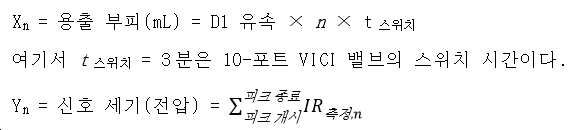
상기 수식은 IR 측정 신호를 예로서 사용한다. 수득된 HTLC 크로마토그램은 용출 부피의 함수로서 분리된 중합체 성분의 농도를 나타낸다. 정규화된 IR 측정 HTLC 크로마토그램은 Y가 dW/dV로 표시되며 용출 부피에 대한 정규화된 중량 분율을 의미한다.The above formula uses the IR measurement signal as an example. The obtained HTLC chromatogram shows the concentration of the separated polymer component as a function of the elution volume. Normalized IR measurement HTLC chromatogram, where Y is expressed in dW/dV and means the normalized weight fraction to elution volume.
데이터의 X-Y 쌍은 IR 메틸 및 LS15 신호에서도 수득된다. IR 메틸/IR 측정의 비는 보정 후 조성을 계산하는 데 사용된다. LS15/IR 측정 의 비는 보정 후, 중량 평균 분자량( M w)을 계산하는 데 사용된다.XY pairs of data are also obtained from IR methyl and LS15 signals. The ratio of IR methyl / IR measurements is used to calculate the composition after calibration. The ratio of LS15/ IR measurements is used to calculate the weight average molecular weight ( M w ) after calibration.
보정은 Lee 등의 상기 문헌의 절차에 따른다. 프로필렌 함량이 20.0, 28.0, 50.0, 86.6, 92.0 및 95.8 중량%인 고밀도 폴리에틸렌(HDPE), 아이소택틱 폴리프로필렌(iPP) 및 에틸렌-프로필렌 공중합체가 IR 메틸/IR 측정 보정 표준으로 사용된다. 표준의 조성은 NMR에 의해 측정된다. 표준은 IR5 검출기가 있는 SEC에 의해 실행된다. 표준의 수득된 IR 메틸/IR 측정 비는 그들의 조성의 함수로서 플롯되어, 보정 곡선이 산출된다.The correction follows the procedure of Lee et al. High-density polyethylene (HDPE), isotactic polypropylene ( i PP) and ethylene-propylene copolymers with propylene content of 20.0, 28.0, 50.0, 86.6, 92.0 and 95.8 wt % were used as IR methyl / IR measurement calibration standards. The composition of the standard is determined by NMR. The standard is implemented by the SEC with an IR5 detector. The obtained IR methyl / IR measurement ratios of the standards are plotted as a function of their composition, yielding a calibration curve.
HDPE 참조가 루틴 LS15 보정에 사용된다. 참조의 M w 는 LS와 RI(굴절률) 검출기와 104.2 kg/mol로서 GPC에 의해 미리 결정된다. GPC는 NPC 1475를 GPC의 표준으로 사용한다. 표준은 NIST에 의해 52.0 kg/mol의 인증값을 가진다. 7 내지 10mg의 표준을 160℃에서 8-mL 데칸에 용해시킨다. 용액을 100 % TCB의 HTLC 컬럼에 주입한다. 중합체를 일정한 100% TCB하에 0.01 mL/분으로 용출한다. 따라서 중합체의 피크가 HTLC 컬럼의 공극 부피에서 나타난다. 보정 상수 Ω는 총 LS15 신호(ALS15)와 총 IR 측정 신호(AIR,측정)로 결정된다:The HDPE reference is used for routine LS15 calibration. M w of the reference is predetermined by GPC as 104.2 kg/mol with LS and RI (refractive index) detectors. GPC uses NPC 1475 as the standard for GPC. The standard has a certified value of 52.0 kg/mol by NIST. Dissolve 7-10 mg of standard in 8-mL decane at 160°C. The solution is injected into an HTLC column of 100% TCB. The polymer is eluted at 0.01 mL/min under constant 100% TCB. Therefore, the peak of the polymer appears in the pore volume of the HTLC column. The correction constant Ω is determined by the total LS15 signal (A LS15 ) and the total IR measurement signal (A IR,measure ):
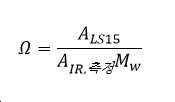
실험 LS15/IR 측정 비는 Ω를 통해 M w 로 전환된다.The experimental LS15/ IR measurement ratio is converted to M w through Ω.
자일렌 가용성 분획 분석: 환류 조건하에 2시간 동안 200 ml o-자일렌에 용해된 계량된 양의 수지를 사용하여 수행한다. 그런 다음 용액을 온도 조절 수조에서 25℃로 냉각시켜 자일렌 불용성(XI) 분획물의 결정화를 허용한다. 일단 용액이 냉각되고 불용성 분획물이 용액에서 침전되면, 여과지를 통한 여과에 의해 자일렌 불용성 분획물에서 자일렌 가용성(XS) 분획물의 분리가 이루어진다. 나머지 o-자일렌 용액은 여액에서 증발된다. XS 및 XI 분획물 모두를 100℃의 진공 오븐에서 60분 동안 건조시킨 다음 칭량한다. Xylene soluble fraction analysis: carried out using a metered amount of resin dissolved in 200 ml o-xylene for 2 hours under reflux conditions. The solution is then cooled to 25° C. in a temperature controlled water bath to allow crystallization of the xylene insoluble (XI) fraction. Once the solution has cooled and the insoluble fraction has precipitated out of the solution, separation of the xylene soluble (XS) fraction from the xylene insoluble fraction is achieved by filtration through filter paper. The remaining o-xylene solution is evaporated from the filtrate. Both XS and XI fractions are dried in a vacuum oven at 100° C. for 60 minutes and then weighed.
13 C 핵 자기 공명(NMR)은 다음을 포함한다: 13 C nuclear magnetic resonance (NMR) includes:
샘플 제조: 10 mm NMR 튜브에 있는 0.21g의 샘플에 크롬 아세틸아세토네이트(완화제) 중 0.025 M인 테트라클로로에탄-d2/오쏘다이클로로벤젠의 50/50 혼합물 약 2.7g을 첨가하여 샘플을 제조한다. 튜브와 그 내용물을 150℃로 가열하여 샘플을 용해시켜 균질화한다. Sample Preparation: Prepare a sample by adding about 2.7 g of a 50/50 mixture of tetrachloroethane-d2/orthodichlorobenzene at 0.025 M in chromium acetylacetonate (relaxant) to a 0.21 g sample in a 10 mm NMR tube. . The tube and its contents are heated to 150° C. to dissolve and homogenize the sample.
데이터 수집 매개 변수: 데이터는 Bruker Dual DUL 고온 CryoProbe가 장착된 Bruker 400 MHz 분광기를 사용하여 수집한다. 데이터는 데이터 파일 당 320 과도신호(transient), 7.3초 펄스 반복 지연(6초 지연 + 1.3초 획득 시간), 90도 플립 각도 및 125℃의 샘플 온도로 역게이트화 디커플링을 사용하여 획득된다. 모든 측정은 잠긴 모드에서 비회전 샘플로 이루어진다. 가열된 (130℃) NMR 샘플 교환기에 삽입하기 직전에 샘플을 균질화하고 데이터 획득 전 15분 동안 프로브에서 열적으로 평형을 유지하도록 한다. Data Acquisition Parameters: Data are acquired using a Bruker 400 MHz spectrometer equipped with a Bruker Dual DUL high temperature CryoProbe. Data are acquired using reverse-gated decoupling with 320 transients per data file, 7.3 sec pulse repetition delay (6 sec delay + 1.3 sec acquisition time), 90 degree flip angle and sample temperature of 125 °C. All measurements are made with non-rotating samples in locked mode. Homogenize the sample immediately prior to insertion into a heated (130° C.) NMR sample changer and allow to thermally equilibrate in the probe for 15 min prior to data acquisition.
청구된 요지의 사상 및 범위를 벗어나지 않고 기술된 구현예에 다양한 변형이 이루어질 수 있음은 당업자에게 명백할 것이다. 따라서, 본 명세서는 수정 및 변형이 첨부된 청구 범위 및 그 균등물의 범위 내에 있다면, 기술된 구현예의 그러한 수정 및 변형을 포함하도록 의도된다.It will be apparent to those skilled in the art that various modifications may be made to the described embodiments without departing from the spirit and scope of the claimed subject matter. Accordingly, this specification is intended to cover the modifications and variations of the described embodiments provided they come within the scope of the appended claims and their equivalents.
Claims (15)
20 내지 90 중량%의 고분자량(HMW) 분획물(상기 HMW 분획물은 겔 투과 크로마토그래피(GPC)로 측정했을 때 수 평균 분자량(Mn)이 적어도 50 kg/mol이고, 상기 HMW 분획물은 적어도 35 중량%의 에틸렌 및 적어도 30 중량%의 α-올레핀 공단량체를 포함함);
저분자량(LMW) 분획물(상기 LMW 분획물은 Mn이 4 내지 25 kg/mol이며, 상기 LMW 분획물은 적어도 50 중량%의 에틸렌과 적어도 29 중량%의 α-올레핀 공단량체를 포함하고, 상기 HMW 분획물의 Mn 대 상기 LMW 분획물의 Mn의 비가 적어도 5 대 1임)을 포함하되,
상기 다중모드 엘라스토머는 0.853 내지 0.875 g/cc의 밀도, 100 rad/s에서 2,500 Pa-s 미만의 전단 점도 및 0.1 rad/s에서 120,000 Pa-s 미만의 전단 점도를 갖는, 다중모드 엘라스토머.A multimodal elastomer comprising a copolymer of ethylene and at least one α-olefin comonomer, the multimodal elastomer comprising:
20 to 90% by weight of a high molecular weight (HMW) fraction, wherein the HMW fraction has a number average molecular weight (Mn) of at least 50 kg/mol as determined by gel permeation chromatography (GPC), and wherein the HMW fraction has at least 35% by weight ethylene and at least 30% by weight of an α-olefin comonomer);
A low molecular weight (LMW) fraction, wherein the LMW fraction has an Mn of 4 to 25 kg/mol, the LMW fraction comprising at least 50 wt % ethylene and at least 29 wt % α-olefin comonomer; the ratio of Mn to Mn of said LMW fraction is at least 5 to 1;
wherein the multimodal elastomer has a density of 0.853 to 0.875 g/cc, a shear viscosity of less than 2,500 Pa-s at 100 rad/s, and a shear viscosity of less than 120,000 Pa-s at 0.1 rad/s.
제1항 또는 제2항의 다중모드 엘라스토머; 및
폴리프로필렌을 포함하는, 열가소성 올레핀.A thermoplastic olefin comprising:
The multimodal elastomer of claim 1 or 2; and
A thermoplastic olefin, including polypropylene.
적어도 하나의 에틸렌 단량체, 적어도 하나의 α-올레핀 공단량체, 바이페닐 페놀 복합체를 포함하는 제1 촉매, 기하 구속 복합체(constrained gemetry complex)를 포함하는 제2 촉매를 반응기 시스템에 첨가하는 단계;
적어도 100℃의 온도에서 용액 중합을 통해 다중모드 엘라스토머를 제조하는 단계를 포함하되,
상기 다중모드 엘라스토머는 20 내지 90 중량%의 고분자량(HMW) 분획물 및 저분자량(LMW) 분획물을 포함하고,
상기 HMW 분획물은 겔 투과 크로마토그래피(GPC)로 측정했을 때, 수 평균 분자량(Mn)이 적어도 50 kg/mol이고, 상기 HMW 분획물은 적어도 35 중량%의 에틸렌 및 적어도 30 중량%의 α-올레핀 공단량체를 포함하고, 상기 LMW 분획물은 Mn이 4 내지 25 kg/mol이며, 상기 LMW 분획물은 적어도 50 중량%의 에틸렌과 적어도 29 중량%의 α-올레핀 공단량체를 포함하고,
상기 다중모드 엘라스토머는, 적어도 5:1의 상기 HMW 분획물의 Mn 대 상기 LMW 분획물의 Mn의 비; 0.853 내지 0.875 g/cc의 밀도; 100 rad/s에서 2,500 Pa-s 미만의 전단 점도; 및 0.1 rad/s 전단에서 120,000 Pa.s 미만의 전단 점도를 포함하는, 방법.A method for making a multimodal elastomer, comprising:
adding to the reactor system a first catalyst comprising at least one ethylene monomer, at least one α-olefin comonomer, a biphenyl phenol complex, and a second catalyst comprising a constrained geometry complex;
preparing a multimodal elastomer through solution polymerization at a temperature of at least 100° C.,
wherein the multimodal elastomer comprises 20 to 90% by weight of a high molecular weight (HMW) fraction and a low molecular weight (LMW) fraction;
wherein the HMW fraction has a number average molecular weight (Mn) of at least 50 kg/mol, as determined by gel permeation chromatography (GPC), and the HMW fraction comprises at least 35 wt % ethylene and at least 30 wt % α-olefin co-olefins a monomer, wherein the LMW fraction has a Mn of 4 to 25 kg/mol, the LMW fraction comprises at least 50 wt% ethylene and at least 29 wt% α-olefin comonomer;
The multimodal elastomer has a ratio of Mn of the HMW fraction to Mn of the LMW fraction of at least 5:1; a density of 0.853 to 0.875 g/cc; a shear viscosity of less than 2,500 Pa-s at 100 rad/s; and a shear viscosity of less than 120,000 Pa.s at 0.1 rad/s shear.
Applications Claiming Priority (3)
| Application Number | Priority Date | Filing Date | Title |
|---|---|---|---|
| US201662368244P | 2016-07-29 | 2016-07-29 | |
| US62/368,244 | 2016-07-29 | ||
| PCT/US2017/043674 WO2018022588A1 (en) | 2016-07-29 | 2017-07-25 | Mixed catalyst systems for producing multimodal elastomers |
Publications (2)
| Publication Number | Publication Date |
|---|---|
| KR20190039136A KR20190039136A (en) | 2019-04-10 |
| KR102413982B1 true KR102413982B1 (en) | 2022-06-30 |
Family
ID=59501639
Family Applications (1)
| Application Number | Title | Priority Date | Filing Date |
|---|---|---|---|
| KR1020197004232A Active KR102413982B1 (en) | 2016-07-29 | 2017-07-25 | Mixed catalyst systems for the production of multimodal elastomers |
Country Status (9)
| Country | Link |
|---|---|
| US (1) | US11155658B2 (en) |
| EP (1) | EP3491033B1 (en) |
| JP (1) | JP6957596B2 (en) |
| KR (1) | KR102413982B1 (en) |
| CN (1) | CN109601003A (en) |
| BR (1) | BR112019001249B1 (en) |
| ES (1) | ES2799716T3 (en) |
| SG (1) | SG11201900655UA (en) |
| WO (1) | WO2018022588A1 (en) |
Families Citing this family (13)
| Publication number | Priority date | Publication date | Assignee | Title |
|---|---|---|---|---|
| KR102413982B1 (en) | 2016-07-29 | 2022-06-30 | 다우 글로벌 테크놀로지스 엘엘씨 | Mixed catalyst systems for the production of multimodal elastomers |
| US10442921B2 (en) * | 2017-04-19 | 2019-10-15 | Nova Chemicals (International) S.A. | Means for increasing the molecular weight and decreasing the density employing mixed homogeneous catalyst formulations |
| US10442920B2 (en) * | 2017-04-19 | 2019-10-15 | Nova Chemicals (International) S.A. | Means for increasing the molecular weight and decreasing the density of ethylene interpolymers employing homogeneous and heterogeneous catalyst formulations |
| WO2020023193A1 (en) * | 2018-07-23 | 2020-01-30 | Exxonmobil Chemical Patents Inc. | Preparation of bimodal rubber, thermoplastic vulcanizates, and articles made therefrom |
| BR112022008378A2 (en) * | 2019-11-04 | 2022-07-12 | Dow Global Technologies Llc | BIMODAL POLYMERIZATION CATALYST SYSTEM, AND, METHODS FOR MAKING A POLYETHYLENE COMPOSITION AND FOR MANUFACTURING THE BIMODAL POLYMERIZATION CATALYST SYSTEM |
| JP7730316B2 (en) * | 2019-11-04 | 2025-08-27 | ダウ グローバル テクノロジーズ エルエルシー | Biphenylphenol polymerization catalyst |
| BR112022011778A2 (en) * | 2019-12-19 | 2022-08-30 | Dow Global Technologies Llc | USE OF A GAS PHASE BIPHENYLPHENOL POLYMERIZATION CATALYST, POLYMERIZATION CATALYST SYSTEM, POLYMERIZATION METHOD, AND, POLYETHYLENE COMPOSITION |
| JP7429788B2 (en) | 2019-12-26 | 2024-02-08 | ダウ グローバル テクノロジーズ エルエルシー | Ethylene/alpha-olefin interpolymer-based compositions with improved balance of curing and processability |
| WO2021128126A1 (en) | 2019-12-26 | 2021-07-01 | Dow Global Technologies Llc | Alpha-olefin interpolymers with improved molecular design for photovoltaic encapsulants |
| BR112022012386A2 (en) * | 2019-12-26 | 2022-08-30 | Dow Global Technologies Llc | PROCESS FOR PREPARING AN ALPHA COMPOSITION, COMPOSITION, AND, ARTICLE |
| KR102554319B1 (en) * | 2021-04-19 | 2023-07-11 | 한화토탈에너지스 주식회사 | Process for manufacturing polymeric compound |
| WO2025034262A1 (en) | 2023-08-07 | 2025-02-13 | ExxonMobil Technology and Engineering Company | Ethylene copolymer compositions and articles made thereof |
| WO2025096296A1 (en) * | 2023-10-31 | 2025-05-08 | Dow Global Technologies Llc | Multimodal polymerization processes with multi-catalyst systems |
Family Cites Families (27)
| Publication number | Priority date | Publication date | Assignee | Title |
|---|---|---|---|---|
| US5272236A (en) | 1991-10-15 | 1993-12-21 | The Dow Chemical Company | Elastic substantially linear olefin polymers |
| US5278272A (en) | 1991-10-15 | 1994-01-11 | The Dow Chemical Company | Elastic substantialy linear olefin polymers |
| DE69211569T2 (en) | 1991-12-30 | 1997-01-23 | Dow Chemical Co | ETHYLENE INTERPOLYMER POLYMERIZATION |
| FI98819C (en) * | 1993-03-26 | 1997-08-25 | Borealis Polymers Oy | Process for the production of olefin polymers and products made with the process |
| US6610408B1 (en) * | 1996-11-08 | 2003-08-26 | Solvay Engineered Polymers | TPO blends containing multimodal elastomers |
| US6812289B2 (en) | 1996-12-12 | 2004-11-02 | Dow Global Technologies Inc. | Cast stretch film of interpolymer compositions |
| US6069213A (en) | 1997-12-16 | 2000-05-30 | Union Carbide Chemicals & Plastics Technology Corporation | Mixed catalyst system |
| MY137183A (en) * | 2001-03-16 | 2009-01-30 | Dow Global Technologies Inc | Method of making interpolymers and products made therefrom |
| EP2221328B1 (en) | 2004-03-17 | 2017-04-19 | Dow Global Technologies LLC | Catalyst composition comprising shuttling agent for ethylene multi-block copolymer formation |
| WO2006020624A1 (en) | 2004-08-09 | 2006-02-23 | Dow Global Technologies Inc. | Supported bis(hydroxyarylaryloxy) catalysts for manufacture of polymers |
| US20070049711A1 (en) | 2005-09-01 | 2007-03-01 | Chi-I Kuo | Catalyst compositions comprising support materials having an improved particle-size distribution |
| WO2007035485A1 (en) | 2005-09-15 | 2007-03-29 | Dow Global Technologies Inc. | Catalytic olefin block copolymers with controlled block sequence distribution |
| KR20080055838A (en) * | 2005-09-15 | 2008-06-19 | 다우 글로벌 테크놀로지스 인크. | Control of Polymer Composition and Molecular Weight Distribution with Multi-core Shuttles |
| AR060642A1 (en) | 2006-05-17 | 2008-07-02 | Dow Global Technologies Inc | ETHYLENE / ALPHA-OLEFINE / DIENO AND POLYMER SOLUTION POLYMERIZATION PROCESS |
| WO2009114661A1 (en) * | 2008-03-13 | 2009-09-17 | Dow Global Technologies Inc. | Long chain branched (lcb), block or interconnected copolymers of ethylene in combination with one other polymer |
| TWI445751B (en) | 2008-07-16 | 2014-07-21 | Univation Tech Llc | Polyethylene compositions |
| US8716400B2 (en) | 2009-10-02 | 2014-05-06 | Dow Global Technologies Llc | Block composites and impact modified compositions |
| US8679639B2 (en) * | 2009-11-24 | 2014-03-25 | Dow Global Technologies Llc | Extrusion coating composition |
| BR112012022591B1 (en) | 2010-05-17 | 2022-11-08 | Dow Global Technologies Inc | PROCESS FOR SELECTIVELY POLYMERIZING ETHYLENE IN THE PRESENCE OF AN ALPHA-OLFIN, METAL-BINDER COMPLEX, CATALYST AND BINDER |
| CN103180347B (en) * | 2010-08-25 | 2015-12-02 | 陶氏环球技术有限责任公司 | Process for polymerizing polymerizable olefins and catalysts for the process |
| WO2013096573A1 (en) * | 2011-12-20 | 2013-06-27 | Dow Global Technologies Llc | Ethylene/alpha-olefin/nonconjugated polyene interpolymers and processes to form the same |
| CN104884484B (en) | 2012-12-27 | 2018-09-14 | 陶氏环球技术有限责任公司 | Polymerization for generating polyvinyls |
| EP2938645B1 (en) | 2012-12-27 | 2019-05-15 | Dow Global Technologies LLC | An ethylene based polymer |
| SG11201505073SA (en) | 2012-12-27 | 2015-07-30 | Dow Global Technologies Llc | A polymerization process for producing ethylene based polymers |
| WO2014209256A1 (en) * | 2013-06-24 | 2014-12-31 | Dow Global Technologies Llc | Reinforced polypropylene composition |
| CN103421138B (en) | 2013-07-21 | 2015-10-07 | 浙江大学 | A kind of single reactor prepares the poly method of wide/double peak |
| KR102413982B1 (en) | 2016-07-29 | 2022-06-30 | 다우 글로벌 테크놀로지스 엘엘씨 | Mixed catalyst systems for the production of multimodal elastomers |
-
2017
- 2017-07-25 KR KR1020197004232A patent/KR102413982B1/en active Active
- 2017-07-25 BR BR112019001249-4A patent/BR112019001249B1/en active IP Right Grant
- 2017-07-25 US US16/318,568 patent/US11155658B2/en active Active
- 2017-07-25 EP EP17746353.6A patent/EP3491033B1/en active Active
- 2017-07-25 ES ES17746353T patent/ES2799716T3/en active Active
- 2017-07-25 SG SG11201900655UA patent/SG11201900655UA/en unknown
- 2017-07-25 WO PCT/US2017/043674 patent/WO2018022588A1/en not_active Ceased
- 2017-07-25 CN CN201780045722.0A patent/CN109601003A/en active Pending
- 2017-07-25 JP JP2019504092A patent/JP6957596B2/en active Active
Also Published As
| Publication number | Publication date |
|---|---|
| KR20190039136A (en) | 2019-04-10 |
| JP2019525986A (en) | 2019-09-12 |
| WO2018022588A1 (en) | 2018-02-01 |
| US20190276573A1 (en) | 2019-09-12 |
| JP6957596B2 (en) | 2021-11-02 |
| BR112019001249B1 (en) | 2022-10-18 |
| ES2799716T3 (en) | 2020-12-21 |
| EP3491033B1 (en) | 2020-05-13 |
| EP3491033A1 (en) | 2019-06-05 |
| US11155658B2 (en) | 2021-10-26 |
| SG11201900655UA (en) | 2019-02-27 |
| BR112019001249A2 (en) | 2019-04-30 |
| CN109601003A (en) | 2019-04-09 |
Similar Documents
| Publication | Publication Date | Title |
|---|---|---|
| KR102413982B1 (en) | Mixed catalyst systems for the production of multimodal elastomers | |
| CN107922686B (en) | Polyolefin blends including compatibilizers | |
| EP1417260B1 (en) | Bimodal polyethylene composition and articles made therefrom | |
| US10800908B2 (en) | Polyethylene composition, method of making the same, and films made therefrom | |
| US20230079895A1 (en) | Resins for use as tie layers in multilayer films and multilayer films comprising the same | |
| CN103080206B (en) | Crystalline block composites as compatibilizers | |
| EP2580281B1 (en) | High stiffness high impact propylene impact copolymers | |
| EP3464460B1 (en) | Thermoplastic polyolefin blends including block composites as compatibilizers | |
| WO2015200740A2 (en) | Ethylene-based polymer composition for films with improved toughness | |
| CN107922683B (en) | Polyolefin blends comprising polyoctene and compatibilizer | |
| KR20200118406A (en) | Composition with multimodal ethylene polymer having improved toughness at low temperature | |
| EP3013900A1 (en) | Reinforced polypropylene composition | |
| US9475928B2 (en) | Reinforced polypropylene composition | |
| CN115989275B (en) | High density polyethylene composition with excellent physical properties | |
| JP2018515654A (en) | High melt flow thermoplastic polyolefins with modifiers | |
| US6891018B2 (en) | Ethylene copolymer and uses thereof | |
| US11560467B2 (en) | Polyolefin composition with improved resistance to ESCR | |
| WO2016073062A1 (en) | Improved thermoplastic polyolefin design for enhanced stiffness, toughness, and viscosity balance | |
| US12263628B2 (en) | Multilayer films and articles comprising the same |
Legal Events
| Date | Code | Title | Description |
|---|---|---|---|
| PA0105 | International application |
Patent event date: 20190213 Patent event code: PA01051R01D Comment text: International Patent Application |
|
| PG1501 | Laying open of application | ||
| A201 | Request for examination | ||
| PA0201 | Request for examination |
Patent event code: PA02012R01D Patent event date: 20200629 Comment text: Request for Examination of Application |
|
| E902 | Notification of reason for refusal | ||
| PE0902 | Notice of grounds for rejection |
Comment text: Notification of reason for refusal Patent event date: 20210929 Patent event code: PE09021S01D |
|
| E701 | Decision to grant or registration of patent right | ||
| PE0701 | Decision of registration |
Patent event code: PE07011S01D Comment text: Decision to Grant Registration Patent event date: 20220421 |
|
| PR0701 | Registration of establishment |
Comment text: Registration of Establishment Patent event date: 20220623 Patent event code: PR07011E01D |
|
| PR1002 | Payment of registration fee |
Payment date: 20220624 End annual number: 3 Start annual number: 1 |
|
| PG1601 | Publication of registration |