KR102258429B1 - Particulate foam with other cushioning - Google Patents
Particulate foam with other cushioning Download PDFInfo
- Publication number
- KR102258429B1 KR102258429B1 KR1020207026748A KR20207026748A KR102258429B1 KR 102258429 B1 KR102258429 B1 KR 102258429B1 KR 1020207026748 A KR1020207026748 A KR 1020207026748A KR 20207026748 A KR20207026748 A KR 20207026748A KR 102258429 B1 KR102258429 B1 KR 102258429B1
- Authority
- KR
- South Korea
- Prior art keywords
- footwear
- article
- outsole
- protrusions
- cavity
- Prior art date
- Legal status (The legal status is an assumption and is not a legal conclusion. Google has not performed a legal analysis and makes no representation as to the accuracy of the status listed.)
- Active
Links
Images






Classifications
-
- A—HUMAN NECESSITIES
- A43—FOOTWEAR
- A43B—CHARACTERISTIC FEATURES OF FOOTWEAR; PARTS OF FOOTWEAR
- A43B13/00—Soles; Sole-and-heel integral units
- A43B13/02—Soles; Sole-and-heel integral units characterised by the material
- A43B13/04—Plastics, rubber or vulcanised fibre
-
- A—HUMAN NECESSITIES
- A43—FOOTWEAR
- A43B—CHARACTERISTIC FEATURES OF FOOTWEAR; PARTS OF FOOTWEAR
- A43B1/00—Footwear characterised by the material
- A43B1/0072—Footwear characterised by the material made at least partially of transparent or translucent materials
-
- A—HUMAN NECESSITIES
- A43—FOOTWEAR
- A43B—CHARACTERISTIC FEATURES OF FOOTWEAR; PARTS OF FOOTWEAR
- A43B13/00—Soles; Sole-and-heel integral units
- A43B13/02—Soles; Sole-and-heel integral units characterised by the material
- A43B13/12—Soles with several layers of different materials
- A43B13/122—Soles with several layers of different materials characterised by the outsole or external layer
-
- A—HUMAN NECESSITIES
- A43—FOOTWEAR
- A43B—CHARACTERISTIC FEATURES OF FOOTWEAR; PARTS OF FOOTWEAR
- A43B13/00—Soles; Sole-and-heel integral units
- A43B13/02—Soles; Sole-and-heel integral units characterised by the material
- A43B13/12—Soles with several layers of different materials
- A43B13/125—Soles with several layers of different materials characterised by the midsole or middle layer
-
- A—HUMAN NECESSITIES
- A43—FOOTWEAR
- A43B—CHARACTERISTIC FEATURES OF FOOTWEAR; PARTS OF FOOTWEAR
- A43B13/00—Soles; Sole-and-heel integral units
- A43B13/02—Soles; Sole-and-heel integral units characterised by the material
- A43B13/12—Soles with several layers of different materials
- A43B13/125—Soles with several layers of different materials characterised by the midsole or middle layer
- A43B13/127—Soles with several layers of different materials characterised by the midsole or middle layer the midsole being multilayer
-
- A—HUMAN NECESSITIES
- A43—FOOTWEAR
- A43B—CHARACTERISTIC FEATURES OF FOOTWEAR; PARTS OF FOOTWEAR
- A43B13/00—Soles; Sole-and-heel integral units
- A43B13/14—Soles; Sole-and-heel integral units characterised by the constructive form
- A43B13/141—Soles; Sole-and-heel integral units characterised by the constructive form with a part of the sole being flexible, e.g. permitting articulation or torsion
-
- A—HUMAN NECESSITIES
- A43—FOOTWEAR
- A43B—CHARACTERISTIC FEATURES OF FOOTWEAR; PARTS OF FOOTWEAR
- A43B13/00—Soles; Sole-and-heel integral units
- A43B13/14—Soles; Sole-and-heel integral units characterised by the constructive form
- A43B13/16—Pieced soles
-
- A—HUMAN NECESSITIES
- A43—FOOTWEAR
- A43B—CHARACTERISTIC FEATURES OF FOOTWEAR; PARTS OF FOOTWEAR
- A43B13/00—Soles; Sole-and-heel integral units
- A43B13/14—Soles; Sole-and-heel integral units characterised by the constructive form
- A43B13/18—Resilient soles
- A43B13/181—Resiliency achieved by the structure of the sole
-
- A—HUMAN NECESSITIES
- A43—FOOTWEAR
- A43B—CHARACTERISTIC FEATURES OF FOOTWEAR; PARTS OF FOOTWEAR
- A43B13/00—Soles; Sole-and-heel integral units
- A43B13/14—Soles; Sole-and-heel integral units characterised by the constructive form
- A43B13/18—Resilient soles
- A43B13/181—Resiliency achieved by the structure of the sole
- A43B13/186—Differential cushioning region, e.g. cushioning located under the ball of the foot
-
- A—HUMAN NECESSITIES
- A43—FOOTWEAR
- A43B—CHARACTERISTIC FEATURES OF FOOTWEAR; PARTS OF FOOTWEAR
- A43B13/00—Soles; Sole-and-heel integral units
- A43B13/14—Soles; Sole-and-heel integral units characterised by the constructive form
- A43B13/18—Resilient soles
- A43B13/187—Resiliency achieved by the features of the material, e.g. foam, non liquid materials
-
- A—HUMAN NECESSITIES
- A43—FOOTWEAR
- A43B—CHARACTERISTIC FEATURES OF FOOTWEAR; PARTS OF FOOTWEAR
- A43B13/00—Soles; Sole-and-heel integral units
- A43B13/14—Soles; Sole-and-heel integral units characterised by the constructive form
- A43B13/18—Resilient soles
- A43B13/187—Resiliency achieved by the features of the material, e.g. foam, non liquid materials
- A43B13/188—Differential cushioning regions
-
- A—HUMAN NECESSITIES
- A43—FOOTWEAR
- A43B—CHARACTERISTIC FEATURES OF FOOTWEAR; PARTS OF FOOTWEAR
- A43B13/00—Soles; Sole-and-heel integral units
- A43B13/14—Soles; Sole-and-heel integral units characterised by the constructive form
- A43B13/18—Resilient soles
- A43B13/189—Resilient soles filled with a non-compressible fluid, e.g. gel, water
-
- A—HUMAN NECESSITIES
- A43—FOOTWEAR
- A43B—CHARACTERISTIC FEATURES OF FOOTWEAR; PARTS OF FOOTWEAR
- A43B13/00—Soles; Sole-and-heel integral units
- A43B13/14—Soles; Sole-and-heel integral units characterised by the constructive form
- A43B13/18—Resilient soles
- A43B13/20—Pneumatic soles filled with a compressible fluid, e.g. air, gas
-
- A—HUMAN NECESSITIES
- A43—FOOTWEAR
- A43B—CHARACTERISTIC FEATURES OF FOOTWEAR; PARTS OF FOOTWEAR
- A43B13/00—Soles; Sole-and-heel integral units
- A43B13/14—Soles; Sole-and-heel integral units characterised by the constructive form
- A43B13/18—Resilient soles
- A43B13/20—Pneumatic soles filled with a compressible fluid, e.g. air, gas
- A43B13/206—Pneumatic soles filled with a compressible fluid, e.g. air, gas provided with tubes or pipes or tubular shaped cushioning members
-
- A—HUMAN NECESSITIES
- A43—FOOTWEAR
- A43B—CHARACTERISTIC FEATURES OF FOOTWEAR; PARTS OF FOOTWEAR
- A43B5/00—Footwear for sporting purposes
-
- A—HUMAN NECESSITIES
- A43—FOOTWEAR
- A43B—CHARACTERISTIC FEATURES OF FOOTWEAR; PARTS OF FOOTWEAR
- A43B7/00—Footwear with health or hygienic arrangements
- A43B7/14—Footwear with health or hygienic arrangements with foot-supporting parts
- A43B7/1405—Footwear with health or hygienic arrangements with foot-supporting parts with pads or holes on one or more locations, or having an anatomical or curved form
- A43B7/141—Footwear with health or hygienic arrangements with foot-supporting parts with pads or holes on one or more locations, or having an anatomical or curved form having an anatomical or curved form
-
- A—HUMAN NECESSITIES
- A43—FOOTWEAR
- A43B—CHARACTERISTIC FEATURES OF FOOTWEAR; PARTS OF FOOTWEAR
- A43B7/00—Footwear with health or hygienic arrangements
- A43B7/32—Footwear with health or hygienic arrangements with shock-absorbing means
-
- B—PERFORMING OPERATIONS; TRANSPORTING
- B32—LAYERED PRODUCTS
- B32B—LAYERED PRODUCTS, i.e. PRODUCTS BUILT-UP OF STRATA OF FLAT OR NON-FLAT, e.g. CELLULAR OR HONEYCOMB, FORM
- B32B25/00—Layered products comprising a layer of natural or synthetic rubber
- B32B25/04—Layered products comprising a layer of natural or synthetic rubber comprising rubber as the main or only constituent of a layer, which is next to another layer of the same or of a different material
- B32B25/047—Layered products comprising a layer of natural or synthetic rubber comprising rubber as the main or only constituent of a layer, which is next to another layer of the same or of a different material of particles
-
- B—PERFORMING OPERATIONS; TRANSPORTING
- B32—LAYERED PRODUCTS
- B32B—LAYERED PRODUCTS, i.e. PRODUCTS BUILT-UP OF STRATA OF FLAT OR NON-FLAT, e.g. CELLULAR OR HONEYCOMB, FORM
- B32B25/00—Layered products comprising a layer of natural or synthetic rubber
- B32B25/14—Layered products comprising a layer of natural or synthetic rubber comprising synthetic rubber copolymers
-
- B—PERFORMING OPERATIONS; TRANSPORTING
- B32—LAYERED PRODUCTS
- B32B—LAYERED PRODUCTS, i.e. PRODUCTS BUILT-UP OF STRATA OF FLAT OR NON-FLAT, e.g. CELLULAR OR HONEYCOMB, FORM
- B32B5/00—Layered products characterised by the non- homogeneity or physical structure, i.e. comprising a fibrous, filamentary, particulate or foam layer; Layered products characterised by having a layer differing constitutionally or physically in different parts
- B32B5/16—Layered products characterised by the non- homogeneity or physical structure, i.e. comprising a fibrous, filamentary, particulate or foam layer; Layered products characterised by having a layer differing constitutionally or physically in different parts characterised by features of a layer formed of particles, e.g. chips, powder or granules
-
- B—PERFORMING OPERATIONS; TRANSPORTING
- B32—LAYERED PRODUCTS
- B32B—LAYERED PRODUCTS, i.e. PRODUCTS BUILT-UP OF STRATA OF FLAT OR NON-FLAT, e.g. CELLULAR OR HONEYCOMB, FORM
- B32B5/00—Layered products characterised by the non- homogeneity or physical structure, i.e. comprising a fibrous, filamentary, particulate or foam layer; Layered products characterised by having a layer differing constitutionally or physically in different parts
- B32B5/18—Layered products characterised by the non- homogeneity or physical structure, i.e. comprising a fibrous, filamentary, particulate or foam layer; Layered products characterised by having a layer differing constitutionally or physically in different parts characterised by features of a layer of foamed material
-
- B—PERFORMING OPERATIONS; TRANSPORTING
- B32—LAYERED PRODUCTS
- B32B—LAYERED PRODUCTS, i.e. PRODUCTS BUILT-UP OF STRATA OF FLAT OR NON-FLAT, e.g. CELLULAR OR HONEYCOMB, FORM
- B32B2264/00—Composition or properties of particles which form a particulate layer or are present as additives
- B32B2264/02—Synthetic macromolecular particles
-
- B—PERFORMING OPERATIONS; TRANSPORTING
- B32—LAYERED PRODUCTS
- B32B—LAYERED PRODUCTS, i.e. PRODUCTS BUILT-UP OF STRATA OF FLAT OR NON-FLAT, e.g. CELLULAR OR HONEYCOMB, FORM
- B32B2437/00—Clothing
- B32B2437/02—Gloves, shoes
Landscapes
- Engineering & Computer Science (AREA)
- Chemical & Material Sciences (AREA)
- Materials Engineering (AREA)
- Health & Medical Sciences (AREA)
- General Health & Medical Sciences (AREA)
- Epidemiology (AREA)
- Public Health (AREA)
- Life Sciences & Earth Sciences (AREA)
- Wood Science & Technology (AREA)
- Physical Education & Sports Medicine (AREA)
- Footwear And Its Accessory, Manufacturing Method And Apparatuses (AREA)
Abstract
신발류 물품은, 갑피, 갑피에 부착되는 바닥창, 및 중창을 포함한다. 바닥창은, 반대측들 상에 배치되는 지면-접촉 표면 및 내측 표면을 구비한다. 중창은, 반대측들 상에 배치되는 발 받침부 및 바닥 표면을 구비한다. 바닥 표면은, 내측 표면과, 그들 사이에 캐비티를 한정하도록 대향한다. 신발류 물품은 또한, 캐비티 내로 내측 표면 및 바닥 표면 중의 하나로부터 내측 표면 및 바닥 표면 중의 다른 하나를 향해 제1 방향으로 연장되는, 제1 일련의 돌기들을 포함한다. 신발류 물품은 또한, 캐비티 내로 내측 표면 및 바닥 표면 중의 하나로부터 내측 표면 및 바닥 표면 중의 다른 하나를 향해 제1 방향으로 연장되는, 제2 일련의 돌기들을 포함한다. 신발류 물품은 또한, 캐비티 내부에 배치되는 소정량의 입자형 소재를 포함한다.An article of footwear includes an upper, an outsole attached to the upper, and a midsole. The outsole has an inner surface and a ground-contacting surface disposed on opposite sides. The midsole has a footrest disposed on opposite sides and a sole surface. The bottom surface opposes the inner surface to define a cavity therebetween. The article of footwear also includes a first series of protrusions extending into the cavity in a first direction from one of the inner surface and the floor surface toward the other of the inner surface and the floor surface. The article of footwear also includes a second series of protrusions extending into the cavity in a first direction from one of the inner surface and the floor surface toward the other of the inner surface and the floor surface. The article of footwear also includes an amount of particulate material disposed within the cavity.
Description
관련 출원의 상호 참조 Cross-reference of related applications
본 출원은, 그의 개시들이 본 명세서에 그들 전체로서 참조로 통합되는, 2015년 9월 24일 출원된 번호 제62/222,822호, 2015년 9월 24일 출원된 번호 제62/222,873호, 2015년 9월 24일 출원된 번호 제62/222,851호, 2015년 9월 24일 출원된 번호 제62/222,842호, 2015년 9월 24일 출원된 번호 제62/222,832호, 및 2015년 9월 24일 출원된 번호 제62/222,816호에 대한 우선권을 주장한다.This application is filed Sep. 24, 2015, No. 62/222,822, filed Sep. 24, 2015, No. 62/222,873, 2015, the disclosures of which are incorporated herein by reference in their entirety. No. 62/222,851 filed September 24, 62/222,842 filed September 24, 2015 No. 62/222,832 filed September 24, 2015, and 24 September 2015 Claims priority to filed No. 62/222,816.
본 개시는 개괄적으로, 다른 완충과 통합되는 입자형 발포체를 구비하는 신발류 물품들에 관한 것이다.The present disclosure relates generally to articles of footwear having a particulate foam that is incorporated with other cushioning agents.
본 섹션은, 필수적인 종래기술이 아닌 본 개시에 관련되는, 배경 정보를 제공한다. This section provides background information that pertains to the present disclosure and not necessarily prior art.
신발류 물품들은 통상적으로, 갑피 및 밑창 구조물을 포함한다. 갑피는, 밑창 구조물 상에서 발을 수용하고, 고정하며 그리고 지지하기 위한, 임의의 적당한 재료(들)로 형성될 수 있을 것이다. 갑피는, 발 둘레에서의 갑피의 맞춤을 조절하기 위해, 레이스들, 또는 스트랩들, 또는 다른 잠금구들(fasteners)과 협력할 수 있을 것이다. 발의 바닥 표면에 인접한, 갑피의 바닥 부분이, 밑창 구조물에 부착된다. Articles of footwear typically include an upper and a sole structure. The upper may be formed of any suitable material(s) for receiving, securing, and supporting the foot on the sole structure. The upper may cooperate with laces, or straps, or other fasteners to adjust the fit of the upper around the foot. A bottom portion of the upper, adjacent the bottom surface of the foot, is attached to the sole structure.
밑창 구조물들은 일반적으로, 지표면과 갑피 사이에서 연장되는 층상 배열체를 포함한다. 밑창 구조물의 하나의 층은, 마모 저항성 및 지표면에 대한 마찰력을 제공하는, 바닥창을 포함한다. 바닥창은, 내구성 및 마모-저항성을 부과할 뿐만 아니라, 지표면에 대한 마찰력을 향상시키는, 고무 또는 다른 재료로 형성될 수 있을 것이다. 밑창 구조물의 다른 층이, 바닥창과 갑피 사이에 배치되는 중창을 포함한다. 중창은, 발을 위한 완충을 제공하며 그리고 일반적으로 적어도 부분적으로, 지면-반력을 감쇠시킴에 의해 발을 완충하기 위해, 가해지는 하중 하에서 탄력적으로 압축되는, 중합체 발포체 재료로 형성된다. 중창은, 바닥창과 대향하는 일 측부 상의 바닥 표면 및 발의 바닥 표면의 윤곽에 합치하도록 윤곽 형성될 수 있는 반대측 상의 발 받침부(footbed)를 한정할 수 있을 것이다. 밑창 구조물들은 또한, 갑피의 바닥 부분에 인접한 공동(void) 내부에 위치하게 되는, 안락함-향상 안창(comfort-enhancing insole) 및/또는 깔창을 포함할 수 있을 것이다. Sole structures generally include a layered arrangement extending between a ground surface and an upper. One layer of the sole structure includes an outsole, which provides wear resistance and friction to the ground surface. The outsole may be formed of rubber or other material that not only imparts durability and wear-resistance, but also improves friction against the ground surface. Another layer of the sole structure includes a midsole disposed between the outsole and the upper. The midsole is formed of a polymeric foam material that elastically compresses under an applied load to provide cushioning for the foot and generally at least in part to cushion the foot by damping ground-reaction forces. The midsole may define a sole surface on one side opposite the outsole and a footbed on the opposite side, which may be contoured to conform to the contour of the sole surface of the foot. The sole structures may also include a comfort-enhancing insole and/or insole positioned within a void adjacent a bottom portion of the upper.
중합체 발포체 재료들을 사용하는 중창들은 일반적으로, 걷기 이동 또는 달리기 이동 도중과 같이, 가해지는 하중 하에서 탄력적으로 압축되는 단일 판상물(slab)로서 구성된다. 단일 판상물 중합체 발포체들은, 판상물이 점진적인 하중(gradient loads) 하에서 압축될 때의 소프트함 및 응답성에 관련되는 완충 특성을 균형 잡게 하는 것에 관한 강조를 동반하도록 설계된다. 너무 소프트한 완충을 제공하는 중합체 발포체들은, 반복된 압축 이후에, 지면-반력을 감쇠시키기 위한 중창의 능력 및 압축성을 감소시킬 것이다. 역으로, 너무 단단한 그리고 그에 따라 매우 응답성인 중합체 발포체들은, 소프트함을 희생하며, 그로 인해 안락함의 손실을 초래한다. 중합체 발포체의 판상물의 상이한 영역들이, 전체로서의 판상물의 소프트함 및 응답성을 균형 잡게 하기 위해, 밀도, 경도, 에너지 회수 및 재료 선택에 관해 변할 수 있지만, 소프트형으로부터 응답형으로 점진적인 방식으로 하중이 가해지는 중합체 발포체의 단일 판상물을 생성하는 것은, 달성하기 어렵다.Midsoles using polymeric foam materials are generally constructed as a single slab that compresses elastically under an applied load, such as during a walking or running movement. Single plate polymer foams are designed with an emphasis on balancing cushioning properties related to softness and responsiveness when platelets are compressed under gradient loads. Polymeric foams that provide cushioning that are too soft will reduce the compressibility and ability of the midsole to damp ground-reaction forces after repeated compression. Conversely, polymer foams that are too hard, and therefore very responsive, sacrifice softness, thereby resulting in a loss of comfort. The different regions of the platelet of the polymer foam may vary with respect to density, hardness, energy recovery and material selection, in order to balance the softness and responsiveness of the platelet as a whole, but the load is applied in a gradual fashion from soft to responsive It is difficult to achieve to produce a single platelet of applied polymer foam.
본 개시의 하나의 양태가, 갑피 및 갑피에 부착되는 바닥창을 구비하는 신발류 물품을 포함한다. 지면-접촉 표면 및 내측 표면이, 바닥창의 반대측들 상에 배치된다. 신발류 물품의 중창은, 중창의 반대측들 상에 배치되는 발 받침부 및 바닥 표면을 구비한다. 중창의 바닥 표면은, 캐비티를 그들 사이에 한정하기 위해, 바닥창의 내측 표면과 대향한다. 소정량의 입자형 소재가, 캐비티 내부에 배치된다. 신발류 물품은 또한, 각각 캐비티 내로 내측 표면 및 바닥 표면 중의 하나로부터 내측 표면 및 바닥 표면 중의 다른 하나를 향해 제1 방향으로 연장되는, 제1 일련의 돌기들 및 제2 일련의 돌기들을 포함한다. 제1 일련의 돌기들은, 내측 표면 및 바닥 표면 중의 다른 하나로부터 이격된다. 제2 일련의 돌기들은, 제1 일련의 돌기들과 상이한 높이를 가지며 그리고 내측 표면 및 바닥 표면 중의 다른 하나로부터 이격된다. 제1 일련의 돌기들 및 제2 일련의 돌기들 중 적어도 하나는 중실체(中實體)일 수 있다.One aspect of the present disclosure includes an article of footwear having an upper and an outsole attached to the upper. A ground-contacting surface and an inner surface are disposed on opposite sides of the outsole. A midsole of an article of footwear has a sole surface and a footrest disposed on opposite sides of the midsole. A bottom surface of the midsole opposes an inner surface of the outsole to define a cavity therebetween. A predetermined amount of the particulate material is disposed inside the cavity. The article of footwear also includes a first set of protrusions and a second set of protrusions, each extending into the cavity in a first direction from one of the inner surface and the bottom surface toward the other of the inner surface and the bottom surface. The first series of protrusions are spaced apart from the other of the inner surface and the bottom surface. The second set of protrusions has a different height than the first set of protrusions and is spaced apart from the other of the inner surface and the bottom surface. At least one of the first series of protrusions and the second series of protrusions may be solid.
본 명세서에서 설명되는 도면들은, 선택된 구성들에 대한 단지 예시의 목적을 위한 것이며, 본 개시의 범위를 제한하고자 하는 것은 아니다.
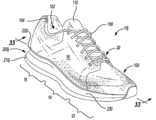
도 1은, 본 개시의 원리에 따른 신발류 물품의 상부 사시도이고;
도 2는, 바닥창의 내측 표면으로부터 중창의 바닥 표면을 향해 연장되는 돌기들을 도시하는, 도 1의 신발류 물품의 분해도이며;
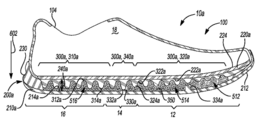
도 3은, 바닥창의 내측 표면으로부터 중창의 바닥 표면을 향해 연장되는 돌기들 및 내측 표면에서 돌기들의 베이스 주변에 배치되는 입자형 소재를 도시하는, 도 1의 3-3 선을 따라 취해진 단면도이고;
도 4는, 본 개시의 원리에 따른 신발류 물품의 상부 사시도이며;
도 5는, 중창의 바닥 표면으로부터 바닥창의 내측 표면을 향해 연장되는 돌기들을 도시하는, 도 4의 신발류 물품의 분해도이고;
도 6 및 도 7은, 각각 중창의 바닥 표면으로부터 바닥창의 내측 표면을 향해 연장되는 제1 일련의 돌기들 및 제2 일련의 돌기들 그리고 바닥창의 내측 표면 상에 배치되는 입자형 소재를 도시하는, 도 4의 6-6 선을 따라 취해진 단면도들이며;
도 8은, 본 개시의 원리에 따른 신발류 물품의 상부 사시도이고;
도 9는, 소정량의 입자형 소재를 수용하기 위한 벌집 형상 격실들을 한정하는 바닥창의 내측 표면으로부터 연장되는 돌출부들을 도시하는, 도 8의 신발류 물품의 분해도이며;
도 10은, 바닥창의 내측 표면으로부터 중창의 바닥 표면을 향해 연장되며 그리고 바닥 표면과의 접촉 지점에서 종결되는 돌출부들을 도시하는, 도 8의 10-10 선을 따라 취해진 단면도이고;
도 11은, 바닥창의 내측 표면으로부터 중창의 바닥 표면을 향해 연장되는 돌출부들을 도시하는, 도 8의 10-10 선을 따라 취해진 부분 단면도이며;
도 12는, 본 개시의 원리에 따른 신발류 물품의 하부 사시도이고;
도 13은, 밑창 구조물의 바닥창과 중창 사이에 배치되는 케이스 내부에 상주하는 입자형 소재를 도시하는, 도 12의 신발류 물품의 분해도이며;
도 14는, 밑창 구조물이 휴지 상태에 놓일 때의, 밑창 구조물의 바닥창과 중창 사이에 배치되는 케이스 내에 상주하는 입자형 소재를 도시하는, 도 12의 14-14 선을 따라 취해진 단면도이고;
도 15는, 밑창 구조물이 휘어질 때의, 밑창 구조물의 바닥창과 중창 사이에 배치되는 케이스 내에 상주하는 입자형 소재를 도시하는, 도 12의 14-14 선을 따라 취해진 단면도이며;
도 16은, 본 개시의 원리에 따른 신발류 물품의 하부 사시도이고;
도 17은, 밑창 구조물의 캐비티 내부에 상주하는 입자형 소재를 도시하는, 도 16의 17-17 선을 따라 취해진 도 16의 신발류 물품의 뒤꿈치 영역의 단면도이며;
도 17은, 밑창 구조물의 캐비티 내부에 상주하는 입자형 소재를 도시하는, 도 16의 18-18 선을 따라 취해진 도 16의 신발류 물품의 전족 영역의 부분 단면도이고;
도 19는, 본 개시의 원리에 따른 신발류 물품의 하부 사시도이며;
도 20은, 바닥창의 내측 표면으로부터 중창의 바닥 표면을 향해 연장되는 돌출 플레이트를 도시하는, 도 19의 신발류 물품의 분해도이고;
도 21은, 바닥창의 내측 표면으로부터 중창의 바닥 표면을 향해 연장되는 돌출 플레이트 및 돌출 플레이트를 통해 연장되는 구멍들 내부에 상주하는 입자형 소재를 도시하는, 도 19의 21-21 선을 따라 취해진 도 19의 신발류 물품의 부분 단면도이며;
도 22는, 본 개시의 원리에 따른 신발류 물품의 상부 사시도이고;
도 23은, 바닥창의 내측 표면으로부터 중창의 바닥 표면을 향해 연장되는 돌기들 및 돌기들 상에 배치되는 입자형 소재를 내포하는 터프티드 케이스(tufted casing)를 도시하는, 도 22의 신발류 물품의 분해도이며;
도 24는, 바닥창의 내측 표면으로부터 중창의 바닥 표면을 향해 연장되는 돌기들 및 돌기들 상에 배치되는 입자형 소재를 내포하는 터프티드 케이스를 도시하는, 도 22의 24-24 선을 따라 취해진 부분 단면도이고;
도 25는, 본 개시의 원리에 따른 신발류 물품의 상부 사시도이며;
도 26은, 입자형 소재를 내포하는 터프티드 케이스 및, 캐비티 내부에 수용되며 그리고 바닥창의 내측 표면으로부터 중창의 바닥 표면을 향해 연장되는 돌기들 상에 위치하게 되는, 완충 층을 도시하는, 도 25의 신발류 물품의 분해도이고;
도 27은, 입자형 소재를 내포하는 터프티드 케이스 및, 캐비티 내부에 수용되며 그리고 바닥창의 내측 표면으로부터 중창의 바닥 표면을 향해 연장되는 돌기들 상에 위치하게 되는, 완충 층을 도시하는, 도 25의 27-27 선을 따라 취해진 단면도이며;
도 28은, 본 개시의 원리에 따른 신발류 물품의 상부 사시도이고;
도 29는, 바닥창의 내측 표면 상에 배치되는 완충 층 및 완충 층과 중창의 바닥 표면 사이에 배치되는 입자형 소재를 도시하는, 도 28의 29-29 선을 따라 취해진 단면도이며;
도 30은, 본 개시의 원리에 따른 신발류 물품의 상부 사시도이고;
도 31은, 바닥창의 내측 표면 상에 배치되는 유체 충전 챔버 및 유체 충전 챔버와 중창의 바닥 표면 사이에 배치되는 입자형 소재를 도시하는, 도 30의 31-31 선을 따라 취해진 단면도이며;
도 32는, 본 개시의 원리에 따른 신발류 물품의 상부 사시도이고;
도 33은, 바닥창의 내측 표면 상에 배치되는 유체 충전 챔버 및 유체 충전 챔버와 중창의 바닥 표면 사이에 배치되는 입자형 소재를 도시하는, 도 32의 33-33 선을 따라 취해진 단면도이며;
도 34는, 본 개시의 원리에 따른 신발류 물품의 상부 사시도이고;
도 35는, 캐비티 내로 중창의 바닥 표면을 향해 연장되는 일련의 상부 릿지들을 한정하는 바닥창의 내측 표면 및 바닥창의 상부 릿지들 상에 배치되는 입자형 소재를 내포하는 터프티드 케이스를 도시하는, 도 34의 35-35 선을 따라 취해진 부분 단면도이며;
도 36은, 본 개시의 원리에 따른 신발류 물품의 상부 사시도이며; 그리고
도 37은, 입자형 소재를 내포하는 터프티드 케이스 및, 캐비티 내부에 수용되며 그리고, 캐비티 내로 중창의 바닥 표면을 향해 연장되는 바닥창의 내측 표면에 의해 한정되는, 상부 릿지들 상에 위치하게 되는, 완충 층을 도시하는, 도 36의 37-37 선을 따라 취해진 부분 단면도이다.
상응하는 참조 부호들이, 도면들 전체에 걸쳐 상응하는 부분들을 지시한다.The drawings described herein are for illustrative purposes only of selected configurations and are not intended to limit the scope of the present disclosure.
1 is a top perspective view of an article of footwear in accordance with the principles of the present disclosure;
FIG. 2 is an exploded view of the article of footwear of FIG. 1 showing protrusions extending from the inner surface of the outsole toward the sole surface of the midsole;
FIG. 3 is a cross-sectional view taken along line 3-3 of FIG. 1 showing protrusions extending from the inner surface of the outsole toward the sole surface of the midsole and particulate material disposed around the base of the protrusions on the inner surface;
4 is a top perspective view of an article of footwear in accordance with the principles of the present disclosure;
FIG. 5 is an exploded view of the article of footwear of FIG. 4 showing protrusions extending from the bottom surface of the midsole toward the inner surface of the outsole;
6 and 7 respectively show a first series of protrusions and a second series of protrusions extending from a bottom surface of the midsole toward an inner surface of the outsole and a particulate material disposed on the inner surface of the outsole; are cross-sectional views taken along line 6-6 in Fig. 4;
8 is a top perspective view of an article of footwear in accordance with the principles of the present disclosure;
9 is an exploded view of the article of footwear of FIG. 8 showing projections extending from an inner surface of the outsole defining honeycomb-shaped compartments for receiving a quantity of particulate material;
FIG. 10 is a cross-sectional view taken along line 10-10 of FIG. 8 showing protrusions extending from the inner surface of the outsole toward the bottom surface of the midsole and terminating at a point of contact with the sole surface;
FIG. 11 is a partial cross-sectional view taken along line 10-10 of FIG. 8 showing protrusions extending from the inner surface of the outsole toward the bottom surface of the midsole;
12 is a bottom perspective view of an article of footwear in accordance with the principles of the present disclosure;
13 is an exploded view of the article of footwear of FIG. 12 showing particulate material residing within a case disposed between an outsole and a midsole of the sole structure;
14 is a cross-sectional view taken along line 14-14 of FIG. 12 showing particulate material residing within a case disposed between an outsole and a midsole of the sole structure when the sole structure is at rest;
15 is a cross-sectional view taken along line 14-14 of FIG. 12 showing particulate material residing within a case disposed between an outsole and a midsole of the sole structure when the sole structure is flexed;
16 is a bottom perspective view of an article of footwear in accordance with the principles of the present disclosure;
17 is a cross-sectional view of the heel region of the article of footwear of FIG. 16 taken along line 17-17 of FIG. 16 showing the particulate material residing within a cavity of the sole structure;
17 is a partial cross-sectional view of the forefoot region of the article of footwear of FIG. 16 taken along line 18-18 of FIG. 16, showing the particulate material residing within a cavity of the sole structure;
19 is a bottom perspective view of an article of footwear in accordance with the principles of the present disclosure;
FIG. 20 is an exploded view of the article of footwear of FIG. 19 showing a protruding plate extending from the inner surface of the outsole toward the bottom surface of the midsole;
FIG. 21 is a view taken along line 21-21 of FIG. 19 showing the protruding plate extending from the inner surface of the outsole toward the bottom surface of the midsole and the particulate material residing inside the apertures extending through the protruding plate; 19 is a partial cross-sectional view of the article of footwear;
22 is a top perspective view of an article of footwear in accordance with the principles of the present disclosure;
FIG. 23 is an exploded view of the article of footwear of FIG. 22 showing protrusions extending from the inner surface of the outsole toward the sole surface of the midsole and a tufted casing containing particulate material disposed on the protrusions; is;
FIG. 24 is a portion taken along line 24-24 of FIG. 22 showing protrusions extending from the inner surface of the outsole toward the sole surface of the midsole and a tufted case containing particulate material disposed on the protrusions; cross-sectional view;
25 is a top perspective view of an article of footwear in accordance with the principles of the present disclosure;
FIG. 26 shows a tufted case containing a particulate material and a cushioning layer received within the cavity and positioned on protrusions extending from the inner surface of the outsole toward the bottom surface of the midsole; FIG. is an exploded view of an article of footwear;
FIG. 27 shows a tufted case containing a particulate material and a cushioning layer received within the cavity and positioned on protrusions extending from the inner surface of the outsole toward the bottom surface of the midsole; FIG. is a cross-sectional view taken along line 27-27 of
28 is a top perspective view of an article of footwear in accordance with the principles of the present disclosure;
FIG. 29 is a cross-sectional view taken along line 29-29 of FIG. 28 showing a cushioning layer disposed on the inner surface of the outsole and particulate material disposed between the cushioning layer and the bottom surface of the midsole;
30 is a top perspective view of an article of footwear in accordance with the principles of the present disclosure;
FIG. 31 is a cross-sectional view taken along line 31-31 of FIG. 30 showing a fluid fill chamber disposed on the inner surface of the outsole and particulate material disposed between the fluid fill chamber and the bottom surface of the midsole;
32 is a top perspective view of an article of footwear in accordance with the principles of the present disclosure;
33 is a cross-sectional view taken along line 33-33 of FIG. 32 showing a fluid fill chamber disposed on the inner surface of the outsole and particulate material disposed between the fluid fill chamber and the bottom surface of the midsole;
34 is a top perspective view of an article of footwear in accordance with the principles of the present disclosure;
FIG. 35 shows a tufted case containing particulate material disposed on the upper ridges of the outsole and an inner surface of the outsole defining a series of upper ridges extending into a cavity toward the bottom surface of the midsole; FIG. is a partial cross-sectional view taken along line 35-35 of
36 is a top perspective view of an article of footwear in accordance with the principles of the present disclosure; And
37 is a tufted case containing a particulate material and positioned on the upper ridges received within the cavity and defined by the inner surface of the outsole extending into the cavity toward the bottom surface of the midsole; A partial cross-sectional view taken along line 37-37 of FIG. 36 showing the buffer layer.
Corresponding reference signs indicate corresponding parts throughout the drawings.
예시적 구성들이 지금부터, 첨부 도면들을 참조하여 더욱 완전하게 설명될 것이다. 예시적 구성들은, 본 개시가 철저하도록, 그리고 본 개시의 범위를 당업자에게 완전하게 전달하도록, 제공된다. 구체적인 세부사항들은, 본 개시의 구성들에 대한 철저한 이해를 제공하기 위해, 구체적인 구성요소들, 장치들, 및 방법들에 대한 예들로서 기술된다. 구체적인 세부사항들이 사용될 필요가 없다는 것, 그러한 예시적 구성들이 많은 상이한 형태들로 실시될 수 있다는 것, 및 구체적인 세부사항들 및 예시적인 구성들이 본 개시의 범위를 제한하는 것으로 해석되지 않아야 한다는 것이, 당업자에게 명백할 것이다. Exemplary configurations will now be more fully described with reference to the accompanying drawings. Example configurations are provided so that this disclosure will be thorough, and will fully convey the scope of the disclosure to those skilled in the art. Specific details are described as examples of specific components, apparatuses, and methods in order to provide a thorough understanding of configurations of the present disclosure. that the specific details need not be used, that such example configurations can be embodied in many different forms, and that the specific details and example configurations are not to be construed as limiting the scope of the disclosure; It will be clear to those skilled in the art.
여기에서 사용되는 전문용어는, 단지 특정 예시적 구성들을 설명할 목적이며 그리고 제한하는 것으로 의도되지 않는다. 여기에서 사용되는 바와 같은, 단수형 관사들 "부정관사" 및 "정관사"는, 문맥이 분명하게 달리 지시하지 않는 한, 복수 형태를 또한 포함하는 것으로 의도될 수 있을 것이다. 용어들 "포함한다", "포함하는", "구비하는", 및 "가지는"은, 포괄적이며 그리고 그에 따라 특징들, 단계들, 작동들, 요소들, 및/또는 구성요소들의 존재를 구체화하지만, 하나 이상의 다른 특징들, 단계들, 작동들, 요소들, 구성요소들, 및/또는 이들의 그룹들의 존재 또는 부가를 배제하지 않는다. 본 명세서에서 설명되는 방법 단계들, 프로세스들, 및 작동들은, 실행의 순서로서 구체적으로 식별되지 않는 한, 논의되거나 예시되는 특정 순서에 따른 그들의 실행을 반드시 요구하는 것으로 해석되지 않아야 한다. 부가적인 또는 대안적인 단계들이 사용될 수 있을 것이다. The terminology used herein is for the purpose of describing particular example configurations only and is not intended to be limiting. As used herein, the singular articles "indefinite article" and "definite article" shall be intended to include the plural form as well, unless the context clearly dictates otherwise. The terms “comprise”, “comprising”, “comprising”, and “having” are inclusive and thus specify the presence of features, steps, acts, elements, and/or components, but , the presence or addition of one or more other features, steps, acts, elements, components, and/or groups thereof. The method steps, processes, and acts described herein should not be construed as necessarily requiring their execution according to the specific order discussed or illustrated, unless specifically identified as an order of execution. Additional or alternative steps may be used.
요소 또는 층이 다른 요소 또는 층, "상에" 놓이는, "에 맞물리는", "에 연결되는", "에 부착되는" 또는 "에 결합되는" 것으로 언급될 때, 요소 또는 층은, 직접적으로 다른 요소 또는 층, 상에 놓일 수, 에 맞물릴 수, 에 연결될 수, 에 부착될 수 또는 에 결합될 수 있으며, 또는 개입하는 요소들 또는 층들이 존재할 수 있을 것이다. 대조적으로, 요소가 다른 요소 또는 층 "상에 직접적으로" 놓이는, "에 직접적으로 맞물리는", "에 직접적으로 연결되는", "에 직접적으로 부착되는" 또는 "에 직접적으로 결합되는" 것으로 언급될 때, 개입하는 요소들 또는 층들이 존재하지 않을 것이다. 요소들 간의 관계를 설명하기 위해 사용되는 다른 단어들은, (예를 들어, "사이에" 대 "직접적으로 사이에", "인접한" 대 "직접적으로 인접한", 등의) 유사한 형태로 해석되어야만 한다. 여기에서 사용되는 바와 같은, 용어 "및/또는"은, 하나 이상의 연관된 열거된 품목의 임의의 그리고 모든 조합을 포함한다. When an element or layer is referred to as "overlaying", "interlocking with," "connected to," "attached to," or "coupled to," another element or layer, the element or layer is directly There may be other elements or layers, which may be placed on, engage with, connected to, attached to or coupled to, or intervening elements or layers. In contrast, an element is referred to as being "directly engaged with," "directly connected to," "directly attached to," or "directly coupled to," which lies "directly on" another element or layer. When done, there will be no intervening elements or layers. Other words used to describe a relationship between elements (eg, "between" versus "directly between", "adjacent" versus "directly adjacent", etc.) should be interpreted in a similar fashion. . As used herein, the term “and/or” includes any and all combinations of one or more associated listed items.
용어들, 제1, 제2, 제3 등은, 다양한 요소들, 구성요소들, 영역들, 층들 및/또는 섹션들을 설명하기 위해 본 명세서에서 사용될 수 있을 것이다. 이러한 요소들, 구성요소들, 영역들, 층들 및/또는 섹션들은, 이러한 용어들에 의해 제한되지 않아야 한다. 이러한 용어들은 단지, 하나의 요소, 구성요소, 영역, 층 또는 섹션을, 다른 영역, 층 또는 섹션과 구별하기 위해 사용될 수 있을 것이다. "제1", "제2" 및 다른 수치적 용어들과 같은 용어들은, 문맥에 의해 명백하게 지시되지 않는 한, 순서 또는 순번을 의미하지 않는다. 따라서, 이하에 논의되는 제1 요소, 구성요소, 영역, 층 또는 섹션은, 예시적인 구성들의 교시로부터 벗어남 없이, 제2 요소, 구성요소, 영역, 층 또는 섹션으로 지칭될 수 있다. The terms first, second, third, etc. may be used herein to describe various elements, components, regions, layers and/or sections. Such elements, components, regions, layers and/or sections should not be limited by these terms. These terms may only be used to distinguish one element, component, region, layer or section from another region, layer or section. Terms such as “first,” “second,” and other numerical terms do not imply order or sequence unless clearly indicated by context. Accordingly, a first element, component, region, layer or section discussed below may be referred to as a second element, component, region, layer or section without departing from the teachings of the example configurations.
본 개시의 하나의 양태가, 갑피 및 갑피에 부착되는 바닥창을 구비하는 신발류 물품을 포함한다. 지면-접촉 표면 및 내측 표면이, 바닥창의 반대측들 상에 배치된다. 신발류 물품의 중창은, 중창의 반대측들 상에 배치되는 발 받침부 및 바닥 표면을 구비한다. 중창의 바닥 표면은, 캐비티를 그들 사이에 한정하기 위해, 바닥창의 내측 표면과 대향한다. 소정량의 입자형 소재가, 캐비티 내부에 배치된다. 신발류 물품은 또한, 각각 캐비티 내로 내측 표면 및 바닥 표면 중의 하나로부터 내측 표면 및 바닥 표면 중의 다른 하나를 향해 제1 방향으로 연장되는, 제1 일련의 돌기들 및 제2 일련의 돌기들을 포함한다. 제1 일련의 돌기들은, 내측 표면 및 바닥 표면 중의 다른 하나로부터 이격된다. 제2 일련의 돌기들은, 제1 일련의 돌기들과 상이한 높이를 가지며 그리고 내측 표면 및 바닥 표면 중의 다른 하나로부터 이격된다. One aspect of the present disclosure includes an article of footwear having an upper and an outsole attached to the upper. A ground-contacting surface and an inner surface are disposed on opposite sides of the outsole. A midsole of an article of footwear has a sole surface and a footrest disposed on opposite sides of the midsole. A bottom surface of the midsole opposes an inner surface of the outsole to define a cavity therebetween. A predetermined amount of the particulate material is disposed inside the cavity. The article of footwear also includes a first set of protrusions and a second set of protrusions, each extending into the cavity in a first direction from one of the inner surface and the bottom surface toward the other of the inner surface and the bottom surface. The first series of protrusions are spaced apart from the other of the inner surface and the bottom surface. The second set of protrusions has a different height than the first set of protrusions and is spaced apart from the other of the inner surface and the bottom surface.
일부 예에서, 제1 일련의 돌기들 및 제2 일련의 돌기들이 바닥창의 내측 표면으로부터 캐비티 내로 연장될 때, 소정량의 입자형 소재가, 제1 일련의 돌기들의 베이스 주변에 그리고 제2 일련의 돌기들의 베이스 주변에 배치된다. 제1 일련의 돌기들 및 제2 일련의 돌기들 중의 어느 하나 또는 양자 모두는, 제1 방향으로 감소하는 단면적을 구비할 수 있을 것이다. In some examples, when the first set of protrusions and the second set of protrusions extend from the inner surface of the outsole into the cavity, an amount of particulate material is deposited around the base of the first set of protrusions and the second set of protrusions. disposed around the base of the protrusions. Either or both of the first set of protrusions and the second set of protrusions may have a cross-sectional area that decreases in the first direction.
일부 구현예에서, 제1 일련의 돌기들 및 제2 일련의 돌기들은, 일정하게 좁아지는 외측 표면을 구비한다. 좁아지는 외측 표면은, 내측 표면 및 바닥 표면 중의 다른 하나에 대향하는 각 돌기의 라운드형 말단부에서 종결된다. 제1 일련의 돌기들은, 바닥창의 뒤꿈치 부분에 인접하게 배치될 수 있는 가운데, 제2 일련의 돌기들은, 바닥창의 전족 부분에 인접하게 배치될 수 있을 것이다. 부가적으로, 제1 일련의 돌기들은, 제2 일련의 돌기들보다 내측 표면 및 바닥 표면 중의 하나로부터 더 멀리 연장될 수 있을 것이다. 제1 일련의 돌기들 및 제2 일련의 돌기들은 선택적으로, 바닥창의 중족 부분에 인접하게 배치되는 공동에 의해, 서로로부터 이격될 수 있을 것이다. In some embodiments, the first set of protrusions and the second set of protrusions have a uniformly narrowing outer surface. The tapered outer surface terminates at the rounded distal end of each protrusion opposite the other of the inner surface and the bottom surface. The first set of protrusions may be disposed adjacent a heel portion of the outsole, while the second set of protrusions may be disposed adjacent a forefoot portion of the outsole. Additionally, the first set of protrusions may extend further from one of the inner surface and the bottom surface than the second set of protrusions. The first set of protrusions and the second set of protrusions may optionally be spaced apart from each other by a cavity disposed adjacent the midfoot portion of the outsole.
일부 예에서, 캐비티 내부에 배치되는 입자형 소재는, 동일한 크기 및 형상 또는 상이한 크기 및 형상 중 적어도 하나를 구비하는, 발포체 구슬들을 포함한다. 이러한 예들에서, 발포체 구슬들은, 실질적으로 구형 형상을 구비할 수 있을 것이다. In some examples, the particulate material disposed within the cavity comprises foam beads having at least one of the same size and shape or a different size and shape. In such examples, the foam beads may have a substantially spherical shape.
본 개시의 다른 양태가, 갑피 및 갑피에 부착되는 바닥창을 구비하는 신발류 물품을 포함한다. 지면-접촉 표면 및 내측 표면이, 바닥창의 반대측들 상에 배치된다. 신발류 물품의 중창은, 중창의 반대측들 상에 배치되는 발 받침부 및 바닥 표면을 구비한다. 바닥창의 내측 표면은, 각각 갑피를 향한 방향으로 연장되며 그리고 각각 상이한 높이를 구비하는, 제1 일련의 돌기들 및 제2 일련의 돌기들을 포함한다. 중창의 바닥 표면은, 캐비티를 그들 사이에 한정하기 위해, 바닥창의 내측 표면과 대향한다. 소정량의 입자형 소재가, 캐비티 내부에 배치된다. 바닥 표면은 부가적으로, 제1 일련의 돌기들 및 제2 일련의 돌기들로부터 이격된다. Another aspect of the present disclosure includes an article of footwear having an upper and an outsole attached to the upper. A ground-contacting surface and an inner surface are disposed on opposite sides of the outsole. A midsole of an article of footwear has a sole surface and a footrest disposed on opposite sides of the midsole. The inner surface of the outsole includes a first set of protrusions and a second set of protrusions each extending in a direction toward the upper and each having a different height. A bottom surface of the midsole opposes an inner surface of the outsole to define a cavity therebetween. A predetermined amount of the particulate material is disposed inside the cavity. The bottom surface is additionally spaced apart from the first set of protrusions and the second set of protrusions.
일부 구현예에서, 제1 일련의 돌기들의 단면적이, 바닥창으로부터 중창을 향해 연장되는 방향으로 감소한다. 부가적으로, 제2 일련의 돌기들의 단면적이, 바닥창으로부터 중창을 향해 연장되는 방향으로 감소할 수 있을 것이다. 일부 예에서, 제1 일련의 돌기들 및 제2 일련의 돌기들은, 일정하게 좁아지는 외측 표면을 구비한다. 이러한 예들에서, 좁아지는 외측 표면은, 중창의 바닥 표면에 대향하는 각 돌기의 라운드형 말단부에서 종결될 수 있을 것이다. 일부 시나리오에서, 제1 일련의 돌기들은, 바닥창의 뒤꿈치 부분에 인접하게 배치되는 가운데, 제2 일련의 돌기들은, 바닥창의 전족 부분에 인접하게 배치된다. 이러한 시나리오에서, 제1 일련의 돌기들은 선택적으로, 제2 일련의 돌기들보다 바닥창의 내측 표면으로부터 더 멀리 연장될 수 있을 것이다. 제1 일련의 돌기들 및 제2 일련의 돌기들은 선택적으로, 바닥창의 중족 부분에 인접하게 배치되는 공동에 의해, 서로로부터 이격될 수 있을 것이다. In some embodiments, the cross-sectional area of the first series of protrusions decreases in a direction extending from the outsole toward the midsole. Additionally, the cross-sectional area of the second series of protrusions may decrease in a direction extending from the outsole toward the midsole. In some examples, the first set of protrusions and the second set of protrusions have an outer surface that is constantly tapered. In such examples, the narrowing lateral surface may terminate at the rounded distal end of each protrusion opposite the bottom surface of the midsole. In some scenarios, the first set of protrusions are disposed adjacent a heel portion of the outsole, while the second set of protrusions are disposed adjacent a forefoot portion of the outsole. In such a scenario, the first set of protrusions may optionally extend further from the inner surface of the outsole than the second set of protrusions. The first set of protrusions and the second set of protrusions may optionally be spaced apart from each other by a cavity disposed adjacent the midfoot portion of the outsole.
일부 예에서, 캐비티 내부에 배치되는 입자형 소재는, 동일한 크기 및 형상 또는 상이한 크기 및 형상 중 적어도 하나를 구비하는, 발포체 구슬들을 포함한다. 이러한 예들에서, 발포체 구슬들은, 실질적으로 구형 형상을 구비할 수 있을 것이다. In some examples, the particulate material disposed within the cavity comprises foam beads having at least one of the same size and shape or a different size and shape. In such examples, the foam beads may have a substantially spherical shape.
본 개시의 또 다른 양태에서, 신발류 물품이, 갑피 및, 중창으로서, 발 받침부 및 중창의 발 받침부 반대측 상에 배치되는 바닥 표면을 구비하는 것인, 중창을 포함한다. 중창의 바닥 표면은, 갑피로부터 멀어지는 방향으로 연장되는, 제1 일련의 돌기들을 포함한다. 바닥 표면은 또한, 갑피로부터 멀어지게 연장되며 그리고 제1 일련의 돌기들과 상이한 높이를 갖는, 제2 일련의 돌기들을 포함한다. 신발류 물품은 또한, 바닥창으로서, 갑피에 부착되며 그리고 바닥창의 반대측들 상에 배치되는 지면-접촉 표면 및 내측 표면을 구비하는 것인, 바닥창을 포함한다. 내측 표면은, 중창의 바닥 표면에 대향한다. 바닥창의 내측 표면 및 중창의 바닥 표면은, 그들 사이에 캐비티를 한정하기 위해 협력한다. 소정량의 입자형 소재가 캐비티 내부에 배치되며 그리고 바닥창의 내측 표면이, 제1 일련의 돌기들 및 제2 일련의 돌기들로부터 이격된다. In another aspect of the present disclosure, an article of footwear includes a midsole having an upper and a midsole, the midsole having a footrest and a sole surface disposed on opposite sides of the footrest of the midsole. A bottom surface of the midsole includes a first series of protrusions extending in a direction away from the upper. The bottom surface also includes a second set of protrusions that extend away from the upper and have a different height than the first set of protrusions. The article of footwear also includes an outsole, the outsole having an inner surface and a ground-contacting surface attached to the upper and disposed on opposite sides of the outsole. The inner surface faces the bottom surface of the midsole. The inner surface of the outsole and the bottom surface of the midsole cooperate to define a cavity therebetween. An amount of particulate material is disposed within the cavity and an inner surface of the outsole is spaced apart from the first set of protrusions and the second set of protrusions.
일부 구현예에서, 제1 일련의 돌기들의 단면적이, 중창으로부터 바닥창을 향해 연장되는 방향으로 감소한다. 부가적으로, 제2 일련의 돌기들의 단면적이, 중창으로부터 바닥창을 향해 연장되는 방향으로 감소할 수 있을 것이다. 일부 예에서, 제1 일련의 돌기들 및 제2 일련의 돌기들은, 일정하게 좁아지는 외측 표면을 구비한다. 이러한 예들에서, 좁아지는 외측 표면은, 바닥창의 내측 표면에 대향하는 각 돌기의 라운드형 말단부에서 종결될 수 있을 것이다. 제1 일련의 돌기들은 선택적으로, 바닥창의 뒤꿈치 부분에 대향할 수 있는 가운데, 제2 일련의 돌기들은 선택적으로, 바닥창의 전족 부분에 대향할 수 있을 것이다. 하나의 구성에서, 제1 일련의 돌기들은, 제2 일련의 돌기들보다 중창의 바닥 표면으로부터 더 멀리 연장된다. 일부 시나리오에서, 제1 일련의 돌기들 및 제2 일련의 돌기들은, 바닥창의 중족 부분에 인접하게 배치되는 공동에 의해, 서로로부터 이격될 수 있을 것이다. In some embodiments, the cross-sectional area of the first series of protrusions decreases in a direction extending from the midsole toward the outsole. Additionally, the cross-sectional area of the second series of protrusions may decrease in a direction extending from the midsole toward the outsole. In some examples, the first set of protrusions and the second set of protrusions have an outer surface that is constantly tapered. In such examples, the narrowing outer surface may terminate at the rounded distal end of each protrusion opposite the inner surface of the outsole. The first set of protrusions may optionally oppose a heel portion of the outsole, while the second set of protrusions may optionally oppose a forefoot portion of the outsole. In one configuration, the first set of protrusions extends further from the bottom surface of the midsole than the second set of protrusions. In some scenarios, the first set of protrusions and the second set of protrusions may be spaced apart from each other by a cavity disposed adjacent the midfoot portion of the outsole.
일부 예에서, 캐비티 내부에 배치되는 입자형 소재는, 동일한 크기 및 형상 또는 상이한 크기 및 형상 중 적어도 하나를 구비하는, 발포체 구슬들을 포함한다. 이러한 예들에서, 발포체 구슬들은, 실질적으로 구형 형상을 구비할 수 있을 것이다. In some examples, the particulate material disposed within the cavity comprises foam beads having at least one of the same size and shape or a different size and shape. In such examples, the foam beads may have a substantially spherical shape.
본 개시의 다른 양태가, 신발류 물품을 제조하는 방법을 제공한다. 방법은, 발 받침부와 바닥창 사이에 캐비티를 제공하는 것, 및 발 받침부 및 바닥창 중의 하나에, 캐비티 내로 발 받침부 및 바닥창 중의 다른 하나를 향해 제1 방향으로 연장되는, 제1 일련의 돌기들을 제공하는 것을 포함한다. 제1 일련의 돌기들은, 발 받침부 및 바닥창 중의 다른 하나로부터 이격된다. 방법은 또한, 발 받침부 및 바닥창 중의 하나에, 캐비티 내로 발 받침부 및 바닥창 중의 다른 하나를 향해 제1 방향으로 연장되는, 제2 일련의 돌기들을 제공하는 것을 포함한다. 제2 일련의 돌기들은, 발 받침부 및 바닥창 중의 다른 하나로부터 이격된다. 제2 일련의 돌기들은, 제1 일련의 돌기들과 상이한 높이를 갖는다. 방법은 또한, 캐비티에 소정량의 입자형 소재를 제공하는 것을 포함한다. Another aspect of the present disclosure provides a method of making an article of footwear. The method includes providing a cavity between the footrest and the outsole, and extending in one of the footrest and the outsole in a first direction into the cavity and toward the other of the footrest and the outsole. and providing a series of protrusions. The first series of projections are spaced apart from the other of the footrest and the outsole. The method also includes providing one of the footrest and the outsole with a second series of protrusions extending into the cavity in a first direction towards the other of the footrest and the outsole. The second series of projections are spaced apart from the other of the footrest and the outsole. The second set of protrusions has a different height than the first set of protrusions. The method also includes providing an amount of particulate material to the cavity.
일부 예에서, 방법은, 바닥창에 제1 일련의 돌기들 및 제2 일련의 돌기들을 제공하는 것을 포함한다. 이러한 예들에서, 소정량의 입자형 소재는, 제1 일련의 돌기들의 베이스 주변에 그리고 제2 일련의 돌기들의 베이스의 주변에 제공된다. In some examples, the method includes providing the outsole with a first set of protrusions and a second set of protrusions. In these examples, an amount of particulate material is provided around the base of the first set of protrusions and around the base of the second set of protrusions.
일부 구현예에서, 방법은, 제1 일련의 돌기들에 발 받침부 및 바닥창 중의 다른 하나를 향한 방향으로 감소하는 단면적을 제공하는 것에 의해, 발 받침부 및 바닥창 중의 하나에 제1 일련의 돌기들을 제공하는 것을 포함한다. 선택적으로, 방법은, 제1 일련의 돌기들 및 제2 일련의 돌기들에 일정하게 좁아지는 외측 표면을 제공하는 것에 의해, 발 받침부 및 바닥창 중의 하나에 제1 일련의 돌기들 및 제2 일련의 돌기들을 제공하는 것을 포함한다. 방법은 또한, 제1 일련의 돌기들과 제2 일련의 돌기들 사이에 바닥창의 중족 부분에 인접하게 공동을 제공하는 것에 의해, 발 받침부 및 바닥창 중의 하나에 제1 일련의 돌기들 및 제2 일련의 돌기들을 제공하는 것을 포함한다. In some embodiments, the method provides the first series of protrusions to one of the footrest and the outsole by providing the first series of protrusions with a cross-sectional area that decreases in a direction towards the other of the footrest and the outsole. and providing protrusions. Optionally, the method includes providing a first set of protrusions and a second set of protrusions to one of the footrest and the outsole by providing a uniformly tapered outer surface to the first set of protrusions and the second set of protrusions. and providing a series of protrusions. The method also includes providing a cavity adjacent the midfoot portion of the outsole between the first set of protrusions and the second set of protrusions, whereby the first set of protrusions and the second set of protrusions are on one of the footrest and the outsole. 2 Involves providing a series of protrusions.
일부 예에서, 방법은, 바닥창의 뒤꿈치 부분에 인접하게 제1 일련의 돌기들을 그리고 바닥창의 전족 부분에 인접하게 제2 일련의 돌기들을 제공하는 것에 의해, 발 받침부 및 바닥창 중의 하나에 제1 일련의 돌기들 및 제2 일련의 돌기들을 제공하는 것을 포함한다. 이러한 예들에서, 방법은 또한, 제1 일련의 돌기들을 제2 일련의 돌기들보다 발 받침부 및 바닥창 중의 하나로부터 더 멀리 연장시키는 것을 포함할 수 있을 것이다. In some examples, the method includes providing a first set of protrusions adjacent a heel portion of the outsole and a second series of protrusions adjacent a forefoot portion of the outsole, thereby providing a first set of protrusions on one of the footrest and the outsole. and providing a series of protrusions and a second series of protrusions. In such examples, the method may also include extending the first set of protrusions further away from one of the footrest and the outsole than the second set of protrusions.
일부 예에서, 캐비티에 입자형 소재를 제공하는 것은, 캐비티에 발포체 구슬들을 제공하는 것을 포함한다. 캐비티에 발포체 구슬들을 제공하는 것은, 캐비티에 실질적으로 구형 단면을 갖는 소정량의 발포체 구슬들을 제공하는 것을 포함할 수 있을 것이다. 부가적으로 또는 대안적으로, 캐비티에 발포체 구슬들을 제공하는 것은, 캐비티에, 동일한 크기 및 형상, 또는 상이한 크기 및 형상 중 적어도 하나를 구비하는, 소정량의 발포체 구슬들을 제공하는 것을 포함할 수 있을 것이다. In some examples, providing the particulate material to the cavity includes providing foam beads to the cavity. Providing the cavity with the foam beads may include providing the cavity with an amount of the foam beads having a substantially spherical cross-section. Additionally or alternatively, providing the foam beads to the cavity may include providing the cavity with an amount of foam beads having at least one of the same size and shape, or a different size and shape. will be.
도 1 내지 도 3을 참조하면, 일부 구현예에서, 신발류 물품(10)이, 갑피(100) 및 갑피(100)에 부착되는 밑창 구조물(200)을 포함한다. 신발류 물품(10)은, 하나 이상의 부분으로 분할될 수 있을 것이다. 부분들은, 전족 부분(12), 중족 부분(14), 및 뒤꿈치 부분(16)을 포함할 수 있을 것이다. 전족 부분(12)은, 발가락들 및 중족골들(metatarsal bones)을 발의 지골들(phalanx bones)과 연결하는 관절들에 대응할 수 있을 것이다. 중족 부분(14)은, 발의 아치 영역에 대응할 수 있으며, 그리고 뒤꿈치 부분(16)은, 종골(calcaneus bone)을 포함하는 발의 뒤쪽 부분들에 대응할 수 있을 것이다. 신발류(10)는, 신발류(10)의 반대측들에 대응하며 그리고 부분들(12, 14, 16)을 통해 연장되는, 바깥쪽 측부 및 안쪽 측부(18, 20)를 포함할 수 있을 것이다. 1-3 , in some embodiments, an article of
갑피(100)는, 밑창 구조물(200) 상에서의 지지를 위해 발을 수용하고 고정하는 내부 공동(102)을 한정하는, 내부 표면들을 포함한다. 뒤꿈치 부분(16) 내의 발목 개구부(104)가, 내부 공동(102)에 대한 접근을 제공할 수 있을 것이다. 예를 들어, 발목 개구부(104)는, 공동(102) 내부에 발을 고정하기 위해 발을 수용할 수 있으며, 그리고 내부 공동(102)으로부터 그리고 내부 공동(102)으로의 발의 진입 및 진출을 가능하게 한다. 일부 예에서, 하나 이상의 잠금구(106)가, 동시에 내부 공간으로부터의 발의 진입 및 진출을 수용하는 가운데, 발 둘레에서의 내부 공동(102)의 맞춤을 조절하기 위해 갑피(100)를 따라 연장된다. 갑피(100)는, 잠금구들(106)을 수용하는, 아일렛들(eyelets)과 같은 구멍들 및/또는 직물 루프 또는 메시 루프(mesh loop)와 같은 다른 상관 특징부들(other engagement features)을 포함할 수 있을 것이다. 잠금구들(106)은, 레이스들, 스트랩들, 코드들, 후크-앤-루프(hook-and-loop), 또는 임의의 다른 적당한 유형의 잠금구를 포함할 수 있을 것이다.
갑피(100)는 부가적으로, 내부 공동(102)과 잠금구들(106) 사이에서 연장되는, 텅 부분(110)을 포함할 수 있을 것이다. 갑피(100)는, 내부 공동(102)을 형성하기 위해 바느질되거나 또는 접착식으로 접합되는, 하나 이상의 재료들로 형성될 수 있을 것이다. 갑피의 적당한 재료들은, 이에 국한되는 것은 아니지만, 직물, 발포체, 가죽, 및 인조 가죽을 포함할 수 있을 것이다. 재료들은, 내구성, 통기성, 마모-저항성, 유연성, 및 내부 공동(102) 내부에 배치되는 발에 대한 안락함의 특성들을 발에 부과하도록, 선택되고 배치될 수 있을 것이다.
일부 구현예에서, 밑창 구조물(200)은, 적층된 구성으로 배열되는 바닥창(210) 및 중창(220)을 포함한다. 바닥창(210)은 일반적으로, 바닥창(210)이 사용 도중에 지표면과 접촉하는 것을 허용하기 위해, 신발류 물품(10)의 바닥 표면 상에 배치된다. 중창(220)은, 갑피(100)와 바닥창(210) 사이에 배치되며, 그리고 신발류 물품(10)의 사용 도중에 발에 어느 정도의 완충을 제공한다. 일부 예에서, 밑창 구조물(200)은 또한, 신발류(10)의 안락함을 향상시키기 위해 발의 발바닥 표면을 수용하도록 갑피(100)의 내부 공동(102) 내부에 상주할 수 있는, 안창 또는 깔창과 같은 부가적인 층들을 통합할 수 있을 것이다. 일부 예에서, 측벽(230)이, 바닥창(210)과 중창(220)을 그들 사이에 캐비티(240)를 한정하기 위해 분리한다. 일부 구현예에서, 돌기들(300)이, 신발류(10)의 사용 도중에, 발을 위한 완충을 제공할 뿐만 아니라, 캐비티(240) 내부에 상주하는 입자형 소재(350)의 이주를 제어하기 위해, 캐비티(240) 내로 연장된다. 돌기들(300) 및 캐비티(240) 내부에 배치되는 입자형 소재(350)는, 통상적인 중창이 제공하는 기능성 및 완충 특성을 향상시키기 위해 협력할 수 있을 것이다. 예를 들어, 에틸-비닐-아세테이트 또는 폴리우레탄과 같은 하나 이상의 중합체 발포체 재료가, 지면-반력을 감쇠시키기 위해 가해지는 하중 하에서 탄력적 압축성을 제공하기 위한, 돌기들(300)을 형성할 수 있을 것이다. 입자형 소재(350)는, 실질적으로 구형 형상을 갖는 발포체 구슬들을 포함할 수 있을 것이다. 일부 예에서, 입자형 소재(350)는, 동일한 크기 및 형상을 갖는 발포체 구슬들을 포함한다. 다른 예에서, 입자형 소재(350)는, 상이한 크기 및 형상 중 적어도 하나를 갖는 발포체 구슬들을 포함한다. In some implementations, the
일부 예에서, 바닥창(210)은, 지면-접촉 표면(212) 및 반대편 내측 표면(214)을 포함한다. 바닥창(210)은, 갑피(100)에 부착될 수 있을 것이다. 일부 예에서, 측벽(230)은, 바닥창(210)의 둘레로부터 연장되며 그리고 중창(220) 또는 갑피(100)에 부착된다. 도 1의 예는, 전족 부분(12)의 끝단 근처에서 갑피(100)에 부착되는 바닥창(210)을 도시한다. 바닥창(210)은 일반적으로, 마모-저항성 및 지표면에 대한 마찰력을 제공하도록 구성된다. 바닥창(210)은, 내구성 및 마모-저항성을 부과할 뿐만 아니라, 지표면에 대한 마찰력을 향상시키는, 하나 이상의 재료로 형성될 수 있을 것이다. 예를 들어, 고무가 바닥창(210)의 적어도 일부를 형성할 수 있을 것이다. In some examples,
중창(220)은, 바닥 표면(222) 및, 중창(220)의 바닥 표면(222) 반대측 상에 배치되는 발 받침부(224)를 포함할 수 있을 것이다. 봉제선(226) 또는 접착제가, 중창(220)을 갑피(100)에 고정할 수 있을 것이다. 발 받침부(224)는, 발의 바닥 표면(예를 들어, 발바닥)의 윤곽에 합치하도록 윤곽 형성될 수 있을 것이다. 일부 예에서, 안창 또는 깔창이, 갑피(100)의 내부 공동(102)의 적어도 일부분 내부에서, 발 아래의 발 받침부(224) 상에 배치될 수 있을 것이다. 바닥 표면(222)은, 그들 사이에 캐비티(240)를 한정하기 위해, 바닥창(210)의 내측 표면(214)과 대향할 수 있을 것이다. The
중창(220)은, 중창(220)이 캐비티(240) 내에 상주하는 입자형 소재(350)에 합치하는 것 및 입자형 소재(350)와 함께 응답하는 것을 허용하는, 가요성 재료로 형성될 수 있을 것이다. 그렇게 함으로써, 가요성 중창(220)은, 캐비티(240) 내에 상주하는 입자형 소재(350)가 밑창 구조물(200)의 점진적인 하중 작용 도중에 발의 바닥 표면의 윤곽과 상호작용하는 것을 허용하는, 가요성 판상물(flexible stroble)에 상응할 수 있을 것이다. 중창(220)에 신발류 물품(10)의 사용 도중에 휠 수 있는 능력을 제공하는 것은, 지면-반력에 응답하여 압축될 때 중창(220)이 발의 바닥의 표면 윤곽에 합치하는 것을 허용하고, 이는 결국, 발이 입자형 소재(350)의 압축성에 의해 제공되는 소프트형 완충(soft-type cushioning)을 경험하는 것을 허용한다. 일부 예에서, 측벽(230)은, 캐비티(240)의 둘레뿐만 아니라, 바닥 표면(222)과 내측 표면(214) 사이의 분리의 길이에 기초하게 되는 캐비티(240)의 깊이를 한정할 수 있을 것이다. 하나 이상의 중합체 발포체 재료가, 지면-반력을 감쇠시키기 위해, 가해지는 하중 하에서 탄력적 압축성을 제공하도록 측벽(230)을 형성할 수 있을 것이다. The
도 2는, 바닥창(210)의 내측 표면(214)으로부터 중창(220)의 바닥 표면(222)을 향한 방향으로 연장되는 돌기들(300)을 도시하는, 신발류 물품(10)의 분해도를 제공한다. 이러한 구현예에서, 캐비티(240) 내에 상주하는 소정량의 입자형 소재(350)(예를 들어, 발포체 구슬들)는, 바닥창(210)의 내측 표면(214) 근처에서 각각의 돌기들(300) 주변에 배치될 수 있을 것이다. 일부 예에서, 돌기들(300)은, 반복되는 열들로 배열되며 그리고 각각의 돌기(300)는, 인접한 돌기들(300)로부터 균등하게 이격된다. 다른 예에서, 돌기들(300)은, 입자형 소재(350)의 이동 또는 이주를 제한하기 위해 번갈아 반복되는 열들(alternating repeating rows)로 배열된다. 2 provides an exploded view of the article of
도 3을 참조하면, 도 1의 3-3 선을 따라 취해진 개략적 단면도가, 바닥창(210)의 내측 표면(214)으로부터 중창(220)의 바닥 표면(222)을 향한 방향으로 연장되는, 돌기들(300)을 도시한다. 도 3의 예에서, 화살표(302)는, 바닥창(210)으로부터 중창(220)을 향한 방향을 지시한다. 일부 구현예에서, 돌기들(300)은, 각각 내측 표면(214)(바닥창(210))으로부터 바닥 표면(222)(중창(220))을 향한 제1 방향으로 연장되는, 제1 일련의 돌기들(310) 및 제2 일련의 돌기들(320)을 포함한다. 제1 일련의 돌기들(310)은, 바닥창(210)의 뒤꿈치 부분(16)에 인접하게 배치될 수 있는 가운데, 제2 일련의 돌기들(320)은, 바닥창(210)의 전족 부분(12)에 인접하게 배치될 수 있을 것이다. 일부 예에서, 제1 일련의 돌기들(310)은, 공동(330)에 의해 제2 일련의 돌기들(320)로부터 분리된다. 도 3의 예는, 뒤꿈치 부분(16)에 인접하게 배치되는 제1 일련의 돌기들(310)을 전족 부분(12)에 인접하게 배치되는 제2 일련의 돌기들(320)로부터 분리하기 위한, 바닥창(210)의 중족 부분(14)에 또는 그에 인접하게 위치하게 되는, 공동(330)을 도시한다. 제1 일련의 돌기들(310)은, 대응하는 베이스(312) 및 대응하는 라운드형 말단부(314)를 구비할 수 있을 것이다. 마찬가지로, 제2 일련의 돌기들(320)은, 대응하는 베이스(322) 및 대응하는 라운드형 말단부(324)를 구비할 수 있을 것이다. 소정량의 입자형 소재(350)(예를 들어, 발포체 구슬들)는, 개별적으로, 제1 일련의 돌기들(310) 및 제2 일련의 돌기들(320)의 대응하는 베이스들(312, 322) 주변에 분산되고 배치될 수 있을 것이다. Referring to FIG. 3 , a schematic cross-sectional view taken along line 3-3 of FIG. 1 is a projection, extending in a direction from the
일부 구현예에서, 제1 일련의 돌기들(310)의 각 돌기가, 돌기들(310)이 베이스(312)로부터 라운드형 말단부(314)를 향해 연장됨에 따라 감소하는, 단면적을 구비한다(예를 들어, 돌기들(310)의 단면적이, 제1 방향으로 감소함). 부가적으로 또는 대안적으로, 제2 일련의 돌기들(320)의 각 돌기가, 돌기들(320)이 베이스(322)로부터 라운드형 말단부(324)를 향해 연장됨에 따라 감소하는, 단면적을 구비할 수 있을 것이다(예를 들어, 돌기들(320)의 단면적이, 제1 방향으로 감소함). 일부 예에서, 제1 일련의 돌기들(310) 및 제2 일련의 돌기들(320)은, 베이스들(312, 322)과 말단부들(314, 324) 사이에서 연장되는, 일정하게 좁아지는 외측 표면을 구비한다. 도시된 예에서, 각 돌기(310, 320)의 좁아지는 외측 표면은, 자체의 대응하는 라운드형 말단부(314, 324)에서 종결된다. In some embodiments, each protrusion of the first series of protrusions 310 has a cross-sectional area that decreases as the protrusions 310 extend from the base 312 toward the rounded distal end 314 (eg, For example, the cross-sectional area of the protrusions 310 decreases in the first direction). Additionally or alternatively, each projection of the second series of projections 320 has a cross-sectional area that decreases as the projections 320 extend from the base 322 toward the rounded
도 2 및 도 3은, 인접한 돌기들(310, 320) 사이에, 입자형 소재(350)를 수용하거나 또는 그렇지 않으면 포용하기 위한 계곡들을 한정하는, 돌기들(310, 320)의 좁아지는 외측 표면을 도시한다. 말단부들(314, 324)은, 중창(220)의 바닥 표면(222)에 대향할 수 있을 것이다. 돌기들(310, 320)의 좁아지고 감소하는 단면적은, 베이스들(312, 322) 근처에서 입자형 소재(350)의 이주 또는 이동을 제한할 수 있는 가운데, 말단부들(314, 324) 근처에서 입자형 소재(350)의 약간의 이주 또는 이동을 허용할 수 있을 것이다. 역으로, 공동(330)은, 밑창 구조물(200)의 전족 부분(12)과 뒤꿈치 부분(16) 사이에서의 입자형 소재(350)의 모든 이주를 제한할 수 있을 것이다. 2 and 3 show, between adjacent protrusions 310 , 320 , the narrowing outer surface of protrusions 310 , 320 defining valleys for receiving or otherwise embracing
입자형 소재(350)의 이주를 제어하는 것에 부가하여, 돌기들(300)의 좁아지고 감소하는 단면적은 또한, 돌기들(300)의 압축성을 제어한다. 돌기들(300)의 압축성을 제어하는 것은, 대응하는 전족 부분(12) 및 뒤꿈치 부분(16)(및/또는 중족 부분(14))에서의 완충의 응답성에 영향을 미친다. 예를 들어, 돌기들(300)의 말단부들(314, 324) 또는 끝단부에 가해지는 더 작은 하중이, 끝단부들에서의 돌기들(300)의 단면적이 상대적으로 작기 때문에, 끝단부들에서 돌기들(300)을 더욱 쉽게 압축시킨다. 돌기들(300)의 나머지 부분은, 단지 돌기들(300)의 더 넓은 베이스들(312, 322)을 압축시키기에 충분한 하중이 각 돌기(300)에 가해질 때에만, 압축될 것이다. 따라서, 돌기들(300)은, 가해지는 하중이 증가함에 따라 압축성의 정도가 증가하는, 점진적인 완충 효과를 제공한다. 입자형 소재(350)가 단지 돌기들의 베이스들(312, 322) 근처에만 배치되는 경우, 입자형 소재(350)는 단지, (즉, 돌기들(300)이 방향(302)과 반대의 방향으로 압축되도록) 돌기들을 사전결정된 양만큼 압축시키기에 충분한 하중이 가해질 때에만, 완충 효과를 부가할 것이다. 역으로, 입자형 소재(350)가 말단부들(314, 324)과 중창(220)의 바닥 표면(222) 사이에서 연장되도록, 충분한 양의 입자형 소재(350)가, 캐비티(240) 내부에 배치되는 경우, 중창(220)을 변형시키는 임의의 힘이, 캐비티(240) 내부의 입자형 소재(350)의 압축을 야기할 것이다. 그러한 힘들은, 입자형 소재(350)가, 캐비티(240)에 대해 그리고 캐비티(240) 내부에서 이주 또는 달리 이동하도록 야기할 수 있으며, 그리고 그렇게 함으로써, 가해지는 하중을 말단부들(314, 324)에서 돌기들(300)에 전달할 수 있을 것이다. In addition to controlling the migration of the
일부 구현예에서, 바닥창(210)(예를 들어, 내측 표면(214))으로부터 연장되는 돌기들(310, 320)은, 중창(220)(예를 들어, 바닥 표면(222))으로부터 이격된다. 달리 표현하면, 간극이, 중창(220)의 바닥 표면(222)과 바닥 표면(222)과 대향하는 말단부들(314, 324) 사이에 존재할 수 있을 것이다. 이러한 구현예들에서, 돌기들(310, 320)은, 밑창 구조물(200)이 가해지는 하중 하에 놓이지 않고 휴지 상태에 놓일 때, 중창(220)으로부터 이격된다. 그러나, 밑창 구조물(200)을 압축시키는 것이, 중창(220)의 바닥 표면(222)이, 입자형 소재(350)와 협력하여, 바닥창(210)을 향해 그리고 하나 이상의 돌기(310, 320)와 접촉 상태로, 병진이동하도록 야기할 수 있을 것이다. 다른 구현예에서, 돌기들(310, 320)은, 심지어 밑창 구조물(200)이 하중 하에 놓이지 않을 때에도, 중창(220)의 바닥 표면(222)과 접촉 상태에 놓인다. 달리 표현하면, 말단부들(314, 324)은, 중창(220)의 바닥 표면(222)과 대향하고 접촉한다. 일부 예에서, 어느 말단부(314, 324)의 일부분이, 밑창 구조물(200)이 휴지 상태에 놓일 때, 말단부들(314, 324)의 나머지 부분이 바닥 표면(222)으로부터 이격될 수 있는 가운데, 바닥 표면(222)과 접촉할 수 있을 것이다. 돌기들(310, 320)에 의한 압축성은, 응답형 완충(responsive-type cushioning)을 제공할 수 있을 것이다. In some implementations, the protrusions 310 , 320 extending from the outsole 210 (eg, the inner surface 214 ) are spaced apart from the midsole 220 (eg, the bottom surface 222 ). do. Stated another way, a gap may exist between the
바닥창(210)의 내측 표면(214)과 말단부들(314) 사이의 거리가, 제1 일련의 돌기들(310)의 높이를 한정한다. 마찬가지로, 내측 표면(214)과 말단부들(324) 사이의 거리가, 제2 일련의 돌기들(320)의 높이를 한정한다. 대안적으로, 돌기들(310, 320)의 높이는, 말단부들(314, 324)과 대응하는 베이스들(312, 322) 사이의 거리에 기초하여 획득될 수 있을 것이다. 일부 예에서, 제1 일련의 돌기들(310)의 높이는, 제2 일련의 돌기들(320)의 높이와 상이하다. 예를 들어, 도 3은, 제2 일련의 돌기들(320)과 비교하여 더 큰 높이(예를 들어, 대응하는 말단부들(314)이 내측 표면(214)으로부터 더 멀리 연장됨)를 갖는 제1 일련의 돌기들(310)을 도시한다. 돌기들(300)의 높이(및 좁아짐)는, 입자형 소재(350)를 분산시키는 능력에 영향을 미친다. 예를 들어, 뒤꿈치 부분(16)은, 제2 일련의 돌기들(320)과 비교하여 (예를 들어, 더 높은 높이로) 내측 표면(214)으로부터 더욱 연장되는 제1 일련의 돌기들(310)로 인해, 전족 부분(12)에서보다 더 많은 양의 입자형 소재(350)가 베이스(312)에 배치되는 것을 허용한다. 여기서의 예들이 제1 일련의 돌기들(310)의 각각에 대해 균일한 높이 및 제2 일련의 돌기들(320)의 각각에 대해 균일한 대응하는 높이를 도시하는 가운데, 일부 구성에서, 어느 일련의 돌기들(310, 320)의 개별적인 돌기들의 높이들이 변할 수 있을 것이다. The distance between the
도 1 내지 도 3의 예들은, 캐비티(240) 내로 연장되는 제1 돌기들(310) 및 제2 돌기들(320)의 기하 구조(예를 들어, 높이, 좁아짐, 단면적) 및 배열이, 입자형 소재(350)의 분산에 영향을 미치며 그리고, 걷기 또는 달리기 이동 도중과 같은 밑창 구조물(200)의 점진적인 하중 작용 도중에, 소프트형부터 응답형까지의 완충을 허용한다는 것을, 도시한다. 예를 들어, 소프트형 완충의 레벨을 증가시키는 것이, 뒤꿈치 부분(16)에서 발생하는 지면-반력의 초기 충격으로 인해, 뒤꿈치 부분(16)에서 더욱 바람직할 수 있을 것이다. 따라서, 더 높은 비율의 입자형 소재(350)가, 내측 표면(214)으로부터 더욱 제1 일련의 돌기들(310)을 연장시킴에 의해 뒤꿈치 부분(16)에 상주할 수 있을 것이다. 이러한 예에서, 소정량의 입자형 소재(350)가, 지면-반력의 초기 충격 도중에 소정 레벨의 소프트형 완충을 제공할 수 있는 가운데, 돌기들(310, 320)의 압축이, 초기 충격 이후에, 응답형 완충을 제공하기 위해 일어날 수 있을 것이다. The examples of FIGS. 1-3 show that the geometry (eg, height, narrowing, cross-sectional area) and arrangement of the first protrusions 310 and the second protrusions 320 extending into the
도 4 내지 도 7을 참조하면, 일부 구현예에서, 신발류 물품(10a)이, 갑피(100) 및 갑피(100)에 부착되는 밑창 구조물(200a)을 포함한다. 신발류 물품(10a)에 대한 신발류 물품(10)과 연관되는 구성요소들의 구조 및 기능에 관한 실질적인 유사성의 관점에서, 유사한 참조 부호들이, 유사한 구성요소들을 식별하기 위해 이하에서 그리고 도면에서, 문자 확장자를 포함하는 유사한 참조 부호가 수정된 그러한 구성요소들을 식별하기 위해 사용되는 가운데, 사용된다. 밑창 구조물(200a)은, 적층 구성으로 배열되며 그리고 그들 사이에 캐비티(240a)를 한정하는, 바닥창(210a) 및 중창(220a)을 포함할 수 있을 것이다. 바닥창(210a)은, 바닥창(210a)의 지면-접촉 표면(212) 반대측 상에 배치되는 내측 표면(214a)을 포함한다. 중창(220a)은, 중창(220a)의 발 받침부(224) 반대측 상에 배치되는 바닥 표면(222a)을 포함한다. 바닥 표면(222a)은, 내측 표면(214a)과, 그들 사이에 캐비티(240a)를 한정하도록, 대향한다. 측벽(230)은, 캐비티(240a)의 깊이를 한정하기 위해 바닥 표면(222a)과 내측 표면(214a)을 분리할 수 있을 것이다. 4-7 , in some embodiments, an article of
일부 구현예에서, 신발류(10a)의 사용 도중에, 돌기들(300a)이, 발을 위한 완충을 제공할 뿐만 아니라, 캐비티(240a) 내부에 상주하는 입자형 소재(350)의 이주를 제어하기 위해, 캐비티(240a) 내로 연장된다. 돌기들(300a)은, 지면-반력을 감쇠시키기 위해 가해지는 하중 하에서 탄력적 압축성을 제공하도록, 도 1 내지 도 3의 돌기들(300)을 형성하는, 하나 이상의 중합체 발포체 재료로 형성될 수 있을 것이다. 도 5는, 중창(220a)의 바닥 표면(222a)으로부터 바닥창(210a)의 내측 표면(214a)을 향한 방향으로 연장되는 돌기들(300a)을 도시하는, 신발류 물품(10a)의 분해도를 제공한다. 이러한 구현예에서, 소정량의 입자형 소재(350)(예를 들어, 발포체 구슬들)가, 캐비티(240a) 내부에서 중창(220a)의 바닥 표면(222a)으로부터 연장되는 각각의 돌기(300a) 주변에 상주하도록, 바닥창(210a)의 내측 표면(214a) 상에 배치되고 적층될 수 있을 것이다. 일부 예에서, 돌기들(300a)은, 반복되는 열들로 배열되며 그리고 각각의 돌기(300a)는, 인접한 돌기들(300a)로부터 떨어져 균등하게 이격된다. 다른 예에서, 돌기들(300a)은, 입자형 소재(350)의 이동 또는 이주를 제한하기 위해 번갈아 반복되는 열들로 배열된다. 중창(220a)은, 충분한 가요성을 갖는 중창(220a)을 제공하도록, 도 1 내지 도 3의 중창(220)을 형성하는 가요성 재료로 형성될 수 있을 것이다. 중창(220a)에 가요성을 제공하는 것은, 캐비티(240a) 내부에서 돌기들(300a) 주변에 상주하는 입자형 소재(350)가, 중창(220) 및 그에 따라 돌기들(300a)이 밑창 구조물(200a)의 하중 작용 도중에 변형될 때, 발에 완충을 제공하는 것을 허용한다. In some embodiments, during use of
일부 예에서, 하나 이상의 분할부(332a, 334a)가, 바닥창(210a)의 내측 표면(214a)으로부터 캐비티(240) 내로 부분적으로 연장된다. 분할부들(332a, 334a)은, 바깥쪽 측부와 안쪽 측부(18, 20) 사이에서 연장되며 그리고 측벽(230)에서 종결되는 단부들을 구비한다. 분할부들(332a, 334a)은, 캐비티(240)의 분할된 영역들 또는 부분들 사이에서의 입자형 소재(350)의 이주를 제한하거나 또는 조정하기 위해, 돌기들(300a) 중의 하나 이상과 협력할 수 있을 것이다. 일부 예에서, 제1 분할부(332a)가, 바닥창(210a)의 중족 부분(14)에 인접하게 위치하게 된다. 부가적으로 또는 대안적으로, 다른 예에서, 제2 분할부(334a)가, 바닥창(210a)의 전족 부분(12)에 인접하게 위치하게 된다. 도 5는, 제2 분할부(334a) 오른쪽에 배치되는 전족 영역(512), 제1 분할부(332a) 및 제2 분할부(334a) 사이에서 연장되는 중족 영역(514), 및 제1 분할부(332a)의 왼쪽에 배치되는 뒤꿈치 영역(516)을 도시한다. In some examples, one or
도 6 및 도 7은, 도 4의 6-6 선을 따라 취해진 단면도들이며 그리고, 중창(220a)의 바닥 표면(222a)으로부터 바닥창(210a)의 내측 표면(214a)을 향한 방향으로 연장되는, 돌기들(300a)을 도시한다. 도 6 및 도 7의 예들에서, 화살표(602)는, 중창(220a)으로부터 바닥창(210a)을 향한 방향을 지시한다. 일부 구현예에서, 돌기들(300a)은, 각각 화살표(602)의 방향으로 연장되는, 제1 일련의 돌기들(310a) 및 제2 일련의 돌기들(320a)을 포함한다. 제1 일련의 돌기들(310a)은, 바닥창(210a)의 뒤꿈치 부분(16)에 인접하게 배치될 수 있는 가운데, 제2 일련의 돌기들(320a)은, 바닥창(210a)의 전족 부분(12)에 인접하게 배치될 수 있을 것이다. 6 and 7 are cross-sectional views taken along line 6-6 of FIG. 4 and extending in a direction from the
일부 예에서, 제1 일련의 돌기들(310a)은, 공동(330a)에 의해 제2 일련의 돌기들(320a)로부터 분리된다. 도 6에 도시된 바와 같이, 제1 분할부(332a)는, 제3 일련의 돌기들(340a)의 영역에서 바닥창(210a)의 내측 표면(214a)으로부터 공동(330a) 내로 연장된다. 제3 일련의 돌기들(340a)은, 중족 부분(14)에 인접하게 위치하게 되며 그리고, 바닥 표면(222a)으로부터 내측 표면(214a)을 향한 방향으로 연장된다. 제3 일련의 돌기들(340a)은, 캐비티(240a) 내부에서 신발류 물품(10a)의 종방향 축에 실질적으로 평행한 방향으로의 입자형 소재(350)의 이주를 제한하기 위해, 공동(330a) 내부에서 제1 분할부(332a)와 협력할 수 있을 것이다. 구체적으로, 제3 일련의 돌기들(340a)은, 바깥쪽 측부와 안쪽 측부(18, 20) 사이에서 제1 분할부(332a)와 평행하게 배열되며, 그리고 대응하는 영역들(514 또는 516) 내에 입자형 소재(350)를 실질적으로 내포하도록 제1 분할부(332a)와 접촉할 수 있을 것이다(도 6). 대안적으로, 간극이, 중족 영역(514)과 뒤꿈치 영역(516) 사이에서 분할부(332a)(도 7)에 인접한 간극을 가로지르는 입자형 소재(350)의 약간의 이주를 허용하도록, 돌기들(340a)과 제1 분할부(332a)를 분리할 수 있을 것이다. 유사하게, 도 6 및 도 7은 양자 모두, 제2 분할부(334a)와 제2 일련의 돌기들(320a) 사이에 존재하여, 그로 인해 밑창 구조물(200a)의 전족 영역(512)과 중족 영역(514) 사이에서 입자형 소재(350)의 약간의 이주를 허용하는, 간극을 도시한다. In some examples, the first series of
도 3의 예에서의 돌기들(300)과 유사하게, 제1 일련의 돌기들(310a)은, 대응하는 베이스(312a) 및 대응하는 라운드형 말단부(314a)를 구비할 수 있을 것이다. 마찬가지로, 제2 일련의 돌기들(320a)은, 대응하는 베이스(322a) 및 대응하는 라운드형 말단부(324a)를 구비할 수 있을 것이다. 일부 구현예에서, 제1 일련의 돌기들(310a)은, 돌기들(310a)이 베이스(312a)로부터 라운드형 말단부(314a)를 향해 연장됨에 따라 감소하는, 단면적을 구비한다(예를 들어, 돌기들(310a)의 단면적이, 화살표(602)의 방향으로 감소함). 부가적으로 또는 대안적으로, 제2 일련의 돌기들(320a)의 각 돌기는, 돌기들(320a)이 베이스(322a)로부터 라운드형 말단부(324a)를 향해 연장됨에 따라 감소하는, 단면적을 구비할 수 있을 것이다(예를 들어, 돌기들(320a)의 단면적이, 화살표(602)의 방향으로 감소함). 일부 예에서, 제1 일련의 돌기들(310a) 및 제2 일련의 돌기들(320a)은, 베이스들(312a, 322a)과 말단부들(314a, 324a) 사이에서 연장되는, 일정하게 좁아지는 외측 표면을 구비한다. 도 6 및 도 7의 예들은, 자체의 대응하는 라운드형 말단부(314a, 324a)에서 종결되는 각 돌기(310a, 320a)의 좁아지는 외측 표면을 도시한다. 말단부들(314a, 324a)은, 바닥창(210a)의 내측 표면(214a)에 대향할 수 있을 것이다. 돌기들(310a, 320a)의 좁아지고 감소하는 단면적은, 베이스들(312a, 322a) 근처에서 입자형 소재(350)의 이주 또는 이동을 제한할 수 있는 가운데, 말단부들(314a, 324a) 근처에서 캐비티(240a)를 통한 입자형 소재(350)의 약간의 이주 또는 이동을 허용할 수 있을 것이다. 공동(330a)은, 그러나, 제3 돌기들(340a)이, 본질적으로 바깥쪽 측부(18)와 안쪽 측부(20) 사이에서 신발류 물품(10)을 가로질러 연장되는 벽을 형성하는, 제1 분할부(332a)와 접촉하는 경우, 밑창 구조물(200a)의 전족 부분(12)과 뒤꿈치 부분(16) 사이에서의 입자형 소재(350)의 모든 이주를 제한할 수 있을 것이다. 이러한 벽은, 인접한 돌기들(340a)이 신발류 물품(10a)의 종방향 축에 실질적으로 수직인 방향에서 서로 접촉 상태에 놓여, 그로 인해 바깥쪽 측부(18)와 안쪽 측부(20) 사이에서 연장되는 연속적인 벽을 생성하도록, 충분한 폭을 갖는 제3 돌기들(340a)을 제공함에 의해 형성될 수 있을 것이다. Similar to the
입자형 소재(350)의 이주를 제어하는 것에 부가하여, 좁아지고 감소하는 단면적은 또한, 완충이 전족 부분(12) 및 뒤꿈치 부분(16)(및/또는 중족 부분(14))에서 얼마나 소프트형인지 및 얼마나 응답형인지에 영향을 미치도록, 돌기들(300a)의 압축성을 제어할 수 있을 것이다. 돌기들(310a, 320a)의 좁아지는 외측 표면은, 인접한 돌기들(310a, 320a) 사이에, 입자형 소재(350)를 수용하거나 또는 그렇지 않으면 포용하기 위한 계곡들을 한정한다. 예를 들어, 그리고 도 6을 참조하면, 소정량의 입자형 소재(350)가, 돌기들(310a, 320a)과 내측 표면(214a) 사이의 캐비티(240a)의 계곡들을 채운다. 이러한 예들에서, 말단부들(314a, 324a), 베이스들(312a, 322a), 및 내측 표면(214a)은, 밑창 구조물(200a)의 점진적인 하중 작용 하에서 지면-반력을 감쇠시키기 위해, 입자형 소재(350)를 압축하도록 협력한다. In addition to controlling the migration of the
다른 예에서, 그리고 도 7을 참조하면, 도 6의 예에서보다 더 적은 양의 입자형 소재(350)가, 캐비티(240a) 내부에 분산되어, 그로 인해 대응하는 베이스들(312a, 322a)에 인접한 계곡들의 부분들 내부에 입자형 소재(350)가 없도록 초래한다. 이러한 예들에서, 입자형 소재(350)는, 내측 표면(214a)과 협력하는 말단부들(314a, 324a)에 의해, 지면-반력에 응답하여 압축된다. 입자형 소재(350)가 압축됨에 따라, 인접한 돌기들(310a, 320a) 사이의 부분적으로 비어 있는 계곡들은, 입자형 소재(350)가, 캐비티(240a) 내부의 이전에 점유되지 않은 공간으로 이동하고 그러한 공간을 점유하는 것을 허용한다. In another example, and with reference to FIG. 7 , a smaller amount of
중창(220a)(예를 들어, 바닥 표면(222a))으로부터 연장되는 돌기들(310a, 320a)은, 바닥창(210a)(예를 들어, 내측 표면(214a))으로부터 분리될 수 있을 것이다. 예를 들어, 간극이, 바닥창(210a)의 내측 표면(214a)과, 밑창 구조물(200a)이 가해지는 하중 하에 놓이지 않을 때 내측 표면(214a)과 대향하는, 말단부들(314a, 324a) 사이에 존재할 수 있을 것이다. 그러나 하나 이상의 말단부(314a, 324a)가, 대응하는 돌기들(310a, 320a)이, 입자형 소재(350)가 점진적인 하중 작용 하에서 압축될 때, 중창(220a)과 조화를 이루어 병진이동함에 따라, 내측 표면(214a)과 접촉할 수 있을 것이다. 여기서, 돌기들(310a, 320a)은, 밑창 구조물(200a)의 점진적인 하중 작용 도중에 내측 표면(214a)과 접촉하는 가운데, 압축될 수 있을 것이다. 이상에 논의된 바와 같이, 입자형 소재(350)에 의한 압축성은, 소프트형 완충을 제공할 수 있는 가운데, 돌기들(300a)에 의한 압축성은, 응답형 완충을 제공할 수 있을 것이다. 따라서, 돌기들(300a) 및 입자형 소재(350)는, 가해지는 하중이 변화함에 따라 변화하는, 신발류 물품(10a)에 대한 점진적인 완충을 제공하기 위해 협력할 수 있을 것이다(즉, 하중이 더 커지면, 돌기들(300a)은 더 많이 압축되며, 그리고 그에 따라 신발류(10a)는 더 응답형으로 실행함). 일부 구성에서, 중창(220a), 또는 그의 일부가, 발의 바닥 표면과, 제1 일련의 돌기들(310a)의 베이스(312a) 및/또는 제2 일련의 돌기들(320a)의 베이스(322a) 사이의 직접적인 접촉을 제공하기 위해 제거될 수 있을 것이다. 이러한 구성들에서, 말단부들(314a, 324a) 반대편에 놓이며 그리고 발의 바닥 표면과 대향하는 베이스들(312a, 322a) 중의 적어도 하나의 베이스의 평평한 표면이, 캐비티(240a) 내에 상주하는 입자형 소재(350)가, 밑창 구조물(200a)의 점진적인 하중 작용 도중에 돌기들(310a 및/또는 320a)이 입자형 소재(350)를 향해 이동함에 따라, 발에 완충을 제공하는 것을 허용하는, 가요성 판상물에 상응할 수 있을 것이다. The
중창(220a)의 바닥 표면(222a)과 말단부들(314a) 사이의 거리는, 제1 일련의 돌기들(310a)의 높이를 한정하며, 그리고 중창(220a)의 바닥 표면(222a)과 말단부들(324a) 사이의 거리는, 제2 일련의 돌기들(320a)의 높이를 한정한다. 대안적으로, 돌기들(310a, 320a)의 높이는, 말단부들(314a, 324a)과 대응하는 베이스들(312a, 322a) 사이의 거리에 기초하여 획득될 수 있을 것이다. 일부 예에서, 제1 일련의 돌기들(310a)의 높이는, 제2 일련의 돌기들(320a)의 높이와 상이하다. 예를 들어, 도 6 및 도 7은, 제2 일련의 돌기들(320a)과 비교하여 더 큰 높이(예를 들어, 대응하는 말단부들(314a)이 바닥 표면(222a)으로부터 더 멀리 연장됨)를 갖는 제1 일련의 돌기들(310a)을 도시한다. 돌기들(300a)의 높이(및 좁아짐)는, 캐비티(240a) 내에 상주하도록 허용되는 입자형 소재(350)의 양에 영향을 미친다. 예를 들어, 뒤꿈치 부분(16)은, 제2 일련의 돌기들(320a)과 비교하여 (예를 들어, 더 높은 높이로) 바닥 표면(222a)으로부터 더욱 연장되는 제1 일련의 돌기들(310a)로 인해, 전족 부분(12)에서보다 더 많은 양의 입자형 소재(350)를 허용한다. 여기서의 예들이 제1 일련의 돌기들(310a)의 각각에 대해 균일한 높이 및 제2 일련의 돌기들(320a)의 각각에 대해 균일한 대응하는 높이를 도시하는 가운데, 일부 시나리오에서, 돌기들(300a)의 높이들은, 제1 일련의 돌기들(310a) 및 제2 일련의 돌기들(320a) 중의 어느 하나의 개별적인 돌기들 사이에서 변할 수 있을 것이다. The distance between the
도 4 내지 도 7의 예들은, 캐비티(240a) 내로 연장되는 제1 돌기들(310a) 및 제2 돌기들(320a)의 기하 구조(예를 들어, 높이, 좁아짐, 단면적) 및 배열이, 입자형 소재(350)의 분산에 영향을 미치며 그리고, 걷기 또는 달리기 이동 도중과 같은 밑창 구조물(200)의 점진적인 하중 작용 도중에, 소프트형부터 응답형까지의 완충을 허용한다는 것을, 도시한다. 예를 들어, 소프트형 완충의 레벨을 증가시키는 것이, 뒤꿈치 부분(16)에서 발생하는 지면-반력의 초기 충격으로 인해, 전족 부분(12)에서보다 뒤꿈치 부분(16)에서 더욱 바람직할 수 있을 것이다. 따라서, 더 많은 양의 입자형 소재(350)가, 바닥 표면(222a)으로부터 더욱 제1 일련의 돌기들(310a)을 연장시킴에 의해, 뒤꿈치 부분(16)에 상주할 수 있을 것이다. 이러한 예에서, 소정량의 입자형 소재(350)가, 지면-반력의 초기 충격 도중에 소정 레벨의 소프트형 완충을 제공할 수 있는 가운데, 돌기들(310a, 320a)의 압축이, 초기 충격 이후에, 소정 레벨의 응답형 완충을 제공하기 위해 일어날 수 있을 것이다. 더불어, 캐비티(240a) 내에 상주하는 입자형 소재(350)의 양은, 신발류(10a)가 착용될 때, 소프트형 완충의 레벨을 증가 또는 감소시키기 위해 변할 수 있을 것이다. The examples of FIGS. 4-7 show that the geometry (eg, height, narrowing, cross-sectional area) and arrangement of the
입자형 소재(350)의 양은, 캐비티(240a) 내의 점유되지 않은 공간에 대한 입자형 소재(350)의 비율로 표현될 수 있을 것이다. 예를 들어, 돌기들(310a, 320a)과 바닥창(210a)의 내측 표면(214a) 사이의 캐비티(240a)의 모든 계곡들을 입자형 소재(350)로 채움에 의해(도 6), 소프트형 완충의 레벨은, 밑창 구조물(200a)의 하중 작용 하에서 지면-반력을 감쇠시키기 위해 증가하는 가운데, 입자형 소재(350)의 이동 또한 점유되지 않은 공간의 부족으로 인해 제한된다. 대조적으로, 점유되지 않은 공간에 대한 입자형 소재(350)의 더 낮은 비율을 제공하도록 캐비티(240a) 내부에 더 적은 양의 입자형 소재(350)를 분산시킴에 의해(도 7), 소프트형 완충의 레벨은, 점진적인 하중 작용 도중에 감소하는 가운데, 입자형 소재(350)는 또한, 입자형 소재(350) 및 돌기들(310a, 320a)이 압축됨에 따라, 캐비티(240a) 내부의 이전에 점유되지 않은 공간으로 이동하고 이러한 공간을 점유하는 것이 허용된다. 입자형 소재(350)의 캐비티(240a) 내의 이전에 점유되지 않은 공간으로 이동하는 능력은, 지면-반력의 크기 및 지면-반력이 가해지는 방향에 기초하여 밑창 구조물(200a)의 다양한 영역들 또는 부분들에 소프트형 완충을 역동적으로 제공할 수 있을 것이다. The amount of the
도 8 내지 도 11을 참조하면, 일부 구현예에서, 신발류 물품(10b)이, 갑피(100) 및 갑피(100)에 부착되는 밑창 구조물(200b)을 포함한다. 신발류 물품(10b)에 대한 신발류 물품(10)과 연관되는 구성요소들의 구조 및 기능에 관한 실질적인 유사성의 관점에서, 유사한 참조 부호들이, 유사한 구성요소들을 식별하기 위해 이하에서 그리고 도면에서, 문자 확장자를 포함하는 유사한 참조 부호가 수정된 그러한 구성요소들을 식별하기 위해 사용되는 가운데, 사용된다. 밑창 구조물(200b)은, 적층 구성으로 배열되며 그리고 그들 사이에 캐비티(240b)를 한정하는, 바닥창(210b) 및 중창(220b)을 포함할 수 있을 것이다. 바닥창(210b)은, 바닥창(210b)의 지면-접촉 표면(212) 반대측 상에 배치되는 내측 표면(214b)을 포함한다. 중창(220b)은, 중창(220b)의 발 받침부(224b) 반대측 상에 배치되는 바닥 표면(222b)을 포함한다. 밑창 구조물(200b)은, 갑피(100)의 내부 공동(102)의 적어도 일부분 내부에서 발 아래의 발 받침부(224b) 상에 배치되는, 안창(228)(도 10 및 도 11)을 더 포함할 수 있을 것이다. 바닥 표면(222b)은 캐비티(240b)를 한정하기 위해 내측 표면(214b)에 대향하며 그리고 측벽(230)은, 캐비티(240b)의 깊이를 한정하기 위해 바닥 표면(222b)과 내측 표면(214b)을 분리할 수 있을 것이다. 8-11 , in some embodiments, an article of
일부 구현예에서, 돌출부들(300b)이, 신발류(10b)의 사용 도중에, 발을 위한 완충을 제공할 뿐만 아니라, 캐비티(240b) 내부에 상주하는 입자형 소재(350)의 이주를 제어하기 위해, 캐비티(240b) 내로 연장된다. 돌출부들(300b)은, 지면-반력을 감쇠시키기 위해 가해지는 하중 하에서 탄력적 압축성을 제공하도록, 도 1 내지 도 7의 돌기들(300, 300a)을 형성하는, 하나 이상의 중합체 발포체 재료로 형성될 수 있을 것이다. 도 9는, 바닥창(210b)의 내측 표면(214b)으로부터 중창(220b)의 바닥 표면(222b)을 향한 방향으로 연장되며, 그리고 복수의 벌집 형상 격실(902)을 한정하도록 내측 표면(214b)을 가로지르는 패턴으로 배열되는, 돌출부들(300b)을 도시하는, 신발류 물품(10b)의 분해도를 제공한다. In some embodiments, the
일부 예에서, 분할부(334b)가, 바닥창(210b)의 내측 표면(214b)으로부터 캐비티(240b) 내로 부분적으로 연장될 수 있을 것이다. 분할부(334b)는, 밑창 구조물(200b)의 캐비티(240b) 내부의 특정 영역들 또는 부분들 사이에서, 입자형 소재(350)의 이주를 제한하거나 또는 조정할 수 있을 것이다. 예를 들어, 전족 영역(912)이, 도 10에 도시된 도면에 대해 분할부(334b)의 오른쪽에 위치하게 되는 가운데, 돌출부들(300b)은, 도 10에 도시된 도면에 대해 분할부(334b)의 왼쪽에 위치하게 된다. 도 9 내지 도 11의 예들은, 바닥창(210b)의 전족 부분(12)에 인접하게 위치하게 되는 것으로, 분할부(334b)를 도시한다. 분할부(334b)가, 전족 부분(12)에 인접하게 위치하게 되는 것으로 도시되지만, 하나 이상의 다른 분할부들이 부가적으로 또는 대안적으로, 바닥창(210b)의 중족 부분(14) 및/또는 뒤꿈치 부분(16)에 인접하게 위치하게 될 수 있을 것이다. In some examples,
벌집 형상 격실들(902)을 한정하는 돌출부들(300b)은, 밑창 구조물(200b)의 중족 부분(14) 및 뒤꿈치 부분(16)에 (예를 들어, 분할부(334b)의 왼쪽에) 소정량의 입자형 소재(350)(예를 들어, 발포체 구슬들)의 일부분을 수용할 수 있을 것이다. 마찬가지로, 소정량의 입자형 소재(350)의 나머지 부분이, 캐비티(240b) 내부에서 밑창 구조물(200b)의 전족 영역(912)에 (예를 들어, 도 10에 도시된 도면에 대해 분할부(334b)의 오른쪽에) 상주하도록 내측 표면(214b) 상에 배치되고 적층될 수 있을 것이다. 따라서, 입자형 소재(350)가 밑창 구조물(200b)의 점진적인 하중 작용 도중에 전족 부분(12)에서 전족 영역(912) 내에 소프트형 완충을 제공하는 가운데, 돌출부들(300b) 및 입자형 소재(350)가, 중족 부분(14) 및 뒤꿈치 부분(16)에서 소프트형 완충과 응답형 완충의 조합을 제공하기 위해 협력할 수 있을 것이다. 중창(220b)은, 충분한 유연성을 갖는 중창(220b)을 제공하도록 도 1 내지 도 3의 중창(220)을 형성하는 가요성 재료로 형성될 수 있으며, 그로 인해 벌집 형상 격실들(902) 내부에 수용되는 입자형 소재(350)가, 밑창 구조물(200b)의 점진적인 하중 작용 도중에 발의 바닥 표면의 윤곽과 상호작용하는 것을 허용한다. The
도 10 및 도 11은, 바닥창(210b)의 내측 표면(214b)으로부터 중창(220b)의 바닥 표면(222b)을 향한 방향으로 연장되는 돌출부들(300b)을 도시하는, 도 8의 10-10 선을 따라 취해진 단면도들이다. 일부 예에서, 돌출부들(300b)은, 바닥창(210b)의 내측 표면(214b)과 대향하고 접촉하는 돌출 베이스(900)로부터 연장될 수 있을 것이다. 도 10 및 도 11의 예들에서, 화살표(302)는, 바닥창(210b)으로부터 중창(220b)을 향한 방향을 지시한다. 일부 예에서, 벌집 형상 격실들(902) 중의 하나 이상의 격실의 크기 및 용적이, 소프트형으로부터 응답형까지 상이한 레벨들의 완충을 제공하기 위해, 상이하다. 일부 예에서, 돌출부들(300b) 및 돌출 베이스(900)는, 내측 표면(214b) 상에 위치하게 되는 캐비티(240b) 내부에 배치되는, 단일 구성요소의 일부이다. 돌출 베이스(900)를 생략하는 구현예들에서, 돌출부들(300b)은, 내측 표면(214b) 상에 배치되는 단일 구성요소의 일부일 수 있을 것이다. 다른 예에서, 돌출부들(300b)은, 바닥창(210b)과 일체형으로 형성되며, 그리고 내측 표면(214b)으로부터 연장된다. 10 and 11
도 10을 참조하면, 돌출부들(300b)은, 돌출 베이스(900)(또는 베이스(900)가 생략되는 경우 내측 표면(214b))로부터 바닥 표면(222b)을 향해 화살표(302)의 방향으로 연장되는 것으로 그리고 바닥 표면(222b)과의 접촉 지점에서 종결되는 것으로, 도시된다. 소정량의 입자형 소재(350)가, 내측 표면(214b)과 바닥 표면(222b) 사이에서, 밑창 구조물(200b)의 중족 부분(14) 및 뒤꿈치 부분(16) 내에 돌출부들(300b)에 의해 한정되는 벌집 형상 격실들(902) 내부에 그리고 전족 부분(12)에 상주한다. 도 10의 예에서, 각 격실(902)은, 그 내부에 상주하는 입자형 소재(350)가, 인접한 격실들(902)로 이주 또는 이동하는 것을 제한한다. 일부 시나리오에서, 밑창 구조물(200b)의 점진적인 하중 작용 도중에, 지면-반력을 감쇠시키기 위해, 돌출부들(300b)은, 응답형 완충을 제공하도록 압축되며, 그리고 입자형 소재(350)는, 소프트형 완충을 제공하도록 압축된다. Referring to FIG. 10 , the
다른 예에서, 도 11을 참조하면, 돌출부들(300b)은, 돌출 베이스(900)(또는 베이스(900)가 생략되는 경우 내측 표면(214b))로부터 바닥 표면(222b)을 향해 화살표(302)의 방향으로 연장되며, 그리고 밑창 구조물(200b)이 휴지 상태에 놓일 때 중창(220b)의 바닥 표면(222b)과 접촉하지 않고 대응하는 말단부들(314b)에서 종결된다. 따라서, 간극이, 말단부들(314b)과 중창(220b)의 바닥 표면(222b)을 분리한다. 입자형 소재(350)가, 밑창 구조물(200b)이 휴지 상태에 놓이며 그리고 하중 하에 놓이지 않을 때, 캐비티(240b) 내부에서, 개별적으로 전족 부분, 중족 부분, 및 뒤꿈치 부분(12, 14, 16)에 상주하는 가운데, 벌집 형상 격실들(902) 내에 상주하는 입자형 소재(350)는, 밑창 구조물(200b)이 하중 하에 놓일 때, 말단부들(314b) 위로 간극들을 통해 인접한 격실들로 이주할 수 있을 것이다. 달리 표현하면, 밑창 구조물(200b)의 점진적인 하중 작용 도중에, 입자형 소재(350)는 초기에, 지면-반력을 감쇠시키기 위한 초기 소프트형 완충을 제공하기 위해, 바닥 표면(222b), 내측 표면(214b), 및 돌출부들(300b) 사이에서 압축된다. 그 후, 입자형 소재(350)를 압축하는 것인, 내측 표면(214b)을 향해 화살표(302) 반대의 방향으로 그리고 돌출부들(300b)의 말단부들(314b)과의 접촉 상태로, 중창(220b)이 병진이동하도록 야기한다. 중창(220b)이 병진이동함에 따라, 그러나 바닥 표면(222b)이 말단부들(314b)과 접촉하기 이전에, 격실들(902) 중의 하나 이상 격실 내에 상주하는 입자형 소재(350)의 일부분이, 지면-반력의 크기 및 방향에 기초하여 인접한 격실들(902)로 이주할 수 있을 것이다. In another example, referring to FIG. 11 , the
중창(220b)의 병진이동에 의해 돌출부들(300b)을 압축하는 것은, 입자형 소재(350)에 의해 제공되는 초기 소프트형 완충 이후에, 지면-반력을 추가로 감쇠시키기 위한, 응답형 완충을 제공한다. 벌집 형상 격실들(902) 사이에서의 입자형 소재(350)의 이주는, 어떻게 소프트형 및 응답형 완충이 점진적인 하중 작용 도중에 분산되는지에 영향을 미친다. 분할부(334b)는, 그러나, 전족 영역(912) 내로의 그리고 밖으로의, 분할부(334b) 아래에 상주하는 입자형 소재(350)의 이주를 제한한다. 더불어, 밑창 구조물(200b)에 가해지는 지면-반력의 크기 및 방향은, 입자형 소재(350)가 돌출부들(300b)의 말단부들(314b) 위로 간극들을 통해 이주할 것인지 및 어떻게 입자형 소재(350)가 돌출부들(300b)의 말단부들(314b) 위로 간극들을 통해 이주할 것인지에, 영향을 미칠 수 있을 것이다. 일부 구성에서, 중창(220b), 또는 그의 일부가, 발의 바닥 표면을 지지하는 안창(228)과 캐비티(240b) 내에 상주하는 입자형 소재(350) 사이의 직접적인 접촉을 제공하기 위해, 제거될 수 있을 것이다. 이러한 구성들에서, 안창(228)은, 캐비티(240b) 내에 상주하는 입자형 소재(350)가 밑창 구조물(200b)의 점진적인 하중 작용 도중에 발의 바닥 표면과 합치하는 것을 허용하는, 가요성 판상물에 상응할 수 있을 것이다. Compressing the
도 12 내지 도 15를 참조하면, 일부 구현예에서, 신발류 물품(10c)이, 갑피(100) 및 갑피(100)에 부착되는 밑창 구조물(200c)을 포함한다. 도 12는, 신발류(10c)의 하부 사시도를 도시한다. 신발류 물품(10c)에 대한 신발류 물품(10)과 연관되는 구성요소들의 구조 및 기능에 관한 실질적인 유사성의 관점에서, 유사한 참조 부호들이, 유사한 구성요소들을 식별하기 위해 이하에서 그리고 도면에서, 문자 확장자를 포함하는 유사한 참조 부호가 수정된 그러한 구성요소들을 식별하기 위해 사용되는 가운데, 사용된다. 밑창 구조물(200c)은, 적층 구성으로 배열되며 그리고 그들 사이에 캐비티(240c)를 한정하는, 바닥창(210c) 및 중창(220c)을 포함할 수 있을 것이다. 바닥창(210c)은, 바닥창(210c)의 지면-접촉 표면(212c) 반대측 상에 배치되는 내측 표면(214c)을 포함한다. 중창(220c)은, 중창(220c)의 발 받침부(224b) 반대측 상에 배치되는 바닥 표면(222c)을 포함한다. 밑창 구조물(200c)은, 갑피(100)의 내부 공동(102)의 적어도 일부분 내부에서 발 아래의 발 받침부(224b) 상에 배치되는, 안창(228)(도 14 및 도 15)을 더 포함할 수 있을 것이다. 바닥 표면(222c)은 캐비티(240c)를 한정하기 위해 내측 표면(214c)에 대향하며 그리고 측벽(230)은, 캐비티(240c)의 깊이를 한정하기 위해 바닥 표면(222c)과 내측 표면(214c)을 분리할 수 있을 것이다. 12-15 , in some embodiments, an article of
일부 구현예에서, 입자형 소재(350)는, 케이스(1350) 내부에 수용되며, 그리고 캐비티(240c)는, 케이스(1350)를 수용한다. 일부 구성에서, 케이스(1350)는, 가요성이며 그리고 투명 또는 불투명일 수 있을 것이다. 도 13은, 투명한 케이스(1350) 내부에 상주하는 입자형 소재(350)를 도시하는 신발류 물품(10c)의 분해도이다. 케이스(1350)는, 소정량의 입자형 소재(350)를 수용하고 저장하기 위한 용적을 한정하는, 바닥 표면(1352) 및 상측 표면(1354)을 구비한다. 케이스(1350)는, 케이스(1350)의 둘레가 측벽(230)에 의해 둘러싸일 수 있는 가운데, 바닥창(210c)의 내측 표면(214c) 상에 배치될 수 있을 것이다. 말하자면, 측벽(230)이 케이스(1350)를 둘러싸는 가운데, 바닥 표면(1352)은, 내측 표면(214c) 상에 놓이고 그에 대향하며, 그리고 상측 표면(1354)은, 중창(220c)의 바닥 표면(222c)에 대향한다. 일부 예에서, 내측 표면(214c)으로부터 중창(220c)을 향해 연장되는 케이스(1350)의 깊이는, 바닥창(210c)과 중창(220c)을 분리하는 측벽(230)에 의해 한정되는 캐비티(240c)의 깊이보다 작다. 케이스(1350)의 용적은, 실질적으로 입자형 소재(350)의 층들로 채워질 수 있으며, 그로 인해 실질적으로 단단한 케이스(1350)를 초래한다. 중창(220c)은, 충분한 유연성을 갖는 중창(220c)을 제공하도록 도 1 내지 도 3의 중창(220)을 형성하는 가요성 재료로 형성될 수 있으며, 그로 인해 케이스(1350) 내부에 수용되며 그리고 캐비티(240c) 내에 상주하는 입자형 소재(350)가, 밑창 구조물(200c)의 점진적인 하중 작용 도중에 발의 바닥 표면의 윤곽과 상호작용하는 것을 허용한다. In some implementations, the
일부 예에서, 케이스(1350)는, 바깥쪽 측부와 안쪽 측부(18, 20) 사이에서 그리고 또한 케이스(1350)의 바닥 표면(1352)으로부터 상측 표면(1354)을 향해 연장되는, 하나 이상의 분할부(332c, 334c, 336c)를 구비한다. 분할부들(332c, 334c, 336c)은 또한, 돌출부들로 언급될 수 있다. 하나의 분할부(332c)가, 밑창 구조물(200c)의 중족 부분(14) 근처에 위치하게 될 수 있고, 다른 분할부(334c)가, 밑창 구조물(200c)의 전족 부분(12) 근처에 위치하게 될 수 있으며, 그리고 다른 분할부(336c)가, 밑창 구조물(200c)의 뒤꿈치 부분(16) 근처에 위치하게 될 수 있을 것이다. 일부 구성에서, 케이스(1350)의 발가락 영역(1300)이, 도 14에 도시된 도면에 대해 분할부(334c)의 오른쪽에 형성되며, 전족 영역(1302)이 분할부들(332c 및 334c) 사이에 형성되고, 중족 영역(1304)이 분할부들(332c 및 336c) 사이에 형성되며, 그리고 뒤꿈치 영역(1306)이, 도 14에 도시된 도면에 대해 분할부(336c)의 왼쪽에 형성된다. 분할부들(332c, 334c, 336c)은, 이웃하는 영역들(1300, 1302, 1304, 1306) 사이에서 입자형 소재(350)의 이주를 제한 또는 조정할 수 있을 것이다. 더불어, 상이한 양들의 입자형 소재(350)가, 밑창 구조물(200c)의 점진적인 하중 작용 도중에, 요구되는 레벨의 소프트형 완충을 제공할 뿐만 아니라, 규정된 이웃하는 영역들 사이에서 입자형 소재(350)의 이주를 가능하게 하도록 지원하기 위해, 대응하는 영역들(1300, 1302, 1304, 1306) 내부에 상주할 수 있을 것이다. In some examples, the
도 14 및 도 15는, 입자형 소재(350)로 채워지며 그리고 중창(220c)과 바닥창(210c) 사이의 캐비티(240c) 내부에 상주하는 케이스(1350)를 도시하는, 도 12의 14-14 선을 따라 취해진 단면도들이다. 더욱 구체적으로, 도 14 및 도 15는, 밑창 구조물(200c)이 하중 하에 놓이지 않을 때(도 14) 및 밑창 구조물(200c)이 하중 하에 놓일 때(도 15), 지표면(2)과 맞물리는 바닥창(210c)의 지면-접촉 표면(212c)을 도시한다. 예들은, 상측 표면(1354)을 향해 연장되는 분할부들(332c, 334c, 336c)을 형성하기 위해 대응하는 지점들에서 상측 표면(1354)을 향해 돌출하는, 케이스(1350)의 바닥 표면(1352)을 도시한다. 일부 예에서, 분할부들(332c, 334c, 336c)은, 케이스(1350) 내부에서 종결되며, 그리고 간극들이, 상측 표면(1354)과 분할부들(332c, 334c, 336c)을 분리한다. 이러한 간극들은, 일부 입자형 소재(350)가 신발류 물품(10)의 사용 도중에 케이스(1350)의 이웃하는 영역들(1300, 1302, 1304, 1306) 사이에서 이주하는 것을 허용한다. 역으로, 다른 구성들이, 상측 표면(1354)과의 상응하는 접촉 지점에서 종결되는 하나 이상의 분할부(332c, 334c, 336c)를 구비하여, 상측 표면(1354)과 접촉 상태의 분할부들(332c, 334c, 336c)에 의해 분리되는 이웃하는 영역들(1300, 1302, 1304, 1306) 사이에서의 임의의 이주를 방지하도록 할 수 있을 것이다. 14- of FIG. 12 , showing
일부 구현예에서, 바닥창(210c)은, 바깥쪽 측부와 안쪽 측부(18, 20) 사이에서 연장되며 그리고 또한 중창(220c)을 향한 방향으로 연장되는, 일련의 홈(442, 444, 446)을 한정한다. 각 홈(442, 444, 446)은, 중창(220c)을 향한 방향으로 굽혀지고 만곡되며, 그리고 개별적인 하나의 분할부(332c, 334c, 336c)에 대응하도록 윤곽 형성된다. 일부 예에서, 홈들(442, 444)은, 밑창 구조물(200c)이, 걷기, 달리기 또는 점프 도중과 같이 하중 하에 놓일 때, 휘거나, 굽거나 또는 그렇지 않으면 변형하는 바닥창(210c)의 능력을 향상시키는, 대응하는 굴곡 영역들을 형성하기 위해 휠 수 있다. 예를 들어, 도 15는, 하중이, 걷기 또는 달리기 걸음 도중과 같이, 밑창 구조물(200c)에 가해질 때, 밑창 구조물(200c)의 중족 부분(14) 및 뒤꿈치 부분(16)을 홈(442)에 대해 그리고 지표면(2)으로부터 떨어지도록 굽히기 위해 휘어지는, 홈(442)을 도시한다. 이러한 예에서, 분할부(332c) 위의 중족 영역(1304) 내에 상주하는 입자형 소재(350)는, 전족 영역(1302) 내로 이동 또는 이주할 수 있고, 및/또는 분할부(336c) 위의 뒤꿈치 영역(1304) 내에 상주하는 입자형 소재(350)는, 중족 영역(1304) 내로 이동 또는 이주할 수 있을 것이다. 입자형 소재(350)를 압축함에 의해 제공되는 소프트형 완충에 부가하여, 케이스(1350)는, 밑창 구조물(200c)이 압축될 때 응답형 완충을 제공하기 위한 강성 특성을 구비할 수 있을 것이다. 일부 구성에서, 중창(220c) 및 안창(228), 또는 그들의 부분들이, 발의 바닥 표면과 케이스(1350)의 상측 표면(1354) 사이의 직접적인 접촉을 제공하기 위해 제거될 수 있을 것이다. 이러한 구성들에서, 케이스(1350)의 상측 표면(1354)은, 캐비티(240c) 내에 상주하는 입자형 소재(350)가 밑창 구조물(200c)의 점진적인 하중 작용 도중에 발의 바닥 표면과 합치하는 것을 허용하는, 가요성 판상물에 상응할 수 있을 것이다. In some embodiments,
도 16 내지 도 18을 참조하면, 일부 구현예에서, 신발류 물품(10d)이, 갑피(100) 및 갑피(100)에 부착되는 밑창 구조물(200d)을 포함한다. 도 16은, 신발류(10d)의 하부 사시도를 도시한다. 신발류 물품(10d)에 대한 신발류 물품(10)과 연관되는 구성요소들의 구조 및 기능에 관한 실질적인 유사성의 관점에서, 유사한 참조 부호들이, 유사한 구성요소들을 식별하기 위해 이하에서 그리고 도면에서, 문자 확장자를 포함하는 유사한 참조 부호가 수정된 그러한 구성요소들을 식별하기 위해 사용되는 가운데, 사용된다. 16-18 , in some embodiments, an article of
밑창 구조물(200d)은, 적층 구성으로 배열되며 그리고 그들 사이에 캐비티(240d)를 한정하는, 바닥창(210d) 및 중창(220d)을 포함할 수 있을 것이다. 바닥창(210d)은, 바닥창(210d)의 지면-접촉 표면(212d) 반대측 상에 배치되는 내측 표면(214d)을 포함한다. 바닥창(210d)은, 개별적으로, 발가락 영역, 전족 영역, 중족 영역, 및 뒤꿈치 영역(1300, 1302, 1304, 1306)을 한정하기 위해, 캐비티(240d) 내부의 바깥쪽 측부와 안쪽 측부(18, 20) 사이에서 연장되는, 일련의 홈들(442, 444, 446)(도 14 및 15)을 한정할 수 있을 것이다. 일부 구현예에서, 바닥창(210d)은, 영역들(1300, 1302, 1304, 1306) 중의 대응하는 것들 내부에 위치하게 되는, 하나 이상의 폐쇄된 홈(1400, 1402, 1404, 1406)을 더 한정한다. 폐쇄된 홈은, 캐비티(240d) 내부의 내부 영역을 완전히 또는 부분적으로 둘러싸는 루프(loop)를 형성하기 위해, 자체의 단부들에서 폐쇄되는 하나 이상의 측면을 구비하는 홈을 지칭한다. 대응하는 홈들(1400, 1402, 1404, 1406)에 의해 형성되는 내부 영역들은, 다각형 형상들(예를 들어, 직사각형 또는 사다리꼴) 또는 타원 형상들과 같은, 동일한 또는 상이한 형상을 구비할 수 있을 것이다. 도 16은, 대칭으로 배열되는 2개의 폐쇄된 홈(1400)을 구비하는 발가락 영역(1300), 폐쇄된 홈(1402)을 구비하는 전족 영역(1302), 폐쇄된 홈(1404)을 구비하는 중족 영역(1304), 및 폐쇄된 홈(1406)을 구비하는 뒤꿈치 영역(1306)을 도시한다. 각 폐쇄된 홈(1400, 1402, 1404, 1406)은, 도 17 및 도 18에 도시된 바와 같이, 중창(220d)을 향한 방향으로 캐비티(240d) 내로 연장될 수 있을 것이다. The
중창(220d)은, 중창(220d)의 발 받침부(224d) 반대측 상에 배치되는 바닥 표면(222d)을 포함하며 그리고 바닥창(210d)과 일체형으로 형성될 수 있을 것이다. 밑창 구조물(200d)은, 갑피(100)의 내부 공동(102)의 적어도 일부분 내부에서 발 받침부(224d) 상에 배치되는, 안창(228)을 더 포함할 수 있을 것이다. 바닥 표면(222d)은, 캐비티(240d)를 한정하기 위해 내측 표면(214d)에 대향한다. 측벽(230)은, 캐비티(240d)의 깊이를 한정하기 위해 바닥 표면(222d)과 내측 표면(214d)을 분리하며, 그리고 중창(220d)과 함께 하도록, 바닥창(210d)과 함께 일체형으로 형성될 수 있을 것이다.
일부 구현예에서, 입자형 소재(350)는, 캐비티(240d) 내부에서, 바닥창(210d)의 내측 표면(214d), 중창(220d)의 바닥 표면(222d), 및 측벽(들)(230) 사이에 상주한다. 도 12 내지 도 15의 예들과 대조적으로, 케이스가, 입자형 소재(350)를 에워싸기 위해 사용되지 않는다. 대신에, 입자형 소재(350)는, 캐비티(240d)의 용적의 일부 또는 전부를 채운다. 도 17을 참조하면, 도 16의 17-17 선을 따라 취해진 뒤꿈치 영역(1306)의 단면도가, 폐쇄된 홈(1406) 및 밑창 구조물(200d)의 캐비티(240d) 내부에 상주하는 입자형 소재(350)를 도시한다. 일부 예에서, 바닥창(210d)은, 폐쇄된 홈(1406)을 형성하기 위해 중창(220d)을 향한 방향으로 캐비티(240d) 내로 굽혀지며 그리고 좁아진다. 다른 예에서, 바닥창(210d)은, 캐비티(240d) 내로의 좁아짐 없이, 굽혀지거나 또는 만곡된다. 폐쇄된 홈(1406)은, 바깥쪽 측부(18)에 인접하게 위치하게 되는 분할부(368) 및 안쪽 측부(20)에 인접하게 위치하게 되는 분할부(370)를 한정한다. 바깥쪽 둘레 영역(1718)이, 바깥쪽 측부(18)에서 분할부(368)와 측벽(230) 사이에 형성되고, 안쪽 둘레 영역(1720)이, 안쪽 측부(20)에서 분할부(370)와 측벽(230) 사이에 형성되며, 그리고 내부 영역(1722)이, 분할부들(368, 370) 사이에 형성된다(예를 들어, 내부 영역(1722)은 폐쇄된 홈(1406)에 의해 둘러싸임). 입자형 소재(350)는, 캐비티(240d) 내에서 각각의 영역(1718, 1720, 1722)에 상주할 수 있을 것이다. 일부 구현예에서, 분할부들(368, 370)은, 바닥창(210d)으로부터 캐비티(240d) 내로 연장되며 그리고 중창(220d)의 바닥 표면(222d)과 접촉하지 않고 종결되는 말단부들을 구비한다. 말하자면, 분할부들(368, 370)의 말단부들과 바닥 표면(222d)은, 상응하는 간극에 의해 분리된다. 분할부들(368, 370)과 바닥 표면(222d)을 분리하는 상응하는 간극들은, 영역들(1718, 1720, 1722) 내에 상주하는 입자형 소재(350)가, 밑창 구조물(200d)의 점진적인 하중 작용 도중에 간극들을 통해 이웃하는 영역들로 이주하는 것을 허용할 수 있을 것이다. 다른 구현예에서, 분할부들(368, 370)은, 바닥창(210d)으로부터 캐비티(240d) 내로 연장되며 그리고 중창(220d)의 바닥 표면(222d)과의 접촉 지점에서 종결되는 말단부들을 구비하고, 그로 인해 입자형 소재(350)가, 바닥 표면(222d)과 접촉하는 분할부들(368, 370)에 의해 분할되고 격리되는, 이웃하는 영역들(1718, 1720, 1722) 사이에서 이주하는 것을 방지한다. 중창(220d)은, 충분한 유연성을 갖는 중창(220d)을 제공하도록 도 1 내지 도 3의 중창(220)을 형성하는 가요성 재료로 형성될 수 있으며, 그로 인해 캐비티(240d) 내부에 수용되는 입자형 소재(350)가, 밑창 구조물(200d)의 점진적인 하중 작용 도중에 발의 바닥 표면의 윤곽과 상호작용하는 것을 허용한다. In some implementations,
도 18을 참조하면, 도 16의 18-18 선을 따라 취해진 전족 영역(1302)의 부분 단면도가, 폐쇄된 홈(1402) 및 밑창 구조물(200d)의 캐비티(240d) 내부에 상주하는 입자형 소재(350)를 도시한다. 일부 예에서, 바닥창(210d)은, 폐쇄된 홈(1402)을 형성하기 위해 중창(220d)을 향한 방향으로 캐비티(240d) 내로 굽혀지고 좁아진다. 다른 예에서, 바닥창(210d)은, 캐비티(240d) 내로의 좁아짐 없이, 굽혀지거나 또는 만곡된다. 폐쇄된 홈(1402)은, 바깥쪽 측부(18)에 인접하게 위치하게 되는 분할부(468) 및 안쪽 측부(20)에 인접하게 위치하게 되는 분할부(470)를 한정한다. 바깥쪽 둘레 영역(1818)이, 바깥쪽 측부(18)에서 분할부(468)와 측벽(230) 사이에 형성되고, 안쪽 둘레 영역(1820)이, 안쪽 측부(20)에서 분할부(470)와 측벽(230) 사이에 형성되며, 그리고 내부 영역(1822)이, 분할부들(468, 470) 사이에 형성된다(예를 들어, 내부 영역(1822)은 폐쇄된 홈(1402) 사이에 둘러싸임). Referring to FIG. 18 , a partial cross-sectional view of
입자형 소재(350)는, 캐비티(240d) 내에서 각각의 영역(1818, 1820, 1822)에 상주할 수 있을 것이다. 일부 구현예에서, 분할부들(468, 470)은, 바닥창(210d)으로부터 캐비티(240d) 내로 연장되며 그리고 중창(220d)의 바닥 표면(222d)과 접촉하지 않고 종결되는 말단부들을 구비한다. 말하자면, 분할부들(468, 470)의 말단부들과 바닥 표면(222d)은, 상응하는 간극에 의해 분리된다. 분할부들(468, 470)과 바닥 표면(222d)을 분리하는 상응하는 간극들은, 영역들(1818, 1820, 1822) 내에 상주하는 입자형 소재(350)가, 밑창 구조물(200d)의 점진적인 하중 작용 도중에 간극들을 통해 이웃하는 영역들로 이주하는 것을 허용할 수 있을 것이다. 다른 구현예에서, 분할부들(468, 470)은, 바닥창(210d)으로부터 캐비티(240d) 내로 연장되며 그리고 중창(220d)의 바닥 표면(222d)과의 접촉 지점에서 종결되는 말단부들을 구비하고, 그로 인해 입자형 소재(350)가, 바닥 표면(222d)과 접촉하는 분할부들(468, 470)에 의해 분할되고 격리되는, 이웃하는 영역들(1818, 1820, 1822) 사이에서 이주하는 것을 방지한다. 폐쇄된 홈들(1400 및 1404)은, 이상의 구현예들에서 논의된 폐쇄된 홈들(1402 및 1406)과 유사하게 구성될 수 있을 것이다. 일부 구성에서, 중창(220d), 또는 그의 일부가, 발의 바닥 표면을 지지하는 안창(228)과 캐비티(240d) 내에 상주하는 입자형 소재(350) 사이의 직접적인 접촉을 제공하기 위해, 제거될 수 있을 것이다. 이러한 구성들에서, 안창(228)은, 캐비티(240d) 내에 상주하는 입자형 소재(350)가 밑창 구조물(200d)의 점진적인 하중 작용 도중에 발의 바닥 표면과 합치하는 것을 허용하는, 가요성 판상물에 상응할 수 있을 것이다.
도 19 내지 도 21을 참조하면, 신발류 물품(10e)이, 제공되며 그리고 갑피(100) 및 갑피(100)에 부착되는 밑창 구조물(200e)을 포함한다. 도 19는, 신발류(10e)의 하부 사시도를 도시한다. 신발류 물품(10e)에 대한 신발류 물품(10)과 연관되는 구성요소들의 구조 및 기능에 관한 실질적인 유사성의 관점에서, 유사한 참조 부호들이, 유사한 구성요소들을 식별하기 위해 이하에서 그리고 도면에서, 문자 확장자를 포함하는 유사한 참조 부호가 수정된 그러한 구성요소들을 식별하기 위해 사용되는 가운데, 사용된다. 19-21 , an article of
밑창 구조물(200e)은, 적층 구성으로 배열되며 그리고 그들 사이에 캐비티(240e)를 한정하는, 바닥창(210e) 및 중창(220e)을 포함할 수 있을 것이다. 바닥창(210e)은, 바닥창(210e)의 지면-접촉 표면(212e) 반대측 상에 배치되는 내측 표면(214e)을 포함한다. 중창(220e)은, 중창(220e)의 발 받침부(224e) 반대측 상에 배치되는 바닥 표면(222e)을 포함한다. 밑창 구조물(200e)은, 갑피(100)의 내부 공동(102)의 적어도 일부분 내부에서 발 받침부(224e) 상에 배치되는, 안창(228)을 더 포함할 수 있을 것이다. 바닥 표면(222e)은 캐비티(240e)를 한정하기 위해 내측 표면(214e)에 대향하며 그리고 측벽(230)은, 캐비티(240e)의 깊이를 한정하기 위해 바닥 표면(222e)과 내측 표면(214e)을 분리할 수 있을 것이다. The
일부 구현예에서, 돌출 플레이트(300e)가, 신발류(10e)의 사용 도중에 캐비티(240e) 내부에 상주하는 입자형 소재(350)의 이주를 제어하기 위해, 캐비티(240e) 내로 연장된다. 도 20은, 바닥창(210e)의 내측 표면(214e)으로부터 중창(220e)의 바닥 표면(222e)을 향한 화살표(302)의 방향으로 연장되는 돌출 플레이트(300e)를 도시하는, 신발류 물품(10e)의 분해도를 제공한다. 돌출 플레이트(300e), 중창(220e), 및 바닥창(210e)은, 밑창 구조물(200e)의 둘레 주변으로 연장되며, 그리고 발의 외형과 대략적으로 대응하는 형상을 구비한다. 더욱 구체적으로, 돌출 플레이트(300e), 중창(220e), 및 바닥창(210e)은, 전족 부분(12)으로부터 뒤꿈치 부분(16)으로 그리고 또한 바깥쪽 측부(18)로부터 안쪽 측부(20)로 연장된다. 구멍들(2000, 2002, 2004, 2006)이, 바닥창(210e)의 내측 표면(214e)의 부분들을 노출시키는 개구들을 형성하기 위해, 돌출 플레이트(300e)의 표면들 사이에서 연장된다. 돌출 플레이트(300e)의 표면들은, 발의 바닥 표면의 형상과 합치하도록 윤곽 형성될 수 있을 것이다. 구멍들 중의 하나(2000)는 주로 전족 부분(12) 내에 위치하게 되는 가운데, 다른 구멍(2002)은, 전족 부분(12) 내에 위치하게 되며 그리고 중족 부분(14) 내로 연장된다. 구멍(2004)은, 중족 부분(14) 및 뒤꿈치 부분(16) 내에 위치하게 되며, 그리고 구멍(2006)은 주로 뒤꿈치 부분(16) 내에 그리고 발의 종골에 대응하는 위치에 위치하게 된다. 말하자면, 뒤꿈치 부분(16) 내의 구멍(2006)은 일반적으로, 발의 뒤꿈치와 대응하도록 위치하게 된다. In some implementations, the protruding
각각의 구멍(2000, 2002, 2004, 2006)은, 대응하는 양의 입자형 소재(350)를 수용하고 저장하기 위한, 돌출 플레이트(300e)의 내부 벽들에 의해 둘러싸이는 수납부들(receptacles)에 대응한다. 바닥창(210e)의 내측 표면(214e)으로부터 중창(220e)의 바닥 표면(222e)을 향해 연장되는 돌출 플레이트(300e)의 거리가, 구멍들/수납부들(2000, 2002, 2004, 2006)의 깊이를 한정한다. 일부 예에서, 돌출 플레이트(300e)는, 바닥창(210e)의 내측 표면(214e)으로부터 캐비티(240e) 내로 부분적으로 연장되어, 돌출 플레이트 위에 (예를 들어, 구멍들(2000, 2002, 2004, 2006) 외부에) 상주하는 입자형 소재(350)가, 캐비티(240e)를 통해, 밑창 구조물(200e)의 이웃하는 부분들(12, 14, 16)로 이주하는 것을 허용하도록 한다. 다른 예에서, 돌출 플레이트(300e)는, 캐비티(240e)를 통해 내측 표면(214e)으로부터 그리고 구멍들(2000, 2002, 2004, 2006)을 폐쇄하기 위해 중창(220e)의 바닥 표면(222e)과의 접촉 상태로 연장되고, 그로 인해 구멍들(2000, 2002, 2004, 2006) 내부에 상주하는 입자형 소재(350)가, 밖으로 이주하거나 또는 이동하는 것을 제한한다. Each
돌출 플레이트(300e)는, 예를 들어, 중합체들을 포함하는 다양한 범위의 재료들로 형성될 수 있을 것이다. 적당한 중합체들이, 폴리에스테르, 열경화성 우레탄, 열가소성 우레탄, 다양한 나일론 제형들, 고무, 폴리에테르 블록 아미드, 폴리부틸렌 테레프탈레이트, 또는 이러한 재료들의 혼합물들을 포함한다. 복합 재료들이 또한, 유리 섬유들 또는 탄소 섬유들을 이상에 논의된 다양한 중합체 재료들 내로 통합함에 의해 형성될 수 있을 것이다. 일부 예에서, 플레이트(300e)는 또한, 중합체 발포체 재료들로 형성될 수 있을 것이다. 따라서, 밑창 구조물(200e)의 요구되는 특성들에 의존하여, 다양한 상이한 재료들이, 돌출 플레이트(300e)를 제조하는데 활용될 수 있을 것이다. 중창(220e)은, 충분한 유연성을 갖는 중창(220e)을 제공하도록 도 1 내지 도 3의 중창(220)을 형성하는 가요성 재료로 형성될 수 있으며, 그로 인해 돌출 플레이트(300e) 및 캐비티(240e) 내에 상주하는 입자형 소재(350)가, 중창(220e)이 바닥창(210e)의 내측 표면(214e)을 향해 병진이동함에 따라, 밑창 구조물(200e)의 점진적인 하중 작용 도중에 발의 바닥 표면에 완충을 제공하는 것을 허용한다. The protruding
도 21을 참조하면, 도 19의 21-21 선을 따라 취해진 단면도가, 중창(220e)과 바닥창(210e) 사이의 캐비티(240e) 내부에 상주하는 입자형 소재(350)를 도시한다. 예는, 바닥창(210e)의 내측 표면(214e)으로부터 캐비티(240e) 내로 부분적으로 연장되는 돌출 플레이트(300e) 및 내측 표면(214e)을 노출시키도록 돌출 플레이트(300e)의 표면들을 통해 연장되는 구멍들(2000, 2002, 2004, 2006)을 도시한다. 입자형 소재(350)는, 바닥 표면(222e)과 내측 표면(214e) 또는 돌출 플레이트(300e) 사이의 캐비티(240e)의 용적을 부분적으로 또는 전체적으로 채울 수 있을 것이다. 내측 표면(214e)으로부터 멀어지게 연장되는 돌출 플레이트(300e)의 거리는, 구멍들(2000, 2002, 2004, 2006)의 깊이를 한정하는 돌출 플레이트(300e)의 내부 벽들의 높이에 대응한다. 따라서, 구멍들(2000, 2002, 2004, 2006)의 깊이 아래에 상주하는 입자형 소재(350)는, 이웃하는 구멍으로 이주하는 것이 제한된다. 그러나, 구멍들(2000, 2002, 2004, 2006)의 깊이 위에 상주하는 입자형 소재(350)는, 점유되지 않은 공간이 캐비티(240e) 내부에 존재하는 경우, 이웃하는 구멍들 사이에서 이주하는 것이 허용된다. 일부 구성에서, 중창(220e), 또는 그의 일부가, 발의 바닥 표면을 지지하는 안창(228)과 캐비티(240e) 내에 상주하는 입자형 소재(350) 사이의 직접적인 접촉을 제공하기 위해, 제거될 수 있을 것이다. 이러한 구성들에서, 안창(228)은, 캐비티(240e) 내에 상주하는 입자형 소재(350)가 밑창 구조물(200e)의 점진적인 하중 작용 도중에 발의 바닥 표면과 합치하는 것을 허용하는, 가요성 판상물에 상응할 수 있을 것이다. Referring to FIG. 21 , a cross-sectional view taken along line 21-21 of FIG. 19 shows the
도 22 내지 도 24를 참조하면, 일부 구현예에서, 신발류 물품(10f)이, 갑피(100) 및 갑피(100)에 부착되는 밑창 구조물(200f)을 포함한다. 신발류 물품(10f)에 대한 신발류 물품(10)과 연관되는 구성요소들의 구조 및 기능에 관한 실질적인 유사성의 관점에서, 유사한 참조 부호들이, 유사한 구성요소들을 식별하기 위해 이하에서 그리고 도면에서, 문자 확장자를 포함하는 유사한 참조 부호가 수정된 그러한 구성요소들을 식별하기 위해 사용되는 가운데, 사용된다. 밑창 구조물(200f)은, 적층 구성으로 배열되며 그리고 그들 사이에 캐비티(240f)를 한정하는, 바닥창(210f) 및 중창(220f)을 포함할 수 있을 것이다. 바닥창(210f)은, 바닥창(210f)의 지면-접촉 표면(212) 반대측 상에 배치되는 내측 표면(214f)을 포함한다. 중창(220f)은, 중창(220f)의 발 받침부(224) 반대측 상에 배치되는 바닥 표면(222f)을 포함한다. 바닥 표면(222f)은, 그들 사이에 캐비티(240f)를 한정하기 위해 내측 표면(214f)에 대향한다. 측벽(230)은, 캐비티(240f)의 깊이를 한정하기 위해 바닥 표면(222f)과 내측 표면(214f)을 분리할 수 있을 것이다. 22-24 , in some embodiments, an article of
일부 구현예에서, 돌기들(300f)이, 신발류(10f)의 사용 도중에, 발을 위한 완충을 제공할 뿐만 아니라, 캐비티(240f) 내부에 상주하는 입자형 소재(350)를 내포하는 터프티드 케이스(400)를 지지하고 그의 이동을 제한하기 위해, 캐비티(240f) 내로 연장된다. 돌기들(300f)은, 지면-반력을 감쇠시키기 위해, 가해지는 하중 하에서 탄력적 압축성을 제공하도록, 도 1 내지 도 3의 돌기들(300)을 형성하는, 하나 이상의 중합체 발포체 재료로 형성될 수 있을 것이다. 도 23은, 바닥창(210f)의 내측 표면(214f)으로부터 중창(220f)의 바닥 표면(222f)을 향한 방향으로 연장되는 돌기들(300f)을 도시하는, 신발류 물품(10f)의 분해도를 제공한다. 이러한 구현예에서, 입자형 소재(350)(예를 들어, 발포체 구슬들)를 내포하는 터프티드 케이스(400)는, 바닥창(210f)의 내측 표면(214f)으로부터 연장되는 돌기들(300f) 상에 배치된다. 터프티드 케이스(400)는, 중창(220f) 및 바닥창(210f)의 외형과 실질적으로 합치하도록 크기 결정되고 성형될 수 있을 것이다. 일부 예에서, 돌기들(300f)은, 반복되는 열들로 배열되며 그리고 각각의 돌기(300f)는, 인접한 돌기들(300f)로부터 떨어져 균등하게 이격된다. 다른 예에서, 돌기들(300f)은, 번갈아 반복되는 열로 배열된다. 중창(220f)은, 충분한 유연성을 갖는 중창(220f)을 제공하도록 도 1 내지 도 3의 중창(220)을 형성하는 가요성 재료로 형성될 수 있으며, 그로 인해 터프티드 케이스(400) 내부에 수용되며 그리고 캐비티(240f) 내에 상주하는 입자형 소재(350)가, 밑창 구조물(200f)의 점진적인 하중 작용 도중에 발의 바닥 표면의 윤곽과 상호작용하는 것을 허용한다. In some embodiments, the
터프티드 케이스(400)는, 가요성 재료로 형성될 수 있을 것이다. 하나의 구성에서, 터프티드 케이스(400)는, 메시 재료로 형성된다. 부가적으로 또는 대안적으로, 터프티드 케이스(400)는, 나일론 재료로 형성될 수 있을 것이다. 따라서, 터프티드 케이스(400)는, 가요성 재료, 메시 재료, 및/또는 나일론 재료로 형성될 수 있을 것이다. 선택적으로, 터프티드 케이스(400)는, 수용된 입자형 소재(350)가, 개별적으로 내측 표면(214f) 및 바닥 표면(222f)의 표면 윤곽뿐만 아니라 측벽(230)의 윤곽과 같은 밑창 구조물(200f)에 합치하는 것을 허용하는, 임의의 적당한 재료로 형성될 수 있을 것이다. 일부 구성에서, 중창(220f), 또는 그의 일부가, 발의 바닥 표면과 입자형 소재를 내포하는 터프티드 케이스(400) 사이의 직접적인 접촉을 제공하기 위해 제거될 수 있을 것이다. 터프티드 케이스(400)의 제1 단부(402)가, 케이스(400)가 돌기들(300f) 상에서 캐비티(240f) 내에 수용될 때, 뒤꿈치 부분(16) 근처에 상주하며 그리고 터프티드 케이스(400)의 제2 단부(404)가, 전족 부분(12) 근처에 상주한다. 터프티드 케이스(400)는, 각각 대응하는 양의 입자형 소재(350)로 채워지는 터프티드 영역들(tufted regions) 또는 주머니들(440)을 한정하기 위해, 재료의 부분들을 함께, 누비는 것(tufting), 결합하는 것, 또는 체결하는 것에 의해 형성될 수 있을 것이다. 주머니들(440)은, 제1 단부(402)와 제2 단부(404) 사이에서 케이스(400)의 길이를 따라, 뿐만 아니라 밑창 구조물(200f)의 개별적으로 바깥쪽 측부와 안쪽 측부(18, 20) 사이에서, 연장될 수 있을 것이다. 일부 예에서, 각 주머니(440)는, 동일한 양의 입자형 소재(350)를 포함하는 가운데, 다른 예에서, 주머니들(440) 중의 적어도 하나는, 상이한 양의 입자형 소재(350)를 포함한다. 예를 들어, 발의 뒤꿈치 영역에서 소프트형 완충의 레벨을 증가시키기 위해, 뒤꿈치 부분(16) 근처에 위치하게 되는 주머니들(440) 내부에 더 많은 입자형 소재(350)를 포함하는 것이 바람직할 수 있을 것이다. 주머니들(440)은, 대응하는 양들의 입자형 소재(350)가 이웃하는 주머니들로 이주하는 것을 제한할 수 있을 것이다. 그러나, 입자형 소재(350)의 약간의 이동은, 밑창 구조물(200f)의 점진적인 하중 작용 도중에 유동적 완충을 제공하기 위해, 대응하는 주머니들(440) 내부에서 허용될 수 있을 것이다. 달리 표현하면, 주머니들(440)은, 밑창 구조물(200f)의 반복되는 압축 도중에 입자형 소재(350) 이주에 의해 야기되는 밑창 구조물(200f)의 영역들 내에서의 완충의 손실을 방지하기에 효과적이지만, 주머니들(440) 내부에서의 입자형 소재(350)의 이동을 허용할 수 있을 것이다. The
도 24를 참조하면, 도 22의 24-24 선을 따라 취해진 단면도가, 캐비티(240f) 내부에 그리고 내측 표면(214f)으로부터 연장되는 돌기들(300f) 상에 수용되는, 입자형 소재(350)를 내포하는 터프티드 케이스(400)를 도시한다. 도 24는, 터프티드 케이스(400)를 지지하는 돌기들(300f) 그리고, 밑창 구조물(200f)이 가해지는 하중 하에 놓이지 않을 때 (즉, 밑창 구조물(200f)이 휴지 상태에 놓일 때) 중창(220f)으로부터 이격되는 돌기들(300f)을 도시한다. 그러나, 밑창 구조물(200f)을 압축시키는 것이, 중창(220f)의 바닥 표면(222f)이, 입자형 소재(350)를 내포하는 터프티드 케이스(400)와 협력하여, 바닥창(210f)을 향해 그리고 하나 이상의 돌기(300f)와의 접촉 상태로, 병진이동하도록 야기할 수 있을 것이다. 여기서, 돌기들(300f)은, 터프티드 케이스(400)의 주머니들(440) 내부에 위치하게 되는 입자형 소재(350)가, 밑창 구조물(200f)의 점진적인 하중 작용 도중에 압축될 때, 바닥 표면(222f)과 접촉하는 가운데 압축될 수 있을 것이다. 이상에 논의된 바와 같이, 입자형 소재(350)에 의한 압축성은, 소프트형 완충을 제공할 수 있는 가운데, 돌기들(300f)에 의한 압축성은, 응답형 완충을 제공할 수 있을 것이다. 따라서, 돌기들(300f) 및 터프티드 케이스(400) 내부에 상주하는 입자형 소재(350)는, 가해지는 하중이 변화함에 따라 변화하는, 신발류 물품(10f)에 대한 점진적인 완충을 제공하기 위해 협력할 수 있을 것이다(즉, 하중이 더 커지면, 돌기들(300f)은 더 많이 압축되며, 그리고 그에 따라 신발류(10f)는 더 응답형으로 실행함). 일부 구성에서, 중창(220f), 또는 그의 일부가, 발의 바닥 표면과, 터프티드 케이스(400)의 주머니들(440) 내부에 배치되며 캐비티(240f) 내부에 상주하는, 입자형 소재(350) 사이의 더 가까운 접촉을 제공하기 위해 제거될 수 있을 것이다. 이러한 구성들에서, 발의 바닥 표면에 대향하는 케이스(400)의 표면이, 주머니들(440) 내에 상주하는 입자형 소재(350)가 밑창 구조물(200f)의 점진적인 하중 작용 도중에 발의 바닥 표면과 합치하는 것을 허용하는, 가요성 판상물에 상응할 수 있을 것이다. Referring to FIG. 24 , a cross-sectional view taken along line 24-24 of FIG. 22 is a
도 25 내지 도 27을 참조하면, 신발류 물품(10g)이, 제공되며 그리고 갑피(100) 및 갑피(100)에 부착되는 밑창 구조물(200g)을 포함한다. 신발류 물품(10g)에 대한 신발류 물품(10)과 연관되는 구성요소들의 구조 및 기능에 관한 실질적인 유사성의 관점에서, 유사한 참조 부호들이, 유사한 구성요소들을 식별하기 위해 이하에서 그리고 도면에서, 문자 확장자를 포함하는 유사한 참조 부호가 수정된 그러한 구성요소들을 식별하기 위해 사용되는 가운데, 사용된다. 밑창 구조물(200g)은, 적층 구성으로 배열되며 그리고 그들 사이에 캐비티(240g)를 한정하는, 바닥창(210g) 및 중창(220g)을 포함할 수 있을 것이다. 바닥창(210g)은, 바닥창(210g)의 지면-접촉 표면(212) 반대측 상에 배치되는 내측 표면(214g)을 포함한다. 중창(220g)은, 중창(220g)의 발 받침부(224) 반대측 상에 배치되는 바닥 표면(222g)을 포함한다. 바닥 표면(222g)은, 내측 표면(214g)과, 그들 사이에 캐비티(240g)를 한정하도록, 대향한다. 측벽(230)은, 캐비티(240g)의 깊이를 한정하기 위해 바닥 표면(222g)과 내측 표면(214g)을 분리할 수 있을 것이다. 25-27 , an article of
돌기들(300g)이, 신발류(10g)의 사용 도중에, 발을 위한 완충을 제공할 뿐만 아니라, 캐비티(240g) 내부에 상주하는 입자형 소재(350)를 내포하는 터프티드 케이스(400) 및 완충 층(500)을 지지하기 위해, 캐비티(240g) 내로 연장된다. 돌기들(300g)은, 지면-반력을 감쇠시키기 위해, 가해지는 하중 하에서 탄력적 압축성을 제공하도록, 도 1 내지 도 3의 돌기들(300)을 형성하는, 하나 이상의 중합체 발포체 재료로 형성될 수 있을 것이다. 도 23은, 터프티드 케이스(400), 완충 층(500), 및 바닥창(210g)의 내측 표면(214g)으로부터 중창(220g)의 바닥 표면(222g)을 향한 방향으로 연장되는 돌기들(300g)을 도시하는, 신발류 물품(10g)의 분해도를 제공한다. 터프티드 케이스(400) 및 완충 층(500)은 각각, 개별적으로, 전족 부분, 중족 부분, 및 뒤꿈치 부분(12, 14, 16)을 통해 연장되는 길이, 및 개별적으로 바깥쪽 측부와 안쪽 측부(18, 20) 사이의 폭을 갖는다. 터프티드 케이스(400) 및 완충 층(500)은, 중창(220g) 및 바닥창(210g)의 외형과 실질적으로 합치하도록 크기 결정되고 성형될 수 있을 것이다. 완충 층(500)은, 밑창 구조물(200g)이 조립될 때, 돌기들(300g)의 말단부들과 터프티드 케이스(400) 사이에 놓일 수 있으며, 그리고 이들과 접촉 상태에 놓일 수 있을 것이다. 완충 층(500)은, 소위 계란판 형상을 한정하도록 완충 층(500)의 표면들을 따라 위치하게 되는 복수의 릿지(ridge)(510)를 형성하는, 윤곽 형성 구조를 구비할 수 있을 것이다. 완충 층(500)은, 에틸-비닐-아세테이트 또는 폴리우레탄과 같은, 하나 이상의 중합체 발포체 재료로 형성될 수 있을 것이다. 각 돌기(300g)는, 바닥창(210g)에 대향하는, 완충 층(500)의 대응하는 릿지(510)와 정렬될 수 있을 것이다. 중창(220g)은, 충분한 유연성을 갖는 중창(220g)을 제공하도록 도 1 내지 도 3의 중창(220)을 형성하는 가요성 재료로 형성될 수 있으며, 그로 인해 터프티드 케이스(400) 내부에 수용되며 그리고 캐비티(240g) 내에 상주하는 입자형 소재(350)가, 밑창 구조물(200g)의 점진적인 하중 작용 도중에 발의 바닥 표면의 윤곽과 상호작용하는 것을 허용한다. The
도 27을 참조하면, 도 25의 27-27 선을 따라 취해진 단면도가, 바닥창(210g)의 내측 표면(214g)으로부터 연장되는 돌기들(300g) 상에서 캐비티(240g) 내부에 수용되는, 완충 층(500) 및 입자형 소재(350)를 내포하는 터프티드 케이스(400)를 도시한다. 도 27은, 바닥창(210g)에 대향하며 그리고 내측 표면(214g)으로부터 캐비티(240g) 내로 연장되는 돌기들(300g) 중의 대응하는 하나에 의해 지지되는, 완충 층(500)의 각 릿지(510)를 도시한다. 캐비티(240g) 내부에 위치하게 되는 릿지들(510)과 돌기들(300g)의 쌍들은, 지면-반력을 감쇠시키기 위해, 가해지는 하중 하에서 탄력적인 압축성을 제공하기 위해 협력할 수 있을 것이다. 예를 들어, 릿지들(510)과 돌기들(300g)의 쌍들은, 발 상에서의 충격의 크기를 감쇠시키는, 스프링-효과를 제공하기 위해, 하중 하에서 서로에 대해 압축될 수 있을 것이다. 일부 예에서, 릿지들(510)과 돌기들(300g)의 쌍들 사이의 공극들이, 입자형 소재(350)로 채워질 수 있을 것이다. 릿지들(510)과 돌기들(300g)의 쌍들에 의해 제공되는 탄력적 압축성에 부가하여, 터프티드 케이스(400)의 주머니들(440) 내부에 배치되는 입자형 소재(350)는, 밑창 구조물(200g)의 점진적인 하중 작용 도중에 압축된다. 이상에 논의된 바와 같이, 입자형 소재(350)에 의한 압축성은, 소프트형 완충을 제공할 수 있는 가운데, 돌기들(300g)에 의한 압축성은, 응답형 완충을 제공할 수 있을 것이다. 따라서, 돌기들(300g), 완충 층(500), 및 터프티드 케이스(400) 내부에 상주하는 입자형 소재(350)는, 가해지는 하중이 변화함에 따라 변화하는, 신발류 물품(10g)에 대한 점진적인 완충을 제공하기 위해 협력할 수 있을 것이다(즉, 하중이 더 커지면, 돌기들(300g)은 더 많이 압축되며, 그리고 그에 따라 신발류(10g)는 더 응답형으로 실행함). 일부 구성에서, 중창(220g), 또는 그의 일부가, 발의 바닥 표면과 입자형 소재(350)를 내포하는 터프티드 케이스(400) 사이의 직접적인 접촉을 제공하기 위해 제거될 수 있을 것이다. Referring to FIG. 27 , a cross-sectional view taken along line 27-27 of FIG. 25 is a cushioning layer received within the
도 28 및 도 29를 참조하면, 일부 구현예에서, 신발류 물품(10h)이, 갑피(100) 및 갑피(100)에 부착되는 밑창 구조물(200h)을 포함한다. 신발류 물품(10h)에 대한 신발류 물품(10)과 연관되는 구성요소들의 구조 및 기능에 관한 실질적인 유사성의 관점에서, 유사한 참조 부호들이, 유사한 구성요소들을 식별하기 위해 이하에서 그리고 도면에서, 문자 확장자를 포함하는 유사한 참조 부호가 수정된 그러한 구성요소들을 식별하기 위해 사용되는 가운데, 사용된다. 밑창 구조물(200h)은, 적층 구성으로 배열되며 그리고 그들 사이에 캐비티(240h)를 한정하는, 바닥창(210h) 및 중창(220h)을 포함할 수 있을 것이다. 바닥창(210h)은, 바닥창(210h)의 지면-접촉 표면(212) 반대측 상에 배치되는 내측 표면(214h)을 포함한다. 중창(220h)은, 중창(220h)의 발 받침부(224) 반대측 상에 배치되는 바닥 표면(222h)을 포함한다. 바닥 표면(222h)은, 그들 사이에 캐비티(240h)를 한정하기 위해 내측 표면(214h)에 대향한다. 측벽(230)은, 캐비티(240h)의 깊이를 한정하기 위해 바닥 표면(222h)과 내측 표면(214h)을 분리할 수 있을 것이다. 28 and 29 , in some embodiments, an article of
일부 구현예에서, 밑창 구조물(200h)은, 캐비티(240h) 내부에 배치되는, 완충 층(500h) 및 입자형 소재(350)를 포함한다. 도 29를 참조하면, 도 28의 29-29 선을 따라 취해진 단면도가, 밑창 구조물(200h)이 가해지는 하중 하에 놓이지 않을 때(즉, 밑창 구조물(200h)이 휴지 상태에 놓일 때)의, 바닥창(210h)의 내측 표면(214h) 상에 배치되는 완충 층(500h) 및, 완충 층(500h)과 중창(220h)의 바닥 표면(222h) 사이에 배치되는 소정량의 입자형 소재(350)를 도시한다. 일부 예에서, 완충 층(500h)은, 캐비티(240h) 내부의 빈 공간의 일부분을 점유하도록 크기 결정되고 성형되는, 중합체 발포체의 판상물을 포함한다. 여기서, 완충 층(500h)과 바닥 표면(222h) 사이의 간극이, 입자형 소재(350)를 수용하는 캐비티(240h) 내부의 빈 공간의 나머지 부분을 한정한다. 일부 예에서, 입자형 소재(350)(예를 들어, 발포체 구슬들)는, 입자형 소재(350)가, (입자형 소재(350)의 개별적인 구슬들 사이의 공극들과 다르게) 측벽(230), 중창(220h)의 바닥 표면(222h), 및 완충 층(500h) 사이에 둘러싸이는 영역을 실질적으로 점유하기는 것을 허용하도록 하기 위해, 캐비티(240h) 내부의 빈 공간의 나머지 부분을 약간 과하게 채운다(예를 들어, 꽉 채운다). 중창(220h)은, 충분한 유연성을 갖는 중창(220h)을 제공하도록 도 1 내지 도 3의 중창(220)을 형성하는 가요성 재료로 형성될 수 있으며, 그로 인해 캐비티(240h) 내부에 수용되는 입자형 소재(350)가, 밑창 구조물(200h)의 점진적인 하중 작용 도중에 발의 바닥 표면의 윤곽과 상호작용하는 것을 허용한다. In some embodiments,
밑창 구조물(200h)의 점진적인 하중 작용 도중에, 중창(220h)은, 입자형 소재(350)가 중창(220h)과 완충 층(500h) 사이에서 압축됨에 따라, 바닥창(210h)을 향해 병진이동할 수 있을 것이다. 여기서, 완충 층(500h)은, 바닥창(210h)과 중창(220h) 사이에서 탄력적으로 압축된다. 완충 층(500h)은, 완충 층(500h) 상에 상주하는 소정량의 입자형 소재(350)(예를 들어, 발포체 구슬들)와 함께, 통상적인 중창이 제공하는 기능성을 향상시키기 위해 그리고 완충 특성을 향상시키기 위해, 협력할 수 있을 것이다. 예를 들어, 밑창 구조물(200h)이 하중 하에 놓일 때, 입자형 소재(350) 압축이, 지면-반력의 초기 충격 도중에 소정 레벨의 소프트형 완충을 제공할 수 있는 가운데, 완충 층(500h)의 압축이, 초기 충격 이후에, 응답형 완충을 제공하기 위해 일어날 수 있을 것이다. 따라서, 캐비티(240h) 내에 상주하는 입자형 소재(350) 및 완충 층(500h)은, 가해지는 하중이 변화함에 따라 변화하는, 신발류 물품(10h)에 대한 점진적인 완충을 제공하기 위해 협력할 수 있을 것이다(즉, 하중이 더 커지면, 완충 층(500h)은 더 많이 압축되며, 그리고 그에 따라 신발류(10h)는 더 응답형으로 실행함). During the gradual loading action of the
도 30 및 도 31을 참조하면, 일부 구현예에서, 신발류 물품(10i)이, 갑피(100) 및 갑피(100)에 부착되는 밑창 구조물(200i)을 포함한다. 신발류 물품(10i)에 대한 신발류 물품(10)과 연관되는 구성요소들의 구조 및 기능에 관한 실질적인 유사성의 관점에서, 유사한 참조 부호들이, 유사한 구성요소들을 식별하기 위해 이하에서 그리고 도면에서, 문자 확장자를 포함하는 유사한 참조 부호가 수정된 그러한 구성요소들을 식별하기 위해 사용되는 가운데, 사용된다. 밑창 구조물(200i)은, 적층 구성으로 배열되며 그리고 그들 사이에 캐비티(240i)를 한정하는, 바닥창(210i) 및 중창(220i)을 포함할 수 있을 것이다. 바닥창(210i)은, 바닥창(210i)의 지면-접촉 표면(212) 반대측 상에 배치되는 내측 표면(214i)을 포함한다. 중창(220i)은, 중창(220i)의 발 받침부(224) 반대측 상에 배치되는 바닥 표면(222i)을 포함한다. 바닥 표면(222i)은, 그들 사이에 캐비티(240i)를 한정하기 위해 내측 표면(214i)에 대향한다. 측벽(230)은, 캐비티(240i)의 깊이를 한정하기 위해 바닥 표면(222i)과 내측 표면(214i)을 분리할 수 있을 것이다. 30 and 31 , in some embodiments, an article of
일부 구현예에서, 밑창 구조물(200i)은, 캐비티(240i) 내부에 배치되는, 유체 충전 챔버(600) 및 입자형 소재(350)를 포함한다. 일부 예에서, 유체 충전 챔버(600)는, 가압 유체를 수용하는 그리고 그 내부에 가압 유체를 구속하기 위한 내구성 있는 밀봉 장벽을 제공하는, 내부 공동을 한정한다. 가압 유체는, 공기일 수 있을 것이다. 넓은 범위의 중합체 재료들이, 유체 충전 챔버(600)를 형성하기 위해 활용될 수 있을 것이다. 중합체 재료들을 선택함에 있어서, 인장 강도, 신장 특성들, 피로 특성들, 및 동적 계수들과 같은, 공학적 특성들뿐만 아니라, 챔버(600)에 의해 수용되는 유체의 확산을 방지하는 재료들의 능력이, 고려될 수 있을 것이다. 유체 충전 챔버(600)를 형성하기 위해 사용되는 예시적 재료들은, 열가소성 우레탄, 폴리우레탄, 폴리에스테르, 폴리에스테르 폴리우레탄, 및 폴리에테르 폴리우레탄 중의 하나 이상을 포함할 수 있을 것이다. In some implementations,
도 31을 참조하면, 도 30의 31-31 선을 따라 취해진 단면도가, 밑창 구조물(200i)이 가해지는 하중 하에 놓이지 않을 때(즉, 밑창 구조물(200i)이 휴지 상태에 놓일 때)의, 바닥창(210i)의 내측 표면(214i) 상에 배치되는 유체 충전 챔버(600) 및, 유체 충전 챔버(600)와 중창(220i)의 바닥 표면(222i) 사이에 배치되는 소정량의 입자형 소재(350)를 도시한다. 일부 예에서, 유체 충전 챔버(600)는, 캐비티(240i) 내부의 빈 공간의 일부분을 점유하도록 크기 결정되고 성형된다. 여기서, 유체 충전 챔버(600)와 바닥 표면(222i) 사이의 간극이, 입자형 소재(350)를 수용하는 캐비티(240i) 내부의 빈 공간의 나머지 부분을 한정한다. 일부 예에서, 입자형 소재(350)(예를 들어, 발포체 구슬들)는, 입자형 소재(350)가, (입자형 소재(350)의 개별적인 구슬들 사이의 공극들과 다르게) 측벽(230), 중창(220i)의 바닥 표면(222i), 및 유체 충전 챔버(600) 사이에 둘러싸이는 영역을 실질적으로 점유하기는 것을 허용하도록 하기 위해, 캐비티(240i) 내부의 빈 공간의 나머지 부분을 약간 과하게 채운다(예를 들어, 꽉 채운다). 중창(220i)은, 충분한 유연성을 갖는 중창(220i)을 제공하도록 도 1 내지 도 3의 중창(220)을 형성하는 가요성 재료로 형성될 수 있으며, 그로 인해 캐비티(240i) 내부에 수용되는 입자형 소재(350)가, 밑창 구조물(200i)의 점진적인 하중 작용 도중에 발의 바닥 표면의 윤곽과 상호작용하는 것을 허용한다. Referring to FIG. 31 , a cross-sectional view taken along line 31-31 of FIG. 30 shows the floor when the
밑창 구조물(200i)의 점진적인 하중 작용 도중에, 중창(220i)은, 입자형 소재(350)가 중창(220i)과 유체 충전 챔버(600) 사이에서 압축됨에 따라, 바닥창(210i)을 향해 병진이동할 수 있을 것이다. 여기서, 유체 충전 챔버(600) 내부의 유체는, 바닥창(210i)과 중창(220i) 사이에서 압축된다. 유체 충전 챔버(600)는, 유체 충전 챔버(600) 상에 상주하는 소정량의 입자형 재료(350)(예를 들어, 발포체 구슬들)와 함께, 통상적인 중창이 제공하는 기능성 및 완충 특성을 향상시키기 위해, 협력할 수 있을 것이다. 예를 들어, 밑창 구조물(200i)이 하중 하에 놓일 때, 입자형 소재(350) 압축이, 지면-반력의 초기 충격 도중에 소정 레벨의 소프트형 완충을 제공할 수 있는 가운데, 유체 충전 챔버(600)에 의해 수용되는 유체의 압축이, 초기 충격 이후에, 응답형 완충을 제공하기 위해 일어날 수 있을 것이다. 따라서, 캐비티(240i) 내에 상주하는 입자형 소재(350) 및 유체 충전 챔버(600)는, 가해지는 하중이 변화함에 따라 변화하는, 신발류 물품(10i)에 대한 점진적인 완충을 제공하기 위해 협력할 수 있을 것이다(즉, 하중이 더 커지면, 유체 충전 챔버(600)에 의해 수용되는 유체는 더 많이 압축되며, 그리고 그에 따라 신발류(10i)는 더 응답형으로 실행함). During the gradual loading of the
도 32 및 도 33을 참조하면, 신발류 물품(10j)이, 제공되며 그리고 갑피(100) 및 갑피(100)에 부착되는 밑창 구조물(200j)을 포함한다. 신발류 물품(10j)에 대한 신발류 물품(10)과 연관되는 구성요소들의 구조 및 기능에 관한 실질적인 유사성의 관점에서, 유사한 참조 부호들이, 유사한 구성요소들을 식별하기 위해 이하에서 그리고 도면에서, 문자 확장자를 포함하는 유사한 참조 부호가 수정된 그러한 구성요소들을 식별하기 위해 사용되는 가운데, 사용된다. 32 and 33 , an article of
밑창 구조물(200j)은, 적층 구성으로 배열되며 그리고 그들 사이에 캐비티(240i)를 한정하는, 바닥창(210j) 및 도 30 및 도 31의 중창(220i)을 포함할 수 있을 것이다. 밑창 구조물(200j)은 또한, 캐비티(240j) 내부에 배치되는, 유체 충전 챔버(600) 및 입자형 소재(350)를 포함한다. 다른 구현예에서, 도 28 및 도 29의 하부 완충 층(500h)이, 유체 충전 챔버(600) 대신에 내측 표면(214i) 상에 배치될 수 있을 것이다. The
도 33을 참조하면, 도 32의 33-33 선을 따라 취해진 단면도가, 밑창 구조물(200j)이 가해지는 하중 하에 놓이지 않을 때(즉, 밑창 구조물(200j)이 휴지 상태에 놓일 때)의, 바닥창(210j)의 내측 표면(214i) 상에 배치되는 유체 충전 챔버(600) 및, 유체 충전 챔버(600)와 중창(220i)의 바닥 표면(222i) 사이에 배치되는 소정량의 입자형 소재(350)를 도시한다. 도 30 및 도 31의 바닥창(210i)은, 실질적으로 평평한 지면-접촉 표면(212)을 구비하는 가운데, 도 33은, 캐비티(240i)로부터 멀어지게 그리고 지표면과 접촉 상태에 놓이도록 연장되는, 일련의 바닥 릿지들 또는 돌기들(213j)을 한정하는, 지면-접촉 표면(212j)을 구비하는 신발류 물품(10j)의 바닥창(210j)을 도시한다. 여기서, 지면-접촉 표면(212j)은, 밑창 구조물(200j)이 신발류(10j)의 사용 도중에 지표면과의 맞물림을 위해 구를 때, 바닥창(210j)이 굽혀지고 휘어지는 것을 허용할 수 있을 것이다. Referring to FIG. 33 , a cross-sectional view taken along line 33-33 of FIG. 32 shows the floor when the
돌기들(213j)은, 돌기들(213j)이 가해지는 하중 하에서 중창(220i)을 향해 이동할 수 있으며, 그에 따라 중창(220i)을 향해 입자형 소재(350)를 압박함에 따라, 신발류 물품(10j)의 사용 도중에 소위 피스톤들로서 작용할 수 있을 것이다. 신발류 물품(10i)에 대해 이상에 설명된 바와 같이, 중창(220i)이 가요성 재료로 형성되기 때문에, 돌기들(213j) 및 입자형 소재(350)의 그러한 상향 이동은, 사용자의 발의 바닥 표면에서, 사용 도중에 인식할 수 있는 그리고 응답형의 완충을 사용자에게 제공하는 것으로 느껴질 수 있을 것이다. 그러한 완충은, 바닥창(210j)을 따르는 사전 결정된 위치들에 돌기들(213j)을 배치함에 의해 및/또는 돌기들(213j)의 상대적 크기를 조절함에 의해, 맞춰질 수 있을 것이다. 예를 들어, 뒤꿈치 부분(16)은, 뒤꿈치-충격 발생 도중에 입자형 소재(350)의 증가된 상향 이동을 제공하기 위해, 전족 부분(12)보다 더 큰 돌기들(213j) 및/또는 더 큰 밀도의 돌기들(213j)을 포함할 수 있을 것이다. The
도 34 및 도 35를 참조하면, 신발류 물품(10k)이, 제공되며 그리고 갑피(100) 및 갑피(100)에 부착되는 밑창 구조물(200k)을 포함한다. 신발류 물품(10k)에 대한 신발류 물품(10)과 연관되는 구성요소들의 구조 및 기능에 관한 실질적인 유사성의 관점에서, 유사한 참조 부호들이, 유사한 구성요소들을 식별하기 위해 이하에서 그리고 도면에서, 문자 확장자를 포함하는 유사한 참조 부호가 수정된 그러한 구성요소들을 식별하기 위해 사용되는 가운데, 사용된다. 34 and 35 , an article of
밑창 구조물(200k)은, 적층 구성으로 배열되며 그리고 그들 사이에 캐비티(240k)를 한정하는, 바닥창(210k) 및 도 22 내지 도 24의 중창(220f)을 포함할 수 있을 것이다. 도 35를 참조하면, 도 34의 35-35 선을 따라 취해진 부분 단면도가, 캐비티(240k)로부터 멀어지게 연장되는 일련의 바닥 릿지들 또는 돌기들(213k)을 한정하는 지면-접촉 표면(212k) 및, 바닥창(210k)의 지면-접촉 표면(212k) 반대측 상에 배치되며 그리고 캐비티(240k) 내로 연장되는 일련의 상부 릿지들 또는 돌기들(215k)을 한정하는 내측 표면(214k)을 구비하는 것으로, 바닥창(210k)을 도시한다. The
바닥 릿지들(213k)은, 도 32 및 도 33의 바닥 릿지들(213j)과 실질적으로 동일하며, 그리고 그에 따라, 밑창 구조물(200k)이 신발류(10k)의 사용 도중에 지표면과의 맞물림을 위해 구를 때, 바닥창(210k)이 굽혀지고 휘어지는 것을 허용하기 위해 지표면과 접촉하도록 연장된다. 상부 릿지들(215k)은, 신발류(10k)의 사용 도중에, 발을 위한 완충을 제공할 뿐만 아니라, 캐비티(240k) 내부에 상주하는 입자형 소재(350)를 내포하는 터프티드 케이스(400)를 지지하고 그의 이동을 제한하기 위해, 캐비티(240k) 내로 연장된다. 부가적으로, 상부 릿지들(215k)은, 바닥 릿지들(213k)에 가해지는 하중이 대응하는 상부 릿지(215k)에 직접적으로 전달되도록 하여, 그로 인해 바닥창(210k)과 터프티드 케이스(400) 사이에 하중 경로를 제공하도록, 바닥 릿지들(213k)의 개별적인 릿지들과 정렬될 수 있을 것이다. The
터프티드 케이스(400)는, 도 22 내지 도 24를 참조하여 이상에 설명되며 그리고, 케이스(400)가 바닥창(210k)의 내측 표면(214k)에 의해 한정되는 상부 릿지들(215k) 상에서 캐비티(240k)에 의해 수용될 때, 뒤꿈치 부분(16)에 인접하게 상주하는 제1 단부(402) 및 전족 부분(12)에 인접하게 상주하는 제2 단부(404)를 구비한다. 케이스(400)는, 동일한 양 또는 상이한 양의 입자형 소재(350)를 내포하는, 주머니들(440)을 포함할 수 있을 것이다. 도 22 내지 도 24의 바닥창(210f)이 내측 표면(214f)으로부터 캐비티(240f) 내로 연장되는 돌기들(300f)을 포함하는 곳에, 도 35는, 신발류(10k)의 사용 도중에 발을 위한 응답형 완충을 제공하기 위한 노력으로, 입자형 소재(350)를 내포하는 케이스(400)를 지지하기 위해, 돌기들(300f)을 대신하여 캐비티(240k) 내로 연장되는 내측 표면(214k)의 상부 릿지들(215k)을 도시한다. 응답형 완충은, 중창(220f) 및 터프티드 케이스(400)가 사용 도중에 상부 릿지들(215k)에서 바닥창(210k) 상에 하중을 가하기 위해 협력할 때, 상부 릿지들(215k)로부터 개별적인 바닥 릿지들(213k)로의 직접적인 하중 경로를 제공함에 의해 더욱 향상된다. The
도 35는, 터프티드 케이스(400)를 지지하는 그리고, 밑창 구조물(200k)이 가해지는 하중 하에 놓이지 않을 때 (즉, 밑창 구조물(200k)이 휴지 상태에 놓일 때) 중창(220k)으로부터 이격되는, 상부 릿지들(215k)을 도시한다. 그러나, 밑창 구조물(200k)을 압축시키는 것이, 중창(220f)의 바닥 표면(222f)이, 입자형 소재(350)를 내포하는 터프티드 케이스(400)와 협력하여, 바닥창(210k)을 향해 그리고 내측 표면(214k)에 의해 한정되는 하나 이상의 상부 릿지(215k)와의 접촉 상태로, 병진이동하도록 야기할 수 있을 것이다. 여기서, 상부 릿지들(215k)은, 터프티드 케이스(400)의 주머니들(440) 내부에 위치하게 되는 입자형 소재(350)가, 밑창 구조물(200k)의 점진적인 하중 작용 도중에 압축되고 이동할 때, 바닥 표면(222f)과 접촉하는 가운데 압축될 수 있을 것이다. FIG. 35 shows a view that supports
바닥창(210k)은, 상부 릿지들(215k)이 도 22 내지 도 24의 돌기들(300f)과 동일한 방식으로 압축될 때 응답형 완충을 제공하기 위해, 탄력적인 유형의 재료로 형성될 수 있을 것이다. 이상에 논의된 바와 같이, 입자형 소재(350)에 의한 압축성이, 소프트형 완충을 제공할 수 있을 것이다. 따라서, 상부 릿지들(215k) 및 터프티드 케이스(400) 내부에 상주하는 입자형 소재(350)는, 가해지는 하중이 변화함에 따라 변화하는, 신발류 물품(10k)에 대한 점진적인 완충을 제공하기 위해 협력할 수 있을 것이다(즉, 하중이 더 커지면, 상부 릿지들(215k)은 더 많이 압축되며, 그리고 그에 따라 신발류(10k)는 더 응답형으로 실행함). 이상에 설명된 바와 같이, 중창(220f)은, 충분한 유연성을 갖는 중창(220f)을 제공하도록 도 1 내지 도 3의 중창(220)을 형성하는 가요성 재료로 형성될 수 있으며, 그로 인해 터프티드 케이스(400) 내부에 수용되며 그리고 캐비티(240k) 내에 상주하는 입자형 소재(350)가, 밑창 구조물(200k)의 점진적인 하중 작용 도중에 발의 바닥 표면의 윤곽과 상호작용하는 것을 허용한다. 일부 구성에서, 중창(220f), 또는 그의 일부가, 발의 바닥 표면과 입자형 소재(350)를 내포하는 터프티드 케이스(400) 사이의 직접적인 접촉을 제공하기 위해 제거될 수 있을 것이다. The
도 36 및 도 37을 참조하면, 신발류 물품(10l)이, 제공되며 그리고 갑피(100) 및 갑피(100)에 부착되는 밑창 구조물(200l)을 포함한다. 신발류 물품(10l)에 대한 신발류 물품(10)과 연관되는 구성요소들의 구조 및 기능에 관한 실질적인 유사성의 관점에서, 유사한 참조 부호들이, 유사한 구성요소들을 식별하기 위해 이하에서 그리고 도면에서, 문자 확장자를 포함하는 유사한 참조 부호가 수정된 그러한 구성요소들을 식별하기 위해 사용되는 가운데, 사용된다. 밑창 구조물(200l)은, 적층 구성으로 배열되며 그리고 그들 사이에 캐비티(240l)를 한정하는, 바닥창(210l) 및 도 25 내지 도 27의 중창(220g)을 포함할 수 있을 것이다. 36 and 37 , an article of
도 37을 참조하면, 도 36의 37-37 선을 따라 취해진 부분 단면도가, 캐비티(240l)로부터 멀어지게 연장되는 일련의 바닥 릿지들(213l)을 한정하는 지면-접촉 표면(212l) 및, 바닥창(210l)의 지면-접촉 표면(212l) 반대측 상에 배치되며 그리고 캐비티(240l) 내로 연장되는 일련의 상부 릿지들(215l)을 한정하는 내측 표면(214l)을 구비하는 것으로, 바닥창(210l)을 도시한다. 바닥 릿지들(213l)은, 도 32 및 도 33의 바닥 릿지들(213j)과 실질적으로 동일하며, 그리고 그에 따라, 밑창 구조물(200l)이 신발류(10l)의 사용 도중에 지표면과의 맞물림을 위해 구를 때, 바닥창(210l)이 굽혀지고 휘어지는 것을 허용하기 위해 지표면과 접촉하도록 연장된다. Referring to FIG. 37 , a partial cross-sectional view taken along line 37-37 of FIG. 36 includes a ground-contacting surface 212l defining a series of bottom ridges 213l extending away from cavity 240l and a floor outsole 210l, having an inner surface 214l that is disposed on an opposite side of the ground-contacting surface 212l of window 210l and defines a series of upper ridges 215l extending into cavity 240l ) is shown. The sole ridges 213l are substantially the same as the
상부 릿지들(215l)은, 신발류(10l)의 사용 도중에, 발을 위한 완충을 제공할 뿐만 아니라, 캐비티(240l) 내부에 상주하는 입자형 소재(350)를 내포하는 터프티드 케이스(400) 및 완충 층(500l)을 지지하기 위해, 캐비티(240l) 내로 연장된다. 터프티드 케이스(400) 및 완충 층(500l)은, 중창(220g) 및 바닥창(210l)의 둘레와 실질적으로 합치하도록 크기 결정되고 성형될 수 있을 것이다. 완충 층(500l)은, 밑창 구조물(200l)이 조립될 때, 바닥창(210l)의 내측 표면(214l)의 상부 릿지들(215l)의 말단부들과 터프티드 케이스(400) 사이에 놓일 수 있으며, 그리고 이들과 접촉 상태에 놓일 수 있을 것이다. Upper ridges 215l provide cushioning for the foot during use of
완충 층(500l)은, 소위 계란판 형상을 한정하도록 완충 층(500l)의 표면들을 따라 위치하게 되는 복수의 하부 릿지들(510l) 및 상부 릿지들(515l)을 형성하는, 윤곽 형성 구조를 구비할 수 있을 것이다. 하나의 구성에서, 바닥 릿지들(510l) 및 상부 릿지들(515l)은, 사용 도중에 터프티드 케이스(400)로부터 지면으로의 직접적인 하중 경로를 제공하기 위해, 바닥창(210l)의 바닥 릿지들(213l) 및 상부 릿지들(215l)의 개별적인 릿지들과 정렬된다. 완충 층(500l)은, 에틸-비닐-아세테이트 또는 폴리우레탄과 같은, 하나 이상의 중합체 발포체 재료로 형성될 수 있을 것이다. 바닥창(210l)의 각 상부 릿지(215l)는, 바닥창(210l)에 대향하는 완충 층(500)의 대응하는 바닥 릿지(510l)와 정렬될 수 있을 것이다. 완충 층(500l)의 각 상부 릿지(515l)는, 터프티드 케이스(400)의 대응하는 주머니(400)에 대향하고 접촉할 수 있을 것이다. 이상에 설명된 바와 같이, 중창(220g)은, 충분한 유연성을 갖는 중창(220g)을 제공하도록 도 1 내지 도 3의 중창(220)을 형성하는 가요성 재료로 형성될 수 있으며, 그로 인해 터프티드 케이스(400) 내부에 수용되며 그리고 캐비티(240l) 내에 상주하는 입자형 소재(350)가, 밑창 구조물(200l)의 점진적인 하중 작용 도중에 발의 바닥 표면의 윤곽과 상호작용하는 것을 허용한다. The buffer layer 500l has a contouring structure, forming a plurality of
도 37은, 바닥창(210l)에 대향하며 그리고 캐비티(240l) 내로 연장되는 내측 표면(214l)의 상부 릿지들(215l)의 대응하는 릿지에 의해 지지되는, 완충 층(500l)의 각 바닥 릿지(510l)를 도시한다. 캐비티(240l) 내부에 위치하게 되는 바닥 릿지들(510l)과 상부 릿지들(215l)의 쌍들은, 지면-반력을 감쇠시키도록, 가해지는 하중 하에서 탄력적인 압축성을 제공하기 위해 협력할 수 있을 것이다. 예를 들어, 바닥 릿지들(510l)과 상부 릿지들(215l)의 쌍들은, 발 상에서의 충격의 크기를 감쇠시키는, 스프링-효과를 제공하기 위해, 하중 하에서 서로에 대해 압축될 수 있을 것이다. 일부 예에서, 바닥 릿지들(510l)과 상부 릿지들(215l)의 쌍들 사이의 공극들이, 입자형 소재(350)로 채워질 수 있을 것이다. 바닥 릿지들(510l)과 상부 릿지들(215l)의 쌍들에 의해 제공되는 탄력적 압축성에 부가하여, 터프티드 케이스(400)의 주머니들(440) 내부에 배치되는 입자형 소재(350)는, 밑창 구조물(200l)의 점진적인 하중 작용 도중에 압축되고 이동한다. 이상에 논의된 바와 같이, 입자형 소재(350)에 의한 압축성은, 소프트형 완충을 제공할 수 있는 가운데, 바닥 릿지들(510l) 및 상부 릿지들(215l)에 의한 압축성은, 응답형 완충을 제공할 수 있을 것이다. 따라서, 바닥창(210l), 완충 층(500l), 및 터프티드 케이스(400) 내부에 상주하는 입자형 소재(350)는, 가해지는 하중이 변화함에 따라 변화하는, 신발류 물품(10l)에 대한 점진적인 완충을 제공하기 위해 협력할 수 있을 것이다(즉, 하중이 더 커지면, 릿지들(210l, 215l, 510l, 515l)은 더 많이 압축되며, 그리고 그에 따라 신발류(10l)는 더 응답형으로 실행함). 일부 구성에서, 중창(220g), 또는 그의 일부가, 발의 바닥 표면과 입자형 소재(350)를 내포하는 터프티드 케이스(400) 사이의 직접적인 접촉을 제공하기 위해 제거될 수 있을 것이다. 37 shows each bottom ridge of cushioning layer 500l, supported by a corresponding ridge of upper ridges 215l of inner surface 214l opposite outsole 210l and extending into cavity 240l. (510l) is shown. Pairs of
뒤따르는 항목들은, 이상에 설명된 신발류 물품을 위한 밑창 구조물에 대한 예시적 구성을 제공한다. The following items provide example configurations for sole structures for the articles of footwear described above.
항목 1: 신발류 물품으로서: Item 1: As an article of footwear:
갑피; upper;
갑피에 부착되는 바닥창으로서, 지면-접촉 표면 및, 바닥창의 지면-접촉 표면 반대측 상에 배치되는 내측 표면을 구비하는 것인, 바닥창; An outsole attached to an upper, comprising: an outsole having a ground-contacting surface and an inner surface disposed on an opposite side of the ground-contacting surface of the outsole;
중창으로서, 발 받침부 및, 중창의 발 받침부 반대측 상에 배치되며 그리고 캐비티를 그들 사이에 한정하도록 바닥창의 내측 표면에 대향하는, 바닥 표면 포함하는 것인, 중창; A midsole comprising: a midsole comprising a footrest and a sole surface disposed on opposite sides of the footrest of the midsole and opposite an inner surface of the outsole to define a cavity therebetween;
캐비티 내로 내측 표면 및 바닥 표면 중의 하나로부터 내측 표면 및 바닥 표면 중의 다른 하나를 향해 제1 방향으로 연장되는 제1 일련의 돌기들로서, 내측 표면 및 바닥 표면 중의 다른 하나로부터 이격되는 것인, 제1 일련의 돌기들; A first series of protrusions extending into the cavity in a first direction from one of the inner surface and the bottom surface toward the other of the inner surface and the bottom surface, the first series of protrusions being spaced apart from the other of the inner surface and the bottom surface. projections of;
캐비티 내로 내측 표면 및 바닥 표면 중의 하나로부터 내측 표면 및 바닥 표면 중의 다른 하나를 향해 제1 방향으로 연장되는 제2 일련의 돌기들로서, 제1 일련의 돌기들과 상이한 높이를 가지며 그리고 내측 표면 및 바닥 표면 중의 다른 하나로부터 이격되는 것인, 제2 일련의 돌기들; 및 a second series of protrusions extending into the cavity in a first direction from one of the inner surface and the bottom surface toward the other of the inner surface and the bottom surface, the second series of protrusions having a different height than the first series of protrusions and the inner surface and the bottom surface a second series of protrusions, spaced apart from the other; And
캐비티 내부에 배치되는 정해진 양의 입자형 소재A fixed amount of particulate material placed inside the cavity
를 포함하는 것인, 신발류 물품. An article of footwear comprising a.
항목 2: 항목 1에 있어서, 내측 표면 및 바닥 표면 중의 하나는 내측 표면이고, 정해진 양의 입자형 소재는, 제1 일련의 돌기들의 베이스 주변에 그리고 제2 일련의 돌기들의 베이스 주변에 배치되는 것인, 신발류 물품. Item 2: The method of item 1, wherein one of the inner surface and the bottom surface is an inner surface, and the defined amount of particulate material is disposed around the base of the first set of protrusions and around the base of the second set of protrusions phosphorus, articles of footwear.
항목 3: 항목 1 또는 항목 2에 있어서, 제1 일련의 돌기들은, 제1 방향으로 감소하는 단면적을 구비하는 것인, 신발류 물품. Item 3: The article of footwear according to item 1 or
항목 4: 항목 1 내지 항목 3 중 어느 한 항목에 있어서, 제2 일련의 돌기들은, 제1 방향으로 감소하는 단면적을 구비하는 것인, 신발류 물품. Item 4: The article of footwear according to any of items 1-3, wherein the second series of protrusions have a cross-sectional area that decreases in the first direction.
항목 5: 항목 1 내지 항목 4 중 어느 한 항목에 있어서, 제1 일련의 돌기들 및 제2 일련의 돌기들은, 일정하게 좁아지는 외측 표면을 구비하는 것인, 신발류 물품. Item 5: The article of footwear according to any of items 1-4, wherein the first set of protrusions and the second set of protrusions have an outer surface that is constantly tapered.
항목 6: 항목 5에 있어서, 좁아지는 외측 표면은, 내측 표면 및 바닥 표면 중의 다른 하나에 대향하는, 각 돌기의 라운드형 말단부에서 종결되는 것인, 신발류 물품. Item 6: The article of footwear of item 5, wherein the tapered outer surface terminates at the rounded distal end of each protrusion opposite the other of the inner surface and the bottom surface.
항목 7: 항목 1 내지 항목 6 중 어느 한 항목에 있어서, 제1 일련의 돌기들은, 바닥창의 뒤꿈치 부분에 인접하게 배치되며, 그리고 제2 일련의 돌기들은, 바닥창의 전족 부분에 인접하게 배치되는 것인, 신발류 물품. Item 7: The method of any of items 1-6, wherein the first set of protrusions are disposed adjacent a heel portion of the outsole, and the second set of protrusions are disposed adjacent a forefoot portion of the outsole. phosphorus, articles of footwear.
항목 8: 항목 6에 있어서, 제1 일련의 돌기들은, 제2 일련의 돌기들보다 내측 표면 및 바닥 표면 중의 하나로부터 더 멀리 연장되는 것인, 신발류 물품. Item 8: The article of footwear of
항목 9: 항목 1 내지 항목 8 중 어느 한 항목에 있어서, 입자형 소재는, 발포체 구슬들을 포함하는 것인, 신발류 물품. Item 9: The article of footwear according to any of items 1 to 8, wherein the particulate material comprises foam beads.
항목 10: 항목 9에 있어서, 발포체 구슬들은, 실질적으로 구형 형상을 구비하는 것인, 신발류 물품. Item 10: The article of footwear of item 9, wherein the foam beads have a substantially spherical shape.
항목 11: 항목 9에 있어서, 발포체 구슬들은, 동일한 크기 및 형상을 구비하는 것인, 신발류 물품. Item 11: The article of footwear according to item 9, wherein the foam beads have the same size and shape.
항목 12: 항목 9에 있어서, 발포체 구슬들은, 상이한 크기 및 형상 중 적어도 하나를 구비하는 것인, 신발류 물품. Item 12: The article of footwear of item 9, wherein the foam beads have at least one of different sizes and shapes.
항목 13: 항목 1 내지 항목 12 중 어느 한 항목에 있어서, 제1 일련의 돌기들 및 제2 일련의 돌기들은, 바닥창의 중족 부분에 인접하게 배치되는 공동에 의해, 서로로부터 이격되는 것인, 신발류 물품. Item 13: The footwear of any of items 1-12, wherein the first set of protrusions and the second set of protrusions are spaced apart from each other by a cavity disposed adjacent the midfoot portion of the outsole. article.
항목 14: 신발류 물품으로서: Item 14: An article of footwear comprising:
갑피; upper;
갑피에 부착되는 바닥창으로서, 지면-접촉 표면 및, 바닥창의 지면-접촉 표면 반대측 상에 배치되는 내측 표면을 구비하고, 내측 표면은, 갑피를 향한 방향으로 연장되는 제1 일련의 돌기들, 및 갑피를 향해 연장되며 그리고 제1 일련의 돌기들과 상이한 높이를 갖는 제2 일련의 돌기들을 구비하는 것인, 바닥창; An outsole attached to an upper having a ground-contacting surface and an inner surface disposed on an opposite side of the ground-contacting surface of the outsole, the inner surface comprising: a first series of protrusions extending in a direction toward the upper; an outsole extending toward the upper and having a second set of protrusions having a different height than the first set of protrusions;
중창으로서, 발 받침부 및, 중창의 발 받침부 반대측 상에 배치되며 그리고 그들 사이에 캐비티를 한정하도록 바닥창의 내측 표면에 대향하는, 바닥 표면을 구비하고, 바닥 표면은, 제1 일련의 돌기들 및 제2 일련의 돌기들로부터 이격되는 것인, 중창; 및 A midsole comprising: a footrest; and a bottom surface disposed on an opposite side of the footrest of the midsole and opposite an inner surface of the outsole to define a cavity therebetween, the bottom surface comprising: a first series of protrusions and a midsole spaced apart from the second series of protrusions; And
캐비티 내부에 배치되는 정해진 양의 입자형 소재A fixed amount of particulate material placed inside the cavity
를 포함하는 것인, 신발류 물품. An article of footwear comprising a.
항목 15: 항목 14에 있어서, 제1 일련의 돌기들은, 바닥창으로부터 중창을 향해 연장되는 방향으로 감소하는 단면적을 구비하는 것인, 신발류 물품. Item 15: The article of footwear of
항목 16: 항목 14 또는 항목 15에 있어서, 제2 일련의 돌기들은, 바닥창으로부터 중창을 향해 연장되는 방향으로 감소하는 단면적을 구비하는 것인, 신발류 물품. Item 16: The article of footwear of
항목 17: 항목 14 내지 항목 16 중 어느 한 항목에 있어서, 제1 일련의 돌기들 및 제2 일련의 돌기들은, 일정하게 좁아지는 외측 표면을 구비하는 것인, 신발류 물품. Item 17: The article of footwear of any of items 14-16, wherein the first set of protrusions and the second set of protrusions have an outer surface that is constantly tapered.
항목 18: 항목 17에 있어서, 좁아지는 외측 표면은, 중창의 바닥 표면에 대향하는 각 돌기의 라운드형 말단부에서 종결되는 것인, 신발류 물품. Item 18: The article of footwear of
항목 19: 항목 14 내지 항목 18 중 어느 한 항목에 있어서, 제1 일련의 돌기들은, 바닥창의 뒤꿈치 부분에 인접하게 배치되며, 그리고 제2 일련의 돌기들은, 바닥창의 전족 부분에 인접하게 배치되는 것인, 신발류 물품. Item 19: The method of any of items 14-18, wherein the first set of protrusions are disposed adjacent a heel portion of the outsole, and the second set of protrusions are disposed adjacent a forefoot portion of the outsole. phosphorus, articles of footwear.
항목 20: 항목 19에 있어서, 제1 일련의 돌기들은, 제2 일련의 돌기들보다 바닥창의 내측 표면으로부터 더 멀리 연장되는 것인, 신발류 물품. Item 20: The article of footwear of item 19, wherein the first set of protrusions extend further from the inner surface of the outsole than the second set of protrusions.
항목 21: 항목 14 내지 항목 20 중 어느 한 항목에 있어서, 입자형 소재는, 발포체 구슬들을 포함하는 것인, 신발류 물품. Item 21: The article of footwear according to any of items 14-20, wherein the particulate material comprises foam beads.
항목 22: 항목 21에 있어서, 발포체 구슬들은, 실질적으로 구형 형상을 구비하는 것인, 신발류 물품. Item 22: The article of footwear of
항목 23: 항목 21에 있어서, 발포체 구슬들은, 동일한 크기 및 형상을 구비하는 것인, 신발류 물품. Item 23: The article of footwear of
항목 24: 항목 21에 있어서, 발포체 구슬들은, 상이한 크기 및 형상 중 적어도 하나를 구비하는 것인, 신발류 물품. Item 24: The article of footwear of
항목 25: 항목 14 내지 항목 24 중 어느 한 항목에 있어서, 제1 일련의 돌기들 및 제2 일련의 돌기들은, 바닥창의 중족 부분에 인접하게 배치되는 공동에 의해, 서로로부터 이격되는 것인, 신발류 물품. Item 25: The footwear of any of items 14-24, wherein the first set of protrusions and the second set of protrusions are spaced apart from each other by a cavity disposed adjacent the midfoot portion of the outsole. article.
항목 26: 신발류 물품으로서: Item 26: An article of footwear comprising:
갑피; upper;
중창으로서, 발 받침부 및, 중창의 발 받침부 반대측 상에 배치되는, 바닥 표면을 구비하고, 바닥 표면은, 갑피로부터 멀어지는 방향으로 연장되는 제1 일련의 돌기들, 및 갑피로부터 멀어지게 연장되며 그리고 제1 일련의 돌기들과 상이한 높이를 갖는 제2 일련의 돌기들을 구비하는 것인, 중창; A midsole comprising: a footrest and a sole surface disposed on an opposite side of the footrest of the midsole, the sole surface extending away from the upper and a first series of protrusions extending in a direction away from the upper; and a second set of protrusions having a different height than the first set of protrusions;
갑피에 부착되는 바닥창으로서, 지면-접촉 표면 및, 바닥창의 지면-접촉 표면 반대측 상에 배치되는 내측 표면을 구비하고, 내측 표면은, 그들 사이에 캐비티를 한정하도록 중창의 바닥 표면과 대향하고 바닥 표면과 협력하며, 그리고 제1 일련의 돌기들 및 제2 일련의 돌기들로부터 이격되는 것인, 바닥창; 및 An outsole attached to an upper having a ground-contacting surface and an inner surface disposed on an opposite side of the ground-contacting surface of the outsole, the inner surface facing the bottom surface of the midsole to define a cavity therebetween and a bottom an outsole cooperating with the surface and spaced apart from the first set of protrusions and the second set of protrusions; And
캐비티 내부에 배치되는 정해진 양의 입자형 소재A fixed amount of particulate material placed inside the cavity
를 포함하는 것인, 신발류 물품. An article of footwear comprising a.
항목 27: 항목 26에 있어서, 제1 일련의 돌기들은, 중창으로부터 바닥창을 향해 연장되는 방향으로 감소하는 단면적을 구비하는 것인, 신발류 물품. Item 27: The article of footwear of item 26, wherein the first series of protrusions have a cross-sectional area that decreases in a direction extending from the midsole toward the outsole.
항목 28: 항목 26 또는 항목 27에 있어서, 제2 일련의 돌기들은, 중창으로부터 바닥창을 향해 연장되는 방향으로 감소하는 단면적을 구비하는 것인, 신발류 물품. Item 28: The article of footwear of item 26 or
항목 29: 항목 26 내지 항목 28 중 어느 한 항목에 있어서, 제1 일련의 돌기들 및 제2 일련의 돌기들은, 일정하게 좁아지는 외측 표면을 구비하는 것인, 신발류 물품. Item 29: The article of footwear of any of items 26-28, wherein the first set of protrusions and the second set of protrusions have an outer surface that is constantly tapered.
항목 30: 항목 29에 있어서, 좁아지는 외측 표면은, 바닥창의 내측 표면에 대향하는 각 돌기의 라운드형 말단부에서 종결되는 것인, 신발류 물품. Item 30: The article of footwear of
항목 31: 항목 26 내지 항목 30 중 어느 한 항목에 있어서, 제1 일련의 돌기들은, 바닥창의 뒤꿈치 부분에 대향하며, 그리고 제2 일련의 돌기들은, 바닥창의 전족 부분에 대향하는 것인, 신발류 물품. Item 31: The article of footwear according to any of items 26-30, wherein the first set of protrusions oppose a heel portion of the outsole, and the second set of protrusions oppose a forefoot portion of the outsole. .
항목 32: 항목 31에 있어서, 제1 일련의 돌기들은, 제2 일련의 돌기들보다 중창의 바닥 표면으로부터 더 멀리 연장되는 것인, 신발류 물품. Item 32: The article of footwear of
항목 33: 항목 26 내지 항목 32 중 어느 한 항목에 있어서, 입자형 소재는, 발포체 구슬들을 포함하는 것인, 신발류 물품. Item 33: The article of footwear according to any of items 26-32, wherein the particulate material comprises foam beads.
항목 34: 항목 33에 있어서, 발포체 구슬들은, 실질적으로 구형 형상을 구비하는 것인, 신발류 물품. Item 34: The article of footwear of
항목 35: 항목 33에 있어서, 발포체 구슬들은, 동일한 크기 및 형상을 구비하는 것인, 신발류 물품. Item 35: The article of footwear of
항목 36: 항목 33에 있어서, 발포체 구슬들은, 상이한 크기 및 형상 중 적어도 하나를 구비하는 것인, 신발류 물품. Item 36: The article of footwear of
항목 37: 항목 26 내지 항목 36 중 어느 한 항목에 있어서, 제1 일련의 돌기들 및 제2 일련의 돌기들은, 바닥창의 중족 부분에 대향하는 공동에 의해, 서로로부터 이격되는 것인, 신발류 물품. Item 37: The article of footwear according to any of items 26 to 36, wherein the first set of protrusions and the second set of protrusions are spaced from each other by a cavity opposite the midfoot portion of the outsole.
항목 38: 신발류 물품을 제조하는 방법으로서, Item 38: A method of making an article of footwear, comprising:
발 받침부와 바닥창 사이에 캐비티를 제공하는 것; providing a cavity between the footrest and the outsole;
발 받침부 및 바닥창 중의 하나에, 캐비티 내로 발 받침부 및 바닥창 중의 다른 하나를 향해 제1 방향으로 연장되는, 제1 일련의 돌기들을 제공하는 것으로서, 제1 일련의 돌기들은, 발 받침부 및 바닥창 중의 다른 하나로부터 이격되는 것인, 제1 일련의 돌기들을 제공하는 것; Providing one of the footrest and the outsole with a first series of protrusions extending into the cavity in a first direction towards the other of the footrest and the outsole, the first series of protrusions comprising: and spaced apart from the other of the outsole;
발 받침부 및 바닥창 중의 하나에, 캐비티 내로 발 받침부 및 바닥창 중의 다른 하나를 향해 제1 방향으로 연장되는, 제2 일련의 돌기들을 제공하는 것으로서, 제2 일련의 돌기들은, 발 받침부 및 바닥창 중의 다른 하나로부터 이격되며 그리고 제1 일련의 돌기들과 상이한 높이를 갖는 것인, 제2 일련의 돌기들을 제공하는 것; 및Providing one of the footrest and the outsole with a second series of protrusions extending into the cavity in a first direction towards the other of the footrest and the outsole, the second series of protrusions comprising: and providing a second series of protrusions spaced apart from the other of the outsole and having a different height than the first set of protrusions; And
캐비티에 정해진 양의 입자형 소재를 제공하는 것To provide a defined amount of particulate material to a cavity
을 포함하는 것인, 신발류 물품 제조 방법. A method of manufacturing an article of footwear comprising a.
항목 39: 항목 38에 있어서, 발 받침부 및 바닥창 중의 하나에 제1 일련의 돌기들 및 제2 일련의 돌기들을 제공하는 것은, 바닥창에 제1 일련의 돌기들 및 제2 일련의 돌기들을 제공하는 것을 포함하는 것인, 신발류 물품 제조 방법. Item 39: The insole of item 38, wherein providing the first set of protrusions and the second set of protrusions on one of the footrest and the outsole comprises providing the outsole with the first series of protrusions and the second set of protrusions. A method of making an article of footwear comprising providing.
항목 40: 항목 39에 있어서, 캐비티에 정해진 양의 입자형 소재를 제공하는 것은, 제1 일련의 돌기들의 베이스 주변에 그리고 제2 일련의 돌기들의 베이스 주변에 정해진 양의 입자형 소재를 제공하는 것을 포함하는 것인, 신발류 물품 제조 방법. Item 40: The method of item 39, wherein providing a defined amount of particulate material to the cavity comprises providing a defined amount of particulate material around the base of the first set of protrusions and around the base of the second set of protrusions A method of making an article of footwear comprising:
항목 41: 항목 38 내지 항목 40 중 어느 한 항목에 있어서, 발 받침부 및 바닥창 중의 하나에 제1 일련의 돌기들을 제공하는 것은, 제1 일련의 돌기들에 발 받침부 및 바닥창 중의 다른 하나를 향한 방향으로 감소하는 단면적을 제공하는 것을 포함하는 것인, 신발류 물품 제조 방법. Item 41: The method of any of items 38-40, wherein providing the first series of protrusions on one of the footrest and the outsole comprises providing the first set of protrusions to the other of the footrest and the outsole. and providing a cross-sectional area that decreases in a direction toward
항목 42: 항목 38 내지 항목 41 중 어느 한 항목에 있어서, 발 받침부 및 바닥창 중의 하나에 제2 일련의 돌기들을 제공하는 것은, 제2 일련의 돌기들에 발 받침부 및 바닥창 중의 다른 하나를 향한 방향으로 감소하는 단면적을 제공하는 것을 포함하는 것인, 신발류 물품 제조 방법. Item 42: The method of any of items 38-41, wherein providing the second set of protrusions on one of the footrest and the outsole comprises providing the second set of protrusions to the other of the footrest and the outsole. and providing a cross-sectional area that decreases in a direction toward
항목 43: 항목 38 내지 항목 42 중 어느 한 항목에 있어서, 발 받침부 및 바닥창 중의 하나에 제1 일련의 돌기들 및 제2 일련의 돌기들을 제공하는 것은, 제1 일련의 돌기들 및 제2 일련의 돌기들에 일정하게 좁아지는 외측 표면을 제공하는 것을 포함하는 것인, 신발류 물품 제조 방법. Item 43: The first set of protrusions and the second set of protrusions according to any one of items 38 to 42, wherein providing the first set of protrusions and the second set of protrusions on one of the footrest and the outsole comprises: the first set of protrusions and the second set of protrusions. A method of making an article of footwear comprising providing a uniformly narrowing outer surface to a series of protrusions.
항목 44: 항목 38 내지 항목 43 중 어느 한 항목에 있어서, 발 받침부 및 바닥창 중의 하나에 제1 일련의 돌기들 및 제2 일련의 돌기들을 제공하는 것은, 바닥창의 뒤꿈치 부분에 인접하게 제1 일련의 돌기들을 그리고 바닥창의 전족 부분에 인접하게 제2 일련의 돌기들을 제공하는 것을 포함하는 것인, 신발류 물품 제조 방법. Item 44: The method of any one of items 38-43, wherein providing the first set of protrusions and the second set of protrusions on one of the footrest and the outsole comprises: the first set of protrusions adjacent to a heel portion of the outsole. and providing a series of protrusions and a second series of protrusions adjacent the forefoot portion of the outsole.
항목 45: 항목 44에 있어서, 바닥창의 뒤꿈치 부분에 인접하게 제1 일련의 돌기들을 그리고 바닥창의 전족 부분에 인접하게 제2 일련의 돌기들을 제공하는 것은, 제1 일련의 돌기들을 제2 일련의 돌기들보다 발 받침부 및 바닥창 중의 하나로부터 더 멀리 연장시키는 것을 포함하는 것인, 신발류 물품 제조 방법. Item 45: The method of item 44, wherein providing a first set of protrusions adjacent a heel portion of the outsole and a second series of protrusions adjacent a forefoot portion of the outsole comprises: converting the first series of protrusions into a second set of protrusions and extending further from one of the footrest and the outsole than the feet.
항목 46: 항목 38 내지 항목 45 중 어느 한 항목에 있어서, 캐비티에 정해진 양의 입자형 소재를 제공하는 것은, 캐비티에 정해진 양의 발포체 구슬들을 제공하는 것을 포함하는 것인, 신발류 물품 제조 방법. Item 46: The method of any of items 38-45, wherein providing a defined amount of particulate material to the cavity comprises providing a defined amount of foam beads to the cavity.
항목 47: 항목 46에 있어서, 캐비티에 정해진 양의 입자형 소재를 제공하는 것은, 캐비티에 실질적으로 구형 형상을 갖는 정해진 양의 발포체 구슬들을 제공하는 것을 포함하는 것인, 신발류 물품 제조 방법. Item 47: The method of item 46, wherein providing the cavity with a defined amount of particulate material comprises providing the cavity with a defined amount of foam beads having a substantially spherical shape.
항목 48: 항목 46에 있어서, 캐비티에 정해진 양의 입자형 소재를 제공하는 것은, 캐비티에 동일한 크기 및 형상을 구비하는 정해진 양의 발포체 구슬들을 제공하는 것을 포함하는 것인, 신발류 물품 제조 방법. Item 48: The method of item 46, wherein providing the cavity with a defined amount of particulate material comprises providing the cavity with a defined amount of foam beads having the same size and shape.
항목 49: 항목 46에 있어서, 캐비티에 정해진 양의 입자형 소재를 제공하는 것은, 캐비티에 상이한 크기 및 형상 중 적어도 하나를 구비하는 정해진 양의 발포체 구슬들을 제공하는 것을 포함하는 것인, 신발류 물품 제조 방법. Item 49: The manufacture of item 46, wherein providing the cavity with a defined amount of particulate material comprises providing the cavity with a defined amount of foam beads having at least one of a different size and shape. Way.
항목 50: 항목 38 내지 항목 49 중 어느 한 항목에 있어서, 발 받침부 및 바닥창 중의 하나에 제1 일련의 돌기들 및 제2 일련의 돌기들을 제공하는 것은, 제1 일련의 돌기들과 제2 일련의 돌기들 사이에 바닥창의 중족 부분에 인접하게 공동을 제공하는 것을 포함하는 것인, 신발류 물품 제조 방법. Item 50: The first set of protrusions and the second set of protrusions according to any of items 38-49, wherein providing the first set of protrusions and the second set of protrusions on one of the footrest and the outsole comprises the first set of protrusions and the second set of protrusions. and providing a cavity adjacent the midfoot portion of the outsole between the series of protrusions.
이상의 설명은, 예시 및 설명의 목적으로 제공되었다. 이는, 총망라하거나 또는 본 개시를 제한할 의도가 아니다. 특정 구성의 개별적인 요소들 및 특징부들은 일반적으로, 그러한 특정 구성을 제한하지 않는 대신, 적용 가능한 경우, 상호교체 가능하며, 그리고 구체적으로 도시되거나 또는 설명되지 않는 경우에도, 선택된 구성에서 사용될 수 있을 것이다. 동일한 것이 또한 많은 방식으로 변화될 수 있을 것이다. 그러한 변동은, 본 개시로부터 벗어난 것으로서 간주되어서는 안 되며, 그리고 모든 그러한 수정은, 본 개시의 범위 내에 포함되는 것으로 의도된다. The foregoing description has been presented for purposes of illustration and description. It is not intended to be exhaustive or to limit the present disclosure. Individual elements and features of a particular configuration are generally not limited to such a particular configuration, but, where applicable, are interchangeable, and may be used in a selected configuration, even if not specifically shown or described. . The same may also be varied in many ways. Such variations should not be regarded as a departure from the present disclosure, and all such modifications are intended to be included within the scope of the present disclosure.
Claims (83)
갑피;
케이스로서, 상기 케이스는 상기 갑피에 대향하는 케이스 상측 표면과, 상기 신발류 물품의 내측과 외측 사이에서 연장되는 제1 분할부를 형성하는 케이스 바닥 표면을 포함하고, 상기 제1 분할부와 상기 케이스 상측 표면 사이에 간극이 연장되도록 상기 제1 분할부는 상기 케이스 상측 표면을 향하여 돌출하되 상기 케이스 내에서 종결되는 것인, 케이스;
상기 케이스 내에 배치되는 복수의 발포체 구슬들; 및
바닥창으로서, 상기 바닥창은 상기 케이스 바닥 표면에 고정된 바닥창 상측 표면과, 지면-접촉 표면을 포함하고, 상기 바닥창 상측 표면 및 상기 지면-접촉 표면은 각각, 적어도 부분적으로 상기 신발류 물품의 내측과 외측 사이에서 연장되어 상기 제1 분할부와 정렬된 제1 홈을 형성하도록 상방으로 윤곽이 형성되는 것인, 바닥창
을 포함하는 신발류 물품.For articles of footwear:
upper;
A case comprising: a case top surface opposite the upper; and a case bottom surface defining a first partition extending between an inside and an outside of the article of footwear, the first partition and the case top a case wherein the first division protrudes toward the case upper surface such that a gap between the surfaces extends and terminates within the case;
a plurality of foam beads disposed within the case; and
an outsole, the outsole comprising an outsole upper surface secured to the case bottom surface and a ground-contacting surface, wherein the outsole upper surface and the ground-contacting surface are each, at least in part, of the article of footwear. wherein the outsole extends between the inside and the outside and is contoured upwardly to define a first groove aligned with the first divider.
Articles of footwear comprising
갑피 구성요소;
상기 갑피 구성요소에 고정된 케이스로서, 상기 케이스는 상부벽과, 복수의 측방향 연장 분할부들을 형성하는 바닥벽을 포함하고, 상기 복수의 측방향 연장 분할부들은, 이 측방향 연장 분할부들에 의해 분리되는 위치들을 한정하기 위해, 상기 케이스에 의해 형성된 내측 캐비티 내에서 상기 케이스의 상부벽을 향해 상방으로 돌출하고, 상기 측방향 연장 분할부들의 적어도 일부가, 각각의 측방향 연장 분할부와 상기 케이스의 상부벽 사이에 간극을 형성하도록, 상기 상부벽으로부터 이격된 것인, 케이스;
상기 내측 캐비티 내에 배치되고, 상기 케이스의 내부 캐비티 내에 있는 상기 위치들 사이에서 상기 간극을 통해 이주하도록 작동 가능한 복수의 발포체 구슬들; 및
상기 갑피 구성요소에 대향하도록 상기 케이스에 고정되고, 상기 복수의 측방향 연장 분할부들과 정렬된 복수의 측방향 연장 홈들을 포함하는 바닥창
을 포함하는 신발류 물품.For articles of footwear:
upper component;
A case secured to the upper component, the case comprising a top wall and a bottom wall defining a plurality of laterally extending partitions, the plurality of laterally extending partitions being disposed in the laterally extending partitions. projecting upwardly toward an upper wall of the case within an inner cavity defined by the case, at least a portion of the laterally extending segments comprising: each laterally extending segment and the a case spaced apart from the upper wall to form a gap between the upper walls of the case;
a plurality of foam beads disposed within the inner cavity and operable to migrate through the gap between the positions within the inner cavity of the case; and
an outsole secured to the case opposite the upper component and including a plurality of laterally extending grooves aligned with the plurality of laterally extending segments;
Articles of footwear comprising
하나 이상의 직물을 포함하는 갑피;
상기 갑피에 고정되는 발포체 중창으로서, 상기 발포체 중창은 발 받침부 및 대향하는 바닥 표면을 포함하고, 상기 발 받침부 및 상기 갑피는 내부 공동을 형성하는 것인, 발포체 중창;
상기 발포체 중창의 바닥 표면에 고정된 상부벽을 포함하는 투명 케이스; 및
제1 측방향 연장 분할부를 포함하는 바닥벽으로서, 상기 제1 측방향 연장 분할부는 상기 상부벽을 향해 돌출하되 제1 간극에 의해 상기 상부벽으로부터 이격되고, 상기 상부벽과 상기 제1 측방향 연장 분할부 사이의 제1 간극은 상기 상부벽과 상기 바닥벽 사이에 형성된 제2 간극보다 작은 것인, 바닥벽;
상기 투명 케이스 내에 배치되는 복수의 발포체 입자들; 및
상기 투명 케이스의 바닥벽에 고정되고, 상기 제1 측방향 연장 분할부 아래에 위치한 제1 측방향 연장 홈을 포함하는 바닥창
을 포함하는 신발류 물품.For articles of footwear:
an upper comprising one or more fabrics;
a foam midsole secured to the upper, the foam midsole comprising a footrest and an opposing bottom surface, the footrest and the upper defining an interior cavity;
a transparent case comprising an upper wall fixed to the bottom surface of the foam midsole; and
A bottom wall comprising a first laterally extending partition, the first laterally extending partition projecting toward the top wall and spaced from the top wall by a first gap, the top wall and the first laterally extending partition a bottom wall, wherein the first gap between the extended partitions is smaller than the second gap formed between the top wall and the bottom wall;
a plurality of foam particles disposed in the transparent case; and
The outsole is fixed to the bottom wall of the transparent case and includes a first laterally extending groove positioned below the first laterally extending segment.
Articles of footwear comprising
갑피;
상기 갑피에 고정되는 바닥창;
상기 갑피와 상기 바닥창 사이에 배치된 캐비티;
상기 캐비티 내에서 상기 갑피를 향해, 상기 바닥창 상에 배치된 베이스 단부로부터 상기 캐비티 내에 배치된 말단부까지 연장되는 복수의 돌기들로서, 상기 복수의 돌기들은 (i) 상기 신발류 물품의 최전방 가장자리를 포함한 전족 영역으로부터 상기 신발류 물품의 중족 영역까지 연장되고, (ii) 상기 전족 영역 내에서 상기 신발류 물품의 종방향 축을 따라 서로 이격되며, (iii) 상기 중족 영역에 이웃하게 위치하는 제1 돌기로서, 상기 제1 돌기와 상기 신발류 물품의 최전방 가장자리 사이에 배치된 복수의 돌기들 중 나머지 돌기들의 높이보다 더 큰 높이를 가지는 제1 돌기를 포함하는 것인, 복수의 돌기들;
상기 캐비티 내에 배치되는 복수의 발포체 구슬들로서, 상기 복수의 발포체 구슬들 중 적어도 일부는 상기 제1 돌기의 베이스에 배치되는 것인, 복수의 발포체 구슬들
을 포함하는 신발류 물품.For articles of footwear:
upper;
an outsole fixed to the upper;
a cavity disposed between the upper and the outsole;
a plurality of protrusions extending within the cavity toward the upper from a base end disposed on the outsole to a distal end disposed within the cavity, the plurality of protrusions comprising (i) a forefoot comprising a leading edge of the article of footwear a first protrusion extending from a region to a midfoot region of the article of footwear, (ii) spaced apart from one another along a longitudinal axis of the article of footwear within the forefoot region, and (iii) positioned adjacent the midfoot region, wherein the first projection is a plurality of protrusions comprising a first protrusion having a height greater than a height of the remaining protrusions of the plurality of protrusions disposed between the first protrusion and the foremost edge of the article of footwear;
a plurality of foam beads disposed within the cavity, wherein at least some of the plurality of foam beads are disposed on the base of the first protrusion
Articles of footwear comprising
갑피;
상기 갑피에 고정되고, 발 받침부 및 대향하는 바닥 표면을 포함하는 중창;
지면-접촉 표면을 형성하는 바닥창;
상기 중창의 바닥 표면과 상기 바닥창 사이에 배치된 캐비티;
상기 캐비티 내에서 연장되는 제1 복수의 돌기들로서, 상기 제1 복수의 돌기들은 상기 바닥창 상에 배치된 제1 베이스 단부와, 상기 캐비티 내에 배치된 제1 말단을 포함하고, 상기 제1 복수의 돌기들은 (i) 상기 신발류 물품의 최전방 가장자리를 포함하는 전족 영역으로부터 상기 전족 영역 내에서 상기 신발류 물품의 종방향 축을 따라 연장되며, (ii) 중족 영역으로부터 상기 최전방 가장자리로 연장되는 방향으로 높이가 점진적으로 감소하는 것인, 제1 복수의 돌기들; 및
상기 캐비티 내에 배치되는 복수의 발포체 구슬들로서, 상기 복수의 발포체 구슬들 중 적어도 일부가 상기 제1 복수의 돌기들 둘레에 배치되는 것인, 복수의 발포체 구슬들
을 포함하는 신발류 물품.For articles of footwear:
upper;
a midsole secured to the upper and comprising a footrest and an opposing floor surface;
an outsole defining a ground-contacting surface;
a cavity disposed between a bottom surface of the midsole and the outsole;
a first plurality of protrusions extending within the cavity, the first plurality of protrusions including a first base end disposed on the outsole and a first end disposed within the cavity, the first plurality of protrusions comprising: The protrusions (i) extend along a longitudinal axis of the article of footwear within the forefoot region from a forefoot region comprising the foremost edge of the article of footwear, and (ii) progressively in height in a direction extending from the midfoot region to the foremost edge which is reduced to, a first plurality of protrusions; and
a plurality of foam beads disposed within the cavity, wherein at least some of the plurality of foam beads are disposed about the first plurality of protrusions
Articles of footwear comprising
갑피;
상기 갑피에 고정되고, 발 받침부 및 대향하는 바닥 표면을 포함하는 중창;
바닥창 상측 표면 및 대향하는 지면-접촉 표면을 포함하는 바닥창;
상기 중창의 바닥 표면과 상기 바닥창 상측 표면 사이에 배치된 캐비티;
상기 캐비티 내에서 상기 중창의 바닥 표면과 상기 바닥창 상측 표면 사이에 연장되는 복수의 돌기들로서, 상기 복수의 돌기들은 (i) 상기 캐비티 내에서 서로 이격되고, (ii) 상기 신발류 물품의 전족 영역 내에 배치되며, (iii) 상기 신발류 물품의 중족 영역에 이웃하게 배치되는 제1 돌기로서, 상기 복수의 돌기들 중 나머지 돌기들의 높이보다 더 큰 높이를 구비한 제1 돌기를 포함하는 것인, 복수의 돌기들; 및
상기 캐비티 내에 배치되는 복수의 발포체 입자들로서, 상기 복수의 발포체 입자들 중 적어도 일부가 상기 복수의 돌기들 둘레에 배치되는 것인, 복수의 발포체 입자들
을 포함하는 신발류 물품.For articles of footwear:
upper;
a midsole secured to the upper and comprising a footrest and an opposing floor surface;
an outsole comprising an outsole upper surface and an opposing ground-contacting surface;
a cavity disposed between a bottom surface of the midsole and a top surface of the outsole;
a plurality of projections extending within the cavity between a bottom surface of the midsole and an outsole top surface, the plurality of projections (i) spaced apart from each other within the cavity; and (ii) within the forefoot region of the article of footwear. and (iii) a first protrusion disposed adjacent the midfoot region of the article of footwear, the plurality of protrusions comprising a first protrusion having a height greater than a height of the remaining protrusions of the plurality of protrusions. bumps; and
a plurality of foam particles disposed within the cavity, wherein at least some of the plurality of foam particles are disposed around the plurality of protrusions.
Articles of footwear comprising
갑피;
상기 갑피에 부착되는 바닥창으로서, 지면-접촉 표면과, 상기 바닥창에서 상기 지면-접촉 표면 반대측 상에 배치되는 내측 표면을 구비하는 바닥창;
중창으로서, 발 받침부와, 상기 중창에서 상기 발 받침부 반대측 상에 배치되면서 상기 바닥창의 내측 표면에 대향하여 그 사이에서 캐비티를 형성하는 바닥 표면을 포함하는 중창;
상기 바닥창의 내측 표면으로부터 상기 중창의 바닥 표면을 향하는 방향으로 상기 캐비티 내로 연장되고, 상기 바닥창의 내측과 상기 바닥창의 외측 사이에서 연장되는 제1 종방향 축을 가지는 제1 벽;
상기 바닥창의 내측 표면으로부터 상기 중창의 바닥 표면을 향하는 방향으로 상기 캐비티 내로 연장되는 제2 벽으로서, 상기 제2 벽은 상기 바닥창의 내측과 상기 바닥창의 외측 사이에서 연장되는 제2 종방향 축을 가지고, 상기 제1 벽과 상기 제2 벽 사이에서 상기 바닥창의 내측 표면을 노출시키는 제1 구멍을 형성하도록 상기 제2 벽은 상기 제1 벽으로부터 이격된 것인, 제2 벽;
상기 캐비티 내에 배치되고, 상기 제1 구멍 내에서 상기 바닥창의 내측 표면과 접촉하는 소정량의 입자형 소재
를 포함하는 신발류 물품.For articles of footwear:
upper;
an outsole attached to the upper, the outsole having a ground-contacting surface and an inner surface disposed in the outsole opposite the ground-contacting surface;
A midsole comprising: a midsole comprising a footrest and a bottom surface disposed on an opposite side of the footrest in the midsole to face an inner surface of the outsole and define a cavity therebetween;
a first wall extending into the cavity in a direction from an inner surface of the outsole toward a bottom surface of the midsole, the first wall having a first longitudinal axis extending between an inner side of the outsole and an outer side of the outsole;
a second wall extending into the cavity from an inner surface of the outsole toward a bottom surface of the midsole, the second wall having a second longitudinal axis extending between an inner side of the outsole and an outer side of the outsole; a second wall spaced apart from the first wall to form a first aperture between the first wall and the second wall exposing an inner surface of the outsole;
an amount of particulate material disposed within the cavity and in contact with the inner surface of the outsole within the first aperture
Articles of footwear comprising
갑피;
상기 갑피에 부착되는 바닥창으로서, 지면-접촉 표면과, 상기 바닥창에서 상기 지면-접촉 표면 반대측 상에 배치되는 내측 표면을 구비하는 바닥창;
중창으로서, 발 받침부와, 상기 중창에서 상기 발 받침부 반대측 상에 배치되면서 상기 바닥창의 내측 표면에 대향하여 그 사이에서 캐비티를 형성하는 바닥 표면을 포함하는 중창;
상기 바닥창의 내측 표면으로부터 상기 중창의 바닥 표면을 향하는 방향으로 상기 캐비티 내로 연장되고, 상기 바닥창의 내측과 상기 바닥창의 외측 사이에서 연장되는 제1 종방향 축을 가지는 제1 벽;
상기 바닥창의 내측 표면으로부터 상기 중창의 바닥 표면을 향하는 방향으로 상기 캐비티 내로 연장되는 제2 벽으로서, 상기 제2 벽은 상기 바닥창의 내측과 상기 바닥창의 외측 사이에서 연장되는 제2 종방향 축을 가지고, 상기 제1 벽과 상기 제2 벽 사이에서 제1 구멍을 형성하도록 상기 제2 벽은 상기 제1 벽으로부터 이격된 것인, 제2 벽;
상기 바닥창의 내측 표면으로부터 상기 중창의 바닥 표면을 향하는 방향으로 상기 캐비티 내로 연장되는 제3 벽으로서, 상기 제3 벽은 상기 바닥창의 내측과 상기 바닥창의 외측 사이에서 연장되는 제3 종방향 축을 가지고, 상기 제2 벽과 상기 제3 벽 사이에서 제2 구멍을 형성하도록 상기 제3 벽은 상기 제2 벽으로부터 이격된 것인, 제3 벽;
상기 캐비티 내에서 상기 제1 구멍 및 상기 제2 구멍 내에 배치되는 소정량의 입자형 소재
를 포함하는 신발류 물품.For articles of footwear:
upper;
an outsole attached to the upper, the outsole having a ground-contacting surface and an inner surface disposed in the outsole opposite the ground-contacting surface;
A midsole comprising: a midsole comprising a footrest and a bottom surface disposed on an opposite side of the footrest in the midsole to face an inner surface of the outsole and define a cavity therebetween;
a first wall extending into the cavity in a direction from an inner surface of the outsole toward a bottom surface of the midsole, the first wall having a first longitudinal axis extending between an inner side of the outsole and an outer side of the outsole;
a second wall extending into the cavity from an inner surface of the outsole toward a bottom surface of the midsole, the second wall having a second longitudinal axis extending between an inner side of the outsole and an outer side of the outsole; a second wall, wherein the second wall is spaced apart from the first wall to form a first aperture between the first wall and the second wall;
a third wall extending into the cavity from an inner surface of the outsole toward a bottom surface of the midsole, the third wall having a third longitudinal axis extending between an inner side of the outsole and an outer side of the outsole; a third wall, wherein the third wall is spaced apart from the second wall to define a second aperture between the second wall and the third wall;
a predetermined amount of particulate material disposed in the first hole and the second hole in the cavity
Articles of footwear comprising
갑피;
상기 갑피에 부착되는 바닥창으로서, 지면-접촉 표면과, 상기 바닥창에서 지면-접촉 표면 반대측 상에 배치되는 내측 표면을 구비하는 바닥창;
중창으로서, 발 받침부와, 상기 중창에서 상기 발 받침부 반대측 상에 배치되면서 상기 바닥창의 내측 표면에 대향하여 그 사이에서 캐비티를 형성하는 바닥 표면을 포함하는 중창;
상기 내측 표면 및 상기 바닥 표면 중의 하나로부터 상기 내측 표면 및 상기 바닥 표면 중의 다른 하나를 향하는 제1 방향으로 상기 캐비티 내로 연장되는 제1 일련의 돌기들로서, 상기 내측 표면 및 상기 바닥 표면 중의 상기 다른 하나로부터 이격되는 제1 일련의 돌기들;
상기 내측 표면 및 상기 바닥 표면 중의 상기 하나로부터 상기 내측 표면 및 상기 바닥 표면 중의 상기 다른 하나를 향하는 상기 제1 방향으로 상기 캐비티 내로 연장되는 제2 일련의 돌기들로서, 제2 일련의 돌기들은 제1 일련의 돌기들과 상이한 높이를 가지면서 상기 내측 표면 및 상기 바닥 표면 중의 상기 다른 하나로부터 이격되고, 상기 제1 일련의 돌기들은 상기 내측 표면 및 상기 바닥 표면 중의 상기 하나로부터 상기 제2 일련의 돌기들보다 더 연장되는 것인, 제2 일련의 돌기들; 및
상기 캐비티 내부에 배치되는 소정량의 입자형 소재
를 포함하는 신발류 물품. For articles of footwear:
upper;
an outsole attached to the upper, the outsole having a ground-contacting surface and an inner surface disposed in the outsole opposite the ground-contacting surface;
A midsole comprising: a midsole comprising a footrest and a bottom surface disposed on an opposite side of the footrest in the midsole to face an inner surface of the outsole and define a cavity therebetween;
a first series of protrusions extending into the cavity from one of the inner surface and the bottom surface in a first direction toward the other of the inner surface and the bottom surface, from the other of the inner surface and the bottom surface a first series of spaced apart protrusions;
a second series of protrusions extending into the cavity in the first direction from the one of the inner surface and the bottom surface toward the other of the inner surface and the bottom surface, the second series of protrusions comprising the first series of protrusions spaced apart from the other one of the inner surface and the bottom surface while having a different height than the protrusions of a second series of protrusions, which are further extended; and
A predetermined amount of particulate material disposed inside the cavity
Articles of footwear comprising
갑피;
상기 갑피에 부착되는 바닥창으로서, 상기 바닥창은 지면-접촉 표면과, 상기 바닥창에서 상기 지면-접촉 표면 반대측 상에 배치되는 내측 표면을 구비하고, 상기 내측 표면은 (i) 상기 바닥창의 뒤꿈치 부분에 배치되어 상기 바닥창의 내측 표면으로부터 상기 갑피를 향하는 방향으로 연장되는 제1 일련의 돌기들과, (ii) 상기 바닥창의 전족 부분에 배치되어 상기 바닥창의 내측 표면으로부터 상기 갑피를 향해 연장되되 상기 제1 일련의 돌기들과 상이한 높이를 가지는 제2 일련의 돌기들을 포함하고, 상기 제1 일련의 돌기들은 상기 제2 일련의 돌기들보다 상기 바닥창의 내측 표면으로부터 더 연장되는 것인, 바닥창;
중창으로서, 상기 중창은 발 받침부와, 상기 중창에서 발 받침부 반대측 상에 배치되면서 상기 바닥창의 내측 표면에 대향하여 그 사이에서 캐비티를 형성하는 바닥 표면을 구비하고, 상기 바닥 표면은 상기 제1 일련의 돌기들 및 상기 제2 일련의 돌기들로부터 이격되는 것인, 중창; 및
상기 캐비티 내부에 배치되는 소정량의 입자형 소재
를 포함하는 신발류 물품.For articles of footwear:
upper;
An outsole attached to the upper, the outsole having a ground-contacting surface and a medial surface disposed on an opposite side of the ground-contacting surface in the outsole, the medial surface comprising: (i) a heel of the outsole; a first series of protrusions disposed in a portion and extending in a direction from an inner surface of the outsole toward the upper; (ii) disposed in a forefoot portion of the outsole and extending from the inner surface of the outsole toward the upper; an outsole comprising a second set of protrusions having a different height than the first set of protrusions, the first set of protrusions extending further from the inner surface of the outsole than the second set of protrusions;
A midsole, the midsole having a footrest and a bottom surface disposed on an opposite side of the footrest in the midsole to face an inner surface of the outsole and defining a cavity therebetween, the sole surface comprising the first a midsole spaced apart from the series of protrusions and the second series of protrusions; and
A predetermined amount of particulate material disposed inside the cavity
Articles of footwear comprising
갑피;
상기 갑피에 부착되는 바닥창으로서, 상기 바닥창은 지면-접촉 표면과, 상기 바닥창에서 지면-접촉 표면 반대측 상에 배치되는 내측 표면을 구비하고, 상기 내측 표면은 상기 갑피를 향하는 방향으로 연장되는 제1 일련의 돌기들과, 상기 갑피를 향해 연장되되 상기 제1 일련의 돌기들과 상이한 높이를 가지는 제2 일련의 돌기들을 포함하는 것인, 바닥창;
중창으로서, 상기 중창은 발 받침부와, 상기 중창에서 상기 발 받침부 반대측 상에 배치되면서 상기 바닥창의 내측 표면에 대향하여 그 사이에서 캐비티를 형성하는 바닥 표면을 포함하고, 상기 바닥 표면은 상기 제1 일련의 돌기들 및 상기 제2 일련의 돌기들로부터 이격된 것인, 중창; 및
상기 캐비티 내부에 배치되는 소정량의 발포체 구슬들
를 포함하는 신발류 물품.For articles of footwear:
upper;
An outsole attached to the upper, the outsole having a ground-contacting surface and an inner surface disposed on an opposite side of the ground-contacting surface in the outsole, the inner surface extending in a direction toward the upper an outsole comprising a first set of protrusions and a second set of protrusions extending toward the upper and having a different height than the first set of protrusions;
A midsole comprising: a footrest; and a bottom surface disposed on an opposite side of the footrest in the midsole to oppose an inner surface of the outsole and defining a cavity therebetween, the bottom surface comprising the first a midsole spaced apart from one set of protrusions and said second set of protrusions; and
a quantity of foam beads disposed within the cavity
Articles of footwear comprising
Applications Claiming Priority (14)
| Application Number | Priority Date | Filing Date | Title |
|---|---|---|---|
| US201562222882P | 2015-09-24 | 2015-09-24 | |
| US201562222832P | 2015-09-24 | 2015-09-24 | |
| US201562222873P | 2015-09-24 | 2015-09-24 | |
| US201562222842P | 2015-09-24 | 2015-09-24 | |
| US201562222851P | 2015-09-24 | 2015-09-24 | |
| US201562222816P | 2015-09-24 | 2015-09-24 | |
| US62/222,873 | 2015-09-24 | ||
| US62/222,851 | 2015-09-24 | ||
| US62/222,832 | 2015-09-24 | ||
| US62/222,842 | 2015-09-24 | ||
| US62/222,882 | 2015-09-24 | ||
| US62/222,816 | 2015-09-24 | ||
| KR1020187011479A KR102160043B1 (en) | 2015-09-24 | 2016-09-23 | Particulate foam with different cushioning |
| PCT/US2016/053260 WO2017053669A1 (en) | 2015-09-24 | 2016-09-23 | Particulate foam with other cushioning |
Related Parent Applications (1)
| Application Number | Title | Priority Date | Filing Date |
|---|---|---|---|
| KR1020187011479A Division KR102160043B1 (en) | 2015-09-24 | 2016-09-23 | Particulate foam with different cushioning |
Publications (2)
| Publication Number | Publication Date |
|---|---|
| KR20200110477A KR20200110477A (en) | 2020-09-23 |
| KR102258429B1 true KR102258429B1 (en) | 2021-06-01 |
Family
ID=58387277
Family Applications (10)
| Application Number | Title | Priority Date | Filing Date |
|---|---|---|---|
| KR1020187011480A Active KR102171615B1 (en) | 2015-09-24 | 2016-09-23 | Particulate foam with partial restrictions |
| KR1020187011478A Active KR102055165B1 (en) | 2015-09-24 | 2016-09-23 | Particle Foam with Flexible Case |
| KR1020187011476A Active KR102077262B1 (en) | 2015-09-24 | 2016-09-23 | Particulate foam with partial limitations |
| KR1020207003423A Active KR102209947B1 (en) | 2015-09-24 | 2016-09-23 | Particulate foam with partial restriction |
| KR1020187011479A Active KR102160043B1 (en) | 2015-09-24 | 2016-09-23 | Particulate foam with different cushioning |
| KR1020207026748A Active KR102258429B1 (en) | 2015-09-24 | 2016-09-23 | Particulate foam with other cushioning |
| KR1020197036063A Active KR102209948B1 (en) | 2015-09-24 | 2016-09-23 | Particulate foam with flexible casing |
| KR1020207011285A Active KR102214239B1 (en) | 2015-09-24 | 2016-09-23 | Particulate foam in coated carrier |
| KR1020187011481A Active KR102104571B1 (en) | 2015-09-24 | 2016-09-23 | Particulate foam in coated retainers |
| KR1020187011477A Active KR102128847B1 (en) | 2015-09-24 | 2016-09-23 | Granular foam laminated case |
Family Applications Before (5)
| Application Number | Title | Priority Date | Filing Date |
|---|---|---|---|
| KR1020187011480A Active KR102171615B1 (en) | 2015-09-24 | 2016-09-23 | Particulate foam with partial restrictions |
| KR1020187011478A Active KR102055165B1 (en) | 2015-09-24 | 2016-09-23 | Particle Foam with Flexible Case |
| KR1020187011476A Active KR102077262B1 (en) | 2015-09-24 | 2016-09-23 | Particulate foam with partial limitations |
| KR1020207003423A Active KR102209947B1 (en) | 2015-09-24 | 2016-09-23 | Particulate foam with partial restriction |
| KR1020187011479A Active KR102160043B1 (en) | 2015-09-24 | 2016-09-23 | Particulate foam with different cushioning |
Family Applications After (4)
| Application Number | Title | Priority Date | Filing Date |
|---|---|---|---|
| KR1020197036063A Active KR102209948B1 (en) | 2015-09-24 | 2016-09-23 | Particulate foam with flexible casing |
| KR1020207011285A Active KR102214239B1 (en) | 2015-09-24 | 2016-09-23 | Particulate foam in coated carrier |
| KR1020187011481A Active KR102104571B1 (en) | 2015-09-24 | 2016-09-23 | Particulate foam in coated retainers |
| KR1020187011477A Active KR102128847B1 (en) | 2015-09-24 | 2016-09-23 | Granular foam laminated case |
Country Status (7)
| Country | Link |
|---|---|
| US (12) | US11317675B2 (en) |
| EP (9) | EP3352610B1 (en) |
| JP (10) | JP6700383B2 (en) |
| KR (10) | KR102171615B1 (en) |
| CN (9) | CN108348036B (en) |
| TW (2) | TWI752453B (en) |
| WO (6) | WO2017053650A1 (en) |
Families Citing this family (129)
| Publication number | Priority date | Publication date | Assignee | Title |
|---|---|---|---|---|
| USD911682S1 (en) | 2017-09-14 | 2021-03-02 | Puma SE | Shoe |
| USD855953S1 (en) | 2017-09-14 | 2019-08-13 | Puma SE | Shoe sole element |
| USD911683S1 (en) | 2017-09-14 | 2021-03-02 | Puma SE | Shoe |
| USD910290S1 (en) | 2017-09-14 | 2021-02-16 | Puma SE | Shoe |
| USD953709S1 (en) | 1985-08-29 | 2022-06-07 | Puma SE | Shoe |
| DE102012206062B4 (en) | 2012-04-13 | 2019-09-12 | Adidas Ag | SHOE UPPER PART |
| US11666113B2 (en) | 2013-04-19 | 2023-06-06 | Adidas Ag | Shoe with knitted outer sole |
| DE102013207156B4 (en) * | 2013-04-19 | 2025-12-24 | Adidas Ag | shoe, especially a sports shoe |
| US12250994B2 (en) | 2013-04-19 | 2025-03-18 | Adidas Ag | Shoe |
| DE102014220087B4 (en) | 2014-10-02 | 2016-05-12 | Adidas Ag | Flat knitted shoe top for sports shoes |
| DE102015212099B4 (en) | 2015-06-29 | 2022-01-27 | Adidas Ag | soles for sports shoes |
| US11317675B2 (en) * | 2015-09-24 | 2022-05-03 | Nike, Inc. | Particulate foam with flexible casing |
| GB2544984B (en) * | 2015-12-01 | 2020-02-05 | Fitflop Ltd | An item of footwear |
| US20180352900A1 (en) * | 2015-12-07 | 2018-12-13 | Puma SE | Shoe, in particular sports shoe |
| USD840136S1 (en) * | 2016-08-03 | 2019-02-12 | Adidas Ag | Shoe midsole |
| USD840137S1 (en) * | 2016-08-03 | 2019-02-12 | Adidas Ag | Shoe midsole |
| USD852475S1 (en) * | 2016-08-17 | 2019-07-02 | Adidas Ag | Shoe |
| JP1582717S (en) * | 2016-09-02 | 2017-07-31 | ||
| USD852476S1 (en) | 2016-12-16 | 2019-07-02 | Puma SE | Shoe sole element |
| US20240156210A9 (en) * | 2017-01-06 | 2024-05-16 | Under Armour, Inc. | Components for articles and methods of making components from embroidered beads |
| CN110831453A (en) * | 2017-01-13 | 2020-02-21 | 安娜·宝拉·佩雷拉·拉格 | Physiological shoe with dynamically structured particles applied to the insole and uneven arrangement applied to the sole |
| USD850766S1 (en) | 2017-01-17 | 2019-06-11 | Puma SE | Shoe sole element |
| CN110402091A (en) * | 2017-03-16 | 2019-11-01 | 耐克创新有限合伙公司 | cushioning member for an article of footwear |
| US10575588B2 (en) | 2017-03-27 | 2020-03-03 | Adidas Ag | Footwear midsole with warped lattice structure and method of making the same |
| US10932521B2 (en) | 2017-03-27 | 2021-03-02 | Adidas Ag | Footwear midsole with warped lattice structure and method of making the same |
| CN118121006A (en) * | 2017-04-21 | 2024-06-04 | 耐克创新有限合伙公司 | Sole structure with proprioceptive element and method of manufacturing sole structure |
| KR102294768B1 (en) | 2017-05-18 | 2021-08-30 | 나이키 이노베이트 씨.브이. | Articulated Cushion Articles Having Tensile Components and Methods of Making Cushioning Articles |
| KR102425105B1 (en) | 2017-05-18 | 2022-07-27 | 나이키 이노베이트 씨.브이. | Articulated cushioning article with tensile component and method of manufacturing a cushioning article |
| GB2562750A (en) * | 2017-05-23 | 2018-11-28 | Michael Duffy Francis | Aequal Foot Technology |
| US11058173B2 (en) | 2017-05-25 | 2021-07-13 | Nike, Inc. | Article of footwear with auxetic sole structure that includes aggregate |
| US10974447B2 (en) * | 2017-06-01 | 2021-04-13 | Nike, Inc. | Methods of manufacturing articles utilizing foam particles |
| KR101980092B1 (en) * | 2017-08-01 | 2019-05-20 | 최시현 | Insole For Shoe Having Heel Cushion Of Muti-Hardness |
| IT201700089835A1 (en) * | 2017-08-03 | 2019-02-03 | Base Prot S R L | Active system with variable geometry with damping, energy dissipation and stabilization functions, which can be integrated into the soles of footwear |
| WO2019029781A1 (en) | 2017-08-11 | 2019-02-14 | Puma SE | METHOD FOR PRODUCING A SHOE |
| USD975417S1 (en) | 2017-09-14 | 2023-01-17 | Puma SE | Shoe |
| JP1617832S (en) * | 2017-09-21 | 2018-11-12 | ||
| USD899061S1 (en) | 2017-10-05 | 2020-10-20 | Adidas Ag | Shoe |
| JP1618202S (en) * | 2017-12-12 | 2018-11-19 | ||
| EP4085965A1 (en) | 2018-02-01 | 2022-11-09 | Shifamed Holdings, LLC | Intravascular blood pumps and methods of use and manufacture |
| USD874801S1 (en) | 2018-02-23 | 2020-02-11 | Puma SE | Shoe |
| USD877465S1 (en) * | 2018-02-23 | 2020-03-10 | Puma SE | Shoe |
| USD869833S1 (en) | 2018-03-09 | 2019-12-17 | Puma SE | Shoe sole |
| USD870433S1 (en) * | 2018-03-09 | 2019-12-24 | Puma SE | Shoe |
| USD887112S1 (en) | 2018-04-04 | 2020-06-16 | Puma SE | Shoe |
| CN112074205A (en) | 2018-04-27 | 2020-12-11 | 彪马欧洲股份公司 | Shoe, in particular sports shoe |
| IT201800005052A1 (en) * | 2018-05-03 | 2019-11-03 | Stefano Francesco Di | Mobile midsole, which facilitates forward movement on the sagittal plane and absorbs the impact with the ground, with air bearings. |
| IT201800005056A1 (en) * | 2018-05-03 | 2019-11-03 | Stefano Francesco Di | Mobile midsole, which facilitates forward movement on the sagittal plane and absorbs the impact with the ground, with air and hydraulic fluid pads. |
| DK3790423T3 (en) | 2018-05-08 | 2021-11-15 | Puma SE | Sole for a shoe, especially a sports shoe |
| EP3790732B1 (en) | 2018-05-08 | 2021-09-22 | Puma Se | Method for producing a sole of a shoe, in particular of a sports shoe |
| CN112087964B (en) * | 2018-05-30 | 2022-08-02 | 耐克创新有限合伙公司 | Footwear sole structure with bladder |
| USD877471S1 (en) * | 2018-07-13 | 2020-03-10 | Allbirds, Inc. | Footwear |
| USD907903S1 (en) | 2018-08-23 | 2021-01-19 | Puma SE | Shoe |
| USD882222S1 (en) | 2018-08-23 | 2020-04-28 | Puma SE | Shoe |
| USD883620S1 (en) | 2018-08-24 | 2020-05-12 | Puma SE | Shoe |
| USD893855S1 (en) | 2018-08-24 | 2020-08-25 | Puma SE | Shoe |
| JP2020044267A (en) * | 2018-09-21 | 2020-03-26 | 美津濃株式会社 | Sole structure |
| CN115644556A (en) * | 2018-12-06 | 2023-01-31 | 耐克创新有限合伙公司 | Cushioning elements utilizing foam particles |
| CN113194777B (en) | 2018-12-18 | 2023-06-16 | 彪马欧洲股份公司 | Shoes, in particular sports shoes, and method for producing same |
| USD891053S1 (en) | 2019-01-25 | 2020-07-28 | Puma SE | Shoe |
| USD891054S1 (en) | 2019-01-25 | 2020-07-28 | Puma SE | Shoe |
| EP3917348B1 (en) * | 2019-01-31 | 2023-06-07 | Nike Innovate C.V. | Sole structures and articles of footwear having fluid-filled bladder elements |
| USD893838S1 (en) | 2019-02-14 | 2020-08-25 | Puma SE | Shoe |
| USD890496S1 (en) | 2019-02-14 | 2020-07-21 | Puma SE | Shoe |
| USD885722S1 (en) | 2019-02-14 | 2020-06-02 | Puma SE | Shoe |
| USD875358S1 (en) * | 2019-02-21 | 2020-02-18 | Puma SE | Shoe |
| USD890497S1 (en) | 2019-02-21 | 2020-07-21 | Puma SE | Shoe |
| USD875360S1 (en) * | 2019-02-21 | 2020-02-18 | Puma SE | Shoe |
| USD890488S1 (en) | 2019-02-22 | 2020-07-21 | Puma SE | Shoe |
| USD889798S1 (en) | 2019-02-22 | 2020-07-14 | Puma SE | Shoe |
| US10874169B2 (en) | 2019-02-28 | 2020-12-29 | Nike, Inc. | Footwear and sole structure assemblies with adhesive-free mechanical attachments between insoles and midsoles |
| USD875366S1 (en) * | 2019-03-15 | 2020-02-18 | Nike, Inc. | Shoe |
| USD928479S1 (en) | 2019-03-19 | 2021-08-24 | Adidas Ag | Footwear midsole |
| USD879430S1 (en) * | 2019-03-22 | 2020-03-31 | Nike, Inc. | Shoe |
| USD876063S1 (en) * | 2019-04-12 | 2020-02-25 | Nike, Inc. | Shoe |
| USD876777S1 (en) * | 2019-04-12 | 2020-03-03 | Nike, Inc. | Shoe |
| USD876776S1 (en) * | 2019-04-12 | 2020-03-03 | Nike, Inc. | Shoe |
| WO2020219835A1 (en) * | 2019-04-26 | 2020-10-29 | Nike Innovate C.V. | Method of applying outsole to an article of footwear |
| JP1652801S (en) | 2019-05-14 | 2020-02-17 | ||
| CN114072023B (en) * | 2019-05-30 | 2024-01-30 | 耐克创新有限合伙公司 | Sole structure for an article of footwear |
| USD985255S1 (en) | 2019-06-18 | 2023-05-09 | Nike, Inc. | Shoe |
| KR102184494B1 (en) * | 2019-07-15 | 2020-11-30 | 신용기 | Secondary insole for footwear |
| USD938154S1 (en) | 2019-07-18 | 2021-12-14 | Adidas Ag | Footwear sole |
| WO2021016166A1 (en) * | 2019-07-25 | 2021-01-28 | Nike Innovate C.V. | Article of footwear |
| EP4003082B1 (en) * | 2019-07-25 | 2023-10-04 | NIKE Innovate C.V. | Cushioning member for article of footwear |
| WO2021043584A1 (en) | 2019-09-05 | 2021-03-11 | Buccolini Paola | Anatomically designed footwear sole and footwear comprising said sole |
| US12082651B2 (en) * | 2019-09-20 | 2024-09-10 | R. G. Barry Corporation | Footwear article including cushion management system |
| USD959101S1 (en) | 2019-09-24 | 2022-08-02 | Adidas Ag | Shoe |
| US12478134B2 (en) | 2019-10-21 | 2025-11-25 | Puma SE | Article of footwear |
| US11559106B2 (en) | 2019-10-24 | 2023-01-24 | Nike, Inc. | Article of footwear and method of manufacturing an article of footwear |
| CN114945458A (en) | 2019-11-19 | 2022-08-26 | 耐克创新有限合伙公司 | Method for producing an article with foam particles |
| EP4494511A3 (en) * | 2019-11-19 | 2025-04-09 | Nike Innovate C.V. | Sole structure for an article of footwear |
| JP7128231B2 (en) * | 2020-06-01 | 2022-08-30 | 株式会社アシックス | soles and shoes |
| USD909030S1 (en) * | 2020-01-16 | 2021-02-02 | Nike, Inc. | Shoe |
| USD909031S1 (en) * | 2020-01-16 | 2021-02-02 | Nike, Inc. | Shoe |
| USD907905S1 (en) * | 2020-01-16 | 2021-01-19 | Nike, Inc. | Shoe |
| DE102020200558B4 (en) * | 2020-01-17 | 2025-08-21 | Adidas Ag | Sole and shoe with haptic feedback |
| WO2021170553A1 (en) * | 2020-02-28 | 2021-09-02 | Buccolini Paola | Anatomically shaped insole with massaging effect for an article of footwear |
| USD934539S1 (en) * | 2020-03-10 | 2021-11-02 | Paloïse Sas | Sole for footwear |
| US11758975B2 (en) | 2020-03-26 | 2023-09-19 | Nike, Inc. | Encased strobel with cushioning member and method of manufacturing an article of footwear |
| WO2021211247A1 (en) | 2020-04-13 | 2021-10-21 | Nike Innovate C.V. | Footwear and sole structure assemblies with split midsoles having peripheral walls for lateral stability |
| USD944504S1 (en) | 2020-04-27 | 2022-03-01 | Puma SE | Shoe |
| US11963578B2 (en) | 2020-05-29 | 2024-04-23 | Nike, Inc. | Sole structure for article of footwear |
| US12137769B2 (en) * | 2020-05-31 | 2024-11-12 | Nike, Inc. | Sole structure for article of footwear |
| EP3928970A1 (en) * | 2020-06-26 | 2021-12-29 | Ecco Sko A/S | An article of footwear |
| USD974708S1 (en) * | 2020-09-29 | 2023-01-10 | Salomon S.A.S. | Footwear article |
| USD979891S1 (en) * | 2020-09-29 | 2023-03-07 | Salomon S.A.S. | Footwear article |
| US11786008B2 (en) | 2020-10-07 | 2023-10-17 | Adidas Ag | Footwear with 3-D printed midsole |
| USD1022425S1 (en) | 2020-10-07 | 2024-04-16 | Adidas Ag | Shoe |
| US12082646B2 (en) | 2020-10-13 | 2024-09-10 | Adidas Ag | Footwear and footwear components having a mesh component |
| US11992084B2 (en) | 2020-10-13 | 2024-05-28 | Adidas Ag | Footwear midsole with 3-D printed mesh having an anisotropic structure and methods of making the same |
| US11589647B2 (en) | 2020-10-13 | 2023-02-28 | Adidas Ag | Footwear midsole with anisotropic mesh and methods of making the same |
| USD980595S1 (en) | 2020-10-13 | 2023-03-14 | Adidas Ag | Shoe |
| USD980594S1 (en) | 2020-10-13 | 2023-03-14 | Adidas Ag | Shoe |
| US12433370B2 (en) * | 2021-04-14 | 2025-10-07 | Nike, Inc. | Vacuum transform upper for article of footwear |
| USD1003006S1 (en) * | 2021-05-06 | 2023-10-31 | Veja Fair Trade Sarl | Footwear |
| TWI876877B (en) | 2021-06-09 | 2025-03-11 | 荷蘭商耐克創新有限合夥公司 | Article of footwear, sole structures for articles of footwear and method of manufacturing a sole structure for an article of footwear |
| US20220395056A1 (en) * | 2021-06-11 | 2022-12-15 | Nike, Inc. | Sole structure for article of footwear |
| US11957205B2 (en) * | 2021-10-20 | 2024-04-16 | SR Holdings, LLC | Footwear with traction sole assembly |
| US12376642B2 (en) * | 2021-12-21 | 2025-08-05 | Nike, Inc. | Vacuum locking for article of footwear or apparel |
| US12109775B2 (en) | 2021-12-22 | 2024-10-08 | Puma SE | Method for producing a sole of a shoe |
| US12369690B2 (en) | 2022-04-28 | 2025-07-29 | Nike, Inc. | Integrated manual pump for article of footwear |
| EP4561393A1 (en) | 2022-07-28 | 2025-06-04 | NIKE Innovate C.V. | Article of footwear with bladder at foot-facing surface of foam midsole layer |
| WO2024050182A1 (en) | 2022-09-01 | 2024-03-07 | Nike Innovate C.V. | Article of footwear with stacked forefoot bladders |
| CN116982785A (en) * | 2023-08-01 | 2023-11-03 | 安踏(中国)有限公司 | Midsole structure and shoes |
| US12446655B2 (en) | 2023-12-29 | 2025-10-21 | Adidas Ag | Soles having a co-molded lattice structure and solid region, footwear having the sole, and methods of manufacturing the same |
| US12414602B2 (en) | 2023-12-29 | 2025-09-16 | Adidas Ag | Additively manufactured footwear soles |
| USD1092030S1 (en) | 2024-01-05 | 2025-09-09 | Adidas Ag | Shoe |
| US12446662B2 (en) | 2024-01-05 | 2025-10-21 | Adidas Ag | Additively manufactured footwear |
| US12527378B2 (en) | 2024-05-31 | 2026-01-20 | Adidas Ag | Integrated footwear components and footwear comprising the same |
Citations (4)
| Publication number | Priority date | Publication date | Assignee | Title |
|---|---|---|---|---|
| JP2002306280A (en) | 2001-04-19 | 2002-10-22 | Apas:Kk | Pressure dispersion body |
| KR200374026Y1 (en) | 2004-10-30 | 2005-01-28 | 남시호 | Shoes |
| WO2006066256A2 (en) | 2004-12-17 | 2006-06-22 | Michael Hottinger | Shoe sole with loose fill comfort and support system |
| JP2013502304A (en) | 2009-08-20 | 2013-01-24 | エス.シー. ジョンソン アンド サン、インコーポレイテッド | Cushion elements, footwear, insoles, deformable fillings, and coverings |
Family Cites Families (203)
| Publication number | Priority date | Publication date | Assignee | Title |
|---|---|---|---|---|
| US580501A (en) * | 1897-04-13 | Boot or shoe | ||
| DE444625C (en) | 1927-05-25 | Johann Schlagenhauf | Device for braking a trailer from the driver's seat of the towing vehicle using a rope, in particular for motor vehicles | |
| US1240153A (en) * | 1916-01-07 | 1917-09-11 | Keene Shock Absorber Company | Pneumatic cushion for shoes. |
| FR996111A (en) * | 1949-08-08 | 1951-12-13 | Improvement of shoe soles | |
| CH283034A (en) | 1949-09-20 | 1952-05-31 | Fretz & Co Ag | Process for the manufacture of drawers and shoe manufactured by the process. |
| FR1018215A (en) | 1950-05-19 | 1952-12-30 | Shoe sole | |
| US2930149A (en) | 1959-01-28 | 1960-03-29 | Ripple Sole Corp | Resilient shoe sole and wedge construction |
| US3087262A (en) * | 1961-04-24 | 1963-04-30 | Forward Slant Sole Company | Resilient shoe sole |
| US3469576A (en) | 1966-10-05 | 1969-09-30 | Henry M Smith | Footwear |
| US3552044A (en) | 1968-12-30 | 1971-01-05 | Sports Technology | Conformable pad filled with elastomeric particles |
| DE6912773U (en) | 1969-03-29 | 1969-10-02 | Ind Lemm & Co Gmbh | SHOE WITH MOLDED SOLE |
| US3608215A (en) * | 1969-06-14 | 1971-09-28 | Tatsuo Fukuoka | Footwear |
| US3724106A (en) | 1971-06-29 | 1973-04-03 | H Magidson | Insole structure |
| US3971839A (en) * | 1971-12-06 | 1976-07-27 | Taylor Don A | Particle filled self-conformable cushion and method of making same |
| US3765422A (en) | 1971-12-27 | 1973-10-16 | H Smith | Fluid cushion podiatric insole |
| GB1433481A (en) * | 1972-03-25 | 1976-04-28 | British United Shoe Machinery | Materials for use in the manufacture of shoes |
| US3906570A (en) | 1973-03-20 | 1975-09-23 | Usm Corp | Method of making an insole |
| US4016662A (en) * | 1976-08-03 | 1977-04-12 | Charles Thompson | Shoe construction |
| US4183156A (en) * | 1977-01-14 | 1980-01-15 | Robert C. Bogert | Insole construction for articles of footwear |
| GB2035780A (en) | 1977-10-14 | 1980-06-25 | American Pneumatics Co | Self contained fluid pressure foot support device |
| US4170078A (en) | 1978-03-30 | 1979-10-09 | Ronald Moss | Cushioned foot sole |
| US4219945B1 (en) * | 1978-06-26 | 1993-10-19 | Robert C. Bogert | Footwear |
| DE2907506A1 (en) | 1979-02-26 | 1980-09-04 | Johann Weil | Economically mass produced orthopaedic insoles - have granular filling adapting to different foot shapes |
| JPS5680702U (en) | 1979-11-28 | 1981-06-30 | ||
| GB2066049A (en) | 1979-12-14 | 1981-07-08 | Manjushri Inst | Insoles for shoes |
| US4345387A (en) | 1980-03-31 | 1982-08-24 | Daswick Alexander C | Resilient inner sole for a shoe |
| CA1139902A (en) | 1980-06-03 | 1983-01-25 | Her Majesty The Queen In Right Of Canada As Represented By The Minister Of National Defence Of Her Majesty's Canadian Government | Protective helmets |
| US4307200A (en) | 1981-01-26 | 1981-12-22 | Seymour Lichter | Composite foamed material |
| DE3231971A1 (en) | 1982-08-27 | 1984-03-15 | Helmut 6780 Pirmasens Schaefer | INSOLE FOR SHOES AND METHOD FOR THE PRODUCTION THEREOF |
| JPS6014805A (en) | 1983-07-01 | 1985-01-25 | ウルヴリン・ワ−ルド・ワイド・インコ−ポレイテツド | Sole for athletic shoes with preformed structure |
| DE3406504A1 (en) | 1984-02-23 | 1985-08-29 | Claus 2860 Osterholz-Scharmbeck Tietjen | Shoe |
| US4658515A (en) * | 1985-02-05 | 1987-04-21 | Oatman Donald S | Heat insulating insert for footwear |
| US4686781A (en) | 1985-05-06 | 1987-08-18 | Bury Joseph R | Hollowshoe footwear |
| DE3723549A1 (en) | 1986-07-31 | 1988-02-11 | Steven E Robbins | Biofeedback insole |
| US4823799A (en) | 1986-07-31 | 1989-04-25 | Robbins Stevens E | Biofeedback interface for sensory enhancement of the plantar surface of the foot |
| DE3627538A1 (en) | 1986-08-13 | 1988-02-18 | Alfred Fleischmann | Insole for shoes, especially support |
| US4724627A (en) | 1986-12-03 | 1988-02-16 | Sff, Inc. | Sports boot for skiers and the like |
| US5199191A (en) * | 1987-05-29 | 1993-04-06 | Armenak Moumdjian | Athletic shoe with inflatable mobile inner sole |
| US4779359A (en) * | 1987-07-30 | 1988-10-25 | Famolare, Inc. | Shoe construction with air cushioning |
| IT1229593B (en) | 1987-11-09 | 1991-09-04 | Luciano Geri | FOOT SUPPORT TO MAKE VARIABLE AND SELF-ADAPTABLE INDIVIDUAL CORRECTIONS FOR ORTHOPEDIC AND PREVENTION PURPOSES |
| ZA889412B (en) * | 1987-12-17 | 1989-09-27 | Adidas Sportschuhe | Outsole for sports shoes |
| DE3802607A1 (en) | 1987-12-17 | 1989-06-29 | Adidas Sportschuhe | OUTSOLE FOR SPORTSHOES |
| DE3802035A1 (en) | 1988-01-25 | 1989-08-10 | Reichenecker Hans Storopack | DAMPING OR UPHOLSTERY BODY FOR USE IN SHOES |
| DE68915090T2 (en) | 1988-09-16 | 1994-08-18 | Autry Ind | Shoe with window to see damping elements. |
| US4905320A (en) | 1988-11-10 | 1990-03-06 | Squyers Jr Thomas L | Protective body support |
| DE3839747A1 (en) | 1988-11-25 | 1990-05-31 | Heinrich Kehlbeck | SHOE INSOLE |
| FR2642941B1 (en) | 1989-02-14 | 1992-07-31 | Mozayan Gaspard | SOLE WITH INTERNAL CAVITY CONTAINING SOFT BALLS FOR VARIOUS FOOTWEAR FOR MASSAGE OF THE FOOT |
| DE3905989A1 (en) | 1989-02-25 | 1990-08-30 | Hilmar Bertram | Underlay for massage of the reflex zones of skin areas |
| JPH084521B2 (en) | 1989-03-28 | 1996-01-24 | ニッポンスリッパ株式会社 | Slipper bottom |
| US4914836A (en) * | 1989-05-11 | 1990-04-10 | Zvi Horovitz | Cushioning and impact absorptive structure |
| IT1226514B (en) * | 1989-05-24 | 1991-01-24 | Fila Sport | SPORTS FOOTWEAR INCORPORATING, IN THE HEEL, AN ELASTIC INSERT. |
| US5632057A (en) * | 1989-09-20 | 1997-05-27 | Lyden; Robert M. | Method of making light cure component for articles of footwear |
| CN1053884A (en) | 1990-02-09 | 1991-08-21 | 海·克雷默 | Article of footwear with an improved midsole |
| US5097607A (en) * | 1990-05-07 | 1992-03-24 | Wolverine World Wide, Inc. | Fluid forefoot footware |
| FI914076A7 (en) | 1991-08-29 | 1993-03-01 | Harju Taisto | Shock-absorbing composite structure |
| JP2554829Y2 (en) * | 1991-10-29 | 1997-11-19 | 株式会社卑弥呼 | Insole or sole of shoe |
| DE4202159A1 (en) | 1992-01-27 | 1993-07-29 | Naima Bouzahar | Insole for outdoor footwear - has bottom foam layer and top hard wearing layer with sand as filling, and stitched edging strip |
| US5231776A (en) | 1992-07-23 | 1993-08-03 | Paul S. Orloff | Integrally weighted athletic shoe |
| US5378223A (en) | 1992-10-23 | 1995-01-03 | Royce Medical Company | Orthopedic support pad and method for providing semi-permanent relief zones |
| US5392534A (en) | 1992-10-23 | 1995-02-28 | Grim; Tracy E. | Vacuum formed conformable shoe |
| US5617650A (en) | 1992-10-23 | 1997-04-08 | Grim; Tracy E. | Vacuum formed conformable shoe |
| US5383290A (en) | 1992-10-23 | 1995-01-24 | Grim; Tracy E. | Conformable shoe with vacuum formed sole |
| TW234081B (en) | 1993-02-04 | 1994-11-11 | Converse Inc | |
| US5421874A (en) | 1993-06-22 | 1995-06-06 | Genesis Composites, L.C. | Composite microsphere and lubricant mixture |
| JPH0723804A (en) | 1993-07-13 | 1995-01-27 | Yamaha Corp | Sports shoes |
| JPH0739404A (en) | 1993-07-30 | 1995-02-10 | Yamaha Corp | Sport shoes |
| DE4446252A1 (en) | 1994-01-18 | 1995-06-22 | Klaus Peter Jaehnke | Instep for shoe, adaptable to foot |
| DE4401282A1 (en) | 1994-01-18 | 1994-12-15 | Jaehnke Klaus Peter | The adaptation insole consists of a foot-shaped bag (1) which is filled with shot-like small balls, granulate (2) or light, easily movable washable materials |
| US5517770A (en) | 1994-03-23 | 1996-05-21 | Libertyville Saddle Shop, Inc. | Shoe insole |
| US5595004A (en) * | 1994-03-30 | 1997-01-21 | Nike, Inc. | Shoe sole including a peripherally-disposed cushioning bladder |
| US5718064A (en) | 1994-04-04 | 1998-02-17 | Nine West Group Inc. | Multi-layer sole construction for walking shoes |
| US5753357A (en) | 1994-06-02 | 1998-05-19 | C. Filipitsch & Co. Keg | Moisture absorbent material and articles incorporating such material |
| WO1996007536A1 (en) | 1994-09-09 | 1996-03-14 | White & Co. (Earls Barton) Limited | Footwear and the manufacture thereof |
| TW286269B (en) | 1994-11-28 | 1996-09-21 | Marion Frank Rudy | |
| US5665285A (en) | 1995-01-24 | 1997-09-09 | Mitsubishi Yuka Badische Co., Ltd. | Method for producing a molded foam article with an integral skin |
| HU214608B (en) | 1996-03-26 | 1998-04-28 | László Novák | Active shoe insole |
| JP3034798B2 (en) | 1996-05-23 | 2000-04-17 | 株式会社ミヤタ | Training shoes |
| IT1286411B1 (en) | 1996-11-27 | 1998-07-08 | Fila Sport | FOOTWEAR WITH INSOLE OR MIDSOLE ADAPTABLE TO THE CONFORMATION OF THE USER'S FOOT |
| DE19708622A1 (en) | 1997-03-03 | 1997-09-04 | Philip Thieme | Shoe insole |
| JP3042853U (en) * | 1997-04-25 | 1997-11-04 | 水 木 王 | Sole device with air cushioning |
| IT1292147B1 (en) | 1997-06-12 | 1999-01-25 | Global Sports Tech Inc | SPORTS FOOTWEAR INCORPORATING A PLURALITY OF INSERTS HAVING DIFFERENT ELASTIC RESPONSES TO FOOT STRESS |
| US6635203B2 (en) | 1997-06-25 | 2003-10-21 | Roberto Monaci | Composite polymeric material having high resistance to impact energy |
| JPH1132806A (en) * | 1997-07-08 | 1999-02-09 | Donhon Paku | Sole for shoe |
| US6061928A (en) | 1997-12-09 | 2000-05-16 | K-Swiss Inc. | Shoe having independent packed cushioning elements |
| KR100248539B1 (en) | 1998-02-13 | 2000-06-01 | 정성수 | A cushion construction for shoes |
| DK9800096U3 (en) | 1998-03-17 | 1998-04-24 | Sirus Farzan | Insole for footwear |
| US5920915A (en) | 1998-09-22 | 1999-07-13 | Brock Usa, Llc | Protective padding for sports gear |
| US6032300A (en) * | 1998-09-22 | 2000-03-07 | Brock Usa, Llc | Protective padding for sports gear |
| TW385636U (en) | 1999-01-22 | 2000-03-21 | Tsai Wan Jen | Improved inner sloe for weighted shoes |
| US6502331B2 (en) | 1999-04-09 | 2003-01-07 | William J. Hines | Athletic training shoe inserts and method of fabrication |
| JP3011408B1 (en) * | 1999-05-10 | 2000-02-21 | 貴朗 藤井 | shoes |
| US6532689B1 (en) | 1999-07-22 | 2003-03-18 | Leslie O. Jones, Jr. | Slipper |
| US6878753B1 (en) | 1999-08-09 | 2005-04-12 | Kao Corporation | Process for producing polyurethane foam |
| DE19938609C2 (en) | 1999-08-14 | 2002-11-14 | Erhard Weber | Kugelgel-area storage |
| US6571490B2 (en) | 2000-03-16 | 2003-06-03 | Nike, Inc. | Bladder with multi-stage regionalized cushioning |
| US6266896B1 (en) | 2000-03-20 | 2001-07-31 | Ding Sheug Industry Co., Ltd. | Shoe sole of lightweight |
| US7069672B2 (en) * | 2000-12-16 | 2006-07-04 | Matthias Hahn | Shoe with a foot massaging effect |
| US7037571B2 (en) | 2000-12-28 | 2006-05-02 | Kimberly-Clark Worldwide, Inc. | Disposable shoe liner |
| USD460852S1 (en) | 2001-04-12 | 2002-07-30 | Candie's, Inc. | Bean bag shoe lower |
| FR2824884A1 (en) * | 2001-05-15 | 2002-11-22 | Michel Gustave Louis Delauney | System for damping and distributing pressure, e.g. in running shoe soles, comprises layer acting as container for pressure distributing particles and layer of damping material which covers these |
| DE10138426C1 (en) | 2001-08-06 | 2002-12-12 | Matthias Hahn | Insole for a shoe for diabetics comprises an elastic cover divided horizontally by a separating film peripherally connected to the cover into two chambers filled with a gaseous medium and a liquid and/or elastically deformable solid medium |
| US6782640B2 (en) | 2001-09-12 | 2004-08-31 | Craig D. Westin | Custom conformable device |
| DE10161164A1 (en) * | 2001-12-13 | 2003-06-18 | Alsa Gmbh | Method of manufacturing a shoe and shoe that can be manufactured thereafter |
| US6759443B2 (en) | 2001-12-21 | 2004-07-06 | Basf Corporation | Polyurethane foam composition and additive useful in shoe sole applications and methods of making same |
| US6971193B1 (en) | 2002-03-06 | 2005-12-06 | Nike, Inc. | Bladder with high pressure replenishment reservoir |
| US6745499B2 (en) | 2002-05-24 | 2004-06-08 | Reebok International Ltd. | Shoe sole having a resilient insert |
| US7152342B2 (en) | 2003-02-14 | 2006-12-26 | Roland Wilfried Sommer | Reversed kinetic system for shoe sole |
| CN2620493Y (en) | 2003-03-17 | 2004-06-16 | 林丽环 | Breathable sole construction with comfortably padded surface |
| US20050022424A1 (en) | 2003-07-28 | 2005-02-03 | Held Jerry Martin | Shoes - a new design |
| US7168104B2 (en) | 2003-10-23 | 2007-01-30 | Ed Tobergte Associates Company | Football shoulder pads |
| US20050150132A1 (en) | 2004-01-14 | 2005-07-14 | Gail Iannacone | Footwear with expanded thermoplastic beads in the footbed |
| US7484318B2 (en) | 2004-06-15 | 2009-02-03 | Kenneth Cole Productions (Lic), Inc. | Therapeutic shoe sole design, method for manufacturing the same, and products constructed therefrom |
| US20060026863A1 (en) | 2004-08-05 | 2006-02-09 | Dong-Long Liu | Shoe shole and method for making the same |
| US7669251B2 (en) | 2005-03-21 | 2010-03-02 | Honda Motor Co., Ltd. | Impact and/or vibration absorbent material and protective articles making use thereof |
| US7904971B2 (en) | 2005-05-19 | 2011-03-15 | Mine Safety Appliances Company | Protective padding and protective padding systems |
| EP1919989B1 (en) | 2005-08-23 | 2011-05-04 | Basf Se | Method for producing cellular material slabs |
| US20070051018A1 (en) | 2005-09-06 | 2007-03-08 | Columbia Insurance Company | Bladder with improved construction |
| CN2888936Y (en) | 2005-10-13 | 2007-04-18 | 李锡宏 | A hollow ventilating shoe sole |
| CN2847915Y (en) * | 2005-11-24 | 2006-12-20 | 新百丽鞋业(深圳)有限公司 | Vibration absorbing shoes |
| CN101370861B (en) | 2006-01-18 | 2016-04-20 | 巴斯夫欧洲公司 | Foam based on thermoplastic polyurethane |
| US7555851B2 (en) | 2006-01-24 | 2009-07-07 | Nike, Inc. | Article of footwear having a fluid-filled chamber with flexion zones |
| US7665229B2 (en) | 2006-03-31 | 2010-02-23 | Converse Inc. | Foot-supporting structures for articles of footwear and other foot-receiving devices |
| ITBO20060288A1 (en) | 2006-04-14 | 2007-10-15 | Ideaslab Snc | SHOE MAKING AND RELATIVE PROCEDURE OF REALIZATION. |
| CN101610692B (en) | 2006-07-24 | 2012-07-18 | 纳莱索夫哈德希奇有限公司 | Adaptable orthopedic insoles |
| US7594344B2 (en) | 2006-09-21 | 2009-09-29 | Hagay Mizrahi | Aromatherapy footwear |
| US20080148599A1 (en) * | 2006-12-21 | 2008-06-26 | Collins Jason H | Footwear inserts, including midsoles, sockliners, footbeds and/or upper components using granular ethyl vinyl acetate (EVA) and method of manufacture |
| EP2109637B1 (en) | 2007-01-16 | 2018-07-25 | Basf Se | Hybrid systems consisting of foamed thermoplastic elastomers and polyurethanes |
| US7810255B2 (en) * | 2007-02-06 | 2010-10-12 | Nike, Inc. | Interlocking fluid-filled chambers for an article of footwear |
| US7941941B2 (en) | 2007-07-13 | 2011-05-17 | Nike, Inc. | Article of footwear incorporating foam-filled elements and methods for manufacturing the foam-filled elements |
| JP5248823B2 (en) | 2007-08-30 | 2013-07-31 | 株式会社アシックス | Cushioning parts for shoe soles and shoes with this |
| US9572402B2 (en) | 2007-10-23 | 2017-02-21 | Nike, Inc. | Articles and methods of manufacturing articles |
| US8178022B2 (en) | 2007-12-17 | 2012-05-15 | Nike, Inc. | Method of manufacturing an article of footwear with a fluid-filled chamber |
| US8272149B2 (en) | 2008-10-10 | 2012-09-25 | Nike, Inc. | Article of footwear with a midsole structure |
| US20090313853A1 (en) | 2008-06-19 | 2009-12-24 | Tadin Tony G | Method to capture and support a 3-D contour |
| GB2462100A (en) | 2008-07-24 | 2010-01-27 | Foot & Ankle Clinic Ltd | Footwear sole containing pellet-filled air-tight bladder |
| EP2156762A1 (en) * | 2008-08-21 | 2010-02-24 | Masai Marketing & Trading AG | Shoe sole with air ventilation |
| JP5396479B2 (en) | 2008-09-22 | 2014-01-22 | ジョンソン コントロールズ テクノロジー カンパニー | Post-curing of molded polyurethane foam products |
| US8943709B2 (en) * | 2008-11-06 | 2015-02-03 | Nike, Inc. | Article of footwear with support columns having fluid-filled bladders |
| US8479413B2 (en) | 2008-12-22 | 2013-07-09 | Msd Consumer Care, Inc. | Footwear insole for alleviating arthritis pain |
| US20110016747A1 (en) | 2009-01-22 | 2011-01-27 | Armand Bitton | Adaptable orthopedic insoles |
| KR101318696B1 (en) | 2009-01-22 | 2013-10-16 | 주식회사 풋바란스 | Shoe having function of air circulation and shock absorbing |
| US8091254B2 (en) | 2009-02-05 | 2012-01-10 | Jet Crown International Co., Ltd. | Biomechanics medical corrective shoe pad with far infrared ray energy fibers |
| DE102009009589A1 (en) | 2009-02-19 | 2010-09-02 | Deichmann Se | Shoe, has air-permeable sole comprising reinforced textile flat structure that is made from fibers e.g. mineral fibers or chemical fibers, where flat structure is arranged between running surface and insole |
| US8424221B2 (en) | 2009-04-01 | 2013-04-23 | Reebok International Limited | Training footwear |
| US8650775B2 (en) * | 2009-06-25 | 2014-02-18 | Nike, Inc. | Article of footwear having a sole structure with perimeter and central elements |
| US8455063B2 (en) * | 2009-10-07 | 2013-06-04 | Sungyull Lee | Artificial turf infill and artificial turf including the same |
| KR20110050017A (en) * | 2009-11-06 | 2011-05-13 | 이재부 | Shiatsu insole |
| US9521877B2 (en) | 2013-02-21 | 2016-12-20 | Nike, Inc. | Article of footwear with outsole bonded to cushioning component and method of manufacturing an article of footwear |
| WO2011146665A2 (en) * | 2010-05-18 | 2011-11-24 | Montrail Corporation | Multiple response property footwear |
| DE102010046278A1 (en) | 2010-06-28 | 2011-02-24 | Stuart Wolfe | Shoe, has sole part comprising sole lower part that extends over base portion, hollow spaces filled with bulk materials, and cover permanently connected to upper side of sole lower part |
| US20120036698A1 (en) | 2010-08-16 | 2012-02-16 | Chris Guertin | Sports safety padding |
| US20120073163A1 (en) | 2010-09-29 | 2012-03-29 | Lam Kei Tse | Boot |
| KR101216763B1 (en) | 2010-09-30 | 2012-12-28 | 장명계 | Shoes for health |
| TWM408259U (en) * | 2010-12-23 | 2011-08-01 | Zong-Yi Wen | Improved structure of shoe sole |
| US8671591B2 (en) | 2011-02-21 | 2014-03-18 | Brownmed, Inc. | Massaging footwear |
| CN202051034U (en) | 2011-05-20 | 2011-11-30 | 傅孙剑 | Anti-slip shock absorption sole |
| US9009991B2 (en) | 2011-06-23 | 2015-04-21 | Nike, Inc. | Article of footwear with a cavity viewing system |
| US20130008050A1 (en) | 2011-07-07 | 2013-01-10 | Michel Marc | Shoe Insole |
| CN202145956U (en) | 2011-07-19 | 2012-02-22 | 郭修彬 | Novel shock-absorption breathable sole |
| DE102011108744B4 (en) | 2011-07-28 | 2014-03-13 | Puma SE | Method for producing a sole or a sole part of a shoe |
| US9204680B2 (en) * | 2011-11-18 | 2015-12-08 | Nike, Inc. | Footwear having corresponding outsole and midsole shapes |
| US9078493B2 (en) | 2011-12-09 | 2015-07-14 | Body Fort, LLC | Footwear assembly |
| CN202375165U (en) * | 2011-12-22 | 2012-08-15 | 尹琳剑 | Goodyear-welted oak shaping healthcare shoe |
| US10034517B2 (en) | 2011-12-29 | 2018-07-31 | Reebok International Limited | Sole and article of footwear having a pod assembly |
| US9609913B2 (en) * | 2011-12-29 | 2017-04-04 | Reebok International Limited | Sole and article of footwear having a pod assemby |
| US20140007456A1 (en) * | 2012-03-23 | 2014-01-09 | Amfit, Inc. | Dynamic support for an article of foot wear |
| US9609912B2 (en) | 2012-03-23 | 2017-04-04 | Nike, Inc. | Article of footwear having a sole structure with a fluid-filled chamber |
| CN202536247U (en) * | 2012-03-29 | 2012-11-21 | 温州市瓯海制革皮件厂 | Shoes |
| DE102012206094B4 (en) | 2012-04-13 | 2019-12-05 | Adidas Ag | Soles for sports footwear, shoes and method of making a shoe sole |
| JP2014033742A (en) | 2012-08-07 | 2014-02-24 | Aikyo:Kk | Sole, decorative elastic member therefor and shoe applied therewith |
| US10849387B2 (en) * | 2012-09-20 | 2020-12-01 | Nike, Inc. | Sole structures and articles of footwear having plate moderated fluid-filled bladders and/or foam type impact force attenuation members |
| KR101380100B1 (en) * | 2012-10-11 | 2014-04-04 | 삼성에버랜드 주식회사 | Shoes soles |
| US9144956B2 (en) | 2013-02-12 | 2015-09-29 | Nike, Inc. | Bead foam compression molding method with in situ steam generation for low density product |
| US9930928B2 (en) | 2013-02-13 | 2018-04-03 | Adidas Ag | Sole for a shoe |
| DE102013202291C5 (en) | 2013-02-13 | 2026-01-15 | Adidas Ag | Cushioning element for sportswear and shoes with such a cushioning element |
| US9610746B2 (en) * | 2013-02-13 | 2017-04-04 | Adidas Ag | Methods for manufacturing cushioning elements for sports apparel |
| US9737111B2 (en) | 2013-03-15 | 2017-08-22 | Cara Lustik | Removable shoe insert for corrective sizing |
| US10178891B2 (en) | 2013-03-22 | 2019-01-15 | Reebok International Limited | Sole and article of footwear having a pod assembly |
| US11666113B2 (en) | 2013-04-19 | 2023-06-06 | Adidas Ag | Shoe with knitted outer sole |
| US20160157554A1 (en) | 2013-08-09 | 2016-06-09 | Linear International Footwear Inc. | Air exhaust outsole for safety footwear |
| US9427043B2 (en) | 2013-10-31 | 2016-08-30 | Nike, Inc. | Fluid-filled chamber with stitched tensile member |
| US9498019B2 (en) * | 2014-01-14 | 2016-11-22 | Christopher L. Westmoreland | Impact absorbing shoe |
| US10463106B2 (en) * | 2014-02-13 | 2019-11-05 | Nike, Inc. | Sole assembly with textile shell and method of manufacturing same |
| TWM480281U (en) * | 2014-03-04 | 2014-06-21 | Mao Yi Shoes Co Ltd | Improved structure of sole cushioning |
| US20150264999A1 (en) | 2014-03-19 | 2015-09-24 | Nike, Inc. | Sole assembly with thermoplastic polyurethane component thereon and and method of manufacturing same |
| US9453552B2 (en) | 2014-07-14 | 2016-09-27 | Honeywell International Inc. | Adaptive three parameter isolator assemblies including external magneto-rheological valves |
| US9516919B2 (en) | 2014-09-16 | 2016-12-13 | Nike, Inc. | Sole structure with bladder for article of footwear and method of manufacturing the same |
| WO2016049401A1 (en) * | 2014-09-25 | 2016-03-31 | Kessman Marc D | Telemetry for wastewater treatment systems and the like |
| US10165826B2 (en) * | 2014-10-31 | 2019-01-01 | Nike, Inc. | Article of footwear with a midsole assembly having a perimeter bladder element, a method of manufacturing and a mold assembly for same |
| US20160168774A1 (en) * | 2014-12-16 | 2016-06-16 | Nike, Inc. | Nonwoven Material, Method Of Making Same, And Articles Incorporating The Nonwoven Material |
| CN104490008B (en) | 2015-01-07 | 2017-02-01 | 福建登泰科技有限公司 | EVA damping element and shoe sole with the same |
| JP6679363B2 (en) | 2015-03-23 | 2020-04-15 | アディダス アーゲー | Soles and shoes |
| US11317675B2 (en) * | 2015-09-24 | 2022-05-03 | Nike, Inc. | Particulate foam with flexible casing |
| US20180352900A1 (en) | 2015-12-07 | 2018-12-13 | Puma SE | Shoe, in particular sports shoe |
| US20170298548A1 (en) * | 2016-01-05 | 2017-10-19 | The North Face Apparel Corp. | Bulk fill material |
| DE202016104626U1 (en) | 2016-08-24 | 2016-10-06 | Lavrenty Nikolaevich Lim | sole |
| US20190269200A1 (en) * | 2016-09-15 | 2019-09-05 | Yi-Chen Tseng | Mat structure and sole structure |
| US10952498B2 (en) | 2016-11-11 | 2021-03-23 | Nike, Inc. | Plate with foam for footwear |
| JP6936865B2 (en) | 2017-03-16 | 2021-09-22 | ナイキ イノベイト シーブイ | Cushioning material for footwear and how to make it |
| JP6911142B2 (en) | 2017-03-24 | 2021-07-28 | ナイキ イノベイト シーブイ | Footwear products incorporating particulate matter |
| WO2019029781A1 (en) * | 2017-08-11 | 2019-02-14 | Puma SE | METHOD FOR PRODUCING A SHOE |
| US11330863B2 (en) | 2018-05-14 | 2022-05-17 | Twisted X, Inc. | Cushioning for shoe sole |
| CN113194777B (en) | 2018-12-18 | 2023-06-16 | 彪马欧洲股份公司 | Shoes, in particular sports shoes, and method for producing same |
-
2016
- 2016-09-23 US US16/327,428 patent/US11317675B2/en active Active
- 2016-09-23 EP EP16777864.6A patent/EP3352610B1/en active Active
- 2016-09-23 TW TW109111247A patent/TWI752453B/en active
- 2016-09-23 WO PCT/US2016/053232 patent/WO2017053650A1/en not_active Ceased
- 2016-09-23 CN CN201680062231.2A patent/CN108348036B/en active Active
- 2016-09-23 KR KR1020187011480A patent/KR102171615B1/en active Active
- 2016-09-23 US US16/327,551 patent/US11229260B2/en active Active
- 2016-09-23 WO PCT/US2016/053246 patent/WO2017053658A1/en not_active Ceased
- 2016-09-23 CN CN201680062323.0A patent/CN108271343B/en active Active
- 2016-09-23 US US16/327,344 patent/US11304475B2/en active Active
- 2016-09-23 US US16/327,589 patent/US11324281B2/en active Active
- 2016-09-23 CN CN202110419786.0A patent/CN113142742B/en active Active
- 2016-09-23 KR KR1020187011478A patent/KR102055165B1/en active Active
- 2016-09-23 WO PCT/US2016/053260 patent/WO2017053669A1/en not_active Ceased
- 2016-09-23 WO PCT/US2016/053256 patent/WO2017053665A1/en not_active Ceased
- 2016-09-23 CN CN201680062300.XA patent/CN108348041B/en active Active
- 2016-09-23 CN CN201680062271.7A patent/CN108135320B/en active Active
- 2016-09-23 KR KR1020187011476A patent/KR102077262B1/en active Active
- 2016-09-23 JP JP2018515822A patent/JP6700383B2/en not_active Expired - Fee Related
- 2016-09-23 TW TW105130844A patent/TWI692322B/en active
- 2016-09-23 EP EP16782120.6A patent/EP3352615B8/en active Active
- 2016-09-23 CN CN202210989665.4A patent/CN115413857A/en active Pending
- 2016-09-23 EP EP19196682.9A patent/EP3597068B1/en active Active
- 2016-09-23 KR KR1020207003423A patent/KR102209947B1/en active Active
- 2016-09-23 KR KR1020187011479A patent/KR102160043B1/en active Active
- 2016-09-23 KR KR1020207026748A patent/KR102258429B1/en active Active
- 2016-09-23 WO PCT/US2016/053265 patent/WO2017053674A1/en not_active Ceased
- 2016-09-23 US US16/327,692 patent/US11096444B2/en active Active
- 2016-09-23 JP JP2018515843A patent/JP7085987B2/en active Active
- 2016-09-23 KR KR1020197036063A patent/KR102209948B1/en active Active
- 2016-09-23 KR KR1020207011285A patent/KR102214239B1/en active Active
- 2016-09-23 EP EP22161547.9A patent/EP4032426A1/en active Pending
- 2016-09-23 KR KR1020187011481A patent/KR102104571B1/en active Active
- 2016-09-23 CN CN202210295322.8A patent/CN114698896B/en active Active
- 2016-09-23 WO PCT/US2016/053240 patent/WO2017053654A1/en not_active Ceased
- 2016-09-23 KR KR1020187011477A patent/KR102128847B1/en active Active
- 2016-09-23 EP EP16777866.1A patent/EP3352612B1/en active Active
- 2016-09-23 EP EP16777863.8A patent/EP3352607B1/en active Active
- 2016-09-23 EP EP16777865.3A patent/EP3352611B1/en active Active
- 2016-09-23 JP JP2018515842A patent/JP6842604B2/en active Active
- 2016-09-23 JP JP2018515828A patent/JP6657389B2/en active Active
- 2016-09-23 US US15/574,700 patent/US10674788B2/en active Active
- 2016-09-23 EP EP19212921.1A patent/EP3643193B1/en active Active
- 2016-09-23 CN CN201680066156.7A patent/CN108289529B/en active Active
- 2016-09-23 CN CN201680066534.1A patent/CN108348034B/en active Active
- 2016-09-23 JP JP2018515825A patent/JP6657388B2/en active Active
- 2016-09-23 EP EP16781910.1A patent/EP3352608B1/en active Active
- 2016-09-23 JP JP2018515812A patent/JP2018528028A/en active Pending
-
2017
- 2017-11-17 US US15/816,200 patent/US10098411B2/en active Active
- 2017-11-17 US US15/816,270 patent/US10098412B2/en active Active
-
2020
- 2020-02-04 JP JP2020017002A patent/JP7118101B2/en active Active
- 2020-02-04 JP JP2020017000A patent/JP7030862B2/en active Active
- 2020-04-28 JP JP2020079524A patent/JP7005681B2/en active Active
- 2020-05-01 US US16/864,610 patent/US11490681B2/en active Active
- 2020-08-06 JP JP2020133798A patent/JP6977117B2/en active Active
-
2022
- 2022-04-14 US US17/720,449 patent/US12082644B2/en active Active
- 2022-04-20 US US17/725,210 patent/US12137768B2/en active Active
- 2022-10-31 US US18/051,498 patent/US12053047B2/en active Active
Patent Citations (4)
| Publication number | Priority date | Publication date | Assignee | Title |
|---|---|---|---|---|
| JP2002306280A (en) | 2001-04-19 | 2002-10-22 | Apas:Kk | Pressure dispersion body |
| KR200374026Y1 (en) | 2004-10-30 | 2005-01-28 | 남시호 | Shoes |
| WO2006066256A2 (en) | 2004-12-17 | 2006-06-22 | Michael Hottinger | Shoe sole with loose fill comfort and support system |
| JP2013502304A (en) | 2009-08-20 | 2013-01-24 | エス.シー. ジョンソン アンド サン、インコーポレイテッド | Cushion elements, footwear, insoles, deformable fillings, and coverings |
Also Published As
Similar Documents
| Publication | Publication Date | Title |
|---|---|---|
| KR102258429B1 (en) | Particulate foam with other cushioning |
Legal Events
| Date | Code | Title | Description |
|---|---|---|---|
| A107 | Divisional application of patent | ||
| PA0104 | Divisional application for international application |
Comment text: Divisional Application for International Patent Patent event code: PA01041R01D Patent event date: 20200916 Application number text: 1020187011479 Filing date: 20180423 |
|
| PA0201 | Request for examination | ||
| PG1501 | Laying open of application | ||
| E902 | Notification of reason for refusal | ||
| PE0902 | Notice of grounds for rejection |
Comment text: Notification of reason for refusal Patent event date: 20201126 Patent event code: PE09021S01D |
|
| E701 | Decision to grant or registration of patent right | ||
| PE0701 | Decision of registration |
Patent event code: PE07011S01D Comment text: Decision to Grant Registration Patent event date: 20210225 |
|
| GRNT | Written decision to grant | ||
| PR0701 | Registration of establishment |
Comment text: Registration of Establishment Patent event date: 20210525 Patent event code: PR07011E01D |
|
| PR1002 | Payment of registration fee |
Payment date: 20210526 End annual number: 3 Start annual number: 1 |
|
| PG1601 | Publication of registration |