KR102222192B1 - Mutant pore - Google Patents
Mutant pore Download PDFInfo
- Publication number
- KR102222192B1 KR102222192B1 KR1020187025415A KR20187025415A KR102222192B1 KR 102222192 B1 KR102222192 B1 KR 102222192B1 KR 1020187025415 A KR1020187025415 A KR 1020187025415A KR 20187025415 A KR20187025415 A KR 20187025415A KR 102222192 B1 KR102222192 B1 KR 102222192B1
- Authority
- KR
- South Korea
- Prior art keywords
- iii
- vii
- viii
- polynucleotide
- pore
- Prior art date
- Legal status (The legal status is an assumption and is not a legal conclusion. Google has not performed a legal analysis and makes no representation as to the accuracy of the status listed.)
- Active
Links
Images


Classifications
-
- C—CHEMISTRY; METALLURGY
- C12—BIOCHEMISTRY; BEER; SPIRITS; WINE; VINEGAR; MICROBIOLOGY; ENZYMOLOGY; MUTATION OR GENETIC ENGINEERING
- C12Q—MEASURING OR TESTING PROCESSES INVOLVING ENZYMES, NUCLEIC ACIDS OR MICROORGANISMS; COMPOSITIONS OR TEST PAPERS THEREFOR; PROCESSES OF PREPARING SUCH COMPOSITIONS; CONDITION-RESPONSIVE CONTROL IN MICROBIOLOGICAL OR ENZYMOLOGICAL PROCESSES
- C12Q1/00—Measuring or testing processes involving enzymes, nucleic acids or microorganisms; Compositions therefor; Processes of preparing such compositions
- C12Q1/68—Measuring or testing processes involving enzymes, nucleic acids or microorganisms; Compositions therefor; Processes of preparing such compositions involving nucleic acids
- C12Q1/6869—Methods for sequencing
-
- C—CHEMISTRY; METALLURGY
- C07—ORGANIC CHEMISTRY
- C07K—PEPTIDES
- C07K14/00—Peptides having more than 20 amino acids; Gastrins; Somatostatins; Melanotropins; Derivatives thereof
- C07K14/195—Peptides having more than 20 amino acids; Gastrins; Somatostatins; Melanotropins; Derivatives thereof from bacteria
- C07K14/24—Peptides having more than 20 amino acids; Gastrins; Somatostatins; Melanotropins; Derivatives thereof from bacteria from Enterobacteriaceae (F), e.g. Citrobacter, Serratia, Proteus, Providencia, Morganella, Yersinia
- C07K14/245—Escherichia (G)
-
- G—PHYSICS
- G01—MEASURING; TESTING
- G01N—INVESTIGATING OR ANALYSING MATERIALS BY DETERMINING THEIR CHEMICAL OR PHYSICAL PROPERTIES
- G01N33/00—Investigating or analysing materials by specific methods not covered by groups G01N1/00 - G01N31/00
- G01N33/48—Biological material, e.g. blood, urine; Haemocytometers
- G01N33/483—Physical analysis of biological material
- G01N33/487—Physical analysis of biological material of liquid biological material
- G01N33/48707—Physical analysis of biological material of liquid biological material by electrical means
- G01N33/48721—Investigating individual macromolecules, e.g. by translocation through nanopores
-
- C—CHEMISTRY; METALLURGY
- C12—BIOCHEMISTRY; BEER; SPIRITS; WINE; VINEGAR; MICROBIOLOGY; ENZYMOLOGY; MUTATION OR GENETIC ENGINEERING
- C12Q—MEASURING OR TESTING PROCESSES INVOLVING ENZYMES, NUCLEIC ACIDS OR MICROORGANISMS; COMPOSITIONS OR TEST PAPERS THEREFOR; PROCESSES OF PREPARING SUCH COMPOSITIONS; CONDITION-RESPONSIVE CONTROL IN MICROBIOLOGICAL OR ENZYMOLOGICAL PROCESSES
- C12Q2565/00—Nucleic acid analysis characterised by mode or means of detection
- C12Q2565/60—Detection means characterised by use of a special device
- C12Q2565/631—Detection means characterised by use of a special device being a biochannel or pore
Landscapes
- Chemical & Material Sciences (AREA)
- Life Sciences & Earth Sciences (AREA)
- Health & Medical Sciences (AREA)
- Engineering & Computer Science (AREA)
- Organic Chemistry (AREA)
- Proteomics, Peptides & Aminoacids (AREA)
- Physics & Mathematics (AREA)
- Molecular Biology (AREA)
- General Health & Medical Sciences (AREA)
- Biochemistry (AREA)
- Biophysics (AREA)
- Biomedical Technology (AREA)
- Wood Science & Technology (AREA)
- Zoology (AREA)
- Genetics & Genomics (AREA)
- Immunology (AREA)
- Analytical Chemistry (AREA)
- Medicinal Chemistry (AREA)
- Microbiology (AREA)
- Biotechnology (AREA)
- Bioinformatics & Cheminformatics (AREA)
- General Engineering & Computer Science (AREA)
- Gastroenterology & Hepatology (AREA)
- Nanotechnology (AREA)
- Urology & Nephrology (AREA)
- Food Science & Technology (AREA)
- Hematology (AREA)
- General Physics & Mathematics (AREA)
- Pathology (AREA)
- Spectroscopy & Molecular Physics (AREA)
- Measuring Or Testing Involving Enzymes Or Micro-Organisms (AREA)
- Peptides Or Proteins (AREA)
- Micro-Organisms Or Cultivation Processes Thereof (AREA)
- Apparatus Associated With Microorganisms And Enzymes (AREA)
- Investigating Or Analyzing Materials By The Use Of Electric Means (AREA)
- Preparation Of Compounds By Using Micro-Organisms (AREA)
- Investigating Or Analysing Biological Materials (AREA)
- Investigating Or Analysing Materials By The Use Of Chemical Reactions (AREA)
- Medicines That Contain Protein Lipid Enzymes And Other Medicines (AREA)
- Enzymes And Modification Thereof (AREA)
Abstract
본 발명은 CsgG의 돌연변이체 형태에 관한 것이다. 본 발명은 또한 CsgG를 사용한 분석물질 검출 및 규명에 관한 것이다.The present invention relates to mutant forms of CsgG. The present invention also relates to the detection and identification of analytes using CsgG.
Description
본 발명은 CsgG의 돌연변이체 형태에 관한 것이다. 본 발명은 또한 CsgG를 사용한 분석물질 검출 및 규명에 관한 것이다.The present invention relates to mutant forms of CsgG. The present invention also relates to the detection and identification of analytes using CsgG.
나노기공 센싱은 분석물질 분자와 수용체 사이의 개별적인 결합 또는 상호작용 사건의 관찰에 의존하는 센싱에 대한 접근법이다. 나노기공 센서는 절연막에서 나노미터 치수의 단일 기공을 배치하고, 분석물질 분자의 존재 하에 기공을 통한 전압 추진된 이온 수송을 측정함으로써 생성될 수 있다. 분석물질의 정체는 이의 구별되는 전류 서명, 특히 전류 블록의 기간 및 정도 및 전류 수준의 변동을 통해 밝혀졌다. 이러한 나노기공 센서, 예컨대 전자 칩으로 집적된 나노기공의 어레이를 포함하는, Oxford Nanopore Technologies Ltd에 의해 판매되는 MinION(상표명) 장치는 상업적으로 구입 가능하다. Nanopore sensing is an approach to sensing that relies on the observation of individual binding or interaction events between analyte molecules and receptors. The nanopore sensor can be generated by arranging a single pore of nanometer dimension in an insulating film and measuring voltage-driven ion transport through the pore in the presence of analyte molecules. The identity of the analyte was revealed through its distinct current signature, in particular the duration and extent of the current block and fluctuations in the current level. Such nanopore sensors, such as MinION® devices sold by Oxford Nanopore Technologies Ltd, comprising an array of nanopores integrated into an electronic chip are commercially available.
넓은 범위의 분야에 걸쳐 신속하고 싼 핵산(예를 들어, DNA 또는 RNA) 서열분석 기술에 대한 수요가 현재 존재한다. 기존의 기술은 주로 많은 용적의 핵산을 생성하는 증폭 기법에 의존하고, 신호 검출을 위해 전문가 형광성 화학물질의 높은 분량을 요하므로 느리고 비싸다. 나노기공 센싱은 필요한 시약 및 뉴클레오타이드의 분량을 감소시킴으로써 신속하고 싼 핵산 서열분석을 제공할 가능성을 갖는다.There is currently a need for fast and inexpensive nucleic acid (eg, DNA or RNA) sequencing techniques across a wide range of fields. Existing technologies mainly rely on amplification techniques to generate large volumes of nucleic acids, and are slow and expensive because they require a high amount of expert fluorescent chemicals for signal detection. Nanopore sensing has the potential to provide rapid and inexpensive nucleic acid sequencing by reducing the amount of reagents and nucleotides required.
나노기공 센싱을 사용한 핵산을 서열분석하는 필수 성분 중 2개는 (1) 기공을 통한 핵산 이동의 제어 및 (2) 핵산 중합체가 기공을 통해 이동하면서 뉴클레오타이드의 구별이다. 과거에, 뉴클레오타이드 구별을 달성하기 위해, 핵산은 헤몰리신의 돌연변이체를 통해 통과하였다. 이것은 서열 의존적인 것으로 밝혀진 전류 서명을 제공한다. 헤몰리신 기공이 사용될 때 다수의 뉴클레오타이드가 관찰된 전류에 기여하여서, 관찰된 전류와 폴리뉴클레오타이드 도전과제 사이에 직접적인 관계를 만드는 것으로 또한 밝혀졌다.Two of the essential components for sequencing nucleic acids using nanopore sensing are (1) control of nucleic acid movement through the pore and (2) discrimination of nucleotides as the nucleic acid polymer moves through the pore. In the past, to achieve nucleotide discrimination, nucleic acids passed through mutants of hemolysin. This provides a current signature that has been found to be sequence dependent. It has also been found that when hemolysine pores are used, multiple nucleotides contribute to the observed current, creating a direct relationship between the observed current and the polynucleotide challenge.
뉴클레오타이드 구별을 위한 전류 범위가 헤몰리신 기공의 돌연변이를 통해 개선되지만, 뉴클레오타이드 사이의 전류 차이가 추가로 개선될 수 있는 경우 서열분석 시스템은 더 높은 성능을 가질 것이다. 게다가, 핵산이 기공을 통해 이동할 때, 몇몇 전류 상태가 높은 변동을 보인다는 것이 관찰되었다. 몇몇 돌연변이체 헤몰리신 기공이 다른 것보다 더 높은 변동을 나타낸다는 것이 또한 밝혀졌다. 이 상태의 변동이 서열 특이적 정보를 함유할 수 있지만, 시스템을 단순화하기 위해 낮은 변동을 갖는 기공을 제조하는 것이 바람직하다. 관찰된 전류에 기여하는 뉴클레오타이드의 수를 감소시키는 것이 또한 바람직하다.Although the current range for nucleotide discrimination is improved through mutation of the hemolysin pore, the sequencing system will have higher performance if the current difference between nucleotides can be further improved. In addition, it has been observed that when nucleic acids move through the pores, some current states show high fluctuations. It has also been found that some mutant hemolysin pores exhibit higher fluctuations than others. Although fluctuations in this state may contain sequence specific information, it is desirable to prepare pores with low fluctuations to simplify the system. It is also desirable to reduce the number of nucleotides contributing to the observed current.
본 발명자들은 놀랍게도 CsgG 및 이의 신규한 돌연변이체가 분석물질, 예컨대 폴리뉴클레오타이드를 규명하기 위해 사용될 수 있다는 것을 입증하였다. 본 발명은 돌연변이체 CsgG 단량체에 관한 것이다. 본 발명자들은 놀랍게도 신규한 돌연변이체 단량체를 포함하는 기공이 분석물질, 예컨대 폴리뉴클레오타이드의 서열의 특징을 예측하는 증대된 능력을 갖는다는 것을 입증하였다. 본 발명자들은 놀랍게도 기공과 관련한, 예컨대 이를 통한 표적 폴리뉴클레오타이드의 더 일관된 이동을 제공하는 돌연변이체 기공을 만들었다. 본 발명자들은 놀랍게도 개선된 규명 정확성을 나타내는 돌연변이체 기공을 만들었다. 특히, 본 발명에 의해 만들어진 돌연변이체 기공은 놀랍게도 증가한 전류 범위(상이한 뉴클레오타이드 사이를 구별하는 것이 더 쉽게 함), 및 감소한 상태 변동(신호 대 노이즈 비율을 증가시킴)을 나타낸다. 게다가, 돌연변이체 기공은 놀랍게도 뉴클레오타이드 및 폴리뉴클레오타이드를 더 쉽게 포획한다. The inventors have surprisingly demonstrated that CsgG and novel mutants thereof can be used to characterize analytes such as polynucleotides. The present invention relates to mutant CsgG monomers. The inventors have surprisingly demonstrated that the pores comprising the novel mutant monomers have an enhanced ability to predict the characterization of the sequence of an analyte, such as a polynucleotide. The inventors have surprisingly created mutant pores that provide for a more consistent movement of the target polynucleotide with respect to the pore, such as through it. The inventors have surprisingly created mutant pores that show improved characterization accuracy. In particular, the mutant pores made by the present invention surprisingly exhibit an increased current range (which makes it easier to differentiate between different nucleotides), and a reduced state variation (which increases the signal to noise ratio). Moreover, the mutant pores surprisingly capture nucleotides and polynucleotides more easily.
본 명세서에 개시된 모든 아미노산 치환, 결실 및/또는 부가는, 반대로 설명되지 않는 한, 서열 번호 2에 기재된 서열의 변이체를 포함하는 돌연변이체 CsgG 단량체에 참조된다. All amino acid substitutions, deletions and/or additions disclosed herein are referenced to mutant CsgG monomers, including variants of the sequence set forth in SEQ ID NO: 2, unless stated to the contrary.
서열 번호 2에 기재된 서열의 변이체를 포함하는 돌연변이체 CsgG 단량체에 대한 언급은 하기 개시된 바대로 추가의 서열 번호에 기재된 바와 같은 서열의 변이체를 포함하는 돌연변이체 CsgG 단량체를 포함한다. 아미노산 치환, 결실 및/또는 부가는, 서열 번호 2에 기재된 서열의 변이체를 포함하는 돌연변이체 CsgG 단량체를 참조하여, 본 명세서에 개시된 치환, 결실 및/또는 부가와 동등한 서열 번호 2에 기재된 것과 이외의 서열의 변이체를 포함하는 CsgG 단량체에 이루어질 수 있다. Reference to a mutant CsgG monomer comprising variants of the sequence set forth in SEQ ID NO: 2 includes mutant CsgG monomers comprising variants of the sequence as set forth in additional SEQ ID NOs, as disclosed below. Amino acid substitutions, deletions and/or additions are other than those described in SEQ ID NO: 2 equivalent to the substitutions, deletions and/or additions disclosed herein with reference to the mutant CsgG monomer comprising the variant of the sequence set forth in SEQ ID NO: 2. It can be made on a CsgG monomer comprising a variant of the sequence.
돌연변이체 단량체는 단리된 단량체로서 고려될 수 있다.Mutant monomers can be considered as isolated monomers.
특히, 본 발명은 192번 위치에서의 아르기닌(R)이 아스파르트산(D), 글루타민(Q), 페닐알라닌(F), 세린(S) 또는 트레오닌(T)에 의해 치환될 수 있는 돌연변이체 CsgG 단량체에 관한 것이다. 본 발명자들은 놀랍게도 이러한 단량체, 특히 R192D 치환을 포함하는 단량체가 192번 위치에서의 치환이 없는 단량체보다 발현시키기에 훨씬 더 쉽다는 것을 입증하였다. CsgG 단량체가 이 돌연변이를 포함할 때 증가한 수율이 얻어진다.In particular, the present invention is a mutant CsgG monomer that can be substituted by arginine (R) at position 192 by aspartic acid (D), glutamine (Q), phenylalanine (F), serine (S) or threonine (T). It is about. The inventors have surprisingly demonstrated that these monomers, in particular those containing the R192D substitution, are much easier to express than the monomers without the substitution at position 192. Increased yield is obtained when the CsgG monomer contains this mutation.
돌연변이체 CsgG 단량체는 하기일 수 있다: The mutant CsgG monomer may be:
- R97W를 포함하는, 서열 번호 2에 기재된 서열의 변이체를 포함하는 돌연변이체 CsgG 단량체; -A mutant CsgG monomer comprising a variant of the sequence set forth in SEQ ID NO: 2, comprising R97W;
- (a) R192D; (b) R97W/Y 및/또는 R93W/Y, 바람직하게는 R97W, R93W 또는 R93Y 및 R97Y; (c) K94Q/N; (d) G103K/R 및/또는 T104K/R; 및/또는 (e) F191T, V105, A106 및 I107의 결실 및/또는 F193, I194, D195, Y196, Q197, R198 및 L199의 결실을 포함하는, 돌연변이체 CsgG 단량체.-(a) R192D; (b) R97W/Y and/or R93W/Y, preferably R97W, R93W or R93Y and R97Y; (c) K94Q/N; (d) G103K/R and/or T104K/R; And/or (e) a deletion of F191T, V105, A106 and I107 and/or a deletion of F193, I194, D195, Y196, Q197, R198 and L199.
돌연변이체 CsgG 단량체는 바람직하게는 Y51A 및 F56Q를 추가로 포함한다. The mutant CsgG monomer preferably further comprises Y51A and F56Q.
특정한 돌연변이체 CsgG 단량체는 하기 돌연변이를 포함하는 서열 번호 2에 기재된 서열의 변이체를 포함한다: Certain mutant CsgG monomers include variants of the sequence set forth in SEQ ID NO: 2 comprising the following mutations:
(1) Y51A, F56Q 및 R192D;(1) Y51A, F56Q and R192D;
(2) Y51A, F56Q 및 R97W;(2) Y51A, F56Q and R97W;
(3) Y51A, F56Q, R192D 및 R97W;(3) Y51A, F56Q, R192D and R97W;
(4) Y51A, F56Q, R192D 및 R93W;(4) Y51A, F56Q, R192D and R93W;
(5) Y51A, F56Q, R192D, R93Y 및 R97Y; 또는(5) Y51A, F56Q, R192D, R93Y and R97Y; or
(6) Y51A, F56Q, R192D 및 R93W;(6) Y51A, F56Q, R192D and R93W;
(7) (1) 내지 (6) 중 임의의 하나의 돌연변이; 및(7) the mutation of any one of (1) to (6); And
(a) V105, A106 및 I107의 결실;(a) deletion of V105, A106 and I107;
(b) K94Q 또는 K94N;(b) K94Q or K94N;
(c) D195, Y196, Q197, R198 및 L199의 결실 또는 F193, I194, D195, Y196, Q197, R198 및 L199의 결실; 및/또는(c) deletion of D195, Y196, Q197, R198 and L199 or deletion of F193, I194, D195, Y196, Q197, R198 and L199; And/or
(d) F191T.(d) F191T.
(8) (1) 내지 (6) 중 임의의 하나의 돌연변이; 및(8) the mutation of any one of (1) to (6); And
(ⅰ) K94Q 및 V105, A106 및 I107의 결실;(I) deletion of K94Q and V105, A106 and I107;
(ⅱ) K94N 및 V105, A106 및 I107의 결실;(Ii) deletion of K94N and V105, A106 and I107;
(ⅲ) F191T 및 V105, A106 및 I107의 결실;(Iii) deletion of F191T and V105, A106 and I107;
(ⅳ) K94Q 및 F191T;(Iv) K94Q and F191T;
(ⅴ) K94N 및 F191T;(V) K94N and F191T;
(ⅵ) K94Q, F191T 및 V105, A106 및 I107의 결실; 또는 (Vi) deletion of K94Q, F191T and V105, A106 and I107; or
(ⅶ) K94N, F191T 및 V105, A106 및 I107의 결실.(Vii) K94N, F191T and deletion of V105, A106 and I107.
(9) (1) 내지 (8) 중 임의의 하나의 돌연변이; 및(9) the mutation of any one of (1) to (8); And
- T104K 또는 T104R; -T104K or T104R;
- L90R;-L90R;
- N91R;-N91R;
- I95R;-I95R;
- A99R;-A99R;
- E101K, E101N, E101Q, E101T 또는 E101H;-E101K, E101N, E101Q, E101T or E101H;
- E44N 또는 E44Q; 및/또는 -E44N or E44Q; And/or
- Q42K.-Q42K.
본 발명은 또한 하기를 제공한다:The present invention also provides:
- 2개 이상의 공유 결합으로 부착된 CsgG 단량체를 포함하는 작제물(여기서, 단량체 중 적어도 하나는 본 발명의 돌연변이체 단량체임);-A construct comprising a CsgG monomer attached by two or more covalent bonds, wherein at least one of the monomers is a mutant monomer of the present invention;
- 본 발명의 돌연변이체 단량체 또는 본 발명의 작제물을 코딩하는 폴리뉴클레오타이드;-A mutant monomer of the invention or a polynucleotide encoding a construct of the invention;
- 본 발명의 동일한 돌연변이체 단량체 또는 본 발명의 동일한 작제물을 포함하는 CsgG로부터 유래된 동종올리고머 기공;-Homo-oligomeric pores derived from CsgG comprising the same mutant monomer of the present invention or the same construct of the present invention;
- 적어도 하나의 본 발명의 돌연변이체 단량체 또는 적어도 하나의 본 발명의 작제물을 포함하는 CsgG로부터 유래된 이종올리고머 기공; -Heterooligomeric pores derived from CsgG comprising at least one mutant monomer of the invention or at least one construct of the invention;
- 하기를 포함하는, 표적 분석물질의 존재, 부재 또는 하나 이상의 특징을 결정하는 방법:-A method of determining the presence, absence or one or more characteristics of a target analyte, comprising:
(a) 표적 분석물질이 기공과 관련하여 이동하도록 표적 분석물질을 본 발명의 기공과 접촉시키는 단계; 및(a) contacting the target analyte with the pores of the present invention such that the target analyte moves with respect to the pore; And
(b) 분석물질이 기공과 관련하여 이동하면서 하나 이상의 측정을 하고, 이로써 분석물질의 존재, 부재 또는 하나 이상의 특징을 결정하는 단계;(b) making one or more measurements as the analyte moves with respect to the pores, thereby determining the presence, absence, or one or more characteristics of the analyte;
- 본 발명의 기공과 폴리뉴클레오타이드 결합 단백질 사이에 복합체를 형성하고, 이로써 표적 폴리뉴클레오타이드를 규명하기 위한 센서를 형성하는 단계를 포함하는, 표적 폴리뉴클레오타이드를 규명하기 위한 센서를 형성하는 방법;-A method of forming a sensor for identifying a target polynucleotide, comprising forming a complex between the pores of the present invention and a polynucleotide binding protein, thereby forming a sensor for identifying the target polynucleotide;
- 본 발명의 기공과 폴리뉴클레오타이드 결합 단백질 사이의 복합체를 포함하는, 표적 폴리뉴클레오타이드를 규명하기 위한 센서;-A sensor for identifying a target polynucleotide, including a complex between the pores of the present invention and a polynucleotide binding protein;
- 표적 분석물질의 존재, 부재 또는 하나 이상의 특징을 결정하기 위한 본 발명의 기공의 용도;-Use of the pores of the invention to determine the presence, absence or one or more characteristics of a target analyte;
- (a) 본 발명의 기공 및 (b) 막의 성분을 포함하는, 표적 분석물질을 규명하기 위한 키트;-(a) a kit for identifying a target analyte, comprising the pores of the present invention and (b) components of the membrane;
- (a) 복수의 본 발명의 기공 및 (b) 복수의 막을 포함하는, 샘플에서 표적 분석물질을 규명하기 위한 장치;-an apparatus for identifying a target analyte in a sample, comprising (a) a plurality of pores of the invention and (b) a plurality of membranes;
- 하기를 포함하는, 표적 폴리뉴클레오타이드를 규명하는 방법:-A method of characterizing a target polynucleotide, comprising:
a) 포스페이트 표지된 종이 중합효소에 의해 표적 폴리뉴클레오타이드에 순차적으로 첨가되도록 폴리뉴클레오타이드를 본 발명의 기공, 중합효소 및 표지된 뉴클레오타이드와 접촉시키는 단계(여기서, 포스페이트 종은 각각의 뉴클레오타이드에 특이적인 라벨을 함유함); 및a) contacting the polynucleotide with the pore, polymerase and labeled nucleotide of the present invention so that the phosphate-labeled species are sequentially added to the target polynucleotide by a polymerase (wherein, the phosphate species is a label specific to each nucleotide. Contains); And
b) 기공을 사용하여 포스페이트 표지된 종을 검출하고, 이로써 폴리뉴클레오타이드를 규명하는 단계; 및b) detecting the phosphate labeled species using pores, thereby identifying the polynucleotide; And
- 적합한 숙주 세포에서 본 발명의 폴리뉴클레오타이드를 발현시키고, 이로써 본 발명의 돌연변이체 단량체 또는 작제물을 제조하는 단계를 포함하는, 본 발명의 돌연변이체 단량체 또는 본 발명의 작제물을 제조하는 방법.-A method of preparing a mutant monomer of the invention or a construct of the invention comprising the step of expressing the polynucleotide of the invention in a suitable host cell, thereby preparing the mutant monomer or construct of the invention.
도 1: 이. 콜라이로부터의 CsgG를 예시한다.
도 2: CsgG의 치수를 예시한다.
도 3: 10Å/ns에서의 단일 G 전좌를 예시한다. CsgG-Eco에서의 F56 고리로의 구아닌의 진입을 위한 큰 장벽이 있다. * = G는 F56 고리에 들어간다. A = G는 56 고리와의 상호작용을 중단시킨다. B = G는 55 고리와의 상호작용을 중단시킨다. C = G는 51 고리와의 상호작용을 중단시킨다.
도 4: 100Å/ns에서의 ssDNA 전좌를 예시한다. CsgG-Eco에 대한 수축을 통해 DNA를 당기기 위해 더 큰 힘이 필요하다.
도 5: 10Å/ns에서의 ss DNA 전좌를 예시한다. CsgG-F56A-N55S 및 CsG-F56A-N55S-Y51A 돌연변이체 둘 다는 ssDNA 전좌에 대해 더 낮은 장벽을 갖는다.
도 6 내지 8: 야생형(WT)과 비교된 증가한 범위를 보여주는 돌연변이체 기공.
도 9 및 도 10: 야생형(WT)과 비교된 증가한 처리량을 보여주는 돌연변이체 기공.
도 11 및 도 12: 야생형(WT)과 비교된 증가한 삽입을 보여주는 돌연변이체 기공.
도 13: 실시예 2에서 사용된 DNA 작제물 X를 보여준다. 1 표지된 영역은 30개의 SpC3 스페이서에 상응한다. 2 표지된 영역은 서열 번호 42에 상응한다. 3 표지된 영역은 4개의 iSp18 스페이서에 상응한다. 4 표지된 영역은 서열 번호 43에 상응한다. 5 표지된 부문은 4개의 5-나이트로인돌에 상응한다. 6 표지된 영역은 서열 번호 44에 상응한다. 7 표지된 영역은 서열 번호 45에 상응한다. 8 표지된 영역은 서열 번호 46의 3' 말단에서 부착된 4개의 iSp18 스페이서(9 표지된 영역)를 갖는 서열 번호 46에 상응한다. iSp18 스페이서의 반대의 말단에서 3' 콜레스테롤 테터(10 표지)가 있다. 11 표지된 영역은 4개의 SpC3 스페이서에 상응한다.
도 14: CsgG 단백질의 Strep trap(GE Healthcare) 정제의 크로마토그래피 트레이스의 예를 보여준다(x-축 라벨 = 용리 용적(㎖), Y-축 라벨 = 흡광도(mAu)). 샘플을 25mM 트리스, 150mM NaCl, 2mM EDTA, 0.01% DDM 중에 로딩하고, 10mM 데스티오바이오틴에 의해 용리시켰다. CsgG 단백질이 용리된 용리 피크는 E1로 표지된다.
도 15: 초기 strep 정제 후 CsgG 단백질의 통상적인 SDS-PAGE 가시화의 예를 보여준다. 4-20% TGX 겔(Bio Rad)을 1X TGS 완충제 중에 300V에서 22분 동안 실행하였다. 겔을 Sypro Ruby 염색에 의해 염색하였다. 레인 1 내지 3은 화살표로 표시된 바대로 CsgG 단백질을 함유하는 주요 용리 피크(도 14에서 E1 표지)를 보여주다. 레인 4 내지 6은 오염물질을 함유하는 주요 용리 피크(도 14에서 E1 표지)의 꼬리의 용리 분획에 상응한다. M은 비염색된 Novex Sharp(단위 = kD)인 사용된 분자량 마커를 보여준다.
도 16: CsgG 단백질의 크기 배제 크로마토그램(SEC)의 예를 보여준다(120㎖ S200 GE healthcare, x-축 라벨 = 용리 용적(㎖), y-축 라벨 = 흡광도(mAu)). SEC를 strep 정제 및 단백질 샘플의 가열 후 수행하였다. SEC에 대한 실행 완충제는 25mM 트리스, 150mM NaCl, 2mM EDTA, 0.01% DDM, 0.1% SDS, pH 8.0이고, 가열을 1㎖/분 속도에서 실행하였다. X 표지된 트레이스는 220㎚에서의 흡광도를 보여주고, Y 표지된 트레이스는 280㎚에서의 흡광도를 보여준다. 별로 표지된 피크를 수집하였다.
도 17: SEC 후 CsgG 단백질의 통상적인 SDS-PAGE 가시화의 예를 보여준다. 4-20% TGX 겔(Bio Rad)을 1X TGS 완충제 중에 300V에서 22분 동안 실행하고, 겔을 Sypro Ruby 염색에 의해 염색하였다. 레인 1은 정제 및 가열 후 그러나 SEC 전 CsgG 단백질 샘플을 보여준다. 레인 2 내지 8은 도 16의 대략 48㎖ 내지 60㎖(중간 피크 = 55㎖)를 실행하는 피크에 걸쳐 수집되고, 도 16에서 별로 표시된 분획을 보여준다. M은 비염색된 Novex Sharp(단위 = kD)인 사용된 분자량 마커를 보여준다. CsgG-Eco 기공에 상응하는 막대는 화살표로 표시된다.
도 18 내지 24: 야생형(WT)과 비교된 증가한 범위를 보여주는 돌연변이체 기공.
도 25 내지 30: 야생형(WT)과 비교된 증가한 범위를 보여주는 돌연변이체 기공.
도 31은, 모의(실행 1 내지 3) 동안 0 및 20ns에서 취한, 기공(CsgG-Eco-(Y51T/F56Q)-StrepII(C))9(돌연변이 Y51T/F56Q를 갖는 서열 번호 2)(여기서, StrepII(C)는 서열 번호 47이고, C 말단 기공 돌연변이체 20호에서 부착됨))의 상부에서 효소(T4 Dda-(E94C/C109A/C136A/A360C)(돌연변이 E94C/C109A/C136A/A360C 및 이후 (ΔM1)G1G2를 갖는 서열 번호 24))의 스냅샷을 보여준다.
도 32는, 모의(실행 1 내지 3) 동안 30 및 40ns에서 취한, 기공(CsgG-Eco-(Y51T/F56Q)-StrepII(C))9(돌연변이 Y51T/F56Q를 갖는 서열 번호 2)(여기서, StrepII(C)는 서열 번호 47이고, C 말단 기공 돌연변이체 20호에서 부착됨))의 상부에서 효소(T4 Dda-(E94C/C109A/C136A/A360C)(돌연변이 E94C/C109A/C136A/A360C 및 이후 (ΔM1)G1G2를 갖는 서열 번호 24))의 스냅샷을 보여준다.
도 33은, 실시예 5에 기재된 모의 동안 취한, 기공(CsgG-Eco-(Y51A/F56Q/R97W)-StrepII(C))9(돌연변이 Y51A/F56Q/R97W를 갖는 서열 번호 2)(여기서, StrepII(C)는 서열 번호 47이고, C 말단 기공 돌연변이체 26호에서 부착됨))의 상부에서 효소(T4 Dda-(E94C/F98W/C109A/C136A/K194L/A360C)(돌연변이 E94C/F98W/C109A/C136A/K194L/A360C 및 이후 (ΔM1)G1G2를 갖는 서열 번호 24)의 스냅샷을 보여준다.
도 34는, 효소의 제어 없이, MspA 돌연변이체 x = MspA -((Del-L74/G75/D118/L119)D56F/E59R/L88N/D90N/D91N/Q126R/D134R/E139K)8(돌연변이 D56F/E59R/L88N/D90N/D91N/Q126R/D134R/E139K 및 아미노산 L74/G75/D118/L119의 결실을 갖는 서열 번호 50)을 통한 DNA(서열 번호 51)의 전좌를 보여주는 전류 트레이스의 2개의 10개의 제2 스크린 샷을 보여준다.
도 35는, 효소의 제어 없이, CsgG-Eco-(Y51A/F56Q/R97W/R192D-StrepII(C))9(돌연변이 Y51A/F56Q/R97W/R192D를 갖는 서열 번호 2)(여기서, StrepII(C)는 서열 번호 47이고, C 말단에서 부착됨)를 통한 DNA(서열 번호 51)의 전좌를 보여주는 전류 트레이스의 2개의 10개의 제2 스크린 샷을 보여준다.
도 36은, 효소의 제어 없이, CsgG-Eco-(Y51A/F56Q/R97W/E101S/R192D-StrepII(C))9(돌연변이 Y51A/F56Q/R97W/E101S/R192D를 갖는 서열 번호 2)(여기서, StrepII(C)는 서열 번호 47이고, C 말단에서 부착됨)를 통한 DNA(서열 번호 51)의 전좌를 보여주는 전류 트레이스의 2개의 10개의 제2 스크린 샷을 보여준다.
도 37은 CsgG 돌연변이체 기공 A) CsgG-Eco-(Y51A/F56Q/R97W)-StrepII(C))9(돌연변이 Y51A/F56Q/R97W를 가지는 서열 번호 2)(여기서, StrepII(C)는 서열 번호 47이고, C 말단에서 부착됨) 및 B) CsgG-Eco-(Y51A/F56Q/R97W/R192D)-StrepII(C))9(돌연변이 Y51A/F56Q/R97W/R192D를 갖는 서열 번호 2)(여기서, StrepII(C)는 서열 번호 47이고, C 말단에서 부착됨)의 2개의 겔 여과 크로마토그램(120㎖ S200 칼럼)의 오버레이를 보여준다. CsgG-Eco-(Y51A/F56Q/R97W)-StrepII(C))9에 대한 A280에서의 흡광도는 A 표지되고, CsgG-Eco-(Y51A/F56Q/R97W/R192D)-StrepII(C))9에 대한 것은 B 표지된다. 작제물 둘 다를 500㎖ 배양물 중에 성장시켰다. 단백질 둘 다의 발현 및 정제를 정확하게 동일한 프로토콜을 이용하여 수행하고, 동일한 용적을 칼럼에 로딩하였다. 실행 완충제는 25mM 트리스, 150mM NaCl, 2mM EDTA, 0.01% DDM, 0.1% SDS(pH 8)이었다. CsgG-Eco-(Y51A/F56Q/R97W)-StrepII(C))9 기공에 의한 부분 지연은 AKTA Purifier 10에서 사용된 상이한 연결 구성으로 인했다. 흡광도 값의 차이는 더 높은 흡광도 값으로 표시된 단백질의 양을 나타내고, 이는 발현된 단백질의 더 높은 양을 나타낸다.
도 38은 CsgG 나노기공의 SDS-PAGE 분석을 보여준다. 레인 A 내지 C는 CsgG-Eco-(Y51A/F56Q/R97W)-StrepII(C))9를 함유하고, 레인 D 내지 F는 CsgG-Eco-(Y51A/F56Q/R97W/R192D)-StrepII(C))9를 함유하고, 레인 M은 분자량 마커를 함유하였다. 2개의 기공은 정확하게 동일한 프로토콜을 이용하여 발현되고 정제되었다. 기공을 22분 동안 300V에서 TGS 완충제 중의 4 내지 20% TGX 겔(Bio rad 카탈로그 5671093호)에서 전기천공으로 처리하였다. 겔을 Sypro Ruby 염색(Life Technologies 카탈로그 S1200호)에 의해 가시화하였다. 각각의 기공 샘플으로부터의 동일한 용적을 겔에 로딩하여 정제 후 얻은 단백질의 양을 비교하였다 - 레인 A 및 D는 5㎕를 함유하고, 레인 B 및 E는 10㎕를 함유하고, 레인 C 및 F는 15㎕를 함유하였다.
도 39는 돌연변이체 28(CsgG-(WT-Y51A/F56Q/R97W/R192D-StrepII)9)인 기준 기공의 베이스콜(basecall) 정확성과 비교하여 8개의 CsgG 돌연변이체 기공의 베이스콜 정확성을 보여준다. D195-L199의 결실(돌연변이체 A), F193-L199의 결실(돌연변이체 B) 또는 V105-I107(돌연변이체 D)의 결실, 또는 F191T의 치환(돌연변이체 C)은 돌연변이체 28에서의 R97W 및 R192D 치환으로부터 생긴 정확성의 개선 이외에 정확성의 추가의 개선을 발생시킨다. V105-I107의 결실의 베이스콜 정확성에 대한 효과를 또한 추가 K94Q 돌연변이를 함유하는 돌연변이체 기공(돌연변이체 E)에서 시험하고, 기준 돌연변이체 28과 비교된 정확성의 개선이 여전히 관찰되었다. R97W 돌연변이(기준 돌연변이체 28) 대신에 R93W 돌연변이(돌연변이체 F) 또는 R93Y 및 R97W 돌연변이(돌연변이체 H) 둘 다를 도입하는 것은 베이스콜 정확성을 증가시켰다. R93W(돌연변이체 G) 이외에 D195-L199의 결실은 베이스콜 정확성의 증대를 발생시켰다.
도 40은 기준 돌연변이체 28 CsgG-(WT-Y51A/F56Q/R97W/R192D-StrepII)9 및 V105-I107의 추가 결실을 포함하는 돌연변이체 D의 주형 속도 분포(a) 및 주형 정확성 분포(b)를 보여준다. 주형 DNA를 제조하고, 실시예에 기재된 바대로 돌연변이체 기공을 통해 통과시켰다. 주형 속도 및 정확성을 실시예에 기재된 바대로 결정하였다. 도 40a는 기준 돌연변이체와 비교하여 돌연변이체 D를 사용할 때 속도 분포가 더 치밀하다는 것을 보여준다. 도 40b는 돌연변이체 D가 기준 돌연변이체와 비교하여 주형 정확성의 더 치밀한 분포를 갖는다는 것을 보여준다.
도 41은 기준 돌연변이체 28 CsgG-(WT-Y51A/F56Q/R97W/R192D-StrepII)9에 의해 나타난 "노이지" 기공 오차 방식을 보여주는 예시적인 "스쿼글(squiggle)"을 나타낸다. 도 41의 상부 패널은 "양호한" 및 "노이지" 기공 상태 동안 기공을 통한 전류의 흐름의 차이를 보여준다. 도 41의 하부 패널은 "양호한" 상태로부터 "노이지" 상태로이 이행의 확대도를 보여준다.
도 42는, 적어도 5회 실행에 걸쳐 평균이 된, 기준 돌연변이체 28과 비교할 때, 추가 K94N 돌연변이(돌연변이체 I) 또는 추가 K94Q 돌연변이(돌연변이체 J)를 갖는, Y51A/F56Q/R97W/R192D 돌연변이를 함유하는 기준 돌연변이체 28과 동일한 서열을 갖는 돌연변이체 기공의 노이지 기공 상태의 감소를 보여준다.
도 43은 어댑터가 이의 각각의 말단에 결찰된 주형 스트랜드의 구조를 예시한다. 어댑터는 여기에 미리 결합된 T4 Dda 헬리카제 효소를 갖는다. 실시예에서 사용된 어댑터의 다양한 부분의 서열은 서열 번호 52 내지 55에 기재되어 있다.
도 44는 하기 치환 중 하나를 포함하는 돌연변이체 CsgG 나노기공에 대한 트롬빈 결합 압타머(TBA) 사건 사이의 중앙치 시간을 보여준다: Q42K(돌연변이체 K), E44N(돌연변이체 L), E44Q(돌연변이체 M), L90R(돌연변이체 N), N91R(돌연변이체 O), I95R(돌연변이체 P), A99R(돌연변이체 Q), E101H(돌연변이체 R), E101K(돌연변이체 S), E101N(돌연변이체 T), E101Q(돌연변이체 U), E101T(돌연변이체 V) 및 Q114K(돌연변이체 W). 중앙치 시간은 돌연변이 Y51A/F56Q/K94Q/R97W/R192D-del(V105-I107)(기준 돌연변이체 E)(이들 모두 시험된 13개의 돌연변이체의 각각에 또한 포함됨)을 포함하는 기준 기공과 비교하여 유의미하게 감소하였다. 도 44는 Q42K, E44N, E44Q, L90R, N91R, I95R, A99R, E101H, E101K, E101N, E101Q, E101T 및 Q114K 치환의 각각은 주형 DNA 포획률을 증가시킨다는 것을 보여준다. 도 45는 서열 번호 2, 5, 6, 7, 27, 28, 29, 30, 32, 36, 3, 35, 31, 40, 33, 34, 37, 39, 38, 41 및 4에 상응하는 21 CsgG 동족체의 서열 정렬을 보여준다.
도 46은 예측된 알파 나선 2차 구조 영역이 추가로 음영이 있는 도 45와 동일한 상대 서열 정렬을 보여준다.
도 47은 예측된 베타 시트 2차 구조 영역이 추가로 음영이 있는 도 45와 동일한 상대 서열 정렬을 보여준다.
도 48은 poreAQ 및 기공97W에 대한 원 전기 데이터의 2개의 예를 보여준다.
서열 목록의 설명
서열 번호 1은 에스체리치아 콜라이 Str. K-12 substr. MC4100으로부터의 야생형 CsgG 단량체를 코딩하는 코돈 최적화된 폴리뉴클레오타이드 서열을 보여준다. 이 단량체는 신호 서열이 결여된다.
서열 번호 2는 에스체리치아 콜라이 Str. K-12 substr. MC4100으로부터의 야생형 CsgG 단량체의 성숙 형태의 아미노산 서열을 보여준다. 이 단량체는 신호 서열이 결여된다. 여기에 사용된 약어 CsgG = CsgG-Eco.
서열 번호 3은 서열 번호 2와 99% 동일한 가상적 단백질 CKO_02032[시트로박터 코세리(Citrobacter koseri) ATCC BAA-895]의 YP_001453594.1: 1-248의 아미노산 서열을 보여준다.
서열 번호 4는 서열 번호 2와 98% 동일한 컬리 생성 어셈블리/운반 성분 CsgG, 부분[살모넬라 엔테리카(Salmonella enterica)]의 WP_001787128.1: 16-238의 아미노산 서열을 보여준다.
서열 번호 5는 서열 번호 2와 98% 동일한 컬리 생성 어셈블리/운반 단백질 CsgG[시트로박터 아말로나티쿠스(Citrobacter amalonaticus)]의 KEY44978.1|: 16-277의 아미노산 서열을 보여준다.
서열 번호 6은 서열 번호 2와 97% 동일한 컬리 생성 어셈블리/운반 성분[시트로박터 로덴튬(Citrobacter rodentium) ICC168]의 YP_003364699.1: 16-277의 아미노산 서열을 보여준다.
서열 번호 7은 서열 번호 2와 94% 동일한 컬리 생성 어셈블리/운반 성분 CsgG[엔테로박터 아스부리아에(Enterobacter asburiae) LF7a]의 YP_004828099.1: 16-277의 아미노산 서열을 보여준다.
서열 번호 8은 Phi29 DNA 중합효소를 코딩하는 폴리뉴클레오타이드 서열을 보여준다.
서열 번호 9는 Phi29 DNA 중합효소의 아미노산 서열을 보여준다.
서열 번호 10은 이. 콜라이로부터의 sbcB 유전자로부터 유래된 코돈 최적화된 폴리뉴클레오타이드 서열을 보여준다. 이것은 이. 콜라이로부터의 엑소뉴클레아제 I 효소(EcoExo I)를 코딩한다.
서열 번호 11은 이. 콜라이로부터의 엑소뉴클레아제 I 효소(EcoExo I)의 아미노산 서열을 보여준다.
서열 번호 12는 이. 콜라이로부터의 xthA 유전자로부터 유래된 코돈 최적화된 폴리뉴클레오타이드 서열을 보여준다. 이것은 이. 콜라이로부터의 엑소뉴클레아제 III 효소를 코딩한다.
서열 번호 13은 이. 콜라이로부터의 엑소뉴클레아제 III 효소의 아미노산 서열을 보여준다. 이 효소는 3'-5' 방향에서의 이중 가닥 DNA(dsDNA)의 하나의 스트랜드로부터의 5' 모노포스페이트 뉴클레오사이드의 분포성 분해를 수행한다. 스트랜드에서의 효소 개시는 대략 4개의 뉴클레오타이드의 5' 오버행을 요한다.
서열 번호 14는 티. 써모피루스(T. thermophilus)로부터의 recJ 유전자로부터 유래된 코돈 최적화된 폴리뉴클레오타이드 서열을 보여준다. 이것은 티. 써모피루스로부터의 RecJ 효소(TthRecJ-cd)를 코딩한다.
서열 번호 15는 티. 써모피루스로부터의 RecJ 효소(TthRecJ-cd)의 아미노산 서열을 보여준다. 이 효소는 5'-3' 방향에서 ssDNA로부터의 5' 모노포스페이트 뉴클레오사이드의 전진적 분해를 수행한다. 스트랜드에서의 효소 개시는 적어도 4개의 뉴클레오타이드를 요한다.
서열 번호 16은 박테리오파지 람다 엑소(redX) 유전자로부터 유래된 코돈 최적화된 폴리뉴클레오타이드 서열을 보여준다. 이것은 박테리오파지 람다 엑소뉴클레아제를 코딩한다.
서열 번호 17은 박테리오파지 람다 엑소뉴클레아제의 아미노산 서열을 보여준다. 서열은 삼합체로 조립되는 3개의 동일한 아단위 중 하나이다. 효소는 5'-3'방향에서 dsDNA의 하나의 스트랜드로부터 뉴클레오타이드의 고도로 전진적인 분해를 수행한다(http://www.neb.com/nebecomm/products/productM0262.asp). 스트랜드에서의 효소 개시는 우선적으로 5' 포스페이트를 갖는 대략 4개의 뉴클레오타이드의 5' 오버행을 요한다.
서열 번호 18은 Hel308 Mbu의 아미노산 서열을 보여준다.
서열 번호 19는 Hel308 Csy의 아미노산 서열을 보여준다.
서열 번호 20은 Hel308 Tga의 아미노산 서열을 보여준다.
서열 번호 21은 Hel308 Mhu의 아미노산 서열을 보여준다.
서열 번호 22는 TraI Eco의 아미노산 서열을 보여준다.
서열 번호 23은 XPD Mbu의 아미노산 서열을 보여준다.
서열 번호 24는 Dda 1993의 아미노산 서열을 보여준다.
서열 번호 25는 Trwc Cba의 아미노산 서열을 보여준다.
서열 번호 26은 서열 번호 2와 91% 동일한 운반체[요케넬라 레겐스부르게이(Yokenella regensburgei)]의 WP_006819418.1: 19-280의 아미노산 서열을 보여준다.
서열 번호 27은 서열 번호 2와 89% 동일한 컬리 생성 어셈블리/운반 단백질 CsgG[크로노박터 풀베리스(Cronobacter pulveris)]의 WP_024556654.1: 16-277의 아미노산 서열을 보여준다.
서열 번호 28은 서열 번호 2와 84% 동일한 컬리 생성 어셈블리/운반 단백질 CsgG[라넬라 아쿠아틸리스(Rahnella aquatilis) HX2]의 YP_005400916.1:16-277의 아미노산 서열을 보여준다.
서열 번호 29는 서열 번호 2와 82% 동일한 CsgG 패밀리 컬리 생성 어셈블리/운반 성분[클루이베라 아스코르바타(Kluyvera ascorbata) ATCC 33433]의 KFC99297.1: 20-278의 아미노산 서열을 보여준다.
서열 번호 30은 서열 번호 2와 81% 동일한 CsgG 패밀리 컬리 생성 어셈블리/운반 성분[하프니아 알베이(Hafnia alvei) ATCC 13337]의 KFC86716.1|:16-274의 아미노산 서열을 보여준다.
서열 번호 31은 서열 번호 2와 76% 동일한 컬리 중합체[엔테로박테리아세아에 박테륨(Enterobacteriaceae bacterium) 균주 FGI 57]의 형성에 관여한 비규명된 단백질의 YP_007340845.1|:16-270의 아미노산 서열을 보여준다.
서열 번호 32는 서열 번호 2와 70% 동일한 컬리 생성 어셈블리/운반 단백질 CsgG[플레시오모나스 쉬겔로이데스(Plesiomonas shigelloides)]의 WP_010861740.1: 17-274의 아미노산 서열을 보여준다.
서열 번호 33은 서열 번호 2와 60% 동일한 컬리 생성 어셈블리/운반 외부 막 지단백 성분 CsgG[비브리오 피셔리(Vibrio fischeri) ES114]의 YP_205788.1: 23-270의 아미노산 서열을 보여준다.
서열 번호 34는 서열 번호 2와 59% 동일한 컬리 생성 어셈블리 단백질 CsgG[알리비브리오 로게이(Aliivibrio logei)]의 WP_017023479.1: 23-270의 아미노산 서열을 보여준다.
서열 번호 35는 서열 번호 2와 57% 동일한 컬리 생성 어셈블리/운반 성분 CsgG[포토박테륨 종(Photobacterium sp.) AK15]의 WP_007470398.1: 22-275의 아미노산 서열을 보여준다.
서열 번호 36은 서열 번호 2와 56% 동일한 컬리 생성 어셈블리 단백질 CsgG[아에로모나스 베로니(Aeromonas veronii)]의 WP_021231638.1: 17-277의 아미노산 서열을 보여준다.
서열 번호 37은 서열 번호 2와 56% 동일한 컬리 생성 어셈블리/운반 단백질 CsgG[슈와넬라 종(Shewanella sp.) ECSMB14101]의 WP_033538267.1: 27-265의 아미노산 서열을 보여준다.
서열 번호 38은 서열 번호 2와 54% 동일한 컬리 생성 어셈블리 단백질 CsgG[슈도모나스 푸티다(Pseudomonas putida)]의 WP_003247972.1: 30-262의 아미노산 서열을 보여준다.
서열 번호 39는 서열 번호 2와 53% 동일한 컬리 생성 어셈블리/운반 성분 CsgG[슈와넬라 비올라세아(Shewanella violacea) DSS12]의 YP_003557438.1: 1-234의 아미노산 서열을 보여준다.
서열 번호 40은 서열 번호 2와 53% 동일한 컬리 생성 어셈블리/운반 단백질 CsgG[마리노박테륨 자나쉬이(Marinobacterium jannaschii)]의 WP_027859066.1: 36-280의 아미노산 서열을 보여준다.
서열 번호 41은 서열 번호 2와 50% 동일한 컬리 생성 어셈블리/운반 성분 CsgG[크리세오박테륨 오라니멘스(Chryseobacterium oranimense) G311]의 CEJ70222.1: 29-262의 아미노산 서열을 보여준다.
서열 번호 42는 실시예 2에서 사용된 폴리뉴클레오타이드 서열을 보여준다.
서열 번호 43은 실시예 2에 사용된 폴리뉴클레오타이드 서열을 보여준다.
서열 번호 44는 실시예 2에 사용된 폴리뉴클레오타이드 서열을 보여준다.
서열 번호 45는 실시예 2에 사용된 폴리뉴클레오타이드 서열을 보여준다.
서열 번호 46은 실시예 2에 사용된 폴리뉴클레오타이드 서열을 보여준다. 반대의 말단에서 2개의 타이민 및 3' 콜레스테롤 TEG에 부착된 6개의 iSp18 스페이서는 서열 번호 46의 3' 말단에 부착된다.
서열 번호 47은 of StrepII(C)의 폴리뉴클레오타이드 서열을 보여준다.
서열 번호 48은 Pro의 폴리뉴클레오타이드 서열을 보여준다.
서열 번호 49는 야생형 MspA 단량체를 코딩하는 코돈 최적화된 폴리뉴클레오타이드 서열을 보여준다. 이 돌연변이체는 신호 서열이 결여된다.
서열 번호 50은 야생형 MspA 단량체의 성숙 형태의 아미노산 서열을 보여준다. 이 돌연변이체는 신호 서열이 결여된다.
서열 번호 51은 실시예 7 및 11에 사용된 트롬빈 결합 압타머의 폴리뉴클레오타이드 서열을 보여준다.
서열 번호 52는 Y-어댑터 상부 스트랜드의 폴리뉴클레오타이드 서열을 보여준다.
서열 번호 53은 Y-어댑터 블로커 스트랜드의 폴리뉴클레오타이드 서열을 보여준다.
서열 번호 54는 Y-어댑터 콜레스테롤 테터 스트랜드의 폴리뉴클레오타이드 서열을 보여준다.
서열 번호 55는 Y-어댑터 하부 스트랜드의 폴리뉴클레오타이드 서열을 보여준다.
서열 번호 56은 실시예에 사용된 3.6kb 이중 가닥 DNA 표적 서열의 폴리뉴클레오타이드 서열을 보여준다. Figure 1: E. CsgG from E. coli is illustrated .
Figure 2: Illustrates the dimensions of CsgG.
Figure 3: Illustrative of a single G translocation at 10 Å/ns. There is a large barrier for the entry of guanine into the F56 ring in CsgG-Eco. * = G goes into the F56 ring. A = G stops interacting with 56 rings. B = G stops interacting with 55 rings. C = G stops interacting with the 51 ring.
Figure 4: ssDNA translocation at 100Å/ns is illustrated. More force is needed to pull the DNA through contraction for CsgG-Eco.
Figure 5: Illustrates ss DNA translocation at 10 Å/ns. Both the CsgG-F56A-N55S and CsG-F56A-N55S-Y51A mutants have a lower barrier to ssDNA translocation.
Figures 6-8: Mutant pores showing increased range compared to wild type (WT).
9 and 10: Mutant pores showing increased throughput compared to wild type (WT).
Figures 11 and 12: Mutant pores showing increased insertion compared to wild type (WT).
Figure 13: Shows the DNA construct X used in Example 2. One labeled region corresponds to 30 SpC3 spacers. 2 labeled regions correspond to SEQ ID NO: 42. The 3 labeled regions correspond to 4 iSp18 spacers. 4 labeled regions correspond to SEQ ID NO: 43. 5 labeled sections correspond to 4 5-nitroindoles. 6 labeled regions correspond to SEQ ID NO: 44. 7 labeled regions correspond to SEQ ID NO: 45. The 8 labeled regions correspond to SEQ ID NO: 46 with 4 iSp18 spacers (9 labeled regions) attached at the 3'end of SEQ ID NO: 46. At the opposite end of the iSp18 spacer is a 3'cholesterol tester (labeled 10). The 11 labeled regions correspond to four SpC3 spacers.
Figure 14: shows an example of a chromatographic trace of the Strep trap (GE Healthcare) purification of CsgG protein (x-axis label = elution volume (ml), Y-axis label = absorbance (mAu)). Samples were loaded in 25mM Tris, 150mM NaCl, 2mM EDTA, 0.01% DDM and eluted with 10mM desthiobiotin. The elution peak from which the CsgG protein was eluted is labeled E1.
Figure 15 shows an example of conventional SDS-PAGE visualization of CsgG protein after initial strep purification. 4-20% TGX gel (Bio Rad) was run for 22 minutes at 300V in 1X TGS buffer. The gel was stained by Sypro Ruby staining. Lanes 1-3 show the main elution peaks (labeled E1 in Figure 14) containing CsgG protein as indicated by arrows. Lanes 4-6 correspond to the elution fraction of the tail of the main elution peak (labeled E1 in Figure 14) containing contaminants. M shows the molecular weight marker used, which is unstained Novex Sharp (unit = kD).
Figure 16 shows an example of a size exclusion chromatogram (SEC) of CsgG protein (120ml S200 GE healthcare, x-axis label = elution volume (ml), y-axis label = absorbance (mAu)). SEC was performed after strep purification and heating of the protein samples. Running buffer for SEC was 25mM Tris, 150mM NaCl, 2mM EDTA, 0.01% DDM, 0.1% SDS, pH 8.0, and heating was carried out at a rate of 1 ml/min. The X labeled trace shows the absorbance at 220 nm, and the Y labeled trace shows the absorbance at 280 nm. Star-labeled peaks were collected.
Figure 17: Shows an example of conventional SDS-PAGE visualization of CsgG protein after SEC. A 4-20% TGX gel (Bio Rad) was run for 22 minutes at 300V in 1X TGS buffer, and the gel was stained by Sypro Ruby staining.
18-24: Mutant pores showing increased range compared to wild type (WT).
Figures 25-30: Mutant pores showing increased range compared to wild type (WT).
Figure 31 shows pores (CsgG-Eco-(Y51T/F56Q)-StrepII(C))9 (SEQ ID NO: 2 with mutation Y51T/F56Q) taken at 0 and 20 ns during mock (runs 1-3) (wherein, StrepII (C) is SEQ ID NO: 47, attached at C-terminal pore mutant 20)) on top of the enzyme (T4 Dda-(E94C/C109A/C136A/A360C) (mutation E94C/C109A/C136A/A360C and later (ΔM1)G1G2 with SEQ ID NO: 24)).
Figure 32 shows pores (CsgG-Eco-(Y51T/F56Q)-StrepII(C))9 (SEQ ID NO: 2 with mutation Y51T/F56Q) taken at 30 and 40 ns during mock (runs 1 to 3) (wherein, StrepII (C) is SEQ ID NO: 47, attached at C-terminal pore mutant 20)) on top of the enzyme (T4 Dda-(E94C/C109A/C136A/A360C) (mutation E94C/C109A/C136A/A360C and later (ΔM1)G1G2 with SEQ ID NO: 24)).
Figure 33 shows pores (CsgG-Eco-(Y51A/F56Q/R97W)-StrepII(C))9 (SEQ ID NO: 2 with mutation Y51A/F56Q/R97W) taken during the simulation described in Example 5 (here, StrepII (C) is SEQ ID NO: 47, attached at C-terminal pore mutant 26)) on top of the enzyme (T4 Dda-(E94C/F98W/C109A/C136A/K194L/A360C) (mutation E94C/F98W/C109A/ A snapshot of SEQ ID NO: 24 with C136A/K194L/A360C and then (ΔM1)G1G2) is shown.
Figure 34 shows, without enzymatic control, MspA mutant x = MspA -((Del-L74/G75/D118/L119)D56F/E59R/L88N/D90N/D91N/Q126R/D134R/E139K)8 (mutation D56F/E59R /L88N/D90N/D91N/Q126R/D134R/E139K and amino acid L74/G75/D118/L119 with deletion of SEQ ID NO: 50) through two 10 second of current traces showing translocation of DNA (SEQ ID NO: 51) Show the screen shot.
35 shows CsgG-Eco-(Y51A/F56Q/R97W/R192D-StrepII(C))9 (SEQ ID NO: 2 with mutant Y51A/F56Q/R97W/R192D) without enzymatic control (here, StrepII(C) Shows two 10 second screen shots of current traces showing the translocation of DNA (SEQ ID NO: 51) through SEQ ID NO: 47, attached at the C-terminus.
Figure 36 shows, without enzyme control, CsgG-Eco-(Y51A/F56Q/R97W/E101S/R192D-StrepII(C))9 (SEQ ID NO: 2 with mutation Y51A/F56Q/R97W/E101S/R192D) (here, StrepII (C) shows two 10 second screen shots of current traces showing the translocation of DNA (SEQ ID NO: 51) via SEQ ID NO: 47, attached at the C terminus).
Figure 37 shows CsgG mutant pore A) CsgG-Eco-(Y51A/F56Q/R97W)-StrepII(C))9 (SEQ ID NO: 2 with mutation Y51A/F56Q/R97W) (where StrepII(C) is SEQ ID NO: 47, attached at the C-terminus) and B) CsgG-Eco-(Y51A/F56Q/R97W/R192D)-StrepII(C))9 (SEQ ID NO: 2 with mutation Y51A/F56Q/R97W/R192D) (wherein, StrepII (C) shows an overlay of two gel filtration chromatograms (120 mL S200 column) of SEQ ID NO: 47, attached at the C-terminus. The absorbance at A280 for CsgG-Eco-(Y51A/F56Q/R97W)-StrepII(C))9 is labeled A, and in CsgG-Eco-(Y51A/F56Q/R97W/R192D)-StrepII(C))9 For one is labeled B. Both constructs were grown in 500 ml culture. Expression and purification of both proteins was performed using exactly the same protocol, and the same volume was loaded onto the column. Running buffer was 25mM Tris, 150mM NaCl, 2mM EDTA, 0.01% DDM, 0.1% SDS (pH 8). The partial delay by the CsgG-Eco-(Y51A/F56Q/R97W)-StrepII(C))9 pores was due to the different linkage configurations used in the
38 shows SDS-PAGE analysis of CsgG nanopores. Lanes A to C contain CsgG-Eco-(Y51A/F56Q/R97W)-StrepII(C))9, lanes D to F contain CsgG-Eco-(Y51A/F56Q/R97W/R192D)-StrepII(C) ) 9 and lane M contained molecular weight markers. The two pores were expressed and purified using exactly the same protocol. The pores were electroporated on a 4-20% TGX gel (Bio rad catalog number 5671093) in TGS buffer at 300V for 22 minutes. The gel was visualized by Sypro Ruby staining (Life Technologies catalog No. S1200). The same volume from each pore sample was loaded onto the gel to compare the amount of protein obtained after purification-lanes A and D contained 5 μl, lanes B and E contained 10 μl, and lanes C and F It contained 15 μl.
Figure 39 shows the basecall accuracy of eight CsgG mutant pores compared to the basecall accuracy of the reference pore of mutant 28 (CsgG-(WT-Y51A/F56Q/R97W/R192D-StrepII)9). The deletion of D195-L199 (mutant A), the deletion of F193-L199 (mutant B) or the deletion of V105-I107 (mutant D), or the substitution of F191T (mutant C) is R97W in
Figure 40 is a template velocity distribution (a) and template accuracy distribution (b) of mutant D with further deletions of
Figure 41 shows an exemplary "squiggle" showing the "noisy" pore error scheme exhibited by
Figure 42 : Y51A/F56Q/R97W/R192D mutation, with additional K94N mutation (mutant I) or additional K94Q mutation (mutant J) when compared to
43 illustrates the structure of a template strand with an adapter ligated to each end thereof. The adapter has a T4 Dda helicase enzyme previously bound to it. The sequences of various portions of the adapters used in the examples are set forth in SEQ ID NOs: 52-55.
Figure 44 shows the median time between thrombin binding aptamer (TBA) events for mutant CsgG nanopores containing one of the following substitutions: Q42K (mutant K), E44N (mutant L), E44Q (mutant M), L90R (mutant N), N91R (mutant O), I95R (mutant P), A99R (mutant Q), E101H (mutant R), E101K (mutant S), E101N (mutant T) ), E101Q (mutant U), E101T (mutant V) and Q114K (mutant W). Median times were significant compared to the reference pores containing the mutations Y51A/F56Q/K94Q/R97W/R192D-del(V105-I107) (reference mutant E), all of which were also included in each of the 13 mutants tested. Decreased significantly. Figure 44 shows that each of the Q42K, E44N, E44Q, L90R, N91R, I95R, A99R, E101H, E101K, E101N, E101Q, E101T and Q114K substitutions increases the template DNA capture rate. 45 shows 21 corresponding to SEQ ID NOs: 2, 5, 6, 7, 27, 28, 29, 30, 32, 36, 3, 35, 31, 40, 33, 34, 37, 39, 38, 41 and 4 The sequence alignment of the CsgG homologue is shown.
FIG. 46 shows the same relative sequence alignment as in FIG. 45 where the predicted alpha helical secondary structure regions are further shaded.
Figure 47 shows the same relative sequence alignment as Figure 45 with the predicted beta sheet secondary structure regions additionally shaded.
48 shows two examples of raw electrical data for poreAQ and pore 97W.
Description of the sequence listing
SEQ ID NO: 1 is Escherichia coli Str. K-12 substr. Codon optimized polynucleotide sequence encoding wild type CsgG monomer from MC4100 is shown. This monomer lacks a signal sequence.
SEQ ID NO: 2 is Escherichia coli Str. K-12 substr. The amino acid sequence of the mature form of the wild-type CsgG monomer from MC4100 is shown. This monomer lacks a signal sequence. The abbreviation used here CsgG = CsgG-Eco.
SEQ ID NO: 3 shows the amino acid sequence of YP_001453594.1: 1-248 of the hypothetical protein CKO_02032 (Citrobacter koseri ATCC BAA-895) that is 99% identical to SEQ ID NO: 2.
SEQ ID NO: 4 shows the amino acid sequence of WP_001787128.1: 16-238 of the Curly production assembly/transport component CsgG, a portion (Salmonella enterica), which is 98% identical to SEQ ID NO: 2.
SEQ ID NO: 5 shows the amino acid sequence of KEY44978.1|: 16-277 of CsgG (Citrobacter amalonaticus), which is 98% identical to SEQ ID NO: 2.
SEQ ID NO: 6 shows the amino acid sequence of YP_003364699.1:16-277 of the Curly generating assembly/transport component (Citrobacter rodentium ICC168) that is 97% identical to SEQ ID NO: 2.
SEQ ID NO: 7 shows the amino acid sequence of YP_004828099.1:16-277 of CsgG (Enterobacter asburiae LF7a), which is 94% identical to SEQ ID NO: 2.
SEQ ID NO: 8 shows the polynucleotide sequence encoding Phi29 DNA polymerase.
SEQ ID NO: 9 shows the amino acid sequence of Phi29 DNA polymerase.
SEQ ID NO: 10 is E. SbcB from coli The codon-optimized polynucleotide sequence derived from the gene is shown. This is this. Encodes the exonuclease I enzyme from E. coli (EcoExo I).
SEQ ID NO: 11 is E. The amino acid sequence of the exonuclease I enzyme (EcoExo I) from E. coli is shown.
SEQ ID NO: 12 is E. XthA from coli The codon-optimized polynucleotide sequence derived from the gene is shown. This is this. Encodes the exonuclease III enzyme from E. coli.
SEQ ID NO: 13 is E. The amino acid sequence of the exonuclease III enzyme from E. coli is shown. This enzyme performs distributive digestion of 5'monophosphate nucleosides from one strand of double-stranded DNA (dsDNA) in the 3'-5' direction. Enzymatic initiation on the strand requires a 5'overhang of approximately 4 nucleotides.
SEQ ID NO: 14 is T. RecJ from T. thermophilus The codon-optimized polynucleotide sequence derived from the gene is shown. This is T. Encodes the RecJ enzyme ( Tth RecJ-cd) from Thermopyrus.
SEQ ID NO: 15 is T. The amino acid sequence of the RecJ enzyme ( Tth RecJ-cd) from Thermopyrus is shown. This enzyme performs the progressive digestion of 5'monophosphate nucleosides from ssDNA in the 5'-3' direction. Enzymatic initiation on the strand requires at least 4 nucleotides.
SEQ ID NO: 16 shows a codon-optimized polynucleotide sequence derived from the bacteriophage lambda exo (redX) gene. It encodes the bacteriophage lambda exonuclease.
SEQ ID NO: 17 shows the amino acid sequence of the bacteriophage lambda exonuclease. The sequence is one of three identical subunits that are assembled into trimers. The enzyme performs highly progressive degradation of nucleotides from one strand of dsDNA in the 5'-3' direction (http://www.neb.com/nebecomm/products/productM0262.asp). Enzymatic initiation at the strand preferentially requires a 5'overhang of approximately 4 nucleotides with 5'phosphate.
SEQ ID NO: 18 shows the amino acid sequence of Hel308 Mbu.
SEQ ID NO: 19 shows the amino acid sequence of Hel308 Csy.
SEQ ID NO: 20 shows the amino acid sequence of Hel308 Tga.
SEQ ID NO: 21 shows the amino acid sequence of Hel308 Mhu.
SEQ ID NO: 22 shows the amino acid sequence of TraI Eco.
SEQ ID NO: 23 shows the amino acid sequence of XPD Mbu.
SEQ ID NO: 24 shows the amino acid sequence of Dda 1993.
SEQ ID NO: 25 shows the amino acid sequence of Trwc Cba.
SEQ ID NO: 26 shows the amino acid sequence of WP_006819418.1: 19-280 of the carrier (Yokenella regensburgei) that is 91% identical to SEQ ID NO: 2.
SEQ ID NO: 27 shows the amino acid sequence of WP_024556654.1: 16-277 of CsgG (Cronobacter pulveris), which is 89% identical to SEQ ID NO: 2.
SEQ ID NO: 28 shows the amino acid sequence of YP_005400916.1:16-277 of CsgG (Rahnella aquatilis HX2), which is 84% identical to SEQ ID NO: 2.
SEQ ID NO: 29 shows the amino acid sequence of KFC99297.1: 20-278 of the CsgG family curl generation assembly/transport component (Kluyvera ascorbata ATCC 33433) which is 82% identical to SEQ ID NO: 2.
SEQ ID NO: 30 shows the amino acid sequence of KFC86716.1|:16-274 of the CsgG family Curly generation assembly/transport component (Hafnia alvei ATCC 13337) which is 81% identical to SEQ ID NO: 2.
SEQ ID NO: 31 shows the amino acid sequence of YP_007340845.1|:16-270 of an unidentified protein involved in the formation of a Curly polymer (Enterobacteriaceae bacterium strain FGI 57) that is 76% identical to SEQ ID NO: 2 Show.
SEQ ID NO: 32 shows the amino acid sequence of WP_010861740.1: 17-274 of the curling assembly/transport protein CsgG (Plesiomonas shigelloides), which is 70% identical to SEQ ID NO: 2.
SEQ ID NO: 33 shows the amino acid sequence of YP_205788.1: 23-270 of the curling assembly/transport outer membrane lipoprotein component CsgG (Vibrio fischeri ES114), which is 60% identical to SEQ ID NO: 2.
SEQ ID NO: 34 shows the amino acid sequence of WP_017023479.1: 23-270 of CsgG (Aliivibrio logei), which is 59% identical to SEQ ID NO: 2.
SEQ ID NO: 35 shows the amino acid sequence of WP_007470398.1: 22-275 of CsgG (Photobacterium sp. AK15), which is 57% identical to SEQ ID NO: 2.
SEQ ID NO: 36 shows the amino acid sequence of WP_021231638.1: 17-277 of CsgG (Aeromonas veronii), which is 56% identical to SEQ ID NO: 2.
SEQ ID NO: 37 shows the amino acid sequence of WP_033538267.1: 27-265 of CsgG (Shewanella sp. ECSMB14101), which is 56% identical to SEQ ID NO: 2.
SEQ ID NO: 38 shows the amino acid sequence of WP_003247972.1: 30-262 of the curling assembly protein CsgG (Pseudomonas putida), which is 54% identical to SEQ ID NO: 2.
SEQ ID NO: 39 shows the amino acid sequence of YP_003557438.1: 1-234 of the curling assembly/transport component CsgG (Shewanella violacea DSS12) which is 53% identical to SEQ ID NO: 2.
SEQ ID NO: 40 shows the amino acid sequence of WP_027859066.1: 36-280 of CsgG (Marinobacterium jannaschii), which is 53% identical to SEQ ID NO: 2.
SEQ ID NO: 41 shows the amino acid sequence of CEJ70222.1: 29-262 of CsgG (Chryseobacterium oranimense G311), which is 50% identical to SEQ ID NO: 2.
SEQ ID NO: 42 shows the polynucleotide sequence used in Example 2.
SEQ ID NO: 43 shows the polynucleotide sequence used in Example 2.
SEQ ID NO: 44 shows the polynucleotide sequence used in Example 2.
SEQ ID NO: 45 shows the polynucleotide sequence used in Example 2.
SEQ ID NO: 46 shows the polynucleotide sequence used in Example 2. Six iSp18 spacers attached to two thymine and 3'cholesterol TEGs at opposite ends are attached to the 3'end of SEQ ID NO: 46.
SEQ ID NO: 47 shows the polynucleotide sequence of StrepII (C).
SEQ ID NO: 48 shows the polynucleotide sequence of Pro.
SEQ ID NO: 49 shows the codon optimized polynucleotide sequence encoding wild-type MspA monomer. This mutant lacks a signal sequence.
SEQ ID NO: 50 shows the amino acid sequence of the mature form of the wild-type MspA monomer. This mutant lacks a signal sequence.
SEQ ID NO: 51 shows the polynucleotide sequence of the thrombin binding aptamer used in Examples 7 and 11.
SEQ ID NO: 52 shows the polynucleotide sequence of the upper strand of the Y-adapter.
SEQ ID NO: 53 shows the polynucleotide sequence of the Y-adapter blocker strand.
SEQ ID NO: 54 shows the polynucleotide sequence of the Y-adapter cholesterol tester strand.
SEQ ID NO: 55 shows the polynucleotide sequence of the lower strand of the Y-adapter.
SEQ ID NO: 56 shows the polynucleotide sequence of the 3.6 kb double stranded DNA target sequence used in the examples.
개시된 생성물 및 방법의 상이한 분야는 당해 분야에서 특정한 수요에 맞춤될 수 있는 것으로 이해되어야 한다. 본 명세서에 사용된 전문용어가 오직 본 발명의 특정한 실시형태를 기재할 목적을 위한 것이고 제한인 것으로 의도되지 않는다고 또한 이해되어야 한다.It is to be understood that the different fields of the disclosed products and methods may be tailored to specific needs in the art. It should also be understood that the terminology used herein is for the purpose of describing specific embodiments of the present invention only and is not intended to be limiting.
또한 본 명세서 및 첨부된 청구항에서 사용되는 바대로, 단수 형태 "일", "하나" 및 "이"는, 문맥이 달리 명확히 기술하지 않는 한, 복수 지시어를 포함한다. 따라서, 예를 들어 "폴리뉴클레오타이드"에 대한 언급은 2개 이상의 폴리뉴클레오타이드를 포함하고, "폴리뉴클레오타이드 결합 단백질"에 대한 언급은 2개 이상의 이러한 단백질을 포함하고, "헬리카제"에 대한 언급은 2개 이상의 헬리카제를 포함하고, "단량체"에 대한 언급은 2개 이상의 단량체를 포함하고, "기공"에 대한 언급은 2개 이상의 기공 및 기타를 포함한다.Also, as used in this specification and the appended claims, the singular forms “one”, “one” and “this” include plural designators unless the context clearly dictates otherwise. Thus, for example, reference to “polynucleotide” includes two or more polynucleotides, reference to “polynucleotide binding protein” includes two or more such proteins, and reference to “helicase” is 2 Including two or more helicases, reference to “monomer” includes two or more monomers, reference to “pore” includes two or more pores and others.
상기든 또는 하기든, 본 명세서에 인용된 모든 공보, 특허 및 특허 출원은 본 명세서에 그 전문이 참고로 포함된다.Whether above or below, all publications, patents and patent applications cited herein are incorporated herein by reference in their entirety.
돌연변이체 CsgG 단량체Mutant CsgG monomer
본 발명의 양태는 돌연변이체 CsgG 단량체를 제공한다. 돌연변이체 CsgG 단량체는 본 발명의 기공을 형성하기 위해 사용될 수 있다. 돌연변이체 CsgG 단량체는 서열이 야생형 CsgG 단량체의 것과 다르고 기공을 형성하는 능력을 보유하는 단량체이다. 기공을 형성하는 돌연변이체 단량체의 능력을 확인하는 방법은 당해 분야에 널리 공지되어 있고, 하기 더 자세히 기재되어 있다.An aspect of the invention provides a mutant CsgG monomer. Mutant CsgG monomers can be used to form the pores of the present invention. The mutant CsgG monomer is a monomer whose sequence differs from that of the wild-type CsgG monomer and retains the ability to form pores. Methods for ascertaining the ability of a mutant monomer to form pores are well known in the art and are described in more detail below.
변형 R97W를 포함하는 본 발명의 몇몇 실시형태의 CsgG 단량체로부터 작제된 기공은 표적 폴리뉴클레오타이드를 규명(또는 서열분석)할 때 97에서의 변형이 없는 그 외 동일한 기공과 비교하여 증가한 정확성을 나타낸다. 증가한 정확성은 또한 R97W 대신에 본 발명의 CsgG 단량체가 변형 R93W 또는 변형 R93Y 및 R97Y를 포함할 때 보인다. 따라서, 기공은 서열 번호 2의 R97 또는 R93에서의 변형을 포함하는 하나 이상의 돌연변이체 CsgG 단량체로부터 작제될 수 있어서, 변형은 아미노산의 소수화도를 증가시킨다. 예를 들어, 이러한 변형은 예를 들어 W 및 Y(이들로 제한되지는 않음)를 포함하는 소수성 측쇄를 함유하는 임의의 아미노산에 의한 아미노산 치환을 포함할 수 있다. Pores constructed from CsgG monomers of some embodiments of the present invention comprising modification R97W exhibit increased accuracy when identifying (or sequencing) the target polynucleotide compared to other identical pores without modification at 97. Increased accuracy is also seen when the CsgG monomers of the present invention contain modifications R93W or modifications R93Y and R97Y instead of R97W. Thus, pores can be constructed from one or more mutant CsgG monomers comprising a modification at R97 or R93 of SEQ ID NO: 2, such that the modification increases the degree of hydrophobicity of the amino acid. For example, such modifications may include amino acid substitutions with any amino acid containing hydrophobic side chains including, but not limited to, W and Y, for example.
R192D/Q/F/S/T를 포함하는 본 발명의 CsgG 단량체는 양전하의 감소로 인할 수 있는 192번 위치에서의 치환을 갖지 않는 단량체보다 발현하기 더 쉽다. 따라서, 192번 위치는 양전하를 감소시키는 아미노산에 의해 치환될 수 있다. R192D/Q/F/S/T를 포함하는 본 발명의 단량체는 분석물질, 예컨대 폴리뉴클레오타이드와 상호작용하고 이를 규명하도록 단량체로부터 형성된 돌연변이체 기공의 능력을 개선하는 추가 변형을 또한 포함할 수 있다. CsgG monomers of the present invention comprising R192D/Q/F/S/T are more likely to express than monomers that do not have a substitution at position 192, which can be due to a decrease in positive charge. Thus, position 192 may be substituted by an amino acid that reduces the positive charge. The monomers of the invention comprising R192D/Q/F/S/T may also contain additional modifications that improve the ability of the mutant pores formed from the monomer to interact with and characterize analytes such as polynucleotides.
V105, A106 및 I107의 결실, F193, I194, D195, Y196, Q197, R198 및 L199의 결실 또는 D195, Y196, Q197, R198 및 L199의 결실, 및/또는 F191T를 포함하는 본 발명의 몇몇 실시형태의 CsgG 단량체는 표적 폴리뉴클레오타이드를 규명(또는 서열분석)할 때 증가한 정확성을 나타낸다.Deletions of V105, A106 and I107, deletions of F193, I194, D195, Y196, Q197, R198 and L199 or deletions of D195, Y196, Q197, R198 and L199, and/or F191T. CsgG monomers exhibit increased accuracy when identifying (or sequencing) the target polynucleotide.
K94Q 또는 K94N을 포함하는 본 발명의 몇몇 실시형태의 CsgG 단량체를 포함하는 기공은 표적 폴리뉴클레오타이드를 규명(또는 서열분석)할 때, 94에서의 돌연변이가 없는 동일한 기공과 비교하여, 노이지 기공(즉, 증가한 신호:노이즈 비율을 생성시키는 기공)의 수의 감소를 보여준다. 94번 위치는 기공의 통로(vestibule) 내에 발견되고, 전류 신호의 노이즈와 관련하여 특히 민감한 위치인 것으로 발견되었다.The pores comprising the CsgG monomers of some embodiments of the present invention comprising K94Q or K94N, when identifying (or sequencing) the target polynucleotide, compared to the same pore without the mutation at 94, noisy pores (i.e. It shows a decrease in the number of pores) producing an increased signal:noise ratio. Location 94 was found within the vestibule and was found to be a particularly sensitive location with respect to the noise of the current signal.
T104K 또는 T104R, N91R, E101K/N/Q/T/H, E44N/Q, Q114K, A99R, I95R, N91R, L90R, E44Q/N 및/또는 Q42K를 포함하는 본 발명의 몇몇 실시형태의 CsgG 단량체를 포함하는 기공은 모두 이 위치에서 치환이 없는 동일한 기공과 비교하여 표적 폴리뉴클레오타이드를 규명(또는 서열)하도록 사용될 때 표적 폴리뉴클레오타이드를 포획하는 개선된 능력을 입증한다.CsgG monomers of some embodiments of the invention comprising T104K or T104R, N91R, E101K/N/Q/T/H, E44N/Q, Q114K, A99R, I95R, N91R, L90R, E44Q/N and/or Q42K. The containing pores all demonstrate an improved ability to capture the target polynucleotide when used to characterize (or sequence) the target polynucleotide compared to the same pore without substitution at this position.
막관통 기공을 사용한 폴리뉴클레오타이드의 규명, 예컨대 서열분석은 예컨대 국제 출원 제PCT/GB2012/052343호(WO 2013/041878로 공개됨)에 개시된 바대로 수행될 수 있다. 표적 폴리뉴클레오타이드가 기공과 관련하여 또는 이를 통해 이동하면서, 분석물질은, 통상적으로 기공을 통한 이온 전류 흐름을 측정함으로써, 생성된 구별되는 이온 전류 서명으로부터 규명될 수 있다. 임의의 특정한 시점에 측정된 전류의 수준은 통상적으로 k 중합체(예를 들어 뉴클레오타이드) 단위(여기서, k는 양의 정수임)의 그룹에 의존하고, 통상적인 전류 서명은 특정한 k합체를 나타내는 일련의 전류 수준으로서 표시될 수 있다. 기공과 관련한, 예컨대 이를 통한 폴리뉴클레오타이드의 이동은 하나의 k합체로부터 또 다른 것으로의 또는 k합체로부터 k합체로의 이동으로서 보일 수 있다. 폴리뉴클레오타이드를 규명하기 위한 분석 기법은 예를 들어 HMM, 신경망 및 예를 들어 특정한 서열에 상응하는 측정의 시리즈의 가능성을 결정하기 위한 Forwards Backwards 알고리즘 또는 Viterbi 알고리즘의 사용을 수반할 수 있다. 대안적으로, 폴리뉴클레오타이드는 특성 벡터를 결정하고 특성 벡터를 또 다른 특성 벡터와 비교함으로써 규명될 수 있고, 이는 공지되고, 예컨대 국제 출원 제PCT/GB2013/050381호(WO 2013/121224로 공개)에 개시될 수 있다. 그러나, 폴리뉴클레오타이드를 규명하기 위해 사용된 분석 기법은 반드시 상기 예로 제한되지 않는다. Identification of polynucleotides using transmembrane pores, such as sequencing, can be performed, for example, as disclosed in International Application PCT/GB2012/052343 (published as WO 2013/041878). As the target polynucleotide moves in relation to or through the pore, the analyte can be identified from the resulting distinct ionic current signature, typically by measuring the ion current flow through the pore. The level of current measured at any particular point in time typically depends on a group of k polymer (e.g. nucleotide) units (where k is a positive integer), and a typical current signature is a series of currents representing a particular k-merism. It can be expressed as a level. The movement of a polynucleotide with respect to the pore, for example through it, can be seen as a movement from one k-mer to another or from a k-mer to a k-mer. Analytical techniques to characterize polynucleotides may involve, for example, the use of HMMs, neural networks, and the Forwards Backwards algorithm or the Viterbi algorithm to determine the likelihood of a series of measurements corresponding to, for example, a particular sequence. Alternatively, polynucleotides can be identified by determining a feature vector and comparing the feature vector with another feature vector, which is known, e.g. in International Application PCT/GB2013/050381 (published as WO 2013/121224). Can be initiated. However, the analysis technique used to characterize the polynucleotide is not necessarily limited to the above example.
본 발명의 단량체가 막관통 기공을 형성하고, 표적 폴리뉴클레오타이드를 규명하기 위해 폴리뉴클레오타이드 결합 단백질과 사용될 때, 변형된 위치 중 몇몇은 폴리뉴클레오타이드 결합 단백질과 상호작용한다. 예를 들어, 단량체가 막관통 기공을 형성하고, 표적 폴리뉴클레오타이드를 규명하기 위해 폴리뉴클레오타이드 결합 단백질과 사용될 때, R97W는 폴리뉴클레오타이드 결합 단백질과 상호작용한다. 본 발명에 따른 CsgG 단량체를 변형시키는 것은 통상적으로 단량체를 포함하는 막관통 기공과 관련한, 예컨대 이를 통한 표적 폴리뉴클레오타이드의 더 일관된 이동을 제공한다. 표적 폴리뉴클레오타이드가 기공과 관련하여, 예컨대 이를 통해 이동하면서, 변형(들)은 통상적으로 하나의 k합체로부터 또 다른 것으로의 또는 k합체로부터 k합체로의 더 일관된 이동을 제공한다. 변형(들)은 통상적으로 표적 폴리뉴클레오타이드가 막관통 기공과 관련하여, 예컨대 이를 통해 더 부드럽게 이동하게 한다. 변형(들)은 통상적으로 막관통 기공과 관련한, 예컨대 이를 통한 표적 폴리뉴클레오타이드의 더 규칙적인 또는 불규칙적인 이동을 제공한다.When the monomers of the present invention form transmembrane pores and are used with a polynucleotide binding protein to identify a target polynucleotide, some of the modified sites interact with the polynucleotide binding protein. For example, when a monomer forms a transmembrane pore and is used with a polynucleotide binding protein to identify a target polynucleotide, R97W interacts with the polynucleotide binding protein. Modification of the CsgG monomer according to the present invention typically provides a more consistent movement of the target polynucleotide through, for example, with respect to the transmembrane pore comprising the monomer. As the target polynucleotide moves with respect to the pore, such as through it, the modification(s) typically provides a more consistent migration from one k-mer to another or from k-mer to k-mer. The modification(s) typically allows the target polynucleotide to move more smoothly with respect to, eg, through the transmembrane pore. The modification(s) typically provide for a more regular or irregular movement of the target polynucleotide with respect to, such as through, the transmembrane pore.
본 발명에 따른 CsgG 단량체를 변형시키는 것(예를 들어, R97W)은 통상적으로 단량체를 포함하는 기공과 관련한, 예컨대 이를 통한 표적 폴리뉴클레오타이드의 이동과 연관된 정방향 슬리핑의 양을 감소시킨다. 실시예에 사용된 Dda 헬리카제를 포함하는 몇몇 헬리카제는 5'-3' 방향에서 폴리뉴클레오타이드를 따라 이동한다. 폴리뉴클레오타이드의 5' 말단(헬리카제가 멀리 이동하는 말단)이 기공에 의해 포획될 때, 헬리카제는 인가된 전위로부터 생긴 장의 방향에 따라 일하고, 트레딩된 폴리뉴클레오타이드를 기공으로 및 트랜스 챔버로 이동시킨다. 정방향 슬리핑은 기공과 관련하여 DNA를 정방향으로(즉, 이의 3' 말단을 향해 그리고 이의 5' 말단으로부터 멀리) 적어도 4개의 연속 뉴클레오타이드 및 통상적으로 10개 초과의 연속 뉴클레오타이드로 이동시키는 것을 수반한다. 정방향 슬리핑은 100개 또는 이것 초과의 연속 뉴클레오타이드의 정방향 이동을 수반할 수 있고, 이것은 각각의 스트랜드에서 1회 초과 발생할 수 있다.Modification of the CsgG monomer according to the present invention (e.g. R97W) typically reduces the amount of forward sleeping associated with the pores comprising the monomer, such as associated with the movement of the target polynucleotide through it. Some helicases, including the Dda helicase used in the examples, migrate along polynucleotides in the 5'-3' direction. When the 5'end of the polynucleotide (the end where the helicase moves away) is captured by the pore, the helicase works according to the direction of the field resulting from the applied potential, and moves the treaded polynucleotide into the pore and into the trans chamber. Let it. Forward sleeping involves moving the DNA forward with respect to the pore (i.e., towards its 3'end and away from its 5'end) to at least 4 contiguous nucleotides and typically more than 10 contiguous nucleotides. Forward sleeping may involve the forward movement of 100 or more consecutive nucleotides, which may occur more than once in each strand.
본 발명에 따른 CsgG 단량체를 변형시키는 것(예를 들어, R97W)은 통상적으로 단량체를 포함하는 막관통 기공과 관련한, 예컨대 이를 통한 표적 폴리뉴클레오타이드의 이동과 연관된 노이즈를 감소시킨다. 신호가 분석되면서 임의의 치수의 표적 폴리뉴클레오타이드의 원치 않는 이동은 통상적으로 k합체에 대한 전류 서명 또는 수준에서 노이즈를 발생시킨다. 변형은 표적 폴리뉴클레오타이드에서 하나 이상의 k합체, 예컨대 각각의 k합체와 연관된 원치 않는 이동을 감소시킴으로써 이 노이즈를 감소시킬 수 있다. 변형은 표적 폴리뉴클레오타이드에서 하나 이상의 k합체, 예컨대 각각의 k합체에 대한 전류 수준 또는 서명과 연관된 노이즈를 감소시킬 수 있다. Modification of the CsgG monomer according to the present invention (e.g. R97W) reduces noise typically associated with transmembrane pores comprising the monomer, such as associated with movement of the target polynucleotide through it. As the signal is analyzed, unwanted movement of the target polynucleotide of any dimension typically generates noise at the current signature or level for the k-mer. Modification can reduce this noise by reducing the unwanted movement associated with one or more k-mers, such as each k-mer, in the target polynucleotide. The modification can reduce the noise associated with the signature or current level for one or more k-mers, such as each k-mer, in the target polynucleotide.
폴리뉴클레오타이드를 이동시키기 위해 사용된 효소 모터는 폴리뉴클레오타이드를 정방향 일 염기 이동시키도록 완전 촉매 사이클(여기서, ATP는 가수분해됨)에서 다수의 하위단계를 갖는다(예를 들어, ATP.Mg를 결합시키는 것, ADP.P.Mg를 생성하도록 가수분해하는 것, 폴리뉴클레오타이드를 일 염기 정방향을 이동시키는 것 및 ADP/P/Mg 부산물을 방출시키는 것). 각각의 하위단계 공정은 공정의 동역학에 의해 결정된 특징적인 체류 시간 분포를 갖는다. 촉매 사이클의 임의의 이들 하위단계가 판독기에서 (예를 들어, 효소에 대해 폴리뉴클레오타이드를 이동시킴으로써, 또는 기공의 상부에서 효소의 위치를 변경함으로써) 폴리뉴클레오타이드의 위치를 이동시키는 경우, 기공을 통한 전류의 변경이 획득 전자에 의해 검출되기에 충분히 길게 지속하는 한, 이것은 이러한 변경으로서 관찰될 수 있다. 하위단계 공정이 폴리뉴클레오타이드에서의 입체구조 또는 이동의 변경을 발생시키지 않거나, 관찰되기에 너무 빨리 발생하는 경우, 이상적인 시스템에서 완전 촉매 사이클은 일 정수 염기를 정방향으로 이동시키는 폴리뉴클레오타이드에 대해 전류의 오직 하나의 단계 변경을 발생시킬 것이다.Enzymatic motors used to move polynucleotides have a number of substeps (e.g., binding ATP.Mg) in a full catalytic cycle (where ATP is hydrolyzed) to move the polynucleotide forward one base. , Hydrolyzing to produce ADP.P.Mg, moving the polynucleotide forward one base and releasing the ADP/P/Mg by-product). Each substage process has a characteristic residence time distribution determined by the kinetics of the process. If any of these substeps of the catalytic cycle move the position of the polynucleotide in the reader (e.g., by moving the polynucleotide relative to the enzyme, or by changing the position of the enzyme at the top of the pore), the current through the pore This can be observed as such a change, as long as the change of of lasts long enough to be detected by the acquisition electrons. If the substage process does not result in alteration of conformation or movement in the polynucleotide, or occurs too quickly to be observed, in an ideal system, a full catalytic cycle would result in only the current for the polynucleotide moving one integer base forward. It will cause one step change.
R97W를 함유하지 않는 기공(예를 들어, Pro-CP1-Eco-(WT-Y51A/F56Q-StrepII(C))9)에 대해, 본 발명자들은 ATP.Mg 농도에 의존적인 대략적으로 기하급수적인 체류 분포에 의해 모델에 의해 예측되는 경우 긴 체류 시간 수준을 관찰하였다. poreAQ에 대해, 본 발명자들은 또한, 도 48에 표시된 바대로, 주요 수준 사이에 짧게 사는 하위단계 전류 수준은 관찰하였다. 하위단계 전류 수준이 짧게 사므로, 이들은 2개의 광범위하게 분리된 전류 수준 사이에 갭에서 가장 쉽게 관찰된다. 하위단계 수준은 폴리뉴클레오타이드의 중간 대략 0.5염기 이동에 상응하고, 이 조건 하에 대략 3밀리초의 ATP.Mg 독립적 체류 시간을 갖는다.For pores that do not contain R97W (e.g., Pro-CP1-Eco-(WT-Y51A/F56Q-StrepII(C))9), we find that the retention is approximately exponentially dependent on the ATP.Mg concentration. Long residence time levels were observed when predicted by the model by distribution. For poreAQ, the inventors also observed a sub-stage current level that lives short between the main levels, as indicated in Figure 48. Since the sub-stage current levels live short, they are most easily observed in the gap between two widely separated current levels. The substep level corresponds to a median approximately 0.5 base shift of the polynucleotide and has an ATP.Mg independent retention time of approximately 3 milliseconds under these conditions.
R97W를 함유하는 기공(예를 들어, Pro-CP1-Eco-(WT-Y51A/F56Q/R97W-StrepII(C))9)은 ATP.Mg 의존적 체류 시간을 갖는 유사한 더 길게 사는 주요 수준을 나타내지만, 이 조건 하에 또는 이 획득 주파수에서 구별되는 중간 하위단계 전류 수준의 징후를 나타내지 않는다(가능한 설명은 이들이 발생하지 않고, 관찰되기에 너무 빨리 발생한다는 것, 또는 하위단계가 발생하고, 원칙적으로 관찰되기에 충분히 느리지만, 실제로 이들이 예를 들어 효소가 기공과 상호작용하는 방식으로 인해 관찰되지 않는다는 것이다.Pore containing R97W (e.g., Pro-CP1-Eco-(WT-Y51A/F56Q/R97W-StrepII(C))9) exhibits similar, longer-lived major levels with ATP.Mg dependent retention times, but , Under this condition or at this acquisition frequency, shows no indication of distinct intermediate sub-stage current levels (a possible explanation is that they do not occur and occur too quickly to be observed, or that sub-stages occur and are observed in principle. Is slow enough, but in practice they are not observed, for example due to the way the enzyme interacts with the pores.
원 데이터 트레이스(도 48)는 기공 Pro-CP1-Eco-(WT-Y51A/F56Q/R97W-StrepII(C))9(기공 97W) 및 Pro-CP1-Eco-(WT-Y51A/F56Q-StrepII(C))9(기공 AQ)에 대한 나노기공을 통한 효소 제어된 DNA 스트랜드 전좌의 시간(x축, 초)에 대한 이온 전류(y-축, pA) 트레이스를 보여준다. 각각의 전류 수준은 이온의 흐름을 변경하는 나노기공 판독기에 보유된 서열의 결과이고, 전류의 단계별 변경은 폴리뉴클레오타이드가 나노기공에서 위치를 변경할 때, 예를 들어 효소가 전체 스트랜드를 일 염기 정방향 이동시킬 때 관찰된다. Dda 효소를 합성 DNA 폴리뉴클레오타이드로 로딩하고 MinION 기록 원 데이터 출력(Cis 완충제: 500mM KCl, 25mM HEPES, pH8, 0.6mM MgCl2, 0.6mM ATP, 140mV, 37℃, 5kHz 획득 주파수)에서 실행함으로써 데이터를 획득한다. 기공97W는 수준 사이의 유의미한 데이터 밀도 없이 오직 폴리뉴클레오타이드의 정수 단계별 이동으로부터의 주요 전류 수준을 보여준다. 비교하면, PoreAQ는, 도 48에서 화살표로 표시된 것처럼, 유의미한 중간 하위단계 수준을 갖는다.Raw data traces (Figure 48) show pore Pro-CP1-Eco-(WT-Y51A/F56Q/R97W-StrepII(C))9 (pore 97W) and Pro-CP1-Eco-(WT-Y51A/F56Q-StrepII( C)) Ion current (y-axis, pA) traces versus time (x-axis, seconds) of enzyme-controlled DNA strand translocation through nanopores for 9 (pore AQ). Each current level is the result of a sequence held in the nanopore reader that alters the flow of ions, and the stepwise change in current is when the polynucleotide changes position in the nanopore, e.g., the enzyme moves the entire strand one base forward. Observed when ordering. Data was acquired by loading Dda enzyme into synthetic DNA polynucleotides and running at MinION recording raw data output (Cis buffer: 500mM KCl, 25mM HEPES, pH8, 0.6mM MgCl2, 0.6mM ATP, 140mV, 37°C, 5kHz acquisition frequency). do.
돌연변이체 단량체는 바람직하게는 개선된 폴리뉴클레오타이드 판독 특성을 갖고, 즉 개선된 폴리뉴클레오타이드 포획 및 뉴클레오타이드 구별을 나타낸다. 특히, 돌연변이체 단량체로부터 작제된 기공은 바람직하게는 야생형보다 더 쉽게 뉴클레오타이드 및 폴리뉴클레오타이드를 포획한다. 게다가, 돌연변이체 단량체로부터 작제된 기공은 바람직하게는 증가한 전류 범위(상이한 뉴클레오타이드 사이를 구별하는 것이 더 쉽게 함), 및 감소한 상태 변동(신호 대 노이즈 비율을 증가시킴)을 나타낸다. The mutant monomers preferably have improved polynucleotide readout properties, ie exhibit improved polynucleotide capture and nucleotide discrimination. In particular, pores constructed from mutant monomers preferably capture nucleotides and polynucleotides more easily than wild type. In addition, pores constructed from mutant monomers preferably exhibit an increased current range (which makes it easier to differentiate between different nucleotides), and decreased state fluctuations (which increase the signal to noise ratio).
게다가, 폴리뉴클레오타이드가 돌연변이체로부터 작제된 기공을 통해 이동하면서 전류에 기여하는 뉴클레오타이드의 수는 바람직하게는 감소한다. 이것은 폴리뉴클레오타이드가 기공 및 폴리뉴클레오타이드 서열을 통해 이동하면서 관찰된 전류 사이의 직접적인 관계를 확인하는 것이 더 쉽게 한다. 게다가, 돌연변이체 단량체로부터 작제된 기공은 증가한 처리량을 나타낼 수 있고, 즉 분석물질, 예컨대 폴리뉴클레오타이드와 더욱 상호작용할 것이다. 이것은 기공을 사용하여 분석물질을 규명하는 것이 더 쉽게 한다. 돌연변이체 단량체로부터 작제된 기공을 막으로 더 쉽게 삽입할 수 있다. 본 발명의 돌연변이체 단량체는 서열 번호 2에 기재된 서열의 변이체를 포함한다. 서열 번호 2는 에스체리치아 콜라이 Str. K-12 substr. MC4100으로부터의 야생형 CsgG 단량체이다. 서열 번호 2의 변이체는 서열 번호 2의 것과 다른 아미노산 서열을 갖고 기공을 형성하는 이의 능력을 보유하는 폴리펩타이드이다. 기공을 형성하는 변이체의 능력은 당해 분야에 공지된 임의의 방법을 이용하여 평가될 수 있다. 예를 들어, 변이체는 다른 적절한 아단위와 함께 양친매성 층으로 삽입될 수 있고, 기공을 형성하기 위해 올리고머화하는 이의 능력은 결정될 수 있다. 아단위를 막, 예컨대 양친매성 층으로 삽입하기 위한 방법은 당해 분야에 공지되어 있다. 예를 들어, 아단위는 삼중블록 공중합체 막을 함유하는 용액 중에 정제된 형태로 현탁될 수 있어서, 이것은 막으로 확산하고, 막에 결합하고 기능적 상태로 조립함으로써 삽입된다. In addition, the number of nucleotides contributing to the electric current preferably decreases as the polynucleotide moves through the pores constructed from the mutant. This makes it easier to ascertain a direct relationship between the observed electric current as the polynucleotide moves through the pore and the polynucleotide sequence. In addition, pores constructed from mutant monomers may exhibit increased throughput, ie will interact more with analytes such as polynucleotides. This makes it easier to characterize analytes using pores. Pores constructed from mutant monomers can be more easily inserted into the membrane. The mutant monomers of the present invention include variants of the sequence set forth in SEQ ID NO: 2. SEQ ID NO: 2 is Escherichia coli Str. K-12 substr. It is a wild type CsgG monomer from MC4100. A variant of SEQ ID NO: 2 is a polypeptide having an amino acid sequence different from that of SEQ ID NO: 2 and retaining its ability to form pores. The ability of a variant to form pores can be assessed using any method known in the art. For example, a variant can be inserted into the amphiphilic layer along with other suitable subunits, and its ability to oligomerize to form pores can be determined. Methods for inserting a subunit into a membrane, such as an amphiphilic layer, are known in the art. For example, the subunit can be suspended in a purified form in a solution containing a triblock copolymer membrane, so that it diffuses into the membrane, binds to the membrane, and is inserted by assembling into a functional state.
본 명세서에서의 모든 논의에서, 아미노산에 대한 표준 1철자 코드가 사용된다. 이것은 하기와 같다: 알라닌(A), 아르기닌(R), 아스파라긴(N), 아스파르트산(D), 시스테인(C), 글루탐산(E), 글루타민(Q), 글라이신(G), 히스티딘(H), 아이소류신(I), 류신(L), 라이신(K), 메티오닌(M), 페닐알라닌(F), 프롤린(P), 세린(S), 트레오닌(T), 트립토판(W), 타이로신(Y) 및 발린(V). 표준 치환 표시가 또한 사용되고, 즉 Q42R은 42번 위치에서의 Q가 R에 의해 대체된다는 것을 의미한다.In all discussions herein, standard single letter codes for amino acids are used. These are: alanine (A), arginine (R), asparagine (N), aspartic acid (D), cysteine (C), glutamic acid (E), glutamine (Q), glycine (G), histidine (H). , Isoleucine (I), leucine (L), lysine (K), methionine (M), phenylalanine (F), proline (P), serine (S), threonine (T), tryptophan (W), tyrosine (Y) ) And valine (V). The standard substitution designation is also used, ie Q42R means that Q at position 42 is replaced by R.
본 발명의 돌연변이체 단량체의 일 실시형태에서, 서열 번호 2의 변이체는 (a) I41, R93, A98, Q100, G103, T104, A106, I107, N108, L113, S115, T117, Y130, K135, E170, S208, D233, D238 및 E244 및/또는, (b) D43S, E44S, F48S/N/Q/Y/W/I/V/H/R/K, Q87N/R/K, N91K/R, K94R/F/Y/W/L/S/N, R97F/Y/W/V/I/K/S/Q/H, E101I/L/A/H, N102K/Q/L/I/V/S/H, R110F/G/N, Q114R/K, R142Q/S, T150Y/A/V/L/S/Q/N, R192D/Q/F/S/T 및 D248S/N/Q/K/R의 위치에서의 하나 이상의 돌연변이(즉, 이들 위치 중 하나 이상에서의 돌연변이)을 포함한다. 변이체는 (a); (b); 또는 (a) 및 (b)를 포함할 수 있다. In one embodiment of the mutant monomer of the present invention, the variant of SEQ ID NO: 2 is (a) I41, R93, A98, Q100, G103, T104, A106, I107, N108, L113, S115, T117, Y130, K135, E170. , S208, D233, D238 and E244 and/or, (b) D43S, E44S, F48S/N/Q/Y/W/I/V/H/R/K, Q87N/R/K, N91K/R, K94R /F/Y/W/L/S/N, R97F/Y/W/V/I/K/S/Q/H, E101I/L/A/H, N102K/Q/L/I/V/S /H, R110F/G/N, Q114R/K, R142Q/S, T150Y/A/V/L/S/Q/N, R192D/Q/F/S/T and D248S/N/Q/K/R At least one mutation at a position of (i.e., a mutation at one or more of these positions). The variant is (a); (b); Or (a) and (b) may be included.
본 발명의 몇몇 실시형태에서, 서열 번호 2의 변이체는 R97W를 포함한다.In some embodiments of the invention, the variant of SEQ ID NO: 2 comprises R97W.
본 발명의 몇몇 실시형태에서, 서열 번호 2의 변이체는 R192D/Q/F/S/T, 바람직하게는 R192D/Q, 더 바람직하게는 R192D를 포함한다. (a)에서, 변이체는 위치의 임의의 수 및 조합, 예컨대 위치의 1, 2, 3, 4, 5, 6, 7, 8, 9, 10, 11, 12, 13, 14, 15, 16, 17, 18 또는 19에서의 변형을 포함할 수 있다. (a)에서, 변이체는 바람직하게는 I41N, R93F/Y/W/L/I/V/N/Q/S, A98K/R, Q100K/R, G103F/W/S/N/K/R, T104R/K, A106R/K, I107R/K/W/F/Y/L/V, N108R/K, L113K/R, S115R/K, T117R/K, Y130W/F/H/Q/N, K135L/V/N/Q/S, E170S/N/Q/K/R, S208V/I/F/W/Y/L/T, D233S/N/Q/K/R, D238S/N/Q/K/R 및 E244S/N/Q/K/R 중 하나 이상을 포함한다.In some embodiments of the invention, the variant of SEQ ID NO: 2 comprises R192D/Q/F/S/T, preferably R192D/Q, more preferably R192D. In (a), the variant is any number and combination of positions, such as 1, 2, 3, 4, 5, 6, 7, 8, 9, 10, 11, 12, 13, 14, 15, 16 of positions, Variations at 17, 18 or 19 may be included. In (a), the variant is preferably I41N, R93F/Y/W/L/I/V/N/Q/S, A98K/R, Q100K/R, G103F/W/S/N/K/R, T104R/K, A106R/K, I107R/K/W/F/Y/L/V, N108R/K, L113K/R, S115R/K, T117R/K, Y130W/F/H/Q/N, K135L/ V/N/Q/S, E170S/N/Q/K/R, S208V/I/F/W/Y/L/T, D233S/N/Q/K/R, D238S/N/Q/K/ R and E244S/N/Q/K/R.
(a)에서, 변이체는 바람직하게는 단량체를 포함하는 막관통 기공과 관련한, 예컨대 이를 통한 표적 폴리뉴클레오타이드의 더 일관된 이동을 제공하는 하나 이상의 변형을 포함한다. 특히, (a)에서, 변이체는 바람직하게는 R93, G103 및 I107의 위치에서의 하나 이상의 돌연변이(즉, 이들 위치 중 하나 이상에서의 돌연변이)를 포함한다. 변이체는 R93; G103; I107; R93 및 G103; R93 및 I107; G103 및 I107; 또는 R93, G103 및 I107을 포함할 수 있다. 변이체는 바람직하게는 R93F/Y/W/L/I/V/N/Q/S, G103F/W/S/N/K/R 및 I107R/K/W/F/Y/L/V의 하나 이상을 포함한다. 이것은 R93, G103 및 I107 위치에 대해 기재된 임의의 조합으로 존재할 수 있다.In (a), the variant preferably comprises one or more modifications that provide for a more consistent movement of the target polynucleotide through, for example, the transmembrane pore comprising the monomer. In particular, in (a), the variant preferably comprises one or more mutations at the positions of R93, G103 and I107 (ie, a mutation at one or more of these positions). Variant is R93; G103; I107; R93 and G103; R93 and I107; G103 and I107; Or R93, G103 and I107. The variant is preferably one of R93F/Y/W/L/I/V/N/Q/S, G103F/W/S/N/K/R and I107R/K/W/F/Y/L/V It includes the above. It can exist in any combination described for positions R93, G103 and I107.
(a)에서, 변이체는 바람직하게는 돌연변이체 단량체로부터 작제된 기공이 바람직하게는 뉴클레오타이드 및 폴리뉴클레오타이드를 더 쉽게 포획하게 하는 하나 이상의 변형을 포함한다. 특히, (a)에서, 변이체는 바람직하게는 I41, T104, A106, N108, L113, S115, T117, E170, D233, D238 및 E244의 위치에서의 하나 이상의 돌연변이(즉, 이들 위치 중 하나 이상에서의 돌연변이)를 포함한다. 변이체는 위치의 임의의 수 및 조합, 예컨대 위치의 1, 2, 3, 4, 5, 6, 7, 8, 9, 10 또는 11에서의 변형을 포함할 수 있다. 변이체는 바람직하게는 I41N, T104R/K, A106R/K, N108R/K, L113K/R, S115R/K, T117R/K, E170S/N/Q/K/R, D233S/N/Q/K/R, D238S/N/Q/K/R 및 E244S/N/Q/K/R의 하나 이상을 포함한다. 추가로 또는 대안적으로, 변이체는 (c) Q42K/R, E44N/Q, L90R/K, N91R/K, I95R/K, A99R/K, E101H/K/N/Q/T 및/또는 Q114K/R을 포함할 수 있다.In (a), the variant preferably comprises one or more modifications such that the pores constructed from the mutant monomers preferably capture nucleotides and polynucleotides more easily. In particular, in (a), the variant is preferably one or more mutations at the positions of I41, T104, A106, N108, L113, S115, T117, E170, D233, D238 and E244 (i.e., at one or more of these positions. Mutation). Variants may include any number and combination of positions, such as modifications at 1, 2, 3, 4, 5, 6, 7, 8, 9, 10 or 11 of positions. The variants are preferably I41N, T104R/K, A106R/K, N108R/K, L113K/R, S115R/K, T117R/K, E170S/N/Q/K/R, D233S/N/Q/K/R , D238S/N/Q/K/R and E244S/N/Q/K/R. Additionally or alternatively, the variant is (c) Q42K/R, E44N/Q, L90R/K, N91R/K, I95R/K, A99R/K, E101H/K/N/Q/T and/or Q114K/ R may be included.
(a)에서, 변이체는 바람직하게는 더 일관된 이동을 제공하고 포획을 증가시키는 하나 이상의 변형을 포함한다. 특히, (a)에서, 변이체는 바람직하게는 (ⅰ) A98, (ⅱ) Q100, (ⅲ) G103 및 (ⅳ) I107의 위치에서의 하나 이상의 돌연변이(즉, 이들 위치 중 하나 이상에서의 돌연변이)를 포함한다. 변이체는 바람직하게는 (ⅰ) A98R/K, (ⅱ) Q100K/R, (ⅲ) G103K/R 및 (ⅳ) I107R/K의 하나 이상을 포함한다. 변이체는 {i}; {ii}; {iii}; {iv}; {i,ii}; {i,iii}; {i,iv}; {ii,iii}; {ii,iv}; {iii,iv}; {i,ii,iii}; {i,ii,iv}; {i,iii,iv}; {ii,iii,iv}; 또는 {i,ii,iii,iv}를 포함할 수 있다. In (a), the variant preferably comprises one or more modifications that provide more consistent movement and increase entrapment. In particular, in (a), the variant is preferably at least one mutation at the positions of (i) A98, (ii) Q100, (iii) G103 and (iv) I107 (i.e., a mutation at one or more of these positions) Includes. The variant preferably comprises one or more of (i) A98R/K, (ii) Q100K/R, (iii) G103K/R and (iv) I107R/K. The variant is {i}; {ii}; {iii}; {iv}; {i,ii}; {i,iii}; {i,iv}; {ii,iii}; {ii,iv}; {iii,iv}; {i,ii,iii}; {i,ii,iv}; {i,iii,iv}; {ii,iii,iv}; Or may include {i,ii,iii,iv}.
폴리뉴클레오타이드와 같은 분석물질의 포획의 증가를 제공하는 특히 바람직한 돌연변이체 단량체는 Q42, E44, E44, L90, N91, I95, A99, E101 및 Q114의 위치 중 하나 이상에서의 돌연변이를 포함하고, 돌연변이는 음전하를 제거하고/하거나, 돌연변이된 위치에서 양전하를 증가시킨다. 특히, 하기 돌연변이는 분석물질, 바람직하게는 폴리뉴클레오타이드를 포획하는 개선된 능력을 갖는 CsgG 기공을 생성하도록 본 발명의 돌연변이체 단량체에 포함될 수 있다: Q42K, E44N, E44Q, L90R, N91R, I95R, A99R, E101H, E101K, E101N, E101Q, E101T 및 Q114K. 다른 유리한 돌연변이와 조합되어 이 돌연변이 중 하나를 포함하는 특정한 돌연변이체 단량체의 예는 실시예 11에 기재되어 있다.Particularly preferred mutant monomers that provide an increase in the capture of an analyte such as a polynucleotide include a mutation at one or more of the positions of Q42, E44, E44, L90, N91, I95, A99, E101 and Q114, the mutation being Remove negative charge and/or increase positive charge at the mutated site. In particular, the following mutations may be included in the mutant monomers of the invention to generate CsgG pores with improved ability to capture analytes, preferably polynucleotides: Q42K, E44N, E44Q, L90R, N91R, I95R, A99R , E101H, E101K, E101N, E101Q, E101T and Q114K. Examples of specific mutant monomers comprising one of these mutations in combination with other beneficial mutations are described in Example 11.
(a)에서, 변이체는 바람직하게는 증가한 규명 정확성을 제공하는 하나 이상의 변형을 포함한다. 특히, (a)에서, 변이체는 바람직하게는 Y130, K135 및 S208, 예컨대 Y130; K135; S208; Y130 및 K135; Y130 및 S208; K135 및 S208; 또는 Y130, K135 및 S208의 위치에서의 하나 이상의 돌연변이(즉, 이들 위치 중 하나 이상에서의 돌연변이)를 포함한다. 변이체는 바람직하게는 Y130W/F/H/Q/N, K135L/V/N/Q/S 및 R142Q/S의 하나 이상을 포함한다. 이들 치환은 Y130, K135 및 S208에 대해 기재된 바와 같은 임의의 수 및 조합으로 존재할 수 있다.In (a), the variant preferably comprises one or more modifications that provide increased characterization accuracy. In particular, in (a), the variants are preferably Y130, K135 and S208, such as Y130; K135; S208; Y130 and K135; Y130 and S208; K135 and S208; Or one or more mutations at the positions of Y130, K135 and S208 (ie, a mutation at one or more of these positions). The variant preferably comprises at least one of Y130W/F/H/Q/N, K135L/V/N/Q/S and R142Q/S. These substitutions can exist in any number and combination as described for Y130, K135 and S208.
(b)에서, 변이체는 치환의 임의의 수 및 조합, 예컨대 치환의 1, 2, 3, 4, 5, 6, 7, 8, 9, 10, 11 또는 12를 포함할 수 있다. (b)에서, 변이체는 바람직하게는 단량체를 포함하는 막관통 기공과 관련한, 예컨대 이를 통한 표적 폴리뉴클레오타이드의 더 일관된 이동을 제공하는 하나 이상의 변형을 포함한다. 특히, (b)에서, 변이체는 바람직하게는 (ⅰ) Q87N/R/K, (ⅱ) K94R/F/Y/W/L/S/N, (ⅲ) R97F/Y/W/V/I/K/S/Q/H, (ⅳ) N102K/Q/L/I/V/S/H 및 (ⅴ) R110F/G/N의 하나 이상을 포함한다. 더 바람직하게는, 변이체는 K94D 또는 K94Q 및/또는 R97W 또는 R97Y를 포함한다. 변이체는 {i}; {ii}; {iii}; {iv}; {v}; {i,ii}; {i,iii}; {i,iv}; {i,v}; {ii,iii}; {ii,iv}; {ii,v}; {iii,iv}; {iii,v}; {iv,v}; {i,ii,iii}; {i,ii,iv}; {i,ii,v}; {i,iii,iv}; {i,iii,v}; {i,iv,v}; {ii,iii,iv}; {ii,iii,v}; {ii,iv,v}; {iii,iv,v}; {i,ii,iii,iv}; {i,ii,iii,v}; {i,ii,iv,v}; {i,iii,iv,v}; {ii,iii,iv,v}; 또는 {i,ii,iii,iv,v}를 포함할 수 있다. 단량체를 포함하는 막관통 기공과 관련한, 예컨대 이를 통한 표적 폴리뉴클레오타이드의 더 일관된 이동을 제공하도록 변형된 다른 바람직한 변이체는 (ⅵ) R93W 및 R93Y를 포함한다. 바람직한 변이체는 R93W 및 R97W, R93Y 및 R97W, R93W 및 R97W, 또는 더 바람직하게는 R93Y 및 R97Y를 포함할 수 있다. 변이체는 {vi}; {i,vi}; {ii,vi}; {iii,vi}; {iv,vi}; {v,vi}; {i,ii,vi}; {i,iii,vi}; {i,iv,vi}; {i,v,vi}; {ii,iii,vi}; {ii,iv,vi}; {ii,v,vi}; {iii,iv,vi}; {iii,v,vi}; {iv,v,vi}, {i,ii,iii,vi}; {i,ii,iv,vi}; {i, ii,v,vi}, {i,iii,iv,vi}; {i,iii,v,vi}; {i,iv,v,vi}; {ii,iii,iv,vi}; {ii,iii,v,vi}; {ii, iv,v,vi};{iii, iv,v,vi}, {i,ii,iii,iv,vi}, {i,ii,iii,v,vi}; {i,ii,iv,v,vi}; {i,iii,iv,v,vi}; {ii,iii,iv,v,vi}; 또는 {i,ii,iii,iv,v,vi}를 포함할 수 있다. In (b), the variant may comprise any number and combination of substitutions, such as 1, 2, 3, 4, 5, 6, 7, 8, 9, 10, 11 or 12 of substitutions. In (b), the variant preferably comprises one or more modifications that provide for a more consistent movement of the target polynucleotide through, for example, the transmembrane pore comprising the monomer. In particular, in (b), the variant is preferably (i) Q87N/R/K, (ii) K94R/F/Y/W/L/S/N, (iii) R97F/Y/W/V/I /K/S/Q/H, (iv) N102K/Q/L/I/V/S/H and (v) R110F/G/N. More preferably, the variant comprises K94D or K94Q and/or R97W or R97Y. The variant is {i}; {ii}; {iii}; {iv}; {v}; {i,ii}; {i,iii}; {i,iv}; {i,v}; {ii,iii}; {ii,iv}; {ii,v}; {iii,iv}; {iii,v}; {iv,v}; {i,ii,iii}; {i,ii,iv}; {i,ii,v}; {i,iii,iv}; {i,iii,v}; {i,iv,v}; {ii,iii,iv}; {ii,iii,v}; {ii,iv,v}; {iii,iv,v}; {i,ii,iii,iv}; {i,ii,iii,v}; {i,ii,iv,v}; {i,iii,iv,v}; {ii,iii,iv,v}; Or may include {i,ii,iii,iv,v}. Other preferred variants that have been modified to provide more consistent movement of the target polynucleotide with respect to, such as through, the transmembrane pore comprising the monomer include (vi) R93W and R93Y. Preferred variants may include R93W and R97W, R93Y and R97W, R93W and R97W, or more preferably R93Y and R97Y. The variant is {vi}; {i,vi}; {ii,vi}; {iii,vi}; {iv,vi}; {v,vi}; {i,ii,vi}; {i,iii,vi}; {i,iv,vi}; {i,v,vi}; {ii,iii,vi}; {ii,iv,vi}; {ii,v,vi}; {iii,iv,vi}; {iii,v,vi}; {iv,v,vi}, {i,ii,iii,vi}; {i,ii,iv,vi}; {i, ii,v,vi}, {i,iii,iv,vi}; {i,iii,v,vi}; {i,iv,v,vi}; {ii,iii,iv,vi}; {ii,iii,v,vi}; {ii, iv,v,vi}; {iii, iv,v,vi}, {i,ii,iii,iv,vi}, {i,ii,iii,v,vi}; {i,ii,iv,v,vi}; {i,iii,iv,v,vi}; {ii,iii,iv,v,vi}; Or may include {i,ii,iii,iv,v,vi}.
(b)에서, 변이체는 바람직하게는 돌연변이체 단량체로부터 작제된 기공이 바람직하게는 뉴클레오타이드 및 폴리뉴클레오타이드를 더 쉽게 포획하게 하는 하나 이상의 변형을 포함한다. 특히, (b)에서, 변이체는 바람직하게는 (ⅰ) D43S, (ⅱ) E44S, (ⅲ) N91K/R, (ⅳ) Q114R/K 및 (ⅴ) D248S/N/Q/K/R의 하나 이상을 포함한다. 변이체는 {i}; {ii}; {iii}; {iv}; {v}; {i,ii}; {i,iii}; {i,iv}; {i,v}; {ii,iii}; {ii,iv}; {ii,v}; {iii,iv}; {iii,v}; {iv,v}; {i,ii,iii}; {i,ii,iv}; {i,ii,v}; {i,iii,iv}; {i,iii,v}; {i,iv,v}; {ii,iii,iv}; {ii,iii,v}; {ii,iv,v}; {iii,iv,v}; {i,ii,iii,iv}; {i,ii,iii,v}; {i,ii,iv,v}; {i,iii,iv,v}; {ii,iii,iv,v}; 또는 {i,ii,iii,iv,v}를 포함할 수 있다.In (b), the variant preferably comprises one or more modifications such that the pores constructed from the mutant monomers preferably capture nucleotides and polynucleotides more easily. In particular, in (b), the variant is preferably one of (i) D43S, (ii) E44S, (iii) N91K/R, (iv) Q114R/K and (v) D248S/N/Q/K/R. It includes the above. The variant is {i}; {ii}; {iii}; {iv}; {v}; {i,ii}; {i,iii}; {i,iv}; {i,v}; {ii,iii}; {ii,iv}; {ii,v}; {iii,iv}; {iii,v}; {iv,v}; {i,ii,iii}; {i,ii,iv}; {i,ii,v}; {i,iii,iv}; {i,iii,v}; {i,iv,v}; {ii,iii,iv}; {ii,iii,v}; {ii,iv,v}; {iii,iv,v}; {i,ii,iii,iv}; {i,ii,iii,v}; {i,ii,iv,v}; {i,iii,iv,v}; {ii,iii,iv,v}; Or may include {i,ii,iii,iv,v}.
(b)에서, 변이체는 바람직하게는 더 일관된 이동을 제공하고 포획을 증가시키는 하나 이상의 변형을 포함한다. 특히, (b)에서, 변이체는 바람직하게는 Q87R/K, E101I/L/A/H 및 N102K, 예컨대 Q87R/K; E101I/L/A/H; N102K; Q87R/K 및 E101I/L/A/H; Q87R/K 및 N102K; E101I/L/A/H 및 N102K; 또는 Q87R/K, E101I/L/A/H 및 N102K의 하나 이상을 포함한다.In (b), the variant preferably comprises one or more modifications that provide more consistent movement and increase entrapment. In particular, in (b), the variants are preferably Q87R/K, E101I/L/A/H and N102K, such as Q87R/K; E101I/L/A/H; N102K; Q87R/K and E101I/L/A/H; Q87R/K and N102K; E101I/L/A/H and N102K; Or one or more of Q87R/K, E101I/L/A/H and N102K.
(b)에서, 변이체는 바람직하게는 증가한 규명 정확성을 제공하는 하나 이상의 변형을 포함한다. 특히, (a)에서, 변이체는 바람직하게는 F48S/N/Q/Y/W/I/V를 포함한다.In (b), the variant preferably comprises one or more modifications that provide increased characterization accuracy. In particular, in (a), the variant preferably comprises F48S/N/Q/Y/W/I/V.
(b)에서, 변이체는 바람직하게는 증가한 규명 정확성 및 증가한 포획을 제공하는 하나 이상의 변형을 포함한다. 특히, (a)에서, 변이체는 바람직하게는 F48H/R/K를 포함한다.In (b), the variant preferably comprises one or more modifications that provide increased characterization accuracy and increased capture. In particular, in (a), the variant preferably comprises F48H/R/K.
변이체는 더 일관된 이동을 제공하는 (a) 및 (b) 둘 다에서의 변형을 포함할 수 있다. 변이체는 증가한 포획을 제공하는 (a) 및 (b) 둘 다에서의 변형을 포함할 수 있다. Variants may include modifications in both (a) and (b) that provide more consistent movement. Variants may include modifications in both (a) and (b) that provide increased capture.
본 발명은 변이체를 포함하는 기공을 사용하여 분석물질, 예컨대 폴리뉴클레오타이드를 규명하기 위한 검정의 증가한 처리량을 제공하는 서열 번호 2의 변이체를 제공한다. 이러한 변이체는 K94에서의 돌연변이, 바람직하게는 K94Q 또는 K94N, 더 바람직하게는 K94Q를 포함할 수 있다. 다른 유리한 돌연변이와 조합되어 K94Q 또는 K94N 돌연변이를 포함하는 특정한 돌연변이체 단량체의 실시예는 실시예 10 및 11에 기재되어 있다.The present invention provides variants of SEQ ID NO: 2 that provide increased throughput of assays for characterizing analytes, such as polynucleotides, using pores comprising the variant. Such variants may comprise a mutation at K94, preferably K94Q or K94N, more preferably K94Q. Examples of specific mutant monomers comprising K94Q or K94N mutations in combination with other beneficial mutations are described in Examples 10 and 11.
본 발명은 변이체를 포함하는 기공을 사용하여 분석물질, 예컨대 폴리뉴클레오타이드를 규명하기 위한 검정에서의 증가한 규명 정확성을 제공하는 서열 번호 2의 변이체를 제공한다. 이러한 변이체는 F191에서의 돌연변이, 바람직하게는 F191T; V105-I107의 결실; F193-L199 또는 D195-L199의 결실; 및/또는 R93 및/또는 R97에서의 돌연변이, 바람직하게는 R93Y, R97Y, 또는 더 바람직하게는, R97W, R93W 또는 R97Y 및 R97Y 둘 다를 포함하는 변이체를 포함한다. 다른 유리한 돌연변이와 조합되어 이들 돌연변이 중 하나 이상을 포함하는 특정한 돌연변이체 단량체의 실시예는 실시예 9에 기재되어 있다.The present invention provides variants of SEQ ID NO: 2 that provide increased characterization accuracy in assays for characterizing analytes, such as polynucleotides, using pores comprising the variant. Such variants include mutations in F191, preferably F191T; Deletion of V105-I107; Deletion of F193-L199 or D195-L199; And/or a mutation at R93 and/or R97, preferably R93Y, R97Y, or more preferably, R97W, R93W or variants comprising both R97Y and R97Y. Examples of specific mutant monomers comprising one or more of these mutations in combination with other beneficial mutations are described in Example 9.
본 발명의 돌연변이체 단량체의 또 다른 실시형태에서, 서열 번호 2의 변이체는 (A) R192, F193, I194, D195, Y196, Q197, R198, L199, L200 및 E201의 하나 이상의 위치의 결실 및/또는 (B) V139/G140/D149/T150/V186/Q187/V204/G205(본 명세서에서 밴드 1이라 불림), G137/G138/Q151/Y152/Y184/E185/Y206/T207(본 명세서에서 밴드 2라 불림) 및 A141/R142/G147/A148/A188/G189/G202/E203(본 명세서에서 밴드 3이라 불림)의 하나 이상의 결실을 포함한다. In another embodiment of the mutant monomer of the invention, the variant of SEQ ID NO: 2 comprises (A) a deletion of one or more positions of R192, F193, I194, D195, Y196, Q197, R198, L199, L200 and E201 and/or (B) V139/G140/D149/T150/V186/Q187/V204/G205 (referred to herein as band 1), G137/G138/Q151/Y152/Y184/E185/Y206/T207 (
(A)에서, 변이체는 위치의 임의의 수 및 조합, 예컨대 위치의 1, 2, 3, 4, 5, 6, 7, 8, 9 또는 10의 결실을 포함할 수 있다. (A)에서, 변이체는 바람직하게는 하기의 결실을 포함한다: In (A), the variant may comprise any number and combination of positions, such as deletions of 1, 2, 3, 4, 5, 6, 7, 8, 9 or 10 positions. In (A), the variant preferably contains the following deletions:
- D195, Y196, Q197, R198 및 L199;-D195, Y196, Q197, R198 and L199;
- R192, F193, I194, D195, Y196, Q197, R198, L199 및 L200;-R192, F193, I194, D195, Y196, Q197, R198, L199 and L200;
- Q197, R198, L199 및 L200; -Q197, R198, LI99 and L200;
- I194, D195, Y196, Q197, R198 및 L199; -I194, D195, Y196, Q197, R198 and L199;
- D195, Y196, Q197, R198, L199 및 L200;-D195, Y196, Q197, R198, L199 and L200;
- Y196, Q197, R198, L199, L200 및 E201;-Y196, Q197, R198, LI99, L200 and E201;
- Q197, R198, L199, L200 및 E201;-Q197, R198, L199, L200 and E201;
- Q197, R198, L199; 또는 -Q197, R198, LI99; or
- F193, I194, D195, Y196, Q197, R198 및 L199.-F193, I194, D195, Y196, Q197, R198 and L199.
더 바람직하게는, 변이체는 D195, Y196, Q197, R198 및 L199 또는 F193, I194, D195, Y196, Q197, R198 및 L199의 결실을 포함한다. (B)에서, 밴드 1 내지 3의 임의의 수 및 조합, 예컨대 밴드 1; 밴드 2; 밴드 3; 밴드 1 및 2; 밴드 1 및 3; 밴드 2 및 3; 또는 밴드 1, 2 및 3은 결실될 수 있다.More preferably, the variant comprises deletion of D195, Y196, Q197, R198 and L199 or F193, I194, D195, Y196, Q197, R198 and L199. In (B), any number and combination of
변이체는 (A); (B); 또는 (A) 및 (B)에 따른 결실을 포함할 수 있다.The variant is (A); (B); Or it may contain the deletion according to (A) and (B).
상기 (A) 및/또는 (B)에 따른 하나 이상의 위치의 결실을 포함하는 변이체는 상기 및 하기 기재된 임의의 변형 또는 치환을 추가로 포함할 수 있다. 서열 번호 2에서의 결실 위치 뒤에 보이는 하나 이상의 위치에서 변형 또는 치환이 이루어지는 경우, 변형 또는 치환의 하나 이상의 위치의 넘버링은 이에 따라 조정되어야 한다. 예를 들어, L199가 결실되는 경우, E244는 E243이 된다. 유사하게, 밴드 1이 결실되는 경우, R192는 R186이 된다.The variant containing the deletion of one or more positions according to the above (A) and/or (B) may further include any modifications or substitutions described above and below. If a modification or substitution is made at one or more positions visible after the deletion position in SEQ ID NO: 2, the numbering of one or more positions of the modification or substitution must be adjusted accordingly. For example, if L199 is deleted, E244 becomes E243. Similarly, when
본 발명의 돌연변이체 단량체의 또 다른 실시형태에서, 서열 번호 2의 변이체는 (C) V105, A106 및 I107의 하나 이상의 위치의 결실을 포함한다. (A) 및/또는 (B)에 따른 결실 이외에 (C)에 따른 결실이 이루어질 수 있다. In another embodiment of the mutant monomer of the present invention, the variant of SEQ ID NO: 2 comprises (C) a deletion of one or more positions of V105, A106 and I107. In addition to the fruits according to (A) and/or (B), the fruits according to (C) may be made.
상기 기재된 결실은 통상적으로 단량체를 포함하는 막관통 기공과 관련한, 예컨대 이를 통한 표적 폴리뉴클레오타이드의 이동과 연관된 노이즈를 감소시킨다. 그 결과, 표적 폴리뉴클레오타이드는 더 정확하게 규명될 수 있다.The deletions described above typically reduce noise associated with transmembrane pores comprising monomers, such as associated with movement of target polynucleotides through them. As a result, the target polynucleotide can be more accurately identified.
특정한 위치에서의 상이한 아미노산이 / 기호에 의해 분리되는 상기 문단에서, / 기호는 "또는"을 의미한다. 예를 들어, Q87R/K는 Q87R 또는 Q87K를 의미한다.In the paragraph above where different amino acids at a particular position are separated by a / symbol, the / symbol means "or". For example, Q87R/K means Q87R or Q87K.
본 발명은 분석물질, 예컨대 폴리뉴클레오타이드의 증가한 포획을 제공하는 서열 번호 2의 변이체를 제공한다. 이러한 변이체는 T104에서의 돌연변이, 바람직하게는 T104R 또는 T104K, N91에서의 돌연변이, 바람직하게는 N91R, E101에서의 돌연변이, 바람직하게는 E101K/N/Q/T/H, E44 위치에서의 돌연변이, 바람직하게는 E44N 또는 E44Q 및/또는 Q42 위치에서의 돌연변이, 바람직하게는 Q42K를 포함할 수 있다.The present invention provides variants of SEQ ID NO: 2 that provide for increased capture of analytes, such as polynucleotides. Such variants are mutations at T104, preferably T104R or T104K, mutations at N91, preferably N91R, mutations at E101, preferably E101K/N/Q/T/H, mutations at the E44 position, preferably Preferably a mutation at the E44N or E44Q and/or Q42 position, preferably Q42K.
서열 번호 2에서의 상이한 위치에서의 돌연변이는 임의의 가능한 방식으로 조합될 수 있다. 특히, 본 발명의 단량체는 정확성을 개선하는 하나 이상의 돌연변이, 노이즈를 감소시키는 하나 이상의 돌연변이 및/또는 분석물질의 포획을 증대시키는 하나 이상의 돌연변이를 포함할 수 있다.Mutations at different positions in SEQ ID NO: 2 can be combined in any possible manner. In particular, the monomers of the present invention may comprise one or more mutations that improve accuracy, one or more mutations that reduce noise, and/or one or more mutations that enhance the capture of analytes.
본 발명의 돌연변이체 단량체에서, 서열 번호 2의 변이체는 바람직하게는 (ⅰ) N40, D43, E44, S54, S57, Q62, R97, E101, E124, E131, R142, T150 및 R192의 위치에서의 하나 이상의 돌연변이(즉, 이들 위치 중 하나 이상에서의 돌연변이), 예컨대 N40, D43, E44, S54, S57, Q62, E101, E131 및 T150 또는 N40, D43, E44, E101 및 E131의 위치에서의 하나 이상의 돌연변이(즉, 이들 위치 중 하나 이상에서의 돌연변이); (ⅱ) Y51/N55, Y51/F56, N55/F56 또는 Y51/N55/F56에서의 돌연변이; (ⅲ) Q42R 또는 Q42K; (ⅳ) K49R; (ⅴ) N102R, N102F, N102Y 또는 N102W; (ⅵ) D149N, D149Q 또는 D149R; (ⅶ) E185N, E185Q 또는 E185R; (ⅷ) D195N, D195Q 또는 D195R; (ⅸ) E201N, E201Q 또는 E201R; (ⅹ) E203N, E203Q 또는 E203R; 및 (xi) F48, K49, P50, Y51, P52, A53, S54, N55, F56 및 S57의 위치의 하나 이상의 결실 중 하나 이상을 포함한다. 변이체는 (ⅰ) 내지 (xi)의 임의의 조합을 포함할 수 있다. 특히, 변이체는 (공간에 의해 분리된 괄호 {} 내의 각각의 변이체가 변이체의 목록으로부터 임의의 변이체, 즉 {i} 또는 {ii} 또는 {iii} 또는 {iv} 또는 {v} 등을 나타내는 경우) {i} {ii} {iii} {iv} {v} {vi} {vii} {viii} {ix} {x} {xi} {i,ii} {i,iii} {i,iv} {i,v} {i,vi} {i,vii} {i,viii} {i,ix} {i,x} {i,xi} {ii,iii} {ii,iv} {ii,v} {ii,vi} {ii,vii} {ii,viii} {ii,ix} {ii,x} {ii,xi} {iii,iv} {iii,v} {iii,vi} {iii,vii} {iii,viii} {iii,ix} {iii,x} {iii,xi} {iv,v} {iv,vi} {iv,vii} {iv,viii} {iv,ix} {iv,x} {iv,xi} {v,vi} {v,vii} {v,viii} {v,ix} {v,x} {v,xi} {vi,vii} {vi,viii} {vi,ix} {vi,x} {vi,xi} {vii,viii} {vii,ix} {vii,x} {vii,xi} {viii,ix} {viii,x} {viii,xi} {ix,x} {ix,xi} {x,xi} {i,ii,iii} {i,ii,iv} {i,ii,v} {i,ii,vi} {i,ii,vii} {i,ii,viii} {i,ii,ix} {i,ii,x} {i,ii,xi} {i,iii,iv} {i,iii,v} {i,iii,vi} {i,iii,vii} {i,iii,viii} {i,iii,ix} {i,iii,x} {i,iii,xi} {i,iv,v} {i,iv,vi} {i,iv,vii} {i,iv,viii} {i,iv,ix} {i,iv,x} {i,iv,xi} {i,v,vi} {i,v,vii} {i,v,viii} {i,v,ix} {i,v,x} {i,v,xi} {i,vi,vii} {i,vi,viii} {i,vi,ix} {i,vi,x} {i,vi,xi} {i,vii,viii} {i,vii,ix} {i,vii,x} {i,vii,xi} {i,viii,ix} {i,viii,x} {i,viii,xi} {i,ix,x} {i,ix,xi} {i,x,xi} {ii,iii,iv} {ii,iii,v} {ii,iii,vi} {ii,iii,vii} {ii,iii,viii} {ii,iii,ix} {ii,iii,x} {ii,iii,xi} {ii,iv,v} {ii,iv,vi} {ii,iv,vii} {ii,iv,viii} {ii,iv,ix} {ii,iv,x} {ii,iv,xi} {ii,v,vi} {ii,v,vii} {ii,v,viii} {ii,v,ix} {ii,v,x} {ii,v,xi} {ii,vi,vii} {ii,vi,viii} {ii,vi,ix} {ii,vi,x} {ii,vi,xi} {ii,vii,viii} {ii,vii,ix} {ii,vii,x} {ii,vii,xi} {ii,viii,ix} {ii,viii,x} {ii,viii,xi} {ii,ix,x} {ii,ix,xi} {ii,x,xi} {iii,iv,v} {iii,iv,vi} {iii,iv,vii} {iii,iv,viii} {iii,iv,ix} {iii,iv,x} {iii,iv,xi} {iii,v,vi} {iii,v,vii} {iii,v,viii} {iii,v,ix} {iii,v,x} {iii,v,xi} {iii,vi,vii} {iii,vi,viii} {iii,vi,ix} {iii,vi,x} {iii,vi,xi} {iii,vii,viii} {iii,vii,ix} {iii,vii,x} {iii,vii,xi} {iii,viii,ix} {iii,viii,x} {i,ii,iii,iv} {i,ii,iii,v} {i,ii,iii,vi} {i,ii,iii,vii} {i,ii,iii,viii} {i,ii,iii,ix} {i,ii,iii,x} {i,ii,iii,xi} {i,ii,iv,v} {i,ii,iv,vi} {i,ii,iv,vii} {i,ii,iv,viii} {i,ii,iv,ix} {i,ii,iv,x} {i,ii,iv,xi} {i,ii,v,vi} {i,ii,v,vii} {i,ii,v,viii} {i,ii,v,ix} {i,ii,v,x} {i,ii,v,xi} {i,ii,vi,vii} {i,ii,vi,viii} {i,ii,vi,ix} {i,ii,vi,x} {i,ii,vi,xi} {i,ii,vii,viii} {i,ii,vii,ix} {i,ii,vii,x} {i,ii,vii,xi} {i,ii,viii,ix} {i,ii,viii,x} {i,ii,viii,xi} {i,ii,ix,x} {i,ii,ix,xi} {i,ii,x,xi} {i,iii,iv,v} {i,iii,iv,vi} {i,iii,iv,vii} {i,iii,iv,viii} {i,iii,iv,ix} {i,iii,iv,x} {i,iii,iv,xi} {i,iii,v,vi} {i,iii,v,vii} {i,iii,v,viii} {i,iii,v,ix} {i,iii,v,x} {i,iii,v,xi} {i,iii,vi,vii} {i,iii,vi,viii} {i,iii,vi,ix} {i,iii,vi,x} {i,iii,vi,xi} {i,iii,vii,viii} {i,iii,vii,ix} {i,iii,vii,x} {i,iii,vii,xi} {i,iii,viii,ix} {i,iii,viii,x} {i,iii,viii,xi} {i,iii,ix,x} {i,iii,ix,xi} {i,iii,x,xi} {i,iv,v,vi} {i,iv,v,vii} {i,iv,v,viii} {i,iv,v,ix} {i,iv,v,x} {i,iv,v,xi} {i,iv,vi,vii} {i,iv,vi,viii} {i,iv,vi,ix} {i,iv,vi,x} {i,iv,vi,xi} {i,iv,vii,viii} {i,iv,vii,ix} {i,iv,vii,x} {i,iv,vii,xi} {i,iv,viii,ix} {i,iv,viii,x} {i,iv,viii,xi} {i,iv,ix,x} {i,iv,ix,xi} {i,iv,x,xi} {i,v,vi,vii} {i,v,vi,viii} {i,v,vi,ix} {i,v,vi,x} {i,v,vi,xi} {i,v,vii,viii} {i,v,vii,ix} {i,v,vii,x} {i,v,vii,xi} {i,v,viii,ix} {i,v,viii,x} {i,v,viii,xi} {i,v,ix,x} {i,v,ix,xi} {i,v,x,xi} {i,vi,vii,viii} {i,vi,vii,ix} {i,vi,vii,x} {i,vi,vii,xi} {i,vi,viii,ix} {i,vi,viii,x} {i,vi,viii,xi} {i,vi,ix,x} {i,vi,ix,xi} {i,vi,x,xi} {i,vii,viii,ix} {i,vii,viii,x} {i,vii,viii,xi} {i,vii,ix,x} {i,vii,ix,xi} {i,vii,x,xi} {i,viii,ix,x} {i,viii,ix,xi} {i,viii,x,xi} {i,ix,x,xi} {ii,iii,iv,v} {ii,iii,iv,vi} {ii,iii,iv,vii} {ii,iii,iv,viii} {ii,iii,iv,ix} {ii,iii,iv,x} {ii,iii,iv,xi} {ii,iii,v,vi} {ii,iii,v,vii} {ii,iii,v,viii} {ii,iii,v,ix} {ii,iii,v,x} {ii,iii,v,xi} {ii,iii,vi,vii} {ii,iii,vi,viii} {ii,iii,vi,ix} {ii,iii,vi,x} {ii,iii,vi,xi} {ii,iii,vii,viii} {ii,iii,vii,ix} {ii,iii,vii,x} {ii,iii,vii,xi} {ii,iii,viii,ix} {ii,iii,viii,x} {ii,iii,viii,xi} {ii,iii,ix,x} {ii,iii,ix,xi} {ii,iii,x,xi} {ii,iv,v,vi} {ii,iv,v,vii} {ii,iv,v,viii} {ii,iv,v,ix} {ii,iv,v,x} {ii,iv,v,xi} {ii,iv,vi,vii} {ii,iv,vi,viii} {ii,iv,vi,ix} {ii,iv,vi,x} {ii,iv,vi,xi} {ii,iv,vii,viii} {ii,iv,vii,ix} {ii,iv,vii,x} {ii,iv,vii,xi} {ii,iv,viii,ix} {ii,iv,viii,x} {ii,iv,viii,xi} {ii,iv,ix,x} {ii,iv,ix,xi} {ii,iv,x,xi} {ii,v,vi,vii} {ii,v,vi,viii} {ii,v,vi,ix} {ii,v,vi,x} {ii,v,vi,xi} {ii,v,vii,viii} {ii,v,vii,ix} {ii,v,vii,x} {ii,v,vii,xi} {ii,v,viii,ix} {ii,v,viii,x} {ii,v,viii,xi} {ii,v,ix,x} {ii,v,ix,xi} {ii,v,x,xi} {ii,vi,vii,viii} {ii,vi,vii,ix} {ii,vi,vii,x} {ii,vi,vii,xi} {ii,vi,viii,ix} {ii,vi,viii,x} {ii,vi,viii,xi} {ii,vi,ix,x} {ii,vi,ix,xi} {ii,vi,x,xi} {ii,vii,viii,ix} {ii,vii,viii,x} {ii,vii,viii,xi} {ii,vii,ix,x} {ii,vii,ix,xi} {ii,vii,x,xi} {ii,viii,ix,x} {ii,viii,ix,xi} {ii,viii,x,xi} {ii,ix,x,xi} {iii,iv,v,vi} {iii,iv,v,vii} {iii,iv,v,viii} {iii,iv,v,ix} {iii,iv,v,x} {iii,iv,v,xi} {iii,iv,vi,vii} {iii,iv,vi,viii} {iii,iv,vi,ix} {iii,iv,vi,x} {iii,iv,vi,xi} {iii,iv,vii,viii} {iii,iv,vii,ix} {iii,iv,vii,x} {iii,iv,vii,xi} {iii,iv,viii,ix} {iii,iv,viii,x} {iii,iv,viii,xi} {iii,iv,ix,x} {iii,iv,ix,xi} {iii,iv,x,xi} {iii,v,vi,vii} {iii,v,vi,viii} {iii,v,vi,ix} {iii,v,vi,x} {iii,v,vi,xi} {iii,v,vii,viii} {iii,v,vii,ix} {iii,v,vii,x} {iii,v,vii,xi} {iii,v,viii,ix} {iii,v,viii,x} {iii,v,viii,xi} {iii,v,ix,x} {iii,v,ix,xi} {iii,v,x,xi} {iii,vi,vii,viii} {iii,vi,vii,ix} {iii,vi,vii,x} {iii,vi,vii,xi} {iii,vi,viii,ix} {iii,vi,viii,x} {iii,vi,viii,xi} {iii,vi,ix,x} {iii,vi,ix,xi} {iii,vi,x,xi} {iii,vii,viii,ix} {iii,vii,viii,x} {iii,vii,viii,xi} {iii,vii,ix,x} {iii,vii,ix,xi} {iii,vii,x,xi} {iii,viii,ix,x} {iii,viii,ix,xi} {iii,viii,x,xi} {iii,ix,x,xi} {iv,v,vi,vii} {iv,v,vi,viii} {iv,v,vi,ix} {iv,v,vi,x} {iv,v,vi,xi} {iv,v,vii,viii} {iv,v,vii,ix} {iv,v,vii,x} {iv,v,vii,xi} {iv,v,viii,ix} {iv,v,viii,x} {iv,v,viii,xi} {iv,v,ix,x} {iv,v,ix,xi} {iv,v,x,xi} {iv,vi,vii,viii} {iv,vi,vii,ix} {iv,vi,vii,x} {iv,vi,vii,xi} {iv,vi,viii,ix} {iv,vi,viii,x} {iv,vi,viii,xi} {iv,vi,ix,x} {iv,vi,ix,xi} {iv,vi,x,xi} {iv,vii,viii,ix} {iv,vii,viii,x} {iv,vii,viii,xi} {iv,vii,ix,x} {iv,vii,ix,xi} {iv,vii,x,xi} {iv,viii,ix,x} {iv,viii,ix,xi} {iv,viii,x,xi} {iv,ix,x,xi} {v,vi,vii,viii} {v,vi,vii,ix} {v,vi,vii,x} {v,vi,vii,xi} {v,vi,viii,ix} {v,vi,viii,x} {v,vi,viii,xi} {v,vi,ix,x} {v,vi,ix,xi} {v,vi,x,xi} {v,vii,viii,ix} {v,vii,viii,x} {v,vii,viii,xi} {v,vii,ix,x} {v,vii,ix,xi} {v,vii,x,xi} {v,viii,ix,x} {v,viii,ix,xi} {v,viii,x,xi} {v,ix,x,xi} {vi,vii,viii,ix} {vi,vii,viii,x} {vi,vii,viii,xi} {vi,vii,ix,x} {vi,vii,ix,xi} {vi,vii,x,xi} {vi,viii,ix,x} {vi,viii,ix,xi} {vi,viii,x,xi} {vi,ix,x,xi} {vii,viii,ix,x} {vii,viii,ix,xi} {vii,viii,x,xi} {vii,ix,x,xi} {viii,ix,x,xi} {i,ii,iii,iv,v} {i,ii,iii,iv,vi} {i,ii,iii,iv,vii} {i,ii,iii,iv,viii} {i,ii,iii,iv,ix} {i,ii,iii,iv,x} {i,ii,iii,iv,xi} {i,ii,iii,v,vi} {i,ii,iii,v,vii} {i,ii,iii,v,viii} {i,ii,iii,v,ix} {i,ii,iii,v,x} {i,ii,iii,v,xi} {i,ii,iii,vi,vii} {i,ii,iii,vi,viii} {i,ii,iii,vi,ix} {i,ii,iii,vi,x} {i,ii,iii,vi,xi} {i,ii,iii,vii,viii} {i,ii,iii,vii,ix} {i,ii,iii,vii,x} {i,ii,iii,vii,xi} {i,ii,iii,viii,ix} {i,ii,iii,viii,x} {i,ii,iii,viii,xi} {i,ii,iii,ix,x} {i,ii,iii,ix,xi} {i,ii,iii,x,xi} {i,ii,iv,v,vi} {i,ii,iv,v,vii} {i,ii,iv,v,viii} {i,ii,iv,v,ix} {i,ii,iv,v,x} {i,ii,iv,v,xi} {i,ii,iv,vi,vii} {i,ii,iv,vi,viii} {i,ii,iv,vi,ix} {i,ii,iv,vi,x} {i,ii,iv,vi,xi} {i,ii,iv,vii,viii} {i,ii,iv,vii,ix} {i,ii,iv,vii,x} {i,ii,iv,vii,xi} {i,ii,iv,viii,ix} {i,ii,iv,viii,x} {i,ii,iv,viii,xi} {i,ii,iv,ix,x} {i,ii,iv,ix,xi} {i,ii,iv,x,xi} {i,ii,v,vi,vii} {i,ii,v,vi,viii} {i,ii,v,vi,ix} {i,ii,v,vi,x} {i,ii,v,vi,xi} {i,ii,v,vii,viii} {i,ii,v,vii,ix} {i,ii,v,vii,x} {i,ii,v,vii,xi} {i,ii,v,viii,ix} {i,ii,v,viii,x} {i,ii,v,viii,xi} {i,ii,v,ix,x} {i,ii,v,ix,xi} {i,ii,v,x,xi} {i,ii,vi,vii,viii} {i,ii,vi,vii,ix} {i,ii,vi,vii,x} {i,ii,vi,vii,xi} {i,ii,vi,viii,ix} {i,ii,vi,viii,x} {i,ii,vi,viii,xi} {i,ii,vi,ix,x} {i,ii,vi,ix,xi} {i,ii,vi,x,xi} {i,ii,vii,viii,ix} {i,ii,vii,viii,x} {i,ii,vii,viii,xi} {i,ii,vii,ix,x} {i,ii,vii,ix,xi} {i,ii,vii,x,xi} {i,ii,viii,ix,x} {i,ii,viii,ix,xi} {i,ii,viii,x,xi} {i,ii,ix,x,xi} {i,iii,iv,v,vi} {i,iii,iv,v,vii} {i,iii,iv,v,viii} {i,iii,iv,v,ix} {i,iii,iv,v,x} {i,iii,iv,v,xi} {i,iii,iv,vi,vii} {i,iii,iv,vi,viii} {i,iii,iv,vi,ix} {i,iii,iv,vi,x} {i,iii,iv,vi,xi} {i,iii,iv,vii,viii} {i,iii,iv,vii,ix} {i,iii,iv,vii,x} {i,iii,iv,vii,xi} {i,iii,iv,viii,ix} {i,iii,iv,viii,x} {i,iii,iv,viii,xi} {i,iii,iv,ix,x} {i,iii,iv,ix,xi} {i,iii,iv,x,xi} {i,iii,v,vi,vii} {i,iii,v,vi,viii} {i,iii,v,vi,ix} {i,iii,v,vi,x} {i,iii,v,vi,xi} {i,iii,v,vii,viii} {i,iii,v,vii,ix} {i,iii,v,vii,x} {i,iii,v,vii,xi} {i,iii,v,viii,ix} {i,iii,v,viii,x} {i,iii,v,viii,xi} {i,iii,v,ix,x} {i,iii,v,ix,xi} {i,iii,v,x,xi} {i,iii,vi,vii,viii} {i,iii,vi,vii,ix} {i,iii,vi,vii,x} {i,iii,vi,vii,xi} {i,iii,vi,viii,ix} {i,iii,vi,viii,x} {i,iii,vi,viii,xi} {i,iii,vi,ix,x} {i,iii,vi,ix,xi} {i,iii,vi,x,xi} {i,iii,vii,viii,ix} {i,iii,vii,viii,x} {i,iii,vii,viii,xi} {i,iii,vii,ix,x} {i,iii,vii,ix,xi} {i,iii,vii,x,xi} {i,iii,viii,ix,x} {i,iii,viii,ix,xi} {i,iii,viii,x,xi} {i,iii,ix,x,xi} {i,iv,v,vi,vii} {i,iv,v,vi,viii} {i,iv,v,vi,ix} {i,iv,v,vi,x} {i,iv,v,vi,xi} {i,iv,v,vii,viii} {i,iv,v,vii,ix} {i,iv,v,vii,x} {i,iv,v,vii,xi} {i,iv,v,viii,ix} {i,iv,v,viii,x} {i,iv,v,viii,xi} {i,iv,v,ix,x} {i,iv,v,ix,xi} {i,iv,v,x,xi} {i,iv,vi,vii,viii} {i,iv,vi,vii,ix} {i,iv,vi,vii,x} {i,iv,vi,vii,xi} {i,iv,vi,viii,ix} {i,iv,vi,viii,x} {i,iv,vi,viii,xi} {i,iv,vi,ix,x} {i,iv,vi,ix,xi} {i,iv,vi,x,xi} {i,iv,vii,viii,ix} {i,iv,vii,viii,x} {i,iv,vii,viii,xi} {i,iv,vii,ix,x} {i,iv,vii,ix,xi} {i,iv,vii,x,xi} {i,iv,viii,ix,x} {i,iv,viii,ix,xi} {i,iv,viii,x,xi} {i,iv,ix,x,xi} {i,v,vi,vii,viii} {i,v,vi,vii,ix} {i,v,vi,vii,x} {i,v,vi,vii,xi} {i,v,vi,viii,ix} {i,v,vi,viii,x} {i,v,vi,viii,xi} {i,v,vi,ix,x} {i,v,vi,ix,xi} {i,v,vi,x,xi} {i,v,vii,viii,ix} {i,v,vii,viii,x} {i,v,vii,viii,xi} {i,v,vii,ix,x} {i,v,vii,ix,xi} {i,v,vii,x,xi} {i,v,viii,ix,x} {i,v,viii,ix,xi} {i,v,viii,x,xi} {i,v,ix,x,xi} {i,vi,vii,viii,ix} {i,vi,vii,viii,x} {i,vi,vii,viii,xi} {i,vi,vii,ix,x} {i,vi,vii,ix,xi} {i,vi,vii,x,xi} {i,vi,viii,ix,x} {i,vi,viii,ix,xi} {i,vi,viii,x,xi} {i,vi,ix,x,xi} {i,vii,viii,ix,x} {i,vii,viii,ix,xi} {i,vii,viii,x,xi} {i,vii,ix,x,xi} {i,viii,ix,x,xi} {ii,iii,iv,v,vi} {ii,iii,iv,v,vii} {ii,iii,iv,v,viii} {ii,iii,iv,v,ix} {ii,iii,iv,v,x} {ii,iii,iv,v,xi} {ii,iii,iv,vi,vii} {ii,iii,iv,vi,viii} {ii,iii,iv,vi,ix} {ii,iii,iv,vi,x} {ii,iii,iv,vi,xi} {ii,iii,iv,vii,viii} {ii,iii,iv,vii,ix} {ii,iii,iv,vii,x} {ii,iii,iv,vii,xi} {ii,iii,iv,viii,ix} {ii,iii,iv,viii,x} {ii,iii,iv,viii,xi} {ii,iii,iv,ix,x} {ii,iii,iv,ix,xi} {ii,iii,iv,x,xi} {ii,iii,v,vi,vii} {ii,iii,v,vi,viii} {ii,iii,v,vi,ix} {ii,iii,v,vi,x} {ii,iii,v,vi,xi} {ii,iii,v,vii,viii} {ii,iii,v,vii,ix} {ii,iii,v,vii,x} {ii,iii,v,vii,xi} {ii,iii,v,viii,ix} {ii,iii,v,viii,x} {ii,iii,v,viii,xi} {ii,iii,v,ix,x} {ii,iii,v,ix,xi} {ii,iii,v,x,xi} {ii,iii,vi,vii,viii} {ii,iii,vi,vii,ix} {ii,iii,vi,vii,x} {ii,iii,vi,vii,xi} {ii,iii,vi,viii,ix} {ii,iii,vi,viii,x} {ii,iii,vi,viii,xi} {ii,iii,vi,ix,x} {ii,iii,vi,ix,xi} {ii,iii,vi,x,xi} {ii,iii,vii,viii,ix} {ii,iii,vii,viii,x} {ii,iii,vii,viii,xi} {ii,iii,vii,ix,x} {ii,iii,vii,ix,xi} {ii,iii,vii,x,xi} {ii,iii,viii,ix,x} {ii,iii,viii,ix,xi} {ii,iii,viii,x,xi} {ii,iii,ix,x,xi} {ii,iv,v,vi,vii} {ii,iv,v,vi,viii} {ii,iv,v,vi,ix} {ii,iv,v,vi,x} {ii,iv,v,vi,xi} {ii,iv,v,vii,viii} {ii,iv,v,vii,ix} {ii,iv,v,vii,x} {ii,iv,v,vii,xi} {ii,iv,v,viii,ix} {ii,iv,v,viii,x} {ii,iv,v,viii,xi} {ii,iv,v,ix,x} {ii,iv,v,ix,xi} {ii,iv,v,x,xi} {ii,iv,vi,vii,viii} {ii,iv,vi,vii,ix} {ii,iv,vi,vii,x} {ii,iv,vi,vii,xi} {ii,iv,vi,viii,ix} {ii,iv,vi,viii,x} {ii,iv,vi,viii,xi} {ii,iv,vi,ix,x} {ii,iv,vi,ix,xi} {ii,iv,vi,x,xi} {ii,iv,vii,viii,ix} {ii,iv,vii,viii,x} {ii,iv,vii,viii,xi} {ii,iv,vii,ix,x} {ii,iv,vii,ix,xi} {ii,iv,vii,x,xi} {ii,iv,viii,ix,x} {ii,iv,viii,ix,xi} {ii,iv,viii,x,xi} {ii,iv,ix,x,xi} {ii,v,vi,vii,viii} {ii,v,vi,vii,ix} {ii,v,vi,vii,x} {ii,v,vi,vii,xi} {ii,v,vi,viii,ix} {ii,v,vi,viii,x} {ii,v,vi,viii,xi} {ii,v,vi,ix,x} {ii,v,vi,ix,xi} {ii,v,vi,x,xi} {ii,v,vii,viii,ix} {ii,v,vii,viii,x} {ii,v,vii,viii,xi} {ii,v,vii,ix,x} {ii,v,vii,ix,xi} {ii,v,vii,x,xi} {ii,v,viii,ix,x} {ii,v,viii,ix,xi} {ii,v,viii,x,xi} {ii,v,ix,x,xi} {ii,vi,vii,viii,ix} {ii,vi,vii,viii,x} {ii,vi,vii,viii,xi} {ii,vi,vii,ix,x} {ii,vi,vii,ix,xi} {ii,vi,vii,x,xi} {ii,vi,viii,ix,x} {ii,vi,viii,ix,xi} {ii,vi,viii,x,xi} {ii,vi,ix,x,xi} {ii,vii,viii,ix,x} {ii,vii,viii,ix,xi} {ii,vii,viii,x,xi} {ii,vii,ix,x,xi} {ii,viii,ix,x,xi} {iii,iv,v,vi,vii} {iii,iv,v,vi,viii} {iii,iv,v,vi,ix} {iii,iv,v,vi,x} {iii,iv,v,vi,xi} {iii,iv,v,vii,viii} {iii,iv,v,vii,ix} {iii,iv,v,vii,x} {iii,iv,v,vii,xi} {iii,iv,v,viii,ix} {iii,iv,v,viii,x} {iii,iv,v,viii,xi} {iii,iv,v,ix,x} {iii,iv,v,ix,xi} {iii,iv,v,x,xi} {iii,iv,vi,vii,viii} {iii,iv,vi,vii,ix} {iii,iv,vi,vii,x} {iii,iv,vi,vii,xi} {iii,iv,vi,viii,ix} {iii,iv,vi,viii,x} {iii,iv,vi,viii,xi} {iii,iv,vi,ix,x} {iii,iv,vi,ix,xi} {iii,iv,vi,x,xi} {iii,iv,vii,viii,ix} {iii,iv,vii,viii,x} {iii,iv,vii,viii,xi} {iii,iv,vii,ix,x} {iii,iv,vii,ix,xi} {iii,iv,vii,x,xi} {iii,iv,viii,ix,x} {iii,iv,viii,ix,xi} {iii,iv,viii,x,xi} {iii,iv,ix,x,xi} {iii,v,vi,vii,viii} {iii,v,vi,vii,ix} {iii,v,vi,vii,x} {iii,v,vi,vii,xi} {iii,v,vi,viii,ix} {iii,v,vi,viii,x} {iii,v,vi,viii,xi} {iii,v,vi,ix,x} {iii,v,vi,ix,xi} {iii,v,vi,x,xi} {iii,v,vii,viii,ix} {iii,v,vii,viii,x} {iii,v,vii,viii,xi} {iii,v,vii,ix,x} {iii,v,vii,ix,xi} {iii,v,vii,x,xi} {iii,v,viii,ix,x} {iii,v,viii,ix,xi} {iii,v,viii,x,xi} {iii,v,ix,x,xi} {iii,vi,vii,viii,ix} {iii,vi,vii,viii,x} {iii,vi,vii,viii,xi} {iii,vi,vii,ix,x} {iii,vi,vii,ix,xi} {iii,vi,vii,x,xi} {iii,vi,viii,ix,x} {iii,vi,viii,ix,xi} {iii,vi,viii,x,xi} {iii,vi,ix,x,xi} {iii,vii,viii,ix,x} {iii,vii,viii,ix,xi} {iii,vii,viii,x,xi} {iii,vii,ix,x,xi} {iii,viii,ix,x,xi} {iv,v,vi,vii,viii} {iv,v,vi,vii,ix} {iv,v,vi,vii,x} {iv,v,vi,vii,xi} {iv,v,vi,viii,ix} {iv,v,vi,viii,x} {iv,v,vi,viii,xi} {iv,v,vi,ix,x} {iv,v,vi,ix,xi} {iv,v,vi,x,xi} {iv,v,vii,viii,ix} {iv,v,vii,viii,x} {iv,v,vii,viii,xi} {iv,v,vii,ix,x} {iv,v,vii,ix,xi} {iv,v,vii,x,xi} {iv,v,viii,ix,x} {iv,v,viii,ix,xi} {iv,v,viii,x,xi} {iv,v,ix,x,xi} {iv,vi,vii,viii,ix} {iv,vi,vii,viii,x} {iv,vi,vii,viii,xi} {iv,vi,vii,ix,x} {iv,vi,vii,ix,xi} {iv,vi,vii,x,xi} {iv,vi,viii,ix,x} {iv,vi,viii,ix,xi} {iv,vi,viii,x,xi} {iv,vi,ix,x,xi} {iv,vii,viii,ix,x} {iv,vii,viii,ix,xi} {iv,vii,viii,x,xi} {iv,vii,ix,x,xi} {iv,viii,ix,x,xi} {v,vi,vii,viii,ix} {v,vi,vii,viii,x} {v,vi,vii,viii,xi} {v,vi,vii,ix,x} {v,vi,vii,ix,xi} {v,vi,vii,x,xi} {v,vi,viii,ix,x} {v,vi,viii,ix,xi} {v,vi,viii,x,xi} {v,vi,ix,x,xi} {v,vii,viii,ix,x} {v,vii,viii,ix,xi} {v,vii,viii,x,xi} {v,vii,ix,x,xi} {v,viii,ix,x,xi} {vi,vii,viii,ix,x} {vi,vii,viii,ix,xi} {vi,vii,viii,x,xi} {vi,vii,ix,x,xi} {vi,viii,ix,x,xi} {vii,viii,ix,x,xi} {i,ii,iii,iv,v,vi} {i,ii,iii,iv,v,vii} {i,ii,iii,iv,v,viii} {i,ii,iii,iv,v,ix} {i,ii,iii,iv,v,x} {i,ii,iii,iv,v,xi} {i,ii,iii,iv,vi,vii} {i,ii,iii,iv,vi,viii} {i,ii,iii,iv,vi,ix} {i,ii,iii,iv,vi,x} {i,ii,iii,iv,vi,xi} {i,ii,iii,iv,vii,viii} {i,ii,iii,iv,vii,ix} {i,ii,iii,iv,vii,x} {i,ii,iii,iv,vii,xi} {i,ii,iii,iv,viii,ix} {i,ii,iii,iv,viii,x} {i,ii,iii,iv,viii,xi} {i,ii,iii,iv,ix,x} {i,ii,iii,iv,ix,xi} {i,ii,iii,iv,x,xi} {i,ii,iii,v,vi,vii} {i,ii,iii,v,vi,viii} {i,ii,iii,v,vi,ix} {i,ii,iii,v,vi,x} {i,ii,iii,v,vi,xi} {i,ii,iii,v,vii,viii} {i,ii,iii,v,vii,ix} {i,ii,iii,v,vii,x} {i,ii,iii,v,vii,xi} {i,ii,iii,v,viii,ix} {i,ii,iii,v,viii,x} {i,ii,iii,v,viii,xi} {i,ii,iii,v,ix,x} {i,ii,iii,v,ix,xi} {i,ii,iii,v,x,xi} {i,ii,iii,vi,vii,viii} {i,ii,iii,vi,vii,ix} {i,ii,iii,vi,vii,x} {i,ii,iii,vi,vii,xi} {i,ii,iii,vi,viii,ix} {i,ii,iii,vi,viii,x} {i,ii,iii,vi,viii,xi} {i,ii,iii,vi,ix,x} {i,ii,iii,vi,ix,xi} {i,ii,iii,vi,x,xi} {i,ii,iii,vii,viii,ix} {i,ii,iii,vii,viii,x} {i,ii,iii,vii,viii,xi} {i,ii,iii,vii,ix,x} {i,ii,iii,vii,ix,xi} {i,ii,iii,vii,x,xi} {i,ii,iii,viii,ix,x} {i,ii,iii,viii,ix,xi} {i,ii,iii,viii,x,xi} {i,ii,iii,ix,x,xi} {i,ii,iv,v,vi,vii} {i,ii,iv,v,vi,viii} {i,ii,iv,v,vi,ix} {i,ii,iv,v,vi,x} {i,ii,iv,v,vi,xi} {i,ii,iv,v,vii,viii} {i,ii,iv,v,vii,ix} {i,ii,iv,v,vii,x} {i,ii,iv,v,vii,xi} {i,ii,iv,v,viii,ix} {i,ii,iv,v,viii,x} {i,ii,iv,v,viii,xi} {i,ii,iv,v,ix,x} {i,ii,iv,v,ix,xi} {i,ii,iv,v,x,xi} {i,ii,iv,vi,vii,viii} {i,ii,iv,vi,vii,ix} {i,ii,iv,vi,vii,x} {i,ii,iv,vi,vii,xi} {i,ii,iv,vi,viii,ix} {i,ii,iv,vi,viii,x} {i,ii,iv,vi,viii,xi} {i,ii,iv,vi,ix,x} {i,ii,iv,vi,ix,xi} {i,ii,iv,vi,x,xi} {i,ii,iv,vii,viii,ix} {i,ii,iv,vii,viii,x} {i,ii,iv,vii,viii,xi} {i,ii,iv,vii,ix,x} {i,ii,iv,vii,ix,xi} {i,ii,iv,vii,x,xi} {i,ii,iv,viii,ix,x} {i,ii,iv,viii,ix,xi} {i,ii,iv,viii,x,xi} {i,ii,iv,ix,x,xi} {i,ii,v,vi,vii,viii} {i,ii,v,vi,vii,ix} {i,ii,v,vi,vii,x} {i,ii,v,vi,vii,xi} {i,ii,v,vi,viii,ix} {i,ii,v,vi,viii,x} {i,ii,v,vi,viii,xi} {i,ii,v,vi,ix,x} {i,ii,v,vi,ix,xi} {i,ii,v,vi,x,xi} {i,ii,v,vii,viii,ix} {i,ii,v,vii,viii,x} {i,ii,v,vii,viii,xi} {i,ii,v,vii,ix,x} {i,ii,v,vii,ix,xi} {i,ii,v,vii,x,xi} {i,ii,v,viii,ix,x} {i,ii,v,viii,ix,xi} {i,ii,v,viii,x,xi} {i,ii,v,ix,x,xi} {i,ii,vi,vii,viii,ix} {i,ii,vi,vii,viii,x} {i,ii,vi,vii,viii,xi} {i,ii,vi,vii,ix,x} {i,ii,vi,vii,ix,xi} {i,ii,vi,vii,x,xi} {i,ii,vi,viii,ix,x} {i,ii,vi,viii,ix,xi} {i,ii,vi,viii,x,xi} {i,ii,vi,ix,x,xi} {i,ii,vii,viii,ix,x} {i,ii,vii,viii,ix,xi} {i,ii,vii,viii,x,xi} {i,ii,vii,ix,x,xi} {i,ii,viii,ix,x,xi} {i,iii,iv,v,vi,vii} {i,iii,iv,v,vi,viii} {i,iii,iv,v,vi,ix} {i,iii,iv,v,vi,x} {i,iii,iv,v,vi,xi} {i,iii,iv,v,vii,viii} {i,iii,iv,v,vii,ix} {i,iii,iv,v,vii,x} {i,iii,iv,v,vii,xi} {i,iii,iv,v,viii,ix} {i,iii,iv,v,viii,x} {i,iii,iv,v,viii,xi} {i,iii,iv,v,ix,x} {i,iii,iv,v,ix,xi} {i,iii,iv,v,x,xi} {i,iii,iv,vi,vii,viii} {i,iii,iv,vi,vii,ix} {i,iii,iv,vi,vii,x} {i,iii,iv,vi,vii,xi} {i,iii,iv,vi,viii,ix} {i,iii,iv,vi,viii,x} {i,iii,iv,vi,viii,xi} {i,iii,iv,vi,ix,x} {i,iii,iv,vi,ix,xi} {i,iii,iv,vi,x,xi} {i,iii,iv,vii,viii,ix} {i,iii,iv,vii,viii,x} {i,iii,iv,vii,viii,xi} {i,iii,iv,vii,ix,x} {i,iii,iv,vii,ix,xi} {i,iii,iv,vii,x,xi} {i,iii,iv,viii,ix,x} {i,iii,iv,viii,ix,xi} {i,iii,iv,viii,x,xi} {i,iii,iv,ix,x,xi} {i,iii,v,vi,vii,viii} {i,iii,v,vi,vii,ix} {i,iii,v,vi,vii,x} {i,iii,v,vi,vii,xi} {i,iii,v,vi,viii,ix} {i,iii,v,vi,viii,x} {i,iii,v,vi,viii,xi} {i,iii,v,vi,ix,x} {i,iii,v,vi,ix,xi} {i,iii,v,vi,x,xi} {i,iii,v,vii,viii,ix} {i,iii,v,vii,viii,x} {i,iii,v,vii,viii,xi} {i,iii,v,vii,ix,x} {i,iii,v,vii,ix,xi} {i,iii,v,vii,x,xi} {i,iii,v,viii,ix,x} {i,iii,v,viii,ix,xi} {i,iii,v,viii,x,xi} {i,iii,v,ix,x,xi} {i,iii,vi,vii,viii,ix} {i,iii,vi,vii,viii,x} {i,iii,vi,vii,viii,xi} {i,iii,vi,vii,ix,x} {i,iii,vi,vii,ix,xi} {i,iii,vi,vii,x,xi} {i,iii,vi,viii,ix,x} {i,iii,vi,viii,ix,xi} {i,iii,vi,viii,x,xi} {i,iii,vi,ix,x,xi} {i,iii,vii,viii,ix,x} {i,iii,vii,viii,ix,xi} {i,iii,vii,viii,x,xi} {i,iii,vii,ix,x,xi} {i,iii,viii,ix,x,xi} {i,iv,v,vi,vii,viii} {i,iv,v,vi,vii,ix} {i,iv,v,vi,vii,x} {i,iv,v,vi,vii,xi} {i,iv,v,vi,viii,ix} {i,iv,v,vi,viii,x} {i,iv,v,vi,viii,xi} {i,iv,v,vi,ix,x} {i,iv,v,vi,ix,xi} {i,iv,v,vi,x,xi} {i,iv,v,vii,viii,ix} {i,iv,v,vii,viii,x} {i,iv,v,vii,viii,xi} {i,iv,v,vii,ix,x} {i,iv,v,vii,ix,xi} {i,iv,v,vii,x,xi} {i,iv,v,viii,ix,x} {i,iv,v,viii,ix,xi} {i,iv,v,viii,x,xi} {i,iv,v,ix,x,xi} {i,iv,vi,vii,viii,ix} {i,iv,vi,vii,viii,x} {i,iv,vi,vii,viii,xi} {i,iv,vi,vii,ix,x} {i,iv,vi,vii,ix,xi} {i,iv,vi,vii,x,xi} {i,iv,vi,viii,ix,x} {i,iv,vi,viii,ix,xi} {i,iv,vi,viii,x,xi} {i,iv,vi,ix,x,xi} {i,iv,vii,viii,ix,x} {i,iv,vii,viii,ix,xi} {i,iv,vii,viii,x,xi} {i,iv,vii,ix,x,xi} {i,iv,viii,ix,x,xi} {i,v,vi,vii,viii,ix} {i,v,vi,vii,viii,x} {i,v,vi,vii,viii,xi} {i,v,vi,vii,ix,x} {i,v,vi,vii,ix,xi} {i,v,vi,vii,x,xi} {i,v,vi,viii,ix,x} {i,v,vi,viii,ix,xi} {i,v,vi,viii,x,xi} {i,v,vi,ix,x,xi} {i,v,vii,viii,ix,x} {i,v,vii,viii,ix,xi} {i,v,vii,viii,x,xi} {i,v,vii,ix,x,xi} {i,v,viii,ix,x,xi} {i,vi,vii,viii,ix,x} {i,vi,vii,viii,ix,xi} {i,vi,vii,viii,x,xi} {i,vi,vii,ix,x,xi} {i,vi,viii,ix,x,xi} {i,vii,viii,ix,x,xi} {ii,iii,iv,v,vi,vii} {ii,iii,iv,v,vi,viii} {ii,iii,iv,v,vi,ix} {ii,iii,iv,v,vi,x} {ii,iii,iv,v,vi,xi} {ii,iii,iv,v,vii,viii} {ii,iii,iv,v,vii,ix} {ii,iii,iv,v,vii,x} {ii,iii,iv,v,vii,xi} {ii,iii,iv,v,viii,ix} {ii,iii,iv,v,viii,x} {ii,iii,iv,v,viii,xi} {ii,iii,iv,v,ix,x} {ii,iii,iv,v,ix,xi} {ii,iii,iv,v,x,xi} {ii,iii,iv,vi,vii,viii} {ii,iii,iv,vi,vii,ix} {ii,iii,iv,vi,vii,x} {ii,iii,iv,vi,vii,xi} {ii,iii,iv,vi,viii,ix} {ii,iii,iv,vi,viii,x} {ii,iii,iv,vi,viii,xi} {ii,iii,iv,vi,ix,x} {ii,iii,iv,vi,ix,xi} {ii,iii,iv,vi,x,xi} {ii,iii,iv,vii,viii,ix} {ii,iii,iv,vii,viii,x} {ii,iii,iv,vii,viii,xi} {ii,iii,iv,vii,ix,x} {ii,iii,iv,vii,ix,xi} {ii,iii,iv,vii,x,xi} {ii,iii,iv,viii,ix,x} {ii,iii,iv,viii,ix,xi} {ii,iii,iv,viii,x,xi} {ii,iii,iv,ix,x,xi} {ii,iii,v,vi,vii,viii} {ii,iii,v,vi,vii,ix} {ii,iii,v,vi,vii,x} {ii,iii,v,vi,vii,xi} {ii,iii,v,vi,viii,ix} {ii,iii,v,vi,viii,x} {ii,iii,v,vi,viii,xi} {ii,iii,v,vi,ix,x} {ii,iii,v,vi,ix,xi} {ii,iii,v,vi,x,xi} {ii,iii,v,vii,viii,ix} {ii,iii,v,vii,viii,x} {ii,iii,v,vii,viii,xi} {ii,iii,v,vii,ix,x} {ii,iii,v,vii,ix,xi} {ii,iii,v,vii,x,xi} {ii,iii,v,viii,ix,x} {ii,iii,v,viii,ix,xi} {ii,iii,v,viii,x,xi} {ii,iii,v,ix,x,xi} {ii,iii,vi,vii,viii,ix} {ii,iii,vi,vii,viii,x} {ii,iii,vi,vii,viii,xi} {ii,iii,vi,vii,ix,x} {ii,iii,vi,vii,ix,xi} {ii,iii,vi,vii,x,xi} {ii,iii,vi,viii,ix,x} {ii,iii,vi,viii,ix,xi} {ii,iii,vi,viii,x,xi} {ii,iii,vi,ix,x,xi} {ii,iii,vii,viii,ix,x} {ii,iii,vii,viii,ix,xi} {ii,iii,vii,viii,x,xi} {ii,iii,vii,ix,x,xi} {ii,iii,viii,ix,x,xi} {ii,iv,v,vi,vii,viii} {ii,iv,v,vi,vii,ix} {ii,iv,v,vi,vii,x} {ii,iv,v,vi,vii,xi} {ii,iv,v,vi,viii,ix} {ii,iv,v,vi,viii,x} {ii,iv,v,vi,viii,xi} {ii,iv,v,vi,ix,x} {ii,iv,v,vi,ix,xi} {ii,iv,v,vi,x,xi} {ii,iv,v,vii,viii,ix} {ii,iv,v,vii,viii,x} {ii,iv,v,vii,viii,xi} {ii,iv,v,vii,ix,x} {ii,iv,v,vii,ix,xi} {ii,iv,v,vii,x,xi} {ii,iv,v,viii,ix,x} {ii,iv,v,viii,ix,xi} {ii,iv,v,viii,x,xi} {ii,iv,v,ix,x,xi} {ii,iv,vi,vii,viii,ix} {ii,iv,vi,vii,viii,x} {ii,iv,vi,vii,viii,xi} {ii,iv,vi,vii,ix,x} {ii,iv,vi,vii,ix,xi} {ii,iv,vi,vii,x,xi} {ii,iv,vi,viii,ix,x} {ii,iv,vi,viii,ix,xi} {ii,iv,vi,viii,x,xi} {ii,iv,vi,ix,x,xi} {ii,iv,vii,viii,ix,x} {ii,iv,vii,viii,ix,xi} {ii,iv,vii,viii,x,xi} {ii,iv,vii,ix,x,xi} {ii,iv,viii,ix,x,xi} {ii,v,vi,vii,viii,ix} {ii,v,vi,vii,viii,x} {ii,v,vi,vii,viii,xi} {ii,v,vi,vii,ix,x} {ii,v,vi,vii,ix,xi} {ii,v,vi,vii,x,xi} {ii,v,vi,viii,ix,x} {ii,v,vi,viii,ix,xi} {ii,v,vi,viii,x,xi} {ii,v,vi,ix,x,xi} {ii,v,vii,viii,ix,x} {ii,v,vii,viii,ix,xi} {ii,v,vii,viii,x,xi} {ii,v,vii,ix,x,xi} {ii,v,viii,ix,x,xi} {ii,vi,vii,viii,ix,x} {ii,vi,vii,viii,ix,xi} {ii,vi,vii,viii,x,xi} {ii,vi,vii,ix,x,xi} {ii,vi,viii,ix,x,xi} {ii,vii,viii,ix,x,xi} {iii,iv,v,vi,vii,viii} {iii,iv,v,vi,vii,ix} {iii,iv,v,vi,vii,x} {iii,iv,v,vi,vii,xi} {iii,iv,v,vi,viii,ix} {iii,iv,v,vi,viii,x} {iii,iv,v,vi,viii,xi} {iii,iv,v,vi,ix,x} {iii,iv,v,vi,ix,xi} {iii,iv,v,vi,x,xi} {iii,iv,v,vii,viii,ix} {iii,iv,v,vii,viii,x} {iii,iv,v,vii,viii,xi} {iii,iv,v,vii,ix,x} {iii,iv,v,vii,ix,xi} {iii,iv,v,vii,x,xi} {iii,iv,v,viii,ix,x} {iii,iv,v,viii,ix,xi} {iii,iv,v,viii,x,xi} {iii,iv,v,ix,x,xi} {iii,iv,vi,vii,viii,ix} {iii,iv,vi,vii,viii,x} {iii,iv,vi,vii,viii,xi} {iii,iv,vi,vii,ix,x} {iii,iv,vi,vii,ix,xi} {iii,iv,vi,vii,x,xi} {iii,iv,vi,viii,ix,x} {iii,iv,vi,viii,ix,xi} {iii,iv,vi,viii,x,xi} {iii,iv,vi,ix,x,xi} {iii,iv,vii,viii,ix,x} {iii,iv,vii,viii,ix,xi} {iii,iv,vii,viii,x,xi} {iii,iv,vii,ix,x,xi} {iii,iv,viii,ix,x,xi} {iii,v,vi,vii,viii,ix} {iii,v,vi,vii,viii,x} {iii,v,vi,vii,viii,xi} {iii,v,vi,vii,ix,x} {iii,v,vi,vii,ix,xi} {iii,v,vi,vii,x,xi} {iii,v,vi,viii,ix,x} {iii,v,vi,viii,ix,xi} {iii,v,vi,viii,x,xi} {iii,v,vi,ix,x,xi} {iii,v,vii,viii,ix,x} {iii,v,vii,viii,ix,xi} {iii,v,vii,viii,x,xi} {iii,v,vii,ix,x,xi} {iii,v,viii,ix,x,xi} {iii,vi,vii,viii,ix,x} {iii,vi,vii,viii,ix,xi} {iii,vi,vii,viii,x,xi} {iii,vi,vii,ix,x,xi} {iii,vi,viii,ix,x,xi} {iii,vii,viii,ix,x,xi} {iv,v,vi,vii,viii,ix} {iv,v,vi,vii,viii,x} {iv,v,vi,vii,viii,xi} {iv,v,vi,vii,ix,x} {iv,v,vi,vii,ix,xi} {iv,v,vi,vii,x,xi} {iv,v,vi,viii,ix,x} {iv,v,vi,viii,ix,xi} {iv,v,vi,viii,x,xi} {iv,v,vi,ix,x,xi} {iv,v,vii,viii,ix,x} {iv,v,vii,viii,ix,xi} {iv,v,vii,viii,x,xi} {iv,v,vii,ix,x,xi} {iv,v,viii,ix,x,xi} {iv,vi,vii,viii,ix,x} {iv,vi,vii,viii,ix,xi} {iv,vi,vii,viii,x,xi} {iv,vi,vii,ix,x,xi} {iv,vi,viii,ix,x,xi} {iv,vii,viii,ix,x,xi} {v,vi,vii,viii,ix,x} {v,vi,vii,viii,ix,xi} {v,vi,vii,viii,x,xi} {v,vi,vii,ix,x,xi} {v,vi,viii,ix,x,xi} {v,vii,viii,ix,x,xi} {vi,vii,viii,ix,x,xi} {i,ii,iii,iv,v,vi,vii} {i,ii,iii,iv,v,vi,viii} {i,ii,iii,iv,v,vi,ix} {i,ii,iii,iv,v,vi,x} {i,ii,iii,iv,v,vi,xi} {i,ii,iii,iv,v,vii,viii} {i,ii,iii,iv,v,vii,ix} {i,ii,iii,iv,v,vii,x} {i,ii,iii,iv,v,vii,xi} {i,ii,iii,iv,v,viii,ix} {i,ii,iii,iv,v,viii,x} {i,ii,iii,iv,v,viii,xi} {i,ii,iii,iv,v,ix,x} {i,ii,iii,iv,v,ix,xi} {i,ii,iii,iv,v,x,xi} {i,ii,iii,iv,vi,vii,viii} {i,ii,iii,iv,vi,vii,ix} {i,ii,iii,iv,vi,vii,x} {i,ii,iii,iv,vi,vii,xi} {i,ii,iii,iv,vi,viii,ix} {i,ii,iii,iv,vi,viii,x} {i,ii,iii,iv,vi,viii,xi} {i,ii,iii,iv,vi,ix,x} {i,ii,iii,iv,vi,ix,xi} {i,ii,iii,iv,vi,x,xi} {i,ii,iii,iv,vii,viii,ix} {i,ii,iii,iv,vii,viii,x} {i,ii,iii,iv,vii,viii,xi} {i,ii,iii,iv,vii,ix,x} {i,ii,iii,iv,vii,ix,xi} {i,ii,iii,iv,vii,x,xi} {i,ii,iii,iv,viii,ix,x} {i,ii,iii,iv,viii,ix,xi} {i,ii,iii,iv,viii,x,xi} {i,ii,iii,iv,ix,x,xi} {i,ii,iii,v,vi,vii,viii} {i,ii,iii,v,vi,vii,ix} {i,ii,iii,v,vi,vii,x} {i,ii,iii,v,vi,vii,xi} {i,ii,iii,v,vi,viii,ix} {i,ii,iii,v,vi,viii,x} {i,ii,iii,v,vi,viii,xi} {i,ii,iii,v,vi,ix,x} {i,ii,iii,v,vi,ix,xi} {i,ii,iii,v,vi,x,xi} {i,ii,iii,v,vii,viii,ix} {i,ii,iii,v,vii,viii,x} {i,ii,iii,v,vii,viii,xi} {i,ii,iii,v,vii,ix,x} {i,ii,iii,v,vii,ix,xi} {i,ii,iii,v,vii,x,xi} {i,ii,iii,v,viii,ix,x} {i,ii,iii,v,viii,ix,xi} {i,ii,iii,v,viii,x,xi} {i,ii,iii,v,ix,x,xi} {i,ii,iii,vi,vii,viii,ix} {i,ii,iii,vi,vii,viii,x} {i,ii,iii,vi,vii,viii,xi} {i,ii,iii,vi,vii,ix,x} {i,ii,iii,vi,vii,ix,xi} {i,ii,iii,vi,vii,x,xi} {i,ii,iii,vi,viii,ix,x} {i,ii,iii,vi,viii,ix,xi} {i,ii,iii,vi,viii,x,xi} {i,ii,iii,vi,ix,x,xi} {i,ii,iii,vii,viii,ix,x} {i,ii,iii,vii,viii,ix,xi} {i,ii,iii,vii,viii,x,xi} {i,ii,iii,vii,ix,x,xi} {i,ii,iii,viii,ix,x,xi} {i,ii,iv,v,vi,vii,viii} {i,ii,iv,v,vi,vii,ix} {i,ii,iv,v,vi,vii,x} {i,ii,iv,v,vi,vii,xi} {i,ii,iv,v,vi,viii,ix} {i,ii,iv,v,vi,viii,x} {i,ii,iv,v,vi,viii,xi} {i,ii,iv,v,vi,ix,x} {i,ii,iv,v,vi,ix,xi} {i,ii,iv,v,vi,x,xi} {i,ii,iv,v,vii,viii,ix} {i,ii,iv,v,vii,viii,x} {i,ii,iv,v,vii,viii,xi} {i,ii,iv,v,vii,ix,x} {i,ii,iv,v,vii,ix,xi} {i,ii,iv,v,vii,x,xi} {i,ii,iv,v,viii,ix,x} {i,ii,iv,v,viii,ix,xi} {i,ii,iv,v,viii,x,xi} {i,ii,iv,v,ix,x,xi} {i,ii,iv,vi,vii,viii,ix} {i,ii,iv,vi,vii,viii,x} {i,ii,iv,vi,vii,viii,xi} {i,ii,iv,vi,vii,ix,x} {i,ii,iv,vi,vii,ix,xi} {i,ii,iv,vi,vii,x,xi} {i,ii,iv,vi,viii,ix,x} {i,ii,iv,vi,viii,ix,xi} {i,ii,iv,vi,viii,x,xi} {i,ii,iv,vi,ix,x,xi} {i,ii,iv,vii,viii,ix,x} {i,ii,iv,vii,viii,ix,xi} {i,ii,iv,vii,viii,x,xi} {i,ii,iv,vii,ix,x,xi} {i,ii,iv,viii,ix,x,xi} {i,ii,v,vi,vii,viii,ix} {i,ii,v,vi,vii,viii,x} {i,ii,v,vi,vii,viii,xi} {i,ii,v,vi,vii,ix,x} {i,ii,v,vi,vii,ix,xi} {i,ii,v,vi,vii,x,xi} {i,ii,v,vi,viii,ix,x} {i,ii,v,vi,viii,ix,xi} {i,ii,v,vi,viii,x,xi} {i,ii,v,vi,ix,x,xi} {i,ii,v,vii,viii,ix,x} {i,ii,v,vii,viii,ix,xi} {i,ii,v,vii,viii,x,xi} {i,ii,v,vii,ix,x,xi} {i,ii,v,viii,ix,x,xi} {i,ii,vi,vii,viii,ix,x} {i,ii,vi,vii,viii,ix,xi} {i,ii,vi,vii,viii,x,xi} {i,ii,vi,vii,ix,x,xi} {i,ii,vi,viii,ix,x,xi} {i,ii,vii,viii,ix,x,xi} {i,iii,iv,v,vi,vii,viii} {i,iii,iv,v,vi,vii,ix} {i,iii,iv,v,vi,vii,x} {i,iii,iv,v,vi,vii,xi} {i,iii,iv,v,vi,viii,ix} {i,iii,iv,v,vi,viii,x} {i,iii,iv,v,vi,viii,xi} {i,iii,iv,v,vi,ix,x} {i,iii,iv,v,vi,ix,xi} {i,iii,iv,v,vi,x,xi} {i,iii,iv,v,vii,viii,ix} {i,iii,iv,v,vii,viii,x} {i,iii,iv,v,vii,viii,xi} {i,iii,iv,v,vii,ix,x} {i,iii,iv,v,vii,ix,xi} {i,iii,iv,v,vii,x,xi} {i,iii,iv,v,viii,ix,x} {i,iii,iv,v,viii,ix,xi} {i,iii,iv,v,viii,x,xi} {i,iii,iv,v,ix,x,xi} {i,iii,iv,vi,vii,viii,ix} {i,iii,iv,vi,vii,viii,x} {i,iii,iv,vi,vii,viii,xi} {i,iii,iv,vi,vii,ix,x} {i,iii,iv,vi,vii,ix,xi} {i,iii,iv,vi,vii,x,xi} {i,iii,iv,vi,viii,ix,x} {i,iii,iv,vi,viii,ix,xi} {i,iii,iv,vi,viii,x,xi} {i,iii,iv,vi,ix,x,xi} {i,iii,iv,vii,viii,ix,x} {i,iii,iv,vii,viii,ix,xi} {i,iii,iv,vii,viii,x,xi} {i,iii,iv,vii,ix,x,xi} {i,iii,iv,viii,ix,x,xi} {i,iii,v,vi,vii,viii,ix} {i,iii,v,vi,vii,viii,x} {i,iii,v,vi,vii,viii,xi} {i,iii,v,vi,vii,ix,x} {i,iii,v,vi,vii,ix,xi} {i,iii,v,vi,vii,x,xi} {i,iii,v,vi,viii,ix,x} {i,iii,v,vi,viii,ix,xi} {i,iii,v,vi,viii,x,xi} {i,iii,v,vi,ix,x,xi} {i,iii,v,vii,viii,ix,x} {i,iii,v,vii,viii,ix,xi} {i,iii,v,vii,viii,x,xi} {i,iii,v,vii,ix,x,xi} {i,iii,v,viii,ix,x,xi} {i,iii,vi,vii,viii,ix,x} {i,iii,vi,vii,viii,ix,xi} {i,iii,vi,vii,viii,x,xi} {i,iii,vi,vii,ix,x,xi} {i,iii,vi,viii,ix,x,xi} {i,iii,vii,viii,ix,x,xi} {i,iv,v,vi,vii,viii,ix} {i,iv,v,vi,vii,viii,x} {i,iv,v,vi,vii,viii,xi} {i,iv,v,vi,vii,ix,x} {i,iv,v,vi,vii,ix,xi} {i,iv,v,vi,vii,x,xi} {i,iv,v,vi,viii,ix,x} {i,iv,v,vi,viii,ix,xi} {i,iv,v,vi,viii,x,xi} {i,iv,v,vi,ix,x,xi} {i,iv,v,vii,viii,ix,x} {i,iv,v,vii,viii,ix,xi} {i,iv,v,vii,viii,x,xi} {i,iv,v,vii,ix,x,xi} {i,iv,v,viii,ix,x,xi} {i,iv,vi,vii,viii,ix,x} {i,iv,vi,vii,viii,ix,xi} {i,iv,vi,vii,viii,x,xi} {i,iv,vi,vii,ix,x,xi} {i,iv,vi,viii,ix,x,xi} {i,iv,vii,viii,ix,x,xi} {i,v,vi,vii,viii,ix,x} {i,v,vi,vii,viii,ix,xi} {i,v,vi,vii,viii,x,xi} {i,v,vi,vii,ix,x,xi} {i,v,vi,viii,ix,x,xi} {i,v,vii,viii,ix,x,xi} {i,vi,vii,viii,ix,x,xi} {ii,iii,iv,v,vi,vii,viii} {ii,iii,iv,v,vi,vii,ix} {ii,iii,iv,v,vi,vii,x} {ii,iii,iv,v,vi,vii,xi} {ii,iii,iv,v,vi,viii,ix} {ii,iii,iv,v,vi,viii,x} {ii,iii,iv,v,vi,viii,xi} {ii,iii,iv,v,vi,ix,x} {ii,iii,iv,v,vi,ix,xi} {ii,iii,iv,v,vi,x,xi} {ii,iii,iv,v,vii,viii,ix} {ii,iii,iv,v,vii,viii,x} {ii,iii,iv,v,vii,viii,xi} {ii,iii,iv,v,vii,ix,x} {ii,iii,iv,v,vii,ix,xi} {ii,iii,iv,v,vii,x,xi} {ii,iii,iv,v,viii,ix,x} {ii,iii,iv,v,viii,ix,xi} {ii,iii,iv,v,viii,x,xi} {ii,iii,iv,v,ix,x,xi} {ii,iii,iv,vi,vii,viii,ix} {ii,iii,iv,vi,vii,viii,x} {ii,iii,iv,vi,vii,viii,xi} {ii,iii,iv,vi,vii,ix,x} {ii,iii,iv,vi,vii,ix,xi} {ii,iii,iv,vi,vii,x,xi} {ii,iii,iv,vi,viii,ix,x} {ii,iii,iv,vi,viii,ix,xi} {ii,iii,iv,vi,viii,x,xi} {ii,iii,iv,vi,ix,x,xi} {ii,iii,iv,vii,viii,ix,x} {ii,iii,iv,vii,viii,ix,xi} {ii,iii,iv,vii,viii,x,xi} {ii,iii,iv,vii,ix,x,xi} {ii,iii,iv,viii,ix,x,xi} {ii,iii,v,vi,vii,viii,ix} {ii,iii,v,vi,vii,viii,x} {ii,iii,v,vi,vii,viii,xi} {ii,iii,v,vi,vii,ix,x} {ii,iii,v,vi,vii,ix,xi} {ii,iii,v,vi,vii,x,xi} {ii,iii,v,vi,viii,ix,x} {ii,iii,v,vi,viii,ix,xi} {ii,iii,v,vi,viii,x,xi} {ii,iii,v,vi,ix,x,xi} {ii,iii,v,vii,viii,ix,x} {ii,iii,v,vii,viii,ix,xi} {ii,iii,v,vii,viii,x,xi} {ii,iii,v,vii,ix,x,xi} {ii,iii,v,viii,ix,x,xi} {ii,iii,vi,vii,viii,ix,x} {ii,iii,vi,vii,viii,ix,xi} {ii,iii,vi,vii,viii,x,xi} {ii,iii,vi,vii,ix,x,xi} {ii,iii,vi,viii,ix,x,xi} {ii,iii,vii,viii,ix,x,xi} {ii,iv,v,vi,vii,viii,ix} {ii,iv,v,vi,vii,viii,x} {ii,iv,v,vi,vii,viii,xi} {ii,iv,v,vi,vii,ix,x} {ii,iv,v,vi,vii,ix,xi} {ii,iv,v,vi,vii,x,xi} {ii,iv,v,vi,viii,ix,x} {ii,iv,v,vi,viii,ix,xi} {ii,iv,v,vi,viii,x,xi} {ii,iv,v,vi,ix,x,xi} {ii,iv,v,vii,viii,ix,x} {ii,iv,v,vii,viii,ix,xi} {ii,iv,v,vii,viii,x,xi} {ii,iv,v,vii,ix,x,xi} {ii,iv,v,viii,ix,x,xi} {ii,iv,vi,vii,viii,ix,x} {ii,iv,vi,vii,viii,ix,xi} {ii,iv,vi,vii,viii,x,xi} {ii,iv,vi,vii,ix,x,xi} {ii,iv,vi,viii,ix,x,xi} {ii,iv,vii,viii,ix,x,xi} {ii,v,vi,vii,viii,ix,x} {ii,v,vi,vii,viii,ix,xi} {ii,v,vi,vii,viii,x,xi} {ii,v,vi,vii,ix,x,xi} {ii,v,vi,viii,ix,x,xi} {ii,v,vii,viii,ix,x,xi} {ii,vi,vii,viii,ix,x,xi} {iii,iv,v,vi,vii,viii,ix} {iii,iv,v,vi,vii,viii,x} {iii,iv,v,vi,vii,viii,xi} {iii,iv,v,vi,vii,ix,x} {iii,iv,v,vi,vii,ix,xi} {iii,iv,v,vi,vii,x,xi} {iii,iv,v,vi,viii,ix,x} {iii,iv,v,vi,viii,ix,xi} {iii,iv,v,vi,viii,x,xi} {iii,iv,v,vi,ix,x,xi} {iii,iv,v,vii,viii,ix,x} {iii,iv,v,vii,viii,ix,xi} {iii,iv,v,vii,viii,x,xi} {iii,iv,v,vii,ix,x,xi} {iii,iv,v,viii,ix,x,xi} {iii,iv,vi,vii,viii,ix,x} {iii,iv,vi,vii,viii,ix,xi} {iii,iv,vi,vii,viii,x,xi} {iii,iv,vi,vii,ix,x,xi} {iii,iv,vi,viii,ix,x,xi} {iii,iv,vii,viii,ix,x,xi} {iii,v,vi,vii,viii,ix,x} {iii,v,vi,vii,viii,ix,xi} {iii,v,vi,vii,viii,x,xi} {iii,v,vi,vii,ix,x,xi} {iii,v,vi,viii,ix,x,xi} {iii,v,vii,viii,ix,x,xi} {iii,vi,vii,viii,ix,x,xi} {iv,v,vi,vii,viii,ix,x} {iv,v,vi,vii,viii,ix,xi} {iv,v,vi,vii,viii,x,xi} {iv,v,vi,vii,ix,x,xi} {iv,v,vi,viii,ix,x,xi} {iv,v,vii,viii,ix,x,xi} {iv,vi,vii,viii,ix,x,xi} {v,vi,vii,viii,ix,x,xi} {i,ii,iii,iv,v,vi,vii,viii} {i,ii,iii,iv,v,vi,vii,ix} {i,ii,iii,iv,v,vi,vii,x} {i,ii,iii,iv,v,vi,vii,xi} {i,ii,iii,iv,v,vi,viii,ix} {i,ii,iii,iv,v,vi,viii,x} {i,ii,iii,iv,v,vi,viii,xi} {i,ii,iii,iv,v,vi,ix,x} {i,ii,iii,iv,v,vi,ix,xi} {i,ii,iii,iv,v,vi,x,xi} {i,ii,iii,iv,v,vii,viii,ix} {i,ii,iii,iv,v,vii,viii,x} {i,ii,iii,iv,v,vii,viii,xi} {i,ii,iii,iv,v,vii,ix,x} {i,ii,iii,iv,v,vii,ix,xi} {i,ii,iii,iv,v,vii,x,xi} {i,ii,iii,iv,v,viii,ix,x} {i,ii,iii,iv,v,viii,ix,xi} {i,ii,iii,iv,v,viii,x,xi} {i,ii,iii,iv,v,ix,x,xi} {i,ii,iii,iv,vi,vii,viii,ix} {i,ii,iii,iv,vi,vii,viii,x} {i,ii,iii,iv,vi,vii,viii,xi} {i,ii,iii,iv,vi,vii,ix,x} {i,ii,iii,iv,vi,vii,ix,xi} {i,ii,iii,iv,vi,vii,x,xi} {i,ii,iii,iv,vi,viii,ix,x} {i,ii,iii,iv,vi,viii,ix,xi} {i,ii,iii,iv,vi,viii,x,xi} {i,ii,iii,iv,vi,ix,x,xi} {i,ii,iii,iv,vii,viii,ix,x} {i,ii,iii,iv,vii,viii,ix,xi} {i,ii,iii,iv,vii,viii,x,xi} {i,ii,iii,iv,vii,ix,x,xi} {i,ii,iii,iv,viii,ix,x,xi} {i,ii,iii,v,vi,vii,viii,ix} {i,ii,iii,v,vi,vii,viii,x} {i,ii,iii,v,vi,vii,viii,xi} {i,ii,iii,v,vi,vii,ix,x} {i,ii,iii,v,vi,vii,ix,xi} {i,ii,iii,v,vi,vii,x,xi} {i,ii,iii,v,vi,viii,ix,x} {i,ii,iii,v,vi,viii,ix,xi} {i,ii,iii,v,vi,viii,x,xi} {i,ii,iii,v,vi,ix,x,xi} {i,ii,iii,v,vii,viii,ix,x} {i,ii,iii,v,vii,viii,ix,xi} {i,ii,iii,v,vii,viii,x,xi} {i,ii,iii,v,vii,ix,x,xi} {i,ii,iii,v,viii,ix,x,xi} {i,ii,iii,vi,vii,viii,ix,x} {i,ii,iii,vi,vii,viii,ix,xi} {i,ii,iii,vi,vii,viii,x,xi} {i,ii,iii,vi,vii,ix,x,xi} {i,ii,iii,vi,viii,ix,x,xi} {i,ii,iii,vii,viii,ix,x,xi} {i,ii,iv,v,vi,vii,viii,ix} {i,ii,iv,v,vi,vii,viii,x} {i,ii,iv,v,vi,vii,viii,xi} {i,ii,iv,v,vi,vii,ix,x} {i,ii,iv,v,vi,vii,ix,xi} {i,ii,iv,v,vi,vii,x,xi} {i,ii,iv,v,vi,viii,ix,x} {i,ii,iv,v,vi,viii,ix,xi} {i,ii,iv,v,vi,viii,x,xi} {i,ii,iv,v,vi,ix,x,xi} {i,ii,iv,v,vii,viii,ix,x} {i,ii,iv,v,vii,viii,ix,xi} {i,ii,iv,v,vii,viii,x,xi} {i,ii,iv,v,vii,ix,x,xi} {i,ii,iv,v,viii,ix,x,xi} {i,ii,iv,vi,vii,viii,ix,x} {i,ii,iv,vi,vii,viii,ix,xi} {i,ii,iv,vi,vii,viii,x,xi} {i,ii,iv,vi,vii,ix,x,xi} {i,ii,iv,vi,viii,ix,x,xi} {i,ii,iv,vii,viii,ix,x,xi} {i,ii,v,vi,vii,viii,ix,x} {i,ii,v,vi,vii,viii,ix,xi} {i,ii,v,vi,vii,viii,x,xi} {i,ii,v,vi,vii,ix,x,xi} {i,ii,v,vi,viii,ix,x,xi} {i,ii,v,vii,viii,ix,x,xi} {i,ii,vi,vii,viii,ix,x,xi} {i,iii,iv,v,vi,vii,viii,ix} {i,iii,iv,v,vi,vii,viii,x} {i,iii,iv,v,vi,vii,viii,xi} {i,iii,iv,v,vi,vii,ix,x} {i,iii,iv,v,vi,vii,ix,xi} {i,iii,iv,v,vi,vii,x,xi} {i,iii,iv,v,vi,viii,ix,x} {i,iii,iv,v,vi,viii,ix,xi} {i,iii,iv,v,vi,viii,x,xi} {i,iii,iv,v,vi,ix,x,xi} {i,iii,iv,v,vii,viii,ix,x} {i,iii,iv,v,vii,viii,ix,xi} {i,iii,iv,v,vii,viii,x,xi} {i,iii,iv,v,vii,ix,x,xi} {i,iii,iv,v,viii,ix,x,xi} {i,iii,iv,vi,vii,viii,ix,x} {i,iii,iv,vi,vii,viii,ix,xi} {i,iii,iv,vi,vii,viii,x,xi} {i,iii,iv,vi,vii,ix,x,xi} {i,iii,iv,vi,viii,ix,x,xi} {i,iii,iv,vii,viii,ix,x,xi} {i,iii,v,vi,vii,viii,ix,x} {i,iii,v,vi,vii,viii,ix,xi} {i,iii,v,vi,vii,viii,x,xi} {i,iii,v,vi,vii,ix,x,xi} {i,iii,v,vi,viii,ix,x,xi} {i,iii,v,vii,viii,ix,x,xi} {i,iii,vi,vii,viii,ix,x,xi} {i,iv,v,vi,vii,viii,ix,x} {i,iv,v,vi,vii,viii,ix,xi} {i,iv,v,vi,vii,viii,x,xi} {i,iv,v,vi,vii,ix,x,xi} {i,iv,v,vi,viii,ix,x,xi} {i,iv,v,vii,viii,ix,x,xi} {i,iv,vi,vii,viii,ix,x,xi} {i,v,vi,vii,viii,ix,x,xi} {ii,iii,iv,v,vi,vii,viii,ix} {ii,iii,iv,v,vi,vii,viii,x} {ii,iii,iv,v,vi,vii,viii,xi} {ii,iii,iv,v,vi,vii,ix,x} {ii,iii,iv,v,vi,vii,ix,xi} {ii,iii,iv,v,vi,vii,x,xi} {ii,iii,iv,v,vi,viii,ix,x} {ii,iii,iv,v,vi,viii,ix,xi} {ii,iii,iv,v,vi,viii,x,xi} {ii,iii,iv,v,vi,ix,x,xi} {ii,iii,iv,v,vii,viii,ix,x} {ii,iii,iv,v,vii,viii,ix,xi} {ii,iii,iv,v,vii,viii,x,xi} {ii,iii,iv,v,vii,ix,x,xi} {ii,iii,iv,v,viii,ix,x,xi} {ii,iii,iv,vi,vii,viii,ix,x} {ii,iii,iv,vi,vii,viii,ix,xi} {ii,iii,iv,vi,vii,viii,x,xi} {ii,iii,iv,vi,vii,ix,x,xi} {ii,iii,iv,vi,viii,ix,x,xi} {ii,iii,iv,vii,viii,ix,x,xi} {ii,iii,v,vi,vii,viii,ix,x} {ii,iii,v,vi,vii,viii,ix,xi} {ii,iii,v,vi,vii,viii,x,xi} {ii,iii,v,vi,vii,ix,x,xi} {ii,iii,v,vi,viii,ix,x,xi} {ii,iii,v,vii,viii,ix,x,xi} {ii,iii,vi,vii,viii,ix,x,xi} {ii,iv,v,vi,vii,viii,ix,x} {ii,iv,v,vi,vii,viii,ix,xi} {ii,iv,v,vi,vii,viii,x,xi} {ii,iv,v,vi,vii,ix,x,xi} {ii,iv,v,vi,viii,ix,x,xi} {ii,iv,v,vii,viii,ix,x,xi} {ii,iv,vi,vii,viii,ix,x,xi} {ii,v,vi,vii,viii,ix,x,xi} {iii,iv,v,vi,vii,viii,ix,x} {iii,iv,v,vi,vii,viii,ix,xi} {iii,iv,v,vi,vii,viii,x,xi} {iii,iv,v,vi,vii,ix,x,xi} {iii,iv,v,vi,viii,ix,x,xi} {iii,iv,v,vii,viii,ix,x,xi} {iii,iv,vi,vii,viii,ix,x,xi} {iii,v,vi,vii,viii,ix,x,xi} {iv,v,vi,vii,viii,ix,x,xi} {i,ii,iii,iv,v,vi,vii,viii,ix} {i,ii,iii,iv,v,vi,vii,viii,x} {i,ii,iii,iv,v,vi,vii,viii,xi} {i,ii,iii,iv,v,vi,vii,ix,x} {i,ii,iii,iv,v,vi,vii,ix,xi} {i,ii,iii,iv,v,vi,vii,x,xi} {i,ii,iii,iv,v,vi,viii,ix,x} {i,ii,iii,iv,v,vi,viii,ix,xi} {i,ii,iii,iv,v,vi,viii,x,xi} {i,ii,iii,iv,v,vi,ix,x,xi} {i,ii,iii,iv,v,vii,viii,ix,x} {i,ii,iii,iv,v,vii,viii,ix,xi} {i,ii,iii,iv,v,vii,viii,x,xi} {i,ii,iii,iv,v,vii,ix,x,xi} {i,ii,iii,iv,v,viii,ix,x,xi} {i,ii,iii,iv,vi,vii,viii,ix,x} {i,ii,iii,iv,vi,vii,viii,ix,xi} {i,ii,iii,iv,vi,vii,viii,x,xi} {i,ii,iii,iv,vi,vii,ix,x,xi} {i,ii,iii,iv,vi,viii,ix,x,xi} {i,ii,iii,iv,vii,viii,ix,x,xi} {i,ii,iii,v,vi,vii,viii,ix,x} {i,ii,iii,v,vi,vii,viii,ix,xi} {i,ii,iii,v,vi,vii,viii,x,xi} {i,ii,iii,v,vi,vii,ix,x,xi} {i,ii,iii,v,vi,viii,ix,x,xi} {i,ii,iii,v,vii,viii,ix,x,xi} {i,ii,iii,vi,vii,viii,ix,x,xi} {i,ii,iv,v,vi,vii,viii,ix,x} {i,ii,iv,v,vi,vii,viii,ix,xi} {i,ii,iv,v,vi,vii,viii,x,xi} {i,ii,iv,v,vi,vii,ix,x,xi} {i,ii,iv,v,vi,viii,ix,x,xi} {i,ii,iv,v,vii,viii,ix,x,xi} {i,ii,iv,vi,vii,viii,ix,x,xi} {i,ii,v,vi,vii,viii,ix,x,xi} {i,iii,iv,v,vi,vii,viii,ix,x} {i,iii,iv,v,vi,vii,viii,ix,xi} {i,iii,iv,v,vi,vii,viii,x,xi} {i,iii,iv,v,vi,vii,ix,x,xi} {i,iii,iv,v,vi,viii,ix,x,xi} {i,iii,iv,v,vii,viii,ix,x,xi} {i,iii,iv,vi,vii,viii,ix,x,xi} {i,iii,v,vi,vii,viii,ix,x,xi} {i,iv,v,vi,vii,viii,ix,x,xi} {ii,iii,iv,v,vi,vii,viii,ix,x} {ii,iii,iv,v,vi,vii,viii,ix,xi} {ii,iii,iv,v,vi,vii,viii,x,xi} {ii,iii,iv,v,vi,vii,ix,x,xi} {ii,iii,iv,v,vi,viii,ix,x,xi} {ii,iii,iv,v,vii,viii,ix,x,xi} {ii,iii,iv,vi,vii,viii,ix,x,xi} {ii,iii,v,vi,vii,viii,ix,x,xi} {ii,iv,v,vi,vii,viii,ix,x,xi} {iii,iv,v,vi,vii,viii,ix,x,xi} {i,ii,iii,iv,v,vi,vii,viii,ix,x} {i,ii,iii,iv,v,vi,vii,viii,ix,xi} {i,ii,iii,iv,v,vi,vii,viii,x,xi} {i,ii,iii,iv,v,vi,vii,ix,x,xi} {i,ii,iii,iv,v,vi,viii,ix,x,xi} {i,ii,iii,iv,v,vii,viii,ix,x,xi} {i,ii,iii,iv,vi,vii,viii,ix,x,xi} {i,ii,iii,v,vi,vii,viii,ix,x,xi} {i,ii,iv,v,vi,vii,viii,ix,x,xi} {i,iii,iv,v,vi,vii,viii,ix,x,xi} {ii,iii,iv,v,vi,vii,viii,ix,x,xi} 또는 {i,ii,iii,iv,v,vi,vii,viii,ix,x,xi}를 포함할 수 있다.In the mutant monomer of the present invention, the variant of SEQ ID NO: 2 is preferably (i) one at the positions of N40, D43, E44, S54, S57, Q62, R97, E101, E124, E131, R142, T150 and R192. Or more mutations (i.e. mutations at one or more of these positions), such as one or more mutations at positions N40, D43, E44, S54, S57, Q62, E101, E131 and T150 or N40, D43, E44, E101 and E131 (Ie, a mutation at one or more of these positions); (Ii) mutations in Y51/N55, Y51/F56, N55/F56 or Y51/N55/F56; (Iii) Q42R or Q42K; (Iv) K49R; (V) N102R, N102F, N102Y or N102W; (Vi) D149N, D149Q or D149R; (Vii) E185N, E185Q or E185R; (Viii) D195N, D195Q or D195R; (Ix) E201N, E201Q or E201R; (X) E203N, E203Q or E203R; And (xi) one or more deletions of the positions of F48, K49, P50, Y51, P52, A53, S54, N55, F56 and S57. Variants may include any combination of (i) to (xi). In particular, a variant is (when each variant in parentheses {} separated by a space represents an arbitrary variant from the list of variants, i.e. {i} or {ii} or {iii} or {iv} or {v}, etc. ) {i} {ii} {iii} {iv} {v} {vi} {vii} {viii} {ix} {x} {xi} {i,ii} {i,iii} {i,iv} { i,v} {i,vi} {i,vii} {i,viii} {i,ix} {i,x} {i,xi} {ii,iii} {ii,iv} {ii,v} { ii,vi} {ii,vii} {ii,viii} {ii,ix} {ii,x} {ii,xi} {iii,iv} {iii,v} {iii,vi} {iii,vii} { iii,viii} {iii,ix} {iii,x} {iii,xi} {iv,v} {iv,vi} {iv,vii} {iv,viii} {iv,ix} {iv,x} { iv,xi} {v,vi} {v,vii} {v,viii} {v,ix} {v,x} {v,xi} {vi,vii} {vi,viii} {vi,ix} { vi,x} {vi,xi} {vii,viii} {vii,ix} {vii,x} {vii,xi} {viii,ix} {viii,x} {viii,xi} {ix,x} { ix,xi} {x,xi} {i,ii,iii} {i,ii,iv} {i,ii,v} {i,ii,vi} {i,ii,vii} {i,ii,viii } {i,ii,ix} {i,ii,x} {i,ii,xi} {i,iii,iv} {i,iii,v} {i,iii,vi} {i,iii,vii} {i,iii,viii} {i,iii,ix} {i,iii,x} {i,iii,xi} {i,iv,v} {i,iv,vi} {i,iv,vii} { i,iv,viii} {i,iv,ix} {i,iv,x} {i,iv,xi} {i,v,vi} {i,v,vii} {i,v,viii} {i ,v,ix} {i,v,x} {i,v,xi} {i,vi,vii} {i,vi,viii} {i,vi,ix} {i,vi,x} {i, vi,xi} {i,vii,viii} {i,vii,ix} {i,vii,x} {i,vii,xi} {i,viii,ix} {i,viii,x} {i,viii,xi} {i,ix,x} {i,ix,xi} { i,x,xi} {ii,iii,iv} {ii,iii,v} {ii,iii,vi} {ii,iii,vii} {ii,iii,viii} {ii,iii,ix} {ii ,iii,x} {ii,iii,xi} {ii,iv,v} {ii,iv,vi} {ii,iv,vii} {ii,iv,viii} {ii,iv,ix} {ii, iv,x} {ii,iv,xi} {ii,v,vi} {ii,v,vii} {ii,v,viii} {ii,v,ix} {ii,v,x} {ii,v ,xi} {ii,vi,vii} {ii,vi,viii} {ii,vi,ix} {ii,vi,x} {ii,vi,xi} {ii,vii,viii} {ii,vii, ix} {ii,vii,x} {ii,vii,xi} {ii,viii,ix} {ii,viii,x} {ii,viii,xi} {ii,ix,x} {ii,ix,xi } {ii,x,xi} {iii,iv,v} {iii,iv,vi} {iii,iv,vii} {iii,iv,viii} {iii,iv,ix} {iii,iv,x} {iii,iv,xi} {iii,v,vi} {iii,v,vii} {iii,v,viii} {iii,v,ix} {iii,v,x} {iii,v,xi} { iii,vi,vii} {iii,vi,viii} {iii,vi,ix} {iii,vi,x} {iii,vi,xi} {iii,vii,viii} {iii,vii,ix} {iii ,vii,x} {iii,vii,xi} {iii,viii,ix} {iii,viii,x} {i,ii,iii,iv} {i,ii,iii,v} {i,ii,iii ,vi} {i,ii,iii,vii} {i,ii,iii,viii} {i,ii,iii,ix} {i,ii,iii,x} {i,ii,iii,xi} {i ,ii,iv,v} {i,ii,iv,vi} {i,ii,iv,vii} {i,ii,iv,viii} {i,ii,iv,ix} {i,ii,iv, x} {i,ii,iv,xi} {i,i i,v,vi} {i,ii,v,vii} {i,ii,v,viii} {i,ii,v,ix} {i,ii,v,x} {i,ii,v,xi } {i,ii,vi,vii} {i,ii,vi,viii} {i,ii,vi,ix} {i,ii,vi,x} {i,ii,vi,xi} {i,ii ,vii,viii} {i,ii,vii,ix} {i,ii,vii,x} {i,ii,vii,xi} {i,ii,viii,ix} {i,ii,viii,x} {i,ii,viii,xi} {i,ii,ix,x} {i,ii,ix,xi} {i,ii,x,xi} {i,iii,iv,v} {i,iii, iv,vi} {i,iii,iv,vii} {i,iii,iv,viii} {i,iii,iv,ix} {i,iii,iv,x} {i,iii,iv,xi} { i,iii,v,vi} {i,iii,v,vii} {i,iii,v,viii} {i,iii,v,ix} {i,iii,v,x} {i,iii,v ,xi} {i,iii,vi,vii} {i,iii,vi,viii} {i,iii,vi,ix} {i,iii,vi,x} {i,iii,vi,xi} {i ,iii,vii,viii} {i,iii,vii,ix} {i,iii,vii,x} {i,iii,vii,xi} {i,iii,viii,ix} {i,iii,viii, x} {i,iii,viii,xi} {i,iii,ix,x} {i,iii,ix,xi} {i,iii,x,xi} {i,iv,v,vi} {i, iv,v,vii} {i,iv,v,viii} {i,iv,v,ix} {i,iv,v,x} {i,iv,v,xi} {i,iv,vi,vii } {i,iv,vi,viii} {i,iv,vi,ix} {i,iv,vi,x} {i,iv,vi,xi} {i,iv,vii,viii} {i,iv ,vii,ix} {i,iv,vii,x} {i,iv,vii,xi} {i,iv,viii,ix} {i,iv,viii,x} {i,iv,viii,xi} {i,iv,ix,x} {i,iv,ix,xi} {i,iv,x,xi} {i,v,vi,vii} {i,v,vi,viii} {i,v, vi,ix} {i,v,vi, x} {i,v,vi,xi} {i,v,vii,viii} {i,v,vii,ix} {i,v,vii,x} {i,v,vii,xi} {i, v,viii,ix} {i,v,viii,x} {i,v,viii,xi} {i,v,ix,x} {i,v,ix,xi} {i,v,x,xi } {i,vi,vii,viii} {i,vi,vii,ix} {i,vi,vii,x} {i,vi,vii,xi} {i,vi,viii,ix} {i,vi ,viii,x} {i,vi,viii,xi} {i,vi,ix,x} {i,vi,ix,xi} {i,vi,x,xi} {i,vii,viii,ix} {i,vii,viii,x} {i,vii,viii,xi} {i,vii,ix,x} {i,vii,ix,xi} {i,vii,x,xi} {i,viii, ix,x} {i,viii,ix,xi} {i,viii,x,xi} {i,ix,x,xi} {ii,iii,iv,v} {ii,iii,iv,vi} { ii,iii,iv,vii} {ii,iii,iv,viii} {ii,iii,iv,ix} {ii,iii,iv,x} {ii,iii,iv,xi} {ii,iii,v ,vi} {ii,iii,v,vii} {ii,iii,v,viii} {ii,iii,v,ix} {ii,iii,v,x} {ii,iii,v,xi} {ii ,iii,vi,vii} {ii,iii,vi,viii} {ii,iii,vi,ix} {ii,iii,vi,x} {ii,iii,vi,xi} {ii,iii,vii, viii} {ii,iii,vii,ix} {ii,iii,vii,x} {ii,iii,vii,xi} {ii,iii,viii,ix} {ii,iii,viii,x} {ii, iii,viii,xi} {ii,iii,ix,x} {ii,iii,ix,xi} {ii,iii,x,xi} {ii,iv,v,vi} {ii,iv,v,vii } {ii,iv,v,viii} {ii,iv,v,ix} {ii,iv,v,x} {ii,iv,v,xi} {ii,iv,vi,vii} {ii,iv ,vi,viii} {ii,iv,vi,ix} {ii,iv,vi,x} {ii,iv,vi,xi } {ii,iv,vii,viii} {ii,iv,vii,ix} {ii,iv,vii,x} {ii,iv,vii,xi} {ii,iv,viii,ix} {ii,iv ,viii,x} {ii,iv,viii,xi} {ii,iv,ix,x} {ii,iv,ix,xi} {ii,iv,x,xi} {ii,v,vi,vii} {ii,v,vi,viii} {ii,v,vi,ix} {ii,v,vi,x} {ii,v,vi,xi} {ii,v,vii,viii} {ii,v, vii,ix} {ii,v,vii,x} {ii,v,vii,xi} {ii,v,viii,ix} {ii,v,viii,x} {ii,v,viii,xi} { ii,v,ix,x} {ii,v,ix,xi} {ii,v,x,xi} {ii,vi,vii,viii} {ii,vi,vii,ix} {ii,vi,vii ,x} {ii,vi,vii,xi} {ii,vi,viii,ix} {ii,vi,viii,x} {ii,vi,viii,xi} {ii,vi,ix,x} {ii ,vi,ix,xi} {ii,vi,x,xi} {ii,vii,viii,ix} {ii,vii,viii,x} {ii,vii,viii,xi} {ii,vii,ix, x} {ii,vii,ix,xi} {ii,vii,x,xi} {ii,viii,ix,x} {ii,viii,ix,xi} {ii,viii,x,xi} {ii, ix,x,xi} {iii,iv,v,vi} {iii,iv,v,vii} {iii,iv,v,viii} {iii,iv,v,ix} {iii,iv,v,x } {iii,iv,v,xi} {iii,iv,vi,vii} {iii,iv,vi,viii} {iii,iv,vi,ix} {iii,iv,vi,x} {iii,iv ,vi,xi} {iii,iv,vii,viii} {iii,iv,vii,ix} {iii,iv,vii,x} {iii,iv,vii,xi} {iii,iv,viii,ix} {iii,iv,viii,x} {iii,iv,viii,xi} {iii,iv,ix,x} {iii,iv,ix,xi} {iii,iv,x,xi} {iii,v, vi,vii} {iii,v,vi ,viii} {iii,v,vi,ix} {iii,v,vi,x} {iii,v,vi,xi} {iii,v,vii,viii} {iii,v,vii,ix} {iii ,v,vii,x} {iii,v,vii,xi} {iii,v,viii,ix} {iii,v,viii,x} {iii,v,viii,xi} {iii,v,ix, x} {iii,v,ix,xi} {iii,v,x,xi} {iii,vi,vii,viii} {iii,vi,vii,ix} {iii,vi,vii,x} {iii, vi,vii,xi} {iii,vi,viii,ix} {iii,vi,viii,x} {iii,vi,viii,xi} {iii,vi,ix,x} {iii,vi,ix,xi } {iii,vi,x,xi} {iii,vii,viii,ix} {iii,vii,viii,x} {iii,vii,viii,xi} {iii,vii,ix,x} {iii,vii ,ix,xi} {iii,vii,x,xi} {iii,viii,ix,x} {iii,viii,ix,xi} {iii,viii,x,xi} {iii,ix,x,xi} {iv,v,vi,vii} {iv,v,vi,viii} {iv,v,vi,ix} {iv,v,vi,x} {iv,v,vi,xi} {iv,v, vii,viii} {iv,v,vii,ix} {iv,v,vii,x} {iv,v,vii,xi} {iv,v,viii,ix} {iv,v,viii,x} { iv,v,viii,xi} {iv,v,ix,x} {iv,v,ix,xi} {iv,v,x,xi} {iv,vi,vii,viii} {iv,vi,vii ,ix} {iv,vi,vii,x} {iv,vi,vii,xi} {iv,vi,viii,ix} {iv,vi,viii,x} {iv,vi,viii,xi} {iv ,vi,ix,x} {iv,vi,ix,xi} {iv,vi,x,xi} {iv,vii,viii,ix} {iv,vii,viii,x} {iv,vii,viii, xi} {iv,vii,ix,x} {iv,vii,ix,xi} {iv,vii,x,xi} {iv,viii,ix,x} {iv,viii,ix,xi} {iv, vii i,x,xi} {iv,ix,x,xi} {v,vi,vii,viii} {v,vi,vii,ix} {v,vi,vii,x} {v,vi,vii,xi } {v,vi,viii,ix} {v,vi,viii,x} {v,vi,viii,xi} {v,vi,ix,x} {v,vi,ix,xi} {v,vi ,x,xi} {v,vii,viii,ix} {v,vii,viii,x} {v,vii,viii,xi} {v,vii,ix,x} {v,vii,ix,xi} {v,vii,x,xi} {v,viii,ix,x} {v,viii,ix,xi} {v,viii,x,xi} {v,ix,x,xi} {vi,vii, viii,ix} {vi,vii,viii,x} {vi,vii,viii,xi} {vi,vii,ix,x} {vi,vii,ix,xi} {vi,vii,x,xi} { vi,viii,ix,x} {vi,viii,ix,xi} {vi,viii,x,xi} {vi,ix,x,xi} {vii,viii,ix,x} {vii,viii,ix ,xi} {vii,viii,x,xi} {vii,ix,x,xi} {viii,ix,x,xi} {i,ii,iii,iv,v} {i,ii,iii,iv, vi} {i,ii,iii,iv,vii} {i,ii,iii,iv,viii} {i,ii,iii,iv,ix} {i,ii,iii,iv,x} {i,ii ,iii,iv,xi} {i,ii,iii,v,vi} {i,ii,iii,v,vii} {i,ii,iii,v,viii} {i,ii,iii,v,ix } {i,ii,iii,v,x} {i,ii,iii,v,xi} {i,ii,iii,vi,vii} {i,ii,iii,vi,viii} {i,ii, iii,vi,ix} {i,ii,iii,vi,x} {i,ii,iii,vi,xi} {i,ii,iii,vii,viii} {i,ii,iii,vii,ix} {i,ii,iii,vii,x} {i,ii,iii,vii,xi} {i,ii,iii,viii,ix} {i,ii,iii,viii,x} {i,ii,iii ,viii,xi} {i,ii,iii,ix,x} {i,ii,iii,ix,xi} {i ,ii,iii,x,xi} {i,ii,iv,v,vi} {i,ii,iv,v,vii} {i,ii,iv,v,viii} {i,ii,iv,v ,ix} {i,ii,iv,v,x} {i,ii,iv,v,xi} {i,ii,iv,vi,vii} {i,ii,iv,vi,viii} {i, ii,iv,vi,ix} {i,ii,iv,vi,x} {i,ii,iv,vi,xi} {i,ii,iv,vii,viii} {i,ii,iv,vii, ix} {i,ii,iv,vii,x} {i,ii,iv,vii,xi} {i,ii,iv,viii,ix} {i,ii,iv,viii,x} {i,ii ,iv,viii,xi} {i,ii,iv,ix,x} {i,ii,iv,ix,xi} {i,ii,iv,x,xi} {i,ii,v,vi,vii } {i,ii,v,vi,viii} {i,ii,v,vi,ix} {i,ii,v,vi,x} {i,ii,v,vi,xi} {i,ii, v,vii,viii} {i,ii,v,vii,ix} {i,ii,v,vii,x} {i,ii,v,vii,xi} {i,ii,v,viii,ix} {i,ii,v,viii,x} {i,ii,v,viii,xi} {i,ii,v,ix,x} {i,ii,v,ix,xi} {i,ii,v ,x,xi} {i,ii,vi,vii,viii} {i,ii,vi,vii,ix} {i,ii,vi,vii,x} {i,ii,vi,vii,xi} { i,ii,vi,viii,ix} {i,ii,vi,viii,x} {i,ii,vi,viii,xi} {i,ii,vi,ix,x} {i,ii,vi, ix,xi} {i,ii,vi,x,xi} {i,ii,vii,viii,ix} {i,ii,vii,viii,x} {i,ii,vii,viii,xi} {i ,ii,vii,ix,x} {i,ii,vii,ix,xi} {i,ii,vii,x,xi} {i,ii,viii,ix,x} {i,ii,viii,ix ,xi} {i,ii,viii,x,xi} {i,ii,ix,x,xi} {i,iii,iv,v,vi} {i,iii,iv,v,vii} {i, iii,iv,v,viii} {i,iii,iv,v,ix} {i ,iii,iv,v,x} {i,iii,iv,v,xi} {i,iii,iv,vi,vii} {i,iii,iv,vi,viii} {i,iii,iv,vi ,ix} {i,iii,iv,vi,x} {i,iii,iv,vi,xi} {i,iii,iv,vii,viii} {i,iii,iv,vii,ix} {i, iii,iv,vii,x} {i,iii,iv,vii,xi} {i,iii,iv,viii,ix} {i,iii,iv,viii,x} {i,iii,iv,viii, xi} {i,iii,iv,ix,x} {i,iii,iv,ix,xi} {i,iii,iv,x,xi} {i,iii,v,vi,vii} {i,iii ,v,vi,viii} {i,iii,v,vi,ix} {i,iii,v,vi,x} {i,iii,v,vi,xi} {i,iii,v,vii,viii } {i,iii,v,vii,ix} {i,iii,v,vii,x} {i,iii,v,vii,xi} {i,iii,v,viii,ix} {i,iii, v,viii,x} {i,iii,v,viii,xi} {i,iii,v,ix,x} {i,iii,v,ix,xi} {i,iii,v,x,xi} {i,iii,vi,vii,viii} {i,iii,vi,vii,ix} {i,iii,vi,vii,x} {i,iii,vi,vii,xi} {i,iii,vi ,viii,ix} {i,iii,vi,viii,x} {i,iii,vi,viii,xi} {i,iii,vi,ix,x} {i,iii,vi,ix,xi} { i,iii,vi,x,xi} {i,iii,vii,viii,ix} {i,iii,vii,viii,x} {i,iii,vii,viii,xi} {i,iii,vii, ix,x} {i,iii,vii,ix,xi} {i,iii,vii,x,xi} {i,iii,viii,ix,x} {i,iii,viii,ix,xi} {i ,iii,viii,x,xi} {i,iii,ix,x,xi} {i,iv,v,vi,vii} {i,iv,v,vi,viii} {i,iv,v,vi ,ix} {i,iv,v,vi,x} {i,iv,v,vi,xi} {i,iv,v,vii,viii} { i,iv,v,vii,ix} {i,iv,v,vii,x} {i,iv,v,vii,xi} {i,iv,v,viii,ix} {i,iv,v, viii,x} {i,iv,v,viii,xi} {i,iv,v,ix,x} {i,iv,v,ix,xi} {i,iv,v,x,xi} {i ,iv,vi,vii,viii} {i,iv,vi,vii,ix} {i,iv,vi,vii,x} {i,iv,vi,vii,xi} {i,iv,vi,viii ,ix} {i,iv,vi,viii,x} {i,iv,vi,viii,xi} {i,iv,vi,ix,x} {i,iv,vi,ix,xi} {i, iv,vi,x,xi} {i,iv,vii,viii,ix} {i,iv,vii,viii,x} {i,iv,vii,viii,xi} {i,iv,vii,ix, x} {i,iv,vii,ix,xi} {i,iv,vii,x,xi} {i,iv,viii,ix,x} {i,iv,viii,ix,xi} {i,iv ,viii,x,xi} {i,iv,ix,x,xi} {i,v,vi,vii,viii} {i,v,vi,vii,ix} {i,v,vi,vii,x } {i,v,vi,vii,xi} {i,v,vi,viii,ix} {i,v,vi,viii,x} {i,v,vi,viii,xi} {i,v, vi,ix,x} {i,v,vi,ix,xi} {i,v,vi,x,xi} {i,v,vii,viii,ix} {i,v,vii,viii,x} {i,v,vii,viii,xi} {i,v,vii,ix,x} {i,v,vii,ix,xi} {i,v,vii,x,xi} {i,v,viii ,ix,x} {i,v,viii,ix,xi} {i,v,viii,x,xi} {i,v,ix,x,xi} {i,vi,vii,viii,ix} { i,vi,vii,viii,x} {i,vi,vii,viii,xi} {i,vi,vii,ix,x} {i,vi,vii,ix,xi} {i,vi,vii, x,xi} {i,vi,viii,ix,x} {i,vi,viii,ix,xi} {i,vi,viii,x,xi} {i,vi,ix,x,xi} {i ,vii,viii,ix,x} {i,vii,viii ,ix,xi} {i,vii,viii,x,xi} {i,vii,ix,x,xi} {i,viii,ix,x,xi} {ii,iii,iv,v,vi} { ii,iii,iv,v,vii} {ii,iii,iv,v,viii} {ii,iii,iv,v,ix} {ii,iii,iv,v,x} {ii,iii,iv, v,xi} {ii,iii,iv,vi,vii} {ii,iii,iv,vi,viii} {ii,iii,iv,vi,ix} {ii,iii,iv,vi,x} {ii ,iii,iv,vi,xi} {ii,iii,iv,vii,viii} {ii,iii,iv,vii,ix} {ii,iii,iv,vii,x} {ii,iii,iv,vii ,xi} {ii,iii,iv,viii,ix} {ii,iii,iv,viii,x} {ii,iii,iv,viii,xi} {ii,iii,iv,ix,x} {ii, iii,iv,ix,xi} {ii,iii,iv,x,xi} {ii,iii,v,vi,vii} {ii,iii,v,vi,viii} {ii,iii,v,vi, ix} {ii,iii,v,vi,x} {ii,iii,v,vi,xi} {ii,iii,v,vii,viii} {ii,iii,v,vii,ix} {ii,iii ,v,vii,x} {ii,iii,v,vii,xi} {ii,iii,v,viii,ix} {ii,iii,v,viii,x} {ii,iii,v,viii,xi } {ii,iii,v,ix,x} {ii,iii,v,ix,xi} {ii,iii,v,x,xi} {ii,iii,vi,vii,viii} {ii,iii, vi,vii,ix} {ii,iii,vi,vii,x} {ii,iii,vi,vii,xi} {ii,iii,vi,viii,ix} {ii,iii,vi,viii,x} {ii,iii,vi,viii,xi} {ii,iii,vi,ix,x} {ii,iii,vi,ix,xi} {ii,iii,vi,x,xi} {ii,iii,vii ,viii,ix} {ii,iii,vii,viii,x} {ii,iii,vii,viii,xi} {ii,iii,vii,ix,x} {ii,iii,vii,ix,xi} { ii,i ii,vii,x,xi} {ii,iii,viii,ix,x} {ii,iii,viii,ix,xi} {ii,iii,viii,x,xi} {ii,iii,ix,x, xi} {ii,iv,v,vi,vii} {ii,iv,v,vi,viii} {ii,iv,v,vi,ix} {ii,iv,v,vi,x} {ii,iv ,v,vi,xi} {ii,iv,v,vii,viii} {ii,iv,v,vii,ix} {ii,iv,v,vii,x} {ii,iv,v,vii,xi } {ii,iv,v,viii,ix} {ii,iv,v,viii,x} {ii,iv,v,viii,xi} {ii,iv,v,ix,x} {ii,iv, v,ix,xi} {ii,iv,v,x,xi} {ii,iv,vi,vii,viii} {ii,iv,vi,vii,ix} {ii,iv,vi,vii,x} {ii,iv,vi,vii,xi} {ii,iv,vi,viii,ix} {ii,iv,vi,viii,x} {ii,iv,vi,viii,xi} {ii,iv,vi ,ix,x} {ii,iv,vi,ix,xi} {ii,iv,vi,x,xi} {ii,iv,vii,viii,ix} {ii,iv,vii,viii,x} { ii,iv,vii,viii,xi} {ii,iv,vii,ix,x} {ii,iv,vii,ix,xi} {ii,iv,vii,x,xi} {ii,iv,viii, ix,x} {ii,iv,viii,ix,xi} {ii,iv,viii,x,xi} {ii,iv,ix,x,xi} {ii,v,vi,vii,viii} {ii ,v,vi,vii,ix} {ii,v,vi,vii,x} {ii,v,vi,vii,xi} {ii,v,vi,viii,ix} {ii,v,vi,viii ,x} {ii,v,vi,viii,xi} {ii,v,vi,ix,x} {ii,v,vi,ix,xi} {ii,v,vi,x,xi} {ii, v,vii,viii,ix} {ii,v,vii,viii,x} {ii,v,vii,viii,xi} {ii,v,vii,ix,x} {ii,v,vii,ix, xi} {ii,v,vii,x,xi} {ii,v,viii,ix,x} {ii,v,viii,i x,xi} {ii,v,viii,x,xi} {ii,v,ix,x,xi} {ii,vi,vii,viii,ix} {ii,vi,vii,viii,x} {ii ,vi,vii,viii,xi} {ii,vi,vii,ix,x} {ii,vi,vii,ix,xi} {ii,vi,vii,x,xi} {ii,vi,viii,ix ,x} {ii,vi,viii,ix,xi} {ii,vi,viii,x,xi} {ii,vi,ix,x,xi} {ii,vii,viii,ix,x} {ii, vii,viii,ix,xi} {ii,vii,viii,x,xi} {ii,vii,ix,x,xi} {ii,viii,ix,x,xi} {iii,iv,v,vi, vii} {iii,iv,v,vi,viii} {iii,iv,v,vi,ix} {iii,iv,v,vi,x} {iii,iv,v,vi,xi} {iii,iv ,v,vii,viii} {iii,iv,v,vii,ix} {iii,iv,v,vii,x} {iii,iv,v,vii,xi} {iii,iv,v,viii,ix } {iii,iv,v,viii,x} {iii,iv,v,viii,xi} {iii,iv,v,ix,x} {iii,iv,v,ix,xi} {iii,iv, v,x,xi} {iii,iv,vi,vii,viii} {iii,iv,vi,vii,ix} {iii,iv,vi,vii,x} {iii,iv,vi,vii,xi} {iii,iv,vi,viii,ix} {iii,iv,vi,viii,x} {iii,iv,vi,viii,xi} {iii,iv,vi,ix,x} {iii,iv,vi ,ix,xi} {iii,iv,vi,x,xi} {iii,iv,vii,viii,ix} {iii,iv,vii,viii,x} {iii,iv,vii,viii,xi} { iii,iv,vii,ix,x} {iii,iv,vii,ix,xi} {iii,iv,vii,x,xi} {iii,iv,viii,ix,x} {iii,iv,viii, ix,xi} {iii,iv,viii,x,xi} {iii,iv,ix,x,xi} {iii,v,vi,vii,viii} {iii,v,vi,vii,ix} {iii ,v,vi,vii,x} {iii,v,vi,vii,xi} {iii,v,vi,viii,ix} {iii,v,vi,viii,x} {iii,v,vi,viii ,xi} {iii,v,vi,ix,x} {iii,v,vi,ix,xi} {iii,v,vi,x,xi} {iii,v,vii,viii,ix} {iii, v,vii,viii,x} {iii,v,vii,viii,xi} {iii,v,vii,ix,x} {iii,v,vii,ix,xi} {iii,v,vii,x, xi} {iii,v,viii,ix,x} {iii,v,viii,ix,xi} {iii,v,viii,x,xi} {iii,v,ix,x,xi} {iii,vi ,vii,viii,ix} {iii,vi,vii,viii,x} {iii,vi,vii,viii,xi} {iii,vi,vii,ix,x} {iii,vi,vii,ix,xi } {iii,vi,vii,x,xi} {iii,vi,viii,ix,x} {iii,vi,viii,ix,xi} {iii,vi,viii,x,xi} {iii,vi, ix,x,xi} {iii,vii,viii,ix,x} {iii,vii,viii,ix,xi} {iii,vii,viii,x,xi} {iii,vii,ix,x,xi} {iii,viii,ix,x,xi} {iv,v,vi,vii,viii} {iv,v,vi,vii,ix} {iv,v,vi,vii,x} {iv,v,vi ,vii,xi} {iv,v,vi,viii,ix} {iv,v,vi,viii,x} {iv,v,vi,viii,xi} {iv,v,vi,ix,x} { iv,v,vi,ix,xi} {iv,v,vi,x,xi} {iv,v,vii,viii,ix} {iv,v,vii,viii,x} {iv,v,vii, viii,xi} {iv,v,vii,ix,x} {iv,v,vii,ix,xi} {iv,v,vii,x,xi} {iv,v,viii,ix,x} {iv ,v,viii,ix,xi} {iv,v,viii,x,xi} {iv,v,ix,x,xi} {iv,vi,vii,viii,ix} {iv,vi,vii,viii ,x} {iv,vi,vii,vi ii,xi} {iv,vi,vii,ix,x} {iv,vi,vii,ix,xi} {iv,vi,vii,x,xi} {iv,vi,viii,ix,x} {iv ,vi,viii,ix,xi} {iv,vi,viii,x,xi} {iv,vi,ix,x,xi} {iv,vii,viii,ix,x} {iv,vii,viii,ix ,xi} {iv,vii,viii,x,xi} {iv,vii,ix,x,xi} {iv,viii,ix,x,xi} {v,vi,vii,viii,ix} {v, vi,vii,viii,x} {v,vi,vii,viii,xi} {v,vi,vii,ix,x} {v,vi,vii,ix,xi} {v,vi,vii,x, xi} {v,vi,viii,ix,x} {v,vi,viii,ix,xi} {v,vi,viii,x,xi} {v,vi,ix,x,xi} {v,vii ,viii,ix,x} {v,vii,viii,ix,xi} {v,vii,viii,x,xi} {v,vii,ix,x,xi} {v,viii,ix,x,xi } {vi,vii,viii,ix,x} {vi,vii,viii,ix,xi} {vi,vii,viii,x,xi} {vi,vii,ix,x,xi} {vi,viii, ix,x,xi} {vii,viii,ix,x,xi} {i,ii,iii,iv,v,vi} {i,ii,iii,iv,v,vii} {i,ii,iii, iv,v,viii} {i,ii,iii,iv,v,ix} {i,ii,iii,iv,v,x} {i,ii,iii,iv,v,xi} {i,ii, iii,iv,vi,vii} {i,ii,iii,iv,vi,viii} {i,ii,iii,iv,vi,ix} {i,ii,iii,iv,vi,x} {i, ii,iii,iv,vi,xi} {i,ii,iii,iv,vii,viii} {i,ii,iii,iv,vii,ix} {i,ii,iii,iv,vii,x} { i,ii,iii,iv,vii,xi} {i,ii,iii,iv,viii,ix} {i,ii,iii,iv,viii,x} {i,ii,iii,iv,viii,xi } {i,ii,iii,iv,ix,x} {i,ii,iii,iv,ix,xi } {i,ii,iii,iv,x,xi} {i,ii,iii,v,vi,vii} {i,ii,iii,v,vi,viii} {i,ii,iii,v,vi ,ix} {i,ii,iii,v,vi,x} {i,ii,iii,v,vi,xi} {i,ii,iii,v,vii,viii} {i,ii,iii,v ,vii,ix} {i,ii,iii,v,vii,x} {i,ii,iii,v,vii,xi} {i,ii,iii,v,viii,ix} {i,ii,iii ,v,viii,x} {i,ii,iii,v,viii,xi} {i,ii,iii,v,ix,x} {i,ii,iii,v,ix,xi} {i,ii ,iii,v,x,xi} {i,ii,iii,vi,vii,viii} {i,ii,iii,vi,vii,ix} {i,ii,iii,vi,vii,x} {i ,ii,iii,vi,vii,xi} {i,ii,iii,vi,viii,ix} {i,ii,iii,vi,viii,x} {i,ii,iii,vi,viii,xi} {i,ii,iii,vi,ix,x} {i,ii,iii,vi,ix,xi} {i,ii,iii,vi,x,xi} {i,ii,iii,vii,viii, ix} {i,ii,iii,vii,viii,x} {i,ii,iii,vii,viii,xi} {i,ii,iii,vii,ix,x} {i,ii,iii,vii, ix,xi} {i,ii,iii,vii,x,xi} {i,ii,iii,viii,ix,x} {i,ii,iii,viii,ix,xi} {i,ii,iii, viii,x,xi} {i,ii,iii,ix,x,xi} {i,ii,iv,v,vi,vii} {i,ii,iv,v,vi,viii} {i,ii, iv,v,vi,ix} {i,ii,iv,v,vi,x} {i,ii,iv,v,vi,xi} {i,ii,iv,v,vii,viii} {i, ii,iv,v,vii,ix} {i,ii,iv,v,vii,x} {i,ii,iv,v,vii,xi} {i,ii,iv,v,viii,ix} { i,ii,iv,v,viii,x} {i,ii,iv,v,viii,xi} {i,ii,iv,v,ix,x} {i,ii,iv,v,ix,xi } { i,ii,iv,v,x,xi} {i,ii,iv,vi,vii,viii} {i,ii,iv,vi,vii,ix} {i,ii,iv,vi,vii,x } {i,ii,iv,vi,vii,xi} {i,ii,iv,vi,viii,ix} {i,ii,iv,vi,viii,x} {i,ii,iv,vi,viii ,xi} {i,ii,iv,vi,ix,x} {i,ii,iv,vi,ix,xi} {i,ii,iv,vi,x,xi} {i,ii,iv,vii ,viii,ix} {i,ii,iv,vii,viii,x} {i,ii,iv,vii,viii,xi} {i,ii,iv,vii,ix,x} {i,ii,iv ,vii,ix,xi} {i,ii,iv,vii,x,xi} {i,ii,iv,viii,ix,x} {i,ii,iv,viii,ix,xi} {i,ii ,iv,viii,x,xi} {i,ii,iv,ix,x,xi} {i,ii,v,vi,vii,viii} {i,ii,v,vi,vii,ix} {i ,ii,v,vi,vii,x} {i,ii,v,vi,vii,xi} {i,ii,v,vi,viii,ix} {i,ii,v,vi,viii,x} {i,ii,v,vi,viii,xi} {i,ii,v,vi,ix,x} {i,ii,v,vi,ix,xi} {i,ii,v,vi,x, xi} {i,ii,v,vii,viii,ix} {i,ii,v,vii,viii,x} {i,ii,v,vii,viii,xi} {i,ii,v,vii, ix,x} {i,ii,v,vii,ix,xi} {i,ii,v,vii,x,xi} {i,ii,v,viii,ix,x} {i,ii,v, viii,ix,xi} {i,ii,v,viii,x,xi} {i,ii,v,ix,x,xi} {i,ii,vi,vii,viii,ix} {i,ii, vi,vii,viii,x} {i,ii,vi,vii,viii,xi} {i,ii,vi,vii,ix,x} {i,ii,vi,vii,ix,xi} {i, ii,vi,vii,x,xi} {i,ii,vi,viii,ix,x} {i,ii,vi,viii,ix,xi} {i,ii,vi,viii,x,xi} { i,ii,vi,ix,x,xi} {i ,ii,vii,viii,ix,x} {i,ii,vii,viii,ix,xi} {i,ii,vii,viii,x,xi} {i,ii,vii,ix,x,xi} {i,ii,viii,ix,x,xi} {i,iii,iv,v,vi,vii} {i,iii,iv,v,vi,viii} {i,iii,iv,v,vi, ix} {i,iii,iv,v,vi,x} {i,iii,iv,v,vi,xi} {i,iii,iv,v,vii,viii} {i,iii,iv,v, vii,ix} {i,iii,iv,v,vii,x} {i,iii,iv,v,vii,xi} {i,iii,iv,v,viii,ix} {i,iii,iv, v,viii,x} {i,iii,iv,v,viii,xi} {i,iii,iv,v,ix,x} {i,iii,iv,v,ix,xi} {i,iii, iv,v,x,xi} {i,iii,iv,vi,vii,viii} {i,iii,iv,vi,vii,ix} {i,iii,iv,vi,vii,x} {i, iii,iv,vi,vii,xi} {i,iii,iv,vi,viii,ix} {i,iii,iv,vi,viii,x} {i,iii,iv,vi,viii,xi} { i,iii,iv,vi,ix,x} {i,iii,iv,vi,ix,xi} {i,iii,iv,vi,x,xi} {i,iii,iv,vii,viii,ix } {i,iii,iv,vii,viii,x} {i,iii,iv,vii,viii,xi} {i,iii,iv,vii,ix,x} {i,iii,iv,vii,ix ,xi} {i,iii,iv,vii,x,xi} {i,iii,iv,viii,ix,x} {i,iii,iv,viii,ix,xi} {i,iii,iv,viii ,x,xi} {i,iii,iv,ix,x,xi} {i,iii,v,vi,vii,viii} {i,iii,v,vi,vii,ix} {i,iii,v ,vi,vii,x} {i,iii,v,vi,vii,xi} {i,iii,v,vi,viii,ix} {i,iii,v,vi,viii,x} {i,iii ,v,vi,viii,xi} {i,iii,v,vi,ix,x} {i,iii,v,vi,ix,xi} {i,i ii,v,vi,x,xi} {i,iii,v,vii,viii,ix} {i,iii,v,vii,viii,x} {i,iii,v,vii,viii,xi} { i,iii,v,vii,ix,x} {i,iii,v,vii,ix,xi} {i,iii,v,vii,x,xi} {i,iii,v,viii,ix,x } {i,iii,v,viii,ix,xi} {i,iii,v,viii,x,xi} {i,iii,v,ix,x,xi} {i,iii,vi,vii,viii ,ix} {i,iii,vi,vii,viii,x} {i,iii,vi,vii,viii,xi} {i,iii,vi,vii,ix,x} {i,iii,vi,vii ,ix,xi} {i,iii,vi,vii,x,xi} {i,iii,vi,viii,ix,x} {i,iii,vi,viii,ix,xi} {i,iii,vi ,viii,x,xi} {i,iii,vi,ix,x,xi} {i,iii,vii,viii,ix,x} {i,iii,vii,viii,ix,xi} {i,iii ,vii,viii,x,xi} {i,iii,vii,ix,x,xi} {i,iii,viii,ix,x,xi} {i,iv,v,vi,vii,viii} {i ,iv,v,vi,vii,ix} {i,iv,v,vi,vii,x} {i,iv,v,vi,vii,xi} {i,iv,v,vi,viii,ix} {i,iv,v,vi,viii,x} {i,iv,v,vi,viii,xi} {i,iv,v,vi,ix,x} {i,iv,v,vi,ix, xi} {i,iv,v,vi,x,xi} {i,iv,v,vii,viii,ix} {i,iv,v,vii,viii,x} {i,iv,v,vii, viii,xi} {i,iv,v,vii,ix,x} {i,iv,v,vii,ix,xi} {i,iv,v,vii,x,xi} {i,iv,v, viii,ix,x} {i,iv,v,viii,ix,xi} {i,iv,v,viii,x,xi} {i,iv,v,ix,x,xi} {i,iv, vi,vii,viii,ix} {i,iv,vi,vii,viii,x} {i,iv,vi,vii,viii,xi} {i,iv,vi,vii,ix,x} {i,iv,vi,vii,ix,xi} {i,iv,vi,vii,x,xi} {i,iv,vi,viii,ix,x} {i,iv,vi,viii,ix, xi} {i,iv,vi,viii,x,xi} {i,iv,vi,ix,x,xi} {i,iv,vii,viii,ix,x} {i,iv,vii,viii, ix,xi} {i,iv,vii,viii,x,xi} {i,iv,vii,ix,x,xi} {i,iv,viii,ix,x,xi} {i,v,vi, vii,viii,ix} {i,v,vi,vii,viii,x} {i,v,vi,vii,viii,xi} {i,v,vi,vii,ix,x} {i,v, vi,vii,ix,xi} {i,v,vi,vii,x,xi} {i,v,vi,viii,ix,x} {i,v,vi,viii,ix,xi} {i, v,vi,viii,x,xi} {i,v,vi,ix,x,xi} {i,v,vii,viii,ix,x} {i,v,vii,viii,ix,xi} { i,v,vii,viii,x,xi} {i,v,vii,ix,x,xi} {i,v,viii,ix,x,xi} {i,vi,vii,viii,ix,x } {i,vi,vii,viii,ix,xi} {i,vi,vii,viii,x,xi} {i,vi,vii,ix,x,xi} {i,vi,viii,ix,x ,xi} {i,vii,viii,ix,x,xi} {ii,iii,iv,v,vi,vii} {ii,iii,iv,v,vi,viii} {ii,iii,iv,v ,vi,ix} {ii,iii,iv,v,vi,x} {ii,iii,iv,v,vi,xi} {ii,iii,iv,v,vii,viii} {ii,iii,iv ,v,vii,ix} {ii,iii,iv,v,vii,x} {ii,iii,iv,v,vii,xi} {ii,iii,iv,v,viii,ix} {ii,iii ,iv,v,viii,x} {ii,iii,iv,v,viii,xi} {ii,iii,iv,v,ix,x} {ii,iii,iv,v,ix,xi} {ii ,iii,iv,v,x,xi} {ii,iii,iv,vi,vii,viii} {ii,iii,iv,vi,vii,ix} {ii,iii,i v,vi,vii,x} {ii,iii,iv,vi,vii,xi} {ii,iii,iv,vi,viii,ix} {ii,iii,iv,vi,viii,x} {ii, iii,iv,vi,viii,xi} {ii,iii,iv,vi,ix,x} {ii,iii,iv,vi,ix,xi} {ii,iii,iv,vi,x,xi} { ii,iii,iv,vii,viii,ix} {ii,iii,iv,vii,viii,x} {ii,iii,iv,vii,viii,xi} {ii,iii,iv,vii,ix,x } {ii,iii,iv,vii,ix,xi} {ii,iii,iv,vii,x,xi} {ii,iii,iv,viii,ix,x} {ii,iii,iv,viii,ix ,xi} {ii,iii,iv,viii,x,xi} {ii,iii,iv,ix,x,xi} {ii,iii,v,vi,vii,viii} {ii,iii,v,vi ,vii,ix} {ii,iii,v,vi,vii,x} {ii,iii,v,vi,vii,xi} {ii,iii,v,vi,viii,ix} {ii,iii,v ,vi,viii,x} {ii,iii,v,vi,viii,xi} {ii,iii,v,vi,ix,x} {ii,iii,v,vi,ix,xi} {ii,iii ,v,vi,x,xi} {ii,iii,v,vii,viii,ix} {ii,iii,v,vii,viii,x} {ii,iii,v,vii,viii,xi} {ii ,iii,v,vii,ix,x} {ii,iii,v,vii,ix,xi} {ii,iii,v,vii,x,xi} {ii,iii,v,viii,ix,x} {ii,iii,v,viii,ix,xi} {ii,iii,v,viii,x,xi} {ii,iii,v,ix,x,xi} {ii,iii,vi,vii,viii, ix} {ii,iii,vi,vii,viii,x} {ii,iii,vi,vii,viii,xi} {ii,iii,vi,vii,ix,x} {ii,iii,vi,vii, ix,xi} {ii,iii,vi,vii,x,xi} {ii,iii,vi,viii,ix,x} {ii,iii,vi,viii,ix,xi} {ii,iii,vi, viii ,x,xi} {ii,iii,vi,ix,x,xi} {ii,iii,vii,viii,ix,x} {ii,iii,vii,viii,ix,xi} {ii,iii,vii ,viii,x,xi} {ii,iii,vii,ix,x,xi} {ii,iii,viii,ix,x,xi} {ii,iv,v,vi,vii,viii} {ii,iv ,v,vi,vii,ix} {ii,iv,v,vi,vii,x} {ii,iv,v,vi,vii,xi} {ii,iv,v,vi,viii,ix} {ii ,iv,v,vi,viii,x} {ii,iv,v,vi,viii,xi} {ii,iv,v,vi,ix,x} {ii,iv,v,vi,ix,xi} {ii,iv,v,vi,x,xi} {ii,iv,v,vii,viii,ix} {ii,iv,v,vii,viii,x} {ii,iv,v,vii,viii, xi} {ii,iv,v,vii,ix,x} {ii,iv,v,vii,ix,xi} {ii,iv,v,vii,x,xi} {ii,iv,v,viii, ix,x} {ii,iv,v,viii,ix,xi} {ii,iv,v,viii,x,xi} {ii,iv,v,ix,x,xi} {ii,iv,vi, vii,viii,ix} {ii,iv,vi,vii,viii,x} {ii,iv,vi,vii,viii,xi} {ii,iv,vi,vii,ix,x} {ii,iv, vi,vii,ix,xi} {ii,iv,vi,vii,x,xi} {ii,iv,vi,viii,ix,x} {ii,iv,vi,viii,ix,xi} {ii, iv,vi,viii,x,xi} {ii,iv,vi,ix,x,xi} {ii,iv,vii,viii,ix,x} {ii,iv,vii,viii,ix,xi} { ii,iv,vii,viii,x,xi} {ii,iv,vii,ix,x,xi} {ii,iv,viii,ix,x,xi} {ii,v,vi,vii,viii,ix } {ii,v,vi,vii,viii,x} {ii,v,vi,vii,viii,xi} {ii,v,vi,vii,ix,x} {ii,v,vi,vii,ix ,xi} {ii,v,vi,vii,x,xi} {ii,v,vi,viii,ix, x} {ii,v,vi,viii,ix,xi} {ii,v,vi,viii,x,xi} {ii,v,vi,ix,x,xi} {ii,v,vii,viii, ix,x} {ii,v,vii,viii,ix,xi} {ii,v,vii,viii,x,xi} {ii,v,vii,ix,x,xi} {ii,v,viii, ix,x,xi} {ii,vi,vii,viii,ix,x} {ii,vi,vii,viii,ix,xi} {ii,vi,vii,viii,x,xi} {ii,vi, vii,ix,x,xi} {ii,vi,viii,ix,x,xi} {ii,vii,viii,ix,x,xi} {iii,iv,v,vi,vii,viii} {iii, iv,v,vi,vii,ix} {iii,iv,v,vi,vii,x} {iii,iv,v,vi,vii,xi} {iii,iv,v,vi,viii,ix} { iii,iv,v,vi,viii,x} {iii,iv,v,vi,viii,xi} {iii,iv,v,vi,ix,x} {iii,iv,v,vi,ix,xi } {iii,iv,v,vi,x,xi} {iii,iv,v,vii,viii,ix} {iii,iv,v,vii,viii,x} {iii,iv,v,vii,viii ,xi} {iii,iv,v,vii,ix,x} {iii,iv,v,vii,ix,xi} {iii,iv,v,vii,x,xi} {iii,iv,v,viii ,ix,x} {iii,iv,v,viii,ix,xi} {iii,iv,v,viii,x,xi} {iii,iv,v,ix,x,xi} {iii,iv,vi ,vii,viii,ix} {iii,iv,vi,vii,viii,x} {iii,iv,vi,vii,viii,xi} {iii,iv,vi,vii,ix,x} {iii,iv ,vi,vii,ix,xi} {iii,iv,vi,vii,x,xi} {iii,iv,vi,viii,ix,x} {iii,iv,vi,viii,ix,xi} {iii ,iv,vi,viii,x,xi} {iii,iv,vi,ix,x,xi} {iii,iv,vii,viii,ix,x} {iii,iv,vii,viii,ix,xi} {iii,iv,vii,viii ,x,xi} {iii,iv,vii,ix,x,xi} {iii,iv,viii,ix,x,xi} {iii,v,vi,vii,viii,ix} {iii,v,vi ,vii,viii,x} {iii,v,vi,vii,viii,xi} {iii,v,vi,vii,ix,x} {iii,v,vi,vii,ix,xi} {iii,v ,vi,vii,x,xi} {iii,v,vi,viii,ix,x} {iii,v,vi,viii,ix,xi} {iii,v,vi,viii,x,xi} {iii ,v,vi,ix,x,xi} {iii,v,vii,viii,ix,x} {iii,v,vii,viii,ix,xi} {iii,v,vii,viii,x,xi} {iii,v,vii,ix,x,xi} {iii,v,viii,ix,x,xi} {iii,vi,vii,viii,ix,x} {iii,vi,vii,viii,ix, xi} {iii,vi,vii,viii,x,xi} {iii,vi,vii,ix,x,xi} {iii,vi,viii,ix,x,xi} {iii,vii,viii,ix, x,xi} {iv,v,vi,vii,viii,ix} {iv,v,vi,vii,viii,x} {iv,v,vi,vii,viii,xi} {iv,v,vi, vii,ix,x} {iv,v,vi,vii,ix,xi} {iv,v,vi,vii,x,xi} {iv,v,vi,viii,ix,x} {iv,v, vi,viii,ix,xi} {iv,v,vi,viii,x,xi} {iv,v,vi,ix,x,xi} {iv,v,vii,viii,ix,x} {iv, v,vii,viii,ix,xi} {iv,v,vii,viii,x,xi} {iv,v,vii,ix,x,xi} {iv,v,viii,ix,x,xi} { iv,vi,vii,viii,ix,x} {iv,vi,vii,viii,ix,xi} {iv,vi,vii,viii,x,xi} {iv,vi,vii,ix,x,xi } {iv,vi,viii,ix,x,xi} {iv,vii,viii,ix,x,xi} {v,vi,vii,viii,ix,x} {v,vi,vii,viii,ix ,xi} {v,vi,vii,viii,x ,xi} {v,vi,vii,ix,x,xi} {v,vi,viii,ix,x,xi} {v,vii,viii,ix,x,xi} {vi,vii,viii,ix ,x,xi} {i,ii,iii,iv,v,vi,vii} {i,ii,iii,iv,v,vi,viii} {i,ii,iii,iv,v,vi,ix} {i,ii,iii,iv,v,vi,x} {i,ii,iii,iv,v,vi,xi} {i,ii,iii,iv,v,vii,viii} {i,ii, iii,iv,v,vii,ix} {i,ii,iii,iv,v,vii,x} {i,ii,iii,iv,v,vii,xi} {i,ii,iii,iv,v ,viii,ix} {i,ii,iii,iv,v,viii,x} {i,ii,iii,iv,v,viii,xi} {i,ii,iii,iv,v,ix,x} {i,ii,iii,iv,v,ix,xi} {i,ii,iii,iv,v,x,xi} {i,ii,iii,iv,vi,vii,viii} {i,ii, iii,iv,vi,vii,ix} {i,ii,iii,iv,vi,vii,x} {i,ii,iii,iv,vi,vii,xi} {i,ii,iii,iv,vi ,viii,ix} {i,ii,iii,iv,vi,viii,x} {i,ii,iii,iv,vi,viii,xi} {i,ii,iii,iv,vi,ix,x} {i,ii,iii,iv,vi,ix,xi} {i,ii,iii,iv,vi,x,xi} {i,ii,iii,iv,vii,viii,ix} {i,ii, iii,iv,vii,viii,x} {i,ii,iii,iv,vii,viii,xi} {i,ii,iii,iv,vii,ix,x} {i,ii,iii,iv,vii ,ix,xi} {i,ii,iii,iv,vii,x,xi} {i,ii,iii,iv,viii,ix,x} {i,ii,iii,iv,viii,ix,xi} {i,ii,iii,iv,viii,x,xi} {i,ii,iii,iv,ix,x,xi} {i,ii,iii,v,vi,vii,viii} {i,ii, iii,v,vi,vii,ix} {i,ii,iii,v,vi,vii,x} {i,ii,iii,v,vi,vii,xi} {i,ii,iii,v,vi,viii,ix} {i,ii,iii,v,vi,viii,x} {i,ii,iii,v,vi,viii,xi} {i,ii, iii,v,vi,ix,x} {i,ii,iii,v,vi,ix,xi} {i,ii,iii,v,vi,x,xi} {i,ii,iii,v,vii ,viii,ix} {i,ii,iii,v,vii,viii,x} {i,ii,iii,v,vii,viii,xi} {i,ii,iii,v,vii,ix,x} {i,ii,iii,v,vii,ix,xi} {i,ii,iii,v,vii,x,xi} {i,ii,iii,v,viii,ix,x} {i,ii, iii,v,viii,ix,xi} {i,ii,iii,v,viii,x,xi} {i,ii,iii,v,ix,x,xi} {i,ii,iii,vi,vii ,viii,ix} {i,ii,iii,vi,vii,viii,x} {i,ii,iii,vi,vii,viii,xi} {i,ii,iii,vi,vii,ix,x} {i,ii,iii,vi,vii,ix,xi} {i,ii,iii,vi,vii,x,xi} {i,ii,iii,vi,viii,ix,x} {i,ii, iii,vi,viii,ix,xi} {i,ii,iii,vi,viii,x,xi} {i,ii,iii,vi,ix,x,xi} {i,ii,iii,vii,viii ,ix,x} {i,ii,iii,vii,viii,ix,xi} {i,ii,iii,vii,viii,x,xi} {i,ii,iii,vii,ix,x,xi} {i,ii,iii,viii,ix,x,xi} {i,ii,iv,v,vi,vii,viii} {i,ii,iv,v,vi,vii,ix} {i,ii, iv,v,vi,vii,x} {i,ii,iv,v,vi,vii,xi} {i,ii,iv,v,vi,viii,ix} {i,ii,iv,v,vi ,viii,x} {i,ii,iv,v,vi,viii,xi} {i,ii,iv,v,vi,ix,x} {i,ii,iv,v,vi,ix,xi} {i,ii,iv,v,vi,x,xi} {i,ii,iv,v,vii,viii,ix} {i,ii,iv,v,vii,viii,x} {i, ii,iv,v,vii,viii,xi} {i,ii,iv,v,vii,ix,x} {i,ii,iv,v,vii,ix,xi} {i,ii,iv,v ,vii,x,xi} {i,ii,iv,v,viii,ix,x} {i,ii,iv,v,viii,ix,xi} {i,ii,iv,v,viii,x, xi} {i,ii,iv,v,ix,x,xi} {i,ii,iv,vi,vii,viii,ix} {i,ii,iv,vi,vii,viii,x} {i, ii,iv,vi,vii,viii,xi} {i,ii,iv,vi,vii,ix,x} {i,ii,iv,vi,vii,ix,xi} {i,ii,iv,vi ,vii,x,xi} {i,ii,iv,vi,viii,ix,x} {i,ii,iv,vi,viii,ix,xi} {i,ii,iv,vi,viii,x, xi} {i,ii,iv,vi,ix,x,xi} {i,ii,iv,vii,viii,ix,x} {i,ii,iv,vii,viii,ix,xi} {i, ii,iv,vii,viii,x,xi} {i,ii,iv,vii,ix,x,xi} {i,ii,iv,viii,ix,x,xi} {i,ii,v,vi ,vii,viii,ix} {i,ii,v,vi,vii,viii,x} {i,ii,v,vi,vii,viii,xi} {i,ii,v,vi,vii,ix, x} {i,ii,v,vi,vii,ix,xi} {i,ii,v,vi,vii,x,xi} {i,ii,v,vi,viii,ix,x} {i, ii,v,vi,viii,ix,xi} {i,ii,v,vi,viii,x,xi} {i,ii,v,vi,ix,x,xi} {i,ii,v,vii ,viii,ix,x} {i,ii,v,vii,viii,ix,xi} {i,ii,v,vii,viii,x,xi} {i,ii,v,vii,ix,x, xi} {i,ii,v,viii,ix,x,xi} {i,ii,vi,vii,viii,ix,x} {i,ii,vi,vii,viii,ix,xi} {i, ii,vi,vii,viii,x,xi} {i,ii,vi,vii,ix,x,xi} {i,ii,vi,viii,ix,x,xi} {i,ii,vii,viii ,ix,x,xi} { i,iii,iv,v,vi,vii,viii} {i,iii,iv,v,vi,vii,ix} {i,iii,iv,v,vi,vii,x} {i,iii,iv ,v,vi,vii,xi} {i,iii,iv,v,vi,viii,ix} {i,iii,iv,v,vi,viii,x} {i,iii,iv,v,vi, viii,xi} {i,iii,iv,v,vi,ix,x} {i,iii,iv,v,vi,ix,xi} {i,iii,iv,v,vi,x,xi} { i,iii,iv,v,vii,viii,ix} {i,iii,iv,v,vii,viii,x} {i,iii,iv,v,vii,viii,xi} {i,iii,iv ,v,vii,ix,x} {i,iii,iv,v,vii,ix,xi} {i,iii,iv,v,vii,x,xi} {i,iii,iv,v,viii, ix,x} {i,iii,iv,v,viii,ix,xi} {i,iii,iv,v,viii,x,xi} {i,iii,iv,v,ix,x,xi} { i,iii,iv,vi,vii,viii,ix} {i,iii,iv,vi,vii,viii,x} {i,iii,iv,vi,vii,viii,xi} {i,iii,iv ,vi,vii,ix,x} {i,iii,iv,vi,vii,ix,xi} {i,iii,iv,vi,vii,x,xi} {i,iii,iv,vi,viii, ix,x} {i,iii,iv,vi,viii,ix,xi} {i,iii,iv,vi,viii,x,xi} {i,iii,iv,vi,ix,x,xi} { i,iii,iv,vii,viii,ix,x} {i,iii,iv,vii,viii,ix,xi} {i,iii,iv,vii,viii,x,xi} {i,iii,iv ,vii,ix,x,xi} {i,iii,iv,viii,ix,x,xi} {i,iii,v,vi,vii,viii,ix} {i,iii,v,vi,vii, viii,x} {i,iii,v,vi,vii,viii,xi} {i,iii,v,vi,vii,ix,x} {i,iii,v,vi,vii,ix,xi} { i,iii,v,vi,vii,x,xi} {i,iii,v,vi,viii,ix,x} {i,iii,v,vi, viii,ix,xi} {i,iii,v,vi,viii,x,xi} {i,iii,v,vi,ix,x,xi} {i,iii,v,vii,viii,ix,x } {i,iii,v,vii,viii,ix,xi} {i,iii,v,vii,viii,x,xi} {i,iii,v,vii,ix,x,xi} {i,iii ,v,viii,ix,x,xi} {i,iii,vi,vii,viii,ix,x} {i,iii,vi,vii,viii,ix,xi} {i,iii,vi,vii, viii,x,xi} {i,iii,vi,vii,ix,x,xi} {i,iii,vi,viii,ix,x,xi} {i,iii,vii,viii,ix,x,xi } {i,iv,v,vi,vii,viii,ix} {i,iv,v,vi,vii,viii,x} {i,iv,v,vi,vii,viii,xi} {i,iv ,v,vi,vii,ix,x} {i,iv,v,vi,vii,ix,xi} {i,iv,v,vi,vii,x,xi} {i,iv,v,vi, viii,ix,x} {i,iv,v,vi,viii,ix,xi} {i,iv,v,vi,viii,x,xi} {i,iv,v,vi,ix,x,xi } {i,iv,v,vii,viii,ix,x} {i,iv,v,vii,viii,ix,xi} {i,iv,v,vii,viii,x,xi} {i,iv ,v,vii,ix,x,xi} {i,iv,v,viii,ix,x,xi} {i,iv,vi,vii,viii,ix,x} {i,iv,vi,vii, viii,ix,xi} {i,iv,vi,vii,viii,x,xi} {i,iv,vi,vii,ix,x,xi} {i,iv,vi,viii,ix,x,xi } {i,iv,vii,viii,ix,x,xi} {i,v,vi,vii,viii,ix,x} {i,v,vi,vii,viii,ix,xi} {i,v ,vi,vii,viii,x,xi} {i,v,vi,vii,ix,x,xi} {i,v,vi,viii,ix,x,xi} {i,v,vii,viii, ix,x,xi} {i,vi,vii,viii,ix,x,xi} {ii,iii,iv,v,vi,vii,viii} {ii,iii,iv,v,vi ,vii,ix} {ii,iii,iv,v,vi,vii,x} {ii,iii,iv,v,vi,vii,xi} {ii,iii,iv,v,vi,viii,ix} {ii,iii,iv,v,vi,viii,x} {ii,iii,iv,v,vi,viii,xi} {ii,iii,iv,v,vi,ix,x} {ii,iii, iv,v,vi,ix,xi} {ii,iii,iv,v,vi,x,xi} {ii,iii,iv,v,vii,viii,ix} {ii,iii,iv,v,vii ,viii,x} {ii,iii,iv,v,vii,viii,xi} {ii,iii,iv,v,vii,ix,x} {ii,iii,iv,v,vii,ix,xi} {ii,iii,iv,v,vii,x,xi} {ii,iii,iv,v,viii,ix,x} {ii,iii,iv,v,viii,ix,xi} {ii,iii, iv,v,viii,x,xi} {ii,iii,iv,v,ix,x,xi} {ii,iii,iv,vi,vii,viii,ix} {ii,iii,iv,vi,vii ,viii,x} {ii,iii,iv,vi,vii,viii,xi} {ii,iii,iv,vi,vii,ix,x} {ii,iii,iv,vi,vii,ix,xi} {ii,iii,iv,vi,vii,x,xi} {ii,iii,iv,vi,viii,ix,x} {ii,iii,iv,vi,viii,ix,xi} {ii,iii, iv,vi,viii,x,xi} {ii,iii,iv,vi,ix,x,xi} {ii,iii,iv,vii,viii,ix,x} {ii,iii,iv,vii,viii ,ix,xi} {ii,iii,iv,vii,viii,x,xi} {ii,iii,iv,vii,ix,x,xi} {ii,iii,iv,viii,ix,x,xi} {ii,iii,v,vi,vii,viii,ix} {ii,iii,v,vi,vii,viii,x} {ii,iii,v,vi,vii,viii,xi} {ii,iii, v,vi,vii,ix,x} {ii,iii,v,vi,vii,ix,xi} {ii,iii,v,vi,vii,x,xi} {ii,iii,v,vi,viii ,ix,x} {ii,iii,v, vi,viii,ix,xi} {ii,iii,v,vi,viii,x,xi} {ii,iii,v,vi,ix,x,xi} {ii,iii,v,vii,viii,ix ,x} {ii,iii,v,vii,viii,ix,xi} {ii,iii,v,vii,viii,x,xi} {ii,iii,v,vii,ix,x,xi} {ii ,iii,v,viii,ix,x,xi} {ii,iii,vi,vii,viii,ix,x} {ii,iii,vi,vii,viii,ix,xi} {ii,iii,vi, vii,viii,x,xi} {ii,iii,vi,vii,ix,x,xi} {ii,iii,vi,viii,ix,x,xi} {ii,iii,vii,viii,ix,x ,xi} {ii,iv,v,vi,vii,viii,ix} {ii,iv,v,vi,vii,viii,x} {ii,iv,v,vi,vii,viii,xi} {ii ,iv,v,vi,vii,ix,x} {ii,iv,v,vi,vii,ix,xi} {ii,iv,v,vi,vii,x,xi} {ii,iv,v, vi,viii,ix,x} {ii,iv,v,vi,viii,ix,xi} {ii,iv,v,vi,viii,x,xi} {ii,iv,v,vi,ix,x ,xi} {ii,iv,v,vii,viii,ix,x} {ii,iv,v,vii,viii,ix,xi} {ii,iv,v,vii,viii,x,xi} {ii ,iv,v,vii,ix,x,xi} {ii,iv,v,viii,ix,x,xi} {ii,iv,vi,vii,viii,ix,x} {ii,iv,vi, vii,viii,ix,xi} {ii,iv,vi,vii,viii,x,xi} {ii,iv,vi,vii,ix,x,xi} {ii,iv,vi,viii,ix,x ,xi} {ii,iv,vii,viii,ix,x,xi} {ii,v,vi,vii,viii,ix,x} {ii,v,vi,vii,viii,ix,xi} {ii ,v,vi,vii,viii,x,xi} {ii,v,vi,vii,ix,x,xi} {ii,v,vi,viii,ix,x,xi} {ii,v,vii, viii,ix,x,xi} {ii,vi,vii,viii,ix,x,x i} {iii,iv,v,vi,vii,viii,ix} {iii,iv,v,vi,vii,viii,x} {iii,iv,v,vi,vii,viii,xi} {iii, iv,v,vi,vii,ix,x} {iii,iv,v,vi,vii,ix,xi} {iii,iv,v,vi,vii,x,xi} {iii,iv,v,vi ,viii,ix,x} {iii,iv,v,vi,viii,ix,xi} {iii,iv,v,vi,viii,x,xi} {iii,iv,v,vi,ix,x, xi} {iii,iv,v,vii,viii,ix,x} {iii,iv,v,vii,viii,ix,xi} {iii,iv,v,vii,viii,x,xi} {iii, iv,v,vii,ix,x,xi} {iii,iv,v,viii,ix,x,xi} {iii,iv,vi,vii,viii,ix,x} {iii,iv,vi,vii ,viii,ix,xi} {iii,iv,vi,vii,viii,x,xi} {iii,iv,vi,vii,ix,x,xi} {iii,iv,vi,viii,ix,x, xi} {iii,iv,vii,viii,ix,x,xi} {iii,v,vi,vii,viii,ix,x} {iii,v,vi,vii,viii,ix,xi} {iii, v,vi,vii,viii,x,xi} {iii,v,vi,vii,ix,x,xi} {iii,v,vi,viii,ix,x,xi} {iii,v,vii,viii ,ix,x,xi} {iii,vi,vii,viii,ix,x,xi} {iv,v,vi,vii,viii,ix,x} {iv,v,vi,vii,viii,ix, xi} {iv,v,vi,vii,viii,x,xi} {iv,v,vi,vii,ix,x,xi} {iv,v,vi,viii,ix,x,xi} {iv, v,vii,viii,ix,x,xi} {iv,vi,vii,viii,ix,x,xi} {v,vi,vii,viii,ix,x,xi} {i,ii,iii,iv ,v,vi,vii,viii} {i,ii,iii,iv,v,vi,vii,ix} {i,ii,iii,iv,v,vi,vii,x} {i,ii,iii, iv,v,vi,vii,xi} {i,ii,ii i,iv,v,vi,viii,ix} {i,ii,iii,iv,v,vi,viii,x} {i,ii,iii,iv,v,vi,viii,xi} {i,ii ,iii,iv,v,vi,ix,x} {i,ii,iii,iv,v,vi,ix,xi} {i,ii,iii,iv,v,vi,x,xi} {i, ii,iii,iv,v,vii,viii,ix} {i,ii,iii,iv,v,vii,viii,x} {i,ii,iii,iv,v,vii,viii,xi} {i ,ii,iii,iv,v,vii,ix,x} {i,ii,iii,iv,v,vii,ix,xi} {i,ii,iii,iv,v,vii,x,xi} { i,ii,iii,iv,v,viii,ix,x} {i,ii,iii,iv,v,viii,ix,xi} {i,ii,iii,iv,v,viii,x,xi} {i,ii,iii,iv,v,ix,x,xi} {i,ii,iii,iv,vi,vii,viii,ix} {i,ii,iii,iv,vi,vii,viii,x } {i,ii,iii,iv,vi,vii,viii,xi} {i,ii,iii,iv,vi,vii,ix,x} {i,ii,iii,iv,vi,vii,ix, xi} {i,ii,iii,iv,vi,vii,x,xi} {i,ii,iii,iv,vi,viii,ix,x} {i,ii,iii,iv,vi,viii,ix ,xi} {i,ii,iii,iv,vi,viii,x,xi} {i,ii,iii,iv,vi,ix,x,xi} {i,ii,iii,iv,vii,viii, ix,x} {i,ii,iii,iv,vii,viii,ix,xi} {i,ii,iii,iv,vii,viii,x,xi} {i,ii,iii,iv,vii,ix ,x,xi} {i,ii,iii,iv,viii,ix,x,xi} {i,ii,iii,v,vi,vii,viii,ix} {i,ii,iii,v,vi, vii,viii,x} {i,ii,iii,v,vi,vii,viii,xi} {i,ii,iii,v,vi,vii,ix,x} {i,ii,iii,v,vi ,vii,ix,xi} {i,ii,iii,v,vi,vii,x,xi} {i,ii,iii,v,vi,viii,ix,x } {i,ii,iii,v,vi,viii,ix,xi} {i,ii,iii,v,vi,viii,x,xi} {i,ii,iii,v,vi,ix,x, xi} {i,ii,iii,v,vii,viii,ix,x} {i,ii,iii,v,vii,viii,ix,xi} {i,ii,iii,v,vii,viii,x ,xi} {i,ii,iii,v,vii,ix,x,xi} {i,ii,iii,v,viii,ix,x,xi} {i,ii,iii,vi,vii,viii, ix,x} {i,ii,iii,vi,vii,viii,ix,xi} {i,ii,iii,vi,vii,viii,x,xi} {i,ii,iii,vi,vii,ix ,x,xi} {i,ii,iii,vi,viii,ix,x,xi} {i,ii,iii,vii,viii,ix,x,xi} {i,ii,iv,v,vi, vii,viii,ix} {i,ii,iv,v,vi,vii,viii,x} {i,ii,iv,v,vi,vii,viii,xi} {i,ii,iv,v,vi ,vii,ix,x} {i,ii,iv,v,vi,vii,ix,xi} {i,ii,iv,v,vi,vii,x,xi} {i,ii,iv,v, vi,viii,ix,x} {i,ii,iv,v,vi,viii,ix,xi} {i,ii,iv,v,vi,viii,x,xi} {i,ii,iv,v ,vi,ix,x,xi} {i,ii,iv,v,vii,viii,ix,x} {i,ii,iv,v,vii,viii,ix,xi} {i,ii,iv, v,vii,viii,x,xi} {i,ii,iv,v,vii,ix,x,xi} {i,ii,iv,v,viii,ix,x,xi} {i,ii,iv ,vi,vii,viii,ix,x} {i,ii,iv,vi,vii,viii,ix,xi} {i,ii,iv,vi,vii,viii,x,xi} {i,ii, iv,vi,vii,ix,x,xi} {i,ii,iv,vi,viii,ix,x,xi} {i,ii,iv,vii,viii,ix,x,xi} {i,ii ,v,vi,vii,viii,ix,x} {i,ii,v,vi,vii,viii,ix,xi} {i,ii,v,vi,vii,viii,x,xi} {i, ii,v,vi,vii,ix,x,xi} {i,ii,v,vi,viii,ix,x,xi} {i,ii,v,vii,viii,ix,x,xi} {i ,ii,vi,vii,viii,ix,x,xi} {i,iii,iv,v,vi,vii,viii,ix} {i,iii,iv,v,vi,vii,viii,x} { i,iii,iv,v,vi,vii,viii,xi} {i,iii,iv,v,vi,vii,ix,x} {i,iii,iv,v,vi,vii,ix,xi} {i,iii,iv,v,vi,vii,x,xi} {i,iii,iv,v,vi,viii,ix,x} {i,iii,iv,v,vi,viii,ix,xi } {i,iii,iv,v,vi,viii,x,xi} {i,iii,iv,v,vi,ix,x,xi} {i,iii,iv,v,vii,viii,ix, x} {i,iii,iv,v,vii,viii,ix,xi} {i,iii,iv,v,vii,viii,x,xi} {i,iii,iv,v,vii,ix,x ,xi} {i,iii,iv,v,viii,ix,x,xi} {i,iii,iv,vi,vii,viii,ix,x} {i,iii,iv,vi,vii,viii, ix,xi} {i,iii,iv,vi,vii,viii,x,xi} {i,iii,iv,vi,vii,ix,x,xi} {i,iii,iv,vi,viii,ix ,x,xi} {i,iii,iv,vii,viii,ix,x,xi} {i,iii,v,vi,vii,viii,ix,x} {i,iii,v,vi,vii, viii,ix,xi} {i,iii,v,vi,vii,viii,x,xi} {i,iii,v,vi,vii,ix,x,xi} {i,iii,v,vi,viii ,ix,x,xi} {i,iii,v,vii,viii,ix,x,xi} {i,iii,vi,vii,viii,ix,x,xi} {i,iv,v,vi, vii,viii,ix,x} {i,iv,v,vi,vii,viii,ix,xi} {i,iv,v,vi,vii,viii,x,xi} {i,iv,v,vi ,vii,ix,x,xi} {i,iv,v,vi,viii,ix,x,xi} {i,iv,v,vii,viii,ix,x,xi } {i,iv,vi,vii,viii,ix,x,xi} {i,v,vi,vii,viii,ix,x,xi} {ii,iii,iv,v,vi,vii,viii, ix} {ii,iii,iv,v,vi,vii,viii,x} {ii,iii,iv,v,vi,vii,viii,xi} {ii,iii,iv,v,vi,vii,ix ,x} {ii,iii,iv,v,vi,vii,ix,xi} {ii,iii,iv,v,vi,vii,x,xi} {ii,iii,iv,v,vi,viii, ix,x} {ii,iii,iv,v,vi,viii,ix,xi} {ii,iii,iv,v,vi,viii,x,xi} {ii,iii,iv,v,vi,ix ,x,xi} {ii,iii,iv,v,vii,viii,ix,x} {ii,iii,iv,v,vii,viii,ix,xi} {ii,iii,iv,v,vii, viii,x,xi} {ii,iii,iv,v,vii,ix,x,xi} {ii,iii,iv,v,viii,ix,x,xi} {ii,iii,iv,vi,vii ,viii,ix,x} {ii,iii,iv,vi,vii,viii,ix,xi} {ii,iii,iv,vi,vii,viii,x,xi} {ii,iii,iv,vi, vii,ix,x,xi} {ii,iii,iv,vi,viii,ix,x,xi} {ii,iii,iv,vii,viii,ix,x,xi} {ii,iii,v,vi ,vii,viii,ix,x} {ii,iii,v,vi,vii,viii,ix,xi} {ii,iii,v,vi,vii,viii,x,xi} {ii,iii,v, vi,vii,ix,x,xi} {ii,iii,v,vi,viii,ix,x,xi} {ii,iii,v,vii,viii,ix,x,xi} {ii,iii,vi ,vii,viii,ix,x,xi} {ii,iv,v,vi,vii,viii,ix,x} {ii,iv,v,vi,vii,viii,ix,xi} {ii,iv, v,vi,vii,viii,x,xi} {ii,iv,v,vi,vii,ix,x,xi} {ii,iv,v,vi,viii,ix,x,xi} {ii,iv ,v,vii,viii,ix,x,xi} {ii,iv,v i,vii,viii,ix,x,xi} {ii,v,vi,vii,viii,ix,x,xi} {iii,iv,v,vi,vii,viii,ix,x} {iii,iv ,v,vi,vii,viii,ix,xi} {iii,iv,v,vi,vii,viii,x,xi} {iii,iv,v,vi,vii,ix,x,xi} {iii, iv,v,vi,viii,ix,x,xi} {iii,iv,v,vii,viii,ix,x,xi} {iii,iv,vi,vii,viii,ix,x,xi} {iii ,v,vi,vii,viii,ix,x,xi} {iv,v,vi,vii,viii,ix,x,xi} {i,ii,iii,iv,v,vi,vii,viii,ix } {i,ii,iii,iv,v,vi,vii,viii,x} {i,ii,iii,iv,v,vi,vii,viii,xi} {i,ii,iii,iv,v, vi,vii,ix,x} {i,ii,iii,iv,v,vi,vii,ix,xi} {i,ii,iii,iv,v,vi,vii,x,xi} {i,ii ,iii,iv,v,vi,viii,ix,x} {i,ii,iii,iv,v,vi,viii,ix,xi} {i,ii,iii,iv,v,vi,viii,x ,xi} {i,ii,iii,iv,v,vi,ix,x,xi} {i,ii,iii,iv,v,vii,viii,ix,x} {i,ii,iii,iv, v,vii,viii,ix,xi} {i,ii,iii,iv,v,vii,viii,x,xi} {i,ii,iii,iv,v,vii,ix,x,xi} {i ,ii,iii,iv,v,viii,ix,x,xi} {i,ii,iii,iv,vi,vii,viii,ix,x} {i,ii,iii,iv,vi,vii,viii ,ix,xi} {i,ii,iii,iv,vi,vii,viii,x,xi} {i,ii,iii,iv,vi,vii,ix,x,xi} {i,ii,iii, iv,vi,viii,ix,x,xi} {i,ii,iii,iv,vii,viii,ix,x,xi} {i,ii,iii,v,vi,vii,viii,ix,x} {i,ii,iii,v,vi,vii,viii,ix,xi} {i,ii,iii,v,vi,vii ,viii,x,xi} {i,ii,iii,v,vi,vii,ix,x,xi} {i,ii,iii,v,vi,viii,ix,x,xi} {i,ii, iii,v,vii,viii,ix,x,xi} {i,ii,iii,vi,vii,viii,ix,x,xi} {i,ii,iv,v,vi,vii,viii,ix, x} {i,ii,iv,v,vi,vii,viii,ix,xi} {i,ii,iv,v,vi,vii,viii,x,xi} {i,ii,iv,v,vi ,vii,ix,x,xi} {i,ii,iv,v,vi,viii,ix,x,xi} {i,ii,iv,v,vii,viii,ix,x,xi} {i, ii,iv,vi,vii,viii,ix,x,xi} {i,ii,v,vi,vii,viii,ix,x,xi} {i,iii,iv,v,vi,vii,viii, ix,x} {i,iii,iv,v,vi,vii,viii,ix,xi} {i,iii,iv,v,vi,vii,viii,x,xi} {i,iii,iv,v ,vi,vii,ix,x,xi} {i,iii,iv,v,vi,viii,ix,x,xi} {i,iii,iv,v,vii,viii,ix,x,xi} { i,iii,iv,vi,vii,viii,ix,x,xi} {i,iii,v,vi,vii,viii,ix,x,xi} {i,iv,v,vi,vii,viii, ix,x,xi} {ii,iii,iv,v,vi,vii,viii,ix,x} {ii,iii,iv,v,vi,vii,viii,ix,xi} {ii,iii,iv ,v,vi,vii,viii,x,xi} {ii,iii,iv,v,vi,vii,ix,x,xi} {ii,iii,iv,v,vi,viii,ix,x,xi } {ii,iii,iv,v,vii,viii,ix,x,xi} {ii,iii,iv,vi,vii,viii,ix,x,xi} {ii,iii,v,vi,vii, viii,ix,x,xi} {ii,iv,v,vi,vii,viii,ix,x,xi} {iii,iv,v,vi,vii,viii,ix,x,xi} {i,ii ,iii,iv,v,vi,vii,viii,ix,x} {i,ii,iii,iv,v,vi,vii,viii,ix, xi} {i,ii,iii,iv,v,vi,vii,viii,x,xi} {i,ii,iii,iv,v,vi,vii,ix,x,xi} {i,ii,iii ,iv,v,vi,viii,ix,x,xi} {i,ii,iii,iv,v,vii,viii,ix,x,xi} {i,ii,iii,iv,vi,vii,viii ,ix,x,xi} {i,ii,iii,v,vi,vii,viii,ix,x,xi} {i,ii,iv,v,vi,vii,viii,ix,x,xi} { i,iii,iv,v,vi,vii,viii,ix,x,xi} {ii,iii,iv,v,vi,vii,viii,ix,x,xi} or {i,ii,iii,iv ,v,vi,vii,viii,ix,x,xi}.
변이체가 (ⅰ) 및 (ⅲ) 내지 (xi) 중 임의의 하나를 포함하는 경우, 이것은 Y51, N55 및 F56의 하나 이상, 예컨대 Y51, N55, F56, Y51/N55, Y51/F56, N55/F56 또는 Y51/N55/F56에서의 돌연변이를 추가로 포함할 수 있다.When the variant comprises any one of (i) and (iii) to (xi), it is at least one of Y51, N55 and F56, such as Y51, N55, F56, Y51/N55, Y51/F56, N55/F56 Or it may further comprise a mutation in Y51/N55/F56.
(ⅰ)에서, 변이체는 N40, D43, E44, S54, S57, Q62, R97, E101, E124, E131, R142, T150 및 R192의 임의의 수 및 조합에서의 돌연변이를 포함할 수 있다. (ⅰ)에서, 변이체는 바람직하게는 N40, D43, E44, S54, S57, Q62, E101, E131 및 T150의 위치에서의 하나 이상의 돌연변이(즉, 이들 위치 중 하나 이상에서의 돌연변이)를 포함한다. (ⅰ)에서, 변이체는 바람직하게는 N40, D43, E44, E101 및 E131의 위치에서의 하나 이상의 돌연변이(즉, 하기 위치의 하나 이상에서의 돌연변이)를 포함한다. (ⅰ)에서, 변이체는 바람직하게는 S54 및/또는 S57에서의 돌연변이를 포함한다. (ⅰ)에서, 변이체는 더 바람직하게는 (a) S54 및/또는 S57 및 (b) Y51, N55 및 F56의 하나 이상, 예컨대 Y51, N55, F56, Y51/N55, Y51/F56, N55/F56 또는 Y51/N55/F56에서의 돌연변이를 포함한다. S54 및/또는 S57이 (xi)에서 결실되는 경우, 이것은 (ⅰ)에서 돌연변이될 수 없고 그 반대일 수 있다. (ⅰ)에서, 변이체는 바람직하게는 T150에서의 돌연변이, 예컨대 T150I를 포함한다. 대안적으로, 변이체는 바람직하게는 (a) T150 및 (b) Y51, N55 및 F56의 하나 이상, 예컨대 Y51, N55, F56, Y51/N55, Y51/F56, N55/F56 또는 Y51/N55/F56에서의 돌연변이를 포함한다. (ⅰ)에서, 변이체는 바람직하게는 Q62에서의 돌연변이, 예컨대 Q62R 또는 Q62K를 포함한다. 대안적으로, 변이체는 바람직하게는 (a) Q62 및 (b) Y51, N55 및 F56의 하나 이상, 예컨대 Y51, N55, F56, Y51/N55, Y51/F56, N55/F56 또는 Y51/N55/F56에서의 돌연변이를 포함한다. 변이체는 D43, E44, Q62 또는 임의의 이들의 조합, 예컨대 D43, E44, Q62, D43/E44, D43/Q62, E44/Q62 또는 D43/E44/Q62에서의 돌연변이를 포함할 수 있다. 대안적으로, 변이체는 바람직하게는 (a) D43, E44, Q62, D43/E44, D43/Q62, E44/Q62 또는 D43/E44/Q62 및 (b) Y51, N55 및 F56의 하나 이상, 예컨대 Y51, N55, F56, Y51/N55, Y51/F56, N55/F56 또는 Y51/N55/F56에서의 돌연변이를 포함한다.In (i), the variant may comprise mutations in any number and combinations of N40, D43, E44, S54, S57, Q62, R97, E101, E124, E131, R142, T150 and R192. In (i), the variant preferably comprises one or more mutations at the positions of N40, D43, E44, S54, S57, Q62, E101, E131 and T150 (i.e., a mutation at one or more of these positions). In (i), the variant preferably comprises one or more mutations at the positions of N40, D43, E44, E101 and E131 (ie, mutations at one or more of the following positions). In (i), the variant preferably comprises a mutation in S54 and/or S57. In (i), the variant is more preferably (a) S54 and/or S57 and (b) at least one of Y51, N55 and F56, such as Y51, N55, F56, Y51/N55, Y51/F56, N55/F56 Or a mutation in Y51/N55/F56. If S54 and/or S57 is deleted in (xi), it cannot be mutated in (i) and vice versa. In (i), the variant preferably comprises a mutation at T150, such as T150I. Alternatively, the variant is preferably (a) T150 and (b) one or more of Y51, N55 and F56, such as Y51, N55, F56, Y51/N55, Y51/F56, N55/F56 or Y51/N55/F56 Includes mutations in. In (i), the variant preferably comprises a mutation in Q62, such as Q62R or Q62K. Alternatively, the variant is preferably (a) Q62 and (b) one or more of Y51, N55 and F56, such as Y51, N55, F56, Y51/N55, Y51/F56, N55/F56 or Y51/N55/F56 Includes mutations in. Variants may include mutations in D43, E44, Q62 or any combination thereof, such as D43, E44, Q62, D43/E44, D43/Q62, E44/Q62 or D43/E44/Q62. Alternatively, the variant is preferably (a) one or more of D43, E44, Q62, D43/E44, D43/Q62, E44/Q62 or D43/E44/Q62 and (b) Y51, N55 and F56, such as Y51 , N55, F56, Y51/N55, Y51/F56, N55/F56 or Y51/N55/F56.
(ⅱ)에서 및 상이한 위치가 / 기호에 의해 분리되는 본 출원에서의 그 외에서, / 기호는 "및"을 의미하여서, Y51/N55는 Y51 및 N55이다. (ⅱ)에서, 변이체는 바람직하게는 Y51/N55에서의 돌연변이를 포함한다. CsgG에서의 속박이 Y51, N55 및 F56 잔기의 측쇄에 의해 형성된 3개의 적층된 동심 고리로 이루어진다고 제안된다(Goyal et al, 2014, Nature, 516, 250-253). 폴리뉴클레오타이드가 기공을 통해 이동하고, 이에 의해 (폴리뉴클레오타이드가 기공을 통해 이동하면서) 관찰된 전류와 폴리뉴클레오타이드 사이의 직접적인 관계를 확인하는 것이 더 쉽게 만들면서, (ⅱ)에서의 이들 잔기의 돌연변이는 따라서 전류에 기여하는 뉴클레오타이드의 수를 감소시킬 수 있다. F56은 본 발명의 방법에서 유용한 변이체 및 기공을 참조하여 하기 기재된 임의의 방식으로 돌연변이될 수 있다.In (ii) and elsewhere in this application where different positions are separated by a / symbol, the / symbol means "and", so that Y51/N55 is Y51 and N55. In (ii), the variant preferably comprises a mutation at Y51/N55. It is proposed that the binding in CsgG consists of three stacked concentric rings formed by the side chains of the Y51, N55 and F56 residues (Goyal et al, 2014, Nature, 516, 250-253). Mutations of these residues in (ii) make it easier to ascertain a direct relationship between the observed current and the polynucleotide (as the polynucleotide moves through the pore), whereby the polynucleotide moves through the pore. Thus, it is possible to reduce the number of nucleotides contributing to the current. F56 can be mutated in any of the ways described below with reference to variants and pores useful in the methods of the invention.
(ⅴ)에서, 변이체는 N102R, N102F, N102Y 또는 N102W를 포함할 수 있다. 변이체는 바람직하게는 (a) N102R, N102F, N102Y 또는 N102W 및 (b) Y51, N55 및 F56의 하나 이상, 예컨대 Y51, N55, F56, Y51/N55, Y51/F56, N55/F56 또는 Y51/N55/F56에서의 돌연변이를 포함한다.In (v), the variant may comprise N102R, N102F, N102Y or N102W. The variant is preferably (a) N102R, N102F, N102Y or N102W and (b) one or more of Y51, N55 and F56, such as Y51, N55, F56, Y51/N55, Y51/F56, N55/F56 or Y51/N55 Includes a mutation in /F56.
(xi)에서, K49, P50, Y51, P52, A53, S54, N55, F56 및 S57의 임의의 수 및 조합은 결실될 수 있다. 바람직하게는, K49, P50, Y51, P52, A53, S54, N55 및 S57의 하나 이상은 결실될 수 있다. Y51, N55 및 F56의 어떤 것이 (xi)에서 결실되는 경우, 이것은 (ⅱ)에서 돌연변이될 수 없고, 그 반대일 수 있다.In (xi), any number and combination of K49, P50, Y51, P52, A53, S54, N55, F56 and S57 can be deleted. Preferably, one or more of K49, P50, Y51, P52, A53, S54, N55 and S57 may be deleted. If any of Y51, N55 and F56 is deleted in (xi), it cannot be mutated in (ii) and vice versa.
(ⅰ)에서, 변이체는 바람직하게는 N40R, N40K, D43N, D43Q, D43R, D43K, E44N, E44Q, E44R, E44K, S54P, S57P, Q62R, Q62K, R97N, R97G, R97L, E101N, E101Q, E101R, E101K, E101F, E101Y, E101W, E124N, E124Q, E124R, E124K, E124F, E124Y, E124W, E131D, R142E, R142N, T150I, R192E 및 R192N의 치환의 하나 이상, 예컨대 N40R, N40K, D43N, D43Q, D43R, D43K, E44N, E44Q, E44R, E44K, S54P, S57P, Q62R, Q62K, E101N, E101Q, E101R, E101K, E101F, E101Y, E101W, E131D 및 T150I의 하나 이상, 또는 N40R, N40K, D43N, D43Q, D43R, D43K, E44N, E44Q, E44R, E44K, E101N, E101Q, E101R, E101K, E101F, E101Y, E101W 및 E131D의 하나 이상을 포함한다. 변이체는 이들 치환의 임의의 수 및 조합을 포함할 수 있다. (ⅰ)에서, 변이체는 바람직하게는 S54P 및/또는 S57P를 포함한다. (ⅰ)에서, 변이체는 바람직하게는 (a) S54P 및/또는 S57P 및 (b) Y51, N55 및 F56의 하나 이상, 예컨대 Y51, N55, F56, Y51/N55, Y51/F56, N55/F56 또는 Y51/N55/F56에서의 돌연변이를 포함한다. Y51, N55 및 F56의 하나 이상에서의 돌연변이는 임의의 하기 기재된 것일 수 있다. (ⅰ)에서, 변이체는 바람직하게는 F56A/S57P 또는 S54P/F56A를 포함한다. 변이체는 바람직하게는 T150I를 포함한다. 대안적으로, 변이체는 바람직하게는 (a) T150I 및 (b) Y51, N55 및 F56의 하나 이상, 예컨대 Y51, N55, F56, Y51/N55, Y51/F56, N55/F56 또는 Y51/N55/F56에서의 돌연변이를 포함한다.In (i), the variant is preferably N40R, N40K, D43N, D43Q, D43R, D43K, E44N, E44Q, E44R, E44K, S54P, S57P, Q62R, Q62K, R97N, R97G, R97L, E101N, E101Q, E101R, One or more of the substitutions of E101K, E101F, E101Y, E101W, E124N, E124Q, E124R, E124K, E124F, E124Y, E124W, E131D, R142E, R142N, T150I, R192E and R192N, such as N40R, N40K, D43N, D43Q, D43R, One or more of D43K, E44N, E44Q, E44R, E44K, S54P, S57P, Q62R, Q62K, E101N, E101Q, E101R, E101K, E101F, E101Y, E101W, E131D and T150I, or N40R, N40K, D43N, D43Q, D43R, D43K, E44N, E44Q, E44R, E44K, E101N, E101Q, E101R, E101K, E101F, E101Y, E101W and E131D. Variants can include any number and combination of these substitutions. In (i), the variant preferably comprises S54P and/or S57P. In (i), the variant is preferably (a) S54P and/or S57P and (b) at least one of Y51, N55 and F56, such as Y51, N55, F56, Y51/N55, Y51/F56, N55/F56 or Includes mutations in Y51/N55/F56. The mutations in one or more of Y51, N55 and F56 can be any of those described below. In (i), the variant preferably comprises F56A/S57P or S54P/F56A. The variant preferably comprises T150I. Alternatively, the variant is preferably (a) T150I and (b) one or more of Y51, N55 and F56, such as Y51, N55, F56, Y51/N55, Y51/F56, N55/F56 or Y51/N55/F56 Includes mutations in.
(ⅰ)에서, 변이체는 바람직하게는 Q62R 또는 Q62K를 포함한다. 대안적으로, 변이체는 바람직하게는 (a) Q62R 또는 Q62K 및 (b) Y51, N55 및 F56의 하나 이상, 예컨대 Y51, N55, F56, Y51/N55, Y51/F56, N55/F56 또는 Y51/N55/F56에서의 돌연변이를 포함한다. 변이체는 D43N, E44N, Q62R 또는 Q62K 또는 임의의 이들의 조합, 예컨대 D43N, E44N, Q62R, Q62K, D43N/E44N, D43N/Q62R, D43N/Q62K, E44N/Q62R, E44N/Q62K, D43N/E44N/Q62R 또는 D43N/E44N/Q62K를 포함할 수 있다. 대안적으로, 변이체는 바람직하게는 (a) D43N, E44N, Q62R, Q62K, D43N/E44N, D43N/Q62R, D43N/Q62K, E44N/Q62R, E44N/Q62K, D43N/E44N/Q62R 또는 D43N/E44N/Q62K 및 (b) Y51, N55 및 F56의 하나 이상, 예컨대 Y51, N55, F56, Y51/N55, Y51/F56, N55/F56 또는 Y51/N55/F56에서의 돌연변이를 포함한다.In (i), the variant preferably comprises Q62R or Q62K. Alternatively, the variant is preferably (a) Q62R or Q62K and (b) one or more of Y51, N55 and F56, such as Y51, N55, F56, Y51/N55, Y51/F56, N55/F56 or Y51/N55 Includes a mutation in /F56. The variant is D43N, E44N, Q62R or Q62K or any combination thereof, such as D43N, E44N, Q62R, Q62K, D43N/E44N, D43N/Q62R, D43N/Q62K, E44N/Q62R, E44N/Q62K, D43N/E44N/Q62R Or it may include D43N/E44N/Q62K. Alternatively, the variant is preferably (a) D43N, E44N, Q62R, Q62K, D43N/E44N, D43N/Q62R, D43N/Q62K, E44N/Q62R, E44N/Q62K, D43N/E44N/Q62R or D43N/E44N/ Q62K and (b) mutations in one or more of Y51, N55 and F56, such as Y51, N55, F56, Y51/N55, Y51/F56, N55/F56 or Y51/N55/F56.
(ⅰ)에서, 변이체는 바람직하게는 D43N을 포함한다.In (i), the variant preferably comprises D43N.
(ⅰ)에서, 변이체는 바람직하게는 E101R, E101S, E101F 또는 E101N을 포함한다. In (i), the variant preferably comprises E101R, E101S, E101F or E101N.
(ⅰ)에서, 변이체는 바람직하게는 E124N, E124Q, E124R, E124K, E124F, E124Y, E124W 또는 E124D, 예컨대 E124N을 포함한다.In (i), the variant preferably comprises E124N, E124Q, E124R, E124K, E124F, E124Y, E124W or E124D, such as E124N.
(ⅰ)에서, 변이체는 바람직하게는 R142E 및 R142N을 포함한다. In (i), the variant preferably comprises R142E and R142N.
(ⅰ)에서, 변이체는 바람직하게는 R97N, R97G 또는 R97L을 포함한다.In (i), the variant preferably comprises R97N, R97G or R97L.
(ⅰ)에서, 변이체는 바람직하게는 R192E 및 R192N을 포함한다.In (i), the variant preferably comprises R192E and R192N.
(ⅱ)에서, 변이체는 바람직하게는 F56N/N55Q, F56N/N55R, F56N/N55K, F56N/N55S, F56N/N55G, F56N/N55A, F56N/N55T, F56Q/N55Q, F56Q/N55R, F56Q/N55K, F56Q/N55S, F56Q/N55G, F56Q/N55A, F56Q/N55T, F56R/N55Q, F56R/N55R, F56R/N55K, F56R/N55S, F56R/N55G, F56R/N55A, F56R/N55T, F56S/N55Q, F56S/N55R, F56S/N55K, F56S/N55S, F56S/N55G, F56S/N55A, F56S/N55T, F56G/N55Q, F56G/N55R, F56G/N55K, F56G/N55S, F56G/N55G, F56G/N55A, F56G/N55T, F56A/N55Q, F56A/N55R, F56A/N55K, F56A/N55S, F56A/N55G, F56A/N55A, F56A/N55T, F56K/N55Q, F56K/N55R, F56K/N55K, F56K/N55S, F56K/N55G, F56K/N55A, F56K/N55T, F56N/Y51L, F56N/Y51V, F56N/Y51A, F56N/Y51N, F56N/Y51Q, F56N/Y51S, F56N/Y51G, F56Q/Y51L, F56Q/Y51V, F56Q/Y51A, F56Q/Y51N, F56Q/Y51Q, F56Q/Y51S, F56Q/Y51G, F56R/Y51L, F56R/Y51V, F56R/Y51A, F56R/Y51N, F56R/Y51Q, F56R/Y51S, F56R/Y51G, F56S/Y51L, F56S/Y51V, F56S/Y51A, F56S/Y51N, F56S/Y51Q, F56S/Y51S, F56S/Y51G, F56G/Y51L, F56G/Y51V, F56G/Y51A, F56G/Y51N, F56G/Y51Q, F56G/Y51S, F56G/Y51G, F56A/Y51L, F56A/Y51V, F56A/Y51A, F56A/Y51N, F56A/Y51Q, F56A/Y51S, F56A/Y51G, F56K/Y51L, F56K/Y51V, F56K/Y51A, F56K/Y51N, F56K/Y51Q, F56K/Y51S, F56K/Y51G, N55Q/Y51L, N55Q/Y51V, N55Q/Y51A, N55Q/Y51N, N55Q/Y51Q, N55Q/Y51S, N55Q/Y51G, N55R/Y51L, N55R/Y51V, N55R/Y51A, N55R/Y51N, N55R/Y51Q, N55R/Y51S, N55R/Y51G, N55K/Y51L, N55K/Y51V, N55K/Y51A, N55K/Y51N, N55K/Y51Q, N55K/Y51S, N55K/Y51G, N55S/Y51L, N55S/Y51V, N55S/Y51A, N55S/Y51N, N55S/Y51Q, N55S/Y51S, N55S/Y51G, N55G/Y51L, N55G/Y51V, N55G/Y51A, N55G/Y51N, N55G/Y51Q, N55G/Y51S, N55G/Y51G, N55A/Y51L, N55A/Y51V, N55A/Y51A, N55A/Y51N, N55A/Y51Q, N55A/Y51S, N55A/Y51G, N55T/Y51L, N55T/Y51V, N55T/Y51A, N55T/Y51N, N55T/Y51Q, N55T/Y51S, N55T/Y51G, F56N/N55Q/Y51L, F56N/N55Q/Y51V, F56N/N55Q/Y51A, F56N/N55Q/Y51N, F56N/N55Q/Y51Q, F56N/N55Q/Y51S, F56N/N55Q/Y51G, F56N/N55R/Y51L, F56N/N55R/Y51V, F56N/N55R/Y51A, F56N/N55R/Y51N, F56N/N55R/Y51Q, F56N/N55R/Y51S, F56N/N55R/Y51G, F56N/N55K/Y51L, F56N/N55K/Y51V, F56N/N55K/Y51A, F56N/N55K/Y51N, F56N/N55K/Y51Q, F56N/N55K/Y51S, F56N/N55K/Y51G, F56N/N55S/Y51L, F56N/N55S/Y51V, F56N/N55S/Y51A, F56N/N55S/Y51N, F56N/N55S/Y51Q, F56N/N55S/Y51S, F56N/N55S/Y51G, F56N/N55G/Y51L, F56N/N55G/Y51V, F56N/N55G/Y51A, F56N/N55G/Y51N, F56N/N55G/Y51Q, F56N/N55G/Y51S, F56N/N55G/Y51G, F56N/N55A/Y51L, F56N/N55A/Y51V, F56N/N55A/Y51A, F56N/N55A/Y51N, F56N/N55A/Y51Q, F56N/N55A/Y51S, F56N/N55A/Y51G, F56N/N55T/Y51L, F56N/N55T/Y51V, F56N/N55T/Y51A, F56N/N55T/Y51N, F56N/N55T/Y51Q, F56N/N55T/Y51S, F56N/N55T/Y51G, F56Q/N55Q/Y51L, F56Q/N55Q/Y51V, F56Q/N55Q/Y51A, F56Q/N55Q/Y51N, F56Q/N55Q/Y51Q, F56Q/N55Q/Y51S, F56Q/N55Q/Y51G, F56Q/N55R/Y51L, F56Q/N55R/Y51V, F56Q/N55R/Y51A, F56Q/N55R/Y51N, F56Q/N55R/Y51Q, F56Q/N55R/Y51S, F56Q/N55R/Y51G, F56Q/N55K/Y51L, F56Q/N55K/Y51V, F56Q/N55K/Y51A, F56Q/N55K/Y51N, F56Q/N55K/Y51Q, F56Q/N55K/Y51S, F56Q/N55K/Y51G, F56Q/N55S/Y51L, F56Q/N55S/Y51V, F56Q/N55S/Y51A, F56Q/N55S/Y51N, F56Q/N55S/Y51Q, F56Q/N55S/Y51S, F56Q/N55S/Y51G, F56Q/N55G/Y51L, F56Q/N55G/Y51V, F56Q/N55G/Y51A, F56Q/N55G/Y51N, F56Q/N55G/Y51Q, F56Q/N55G/Y51S, F56Q/N55G/Y51G, F56Q/N55A/Y51L, F56Q/N55A/Y51V, F56Q/N55A/Y51A, F56Q/N55A/Y51N, F56Q/N55A/Y51Q, F56Q/N55A/Y51S, F56Q/N55A/Y51G, F56Q/N55T/Y51L, F56Q/N55T/Y51V, F56Q/N55T/Y51A, F56Q/N55T/Y51N, F56Q/N55T/Y51Q, F56Q/N55T/Y51S, F56Q/N55T/Y51G, F56R/N55Q/Y51L, F56R/N55Q/Y51V, F56R/N55Q/Y51A, F56R/N55Q/Y51N, F56R/N55Q/Y51Q, F56R/N55Q/Y51S, F56R/N55Q/Y51G, F56R/N55R/Y51L, F56R/N55R/Y51V, F56R/N55R/Y51A, F56R/N55R/Y51N, F56R/N55R/Y51Q, F56R/N55R/Y51S, F56R/N55R/Y51G, F56R/N55K/Y51L, F56R/N55K/Y51V, F56R/N55K/Y51A, F56R/N55K/Y51N, F56R/N55K/Y51Q, F56R/N55K/Y51S, F56R/N55K/Y51G, F56R/N55S/Y51L, F56R/N55S/Y51V, F56R/N55S/Y51A, F56R/N55S/Y51N, F56R/N55S/Y51Q, F56R/N55S/Y51S, F56R/N55S/Y51G, F56R/N55G/Y51L, F56R/N55G/Y51V, F56R/N55G/Y51A, F56R/N55G/Y51N, F56R/N55G/Y51Q, F56R/N55G/Y51S, F56R/N55G/Y51G, F56R/N55A/Y51L, F56R/N55A/Y51V, F56R/N55A/Y51A, F56R/N55A/Y51N, F56R/N55A/Y51Q, F56R/N55A/Y51S, F56R/N55A/Y51G, F56R/N55T/Y51L, F56R/N55T/Y51V, F56R/N55T/Y51A, F56R/N55T/Y51N, F56R/N55T/Y51Q, F56R/N55T/Y51S, F56R/N55T/Y51G, F56S/N55Q/Y51L, F56S/N55Q/Y51V, F56S/N55Q/Y51A, F56S/N55Q/Y51N, F56S/N55Q/Y51Q, F56S/N55Q/Y51S, F56S/N55Q/Y51G, F56S/N55R/Y51L, F56S/N55R/Y51V, F56S/N55R/Y51A, F56S/N55R/Y51N, F56S/N55R/Y51Q, F56S/N55R/Y51S, F56S/N55R/Y51G, F56S/N55K/Y51L, F56S/N55K/Y51V, F56S/N55K/Y51A, F56S/N55K/Y51N, F56S/N55K/Y51Q, F56S/N55K/Y51S, F56S/N55K/Y51G, F56S/N55S/Y51L, F56S/N55S/Y51V, F56S/N55S/Y51A, F56S/N55S/Y51N, F56S/N55S/Y51Q, F56S/N55S/Y51S, F56S/N55S/Y51G, F56S/N55G/Y51L, F56S/N55G/Y51V, F56S/N55G/Y51A, F56S/N55G/Y51N, F56S/N55G/Y51Q, F56S/N55G/Y51S, F56S/N55G/Y51G, F56S/N55A/Y51L, F56S/N55A/Y51V, F56S/N55A/Y51A, F56S/N55A/Y51N, F56S/N55A/Y51Q, F56S/N55A/Y51S, F56S/N55A/Y51G, F56S/N55T/Y51L, F56S/N55T/Y51V, F56S/N55T/Y51A, F56S/N55T/Y51N, F56S/N55T/Y51Q, F56S/N55T/Y51S, F56S/N55T/Y51G, F56G/N55Q/Y51L, F56G/N55Q/Y51V, F56G/N55Q/Y51A, F56G/N55Q/Y51N, F56G/N55Q/Y51Q, F56G/N55Q/Y51S, F56G/N55Q/Y51G, F56G/N55R/Y51L, F56G/N55R/Y51V, F56G/N55R/Y51A, F56G/N55R/Y51N, F56G/N55R/Y51Q, F56G/N55R/Y51S, F56G/N55R/Y51G, F56G/N55K/Y51L, F56G/N55K/Y51V, F56G/N55K/Y51A, F56G/N55K/Y51N, F56G/N55K/Y51Q, F56G/N55K/Y51S, F56G/N55K/Y51G, F56G/N55S/Y51L, F56G/N55S/Y51V, F56G/N55S/Y51A, F56G/N55S/Y51N, F56G/N55S/Y51Q, F56G/N55S/Y51S, F56G/N55S/Y51G, F56G/N55G/Y51L, F56G/N55G/Y51V, F56G/N55G/Y51A, F56G/N55G/Y51N, F56G/N55G/Y51Q, F56G/N55G/Y51S, F56G/N55G/Y51G, F56G/N55A/Y51L, F56G/N55A/Y51V, F56G/N55A/Y51A, F56G/N55A/Y51N, F56G/N55A/Y51Q, F56G/N55A/Y51S, F56G/N55A/Y51G, F56G/N55T/Y51L, F56G/N55T/Y51V, F56G/N55T/Y51A, F56G/N55T/Y51N, F56G/N55T/Y51Q, F56G/N55T/Y51S, F56G/N55T/Y51G, F56A/N55Q/Y51L, F56A/N55Q/Y51V, F56A/N55Q/Y51A, F56A/N55Q/Y51N, F56A/N55Q/Y51Q, F56A/N55Q/Y51S, F56A/N55Q/Y51G, F56A/N55R/Y51L, F56A/N55R/Y51V, F56A/N55R/Y51A, F56A/N55R/Y51N, F56A/N55R/Y51Q, F56A/N55R/Y51S, F56A/N55R/Y51G, F56A/N55K/Y51L, F56A/N55K/Y51V, F56A/N55K/Y51A, F56A/N55K/Y51N, F56A/N55K/Y51Q, F56A/N55K/Y51S, F56A/N55K/Y51G, F56A/N55S/Y51L, F56A/N55S/Y51V, F56A/N55S/Y51A, F56A/N55S/Y51N, F56A/N55S/Y51Q, F56A/N55S/Y51S, F56A/N55S/Y51G, F56A/N55G/Y51L, F56A/N55G/Y51V, F56A/N55G/Y51A, F56A/N55G/Y51N, F56A/N55G/Y51Q, F56A/N55G/Y51S, F56A/N55G/Y51G, F56A/N55A/Y51L, F56A/N55A/Y51V, F56A/N55A/Y51A, F56A/N55A/Y51N, F56A/N55A/Y51Q, F56A/N55A/Y51S, F56A/N55A/Y51G, F56A/N55T/Y51L, F56A/N55T/Y51V, F56A/N55T/Y51A, F56A/N55T/Y51N, F56A/N55T/Y51Q, F56A/N55T/Y51S, F56A/N55T/Y51G, F56K/N55Q/Y51L, F56K/N55Q/Y51V, F56K/N55Q/Y51A, F56K/N55Q/Y51N, F56K/N55Q/Y51Q, F56K/N55Q/Y51S, F56K/N55Q/Y51G, F56K/N55R/Y51L, F56K/N55R/Y51V, F56K/N55R/Y51A, F56K/N55R/Y51N, F56K/N55R/Y51Q, F56K/N55R/Y51S, F56K/N55R/Y51G, F56K/N55K/Y51L, F56K/N55K/Y51V, F56K/N55K/Y51A, F56K/N55K/Y51N, F56K/N55K/Y51Q, F56K/N55K/Y51S, F56K/N55K/Y51G, F56K/N55S/Y51L, F56K/N55S/Y51V, F56K/N55S/Y51A, F56K/N55S/Y51N, F56K/N55S/Y51Q, F56K/N55S/Y51S, F56K/N55S/Y51G, F56K/N55G/Y51L, F56K/N55G/Y51V, F56K/N55G/Y51A, F56K/N55G/Y51N, F56K/N55G/Y51Q, F56K/N55G/Y51S, F56K/N55G/Y51G, F56K/N55A/Y51L, F56K/N55A/Y51V, F56K/N55A/Y51A, F56K/N55A/Y51N, F56K/N55A/Y51Q, F56K/N55A/Y51S, F56K/N55A/Y51G, F56K/N55T/Y51L, F56K/N55T/Y51V, F56K/N55T/Y51A, F56K/N55T/Y51N, F56K/N55T/Y51Q,F56K/N55T/Y51S, F56K/N55T/Y51G, F56E/N55R, F56E/N55K, F56D/N55R, F56D/N55K, F56R/N55E, F56R/N55D, F56K/N55E 또는 F56K/N55D를 포함한다.In (ii), the variant is preferably F56N/N55Q, F56N/N55R, F56N/N55K, F56N/N55S, F56N/N55G, F56N/N55A, F56N/N55T, F56Q/N55Q, F56Q/N55R, F56Q/N55K, F56Q/N55S, F56Q/N55G, F56Q/N55A, F56Q/N55T, F56R/N55Q, F56R/N55R, F56R/N55K, F56R/N55S, F56R/N55G, F56R/N55A, F56R/N55T, F56S/N55Q, F56S/N55Q N55R, F56S/N55K, F56S/N55S, F56S/N55G, F56S/N55A, F56S/N55T, F56G/N55Q, F56G/N55R, F56G/N55K, F56G/N55S, F56G/N55G, F56G/N55T, F56G/N55T, F56G/N55T F56A/N55Q, F56A/N55R, F56A/N55K, F56A/N55S, F56A/N55G, F56A/N55A, F56A/N55T, F56K/N55Q, F56K/N55R, F56K/N55K, F56K/N55S, F56K/N55G, F56K/N55G N55A, F56K/N55T, F56N/Y51L, F56N/Y51V, F56N/Y51A, F56N/Y51N, F56N/Y51Q, F56N/Y51S, F56N/Y51G, F56Q/Y51L, F56Q/Y51V, F56Q/Y51A, F56Q/Y51N, F56Q/Y51N F56Q/Y51Q, F56Q/Y51S, F56Q/Y51G, F56R/Y51L, F56R/Y51V, F56R/Y51A, F56R/Y51N, F56R/Y51Q, F56R/Y51S, F56R/Y51G, F56S/Y51L, F56S/Y51V, F56S/Y51V Y51A, F56S/Y51N, F56S/Y51Q, F56S/Y51S, F56S/Y51G, F56G/Y51L, F56G/Y51V, F56G/Y51A, F56G/Y51N, F56G/Y51Q, F56G/Y51S, F56G/Y51G, F56A/Y51L, F56A/Y51L F56A/Y51V, F56A/Y51A, F56A/Y51N, F56A/Y51Q, F5 6A/Y51S, F56A/Y51G, F56K/Y51L, F56K/Y51V, F56K/Y51A, F56K/Y51N, F56K/Y51Q, F56K/Y51S, F56K/Y51G, N55Q/Y51L, N55Q/Y51V, N55Q/Y51A, N55Q/Y51A, N55Q/Y51A Y51N, N55Q/Y51Q, N55Q/Y51S, N55Q/Y51G, N55R/Y51L, N55R/Y51V, N55R/Y51A, N55R/Y51N, N55R/Y51Q, N55R/Y51S, N55R/Y51G, N55K/Y51V, N55K/Y51V, N55K/Y51V N55K/Y51A, N55K/Y51N, N55K/Y51Q, N55K/Y51S, N55K/Y51G, N55S/Y51L, N55S/Y51V, N55S/Y51A, N55S/Y51N, N55S/Y51Q, N55S/Y51S, N55S/Y51G, N55S/Y51G Y51L, N55G/Y51V, N55G/Y51A, N55G/Y51N, N55G/Y51Q, N55G/Y51S, N55G/Y51G, N55A/Y51L, N55A/Y51V, N55A/Y51A, N55A/Y51N, N55A/Y51Q, N55A/Y51Q, N55A/Y51Q N55A/Y51G, N55T/Y51L, N55T/Y51V, N55T/Y51A, N55T/Y51N, N55T/Y51Q, N55T/Y51S, N55T/Y51G, F56N/N55Q/Y51L, F56N/N55Q/Y51V, F56N/N55Q/Y51A F56N/N55Q/Y51N, F56N/N55Q/Y51Q, F56N/N55Q/Y51S, F56N/N55Q/Y51G, F56N/N55R/Y51L, F56N/N55R/Y51V, F56N/N55R/Y51A, F56N/N55R/Y51N, F56N/N55R/Y51N N55R/Y51Q, F56N/N55R/Y51S, F56N/N55R/Y51G, F56N/N55K/Y51L, F56N/N55K/Y51V, F56N/N55K/Y51A, F56N/N55K/Y51N, F56N/N55K/Y51Q, F56N Y51S, F56N/N55K/Y51G, F56N/N55S/Y51L, F56N/N55S/Y5 1V, F56N/N55S/Y51A, F56N/N55S/Y51N, F56N/N55S/Y51Q, F56N/N55S/Y51S, F56N/N55S/Y51G, F56N/N55G/Y51L, F56N/N55G/Y51V, F56N/N55G/Y51V F56N/N55G/Y51N, F56N/N55G/Y51Q, F56N/N55G/Y51S, F56N/N55G/Y51G, F56N/N55A/Y51L, F56N/N55A/Y51V, F56N/N55A/Y51A, F56N/N55A/Y51N, F56N/N55A/Y51N N55A/Y51Q, F56N/N55A/Y51S, F56N/N55A/Y51G, F56N/N55T/Y51L, F56N/N55T/Y51V, F56N/N55T/Y51A, F56N/N55T/Y51N, F56N/N55T/Y51T/F56N Y51S, F56N/N55T/Y51G, F56Q/N55Q/Y51L, F56Q/N55Q/Y51V, F56Q/N55Q/Y51A, F56Q/N55Q/Y51N, F56Q/N55Q/Y51Q, F56Q/N55Q/Y51S, F56Q/N55Q/Y51Q/N55Q F56Q/N55R/Y51L, F56Q/N55R/Y51V, F56Q/N55R/Y51A, F56Q/N55R/Y51N, F56Q/N55R/Y51Q, F56Q/N55R/Y51S, F56Q/N55R/Y51G, F56Q/N55K/Y51L, F56Q/N55K/Y51L N55K/Y51V, F56Q/N55K/Y51A, F56Q/N55K/Y51N, F56Q/N55K/Y51Q, F56Q/N55K/Y51S, F56Q/N55K/Y51G, F56Q/N55S/Y51L, F56Q/N55S/Y51V, F56Q/N55K/Y51N Y51A, F56Q/N55S/Y51N, F56Q/N55S/Y51Q, F56Q/N55S/Y51S, F56Q/N55S/Y51G, F56Q/N55G/Y51L, F56Q/N55G/Y51V, F56Q/N55G/Y51A, F56Q/N55G F56Q/N55G/Y51Q, F56Q/N55G/Y51S, F56Q/N55G/Y51G, F56Q/N55A/Y51L, F56Q /N55A/Y51V, F56Q/N55A/Y51A, F56Q/N55A/Y51N, F56Q/N55A/Y51Q, F56Q/N55A/Y51S, F56Q/N55A/Y51G, F56Q/N55T/Y51L, F56Q/N55T/Y51T, F56Q/Y51T /Y51A, F56Q/N55T/Y51N, F56Q/N55T/Y51Q, F56Q/N55T/Y51S, F56Q/N55T/Y51G, F56R/N55Q/Y51L, F56R/N55Q/Y51V, F56R/N55Q/Y51A, F56R/N55Q , F56R/N55Q/Y51Q, F56R/N55Q/Y51S, F56R/N55Q/Y51G, F56R/N55R/Y51L, F56R/N55R/Y51V, F56R/N55R/Y51A, F56R/N55R/Y51N, F56R/N55R/Y51Q /N55R/Y51S, F56R/N55R/Y51G, F56R/N55K/Y51L, F56R/N55K/Y51V, F56R/N55K/Y51A, F56R/N55K/Y51N, F56R/N55K/Y51Q, F56R/N55K/Y51S, F56R55K/Y51N /Y51G, F56R/N55S/Y51L, F56R/N55S/Y51V, F56R/N55S/Y51A, F56R/N55S/Y51N, F56R/N55S/Y51Q, F56R/N55S/Y51S, F56R/N55S/Y51G, F56R/N55G , F56R/N55G/Y51V, F56R/N55G/Y51A, F56R/N55G/Y51N, F56R/N55G/Y51Q, F56R/N55G/Y51S, F56R/N55G/Y51G, F56R/N55A/Y51L, F56R/N55A/Y51V /N55A/Y51A, F56R/N55A/Y51N, F56R/N55A/Y51Q, F56R/N55A/Y51S, F56R/N55A/Y51G, F56R/N55T/Y51L, F56R/N55T/Y51V, F56R/N55T/Y51T, F56R/Y51T /Y51N, F56R/N55T/Y51Q, F56R/N55T/Y51S, F56R/N55T/Y51G, F56S/N55Q/Y5 1L, F56S/N55Q/Y51V, F56S/N55Q/Y51A, F56S/N55Q/Y51N, F56S/N55Q/Y51Q, F56S/N55Q/Y51S, F56S/N55Q/Y51G, F56S/N55R/Y51L, F56S/N55R/Y51L F56S/N55R/Y51A, F56S/N55R/Y51N, F56S/N55R/Y51Q, F56S/N55R/Y51S, F56S/N55R/Y51G, F56S/N55K/Y51L, F56S/N55K/Y51V, F56S/N55K/Y51A, F56S/N55K/Y51A N55K/Y51N, F56S/N55K/Y51Q, F56S/N55K/Y51S, F56S/N55K/Y51G, F56S/N55S/Y51L, F56S/N55S/Y51V, F56S/N55S/Y51A, F56S/N55S/Y51N, F56S/N55K/Y51S Y51Q, F56S/N55S/Y51S, F56S/N55S/Y51G, F56S/N55G/Y51L, F56S/N55G/Y51V, F56S/N55G/Y51A, F56S/N55G/Y51N, F56S/N55G/Y51Q, F56S/N55G F56S/N55G/Y51G, F56S/N55A/Y51L, F56S/N55A/Y51V, F56S/N55A/Y51A, F56S/N55A/Y51N, F56S/N55A/Y51Q, F56S/N55A/Y51S, F56S/N55A/Y51G, F56S/N55A/Y51G N55T/Y51L, F56S/N55T/Y51V, F56S/N55T/Y51A, F56S/N55T/Y51N, F56S/N55T/Y51Q, F56S/N55T/Y51S, F56S/N55T/Y51G, F56G/N55Q/Y51Q/F56G/N55T/Y51A Y51V, F56G/N55Q/Y51A, F56G/N55Q/Y51N, F56G/N55Q/Y51Q, F56G/N55Q/Y51S, F56G/N55Q/Y51G, F56G/N55R/Y51L, F56G/N55R/Y51V, F56G/N55R/Y51V F56G/N55R/Y51N, F56G/N55R/Y51Q, F56G/N55R/Y51S, F56G/N55R/Y51G, F56G /N55K/Y51L, F56G/N55K/Y51V, F56G/N55K/Y51A, F56G/N55K/Y51N, F56G/N55K/Y51Q, F56G/N55K/Y51S, F56G/N55K/Y51G, F56G/N55S/Y51L, F56G /Y51V, F56G/N55S/Y51A, F56G/N55S/Y51N, F56G/N55S/Y51Q, F56G/N55S/Y51S, F56G/N55S/Y51G, F56G/N55G/Y51L, F56G/N55G/Y51V, F56G/N55G , F56G/N55G/Y51N, F56G/N55G/Y51Q, F56G/N55G/Y51S, F56G/N55G/Y51G, F56G/N55A/Y51L, F56G/N55A/Y51V, F56G/N55A/Y51A, F56G/N55A/Y51N /N55A/Y51Q, F56G/N55A/Y51S, F56G/N55A/Y51G, F56G/N55T/Y51L, F56G/N55T/Y51V, F56G/N55T/Y51A, F56G/N55T/Y51N, F56G/N55T/Y51Q, F56G /Y51S, F56G/N55T/Y51G, F56A/N55Q/Y51L, F56A/N55Q/Y51V, F56A/N55Q/Y51A, F56A/N55Q/Y51N, F56A/N55Q/Y51Q, F56A/N55Q/Y51S/Y51G/N55Q , F56A/N55R/Y51L, F56A/N55R/Y51V, F56A/N55R/Y51A, F56A/N55R/Y51N, F56A/N55R/Y51Q, F56A/N55R/Y51S, F56A/N55R/Y51G, F56A/N55K/Y51L /N55K/Y51V, F56A/N55K/Y51A, F56A/N55K/Y51N, F56A/N55K/Y51Q, F56A/N55K/Y51S, F56A/N55K/Y51G, F56A/N55S/Y51L, F56A/N55S/Y51V, F56A /Y51A, F56A/N55S/Y51N, F56A/N55S/Y51Q, F56A/N55S/Y51S, F56A/N55S/Y5 1G, F56A/N55G/Y51L, F56A/N55G/Y51V, F56A/N55G/Y51A, F56A/N55G/Y51N, F56A/N55G/Y51Q, F56A/N55G/Y51S, F56A/N55G/Y51G, F56A/N55A/Y51L F56A/N55A/Y51V, F56A/N55A/Y51A, F56A/N55A/Y51N, F56A/N55A/Y51Q, F56A/N55A/Y51S, F56A/N55A/Y51G, F56A/N55T/Y51L, F56A/N55T/Y51V, F56A/N55T/Y51V N55T/Y51A, F56A/N55T/Y51N, F56A/N55T/Y51Q, F56A/N55T/Y51S, F56A/N55T/Y51G, F56K/N55Q/Y51L, F56K/N55Q/Y51V, F56K/N55Q/Y51A, F56K/N55T/Y51Q Y51N, F56K/N55Q/Y51Q, F56K/N55Q/Y51S, F56K/N55Q/Y51G, F56K/N55R/Y51L, F56K/N55R/Y51V, F56K/N55R/Y51A, F56K/N55R/Y51N, F56K/N55R/Y51R F56K/N55R/Y51S, F56K/N55R/Y51G, F56K/N55K/Y51L, F56K/N55K/Y51V, F56K/N55K/Y51A, F56K/N55K/Y51N, F56K/N55K/Y51Q, F56K/N55K/Y51S, F56K/N55K/Y51S N55K/Y51G, F56K/N55S/Y51L, F56K/N55S/Y51V, F56K/N55S/Y51A, F56K/N55S/Y51N, F56K/N55S/Y51Q, F56K/N55S/Y51S, F56K/N55S/Y51G, F56K/N55S/Y51Q Y51L, F56K/N55G/Y51V, F56K/N55G/Y51A, F56K/N55G/Y51N, F56K/N55G/Y51Q, F56K/N55G/Y51S, F56K/N55G/Y51G, F56K/N55A/Y51L, F56K/N55A/Y51V, N55A F56K/N55A/Y51A, F56K/N55A/Y51N, F56K/N55A/Y51Q, F56K/N55A/Y51S, F56K /N55A/Y51G, F56K/N55T/Y51L, F56K/N55T/Y51V, F56K/N55T/Y51A, F56K/N55T/Y51N, F56K/N55T/Y51Q, F56K/N55T/Y51S, F56K/N55T/Y51R, F56E , F56E/N55K, F56D/N55R, F56D/N55K, F56R/N55E, F56R/N55D, F56K/N55E or F56K/N55D.
(ⅱ)에서, 변이체는 바람직하게는 Y51R/F56Q, Y51N/F56N, Y51M/F56Q, Y51L/F56Q, Y51I/F56Q, Y51V/F56Q, Y51A/F56Q, Y51P/F56Q, Y51G/F56Q, Y51C/F56Q, Y51Q/F56Q, Y51N/F56Q, Y51S/F56Q, Y51E/F56Q, Y51D/F56Q, Y51K/F56Q 또는 Y51H/F56Q를 포함한다. In (ii), the variant is preferably Y51R/F56Q, Y51N/F56N, Y51M/F56Q, Y51L/F56Q, Y51I/F56Q, Y51V/F56Q, Y51A/F56Q, Y51P/F56Q, Y51G/F56Q, Y51C/F56Q, Includes Y51Q/F56Q, Y51N/F56Q, Y51S/F56Q, Y51E/F56Q, Y51D/F56Q, Y51K/F56Q or Y51H/F56Q.
(ⅱ)에서, 변이체는 바람직하게는 Y51T/F56Q, Y51Q/F56Q 또는 Y51A/F56Q를 포함한다. In (ii), the variant preferably comprises Y51T/F56Q, Y51Q/F56Q or Y51A/F56Q.
(ⅱ)에서, 변이체는 바람직하게는 Y51T/F56F, Y51T/F56M, Y51T/F56L, Y51T/F56I, Y51T/F56V, Y51T/F56A, Y51T/F56P, Y51T/F56G, Y51T/F56C, Y51T/F56Q, Y51T/F56N, Y51T/F56T, Y51T/F56S, Y51T/F56E, Y51T/F56D, Y51T/F56K, Y51T/F56H 또는 Y51T/F56R을 포함한다.In (ii), the variant is preferably Y51T/F56F, Y51T/F56M, Y51T/F56L, Y51T/F56I, Y51T/F56V, Y51T/F56A, Y51T/F56P, Y51T/F56G, Y51T/F56C, Y51T/F56Q, Y51T/F56N, Y51T/F56T, Y51T/F56S, Y51T/F56E, Y51T/F56D, Y51T/F56K, Y51T/F56H or Y51T/F56R.
(ⅱ)에서, 변이체는 바람직하게는 Y51T/N55Q, Y51T/N55S 또는 Y51T/N55A를 포함한다. In (ii), the variant preferably comprises Y51T/N55Q, Y51T/N55S or Y51T/N55A.
(ⅱ)에서, 변이체는 바람직하게는 Y51A/F56F, Y51A/F56L, Y51A/F56I, Y51A/F56V, Y51A/F56A, Y51A/F56P, Y51A/F56G, Y51A/F56C, Y51A/F56Q, Y51A/F56N, Y51A/F56T, Y51A/F56S, Y51A/F56E, Y51A/F56D, Y51A/F56K, Y51A/F56H 또는 Y51A/F56R을 포함한다.In (ii), the variant is preferably Y51A/F56F, Y51A/F56L, Y51A/F56I, Y51A/F56V, Y51A/F56A, Y51A/F56P, Y51A/F56G, Y51A/F56C, Y51A/F56Q, Y51A/F56N, Y51A/F56T, Y51A/F56S, Y51A/F56E, Y51A/F56D, Y51A/F56K, Y51A/F56H or Y51A/F56R.
(ⅱ)에서, 변이체는 바람직하게는 Y51C/F56A, Y51E/F56A, Y51D/F56A, Y51K/F56A, Y51H/F56A, Y51Q/F56A, Y51N/F56A, Y51S/F56A, Y51P/F56A 또는 Y51V/F56A를 포함한다.In (ii), the variant is preferably Y51C/F56A, Y51E/F56A, Y51D/F56A, Y51K/F56A, Y51H/F56A, Y51Q/F56A, Y51N/F56A, Y51S/F56A, Y51P/F56A or Y51V/F56A. Includes.
(xi)에서, 변이체는 바람직하게는 Y51/P52, Y51/P52/A53, P50 내지 P52, P50 내지 A53, K49 내지 Y51, K49 내지 A53의 결실 및 단일 프롤린(P), K49 내지 S54에 의한 대체 및 단일 P, Y51 내지 A53, Y51 내지 S54, N55/F56, N55 내지 S57, N55/F56에 의한 대체 및 단일 P, N55/F56에 의한 대체 및 단일 글라이신(G), N55/F56에 의한 대체 및 단일 알라닌(A), N55/F56에 의한 대체 및 단일 P 및 Y51N, N55/F56에 의한 대체 및 단일 P 및 Y51Q, N55/F56에 의한 대체 및 단일 P 및 Y51S, N55/F56에 의한 대체 및 단일 G 및 Y51N, N55/F56에 의한 대체 및 단일 G 및 Y51Q, N55/F56에 의한 대체 및 단일 G 및 Y51S, N55/F56에 의한 대체 및 단일 A 및 Y51N, N55/F56에 의한 대체 및 단일 A/Y51Q 또는 N55/F56에 의한 대체 및 단일 A 및 Y51S에 의한 대체를 포함한다.In (xi), the variant is preferably Y51/P52, Y51/P52/A53, P50 to P52, P50 to A53, K49 to Y51, K49 to A53 deletion and replacement by a single proline (P), K49 to S54. And replacement by a single P, Y51 to A53, Y51 to S54, N55/F56, N55 to S57, N55/F56 and replacement by a single P, N55/F56 and replacement by a single glycine (G), N55/F56, and Single alanine (A), replacement by N55/F56 and single P and Y51N, replacement by N55/F56 and single P and Y51Q, replacement by N55/F56 and single P and Y51S, replacement by N55/F56 and single G and Y51N, replacement by N55/F56 and single G and Y51Q, replacement by N55/F56 and single G and Y51S, replacement by N55/F56 and single A and Y51N, replacement by N55/F56 and single A/ Includes replacement by Y51Q or N55/F56 and by single A and Y51S.
변이체는 더 바람직하게는 D195N/E203N, D195Q/E203N, D195N/E203Q, D195Q/E203Q, E201N/E203N, E201Q/E203N, E201N/E203Q, E201Q/E203Q, E185N/E203Q, E185Q/E203Q, E185N/E203N, E185Q/E203N, D195N/E201N/E203N, D195Q/E201N/E203N, D195N/E201Q/E203N, D195N/E201N/E203Q, D195Q/E201Q/E203N, D195Q/E201N/E203Q, D195N/E201Q/E203Q, D195Q/E201Q/E203Q, D149N/E201N, D149Q/E201N, D149N/E201Q, D149Q/E201Q, D149N/E201N/D195N, D149Q/E201N/D195N, D149N/E201Q/D195N, D149N/E201N/D195Q, D149Q/E201Q/D195N, D149Q/E201N/D195Q, D149N/E201Q/D195Q, D149Q/E201Q/D195Q, D149N/E203N, D149Q/E203N, D149N/E203Q, D149Q/E203Q, D149N/E185N/E201N, D149Q/E185N/E201N, D149N/E185Q/E201N, D149N/E185N/E201Q, D149Q/E185Q/E201N, D149Q/E185N/E201Q, D149N/E185Q/E201Q, D149Q/E185Q/E201Q, D149N/E185N/E203N, D149Q/E185N/E203N, D149N/E185Q/E203N, D149N/E185N/E203Q, D149Q/E185Q/E203N, D149Q/E185N/E203Q, D149N/E185Q/E203Q, D149Q/E185Q/E203Q, D149N/E185N/E201N/E203N, D149Q/E185N/E201N/E203N, D149N/E185Q/E201N/E203N, D149N/E185N/E201Q/E203N, D149N/E185N/E201N/E203Q, D149Q/E185Q/E201N/E203N, D149Q/E185N/E201Q/E203N, D149Q/E185N/E201N/E203Q, D149N/E185Q/E201Q/E203N, D149N/E185Q/E201N/E203Q, D149N/E185N/E201Q/E203Q, D149Q/E185Q/E201Q/E203Q, D149Q/E185Q/E201N/E203Q, D149Q/E185N/E201Q/E203Q, D149N/E185Q/E201Q/E203Q, D149Q/E185Q/E201Q/E203N, D149N/E185N/D195N/E201N/E203N, D149Q/E185N/D195N/E201N/E203N, D149N/E185Q/D195N/E201N/E203N, D149N/E185N/D195Q/E201N/E203N, D149N/E185N/D195N/E201Q/E203N, D149N/E185N/D195N/E201N/E203Q, D149Q/E185Q/D195N/E201N/E203N, D149Q/E185N/D195Q/E201N/E203N, D149Q/E185N/D195N/E201Q/E203N, D149Q/E185N/D195N/E201N/E203Q, D149N/E185Q/D195Q/E201N/E203N, D149N/E185Q/D195N/E201Q/E203N, D149N/E185Q/D195N/E201N/E203Q, D149N/E185N/D195Q/E201Q/E203N, D149N/E185N/D195Q/E201N/E203Q, D149N/E185N/D195N/E201Q/E203Q, D149Q/E185Q/D195Q/E201N/E203N, D149Q/E185Q/D195N/E201Q/E203N, D149Q/E185Q/D195N/E201N/E203Q, D149Q/E185N/D195Q/E201Q/E203N, D149Q/E185N/D195Q/E201N/E203Q, D149Q/E185N/D195N/E201Q/E203Q, D149N/E185Q/D195Q/E201Q/E203N, D149N/E185Q/D195Q/E201N/E203Q, D149N/E185Q/D195N/E201Q/E203Q, D149N/E185N/D195Q/E201Q/E203Q, D149Q/E185Q/D195Q/E201Q/E203N, D149Q/E185Q/D195Q/E201N/E203Q, D149Q/E185Q/D195N/E201Q/E203Q, D149Q/E185N/D195Q/E201Q/E203Q, D149N/E185Q/D195Q/E201Q/E203Q, D149Q/E185Q/D195Q/E201Q/E203Q, D149N/E185R/E201N/E203N, D149Q/E185R/E201N/E203N, D149N/E185R/E201Q/E203N, D149N/E185R/E201N/E203Q, D149Q/E185R/E201Q/E203N, D149Q/E185R/E201N/E203Q, D149N/E185R/E201Q/E203Q, D149Q/E185R/E201Q/E203Q, D149R/E185N/E201N/E203N, D149R/E185Q/E201N/E203N, D149R/E185N/E201Q/E203N, D149R/E185N/E201N/E203Q, D149R/E185Q/E201Q/E203N, D149R/E185Q/E201N/E203Q, D149R/E185N/E201Q/E203Q, D149R/E185Q/E201Q/E203Q, D149R/E185N/D195N/E201N/E203N, D149R/E185Q/D195N/E201N/E203N, D149R/E185N/D195Q/E201N/E203N, D149R/E185N/D195N/E201Q/E203N, D149R/E185Q/D195N/E201N/E203Q, D149R/E185Q/D195Q/E201N/E203N, D149R/E185Q/D195N/E201Q/E203N, D149R/E185Q/D195N/E201N/E203Q, D149R/E185N/D195Q/E201Q/E203N, D149R/E185N/D195Q/E201N/E203Q, D149R/E185N/D195N/E201Q/E203Q, D149R/E185Q/D195Q/E201Q/E203N, D149R/E185Q/D195Q/E201N/E203Q, D149R/E185Q/D195N/E201Q/E203Q, D149R/E185N/D195Q/E201Q/E203Q, D149R/E185Q/D195Q/E201Q/E203Q, D149N/E185R/D195N/E201N/E203N, D149Q/E185R/D195N/E201N/E203N, D149N/E185R/D195Q/E201N/E203N, D149N/E185R/D195N/E201Q/E203N, D149N/E185R/D195N/E201N/E203Q, D149Q/E185R/D195Q/E201N/E203N, D149Q/E185R/D195N/E201Q/E203N, D149Q/E185R/D195N/E201N/E203Q, D149N/E185R/D195Q/E201Q/E203N, D149N/E185R/D195Q/E201N/E203Q, D149N/E185R/D195N/E201Q/E203Q, D149Q/E185R/D195Q/E201Q/E203N, D149Q/E185R/D195Q/E201N/E203Q, D149Q/E185R/D195N/E201Q/E203Q, D149N/E185R/D195Q/E201Q/E203Q, D149Q/E185R/D195Q/E201Q/E203Q, D149N/E185R/D195N/E201R/E203N, D149Q/E185R/D195N/E201R/E203N, D149N/E185R/D195Q/E201R/E203N, D149N/E185R/D195N/E201R/E203Q, D149Q/E185R/D195Q/E201R/E203N, D149Q/E185R/D195N/E201R/E203Q, D149N/E185R/D195Q/E201R/E203Q, D149Q/E185R/D195Q/E201R/E203Q, E131D/K49R, E101N/N102F, E101N/N102Y, E101N/N102W, E101F/N102F, E101F/N102Y, E101F/N102W, E101Y/N102F, E101Y/N102Y, E101Y/N102W, E101W/N102F, E101W/N102Y, E101W/N102W, E101N/N102R, E101F/N102R, E101Y/N102R 또는 E101W/N102F를 포함한다.The variant is more preferably D195N/E203N, D195Q/E203N, D195N/E203Q, D195Q/E203Q, E201N/E203N, E201Q/E203N, E201N/E203Q, E201Q/E203Q, E185N/E203Q, E185Q/E203Q, E185N/E203N, E185Q/E203N, D195N/E201N/E203N, D195Q/E201N/E203N, D195N/E201Q/E203N, D195N/E201N/E203Q, D195Q/E201Q/E203N, D195Q/E201N/E203Q, D195N/E201Q/E203Q, D195Q/E203Q, D195Q E203Q, D149N/E201N, D149Q/E201N, D149N/E201Q, D149Q/E201Q, D149N/E201N/D195N, D149Q/E201N/D195N, D149N/E201Q/D195N, D149N/E201N/D195Q, D149Q/E201Q/D195N, D149Q/D195N E201N/D195Q, D149N/E201Q/D195Q, D149Q/E201Q/D195Q, D149N/E203N, D149Q/E203N, D149N/E203Q, D149Q/E203Q, D149N/E185N/E201N, D149Q/E185N/E201N, D149N/E185Q/E201N/E185Q D149N/E185N/E201Q, D149Q/E185Q/E201N, D149Q/E185N/E201Q, D149N/E185Q/E201Q, D149Q/E185Q/E201Q, D149N/E185N/E203N, D149Q/E185N/E203N, D149N/E185Q/E203N, D149N/E185Q/E203N E185N/E203Q, D149Q/E185Q/E203N, D149Q/E185N/E203Q, D149N/E185Q/E203Q, D149Q/E185Q/E203Q, D149N/E185N/E201N/E203N, D149Q/E185N/E201N/E203N, D149N/E185Q/E201N/E185Q E203N, D149N/E185N/E201Q/E203N, D149N/E185N/E201N/ E203Q, D149Q/E185Q/E201N/E203N, D149Q/E185N/E201Q/E203N, D149Q/E185N/E201N/E203Q, D149N/E185Q/E201Q/E203N, D149N/E185Q/E201N/E203Q, D149N/E185N/E201Q/E185N/E201Q D149Q/E185Q/E201Q/E203Q, D149Q/E185Q/E201N/E203Q, D149Q/E185N/E201Q/E203Q, D149N/E185Q/E201Q/E203Q, D149Q/E185Q/E201Q/E203N, D149N/E185N/D195N/E201N D149Q/E185N/D195N/E201N/E203N, D149N/E185Q/D195N/E201N/E203N, D149N/E185N/D195Q/E201N/E203N, D149N/E185N/D195N/E201Q/E203N, D149N/E185N/D195N/E201N D149Q/E185Q/D195N/E201N/E203N, D149Q/E185N/D195Q/E201N/E203N, D149Q/E185N/D195N/E201Q/E203N, D149Q/E185N/D195N/E201N/E203Q, D149N/E185Q/D195Q/E201N D149N/E185Q/D195N/E201Q/E203N, D149N/E185Q/D195N/E201N/E203Q, D149N/E185N/D195Q/E201Q/E203N, D149N/E185N/D195Q/E201N/E203Q, D149N/E185N/D195N/E201Q/ D149Q/E185Q/D195Q/E201N/E203N, D149Q/E185Q/D195N/E201Q/E203N, D149Q/E185Q/D195N/E201N/E203Q, D149Q/E185N/D195Q/E201Q/E203N, D149Q/E185N/D195Q/E201N D149Q/E185N/D195N/E201Q/E203Q, D149N/E185Q/D195Q/E201Q/E203N, D149N /E185Q/D195Q/E201N/E203Q, D149N/E185Q/D195N/E201Q/E203Q, D149N/E185N/D195Q/E201Q/E203Q, D149Q/E185Q/D195Q/E201Q/E203N, D149Q/E185Q/D195Q/E149N/E203Q /E185Q/D195N/E201Q/E203Q, D149Q/E185N/D195Q/E201Q/E203Q, D149N/E185Q/D195Q/E201Q/E203Q, D149Q/E185Q/D195Q/E201Q/E203Q, D149N/E185R/E201N/E185R, D149Q/E203N, D149Q /E201N/E203N, D149N/E185R/E201Q/E203N, D149N/E185R/E201N/E203Q, D149Q/E185R/E201Q/E203N, D149Q/E185R/E201N/E203Q, D149N/E185R/E201Q/E203Q, D149Q/E185R/E201Q /E203Q, D149R/E185N/E201N/E203N, D149R/E185Q/E201N/E203N, D149R/E185N/E201Q/E203N, D149R/E185N/E201N/E203Q, D149R/E185Q/E201Q/E203N, D149R/E185Q/E201N , D149R/E185N/E201Q/E203Q, D149R/E185Q/E201Q/E203Q, D149R/E185N/D195N/E201N/E203N, D149R/E185Q/D195N/E201N/E203N, D149R/E185N/D195Q/E201N/E203N, D149R/E203N /D195N/E201Q/E203N, D149R/E185Q/D195N/E201N/E203Q, D149R/E185Q/D195Q/E201N/E203N, D149R/E185Q/D195N/E201Q/E203N, D149R/E185Q/D195N/E201N/E185N, D149R/E203Q, D149R /D195Q/E201Q/E203N, D149R/E185N/D195Q/E201N/E203Q, D149R/E185N/D195 N/E201Q/E203Q, D149R/E185Q/D195Q/E201Q/E203N, D149R/E185Q/D195Q/E201N/E203Q, D149R/E185Q/D195N/E201Q/E203Q, D149R/E185N/D195Q/E201Q/E203Q, D149R/E185Q D195Q/E201Q/E203Q, D149N/E185R/D195N/E201N/E203N, D149Q/E185R/D195N/E201N/E203N, D149N/E185R/D195Q/E201N/E203N, D149N/E185R/D195N/E201Q/E185R/E201Q/E185R/D149N D195N/E201N/E203Q, D149Q/E185R/D195Q/E201N/E203N, D149Q/E185R/D195N/E201Q/E203N, D149Q/E185R/D195N/E201N/E203Q, D149N/E185R/D195Q/E201Q/E185R/D149N D195Q/E201N/E203Q, D149N/E185R/D195N/E201Q/E203Q, D149Q/E185R/D195Q/E201Q/E203N, D149Q/E185R/D195Q/E201N/E203Q, D149Q/E185R/D195N/E201Q/E185R/E201Q/E185R/D149N D195Q/E201Q/E203Q, D149Q/E185R/D195Q/E201Q/E203Q, D149N/E185R/D195N/E201R/E203N, D149Q/E185R/D195N/E201R/E203N, D149N/E185R/D195Q/E201R/E185R/D149N/E185R/D149N D195N/E201R/E203Q, D149Q/E185R/D195Q/E201R/E203N, D149Q/E185R/D195N/E201R/E203Q, D149N/E185R/D195Q/E201R/E203Q, D149Q/E185R/D195Q/E201R/E203Q, E131D/K49R E101N/N102F, E101N/N102Y, E101N/N102W, E101F/N102F, E101F/N102Y, E101F/N10 2W, E101Y/N102F, E101Y/N102Y, E101Y/N102W, E101W/N102F, E101W/N102Y, E101W/N102W, E101N/N102R, E101F/N102R, E101Y/N102R or E101W/N102F.
폴리뉴클레오타이드가 기공을 통해 이동하면서 더 적은 뉴클레오타이드가 전류에 기여하는 기공을 형성하는 본 발명의 바람직한 변이체는 Y51A/F56A, Y51A/F56N, Y51I/F56A, Y51L/F56A, Y51T/F56A, Y51I/F56N, Y51L/F56N 또는 Y51T/F56N 또는 더 바람직하게는 Y51I/F56A, Y51L/F56A 또는 Y51T/F56A를 포함한다. 상기 기재된 바대로, 이것은 (폴리뉴클레오타이드가 기공을 통해 이동하면서) 관찰된 전류와 폴리뉴클레오타이드 사이의 직접적인 관계를 확인하는 것이 더 쉽게 한다. Preferred variants of the present invention in which the polynucleotides move through the pores and form pores in which fewer nucleotides contribute to the current are Y51A/F56A, Y51A/F56N, Y51I/F56A, Y51L/F56A, Y51T/F56A, Y51I/F56N, Y51L/F56N or Y51T/F56N or more preferably Y51I/F56A, Y51L/F56A or Y51T/F56A. As described above, this makes it easier to ascertain a direct relationship between the observed current and the polynucleotide (as the polynucleotide moves through the pore).
증가한 범위를 나타내는 기공을 형성하는 바람직한 변이체는 하기 위치에서의 돌연변이를 포함한다:Preferred variants that form pores exhibiting an increased range include mutations at the following positions:
Y51, F56, D149, E185, E201 및 E203;Y51, F56, D149, E185, E201 and E203;
N55 및 F56;N55 and F56;
Y51 및 F56;Y51 and F56;
Y51, N55 및 F56; 또는Y51, N55 and F56; or
F56 및 N102.F56 and N102.
증가한 범위를 나타내는 기공을 형성하는 바람직한 변이체는 하기를 포함한다:Preferred variants that form pores exhibiting an increased range include:
Y51N, F56A, D149N, E185R, E201N 및 E203N;Y51N, F56A, D149N, E185R, E201N and E203N;
N55S 및 F56Q;N55S and F56Q;
Y51A 및 F56A;Y51A and F56A;
Y51A 및 F56N;Y51A and F56N;
Y51I 및 F56A;Y51I and F56A;
Y51L 및 F56A;Y51L and F56A;
Y51T 및 F56A;Y51T and F56A;
Y51I 및 F56N;Y51I and F56N;
Y51L 및 F56N;Y51L and F56N;
Y51T 및 F56N; Y51T and F56N;
Y51T 및 F56Q;Y51T and F56Q;
Y51A, N55S 및 F56A; Y51A, N55S and F56A;
Y51A, N55S 및 F56N;Y51A, N55S and F56N;
Y51T, N55S 및 F56Q; 또는Y51T, N55S and F56Q; or
F56Q 및 N102R.F56Q and N102R.
폴리뉴클레오타이드가 기공을 통해 이동하면서 더 적은 뉴클레오타이드가 전류에 기여하는 기공을 형성하는 바람직한 변이체는 하기를 포함한다:Preferred variants in which polynucleotides move through the pores while forming pores in which fewer nucleotides contribute to the current include:
N55 및 F56의 위치에서의 돌연변이, 예컨대 N55X 및 F56Q(식 중, X는 임의의 아미노산임); 또는Mutations at positions N55 and F56, such as N55X and F56Q, wherein X is any amino acid; or
Y51 및 F56의 위치에서의 돌연변이, 예컨대 Y51X 및 F56Q(식 중, X는 임의의 아미노산임). Mutations at the positions of Y51 and F56, such as Y51X and F56Q, wherein X is any amino acid.
특히 바람직한 변이체는 Y51A 및 F56Q를 포함한다.Particularly preferred variants include Y51A and F56Q.
증가한 처리량을 나타내는 기공을 형성하는 바람직한 변이체는 하기 위치에서의 돌연변이를 포함한다:Preferred variants that form pores exhibiting increased throughput include mutations at the following positions:
D149, E185 및 E203;D149, E185 and E203;
D149, E185, E201 및 E203; 또는D149, E185, E201 and E203; or
D149, E185, D195, E201 및 E203.D149, E185, D195, E201 and E203.
증가한 처리량을 나타내는 기공을 형성하는 바람직한 변이체는 하기를 포함한다:Preferred variants that form pores exhibiting increased throughput include:
D149N, E185N 및 E203N;D149N, E185N and E203N;
D149N, E185N, E201N 및 E203N;D149N, E185N, E201N and E203N;
D149N, E185R, D195N, E201N 및 E203N; 또는 D149N, E185R, D195N, E201N and E203N; or
D149N, E185R, D195N, E201R 및 E203N.D149N, E185R, D195N, E201R and E203N.
폴리뉴클레오타이드의 포획이 증가한 기공을 형성하는 바람직한 변이체는 하기에서의 돌연변이를 포함한다:Preferred variants that form pores with increased capture of polynucleotides include mutations in:
D43N/Y51T/F56Q;D43N/Y51T/F56Q;
E44N/Y51T/F56Q;E44N/Y51T/F56Q;
D43N/E44N/Y51T/F56Q;D43N/E44N/Y51T/F56Q;
Y51T/F56Q/Q62R;Y51T/F56Q/Q62R;
D43N/Y51T/F56Q/Q62R;D43N/Y51T/F56Q/Q62R;
E44N/Y51T/F56Q/Q62R; 또는E44N/Y51T/F56Q/Q62R; or
D43N/E44N/Y51T/F56Q/Q62R.D43N/E44N/Y51T/F56Q/Q62R.
바람직한 변이체는 하기 돌연변이를 포함한다:Preferred variants include the following mutations:
D149R/E185R/E201R/E203R 또는 Y51T/F56Q/D149R/E185R/E201R/E203R;D149R/E185R/E201R/E203R or Y51T/F56Q/D149R/E185R/E201R/E203R;
D149N/E185N/E201N/E203N 또는 Y51T/F56Q/D149N/E185N/E201N/E203N;D149N/E185N/E201N/E203N or Y51T/F56Q/D149N/E185N/E201N/E203N;
E201R/E203R 또는 Y51T/F56Q/E201R/E203RE201R/E203R or Y51T/F56Q/E201R/E203R
E201N/E203R 또는 Y51T/F56Q/E201N/E203R;E201N/E203R or Y51T/F56Q/E201N/E203R;
E203R 또는 Y51T/F56Q/E203R; E203R or Y51T/F56Q/E203R;
E203N 또는 Y51T/F56Q/E203N;E203N or Y51T/F56Q/E203N;
E201R 또는 Y51T/F56Q/E201R;E201R or Y51T/F56Q/E201R;
E201N 또는 Y51T/F56Q/E201N;E201N or Y51T/F56Q/E201N;
E185R 또는 Y51T/F56Q/E185R;E185R or Y51T/F56Q/E185R;
E185N 또는 Y51T/F56Q/E185N;E185N or Y51T/F56Q/E185N;
D149R 또는 Y51T/F56Q/D149R;D149R or Y51T/F56Q/D149R;
D149N 또는 Y51T/F56Q/D149N;D149N or Y51T/F56Q/D149N;
R142E 또는 Y51T/F56Q/R142E;R142E or Y51T/F56Q/R142E;
R142N 또는 Y51T/F56Q/R142N;R142N or Y51T/F56Q/R142N;
R192E 또는 Y51T/F56Q/R192E; 또는R192E or Y51T/F56Q/R192E; or
R192N 또는 Y51T/F56Q/R192N.R192N or Y51T/F56Q/R192N.
바람직한 변이체는 하기 돌연변이를 포함한다:Preferred variants include the following mutations:
Y51A/F56Q/E101N/N102R;Y51A/F56Q/E101N/N102R;
Y51A/F56Q/R97N/N102G; Y51A/F56Q/R97N/N102G;
Y51A/F56Q/R97N/N102R;Y51A/F56Q/R97N/N102R;
Y51A/F56Q/R97N;Y51A/F56Q/R97N;
Y51A/F56Q/R97G; Y51A/F56Q/R97G;
Y51A/F56Q/R97L; Y51A/F56Q/R97L;
Y51A/F56Q/N102R;Y51A/F56Q/N102R;
Y51A/F56Q/N102F; Y51A/F56Q/N102F;
Y51A/F56Q/N102G;Y51A/F56Q/N102G;
Y51A/F56Q/E101R; Y51A/F56Q/E101R;
Y51A/F56Q/E101F; Y51A/F56Q/E101F;
Y51A/F56Q/E101N; 또는Y51A/F56Q/E101N; or
Y51A/F56Q/E101G.Y51A/F56Q/E101G.
변이체는 바람직하게는 T150에서의 돌연변이를 추가로 포함한다. 증가한 삽입을 나타내는 기공을 형성하는 바람직한 변이체는 T150I를 포함한다. T150에서의 돌연변이, 예컨대 T150I는 임의의 돌연변이 또는 상기 기재된 돌연변이의 조합과 조합될 수 있다.The variant preferably further comprises a mutation at T150. Preferred variants that form pores exhibiting increased insertion include T150I. A mutation at T150, such as T150I, can be combined with any mutation or combination of mutations described above.
서열 번호 2의 바람직한 변이체는 (a) R97W 및 (b) Y51 및/또는 F56에서의 돌연변이를 포함한다. 서열 번호 2의 바람직한 변이체는 (a) R97W 및 (b) Y51R/H/K/D/E/S/T/N/Q/C/G/P/A/V/I/L/M 및/또는 F56R/H/K/D/E/S/T/N/Q/C/G/P/A/V/I/L/M을 포함한다. 서열 번호 2의 바람직한 변이체는 (a) R97W 및 (b) Y51L/V/A/N/Q/S/G 및/또는 F56A/Q/N을 포함한다. 서열 번호 2의 바람직한 변이체는 (a) R97W 및 (b) Y51A 및/또는 F56Q를 포함한다. 서열 번호 2의 바람직한 변이체는 R97W, Y51A 및 F56Q를 포함한다.Preferred variants of SEQ ID NO: 2 include mutations in (a) R97W and (b) Y51 and/or F56. Preferred variants of SEQ ID NO: 2 are (a) R97W and (b) Y51R/H/K/D/E/S/T/N/Q/C/G/P/A/V/I/L/M and/ Or F56R/H/K/D/E/S/T/N/Q/C/G/P/A/V/I/L/M. Preferred variants of SEQ ID NO: 2 include (a) R97W and (b) Y51L/V/A/N/Q/S/G and/or F56A/Q/N. Preferred variants of SEQ ID NO: 2 include (a) R97W and (b) Y51A and/or F56Q. Preferred variants of SEQ ID NO: 2 include R97W, Y51A and F56Q.
본 발명의 돌연변이체 단량체에서, 서열 번호 2의 변이체는 바람직하게는 R192에서의 돌연변이를 포함한다. 변이체는 바람직하게는 R192D/Q/F/S/T/N/E, R192D/Q/F/S/T 또는 R192D/Q를 포함한다. 서열 번호 2의 바람직한 변이체는 (a) R97W, (b) Y51 및/또는 F56에서의 돌연변이 및 (c) R192에서의 돌연변이, 예컨대 R192D/Q/F/S/T/N/E, R192D/Q/F/S/T 또는 R192D/Q를 포함한다. 서열 번호 2의 바람직한 변이체는 (a) R97W, (b) Y51R/H/K/D/E/S/T/N/Q/C/G/P/A/V/I/L/M 및/또는 F56R/H/K/D/E/S/T/N/Q/C/G/P/A/V/I/L/M 및 (c) R192에서의 돌연변이, 예컨대 R192D/Q/F/S/T/N/E, R192D/Q/F/S/T 또는 R192D/Q를 포함한다. 서열 번호 2의 바람직한 변이체는 (a) R97W, (b) Y51L/V/A/N/Q/S/G 및/또는 F56A/Q/N 및 (c) R192에서의 돌연변이, 예컨대 R192D/Q/F/S/T/N/E, R192D/Q/F/S/T 또는 R192D/Q를 포함한다. 서열 번호 2의 바람직한 변이체는 (a) R97W, (b) Y51A 및/또는 F56Q 및 (c) R192에서의 돌연변이, 예컨대 R192D/Q/F/S/T/N/E, R192D/Q/F/S/T 또는 R192D/Q를 포함한다. 서열 번호 2의 바람직한 변이체는 R97W, Y51A, F56Q 및 R192D/Q/F/S/T 또는 R192D/Q를 포함한다. 서열 번호 2의 바람직한 변이체는 R97W, Y51A, F56Q 및 R192D를 포함한다. 서열 번호 2의 바람직한 변이체는 R97W, Y51A, F56Q 및 R192Q를 포함한다. 특정한 위치에서의 상이한 아미노산이 / 기호에 의해 분리된 상기 문단에서, / 기호는 "또는"을 의미한다. 예를 들어, R192D/Q는 R192D 또는 R192Q를 의미한다.In the mutant monomers of the present invention, the variant of SEQ ID NO: 2 preferably comprises a mutation at R192. Variants preferably include R192D/Q/F/S/T/N/E, R192D/Q/F/S/T or R192D/Q. Preferred variants of SEQ ID NO: 2 are (a) R97W, (b) a mutation at Y51 and/or F56 and (c) a mutation at R192, such as R192D/Q/F/S/T/N/E, R192D/Q Includes /F/S/T or R192D/Q. Preferred variants of SEQ ID NO: 2 are (a) R97W, (b) Y51R/H/K/D/E/S/T/N/Q/C/G/P/A/V/I/L/M and/ Or F56R/H/K/D/E/S/T/N/Q/C/G/P/A/V/I/L/M and (c) mutations in R192, such as R192D/Q/F/ Includes S/T/N/E, R192D/Q/F/S/T or R192D/Q. Preferred variants of SEQ ID NO: 2 are (a) R97W, (b) Y51L/V/A/N/Q/S/G and/or F56A/Q/N and (c) mutations in R192, such as R192D/Q/ Includes F/S/T/N/E, R192D/Q/F/S/T or R192D/Q. Preferred variants of SEQ ID NO: 2 are (a) R97W, (b) Y51A and/or F56Q and (c) mutations in R192, such as R192D/Q/F/S/T/N/E, R192D/Q/F/ Includes S/T or R192D/Q. Preferred variants of SEQ ID NO: 2 include R97W, Y51A, F56Q and R192D/Q/F/S/T or R192D/Q. Preferred variants of SEQ ID NO: 2 include R97W, Y51A, F56Q and R192D. Preferred variants of SEQ ID NO: 2 include R97W, Y51A, F56Q and R192Q. In the paragraph above where different amino acids at a particular position are separated by a / symbol, the / symbol means "or". For example, R192D/Q means R192D or R192Q.
본 발명의 돌연변이체 단량체에서, 서열 번호 2의 변이체는 바람직하게는 R93에서의 돌연변이를 포함한다. 서열 번호 2의 바람직한 변이체는 (a) R93W 및 (b) Y51 및/또는 F56에서의 돌연변이, 바람직하게는 Y51A 및 F56Q를 포함한다. D 또는 R192N. V105, A106 및 I107의 결실. In the mutant monomers of the present invention, the variant of SEQ ID NO: 2 preferably comprises a mutation at R93. Preferred variants of SEQ ID NO: 2 include (a) R93W and (b) mutations at Y51 and/or F56, preferably Y51A and F56Q. D or R192N. Deletion of V105, A106 and I107.
서열 번호 2의 임의의 상기 바람직한 변이체는 K94N/Q 돌연변이를 포함할 수 있다. 서열 번호 2의 임의의 상기 바람직한 변이체는 F191T 돌연변이를 포함할 수 있다. 본 발명은 실시예에 개시된 변이체에 존재하는 돌연변이의 조합을 포함하는 서열 번호 2에 기재된 서열의 변이체를 포함하는 돌연변이체 CsgG 단량체를 또한 제공한다.Any of the above preferred variants of SEQ ID NO: 2 may comprise the K94N/Q mutation. Any of the above preferred variants of SEQ ID NO: 2 may comprise the F191T mutation. The present invention also provides a mutant CsgG monomer comprising a variant of the sequence set forth in SEQ ID NO: 2 comprising a combination of mutations present in the variants disclosed in the examples.
천연 아미노산을 도입하거나 치환하는 방법은 당해 분야에 널리 공지되어 있다. 예를 들어, 메티오닌(M)은 돌연변이체 단량체를 코딩하는 폴리뉴클레오타이드에서 관련 위치에서 아르기닌에 대한 코돈(CGT)에 의해 메티오닌에 대한 코돈(ATG)을 대체함으로써 아르기닌(R)에 의해 치환될 수 있다. 이후, 폴리뉴클레오타이드는 하기 기재된 바대로 발현될 수 있다.Methods of introducing or substituting natural amino acids are well known in the art. For example, methionine (M) can be substituted by arginine (R) by replacing the codon (ATG) for methionine by a codon (CGT) for arginine at the relevant position in the polynucleotide encoding the mutant monomer. . Thereafter, the polynucleotide can be expressed as described below.
비천연 아미노산을 도입하거나 치환하는 방법은 당해 분야에 또한 널리 공지되어 있다. 예를 들어, 비천연 아미노산은 돌연변이체 단량체를 발현하기 위해 사용된 IVTT 시스템에서 합성 아미노아실-tRNA를 포함시킴으로써 도입될 수 있다. 대안적으로, 이들은 이들 특정한 아미노산의 합성(즉, 비천연) 유사체의 존재 하에 특정한 아미노산에 대해 영양요구성인 이. 콜라이에서의 돌연변이체 단량체를 발현시킴으로써 도입될 수 있다. 이들은 돌연변이체 단량체가 부분 펩타이드 합성을 사용하여 제조되는 경우 네이키드 결찰에 의해 또한 제조될 수 있다.Methods of introducing or substituting non-natural amino acids are also well known in the art. For example, non-natural amino acids can be introduced by including synthetic aminoacyl-tRNA in the IVTT system used to express the mutant monomer. Alternatively, they are auxotrophic for specific amino acids in the presence of synthetic (i.e., non-natural) analogs of these specific amino acids. It can be introduced by expressing the mutant monomer in E. coli. They can also be prepared by naked ligation when the mutant monomer is prepared using partial peptide synthesis.
변이체Variant
상기 기재된 특정한 돌연변이 이외에, 변이체는 다른 돌연변이를 포함할 수 있다. 서열 번호 2의 아미노산 서열의 전체 길이에 걸쳐, 변이체는 바람직하게는 아미노산 동일성에 기초하여 그 서열과 적어도 50% 상동성일 것이다. 더 바람직하게는, 변이체는 전체 서열에 걸쳐 서열 번호 2의 아미노산 서열과의 아미노산 동일성에 기초하여 적어도 55%, 적어도 60%, 적어도 65%, 적어도 70%, 적어도 75%, 적어도 80%, 적어도 85%, 적어도 90%, 더 바람직하게는 적어도 95%, 97% 또는 99% 상동성일 수 있다. 100개 또는 이것 초과, 예를 들어 125개, 150개, 175개 또는 200개 또는 이것 초과의 인접한 아미노산의 스트레치에 걸쳐 적어도 80%, 예를 들어 적어도 85%, 90% 또는 95%의 아미노산 동일성("하드 상동성")이 존재할 수 있다. In addition to the specific mutations described above, variants may include other mutations. Over the entire length of the amino acid sequence of SEQ ID NO: 2, the variant will preferably be at least 50% homologous to that sequence based on amino acid identity. More preferably, the variant is at least 55%, at least 60%, at least 65%, at least 70%, at least 75%, at least 80%, at least 85 based on amino acid identity with the amino acid sequence of SEQ ID NO: 2 throughout the entire sequence. %, at least 90%, more preferably at least 95%, 97% or 99% homology. Amino acid identity of at least 80%, for example at least 85%, 90% or 95% over a stretch of 100 or more, for example 125, 150, 175 or 200 or more contiguous amino acids ( "Hard homology") may exist.
당해 분야에서 표준 방법은 상동성을 결정하기 위해 사용될 수 있다. 예를 들어, UWGCG Package는 예를 들어 이의 디폴트 설정에서 사용된 상동성을 계산하기 위해 이용될 수 있는 BESTFIT 프로그램을 제공한다(Devereux et al (1984) Nucleic Acids Research 12, p387-395). PILEUP 및 BLAST 알고리즘은 예를 들어 문헌[Altschul S. F. (1993) J Mol Evol 36:290-300; Altschul, S.F et al (1990) J Mol Biol 215:403-10]에 기재된 바대로 상동성을 계산하거나 서열을 한 줄로 세우기 위해(예컨대, (통상적으로 이의 디폴트 설정에서) 동등한 잔기 또는 상응하는 서열을 확인하는 것) 이용될 수 있다. BLAST 분석을 수행하기 위한 소프트웨어는 생물 정보 센터(National Center for Biotechnology Information)(http://www.ncbi.nlm.nih.gov/)를 통해 공중에게 이용 가능하다. Standard methods in the art can be used to determine homology. For example, the UWGCG Package provides a BESTFIT program that can be used, for example, to calculate the homology used in its default setting (Devereux et al (1984)
서열 번호 2는 에스체리치아 콜라이 Str. K-12 substr. MC4100으로부터의 야생형 CsgG 단량체이다. 서열 번호 2의 변이체는 또 다른 CsgG 동족체에 존재하는 임의의 치환을 포함할 수 있다. 바람직한 CsgG 동족체는 서열 번호 3 내지 7 및 26 내지 41에 기재되어 있다. 변이체는 서열 번호 2와 비교하여 서열 번호 3 내지 7 및 26 내지 41에 존재하는 하나 이상의 치환의 조합을 포함할 수 있다. 예를 들어, 돌연변이는 서열 번호 2와 서열 번호 3 내지 7 및 서열 번호 26 내지 41 중 임의의 하나 사이에 상이한 서열 번호 2에서의 임의의 하나 이상의 위치에서 이루어질 수 있다. 이러한 돌연변이는 서열 번호 3 내지 7 및 서열 번호 26 내지 41 중 임의의 하나에서의 상응하는 위치로부터의 아미노산에 의한 서열 번호 2에서의 아미노산의 치환일 수 있다. 대안적으로, 이들 위치 중 임의의 하나에서의 돌연변이는 임의의 아미노산에 의한 치환일 수 있거나, 결실 또는 삽입 돌연변이, 예컨대 1개 내지 10개의 아미노산, 예컨대 2개 내지 8개 또는 3개 내지 6개의 아미노산의 결실 또는 삽입일 수 있다. 본 명세서에 개시된 돌연변이 이외에, 서열 번호 2와 서열 번호 3 내지 7 및 서열 번호 26 내지 41의 모두 사이에 보존된 아미노산은 바람직하게는 본 발명의 변이체에 존재한다. 그러나, 보존적 돌연변이는 서열 번호 2와 서열 번호 3 내지 7 및 서열 번호 26 내지 41의 모두 사이에 보존된 이들 위치 중 임의의 하나 이상에서 이루어질 수 있다.SEQ ID NO: 2 is Escherichia coli Str. K-12 substr. It is a wild type CsgG monomer from MC4100. Variants of SEQ ID NO: 2 may include any substitutions present in another CsgG homologue. Preferred CsgG homologues are set forth in SEQ ID NOs: 3-7 and 26-41. Variants may comprise a combination of one or more substitutions present in SEQ ID NOs: 3-7 and 26-41 compared to SEQ ID NO: 2. For example, the mutation can be made at any one or more positions in SEQ ID NO: 2 that are different between SEQ ID NO: 2 and any one of SEQ ID NOs: 3 to 7 and SEQ ID NOs: 26 to 41. This mutation may be a substitution of an amino acid in SEQ ID NO: 2 by an amino acid from the corresponding position in any one of SEQ ID NOs: 3-7 and 26-41. Alternatively, the mutation at any one of these positions may be a substitution by any amino acid, or a deletion or insertion mutation, such as 1 to 10 amino acids, such as 2 to 8 or 3 to 6 amino acids. It may be a deletion or insertion of. In addition to the mutations disclosed herein, amino acids conserved between all of SEQ ID NO: 2 and SEQ ID NOs: 3 to 7 and SEQ ID NOs: 26 to 41 are preferably present in the variants of the present invention. However, conservative mutations can be made at any one or more of these positions conserved between SEQ ID NO: 2 and all of SEQ ID NOs: 3 to 7 and SEQ ID NOs: 26 to 41.
본 발명은, 서열 번호 2에서의 특정한 위치에 상응하는 CsgG 단량체의 구조의 위치에서의 서열 번호 2의 특정한 위치로 치환된, 본 명세서에 기재된 임의의 하나 이상의 아미노산을 포함하는 기공 형성 CsgG 돌연변이체 단량체를 제공한다. 상응하는 위치는 당해 분야에서의 표준 기법에 의해 결정될 수 있다. 예를 들어, 상기 언급된 PILEUP 및 BLAST 알고리즘은 서열 번호 2에 의해 CsgG 단량체의 서열을 정렬하고 이에 의해 상응하는 잔기를 확인하기 위해 이용될 수 있다. The present invention is a pore-forming CsgG mutant monomer comprising any one or more amino acids described herein, substituted with a specific position of SEQ ID NO: 2 at the position of the structure of the CsgG monomer corresponding to a specific position in SEQ ID NO: 2 Provides. Corresponding positions can be determined by standard techniques in the art. For example, the PILEUP and BLAST algorithms mentioned above can be used to align the sequence of CsgG monomers by SEQ ID NO: 2 and thereby identify the corresponding residues.
특히, 본 발명은 하기 중 임의의 하나 이상을 포함하는 기공 형성 CsgG 돌연변이체 단량체를 제공한다:In particular, the present invention provides pore forming CsgG mutant monomers comprising any one or more of the following:
- 서열 번호 2에서의 R97에 상응하는 위치에서의 W;-W at the position corresponding to R97 in SEQ ID NO: 2;
- 서열 번호 2에서의 R93에 상응하는 위치에서의 W;-W at the position corresponding to R93 in SEQ ID NO: 2;
- 서열 번호 2에서의 R97에 상응하는 위치에서의 Y;-Y at the position corresponding to R97 in SEQ ID NO: 2;
- 서열 번호 2에서의 R93에 상응하는 위치에서의 Y;-Y at the position corresponding to R93 in SEQ ID NO: 2;
- 서열 번호 2에서의 R93 및 R97에 상응하는 위치의 각각에서의 Y;-Y at each of the positions corresponding to R93 and R97 in SEQ ID NO: 2;
- 서열 번호 2에서의 R192에 상응하는 위치에서의 D;-D at the position corresponding to R192 in SEQ ID NO: 2;
- 서열 번호 2에서의 V105-I107에 상응하는 위치에서의 잔기의 결실;-Deletion of the residue at the position corresponding to V105-I107 in SEQ ID NO: 2;
- 서열 번호 2에서의 F193 내지 L199에 상응하는 위치 중 하나 이상에서의 잔기의 결실;-Deletion of a residue at one or more of the positions corresponding to F193 to L199 in SEQ ID NO: 2;
- 서열 번호 2에서의 F195 내지 L199에 상응하는 위치에서의 잔기의 결실;-Deletion of a residue at the position corresponding to F195 to L199 in SEQ ID NO: 2;
- 서열 번호 2에서의 F193 내지 L199에 상응하는 위치에서의 잔기의 결실;-Deletion of the residue at the position corresponding to F193 to L199 in SEQ ID NO: 2;
- 서열 번호 2에서의 F191에 상응하는 위치에서의 T;-T at the position corresponding to F191 in SEQ ID NO: 2;
- 서열 번호 2에서의 K49에 상응하는 위치에서의 Q;-Q at the position corresponding to K49 in SEQ ID NO: 2;
- 서열 번호 2에서의 K49에 상응하는 위치에서의 N;-N at the position corresponding to K49 in SEQ ID NO: 2;
- 서열 번호 2에서의 K42에 상응하는 위치에서의 Q;-Q at the position corresponding to K42 in SEQ ID NO: 2;
- 서열 번호 2에서의 E44에 상응하는 위치에서의 Q;-Q at the position corresponding to E44 in SEQ ID NO: 2;
- 서열 번호 2에서의 E44에 상응하는 위치에서의 N;-N at the position corresponding to E44 in SEQ ID NO: 2;
- 서열 번호 2에서의 L90에 상응하는 위치에서의 R;-R at the position corresponding to L90 in SEQ ID NO: 2;
- 서열 번호 2에서의 L91에 상응하는 위치에서의 R;-R at the position corresponding to L91 in SEQ ID NO: 2;
- 서열 번호 2에서의 I95에 상응하는 위치에서의 R;-R at the position corresponding to I95 in SEQ ID NO: 2;
- 서열 번호 2에서의 A99에 상응하는 위치에서의 R;-R at the position corresponding to A99 in SEQ ID NO: 2;
- 서열 번호 2에서의 E101에 상응하는 위치에서의 H;-H at the position corresponding to E101 in SEQ ID NO: 2;
- 서열 번호 2에서의 E101에 상응하는 위치에서의 K;-K at the position corresponding to E101 in SEQ ID NO: 2;
- 서열 번호 2에서의 E101에 상응하는 위치에서의 N;-N at the position corresponding to E101 in SEQ ID NO: 2;
- 서열 번호 2에서의 E101에 상응하는 위치에서의 Q;-Q at the position corresponding to E101 in SEQ ID NO: 2;
- 서열 번호 2에서의 E101에 상응하는 위치에서의 T; -T at the position corresponding to E101 in SEQ ID NO: 2;
- 서열 번호 2에서의 Q114에 상응하는 위치에서의 K.-K at the position corresponding to Q114 in SEQ ID NO: 2.
본 발명의 CsgG 기공 형성 단량체는 바람직하게는 서열 번호 2에서의 Y51에 상응하는 위치에서 A 및/또는 서열 번호 2에서의 F56에 상응하는 위치에서 Q를 추가로 포함한다.The CsgG pore-forming monomer of the present invention preferably further comprises A at a position corresponding to Y51 in SEQ ID NO: 2 and/or a Q at a position corresponding to F56 in SEQ ID NO: 2.
기공 형성 돌연변이체 단량체는 통상적으로 야생형 CsgG 단량체와 동일한 3D 구조, 예컨대 서열 번호 2의 서열을 갖는 CsgG 단량체와 동일한 3D 구조를 형성하는 능력을 보유한다. CsgG의 3D 구조는 당해 분야에 공지되어 있고, 예를 들어 문헌[Cao et al (2014) PNAS E5439-E5444]에 개시되어 있다. 임의의 수의 돌연변이는 본 명세서에 기재된 돌연변이 이외에 야생형 CsgG 서열에서 이루어질 수 있되, 단 CsgG 돌연변이체 단량체는 본 발명의 돌연변이에 의해 이것에 부여된 개선된 특성을 보유한다. The pore-forming mutant monomer typically retains the ability to form the same 3D structure as the wild type CsgG monomer, such as the same 3D structure as the CsgG monomer having the sequence of SEQ ID NO: 2. The 3D structure of CsgG is known in the art and is disclosed, for example, in Cao et al (2014) PNAS E5439-E5444. Any number of mutations can be made in the wild-type CsgG sequence in addition to the mutations described herein, provided that the CsgG mutant monomer retains the improved properties imparted to it by the mutations of the present invention.
통상적으로, CsgG 단량체는 3개의 알파 나선 및 5개의 베타 시트를 포함하는 구조를 형성하는 능력을 보유할 것이다. 본 발명자들은 특히 돌연변이가, 폴리펩타이드를 전좌시킬 수 있는 막관통 기공을 형성하는 CsgG 단량체의 능력에 영향을 미치지 않으면서, 적어도 (서열 번호 2에서 S63에서 시작하는) 제1 알파 나선에 대한 N 말단인 CsgG의 영역에서, 제2 알파 나선(서열 번호 2의 G85 내지 A99)에서, 제2 알파 나선과 제1 베타 시트 사이의 루프(서열 번호 2의 Q100 내지 N120)에서, 제4 베타 시트 및 제5 베타 시트(각각 서열 번호 2의 S173 내지 R192 및 R198 내지 T107)에서 및 제4 베타 시트와 제5 베타 시트 사이의 루프(서열 번호 2의 F193 내지 Q197)에서 이루어질 수 있다는 것을 보여주었다. 따라서, 추가의 돌연변이가 폴리뉴클레오타이드를 전좌시킬 수 있는 기공을 형성하는 단량체의 능력에 영향을 미치지 않으면서 임의의 CsgG 단량체에서 임의의 이들 영역에서 이루어질 수 있는 것으로 고안된다. 돌연변이가 폴리뉴클레오타이드를 전좌시킬 수 있는 기공을 형성하는 단량체의 능력에 영향을 미치지 않으면서 다른 영역에서, 예컨대 임의의 알파 나선(서열 번호 2의 S63 내지 R76, G85 내지 A99 또는 V211 내지 L236)에서 또는 임의의 베타 시트(서열 번호 2의 I121 내지 N133, K135 내지 R142, I146 내지 R162, S173 내지 R192 또는 R198 내지 T107)에서 이루어질 수 있는 것으로 또한 예상된다. 하나 이상의 아미노산의 결실이 폴리뉴클레오타이드를 전좌시킬 수 있는 기공을 형성하는 단량체의 능력에 영향을 미치지 않으면서 알파 나선 및 베타 시트를 연결하는 임의의 루프 영역에서 및/또는 CsgG 단량체의 N 말단 및/또는 C 말단 영역에서 이루어질 수 있는 것으로 또한 예상된다. Typically, the CsgG monomer will retain the ability to form a structure comprising 3 alpha helices and 5 beta sheets. The inventors found that, in particular, the mutation does not affect the ability of the CsgG monomer to form a transmembrane pore capable of translocating the polypeptide, while at least the N-terminal to the first alpha helix (starting at S63 in SEQ ID NO: 2). In the region of phosphorus CsgG, in the second alpha helix (G85 to A99 in SEQ ID NO: 2), in the loop between the second alpha helix and the first beta sheet (Q100 to N120 in SEQ ID NO: 2), the fourth beta sheet and the second 5 beta sheets (S173 to R192 and R198 to T107 of SEQ ID NO: 2, respectively) and in the loop between the fourth beta sheet and the fifth beta sheet (F193 to Q197 of SEQ ID NO: 2). Thus, it is contemplated that additional mutations can be made in any of these regions in any CsgG monomer without affecting the ability of the monomer to form pores capable of translocating the polynucleotide. In other regions, such as in any alpha helix (S63 to R76, G85 to A99 or V211 to L236 of SEQ ID NO: 2), without the mutation affecting the ability of the monomer to form pores capable of translocating the polynucleotide, or It is also contemplated that it may be made in any beta sheet (I121 to N133 of SEQ ID NO: 2, K135 to R142, I146 to R162, S173 to R192 or R198 to T107). In any loop region linking the alpha helix and beta sheet and/or the N-terminus and/or of the CsgG monomer, without affecting the ability of the monomer to form pores capable of translocating the polynucleotide without the deletion of one or more amino acids. It is also expected to be possible in the C-terminal region.
아미노산 치환, 예를 들어 1개 이하, 2개, 3개, 4개, 5개, 10개, 20개 또는 30개의 치환은 상기 기재된 것 이외에 서열 번호 2의 아미노산 서열에 이루어질 수 있다. 보존적 치환은 유사한 화학 구조, 유사한 화학 특성 또는 유사한 측쇄 용적의 다른 아미노산에 의해 아미노산을 대체한다. 도입된 아미노산은 이들이 대체하는 아미노산과 유사한 극성, 친수화도, 소수화도, 염기도, 산도, 중성도 또는 전하를 가질 수 있다. 대안적으로, 보존적 치환은 이미 존재하는 방향족 또는 지방족 아미노산 대신에 방향족 또는 지방족인 또 다른 아미노산을 도입할 수 있다. 보존적 아미노산 변경은 당해 분야에 널리 공지되어 있고, 하기 표 2에 정의된 바와 같은 20개의 주요 아미노산의 특성에 따라 선택될 수 있다. 아미노산이 유사한 극성을 갖는 경우, 이것은 표 3에서 아미노산 측쇄에 대한 수치요법 스케일(hydropathy scale)에 참조하여 또한 결정될 수 있다.Amino acid substitutions, for example, 1 or less, 2, 3, 4, 5, 10, 20 or 30 substitutions may be made in the amino acid sequence of SEQ ID NO: 2 in addition to those described above. Conservative substitutions replace amino acids by other amino acids of similar chemical structure, similar chemical properties, or similar side chain volume. The introduced amino acids may have a polarity, hydrophilicity, hydrophobicity, basicity, acidity, neutrality or charge similar to the amino acids they replace. Alternatively, conservative substitutions can introduce another amino acid that is aromatic or aliphatic in place of an already existing aromatic or aliphatic amino acid. Conservative amino acid alterations are well known in the art and can be selected according to the properties of the 20 major amino acids as defined in Table 2 below. If the amino acids have similar polarity, this can also be determined by reference to the hydropathy scale for the amino acid side chains in Table 3.


서열 번호 2의 아미노산 서열의 하나 이상의 아미노산 잔기는 상기 기재된 폴리펩타이드로부터 추가로 결실될 수 있다. 1개 이하, 2개, 3개, 4개, 5개, 10개, 20개 또는 30개 또는 이것 초과의 잔기가 결실될 수 있다.One or more amino acid residues of the amino acid sequence of SEQ ID NO: 2 may be further deleted from the polypeptides described above. Up to 1, 2, 3, 4, 5, 10, 20 or 30 or more residues may be deleted.
변이체는 서열 번호 2의 단편을 포함할 수 있다. 이러한 단편은 기공 형성 활성을 보유한다. 단편은 적어도 50개, 적어도 100개, 적어도 150개, 적어도 200개 또는 적어도 250개의 아미노산 길이일 수 있다. 이러한 단편은 기공을 제조하도록 사용될 수 있다. 단편은 바람직하게는 서열 번호 2의 막 스패닝 도메인, 즉 K135-Q153 및 S183-S208을 포함한다. The variant may comprise a fragment of SEQ ID NO: 2. These fragments retain pore-forming activity. Fragments may be at least 50, at least 100, at least 150, at least 200 or at least 250 amino acids long. These fragments can be used to make pores. The fragment preferably comprises the membrane spanning domain of SEQ ID NO: 2, ie K135-Q153 and S183-S208.
하나 이상의 아미노산은 상기 기재된 폴리펩타이드에 대안적으로 또는 추가로 부가될 수 있다. 연장은 서열 번호 2의 아미노산 서열의 아미노 말단 또는 카복시 말단 또는 폴리펩타이드 변이체 또는 이의 단편에서 제공될 수 있다. 연장은 꽤 짧은, 예를 들어 1개 내지 10개의 아미노산 길이일 수 있다. 대안적으로, 연장은 더 긴, 예를 들어 50개 이하 또는 100개의 아미노산일 수 있다. 운반 단백질은 본 발명에 따른 아미노산 서열에 융합될 수 있다. 다른 융합 단백질은 하기 더 자세히 기재되어 있다.One or more amino acids may alternatively or additionally be added to the polypeptides described above. The extension can be provided at the amino terminus or carboxy terminus of the amino acid sequence of SEQ ID NO: 2 or a polypeptide variant or fragment thereof. The extension can be quite short, for example 1 to 10 amino acids long. Alternatively, the extension can be longer, for example up to 50 or 100 amino acids. The carrier protein can be fused to the amino acid sequence according to the invention. Other fusion proteins are described in more detail below.
상기 기재된 바대로, 변이체는 서열 번호 2의 것과 다른 아미노산 서열을 갖고 기공을 형성하는 이의 능력을 보유하는 폴리펩타이드이다. 변이체는 통상적으로 기공 형성을 담당하는 서열 번호 2의 영역을 함유한다. β 배럴을 함유하는 CsgG의 기공 형성 능력은 각각의 아단위에서의 β 시트에 의해 제공된다. 서열 번호 2의 변이체는 통상적으로 β 시트를 형성하는 서열 번호 2에서의 영역, 즉 K135-Q153 및 S183-S208을 포함한다. 하나 이상의 변형은 생성된 변이체가 기공을 형성하는 이의 능력을 보유하는 한 β 시트를 형성하는 서열 번호 2의 영역에 이루어질 수 있다. 서열 번호 2의 변이체는 바람직하게는 이의 α-나선 및/또는 루프 영역 내에 하나 이상의 변형, 예컨대 치환, 부가 또는 결실을 포함한다. As described above, a variant is a polypeptide having an amino acid sequence different from that of SEQ ID NO: 2 and retaining its ability to form pores. Variants usually contain the region of SEQ ID NO: 2 responsible for pore formation. The pore-forming ability of CsgG containing β barrels is provided by β sheets in each subunit. Variants of SEQ ID NO: 2 typically comprise the region in SEQ ID NO: 2 that forms a β sheet, namely K135-Q153 and S183-S208. One or more modifications may be made to the region of SEQ ID NO: 2 forming the β sheet as long as the resulting variant retains its ability to form pores. Variants of SEQ ID NO: 2 preferably comprise one or more modifications, such as substitutions, additions or deletions, within their α-helix and/or loop regions.
CsgG로부터 유래된 단량체는 단량체가 천연에서 이러한 서열을 함유하지 않는 세포로부터의 이의 분비를 수월하게 하도록, 예를 들어 스트렙타비딘 태그의 첨가에 의해 또는 신호 서열의 첨가에 의해, 이의 확인 또는 정제를 돕도록 변형될 수 있다. 다른 적합한 태그는 하기 더 자세히 기재되어 있다. 단량체는 공개성 라벨에 의해 표지될 수 있다. 공개성 라벨은 단량체가 검출되게 하는 임의의 적합한 라벨일 수 있다. 적합한 라벨은 하기 기재되어 있다.The monomers derived from CsgG allow the monomer to facilitate its secretion from cells that do not contain such sequences in nature, for example by the addition of a streptavidin tag or by the addition of a signal sequence, its identification or purification. Can be transformed to help. Other suitable tags are described in more detail below. Monomers can be labeled with publicly available labels. The public label can be any suitable label that allows the monomer to be detected. Suitable labels are described below.
CsgG로부터 유래된 단량체는 또한 D-아미노산을 사용하여 제조될 수 있다. 예를 들어, CsgG로부터 유래된 단량체는 L-아미노산 및 D-아미노산의 혼합물을 포함할 수 있다. 이것은 이러한 단백질 또는 펩타이드를 제조하기 위해 당해 분야에서 관습적이다.Monomers derived from CsgG can also be prepared using D-amino acids. For example, a monomer derived from CsgG may comprise a mixture of L-amino acids and D-amino acids. This is customary in the art for making such proteins or peptides.
CsgG로부터 유래된 단량체는 뉴클레오타이드 구별을 수월하게 하도록 하나 이상의 특정한 변형을 함유한다. CsgG로부터 유래된 단량체는 또한 이것이 기공 형성을 방해하지 않는 한 다른 비특정한 변형을 함유할 수 있다. 다수의 비특정한 측쇄 변형은 당해 분야에 공지되어 있고, CsgG로부터 유래된 단량체의 측쇄에 이루어질 수 있다. 이러한 변형은 예를 들어 알데하이드와의 반응에 의한 아미노산의 환원성 알킬화, 이어서 NaBH4에 의한 환원, 메틸아세트이미데이트에 의한 아미딘화 또는 아세트산 무수물에 의한 아실화를 포함한다.Monomers derived from CsgG contain one or more specific modifications to facilitate nucleotide discrimination. Monomers derived from CsgG may also contain other non-specific modifications as long as it does not interfere with pore formation. A number of non-specific side chain modifications are known in the art and can be made on the side chains of monomers derived from CsgG. Such modifications include, for example, reductive alkylation of amino acids by reaction with an aldehyde, followed by reduction with NaBH 4 , amidine with methylacetimidate or acylation with acetic anhydride.
CsgG로부터 유래된 단량체는 당해 분야에 공지된 표준 방법을 이용하여 제조될 수 있다. CsgG로부터 유래된 단량체는 합성으로 또는 재조합 수단에 의해 제조될 수 있다. 예를 들어, 단량체는 시험관내 번역 및 전사(in vitro translation and transcription: IVTT)에 의해 합성될 수 있다. 기공 및 단량체를 제조하기 위한 적합한 방법은 국제 출원 제PCT/GB09/001690호(WO 제2010/004273호로 공개됨), 제PCT/GB09/001679호(WO 제2010/004265호로 공개됨) 또는 제PCT/GB10/000133호(WO 제2010/086603호로 공개됨)에 기재되어 있다. 막으로 기공을 삽입하는 방법이 기재되어 있다.Monomers derived from CsgG can be prepared using standard methods known in the art. Monomers derived from CsgG can be prepared synthetically or by recombinant means. For example, monomers can be synthesized by in vitro translation and transcription (IVTT). Suitable methods for preparing pores and monomers are International Application No. PCT/GB09/001690 (published as WO 2010/004273), PCT/GB09/001679 (published as WO 2010/004265) or PCT/GB10 /000133 (published as WO 2010/086603). A method of inserting pores into the membrane is described.
몇몇 실시형태에서, 돌연변이체 단량체는 화학적으로 변형된다. 돌연변이체 단량체는 임의의 방식으로 및 임의의 부위에서 화학적으로 변형될 수 있다. 돌연변이체 단량체는 바람직하게는 하나 이상의 시스테인에 대한 분자의 부착(시스테인 연결), 하나 이상의 라이신에 대한 분자의 부착, 하나 이상의 비천연 아미노산에 대한 분자의 부착, 에피토프의 효소 변형 또는 말단의 변형에 의해 화학적으로 변형된다. 이러한 변형을 수행하기 위한 적합한 방법은 당해 분야에 널리 공지되어 있다. 돌연변이체 단량체는 임의의 분자의 부착에 의해 화학적으로 변형될 수 있다. 예를 들어, 돌연변이체 단량체는 염료 또는 형광단의 부착에 의해 화학적으로 변형될 수 있다.In some embodiments, the mutant monomer is chemically modified. Mutant monomers can be chemically modified in any way and at any site. The mutant monomer is preferably by attachment of a molecule to one or more cysteines (cysteine linkage), attachment of a molecule to one or more lysine, attachment of a molecule to one or more non-natural amino acids, enzymatic modification of the epitope, or modification of the terminus. It is chemically modified. Suitable methods for carrying out such modifications are well known in the art. Mutant monomers can be chemically modified by attachment of any molecule. For example, the mutant monomer can be chemically modified by attachment of a dye or fluorophore.
몇몇 실시형태에서, 돌연변이체 단량체는 단량체를 포함하는 기공과 표적 뉴클레오타이드 또는 표적 폴리뉴클레오타이드 서열 사이의 상호작용을 수월하게 하는 분자 어댑터에 의해 화학적으로 변형된다. 어댑터의 존재는 기공과 뉴클레오타이드 또는 폴리뉴클레오타이드 서열의 호스트-게스트 화학을 개선하고, 이로써 돌연변이체 단량체로부터 형성된 기공의 서열분석 능력을 개선한다. 호스트-게스트 화학의 원칙은 당해 분야에 널리 공지되어 있다. 어댑터는 뉴클레오타이드 또는 폴리뉴클레오타이드 서열과의 이의 상호작용을 개선하는 기공의 물리적 또는 화학적 특성에 효과를 갖는다. 어댑터는 기공의 배럴 또는 채널의 전하를 변경하거나 구체적으로 뉴클레오타이드 또는 폴리뉴클레오타이드 서열과 상호작용하고 이에 결합하여서 기공과의 이의 상호작용을 수월하게 할 수 있다.In some embodiments, the mutant monomer is chemically modified by a molecular adapter that facilitates the interaction between the pore comprising the monomer and the target nucleotide or target polynucleotide sequence. The presence of the adapter improves the pore and host-guest chemistry of the nucleotide or polynucleotide sequence, thereby improving the sequencing ability of the pore formed from the mutant monomer. The principles of host-guest chemistry are well known in the art. Adapters have an effect on the physical or chemical properties of the pore, improving its interaction with the nucleotide or polynucleotide sequence. The adapter can alter the charge of the barrel or channel of the pore, or specifically interact with and bind to a nucleotide or polynucleotide sequence, thereby facilitating its interaction with the pore.
분자 어댑터는 바람직하게는 환형 분자, 사이클로덱스트린, 혼성화할 수 있는 종, DNA 결합제 또는 인터킬레이터, 펩타이드 또는 펩타이드 유사체, 합성 중합체, 방향족 평면 분자, 작은 양으로 하전된 분자 또는 수소 결합할 수 있는 소분자이다. Molecular adapters are preferably cyclic molecules, cyclodextrins, hybridizable species, DNA binding agents or interchelators, peptides or peptide analogs, synthetic polymers, aromatic planar molecules, small positively charged molecules or small molecules capable of hydrogen bonding. to be.
어댑터는 환형일 수 있다. 환형 어댑터는 바람직하게는 기공과 동일한 대칭을 갖는다. CsgG가 통상적으로 중앙 축 주위에 8개 또는 0개의 아단위를 가지므로, 어댑터는 바람직하게는 8배 또는 9배 대칭을 갖는다. 이것은 하기 더 자세히 기재되어 있다.The adapter can be annular. The annular adapter preferably has the same symmetry as the pores. Since CsgG typically has 8 or 0 subunits around the central axis, the adapter preferably has 8-fold or 9-fold symmetry. This is described in more detail below.
어댑터는 통상적으로 호스트-게스트 화학을 통해 뉴클레오타이드 또는 폴리뉴클레오타이드 서열과 상호작용한다. 어댑터는 통상적으로 뉴클레오타이드 또는 폴리뉴클레오타이드 서열과 상호작용할 수 있다. 어댑터는 뉴클레오타이드 또는 폴리뉴클레오타이드 서열과 상호작용할 수 있는 하나 이상의 화학 기를 포함한다. 하나 이상의 화학 기는 바람직하게는 비공유 상호작용, 예컨대 소수성 상호작용, 수소 결합, 반 데르 발스 힘, π-양이온 상호작용 및/또는 정전기 힘에 의해 뉴클레오타이드 또는 폴리뉴클레오타이드 서열과 상호작용한다. 뉴클레오타이드 또는 폴리뉴클레오타이드 서열과 상호작용할 수 있는 하나 이상의 화학 기는 바람직하게는 양으로 하전된다. 뉴클레오타이드 또는 폴리뉴클레오타이드 서열과 상호작용할 수 있는 하나 이상의 화학 기는 더 바람직하게는 아미노기를 포함한다. 아미노기는 1차, 2차 또는 3차 탄소 원자에 부착될 수 있다. 어댑터는 훨씬 더 바람직하게는 아미노기의 고리, 예컨대 6개, 7개 또는 8개의 아미노기의 고리를 포함한다. 어댑터는 가장 바람직하게는 8개의 아미노기의 고리를 포함한다. 양성자화된 아미노기의 고리는 뉴클레오타이드 또는 폴리뉴클레오타이드 서열 내의 음으로 하전된 포스페이트기와 상호작용할 수 있다. Adapters typically interact with nucleotide or polynucleotide sequences through host-guest chemistry. Adapters are typically capable of interacting with nucleotide or polynucleotide sequences. Adapters contain one or more chemical groups capable of interacting with a nucleotide or polynucleotide sequence. One or more chemical groups preferably interact with the nucleotide or polynucleotide sequence by non-covalent interactions, such as hydrophobic interactions, hydrogen bonding, van der Waals forces, π-cation interactions and/or electrostatic forces. One or more chemical groups capable of interacting with the nucleotide or polynucleotide sequence are preferably positively charged. One or more chemical groups capable of interacting with the nucleotide or polynucleotide sequence more preferably comprise an amino group. The amino group can be attached to a primary, secondary or tertiary carbon atom. The adapter even more preferably comprises a ring of amino groups, such as a ring of 6, 7 or 8 amino groups. The adapter most preferably contains a ring of 8 amino groups. The ring of protonated amino groups can interact with negatively charged phosphate groups in the nucleotide or polynucleotide sequence.
기공 내의 어댑터의 정확한 배치는 돌연변이체 단량체를 포함하는 기공과 어댑터 사이의 호스트-게스트 화학에 의해 수월해질 수 있다. 어댑터는 바람직하게는 기공에서 하나 이상의 아미노산과 상호작용할 수 있는 하나 이상의 화학 기를 포함한다. 어댑터는 더 바람직하게는 비공유 상호작용, 예컨대 소수성 상호작용, 수소 결합, 반 데르 발스 힘, π-양이온 상호작용 및/또는 정전기 힘을 통해 기공에서 하나 이상의 아미노산과 상호작용할 수 있는 하나 이상의 화학 기를 포함한다. 기공에서 하나 이상의 아미노산과 상호작용할 수 있는 화학 기는 통상적으로 하이드록실 또는 아민이다. 하이드록실기는 1차, 2차 또는 3차 탄소 원자에 부착될 수 있다. 하이드록실기는 기공에서 비하전된 아미노산과 수소 결합을 형성할 수 있다. 기공과 뉴클레오타이드 또는 폴리뉴클레오타이드 서열 사이의 상호작용을 수월하게 하는 임의의 어댑터를 사용할 수 있다. The exact placement of the adapter within the pore can be facilitated by host-guest chemistry between the adapter and the pore containing the mutant monomer. The adapter preferably contains one or more chemical groups capable of interacting with one or more amino acids in the pore. The adapter more preferably comprises one or more chemical groups capable of interacting with one or more amino acids in the pore through non-covalent interactions, such as hydrophobic interactions, hydrogen bonding, van der Waals forces, π-cationic interactions and/or electrostatic forces. do. Chemical groups that can interact with one or more amino acids in the pore are typically hydroxyl or amine. The hydroxyl group can be attached to a primary, secondary or tertiary carbon atom. Hydroxyl groups can form hydrogen bonds with uncharged amino acids in the pores. Any adapter that facilitates the interaction between the pore and the nucleotide or polynucleotide sequence can be used.
적합한 어댑터는 사이클로덱스트린, 사이클릭 펩타이드 및 쿠커비투릴을 포함하지만, 이들로 제한되지는 않는다. 어댑터는 바람직하게는 사이클로덱스트린 또는 이의 유도체이다. 사이클로덱스트린 또는 이의 유도체는 문헌[Eliseev, A. V., and Schneider, H-J. (1994) J. Am. Chem . Soc . 116, 6081-6088]에 개시된 임의의 것일 수 있다. 어댑터는 더 바람직하게는 헵타키스-6-아미노-β-사이클로덱스트린(am7-βCD), 6-모노데옥시-6-모노아미노-β-사이클로덱스트린(am1-βCD) 또는 헵타키스-(6-데옥시-6-구아니디노)-사이클로덱스트린(gu7-βCD)이다. gu7-βCD에서의 구아니디노기는 am7-βCD에서의 1차 아민보다 훨씬 더 높은 pKa를 갖고, 그래서 이것은 더 양으로 하전된다. 이 gu7-βCD 어댑터는 기공에서의 뉴클레오타이드의 체류 시간을 증가시키기 위해, 측정된 잔류 전류의 정확성을 증가시키기 위해, 그리고 고온에서의 염기 검출률 또는 낮은 데이터 획득률을 증가시키기 위해 사용될 수 있다.Suitable adapters include, but are not limited to, cyclodextrins, cyclic peptides and cucurbituril. The adapter is preferably a cyclodextrin or a derivative thereof. Cyclodextrins or derivatives thereof are described in Eliseev, AV, and Schneider, HJ. (1994) J. Am. Chem . Soc . 116, 6081-6088]. The adapter is more preferably heptakis-6-amino-β-cyclodextrin (am 7 -βCD), 6-monodeoxy-6-monoamino-β-cyclodextrin (am 1 -βCD) or heptakis-( 6-deoxy-6-guanidino)-cyclodextrin (gu 7- βCD). The guanidino group in gu 7 -βCD has a much higher pKa than the primary amine in am 7 -βCD, so it is more positively charged. This gu 7 -βCD adapter can be used to increase the residence time of nucleotides in the pore, to increase the accuracy of the measured residual current, and to increase the base detection rate or low data acquisition rate at high temperatures.
숙신이미딜 3-(2-피리딜다이티오)프로피오네이트(SPDP) 가교결합제가 하기 더 자세히 기재된 바대로 사용되는 경우, 어댑터는 바람직하게는 헵타키스(6-데옥시-6-아미노)-6-N-모노(2-피리딜)다이티오프로판오일-β-사이클로덱스트린(am6amPDP1-βCD)이다. When a succinimidyl 3-(2-pyridyldithio)propionate (SPDP) crosslinker is used as described in more detail below, the adapter is preferably heptakis(6-deoxy-6-amino)- 6-N-mono(2-pyridyl)dithiopropanoyl- β-cyclodextrin (am 6 amPDP 1 -βCD).
더 적합한 어댑터는 9개의 당 단위를 포함하는(그리고 이에 따라 9배 대칭을 갖는) γ-사이클로덱스트린을 포함한다. γ-사이클로덱스트린은 링커 분자를 함유할 수 있거나, 상기 기재된 β-사이클로덱스트린 예에서 사용된 하나 이상의 변형된 당 단위를 포함하도록 변형될 수 있다.More suitable adapters include γ-cyclodextrins containing 9 sugar units (and thus having 9 fold symmetry). The γ-cyclodextrin may contain a linker molecule or may be modified to include one or more modified sugar units used in the β-cyclodextrin examples described above.
분자 어댑터는 바람직하게는 돌연변이체 단량체에 공유 결합으로 부착된다. 어댑터는 당해 분야에 공지된 임의의 방법을 이용하여 기공에 공유 결합으로 부착될 수 있다. 어댑터는 통상적으로 화학 연결을 통해 부착된다. 분자 어댑터가 시스테인 연결을 통해 부착된 경우, 하나 이상의 시스테인은 바람직하게는 치환에 의해 예를 들어 배럴에서 돌연변이체로 도입된다. 돌연변이체 단량체는 돌연변이체 단량체에서의 하나 이상의 시스테인에 대한 분자 어댑터의 부착에 의해 화학적으로 변형될 수 있다. 하나 이상의 시스테인은 천연 발생일 수, 즉 서열 번호 2에서의 1번 및/또는 215번 위치에서 있을 수 있다. 대안적으로, 돌연변이체 단량체는 다른 위치에서 도입된 하나 이상의 시스테인에 대한 분자의 부착에 의해 화학적으로 변형될 수 있다. 215번 위치에서의 시스테인은 예를 들어 치환에 의해 제거될 수 있어서, 분자 어댑터는 1번 위치에서의 시스테인 또는 또 다른 위치에서 도입된 시스테인보다는 그 위치에 부착하지 않도록 보장한다.The molecular adapter is preferably covalently attached to the mutant monomer. The adapter can be covalently attached to the pore using any method known in the art. The adapter is usually attached via a chemical connection. If the molecular adapter is attached via a cysteine linkage, the one or more cysteines are preferably introduced into the mutant by substitution, for example in the barrel. Mutant monomers can be chemically modified by attachment of molecular adapters to one or more cysteines in the mutant monomer. The one or more cysteines may be naturally occurring, ie at
시스테인 잔기의 반응성은 인접한 잔기의 변형에 의해 증대될 수 있다. 예를 들어, 플랭킹 아르기닌, 히스티딘 또는 라이신 잔기의 염기성 기는 더 반응성인 S- 기의 것으로 시스테인 티올기의 pKa를 변경할 것이다. 시스테인 잔기의 반응성은 티올 보호기, 예컨대 dTNB에 의해 보호될 수 있다. 이것은 링커가 부착되기 전에 돌연변이체 단량체의 하나 이상의 시스테인 잔기와 반응할 수 있다. 분자는 돌연변이체 단량체에 직접적으로 부착될 수 있다. 분자는 바람직하게는 링커, 예컨대 화학 가교결합제 또는 펩타이드 링커를 사용하여 돌연변이체 단량체에 부착된다.The reactivity of cysteine residues can be enhanced by modification of adjacent residues. For example, the basic group of the flanking arginine, histidine or lysine residue will change the pKa of the cysteine thiol group to that of the more reactive S-group. The reactivity of cysteine residues can be protected by thiol protecting groups such as dTNB. It can react with one or more cysteine residues of the mutant monomer before the linker is attached. The molecule can be attached directly to the mutant monomer. The molecule is preferably attached to the mutant monomer using a linker, such as a chemical crosslinker or a peptide linker.
적합한 화학 가교결합제는 당해 분야에 널리 공지되어 있다. 바람직한 가교결합제는 2,5-다이옥소피롤리딘-1-일 3-(피리딘-2-일다이설파닐)프로파노에이트, 2,5-다이옥소피롤리딘-1-일 4-(피리딘-2-일다이설파닐)뷰타노에이트 및 2,5-다이옥소피롤리딘-1-일 8-(피리딘-2-일다이설파닐)옥타나노에이트를 포함한다. 가장 바람직한 가교결합제는 숙신이미딜 3-(2-피리딜다이티오)프로피오네이트(SPDP)이다. 통상적으로, 분자/가교결합제 복합체가 돌연변이체 단량체에 공유 결합으로 부착되기 전에 분자는 이작용성 가교결합제에 공유 결합으로 부착되지만, 이작용성 가교결합제/단량체 복합체가 분자에 부착되기 전에 이작용성 가교결합제를 단량체에 공유 결합으로 또한 부착시킬 수 있다. Suitable chemical crosslinking agents are well known in the art. Preferred crosslinking agents are 2,5-dioxopyrrolidin-1-yl 3-(pyridin-2-yldisulfanyl)propanoate, 2,5-dioxopyrrolidin-1-yl 4-(pyridin-2 -Yldisulfanyl)butanoate and 2,5-dioxopyrrolidin-1-yl 8-(pyridin-2-yldisulfanyl)octananoate. The most preferred crosslinking agent is succinimidyl 3-(2-pyridyldithio)propionate (SPDP). Typically, the molecule is covalently attached to the bifunctional crosslinking agent before the molecule/crosslinker complex is covalently attached to the mutant monomer, but the bifunctional crosslinking agent is applied before the bifunctional crosslinker/monomer complex is attached to the molecule. It can also be attached covalently to the monomer.
링커는 바람직하게는 다이티오트레이톨(DTT)에 저항적이다. 적합한 링커는 요오도아세트아마이드계 및 말레이미드계 링커를 포함하지만, 이들로 제한되지는 않는다.The linker is preferably resistant to dithiothreitol (DTT). Suitable linkers include, but are not limited to, iodoacetamide-based and maleimide-based linkers.
다른 실시형태에서, 단량체는 폴리뉴클레오타이드 결합 단백질에 부착될 수 있다. 이것은 본 발명의 서열분석의 방법에서 사용될 수 있는 모듈식 서열분석 시스템을 형성한다. 폴리뉴클레오타이드 결합 단백질은 하기 기재되어 있다. In other embodiments, the monomer can be attached to a polynucleotide binding protein. This forms a modular sequencing system that can be used in the method of sequencing of the present invention. Polynucleotide binding proteins are described below.
폴리뉴클레오타이드 결합 단백질은 바람직하게는 돌연변이체 단량체에 공유 결합으로 부착된다. 단백질은 당해 분야에 공지된 임의의 방법을 이용하여 단량체에 공유 결합으로 부착될 수 있다. 단량체 및 단백질은 화학적으로 융합되거나 유전자 융합될 수 있다. 단량체 및 단백질은 전체 작제물이 단일 폴리뉴클레오타이드 서열로부터 발현되는 경우 유전자 융합된다. 폴리뉴클레오타이드 결합 단백질에 대한 단량체의 유전자 융합은 국제 출원 제PCT/GB09/001679호(WO 제2010/004265호로 공개됨)에 기재되어 있다. The polynucleotide binding protein is preferably covalently attached to the mutant monomer. The protein can be covalently attached to the monomer using any method known in the art. The monomers and proteins can be chemically fused or gene fused. The monomers and proteins are gene fused when the entire construct is expressed from a single polynucleotide sequence. The gene fusion of monomers to polynucleotide binding proteins is described in international application PCT/GB09/001679 (published as WO 2010/004265).
폴리뉴클레오타이드 결합 단백질이 시스테인 연결을 통해 부착된 경우, 하나 이상의 시스테인은 바람직하게는 치환에 의해 돌연변이체로 도입된다. 하나 이상의 시스테인은 바람직하게는 동족체 중에 낮은 보존을 갖는 루프 영역으로 도입되어서, 돌연변이 또는 삽입이 관용성일 수 있다는 것을 나타낸다. 이것은 따라서 폴리뉴클레오타이드 결합 단백질을 부착하기에 적합하다. 이러한 실시형태에서, 251번 위치에서의 천연 발생 시스테인은 제거될 수 있다. 시스테인 잔기의 반응성은 상기 기재된 바대로 변형에 의해 증대될 수 있다. When the polynucleotide binding protein is attached via a cysteine linkage, one or more cysteines are preferably introduced into the mutant by substitution. One or more cysteines are preferably introduced into the loop region with low conservation in the homologue, indicating that mutations or insertions may be tolerant. It is thus suitable for attaching polynucleotide binding proteins. In this embodiment, the naturally occurring cysteine at position 251 may be removed. The reactivity of cysteine residues can be enhanced by modifications as described above.
폴리뉴클레오타이드 결합 단백질은 돌연변이체 단량체에 직접적으로 또는 하나 이상의 링커를 통해 부착될 수 있다. 분자는 국제 출원 제PCT/GB10/000132호(WO 2010/086602로 공개됨)에 기재된 혼성화 링커를 이용하여 돌연변이체 단량체에 부착될 수 있다. 대안적으로, 펩타이드 링커를 사용할 수 있다. 펩타이드 링커는 아미노산 서열이다. 펩타이드 링커의 길이, 가요성 및 친수화도는 통상적으로 이것이 단량체 및 분자의 기능을 방해하지 않도록 설계된다. 바람직한 가요성 펩타이드 링커는 2개 내지 20개, 예컨대 4개, 6개, 8개, 10개 또는 16개의 세린 및/또는 글라이신 아미노산의 스트레치이다. 더 바람직한 가요성 링커는 (SG)1, (SG)2, (SG)3, (SG)4, (SG)5 및 (SG)8(여기서, S는 세린이고, G는 글라이신임)을 포함한다. 바람직한 경질 링커는 2개 내지 30개, 예컨대 4개, 6개, 8개, 16개 또는 24개의 프롤린 아미노산의 스트레치이다. 더 바람직한 경질 링커는 (P)12(여기서, P는 프롤린임)를 포함한다. The polynucleotide binding protein may be attached directly to the mutant monomer or through one or more linkers. The molecule can be attached to the mutant monomer using a hybridization linker described in International Application No. PCT/GB10/000132 (published as WO 2010/086602). Alternatively, peptide linkers can be used. The peptide linker is an amino acid sequence. The length, flexibility and degree of hydrophilicity of the peptide linker are typically designed so that it does not interfere with the function of the monomers and molecules. Preferred flexible peptide linkers are stretches of 2 to 20, such as 4, 6, 8, 10 or 16 serine and/or glycine amino acids. More preferred flexible linkers include (SG) 1, ( SG) 2, ( SG) 3, ( SG) 4 , (SG) 5 and (SG) 8 (where S is serine and G is glycine) do. Preferred rigid linkers are stretches of 2 to 30, such as 4, 6, 8, 16 or 24 proline amino acids. A more preferred rigid linker comprises (P) 12 , wherein P is proline.
돌연변이체 단량체는 분자 어댑터 및 폴리뉴클레오타이드 결합 단백질에 의해 화학적으로 변형될 수 있다.Mutant monomers can be chemically modified by molecular adapters and polynucleotide binding proteins.
분자(이것에 의해 단량체가 화학적으로 변형됨)는 국제 출원 제PCT/GB09/001690호(WO 제2010/004273호로 공개됨), 제PCT/GB09/001679호(WO 제2010/004265호로 공개됨) 또는 제PCT/GB10/000133호(WO 제2010/086603호로 공개됨)에 개시된 바대로 단량체에 직접적으로 부착되거나 링커를 통해 부착될 수 있다.Molecules (wherein the monomers are chemically modified) can be obtained from international application PCT/GB09/001690 (published as WO 2010/004273), PCT/GB09/001679 (published as WO 2010/004265) or As disclosed in PCT/GB10/000133 (published as WO 2010/086603), it may be attached directly to the monomer or through a linker.
본 명세서에 기재된 임의의 단백질, 예컨대 본 발명의 돌연변이체 단량체 및 기공은 예를 들어 히스티딘 잔기(his 태그), 아스파르트산 잔기(asp 태그), 스트렙타비딘 태그, flag 태그, SUMO 태그, GST 태그 또는 MBP 태그의 첨가에 의해, 또는 폴리펩타이드가 이러한 서열을 천연으로 함유하지 않는 세포로부터의 이의 분비를 수월하게 하도록 신호 서열의 첨가에 의해 이의 확인 또는 정제를 돕도록 변형될 수 있다. 유전자 태그를 도입하는 것의 대안은 단백질에서 네이티브 또는 조작된 위치로 태그를 화학적으로 반응시키는 것이다. 이의 예는 단백질의 밖에서 조작된 시스테인으로 겔-이동 시약을 반응시키는 것일 것이다. 이것은 헤몰리신 이종올리고머를 분리시키기 위한 방법으로서 입증된다(Chem Biol. 1997 Jul;4(7):497-505).Any of the proteins described herein, such as the mutant monomers and pores of the present invention, can be, for example, histidine residues (his tag), aspartic acid residues (asp tag), streptavidin tag, flag tag, SUMO tag, GST tag or It can be modified to aid in its identification or purification by the addition of an MBP tag, or by the addition of a signal sequence to facilitate its secretion from cells that do not naturally contain such sequences. An alternative to introducing a genetic tag is to chemically react the tag to a native or engineered site in the protein. An example of this would be the reaction of a gel-transfer reagent with cysteine engineered outside the protein. This is demonstrated as a method for isolating hemolysin heterooligomers (Chem Biol. 1997 Jul;4(7):497-505).
본 명세서에 기재된 임의의 단백질, 예컨대 본 발명의 돌연변이체 단량체 및 기공은 공개성 라벨에 의해 표지될 수 있다. 공개성 라벨은 단백질이 검출되게 하는 임의의 적합한 라벨일 수 있다. 적합한 라벨은 형광성 분자, 방사성 동위원소, 예를 들어 125I, 35S, 효소, 항체, 항원, 폴리뉴클레오타이드 및 리간드, 예컨대 바이오틴을 포함하지만, 이들로 제한되지는 않는다. Any of the proteins described herein, such as the mutant monomers and pores of the invention, can be labeled by public labels. The public label can be any suitable label that allows the protein to be detected. Suitable labels include, but are not limited to, fluorescent molecules, radioactive isotopes such as 125 I, 35 S, enzymes, antibodies, antigens, polynucleotides and ligands such as biotin.
본 명세서에 기재된 임의의 단백질, 예컨대 본 발명의 단량체 또는 기공은 합성으로 또는 재조합 수단에 의해 만들어질 수 있다. 예를 들어, 단백질은 시험관내 번역 및 전사(IVTT)에 의해 합성될 수 있다. 단백질의 아미노산 서열은 비천연 아미노산을 포함하거나 단백질의 안정성을 증가시키도록 변형될 수 있다. 단백질이 합성 수단에 의해 제조될 때, 이러한 아미노산은 제조 동안 도입될 수 있다. 단백질은 합성 또는 재조합 제조 후 또한 변경될 수 있다.Any of the proteins described herein, such as the monomers or pores of the invention, can be made synthetically or by recombinant means. For example, proteins can be synthesized by in vitro translation and transcription (IVTT). The amino acid sequence of a protein may contain non-natural amino acids or may be modified to increase the stability of the protein. When proteins are produced by synthetic means, these amino acids can be introduced during production. Proteins can also be altered after synthetic or recombinant production.
단백질은 D-아미노산을 사용하여 또한 제조될 수 있다. 예를 들어, 단백질은 L-아미노산 및 D-아미노산의 혼합물을 포함할 수 있다. 이것은 이러한 단백질 또는 펩타이드를 제조하기 위해 당해 분야에서 관습적이다.Proteins can also be prepared using D-amino acids. For example, the protein can comprise a mixture of L-amino acids and D-amino acids. This is customary in the art for making such proteins or peptides.
다른 비특이적 변형이 단백질의 기능을 방해하지 않는 한 단백질은 이 변형을 또한 함유할 수 있다. 다수의 비특이적 측쇄 변형은 당해 분야에 공지되어 있고, 단백질(들)의 측쇄에 만들어질 수 있다. 이러한 변형은 예를 들어 알데하이드와의 반응에 의한 아미노산의 환원성 알킬화, 이어서 NaBH4에 의한 환원, 메틸아세트이미데이트에 의한 아미딘화 또는 아세트산 무수물에 의한 아실화를 포함한다.Proteins may also contain this modification as long as other non-specific modifications do not interfere with the function of the protein. A number of non-specific side chain modifications are known in the art and can be made on the side chains of the protein(s). Such modifications include, for example, reductive alkylation of amino acids by reaction with an aldehyde, followed by reduction with NaBH 4 , amidine with methylacetimidate or acylation with acetic anhydride.
본 발명의 단량체 및 기공을 포함하는, 본 명세서에 기재된 임의의 단백질은 당해 분야에 공지된 표준 방법을 이용하여 제조될 수 있다. 단백질을 코딩하는 폴리뉴클레오타이드 서열은 당해 분야에서의 표준 방법을 이용하여 유래되고 복제될 수 있다. 단백질을 코딩하는 폴리뉴클레오타이드 서열은 당해 분야에서의 표준 기법을 이용하여 박테리아 숙주 세포에서 발현될 수 있다. 단백질은 재조합 발현 벡터로부터의 폴리펩타이드의 인시츄 발현에 의해 세포에서 제조될 수 있다. 발현 벡터는 임의로 폴리펩타이드의 발현을 제어하기 위해 유도성 촉진자를 보유한다. 이 방법은 문헌[Sambrook, J. and Russell, D. (2001). Molecular Cloning: A Laboratory Manual, 3rd Edition. Cold Spring Harbor Laboratory Press, Cold Spring Harbor, NY]에 기재되어 있다.Any of the proteins described herein, including the monomers and pores of the present invention, can be prepared using standard methods known in the art. Polynucleotide sequences encoding proteins can be derived and replicated using standard methods in the art. Polynucleotide sequences encoding proteins can be expressed in bacterial host cells using standard techniques in the art. Proteins can be produced in cells by in situ expression of polypeptides from recombinant expression vectors. The expression vector optionally carries an inducible promoter to control the expression of the polypeptide. This method is described in Sambrook, J. and Russell, D. (2001). Molecular Cloning: A Laboratory Manual, 3rd Edition. Cold Spring Harbor Laboratory Press, Cold Spring Harbor, NY.
단백질은 단백질 생성 유기체로부터 임의의 단백질 액체 크로마토그래피 시스템에 의한 정제 후 또는 재조합 발현 후 대규모로 제조될 수 있다. 통상적인 단백질 액체 크로마토그래피 시스템은 FPLC, AKTA 시스템, Bio-Cad 시스템, Bio-Rad BioLogic 시스템 및 Gilson HPLC 시스템을 포함한다. Proteins can be produced on a large scale from protein producing organisms after purification by any protein liquid chromatography system or after recombinant expression. Typical protein liquid chromatography systems include FPLC, AKTA systems, Bio-Cad systems, Bio-Rad BioLogic systems and Gilson HPLC systems.
작제물Construct
본 발명은 또한 2개 이상의 공유 결합으로 부착된 CsgG 단량체를 포함하는 작제물을 제공하고, 단량체 중 적어도 하나는 본 발명의 돌연변이체 단량체이다. 본 발명의 작제물은 기공을 형성하는 이의 능력을 보유한다. 이것은 상기 기재된 바대로 결정될 수 있다. 본 발명의 하나 이상의 작제물은 폴리뉴클레오타이드를 규명, 예컨대 서열분석하기 위해 기공을 형성하도록 사용될 수 있다. 작제물은 적어도 2개, 적어도 3개, 적어도 4개, 적어도 5개, 적어도 6개, 적어도 7개, 적어도 8개, 적어도 9개 또는 적어도 10개의 단량체를 포함할 수 있다. 작제물은 바람직하게는 2개의 단량체를 포함한다. 2개 이상의 단량체는 동일하거나 상이할 수 있다.The invention also provides constructs comprising CsgG monomers attached by two or more covalent bonds, wherein at least one of the monomers is a mutant monomer of the invention. The constructs of the present invention retain their ability to form pores. This can be determined as described above. One or more constructs of the present invention may be used to form pores to characterize, such as sequence, polynucleotides. The construct may comprise at least 2, at least 3, at least 4, at least 5, at least 6, at least 7, at least 8, at least 9 or at least 10 monomers. The construct preferably comprises two monomers. The two or more monomers may be the same or different.
작제물에서의 적어도 하나의 단량체는 본 발명의 돌연변이체 단량체이다. 작제물에서의 2개 이상, 3개 이상, 4개 이상, 5개 이상, 6개 이상, 7개 이상, 8개 이상, 9개 이상 또는 10개 이상의 단량체는 본 발명의 돌연변이체 단량체일 수 있다. 작제물에서의 모든 단량체는 바람직하게는 본 발명의 돌연변이체 단량체이다. 돌연변이체 단량체는 동일하거나 상이할 수 있다. 바람직한 실시형태에서, 작제물은 2개의 본 발명의 돌연변이체 단량체를 포함한다. At least one monomer in the construct is a mutant monomer of the present invention. 2 or more, 3 or more, 4 or more, 5 or more, 6 or more, 7 or more, 8 or more, 9 or more or 10 or more monomers in the construct may be mutant monomers of the present invention . All monomers in the construct are preferably mutant monomers of the invention. The mutant monomers can be the same or different. In a preferred embodiment, the construct comprises two mutant monomers of the invention.
작제물에서의 본 발명의 돌연변이체 단량체는 바람직하게는 대략 동일한 길이 또는 동일한 길이이다. 작제물에서의 본 발명의 돌연변이체 단량체의 배럴은 바람직하게는 대략 동일한 길이 또는 동일한 길이이다. 길이는 아미노산의 수 및/또는 길이의 단위로 측정될 수 있다. The mutant monomers of the invention in the construct are preferably approximately the same length or the same length. The barrels of the mutant monomers of the invention in the construct are preferably approximately the same length or the same length. Length can be measured in units of number and/or length of amino acids.
작제물은 본 발명의 돌연변이체 단량체가 아닌 하나 이상의 단량체를 포함할 수 있다. 본 발명의 돌연변이체 단량체가 아닌 CsgG 돌연변이체 단량체는 서열 번호 2, 3, 4, 5, 6, 7, 26, 27, 28, 29, 30, 31, 32, 33, 34, 35, 36, 37, 38, 39, 40 또는 41을 포함하는 단량체 또는 상기 기재된 아미노산/위치가 돌연변이되지 않는 서열 번호 2, 3, 4, 5, 6, 7, 26, 27, 28, 29, 30, 31, 32, 33, 34, 35, 36, 37, 38, 39, 40 또는 41의 비교용 변이체를 포함한다. 작제물에서의 적어도 하나의 단량체는 서열 번호 2, 3, 4, 5, 6, 7, 26, 27, 28, 29, 30, 31, 32, 33, 34, 35, 36, 37, 38, 39, 40 또는 41 또는 서열 번호 2, 3, 4, 5, 6, 7, 26, 27, 28, 29, 30, 31, 32, 33, 34, 35, 36, 37, 38, 39, 40 또는 41에 기재된 서열의 비교용 변이체를 포함할 수 있다. 서열 번호 2, 3, 4, 5, 6, 7, 26, 27, 28, 29, 30, 31, 32, 33, 34, 35, 36, 37, 38, 39, 40 또는 41의 비교용 변이체는 아미노산 동일성에 기초하여 이의 전체 서열에 걸쳐 서열 번호 2, 3, 4, 5, 6, 7, 26, 27, 28, 29, 30, 31, 32, 33, 34, 35, 36, 37, 38, 39, 40 또는 41과 적어도 50% 상동성이다. 더 바람직하게는, 비교용 변이체는 전체 서열에 걸쳐 서열 번호 2, 3, 4, 5, 6, 7, 26, 27, 28, 29, 30, 31, 32, 33, 34, 35, 36, 37, 38, 39, 40 또는 41의 아미노산 서열에 대한 아미노산 동일성에 기초하여 적어도 55%, 적어도 60%, 적어도 65%, 적어도 70%, 적어도 75%, 적어도 80%, 적어도 85%, 적어도 90%, 더 바람직하게는 적어도 95%, 97% 또는 99% 상동성일 수 있다.The construct may comprise one or more monomers that are not the mutant monomers of the present invention. CsgG mutant monomers other than the mutant monomers of the present invention are SEQ ID NOs: 2, 3, 4, 5, 6, 7, 26, 27, 28, 29, 30, 31, 32, 33, 34, 35, 36, 37 , A monomer comprising 38, 39, 40 or 41 or SEQ ID NOs: 2, 3, 4, 5, 6, 7, 26, 27, 28, 29, 30, 31, 32, in which the amino acid/positions described above are not mutated, 33, 34, 35, 36, 37, 38, 39, 40 or 41 comparative variants. At least one monomer in the construct is SEQ ID NO: 2, 3, 4, 5, 6, 7, 26, 27, 28, 29, 30, 31, 32, 33, 34, 35, 36, 37, 38, 39 , 40 or 41 or SEQ ID NOs: 2, 3, 4, 5, 6, 7, 26, 27, 28, 29, 30, 31, 32, 33, 34, 35, 36, 37, 38, 39, 40 or 41 It may include a comparative variant of the sequence described in. Comparative variants of SEQ ID NOs: 2, 3, 4, 5, 6, 7, 26, 27, 28, 29, 30, 31, 32, 33, 34, 35, 36, 37, 38, 39, 40 or 41 are SEQ ID NOs: 2, 3, 4, 5, 6, 7, 26, 27, 28, 29, 30, 31, 32, 33, 34, 35, 36, 37, 38, throughout their entire sequence based on amino acid identity Is at least 50% homologous to 39, 40 or 41. More preferably, the comparative variant is SEQ ID NO: 2, 3, 4, 5, 6, 7, 26, 27, 28, 29, 30, 31, 32, 33, 34, 35, 36, 37 , At least 55%, at least 60%, at least 65%, at least 70%, at least 75%, at least 80%, at least 85%, at least 90%, based on amino acid identity to the amino acid sequence of 38, 39, 40 or 41, More preferably, it may be at least 95%, 97% or 99% homologous.
작제물에서의 단량체는 바람직하게는 유전자 융합된다. 단량체는 전체 작제물이 단일 폴리뉴클레오타이드 서열로부터 발현되는 경우 유전자 융합된다. 단량체의 코딩 서열은 작제물을 코딩하는 단일 폴리뉴클레오타이드 서열을 형성하기 위한 임의의 방식으로 조합될 수 있다. The monomers in the construct are preferably gene fused. The monomer is gene fused when the entire construct is expressed from a single polynucleotide sequence. The coding sequences of the monomers can be combined in any manner to form a single polynucleotide sequence encoding the construct.
단량체는 임의의 구성으로 유전자 융합될 수 있다. 단량체는 이의 말단 아미노산을 통해 융합될 수 있다. 예를 들어, 하나의 단량체의 아미노 말단은 또 다른 단량체의 카복시 말단에 융합될 수 있다. (아미노 방향에서 카복시 방향으로) 작제물에서의 제2 및 후속하는 단량체는 이의 아미노 말단 말단에서 메티오닌을 포함할 수 있다(이들 각각은 이전의 단량체의 카복시 말단에 융합됨). 예를 들어, M이 단량체이고(아미노 말단 메티오닌 없음), mM이 아미노 말단 메티오닌을 갖는 단량체인 경우, 작제물은 서열 M-mM, M-mM-mM 또는 M-mM-mM-mM을 포함할 수 있다. 이 메티오닌의 존재는 통상적으로 전체 작제물을 코딩하는 폴리뉴클레오타이드 내에 제2 또는 후속하는 단량체를 코딩하는 폴리뉴클레오타이드의 5' 말단에서 시작 코돈(즉, ATG)의 발현으로부터 생긴다. (아미노 방향에서 카복시 방향으로) 작제물에서의 제1 단량체는 메티오닌(예를 들어, mM-mM, mM-mM-mM 또는 mM-mM-mM-mM)을 또한 포함할 수 있다.The monomers can be gene fused in any configuration. The monomer can be fused through its terminal amino acid. For example, the amino terminus of one monomer can be fused to the carboxy terminus of another monomer. The second and subsequent monomers in the construct (from the amino direction to the carboxy direction) may comprise methionine at its amino terminal terminus, each of which is fused to the carboxy terminus of the previous monomer. For example, if M is a monomer (no amino terminal methionine) and mM is a monomer having an amino terminal methionine, the construct will comprise the sequence M-mM, M-mM-mM or M-mM-mM-mM. I can. The presence of this methionine typically results from the expression of a start codon (i.e., ATG) at the 5'end of the polynucleotide encoding the second or subsequent monomer within the polynucleotide encoding the entire construct. The first monomer in the construct (from amino to carboxy) may also comprise methionine (eg, mM-mM, mM-mM-mM or mM-mM-mM-mM).
2개 이상의 단량체는 직접적으로 함께 유전자 융합될 수 있다. 단량체는 바람직하게는 링커를 사용하여 유전자 융합된다. 링커는 단량체의 이동성을 구속하도록 설계될 수 있다. 바람직한 링커는 아미노산 서열(즉, 펩타이드 링커)이다. 상기 기재된 임의의 펩타이드 링커를 사용할 수 있다. Two or more monomers can be genetically fused together directly. The monomer is preferably gene fused using a linker. The linker can be designed to constrain the mobility of the monomer. A preferred linker is an amino acid sequence (ie, a peptide linker). Any of the peptide linkers described above can be used.
또 다른 바람직한 실시형태에서, 단량체는 화학적으로 융합된다. 2개의 단량체는 2개의 부분이 예를 들어 화학 가교결합제를 통해 화학적으로 부착된 경우 화학적으로 융합된다. 상기 기재된 임의의 화학 가교결합제를 사용할 수 있다. 링커는 본 발명의 돌연변이체 단량체로 도입된 하나 이상의 시스테인 잔기에 부착될 수 있다. 대안적으로, 링커는 작제물에서의 단량체의 하나의 말단에 부착될 수 있다.In another preferred embodiment, the monomers are chemically fused. The two monomers are chemically fused when the two moieties are chemically attached, for example via a chemical crosslinking agent. Any of the chemical crosslinking agents described above can be used. Linkers may be attached to one or more cysteine residues introduced into the mutant monomers of the present invention. Alternatively, the linker can be attached to one end of the monomer in the construct.
작제물이 상이한 단량체를 함유하는 경우, 그 자체에 대한 단량체의 가교결합은 아주 과량의 단량체 중에 링커의 농도를 유지시킴으로써 방지될 수 있다. 대안적으로, 2개의 링커가 사용되는 "락 앤 키" 배열을 이용할 수 있다. 각각의 링커의 적어도 하나의 말단은 함께 반응하여 더 긴 링커를 형성할 수 있고, 링커의 다른 말단은 각각 상이한 단량체와 반응한다. 이러한 링커는 국제 출원 제PCT/GB10/000132호(WO 제2010/086602호로 공개)에 기재되어 있다.If the construct contains different monomers, crosslinking of the monomer to itself can be prevented by maintaining the concentration of the linker in a very excess of the monomer. Alternatively, it is possible to use a "lock and key" arrangement in which two linkers are used. At least one end of each linker can react together to form a longer linker, and the other end of the linker each reacts with a different monomer. Such linkers are described in international application PCT/GB10/000132 (published as WO 2010/086602).
폴리뉴클레오타이드Polynucleotide
본 발명은 또한 본 발명의 돌연변이체 단량체를 코딩하는 폴리뉴클레오타이드 서열을 제공한다. 돌연변이체 단량체는 임의의 상기 기재된 것일 수 있다. 폴리뉴클레오타이드 서열은 바람직하게는 전체 서열에 걸쳐 서열 번호 1의 서열과 뉴클레오타이드 동일성에 기초하여 적어도 50%, 60%, 70%, 80%, 90% 또는 95% 상동성인 서열을 포함한다. 300개 또는 이것 초과, 예를 들어 375개, 450개, 525개 또는 600개, 또는 이것 초과의 인접한 뉴클레오타이드의 스트레치에 걸쳐 적어도 80%, 예를 들어 적어도 85%, 90% 또는 95%의 뉴클레오타이드 동일성("하드 상동성")이 존재할 수 있다. 상동성은 상기 기재된 바대로 계산될 수 있다. 폴리뉴클레오타이드 서열은 유전자 코드의 축퇴성에 기초하여 서열 번호 1과 다른 서열을 포함할 수 있다.The invention also provides polynucleotide sequences encoding the mutant monomers of the invention. The mutant monomer can be any of those described above. The polynucleotide sequence preferably comprises a sequence that is at least 50%, 60%, 70%, 80%, 90% or 95% homologous based on nucleotide identity to the sequence of SEQ ID NO: 1 throughout the entire sequence. Nucleotide identity of at least 80%, e.g. at least 85%, 90% or 95% over a stretch of 300 or more, e.g. 375, 450, 525 or 600, or more contiguous nucleotides (“Hard homology”) may exist. Homology can be calculated as described above. The polynucleotide sequence may comprise a sequence different from SEQ ID NO: 1 based on the degeneracy of the genetic code.
본 발명은 또한 본 발명의 임의의 유전자 융합된 작제물을 코딩하는 폴리뉴클레오타이드 서열을 제공한다. 폴리뉴클레오타이드는 바람직하게는 서열 번호 1에 기재된 서열의 2개 이상의 변이체를 포함한다. 폴리뉴클레오타이드 서열은 바람직하게는 전체 서열에 걸쳐 뉴클레오타이드 동일성에 기초하여 서열 번호 1과 적어도 50%, 60%, 70%, 80%, 90% 또는 95%의 상동성을 갖는 2개 이상의 서열을 포함한다. 600개 또는 이것 초과, 예를 들어 750개, 900개, 1050개 또는 1200개 또는 이것 초과의 인접한 뉴클레오타이드의 스트레치에 걸쳐 적어도 80%, 예를 들어 적어도 85%, 90% 또는 95%의 뉴클레오타이드 동일성("하드 상동성")이 존재할 수 있다. 상동성은 상기 기재된 바대로 계산될 수 있다. The invention also provides a polynucleotide sequence encoding any gene fused construct of the invention. The polynucleotide preferably comprises two or more variants of the sequence set forth in SEQ ID NO: 1. The polynucleotide sequence preferably comprises two or more sequences having at least 50%, 60%, 70%, 80%, 90% or 95% homology with SEQ ID NO: 1 based on nucleotide identity throughout the entire sequence. . At least 80%, for example at least 85%, 90% or 95% nucleotide identity over a stretch of 600 or more, for example 750, 900, 1050 or 1200 or more contiguous nucleotides ( "Hard homology") may exist. Homology can be calculated as described above.
폴리뉴클레오타이드 서열은 당해 분야에서의 표준 방법을 이용하여 유래되고 복제될 수 있다. 야생형 CsgG를 코딩하는 염색체 DNA는 기공 생성 유기체, 예컨대 에스체리치아 콜라이로부터 추출될 수 있다. 기공 아단위를 코딩하는 유전자는 특정한 프라이머를 수반하는 PCR을 이용하여 증폭될 수 있다. 이후, 증폭된 서열은 부위 지정 돌연변이유발을 겪을 수 있다. 부위 지정 돌연변이유발의 적합한 방법은 당해 분야에 공지되어 있고, 예를 들어 조합 연쇄 반응을 포함한다. 본 발명의 작제물을 코딩하는 폴리뉴클레오타이드는 널리 공지된 기법, 예컨대 문헌[Sambrook, J. and Russell, D. (2001). Molecular Cloning: A Laboratory Manual, 3rd Edition. Cold Spring Harbor Laboratory Press, Cold Spring Harbor, NY]에 기재된 것을 이용하여 만들어질 수 있다. Polynucleotide sequences can be derived and replicated using standard methods in the art. The chromosomal DNA encoding wild-type CsgG can be extracted from pore-generating organisms such as Escherichia coli. Genes encoding pore subunits can be amplified using PCR involving specific primers. The amplified sequence can then undergo site directed mutagenesis. Suitable methods of site directed mutagenesis are known in the art and include, for example, combinatorial chain reactions. Polynucleotides encoding the constructs of the invention are described in well known techniques, such as Sambrook, J. and Russell, D. (2001). Molecular Cloning: A Laboratory Manual, 3rd Edition. Cold Spring Harbor Laboratory Press, Cold Spring Harbor, NY].
이후, 생성된 폴리뉴클레오타이드 서열은 재조합 복제 가능한 벡터, 예컨대 클로닝 벡터로 도입될 수 있다. 벡터는 상용성 숙주 세포에서 폴리뉴클레오타이드를 복제하도록 사용될 수 있다. 따라서, 폴리뉴클레오타이드 서열은 폴리뉴클레오타이드를 복제 가능한 벡터로 도입하고, 벡터를 상용성 숙주 세포로 도입하고, 숙주 세포를 벡터의 복제를 발생시키는 조건 하에 성장시킴으로써 만들어질 수 있다. 벡터는 숙주 세포로부터 회수될 수 있다. 폴리뉴클레오타이드를 클로닝하기 위한 적합한 숙주 세포는 당해 분야에 공지되어 있고, 하기 더 자세히 기재되어 있다.Thereafter, the resulting polynucleotide sequence can be introduced into a recombinant replicable vector, such as a cloning vector. Vectors can be used to replicate polynucleotides in compatible host cells. Thus, a polynucleotide sequence can be made by introducing the polynucleotide into a replicable vector, introducing the vector into a compatible host cell, and growing the host cell under conditions that cause replication of the vector. Vectors can be recovered from host cells. Suitable host cells for cloning polynucleotides are known in the art and are described in more detail below.
폴리뉴클레오타이드 서열은 적합한 발현 벡터로 클로닝될 수 있다. 발현 벡터에서, 폴리뉴클레오타이드 서열은 숙주 세포에 의해 코딩 서열의 발현을 제공할 수 있는 제어 서열에 통상적으로 작동적으로 연결된다. 이러한 발현 벡터는 기공 아단위를 발현하도록 사용될 수 있다.The polynucleotide sequence can be cloned into a suitable expression vector. In expression vectors, the polynucleotide sequence is typically operatively linked to a control sequence capable of providing expression of the coding sequence by the host cell. These expression vectors can be used to express the pore subunit.
용어 "작동적으로 연결된"은 기재된 성분이 이의 의도된 방식으로 작용하게 허용하는 관계에 있는 병치를 의미한다. 코딩 서열에 "작동적으로 연결된" 제어 서열은 코딩 서열의 발현이 제어 서열과 상용성인 조건 하에 달성되는 방식으로 결찰된다. 동일하거나 상이한 폴리뉴클레오타이드 서열의 다수의 카피는 벡터로 도입될 수 있다.The term “operably linked” means a juxtaposition in a relationship that allows the described component to function in its intended manner. A control sequence “operably linked” to a coding sequence is ligated in such a way that expression of the coding sequence is achieved under conditions compatible with the control sequence. Multiple copies of the same or different polynucleotide sequences can be introduced into the vector.
이후, 발현 벡터는 적합한 숙주 세포로 도입될 수 있다. 따라서, 본 발명의 돌연변이체 단량체 또는 작제물은 폴리뉴클레오타이드 서열을 벡터로 삽입하고, 벡터를 박테리아 숙주 세포로 도입하고, 숙주 세포를 폴리뉴클레오타이드 서열의 발현을 발생시키는 조건 하에 성장시킴으로써 제조될 수 있다. 재조합으로 발현된 단량체 또는 작제물은 숙주 세포막에서 기공으로 자가조립할 수 있다. 대안적으로, 이러한 방식으로 제조된 재조합 기공은 숙주 세포로부터 제거되고, 또 다른 막으로 삽입될 수 있다. 적어도 2개의 상이한 단량체 또는 작제물을 포함하는 기공을 제조할 때, 상이한 단량체 또는 작제물은 상기 기재된 바대로 상이한 숙주 세포에서 별도로 발현되고, 숙주 세포로부터 제거되고, 별개의 막, 예컨대 토끼 세포막 또는 합성 막에서 기공으로 조립될 수 있다. The expression vector can then be introduced into a suitable host cell. Thus, the mutant monomers or constructs of the present invention can be prepared by inserting a polynucleotide sequence into a vector, introducing the vector into a bacterial host cell, and growing the host cell under conditions that result in expression of the polynucleotide sequence. Recombinantly expressed monomers or constructs can be self-assembled into pores in the host cell membrane. Alternatively, recombinant pores produced in this way can be removed from the host cell and inserted into another membrane. When preparing pores comprising at least two different monomers or constructs, the different monomers or constructs are separately expressed in different host cells, removed from the host cells, and separate membranes such as rabbit cell membranes or synthetic as described above. It can be assembled into pores in the membrane.
벡터는 예를 들어 복제 기원에 의해 제공된 플라스미드, 바이러스 또는 파지 벡터, 임의로 상기 폴리뉴클레오타이드 서열의 발현을 위한 촉진자 및 임의로 촉진자의 조절자일 수 있다. 벡터는 하나 이상의 선택 가능한 마커 유전자, 예를 들어 테트라사이클린 내성 유전자를 함유할 수 있다. 촉진자 및 다른 발현 조절 신호는 발현 벡터가 설계된 숙주 세포와 상용성이도록 선택될 수 있다. T7, trc , lac, ara 또는 λL 촉진자를 통상적으로 사용한다. 숙주 세포는 통상적으로 높은 수준에서 단량체 또는 작제물을 발현한다. 폴리뉴클레오타이드 서열에 의해 형질전환된 숙주 세포는 세포를 형질전환시키기 위해 사용된 발현 벡터와 상용성이도록 선택될 것이다. 숙주 세포는 통상적으로 박테리아, 바람직하게는 에스체리치아 콜라이이다. λ DE3 라이소겐, 예를 들어 C41(DE3), BL21(DE3), JM109(DE3), B834(DE3), TUNER, Origami 및 Origami B를 갖는 임의의 세포는 T7 촉진자를 포함하는 벡터를 발현할 수 있다. 상기 기재된 조건 이외에, 문헌[Cao et al, 2014, PNAS, Structure of the nonameric bacterial amyloid secretion channel, doi - 1411942111 및 Goyal et al, 2014, Nature, 516, 250-253 structural and mechanistic insights into the bacterial amyloid secretion channel CsgG may be used to express the CsgG proteins]에 인용된 임의의 방법은 CsgG 단백질을 발현하도록 사용될 수 있다.The vector can be, for example, a plasmid provided by an origin of replication, a viral or phage vector, optionally a promoter for the expression of the polynucleotide sequence and optionally a regulator of the promoter. The vector may contain one or more selectable marker genes, such as tetracycline resistance genes. Promoter and other expression control signals can be selected such that the expression vector is compatible with the designed host cell. T7, trc , lac , The ara or λ L promoter is commonly used. Host cells typically express monomers or constructs at high levels. The host cell transformed with the polynucleotide sequence will be selected to be compatible with the expression vector used to transform the cell. The host cell is usually a bacterium, preferably Escherichia coli . Any cell with λ DE3 lysogen, e.g. C41 (DE3), BL21 (DE3), JM109 (DE3), B834 (DE3), TUNER, Origami and Origami B, can express a vector comprising a T7 promoter. have. In addition to the conditions described above, see Cao et al, 2014, PNAS, Structure of the nonameric bacterial amyloid secretion channel, doi-1411942111 and Goyal et al, 2014, Nature, 516, 250-253 structural and mechanistic insights into the bacterial amyloid secretion. channel CsgG may be used to express the CsgG proteins] can be used to express CsgG proteins.
본 발명은 또한 본 발명의 돌연변이체 단량체 또는 본 발명의 작제물을 제조하는 방법을 포함한다. 상기 방법은 적합한 숙주 세포에서 본 발명의 폴리뉴클레오타이드를 발현하는 것을 포함한다. 폴리뉴클레오타이드는 바람직하게는 벡터의 일부이고, 바람직하게는 촉진자에 작동적으로 연결된다.The invention also includes methods of making the mutant monomers of the invention or constructs of the invention. The method comprises expressing the polynucleotide of the invention in a suitable host cell. The polynucleotide is preferably part of a vector and is preferably operatively linked to a promoter.
기공pore
본 발명은 또한 다양한 기공을 제공한다. 본 발명의 기공은 높은 정도의 민감도로 상이한 뉴클레오타이드 사이를 구별할 수 있으므로 폴리뉴클레오타이드 서열을 규명, 예컨대 서열분석하기에 이상적이다. 기공은 놀랍게도 DNA 및 RNA에서의 4개의 뉴클레오타이드 사이를 구별할 수 있다. 본 발명의 기공은 심지어 메틸화 뉴클레오타이드와 비메틸화 뉴클레오타이드 사이를 구별할 수 있다. 본 발명의 기공의 기본 해상도는 놀랍게도 높다. 기공은 모든 4개의 DNA 뉴클레오타이드의 거의 완전한 분리를 보여준다. 기공은 기공에서의 체류 시간 및 기공을 통해 흐르는 전류에 기초하여 데옥시사이티딘 모노포스페이트(dCMP)와 메틸-dCMP 사이를 추가로 구별한다.The present invention also provides a variety of pores. The pores of the present invention can distinguish between different nucleotides with a high degree of sensitivity and are therefore ideal for characterizing, such as sequencing, polynucleotide sequences. The pores are surprisingly able to distinguish between the four nucleotides in DNA and RNA. The pores of the present invention can even differentiate between methylated and unmethylated nucleotides. The basic resolution of the pores of the present invention is surprisingly high. The pore shows almost complete separation of all four DNA nucleotides. The pores further distinguish between deoxycytidine monophosphate (dCMP) and methyl-dCMP based on the residence time in the pore and the current flowing through the pore.
본 발명의 기공은 또한 조건의 범위 하에 상이한 뉴클레오타이드 사이를 구별할 수 있다. 특히, 기공은 핵산을 규명, 예컨대 서열분석하기에 양호한 조건 하에 뉴클레오타이드 사이를 구별할 것이다. 본 발명의 기공이 상이한 뉴클레오타이드 사이를 구별할 수 있는 정도는 인가된 전위, 염 농도, 완충제, 온도 및 첨가제, 예컨대 우레아, 베타인 및 DTT의 존재를 변경함으로써 제어될 수 있다. 이것은 특히 서열분석할 때 기공의 기능이 미세 조정되게 한다. 이것은 하기 더 자세히 기재되어 있다. 본 발명의 기공은 뉴클레오타이드 기준에 의해 뉴클레오타이드에서보다 하나 이상의 단량체와의 상호작용으로부터 폴리뉴클레오타이드 중합체를 확인하기 위해 또한 사용될 수 있다.The pores of the invention can also differentiate between different nucleotides under a range of conditions. In particular, pores will differentiate between nucleotides under conditions favorable for characterizing, such as sequencing, nucleic acids. The degree to which the pores of the present invention can differentiate between different nucleotides can be controlled by altering the applied potential, salt concentration, buffer, temperature and the presence of additives such as urea, betaine and DTT. This allows the pore function to be fine-tuned, especially when sequencing. This is described in more detail below. The pores of the present invention can also be used to identify polynucleotide polymers from interactions with one or more monomers than at nucleotides on a nucleotide basis.
본 발명의 기공은 단리되거나, 실질적으로 단리되거나, 정제되거나 실질적으로 정제될 수 있다. 본 발명의 기공은 임의의 다른 성분, 예컨대 지질 또는 다른 기공이 완전히 없는 경우 단리되거나 정제된다. 기공은 이의 의도된 사용을 방해하지 않는 캐리어 또는 희석제와 혼합되는 경우 실질적으로 단리된다. 예를 들어, 10% 미만, 5% 미만, 2% 미만 또는 1% 미만의 다른 성분, 예컨대 삼중블록 공중합체, 지질 또는 다른 기공을 포함하는 형태로 존재하는 경우 기공은 실질적으로 단리되거나 실질적으로 정제된다. 대안적으로, 본 발명의 기공은 막에 존재할 수 있다. 적합한 막은 하기 기재되어 있다. The pores of the present invention can be isolated, substantially isolated, purified or substantially purified. The pores of the invention are isolated or purified if they are completely free of any other components, such as lipids or other pores. The pores are substantially isolated when mixed with a carrier or diluent that does not interfere with its intended use. For example, when present in a form comprising less than 10%, less than 5%, less than 2% or less than 1% of other components, such as triblock copolymers, lipids or other pores, the pores are substantially isolated or substantially purified. do. Alternatively, the pores of the present invention may be present in the membrane. Suitable membranes are described below.
본 발명의 기공은 개별 또는 단일 기공으로서 존재할 수 있다. 대안적으로, 본 발명의 기공은 2개 이상의 기공의 상동성 또는 비상동성 집단에 존재할 수 있다. The pores of the present invention may exist as individual or single pores. Alternatively, the pores of the present invention may exist in a homologous or non-homologous population of two or more pores.
동종올리고머 기공Construction of homologous oligomer
본 발명은 또한 본 발명의 동일한 돌연변이체 단량체를 포함하는 CsgG로부터 유래된 동종올리고머 기공을 제공한다. 동종올리고머 기공은 본 발명의 임의의 돌연변이체를 포함할 수 있다. 본 발명의 동종올리고머 기공은 폴리뉴클레오타이드를 규명, 예컨대 서열분석하기에 이상적이다. 본 발명의 동종올리고머 기공은 상기 기재된 임의의 이점을 가질 수 있다. The present invention also provides a homo-oligomeric pore derived from CsgG comprising the same mutant monomer of the present invention. Homologous oligomer pores may contain any mutant of the present invention. The homo-oligomeric pores of the present invention are ideal for characterization, such as sequencing, of polynucleotides. The homo-oligomeric pores of the present invention may have any of the advantages described above.
동종올리고머 기공은 임의의 수의 돌연변이체 단량체를 함유할 수 있다. 기공은 통상적으로 적어도 7개, 적어도 8개, 적어도 9개 또는 적어도 10개의 동일한 돌연변이체 단량체, 예컨대 7개, 8개, 9개 또는 10개의 돌연변이체 단량체를 포함한다. 기공은 바람직하게는 8개 또는 9개의 동일한 돌연변이체 단량체를 포함한다. 1개 이상, 예컨대 2개, 3개, 4개, 5개, 6개, 7개, 8개, 9개 또는 10개의 돌연변이체 단량체는 바람직하게는 상기 기재된 바대로 화학적으로 변형된다.Homo-oligomeric pores can contain any number of mutant monomers. The pores typically comprise at least 7, at least 8, at least 9 or at least 10 identical mutant monomers, such as 7, 8, 9 or 10 mutant monomers. The pores preferably comprise 8 or 9 identical mutant monomers. One or more, such as 2, 3, 4, 5, 6, 7, 8, 9 or 10 mutant monomers are preferably chemically modified as described above.
기공을 제조하는 방법은 하기 더 자세히 기재되어 있다.The method of making the pores is described in more detail below.
이종올리고머 기공Construction of heterogeneous oligomers
본 발명은 또한 적어도 하나의 본 발명의 돌연변이체 단량체를 포함하는 CsgG로부터 유래된 이종올리고머 기공을 제공한다. 본 발명의 이종올리고머 기공은 폴리뉴클레오타이드를 규명, 예컨대 서열분석하기에 이상적이다. 이종올리고머 기공은 당해 분야에 공지된 방법을 이용하여 만들어질 수 있다(예를 들어, 문헌[Protein Sci. 2002 Jul; 11(7):1813-24]).The present invention also provides a hetero-oligomeric pore derived from CsgG comprising at least one mutant monomer of the present invention. The hetero-oligomeric pores of the present invention are ideal for characterization, such as sequencing, of polynucleotides. Heterooligomeric pores can be made using methods known in the art (eg, Protein Sci. 2002 Jul; 11(7):1813-24).
이종올리고머 기공은 충분한 단량체를 함유하여 기공을 형성하다. 단량체는 임의의 유형일 수 있다. 기공은 통상적으로 적어도 7개, 적어도 8개, 적어도 9개 또는 적어도 10개의 단량체, 예컨대 7개, 8개, 9개 또는 10개의 단량체를 포함한다. 기공은 바람직하게는 8개 또는 9개의 단량체를 포함한다. The hetero-oligomeric pores contain sufficient monomers to form pores. The monomer can be of any type. The pores typically comprise at least 7, at least 8, at least 9 or at least 10 monomers, such as 7, 8, 9 or 10 monomers. The pores preferably contain 8 or 9 monomers.
바람직한 실시형태에서, 모든 단량체(예컨대, 10개, 9개, 8개 또는 7개의 단량체)는 본 발명의 돌연변이체 단량체이고, 이들 중 적어도 1개는 서로 다르다. 더 바람직한 실시형태에서, 기공은 8개 또는 8개의 본 발명의 돌연변이체 단량체를 포함하고, 이들 중 적어도 1개는 서로 다르다. 이들은 모두 서로 다를 수 있다.In a preferred embodiment, all monomers (
기공에서의 본 발명의 돌연변이체 단량체는 바람직하게는 대략 동일한 길이 또는 동일한 길이이다. 기공에서의 본 발명의 돌연변이체 단량체의 배럴은 바람직하게는 대략 동일한 길이 또는 동일한 길이이다. 길이는 아미노산의 수 및/또는 길이의 단위에서 측정될 수 있다. The mutant monomers of the invention in the pores are preferably approximately the same length or the same length. The barrels of the mutant monomers of the invention in the pores are preferably approximately the same length or the same length. Length can be measured in units of number and/or length of amino acids.
또 다른 바람직한 실시형태에서, 돌연변이체 단량체의 적어도 하나는 본 발명의 돌연변이체 단량체가 아니다. 이 실시형태에서, 남은 단량체는 바람직하게는 본 발명의 돌연변이체 단량체이다. 그러므로, 기공은 9개, 8개, 7개, 6개, 5개, 4개, 3개, 2개 또는 1개의 본 발명의 돌연변이체 단량체를 포함할 수 있다. 기공 내의 단량체의 임의의 수는 본 발명의 돌연변이체 단량체가 아닐 수 있다. 기공은 바람직하게는 7개 또는 8개의 본 발명의 돌연변이체 단량체 및 본 발명의 단량체가 아닌 단량체를 포함한다. 본 발명의 돌연변이체 단량체는 동일하거나 상이할 수 있다. In another preferred embodiment, at least one of the mutant monomers is not a mutant monomer of the invention. In this embodiment, the remaining monomers are preferably mutant monomers of the invention. Therefore, the pore may contain 9, 8, 7, 6, 5, 4, 3, 2 or 1 mutant monomers of the present invention. Any number of monomers in the pore may not be the mutant monomer of the present invention. The pores preferably comprise 7 or 8 mutant monomers of the invention and non-monomers of the invention. The mutant monomers of the present invention may be the same or different.
작제물에서의 본 발명의 돌연변이체 단량체는 바람직하게는 대략 동일한 길이 또는 동일한 길이이다. 작제물에서의 본 발명의 돌연변이체 단량체의 배럴은 바람직하게는 대략 동일한 길이 또는 동일한 길이이다. 길이는 아미노산의 수 및/또는 길이의 단위에서 측정될 수 있다. The mutant monomers of the invention in the construct are preferably approximately the same length or the same length. The barrels of the mutant monomers of the invention in the construct are preferably approximately the same length or the same length. Length can be measured in units of number and/or length of amino acids.
기공은 본 발명의 돌연변이체 단량체가 아닌 하나 이상의 단량체를 포함할 수 있다. 본 발명의 돌연변이체 단량체가 아닌 CsgG 단량체는 서열 번호 2, 3, 4, 5, 6, 7, 26, 27, 28, 29, 30, 31, 32, 33, 34, 35, 36, 37, 38, 39, 40 또는 41을 포함하는 단량체 또는 본 발명과 관련하여 상기 기재된 아미노산/위치가 돌연변이/치환되지 않는 서열 번호 2, 3, 4, 5, 6, 7, 26, 27, 28, 29, 30, 31, 32, 33, 34, 35, 36, 37, 38, 39, 40 또는 41의 비교용 변이체를 포함한다. 서열 번호 2, 3, 4, 5, 6, 7, 26, 27, 28, 29, 30, 31, 32, 33, 34, 35, 36, 37, 38, 39, 40 또는 41의 비교용 변이체는 통상적으로 아미노산 동일성에 기초하여 이의 전체 서열에 걸쳐 서열 번호 2, 3, 4, 5, 6, 7, 26, 27, 28, 29, 30, 31, 32, 33, 34, 35, 36, 37, 38, 39, 40 또는 41과 적어도 50% 상동성이다. 더 바람직하게는, 비교용 변이체는 전체 서열에 걸쳐 서열 번호 2, 3, 4, 5, 6, 7, 26, 27, 28, 29, 30, 31, 32, 33, 34, 35, 36, 37, 38, 39, 40 또는 41의 아미노산 서열에 대한 아미노산 동일성에 기초하여 적어도 55%, 적어도 60%, 적어도 65%, 적어도 70%, 적어도 75%, 적어도 80%, 적어도 85%, 적어도 90%, 더 바람직하게는 적어도 95%, 97% 또는 99% 상동성일 수 있다.The pores may contain one or more monomers that are not the mutant monomers of the present invention. CsgG monomers that are not mutant monomers of the present invention are SEQ ID NOs: 2, 3, 4, 5, 6, 7, 26, 27, 28, 29, 30, 31, 32, 33, 34, 35, 36, 37, 38 , 39, 40 or 41 or SEQ ID NOs: 2, 3, 4, 5, 6, 7, 26, 27, 28, 29, 30 in which the amino acid/positions described above in connection with the present invention are not mutated/substituted , 31, 32, 33, 34, 35, 36, 37, 38, 39, 40 or 41 for comparison. Comparative variants of SEQ ID NOs: 2, 3, 4, 5, 6, 7, 26, 27, 28, 29, 30, 31, 32, 33, 34, 35, 36, 37, 38, 39, 40 or 41 are SEQ ID NOs: 2, 3, 4, 5, 6, 7, 26, 27, 28, 29, 30, 31, 32, 33, 34, 35, 36, 37, throughout their entire sequence based on amino acid identity Is at least 50% homologous to 38, 39, 40 or 41. More preferably, the comparative variant is SEQ ID NO: 2, 3, 4, 5, 6, 7, 26, 27, 28, 29, 30, 31, 32, 33, 34, 35, 36, 37 , At least 55%, at least 60%, at least 65%, at least 70%, at least 75%, at least 80%, at least 85%, at least 90%, based on amino acid identity to the amino acid sequence of 38, 39, 40 or 41, More preferably, it may be at least 95%, 97% or 99% homologous.
상기 기재된 모든 실시형태에서, 1개 이상, 예컨대 2개, 3개, 4개, 5개, 6개, 7개, 8개, 9개 또는 10개의 돌연변이체 단량체는 바람직하게는 상기 기재된 바대로 화학적으로 변형된다. In all embodiments described above, one or more, such as 2, 3, 4, 5, 6, 7, 8, 9 or 10 mutant monomers are preferably chemically Is transformed into.
기공을 제조하는 방법은 하기 더 자세히 기재되어 있다.The method of making the pores is described in more detail below.
작제물 함유 기공Pore containing construct
본 발명은 또한 적어도 하나의 본 발명의 작제물을 포함하는 기공을 제공한다. 본 발명의 작제물은 단량체 중 적어도 하나가 본 발명의 돌연변이체 단량체인 CsgG로부터 유래된 2개 이상의 공유 결합으로 부착된 단량체를 포함한다. 즉, 작제물은 하나 초과의 단량체를 함유해야 한다. 기공은 충분한 작제물 및, 필요한 경우, 단량체를 함유하여 기공을 형성한다. 예를 들어, 옥타머 기공은 (a) 2개의 작제물을 각각 포함하는 4개의 작제물, (b) 4개의 단량체를 각각 포함하는 2개의 작제물 또는 (b) 작제물의 일부를 형성하지 않는 6개의 단량체 및 2개의 단량체를 포함하는 1개의 작제물을 포함할 수 있다. 예를 들어, 노나머 기공은 (a) 2개의 작제물 및 작제물의 일부를 형성하지 않는 1개의 단량체를 각각 포함하는 4개의 작제물, (b) 작제물의 일부를 형성하지 않는 단량체 및 4개의 단량체를 각각 포함하는 2개의 작제물 또는 (b) 작제물의 일부를 형성하지 않는 7개의 단량체 및 2개의 단량체를 각각 포함하는 1개의 작제물을 포함할 수 있다. 작제물 및 단량체의 다른 조합은 숙련자에 의해 고안될 수 있다.The invention also provides pores comprising at least one construct of the invention. The construct of the present invention comprises a monomer in which at least one of the monomers is attached by two or more covalent bonds derived from CsgG, which is a mutant monomer of the present invention. That is, the construct must contain more than one monomer. The pores contain sufficient constructs and, if necessary, monomers to form pores. For example, the octamer pores may be (a) four constructs each containing two constructs, (b) two constructs each containing four monomers, or (b) not forming part of the construct. It may comprise one construct comprising 6 monomers and 2 monomers. For example, the nonamer pores are (a) four constructs each comprising two constructs and one monomer that does not form part of the construct, (b) a monomer that does not form part of the construct, and 4 Two constructs each comprising two monomers or (b) seven monomers that do not form part of the construct and one construct each comprising two monomers. Other combinations of constructs and monomers can be devised by the skilled person.
기공에서의 단량체 중 적어도 2개는 본 발명의 작제물의 형태이다. 작제물, 및 이에 따라 기공은 적어도 하나의 본 발명의 돌연변이체 단량체를 포함한다. 기공은 통상적으로 전체로 적어도 7개, 적어도 8개, 적어도 9개 또는 적어도 10개의 단량체, 예컨대 7개, 8개, 9개 또는 10개의 단량체를 포함한다(이들 중 적어도 2개는 작제물이어야 함). 기공은 바람직하게는 8개 또는 9개의 단량체를 포함한다(이들 중 적어도 2개는 작제물이어야 함). At least two of the monomers in the pore are in the form of the constructs of the present invention. The construct, and thus the pore, comprises at least one mutant monomer of the invention. The pores typically comprise in total at least 7, at least 8, at least 9 or at least 10 monomers, such as 7, 8, 9 or 10 monomers, of which at least 2 must be constructs. ). The pores preferably contain 8 or 9 monomers (at least 2 of them must be constructs).
기공을 함유하는 작제물은 동종올리고머(즉, 동일한 작제물을 포함) 또는 이종올리고머(즉, 여기서 적어도 하나의 작제물은 서로 다름)일 수 있다.Constructs containing pores may be homo-oligomers (ie, including the same construct) or hetero-oligomers (ie, at least one construct is different from each other).
기공은 통상적으로 (a) 2개의 단량체를 포함하는 1개의 작제물 및 (b) 5개, 6개, 7개 또는 8개의 단량체를 함유한다. 작제물은 임의의 상기 기재된 것일 수 있다. 단량체는 임의의 상기 기재된 것, 예를 들어 본 발명의 돌연변이체 단량체, 서열 번호 2, 3, 4, 5, 6, 7, 26, 27, 28, 29, 30, 31, 32, 33, 34, 35, 36, 37, 38, 39, 40 또는 41을 포함하는 단량체 및 상기 기재된 바와 같은 서열 번호 2, 3, 4, 5, 6, 7, 26, 27, 28, 29, 30, 31, 32, 33, 34, 35, 36, 37, 38, 39, 40 또는 41의 비교용 변이체를 포함하는 돌연변이체 단량체일 수 있다.The pores typically contain (a) 1 construct comprising 2 monomers and (b) 5, 6, 7 or 8 monomers. The construct can be any of those described above. The monomers may be any of those described above, for example the mutant monomers of the invention, SEQ ID NOs: 2, 3, 4, 5, 6, 7, 26, 27, 28, 29, 30, 31, 32, 33, 34, Monomers comprising 35, 36, 37, 38, 39, 40 or 41 and SEQ ID NOs: 2, 3, 4, 5, 6, 7, 26, 27, 28, 29, 30, 31, 32 as described above, It may be a mutant monomer comprising a comparative variant of 33, 34, 35, 36, 37, 38, 39, 40 or 41.
또 다른 통상적인 기공은 본 발명의 하나 초과의 작제물, 예컨대 본 발명의 2개, 3개 또는 4개의 작제물을 포함한다. 필요한 경우, 이러한 기공은 기공을 형성하기 위해 충분한 추가 단량체 또는 작제물을 추가로 포함한다. 추가 단량체(들)는 임의의 상기 기재된 것, 예를 들어 본 발명의 돌연변이체 단량체, 서열 번호 2, 3, 4, 5, 6, 7, 26, 27, 28, 29, 30, 31, 32, 33, 34, 35, 36, 37, 38, 39, 40 또는 41을 포함하는 단량체 및 상기 기재된 바와 같은 서열 번호 2, 3, 4, 5, 6, 7, 26, 27, 28, 29, 30, 31, 32, 33, 34, 35, 36, 37, 38, 39, 40 또는 41의 비교용 변이체를 포함하는 돌연변이체 단량체일 수 있다. 추가 작제물(들)은 임의의 상기 기재된 것일 수 있거나, 2개 이상의 공유 결합으로 부착된 CsgG 단량체를 포함하는 작제물일 수 있고, 이들은 각각 서열 번호 2, 3, 4, 5, 6, 7, 26, 27, 28, 29, 30, 31, 32, 33, 34, 35, 36, 37, 38, 39, 40 또는 41을 포함하는 단량체 또는 상기 기재된 바와 같은 서열 번호 2, 3, 4, 5, 6, 7, 26, 27, 28, 29, 30, 31, 32, 33, 34, 35, 36, 37, 38, 39, 40 또는 41의 비교용 변이체를 포함한다.Another common pore comprises more than one construct of the invention, such as two, three or four constructs of the invention. If necessary, these pores further contain sufficient additional monomers or constructs to form the pores. The additional monomer(s) may be any of those described above, for example the mutant monomers of the invention, SEQ ID NOs: 2, 3, 4, 5, 6, 7, 26, 27, 28, 29, 30, 31, 32, Monomers comprising 33, 34, 35, 36, 37, 38, 39, 40 or 41 and SEQ ID NOs: 2, 3, 4, 5, 6, 7, 26, 27, 28, 29, 30 as described above, 31, 32, 33, 34, 35, 36, 37, 38, 39, 40 or 41 may be a mutant monomer comprising a comparative variant. The additional construct(s) may be any of those described above, or may be constructs comprising CsgG monomers attached by two or more covalent bonds, each of which is SEQ ID NO: 2, 3, 4, 5, 6, 7, A monomer comprising 26, 27, 28, 29, 30, 31, 32, 33, 34, 35, 36, 37, 38, 39, 40 or 41 or SEQ ID NOs: 2, 3, 4, 5 as described above, 6, 7, 26, 27, 28, 29, 30, 31, 32, 33, 34, 35, 36, 37, 38, 39, 40 or 41 comparative variants.
본 발명의 추가의 기공은 오직 2개의 단량체를 포함하는 작제물을 포함하고, 예를 들어 기공은 2개의 단량체를 포함하는 4개, 5개, 6개, 7개 또는 8개의 작제물을 포함할 수 있다. 적어도 하나의 작제물은 본 발명의 작제물이고, 즉 적어도 하나의 작제물에서의 적어도 하나의 단량체, 바람직하게는 적어도 하나의 작제물에서의 각각의 단량체는 본 발명의 돌연변이체 단량체이다. 2개의 단량체를 포함하는 모든 작제물은 본 발명의 작제물일 수 있다.Additional pores of the invention include constructs comprising only two monomers, e.g., pores will contain 4, 5, 6, 7 or 8 constructs comprising 2 monomers. I can. At least one construct is a construct of the present invention, ie at least one monomer in at least one construct, preferably each monomer in at least one construct is a mutant monomer of the present invention. All constructs comprising two monomers may be constructs of the present invention.
본 발명에 따른 특정한 기공은 2개의 단량체를 각각 포함하는 본 발명의 4개의 작제물을 포함하고, 각각의 작제물에서의 적어도 하나의 단량체, 바람직하게는 각각의 작제물에서의 각각의 단량체는 본 발명의 돌연변이체 단량체이다. 작제물은 각각의 작제물의 적어도 하나의 단량체가 기공의 채널에 기여하게 하는 구조를 갖는 기공으로 올리고머화할 수 있다. 통상적으로, 작제물의 다른 단량체는 기공의 채널 밖에 있을 것이다. 예를 들어, 본 발명의 기공은 2개의 단량체를 포함하는 7개, 8개, 9개 또는 10개의 작제물을 포함할 수 있고, 채널은 7개, 8개, 9개 또는 10개의 단량체를 포함한다.Certain pores according to the invention comprise four constructs of the invention, each comprising two monomers, and at least one monomer in each construct, preferably each monomer in each construct, is the present invention. It is the mutant monomer of the invention. Constructs can be oligomerized into pores having structures such that at least one monomer of each construct contributes to the channels of the pores. Typically, the other monomers of the construct will be outside the channels of the pores. For example, the pores of the present invention may contain 7, 8, 9 or 10 constructs comprising 2 monomers, and the channels contain 7, 8, 9 or 10 monomers. do.
돌연변이는 상기 기재된 바대로 작제물로 도입될 수 있다. 돌연변이는 교대일 수 있어서, 즉 돌연변이는 2개의 단량체 작제물 내에 각각의 단량체에 대해 상이하고, 작제물은 교대하는 변형을 생성시키는 동종올리고머로서 조립된다. 즉 MutA 및 MutB를 포함하는 단량체는 융합되고 조립되어 A-B:A-B:A-B:A-B 기공을 형성한다. 대안적으로, 돌연변이는 이웃할 수 있고, 즉 동일한 돌연변이는 작제물에서 2개의 단량체로 도입되고, 이것은 이후 상이한 돌연변이체 단량체 또는 작제물에 의해 올리고머화된다. 즉, MutA를 포함하는 단량체는 융합된 후, MutB 함유 단량체에 의해 올리고머화하여 A-A:B:B:B:B:B:B를 형성한다.Mutations can be introduced into the construct as described above. Mutations can be alternating, ie the mutations are different for each monomer within the two monomer constructs, and the constructs are assembled as homooligomers that produce alternating modifications. That is, the monomers including MutA and MutB are fused and assembled to form A-B:A-B:A-B:A-B pores. Alternatively, the mutations can be neighboring, ie the same mutation is introduced as two monomers in the construct, which is then oligomerized with different mutant monomers or constructs. That is, the monomer containing MutA is fused and then oligomerized with the monomer containing MutB to form A-A:B:B:B:B:B:B.
작제물 함유 기공에서의 본 발명의 단량체 중 하나 이상은 상기 기재된 바대로 화학적으로 변형될 수 있다.One or more of the monomers of the invention in the construct containing pores may be chemically modified as described above.
분석물질 규명Identification of analytes
본 발명은 표적 분석물질의 존재, 부재 또는 하나 이상의 특징을 결정하는 방법을 제공한다. 상기 방법은 표적 분석물질을 본 발명의 기공과 접촉시키는 단계(이로써 표적 분석물질은 기공과 관련하여, 예컨대 이를 통해 이동함) 및 분석물질이 기공과 관련하여 이동하면서 하나 이상의 측정을 하고, 이로써 분석물질의 존재, 부재 또는 하나 이상의 특징을 결정하는 단계를 수반한다. 표적 분석물질은 주형 분석물질 또는 관심 대상의 분석물질이라 또한 불릴 수 있다. The present invention provides a method of determining the presence, absence or one or more characteristics of a target analyte. The method comprises the steps of contacting the target analyte with the pores of the present invention (wherein the target analyte moves in relation to, for example, through the pore) and one or more measurements while the analyte moves in relation to the pore, thereby analyzing It involves determining the presence, absence, or one or more characteristics of the substance. The target analyte may also be referred to as a template analyte or an analyte of interest.
단계 (a) 및 (b)는 바람직하게는 기공에 걸쳐 인가된 전위에 의해 수행된다. 하기 더 자세히 기재된 것처럼, 인가된 전위는 통상적으로 기공과 폴리뉴클레오타이드 결합 단백질 사이에 복합체의 형성을 발생시킨다. 인가된 전위는 전압 전위일 수 있다. 대안적으로, 인가된 전위는 화학 전위일 수 있다. 이의 예는 양친매성 층에 걸친 염 구배를 이용하는 것이다. 염 구배는 문헌[Holden et al., J Am Chem Soc. 2007 Jul 11;129(27):8650-5]에 개시되어 있다. Steps (a) and (b) are preferably carried out with a potential applied across the pore. As described in more detail below, the applied translocation typically results in the formation of a complex between the pore and the polynucleotide binding protein. The applied potential may be a voltage potential. Alternatively, the applied potential can be a chemical potential. An example of this is the use of a salt gradient across the amphiphilic layer. Salt gradients are described in Holden et al. , J Am Chem Soc. 2007
상기 방법은 표적 분석물질의 존재, 부재 또는 하나 이상의 특징을 결정하기 위한 것이다. 상기 방법은 적어도 하나의 분석물질의 존재, 부재 또는 하나 이상의 특징을 결정하기 위한 것일 수 있다. 상기 방법은 2개 이상의 분석물질의 존재, 부재 또는 하나 이상의 특징을 결정하는 것에 관한 것일 수 있다. 상기 방법은 임의의 수의 분석물질, 예컨대 2개, 5개, 10개, 15개, 20개, 30개, 40개, 50개, 100개 또는 이것 초과의 분석물질의 존재, 부재 또는 하나 이상의 특징을 결정하는 것을 포함할 수 있다. 하나 이상의 분석물질의 임의의 수의 특징, 예컨대 1개, 2개, 3개, 4개, 5개, 10개 또는 이것 초과의 특징은 결정될 수 있다.The method is for determining the presence, absence or one or more characteristics of a target analyte. The method may be for determining the presence, absence, or one or more characteristics of at least one analyte. The method may relate to determining the presence, absence or one or more characteristics of two or more analytes. The method includes the presence, absence, or one or more of any number of analytes, such as 2, 5, 10, 15, 20, 30, 40, 50, 100 or more analytes. It may include determining characteristics. Any number of features of one or more analytes, such as 1, 2, 3, 4, 5, 10 or more, can be determined.
표적 분석물질은 바람직하게는 금속 이온, 무기 염, 중합체, 아미노산, 펩타이드, 폴리펩타이드, 단백질, 뉴클레오타이드, 올리고뉴클레오타이드, 폴리뉴클레오타이드, 염료, 표백제, 의약품, 진단제, 레크리에이션 약물(recreational drug), 폭발성 또는 환경적 오염물질이다. 상기 방법은 동일한 유형의 2개 이상의 분석물질, 예컨대 2개 이상의 단백질, 2개 이상의 뉴클레오타이드 또는 2개 이상의 의약품의 존재, 부재 또는 하나 이상의 특징을 결정하는 것에 관할 수 있다. 대안적으로, 상기 방법은 상이한 유형의 2개 이상의 분석물질, 예컨대 1개 이상의 단백질, 1개 이상의 뉴클레오타이드 및 1개 이상의 의약품의 존재, 부재 또는 하나 이상의 특징을 결정하는 것에 관할 수 있다. Target analytes are preferably metal ions, inorganic salts, polymers, amino acids, peptides, polypeptides, proteins, nucleotides, oligonucleotides, polynucleotides, dyes, bleach, pharmaceuticals, diagnostic agents, recreational drugs, explosives or It is an environmental pollutant. The method may be directed to determining the presence, absence or one or more characteristics of two or more analytes of the same type, such as two or more proteins, two or more nucleotides or two or more pharmaceutical products. Alternatively, the method may be directed to determining the presence, absence or one or more characteristics of two or more analytes of different types, such as one or more proteins, one or more nucleotides and one or more pharmaceutical products.
표적 분석물질은 세포로부터 분비될 수 있다. 대안적으로, 표적 분석물질은 세포 내부에 존재하는 분석물질일 수 있어서, 분석물질은 본 발명이 수행될 수 있기 전에 세포로부터 추출되어야 한다.The target analyte can be secreted from the cell. Alternatively, the target analyte may be an analyte present inside the cell, so that the analyte must be extracted from the cell before the present invention can be carried out.
분석물질은 바람직하게는 아미노산, 펩타이드, 폴리펩타이드 및/또는 단백질이다. 아미노산, 펩타이드, 폴리펩타이드 또는 단백질은 천연 발생 또는 천연 비발생일 수 있다. 폴리펩타이드 또는 단백질은 이들 내에 합성 또는 변형된 아미노산을 포함할 수 있다. 아미노산에 대한 변형의 다수의 상이한 유형은 당해 분야에 공지되어 있다. 적합한 아미노산 및 이의 변형은 상기에 있다. 본 발명의 목적을 위해, 표적 분석물질이 당해 분야에서 이용 가능한 임의의 방법에 의해 변형될 수 있다고 이해되어야 한다. The analyte is preferably an amino acid, peptide, polypeptide and/or protein. Amino acids, peptides, polypeptides or proteins can be naturally occurring or non-naturally occurring. Polypeptides or proteins may contain synthetic or modified amino acids within them. Many different types of modifications to amino acids are known in the art. Suitable amino acids and modifications thereof are above. For the purposes of the present invention, it should be understood that the target analyte can be modified by any method available in the art.
단백질은 효소, 항체, 호르몬, 성장 인자 또는 성장 조절 단백질, 예컨대 사이토카인일 수 있다. 사이토카인은 인터류킨, 바람직하게는 IFN-1, IL-1, IL-2, IL-4, IL-5, IL-6, IL-10, IL-12 및 IL-13, 인터페론, 바람직하게는 IL-γ, 및 다른 사이토카인, 예컨대 TNF-α로부터 선택될 수 있다. 단백질은 박테리아 단백질, 진균 단백질, 바이러스 단백질 또는 기생충 유래 단백질일 수 있다. Proteins can be enzymes, antibodies, hormones, growth factors or growth regulatory proteins such as cytokines. Cytokines are interleukins, preferably IFN-1, IL-1, IL-2, IL-4, IL-5, IL-6, IL-10, IL-12 and IL-13, interferons, preferably IL -γ, and other cytokines such as TNF-α. The protein can be a bacterial protein, a fungal protein, a viral protein, or a protein derived from a parasite.
표적 분석물질은 바람직하게는 뉴클레오타이드, 올리고뉴클레오타이드 또는 폴리뉴클레오타이드이다. 뉴클레오타이드 및 폴리뉴클레오타이드는 하기 기재되어 있다. 올리고뉴클레오타이드는 50개 이하의 뉴클레오타이드, 예컨대 40개 이하, 30개 이하, 20개 이하, 10개 이하 또는 5개 이하의 뉴클레오타이드를 통상적으로 갖는 짧은 뉴클레오타이드 중합체이다. 올리고뉴클레오타이드는 비염기성 및 변형된 뉴클레오타이드를 포함하는 하기 기재된 임의의 뉴클레오타이드를 포함할 수 있다.The target analyte is preferably a nucleotide, oligonucleotide or polynucleotide. The nucleotides and polynucleotides are described below. Oligonucleotides are short nucleotide polymers typically having 50 or less nucleotides, such as 40 or less, 30 or less, 20 or less, 10 or less or 5 or less nucleotides. Oligonucleotides can include any of the nucleotides described below, including non-basic and modified nucleotides.
표적 분석물질, 예컨대 표적 폴리뉴클레오타이드는 하기 기재된 임의의 적합한 샘플에 존재할 수 있다.The target analyte, such as the target polynucleotide, can be present in any suitable sample described below.
기공은 통상적으로 하기 기재된 바와 같이 막에 존재한다. 표적 분석물질은 하기 기재된 방법을 이용하여 막에 커플링되거나 전달될 수 있다.The pores are typically present in the membrane as described below. Target analytes can be coupled or delivered to the membrane using the methods described below.
하기 기재된 임의의 측정은 표적 분석물질의 존재, 부재 또는 하나 이상의 특징을 결정하기 위해 사용될 수 있다. 상기 방법은 바람직하게는 분석물질이 기공과 관련하여 이동하도록, 예컨대 이를 통해 이동하도록 표적 분석물질을 기공과 접촉시키는 단계 및 분석물질이 기공과 관련하여 이동하면서 기공을 통해 흐르는 전류를 측정하여 분석물질의 존재, 부재 또는 하나 이상의 특징을 결정하는 단계를 포함한다.Any of the measurements described below can be used to determine the presence, absence, or one or more characteristics of a target analyte. The method preferably comprises the steps of contacting the target analyte with the pore so that the analyte moves in relation to the pore, for example, so that the analyte moves in relation to the pore, and measuring the current flowing through the pore while the analyte moves in relation to the pore. Determining the presence, absence, or one or more characteristics of the.
표적 분석물질은 전류가 분석물질에 특정한 방식으로 기공을 통해 흐르는 경우(즉, 기공을 통해 흐르는 분석물질과 연관된 명확한 전류가 관찰되는 경우) 존재한다. 분석물질은 전류가 뉴클레오타이드에 특정한 방식으로 기공을 통해 흐르지 않는 경우 부재한다. 대조군 실험은 이것이 기공을 통해 흐르는 전류에 영향을 미치는 방식을 결정하기 위해 분석물질의 존재 하에 수행될 수 있다.The target analyte exists when a current flows through the pore in a manner specific to the analyte (ie, when a clear current associated with the analyte flowing through the pore is observed). The analyte is absent if the current does not flow through the pore in a manner specific to the nucleotide. Control experiments can be performed in the presence of an analyte to determine how this affects the current flowing through the pore.
본 발명은 이들이 기공을 통해 흐르는 전류에 갖는 상이한 효과에 기초하여 유사한 구조의 분석물질을 구별하도록 사용될 수 있다. 개별 분석물질은 이들이 기공과 상호작용할 때 이의 전류 진폭으로부터 단일 분자 수준에서 확인될 수 있다. 본 발명은 특정한 분석물질이 샘플에 존재하는지 또는 아닌지를 결정하기 위해 또한 사용될 수 있다. 본 발명은 샘플에서 특정한 분석물질의 농도를 측정하기 위해 또한 사용될 수 있다. CsgG 이외의 기공을 이용한 분석물질 규명은 당해 분야에 공지되어 있다.The present invention can be used to differentiate analytes of similar structure based on the different effects they have on the current flowing through the pores. Individual analytes can be identified at the single molecule level from their current amplitude as they interact with the pores. The invention can also be used to determine whether a particular analyte is present in a sample or not. The invention can also be used to determine the concentration of a specific analyte in a sample. Identification of analytes using pores other than CsgG is known in the art.
폴리뉴클레오타이드 규명Identification of polynucleotides
본 발명은 표적 폴리뉴클레오타이드를 규명하고, 예컨대 폴리뉴클레오타이드를 서열분석하는 방법을 제공한다. 나노기공을 이용하여 폴리뉴클레오타이드를 규명하거나 서열분석하기 위한 2개의 주요 전략, 즉 스트랜드 규명/서열분석 및 엑소뉴클레아제 규명/서열분석이 존재한다. 본 발명의 방법은 상기 방법 중 어느 하나에 관한 것일 수 있다. The present invention provides a method for characterizing a target polynucleotide, such as sequencing a polynucleotide. There are two main strategies for identifying or sequencing polynucleotides using nanopores, namely strand identification/sequencing and exonuclease identification/sequencing. The method of the present invention may relate to any of the above methods.
스트랜드 서열분석에서, DNA는 인가된 전위에 의해 또는 이에 대해 나노기공을 통해 전좌된다. 이중 가닥 DNA에서 계속해서 또는 과정적으로 작용하는 엑소뉴클레아제는 인가된 전위 하에 남은 단일 스트랜드를 공급하도록 기공의 시스 측에서 또는 리버스 전위 하에 트랜스 측에서 사용될 수 있다. 마찬가지로, 이중 가닥 DNA를 해권하는 헬리카제를 유사한 방식으로 또한 사용할 수 있다. 중합효소를 또한 사용할 수 있다. 인가된 전위에 대해 스트랜드 전좌를 요하는 서열분석 분야에 대한 가능성이 또한 존재하지만, DNA는 리버스 전위 또는 비전위 하에 효소에 의해 처음에 "잡혀야" 한다. 결합 후 이후 뒤로 스위칭되는 전위에 의해, 스트랜드는 기공을 통해 시스 대 트랜스 통과시키고, 전류 흐름에 의해 연장된 형태로 보유될 것이다. 단일 스트랜드 DNA 엑소뉴클레아제 또는 단일 스트랜드 DNA 의존적 중합효소는 인가된 전위에 대해 제어된 단계별 방식으로 시스 대 트랜스로 기공을 통해 다시 최근에 전좌된 단일 스트랜드를 당기도록 분자 모터로서 작용할 수 있다.In strand sequencing, DNA is translocated through nanopores by or against an applied translocation. Exonucleases acting continuously or procedurally in double-stranded DNA can be used on the cis side of the pore or on the trans side under reverse potential to supply the single strand remaining under the applied potential. Likewise, helicases that liberate double-stranded DNA can also be used in a similar manner. Polymerases can also be used. Possibilities also exist for the field of sequencing that requires strand translocation for an applied translocation, but the DNA must initially be "grabbed" by the enzyme under reverse translocation or non-potential. With the potential switched back after bonding, the strand will pass cis-to-trans through the pores and will be retained in an extended form by the current flow. Single strand DNA exonucleases or single strand DNA dependent polymerases can act as molecular motors to pull a recently translocated single strand back through the cis to trans pore in a controlled stepwise manner for an applied potential.
일 실시형태에서, 표적 폴리뉴클레오타이드를 규명하는 방법은 표적 서열을 본 발명의 기공 및 헬리카제 효소와 접촉시키는 단계를 수반한다. 임의의 헬리카제를 상기 방법에서 사용할 수 있다. 적합한 헬리카제는 하기 기재되어 있다. 헬리카제는 기공과 관련하여 2개의 방식으로 일할 수 있다. 첫째로, 상기 방법은 바람직하게는 헬리카제를 사용하여 수행되어서 이것은 인가된 전압으로부터 생긴 장에 의해 기공을 통해 표적 서열의 이동을 제어한다. 이 방식에서, DNA의 5' 말단은 처음에 기공에서 포획되고, 효소는 기공으로의 DNA의 이동을 제어하여서 표적 서열은 이것이 이중층의 트랜스 측을 통해 마침내 전좌할 때까지 장에 의해 기공을 통해 통과한다. 대안적으로, 상기 방법은 바람직하게는 헬리카제 효소가 인가된 전압으로부터 생긴 장에 대해 기공을 통해 표적 서열의 이동을 제어하도록 수행된다. 이 방식에서, DNA의 3' 말단은 처음에 기공에 포획되고, 효소는 기공을 통한 DNA의 이동을 제어하여서 표적 서열은 이중층의 시스 측으로 다시 마침내 나올 때까지 인가된 장에 대해 기공 밖으로 빠져나온다.In one embodiment, a method of characterizing a target polynucleotide involves contacting the target sequence with a pore and helicase enzyme of the invention. Any helicase can be used in this method. Suitable helicases are described below. Helicases can work in two ways with respect to qigong. First, the method is preferably carried out using helicase so that it controls the movement of the target sequence through the pore by a field resulting from an applied voltage. In this way, the 5'end of the DNA is initially captured in the pore, and the enzyme controls the migration of the DNA into the pore so that the target sequence passes through the pore by the intestine until it is finally translocated through the trans side of the bilayer. do. Alternatively, the method is preferably carried out to control the movement of the target sequence through the pore to the field resulting from the applied voltage of the helicase enzyme. In this way, the 3'end of the DNA is initially trapped in the pore, and the enzyme controls the movement of the DNA through the pore so that the target sequence exits the pore for the applied field until it finally emerges back to the cis side of the bilayer.
엑소뉴클레아제 서열분석에서, 엑소뉴클레아제는 표적 폴리뉴클레오타이드의 일 말단으로부터 개별 뉴클레오타이드를 방출하고, 이 개별 뉴클레오타이드는 하기 기재된 바대로 확인된다. 또 다른 실시형태에서, 표적 폴리뉴클레오타이드를 규명하는 방법은 표적 서열을 기공 및 엑소뉴클레아제 효소와 접촉시키는 단계를 수반한다. 하기 기재된 임의의 엑소뉴클레아제 효소를 상기 방법에서 사용할 수 있다. 효소는 하기 기재된 바대로 기공에 공유 결합으로 부착될 수 있다.In exonuclease sequencing, exonucleases release individual nucleotides from one end of the target polynucleotide, which individual nucleotides are identified as described below. In another embodiment, the method of characterizing a target polynucleotide involves contacting the target sequence with a pore and an exonuclease enzyme. Any of the exonuclease enzymes described below can be used in this method. Enzymes can be covalently attached to the pores as described below.
엑소뉴클레아제는 통상적으로 폴리뉴클레오타이드의 일 말단에 달라붙고 그 말단으로부터 한 번에 서열 일 뉴클레오타이드를 분해하는 효소이다. 엑소뉴클레아제는 5'에서 3' 방향 또는 3'에서 5' 방향으로 폴리뉴클레오타이드를 분해할 수 있다. 엑소뉴클레아제가 결합하는 폴리뉴클레오타이드의 밀단은 통상적으로 사용된 효소의 선택을 통해 및/또는 당해 분야에 공지된 방법을 이용하여 결정된다. 폴리뉴클레오타이드의 어느 한 말단에서의 하이드록실기 또는 캡 구조는 통상적으로 폴리뉴클레오타이드의 특정한 말단에 대한 엑소뉴클레아제의 결합을 막거나 수월하게 하도록 사용될 수 있다.Exonuclease is an enzyme that usually sticks to one end of a polynucleotide and degrades one nucleotide in sequence from that end at a time. The exonuclease can degrade polynucleotides in a 5'to 3'direction or a 3'to 5'direction. The tightness of the polynucleotide to which the exonuclease binds is determined through the selection of commonly used enzymes and/or using methods known in the art. The hydroxyl group or cap structure at either end of the polynucleotide can be used to prevent or facilitate binding of the exonuclease to a particular end of the polynucleotide.
상기 방법은 뉴클레오타이드가 상기 기재된 바와 같은 뉴클레오타이드의 규명 또는 이의 비율의 확인을 허용하는 속도로 폴리뉴클레오타이드의 말단으로부터 분해되도록 폴리뉴클레오타이드를 엑소뉴클레아제와 접촉시키는 단계를 수반한다. 이렇게 하기 위한 방법은 당해 분야에 널리 공지되어 있다. 예를 들어, Edman 분해는 폴리펩타이드의 말단으로부터 단일 아미노산을 성공적으로 분해하도록 사용되어서, 이들은 고성능 액체 크로마토그래피(HPLC)를 이용하여 확인될 수 있다. 상동성 방법은 본 발명에서 사용될 수 있다.The method involves contacting the polynucleotide with an exonuclease such that the nucleotide is degraded from the end of the polynucleotide at a rate that permits identification of the nucleotide or identification of the ratio thereof as described above. Methods for doing this are well known in the art. For example, Edman digestion is used to successfully digest a single amino acid from the end of a polypeptide, so that they can be identified using high performance liquid chromatography (HPLC). Homology methods can be used in the present invention.
엑소뉴클레아제가 작용하는 속도는 통상적으로 야생형 엑소뉴클레아제의 최적 속도보다 느리다. 본 발명의 방법에서의 엑소뉴클레아제의 활성의 적합한 속도는 초당 0.5개 내지 1000개의 뉴클레오타이드, 초당 0.6개 내지 500개의 뉴클레오타이드, 초당 0.7개 내지 200개의 뉴클레오타이드, 초당 0.8개 내지 100개의 뉴클레오타이드, 초당 0.9개 내지 50개의 뉴클레오타이드 또는 초당 1개 내지 20개 또는 10개의 뉴클레오타이드의 분해를 수반한다. 속도는 바람직하게는 초당 1개, 10개, 100개, 500개 또는 1000개의 뉴클레오타이드이다. 엑소뉴클레아제 활성의 적합한 속도는 다양한 방식으로 달성될 수 있다. 예를 들어, 활성의 최적 속도가 감소한 변이체 엑소뉴클레아제를 본 발명에 따라 사용할 수 있다. The rate at which exonucleases act is usually slower than the optimal rate for wild-type exonucleases. Suitable rates of activity of exonucleotides in the method of the invention are 0.5 to 1000 nucleotides per second, 0.6 to 500 nucleotides per second, 0.7 to 200 nucleotides per second, 0.8 to 100 nucleotides per second, 0.9 per second. It entails degradation of from 10 to 50 nucleotides or from 1 to 20 or 10 nucleotides per second. The speed is preferably 1, 10, 100, 500 or 1000 nucleotides per second. Suitable rates of exonuclease activity can be achieved in a variety of ways. For example, variant exonucleases with a reduced optimal rate of activity can be used according to the present invention.
스트랜드 규명 실시형태에서, 상기 방법은 폴리뉴클레오타이드를 본 발명의 기공과 접촉시키는 단계(이로써 폴리뉴클레오타이드는 기공과 관련하여, 예컨대 이를 통해 이동함) 및 폴리뉴클레오타이드가 기공과 관련하여 이동하면서 하나 이상의 측정을 하고(여기서, 측정은 폴리뉴클레오타이드의 하나 이상의 특징을 나타냄), 이로써 표적 폴리뉴클레오타이드를 규명하는 단계를 포함한다.In a strand characterization embodiment, the method comprises the steps of contacting a polynucleotide with a pore of the invention, whereby the polynucleotide moves in relation to, e.g., through the pore, and one or more measurements as the polynucleotide moves in relation to the pore. And wherein the measurement indicates one or more characteristics of the polynucleotide, thereby identifying the target polynucleotide.
엑소뉴클레오타이드 규명 실시형태에서, 상기 방법은 엑소뉴클레아제가 표적 폴리뉴클레오타이드의 일 말단으로부터 개별 뉴클레오타이드를 분해하고, 개별 뉴클레오타이드가 기공과 관련하여, 예컨대 이를 통해 이동하도록 폴리뉴클레오타이드를 본 발명의 기공 및 엑소뉴클레오아제와 접촉시키는 단계 및 개별 뉴클레오타이드가 기공과 관련하여 이동하면서 하나 이상의 측정을 하고(여기서, 측정은 개별 뉴클레오타이드의 하나 이상의 특징을 나타냄), 이로써 표적 폴리뉴클레오타이드를 규명하는 단계를 포함한다.In an exonucleotide characterization embodiment, the method comprises transferring the polynucleotide so that the exonucleotide degrades individual nucleotides from one end of the target polynucleotide, and the individual nucleotides move in relation to, e.g., through the pores of the invention. Contacting with a clease and making one or more measurements as the individual nucleotides move in relation to the pore, where the measurements represent one or more characteristics of the individual nucleotides, thereby identifying the target polynucleotide.
개별 뉴클레오타이드는 단일 뉴클레오타이드이다. 개별 뉴클레오타이드는 뉴클레오타이드 결합에 의해 또 다른 뉴클레오타이드 또는 폴리뉴클레오타이드에 결합하지 않는 것이다. 뉴클레오타이드 결합은 또 다른 뉴클레오타이드의 당 기에 결합된 뉴클레오타이드의 포스페이트 기의 하나를 수반한다. 개별 뉴클레오타이드는 통상적으로 뉴클레오타이드 결합에 의해 적어도 5개, 적어도 10개, 적어도 20개, 적어도 50개, 적어도 100개, 적어도 200개, 적어도 500개, 적어도 1000개 또는 적어도 5000개의 뉴클레오타이드의 또 다른 폴리뉴클레오타이드에 결합되지 않는 것이다. 예를 들어, 개별 뉴클레오타이드는 표적 폴리뉴클레오타이드 서열, 예컨대 DNA 또는 RNA 스트랜드로부터 분해된다. 뉴클레오타이드는 임의의 하기 기재된 것일 수 있다. Individual nucleotides are single nucleotides. Individual nucleotides are those that do not bind to another nucleotide or polynucleotide by nucleotide binding. Nucleotide bonds involve one of the phosphate groups of a nucleotide bonded to the sugar group of another nucleotide. Individual nucleotides are typically by nucleotide bonds another polynucleotide of at least 5, at least 10, at least 20, at least 50, at least 100, at least 200, at least 500, at least 1000 or at least 5000 nucleotides. It is not bound to. For example, individual nucleotides are degraded from target polynucleotide sequences, such as DNA or RNA strands. The nucleotide can be any of the ones described below.
개별 뉴클레오타이드는 임의의 방식으로 및 임의의 부위에서 기공과 상호작용할 수 있다. 뉴클레오타이드는 바람직하게는 상기 기재된 바와 같은 어댑터를 통해 또는 이것과 조합되어 기공에 가역적으로 결합한다. 뉴클레오타이드는 가장 바람직하게는, 이것이 막에 걸쳐 기공을 통해 통과하면서, 어댑터를 통해 또는 이것과 조합되어 기공에 가역적으로 결합한다. 뉴클레오타이드는 또한, 이것이 막에 걸쳐 기공을 통해 통과하면서, 어댑터를 통해 또는 이것과 조합되어 기공의 배럴 또는 채널에 가역적으로 결합할 수 있다. Individual nucleotides can interact with the pore in any way and at any site. The nucleotides preferably reversibly bind to the pore through or in combination with an adapter as described above. The nucleotide most preferably reversibly binds to the pore as it passes through the pore across the membrane, through an adapter or in combination with it. Nucleotides can also reversibly bind to the barrel or channel of the pore as it passes through the pore across the membrane, through an adapter or in combination with it.
개별 뉴클레오타이드와 기공 사이의 상호작용 동안, 뉴클레오타이드는 통상적으로 그 뉴클레오타이드에 대해 특정한 방식으로 기공을 통해 흐르는 전류에 영향을 미친다. 예를 들어, 특정한 뉴클레오타이드는 특정한 평균 시간 기간 동안 특정한 정도로 기공을 통해 흐르는 전류를 감소시킬 것이다. 즉, 기공을 통해 흐르는 전류는 특정한 뉴클레오타이드에 대해 구별된다. 대조군 실험은 특정한 뉴클레오타이드가 기공을 통해 흐르는 전류에 갖는 효과를 결정하기 위해 수행될 수 있다. 시험 샘플에서 본 발명의 방법을 수행하는 것으로부터의 결과는 이후 샘플 내의 특정한 뉴클레오타이드를 확인하거나 특정한 뉴클레오타이드가 샘플에 존재하는지를 결정하기 위해 이러한 대조군 실험으로부터 유래된 것과 비교될 수 있다. 기공을 통해 흐르는 전류가 특정한 뉴클레오타이드를 나타내는 방식으로 영향을 받는 주파수는 샘플 내의 그 뉴클레오타이드의 농도를 결정하기 위해 사용될 수 있다. 샘플 내의 상이한 뉴클레오타이드의 비율을 또한 계산할 수 있다. 예를 들어, dCMP 대 메틸-dCMP의 비율은 계산할 수 있다. During the interaction between an individual nucleotide and a pore, a nucleotide typically affects the current flowing through the pore in a specific way for that nucleotide. For example, a certain nucleotide will reduce the current flowing through the pore to a certain extent over a certain average time period. In other words, the current flowing through the pore is differentiated for a specific nucleotide. Control experiments can be performed to determine the effect a particular nucleotide has on the current flowing through the pore. The results from performing the method of the invention on a test sample can then be compared with those derived from these control experiments to identify specific nucleotides in the sample or to determine if a specific nucleotide is present in the sample. The frequency at which the current flowing through the pore is affected in such a way that it represents a particular nucleotide can be used to determine the concentration of that nucleotide in the sample. The proportion of different nucleotides in the sample can also be calculated. For example, the ratio of dCMP to methyl-dCMP can be calculated.
상기 방법은 표적 폴리뉴클레오타이드의 하나 이상의 특징을 측정하는 단계를 수반한다. 표적 폴리뉴클레오타이드는 또한 주형 폴리뉴클레오타이드 또는 관심 대상의 폴리뉴클레오타이드라 불릴 수 있다.The method involves measuring one or more characteristics of the target polynucleotide. The target polynucleotide may also be referred to as a template polynucleotide or a polynucleotide of interest.
이 실시형태는 또한 본 발명의 기공을 사용한다. 표적 분석물질을 참조하여 상기 기재된 임의의 기공 및 실시형태를 사용할 수 있다. This embodiment also uses the pores of the present invention. Any of the pores and embodiments described above can be used with reference to the target analyte.
폴리뉴클레오타이드Polynucleotide
폴리뉴클레오타이드, 예컨대 핵산은 2개 이상의 뉴클레오타이드를 포함하는 거대분자이다. 폴리뉴클레오타이드 또는 핵산은 임의의 뉴클레오타이드의 임의의 조합을 포함할 수 있다. 뉴클레오타이드는 천연 발생 또는 인공일 수 있다. 폴리뉴클레오타이드에서의 하나 이상의 뉴클레오타이드는 산화되거나 메틸화될 수 있다. 폴리뉴클레오타이드에서의 하나 이상의 뉴클레오타이드는 손상될 수 있다. 예를 들어, 폴리뉴클레오타이드는 피리미딘 이합체를 포함할 수 있다. 이러한 이합체는 통상적으로 자외선 광에 의한 손상과 연관되고, 피부 흑색종의 주요 원인이다. 폴리뉴클레오타이드에서의 하나 이상의 뉴클레오타이드는 예를 들어 라벨 또는 태그에 의해 변형될 수 있다. 적합한 라벨은 하기 기재되어 있다. 폴리뉴클레오타이드는 하나 이상의 스페이서를 포함할 수 있다.Polynucleotides, such as nucleic acids, are macromolecules comprising two or more nucleotides. A polynucleotide or nucleic acid may comprise any combination of any nucleotide. Nucleotides can be naturally occurring or artificial. One or more nucleotides in a polynucleotide can be oxidized or methylated. One or more nucleotides in a polynucleotide can be damaged. For example, the polynucleotide may comprise a pyrimidine dimer. These dimers are commonly associated with damage caused by ultraviolet light and are a major cause of cutaneous melanoma. One or more nucleotides in a polynucleotide can be modified, for example by labels or tags. Suitable labels are described below. Polynucleotides can include one or more spacers.
뉴클레오타이드는 통상적으로 핵염기, 당 및 적어도 하나의 포스페이트 기를 함유한다. 핵염기 및 당은 뉴클레오사이드를 형성한다. The nucleotide typically contains a nucleobase, a sugar and at least one phosphate group. Nucleobases and sugars form nucleosides.
핵염기는 통상적으로 헤테로사이클릭이다. 핵염기는 퓨린 및 피리미딘, 더 구체적으로 아데닌(A), 구아닌(G), 타이민(T), 유라실(U) 및 사이토신(C)을 포함하지만, 이들로 제한되지는 않는다. The nucleobase is usually heterocyclic. Nucleobases include, but are not limited to, purines and pyrimidines, more specifically adenine (A), guanine (G), thymine (T), uracil (U) and cytosine (C).
당은 통상적으로 펜토스 당이다. 뉴클레오타이드 당은 리보스 및 데옥시리보스를 포함하지만, 이들로 제한되지는 않는다. 당은 바람직하게는 데옥시리보스이다.Sugar is usually a pentose sugar. Nucleotide sugars include, but are not limited to ribose and deoxyribose. The sugar is preferably deoxyribose.
폴리뉴클레오타이드는 바람직하게는 데옥시아데노신(dA), 데옥시유리딘(dU) 및/또는 타이미딘(dT), 데옥시구아노신(dG) 및 데옥시사이티딘(dC)의 뉴클레오사이드를 포함한다. The polynucleotide preferably contains the nucleosides of deoxyadenosine (dA), deoxyuridine (dU) and/or thymidine (dT), deoxyguanosine (dG) and deoxycytidine (dC). Includes.
뉴클레오타이드는 통상적으로 리보뉴클레오타이드 또는 데옥시리보뉴클레오타이드이다. 뉴클레오타이드는 통상적으로 모노포스페이트, 다이포스페이트 또는 트라이포스페이트를 함유한다. 뉴클레오타이드는 3개 초과의 포스페이트, 예컨대 4개 또는 5개의 포스페이트를 포함할 수 있다. 포스페이트는 뉴클레오타이드의 5' 또는 3' 측에서 부착될 수 있다. 뉴클레오타이드는 아데노신 모노포스페이트(AMP), 구아노신 모노포스페이트(GMP), 타이미딘 모노포스페이트(TMP), 유리딘 모노포스페이트(UMP), 5-메틸사이티딘 모노포스페이트, 5-하이드록시메틸사이티딘 모노포스페이트, 사이티딘 모노포스페이트(CMP), 사이클릭 아데노신 모노포스페이트(cAMP), 사이클릭 구아노신 모노포스페이트(cGMP), 데옥시아데노신 모노포스페이트(dAMP), 데옥시구아노신 모노포스페이트(dGMP), 데옥시타이미딘 모노포스페이트(dTMP), 데옥시유리딘 모노포스페이트(dUMP), 데옥시사이티딘 모노포스페이트(dCMP) 및 데옥시메틸사이티딘 모노포스페이트를 포함하지만, 이들로 제한되지는 않는다. 뉴클레오타이드는 바람직하게는 AMP, TMP, GMP, CMP, UMP, dAMP, dTMP, dGMP, dCMP 및 dUMP로부터 선택된다. The nucleotide is usually a ribonucleotide or a deoxyribonucleotide. The nucleotides typically contain monophosphate, diphosphate or triphosphate. The nucleotide may comprise more than 3 phosphates, such as 4 or 5 phosphates. Phosphate can be attached on the 5'or 3'side of the nucleotide. The nucleotides are adenosine monophosphate (AMP), guanosine monophosphate (GMP), thymidine monophosphate (TMP), uridine monophosphate (UMP), 5-methylcytidine monophosphate, 5-hydroxymethylcytidine mono. Phosphate, cytidine monophosphate (CMP), cyclic adenosine monophosphate (cAMP), cyclic guanosine monophosphate (cGMP), deoxyadenosine monophosphate (dAMP), deoxyguanosine monophosphate (dGMP), deoxy Thymidine monophosphate (dTMP), deoxyuridine monophosphate (dUMP), deoxycytidine monophosphate (dCMP) and deoxymethylcytidine monophosphate. The nucleotide is preferably selected from AMP, TMP, GMP, CMP, UMP, dAMP, dTMP, dGMP, dCMP and dUMP.
뉴클레오타이드는 비염기성(즉, 핵염기 결여)일 수 있다. 뉴클레오타이드는 또한 핵염기 및 당(즉, C3 스페이서임)이 결여될 수 있다.The nucleotide can be non-basic (ie, lacking a nucleobase). Nucleotides can also be devoid of nucleobases and sugars (ie, C3 spacers).
폴리뉴클레오타이드에서의 뉴클레오타이드는 임의의 방식으로 서로에 부착될 수 있다. 뉴클레오타이드는 통상적으로 핵산에서처럼 이의 당 및 포스페이트기에 의해 부착된다. 뉴클레오타이드는 피리미딘 이합체에서처럼 이의 핵염기를 통해 연결될 수 있다. The nucleotides in a polynucleotide can be attached to each other in any way. Nucleotides are usually attached by their sugar and phosphate groups as in nucleic acids. Nucleotides can be linked through their nucleobases as in pyrimidine dimers.
폴리뉴클레오타이드는 단일 가닥 또는 이중 가닥일 수 있다. 폴리뉴클레오타이드는 바람직하게는 단일 가닥이다. 단일 가닥 폴리뉴클레오타이드 규명은 실시예에서 1D라 칭해진다. 폴리뉴클레오타이드의 적어도 일부는 이중 가닥일 수 있다.Polynucleotides can be single-stranded or double-stranded. The polynucleotide is preferably single stranded. Single-stranded polynucleotide characterization is referred to as 1D in the Examples. At least some of the polynucleotides may be double stranded.
폴리뉴클레오타이드는 핵산, 예컨대 데옥시리보핵산(DNA) 또는 리보핵산(RNA)일 수 있다. 폴리뉴클레오타이드는 DNA의 하나의 스트랜드에 혼성화된 RNA의 하나의 스트랜드를 포함할 수 있다. 폴리뉴클레오타이드는 당해 분야에 공지된 임의의 합성 핵산, 예컨대 펩타이드 핵산(PNA), 글라이세롤 핵산(GNA), 트레오스 핵산(TNA), 잠긴 핵산(LNA) 또는 뉴클레오타이드 측쇄를 갖는 다른 합성 중합체일 수 있다. PNA 골격은 펩타이드 결합에 의해 연결된 반복 N-(2-아미노에틸)-글라이신 단위로 이루어진다. GNA 골격은 포스포다이에스터 결합에 의해 연결된 반복 글라이콜 단위로 이루어진다. TNA 골격은 포스포다이에스터 결합에 의해 함께 연결된 반복 트레오스 당으로 이루어진다. LNA는 리보스 모이어티에서의 2' 산소 및 4' 탄소를 연결하는 추가의 브릿지를 갖는 상기 기재된 바와 같은 리보뉴클레오타이드로부터 형성된다. 브릿징된 핵산(BNA)은 변형된 RNA 뉴클레오타이드이다. 이것은 또한 구속된 또는 접근 불가능한 RNA라 칭해질 수 있다. BNA 단량체는 "고정된" C3'-엔도 당 퍼커링(puckering)을 갖는 5원, 6원 또는 심지어 7원 브릿징된 구조를 함유할 수 있다. 브릿지는 2', 4'-BNA 단량체를 제조하기 위해 리보스의 2', 4'-위치에서 합성으로 도입된다.The polynucleotide can be a nucleic acid, such as deoxyribonucleic acid (DNA) or ribonucleic acid (RNA). A polynucleotide may comprise one strand of RNA hybridized to one strand of DNA. The polynucleotide can be any synthetic nucleic acid known in the art, such as a peptide nucleic acid (PNA), a glycerol nucleic acid (GNA), a threose nucleic acid (TNA), a locked nucleic acid (LNA), or other synthetic polymer with nucleotide side chains. have. The PNA backbone consists of repeating N-(2-aminoethyl)-glycine units linked by peptide bonds. The GNA backbone consists of repeating glycol units linked by phosphodiester bonds. The TNA backbone consists of repeating threose sugars linked together by phosphodiester bonds. The LNA is formed from a ribonucleotide as described above with an additional bridge connecting the 2'oxygen and the 4'carbon in the ribose moiety. Bridged nucleic acid (BNA) is a modified RNA nucleotide. It can also be referred to as constrained or inaccessible RNA. BNA monomers may contain 5, 6 or even 7 membered bridged structures with "fixed" C3'-endo sugar puckering. The bridge is introduced synthetically at the 2', 4'-position of ribose to produce the 2', 4'-BNA monomer.
폴리뉴클레오타이드는 가장 바람직하게는 리보핵산(RNA) 또는 데옥시리보핵산(DNA)이다. The polynucleotide is most preferably ribonucleic acid (RNA) or deoxyribonucleic acid (DNA).
폴리뉴클레오타이드는 임의의 길이일 수 있다. 예를 들어, 폴리뉴클레오타이드는 적어도 10개, 적어도 50개, 적어도 100개, 적어도 150개, 적어도 200개, 적어도 250개, 적어도 300개, 적어도 400개 또는 적어도 500개의 뉴클레오타이드 또는 뉴클레오타이드 쌍의 길이일 수 있다. 폴리뉴클레오타이드는 1000개 이상의 뉴클레오타이드 또는 뉴클레오타이드 쌍, 5000개 이상의 뉴클레오타이드 또는 뉴클레오타이드 쌍의 길이 또는 100000개 이상의 뉴클레오타이드 또는 뉴클레오타이드 쌍의 길이일 수 있다. Polynucleotides can be of any length. For example, the polynucleotide can be at least 10, at least 50, at least 100, at least 150, at least 200, at least 250, at least 300, at least 400 or at least 500 nucleotides or nucleotide pairs in length. have. A polynucleotide may be 1000 or more nucleotides or nucleotide pairs, 5000 or more nucleotides or nucleotide pairs in length, or 100000 or more nucleotides or nucleotide pairs in length.
폴리뉴클레오타이드의 임의의 수를 조사할 수 있다. 예를 들어, 본 발명의 방법은 2개, 3개, 4개, 5개, 6개, 7개, 8개, 9개, 10개, 20개, 30개, 50개, 100개 또는 이것 초과의 폴리뉴클레오타이드를 규명하는 것에 관한 것일 수 있다. 2개 이상의 폴리뉴클레오타이드가 규명되는 경우, 이것은 상이한 폴리뉴클레오타이드 또는 동일한 폴리뉴클레오타이드의 2개의 경우일 수 있다.Any number of polynucleotides can be investigated. For example, the method of the present invention is 2, 3, 4, 5, 6, 7, 8, 9, 10, 20, 30, 50, 100 or more It may be about identifying the polynucleotide of. When two or more polynucleotides are identified, this may be different polynucleotides or two instances of the same polynucleotide.
폴리뉴클레오타이드는 천연 발생 또는 인공일 수 있다. 예를 들어, 상기 방법은 제조된 올리고뉴클레오타이드의 서열을 검증하기 위해 사용될 수 있다. 상기 방법은 통상적으로 시험관내 수행된다.Polynucleotides can be naturally occurring or artificial. For example, the method can be used to verify the sequence of the prepared oligonucleotide. This method is typically carried out in vitro.
샘플Sample
폴리뉴클레오타이드는 통상적으로 임의의 적합한 샘플에 존재한다. 본 발명은 통상적으로 폴리뉴클레오타이드를 함유하거나 함유하는 것으로 의심되는 것으로 공지된 샘플에서 수행된다. 대안적으로, 본 발명은 샘플에서의 존재가 공지되거나 예상되는 폴리뉴클레오타이드의 동일성을 확인하기 위해 샘플에서 수행될 수 있다.Polynucleotides are typically present in any suitable sample. The invention is typically carried out on samples known to contain or suspect to contain polynucleotides. Alternatively, the invention can be carried out on a sample to confirm the identity of a polynucleotide whose presence in the sample is known or expected.
샘플은 생물학적 샘플일 수 있다. 본 발명은 임의의 유기체 또는 미생물로부터 얻어지거나 추출된 샘플을 사용하여 시험관내 수행될 수 있다. 유기체 또는 미생물은 통상적으로 고세균, 원핵생물 또는 진핵생물이고, 통상적으로 식물계, 동물계, 균류, 모네라계 및 원생생물의 5개의 계 중 하나에 속한다. 본 발명은 임의의 바이러스로부터 얻어지거나 추출된 샘플에서 시험관내 수행될 수 있다. 샘플은 바람직하게는 유체 샘플이다. 샘플은 통상적으로 환자의 체액을 포함한다. 샘플은 뇨, 림프, 타액, 점액 또는 양수일 수 있지만, 바람직하게는 혈액, 혈장 또는 혈청이다. The sample can be a biological sample. The invention can be carried out in vitro using samples obtained or extracted from any organism or microorganism. Organisms or microorganisms are usually archaea, prokaryotes or eukaryotes, and usually belong to one of the five families of plant, animal, fungi, Monera and protists. The invention can be carried out in vitro on samples obtained or extracted from any virus. The sample is preferably a fluid sample. The sample typically contains the patient's body fluids. The sample may be urine, lymph, saliva, mucus or amniotic fluid, but is preferably blood, plasma or serum.
통상적으로, 샘플은 인간 기원이지만, 대안적으로 이것은 또 다른 포유류 동물, 예컨대 상업적으로 사육된 동물, 예컨대 말, 소, 양, 어류, 닭 또는 돼지 기원일 수 있거나, 대안적으로 애완동물, 예컨대 고양이 또는 개일 수 있다. 대안적으로, 샘플은 식물 기원, 예컨대 상업용 작물, 예컨대 곡물, 협과, 과일 또는 야채, 예를 들어 밀, 보리, 귀리, 카누라, 옥수수, 콩, 쌀, 대황, 바나나, 사과, 토마토, 감자, 포도, 담배, 콩, 녹두, 사탕수수, 코코아, 면으로부터 얻은 샘플일 수 있다.Typically, the sample is of human origin, but alternatively it may be of another mammalian animal, such as a commercially bred animal, such as horse, cow, sheep, fish, chicken or pig, or alternatively a pet such as a cat Or it could be a dog. Alternatively, the sample may be of plant origin, such as commercial crops, such as cereals, berries, fruits or vegetables, such as wheat, barley, oats, canura, corn, beans, rice, rhubarb, bananas, apples, tomatoes, potatoes, It may be a sample obtained from grapes, tobacco, beans, green beans, sugar cane, cocoa, and cotton.
샘플은 비생물학적 샘플일 수 있다. 비생물학적 샘플은 바람직하게는 유체 샘플이다. 비생물학적 샘플의 예는 수술 유체, 물, 예컨대 식용수, 해수 또는 강수, 및 실험실 시험용 시약을 포함한다.The sample can be a non-biological sample. The non-biological sample is preferably a fluid sample. Examples of non-biological samples include surgical fluids, water such as drinking water, sea water or precipitation, and reagents for laboratory testing.
샘플은 통상적으로 예를 들어 원심분리에 의해 또는 원치 않는 분자 또는 세포, 예컨대 적혈구를 여과제거하는 막을 통한 통과에 의해 본 발명에서 사용되기 전에 공정처리된다. 채취 직전에 측정될 수 있다. 샘플은 또한 통상적으로 검정 전에, 바람직하게는 -70℃ 미만에서 저장될 수 있다.Samples are typically processed prior to use in the present invention, for example by centrifugation or by passage through a membrane to filter out unwanted molecules or cells, such as red blood cells. It can be measured just before harvesting. Samples can also be stored usually prior to assay, preferably below -70°C.
규명Identification
상기 방법은 폴리뉴클레오타이드의 2개, 3개, 4개 또는 5개, 또는 이것 초과의 특징을 측정하는 단계를 수반할 수 있다. 하나 이상의 특징은 바람직하게는 (ⅰ) 폴리뉴클레오타이드의 길이, (ⅱ) 폴리뉴클레오타이드의 동일성, (ⅲ) 폴리뉴클레오타이드의 서열, (ⅳ) 폴리뉴클레오타이드의 2차 구조 및 (ⅴ) 폴리뉴클레오타이드가 변형되는지 또는 아닌지로부터 선택된다. (ⅰ) 내지 (ⅴ)의 임의의 조합, 예컨대 {i}, {ii}, {iii}, {iv}, {v}, {i,ii}, {i,iii}, {i,iv}, {i,v}, {ii,iii}, {ii,iv}, {ii,v}, {iii,iv}, {iii,v}, {iv,v}, {i,ii,iii}, {i,ii,iv}, {i,ii,v}, {i,iii,iv}, {i,iii,v}, {i,iv,v}, {ii,iii,iv}, {ii,iii,v}, {ii,iv,v}, {iii,iv,v}, {i,ii,iii,iv}, {i,ii,iii,v}, {i,ii,iv,v}, {i,iii,iv,v}, {ii,iii,iv,v} 또는 {i,ii,iii,iv,v}는 본 발명에 따라 측정될 수 있다. (ⅰ) 내지 (ⅴ)의 상이한 조합, 예를 들어 상기 기재된 임의의 조합은 제2 폴리뉴클레오타이드와 비교하여 제1 폴리뉴클레오타이드에 대해 측정될 수 있다.The method may involve measuring two, three, four or five, or more characteristics of a polynucleotide. At least one characteristic is preferably (i) the length of the polynucleotide, (ii) the identity of the polynucleotide, (iii) the sequence of the polynucleotide, (iv) the secondary structure of the polynucleotide and (v) whether the polynucleotide is modified or It is selected from whether or not. Any combination of (i) to (v), such as {i}, {ii}, {iii}, {iv}, {v}, {i,ii}, {i,iii}, {i,iv} , {i,v}, {ii,iii}, {ii,iv}, {ii,v}, {iii,iv}, {iii,v}, {iv,v}, {i,ii,iii} , {i,ii,iv}, {i,ii,v}, {i,iii,iv}, {i,iii,v}, {i,iv,v}, {ii,iii,iv}, { ii,iii,v}, {ii,iv,v}, {iii,iv,v}, {i,ii,iii,iv}, {i,ii,iii,v}, {i,ii,iv, v}, {i,iii,iv,v}, {ii,iii,iv,v} or {i,ii,iii,iv,v} can be measured according to the present invention. Different combinations of (i) to (v), for example any of the combinations described above, can be measured for the first polynucleotide compared to the second polynucleotide.
(ⅰ)에 대해, 폴리뉴클레오타이드의 길이는 예를 들어 폴리뉴클레오타이드와 기공 사이의 상호작용의 수 또는 폴리뉴클레오타이드와 기공 사이의 상호작용의 기간을 결정함으로써 측정될 수 있다.For (i), the length of the polynucleotide can be measured, for example, by determining the number of interactions between the polynucleotide and the pore or the duration of the interaction between the polynucleotide and the pore.
(ⅱ)에 대해, 폴리뉴클레오타이드의 동일성은 여러 방식으로 측정될 수 있다. 폴리뉴클레오타이드의 동일성은 폴리뉴클레오타이드의 서열의 측정과 조합되어 또는 폴리뉴클레오타이드의 서열의 측정 없이 측정될 수 있다. 전자는 간단하고, 폴리뉴클레오타이드는 서열분석되고 이로써 확인된다. 후자는 몇몇 방식으로 수행될 수 있다. 예를 들어, 폴리뉴클레오타이드에서의 특정한 모티프의 존재는 (폴리뉴클레오타이드의 남은 서열을 측정함이 없이) 측정될 수 있다. 대안적으로, 상기 방법에서의 특정한 전기 및/또는 광학 신호의 측정은 특정한 공급원으로부터 오는 것으로 폴리뉴클레오타이드를 확인할 수 있다.For (ii), the identity of a polynucleotide can be measured in several ways. The identity of a polynucleotide can be determined in combination with measurement of the sequence of the polynucleotide or without measurement of the sequence of the polynucleotide. The former is simple, and the polynucleotide is sequenced and identified thereby. The latter can be done in several ways. For example, the presence of a particular motif in a polynucleotide can be determined (without measuring the remaining sequence of the polynucleotide). Alternatively, measurement of a particular electrical and/or optical signal in the method can identify the polynucleotide as coming from a particular source.
(ⅲ)에 대해, 폴리뉴클레오타이드의 서열은 이전에 기재된 바대로 결정될 수 있다. 적합한 서열분석 방법, 특히 전기 측정을 이용한 것은 문헌[Stoddart D et al., Proc Natl Acad Sci, 12;106(19):7702-7, Lieberman KR et al, J Am Chem Soc. 2010;132(50):17961-72], 및 국제 출원 WO 제2000/28312호에 기재되어 있다.For (iii), the sequence of the polynucleotide can be determined as previously described. The use of suitable sequencing methods, in particular electrical measurements, is described in Stoddart D et al., Proc Natl Acad Sci, 12;106(19):7702-7, Lieberman KR et al, J Am Chem Soc. 2010;132(50):17961-72], and in international application WO 2000/28312.
(ⅳ)에 대해, 2차 구조는 다양한 방식으로 측정될 수 있다. 예를 들어, 상기 방법이 전기 측정을 수반하는 경우, 2차 구조는 체류 시간의 변경 또는 기공을 통해 흐르는 전류의 변경을 이용하여 측정될 수 있다. 이것은 단일 가닥 및 이중 가닥 폴리뉴클레오타이드의 영역이 구별되게 한다.For (iv), the secondary structure can be measured in a variety of ways. For example, if the method involves electrical measurements, the secondary structure can be measured using a change in residence time or a change in current flowing through the pores. This allows regions of single-stranded and double-stranded polynucleotides to be distinguished.
(ⅴ)에 대해, 임의의 변형의 존재 또는 부재는 측정될 수 있다. 상기 방법은 바람직하게는 폴리뉴클레오타이드가 메틸화에 의해, 산화에 의해, 손상에 의해, 하나 이상의 단백질에 의해 또는 하나 이상의 라벨, 태그 또는 스페이서에 의해 변형되는지 또는 아닌지를 결정하는 것을 포함한다. 특정한 변형은 상기 기재된 방법을 이용하여 측정될 수 있는 기공과의 특정한 상호작용을 발생시킬 것이다. 예를 들어, 메틸사이토신은 각각의 뉴클레오타이드와의 이의 상호작용 동안 기공을 통해 흐르는 전류에 기초하여 사이토신으로부터 구별될 수 있다.For (v), the presence or absence of any deformation can be measured. The method preferably comprises determining whether or not the polynucleotide is modified by methylation, by oxidation, by damage, by one or more proteins or by one or more labels, tags or spacers. Certain modifications will result in specific interactions with pores that can be measured using the methods described above. For example, methylcytosine can be distinguished from cytosine based on the current flowing through the pore during its interaction with each nucleotide.
표적 폴리뉴클레오타이드는 본 발명의 기공과 접촉한다. 기공은 통상적으로 막에 존재한다. 적합한 막은 하기 기재되어 있다. 상기 방법은 기공이 막에 존재하는 막/기공 시스템을 조사하기에 적합한 임의의 장치를 사용하여 수행될 수 있다. 상기 방법은 막관통 기공 센싱에 적합한 임의의 장치를 사용하여 수행될 수 있다. 예를 들어, 상기 장치는 수용액을 포함하는 챔버 및 챔버를 2개의 섹션으로 분리하는 장벽을 포함한다. 장벽은 통상적으로 기공을 함유하는 막이 형성되는 어퍼쳐를 갖는다. 대안적으로, 장벽은 기공이 존재하는 막을 형성한다.The target polynucleotide contacts the pores of the invention. The pores are usually present in the membrane. Suitable membranes are described below. The method can be carried out using any device suitable for examining the membrane/pore system in which pores are present in the membrane. The method can be carried out using any device suitable for transmembrane pore sensing. For example, the device comprises a chamber containing an aqueous solution and a barrier separating the chamber into two sections. The barrier typically has an aperture through which a film containing pores is formed. Alternatively, the barrier forms a membrane in which pores are present.
상기 방법은 국제 출원 제PCT/GB08/000562호(WO 제2008/102120호)에 기재된 장치를 사용하여 수행될 수 있다.The method can be carried out using the apparatus described in International Application No. PCT/GB08/000562 (WO No. 2008/102120).
다양한 상이한 유형의 측정이 이루어질 수 있다. 이것은 제한 없이 전기 측정 및 광학 측정을 포함한다. 가능한 전기 측정은 전류 측정, 임피던스 측정, 터널링 측정(Ivanov AP et al., Nano Lett. 2011 Jan 12;11(1):279-85) 및 FET 측정(국제 출원 WO 제2005/124888호)을 포함한다. 광학 측정은 전기 측정과 조합될 수 있다(Soni GV et al., Rev Sci Instrum. 2010 Jan;81(1):014301). 측정은 막관통 전류 측정, 예컨대 기공을 통해 흐르는 이온성 전류의 측정일 수 있다.A variety of different types of measurements can be made. This includes, without limitation, electrical measurements and optical measurements. Possible electrical measurements include current measurement, impedance measurement, tunneling measurement (Ivanov AP et al., Nano Lett. 2011
전기 측정은 문헌[Stoddart D et al., Proc Natl Acad Sci, 12;106(19):7702-7, Lieberman KR et al, J Am Chem Soc. 2010;132(50):17961-72] 및 국제 출원 WO 제2000/28312호에 기재된 바대로 표준 단일 채널 기록 설비를 이용하여 이루어질 수 있다. 대안적으로, 전기 측정은 예를 들어 국제 출원 WO 제2009/077734호 및 국제 출원 WO 제2011/067559호에 기재된 바대로 다채널 시스템을 이용하여 이루어질 수 있다.Electrical measurements are described in Stoddart D et al., Proc Natl Acad Sci, 12;106(19):7702-7, Lieberman KR et al, J Am Chem Soc. 2010;132(50):17961-72] and international application WO 2000/28312. Alternatively, electrical measurements can be made using a multi-channel system, for example as described in international application WO 2009/077734 and international application WO 2011/067559.
상기 방법은 바람직하게는 막에 걸쳐 인가된 전위에 의해 수행된다. 인가된 전위는 전압 전위일 수 있다. 대안적으로, 인가된 전위는 화학 전위일 수 있다. 이의 예는 막, 예컨대 양친매성 층에 걸친 염 구배를 이용하는 것이다. 염 구배는 문헌[Holden et al., J Am Chem Soc. 2007 Jul 11; 129(27):8650-5]에 개시되어 있다. 몇몇 경우에, 폴리뉴클레오타이드가 기공과 관련하여 이동하면서 기공을 통해 흐르는 전류는 폴리뉴클레오타이드의 서열을 예상하거나 결정하도록 사용된다. 이것은 스트랜드 서열분석이다. The method is preferably carried out with an electric potential applied across the membrane. The applied potential may be a voltage potential. Alternatively, the applied potential can be a chemical potential. An example of this is the use of a salt gradient across a membrane, such as an amphiphilic layer. Salt gradients are described in Holden et al. , J Am Chem Soc. 2007
상기 방법은 폴리뉴클레오타이드가 기공과 관련하여 이동하면서 기공을 통해 흐르는 전류를 측정하는 단계를 수반할 수 있다. 따라서, 상기 방법에서 사용된 장치는 전위를 인가하고 막 및 기공에 걸쳐 전기 신호를 측정할 수 있는 전기 회로를 또한 포함할 수 있다. 상기 방법은 패치 클램프 또는 전압 클램프를 사용하여 수행될 수 있다. 상기 방법은 바람직하게는 전압 클램프의 사용을 수반한다.The method may involve measuring the current flowing through the pore while the polynucleotide moves in relation to the pore. Thus, the device used in the method may also comprise an electrical circuit capable of applying an electric potential and measuring an electrical signal across the membrane and pores. The method can be performed using a patch clamp or a voltage clamp. The method preferably involves the use of a voltage clamp.
본 발명의 방법은 폴리뉴클레오타이드가 기공과 관련하여 이동하면서 기공을 통해 흐르는 전류를 측정하는 단계를 수반할 수 있다. 막관통 단백질 기공을 통한 이온성 전류를 측정하기에 적합한 조건은 당해 분야에 공지되어 있고 실시예에 개시되어 있다. 상기 방법은 통상적으로 막 및 기공에 걸쳐 인가된 전압에 의해 수행된다. 사용된 전압은 통상적으로 +5V 내지 -5V, 예컨대 +4V 내지 -4V, +3V 내지 -3V 또는 +2V 내지 -2V이다. 사용된 전압은 통상적으로 -600mV 내지 +600mV 또는 -400mV 내지 +400mV이다. 사용된 전압은 바람직하게는 -400mV, -300mV, -200mV, -150mV, -100mV, -50mV, -20mV 및 0mV로부터 선택된 하한 및 +10mV, + 20mV, +50mV, +100mV, +150mV, +200mV, +300mV 및 +400mV로부터 독립적으로 선택된 상한을 갖는 범위이다. 사용된 전압은 더 바람직하게는 100mV 내지 240mV의 범위, 가장 바람직하게는 120mV 내지 220mV의 범위이다. 증가된 인가된 전위를 사용함으로써 기공에 의해 상이한 뉴클레오타이드 사이의 구별을 증가시킬 수 있다.The method of the present invention may involve measuring the current flowing through the pore as the polynucleotide moves in relation to the pore. Suitable conditions for measuring the ionic current through the transmembrane protein pore are known in the art and disclosed in the Examples. The method is typically carried out with a voltage applied across the membrane and pores. The voltage used is typically +5V to -5V, such as +4V to -4V, +3V to -3V or +2V to -2V. The voltage used is typically -600mV to +600mV or -400mV to +400mV. The voltage used is preferably a lower limit selected from -400mV, -300mV, -200mV, -150mV, -100mV, -50mV, -20mV and 0mV and +10mV, +20mV, +50mV, +100mV, +150mV, +200mV , +300mV and +400mV is a range with an upper limit independently selected from. The voltage used is more preferably in the range of 100 mV to 240 mV, most preferably in the range of 120 mV to 220 mV. The use of increased applied potential can increase the distinction between different nucleotides by pore.
상기 방법은 통상적으로 임의의 전하 캐리어, 예컨대 금속염, 예를 들어 알칼리 금속염, 할라이드 염, 예를 들어 클로라이드 염, 예컨대 알칼리 금속 클로라이드 염의 존재 하에 수행된다. 전하 캐리어는 이온성 액체 또는 유기 염, 예를 들어 테트라메틸 암모늄 클로라이드, 트라이메틸페닐 암모늄 클로라이드, 페닐트라이메틸 암모늄 클로라이드, 또는 1-에틸-3-메틸 이미다졸륨 클로라이드를 포함할 수 있다. 상기 기재된 예시적인 장치에서, 염은 챔버 내에 수용액으로 존재한다. 염화칼륨(KCl), 염화나트륨(NaCl), 염화세슘(CsCl) 또는 칼륨 페로시아나이드 및 칼륨 페리시아나이드의 혼합물이 통상적으로 사용된다. KCl, NaCl 및 칼륨 페로시아나이드 및 칼륨 페리시아나이드의 혼합물이 바람직하다. 전하 캐리어는 막에 걸쳐 비대칭일 수 있다. 예를 들어, 전하 캐리어의 유형 및/또는 농도는 막의 각각의 측에서 상이할 수 있다.The method is usually carried out in the presence of any charge carrier, such as a metal salt, such as an alkali metal salt, a halide salt, such as a chloride salt, such as an alkali metal chloride salt. The charge carrier may comprise an ionic liquid or organic salt such as tetramethyl ammonium chloride, trimethylphenyl ammonium chloride, phenyltrimethyl ammonium chloride, or 1-ethyl-3-methyl imidazolium chloride. In the exemplary apparatus described above, the salt is present in the chamber as an aqueous solution. Potassium chloride (KCl), sodium chloride (NaCl), cesium chloride (CsCl) or mixtures of potassium ferrocyanide and potassium ferricyanide are commonly used. Mixtures of KCl, NaCl and potassium ferrocyanide and potassium ferricyanide are preferred. The charge carriers can be asymmetric across the film. For example, the type and/or concentration of charge carriers can be different on each side of the film.
염 농도는 포화에 있을 수 있다. 염 농도는 3M 이하일 수 있고, 통상적으로 0.1 내지 2.5M, 0.3 내지 1.9M, 0.5 내지 1.8M, 0.7 내지 1.7M, 0.9 내지 1.6M 또는 1M 내지 1.4M이다. 염 농도는 바람직하게는 150mM 내지 1M이다. 상기 방법은 바람직하게는 적어도 0.3M, 예컨대 적어도 0.4M, 적어도 0.5M, 적어도 0.6M, 적어도 0.8M, 적어도 1.0M, 적어도 1.5M, 적어도 2.0M, 적어도 2.5M 또는 적어도 3.0M의 염 농도를 사용하여 수행된다. 높은 염 농도는 높은 신호 대 노이즈 비를 제공하고, 정상 전류 변동의 배경에 대해 확인되는 뉴클레오타이드의 존재를 표시하는 전류를 허용한다.The salt concentration can be in saturation. The salt concentration may be 3M or less, and is usually 0.1 to 2.5M, 0.3 to 1.9M, 0.5 to 1.8M, 0.7 to 1.7M, 0.9 to 1.6M or 1M to 1.4M. The salt concentration is preferably 150mM to 1M. The method preferably comprises a salt concentration of at least 0.3M, such as at least 0.4M, at least 0.5M, at least 0.6M, at least 0.8M, at least 1.0M, at least 1.5M, at least 2.0M, at least 2.5M or at least 3.0M. Is done using. The high salt concentration gives a high signal-to-noise ratio and allows a current indicative of the presence of the nucleotides identified against the background of steady current fluctuations.
상기 방법은 통상적으로 완충제의 존재 하에 수행된다. 상기 기재된 예시적인 장치에서, 완충제는 챔버 내에 수용액으로 존재한다. 임의의 완충제를 본 발명의 방법에서 사용할 수 있다. 통상적으로, 완충제는 인산염 완충제이다. 다른 적합한 완충제는 HEPES 및 트리스-HCl 완충제이다. 상기 방법은 통상적으로 4.0 내지 12.0, 4.5 내지 10.0, 5.0 내지 9.0, 5.5 내지 8.8, 6.0 내지 8.7 또는 7.0 내지 8.8 또는 7.5 내지 8.5의 pH에서 수행되다. 사용된 pH는 바람직하게는 약 7.5이다. The method is usually carried out in the presence of a buffering agent. In the exemplary apparatus described above, the buffer is present in the chamber as an aqueous solution. Any buffering agent can be used in the method of the present invention. Typically, the buffering agent is a phosphate buffering agent. Other suitable buffers are HEPES and Tris-HCl buffers. The method is usually carried out at a pH of 4.0 to 12.0, 4.5 to 10.0, 5.0 to 9.0, 5.5 to 8.8, 6.0 to 8.7 or 7.0 to 8.8 or 7.5 to 8.5. The pH used is preferably about 7.5.
상기 방법은 0℃ 내지 100℃, 15℃ 내지 95℃, 16℃ 내지 90℃, 17℃ 내지 85℃, 18℃ 내지 80℃, 19℃ 내지 70℃, 또는 20℃ 내지 60℃에서 수행될 수 있다. 상기 방법은 통상적으로 실온에서 수행된다. 상기 방법은 임의로 효소 기능을 지지하는 온도, 예컨대 약 37℃에서 수행된다. The method may be performed at 0°C to 100°C, 15°C to 95°C, 16°C to 90°C, 17°C to 85°C, 18°C to 80°C, 19°C to 70°C, or 20°C to 60°C. . The method is usually carried out at room temperature. The method is optionally carried out at a temperature that supports the enzyme function, such as about 37°C.
폴리뉴클레오타이드 결합 단백질Polynucleotide binding protein
스트랜드 규명 방법은 바람직하게는 단백질이 기공과 관련하여, 예컨대 이를 통해 폴리뉴클레오타이드의 이동을 제어하도록 폴리뉴클레오타이드를 폴리뉴클레오타이드 결합 단백질과 접촉시키는 단계를 포함한다. The method of strand characterization preferably comprises the step of contacting the polynucleotide with the polynucleotide binding protein such that the protein controls the movement of the polynucleotide with respect to the pore, such as through it.
더 바람직하게는, 상기 방법은 (a) 단백질이 기공과 관련하여, 예컨대 이를 통해 폴리뉴클레오타이드의 이동을 제어하도록 폴리뉴클레오타이드를 본 발명의 기공 및 폴리뉴클레오타이드 결합 단백질과 접촉시키는 단계 및 (b) 폴리뉴클레오타이드가 기공과 관련하여 이동하면서 하나 이상의 측정을 하고(여기서, 측정은 폴리뉴클레오타이드의 하나 이상의 특징을 나타냄), 이로써 폴리뉴클레오타이드를 규명하는 단계를 포함한다. More preferably, the method comprises the steps of (a) contacting the polynucleotide with the pore and polynucleotide binding protein of the present invention such that the protein controls the movement of the polynucleotide with respect to the pore, such as through it, and (b) the polynucleotide. And making one or more measurements while moving relative to the pore (wherein the measurements represent one or more characteristics of the polynucleotide), thereby identifying the polynucleotide.
더 바람직하게는, 상기 방법은 (a) 단백질이 기공과 관련하여, 예컨대 이를 통해 폴리뉴클레오타이드의 이동을 제어하도록 폴리뉴클레오타이드를 본 발명의 기공 및 폴리뉴클레오타이드 결합 단백질과 접촉시키는 단계 및 (b) 폴리뉴클레오타이드가 기공과 관련하여 이동하면서 기공을 통해 전류를 측정하고(여기서, 전류는 폴리뉴클레오타이드의 하나 이상의 특징을 나타냄), 이로써 폴리뉴클레오타이드를 규명하는 단계를 포함한다. More preferably, the method comprises the steps of (a) contacting the polynucleotide with the pore and polynucleotide binding protein of the present invention such that the protein controls the movement of the polynucleotide with respect to the pore, such as through it, and (b) the polynucleotide. Measuring a current through the pore as it moves in relation to the pore, where the current represents one or more characteristics of the polynucleotide, thereby identifying the polynucleotide.
폴리뉴클레오타이드 결합 단백질은 폴리뉴클레오타이드에 결합하고 기공을 통한 이의 이동을 제어할 수 있는 임의의 단백질일 수 있다. 단백질이 폴리뉴클레오타이드에 결합하는지 또는 아닌지를 결정하는 것은 당해 분야에서 간단하다. 단백질은 통상적으로 폴리뉴클레오타이드와 상호작용하고 이의 적어도 하나의 특성을 개질시킨다. 단백질은 폴리뉴클레오타이드를 절단하여서 개별 뉴클레오타이드 또는 뉴클레오타이드, 예컨대 다이뉴클레오타이드 또는 트라이뉴클레오타이드의 더 짧은 사슬을 형성함으로써 폴리뉴클레오타이드를 변형시킬 수 있다. 단백질은 폴리뉴클레오타이드를 배향시키거나 이것을 특정한 위치로 이동시킴으로써, 즉 이의 이동을 제어함으로써 폴리뉴클레오타이드를 변형시킬 수 있다.The polynucleotide binding protein can be any protein capable of binding to a polynucleotide and controlling its movement through the pore. Determining whether a protein binds to a polynucleotide or not is straightforward in the art. Proteins typically interact with and modify at least one property of a polynucleotide. Proteins can modify polynucleotides by cleaving them to form shorter chains of individual nucleotides or nucleotides, such as dinucleotides or trinucleotides. Proteins can modify polynucleotides by orienting them or by moving them to specific locations, i.e. by controlling their movement.
폴리뉴클레오타이드 결합 단백질은 바람직하게는 폴리뉴클레오타이드 취급 효소로부터 유래된다. 폴리뉴클레오타이드 취급 효소는 폴리뉴클레오타이드와 상호작용하고 이의 적어도 하나의 특성을 개질시킬 수 있는 폴리펩타이드이다. 효소는 폴리뉴클레오타이드를 절단하여서 개별 뉴클레오타이드 또는 뉴클레오타이드, 예컨대 다이뉴클레오타이드 또는 트라이뉴클레오타이드의 더 짧은 사슬을 형성함으로써 폴리뉴클레오타이드를 변형시킬 수 있다. 효소는 폴리뉴클레오타이드를 배향시키거나 이것을 특정한 위치로 이동시킴으로써 폴리뉴클레오타이드를 변형시킬 수 있다. 폴리뉴클레오타이드 취급 효소는 폴리뉴클레오타이드를 결합시키고 기공을 통한 이의 이동을 제어할 수 있는 한 효소 활성을 나타낼 필요가 없다. 예를 들어, 효소는 이의 효소 활성을 제거하도록 변형될 수 있거나, 이것이 효소로서 작용하는 것을 막는 조건 하에 사용될 수 있다. 이러한 조건은 하기 더 자세히 기재되어 있다.The polynucleotide binding protein is preferably derived from a polynucleotide handling enzyme. Polynucleotide handling enzymes are polypeptides capable of interacting with and modifying at least one property of a polynucleotide. Enzymes can modify polynucleotides by cleaving them to form shorter chains of individual nucleotides or nucleotides, such as dinucleotides or trinucleotides. Enzymes can modify polynucleotides by orienting them or by moving them to specific positions. Polynucleotide handling enzymes do not need to exhibit enzymatic activity as long as they can bind the polynucleotide and control its movement through the pore. For example, an enzyme can be modified to remove its enzymatic activity, or can be used under conditions that prevent it from acting as an enzyme. These conditions are described in more detail below.
폴리뉴클레오타이드 취급 효소는 바람직하게는 핵산분해 효소로부터 유래된다. 효소의 작제물에서 사용되는 폴리뉴클레오타이드 취급 효소는 더 바람직하게는 임의의 효소 분류(Enzyme Classification: EC) 그룹 3.1.11, 3.1.13, 3.1.14, 3.1.15, 3.1.16, 3.1.21, 3.1.22, 3.1.25, 3.1.26, 3.1.27, 3.1.30 및 3.1.31의 구성원으로부터 유래된다. 효소는 국제 출원 제PCT/GB10/000133호(WO 제2010/086603호로 공개됨)에 개시된 임의의 것일 수 있다. The polynucleotide handling enzyme is preferably derived from a nucleolytic enzyme. The polynucleotide handling enzyme used in the construction of the enzyme is more preferably any Enzyme Classification (EC) group 3.1.11, 3.1.13, 3.1.14, 3.1.15, 3.1.16, 3.1.21 , 3.1.22, 3.1.25, 3.1.26, 3.1.27, 3.1.30 and 3.1.31. The enzyme may be any disclosed in International Application PCT/GB10/000133 (published as WO 2010/086603).
바람직한 효소는 중합효소, 엑소뉴클레아제, 헬리카제 및 토포아이소머라제, 예컨대 자이레이스이다. 적합한 효소는 이. 콜라이로부터의 엑소뉴클레아제 I(서열 번호 11), 이. 콜라이로부터의 엑소뉴클레아제 III 효소(서열 번호 13), 티. 써모피루스(T. thermophilus)로부터의 RecJ(서열 번호 15) 및 박테리오파지 람다 엑소뉴클레아제(서열 번호 17), TatD 엑소뉴클레아제 및 이들의 변이체를 포함하지만, 이들로 제한되지는 않는다. 서열 번호 15에 기재된 서열을 포함하는 3개의 아단위 또는 이들의 변이체는 상호작용하여 삼합체 엑소뉴클레아제를 형성한다. 이 엑소뉴클레아제는 본 발명의 엑소뉴클레아제 방법에서 또한 사용될 수 있다. 중합효소는 PyroPhage(등록상표) 3173 DNA Polymerase(Lucigen(등록상표) Corporation으로부터 상업적으로 구입 가능), SD Polymerase(Bioron(등록상표)으로부터 상업적으로 구입 가능) 또는 이들의 변이체일 수 있다. 효소는 바람직하게는 Phi29 DNA 중합효소(서열 번호 9) 또는 이의 변이체이다. 토포아이소머라제는 바람직하게는 임의의 모이어티 분류(EC) 그룹 5.99.1.2 및 5.99.1.3의 구성원이다.Preferred enzymes are polymerases, exonucleases, helicases and topoisomerases such as gylace. Suitable enzymes are E. Exonuclease I from E. coli (SEQ ID NO: 11), E. Exonuclease III enzyme from E. coli (SEQ ID NO: 13), T. Thermopyrus ( T. thermophilus ) RecJ (SEQ ID NO: 15) and bacteriophage lambda exonuclease (SEQ ID NO: 17), TatD exonucleases and variants thereof. The three subunits or variants thereof comprising the sequence set forth in SEQ ID NO: 15 interact to form a trimer exonuclease. This exonuclease can also be used in the exonuclease method of the present invention. The polymerase may be PyroPhage (registered trademark) 3173 DNA Polymerase (commercially available from Lucigen (registered trademark) Corporation), SD Polymerase (commercially available from Bioron (registered trademark)), or a variant thereof. The enzyme is preferably Phi29 DNA polymerase (SEQ ID NO: 9) or a variant thereof. The topoisomerase is preferably a member of any moiety class (EC) group 5.99.1.2 and 5.99.1.3.
효소는 가장 바람직하게는 헬리카제, 예컨대 Hel308 Mbu(서열 번호 18), Hel308 Csy(서열 번호 19), Hel308 Tga(서열 번호 20), Hel308 Mhu(서열 번호 21), TraI Eco(서열 번호 22), XPD Mbu(서열 번호 23) 또는 이들의 변이체로부터 유래된다. 임의의 헬리카제를 본 발명에서 사용할 수 있다. 헬리카제는 Hel308 헬리카제, RecD 헬리카제, 예컨대 TraI 헬리카제 또는 TrwC 헬리카제, XPD 헬리카제 또는 Dda 헬리카제이거나 이들로부터 유래될 수 있다. 헬리카제는 국제 출원 제PCT/GB2012/052579호(WO 제2013/057495호로 공개됨); 제PCT/GB2012/053274호(WO 제2013/098562호로 공개됨); 제PCT/GB2012/053273호(WO 제2013098561호로 공개됨); 제PCT/GB2013/051925호(WO 제2014/013260호로 공개됨); 제PCT/GB2013/051924호(WO 제2014/013259호로 공개됨); 제PCT/GB2013/051928호(WO 제2014/013262호로 공개됨) 및 제PCT/GB2014/052736호에 개시된 임의의 헬리카제, 변형된 헬리카제 또는 헬리카제 작제물일 수 있다.The enzymes are most preferably helicases such as Hel308 Mbu (SEQ ID NO: 18), Hel308 Csy (SEQ ID NO: 19), Hel308 Tga (SEQ ID NO: 20), Hel308 Mhu (SEQ ID NO: 21), TraI Eco (SEQ ID NO: 22), XPD Mbu (SEQ ID NO: 23) or a variant thereof. Any helicase can be used in the present invention. The helicase may be or be derived from Hel308 helicase, RecD helicase, such as TraI helicase or TrwC helicase, XPD helicase or Dda helicase. Helicase International Application No. PCT/GB2012/052579 (published as WO 2013/057495); PCT/GB2012/053274 (published as WO 2013/098562); PCT/GB2012/053273 (published as WO 2013098561); PCT/GB2013/051925 (published as WO 2014/013260); PCT/GB2013/051924 (published as WO 2014/013259); PCT/GB2013/051928 (published as WO 2014/013262) and PCT/GB2014/052736 may be any of the helicases, modified helicases or helicase constructs disclosed.
헬리카제는 바람직하게는 서열 번호 25에 기재된 서열(Trwc Cba) 또는 이의 변이체, 서열 번호 18에 기재된 서열(Hel308 Mbu) 또는 이의 변이체 또는 서열 번호 24에 기재된 서열(Dda) 또는 이의 변이체를 포함한다. 변이체는 막관통 기공에 대해 하기 기재된 임의의 방식으로 네이티브 서열과 다를 수 있다. 서열 번호 24의 바람직한 변이체는 (a) E94C 및 A360C 또는 (b) E94C, A360C, C109A 및 C136A 및 이후 임의로 (ΔM1)G1G2(즉, M1의 결실 및 이후 부가 G1 및 G2)를 포함한다.The helicase preferably comprises the sequence set forth in SEQ ID NO: 25 (Trwc Cba) or a variant thereof, the sequence set forth in SEQ ID NO: 18 (Hel308 Mbu) or a variant thereof or the sequence set forth in SEQ ID NO: 24 (Dda) or a variant thereof. Variants may differ from the native sequence in any manner described below for the transmembrane pore. Preferred variants of SEQ ID NO: 24 include (a) E94C and A360C or (b) E94C, A360C, C109A and C136A and then optionally (ΔM1)G1G2 (i.e. deletion of M1 and subsequent additions G1 and G2).
헬리카제의 임의의 수를 본 발명에 따라 사용할 수 있다. 예를 들어, 1개, 2개, 3개, 4개, 5개, 6개, 7개, 8개, 9개, 10개 또는 이것 초과의 헬리카제를 사용할 수 있다. 몇몇 실시형태에서, 헬리카제의 상이한 수를 사용할 수 있다. Any number of helicases can be used according to the invention. For example, one, two, three, four, five, six, seven, eight, nine, ten or more helicases can be used. In some embodiments, different numbers of helicases can be used.
본 발명의 방법은 바람직하게는 폴리뉴클레오타이드를 2개 이상의 헬리카제와 접촉시키는 단계를 포함한다. 2개 이상의 헬리카제는 통상적으로 동일한 헬리카제이다. 2개 이상의 헬리카제는 상이한 헬리카제일 수 있다.The method of the invention preferably comprises the step of contacting the polynucleotide with at least two helicases. Two or more helicases are usually the same helicases. The two or more helicases may be different helicases.
2개 이상의 헬리카제는 상기 언급된 헬리카제의 임의의 조합일 수 있다. 2개 이상의 헬리카제는 2개 이상의 Dda 헬리카제일 수 있다. 2개 이상의 헬리카제는 하나 이상의 Dda 헬리카제 및 하나 이상의 TrwC 헬리카제일 수 있다. 2개 이상의 헬리카제는 동일한 헬리카제의 상이한 변이체일 수 있다. The two or more helicases may be any combination of the aforementioned helicases. The two or more helicases may be two or more Dda helicases. The two or more helicases may be one or more Dda helicases and one or more TrwC helicases. Two or more helicases may be different variants of the same helicase.
2개 이상의 헬리카제는 바람직하게는 서로에 부착된다. 2개 이상의 헬리카제는 더 바람직하게는 서로에 공유 결합으로 부착된다. 헬리카제는 임의의 순서로 및 임의의 방법을 이용하여 부착될 수 있다. 본 발명에서 사용하기에 바람직한 헬리카제 작제물은 국제 출원 제PCT/GB2013/051925호(WO 제2014/013260호로 공개됨); 제PCT/GB2013/051924호(WO 제2014/013259호로 공개됨); 제PCT/GB2013/051928호(WO 제2014/013262호로 공개됨) 및 제PCT/GB2014/052736호에 기재되어 있다.The two or more helicases are preferably attached to each other. The two or more helicases are more preferably attached covalently to each other. The helicase can be attached in any order and using any method. Preferred helicase constructs for use in the present invention include International Application No. PCT/GB2013/051925 (published as WO 2014/013260); PCT/GB2013/051924 (published as WO 2014/013259); PCT/GB2013/051928 (published as WO 2014/013262) and PCT/GB2014/052736.
서열 번호 9, 11, 13, 15, 17, 18, 19, 20, 21, 22, 23, 24 또는 25의 변이체는 서열 번호 9, 11, 13, 15, 17, 18, 19, 20, 21, 22, 23, 24 또는 25의 것과 다른 아미노산 서열을 갖고 폴리뉴클레오타이드 결합 능력을 보유하는 효소이다. 이것은 당해 분야에 공지된 임의의 방법을 이용하여 측정될 수 있다. 예를 들어, 변이체는 폴리뉴클레오타이드와 접촉할 수 있고, 폴리뉴클레오타이드에 결합하고 이를 따라 이동하는 이의 능력은 측정될 수 있다. 변이체는 폴리뉴클레오타이드의 결합을 촉진하고/하거나, 높은 염 농도 및/또는 실온에서 이의 활성을 촉진하는 변형을 포함할 수 있다. 변이체가 폴리뉴클레오타이드를 결합시키지만(즉, 폴리뉴클레오타이드 결합 능력을 보유), 헬리카제로서 작용하지 않도록(즉, 이동을 수월하게 하도록 모든 필요한 성분, 예를 들어 ATP 및 Mg2 +가 제공될 때 폴리뉴클레오타이드를 따라 이동하지 않음), 변이체는 변형될 수 있다. 이러한 변형은 당해 분야에 공지되어 있다. 예를 들어, 헬리카제에서의 Mg2 + 결합 도메인의 변형은 통상적으로 헬리카제로서 작용하지 않는 변이체를 발생시킨다. 변이체의 이 유형은 분자 브레이크로서 작용할 수 있다(하기 참조).Variants of SEQ ID NOs: 9, 11, 13, 15, 17, 18, 19, 20, 21, 22, 23, 24 or 25 are SEQ ID NOs: 9, 11, 13, 15, 17, 18, 19, 20, 21, It is an enzyme that has an amino acid sequence different from that of 22, 23, 24 or 25 and retains the ability to bind polynucleotides. This can be measured using any method known in the art. For example, a variant can contact a polynucleotide, and its ability to bind to and move along a polynucleotide can be measured. Variants may include modifications that promote the binding of the polynucleotide and/or its activity at high salt concentrations and/or room temperature. Polynucleotide when variants are but binding polynucleotides (i.e., pictures of the polynucleotide binding capacity), so as not to act as a helicase (i.e., all the necessary components to facilitate the movement, for example, be the ATP and Mg 2 + service Does not move along), the variant can be transformed. Such modifications are known in the art. For example, modification of the Mg 2 + binding domain in helicase results in variants that do not normally act as helicase. This type of variant can act as a molecular brake (see below).
서열 번호 9, 11, 13, 15, 17, 18, 19, 20, 21, 22, 23, 24 또는 25의 아미노산 서열의 전체 길이에 걸쳐, 변이체는 바람직하게는 아미노산 동일성에 기초하여 그 서열에 적어도 50% 상동성일 것이다. 더 바람직하게는, 변이체 폴리펩타이드는 전체 서열에 걸쳐 서열 번호 9, 11, 13, 15, 17, 18, 19, 20, 21, 22, 23, 24 또는 25의 아미노산 서열에 대한 아미노산 동일성에 기초하여 적어도 55%, 적어도 60%, 적어도 65%, 적어도 70%, 적어도 75%, 적어도 80%, 적어도 85%, 적어도 90%, 더 바람직하게는 적어도 95%, 97% 또는 99% 상동성일 수 있다. 200개 또는 이것 초과, 예를 들어 230개, 250개, 270개, 280개, 300개, 400개, 500개, 600개, 700개, 800개, 900개 또는 1000개 또는 이것 초과의 인접한 아미노산의 스트레치에 걸쳐 적어도 80%, 예를 들어 적어도 85%, 90% 또는 95%의 아미노산 동일성("하드 상동성")이 존재할 수 있다. 상동성은 상기 기재된 바대로 결정된다. 변이체는 상기 서열 번호 2와 관련하여 상기 기재된 임의의 방식으로 야생형 서열과 다를 수 있다. 효소는 기공에 공유 결합으로 부착될 수 있다. 임의의 방법은 효소를 기공에 공유 결합으로 부착시키기 위해 이용될 수 있다.Over the entire length of the amino acid sequence of SEQ ID NOs: 9, 11, 13, 15, 17, 18, 19, 20, 21, 22, 23, 24 or 25, variants are preferably at least in that sequence based on amino acid identity. It will be 50% homology. More preferably, the variant polypeptide is based on amino acid identity to the amino acid sequence of SEQ ID NOs: 9, 11, 13, 15, 17, 18, 19, 20, 21, 22, 23, 24 or 25 across the entire sequence. At least 55%, at least 60%, at least 65%, at least 70%, at least 75%, at least 80%, at least 85%, at least 90%, more preferably at least 95%, 97% or 99% homology. 200 or more, for example 230, 250, 270, 280, 300, 400, 500, 600, 700, 800, 900 or 1000 or more contiguous amino acids There may be at least 80%, for example at least 85%, 90% or 95% amino acid identity (“hard homology”) over a stretch of. Homology is determined as described above. The variant may differ from the wild-type sequence in any manner described above with respect to SEQ ID NO: 2 above. Enzymes can be covalently attached to the pores. Any method can be used to covalently attach the enzyme to the pore.
바람직한 분자 브레이크는 TrwC Cba-Q594A(돌연변이 Q594A를 갖는 서열 번호 25)이다. 이 변이체는 헬리카제로서 작용하지 않는다(즉, 폴리뉴클레오타이드를 결합시키지만, 이동을 수월하게 하는 모든 필요한 성분, 예를 들어 ATP 및 Mg2 +가 제공될 때 이들을 따라 이동하지 않음). A preferred molecular brake is TrwC Cba-Q594A (SEQ ID NO: 25 with mutation Q594A). This variant does not act as a helicase (i.e., all of the required components but the combined polynucleotide, to facilitate the movement, for example when the ATP and Mg + 2 provided not move along them).
스트랜드 서열분석에서, 폴리뉴클레오타이드는 인가된 전위에 의해 또는 이에 대해 기공을 통해 전좌된다. 이중 가닥 폴리뉴클레오타이드에서 계속해서 또는 과정적으로 작용하는 엑소뉴클레아제는 인가된 전위 하에 남은 단일 스트랜드를 공급하도록 기공의 시스 측에서 또는 리버스 전위 하에 트랜스 측에서 사용될 수 있다. 마찬가지로, 이중 가닥 DNA를 해권하는 헬리카제를 유사한 방식으로 또한 사용할 수 있다. 중합효소를 또한 사용할 수 있다. 인가된 전위에 대해 스트랜드 전좌를 요하는 서열분석 분야에 대한 가능성이 또한 존재하지만, DNA는 리버스 전위 또는 비전위 하에 효소에 의해 처음에 "잡혀야" 한다. 결합 후 이후 뒤로 스위칭되는 전위에 의해, 스트랜드는 기공을 통해 시스 대 트랜스 통과시키고, 전류 흐름에 의해 연장된 형태로 보유될 것이다. 단일 스트랜드 DNA 엑소뉴클레아제 또는 단일 스트랜드 DNA 의존적 중합효소는 인가된 전위에 대해 제어된 단계별 방식으로 시스 대 트랜스로 기공을 통해 다시 최근에 전좌된 단일 스트랜드를 당기도록 분자 모터로서 작용할 수 있다.In strand sequencing, polynucleotides are translocated through the pore by or to an applied translocation. Exonucleases acting continuously or procedurally on double-stranded polynucleotides can be used on the cis side of the pore or on the trans side under reverse potential to supply the single strand remaining under the applied potential. Likewise, helicases that liberate double-stranded DNA can also be used in a similar manner. Polymerases can also be used. Possibilities also exist for the field of sequencing that requires strand translocation for an applied translocation, but the DNA must initially be "grabbed" by the enzyme under reverse translocation or non-potential. With the potential switched back after bonding, the strand will pass cis-to-trans through the pores and will be retained in an extended form by the current flow. Single strand DNA exonucleases or single strand DNA dependent polymerases can act as molecular motors to pull a recently translocated single strand back through the cis to trans pore in a controlled stepwise manner for an applied potential.
임의의 헬리카제를 상기 방법에서 사용할 수 있다. 헬리카제는 기공과 관련하여 2개의 방식으로 일할 수 있다. 처음에, 상기 방법은 바람직하게는 헬리카제가 인가된 전압으로부터 생긴 장에 의해 기공을 통해 폴리뉴클레오타이드를 이동시키도록 헬리카제를 사용함으로써 수행된다. 이 방식에서, 폴리뉴클레오타이드의 5' 말단은 처음에 기공에 포획되고, 헬리카제는 폴리뉴클레오타이드를 기공으로 이동시켜서, 이것이 막의 트랜스 측을 통해 마침내 전좌할 때까지 이것은 장에 의해 기공을 통해 통과한다. 대안적으로, 상기 방법은 바람직하게는 헬리카제가 인가된 전압으로부터 생긴 장에 대해 기공을 통해 폴리뉴클레오타이드를 이동시키도록 수행된다. 이 방식에서, 폴리뉴클레오타이드의 3' 말단은 처음에 기공에 포획되고, 헬리카제는 기공을 통해 폴리뉴클레오타이드를 이동시켜서, 이것이 막의 시스 측으로 다시 마침내 나올 때까지 기공 밖으로 빠져나온다.Any helicase can be used in this method. Helicases can work in two ways with respect to qigong. Initially, the method is preferably carried out by using a helicase to move the polynucleotide through the pore by a field resulting from an applied voltage. In this way, the 5'end of the polynucleotide is initially trapped in the pore, and the helicase moves the polynucleotide into the pore, which passes through the pore by the intestine until it is finally translocated through the trans side of the membrane. Alternatively, the method is preferably carried out such that the helicase moves the polynucleotide through the pore against the field resulting from the applied voltage. In this way, the 3'end of the polynucleotide is initially trapped in the pore, and the helicase moves the polynucleotide through the pore, leaving it out of the pore until it finally emerges back to the cis side of the membrane.
상기 방법은 또한 반대의 방향에서 수행될 수 있다. 폴리뉴클레오타이드의 3' 말단은 처음에 기공에 포획될 수 있고, 헬리카제는 폴리뉴클레오타이드를 기공으로 이동시킬 수 있어서, 이것이 막의 트랜스 측을 통해 마침내 전좌할 때까지 이것은 장에 의해 기공을 통해 통과한다. The method can also be carried out in the opposite direction. The 3'end of the polynucleotide can initially be trapped in the pore, and the helicase can move the polynucleotide into the pore, so it passes through the pore by the intestine until it finally translocates through the trans side of the membrane.
헬리카제가 이동을 수월하게 하도록 필요한 성분이 제공되지 않거나 이의 이동을 방해하거나 막도록 변형되는 경우, 이것은 폴리뉴클레오타이드에 결합하고 인가된 장에 의해 기공으로 당겨질 때 폴리뉴클레오타이드의 이동을 감소시키는 브레이크로서 작용할 수 있다. 비활성 모드에서, 이것은 폴리뉴클레오타이드가 3' 또는 5' 아래 중 어느 하나로 포획되는지는 문제가 되지 않고, 이것은 브레이크로서 작용하는 효소에 의해 트랜스 측을 향해 폴리뉴클레오타이드를 기공으로 당기는 인가된 장이다. 비활성 모드일 때, 헬리카제에 의한 폴리뉴클레오타이드의 이동 제어는 라체팅(ratcheting), 슬라이딩 및 브레이킹을 포함하는 다수의 방식으로 기재될 수 있다. 헬리카제 활성이 결여된 헬리카제 변이체를 또한 이러한 방식으로 사용할 수 있다.If the helicase is not provided with the necessary components to facilitate movement or is modified to prevent or prevent its movement, it binds to the polynucleotide and acts as a brake to reduce the movement of the polynucleotide when it is pulled into the pore by the applied field. I can. In the inactive mode, it does not matter whether the polynucleotide is trapped either 3'or 5'down, it is an applied field pulling the polynucleotide into the pore towards the trans side by an enzyme that acts as a brake. When in inactive mode, control of the movement of polynucleotides by helicase can be described in a number of ways including ratcheting, sliding and braking. Helicase variants lacking helicase activity can also be used in this manner.
폴리뉴클레오타이드는 임의의 순서로 폴리뉴클레오타이드 결합 단백질 및 기공과 접촉할 수 있다. 폴리뉴클레오타이드가 폴리뉴클레오타이드 결합 단백질, 예컨대 헬리카제, 및 기공과 접촉할 때, 폴리뉴클레오타이드가 처음에 단백질과 복합체를 형성하는 것이 바람직하다. 전압이 기공에 걸쳐 인가될 때, 폴리뉴클레오타이드/단백질 복합체는 이후 기공과 복합체를 형성하고, 기공을 통한 폴리뉴클레오타이드의 이동을 제어한다.Polynucleotides can be contacted with the polynucleotide binding protein and pores in any order. When a polynucleotide comes into contact with a polynucleotide binding protein, such as a helicase, and a pore, it is preferred that the polynucleotide initially forms a complex with the protein. When a voltage is applied across the pore, the polynucleotide/protein complex then forms a complex with the pore and controls the movement of the polynucleotide through the pore.
폴리뉴클레오타이드 결합 단백질을 사용하는 방법에서 임의의 단계는 통상적으로 폴리뉴클레오타이드 결합 단백질의 작용을 수월하게 하는 유리 뉴클레오타이드 또는 유리 뉴클레오타이드 유사체 및 효소 보인자의 존재 하에 수행된다. 유리 뉴클레오타이드는 상기 기재된 임의의 개별 뉴클레오타이드 중 하나 이상일 수 있다. 유리 뉴클레오타이드는 아데노신 모노포스페이트(AMP), 아데노신 다이포스페이트(ADP), 아데노신 트라이포스페이트(ATP), 구아노신 모노포스페이트(GMP), 구아노신 다이포스페이트(GDP), 구아노신 트라이포스페이트(GTP), 타이미딘 모노포스페이트(TMP), 타이미딘 다이포스페이트(TDP), 타이미딘 트라이포스페이트(TTP), 유리딘 모노포스페이트(UMP), 유리딘 다이포스페이트(UDP), 유리딘 트라이포스페이트(UTP), 사이티딘 모노포스페이트(CMP), 사이티딘 다이포스페이트(CDP), 사이티딘 트라이포스페이트(CTP), 사이클릭 아데노신 모노포스페이트(cAMP), 사이클릭 구아노신 모노포스페이트(cGMP), 데옥시아데노신 모노포스페이트(dAMP), 데옥시아데노신 다이포스페이트(dADP), 데옥시아데노신 트라이포스페이트(dATP), 데옥시구아노신 모노포스페이트(dGMP), 데옥시구아노신 다이포스페이트(dGDP), 데옥시구아노신 트라이포스페이트(dGTP), 데옥시타이미딘 모노포스페이트(dTMP), 데옥시타이미딘 다이포스페이트(dTDP), 데옥시타이미딘 트라이포스페이트(dTTP), 데옥시유리딘 모노포스페이트(dUMP), 데옥시유리딘 다이포스페이트(dUDP), 데옥시유리딘 트라이포스페이트(dUTP), 데옥시사이티딘 모노포스페이트(dCMP), 데옥시사이티딘 다이포스페이트(dCDP) 및 데옥시사이티딘 트라이포스페이트(dCTP)를 포함하지만, 이들로 제한되지는 않는다. 유리 뉴클레오타이드는 바람직하게는 AMP, TMP, GMP, CMP, UMP, dAMP, dTMP, dGMP 또는 dCMP로부터 선택된다. 유리 뉴클레오타이드는 바람직하게는 아데노신 트라이포스페이트(ATP)이다. 효소 보인자는 작제물이 작용하게 하는 인자이다. 효소 보인자는 바람직하게는 2가 금속 양이온이다. 2가 금속 양이온은 바람직하게는 Mg2+, Mn2+, Ca2+ 또는 Co2+이다. 효소 보인자는 가장 바람직하게는 Mg2+이다. Any step in the method of using the polynucleotide binding protein is typically carried out in the presence of free nucleotides or free nucleotide analogs and enzyme cofactors that facilitate the action of the polynucleotide binding protein. The free nucleotide can be one or more of any of the individual nucleotides described above. Free nucleotides include adenosine monophosphate (AMP), adenosine diphosphate (ADP), adenosine triphosphate (ATP), guanosine monophosphate (GMP), guanosine diphosphate (GDP), guanosine triphosphate (GTP), and thymi Dean monophosphate (TMP), thymidine diphosphate (TDP), thymidine triphosphate (TTP), uridine monophosphate (UMP), uridine diphosphate (UDP), uridine triphosphate (UTP), between Tidine monophosphate (CMP), cytidine diphosphate (CDP), cytidine triphosphate (CTP), cyclic adenosine monophosphate (cAMP), cyclic guanosine monophosphate (cGMP), deoxyadenosine monophosphate (dAMP) , Deoxyadenosine diphosphate (dADP), deoxyadenosine triphosphate (dATP), deoxyguanosine monophosphate (dGMP), deoxyguanosine diphosphate (dGDP), deoxyguanosine triphosphate (dGTP), de Oxythymidine Monophosphate (dTMP), Deoxythymidine Diphosphate (dTDP), Deoxythymidine Triphosphate (dTTP), Deoxyuridine Monophosphate (dUMP), Deoxyuridine Diphosphate (dUDP) ), deoxyuridine triphosphate (dUTP), deoxycytidine monophosphate (dCMP), deoxycytidine diphosphate (dCDP) and deoxycytidine triphosphate (dCTP). Does not. The free nucleotide is preferably selected from AMP, TMP, GMP, CMP, UMP, dAMP, dTMP, dGMP or dCMP. The free nucleotide is preferably adenosine triphosphate (ATP). Enzyme cofactors are factors that cause the construct to work. The enzyme cofactor is preferably a divalent metal cation. The divalent metal cation is preferably Mg 2+ , Mn 2+ , Ca 2+ or Co 2+ . The enzyme cofactor is most preferably Mg 2+ .
헬리카제(들) 및 분자 브레이크(들)Helicase(s) and molecular break(s)
바람직한 실시형태에서, 상기 방법은In a preferred embodiment, the method is
(a) 폴리뉴클레오타이드에 부착된 하나 이상의 헬리카제 및 하나 이상의 분자 브레이크를 갖는 폴리뉴클레오타이드를 제공하는 단계;(a) providing a polynucleotide having at least one helicase and at least one molecular break attached to the polynucleotide;
(b) 하나 이상의 헬리카제 및 하나 이상의 분자 브레이크가 함께 놓이고, 둘 다 기공과 관련한, 예컨대 이를 통한 폴리뉴클레오타이드의 이동을 제어하도록 폴리뉴클레오타이드를 본 발명의 기공과 접촉시키고 기공에 걸쳐 전위를 인가하는 단계;(b) one or more helicases and one or more molecular breaks are placed together, and both contact the polynucleotide with the pores of the invention and apply a potential across the pores to control the movement of the polynucleotides in relation to, such as through them. step;
(c) 폴리뉴클레오타이드가 기공과 관련하여 이동하면서 하나 이상의 측정을 하고, 이로써 폴리뉴클레오타이드를 규명하는 단계(여기서, 측정은 폴리뉴클레오타이드의 하나 이상의 특징을 나타냄)를 포함한다.(c) making one or more measurements as the polynucleotide moves in relation to the pore, thereby identifying the polynucleotide, wherein the measurement indicates one or more characteristics of the polynucleotide.
이 유형의 방법은 국제 출원 제PCT/GB2014/052737호에 자세히 기재되어 있다.This type of method is described in detail in International Application No. PCT/GB2014/052737.
하나 이상의 헬리카제는 상기 기재된 임의의 것일 수 있다. 하나 이상의 분자 브레이크는 폴리뉴클레오타이드에 결합하고 기공을 통한 폴리뉴클레오타이드의 이동을 느리게 하는 임의의 화합물 또는 분자일 수 있다. 하나 이상의 분자 브레이크는 바람직하게는 폴리뉴클레오타이드에 결합하는 하나 이상의 화합물을 포함한다. 하나 이상의 화합물은 바람직하게는 하나 이상의 마크로사이클이다. 적합한 마크로사이클은 사이클로덱스트린, 칼릭사렌, 사이클릭 펩타이드, 크라운 에터, 쿠커비투릴, 필라라렌, 이들의 유도체 또는 이들의 조합을 포함하지만, 이들로 제한되지는 않는다. 사이클로덱스트린 또는 이의 유도체는 문헌[Eliseev, A. V., and Schneider, H-J. (1994) J. Am. Chem . Soc . 116, 6081-6088]에 개시된 임의의 것일 수 있다. 상기 물질은 더 바람직하게는 헵타키스-6-아미노-β-사이클로덱스트린(am7-βCD), 6-모노데옥시-6-모노아미노-β-사이클로덱스트린(am1-βCD) 또는 헵타키스-(6-데옥시-6-구아니디노)-사이클로덱스트린(gu7-βCD)이다. The one or more helicases may be any of those described above. The one or more molecular breaks can be any compound or molecule that binds to the polynucleotide and slows the movement of the polynucleotide through the pore. The one or more molecular breaks preferably comprise one or more compounds that bind to the polynucleotide. The at least one compound is preferably at least one macrocycle. Suitable macrocycles include, but are not limited to, cyclodextrins, calixarenes, cyclic peptides, crown ethers, cucurbiturils, filalarenes, derivatives thereof, or combinations thereof. Cyclodextrins or derivatives thereof are described in Eliseev, AV, and Schneider, HJ. (1994) J. Am. Chem . Soc . 116, 6081-6088]. The substance is more preferably heptakis-6-amino-β-cyclodextrin (am 7 -βCD), 6-monodeoxy-6-monoamino-β-cyclodextrin (am 1 -βCD) or heptakis- (6-deoxy-6-guanidino)-cyclodextrin (gu 7- βCD).
하나 이상의 분자 브레이크는 바람직하게는 하나 이상의 단일 가닥 결합 단백질(single stranded binding protein: SSB)이다. 하나 이상의 분자 브레이크는 더 바람직하게는 순 음전하를 갖지 않는 카복시 말단(C 말단) 영역을 포함하는 단일 가닥 결합 단백질(SSB) 또는 (ⅱ) C 말단 영역의 순 음전하를 감소시키는 이의 C 말단 영역에서 하나 이상의 변형을 포함하는 변형된 SSB이다. 하나 이상의 분자 브레이크는 가장 바람직하게는 국제 출원 제PCT/GB2013/051924호(WO 제2014/013259로 공개됨)에 개시된 SSB의 것이다.The at least one molecular break is preferably at least one single stranded binding protein (SSB). The at least one molecular break is more preferably a single-stranded binding protein (SSB) comprising a carboxy-terminal (C-terminal) region having no net negative charge or (ii) one in its C-terminal region which reduces the net negative charge of the C-terminal region. It is a modified SSB including the above modifications. The one or more molecular breaks are most preferably those of the SSB disclosed in International Application PCT/GB2013/051924 (published as WO 2014/013259).
하나 이상의 분자 브레이크는 바람직하게는 하나 이상의 폴리뉴클레오타이드 결합 단백질이다. 폴리뉴클레오타이드 결합 단백질은 폴리뉴클레오타이드에 결합하고 기공을 통한 이의 이동을 제어할 수 있는 임의의 단백질일 수 있다. 단백질이 폴리뉴클레오타이드에 결합하는지 또는 아닌지를 결정하는 것은 당해 분야에서 간단하다. 단백질은 통상적으로 폴리뉴클레오타이드의 적어도 하나의 특성과 상호작용하고 이를 개질시킨다. 단백질은 폴리뉴클레오타이드를 절단하여서 개별 뉴클레오타이드 또는 뉴클레오타이드, 예컨대 다이뉴클레오타이드 또는 트라이뉴클레오타이드의 더 짧은 사슬을 형성함으로써 폴리뉴클레오타이드를 변형시킬 수 있다. 모이어티는 폴리뉴클레오타이드를 배향시키거나 이것을 특정한 위치로 이동시킴으로써, 즉 이의 이동을 제어함으로써 폴리뉴클레오타이드를 변형시킬 수 있다. The one or more molecular breaks are preferably one or more polynucleotide binding proteins. The polynucleotide binding protein can be any protein capable of binding to a polynucleotide and controlling its movement through the pore. Determining whether a protein binds to a polynucleotide or not is straightforward in the art. Proteins typically interact with and modify at least one property of a polynucleotide. Proteins can modify polynucleotides by cleaving them to form shorter chains of individual nucleotides or nucleotides, such as dinucleotides or trinucleotides. A moiety can modify a polynucleotide by orienting it or by moving it to a specific location, i.e. by controlling its movement.
폴리뉴클레오타이드 결합 단백질은 바람직하게는 폴리뉴클레오타이드 취급 효소로부터 유래된다. 하나 이상의 분자 브레이크는 상기 기재된 임의의 폴리뉴클레오타이드 취급 효소로부터 유래될 수 있다. 분자 브레이크로서 작용하는 Phi29 중합효소(서열 번호 8)의 변형된 버전은 US 특허 제5,576,204호에 개시되어 있다. 하나 이상의 분자 브레이크는 바람직하게는 헬리카제로부터 유래된다.The polynucleotide binding protein is preferably derived from a polynucleotide handling enzyme. One or more molecular breaks can be derived from any of the polynucleotide handling enzymes described above. A modified version of Phi29 polymerase (SEQ ID NO: 8) that acts as a molecular brake is disclosed in US Pat. No. 5,576,204. The one or more molecular breaks are preferably derived from helicase.
헬리카제로부터 유래된 임의의 수의 분자 브레이크를 사용할 수 있다. 예를 들어, 1개, 2개, 3개, 4개, 5개, 6개, 7개, 8개, 9개, 10개 또는 이것 초과의 헬리카제는 분자 브레이크로서 사용될 수 있다. 2개 이상의 헬리카제가 분자 브레이크로서 사용되는 경우, 2개 이상의 헬리카제는 통상적으로 동일한 헬리카제이다. 2개 이상의 헬리카제는 상이한 헬리카제일 수 있다.Any number of molecular brakes derived from helicase can be used. For example, 1, 2, 3, 4, 5, 6, 7, 8, 9, 10 or more helicases can be used as molecular brakes. When two or more helicases are used as molecular brakes, the two or more helicases are usually the same helicases. The two or more helicases may be different helicases.
2개 이상의 헬리카제는 상기 언급된 헬리카제의 임의의 조합일 수 있다. 2개 이상의 헬리카제는 2개 이상의 Dda 헬리카제일 수 있다. 2개 이상의 헬리카제는 하나 이상의 Dda 헬리카제 및 하나 이상의 TrwC 헬리카제일 수 있다. 2개 이상의 헬리카제는 동일한 헬리카제의 상이한 변이체일 수 있다. The two or more helicases may be any combination of the aforementioned helicases. The two or more helicases may be two or more Dda helicases. The two or more helicases may be one or more Dda helicases and one or more TrwC helicases. Two or more helicases may be different variants of the same helicase.
2개 이상의 헬리카제는 바람직하게는 서로에 부착된다. 2개 이상의 헬리카제는 더 바람직하게는 서로에 공유 결합으로 부착된다. 헬리카제는 임의의 순서로 및 임의의 방법을 이용하여 부착될 수 있다. 헬리카제로부터 유래된 하나 이상의 분자 브레이크는 바람직하게는 적어도 하나의 입체형태 상태에서 폴리뉴클레오타이드가 헬리카제로부터 비결합할 수 있는 폴리뉴클레오타이드 결합 도메인에서의 개구의 크기를 감소시키도록 변형된다. 이것은 WO 제2014/013260호에 개시되어 있다.The two or more helicases are preferably attached to each other. The two or more helicases are more preferably attached covalently to each other. The helicase can be attached in any order and using any method. The one or more molecular breaks derived from the helicase are preferably modified to reduce the size of the opening in the polynucleotide binding domain in which the polynucleotide can be unbound from the helicase, preferably in at least one conformational state. It is disclosed in WO 2014/013260.
본 발명에서 사용하기에 바람직한 헬리카제 작제물은 국제 출원 제PCT/GB2013/051925호(WO 제2014/013260호로 공개됨); 제PCT/GB2013/051924호(WO 제2014/013259호로 공개됨); 제PCT/GB2013/051928호(WO 제2014/013262호로 공개됨) 및 제PCT/GB2014/052736호에 기재되어 있다.Preferred helicase constructs for use in the present invention include International Application No. PCT/GB2013/051925 (published as WO 2014/013260); PCT/GB2013/051924 (published as WO 2014/013259); PCT/GB2013/051928 (published as WO 2014/013262) and PCT/GB2014/052736.
하나 이상의 헬리카제가 활성 모드로 사용되는 경우(즉, 하나 이상의 헬리카제가 이동을 수월하게 하는 데 모든 필요한 성분, 예를 들어 ATP 및 Mg2 +가 제공될 때), 하나 이상의 분자 브레이크는 바람직하게는 (a) 불활성 모드로 사용되거나(즉, 이동을 수월하게 하거나 활성 이동을 할 수 없는 필요한 성분의 부재 하에 사용되거나), (b) 하나 이상의 분자 브레이크가 하나 이상의 헬리카제에 반대의 방향으로 이동하는 활성 모드로 사용되거나, (c) 하나 이상의 분자 브레이크가 하나 이상의 헬리카제와 동일한 방향으로 이동하고 하나 이상의 헬리카제보다 더 느리게 이동하는 활성 모드로 사용된다. If one or more helicase car I is used in active mode (i.e., one or more helicase car all the necessary components I to facilitate the movement, for example ATP and when the available Mg 2 +), one or more molecular brake is preferably Is either (a) used in an inactive mode (i.e., in the absence of the necessary components that facilitate movement or are not capable of active movement), or (b) one or more molecular brakes travel in the opposite direction to one or more helicases. Or (c) one or more molecular brakes move in the same direction as one or more helicases and are used in an active mode that moves more slowly than one or more helicases.
하나 이상의 헬리카제가 비활성 모드로 사용될 때(즉, 하나 이상의 헬리카제가 이동을 수월하게 하는 데 모든 필요한 성분, 예를 들어 ATP 및 Mg2 +가 제공되지 않거나 활성 이동을 할 수 없을 때), 하나 이상의 분자 브레이크는 바람직하게는 (a) 불활성 모드로 사용되거나(즉, 이동을 수월하게 하거나 활성 이동을 할 수 없는 필요한 성분의 부재 하에 사용되거나), (b) 하나 이상의 분자 브레이크가 기공을 통해 폴리뉴클레오타이드와 동일한 방향으로 폴리뉴클레오타이드를 따라 이동하는 활성 모드로 사용된다. When one or more helicase car I is used as an inactive mode (that is, one or more helicase car I components all are required to facilitate the movement, for example when it can either be provided by the ATP and Mg 2 + to the active travel), one The above molecular brakes are preferably (a) used in an inactive mode (i.e., in the absence of the necessary components that facilitate movement or are not capable of active movement), or (b) one or more molecular brakes are applied through the pores. It is used as an active mode to move along polynucleotides in the same direction as nucleotides.
하나 이상의 헬리카제 및 하나 이상의 분자 브레이크가 함께 놓이고 둘 다 기공을 통한 폴리뉴클레오타이드의 이동을 제어하도록 임의의 위치에서 폴리뉴클레오타이드에 부착될 수 있다. 하나 이상의 헬리카제 및 하나 이상의 분자 브레이크는 적어도 1개의 뉴클레오타이드, 예컨대 적어도 5개, 적어도 10개, 적어도 50개, 적어도 100개, 적어도 500개, 적어도 1000개, 적어도 5000개, 적어도 10,000개, 적어도 50,000개 또는 이것 초과의 뉴클레오타이드로 떨어져 있다. 상기 방법이 일 말단에서의 Y 어댑터 및 다른 말단에서의 헤어핀 루프 어댑터가 제공된 이중 가닥 폴리뉴클레오타이드를 규명하는 것에 관한 것일 때, 하나 이상의 헬리카제는 바람직하게는 Y 어댑터에 부착되고, 하나 이상의 분자 브레이크는 바람직하게는 헤어핀 루프 어댑터에 부착된다. 이 실시형태에서, 하나 이상의 분자 브레이크는 바람직하게는 이들이 폴리뉴클레오타이드를 결합시키지만 헬리카제로서 작용하지 않도록 변형된 하나 이상의 헬리카제이다. Y 어댑터에 부착된 하나 이상의 헬리카제는 바람직하게는 하기 더 자세히 기재된 바대로 스페이서에서 기능정지된다. 헤어핀 루프 어댑터에 부착된 하나 이상의 분자 브레이크는 바람직하게는 스페이서에서 기능정지되지 않는다. 하나 이상의 헬리카제 및 하나 이상의 분자 브레이크는 하나 이상의 헬리카제가 헤어핀 루프에 도달할 때 바람직하게는 함께 놓인다. 하나 이상의 헬리카제는 Y 어댑터가 폴리뉴클레오타이드에 부착하기 전에 또는 Y 어댑터가 폴리뉴클레오타이드에 부착한 후 Y 어댑터에 부착될 수 있다. 하나 이상의 분자 브레이크는 헤어핀 루프 어댑터가 폴리뉴클레오타이드에 부착하기 전에 또는 헤어핀 루프 어댑터가 폴리뉴클레오타이드에 부착한 후 헤어핀 루프 어댑터에 부착될 수 있다. One or more helicases and one or more molecular breaks are put together and both can be attached to the polynucleotide at any position to control the movement of the polynucleotide through the pore. The one or more helicases and one or more molecular breaks have at least one nucleotide, such as at least 5, at least 10, at least 50, at least 100, at least 500, at least 1000, at least 5000, at least 10,000, at least 50,000 It is separated by dogs or more nucleotides. When the method relates to characterizing a double-stranded polynucleotide provided with a Y adapter at one end and a hairpin loop adapter at the other end, at least one helicase is preferably attached to the Y adapter, and at least one molecular break is It is preferably attached to the hairpin loop adapter. In this embodiment, the one or more molecular breaks are preferably one or more helicases modified so that they bind polynucleotides but do not act as helicases. The one or more helicases attached to the Y adapter are preferably deactivated in the spacer as described in more detail below. The one or more molecular breaks attached to the hairpin loop adapter are preferably not disabled at the spacer. The one or more helicases and one or more molecular breaks are preferably put together when the one or more helicases reach the hairpin loop. One or more helicases may be attached to the Y adapter before the Y adapter is attached to the polynucleotide or after the Y adapter is attached to the polynucleotide. One or more molecular breaks may be attached to the hairpin loop adapter before the hairpin loop adapter is attached to the polynucleotide or after the hairpin loop adapter is attached to the polynucleotide.
하나 이상의 헬리카제 및 하나 이상의 분자 브레이크는 바람직하게는 서로에 부착된다. 하나 이상의 헬리카제 및 하나 이상의 분자 브레이크는 더 바람직하게는 서로에 공유 결합으로 부착되지 않는다. 하나 이상의 헬리카제 및 하나 이상의 분자 브레이크는 바람직하게는 국제 출원 제PCT/GB2013/051925호(WO 제2014/013260호로 공개됨); 제PCT/GB2013/051924호(WO 제2014/013259호로 공개됨); 제PCT/GB2013/051928호(WO 제2014/013262호로 공개됨) 및 제PCT/GB2014/052736호에 기재된 바대로 부착되지 않는다.At least one helicase and at least one molecular brake are preferably attached to each other. The one or more helicases and the one or more molecular breaks are more preferably not covalently attached to each other. The at least one helicase and at least one molecular brake are preferably described in International Application PCT/GB2013/051925 (published as WO 2014/013260); PCT/GB2013/051924 (published as WO 2014/013259); It is not attached as described in PCT/GB2013/051928 (published as WO 2014/013262) and PCT/GB2014/052736.
스페이서Spacer
하나 이상의 헬리카제는 국제 출원 제PCT/GB2014/050175호에 기재된 바대로 하나 이상의 스페이서에서 기능정지될 수 있다. 국제 출원에 개시된 하나 이상의 헬리카제 및 하나 이상의 스페이서의 임의의 구성은 본 발명에서 사용될 수 있다.One or more helicases may be deactivated in one or more spacers as described in International Application PCT/GB2014/050175. Any configuration of one or more helicases and one or more spacers disclosed in the international application may be used in the present invention.
폴리뉴클레오타이드의 일부가 기공에 진입하고 인가된 전위로부터 생긴 장을 따라 기공을 통해 이동할 때, 하나 이상의 헬리카제는 폴리뉴클레오타이드가 기공을 통해 이동하면서 기공에 의해 스페이서를 지나 이동한다. 이것은 (하나 이상의 스페이서를 포함하는) 폴리뉴클레오타이드가 기공을 통해 이동하고 하나 이상의 헬리카제가 기공의 상부에 있기 때문이다.When a portion of the polynucleotide enters the pore and moves through the pore along the field resulting from the applied potential, one or more helicases move by the pore past the spacer as the polynucleotide moves through the pore. This is because polynucleotides (including one or more spacers) move through the pore and one or more helicases are on top of the pore.
하나 이상의 스페이서는 바람직하게는 폴리뉴클레오타이드의 일부이고, 예를 들어 이것은 폴리뉴클레오타이드 서열을 방해한다. 하나 이상의 스페이서는 바람직하게는 하나 이상의 차단 분자, 예컨대 폴리뉴클레오타이드에 혼성화된 스피드 범프의 일부가 아니다. The one or more spacers are preferably part of a polynucleotide, for example it interferes with the polynucleotide sequence. The one or more spacers are preferably not part of a speed bump hybridized to one or more blocking molecules, such as polynucleotides.
이들은 폴리뉴클레오타이드 내의 임의의 수의 스페이서, 예컨대 1개, 2개, 3개, 4개, 5개, 6개, 7개, 8개, 9개, 10개 또는 이것 초과의 스페이서일 수 있다. 폴리뉴클레오타이드 내에 바람직하게는 2개, 4개 또는 6개의 스페이서가 있다. 폴리뉴클레오타이드의 상이한 영역에 하나 이상의 스페이서, 예컨대 Y 어댑터 및/또는 헤어핀 루프 어댑터 내의 하나 이상의 스페이서가 존재할 수 있다.These can be any number of spacers within the polynucleotide, such as 1, 2, 3, 4, 5, 6, 7, 8, 9, 10 or more spacers. There are preferably 2, 4 or 6 spacers within the polynucleotide. There may be one or more spacers in different regions of the polynucleotide, such as one or more spacers in the Y adapter and/or the hairpin loop adapter.
하나 이상의 스페이서는 각각 하나 이상의 헬리카제가 활성 모드에서도 극복할 수 없는 에너지 장벽을 제공한다. 하나 이상의 스페이서는 헬리카제의 끌어당김을 감소시킴으로써(예를 들어, 폴리뉴클레오타이드에서의 뉴클레오타이드로부터 염기를 제거함으로써) 또는 (예를 들어, 벌키한 화학 기를 사용하여) 하나 이상의 헬리카제의 이동을 물리적으로 차단함으로써 하나 이상의 헬리카제를 기능정지시킬 수 있다.One or more spacers each provide an energy barrier that one or more helicases cannot overcome even in active mode. The one or more spacers physically inhibit the movement of one or more helicases by reducing the attraction of the helicase (e.g., by removing bases from the nucleotides in the polynucleotide) or (e.g., using bulky chemical groups). Blocking can cause one or more helicases to be halted.
하나 이상의 스페이서는 하나 이상의 헬리카제를 기능정지시키는 임의의 분자 또는 분자의 조합을 포함할 수 있다. 하나 이상의 스페이서는 하나 이상의 헬리카제가 폴리뉴클레오타이드를 따라 이동하는 것을 막는 임의의 분자 또는 분자의 조합을 포함할 수 있다. 하나 이상의 헬리카제가 막관통 기공 및 인가된 전위의 부재 하에 하나 이상의 스페이서에서 기능정지되는지 또는 되지 않는지를 결정하는 것이 간단하다. 예를 들어, 스페이서를 지나 이동하고 DNA의 상보성 스트랜드를 대체하는 헬리카제의 능력은 PAGE에 의해 측정될 수 있다.The one or more spacers may comprise any molecule or combination of molecules that arrests one or more helicases. The one or more spacers may comprise any molecule or combination of molecules that prevents one or more helicases from migrating along the polynucleotide. It is straightforward to determine if one or more helicases are or will not function at one or more spacers in the absence of a transmembrane pore and an applied potential. For example, the ability of a helicase to move past the spacer and replace the complementary strands of DNA can be measured by PAGE.
하나 이상의 스페이서는 통상적으로 선형 분자, 예컨대 중합체를 포함한다. 하나 이상의 스페이서는 통상적으로 폴리뉴클레오타이드와 상이한 구조를 갖는다. 예를 들어, 폴리뉴클레오타이드가 DNA인 경우, 하나 이상의 스페이서는 통상적으로 DNA가 아니다. 특히, 폴리뉴클레오타이드가 데옥시리보핵산(DNA) 또는 리보핵산(RNA)인 경우, 하나 이상의 스페이서는 바람직하게는 펩타이드 핵산(PNA), 글라이세롤 핵산(GNA), 트레오스 핵산(TNA), 잠긴 핵산(LNA) 또는 뉴클레오타이드 측쇄를 갖는 합성 중합체를 포함한다. 하나 이상의 스페이서는 폴리뉴클레오타이드로부터의 반대의 방향에서 하나 이상의 뉴클레오타이드를 포함할 수 있다. 예를 들어, 하나 이상의 스페이서는 폴리뉴클레오타이드가 5'에서 3' 방향일 때 3'에서 5' 방향에서 하나 이상의 뉴클레오타이드를 포함할 수 있다. 뉴클레오타이드는 상기 기재된 임의의 것일 수 있다.One or more spacers typically comprise linear molecules, such as polymers. One or more spacers typically have a different structure than the polynucleotide. For example, if the polynucleotide is DNA, one or more spacers are typically not DNA. In particular, when the polynucleotide is deoxyribonucleic acid (DNA) or ribonucleic acid (RNA), one or more spacers are preferably peptide nucleic acids (PNA), glycerol nucleic acids (GNA), threose nucleic acids (TNA), and locked And synthetic polymers having nucleic acid (LNA) or nucleotide side chains. The one or more spacers may comprise one or more nucleotides in a direction opposite from the polynucleotide. For example, the one or more spacers may include one or more nucleotides in the 3'to 5'direction when the polynucleotide is in the 5'to 3'direction. The nucleotide can be any of those described above.
하나 이상의 스페이서는 바람직하게는 하나 이상의 나이트로인돌, 예컨대 하나 이상의 5-나이트로인돌, 하나 이상의 이노신, 하나 이상의 아크리딘, 하나 이상의 2-아미노퓨린, 하나 이상의 2-6-다이아미노퓨린, 하나 이상의 5-브로모-데옥시유리딘, 하나 이상의 인버티드 타이미딘(인버티드 dT), 하나 이상의 인버티드 다이데옥시-타이미딘(ddT), 하나 이상의 다이데옥시-사이티딘(ddC), 하나 이상의 5-메틸사이티딘, 하나 이상의 5-하이드록시메틸사이티딘, 하나 이상의 2'-O-메틸 RNA 염기, 하나 이상의 아이소-데옥시사이티딘(아이소-dC), 하나 이상의 아이소-데옥시구아노신(아이소-dG), 하나 이상의 iSpC3 기(즉, 당 및 염기가 결여된 뉴클레오타이드), 하나 이상의 광 절단 가능한(PC) 기, 하나 이상의 헥산다이올기, 하나 이상의 스페이서 9(iSp9) 기, 하나 이상의 스페이서 18(iSp18) 기, 중합체 또는 하나 이상의 티올 연결을 포함한다. 하나 이상의 스페이서는 이들 기의 임의의 조합을 포함할 수 있다. 많은 이들 기는 IDT(등록상표)(Integrated DNA Technologies(등록상표))로부터 상업적으로 구입 가능하다.The at least one spacer is preferably at least one nitroindole, such as at least one 5-nitroindole, at least one inosine, at least one acridine, at least one 2-aminopurine, at least one 2-6-diaminopurine, one At least one 5-bromo-deoxyuridine, at least one inverted thymidine (inverted dT), at least one inverted dideoxy-thymidine (ddT), at least one dideoxy-cytidine (ddC) , At least one 5-methylcytidine, at least one 5-hydroxymethylcytidine, at least one 2′-O-methyl RNA base, at least one iso-deoxycytidine (iso-dC), at least one iso-deoxy Guanosine (iso-dG), one or more iSpC3 groups (i.e., nucleotides lacking sugar and base), one or more photo-cleavable (PC) groups, one or more hexanediol groups, one or more spacer 9 (iSp9) groups, one At least one spacer 18 (iSp18) group, a polymer or at least one thiol linkage. One or more spacers may contain any combination of these groups. Many of these groups are commercially available from IDT® (Integrated DNA Technologies®).
하나 이상의 스페이서는 임의의 수의 이들 기를 함유할 수 있다. 예를 들어, 2-아미노퓨린, 2-6-다이아미노퓨린, 5-브로모-데옥시유리딘, 인버티드 dT, ddT, ddC, 5-메틸사이티딘, 5-하이드록시메틸사이티딘, 2'-O-메틸 RNA 염기, 아이소-dC, 아이소-dG, iSpC3 기, PC 기, 헥산다이올기 및 티올 연결에 대해, 하나 이상의 스페이서는 바람직하게는 2개, 3개, 4개, 5개, 6개, 7개, 8개, 9개, 10개, 11개, 12개 또는 이것 초과를 포함한다. 하나 이상의 스페이서는 바람직하게는 2개, 3개, 4개, 5개, 6개, 7개, 8개 또는 이것 초과의 iSp9 기를 포함한다. 하나 이상의 스페이서는 바람직하게는 2개, 3개, 4개, 5개 또는 6개 또는 이것 초과의 iSp18 기를 포함한다. 가장 바람직한 스페이서는 4개의 iSp18 기이다.One or more spacers may contain any number of these groups. For example, 2-aminopurine, 2-6-diaminopurine, 5-bromo-deoxyuridine, inverted dT, ddT, ddC, 5-methylcytidine, 5-hydroxymethylcytidine, 2 For'-O-methyl RNA base, iso-dC, iso-dG, iSpC3 group, PC group, hexanediol group and thiol linkage, at least one spacer is preferably 2, 3, 4, 5, Includes 6, 7, 8, 9, 10, 11, 12 or more. The at least one spacer preferably comprises 2, 3, 4, 5, 6, 7, 8 or more iSp9 groups. The at least one spacer preferably comprises 2, 3, 4, 5 or 6 or more iSp18 groups. The most preferred spacers are 4 iSp18 groups.
중합체는 바람직하게는 폴리펩타이드 또는 폴리에틸렌 글라이콜(PEG)이다. 폴리펩타이드는 바람직하게는 2개, 3개, 4개, 5개, 6개, 7개, 8개, 9개, 10개, 11개, 12개 또는 이것 초과의 아미노산을 포함한다. PEG는 바람직하게는 2개, 3개, 4개, 5개, 6개, 7개, 8개, 9개, 10개, 11개, 12개 또는 이것 초과의 단량체 단위를 포함한다.The polymer is preferably a polypeptide or polyethylene glycol (PEG). The polypeptide preferably comprises 2, 3, 4, 5, 6, 7, 8, 9, 10, 11, 12 or more amino acids. PEG preferably comprises 2, 3, 4, 5, 6, 7, 8, 9, 10, 11, 12 or more monomer units.
하나 이상의 스페이서는 바람직하게는 하나 이상의 비염기성 뉴클레오타이드(즉, 핵염기가 결여된 뉴클레오타이드), 예컨대 2개, 3개, 4개, 5개, 6개, 7개, 8개, 9개, 10개, 11개, 12개 또는 이것 초과의 비염기성 뉴클레오타이드를 포함한다. 핵염기는 비염기성 뉴클레오타이드에서 -H(idSp) 또는 -OH에 의해 대체될 수 있다. 비염기성 스페이서는 하나 이상의 인접한 뉴클레오타이드로부터 핵염기를 제거함으로써 폴리뉴클레오타이드로 삽입될 수 있다. 예를 들어, 폴리뉴클레오타이드는 3-메틸아데닌, 7-메틸구아닌, 1,N6-에테노아데닌 이노신 또는 하이폭산틴을 포함하도록 변형될 수 있고, 핵염기는 인간 알킬아데닌 DNA 글라이코실라제(hAAG)를 사용하여 이 뉴클레오타이드로부터 제거될 수 있다. 대안적으로, 폴리뉴클레오타이드는 유라실-DNA 글라이코실라제(UDG)에 의해 제거된 핵염기 및 유라실을 포함하도록 변형될 수 있다. 일 실시형태에서, 하나 이상의 스페이서는 임의의 비염기성 뉴클레오타이드를 포함하지 않는다.The one or more spacers are preferably one or more non-basic nucleotides (i.e., nucleotides lacking a nucleobase), such as 2, 3, 4, 5, 6, 7, 8, 9, 10 , 11, 12 or more non-basic nucleotides. Nucleobases can be replaced by -H(idSp) or -OH in non-basic nucleotides. Non-basic spacers can be inserted into polynucleotides by removing nucleobases from one or more adjacent nucleotides. For example, a polynucleotide can be modified to include 3-methyladenine, 7-methylguanine, 1,N6-ethenoadenin inosine or hypoxanthine, and the nucleobase is human alkyladenine DNA glycosylase (hAAG ) Can be used to remove from this nucleotide. Alternatively, polynucleotides can be modified to contain uracil and nucleobases removed by uracil-DNA glycosylase (UDG). In one embodiment, the one or more spacers do not include any non-basic nucleotides.
하나 이상의 헬리카제는 각각의 선형 분자 스페이서에 의해(즉, 이것 전에) 또는 이것에서 기능정지될 수 있다. 선형 분자 스페이서가 사용되는 경우, 폴리뉴클레오타이드는 바람직하게는 하나 이상의 헬리카제가 지나서 이동되어야 하는 각각의 스페이서의 말단에 인접한 폴리뉴클레오타이드의 이중 가닥 영역이 제공된다. 이중 가닥 영역은 통상적으로 인접한 스페이서에서 하나 이상의 헬리카제를 기능정지시키는 것을 돕는다. 이중 가닥 영역(들)의 존재는 상기 방법이 약 100mM 이하의 염 농도에서 수행되므로 특히 바람직하다. 각각의 이중 가닥 영역은 통상적으로 적어도 10개, 예컨대 적어도 12개의 뉴클레오타이드 길이이다. 본 발명에서 사용된 폴리뉴클레오타이드가 단일 가닥인 경우, 이중 가닥 영역은 스페이서에 인접한 영역에 더 짧은 폴리뉴클레오타이드를 혼성화시킴으로써 형성될 수 있다. 더 짧은 폴리뉴클레오타이드는 통상적으로 폴리뉴클레오타이드와 동일한 뉴클레오타이드로부터 형성되지만, 상이한 뉴클레오타이드로부터 형성될 수 있다. 예를 들어, 더 짧은 폴리뉴클레오타이드는 LNA로부터 형성될 수 있다.One or more helicases may be deactivated by (i.e. before) each linear molecular spacer or at it. When a linear molecular spacer is used, the polynucleotide is preferably provided with a double-stranded region of the polynucleotide adjacent to the end of each spacer to be moved past one or more helicases. The double-stranded region usually helps to stop functioning one or more helicases in adjacent spacers. The presence of double-stranded region(s) is particularly preferred as the method is carried out at a salt concentration of about 100 mM or less. Each double-stranded region is typically at least 10, such as at least 12 nucleotides in length. When the polynucleotide used in the present invention is single-stranded, the double-stranded region can be formed by hybridizing a shorter polynucleotide to a region adjacent to the spacer. Shorter polynucleotides are typically formed from the same nucleotide as the polynucleotide, but can be formed from different nucleotides. For example, shorter polynucleotides can be formed from LNA.
선형 분자 스페이서가 사용되는 경우, 폴리뉴클레오타이드는 바람직하게는 하나 이상의 헬리카제가 지나서 이동되어야 하는 말단에 반대인 각각의 스페이서의 말단에서 차단 분자가 제공된다. 이것은 하나 이상의 헬리카제가 각각의 스페이서에 기능정지된 채 머물도록 보장하는 것을 도울 수 있다. 이것이 용액 중에 확산되는 경우에 이것은 폴리뉴클레오타이드에서 하나 이상의 헬리카제를 보유하는 것을 또한 도울 수 있다. 차단 분자는 물리적으로 하나 이상의 헬리카제가 기능정지되게 하는 하기 기재된 임의의 화학 기일 수 있다. 차단 분자는 폴리뉴클레오타이드의 이중 가닥 영역일 수 있다.When a linear molecular spacer is used, the polynucleotide is preferably provided with a blocking molecule at the end of each spacer opposite the end to which one or more helicases are to be moved past. This can help ensure that one or more helicases remain dysfunctional in each spacer. If it diffuses in solution this can also help to retain one or more helicases in the polynucleotide. The blocking molecule can be any of the chemical groups described below that physically cause one or more helicases to be dysfunctional. The blocking molecule may be a double-stranded region of a polynucleotide.
하나 이상의 스페이서는 바람직하게는 물리적으로 하나 이상의 헬리카제가 기능정지되게 하는 하나 이상의 화학 기를 포함한다. 하나 이상의 화학 기는 바람직하게는 하나 이상의 펜던트 화학 기이다. 하나 이상의 화학 기는 폴리뉴클레오타이드에서 하나 이상의 핵염기에 부착될 수 있다. 하나 이상의 화학 기는 폴리뉴클레오타이드 골격에 부착될 수 있다. 이들 화학 기의 임의의 수, 예컨대 2개, 3개, 4개, 5개, 6개, 7개, 8개, 9개, 10개, 11개, 12개 또는 이것 초과가 존재할 수 있다. 적합한 기는 형광단, 스트렙타비딘 및/또는 바이오틴, 콜레스테롤, 메틸렌 블루, 다이나이트로페놀(DNPs), 다이곡시게닌 및/또는 항-다이곡시게닌 및 다이벤질사이클로옥틴 기를 포함하지만, 이들로 제한되지는 않는다.The one or more spacers preferably contain one or more chemical groups that cause the one or more helicases to be physically deactivated. At least one chemical group is preferably at least one pendant chemical group. One or more chemical groups may be attached to one or more nucleobases in the polynucleotide. One or more chemical groups may be attached to the polynucleotide backbone. Any number of these chemical groups may be present, such as 2, 3, 4, 5, 6, 7, 8, 9, 10, 11, 12 or more. Suitable groups include, but are not limited to, fluorophore, streptavidin and/or biotin, cholesterol, methylene blue, dinitrophenol (DNPs), digoxigenin and/or anti-digoxigenin and dibenzylcyclooctine groups. It is not limited.
폴리뉴클레오타이드에서의 상이한 스페이서는 상이한 기능정지 분자를 포함할 수 있다. 예를 들어, 하나의 스페이서는 상기 기재된 선형 분자 중 하나를 포함할 수 있고, 또 다른 스페이서는 물리적으로 하나 이상의 헬리카제가 기능정지되게 하는 하나 이상의 화학 기를 포함할 수 있다. 스페이서는 상기 기재된 임의의 선형 분자 및 물리적으로 하나 이상의 헬리카제가 기능정지되게 하는 하나 이상의 화학 기, 예컨대 하나 이상의 비염기성 및 형광단을 포함할 수 있다.Different spacers in a polynucleotide can contain different dysfunctional molecules. For example, one spacer may contain one of the linear molecules described above, and another spacer may contain one or more chemical groups that physically cause one or more helicases to be halted. The spacer may comprise any of the linear molecules described above and one or more chemical groups, such as one or more non-basic and fluorophores, which physically cause one or more helicases to be deactivated.
적합한 스페이서는 폴리뉴클레오타이드의 유형 및 본 발명의 방법이 수행되는 조건에 따라 설계될 수 있다. 대부분의 헬리카제는 DNA를 결합시키고 이를 따라 이동하고, 그래서 DNA가 아닌 어떤 것을 사용하여 기능정지될 수 있다. 적합한 분자는 상기 기재되어 있다. Suitable spacers can be designed depending on the type of polynucleotide and the conditions under which the method of the invention is carried out. Most helicases bind DNA and move along it, so it can be dysfunctional using something other than DNA. Suitable molecules are described above.
본 발명의 방법은 바람직하게는 유리 뉴클레오타이드의 존재 및/또는 헬리카제 보인자의 존재 하에 수행된다. 이것은 하기 더 자세히 기재되어 있다. 막관통 기공 및 인가된 전위의 부재 하에, 하나 이상의 스페이서는 바람직하게는 유리 뉴클레오타이드의 존재 및/또는 헬리카제 보인자의 존재 하에 하나 이상의 헬리카제를 기능정지시킬 수 있다. The method of the invention is preferably carried out in the presence of free nucleotides and/or in the presence of a helicase cofactor. This is described in more detail below. In the absence of transmembrane pores and applied potential, the one or more spacers are capable of dysfunctional one or more helicases, preferably in the presence of free nucleotides and/or in the presence of a helicase cofactor.
본 발명의 방법이 하기 기재된 바대로 하나 이상의 헬리카제는 활성 모드이도록 유리 뉴클레오타이드 및 헬리카제 보인자의 존재 하에 수행되는 경우, 하나 이상의 더 긴 스페이서는 통상적으로 이들이 막관통 기공과 접촉하고 전위가 인가되기 전에 하나 이상의 헬리카제가 폴리뉴클레오타이드에서 기능정지되는 것을 보장하도록 사용된다. 하나 이상의 더 짧은 스페이서는 하나 이상의 헬리카제가 비활성 모드이도록 유리 뉴클레오타이드 및 헬리카제 보인자의 부재 하에 사용될 수 있다.When the method of the present invention is carried out in the presence of free nucleotides and helicase cofactors such that one or more helicases are in an active mode, as described below, one or more longer spacers are typically used before they are in contact with the transmembrane pore and a potential is applied It is used to ensure that one or more helicases are halted at the polynucleotide. One or more shorter spacers may be used in the absence of free nucleotides and helicase cofactors such that one or more helicases are in an inactive mode.
염 농도는 또한 하나 이상의 헬리카제를 기능정지시키는 하나 이상의 스페이서의 능력에 영향을 미친다. 막관통 기공 및 인가된 전위의 부재 하에, 하나 이상의 스페이서는 바람직하게는 약 100mM 이하의 염 농도에서 하나 이상의 헬리카제를 기능정지시킬 수 있다. 본 발명의 방법에서 사용된 염 농도가 더 높을수록, 통상적으로 사용되는 하나 이상의 스페이서가 더 짧고, 그 반대도 그렇다.Salt concentration also affects the ability of one or more spacers to deactivate one or more helicases. In the absence of transmembrane pores and applied potential, the one or more spacers are preferably capable of dysfunctional one or more helicases at a salt concentration of about 100 mM or less. The higher the salt concentration used in the method of the present invention, the shorter one or more spacers commonly used, and vice versa.
특징의 바람직한 조합은 하기 표 4에 기재되어 있다.Preferred combinations of features are listed in Table 4 below.

상기 방법은 스페이서를 지나 2개 이상의 헬리카제를 이동시키는 것에 관한 수 있다. 이러한 경우에, 스페이서의 길이는 통상적으로 기공 및 인가된 전위의 부재 하에 트레일링 헬리카제가 스페이서를 지나 리딩 헬리카제를 미는 것을 막도록 증가한다. 상기 방법이 하나 이상의 스페이서를 지나 2개 이상의 헬리카제를 이동시키는 것에 관한 것일 때, 상기 기재된 스페이서 길이는 적어도 1.5배, 2배, 2.5배 또는 3배 증가할 수 있다. 예를 들어, 상기 방법이 하나 이상의 스페이서를 지나 2개 이상의 헬리카제를 이동시키는 것에 관한 것일 때, 상기 표 4의 제3 열에서의 스페이서 길이는 1.5배, 2배, 2.5배 또는 3배 증가할 수 있다.The method may relate to moving two or more helicases past the spacer. In this case, the length of the spacer is typically increased to prevent the trailing helicase from pushing the leading helicase past the spacer in the absence of pores and an applied potential. When the method relates to moving two or more helicases past one or more spacers, the spacer length described above can be increased by at least 1.5 times, 2 times, 2.5 times or 3 times. For example, when the method relates to moving two or more helicases past one or more spacers, the spacer length in the third column of Table 4 may increase by 1.5 times, 2 times, 2.5 times or 3 times. I can.
막membrane
본 발명의 기공은 막에 존재할 수 있다. 본 발명의 방법에서, 폴리뉴클레오타이드는 통상적으로 막에서 본 발명의 기공과 접촉한다. 임의의 막은 본 발명에 따라 사용될 수 있다. 적합한 막은 당해 분야에 널리 공지되어 있다. 막은 바람직하게는 양친매성 층이다. 양친매성 층은 양친매성 분자, 예컨대 친수성 특성 및 친유성 특성 둘 다를 갖는 인지질로부터 형성된 층이다. 양친매성 분자는 합성 또는 천연 발생일 수 있다. 비천연 발생 양친매성물질 및 단층을 형성하는 양친매성물질은 당해 분야에 공지되어 있고, 예를 들어 블록 공중합체를 포함한다(Gonzalez-Perez et al., Langmuir, 2009, 25, 10447-10450). 블록 공중합체는 단일 중합체 사슬을 생성하기 위해 2개 이상의 단량체 아단위가 함께 중합된 중합체 재료이다. 블록 공중합체는 통상적으로 각각의 단량체 아단위가 기여하는 특성을 갖는다. 그러나, 블록 공중합체는 개별 아단위로부터 형성된 중합체가 보유하지 않는 독특한 특성을 가질 수 있다. 블록 공중합체는 단량체 아단위 중 하나가 소수성(즉, 친유성)인 한편, 다른 아단위(들)가 수성 매질 중에 친수성이도록 조작될 수 있다. 이러한 경우에, 블록 공중합체는 양친매성 특성을 보유할 수 있고, 생물학적 막을 닮은 구조를 형성할 수 있다. 블록 공중합체는 (2개의 단량체 아단위로 이루어진) 이중블록일 수 있지만, 양친매성물질로서 거동하는 더 복잡한 배열을 형성하기 위해 2개 초과의 단량체 아단위로부터 또한 작제될 수 있다. 공중합체는 삼중블록, 사중블록 또는 오중블록 공중합체일 수 있다. 막은 바람직하게는 삼중블록 공중합체 막이다. The pores of the present invention may be present in the membrane. In the method of the present invention, the polynucleotide is typically in contact with the pores of the present invention in the membrane. Any membrane can be used according to the invention. Suitable membranes are well known in the art. The membrane is preferably an amphiphilic layer. The amphiphilic layer is a layer formed from amphiphilic molecules, such as phospholipids having both hydrophilic and lipophilic properties. Amphiphilic molecules can be synthetic or naturally occurring. Non-naturally occurring amphiphilic substances and amphiphilic substances forming a monolayer are known in the art, and include, for example, block copolymers (Gonzalez-Perez et al., Langmuir, 2009, 25, 10447-10450). Block copolymers are polymeric materials in which two or more monomeric subunits are polymerized together to form a single polymer chain. Block copolymers typically have the properties that each monomeric subunit contributes. However, block copolymers may have unique properties that polymers formed from individual subunits do not possess. Block copolymers can be engineered such that one of the monomer subunits is hydrophobic (ie, lipophilic), while the other subunit(s) is hydrophilic in an aqueous medium. In this case, the block copolymer can retain amphiphilic properties and form a structure resembling a biological membrane. Block copolymers can be diblocks (consisting of two monomeric subunits), but can also be constructed from more than two monomeric subunits to form more complex arrangements that behave as amphiphiles. The copolymer may be a triblock, tetrablock or pentablock copolymer. The membrane is preferably a triblock copolymer membrane.
고세균 양극성 테트라에터 지질은 지질이 단층 막을 형성하도록 작제된 천연 발생 지질이다. 이 지질은 일반적으로 가혹한 생물학적 환경에서 성장하는 극한성 생물(extremophile), 호열균, 호염균 및 호산균에서 발견된다. 이의 안정성은 최종 이중층의 융합된 성질로부터 유래되는 것으로 생각된다. 일반적인 모티프 친수성-소수성-친수성을 갖는 삼중블록 중합체를 생성함으로써 이 생물학적 집합체를 모방하는 블록 공중합체 재료를 작제하는 것이 간단하다. 이 재료는 지질 이중층과 유사하게 거동하는 단량체 막을 형성할 수 있고, 베시클로부터 판상 층을 통해 일련의 위상 거동(phase behaviour)을 포함한다. 이 삼중블록 공중합체로부터 형성된 막은 생물학적 지질 막에 비해 몇몇 이점을 보유한다. 삼중블록 공중합체가 합성되므로, 정확한 작제는 막을 형성하고 기공 및 다른 단백질과 상호작용하는 데 필요한 특성 및 정확한 사슬 길이를 제공하도록 조심스럽게 제어될 수 있다.Archaea bipolar tetraether lipids are naturally occurring lipids designed to form a single layer of lipids. These lipids are commonly found in extreme organisms, thermophiles, basophils, and eosinophils that grow in harsh biological environments. It is believed that its stability stems from the fused nature of the final bilayer. It is simple to construct a block copolymer material that mimics this biological aggregate by creating a triblock polymer with a common motif hydrophilicity-hydrophobicity-hydrophilicity. These materials can form monomeric membranes that behave similarly to lipid bilayers, and contain a series of phase behaviors from becyclo through the plate-like layer. Membranes formed from these triblock copolymers possess several advantages over biological lipid membranes. Since triblock copolymers are synthesized, the correct construction can be carefully controlled to provide the correct chain length and properties required to form membranes and interact with pores and other proteins.
블록 공중합체는 또한 지질 하위재료로 분류되지 않은 아단위로부터 작제될 수 있고, 예를 들어 소수성 중합체는 실록산 또는 다른 비탄화수소계 단량체로부터 제조될 수 있다. 블록 공중합체의 친수성 하위섹션은 낮은 단백질 결합 특성을 또한 보유할 수 있고, 이는 미처리 생물학적 샘플에 노출될 때 고도로 저항적인 막의 생성을 허용하다. 이 헤드 기 단위는 또한 비전통적인 지질 헤드 기로부터 유래될 수 있다.Block copolymers can also be constructed from subunits not classified as lipid submaterials, for example hydrophobic polymers can be made from siloxanes or other non-hydrocarbon-based monomers. The hydrophilic subsection of the block copolymer can also retain low protein binding properties, which allows the creation of highly resistant membranes when exposed to untreated biological samples. This head group unit can also be derived from a non-traditional lipid head group.
삼중블록 공중합체 막은 또한 생물학적 지질 막, 예를 들어 훨씬 더 높은 조작 온도 또는 pH 범위와 비교하여 증가한 기계적 및 환경 안정성을 갖는다. 블록 공중합체의 합성 성질은 광범위한 분야에 대해 중합체 기반 막을 맞춤화하기 위한 플랫폼을 제공한다.Triblock copolymer membranes also have increased mechanical and environmental stability compared to biological lipid membranes, for example much higher operating temperatures or pH ranges. The synthetic nature of the block copolymer provides a platform for customizing polymer-based membranes for a wide range of applications.
막은 가장 바람직하게는 국제 출원 제PCT/GB2013/052766호 또는 제PCT/GB2013/052767호에 개시된 막 중 하나이다.The membrane is most preferably one of the membranes disclosed in International Application No. PCT/GB2013/052766 or PCT/GB2013/052767.
양친매성 분자는 폴리뉴클레오타이드의 커플링을 수월하게 하도록 화학적으로 변형되거나 작용기화될 수 있다.Amphiphilic molecules can be chemically modified or functionalized to facilitate coupling of polynucleotides.
양친매성 층은 단층 또는 이중층일 수 있다. 양친매성 층은 통상적으로 평면이다. 양친매성 층은 곡선일 수 있다. 양친매성 층은 지지될 수 있다.The amphiphilic layer can be a single layer or a double layer. The amphiphilic layer is usually planar. The amphiphilic layer can be curved. The amphiphilic layer can be supported.
양친매성 막은 통상적으로 자연히 이동성이어서, 본질적으로 대략 10-8cm s-1의 지질 확산 속도를 갖는 2차원 유체로서 작용한다. 이것은 기공 및 커플링된 폴리뉴클레오타이드가 통상적으로 양친매성 막 내에 이동할 수 있다는 것을 의미한다.Amphiphilic membranes are typically naturally mobile, essentially acting as a two-dimensional fluid with a lipid diffusion rate of approximately 10 -8 cm s-1. This means that the pores and coupled polynucleotides can typically migrate within the amphiphilic membrane.
막은 지질 이중층일 수 있다. 지질 이중층은 세포막의 모델이고, 일련의 실험 연구에 대한 훌륭한 플랫폼으로서 작용한다. 예를 들어, 지질 이중층은 단일-채널 기록에 의해 막 단백질의 시험관내 조사에 사용될 수 있다. 대안적으로, 지질 이중층은 일련의 물질의 존재를 검출하도록 바이오센서로서 사용될 수 있다. 지질 이중층은 임의의 지질 이중층일 수 있다. 적합한 지질 이중층은 평면 지질 이중층, 지지된 이중층 또는 리포솜을 포함하지만, 이들로 제한되지는 않는다. 지질 이중층은 바람직하게는 평면 지질 이중층이다. 적합한 지질 이중층은 국제 출원 제PCT/GB08/000563호(WO 2008/102121로 공개됨), 국제 출원 제PCT/GB08/004127호(WO 2009/077734로 공개됨) 및 국제 출원 제PCT/GB2006/001057호(WO 2006/100484로 공개됨)에 개시되어 있다.The membrane can be a lipid bilayer. The lipid bilayer is a model of the cell membrane and serves as an excellent platform for a series of experimental studies. For example, the lipid bilayer can be used for in vitro investigation of membrane proteins by single-channel recording. Alternatively, the lipid bilayer can be used as a biosensor to detect the presence of a series of substances. The lipid bilayer can be any lipid bilayer. Suitable lipid bilayers include, but are not limited to, planar lipid bilayers, supported bilayers or liposomes. The lipid bilayer is preferably a planar lipid bilayer. Suitable lipid bilayers are International Application No.PCT/GB08/000563 (published as WO 2008/102121), International Application No.PCT/GB08/004127 (published as WO 2009/077734) and International Application No.PCT/GB2006/001057 (published as WO 2008/102121). Published as WO 2006/100484).
지질 이중층을 형성하는 방법은 당해 분야에 공지되어 있다. 지질 이중층은 Montal 및 Mueller의 방법에 의해 흔히 형성되고(Proc. Natl. Acad. Sci. USA., 1972; 69: 3561-3566), 여기서 지질 단층은 계면에 직각인 어퍼쳐의 어느 한 측을 지나 수용액/공기 계면에 보유된다. 지질은 보통 처음에 이것을 유기 용매 중에 용해시키고 이후 용매의 방울이 어퍼쳐의 어느 한 측에서 수용액의 표면에서 증발하게 함으로써 수성 전해질 용액의 표면에 첨가된다. 유기 용매가 증발되면, 어퍼쳐의 어느 한 측에서의 용액/공기 계면은 이중층이 형성될 때까지 어퍼쳐를 지나 위 및 아래로 물리적으로 이동된다. 평면 지질 이중층은 막에서 어퍼쳐에 걸쳐 또는 리세스로 개구에 걸쳐 형성될 수 있다.Methods of forming lipid bilayers are known in the art. Lipid bilayers are commonly formed by the method of Montal and Mueller (Proc. Natl. Acad. Sci. USA., 1972; 69: 3561-3566), where the lipid monolayer passes through either side of the aperture perpendicular to the interface. Retained at the aqueous/air interface. The lipid is usually added to the surface of the aqueous electrolyte solution by first dissolving it in an organic solvent and then causing a drop of solvent to evaporate from the surface of the aqueous solution on either side of the aperture. When the organic solvent evaporates, the solution/air interface on either side of the aperture physically moves up and down past the aperture until a double layer is formed. The planar lipid bilayer can be formed over the aperture in the membrane or over the opening with a recess.
Montal & Mueller의 방법은 단백질 기공 삽입에 적합한 우수 품질의 지질 이중층을 형성하는 비용 효과적이고 비교적 간단한 방법이므로 인기있다. 이중층 형성의 다른 흔한 방법은 팁-딥핑, 이중층 인쇄 및 리포솜 이중층의 패치-클램핑을 포함한다. Montal & Mueller's method is popular because it is a cost-effective and relatively simple method to form a high-quality lipid bilayer suitable for protein pore insertion. Other common methods of bilayer formation include tip-dipping, bilayer printing and patch-clamping of liposomal bilayers.
팁-딥핑 이중층 형성은 지질의 단층을 보유하는 시험 용액의 표면에 어퍼쳐 표면(예를 들어, 피펫 팁)을 터치하는 것을 수반한다. 다시, 지질 단층은 유기 용매 중에 용해된 지질의 방울이 용액 표면에서 증발하게 함으로써 처음에 용액/공기 계면에서 생성된다. 이후, 이중층은 Langmuir-Schaefer 공정에 의해 형성되고, 용액 표면에 대해 어퍼쳐를 이동시키는 기계적 자동화를 요한다.Tip-dipping bilayer formation involves touching the aperture surface (eg, pipette tip) to the surface of the test solution that holds a monolayer of lipids. Again, a lipid monolayer is initially created at the solution/air interface by allowing droplets of lipids dissolved in an organic solvent to evaporate at the solution surface. Thereafter, the bilayer is formed by the Langmuir-Schaefer process and requires mechanical automation to move the aperture with respect to the solution surface.
인쇄된 이중층에 대해, 유기 용매 중에 용해된 지질의 방울을 어퍼쳐에 직접적으로 도포하고, 이것은 수성 시험 용액 중에 액침된다. 지질 용액은 페인트브러쉬 또는 균등물을 사용하여 어퍼쳐 위로 얇게 분산된다. 용매의 희박화는 지질 이중층을 형성시킨다. 그러나, 이중층으로부터의 용매의 완전한 제거는 어렵고, 결과적으로 이 방법에 의해 형성된 이중층은 덜 안정적이고 전기화학 측정 동안 노이즈어 더 노출된다.For the printed bilayer, a drop of lipid dissolved in an organic solvent is applied directly to the aperture, which is immersed in an aqueous test solution. The lipid solution is thinly dispersed over the aperture using a paintbrush or equivalent. The thinning of the solvent forms a lipid bilayer. However, complete removal of the solvent from the bilayer is difficult, and consequently the bilayer formed by this method is less stable and more exposed to noise during electrochemical measurements.
패치-클램핑은 생물학적 세포막의 연구에서 흔히 사용된다. 세포막은 흡인에 의해 피펫의 말단에 클램핑되고, 막의 패치는 어퍼쳐 위로 부착된다. 상기 방법은 리포솜을 클램핑함으로써(이후 파열하여 피펫의 어퍼쳐 위로 지질 이중층 밀봉을 남김) 지질 이중층을 제조하기 위해 적응된다. 상기 방법은 안정하고 거대한 단일층 리포솜 및 유리 표면을 갖는 재료에서의 작은 어퍼쳐의 작제를 요한다.Patch-clamping is commonly used in the study of biological cell membranes. The cell membrane is clamped to the end of the pipette by suction, and a patch of the membrane is attached over the aperture. The method is adapted to prepare a lipid bilayer by clamping the liposome (then rupture to leave a lipid bilayer seal over the aperture of the pipette). This method requires the construction of stable, large monolayer liposomes and small apertures in materials with a glass surface.
리포솜은 음파처리, 압출 또는 Mozafari 방법에 의해 형성될 수 있다(Colas et al. (2007) Micron 38:841?847).Liposomes can be formed by sonication, extrusion or the Mozafari method (Colas et al. (2007) Micron 38:841-847).
바람직한 실시형태에서, 지질 이중층은 국제 출원 제PCT/GB08/004127호(WO 제2009/077734호로 공개됨)에 기재된 바대로 형성된다. 유리하게는 이 방법에서, 지질 이중층은 건조된 지질로부터 형성된다. 가장 바람직한 실시형태에서, 지질 이중층은 WO 제2009/077734호(제PCT/GB08/004127호)에 기재된 바대로 개구에 걸쳐 형성된다.In a preferred embodiment, the lipid bilayer is formed as described in International Application PCT/GB08/004127 (published as WO 2009/077734). Advantageously in this method, the lipid bilayer is formed from dried lipids. In the most preferred embodiment, the lipid bilayer is formed over the opening as described in WO 2009/077734 (PCT/GB08/004127).
지질 이중층은 지질의 2개의 반대의 층으로부터 형성된다. 지질의 2개의 층은 이의 소수성 꼬리 기가 소수성 내부를 형성하기 위해 서로를 향해 향하도록 배열된다. 지질의 친수성 헤드 기는 이중층의 각각의 측에서 수성 환경을 향해 밖으로 향한다. 이중층은 액체 무질서 상(유체 라멜라), 액체 배향 상, 고체 배향 상(판상형 겔상, 서로 얽힌 겔상) 및 평면 이중층 결정(판상형 준겔상, 판상형 결정상)(이들로 제한되지는 않음)을 포함하는 다수의 지질 상에 존재할 수 있다.The lipid bilayer is formed from two opposing layers of lipids. The two layers of lipids are arranged with their hydrophobic tail groups facing each other to form a hydrophobic interior. The hydrophilic head group of the lipid is directed outward towards the aqueous environment on each side of the bilayer. The bilayer includes a plurality of liquid disordered phases (fluid lamella), liquid oriented phases, solid oriented phases (plate-shaped gel phases, intertwined gel phases) and planar bilayer crystals (plate-shaped quasi-gel phases, plate-shaped crystal phases), including but not limited to. It can be present in the lipid phase.
지질 이중층을 형성하는 임의의 지질 조성물을 사용할 수 있다. 지질 조성물은 필요한 특성, 예컨대 표면 전하, 막 단백질을 지지하는 능력, 패킹 밀도 또는 기계적 특성을 갖는 지질 이중층이 형성되도록 선택된다. 지질 조성물은 하나 이상의 상이한 지질을 포함할 수 있다. 예를 들어, 지질 조성물은 100개 이하의 지질을 함유할 수 있다. 지질 조성물은 바람직하게는 1개 내지 10개의 지질을 함유한다. 지질 조성물은 천연 발생 지질 및/또는 인공 지질을 포함할 수 있다. Any lipid composition that forms a lipid bilayer can be used. The lipid composition is selected such that a lipid bilayer having the required properties such as surface charge, ability to support membrane proteins, packing density or mechanical properties is formed. The lipid composition may comprise one or more different lipids. For example, the lipid composition may contain up to 100 lipids. The lipid composition preferably contains 1 to 10 lipids. Lipid compositions may include naturally occurring lipids and/or artificial lipids.
지질은 통상적으로 헤드 기, 계면 모이어티 및 동일하거나 상이할 수 있는 2개의 소수성 꼬리 기를 포함한다. 적합한 헤드 기는 중성 헤드 기, 예컨대 다이아실글라이세라이드(DG) 및 세라마이드(CM); 쌍성이온 헤드 기, 예컨대 포스파티딜콜린(PC), 포스파티딜에탄올아민(PE) 및 스핑고미엘린(SM); 음으로 하전된 헤드 기, 예컨대 포스파티딜글라이세롤(PG); 포스파티딜세린(PS), 포스파티딜이노시톨(PI), 인산염산(PA) 및 카르디올리핀(CA); 및 양으로 하전된 헤드 기, 예컨대 트라이메틸암모늄-프로판(TAP)을 포함하지만, 이들로 제한되지는 않는다. 적합한 계면 모이어티는 천연 발생 계면 모이어티, 예컨대 글라이세롤계 또는 세라마이드계 모이어티를 포함하지만, 이들로 제한되지는 않는다. 적합한 소수성 꼬리 기는 포화 탄화수소 사슬, 예컨대 라우르산(n-도데칸올산), 미리스트산(n-테트라데콘논산), 팔미트산(n-헥사데칸산), 스테아르산(n-옥타데칸산) 및 아라키드산(n-에이코산산); 불포화 탄화수소 사슬, 예컨대 올레산(시스-9-옥타데칸산); 및 분지된 탄화수소 사슬, 예컨대 피타노일을 포함하지만, 이들로 제한되지는 않는다. 불포화 탄화수소 사슬에서의 사슬의 길이 및 이중 결합의 위치 및 수는 변할 수 있다. 분지된 탄화수소 사슬에서의 사슬의 길이 및 메틸기와 같은 가지의 위치 및 수는 변할 수 있다. 소수성 꼬리 기는 에터 또는 에스터로서 계면 모이어티에 연결될 수 있다. 지질은 마이콜산일 수 있다.Lipids typically comprise a head group, an interfacial moiety and two hydrophobic tail groups, which may be the same or different. Suitable head groups include neutral head groups such as diacylglyceride (DG) and ceramide (CM); Zwitterion head groups such as phosphatidylcholine (PC), phosphatidylethanolamine (PE) and sphingomyelin (SM); Negatively charged head groups such as phosphatidylglycerol (PG); Phosphatidylserine (PS), phosphatidylinositol (PI), phosphate acid (PA) and cardiolipin (CA); And positively charged head groups such as trimethylammonium-propane (TAP). Suitable interfacial moieties include, but are not limited to, naturally occurring interfacial moieties such as glycerol-based or ceramide-based moieties. Suitable hydrophobic tail groups saturated hydrocarbon chains, such as lauric acid (n- dodecane olsan), myristic acid (n - tetra decompressor acid), palmitic acid (n- hexadecanoic acid), stearic acid (octadecanoic acid n- ) And arachidic acid ( n- eicosanic acid); Unsaturated hydrocarbon chains such as oleic acid ( cis- 9-octadecanoic acid); And branched hydrocarbon chains such as phytanoyl. The length of the chain and the position and number of double bonds in the unsaturated hydrocarbon chain can vary. The length of the chain in the branched hydrocarbon chain and the position and number of branches such as methyl groups can vary. The hydrophobic tail group can be linked to the interfacial moiety as an ether or ester. The lipid can be mycolic acid.
지질은 또한 화학적으로 변형될 수 있다. 지질의 헤드 기 또는 꼬리 기는 화학적으로 변형될 수 있다. 헤드 기가 화학적으로 변형된 적합한 지질은 PEG-변형된 지질, 예컨대 1,2-다이아실-sn-글라이세로 3-포스포에탄올아민-N -[메톡시(폴리에틸렌 글라이콜)-2000]; 작용기화된 PEG 지질, 예컨대 1,2-다이스테아로일-sn-글라이세로 3 포스포에탄올아민-N-[바이오티닐(폴리에틸렌 글라이콜)2000]; 및 공액을 위해 변형된 지질, 예컨대 1,2-다이올레오일-sn-글라이세로 3-포스포에탄올아민-N-(숙신일) 및 1,2-다이팔미토일-sn-글라이세로 3-포스포에탄올아민-N-(바이오티닐)을 포함하지만, 이들로 제한되지는 않는다. 꼬리 기가 화학적으로 변형된 적합한 지질은 중합 가능한 지질, 예컨대 1,2-비스(10,12-트라이코사다이이노일)-sn-글라이세로 3-포스포콜린; 불화된 지질, 예컨대 1-팔미토일-2-(16-플루오로팔미토일)-sn-글라이세로 3-포스포콜린; 중수소화된 지질, 예컨대 1,2-다이팔미토일-D62-sn-글라이세로 3-포스포콜린; 및 에터 연결된 지질, 예컨대 1,2-다이-O-피탄일-sn-글라이세로 3-포스포콜린을 포함하지만, 이들로 제한되지는 않는다. 지질은 폴리뉴클레오타이드의 커플링을 수월하게 하도록 화학적으로 변형되거나 작용기화될 수 있다.Lipids can also be chemically modified. The head group or tail group of the lipid can be chemically modified. Suitable lipids in which the head group is chemically modified include PEG-modified lipids such as 1,2-diacyl-sn-glycero 3-phosphoethanolamine-N-[methoxy(polyethylene glycol)-2000]; Functionalized PEG lipids such as 1,2-distearoyl-sn-
양친매성 층, 예를 들어 지질 조성물은 통상적으로 층의 특성에 영향을 미치는 하나 이상의 첨가제를 포함한다. 적합한 첨가제는 지방산, 예컨대 팔미트산, 미리스트산 및 올레산; 지방 알코올, 예컨대 팔미트산 알코올, 미리스트산 알코올 및 올레산 알코올; 스테롤, 예컨대 콜레스테롤, 에르고스테롤, 라노스테롤, 시토스테롤 및 스티그마스테롤; 라이소인지질, 예컨대 1-아실-2-하이드록시-sn-글라이세로 3-포스포콜린; 및 세라마이드를 포함하지만, 이들로 제한되지는 않는다. The amphiphilic layer, such as a lipid composition, typically includes one or more additives that affect the properties of the layer. Suitable additives include fatty acids such as palmitic acid, myristic acid and oleic acid; Fatty alcohols such as palmitic alcohol, myristic alcohol and oleic alcohol; Sterols such as cholesterol, ergosterol, lanosterol, sitosterol and stigmasterol; Lysophospholipids such as 1-acyl-2-hydroxy-sn-glycero 3-phosphocholine; And ceramides.
또 다른 바람직한 실시형태에서, 막은 고체 상태 층을 포함한다. 고체 상태 층은 마이크로전자 재료, 절연 재료, 예컨대 Si3N4, A12O3, 및 SiO, 유기 및 무기 중합체, 예컨대 폴리아마이드, 플라스틱, 예컨대 Teflon(등록상표) 또는 엘라스토머, 예컨대 2성분 첨가-경화 실리콘 고무, 및 유리(이들로 제한되지는 않음)를 포함하는 유기 재료 및 무기 재료 둘 다로부터 형성될 수 있다. 고체 상태 층은 흑연으로부터 형성된다. 적합한 흑연 층은 국제 출원 제PCT/US2008/010637호(WO 제2009/035647호로 공개됨)에 개시되어 있다. 막이 고체 상태 층을 포함하는 경우, 기공은 통상적으로 고체 상태 층 내에 함유된 양친매성 막 또는 층에, 예를 들어 고체 상태 층 내에 홀, 웰, 갭, 채널, 트렌치 또는 슬릿 내에 존재한다. 숙련자는 적합한 고체 상태/양친매성 하이브리드 시스템을 제조할 수 있다. 적합한 시스템은 WO 제2009/020682호 및 WO 제2012/005857호에 개시되어 있다. 상기 기재된 임의의 양친매성 막 또는 층을 사용할 수 있다.In another preferred embodiment, the membrane comprises a solid state layer. The solid state layer is a microelectronic material, an insulating material such as Si 3 N 4 , A1 2 O 3 , and SiO, organic and inorganic polymers such as polyamides, plastics such as Teflon® or elastomers such as two-component addition- It may be formed from both organic and inorganic materials including, but not limited to, cured silicone rubber, and glass. The solid state layer is formed from graphite. Suitable graphite layers are disclosed in International Application PCT/US2008/010637 (published as WO 2009/035647). When the membrane comprises a solid state layer, pores are typically present in the amphiphilic membrane or layer contained within the solid state layer, for example in holes, wells, gaps, channels, trenches or slits in the solid state layer. The skilled person can make suitable solid state/amphiphilic hybrid systems. Suitable systems are disclosed in WO 2009/020682 and WO 2012/005857. Any of the amphiphilic membranes or layers described above can be used.
상기 방법은 통상적으로 (ⅰ) 기공을 포함하는 인공 양친매성 층, (ⅱ) 기공을 포함하는 단리된 천연 발생 지질 이중층, 또는 (ⅲ) 기공이 내부에 삽입된 세포를 사용하여 수행된다. 상기 방법은 통상적으로 인공 양친매성 층, 예컨대 인공 삼중블록 공중합체 층을 사용하여 수행된다. 층은 기공 이외에 다른 막관통 및/또는 막내 단백질 및 다른 분자를 포함할 수 있다. 적합한 장치 및 조건은 하기 기재되어 있다. 본 발명의 방법은 통상적으로 시험관내 수행된다. The method is typically performed using (i) an artificial amphiphilic layer containing pores, (ii) an isolated naturally occurring lipid bilayer containing pores, or (iii) cells with pores inserted therein. The method is usually carried out using an artificial amphiphilic layer, such as an artificial triblock copolymer layer. The layer may contain other transmembrane and/or intramembrane proteins and other molecules in addition to the pores. Suitable devices and conditions are described below. The method of the present invention is typically carried out in vitro.
커플링Coupling
폴리뉴클레오타이드는 바람직하게는 기공을 포함하는 막에 커플링된다. 상기 방법은 기공을 포함하는 막에 폴리뉴클레오타이드를 커플링시키는 단계를 포함할 수 있다. 폴리뉴클레오타이드는 바람직하게는 하나 이상의 앵커를 사용하여 막에 커플링된다. 폴리뉴클레오타이드는 임의의 공지된 방법을 이용하여 막에 커플링될 수 있다. The polynucleotide is preferably coupled to a membrane comprising pores. The method may include coupling the polynucleotide to a membrane containing pores. Polynucleotides are preferably coupled to the membrane using one or more anchors. Polynucleotides can be coupled to the membrane using any known method.
각각의 앵커는 폴리뉴클레오타이드에 커플링(또는 결합)하는 기 및 막에 커플링(또는 결합)하는 기를 포함한다. 각각의 앵커는 폴리뉴클레오타이드 및/또는 막에 공유 결합으로 커플링(또는 결합)할 수 있다. Y 어댑터 및/또는 헤어핀 루프 어댑터가 사용되는 경우, 폴리뉴클레오타이드는 바람직하게는 어댑터(들)를 사용하여 막에 커플링된다.Each anchor includes a group that couples (or binds) to a polynucleotide and a group that couples (or binds) to a membrane. Each anchor can covalently couple (or bind) to a polynucleotide and/or membrane. When a Y adapter and/or a hairpin loop adapter is used, the polynucleotide is preferably coupled to the membrane using the adapter(s).
폴리뉴클레오타이드는 임의의 수의 앵커, 예컨대 2개, 3개, 4개 또는 이것 초과의 앵커를 사용하여 막에 커플링될 수 있다. 예를 들어, 폴리뉴클레오타이드는 각각 폴리뉴클레오타이드 및 막 둘 다에 별개로 커플링(또는 결합)하는 2개의 앵커를 사용하여 막에 커플링될 수 있다. Polynucleotides can be coupled to the membrane using any number of anchors, such as 2, 3, 4 or more anchors. For example, a polynucleotide can be coupled to a membrane using two anchors, each separately coupling (or binding) to both the polynucleotide and the membrane.
하나 이상의 앵커는 하나 이상의 헬리카제 및/또는 하나 이상의 분자 브레이크를 포함할 수 있다.The one or more anchors may comprise one or more helicases and/or one or more molecular brakes.
막이 양친매성 층, 예컨대 공중합체 막 또는 지질 이중층인 경우, 하나 이상의 앵커는 바람직하게는 막에 존재하는 폴리펩타이드 앵커 및/또는 막에 존재하는 소수성 앵커를 포함한다. 소수성 앵커는 바람직하게는 지질, 지방산, 스테롤, 탄소 나노관, 폴리펩타이드, 단백질 또는 아미노산, 예를 들어 콜레스테롤, 팔미테이트 또는 토코페롤이다. 바람직한 실시형태에서, 하나 이상의 앵커는 기공이 아니다.If the membrane is an amphiphilic layer, such as a copolymer membrane or a lipid bilayer, the at least one anchor preferably comprises a polypeptide anchor present in the membrane and/or a hydrophobic anchor present in the membrane. The hydrophobic anchor is preferably a lipid, fatty acid, sterol, carbon nanotube, polypeptide, protein or amino acid, for example cholesterol, palmitate or tocopherol. In a preferred embodiment, the one or more anchors are not pores.
막의 성분, 예컨대 양친매성 분자, 공중합체 또는 지질은 하나 이상의 앵커를 형성하도록 화학적으로 변형되거나 작용기화될 수 있다. 적합한 화학 변형 및 막의 성분을 작용기화하는 적합한 방식의 예는 하기 더 자세히 기재되어 있다. 막 성분의 임의의 일부, 예를 들어 적어도 0.01%, 적어도 0.1%, 적어도 1%, 적어도 10%, 적어도 25%, 적어도 50% 또는 100%는 작용기화될 수 있다.Components of the membrane, such as amphiphilic molecules, copolymers or lipids, can be chemically modified or functionalized to form one or more anchors. Examples of suitable chemical modifications and suitable ways of functionalizing the components of the membrane are described in more detail below. Any portion of the membrane components, for example at least 0.01%, at least 0.1%, at least 1%, at least 10%, at least 25%, at least 50% or 100%, may be functionalized.
폴리뉴클레오타이드는 막에 직접적으로 커플링될 수 있다. 폴리뉴클레오타이드를 막에 커플링하기 위해 사용되는 하나 이상의 앵커는 바람직하게는 링커를 포함한다. 하나 이상의 앵커는 1개 이상, 예컨대 2개, 3개, 4개 또는 이것 초과의 링커를 포함할 수 있다. 1개의 링커는 막에 1개 초과, 예컨대 2개, 3개, 4개 또는 이것 초과의 폴리뉴클레오타이드를 커플링하도록 사용될 수 있다. Polynucleotides can be directly coupled to the membrane. The one or more anchors used to couple the polynucleotide to the membrane preferably comprise a linker. The one or more anchors may comprise one or more, such as 2, 3, 4 or more linkers. One linker can be used to couple more than one, such as two, three, four or more polynucleotides to the membrane.
바람직한 링커는 중합체, 예컨대 폴리뉴클레오타이드, 폴리에틸렌 글라이콜(PEG), 폴리사카라이드 및 폴리펩타이드를 포함하지만, 이들로 제한되지는 않는다. 이들 링커는 선형, 분지형 또는 환형일 수 있다. 예를 들어, 링커는 환형 폴리뉴클레오타이드일 수 있다. 폴리뉴클레오타이드는 환형 폴리뉴클레오타이드 링커에서 상보성 서열에 혼성화할 수 있다.Preferred linkers include, but are not limited to, polymers such as polynucleotides, polyethylene glycol (PEG), polysaccharides and polypeptides. These linkers can be linear, branched or cyclic. For example, the linker can be a cyclic polynucleotide. Polynucleotides can hybridize to complementary sequences in a cyclic polynucleotide linker.
하나 이상의 앵커 또는 하나 이상의 링커는 절단되어 분해될 수 있는 성분, 예컨대 제한 부위 또는 광 불안정(photolabile) 기를 포함할 수 있다.The one or more anchors or one or more linkers may contain components that can be cleaved and degraded, such as restriction sites or photolabile groups.
작용기화된 링커 및 이것이 분자를 커플링할 수 있는 방식은 당해 분야에 공지되어 있다. 예를 들어, 말레이미드기에 의해 작용기화된 링커는 단백질에서 시스테인 잔기와 반응하고 이에 부착할 것이다. 본 발명의 맥락에서, 단백질은 막에 존재할 수 있거나, 폴리뉴클레오타이드에 커플링(또는 결합)하도록 사용될 수 있다. 이것은 하기 더 자세히 기재되어 있다.Functionalized linkers and the manner in which they can couple molecules are known in the art. For example, a linker functionalized by a maleimide group will react with and attach to a cysteine residue in the protein. In the context of the present invention, proteins can be present in membranes or can be used to couple (or bind) to polynucleotides. This is described in more detail below.
폴리뉴클레오타이드의 가교결합은 "잠금 및 키" 배열을 이용하여 피해질 수 있다. 각각의 링커의 적어도 하나의 말단은 함께 반응하여 더 긴 링커를 형성할 수 있고, 각각의 링커의 다른 말단은 각각 폴리뉴클레오타이드 또는 막과 반응한다. 이러한 링커는 국제 출원 제PCT/GB10/000132호(WO 제2010/086602호로 공개됨)에 기재되어 있다.Cross-linking of polynucleotides can be avoided using “lock and key” arrangements. At least one end of each linker can react together to form a longer linker, and the other end of each linker reacts with a polynucleotide or membrane, respectively. Such linkers are described in international application PCT/GB10/000132 (published as WO 2010/086602).
하기 기재된 서열분석 실시형태에서 링커의 사용은 바람직하다. 폴리뉴클레오타이드가 기공과 상호작용할 때 비커플링되지 않는다(즉, 단계 (b) 또는 (e)에서 비커플링되지 않는다)는 점에서 영구적으로 막에 직접적으로 커플링되는 경우, 서열분석 실행이 막과 기공 사이의 거리로 인해 폴리뉴클레오타이드의 말단으로 계속될 수 없으면서 몇몇 서열 데이터를 잃어버릴 것이다. 링커가 사용되는 경우, 폴리뉴클레오타이드는 완료로 프로세싱될 수 있다.The use of linkers in the sequencing embodiments described below is preferred. If the polynucleotide is permanently coupled directly to the membrane in that it is not uncoupled when interacting with the pore (i.e., it is not uncoupled in step (b) or (e)), the sequencing run will be Due to the distance between the and pores, some sequence data will be lost as it will not be able to continue to the end of the polynucleotide. When a linker is used, the polynucleotide can be processed to completion.
커플링은 영구적이거나 안정할 수 있다. 즉, 커플링은 폴리뉴클레오타이드가 기공과 상호작용할 때 막에 커플링된 채 있도록 있을 수 있다.The coupling can be permanent or stable. That is, the coupling can remain coupled to the membrane as the polynucleotide interacts with the pore.
커플링은 일시적일 수 있다. 즉, 커플링은 폴리뉴클레오타이드가 기공과 상호작용할 때 막으로부터 디커플링될 수 있도록 있을 수 있다.The coupling can be temporary. That is, the coupling may be such that the polynucleotide can be decoupled from the membrane when it interacts with the pore.
소정의 분야, 예컨대 압타머 검출에 대해, 커플링의 일시적인 성질이 바람직하다. 영구적인 또는 안정한 링커가 폴리뉴클레오타이드의 5' 또는 3' 말단에 직접적으로 부착되고, 링커가 막과 막관통 기공의 채널 사이의 거리보다 짧은 경우, 서열분석 실행이 폴리뉴클레오타이드의 말단으로 계속될 수 없으면서 몇몇 서열 데이터를 잃어버릴 것이다. 커플링이 일시적인 경우, 커플링된 말단이 무작위로 막이 없게 될 때, 폴리뉴클레오타이드는 완료로 프로세싱될 수 있다. 영구적인/안정한 또는 일시적인 링크를 형성하는 화학 기는 하기 더 자세히 기재되어 있다. 폴리뉴클레오타이드는 콜레스테롤 또는 지방 아실 사슬을 사용하여 양친매성 층 또는 삼중블록 공중합체 막에 일시적으로 커플링될 수 있다. 6개 내지 30개의 탄소 원자의 길이를 갖는 임의의 지방 아실 사슬, 예컨대 헥사데칸산을 사용할 수 있다.For certain applications, such as aptamer detection, the transient nature of the coupling is desirable. If a permanent or stable linker is attached directly to the 5'or 3'end of the polynucleotide, and the linker is shorter than the distance between the membrane and the channel of the transmembrane pore, the sequencing run cannot continue to the end of the polynucleotide. Some sequence data will be lost. If the coupling is transient, the polynucleotide can be processed to completion when the coupled ends are randomly membrane-free. Chemical groups forming permanent/stable or temporary links are described in more detail below. Polynucleotides can be temporarily coupled to the amphiphilic layer or triblock copolymer membrane using cholesterol or fatty acyl chains. Any fatty acyl chain having a length of 6 to 30 carbon atoms can be used, such as hexadecanoic acid.
바람직한 실시형태에서, 폴리뉴클레오타이드, 예컨대 핵산은 양친매성 층, 예컨대 삼중블록 공중합체 막 또는 지질 이중층에 커플링된다. 합성 지질 이중층에 대한 핵산의 커플링은 다양한 상이한 테더링 전략에 의해 이전에 수행되었다. 이것은 하기 표 5에 요약되어 있다.In a preferred embodiment, the polynucleotide, such as a nucleic acid, is coupled to an amphiphilic layer, such as a triblock copolymer membrane or a lipid bilayer. Coupling of nucleic acids to synthetic lipid bilayers has been previously performed by a variety of different tethering strategies. This is summarized in Table 5 below.

합성 폴리뉴클레오타이드 및/또는 링커는 합성 반응에서 변형된 포스포르아미다이트를 사용하여 작용기화될 수 있고, 이는 적합한 앵커링 기, 예컨대 콜레스테롤, 토코페롤, 팔미테이트, 티올, 지질 및 바이오틴기의 직접 첨가에 쉽게 적합하다. 이 상이한 부착 화학은 폴리뉴클레오타이드에 대한 부착에 대한 옵션의 모음을 제공한다. 각각의 상이한 변형 기는 폴리뉴클레오타이드를 약간 상이한 방식으로 커플링시키고, 커플링은 항상 영구적인 것은 아니어서 폴리뉴클레오타이드가 막에 커플링하는 상이한 체류 시간을 제공한다. 일시적인 커플링의 이점은 상기 기재되어 있다. Synthetic polynucleotides and/or linkers can be functionalized using modified phosphoramidites in synthetic reactions, which are suitable for direct addition of anchoring groups such as cholesterol, tocopherol, palmitate, thiol, lipid and biotin groups. Fit easily. These different attachment chemistries provide a collection of options for attachment to polynucleotides. Each different modifying group couples the polynucleotide in a slightly different way, and the coupling is not always permanent, providing a different residence time for the polynucleotide to couple to the membrane. The advantages of temporary coupling are described above.
링커 또는 작용기화된 막에 대한 폴리뉴클레오타이드의 커플링은 또한 다수의 다른 수단에 의해 달성될 수 있지만, 단 상보성 반응성 기 또는 앵커링 기는 폴리뉴클레오타이드에 첨가될 수 있다. 폴리뉴클레오타이드의 어느 하나의 막에 대한 반응성 기의 첨가는 이전에 보고되었다. 티올기는 T4 폴리뉴클레오타이드 키나제 및 ATPγS를 사용하여 ssDNA 또는 dsDNA의 5'에 첨가될 수 있다(Grant, G. P. and P. Z. Qin (2007). "A facile method for attaching nitroxide spin labels at the 5' terminus of nucleic acids." Nucleic Acids Res 35(10): e77). 아지드기는 T4 폴리뉴클레오타이드 키나제 및 γ-[2-아지도에틸]-ATP 또는 γ-[6-아지도헥실]-ATP를 사용하여 ssDNA 또는 dsDNA의 5'-포스페이트에 첨가될 수 있다. 티올 또는 클릭 화학을 이용하여, 티올, 요오도아세트아마이드 OPSS 또는 말레이미드기(티올에 반응성임) 또는 DIBO(다이벤조사이클로옥스틴) 또는 알킨기(아지드에 반응성임)를 함유하는 테터는 폴리뉴클레오타이드에 공유 결합으로 부착될 수 있다. 바이오틴, 티올 및 형광단과 같은 화학 기의 더 다양한 선택은 ssDNA의 3'에 변형된 올리고뉴클레오타이드를 도입하도록 말단 전환효소를 사용하여 첨가될 수 있다(Kumar, A., P. Tchen, et al. (1988). "Nonradioactive labeling of synthetic oligonucleotide probes with terminal deoxynucleotidyl transferase." Anal Biochem 169(2): 376-82). 스트렙타비딘/바이오틴 및/또는 스트렙타비딘/데스티오바이오틴 커플링은 임의의 다른 폴리뉴클레오타이드에 사용될 수 있다. 하기 실시예는 스트렙타비딘/바이오틴 및 스트렙타비딘/데스티오바이오틴을 사용하여 폴리뉴클레오타이드가 어떻게 막에 커플링될 수 있는지를 기재한다. 적합하게는 변형된 뉴클레오타이드(예를 들어, 콜레스테롤 또는 팔미테이트)에 의해 말단 전환효소를 사용하여 앵커가 폴리뉴클레오타이드에 직접적으로 첨가될 수 있다는 것이 또한 가능할 수 있다.Coupling of a polynucleotide to a linker or functionalized membrane can also be achieved by a number of other means, provided that a complementary reactive group or anchoring group can be added to the polynucleotide. The addition of reactive groups to either membrane of a polynucleotide has been reported previously. Thiol groups can be added to the 5'of ssDNA or dsDNA using T4 polynucleotide kinase and ATPγS (Grant, GP and PZ Qin (2007). "A facile method for attaching nitroxide spin labels at the 5'terminus of nucleic acids. ." Nucleic Acids Res 35 (10): e77). Azide groups can be added to the 5'-phosphate of ssDNA or dsDNA using T4 polynucleotide kinase and γ-[2-azidoethyl]-ATP or γ-[6-azidohexyl]-ATP. Using thiol or click chemistry, tethers containing thiol, iodoacetamide OPSS or maleimide groups (reactive to thiols) or DIBO (dibenzocyclooxtine) or alkyne groups (reactive to azides) are poly It can be attached covalently to a nucleotide. A wider selection of chemical groups such as biotin, thiol and fluorophore can be added using end-converting enzymes to introduce modified oligonucleotides 3'of the ssDNA (Kumar, A., P. Tchen, et al. ( 1988). "Nonradioactive labeling of synthetic oligonucleotide probes with terminal deoxynucleotidyl transferase." Anal Biochem 169 (2): 376-82). Streptavidin/biotin and/or streptavidin/desthiobiotin coupling can be used for any other polynucleotide. The following examples describe how polynucleotides can be coupled to membranes using streptavidin/biotin and streptavidin/desthiobiotin. It may also be possible that anchors can be added directly to the polynucleotide, suitably with modified nucleotides (eg cholesterol or palmitate) using a terminal converting enzyme.
하나 이상의 앵커는 바람직하게는 혼성화를 통해 폴리뉴클레오타이드를 막에 커플링시킨다. 하나 이상의 앵커에서의 혼성화는 상기 기재된 바대로 일시적인 방식으로 커플링을 허용한다. 혼성화는 하나 이상의 앵커의 임의의 부분에, 예컨대 하나 이상의 앵커와 폴리뉴클레오타이드 사이에, 하나 이상의 앵커 내에 또는 하나 이상의 앵커와 막 사이에 존재할 수 있다. 예를 들어, 링커는 함께 혼성화된 2개 이상의 폴리뉴클레오타이드, 예컨대 3개, 4개 또는 5개의 폴리뉴클레오타이드를 포함할 수 있다. 하나 이상의 앵커는 폴리뉴클레오타이드에 혼성화할 수 있다. 하나 이상의 앵커는 폴리뉴클레오타이드에 직접적으로 또는 폴리뉴클레오타이드에 부착된 Y 어댑터 및/또는 리더 서열에 직접적으로 또는 (하기 기재된 바대로) 폴리뉴클레오타이드에 부착된 헤어핀 루프 어댑터에 직접적으로 혼성화할 수 있다. 대안적으로, 하나 이상의 앵커는 폴리뉴클레오타이드에, 폴리뉴클레오타이드에 부착된 Y 어댑터 및/또는 리더 서열에 또는 (하기 기재된 바대로) 폴리뉴클레오타이드에 부착된 헤어핀 루프 어댑터에 혼성화된 1개 이상, 예컨대 2개 또는 3개의 중간 폴리뉴클레오타이드(또는 "스필린트")에 혼성화될 수 있다.The one or more anchors preferably couple the polynucleotide to the membrane through hybridization. Hybridization at one or more anchors allows coupling in a transient manner as described above. Hybridization can be present in any portion of one or more anchors, such as between one or more anchors and a polynucleotide, in one or more anchors, or between one or more anchors and a membrane. For example, a linker may comprise two or more polynucleotides hybridized together, such as 3, 4 or 5 polynucleotides. One or more anchors can hybridize to a polynucleotide. The one or more anchors may hybridize directly to the polynucleotide or directly to the Y adapter and/or leader sequence attached to the polynucleotide or to the hairpin loop adapter attached to the polynucleotide (as described below). Alternatively, the one or more anchors are one or more, such as two, hybridized to a polynucleotide, to a Y adapter and/or leader sequence attached to a polynucleotide, or to a hairpin loop adapter attached to a polynucleotide (as described below). Or it can hybridize to three intermediate polynucleotides (or “spirints”).
하나 이상의 앵커는 단일 가닥 또는 이중 가닥 폴리뉴클레오타이드를 포함할 수 있다. 앵커의 일 부분은 단일 가닥 또는 이중 가닥 폴리뉴클레오타이드에 결찰될 수 있다. T4 RNA 리가제 I을 사용한 ssDNA의 짧은 조각의 결찰은 보고되어 있다(Troutt, A. B., M. G. McHeyzer-Williams, et al. (1992). "Ligation-anchored PCR: a simple amplification technique with single-sided specificity." Proc Natl Acad Sci U S A 89(20): 9823-5). 대안적으로, 단일 가닥 또는 이중 가닥 폴리뉴클레오타이드 중 어느 하나는 이중 가닥 폴리뉴클레오타이드 및 이후 열 또는 화학 변성에 의해 분리된 2개의 스트랜드에 결찰될 수 있다. 이중 가닥 폴리뉴클레오타이드에, 듀플렉스의 말단 중 하나 또는 둘 다에 단일 가닥 폴리뉴클레오타이드의 어느 한 조각, 또는 일 말단 또는 양 말단에 이중 가닥 폴리뉴클레오타이드를 첨가할 수 있다. 이중 가닥 폴리뉴클레오타이드에 대한 단일 가닥 폴리뉴클레오타이드의 첨가에 대해, 이것은 단일 가닥 폴리뉴클레오타이드의 다른 영역에 대한 결찰에 대한 것처럼 T4 RNA 리가제 I를 사용하여 달성될 수 있다. 이중 가닥 폴리뉴클레오타이드에 대한 이중 가닥 폴리뉴클레오타이드의 첨가에 대해 이후 결찰은 각각 폴리뉴클레오타이드에서의 상보성 3' dA/dT 꼬리 및 첨가된 폴리뉴클레오타이드(콘카티머 또는 이합체 형성을 막도록 많은 샘플 제조 분야에 대해 일상적으로 수행된 것처럼)에 의해 또는 폴리뉴클레오타이드의 제한 분해 및 상용성 어댑터의 결찰에 의해 생성된 "점착성 말단"을 사용하여 "무딘 말단"일 수 있다. 이후, 듀플렉스가 용융될 때, 단일 가닥 폴리뉴클레오타이드가 결찰에 사용되는 경우 각각의 단일 스트랜드는 5' 또는 3' 변형 또는 이중 가닥 폴리뉴클레오타이드가 결찰에 사용되는 경우 5' 말단, 3' 말단 또는 둘 다에서의 변형을 가질 것이다. One or more anchors may comprise single-stranded or double-stranded polynucleotides. A portion of the anchor can be ligated to a single-stranded or double-stranded polynucleotide. Ligation of short fragments of ssDNA using T4 RNA ligase I has been reported (Troutt, AB, MG McHeyzer-Williams, et al. (1992). "Ligation-anchored PCR: a simple amplification technique with single-sided specificity. Proc Natl Acad Sci USA 89(20): 9823-5). Alternatively, either single-stranded or double-stranded polynucleotides can be ligated to the double-stranded polynucleotide and then two strands separated by thermal or chemical denaturation. To a double-stranded polynucleotide, either piece of a single-stranded polynucleotide at one or both ends of the duplex, or a double-stranded polynucleotide can be added at one or both ends of the duplex. For the addition of single-stranded polynucleotides to double-stranded polynucleotides, this can be achieved using T4 RNA ligase I as for ligation to other regions of single-stranded polynucleotides. For the addition of double-stranded polynucleotides to double-stranded polynucleotides, subsequent ligation is followed by a complementary 3'dA/dT tail in the polynucleotide, respectively, and the added polynucleotide (for many sample preparation applications to prevent concatimer or dimer formation). It may be “blunt end” with “adhesive ends” produced by (as routinely performed) or by restrictive digestion of polynucleotides and ligation of compatible adapters. Thereafter, when the duplex is melted, each single strand is 5'or 3'modified if a single stranded polynucleotide is used for ligation, or a 5'end, 3'end, or both if a double stranded polynucleotide is used for ligation. Will have a variation of
폴리뉴클레오타이드가 합성 스트랜드인 경우, 폴리뉴클레오타이드의 화학 합성 동안 하나 이상의 앵커는 도입될 수 있다. 예를 들어, 폴리뉴클레오타이드는 반응성 기가 이것에 부착된 프라이머를 사용하여 합성될 수 있다. If the polynucleotide is a synthetic strand, one or more anchors may be introduced during the chemical synthesis of the polynucleotide. For example, a polynucleotide can be synthesized using a primer with a reactive group attached to it.
아데닐화 폴리뉴클레오타이드는 결찰 반응에서 중간체이고, 여기서 아데노신-모노포스페이트는 폴리뉴클레오타이드의 5'-포스페이트에 부착된다. 다양한 키트, 예컨대 NEB로부터의 5' DNA 아데닐화 키트는 이 중간체의 생성에 이용 가능하다. 변형된 뉴클레오타이드 트라이포스페이트에 대한 반응에서 ATP를 치환함으로써, 이후 폴리뉴클레오타이드의 5'에 대한 반응성 기(예컨대, 티올, 아민, 바이오틴, 아지드 등)의 첨가가 가능하다. 앵커가 적합하게는 변형된 뉴클레오타이드(예를 들어, 콜레스테롤 또는 팔미테이트)에 의해 5' DNA 아데닐화 키트를 사용하여 폴리뉴클레오타이드에 직접적으로 첨가될 수 있는 것이 또한 가능할 수 있다.The adenylated polynucleotide is an intermediate in the ligation reaction, where the adenosine-monophosphate is attached to the 5'-phosphate of the polynucleotide. Various kits, such as the 5'DNA adenylation kit from NEB, are available for the production of this intermediate. By substituting ATP in the reaction for the modified nucleotide triphosphate, it is possible to add a reactive group (eg, thiol, amine, biotin, azide, etc.) to the 5'of the polynucleotide. It may also be possible for the anchor to be added directly to the polynucleotide using a 5'DNA adenylation kit, suitably with modified nucleotides (e.g. cholesterol or palmitate).
게놈 DNA의 섹션의 증폭에 흔한 기법은 중합효소 연쇄 반응(PCR)을 사용하는 것이다. 여기서, 2개의 합성 올리고뉴클레오타이드 프라이머를 사용하여, DNA의 동일한 섹션의 다수의 카피가 생성될 수 있고, 여기서 각각의 카피에 대해 듀플렉스에서의 각각의 스트랜드의 5'는 합성 폴리뉴클레오타이드일 것이다. 단일 또는 다수의 뉴클레오타이드는 중합효소를 사용함으로써 단일 또는 이중 가닥 DNA의 3' 말단에 첨가될 수 있다. 사용될 수 있는 중합효소의 예는 말단 전환효소, Klenow 및 이. 콜라이 Poly(A) 중합효소를 포함하지만, 이들로 제한되지는 않는다. 변형된 뉴클레오타이드 트라이포스페이트에 대한 반응에서 ATP를 치환함으로써, 이후 앵커, 예컨대 콜레스테롤, 티올, 아민, 아지드, 바이오틴 또는 지질은 이중 가닥 폴리뉴클레오타이드로 도입될 수 있다. 따라서, 증폭된 폴리뉴클레오타이드의 각각의 카피는 앵커를 함유할 것이다. A common technique for amplification of sections of genomic DNA is the use of polymerase chain reaction (PCR). Here, using two synthetic oligonucleotide primers, multiple copies of the same section of DNA can be generated, where for each copy 5'of each strand in the duplex will be a synthetic polynucleotide. Single or multiple nucleotides can be added to the 3'end of single or double stranded DNA by using a polymerase. Examples of polymerases that can be used include end converting enzymes, Klenow and E. Coli Poly(A) polymerase. By substituting ATP in reaction to the modified nucleotide triphosphate, anchors such as cholesterol, thiols, amines, azides, biotin or lipids can then be introduced as double-stranded polynucleotides. Thus, each copy of the amplified polynucleotide will contain an anchor.
이상적으로는, 폴리뉴클레오타이드는 폴리뉴클레오타이드를 작용기화시키지 않으면서 막에 커플링된다. 이것은 하나 이상의 앵커, 예컨대 폴리뉴클레오타이드 결합 단백질 또는 화학 기를 막에 커플링시키고 하나 이상의 앵커가 폴리뉴클레오타이드와 상호작용하게 함으로써 또는 막을 작용기화함으로써 달성될 수 있다. 하나 이상의 앵커는 본 명세서에 기재된 임의의 방법 임의의 방법에 의해 막에 커플링될 수 있다. 특히, 하나 이상의 앵커는 하나 이상의 링커, 예컨대 말레이미드 작용기화된 링커를 포함할 수 있다. Ideally, the polynucleotide is coupled to the membrane without functionalizing the polynucleotide. This can be accomplished by coupling one or more anchors, such as polynucleotide binding proteins or chemical groups to the membrane, and causing the one or more anchors to interact with the polynucleotide or by functionalizing the membrane. One or more anchors can be coupled to the membrane by any of the methods described herein. In particular, the one or more anchors may comprise one or more linkers, such as maleimide functionalized linkers.
이 실시형태에서, 폴리뉴클레오타이드는 통상적으로 RNA, DNA, PNA, TNA 또는 LNA이고, 이중 또는 단일 가닥일 수 있다. 이 실시형태는 특히 게놈 DNA 폴리뉴클레오타이드에 알맞다.In this embodiment, the polynucleotide is typically RNA, DNA, PNA, TNA or LNA, and may be double or single stranded. This embodiment is particularly suitable for genomic DNA polynucleotides.
하나 이상의 앵커는 단일 또는 이중 가닥 폴리뉴클레오타이드, 폴리뉴클레오타이드 내의 특정한 뉴클레오타이드 서열 또는 폴리뉴클레오타이드 내의 변형된 뉴클레오타이드의 패턴, 또는 폴리뉴클레오타이드에 존재하는 임의의 다른 리간드에 커플링하거나, 이에 결합하거나, 이것과 상호작용하는 임의의 기를 포함할 수 있다.At least one anchor couples to, binds to, or interacts with a single or double stranded polynucleotide, a specific nucleotide sequence within a polynucleotide, or a pattern of modified nucleotides within a polynucleotide, or any other ligand present in the polynucleotide. It may include any group of.
앵커에서 사용하기에 적합한 결합 단백질은 이. 콜라이 단일 가닥 결합 단백질, P5 단일 가닥 결합 단백질, T4 gp32 단일 가닥 결합 단백질, TOPO V dsDNA 결합 영역, 인간 히스톤 단백질, 이. 콜라이 HU DNA 결합 단백질 및 다른 고세균, 원핵생물 또는 진핵생물 단일 가닥 또는 이중 가닥 폴리뉴클레오타이드(또는 핵산) 결합 단백질, 예컨대 하기 기재된 것을 포함하지만, 이들로 제한되지는 않는다.Binding proteins suitable for use in anchors are E. Coli single stranded binding protein, P5 single stranded binding protein, T4 gp32 single stranded binding protein, TOPO V dsDNA binding region, human histone protein, E. Coli HU DNA binding proteins and other archaeal, prokaryotic or eukaryotic single-stranded or double-stranded polynucleotide (or nucleic acid) binding proteins such as those described below.
특정한 뉴클레오타이드 서열은 전사 인자에 의해 인식된 서열, 리보솜, 엔도뉴클레아제, 토포아이소머라제 또는 복제 개시 인자일 수 있다. 변형된 뉴클레오타이드의 패턴은 메틸화 또는 손상의 패턴일 수 있다.A particular nucleotide sequence may be a sequence recognized by a transcription factor, a ribosome, an endonuclease, a topoisomerase, or a replication initiating factor. The pattern of modified nucleotides can be a pattern of methylation or damage.
하나 이상의 앵커는 폴리뉴클레오타이드에 커플링하거나, 이에 결합하거나, 이것과 인터칼레이팅하거나, 이것과 상호작용하는 임의의 기를 포함할 수 있다. 기는 정전기, 수소 결합 또는 반 데르 발스 상호작용을 통해 폴리뉴클레오타이드와 인터칼레이팅하거나 상호작용할 수 있다. 이러한 기는 라이신 단량체, (ssDNA 또는 dsDNA와 상호작용하는) 폴리-라이신, (dsDNA와 상호작용하는) 에티듐 브로마이드, (임의의 폴리뉴클레오타이드와 혼성화할 수 있는) 보편적 염기 또는 보편적 뉴클레오타이드 및 (메틸화 염기와 반응할 수 있는) 오스뮴 복합체를 포함한다. 폴리뉴클레오타이드는 따라서 막에 부착된 하나 이상의 보편적 뉴클레오타이드를 사용하여 막에 커플링될 수 있다. 각각의 보편적 뉴클레오타이드는 하나 이상의 링커를 사용하여 막에 커플링될 수 있다. 보편적 뉴클레오타이드는 바람직하게는 하기 핵염기 중 하나를 포함한다: 하이폭산틴, 4-나이트로인돌, 5-나이트로인돌, 6-나이트로인돌, 폼일인돌, 3-나이트로피롤, 나이트로이미다졸, 4-나이트로피라졸, 4-나이트로벤즈이미다졸, 5-나이트로인다졸, 4-아미노벤즈이미다졸 또는 페닐(C6-방향족 고리). 보편적 뉴클레오타이드는 더 바람직하게는 하기 뉴클레오사이드 중 하나를 포함한다: 2'-데옥시이노신, 이노신, 7-데아자-2'-데옥시이노신, 7-데아자-이노신, 2-아자-데옥시이노신, 2-아자-이노신, 2-O'-메틸이노신, 4-나이트로인돌 2'-데옥시리보뉴클레오사이드, 4-나이트로인돌 리보뉴클레오사이드, 5-나이트로인돌 2'-데옥시리보뉴클레오사이드, 5-나이트로인돌 리보뉴클레오사이드, 6-나이트로인돌 2'-데옥시리보뉴클레오사이드, 6-나이트로인돌 리보뉴클레오사이드, 3-나이트로피롤 2'-데옥시리보뉴클레오사이드, 3-나이트로피롤 리보뉴클레오사이드, 하이폭산틴의 비사이클릭 당 유사체, 나이트로이미다졸 2'-데옥시리보뉴클레오사이드, 나이트로이미다졸 리보뉴클레오사이드, 4-나이트로피라졸 2'-데옥시리보뉴클레오사이드, 4-나이트로피라졸 리보뉴클레오사이드, 4-나이트로벤즈이미다졸 2'-데옥시리보뉴클레오사이드, 4-나이트로벤즈이미다졸 리보뉴클레오사이드, 5-나이트로인다졸 2'-데옥시리보뉴클레오사이드, 5-나이트로인다졸 리보뉴클레오사이드, 4-아미노벤즈이미다졸 2'-데옥시리보뉴클레오사이드, 4-아미노벤즈이미다졸 리보뉴클레오사이드, 페닐 C-리보뉴클레오사이드, 페닐 C-2'-데옥시리보실 뉴클레오사이드, 2'-데옥시네불라린, 2'-데옥시아이소구아노신, K-2'-데옥시리보스, P-2'-데옥시리보스 및 피롤리딘. 보편적 뉴클레오타이드는 더 바람직하게는 2'-데옥시이노신을 포함한다. 보편적 뉴클레오타이드는 더 바람직하게는 IMP 또는 dIMP이다. 보편적 뉴클레오타이드는 가장 바람직하게는 dPMP(2'-데옥시-P-뉴클레오사이드 모노포스페이트) 또는 dKMP(N6-메톡시-2, 6-다이아미노퓨린 모노포스페이트)이다.One or more anchors may include any group that couples to, binds to, intercalates with, or interacts with the polynucleotide. Groups can intercalate or interact with polynucleotides through static electricity, hydrogen bonding, or van der Waals interactions. Such groups are lysine monomers, poly-lysine (which interacts with ssDNA or dsDNA), ethidium bromide (which interacts with dsDNA), universal base (which can hybridize with any polynucleotide) or universal nucleotide and (with methylated base). Reactive) osmium complexes. Polynucleotides can thus be coupled to a membrane using one or more universal nucleotides attached to the membrane. Each universal nucleotide can be coupled to the membrane using one or more linkers. Universal nucleotides preferably comprise one of the following nucleobases: hypoxanthine, 4-nitroindole, 5-nitroindole, 6-nitroindole, formylindole, 3-nitropyrrole, nitroimidazole , 4-nitropyrazole, 4-nitrobenzimidazole, 5-nitroindazole, 4-aminobenzimidazole or phenyl (C6-aromatic ring). Universal nucleotides more preferably comprise one of the following nucleosides: 2'-deoxyinosine, inosine, 7-deaza-2'-deoxyinosine, 7-deaza-inosine, 2-aza-de Oxyinosine, 2-aza-inosine, 2-O'-methylinosine, 4-nitroindole 2'-deoxyribonucleoside, 4-nitroindole ribonucleoside, 5-nitroindole 2'- Deoxyribonucleoside, 5-nitroindole ribonucleoside, 6-nitroindole 2'-deoxyribonucleoside, 6-nitroindole ribonucleoside, 3-nitropyrrole 2'- Deoxyribonucleoside, 3-nitropyrrole ribonucleoside, bicyclic sugar analog of hypoxanthine, nitroimidazole 2'-deoxyribonucleoside, nitroimidazole ribonucleoside, 4-nitropyrazole 2'-deoxyribonucleoside, 4-nitropyrazole ribonucleoside, 4-nitrobenzimidazole 2'-deoxyribonucleoside, 4-nitrobenzimi Dazole ribonucleoside, 5-nitroindazole 2'-deoxyribonucleoside, 5-nitroindazole ribonucleoside, 4-aminobenzimidazole 2'-deoxyribonucleoside, 4 -Aminobenzimidazole ribonucleoside, phenyl C-ribonucleoside, phenyl C-2'-deoxyribosyl nucleoside, 2'-deoxynebulaline, 2'-deoxyisoguanosine, K-2'-deoxyribose, P-2'-deoxyribose and pyrrolidine. Universal nucleotides more preferably comprise 2'-deoxyinosine. The universal nucleotide is more preferably IMP or dIMP. The universal nucleotide is most preferably dPMP(2'-deoxy-P-nucleoside monophosphate) or dKMP(N6-methoxy-2, 6-diaminopurine monophosphate).
하나 이상의 앵커는 후그스틴(Hoogsteen) 수소 결합(여기서, 2개의 핵염기는 수소 결합에 의해 함께 보유됨) 또는 리버스드 후그스틴 수소 결합(여기서, 1개의 핵염기는 다른 핵염기에 대해 180°를 통해 회전함)을 통해 폴리뉴클레오타이드에 커플링(또는 결합)할 수 있다. 예를 들어, 하나 이상의 앵커는 폴리뉴클레오타이드와 후그스틴 수소 결합 또는 리버스드 후그스틴 수소 결합을 형성하는 하나 이상의 뉴클레오타이드, 하나 이상의 올리고뉴클레오타이드 또는 하나 이상의 폴리뉴클레오타이드를 포함할 수 있다. 이 유형의 수소 결합은 제3 폴리뉴클레오타이드 스트랜드가 이중 가닥 나선 주위를 권취하고 트라이플렉스를 형성하게 한다. 하나 이상의 앵커는 이중 가닥 듀플렉스와 트라이플렉스를 형성함으로써 이중 가닥 폴리뉴클레오타이드에 커플링(또는 결합)할 수 있다. At least one anchor may be a Hoogsteen hydrogen bond (where two nucleobases are held together by hydrogen bonds) or a reversed Hoogsteen hydrogen bond (where one nucleobase is 180° to the other nucleobase). Through rotation) to the polynucleotide through coupling (or binding). For example, the one or more anchors may comprise one or more nucleotides, one or more oligonucleotides, or one or more polynucleotides that form a polynucleotide and a Hoogsteen hydrogen bond or a reversed Hoogsteen hydrogen bond. This type of hydrogen bonding causes the third polynucleotide strand to wind around the double stranded helix and form a triplex. One or more anchors may couple (or bind) to a double-stranded polynucleotide by forming a triplex with a double-stranded duplex.
이 실시형태에서, 막 성분의 적어도 1%, 적어도 10%, 적어도 25%, 적어도 50% 또는 100%는 작용기화될 수 있다.In this embodiment, at least 1%, at least 10%, at least 25%, at least 50% or 100% of the membrane components may be functionalized.
하나 이상의 앵커가 단백질을 포함하는 경우, 예를 들어 이것이 이미 막과 상용성인 외부 소수성 영역을 갖은 경우 이것은 추가의 작용기화 없이 막에 직접적으로 앵커링할 수 있다. 이러한 단백질의 예는 막관통 단백질, 막내 단백질 및 막 단백질을 포함하지만, 이들로 제한되지는 않는다. 대안적으로, 단백질은 막과 상용성인 유전자 융합된 소수성 영역에 의해 발현될 수 있다. 이러한 소수성 단백질 영역은 당해 분야에 공지되어 있다.When one or more anchors comprise a protein, for example if it already has an external hydrophobic region compatible with the membrane, it can anchor directly to the membrane without further functionalization. Examples of such proteins include, but are not limited to, transmembrane proteins, intramembrane proteins, and membrane proteins. Alternatively, the protein can be expressed by a genetically fused hydrophobic region compatible with the membrane. Such hydrophobic protein regions are known in the art.
하나 이상의 앵커는 바람직하게는 막과 접촉하기 전에 폴리뉴클레오타이드와 혼합되지만, 하나 이상의 앵커는 막과 접촉하고 후속하여 폴리뉴클레오타이드와 접촉할 수 있다.The one or more anchors are preferably mixed with the polynucleotide prior to contacting the membrane, but the one or more anchors may contact the membrane and subsequently contact the polynucleotide.
또 다른 양태에서, 폴리뉴클레오타이드는 상기 기재된 방법을 이용하여 작용기화될 수 있어서, 이것은 특정한 결합 기에 의해 인식될 수 있다. 구체적으로, 폴리뉴클레오타이드는 리간드, 예컨대 (스트렙타비딘에 결합하기 위한) 바이오틴, (말토즈 결합 단백질 또는 융합 단백질에 결합하기 위한) 아밀로즈, (폴리-히스티딘 또는 폴리-히스티딘 태그화된 단백질에 결합하기 위한) Ni-NTA 또는 펩타이드(예컨대, 항원)에 의해 작용기화될 수 있다.In another embodiment, the polynucleotide can be functionalized using the method described above, so that it can be recognized by a specific linking group. Specifically, the polynucleotide binds to a ligand such as biotin (to bind to streptavidin), amylose (to bind to maltose binding protein or fusion protein), (poly-histidine or poly-histidine tagged protein). To) Ni-NTA or a peptide (eg, antigen).
바람직한 실시형태에 따라, 폴리뉴클레오타이드가 기공으로 우선적으로 트레딩하는 리더 서열에 부착될 때 폴리뉴클레오타이드를 막에 커플링시키기 위해 하나 이상의 앵커를 사용할 수 있다. 리더 서열은 하기 더 자세히 기재되어 있다. 바람직하게는, 폴리뉴클레오타이드는 기공으로 우선적으로 트레딩하는 리더 서열에 부착(예컨대, 결찰)된다. 이러한 리더 서열은 단독중합체 폴리뉴클레오타이드 또는 비염기성 영역을 포함할 수 있다. 리더 서열은 통상적으로 직접적으로 또는 하나 이상의 중간 폴리뉴클레오타이드(또는 스필린트)를 통해 하나 이상의 앵커에 혼성화하도록 설계된다. 이러한 경우에, 하나 이상의 앵커는 통상적으로 리더 서열에서의 서열 또는 하나 이상의 중간 폴리뉴클레오타이드(또는 스필린트)에서의 서열에 상보성인 폴리뉴클레오타이드 서열을 포함한다. 이러한 경우에, 하나 이상의 스필린트는 통상적으로 리더 서열에서의 서열에 상보성인 폴리뉴클레오타이드 서열을 포함한다.According to a preferred embodiment, one or more anchors can be used to couple the polynucleotide to the membrane when the polynucleotide is attached to a leader sequence that preferentially treads into the pore. Leader sequences are described in more detail below. Preferably, the polynucleotide is attached (eg, ligated) to a leader sequence that preferentially treads into the pore. Such leader sequences may comprise homopolymer polynucleotides or non-basic regions. Leader sequences are typically designed to hybridize to one or more anchors either directly or through one or more intermediate polynucleotides (or Spilints). In this case, the one or more anchors typically comprise a polynucleotide sequence that is complementary to a sequence in the leader sequence or to a sequence in one or more intermediate polynucleotides (or Spilints). In this case, the one or more Spilints typically comprise a polynucleotide sequence that is complementary to the sequence in the leader sequence.
화학 부착에 사용된 분자의 예는 EDC(1-에틸-3-[3-다이메틸아미노프로필]카보다이이미드 하이드로클로라이드)이다. 반응성 기는 상업적으로 구입 가능 키트(Thermo Pierce, 파트 22980호)를 사용하여 폴리뉴클레오타이드의 5'에 또한 첨가될 수 있다. 적합한 방법은 히스티딘 잔기 및 Ni-NTA를 사용한 일시적 친화도 부착, 및 반응성 시스테인, 라이신 또는 비천연 아미노산에 의한 가장 견고한 공유 부착을 포함하지만, 이들로 제한되지는 않는다.An example of a molecule used for chemical attachment is EDC(1-ethyl-3-[3-dimethylaminopropyl]carbodiimide hydrochloride). Reactive groups can also be added to the 5'of the polynucleotide using a commercially available kit (Thermo Pierce, part 22980). Suitable methods include, but are not limited to, transient affinity attachment using histidine residues and Ni-NTA, and the most robust covalent attachment by reactive cysteine, lysine or unnatural amino acids.
이중 가닥 폴리뉴클레오타이드Double stranded polynucleotide
폴리뉴클레오타이드는 이중 가닥일 수 있다. 폴리뉴클레오타이드가 이중 가닥인 경우, 상기 방법은 바람직하게는 접촉 단계 전에 폴리뉴클레오타이드의 일 말단에 브릿징 모이어티, 예컨대 헤어핀 루프를 결찰시키는 단계를 추가로 포함한다. 이후, 폴리뉴클레오타이드의 2개의 스트랜드는 폴리뉴클레오타이드가 본 발명에 따른 기공과 접촉하면서 또는 접촉하기 전에 분리될 수 있다. 기공을 통한 폴리뉴클레오타이드 이동이 폴리뉴클레오타이드 결합 단백질, 예컨대 헬리카제, 또는 분자 브레이크에 의해 제어되면서 2개의 스트랜드는 분리될 수 있다.Polynucleotides can be double stranded. If the polynucleotide is double stranded, the method preferably further comprises the step of ligating a bridging moiety, such as a hairpin loop, to one end of the polynucleotide prior to the contacting step. Thereafter, the two strands of the polynucleotide can be separated with or before the polynucleotide contacts the pores according to the invention. The two strands can be separated while the polynucleotide movement through the pore is controlled by a polynucleotide binding protein, such as a helicase, or molecular break.
이러한 방식으로 이중 가닥 작제물에서 스트랜드 둘 다를 연결 및 호출하는 것은 규명의 효율 및 정확성을 증가시킨다.Connecting and calling both strands in a double-stranded construct in this way increases the efficiency and accuracy of characterization.
브릿징 모이어티는 표적 폴리뉴클레오타이드의 2개의 스트랜드를 연결시킬 수 있다. 브릿징 모이어티는 통상적으로 표적 폴리뉴클레오타이드의 2개의 스트랜드를 공유 연결시킨다. 브릿징 모이어티는 표적 폴리뉴클레오타이드의 2개의 스트랜드를 연결시킬 수 있는 어떤 것일 수 있고, 단 브릿징 모이어티는 막관통 기공을 통한 단일 가닥 폴리뉴클레오타이드의 이동을 방해하지 않는다. The bridging moiety can connect the two strands of a target polynucleotide. The bridging moiety usually covalently connects the two strands of the target polynucleotide. The bridging moiety may be anything capable of linking the two strands of the target polynucleotide, provided that the bridging moiety does not interfere with the movement of the single stranded polynucleotide through the transmembrane pore.
브릿징 모이어티는 당해 분야에 공지된 임의의 적합한 수단에 의해 표적 폴리뉴클레오타이드에 연결될 수 있다. 브릿징 모이어티는 별도로 합성되고 표적 폴리뉴클레오타이드에 화학적으로 부착되거나 효소로 결찰될 수 있다. 대안적으로, 브릿징 모이어티는 표적 폴리뉴클레오타이드의 가공처리에서 생성될 수 있다.The bridging moiety can be linked to the target polynucleotide by any suitable means known in the art. The bridging moiety can be synthesized separately and chemically attached to the target polynucleotide or enzymatically ligated. Alternatively, the bridging moiety can be produced in processing of the target polynucleotide.
브릿징 모이어티는 표적 폴리뉴클레오타이드의 일 말단에서 또는 그 근처에서 표적 폴리뉴클레오타이드에 연결된다. 브릿징 모이어티는 바람직하게는 표적 폴리뉴클레오타이드의 말단의 10개의 뉴클레오타이드 내에 표적 폴리뉴클레오타이드에 연결된다.The bridging moiety is linked to the target polynucleotide at or near one end of the target polynucleotide. The bridging moiety is preferably linked to the target polynucleotide within 10 nucleotides of the end of the target polynucleotide.
적합한 브릿징 모이어티는 중합체 링커, 화학 링커, 폴리뉴클레오타이드 또는 폴리펩타이드를 포함하지만, 이들로 제한되지는 않는다. 바람직하게는, 브릿징 모이어티는 DNA, RNA, 변형된 DNA(예컨대, 비염기성 DNA), RNA, PNA, LNA 또는 PEG를 포함한다. 브릿징 모이어티는 더 바람직하게는 DNA 또는 RNA이다.Suitable bridging moieties include, but are not limited to, polymeric linkers, chemical linkers, polynucleotides or polypeptides. Preferably, the bridging moiety comprises DNA, RNA, modified DNA (eg, non-basic DNA), RNA, PNA, LNA or PEG. The bridging moiety is more preferably DNA or RNA.
브릿징 모이어티는 가장 바람직하게는 헤어핀 루프 또는 헤어핀 루프 어댑터이다. 적합한 헤어핀 어댑터는 당해 분야에 공지된 방법을 이용하여 설계될 수 있다. 헤어핀 루프는 임의의 길이일 수 있다. 헤어핀 루프는 통상적으로 110개 이하의 뉴클레오타이드, 예컨대 100개 이하의 뉴클레오타이드, 90개 이하의 뉴클레오타이드, 80개 이하의 뉴클레오타이드, 70개 이하의 뉴클레오타이드, 60개 이하의 뉴클레오타이드, 50개 이하의 뉴클레오타이드, 40개 이하의 뉴클레오타이드, 30개 이하의 뉴클레오타이드, 20개 이하의 뉴클레오타이드 또는 10개 이하의 뉴클레오타이드의 길이이다. 헤어핀 루프는 바람직하게는 약 1개 내지 110개, 2개 내지 100개, 5개 내지 80개, 또는 6개 내지 50개의 뉴클레오타이드 길이이다. 루프가 어댑터의 차등적 선택성에 관여하는 경우 50개 내지 110개의 뉴클레오타이드와 같은 더 긴 길이의 헤어핀 루프가 바람직하다. 유사하게, 루프가 하기 기재된 바와 같은 선택 가능한 결합에 관여하지 않는 경우 1개 내지 5개의 뉴클레오타이드와 같은 더 짧은 길이의 헤어핀 루프가 바람직하다. The bridging moiety is most preferably a hairpin loop or a hairpin loop adapter. Suitable hairpin adapters can be designed using methods known in the art. The hairpin loop can be of any length. Hairpin loops are typically no more than 110 nucleotides, such as no more than 100 nucleotides, no more than 90 nucleotides, no more than 80 nucleotides, no more than 70 nucleotides, no more than 60 nucleotides, no more than 50 nucleotides, 40 It is less than or equal to nucleotides, less than or equal to 30 nucleotides, less than or equal to 20 nucleotides, or less than or equal to 10 nucleotides in length. The hairpin loop is preferably about 1 to 110, 2 to 100, 5 to 80, or 6 to 50 nucleotides in length. Longer length hairpin loops, such as 50 to 110 nucleotides, are preferred if the loop is involved in the differential selectivity of the adapter. Similarly, shorter length hairpin loops, such as 1 to 5 nucleotides, are preferred if the loops do not participate in selectable binding as described below.
헤어핀 어댑터는 제1 및/또는 제2 폴리뉴클레오타이드의 어느 한 말단, 즉 5' 또는 3' 말단에 결찰될 수 있다. 헤어핀 어댑터는 당해 분야에 공지된 임의의 방법을 이용하여 제1 및/또는 제2 폴리뉴클레오타이드에 결찰될 수 있다. 헤어핀 어댑터는 리가제, 예컨대 T4 DNA 리가제, 이. 콜라이 DNA 리가제, Taq DNA 리가제, Tma DNA 리가제 및 9oN DNA 리가제를 사용하여 결찰될 수 있다.The hairpin adapter may be ligated to either end of the first and/or second polynucleotide, ie the 5'or 3'end. The hairpin adapter can be ligated to the first and/or second polynucleotide using any method known in the art. Hairpin adapters are ligases such as T4 DNA ligase, E. Coli DNA ligase, Taq DNA ligase, Tma DNA ligase, and 9 o N DNA ligase can be used to ligate.
폴리뉴클레오타이드의 2개의 스트랜드는 당해 분야에 공지된 임의의 방법을 이용하여 분리될 수 있다. 예를 들어, 이것은 폴리뉴클레오타이드 결합 단백질에 의해 또는 탈혼성화를 선호하는 조건을 이용하여 분리될 수 있다(탈혼성화를 선호하는 조건의 예는 고온, 높은 pH 및 수소 결합 또는 염기 쌍 짓기를 방해할 수 있는 물질, 예컨대 폼아마이드 및 우레아의 첨가를 포함하지만, 이들로 제한되지는 않음). The two strands of a polynucleotide can be separated using any method known in the art. For example, it can be separated by a polynucleotide binding protein or using conditions favoring dehybridization (examples of conditions favoring dehybridization are high temperatures, high pH and can interfere with hydrogen bonding or base pairing. Substances such as formamide and urea).
헤어핀 어댑터는 바람직하게는 선택 가능한 결합 모이어티를 포함한다. 이것은 제1 및/또는 제2 폴리뉴클레오타이드가 정제되거나 단리되게 한다. 선택 가능한 결합 모이어티는 이의 결합 특성에 기초하여 선택될 수 있는 모이어티이다. 그러므로, 선택 가능한 결합 모이어티는 바람직하게는 표면에 특이적으로 결합하는 모이어티이다. 선택 가능한 결합 모이어티가 본 발명에서 사용된 임의의 다른 모이어티보다 훨씬 더 큰 정도로 표면에 결합하는 경우 이것은 표면에 특이적으로 결합한다. 바람직한 실시형태에서, 모이어티는 본 발명에서 사용된 다른 모이어티가 결합하지 않는 표면에 결합한다.The hairpin adapter preferably comprises a selectable binding moiety. This allows the first and/or second polynucleotide to be purified or isolated. Selectable binding moieties are those that can be selected based on their binding properties. Therefore, the selectable binding moiety is preferably a moiety that specifically binds to the surface. When the selectable binding moiety binds to a surface to a much greater degree than any other moiety used in the present invention, it specifically binds to the surface. In a preferred embodiment, the moiety binds to a surface to which the other moieties used in the present invention do not.
적합한 선택적 결합 모이어티는 당해 분야에 공지되어 있다. 바람직한 선택적 결합 모이어티는 바이오틴, 폴리뉴클레오타이드 서열, 항체, 항체 단편, 예컨대 Fab 및 ScSv, 항원, 폴리뉴클레오타이드 결합 단백질, 폴리 히스티딘 꼬리 및 GST 태그를 포함하지만, 이들로 제한되지는 않는다. 가장 바람직한 선택적 결합 모이어티는 바이오틴 및 선택 가능한 폴리뉴클레오타이드 서열이다. 바이오틴은 아비딘에 의해 코팅된 표면에 특이적으로 결합한다. 선택 가능한 폴리뉴클레오타이드 서열은 상동성 서열에 의해 코팅된 표면에 특이적으로 결합(즉, 혼성화)한다. 대안적으로, 선택 가능한 폴리뉴클레오타이드 서열은 폴리뉴클레오타이드 결합 단백질에 의해 코팅된 표면에 특이적으로 결합한다. Suitable optional binding moieties are known in the art. Preferred selective binding moieties include, but are not limited to, biotin, polynucleotide sequences, antibodies, antibody fragments such as Fab and ScSv, antigens, polynucleotide binding proteins, polyhistidine tails and GST tags. The most preferred selective binding moieties are biotin and selectable polynucleotide sequences. Biotin specifically binds to the surface coated by avidin. The selectable polynucleotide sequence specifically binds (i.e., hybridizes) to the surface coated by the homologous sequence. Alternatively, the selectable polynucleotide sequence specifically binds to the surface coated by the polynucleotide binding protein.
헤어핀 어댑터 및/또는 선택 가능한 결합 모이어티는 절단, 닉킹, 개열 또는 가수분해될 수 있는 영역을 포함할 수 있다. 이러한 영역은 제1 및/또는 제2 폴리뉴클레오타이드가 정제 또는 단리 후 이것이 결합한 표면으로부터 제거되게 하도록 설계될 수 있다. 적합한 영역은 당해 분야에 공지되어 있다. 적합한 영역은 RNA 영역, 데스티오바이오틴 및 스트렙타비딘을 포함하는 영역, 다이설파이드 결합 및 광분해성 영역을 포함하지만, 이들로 제한되지는 않는다.The hairpin adapter and/or selectable binding moiety may include regions that can be cleaved, nicked, cleaved or hydrolyzed. Such regions can be designed such that the first and/or second polynucleotide is removed from the surface to which it binds after purification or isolation. Suitable regions are known in the art. Suitable regions include, but are not limited to, an RNA region, a region comprising desthiobiotin and streptavidin, a disulfide bond and a photodegradable region.
이중 가닥 표적 폴리뉴클레오타이드는 바람직하게는 브릿징 모이어티의 반대의 말단에서의 리더 서열, 예컨대 헤어핀 루프 또는 헤어핀 루프 어댑터를 포함한다. 리더 서열은 하기 더 자세히 기재되어 있다.The double stranded target polynucleotide preferably comprises a leader sequence at the opposite end of the bridging moiety, such as a hairpin loop or a hairpin loop adapter. Leader sequences are described in more detail below.
라운드 더 코너 서열분석Round the Corner sequencing
바람직한 실시형태에서, 표적 이중 가닥 폴리뉴클레오타이드는 일 말단에서 브릿징 모이어티, 예컨대 헤어핀 루프 또는 헤어핀 루프 어댑터가 제공되고, 상기 방법은 폴리뉴클레오타이드의 스트랜드 둘 다가 기공을 따라 이동하도록 폴리뉴클레오타이드를 기공과 접촉시키는 단계 및 폴리뉴클레오타이드의 스트랜드 둘 다가 기공과 관련하여 이동하면서 하나 이상의 측정을 하고(여기서, 측정은 폴리뉴클레오타이드의 스트랜드의 하나 이상의 특징을 나타냄), 이로써 표적 이중 가닥 폴리뉴클레오타이드를 규명하는 단계를 포함한다. 또 다른 바람직한 실시형태에서, 표적 이중 가닥 폴리뉴클레오타이드는 일 말단에서 브릿징 모이어티, 예컨대 헤어핀 루프 또는 헤어핀 루프 어댑터가 제공되고, 상기 방법은 폴리뉴클레오타이드의 스트랜드 둘 다가 분해되어 개별 뉴클레오타이드를 형성하도록 폴리뉴클레오타이드를 기공 및 엑소뉴클레아제와 접촉시키는 단계를 포함한다. 상기 기재된 임의의 실시형태는 이 실시형태에 동등하게 적용된다.In a preferred embodiment, the target double-stranded polynucleotide is provided with a bridging moiety, such as a hairpin loop or a hairpin loop adapter, at one end, the method contacting the polynucleotide with the pore so that both strands of the polynucleotide move along the pore. And making one or more measurements while both the strands of the polynucleotide move in relation to the pores (wherein the measurements represent one or more characteristics of the strands of the polynucleotide), thereby identifying the target double-stranded polynucleotide. . In another preferred embodiment, the target double-stranded polynucleotide is provided with a bridging moiety, such as a hairpin loop or hairpin loop adapter, at one end, and the method comprises a polynucleotide such that both strands of the polynucleotide are degraded to form individual nucleotides. And contacting the pores and exonucleases. Any embodiment described above applies equally to this embodiment.
리더 서열Leader sequence
스트랜드 규명/서열분석 방법에서 접촉 단계 전에, 상기 방법은 바람직하게는 기공으로 우선적으로 트레딩하는 리더 서열을 폴리뉴클레오타이드에 부착시키는 단계를 포함한다. 리더 서열은 본 발명의 방법을 수월하게 한다. 리더 서열은 기공으로 우선적으로 트레딩하고 이에 의해 기공을 통한 폴리뉴클레오타이드의 이동을 수월하게 하도록 설계된다. 리더 서열은 상기 기재된 바대로 하나 이상의 앵커에 폴리뉴클레오타이드를 연결하도록 또한 사용될 수 있다. Prior to the contacting step in the strand characterization/sequencing method, the method preferably includes attaching to the polynucleotide a leader sequence that preferentially treads into the pore. The leader sequence facilitates the method of the present invention. The leader sequence is designed to preferentially tread into the pore, thereby facilitating the movement of the polynucleotide through the pore. Leader sequences can also be used to link polynucleotides to one or more anchors as described above.
리더 서열은 통상적으로 중합체를 포함한다. 중합체는 바람직하게는 음으로 하전된다. 중합체는 바람직하게는 폴리뉴클레오타이드, 예컨대 DNA 또는 RNA, 변형된 폴리뉴클레오타이드(예컨대, 비염기성 DNA), PNA, LNA, 폴리에틸렌 글라이콜(PEG) 또는 폴리펩타이드이다. 리더는 바람직하게는 폴리뉴클레오타이드를 포함하고, 더 바람직하게는 단일 가닥 폴리뉴클레오타이드를 포함한다. 리더 서열은 상기 기재된 임의의 폴리뉴클레오타이드를 포함할 수 있다. 단일 가닥 리더 서열은 가장 바람직하게는 DNA의 단일 스트랜드, 예컨대 폴리 dT 섹션을 포함한다. 리더 서열은 바람직하게는 하나 이상의 스페이서를 포함한다. Leader sequences typically include polymers. The polymer is preferably negatively charged. The polymer is preferably a polynucleotide, such as DNA or RNA, a modified polynucleotide (eg, non-basic DNA), PNA, LNA, polyethylene glycol (PEG) or a polypeptide. The leader preferably comprises a polynucleotide, more preferably a single stranded polynucleotide. The leader sequence can include any of the polynucleotides described above. The single stranded leader sequence most preferably comprises a single strand of DNA, such as a poly dT section. The leader sequence preferably comprises one or more spacers.
리더 서열은 임의의 길이일 수 있지만, 통상적으로 10개 내지 150개의 뉴클레오타이드 길이, 예컨대 20개 내지 150개의 뉴클레오타이드 길이이다. 리더의 길이는 통상적으로 상기 방법에서 사용된 막관통 기공에 따라 달라진다.The leader sequence can be of any length, but is typically 10 to 150 nucleotides long, such as 20 to 150 nucleotides long. The length of the leader typically depends on the transmembrane pores used in the method.
리더 서열은 바람직하게는 하기 정의된 바와 같은 Y 어댑터의 부분이다.The leader sequence is preferably part of a Y adapter as defined below.
이중 커플링Double coupling
본 발명의 방법은 이중 가닥 폴리뉴클레오타이드의 이중 커플링을 수반할 수 있다. 바람직한 실시형태에서, 본 발명의 방법은The method of the present invention may involve double coupling of double stranded polynucleotides. In a preferred embodiment, the method of the present invention
(a) 일 말단에서 Y 어댑터 및 다른 말단에서 브릿징 모이어티 어댑터, 예컨대 헤어핀 루프 어댑터를 갖는 이중 가닥 폴리뉴클레오타이드를 제공하는 단계(여기서, Y 어댑터는 폴리뉴클레오타이드를 막에 커플링하기 위한 하나 이상의 제1 앵커를 포함하고, 브릿징 모이어티 어댑터는 폴리뉴클레오타이드를 막에 커플링하기 위한 하나 이상의 제2 앵커를 포함하고, 브릿징 모이어티 어댑터를 막에 커플링하는 강도는 Y 어댑터를 막에 커플링하는 강도보다 큼); (a) providing a double-stranded polynucleotide having a Y adapter at one end and a bridging moiety adapter, such as a hairpin loop adapter, at the other end, wherein the Y adapter is one or more agents for coupling the polynucleotide to the membrane. 1 anchor, wherein the bridging moiety adapter comprises one or more second anchors for coupling the polynucleotide to the membrane, and the strength of coupling the bridging moiety adapter to the membrane is the coupling of the Y adapter to the membrane. Greater than the intensity);
(b) 폴리뉴클레오타이드가 기공과 관련하여, 예컨대 이를 통해 이동하도록 단계 (a)에서 제공된 폴리뉴클레오타이드를 본 발명의 기공과 접촉시키는 단계; 및 (b) contacting the polynucleotide provided in step (a) with the pores of the invention so that the polynucleotide moves in relation to, for example through, the pore; And
(c) 폴리뉴클레오타이드가 기공과 관련하여 이동하면서 하나 이상의 측정을 하고(여기서, 측정은 폴리뉴클레오타이드의 하나 이상의 특징을 나타냄), 이로써 표적 폴리뉴클레오타이드를 규명하는 단계를 포함한다.(c) making one or more measurements as the polynucleotide moves in relation to the pore, wherein the measurement indicates one or more characteristics of the polynucleotide, thereby identifying the target polynucleotide.
이 유형의 방법은 UK 출원 제1406147.7호에 자세히 기재되어 있다.This type of method is described in detail in UK Application No. 1406147.7.
이중 가닥 폴리뉴클레오타이드는 일 말단에서 Y 어댑터 및 다른 말단에서 브릿징 모이어티 어댑터가 제공된다. Y 어댑터 및/또는 브릿징 모이어티 어댑터는 통상적으로 폴리뉴클레오타이드 어댑터이다. 이들은 상기 기재된 임의의 폴리뉴클레오타이드로부터 형성된다.Double-stranded polynucleotides are provided with a Y adapter at one end and a bridging moiety adapter at the other end. Y adapters and/or bridging moiety adapters are typically polynucleotide adapters. They are formed from any of the polynucleotides described above.
Y 어댑터는 통상적으로 (a) 이중 가닥 영역 및 (b) 단일 가닥 영역 또는 다른 말단에서 상보성이 아닌 영역을 포함한다. Y 어댑터는 단일 가닥 영역을 포함하는 경우 오버행을 갖는 것으로 기재될 수 있다. 2개의 스트랜드가 통상적으로 이중 가닥 부분과 달리 서로에 혼성화하지 않으므로, Y 어댑터에서의 비상보성 영역의 존재는 어댑터에 이의 Y 형상을 준다. Y 어댑터는 하나 이상의 제1 앵커를 포함한다. 앵커는 상기 더 자세히 기재되어 있다.Y adapters typically comprise (a) a double stranded region and (b) a single stranded region or a region that is not complementary at the other end. Y adapters can be described as having an overhang if they contain a single stranded region. The presence of a non-complementary region in the Y adapter gives the adapter its Y shape as the two strands typically do not hybridize to each other unlike the double stranded portion. The Y adapter includes one or more first anchors. Anchors are described in more detail above.
Y 어댑터는 바람직하게는 기공으로 우선적으로 트레딩하는 리더 서열을 포함한다. 이것은 상기 기재되어 있다. The Y adapter preferably comprises a leader sequence that preferentially treads into the pore. This is described above.
브릿징 모이어티 어댑터는 바람직하게는 상기 기재된 바와 같은 선택 가능한 결합 모이어티를 포함한다. 브릿징 모이어티 어댑터 및/또는 선택 가능한 결합 모이어티는 상기 기재된 바대로 절단, 닉킹, 개열 또는 가수분해될 수 있는 영역을 포함할 수 있다.The bridging moiety adapter preferably comprises a selectable binding moiety as described above. The bridging moiety adapter and/or the selectable binding moiety may comprise regions that can be cleaved, nicked, cleaved or hydrolyzed as described above.
하나 이상의 헬리카제 및 하나 이상의 분자 브레이크가 상기 기재된 바대로 사용되는 경우, Y 어댑터는 바람직하게는 하나 이상의 헬리카제를 포함하고, 브릿징 모이어티 어댑터는 바람직하게는 하나 이상의 분자 브레이크를 포함한다. When one or more helicases and one or more molecular brakes are used as described above, the Y adapter preferably comprises one or more helicases, and the bridging moiety adapter preferably comprises one or more molecular brakes.
Y 어댑터 및/또는 브릿징 모이어티 어댑터는 당해 분야에 공지된 임의의 방법을 이용하여 폴리뉴클레오타이드에 결찰될 수 있다. 어댑터 중 하나 또는 둘 다는 리가제, 예컨대 T4 DNA 리가제, 이. 콜라이 DNA 리가제, Taq DNA 리가제, Tma DNA 리가제 및 9oN DNA 리가제를 사용하여 결찰될 수 있다. 대안적으로, 어댑터는 하기 기재된 본 발명의 방법을 이용하여 폴리뉴클레오타이드에 첨가될 수 있다.The Y adapter and/or bridging moiety adapter can be ligated to the polynucleotide using any method known in the art. One or both of the adapters are ligases, such as T4 DNA ligase, E. Coli DNA ligase, Taq DNA ligase, Tma DNA ligase, and 9 o N DNA ligase can be used to ligate. Alternatively, adapters can be added to the polynucleotide using the methods of the invention described below.
바람직한 실시형태에서, 상기 방법의 단계 a)는 일 말단에서 Y 어댑터 및 다른 말단에서 브릿징 모이어티 어댑터를 포함하도록 이중 가닥 폴리뉴클레오타이드를 변형시키는 것을 포함한다. 변형의 임의의 방식을 이용할 수 있다. 상기 방법은 바람직하게는 본 발명에 따른 이중 가닥 폴리뉴클레오타이드를 변형시키는 것을 포함한다. 이것은 하기 더 자세히 기재되어 있다. 변형 및 규명의 방법은 임의의 방식으로 조합될 수 있다.In a preferred embodiment, step a) of the method comprises modifying the double-stranded polynucleotide to include a Y adapter at one end and a bridging moiety adapter at the other end. Any way of modification can be used. The method preferably comprises modifying the double-stranded polynucleotide according to the invention. This is described in more detail below. The methods of modification and characterization can be combined in any way.
막에 대한 브릿징 모이어티 어댑터의 커플링(또는 결합)의 강도는 막에 대한 Y 어댑터의 커플링(또는 결합)의 강도보다 높다. 이것은 임의의 방식으로 측정될 수 있다. 커플링(또는 결합)의 강도를 측정하기 위한 적합한 방법은 UK 출원 제1406147.7호의 실시예에 개시되어 있다.The strength of the coupling (or bonding) of the bridging moiety adapter to the membrane is higher than that of the coupling (or bonding) of the Y adapter to the membrane. This can be measured in any way. A suitable method for measuring the strength of a coupling (or bond) is disclosed in the example of UK application 1406147.7.
브릿징 모이어티 어댑터의 커플링(또는 결합)의 강도는 바람직하게는 Y 어댑터의 커플링(또는 결합)의 강도의 적어도 1.5배, 예컨대 앵커 어댑터의 커플링(또는 결합)의 강도의 적어도 2배, 적어도 3배, 적어도 4배, 적어도 5배 또는 적어도 10배이다. 막에 대한 브릿징 모이어티 어댑터의 친화도 상수(Kd)는 바람직하게는 Y 어댑터의 친화도 상수의 적어도 1.5배, 예컨대 Y 어댑터의 커플링의 강도의 적어도 2배, 적어도 3배, 적어도 4배, 적어도 5베 또는 적어도 10배이다.The strength of the coupling (or bond) of the bridging moiety adapter is preferably at least 1.5 times the strength of the coupling (or bond) of the Y adapter, for example at least twice the strength of the coupling (or bond) of the anchor adapter. , At least 3 times, at least 4 times, at least 5 times or at least 10 times. The affinity constant (Kd) of the bridging moiety adapter for the membrane is preferably at least 1.5 times the affinity constant of the Y adapter, such as at least 2 times, at least 3 times, at least 4 times the strength of the coupling of the Y adapter. , At least 5 bets or at least 10 times.
브릿징 모이어티 어댑터가 Y 어댑터보다 막에 더 강하게 커플링(또는 결합)하는 몇몇 방식이 존재한다. 예를 들어, 브릿징 모이어티 어댑터는 Y 어댑터보다 많은 앵커를 포함할 수 있다. 예를 들어, 브릿징 모이어티 어댑터는 2개, 3개 또는 이것 초과의 제2 앵커를 포함할 수 있는 한편, Y 어댑터는 1개의 제1 앵커를 포함할 수 있다. There are several ways in which the bridging moiety adapter couples (or binds) more strongly to the membrane than the Y adapter. For example, a bridging moiety adapter may contain more anchors than a Y adapter. For example, a bridging moiety adapter may include two, three, or more second anchors, while a Y adapter may include one first anchor.
막에 대한 하나 이상의 제2 앵커의 커플링(또는 결합)의 강도는 막에 대한 하나 이상의 제1 앵커의 커플링(또는 결합)보다 높을 수 있다. 브릿징 모이어티 어댑터에 대한 하나 이상의 제2 앵커의 커플링(또는 결합)의 강도는 Y 어댑터에 대한 하나 이상의 제1 앵커의 커플링(또는 결합)의 강도보다 높을 수 있다. 하나 이상의 제1 앵커 및 하나 이상의 제2 앵커는 혼성화를 통해 이의 각각의 어댑터에 부착될 수 있고, 혼성화의 강도는 하나 이상의 제1 앵커에서보다 하나 이상의 제2 앵커에서 더 높다. 이들 실시형태의 임의의 조합은 본 발명에서 또한 사용될 수 있다. 커플링(또는 결합)의 강도는 당해 분야에 공지된 기법을 이용하여 측정될 수 있다.The strength of the coupling (or bonding) of the one or more second anchors to the membrane may be higher than the coupling (or bonding) of the one or more first anchors to the membrane. The strength of the coupling (or bonding) of the one or more second anchors to the bridging moiety adapter may be higher than the strength of the coupling (or bonding) of the one or more first anchors to the Y adapter. One or more first anchors and one or more second anchors may be attached to their respective adapters through hybridization, and the strength of hybridization is higher in one or more second anchors than in one or more first anchors. Any combination of these embodiments can also be used in the present invention. The strength of the coupling (or bond) can be measured using techniques known in the art.
하나 이상의 제2 앵커는 바람직하게는 막에 커플링(또는 결합)하는 하나 이상의 제1 앵커에서의 하나 이상의 기보다 더 큰 강도로 막에 커플링(또는 결합)하는 하나 이상의 기를 포함한다. 바람직한 실시형태에서, 브릿징 모이어티 어댑터/하나 이상의 제2 앵커는 콜레스테롤을 사용하여 막에 커플링(또는 결합)하고, Y 어댑터/하나 이상의 제1 앵커는 팔미테이트를 사용하여 막에 커플링(또는 결합)한다. 콜레스테롤은 팔미테이트보다 더 강하게 삼중블록 공중합체 막 및 지질 막에 결합한다. 대안적인 실시형태에서, 브릿징 모이어티 어댑터/하나 이상의 제2 앵커는 모노-아실 종, 예컨대 팔미테이트를 사용하여 막에 커플링(또는 결합)하고, Y 어댑터/하나 이상의 제1 앵커는 다이아실 종, 예컨대 다이팔미토일포스파티딜콜린을 사용하여 막에 커플링(또는 결합)한다.The one or more second anchors preferably comprise one or more groups that couple (or bind) to the membrane with a greater strength than one or more groups in the one or more first anchors that couple (or bind) to the membrane. In a preferred embodiment, the bridging moiety adapter/one or more second anchors couple (or bind) to the membrane using cholesterol, and the Y adapter/one or more first anchors couple to the membrane using palmitate ( Or combine). Cholesterol binds to triblock copolymer membranes and lipid membranes more strongly than palmitate. In an alternative embodiment, the bridging moiety adapter/one or more second anchors couple (or bind) to the membrane using a mono-acyl species, such as palmitate, and the Y adapter/one or more first anchors are diacylic A species such as dipalmitoylphosphatidylcholine is used to couple (or bind) to the membrane.
헤어핀 루프 및 리더 서열의 첨가Addition of hairpin loop and leader sequence
제공 전에, 이중 가닥 폴리뉴클레오타이드는 MuA 유전자전위효소 및 이중 가닥 MuA 기질의 집단과 접촉할 수 있고, 집단에서의 기질의 일부는 리더 서열을 포함하는 Y 어댑터이고, 집단에서의 기질의 일부는 헤어핀 루프 어댑터이다. 유전자전위효소는 이중 가닥 폴리뉴클레오타이드 분석물질을 단편화하고, MuA 기질을 단편의 일 말단 또는 양 말단에 결찰시킨다. 이것은 일 말단에서 리더 서열 및 다른 말단에서 헤어핀 루프를 포함하는 복수의 변형된 이중 가닥 폴리뉴클레오타이드를 생성한다. 이후, 변형된 이중 가닥 폴리뉴클레오타이드는 본 발명의 방법을 이용하여 조사될 수 있다.Prior to provision, the double-stranded polynucleotide can contact a population of MuA translocation enzymes and double-stranded MuA substrates, some of the substrates in the population are Y adapters comprising the leader sequence, and some of the substrates in the population are hairpin loops It is an adapter. The transgenic enzyme fragments the double-stranded polynucleotide analyte and ligates the MuA substrate to one or both ends of the fragment. This produces a plurality of modified double-stranded polynucleotides comprising a leader sequence at one end and a hairpin loop at the other end. Thereafter, the modified double-stranded polynucleotide can be investigated using the method of the present invention.
집단에서의 각각의 기질은 바람직하게는 보편적 뉴클레오타이드의 적어도 하나의 오버행을 포함하여서, 유전자전위효소는 주형 폴리뉴클레오타이드를 단편화하고, 기질을 이중 가닥 단편의 일 말단 또는 양 말단에 결찰시키고, 이로써 복수의 단편/기질 작제물을 생성시키고, 상기 방법은 작제물에서 오버행을 단편에 결찰시키고 이로써 복수의 변형된 이중 가닥 폴리뉴클레오타이드를 생성시키는 단계를 추가로 포함한다. 적합한 보편적 뉴클레오타이드는 상기 기재된 바와 같다. 오버행은 바람직하게는 5개의 뉴클레오타이드 길이이다. Each substrate in the population preferably comprises at least one overhang of a universal nucleotide, such that the translocation enzyme fragments the template polynucleotide, ligating the substrate to one or both ends of the double-stranded fragment, thereby making a plurality of Generating the fragment/substrate construct, the method further comprising ligating the overhang to the fragment in the construct thereby generating a plurality of modified double stranded polynucleotides. Suitable universal nucleotides are as described above. The overhang is preferably 5 nucleotides long.
대안적으로, 집단에서의 각각의 기질은 바람직하게는 주형 폴리뉴클레오타이드에 존재하지 않는 뉴클레오사이드를 포함하는 적어도 하나의 오버행과 동일한 스트랜드에서 (ⅰ) 적어도 하나의 오버행 및 (ⅱ) 적어도 하나의 뉴클레오타이드를 포함하여서, 유전자전위효소는 주형 폴리뉴클레오타이드를 단편화하고, 기질을 이중 가닥 단편의 일 말단 또는 양 말단에 결찰시키고, 이로써 복수의 단편/기질 작제물을 생성시키고, 상기 방법은 (a) 적어도 하나의 뉴클레오타이드를 선택적으로 제거하고, 이로써 단일 가닥 갭을 포함하는 복수의 이중 가닥 작제물을 생성함으로써 작제물로부터 오버행을 제거하는 단계 및 (b) 작제물에서 단일 가닥 갭을 보수하고, 이로써 복수의 변형된 이중 가닥 폴리뉴클레오타이드를 생성시키는 단계를 추가로 포함한다. 폴리뉴클레오타이드는 통상적으로 뉴클레오사이드 데옥시아데노신(dA), 데옥시유리딘(dU) 및/또는 타이미딘(dT), 데옥시구아노신(dG) 및 데옥시사이티딘(dC)을 포함한다. 폴리뉴클레오타이드에 존재하지 않는 뉴클레오사이드는 바람직하게는 비염기성, 아데노신(A), 유리딘(U), 5-메틸유리딘(m5U), 사이티딘(C) 또는 구아노신(G)이거나, 우레아, 5, 6 다이하이드록시타이민, 타이민 글라이콜, 5-하이드록시-5 메틸히단토인, 유라실 글라이콜, 6-하이드록시-5, 6-다이하이드로티민, 메틸타르트로닐우레아, 7, 8-다이하이드로 8-옥소구아닌(8-옥소구아닌), 8-옥소아데닌, fapy-구아닌, 메틸-fapy-구아닌, fapy-아데닌, 아플라톡신 B1-fapy-구아닌, 5-하이드록시-사이토신, 5-하이드록시-유라실, 3-메틸아데닌, 7-메틸구아닌, 1,N6-에테노아데닌, 하이폭산틴, 5-하이드록시유라실, 5-하이드록시메틸유라실, 5-폼일유라실 또는 시스-syn-사이클로뷰탄 피리미딘 이합체를 포함한다. 적어도 하나의 뉴클레오타이드는 바람직하게는 오버행으로부터의 10개 이하의 뉴클레오타이드이다. 적어도 하나의 뉴클레오타이드는 오버행에서의 제1 뉴클레오타이드이다. 오버행에서의 모든 뉴클레오타이드는 바람직하게는 주형 폴리뉴클레오타이드에 존재하지 않는 뉴클레오사이드를 포함한다. Alternatively, each substrate in the population is preferably (i) at least one overhang and (ii) at least one nucleotide on the same strand as at least one overhang comprising nucleosides not present in the template polynucleotide. Including, the transgenic enzyme fragments the template polynucleotide, ligates the substrate to one or both ends of the double-stranded fragment, thereby generating a plurality of fragments/substrate constructs, the method comprising (a) at least one Removing the overhang from the construct by selectively removing the nucleotides of, thereby creating a plurality of double-stranded constructs comprising a single-stranded gap, and (b) repairing the single-stranded gap in the construct, thereby making a plurality of modifications. And generating the double-stranded polynucleotide. Polynucleotides typically include the nucleoside deoxyadenosine (dA), deoxyuridine (dU) and/or thymidine (dT), deoxyguanosine (dG) and deoxycytidine (dC). . Nucleosides not present in the polynucleotide are preferably non-basic, adenosine (A), uridine (U), 5-methyluridine (m 5 U), cytidine (C) or guanosine (G), or , Urea, 5, 6 dihydroxytimine, thymine glycol, 5-hydroxy-5 methylhydantoin, uracil glycol, 6-hydroxy-5, 6-dihydrothymine, methyl tartro Nilurea, 7, 8-dihydro 8-oxoguanine (8-oxoguanine), 8-oxoadenine, fapy-guanine, methyl-fapy-guanine, fapy-adenine, aflatoxin B1-fapy-guanine, 5-hydroxy -Cytosine, 5-hydroxy-uracil, 3-methyladenine, 7-methylguanine, 1,N6-ethenoadenin, hypoxanthine, 5-hydroxyuracil, 5-hydroxymethyluracil, 5 -Formyluracil or cis-syn-cyclobutane pyrimidine dimers. The at least one nucleotide is preferably no more than 10 nucleotides from the overhang. At least one nucleotide is the first nucleotide in the overhang. All nucleotides in the overhang preferably comprise nucleosides that are not present in the template polynucleotide.
이 MuA 기반 방법은 국제 출원 제PCT/GB2014/052505호에 개시되어 있다. 이것은 UK 출원 제1406147.7호에 또한 자세히 기재되어 있다.This MuA-based method is disclosed in International Application No. PCT/GB2014/052505. This is also described in detail in UK application 1406147.7.
하나 이상의 헬리카제는 이중 가닥 폴리뉴클레오타이드 및 MuA 유전자전위효소와 접촉하기 전에 MuA 기질 Y 어댑터에 부착될 수 있다. 대안적으로, 하나 이상의 헬리카제는 이중 가닥 폴리뉴클레오타이드 및 MuA 유전자전위효소와 접촉하기 전에 MuA 기질 Y 어댑터에 부착될 수 있다. One or more helicases may be attached to the MuA substrate Y adapter prior to contact with the double-stranded polynucleotide and MuA transgenic enzyme. Alternatively, one or more helicases may be attached to the MuA substrate Y adapter prior to contact with the double stranded polynucleotide and MuA translocation enzyme.
하나 이상의 분자 브레이크는 이중 가닥 폴리뉴클레오타이드 및 MuA 유전자전위효소와 접촉하기 전에 MuA 기질 헤어핀 루프 어댑터에 부착될 수 있다. 대안적으로, 하나 이상의 분자 브레이크는 이중 가닥 폴리뉴클레오타이드 및 MuA 유전자전위효소와 접촉하기 전에 MuA 기질 헤어핀 루프 어댑터에 부착될 수 있다. One or more molecular breaks may be attached to the MuA substrate hairpin loop adapter prior to contact with the double stranded polynucleotide and MuA transgenic enzyme. Alternatively, one or more molecular breaks may be attached to the MuA substrate hairpin loop adapter prior to contact with the double stranded polynucleotide and MuA transgenic enzyme.
비커플링Non-coupling
본 발명의 방법은 다수의 표적 폴리뉴클레오타이드의 규명 및 적어도 제1 표적 폴리뉴클레오타이드의 비커플링을 수반할 수 있다.The method of the present invention may involve the identification of a plurality of target polynucleotides and uncoupling of at least the first target polynucleotide.
바람직한 실시형태에서, 본 발명은 2개 이상의 표적 폴리뉴클레오타이드를 규명하는 것을 수반한다. 상기 방법은In a preferred embodiment, the invention involves identifying two or more target polynucleotides. The above method is
(a) 제1 샘플에서 제1 폴리뉴클레오타이드를 제공하는 단계;(a) providing a first polynucleotide in a first sample;
(b) 제2 샘플에서 제2 폴리뉴클레오타이드를 제공하는 단계;(b) providing a second polynucleotide in a second sample;
(c) 하나 이상의 앵커를 사용하여 제1 샘플에서의 제1 폴리뉴클레오타이드를 막에 커플링하는 단계; (c) coupling the first polynucleotide in the first sample to the membrane using one or more anchors;
(d) 폴리뉴클레오타이드가 기공과 관련하여, 예컨대 이를 통해 이동하도록 제1 폴리뉴클레오타이드를 본 발명의 기공과 접촉시키는 단계;(d) contacting the first polynucleotide with the pores of the invention such that the polynucleotide moves in relation to, eg through, the pore;
(e) 제1 폴리뉴클레오타이드가 기공과 관련하여 이동하면서 하나 이상의 측정을 하고(여기서, 측정은 제1 폴리뉴클레오타이드의 하나 이상의 특징을 나타냄), 이로써 제1 폴리뉴클레오타이드를 규명하는 단계;(e) making one or more measurements as the first polynucleotide moves in relation to the pore, wherein the measurement indicates one or more characteristics of the first polynucleotide, thereby identifying the first polynucleotide;
(f) 막으로부터 제1 폴리뉴클레오타이드를 비커플링시키는 단계;(f) uncoupling the first polynucleotide from the membrane;
(g) 하나 이상의 앵커를 사용하여 제2 샘플에서의 제2 폴리뉴클레오타이드를 막에 커플링하는 단계; (g) coupling a second polynucleotide in the second sample to the membrane using one or more anchors;
(h) 제2 폴리뉴클레오타이드가 기공과 관련하여, 예컨대 이를 통해 이동하도록 제2 폴리뉴클레오타이드를 본 발명의 기공과 접촉시키는 단계; 및 (h) contacting the second polynucleotide with the pores of the invention such that the second polynucleotide moves in relation to, eg through, the pore; And
(i) 제2 폴리뉴클레오타이드가 기공과 관련하여 이동하면서 하나 이상의 측정을 하고(여기서, 측정은 제2 폴리뉴클레오타이드의 하나 이상의 특징을 나타냄), 이로써 제2 폴리뉴클레오타이드를 규명하는 단계를 포함한다.(i) making one or more measurements as the second polynucleotide moves in relation to the pore (wherein the measurement indicates one or more characteristics of the second polynucleotide), thereby identifying the second polynucleotide.
이 유형의 방법은 UK 출원 제1406155.0호에 자세히 기재되어 있다.This type of method is described in detail in UK application 1406155.0.
단계 (f)(즉, 제1 폴리뉴클레오타이드의 비커플링)는 단계 (g) 전에(즉, 제2 폴리뉴클레오타이드를 막에 커플링하기 전에) 수행될 수 있다. 단계 (g)는 단계 (f) 전에 수행될 수 있다. 제1 폴리뉴클레오타이드가 비커플링되기 전에 제2 폴리뉴클레오타이드가 막에 커플링하는 경우, 단계 (f)는 바람직하게는 막으로부터 제1 폴리뉴클레오타이드를 선택적으로 비커플링시키는 것(즉, 막으로부터 제2 폴리뉴클레오타이드가 아니라 제1 폴리뉴클레오타이드를 비커플링시키는 것)을 포함한다. 숙련자는 선택적인 비커플링이 달성되는 시스템을 설계할 수 있다. 단계 (f) 및 (g)는 동시에 수행될 수 있다. 이것은 하기 더 자세히 기재되어 있다.Step (f) (ie, uncoupling of the first polynucleotide) can be performed before step (g) (ie, before coupling the second polynucleotide to the membrane). Step (g) can be performed before step (f). If the second polynucleotide is coupled to the membrane before the first polynucleotide is uncoupled, step (f) preferably selectively uncouples the first polynucleotide from the membrane (i.e. 2 uncoupling the first polynucleotide, not the polynucleotide). The skilled person can design a system in which selective decoupling is achieved. Steps (f) and (g) can be performed simultaneously. This is described in more detail below.
단계 (f)에서, 제1 폴리뉴클레오타이드의 적어도 10%는 바람직하게는 막으로부터 비커플링된다. 예를 들어, 제1 폴리뉴클레오타이드의 적어도 20%, 적어도 30%, 적어도 40%, 적어도 50%, 적어도 60%, 적어도 70%, 적어도 80%, 적어도 90% 또는 적어도 95%는 막으로부터 비커플링될 수 있다. 바람직하게는, 모든 제1 폴리뉴클레오타이드는 막으로부터 비커플링된다. 막으로부터 비커플링된 제1 폴리뉴클레오타이드의 양은 기공을 사용하여 결정될 수 있다. 이것은 실시예에 개시되어 있다.In step (f), at least 10% of the first polynucleotide is preferably uncoupled from the membrane. For example, at least 20%, at least 30%, at least 40%, at least 50%, at least 60%, at least 70%, at least 80%, at least 90% or at least 95% of the first polynucleotide is uncoupled from the membrane. Can be. Preferably, all of the first polynucleotides are uncoupled from the membrane. The amount of uncoupled first polynucleotide from the membrane can be determined using pores. This is disclosed in the examples.
제1 폴리뉴클레오타이드 및 제2 폴리뉴클레오타이드는 서로 상이할 수 있다. 대안적으로, 제1 및 제2 폴리뉴클레오타이드는 상이한 폴리뉴클레오타이드일 수 있다. 이러한 경우에, 제2 폴리뉴클레오타이드를 첨가하기 전에 제1 샘플의 적어도 일부를 제거할 필요가 없을 수 있다. 이것은 하기 더 자세히 기재되어 있다. 상기 방법이 3개 이상의 폴리뉴클레오타이드를 조사하는 것에 관한 경우, 이들은 모두 서로 상이할 수 있고, 이들 중 몇몇은 서로 상이할 수 있다.The first polynucleotide and the second polynucleotide may be different from each other. Alternatively, the first and second polynucleotides can be different polynucleotides. In this case, it may not be necessary to remove at least a portion of the first sample prior to adding the second polynucleotide. This is described in more detail below. When the method relates to irradiating three or more polynucleotides, they may all be different from each other, and some of them may be different from each other.
제1 폴리뉴클레오타이드 및 제2 폴리뉴클레오타이드는 동일한 폴리뉴클레오타이드의 2개의 경우일 수 있다. 제1 폴리뉴클레오타이드는 제2 폴리뉴클레오타이드와 동일할 수 있다. 이것은 프루프 리딩을 허용한다. 상기 방법이 3개 이상의 폴리뉴클레오타이드를 조사하는 것에 관한 경우, 이들은 모두 동일한 폴리뉴클레오타이드의 3개 이상의 경우일 수 있거나, 이들 중 몇몇은 동일한 폴리뉴클레오타이드의 별개의 경우일 수 있다.The first polynucleotide and the second polynucleotide may be two instances of the same polynucleotide. The first polynucleotide may be the same as the second polynucleotide. This allows for proof reading. When the method relates to examining three or more polynucleotides, they may all be three or more instances of the same polynucleotide, or some of them may be separate instances of the same polynucleotide.
제1 샘플 및 제2 샘플은 서로 상이할 수 있다. 예를 들어, 제1 샘플은 인간으로부터 유래할 수 있고, 제2 샘플은 바이러스로부터 유래될 수 있다. 제1 및 제2 샘플이 서로 상이한 경우, 이들은 동일한 제1 및 제2 폴리뉴클레오타이드를 함유하거나 이를 함유하는 것으로 의심될 수 있다. 상기 방법이 3개 이상의 샘플을 조사하는 것에 관한 경우, 이들은 모두 서로 상이할 수 있거나, 이들 중 몇몇은 서로 상이할 수 있다.The first sample and the second sample may be different from each other. For example, a first sample can be derived from a human, and a second sample can be derived from a virus. If the first and second samples are different from each other, they may contain or be suspected of containing the same first and second polynucleotides. When the method relates to examining three or more samples, they may all be different from each other, or some of them may be different from each other.
제1 샘플 및 제2 샘플은 바람직하게는 동일한 샘플의 2개의 경우이다. 제1 샘플은 바람직하게는 제2 샘플과 동일하다. 이것은 프루프 리딩을 허용한다. 상기 방법이 3개 이상의 샘플을 조사하는 것에 관한 경우, 이들은 모두 동일한 샘플의 3개 이상의 경우일 수 있거나, 이들 중 몇몇은 동일한 샘플의 별개의 경우일 수 있다.The first sample and the second sample are preferably two instances of the same sample. The first sample is preferably the same as the second sample. This allows for proof reading. When the method relates to examining three or more samples, they may all be three or more cases of the same sample, or some of them may be separate cases of the same sample.
폴리뉴클레오타이드의 임의의 수를 조사할 수 있다. 예를 들어, 본 발명의 방법은 3개, 4개, 5개, 6개, 7개, 8개, 9개, 10개, 20개, 30개, 50개, 100개 또는 이것 초과의 폴리뉴클레오타이드를 규명하는 것에 관한 것일 수 있다. 3개 이상의 폴리뉴클레오타이드가 본 발명의 방법을 이용하여 조사되는 경우, 제2 폴리뉴클레오타이드는 또한 막으로부터 비커플링되고, 단계의 필수 단계는 제3 폴리뉴클레오타이드에 대해 첨가된다. 4개 이상의 폴리뉴클레오타이드에 대해서도 그러하다.Any number of polynucleotides can be investigated. For example, the method of the invention comprises 3, 4, 5, 6, 7, 8, 9, 10, 20, 30, 50, 100 or more polynucleotides. It may be about identifying When three or more polynucleotides are irradiated using the method of the present invention, the second polynucleotide is also uncoupled from the membrane, and the required step of the step is added for the third polynucleotide. The same is true for more than 4 polynucleotides.
본 발명의 방법은 막으로부터 제1 폴리뉴클레오타이드를 비커플링시키는 단계를 수반한다. 본 발명의 방법은 3개 이상의 폴리뉴클레오타이드가 조사되는 경우 막으로부터 제2 폴리뉴클레오타이드를 비커플링시키는 단계를 수반할 수 있다. The method of the present invention involves the step of uncoupling the first polynucleotide from the membrane. The method of the present invention may involve the step of uncoupling the second polynucleotide from the membrane when three or more polynucleotides are irradiated.
제1 폴리뉴클레오타이드는 임의의 공지된 방법을 이용하여 막으로부터 비커플링될 수 있다. 제1 폴리뉴클레오타이드는 바람직하게는 단계 (f)에서 막관통 기공을 사용하여 막으로부터 비커플링되지 않는다. 제1 폴리뉴클레오타이드는 바람직하게는 전압 또는 인가된 전위를 사용하여 막으로부터 비커플링되지 않는다.The first polynucleotide can be uncoupled from the membrane using any known method. The first polynucleotide is preferably not uncoupled from the membrane using the transmembrane pore in step (f). The first polynucleotide is preferably not uncoupled from the membrane using a voltage or an applied potential.
단계 (f)는 바람직하게는 막으로부터 하나 이상의 앵커를 제거함으로써 막으로부터 제1 폴리뉴클레오타이드를 비커플링시키는 것을 수반한다. 앵커가 제거되는 경우, 제2 폴리뉴클레오타이드는 다른(또는 별개의) 앵커를 사용하여 막에 커플링된다. 제2 폴리뉴클레오타이드를 커플링시키도록 사용된 앵커는 제1 폴리뉴클레오타이드를 커플링시키도록 사용된 앵커의 동일한 유형 또는 앵커의 상이한 유형일 수 있다.Step (f) preferably involves uncoupling the first polynucleotide from the membrane by removing one or more anchors from the membrane. When the anchor is removed, the second polynucleotide is coupled to the membrane using another (or separate) anchor. The anchor used to couple the second polynucleotide can be the same type of anchor used to couple the first polynucleotide or a different type of anchor.
단계 (f)는 더 바람직하게는 하나 이상의 앵커를 막에 대해 앵커보다 하나 이상의 앵커에 대해 더 높은 친화도를 갖는 물질과 접촉시키는 것을 포함한다. 분자의 특정한 결합 역량을 결정하기 위한 경쟁적 결합 또는 면역방사측정 검정에 대한 다양한 프로토콜은 당해 분야에 널리 공지되어 있다(예를 들어 문헌[Maddox et al, J. Exp. Med. 158, 1211-1226, 1993] 참조). 상기 물질은 막으로부터 앵커(들)를 제거하고, 이에 의해 제1 폴리뉴클레오타이드를 비커플링시킨다. 상기 물질은 바람직하게는 당이다. 막에 대해 하나 이상의 앵커보다 더 높은 친화도를 갖는 하나 이상의 앵커에 결합하는 임의의 당을 사용할 수 있다. 당은 사이클로덱스트린 또는 하기 기재된 바와 같은 유도체일 수 있다.Step (f) more preferably comprises contacting the one or more anchors with a material having a higher affinity for the one or more anchors than for the membrane. Various protocols for competitive binding or immunoradiometric assays to determine the specific binding capacity of a molecule are well known in the art (see, for example , Maddox et al , J. Exp. Med. 158 , 1211-1226, 1993]). The material removes the anchor(s) from the membrane, thereby decoupling the first polynucleotide. The substance is preferably a sugar. Any sugar that binds to one or more anchors with a higher affinity for the membrane than one or more anchors can be used. The sugar can be a cyclodextrin or a derivative as described below.
하나 이상의 앵커가 소수성 앵커, 예컨대 콜레스테롤을 포함하는 경우, 상기 물질은 바람직하게는 사이클로덱스트린 또는 이의 유도체 또는 지질이다. 사이클로덱스트린 또는 이의 유도체는 문헌[Eliseev, A. V., and Schneider, H-J. (1994) J. Am. Chem . Soc. 116, 6081-6088]에 개시된 임의의 것일 수 있다. 상기 물질은 더 바람직하게는 헵타키스-6-아미노-β-사이클로덱스트린(am7-βCD), 6-모노데옥시-6-모노아미노-β-사이클로덱스트린(am1-βCD) 또는 헵타키스-(6-데옥시-6-구아니디노)-사이클로덱스트린(gu7-βCD)이다. 본 명세서에 개시된 임의의 지질을 사용할 수 있다.If the at least one anchor comprises a hydrophobic anchor, such as cholesterol, the substance is preferably a cyclodextrin or a derivative or lipid thereof. Cyclodextrins or derivatives thereof are described in Eliseev, AV, and Schneider, HJ. (1994) J. Am. Chem . Soc. 116, 6081-6088]. The substance is more preferably heptakis-6-amino-β-cyclodextrin (am 7 -βCD), 6-monodeoxy-6-monoamino-β-cyclodextrin (am 1 -βCD) or heptakis- (6-deoxy-6-guanidino)-cyclodextrin (gu 7- βCD). Any of the lipids disclosed herein can be used.
앵커가 스트렙타비딘, 바이오틴 또는 데스티오바이오틴을 포함하는 경우, 상기 물질은 바람직하게는 바이오틴, 데스티오바이오틴 또는 스트렙타비딘이다. 바이오틴 및 데스티오바이오틴 둘 다는 스트렙타비딘이 막에 결합하는 것보다 더 높은 친화도로 스트렙타비딘에 결합하고, 그 반대도 그렇다. 바이오틴은 데스티오바이오틴보다 스트렙타비딘에 대해 더 강한 친화도를 갖는다. 스트렙타비딘을 포함하는 앵커는 이에 따라 바이오틴 또는 스트렙타비딘을 사용하여 막으로부터 제거될 수 있고, 그 반대도 그렇다. If the anchor comprises streptavidin, biotin or desthiobiotin, the substance is preferably biotin, desthiobiotin or streptavidin. Both biotin and desthiobiotin bind streptavidin with a higher affinity than streptavidin binds to the membrane, and vice versa. Biotin has a stronger affinity for streptavidin than desthiobiotin. Anchors comprising streptavidin can thus be removed from the membrane using biotin or streptavidin, and vice versa.
앵커가 단백질을 포함하는 경우, 상기 물질은 바람직하게는 단백질에 특이적으로 결합하는 항체 또는 이의 단편이다. 항체는 우선적 또는 높은 친화도로 단백질에 결합하는 경우 단백질에 특이적으로 결합하지만, 다른 또는 상이한 단백질에 결합하지 않거나 오직 낮은 친화도로 결합한다. 항체는 1x10⁻⁶M 이하, 더 바람직하게는 1x10⁻⁷M 이하, 5x10⁻⁸M 이하, 더 바람직하게는 1x10⁻⁸M 이하, 또는 더 바람직하게는 5x10⁻⁹M 이하의 Kd로 결합하는 경우 우선적 또는 높은 친화도로 결합한다. 항체는 1x10⁻⁶M 이하, 더 바람직하게는 1x10⁻⁵M 이하, 더 바람직하게는 1x10⁻⁴M 이하, 더 바람직하게는 1x10⁻³M 이하, 훨씬 더 바람직하게는 1x10⁻² M 이하의 Kd로 결합하는 경우 낮은 친화도로 결합한다. 결합 또는 특이적 결합을 검출하기 위해 임의의 방법을 이용할 수 있다. 단백질에 대한 항체의 결합을 정량적으로 측정하는 방법은 당해 분야에 널리 공지되어 있다. 항체는 단일클론 항체 또는 다중클론 항체일 수 있다. 항체의 적합한 단편은 Fv, F(ab') 및 F(ab')2 단편, 및 단일 사슬 항체를 포함하지만, 이들로 제한되지는 않는다. 더구나, 항체 또는 이의 단편은 키메라 항체 또는 이의 단편, CDR 그래프팅된 항체 또는 이의 단편 또는 인간화된 항체 또는 이의 단편일 수 있다.When the anchor comprises a protein, the substance is preferably an antibody or fragment thereof that specifically binds to the protein. An antibody specifically binds to a protein when it binds to a protein with preferential or high affinity, but does not bind other or different proteins, or only binds with low affinity. When the antibody binds with a Kd of 1x10 -6 M or less, more preferably 1x10 -7 M or less, 5x10 -8 M or less, more preferably 1x10 -8 M or less, or more preferably 5x10 -9 M or less Binds with preferential or high affinity. The antibody has a Kd of 1x10 -6 M or less, more preferably 1x10 -5 M or less, more preferably 1x10 -4 M or less, more preferably 1x10 -3 M or less, even more preferably 1x10 -2 M or less. In the case of binding with a low affinity, Any method can be used to detect binding or specific binding. Methods for quantitatively measuring the binding of an antibody to a protein are well known in the art. The antibody may be a monoclonal antibody or a polyclonal antibody. Suitable fragments of antibodies include, but are not limited to, Fv, F(ab') and F(ab') 2 fragments, and single chain antibodies. Moreover, the antibody or fragment thereof may be a chimeric antibody or fragment thereof, a CDR grafted antibody or fragment thereof, or a humanized antibody or fragment thereof.
단계 (f)는 바람직하게는 하나 이상의 앵커를 막에 커플링하는 하나 이상의 앵커의 능력을 감소시키는 물질과 접촉시키는 것을 포함한다. 예를 들어, 상기 물질은 하나 이상의 앵커의 구조 및/또는 소수화도를 방해하고, 이로써 막에 커플링하는 이의 능력을 감소시킬 수 있다. 앵커가 콜레스테롤을 포함하는 경우, 상기 물질은 바람직하게는 콜레스테롤 탈수소효소이다. 앵커가 지질을 포함하는 경우, 상기 물질은 바람직하게는 포스포리파제이다. 앵커가 단백질을 포함하는 경우, 상기 물질은 바람직하게는 단백분해효소 또는 우레아이다. 적합한 앵커 및 상기 물질의 다른 조합은 당해 분야의 숙련자에게 명확할 것이다.Step (f) preferably comprises contacting the one or more anchors with a material that reduces the ability of the one or more anchors to couple to the membrane. For example, the material may interfere with the structure and/or degree of hydrophobicity of one or more anchors, thereby reducing its ability to couple to the membrane. If the anchor comprises cholesterol, the substance is preferably cholesterol dehydrogenase. If the anchor comprises a lipid, the substance is preferably a phospholipase. If the anchor comprises a protein, the substance is preferably a protease or urea. Other combinations of suitable anchors and such materials will be apparent to those skilled in the art.
단계 (f)는 바람직하게는 하나 이상의 앵커로부터 제1 폴리뉴클레오타이드를 분리함으로써 막으로부터 제1 폴리뉴클레오타이드를 비커플링시키는 것을 포함한다. 이것은 임의의 방식으로 수행될 수 있다. 예를 들어, 링커는 링커를 포함하는 앵커에서 절단될 수 있다. 이 실시형태는 혼성화를 통해 연결을 수반하는 앵커에 특히 적용 가능하다. 이러한 앵커는 상기 기재되어 있다. Step (f) preferably comprises uncoupling the first polynucleotide from the membrane by separating the first polynucleotide from the one or more anchors. This can be done in any way. For example, the linker can be cleaved at the anchor comprising the linker. This embodiment is particularly applicable to anchors involving connection through hybridization. Such anchors are described above.
단계 (f)는 더 바람직하게는 제1 폴리뉴클레오타이드 및 하나 이상의 앵커를 하나 이상의 앵커에 결합하는 것에 대해 제1 폴리뉴클레오타이드와 경쟁하는 물질과 접촉시킴으로써 막으로부터 제1 폴리뉴클레오타이드를 비커플링시키는 것을 포함한다. 경쟁적 결합을 결정하고 측정하는 방법은 당해 분야에 공지되어 있다. 상기 물질은 바람직하게는 하나 이상의 앵커에 대한 혼성화에 대해 제1 폴리뉴클레오타이드와 경쟁하는 폴리뉴클레오타이드이다. 예를 들어, 혼성화를 수반하는 하나 이상의 앵커를 사용하여 제1 폴리뉴클레오타이드가 막에 커플링되는 경우, 폴리뉴클레오타이드는 하나 이상의 앵커를 혼성화의 부위에 또한 혼성화하는 폴리뉴클레오타이드와 접촉시킴으로써 비커플링될 수 있다. 폴리뉴클레오타이드 물질은 통상적으로 제1 폴리뉴클레오타이드 및 하나 이상의 앵커의 농도보다 높은 농도에서 첨가된다. 대안적으로, 폴리뉴클레오타이드 물질은 제1 폴리뉴클레오타이드보다 하나 이상의 앵커에 더 강하게 혼성화할 수 있다.Step (f) more preferably comprises decoupling the first polynucleotide from the membrane by contacting the first polynucleotide and one or more anchors with a material that competes with the first polynucleotide for binding to the one or more anchors. do. Methods for determining and measuring competitive binding are known in the art. The material is preferably a polynucleotide that competes with the first polynucleotide for hybridization to one or more anchors. For example, when a first polynucleotide is coupled to a membrane using one or more anchors involving hybridization, the polynucleotide may be uncoupled by contacting the one or more anchors with the polynucleotide that also hybridizes to the site of hybridization. have. The polynucleotide material is typically added at a concentration higher than the concentration of the first polynucleotide and one or more anchors. Alternatively, the polynucleotide material may hybridize more strongly to one or more anchors than the first polynucleotide.
단계 (f)는 더 바람직하게는 (ⅰ) 제1 폴리뉴클레오타이드 및 하나 이상의 앵커를 우레아, 트리스(2-카복시에틸)포스핀(TCEP), 다이티오트레이톨(DTT), 스트렙타비딘 또는 바이오틴, UV 광, 효소 또는 결합제와 접촉시키는 것; (ⅱ) 제1 폴리뉴클레오타이드 및 하나 이상의 앵커를 가열하는 것; 또는 (ⅲ) pH를 변경하는 것을 포함한다. 우레아, 트리스(2-카복시에틸)포스핀(TCEP) 또는 다이티오트레이톨(DTT)은 앵커를 파괴하고 막으로부터 제1 폴리뉴클레오타이드를 분리시킬 수 있다. 앵커가 스트렙타비딘-바이오틴 링크를 포함하는 경우, 스트렙타비딘 물질은 바이오틴에 대한 결합에 대해 경쟁할 것이다. 앵커가 스트렙타비딘-데스티오바이오틴 링크를 포함하는 경우, 바이오틴 물질은 스트렙타비딘에 대한 결합에 대해 경쟁할 것이다. UV 광은 광 불안정 기를 분괴하기 위해 이용될 수 있다. 효소 및 결합제는 앵커를 절단하거나 파괴하거나 해소하기 위해 사용될 수 있다. 바람직한 효소는 엑소뉴클레아제, 엔도뉴클레아제 또는 헬리카제를 포함하지만, 이들로 제한되지는 않는다. 바람직한 결합제는 효소, 항체 또는 이의 단편 또는 단일 가닥 결합 단백질(SSB)을 포함하지만, 이들로 제한되지는 않는다. 하기 기재된 임의의 효소 또는 상기 기재된 항체를 사용할 수 있다. 열 및 pH는 혼성화 및 다른 연결을 방해하기 위해 이용될 수 있다.Step (f) is more preferably (i) the first polynucleotide and one or more anchors urea, tris (2-carboxyethyl) phosphine (TCEP), dithiothreitol (DTT), streptavidin or biotin, Contacting with UV light, enzymes or binding agents; (Ii) heating the first polynucleotide and one or more anchors; Or (iii) changing the pH. Urea, tris(2-carboxyethyl)phosphine (TCEP) or dithiothreitol (DTT) can destroy the anchor and separate the first polynucleotide from the membrane. If the anchor comprises a streptavidin-biotin link, the streptavidin material will compete for binding to biotin. If the anchor comprises a streptavidin-desthiobiotin link, the biotin material will compete for binding to streptavidin. UV light can be used to break down light labile groups. Enzymes and binding agents can be used to cleave, destroy, or dissolve anchors. Preferred enzymes include, but are not limited to, exonucleases, endonucleases or helicases. Preferred binding agents include, but are not limited to, enzymes, antibodies or fragments thereof or single stranded binding proteins (SSBs). Any of the enzymes described below or the antibodies described above can be used. Heat and pH can be used to interfere with hybridization and other linkages.
제1 폴리뉴클레오타이드가 하나 이상의 앵커로부터 제1 폴리뉴클레오타이드를 분리시킴으로써 막으로부터 비커플링될 때, 하나 이상의 앵커는 막에 남을 것이다. 단계 (g)는 바람직하게는 제1 폴리뉴클레오타이드로부터 분리된 하나 이상의 앵커를 사용하여 제2 폴리뉴클레오타이드를 막에 커플링하는 것을 포함한다. 예를 들어, 제2 폴리뉴클레오타이드는 막에 남은 하나 이상의 앵커에 혼성화하는 하나 이상의 폴리뉴클레오타이드에 의해 또한 제공될 수 있다. 대안적으로, 단계 (g)는 바람직하게는 제1 폴리뉴클레오타이드로부터 분리된 하나 이상의 별개의 앵커(즉, 하나 이상의 다른 앵커)를 사용하여 제2 폴리뉴클레오타이드를 막에 커플링하는 것을 포함한다. 하나 이상의 별개의 앵커는 제1 폴리뉴클레오타이드를 막에 커플링하기 위해 사용된 동일한 유형의 앵커일 수 있거나, 상이한 유형의 앵커일 수 있다. 단계 (g)는 바람직하게는 제1 폴리뉴클레오타이드로부터 분리된 하나 이상의 앵커로부터 하나 이상의 상이한 앵커를 사용하여 제2 폴리뉴클레오타이드를 막에 커플링하는 것을 포함한다. When the first polynucleotide is uncoupled from the membrane by separating the first polynucleotide from one or more anchors, the one or more anchors will remain in the membrane. Step (g) preferably comprises coupling the second polynucleotide to the membrane using one or more anchors separated from the first polynucleotide. For example, the second polynucleotide can also be provided by one or more polynucleotides that hybridize to one or more anchors remaining in the membrane. Alternatively, step (g) comprises coupling the second polynucleotide to the membrane, preferably using one or more distinct anchors (ie, one or more other anchors) separated from the first polynucleotide. The one or more distinct anchors may be the same type of anchor used to couple the first polynucleotide to the membrane, or may be a different type of anchor. Step (g) preferably comprises coupling the second polynucleotide to the membrane using one or more different anchors from one or more anchors separated from the first polynucleotide.
바람직한 실시형태에서, 단계 (f) 및 (g)는 제2 폴리뉴클레오타이드가 하나 이상의 앵커에 대한 결합에 대해 제1 폴리뉴클레오타이드와 경쟁하고 제1 폴리뉴클레오타이드를 대체하도록 막을 제2 폴리뉴클레오타이드와 접촉시킴으로써 막으로부터 제1 폴리뉴클레오타이드를 비커플링시키는 것을 포함한다. 예를 들어, 제1 폴리뉴클레오타이드가 혼성화를 수반하는 하나 이상의 앵커를 사용하여 막에 커플링되는 경우, 제1 폴리뉴클레오타이드는 하나 이상의 앵커에서 혼성화의 부위에 또한 혼성화하는 폴리뉴클레오타이드에 부착된 제2 폴리뉴클레오타이드와 앵커를 접촉시킴으로써 비커플링될 수 있다. 제2 폴리뉴클레오타이드는 통상적으로 제1 폴리뉴클레오타이드 및 하나 이상의 앵커의 농도보다 높은 농도에서 첨가된다. 대안적으로, 제2 폴리뉴클레오타이드는 제1 폴리뉴클레오타이드보다 하나 이상의 앵커에 더 강하게 혼성화할 수 있다.In a preferred embodiment, steps (f) and (g) comprise the membrane by contacting the membrane with a second polynucleotide such that the second polynucleotide competes with and replaces the first polynucleotide for binding to one or more anchors. And uncoupling the first polynucleotide from. For example, when a first polynucleotide is coupled to a membrane using one or more anchors involving hybridization, the first polynucleotide is a second polynucleotide attached to the polynucleotide that also hybridizes to the site of hybridization at the one or more anchors. It can be uncoupled by contacting the nucleotide and the anchor. The second polynucleotide is typically added at a higher concentration than the concentration of the first polynucleotide and one or more anchors. Alternatively, the second polynucleotide may hybridize more strongly to one or more anchors than the first polynucleotide.
제거 또는 세척Remove or wash
제1 폴리뉴클레오타이드가 단계 (f)에서 막으로부터 비커플링되더라도, 이것은 반드시 제거되거나 세척되지는 않는다. 제2 폴리뉴클레오타이드가 제1 폴리뉴클레오타이드로부터 쉽게 구별될 수 있는 경우, 제1 폴리뉴클레오타이드를 제거할 필요가 없다. Even if the first polynucleotide is uncoupled from the membrane in step (f), it is not necessarily removed or washed. If the second polynucleotide can be easily distinguished from the first polynucleotide, there is no need to remove the first polynucleotide.
단계 (f)와 (g) 사이에, 상기 방법은 바람직하게는 막으로부터 제1 샘플의 적어도 몇몇을 제거하는 단계를 추가로 포함한다. 제1 샘플의 적어도 10%는 제거될 수 있고, 예컨대 제1 샘플의 적어도 20%, 적어도 30%, 적어도 40%, 적어도 50%, 적어도 60%, 적어도 70%, 적어도 80% 또는 적어도 90%는 제거될 수 있다.Between steps (f) and (g), the method preferably further comprises removing at least some of the first sample from the membrane. At least 10% of the first sample may be removed, such as at least 20%, at least 30%, at least 40%, at least 50%, at least 60%, at least 70%, at least 80% or at least 90% of the first sample Can be removed.
상기 방법은 더 바람직하게는 막으로부터 모든 제1 샘플을 제거하는 단계를 추가로 포함한다. 이것은 임의의 방식으로 수행될 수 있다. 예를 들어, 제1 폴리뉴클레오타이드가 비커플링된 후 막은 완충제에 의해 세척될 수 있다. 적합한 완충제는 하기 기재되어 있다.The method more preferably further comprises removing all of the first sample from the membrane. This can be done in any way. For example, the membrane can be washed with a buffer after the first polynucleotide is uncoupled. Suitable buffering agents are described below.
변형된 폴리뉴클레오타이드Modified polynucleotide
규명 전에, 주형으로서 표적 폴리뉴클레오타이드를 사용하여 중합효소가 변형된 폴리뉴클레오타이드를 형성하는 조건 하에 폴리뉴클레오타이드와 중합효소 및 유리 뉴클레오타이드의 집단을 접촉시킴으로써 표적 폴리뉴클레오타이드는 변형될 수 있고, 여기서 변형된 폴리뉴클레오타이드를 형성할 때 중합효소는 표적 폴리뉴클레오타이드에서의 뉴클레오타이드 중 하나 이상을 상이한 뉴클레오타이드 종에 의해 대체한다. 이후, 변형된 폴리뉴클레오타이드는 폴리뉴클레오타이드에 부착된 하나 이상의 헬리카제 및 폴리뉴클레오타이드에 부착된 하나 이상의 분자 브레이크가 제공될 수 있다. 이 유형의 변형은 UK 출원 제1403096.9호에 기재되어 있다. 상기 기재된 임의의 중합효소를 사용할 수 있다. 중합효소는 바람직하게는 Klenow 또는 9o North이다.Prior to identification, the target polynucleotide can be modified by contacting a population of the polynucleotide with the polymerase and free nucleotides under conditions in which the polymerase forms a modified polynucleotide using the target polynucleotide as a template, wherein the modified polynucleotide When forming a polymerase, the polymerase replaces one or more of the nucleotides in the target polynucleotide by a different nucleotide species. Thereafter, the modified polynucleotide may be provided with one or more helicases attached to the polynucleotide and one or more molecular breaks attached to the polynucleotide. A variant of this type is described in UK application 1403096.9. Any polymerase described above can be used. The polymerase is preferably Klenow or 9o North.
주형으로서 주형 폴리뉴클레오타이드를 사용하여 중합효소가 변형된 폴리뉴클레오타이드를 형성하는 조건 하에 주형 폴리뉴클레오타이드는 중합효소와 접촉한다. 이러한 조건은 당해 분야에 공지되어 있다. 예를 들어, 폴리뉴클레오타이드는 통상적으로 상업적으로 구입 가능 중합효소 완충제, 예컨대 New England Biolabs(등록상표)로부터의 완충제에서 중합효소와 접촉한다. 온도는 바람직하게는 Klenow에 대해 20 내지 37℃ 또는 9o North에 대해 60 내지 75℃이다. 프라이머 또는 3' 헤어핀은 통상적으로 중합효소 연장을 위한 조핵 점으로서 사용된다.The template polynucleotide contacts the polymerase under conditions in which the polymerase forms a modified polynucleotide using the template polynucleotide as a template. These conditions are known in the art. For example, polynucleotides are typically contacted with the polymerase in a commercially available polymerase buffer, such as a buffer from New England Biolabs®. The temperature is preferably 20 to 37°C for Klenow or 60 to 75°C for 9o North. Primers or 3'hairpins are commonly used as nucleation points for polymerase extension.
막관통 기공을 사용한 폴리뉴클레오타이드의 규명, 예컨대 서열분석은 통상적으로 k개 이하의 뉴클레오타이드(여기서, k는 양의 정수임(즉, 'k합체'))로 이루어진 중합체 단위를 분석하는 것을 수반한다. 이것은 국제 출원 제PCT/GB2012/052343호(WO 제2013/041878호로 공개됨)에 기재되어 있다. 상이한 k합체에 대해 전류 측정 사이에 명확한 분리를 갖는 것이 바람직하지만, 이들 측정 중 일부가 중첩하는 것이 흔하다. 특히 k합체에서의 중합체 단위의 높은 수, 즉 k의 높은 값에 의해, 폴리뉴클레오타이드에 관한 정보, 예를 들어 폴리뉴클레오타이드의 기초 서열의 예상치를 유도하는 것의 손상에, 상이한 k합체에 의해 생성된 측정을 해소하는 것이 어려워질 수 있다.Identification of polynucleotides using transmembrane pores, such as sequencing, typically involves analyzing polymer units consisting of k or fewer nucleotides, where k is a positive integer (i.e.,'k-merger'). This is described in international application PCT/GB2012/052343 (published as WO 2013/041878). While it is desirable to have a clear separation between current measurements for different k-mers, it is common for some of these measurements to overlap. Measurements produced by different k-mers, in particular by the high number of polymer units in the k-mer, i.e. the high value of k, to the impairment of inducing information about the polynucleotide, for example the expected value of the underlying sequence of the polynucleotide It can be difficult to solve the problem.
변형된 폴리뉴클레오타이드에서의 상이한 뉴클레오타이드 종에 의해 표적 폴리뉴클레오타이드에서의 하나 이상의 뉴클레오타이드를 대체함으로써, 변형된 폴리뉴클레오타이드는 표적 폴리뉴클레오타이드에서의 것과 상이한 k합체를 함유한다. 변형된 폴리뉴클레오타이드에서의 상이한 k합체는 표적 폴리뉴클레오타이드에서의 k합체로부터 상이한 전류 측정을 생성할 수 있고, 그래서 변형된 폴리뉴클레오타이드는 표적 폴리뉴클레오타이드로부터의 상이한 정보를 제공한다. 변형된 폴리뉴클레오타이드로부터의 추가 정보는 표적 폴리뉴클레오타이드를 규명하는 것이 더 쉽게 만들 수 있다. 몇몇 경우에, 변형된 폴리뉴클레오타이드 자체는 규명하는 것이 더 쉬워질 수 있다. 예를 들어, 변형된 폴리뉴클레오타이드는 이의 전류 측정 사이의 증가한 분리 또는 명확한 분리를 갖는 k합체 또는 감소한 노이즈를 갖는 k합체를 포함하도록 설계될 수 있다.By replacing one or more nucleotides in the target polynucleotide by a different nucleotide species in the modified polynucleotide, the modified polynucleotide contains a different k-merist than that in the target polynucleotide. Different k-mers in the modified polynucleotide can produce different current measurements from the k-mers in the target polynucleotide, so the modified polynucleotide provides different information from the target polynucleotide. Additional information from the modified polynucleotide can make it easier to identify the target polynucleotide. In some cases, the modified polynucleotide itself may be easier to characterize. For example, a modified polynucleotide can be designed to contain a k-mer with increased or clear separation between its current measurements or a k-mer with reduced noise.
중합효소는 바람직하게는 변형된 폴리뉴클레오타이드를 형성할 때 상이한 뉴클레오타이드 종에 의해 표적 폴리뉴클레오타이드에서의 뉴클레오타이드 종의 2개 이상을 대체한다. 중합효소는 구별되는 뉴클레오타이드 종에 의해 표적 폴리뉴클레오타이드에서의 2개 이상의 뉴클레오타이드 종의 각각을 대체할 수 있다. 중합효소는 동일한 뉴클레오타이드 종에 의해 표적 폴리뉴클레오타이드에서의 2개 이상의 뉴클레오타이드 종의 각각을 대체할 수 있다.The polymerase preferably replaces two or more of the nucleotide species in the target polynucleotide by different nucleotide species when forming the modified polynucleotide. The polymerase can replace each of two or more nucleotide species in a target polynucleotide by a distinct nucleotide species. The polymerase can replace each of two or more nucleotide species in a target polynucleotide by the same nucleotide species.
표적 폴리뉴클레오타이드가 DNA인 경우, 변형된 폴리뉴클레오타이드에서의 상이한 뉴클레오타이드 종은 통상적으로 아데닌, 구아닌, 타이민, 사이토신 또는 메틸사이토신과 상이한 핵염기를 포함하고/하거나, 데옥시아데노신, 데옥시구아노신, 타이미딘, 데옥시사이티딘 또는 데옥시메틸사이티딘과 상이한 뉴클레오사이드를 포함한다. 표적 폴리뉴클레오타이드가 RNA인 경우, 변형된 폴리뉴클레오타이드에서의 상이한 뉴클레오타이드 종은 통상적으로 아데닌, 구아닌, 유라실, 사이토신 또는 메틸사이토신과 상이한 핵염기를 포함하고/하거나, 아데노신, 구아노신, 유리딘, 사이티딘 또는 메틸사이티딘과 상이한 뉴클레오사이드를 포함한다. 상이한 뉴클레오타이드 종은 상기 기재된 임의의 보편적 뉴클레오타이드일 수 있다.When the target polynucleotide is DNA, the different nucleotide species in the modified polynucleotide typically contain a different nucleobase than adenine, guanine, thymine, cytosine or methylcytosine, and/or deoxyadenosine, deoxyguanosine. , Thymidine, deoxycytidine or deoxymethylcytidine and different nucleosides. When the target polynucleotide is RNA, the different nucleotide species in the modified polynucleotide typically contain a different nucleobase than adenine, guanine, uracil, cytosine or methylcytosine, and/or adenosine, guanosine, uridine, It contains nucleosides different from cytidine or methylcytidine. The different nucleotide species can be any of the universal nucleotides described above.
중합효소는 하나 이상의 뉴클레오타이드 종으로부터 부재한 화학 기 또는 원자를 포함하는 상이한 뉴클레오타이드 종에 의해 하나 이상의 뉴클레오타이드를 대체할 수 있다. 화학 기는 프로피닐기, 티오기, 옥소기, 메틸기, 하이드록시메틸기, 폼일기, 카복시기, 카보닐기, 벤질기, 프로파길기 또는 프로파길아민기일 수 있다.Polymerases can replace one or more nucleotide species by different nucleotide species comprising atoms or chemical groups that are absent from one or more nucleotide species. The chemical group may be a propynyl group, a thi group, an oxo group, a methyl group, a hydroxymethyl group, a formyl group, a carboxyl group, a carbonyl group, a benzyl group, a propargyl group, or a propargylamine group.
중합효소는 하나 이상의 뉴클레오타이드 종에 존재하는 화학 기 또는 원자가 결여된 상이한 뉴클레오타이드 종에 의해 하나 이상의 뉴클레오타이드 종을 대체할 수 있다. 중합효소는 변경된 전기음성도를 갖는 상이한 뉴클레오타이드 종을 뉴클레오타이드 종의 하나 이상을 대체할 수 있다. 변경된 전기음성도를 갖는 상이한 뉴클레오타이드 종은 바람직하게는 할로겐 원자를 포함한다.Polymerases can replace one or more nucleotide species by different nucleotide species lacking an atom or chemical group present in one or more nucleotide species. Polymerases can replace one or more of the nucleotide species for different nucleotide species with altered electronegativity. Different nucleotide species with altered electronegativity preferably comprise a halogen atom.
상기 방법은 바람직하게는 변형된 폴리뉴클레오타이드에서의 하나 이상의 상이한 뉴클레오타이드 종으로부터 핵염기를 선택적으로 제거하는 단계를 추가로 포함한다.The method preferably further comprises the step of selectively removing nucleobases from one or more different nucleotide species in the modified polynucleotide.
분석물질 전달Analyte delivery
표적 분석물질은 바람직하게는 막을 향해 분석물질을 전달하는 마이크로입자에 부착된다. 이 유형의 전달은 UK 출원 제1418469.1호에 개시되어 있다. 임의의 유형의 마이크로입자 및 부착 방법을 이용할 수 있다.The target analyte is preferably attached to the microparticles that deliver the analyte towards the membrane. This type of delivery is disclosed in UK Application No. 1418469.1. Any type of microparticle and attachment method can be used.
다른 규명 방법Another way to find out
또 다른 실시형태에서, 폴리뉴클레오타이드는 중합효소에 의해 표적 폴리뉴클레오타이드에 첨가되고 이후 방출된 표지된 종을 검출함으로써 규명된다. 중합효소는 주형으로서 폴리뉴클레오타이드를 사용한다. 각각의 표지된 종은 각각의 뉴클레오타이드에 대해 특이적이다. 폴리뉴클레오타이드는 본 발명의 기공, 예컨대 본 발명의 기공, 중합효소 및 표지된 뉴클레오타이드와 접촉하여서, 포스페이트 표지된 종은 중합효소에 의해 폴리뉴클레오타이드에 순차적으로 첨가되고, 포스페이트 종은 각각의 뉴클레오타이드에 특이적인 라벨을 함유한다. 표지된 종은 뉴클레오타이드로부터 방출되기 전에(즉, 이들이 표적 폴리뉴클레오타이드에 첨가되면서) 또는 뉴클레오타이드로부터 방출된 후에 기공을 사용하여 검출될 수 있다.In another embodiment, the polynucleotide is characterized by being added to the target polynucleotide by a polymerase and then detecting the released labeled species. Polymerase uses a polynucleotide as a template. Each labeled species is specific for each nucleotide. The polynucleotide is brought into contact with the pores of the present invention, such as the pores of the present invention, the polymerase and the labeled nucleotide, so that the phosphate-labeled species are sequentially added to the polynucleotide by the polymerase, and the phosphate species is specific for each nucleotide. Contains the label. Labeled species can be detected using pores before release from the nucleotide (ie, as they are added to the target polynucleotide) or after release from the nucleotide.
중합효소는 상기 기재된 임의의 것일 수 있다. 포스페이트 표지된 종은 기공을 사용하고, 이로써 폴리뉴클레오타이드를 규명함으로써 검출된다. 이 유형의 방법은 유럽 출원 제13187149.3호(EP 제2682460호로 공개됨)에 개시되어 있다. 상기 기재된 임의의 실시형태는 이 방법에 동등하게 적용된다. The polymerase may be any one described above. Phosphate labeled species are detected by using pores and thereby characterizing the polynucleotide. A method of this type is disclosed in European Application No. 13187149.3 (published as EP 2682460). Any of the embodiments described above apply equally to this method.
표지된 종의 예는 중합체, 폴리에틸렌 글라이콜, 당, 사이클로덱스트린, 형광단, 약물, 대사물질, 펩타이드를 포함하지만, 이들로 제한되지는 않는다. 이러한 태그의 비제한적인 예는 문헌[Kumar et al. Sci Rep. 2012;2:684. Epub 2012 Sep 21]의 업적에서 발견될 수 있다. Examples of labeled species include, but are not limited to, polymers, polyethylene glycols, sugars, cyclodextrins, fluorophores, drugs, metabolites, and peptides. Non-limiting examples of such tags are described in Kumar et al. Sci Rep. 2012;2:684. Epub 2012 Sep 21].
센서를 형성하는 방법How to form a sensor
본 발명은 또한 표적 폴리뉴클레오타이드를 규명하기 위한 센서를 형성하는 방법을 제공한다. 상기 방법은 본 발명의 기공과 폴리뉴클레오타이드 결합 단백질, 예컨대 헬리카제 또는 엑소뉴클레아제 사이에 복합체를 형성하는 단계를 포함한다. 복합체는 표적 폴리뉴클레오타이드의 존재 하에 기공 및 단백질을 접촉시키고 이후 기공에 걸쳐 전위를 인가함으로써 형성될 수 있다. 인가된 전위는 상기 기재된 바와 같은 화학 전위 또는 전압 전위일 수 있다. 대안적으로, 복합체는 기공을 단백질에 공유 부착함으로써 형성될 수 있다. 공유 부착을 위한 방법은 당해 분야, 예를 들어 국제 출원 제PCT/GB09/001679호(WO 제2010/004265호로 공개) 및 PCT/GB10/000133(WO 제2010/086603호)에 공지되고 개시되어 있다. 복합체는 표적 폴리뉴클레오타이드를 규명하기 위한 센서이다. 상기 방법은 바람직하게는 본 발명의 기공과 헬리카제 사이에 복합체를 형성하는 단계를 포함한다. 상기 기재된 임의의 실시형태는 이 방법에 동등하게 적용된다.The invention also provides a method of forming a sensor for characterizing a target polynucleotide. The method includes forming a complex between the pores of the invention and a polynucleotide binding protein, such as a helicase or exonuclease. Complexes can be formed by contacting the pore and protein in the presence of the target polynucleotide and then applying a potential across the pore. The applied potential can be a chemical potential or a voltage potential as described above. Alternatively, the complex can be formed by covalently attaching the pores to the protein. Methods for covalent attachment are known and disclosed in the art, for example in international applications PCT/GB09/001679 (published as WO 2010/004265) and PCT/GB10/000133 (WO 2010/086603). . The complex is a sensor for identifying a target polynucleotide. The method preferably comprises the step of forming a complex between the pores of the invention and the helicase. Any of the embodiments described above apply equally to this method.
본 발명은 또한 표적 폴리뉴클레오타이드를 규명하기 위한 센서를 제공한다. 센서는 본 발명의 기공과 폴리뉴클레오타이드 결합 단백질 사이의 복합체를 포함한다. 상기 기재된 임의의 실시형태는 본 발명의 센서에 동등하게 적용된다.The present invention also provides a sensor for identifying a target polynucleotide. The sensor comprises a complex between the pores of the present invention and a polynucleotide binding protein. Any of the embodiments described above apply equally to the sensor of the present invention.
키트Kit
본 발명은 또한 표적 폴리뉴클레오타이드를 규명하기 위한 키트를 제공한다. 키트는 본 발명의 기공 및 막의 성분을 포함한다. 막은 바람직하게는 성분으로부터 형성된다. 기공은 바람직하게는 막에 존재한다. 키트는 상기 개시된 임의의 막의 성분, 예컨대 양친매성 층 또는 삼중블록 공중합체 막을 포함할 수 있다.The invention also provides kits for characterizing target polynucleotides. The kit contains the components of the pores and membranes of the present invention. The membrane is preferably formed from the components. The pores are preferably present in the membrane. The kit may include components of any of the membranes disclosed above, such as an amphiphilic layer or a triblock copolymer membrane.
키트는 폴리뉴클레오타이드 결합 단백질을 추가로 포함할 수 있다. 상기 기재된 임의의 폴리뉴클레오타이드 결합 단백질을 사용할 수 있다.The kit may further comprise a polynucleotide binding protein. Any of the polynucleotide binding proteins described above can be used.
키트는 폴리뉴클레오타이드를 막에 커플링하기 위한 하나 이상의 앵커를 추가로 포함할 수 있다.The kit may further include one or more anchors for coupling the polynucleotide to the membrane.
키트는 바람직하게는 이중 가닥 폴리뉴클레오타이드를 규명하기 위한 것이고, 바람직하게는 Y 어댑터 및 헤어핀 루프 어댑터를 포함한다. Y 어댑터는 바람직하게는 부착된 하나 이상의 헬리카제를 갖고, 헤어핀 루프 어댑터는 바람직하게는 부착된 하나 이상의 분자 브레이크를 갖는다. Y 어댑터는 바람직하게는 폴리뉴클레오타이드를 막에 커플링하기 위한 하나 이상의 제1 앵커를 포함하고, 헤어핀 루프 어댑터는 바람직하게는 폴리뉴클레오타이드를 막에 커플링하기 위한 하나 이상의 제2 앵커를 포함하고, 헤어핀 루프 어댑터를 막에 커플링하는 것의 강도는 바람직하게는 Y 어댑터를 막에 커플링하는 것의 강도보다 높다.The kit is preferably for characterizing double stranded polynucleotides, preferably comprising a Y adapter and a hairpin loop adapter. The Y adapter preferably has one or more helicases attached and the hairpin loop adapter preferably has one or more molecular breaks attached. The Y adapter preferably comprises one or more first anchors for coupling the polynucleotide to the membrane, the hairpin loop adapter preferably comprises one or more second anchors for coupling the polynucleotide to the membrane, and the hairpin The strength of coupling the loop adapter to the membrane is preferably higher than that of coupling the Y adapter to the membrane.
본 발명의 키트는 상기 언급된 임의의 실시형태가 수행되게 하는 하나 이상의 다른 시약 또는 장치를 추가로 포함할 수 있다. 이러한 시약 또는 장치는 하기 중 하나 이상을 포함한다: 적합한 완충제(들)(수용액), 대상체로부터 샘플을 얻기 위한 수단(예컨대, 침을 포함하는 용기 또는 장치), 폴리뉴클레오타이드를 증폭시키고/시키거나 발현시키는 수단 또는 전압 또는 패치 클램프 장치. 시약은 유체 샘플이 시약을 재현탁시키도록 건조 상태로 키트에 존재할 수 있다. 키트는 또한, 임의로, 키트가 본 발명의 방법에서 사용되게 하는 설명서 또는 방법이 이용될 수 있는 유기체에 관한 세부사항을 포함할 수 있다. The kits of the present invention may further comprise one or more other reagents or devices that allow any of the embodiments mentioned above to be carried out. Such reagents or devices include one or more of the following: a suitable buffer(s) (aqueous solution), a means for obtaining a sample from a subject (e.g., a container or device comprising a needle), amplifying and/or expressing a polynucleotide. Means or voltage or patch clamp device. The reagents may be present in the kit in a dry state so that the fluid sample resuspends the reagent. The kit may also, optionally, include instructions for causing the kit to be used in the methods of the invention or details regarding the organism in which the method may be used.
장치Device
본 발명은 또한 표적 분석물질, 예컨대 표적 폴리뉴클레오타이드를 규명하기 위한 장치를 제공한다. 상기 장치는 복수의 본 발명의 기공 및 복수의 막을 포함한다. 복수의 기공은 바람직하게는 복수의 막에 존재한다. 기공 및 막의 수는 바람직하게는 동일하다. 바람직하게는, 단일 기공은 각각의 막에 존재한다. The invention also provides an apparatus for characterizing a target analyte, such as a target polynucleotide. The device comprises a plurality of inventive pores and a plurality of membranes. A plurality of pores are preferably present in a plurality of membranes. The number of pores and membranes is preferably the same. Preferably, a single pore is present in each membrane.
상기 장치는 바람직하게는 본 발명의 방법을 수행하기 위한 설명서를 추가로 포함한다. 상기 장치는 분석물질 분석을 위한 임의의 종래의 장치, 예컨대 어레이 또는 칩일 수 있다. 본 발명의 방법을 참조하여 상기 기재된 임의의 실시형태는 본 발명의 장치에 동등하게 적용 가능하다. 상기 장치는 본 발명의 키트에 존재하는 임의의 특징을 추가로 포함할 수 있다.The device preferably further comprises instructions for carrying out the method of the invention. The device may be any conventional device for analyte analysis, such as an array or chip. Any embodiment described above with reference to the method of the present invention is equally applicable to the apparatus of the present invention. The device may further include any of the features present in the kit of the present invention.
상기 장치는 바람직하게는 본 발명의 방법을 수행하기 위해 설정된다.The device is preferably set up for carrying out the method of the invention.
상기 장치는 바람직하게는The device preferably
기공 및 막을 사용하여 분석물질 규명을 수행하도록 조작 가능하고, 복수의 기공 및 막을 지지할 수 있는 센서 장치; 및A sensor device operable to perform analyte identification using pores and membranes, and capable of supporting a plurality of pores and membranes; And
규명을 수행하기 위한 재료의 전달을 위한 적어도 하나의 포트를 포함한다.It includes at least one port for delivery of material for carrying out the characterization.
대안적으로, 상기 장치는 바람직하게는Alternatively, the device preferably
기공 및 막을 사용하여 분석물질 규명을 수행하도록 조작 가능하고, 복수의 기공 및 막을 지지할 수 있는 센서 장치; 및 A sensor device operable to perform analyte identification using pores and membranes, and capable of supporting a plurality of pores and membranes; And
규명을 수행하기 위한 재료를 보유하기 위한 적어도 하나의 저장소를 포함한다.And at least one reservoir for holding material for carrying out the characterization.
상기 장치는 더 바람직하게는The device is more preferably
기공 및 막을 사용하여 분석물질 규명을 수행하도록 조작 가능하고, 막 및 복수의 기공 및 막을 지지할 수 있는 센서 장치;A sensor device operable to perform analyte identification using pores and membranes, and capable of supporting a membrane and a plurality of pores and membranes;
규명을 수행하기 위한 재료를 보유하기 위한 적어도 하나의 저장소;At least one reservoir for holding material for carrying out the characterization;
적어도 하나의 저장소로부터 센서 장치로 재료를 제어 가능하게 공급하도록 구성된 유체 시스템; 및A fluid system configured to controllably supply material from at least one reservoir to the sensor device; And
각각의 샘플을 수용하기 위한 하나 이상의 용기를 포함하고, 유체 시스템은 하나 이상의 용기로부터 센서 장치로 샘플을 선택적으로 공급하도록 구성된다. And one or more containers for receiving each sample, and the fluid system is configured to selectively supply samples from the one or more containers to the sensor device.
상기 장치는 국제 출원 제PCT/GB08/004127호(WO 제2009/077734호로 공개됨), 제PCT/GB10/000789호(WO 제2010/122293호로 공개됨), 국제 출원 제PCT/GB10/002206(WO 제2011/067559호로 공개됨) 또는 국제 출원 제PCT/US99/25679(WO 제00/28312호로 공개됨)에 기재된 임의의 것일 수 있다.The device includes international applications PCT/GB08/004127 (published as WO 2009/077734), PCT/GB10/000789 (published as WO 2010/122293), international application PCT/GB10/002206 (published as WO 2009/077734), 2011/067559) or international application PCT/US99/25679 (published as WO 00/28312).
하기 실시예는 본 발명을 예시한다.The following examples illustrate the invention.
실시예 1Example 1
이 실시예는 CsgG 내의 DNA 거동을 조사하기 위해 실행된 모의를 기재한다.This example describes a simulation run to investigate DNA behavior in CsgG.
재료 및 방법Materials and methods
DNA 전좌에 대한 CsgG-Eco 및 다양한 돌연변이체의 에너지 장벽의 규모를 조사하기 위해 스티어드 분자 동적 모의를 수행하였다. GROMOS 53a6 포스필드 및 SPC water 모델에 의해 GROMACS package 버전 4.0.5를 사용하여 모의를 수행하였다. CsgG-Eco(서열 번호 2)의 구조를 단백질 데이터 은행, 수탁 코드 4UV3으로부터 취했다. CsgG-Eco 돌연변이체의 모델을 만들기 위해, PyMOL을 사용하여 야생형 단백질 구조를 돌연변이시켰다. 연구된 돌연변이체는 CsgG-Eco-(F56A)(돌연변이 F56A를 갖는 서열 번호 2), CsgG-Eco-(F56A-N55S)(돌연변이 F56A/N55S를 갖는 서열 번호 2) 및 CsgG-Eco-(F56A-N55S-Y51A)(돌연변이 F56A/N55S/Y51A를 갖는 서열 번호 2)이었다.Steered molecular dynamic simulations were performed to investigate the scale of the energy barrier of CsgG-Eco and various mutants for DNA translocation. Simulations were performed using GROMACS package version 4.0.5 by GROMOS 53a6 Forcefield and SPC water models. The structure of CsgG-Eco (SEQ ID NO: 2) was taken from Protein Data Bank, accession code 4UV3. To model the CsgG-Eco mutant, the wild-type protein structure was mutated using PyMOL. The mutants studied were CsgG-Eco-(F56A) (SEQ ID NO: 2 with mutation F56A), CsgG-Eco-(F56A-N55S) (SEQ ID NO: 2 with mutation F56A/N55S) and CsgG-Eco- (F56A- N55S-Y51A) (SEQ ID NO: 2 with mutation F56A/N55S/Y51A).
이후, DNA를 기공에 위치시켰다. 2개의 상이한 시스템을 설정하였다:Then, the DNA was placed in the pore. Two different systems were set up:
ⅰ. 수축 영역 바로 위에(잔기 56 고리 위의 대략 5 내지 10Å) 기공으로 단일 구아닌 뉴클레오타이드를 배치하였다.I. A single guanine nucleotide was placed in the pore just above the constriction area (approximately 5-10 A above the residue 56 ring).
ⅱ. DNA의 단일 스트랜드(ssDNA)를 기공의 베타-배럴 측을 항해 5' 말단에 의해 기공 축을 따라 배치하였다. 이 설정에서, ssDNA를 기공의 전체 길이를 통해 예비 트레딩하였다. Ii. A single strand of DNA (ssDNA) was placed along the pore axis by the 5'end navigating the beta-barrel side of the pore. In this setup, ssDNA was pre-tread through the entire length of the pore.
모의 박스를 이후 용매화하고 가장 가파른 디센트 알고리즘을 이용하여 이후 에너지 최소화하였다.The simulated box was then solvated and the energy was then minimized using the steepest descent algorithm.
300K로 Berendsen 서모스탯(thermostat) 및 Berendsen 바로스탯(barostat)을 사용하여 각각의 시스템을 NPT 앙상블에서 모의하였다. 모의에 걸쳐, 기공의 골격에 구속을 인가하였다. Each system was simulated in an NPT ensemble using a Berendsen thermostat and a Berendsen barostat at 300K. Throughout the simulation, a restraint was applied to the skeleton of the pore.
기공을 통해 DNA를 끌어당기기 위해, 단일 구아닌 모의에서 인 원자에 견인력을 인가하였다. ssDNA 모의에서 스트랜드의 5' 말단에서 인 원자에 견인력을 인가하였다. 기공 축과 평행하게 일정한 속도로 이동하는 허점과 상기 언급된 DNA 인 원자 사이의 스프링을 연결함으로써 일정한 속도에서 견인력을 인가하였다. 스프링이 어떤 형상도 갖지 않고, 어떤 수력학적 항력도 겪지 않는다는 것에 주의한다. 스프링 상수는 5kJmol-1Å-2이었다. In order to pull the DNA through the pore, a traction force was applied to the phosphorus atom in a single guanine simulation. In the ssDNA simulation, a traction force was applied to the phosphorus atom at the 5'end of the strand. A traction force was applied at a constant speed by connecting a spring between the above-mentioned DNA phosphorus atom and a loophole moving at a constant speed parallel to the pore axis. Note that the spring does not have any shape and does not undergo any hydraulic drag. The spring constant was 5 kJmol -1 Å -2 .
결과result
단일 G 전좌Single G translocation
도 3에 도시된 바대로, 시간에 대한 견인력의 선도는 야생형 CsgG-Eco 기공에서 페닐알라닌 잔기 F56의 고리로의 뉴클레오타이드 진입을 위한 큰 장벽이 있다는 것을 보여준다. 연구된 CsgG-Eco 돌연변이체에 관찰된 구아닌 전좌에 대한 유의미한 장벽이 없다. As shown in Figure 3 , the plot of the traction force over time shows that there is a large barrier for nucleotide entry into the ring of the phenylalanine residue F56 in the wild-type CsgG-Eco pore. There is no significant barrier to guanine translocation observed in the studied CsgG-Eco mutants.
ssDNA 전좌ssDNA translocation
ssDNA 전좌를 위해, 상이한 인가된 견인 속도(100Å/ns 및 10Å/ns)를 갖는 각각의 실행에 의해 기공마다 2개의 모의를 실행하였다. 더 빠른 견인 속도 모의를 예시하는 도 4에 도시된 바대로, CsgG 야생형 기공은 ssDNA 전좌가 가능하게 하는 가장 큰 견인력을 요했다. 더 느린 견인 속도 모의를 예시하는 도 5에 도시된 바대로, CsgG-Eco(야생형, 서열 번호 2) 및 CsgG-Eco-(F56A) 기공 둘 다는 ssDNA 전좌가 가능하게 하는 가장 큰 인가된 힘을 요했다. MspA 기준 기공 및 CsgG를 통한 ssDNA 전좌에 필요한 견인력 사이의 비교는 CsgG 기공의 돌연변이가 ssDNA 전좌의 유사한 수준을 허용하도록 필요하다는 것을 제안한다. For ssDNA translocation, two simulations were run per pore with each run with different applied traction rates (100 Å/ns and 10 Å/ns). As shown in Fig. 4 illustrating a faster traction velocity simulation, the CsgG wild-type pore required the greatest traction force to enable ssDNA translocation. As shown in Figure 5 illustrating a slower traction rate simulation, both the CsgG-Eco (wild type, SEQ ID NO: 2) and CsgG-Eco-(F56A) pores require the greatest applied force to enable ssDNA translocation. did. A comparison between the MspA reference pore and the traction required for ssDNA translocation through CsgG suggests that mutations in the CsgG pore are necessary to allow for similar levels of ssDNA translocation.
실시예 2Example 2
이 실시예는 몇몇 CsgG 돌연변이체의 규명을 기재한다.This example describes the identification of several CsgG mutants.
재료 및 방법Materials and methods
실험을 설정하기 전에, DNA 작제물 X(최종 농도 0.1nM, 작제물 X의 카툰 표시 및 설명을 위해 도 13 참조)를 T4 Dda-E94C/C109A/C136A/A360C(돌연변이 E94C/C109A/C136A/A360C를 갖는 서열 번호 24, 나노기공 시스템 10nM에 첨가된 최종 농도, 완충제(151.5mM KCl, 25mM 인산칼륨, 5% 글라이세롤, pH 7.0, 1mM EDTA) 중에 제공됨))와 5분 동안 실온에서 예비항온처리하였다. 5분 후, TMAD(100μM)를 프리믹스에 첨가하고, 혼합물을 추가로 5분 동안 항온처리하였다. 마지막으로, MgCl2(나노기공 시스템체 첨가된 1.5mM 최종 농도), ATP(나노기공 시스템에 첨가된 1.5mM 최종 농도), KCl(나노기공 시스템에 첨가된 500mM 최종 농도) 및 인산칼륨 완충제(나노기공 시스템에 첨가된 25mM 최종 농도)를 프리믹스에 첨가하였다.Before setting up the experiment, DNA construct X (final concentration 0.1 nM, see Figure 13 for cartoon display and description of construct X) was transferred to T4 Dda-E94C/C109A/C136A/A360C (mutant E94C/C109A/C136A/A360C). SEQ ID NO: 24, the final concentration added to 10 nM of the nanopore system, buffer (provided in 151.5 mM KCl, 25 mM potassium phosphate, 5% glycerol, pH 7.0, 1 mM EDTA)) and preincubation at room temperature for 5 minutes Processed. After 5 minutes, TMAD (100 μM) was added to the premix and the mixture was incubated for an additional 5 minutes. Finally, MgCl2 (1.5mM final concentration added to the nanoporous system), ATP (1.5mM final concentration added to the nanopore system), KCl (500mM final concentration added to the nanopore system) and potassium phosphate buffer (nanopore 25 mM final concentration added to the system) was added to the premix.
완충제(25mM K 인산염 완충제, 150mM 칼륨 페로시아나이드(II), 150mM 칼륨 페리시아나이드(III), pH 8.0) 중에 블록 공중합체에서 삽입된 다양한 단일 CsgG 나노기공으로부터 전기 측정을 획득하였다. 블록 공중합체에서 삽입된 단일 기공을 획득한 후, 완충제(2㎖, 25mM K 인산염 완충제, 150mM 칼륨 페로시아나이드(II), 150mM 칼륨 페리시아나이드(III), pH 8.0)를 시스템을 통해 유동시켜 임의의 과량의 CsgG 나노기공을 제거하였다. 이후, 150㎕의 500mM KCl, 25mM K 인산염, 1.5mM MgCl2, 1.5mM ATP(pH 8.0)를 시스템을 통해 유동시켰다. 10분 후, 150㎕의 500mM KCl, 25mM 인산칼륨, 1.5mM MgCl2, 1.5mM ATP(pH 8.0)를 시스템을 통해 유동시키고, 이후 효소(T4 Dda-E94C/C109A/C136A/A360C, 10nM 최종 농도), DNA 작제물 X(0.1nM 최종 농도), 연료(MgCl2 1.5mM 최종 농도, ATP 1.5mM 최종 농도) 프리믹스(전체 150㎕)를 이후 단일 나노기공 실험 시스템으로 유동시켰다. 실험을 -120mV에서 실행하고, 헬리카제 제어된 DNA 이동을 모니터링하였다.Electrical measurements were obtained from various single CsgG nanopores inserted in the block copolymer in a buffer (25 mM K phosphate buffer, 150 mM potassium ferrocyanide (II), 150 mM potassium ferricyanide (III), pH 8.0). After obtaining a single pore inserted in the block copolymer, a buffer (2 ml, 25 mM K phosphate buffer, 150 mM potassium ferrocyanide (II), 150 mM potassium ferricyanide (III), pH 8.0) was flowed through the system. Any excess CsgG nanopores were removed. Then, 150 μl of 500mM KCl, 25mM K phosphate, 1.5mM MgCl2, 1.5mM ATP (pH 8.0) was flowed through the system. After 10 minutes, 150 μl of 500 mM KCl, 25 mM potassium phosphate, 1.5 mM MgCl2, 1.5 mM ATP (pH 8.0) was flowed through the system, followed by enzymes (T4 Dda-E94C/C109A/C136A/A360C, 10 nM final concentration). , DNA construct X (0.1 nM final concentration), fuel (MgCl2 1.5 mM final concentration, ATP 1.5 mM final concentration) premix (total 150 μl) was then flowed into a single nanopore experimental system. The experiment was run at -120mV and helicase controlled DNA migration was monitored.
결과result
증가한 범위를 보여주는 기공(도 6 내지 8, 및 18 내지 30)Pore showing increased range (Figures 6-8, and 18-30)
CsgG-Eco-(StrepII(C))(서열 번호 2)(여기서, StrepII(C)는 서열 번호 47이고, C 말단에서 부착됨)는 약 10pA의 범위를 갖는 한편(도 6(a) 참조), 하기 CsgG-Eco 기공 돌연변이체는 증가한 전류 범위를 나타냈다 -While CsgG-Eco-(StrepII(C)) (SEQ ID NO: 2) (where StrepII (C) is SEQ ID NO: 47, attached at the C-terminus) has a range of about 10 pA (see Fig. 6(a)) , The following CsgG-Eco pore mutants exhibited an increased current range-
1 - CsgG-Eco-(Y51N-F56A-D149N-E185R-E201N-E203N-StrepII(C))9(돌연변이 Y51N/F56A/D149N/E185R/E201N/E203N을 갖는 서열 번호 2)(여기서, StrepII(C)는 서열 번호 47이고, C 말단에서 부착됨)는 약 30pA의 범위를 나타냈다(도 6(b) 참조).1-CsgG-Eco-(Y51N-F56A-D149N-E185R-E201N-E203N-StrepII(C)) 9 (SEQ ID NO: 2 with mutation Y51N/F56A/D149N/E185R/E201N/E203N) (where StrepII (C ) Is SEQ ID NO: 47, attached at the C-terminus) showed a range of about 30 pA (see Fig. 6(b)).
2 - CsgG-Eco-(N55A-StrepII(C))9(돌연변이 N55A를 갖는 서열 번호 2)(여기서, StrepII(C)는 서열 번호 47을 갖고, C 말단에서 부착됨)는 약 35pA의 범위를 나타냈다(도 6(c) 참조).2-CsgG-Eco-(N55A-StrepII(C))9 (SEQ ID NO: 2 with mutation N55A) (where StrepII(C) has SEQ ID NO: 47, attached at the C-terminus) has a range of about 35pA Shown (see Fig. 6(c)).
3 - CsgG-Eco-(N55S-StrepII(C))9(돌연변이 N55S를 갖는 서열 번호 2)(여기서, StrepII(C)는 서열 번호 47이고, C 말단에서 부착됨)는 약 40pA의 범위를 나타냈다(도 7(a) 참조).3-CsgG-Eco-(N55S-StrepII(C))9 (SEQ ID NO: 2 with mutant N55S) (where StrepII(C) is SEQ ID NO: 47, attached at the C-terminus) showed a range of about 40pA (See Fig. 7(a)).
4 - CsgG-Eco-(Y51N-StrepII(C))9(돌연변이 Y51N을 갖는 서열 번호 2)(여기서, StrepII(C)는 서열 번호 47이고, C 말단에서 부착됨)는 약 40pA의 범위를 나타냈다(도 7(b) 참조).4-CsgG-Eco-(Y51N-StrepII(C))9 (SEQ ID NO: 2 with mutant Y51N) (where StrepII(C) is SEQ ID NO: 47, attached at the C-terminus) showed a range of about 40pA (See Fig. 7(b)).
5 - CsgG-Eco-(Y51A-F56A-StrepII(C))9(돌연변이 Y51A/F56A를 갖는 서열 번호 2)(여기서, StrepII(C)는 서열 번호 47이고, C 말단에서 부착됨)는 약 30pA의 범위를 나타냈다(도 7(c) 참조).5-CsgG-Eco-(Y51A-F56A-StrepII(C))9 (SEQ ID NO: 2 with mutation Y51A/F56A) (where StrepII (C) is SEQ ID NO: 47, attached at the C-terminus) is about 30pA The range of was shown (see Fig. 7(c)).
6 - CsgG-Eco-(Y51A-F56N-StrepII(C))9(돌연변이 Y51A/F56N를 갖는 서열 번호 2)(여기서, StrepII(C)는 서열 번호 47이고, C 말단에서 부착됨)는 약 20pA의 범위를 나타냈다(도 8(a) 참조).6-CsgG-Eco-(Y51A-F56N-StrepII(C))9 (SEQ ID NO: 2 with mutation Y51A/F56N) (where StrepII (C) is SEQ ID NO: 47, attached at the C-terminus) is about 20pA The range of was shown (see Fig. 8(a)).
7 - CsgG-Eco-(Y51A-N55S-F56A-StrepII(C))9(돌연변이 Y51A/N55S/F56A를 갖는 서열 번호 2)(여기서, StrepII(C)는 서열 번호 47이고, C 말단에서 부착됨)는 약 30pA의 범위를 나타냈다(도 8(b) 참조).7-CsgG-Eco-(Y51A-N55S-F56A-StrepII(C))9 (SEQ ID NO: 2 with mutation Y51A/N55S/F56A) (where StrepII(C) is SEQ ID NO: 47, attached at the C-terminus ) Indicated a range of about 30 pA (see Fig. 8(b)).
8 - CsgG-Eco-(Y51A-N55S-F56N-StrepII(C))9(돌연변이 Y51A/N55S/F56N을 갖는 서열 번호 2)(여기서, StrepII(C)는 서열 번호 47이고, C 말단에서 부착됨)는 약 30pA의 범위를 나타냈다(도 8(c) 참조).8-CsgG-Eco-(Y51A-N55S-F56N-StrepII(C))9 (SEQ ID NO: 2 with mutation Y51A/N55S/F56N) (where StrepII(C) is SEQ ID NO: 47, attached at the C-terminus ) Indicated a range of about 30 pA (see Fig. 8(c)).
13 - CsgG-Eco-(F56H-StrepII(C))9(돌연변이 F56H를 갖는 서열 번호 2)(여기서, StrepII(C)는 서열 번호 47이고, C 말단에서 부착됨)는 약 35pA의 범위를 나타냈다(도 18 참조).13-CsgG-Eco-(F56H-StrepII(C))9 (SEQ ID NO: 2 with mutation F56H) (where StrepII(C) is SEQ ID NO: 47, attached at the C-terminus) showed a range of about 35 pA (See Fig. 18).
14 - CsgG-Eco-(F56Q-StrepII(C))9(돌연변이 F56Q를 갖는 서열 번호 2)(여기서, StrepII(C)는 서열 번호 47이고, C 말단에서 부착됨)는 약 40pA의 범위를 나타냈다(도 19 참조).14-CsgG-Eco-(F56Q-StrepII(C))9 (SEQ ID NO: 2 with mutant F56Q) (where StrepII(C) is SEQ ID NO: 47, attached at the C-terminus) showed a range of about 40pA (See Fig. 19).
15 - CsgG-Eco-(F56T-StrepII(C))9(돌연변이 F56T를 갖는 서열 번호 2)(여기서, StrepII(C)는 서열 번호 47이고, C 말단에서 부착됨)는 약 35pA의 범위를 나타냈다(도 20 참조).15-CsgG-Eco-(F56T-StrepII(C))9 (SEQ ID NO: 2 with mutant F56T) (where StrepII(C) is SEQ ID NO: 47, attached at the C-terminus) showed a range of about 35 pA (See Fig. 20).
16 - CsgG-Eco-(S54P/F56A-StrepII(C))9(돌연변이 S54P/F56A를 갖는 서열 번호 2)(여기서, StrepII(C)는 서열 번호 47이고, C 말단에서 부착됨)는 약 35pA의 범위를 나타냈다(도 21 참조).16-CsgG-Eco-(S54P/F56A-StrepII(C))9 (SEQ ID NO: 2 with mutation S54P/F56A) (where StrepII(C) is SEQ ID NO: 47, attached at the C-terminus) is about 35pA The range of was shown (see Fig. 21).
17 - CsgG-Eco-(Y51T/F56A-StrepII(C))9(돌연변이 Y51T/F56A를 갖는 서열 번호 2)(여기서, StrepII(C)는 서열 번호 47이고, C 말단에서 부착됨)는 약 30pA의 범위를 나타냈다(도 22 참조).17-CsgG-Eco-(Y51T/F56A-StrepII(C))9 (SEQ ID NO: 2 with mutation Y51T/F56A) (where StrepII(C) is SEQ ID NO: 47, attached at the C-terminus) is about 30pA The range of was shown (see Fig. 22).
18 - CsgG-Eco-(F56P-StrepII(C))9(돌연변이 F56P를 갖는 서열 번호 2)(여기서, StrepII(C)는 서열 번호 47이고, C 말단에서 부착됨)는 약 30pA의 범위를 나타냈다(도 23 참조).18-CsgG-Eco-(F56P-StrepII(C))9 (SEQ ID NO: 2 with mutant F56P) (where StrepII(C) is SEQ ID NO: 47, attached at the C-terminus) showed a range of about 30 pA. (See Figure 23).
19 - CsgG-Eco-(F56A-StrepII(C))9(돌연변이 F56A를 갖는 서열 번호 2)(여기서, StrepII(C)는 서열 번호 47이고, C 말단에서 부착됨)는 약 40pA의 범위를 나타냈다(도 24 참조).19-CsgG-Eco-(F56A-StrepII(C))9 (SEQ ID NO: 2 with mutant F56A) (where StrepII(C) is SEQ ID NO: 47, attached at the C-terminus) showed a range of about 40pA (See Fig. 24).
20 - CsgG-Eco-(Y51T/F56Q-StrepII(C))9(돌연변이 Y51T/F56Q를 갖는 서열 번호 2)(여기서, StrepII(C)는 서열 번호 47이고, C 말단에서 부착됨)는 약 30pA의 범위를 나타냈다(도 25 참조).20-CsgG-Eco-(Y51T/F56Q-StrepII(C))9 (SEQ ID NO: 2 with mutation Y51T/F56Q) (where StrepII(C) is SEQ ID NO: 47, attached at the C-terminus) is about 30pA The range of was shown (see Fig. 25).
21 - CsgG-Eco-(N55S/F56Q-StrepII(C))9(돌연변이 N55S/F56Q를 갖는 서열 번호 2)(여기서, StrepII(C)는 서열 번호 47이고, C 말단에서 부착됨)는 약 35pA의 범위를 나타냈다(도 26 참조).21-CsgG-Eco-(N55S/F56Q-StrepII(C))9 (SEQ ID NO: 2 with mutation N55S/F56Q) (where StrepII (C) is SEQ ID NO: 47, attached at the C-terminus) is about 35pA The range of was shown (see Fig. 26).
22 - CsgG-Eco-(Y51T/N55S/F56Q-StrepII(C))9(돌연변이 Y51T/N55S/F56Q를 갖는 서열 번호 2)(여기서, StrepII(C)는 서열 번호 47이고, C 말단에서 부착됨)는 약 35pA의 범위를 나타냈다(도 27 참조).22-CsgG-Eco-(Y51T/N55S/F56Q-StrepII(C))9 (SEQ ID NO: 2 with mutation Y51T/N55S/F56Q) (where StrepII(C) is SEQ ID NO: 47, attached at the C-terminus ) Indicated a range of about 35pA (see FIG. 27).
23 - CsgG-Eco-(F56Q/N102R-StrepII(C))9(돌연변이 F56Q/N102R을 갖는 서열 번호 2)(여기서, StrepII(C)는 서열 번호 47이고, C 말단에서 부착됨)는 약 30pA의 범위를 나타냈다(도 28 참조).23-CsgG-Eco-(F56Q/N102R-StrepII(C))9 (SEQ ID NO: 2 with mutation F56Q/N102R) (where StrepII (C) is SEQ ID NO: 47, attached at the C-terminus) is about 30pA The range of was shown (see Fig. 28).
24 - CsgG-Eco-(Y51Q/F56Q-StrepII(C))9(돌연변이 Y51Q/F56Q를 갖는 서열 번호 2)(여기서, StrepII(C)는 서열 번호 47이고, C 말단에서 부착됨)는 약 40pA의 범위를 나타냈다(도 29 참조).24-CsgG-Eco-(Y51Q/F56Q-StrepII(C))9 (SEQ ID NO: 2 with mutation Y51Q/F56Q) (where StrepII(C) is SEQ ID NO: 47, attached at the C-terminus) is about 40pA The range of was shown (see Fig. 29).
25 - CsgG-Eco-(Y51A/F56Q-StrepII(C))9(돌연변이 Y51A/F56Q를 갖는 서열 번호 2)(여기서, StrepII(C)는 서열 번호 47이고, C 말단에서 부착됨)는 약 35pA의 범위를 나타냈다(도 30 참조).25-CsgG-Eco-(Y51A/F56Q-StrepII(C))9 (SEQ ID NO: 2 with mutation Y51A/F56Q) (where StrepII (C) is SEQ ID NO: 47, attached at the C-terminus) is about 35pA The range of was shown (see Fig. 30).
증가한 처리량을 보여주는 기공(도 9 및 도 10)Pore showing increased throughput (Figures 9 and 10)
도 9 및 도 10으로부터 볼 수 있는 것처럼, 하기 돌연변이체 기공(하기 9 내지 12)은 4시간에 채널마다 다수의 헬리카제 제어된 DNA 이동(도 9 및 도 10에서 X로 표지)을 나타내는 한편, 도 9(a)에 도시된 CsgG-Eco-(StrepII(C))(서열 번호 2)(여기서, StrepII(C)는 서열 번호 47이고, C 말단에서 부착됨)는 4시간에 채널마다 오직 1개 또는 2개의 헬리카제 제어된 DNA 이동(도 9(a)에서 X로 표지)을 자주 나타냈고, 대신에 연장된 블록 영역(도 9(a)에서 Y로 표지)을 나타냈다.As can be seen from Figures 9 and 10, the following mutant pores (below 9-12) show multiple helicase-controlled DNA migration per channel at 4 hours (labeled with X in Figures 9 and 10), while CsgG-Eco-(StrepII(C)) (SEQ ID NO: 2) shown in Figure 9(a) (where StrepII(C) is SEQ ID NO: 47, attached at the C-terminus) is only 1 per channel at 4 hours. Dogs or two helicase-controlled DNA migrations (labeled as X in FIG. 9(a)) were frequently shown, and instead extended block regions (labeled as Y in FIG. 9(a)).
9 - CsgG-Eco-(D149N-E185N-E203N-StrepII(C))9(돌연변이 D149N/E185N/E203N을 갖는 서열 번호 2)(여기서, StrepII(C)는 서열 번호 47이고, C 말단에서 부착됨)(도 9(b))9-CsgG-Eco-(D149N-E185N-E203N-StrepII(C)) 9 (SEQ ID NO: 2 with mutation D149N/E185N/E203N) (where StrepII(C) is SEQ ID NO: 47, attached at the C-terminus ) (Fig. 9(b))
10 - CsgG-Eco-(D149N-E185N-E201N-E203N-StrepII(C))9(돌연변이 D149N/E185N/E201N/E203N을 갖는 서열 번호 2)(여기서, StrepII(C)는 서열 번호 47이고, C 말단에서 부착됨)(도 9(c))10-CsgG-Eco-(D149N-E185N-E201N-E203N-StrepII(C)) 9 (SEQ ID NO: 2 with mutation D149N/E185N/E201N/E203N) (where StrepII(C) is SEQ ID NO: 47, C Attached at the end) (Fig. 9(c))
11 - CsgG-Eco-(D149N-E185R-D195N-E201N-E203N)-StrepII(C))9(돌연변이 D149N/E185R/D195N/E201N/E203N을 갖는 서열 번호 2)(여기서, StrepII(C)는 서열 번호 47이고, C 말단에서 부착됨)(도 10(a))11-CsgG-Eco-(D149N-E185R-D195N-E201N-E203N)-StrepII(C)) 9 (SEQ ID NO: 2 with mutation D149N/E185R/D195N/E201N/E203N) (where StrepII(C) is the sequence Number 47, attached at the C-terminus) (Fig. 10(a))
12 - CsgG-Eco-(D149N-E185R-D195N-E201R-E203N)-StrepII(C))9(돌연변이 D149N/E185R/D195N/E201R/E203N을 갖는 서열 번호 2)(여기서, StrepII(C)는 서열 번호 47이고, C 말단에서 부착됨)(도 10(b))12-CsgG-Eco-(D149N-E185R-D195N-E201R-E203N)-StrepII(C))9 (SEQ ID NO: 2 with mutation D149N/E185R/D195N/E201R/E203N) (where StrepII(C) is the sequence Number 47, attached at the C-terminus) (Fig. 10(b))
증가한 삽입을 보여주는 기공(도 11 및 도 12)Pore showing increased insertion (FIGS. 11 and 12)
도 11 및 도 12를 비교함으로써 볼 수 있는 것처럼, 도 12에 도시된 돌연변이체 기공 CsgG-Eco-(T150I-StrepII(C))9(돌연변이 T150I을 갖는 서열 번호 2)(여기서, StrepII(C)는 서열 번호 47이고, C 말단에서 부착됨)는 CsgG-Eco-(StrepII(C))(서열 번호 2)(여기서, StrepII(C)는 서열 번호 47이고, C 말단에서 부착됨) 기공(도 11에 도시됨)과 비교하여 증가한 기공 수(약 4배 내지 5배)로 막에 존재한다. 도 11 및 도 12에서의 화살표는 4시간 실험에서 블록 공중합체로 삽입된 CsgG-Eco 나노기공의 수를 예시하였다(도 11에서의 130-140 및 도 12에서의 1-11은 각각 별개의 나노기공 실험에 상응함). CsgG-Eco-(StrepII(C))(서열 번호 2)(여기서, StrepII(C)는 서열 번호 47이고, C 말단에서 부착됨)에 대해 3개의 실험은 1개의 나노기공의 삽입을 보여주는 한편, 돌연변이체 기공(CsgG-Eco-(T150I-StrepII(C))9)에 대해 각각의 실험은 적어도 하나의 나노기공의 삽입을 보여주고, 몇몇 실험은 다수의 기공 삽입을 보여주었다. As can be seen by comparing FIGS. 11 and 12, the mutant pore CsgG-Eco-(T150I-StrepII(C))9 (SEQ ID NO: 2 with mutation T150I) shown in FIG. 12 (here, StrepII(C) Is SEQ ID NO: 47, attached at the C-terminus) CsgG-Eco-(StrepII(C)) (SEQ ID NO: 2) (where StrepII(C) is SEQ ID NO: 47, attached at the C-terminus) pores (Fig. 11) in the membrane with an increased number of pores (about 4 to 5 times). The arrows in FIGS. 11 and 12 illustrate the number of CsgG-Eco nanopores inserted into the block copolymer in the 4 hour experiment (130-140 in FIG. 11 and 1-11 in FIG. Corresponds to the pore experiment). 3 experiments for CsgG-Eco-(StrepII(C)) (SEQ ID NO: 2) (where StrepII (C) is SEQ ID NO: 47, attached at the C-terminus), while showing the insertion of 1 nanopore, For mutant pores (CsgG-Eco-(T150I-StrepII(C))9), each experiment showed the insertion of at least one nanopore, and several experiments showed multiple pore insertions.
실시예 3Example 3
이 실시예는 CsgG 기공을 정제하기 위해 개발된 이. 콜라이 정제 방법을 기재한다.This example was developed to purify CsgG pores. E. coli purification method is described.
재료 및 방법Materials and methods
폴리펩타이드 Pro-CsgG-Eco-(StrepII(C))(서열 번호 2)(여기서, StrepII(C)는 서열 번호 47이고, C 말단에서 부착되고, Pro는 서열 번호 48이고, N 말단에서 부착됨)를 코딩하는 DNA를 GenScript USA Inc.에서 합성하고, 암피실린 내성 유전자를 함유하는 pT7 벡터로 클로닝하였다. 아이소프로필 β-D-1-티오갈락토피라노사이드(IPTG)에 의해 pT7 벡터의 단백질 발현을 유도하였다. DNA 용액의 농도를 400ng/㎕로 조정하였다. DNA(1㎕)를 사용하여 Lemo21(DE3) 유능 이. 콜라이 세포(50㎕, NEB, 카탈로그 C2528H호)를 형질전환시켰다. 형질전환 전에, CsgG 유전자를 Lemo21(DE3) 세포(Gene Bridges GmbH(독일))로부터 넉다운시켰다. 이후, 세포를 암피실린(0.1㎎/㎖)을 함유하는 LB 한천에 플레이팅하고, 37℃에서 대략 16시간 동안 항온처리하였다.Polypeptide Pro-CsgG-Eco-(StrepII(C)) (SEQ ID NO: 2) (where StrepII(C) is SEQ ID NO: 47, attached at the C-terminus, Pro is SEQ ID NO: 48, attached at the N-terminus ) Encoding DNA was synthesized by GenScript USA Inc., and cloned into a pT7 vector containing an ampicillin resistance gene. Protein expression of the pT7 vector was induced by isopropyl β-D-1-thiogalactopyranoside (IPTG). The concentration of the DNA solution was adjusted to 400 ng/µl. Using DNA (1 µl), Lemo21 (DE3) competent E. E. coli cells (50 μl, NEB, catalog No. C2528H) were transformed. Prior to transformation, the CsgG gene was knocked down from Lemo21 (DE3) cells (Gene Bridges GmbH (Germany)). The cells were then plated on LB agar containing ampicillin (0.1 mg/ml) and incubated at 37° C. for approximately 16 hours.
암피실린을 함유하는 LB 플레이트에서 성장한 박테리아 콜로니를 CsgG 플라스미드로 도입하였다. 하나의 이러한 콜로니를 사용하여 카르베니실린(0.1㎎/㎖)을 함유하는 LB 배지(100㎖)의 스타터 배양물을 접종하였다. OD600이 1.0 내지 1.2에 도달할 때까지, 스타터 배양물을 아지테이션에 의해 37℃에서 성장시켰다. 스타터 배양물을 사용하여 0.1의 O.D. 600으로 카르베니실린(0.1㎎/㎖) 및 람노스(500μM)를 함유하는 새로운 500㎖의 LB 배지를 접종하였다. OD600이 0.6에 도달할 때까지, 배양물을 아지테이션에 의해 37℃에서 성장시켰다. 이후, 배양물의 온도를 18℃로 조정하고, IPTG(0.2mM 최종 농도)의 첨가에 의해 유도를 개시하였다. 18℃에서 아지테이션에 의해 대략 18시간 동안 유도를 수행하였다.Bacterial colonies grown on LB plates containing ampicillin were introduced into the CsgG plasmid. One such colony was used to inoculate a starter culture of LB medium (100 mL) containing carbenicillin (0.1 mg/mL). Starter cultures were grown at 37° C. by agitation until OD600 reached 1.0-1.2. O.D. of 0.1 using starter culture. At 600, 500 ml of fresh LB medium containing carbenicillin (0.1 mg/ml) and rhamnose (500 μM) was inoculated. Cultures were grown at 37° C. by agitation until OD600 reached 0.6. Thereafter, the temperature of the culture was adjusted to 18° C., and induction was initiated by addition of IPTG (0.2 mM final concentration). Induction was carried out for approximately 18 hours by agitation at 18°C.
유도 후, 배양물을 30분 동안 6,000g에서 원심분리에 의해 펠렛화하였다. 펠렛을 50mM 트리스, 300mM NaCl, 함유 프로테아제 저해제(Merck Millipore 539138), 벤조나제 뉴클레아제(Sigma E1014) 및 1X bugbuster(Merck Millipore 70921)(pH 8.0)(펠렛 1그램당 대략 10㎖의 완충제) 중에 재현탁시켰다. 현탁액을 완전히 균질해질 때까지 혼합하고, 이후 샘플을 대략 5시간 동안 4℃에서 롤러 혼합기로 옮겼다. 용리물을 20,000g에서 원심분리에 의해 45분 동안 펠렛화하고, 상청액을 0.22μM PES 주사기 필터를 통해 여과시켰다. CsgG(샘플 1로 공지됨)를 함유하는 상청액을 칼럼 크로마토그래피에 의해 정제에 대해 앞으로 취했다.After induction, the culture was pelleted by centrifugation at 6,000 g for 30 minutes. Pellets were placed in 50 mM Tris, 300 mM NaCl, containing protease inhibitor (Merck Millipore 539138), Benzonase nuclease (Sigma E1014) and 1X bugbuster (Merck Millipore 70921) (pH 8.0) (approximately 10 ml buffer per gram pellet). Resuspended. The suspension was mixed until completely homogeneous, then the sample was transferred to a roller mixer at 4° C. for approximately 5 hours. The eluate was pelleted by centrifugation at 20,000 g for 45 minutes, and the supernatant was filtered through a 0.22 μM PES syringe filter. The supernatant containing CsgG (known as sample 1) was taken forward for purification by column chromatography.
샘플 1을 5㎖ Strep Trap 칼럼(GE Healthcare)에 적용하였다. 10 칼럼 용적의 안정 기준치가 유지될 때까지 25mM 트리스, 150mM NaCl, 2mM EDTA, 0.01% DDM(pH 8)에 의해 칼럼을 세척하였다. 이후, 칼럼을 150mM 완충제로 반환하기 전에 25mM 트리스, 2M NaCl, 2mM EDTA, 0.01% DDM(pH 8)에 의해 세척하였다. 10mM 데스티오바이오틴에 의해 용리를 수행하였다. CsgG 단백질의 Strep trap(GE Healthcare) 정제의 크로마토그래피 트레이스의 예가 도 14에 도시되어 있다. 용리 피크는 E1로 표지된다. 도 15는 초기 Strep 정제 후 CsgG-Eco 단백질의 통상적인 SDS-PAGE 가시화의 예를 보여준다. 레인 1 내지 3은 화살표로 표시된 바와 같은 CsgG 단백질을 함유하는 (도 14에서 E1로 표지된) 주요 용리 피크를 보여준다. 레인 4 내지 6은 오염물질을 함유하는 (도 14에서 E1로 표지된) 주요 용리 피크의 꼬리의 용리 분획에 상응하였다.
용리 피크를 풀링하고, 15분 동안 65℃로 가열하여 비안정한 오염된 단백질을 제거하였다. 가열된 용액을 20,000g에서 10분 동안 원심분리로 처리하고, 펠렛을 버렸다. 상청액을 25mM 트리스, 150mM NaCl, 2mM EDTA, 0.01% DDM, 0.1% SDS(pH 8) 중에 120㎖의 Sephadex S200 칼럼(GE Healthcare)에서 겔 여과로 처리하였다. 단백질의 낮은 트립토판 성분으로 인해 220nM에서 모니터링을 수행하였다. 샘플을 대략 55㎖ 용적에서 용리시켰다(도 16은 별로 표지된 55㎖ 샘플 피크에 의한 크기 배제 칼럼 트레이스를 보여준다). 관심 대상의 CsgG-Eco-(StrepII(C))(서열 번호 2)(여기서, StrepII(C)는 서열 번호 47이고, C 말단에서 부착됨)의 기공의 존재를 확인하도록 4-20% TGX(도 17 참조, Bio Rad)에서 용리 피크를 실행하였다. 확인된 분획을 풀링하고 50kD Amicon 스핀 칼럼에 의해 농축시켰다.The elution peak was pooled and heated to 65° C. for 15 minutes to remove unstable contaminated protein. The heated solution was subjected to centrifugation at 20,000 g for 10 minutes, and the pellet was discarded. The supernatant was subjected to gel filtration on a 120 ml Sephadex S200 column (GE Healthcare) in 25 mM Tris, 150 mM NaCl, 2 mM EDTA, 0.01% DDM, 0.1% SDS (pH 8). Monitoring was performed at 220 nM due to the low tryptophan component of the protein. Samples were eluted at approximately 55 ml volume (FIG. 16 shows size exclusion column traces by star labeled 55 ml sample peaks). 4-20% TGX ( See Fig. 17, Bio Rad), an elution peak was performed. The identified fractions were pooled and concentrated by 50kD Amicon spin column.
실시예 4Example 4
이 실시예는 CsgG-Eco-(Y51T/F56Q)-StrepII(C))9(돌연변이 Y51T/F56Q를 갖는 서열 번호 2)(여기서, StrepII(C)는 서열 번호 47이고, C 말단 기공 돌연변이체 20호에서 부착됨)와 T4 Dda-(E94C/C109A/C136A/A360C)(돌연변이 E94C/C109A/C136A/A360C 및 이후 (ΔM1)G1G2를 갖는 서열 번호 24) 사이의 상호작용을 조사하기 위해 실행된 모의를 기재한다.This example shows CsgG-Eco-(Y51T/F56Q)-StrepII(C))9 (SEQ ID NO: 2 with mutation Y51T/F56Q) (where StrepII (C) is SEQ ID NO: 47, C terminal pore mutant 20 A mock run to investigate the interaction between) and T4 Dda-(E94C/C109A/C136A/A360C) (mutation E94C/C109A/C136A/A360C and subsequently SEQ ID NO: 24 with (ΔM1)G1G2) Write down.
모의 방법Mock method
GROMOS 53a6 포스필드 및 SPC water 모델에 의해 GROMACS package 버전 4.0.5를 사용하여 모의를 수행하였다.Simulations were performed using GROMACS package version 4.0.5 by GROMOS 53a6 Forcefield and SPC water models.
CsgG-Eco-(Y51T/F56Q)-StrepII(C))9(돌연변이 Y51T/F56Q를 갖는 서열 번호 2)(여기서, StrepII(C)는 서열 번호 47이고, C 말단 기공 돌연변이체 20호에서 부착됨) 모델은 단백질 데이터 은행, 수탁 코드 4UV3 및 4Q79에서 발견되는 CsgG의 결정 구조에 기초한다. PyMOL을 이용하여 관련 돌연변이를 만들었다. 생성된 기공 모델을 이후 가장 가파른 디센트 알고리즘을 이용하여 에너지 최소화하였다. T4 Dda-(E94C/C109A/C136A/A360C)(돌연변이 E94C/C109A/C136A/A360C 및 이후 (ΔM1)G1G2를 갖는 서열 번호 24) 모델은 단백질 데이터 은행, 수탁 코드 3UPU에서 발견되는 Dda1993 구조에 기초한다. 다시, PyMOL을 이용하여 관련 돌연변이를 만들고, 모델을 가장 가파른 디센트 알고리즘을 이용하여 에너지 최소화하였다. CsgG-Eco-(Y51T/F56Q)-StrepII(C))9 (SEQ ID NO: 2 with mutation Y51T/F56Q) (where StrepII(C) is SEQ ID NO: 47, attached from C terminal pore mutant No. 20) ) The model is based on the crystal structure of CsgG found in Protein Data Bank, accession codes 4UV3 and 4Q79. Related mutations were made using PyMOL. The generated pore model was then minimized energy using the steepest descent algorithm. The T4 Dda-(E94C/C109A/C136A/A360C) (mutation E94C/C109A/C136A/A360C and later SEQ ID NO: 24 with (ΔM1)G1G2) model is based on the Dda1993 structure found in Protein Data Bank, accession code 3UPU. . Again, related mutations were made using PyMOL, and the model was energy-minimized using the steepest descent algorithm.
이후, T4 Dda-(E94C/C109A/C136A/A360C)(돌연변이 E94C/C109A/C136A/A360C 및 이후 (ΔM1)G1G2를 갖는 서열 번호 24) 모델을 CsgG-Eco-(Y51T/F56Q)-StrepII(C))9(돌연변이 Y51T/F56Q를 갖는 서열 번호 2)(여기서, StrepII(C)는 서열 번호 47이고, C 말단 기공 돌연변이체 20호에서 부착됨) 위에 배치하였다. 상이한 초기 효소 입체구조에 의해 3개의 모의를 수행하였다(실행 1 내지 3(0ns), 도 31 참조):Then, the T4 Dda-(E94C/C109A/C136A/A360C) (mutation E94C/C109A/C136A/A360C and later SEQ ID NO: 24 with (ΔM1)G1G2) model was converted to CsgG-Eco-(Y51T/F56Q)-StrepII(C ))9 (SEQ ID NO: 2 with mutant Y51T/F56Q) (where StrepII(C) is SEQ ID NO: 47, attached in C-terminal pore mutant No. 20). Three simulations were performed with different initial enzymatic conformations (runs 1-3 (0 ns), see Figure 31):
모든 효소 입체구조에서, DNA의 5' 말단이 기공을 향해 향하도록 효소를 배향하고, 모의에 걸쳐 효소를 비구속하였다. 기공 골격을 구속하고, 모의 박스를 용매화하였다. 300K로 Berendsen 서모스탯 및 Berendsen 바로스탯을 사용하여 시스템을 40ns 동안 NPT ensemble에서 모의하였다. In all enzymatic conformations, the enzyme was oriented so that the 5'end of the DNA was directed towards the pore, and the enzyme was unconstrained throughout the simulation. The pore skeleton was constrained and the mock box was solvated. The system was simulated in an NPT ensemble for 40 ns using a Berendsen thermostat and a Berendsen barostat at 300K.
GROMACS 분석 소프트웨어 및 또한 국소로 쓰인 코드 둘 다를 사용하여 효소와 기공 사이의 접촉을 분석하였다. 하기 표는 효소 아미노산과 기공 둘 다에 관찰된 접촉의 수를 보여준다. 표 6 내지 표 8은 효소에서의 아미노산 접촉 점과 상호작용하는 기공에서의 아미노산 접촉 점을 보여준다. 3개 중 2개의 모의에서, 효소는 기공의 상부에서 기울어진다(실행 2 및 3(20, 30 및 40ns) 참조, 도 31 및 32). 실행 1은 효소가 기울어지지 않는다는 것을 보여주고, 그래서 표 6에서 높은 상호작용을 갖는 것으로 보인 점은 기공 캡에서 효소 안정성을 증가시키기 위해 최적화될 수 있다.The contact between the enzyme and the pore was analyzed using both the GROMACS analysis software and also the locally written code. The table below shows the number of contacts observed on both the enzyme amino acids and pores. Tables 6 to 8 show the amino acid contact points in the pores that interact with the amino acid contact points in the enzyme. In two of the three simulations, the enzyme is tilted at the top of the pore (see


실시예 5Example 5
이 실시예는 a) CsgG-Eco-(Y51A/F56Q)-StrepII(C))9(돌연변이 Y51A/F56Q를 갖는 서열 번호 2)(여기서, StrepII(C)는 서열 번호 47이고, C 말단 기공 돌연변이체 25호에서 부착됨)와 T4 Dda-(E94C/F98W/C109A/C136A/K194L/A360C)(돌연변이 E94C/F98W/C109A/C136A/K194L/A360C 및 이후 (ΔM1)G1G2를 갖는 서열 번호 24) 사이 및 b) CsgG-Eco-(Y51A/F56Q/R97W)-StrepII(C))9(돌연변이 Y51A/F56Q/R97W를 갖는 서열 번호 2)(여기서, StrepII(C)는 서열 번호 47이고, C 말단 기공 돌연변이체 26호에서 부착됨)와 T4 Dda-(E94C/F98W/C109A/C136A/K194L/A360C)(돌연변이 E94C/F98W/C109A/C136A/K194L/A360C 및 이후 (ΔM1)G1G2를 갖는 서열 번호 24) 사이의 상호작용을 조사하기 위해 실행되는 모의를 조사한다.This example is a) CsgG-Eco-(Y51A/F56Q)-StrepII(C))9 (SEQ ID NO: 2 with mutation Y51A/F56Q) (where StrepII (C) is SEQ ID NO: 47, C terminal pore mutation 25) and T4 Dda-(E94C/F98W/C109A/C136A/K194L/A360C) (mutation E94C/F98W/C109A/C136A/K194L/A360C and then SEQ ID NO: 24 with (ΔM1)G1G2) And b) CsgG-Eco-(Y51A/F56Q/R97W)-StrepII(C))9 (SEQ ID NO: 2 with mutation Y51A/F56Q/R97W) (where StrepII (C) is SEQ ID NO: 47, C terminal pore Attached in mutant 26) and T4 Dda-(E94C/F98W/C109A/C136A/K194L/A360C) (SEQ ID NO: 24 with mutation E94C/F98W/C109A/C136A/K194L/A360C and later (ΔM1)G1G2) Examine the mock run to investigate the interactions between them.
모의 방법Mock method
실시예 4에 기재된 바대로 모의를 수행하였다.Simulations were performed as described in Example 4.
CsgG-Eco-(Y51A/F56Q)-StrepII(C))9(돌연변이 Y51A/F56Q를 갖는 서열 번호 2)(여기서, StrepII(C)는 서열 번호 47이고, C 말단 기공 돌연변이체 25호에서 부착됨) 및 CsgG-Eco-(Y51A/F56Q/R97W)-StrepII(C))9(돌연변이 Y51A/F56Q/R97W를 갖는 서열 번호 2)(여기서, StrepII(C)는 서열 번호 47이고, C 말단 기공 돌연변이체 26호에서 부착됨) 모델은 단백질 데이터 은행, 수탁 코드 4UV3 및 4Q79에서 발견되는 CsgG의 결정 구조에 기초한다. PyMOL을 이용하여 관련 돌연변이를 만들었다. 생성된 기공 모델을 이후 가장 가파른 디센트 알고리즘을 이용하여 에너지 최소화하였다. CsgG-Eco-(Y51A/F56Q)-StrepII(C))9 (SEQ ID NO: 2 with mutation Y51A/F56Q) (where StrepII(C) is SEQ ID NO: 47, attached at C terminal pore mutant 25 ) And CsgG-Eco-(Y51A/F56Q/R97W)-StrepII(C))9 (SEQ ID NO: 2 with mutation Y51A/F56Q/R97W) (where StrepII (C) is SEQ ID NO: 47, C terminal pore mutation The model is based on the crystal structure of CsgG found in Protein Data Bank, accession codes 4UV3 and 4Q79. Related mutations were made using PyMOL. The generated pore model was then minimized energy using the steepest descent algorithm.
T4 Dda-(E94C/F98W/C109A/C136A/K194L/A360C)(돌연변이 E94C/F98W/C109A/C136A/K194L/A360C 및 이후 (ΔM1)G1G2를 갖는 서열 번호 24) 모델은 단백질 데이터 은행, 수탁 코드 3UPU에서 발견되는 Dda1993 구조에 기초한다. 다시, PyMOL을 이용하여 관련 돌연변이를 만들고, 모델을 가장 가파른 디센트 알고리즘을 이용하여 에너지 최소화하였다. T4 Dda-(E94C/F98W/C109A/C136A/K194L/A360C) (mutation E94C/F98W/C109A/C136A/K194L/A360C and later SEQ ID NO: 24 with (ΔM1)G1G2) model is Protein Data Bank, accession code 3UPU It is based on the Dda1993 structure found in. Again, related mutations were made using PyMOL, and the model was energy-minimized using the steepest descent algorithm.
이후, T4 Dda-(E94C/F98W/C109A/C136A/K194L/A360C)(돌연변이 E94C/F98W/C109A/C136A/K194L/A360C 및 이후 (ΔM1)G1G2를 갖는 서열 번호 24) 모델을 돌연변이체 기공 25 및 26 위에 배치하였다. Then, T4 Dda-(E94C/F98W/C109A/C136A/K194L/A360C) (mutation E94C/F98W/C109A/C136A/K194L/A360C and then SEQ ID NO: 24 with (ΔM1)G1G2) model was transformed into a mutant pore 25 and Placed on top 26.
모의에서, DNA의 5' 말단이 기공을 향해 향하도록 효소를 배향하고, 모의에 걸쳐 효소를 비구속하였다. 조사된 각각의 돌연변이체 기공에 대해 2개의 모의를 실행하였다 - 처음에 기공 골격을 구속하고, 모의 박스를 용매화하고, 둘째로 기공 골격을 캡 영역을 제외하고 구속하고, 모의를 용매화하였다. 300K로 Berendsen 서모스탯 및 Berendsen 바로스탯을 사용하여 시스템을 40ns 동안 NPT 앙상블에서 모의하였다.In the simulation, the enzyme was oriented so that the 5'end of the DNA was directed towards the pore, and the enzyme was unconstrained throughout the simulation. Two simulations were run for each of the mutant pores investigated-first the pore skeleton was constrained, the mock box was solvated, second the pore skeleton was constrained excluding the cap region, and the mock was solvated. The system was simulated in an NPT ensemble for 40 ns using a Berendsen thermostat and a Berendsen barostat at 300K.
GROMACS 분석 소프트웨어 및 또한 국소로 쓰인 코드 둘 다를 사용하여 효소와 기공 사이의 접촉을 분석하였다. 하기 표는 효소 아미노산과 기공 둘 다에 관찰된 접촉의 수를 보여준다(T4 Dda-(E94C/F98W/C109A/C136A/K194L/A360C)를 갖는 돌연변이체 25 및 26에 대해). 표 9(구속된 기공 골격) 및 표 10(비구속된 캡 영역에 의해 구속된 기공 골격)은 기공 돌연변이체 25에서의 아미노산 접촉 점 및 이들이 효소(T4 Dda-(E94C/F98W/C109A/C136A/K194L/A360C))에 의해 만든 접촉의 수를 보여준다. 표 11(구속된 기공 골격) 및 표 12(비구속된 캡 영역에 의해 구속된 기공 골격)는 효소에서의 아미노산 접촉 점(T4 Dda-(E94C/F98W/C109A/C136A/K194L/A360C))과 상호작용하는 기공 돌연변이체 25(CsgG-Eco-(Y51A/F56Q)-StrepII(C))9(돌연변이 Y51A/F56Q를 갖는 서열 번호 2)(여기서, 단계II(C)는 서열 번호 47이고, C 말단에서 부착됨)에서의 아미노산 접촉 점을 보여준다. 표 13(구속된 기공 골격) 및 표 14(비구속된 캡 영역에 의해 구속된 기공 골격)는 기공 돌연변이체 26에서의 아미노산 접촉 점 및 이것이 효소(T4 Dda-(E94C/F98W/C109A/C136A/K194L/A360C))와 만드는 접촉의 수를 보여준다. 표 15(구속된 기공 골격) 및 표 16(비구속된 캡 영역에 의해 구속된 기공 골격)은 효소에서의 아미노산 접촉 점(T4 Dda-(E94C/F98W/C109A/C136A/K194L/A360C))과 상호작용하는 기공 돌연변이체 26(CsgG-Eco-(Y51A/F56Q/R97W)-StrepII(C))9(돌연변이 Y51A/F56Q/R97W를 갖는 서열 번호 2)(여기서, StrepII(C)는 서열 번호 47이고, C 말단에서 부착됨)에서의 아미노산 접촉 점을 보여준다. 도 33은 기공 돌연변이체 26 및 T4 Dda-(E94C/F98W/C109A/C136A/K194L/A360C)의 초기 스냅샷을 보여준다.The contact between the enzyme and the pore was analyzed using both the GROMACS analysis software and also the locally written code. The table below shows the number of contacts observed on both the enzyme amino acids and pores (for mutants 25 and 26 with T4 Dda-(E94C/F98W/C109A/C136A/K194L/A360C)). Table 9 (constrained pore backbone) and Table 10 (pore backbone constrained by an unconstrained cap region) show the amino acid contact points in the pore mutant 25 and these enzymes (T4 Dda-(E94C/F98W/C109A/C136A/ K194L/A360C)). Table 11 (restricted pore skeleton) and Table 12 (restricted pore skeleton constrained by an unconstrained cap region) show the amino acid contact points in the enzyme (T4 Dda-(E94C/F98W/C109A/C136A/K194L/A360C)) and Interacting pore mutant 25 (CsgG-Eco-(Y51A/F56Q)-StrepII(C))9 (SEQ ID NO: 2 with mutation Y51A/F56Q) (where step II (C) is SEQ ID NO: 47, C Attached at the end) of the amino acid contact point. Table 13 (constrained pore backbone) and Table 14 (pore backbone constrained by an unconstrained cap region) show the amino acid contact points in the pore mutant 26 and this is the enzyme (T4 Dda-(E94C/F98W/C109A/C136A/ K194L/A360C)) and the number of contacts made. Table 15 (restricted pore skeleton) and Table 16 (restricted pore skeleton constrained by an unconstrained cap region) show the amino acid contact points in the enzyme (T4 Dda-(E94C/F98W/C109A/C136A/K194L/A360C)) and Interacting pore mutant 26 (CsgG-Eco-(Y51A/F56Q/R97W)-StrepII(C))9 (SEQ ID NO: 2 with mutation Y51A/F56Q/R97W) (where StrepII (C) is SEQ ID NO: 47 And attached at the C-terminus). Figure 33 shows an initial snapshot of pore mutant 26 and T4 Dda-(E94C/F98W/C109A/C136A/K194L/A360C).


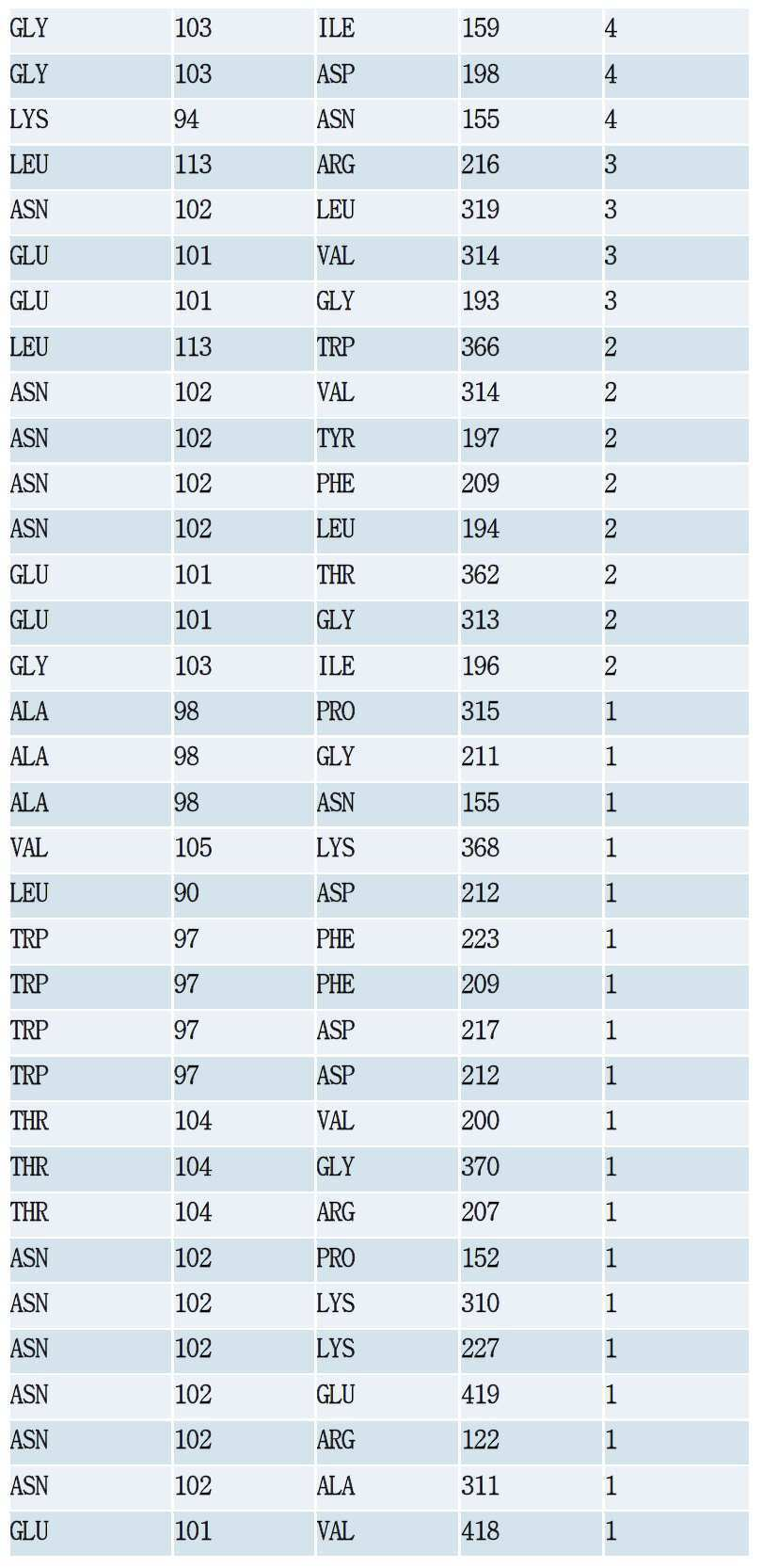

실시예 6Example 6
이 실시예는 개선된 규명 정확성을 보여주는 몇몇 CsgG 돌연변이체의 규명을 기재한다.This example describes the characterization of several CsgG mutants showing improved characterization accuracy.
재료 및 방법Materials and methods
이 실시예에서 사용된 재료 및 방법은 실시예 2에 대해 상기 기재된 것과 동일하다. 이동을 제어하기 위해 사용된 효소는 1 = T4 Dda-E94C/C109A/C136A/A360C(돌연변이 E94C/C109A/C136A/A360C를 갖는 서열 번호 24) 또는 효소 2 = T4 Dda - E94C/F98W/C109A/C136A/K194L/A360C(돌연변이 E94C/F98W/C109A/C136A/K194L/A360C를 갖는 서열 번호 24) 중 어느 하나였다. The materials and methods used in this example are the same as those described above for Example 2. Enzymes used to control migration are 1 = T4 Dda-E94C/C109A/C136A/A360C (SEQ ID NO: 24 with mutation E94C/C109A/C136A/A360C) or
국제 출원 제PCT/GB2012/052343호(WO/2013/041878로 공개됨)에 개시된 바와 같은 방법을 이용하여 1D 정확성 규명 측정을 계산하였다.1D accuracy characterization measurements were calculated using a method as disclosed in International Application No. PCT/GB2012/052343 (published as WO/2013/041878).
결과result
T4 Dda-E94C/F98W/C109A/C136A/K194L/A360C에 의해 제어된 DNA 전좌를 갖는 MspA 돌연변이체 x = MspA-((Del-L74/G75/D118/L119)D56F/E59R/L88N/D90N/D91N/Q126R/D134R/E139K)8(돌연변이 D56F/E59R/L88N/D90N/D91N/Q126R/D134R/E139K 및 아미노산 L74/G75/D118/L119의 결실을 갖는 서열 번호 50)에 대한 1D 베이스콜 규명 정확성은 68.7%이었다. 시험된 모든 돌연변이체(하기 표 17 참조)는 MspA 돌연변이체 X와 비교하여 개선된 1D 베이스콜 규명 정확성을 보여주었다.MspA mutant with DNA translocation controlled by T4 Dda-E94C/F98W/C109A/C136A/K194L/A360C x = MspA-((Del-L74/G75/D118/L119)D56F/E59R/L88N/D90N/D91N /Q126R/D134R/E139K)8 (mutation D56F/E59R/L88N/D90N/D91N/Q126R/D134R/E139K and SEQ ID NO: 50 with deletion of amino acids L74/G75/D118/L119) It was 68.7%. All mutants tested (see Table 17 below) showed improved accuracy of 1D base call characterization compared to MspA mutant X.
27 - CsgG-Eco-(Y51A/F56Q/R97W/R192Q-StrepII(C))9(돌연변이 Y51A/F56Q/R97W/R192Q를 갖는 서열 번호 2)(여기서, StrepII(C)는 서열 번호 47이고, C 말단에서 부착됨)27-CsgG-Eco-(Y51A/F56Q/R97W/R192Q-StrepII(C))9 (SEQ ID NO: 2 with mutation Y51A/F56Q/R97W/R192Q) (where StrepII (C) is SEQ ID NO: 47, C Attached at the end)
28 - CsgG-Eco-(Y51A/F56Q/R97W/R192D-StrepII(C))9(돌연변이 Y51A/F56Q/R97W/R192D를 갖는 서열 번호 2)(여기서, StrepII(C)는 서열 번호 47이고, C 말단에서 부착됨)28-CsgG-Eco-(Y51A/F56Q/R97W/R192D-StrepII(C))9 (SEQ ID NO: 2 with mutation Y51A/F56Q/R97W/R192D) (where StrepII (C) is SEQ ID NO: 47, C Attached at the end)
29 - CsgG-Eco-(Y51A/F56Q/K135L/T150I/S208V-StrepII(C))9(돌연변이 Y51A/F56Q/K135L/T150I/S208V를 갖는 서열 번호 2)(여기서, StrepII(C)는 서열 번호 47이고, C 말단에서 부착됨)29-CsgG-Eco-(Y51A/F56Q/K135L/T150I/S208V-StrepII(C))9 (SEQ ID NO: 2 with mutation Y51A/F56Q/K135L/T150I/S208V) (where StrepII(C) is SEQ ID NO: 47, attached at the C-terminus)
30 - CsgG-Eco-(Y51A/F56Q/T150I/S208V-StrepII(C))9(돌연변이 Y51A/F56Q/T150I/S208V를 갖는 서열 번호 2)(여기서, StrepII(C)는 서열 번호 47이고, C 말단에서 부착됨)30- CsgG-Eco-(Y51A/F56Q/T150I/S208V-StrepII(C))9 (SEQ ID NO: 2 with mutation Y51A/F56Q/T150I/S208V) (where StrepII(C) is SEQ ID NO: 47, C Attached at the end)
31 - CsgG-Eco-(Y51A/F56Q/S208V-StrepII(C))9(돌연변이 Y51A/F56Q/S208V를 갖는 서열 번호 2)(여기서, StrepII(C)는 서열 번호 47이고, C 말단에서 부착됨)31-CsgG-Eco-(Y51A/F56Q/S208V-StrepII(C))9 (SEQ ID NO: 2 with mutation Y51A/F56Q/S208V) (where StrepII(C) is SEQ ID NO: 47, attached at the C-terminus )
32 - CsgG-Eco-(Y51A/F56Q/T150I-StrepII(C))9(돌연변이 Y51A/F56Q/T150I를 갖는 서열 번호 2)(여기서, StrepII(C)는 서열 번호 47이고, C 말단에서 부착됨)32-CsgG-Eco-(Y51A/F56Q/T150I-StrepII(C))9 (SEQ ID NO: 2 with mutation Y51A/F56Q/T150I) (where StrepII(C) is SEQ ID NO: 47, attached at the C-terminus )
33 - CsgG-Eco-(Y51A/F56Q/K135V/T150Y-StrepII(C))9(돌연변이 Y51A/F56Q/K135V/T150Y를 갖는 서열 번호 2)(여기서, StrepII(C)는 서열 번호 47이고, C 말단에서 부착됨)33-CsgG-Eco-(Y51A/F56Q/K135V/T150Y-StrepII(C))9 (SEQ ID NO: 2 with mutation Y51A/F56Q/K135V/T150Y) (where StrepII(C) is SEQ ID NO: 47, C Attached at the end)
34 - CsgG-Eco-(Y51A/F56Q/K135L-StrepII(C))9(돌연변이 Y51A/F56Q/K135L을 갖는 서열 번호 2)(여기서, StrepII(C)는 서열 번호 47이고, C 말단에서 부착됨)34-CsgG-Eco-(Y51A/F56Q/K135L-StrepII(C))9 (SEQ ID NO: 2 with mutation Y51A/F56Q/K135L) (where StrepII(C) is SEQ ID NO: 47, attached at the C-terminus )
35 - CsgG-Eco-(Y51A/F56Q/R97F/R192D-StrepII(C))9(돌연변이 Y51A/F56Q/R97F/R192D를 갖는 서열 번호 2)(여기서, StrepII(C)는 서열 번호 47이고, C 말단에서 부착됨)35-CsgG-Eco-(Y51A/F56Q/R97F/R192D-StrepII(C))9 (SEQ ID NO: 2 with mutation Y51A/F56Q/R97F/R192D) (where StrepII(C) is SEQ ID NO: 47, C Attached at the end)
36 - CsgG-Eco-(Y51A/F56Q/K135L/T150I-StrepII(C))9(돌연변이 Y51A/F56Q/K135L/T150I를 갖는 서열 번호 2)(여기서, StrepII(C)는 서열 번호 47이고, C 말단에서 부착됨)36-CsgG-Eco-(Y51A/F56Q/K135L/T150I-StrepII(C))9 (SEQ ID NO: 2 with mutation Y51A/F56Q/K135L/T150I) (where StrepII (C) is SEQ ID NO: 47, C Attached at the end)
37 - CsgG-Eco-((Del-D195/Y196/Q197/R198/L199)-Y51A/F56Q-StrepII(C))9(돌연변이 Y51A/F56Q 및 아미노산 D195/Y196/Q197/R198/L199의 결실을 갖는 서열 번호 2)(여기서, StrepII(C)는 서열 번호 47이고, C 말단에서 부착됨)37-CsgG-Eco-((Del-D195/Y196/Q197/R198/L199)-Y51A/F56Q-StrepII(C))9 (mutation Y51A/F56Q and deletion of amino acids D195/Y196/Q197/R198/L199 Having SEQ ID NO: 2) (where, StrepII (C) is SEQ ID NO: 47, attached at the C-terminus)
38 - CsgG-Eco-((Del-R192/F193/I194/D195/Y196/Q197/R198/L199/L200)-Y51A/F56Q-StrepII(C))9(돌연변이 Y51A/F56Q 및 아미노산 R192/F193/I194/D195/Y196/Q197/R198/L199/L200의 결실을 갖는 서열 번호 2)(여기서, StrepII(C)는 서열 번호 47이고, C 말단에서 부착됨)38-CsgG-Eco-((Del-R192/F193/I194/D195/Y196/Q197/R198/L199/L200)-Y51A/F56Q-StrepII(C))9 (mutation Y51A/F56Q and amino acids R192/F193/ SEQ ID NO: 2 with a deletion of I194/D195/Y196/Q197/R198/L199/L200 (where StrepII(C) is SEQ ID NO: 47 and is attached at the C-terminus)
39 - CsgG-Eco-((Del-Q197/R198/L199/L200)-Y51A/F56Q-StrepII(C))9(돌연변이 Y51A/F56Q 및 아미노산 Q197/R198/L199/L200의 결실을 갖는 서열 번호 2)(여기서, StrepII(C)는 서열 번호 47이고, C 말단에서 부착됨)39-CsgG-Eco-((Del-Q197/R198/L199/L200)-Y51A/F56Q-StrepII(C))9 (mutation Y51A/F56Q and SEQ ID NO: 2 with deletion of amino acids Q197/R198/L199/L200 ) (Where StrepII(C) is SEQ ID NO: 47, attached at the C-terminus)
40 - CsgG-Eco-((Del-I194/D195/Y196/Q197/R198/L199)-Y51A/F56Q-StrepII(C))9(돌연변이 Y51A/F56Q 및 아미노산 I194/D195/Y196/Q197/R198/L199의 결실을 갖는 서열 번호 2)(여기서, StrepII(C)는 서열 번호 47이고, C 말단에서 부착됨)40-CsgG-Eco-((Del-I194/D195/Y196/Q197/R198/L199)-Y51A/F56Q-StrepII(C))9 (mutation Y51A/F56Q and amino acids I194/D195/Y196/Q197/R198/ SEQ ID NO: 2 with a deletion of L199) (where StrepII (C) is SEQ ID NO: 47, attached at the C-terminus)
41 - CsgG-Eco-((Del-V139/G140/D149/T150/V186/Q187/V204/G205)-Y51A/F56Q-StrepII(C))9(돌연변이 Y51A/F56Q 및 아미노산 V139/G140/D149/T150/V186/Q187/V204/G205의 결실을 갖는 서열 번호 2)(여기서, StrepII(C)는 서열 번호 47이고, C 말단에서 부착됨)41-CsgG-Eco-((Del-V139/G140/D149/T150/V186/Q187/V204/G205)-Y51A/F56Q-StrepII(C))9 (mutation Y51A/F56Q and amino acids V139/G140/D149/ SEQ ID NO: 2 with a deletion of T150/V186/Q187/V204/G205) (where StrepII (C) is SEQ ID NO: 47, attached at the C-terminus)
42 - CsgG-Eco-((Del-D195/Y196/Q197/R198/L199/L200)-Y51A/F56Q-StrepII(C))9(돌연변이 Y51A/F56Q 및 아미노산 D195/Y196/Q197/R198/L199/L200의 결실을 갖는 서열 번호 2)(여기서, StrepII(C)는 서열 번호 47이고, C 말단에서 부착됨)42-CsgG-Eco-((Del-D195/Y196/Q197/R198/L199/L200)-Y51A/F56Q-StrepII(C))9 (mutation Y51A/F56Q and amino acids D195/Y196/Q197/R198/L199/ SEQ ID NO: 2 with a deletion of L200) (where StrepII (C) is SEQ ID NO: 47, attached at the C-terminus)
43 - CsgG-Eco-((Del-Y196/Q197/R198/L199/L200/E201)-Y51A/F56Q-StrepII(C))9(돌연변이 Y51A/F56Q 및 아미노산 Y196/Q197/R198/L199/L200/E201의 결실을 갖는 서열 번호 2)(여기서, StrepII(C)는 서열 번호 47이고, C 말단에서 부착됨)43-CsgG-Eco-((Del-Y196/Q197/R198/L199/L200/E201)-Y51A/F56Q-StrepII(C))9 (mutation Y51A/F56Q and amino acids Y196/Q197/R198/L199/L200/ SEQ ID NO: 2 with a deletion of E201) (where StrepII (C) is SEQ ID NO: 47, attached at the C-terminus)
44 - CsgG-Eco-((Del-Q197/R198/L199)-Y51A/F56Q-StrepII(C))9(돌연변이 Y51A/F56Q 및 아미노산 Q197/R198/L199의 결실을 갖는 서열 번호 2)(여기서, StrepII(C)는 서열 번호 47이고, C 말단에서 부착됨)44-CsgG-Eco-((Del-Q197/R198/L199)-Y51A/F56Q-StrepII(C))9 (SEQ ID NO: 2 with deletion of mutation Y51A/F56Q and amino acid Q197/R198/L199) (wherein, StrepII (C) is SEQ ID NO: 47, attached at the C terminus)
45 - CsgG-Eco-((Del-F193/I194/D195/Y196/Q197/R198/L199)-Y51A/F56Q-StrepII(C))9(돌연변이 Y51A/F56Q 및 아미노산 F193/I194/D195/Y196/Q197/R198/L199의 결실을 갖는 서열 번호 2)(여기서, StrepII(C)는 서열 번호 47이고, C 말단에서 부착됨)45-CsgG-Eco-((Del-F193/I194/D195/Y196/Q197/R198/L199)-Y51A/F56Q-StrepII(C))9 (mutation Y51A/F56Q and amino acids F193/I194/D195/Y196/ SEQ ID NO: 2 with a deletion of Q197/R198/L199) (where StrepII (C) is SEQ ID NO: 47 and is attached at the C-terminus)
46 - CsgG-Eco-(Y51A/F56Q/R192T-StrepII(C))9(돌연변이 Y51A/F56Q/R192T를 갖는 서열 번호 2)(여기서, StrepII(C)는 서열 번호 47이고, C 말단에서 부착됨)46-CsgG-Eco-(Y51A/F56Q/R192T-StrepII(C))9 (SEQ ID NO: 2 with mutation Y51A/F56Q/R192T) (where StrepII(C) is SEQ ID NO: 47, attached at the C-terminus )
47 - CsgG-Eco-(Y51A/F56Q/N102S-StrepII(C))9(돌연변이 Y51A/F56Q/N102S를 갖는 서열 번호 2)(여기서, StrepII(C)는 서열 번호 47이고, C 말단에서 부착됨)47-CsgG-Eco-(Y51A/F56Q/N102S-StrepII(C))9 (SEQ ID NO: 2 with mutation Y51A/F56Q/N102S) (where StrepII(C) is SEQ ID NO: 47, attached at the C-terminus )
48 - CsgG-Eco-(Y51A/F56Q/Q42R-StrepII(C))9(돌연변이 Y51A/F56Q/Q42R을 갖는 서열 번호 2)(여기서, StrepII(C)는 서열 번호 47이고, C 말단에서 부착됨)48-CsgG-Eco-(Y51A/F56Q/Q42R-StrepII(C))9 (SEQ ID NO: 2 with mutation Y51A/F56Q/Q42R) (where StrepII(C) is SEQ ID NO: 47, attached at the C-terminus )
49 - CsgG-Eco-(Y51A/F56Q/R192S-StrepII(C))9(돌연변이 Y51A/F56Q/R192S를 갖는 서열 번호 2)(여기서, StrepII(C)는 서열 번호 47이고, C 말단에서 부착됨)49-CsgG-Eco-(Y51A/F56Q/R192S-StrepII(C))9 (SEQ ID NO: 2 with mutation Y51A/F56Q/R192S) (where StrepII(C) is SEQ ID NO: 47, attached at the C-terminus )
50 - CsgG-Eco-(Y51A/F56Q/G103N-StrepII(C))9(돌연변이 Y51A/F56Q/G103N을 갖는 서열 번호 2)(여기서, StrepII(C)는 서열 번호 47이고, C 말단에서 부착됨)50-CsgG-Eco-(Y51A/F56Q/G103N-StrepII(C))9 (SEQ ID NO: 2 with mutation Y51A/F56Q/G103N) (where StrepII(C) is SEQ ID NO: 47, attached at the C-terminus )
51 - CsgG-Eco-(Y51A/F56Q/R97N/N102R-StrepII(C))9(돌연변이 Y51A/F56Q/R97N/N102R을 갖는 서열 번호 2)(여기서, StrepII(C)는 서열 번호 47이고, C 말단에서 부착됨)51-CsgG-Eco-(Y51A/F56Q/R97N/N102R-StrepII(C))9 (SEQ ID NO: 2 with mutation Y51A/F56Q/R97N/N102R) (where StrepII (C) is SEQ ID NO: 47, C Attached at the end)
52 - CsgG-Eco-(Y51A/F56Q/R97L-StrepII(C))9(돌연변이 Y51A/F56Q/R97L을 갖는 서열 번호 2)(여기서, StrepII(C)는 서열 번호 47이고, C 말단에서 부착됨)52-CsgG-Eco-(Y51A/F56Q/R97L-StrepII(C))9 (SEQ ID NO: 2 with mutation Y51A/F56Q/R97L) (where StrepII(C) is SEQ ID NO: 47, attached at the C-terminus )
53 - CsgG-Eco-(Y51A/F56Q/R192D-StrepII(C))9(돌연변이 Y51A/F56Q/R192D를 갖는 서열 번호 2)(여기서, StrepII(C)는 서열 번호 47이고, C 말단에서 부착됨)53-CsgG-Eco-(Y51A/F56Q/R192D-StrepII(C))9 (SEQ ID NO: 2 with mutation Y51A/F56Q/R192D) (where StrepII(C) is SEQ ID NO: 47, attached at the C-terminus )
54 - CsgG-Eco-(Y51A/F56Q/R97N/N102G-StrepII(C))9(돌연변이 Y51A/F56Q/R97N/N102G를 갖는 서열 번호 2)(여기서, StrepII(C)는 서열 번호 47이고, C 말단에서 부착됨)54-CsgG-Eco-(Y51A/F56Q/R97N/N102G-StrepII(C))9 (SEQ ID NO: 2 with mutation Y51A/F56Q/R97N/N102G) (where StrepII (C) is SEQ ID NO: 47, C Attached at the end)
55 - CsgG-Eco-(Y51A/F56Q/F48S-StrepII(C))9(돌연변이 Y51A/F56Q/F48S를 갖는 서열 번호 2)(여기서, StrepII(C)는 서열 번호 47이고, C 말단에서 부착됨)55-CsgG-Eco-(Y51A/F56Q/F48S-StrepII(C))9 (SEQ ID NO: 2 with mutation Y51A/F56Q/F48S) (where StrepII(C) is SEQ ID NO: 47, attached at the C-terminus )
56 - CsgG-Eco-(Y51A/F56Q/G103S-StrepII(C))9(돌연변이 Y51A/F56Q/G103S를 갖는 서열 번호 2)(여기서, StrepII(C)는 서열 번호 47이고, C 말단에서 부착됨)56-CsgG-Eco-(Y51A/F56Q/G103S-StrepII(C))9 (SEQ ID NO: 2 with mutation Y51A/F56Q/G103S) (where StrepII(C) is SEQ ID NO: 47, attached at the C-terminus )
57 - CsgG-Eco-(Y51A/F56Q/E101L-StrepII(C))9(돌연변이 Y51A/F56Q/E101L을 갖는 서열 번호 2)(여기서, StrepII(C)는 서열 번호 47이고, C 말단에서 부착됨)57-CsgG-Eco-(Y51A/F56Q/E101L-StrepII(C))9 (SEQ ID NO: 2 with mutation Y51A/F56Q/E101L) (where StrepII(C) is SEQ ID NO: 47, attached at the C-terminus )
58 - CsgG-Eco-(Y51A/F56Q/R192Q-StrepII(C))9(돌연변이 Y51A/F56Q/R192Q를 갖는 서열 번호 2)(여기서, StrepII(C)는 서열 번호 47이고, C 말단에서 부착됨)58-CsgG-Eco-(Y51A/F56Q/R192Q-StrepII(C))9 (SEQ ID NO: 2 with mutation Y51A/F56Q/R192Q) (where StrepII(C) is SEQ ID NO: 47, attached at the C-terminus )
59 - CsgG-Eco-(Y51A/F56Q/K135N/R142N/R192N-StrepII(C))9(돌연변이 Y51A/F56Q/K135N/R142N/R192N을 갖는 서열 번호 2)(여기서, StrepII(C)는 서열 번호 47이고, C 말단에서 부착됨)59-CsgG-Eco-(Y51A/F56Q/K135N/R142N/R192N-StrepII(C))9 (SEQ ID NO: 2 with mutation Y51A/F56Q/K135N/R142N/R192N) (where StrepII(C) is SEQ ID NO: 47, attached at the C-terminus)
60 - CsgG-Eco-(Y51A/F56Q/R97N-StrepII(C))9(돌연변이 Y51A/F56Q/R97N을 갖는 서열 번호 2)(여기서, StrepII(C)는 서열 번호 47이고, C 말단에서 부착됨)60-CsgG-Eco-(Y51A/F56Q/R97N-StrepII(C))9 (SEQ ID NO: 2 with mutation Y51A/F56Q/R97N) (where StrepII(C) is SEQ ID NO: 47, attached at the C-terminus )
61 - CsgG-Eco-(Y51A/F56Q/R192N-StrepII(C))9(돌연변이 Y51A/F56Q/R192N을 갖는 서열 번호 2)(여기서, StrepII(C)는 서열 번호 47이고, C 말단에서 부착됨)61-CsgG-Eco-(Y51A/F56Q/R192N-StrepII(C))9 (SEQ ID NO: 2 with mutation Y51A/F56Q/R192N) (where StrepII(C) is SEQ ID NO: 47, attached at the C-terminus )
62 - CsgG-Eco-(Y51A/F56Q/Y130W-StrepII(C))9(돌연변이 Y51A/F56Q/Y130W를 갖는 서열 번호 2)(여기서, StrepII(C)는 서열 번호 47이고, C 말단에서 부착됨)62-CsgG-Eco-(Y51A/F56Q/Y130W-StrepII(C))9 (SEQ ID NO: 2 with mutation Y51A/F56Q/Y130W) (where StrepII(C) is SEQ ID NO: 47, attached at the C-terminus )
63 - CsgG-Eco-(Y51A/F56Q/E101G-StrepII(C))9(돌연변이 Y51A/F56Q/E101G를 갖는 서열 번호 2)(여기서, StrepII(C)는 서열 번호 47이고, C 말단에서 부착됨)63-CsgG-Eco-(Y51A/F56Q/E101G-StrepII(C))9 (SEQ ID NO: 2 with mutation Y51A/F56Q/E101G) (where StrepII(C) is SEQ ID NO: 47, attached at the C-terminus )


실시예 7Example 7
이 실시예는 다수의 상이한 돌연변이체 나노기공의 DNA 포획을 포함한다.This example involves the capture of DNA of a number of different mutant nanopores.
재료 및 방법Materials and methods
완충제(25mM K 인산염 완충제, 150mM 칼륨 페로시아나이드(II), 150mM 칼륨 페리시아나이드(III), pH 8.0) 중에 블록 공중합체에서 삽입된 다양한 단일 CsgG 또는 MspA 나노기공으로부터 전기 측정을 획득하였다. 블록 공중합체에서 삽입된 단일 기공을 달성한 후, 완충제(2㎖, 25mM K 인산염 완충제, 150mM 칼륨 페로시아나이드(II), 150mM 칼륨 페리시아나이드(III), pH 8.0)는 시스템을 통해 유동시켜 임의의 과량의 나노기공을 제거하였다. 이후, 150㎕의 500mM KCl, 25mM K 포스페이트, 1.5mM MgCl2, 1.5mM ATP(pH 8.0)를 시스템을 통해 유동시켰다. 10분 후, 150㎕의 DNA(서열 번호 51, 200nM)는 이후 단일 나노기공 실험 시스템으로 유동시켰다. 실험을 -120mV에서 실행하고, 헬리카제 제어된 DNA 이동을 모니터링하였다. Electrical measurements were obtained from various single CsgG or MspA nanopores inserted in a block copolymer in a buffer (25 mM K phosphate buffer, 150 mM potassium ferrocyanide (II), 150 mM potassium ferrocyanide (III), pH 8.0). After achieving the inserted single pores in the block copolymer, a buffer (2 ml, 25 mM K phosphate buffer, 150 mM potassium ferrocyanide (II), 150 mM potassium ferricyanide (III), pH 8.0) was flowed through the system. Any excess nanopores were removed. Then, 150 μl of 500mM KCl, 25mM K phosphate, 1.5mM MgCl2, 1.5mM ATP (pH 8.0) were flowed through the system. After 10 minutes, 150 μl of DNA (SEQ ID NO: 51, 200 nM) was then flowed into a single nanopore experimental system. The experiment was run at -120mV and helicase controlled DNA migration was monitored.
결과result
CsgG 돌연변이체 CsgG-Eco-(Y51A/F56Q/R97W/E101S/R192D-StrepII(C))9(돌연변이 Y51A/F56Q/R97W/E101S/R192D를 갖는 서열 번호 2(여기서, StrepII(C)는 서열 번호 47이고, C 말단에서 부착됨)(도 36 참조)는 MspA-((Del-L74/G75/D118/L119)D56F/E59R/L88N/D90N/D91N/Q126R/D134R/E139K)8(도 34 참조)보다 더 높은 포획 속도(예를 들어, 더 쉽게 DNA 폴리뉴클레오타이드를 포획함)를 보여준다. 전류 트레이스에서의 각각의 스파이크는 효소에 의해 제어함이 없이 나노기공을 통한 DNA 폴리뉴클레오타이드(서열 번호 51)의 전좌에 상응한다. 도 34에서의 10초 전류 트레이스는 CsgG 나노기공 - CsgG-Eco-(Y51A/F56Q/R97W/E101S/R192D-StrepII(C))9에 대해 10초 전류 트레이스보다 더 적은 DNA 전좌를 보여준다.CsgG mutant CsgG-Eco-(Y51A/F56Q/R97W/E101S/R192D-StrepII(C))9 (SEQ ID NO: 2 with mutation Y51A/F56Q/R97W/E101S/R192D, where StrepII(C) is SEQ ID NO: 47, attached at the C-terminus) (see Figure 36) is MspA-((Del-L74/G75/D118/L119)D56F/E59R/L88N/D90N/D91N/Q126R/D134R/E139K)8 (see Figure 34 ), which shows a higher capture rate (eg, more easily captures DNA polynucleotides).Each spike in the current trace is a DNA polynucleotide through the nanopores without enzymatic control (SEQ ID NO: 51). The 10 second current trace in Figure 34 shows less DNA than the 10 second current trace for CsgG nanopore-CsgG-Eco-(Y51A/F56Q/R97W/E101S/R192D-StrepII(C))9. Show translocation.
위치 E101 내지 E101S의 돌연변이는 E101S 돌연변이 없이 CsgG 돌연변이체와 비교할 때 포획 속도의 증가를 발생시켰다. 도 35는 CsgG 돌연변이체 CsgG-Eco-(Y51A/F56Q/R97W/R192D-StrepII(C))9(돌연변이 Y51A/F56Q/R97W/R192D를 갖는 서열 번호 2(여기서, StrepII(C)는 서열 번호 47이고, C 말단에서 부착됨)에 대한 10초 전류 트레이스가 CsgG-Eco-(Y51A/F56Q/R97W/E101S/R192D-StrepII(C))9보다 더 적은 전좌를 나타낸다는 것을 보여준다. CsgG-Eco-(Y51A/F56Q/R97W/R192D-StrepII(C))9에 대한 전좌의 평균 수는 초마다 7.25(n = 12)이고, CsgG-Eco-(Y51A/F56Q/R97W/E101S/R192D-StrepII(C))9에 대한 평균 수는 초마다 18(n = 14)이다.Mutations at positions E101 to E101S resulted in an increase in capture rate compared to the CsgG mutant without the E101S mutation. Figure 35 shows the CsgG mutant CsgG-Eco-(Y51A/F56Q/R97W/R192D-StrepII(C))9 (mutation Y51A/F56Q/R97W/R192D with SEQ ID NO: 2, where StrepII(C) is SEQ ID NO: 47 CsgG-Eco-(Y51A/F56Q/R97W/E101S/R192D-StrepII(C))9 shows less translocation than CsgG-Eco-(Y51A/F56Q/R97W/E101S/R192D-StrepII(C))9). The average number of translocations for (Y51A/F56Q/R97W/R192D-StrepII(C))9 is 7.25 per second (n = 12), CsgG-Eco-(Y51A/F56Q/R97W/E101S/R192D-StrepII(C )) The average number for 9 is 18 per second (n = 14).
실시예 8Example 8
이 실시예는 2개의 상이한 CsgG 돌연변이체 기공의 발현의 수준을 비교한다.This example compares the level of expression of two different CsgG mutant pores.
재료 및 방법Materials and methods
이 실시예에서 나노기공(A = CsgG-Eco-(Y51A/F56Q/R97W)-StrepII(C))9(돌연변이 Y51A/F56Q/R97W를 갖는 서열 번호 2(여기서, StrepII(C)는 서열 번호 47이고, C 말단에서 부착됨) 및 B = CsgG-Eco-(Y51A/F56Q/R97W/R192D)-StrepII(C))9(돌연변이 Y51A/F56Q/R97W/R192D를 갖는 서열 번호 2(여기서, StrepII(C)는 서열 번호 47이고, C 말단에서 부착됨))을 제조하기 위해 사용된 재료 및 방법은 실시예 3에 대해 상기 기재된 것과 동일하다.In this example, nanopore (A = CsgG-Eco-(Y51A/F56Q/R97W)-StrepII(C))9 (mutation Y51A/F56Q/R97W with SEQ ID NO: 2, where StrepII (C) is SEQ ID NO: 47 And B = CsgG-Eco-(Y51A/F56Q/R97W/R192D)-StrepII(C))9 (SEQ ID NO: 2 with mutation Y51A/F56Q/R97W/R192D, where StrepII ( C) is SEQ ID NO: 47, and the materials and methods used to prepare)) are the same as those described above for Example 3.
결과result
2개의 나노기공 A = CsgG-Eco-(Y51A/F56Q/R97W)-StrepII(C))9(돌연변이 Y51A/F56Q/R97W를 갖는 서열 번호 2(여기서, StrepII(C)는 서열 번호 47이고, C 말단에서 부착됨) 및 B = CsgG-Eco-(Y51A/F56Q/R97W/R192D)-StrepII(C))9(돌연변이 Y51A/F56Q/R97W/R192D를 갖는 서열 번호 2(여기서, StrepII(C)는 서열 번호 47이고, C 말단에서 부착됨))를 정확하게 동일한 프로토콜을 이용하여 발현시키고 정제하고, 겔 여과 크로마토그램(120㎖ S200 칼럼, 도 37 참조) 및 SDS-PAGE 분석(도 38 참조)을 이용하여 각각의 나노기공의 동일한 용적을 분석하였다. B에 대한 흡광도 값(470.3mAu)은 A(11.4mAu)보다 훨씬 더 높고, 이는 CsgG-Eco-(Y51A/F56Q/R97W/R192D)-StrepII(C))9가 CsgG-Eco-(Y51A/F56Q/R97W)-StrepII(C))9보다 훨씬 더 높은 수준에서 발현된다는 것을 나타낸다. 도 38에서의 밴드의 강도는 또한 2개의 기공의 발현 수준을 나타낸다. 밴드 A 내지 C(CsgG-Eco-(Y51A/F56Q/R97W)-StrepII(C))9 함유)는 밴드 D 내지 E(CsgG-Eco-(Y51A/F56Q/R97W/R192D)-StrepII(C))9 함유)보다 덜 강하다. 분석의 2개의 방법은 둘 다 R192D 돌연변이의 부가가 CsgG 돌연변이체의 관찰된 발현을 크게 증가시킨다는 것을 나타냈다.Two nanopore A = CsgG-Eco-(Y51A/F56Q/R97W)-StrepII(C))9 (SEQ ID NO: 2 with mutation Y51A/F56Q/R97W, where StrepII(C) is SEQ ID NO: 47, C Attached at the end) and B = CsgG-Eco-(Y51A/F56Q/R97W/R192D)-StrepII(C))9 (SEQ ID NO: 2 with mutation Y51A/F56Q/R97W/R192D, where StrepII(C) is SEQ ID NO: 47, attached at the C-terminus)) was expressed and purified using the exact same protocol, using a gel filtration chromatogram (120 mL S200 column, see FIG. 37) and SDS-PAGE analysis (see FIG. 38). Thus, the same volume of each nanopore was analyzed. The absorbance value for B (470.3 mAu) is much higher than A (11.4 mAu), which is CsgG-Eco-(Y51A/F56Q/R97W/R192D)-StrepII(C))9 is CsgG-Eco-(Y51A/F56Q) /R97W)-StrepII(C))9. The intensity of the band in Figure 38 also indicates the level of expression of the two pores. Bands A to C (CsgG-Eco-(Y51A/F56Q/R97W)-StrepII(C))9 contained) bands D to E (CsgG-Eco-(Y51A/F56Q/R97W/R192D)-StrepII(C)) 9 contained) less strong. Both methods of analysis indicated that the addition of the R192D mutation significantly increased the observed expression of the CsgG mutant.
실시예 9Example 9
이 실시예는 개선된 규명 정확성을 보여주는 몇몇 CsgG 돌연변이체의 규명을 기재한다.This example describes the characterization of several CsgG mutants showing improved characterization accuracy.
재료 및 방법Materials and methods
CsG 기공CsG groundbreaking
하기 8개의 CsgG 돌연변이체 기공을 시험하였다. 상기 실시예 X에 기재된 돌연변이체 28을 기준 기공으로서 사용하였다. 돌연변이는 서열 번호 2에서 만들어지고, 정제 태그 StrepII는 서열 번호 47에 기재된 서열을 갖는다.The following eight CsgG mutant pores were tested.
기준 기공(돌연변이체 28): CsgG-(WT-Y51A/F56Q/R97W/R192D-StrepII)9Reference pore (mutant 28): CsgG-(WT-Y51A/F56Q/R97W/R192D-StrepII)9
돌연변이체 A: CsgG-(WT-Y51A/F56Q/R97W/R192D-StrepII)9-del(D195-L199)Mutant A: CsgG-(WT-Y51A/F56Q/R97W/R192D-StrepII)9-del(D195-L199)
돌연변이체 B: CsgG-(WT-Y51A/F56Q/R97W/R192D-StrepII)9-del(F193-L199)Mutant B: CsgG-(WT-Y51A/F56Q/R97W/R192D-StrepII)9-del(F193-L199)
돌연변이체 C: CsgG-(WT-Y51A/F56Q/R97W/R192D-StrepII)9-F191TMutant C: CsgG-(WT-Y51A/F56Q/R97W/R192D-StrepII)9-F191T
돌연변이체 D: CsgG-(WT-Y51A/F56Q/R97W/R192D-del(V105-I107)-StrepII)9Mutant D: CsgG-(WT-Y51A/F56Q/R97W/R192D-del(V105-I107)-StrepII)9
돌연변이체 E: CsgG-(WT-Y51A/F56Q/K94Q/R97W/R192D-del(V105-I107)Mutant E: CsgG-(WT-Y51A/F56Q/K94Q/R97W/R192D-del(V105-I107)
돌연변이체 F: CsgG-(WT-Y51A/F56Q/R192D-StrepII)9-R93WMutant F: CsgG-(WT-Y51A/F56Q/R192D-StrepII)9-R93W
돌연변이체 G: CsgG-(WT-Y51A/F56Q/R192D-StrepII)9-R93W-del(D195-L199)Mutant G: CsgG-(WT-Y51A/F56Q/R192D-StrepII)9-R93W-del(D195-L199)
돌연변이체 H: CsgG-(WT-Y51A/F56Q/R192D-StrepII)9-R93Y/R97YMutant H: CsgG-(WT-Y51A/F56Q/R192D-StrepII)9-R93Y/R97Y
나노기공 제조Nanopore manufacturing
각각 단일 CsgG 돌연변이체 나노기공이 삽입된 블록 공중합체 막의 다수의 웰을 함유하는 나노기공 어레이 칩을 제조하기 위해, 하기 방법을 이용하였다. 이. 콜라이에서 발현된 CsgG 돌연변이체를 정제하고, 25mM 트리스, 150mM NaCl, 2mM EDTA, 0.01% DDM, 0.1% SDS, 0.1% Brij 58(pH 8)을 함유하는 완충제 중에 저장하였다. 이 돌연변이체 CsgG 기공을 25mM 인산칼륨, 150mM 칼륨 페로시아나이드(II), 150mM 칼륨 페리시아나이드(III)(pH 8.0)를 함유하는 완충제를 사용하여 100만 중 1로 희석하고, 칩에 첨가하여 각각의 웰에서 단일 기공을 얻었다. 기공 삽입 후, 어레이 칩을 25mM 인산칼륨, 150mM 칼륨 페로시아나이드(II), 150mM 칼륨 페리시아나이드(III)(pH 8.0)를 함유하는 1㎖ 완충제에 의해 세척하여 과량의 기공을 제거하였다. 몇 분 후, 각각의 칩을 470mM KCl, 25mM HEPES, 11mM ATP 및 10mM MgCl2를 함유하는 500㎖의 서열분석 믹스에 의해 플러싱하였다. In order to prepare a nanopore array chip each containing a plurality of wells of a block copolymer membrane into which a single CsgG mutant nanopore is inserted, the following method was used. this. CsgG mutants expressed in E.coli were purified and stored in a buffer containing 25mM Tris, 150mM NaCl, 2mM EDTA, 0.01% DDM, 0.1% SDS, 0.1% Brij 58 (pH 8). This mutant CsgG pore was diluted to 1 in 1 million using a buffer containing 25 mM potassium phosphate, 150 mM potassium ferrocyanide (II), and 150 mM potassium ferricyanide (III) (pH 8.0), and added to the chip. A single pore was obtained in each well. After pore insertion, the array chip was washed with 1 ml buffer containing 25 mM potassium phosphate, 150 mM potassium ferrocyanide (II), 150 mM potassium ferricyanide (III) (pH 8.0) to remove excess pores. After a few minutes, each chip was flushed with 500 ml of sequencing mix containing 470mM KCl, 25mM HEPES, 11mM ATP and 10mM MgCl2.
DNA 샘플 제조DNA sample preparation
하기 방법을 이용하여 서열분석에 대해 DNA 샘플을 제조하였다. 1㎍의 DNA 분석물질을 10분 동안 어댑터 및 무딘 TA 리가제에 예비 결합된 T4 Dda 헬리카제 효소를 함유하는 40nM의 어댑터 믹스와 항온처리하였다(https://store.nanoporetech.com/으로부터 이용 가능). 어댑터의 구조는 도 43에 도시되어 있고, 어댑터에 함유된 서열은 서열 번호 52 내지 55에 기재되어 있다. 이후, 결찰 혼합물을 정제하여 Spri 정제를 사용하여 비결찰된 유리 어댑터를 제거하였다. 최종 결찰된 혼합물을 40mM CAPS(pH 10), 40mM KCl 및 400nM 콜레스테롤 테터를 함유하는 25㎕의 용리 완충제 중에 용리시켰다. 각각의 칩에 대해, 12㎕의 DNA-어댑터 결찰된 혼합물을 서열분석 혼합물(150㎕의 최종 용적)과 혼합하고, 서열분석을 위해 칩에 첨가하였다. 이후, 160mV에서 6시간 동안 실험을 실행하였다.DNA samples were prepared for sequencing using the following method. 1 μg of DNA analyte was incubated with an adapter mix of 40 nM containing the T4 Dda helicase enzyme pre-bound to the adapter and blunt TA ligase for 10 minutes (available from https://store.nanoporetech.com/). ). The structure of the adapter is shown in Figure 43, and the sequences contained in the adapter are set forth in SEQ ID NOs: 52-55. Thereafter, the ligation mixture was purified to remove unligated glass adapters using Spri tablets. The final ligated mixture was eluted in 25 μl of elution buffer containing 40mM CAPS (pH 10), 40mM KCl and 400nM cholesterol tester. For each chip, 12 μl of the DNA-adapter ligated mixture was mixed with the sequencing mixture (150 μl final volume) and added to the chip for sequencing. Thereafter, the experiment was performed at 160mV for 6 hours.
WO 제2013/041878호에 개시된 바와 같은 방법을 이용하여 1D 정확성 규명 측정을 계산하였다.A 1D accuracy characterization measurement was calculated using the method as disclosed in WO 2013/041878.
주형 속도 측정Mold speed measurement
하기 방법에 의해 주형 속도를 측정하였다. 각각의 스퀴글의 베이스콜을 기준 서열로 정렬하였다. 정렬에 걸친 염기의 수(정렬 출발 위치로부터 공제된 정렬 종료 위치)를 정렬의 종료에 상응하는 사건과 정렬의 시작에 상응하는 사건 사이의 시간으로 나눈다. The mold speed was measured by the following method. The base call of each squiggle was aligned with the reference sequence. The number of bases across the alignment (the alignment end position subtracted from the alignment start position) is divided by the time between the event corresponding to the end of the alignment and the event corresponding to the start of the alignment.
결과result
베이스콜 정확성Base call accuracy
도 39에 도시된 바대로, 모든 8개의 CsgG 돌연변이체 기공은 실시예 6에 기재된 돌연변이체 28(CsgG-(WT-Y51A/F56Q/R97W/R192D-StrepII)9)인 기준 기공과 비교하여 개선된 베이스콜 정확성을 갖는 것으로 발견되었다. 표 17에 기재된 바대로, 돌연변이체 28은, 실시예 5에 기재된 돌연변이체 25(CsgG-(WT-Y51A/F56Q-StrepII)9)가 기준 돌연변이체인, 실시예 6에서 시험된 모든 CsgG 돌연변이체의 가장 높은 베이스콜 정확성(80.2%)을 보여주었다. 따라서, D195-L199, F193-L199 또는 V105-I107의 결실, 또는 F191T의 치환은 돌연변이체 28에서의 R97W 및 R192D 치환으로부터 생긴 정확성의 개선 이외에 정확성의 추가의 개선을 발생시킨다. As shown in Figure 39, all eight CsgG mutant pores were improved compared to the reference pore, mutant 28 (CsgG-(WT-Y51A/F56Q/R97W/R192D-StrepII)9) described in Example 6. It was found to have base call accuracy. As shown in Table 17,
D195-L199, F193-L199 또는 V105-I107의 결실, 또는 F191T의 치환은 각각 또한 CsgG 서열에서의 다른 돌연변이의 존재 또는 R97W, R192D, Y51A 및/또는 F56Q 돌연변이의 부재 하에 정확성을 개선하는 것으로 예상될 것이다. 예를 들어, del(V105-I107) 돌연변이 이외에 돌연변이 K94Q를 함유하는 돌연변이체 E는, R97W 치환을 함유하지 않지만, 대신에 R93W 치환을 함유하는 del(V105-I107) 함유 돌연변이체 G가 그런 것처럼, 돌연변이체 28과 비교하여 개선된 정확성을 갖는다.Deletion of D195-L199, F193-L199 or V105-I107, or substitution of F191T, respectively, would also be expected to improve accuracy in the presence of other mutations in the CsgG sequence or in the absence of R97W, R192D, Y51A and/or F56Q mutations. will be. For example, mutant E containing the mutation K94Q other than the del(V105-I107) mutation does not contain the R97W substitution, but instead, as does the del(V105-I107) containing mutant G containing the R93W substitution, It has improved accuracy compared to
실시예 26에서의 표 17은 R97W 치환을 함유하는 돌연변이체 26이 돌연변이체 28(80.2%)만큼 거의 양호한 베이스콜 정확성(79.2%)을 갖는다는 것을 보여준다. 이것은 R97W 돌연변이가 증가한 베이스콜 정확성의 근거가 된다는 것을 제안한다. 이 실시예에서, R97W 돌연변이를 함유하지 않는(또한 R192D 돌연변이를 함유하지 않는), 대신에 R93W 치환(돌연변이체 F) 또는 R93Y 치환 및 R97Y 치환(돌연변이체 H) 둘 다를 함유하는 2개의 돌연변이체를 시험하고, 돌연변이체 28보다 더 높은 베이스콜 정확성을 갖는 것으로 발견되었다. 이것은 R93W 및 R93Y/R97Y 치환이 CsgG 나노기공의 베이스콜 정확성을 개선하기 위해 사용될 수 있다는 것을 보여준다.Table 17 in Example 26 shows that mutant 26 containing the R97W substitution has almost as good base call accuracy (79.2%) as mutant 28 (80.2%). This suggests that the R97W mutation is the basis for the increased base call accuracy. In this example, two mutants that do not contain the R97W mutation (and do not contain the R192D mutation), but instead contain both the R93W substitution (mutant F) or the R93Y substitution and R97Y substitution (mutant H). Tested and found to have a higher base call accuracy than
주형 속도 및 주형 정확성Mold speed and mold accuracy
도 40a에 도시된 바대로, 돌연변이체 D(CsgG-(WT-Y51A/F56Q/R97W/R192D-del(V105-I107)-StrepII)9)은 기준 돌연변이체 28 CsgG-(WT-Y51A/F56Q/R97W/R192D-StrepII)9와 비교하여 속도 집단의 치밀해진 분포를 갖는다. 40A, mutant D (CsgG-(WT-Y51A/F56Q/R97W/R192D-del(V105-I107)-StrepII)9) is
도 40b는 돌연변이체 D(CsgG-(WT-Y51A/F56Q/R97W/R192D-del(V105-I107)-StrepII)9)가 기준 돌연변이체 28 CsgG-(WT-Y51A/F56Q/R97W/R192D-StrepII)9와 비교하여 주형 정확성의 치밀해진 분포를 갖는다는 것을 보여준다. 40B shows that mutant D (CsgG-(WT-Y51A/F56Q/R97W/R192D-del(V105-I107)-StrepII)9) is
데이터의 변동이 없으므로, 치밀해진 속도 및 정확성 분포를 갖는 것이 이점이다. 또한, 데이터의 중앙치 정확성이 생성된 더 낮은 정확성 데이터의 양을 감소시킴으로써 증가할 것이다. 따라서, CsgG 나노기공의 V105 내지 I107의 아미노산의 결실은 폴리뉴클레오타이드를 규명하기 위한 개선된 특성을 갖는 CsgG 나노기공을 제조하기 위해 사용될 수 있다.Since there is no variation in the data, it is an advantage to have a denser distribution of speed and accuracy. Also, the median accuracy of the data will increase by reducing the amount of lower accuracy data generated. Thus, deletion of amino acids V105 to I107 of CsgG nanopores can be used to prepare CsgG nanopores with improved properties for identifying polynucleotides.
실시예 10Example 10
이 실시예는 노이지 기공 신호의 감소를 보여주는 CsgG 돌연변이체의 규명을 기재한다.This example describes the characterization of CsgG mutants that show a decrease in the noisy pore signal.
재료 및 방법Materials and methods
CsG 기공CsG groundbreaking
하기 CsgG 돌연변이체 기공을 시험하였다. 상기 실시예 X에 기재된 돌연변이체 28을 기준 기공으로서 사용하였다. 돌연변이는 서열 번호 2에서 만들어지고, 정제 태그 StrepII는 서열 번호 47에 기재된 서열을 갖는다.The following CsgG mutant pores were tested.
기준 기공(돌연변이체 28): CsgG-(WT-Y51A/F56Q/R97W/R192D-StrepII)9Reference pore (mutant 28): CsgG-(WT-Y51A/F56Q/R97W/R192D-StrepII)9
돌연변이체 I: CsgG-(WT-Y51A/F56Q/R97W/R192D-StrepII)9-K94N. Mutant I: CsgG-(WT-Y51A/F56Q/R97W/R192D-StrepII)9-K94N.
돌연변이체 J: CsgG-(WT-Y51A/F56Q/R97W/R192D-StrepII)9-K94Q. Mutant J: CsgG-(WT-Y51A/F56Q/R97W/R192D-StrepII)9-K94Q.
나노기공 제조Nanopore manufacturing
각각 단일 CsgG 돌연변이체 나노기공이 삽입된 블록 공중합체 막의 다수의 웰을 함유하는 칩을 실시예 9에 기재된 바대로 제조하였다. Chips each containing multiple wells of a block copolymer membrane into which a single CsgG mutant nanopore was inserted were prepared as described in Example 9.
DNA 샘플 제조DNA sample preparation
실시예 9에 기재된 방법을 이용하여 서열분석에 대해 DNA 샘플을 제조하였다.DNA samples were prepared for sequencing using the method described in Example 9.
노이지 기공 상태에서 지난 시간의 결정Determination of the past time in noisy qigong
노이지 기공 상태에서 지난 시간의 백분율을 하기한 바대로 계산하였다. 각각의 채널 내의 사건 검출된 신호는 비중첩하는 짧은 윈도우로 분할되었다. 각각의 윈도우에 대해, 현재의 수준의 평균 평균값 및 현재의 수준의 분산을 계산하였다. 이후, 얻은 값을 분류기로 통과시키고, 이것은 윈도우가 노이지 신호를 함유하는지를 나타내는 라벨을 반송한다. 예비 표지된 데이터를 제공함으로써 노이지 신호를 검출하도록 분류기를 훈련시켰다.The percentage of the time passed in the noisy pore state was calculated as follows. The event detected signals in each channel were divided into non-overlapping short windows. For each window, the average mean value of the current level and the variance of the current level were calculated. The obtained value is then passed through a classifier, which carries a label indicating whether the window contains a noisy signal. The classifier was trained to detect noisy signals by providing pre-labeled data.
결과result
노이지 기공 상태Noisy pore state
도 41은 기준 돌연변이체 28 CsgG-(WT-Y51A/F56Q/R97W/R192D-StrepII)9에 의해 나타난 "노이지" 기공 오차 방식을 보여주는 예시적인 "스쿼글"을 나타낸다. 도 41의 상부 패널은 "양호한" 및 "노이지" 기공 상태 동안 기공을 통한 전류의 흐름의 차이를 보여준다. 도 41의 하부 패널은 "양호한" 상태로부터 "노이지" 상태로이 이행의 확대도를 보여준다.Figure 41 shows an exemplary "squagle" showing the "noisy" pore error scheme exhibited by
도 42는, 적어도 5회 실행에 걸쳐 평균이 된, 기준 돌연변이체 28과 비교할 때 돌연변이체 기공 I 및 J의 노이지 기공 상태의 감소를 보여준다.Figure 42 shows the reduction in the noisy pore state of mutant pores I and J as compared to
돌연변이체 J 및 돌연변이체 I 둘 다에 의해 노이즈 기공 상태에서 지난 시간의 백분율은 기준치와 비교하여 유의미하게 감소하였다. 돌연변이체 I 및 J는 바로 1개의 잔기에서 기준으로서 사용된 돌연변이체 28과 다르다. 돌연변이체 I 및 돌연변이체 J 둘 다는 K94의 치환을 함유한다. 돌연변이체 I는 K94N 돌연변이를 함유하고, 돌연변이체 II는 K94Q 돌연변이를 함유한다. 따라서, CsgG 나노기공에서의 K94의 치환, 특히 N 또는 Q에 의한 치환은 폴리뉴클레오타이드를 규명하기 위해 개선된 특성을 갖는 CsgG 나노기공을 제조하기 위해 사용될 수 있다.By both mutant J and mutant I, the percentage of time passed in the noise pore state was significantly reduced compared to the baseline. Mutants I and J differ from
실시예 11Example 11
이 실시예는 증가한 포획 활성을 보여주는 몇몇 CsgG 돌연변이체의 규명을 기재한다.This example describes the identification of several CsgG mutants that show increased capture activity.
재료 및 방법Materials and methods
CsG 기공CsG groundbreaking
하기 CsgG 돌연변이체 기공을 시험하였다. 상기 실시예 9에 기재된 돌연변이체 E를 기준 기공으로서 사용하였다. 돌연변이는 서열 번호 2에서 만들어지고, 정제 태그 StrepII는 서열 번호 47에 기재된 서열을 갖는다.The following CsgG mutant pores were tested. Mutant E described in Example 9 above was used as a reference pore. The mutation is made in SEQ ID NO: 2, and the purification tag StrepII has the sequence set forth in SEQ ID NO: 47.
기준치(돌연변이체 E): CsgG-(WT-Y51A/F56Q/K94Q/R97W/R192D-del(V105-I107).Baseline (mutant E): CsgG-(WT-Y51A/F56Q/K94Q/R97W/R192D-del(V105-I107).
돌연변이체 K: CsgG-(WT-Y51A/F56Q/K94Q/R97W/R192D-del(V105-I107)-Q42KMutant K: CsgG-(WT-Y51A/F56Q/K94Q/R97W/R192D-del(V105-I107)-Q42K
돌연변이체 L: CsgG-(WT-Y51A/F56Q/K94Q/R97W/R192D-del(V105-I107)-E44NMutant L: CsgG-(WT-Y51A/F56Q/K94Q/R97W/R192D-del(V105-I107)-E44N
돌연변이체 M: CsgG-(WT-Y51A/F56Q/K94Q/R97W/R192D-del(V105-I107)-E44Q Mutant M: CsgG-(WT-Y51A/F56Q/K94Q/R97W/R192D-del(V105-I107)-E44Q
돌연변이체 N: CsgG-(WT-Y51A/F56Q/K94Q/R97W/R192D-del(V105-I107)-L90RMutant N: CsgG-(WT-Y51A/F56Q/K94Q/R97W/R192D-del(V105-I107)-L90R
돌연변이체 O: CsgG-(WT-Y51A/F56Q/K94Q/R97W/R192D-del(V105-I107)-N91RMutant O: CsgG-(WT-Y51A/F56Q/K94Q/R97W/R192D-del(V105-I107)-N91R
돌연변이체 P: CsgG-(WT-Y51A/F56Q/K94Q/R97W/R192D-del(V105-I107)-I95RMutant P: CsgG-(WT-Y51A/F56Q/K94Q/R97W/R192D-del(V105-I107)-I95R
돌연변이체 Q: CsgG-(WT-Y51A/F56Q/K94Q/R97W/R192D-del(V105-I107)-A99RMutant Q: CsgG-(WT-Y51A/F56Q/K94Q/R97W/R192D-del(V105-I107)-A99R
돌연변이체 R: CsgG-(WT-Y51A/F56Q/K94Q/R97W/R192D-del(V105-I107)-E101HMutant R: CsgG-(WT-Y51A/F56Q/K94Q/R97W/R192D-del(V105-I107)-E101H
돌연변이체 S: CsgG-(WT-Y51A/F56Q/K94Q/R97W/R192D-del(V105-I107)-E101KMutant S: CsgG-(WT-Y51A/F56Q/K94Q/R97W/R192D-del(V105-I107)-E101K
돌연변이체 T: CsgG-(WT-Y51A/F56Q/K94Q/R97W/R192D-del(V105-I107)-E101NMutant T: CsgG-(WT-Y51A/F56Q/K94Q/R97W/R192D-del(V105-I107)-E101N
돌연변이체 U: CsgG-(WT-Y51A/F56Q/K94Q/R97W/R192D-del(V105-I107)-E101QMutant U: CsgG-(WT-Y51A/F56Q/K94Q/R97W/R192D-del(V105-I107)-E101Q
돌연변이체 V: CsgG-(WT-Y51A/F56Q/K94Q/R97W/R192D-del(V105-I107)-E101TMutant V: CsgG-(WT-Y51A/F56Q/K94Q/R97W/R192D-del(V105-I107)-E101T
돌연변이체 W: CsgG-(WT-Y51A/F56Q/K94Q/R97W/R192D-del(V105-I107)-Q114KMutant W: CsgG-(WT-Y51A/F56Q/K94Q/R97W/R192D-del(V105-I107)-Q114K
나노기공 제조Nanopore manufacturing
각각 단일 CsgG 돌연변이체 나노기공이 삽입된 블록 공중합체 막의 다수의 웰을 함유하는 나노기공 어레이 칩을 제조하기 위해, 하기 방법을 이용하였다. 이. 콜라이에서 발현된 CsgG 돌연변이체를 정제하고, 25mM 트리스, 150mM NaCl, 2mM EDTA, 0.01% DDM, 0.1% SDS, 0.1% Brij 58(pH 8)을 함유하는 완충제 중에 저장하였다. 이 돌연변이체 CsgG 기공을 25mM 인산칼륨, 150mM 칼륨 페로시아나이드(II), 150mM 칼륨 페리시아나이드(III)(pH 8.0)를 함유하는 완충제를 사용하여 100만 중 1로 희석하고, 칩에 첨가하여 각각의 웰에서 단일 기공을 얻었다. 기공 삽입 후, 칩을 25mM 인산칼륨, 150mM 칼륨 페로시아나이드(II), 150mM 칼륨 페리시아나이드(III)(pH 8.0)를 함유하는 1㎖ 완충제에 의해 세척하여 과량의 기공을 제거하였다. 25mM 인산칼륨, 150mM 칼륨 페로시아나이드(II), 150mM 칼륨 페리시아나이드(III)(pH 8.0) 중의 240nM TBA 분석물질을 함유하는 1㎖의 용액을 칩으로 플러싱하였다. In order to prepare a nanopore array chip each containing a plurality of wells of a block copolymer membrane into which a single CsgG mutant nanopore is inserted, the following method was used. this. CsgG mutants expressed in E.coli were purified and stored in a buffer containing 25mM Tris, 150mM NaCl, 2mM EDTA, 0.01% DDM, 0.1% SDS, 0.1% Brij 58 (pH 8). This mutant CsgG pore was diluted to 1 in 1 million using a buffer containing 25 mM potassium phosphate, 150 mM potassium ferrocyanide (II), and 150 mM potassium ferricyanide (III) (pH 8.0), and added to the chip. A single pore was obtained in each well. After pore insertion, the chips were washed with 1 ml buffer containing 25 mM potassium phosphate, 150 mM potassium ferrocyanide (II), 150 mM potassium ferricyanide (III) (pH 8.0) to remove excess pores. A solution of 1 ml containing 240 nM TBA analyte in 25 mM potassium phosphate, 150 mM potassium ferrocyanide (II), 150 mM potassium ferricyanide (III), pH 8.0, was flushed with a chip.
포획 능력의 결정Determination of capture ability
이후, 트롬빈 결합 압타머(TBA)(서열 번호 51)를 포획하는 능력에 의해 DNA 분석물질을 포획하는 돌연변이체 기공의 능력을 평가하였다. 180mV에서 실험을 실행하였다. 기공에 의한 TBA 포획을 측정하기 위해, TBA 사건 사이의 중앙치 시간을 계산하였다.Then, the ability of the mutant pore to capture the DNA analyte was evaluated by the ability to capture thrombin-binding aptamer (TBA) (SEQ ID NO: 51). The experiment was carried out at 180 mV. To measure TBA capture by pore, the median time between TBA events was calculated.
결과result
도 44에 도시된 바대로, 13개의 돌연변이체에 대한 TBA 사건 사이의 중앙치 시간은 기준치와 비교하여 유의미하게 감소하였고, 이는 모든 13개의 돌연변이체가 주형 DNA의 증가한 포획 속도를 나타탠다는 것을 나타낸다. As shown in Figure 44, the median time between TBA events for the 13 mutants was significantly reduced compared to the baseline, indicating that all 13 mutants exhibited increased capture rates of template DNA.
각각의 13개의 돌연변이체는 기준 기공과 비교하여 단일 아미노산 치환을 갖는다. 특정한 치환은 Q42K, E44N, E44Q, L90R, N91R, I95R, A99R, E101H, E101K, E101N, E101Q, E101T 및 Q114K이었다. 모든 이 돌연변이는 비하전된 아미노산 또는 양으로 하전된 아미노산에 의한 음으로 하전된 아미노산의 치환, 또는 양으로 하전된 아미노산에 의한 비하전된 아미노산의 치환을 수반한다. 따라서, 음전하를 제거하고/하거나 이 위치에서 양전하를 증가시키는 아미노산에 의한 Q42, E44, E44, L90, N91, I95, A99, E101 및 Q114 위치의 하나 이상에서의 아미노산의 치환이 폴리뉴클레오타이드의 증가한 포획을 발생시킨다고 결론지어질 수 있다. Each of the 13 mutants has a single amino acid substitution compared to the reference pore. Specific substitutions were Q42K, E44N, E44Q, L90R, N91R, I95R, A99R, E101H, E101K, E101N, E101Q, E101T and Q114K. All of these mutations involve substitution of negatively charged amino acids by uncharged or positively charged amino acids, or substitution of uncharged amino acids by positively charged amino acids. Thus, substitution of amino acids at one or more of positions Q42, E44, E44, L90, N91, I95, A99, E101 and Q114 by an amino acid that removes the negative charge and/or increases the positive charge at this position increases the capture of the polynucleotide. It can be concluded that
다양한 CsgG 동족체의 서열 정렬Sequence alignment of various CsgG homologs
도 45는 상기 기재된 바와 같은 21개의 CsgG 동족체 사이의 서열 정렬을 보여준다. 서열 번호 2, 서열 번호 3, 서열 번호 4, 서열 번호 5, 서열 번호 6, 서열 번호 7, 서열 번호 27, 서열 번호 28, 서열 번호 29, 서열 번호 30, 서열 번호 31, 서열 번호 32, 서열 번호 33, 서열 번호 34, 서열 번호 35, 서열 번호 36, 서열 번호 37, 서열 번호 38, 서열 번호 39, 서열 번호 40 및 서열 번호 41에서 다수의 서열 정렬을 수행하였다. Figure 45 shows the sequence alignment between the 21 CsgG homologs as described above. SEQ ID NO: 2, SEQ ID NO: 3, SEQ ID NO: 4, SEQ ID NO: 5, SEQ ID NO: 6, SEQ ID NO: 7, SEQ ID NO: 27, SEQ ID NO: 28, SEQ ID NO: 29, SEQ ID NO: 30, SEQ ID NO: 31, SEQ ID NO: 32, SEQ ID NO A number of sequence alignments were performed in SEQ ID NO: 33, SEQ ID NO: 34, SEQ ID NO: 35, SEQ ID NO: 36, SEQ ID NO: 37, SEQ ID NO: 38, SEQ ID NO: 39, SEQ ID NO: 40 and SEQ ID NO: 41.
상동성-연장된 및 2차 구조 정보를 통합한 다중 서열 정렬 툴박스인 프랄린 소프트웨어(Praline software)는 정렬을 수행하기 위해 이용되었다 http://www.ibi.vu.nl/programs/pralinewww/, 또한 문헌[Simossis VA1, Heringa J.; Nucleic Acids Res. 2005 Jul 1;33(Web Server issue):W289-94]을 참조한다. BLOSUM62 잔기 교환 매트릭스를 이용하여 정렬을 순위 매겼다. 이 방법의 세부사항을 위해, 예를 들어 문헌[Henikoff S, Henikoff JG; Proc. Natl. Acad. Sci. USA Vol. 89, pp. 10915-10919, November 1992]을 참조한다. 갭 오프닝 및 12 및 1의 연장 패널티를 각각 이용하였다. PSIPRED를 이용한 2차 구조 예측을 이용하여 정렬을 가이드하였다. 이 방법의 세부사항을 위해, 예를 들어 문헌[Jones D.T.; J Mol Biol. 1999 Sep 17; 292(2):195-202]을 참조한다. 서열을 정렬하기 위해 이용된 상기 방법은 예시적이고, 당해 분야에 공지된 서열 정렬의 다른 방법을 이용할 수 있다. Praline software, a multi-sequence alignment toolbox that incorporates homology-extended and secondary structure information, was used to perform alignments http://www.ibi.vu.nl/programs/pralinewww/, and also Simossis VA1, Heringa J.; Nucleic Acids Res. 2005
도 45의 서열 정렬과 관련하여, 서열 정렬의 각각의 부문에서 각각의 위치에서의 보존은 히스토그램 및 점수로 표시된다. 스케일에서 숫자 0 내지 9는 증가하는 보존을 나타내고, 보존된 아미노의 것과 유사한 특성을 생성시키는 돌연변이를 갖는 열은 플러스('+')로 표시되고, 별 기호('*')는 그 위치에서의 100%의 서열 동일성을 나타낸다. 많은 잔기가 매우 높은 또는 심지어 완벽한 서열 동일성을 보여준다는 것을 서열 정렬의 보존 값으로부터 볼 수 있고, 이것은 이 21개의 동족체가 밀접하게 관련된다는 것을 나타낸다. With respect to the sequence alignment of Figure 45, the conservation at each position in each section of the sequence alignment is indicated by histogram and score.
도 46은 예측된 알파 나선 2차 구조 영역이 추가로 회색으로 음영이 있는 도 45와 동일한 상대 서열 정렬을 보여준다. 도 47은 예측된 베타 시트 2차 구조 영역이 추가로 회색으로 음영이 있는 도 45와 동일한 상대 서열 정렬을 보여준다. 도 46 및 도 47은 CsgG 나노기공에 대한 중요한 2차 구조인 이 동족체의 예측된 알파 나선 및 베타 시트의 영역이 매우 보존된다는 것을 보여준다.Figure 46 shows the same relative sequence alignment as Figure 45, where the predicted alpha helical secondary structure regions are further shaded in gray. FIG. 47 shows the same relative sequence alignment as in FIG. 45 with the predicted beta sheet secondary structure regions additionally shaded in gray. Figures 46 and 47 show that regions of the predicted alpha helix and beta sheet of this homologue, an important secondary structure for CsgG nanopores, are highly conserved.
다수의 서열 정렬은 서열이 관련된다는 것을 강하게 제안한다; 정렬을 따른 보존의 높은 정도가 있을 뿐만 아니라, 예측된 2차 구조적 요소가 또한 정렬된다.Multiple sequence alignments strongly suggest that sequences are related; Not only is there a high degree of conservation along the alignment, the predicted secondary structural elements are also aligned.
도 45, 도 46 및 도 47에서의 서열 정렬은 서로에 정렬되는 상대 위치를 보여주도록 참고로 사용될 수 있다. 따리서, 서열 번호 2와 관련하여 확인된 아미노산 잔기 및 다른 CsgG 동족체에서 상응하는 아미노산 잔기는 확인될 수 있다. 확인의 용이를 위해, 잔기 R97 및 R192는 별표로 배치된다. 예를 들어, 서열 번호 2의 R192가 서열 번호 32의 잔기 R191 및 서열 번호 37의 잔기 K177에 상응한다는 것을 표로부터 볼 수 있다. The sequence alignment in FIGS. 45, 46 and 47 can be used as a reference to show relative positions aligned with each other. Thus, amino acid residues identified with respect to SEQ ID NO: 2 and corresponding amino acid residues in other CsgG homologs can be identified. For ease of identification, residues R97 and R192 are arranged with an asterisk. For example, it can be seen from the table that R192 of SEQ ID NO: 2 corresponds to residue R191 of SEQ ID NO: 32 and residue K177 of SEQ ID NO: 37.
도 45 내지 47을 참조하여 용이하게 이해될 수 있는 것처럼, CsgG 단량체는 고도로 보존된다. 더구나, 서열 번호 2와 관련한 돌연변이의 지식으로부터, 서열 번호 2의 것과 다른 CsgG 단량체의 돌연변이에 대한 동등한 위치를 결정할 수 있다. As can be readily understood with reference to Figures 45-47, the CsgG monomer is highly conserved. Moreover, from the knowledge of the mutations associated with SEQ ID NO: 2, it is possible to determine equivalent positions for mutations of CsgG monomers other than those of SEQ ID NO: 2.
따라서, 청구항 및 본 명세서에서 그 외 기재된 바와 같은 서열 번호 2에 기재된 바와 같은 서열의 변이체를 포함하는 돌연변이체 CsgG 단량체 및 이의 특정한 아미노산 돌연변이의 언급은 또한 서열 번호 3, 서열 번호 4, 서열 번호 5, 서열 번호 6, 서열 번호 7, 서열 번호 27, 서열 번호 28, 서열 번호 29, 서열 번호 30, 서열 번호 31, 서열 번호 32, 서열 번호 33, 서열 번호 34, 서열 번호 35, 서열 번호 36, 서열 번호 37, 서열 번호 38, 서열 번호 39, 서열 번호 40 및 서열 번호 41에 기재된 바와 같은 서열의 변이체를 포함하는 돌연변이체 CsgG 단량체 및 이의 상응하는 아미노산 돌연변이를 포함한다. 마찬가지로, 청구항 및 본 명세서에서 그 외 기재된 바와 같은 서열 번호 2에 기재된 바와 같은 서열의 변이체를 포함하는 돌연변이체 CsgG 단량체 및 이의 특정한 아미노산 돌연변이에 관한 작제물, 기공 또는 기공의 사용에 수반하는 방법의 언급은 또한 상기 개시된 서열 번호에 따른 서열의 변이체를 포함하는 돌연변이체 CsgG 단량체 및 이의 상응하는 아미노산 돌연변이에 관한 작제물, 기공 또는 방법을 포함한다. 본 발명이 고도로 보존된 영역을 나타내는 본 명세서에서 명확히 확인되지 않은 다른 변이체 CsgG 단량체로 연장된다는 것이 추가로 이해될 것이다.Thus, references to mutant CsgG monomers and specific amino acid mutations thereof, including variants of the sequence as set forth in SEQ ID NO: 2 as described elsewhere in the claims and elsewhere in this specification, also refer to SEQ ID NO: 3, SEQ ID NO: 4, SEQ ID NO: 5, SEQ ID NO: 6, SEQ ID NO: 7, SEQ ID NO: 27, SEQ ID NO: 28, SEQ ID NO: 29, SEQ ID NO: 30, SEQ ID NO: 31, SEQ ID NO: 32, SEQ ID NO: 33, SEQ ID NO: 34, SEQ ID NO: 35, SEQ ID NO: 36, SEQ ID NO 37, SEQ ID NO: 38, SEQ ID NO: 39, SEQ ID NO: 40, and a mutant CsgG monomer comprising a variant of the sequence as set forth in SEQ ID NO: 41 and corresponding amino acid mutations thereof. Likewise, a reference to a mutant CsgG monomer comprising a variant of the sequence as set forth in SEQ ID NO: 2 as described elsewhere herein and to a construct, pore or method involving the use of a construct, pore or pore relating to a particular amino acid mutation thereof. Also includes constructs, pores or methods for mutant CsgG monomers and their corresponding amino acid mutations comprising variants of the sequence according to the disclosed SEQ ID NOs. It will be further understood that the present invention extends to other variant CsgG monomers not explicitly identified herein representing highly conserved regions.
SEQUENCE LISTING
<110> OXFORD NANOPORE TECHNOLOGIES LIMITED
<120> MUTANT PORE
<130> WO2017/149318
<140> PCT/GB2017/050571
<141> 2017-03-02
<150> GB1603656.8
<151> 2016-03-02
<150> GB1603657.6
<151> 2016-03-02
<150> GB1603658.4
<151> 2016-03-02
<160> 56
<170> PatentIn version 3.5
<210> 1
<211> 786
<212> DNA
<213> Escherichia coli
<400> 1
tgtctgaccg caccgccgaa agaagcggca cgtccgaccc tgatgccgcg tgcacagtct 60
tataaagatc tgacccatct gccggctccg acgggcaaaa tttttgttag cgtctataac 120
atccaggacg aaaccggtca atttaaaccg tacccggcga gtaatttctc cacggccgtt 180
ccgcagagtg caaccgctat gctggtcacg gcactgaaag attcccgttg gttcattccg 240
ctggaacgcc agggcctgca aaacctgctg aatgaacgta aaattatccg cgcagctcag 300
gaaaacggta ccgtggccat taacaatcgt attccgctgc aaagcctgac cgccgcaaac 360
atcatggttg aaggctctat catcggttac gaatcaaacg tcaaatcggg cggtgtgggc 420
gcacgttatt ttggcattgg tgctgatacc cagtaccaac tggaccagat cgcagttaac 480
ctgcgcgtgg ttaatgtcag caccggcgaa attctgagct ctgtgaatac cagcaaaacg 540
atcctgtctt acgaagtgca ggctggtgtt tttcgtttca ttgattatca acgcctgctg 600
gaaggcgaag tcggttacac ctcaaacgaa ccggtgatgc tgtgtctgat gtcggcgatt 660
gaaacgggtg ttattttcct gatcaatgat ggcatcgacc gtggtctgtg ggatctgcag 720
aacaaagccg aacgtcaaaa tgacattctg gtgaaatacc gccacatgag tgttccgccg 780
gaatcc 786
<210> 2
<211> 262
<212> PRT
<213> Escherichia coli
<400> 2
Cys Leu Thr Ala Pro Pro Lys Glu Ala Ala Arg Pro Thr Leu Met Pro
1 5 10 15
Arg Ala Gln Ser Tyr Lys Asp Leu Thr His Leu Pro Ala Pro Thr Gly
20 25 30
Lys Ile Phe Val Ser Val Tyr Asn Ile Gln Asp Glu Thr Gly Gln Phe
35 40 45
Lys Pro Tyr Pro Ala Ser Asn Phe Ser Thr Ala Val Pro Gln Ser Ala
50 55 60
Thr Ala Met Leu Val Thr Ala Leu Lys Asp Ser Arg Trp Phe Ile Pro
65 70 75 80
Leu Glu Arg Gln Gly Leu Gln Asn Leu Leu Asn Glu Arg Lys Ile Ile
85 90 95
Arg Ala Ala Gln Glu Asn Gly Thr Val Ala Ile Asn Asn Arg Ile Pro
100 105 110
Leu Gln Ser Leu Thr Ala Ala Asn Ile Met Val Glu Gly Ser Ile Ile
115 120 125
Gly Tyr Glu Ser Asn Val Lys Ser Gly Gly Val Gly Ala Arg Tyr Phe
130 135 140
Gly Ile Gly Ala Asp Thr Gln Tyr Gln Leu Asp Gln Ile Ala Val Asn
145 150 155 160
Leu Arg Val Val Asn Val Ser Thr Gly Glu Ile Leu Ser Ser Val Asn
165 170 175
Thr Ser Lys Thr Ile Leu Ser Tyr Glu Val Gln Ala Gly Val Phe Arg
180 185 190
Phe Ile Asp Tyr Gln Arg Leu Leu Glu Gly Glu Val Gly Tyr Thr Ser
195 200 205
Asn Glu Pro Val Met Leu Cys Leu Met Ser Ala Ile Glu Thr Gly Val
210 215 220
Ile Phe Leu Ile Asn Asp Gly Ile Asp Arg Gly Leu Trp Asp Leu Gln
225 230 235 240
Asn Lys Ala Glu Arg Gln Asn Asp Ile Leu Val Lys Tyr Arg His Met
245 250 255
Ser Val Pro Pro Glu Ser
260
<210> 3
<211> 248
<212> PRT
<213> Citrobacter koseri
<400> 3
Met Pro Arg Ala Gln Ser Tyr Lys Asp Leu Thr His Leu Pro Met Pro
1 5 10 15
Thr Gly Lys Ile Phe Val Ser Val Tyr Asn Ile Gln Asp Glu Thr Gly
20 25 30
Gln Phe Lys Pro Tyr Pro Ala Ser Asn Phe Ser Thr Ala Val Pro Gln
35 40 45
Ser Ala Thr Ala Met Leu Val Thr Ala Leu Lys Asp Ser Arg Trp Phe
50 55 60
Ile Pro Leu Glu Arg Gln Gly Leu Gln Asn Leu Leu Asn Glu Arg Lys
65 70 75 80
Ile Ile Arg Ala Ala Gln Glu Asn Gly Thr Val Ala Ile Asn Asn Arg
85 90 95
Ile Pro Leu Gln Ser Leu Thr Ala Ala Asn Ile Met Val Glu Gly Ser
100 105 110
Ile Ile Gly Tyr Glu Ser Asn Val Lys Ser Gly Gly Val Gly Ala Arg
115 120 125
Tyr Phe Gly Ile Gly Ala Asp Thr Gln Tyr Gln Leu Asp Gln Ile Ala
130 135 140
Val Asn Leu Arg Val Val Asn Val Ser Thr Gly Glu Ile Leu Ser Ser
145 150 155 160
Val Asn Thr Ser Lys Thr Ile Leu Ser Tyr Glu Val Gln Ala Gly Val
165 170 175
Phe Arg Phe Ile Asp Tyr Gln Arg Leu Leu Glu Gly Glu Ile Gly Tyr
180 185 190
Thr Ser Asn Glu Pro Val Met Leu Cys Leu Met Ser Ala Ile Glu Thr
195 200 205
Gly Val Ile Phe Leu Ile Asn Asp Gly Ile Asp Arg Gly Leu Trp Asp
210 215 220
Leu Gln Asn Lys Ala Glu Arg Gln Asn Asp Ile Leu Val Lys Tyr Arg
225 230 235 240
His Met Ser Val Pro Pro Glu Ser
245
<210> 4
<211> 223
<212> PRT
<213> Salmonella enterica
<400> 4
Cys Leu Thr Ala Pro Pro Lys Gln Ala Ala Lys Pro Thr Leu Met Pro
1 5 10 15
Arg Ala Gln Ser Tyr Lys Asp Leu Thr His Leu Pro Ala Pro Thr Gly
20 25 30
Lys Ile Phe Val Ser Val Tyr Asn Ile Gln Asp Glu Thr Gly Gln Phe
35 40 45
Lys Pro Tyr Pro Ala Ser Asn Phe Ser Thr Ala Val Pro Gln Ser Ala
50 55 60
Thr Ala Met Leu Val Thr Ala Leu Lys Asp Ser Arg Trp Phe Ile Pro
65 70 75 80
Leu Glu Arg Gln Gly Leu Gln Asn Leu Leu Asn Glu Arg Lys Ile Ile
85 90 95
Arg Ala Ala Gln Glu Asn Gly Thr Val Ala Met Asn Asn Arg Ile Pro
100 105 110
Leu Gln Ser Leu Thr Ala Ala Asn Ile Met Val Glu Gly Ser Ile Ile
115 120 125
Gly Tyr Glu Ser Asn Val Lys Ser Gly Gly Val Gly Ala Arg Tyr Phe
130 135 140
Gly Ile Gly Ala Asp Thr Gln Tyr Gln Leu Asp Gln Ile Ala Val Asn
145 150 155 160
Leu Arg Val Val Asn Val Ser Thr Gly Glu Ile Leu Ser Ser Val Asn
165 170 175
Thr Ser Lys Thr Ile Leu Ser Tyr Glu Val Gln Ala Gly Val Phe Arg
180 185 190
Phe Ile Asp Tyr Gln Arg Leu Leu Glu Gly Glu Ile Gly Tyr Thr Ser
195 200 205
Asn Glu Pro Val Met Leu Cys Leu Met Ser Ala Ile Glu Thr Gly
210 215 220
<210> 5
<211> 262
<212> PRT
<213> Citrobacter amalonaticus
<400> 5
Cys Leu Thr Ala Pro Pro Lys Glu Ala Ala Lys Pro Thr Leu Met Pro
1 5 10 15
Arg Ala Gln Ser Tyr Lys Asp Leu Thr His Leu Pro Ile Pro Thr Gly
20 25 30
Lys Ile Phe Val Ser Val Tyr Asn Ile Gln Asp Glu Thr Gly Gln Phe
35 40 45
Lys Pro Tyr Pro Ala Ser Asn Phe Ser Thr Ala Val Pro Gln Ser Ala
50 55 60
Thr Ala Met Leu Val Thr Ala Leu Lys Asp Ser Arg Trp Phe Val Pro
65 70 75 80
Leu Glu Arg Gln Gly Leu Gln Asn Leu Leu Asn Glu Arg Lys Ile Ile
85 90 95
Arg Ala Ala Gln Glu Asn Gly Thr Val Ala Ile Asn Asn Arg Ile Pro
100 105 110
Leu Gln Ser Leu Thr Ala Ala Asn Ile Met Val Glu Gly Ser Ile Ile
115 120 125
Gly Tyr Glu Ser Asn Val Lys Ser Gly Gly Val Gly Ala Arg Tyr Phe
130 135 140
Gly Ile Gly Ala Asp Thr Gln Tyr Gln Leu Asp Gln Ile Ala Val Asn
145 150 155 160
Leu Arg Val Val Asn Val Ser Thr Gly Glu Ile Leu Ser Ser Val Asn
165 170 175
Thr Ser Lys Thr Ile Leu Ser Tyr Glu Val Gln Ala Gly Val Phe Arg
180 185 190
Phe Ile Asp Tyr Gln Arg Leu Leu Glu Gly Glu Ile Gly Tyr Thr Ser
195 200 205
Asn Glu Pro Val Met Leu Cys Leu Met Ser Ala Ile Glu Thr Gly Val
210 215 220
Ile Phe Leu Ile Asn Asp Gly Ile Asp Arg Gly Leu Trp Asp Leu Gln
225 230 235 240
Asn Lys Ala Asp Arg Gln Asn Asp Ile Leu Val Lys Tyr Arg His Met
245 250 255
Ser Val Pro Pro Glu Ser
260
<210> 6
<211> 262
<212> PRT
<213> Citrobacter rodentium
<400> 6
Cys Leu Thr Thr Pro Pro Lys Glu Ala Ala Lys Pro Thr Leu Met Pro
1 5 10 15
Arg Ala Gln Ser Tyr Lys Asp Leu Thr His Leu Pro Val Pro Thr Gly
20 25 30
Lys Ile Phe Val Ser Val Tyr Asn Ile Gln Asp Glu Thr Gly Gln Phe
35 40 45
Lys Pro Tyr Pro Ala Ser Asn Phe Ser Thr Ala Val Pro Gln Ser Ala
50 55 60
Thr Ala Met Leu Val Thr Ala Leu Lys Asp Ser Arg Trp Phe Ile Pro
65 70 75 80
Leu Glu Arg Gln Gly Leu Gln Asn Leu Leu Asn Glu Arg Lys Ile Ile
85 90 95
Arg Ala Ala Gln Glu Asn Gly Thr Val Ala Ile Asn Asn Arg Ile Pro
100 105 110
Leu Pro Ser Leu Thr Ala Ala Asn Ile Met Val Glu Gly Ser Ile Ile
115 120 125
Gly Tyr Glu Ser Asn Val Lys Ser Gly Gly Ala Gly Ala Arg Tyr Phe
130 135 140
Gly Ile Gly Ala Asp Thr Gln Tyr Gln Leu Asp Gln Ile Ala Val Asn
145 150 155 160
Leu Arg Val Val Asn Val Ser Thr Gly Glu Ile Leu Ser Ser Val Asn
165 170 175
Thr Ser Lys Thr Ile Leu Ser Tyr Glu Val Gln Ala Gly Val Phe Arg
180 185 190
Phe Ile Asp Tyr Gln Arg Leu Leu Glu Gly Glu Ile Gly Tyr Thr Ser
195 200 205
Asn Glu Pro Val Met Leu Cys Leu Met Ser Ala Ile Glu Thr Gly Val
210 215 220
Ile Phe Leu Ile Asn Asp Gly Ile Asp Arg Gly Leu Trp Asp Leu Gln
225 230 235 240
Asn Lys Ala Asp Arg Gln Asn Asp Ile Leu Val Lys Tyr Arg Gln Met
245 250 255
Ser Val Pro Pro Glu Ser
260
<210> 7
<211> 262
<212> PRT
<213> Enterobacter asburiae
<400> 7
Cys Leu Thr Ala Pro Pro Lys Glu Ala Ala Lys Pro Thr Leu Met Pro
1 5 10 15
Arg Ala Gln Ser Tyr Arg Asp Leu Thr His Leu Pro Ala Pro Thr Gly
20 25 30
Lys Ile Phe Val Ser Val Tyr Asn Ile Gln Asp Glu Thr Gly Gln Phe
35 40 45
Lys Pro Tyr Pro Ala Ser Asn Phe Ser Thr Ala Val Pro Gln Ser Ala
50 55 60
Thr Ala Met Leu Val Thr Ala Leu Lys Asp Ser His Trp Phe Ile Pro
65 70 75 80
Leu Glu Arg Gln Gly Leu Gln Asn Leu Leu Asn Glu Arg Lys Ile Ile
85 90 95
Arg Ala Ala Gln Glu Asn Gly Thr Val Ala Asn Asn Asn Arg Met Pro
100 105 110
Leu Gln Ser Leu Ala Ala Ala Asn Val Met Ile Glu Gly Ser Ile Ile
115 120 125
Gly Tyr Glu Ser Asn Val Lys Ser Gly Gly Val Gly Ala Arg Tyr Phe
130 135 140
Gly Ile Gly Ala Asp Thr Gln Tyr Gln Leu Asp Gln Ile Ala Val Asn
145 150 155 160
Leu Arg Val Val Asn Val Ser Thr Gly Glu Val Leu Ser Ser Val Asn
165 170 175
Thr Ser Lys Thr Ile Leu Ser Tyr Glu Val Gln Ala Gly Val Phe Arg
180 185 190
Phe Ile Asp Tyr Gln Arg Leu Leu Glu Gly Glu Ile Gly Tyr Thr Ser
195 200 205
Asn Glu Pro Val Met Met Cys Leu Met Ser Ala Ile Glu Thr Gly Val
210 215 220
Ile Phe Leu Ile Asn Asp Gly Ile Asp Arg Gly Leu Trp Asp Leu Gln
225 230 235 240
Asn Lys Ala Asp Ala Gln Asn Pro Val Leu Val Lys Tyr Arg Asp Met
245 250 255
Ser Val Pro Pro Glu Ser
260
<210> 8
<211> 1830
<212> DNA
<213> Bacteriophage phi-29
<400> 8
atgaaacaca tgccgcgtaa aatgtatagc tgcgcgtttg aaaccacgac caaagtggaa 60
gattgtcgcg tttgggccta tggctacatg aacatcgaag atcattctga atacaaaatc 120
ggtaacagtc tggatgaatt tatggcatgg gtgctgaaag ttcaggcgga tctgtacttc 180
cacaacctga aatttgatgg cgcattcatt atcaactggc tggaacgtaa tggctttaaa 240
tggagcgcgg atggtctgcc gaacacgtat aataccatta tctctcgtat gggccagtgg 300
tatatgattg atatctgcct gggctacaaa ggtaaacgca aaattcatac cgtgatctat 360
gatagcctga aaaaactgcc gtttccggtg aagaaaattg cgaaagattt caaactgacg 420
gttctgaaag gcgatattga ttatcacaaa gaacgtccgg ttggttacaa aatcaccccg 480
gaagaatacg catacatcaa aaacgatatc cagatcatcg cagaagcgct gctgattcag 540
tttaaacagg gcctggatcg catgaccgcg ggcagtgata gcctgaaagg tttcaaagat 600
atcatcacga ccaaaaaatt caaaaaagtg ttcccgacgc tgagcctggg tctggataaa 660
gaagttcgtt atgcctaccg cggcggtttt acctggctga acgatcgttt caaagaaaaa 720
gaaattggcg agggtatggt gtttgatgtt aatagtctgt atccggcaca gatgtacagc 780
cgcctgctgc cgtatggcga accgatcgtg ttcgagggta aatatgtttg ggatgaagat 840
tacccgctgc atattcagca catccgttgt gaatttgaac tgaaagaagg ctatattccg 900
accattcaga tcaaacgtag tcgcttctat aagggtaacg aatacctgaa aagctctggc 960
ggtgaaatcg cggatctgtg gctgagtaac gtggatctgg aactgatgaa agaacactac 1020
gatctgtaca acgttgaata catcagcggc ctgaaattta aagccacgac cggtctgttc 1080
aaagatttca tcgataaatg gacctacatc aaaacgacct ctgaaggcgc gattaaacag 1140
ctggccaaac tgatgctgaa cagcctgtat ggcaaattcg cctctaatcc ggatgtgacc 1200
ggtaaagttc cgtacctgaa agaaaatggc gcactgggtt ttcgcctggg cgaagaagaa 1260
acgaaagatc cggtgtatac cccgatgggt gttttcatta cggcctgggc acgttacacg 1320
accatcaccg cggcccaggc atgctatgat cgcattatct actgtgatac cgattctatt 1380
catctgacgg gcaccgaaat cccggatgtg attaaagata tcgttgatcc gaaaaaactg 1440
ggttattggg cccacgaaag tacgtttaaa cgtgcaaaat acctgcgcca gaaaacctac 1500
atccaggata tctacatgaa agaagtggat ggcaaactgg ttgaaggttc tccggatgat 1560
tacaccgata tcaaattcag tgtgaaatgc gccggcatga cggataaaat caaaaaagaa 1620
gtgaccttcg aaaacttcaa agttggtttc agccgcaaaa tgaaaccgaa accggtgcag 1680
gttccgggcg gtgtggttct ggtggatgat acgtttacca ttaaatctgg cggtagtgcg 1740
tggagccatc cgcagttcga aaaaggcggt ggctctggtg gcggttctgg cggtagtgcc 1800
tggagccacc cgcagtttga aaaataataa 1830
<210> 9
<211> 608
<212> PRT
<213> Bacteriophage phi-29
<400> 9
Met Lys His Met Pro Arg Lys Met Tyr Ser Cys Ala Phe Glu Thr Thr
1 5 10 15
Thr Lys Val Glu Asp Cys Arg Val Trp Ala Tyr Gly Tyr Met Asn Ile
20 25 30
Glu Asp His Ser Glu Tyr Lys Ile Gly Asn Ser Leu Asp Glu Phe Met
35 40 45
Ala Trp Val Leu Lys Val Gln Ala Asp Leu Tyr Phe His Asn Leu Lys
50 55 60
Phe Asp Gly Ala Phe Ile Ile Asn Trp Leu Glu Arg Asn Gly Phe Lys
65 70 75 80
Trp Ser Ala Asp Gly Leu Pro Asn Thr Tyr Asn Thr Ile Ile Ser Arg
85 90 95
Met Gly Gln Trp Tyr Met Ile Asp Ile Cys Leu Gly Tyr Lys Gly Lys
100 105 110
Arg Lys Ile His Thr Val Ile Tyr Asp Ser Leu Lys Lys Leu Pro Phe
115 120 125
Pro Val Lys Lys Ile Ala Lys Asp Phe Lys Leu Thr Val Leu Lys Gly
130 135 140
Asp Ile Asp Tyr His Lys Glu Arg Pro Val Gly Tyr Lys Ile Thr Pro
145 150 155 160
Glu Glu Tyr Ala Tyr Ile Lys Asn Asp Ile Gln Ile Ile Ala Glu Ala
165 170 175
Leu Leu Ile Gln Phe Lys Gln Gly Leu Asp Arg Met Thr Ala Gly Ser
180 185 190
Asp Ser Leu Lys Gly Phe Lys Asp Ile Ile Thr Thr Lys Lys Phe Lys
195 200 205
Lys Val Phe Pro Thr Leu Ser Leu Gly Leu Asp Lys Glu Val Arg Tyr
210 215 220
Ala Tyr Arg Gly Gly Phe Thr Trp Leu Asn Asp Arg Phe Lys Glu Lys
225 230 235 240
Glu Ile Gly Glu Gly Met Val Phe Asp Val Asn Ser Leu Tyr Pro Ala
245 250 255
Gln Met Tyr Ser Arg Leu Leu Pro Tyr Gly Glu Pro Ile Val Phe Glu
260 265 270
Gly Lys Tyr Val Trp Asp Glu Asp Tyr Pro Leu His Ile Gln His Ile
275 280 285
Arg Cys Glu Phe Glu Leu Lys Glu Gly Tyr Ile Pro Thr Ile Gln Ile
290 295 300
Lys Arg Ser Arg Phe Tyr Lys Gly Asn Glu Tyr Leu Lys Ser Ser Gly
305 310 315 320
Gly Glu Ile Ala Asp Leu Trp Leu Ser Asn Val Asp Leu Glu Leu Met
325 330 335
Lys Glu His Tyr Asp Leu Tyr Asn Val Glu Tyr Ile Ser Gly Leu Lys
340 345 350
Phe Lys Ala Thr Thr Gly Leu Phe Lys Asp Phe Ile Asp Lys Trp Thr
355 360 365
Tyr Ile Lys Thr Thr Ser Glu Gly Ala Ile Lys Gln Leu Ala Lys Leu
370 375 380
Met Leu Asn Ser Leu Tyr Gly Lys Phe Ala Ser Asn Pro Asp Val Thr
385 390 395 400
Gly Lys Val Pro Tyr Leu Lys Glu Asn Gly Ala Leu Gly Phe Arg Leu
405 410 415
Gly Glu Glu Glu Thr Lys Asp Pro Val Tyr Thr Pro Met Gly Val Phe
420 425 430
Ile Thr Ala Trp Ala Arg Tyr Thr Thr Ile Thr Ala Ala Gln Ala Cys
435 440 445
Tyr Asp Arg Ile Ile Tyr Cys Asp Thr Asp Ser Ile His Leu Thr Gly
450 455 460
Thr Glu Ile Pro Asp Val Ile Lys Asp Ile Val Asp Pro Lys Lys Leu
465 470 475 480
Gly Tyr Trp Ala His Glu Ser Thr Phe Lys Arg Ala Lys Tyr Leu Arg
485 490 495
Gln Lys Thr Tyr Ile Gln Asp Ile Tyr Met Lys Glu Val Asp Gly Lys
500 505 510
Leu Val Glu Gly Ser Pro Asp Asp Tyr Thr Asp Ile Lys Phe Ser Val
515 520 525
Lys Cys Ala Gly Met Thr Asp Lys Ile Lys Lys Glu Val Thr Phe Glu
530 535 540
Asn Phe Lys Val Gly Phe Ser Arg Lys Met Lys Pro Lys Pro Val Gln
545 550 555 560
Val Pro Gly Gly Val Val Leu Val Asp Asp Thr Phe Thr Ile Lys Ser
565 570 575
Gly Gly Ser Ala Trp Ser His Pro Gln Phe Glu Lys Gly Gly Gly Ser
580 585 590
Gly Gly Gly Ser Gly Gly Ser Ala Trp Ser His Pro Gln Phe Glu Lys
595 600 605
<210> 10
<211> 1390
<212> DNA
<213> Escherichia coli
<400> 10
atgatgaacg atggcaaaca gcagagcacc ttcctgtttc atgattatga aaccttcggt 60
acccatccgg ccctggatcg tccggcgcag tttgcggcca ttcgcaccga tagcgaattc 120
aatgtgattg gcgaaccgga agtgttttat tgcaaaccgg ccgatgatta tctgccgcag 180
ccgggtgcgg tgctgattac cggtattacc ccgcaggaag cgcgcgcgaa aggtgaaaac 240
gaagcggcgt ttgccgcgcg cattcatagc ctgtttaccg tgccgaaaac ctgcattctg 300
ggctataaca atgtgcgctt cgatgatgaa gttacccgta atatctttta tcgtaacttt 360
tatgatccgt atgcgtggag ctggcagcat gataacagcc gttgggatct gctggatgtg 420
atgcgcgcgt gctatgcgct gcgcccggaa ggcattaatt ggccggaaaa cgatgatggc 480
ctgccgagct ttcgtctgga acatctgacc aaagccaacg gcattgaaca tagcaatgcc 540
catgatgcga tggccgatgt ttatgcgacc attgcgatgg cgaaactggt taaaacccgt 600
cagccgcgcc tgtttgatta tctgtttacc caccgtaaca aacacaaact gatggcgctg 660
attgatgttc cgcagatgaa accgctggtg catgtgagcg gcatgtttgg cgcctggcgc 720
ggcaacacca gctgggtggc cccgctggcc tggcacccgg aaaatcgtaa cgccgtgatt 780
atggttgatc tggccggtga tattagcccg ctgctggaac tggatagcga taccctgcgt 840
gaacgcctgt ataccgccaa aaccgatctg ggcgataatg ccgccgtgcc ggtgaaactg 900
gttcacatta acaaatgccc ggtgctggcc caggcgaaca ccctgcgccc ggaagatgcg 960
gatcgtctgg gtattaatcg ccagcattgt ctggataatc tgaaaatcct gcgtgaaaac 1020
ccgcaggtgc gtgaaaaagt ggtggcgatc ttcgcggaag cggaaccgtt caccccgagc 1080
gataacgtgg atgcgcagct gtataacggc ttctttagcg atgccgatcg cgcggcgatg 1140
aaaatcgttc tggaaaccga accgcgcaat ctgccggcgc tggatattac ctttgttgat 1200
aaacgtattg aaaaactgct gtttaattat cgtgcgcgca attttccggg taccctggat 1260
tatgccgaac agcagcgttg gctggaacat cgtcgtcagg ttttcacccc ggaatttctg 1320
cagggttatg cggatgaact gcagatgctg gttcagcagt atgccgatga taaagaaaaa 1380
gtggcgctgc 1390
<210> 11
<211> 485
<212> PRT
<213> Escherichia coli
<400> 11
Met Met Asn Asp Gly Lys Gln Gln Ser Thr Phe Leu Phe His Asp Tyr
1 5 10 15
Glu Thr Phe Gly Thr His Pro Ala Leu Asp Arg Pro Ala Gln Phe Ala
20 25 30
Ala Ile Arg Thr Asp Ser Glu Phe Asn Val Ile Gly Glu Pro Glu Val
35 40 45
Phe Tyr Cys Lys Pro Ala Asp Asp Tyr Leu Pro Gln Pro Gly Ala Val
50 55 60
Leu Ile Thr Gly Ile Thr Pro Gln Glu Ala Arg Ala Lys Gly Glu Asn
65 70 75 80
Glu Ala Ala Phe Ala Ala Arg Ile His Ser Leu Phe Thr Val Pro Lys
85 90 95
Thr Cys Ile Leu Gly Tyr Asn Asn Val Arg Phe Asp Asp Glu Val Thr
100 105 110
Arg Asn Ile Phe Tyr Arg Asn Phe Tyr Asp Pro Tyr Ala Trp Ser Trp
115 120 125
Gln His Asp Asn Ser Arg Trp Asp Leu Leu Asp Val Met Arg Ala Cys
130 135 140
Tyr Ala Leu Arg Pro Glu Gly Ile Asn Trp Pro Glu Asn Asp Asp Gly
145 150 155 160
Leu Pro Ser Phe Arg Leu Glu His Leu Thr Lys Ala Asn Gly Ile Glu
165 170 175
His Ser Asn Ala His Asp Ala Met Ala Asp Val Tyr Ala Thr Ile Ala
180 185 190
Met Ala Lys Leu Val Lys Thr Arg Gln Pro Arg Leu Phe Asp Tyr Leu
195 200 205
Phe Thr His Arg Asn Lys His Lys Leu Met Ala Leu Ile Asp Val Pro
210 215 220
Gln Met Lys Pro Leu Val His Val Ser Gly Met Phe Gly Ala Trp Arg
225 230 235 240
Gly Asn Thr Ser Trp Val Ala Pro Leu Ala Trp His Pro Glu Asn Arg
245 250 255
Asn Ala Val Ile Met Val Asp Leu Ala Gly Asp Ile Ser Pro Leu Leu
260 265 270
Glu Leu Asp Ser Asp Thr Leu Arg Glu Arg Leu Tyr Thr Ala Lys Thr
275 280 285
Asp Leu Gly Asp Asn Ala Ala Val Pro Val Lys Leu Val His Ile Asn
290 295 300
Lys Cys Pro Val Leu Ala Gln Ala Asn Thr Leu Arg Pro Glu Asp Ala
305 310 315 320
Asp Arg Leu Gly Ile Asn Arg Gln His Cys Leu Asp Asn Leu Lys Ile
325 330 335
Leu Arg Glu Asn Pro Gln Val Arg Glu Lys Val Val Ala Ile Phe Ala
340 345 350
Glu Ala Glu Pro Phe Thr Pro Ser Asp Asn Val Asp Ala Gln Leu Tyr
355 360 365
Asn Gly Phe Phe Ser Asp Ala Asp Arg Ala Ala Met Lys Ile Val Leu
370 375 380
Glu Thr Glu Pro Arg Asn Leu Pro Ala Leu Asp Ile Thr Phe Val Asp
385 390 395 400
Lys Arg Ile Glu Lys Leu Leu Phe Asn Tyr Arg Ala Arg Asn Phe Pro
405 410 415
Gly Thr Leu Asp Tyr Ala Glu Gln Gln Arg Trp Leu Glu His Arg Arg
420 425 430
Gln Val Phe Thr Pro Glu Phe Leu Gln Gly Tyr Ala Asp Glu Leu Gln
435 440 445
Met Leu Val Gln Gln Tyr Ala Asp Asp Lys Glu Lys Val Ala Leu Leu
450 455 460
Lys Ala Leu Trp Gln Tyr Ala Glu Glu Ile Val Ser Gly Ser Gly His
465 470 475 480
His His His His His
485
<210> 12
<211> 804
<212> DNA
<213> Escherichia coli
<400> 12
atgaaatttg tctcttttaa tatcaacggc ctgcgcgcca gacctcacca gcttgaagcc 60
atcgtcgaaa agcaccaacc ggatgtgatt ggcctgcagg agacaaaagt tcatgacgat 120
atgtttccgc tcgaagaggt ggcgaagctc ggctacaacg tgttttatca cgggcagaaa 180
ggccattatg gcgtggcgct gctgaccaaa gagacgccga ttgccgtgcg tcgcggcttt 240
cccggtgacg acgaagaggc gcagcggcgg attattatgg cggaaatccc ctcactgctg 300
ggtaatgtca ccgtgatcaa cggttacttc ccgcagggtg aaagccgcga ccatccgata 360
aaattcccgg caaaagcgca gttttatcag aatctgcaaa actacctgga aaccgaactc 420
aaacgtgata atccggtact gattatgggc gatatgaata tcagccctac agatctggat 480
atcggcattg gcgaagaaaa ccgtaagcgc tggctgcgta ccggtaaatg ctctttcctg 540
ccggaagagc gcgaatggat ggacaggctg atgagctggg ggttggtcga taccttccgc 600
catgcgaatc cgcaaacagc agatcgtttc tcatggtttg attaccgctc aaaaggtttt 660
gacgataacc gtggtctgcg catcgacctg ctgctcgcca gccaaccgct ggcagaatgt 720
tgcgtagaaa ccggcatcga ctatgaaatc cgcagcatgg aaaaaccgtc cgatcacgcc 780
cccgtctggg cgaccttccg ccgc 804
<210> 13
<211> 268
<212> PRT
<213> Escherichia coli
<400> 13
Met Lys Phe Val Ser Phe Asn Ile Asn Gly Leu Arg Ala Arg Pro His
1 5 10 15
Gln Leu Glu Ala Ile Val Glu Lys His Gln Pro Asp Val Ile Gly Leu
20 25 30
Gln Glu Thr Lys Val His Asp Asp Met Phe Pro Leu Glu Glu Val Ala
35 40 45
Lys Leu Gly Tyr Asn Val Phe Tyr His Gly Gln Lys Gly His Tyr Gly
50 55 60
Val Ala Leu Leu Thr Lys Glu Thr Pro Ile Ala Val Arg Arg Gly Phe
65 70 75 80
Pro Gly Asp Asp Glu Glu Ala Gln Arg Arg Ile Ile Met Ala Glu Ile
85 90 95
Pro Ser Leu Leu Gly Asn Val Thr Val Ile Asn Gly Tyr Phe Pro Gln
100 105 110
Gly Glu Ser Arg Asp His Pro Ile Lys Phe Pro Ala Lys Ala Gln Phe
115 120 125
Tyr Gln Asn Leu Gln Asn Tyr Leu Glu Thr Glu Leu Lys Arg Asp Asn
130 135 140
Pro Val Leu Ile Met Gly Asp Met Asn Ile Ser Pro Thr Asp Leu Asp
145 150 155 160
Ile Gly Ile Gly Glu Glu Asn Arg Lys Arg Trp Leu Arg Thr Gly Lys
165 170 175
Cys Ser Phe Leu Pro Glu Glu Arg Glu Trp Met Asp Arg Leu Met Ser
180 185 190
Trp Gly Leu Val Asp Thr Phe Arg His Ala Asn Pro Gln Thr Ala Asp
195 200 205
Arg Phe Ser Trp Phe Asp Tyr Arg Ser Lys Gly Phe Asp Asp Asn Arg
210 215 220
Gly Leu Arg Ile Asp Leu Leu Leu Ala Ser Gln Pro Leu Ala Glu Cys
225 230 235 240
Cys Val Glu Thr Gly Ile Asp Tyr Glu Ile Arg Ser Met Glu Lys Pro
245 250 255
Ser Asp His Ala Pro Val Trp Ala Thr Phe Arg Arg
260 265
<210> 14
<211> 1275
<212> DNA
<213> Thermus thermophilus
<400> 14
atgtttcgtc gtaaagaaga tctggatccg ccgctggcac tgctgccgct gaaaggcctg 60
cgcgaagccg ccgcactgct ggaagaagcg ctgcgtcaag gtaaacgcat tcgtgttcac 120
ggcgactatg atgcggatgg cctgaccggc accgcgatcc tggttcgtgg tctggccgcc 180
ctgggtgcgg atgttcatcc gtttatcccg caccgcctgg aagaaggcta tggtgtcctg 240
atggaacgcg tcccggaaca tctggaagcc tcggacctgt ttctgaccgt tgactgcggc 300
attaccaacc atgcggaact gcgcgaactg ctggaaaatg gcgtggaagt cattgttacc 360
gatcatcata cgccgggcaa aacgccgccg ccgggtctgg tcgtgcatcc ggcgctgacg 420
ccggatctga aagaaaaacc gaccggcgca ggcgtggcgt ttctgctgct gtgggcactg 480
catgaacgcc tgggcctgcc gccgccgctg gaatacgcgg acctggcagc cgttggcacc 540
attgccgacg ttgccccgct gtggggttgg aatcgtgcac tggtgaaaga aggtctggca 600
cgcatcccgg cttcatcttg ggtgggcctg cgtctgctgg ctgaagccgt gggctatacc 660
ggcaaagcgg tcgaagtcgc tttccgcatc gcgccgcgca tcaatgcggc ttcccgcctg 720
ggcgaagcgg aaaaagccct gcgcctgctg ctgacggatg atgcggcaga agctcaggcg 780
ctggtcggcg aactgcaccg tctgaacgcc cgtcgtcaga ccctggaaga agcgatgctg 840
cgcaaactgc tgccgcaggc cgacccggaa gcgaaagcca tcgttctgct ggacccggaa 900
ggccatccgg gtgttatggg tattgtggcc tctcgcatcc tggaagcgac cctgcgcccg 960
gtctttctgg tggcccaggg caaaggcacc gtgcgttcgc tggctccgat ttccgccgtc 1020
gaagcactgc gcagcgcgga agatctgctg ctgcgttatg gtggtcataa agaagcggcg 1080
ggtttcgcaa tggatgaagc gctgtttccg gcgttcaaag cacgcgttga agcgtatgcc 1140
gcacgtttcc cggatccggt tcgtgaagtg gcactgctgg atctgctgcc ggaaccgggc 1200
ctgctgccgc aggtgttccg tgaactggca ctgctggaac cgtatggtga aggtaacccg 1260
gaaccgctgt tcctg 1275
<210> 15
<211> 425
<212> PRT
<213> Thermus thermophilus
<400> 15
Met Phe Arg Arg Lys Glu Asp Leu Asp Pro Pro Leu Ala Leu Leu Pro
1 5 10 15
Leu Lys Gly Leu Arg Glu Ala Ala Ala Leu Leu Glu Glu Ala Leu Arg
20 25 30
Gln Gly Lys Arg Ile Arg Val His Gly Asp Tyr Asp Ala Asp Gly Leu
35 40 45
Thr Gly Thr Ala Ile Leu Val Arg Gly Leu Ala Ala Leu Gly Ala Asp
50 55 60
Val His Pro Phe Ile Pro His Arg Leu Glu Glu Gly Tyr Gly Val Leu
65 70 75 80
Met Glu Arg Val Pro Glu His Leu Glu Ala Ser Asp Leu Phe Leu Thr
85 90 95
Val Asp Cys Gly Ile Thr Asn His Ala Glu Leu Arg Glu Leu Leu Glu
100 105 110
Asn Gly Val Glu Val Ile Val Thr Asp His His Thr Pro Gly Lys Thr
115 120 125
Pro Pro Pro Gly Leu Val Val His Pro Ala Leu Thr Pro Asp Leu Lys
130 135 140
Glu Lys Pro Thr Gly Ala Gly Val Ala Phe Leu Leu Leu Trp Ala Leu
145 150 155 160
His Glu Arg Leu Gly Leu Pro Pro Pro Leu Glu Tyr Ala Asp Leu Ala
165 170 175
Ala Val Gly Thr Ile Ala Asp Val Ala Pro Leu Trp Gly Trp Asn Arg
180 185 190
Ala Leu Val Lys Glu Gly Leu Ala Arg Ile Pro Ala Ser Ser Trp Val
195 200 205
Gly Leu Arg Leu Leu Ala Glu Ala Val Gly Tyr Thr Gly Lys Ala Val
210 215 220
Glu Val Ala Phe Arg Ile Ala Pro Arg Ile Asn Ala Ala Ser Arg Leu
225 230 235 240
Gly Glu Ala Glu Lys Ala Leu Arg Leu Leu Leu Thr Asp Asp Ala Ala
245 250 255
Glu Ala Gln Ala Leu Val Gly Glu Leu His Arg Leu Asn Ala Arg Arg
260 265 270
Gln Thr Leu Glu Glu Ala Met Leu Arg Lys Leu Leu Pro Gln Ala Asp
275 280 285
Pro Glu Ala Lys Ala Ile Val Leu Leu Asp Pro Glu Gly His Pro Gly
290 295 300
Val Met Gly Ile Val Ala Ser Arg Ile Leu Glu Ala Thr Leu Arg Pro
305 310 315 320
Val Phe Leu Val Ala Gln Gly Lys Gly Thr Val Arg Ser Leu Ala Pro
325 330 335
Ile Ser Ala Val Glu Ala Leu Arg Ser Ala Glu Asp Leu Leu Leu Arg
340 345 350
Tyr Gly Gly His Lys Glu Ala Ala Gly Phe Ala Met Asp Glu Ala Leu
355 360 365
Phe Pro Ala Phe Lys Ala Arg Val Glu Ala Tyr Ala Ala Arg Phe Pro
370 375 380
Asp Pro Val Arg Glu Val Ala Leu Leu Asp Leu Leu Pro Glu Pro Gly
385 390 395 400
Leu Leu Pro Gln Val Phe Arg Glu Leu Ala Leu Leu Glu Pro Tyr Gly
405 410 415
Glu Gly Asn Pro Glu Pro Leu Phe Leu
420 425
<210> 16
<211> 738
<212> DNA
<213> Bacteriophage lambda
<400> 16
tccggaagcg gctctggtag tggttctggc atgacaccgg acattatcct gcagcgtacc 60
gggatcgatg tgagagctgt cgaacagggg gatgatgcgt ggcacaaatt acggctcggc 120
gtcatcaccg cttcagaagt tcacaacgtg atagcaaaac cccgctccgg aaagaagtgg 180
cctgacatga aaatgtccta cttccacacc ctgcttgctg aggtttgcac cggtgtggct 240
ccggaagtta acgctaaagc actggcctgg ggaaaacagt acgagaacga cgccagaacc 300
ctgtttgaat tcacttccgg cgtgaatgtt actgaatccc cgatcatcta tcgcgacgaa 360
agtatgcgta ccgcctgctc tcccgatggt ttatgcagtg acggcaacgg ccttgaactg 420
aaatgcccgt ttacctcccg ggatttcatg aagttccggc tcggtggttt cgaggccata 480
aagtcagctt acatggccca ggtgcagtac agcatgtggg tgacgcgaaa aaatgcctgg 540
tactttgcca actatgaccc gcgtatgaag cgtgaaggcc tgcattatgt cgtgattgag 600
cgggatgaaa agtacatggc gagttttgac gagatcgtgc cggagttcat cgaaaaaatg 660
gacgaggcac tggctgaaat tggttttgta tttggggagc aatggcgatc tggctctggt 720
tccggcagcg gttccgga 738
<210> 17
<211> 226
<212> PRT
<213> Bacteriophage lambda
<400> 17
Met Thr Pro Asp Ile Ile Leu Gln Arg Thr Gly Ile Asp Val Arg Ala
1 5 10 15
Val Glu Gln Gly Asp Asp Ala Trp His Lys Leu Arg Leu Gly Val Ile
20 25 30
Thr Ala Ser Glu Val His Asn Val Ile Ala Lys Pro Arg Ser Gly Lys
35 40 45
Lys Trp Pro Asp Met Lys Met Ser Tyr Phe His Thr Leu Leu Ala Glu
50 55 60
Val Cys Thr Gly Val Ala Pro Glu Val Asn Ala Lys Ala Leu Ala Trp
65 70 75 80
Gly Lys Gln Tyr Glu Asn Asp Ala Arg Thr Leu Phe Glu Phe Thr Ser
85 90 95
Gly Val Asn Val Thr Glu Ser Pro Ile Ile Tyr Arg Asp Glu Ser Met
100 105 110
Arg Thr Ala Cys Ser Pro Asp Gly Leu Cys Ser Asp Gly Asn Gly Leu
115 120 125
Glu Leu Lys Cys Pro Phe Thr Ser Arg Asp Phe Met Lys Phe Arg Leu
130 135 140
Gly Gly Phe Glu Ala Ile Lys Ser Ala Tyr Met Ala Gln Val Gln Tyr
145 150 155 160
Ser Met Trp Val Thr Arg Lys Asn Ala Trp Tyr Phe Ala Asn Tyr Asp
165 170 175
Pro Arg Met Lys Arg Glu Gly Leu His Tyr Val Val Ile Glu Arg Asp
180 185 190
Glu Lys Tyr Met Ala Ser Phe Asp Glu Ile Val Pro Glu Phe Ile Glu
195 200 205
Lys Met Asp Glu Ala Leu Ala Glu Ile Gly Phe Val Phe Gly Glu Gln
210 215 220
Trp Arg
225
<210> 18
<211> 760
<212> PRT
<213> Methanococcoides burtonii
<400> 18
Met Met Ile Arg Glu Leu Asp Ile Pro Arg Asp Ile Ile Gly Phe Tyr
1 5 10 15
Glu Asp Ser Gly Ile Lys Glu Leu Tyr Pro Pro Gln Ala Glu Ala Ile
20 25 30
Glu Met Gly Leu Leu Glu Lys Lys Asn Leu Leu Ala Ala Ile Pro Thr
35 40 45
Ala Ser Gly Lys Thr Leu Leu Ala Glu Leu Ala Met Ile Lys Ala Ile
50 55 60
Arg Glu Gly Gly Lys Ala Leu Tyr Ile Val Pro Leu Arg Ala Leu Ala
65 70 75 80
Ser Glu Lys Phe Glu Arg Phe Lys Glu Leu Ala Pro Phe Gly Ile Lys
85 90 95
Val Gly Ile Ser Thr Gly Asp Leu Asp Ser Arg Ala Asp Trp Leu Gly
100 105 110
Val Asn Asp Ile Ile Val Ala Thr Ser Glu Lys Thr Asp Ser Leu Leu
115 120 125
Arg Asn Gly Thr Ser Trp Met Asp Glu Ile Thr Thr Val Val Val Asp
130 135 140
Glu Ile His Leu Leu Asp Ser Lys Asn Arg Gly Pro Thr Leu Glu Val
145 150 155 160
Thr Ile Thr Lys Leu Met Arg Leu Asn Pro Asp Val Gln Val Val Ala
165 170 175
Leu Ser Ala Thr Val Gly Asn Ala Arg Glu Met Ala Asp Trp Leu Gly
180 185 190
Ala Ala Leu Val Leu Ser Glu Trp Arg Pro Thr Asp Leu His Glu Gly
195 200 205
Val Leu Phe Gly Asp Ala Ile Asn Phe Pro Gly Ser Gln Lys Lys Ile
210 215 220
Asp Arg Leu Glu Lys Asp Asp Ala Val Asn Leu Val Leu Asp Thr Ile
225 230 235 240
Lys Ala Glu Gly Gln Cys Leu Val Phe Glu Ser Ser Arg Arg Asn Cys
245 250 255
Ala Gly Phe Ala Lys Thr Ala Ser Ser Lys Val Ala Lys Ile Leu Asp
260 265 270
Asn Asp Ile Met Ile Lys Leu Ala Gly Ile Ala Glu Glu Val Glu Ser
275 280 285
Thr Gly Glu Thr Asp Thr Ala Ile Val Leu Ala Asn Cys Ile Arg Lys
290 295 300
Gly Val Ala Phe His His Ala Gly Leu Asn Ser Asn His Arg Lys Leu
305 310 315 320
Val Glu Asn Gly Phe Arg Gln Asn Leu Ile Lys Val Ile Ser Ser Thr
325 330 335
Pro Thr Leu Ala Ala Gly Leu Asn Leu Pro Ala Arg Arg Val Ile Ile
340 345 350
Arg Ser Tyr Arg Arg Phe Asp Ser Asn Phe Gly Met Gln Pro Ile Pro
355 360 365
Val Leu Glu Tyr Lys Gln Met Ala Gly Arg Ala Gly Arg Pro His Leu
370 375 380
Asp Pro Tyr Gly Glu Ser Val Leu Leu Ala Lys Thr Tyr Asp Glu Phe
385 390 395 400
Ala Gln Leu Met Glu Asn Tyr Val Glu Ala Asp Ala Glu Asp Ile Trp
405 410 415
Ser Lys Leu Gly Thr Glu Asn Ala Leu Arg Thr His Val Leu Ser Thr
420 425 430
Ile Val Asn Gly Phe Ala Ser Thr Arg Gln Glu Leu Phe Asp Phe Phe
435 440 445
Gly Ala Thr Phe Phe Ala Tyr Gln Gln Asp Lys Trp Met Leu Glu Glu
450 455 460
Val Ile Asn Asp Cys Leu Glu Phe Leu Ile Asp Lys Ala Met Val Ser
465 470 475 480
Glu Thr Glu Asp Ile Glu Asp Ala Ser Lys Leu Phe Leu Arg Gly Thr
485 490 495
Arg Leu Gly Ser Leu Val Ser Met Leu Tyr Ile Asp Pro Leu Ser Gly
500 505 510
Ser Lys Ile Val Asp Gly Phe Lys Asp Ile Gly Lys Ser Thr Gly Gly
515 520 525
Asn Met Gly Ser Leu Glu Asp Asp Lys Gly Asp Asp Ile Thr Val Thr
530 535 540
Asp Met Thr Leu Leu His Leu Val Cys Ser Thr Pro Asp Met Arg Gln
545 550 555 560
Leu Tyr Leu Arg Asn Thr Asp Tyr Thr Ile Val Asn Glu Tyr Ile Val
565 570 575
Ala His Ser Asp Glu Phe His Glu Ile Pro Asp Lys Leu Lys Glu Thr
580 585 590
Asp Tyr Glu Trp Phe Met Gly Glu Val Lys Thr Ala Met Leu Leu Glu
595 600 605
Glu Trp Val Thr Glu Val Ser Ala Glu Asp Ile Thr Arg His Phe Asn
610 615 620
Val Gly Glu Gly Asp Ile His Ala Leu Ala Asp Thr Ser Glu Trp Leu
625 630 635 640
Met His Ala Ala Ala Lys Leu Ala Glu Leu Leu Gly Val Glu Tyr Ser
645 650 655
Ser His Ala Tyr Ser Leu Glu Lys Arg Ile Arg Tyr Gly Ser Gly Leu
660 665 670
Asp Leu Met Glu Leu Val Gly Ile Arg Gly Val Gly Arg Val Arg Ala
675 680 685
Arg Lys Leu Tyr Asn Ala Gly Phe Val Ser Val Ala Lys Leu Lys Gly
690 695 700
Ala Asp Ile Ser Val Leu Ser Lys Leu Val Gly Pro Lys Val Ala Tyr
705 710 715 720
Asn Ile Leu Ser Gly Ile Gly Val Arg Val Asn Asp Lys His Phe Asn
725 730 735
Ser Ala Pro Ile Ser Ser Asn Thr Leu Asp Thr Leu Leu Asp Lys Asn
740 745 750
Gln Lys Thr Phe Asn Asp Phe Gln
755 760
<210> 19
<211> 707
<212> PRT
<213> Cenarchaeum symbiosum
<400> 19
Met Arg Ile Ser Glu Leu Asp Ile Pro Arg Pro Ala Ile Glu Phe Leu
1 5 10 15
Glu Gly Glu Gly Tyr Lys Lys Leu Tyr Pro Pro Gln Ala Ala Ala Ala
20 25 30
Lys Ala Gly Leu Thr Asp Gly Lys Ser Val Leu Val Ser Ala Pro Thr
35 40 45
Ala Ser Gly Lys Thr Leu Ile Ala Ala Ile Ala Met Ile Ser His Leu
50 55 60
Ser Arg Asn Arg Gly Lys Ala Val Tyr Leu Ser Pro Leu Arg Ala Leu
65 70 75 80
Ala Ala Glu Lys Phe Ala Glu Phe Gly Lys Ile Gly Gly Ile Pro Leu
85 90 95
Gly Arg Pro Val Arg Val Gly Val Ser Thr Gly Asp Phe Glu Lys Ala
100 105 110
Gly Arg Ser Leu Gly Asn Asn Asp Ile Leu Val Leu Thr Asn Glu Arg
115 120 125
Met Asp Ser Leu Ile Arg Arg Arg Pro Asp Trp Met Asp Glu Val Gly
130 135 140
Leu Val Ile Ala Asp Glu Ile His Leu Ile Gly Asp Arg Ser Arg Gly
145 150 155 160
Pro Thr Leu Glu Met Val Leu Thr Lys Leu Arg Gly Leu Arg Ser Ser
165 170 175
Pro Gln Val Val Ala Leu Ser Ala Thr Ile Ser Asn Ala Asp Glu Ile
180 185 190
Ala Gly Trp Leu Asp Cys Thr Leu Val His Ser Thr Trp Arg Pro Val
195 200 205
Pro Leu Ser Glu Gly Val Tyr Gln Asp Gly Glu Val Ala Met Gly Asp
210 215 220
Gly Ser Arg His Glu Val Ala Ala Thr Gly Gly Gly Pro Ala Val Asp
225 230 235 240
Leu Ala Ala Glu Ser Val Ala Glu Gly Gly Gln Ser Leu Ile Phe Ala
245 250 255
Asp Thr Arg Ala Arg Ser Ala Ser Leu Ala Ala Lys Ala Ser Ala Val
260 265 270
Ile Pro Glu Ala Lys Gly Ala Asp Ala Ala Lys Leu Ala Ala Ala Ala
275 280 285
Lys Lys Ile Ile Ser Ser Gly Gly Glu Thr Lys Leu Ala Lys Thr Leu
290 295 300
Ala Glu Leu Val Glu Lys Gly Ala Ala Phe His His Ala Gly Leu Asn
305 310 315 320
Gln Asp Cys Arg Ser Val Val Glu Glu Glu Phe Arg Ser Gly Arg Ile
325 330 335
Arg Leu Leu Ala Ser Thr Pro Thr Leu Ala Ala Gly Val Asn Leu Pro
340 345 350
Ala Arg Arg Val Val Ile Ser Ser Val Met Arg Tyr Asn Ser Ser Ser
355 360 365
Gly Met Ser Glu Pro Ile Ser Ile Leu Glu Tyr Lys Gln Leu Cys Gly
370 375 380
Arg Ala Gly Arg Pro Gln Tyr Asp Lys Ser Gly Glu Ala Ile Val Val
385 390 395 400
Gly Gly Val Asn Ala Asp Glu Ile Phe Asp Arg Tyr Ile Gly Gly Glu
405 410 415
Pro Glu Pro Ile Arg Ser Ala Met Val Asp Asp Arg Ala Leu Arg Ile
420 425 430
His Val Leu Ser Leu Val Thr Thr Ser Pro Gly Ile Lys Glu Asp Asp
435 440 445
Val Thr Glu Phe Phe Leu Gly Thr Leu Gly Gly Gln Gln Ser Gly Glu
450 455 460
Ser Thr Val Lys Phe Ser Val Ala Val Ala Leu Arg Phe Leu Gln Glu
465 470 475 480
Glu Gly Met Leu Gly Arg Arg Gly Gly Arg Leu Ala Ala Thr Lys Met
485 490 495
Gly Arg Leu Val Ser Arg Leu Tyr Met Asp Pro Met Thr Ala Val Thr
500 505 510
Leu Arg Asp Ala Val Gly Glu Ala Ser Pro Gly Arg Met His Thr Leu
515 520 525
Gly Phe Leu His Leu Val Ser Glu Cys Ser Glu Phe Met Pro Arg Phe
530 535 540
Ala Leu Arg Gln Lys Asp His Glu Val Ala Glu Met Met Leu Glu Ala
545 550 555 560
Gly Arg Gly Glu Leu Leu Arg Pro Val Tyr Ser Tyr Glu Cys Gly Arg
565 570 575
Gly Leu Leu Ala Leu His Arg Trp Ile Gly Glu Ser Pro Glu Ala Lys
580 585 590
Leu Ala Glu Asp Leu Lys Phe Glu Ser Gly Asp Val His Arg Met Val
595 600 605
Glu Ser Ser Gly Trp Leu Leu Arg Cys Ile Trp Glu Ile Ser Lys His
610 615 620
Gln Glu Arg Pro Asp Leu Leu Gly Glu Leu Asp Val Leu Arg Ser Arg
625 630 635 640
Val Ala Tyr Gly Ile Lys Ala Glu Leu Val Pro Leu Val Ser Ile Lys
645 650 655
Gly Ile Gly Arg Val Arg Ser Arg Arg Leu Phe Arg Gly Gly Ile Lys
660 665 670
Gly Pro Gly Asp Leu Ala Ala Val Pro Val Glu Arg Leu Ser Arg Val
675 680 685
Glu Gly Ile Gly Ala Thr Leu Ala Asn Asn Ile Lys Ser Gln Leu Arg
690 695 700
Lys Gly Gly
705
<210> 20
<211> 720
<212> PRT
<213> Thermococcus gammatolerans
<400> 20
Met Lys Val Asp Glu Leu Pro Val Asp Glu Arg Leu Lys Ala Val Leu
1 5 10 15
Lys Glu Arg Gly Ile Glu Glu Leu Tyr Pro Pro Gln Ala Glu Ala Leu
20 25 30
Lys Ser Gly Ala Leu Glu Gly Arg Asn Leu Val Leu Ala Ile Pro Thr
35 40 45
Ala Ser Gly Lys Thr Leu Val Ser Glu Ile Val Met Val Asn Lys Leu
50 55 60
Ile Gln Glu Gly Gly Lys Ala Val Tyr Leu Val Pro Leu Lys Ala Leu
65 70 75 80
Ala Glu Glu Lys Tyr Arg Glu Phe Lys Glu Trp Glu Lys Leu Gly Leu
85 90 95
Lys Val Ala Ala Thr Thr Gly Asp Tyr Asp Ser Thr Asp Asp Trp Leu
100 105 110
Gly Arg Tyr Asp Ile Ile Val Ala Thr Ala Glu Lys Phe Asp Ser Leu
115 120 125
Leu Arg His Gly Ala Arg Trp Ile Asn Asp Val Lys Leu Val Val Ala
130 135 140
Asp Glu Val His Leu Ile Gly Ser Tyr Asp Arg Gly Ala Thr Leu Glu
145 150 155 160
Met Ile Leu Thr His Met Leu Gly Arg Ala Gln Ile Leu Ala Leu Ser
165 170 175
Ala Thr Val Gly Asn Ala Glu Glu Leu Ala Glu Trp Leu Asp Ala Ser
180 185 190
Leu Val Val Ser Asp Trp Arg Pro Val Gln Leu Arg Arg Gly Val Phe
195 200 205
His Leu Gly Thr Leu Ile Trp Glu Asp Gly Lys Val Glu Ser Tyr Pro
210 215 220
Glu Asn Trp Tyr Ser Leu Val Val Asp Ala Val Lys Arg Gly Lys Gly
225 230 235 240
Ala Leu Val Phe Val Asn Thr Arg Arg Ser Ala Glu Lys Glu Ala Leu
245 250 255
Ala Leu Ser Lys Leu Val Ser Ser His Leu Thr Lys Pro Glu Lys Arg
260 265 270
Ala Leu Glu Ser Leu Ala Ser Gln Leu Glu Asp Asn Pro Thr Ser Glu
275 280 285
Lys Leu Lys Arg Ala Leu Arg Gly Gly Val Ala Phe His His Ala Gly
290 295 300
Leu Ser Arg Val Glu Arg Thr Leu Ile Glu Asp Ala Phe Arg Glu Gly
305 310 315 320
Leu Ile Lys Val Ile Thr Ala Thr Pro Thr Leu Ser Ala Gly Val Asn
325 330 335
Leu Pro Ser Phe Arg Val Ile Ile Arg Asp Thr Lys Arg Tyr Ala Gly
340 345 350
Phe Gly Trp Thr Asp Ile Pro Val Leu Glu Ile Gln Gln Met Met Gly
355 360 365
Arg Ala Gly Arg Pro Arg Tyr Asp Lys Tyr Gly Glu Ala Ile Ile Val
370 375 380
Ala Arg Thr Asp Glu Pro Gly Lys Leu Met Glu Arg Tyr Ile Arg Gly
385 390 395 400
Lys Pro Glu Lys Leu Phe Ser Met Leu Ala Asn Glu Gln Ala Phe Arg
405 410 415
Ser Gln Val Leu Ala Leu Ile Thr Asn Phe Gly Ile Arg Ser Phe Pro
420 425 430
Glu Leu Val Arg Phe Leu Glu Arg Thr Phe Tyr Ala His Gln Arg Lys
435 440 445
Asp Leu Ser Ser Leu Glu Tyr Lys Ala Lys Glu Val Val Tyr Phe Leu
450 455 460
Ile Glu Asn Glu Phe Ile Asp Leu Asp Leu Glu Asp Arg Phe Ile Pro
465 470 475 480
Leu Pro Phe Gly Lys Arg Thr Ser Gln Leu Tyr Ile Asp Pro Leu Thr
485 490 495
Ala Lys Lys Phe Lys Asp Ala Phe Pro Ala Ile Glu Arg Asn Pro Asn
500 505 510
Pro Phe Gly Ile Phe Gln Leu Ile Ala Ser Thr Pro Asp Met Ala Thr
515 520 525
Leu Thr Ala Arg Arg Arg Glu Met Glu Asp Tyr Leu Asp Leu Ala Tyr
530 535 540
Glu Leu Glu Asp Lys Leu Tyr Ala Ser Ile Pro Tyr Tyr Glu Asp Ser
545 550 555 560
Arg Phe Gln Gly Phe Leu Gly Gln Val Lys Thr Ala Lys Val Leu Leu
565 570 575
Asp Trp Ile Asn Glu Val Pro Glu Ala Arg Ile Tyr Glu Thr Tyr Ser
580 585 590
Ile Asp Pro Gly Asp Leu Tyr Arg Leu Leu Glu Leu Ala Asp Trp Leu
595 600 605
Met Tyr Ser Leu Ile Glu Leu Tyr Lys Leu Phe Glu Pro Lys Glu Glu
610 615 620
Ile Leu Asn Tyr Leu Arg Asp Leu His Leu Arg Leu Arg His Gly Val
625 630 635 640
Arg Glu Glu Leu Leu Glu Leu Val Arg Leu Pro Asn Ile Gly Arg Lys
645 650 655
Arg Ala Arg Ala Leu Tyr Asn Ala Gly Phe Arg Ser Val Glu Ala Ile
660 665 670
Ala Asn Ala Lys Pro Ala Glu Leu Leu Ala Val Glu Gly Ile Gly Ala
675 680 685
Lys Ile Leu Asp Gly Ile Tyr Arg His Leu Gly Ile Glu Lys Arg Val
690 695 700
Thr Glu Glu Lys Pro Lys Arg Lys Gly Thr Leu Glu Asp Phe Leu Arg
705 710 715 720
<210> 21
<211> 799
<212> PRT
<213> Methanospirillum hungatei
<400> 21
Met Glu Ile Ala Ser Leu Pro Leu Pro Asp Ser Phe Ile Arg Ala Cys
1 5 10 15
His Ala Lys Gly Ile Arg Ser Leu Tyr Pro Pro Gln Ala Glu Cys Ile
20 25 30
Glu Lys Gly Leu Leu Glu Gly Lys Asn Leu Leu Ile Ser Ile Pro Thr
35 40 45
Ala Ser Gly Lys Thr Leu Leu Ala Glu Met Ala Met Trp Ser Arg Ile
50 55 60
Ala Ala Gly Gly Lys Cys Leu Tyr Ile Val Pro Leu Arg Ala Leu Ala
65 70 75 80
Ser Glu Lys Tyr Asp Glu Phe Ser Lys Lys Gly Val Ile Arg Val Gly
85 90 95
Ile Ala Thr Gly Asp Leu Asp Arg Thr Asp Ala Tyr Leu Gly Glu Asn
100 105 110
Asp Ile Ile Val Ala Thr Ser Glu Lys Thr Asp Ser Leu Leu Arg Asn
115 120 125
Arg Thr Pro Trp Leu Ser Gln Ile Thr Cys Ile Val Leu Asp Glu Val
130 135 140
His Leu Ile Gly Ser Glu Asn Arg Gly Ala Thr Leu Glu Met Val Ile
145 150 155 160
Thr Lys Leu Arg Tyr Thr Asn Pro Val Met Gln Ile Ile Gly Leu Ser
165 170 175
Ala Thr Ile Gly Asn Pro Ala Gln Leu Ala Glu Trp Leu Asp Ala Thr
180 185 190
Leu Ile Thr Ser Thr Trp Arg Pro Val Asp Leu Arg Gln Gly Val Tyr
195 200 205
Tyr Asn Gly Lys Ile Arg Phe Ser Asp Ser Glu Arg Pro Ile Gln Gly
210 215 220
Lys Thr Lys His Asp Asp Leu Asn Leu Cys Leu Asp Thr Ile Glu Glu
225 230 235 240
Gly Gly Gln Cys Leu Val Phe Val Ser Ser Arg Arg Asn Ala Glu Gly
245 250 255
Phe Ala Lys Lys Ala Ala Gly Ala Leu Lys Ala Gly Ser Pro Asp Ser
260 265 270
Lys Ala Leu Ala Gln Glu Leu Arg Arg Leu Arg Asp Arg Asp Glu Gly
275 280 285
Asn Val Leu Ala Asp Cys Val Glu Arg Gly Ala Ala Phe His His Ala
290 295 300
Gly Leu Ile Arg Gln Glu Arg Thr Ile Ile Glu Glu Gly Phe Arg Asn
305 310 315 320
Gly Tyr Ile Glu Val Ile Ala Ala Thr Pro Thr Leu Ala Ala Gly Leu
325 330 335
Asn Leu Pro Ala Arg Arg Val Ile Ile Arg Asp Tyr Asn Arg Phe Ala
340 345 350
Ser Gly Leu Gly Met Val Pro Ile Pro Val Gly Glu Tyr His Gln Met
355 360 365
Ala Gly Arg Ala Gly Arg Pro His Leu Asp Pro Tyr Gly Glu Ala Val
370 375 380
Leu Leu Ala Lys Asp Ala Pro Ser Val Glu Arg Leu Phe Glu Thr Phe
385 390 395 400
Ile Asp Ala Glu Ala Glu Arg Val Asp Ser Gln Cys Val Asp Asp Ala
405 410 415
Ser Leu Cys Ala His Ile Leu Ser Leu Ile Ala Thr Gly Phe Ala His
420 425 430
Asp Gln Glu Ala Leu Ser Ser Phe Met Glu Arg Thr Phe Tyr Phe Phe
435 440 445
Gln His Pro Lys Thr Arg Ser Leu Pro Arg Leu Val Ala Asp Ala Ile
450 455 460
Arg Phe Leu Thr Thr Ala Gly Met Val Glu Glu Arg Glu Asn Thr Leu
465 470 475 480
Ser Ala Thr Arg Leu Gly Ser Leu Val Ser Arg Leu Tyr Leu Asn Pro
485 490 495
Cys Thr Ala Arg Leu Ile Leu Asp Ser Leu Lys Ser Cys Lys Thr Pro
500 505 510
Thr Leu Ile Gly Leu Leu His Val Ile Cys Val Ser Pro Asp Met Gln
515 520 525
Arg Leu Tyr Leu Lys Ala Ala Asp Thr Gln Leu Leu Arg Thr Phe Leu
530 535 540
Phe Lys His Lys Asp Asp Leu Ile Leu Pro Leu Pro Phe Glu Gln Glu
545 550 555 560
Glu Glu Glu Leu Trp Leu Ser Gly Leu Lys Thr Ala Leu Val Leu Thr
565 570 575
Asp Trp Ala Asp Glu Phe Ser Glu Gly Met Ile Glu Glu Arg Tyr Gly
580 585 590
Ile Gly Ala Gly Asp Leu Tyr Asn Ile Val Asp Ser Gly Lys Trp Leu
595 600 605
Leu His Gly Thr Glu Arg Leu Val Ser Val Glu Met Pro Glu Met Ser
610 615 620
Gln Val Val Lys Thr Leu Ser Val Arg Val His His Gly Val Lys Ser
625 630 635 640
Glu Leu Leu Pro Leu Val Ala Leu Arg Asn Ile Gly Arg Val Arg Ala
645 650 655
Arg Thr Leu Tyr Asn Ala Gly Tyr Pro Asp Pro Glu Ala Val Ala Arg
660 665 670
Ala Gly Leu Ser Thr Ile Ala Arg Ile Ile Gly Glu Gly Ile Ala Arg
675 680 685
Gln Val Ile Asp Glu Ile Thr Gly Val Lys Arg Ser Gly Ile His Ser
690 695 700
Ser Asp Asp Asp Tyr Gln Gln Lys Thr Pro Glu Leu Leu Thr Asp Ile
705 710 715 720
Pro Gly Ile Gly Lys Lys Met Ala Glu Lys Leu Gln Asn Ala Gly Ile
725 730 735
Ile Thr Val Ser Asp Leu Leu Thr Ala Asp Glu Val Leu Leu Ser Asp
740 745 750
Val Leu Gly Ala Ala Arg Ala Arg Lys Val Leu Ala Phe Leu Ser Asn
755 760 765
Ser Glu Lys Glu Asn Ser Ser Ser Asp Lys Thr Glu Glu Ile Pro Asp
770 775 780
Thr Gln Lys Ile Arg Gly Gln Ser Ser Trp Glu Asp Phe Gly Cys
785 790 795
<210> 22
<211> 1756
<212> PRT
<213> Escherichia coli
<400> 22
Met Met Ser Ile Ala Gln Val Arg Ser Ala Gly Ser Ala Gly Asn Tyr
1 5 10 15
Tyr Thr Asp Lys Asp Asn Tyr Tyr Val Leu Gly Ser Met Gly Glu Arg
20 25 30
Trp Ala Gly Lys Gly Ala Glu Gln Leu Gly Leu Gln Gly Ser Val Asp
35 40 45
Lys Asp Val Phe Thr Arg Leu Leu Glu Gly Arg Leu Pro Asp Gly Ala
50 55 60
Asp Leu Ser Arg Met Gln Asp Gly Ser Asn Lys His Arg Pro Gly Tyr
65 70 75 80
Asp Leu Thr Phe Ser Ala Pro Lys Ser Val Ser Met Met Ala Met Leu
85 90 95
Gly Gly Asp Lys Arg Leu Ile Asp Ala His Asn Gln Ala Val Asp Phe
100 105 110
Ala Val Arg Gln Val Glu Ala Leu Ala Ser Thr Arg Val Met Thr Asp
115 120 125
Gly Gln Ser Glu Thr Val Leu Thr Gly Asn Leu Val Met Ala Leu Phe
130 135 140
Asn His Asp Thr Ser Arg Asp Gln Glu Pro Gln Leu His Thr His Ala
145 150 155 160
Val Val Ala Asn Val Thr Gln His Asn Gly Glu Trp Lys Thr Leu Ser
165 170 175
Ser Asp Lys Val Gly Lys Thr Gly Phe Ile Glu Asn Val Tyr Ala Asn
180 185 190
Gln Ile Ala Phe Gly Arg Leu Tyr Arg Glu Lys Leu Lys Glu Gln Val
195 200 205
Glu Ala Leu Gly Tyr Glu Thr Glu Val Val Gly Lys His Gly Met Trp
210 215 220
Glu Met Pro Gly Val Pro Val Glu Ala Phe Ser Gly Arg Ser Gln Ala
225 230 235 240
Ile Arg Glu Ala Val Gly Glu Asp Ala Ser Leu Lys Ser Arg Asp Val
245 250 255
Ala Ala Leu Asp Thr Arg Lys Ser Lys Gln His Val Asp Pro Glu Ile
260 265 270
Arg Met Ala Glu Trp Met Gln Thr Leu Lys Glu Thr Gly Phe Asp Ile
275 280 285
Arg Ala Tyr Arg Asp Ala Ala Asp Gln Arg Thr Glu Ile Arg Thr Gln
290 295 300
Ala Pro Gly Pro Ala Ser Gln Asp Gly Pro Asp Val Gln Gln Ala Val
305 310 315 320
Thr Gln Ala Ile Ala Gly Leu Ser Glu Arg Lys Val Gln Phe Thr Tyr
325 330 335
Thr Asp Val Leu Ala Arg Thr Val Gly Ile Leu Pro Pro Glu Asn Gly
340 345 350
Val Ile Glu Arg Ala Arg Ala Gly Ile Asp Glu Ala Ile Ser Arg Glu
355 360 365
Gln Leu Ile Pro Leu Asp Arg Glu Lys Gly Leu Phe Thr Ser Gly Ile
370 375 380
His Val Leu Asp Glu Leu Ser Val Arg Ala Leu Ser Arg Asp Ile Met
385 390 395 400
Lys Gln Asn Arg Val Thr Val His Pro Glu Lys Ser Val Pro Arg Thr
405 410 415
Ala Gly Tyr Ser Asp Ala Val Ser Val Leu Ala Gln Asp Arg Pro Ser
420 425 430
Leu Ala Ile Val Ser Gly Gln Gly Gly Ala Ala Gly Gln Arg Glu Arg
435 440 445
Val Ala Glu Leu Val Met Met Ala Arg Glu Gln Gly Arg Glu Val Gln
450 455 460
Ile Ile Ala Ala Asp Arg Arg Ser Gln Met Asn Leu Lys Gln Asp Glu
465 470 475 480
Arg Leu Ser Gly Glu Leu Ile Thr Gly Arg Arg Gln Leu Leu Glu Gly
485 490 495
Met Ala Phe Thr Pro Gly Ser Thr Val Ile Val Asp Gln Gly Glu Lys
500 505 510
Leu Ser Leu Lys Glu Thr Leu Thr Leu Leu Asp Gly Ala Ala Arg His
515 520 525
Asn Val Gln Val Leu Ile Thr Asp Ser Gly Gln Arg Thr Gly Thr Gly
530 535 540
Ser Ala Leu Met Ala Met Lys Asp Ala Gly Val Asn Thr Tyr Arg Trp
545 550 555 560
Gln Gly Gly Glu Gln Arg Pro Ala Thr Ile Ile Ser Glu Pro Asp Arg
565 570 575
Asn Val Arg Tyr Ala Arg Leu Ala Gly Asp Phe Ala Ala Ser Val Lys
580 585 590
Ala Gly Glu Glu Ser Val Ala Gln Val Ser Gly Val Arg Glu Gln Ala
595 600 605
Ile Leu Thr Gln Ala Ile Arg Ser Glu Leu Lys Thr Gln Gly Val Leu
610 615 620
Gly His Pro Glu Val Thr Met Thr Ala Leu Ser Pro Val Trp Leu Asp
625 630 635 640
Ser Arg Ser Arg Tyr Leu Arg Asp Met Tyr Arg Pro Gly Met Val Met
645 650 655
Glu Gln Trp Asn Pro Glu Thr Arg Ser His Asp Arg Tyr Val Ile Asp
660 665 670
Arg Val Thr Ala Gln Ser His Ser Leu Thr Leu Arg Asp Ala Gln Gly
675 680 685
Glu Thr Gln Val Val Arg Ile Ser Ser Leu Asp Ser Ser Trp Ser Leu
690 695 700
Phe Arg Pro Glu Lys Met Pro Val Ala Asp Gly Glu Arg Leu Arg Val
705 710 715 720
Thr Gly Lys Ile Pro Gly Leu Arg Val Ser Gly Gly Asp Arg Leu Gln
725 730 735
Val Ala Ser Val Ser Glu Asp Ala Met Thr Val Val Val Pro Gly Arg
740 745 750
Ala Glu Pro Ala Ser Leu Pro Val Ser Asp Ser Pro Phe Thr Ala Leu
755 760 765
Lys Leu Glu Asn Gly Trp Val Glu Thr Pro Gly His Ser Val Ser Asp
770 775 780
Ser Ala Thr Val Phe Ala Ser Val Thr Gln Met Ala Met Asp Asn Ala
785 790 795 800
Thr Leu Asn Gly Leu Ala Arg Ser Gly Arg Asp Val Arg Leu Tyr Ser
805 810 815
Ser Leu Asp Glu Thr Arg Thr Ala Glu Lys Leu Ala Arg His Pro Ser
820 825 830
Phe Thr Val Val Ser Glu Gln Ile Lys Ala Arg Ala Gly Glu Thr Leu
835 840 845
Leu Glu Thr Ala Ile Ser Leu Gln Lys Ala Gly Leu His Thr Pro Ala
850 855 860
Gln Gln Ala Ile His Leu Ala Leu Pro Val Leu Glu Ser Lys Asn Leu
865 870 875 880
Ala Phe Ser Met Val Asp Leu Leu Thr Glu Ala Lys Ser Phe Ala Ala
885 890 895
Glu Gly Thr Gly Phe Thr Glu Leu Gly Gly Glu Ile Asn Ala Gln Ile
900 905 910
Lys Arg Gly Asp Leu Leu Tyr Val Asp Val Ala Lys Gly Tyr Gly Thr
915 920 925
Gly Leu Leu Val Ser Arg Ala Ser Tyr Glu Ala Glu Lys Ser Ile Leu
930 935 940
Arg His Ile Leu Glu Gly Lys Glu Ala Val Thr Pro Leu Met Glu Arg
945 950 955 960
Val Pro Gly Glu Leu Met Glu Thr Leu Thr Ser Gly Gln Arg Ala Ala
965 970 975
Thr Arg Met Ile Leu Glu Thr Ser Asp Arg Phe Thr Val Val Gln Gly
980 985 990
Tyr Ala Gly Val Gly Lys Thr Thr Gln Phe Arg Ala Val Met Ser Ala
995 1000 1005
Val Asn Met Leu Pro Ala Ser Glu Arg Pro Arg Val Val Gly Leu
1010 1015 1020
Gly Pro Thr His Arg Ala Val Gly Glu Met Arg Ser Ala Gly Val
1025 1030 1035
Asp Ala Gln Thr Leu Ala Ser Phe Leu His Asp Thr Gln Leu Gln
1040 1045 1050
Gln Arg Ser Gly Glu Thr Pro Asp Phe Ser Asn Thr Leu Phe Leu
1055 1060 1065
Leu Asp Glu Ser Ser Met Val Gly Asn Thr Glu Met Ala Arg Ala
1070 1075 1080
Tyr Ala Leu Ile Ala Ala Gly Gly Gly Arg Ala Val Ala Ser Gly
1085 1090 1095
Asp Thr Asp Gln Leu Gln Ala Ile Ala Pro Gly Gln Ser Phe Arg
1100 1105 1110
Leu Gln Gln Thr Arg Ser Ala Ala Asp Val Val Ile Met Lys Glu
1115 1120 1125
Ile Val Arg Gln Thr Pro Glu Leu Arg Glu Ala Val Tyr Ser Leu
1130 1135 1140
Ile Asn Arg Asp Val Glu Arg Ala Leu Ser Gly Leu Glu Ser Val
1145 1150 1155
Lys Pro Ser Gln Val Pro Arg Leu Glu Gly Ala Trp Ala Pro Glu
1160 1165 1170
His Ser Val Thr Glu Phe Ser His Ser Gln Glu Ala Lys Leu Ala
1175 1180 1185
Glu Ala Gln Gln Lys Ala Met Leu Lys Gly Glu Ala Phe Pro Asp
1190 1195 1200
Ile Pro Met Thr Leu Tyr Glu Ala Ile Val Arg Asp Tyr Thr Gly
1205 1210 1215
Arg Thr Pro Glu Ala Arg Glu Gln Thr Leu Ile Val Thr His Leu
1220 1225 1230
Asn Glu Asp Arg Arg Val Leu Asn Ser Met Ile His Asp Ala Arg
1235 1240 1245
Glu Lys Ala Gly Glu Leu Gly Lys Glu Gln Val Met Val Pro Val
1250 1255 1260
Leu Asn Thr Ala Asn Ile Arg Asp Gly Glu Leu Arg Arg Leu Ser
1265 1270 1275
Thr Trp Glu Lys Asn Pro Asp Ala Leu Ala Leu Val Asp Asn Val
1280 1285 1290
Tyr His Arg Ile Ala Gly Ile Ser Lys Asp Asp Gly Leu Ile Thr
1295 1300 1305
Leu Gln Asp Ala Glu Gly Asn Thr Arg Leu Ile Ser Pro Arg Glu
1310 1315 1320
Ala Val Ala Glu Gly Val Thr Leu Tyr Thr Pro Asp Lys Ile Arg
1325 1330 1335
Val Gly Thr Gly Asp Arg Met Arg Phe Thr Lys Ser Asp Arg Glu
1340 1345 1350
Arg Gly Tyr Val Ala Asn Ser Val Trp Thr Val Thr Ala Val Ser
1355 1360 1365
Gly Asp Ser Val Thr Leu Ser Asp Gly Gln Gln Thr Arg Val Ile
1370 1375 1380
Arg Pro Gly Gln Glu Arg Ala Glu Gln His Ile Asp Leu Ala Tyr
1385 1390 1395
Ala Ile Thr Ala His Gly Ala Gln Gly Ala Ser Glu Thr Phe Ala
1400 1405 1410
Ile Ala Leu Glu Gly Thr Glu Gly Asn Arg Lys Leu Met Ala Gly
1415 1420 1425
Phe Glu Ser Ala Tyr Val Ala Leu Ser Arg Met Lys Gln His Val
1430 1435 1440
Gln Val Tyr Thr Asp Asn Arg Gln Gly Trp Thr Asp Ala Ile Asn
1445 1450 1455
Asn Ala Val Gln Lys Gly Thr Ala His Asp Val Leu Glu Pro Lys
1460 1465 1470
Pro Asp Arg Glu Val Met Asn Ala Gln Arg Leu Phe Ser Thr Ala
1475 1480 1485
Arg Glu Leu Arg Asp Val Ala Ala Gly Arg Ala Val Leu Arg Gln
1490 1495 1500
Ala Gly Leu Ala Gly Gly Asp Ser Pro Ala Arg Phe Ile Ala Pro
1505 1510 1515
Gly Arg Lys Tyr Pro Gln Pro Tyr Val Ala Leu Pro Ala Phe Asp
1520 1525 1530
Arg Asn Gly Lys Ser Ala Gly Ile Trp Leu Asn Pro Leu Thr Thr
1535 1540 1545
Asp Asp Gly Asn Gly Leu Arg Gly Phe Ser Gly Glu Gly Arg Val
1550 1555 1560
Lys Gly Ser Gly Asp Ala Gln Phe Val Ala Leu Gln Gly Ser Arg
1565 1570 1575
Asn Gly Glu Ser Leu Leu Ala Asp Asn Met Gln Asp Gly Val Arg
1580 1585 1590
Ile Ala Arg Asp Asn Pro Asp Ser Gly Val Val Val Arg Ile Ala
1595 1600 1605
Gly Glu Gly Arg Pro Trp Asn Pro Gly Ala Ile Thr Gly Gly Arg
1610 1615 1620
Val Trp Gly Asp Ile Pro Asp Asn Ser Val Gln Pro Gly Ala Gly
1625 1630 1635
Asn Gly Glu Pro Val Thr Ala Glu Val Leu Ala Gln Arg Gln Ala
1640 1645 1650
Glu Glu Ala Ile Arg Arg Glu Thr Glu Arg Arg Ala Asp Glu Ile
1655 1660 1665
Val Arg Lys Met Ala Glu Asn Lys Pro Asp Leu Pro Asp Gly Lys
1670 1675 1680
Thr Glu Leu Ala Val Arg Asp Ile Ala Gly Gln Glu Arg Asp Arg
1685 1690 1695
Ser Ala Ile Ser Glu Arg Glu Thr Ala Leu Pro Glu Ser Val Leu
1700 1705 1710
Arg Glu Ser Gln Arg Glu Arg Glu Ala Val Arg Glu Val Ala Arg
1715 1720 1725
Glu Asn Leu Leu Gln Glu Arg Leu Gln Gln Met Glu Arg Asp Met
1730 1735 1740
Val Arg Asp Leu Gln Lys Glu Lys Thr Leu Gly Gly Asp
1745 1750 1755
<210> 23
<211> 726
<212> PRT
<213> Methanococcoides burtonii
<400> 23
Met Ser Asp Lys Pro Ala Phe Met Lys Tyr Phe Thr Gln Ser Ser Cys
1 5 10 15
Tyr Pro Asn Gln Gln Glu Ala Met Asp Arg Ile His Ser Ala Leu Met
20 25 30
Gln Gln Gln Leu Val Leu Phe Glu Gly Ala Cys Gly Thr Gly Lys Thr
35 40 45
Leu Ser Ala Leu Val Pro Ala Leu His Val Gly Lys Met Leu Gly Lys
50 55 60
Thr Val Ile Ile Ala Thr Asn Val His Gln Gln Met Val Gln Phe Ile
65 70 75 80
Asn Glu Ala Arg Asp Ile Lys Lys Val Gln Asp Val Lys Val Ala Val
85 90 95
Ile Lys Gly Lys Thr Ala Met Cys Pro Gln Glu Ala Asp Tyr Glu Glu
100 105 110
Cys Ser Val Lys Arg Glu Asn Thr Phe Glu Leu Met Glu Thr Glu Arg
115 120 125
Glu Ile Tyr Leu Lys Arg Gln Glu Leu Asn Ser Ala Arg Asp Ser Tyr
130 135 140
Lys Lys Ser His Asp Pro Ala Phe Val Thr Leu Arg Asp Glu Leu Ser
145 150 155 160
Lys Glu Ile Asp Ala Val Glu Glu Lys Ala Arg Gly Leu Arg Asp Arg
165 170 175
Ala Cys Asn Asp Leu Tyr Glu Val Leu Arg Ser Asp Ser Glu Lys Phe
180 185 190
Arg Glu Trp Leu Tyr Lys Glu Val Arg Ser Pro Glu Glu Ile Asn Asp
195 200 205
His Ala Ile Lys Asp Gly Met Cys Gly Tyr Glu Leu Val Lys Arg Glu
210 215 220
Leu Lys His Ala Asp Leu Leu Ile Cys Asn Tyr His His Val Leu Asn
225 230 235 240
Pro Asp Ile Phe Ser Thr Val Leu Gly Trp Ile Glu Lys Glu Pro Gln
245 250 255
Glu Thr Ile Val Ile Phe Asp Glu Ala His Asn Leu Glu Ser Ala Ala
260 265 270
Arg Ser His Ser Ser Leu Ser Leu Thr Glu His Ser Ile Glu Lys Ala
275 280 285
Ile Thr Glu Leu Glu Ala Asn Leu Asp Leu Leu Ala Asp Asp Asn Ile
290 295 300
His Asn Leu Phe Asn Ile Phe Leu Glu Val Ile Ser Asp Thr Tyr Asn
305 310 315 320
Ser Arg Phe Lys Phe Gly Glu Arg Glu Arg Val Arg Lys Asn Trp Tyr
325 330 335
Asp Ile Arg Ile Ser Asp Pro Tyr Glu Arg Asn Asp Ile Val Arg Gly
340 345 350
Lys Phe Leu Arg Gln Ala Lys Gly Asp Phe Gly Glu Lys Asp Asp Ile
355 360 365
Gln Ile Leu Leu Ser Glu Ala Ser Glu Leu Gly Ala Lys Leu Asp Glu
370 375 380
Thr Tyr Arg Asp Gln Tyr Lys Lys Gly Leu Ser Ser Val Met Lys Arg
385 390 395 400
Ser His Ile Arg Tyr Val Ala Asp Phe Met Ser Ala Tyr Ile Glu Leu
405 410 415
Ser His Asn Leu Asn Tyr Tyr Pro Ile Leu Asn Val Arg Arg Asp Met
420 425 430
Asn Asp Glu Ile Tyr Gly Arg Val Glu Leu Phe Thr Cys Ile Pro Lys
435 440 445
Asn Val Thr Glu Pro Leu Phe Asn Ser Leu Phe Ser Val Ile Leu Met
450 455 460
Ser Ala Thr Leu His Pro Phe Glu Met Val Lys Lys Thr Leu Gly Ile
465 470 475 480
Thr Arg Asp Thr Cys Glu Met Ser Tyr Gly Thr Ser Phe Pro Glu Glu
485 490 495
Lys Arg Leu Ser Ile Ala Val Ser Ile Pro Pro Leu Phe Ala Lys Asn
500 505 510
Arg Asp Asp Arg His Val Thr Glu Leu Leu Glu Gln Val Leu Leu Asp
515 520 525
Ser Ile Glu Asn Ser Lys Gly Asn Val Ile Leu Phe Phe Gln Ser Ala
530 535 540
Phe Glu Ala Lys Arg Tyr Tyr Ser Lys Ile Glu Pro Leu Val Asn Val
545 550 555 560
Pro Val Phe Leu Asp Glu Val Gly Ile Ser Ser Gln Asp Val Arg Glu
565 570 575
Glu Phe Phe Ser Ile Gly Glu Glu Asn Gly Lys Ala Val Leu Leu Ser
580 585 590
Tyr Leu Trp Gly Thr Leu Ser Glu Gly Ile Asp Tyr Arg Asp Gly Arg
595 600 605
Gly Arg Thr Val Ile Ile Ile Gly Val Gly Tyr Pro Ala Leu Asn Asp
610 615 620
Arg Met Asn Ala Val Glu Ser Ala Tyr Asp His Val Phe Gly Tyr Gly
625 630 635 640
Ala Gly Trp Glu Phe Ala Ile Gln Val Pro Thr Ile Arg Lys Ile Arg
645 650 655
Gln Ala Met Gly Arg Val Val Arg Ser Pro Thr Asp Tyr Gly Ala Arg
660 665 670
Ile Leu Leu Asp Gly Arg Phe Leu Thr Asp Ser Lys Lys Arg Phe Gly
675 680 685
Lys Phe Ser Val Phe Glu Val Phe Pro Pro Ala Glu Arg Ser Glu Phe
690 695 700
Val Asp Val Asp Pro Glu Lys Val Lys Tyr Ser Leu Met Asn Phe Phe
705 710 715 720
Met Asp Asn Asp Glu Gln
725
<210> 24
<211> 439
<212> PRT
<213> Dickeya dadantii
<400> 24
Met Thr Phe Asp Asp Leu Thr Glu Gly Gln Lys Asn Ala Phe Asn Ile
1 5 10 15
Val Met Lys Ala Ile Lys Glu Lys Lys His His Val Thr Ile Asn Gly
20 25 30
Pro Ala Gly Thr Gly Lys Thr Thr Leu Thr Lys Phe Ile Ile Glu Ala
35 40 45
Leu Ile Ser Thr Gly Glu Thr Gly Ile Ile Leu Ala Ala Pro Thr His
50 55 60
Ala Ala Lys Lys Ile Leu Ser Lys Leu Ser Gly Lys Glu Ala Ser Thr
65 70 75 80
Ile His Ser Ile Leu Lys Ile Asn Pro Val Thr Tyr Glu Glu Asn Val
85 90 95
Leu Phe Glu Gln Lys Glu Val Pro Asp Leu Ala Lys Cys Arg Val Leu
100 105 110
Ile Cys Asp Glu Val Ser Met Tyr Asp Arg Lys Leu Phe Lys Ile Leu
115 120 125
Leu Ser Thr Ile Pro Pro Trp Cys Thr Ile Ile Gly Ile Gly Asp Asn
130 135 140
Lys Gln Ile Arg Pro Val Asp Pro Gly Glu Asn Thr Ala Tyr Ile Ser
145 150 155 160
Pro Phe Phe Thr His Lys Asp Phe Tyr Gln Cys Glu Leu Thr Glu Val
165 170 175
Lys Arg Ser Asn Ala Pro Ile Ile Asp Val Ala Thr Asp Val Arg Asn
180 185 190
Gly Lys Trp Ile Tyr Asp Lys Val Val Asp Gly His Gly Val Arg Gly
195 200 205
Phe Thr Gly Asp Thr Ala Leu Arg Asp Phe Met Val Asn Tyr Phe Ser
210 215 220
Ile Val Lys Ser Leu Asp Asp Leu Phe Glu Asn Arg Val Met Ala Phe
225 230 235 240
Thr Asn Lys Ser Val Asp Lys Leu Asn Ser Ile Ile Arg Lys Lys Ile
245 250 255
Phe Glu Thr Asp Lys Asp Phe Ile Val Gly Glu Ile Ile Val Met Gln
260 265 270
Glu Pro Leu Phe Lys Thr Tyr Lys Ile Asp Gly Lys Pro Val Ser Glu
275 280 285
Ile Ile Phe Asn Asn Gly Gln Leu Val Arg Ile Ile Glu Ala Glu Tyr
290 295 300
Thr Ser Thr Phe Val Lys Ala Arg Gly Val Pro Gly Glu Tyr Leu Ile
305 310 315 320
Arg His Trp Asp Leu Thr Val Glu Thr Tyr Gly Asp Asp Glu Tyr Tyr
325 330 335
Arg Glu Lys Ile Lys Ile Ile Ser Ser Asp Glu Glu Leu Tyr Lys Phe
340 345 350
Asn Leu Phe Leu Gly Lys Thr Ala Glu Thr Tyr Lys Asn Trp Asn Lys
355 360 365
Gly Gly Lys Ala Pro Trp Ser Asp Phe Trp Asp Ala Lys Ser Gln Phe
370 375 380
Ser Lys Val Lys Ala Leu Pro Ala Ser Thr Phe His Lys Ala Gln Gly
385 390 395 400
Met Ser Val Asp Arg Ala Phe Ile Tyr Thr Pro Cys Ile His Tyr Ala
405 410 415
Asp Val Glu Leu Ala Gln Gln Leu Leu Tyr Val Gly Val Thr Arg Gly
420 425 430
Arg Tyr Asp Val Phe Tyr Val
435
<210> 25
<211> 970
<212> PRT
<213> Unknown
<400> 25
Met Leu Ser Val Ala Asn Val Arg Ser Pro Ser Ala Ala Ala Ser Tyr
1 5 10 15
Phe Ala Ser Asp Asn Tyr Tyr Ala Ser Ala Asp Ala Asp Arg Ser Gly
20 25 30
Gln Trp Ile Gly Asp Gly Ala Lys Arg Leu Gly Leu Glu Gly Lys Val
35 40 45
Glu Ala Arg Ala Phe Asp Ala Leu Leu Arg Gly Glu Leu Pro Asp Gly
50 55 60
Ser Ser Val Gly Asn Pro Gly Gln Ala His Arg Pro Gly Thr Asp Leu
65 70 75 80
Thr Phe Ser Val Pro Lys Ser Trp Ser Leu Leu Ala Leu Val Gly Lys
85 90 95
Asp Glu Arg Ile Ile Ala Ala Tyr Arg Glu Ala Val Val Glu Ala Leu
100 105 110
His Trp Ala Glu Lys Asn Ala Ala Glu Thr Arg Val Val Glu Lys Gly
115 120 125
Met Val Val Thr Gln Ala Thr Gly Asn Leu Ala Ile Gly Leu Phe Gln
130 135 140
His Asp Thr Asn Arg Asn Gln Glu Pro Asn Leu His Phe His Ala Val
145 150 155 160
Ile Ala Asn Val Thr Gln Gly Lys Asp Gly Lys Trp Arg Thr Leu Lys
165 170 175
Asn Asp Arg Leu Trp Gln Leu Asn Thr Thr Leu Asn Ser Ile Ala Met
180 185 190
Ala Arg Phe Arg Val Ala Val Glu Lys Leu Gly Tyr Glu Pro Gly Pro
195 200 205
Val Leu Lys His Gly Asn Phe Glu Ala Arg Gly Ile Ser Arg Glu Gln
210 215 220
Val Met Ala Phe Ser Thr Arg Arg Lys Glu Val Leu Glu Ala Arg Arg
225 230 235 240
Gly Pro Gly Leu Asp Ala Gly Arg Ile Ala Ala Leu Asp Thr Arg Ala
245 250 255
Ser Lys Glu Gly Ile Glu Asp Arg Ala Thr Leu Ser Lys Gln Trp Ser
260 265 270
Glu Ala Ala Gln Ser Ile Gly Leu Asp Leu Lys Pro Leu Val Asp Arg
275 280 285
Ala Arg Thr Lys Ala Leu Gly Gln Gly Met Glu Ala Thr Arg Ile Gly
290 295 300
Ser Leu Val Glu Arg Gly Arg Ala Trp Leu Ser Arg Phe Ala Ala His
305 310 315 320
Val Arg Gly Asp Pro Ala Asp Pro Leu Val Pro Pro Ser Val Leu Lys
325 330 335
Gln Asp Arg Gln Thr Ile Ala Ala Ala Gln Ala Val Ala Ser Ala Val
340 345 350
Arg His Leu Ser Gln Arg Glu Ala Ala Phe Glu Arg Thr Ala Leu Tyr
355 360 365
Lys Ala Ala Leu Asp Phe Gly Leu Pro Thr Thr Ile Ala Asp Val Glu
370 375 380
Lys Arg Thr Arg Ala Leu Val Arg Ser Gly Asp Leu Ile Ala Gly Lys
385 390 395 400
Gly Glu His Lys Gly Trp Leu Ala Ser Arg Asp Ala Val Val Thr Glu
405 410 415
Gln Arg Ile Leu Ser Glu Val Ala Ala Gly Lys Gly Asp Ser Ser Pro
420 425 430
Ala Ile Thr Pro Gln Lys Ala Ala Ala Ser Val Gln Ala Ala Ala Leu
435 440 445
Thr Gly Gln Gly Phe Arg Leu Asn Glu Gly Gln Leu Ala Ala Ala Arg
450 455 460
Leu Ile Leu Ile Ser Lys Asp Arg Thr Ile Ala Val Gln Gly Ile Ala
465 470 475 480
Gly Ala Gly Lys Ser Ser Val Leu Lys Pro Val Ala Glu Val Leu Arg
485 490 495
Asp Glu Gly His Pro Val Ile Gly Leu Ala Ile Gln Asn Thr Leu Val
500 505 510
Gln Met Leu Glu Arg Asp Thr Gly Ile Gly Ser Gln Thr Leu Ala Arg
515 520 525
Phe Leu Gly Gly Trp Asn Lys Leu Leu Asp Asp Pro Gly Asn Val Ala
530 535 540
Leu Arg Ala Glu Ala Gln Ala Ser Leu Lys Asp His Val Leu Val Leu
545 550 555 560
Asp Glu Ala Ser Met Val Ser Asn Glu Asp Lys Glu Lys Leu Val Arg
565 570 575
Leu Ala Asn Leu Ala Gly Val His Arg Leu Val Leu Ile Gly Asp Arg
580 585 590
Lys Gln Leu Gly Ala Val Asp Ala Gly Lys Pro Phe Ala Leu Leu Gln
595 600 605
Arg Ala Gly Ile Ala Arg Ala Glu Met Ala Thr Asn Leu Arg Ala Arg
610 615 620
Asp Pro Val Val Arg Glu Ala Gln Ala Ala Ala Gln Ala Gly Asp Val
625 630 635 640
Arg Lys Ala Leu Arg His Leu Lys Ser His Thr Val Glu Ala Arg Gly
645 650 655
Asp Gly Ala Gln Val Ala Ala Glu Thr Trp Leu Ala Leu Asp Lys Glu
660 665 670
Thr Arg Ala Arg Thr Ser Ile Tyr Ala Ser Gly Arg Ala Ile Arg Ser
675 680 685
Ala Val Asn Ala Ala Val Gln Gln Gly Leu Leu Ala Ser Arg Glu Ile
690 695 700
Gly Pro Ala Lys Met Lys Leu Glu Val Leu Asp Arg Val Asn Thr Thr
705 710 715 720
Arg Glu Glu Leu Arg His Leu Pro Ala Tyr Arg Ala Gly Arg Val Leu
725 730 735
Glu Val Ser Arg Lys Gln Gln Ala Leu Gly Leu Phe Ile Gly Glu Tyr
740 745 750
Arg Val Ile Gly Gln Asp Arg Lys Gly Lys Leu Val Glu Val Glu Asp
755 760 765
Lys Arg Gly Lys Arg Phe Arg Phe Asp Pro Ala Arg Ile Arg Ala Gly
770 775 780
Lys Gly Asp Asp Asn Leu Thr Leu Leu Glu Pro Arg Lys Leu Glu Ile
785 790 795 800
His Glu Gly Asp Arg Ile Arg Trp Thr Arg Asn Asp His Arg Arg Gly
805 810 815
Leu Phe Asn Ala Asp Gln Ala Arg Val Val Glu Ile Ala Asn Gly Lys
820 825 830
Val Thr Phe Glu Thr Ser Lys Gly Asp Leu Val Glu Leu Lys Lys Asp
835 840 845
Asp Pro Met Leu Lys Arg Ile Asp Leu Ala Tyr Ala Leu Asn Val His
850 855 860
Met Ala Gln Gly Leu Thr Ser Asp Arg Gly Ile Ala Val Met Asp Ser
865 870 875 880
Arg Glu Arg Asn Leu Ser Asn Gln Lys Thr Phe Leu Val Thr Val Thr
885 890 895
Arg Leu Arg Asp His Leu Thr Leu Val Val Asp Ser Ala Asp Lys Leu
900 905 910
Gly Ala Ala Val Ala Arg Asn Lys Gly Glu Lys Ala Ser Ala Ile Glu
915 920 925
Val Thr Gly Ser Val Lys Pro Thr Ala Thr Lys Gly Ser Gly Val Asp
930 935 940
Gln Pro Lys Ser Val Glu Ala Asn Lys Ala Glu Lys Glu Leu Thr Arg
945 950 955 960
Ser Lys Ser Lys Thr Leu Asp Phe Gly Ile
965 970
<210> 26
<211> 262
<212> PRT
<213> yokenella regensburgei
<400> 26
Cys Leu Thr Ala Pro Pro Lys Glu Ala Ala Lys Pro Thr Leu Met Pro
1 5 10 15
Arg Ala Gln Ser Tyr Arg Asp Leu Thr His Leu Pro Leu Pro Ser Gly
20 25 30
Lys Val Phe Val Ser Val Tyr Asn Ile Gln Asp Glu Thr Gly Gln Phe
35 40 45
Lys Pro Tyr Pro Ala Ser Asn Phe Ser Thr Ala Val Pro Gln Ser Ala
50 55 60
Thr Ala Met Leu Val Thr Ala Leu Lys Asp Ser Arg Trp Phe Val Pro
65 70 75 80
Leu Glu Arg Gln Gly Leu Gln Asn Leu Leu Asn Glu Arg Lys Ile Ile
85 90 95
Arg Ala Ala Gln Glu Asn Gly Thr Val Ala Asp Asn Asn Arg Ile Pro
100 105 110
Leu Gln Ser Leu Thr Ala Ala Asn Val Met Ile Glu Gly Ser Ile Ile
115 120 125
Gly Tyr Glu Ser Asn Val Lys Ser Gly Gly Val Gly Ala Arg Tyr Phe
130 135 140
Gly Ile Gly Ala Asp Thr Gln Tyr Gln Leu Asp Gln Ile Ala Val Asn
145 150 155 160
Leu Arg Val Val Asn Val Ser Thr Gly Glu Val Leu Ser Ser Val Asn
165 170 175
Thr Ser Lys Thr Ile Leu Ser Tyr Glu Val Gln Ala Gly Val Phe Arg
180 185 190
Phe Val Asp Tyr Gln Arg Leu Leu Glu Gly Glu Ile Gly Tyr Thr Ser
195 200 205
Asn Glu Pro Val Met Leu Cys Leu Met Ser Ala Ile Glu Thr Gly Val
210 215 220
Ile Tyr Leu Ile Asn Asp Gly Ile Glu Arg Gly Leu Trp Asp Leu Gln
225 230 235 240
Gln Lys Ala Asp Val Asp Asn Pro Ile Leu Ala Arg Tyr Arg Asn Met
245 250 255
Ser Ala Pro Pro Glu Ser
260
<210> 27
<211> 262
<212> PRT
<213> cronobacter pulveris
<400> 27
Cys Leu Thr Ala Pro Pro Lys Glu Ala Ala Lys Pro Thr Leu Met Pro
1 5 10 15
Arg Ala Gln Ser Tyr Arg Asp Leu Thr Asn Leu Pro Asp Pro Lys Gly
20 25 30
Lys Leu Phe Val Ser Val Tyr Asn Ile Gln Asp Glu Thr Gly Gln Phe
35 40 45
Lys Pro Tyr Pro Ala Ser Asn Phe Ser Thr Ala Val Pro Gln Ser Ala
50 55 60
Thr Ser Met Leu Val Thr Ala Leu Lys Asp Ser Arg Trp Phe Ile Pro
65 70 75 80
Leu Glu Arg Gln Gly Leu Gln Asn Leu Leu Asn Glu Arg Lys Ile Ile
85 90 95
Arg Ala Ala Gln Glu Asn Gly Thr Val Ala Glu Asn Asn Arg Met Pro
100 105 110
Leu Gln Ser Leu Val Ala Ala Asn Val Met Ile Glu Gly Ser Ile Ile
115 120 125
Gly Tyr Glu Ser Asn Val Lys Ser Gly Gly Val Gly Ala Arg Tyr Phe
130 135 140
Gly Ile Gly Gly Asp Thr Gln Tyr Gln Leu Asp Gln Ile Ala Val Asn
145 150 155 160
Leu Arg Val Val Asn Val Ser Thr Gly Glu Val Leu Ser Ser Val Asn
165 170 175
Thr Ser Lys Thr Ile Leu Ser Tyr Glu Val Gln Ala Gly Val Phe Arg
180 185 190
Phe Ile Asp Tyr Gln Arg Leu Leu Glu Gly Glu Ile Gly Tyr Thr Ala
195 200 205
Asn Glu Pro Val Met Leu Cys Leu Met Ser Ala Ile Glu Thr Gly Val
210 215 220
Ile His Leu Ile Asn Asp Gly Ile Asn Arg Gly Leu Trp Glu Leu Lys
225 230 235 240
Asn Lys Gly Asp Ala Lys Asn Thr Ile Leu Ala Lys Tyr Arg Ser Met
245 250 255
Ala Val Pro Pro Glu Ser
260
<210> 28
<211> 262
<212> PRT
<213> rahnella aquatilis
<400> 28
Cys Leu Thr Ala Ala Pro Lys Glu Ala Ala Arg Pro Thr Leu Leu Pro
1 5 10 15
Arg Ala Pro Ser Tyr Thr Asp Leu Thr His Leu Pro Ser Pro Gln Gly
20 25 30
Arg Ile Phe Val Ser Val Tyr Asn Ile Gln Asp Glu Thr Gly Gln Phe
35 40 45
Lys Pro Tyr Pro Ala Cys Asn Phe Ser Thr Ala Val Pro Gln Ser Ala
50 55 60
Thr Ala Met Leu Val Ser Ala Leu Lys Asp Ser Lys Trp Phe Ile Pro
65 70 75 80
Leu Glu Arg Gln Gly Leu Gln Asn Leu Leu Asn Glu Arg Lys Ile Ile
85 90 95
Arg Ala Ala Gln Glu Asn Gly Ser Val Ala Ile Asn Asn Gln Arg Pro
100 105 110
Leu Ser Ser Leu Val Ala Ala Asn Ile Leu Ile Glu Gly Ser Ile Ile
115 120 125
Gly Tyr Glu Ser Asn Val Lys Ser Gly Gly Val Gly Ala Arg Tyr Phe
130 135 140
Gly Ile Gly Ala Ser Thr Gln Tyr Gln Leu Asp Gln Ile Ala Val Asn
145 150 155 160
Leu Arg Ala Val Asp Val Asn Thr Gly Glu Val Leu Ser Ser Val Asn
165 170 175
Thr Ser Lys Thr Ile Leu Ser Tyr Glu Val Gln Ala Gly Val Phe Arg
180 185 190
Phe Ile Asp Tyr Gln Arg Leu Leu Glu Gly Glu Leu Gly Tyr Thr Thr
195 200 205
Asn Glu Pro Val Met Leu Cys Leu Met Ser Ala Ile Glu Ser Gly Val
210 215 220
Ile Tyr Leu Val Asn Asp Gly Ile Glu Arg Asn Leu Trp Gln Leu Gln
225 230 235 240
Asn Pro Ser Glu Ile Asn Ser Pro Ile Leu Gln Arg Tyr Lys Asn Asn
245 250 255
Ile Val Pro Ala Glu Ser
260
<210> 29
<211> 259
<212> PRT
<213> kluyvera ascobata
<400> 29
Cys Ile Thr Ser Pro Pro Lys Gln Ala Ala Lys Pro Thr Leu Leu Pro
1 5 10 15
Arg Ser Gln Ser Tyr Gln Asp Leu Thr His Leu Pro Glu Pro Gln Gly
20 25 30
Arg Leu Phe Val Ser Val Tyr Asn Ile Ser Asp Glu Thr Gly Gln Phe
35 40 45
Lys Pro Tyr Pro Ala Ser Asn Phe Ser Thr Ser Val Pro Gln Ser Ala
50 55 60
Thr Ala Met Leu Val Ser Ala Leu Lys Asp Ser Asn Trp Phe Ile Pro
65 70 75 80
Leu Glu Arg Gln Gly Leu Gln Asn Leu Leu Asn Glu Arg Lys Ile Ile
85 90 95
Arg Ala Ala Gln Glu Asn Gly Thr Val Ala Val Asn Asn Arg Thr Gln
100 105 110
Leu Pro Ser Leu Val Ala Ala Asn Ile Leu Ile Glu Gly Ser Ile Ile
115 120 125
Gly Tyr Glu Ser Asn Val Lys Ser Gly Gly Ala Gly Ala Arg Tyr Phe
130 135 140
Gly Ile Gly Ala Ser Thr Gln Tyr Gln Leu Asp Gln Ile Ala Val Asn
145 150 155 160
Leu Arg Val Val Asn Val Ser Thr Gly Glu Val Leu Ser Ser Val Asn
165 170 175
Thr Ser Lys Thr Ile Leu Ser Tyr Glu Phe Gln Ala Gly Val Phe Arg
180 185 190
Tyr Ile Asp Tyr Gln Arg Leu Leu Glu Gly Glu Val Gly Tyr Thr Val
195 200 205
Asn Glu Pro Val Met Leu Cys Leu Met Ser Ala Ile Glu Thr Gly Val
210 215 220
Ile Tyr Leu Val Asn Asp Gly Ile Ser Arg Asn Leu Trp Gln Leu Lys
225 230 235 240
Asn Ala Ser Asp Ile Asn Ser Pro Val Leu Glu Lys Tyr Lys Ser Ile
245 250 255
Ile Val Pro
<210> 30
<211> 259
<212> PRT
<213> hafnia alvei
<400> 30
Cys Leu Thr Ala Pro Pro Lys Gln Ala Ala Lys Pro Thr Leu Met Pro
1 5 10 15
Arg Ala Gln Ser Tyr Gln Asp Leu Thr His Leu Pro Glu Pro Ala Gly
20 25 30
Lys Leu Phe Val Ser Val Tyr Asn Ile Gln Asp Glu Thr Gly Gln Phe
35 40 45
Lys Pro Tyr Pro Ala Ser Asn Phe Ser Thr Ala Val Pro Gln Ser Ala
50 55 60
Thr Ala Met Leu Val Ser Ala Leu Lys Asp Ser Gly Trp Phe Ile Pro
65 70 75 80
Leu Glu Arg Gln Gly Leu Gln Asn Leu Leu Asn Glu Arg Lys Ile Ile
85 90 95
Arg Ala Ala Gln Glu Asn Gly Thr Ala Ala Val Asn Asn Gln His Gln
100 105 110
Leu Ser Ser Leu Val Ala Ala Asn Val Leu Val Glu Gly Ser Ile Ile
115 120 125
Gly Tyr Glu Ser Asn Val Lys Ser Gly Gly Ala Gly Ala Arg Phe Phe
130 135 140
Gly Ile Gly Ala Ser Thr Gln Tyr Gln Leu Asp Gln Ile Ala Val Asn
145 150 155 160
Leu Arg Val Val Asp Val Asn Thr Gly Gln Val Leu Ser Ser Val Asn
165 170 175
Thr Ser Lys Thr Ile Leu Ser Tyr Glu Val Gln Ala Gly Val Phe Arg
180 185 190
Tyr Ile Asp Tyr Gln Arg Leu Leu Glu Gly Glu Ile Gly Tyr Thr Thr
195 200 205
Asn Glu Pro Val Met Leu Cys Val Met Ser Ala Ile Glu Thr Gly Val
210 215 220
Ile Tyr Leu Val Asn Asp Gly Ile Asn Arg Asn Leu Trp Thr Leu Lys
225 230 235 240
Asn Pro Gln Asp Ala Lys Ser Ser Val Leu Glu Arg Tyr Lys Ser Thr
245 250 255
Ile Val Pro
<210> 31
<211> 255
<212> PRT
<213> Enterobacteriaceae bacterium
<400> 31
Cys Ile Thr Thr Pro Pro Gln Glu Ala Ala Lys Pro Thr Leu Leu Pro
1 5 10 15
Arg Asp Ala Thr Tyr Lys Asp Leu Val Ser Leu Pro Gln Pro Arg Gly
20 25 30
Lys Ile Tyr Val Ala Val Tyr Asn Ile Gln Asp Glu Thr Gly Gln Phe
35 40 45
Gln Pro Tyr Pro Ala Ser Asn Phe Ser Thr Ser Val Pro Gln Ser Ala
50 55 60
Thr Ala Met Leu Val Ser Ser Leu Lys Asp Ser Arg Trp Phe Val Pro
65 70 75 80
Leu Glu Arg Gln Gly Leu Asn Asn Leu Leu Asn Glu Arg Lys Ile Ile
85 90 95
Arg Ala Ala Gln Gln Asn Gly Thr Val Gly Asp Asn Asn Ala Ser Pro
100 105 110
Leu Pro Ser Leu Tyr Ser Ala Asn Val Ile Val Glu Gly Ser Ile Ile
115 120 125
Gly Tyr Ala Ser Asn Val Lys Thr Gly Gly Phe Gly Ala Arg Tyr Phe
130 135 140
Gly Ile Gly Gly Ser Thr Gln Tyr Gln Leu Asp Gln Val Ala Val Asn
145 150 155 160
Leu Arg Ile Val Asn Val His Thr Gly Glu Val Leu Ser Ser Val Asn
165 170 175
Thr Ser Lys Thr Ile Leu Ser Tyr Glu Ile Gln Ala Gly Val Phe Arg
180 185 190
Phe Ile Asp Tyr Gln Arg Leu Leu Glu Gly Glu Ala Gly Phe Thr Thr
195 200 205
Asn Glu Pro Val Met Thr Cys Leu Met Ser Ala Ile Glu Glu Gly Val
210 215 220
Ile His Leu Ile Asn Asp Gly Ile Asn Lys Lys Leu Trp Ala Leu Ser
225 230 235 240
Asn Ala Ala Asp Ile Asn Ser Glu Val Leu Thr Arg Tyr Arg Lys
245 250 255
<210> 32
<211> 258
<212> PRT
<213> plesiomonas shigelloides
<400> 32
Ile Thr Glu Val Pro Lys Glu Ala Ala Lys Pro Thr Leu Met Pro Arg
1 5 10 15
Ala Ser Thr Tyr Lys Asp Leu Val Ala Leu Pro Lys Pro Asn Gly Lys
20 25 30
Ile Ile Val Ser Val Tyr Ser Val Gln Asp Glu Thr Gly Gln Phe Lys
35 40 45
Pro Leu Pro Ala Ser Asn Phe Ser Thr Ala Val Pro Gln Ser Gly Asn
50 55 60
Ala Met Leu Thr Ser Ala Leu Lys Asp Ser Gly Trp Phe Val Pro Leu
65 70 75 80
Glu Arg Glu Gly Leu Gln Asn Leu Leu Asn Glu Arg Lys Ile Ile Arg
85 90 95
Ala Ala Gln Glu Asn Gly Thr Val Ala Ala Asn Asn Gln Gln Pro Leu
100 105 110
Pro Ser Leu Leu Ser Ala Asn Val Val Ile Glu Gly Ala Ile Ile Gly
115 120 125
Tyr Asp Ser Asp Ile Lys Thr Gly Gly Ala Gly Ala Arg Tyr Phe Gly
130 135 140
Ile Gly Ala Asp Gly Lys Tyr Arg Val Asp Gln Val Ala Val Asn Leu
145 150 155 160
Arg Ala Val Asp Val Arg Thr Gly Glu Val Leu Leu Ser Val Asn Thr
165 170 175
Ser Lys Thr Ile Leu Ser Ser Glu Leu Ser Ala Gly Val Phe Arg Phe
180 185 190
Ile Glu Tyr Gln Arg Leu Leu Glu Leu Glu Ala Gly Tyr Thr Thr Asn
195 200 205
Glu Pro Val Met Met Cys Met Met Ser Ala Leu Glu Ala Gly Val Ala
210 215 220
His Leu Ile Val Glu Gly Ile Arg Gln Asn Leu Trp Ser Leu Gln Asn
225 230 235 240
Pro Ser Asp Ile Asn Asn Pro Ile Ile Gln Arg Tyr Met Lys Glu Asp
245 250 255
Val Pro
<210> 33
<211> 248
<212> PRT
<213> Vibrio fischeri
<400> 33
Pro Glu Thr Ser Glu Ser Pro Thr Leu Met Gln Arg Gly Ala Asn Tyr
1 5 10 15
Ile Asp Leu Ile Ser Leu Pro Lys Pro Gln Gly Lys Ile Phe Val Ser
20 25 30
Val Tyr Asp Phe Arg Asp Gln Thr Gly Gln Tyr Lys Pro Gln Pro Asn
35 40 45
Ser Asn Phe Ser Thr Ala Val Pro Gln Gly Gly Thr Ala Leu Leu Thr
50 55 60
Met Ala Leu Leu Asp Ser Glu Trp Phe Tyr Pro Leu Glu Arg Gln Gly
65 70 75 80
Leu Gln Asn Leu Leu Thr Glu Arg Lys Ile Ile Arg Ala Ala Gln Lys
85 90 95
Lys Gln Glu Ser Ile Ser Asn His Gly Ser Thr Leu Pro Ser Leu Leu
100 105 110
Ser Ala Asn Val Met Ile Glu Gly Gly Ile Val Ala Tyr Asp Ser Asn
115 120 125
Ile Lys Thr Gly Gly Ala Gly Ala Arg Tyr Leu Gly Ile Gly Gly Ser
130 135 140
Gly Gln Tyr Arg Ala Asp Gln Val Thr Val Asn Ile Arg Ala Val Asp
145 150 155 160
Val Arg Ser Gly Lys Ile Leu Thr Ser Val Thr Thr Ser Lys Thr Ile
165 170 175
Leu Ser Tyr Glu Val Ser Ala Gly Ala Phe Arg Phe Val Asp Tyr Lys
180 185 190
Glu Leu Leu Glu Val Glu Leu Gly Tyr Thr Asn Asn Glu Pro Val Asn
195 200 205
Ile Ala Leu Met Ser Ala Ile Asp Ser Ala Val Ile His Leu Ile Val
210 215 220
Lys Gly Val Gln Gln Gly Leu Trp Arg Pro Ala Asn Leu Asp Thr Arg
225 230 235 240
Asn Asn Pro Ile Phe Lys Lys Tyr
245
<210> 34
<211> 248
<212> PRT
<213> Aliivibrio logei
<400> 34
Pro Asp Ala Ser Glu Ser Pro Thr Leu Met Gln Arg Gly Ala Thr Tyr
1 5 10 15
Leu Asp Leu Ile Ser Leu Pro Lys Pro Gln Gly Lys Ile Tyr Val Ser
20 25 30
Val Tyr Asp Phe Arg Asp Gln Thr Gly Gln Tyr Lys Pro Gln Pro Asn
35 40 45
Ser Asn Phe Ser Thr Ala Val Pro Gln Gly Gly Thr Ala Leu Leu Thr
50 55 60
Met Ala Leu Leu Asp Ser Glu Trp Phe Tyr Pro Leu Glu Arg Gln Gly
65 70 75 80
Leu Gln Asn Leu Leu Thr Glu Arg Lys Ile Ile Arg Ala Ala Gln Lys
85 90 95
Lys Gln Glu Ser Ile Ser Asn His Gly Ser Thr Leu Pro Ser Leu Leu
100 105 110
Ser Ala Asn Val Met Ile Glu Gly Gly Ile Val Ala Tyr Asp Ser Asn
115 120 125
Ile Lys Thr Gly Gly Ala Gly Ala Arg Tyr Leu Gly Ile Gly Gly Ser
130 135 140
Gly Gln Tyr Arg Ala Asp Gln Val Thr Val Asn Ile Arg Ala Val Asp
145 150 155 160
Val Arg Ser Gly Lys Ile Leu Thr Ser Val Thr Thr Ser Lys Thr Ile
165 170 175
Leu Ser Tyr Glu Leu Ser Ala Gly Ala Phe Arg Phe Val Asp Tyr Lys
180 185 190
Glu Leu Leu Glu Val Glu Leu Gly Tyr Thr Asn Asn Glu Pro Val Asn
195 200 205
Ile Ala Leu Met Ser Ala Ile Asp Ser Ala Val Ile His Leu Ile Val
210 215 220
Lys Gly Ile Glu Glu Gly Leu Trp Arg Pro Glu Asn Gln Asn Gly Lys
225 230 235 240
Glu Asn Pro Ile Phe Arg Lys Tyr
245
<210> 35
<211> 254
<212> PRT
<213> Photobacterium sp
<400> 35
Pro Glu Thr Ser Lys Glu Pro Thr Leu Met Ala Arg Gly Thr Ala Tyr
1 5 10 15
Gln Asp Leu Val Ser Leu Pro Leu Pro Lys Gly Lys Val Tyr Val Ser
20 25 30
Val Tyr Asp Phe Arg Asp Gln Thr Gly Gln Tyr Lys Pro Gln Pro Asn
35 40 45
Ser Asn Phe Ser Thr Ala Val Pro Gln Gly Gly Ala Ala Leu Leu Thr
50 55 60
Thr Ala Leu Leu Asp Ser Arg Trp Phe Met Pro Leu Glu Arg Glu Gly
65 70 75 80
Leu Gln Asn Leu Leu Thr Glu Arg Lys Ile Ile Arg Ala Ala Gln Lys
85 90 95
Lys Asp Glu Ile Pro Thr Asn His Gly Val His Leu Pro Ser Leu Ala
100 105 110
Ser Ala Asn Ile Met Val Glu Gly Gly Ile Val Ala Tyr Asp Thr Asn
115 120 125
Ile Gln Thr Gly Gly Ala Gly Ala Arg Tyr Leu Gly Val Gly Ala Ser
130 135 140
Gly Gln Tyr Arg Thr Asp Gln Val Thr Val Asn Ile Arg Ala Val Asp
145 150 155 160
Val Arg Thr Gly Arg Ile Leu Leu Ser Val Thr Thr Ser Lys Thr Ile
165 170 175
Leu Ser Lys Glu Leu Gln Thr Gly Val Phe Lys Phe Val Asp Tyr Lys
180 185 190
Asp Leu Leu Glu Ala Glu Leu Gly Tyr Thr Thr Asn Glu Pro Val Asn
195 200 205
Leu Ala Val Met Ser Ala Ile Asp Ala Ala Val Val His Val Ile Val
210 215 220
Asp Gly Ile Lys Thr Gly Leu Trp Glu Pro Leu Arg Gly Glu Asp Leu
225 230 235 240
Gln His Pro Ile Ile Gln Glu Tyr Met Asn Arg Ser Lys Pro
245 250
<210> 36
<211> 261
<212> PRT
<213> Aeromonas veronii
<400> 36
Cys Ala Thr His Ile Gly Ser Pro Val Ala Asp Glu Lys Ala Thr Leu
1 5 10 15
Met Pro Arg Ser Val Ser Tyr Lys Glu Leu Ile Ser Leu Pro Lys Pro
20 25 30
Lys Gly Lys Ile Val Ala Ala Val Tyr Asp Phe Arg Asp Gln Thr Gly
35 40 45
Gln Tyr Leu Pro Ala Pro Ala Ser Asn Phe Ser Thr Ala Val Thr Gln
50 55 60
Gly Gly Val Ala Met Leu Ser Thr Ala Leu Trp Asp Ser Gln Trp Phe
65 70 75 80
Val Pro Leu Glu Arg Glu Gly Leu Gln Asn Leu Leu Thr Glu Arg Lys
85 90 95
Ile Val Arg Ala Ala Gln Asn Lys Pro Asn Val Pro Gly Asn Asn Ala
100 105 110
Asn Gln Leu Pro Ser Leu Val Ala Ala Asn Ile Leu Ile Glu Gly Gly
115 120 125
Ile Val Ala Tyr Asp Ser Asn Val Arg Thr Gly Gly Ala Gly Ala Lys
130 135 140
Tyr Phe Gly Ile Gly Ala Ser Gly Glu Tyr Arg Val Asp Gln Val Thr
145 150 155 160
Val Asn Leu Arg Ala Val Asp Ile Arg Ser Gly Arg Ile Leu Asn Ser
165 170 175
Val Thr Thr Ser Lys Thr Val Met Ser Gln Gln Val Gln Ala Gly Val
180 185 190
Phe Arg Phe Val Glu Tyr Lys Arg Leu Leu Glu Ala Glu Ala Gly Phe
195 200 205
Ser Thr Asn Glu Pro Val Gln Met Cys Val Met Ser Ala Ile Glu Ser
210 215 220
Gly Val Ile Arg Leu Ile Ala Asn Gly Val Arg Asp Asn Leu Trp Gln
225 230 235 240
Leu Ala Asp Gln Arg Asp Ile Asp Asn Pro Ile Leu Gln Glu Tyr Leu
245 250 255
Gln Asp Asn Ala Pro
260
<210> 37
<211> 239
<212> PRT
<213> Shewanella sp.
<400> 37
Ala Ser Ser Ser Leu Met Pro Lys Gly Glu Ser Tyr Tyr Asp Leu Ile
1 5 10 15
Asn Leu Pro Ala Pro Gln Gly Val Met Leu Ala Ala Val Tyr Asp Phe
20 25 30
Arg Asp Gln Thr Gly Gln Tyr Lys Pro Ile Pro Ser Ser Asn Phe Ser
35 40 45
Thr Ala Val Pro Gln Ser Gly Thr Ala Phe Leu Ala Gln Ala Leu Asn
50 55 60
Asp Ser Ser Trp Phe Ile Pro Val Glu Arg Glu Gly Leu Gln Asn Leu
65 70 75 80
Leu Thr Glu Arg Lys Ile Val Arg Ala Gly Leu Lys Gly Asp Ala Asn
85 90 95
Lys Leu Pro Gln Leu Asn Ser Ala Gln Ile Leu Met Glu Gly Gly Ile
100 105 110
Val Ala Tyr Asp Thr Asn Val Arg Thr Gly Gly Ala Gly Ala Arg Tyr
115 120 125
Leu Gly Ile Gly Ala Ala Thr Gln Phe Arg Val Asp Thr Val Thr Val
130 135 140
Asn Leu Arg Ala Val Asp Ile Arg Thr Gly Arg Leu Leu Ser Ser Val
145 150 155 160
Thr Thr Thr Lys Ser Ile Leu Ser Lys Glu Ile Thr Ala Gly Val Phe
165 170 175
Lys Phe Ile Asp Ala Gln Glu Leu Leu Glu Ser Glu Leu Gly Tyr Thr
180 185 190
Ser Asn Glu Pro Val Ser Leu Cys Val Ala Ser Ala Ile Glu Ser Ala
195 200 205
Val Val His Met Ile Ala Asp Gly Ile Trp Lys Gly Ala Trp Asn Leu
210 215 220
Ala Asp Gln Ala Ser Gly Leu Arg Ser Pro Val Leu Gln Lys Tyr
225 230 235
<210> 38
<211> 233
<212> PRT
<213> Pseudomonas putida
<400> 38
Gln Asp Ser Glu Thr Pro Thr Leu Thr Pro Arg Ala Ser Thr Tyr Tyr
1 5 10 15
Asp Leu Ile Asn Met Pro Arg Pro Lys Gly Arg Leu Met Ala Val Val
20 25 30
Tyr Gly Phe Arg Asp Gln Thr Gly Gln Tyr Lys Pro Thr Pro Ala Ser
35 40 45
Ser Phe Ser Thr Ser Val Thr Gln Gly Ala Ala Ser Met Leu Met Asp
50 55 60
Ala Leu Ser Ala Ser Gly Trp Phe Val Val Leu Glu Arg Glu Gly Leu
65 70 75 80
Gln Asn Leu Leu Thr Glu Arg Lys Ile Ile Arg Ala Ser Gln Lys Lys
85 90 95
Pro Asp Val Ala Glu Asn Ile Met Gly Glu Leu Pro Pro Leu Gln Ala
100 105 110
Ala Asn Leu Met Leu Glu Gly Gly Ile Ile Ala Tyr Asp Thr Asn Val
115 120 125
Arg Ser Gly Gly Glu Gly Ala Arg Tyr Leu Gly Ile Asp Ile Ser Arg
130 135 140
Glu Tyr Arg Val Asp Gln Val Thr Val Asn Leu Arg Ala Val Asp Val
145 150 155 160
Arg Thr Gly Gln Val Leu Ala Asn Val Met Thr Ser Lys Thr Ile Tyr
165 170 175
Ser Val Gly Arg Ser Ala Gly Val Phe Lys Phe Ile Glu Phe Lys Lys
180 185 190
Leu Leu Glu Ala Glu Val Gly Tyr Thr Thr Asn Glu Pro Ala Gln Leu
195 200 205
Cys Val Leu Ser Ala Ile Glu Ser Ala Val Gly His Leu Leu Ala Gln
210 215 220
Gly Ile Glu Gln Arg Leu Trp Gln Val
225 230
<210> 39
<211> 234
<212> PRT
<213> Shewanella violacea
<400> 39
Met Pro Lys Ser Asp Thr Tyr Tyr Asp Leu Ile Gly Leu Pro His Pro
1 5 10 15
Gln Gly Ser Met Leu Ala Ala Val Tyr Asp Phe Arg Asp Gln Thr Gly
20 25 30
Gln Tyr Lys Ala Ile Pro Ser Ser Asn Phe Ser Thr Ala Val Pro Gln
35 40 45
Ser Gly Thr Ala Phe Leu Ala Gln Ala Leu Asn Asp Ser Ser Trp Phe
50 55 60
Val Pro Val Glu Arg Glu Gly Leu Gln Asn Leu Leu Thr Glu Arg Lys
65 70 75 80
Ile Val Arg Ala Gly Leu Lys Gly Glu Ala Asn Gln Leu Pro Gln Leu
85 90 95
Ser Ser Ala Gln Ile Leu Met Glu Gly Gly Ile Val Ala Tyr Asp Thr
100 105 110
Asn Ile Lys Thr Gly Gly Ala Gly Ala Arg Tyr Leu Gly Ile Gly Val
115 120 125
Asn Ser Lys Phe Arg Val Asp Thr Val Thr Val Asn Leu Arg Ala Val
130 135 140
Asp Ile Arg Thr Gly Arg Leu Leu Ser Ser Val Thr Thr Thr Lys Ser
145 150 155 160
Ile Leu Ser Lys Glu Val Ser Ala Gly Val Phe Lys Phe Ile Asp Ala
165 170 175
Gln Asp Leu Leu Glu Ser Glu Leu Gly Tyr Thr Ser Asn Glu Pro Val
180 185 190
Ser Leu Cys Val Ala Gln Ala Ile Glu Ser Ala Val Val His Met Ile
195 200 205
Ala Asp Gly Ile Trp Lys Arg Ala Trp Asn Leu Ala Asp Thr Ala Ser
210 215 220
Gly Leu Asn Asn Pro Val Leu Gln Lys Tyr
225 230
<210> 40
<211> 245
<212> PRT
<213> Marinobacterium jannaschii
<400> 40
Leu Thr Arg Arg Met Ser Thr Tyr Gln Asp Leu Ile Asp Met Pro Ala
1 5 10 15
Pro Arg Gly Lys Ile Val Thr Ala Val Tyr Ser Phe Arg Asp Gln Ser
20 25 30
Gly Gln Tyr Lys Pro Ala Pro Ser Ser Ser Phe Ser Thr Ala Val Thr
35 40 45
Gln Gly Ala Ala Ala Met Leu Val Asn Val Leu Asn Asp Ser Gly Trp
50 55 60
Phe Ile Pro Leu Glu Arg Glu Gly Leu Gln Asn Ile Leu Thr Glu Arg
65 70 75 80
Lys Ile Ile Arg Ala Ala Leu Lys Lys Asp Asn Val Pro Val Asn Asn
85 90 95
Ser Ala Gly Leu Pro Ser Leu Leu Ala Ala Asn Ile Met Leu Glu Gly
100 105 110
Gly Ile Val Gly Tyr Asp Ser Asn Ile His Thr Gly Gly Ala Gly Ala
115 120 125
Arg Tyr Phe Gly Ile Gly Ala Ser Glu Lys Tyr Arg Val Asp Glu Val
130 135 140
Thr Val Asn Leu Arg Ala Ile Asp Ile Arg Thr Gly Arg Ile Leu His
145 150 155 160
Ser Val Leu Thr Ser Lys Lys Ile Leu Ser Arg Glu Ile Arg Ser Asp
165 170 175
Val Tyr Arg Phe Ile Glu Phe Lys His Leu Leu Glu Met Glu Ala Gly
180 185 190
Ile Thr Thr Asn Asp Pro Ala Gln Leu Cys Val Leu Ser Ala Ile Glu
195 200 205
Ser Ala Val Ala His Leu Ile Val Asp Gly Val Ile Lys Lys Ser Trp
210 215 220
Ser Leu Ala Asp Pro Asn Glu Leu Asn Ser Pro Val Ile Gln Ala Tyr
225 230 235 240
Gln Gln Gln Arg Ile
245
<210> 41
<211> 234
<212> PRT
<213> Chryseobacterium oranimense
<400> 41
Pro Ser Asp Pro Glu Arg Ser Thr Met Gly Glu Leu Thr Pro Ser Thr
1 5 10 15
Ala Glu Leu Arg Asn Leu Pro Leu Pro Asn Glu Lys Ile Val Ile Gly
20 25 30
Val Tyr Lys Phe Arg Asp Gln Thr Gly Gln Tyr Lys Pro Ser Glu Asn
35 40 45
Gly Asn Asn Trp Ser Thr Ala Val Pro Gln Gly Thr Thr Thr Ile Leu
50 55 60
Ile Lys Ala Leu Glu Asp Ser Arg Trp Phe Ile Pro Ile Glu Arg Glu
65 70 75 80
Asn Ile Ala Asn Leu Leu Asn Glu Arg Gln Ile Ile Arg Ser Thr Arg
85 90 95
Gln Glu Tyr Met Lys Asp Ala Asp Lys Asn Ser Gln Ser Leu Pro Pro
100 105 110
Leu Leu Tyr Ala Gly Ile Leu Leu Glu Gly Gly Val Ile Ser Tyr Asp
115 120 125
Ser Asn Thr Met Thr Gly Gly Phe Gly Ala Arg Tyr Phe Gly Ile Gly
130 135 140
Ala Ser Thr Gln Tyr Arg Gln Asp Arg Ile Thr Ile Tyr Leu Arg Ala
145 150 155 160
Val Ser Thr Leu Asn Gly Glu Ile Leu Lys Thr Val Tyr Thr Ser Lys
165 170 175
Thr Ile Leu Ser Thr Ser Val Asn Gly Ser Phe Phe Arg Tyr Ile Asp
180 185 190
Thr Glu Arg Leu Leu Glu Ala Glu Val Gly Leu Thr Gln Asn Glu Pro
195 200 205
Val Gln Leu Ala Val Thr Glu Ala Ile Glu Lys Ala Val Arg Ser Leu
210 215 220
Ile Ile Glu Gly Thr Arg Asp Lys Ile Trp
225 230
<210> 42
<211> 12
<212> DNA
<213> Artificial Sequence
<220>
<223> Example 2
<400> 42
tttttttttt tt 12
<210> 43
<211> 27
<212> DNA
<213> Artificial Sequence
<220>
<223> Example 2
<400> 43
ggttgtttct gttggtgctg atattgc 27
<210> 44
<211> 3635
<212> DNA
<213> Artificial Sequence
<220>
<223> Example 2
<400> 44
gccatcagat tgtgtttgtt agtcgctgcc atcagattgt gtttgttagt cgcttttttt 60
ttttggaatt ttttttttgg aatttttttt ttgcgctaac aacctcctgc cgttttgccc 120
gtgcatatcg gtcacgaaca aatctgatta ctaaacacag tagcctggat ttgttctatc 180
agtaatcgac cttattccta attaaataga gcaaatcccc ttattggggg taagacatga 240
agatgccaga aaaacatgac ctgttggccg ccattctcgc ggcaaaggaa caaggcatcg 300
gggcaatcct tgcgtttgca atggcgtacc ttcgcggcag atataatggc ggtgcgttta 360
caaaaacagt aatcgacgca acgatgtgcg ccattatcgc ctagttcatt cgtgaccttc 420
tcgacttcgc cggactaagt agcaatctcg cttatataac gagcgtgttt atcggctaca 480
tcggtactga ctcgattggt tcgcttatca aacgcttcgc tgctaaaaaa gccggagtag 540
aagatggtag aaatcaataa tcaacgtaag gcgttcctcg atatgctggc gtggtcggag 600
ggaactgata acggacgtca gaaaaccaga aatcatggtt atgacgtcat tgtaggcgga 660
gagctattta ctgattactc cgatcaccct cgcaaacttg tcacgctaaa cccaaaactc 720
aaatcaacag gcgccggacg ctaccagctt ctttcccgtt ggtgggatgc ctaccgcaag 780
cagcttggcc tgaaagactt ctctccgaaa agtcaggacg ctgtggcatt gcagcagatt 840
aaggagcgtg gcgctttacc tatgattgat cgtggtgata tccgtcaggc aatcgaccgt 900
tgcagcaata tctgggcttc actgccgggc gctggttatg gtcagttcga gcataaggct 960
gacagcctga ttgcaaaatt caaagaagcg ggcggaacgg tcagagagat tgatgtatga 1020
gcagagtcac cgcgattatc tccgctctgg ttatctgcat catcgtctgc ctgtcatggg 1080
ctgttaatca ttaccgtgat aacgccatta cctacaaagc ccagcgcgac aaaaatgcca 1140
gagaactgaa gctggcgaac gcggcaatta ctgacatgca gatgcgtcag cgtgatgttg 1200
ctgcgctcga tgcaaaatac acgaaggagt tagctgatgc taaagctgaa aatgatgctc 1260
tgcgtgatga tgttgccgct ggtcgtcgtc ggttgcacat caaagcagtc tgtcagtcag 1320
tgcgtgaagc caccaccgcc tccggcgtgg ataatgcagc ctccccccga ctggcagaca 1380
ccgctgaacg ggattatttc accctcagag agaggctgat cactatgcaa aaacaactgg 1440
aaggaaccca gaagtatatt aatgagcagt gcagatagag ttgcccatat cgatgggcaa 1500
ctcatgcaat tattgtgagc aatacacacg cgcttccagc ggagtataaa tgcctaaagt 1560
aataaaaccg agcaatccat ttacgaatgt ttgctgggtt tctgttttaa caacattttc 1620
tgcgccgcca caaattttgg ctgcatcgac agttttcttc tgcccaattc cagaaacgaa 1680
gaaatgatgg gtgatggttt cctttggtgc tactgctgcc ggtttgtttt gaacagtaaa 1740
cgtctgttga gcacatcctg taataagcag ggccagcgca gtagcgagta gcattttttt 1800
catggtgtta ttcccgatgc tttttgaagt tcgcagaatc gtatgtgtag aaaattaaac 1860
aaaccctaaa caatgagttg aaatttcata ttgttaatat ttattaatgt atgtcaggtg 1920
cgatgaatcg tcattgtatt cccggattaa ctatgtccac agccctgacg gggaacttct 1980
ctgcgggagt gtccgggaat aattaaaacg atgcacacag ggtttagcgc gtacacgtat 2040
tgcattatgc caacgccccg gtgctgacac ggaagaaacc ggacgttatg atttagcgtg 2100
gaaagatttg tgtagtgttc tgaatgctct cagtaaatag taatgaatta tcaaaggtat 2160
agtaatatct tttatgttca tggatatttg taacccatcg gaaaactcct gctttagcaa 2220
gattttccct gtattgctga aatgtgattt ctcttgattt caacctatca taggacgttt 2280
ctataagatg cgtgtttctt gagaatttaa catttacaac ctttttaagt ccttttatta 2340
acacggtgtt atcgttttct aacacgatgt gaatattatc tgtggctaga tagtaaatat 2400
aatgtgagac gttgtgacgt tttagttcag aataaaacaa ttcacagtct aaatcttttc 2460
gcacttgatc gaatatttct ttaaaaatgg caacctgagc cattggtaaa accttccatg 2520
tgatacgagg gcgcgtagtt tgcattatcg tttttatcgt ttcaatctgg tctgacctcc 2580
ttgtgttttg ttgatgattt atgtcaaata ttaggaatgt tttcacttaa tagtattggt 2640
tgcgtaacaa agtgcggtcc tgctggcatt ctggagggaa atacaaccga cagatgtatg 2700
taaggccaac gtgctcaaat cttcatacag aaagatttga agtaatattt taaccgctag 2760
atgaagagca agcgcatgga gcgacaaaat gaataaagaa caatctgctg atgatccctc 2820
cgtggatctg attcgtgtaa aaaatatgct taatagcacc atttctatga gttaccctga 2880
tgttgtaatt gcatgtatag aacataaggt gtctctggaa gcattcagag caattgaggc 2940
agcgttggtg aagcacgata ataatatgaa ggattattcc ctggtggttg actgatcacc 3000
ataactgcta atcattcaaa ctatttagtc tgtgacagag ccaacacgca gtctgtcact 3060
gtcaggaaag tggtaaaact gcaactcaat tactgcaatg ccctcgtaat taagtgaatt 3120
tacaatatcg tcctgttcgg agggaagaac gcgggatgtt cattcttcat cacttttaat 3180
tgatgtatat gctctctttt ctgacgttag tctccgacgg caggcttcaa tgacccaggc 3240
tgagaaattc ccggaccctt tttgctcaag agcgatgtta atttgttcaa tcatttggtt 3300
aggaaagcgg atgttgcggg ttgttgttct gcgggttctg ttcttcgttg acatgaggtt 3360
gccccgtatt cagtgtcgct gatttgtatt gtctgaagtt gtttttacgt taagttgatg 3420
cagatcaatt aatacgatac ctgcgtcata attgattatt tgacgtggtt tgatggcctc 3480
cacgcacgtt gtgatatgta gatgataatc attatcactt tacgggtcct ttccggtgaa 3540
aaaaaaggta ccaaaaaaaa catcgtcgtg agtagtgaac cgtaagccgt tctgtttatg 3600
tttcttggac actgattgac acggtttagt agaac 3635
<210> 45
<211> 3636
<212> DNA
<213> Artificial Sequence
<220>
<223> Example 2
<400> 45
tttttttttt tttttttttt ttttttttca agaaacataa acagaacgtg cttacggttc 60
actactcacg acgatgtttt ttttggtacc ttttttttca ccggaaagga cccgtaaagt 120
gataatgatt atcatctaca tatcacaacg tgcgtggagg ccatcaaacc acgtcaaata 180
atcaattatg acgcaggtat cgtattaatt gatctgcatc aacttaacgt aaaaacaact 240
tcagacaata caaatcagcg acactgaata cggggcaacc tcatgtcaac gaagaacaga 300
acccgcagaa caacaacccg caacatccgc tttcctaacc aaatgattga acaaattaac 360
atcgctcttg agcaaaaagg gtccgggaat ttctcagcct gggtcattga agcctgccgt 420
cggagactaa cgtcagaaaa gagagcatat acatcaatta aaagtgatga agaatgaaca 480
tcccgcgttc ttccctccga acaggacgat attgtaaatt cacttaatta cgagggcatt 540
gcagtaattg agttgcagtt ttaccacttt cctgacagtg acagactgcg tgttggctct 600
gtcacagact aaatagtttg aatgattagc agttatggtg atcagtcaac caccagggaa 660
taatccttca tattattatc gtgcttcacc aacgctgcct caattgctct gaatgcttcc 720
agagacacct tatgttctat acatgcaatt acaacatcag ggtaactcat agaaatggtg 780
ctattaagca tattttttac acgaatcaga tccacggagg gatcatcagc agattgttct 840
ttattcattt tgtcgctcca tgcgcttgct cttcatctag cggttaaaat attacttcaa 900
atctttctgt atgaagattt gagcacgttg gccttacata catctgtcgg ttgtatttcc 960
ctccagaatg ccagcaggac cgcactttgt tacgcaacca atactattaa gtgaaaacat 1020
tcctaatatt tgacataaat catcaacaaa acacaaggag gtcagaccag attgaaacga 1080
taaaaacgat aatgcaaact acgcgccctc gtatcacatg gaaggtttta ccaatggctc 1140
aggttgccat ttttaaagaa atattcgatc aagtgcgaaa agatttagac tgtgaattgt 1200
tttattctga actaaaacgt cacaacgtct cacattatat ttactatcta gccacagata 1260
atattcacat cgtgttagaa aacgataaca ccgtgttaat aaaaggactt aaaaaggttg 1320
taaatgttaa attctcaaga aacacgcatc ttatagaaac gtcctatgat aggttgaaat 1380
caagagaaat cacatttcag caatacaggg aaaatcttgc taaagcagga gttttccgat 1440
gggttacaaa tatccatgaa cataaaagat attactatac ctttgataat tcattactat 1500
ttactgagag cattcagaac actacacaaa tctttccacg ctaaatcata acgtccggtt 1560
tcttccgtgt cagcaccggg gcgttggcat aatgcaatac gtgtacgcgc taaaccctgt 1620
gtgcatcgtt ttaattattc ccggacactc ccgcagagaa gttccccgtc agggctgtgg 1680
acatagttaa tccgggaata caatgacgat tcatcgcacc tgacatacat taataaatat 1740
taacaatatg aaatttcaac tcattgttta gggtttgttt aattttctac acatacgatt 1800
ctgcgaactt caaaaagcat cgggaataac accatgaaaa aaatgctact cgctactgcg 1860
ctggccctgc ttattacagg atgtgctcaa cagacgttta ctgttcaaaa caaaccggca 1920
gcagtagcac caaaggaaac catcacccat catttcttcg tttctggaat tgggcagaag 1980
aaaactgtcg atgcagccaa aatttgtggc ggcgcagaaa atgttgttaa aacagaaacc 2040
cagcaaacat tcgtaaatgg attgctcggt tttattactt taggcattta tactccgctg 2100
gaagcgcgtg tgtattgctc acaataattg catgagttgc ccatcgatat gggcaactct 2160
atctgcactg ctcattaata tacttctggg ttccttccag ttgtttttgc atagtgatca 2220
gcctctctct gagggtgaaa taatcccgtt cagcggtgtc tgccagtcgg ggggaggctg 2280
cattatccac gccggaggcg gtggtggctt cacgcactga ctgacagact gctttgatgt 2340
gcaaccgacg acgaccagcg gcaacatcat cacgcagagc atcattttca gctttagcat 2400
cagctaactc cttcgtgtat tttgcatcga gcgcagcaac atcacgctga cgcatctgca 2460
tgtcagtaat tgccgcgttc gccagcttca gttctctggc atttttgtcg cgctgggctt 2520
tgtaggtaat ggcgttatca cggtaatgat taacagccca tgacaggcag acgatgatgc 2580
agataaccag agcggagata atcgcggtga ctctgctcat acatcaatct ctctgaccgt 2640
tccgcccgct tctttgaatt ttgcaatcag gctgtcagcc ttatgctcga actgaccata 2700
accagcgccc ggcagtgaag cccagatatt gctgcaacgg tcgattgcct gacggatatc 2760
accacgatca atcataggta aagcgccacg ctccttaatc tgctgcaatg ccacagcgtc 2820
ctgacttttc ggagagaagt ctttcaggcc aagctgcttg cggtaggcat cccaccaacg 2880
ggaaagaagc tggtagcgtc cggcgcctgt tgatttgagt tttgggttta gcgtgacaag 2940
tttgcgaggg tgatcggagt aatcagtaaa tagctctccg cctacaatga cgtcataacc 3000
atgatttctg gttttctgac gtccgttatc agttccctcc gaccacgcca gcatatcgag 3060
gaacgcctta cgttgattat tgatttctac catcttctac tccggctttt ttagcagcga 3120
agcgtttgat aagcgaacca atcgagtcag taccgatgta gccgataaac acgctcgtta 3180
tataagcgag attgctactt agtccggcga agtcgagaag gtcacgaatg aactaggcga 3240
taatggcgca catcgttgcg tcgattactg tttttgtaaa cgcaccgcca ttatatctgc 3300
cgcgaaggta cgccattgca aacgcaagga ttgccccgat gccttgttcc tttgccgcga 3360
gaatggcggc caacaggtca tgtttttctg gcatcttcat gtcttacccc caataagggg 3420
atttgctcta tttaattagg aataaggtcg attactgata gaacaaatcc aggctactgt 3480
gtttagtaat cagatttgtt cgtgaccgat atgcacgggc aaaacggcag gaggttgtta 3540
gcgcaaaaaa aaaattccaa aaaaaaaatt ccaaaaaaaa aaagcgacta acaaacacaa 3600
tctgatggca gcgactaaca aacacaatct gatggc 3636
<210> 46
<211> 28
<212> DNA
<213> Artificial Sequence
<220>
<223> Example 2
<400> 46
gcaatatcag caccaacaga aacaacct 28
<210> 47
<211> 10
<212> PRT
<213> Artificial Sequence
<220>
<223> StrepII (C)
<400> 47
Ser Ala Trp Ser His Pro Gln Phe Glu Lys
1 5 10
<210> 48
<211> 15
<212> PRT
<213> Artificial Sequence
<220>
<223> Pro
<400> 48
Met Gln Arg Leu Phe Leu Leu Val Ala Val Met Leu Leu Ser Gly
1 5 10 15
<210> 49
<211> 558
<212> DNA
<213> Mycobacterium smegmatis
<400> 49
atgggcctgg ataacgaact tagcctggtg gacggccaag atcgcacgct gacggtgcaa 60
caatgggata ccttcctgaa tggtgtgttt ccgctggatc gtaaccgcct gacccgtgaa 120
tggtttcatt ccggtcgcgc aaaatatatc gtcgcaggcc cgggtgctga cgaattcgaa 180
ggcacgctgg aactgggtta tcagattggc tttccgtggt cactgggcgt tggtatcaac 240
ttctcgtaca ccacgccgaa tattctgatc gatgacggtg atattaccgc accgccgttt 300
ggcctgaaca gcgtgattac gccgaacctg tttccgggtg ttagcatctc tgccgatctg 360
ggcaacggtc cgggcattca agaagtggca acctttagtg tggacgtttc cggcgctgaa 420
ggcggtgtcg cggtgtctaa tgcccacggt accgttacgg gcgcggccgg cggtgtcctg 480
ctgcgtccgt tcgcgcgcct gattgcgagc accggcgact ctgttacgac ctatggcgaa 540
ccgtggaata tgaactaa 558
<210> 50
<211> 184
<212> PRT
<213> Mycobacterium smegmatis
<400> 50
Gly Leu Asp Asn Glu Leu Ser Leu Val Asp Gly Gln Asp Arg Thr Leu
1 5 10 15
Thr Val Gln Gln Trp Asp Thr Phe Leu Asn Gly Val Phe Pro Leu Asp
20 25 30
Arg Asn Arg Leu Thr Arg Glu Trp Phe His Ser Gly Arg Ala Lys Tyr
35 40 45
Ile Val Ala Gly Pro Gly Ala Asp Glu Phe Glu Gly Thr Leu Glu Leu
50 55 60
Gly Tyr Gln Ile Gly Phe Pro Trp Ser Leu Gly Val Gly Ile Asn Phe
65 70 75 80
Ser Tyr Thr Thr Pro Asn Ile Leu Ile Asp Asp Gly Asp Ile Thr Ala
85 90 95
Pro Pro Phe Gly Leu Asn Ser Val Ile Thr Pro Asn Leu Phe Pro Gly
100 105 110
Val Ser Ile Ser Ala Asp Leu Gly Asn Gly Pro Gly Ile Gln Glu Val
115 120 125
Ala Thr Phe Ser Val Asp Val Ser Gly Ala Glu Gly Gly Val Ala Val
130 135 140
Ser Asn Ala His Gly Thr Val Thr Gly Ala Ala Gly Gly Val Leu Leu
145 150 155 160
Arg Pro Phe Ala Arg Leu Ile Ala Ser Thr Gly Asp Ser Val Thr Thr
165 170 175
Tyr Gly Glu Pro Trp Asn Met Asn
180
<210> 51
<211> 35
<212> DNA
<213> Artificial Sequence
<220>
<223> Thrombin Binding Aptamer
<400> 51
tttttttttt tttttttttt ggttggtgtg gttgg 35
<210> 52
<211> 95
<212> DNA
<213> Artificial Sequence
<220>
<223> Y Adaptor Top Strand
<220>
<221> C3 Spacer
<222> (1)..(30)
<223> C3 Spacer phosphoramidite (Integrated DNA technologies: 5SpC3)
<220>
<221> misc_feature
<222> (1)..(30)
<223> n is a, c, g, or t
<220>
<221> misc_feature
<222> (64)..(67)
<223> n is a, c, g, or t
<220>
<221> 18 Spacer
<222> (80)..(83)
<223> 18-atom hexa-ethyleneglycol spacer (Integrated DNA technologies:
iSp18)
<400> 52
nnnnnnnnnn nnnnnnnnnn nnnnnnnnnn ggcgtctgct tgggtgttta accttttttt 60
tttnnnnaat gtacttcgtt cagttacgta ttgct 95
<210> 53
<211> 25
<212> DNA
<213> Artificial Sequence
<220>
<223> Y Adaptor Blocker Strand
<400> 53
ttccgcagac gaacccacaa attgg 25
<210> 54
<211> 15
<212> DNA
<213> Artificial Sequence
<220>
<223> Y Adaptor Cholesterol Tether
<220>
<221> 5' Cholesterol tag
<222> (1)..(1)
<400> 54
ttgaccgctc gcctc 15
<210> 55
<211> 45
<212> DNA
<213> Artificial Sequence
<220>
<223> Y Adaptor Bottom Strand
<220>
<221> misc_feature
<222> (45)..(45)
<223> 5 Phos
<400> 55
aactggcgag cggagttttt acatgaagca agtcaatgca taacg 45
<210> 56
<211> 3561
<212> DNA
<213> Artificial Sequence
<220>
<223> 3.6kb target sequence
<400> 56
gccatcagat tgtgtttgtt agtcgctttt tttttttgga attttttttt tggaattttt 60
tttttgcgct aacaacctcc tgccgttttg cccgtgcata tcggtcacga acaaatctga 120
ttactaaaca cagtagcctg gatttgttct atcagtaatc gaccttattc ctaattaaat 180
agagcaaatc cccttattgg gggtaagaca tgaagatgcc agaaaaacat gacctgttgg 240
ccgccattct cgcggcaaag gaacaaggca tcggggcaat ccttgcgttt gcaatggcgt 300
accttcgcgg cagatataat ggcggtgcgt ttacaaaaac agtaatcgac gcaacgatgt 360
gcgccattat cgcctagttc attcgtgacc ttctcgactt cgccggacta agtagcaatc 420
tcgcttatat aacgagcgtg tttatcggct acatcggtac tgactcgatt ggttcgctta 480
tcaaacgctt cgctgctaaa aaagccggag tagaagatgg tagaaatcaa taatcaacgt 540
aaggcgttcc tcgatatgct ggcgtggtcg gagggaactg ataacggacg tcagaaaacc 600
agaaatcatg gttatgacgt cattgtaggc ggagagctat ttactgatta ctccgatcac 660
cctcgcaaac ttgtcacgct aaacccaaaa ctcaaatcaa caggcgccgg acgctaccag 720
cttctttccc gttggtggga tgcctaccgc aagcagcttg gcctgaaaga cttctctccg 780
aaaagtcagg acgctgtggc attgcagcag attaaggagc gtggcgcttt acctatgatt 840
gatcgtggtg atatccgtca ggcaatcgac cgttgcagca atatctgggc ttcactgccg 900
ggcgctggtt atggtcagtt cgagcataag gctgacagcc tgattgcaaa attcaaagaa 960
gcgggcggaa cggtcagaga gattgatgta tgagcagagt caccgcgatt atctccgctc 1020
tggttatctg catcatcgtc tgcctgtcat gggctgttaa tcattaccgt gataacgcca 1080
ttacctacaa agcccagcgc gacaaaaatg ccagagaact gaagctggcg aacgcggcaa 1140
ttactgacat gcagatgcgt cagcgtgatg ttgctgcgct cgatgcaaaa tacacgaagg 1200
agttagctga tgctaaagct gaaaatgatg ctctgcgtga tgatgttgcc gctggtcgtc 1260
gtcggttgca catcaaagca gtctgtcagt cagtgcgtga agccaccacc gcctccggcg 1320
tggataatgc agcctccccc cgactggcag acaccgctga acgggattat ttcaccctca 1380
gagagaggct gatcactatg caaaaacaac tggaaggaac ccagaagtat attaatgagc 1440
agtgcagata gagttgccca tatcgatggg caactcatgc aattattgtg agcaatacac 1500
acgcgcttcc agcggagtat aaatgcctaa agtaataaaa ccgagcaatc catttacgaa 1560
tgtttgctgg gtttctgttt taacaacatt ttctgcgccg ccacaaattt tggctgcatc 1620
gacagttttc ttctgcccaa ttccagaaac gaagaaatga tgggtgatgg tttcctttgg 1680
tgctactgct gccggtttgt tttgaacagt aaacgtctgt tgagcacatc ctgtaataag 1740
cagggccagc gcagtagcga gtagcatttt tttcatggtg ttattcccga tgctttttga 1800
agttcgcaga atcgtatgtg tagaaaatta aacaaaccct aaacaatgag ttgaaatttc 1860
atattgttaa tatttattaa tgtatgtcag gtgcgatgaa tcgtcattgt attcccggat 1920
taactatgtc cacagccctg acggggaact tctctgcggg agtgtccggg aataattaaa 1980
acgatgcaca cagggtttag cgcgtacacg tattgcatta tgccaacgcc ccggtgctga 2040
cacggaagaa accggacgtt atgatttagc gtggaaagat ttgtgtagtg ttctgaatgc 2100
tctcagtaaa tagtaatgaa ttatcaaagg tatagtaata tcttttatgt tcatggatat 2160
ttgtaaccca tcggaaaact cctgctttag caagattttc cctgtattgc tgaaatgtga 2220
tttctcttga tttcaaccta tcataggacg tttctataag atgcgtgttt cttgagaatt 2280
taacatttac aaccttttta agtcctttta ttaacacggt gttatcgttt tctaacacga 2340
tgtgaatatt atctgtggct agatagtaaa tataatgtga gacgttgtga cgttttagtt 2400
cagaataaaa caattcacag tctaaatctt ttcgcacttg atcgaatatt tctttaaaaa 2460
tggcaacctg agccattggt aaaaccttcc atgtgatacg agggcgcgta gtttgcatta 2520
tcgtttttat cgtttcaatc tggtctgacc tccttgtgtt ttgttgatga tttatgtcaa 2580
atattaggaa tgttttcact taatagtatt ggttgcgtaa caaagtgcgg tcctgctggc 2640
attctggagg gaaatacaac cgacagatgt atgtaaggcc aacgtgctca aatcttcata 2700
cagaaagatt tgaagtaata ttttaaccgc tagatgaaga gcaagcgcat ggagcgacaa 2760
aatgaataaa gaacaatctg ctgatgatcc ctccgtggat ctgattcgtg taaaaaatat 2820
gcttaatagc accatttcta tgagttaccc tgatgttgta attgcatgta tagaacataa 2880
ggtgtctctg gaagcattca gagcaattga ggcagcgttg gtgaagcacg ataataatat 2940
gaaggattat tccctggtgg ttgactgatc accataactg ctaatcattc aaactattta 3000
gtctgtgaca gagccaacac gcagtctgtc actgtcagga aagtggtaaa actgcaactc 3060
aattactgca atgccctcgt aattaagtga atttacaata tcgtcctgtt cggagggaag 3120
aacgcgggat gttcattctt catcactttt aattgatgta tatgctctct tttctgacgt 3180
tagtctccga cggcaggctt caatgaccca ggctgagaaa ttcccggacc ctttttgctc 3240
aagagcgatg ttaatttgtt caatcatttg gttaggaaag cggatgttgc gggttgttgt 3300
tctgcgggtt ctgttcttcg ttgacatgag gttgccccgt attcagtgtc gctgatttgt 3360
attgtctgaa gttgttttta cgttaagttg atgcagatca attaatacga tacctgcgtc 3420
ataattgatt atttgacgtg gtttgatggc ctccacgcac gttgtgatat gtagatgata 3480
atcattatca ctttacgggt cctttccggt gaaaaaaaag gtaccaaaaa aaacatcgtc 3540
gtgagtagtg aaccgtaagc a 3561
SEQUENCE LISTING
<110> OXFORD NANOPORE TECHNOLOGIES LIMITED
<120> MUTANT PORE
<130> WO2017/149318
<140> PCT/GB2017/050571
<141> 2017-03-02
<150> GB1603656.8
<151> 2016-03-02
<150> GB1603657.6
<151> 2016-03-02
<150> GB1603658.4
<151> 2016-03-02
<160> 56
<170> PatentIn version 3.5
<210> 1
<211> 786
<212> DNA
<213> Escherichia coli
<400> 1
tgtctgaccg caccgccgaa agaagcggca cgtccgaccc tgatgccgcg tgcacagtct 60
tataaagatc tgacccatct gccggctccg acgggcaaaa tttttgttag cgtctataac 120
atccaggacg aaaccggtca atttaaaccg tacccggcga gtaatttctc cacggccgtt 180
ccgcagagtg caaccgctat gctggtcacg gcactgaaag attcccgttg gttcattccg 240
ctggaacgcc agggcctgca aaacctgctg aatgaacgta aaattatccg cgcagctcag 300
gaaaacggta ccgtggccat taacaatcgt attccgctgc aaagcctgac cgccgcaaac 360
atcatggttg aaggctctat catcggttac gaatcaaacg tcaaatcggg cggtgtgggc 420
gcacgttatt ttggcattgg tgctgatacc cagtaccaac tggaccagat cgcagttaac 480
ctgcgcgtgg ttaatgtcag caccggcgaa attctgagct ctgtgaatac cagcaaaacg 540
atcctgtctt acgaagtgca ggctggtgtt tttcgtttca ttgattatca acgcctgctg 600
gaaggcgaag tcggttacac ctcaaacgaa ccggtgatgc tgtgtctgat gtcggcgatt 660
gaaacgggtg ttattttcct gatcaatgat ggcatcgacc gtggtctgtg ggatctgcag 720
aacaaagccg aacgtcaaaa tgacattctg gtgaaatacc gccacatgag tgttccgccg 780
gaatcc 786
<210> 2
<211> 262
<212> PRT
<213> Escherichia coli
<400> 2
Cys Leu Thr Ala Pro Pro Lys Glu Ala Ala Arg Pro Thr Leu Met Pro
1 5 10 15
Arg Ala Gln Ser Tyr Lys Asp Leu Thr His Leu Pro Ala Pro Thr Gly
20 25 30
Lys Ile Phe Val Ser Val Tyr Asn Ile Gln Asp Glu Thr Gly Gln Phe
35 40 45
Lys Pro Tyr Pro Ala Ser Asn Phe Ser Thr Ala Val Pro Gln Ser Ala
50 55 60
Thr Ala Met Leu Val Thr Ala Leu Lys Asp Ser Arg Trp Phe Ile Pro
65 70 75 80
Leu Glu Arg Gln Gly Leu Gln Asn Leu Leu Asn Glu Arg Lys Ile Ile
85 90 95
Arg Ala Ala Gln Glu Asn Gly Thr Val Ala Ile Asn Asn Arg Ile Pro
100 105 110
Leu Gln Ser Leu Thr Ala Ala Asn Ile Met Val Glu Gly Ser Ile Ile
115 120 125
Gly Tyr Glu Ser Asn Val Lys Ser Gly Gly Val Gly Ala Arg Tyr Phe
130 135 140
Gly Ile Gly Ala Asp Thr Gln Tyr Gln Leu Asp Gln Ile Ala Val Asn
145 150 155 160
Leu Arg Val Val Asn Val Ser Thr Gly Glu Ile Leu Ser Ser Val Asn
165 170 175
Thr Ser Lys Thr Ile Leu Ser Tyr Glu Val Gln Ala Gly Val Phe Arg
180 185 190
Phe Ile Asp Tyr Gln Arg Leu Leu Glu Gly Glu Val Gly Tyr Thr Ser
195 200 205
Asn Glu Pro Val Met Leu Cys Leu Met Ser Ala Ile Glu Thr Gly Val
210 215 220
Ile Phe Leu Ile Asn Asp Gly Ile Asp Arg Gly Leu Trp Asp Leu Gln
225 230 235 240
Asn Lys Ala Glu Arg Gln Asn Asp Ile Leu Val Lys Tyr Arg His Met
245 250 255
Ser Val Pro Pro Glu Ser
260
<210> 3
<211> 248
<212> PRT
<213> Citrobacter koseri
<400> 3
Met Pro Arg Ala Gln Ser Tyr Lys Asp Leu Thr His Leu Pro Met Pro
1 5 10 15
Thr Gly Lys Ile Phe Val Ser Val Tyr Asn Ile Gln Asp Glu Thr Gly
20 25 30
Gln Phe Lys Pro Tyr Pro Ala Ser Asn Phe Ser Thr Ala Val Pro Gln
35 40 45
Ser Ala Thr Ala Met Leu Val Thr Ala Leu Lys Asp Ser Arg Trp Phe
50 55 60
Ile Pro Leu Glu Arg Gln Gly Leu Gln Asn Leu Leu Asn Glu Arg Lys
65 70 75 80
Ile Ile Arg Ala Ala Gln Glu Asn Gly Thr Val Ala Ile Asn Asn Arg
85 90 95
Ile Pro Leu Gln Ser Leu Thr Ala Ala Asn Ile Met Val Glu Gly Ser
100 105 110
Ile Ile Gly Tyr Glu Ser Asn Val Lys Ser Gly Gly Val Gly Ala Arg
115 120 125
Tyr Phe Gly Ile Gly Ala Asp Thr Gln Tyr Gln Leu Asp Gln Ile Ala
130 135 140
Val Asn Leu Arg Val Val Asn Val Ser Thr Gly Glu Ile Leu Ser Ser
145 150 155 160
Val Asn Thr Ser Lys Thr Ile Leu Ser Tyr Glu Val Gln Ala Gly Val
165 170 175
Phe Arg Phe Ile Asp Tyr Gln Arg Leu Leu Glu Gly Glu Ile Gly Tyr
180 185 190
Thr Ser Asn Glu Pro Val Met Leu Cys Leu Met Ser Ala Ile Glu Thr
195 200 205
Gly Val Ile Phe Leu Ile Asn Asp Gly Ile Asp Arg Gly Leu Trp Asp
210 215 220
Leu Gln Asn Lys Ala Glu Arg Gln Asn Asp Ile Leu Val Lys Tyr Arg
225 230 235 240
His Met Ser Val Pro Pro Glu Ser
245
<210> 4
<211> 223
<212> PRT
<213> Salmonella enterica
<400> 4
Cys Leu Thr Ala Pro Pro Lys Gln Ala Ala Lys Pro Thr Leu Met Pro
1 5 10 15
Arg Ala Gln Ser Tyr Lys Asp Leu Thr His Leu Pro Ala Pro Thr Gly
20 25 30
Lys Ile Phe Val Ser Val Tyr Asn Ile Gln Asp Glu Thr Gly Gln Phe
35 40 45
Lys Pro Tyr Pro Ala Ser Asn Phe Ser Thr Ala Val Pro Gln Ser Ala
50 55 60
Thr Ala Met Leu Val Thr Ala Leu Lys Asp Ser Arg Trp Phe Ile Pro
65 70 75 80
Leu Glu Arg Gln Gly Leu Gln Asn Leu Leu Asn Glu Arg Lys Ile Ile
85 90 95
Arg Ala Ala Gln Glu Asn Gly Thr Val Ala Met Asn Asn Arg Ile Pro
100 105 110
Leu Gln Ser Leu Thr Ala Ala Asn Ile Met Val Glu Gly Ser Ile Ile
115 120 125
Gly Tyr Glu Ser Asn Val Lys Ser Gly Gly Val Gly Ala Arg Tyr Phe
130 135 140
Gly Ile Gly Ala Asp Thr Gln Tyr Gln Leu Asp Gln Ile Ala Val Asn
145 150 155 160
Leu Arg Val Val Asn Val Ser Thr Gly Glu Ile Leu Ser Ser Val Asn
165 170 175
Thr Ser Lys Thr Ile Leu Ser Tyr Glu Val Gln Ala Gly Val Phe Arg
180 185 190
Phe Ile Asp Tyr Gln Arg Leu Leu Glu Gly Glu Ile Gly Tyr Thr Ser
195 200 205
Asn Glu Pro Val Met Leu Cys Leu Met Ser Ala Ile Glu Thr Gly
210 215 220
<210> 5
<211> 262
<212> PRT
<213> Citrobacter amalonaticus
<400> 5
Cys Leu Thr Ala Pro Pro Lys Glu Ala Ala Lys Pro Thr Leu Met Pro
1 5 10 15
Arg Ala Gln Ser Tyr Lys Asp Leu Thr His Leu Pro Ile Pro Thr Gly
20 25 30
Lys Ile Phe Val Ser Val Tyr Asn Ile Gln Asp Glu Thr Gly Gln Phe
35 40 45
Lys Pro Tyr Pro Ala Ser Asn Phe Ser Thr Ala Val Pro Gln Ser Ala
50 55 60
Thr Ala Met Leu Val Thr Ala Leu Lys Asp Ser Arg Trp Phe Val Pro
65 70 75 80
Leu Glu Arg Gln Gly Leu Gln Asn Leu Leu Asn Glu Arg Lys Ile Ile
85 90 95
Arg Ala Ala Gln Glu Asn Gly Thr Val Ala Ile Asn Asn Arg Ile Pro
100 105 110
Leu Gln Ser Leu Thr Ala Ala Asn Ile Met Val Glu Gly Ser Ile Ile
115 120 125
Gly Tyr Glu Ser Asn Val Lys Ser Gly Gly Val Gly Ala Arg Tyr Phe
130 135 140
Gly Ile Gly Ala Asp Thr Gln Tyr Gln Leu Asp Gln Ile Ala Val Asn
145 150 155 160
Leu Arg Val Val Asn Val Ser Thr Gly Glu Ile Leu Ser Ser Val Asn
165 170 175
Thr Ser Lys Thr Ile Leu Ser Tyr Glu Val Gln Ala Gly Val Phe Arg
180 185 190
Phe Ile Asp Tyr Gln Arg Leu Leu Glu Gly Glu Ile Gly Tyr Thr Ser
195 200 205
Asn Glu Pro Val Met Leu Cys Leu Met Ser Ala Ile Glu Thr Gly Val
210 215 220
Ile Phe Leu Ile Asn Asp Gly Ile Asp Arg Gly Leu Trp Asp Leu Gln
225 230 235 240
Asn Lys Ala Asp Arg Gln Asn Asp Ile Leu Val Lys Tyr Arg His Met
245 250 255
Ser Val Pro Pro Glu Ser
260
<210> 6
<211> 262
<212> PRT
<213> Citrobacter rodentium
<400> 6
Cys Leu Thr Thr Pro Pro Lys Glu Ala Ala Lys Pro Thr Leu Met Pro
1 5 10 15
Arg Ala Gln Ser Tyr Lys Asp Leu Thr His Leu Pro Val Pro Thr Gly
20 25 30
Lys Ile Phe Val Ser Val Tyr Asn Ile Gln Asp Glu Thr Gly Gln Phe
35 40 45
Lys Pro Tyr Pro Ala Ser Asn Phe Ser Thr Ala Val Pro Gln Ser Ala
50 55 60
Thr Ala Met Leu Val Thr Ala Leu Lys Asp Ser Arg Trp Phe Ile Pro
65 70 75 80
Leu Glu Arg Gln Gly Leu Gln Asn Leu Leu Asn Glu Arg Lys Ile Ile
85 90 95
Arg Ala Ala Gln Glu Asn Gly Thr Val Ala Ile Asn Asn Arg Ile Pro
100 105 110
Leu Pro Ser Leu Thr Ala Ala Asn Ile Met Val Glu Gly Ser Ile Ile
115 120 125
Gly Tyr Glu Ser Asn Val Lys Ser Gly Gly Ala Gly Ala Arg Tyr Phe
130 135 140
Gly Ile Gly Ala Asp Thr Gln Tyr Gln Leu Asp Gln Ile Ala Val Asn
145 150 155 160
Leu Arg Val Val Asn Val Ser Thr Gly Glu Ile Leu Ser Ser Val Asn
165 170 175
Thr Ser Lys Thr Ile Leu Ser Tyr Glu Val Gln Ala Gly Val Phe Arg
180 185 190
Phe Ile Asp Tyr Gln Arg Leu Leu Glu Gly Glu Ile Gly Tyr Thr Ser
195 200 205
Asn Glu Pro Val Met Leu Cys Leu Met Ser Ala Ile Glu Thr Gly Val
210 215 220
Ile Phe Leu Ile Asn Asp Gly Ile Asp Arg Gly Leu Trp Asp Leu Gln
225 230 235 240
Asn Lys Ala Asp Arg Gln Asn Asp Ile Leu Val Lys Tyr Arg Gln Met
245 250 255
Ser Val Pro Pro Glu Ser
260
<210> 7
<211> 262
<212> PRT
<213> Enterobacter asburiae
<400> 7
Cys Leu Thr Ala Pro Pro Lys Glu Ala Ala Lys Pro Thr Leu Met Pro
1 5 10 15
Arg Ala Gln Ser Tyr Arg Asp Leu Thr His Leu Pro Ala Pro Thr Gly
20 25 30
Lys Ile Phe Val Ser Val Tyr Asn Ile Gln Asp Glu Thr Gly Gln Phe
35 40 45
Lys Pro Tyr Pro Ala Ser Asn Phe Ser Thr Ala Val Pro Gln Ser Ala
50 55 60
Thr Ala Met Leu Val Thr Ala Leu Lys Asp Ser His Trp Phe Ile Pro
65 70 75 80
Leu Glu Arg Gln Gly Leu Gln Asn Leu Leu Asn Glu Arg Lys Ile Ile
85 90 95
Arg Ala Ala Gln Glu Asn Gly Thr Val Ala Asn Asn Asn Arg Met Pro
100 105 110
Leu Gln Ser Leu Ala Ala Ala Asn Val Met Ile Glu Gly Ser Ile Ile
115 120 125
Gly Tyr Glu Ser Asn Val Lys Ser Gly Gly Val Gly Ala Arg Tyr Phe
130 135 140
Gly Ile Gly Ala Asp Thr Gln Tyr Gln Leu Asp Gln Ile Ala Val Asn
145 150 155 160
Leu Arg Val Val Asn Val Ser Thr Gly Glu Val Leu Ser Ser Val Asn
165 170 175
Thr Ser Lys Thr Ile Leu Ser Tyr Glu Val Gln Ala Gly Val Phe Arg
180 185 190
Phe Ile Asp Tyr Gln Arg Leu Leu Glu Gly Glu Ile Gly Tyr Thr Ser
195 200 205
Asn Glu Pro Val Met Met Cys Leu Met Ser Ala Ile Glu Thr Gly Val
210 215 220
Ile Phe Leu Ile Asn Asp Gly Ile Asp Arg Gly Leu Trp Asp Leu Gln
225 230 235 240
Asn Lys Ala Asp Ala Gln Asn Pro Val Leu Val Lys Tyr Arg Asp Met
245 250 255
Ser Val Pro Pro Glu Ser
260
<210> 8
<211> 1830
<212> DNA
<213> Bacteriophage phi-29
<400> 8
atgaaacaca tgccgcgtaa aatgtatagc tgcgcgtttg aaaccacgac caaagtggaa 60
gattgtcgcg tttgggccta tggctacatg aacatcgaag atcattctga atacaaaatc 120
ggtaacagtc tggatgaatt tatggcatgg gtgctgaaag ttcaggcgga tctgtacttc 180
cacaacctga aatttgatgg cgcattcatt atcaactggc tggaacgtaa tggctttaaa 240
tggagcgcgg atggtctgcc gaacacgtat aataccatta tctctcgtat gggccagtgg 300
tatatgattg atatctgcct gggctacaaa ggtaaacgca aaattcatac cgtgatctat 360
gatagcctga aaaaactgcc gtttccggtg aagaaaattg cgaaagattt caaactgacg 420
gttctgaaag gcgatattga ttatcacaaa gaacgtccgg ttggttacaa aatcaccccg 480
gaagaatacg catacatcaa aaacgatatc cagatcatcg cagaagcgct gctgattcag 540
tttaaacagg gcctggatcg catgaccgcg ggcagtgata gcctgaaagg tttcaaagat 600
atcatcacga ccaaaaaatt caaaaaagtg ttcccgacgc tgagcctggg tctggataaa 660
gaagttcgtt atgcctaccg cggcggtttt acctggctga acgatcgttt caaagaaaaa 720
gaaattggcg agggtatggt gtttgatgtt aatagtctgt atccggcaca gatgtacagc 780
cgcctgctgc cgtatggcga accgatcgtg ttcgagggta aatatgtttg ggatgaagat 840
tacccgctgc atattcagca catccgttgt gaatttgaac tgaaagaagg ctatattccg 900
accattcaga tcaaacgtag tcgcttctat aagggtaacg aatacctgaa aagctctggc 960
ggtgaaatcg cggatctgtg gctgagtaac gtggatctgg aactgatgaa agaacactac 1020
gatctgtaca acgttgaata catcagcggc ctgaaattta aagccacgac cggtctgttc 1080
aaagatttca tcgataaatg gacctacatc aaaacgacct ctgaaggcgc gattaaacag 1140
ctggccaaac tgatgctgaa cagcctgtat ggcaaattcg cctctaatcc ggatgtgacc 1200
ggtaaagttc cgtacctgaa agaaaatggc gcactgggtt ttcgcctggg cgaagaagaa 1260
acgaaagatc cggtgtatac cccgatgggt gttttcatta cggcctgggc acgttacacg 1320
accatcaccg cggcccaggc atgctatgat cgcattatct actgtgatac cgattctatt 1380
catctgacgg gcaccgaaat cccggatgtg attaaagata tcgttgatcc gaaaaaactg 1440
ggttattggg cccacgaaag tacgtttaaa cgtgcaaaat acctgcgcca gaaaacctac 1500
atccaggata tctacatgaa agaagtggat ggcaaactgg ttgaaggttc tccggatgat 1560
tacaccgata tcaaattcag tgtgaaatgc gccggcatga cggataaaat caaaaaagaa 1620
gtgaccttcg aaaacttcaa agttggtttc agccgcaaaa tgaaaccgaa accggtgcag 1680
gttccgggcg gtgtggttct ggtggatgat acgtttacca ttaaatctgg cggtagtgcg 1740
tggagccatc cgcagttcga aaaaggcggt ggctctggtg gcggttctgg cggtagtgcc 1800
tggagccacc cgcagtttga aaaataataa 1830
<210> 9
<211> 608
<212> PRT
<213> Bacteriophage phi-29
<400> 9
Met Lys His Met Pro Arg Lys Met Tyr Ser Cys Ala Phe Glu Thr Thr
1 5 10 15
Thr Lys Val Glu Asp Cys Arg Val Trp Ala Tyr Gly Tyr Met Asn Ile
20 25 30
Glu Asp His Ser Glu Tyr Lys Ile Gly Asn Ser Leu Asp Glu Phe Met
35 40 45
Ala Trp Val Leu Lys Val Gln Ala Asp Leu Tyr Phe His Asn Leu Lys
50 55 60
Phe Asp Gly Ala Phe Ile Ile Asn Trp Leu Glu Arg Asn Gly Phe Lys
65 70 75 80
Trp Ser Ala Asp Gly Leu Pro Asn Thr Tyr Asn Thr Ile Ile Ser Arg
85 90 95
Met Gly Gln Trp Tyr Met Ile Asp Ile Cys Leu Gly Tyr Lys Gly Lys
100 105 110
Arg Lys Ile His Thr Val Ile Tyr Asp Ser Leu Lys Lys Leu Pro Phe
115 120 125
Pro Val Lys Lys Ile Ala Lys Asp Phe Lys Leu Thr Val Leu Lys Gly
130 135 140
Asp Ile Asp Tyr His Lys Glu Arg Pro Val Gly Tyr Lys Ile Thr Pro
145 150 155 160
Glu Glu Tyr Ala Tyr Ile Lys Asn Asp Ile Gln Ile Ile Ala Glu Ala
165 170 175
Leu Leu Ile Gln Phe Lys Gln Gly Leu Asp Arg Met Thr Ala Gly Ser
180 185 190
Asp Ser Leu Lys Gly Phe Lys Asp Ile Ile Thr Thr Lys Lys Phe Lys
195 200 205
Lys Val Phe Pro Thr Leu Ser Leu Gly Leu Asp Lys Glu Val Arg Tyr
210 215 220
Ala Tyr Arg Gly Gly Phe Thr Trp Leu Asn Asp Arg Phe Lys Glu Lys
225 230 235 240
Glu Ile Gly Glu Gly Met Val Phe Asp Val Asn Ser Leu Tyr Pro Ala
245 250 255
Gln Met Tyr Ser Arg Leu Leu Pro Tyr Gly Glu Pro Ile Val Phe Glu
260 265 270
Gly Lys Tyr Val Trp Asp Glu Asp Tyr Pro Leu His Ile Gln His Ile
275 280 285
Arg Cys Glu Phe Glu Leu Lys Glu Gly Tyr Ile Pro Thr Ile Gln Ile
290 295 300
Lys Arg Ser Arg Phe Tyr Lys Gly Asn Glu Tyr Leu Lys Ser Ser Gly
305 310 315 320
Gly Glu Ile Ala Asp Leu Trp Leu Ser Asn Val Asp Leu Glu Leu Met
325 330 335
Lys Glu His Tyr Asp Leu Tyr Asn Val Glu Tyr Ile Ser Gly Leu Lys
340 345 350
Phe Lys Ala Thr Thr Gly Leu Phe Lys Asp Phe Ile Asp Lys Trp Thr
355 360 365
Tyr Ile Lys Thr Thr Ser Glu Gly Ala Ile Lys Gln Leu Ala Lys Leu
370 375 380
Met Leu Asn Ser Leu Tyr Gly Lys Phe Ala Ser Asn Pro Asp Val Thr
385 390 395 400
Gly Lys Val Pro Tyr Leu Lys Glu Asn Gly Ala Leu Gly Phe Arg Leu
405 410 415
Gly Glu Glu Glu Thr Lys Asp Pro Val Tyr Thr Pro Met Gly Val Phe
420 425 430
Ile Thr Ala Trp Ala Arg Tyr Thr Thr Ile Thr Ala Ala Gln Ala Cys
435 440 445
Tyr Asp Arg Ile Ile Tyr Cys Asp Thr Asp Ser Ile His Leu Thr Gly
450 455 460
Thr Glu Ile Pro Asp Val Ile Lys Asp Ile Val Asp Pro Lys Lys Leu
465 470 475 480
Gly Tyr Trp Ala His Glu Ser Thr Phe Lys Arg Ala Lys Tyr Leu Arg
485 490 495
Gln Lys Thr Tyr Ile Gln Asp Ile Tyr Met Lys Glu Val Asp Gly Lys
500 505 510
Leu Val Glu Gly Ser Pro Asp Asp Tyr Thr Asp Ile Lys Phe Ser Val
515 520 525
Lys Cys Ala Gly Met Thr Asp Lys Ile Lys Lys Glu Val Thr Phe Glu
530 535 540
Asn Phe Lys Val Gly Phe Ser Arg Lys Met Lys Pro Lys Pro Val Gln
545 550 555 560
Val Pro Gly Gly Val Val Leu Val Asp Asp Thr Phe Thr Ile Lys Ser
565 570 575
Gly Gly Ser Ala Trp Ser His Pro Gln Phe Glu Lys Gly Gly Gly Ser
580 585 590
Gly Gly Gly Ser Gly Gly Ser Ala Trp Ser His Pro Gln Phe Glu Lys
595 600 605
<210> 10
<211> 1390
<212> DNA
<213> Escherichia coli
<400> 10
atgatgaacg atggcaaaca gcagagcacc ttcctgtttc atgattatga aaccttcggt 60
acccatccgg ccctggatcg tccggcgcag tttgcggcca ttcgcaccga tagcgaattc 120
aatgtgattg gcgaaccgga agtgttttat tgcaaaccgg ccgatgatta tctgccgcag 180
ccgggtgcgg tgctgattac cggtattacc ccgcaggaag cgcgcgcgaa aggtgaaaac 240
gaagcggcgt ttgccgcgcg cattcatagc ctgtttaccg tgccgaaaac ctgcattctg 300
ggctataaca atgtgcgctt cgatgatgaa gttacccgta atatctttta tcgtaacttt 360
tatgatccgt atgcgtggag ctggcagcat gataacagcc gttgggatct gctggatgtg 420
atgcgcgcgt gctatgcgct gcgcccggaa ggcattaatt ggccggaaaa cgatgatggc 480
ctgccgagct ttcgtctgga acatctgacc aaagccaacg gcattgaaca tagcaatgcc 540
catgatgcga tggccgatgt ttatgcgacc attgcgatgg cgaaactggt taaaacccgt 600
cagccgcgcc tgtttgatta tctgtttacc caccgtaaca aacacaaact gatggcgctg 660
attgatgttc cgcagatgaa accgctggtg catgtgagcg gcatgtttgg cgcctggcgc 720
ggcaacacca gctgggtggc cccgctggcc tggcacccgg aaaatcgtaa cgccgtgatt 780
atggttgatc tggccggtga tattagcccg ctgctggaac tggatagcga taccctgcgt 840
gaacgcctgt ataccgccaa aaccgatctg ggcgataatg ccgccgtgcc ggtgaaactg 900
gttcacatta acaaatgccc ggtgctggcc caggcgaaca ccctgcgccc ggaagatgcg 960
gatcgtctgg gtattaatcg ccagcattgt ctggataatc tgaaaatcct gcgtgaaaac 1020
ccgcaggtgc gtgaaaaagt ggtggcgatc ttcgcggaag cggaaccgtt caccccgagc 1080
gataacgtgg atgcgcagct gtataacggc ttctttagcg atgccgatcg cgcggcgatg 1140
aaaatcgttc tggaaaccga accgcgcaat ctgccggcgc tggatattac ctttgttgat 1200
aaacgtattg aaaaactgct gtttaattat cgtgcgcgca attttccggg taccctggat 1260
tatgccgaac agcagcgttg gctggaacat cgtcgtcagg ttttcacccc ggaatttctg 1320
cagggttatg cggatgaact gcagatgctg gttcagcagt atgccgatga taaagaaaaa 1380
gtggcgctgc 1390
<210> 11
<211> 485
<212> PRT
<213> Escherichia coli
<400> 11
Met Met Asn Asp Gly Lys Gln Gln Ser Thr Phe Leu Phe His Asp Tyr
1 5 10 15
Glu Thr Phe Gly Thr His Pro Ala Leu Asp Arg Pro Ala Gln Phe Ala
20 25 30
Ala Ile Arg Thr Asp Ser Glu Phe Asn Val Ile Gly Glu Pro Glu Val
35 40 45
Phe Tyr Cys Lys Pro Ala Asp Asp Tyr Leu Pro Gln Pro Gly Ala Val
50 55 60
Leu Ile Thr Gly Ile Thr Pro Gln Glu Ala Arg Ala Lys Gly Glu Asn
65 70 75 80
Glu Ala Ala Phe Ala Ala Arg Ile His Ser Leu Phe Thr Val Pro Lys
85 90 95
Thr Cys Ile Leu Gly Tyr Asn Asn Val Arg Phe Asp Asp Glu Val Thr
100 105 110
Arg Asn Ile Phe Tyr Arg Asn Phe Tyr Asp Pro Tyr Ala Trp Ser Trp
115 120 125
Gln His Asp Asn Ser Arg Trp Asp Leu Leu Asp Val Met Arg Ala Cys
130 135 140
Tyr Ala Leu Arg Pro Glu Gly Ile Asn Trp Pro Glu Asn Asp Asp Gly
145 150 155 160
Leu Pro Ser Phe Arg Leu Glu His Leu Thr Lys Ala Asn Gly Ile Glu
165 170 175
His Ser Asn Ala His Asp Ala Met Ala Asp Val Tyr Ala Thr Ile Ala
180 185 190
Met Ala Lys Leu Val Lys Thr Arg Gln Pro Arg Leu Phe Asp Tyr Leu
195 200 205
Phe Thr His Arg Asn Lys His Lys Leu Met Ala Leu Ile Asp Val Pro
210 215 220
Gln Met Lys Pro Leu Val His Val Ser Gly Met Phe Gly Ala Trp Arg
225 230 235 240
Gly Asn Thr Ser Trp Val Ala Pro Leu Ala Trp His Pro Glu Asn Arg
245 250 255
Asn Ala Val Ile Met Val Asp Leu Ala Gly Asp Ile Ser Pro Leu Leu
260 265 270
Glu Leu Asp Ser Asp Thr Leu Arg Glu Arg Leu Tyr Thr Ala Lys Thr
275 280 285
Asp Leu Gly Asp Asn Ala Ala Val Pro Val Lys Leu Val His Ile Asn
290 295 300
Lys Cys Pro Val Leu Ala Gln Ala Asn Thr Leu Arg Pro Glu Asp Ala
305 310 315 320
Asp Arg Leu Gly Ile Asn Arg Gln His Cys Leu Asp Asn Leu Lys Ile
325 330 335
Leu Arg Glu Asn Pro Gln Val Arg Glu Lys Val Val Ala Ile Phe Ala
340 345 350
Glu Ala Glu Pro Phe Thr Pro Ser Asp Asn Val Asp Ala Gln Leu Tyr
355 360 365
Asn Gly Phe Phe Ser Asp Ala Asp Arg Ala Ala Met Lys Ile Val Leu
370 375 380
Glu Thr Glu Pro Arg Asn Leu Pro Ala Leu Asp Ile Thr Phe Val Asp
385 390 395 400
Lys Arg Ile Glu Lys Leu Leu Phe Asn Tyr Arg Ala Arg Asn Phe Pro
405 410 415
Gly Thr Leu Asp Tyr Ala Glu Gln Gln Arg Trp Leu Glu His Arg Arg
420 425 430
Gln Val Phe Thr Pro Glu Phe Leu Gln Gly Tyr Ala Asp Glu Leu Gln
435 440 445
Met Leu Val Gln Gln Tyr Ala Asp Asp Lys Glu Lys Val Ala Leu Leu
450 455 460
Lys Ala Leu Trp Gln Tyr Ala Glu Glu Ile Val Ser Gly Ser Gly His
465 470 475 480
His His His His His
485
<210> 12
<211> 804
<212> DNA
<213> Escherichia coli
<400> 12
atgaaatttg tctcttttaa tatcaacggc ctgcgcgcca gacctcacca gcttgaagcc 60
atcgtcgaaa agcaccaacc ggatgtgatt ggcctgcagg agacaaaagt tcatgacgat 120
atgtttccgc tcgaagaggt ggcgaagctc ggctacaacg tgttttatca cgggcagaaa 180
ggccattatg gcgtggcgct gctgaccaaa gagacgccga ttgccgtgcg tcgcggcttt 240
cccggtgacg acgaagaggc gcagcggcgg attattatgg cggaaatccc ctcactgctg 300
ggtaatgtca ccgtgatcaa cggttacttc ccgcagggtg aaagccgcga ccatccgata 360
aaattcccgg caaaagcgca gttttatcag aatctgcaaa actacctgga aaccgaactc 420
aaacgtgata atccggtact gattatgggc gatatgaata tcagccctac agatctggat 480
atcggcattg gcgaagaaaa ccgtaagcgc tggctgcgta ccggtaaatg ctctttcctg 540
ccggaagagc gcgaatggat ggacaggctg atgagctggg ggttggtcga taccttccgc 600
catgcgaatc cgcaaacagc agatcgtttc tcatggtttg attaccgctc aaaaggtttt 660
gacgataacc gtggtctgcg catcgacctg ctgctcgcca gccaaccgct ggcagaatgt 720
tgcgtagaaa ccggcatcga ctatgaaatc cgcagcatgg aaaaaccgtc cgatcacgcc 780
cccgtctggg cgaccttccg ccgc 804
<210> 13
<211> 268
<212> PRT
<213> Escherichia coli
<400> 13
Met Lys Phe Val Ser Phe Asn Ile Asn Gly Leu Arg Ala Arg Pro His
1 5 10 15
Gln Leu Glu Ala Ile Val Glu Lys His Gln Pro Asp Val Ile Gly Leu
20 25 30
Gln Glu Thr Lys Val His Asp Asp Met Phe Pro Leu Glu Glu Val Ala
35 40 45
Lys Leu Gly Tyr Asn Val Phe Tyr His Gly Gln Lys Gly His Tyr Gly
50 55 60
Val Ala Leu Leu Thr Lys Glu Thr Pro Ile Ala Val Arg Arg Gly Phe
65 70 75 80
Pro Gly Asp Asp Glu Glu Ala Gln Arg Arg Ile Ile Met Ala Glu Ile
85 90 95
Pro Ser Leu Leu Gly Asn Val Thr Val Ile Asn Gly Tyr Phe Pro Gln
100 105 110
Gly Glu Ser Arg Asp His Pro Ile Lys Phe Pro Ala Lys Ala Gln Phe
115 120 125
Tyr Gln Asn Leu Gln Asn Tyr Leu Glu Thr Glu Leu Lys Arg Asp Asn
130 135 140
Pro Val Leu Ile Met Gly Asp Met Asn Ile Ser Pro Thr Asp Leu Asp
145 150 155 160
Ile Gly Ile Gly Glu Glu Asn Arg Lys Arg Trp Leu Arg Thr Gly Lys
165 170 175
Cys Ser Phe Leu Pro Glu Glu Arg Glu Trp Met Asp Arg Leu Met Ser
180 185 190
Trp Gly Leu Val Asp Thr Phe Arg His Ala Asn Pro Gln Thr Ala Asp
195 200 205
Arg Phe Ser Trp Phe Asp Tyr Arg Ser Lys Gly Phe Asp Asp Asn Arg
210 215 220
Gly Leu Arg Ile Asp Leu Leu Leu Ala Ser Gln Pro Leu Ala Glu Cys
225 230 235 240
Cys Val Glu Thr Gly Ile Asp Tyr Glu Ile Arg Ser Met Glu Lys Pro
245 250 255
Ser Asp His Ala Pro Val Trp Ala Thr Phe Arg Arg
260 265
<210> 14
<211> 1275
<212> DNA
<213> Thermus thermophilus
<400> 14
atgtttcgtc gtaaagaaga tctggatccg ccgctggcac tgctgccgct gaaaggcctg 60
cgcgaagccg ccgcactgct ggaagaagcg ctgcgtcaag gtaaacgcat tcgtgttcac 120
ggcgactatg atgcggatgg cctgaccggc accgcgatcc tggttcgtgg tctggccgcc 180
ctgggtgcgg atgttcatcc gtttatcccg caccgcctgg aagaaggcta tggtgtcctg 240
atggaacgcg tcccggaaca tctggaagcc tcggacctgt ttctgaccgt tgactgcggc 300
attaccaacc atgcggaact gcgcgaactg ctggaaaatg gcgtggaagt cattgttacc 360
gatcatcata cgccgggcaa aacgccgccg ccgggtctgg tcgtgcatcc ggcgctgacg 420
ccggatctga aagaaaaacc gaccggcgca ggcgtggcgt ttctgctgct gtgggcactg 480
catgaacgcc tgggcctgcc gccgccgctg gaatacgcgg acctggcagc cgttggcacc 540
attgccgacg ttgccccgct gtggggttgg aatcgtgcac tggtgaaaga aggtctggca 600
cgcatcccgg cttcatcttg ggtgggcctg cgtctgctgg ctgaagccgt gggctatacc 660
ggcaaagcgg tcgaagtcgc tttccgcatc gcgccgcgca tcaatgcggc ttcccgcctg 720
ggcgaagcgg aaaaagccct gcgcctgctg ctgacggatg atgcggcaga agctcaggcg 780
ctggtcggcg aactgcaccg tctgaacgcc cgtcgtcaga ccctggaaga agcgatgctg 840
cgcaaactgc tgccgcaggc cgacccggaa gcgaaagcca tcgttctgct ggacccggaa 900
ggccatccgg gtgttatggg tattgtggcc tctcgcatcc tggaagcgac cctgcgcccg 960
gtctttctgg tggcccaggg caaaggcacc gtgcgttcgc tggctccgat ttccgccgtc 1020
gaagcactgc gcagcgcgga agatctgctg ctgcgttatg gtggtcataa agaagcggcg 1080
ggtttcgcaa tggatgaagc gctgtttccg gcgttcaaag cacgcgttga agcgtatgcc 1140
gcacgtttcc cggatccggt tcgtgaagtg gcactgctgg atctgctgcc ggaaccgggc 1200
ctgctgccgc aggtgttccg tgaactggca ctgctggaac cgtatggtga aggtaacccg 1260
gaaccgctgt tcctg 1275
<210> 15
<211> 425
<212> PRT
<213> Thermus thermophilus
<400> 15
Met Phe Arg Arg Lys Glu Asp Leu Asp Pro Pro Leu Ala Leu Leu Pro
1 5 10 15
Leu Lys Gly Leu Arg Glu Ala Ala Ala Leu Leu Glu Glu Ala Leu Arg
20 25 30
Gln Gly Lys Arg Ile Arg Val His Gly Asp Tyr Asp Ala Asp Gly Leu
35 40 45
Thr Gly Thr Ala Ile Leu Val Arg Gly Leu Ala Ala Leu Gly Ala Asp
50 55 60
Val His Pro Phe Ile Pro His Arg Leu Glu Glu Gly Tyr Gly Val Leu
65 70 75 80
Met Glu Arg Val Pro Glu His Leu Glu Ala Ser Asp Leu Phe Leu Thr
85 90 95
Val Asp Cys Gly Ile Thr Asn His Ala Glu Leu Arg Glu Leu Leu Glu
100 105 110
Asn Gly Val Glu Val Ile Val Thr Asp His His Thr Pro Gly Lys Thr
115 120 125
Pro Pro Pro Gly Leu Val Val His Pro Ala Leu Thr Pro Asp Leu Lys
130 135 140
Glu Lys Pro Thr Gly Ala Gly Val Ala Phe Leu Leu Leu Trp Ala Leu
145 150 155 160
His Glu Arg Leu Gly Leu Pro Pro Pro Leu Glu Tyr Ala Asp Leu Ala
165 170 175
Ala Val Gly Thr Ile Ala Asp Val Ala Pro Leu Trp Gly Trp Asn Arg
180 185 190
Ala Leu Val Lys Glu Gly Leu Ala Arg Ile Pro Ala Ser Ser Trp Val
195 200 205
Gly Leu Arg Leu Leu Ala Glu Ala Val Gly Tyr Thr Gly Lys Ala Val
210 215 220
Glu Val Ala Phe Arg Ile Ala Pro Arg Ile Asn Ala Ala Ser Arg Leu
225 230 235 240
Gly Glu Ala Glu Lys Ala Leu Arg Leu Leu Leu Thr Asp Asp Ala Ala
245 250 255
Glu Ala Gln Ala Leu Val Gly Glu Leu His Arg Leu Asn Ala Arg Arg
260 265 270
Gln Thr Leu Glu Glu Ala Met Leu Arg Lys Leu Leu Pro Gln Ala Asp
275 280 285
Pro Glu Ala Lys Ala Ile Val Leu Leu Asp Pro Glu Gly His Pro Gly
290 295 300
Val Met Gly Ile Val Ala Ser Arg Ile Leu Glu Ala Thr Leu Arg Pro
305 310 315 320
Val Phe Leu Val Ala Gln Gly Lys Gly Thr Val Arg Ser Leu Ala Pro
325 330 335
Ile Ser Ala Val Glu Ala Leu Arg Ser Ala Glu Asp Leu Leu Leu Arg
340 345 350
Tyr Gly Gly His Lys Glu Ala Ala Gly Phe Ala Met Asp Glu Ala Leu
355 360 365
Phe Pro Ala Phe Lys Ala Arg Val Glu Ala Tyr Ala Ala Arg Phe Pro
370 375 380
Asp Pro Val Arg Glu Val Ala Leu Leu Asp Leu Leu Pro Glu Pro Gly
385 390 395 400
Leu Leu Pro Gln Val Phe Arg Glu Leu Ala Leu Leu Glu Pro Tyr Gly
405 410 415
Glu Gly Asn Pro Glu Pro Leu Phe Leu
420 425
<210> 16
<211> 738
<212> DNA
<213> Bacteriophage lambda
<400> 16
tccggaagcg gctctggtag tggttctggc atgacaccgg acattatcct gcagcgtacc 60
gggatcgatg tgagagctgt cgaacagggg gatgatgcgt ggcacaaatt acggctcggc 120
gtcatcaccg cttcagaagt tcacaacgtg atagcaaaac cccgctccgg aaagaagtgg 180
cctgacatga aaatgtccta cttccacacc ctgcttgctg aggtttgcac cggtgtggct 240
ccggaagtta acgctaaagc actggcctgg ggaaaacagt acgagaacga cgccagaacc 300
ctgtttgaat tcacttccgg cgtgaatgtt actgaatccc cgatcatcta tcgcgacgaa 360
agtatgcgta ccgcctgctc tcccgatggt ttatgcagtg acggcaacgg ccttgaactg 420
aaatgcccgt ttacctcccg ggatttcatg aagttccggc tcggtggttt cgaggccata 480
aagtcagctt acatggccca ggtgcagtac agcatgtggg tgacgcgaaa aaatgcctgg 540
tactttgcca actatgaccc gcgtatgaag cgtgaaggcc tgcattatgt cgtgattgag 600
cgggatgaaa agtacatggc gagttttgac gagatcgtgc cggagttcat cgaaaaaatg 660
gacgaggcac tggctgaaat tggttttgta tttggggagc aatggcgatc tggctctggt 720
tccggcagcg gttccgga 738
<210> 17
<211> 226
<212> PRT
<213> Bacteriophage lambda
<400> 17
Met Thr Pro Asp Ile Ile Leu Gln Arg Thr Gly Ile Asp Val Arg Ala
1 5 10 15
Val Glu Gln Gly Asp Asp Ala Trp His Lys Leu Arg Leu Gly Val Ile
20 25 30
Thr Ala Ser Glu Val His Asn Val Ile Ala Lys Pro Arg Ser Gly Lys
35 40 45
Lys Trp Pro Asp Met Lys Met Ser Tyr Phe His Thr Leu Leu Ala Glu
50 55 60
Val Cys Thr Gly Val Ala Pro Glu Val Asn Ala Lys Ala Leu Ala Trp
65 70 75 80
Gly Lys Gln Tyr Glu Asn Asp Ala Arg Thr Leu Phe Glu Phe Thr Ser
85 90 95
Gly Val Asn Val Thr Glu Ser Pro Ile Ile Tyr Arg Asp Glu Ser Met
100 105 110
Arg Thr Ala Cys Ser Pro Asp Gly Leu Cys Ser Asp Gly Asn Gly Leu
115 120 125
Glu Leu Lys Cys Pro Phe Thr Ser Arg Asp Phe Met Lys Phe Arg Leu
130 135 140
Gly Gly Phe Glu Ala Ile Lys Ser Ala Tyr Met Ala Gln Val Gln Tyr
145 150 155 160
Ser Met Trp Val Thr Arg Lys Asn Ala Trp Tyr Phe Ala Asn Tyr Asp
165 170 175
Pro Arg Met Lys Arg Glu Gly Leu His Tyr Val Val Ile Glu Arg Asp
180 185 190
Glu Lys Tyr Met Ala Ser Phe Asp Glu Ile Val Pro Glu Phe Ile Glu
195 200 205
Lys Met Asp Glu Ala Leu Ala Glu Ile Gly Phe Val Phe Gly Glu Gln
210 215 220
Trp Arg
225
<210> 18
<211> 760
<212> PRT
<213> Methanococcoides burtonii
<400> 18
Met Met Ile Arg Glu Leu Asp Ile Pro Arg Asp Ile Ile Gly Phe Tyr
1 5 10 15
Glu Asp Ser Gly Ile Lys Glu Leu Tyr Pro Pro Gln Ala Glu Ala Ile
20 25 30
Glu Met Gly Leu Leu Glu Lys Lys Asn Leu Leu Ala Ala Ile Pro Thr
35 40 45
Ala Ser Gly Lys Thr Leu Leu Ala Glu Leu Ala Met Ile Lys Ala Ile
50 55 60
Arg Glu Gly Gly Lys Ala Leu Tyr Ile Val Pro Leu Arg Ala Leu Ala
65 70 75 80
Ser Glu Lys Phe Glu Arg Phe Lys Glu Leu Ala Pro Phe Gly Ile Lys
85 90 95
Val Gly Ile Ser Thr Gly Asp Leu Asp Ser Arg Ala Asp Trp Leu Gly
100 105 110
Val Asn Asp Ile Ile Val Ala Thr Ser Glu Lys Thr Asp Ser Leu Leu
115 120 125
Arg Asn Gly Thr Ser Trp Met Asp Glu Ile Thr Thr Val Val Val Asp
130 135 140
Glu Ile His Leu Leu Asp Ser Lys Asn Arg Gly Pro Thr Leu Glu Val
145 150 155 160
Thr Ile Thr Lys Leu Met Arg Leu Asn Pro Asp Val Gln Val Val Ala
165 170 175
Leu Ser Ala Thr Val Gly Asn Ala Arg Glu Met Ala Asp Trp Leu Gly
180 185 190
Ala Ala Leu Val Leu Ser Glu Trp Arg Pro Thr Asp Leu His Glu Gly
195 200 205
Val Leu Phe Gly Asp Ala Ile Asn Phe Pro Gly Ser Gln Lys Lys Ile
210 215 220
Asp Arg Leu Glu Lys Asp Asp Ala Val Asn Leu Val Leu Asp Thr Ile
225 230 235 240
Lys Ala Glu Gly Gln Cys Leu Val Phe Glu Ser Ser Arg Arg Asn Cys
245 250 255
Ala Gly Phe Ala Lys Thr Ala Ser Ser Lys Val Ala Lys Ile Leu Asp
260 265 270
Asn Asp Ile Met Ile Lys Leu Ala Gly Ile Ala Glu Glu Val Glu Ser
275 280 285
Thr Gly Glu Thr Asp Thr Ala Ile Val Leu Ala Asn Cys Ile Arg Lys
290 295 300
Gly Val Ala Phe His His Ala Gly Leu Asn Ser Asn His Arg Lys Leu
305 310 315 320
Val Glu Asn Gly Phe Arg Gln Asn Leu Ile Lys Val Ile Ser Ser Thr
325 330 335
Pro Thr Leu Ala Ala Gly Leu Asn Leu Pro Ala Arg Arg Val Ile Ile
340 345 350
Arg Ser Tyr Arg Arg Phe Asp Ser Asn Phe Gly Met Gln Pro Ile Pro
355 360 365
Val Leu Glu Tyr Lys Gln Met Ala Gly Arg Ala Gly Arg Pro His Leu
370 375 380
Asp Pro Tyr Gly Glu Ser Val Leu Leu Ala Lys Thr Tyr Asp Glu Phe
385 390 395 400
Ala Gln Leu Met Glu Asn Tyr Val Glu Ala Asp Ala Glu Asp Ile Trp
405 410 415
Ser Lys Leu Gly Thr Glu Asn Ala Leu Arg Thr His Val Leu Ser Thr
420 425 430
Ile Val Asn Gly Phe Ala Ser Thr Arg Gln Glu Leu Phe Asp Phe Phe
435 440 445
Gly Ala Thr Phe Phe Ala Tyr Gln Gln Asp Lys Trp Met Leu Glu Glu
450 455 460
Val Ile Asn Asp Cys Leu Glu Phe Leu Ile Asp Lys Ala Met Val Ser
465 470 475 480
Glu Thr Glu Asp Ile Glu Asp Ala Ser Lys Leu Phe Leu Arg Gly Thr
485 490 495
Arg Leu Gly Ser Leu Val Ser Met Leu Tyr Ile Asp Pro Leu Ser Gly
500 505 510
Ser Lys Ile Val Asp Gly Phe Lys Asp Ile Gly Lys Ser Thr Gly Gly
515 520 525
Asn Met Gly Ser Leu Glu Asp Asp Lys Gly Asp Asp Ile Thr Val Thr
530 535 540
Asp Met Thr Leu Leu His Leu Val Cys Ser Thr Pro Asp Met Arg Gln
545 550 555 560
Leu Tyr Leu Arg Asn Thr Asp Tyr Thr Ile Val Asn Glu Tyr Ile Val
565 570 575
Ala His Ser Asp Glu Phe His Glu Ile Pro Asp Lys Leu Lys Glu Thr
580 585 590
Asp Tyr Glu Trp Phe Met Gly Glu Val Lys Thr Ala Met Leu Leu Glu
595 600 605
Glu Trp Val Thr Glu Val Ser Ala Glu Asp Ile Thr Arg His Phe Asn
610 615 620
Val Gly Glu Gly Asp Ile His Ala Leu Ala Asp Thr Ser Glu Trp Leu
625 630 635 640
Met His Ala Ala Ala Lys Leu Ala Glu Leu Leu Gly Val Glu Tyr Ser
645 650 655
Ser His Ala Tyr Ser Leu Glu Lys Arg Ile Arg Tyr Gly Ser Gly Leu
660 665 670
Asp Leu Met Glu Leu Val Gly Ile Arg Gly Val Gly Arg Val Arg Ala
675 680 685
Arg Lys Leu Tyr Asn Ala Gly Phe Val Ser Val Ala Lys Leu Lys Gly
690 695 700
Ala Asp Ile Ser Val Leu Ser Lys Leu Val Gly Pro Lys Val Ala Tyr
705 710 715 720
Asn Ile Leu Ser Gly Ile Gly Val Arg Val Asn Asp Lys His Phe Asn
725 730 735
Ser Ala Pro Ile Ser Ser Asn Thr Leu Asp Thr Leu Leu Asp Lys Asn
740 745 750
Gln Lys Thr Phe Asn Asp Phe Gln
755 760
<210> 19
<211> 707
<212> PRT
<213> Cenarchaeum symbiosum
<400> 19
Met Arg Ile Ser Glu Leu Asp Ile Pro Arg Pro Ala Ile Glu Phe Leu
1 5 10 15
Glu Gly Glu Gly Tyr Lys Lys Leu Tyr Pro Pro Gln Ala Ala Ala Ala
20 25 30
Lys Ala Gly Leu Thr Asp Gly Lys Ser Val Leu Val Ser Ala Pro Thr
35 40 45
Ala Ser Gly Lys Thr Leu Ile Ala Ala Ile Ala Met Ile Ser His Leu
50 55 60
Ser Arg Asn Arg Gly Lys Ala Val Tyr Leu Ser Pro Leu Arg Ala Leu
65 70 75 80
Ala Ala Glu Lys Phe Ala Glu Phe Gly Lys Ile Gly Gly Ile Pro Leu
85 90 95
Gly Arg Pro Val Arg Val Gly Val Ser Thr Gly Asp Phe Glu Lys Ala
100 105 110
Gly Arg Ser Leu Gly Asn Asn Asp Ile Leu Val Leu Thr Asn Glu Arg
115 120 125
Met Asp Ser Leu Ile Arg Arg Arg Pro Asp Trp Met Asp Glu Val Gly
130 135 140
Leu Val Ile Ala Asp Glu Ile His Leu Ile Gly Asp Arg Ser Arg Gly
145 150 155 160
Pro Thr Leu Glu Met Val Leu Thr Lys Leu Arg Gly Leu Arg Ser Ser
165 170 175
Pro Gln Val Val Ala Leu Ser Ala Thr Ile Ser Asn Ala Asp Glu Ile
180 185 190
Ala Gly Trp Leu Asp Cys Thr Leu Val His Ser Thr Trp Arg Pro Val
195 200 205
Pro Leu Ser Glu Gly Val Tyr Gln Asp Gly Glu Val Ala Met Gly Asp
210 215 220
Gly Ser Arg His Glu Val Ala Ala Thr Gly Gly Gly Pro Ala Val Asp
225 230 235 240
Leu Ala Ala Glu Ser Val Ala Glu Gly Gly Gln Ser Leu Ile Phe Ala
245 250 255
Asp Thr Arg Ala Arg Ser Ala Ser Leu Ala Ala Lys Ala Ser Ala Val
260 265 270
Ile Pro Glu Ala Lys Gly Ala Asp Ala Ala Lys Leu Ala Ala Ala Ala
275 280 285
Lys Lys Ile Ile Ser Ser Gly Gly Glu Thr Lys Leu Ala Lys Thr Leu
290 295 300
Ala Glu Leu Val Glu Lys Gly Ala Ala Phe His His Ala Gly Leu Asn
305 310 315 320
Gln Asp Cys Arg Ser Val Val Glu Glu Glu Glu Phe Arg Ser Gly Arg Ile
325 330 335
Arg Leu Leu Ala Ser Thr Pro Thr Leu Ala Ala Gly Val Asn Leu Pro
340 345 350
Ala Arg Arg Val Val Ile Ser Ser Val Met Arg Tyr Asn Ser Ser Ser
355 360 365
Gly Met Ser Glu Pro Ile Ser Ile Leu Glu Tyr Lys Gln Leu Cys Gly
370 375 380
Arg Ala Gly Arg Pro Gln Tyr Asp Lys Ser Gly Glu Ala Ile Val Val
385 390 395 400
Gly Gly Val Asn Ala Asp Glu Ile Phe Asp Arg Tyr Ile Gly Gly Glu
405 410 415
Pro Glu Pro Ile Arg Ser Ala Met Val Asp Asp Arg Ala Leu Arg Ile
420 425 430
His Val Leu Ser Leu Val Thr Thr Ser Pro Gly Ile Lys Glu Asp Asp
435 440 445
Val Thr Glu Phe Phe Leu Gly Thr Leu Gly Gly Gln Gln Ser Gly Glu
450 455 460
Ser Thr Val Lys Phe Ser Val Ala Val Ala Leu Arg Phe Leu Gln Glu
465 470 475 480
Glu Gly Met Leu Gly Arg Arg Gly Gly Arg Leu Ala Ala Thr Lys Met
485 490 495
Gly Arg Leu Val Ser Arg Leu Tyr Met Asp Pro Met Thr Ala Val Thr
500 505 510
Leu Arg Asp Ala Val Gly Glu Ala Ser Pro Gly Arg Met His Thr Leu
515 520 525
Gly Phe Leu His Leu Val Ser Glu Cys Ser Glu Phe Met Pro Arg Phe
530 535 540
Ala Leu Arg Gln Lys Asp His Glu Val Ala Glu Met Met Leu Glu Ala
545 550 555 560
Gly Arg Gly Glu Leu Leu Arg Pro Val Tyr Ser Tyr Glu Cys Gly Arg
565 570 575
Gly Leu Leu Ala Leu His Arg Trp Ile Gly Glu Ser Pro Glu Ala Lys
580 585 590
Leu Ala Glu Asp Leu Lys Phe Glu Ser Gly Asp Val His Arg Met Val
595 600 605
Glu Ser Ser Gly Trp Leu Leu Arg Cys Ile Trp Glu Ile Ser Lys His
610 615 620
Gln Glu Arg Pro Asp Leu Leu Gly Glu Leu Asp Val Leu Arg Ser Arg
625 630 635 640
Val Ala Tyr Gly Ile Lys Ala Glu Leu Val Pro Leu Val Ser Ile Lys
645 650 655
Gly Ile Gly Arg Val Arg Ser Arg Arg Leu Phe Arg Gly Gly Ile Lys
660 665 670
Gly Pro Gly Asp Leu Ala Ala Val Pro Val Glu Arg Leu Ser Arg Val
675 680 685
Glu Gly Ile Gly Ala Thr Leu Ala Asn Asn Ile Lys Ser Gln Leu Arg
690 695 700
Lys Gly Gly
705
<210> 20
<211> 720
<212> PRT
<213> Thermococcus gammatolerans
<400> 20
Met Lys Val Asp Glu Leu Pro Val Asp Glu Arg Leu Lys Ala Val Leu
1 5 10 15
Lys Glu Arg Gly Ile Glu Glu Leu Tyr Pro Pro Gln Ala Glu Ala Leu
20 25 30
Lys Ser Gly Ala Leu Glu Gly Arg Asn Leu Val Leu Ala Ile Pro Thr
35 40 45
Ala Ser Gly Lys Thr Leu Val Ser Glu Ile Val Met Val Asn Lys Leu
50 55 60
Ile Gln Glu Gly Gly Lys Ala Val Tyr Leu Val Pro Leu Lys Ala Leu
65 70 75 80
Ala Glu Glu Lys Tyr Arg Glu Phe Lys Glu Trp Glu Lys Leu Gly Leu
85 90 95
Lys Val Ala Ala Thr Thr Gly Asp Tyr Asp Ser Thr Asp Asp Trp Leu
100 105 110
Gly Arg Tyr Asp Ile Ile Val Ala Thr Ala Glu Lys Phe Asp Ser Leu
115 120 125
Leu Arg His Gly Ala Arg Trp Ile Asn Asp Val Lys Leu Val Val Ala
130 135 140
Asp Glu Val His Leu Ile Gly Ser Tyr Asp Arg Gly Ala Thr Leu Glu
145 150 155 160
Met Ile Leu Thr His Met Leu Gly Arg Ala Gln Ile Leu Ala Leu Ser
165 170 175
Ala Thr Val Gly Asn Ala Glu Glu Leu Ala Glu Trp Leu Asp Ala Ser
180 185 190
Leu Val Val Ser Asp Trp Arg Pro Val Gln Leu Arg Arg Gly Val Phe
195 200 205
His Leu Gly Thr Leu Ile Trp Glu Asp Gly Lys Val Glu Ser Tyr Pro
210 215 220
Glu Asn Trp Tyr Ser Leu Val Val Asp Ala Val Lys Arg Gly Lys Gly
225 230 235 240
Ala Leu Val Phe Val Asn Thr Arg Arg Ser Ala Glu Lys Glu Ala Leu
245 250 255
Ala Leu Ser Lys Leu Val Ser Ser His Leu Thr Lys Pro Glu Lys Arg
260 265 270
Ala Leu Glu Ser Leu Ala Ser Gln Leu Glu Asp Asn Pro Thr Ser Glu
275 280 285
Lys Leu Lys Arg Ala Leu Arg Gly Gly Val Ala Phe His His Ala Gly
290 295 300
Leu Ser Arg Val Glu Arg Thr Leu Ile Glu Asp Ala Phe Arg Glu Gly
305 310 315 320
Leu Ile Lys Val Ile Thr Ala Thr Pro Thr Leu Ser Ala Gly Val Asn
325 330 335
Leu Pro Ser Phe Arg Val Ile Ile Arg Asp Thr Lys Arg Tyr Ala Gly
340 345 350
Phe Gly Trp Thr Asp Ile Pro Val Leu Glu Ile Gln Gln Met Met Gly
355 360 365
Arg Ala Gly Arg Pro Arg Tyr Asp Lys Tyr Gly Glu Ala Ile Ile Val
370 375 380
Ala Arg Thr Asp Glu Pro Gly Lys Leu Met Glu Arg Tyr Ile Arg Gly
385 390 395 400
Lys Pro Glu Lys Leu Phe Ser Met Leu Ala Asn Glu Gln Ala Phe Arg
405 410 415
Ser Gln Val Leu Ala Leu Ile Thr Asn Phe Gly Ile Arg Ser Phe Pro
420 425 430
Glu Leu Val Arg Phe Leu Glu Arg Thr Phe Tyr Ala His Gln Arg Lys
435 440 445
Asp Leu Ser Ser Leu Glu Tyr Lys Ala Lys Glu Val Val Tyr Phe Leu
450 455 460
Ile Glu Asn Glu Phe Ile Asp Leu Asp Leu Glu Asp Arg Phe Ile Pro
465 470 475 480
Leu Pro Phe Gly Lys Arg Thr Ser Gln Leu Tyr Ile Asp Pro Leu Thr
485 490 495
Ala Lys Lys Phe Lys Asp Ala Phe Pro Ala Ile Glu Arg Asn Pro Asn
500 505 510
Pro Phe Gly Ile Phe Gln Leu Ile Ala Ser Thr Pro Asp Met Ala Thr
515 520 525
Leu Thr Ala Arg Arg Arg Glu Met Glu Asp Tyr Leu Asp Leu Ala Tyr
530 535 540
Glu Leu Glu Asp Lys Leu Tyr Ala Ser Ile Pro Tyr Tyr Glu Asp Ser
545 550 555 560
Arg Phe Gln Gly Phe Leu Gly Gln Val Lys Thr Ala Lys Val Leu Leu
565 570 575
Asp Trp Ile Asn Glu Val Pro Glu Ala Arg Ile Tyr Glu Thr Tyr Ser
580 585 590
Ile Asp Pro Gly Asp Leu Tyr Arg Leu Leu Glu Leu Ala Asp Trp Leu
595 600 605
Met Tyr Ser Leu Ile Glu Leu Tyr Lys Leu Phe Glu Pro Lys Glu Glu
610 615 620
Ile Leu Asn Tyr Leu Arg Asp Leu His Leu Arg Leu Arg His Gly Val
625 630 635 640
Arg Glu Glu Leu Leu Glu Leu Val Arg Leu Pro Asn Ile Gly Arg Lys
645 650 655
Arg Ala Arg Ala Leu Tyr Asn Ala Gly Phe Arg Ser Val Glu Ala Ile
660 665 670
Ala Asn Ala Lys Pro Ala Glu Leu Leu Ala Val Glu Gly Ile Gly Ala
675 680 685
Lys Ile Leu Asp Gly Ile Tyr Arg His Leu Gly Ile Glu Lys Arg Val
690 695 700
Thr Glu Glu Lys Pro Lys Arg Lys Gly Thr Leu Glu Asp Phe Leu Arg
705 710 715 720
<210> 21
<211> 799
<212> PRT
<213> Methanospirillum hungatei
<400> 21
Met Glu Ile Ala Ser Leu Pro Leu Pro Asp Ser Phe Ile Arg Ala Cys
1 5 10 15
His Ala Lys Gly Ile Arg Ser Leu Tyr Pro Pro Gln Ala Glu Cys Ile
20 25 30
Glu Lys Gly Leu Leu Glu Gly Lys Asn Leu Leu Ile Ser Ile Pro Thr
35 40 45
Ala Ser Gly Lys Thr Leu Leu Ala Glu Met Ala Met Trp Ser Arg Ile
50 55 60
Ala Ala Gly Gly Lys Cys Leu Tyr Ile Val Pro Leu Arg Ala Leu Ala
65 70 75 80
Ser Glu Lys Tyr Asp Glu Phe Ser Lys Lys Gly Val Ile Arg Val Gly
85 90 95
Ile Ala Thr Gly Asp Leu Asp Arg Thr Asp Ala Tyr Leu Gly Glu Asn
100 105 110
Asp Ile Ile Val Ala Thr Ser Glu Lys Thr Asp Ser Leu Leu Arg Asn
115 120 125
Arg Thr Pro Trp Leu Ser Gln Ile Thr Cys Ile Val Leu Asp Glu Val
130 135 140
His Leu Ile Gly Ser Glu Asn Arg Gly Ala Thr Leu Glu Met Val Ile
145 150 155 160
Thr Lys Leu Arg Tyr Thr Asn Pro Val Met Gln Ile Ile Gly Leu Ser
165 170 175
Ala Thr Ile Gly Asn Pro Ala Gln Leu Ala Glu Trp Leu Asp Ala Thr
180 185 190
Leu Ile Thr Ser Thr Trp Arg Pro Val Asp Leu Arg Gln Gly Val Tyr
195 200 205
Tyr Asn Gly Lys Ile Arg Phe Ser Asp Ser Glu Arg Pro Ile Gln Gly
210 215 220
Lys Thr Lys His Asp Asp Leu Asn Leu Cys Leu Asp Thr Ile Glu Glu
225 230 235 240
Gly Gly Gln Cys Leu Val Phe Val Ser Ser Arg Arg Asn Ala Glu Gly
245 250 255
Phe Ala Lys Lys Ala Ala Gly Ala Leu Lys Ala Gly Ser Pro Asp Ser
260 265 270
Lys Ala Leu Ala Gln Glu Leu Arg Arg Leu Arg Asp Arg Asp Glu Gly
275 280 285
Asn Val Leu Ala Asp Cys Val Glu Arg Gly Ala Ala Phe His His Ala
290 295 300
Gly Leu Ile Arg Gln Glu Arg Thr Ile Ile Glu Glu Gly Phe Arg Asn
305 310 315 320
Gly Tyr Ile Glu Val Ile Ala Ala Thr Pro Thr Leu Ala Ala Gly Leu
325 330 335
Asn Leu Pro Ala Arg Arg Val Ile Ile Arg Asp Tyr Asn Arg Phe Ala
340 345 350
Ser Gly Leu Gly Met Val Pro Ile Pro Val Gly Glu Tyr His Gln Met
355 360 365
Ala Gly Arg Ala Gly Arg Pro His Leu Asp Pro Tyr Gly Glu Ala Val
370 375 380
Leu Leu Ala Lys Asp Ala Pro Ser Val Glu Arg Leu Phe Glu Thr Phe
385 390 395 400
Ile Asp Ala Glu Ala Glu Arg Val Asp Ser Gln Cys Val Asp Asp Ala
405 410 415
Ser Leu Cys Ala His Ile Leu Ser Leu Ile Ala Thr Gly Phe Ala His
420 425 430
Asp Gln Glu Ala Leu Ser Ser Phe Met Glu Arg Thr Phe Tyr Phe Phe
435 440 445
Gln His Pro Lys Thr Arg Ser Leu Pro Arg Leu Val Ala Asp Ala Ile
450 455 460
Arg Phe Leu Thr Thr Ala Gly Met Val Glu Glu Arg Glu Asn Thr Leu
465 470 475 480
Ser Ala Thr Arg Leu Gly Ser Leu Val Ser Arg Leu Tyr Leu Asn Pro
485 490 495
Cys Thr Ala Arg Leu Ile Leu Asp Ser Leu Lys Ser Cys Lys Thr Pro
500 505 510
Thr Leu Ile Gly Leu Leu His Val Ile Cys Val Ser Pro Asp Met Gln
515 520 525
Arg Leu Tyr Leu Lys Ala Ala Asp Thr Gln Leu Leu Arg Thr Phe Leu
530 535 540
Phe Lys His Lys Asp Asp Leu Ile Leu Pro Leu Pro Phe Glu Gln Glu
545 550 555 560
Glu Glu Glu Leu Trp Leu Ser Gly Leu Lys Thr Ala Leu Val Leu Thr
565 570 575
Asp Trp Ala Asp Glu Phe Ser Glu Gly Met Ile Glu Glu Arg Tyr Gly
580 585 590
Ile Gly Ala Gly Asp Leu Tyr Asn Ile Val Asp Ser Gly Lys Trp Leu
595 600 605
Leu His Gly Thr Glu Arg Leu Val Ser Val Glu Met Pro Glu Met Ser
610 615 620
Gln Val Val Lys Thr Leu Ser Val Arg Val His His Gly Val Lys Ser
625 630 635 640
Glu Leu Leu Pro Leu Val Ala Leu Arg Asn Ile Gly Arg Val Arg Ala
645 650 655
Arg Thr Leu Tyr Asn Ala Gly Tyr Pro Asp Pro Glu Ala Val Ala Arg
660 665 670
Ala Gly Leu Ser Thr Ile Ala Arg Ile Ile Gly Glu Gly Ile Ala Arg
675 680 685
Gln Val Ile Asp Glu Ile Thr Gly Val Lys Arg Ser Gly Ile His Ser
690 695 700
Ser Asp Asp Asp Tyr Gln Gln Lys Thr Pro Glu Leu Leu Thr Asp Ile
705 710 715 720
Pro Gly Ile Gly Lys Lys Met Ala Glu Lys Leu Gln Asn Ala Gly Ile
725 730 735
Ile Thr Val Ser Asp Leu Leu Thr Ala Asp Glu Val Leu Leu Ser Asp
740 745 750
Val Leu Gly Ala Ala Arg Ala Arg Lys Val Leu Ala Phe Leu Ser Asn
755 760 765
Ser Glu Lys Glu Asn Ser Ser Ser Asp Lys Thr Glu Glu Ile Pro Asp
770 775 780
Thr Gln Lys Ile Arg Gly Gln Ser Ser Trp Glu Asp Phe Gly Cys
785 790 795
<210> 22
<211> 1756
<212> PRT
<213> Escherichia coli
<400> 22
Met Met Ser Ile Ala Gln Val Arg Ser Ala Gly Ser Ala Gly Asn Tyr
1 5 10 15
Tyr Thr Asp Lys Asp Asn Tyr Tyr Val Leu Gly Ser Met Gly Glu Arg
20 25 30
Trp Ala Gly Lys Gly Ala Glu Gln Leu Gly Leu Gln Gly Ser Val Asp
35 40 45
Lys Asp Val Phe Thr Arg Leu Leu Glu Gly Arg Leu Pro Asp Gly Ala
50 55 60
Asp Leu Ser Arg Met Gln Asp Gly Ser Asn Lys His Arg Pro Gly Tyr
65 70 75 80
Asp Leu Thr Phe Ser Ala Pro Lys Ser Val Ser Met Met Ala Met Leu
85 90 95
Gly Gly Asp Lys Arg Leu Ile Asp Ala His Asn Gln Ala Val Asp Phe
100 105 110
Ala Val Arg Gln Val Glu Ala Leu Ala Ser Thr Arg Val Met Thr Asp
115 120 125
Gly Gln Ser Glu Thr Val Leu Thr Gly Asn Leu Val Met Ala Leu Phe
130 135 140
Asn His Asp Thr Ser Arg Asp Gln Glu Pro Gln Leu His Thr His Ala
145 150 155 160
Val Val Ala Asn Val Thr Gln His Asn Gly Glu Trp Lys Thr Leu Ser
165 170 175
Ser Asp Lys Val Gly Lys Thr Gly Phe Ile Glu Asn Val Tyr Ala Asn
180 185 190
Gln Ile Ala Phe Gly Arg Leu Tyr Arg Glu Lys Leu Lys Glu Gln Val
195 200 205
Glu Ala Leu Gly Tyr Glu Thr Glu Val Val Gly Lys His Gly Met Trp
210 215 220
Glu Met Pro Gly Val Pro Val Glu Ala Phe Ser Gly Arg Ser Gln Ala
225 230 235 240
Ile Arg Glu Ala Val Gly Glu Asp Ala Ser Leu Lys Ser Arg Asp Val
245 250 255
Ala Ala Leu Asp Thr Arg Lys Ser Lys Gln His Val Asp Pro Glu Ile
260 265 270
Arg Met Ala Glu Trp Met Gln Thr Leu Lys Glu Thr Gly Phe Asp Ile
275 280 285
Arg Ala Tyr Arg Asp Ala Ala Asp Gln Arg Thr Glu Ile Arg Thr Gln
290 295 300
Ala Pro Gly Pro Ala Ser Gln Asp Gly Pro Asp Val Gln Gln Ala Val
305 310 315 320
Thr Gln Ala Ile Ala Gly Leu Ser Glu Arg Lys Val Gln Phe Thr Tyr
325 330 335
Thr Asp Val Leu Ala Arg Thr Val Gly Ile Leu Pro Pro Glu Asn Gly
340 345 350
Val Ile Glu Arg Ala Arg Ala Gly Ile Asp Glu Ala Ile Ser Arg Glu
355 360 365
Gln Leu Ile Pro Leu Asp Arg Glu Lys Gly Leu Phe Thr Ser Gly Ile
370 375 380
His Val Leu Asp Glu Leu Ser Val Arg Ala Leu Ser Arg Asp Ile Met
385 390 395 400
Lys Gln Asn Arg Val Thr Val His Pro Glu Lys Ser Val Pro Arg Thr
405 410 415
Ala Gly Tyr Ser Asp Ala Val Ser Val Leu Ala Gln Asp Arg Pro Ser
420 425 430
Leu Ala Ile Val Ser Gly Gln Gly Gly Ala Ala Gly Gln Arg Glu Arg
435 440 445
Val Ala Glu Leu Val Met Met Ala Arg Glu Gln Gly Arg Glu Val Gln
450 455 460
Ile Ile Ala Ala Asp Arg Arg Ser Gln Met Asn Leu Lys Gln Asp Glu
465 470 475 480
Arg Leu Ser Gly Glu Leu Ile Thr Gly Arg Arg Gln Leu Leu Glu Gly
485 490 495
Met Ala Phe Thr Pro Gly Ser Thr Val Ile Val Asp Gln Gly Glu Lys
500 505 510
Leu Ser Leu Lys Glu Thr Leu Thr Leu Leu Asp Gly Ala Ala Arg His
515 520 525
Asn Val Gln Val Leu Ile Thr Asp Ser Gly Gln Arg Thr Gly Thr Gly
530 535 540
Ser Ala Leu Met Ala Met Lys Asp Ala Gly Val Asn Thr Tyr Arg Trp
545 550 555 560
Gln Gly Gly Glu Gln Arg Pro Ala Thr Ile Ile Ser Glu Pro Asp Arg
565 570 575
Asn Val Arg Tyr Ala Arg Leu Ala Gly Asp Phe Ala Ala Ser Val Lys
580 585 590
Ala Gly Glu Glu Ser Val Ala Gln Val Ser Gly Val Arg Glu Gln Ala
595 600 605
Ile Leu Thr Gln Ala Ile Arg Ser Glu Leu Lys Thr Gln Gly Val Leu
610 615 620
Gly His Pro Glu Val Thr Met Thr Ala Leu Ser Pro Val Trp Leu Asp
625 630 635 640
Ser Arg Ser Arg Tyr Leu Arg Asp Met Tyr Arg Pro Gly Met Val Met
645 650 655
Glu Gln Trp Asn Pro Glu Thr Arg Ser His Asp Arg Tyr Val Ile Asp
660 665 670
Arg Val Thr Ala Gln Ser His Ser Leu Thr Leu Arg Asp Ala Gln Gly
675 680 685
Glu Thr Gln Val Val Arg Ile Ser Ser Leu Asp Ser Ser Trp Ser Leu
690 695 700
Phe Arg Pro Glu Lys Met Pro Val Ala Asp Gly Glu Arg Leu Arg Val
705 710 715 720
Thr Gly Lys Ile Pro Gly Leu Arg Val Ser Gly Gly Asp Arg Leu Gln
725 730 735
Val Ala Ser Val Ser Glu Asp Ala Met Thr Val Val Val Pro Gly Arg
740 745 750
Ala Glu Pro Ala Ser Leu Pro Val Ser Asp Ser Pro Phe Thr Ala Leu
755 760 765
Lys Leu Glu Asn Gly Trp Val Glu Thr Pro Gly His Ser Val Ser Asp
770 775 780
Ser Ala Thr Val Phe Ala Ser Val Thr Gln Met Ala Met Asp Asn Ala
785 790 795 800
Thr Leu Asn Gly Leu Ala Arg Ser Gly Arg Asp Val Arg Leu Tyr Ser
805 810 815
Ser Leu Asp Glu Thr Arg Thr Ala Glu Lys Leu Ala Arg His Pro Ser
820 825 830
Phe Thr Val Val Ser Glu Gln Ile Lys Ala Arg Ala Gly Glu Thr Leu
835 840 845
Leu Glu Thr Ala Ile Ser Leu Gln Lys Ala Gly Leu His Thr Pro Ala
850 855 860
Gln Gln Ala Ile His Leu Ala Leu Pro Val Leu Glu Ser Lys Asn Leu
865 870 875 880
Ala Phe Ser Met Val Asp Leu Leu Thr Glu Ala Lys Ser Phe Ala Ala
885 890 895
Glu Gly Thr Gly Phe Thr Glu Leu Gly Gly Glu Ile Asn Ala Gln Ile
900 905 910
Lys Arg Gly Asp Leu Leu Tyr Val Asp Val Ala Lys Gly Tyr Gly Thr
915 920 925
Gly Leu Leu Val Ser Arg Ala Ser Tyr Glu Ala Glu Lys Ser Ile Leu
930 935 940
Arg His Ile Leu Glu Gly Lys Glu Ala Val Thr Pro Leu Met Glu Arg
945 950 955 960
Val Pro Gly Glu Leu Met Glu Thr Leu Thr Ser Gly Gln Arg Ala Ala
965 970 975
Thr Arg Met Ile Leu Glu Thr Ser Asp Arg Phe Thr Val Val Gln Gly
980 985 990
Tyr Ala Gly Val Gly Lys Thr Thr Gln Phe Arg Ala Val Met Ser Ala
995 1000 1005
Val Asn Met Leu Pro Ala Ser Glu Arg Pro Arg Val Val Gly Leu
1010 1015 1020
Gly Pro Thr His Arg Ala Val Gly Glu Met Arg Ser Ala Gly Val
1025 1030 1035
Asp Ala Gln Thr Leu Ala Ser Phe Leu His Asp Thr Gln Leu Gln
1040 1045 1050
Gln Arg Ser Gly Glu Thr Pro Asp Phe Ser Asn Thr Leu Phe Leu
1055 1060 1065
Leu Asp Glu Ser Ser Met Val Gly Asn Thr Glu Met Ala Arg Ala
1070 1075 1080
Tyr Ala Leu Ile Ala Ala Gly Gly Gly Arg Ala Val Ala Ser Gly
1085 1090 1095
Asp Thr Asp Gln Leu Gln Ala Ile Ala Pro Gly Gln Ser Phe Arg
1100 1105 1110
Leu Gln Gln Thr Arg Ser Ala Ala Asp Val Val Ile Met Lys Glu
1115 1120 1125
Ile Val Arg Gln Thr Pro Glu Leu Arg Glu Ala Val Tyr Ser Leu
1130 1135 1140
Ile Asn Arg Asp Val Glu Arg Ala Leu Ser Gly Leu Glu Ser Val
1145 1150 1155
Lys Pro Ser Gln Val Pro Arg Leu Glu Gly Ala Trp Ala Pro Glu
1160 1165 1170
His Ser Val Thr Glu Phe Ser His Ser Gln Glu Ala Lys Leu Ala
1175 1180 1185
Glu Ala Gln Gln Lys Ala Met Leu Lys Gly Glu Ala Phe Pro Asp
1190 1195 1200
Ile Pro Met Thr Leu Tyr Glu Ala Ile Val Arg Asp Tyr Thr Gly
1205 1210 1215
Arg Thr Pro Glu Ala Arg Glu Gln Thr Leu Ile Val Thr His Leu
1220 1225 1230
Asn Glu Asp Arg Arg Val Leu Asn Ser Met Ile His Asp Ala Arg
1235 1240 1245
Glu Lys Ala Gly Glu Leu Gly Lys Glu Gln Val Met Val Pro Val
1250 1255 1260
Leu Asn Thr Ala Asn Ile Arg Asp Gly Glu Leu Arg Arg Leu Ser
1265 1270 1275
Thr Trp Glu Lys Asn Pro Asp Ala Leu Ala Leu Val Asp Asn Val
1280 1285 1290
Tyr His Arg Ile Ala Gly Ile Ser Lys Asp Asp Gly Leu Ile Thr
1295 1300 1305
Leu Gln Asp Ala Glu Gly Asn Thr Arg Leu Ile Ser Pro Arg Glu
1310 1315 1320
Ala Val Ala Glu Gly Val Thr Leu Tyr Thr Pro Asp Lys Ile Arg
1325 1330 1335
Val Gly Thr Gly Asp Arg Met Arg Phe Thr Lys Ser Asp Arg Glu
1340 1345 1350
Arg Gly Tyr Val Ala Asn Ser Val Trp Thr Val Thr Ala Val Ser
1355 1360 1365
Gly Asp Ser Val Thr Leu Ser Asp Gly Gln Gln Thr Arg Val Ile
1370 1375 1380
Arg Pro Gly Gln Glu Arg Ala Glu Gln His Ile Asp Leu Ala Tyr
1385 1390 1395
Ala Ile Thr Ala His Gly Ala Gln Gly Ala Ser Glu Thr Phe Ala
1400 1405 1410
Ile Ala Leu Glu Gly Thr Glu Gly Asn Arg Lys Leu Met Ala Gly
1415 1420 1425
Phe Glu Ser Ala Tyr Val Ala Leu Ser Arg Met Lys Gln His Val
1430 1435 1440
Gln Val Tyr Thr Asp Asn Arg Gln Gly Trp Thr Asp Ala Ile Asn
1445 1450 1455
Asn Ala Val Gln Lys Gly Thr Ala His Asp Val Leu Glu Pro Lys
1460 1465 1470
Pro Asp Arg Glu Val Met Asn Ala Gln Arg Leu Phe Ser Thr Ala
1475 1480 1485
Arg Glu Leu Arg Asp Val Ala Ala Gly Arg Ala Val Leu Arg Gln
1490 1495 1500
Ala Gly Leu Ala Gly Gly Asp Ser Pro Ala Arg Phe Ile Ala Pro
1505 1510 1515
Gly Arg Lys Tyr Pro Gln Pro Tyr Val Ala Leu Pro Ala Phe Asp
1520 1525 1530
Arg Asn Gly Lys Ser Ala Gly Ile Trp Leu Asn Pro Leu Thr Thr
1535 1540 1545
Asp Asp Gly Asn Gly Leu Arg Gly Phe Ser Gly Glu Gly Arg Val
1550 1555 1560
Lys Gly Ser Gly Asp Ala Gln Phe Val Ala Leu Gln Gly Ser Arg
1565 1570 1575
Asn Gly Glu Ser Leu Leu Ala Asp Asn Met Gln Asp Gly Val Arg
1580 1585 1590
Ile Ala Arg Asp Asn Pro Asp Ser Gly Val Val Val Arg Ile Ala
1595 1600 1605
Gly Glu Gly Arg Pro Trp Asn Pro Gly Ala Ile Thr Gly Gly Arg
1610 1615 1620
Val Trp Gly Asp Ile Pro Asp Asn Ser Val Gln Pro Gly Ala Gly
1625 1630 1635
Asn Gly Glu Pro Val Thr Ala Glu Val Leu Ala Gln Arg Gln Ala
1640 1645 1650
Glu Glu Ala Ile Arg Arg Glu Thr Glu Arg Arg Ala Asp Glu Ile
1655 1660 1665
Val Arg Lys Met Ala Glu Asn Lys Pro Asp Leu Pro Asp Gly Lys
1670 1675 1680
Thr Glu Leu Ala Val Arg Asp Ile Ala Gly Gln Glu Arg Asp Arg
1685 1690 1695
Ser Ala Ile Ser Glu Arg Glu Thr Ala Leu Pro Glu Ser Val Leu
1700 1705 1710
Arg Glu Ser Gln Arg Glu Arg Glu Ala Val Arg Glu Val Ala Arg
1715 1720 1725
Glu Asn Leu Leu Gln Glu Arg Leu Gln Gln Met Glu Arg Asp Met
1730 1735 1740
Val Arg Asp Leu Gln Lys Glu Lys Thr Leu Gly Gly Asp
1745 1750 1755
<210> 23
<211> 726
<212> PRT
<213> Methanococcoides burtonii
<400> 23
Met Ser Asp Lys Pro Ala Phe Met Lys Tyr Phe Thr Gln Ser Ser Cys
1 5 10 15
Tyr Pro Asn Gln Gln Glu Ala Met Asp Arg Ile His Ser Ala Leu Met
20 25 30
Gln Gln Gln Leu Val Leu Phe Glu Gly Ala Cys Gly Thr Gly Lys Thr
35 40 45
Leu Ser Ala Leu Val Pro Ala Leu His Val Gly Lys Met Leu Gly Lys
50 55 60
Thr Val Ile Ile Ala Thr Asn Val His Gln Gln Met Val Gln Phe Ile
65 70 75 80
Asn Glu Ala Arg Asp Ile Lys Lys Val Gln Asp Val Lys Val Ala Val
85 90 95
Ile Lys Gly Lys Thr Ala Met Cys Pro Gln Glu Ala Asp Tyr Glu Glu
100 105 110
Cys Ser Val Lys Arg Glu Asn Thr Phe Glu Leu Met Glu Thr Glu Arg
115 120 125
Glu Ile Tyr Leu Lys Arg Gln Glu Leu Asn Ser Ala Arg Asp Ser Tyr
130 135 140
Lys Lys Ser His Asp Pro Ala Phe Val Thr Leu Arg Asp Glu Leu Ser
145 150 155 160
Lys Glu Ile Asp Ala Val Glu Glu Lys Ala Arg Gly Leu Arg Asp Arg
165 170 175
Ala Cys Asn Asp Leu Tyr Glu Val Leu Arg Ser Asp Ser Glu Lys Phe
180 185 190
Arg Glu Trp Leu Tyr Lys Glu Val Arg Ser Pro Glu Glu Ile Asn Asp
195 200 205
His Ala Ile Lys Asp Gly Met Cys Gly Tyr Glu Leu Val Lys Arg Glu
210 215 220
Leu Lys His Ala Asp Leu Leu Ile Cys Asn Tyr His His Val Leu Asn
225 230 235 240
Pro Asp Ile Phe Ser Thr Val Leu Gly Trp Ile Glu Lys Glu Pro Gln
245 250 255
Glu Thr Ile Val Ile Phe Asp Glu Ala His Asn Leu Glu Ser Ala Ala
260 265 270
Arg Ser His Ser Ser Leu Ser Leu Thr Glu His Ser Ile Glu Lys Ala
275 280 285
Ile Thr Glu Leu Glu Ala Asn Leu Asp Leu Leu Ala Asp Asp Asn Ile
290 295 300
His Asn Leu Phe Asn Ile Phe Leu Glu Val Ile Ser Asp Thr Tyr Asn
305 310 315 320
Ser Arg Phe Lys Phe Gly Glu Arg Glu Arg Val Arg Lys Asn Trp Tyr
325 330 335
Asp Ile Arg Ile Ser Asp Pro Tyr Glu Arg Asn Asp Ile Val Arg Gly
340 345 350
Lys Phe Leu Arg Gln Ala Lys Gly Asp Phe Gly Glu Lys Asp Asp Ile
355 360 365
Gln Ile Leu Leu Ser Glu Ala Ser Glu Leu Gly Ala Lys Leu Asp Glu
370 375 380
Thr Tyr Arg Asp Gln Tyr Lys Lys Gly Leu Ser Ser Val Met Lys Arg
385 390 395 400
Ser His Ile Arg Tyr Val Ala Asp Phe Met Ser Ala Tyr Ile Glu Leu
405 410 415
Ser His Asn Leu Asn Tyr Tyr Pro Ile Leu Asn Val Arg Arg Asp Met
420 425 430
Asn Asp Glu Ile Tyr Gly Arg Val Glu Leu Phe Thr Cys Ile Pro Lys
435 440 445
Asn Val Thr Glu Pro Leu Phe Asn Ser Leu Phe Ser Val Ile Leu Met
450 455 460
Ser Ala Thr Leu His Pro Phe Glu Met Val Lys Lys Thr Leu Gly Ile
465 470 475 480
Thr Arg Asp Thr Cys Glu Met Ser Tyr Gly Thr Ser Phe Pro Glu Glu
485 490 495
Lys Arg Leu Ser Ile Ala Val Ser Ile Pro Pro Leu Phe Ala Lys Asn
500 505 510
Arg Asp Asp Arg His Val Thr Glu Leu Leu Glu Gln Val Leu Leu Asp
515 520 525
Ser Ile Glu Asn Ser Lys Gly Asn Val Ile Leu Phe Phe Gln Ser Ala
530 535 540
Phe Glu Ala Lys Arg Tyr Tyr Ser Lys Ile Glu Pro Leu Val Asn Val
545 550 555 560
Pro Val Phe Leu Asp Glu Val Gly Ile Ser Ser Gln Asp Val Arg Glu
565 570 575
Glu Phe Phe Ser Ile Gly Glu Glu Asn Gly Lys Ala Val Leu Leu Ser
580 585 590
Tyr Leu Trp Gly Thr Leu Ser Glu Gly Ile Asp Tyr Arg Asp Gly Arg
595 600 605
Gly Arg Thr Val Ile Ile Ile Gly Val Gly Tyr Pro Ala Leu Asn Asp
610 615 620
Arg Met Asn Ala Val Glu Ser Ala Tyr Asp His Val Phe Gly Tyr Gly
625 630 635 640
Ala Gly Trp Glu Phe Ala Ile Gln Val Pro Thr Ile Arg Lys Ile Arg
645 650 655
Gln Ala Met Gly Arg Val Val Arg Ser Pro Thr Asp Tyr Gly Ala Arg
660 665 670
Ile Leu Leu Asp Gly Arg Phe Leu Thr Asp Ser Lys Lys Arg Phe Gly
675 680 685
Lys Phe Ser Val Phe Glu Val Phe Pro Pro Ala Glu Arg Ser Glu Phe
690 695 700
Val Asp Val Asp Pro Glu Lys Val Lys Tyr Ser Leu Met Asn Phe Phe
705 710 715 720
Met Asp Asn Asp Glu Gln
725
<210> 24
<211> 439
<212> PRT
<213> Dickeya dadantii
<400> 24
Met Thr Phe Asp Asp Leu Thr Glu Gly Gln Lys Asn Ala Phe Asn Ile
1 5 10 15
Val Met Lys Ala Ile Lys Glu Lys Lys His His Val Thr Ile Asn Gly
20 25 30
Pro Ala Gly Thr Gly Lys Thr Thr Leu Thr Lys Phe Ile Ile Glu Ala
35 40 45
Leu Ile Ser Thr Gly Glu Thr Gly Ile Ile Leu Ala Ala Pro Thr His
50 55 60
Ala Ala Lys Lys Ile Leu Ser Lys Leu Ser Gly Lys Glu Ala Ser Thr
65 70 75 80
Ile His Ser Ile Leu Lys Ile Asn Pro Val Thr Tyr Glu Glu Asn Val
85 90 95
Leu Phe Glu Gln Lys Glu Val Pro Asp Leu Ala Lys Cys Arg Val Leu
100 105 110
Ile Cys Asp Glu Val Ser Met Tyr Asp Arg Lys Leu Phe Lys Ile Leu
115 120 125
Leu Ser Thr Ile Pro Pro Trp Cys Thr Ile Ile Gly Ile Gly Asp Asn
130 135 140
Lys Gln Ile Arg Pro Val Asp Pro Gly Glu Asn Thr Ala Tyr Ile Ser
145 150 155 160
Pro Phe Phe Thr His Lys Asp Phe Tyr Gln Cys Glu Leu Thr Glu Val
165 170 175
Lys Arg Ser Asn Ala Pro Ile Ile Asp Val Ala Thr Asp Val Arg Asn
180 185 190
Gly Lys Trp Ile Tyr Asp Lys Val Val Asp Gly His Gly Val Arg Gly
195 200 205
Phe Thr Gly Asp Thr Ala Leu Arg Asp Phe Met Val Asn Tyr Phe Ser
210 215 220
Ile Val Lys Ser Leu Asp Asp Leu Phe Glu Asn Arg Val Met Ala Phe
225 230 235 240
Thr Asn Lys Ser Val Asp Lys Leu Asn Ser Ile Ile Arg Lys Lys Ile
245 250 255
Phe Glu Thr Asp Lys Asp Phe Ile Val Gly Glu Ile Ile Val Met Gln
260 265 270
Glu Pro Leu Phe Lys Thr Tyr Lys Ile Asp Gly Lys Pro Val Ser Glu
275 280 285
Ile Ile Phe Asn Asn Gly Gln Leu Val Arg Ile Ile Glu Ala Glu Tyr
290 295 300
Thr Ser Thr Phe Val Lys Ala Arg Gly Val Pro Gly Glu Tyr Leu Ile
305 310 315 320
Arg His Trp Asp Leu Thr Val Glu Thr Tyr Gly Asp Asp Glu Tyr Tyr
325 330 335
Arg Glu Lys Ile Lys Ile Ile Ser Ser Asp Glu Glu Leu Tyr Lys Phe
340 345 350
Asn Leu Phe Leu Gly Lys Thr Ala Glu Thr Tyr Lys Asn Trp Asn Lys
355 360 365
Gly Gly Lys Ala Pro Trp Ser Asp Phe Trp Asp Ala Lys Ser Gln Phe
370 375 380
Ser Lys Val Lys Ala Leu Pro Ala Ser Thr Phe His Lys Ala Gln Gly
385 390 395 400
Met Ser Val Asp Arg Ala Phe Ile Tyr Thr Pro Cys Ile His Tyr Ala
405 410 415
Asp Val Glu Leu Ala Gln Gln Leu Leu Tyr Val Gly Val Thr Arg Gly
420 425 430
Arg Tyr Asp Val Phe Tyr Val
435
<210> 25
<211> 970
<212> PRT
<213> Unknown
<400> 25
Met Leu Ser Val Ala Asn Val Arg Ser Pro Ser Ala Ala Ala Ser Tyr
1 5 10 15
Phe Ala Ser Asp Asn Tyr Tyr Ala Ser Ala Asp Ala Asp Arg Ser Gly
20 25 30
Gln Trp Ile Gly Asp Gly Ala Lys Arg Leu Gly Leu Glu Gly Lys Val
35 40 45
Glu Ala Arg Ala Phe Asp Ala Leu Leu Arg Gly Glu Leu Pro Asp Gly
50 55 60
Ser Ser Val Gly Asn Pro Gly Gln Ala His Arg Pro Gly Thr Asp Leu
65 70 75 80
Thr Phe Ser Val Pro Lys Ser Trp Ser Leu Leu Ala Leu Val Gly Lys
85 90 95
Asp Glu Arg Ile Ile Ala Ala Tyr Arg Glu Ala Val Val Glu Ala Leu
100 105 110
His Trp Ala Glu Lys Asn Ala Ala Glu Thr Arg Val Val Glu Lys Gly
115 120 125
Met Val Val Thr Gln Ala Thr Gly Asn Leu Ala Ile Gly Leu Phe Gln
130 135 140
His Asp Thr Asn Arg Asn Gln Glu Pro Asn Leu His Phe His Ala Val
145 150 155 160
Ile Ala Asn Val Thr Gln Gly Lys Asp Gly Lys Trp Arg Thr Leu Lys
165 170 175
Asn Asp Arg Leu Trp Gln Leu Asn Thr Thr Leu Asn Ser Ile Ala Met
180 185 190
Ala Arg Phe Arg Val Ala Val Glu Lys Leu Gly Tyr Glu Pro Gly Pro
195 200 205
Val Leu Lys His Gly Asn Phe Glu Ala Arg Gly Ile Ser Arg Glu Gln
210 215 220
Val Met Ala Phe Ser Thr Arg Arg Lys Glu Val Leu Glu Ala Arg Arg
225 230 235 240
Gly Pro Gly Leu Asp Ala Gly Arg Ile Ala Ala Leu Asp Thr Arg Ala
245 250 255
Ser Lys Glu Gly Ile Glu Asp Arg Ala Thr Leu Ser Lys Gln Trp Ser
260 265 270
Glu Ala Ala Gln Ser Ile Gly Leu Asp Leu Lys Pro Leu Val Asp Arg
275 280 285
Ala Arg Thr Lys Ala Leu Gly Gln Gly Met Glu Ala Thr Arg Ile Gly
290 295 300
Ser Leu Val Glu Arg Gly Arg Ala Trp Leu Ser Arg Phe Ala Ala His
305 310 315 320
Val Arg Gly Asp Pro Ala Asp Pro Leu Val Pro Pro Ser Val Leu Lys
325 330 335
Gln Asp Arg Gln Thr Ile Ala Ala Ala Gln Ala Val Ala Ser Ala Val
340 345 350
Arg His Leu Ser Gln Arg Glu Ala Ala Phe Glu Arg Thr Ala Leu Tyr
355 360 365
Lys Ala Ala Leu Asp Phe Gly Leu Pro Thr Thr Ile Ala Asp Val Glu
370 375 380
Lys Arg Thr Arg Ala Leu Val Arg Ser Gly Asp Leu Ile Ala Gly Lys
385 390 395 400
Gly Glu His Lys Gly Trp Leu Ala Ser Arg Asp Ala Val Val Thr Glu
405 410 415
Gln Arg Ile Leu Ser Glu Val Ala Ala Gly Lys Gly Asp Ser Ser Pro
420 425 430
Ala Ile Thr Pro Gln Lys Ala Ala Ala Ser Val Gln Ala Ala Ala Leu
435 440 445
Thr Gly Gln Gly Phe Arg Leu Asn Glu Gly Gln Leu Ala Ala Ala Arg
450 455 460
Leu Ile Leu Ile Ser Lys Asp Arg Thr Ile Ala Val Gln Gly Ile Ala
465 470 475 480
Gly Ala Gly Lys Ser Ser Val Leu Lys Pro Val Ala Glu Val Leu Arg
485 490 495
Asp Glu Gly His Pro Val Ile Gly Leu Ala Ile Gln Asn Thr Leu Val
500 505 510
Gln Met Leu Glu Arg Asp Thr Gly Ile Gly Ser Gln Thr Leu Ala Arg
515 520 525
Phe Leu Gly Gly Trp Asn Lys Leu Leu Asp Asp Pro Gly Asn Val Ala
530 535 540
Leu Arg Ala Glu Ala Gln Ala Ser Leu Lys Asp His Val Leu Val Leu
545 550 555 560
Asp Glu Ala Ser Met Val Ser Asn Glu Asp Lys Glu Lys Leu Val Arg
565 570 575
Leu Ala Asn Leu Ala Gly Val His Arg Leu Val Leu Ile Gly Asp Arg
580 585 590
Lys Gln Leu Gly Ala Val Asp Ala Gly Lys Pro Phe Ala Leu Leu Gln
595 600 605
Arg Ala Gly Ile Ala Arg Ala Glu Met Ala Thr Asn Leu Arg Ala Arg
610 615 620
Asp Pro Val Val Arg Glu Ala Gln Ala Ala Ala Gln Ala Gly Asp Val
625 630 635 640
Arg Lys Ala Leu Arg His Leu Lys Ser His Thr Val Glu Ala Arg Gly
645 650 655
Asp Gly Ala Gln Val Ala Ala Glu Thr Trp Leu Ala Leu Asp Lys Glu
660 665 670
Thr Arg Ala Arg Thr Ser Ile Tyr Ala Ser Gly Arg Ala Ile Arg Ser
675 680 685
Ala Val Asn Ala Ala Val Gln Gln Gly Leu Leu Ala Ser Arg Glu Ile
690 695 700
Gly Pro Ala Lys Met Lys Leu Glu Val Leu Asp Arg Val Asn Thr Thr
705 710 715 720
Arg Glu Glu Leu Arg His Leu Pro Ala Tyr Arg Ala Gly Arg Val Leu
725 730 735
Glu Val Ser Arg Lys Gln Gln Ala Leu Gly Leu Phe Ile Gly Glu Tyr
740 745 750
Arg Val Ile Gly Gln Asp Arg Lys Gly Lys Leu Val Glu Val Glu Asp
755 760 765
Lys Arg Gly Lys Arg Phe Arg Phe Asp Pro Ala Arg Ile Arg Ala Gly
770 775 780
Lys Gly Asp Asp Asn Leu Thr Leu Leu Glu Pro Arg Lys Leu Glu Ile
785 790 795 800
His Glu Gly Asp Arg Ile Arg Trp Thr Arg Asn Asp His Arg Arg Gly
805 810 815
Leu Phe Asn Ala Asp Gln Ala Arg Val Val Glu Ile Ala Asn Gly Lys
820 825 830
Val Thr Phe Glu Thr Ser Lys Gly Asp Leu Val Glu Leu Lys Lys Asp
835 840 845
Asp Pro Met Leu Lys Arg Ile Asp Leu Ala Tyr Ala Leu Asn Val His
850 855 860
Met Ala Gln Gly Leu Thr Ser Asp Arg Gly Ile Ala Val Met Asp Ser
865 870 875 880
Arg Glu Arg Asn Leu Ser Asn Gln Lys Thr Phe Leu Val Thr Val Thr
885 890 895
Arg Leu Arg Asp His Leu Thr Leu Val Val Asp Ser Ala Asp Lys Leu
900 905 910
Gly Ala Ala Val Ala Arg Asn Lys Gly Glu Lys Ala Ser Ala Ile Glu
915 920 925
Val Thr Gly Ser Val Lys Pro Thr Ala Thr Lys Gly Ser Gly Val Asp
930 935 940
Gln Pro Lys Ser Val Glu Ala Asn Lys Ala Glu Lys Glu Leu Thr Arg
945 950 955 960
Ser Lys Ser Lys Thr Leu Asp Phe Gly Ile
965 970
<210> 26
<211> 262
<212> PRT
<213> yokenella regensburgei
<400> 26
Cys Leu Thr Ala Pro Pro Lys Glu Ala Ala Lys Pro Thr Leu Met Pro
1 5 10 15
Arg Ala Gln Ser Tyr Arg Asp Leu Thr His Leu Pro Leu Pro Ser Gly
20 25 30
Lys Val Phe Val Ser Val Tyr Asn Ile Gln Asp Glu Thr Gly Gln Phe
35 40 45
Lys Pro Tyr Pro Ala Ser Asn Phe Ser Thr Ala Val Pro Gln Ser Ala
50 55 60
Thr Ala Met Leu Val Thr Ala Leu Lys Asp Ser Arg Trp Phe Val Pro
65 70 75 80
Leu Glu Arg Gln Gly Leu Gln Asn Leu Leu Asn Glu Arg Lys Ile Ile
85 90 95
Arg Ala Ala Gln Glu Asn Gly Thr Val Ala Asp Asn Asn Arg Ile Pro
100 105 110
Leu Gln Ser Leu Thr Ala Ala Asn Val Met Ile Glu Gly Ser Ile Ile
115 120 125
Gly Tyr Glu Ser Asn Val Lys Ser Gly Gly Val Gly Ala Arg Tyr Phe
130 135 140
Gly Ile Gly Ala Asp Thr Gln Tyr Gln Leu Asp Gln Ile Ala Val Asn
145 150 155 160
Leu Arg Val Val Asn Val Ser Thr Gly Glu Val Leu Ser Ser Val Asn
165 170 175
Thr Ser Lys Thr Ile Leu Ser Tyr Glu Val Gln Ala Gly Val Phe Arg
180 185 190
Phe Val Asp Tyr Gln Arg Leu Leu Glu Gly Glu Ile Gly Tyr Thr Ser
195 200 205
Asn Glu Pro Val Met Leu Cys Leu Met Ser Ala Ile Glu Thr Gly Val
210 215 220
Ile Tyr Leu Ile Asn Asp Gly Ile Glu Arg Gly Leu Trp Asp Leu Gln
225 230 235 240
Gln Lys Ala Asp Val Asp Asn Pro Ile Leu Ala Arg Tyr Arg Asn Met
245 250 255
Ser Ala Pro Pro Glu Ser
260
<210> 27
<211> 262
<212> PRT
<213> cronobacter pulveris
<400> 27
Cys Leu Thr Ala Pro Pro Lys Glu Ala Ala Lys Pro Thr Leu Met Pro
1 5 10 15
Arg Ala Gln Ser Tyr Arg Asp Leu Thr Asn Leu Pro Asp Pro Lys Gly
20 25 30
Lys Leu Phe Val Ser Val Tyr Asn Ile Gln Asp Glu Thr Gly Gln Phe
35 40 45
Lys Pro Tyr Pro Ala Ser Asn Phe Ser Thr Ala Val Pro Gln Ser Ala
50 55 60
Thr Ser Met Leu Val Thr Ala Leu Lys Asp Ser Arg Trp Phe Ile Pro
65 70 75 80
Leu Glu Arg Gln Gly Leu Gln Asn Leu Leu Asn Glu Arg Lys Ile Ile
85 90 95
Arg Ala Ala Gln Glu Asn Gly Thr Val Ala Glu Asn Asn Arg Met Pro
100 105 110
Leu Gln Ser Leu Val Ala Ala Asn Val Met Ile Glu Gly Ser Ile Ile
115 120 125
Gly Tyr Glu Ser Asn Val Lys Ser Gly Gly Val Gly Ala Arg Tyr Phe
130 135 140
Gly Ile Gly Gly Asp Thr Gln Tyr Gln Leu Asp Gln Ile Ala Val Asn
145 150 155 160
Leu Arg Val Val Asn Val Ser Thr Gly Glu Val Leu Ser Ser Val Asn
165 170 175
Thr Ser Lys Thr Ile Leu Ser Tyr Glu Val Gln Ala Gly Val Phe Arg
180 185 190
Phe Ile Asp Tyr Gln Arg Leu Leu Glu Gly Glu Ile Gly Tyr Thr Ala
195 200 205
Asn Glu Pro Val Met Leu Cys Leu Met Ser Ala Ile Glu Thr Gly Val
210 215 220
Ile His Leu Ile Asn Asp Gly Ile Asn Arg Gly Leu Trp Glu Leu Lys
225 230 235 240
Asn Lys Gly Asp Ala Lys Asn Thr Ile Leu Ala Lys Tyr Arg Ser Met
245 250 255
Ala Val Pro Pro Glu Ser
260
<210> 28
<211> 262
<212> PRT
<213> rahnella aquatilis
<400> 28
Cys Leu Thr Ala Ala Pro Lys Glu Ala Ala Arg Pro Thr Leu Leu Pro
1 5 10 15
Arg Ala Pro Ser Tyr Thr Asp Leu Thr His Leu Pro Ser Pro Gln Gly
20 25 30
Arg Ile Phe Val Ser Val Tyr Asn Ile Gln Asp Glu Thr Gly Gln Phe
35 40 45
Lys Pro Tyr Pro Ala Cys Asn Phe Ser Thr Ala Val Pro Gln Ser Ala
50 55 60
Thr Ala Met Leu Val Ser Ala Leu Lys Asp Ser Lys Trp Phe Ile Pro
65 70 75 80
Leu Glu Arg Gln Gly Leu Gln Asn Leu Leu Asn Glu Arg Lys Ile Ile
85 90 95
Arg Ala Ala Gln Glu Asn Gly Ser Val Ala Ile Asn Asn Gln Arg Pro
100 105 110
Leu Ser Ser Leu Val Ala Ala Asn Ile Leu Ile Glu Gly Ser Ile Ile
115 120 125
Gly Tyr Glu Ser Asn Val Lys Ser Gly Gly Val Gly Ala Arg Tyr Phe
130 135 140
Gly Ile Gly Ala Ser Thr Gln Tyr Gln Leu Asp Gln Ile Ala Val Asn
145 150 155 160
Leu Arg Ala Val Asp Val Asn Thr Gly Glu Val Leu Ser Ser Val Asn
165 170 175
Thr Ser Lys Thr Ile Leu Ser Tyr Glu Val Gln Ala Gly Val Phe Arg
180 185 190
Phe Ile Asp Tyr Gln Arg Leu Leu Glu Gly Glu Leu Gly Tyr Thr Thr
195 200 205
Asn Glu Pro Val Met Leu Cys Leu Met Ser Ala Ile Glu Ser Gly Val
210 215 220
Ile Tyr Leu Val Asn Asp Gly Ile Glu Arg Asn Leu Trp Gln Leu Gln
225 230 235 240
Asn Pro Ser Glu Ile Asn Ser Pro Ile Leu Gln Arg Tyr Lys Asn Asn
245 250 255
Ile Val Pro Ala Glu Ser
260
<210> 29
<211> 259
<212> PRT
<213> kluyvera ascobata
<400> 29
Cys Ile Thr Ser Pro Pro Lys Gln Ala Ala Lys Pro Thr Leu Leu Pro
1 5 10 15
Arg Ser Gln Ser Tyr Gln Asp Leu Thr His Leu Pro Glu Pro Gln Gly
20 25 30
Arg Leu Phe Val Ser Val Tyr Asn Ile Ser Asp Glu Thr Gly Gln Phe
35 40 45
Lys Pro Tyr Pro Ala Ser Asn Phe Ser Thr Ser Val Pro Gln Ser Ala
50 55 60
Thr Ala Met Leu Val Ser Ala Leu Lys Asp Ser Asn Trp Phe Ile Pro
65 70 75 80
Leu Glu Arg Gln Gly Leu Gln Asn Leu Leu Asn Glu Arg Lys Ile Ile
85 90 95
Arg Ala Ala Gln Glu Asn Gly Thr Val Ala Val Asn Asn Arg Thr Gln
100 105 110
Leu Pro Ser Leu Val Ala Ala Asn Ile Leu Ile Glu Gly Ser Ile Ile
115 120 125
Gly Tyr Glu Ser Asn Val Lys Ser Gly Gly Ala Gly Ala Arg Tyr Phe
130 135 140
Gly Ile Gly Ala Ser Thr Gln Tyr Gln Leu Asp Gln Ile Ala Val Asn
145 150 155 160
Leu Arg Val Val Asn Val Ser Thr Gly Glu Val Leu Ser Ser Val Asn
165 170 175
Thr Ser Lys Thr Ile Leu Ser Tyr Glu Phe Gln Ala Gly Val Phe Arg
180 185 190
Tyr Ile Asp Tyr Gln Arg Leu Leu Glu Gly Glu Val Gly Tyr Thr Val
195 200 205
Asn Glu Pro Val Met Leu Cys Leu Met Ser Ala Ile Glu Thr Gly Val
210 215 220
Ile Tyr Leu Val Asn Asp Gly Ile Ser Arg Asn Leu Trp Gln Leu Lys
225 230 235 240
Asn Ala Ser Asp Ile Asn Ser Pro Val Leu Glu Lys Tyr Lys Ser Ile
245 250 255
Ile Val Pro
<210> 30
<211> 259
<212> PRT
<213> hafnia alvei
<400> 30
Cys Leu Thr Ala Pro Pro Lys Gln Ala Ala Lys Pro Thr Leu Met Pro
1 5 10 15
Arg Ala Gln Ser Tyr Gln Asp Leu Thr His Leu Pro Glu Pro Ala Gly
20 25 30
Lys Leu Phe Val Ser Val Tyr Asn Ile Gln Asp Glu Thr Gly Gln Phe
35 40 45
Lys Pro Tyr Pro Ala Ser Asn Phe Ser Thr Ala Val Pro Gln Ser Ala
50 55 60
Thr Ala Met Leu Val Ser Ala Leu Lys Asp Ser Gly Trp Phe Ile Pro
65 70 75 80
Leu Glu Arg Gln Gly Leu Gln Asn Leu Leu Asn Glu Arg Lys Ile Ile
85 90 95
Arg Ala Ala Gln Glu Asn Gly Thr Ala Ala Val Asn Asn Gln His Gln
100 105 110
Leu Ser Ser Leu Val Ala Ala Asn Val Leu Val Glu Gly Ser Ile Ile
115 120 125
Gly Tyr Glu Ser Asn Val Lys Ser Gly Gly Ala Gly Ala Arg Phe Phe
130 135 140
Gly Ile Gly Ala Ser Thr Gln Tyr Gln Leu Asp Gln Ile Ala Val Asn
145 150 155 160
Leu Arg Val Val Asp Val Asn Thr Gly Gln Val Leu Ser Ser Val Asn
165 170 175
Thr Ser Lys Thr Ile Leu Ser Tyr Glu Val Gln Ala Gly Val Phe Arg
180 185 190
Tyr Ile Asp Tyr Gln Arg Leu Leu Glu Gly Glu Ile Gly Tyr Thr Thr
195 200 205
Asn Glu Pro Val Met Leu Cys Val Met Ser Ala Ile Glu Thr Gly Val
210 215 220
Ile Tyr Leu Val Asn Asp Gly Ile Asn Arg Asn Leu Trp Thr Leu Lys
225 230 235 240
Asn Pro Gln Asp Ala Lys Ser Ser Val Leu Glu Arg Tyr Lys Ser Thr
245 250 255
Ile Val Pro
<210> 31
<211> 255
<212> PRT
<213> Enterobacteriaceae bacterium
<400> 31
Cys Ile Thr Thr Pro Pro Gln Glu Ala Ala Lys Pro Thr Leu Leu Pro
1 5 10 15
Arg Asp Ala Thr Tyr Lys Asp Leu Val Ser Leu Pro Gln Pro Arg Gly
20 25 30
Lys Ile Tyr Val Ala Val Tyr Asn Ile Gln Asp Glu Thr Gly Gln Phe
35 40 45
Gln Pro Tyr Pro Ala Ser Asn Phe Ser Thr Ser Val Pro Gln Ser Ala
50 55 60
Thr Ala Met Leu Val Ser Ser Leu Lys Asp Ser Arg Trp Phe Val Pro
65 70 75 80
Leu Glu Arg Gln Gly Leu Asn Asn Leu Leu Asn Glu Arg Lys Ile Ile
85 90 95
Arg Ala Ala Gln Gln Asn Gly Thr Val Gly Asp Asn Asn Ala Ser Pro
100 105 110
Leu Pro Ser Leu Tyr Ser Ala Asn Val Ile Val Glu Gly Ser Ile Ile
115 120 125
Gly Tyr Ala Ser Asn Val Lys Thr Gly Gly Phe Gly Ala Arg Tyr Phe
130 135 140
Gly Ile Gly Gly Ser Thr Gln Tyr Gln Leu Asp Gln Val Ala Val Asn
145 150 155 160
Leu Arg Ile Val Asn Val His Thr Gly Glu Val Leu Ser Ser Val Asn
165 170 175
Thr Ser Lys Thr Ile Leu Ser Tyr Glu Ile Gln Ala Gly Val Phe Arg
180 185 190
Phe Ile Asp Tyr Gln Arg Leu Leu Glu Gly Glu Ala Gly Phe Thr Thr
195 200 205
Asn Glu Pro Val Met Thr Cys Leu Met Ser Ala Ile Glu Glu Gly Val
210 215 220
Ile His Leu Ile Asn Asp Gly Ile Asn Lys Lys Leu Trp Ala Leu Ser
225 230 235 240
Asn Ala Ala Asp Ile Asn Ser Glu Val Leu Thr Arg Tyr Arg Lys
245 250 255
<210> 32
<211> 258
<212> PRT
<213> plesiomonas shigelloides
<400> 32
Ile Thr Glu Val Pro Lys Glu Ala Ala Lys Pro Thr Leu Met Pro Arg
1 5 10 15
Ala Ser Thr Tyr Lys Asp Leu Val Ala Leu Pro Lys Pro Asn Gly Lys
20 25 30
Ile Ile Val Ser Val Tyr Ser Val Gln Asp Glu Thr Gly Gln Phe Lys
35 40 45
Pro Leu Pro Ala Ser Asn Phe Ser Thr Ala Val Pro Gln Ser Gly Asn
50 55 60
Ala Met Leu Thr Ser Ala Leu Lys Asp Ser Gly Trp Phe Val Pro Leu
65 70 75 80
Glu Arg Glu Gly Leu Gln Asn Leu Leu Asn Glu Arg Lys Ile Ile Arg
85 90 95
Ala Ala Gln Glu Asn Gly Thr Val Ala Ala Asn Asn Gln Gln Pro Leu
100 105 110
Pro Ser Leu Leu Ser Ala Asn Val Val Ile Glu Gly Ala Ile Ile Gly
115 120 125
Tyr Asp Ser Asp Ile Lys Thr Gly Gly Ala Gly Ala Arg Tyr Phe Gly
130 135 140
Ile Gly Ala Asp Gly Lys Tyr Arg Val Asp Gln Val Ala Val Asn Leu
145 150 155 160
Arg Ala Val Asp Val Arg Thr Gly Glu Val Leu Leu Ser Val Asn Thr
165 170 175
Ser Lys Thr Ile Leu Ser Ser Glu Leu Ser Ala Gly Val Phe Arg Phe
180 185 190
Ile Glu Tyr Gln Arg Leu Leu Glu Leu Glu Ala Gly Tyr Thr Thr Asn
195 200 205
Glu Pro Val Met Met Cys Met Met Ser Ala Leu Glu Ala Gly Val Ala
210 215 220
His Leu Ile Val Glu Gly Ile Arg Gln Asn Leu Trp Ser Leu Gln Asn
225 230 235 240
Pro Ser Asp Ile Asn Asn Pro Ile Ile Gln Arg Tyr Met Lys Glu Asp
245 250 255
Val Pro
<210> 33
<211> 248
<212> PRT
<213> Vibrio fischeri
<400> 33
Pro Glu Thr Ser Glu Ser Pro Thr Leu Met Gln Arg Gly Ala Asn Tyr
1 5 10 15
Ile Asp Leu Ile Ser Leu Pro Lys Pro Gln Gly Lys Ile Phe Val Ser
20 25 30
Val Tyr Asp Phe Arg Asp Gln Thr Gly Gln Tyr Lys Pro Gln Pro Asn
35 40 45
Ser Asn Phe Ser Thr Ala Val Pro Gln Gly Gly Thr Ala Leu Leu Thr
50 55 60
Met Ala Leu Leu Asp Ser Glu Trp Phe Tyr Pro Leu Glu Arg Gln Gly
65 70 75 80
Leu Gln Asn Leu Leu Thr Glu Arg Lys Ile Ile Arg Ala Ala Gln Lys
85 90 95
Lys Gln Glu Ser Ile Ser Asn His Gly Ser Thr Leu Pro Ser Leu Leu
100 105 110
Ser Ala Asn Val Met Ile Glu Gly Gly Ile Val Ala Tyr Asp Ser Asn
115 120 125
Ile Lys Thr Gly Gly Ala Gly Ala Arg Tyr Leu Gly Ile Gly Gly Ser
130 135 140
Gly Gln Tyr Arg Ala Asp Gln Val Thr Val Asn Ile Arg Ala Val Asp
145 150 155 160
Val Arg Ser Gly Lys Ile Leu Thr Ser Val Thr Thr Ser Lys Thr Ile
165 170 175
Leu Ser Tyr Glu Val Ser Ala Gly Ala Phe Arg Phe Val Asp Tyr Lys
180 185 190
Glu Leu Leu Glu Val Glu Leu Gly Tyr Thr Asn Asn Glu Pro Val Asn
195 200 205
Ile Ala Leu Met Ser Ala Ile Asp Ser Ala Val Ile His Leu Ile Val
210 215 220
Lys Gly Val Gln Gln Gly Leu Trp Arg Pro Ala Asn Leu Asp Thr Arg
225 230 235 240
Asn Asn Pro Ile Phe Lys Lys Tyr
245
<210> 34
<211> 248
<212> PRT
<213> Aliivibrio logei
<400> 34
Pro Asp Ala Ser Glu Ser Pro Thr Leu Met Gln Arg Gly Ala Thr Tyr
1 5 10 15
Leu Asp Leu Ile Ser Leu Pro Lys Pro Gln Gly Lys Ile Tyr Val Ser
20 25 30
Val Tyr Asp Phe Arg Asp Gln Thr Gly Gln Tyr Lys Pro Gln Pro Asn
35 40 45
Ser Asn Phe Ser Thr Ala Val Pro Gln Gly Gly Thr Ala Leu Leu Thr
50 55 60
Met Ala Leu Leu Asp Ser Glu Trp Phe Tyr Pro Leu Glu Arg Gln Gly
65 70 75 80
Leu Gln Asn Leu Leu Thr Glu Arg Lys Ile Ile Arg Ala Ala Gln Lys
85 90 95
Lys Gln Glu Ser Ile Ser Asn His Gly Ser Thr Leu Pro Ser Leu Leu
100 105 110
Ser Ala Asn Val Met Ile Glu Gly Gly Ile Val Ala Tyr Asp Ser Asn
115 120 125
Ile Lys Thr Gly Gly Ala Gly Ala Arg Tyr Leu Gly Ile Gly Gly Ser
130 135 140
Gly Gln Tyr Arg Ala Asp Gln Val Thr Val Asn Ile Arg Ala Val Asp
145 150 155 160
Val Arg Ser Gly Lys Ile Leu Thr Ser Val Thr Thr Ser Lys Thr Ile
165 170 175
Leu Ser Tyr Glu Leu Ser Ala Gly Ala Phe Arg Phe Val Asp Tyr Lys
180 185 190
Glu Leu Leu Glu Val Glu Leu Gly Tyr Thr Asn Asn Glu Pro Val Asn
195 200 205
Ile Ala Leu Met Ser Ala Ile Asp Ser Ala Val Ile His Leu Ile Val
210 215 220
Lys Gly Ile Glu Glu Gly Leu Trp Arg Pro Glu Asn Gln Asn Gly Lys
225 230 235 240
Glu Asn Pro Ile Phe Arg Lys Tyr
245
<210> 35
<211> 254
<212> PRT
<213> Photobacterium sp
<400> 35
Pro Glu Thr Ser Lys Glu Pro Thr Leu Met Ala Arg Gly Thr Ala Tyr
1 5 10 15
Gln Asp Leu Val Ser Leu Pro Leu Pro Lys Gly Lys Val Tyr Val Ser
20 25 30
Val Tyr Asp Phe Arg Asp Gln Thr Gly Gln Tyr Lys Pro Gln Pro Asn
35 40 45
Ser Asn Phe Ser Thr Ala Val Pro Gln Gly Gly Ala Ala Leu Leu Thr
50 55 60
Thr Ala Leu Leu Asp Ser Arg Trp Phe Met Pro Leu Glu Arg Glu Gly
65 70 75 80
Leu Gln Asn Leu Leu Thr Glu Arg Lys Ile Ile Arg Ala Ala Gln Lys
85 90 95
Lys Asp Glu Ile Pro Thr Asn His Gly Val His Leu Pro Ser Leu Ala
100 105 110
Ser Ala Asn Ile Met Val Glu Gly Gly Ile Val Ala Tyr Asp Thr Asn
115 120 125
Ile Gln Thr Gly Gly Ala Gly Ala Arg Tyr Leu Gly Val Gly Ala Ser
130 135 140
Gly Gln Tyr Arg Thr Asp Gln Val Thr Val Asn Ile Arg Ala Val Asp
145 150 155 160
Val Arg Thr Gly Arg Ile Leu Leu Ser Val Thr Thr Ser Lys Thr Ile
165 170 175
Leu Ser Lys Glu Leu Gln Thr Gly Val Phe Lys Phe Val Asp Tyr Lys
180 185 190
Asp Leu Leu Glu Ala Glu Leu Gly Tyr Thr Thr Asn Glu Pro Val Asn
195 200 205
Leu Ala Val Met Ser Ala Ile Asp Ala Ala Val Val His Val Ile Val
210 215 220
Asp Gly Ile Lys Thr Gly Leu Trp Glu Pro Leu Arg Gly Glu Asp Leu
225 230 235 240
Gln His Pro Ile Ile Gln Glu Tyr Met Asn Arg Ser Lys Pro
245 250
<210> 36
<211> 261
<212> PRT
<213> Aeromonas veronii
<400> 36
Cys Ala Thr His Ile Gly Ser Pro Val Ala Asp Glu Lys Ala Thr Leu
1 5 10 15
Met Pro Arg Ser Val Ser Tyr Lys Glu Leu Ile Ser Leu Pro Lys Pro
20 25 30
Lys Gly Lys Ile Val Ala Ala Val Tyr Asp Phe Arg Asp Gln Thr Gly
35 40 45
Gln Tyr Leu Pro Ala Pro Ala Ser Asn Phe Ser Thr Ala Val Thr Gln
50 55 60
Gly Gly Val Ala Met Leu Ser Thr Ala Leu Trp Asp Ser Gln Trp Phe
65 70 75 80
Val Pro Leu Glu Arg Glu Gly Leu Gln Asn Leu Leu Thr Glu Arg Lys
85 90 95
Ile Val Arg Ala Ala Gln Asn Lys Pro Asn Val Pro Gly Asn Asn Ala
100 105 110
Asn Gln Leu Pro Ser Leu Val Ala Ala Asn Ile Leu Ile Glu Gly Gly
115 120 125
Ile Val Ala Tyr Asp Ser Asn Val Arg Thr Gly Gly Ala Gly Ala Lys
130 135 140
Tyr Phe Gly Ile Gly Ala Ser Gly Glu Tyr Arg Val Asp Gln Val Thr
145 150 155 160
Val Asn Leu Arg Ala Val Asp Ile Arg Ser Gly Arg Ile Leu Asn Ser
165 170 175
Val Thr Thr Ser Lys Thr Val Met Ser Gln Gln Val Gln Ala Gly Val
180 185 190
Phe Arg Phe Val Glu Tyr Lys Arg Leu Leu Glu Ala Glu Ala Gly Phe
195 200 205
Ser Thr Asn Glu Pro Val Gln Met Cys Val Met Ser Ala Ile Glu Ser
210 215 220
Gly Val Ile Arg Leu Ile Ala Asn Gly Val Arg Asp Asn Leu Trp Gln
225 230 235 240
Leu Ala Asp Gln Arg Asp Ile Asp Asn Pro Ile Leu Gln Glu Tyr Leu
245 250 255
Gln Asp Asn Ala Pro
260
<210> 37
<211> 239
<212> PRT
<213> Shewanella sp.
<400> 37
Ala Ser Ser Ser Leu Met Pro Lys Gly Glu Ser Tyr Tyr Asp Leu Ile
1 5 10 15
Asn Leu Pro Ala Pro Gln Gly Val Met Leu Ala Ala Val Tyr Asp Phe
20 25 30
Arg Asp Gln Thr Gly Gln Tyr Lys Pro Ile Pro Ser Ser Asn Phe Ser
35 40 45
Thr Ala Val Pro Gln Ser Gly Thr Ala Phe Leu Ala Gln Ala Leu Asn
50 55 60
Asp Ser Ser Trp Phe Ile Pro Val Glu Arg Glu Gly Leu Gln Asn Leu
65 70 75 80
Leu Thr Glu Arg Lys Ile Val Arg Ala Gly Leu Lys Gly Asp Ala Asn
85 90 95
Lys Leu Pro Gln Leu Asn Ser Ala Gln Ile Leu Met Glu Gly Gly Ile
100 105 110
Val Ala Tyr Asp Thr Asn Val Arg Thr Gly Gly Ala Gly Ala Arg Tyr
115 120 125
Leu Gly Ile Gly Ala Ala Thr Gln Phe Arg Val Asp Thr Val Thr Val
130 135 140
Asn Leu Arg Ala Val Asp Ile Arg Thr Gly Arg Leu Leu Ser Ser Val
145 150 155 160
Thr Thr Thr Lys Ser Ile Leu Ser Lys Glu Ile Thr Ala Gly Val Phe
165 170 175
Lys Phe Ile Asp Ala Gln Glu Leu Leu Glu Ser Glu Leu Gly Tyr Thr
180 185 190
Ser Asn Glu Pro Val Ser Leu Cys Val Ala Ser Ala Ile Glu Ser Ala
195 200 205
Val Val His Met Ile Ala Asp Gly Ile Trp Lys Gly Ala Trp Asn Leu
210 215 220
Ala Asp Gln Ala Ser Gly Leu Arg Ser Pro Val Leu Gln Lys Tyr
225 230 235
<210> 38
<211> 233
<212> PRT
<213> Pseudomonas putida
<400> 38
Gln Asp Ser Glu Thr Pro Thr Leu Thr Pro Arg Ala Ser Thr Tyr Tyr
1 5 10 15
Asp Leu Ile Asn Met Pro Arg Pro Lys Gly Arg Leu Met Ala Val Val
20 25 30
Tyr Gly Phe Arg Asp Gln Thr Gly Gln Tyr Lys Pro Thr Pro Ala Ser
35 40 45
Ser Phe Ser Thr Ser Val Thr Gln Gly Ala Ala Ser Met Leu Met Asp
50 55 60
Ala Leu Ser Ala Ser Gly Trp Phe Val Val Leu Glu Arg Glu Gly Leu
65 70 75 80
Gln Asn Leu Leu Thr Glu Arg Lys Ile Ile Arg Ala Ser Gln Lys Lys
85 90 95
Pro Asp Val Ala Glu Asn Ile Met Gly Glu Leu Pro Pro Leu Gln Ala
100 105 110
Ala Asn Leu Met Leu Glu Gly Gly Ile Ile Ala Tyr Asp Thr Asn Val
115 120 125
Arg Ser Gly Gly Glu Gly Ala Arg Tyr Leu Gly Ile Asp Ile Ser Arg
130 135 140
Glu Tyr Arg Val Asp Gln Val Thr Val Asn Leu Arg Ala Val Asp Val
145 150 155 160
Arg Thr Gly Gln Val Leu Ala Asn Val Met Thr Ser Lys Thr Ile Tyr
165 170 175
Ser Val Gly Arg Ser Ala Gly Val Phe Lys Phe Ile Glu Phe Lys Lys
180 185 190
Leu Leu Glu Ala Glu Val Gly Tyr Thr Thr Asn Glu Pro Ala Gln Leu
195 200 205
Cys Val Leu Ser Ala Ile Glu Ser Ala Val Gly His Leu Leu Ala Gln
210 215 220
Gly Ile Glu Gln Arg Leu Trp Gln Val
225 230
<210> 39
<211> 234
<212> PRT
<213> Shewanella violacea
<400> 39
Met Pro Lys Ser Asp Thr Tyr Tyr Asp Leu Ile Gly Leu Pro His Pro
1 5 10 15
Gln Gly Ser Met Leu Ala Ala Val Tyr Asp Phe Arg Asp Gln Thr Gly
20 25 30
Gln Tyr Lys Ala Ile Pro Ser Ser Asn Phe Ser Thr Ala Val Pro Gln
35 40 45
Ser Gly Thr Ala Phe Leu Ala Gln Ala Leu Asn Asp Ser Ser Trp Phe
50 55 60
Val Pro Val Glu Arg Glu Gly Leu Gln Asn Leu Leu Thr Glu Arg Lys
65 70 75 80
Ile Val Arg Ala Gly Leu Lys Gly Glu Ala Asn Gln Leu Pro Gln Leu
85 90 95
Ser Ser Ala Gln Ile Leu Met Glu Gly Gly Ile Val Ala Tyr Asp Thr
100 105 110
Asn Ile Lys Thr Gly Gly Ala Gly Ala Arg Tyr Leu Gly Ile Gly Val
115 120 125
Asn Ser Lys Phe Arg Val Asp Thr Val Thr Val Asn Leu Arg Ala Val
130 135 140
Asp Ile Arg Thr Gly Arg Leu Leu Ser Ser Val Thr Thr Thr Lys Ser
145 150 155 160
Ile Leu Ser Lys Glu Val Ser Ala Gly Val Phe Lys Phe Ile Asp Ala
165 170 175
Gln Asp Leu Leu Glu Ser Glu Leu Gly Tyr Thr Ser Asn Glu Pro Val
180 185 190
Ser Leu Cys Val Ala Gln Ala Ile Glu Ser Ala Val Val His Met Ile
195 200 205
Ala Asp Gly Ile Trp Lys Arg Ala Trp Asn Leu Ala Asp Thr Ala Ser
210 215 220
Gly Leu Asn Asn Pro Val Leu Gln Lys Tyr
225 230
<210> 40
<211> 245
<212> PRT
<213> Marinobacterium jannaschii
<400> 40
Leu Thr Arg Arg Met Ser Thr Tyr Gln Asp Leu Ile Asp Met Pro Ala
1 5 10 15
Pro Arg Gly Lys Ile Val Thr Ala Val Tyr Ser Phe Arg Asp Gln Ser
20 25 30
Gly Gln Tyr Lys Pro Ala Pro Ser Ser Ser Phe Ser Thr Ala Val Thr
35 40 45
Gln Gly Ala Ala Ala Met Leu Val Asn Val Leu Asn Asp Ser Gly Trp
50 55 60
Phe Ile Pro Leu Glu Arg Glu Gly Leu Gln Asn Ile Leu Thr Glu Arg
65 70 75 80
Lys Ile Ile Arg Ala Ala Leu Lys Lys Asp Asn Val Pro Val Asn Asn
85 90 95
Ser Ala Gly Leu Pro Ser Leu Leu Ala Ala Asn Ile Met Leu Glu Gly
100 105 110
Gly Ile Val Gly Tyr Asp Ser Asn Ile His Thr Gly Gly Ala Gly Ala
115 120 125
Arg Tyr Phe Gly Ile Gly Ala Ser Glu Lys Tyr Arg Val Asp Glu Val
130 135 140
Thr Val Asn Leu Arg Ala Ile Asp Ile Arg Thr Gly Arg Ile Leu His
145 150 155 160
Ser Val Leu Thr Ser Lys Lys Ile Leu Ser Arg Glu Ile Arg Ser Asp
165 170 175
Val Tyr Arg Phe Ile Glu Phe Lys His Leu Leu Glu Met Glu Ala Gly
180 185 190
Ile Thr Thr Asn Asp Pro Ala Gln Leu Cys Val Leu Ser Ala Ile Glu
195 200 205
Ser Ala Val Ala His Leu Ile Val Asp Gly Val Ile Lys Lys Ser Trp
210 215 220
Ser Leu Ala Asp Pro Asn Glu Leu Asn Ser Pro Val Ile Gln Ala Tyr
225 230 235 240
Gln Gln Gln Arg Ile
245
<210> 41
<211> 234
<212> PRT
<213> Chryseobacterium oranimense
<400> 41
Pro Ser Asp Pro Glu Arg Ser Thr Met Gly Glu Leu Thr Pro Ser Thr
1 5 10 15
Ala Glu Leu Arg Asn Leu Pro Leu Pro Asn Glu Lys Ile Val Ile Gly
20 25 30
Val Tyr Lys Phe Arg Asp Gln Thr Gly Gln Tyr Lys Pro Ser Glu Asn
35 40 45
Gly Asn Asn Trp Ser Thr Ala Val Pro Gln Gly Thr Thr Thr Ile Leu
50 55 60
Ile Lys Ala Leu Glu Asp Ser Arg Trp Phe Ile Pro Ile Glu Arg Glu
65 70 75 80
Asn Ile Ala Asn Leu Leu Asn Glu Arg Gln Ile Ile Arg Ser Thr Arg
85 90 95
Gln Glu Tyr Met Lys Asp Ala Asp Lys Asn Ser Gln Ser Leu Pro Pro
100 105 110
Leu Leu Tyr Ala Gly Ile Leu Leu Glu Gly Gly Val Ile Ser Tyr Asp
115 120 125
Ser Asn Thr Met Thr Gly Gly Phe Gly Ala Arg Tyr Phe Gly Ile Gly
130 135 140
Ala Ser Thr Gln Tyr Arg Gln Asp Arg Ile Thr Ile Tyr Leu Arg Ala
145 150 155 160
Val Ser Thr Leu Asn Gly Glu Ile Leu Lys Thr Val Tyr Thr Ser Lys
165 170 175
Thr Ile Leu Ser Thr Ser Val Asn Gly Ser Phe Phe Arg Tyr Ile Asp
180 185 190
Thr Glu Arg Leu Leu Glu Ala Glu Val Gly Leu Thr Gln Asn Glu Pro
195 200 205
Val Gln Leu Ala Val Thr Glu Ala Ile Glu Lys Ala Val Arg Ser Leu
210 215 220
Ile Ile Glu Gly Thr Arg Asp Lys Ile Trp
225 230
<210> 42
<211> 12
<212> DNA
<213> Artificial Sequence
<220>
<223> Example 2
<400> 42
Claims (48)
(a) 하기 중 하나 이상: D43S; E44S; F48S, F48N, F48Q, F48Y, F48W, F48I, F48V, F48H, F48R 또는 F48K; Q87N, Q87R 또는 Q87K; N91K 또는 N91R; K94R, K94F, K94Y, K94W, K94L, K94S 또는 K94N; R97F, R97Y, R97W, R97V, R97I, R97K, R97S, R97Q 또는 R97H; E101I, E101L, E101A 또는 E101H; N102K, N102Q, N102L, N102I, N102V, N102S 또는 N102H; R110F, R110G 또는 R110N; Q114R 또는 Q114K; R142Q 또는 R142S; T150Y, T150A, T150V, T150L, T150S, T150Q 또는 T150N; 및 D248S, D248N, D248Q, D248K 또는 D248R;
(b) F193, I194, D195, Y196, Q197, R198, L199, L200 및 E201 위치 중 하나 이상의 결실;
(c) 하기 중 하나 이상의 결실:
(i) V139, G140, D149, T150, V186, Q187, V204 및 G205;
(ii) G137, G138, Q151, Y152, Y184, E185, Y206 및 T207; 및
(iii) A141, R142, G147, A148, A188, G189, G202 및 E203;
(d) 하기 중 하나 이상: (i) Q42R 또는 Q42K; (ii) K49R 또는 K49Q; (iii) N102R, N102F, N102Y 또는 N102W; (iv) D149N, D149Q 또는 D149R; (v) E185N, E185Q 또는 E185R; (vi) D195N, D195Q 또는 D195R; (vii) E201N, E201Q 또는 E201R; (viii) E203N, E203Q 또는 E203R; 및 (ix) F48, K49, P50, Y51, P52, A53, S54, N55, F56 및 S57 위치 중 하나 이상의 결실; 및
(e) 하기 중 하나 이상: (i) R97W; R93W; 또는 R93Y 및 R97Y; (ii) F191T; (iii) V105, A106 및 I107의 결실; 및 (iv) F193, I194, D195, Y196, Q197, R198 및 L199의 결실, 또는 D195, Y196, Q197, R198 및 L199의 결실
중에서 하나 이상을 추가로 포함하는 것인, 돌연변이체 CsgG 단량체.The method of claim 1 or 2, wherein the variant is
(a) one or more of the following: D43S; E44S; F48S, F48N, F48Q, F48Y, F48W, F48I, F48V, F48H, F48R or F48K; Q87N, Q87R or Q87K; N91K or N91R; K94R, K94F, K94Y, K94W, K94L, K94S or K94N; R97F, R97Y, R97W, R97V, R97I, R97K, R97S, R97Q or R97H; E101I, E101L, E101A or E101H; N102K, N102Q, N102L, N102I, N102V, N102S or N102H; R110F, R110G or R110N; Q114R or Q114K; R142Q or R142S; T150Y, T150A, T150V, T150L, T150S, T150Q or T150N; And D248S, D248N, D248Q, D248K or D248R;
(b) a deletion of one or more of positions F193, I194, D195, Y196, Q197, R198, L199, L200 and E201;
(c) deletion of one or more of the following:
(i) V139, G140, D149, T150, V186, Q187, V204 and G205;
(ii) G137, G138, Q151, Y152, Y184, E185, Y206 and T207; And
(iii) A141, R142, G147, A148, A188, G189, G202 and E203;
(d) one or more of the following: (i) Q42R or Q42K; (ii) K49R or K49Q; (iii) N102R, N102F, N102Y or N102W; (iv) D149N, D149Q or D149R; (v) E185N, E185Q or E185R; (vi) D195N, D195Q or D195R; (vii) E201N, E201Q or E201R; (viii) E203N, E203Q or E203R; And (ix) a deletion of one or more of positions F48, K49, P50, Y51, P52, A53, S54, N55, F56 and S57; And
(e) one or more of the following: (i) R97W; R93W; Or R93Y and R97Y; (ii) F191T; (iii) deletion of V105, A106 and I107; And (iv) deletion of F193, I194, D195, Y196, Q197, R198 and L199, or deletion of D195, Y196, Q197, R198 and L199.
The mutant CsgG monomer that further comprises one or more of.
(i) F56N, F56Q, F56R, F56S, F56G, F56A, F56K 또는 F56N;
(ii) N55Q, N55R, N55K, N55S, N55G, N55A 또는 N55T; 및
(iii) Y51L, Y51V, Y51A, Y51N, Y51Q, Y51S 또는 Y51G
중 하나 이상을 추가로 포함하는 것인, 돌연변이체 CsgG 단량체.The method of claim 1 or 2, wherein the variant is
(i) F56N, F56Q, F56R, F56S, F56G, F56A, F56K or F56N;
(ii) N55Q, N55R, N55K, N55S, N55G, N55A or N55T; And
(iii) Y51L, Y51V, Y51A, Y51N, Y51Q, Y51S or Y51G
The mutant CsgG monomer further comprising one or more of.
(a) N40R 또는 N40K; D43N, D43Q, D43R 또는 D43K; E44N, E44Q, E44R 또는 E44K; S54P; S57P; Q62R 또는 Q62K; R97N, R97G 또는 R97L; E101N, E101Q, E101R, E101K, E101F, E101Y, E101W 또는 E101T; E124N, E124Q, E124R, E124K, E124F, E124Y 또는 E124W; E131D; R142E 또는 R142N; 및 T150I, T150Y, T150A, T150V, T150L, T150S, T150Q 또는 T150N의 치환 중 하나 이상; 및
(b) (i) Y51 및 P52; Y51, P52 및 A53; P50 내지 P52; P50 내지 A53; K49 내지 Y51; K49 내지 A53; K49 내지 S54; Y51 내지 A53; Y51 내지 S54; N55 및 F56; 또는 N55 내지 S57의 단일 프롤린(P)에 의한 대체; (ii) N55 및 F56의 단일 글라이신(G) 또는 단일 알라닌(A)에 의한 대체; (iii) N55 및 F56의 단일 P에 의한 대체 및 돌연변이 Y51N, Y51Q 또는 Y51S; (iv) N55 및 F56의 단일 G에 의한 대체 및 돌연변이 Y51N, Y51Q 또는 Y51S; 또는 (v) N55 및 F56의 단일 A에 의한 대체 및 돌연변이 Y51N, Y51Q 또는 Y51S
중에서 하나 이상을 추가로 포함하는 것인, 돌연변이체 CsgG 단량체.The method of claim 1 or 2, wherein the variant is
(a) N40R or N40K; D43N, D43Q, D43R or D43K; E44N, E44Q, E44R or E44K; S54P; S57P; Q62R or Q62K; R97N, R97G or R97L; E101N, E101Q, E101R, E101K, E101F, E101Y, E101W or E101T; E124N, E124Q, E124R, E124K, E124F, E124Y or E124W; E131D; R142E or R142N; And a substitution of T150I, T150Y, T150A, T150V, T150L, T150S, T150Q, or T150N; And
(b) (i) Y51 and P52; Y51, P52 and A53; P50 to P52; P50 to A53; K49 to Y51; K49 to A53; K49 to S54; Y51 to A53; Y51 to S54; N55 and F56; Or replacement of N55 to S57 by a single proline (P); (ii) replacement of N55 and F56 with a single glycine (G) or a single alanine (A); (iii) replacement and mutation Y51N, Y51Q or Y51S by a single P of N55 and F56; (iv) replacement and mutation Y51N, Y51Q or Y51S by a single G of N55 and F56; Or (v) replacement and mutation Y51N, Y51Q or Y51S by a single A of N55 and F56
The mutant CsgG monomer that further comprises one or more of.
(i) D149N, D149Q 또는 D149R;
(ii) E185N, E185Q 또는 E185R;
(iii) D195N, D195Q 또는 D195R;
(iv) E201N, E201Q 또는 E201R; 및
(v) E203N, E203Q 또는 E203R
중 하나 이상을 포함하는 것인, 돌연변이체 CsgG 단량체. The method of claim 3, wherein the variant is
(i) D149N, D149Q or D149R;
(ii) E185N, E185Q or E185R;
(iii) D195N, D195Q or D195R;
(iv) E201N, E201Q or E201R; And
(v) E203N, E203Q or E203R
One or more of the, mutant CsgG monomer.
(i) E131D 및 K49R;
(ii) E101N 및 N102F, N102Y, N102W 또는 N102R;
(iii) E101F 및 N102F, N102Y, N102W 또는 N102R;
(iv) E101Y 및 N102F, N102Y, N102W 또는 N102R;
(v) E101W 및 N102F, N102Y, N102W 또는 N102R; 및
(vi) T150I
중 하나 이상을 포함하는 것인, 돌연변이체 CsgG 단량체.The method of claim 6, wherein the variant is
(i) E131D and K49R;
(ii) E101N and N102F, N102Y, N102W or N102R;
(iii) E101F and N102F, N102Y, N102W or N102R;
(iv) E101Y and N102F, N102Y, N102W or N102R;
(v) E101W and N102F, N102Y, N102W or N102R; And
(vi) T150I
One or more of the, mutant CsgG monomer.
(a) 상기 표적 분석물질이 기공과 관련하여 이동하도록 상기 표적 분석물질을 제1항에 따른 동일한 돌연변이체 단량체를 포함하는 CsgG로부터 유래된 동종올리고머 기공, 또는 제1항에 따른 적어도 하나의 돌연변이체 단량체를 포함하는 CsgG로부터 유래된 이종올리고머 기공과 접촉시키는 단계; 및
(b) 상기 분석물질이 상기 기공과 관련하여 이동하면서 하나 이상의 측정을 하고, 이로써 상기 표적 분석물질의 존재, 부재 또는 하나 이상의 특징을 결정하는 단계를 포함하는, 방법.A method of determining the presence, absence or one or more characteristics of a target analyte, comprising:
(a) homo-oligomeric pores derived from CsgG containing the same mutant monomer according to claim 1, or at least one mutant according to claim 1, such that the target analyte moves in relation to the pore Contacting the hetero-oligomer pores derived from CsgG containing monomers; And
(b) making one or more measurements as the analyte moves with respect to the pore, thereby determining the presence, absence or one or more characteristics of the target analyte.
a) 표적 폴리뉴클레오타이드가 기공과 관련하여 이동하도록 폴리뉴클레오타이드를 기공과 접촉시키는 단계; 및
b) 상기 폴리뉴클레오타이드가 상기 기공과 관련하여 이동하면서 하나 이상의 측정을 하여, 이로써 상기 표적 폴리뉴클레오타이드를 규명하고, 상기 측정은 폴리뉴클레오타이드의 하나 이상의 특징을 나타내는 것인 단계를 포함하는, 방법.The method of claim 23, wherein the method is for characterizing a target polynucleotide,
a) contacting the polynucleotide with the pore such that the target polynucleotide moves in relation to the pore; And
b) making one or more measurements as the polynucleotide moves in relation to the pore, thereby identifying the target polynucleotide, wherein the measurement is indicative of one or more characteristics of the polynucleotide.
(a) 전기 측정; 및
(b) 광학 측정
중 어느 하나 또는 이들 모두에 의해 측정되는, 방법.The method of claim 24, wherein at least one characteristic of the polynucleotide is
(a) electrical measurements; And
(b) optical measurement
As measured by either or both.
a) 기공과 관련하여 폴리뉴클레오타이드의 이동을 제어하도록, 폴리뉴클레오타이드를 기공 및 폴리뉴클레오타이드 결합 단백질과 접촉시키는 단계; 및
b) 상기 폴리뉴클레오타이드가 상기 기공과 관련하여 이동하면서 기공을 통해 흐르는 전류를 측정하여, 이로써 표적 폴리뉴클레오타이드를 규명하고, 상기 전류는 상기 폴리뉴클레오타이드의 하나 이상의 특징을 나타내는 것인 단계를 포함하는, 방법.The method of claim 28,
a) contacting the polynucleotide with the pore and the polynucleotide binding protein to control the movement of the polynucleotide with respect to the pore; And
b) measuring the current flowing through the pore while the polynucleotide moves in relation to the pore, thereby identifying the target polynucleotide, wherein the current represents one or more characteristics of the polynucleotide. .
a) 엑소뉴클레아제(exonucleoase)가 표적 폴리뉴클레오타이드의 일 말단으로부터 개별 뉴클레오타이드를 분해하고, 상기 개별 뉴클레오타이드가 상기 기공과 관련하여 이동하도록, 폴리뉴클레오타이드를 제1항에 따른 동일한 돌연변이체 단량체를 포함하는 CsgG로부터 유래된 동종올리고머 기공, 또는 제1항에 따른 적어도 하나의 돌연변이체 단량체를 포함하는 CsgG로부터 유래된 이종올리고머 기공 및 엑소뉴클레오아제와 접촉시키는 단계; 및
b) 상기 개별 뉴클레오타이드가 상기 기공과 관련하여 이동하면서 하나 이상의 측정을 하여, 이로써 표적 폴리뉴클레오타이드를 규명하고, 상기 측정은 상기 개별 뉴클레오타이드의 하나 이상의 특징을 나타내는 것인 단계를 포함하는, 방법.The method of claim 23, wherein the method is for characterizing a target polynucleotide,
a) a polynucleotide comprising the same mutant monomer according to claim 1 such that an exonucleotide degrades individual nucleotides from one end of the target polynucleotide and the individual nucleotides migrate with respect to the pore. The step of contacting with a homologous oligomer pore derived from CsgG, or a heterologous oligomer pore derived from CsgG containing at least one mutant monomer according to claim 1 and an exonuclease; And
b) making one or more measurements as the individual nucleotide moves in relation to the pore, thereby identifying the target polynucleotide, wherein the measurement is indicative of one or more characteristics of the individual nucleotide.
기공 및 막을 사용하여 분석물질 규명을 수행하도록 조작 가능한 복수의 기공 및 막을 지지할 수 있는 센서 장치; 및
상기 규명을 수행하기 위한 재료의 전달을 위한 적어도 하나의 포트를 포함하는, 장치. The method of claim 42, wherein the device
A sensor device capable of supporting a plurality of pores and membranes operable to perform analyte identification using pores and membranes; And
And at least one port for delivery of a material to perform the characterization.
기공 및 막을 사용하여 분석물질 규명을 수행하도록 조작 가능한 복수의 기공 및 막을 지지할 수 있는 센서 장치; 및
상기 규명을 수행하기 위한 재료를 보유하기 위한 적어도 하나의 저장소를 포함하는, 장치. The method of claim 43, wherein the device
A sensor device capable of supporting a plurality of pores and membranes operable to perform analyte identification using pores and membranes; And
An apparatus comprising at least one reservoir for holding material for carrying out the characterization.
상기 적어도 하나의 저장소로부터 상기 센서 장치로 재료를 제어 가능하게 공급하도록 구성된 유체 시스템; 및
각각의 샘플을 수용하기 위한 복수의 용기를 추가로 포함하고, 상기 유체 시스템은 상기 용기로부터 상기 센서 장치로 상기 샘플을 선택적으로 공급하도록 구성된, 장치.The method of claim 43, wherein the device
A fluid system configured to controllably supply material from the at least one reservoir to the sensor device; And
The device further comprising a plurality of containers for receiving each sample, the fluid system configured to selectively supply the sample from the container to the sensor device.
a) 표적 폴리뉴클레오타이드를 제1항에 따른 동일한 돌연변이체 단량체를 포함하는 CsgG로부터 유래된 동종올리고머 기공, 또는 제1항에 따른 적어도 하나의 돌연변이체 단량체를 포함하는 CsgG로부터 유래된 이종올리고머 기공, 중합효소 및 포스페이트 표지된 뉴클레오타이드와 접촉시켜 포스페이트 표지된 종이 상기 중합효소에 의해 상기 표적 폴리뉴클레오타이드에 순차적으로 첨가되도록 하는 단계로서, 상기 포스페이트 표지된 종은 각각의 뉴클레오타이드에 특이적인 라벨을 함유하는 것인 단계; 및
b) 상기 기공을 사용하여 상기 포스페이트 표지된 종을 검출하고, 이로써 상기 폴리뉴클레오타이드를 규명하는 단계
를 포함하는 방법.As a method of identifying a target polynucleotide,
a) The target polynucleotide is a homologous oligomer pore derived from CsgG containing the same mutant monomer according to claim 1, or a heterologous oligomer pore derived from CsgG containing at least one mutant monomer according to claim 1, polymerization Contacting an enzyme and a phosphate-labeled nucleotide so that a phosphate-labeled species is sequentially added to the target polynucleotide by the polymerase, wherein the phosphate-labeled species contains a label specific to each nucleotide. ; And
b) detecting the phosphate-labeled species using the pore, thereby identifying the polynucleotide
How to include.
Applications Claiming Priority (7)
| Application Number | Priority Date | Filing Date | Title |
|---|---|---|---|
| GB1603657.6 | 2016-03-02 | ||
| GBGB1603657.6A GB201603657D0 (en) | 2016-03-02 | 2016-03-02 | Mutant Pore |
| GBGB1603656.8A GB201603656D0 (en) | 2016-03-02 | 2016-03-02 | Mutant Pore |
| GB1603656.8 | 2016-03-02 | ||
| GB1603658.4 | 2016-03-02 | ||
| GBGB1603658.4A GB201603658D0 (en) | 2016-03-02 | 2016-03-02 | Mutant pore |
| PCT/GB2017/050571 WO2017149318A1 (en) | 2016-03-02 | 2017-03-02 | Mutant pores |
Publications (2)
| Publication Number | Publication Date |
|---|---|
| KR20180104747A KR20180104747A (en) | 2018-09-21 |
| KR102222192B1 true KR102222192B1 (en) | 2021-03-02 |
Family
ID=58266678
Family Applications (3)
| Application Number | Title | Priority Date | Filing Date |
|---|---|---|---|
| KR1020187025412A Active KR102222188B1 (en) | 2016-03-02 | 2017-03-02 | Mutant pore |
| KR1020187025415A Active KR102222192B1 (en) | 2016-03-02 | 2017-03-02 | Mutant pore |
| KR1020187025461A Active KR102222191B1 (en) | 2016-03-02 | 2017-03-02 | Mutant pore |
Family Applications Before (1)
| Application Number | Title | Priority Date | Filing Date |
|---|---|---|---|
| KR1020187025412A Active KR102222188B1 (en) | 2016-03-02 | 2017-03-02 | Mutant pore |
Family Applications After (1)
| Application Number | Title | Priority Date | Filing Date |
|---|---|---|---|
| KR1020187025461A Active KR102222191B1 (en) | 2016-03-02 | 2017-03-02 | Mutant pore |
Country Status (8)
| Country | Link |
|---|---|
| US (10) | US10995372B2 (en) |
| EP (6) | EP3423485B1 (en) |
| JP (3) | JP6799072B2 (en) |
| KR (3) | KR102222188B1 (en) |
| CN (7) | CN108779170A (en) |
| AU (3) | AU2017225374B2 (en) |
| CA (2) | CA3016243C (en) |
| WO (3) | WO2017149316A1 (en) |
Families Citing this family (74)
| Publication number | Priority date | Publication date | Assignee | Title |
|---|---|---|---|---|
| GB0905140D0 (en) | 2009-03-25 | 2009-05-06 | Isis Innovation | Method |
| EP2987870B1 (en) | 2011-10-21 | 2020-02-19 | Oxford Nanopore Technologies Limited | Method of characterizing a target polynucleotide using a transmembrane pore and molecular motor |
| CN104350067A (en) | 2012-04-10 | 2015-02-11 | 牛津纳米孔技术公司 | mutant lysin pore |
| GB201222928D0 (en) | 2012-12-19 | 2013-01-30 | Oxford Nanopore Tech Ltd | Analysis of a polynucleotide |
| GB201313477D0 (en) | 2013-07-29 | 2013-09-11 | Univ Leuven Kath | Nanopore biosensors for detection of proteins and nucleic acids |
| AU2015208919B9 (en) | 2014-01-22 | 2021-04-01 | Oxford Nanopore Technologies Limited | Method for attaching one or more polynucleotide binding proteins to a target polynucleotide |
| CN106459159B (en) | 2014-05-02 | 2021-11-30 | 牛津纳米孔技术公司 | Abrupt change hole |
| WO2016034591A2 (en) | 2014-09-01 | 2016-03-10 | Vib Vzw | Mutant pores |
| GB201502810D0 (en) | 2015-02-19 | 2015-04-08 | Oxford Nanopore Tech Ltd | Method |
| EP3283887B1 (en) | 2015-04-14 | 2021-07-21 | Katholieke Universiteit Leuven | Nanopores with internal protein adaptors |
| EP3387432B1 (en) | 2015-12-08 | 2022-09-28 | Katholieke Universiteit Leuven KU Leuven Research & Development | Modified nanopores, compositions comprising the same, and uses thereof |
| WO2017149316A1 (en) | 2016-03-02 | 2017-09-08 | Oxford Nanopore Technologies Limited | Mutant pore |
| CA3212147A1 (en) | 2016-04-06 | 2017-10-12 | Oxford Nanopore Technologies Plc | Mutant pore |
| GB201617886D0 (en) | 2016-10-21 | 2016-12-07 | Oxford Nanopore Technologies Limited | Method |
| GB201707122D0 (en) | 2017-05-04 | 2017-06-21 | Oxford Nanopore Tech Ltd | Pore |
| CN117106038B (en) | 2017-06-30 | 2025-12-09 | 弗拉芒区生物技术研究所 | Novel protein pores |
| GB2569630B (en) | 2017-12-21 | 2022-10-12 | Sharp Life Science Eu Ltd | Droplet Interfaces in Electro-wetting Devices |
| GB201801768D0 (en) | 2018-02-02 | 2018-03-21 | Oxford Nanopore Tech Ltd | Synthesis method |
| EP3542903A1 (en) * | 2018-03-22 | 2019-09-25 | IMEC vzw | Memory writing |
| EP3801901A1 (en) | 2018-05-24 | 2021-04-14 | Oxford Nanopore Technologies Limited | Droplet interfaces in electro-wetting devices |
| GB201818216D0 (en) | 2018-11-08 | 2018-12-26 | Oxford Nanopore Tech Ltd | Pore |
| EP3877547A1 (en) * | 2018-11-08 | 2021-09-15 | Oxford Nanopore Technologies Limited | Pore |
| JP7520833B2 (en) | 2018-11-28 | 2024-07-23 | オックスフォード ナノポール テクノロジーズ ピーエルシー | Sensing system and method of operation |
| GB201821155D0 (en) | 2018-12-21 | 2019-02-06 | Oxford Nanopore Tech Ltd | Method |
| GB201907244D0 (en) * | 2019-05-22 | 2019-07-03 | Oxford Nanopore Tech Ltd | Method |
| JP2023502658A (en) * | 2019-11-19 | 2023-01-25 | レイクスユニフェルシテイト フローニンゲン | Engineered nanopores and uses and methods associated therewith |
| US20230024319A1 (en) * | 2019-12-02 | 2023-01-26 | Oxford Nanopore Technologies Plc | Method of characterising a target polypeptide using a nanopore |
| AU2021299182A1 (en) | 2020-07-02 | 2023-01-05 | Illumina, Inc. | Devices with field effect transistors |
| US20220059187A1 (en) | 2020-08-07 | 2022-02-24 | Oxford Nanopore Technologies Limited | Methods of detecting nucleic acid barcodes |
| AU2022246748A1 (en) | 2021-03-31 | 2023-01-05 | Illumina, Inc. | Scalable circuit for molecular detection |
| US20240240248A1 (en) | 2021-05-19 | 2024-07-18 | Oxford Nanopore Technologies Plc | Methods for complement strand sequencing |
| GB202107192D0 (en) | 2021-05-19 | 2021-06-30 | Oxford Nanopore Tech Ltd | Method |
| WO2023019471A1 (en) * | 2021-08-18 | 2023-02-23 | 成都齐碳科技有限公司 | Mutant of porin monomer, protein pore and application thereof |
| US20240352516A1 (en) * | 2021-08-18 | 2024-10-24 | Qitan Technology Ltd., Chengdu | Mutant of pore protein monomer, protein pore, and use thereof |
| WO2023050031A1 (en) * | 2021-09-28 | 2023-04-06 | 成都齐碳科技有限公司 | Mutant of porin monomer, protein pore and use thereof |
| WO2023060421A1 (en) * | 2021-10-12 | 2023-04-20 | 成都齐碳科技有限公司 | Mutant of porin monomer, protein pore and use thereof |
| WO2023060422A1 (en) * | 2021-10-12 | 2023-04-20 | 成都齐碳科技有限公司 | Mutant of porin monomer, protein pore and use thereof |
| WO2023060419A1 (en) * | 2021-10-12 | 2023-04-20 | 成都齐碳科技有限公司 | Mutant of porin monomer, protein pore and use thereof |
| CN113773373B (en) * | 2021-10-12 | 2024-02-06 | 成都齐碳科技有限公司 | Mutant of porin monomer, protein hole and application thereof |
| WO2023060418A1 (en) * | 2021-10-12 | 2023-04-20 | 成都齐碳科技有限公司 | Mutant of porin monomer, protein pore, and application thereof |
| CN113754743B (en) * | 2021-10-12 | 2024-02-02 | 成都齐碳科技有限公司 | Mutants of porin monomers, protein pores and their applications |
| GB202118908D0 (en) | 2021-12-23 | 2022-02-09 | Oxford Nanopore Tech Ltd | Method |
| GB202118939D0 (en) | 2021-12-23 | 2022-02-09 | Oxford Nanopore Tech Plc | Pore |
| GB202118906D0 (en) | 2021-12-23 | 2022-02-09 | Oxford Nanopore Tech Ltd | Method |
| GB202205617D0 (en) | 2022-04-14 | 2022-06-01 | Oxford Nanopore Tech Plc | Novel modified protein pores and enzymes |
| CN114957412B (en) * | 2022-04-28 | 2024-09-17 | 清华大学 | A novel porin monomer and its application |
| WO2023222657A1 (en) | 2022-05-17 | 2023-11-23 | Oxford Nanopore Technologies Plc | Method and adaptors |
| CA3262945A1 (en) | 2022-08-09 | 2024-02-15 | The Regents Of The University Of California | De novo pores |
| GB202211602D0 (en) | 2022-08-09 | 2022-09-21 | Oxford Nanopore Tech Plc | Novel pore monomers and pores |
| GB202211607D0 (en) | 2022-08-09 | 2022-09-21 | Oxford Nanopore Tech Plc | Novel pore monomers and pores |
| CN119630970A (en) | 2022-08-09 | 2025-03-14 | 牛津纳米孔科技公开有限公司 | Novel pore monomers and pores |
| GB202215442D0 (en) | 2022-10-19 | 2022-11-30 | Oxford Nanopore Tech Plc | Analysis of a polymer |
| KR20250096716A (en) | 2022-10-28 | 2025-06-27 | 옥스포드 나노포어 테크놀로지즈 피엘씨 | Pore monomer and pore |
| GB202216162D0 (en) | 2022-10-31 | 2022-12-14 | Oxford Nanopore Tech Plc | Method |
| GB202216905D0 (en) | 2022-11-11 | 2022-12-28 | Oxford Nanopore Tech Plc | Novel pore monomers and pores |
| WO2024138382A1 (en) * | 2022-12-27 | 2024-07-04 | 深圳华大生命科学研究院 | Porin monomer, porin, mutant thereof and use thereof |
| CN120418274A (en) * | 2022-12-28 | 2025-08-01 | 深圳华大生命科学研究院 | Nanoporous proteins and uses thereof |
| CN120344850A (en) * | 2022-12-28 | 2025-07-18 | 深圳华大生命科学研究院 | Nanopore sensors and their applications in sequencing |
| WO2024138473A1 (en) * | 2022-12-28 | 2024-07-04 | 深圳华大生命科学研究院 | Porin monomer, porin, mutant thereof, and use thereof |
| WO2024138425A1 (en) * | 2022-12-28 | 2024-07-04 | 深圳华大生命科学研究院 | Novel nanopore protein and use thereof |
| EP4644407A1 (en) * | 2022-12-29 | 2025-11-05 | BGI Shenzhen | Novel porin bcp34, and mutant thereof and use thereof |
| WO2024138565A1 (en) * | 2022-12-29 | 2024-07-04 | 深圳华大生命科学研究院 | Nanopore protein, and mutant and use thereof |
| GB202304324D0 (en) | 2023-03-24 | 2023-05-10 | Oxford Nanopore Tech Plc | Method and kits |
| GB202305524D0 (en) | 2023-04-14 | 2023-05-31 | Oxford Nanopore Tech Plc | Novel pore monomers and pores |
| GB202307141D0 (en) | 2023-05-12 | 2023-06-28 | Oxford Nanopore Tech Plc | Modified helicases |
| GB202307486D0 (en) | 2023-05-18 | 2023-07-05 | Oxford Nanopore Tech Plc | Method |
| GB202315935D0 (en) | 2023-10-18 | 2023-11-29 | Oxford Nanopore Tech Ltd | Novel enzymes |
| GB202317028D0 (en) | 2023-11-06 | 2023-12-20 | Oxford Nanopore Tech Ltd | Method |
| WO2025151716A1 (en) * | 2024-01-11 | 2025-07-17 | Catalog Technologies, Inc. | Methods and systems for nanopore-based multiomics analysis |
| CN117964713B (en) * | 2024-02-26 | 2024-07-30 | 江苏省疾病预防控制中心(江苏省公共卫生研究院) | A T4GP32 protein mutant and its application |
| GB202405960D0 (en) | 2024-04-29 | 2024-06-12 | Oxford Nanopore Tech Plc | Photo-active conjugates and their uses |
| GB202407044D0 (en) | 2024-05-17 | 2024-07-03 | Oxford Nanopore Tech Plc | Polymer analysis using transformer neural network |
| GB202407055D0 (en) | 2024-05-17 | 2024-07-03 | Oxford Nanopore Tech Plc | Enhanced polynucleotide sequencing |
| GB202407247D0 (en) | 2024-05-21 | 2024-07-03 | Oxford Nanopore Tech Plc | Method |
Family Cites Families (118)
| Publication number | Priority date | Publication date | Assignee | Title |
|---|---|---|---|---|
| US5198543A (en) | 1989-03-24 | 1993-03-30 | Consejo Superior Investigaciones Cientificas | PHI29 DNA polymerase |
| US6362002B1 (en) | 1995-03-17 | 2002-03-26 | President And Fellows Of Harvard College | Characterization of individual polymer molecules based on monomer-interface interactions |
| US5795782A (en) | 1995-03-17 | 1998-08-18 | President & Fellows Of Harvard College | Characterization of individual polymer molecules based on monomer-interface interactions |
| JP3891620B2 (en) | 1996-11-14 | 2007-03-14 | 株式会社アイシン・コスモス研究所 | Nucleic acid probe molecule having a hairpin structure, and nucleic acid detection method using the nucleic acid probe molecule |
| US20020197614A1 (en) | 1997-05-16 | 2002-12-26 | Mosaic Technologies, Inc. | Electrophoretic analysis of target molecules using adapter molecules |
| WO1999005167A1 (en) | 1997-07-25 | 1999-02-04 | University Of Massachusetts | Designed protein pores as components for biosensors |
| US6743605B1 (en) | 1998-06-24 | 2004-06-01 | Enzo Life Sciences, Inc. | Linear amplification of specific nucleic acid sequences |
| US6150112A (en) | 1998-09-18 | 2000-11-21 | Yale University | Methods for identifying DNA sequences for use in comparison of DNA samples by their lack of polymorphism using Y shape adaptors |
| US6267872B1 (en) | 1998-11-06 | 2001-07-31 | The Regents Of The University Of California | Miniature support for thin films containing single channels or nanopores and methods for using same |
| US6426231B1 (en) | 1998-11-18 | 2002-07-30 | The Texas A&M University System | Analyte sensing mediated by adapter/carrier molecules |
| NO986133D0 (en) | 1998-12-23 | 1998-12-23 | Preben Lexow | Method of DNA Sequencing |
| EP1192453B1 (en) | 1999-06-22 | 2012-02-15 | President and Fellows of Harvard College | Molecular and atomic scale evaluation of biopolymers |
| AU7901300A (en) | 1999-08-31 | 2001-03-26 | Stefan Bossmann | Method for producing a channel-forming protein |
| WO2001059453A2 (en) | 2000-02-11 | 2001-08-16 | The Texas A & M University System | Biosensor compositions and methods of use |
| WO2001062943A1 (en) | 2000-02-25 | 2001-08-30 | Invitrogen Corporation | Topoisomerase linker-mediated amplification methods |
| US7001792B2 (en) | 2000-04-24 | 2006-02-21 | Eagle Research & Development, Llc | Ultra-fast nucleic acid sequencing device and a method for making and using the same |
| WO2002042496A2 (en) | 2000-11-27 | 2002-05-30 | The Regents Of The University Of California | Methods and devices for characterizing duplex nucleic acid molecules |
| US6863833B1 (en) | 2001-06-29 | 2005-03-08 | The Board Of Trustees Of The Leland Stanford Junior University | Microfabricated apertures for supporting bilayer lipid membranes |
| WO2003095669A1 (en) | 2002-05-10 | 2003-11-20 | The Texas A & M University System | Stochastic sensing through covalent interactions |
| EP1606417A2 (en) | 2003-03-07 | 2005-12-21 | Rubicon Genomics Inc. | In vitro dna immortalization and whole genome amplification using libraries generated from randomly fragmented dna |
| US7704712B2 (en) | 2003-03-25 | 2010-04-27 | Stratagene California | DNA polymerase fusions and uses thereof |
| US7163658B2 (en) | 2003-04-23 | 2007-01-16 | Rouvain Bension | Rapid sequencing of polymers |
| AU2003904237A0 (en) | 2003-08-08 | 2003-08-21 | Garvan Institute Of Medical Research | Novel translocation assay |
| KR101178776B1 (en) | 2004-02-06 | 2012-09-07 | 카운슬 오브 사이언티픽 앤드 인더스트리얼 리서치 | A computer apparatus for identifying adhesin and adhesin-like proteins of therapeutic potential |
| JP2005253427A (en) | 2004-03-15 | 2005-09-22 | Aisin Seiki Co Ltd | Nucleic acid detection method and nucleic acid isolation method |
| US7238485B2 (en) | 2004-03-23 | 2007-07-03 | President And Fellows Of Harvard College | Methods and apparatus for characterizing polynucleotides |
| WO2005124888A1 (en) | 2004-06-08 | 2005-12-29 | President And Fellows Of Harvard College | Suspended carbon nanotube field effect transistor |
| US20060105461A1 (en) | 2004-10-22 | 2006-05-18 | May Tom-Moy | Nanopore analysis system |
| EP1842061A4 (en) | 2004-12-21 | 2009-05-13 | Texas A & M Univ Sys | CHANNELS AND PORES IONIC AT HIGH TEMPERATURE |
| GB0505971D0 (en) | 2005-03-23 | 2005-04-27 | Isis Innovation | Delivery of molecules to a lipid bilayer |
| KR100730350B1 (en) | 2005-10-17 | 2007-06-19 | 삼성전자주식회사 | DNA detection method and detection device using surface treated nanopores |
| GB0523282D0 (en) | 2005-11-15 | 2005-12-21 | Isis Innovation | Methods using pores |
| WO2007075987A2 (en) | 2005-12-22 | 2007-07-05 | Pacific Biosciences Of California, Inc. | Active surface coupled polymerases |
| WO2007119880A1 (en) | 2006-04-13 | 2007-10-25 | Ajinomoto Co., Inc. | A method for producing an l-amino acid using a bacterium of the enterobacteriaceae family which has been modified to abolish curli formation |
| US7849581B2 (en) | 2006-05-05 | 2010-12-14 | University Of Utah Research Foundation | Nanopore electrode, nanopore membrane, methods of preparation and surface modification, and use thereof |
| US7638034B2 (en) | 2006-09-21 | 2009-12-29 | Los Alamos National Security, Llc | Electrochemical detection of single molecules using abiotic nanopores having electrically tunable dimensions |
| NZ579083A (en) | 2007-02-20 | 2012-07-27 | Oxford Nanopore Tech Ltd | Lipid bilayer sensor system |
| CA2684801C (en) | 2007-04-04 | 2017-10-10 | The Regents Of The University Of California | Compositions, devices, systems, and methods for using a nanopore |
| EP3543357A1 (en) | 2007-05-08 | 2019-09-25 | Trustees of Boston University | Chemical functionalization of solid-state nanopores and nanopore arrays and applications thereof |
| GB0716264D0 (en) | 2007-08-21 | 2007-09-26 | Isis Innovation | Bilayers |
| EP3540436B1 (en) | 2007-09-12 | 2023-11-01 | President And Fellows Of Harvard College | High-resolution molecular sensor |
| GB2453377A (en) | 2007-10-05 | 2009-04-08 | Isis Innovation | Transmembrane protein pores and molecular adapters therefore. |
| US8951731B2 (en) | 2007-10-15 | 2015-02-10 | Complete Genomics, Inc. | Sequence analysis using decorated nucleic acids |
| GB0724736D0 (en) | 2007-12-19 | 2008-01-30 | Oxford Nanolabs Ltd | Formation of layers of amphiphilic molecules |
| US8231969B2 (en) | 2008-03-26 | 2012-07-31 | University Of Utah Research Foundation | Asymmetrically functionalized nanoparticles |
| WO2009120372A2 (en) | 2008-03-28 | 2009-10-01 | Pacific Biosciences Of California, Inc. | Compositions and methods for nucleic acid sequencing |
| WO2009143425A1 (en) | 2008-05-22 | 2009-11-26 | The Regents Of The University Of California | Membrane precursors and membranes formed therefrom |
| US8652771B2 (en) | 2008-05-28 | 2014-02-18 | University of Souther California | Measurement of succinate in urine samples as a biomarker of kidney damage in diabetic subjects |
| CN102144037A (en) | 2008-07-07 | 2011-08-03 | 牛津纳米孔技术有限公司 | Base-detecting pore |
| CN103695530B (en) | 2008-07-07 | 2016-05-25 | 牛津纳米孔技术有限公司 | Enzyme-hole construct |
| US8481264B2 (en) | 2008-09-19 | 2013-07-09 | Pacific Biosciences Of California, Inc. | Immobilized nucleic acid complexes for sequence analysis |
| ES2576114T3 (en) | 2008-09-22 | 2016-07-05 | University Of Washington | MSP nanopores and related procedures |
| US9080211B2 (en) | 2008-10-24 | 2015-07-14 | Epicentre Technologies Corporation | Transposon end compositions and methods for modifying nucleic acids |
| GB0820927D0 (en) | 2008-11-14 | 2008-12-24 | Isis Innovation | Method |
| CN102439043A (en) | 2009-01-30 | 2012-05-02 | 牛津纳米孔技术有限公司 | hybrid linker |
| WO2010086622A1 (en) | 2009-01-30 | 2010-08-05 | Oxford Nanopore Technologies Limited | Adaptors for nucleic acid constructs in transmembrane sequencing |
| GB0905140D0 (en) | 2009-03-25 | 2009-05-06 | Isis Innovation | Method |
| BRPI1012752B1 (en) | 2009-04-20 | 2019-06-25 | Oxford Nanopore Technologies Limited | METHOD AND APPARATUS FOR DETECTING AN INTERACTION OF A MOLECULAR ENTITY WITH A MEMBRANE PROTEIN IN A LAYER OF ANFIFYLIC MOLECULES |
| US8402071B2 (en) | 2009-06-19 | 2013-03-19 | Aptare, Inc. | Catalog that stores file system metadata in an optimized manner |
| CA2781581C (en) | 2009-12-01 | 2018-03-06 | Oxford Nanopore Technologies Limited | Biochemical analysis instrument |
| ES2978883T3 (en) | 2010-02-23 | 2024-09-23 | Univ Washington | Nanopore analyte sequencing |
| US9073990B2 (en) | 2010-04-05 | 2015-07-07 | Bar-Llan University | Protease-activatable pore-forming polypeptides |
| CN103154729B (en) | 2010-06-08 | 2015-01-07 | 哈佛大学校长及研究员协会 | Nanopore device with graphene supported artificial lipid membrane |
| US9593370B2 (en) | 2010-10-01 | 2017-03-14 | Oxford Nanopore Technologies Ltd. | Biochemical analysis apparatus and rotary valve |
| CN102116783B (en) | 2010-12-31 | 2013-05-29 | 北京普源精电科技有限公司 | A Waveform Display Method |
| CN102174554A (en) | 2011-01-24 | 2011-09-07 | 内蒙古民族大学 | Double-control double-regulation prokaryotic expression vector system and construction method and application thereof |
| WO2012107778A2 (en) | 2011-02-11 | 2012-08-16 | Oxford Nanopore Technologies Limited | Mutant pores |
| KR101963918B1 (en) | 2011-05-27 | 2019-03-29 | 옥스포드 나노포어 테크놀로지즈 리미티드 | Coupling method |
| US9580480B2 (en) | 2011-05-31 | 2017-02-28 | Massachusetts Institute Of Technology | Cell-directed synthesis of multifunctional nanopatterns and nanomaterials |
| BR112014001699A2 (en) | 2011-07-25 | 2017-06-13 | Oxford Nanopore Tech Ltd | method for sequencing a double stranded target polynucleotide, kit, methods for preparing a double stranded target polynucleotide for sequencing and sequencing a double stranded target polynucleotide, and apparatus |
| JP6457811B2 (en) | 2011-09-23 | 2019-01-23 | オックスフォード ナノポール テクノロジーズ リミテッド | Analysis of polymers containing polymer units |
| EP2987870B1 (en) * | 2011-10-21 | 2020-02-19 | Oxford Nanopore Technologies Limited | Method of characterizing a target polynucleotide using a transmembrane pore and molecular motor |
| CA2861808C (en) | 2011-12-29 | 2021-02-23 | Oxford Nanopore Technologies Limited | Enzyme method |
| WO2013098561A1 (en) | 2011-12-29 | 2013-07-04 | Oxford Nanopore Technologies Limited | Method for characterising a polynucelotide by using a xpd helicase |
| CA2861457A1 (en) | 2012-01-20 | 2013-07-25 | Genia Technologies, Inc. | Nanopore based molecular detection and sequencing |
| IN2014DN06796A (en) | 2012-02-15 | 2015-05-22 | Oxford Nanopore Tech Ltd | |
| CN104321441B (en) | 2012-02-16 | 2016-10-19 | 牛津楠路珀尔科技有限公司 | The survey quantitative analysis of polymer |
| CN104350067A (en) * | 2012-04-10 | 2015-02-11 | 牛津纳米孔技术公司 | mutant lysin pore |
| TWI655213B (en) | 2012-07-13 | 2019-04-01 | Menicon Co., Ltd. | Method for producing self-organized peptide derivative |
| WO2014013262A1 (en) | 2012-07-19 | 2014-01-23 | Oxford Nanopore Technologies Limited | Enzyme construct |
| JP6614972B2 (en) | 2012-07-19 | 2019-12-04 | オックスフォード ナノポール テクノロジーズ リミテッド | Modified helicase |
| WO2014013259A1 (en) | 2012-07-19 | 2014-01-23 | Oxford Nanopore Technologies Limited | Ssb method |
| GB201313121D0 (en) | 2013-07-23 | 2013-09-04 | Oxford Nanopore Tech Ltd | Array of volumes of polar medium |
| AU2013336430B2 (en) | 2012-10-26 | 2018-02-15 | Oxford Nanopore Technologies Limited | Droplet interfaces |
| WO2014078489A1 (en) | 2012-11-16 | 2014-05-22 | President And Fellows Of Harvard College | Methods and compositions relating to amyloidogenic polypeptides |
| US9683230B2 (en) | 2013-01-09 | 2017-06-20 | Illumina Cambridge Limited | Sample preparation on a solid support |
| WO2014122654A2 (en) | 2013-02-07 | 2014-08-14 | Yissum Research Development Company Of The Hebrew University Of Jerusalem Ltd. | Hybrid nanopores and uses thereof for detection of analytes |
| GB201314695D0 (en) | 2013-08-16 | 2013-10-02 | Oxford Nanopore Tech Ltd | Method |
| SG11201507138RA (en) | 2013-03-08 | 2015-10-29 | Oxford Nanopore Tech Ltd | Enzyme stalling method |
| EP3553175B1 (en) | 2013-03-13 | 2021-07-14 | Illumina, Inc. | Method of preparing a nucleic acid sequencing library |
| US10613076B2 (en) | 2013-03-14 | 2020-04-07 | The Trustees Of Boston University | Optoelectronic control of solid-state nanopores |
| GB201313477D0 (en) | 2013-07-29 | 2013-09-11 | Univ Leuven Kath | Nanopore biosensors for detection of proteins and nucleic acids |
| PT3004378T (en) | 2013-05-24 | 2018-03-06 | Illumina Cambridge Ltd | Pyrophosphorolytic sequencing using nanopores |
| WO2015051378A1 (en) | 2013-10-04 | 2015-04-09 | University Of Washington Through Its Center For Commercialization | Systems and methods for nanopore-based analysis of nucleic acids |
| GB201406151D0 (en) * | 2014-04-04 | 2014-05-21 | Oxford Nanopore Tech Ltd | Method |
| CA2927726A1 (en) | 2013-10-18 | 2015-04-23 | Oxford Nanopore Technologies Limited | Modified helicases for use in nucleic acid sequencing |
| LT3074534T (en) | 2013-11-26 | 2019-08-26 | Illumina, Inc. | METHODS FOR POLINUCLEOTIDE SEQUENCES |
| WO2015097289A1 (en) | 2013-12-24 | 2015-07-02 | Vib Vzw | Secretion and functional display of chimeric polypeptides |
| AU2015208919B9 (en) | 2014-01-22 | 2021-04-01 | Oxford Nanopore Technologies Limited | Method for attaching one or more polynucleotide binding proteins to a target polynucleotide |
| GB201406155D0 (en) | 2014-04-04 | 2014-05-21 | Oxford Nanopore Tech Ltd | Method |
| GB201403096D0 (en) | 2014-02-21 | 2014-04-09 | Oxford Nanopore Tech Ltd | Sample preparation method |
| US10337060B2 (en) | 2014-04-04 | 2019-07-02 | Oxford Nanopore Technologies Ltd. | Method for characterising a double stranded nucleic acid using a nano-pore and anchor molecules at both ends of said nucleic acid |
| CN106459159B (en) | 2014-05-02 | 2021-11-30 | 牛津纳米孔技术公司 | Abrupt change hole |
| US9925679B2 (en) | 2014-05-19 | 2018-03-27 | I+D+M Creative, Llc | Devices and methods for assisting with slicing items |
| FR3023394B1 (en) | 2014-07-02 | 2017-12-29 | Adn Access Data Networks | DEVICE FOR FACILITATING THE TEACHING OF THE AMBARIC LANGUAGE AND NORMALIZING THE WRITING |
| WO2016034591A2 (en) | 2014-09-01 | 2016-03-10 | Vib Vzw | Mutant pores |
| US10266885B2 (en) | 2014-10-07 | 2019-04-23 | Oxford Nanopore Technologies Ltd. | Mutant pores |
| CN107109489B (en) | 2014-10-17 | 2021-11-30 | 牛津纳米孔技术公司 | Nanopore RNA characterization method |
| GB201502810D0 (en) | 2015-02-19 | 2015-04-08 | Oxford Nanopore Tech Ltd | Method |
| GB201502809D0 (en) | 2015-02-19 | 2015-04-08 | Oxford Nanopore Tech Ltd | Mutant pore |
| EP3283887B1 (en) | 2015-04-14 | 2021-07-21 | Katholieke Universiteit Leuven | Nanopores with internal protein adaptors |
| EP3387432B1 (en) | 2015-12-08 | 2022-09-28 | Katholieke Universiteit Leuven KU Leuven Research & Development | Modified nanopores, compositions comprising the same, and uses thereof |
| WO2017149316A1 (en) | 2016-03-02 | 2017-09-08 | Oxford Nanopore Technologies Limited | Mutant pore |
| CA3212147A1 (en) | 2016-04-06 | 2017-10-12 | Oxford Nanopore Technologies Plc | Mutant pore |
| CN110267974A (en) | 2017-02-10 | 2019-09-20 | 牛津纳米孔技术公司 | Modified nanopores, compositions containing the same and uses thereof |
| GB201707122D0 (en) | 2017-05-04 | 2017-06-21 | Oxford Nanopore Tech Ltd | Pore |
| CN117106038B (en) | 2017-06-30 | 2025-12-09 | 弗拉芒区生物技术研究所 | Novel protein pores |
| EP3877547A1 (en) | 2018-11-08 | 2021-09-15 | Oxford Nanopore Technologies Limited | Pore |
-
2017
- 2017-03-02 WO PCT/GB2017/050569 patent/WO2017149316A1/en not_active Ceased
- 2017-03-02 EP EP17710371.0A patent/EP3423485B1/en active Active
- 2017-03-02 KR KR1020187025412A patent/KR102222188B1/en active Active
- 2017-03-02 CN CN201780015042.4A patent/CN108779170A/en active Pending
- 2017-03-02 EP EP21209072.4A patent/EP4015531A3/en active Pending
- 2017-03-02 AU AU2017225374A patent/AU2017225374B2/en active Active
- 2017-03-02 JP JP2018545861A patent/JP6799072B2/en active Active
- 2017-03-02 CN CN201780015041.XA patent/CN108884150A/en active Pending
- 2017-03-02 EP EP21209304.1A patent/EP4019543A1/en active Pending
- 2017-03-02 EP EP17710372.8A patent/EP3423486B1/en active Active
- 2017-03-02 CN CN202210928014.4A patent/CN115976176A/en active Pending
- 2017-03-02 CN CN202310314465.3A patent/CN116496364A/en active Pending
- 2017-03-02 AU AU2017225375A patent/AU2017225375B2/en active Active
- 2017-03-02 KR KR1020187025415A patent/KR102222192B1/en active Active
- 2017-03-02 WO PCT/GB2017/050570 patent/WO2017149317A1/en not_active Ceased
- 2017-03-02 AU AU2017225376A patent/AU2017225376B2/en active Active
- 2017-03-02 US US16/081,891 patent/US10995372B2/en active Active
- 2017-03-02 CN CN202211049872.8A patent/CN116356000A/en active Pending
- 2017-03-02 CN CN201780014993.XA patent/CN108699138B/en active Active
- 2017-03-02 US US16/081,888 patent/US11186868B2/en active Active
- 2017-03-02 EP EP21209299.3A patent/EP4019542A1/en active Pending
- 2017-03-02 US US16/081,894 patent/US10975428B2/en active Active
- 2017-03-02 WO PCT/GB2017/050571 patent/WO2017149318A1/en not_active Ceased
- 2017-03-02 JP JP2018546034A patent/JP6874017B2/en active Active
- 2017-03-02 CA CA3016243A patent/CA3016243C/en active Active
- 2017-03-02 CA CA3016240A patent/CA3016240C/en active Active
- 2017-03-02 KR KR1020187025461A patent/KR102222191B1/en active Active
- 2017-03-02 EP EP17710373.6A patent/EP3423487B1/en active Active
- 2017-03-02 CN CN202211048976.7A patent/CN116200476A/en active Pending
- 2017-03-02 JP JP2018545998A patent/JP6776366B2/en active Active
-
2021
- 2021-03-08 US US17/194,472 patent/US11685949B2/en active Active
- 2021-03-29 US US17/215,506 patent/US11597970B2/en active Active
- 2021-10-26 US US17/511,391 patent/US12018326B2/en active Active
-
2023
- 2023-01-26 US US18/159,718 patent/US12227800B2/en active Active
- 2023-05-05 US US18/313,079 patent/US20240117422A1/en active Pending
-
2024
- 2024-05-15 US US18/665,109 patent/US20240368683A1/en active Pending
-
2025
- 2025-01-08 US US19/013,448 patent/US20250283165A1/en active Pending
Non-Patent Citations (2)
| Title |
|---|
| Nature, 516(7530): 250-253 (2014.12.11.)* |
| Proc Natl Acad Sci U S A, 111(50): E5439-44 (2014.12.01.)* |
Also Published As
Similar Documents
| Publication | Publication Date | Title |
|---|---|---|
| KR102222192B1 (en) | Mutant pore | |
| HK40067562A (en) | Mutant pores | |
| HK40067564A (en) | Mutant pore | |
| HK40067520A (en) | Mutant pore |
Legal Events
| Date | Code | Title | Description |
|---|---|---|---|
| A201 | Request for examination | ||
| PA0105 | International application |
Patent event date: 20180903 Patent event code: PA01051R01D Comment text: International Patent Application |
|
| PA0201 | Request for examination | ||
| PG1501 | Laying open of application | ||
| E902 | Notification of reason for refusal | ||
| PE0902 | Notice of grounds for rejection |
Comment text: Notification of reason for refusal Patent event date: 20191121 Patent event code: PE09021S01D |
|
| AMND | Amendment | ||
| E601 | Decision to refuse application | ||
| PE0601 | Decision on rejection of patent |
Patent event date: 20201030 Comment text: Decision to Refuse Application Patent event code: PE06012S01D Patent event date: 20191121 Comment text: Notification of reason for refusal Patent event code: PE06011S01I |
|
| AMND | Amendment | ||
| PX0901 | Re-examination |
Patent event code: PX09011S01I Patent event date: 20201030 Comment text: Decision to Refuse Application Patent event code: PX09012R01I Patent event date: 20200421 Comment text: Amendment to Specification, etc. |
|
| PX0701 | Decision of registration after re-examination |
Patent event date: 20201214 Comment text: Decision to Grant Registration Patent event code: PX07013S01D Patent event date: 20201125 Comment text: Amendment to Specification, etc. Patent event code: PX07012R01I Patent event date: 20201030 Comment text: Decision to Refuse Application Patent event code: PX07011S01I Patent event date: 20200421 Comment text: Amendment to Specification, etc. Patent event code: PX07012R01I |
|
| X701 | Decision to grant (after re-examination) | ||
| GRNT | Written decision to grant | ||
| PR0701 | Registration of establishment |
Comment text: Registration of Establishment Patent event date: 20210224 Patent event code: PR07011E01D |
|
| PR1002 | Payment of registration fee |
Payment date: 20210224 End annual number: 3 Start annual number: 1 |
|
| PG1601 | Publication of registration | ||
| PR1001 | Payment of annual fee |
Payment date: 20240206 Start annual number: 4 End annual number: 4 |
|
| PR1001 | Payment of annual fee |
Payment date: 20250205 Start annual number: 5 End annual number: 5 |